Disclosure of Invention
The technical problem solved by the invention is as follows: how to realize a high-density system-in-package having a multi-layer structure.
To solve the above technical problem, the present invention provides a high-integration system-in-package structure, which includes: a substrate; the wiring packaging layer comprises a positive mounting layer, a material sealing layer and a wiring layer which are sequentially arranged on the substrate; the top flip-chip packaging layer is positioned on the wiring packaging layer and comprises a flip-chip packaging layer, a bottom filling material and a material sealing layer which are sequentially positioned on the wiring packaging layer; a connection ball disposed below the substrate; and the packaging layers are electrically interconnected through the wiring layer.
Optionally, the high-integration-level system-in-package structure includes a first wiring package layer, where the first wiring package layer includes a first front-mounting layer, a first material sealing layer, and a first wiring layer, which are sequentially located on the substrate.
Optionally, the functional side of each device in the first positive mounting layer faces upward.
Optionally, the first sealing material layer is filled between the devices of the first front mounting layer, and exposes the connecting members of the devices of the first front mounting layer.
Optionally, the wiring layer includes a longitudinal wiring penetrating through the sealing material layer, and a transverse wiring covering the sealing material layer and connected to the longitudinal wiring.
Optionally, the functional side of each device in the flip-chip layer faces downward.
Optionally, the sealing material layer of the top flip-chip packaging layer is filled between the devices of the flip-chip packaging layer and encapsulates the flip-chip packaging layer.
Optionally, the substrate is a BT substrate or a PCB substrate.
Optionally, the front mounting layer includes a single chip or multiple chips, and the back mounting layer includes a single chip or multiple chips.
Optionally, the front mounting layer further includes a passive device, and the passive device of the front mounting layer is one or more of a capacitor, a resistor, or an inductor.
Compared with the prior art, the high-integration-level system-in-package structure disclosed by the invention integrates the chip and the passive device and then packages the integrated chip and the passive device together, so that a final package product comprising the functions of the whole system instead of a single chip can be formed; meanwhile, the interconnection of a high-density system in a three-dimensional angle is realized through the wiring layers among the multilayer packaging layers, compared with the existing system-in-package, the multilayer wiring structure fully utilizes the thickness of the chip, meets the trend requirement of light, thin, short and small semiconductor packaging and the more complex system function integration requirement, and simultaneously better reduces the resistance, inductance and interference factors among the chips in the system, and the structural strength and the product reliability are well enhanced.
Detailed Description
In the following description, numerous specific details are set forth in order to provide a thorough understanding of the present invention. This invention may, however, be embodied in many different forms and should not be construed as limited to the embodiments set forth herein, but rather construed as limited to the embodiments set forth herein.
Next, the present invention is described in detail by using schematic diagrams, and when the embodiments of the present invention are described in detail, the schematic diagrams are only examples for convenience of description, and the scope of the present invention should not be limited herein.
The invention provides a high-integration level system-in-package structure, which comprises: a substrate; the wiring packaging layer comprises a positive mounting layer, a material sealing layer and a wiring layer which are sequentially arranged on the substrate; the top flip-chip packaging layer is positioned on the wiring packaging layer and comprises a flip-chip packaging layer, bottom filling and a material sealing layer which are sequentially positioned on the wiring packaging layer; a connection ball disposed below the substrate; and the packaging layers are electrically interconnected through the wiring layer.
The following detailed description of embodiments of the invention refers to the accompanying drawings.
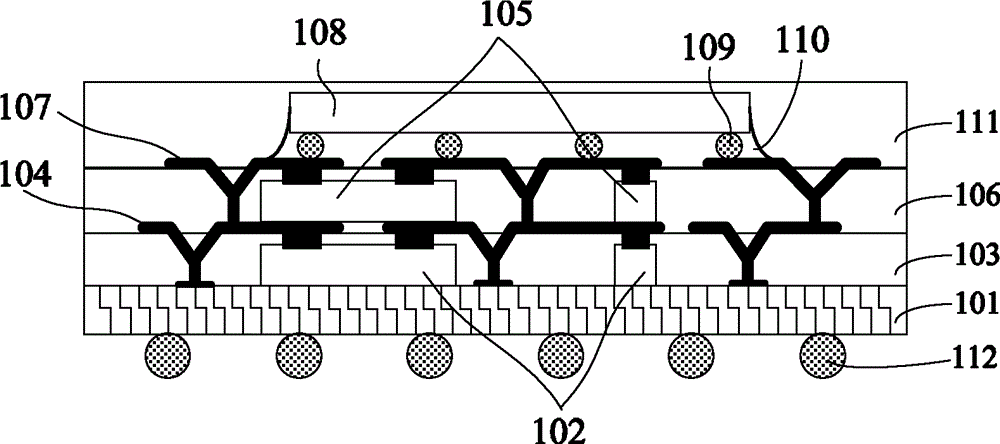
Referring to fig. 1, a schematic diagram of an embodiment of a high-integration system-in-package structure according to the present invention is shown, in this embodiment, two sets of a wiring package layer and a top flip-chip package layer are taken as an example of the high-integration system-in-package structure, but the present invention is not limited thereto, and the high-integration system-in-package structure includes: the package structure comprises a substrate 101, a first wiring packaging layer positioned on the substrate 101, a second wiring packaging layer positioned on the first wiring packaging layer, a top flip-chip packaging layer positioned on the second wiring packaging layer, and connecting balls 110 arranged below the substrate 101. Wherein,
the substrate 101 is a base for subsequently stacking each package group and also a base for carrying subsequent layers of package layers. The substrate 101 includes two functional surfaces, wherein a first surface of the substrate 101 is used for stacking a package layer, and a second surface of the substrate 101 is used for embedding balls (embedding connection balls), in this embodiment, an upper surface of the substrate 101 is used for stacking a package layer, the upper surface of the substrate 101 is provided with a pad for realizing electrical connection, and a lower surface of the substrate 101 is used for embedding connection balls. Specifically, the substrate 101 is typically a bt (bimoleimide) substrate or a Printed Circuit Board (PCB), etc., so as to facilitate routing between the first surface and the second surface of the substrate 101. The substrate 101 includes a connection trace penetrating through the substrate 101, and the connection trace can electrically connect the pad and the connection ball.
In order to fix the package on the substrate 101 better, the high-integration system-in-package structure further includes a glue layer attached to the substrate 101, the glue layer is used to attach the first mounting layer 103 to the substrate 101, the glue layer may be made of various materials, and the glue layer formed on the substrate 101 may be dispensed or printed. Such methods are well known to those skilled in the art of semiconductor fabrication and will not be described in detail herein.
The first wiring encapsulation layer comprises a first positive mounting layer 102, a first material sealing layer 103 and a first wiring layer 104 which are sequentially arranged on the substrate 101. Wherein,
the first front mounting layer 102 includes a plurality of semiconductor devices, in this embodiment, the first front mounting layer 102 includes a chip and a passive device, and is attached to the substrate 101 through a glue layer in a manner that a functional surface faces upward, where the functional surface of the first front mounting layer 102 refers to a surface where pads of the chip and the passive device in the first front mounting layer 102 are located.
In a preferred embodiment of the present invention, the first positive mounting layer 102 and the subsequent-mentioned mounting layers disposed on the substrate 101 may comprise one or more same or different chips, and may further comprise one or more same or different passive devices. These chips and passive devices each become part of a system-in-package product, each performing one or more individual functions among the system-in-package functions.
In a preferred embodiment of the present invention, the combination of the chip and the passive device in the first positive mounting layer 102 is configured according to the system function. Therefore, around one or a group of chips, there may be another chip or group of chips, which may be the same or different, or passive devices such as capacitors, resistors or inductors, which may be the same or different; similarly, there may be other passive devices that are the same or different, or one or more of the same or different chips, around a passive device.
The first encapsulant layer 103 serves to insulate and isolate the various devices of the first front side mounting layer 102, as well as to insulate and isolate the different encapsulation layers. The first sealing material layer 103 is filled between the devices of the first front mounting layer 102, and a part of the first sealing material layer 103 covers the devices of the first front mounting layer 102, the first sealing material layer 103 exposes the connectors of the devices of the first front mounting layer 102, and specifically, the first sealing material layer 103 exposes the surfaces of the bonding pads of the chip and the passive device group, so as to facilitate electrical connection.
Since the first sealing material layer 103 is filled between the devices of the first front mounting layer 102 and exposes the connectors of the devices, the thickness of the first sealing material layer 103 is equal to that of the first front mounting layer 102, so that the stacking thickness of the mounting layers can be reduced, and the integration of the package structure can be improved to the maximum extent.
The first wiring layer 104 includes a first vertical wiring and a first horizontal wiring. The first longitudinal wiring is a wire (e.g., a metal wire) penetrating through the first encapsulant layer 103, and is used for electrically connecting the first wiring encapsulation layer and the substrate 101.
In practical application, longitudinal wiring can be selectively formed in the sealing material layer according to design requirements so as to realize the electrical connection between the mounting layers or between the mounting layers and the substrate.
The first transverse wiring is a wire (e.g., a metal wire) covering the first encapsulant layer 103 and is conductively connected to the first longitudinal wiring for electrically connecting the devices of the first front mounting layer 102, in this embodiment, the first transverse wiring is used for electrically connecting the chip and the passive device group in the first front mounting layer 102, and specifically, the first transverse wiring is connected to the pad surfaces of the chip and the passive device.
The second wiring encapsulation layer is stacked on the first wiring encapsulation layer, and specifically comprises: and the second positive mounting layer 105, the second material sealing layer 106 and the second wiring layer 107 are sequentially positioned on the first wiring packaging layer. In this embodiment, the second front mounting layer 105 includes a chip and a passive device, and is stacked on the first sealing material layer 103 in a manner that the functional surface faces upward. The second front mounting layer 105, similar to the first front mounting layer 102, may include one or more same or different chips, and may further include one or more same or different passive devices.
The second encapsulant layer 106 serves to insulate and isolate the individual devices of the second positive mounting layer 105, as well as to insulate and isolate the different encapsulation layers. The second sealing material layer 106 is filled between the devices of the second front mounting layer 105, and a part of the second sealing material layer 106 covers the devices of the second front mounting layer 105, the second sealing material layer 106 exposes the connectors of the devices of the second front mounting layer 106, and specifically, the second sealing material layer 106 exposes the surfaces of the bonding pads of the chip and the passive device group, so as to facilitate electrical connection.
The second wiring layer 107 includes a second vertical wiring and a second horizontal wiring. The second vertical wirings are wires (e.g., metal wires) penetrating through the second encapsulant layer 106, and are used for realizing electrical connection between the second wiring encapsulation layer and other encapsulation layers, and according to design requirements, the second vertical wirings are also used for realizing electrical connection between the second wiring encapsulation layer and the substrate 101;
the second transverse wiring is a wire (e.g., a metal wire) covering the second encapsulant layer 106, and the second transverse wiring is connected to the second longitudinal wiring for electrically connecting devices of the second front mounting layer 105, in this embodiment, the second transverse wiring is used for electrically connecting a chip and a passive device group in the second front mounting layer 105.
The top flip-chip package layer includes a flip-chip layer 108, an underfill, and a third encapsulant layer 111 sequentially on the second wire-bond package layer.
The flip-chip mounting layer 108, similar to the mounting layer described above, may contain one or more of the same or different chips and may also include one or more of the same or different passive devices. In this embodiment, the flip-chip layer 108 includes a chip and is attached to the second encapsulant layer 106 in a functional-surface-down manner, the functional surface of the chip has solder bumps 109, and the chip is electrically connected to the second transverse wires of the second wiring layer 107 through the solder bumps 109.
In a preferred embodiment of the present invention, passive devices may be disposed around the flip chip according to design requirements, and a mounting direction of the passive devices may be consistent with a mounting direction of the chip to simplify a process flow.
A filler 110 is disposed in a gap between the chip of the flip chip package 108 and the second wire encapsulation layer to form an underfill. The underfill is used for avoiding product reliability problems such as internal cavities in the sealant layer. The filler 110 may be a high molecular epoxy resin, which has good fluidity and can fully fill the gap between the flip chip and the encapsulant layer.
The third encapsulant layer 111 encapsulates the devices of the flip-chip packaging layer 108 to form a package body, so as to prevent pollution and corrosion of the external environment. The material forming the third encapsulant layer 111 may be the same as the material forming the first encapsulant layer 103 and the second encapsulant layer 106, i.e., epoxy is used to form the third encapsulant layer 111.
The high-integration system-in-package structure further includes a connection ball 112 disposed below the substrate 101, where the connection ball 112 is located at a position corresponding to the connection trace in the substrate 101, and is connected to the pad of the substrate 101 through the connection trace in the substrate 101.
The above embodiments include two wiring encapsulation layers and a top flip-chip encapsulation layer, but the present invention is not limited thereto, and one or more wiring encapsulation layers may be used to match with the top encapsulation layer, and those skilled in the art may make modifications, alterations and substitutions according to the above embodiments.
According to the high-integration system-level packaging structure, the electrical connection between adjacent or separated packaging layers is realized through the wiring layers, the integration of the system is realized through the arrangement of the connecting wires in the substrate 101, and finally the functions are output through the connecting balls 112.
Although the present invention has been described with reference to the preferred embodiments, it is not limited thereto. Various changes and modifications may be effected therein by one skilled in the art without departing from the spirit and scope of the invention as defined in the appended claims.