EP1891265B1 - Method for treating a process material with large surface plasma - Google Patents
Method for treating a process material with large surface plasma Download PDFInfo
- Publication number
- EP1891265B1 EP1891265B1 EP06763617A EP06763617A EP1891265B1 EP 1891265 B1 EP1891265 B1 EP 1891265B1 EP 06763617 A EP06763617 A EP 06763617A EP 06763617 A EP06763617 A EP 06763617A EP 1891265 B1 EP1891265 B1 EP 1891265B1
- Authority
- EP
- European Patent Office
- Prior art keywords
- plasma
- process material
- voltage
- radicals
- produced
- Prior art date
- Legal status (The legal status is an assumption and is not a legal conclusion. Google has not performed a legal analysis and makes no representation as to the accuracy of the status listed.)
- Not-in-force
Links
Images



Classifications
-
- D—TEXTILES; PAPER
- D21—PAPER-MAKING; PRODUCTION OF CELLULOSE
- D21C—PRODUCTION OF CELLULOSE BY REMOVING NON-CELLULOSE SUBSTANCES FROM CELLULOSE-CONTAINING MATERIALS; REGENERATION OF PULPING LIQUORS; APPARATUS THEREFOR
- D21C9/00—After-treatment of cellulose pulp, e.g. of wood pulp, or cotton linters ; Treatment of dilute or dewatered pulp or process improvement taking place after obtaining the raw cellulosic material and not provided for elsewhere
- D21C9/001—Modification of pulp properties
- D21C9/007—Modification of pulp properties by mechanical or physical means
-
- D—TEXTILES; PAPER
- D21—PAPER-MAKING; PRODUCTION OF CELLULOSE
- D21C—PRODUCTION OF CELLULOSE BY REMOVING NON-CELLULOSE SUBSTANCES FROM CELLULOSE-CONTAINING MATERIALS; REGENERATION OF PULPING LIQUORS; APPARATUS THEREFOR
- D21C9/00—After-treatment of cellulose pulp, e.g. of wood pulp, or cotton linters ; Treatment of dilute or dewatered pulp or process improvement taking place after obtaining the raw cellulosic material and not provided for elsewhere
- D21C9/10—Bleaching ; Apparatus therefor
-
- D—TEXTILES; PAPER
- D21—PAPER-MAKING; PRODUCTION OF CELLULOSE
- D21H—PULP COMPOSITIONS; PREPARATION THEREOF NOT COVERED BY SUBCLASSES D21C OR D21D; IMPREGNATING OR COATING OF PAPER; TREATMENT OF FINISHED PAPER NOT COVERED BY CLASS B31 OR SUBCLASS D21G; PAPER NOT OTHERWISE PROVIDED FOR
- D21H25/00—After-treatment of paper not provided for in groups D21H17/00 - D21H23/00
- D21H25/04—Physical treatment, e.g. heating, irradiating
Definitions
- the invention relates to a process for the treatment of a process material, wherein the process material with, preferably non-thermal, large-area plasma, preferably at least atmospheric pressure brought into contact, the plasma generated in the immediate vicinity of the process material or in the process material or in the immediate vicinity of a gas discharge, in particular, a corona discharge, preferably at least atmospheric pressure, is generated.
- high-voltage pulses having a duration of less than 10 ⁇ s are generated between the electrodes for generating the plasma or the gas discharge.
- the use of such short high voltage single pulses has been found to be particularly advantageous, whereas the use of radio frequency (RF) or microwave pulses or high voltage single pulses of more than 10 ⁇ s in duration is far less efficient.
- RF radio frequency
- the pulse duration should be significantly shorter than corresponds to a build-up time of the complete breakdown time in the respective medium.
- the process material is an unwoven fiber in a suspension, in particular fibers or pulp, a paper to be produced, a cardboard to be produced, a cardboard to be produced, the starting materials for the production, and / or their intermediates during manufacture, in particular a moist or dry and / or unpressed sheet.
- the plasma is preferably produced by the process material at a distance of less than 20 cm, preferably less than 10 cm, preferably less than 5 cm.
- the process material is brought into contact with the plasma on both sides or treated by means of the gas discharge.
- the two-sided treatment of the process material with plasma allows a high treatment efficiency and a preferably high penetration depth of, for example, aggressive carriers in the process material.
- a preferred embodiment of the invention is that the plasma or the gas discharge for bleaching the process material, in particular in a digester, in a bleaching container or in a line is used. If the method is used, for example, within a connection element or a supply line which is prepared for the transport of the process material, the method for treating the process material can advantageously already be used during the transport of the process material, and thus a process time is further shortened.
- the process material is brought into contact with at least one electrode for generating the plasma or the gas discharge.
- the method is applied to different types or states of process goods.
- the content of carrier liquid, in particular water, in the process material is in the range between 40% and 99.9%, preferably in the range between 80% and 98%. and in particular between 85% and 98%.
- radicals are generated in the plasma or by means of the gas discharge, which act on the process material. These radicals cause a chemical reaction, for example with a bleaching effect, which effectively supports the treatment process to achieve the treatment goal.
- radicals of different types or compositions are used for different states of the process material in a paper, board or paperboard production process, in particular at different process stages.
- the process material is exposed within a process stage in a paper or board production process, radicals of different nature or composition, preferably sequentially in time.
- an optimal treatment result is achieved step by step.
- the plasma or the gas discharge is applied in such a way that as radicals increased ozone and / or hydrogen peroxide are formed.
- a generation rate of the radicals and / or the composition of the generated radicals is controlled by influencing an amplitude, a pulse duration and / or a pulse repetition rate of the high voltage pulses. Since, in addition to the nature and composition of the radicals, the concentration of the radicals is generated by an electrical process and is thus very easily controllable in real time, such a method is very economical and can be readjusted within a very short time for different treatment results, e.g. in the context of self-learning algorithms.
- a concentration of the generated radicals is measured to control and regulate the rate of generation and / or the type of radicals generated.
- the concentration of radicals is used as the actual value.
- a further increase in the targeted influence is achieved by measuring a property of the suspension, preferably a quality property, in particular its opacity, gloss, whiteness, fluorescence or color point, for controlling and regulating the production rate or the composition of the radicals produced.
- a quality property in particular its opacity, gloss, whiteness, fluorescence or color point
- the concentration or the property "online” is preferably measured. This is particularly advantageous with regard to an automated method, preferably with automation components and sensors, since the reaction to a changing quality property takes place virtually simultaneously.
- the amplitude of the high voltage pulses is changed at a constant repetition rate for control.
- the repetition rate of the high-voltage pulses is varied at a constant amplitude for the purpose of regulation.
- a further increase in the treatment result is achieved in that the process material, preferably for bleaching, is enriched with oxygen in the plasma-exposed area.
- the process material is present as suspension or pulp or as pulp, it is particularly advantageous with regard to the treatment result that, preferably for bleaching, a high-voltage pulse duration of less than 100 ns is used.
- a high-voltage pulse duration of less than 100 ns is used.
- the electrodes of a bleaching device are arranged completely inside the suspension, it is very advantageous to work with small high-voltage pulse durations due to the high conductivity of the suspension. The higher the conductivity, for example the suspension, the more "resistive losses" can occur if the pulse duration is too long.
- process material distributed in a planar manner, in particular during sieving be surrounded by a water vapor-enriched atmosphere in the plasma-exposed region.
- a high voltage pulse duration of 100 ns to 1 ⁇ s is used for areal distributed process material, in particular pulp or pulp or forming or formed, still unpressed sheet, in particular during screening.
- suspensions with high conductivity lead to "ohmic”losses; It is therefore advantageous to use pulses with a low pulse duration and a high edge steepness.
- high-voltage pulses having a duration of less than 3 ⁇ s, preferably less than 1 ⁇ s, preferably less than 500 ns.
- the use of short pulses on the one hand has the advantage that the largest part of the pulse energy is not converted into heat as an ohmic component and, on the other hand, a streamer discharge with efficient generation of radicals is generated.
- the amplitude corresponding to at least twice, preferably at least three times, a corona threshold voltage the electrodes are applied.
- a DC corona discharge is generated to generate the plasma or the corona discharge and the DC voltage corona discharge, the high voltage pulses are superimposed.
- the superimposition of the high-voltage pulses with a DC voltage has the particular advantage that the high-energy high-voltage pulses can already start from a very high energy level.
- a pulse repetition rate between 10 Hz and 5 kHz, in particular from the range of 10 Hz to 10 kHz, is used.
- the power coupling of electrical energy into the plasma is controlled predominantly via the regulation of amplitude, pulse duration, and pulse repetition rate of the superimposed high-voltage pulses.
- a homogeneous, large volume plasma with high power density is produced without causing plasma constrictions or breakdowns comes.
- the generation rate can be kept high and constant, but if plasma constrictions or breakdowns occur, the production rate drops again.
- the total amplitude used (DC voltage + pulse amplitude) is above the static breakdown voltage of the electrode assembly.
- the total amplitude used preferably corresponds to two to five times the static breakdown voltage of the electrode arrangement.
- the amplitude of the high-voltage pulses is between 10% and 1000% of the DC voltage used.
- a gas flow is generated perpendicular to the electrode assembly.
- FIG. 1 shows a schematic representation of a complex papermaking plant 1, as in today's paper mills is used. Their construction and the combination of different aggregates are determined by the type of paper, cardboard and paperboard types to be produced as well as the raw materials used.
- the papermaking plant 1 has a spatial extent of about 10 m in width and about 120 m in length.
- the papermaking plant produces up to 1400 m of paper per minute 27. It only takes a few seconds from the first impingement of the suspension or the pulp 39 on the screening device 9 to the finished paper 27, which is finally rolled up in a reel 15. Diluted with water at a ratio of 1: 100, the fibers 30 (see FIG. 2 ) applied together with excipients on the sieve 9 with the sieve 10.
- the fibers are deposited on the screen 10 side by side and on each other.
- the white water 23 can drain or be sucked off by means of several suction chamber regions 24.
- a uniform fiber composite which is further dehydrated by mechanical pressure in a press device 11 and with the aid of steam heat.
- the entire papermaking process is essentially subdivided into the areas of stock preparation, paper machine, finishing and equipment.
- Waste paper and, as a rule, also pulp reach a paper factory in dry form, while pulp is normally produced in the same factory and pumped into the material center 3 as a fiber / water mixture, ie a suspension of unvarnished fibers.
- Waste paper and pulp 30 (see FIG. 2 ) are also added with the addition of water in a fiber trough 35 (FIG. FIG. 2 ) dissolved.
- Non-paper components are discharged via various sorting aggregates (not shown here). In the fabric center 3, depending on the desired type of paper, the mixture of different raw materials. Fillers and auxiliaries are also added here to improve paper quality and increase productivity.
- the headbox 7 of the papermaking plant 1. distributes the pulp suspension uniformly over the entire wire width.
- the paper web 27 still contains about 80% water.
- Another dewatering process is carried out by mechanical pressure in the press device 11.
- the paper web 27 is guided by means of an absorbent endless felt cloth between rolls of steel, granite or hard rubber and thereby dehydrated.
- the white water 23 taken up by the suction chamber region 24 is fed to a sorter 5 in part and returned to another part to a fabric scavenger 17.
- the press device 11 is followed by a drying system 13.
- the remaining residual water is evaporated in the drying plant 13.
- Slalom-like, the paper web 27 passes through several steam-heated drying cylinders. In the end, the paper 27 has a residual moisture of a few percent.
- the water vapor formed in the drying plant 13 is sucked off and passed into a heat recovery system, not shown.
- the electrodes 43 and 44 are arranged such that the surface-distributed fiber suspension 39 extends between them. So that a large-area plasma under atmospheric pressure in the immediate vicinity of the fiber suspension 39 can be produced for the treatment of the fiber suspension 39, the electrodes 43 and 44 are connected to a high-voltage pulse generator 46. With the aid of this high-voltage pulse generator 46, a large-volume plasma with a large cross section and with high power density is produced between the electrodes 43 and 44.
- a plasma density is homogeneously distributed over the treatment area which is covered by the electrodes 43 and 44.
- this large-volume plasma with high power density is generated by a DC corona discharge intensive, short-lasting high-voltage pulses are superimposed with a high pulse repetition rate of 1 kHz.
- a very homogeneous, large-volume plasma with a high power density is produced without the plasma constrictions that are known in DC corona discharges.
- oxygen with argon as carrier gas is optionally introduced into the treatment space between the electrodes 43 and 44 via a gas distributor 81.
- Hydroxyl radicals are particularly advantageously produced with the aid of the oxygen-argon mixture. Hydroxyl radicals are particularly aggressive and oxidizing, thereby a bleaching effect is achieved at the only a few seconds in the treatment area between the electrodes 43 and 44 lingering process material.
- FIG. 1 is also a second embodiment of the application of the method according to the invention shown:
- an electrode system 47, 48 in the press device 11 generates a large-area plasma for the treatment of the paper web 27, which represents the process material here.
- the first electrode 47 in the press apparatus 11 is designed as a semicircular grid electrode. Due to the semicircular configuration of the electrode 47, it can follow the course of the paper web over a transport roller 12.
- the second electrode 48 in the press device 11 is configured as a plate electrode and arranged such that the transport roller 12 can be guided between the electrodes 47 and 48.
- the plasma treatment area is optionally also supplied via the gas distributor 81 with the gas line 80 with an oxygen-argon mixture here.
- the pressing process compacts the paper structure, a strength increases and a surface quality is decisively influenced.
- the molecular structure of the paper surface is further altered.
- the strength of the paper 27 is increased and printability improved.
- a streamer is a special form of a linearly moving plasma cloud or a developing discharge channel that forms due to the excited high external field strength. An assembly of such streamer takes place within less than 10 ns and merges very quickly into a thermal breakdown channel.
- the aforementioned arrangements of the electrode systems, with the paper web 27 between the electrodes used for streamer discharge, is particularly advantageous, as the paper 27 thereby partially acts as a dielectric barrier, thereby suppressing the transition from the streamer puncture.
- FIG. 2 shows a bleaching device 38 as a third application example.
- a raw material 30, in particular pulp, here the process material is conveyed via a conveyor belt 33 into a fiber trough 35.
- the raw material 30 is mixed with water and pumped via a pipeline 36 into a bleaching trough 37.
- a first electrode 43 'and a second electrode 44' are each designed as a circular-area grid electrode.
- the first electrode 43 ' is arranged in the gas space of the pulp fiber suspension 39 filled in the bleaching trough 37.
- the second electrode 44 ' is arranged inside the bleaching trough 37 and is thus completely covered by the pulp fiber suspension 39.
- a large-area cold plasma is generated by means of the high-voltage pulse generator 46.
- the radical OH in the suspension 39 is preferably, O, O 3 produced. These radicals trigger a bleaching chemical reaction.
- the high-voltage pulse generator 46 is operated to generate high-spike pulses having a duration of 1 ⁇ s between the electrodes 43 'and 44'.
- a necessary for the generation of radicals and ozone in the pulp fiber suspension DC voltage is approximately at some 10 kV to 100 kV.
- the high voltage pulses are superimposed on the DC voltage to form a total amplitude of a few 10 kV to 500 kV.
- an oxygen-argon mixture which has been treated in a gas distributor 81, is introduced into the bleaching trough 37 via a gas line 80.
- FIG. 3 shows as a fourth application example a sectional view of a bleaching vessel.
- a high voltage electrode 50 is arranged in the middle of the bleaching vessel.
- the outer jacket of the bleaching vessel is prepared as a counterelectrode 51.
- a pulp fiber suspension 39 is prepared between the electrodes 50 and 51.
- a streamer 53 is shown between the electrodes 50 and 51. Radicals are generated in streamers by high-energy electrons colliding with and dissociating or exciting molecules. Upon dissociation, radicals 59 are immediately released, while upon excitation by a subsequent radiant transition, UV light is generated. This generated UV light in turn reacts with water molecules and dissociates them.
- FIG. 4 the voltage waveform of the high voltage pulses used according to the invention is shown.
- a first pulse 66 and a second pulse 67 each having a pulse width 62 of less than 10 ⁇ s, have a spacing of one pulse repetition time 63.
- the abscissa shows the time in ms and the ordinate the voltage in kV. The units are chosen arbitrarily.
- a level of about 100 kV DC voltage coincides with the abscissa shown.
- the illustrated pulse voltage is thus superimposed on the DC voltage.
- the pulses 66 and 67 have a high rising edge with a rise time of 64 and a less steeply falling edge.
- the pulse repetition time 63 is typically between 10 ⁇ s and 100 ms.
- the individual pulses 66, 67 have such a total amplitude that a predefined energy density is achieved beyond the predetermined direct voltage.
- the pulse rise time 64 is short compared to the pulse fall time.
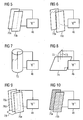
- FIG. 5 to FIG. 10 show further examples of electrode systems for generating corona discharges in preferably aqueous media, which can be used in the inventive method.
- a plate-and-plate arrangement of a first plate 70a as an electrode and a second plate 70b as an electrode is illustrated.
- the first plate 70a and the second plate 70b are arranged parallel to each other.
- the first plate 70a forms the high voltage electrode and is connected to the high voltage pulse generator 46 via a high voltage cable.
- the second plate 70b forms the counter electrode and is connected as a grounded electrode to the high voltage pulse generator 46 in connection.
- FIG. 6 A corresponding arrangement with specially flat plate electrodes is in FIG. 6 shown.
- a high voltage electrode 71 extends centrally.
- the high voltage electrode 71 is made of a solid wire and connected to the high voltage output of the high voltage pulse generator 46.
- the grounded plates 70a, 70c are also in communication with the high voltage pulse generator.
- FIG. 7 shows a wire-tube arrangement as an electrode system.
- a high-voltage electrode 71 projects centrally into a cylindrical electrode 72.
- the high voltage electrode 71 is made as a solid wire and connected to the high voltage pulse generator 46.
- the cylindrical electrode 72 which is preferably configured as a wire mesh, is grounded and communicates with the high voltage pulse generator 46.
- FIG. 8 shows a tip-plate assembly as an electrode system.
- Three tips 73 are connected to the high voltage pulse generator 46 via a high voltage line.
- the tips 73 are arranged at right angles to a grounded plate electrode 74.
- the distance of the tip electrodes 73 to the plate electrode 74 is adjustable and thus can be adapted for different process conditions.
- FIG. 9 shows an electrode system assembly comprising 3 plates 70a, 70d and 70e.
- the first plate 70a which is connected as a high-voltage electrode to the high-voltage pulse generator 46, is arranged centrally between two solid plates 70d and 70e.
- the plates 70a and 70b are connected via a plate connector 70f. Since the plate 70d as a grounded counter electrode is in communication with the high voltage pulse generator 46, the plate 70e above the plate connector 70f also functions as a grounded counter electrode.
- FIG. 10 shows an electrode system as a grid-grid arrangement. Analogous to FIG. 5 here are a first grid 75a and a second grid 75b parallel to one another.
- the first grid 75a forms the high voltage electrode and is connected to the high voltage pulse generator 46.
- the second grid 75b forms the grounded counter electrode and communicates with the high voltage pulse generator 46.
- FIG. 11 A hybrid discharge in which an electrode 75a is entirely outside a pulp 39 to be bleached and a second electrode 76b is wholly or partially immersed in the pulp 39 is shown in FIG. 11 generated.
- the electrode 76a is designed as a grid electrode and is connected to the high-voltage pulse generator 46.
- the grounded counter-electrode 76b is also designed as a grid electrode.
- FIG. 12 is shown as a further application example, a bleaching tub with a vessel wall 77 in a plan view.
- a plate or grid arrangement with curved surfaces for adaptation to the vessel walls or use of the vessel walls is used as the electrode.
- a multiple wire electrode 79 is arranged as a concentric electrode following the course of the vessel wall 77 and communicates with the high voltage pulse generator 46. It faces two counterelectrodes: on the one hand the vessel wall 77 and on the other hand a plate electrode 78.
- the high voltage electrode 79 is arranged without contact between the vessel wall 77 and the plate electrode 78.
- the vessel wall 77 and the plate electrode 78 are electrically conductively connected to each other and thus form the grounded counterelectrodes which are in communication with the high voltage pulse generator 46.
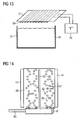
- a high-voltage electrode 50 comprises a plurality of electrically connected rod electrodes and is arranged in the near-surface gas space of the pulp 39 such that their rods parallel to the surface.
- a grounded counter electrode 51 is designed as a solid plate and arranged in distributed over the entire surface equidistant distances to the high voltage electrode 50.
- FIG. 14 shows in a last embodiment, a pulsed corona discharge system in an aqueous solution or pulp 39.
- the electrode system is analogous to FIG. 3 formed as a coaxial wire tube electrode system.
- the high voltage electrode 50 is arranged coaxially with the counter electrode 51 forming the vessel wall.
- the finest gas bubbles are introduced into the discharge area via a gas line 80 by means of a gas distributor 81.
- the gas bubbles 82 and 83 are preferably formed to FIG. 3 mentioned streamer. Owing to the streamer discharges, oxidants 57 are formed. Thus, certain radicals are generated in the suspension.
Landscapes
- Engineering & Computer Science (AREA)
- Life Sciences & Earth Sciences (AREA)
- Wood Science & Technology (AREA)
- Mechanical Engineering (AREA)
- Paper (AREA)
- Percussion Or Vibration Massage (AREA)
- Drying Of Semiconductors (AREA)
- Physical Or Chemical Processes And Apparatus (AREA)
- Treatments Of Macromolecular Shaped Articles (AREA)
Abstract
Description
Die Erfindung betrifft ein Verfahren zur Behandlung eines Prozessgutes, wobei das Prozessgut mit, vorzugsweise nichtthermischem, großflächigem Plasma, vorzugsweise bei mindestens Atmosphärendruck, in Kontakt gebracht, das Plasma in unmittelbarer Nähe zu dem Prozessgut erzeugt oder in dem Prozessgut oder in unmittelbarer Umgebung eine Gasentladung, insbesondere eine Koronaentladung, vorzugsweise bei mindestens Atmosphärendruck, erzeugt wird.The invention relates to a process for the treatment of a process material, wherein the process material with, preferably non-thermal, large-area plasma, preferably at least atmospheric pressure brought into contact, the plasma generated in the immediate vicinity of the process material or in the process material or in the immediate vicinity of a gas discharge, in particular, a corona discharge, preferably at least atmospheric pressure, is generated.
Die Behandlung von Prozessgütern zieht meist auf eine Veränderung einer molekularen Struktur des Prozessgutes, insbesondere seiner Oberfläche, ab. Beispielsweise müssen in der Papierindustrie oder in der Textilindustrie Prozessgüter, z.B. ganze Papierbahnen oder ganze Textilbahnen, durch Applizieren mit bestimmten Substanzen behandelt werden. Am Beispiel von Papier werden dadurch folgende Effekte erzielt:
- Beseitigung von, "farbigen" Molekülgruppen, dadurch wird eine Aufhellung des Papiers zumindest im Oberflächenbereich erzielt,
- Erhöhung der Absorptionsfähigkeit für eine Druckfarbe,
- Erhöhung der Festigkeit des Papiers.
- Elimination of "colored" molecular groups, this results in brightening of the paper, at least in the surface area,
- Increasing the absorbency of an ink,
- Increasing the strength of the paper.
Bei Textilien und Kunststoffen wird die Behandlung von Oberflächen bereits mit nichtthermischen, "kalten" Plasmen technisch durchgeführt, um durch eine Oberflächenfunktionalisierung die Färbbarkeit und/oder die Bedruckbarkeit zu verbessern oder auch bestimmte andere Eigenschaften wie beispielsweise Flammschutz, Wasserabweisung oder Wasseranziehung gezielt zu steuern.In the case of textiles and plastics, the treatment of surfaces is already technically carried out with non-thermal, "cold" plasmas in order to improve the dyeability and / or printability by means of surface functionalization or else to control specific other properties such as, for example, flame retardation, water repellency or water attraction.
Aus
Aus
Behandlungsverfahren, wie sie beispielsweise in der Papierindustrie zur Beherrschung der heute sehr hohen Prozessgeschwindigkeiten nötig sind, sind bisher nicht bekannt.Treatment methods, such as those required in the paper industry for controlling the very high process speeds required today, are not yet known.
Es ist Aufgabe der Erfindung ein Behandlungsergebnis, welches durch die Behandlung eines Prozessgutes mit Plasma erzielt wird, zu verbessern und/oder die Effektivität der Plasmaerzeugung zu steigern.It is an object of the invention to improve a treatment result, which is achieved by the treatment of a process material with plasma, and / or to increase the effectiveness of the plasma generation.
Die Aufgabe wird dadurch gelöst, dass zur Erzeugung des Plasmas bzw. der Gasentladung zwischen Elektroden Hochspannungsimpulse mit einer Dauer von weniger als 10 µs erzeugt werden. Die Verwendung von derartig kurzen Hochspannungs-Einzelimpulsen hat sich als besonders vorteilhaft gezeigt, wogegen die Verwendung von Radiofrequenz-(RF) oder Mikrowellenimpulsen oder Hochspannungs-Einzelimpulsen mit mehr als 10 µs Dauer weit weniger effizient ist. Um eine gute Energieeffizienz der Erzeugung von Plasma und dessen positive Effekte, sowohl in Gasen als auch in Flüssigkeiten, zu erhalten, wird daher vorzugsweise, mit sehr kurzen Hochspannungsimpulsen gearbeitet. Die Pulsdauer sollte deutlich kürzer sein, als es einer Aufbauzeit der vollständigen Durchschlagszeit im jeweiligen Medium entspricht.The object is achieved in that high-voltage pulses having a duration of less than 10 μs are generated between the electrodes for generating the plasma or the gas discharge. The use of such short high voltage single pulses has been found to be particularly advantageous, whereas the use of radio frequency (RF) or microwave pulses or high voltage single pulses of more than 10 μs in duration is far less efficient. In order to obtain a good energy efficiency of the generation of plasma and its positive effects, both in gases and in liquids, it is therefore preferred to work with very short high-voltage pulses. The pulse duration should be significantly shorter than corresponds to a build-up time of the complete breakdown time in the respective medium.
Gemäß der Erfindung wird im Gegensatz zur bekannten Vorgehensweise bei Textilien und Kunststoffen nicht mit einem Niederdruckplasmareaktor gearbeitet, was wegen der nötigen Vakuumerzeugung sehr aufwendig ist, sondern es wird Atmosphärendruck appliziert.According to the invention, in contrast to the known procedure for textiles and plastics is not worked with a low-pressure plasma reactor, which is very expensive because of the necessary vacuum generation, but it is applied atmospheric pressure.
Vorzugsweise ist das Prozessgut ein unverwobener Faserstoff in einer Suspension, insbesondere Fasern oder Pulpe, ein herzustellendes Papier, ein herzustellender Karton, eine herzustellende Pappe, deren Ausgangsmaterialien zur Herstellung, und/oder deren Zwischenprodukte während der Herstellung, insbesondere ein feuchtes oder trockenes und/oder ungepresstes Blatt.Preferably, the process material is an unwoven fiber in a suspension, in particular fibers or pulp, a paper to be produced, a cardboard to be produced, a cardboard to be produced, the starting materials for the production, and / or their intermediates during manufacture, in particular a moist or dry and / or unpressed sheet.
Vorzugsweise wird das Plasma in einem Abstand von kleiner als 20 cm, vorzugsweise kleiner als 10 cm, vorzugsweise kleiner als 5 cm, von dem Prozessgut erzeugt. Um ein gutes Behandlungsergebnis, beispielsweise ein Bleichen einer Papierbahn, zu erzielen ist es von Vorteil, das Plasma in der unmittelbaren Umgebung des Prozessgutes zu erzeugen.The plasma is preferably produced by the process material at a distance of less than 20 cm, preferably less than 10 cm, preferably less than 5 cm. In order to achieve a good treatment result, for example bleaching of a paper web, it is advantageous to produce the plasma in the immediate vicinity of the process material.
Zweckmäßig ist, dass das Prozessgut beidseitig mit dem Plasma in Kontakt gebracht bzw. mittels der Gasentladung behandelt wird. Die beidseitige Behandlung des Prozessgutes mit Plasma ermöglicht eine hohe Behandlungseffizienz und eine vorzugsweise hohe Eindringtiefe von beispielsweise aggressiven Trägerstoffen in das Prozessgut.It is expedient that the process material is brought into contact with the plasma on both sides or treated by means of the gas discharge. The two-sided treatment of the process material with plasma allows a high treatment efficiency and a preferably high penetration depth of, for example, aggressive carriers in the process material.
Eine bevorzugte Ausführungsform der Erfindung ist, dass das Plasma bzw. die Gasentladung zum Bleichen des Prozessgutes, insbesondere in einem Kocher, in einem Bleichbehältnis oder in einer Leitung, verwendet wird. Wird das Verfahren beispielsweise innerhalb eines Verbindungselementes oder einer Zuleitung, welche für den Transport des Prozessgutes hergerichtet ist, angewendet, so kann das Verfahren zur Behandlung des Prozessgutes auf vorteilhafter Weise während des Transportes des Prozessgutes bereits angewendet werden und somit wird eine Prozesszeit weiter verkürzt.A preferred embodiment of the invention is that the plasma or the gas discharge for bleaching the process material, in particular in a digester, in a bleaching container or in a line is used. If the method is used, for example, within a connection element or a supply line which is prepared for the transport of the process material, the method for treating the process material can advantageously already be used during the transport of the process material, and thus a process time is further shortened.
In einer weiteren bevorzugten Ausgestaltung wird das Prozessgut mit zumindest einer Elektrode zur Erzeugung des Plasmas bzw. der Gasentladung in Kontakt gebracht.In a further preferred embodiment, the process material is brought into contact with at least one electrode for generating the plasma or the gas discharge.
Zweckmäßigerweise wird das Verfahren auf verschiedene Arten bzw. Zustände von Prozessgütern angewendet. Bei einer bevorzugten Anwendung liegt der Gehalt an Trägerflüssigkeit, insbesondere Wasser, in dem Prozessgut im Bereich zwischen 40 % und 99,9 %, vorzugsweise im Bereich zwischen 80 % und 98 % und insbesondere im Bereich zwischen 85 % und 98 %. Mit der Anwendung des erfindungsgemäßen-Verfahrens innerhalb einer Trägerflüssigkeit können auf vorteilhafte Weise chemische Reaktionen, welche das Behandlungsergebnis hervorrufen, besonders effizient erzeugt werden.Appropriately, the method is applied to different types or states of process goods. In a preferred application, the content of carrier liquid, in particular water, in the process material is in the range between 40% and 99.9%, preferably in the range between 80% and 98%. and in particular between 85% and 98%. With the use of the method according to the invention within a carrier liquid, chemical reactions which produce the result of the treatment can be produced particularly efficiently.
Vorzugsweise werden im Plasma oder mittels der Gasentladung Radikale erzeugt, die auf das Prozessgut einwirken. Diese Radikale bewirken eine chemische Reaktion, beispielsweise mit einer bleichenden Wirkung, welche zur Erreichung des Behandlungsziels den Behandlungsprozess effektiv unterstützen.Preferably, radicals are generated in the plasma or by means of the gas discharge, which act on the process material. These radicals cause a chemical reaction, for example with a bleaching effect, which effectively supports the treatment process to achieve the treatment goal.
Mit besonderem Vorteil werden für verschiedene Zustände des Prozessgutes in einem Papier-, Karton- oder Pappe-Herstellungsprozess, insbesondere an unterschiedlichen Prozessstufen, Radikale unterschiedlicher Art oder Zusammensetzung verwendet.With particular advantage, radicals of different types or compositions are used for different states of the process material in a paper, board or paperboard production process, in particular at different process stages.
Besonders bevorzugt und zweckmäßig ist es, dass das Prozessgut innerhalb einer Prozessstufe in einem Papier- oder Karton-Herstellungsprozess, Radikalen unterschiedlicher Art oder Zusammensetzung ausgesetzt wird, vorzugsweise zeitlich nacheinander folgend. Mit Vorteil wird so ein optimales Behandlungsergebnis Schritt für Schritt erzielt.It is particularly preferred and expedient that the process material is exposed within a process stage in a paper or board production process, radicals of different nature or composition, preferably sequentially in time. Advantageously, such an optimal treatment result is achieved step by step.
Zweckmäßig ist es, dass als Radikale Ozon, Wasserstoffperoxid, Hydroxyl, HO2 und/oder HO2 - erzeugt werden.It is expedient that are generated as radicals ozone, hydrogen peroxide, hydroxyl, HO 2 and / or HO 2 - .
Auf vorteilhafte Weise wird beim Bleichen des Prozessgutes das Plasma oder die Gasentladung derart appliziert, dass als Radikale vermehrt Ozon und/oder Wasserstoffperoxyd gebildet werden.Advantageously, when bleaching the process material, the plasma or the gas discharge is applied in such a way that as radicals increased ozone and / or hydrogen peroxide are formed.
Ausgehend von der Verwendung unterschiedlicher Art oder Zusammensetzung von Radikalen an unterschiedlichen Prozessstufen, ist es vorteilhaft, dass beim Sieben und/oder am flächig verteilten Prozessgut das Plasma oder die Gasentladung derart appliziert wird, dass als Radikale vermehrt Hydroxyl, HO2 und/oder HO2 - gebildet wird.Starting from the use of different types or compositions of radicals at different process stages, it is advantageous that during sieving and / or on the distributed process material the plasma or the gas discharge in such a way is applied, that as radicals increasingly hydroxyl, HO 2 and / or HO 2 - is formed.
Auf vorteilhafte Weise wird eine Erzeugungsrate der Radikale und/oder die Zusammensetzung der erzeugten Radikale durch Beeinflussung einer Amplitude, einer Impulsdauer und/oder einer Impulswiederholrate der Hochspannungsimpulse gesteuert. Da neben der Art und Zusammensetzung der Radikale auch die Konzentration der Radikale durch einen elektrischen Prozess erzeugt wird und damit in Echtzeit sehr gut steuerbar ist, ist ein solches Verfahren sehr wirtschaftlich und kann innerhalb kürzester Zeit für unterschiedliche Behandlungsergebnisse nachgeregelt werden, z.B. im Kontext mit selbst lernfähigen Algorithmen.Advantageously, a generation rate of the radicals and / or the composition of the generated radicals is controlled by influencing an amplitude, a pulse duration and / or a pulse repetition rate of the high voltage pulses. Since, in addition to the nature and composition of the radicals, the concentration of the radicals is generated by an electrical process and is thus very easily controllable in real time, such a method is very economical and can be readjusted within a very short time for different treatment results, e.g. in the context of self-learning algorithms.
Zweckmäßig ist, dass zur Steuerung und Regelung der Erzeugungsrate und/oder der Art der erzeugten Radikale eine Konzentration der erzeugten Radikale gemessen wird. In einem vorzugsweise für die Plasmaerzeugung verwendeten Regelverfahren oder Regelkreis wird die Konzentration der Radikale als Istwert genutzt.It is expedient that a concentration of the generated radicals is measured to control and regulate the rate of generation and / or the type of radicals generated. In a control method or control circuit preferably used for plasma generation, the concentration of radicals is used as the actual value.
Eine weitere Steigerung der gezielten Einflussnahme wird dadurch erreicht, dass zur Steuerung und Regelung der Erzeugungsrate oder der Zusammensetzung der erzeugten Radikale eine Eigenschaft der Suspension, vorzugsweise eine Qualitätseigenschaft, insbesondere dessen Opazität, Glanz, Weiße, Fluoreszenz oder Farbpunkt, gemessen wird. Anhand der Ergebnisse der Messung der Qualitätseigenschaften erhält man eine Rückmeldung, welche es gestattet den Behandlungsprozess optimal zu steuern.A further increase in the targeted influence is achieved by measuring a property of the suspension, preferably a quality property, in particular its opacity, gloss, whiteness, fluorescence or color point, for controlling and regulating the production rate or the composition of the radicals produced. On the basis of the results of the measurement of the quality properties, a feedback is obtained, which allows the optimal control of the treatment process.
Zweckmäßiger Weise wird bevorzugt die Konzentration bzw. die Eigenschaft "online" zu gemessen. Dies ist im Hinblick auf ein automatisiertes Verfahren, vorzugsweise mit Automatisierungskomponenten und Sensoren, besonders vorteilhaft, da die Reaktion auf eine sich verändernde Qualitätseigenschaft quasi zeitgleich erfolgt.Appropriately, the concentration or the property "online" is preferably measured. This is particularly advantageous with regard to an automated method, preferably with automation components and sensors, since the reaction to a changing quality property takes place virtually simultaneously.
Zweckmäßiger Weise wird zur Regelung die Amplitude der Hochspannungsimpulse bei konstanter Wiederholrate verändert.Appropriately, the amplitude of the high voltage pulses is changed at a constant repetition rate for control.
In einer weiteren zweckmäßigen Ausgestaltung wird zur Regelung die Wiederholrate der Hochspannungsimpulse bei konstanter Amplitude verändert.In a further expedient embodiment, the repetition rate of the high-voltage pulses is varied at a constant amplitude for the purpose of regulation.
Eine weitere Steigerung des Behandlungsergebnisses wird dadurch erreicht, dass das Prozessgut, vorzugsweise zum Bleichen, im plasmabeaufschlagten Bereich mit Sauerstoff angereichert wird.A further increase in the treatment result is achieved in that the process material, preferably for bleaching, is enriched with oxygen in the plasma-exposed area.
Liegt das Prozessgut als Suspension oder Pulpe oder als Faserbrei vor, so ist es besonders vorteilhaft im Hinblick auf das Behandlungsergebnis, dass, vorzugsweise zum Bleichen, eine Hochspannungs-Impulsdauer von weniger als 100 ns verwendet wird. Sind beispielsweise die Elektroden einer Bleichvorrichtung komplett im Inneren der Suspension angeordnet, ist es aufgrund der hohen Leitfähigkeit der Suspension sehr vorteilhaft mit kleinen Hochspannungs-Impulsdauern zu arbeiten. Je höher die Leitfähigkeit, beispielsweise der Suspension, desto mehr können "ohmsche Verluste" bei zu langen Impulsdauern auftreten.If the process material is present as suspension or pulp or as pulp, it is particularly advantageous with regard to the treatment result that, preferably for bleaching, a high-voltage pulse duration of less than 100 ns is used. For example, if the electrodes of a bleaching device are arranged completely inside the suspension, it is very advantageous to work with small high-voltage pulse durations due to the high conductivity of the suspension. The higher the conductivity, for example the suspension, the more "resistive losses" can occur if the pulse duration is too long.
Weiterhin ist es im Sinne eines optimalen Behandlungsergebnisses zweckmäßig, dass flächig verteiltes Prozessgut, insbesondere beim Sieben, im plasmabeaufschlagten Bereich von einer mit Wasserdampf angereicherten Atmosphäre umgeben wird.Furthermore, it is expedient in the sense of an optimal treatment result that process material distributed in a planar manner, in particular during sieving, be surrounded by a water vapor-enriched atmosphere in the plasma-exposed region.
Vorzugsweise wird für flächig verteiltes Prozessgut, insbesondere Pulpe oder Faserbrei oder sich bildendes oder gebildetes, noch ungepresstes Blatt, insbesondere beim Sieben, eine Hochspannungsimpulsdauer von 100 ns bis 1 µs verwendet.
Wie bereits erwähnt kommt es bei Suspensionen mit hoher Leitfähigkeit zu "ohmschen"-Verlusten; es ist daher von Vorteil Impulse mit einen geringen Impulsdauer und einer hohen Flankensteilheit zu verwenden.Preferably, a high voltage pulse duration of 100 ns to 1 μs is used for areal distributed process material, in particular pulp or pulp or forming or formed, still unpressed sheet, in particular during screening.
As already mentioned, suspensions with high conductivity lead to "ohmic"losses; It is therefore advantageous to use pulses with a low pulse duration and a high edge steepness.
Vorzugsweise für Suspensionen mit extrem hoher Leitfähigkeit ist es zweckmäßig, dass Hochspannungsimpulse mit einer Dauer von weniger als 3 µs, vorzugsweise von weniger als 1 µs, vorzugsweise von weniger als 500 ns, angewendet werden. Die Verwendung kurzer Impulse hat zum einen den Vorteil, dass der größte Anteil der Impulsenergie nicht als ohmscher Anteil in Wärme umgewandelt wird und zum anderen eine Streamerentladung mit effizienter Radikalenerzeugung generiert wird.Preferably, for suspensions with extremely high conductivity, it is expedient that high-voltage pulses having a duration of less than 3 μs, preferably less than 1 μs, preferably less than 500 ns, are used. The use of short pulses on the one hand has the advantage that the largest part of the pulse energy is not converted into heat as an ohmic component and, on the other hand, a streamer discharge with efficient generation of radicals is generated.
Weiterhin ist es besonders vorteilhaft, dass für flächig verteiltes Prozessgut, insbesondere für Pulpe oder Faserbrei oder sich bildendes oder gebildetes, noch ungepresstes Blatt, insbesondere beim Sieben, die Amplitude entsprechend mindestens dem zweifachen Wert, vorzugsweise mindestens dem dreifachen Wert, einer Korona-Einsatzspannung an die Elektroden angelegt wird.Furthermore, it is particularly advantageous that for flatly distributed process material, in particular for pulp or pulp or forming or formed, still unpressed sheet, in particular during screening, the amplitude corresponding to at least twice, preferably at least three times, a corona threshold voltage the electrodes are applied.
Zweckmäßig ist außerdem, dass zur Erzeugung des Plasmas bzw. der Korona-Entladung eine Gleichspannungs-Korona-Entladung erzeugt wird und der Gleichspannungs-Korona-Entladung die Hochspannungsimpulse überlagert werden. Die Überlagerung der Hochspannungsimpulse mit einer Gleichspannung hat den besonderen Vorteil, dass die energiereichen Hochspannungsimpulse bereits von einem sehr hohen Energieniveau starten können.It is also expedient that a DC corona discharge is generated to generate the plasma or the corona discharge and the DC voltage corona discharge, the high voltage pulses are superimposed. The superimposition of the high-voltage pulses with a DC voltage has the particular advantage that the high-energy high-voltage pulses can already start from a very high energy level.
Bevorzugt ist ferner, dass eine Impulswiederholrate zwischen 10 Hz und 5 kHz, insbesondere aus dem Bereich von 10Hz bis 10kHz, verwendet wird.It is further preferred that a pulse repetition rate between 10 Hz and 5 kHz, in particular from the range of 10 Hz to 10 kHz, is used.
Für die bereits erwähnte Automatisierung des Verfahrens ist es vorteilhaft, dass die Leistungseinkopplung elektrischer Energie in das Plasma vorwiegend über die Regelung von Amplitude, Impulsdauer, und Impulswiederholrate der überlagerten Hochspannungsimpulse gesteuert wird.For the already mentioned automation of the method, it is advantageous that the power coupling of electrical energy into the plasma is controlled predominantly via the regulation of amplitude, pulse duration, and pulse repetition rate of the superimposed high-voltage pulses.
In einer bevorzugten Anwendung des Verfahrens wird ein homogenes, großvolumiges Plasma mit hoher Leistungsdichte erzeugt, ohne dass es zu Plasmaeinschnürungen oder Durchschlägen kommt. Durch die Erzeugung eines "stabilen" Plasmas kann die Erzeugungsrate hoch und konstant gehalten werden, kommt es hingegen zu Plasmaeinschnürungen oder Durchschlägen so sinkt die Erzeugungsrate wieder.In a preferred application of the method, a homogeneous, large volume plasma with high power density is produced without causing plasma constrictions or breakdowns comes. By generating a "stable" plasma, the generation rate can be kept high and constant, but if plasma constrictions or breakdowns occur, the production rate drops again.
Zweckmäßig ist es auch, falls eine DC-Spannung von solcher Höhe eingesetzt wird, dass im Plasma in Verbindung mit überlagerten Hochspannungsimpulsen eine stabile DC-Korona-Entladung gebildet wird.It is also expedient if a DC voltage of such height is used that a stable DC corona discharge is formed in the plasma in conjunction with superposed high-voltage pulses.
Dabei ist es besonders vorteilhaft, dass die eingesetzte Gesamtamplitude (DC-Spannung + Impulsamplitude) über der statischen Durchbruchspannung der Elektrodenanordnung liegt.It is particularly advantageous that the total amplitude used (DC voltage + pulse amplitude) is above the static breakdown voltage of the electrode assembly.
Weiterhin entspricht vorzugsweise die eingesetzte Gesamtamplitude dem zwei- bis fünffachen der statischen Durchbruchspannung der Elektrodenanordnung.Furthermore, the total amplitude used preferably corresponds to two to five times the static breakdown voltage of the electrode arrangement.
Besonders zweckmäßig ist, falls die Amplitude der Hochspannungsimpulse zwischen 10 % und 1000 % der eingesetzten DC-Spannung beträgt.It is particularly expedient if the amplitude of the high-voltage pulses is between 10% and 1000% of the DC voltage used.
Für eine gleichmäßige Verteilung des Plasmas auf dem Prozessgut ist es zweckmäßig, dass eine Gasströmung senkrecht zu der Elektrodenanordnung erzeugt wird.For a uniform distribution of the plasma on the process material, it is expedient that a gas flow is generated perpendicular to the electrode assembly.
Alternativ ist es möglich, dass eine Gasströmung parallel zu der Elektrodenanordnung erzeugt wird.Alternatively, it is possible that a gas flow is generated parallel to the electrode assembly.
Bevorzugte, jedoch keinesfalls einschränkende Ausführungsbeispiele der Erfindung werden nunmehr anhand der Zeichnung näher erläutert. Zur Verdeutlichung ist die Zeichnung nicht maßstäblich ausgeführt, und gewisse Merkmale sind nur schematisiert dargestellt. Einander entsprechende Teile sind in den Figuren mit denselben Bezugszeichen versehen. Im Einzelnen zeigt die
- FIG 1
- eine schematische Darstellung einer Papierherstellungsanlage mit einer Siebvorrichtung, einer Pressenvorrichtung und einer Veredelungs- und/oder Trockenanlage,
- FIG 2
- eine Bleichvorrichtung,
- FIG 3
- eine Darstellung (Schnitt) einer Anordnung zur Erzeugung von Radikalen in Koronaplasmen in Pulpe oder Luft: Parallelplatten- oder Rohranordnung mit Draht, dem eine gepulste Hochspannung überlagert wird,
- FIG 4
- eine Prinzipdarstellung von Impulsen zur Erzeugung von Radikalen in Koronaentladungen in Luft oder wässrigen Medien bei Einsatz kurzer (typisch < 1 µs) Hochspannungsimpulse mit hoher Impulswiederholrate,
- FIG 5
- bis
FIG 10 Elektrodenanordnungen und Elektrodensysteme zur Erzeugung von Koronaentladungen: Platte-Platte-, Platte-Draht-Platte-, koaxiale Draht-Rohr-, SpitzePlatte-, Mehrfachspitzen-Platte-, Gitter-Platte (Rohr)-, Gitter-Gitter-Anordnungen, - FIG 11
- eine hybride Entladung, wobei sich eine Elektrode vollständig oberhalb des Mediums auf dem Sieb befindet, wogegen die zweite Elektrode durch das Sieb selbst gebildet wird,
- FIG 12
- eine Platten- oder Gitteranordnung mit gekrümmten Oberflächen zur Anpassung an Gefäßwände bzw. Nutzung derselben als Elektrode, konzentrische Elektroden in Rohrform zur Nutzung der vorhandenen Verrohrung oder Türme für die Pulpe als Reaktorgefäß,
- FIG 13
- eine gepulste Entladung im oberflächennahen Gasraum über Stoffauflauf auf dem Sieb mit Vielfachdraht Platte-Anordnung, und
- FIG 14
- ein gepulstes Koronaentladungssystem mit koaxialem Draht-Rohr, mit eingeperlten, feinstverteilten Gasblasen, so dass im Entladungsbereich feinste Gasperlen vorhanden sind und eine Streamerbildung vorwiegend in den Gasblasen abläuft.
- FIG. 1
- a schematic representation of a papermaking plant with a screening device, a press device and a finishing and / or drying plant,
- FIG. 2
- a bleaching device,
- FIG. 3
- a representation (section) of an arrangement for generating radicals in corona plasmas in pulp or air: parallel plate or tube arrangement with wire, which is superimposed on a pulsed high voltage,
- FIG. 4
- a schematic diagram of pulses for generating radicals in corona discharges in air or aqueous media using short (typically <1 μs) high voltage pulses with high pulse repetition rate,
- FIG. 5
- to
FIG. 10 Electrode assemblies and electrode systems for generating corona discharges: plate-plate, plate-wire-plate, coaxial wire-tube, tip-plate, multi-tip-plate, grid-plate (tube) -, grid-grid arrangements, - FIG. 11
- a hybrid discharge, with one electrode located completely above the medium on the screen, whereas the second electrode is formed by the screen itself,
- FIG. 12
- a plate or grid assembly with curved surfaces for fitting to vessel walls or using same as an electrode, concentric electrodes in tube form to use the existing casing or towers for the pulp as a reactor vessel,
- FIG. 13
- a pulsed discharge in the near-surface gas space above the headbox on the wire with multiple wire plate arrangement, and
- FIG. 14
- a pulsed corona discharge system with coaxial wire tube, with bubbled, very finely divided gas bubbles, so that in the discharge region finest gas bubbles are present and a streamer formation takes place mainly in the gas bubbles.
Altpapier und in der Regel auch Zellstoff erreichen eine Papierfabrik in trockener Form, während Holzstoff normalerweise im gleichen Werk erzeugt und als Faser-/Wasser-Mischung, also einer+ Suspension aus unverwobenen Faserstoffen, in die Stoffzentrale 3 gepumpt werden. Altpapier und Zellstoff 30 (siehe
Der Stoffauflauf 7 der Papierherstellungsanlage 1. verteilt die Faserstoff-Suspension gleichmäßig über die gesamte Siebbreite. Am Ende der Siebvorrichtung 9 enthält die Papierbahn 27 noch immer ca. 80 % Wasser.The headbox 7 of the papermaking plant 1. distributes the pulp suspension uniformly over the entire wire width. At the end of the
Ein weiterer Entwässerungsprozess erfolgt durch mechanischen Druck in der Pressenvorrichtung 11. Dabei wird die Papierbahn 27 mittels eines saugfähigen endlosen Filztuches zwischen Walzen aus Stahl, Granit oder Hartgummi hindurchgeführt und dadurch entwässert. Das durch den Saugkammerbereich 24 aufgenommene Siebwasser 23 wird zu einem Teil zu einem Sortierer 5 zugeführt und zu einem anderen Teil zu einem Stofffänger 17 zurückgeführt. An die Pressenvorrichtung 11 schließt sich eine Trocknungsanlage 13 an. Das verbleibende Restwasser wird in der Trocknungsanlage 13 verdampft. Slalomartig durchläuft die Papierbahn 27 mehrere dampfbeheizte Trockenzylinder. Am Ende hat das Papier 27 eine Restfeuchte von wenigen Prozent. Der in der Trocknungsanlage 13 entstandene Wasserdampf wird abgesaugt und in eine nicht dargestellte Wärmerückgewinnungsanlage geführt.Another dewatering process is carried out by mechanical pressure in the
Für eine Behandlung der Fasersuspension 39 als Prozessgut nach dem erfindungsgemäßen Verfahren sind bei einem ersten Ausführungsbeispiel zwischen dem Stoffauflauf 7 und dem Anfangsbereich der Siebvorrichtung 9 eine erste Elektrode 43 unter der Siebvorrichtung 9 und eine zweite Elektrode 44 über der Siebvorrichtung 9 angeordnet. Die Elektroden 43 und 44 sind derart angeordnet, dass die flächig verteilte Faser-Suspension 39 zwischen ihnen verläuft. Damit zur Behandlung der Faser-Suspension 39 ein großflächiges Plasma unter Atmosphärendruck in unmittelbarer Nähe zu der Faser-Suspension 39 erzeugt werden kann, sind die Elektroden 43 und 44 mit einem Hochspannungsimpulsgenerator 46 verbunden. Mit Hilfe dieses Hochspannungsimpulsgenerators 46 wird zwischen den Elektroden 43 und 44 ein großvolumiges Plasma mit einem großen Querschnitt und mit hoher Leistungsdichte hergestellt. Hierbei ist eine Plasmadichte homogen über den Behandlungsbereich, welcher durch die Elektroden 43 und 44 abgedeckt wird, verteilt. Erfindungsgemäß wird dieses großvolumige Plasma mit hoher Leistungsdichte dadurch erzeugt, dass einer DC-Korona-Entladung intensive, kurz andauernde Hochspannungsimpulse mit einer hohen Impulswiederholrate von 1 kHz überlagert werden. Bei dieser Betriebsweise wird ein äußerst homogenes, großvolumiges Plasma mit einer hohen Leistungsdichte erzeugt, ohne dass es zu den bei DC-Korona-Entladungen bekannten Plasmaeinschnürungen kommt.For a treatment of the
Um die Behandlungswirkung, welche das kalte großflächige Plasma auf die Faser-Suspension ausübt, zu unterstützen, wird gegebenenfalls mittels eines Gasverteilers 81 über eine Gasleitung 80 Sauerstoff mit Argon als Trägergas in den Behandlungsraum zwischen die Elektroden 43 und 44 eingeleitet. Mit Hilfe des Sauerstoff-Argon-Gemisches werden besonders vorteilhaft Hydroxyl-Radikale erzeugt. Hydroxyl-Radikale sind besonders aggressiv und oxidierend, dadurch wird an dem nur wenige Sekunden im Behandlungsbereich zwischen den Elektroden 43 und 44 verweilenden Prozessgut eine bleichende Wirkung erzielt.In order to support the treatment effect which the cold large-area plasma exerts on the fiber suspension, oxygen with argon as carrier gas is optionally introduced into the treatment space between the
In
Analog zu dem zuvor beschriebenen wird mit einem Elektrodensystem 47, 48 in der Pressenvorrichtung 11 ein großflächiges Plasma zur Behandlung der Papierbahn 27 erzeugt, die hier das Prozessgut darstellt. Die erste Elektrode 47 in der Pressenvorrichtung 11 ist als eine halbrunde Gitterelektrode ausgeführt. Durch die halbrunde Ausgestaltung der Elektrode 47 kann sie dem Papierbahnverlauf über einer Transportrolle 12 folgen. Die zweite Elektrode 48 in der Pressenvorrichtung 11 ist als eine Plattenelektrode ausgestaltet und derart angeordnet, dass die Transportrolle 12 zwischen den Elektroden 47 und 48 geführt werden kann. Um auch hier die Radikalbildung im Plasma anzuregen, wird gegebenenfalls auch hier der Plasmabehandlungsbereich über den Gasverteiler 81 mit der Gasleitung 80 mit einem Sauerstoff-Argon-Gemisch angeströmt.Analogous to that described above, an
Der Pressvorgang verdichtet das Papiergefüge, eine Festigkeit erhöht sich und eine Oberflächengüte wird entscheidend beeinflusst. Durch die Behandlung des gepressten Papiers mit kaltem Plasma, insbesondere mit den erzeugten Radikalen, wird die molekulare Struktur der Papieroberfläche weiter verändert. Die Festigkeit des Papiers 27 wird erhöht und eine Bedruckbarkeit verbessert.The pressing process compacts the paper structure, a strength increases and a surface quality is decisively influenced. By treating the pressed paper with cold plasma, especially with the generated radicals, the molecular structure of the paper surface is further altered. The strength of the
Mit den vorbenannten Elektrodenanordnungen 43 und 44 sowie 47 und 48 ist es nach dem erfindungsgemäßen Verfahren möglich die Papierbahn 27 zwischen Streamer-Entladungen zu führen. Ein Streamer ist eine spezielle Form einer sich linear fortbewegenden Plasmawolke oder ein in der Entwicklung befindlicher Entladungskanal, der sich aufgrund der angeregten hohen externen Feldstärke ausbildet. Ein Aufbau solcher Streamer findet innerhalb weniger 10 ns statt und geht sehr schnell in einen thermischen Durchschlagskanal über. Vorbenannte Anordnungen der Elektrodensysteme, wobei sich die Papierbahn 27 zwischen den zur Streamer-Entladung benutzten Elektroden befindet, ist besonders vorteilhaft, da das Papier 27 dadurch teilweise als eine dielektrische Barriere fungiert, wodurch sich der Übergang vom Streamerdurchschlag unterdrücken lässt.With the above-mentioned
Durch eine direkte Behandlung der Zellstofffaser-Suspension 39 mit dem kalten Plasma werden in der Suspension 39 vorzugsweise die Radikale OH-, HOO-, O, O3 erzeugt. Diese Radikale lösen eine bleichende chemische Reaktion aus. Der Hochspannungsimpulsgenerator 46 wird derart betrieben, dass er Hochspahnungsimpulse mit einer Dauer von 1 µs zwischen den Elektroden 43' und 44' erzeugt. Eine für die Erzeugung von Radikalen und Ozon in der Zellstofffaser-Suspension notwendige DC-Spannung liegt bei ca. bei einigen 10 kV bis 100 kV. Die Hochspannungsimpulse werden der DC-Spannung überlagert und bilden so eine Gesamtamplitude von einigen 10 kV bis 500 kV. Durch die Behandlung der Zellstofffaser-Suspension 39 mit einer kalten elektrischen Entladung, also dem Plasma, werden die Radikale in-situ erzeugt. So können große Gesamtmengen von Radikalen in die Suspension 39 eingebracht werden. Die Radikale werden zudem feinst verteilt in der Suspension erzeugt, so dass auch der bisher nötige Aufwand zur Mischung von Chemikalien mit der Suspension reduziert werden kann., HOO - - by direct treatment of the
Für eine weitere Steigerung des Bleichprozesses wird in den Bleichtrog 37 über eine Gasleitung 80 ein Sauerstoff-Argon-Gemisch, welches in einem Gasverteiler 81 aufbereitet wurde, eingeleitet.For a further increase in the bleaching process, an oxygen-argon mixture, which has been treated in a
In
Dabei haben die einzelnen Impulse 66,67 eine solche Gesamtamplitude, dass über die vorgegebene Gleichspannung hinaus eine vorgegebene Energiedichte erreicht wird. Wie erwähnt, ist die Pulsanstiegszeit 64 dabei kurz im Vergleich zur Pulsabfallzeit. Durch eine solche Art der Impulse wird erreicht, dass elektrische Durchschläge, die zu räumlichen und zeitlichen Störungen in der homogenen Plasmadichteverteilung führen würden, vermieden werden.In this case, the
Eine entsprechende Anordnung mit speziell ebenen Plattenelektroden ist in
Eine hybride Entladung, wobei sich eine Elektrode 75a vollständig außerhalb einer zu bleichenden Pulpe 39 befindet und eine zweite Elektrode 76b ganz oder teilweise in der Pulpe 39 eingetaucht ist, wird mit der Anordnung in
In
Um gepulste Entladungen im oberflächennahen Gasraum über der Pulpe 39 zu erzeugen ist in
Claims (36)
- Method for treating a process material, in which- the process material is brought into contact with, preferably non-thermal, large-area plasma, preferably at atmospheric pressure at least,- the plasma is produced in direct proximity to the process material or a gas discharge, in particular a corona discharge, is produced within the process material or in the immediate vicinity thereof, preferably at atmospheric pressure at least,characterised in that to produce the plasma or gas discharge, high-voltage pulses (66, 67) with a duration (62) of less than 10 µs are generated between electrodes (43, 44).
- Method according to claim 1,
characterised in that the process material comprises a nonwoven fibrous material in a suspension, in particular fibres or pulp (39), a paper to be manufactured (27), a cardboard to be manufactured, a paperboard to be manufactured, their raw materials (30) for manufacture and/or their intermediate products during manufacture, in particular a wet or dry and/or unpressed sheet. - Method according to claim 1 or 2,
characterised in that the plasma is produced at a distance of less than 20 cm, preferably less than 10 cm, preferably less than 5 cm from the process material. - Method according to one of claims 1 to 3,
characterised in that the process material is brought into contact with the plasma or treated by means of the gas discharge on both sides. - Method according to one of claims 1 to 4,
characterised in that the plasma or gas discharge is used to bleach the process material, in particular in a digester, in a bleach container (37) or in a feed line. - Method according to one of claims 1 to 5,
characterised in that the process material is brought into contact with at least one electrode (44) for producing the plasma or gas discharge. - Method according to one of claims 1 to 6,
characterised in that the content of carrier liquid, in particular water, in the process material is in the range between 40% and 99.9%, preferably in the range between 80% and 98% and in particular in the range between 85% and 98%. - Method according to one of claims 1 to 7,
characterised in that radicals (59) are produced in the plasma or by means of the gas discharge and these act on the process material. - Method according to claim 8,
characterised in that radicals (59) of a different type or composition are used for different states of the process material in a paper, cardboard or paperboard manufacturing process, in particular at different process stages. - Method according to claim 8 or 9,
characterised in that the process material is exposed within a process stage in a paper or cardboard manufacturing process to radicals (59) of a different type or composition, preferably in temporal succession. - Method according to one of claims 8 to 10,
characterised in that the radicals (59) produced are ozone (O3) , hydrogen peroxide (H2O2) , hydroxyl (OH), HO2 and/or HO2 - . - Method according to one of claims 8 to 11,
characterised in that during bleaching of the process material the plasma or gas discharge is applied in such a manner that the radicals (59) predominantly formed are ozone (O3) and/or hydrogen peroxide (H2O2) . - Method according to one of claims 8 to 12,
characterised in that during sieving and/or in the two-dimensionally distributed process material the plasma or gas discharge is applied in such a manner that the radicals (59) predominantly formed are hydroxyl (OH), HO2 and/or HO2 -. - Method according to one of claims 8 to 13,
characterised in that the rate of production of the radicals (59) and/or the composition of the radicals (59) produced is/are controlled by influencing an amplitude (U), a pulse duration (62) and/or a pulse repetition rate (63) of the high-voltage pulses (66, 67). - Method according to one of claims 8 to 14,
characterised in that a concentration of the radicals (59) produced is measured to control and regulate the production rate and/or type of radicals (59) produced. - Method according to one of claims 8 to 15,
characterised in that a property of the suspension, preferably a quality property, in particular its opacity, gloss, whiteness, fluorescence or colour locus, is measured to control and regulate the production rate or composition of the radicals (59) produced. - Method according to one of claims 15 to 16,
characterised in that the concentration or property is measured online. - Method according to one of claims 14 to 17,
characterised in that the amplitude (U) of the high-voltage pulses (66, 67) is changed at a constant repetition rate (63) for regulation purposes. - Method according to one of claims 14 to 18,
characterised in that the repetition rate (63) of the high-voltage pulses (66, 67) is changed at a constant amplitude (U) for regulation purposes. - Method according to one of claims 1 to 19,
characterised in that the process material is enriched with oxygen in the region to which plasma is applied, preferably for bleaching purposes. - Method according to one of claims 1 to 20,
characterised in that a high-voltage pulse duration (62) of less than 100 ns is used, preferably for bleaching purposes. - Method according to one of claims 1 to 21,
characterised in that two-dimensionally distributed process material, in particular during sieving, is surrounded by an atmosphere enriched with water vapour in the region to which plasma is applied. - Method according to one of claims 1 to 22,
characterised in that a high-voltage pulse duration (62) of 100 ns to 1 µs is used for two-dimensionally distributed process material, in particular pulp (39) or fibrous stock or forming or formed, as yet unpressed sheet, in particular during sieving. - Method according to one of claims 1 to 23,
characterised in that high-voltage pulses (66, 67) with a duration (62) of less than 3 µs, preferably of less than 1 µs, preferably of less than 500 ns, are applied. - Method according to one of claims 14 to 24,
characterised in that the amplitude (U) corresponding to at least twice the value, preferably at least three times the value, of a corona threshold voltage is applied to the electrodes for two-dimensionally distributed process material, in particular pulp (39) or fibrous stock or forming or formed, as yet unpressed sheet, in particular during sieving. - Method according to one of claims 1 to 25,
characterised in that to produce the plasma or the corona discharge a DC voltage corona discharge is produced and the high-voltage pulses (66, 67) are superimposed on the DC voltage corona discharge. - Method according to one of claims 14 to 26,
characterised in that a pulse repetition rate (63) between 10 Hz and 5 kHz, in particular from the range from 10 Hz to 10 kHz, is used. - Method according to one of claims 14 to 27,
characterised in that the power injection of electrical energy into the plasma is predominantly controlled by way of the regulation of amplitude (U), pulse duration (62) and pulse repetition rate (63) of the superimposed high-voltage pulses. - Method according to one of claims 1 to 28,
characterised in that a homogeneous, large-volume plasma with a high power density is produced without plasma constrictions or breakdowns occurring. - Method according to one of claims 1 to 29,
characterised in that use is made of a DC voltage of such a height that in the plasma a stable DC corona discharge is formed in conjunction with superimposed high-voltage pulses. - Method according to claim 29,
characterised in that the DC voltage used lies below that for stable operation without high-voltage pulse superimposition. - Method according to claim 30 or 31,
characterised in that the total amplitude (DC voltage + pulse amplitude) used lies above the static breakdown voltage of the electrode arrangement. - Method according to one of claims 30 to 32,
characterised in that the total amplitude used corresponds to two to five times the static breakdown voltage of the electrode arrangement. - Method according to one of claims 30 to 33,
characterised in that the amplitude (U) of the high-voltage pulses is between 10% and 1000% of the DC voltage used. - Method according to one of claims 1 to 34,
characterised in that a gas flow is produced perpendicular to the electrode arrangement (43, 44). - Method according to one of claims 1 to 35,
characterised in that a gas flow is produced parallel to the electrode arrangement (43, 44).
Applications Claiming Priority (3)
| Application Number | Priority Date | Filing Date | Title |
|---|---|---|---|
| DE102005028046 | 2005-06-16 | ||
| DE102005049274A DE102005049274A1 (en) | 2005-06-16 | 2005-10-14 | Process for the treatment of a process material with large-area plasma |
| PCT/EP2006/063049 WO2006134075A1 (en) | 2005-06-16 | 2006-06-09 | Method for treating a process material with large surface plasma |
Publications (3)
| Publication Number | Publication Date |
|---|---|
| EP1891265A1 EP1891265A1 (en) | 2008-02-27 |
| EP1891265B1 true EP1891265B1 (en) | 2009-05-27 |
| EP1891265B9 EP1891265B9 (en) | 2011-06-15 |
Family
ID=37012013
Family Applications (1)
| Application Number | Title | Priority Date | Filing Date |
|---|---|---|---|
| EP06763617A Not-in-force EP1891265B9 (en) | 2005-06-16 | 2006-06-09 | Method for treating a process material with large surface plasma |
Country Status (5)
| Country | Link |
|---|---|
| EP (1) | EP1891265B9 (en) |
| AT (1) | ATE432383T1 (en) |
| DE (2) | DE102005049274A1 (en) |
| ES (1) | ES2325221T3 (en) |
| WO (1) | WO2006134075A1 (en) |
Family Cites Families (5)
| Publication number | Priority date | Publication date | Assignee | Title |
|---|---|---|---|---|
| CA973660A (en) * | 1972-05-29 | 1975-09-02 | Thomas Joachimides | Treatment of cellulosic matter with active nitrogen |
| CZ281826B6 (en) * | 1993-10-27 | 1997-02-12 | Masarykova Univerzita V Brně Katedra Fyzikální Elektroniky Přírod. Fakulty | Bleaching process and increasing adhesion of fibrous materials to dyestuffs |
| JPH11247098A (en) * | 1998-03-03 | 1999-09-14 | Toppan Printing Co Ltd | UV cut paper and method for producing the same |
| DE19836669A1 (en) * | 1998-08-13 | 2000-02-24 | Kuesters Eduard Maschf | Preparation of the surface of a paper or cardboard web for calendering or printing comprises treating with an atmospheric plasma |
| EP1623072A1 (en) * | 2003-05-13 | 2006-02-08 | Università Degli Studi Di Milano - Bicocca | Method for plasma treating paper and cardboards |
-
2005
- 2005-10-14 DE DE102005049274A patent/DE102005049274A1/en not_active Ceased
-
2006
- 2006-06-09 DE DE502006003819T patent/DE502006003819D1/en active Active
- 2006-06-09 AT AT06763617T patent/ATE432383T1/en active
- 2006-06-09 ES ES06763617T patent/ES2325221T3/en active Active
- 2006-06-09 EP EP06763617A patent/EP1891265B9/en not_active Not-in-force
- 2006-06-09 WO PCT/EP2006/063049 patent/WO2006134075A1/en not_active Ceased
Also Published As
| Publication number | Publication date |
|---|---|
| EP1891265A1 (en) | 2008-02-27 |
| ES2325221T3 (en) | 2009-08-28 |
| DE102005049274A1 (en) | 2006-12-28 |
| WO2006134075A1 (en) | 2006-12-21 |
| ATE432383T1 (en) | 2009-06-15 |
| DE502006003819D1 (en) | 2009-07-09 |
| EP1891265B9 (en) | 2011-06-15 |
Similar Documents
| Publication | Publication Date | Title |
|---|---|---|
| EP1233854B1 (en) | Method for modifying wooden surfaces by electrical discharges at atmospheric pressure | |
| WO2007144252A1 (en) | Method for reducing impurities in a water system during the production of flat structures | |
| EP1896654B1 (en) | Sieve mechanism for the production of paper, and method for the treatment of nonwoven fibers | |
| EP2035621B1 (en) | Method for reducing adhering impurities in paper production | |
| EP1891265B1 (en) | Method for treating a process material with large surface plasma | |
| DE102005049230A1 (en) | Process for the treatment of unwoven fibrous materials and apparatus for bleaching | |
| EP1893803B1 (en) | Method for treating a process material during the production of paper, card, or cardboard | |
| EP1893809B1 (en) | Method and device for the improvement of paper quality | |
| EP1891267B1 (en) | Pressing device for compressing paper and/or for extracting carrier liquid from paper and method therefor | |
| DE102005049287A1 (en) | Screening device for the production of paper and process for the treatment of unwoven fibers | |
| EP2021541B1 (en) | Method for improving the quality of a fibrous pulp | |
| DD133975B1 (en) | METHOD AND APPARATUS FOR PRAEPING, ESPECIALLY FOR FINISHING FAEDES | |
| DD133974B1 (en) | METHOD AND APPARATUS FOR PRAEPING, ESPECIALLY FOR FINISHING FAEDES | |
| EP0588246B1 (en) | Method and apparatus for treatment of endless webs | |
| EP2773813B1 (en) | Method for modifying the formation of a paper web and papermaking machine | |
| DE102007041741A1 (en) | Equipment for wet chemical finishing of hydrophobic nonwoven fleece web using contact roller, integrates corona discharge station in wet treatment unit |
Legal Events
| Date | Code | Title | Description |
|---|---|---|---|
| PUAI | Public reference made under article 153(3) epc to a published international application that has entered the european phase |
Free format text: ORIGINAL CODE: 0009012 |
|
| 17P | Request for examination filed |
Effective date: 20071214 |
|
| AK | Designated contracting states |
Kind code of ref document: A1 Designated state(s): AT BE BG CH CY CZ DE DK EE ES FI FR GB GR HU IE IS IT LI LT LU LV MC NL PL PT RO SE SI SK TR |
|
| DAX | Request for extension of the european patent (deleted) | ||
| DAX | Request for extension of the european patent (deleted) | ||
| GRAP | Despatch of communication of intention to grant a patent |
Free format text: ORIGINAL CODE: EPIDOSNIGR1 |
|
| GRAS | Grant fee paid |
Free format text: ORIGINAL CODE: EPIDOSNIGR3 |
|
| GRAA | (expected) grant |
Free format text: ORIGINAL CODE: 0009210 |
|
| AK | Designated contracting states |
Kind code of ref document: B1 Designated state(s): AT BE BG CH CY CZ DE DK EE ES FI FR GB GR HU IE IS IT LI LT LU LV MC NL PL PT RO SE SI SK TR |
|
| REG | Reference to a national code |
Ref country code: GB Ref legal event code: FG4D Free format text: NOT ENGLISH |
|
| REG | Reference to a national code |
Ref country code: CH Ref legal event code: EP Ref country code: CH Ref legal event code: NV Representative=s name: SIEMENS SCHWEIZ AG |
|
| REG | Reference to a national code |
Ref country code: IE Ref legal event code: FG4D Free format text: LANGUAGE OF EP DOCUMENT: GERMAN |
|
| REF | Corresponds to: |
Ref document number: 502006003819 Country of ref document: DE Date of ref document: 20090709 Kind code of ref document: P |
|
| REG | Reference to a national code |
Ref country code: ES Ref legal event code: FG2A Ref document number: 2325221 Country of ref document: ES Kind code of ref document: T3 |
|
| REG | Reference to a national code |
Ref country code: SE Ref legal event code: TRGR |
|
| PG25 | Lapsed in a contracting state [announced via postgrant information from national office to epo] |
Ref country code: PT Free format text: LAPSE BECAUSE OF FAILURE TO SUBMIT A TRANSLATION OF THE DESCRIPTION OR TO PAY THE FEE WITHIN THE PRESCRIBED TIME-LIMIT Effective date: 20090927 Ref country code: LT Free format text: LAPSE BECAUSE OF FAILURE TO SUBMIT A TRANSLATION OF THE DESCRIPTION OR TO PAY THE FEE WITHIN THE PRESCRIBED TIME-LIMIT Effective date: 20090527 |
|
| NLV1 | Nl: lapsed or annulled due to failure to fulfill the requirements of art. 29p and 29m of the patents act | ||
| PG25 | Lapsed in a contracting state [announced via postgrant information from national office to epo] |
Ref country code: IS Free format text: LAPSE BECAUSE OF FAILURE TO SUBMIT A TRANSLATION OF THE DESCRIPTION OR TO PAY THE FEE WITHIN THE PRESCRIBED TIME-LIMIT Effective date: 20090927 Ref country code: SI Free format text: LAPSE BECAUSE OF FAILURE TO SUBMIT A TRANSLATION OF THE DESCRIPTION OR TO PAY THE FEE WITHIN THE PRESCRIBED TIME-LIMIT Effective date: 20090527 Ref country code: LV Free format text: LAPSE BECAUSE OF FAILURE TO SUBMIT A TRANSLATION OF THE DESCRIPTION OR TO PAY THE FEE WITHIN THE PRESCRIBED TIME-LIMIT Effective date: 20090527 Ref country code: PL Free format text: LAPSE BECAUSE OF FAILURE TO SUBMIT A TRANSLATION OF THE DESCRIPTION OR TO PAY THE FEE WITHIN THE PRESCRIBED TIME-LIMIT Effective date: 20090527 Ref country code: NL Free format text: LAPSE BECAUSE OF FAILURE TO SUBMIT A TRANSLATION OF THE DESCRIPTION OR TO PAY THE FEE WITHIN THE PRESCRIBED TIME-LIMIT Effective date: 20090527 |
|
| BERE | Be: lapsed |
Owner name: SIEMENS A.G. Effective date: 20090630 |
|
| REG | Reference to a national code |
Ref country code: IE Ref legal event code: FD4D |
|
| PG25 | Lapsed in a contracting state [announced via postgrant information from national office to epo] |
Ref country code: IE Free format text: LAPSE BECAUSE OF FAILURE TO SUBMIT A TRANSLATION OF THE DESCRIPTION OR TO PAY THE FEE WITHIN THE PRESCRIBED TIME-LIMIT Effective date: 20090527 Ref country code: MC Free format text: LAPSE BECAUSE OF NON-PAYMENT OF DUE FEES Effective date: 20090630 Ref country code: EE Free format text: LAPSE BECAUSE OF FAILURE TO SUBMIT A TRANSLATION OF THE DESCRIPTION OR TO PAY THE FEE WITHIN THE PRESCRIBED TIME-LIMIT Effective date: 20090527 Ref country code: DK Free format text: LAPSE BECAUSE OF FAILURE TO SUBMIT A TRANSLATION OF THE DESCRIPTION OR TO PAY THE FEE WITHIN THE PRESCRIBED TIME-LIMIT Effective date: 20090527 Ref country code: RO Free format text: LAPSE BECAUSE OF FAILURE TO SUBMIT A TRANSLATION OF THE DESCRIPTION OR TO PAY THE FEE WITHIN THE PRESCRIBED TIME-LIMIT Effective date: 20090527 Ref country code: CZ Free format text: LAPSE BECAUSE OF FAILURE TO SUBMIT A TRANSLATION OF THE DESCRIPTION OR TO PAY THE FEE WITHIN THE PRESCRIBED TIME-LIMIT Effective date: 20090527 |
|
| PG25 | Lapsed in a contracting state [announced via postgrant information from national office to epo] |
Ref country code: SK Free format text: LAPSE BECAUSE OF FAILURE TO SUBMIT A TRANSLATION OF THE DESCRIPTION OR TO PAY THE FEE WITHIN THE PRESCRIBED TIME-LIMIT Effective date: 20090527 |
|
| PG25 | Lapsed in a contracting state [announced via postgrant information from national office to epo] |
Ref country code: BG Free format text: LAPSE BECAUSE OF FAILURE TO SUBMIT A TRANSLATION OF THE DESCRIPTION OR TO PAY THE FEE WITHIN THE PRESCRIBED TIME-LIMIT Effective date: 20090827 |
|
| PLBE | No opposition filed within time limit |
Free format text: ORIGINAL CODE: 0009261 |
|
| STAA | Information on the status of an ep patent application or granted ep patent |
Free format text: STATUS: NO OPPOSITION FILED WITHIN TIME LIMIT |
|
| 26N | No opposition filed |
Effective date: 20100302 |
|
| PG25 | Lapsed in a contracting state [announced via postgrant information from national office to epo] |
Ref country code: BE Free format text: LAPSE BECAUSE OF NON-PAYMENT OF DUE FEES Effective date: 20090630 |
|
| PG25 | Lapsed in a contracting state [announced via postgrant information from national office to epo] |
Ref country code: GR Free format text: LAPSE BECAUSE OF FAILURE TO SUBMIT A TRANSLATION OF THE DESCRIPTION OR TO PAY THE FEE WITHIN THE PRESCRIBED TIME-LIMIT Effective date: 20090828 |
|
| GBPC | Gb: european patent ceased through non-payment of renewal fee |
Effective date: 20100609 |
|
| PG25 | Lapsed in a contracting state [announced via postgrant information from national office to epo] |
Ref country code: LU Free format text: LAPSE BECAUSE OF NON-PAYMENT OF DUE FEES Effective date: 20090609 |
|
| PG25 | Lapsed in a contracting state [announced via postgrant information from national office to epo] |
Ref country code: HU Free format text: LAPSE BECAUSE OF FAILURE TO SUBMIT A TRANSLATION OF THE DESCRIPTION OR TO PAY THE FEE WITHIN THE PRESCRIBED TIME-LIMIT Effective date: 20091128 |
|
| PG25 | Lapsed in a contracting state [announced via postgrant information from national office to epo] |
Ref country code: GB Free format text: LAPSE BECAUSE OF NON-PAYMENT OF DUE FEES Effective date: 20100609 |
|
| PG25 | Lapsed in a contracting state [announced via postgrant information from national office to epo] |
Ref country code: TR Free format text: LAPSE BECAUSE OF FAILURE TO SUBMIT A TRANSLATION OF THE DESCRIPTION OR TO PAY THE FEE WITHIN THE PRESCRIBED TIME-LIMIT Effective date: 20090527 |
|
| PG25 | Lapsed in a contracting state [announced via postgrant information from national office to epo] |
Ref country code: CY Free format text: LAPSE BECAUSE OF FAILURE TO SUBMIT A TRANSLATION OF THE DESCRIPTION OR TO PAY THE FEE WITHIN THE PRESCRIBED TIME-LIMIT Effective date: 20090527 |
|
| PGFP | Annual fee paid to national office [announced via postgrant information from national office to epo] |
Ref country code: IT Payment date: 20120626 Year of fee payment: 7 |
|
| PGFP | Annual fee paid to national office [announced via postgrant information from national office to epo] |
Ref country code: CH Payment date: 20130909 Year of fee payment: 8 |
|
| PG25 | Lapsed in a contracting state [announced via postgrant information from national office to epo] |
Ref country code: IT Free format text: LAPSE BECAUSE OF NON-PAYMENT OF DUE FEES Effective date: 20130609 |
|
| PGFP | Annual fee paid to national office [announced via postgrant information from national office to epo] |
Ref country code: ES Payment date: 20140708 Year of fee payment: 9 Ref country code: FR Payment date: 20140617 Year of fee payment: 9 |
|
| REG | Reference to a national code |
Ref country code: CH Ref legal event code: PL |
|
| PG25 | Lapsed in a contracting state [announced via postgrant information from national office to epo] |
Ref country code: LI Free format text: LAPSE BECAUSE OF NON-PAYMENT OF DUE FEES Effective date: 20140630 Ref country code: CH Free format text: LAPSE BECAUSE OF NON-PAYMENT OF DUE FEES Effective date: 20140630 |
|
| REG | Reference to a national code |
Ref country code: FR Ref legal event code: ST Effective date: 20160229 |
|
| PG25 | Lapsed in a contracting state [announced via postgrant information from national office to epo] |
Ref country code: FR Free format text: LAPSE BECAUSE OF NON-PAYMENT OF DUE FEES Effective date: 20150630 |
|
| REG | Reference to a national code |
Ref country code: ES Ref legal event code: FD2A Effective date: 20160801 |
|
| PG25 | Lapsed in a contracting state [announced via postgrant information from national office to epo] |
Ref country code: ES Free format text: LAPSE BECAUSE OF NON-PAYMENT OF DUE FEES Effective date: 20150610 |
|
| PGFP | Annual fee paid to national office [announced via postgrant information from national office to epo] |
Ref country code: FI Payment date: 20200622 Year of fee payment: 15 |
|
| PGFP | Annual fee paid to national office [announced via postgrant information from national office to epo] |
Ref country code: SE Payment date: 20200604 Year of fee payment: 15 |
|
| PGFP | Annual fee paid to national office [announced via postgrant information from national office to epo] |
Ref country code: AT Payment date: 20200507 Year of fee payment: 15 |
|
| PGFP | Annual fee paid to national office [announced via postgrant information from national office to epo] |
Ref country code: DE Payment date: 20200819 Year of fee payment: 15 |
|
| REG | Reference to a national code |
Ref country code: DE Ref legal event code: R081 Ref document number: 502006003819 Country of ref document: DE Owner name: SIEMENS ENERGY GLOBAL GMBH & CO. KG, DE Free format text: FORMER OWNER: SIEMENS AKTIENGESELLSCHAFT, 80333 MUENCHEN, DE |
|
| REG | Reference to a national code |
Ref country code: DE Ref legal event code: R119 Ref document number: 502006003819 Country of ref document: DE |
|
| REG | Reference to a national code |
Ref country code: FI Ref legal event code: MAE |
|
| REG | Reference to a national code |
Ref country code: SE Ref legal event code: EUG |
|
| PG25 | Lapsed in a contracting state [announced via postgrant information from national office to epo] |
Ref country code: FI Free format text: LAPSE BECAUSE OF NON-PAYMENT OF DUE FEES Effective date: 20210609 |
|
| REG | Reference to a national code |
Ref country code: AT Ref legal event code: MM01 Ref document number: 432383 Country of ref document: AT Kind code of ref document: T Effective date: 20210609 |
|
| PG25 | Lapsed in a contracting state [announced via postgrant information from national office to epo] |
Ref country code: DE Free format text: LAPSE BECAUSE OF NON-PAYMENT OF DUE FEES Effective date: 20220101 Ref country code: AT Free format text: LAPSE BECAUSE OF NON-PAYMENT OF DUE FEES Effective date: 20210609 |
|
| PG25 | Lapsed in a contracting state [announced via postgrant information from national office to epo] |
Ref country code: SE Free format text: LAPSE BECAUSE OF NON-PAYMENT OF DUE FEES Effective date: 20210610 |