WO2022210585A1 - Transparent conductive film and transparent conductive pattern forming method - Google Patents
Transparent conductive film and transparent conductive pattern forming method Download PDFInfo
- Publication number
- WO2022210585A1 WO2022210585A1 PCT/JP2022/015137 JP2022015137W WO2022210585A1 WO 2022210585 A1 WO2022210585 A1 WO 2022210585A1 JP 2022015137 W JP2022015137 W JP 2022015137W WO 2022210585 A1 WO2022210585 A1 WO 2022210585A1
- Authority
- WO
- WIPO (PCT)
- Prior art keywords
- film
- transparent conductive
- resin
- conductive film
- ultraviolet absorber
- Prior art date
- Legal status (The legal status is an assumption and is not a legal conclusion. Google has not performed a legal analysis and makes no representation as to the accuracy of the status listed.)
- Ceased
Links
Images





Classifications
-
- H—ELECTRICITY
- H01—ELECTRIC ELEMENTS
- H01B—CABLES; CONDUCTORS; INSULATORS; SELECTION OF MATERIALS FOR THEIR CONDUCTIVE, INSULATING OR DIELECTRIC PROPERTIES
- H01B1/00—Conductors or conductive bodies characterised by the conductive materials; Selection of materials as conductors
- H01B1/20—Conductive material dispersed in non-conductive organic material
- H01B1/24—Conductive material dispersed in non-conductive organic material the conductive material comprising carbon-silicon compounds, carbon or silicon
-
- H—ELECTRICITY
- H01—ELECTRIC ELEMENTS
- H01B—CABLES; CONDUCTORS; INSULATORS; SELECTION OF MATERIALS FOR THEIR CONDUCTIVE, INSULATING OR DIELECTRIC PROPERTIES
- H01B5/00—Non-insulated conductors or conductive bodies characterised by their form
- H01B5/14—Non-insulated conductors or conductive bodies characterised by their form comprising conductive layers or films on insulating-supports
-
- B—PERFORMING OPERATIONS; TRANSPORTING
- B32—LAYERED PRODUCTS
- B32B—LAYERED PRODUCTS, i.e. PRODUCTS BUILT-UP OF STRATA OF FLAT OR NON-FLAT, e.g. CELLULAR OR HONEYCOMB, FORM
- B32B27/00—Layered products comprising a layer of synthetic resin
- B32B27/18—Layered products comprising a layer of synthetic resin characterised by the use of special additives
-
- B—PERFORMING OPERATIONS; TRANSPORTING
- B32—LAYERED PRODUCTS
- B32B—LAYERED PRODUCTS, i.e. PRODUCTS BUILT-UP OF STRATA OF FLAT OR NON-FLAT, e.g. CELLULAR OR HONEYCOMB, FORM
- B32B27/00—Layered products comprising a layer of synthetic resin
- B32B27/18—Layered products comprising a layer of synthetic resin characterised by the use of special additives
- B32B27/26—Layered products comprising a layer of synthetic resin characterised by the use of special additives using curing agents
-
- B—PERFORMING OPERATIONS; TRANSPORTING
- B32—LAYERED PRODUCTS
- B32B—LAYERED PRODUCTS, i.e. PRODUCTS BUILT-UP OF STRATA OF FLAT OR NON-FLAT, e.g. CELLULAR OR HONEYCOMB, FORM
- B32B7/00—Layered products characterised by the relation between layers; Layered products characterised by the relative orientation of features between layers, or by the relative values of a measurable parameter between layers, i.e. products comprising layers having different physical, chemical or physicochemical properties; Layered products characterised by the interconnection of layers
- B32B7/02—Physical, chemical or physicochemical properties
- B32B7/023—Optical properties
-
- B—PERFORMING OPERATIONS; TRANSPORTING
- B32—LAYERED PRODUCTS
- B32B—LAYERED PRODUCTS, i.e. PRODUCTS BUILT-UP OF STRATA OF FLAT OR NON-FLAT, e.g. CELLULAR OR HONEYCOMB, FORM
- B32B7/00—Layered products characterised by the relation between layers; Layered products characterised by the relative orientation of features between layers, or by the relative values of a measurable parameter between layers, i.e. products comprising layers having different physical, chemical or physicochemical properties; Layered products characterised by the interconnection of layers
- B32B7/02—Physical, chemical or physicochemical properties
- B32B7/025—Electric or magnetic properties
-
- C—CHEMISTRY; METALLURGY
- C08—ORGANIC MACROMOLECULAR COMPOUNDS; THEIR PREPARATION OR CHEMICAL WORKING-UP; COMPOSITIONS BASED THEREON
- C08J—WORKING-UP; GENERAL PROCESSES OF COMPOUNDING; AFTER-TREATMENT NOT COVERED BY SUBCLASSES C08B, C08C, C08F, C08G or C08H
- C08J5/00—Manufacture of articles or shaped materials containing macromolecular substances
- C08J5/18—Manufacture of films or sheets
-
- C—CHEMISTRY; METALLURGY
- C08—ORGANIC MACROMOLECULAR COMPOUNDS; THEIR PREPARATION OR CHEMICAL WORKING-UP; COMPOSITIONS BASED THEREON
- C08J—WORKING-UP; GENERAL PROCESSES OF COMPOUNDING; AFTER-TREATMENT NOT COVERED BY SUBCLASSES C08B, C08C, C08F, C08G or C08H
- C08J7/00—Chemical treatment or coating of shaped articles made of macromolecular substances
- C08J7/04—Coating
- C08J7/042—Coating with two or more layers, where at least one layer of a composition contains a polymer binder
-
- C—CHEMISTRY; METALLURGY
- C08—ORGANIC MACROMOLECULAR COMPOUNDS; THEIR PREPARATION OR CHEMICAL WORKING-UP; COMPOSITIONS BASED THEREON
- C08J—WORKING-UP; GENERAL PROCESSES OF COMPOUNDING; AFTER-TREATMENT NOT COVERED BY SUBCLASSES C08B, C08C, C08F, C08G or C08H
- C08J7/00—Chemical treatment or coating of shaped articles made of macromolecular substances
- C08J7/04—Coating
- C08J7/044—Forming conductive coatings; Forming coatings having anti-static properties
-
- C—CHEMISTRY; METALLURGY
- C08—ORGANIC MACROMOLECULAR COMPOUNDS; THEIR PREPARATION OR CHEMICAL WORKING-UP; COMPOSITIONS BASED THEREON
- C08K—Use of inorganic or non-macromolecular organic substances as compounding ingredients
- C08K5/00—Use of organic ingredients
- C08K5/0008—Organic ingredients according to more than one of the "one dot" groups of C08K5/01 - C08K5/59
- C08K5/0041—Optical brightening agents, organic pigments
-
- C—CHEMISTRY; METALLURGY
- C09—DYES; PAINTS; POLISHES; NATURAL RESINS; ADHESIVES; COMPOSITIONS NOT OTHERWISE PROVIDED FOR; APPLICATIONS OF MATERIALS NOT OTHERWISE PROVIDED FOR
- C09D—COATING COMPOSITIONS, e.g. PAINTS, VARNISHES OR LACQUERS; FILLING PASTES; CHEMICAL PAINT OR INK REMOVERS; INKS; CORRECTING FLUIDS; WOODSTAINS; PASTES OR SOLIDS FOR COLOURING OR PRINTING; USE OF MATERIALS THEREFOR
- C09D131/00—Coating compositions based on homopolymers or copolymers of compounds having one or more unsaturated aliphatic radicals, each having only one carbon-to-carbon double bond, and at least one being terminated by an acyloxy radical of a saturated carboxylic acid, of carbonic acid, or of a haloformic acid; Coating compositions based on derivatives of such polymers
-
- C—CHEMISTRY; METALLURGY
- C09—DYES; PAINTS; POLISHES; NATURAL RESINS; ADHESIVES; COMPOSITIONS NOT OTHERWISE PROVIDED FOR; APPLICATIONS OF MATERIALS NOT OTHERWISE PROVIDED FOR
- C09D—COATING COMPOSITIONS, e.g. PAINTS, VARNISHES OR LACQUERS; FILLING PASTES; CHEMICAL PAINT OR INK REMOVERS; INKS; CORRECTING FLUIDS; WOODSTAINS; PASTES OR SOLIDS FOR COLOURING OR PRINTING; USE OF MATERIALS THEREFOR
- C09D175/00—Coating compositions based on polyureas or polyurethanes; Coating compositions based on derivatives of such polymers
- C09D175/04—Polyurethanes
-
- C—CHEMISTRY; METALLURGY
- C09—DYES; PAINTS; POLISHES; NATURAL RESINS; ADHESIVES; COMPOSITIONS NOT OTHERWISE PROVIDED FOR; APPLICATIONS OF MATERIALS NOT OTHERWISE PROVIDED FOR
- C09D—COATING COMPOSITIONS, e.g. PAINTS, VARNISHES OR LACQUERS; FILLING PASTES; CHEMICAL PAINT OR INK REMOVERS; INKS; CORRECTING FLUIDS; WOODSTAINS; PASTES OR SOLIDS FOR COLOURING OR PRINTING; USE OF MATERIALS THEREFOR
- C09D7/00—Features of coating compositions, not provided for in group C09D5/00; Processes for incorporating ingredients in coating compositions
- C09D7/40—Additives
- C09D7/60—Additives non-macromolecular
- C09D7/61—Additives non-macromolecular inorganic
-
- C—CHEMISTRY; METALLURGY
- C09—DYES; PAINTS; POLISHES; NATURAL RESINS; ADHESIVES; COMPOSITIONS NOT OTHERWISE PROVIDED FOR; APPLICATIONS OF MATERIALS NOT OTHERWISE PROVIDED FOR
- C09D—COATING COMPOSITIONS, e.g. PAINTS, VARNISHES OR LACQUERS; FILLING PASTES; CHEMICAL PAINT OR INK REMOVERS; INKS; CORRECTING FLUIDS; WOODSTAINS; PASTES OR SOLIDS FOR COLOURING OR PRINTING; USE OF MATERIALS THEREFOR
- C09D7/00—Features of coating compositions, not provided for in group C09D5/00; Processes for incorporating ingredients in coating compositions
- C09D7/40—Additives
- C09D7/60—Additives non-macromolecular
- C09D7/63—Additives non-macromolecular organic
-
- G—PHYSICS
- G06—COMPUTING OR CALCULATING; COUNTING
- G06F—ELECTRIC DIGITAL DATA PROCESSING
- G06F3/00—Input arrangements for transferring data to be processed into a form capable of being handled by the computer; Output arrangements for transferring data from processing unit to output unit, e.g. interface arrangements
- G06F3/01—Input arrangements or combined input and output arrangements for interaction between user and computer
- G06F3/03—Arrangements for converting the position or the displacement of a member into a coded form
- G06F3/041—Digitisers, e.g. for touch screens or touch pads, characterised by the transducing means
-
- G—PHYSICS
- G06—COMPUTING OR CALCULATING; COUNTING
- G06F—ELECTRIC DIGITAL DATA PROCESSING
- G06F3/00—Input arrangements for transferring data to be processed into a form capable of being handled by the computer; Output arrangements for transferring data from processing unit to output unit, e.g. interface arrangements
- G06F3/01—Input arrangements or combined input and output arrangements for interaction between user and computer
- G06F3/03—Arrangements for converting the position or the displacement of a member into a coded form
- G06F3/041—Digitisers, e.g. for touch screens or touch pads, characterised by the transducing means
- G06F3/044—Digitisers, e.g. for touch screens or touch pads, characterised by the transducing means by capacitive means
-
- H—ELECTRICITY
- H01—ELECTRIC ELEMENTS
- H01B—CABLES; CONDUCTORS; INSULATORS; SELECTION OF MATERIALS FOR THEIR CONDUCTIVE, INSULATING OR DIELECTRIC PROPERTIES
- H01B13/00—Apparatus or processes specially adapted for manufacturing conductors or cables
- H01B13/0026—Apparatus for manufacturing conducting or semi-conducting layers, e.g. deposition of metal
Definitions
- the present invention relates to a method for forming a transparent conductive film and a transparent conductive pattern. More particularly, the present invention relates to a transparent conductive film having transparent conductive films on both sides and a method of forming transparent conductive patterns different on the front and back sides using the transparent conductive film.
- touch panels have also been used in smartphones, car navigation systems, and vending machines.
- bendable smartphones are attracting attention, there is a demand for bendable touch panels.
- a bendable transparent film and a transparent conductive film that is, a transparent conductive film with excellent bending resistance, are essential. It is desirable that the thickness of the transparent conductive film is as thin as possible. This is because if the film thickness is too thick, it will be easily broken when folded.
- the thickness of the transparent conductive film There are two means for reducing the thickness of the transparent conductive film: 1) reducing the thickness of the resin film used as the substrate; and 2) providing conductive layers on both main surfaces of the substrate.
- the reason for adopting the former is obvious.
- the reason for adopting the latter is that a single transparent conductive film can serve as both the X and Y sensors by providing conductive layers on both main surfaces of the substrate. If a transparent conductive film having a conductive layer only on one main surface of a substrate is used, two films must be laminated together, which inevitably increases the total thickness of the transparent conductive film.
- Etching methods can be broadly classified into two types: dry etching (laser) and wet etching. Considering environmental load such as waste liquid generated by wet etching, the former laser etching can be said to be a more excellent technique.
- a transparent conductive film is produced by providing transparent conductive films on both main surfaces of a thin resin film used as a base material, and each of the transparent conductive films is patterned by laser etching. I need to be able to.
- Patent Document 1 discloses a laminated film having a resin layer containing an ultraviolet absorber as an intermediate layer.
- the specification describes that the laminated film may have a transparent conductive layer, but does not disclose an example in which a transparent conductive layer is actually provided. It is unclear whether conductive films can be produced.
- US Pat. No. 6,300,003 discloses a transparent sensor comprising a base transparent conductor having a substrate and a plurality of reticulated silver nanostructures; a substrate having a surface for receiving incident light and touch input;
- a touch sensor with a clear adhesive layer OCA layer
- the problem to be solved by the invention in Patent Document 2 is to provide an optical stack that is stable against light exposure, and the present invention The problem you are trying to solve is completely different.
- Patent Document 2 does not describe or suggest that the effect of blocking UV can be applied to etching.
- bonding the basic transparent conductor and the substrate with the OCA layer inevitably increases the sensor thickness, and it is considered difficult to use the optical stack shown in Patent Document 2 for foldable applications.
- Patent Document 3 a method of increasing the thickness of the base material (polymer material) of the transparent conductive film to reduce the energy density by 50% or more has been disclosed as a means of preventing laser light penetration.
- the specification exemplifies the wavelength of the laser light and the type of polymer material that can be used as the base material, but does not actually show the results of etching the conductive layer, and the method disclosed. It is completely unknown whether the desired processing can be realized with
- Patent Document 4 discloses a transparent conductive substrate having a protective film coated with a transparent conductive substrate having excellent light resistance in addition to good optical properties and electrical properties. It is to provide a conductive substrate, which is completely different from the problem to be solved by the present invention.
- the present invention provides a transparent conductive film that has transparent conductive films on both main surfaces of a resin film that serves as a base material, and that allows selective laser etching of only the transparent conductive film on one of the main surfaces. is one of the purposes.
- Another object of the present invention is to provide a method of forming different transparent conductive patterns on both main surfaces by laser etching using the transparent conductive film.
- the present invention has the following embodiments.
- the resin film contains a base resin and an ultraviolet absorber, and has a light transmittance of 10% or less in a wavelength region of 350 to 370 nm in the light transmission spectrum, and the base resin has the same thickness as the resin film.
- a transparent conductive film characterized by having a light transmittance of 80% or more in a wavelength range of 350 to 700 nm in the light transmission spectrum of said film.
- the transparent conductive film according to any one of [1] to [5], wherein the base resin is a resin selected from cycloolefin polymer, polycarbonate, polyester, polyolefin, polyaramid, and acrylic resin.
- the base resin is a resin selected from cycloolefin polymer, polycarbonate, polyester, polyolefin, polyaramid, and acrylic resin.
- the UV absorber is a benzotriazole UV absorber, a triazine UV absorber, a benzophenone UV absorber, an acrylonitrile UV absorber, a salicylic acid UV absorber, a cyanoacrylate UV absorber, or an azomethine UV absorber.
- the transparent conductive film according to any one of [1] to [9], which is at least one selected from the group consisting of an absorber, an indole-based ultraviolet absorber, a naphthalimide-based ultraviolet absorber, and a phthalocyanine-based ultraviolet absorber. .
- the first protective film and the second protective film are composed of (A) a polyurethane containing a carboxy group, (B) an epoxy compound having two or more epoxy groups in the molecule, and (C) curing.
- the transparent conductive film according to any one of [1] to [11], which is a thermoset film of a curable resin composition containing an accelerator.
- a first transparent conductive film containing a nanostructure network having intersections of metal nanowires and a binder resin on the first main surface of a resin film, and a metal on the second main surface of the resin film a transparent conductive film forming step of forming a second transparent conductive film containing a nanostructure network having nanowire intersections and a binder resin; forming a first protective film on the first transparent conductive film; a protective film forming step of forming a second protective film on each of the two transparent conductive films; and a pattern forming step of etching only the first transparent conductive film from one protective film side to form a first transparent conductive pattern, wherein the resin film contains a base resin and an ultraviolet absorber.
- the light transmittance in the wavelength range of 350 to 370 nm is 10% or less, and in the light transmission spectrum of the base resin film having the same thickness as the resin film, in the wavelength range of 350 to 700 nm
- the transparent conductive film of the present invention it is possible to selectively laser-etch only the transparent conductive film on one main surface of the resin film that is the substrate, so that different transparent conductive patterns can be formed on both main surfaces. Excellent workability. As a result, it is possible to provide a transparent conductive film having different transparent conductive patterns on both main surfaces of a resin film as a substrate, and to provide a method for forming different transparent conductive patterns on both main surfaces.
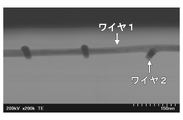
- FIG. 3 is a cross-sectional view of intersections of silver nanowires in the nanostructure network, which constitute the transparent conductive pattern in the transparent conductive film of the present embodiment.
- FIG. 2 is a diagram showing an electron beam diffraction observation field of a nanostructure network that constitutes a transparent conductive pattern in the transparent conductive film of the present embodiment.
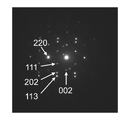
- FIG. 4 is a diagram showing electron beam diffraction observation results (diffraction pattern) of silver nanowires away from intersections of silver nanowires in the nanostructure network, which constitute the transparent conductive pattern in the transparent conductive film of the present embodiment.
- FIG. 4 is a diagram showing the results of electron beam diffraction observation (diffraction pattern disappearance) in the immediate vicinity of intersections of silver nanowires in the nanostructure network, which constitute the transparent conductive pattern in the transparent conductive film of the present embodiment.
- FIG. 3 is a diagram showing electron beam diffraction observation results (diffraction pattern) of intersections of silver nanowires in a nanostructure network, which constitute a transparent conductive pattern in the transparent conductive film of the present embodiment.
- FIG. 4 is an explanatory diagram of a method for confirming continuity of the laser-processed surface of the transparent conductive film produced in the working example and the comparative processing example.
- FIG. 4 is a judgment image diagram of the transparent conductive films produced in the working example and the comparative working example.
- a transparent conductive film which is a first embodiment of the present invention, comprises a resin film as a base material, and intersections of metal nanowires respectively formed on the first main surface and the second main surface of the base material.
- the light transmittance in the wavelength range of 350 to 700 nm is 80% or more.
- the term “transparent” means that the light transmittance (total light transmittance) in the visible light region (wavelength 400 to 700 nm) is 80% or more.
- the resin film serving as the base material of the transparent conductive film of the present embodiment contains a base resin and an ultraviolet absorber, and has a light transmittance of 10% or less in the wavelength range of 350 to 370 nm in the light transmission spectrum.
- the base resin that is the base material in the light transmission spectrum of a film with the same thickness as the resin film, the light transmission in the ultraviolet light (wavelength 350 to 400 nm) and visible light (wavelength 400 to 700 nm) regions with a wavelength of 350 nm or more.
- a resin with a modulus of 80% or more is used.
- the reason why the resin film has a light transmittance of 10% or less in the wavelength range of 350 to 370 nm will be described later.
- the base resin is not particularly limited as long as it is transparent and non-conductive.
- cycloolefin polymer polycarbonate [PC], polyester (polyethylene terephthalate [PET], polyethylene naphthalate [PEN], etc.), polyolefin (polyethylene [PE], polypropylene [PP], etc.), polyaramide, acrylic resin (polymethyl methacrylate [PMMA], etc.) can be suitably used.
- the resin film containing the base resin may have a single layer or a plurality of layers having functions such as easy adhesion and hard coating within the range that does not impair the optical properties and electrical properties, and may be provided on one side or both sides. good too.
- a cycloolefin polymer is a polymer synthesized using cycloolefins such as norbornene as a monomer, and has an alicyclic structure in its molecular structure.
- Cycloolefin polymers include hydrogenation ring-opening metathesis polymerization type [COP] of norbornene derivatives and addition polymerization type [COC] of ethylene.
- hydrogenation ring-opening metathesis polymerization type [COP] is more preferable from the viewpoint of heat resistance, flex resistance, and the like.
- Hydrogenated ring-opening metathesis polymerization type [COP] includes ZEONEX (registered trademark) and ZEONOR (registered trademark) of Nippon Zeon Co., Ltd. and ARTON (registered trademark) of JSR Corporation.
- the thickness of the resin film is not particularly limited, it is preferably 10 ⁇ m to 200 ⁇ m, more preferably 10 ⁇ m to 100 ⁇ m, still more preferably 10 ⁇ m to 50 ⁇ m.
- the thickness of the resin film is 10 ⁇ m or more, a sufficient effect can be obtained to prevent laser light from penetrating the back surface.
- the thickness of the film is 200 ⁇ m or less, the formability when the film is made into a device and the bending resistance when it is applied to a foldable application are improved.
- UV absorber contained in the resin film.
- benzotriazole-based ultraviolet absorbers triazine-based ultraviolet absorbers, benzophenone-based ultraviolet absorbers, acrylonitrile-based ultraviolet absorbers, salicylic acid-based ultraviolet absorbers, cyanoacrylate-based ultraviolet absorbers, azomethine-based ultraviolet absorbers, indole-based ultraviolet absorbers Absorbents, naphthalimide-based UV absorbers, and phthalocyanine-based UV absorbers can be used.
- benzotriazole-based UV absorbers exhibiting high UV absorbability are preferred.
- Benzotriazole-based UV absorbers contain a benzotriazole structure in the molecule.
- benzotriazole-based UV absorbers include 2,2′-methylenebis[6-(2H-benzotriazol-2-yl-)-4-(1,1,3,3-tetramethylbutyl)phenol], 2-(2H-benzotriazol-2-yl)-p-cresol, and 2-(5-chloro-2H-benzotriazol-2-yl)-6-tert-butyl-4-methylphenol.
- Examples of commercial products of benzotriazole-based ultraviolet absorbers include Adekastab (registered trademark) LA-31, Adekastab LA-32, Adekastab LA-36 (all manufactured by ADEKA Corporation), Tinuvin (registered trademark) 360 (BASF Japan Co., Ltd.).
- the amount of the ultraviolet absorber contained in the resin film is not particularly limited as long as it can suppress the penetration of laser light to the back surface, but it is preferably 0.25% by mass to 10% by mass with respect to the total mass of the resin film, and 0 0.5% to 7.5% by weight is more preferred, and 1% to 5% by weight is even more preferred.
- 0.25% by mass or more is added, the effect of blocking laser light is sufficiently exhibited.
- the amount added is 5% by mass or less, precipitation of the ultraviolet absorber during the production and processing of the resin film can be prevented.
- the transparent conductive film of this embodiment has transparent conductive films (a first transparent conductive film and a second transparent conductive film) on both main surfaces of a resin film that is a substrate.
- Both transparent conductive films contain a nanostructured network with intersections of metal nanowires and a binder resin. Preferably, at least some of the intersections of the metal nanowires are constituted by a fused nanostructure network.
- a dispersion of metal nanowires may be applied onto a substrate and then dried. At least part of the part is fused. It can be confirmed from the analysis of the electron beam diffraction pattern of a transmission electron microscope (TEM) that the intersections of the metal nanowires are fused. Specifically, it can be confirmed by analyzing the electron beam diffraction pattern of the portions where the metal nanowires intersect each other and confirming that the crystal structure has changed (occurrence of recrystallization).
- a known manufacturing method can be used as a method for manufacturing metal nanowires.
- silver nanowires can be synthesized by reducing silver nitrate in the presence of polyvinylpyrrolidone using the Poly-ol method (see Chem. Mater., 2002, 14, 4736).
- Gold nanowires can also be synthesized by reducing chloroauric acid hydrate in the presence of polyvinylpyrrolidone (see J. Am. Chem. Soc., 2007, 129, 1733). Techniques for large-scale synthesis and purification of silver nanowires and gold nanowires are described in detail in WO2008/073143 and WO2008/046058.
- a gold nanotube having a porous structure can be synthesized by reducing a chloroauric acid solution using a silver nanowire as a template.
- the silver nanowires used as the template dissolve into the solution due to the redox reaction with chloroauric acid, resulting in the formation of gold nanotubes having a porous structure (J. Am. Chem. Soc., 2004, 126, 3892- 3901).
- the average diameter of the metal nanowires is preferably 1 to 500 nm, more preferably 5 to 200 nm, even more preferably 5 to 100 nm, and particularly preferably 10 to 50 nm.
- the average length of the long axis of the metal nanowires is preferably 1 to 100 ⁇ m, more preferably 1 to 80 ⁇ m, even more preferably 2 to 70 ⁇ m, and particularly preferably 5 to 50 ⁇ m.
- the metal nanowire preferably has an average diameter thickness and an average major axis length satisfying the above ranges, and an average aspect ratio of more than 5, more preferably 10 or more, and 100 or more. is more preferable, and 200 or more is particularly preferable.
- the aspect ratio is a value obtained by a/b when the average diameter of the metal nanowires is approximated by b and the average length of the long axis by a.
- a and b are measured using a scanning electron microscope (SEM) and an optical microscope.
- b average diameter
- JSM-7000F field emission scanning electron microscope JSM-7000F (manufactured by JEOL Ltd.). determined as the arithmetic mean of the measured values.
- a shape measuring laser microscope VK-X200 manufactured by Keyence Corporation
- VK-X200 manufactured by Keyence Corporation
- Materials for metal nanowires include, for example, at least one selected from the group consisting of gold, silver, platinum, copper, nickel, iron, cobalt, zinc, ruthenium, rhodium, palladium, cadmium, osmium, and iridium, and these metals. A combined alloy and the like are included.
- the binder resin can be applied without limitation as long as it has transparency, but when using metal nanowires using the polyol method, alcohol, water Alternatively, it is preferable to use a binder resin soluble in a mixed solvent of alcohol and water.
- a binder resin soluble in a mixed solvent of alcohol and water examples thereof include hydrophilic cellulosic resins such as poly-N-vinylpyrrolidone, methylcellulose, hydroxyethylcellulose and carboxymethylcellulose, butyral resins, and poly-N-vinylacetamide (PNVA (registered trademark)).
- PNVA poly-N-vinylacetamide
- Poly-N-vinylacetamide is a homopolymer of N-vinylacetamide (NVA).
- N-vinylacetamide copolymer a copolymer containing 70 mol % or more of N-vinylacetamide (NVA) as a monomer unit can also be used.
- NVA N-vinylacetamide
- Monomers that can be copolymerized with NVA include, for example, N-vinylformamide, N-vinylpyrrolidone, acrylic acid, methacrylic acid, sodium acrylate, sodium methacrylate, acrylamide and acrylonitrile.
- the N-vinylacetamide-derived monomer unit is preferably contained in the polymer in an amount of 70 mol% or more, more preferably 80 mol% or more, and more preferably 90 mol% or more. more preferably.
- Such a polymer preferably has a weight average molecular weight of 30,000 to 4,000,000, more preferably 100,000 to 3,000,000, further preferably 300,000 to 1,500,000 in terms of absolute molecular weight.
- the binder resin is water-soluble, the absolute molecular weight is measured by the following method.
- the binder resin is dissolved in the following eluent and left to stand for 20 hours.
- the concentration of the binder resin in this solution is 0.05 mass %.
- GPC Shodex (registered trademark) SYSTEM21 manufactured by Showa Denko K.K.
- the above resins may be used alone or in combination of two or more. When two or more types are combined, simple mixing may be used, or a copolymer may be used.
- the first and second transparent conductive films each contain a nanostructure network having metal nanowire intersections and a binder resin, as described above.
- the first and second transparent conductive films are formed by uniformly dispersing the metal nanowires and applying a metal nanowire ink containing a solvent that dissolves the binder resin to both main surfaces of the resin film by printing or the like, followed by drying and removing the solvent. can be formed by
- the solvent is not particularly limited as long as the metal nanowires are well dispersed and the solvent dissolves the binder resin but does not dissolve the resin film.
- Alcohols are saturated monohydric alcohols (methanol, ethanol, normal propanol and isopropanol) having 1 to 3 carbon atoms represented by C n H 2n+1 OH (n is an integer of 1 to 3) [hereinafter simply “carbon atoms Saturated monohydric alcohol with a number of 1 to 3”. ], and more preferably contains at least 40% by mass of saturated monohydric alcohol having 1 to 3 carbon atoms in all alcohols.
- the use of a saturated monohydric alcohol having 1 to 3 carbon atoms facilitates drying of the solvent, which is advantageous in terms of the process.
- Alcohols other than saturated monohydric alcohols having 1 to 3 carbon atoms can be used in combination as alcohols.
- Alcohols other than saturated monohydric alcohols having 1 to 3 carbon atoms that can be used in combination include, for example, ethylene glycol, propylene glycol, ethylene glycol monomethyl ether, ethylene glycol monoethyl ether, propylene glycol monomethyl ether, and propylene glycol monoethyl ether. mentioned.
- the total alcohol content in the mixed solvent is preferably 5 to 90% by mass. If the alcohol content in the mixed solvent is less than 5% by mass or more than 90% by mass, striped patterns (coating spots) may occur during coating.
- the metal nanowire ink can be produced by stirring and mixing the binder resin, metal nanowires and solvent with a rotation or revolution stirrer or the like.
- the content of the binder resin contained in the metal nanowire ink is preferably in the range of 0.01 to 1.0% by mass.
- the content of metal nanowires contained in the metal nanowire ink is preferably in the range of 0.01 to 1.0% by mass.
- the content of the solvent contained in the metal nanowire ink is preferably in the range of 98.0 to 99.98% by mass.
- Metal nanowire ink can be printed by printing methods such as bar coating, spin coating, spray coating, gravure, and slit coating.
- printing methods such as bar coating, spin coating, spray coating, gravure, and slit coating.
- shape of the printed film or pattern formed by printing it may be the shape of the wiring or electrode pattern formed on the base material, or the film covering the entire surface or a part of the base material ( solid pattern), and the like.
- the formed printed film becomes conductive by drying the solvent.
- the dry thickness of the transparent conductive film is preferably 10 to 300 nm, more preferably 30 to 200 nm, although it varies depending on the diameter of the metal nanowires used, the desired sheet resistance value, and the like.
- the dry thickness of the transparent conductive film is 10 nm or more, the number of intersections of the metal nanowires increases, so good conductivity can be obtained.
- the dry thickness of the transparent conductive film is 300 nm or less, light is easily transmitted and reflection by the metal nanowires is suppressed, so that good optical properties can be obtained. Appropriate light irradiation may be performed on the transparent conductive film as necessary.
- the transparent conductive film of this embodiment has a first protective film on the first transparent conductive film and a second protective film on the second transparent conductive film.
- the protective film that protects the transparent conductive film is a thermosetting film of a curable resin composition.
- the curable resin composition preferably contains (A) a polyurethane containing a carboxy group, (B) an epoxy compound having two or more epoxy groups in the molecule, and (C) a curing accelerator. .
- a curable resin composition is formed on the first and second transparent conductive films by printing, coating, or the like, and cured to form a protective film. Curing of the curable resin composition can be carried out by, for example, heating and drying the thermosetting resin composition to thermally cure it.
- (B) an epoxy compound having two or more epoxy groups in the molecule is simply referred to as "(B) epoxy compound”.
- the polyurethane containing a carboxy group preferably has a weight average molecular weight of 1,000 to 100,000, more preferably 2,000 to 70,000. It is preferably 3,000 to 50,000, and more preferably 3,000 to 50,000.
- the weight-average molecular weight of a polyurethane containing a carboxyl group is a polystyrene-equivalent value measured by GPC.
- the weight average molecular weight of the carboxyl group-containing polyurethane is 100,000 or less, the solubility in a solvent is good, and the viscosity of the polyurethane solution after dissolution does not become too high, resulting in excellent handleability.
- the GPC measurement conditions for polyurethanes containing carboxyl groups are as follows. Apparatus name: HPLC unit HSS-2000 manufactured by JASCO Corporation Column: Shodex column LF-804 Mobile phase: Tetrahydrofuran Flow rate: 1.0 mL/min Detector: RI-2031Plus manufactured by JASCO Corporation Temperature: 40.0°C Sample volume: Sample loop 100 ⁇ l Sample concentration: Prepared to about 0.1% by mass
- the acid value of the carboxy group-containing polyurethane is preferably 10 to 140 mg-KOH/g, more preferably 15 to 130 mg-KOH/g.
- the protective film has good solvent resistance and the resin composition has good curability.
- the solubility of the polyurethane in a solvent is good, and the viscosity of the resin composition can be easily adjusted to a desired viscosity. In addition, problems such as warping of the base film due to excessive hardening of the cured product are less likely to occur.
- Acid value (mg-KOH/g) [B x f x 5.611]/S B: Amount of 0.1N potassium hydroxide-ethanol solution used (ml) f: Factor S of 0.1N potassium hydroxide-ethanol solution: Amount of sample collected (g)
- Polyurethane containing a carboxy group is, more specifically, a polyurethane synthesized using (a1) a polyisocyanate compound, (a2) a polyol compound, and (a3) a dihydroxy compound having a carboxy group as monomers.
- a1 a polyisocyanate compound
- a2) a polyol compound
- a3 a dihydroxy compound having a carboxy group as monomers.
- each of (a1), (a2), and (a3) preferably does not contain a conjugated functional group such as an aromatic compound.
- a conjugated functional group such as an aromatic compound.
- (a1) Polyisocyanate compound As the (a1) polyisocyanate compound, a diisocyanate having two isocyanato groups per molecule is usually used.
- polyisocyanate compounds include aliphatic polyisocyanates and alicyclic polyisocyanates, and these can be used alone or in combination of two or more.
- a small amount of polyisocyanate having 3 or more isocyanato groups can also be used as long as the carboxy group-containing polyurethane does not gel.
- aliphatic polyisocyanates examples include 1,3-trimethylene diisocyanate, 1,4-tetramethylene diisocyanate, 1,6-hexamethylene diisocyanate, 1,9-nonamethylene diisocyanate, 1,10-decamethylene diisocyanate, 2 , 2,4-trimethylhexamethylene diisocyanate, 2,4,4-trimethylhexamethylene diisocyanate, lysine diisocyanate, 2,2′-diethyl ether diisocyanate, dimer acid diisocyanate.
- Alicyclic polyisocyanates include, for example, 1,4-cyclohexanediisocyanate, 1,3-bis(isocyanatomethyl)cyclohexane, 1,4-bis(isocyanatomethyl)cyclohexane, 3-isocyanatomethyl-3,5 ,5-trimethylcyclohexyl isocyanate (IPDI, isophorone diisocyanate), bis-(4-isocyanatocyclohexyl)methane (hydrogenated MDI), hydrogenated (1,3- or 1,4-) xylylene diisocyanate, norbornane diisocyanate. be done.
- IPDI isophorone diisocyanate
- hydrochloride bis-(4-isocyanatocyclohexyl)methane
- hydrogenated 1,3- or 1,4-) xylylene diisocyanate
- norbornane diisocyanate norbornane diisocyanate.
- the content of these is preferably 50 mol% or less, more than It is preferably 30 mol % or less, more preferably 10 mol % or less.
- (a2) Polyol compound (a2) Polyol compound (however, (a2) polyol compound does not include (a3) a dihydroxy compound having a carboxyl group described later) usually has a number average molecular weight of 250 to 50,000. Yes, preferably 400 to 10,000, more preferably 500 to 5,000.
- the number average molecular weight of the polyol compound is a polystyrene-equivalent value measured by GPC under the conditions described above.
- (a2) Polyol compounds include, for example, polycarbonate polyols, polyether polyols, polyester polyols, polylactone polyols, polysilicones with hydroxyl groups on both ends, and C18 (18 carbon atoms) unsaturated fatty acids made from vegetable oils and fats, and It is a polyol compound having 18 to 72 carbon atoms obtained by hydrogenating a polyvalent carboxylic acid derived from the polymer and converting the carboxylic acid into a hydroxyl group.
- the (a2) polyol compound is preferably a polycarbonate polyol from the viewpoint of the balance between water resistance as a protective film, insulation reliability, and adhesion to the substrate.
- a polycarbonate polyol can be obtained by reacting a diol having 3 to 18 carbon atoms as a raw material with a carbonate ester or phosgene, and is represented by the following structural formula (1), for example.
- R 3 is a residue obtained by removing the hydroxyl group from the corresponding diol (HO--R 3 --OH) and is an alkylene group having 3 to 18 carbon atoms, and n 3 is a positive integer, preferably is 2-50.
- the polycarbonate polyol represented by formula (1) is 1,3-propanediol, 1,4-butanediol, 1,5-pentanediol, 1,6-hexanediol, 3-methyl-1 ,5-pentanediol, 1,8-octanediol, 1,3-cyclohexanedimethanol, 1,4-cyclohexanedimethanol, 1,9-nonanediol, 2-methyl-1,8-octanediol, 1,10 -Decamethylene glycol or 1,2-tetradecanediol can be used as a starting material.
- the polycarbonate polyol may be a polycarbonate polyol (copolymerized polycarbonate polyol) having multiple types of alkanediyl groups in its skeleton.
- the use of a copolymerized polycarbonate polyol is often advantageous from the viewpoint of preventing crystallization of (A) polyurethanes containing carboxy groups. Considering solubility in a solvent, it is preferable to use a polycarbonate polyol having a branched skeleton and a hydroxyl group at the end of the branched chain.
- a dihydroxy compound containing a carboxy group (a3)
- the dihydroxy compound containing a carboxy group has two selected from a hydroxy group and a hydroxyalkyl group having 1 or 2 carbon atoms, and has a molecular weight of A carboxylic acid or aminocarboxylic acid having a molecular weight of 200 or less is preferable because the cross-linking point can be controlled.
- Dihydroxy compounds containing a carboxy group include, for example, 2,2-dimethylolpropionic acid, 2,2-dimethylolbutanoic acid, N,N-bishydroxyethylglycine, N,N-bishydroxyethyl Alanine and the like are included, and among these, 2,2-dimethylolpropionic acid and 2,2-dimethylolbutanoic acid are preferred because of their high solubility in solvents.
- the dihydroxy compound containing a carboxy group can be used alone or in combination of two or more.
- (A) Polyurethane containing a carboxyl group can be synthesized only from the above three components ((a1), (a2) and (a3)).
- (a4) a monohydroxy compound and/or (a5) a monoisocyanate compound can also be reacted to synthesize.
- monohydroxy compound and (a5) monoisocyanate compound are preferably compounds containing no aromatic ring or carbon-carbon double bond in the molecule.
- the (A) polyurethane containing a carboxyl group is prepared by using an appropriate organic solvent in the presence or absence of a known urethanization catalyst such as dibutyltin dilaurate, and the above (a1) polyisocyanate compound, ( It can be synthesized by reacting a2) a polyol compound and (a3) a dihydroxy compound having a carboxyl group. (a1) The polyisocyanate compound, (a2) the polyol compound, and (a3) the dihydroxy compound having a carboxyl group are reacted without a catalyst.
- a known urethanization catalyst such as dibutyltin dilaurate
- the organic solvent is not particularly limited as long as it has low reactivity with the isocyanate compound.
- the organic solvent preferably does not contain a basic functional group such as amine and has a boiling point of 50° C. or higher, preferably 80° C. or higher, more preferably 100° C. or higher.
- solvents examples include toluene, xylene, ethylbenzene, nitrobenzene, cyclohexane, isophorone, diethylene glycol dimethyl ether, ethylene glycol diethyl ether, ethylene glycol monomethyl ether acetate, propylene glycol monomethyl ether acetate, Propylene glycol monoethyl ether acetate, dipropylene glycol monomethyl ether acetate, diethylene glycol monoethyl ether acetate, methyl methoxypropionate, ethyl methoxypropionate, methyl ethoxypropionate, ethyl ethoxypropionate, ethyl acetate, acetic acid Mention may be made of n-butyl, isoamyl acetate, ethyl lactate, acetone, methyl ethyl ketone, cyclohexanone, N,N-dimethylformamide,
- the organic solvent is propylene glycol monomethyl ether acetate, propylene glycol mono Ethyl ether acetate, dipropylene glycol monomethyl ether acetate, diethylene glycol monoethyl ether acetate, ⁇ -butyrolactone, or combinations thereof are preferred.
- the order in which the raw materials are added is not particularly limited, but usually (a2) the polyol compound and (a3) the dihydroxy compound having a carboxyl group are first placed in a reaction vessel, dissolved or dispersed in a solvent, and then heated to 20 to 150°C. , more preferably at 60 to 120°C, (a1) the polyisocyanate compound is added dropwise, and then these are reacted at 30 to 160°C, more preferably 50 to 130°C.
- the raw material charging molar ratio is adjusted according to the desired molecular weight and acid value of the polyurethane.
- the molar ratio of (a1) the isocyanato group of the polyisocyanate compound to ((a2) the hydroxyl group of the polyol compound + (a3) the hydroxyl group of the dihydroxy compound having a carboxyl group) is preferably 0.5 to 1.5. :1, more preferably 0.8-1.2:1, more preferably 0.95-1.05:1.
- the molar ratio of (a2) hydroxyl group of the polyol compound to (a3) hydroxyl group of the dihydroxy compound having a carboxyl group is preferably 1:0.1-30, more preferably 1:0.3-10.
- epoxy compounds (B) include bisphenol A type epoxy compounds, hydrogenated bisphenol A type epoxy resins, bisphenol F type epoxy resins, novolak type epoxy resins, phenol novolak type epoxy resins, cresol novolak type epoxy resins, N-glycidyl type epoxy resin, bisphenol A novolac type epoxy resin, chelate type epoxy resin, glyoxal type epoxy resin, amino group-containing epoxy resin, rubber modified epoxy resin, dicyclopentadiene phenolic type epoxy resin, silicone modified epoxy resin, ⁇ Epoxy compounds having two or more epoxy groups in one molecule, such as a caprolactone-modified epoxy resin, an aliphatic epoxy resin containing a glycidyl group, and an alicyclic epoxy resin containing a glycidyl group.
- An epoxy compound having 3 or more epoxy groups in one molecule can be used more preferably.
- examples of such epoxy compounds include EHPE (registered trademark) 3150 (manufactured by Daicel Corporation), jER604 (manufactured by Mitsubishi Chemical Corporation), EPICLON EXA-4700 (manufactured by DIC Corporation), and EPICLON HP-7200 (manufactured by DIC Corporation). company), pentaerythritol tetraglycidyl ether, pentaerythritol triglycidyl ether, and TEPIC-S (manufactured by Nissan Chemical Industries, Ltd.).
- the epoxy compound may have an aromatic ring in the molecule.
- the mass of (B) the epoxy compound is preferably 20% by mass or less with respect to the total mass of (A) the carboxy group-containing polyurethane and (B) the epoxy compound.
- the mixing ratio of (B) the epoxy compound and (A) the carboxy group-containing polyurethane is 0.5 to 1.5 in terms of the equivalent ratio of the carboxy group in the polyurethane to the epoxy group of the (B) epoxy compound. It is preferably from 0.7 to 1.3, even more preferably from 0.9 to 1.1.
- Curing accelerators include, for example, phosphine compounds such as triphenylphosphine and tributylphosphine (manufactured by Hokko Chemical Industry Co., Ltd.), Curesol (registered trademark) (imidazole-based epoxy resin curing agent: Shikoku Kasei Kogyo Co., Ltd.), 2-phenyl-4-methyl-5-hydroxymethylimidazole, U-CAT (registered trademark) SA series (DBU salt: San-Apro Co., Ltd.), Irgacure (registered trademark) 184 .
- phosphine compounds such as triphenylphosphine and tributylphosphine (manufactured by Hokko Chemical Industry Co., Ltd.), Curesol (registered trademark) (imidazole-based epoxy resin curing agent: Shikoku Kasei Kogyo Co., Ltd.), 2-phenyl-4-methyl-5-hydroxymethylimidazole, U-CAT (register
- the amount of the curing accelerator (C) used is too small, the effect of the addition will be lost, and if the amount used is too large, the electrical insulation will decrease. 0.1 to 10% by mass, more preferably 0.5 to 6% by mass, still more preferably 0.5 to 5% by mass, and particularly preferably 0.5 to 3% by mass relative to the total mass of the epoxy compound .
- Curing aids include, for example, polyfunctional thiol compounds and oxetane compounds.
- polyfunctional thiol compounds include pentaerythritol tetrakis(3-mercaptopropionate), tris-[(3-mercaptopropionyloxy)-ethyl]-isocyanurate, trimethylolpropane tris(3-mercaptopropionate).
- Karenz (registered trademark) MT series manufactured by Showa Denko KK
- oxetane compound examples include Aron Oxetane (registered trademark) series (manufactured by Toagosei Co., Ltd.), ETERNACOLL (registered trademark) OXBP and OXMA (manufactured by Ube Industries, Ltd.).
- the amount of the curing aid used is preferably 0.1 to 10 parts by mass, more preferably 0.5 to 6 parts by mass, based on 100 parts by mass of the epoxy compound (B). When added in an amount of 0.1 part by mass or more, the effect of the auxiliary agent is sufficiently exhibited, and when added in an amount of 10 parts by mass or less, curing can be performed at a rate that facilitates handling.
- the curable resin composition preferably contains 95.0% by mass or more and 99.9% by mass or less of the solvent (D), more preferably 96% by mass or more and 99.7% by mass or less. It is more preferable to contain not less than 99.5% by mass and not more than 99.5% by mass.
- the solvent a solvent that does not attack the transparent conductive film or the resin film can be used.
- the solvent used for synthesizing the carboxy group-containing polyurethane can be used as it is, or (A) another solvent is used to adjust the solubility or printability of the carboxy group-containing polyurethane.
- the solvent used for synthesizing (A) the carboxy group-containing polyurethane may be distilled off before and after adding the new solvent to replace the solvent.
- the boiling point of the solvent is preferably 80°C to 300°C, more preferably 80°C to 250°C.
- D If the boiling point of the solvent is 80° C. or higher, it is possible to suppress unevenness caused by excessively quick drying.
- D When the boiling point of the solvent is 300° C. or less, the heat treatment time required for drying and curing can be shortened, and productivity in industrial production can be improved.
- Solvents include propylene glycol monomethyl ether acetate (boiling point 146°C), ⁇ -butyrolactone (boiling point 204°C), diethylene glycol monoethyl ether acetate (boiling point 218°C), tripropylene glycol dimethyl ether (boiling point 243°C), and the like.
- ether solvents such as propylene glycol dimethyl ether (boiling point 97°C) and diethylene glycol dimethyl ether (boiling point 162°C), isopropyl alcohol (boiling point 82°C), t-butyl alcohol (boiling point 82°C), 1 - hexanol (boiling point 157 ° C.), propylene glycol monomethyl ether (boiling point 120 ° C.), diethylene glycol monomethyl ether (boiling point 194 ° C.), diethylene glycol monoethyl ether (boiling point 196 ° C.), diethylene glycol monobutyl ether (boiling point 230 ° C.), triethylene glycol ( (boiling point: 276°C), solvents containing hydroxyl groups such as ethyl lactate (boiling point: 154°C), methyl ethyl ketone (boiling point
- solvents can be used alone or in combination of two or more.
- the solubility of (A) the carboxy group-containing polyurethane, (B) the epoxy compound, etc. should be considered in addition to the solvent used in the synthesis of the (A) carboxy group-containing polyurethane.
- the curable resin composition contains (A) a polyurethane containing a carboxyl group, (B) an epoxy compound, (C) a curing accelerator, and (D) a solvent, and (D) the content of the solvent is 95. 0% by mass or more and 99.9% by mass or less, and stirred so that these components become uniform.
- the solid content concentration in the curable resin composition varies depending on the desired film thickness and printing method, but is preferably 0.1 to 10% by mass, more preferably 0.5% to 5% by mass. preferable.
- the film thickness does not become excessively thick when the curable resin composition is applied on the transparent conductive film, and the electrical connection with the transparent conductive film is maintained.
- the protective film can be provided with weather resistance and light resistance.
- the protective film solid content in the curable resin composition (A) a polyurethane containing a carboxy group, (B) an epoxy compound, and (C) a curing residue in a curing accelerator
- the ratio of the aromatic ring-containing compound defined by the following formula is preferably suppressed to 15% by mass or less.
- (C) curing residue in the curing accelerator used herein means that all or part of the curing accelerator (C) may disappear (decompose, volatilize, etc.) depending on the curing conditions, so it is protected under the curing conditions. It means the (C) curing accelerator remaining in the film.
- (C) curing accelerator remaining in the protective film after curing cannot be accurately quantified, it is calculated based on the charged amount assuming that it does not disappear due to curing conditions, and the ratio of the aromatic ring-containing compound is It is preferable to use (C) the curing accelerator within the range of 15% by mass or less.
- a curable film is formed on a transparent conductive film (also referred to as a “metal nanowire layer”) by a printing method such as a bar coat printing method, a gravure printing method, an inkjet method, or a slit coating method.
- a protective film is formed by applying a resin composition, drying the solvent, and curing the curable resin after removing the solvent.
- the thickness of the protective film obtained after curing is more than 30 nm and 1 ⁇ m or less.
- the thickness of the protective film is preferably more than 50 nm and 500 nm or less, more preferably more than 100 nm and 200 nm or less. If the thickness of the protective film is 1 ⁇ m or less, it becomes easy to conduct with the wiring in the post-process. When the thickness is more than 30 nm, the effect of protecting the metal nanowire layer is sufficiently exhibited.
- a second embodiment of the present invention is a patterned transparent conductive film, comprising a first transparent conductive pattern film on the first main surface of a resin film as a substrate, and a first transparent conductive pattern film on the second main surface. a second transparent conductive pattern film different from the pattern of the transparent conductive pattern film, a first protective film on the first transparent conductive pattern film, and a second protective film on the second transparent conductive pattern film respectively, wherein the first transparent conductive pattern film comprises a first conductive region and a first non-conductive region, and the first conductive region comprises metal nanowires.
- the resin film contains a structural network and a binder resin, the resin film contains a base resin and an ultraviolet absorber, and has a light transmittance of 10% or less in a wavelength region of 350 to 370 nm in the light transmission spectrum, and the base resin, A film having the same thickness as the resin film has a light transmittance of 80% or more in a wavelength region of 350 to 700 nm in a light transmission spectrum.
- the difference from the transparent conductive film of the first embodiment described above is that at least the first transparent conductive film is patterned. That is, the first transparent conductive pattern film is formed on the first main surface of the resin film by patterning the first transparent conductive film.
- the first transparent conductive pattern film consists of a first conductive area and a first non-conductive area. A first conductive region is formed from one or more conductive portions and a first non-conductive region is formed from one or more non-conductive portions.
- the first transparent conductive pattern film is different from the second transparent conductive pattern film formed on the second main surface side.
- “the first transparent conductive pattern film is different from the second transparent conductive pattern film” means that the first conductive region and the first non-conductive region in the first transparent conductive pattern film are different from each other.
- the respective projection positions on the two main surface sides are not the same as the arrangement of the second conductive region and the second non-conductive region of the second transparent conductive pattern film formed on the second main surface side means no.
- the second transparent conductive pattern film consists of only the second conductive area or consists of the second conductive area and the second non-conductive area.
- the second transparent conductive pattern film formed on the second main surface side is a solid transparent conductive film.
- the second transparent conductive pattern film consists of a second conductive region and a second non-conductive region
- the second conductive region is formed from one or more conductive portions and the second non-conductive region.
- a conductive region is formed from one or more non-conductive portions.
- a pulsed The metal forming the nano-structured network with the intersections of the metal nanowires, which constitutes the transparent conductive film, is melted and present in the range that has become non-conductive due to the laser irradiation, thereby exhibiting conductivity. A sufficient network structure cannot be maintained, and the region irradiated with the pulsed laser becomes a non-conductive region.
- the wire-like metal that made up the nanostructured network is broken, and the non-conducting regions now contain fragments of the nanostructured network.
- the fragments include those of various shapes, for example, granular (spherical, elliptical, columnar, etc.) obtained by dividing metal nanowires, and local network structures (including intersections of metal nanowires).
- the non-conductive region as a whole includes those finely divided to the level of non-conductivity (intersections of metal nanowires (cross-shaped fragments), etc.).
- Fragments of the nanostructured network residing within the non-conducting regions can be completely removed, but complete removal increases the contrast between the conducting and non-conducting regions and reduces visibility (bone visible), so it is preferable not to remove it completely. Since the rest of the configuration is the same as that of the transparent conductive film of the first embodiment, description thereof is omitted.
- a third embodiment of the present invention is a method for forming a transparent conductive pattern.
- the resin film contains a base resin and an ultraviolet absorber, has a light transmittance of 10% or less in a wavelength region of 350 to 370 nm in the light transmission spectrum, and the base resin has the same thickness as the resin film.
- the light transmittance in the wavelength range of 350 to 700 nm is 80% or more.
- the transparent conductive film of the first embodiment is obtained by including the transparent conductive film forming step and the protective film forming step, and the patterned film of the second embodiment is obtained by including the pattern forming step.
- a transparent conductive film is obtained.
- the first pattern of the transparent conductive film which is the second embodiment, is formed.
- a second transparent conductive film is formed (transparent conductive film forming step).
- the method of forming the first transparent conductive film and the second transparent conductive film is not particularly limited, but as described above, the dispersion of metal nanowires (metal nanowire ink) may be applied onto the substrate (resin film) and dried. can be formed by From the viewpoint of bending resistance, it is preferable to fuse at least a part of the intersections of the metal nanowires by performing a treatment such as heating or light irradiation during and after drying.
- a dispersion of metal nanowires (metal nanowire ink) a dispersion that does not contain a binder resin is applied on a substrate and dried to form a nanostructure network having intersections of metal nanowires.
- a first transparent conductive film and a second transparent conductive film may be formed by coating the solution on a nanostructure network having intersections of metal nanowires and drying the solution.
- a first protective film is formed on the first transparent conductive film, and a second protective film is formed on the second transparent conductive film (protective film forming step).
- the protective film is formed by printing, coating, or the like the curable resin composition described above on the transparent conductive film, and curing the composition.
- the transparent conductive film has a characteristic absorption peak in the ultraviolet light region in the optical transmission spectrum based on the nanostructured network having the intersections of the metal nanowires that compose it.
- the present inventor found that when a pulsed laser beam having a wavelength in the range of 350 to 370 nm and a pulse width shorter than 1 nanosecond is applied to the first transparent conductive film from the side of the first protective film, the second transparent conductive film It has been found that the conductive film is not etched and only the first transparent conductive film can be selectively etched.
- Pulse widths longer than 1 nanosecond will cause extra thermal damage to the surroundings. Since the nanostructure network having the intersections of metal nanowires has an absorption peak in the ultraviolet region in the light transmission spectrum, it can be etched with a pulsed laser beam in the above wavelength range close to the absorption peak maximum wavelength. .
- the method for forming a transparent conductive pattern according to the third embodiment of the present invention is applied to the transparent conductive film according to the first embodiment of the present invention. That is, by using a resin film having a low light transmittance in the above wavelength range as a base material, it is possible to suppress the arrival of laser light to the second transparent conductive film, and the first transparent conductive film It is considered that only the etching process became possible.
- the second transparent conductive film is different from the first transparent conductive pattern film consisting of the first conductive region and the first non-conductive region formed in the first transparent conductive film with respect to the second transparent conductive film.
- a second transparent conductive pattern film can be formed comprising conductive areas and second non-conductive areas.
- the first transparent conductive pattern film is different from the second transparent conductive pattern film
- the second transparent conductive pattern film can be left as a solid transparent conductive film without etching, that is, without forming the second non-conductive region.
- the pulse width of the pulsed laser is preferably less than 0.1 (100 picoseconds) nanoseconds, more preferably less than 0.01 nanoseconds (10 picoseconds), 0.001 nanoseconds (1 picosecond) ), i.e. femtosecond pulsed lasers are more preferably used.
- the metal nanowires constituting the transparent conductive film that existed in the range that was irradiated with the pulse laser and became the non-conductive region.
- the metal forming the nanostructured network with intersections melts and cannot maintain a sufficient network structure to develop electrical conductivity.
- the wire-like metal that made up the nanostructured network is broken and the non-conductive regions now contain fragments of the nanostructured network.
- the fragments include those of various shapes, for example, nanowires cut into granules (spherical, elliptical, columnar, etc.), and local network structures (including intersections of metal nanowires).
- the remaining non-conductive regions as a whole include those that are finely divided to the level of non-conductivity (intersections of metal nanowires (cross-shaped fragments), etc.). Fragments of the nanostructure network generated in the non-conductive regions due to the etching process can be completely removed, but complete removal increases the contrast between the conductive and non-conductive regions, resulting in poor visibility. It is preferable not to remove it completely because it will decrease (bone will be more visible).
- 100 g of silver nanowire ink was prepared by stirring in an air atmosphere (rotational speed: 100 rpm).
- the concentration of silver nanowires contained in the obtained silver nanowire ink was measured with a Varian AA280Z Zeeman atomic absorption spectrophotometer.
- A4 size corona discharge surface treatment device Wedge Co., Ltd.
- A4SW-FLNW type is used
- A4 size cycloolefin polymer (COP) film G+13 also known as ZF12-013, Nippon Zeon Co., Ltd., thickness 13 ⁇ m
- Both main surfaces were subjected to corona discharge treatment (conveyance speed: 3 m/min, number of treatments: 2 times, output: 0.3 kW).
- a COP film subjected to corona discharge treatment Using a COP film subjected to corona discharge treatment, a TQC automatic film applicator standard (manufactured by Kotec Co., Ltd.), and a wireless bar coater OSP-CN-22L (manufactured by Kotec Co., Ltd.), the wet film thickness was adjusted to 22 ⁇ m.
- a silver nanowire ink was applied to the entire first main surface of the COP film (coating speed: 500 mm/sec). After that, it was dried with hot air at 80° C. for 3 minutes in a thermostat HISPEC HS350 (manufactured by Kusumoto Kasei Co., Ltd.) in an air atmosphere to form a first transparent conductive film (silver nanowire layer).
- the COP film G+13 (also known as ZF12-013, manufactured by Nippon Zeon Co., Ltd., thickness 13 ⁇ m) used as the base material is a resin film containing an ultraviolet absorber. It was confirmed by the following analysis that the film contained 4.9% by mass of the benzotriazole-based ultraviolet absorber with respect to the total mass of the film.
- the light transmission spectrum thereof is shown in FIG. 1 together with the light transmission spectrum of a COP film ZF14-013 (manufactured by Nippon Zeon Co., Ltd., thickness 13 ⁇ m) containing no ultraviolet absorber.
- Quantification of the ultraviolet absorber contained in G+13 was performed by the following method. First, G + 13 was immersed in THF (tetrahydrofuran, manufactured by Fujifilm Wako Pure Chemical Industries, Ltd. (for high-performance liquid chromatography)), and the supernatant was analyzed by LC-MS (ionization method, LC: Ultimate 3000 (manufactured by Dionex), MS: OrbitrapElite ( The chemical structure of the UV absorber was determined by analysis with Therm Fisher Sientifc). Subsequently, the content was quantified using 1 H-NMR (AvIII400 manufactured by Bruker). G+13 was dissolved in cyclohexane (manufactured by Junsei Chemical Co., Ltd.
- HMTCS Hexamethylcyclotrisiloxane
- acetone-d6 deuteration rate 99.9%, for NMR, manufactured by Kanto Chemical Co., Ltd.
- the light transmission spectrum of the resin film was measured by the following method. G+13 and ZF14-013 (denoted as ZF14) were each cut into 3 cm ⁇ 3 cm to prepare test pieces. The transmission spectrum was measured in the wavelength range from 200 nm to 1100 nm using the test piece and an ultraviolet-visible spectrophotometer UV-2400PC (manufactured by Shimadzu Corporation). Table 1 shows the transmittance of the resin film obtained by measurement at 350 nm to 370 nm.
- ⁇ Film thickness measurement> The film thicknesses of the transparent conductive films (silver nanowire layers) formed on both main surfaces were measured using a film thickness measurement system F20-UV (manufactured by Filmetrics Co., Ltd.) based on light interferometry. The average value obtained by measuring three points at different measurement points was used as the film thickness. The spectrum from 450 nm to 800 nm was used for analysis. According to this measurement system, the film thickness (Tc) of the transparent conductive film (silver nanowire layer) formed on the transparent substrate can be directly measured. Table 1 shows the measurement results.
- the temperature of the reaction solution is lowered to 70° C., and the (a1) polyisocyanate compound Desmodur (registered trademark)-W (bis-(4-isocyanatocyclohexyl)methane) manufactured by Sumika Covestro Urethane Co., Ltd. is added by a dropping funnel. ) 59.69 g was added dropwise over 30 minutes. After completion of the dropwise addition, the temperature was raised to 120°C and the reaction was carried out at 120°C for 6 hours. After confirming by IR that the isocyanate had almost disappeared, 0.5 g of isobutanol was added and the reaction was further carried out at 120°C for 6 hours. gone.
- the weight average molecular weight of the obtained carboxy group-containing polyurethane (A) determined by GPC was 32,300, and the acid value of the carboxy group-containing polyurethane (A) was 35.8 mgKOH/g.
- ⁇ Formation of protective film (overcoat layer)> A silver nanowire layer (first transparent conductive film), using a TQC automatic film applicator standard (manufactured by Kotec Co., Ltd.) and a wireless bar coater OSP-CN-05M (manufactured by Kotec Co., Ltd.), the curable resin composition 1 so that the wet film thickness is 5 ⁇ m. was applied to the entire surface (coating speed: 333 mm/sec). After that, hot air drying (thermal curing) was performed in an air atmosphere at 80° C. for 1 minute in a thermostat HISPEC HS350 (manufactured by Kusumoto Kasei Co., Ltd.) to form a first protective film.
- TQC automatic film applicator standard manufactured by Kotec Co., Ltd.
- OSP-CN-05M manufactured by Kotec Co., Ltd.
- a second transparent conductive film (silver nanowire layer) and a second protective film are sequentially formed on the second main surface of the COP film in the same manner as above, A transparent conductive film having conductive layers on both sides was produced.
- a carbon protective layer was additionally formed for 10 seconds using the above-mentioned carbon vapor deposition apparatus again to form a carbon layer with a total thickness of about 80 nm in a state in which markings could be discerned. This protected the AgNWs from damage due to FIB processing, and made the top protective film not interfere with the nanowires when observed with a TEM.
- tungsten deposition was performed using the FIB processing apparatus for 10 minutes to form a tungsten protective layer of 12 ⁇ m in the longitudinal direction of the AgNW, 2 ⁇ m in the orthogonal direction, and 1 ⁇ m in thickness.
- the area around the tungsten protective film was excavated to a depth of about 15 ⁇ m with an FIB, and the layer below the tungsten protective film containing the AgNW intersections was cut out and fixed to a copper mesh.
- the thinned sample was observed using a transmission electron microscope (TEM) HF-2200 (acceleration voltage 200 kV) manufactured by Hitachi High-Tech Co., Ltd. As a result, it was found that one AgNW was stored in the sample in the horizontal direction, and many intersections with AgNWs extending from the depth toward the front were obtained. At the intersection, the boundary between the AgNW (wire 1) in the left-right direction and the AgNW (wire 2) in the frontward direction from the depth became ambiguous, suggesting fusion (FIG. 2).
- TEM transmission electron microscope
- Comparative coating example 1 The same as Example Coating Example 1 except that a cycloolefin polymer (COP) film ZF14-013 (manufactured by Nippon Zeon Co., Ltd., thickness 13 ⁇ m) that does not contain an ultraviolet absorber was used as a base material for producing a transparent conductive film. was carried out on Strictly speaking, ZF14-013 is estimated to have a different composition from the base resin ZF12 of the COP film G+13 used as the substrate in Practical Coating Example 1, but both ZF14 and ZF12 are COP films manufactured by Zeon Corporation.
- COP cycloolefin polymer
- G+13, and ZF14 are isotropic COP films, so the optical properties ([total] light transmittance) at the same thickness of the isotropic film of the base resin ZF12 of G+13 and ZF14 are approximately the same ( ZF14 can be regarded as equivalent to the base resin ZF12 of G+13).
- ⁇ Sheet resistance measurement of silver nanowire layer> A 3 cm ⁇ 3 cm test piece was cut from a transparent conductive film (silver nanowire film) in which a silver nanowire layer and a protective film were sequentially formed on both sides of a resin film, and a resistivity meter Loresta GP (Mitsubishi Chemical Corporation) based on the four-terminal method was used. Analyticc) was used to measure the sheet resistance of each silver nanowire layer. ESP mode was used as the measurement mode and terminals used.
- the transmittance of the transparent conductive film (silver nanowire film) in the wavelength region of 350 to 370 nm (ultraviolet light region) was measured in the same manner as the method for measuring the light transmission spectrum of the resin film described above.
- Table 1 shows the measurement results.
- the transmittance in the wavelength range of 400 to 700 nm (visible light range) is low. Since the transmittance (total light transmittance) in the light region) is sufficiently high, it can be used as a transparent conductive film without any problem.
- the film thickness of the protective film was measured using a film thickness measurement system F20-UV (manufactured by Filmetrics Co., Ltd.) based on the optical interferometry, as in the film thickness of the silver nanowire layer described above. The average value obtained by measuring three points at different measurement points was used as the film thickness. The spectrum from 450 nm to 800 nm was used for analysis. According to this measurement system, the total film thickness (Tc+Tp) of the film thickness (Tc) of the silver nanowire layer formed on the transparent substrate and the film thickness (Tp) of the protective film formed thereon can be directly measured. Therefore, the film thickness (Tp) of the protective film is obtained by subtracting the previously measured film thickness (Tc) of the silver nanowire layer from this measured value. Table 1 shows the measurement results.
- solid lines representing the lattice represent etching lines formed by patterning, and arrows represent the needles.
- ⁇ , ⁇ , ⁇ , and ⁇ are separated by the etching lines by applying the tips of two arrows (needles) connected by corresponding dashed lines to the inside (non-etched region) of the lattice. This indicates that the resistance value between the two regions is measured.
- FIG. 8 shows the judgment image of ⁇ and ⁇ in the comprehensive evaluation.
- FIG. 8 shows the case where the etching process is performed by irradiating the pulse laser from the processed surface side and the pulse laser is not irradiated from the back surface side.
- the case where the pulse laser did not penetrate to the back side and the "conduction" was maintained on the back side is indicated by ⁇ , and the case where the pulse laser penetrated to the back side and the "conduction” was not maintained on the back side.
- the laser used for etching was a picosecond pulse laser (pulse width 15 ps (15 ⁇ 10 -3 ns), frequency: 500 kHz, processing speed 4000 mm / s, output 0.1 W). Measured and evaluated.
- Comparative processing example 1 Measurement and evaluation were carried out in the same manner as in Working Example 1, except that the film of Comparative Coating Example 1 was used as the transparent conductive film used for etching.
- Comparative processing example 2 Measurement and evaluation were carried out in the same manner as in Working Example 1, except that the laser used for etching was a nanosecond pulse laser (pulse width: 180 ns, frequency: 90 kHz, processing speed: 500 mm/s, output: 0.2 W). Model 5330 manufactured by ESI was used as a processing apparatus.
Landscapes
- Engineering & Computer Science (AREA)
- Chemical & Material Sciences (AREA)
- Organic Chemistry (AREA)
- General Engineering & Computer Science (AREA)
- Theoretical Computer Science (AREA)
- Physics & Mathematics (AREA)
- Materials Engineering (AREA)
- Wood Science & Technology (AREA)
- Manufacturing & Machinery (AREA)
- Health & Medical Sciences (AREA)
- Chemical Kinetics & Catalysis (AREA)
- Medicinal Chemistry (AREA)
- Polymers & Plastics (AREA)
- Life Sciences & Earth Sciences (AREA)
- Human Computer Interaction (AREA)
- General Physics & Mathematics (AREA)
- Spectroscopy & Molecular Physics (AREA)
- Dispersion Chemistry (AREA)
- Inorganic Chemistry (AREA)
- Non-Insulated Conductors (AREA)
- Laminated Bodies (AREA)
Abstract
Description
本発明は、透明導電フィルム及び透明導電パターンの形成方法に関する。さらに詳しくは、両面に透明導電膜を有する透明導電フィルム及びその透明導電フィルムを用いた表裏で異なる透明導電パターンの形成方法に関する。 The present invention relates to a method for forming a transparent conductive film and a transparent conductive pattern. More particularly, the present invention relates to a transparent conductive film having transparent conductive films on both sides and a method of forming transparent conductive patterns different on the front and back sides using the transparent conductive film.
近年、スマートフォンやカーナビゲーションシステム、自動販売機などにもタッチパネルが採用されている。特に、折り曲げ可能なスマートフォンが注目を集めていることから、タッチパネルも折り曲げ可能なものが求められている。 In recent years, touch panels have also been used in smartphones, car navigation systems, and vending machines. In particular, since bendable smartphones are attracting attention, there is a demand for bendable touch panels.
折り曲げ可能なタッチパネルを実現するためには、折り曲げ可能な透明フィルムと透明導電膜、すなわち耐屈曲性に優れた透明導電フィルムが必要不可欠である。透明導電フィルムの厚みは可能な限り薄いことが望ましい。フィルム厚が厚すぎると、折り曲げ時に容易に破断してしまうからである。 In order to realize a bendable touch panel, a bendable transparent film and a transparent conductive film, that is, a transparent conductive film with excellent bending resistance, are essential. It is desirable that the thickness of the transparent conductive film is as thin as possible. This is because if the film thickness is too thick, it will be easily broken when folded.
透明導電フィルムの厚みを薄くする手段として、1)基材として用いる樹脂フィルムを薄くする、2)基材の両方の主面に導電層を設ける、の2つが挙げられる。前者を採用する理由は自明である。後者を採用する理由は、基材の両方の主面に導電層を設けることにより、1枚の透明導電フィルムでX,Yセンサの双方を兼ねることができるためである。基材の一方の主面にのみ導電層を有する透明導電フィルムを用いると、2枚のフィルムを貼り合わせなければならず、透明導電フィルムの総厚みが厚くなることが避けられない。 There are two means for reducing the thickness of the transparent conductive film: 1) reducing the thickness of the resin film used as the substrate; and 2) providing conductive layers on both main surfaces of the substrate. The reason for adopting the former is obvious. The reason for adopting the latter is that a single transparent conductive film can serve as both the X and Y sensors by providing conductive layers on both main surfaces of the substrate. If a transparent conductive film having a conductive layer only on one main surface of a substrate is used, two films must be laminated together, which inevitably increases the total thickness of the transparent conductive film.
透明導電フィルムをセンサ化する場合、一般に、ベタ膜の導電層をエッチングして配線パターンを描く必要がある。 When making a transparent conductive film into a sensor, it is generally necessary to etch the solid conductive layer and draw a wiring pattern.
エッチング方法としては、大きく分けてドライエッチング(レーザー)とウェットエッチングの2種に分類できる。ウェットエッチングによって発生する廃液などの環境負荷を考慮すると、前者のレーザーエッチングのほうが、より優れた手法といえる。 Etching methods can be broadly classified into two types: dry etching (laser) and wet etching. Considering environmental load such as waste liquid generated by wet etching, the former laser etching can be said to be a more excellent technique.
すなわち、折り曲げ可能なタッチパネルを実現するためには、基材として用いる薄い樹脂フィルムの両方の主面上に透明導電膜を設けた透明導電フィルムを製造し、その透明導電膜それぞれをレーザーエッチングによってパターニングできる必要がある。 That is, in order to realize a bendable touch panel, a transparent conductive film is produced by providing transparent conductive films on both main surfaces of a thin resin film used as a base material, and each of the transparent conductive films is patterned by laser etching. I need to be able to.
しかし、基材として厚みが薄い樹脂フィルムを使用すると、一方の主面上に設けられた透明導電膜をレーザーエッチング加工した際に、レーザー光が基材(樹脂フィルム)を貫通し、加工したい面とは逆側の面に設けられた透明導電層まで加工されてしまうという課題があることがわかった。 However, if a thin resin film is used as the base material, when the transparent conductive film provided on one main surface is laser-etched, the laser beam penetrates the base material (resin film), causing the surface to be processed. It has been found that there is a problem that even the transparent conductive layer provided on the opposite side is processed.
レーザー光の基材貫通を防ぐ手段の一つとして、透明導電フィルムの基材となる樹脂フィルムにレーザー光吸収能を付与することが考えられる。 As one of the means to prevent laser light from penetrating through the base material, it is conceivable to give laser light absorption ability to the resin film that is the base material of the transparent conductive film.
特許文献1には、紫外線吸収剤を含む樹脂の層を中間層として備える積層フィルムが開示されている。明細書中には、積層フィルムが透明導電層を有していてもよい旨が記載されているが、実際に透明導電層を設けた例は開示されておらず、当該積層フィルムを用いて透明導電フィルムを製造できるかどうか不明である。
特許文献2には、基板および複数の網状の銀ナノ構造を有する基本透明導体を含む透明センサと、入射光およびタッチ入力を受信する表面を有する基板と、紫外線(UV)を遮断する光学的にクリアな接着剤層(OCA層)を備えたタッチセンサが開示されているが、特許文献2における発明で解決しようとする課題は光暴露に対して安定した光学スタックの提供であり、本発明で解決しようとする課題と全く異なる。特許文献2の中で、UVを遮断する効果をエッチングに適用可能なことは、記載も示唆もされていない。また、基本透明導体と基板をOCA層で貼合することでセンサ厚みの増大が避けられず、特許文献2に示された光学スタックをフォルダブル用途へ用いることは困難であると考えられる。 US Pat. No. 6,300,003 discloses a transparent sensor comprising a base transparent conductor having a substrate and a plurality of reticulated silver nanostructures; a substrate having a surface for receiving incident light and touch input; Although a touch sensor with a clear adhesive layer (OCA layer) is disclosed, the problem to be solved by the invention in Patent Document 2 is to provide an optical stack that is stable against light exposure, and the present invention The problem you are trying to solve is completely different. Patent Document 2 does not describe or suggest that the effect of blocking UV can be applied to etching. In addition, bonding the basic transparent conductor and the substrate with the OCA layer inevitably increases the sensor thickness, and it is considered difficult to use the optical stack shown in Patent Document 2 for foldable applications.
上記以外にレーザー光の貫通を防ぐ手段として、透明導電フィルムの基材(ポリマー材料)の厚みを増大させ、エネルギー密度を50%以上減少させる方法が開示されている(特許文献3)。明細書中には、レーザー光の波長と基材として用いることができるポリマー材料種が例示されているが、実際に、導電層をエッチング加工した結果が示されておらず、開示されている方法で所望の加工が実現できるかどうか一切不明である。 In addition to the above, a method of increasing the thickness of the base material (polymer material) of the transparent conductive film to reduce the energy density by 50% or more has been disclosed as a means of preventing laser light penetration (Patent Document 3). The specification exemplifies the wavelength of the laser light and the type of polymer material that can be used as the base material, but does not actually show the results of etching the conductive layer, and the method disclosed. It is completely unknown whether the desired processing can be realized with
なお、本出願人は、先に基材と、基材の少なくとも一方の主面上に形成された、バインダー樹脂および導電性繊維(金属ナノワイヤ)を含む透明導電膜と、透明導電膜上に形成された保護膜とを有する透明導電基板を特許文献4により開示しているが、特許文献4における発明で解決しようとする課題は、良好な光学特性、電気特性に加えて耐光性に優れた透明導電基板を提供することであり、本発明で解決しようとする課題と全く異なる。 In addition, the present applicant previously proposed a base material, a transparent conductive film containing a binder resin and conductive fibers (metal nanowires) formed on at least one main surface of the base material, and a transparent conductive film formed on the transparent conductive film. Patent Document 4 discloses a transparent conductive substrate having a protective film coated with a transparent conductive substrate having excellent light resistance in addition to good optical properties and electrical properties. It is to provide a conductive substrate, which is completely different from the problem to be solved by the present invention.
本発明は、基材となる樹脂フィルムの両方の主面に透明導電膜を有し、一方の主面の透明導電膜のみ選択的にレーザーエッチング加工することが可能な透明導電フィルムを提供することを目的の一つとする。また、その透明導電フィルムを用いた、レーザーエッチング加工による両方の主面への異なる透明導電パターンの形成方法を提供することを目的の一つとする。 The present invention provides a transparent conductive film that has transparent conductive films on both main surfaces of a resin film that serves as a base material, and that allows selective laser etching of only the transparent conductive film on one of the main surfaces. is one of the purposes. Another object of the present invention is to provide a method of forming different transparent conductive patterns on both main surfaces by laser etching using the transparent conductive film.
上記目的を達成するために、本発明は以下の実施形態を有する。 In order to achieve the above objects, the present invention has the following embodiments.
[1]基材である樹脂フィルムと、前記基材の第一の主面及び第二の主面上にそれぞれ形成された、金属ナノワイヤの交差部を有するナノ構造ネットワークとバインダー樹脂とを含む、第一の透明導電膜及び第二の透明導電膜と、前記第一の透明導電膜及び第二の透明導電膜の上にそれぞれ形成された第一の保護膜及び第二の保護膜とを有し、前記樹脂フィルムはベース樹脂と紫外線吸収剤とを含み、光透過スペクトルにおいて、波長350~370nmの領域における光線透過率が10%以下であり、前記ベース樹脂の、前記樹脂フィルムと同じ厚さのフィルムの光透過スペクトルにおいて、波長350~700nmの領域における光線透過率が80%以上である、ことを特徴とする透明導電フィルム。 [1] A resin film as a substrate, a nanostructure network having intersections of metal nanowires formed on the first main surface and the second main surface of the substrate, respectively, and a binder resin, A first transparent conductive film, a second transparent conductive film, and a first protective film and a second protective film formed on the first transparent conductive film and the second transparent conductive film, respectively. The resin film contains a base resin and an ultraviolet absorber, and has a light transmittance of 10% or less in a wavelength region of 350 to 370 nm in the light transmission spectrum, and the base resin has the same thickness as the resin film. 2. A transparent conductive film characterized by having a light transmittance of 80% or more in a wavelength range of 350 to 700 nm in the light transmission spectrum of said film.
[2]基材である樹脂フィルムの第一の主面に第一の透明導電パターン膜、第二の主面に第一の透明導電パターン膜のパターンとは異なる第二の透明導電パターン膜、をそれぞれ有し、前記第一の透明導電パターン膜上に第一の保護膜、前記第二の透明導電パターン膜上に第二の保護膜、をそれぞれ有しており、前記第一の透明導電パターン膜が、第一の導電性領域及び第一の非導電性領域からなり、前記第一の導電性領域が、金属ナノワイヤの交差部を有するナノ構造ネットワークとバインダー樹脂とを含み、前記第二の透明導電パターン膜が、第二の導電性領域を含み、前記第二の導電性領域が、金属ナノワイヤの交差部を有するナノ構造ネットワークとバインダー樹脂とを含み、前記樹脂フィルムは、ベース樹脂と紫外線吸収剤とを含み、光透過スペクトルにおいて、波長350~370nmの領域における光線透過率が10%以下であり、前記ベース樹脂の、前記樹脂フィルムと同じ厚さのフィルムの光透過スペクトルにおいて、波長350~700nmの領域における光線透過率が80%以上である、ことを特徴とする透明導電フィルム。 [2] A first transparent conductive pattern film on the first main surface of the resin film that is the substrate, and a second transparent conductive pattern film different from the pattern of the first transparent conductive pattern film on the second main surface, each having a first protective film on the first transparent conductive pattern film, a second protective film on the second transparent conductive pattern film, and the first transparent conductive film a patterned film comprising a first conductive region and a first non-conductive region, the first conductive region comprising a nanostructured network having intersections of metal nanowires and a binder resin; comprises a second conductive region, said second conductive region comprising a nanostructured network having intersections of metal nanowires and a binder resin, wherein said resin film comprises a base resin and and an ultraviolet absorber, the light transmittance in the wavelength region of 350 to 370 nm in the light transmission spectrum is 10% or less, and the light transmission spectrum of the base resin has the same thickness as the resin film. A transparent conductive film having a light transmittance of 80% or more in a region of 350 to 700 nm.
[3]前記第二の透明導電パターンが、さらに第二の非導電性領域を含む、[2]に記載の透明導電フィルム。 [3] The transparent conductive film according to [2], wherein the second transparent conductive pattern further includes a second non-conductive region.
[4]前記第一の非導電性領域が、金属ナノワイヤの交差部を有するナノ構造ネットワークの断片を含む、[2]に記載の透明導電フィルム。 [4] The transparent conductive film according to [2], wherein the first non-conductive region comprises segments of a nanostructured network having intersections of metal nanowires.
[5]前記第二の非導電性領域が、金属ナノワイヤの交差部を有するナノ構造ネットワークの断片を含む、[3]に記載の透明導電フィルム。 [5] The transparent conductive film of [3], wherein the second non-conductive region comprises segments of a nanostructured network having intersections of metal nanowires.
[6]前記ベース樹脂が、シクロオレフィンポリマー、ポリカーボネート、ポリエステル、ポリオレフィン、ポリアラミド、アクリル樹脂、から選択される樹脂である、[1]から[5]のいずれか一に記載の透明導電フィルム。 [6] The transparent conductive film according to any one of [1] to [5], wherein the base resin is a resin selected from cycloolefin polymer, polycarbonate, polyester, polyolefin, polyaramid, and acrylic resin.
[7]前記金属ナノワイヤの交差部を有するナノ構造ネットワークが、金属ナノワイヤの交差部の少なくとも一部で融着されたものである[1]から[6]のいずれか一に記載の透明導電フィルム。 [7] The transparent conductive film according to any one of [1] to [6], wherein the nanostructure network having intersections of metal nanowires is fused at least part of the intersections of metal nanowires. .
[8]前記金属ナノワイヤが銀ナノワイヤである、[1]から[6]のいずれか一に記載の透明導電フィルム。 [8] The transparent conductive film according to any one of [1] to [6], wherein the metal nanowires are silver nanowires.
[9]前記バインダー樹脂がN-ビニルアセトアミド(NVA)のホモポリマーである[1]から[8]のいずれか一に記載の透明導電フィルム。 [9] The transparent conductive film according to any one of [1] to [8], wherein the binder resin is a homopolymer of N-vinylacetamide (NVA).
[10]前記紫外線吸収剤が、ベンゾトリアゾール系紫外線吸収剤、トリアジン系紫外線吸収剤、ベンゾフェノン系紫外線吸収剤、アクリロニトリル系紫外線吸収剤、サリチル酸系紫外線吸収剤、シアノアクリレート系紫外線吸収剤、アゾメチン系紫外線吸収剤、インドール系紫外線吸収剤、ナフタルイミド系紫外線吸収剤、フタロシアニン系紫外線吸収剤からなる群から選択される少なくとも一種である、[1]から[9]のいずれか一に記載の透明導電フィルム。 [10] The UV absorber is a benzotriazole UV absorber, a triazine UV absorber, a benzophenone UV absorber, an acrylonitrile UV absorber, a salicylic acid UV absorber, a cyanoacrylate UV absorber, or an azomethine UV absorber. The transparent conductive film according to any one of [1] to [9], which is at least one selected from the group consisting of an absorber, an indole-based ultraviolet absorber, a naphthalimide-based ultraviolet absorber, and a phthalocyanine-based ultraviolet absorber. .
[11]前記樹脂フィルムが含有する紫外線吸収剤量が、樹脂フィルムの全質量に対して0.25質量%から10質量%の範囲である、[1]から[10]のいずれか一に記載の透明導電フィルム。 [11] Any one of [1] to [10], wherein the amount of the ultraviolet absorber contained in the resin film is in the range of 0.25% by mass to 10% by mass with respect to the total mass of the resin film. transparent conductive film.
[12]前記第一の保護膜及び第二の保護膜が、(A)カルボキシ基を含有するポリウレタンと、(B)分子内に二個以上のエポキシ基を有するエポキシ化合物と、(C)硬化促進剤と、を含む硬化性樹脂組成物の熱硬化膜である[1]から[11]のいずれか一に記載の透明導電フィルム。 [12] The first protective film and the second protective film are composed of (A) a polyurethane containing a carboxy group, (B) an epoxy compound having two or more epoxy groups in the molecule, and (C) curing. The transparent conductive film according to any one of [1] to [11], which is a thermoset film of a curable resin composition containing an accelerator.
[13]樹脂フィルムの第一の主面上に、金属ナノワイヤの交差部を有するナノ構造ネットワークとバインダー樹脂とを含む第一の透明導電膜、前記樹脂フィルムの第二の主面上に、金属ナノワイヤの交差部を有するナノ構造ネットワークとバインダー樹脂とを含む第二の透明導電膜、をそれぞれ形成する透明導電膜形成工程と、前記第一の透明導電膜上に第一の保護膜、前記第二の透明導電膜上に第二の保護膜、をそれぞれ形成する保護膜形成工程と、波長が350~370nmの範囲内であり、パルス幅が1ナノ秒より短いパルスレーザーを用いて、前記第一の保護膜側から前記第一の透明導電膜にのみエッチング加工し、第一の透明導電パターンを形成するパターン形成工程と、を有し、前記樹脂フィルムはベース樹脂と紫外線吸収剤とを含み、光透過スペクトルにおいて、波長350~370nmの領域における光線透過率が10%以下であり、前記ベース樹脂の、前記樹脂フィルムと同じ厚さのフィルムの光透過スペクトルにおいて、波長350~700nmの領域における光線透過率が80%以上であることを特徴とする透明導電パターンの形成方法。 [13] A first transparent conductive film containing a nanostructure network having intersections of metal nanowires and a binder resin on the first main surface of a resin film, and a metal on the second main surface of the resin film a transparent conductive film forming step of forming a second transparent conductive film containing a nanostructure network having nanowire intersections and a binder resin; forming a first protective film on the first transparent conductive film; a protective film forming step of forming a second protective film on each of the two transparent conductive films; and a pattern forming step of etching only the first transparent conductive film from one protective film side to form a first transparent conductive pattern, wherein the resin film contains a base resin and an ultraviolet absorber. , In the light transmission spectrum, the light transmittance in the wavelength range of 350 to 370 nm is 10% or less, and in the light transmission spectrum of the base resin film having the same thickness as the resin film, in the wavelength range of 350 to 700 nm A method for forming a transparent conductive pattern, characterized by having a light transmittance of 80% or more.
[14]さらに、パルス幅が1ナノ秒より短いパルスレーザーを用いて、前記第二の保護膜側から前記第二の透明導電膜にのみエッチング加工し第二の透明導電パターンを形成する工程を有する[13]に記載の透明導電パターンの形成方法。 [14] Further, a step of etching only the second transparent conductive film from the second protective film side using a pulse laser having a pulse width shorter than 1 nanosecond to form a second transparent conductive pattern. The method for forming a transparent conductive pattern according to [13].
本発明の透明導電フィルムによれば、基材である樹脂フィルムの一方の主面の透明導電膜のみ選択的にレーザーエッチング加工することが可能であるため、両主面への異なる透明導電パターンの加工性に極めて優れる。この結果、基材である樹脂フィルムの両方の主面に異なる透明導電パターンを有する透明導電フィルムを提供できるとともに、両方の主面への異なる透明導電パターンの形成方法を提供できる。 According to the transparent conductive film of the present invention, it is possible to selectively laser-etch only the transparent conductive film on one main surface of the resin film that is the substrate, so that different transparent conductive patterns can be formed on both main surfaces. Excellent workability. As a result, it is possible to provide a transparent conductive film having different transparent conductive patterns on both main surfaces of a resin film as a substrate, and to provide a method for forming different transparent conductive patterns on both main surfaces.
以下、本発明を実施するための形態(以下、実施形態という)を説明する。 Hereinafter, modes for carrying out the present invention (hereinafter referred to as embodiments) will be described.
本発明の第一の実施形態である透明導電フィルムは、基材である樹脂フィルムと、上記基材の第一の主面及び第二の主面上にそれぞれ形成された、金属ナノワイヤの交差部を有するナノ構造ネットワークとバインダー樹脂とを含む、第一の透明導電膜及び第二の透明導電膜と、上記第一の透明導電膜及び第二の透明導電膜の上にそれぞれ形成された第一の保護膜及び第二の保護膜と、を有し、上記樹脂フィルムはベース樹脂と紫外線吸収剤とを含み、光透過スペクトルにおいて、波長350~370nmの領域における光線透過率が10%以下であり、上記ベース樹脂の、上記樹脂フィルムと同じ厚さのフィルムの光透過スペクトルにおいて、波長350~700nmの領域における光線透過率が80%以上である、ことを特徴とする。
なお、本明細書において「透明」とは、可視光(波長400~700nm)領域での光線透過率(全光線透過率)が80%以上であることをいう。
A transparent conductive film, which is a first embodiment of the present invention, comprises a resin film as a base material, and intersections of metal nanowires respectively formed on the first main surface and the second main surface of the base material. A first transparent conductive film and a second transparent conductive film containing a nanostructure network having a binder resin and a first transparent conductive film formed on the first transparent conductive film and the second transparent conductive film, respectively and a second protective film, wherein the resin film contains a base resin and an ultraviolet absorber, and has a light transmittance of 10% or less in the wavelength range of 350 to 370 nm in the light transmission spectrum. In the light transmission spectrum of a film of the base resin having the same thickness as the resin film, the light transmittance in the wavelength range of 350 to 700 nm is 80% or more.
In this specification, the term “transparent” means that the light transmittance (total light transmittance) in the visible light region (
<樹脂フィルム(透明導電フィルムの基材)>
本実施形態の透明導電フィルムの基材となる樹脂フィルムは、ベース樹脂と紫外線吸収剤とを含み、光透過スペクトルにおいて、波長350~370nmの領域における光線透過率が10%以下である。母材となるベース樹脂としては、上記樹脂フィルムと同じ厚さのフィルムの光透過スペクトルにおいて、波長350nm以上の紫外光(波長350~400nm)、可視光(波長400~700nm)領域での光線透過率が80%以上である樹脂を用いる。母材であるベース樹脂に紫外線吸収剤を含有させた樹脂フィルムは、可視光(波長400~700nm)領域での光線透過率を低下させることなく、波長350~370nmの領域における光線透過率を低下させることができる。樹脂フィルムの波長350~370nmの領域における光線透過率を10%以下とする理由については、後述する。
<Resin film (base material for transparent conductive film)>
The resin film serving as the base material of the transparent conductive film of the present embodiment contains a base resin and an ultraviolet absorber, and has a light transmittance of 10% or less in the wavelength range of 350 to 370 nm in the light transmission spectrum. As the base resin that is the base material, in the light transmission spectrum of a film with the same thickness as the resin film, the light transmission in the ultraviolet light (wavelength 350 to 400 nm) and visible light (
ベース樹脂は、透明であり、非導電性であれば特に限定されない。例えば、シクロオレフィンポリマー、ポリカーボネート[PC]、ポリエステル(ポリエチレンテレフタレート[PET]、ポリエチレンナフタレート[PEN]等)、ポリオレフィン(ポリエチレン[PE]、ポリプロピレン[PP]等)、ポリアラミド、アクリル樹脂(ポリメチルメタクリレート[PMMA]等)の樹脂フィルムを好適に使用することができる。ベース樹脂を含む樹脂フィルムは、光学特性、電気的特性を損なわない範囲で、易接着、ハードコートなどの機能を有する層を、単一または複数備えていてもよく、片面または両面に備えていてもよい。これらのベース樹脂の中でも、優れた光学特性(低ヘーズ、低リタデーション)からシクロオレフィンポリマーをベース樹脂とする樹脂フィルムを用いることが好ましい。 The base resin is not particularly limited as long as it is transparent and non-conductive. For example, cycloolefin polymer, polycarbonate [PC], polyester (polyethylene terephthalate [PET], polyethylene naphthalate [PEN], etc.), polyolefin (polyethylene [PE], polypropylene [PP], etc.), polyaramide, acrylic resin (polymethyl methacrylate [PMMA], etc.) can be suitably used. The resin film containing the base resin may have a single layer or a plurality of layers having functions such as easy adhesion and hard coating within the range that does not impair the optical properties and electrical properties, and may be provided on one side or both sides. good too. Among these base resins, it is preferable to use a resin film using a cycloolefin polymer as a base resin because of its excellent optical properties (low haze, low retardation).
シクロオレフィンポリマーは、ノルボルネン等のシクロオレフィン類をモノマーとして合成されるポリマーであり、分子構造中に脂環構造を有する。シクロオレフィンポリマーには、ノルボルネン誘導体の水素化開環メタセシス重合型[COP]とエチレンとの付加重合型[COC]がある。本実施形態では耐熱性、耐屈曲性等の観点から水素化開環メタセシス重合型[COP]がより好ましい。水素化開環メタセシス重合型[COP]としては、日本ゼオン株式会社のZEONEX(登録商標)、ZEONOR(登録商標)、JSR株式会社のARTON(登録商標)が挙げられる。 A cycloolefin polymer is a polymer synthesized using cycloolefins such as norbornene as a monomer, and has an alicyclic structure in its molecular structure. Cycloolefin polymers include hydrogenation ring-opening metathesis polymerization type [COP] of norbornene derivatives and addition polymerization type [COC] of ethylene. In the present embodiment, hydrogenation ring-opening metathesis polymerization type [COP] is more preferable from the viewpoint of heat resistance, flex resistance, and the like. Hydrogenated ring-opening metathesis polymerization type [COP] includes ZEONEX (registered trademark) and ZEONOR (registered trademark) of Nippon Zeon Co., Ltd. and ARTON (registered trademark) of JSR Corporation.
樹脂フィルムの厚みは特に限定されないが、好ましくは10μmから200μm、より好ましくは10μmから100μm、さらに好ましくは10μmから50μmである。樹脂フィルムの厚みが10μm以上であると、レーザー光が裏面に貫通することを防ぐのに十分な効果が得られる。フィルムの厚みが200μm以下であると、フィルムをデバイス化する際の成形性や、フォルダブル用途に適用した際の耐屈曲性が良好となる。 Although the thickness of the resin film is not particularly limited, it is preferably 10 μm to 200 μm, more preferably 10 μm to 100 μm, still more preferably 10 μm to 50 μm. When the thickness of the resin film is 10 μm or more, a sufficient effect can be obtained to prevent laser light from penetrating the back surface. When the thickness of the film is 200 μm or less, the formability when the film is made into a device and the bending resistance when it is applied to a foldable application are improved.
<紫外線吸収剤>
樹脂フィルムに含有される紫外線吸収剤には特に制限はない。、例えば、ベンゾトリアゾール系紫外線吸収剤、トリアジン系紫外線吸収剤、ベンゾフェノン系紫外線吸収剤、アクリロニトリル系紫外線吸収剤、サリチル酸系紫外線吸収剤、シアノアクリレート系紫外線吸収剤、アゾメチン系紫外線吸収剤、インドール系紫外線吸収剤、ナフタルイミド系紫外線吸収剤、フタロシアニン系紫外線吸収剤が挙げられる。中でも、高い紫外線吸収能を示すベンゾトリアゾール系紫外線吸収剤が好ましい。
<Ultraviolet absorber>
There are no particular restrictions on the ultraviolet absorber contained in the resin film. , For example, benzotriazole-based ultraviolet absorbers, triazine-based ultraviolet absorbers, benzophenone-based ultraviolet absorbers, acrylonitrile-based ultraviolet absorbers, salicylic acid-based ultraviolet absorbers, cyanoacrylate-based ultraviolet absorbers, azomethine-based ultraviolet absorbers, indole-based ultraviolet absorbers Absorbents, naphthalimide-based UV absorbers, and phthalocyanine-based UV absorbers can be used. Among them, benzotriazole-based UV absorbers exhibiting high UV absorbability are preferred.
ベンゾトリアゾール系紫外線吸収剤は、分子内にベンゾトリアゾール構造を含む。ベンゾトリアゾール系紫外線吸収剤の例としては、2,2’-メチレンビス[6-(2H-ベンゾトリアゾール-2-イル-)-4-(1,1,3,3-テトラメチルブチル)フェノール]、2-(2H-ベンゾトリアゾール-2-イル)-p-クレゾール、および2-(5-クロロ-2H-ベンゾトリアゾール-2-イル)-6-tert-ブチル-4-メチルフェノールが挙げられる。 Benzotriazole-based UV absorbers contain a benzotriazole structure in the molecule. Examples of benzotriazole-based UV absorbers include 2,2′-methylenebis[6-(2H-benzotriazol-2-yl-)-4-(1,1,3,3-tetramethylbutyl)phenol], 2-(2H-benzotriazol-2-yl)-p-cresol, and 2-(5-chloro-2H-benzotriazol-2-yl)-6-tert-butyl-4-methylphenol.
ベンゾトリアゾール系紫外線吸収剤の市販品としては、例えば、アデカスタブ(登録商標)LA-31、アデカスタブLA-32、アデカスタブLA-36(いずれも株式会社ADEKA製)、Tinuvin(登録商標)360(BASFジャパン株式会社製)が挙げられる。 Examples of commercial products of benzotriazole-based ultraviolet absorbers include Adekastab (registered trademark) LA-31, Adekastab LA-32, Adekastab LA-36 (all manufactured by ADEKA Corporation), Tinuvin (registered trademark) 360 (BASF Japan Co., Ltd.).
樹脂フィルムが含有する紫外線吸収剤の量は、レーザー光の裏面への貫通を抑制できる限り特に制限はないが、樹脂フィルムの全質量に対して0.25質量%から10質量%が好ましく、0.5質量%から7.5質量%がより好ましく、1質量%から5質量%がさらに好ましい。0.25質量%以上添加するとレーザー光を遮断する効果が十分に発揮される。添加量が5質量%以下であると、樹脂フィルム製造、加工時に紫外線吸収剤が析出することを防ぐことができる。なお、紫外線吸収剤の含有量が厚み中央部で高濃度、表面で低濃度となる樹脂フィルムを用いると、樹脂フィルムの全質量に対して紫外線吸収剤を10質量%含有する樹脂フィルムでも紫外線吸収剤が析出することを防ぐことができる。 The amount of the ultraviolet absorber contained in the resin film is not particularly limited as long as it can suppress the penetration of laser light to the back surface, but it is preferably 0.25% by mass to 10% by mass with respect to the total mass of the resin film, and 0 0.5% to 7.5% by weight is more preferred, and 1% to 5% by weight is even more preferred. When 0.25% by mass or more is added, the effect of blocking laser light is sufficiently exhibited. When the amount added is 5% by mass or less, precipitation of the ultraviolet absorber during the production and processing of the resin film can be prevented. In addition, when using a resin film in which the content of the ultraviolet absorber is high at the center of the thickness and low at the surface, even a resin film containing 10% by weight of the ultraviolet absorber with respect to the total weight of the resin film absorbs ultraviolet rays. Precipitation of the agent can be prevented.
<透明導電膜>
本実施形態の透明導電フィルムは、基材である樹脂フィルムの両主面上にそれぞれ透明導電膜(第一の透明導電膜及び第二の透明導電膜)を有する。
<Transparent conductive film>
The transparent conductive film of this embodiment has transparent conductive films (a first transparent conductive film and a second transparent conductive film) on both main surfaces of a resin film that is a substrate.
両透明導電膜は、金属ナノワイヤの交差部を有するナノ構造ネットワークとバインダー樹脂とを含む。好ましくは、金属ナノワイヤの交差部の少なくとも一部が融着されたナノ構造ネットワークによって構成される。上記ネットワークを構成する手段としては、金属ナノワイヤの分散液(金属ナノワイヤインク)を基材上に塗布後乾燥することが挙げられ、好ましくは、加熱や光照射等の処理を行い、金属ナノワイヤの交差部の少なくとも一部を融着させることが挙げられる。金属ナノワイヤの交差部が融着していることは、透過型電子顕微鏡(TEM)の電子線回折パターンの解析から確認できる。具体的には、金属ナノワイヤ同士が交差している箇所の電子線回折パターンを解析し、結晶構造が変化していること(再結晶の発生)から確認することができる。 Both transparent conductive films contain a nanostructured network with intersections of metal nanowires and a binder resin. Preferably, at least some of the intersections of the metal nanowires are constituted by a fused nanostructure network. As a means for forming the above network, a dispersion of metal nanowires (metal nanowire ink) may be applied onto a substrate and then dried. At least part of the part is fused. It can be confirmed from the analysis of the electron beam diffraction pattern of a transmission electron microscope (TEM) that the intersections of the metal nanowires are fused. Specifically, it can be confirmed by analyzing the electron beam diffraction pattern of the portions where the metal nanowires intersect each other and confirming that the crystal structure has changed (occurrence of recrystallization).
金属ナノワイヤの製造方法としては、公知の製造方法を用いることができる。例えば銀ナノワイヤは、ポリオール(Poly-ol)法を用いて、ポリビニルピロリドン存在下で硝酸銀を還元することによって合成することができる(Chem.Mater.,2002,14,4736参照)。金ナノワイヤも同様に、ポリビニルピロリドン存在下で塩化金酸水和物を還元することによって合成することができる(J.Am.Chem.Soc.,2007,129,1733参照)。銀ナノワイヤ及び金ナノワイヤの大規模な合成及び精製の技術に関しては国際公開第2008/073143号パンフレットと国際公開第2008/046058号パンフレットに詳細に記述されている。ポーラス構造を有する金ナノチューブは、銀ナノワイヤを鋳型にして、塩化金酸溶液を還元することにより合成することができる。鋳型に用いた銀ナノワイヤは塩化金酸との酸化還元反応により溶液中に溶け出し、結果としてポーラス構造を有する金ナノチューブが形成される(J.Am.Chem.Soc.,2004,126,3892-3901参照)。 A known manufacturing method can be used as a method for manufacturing metal nanowires. For example, silver nanowires can be synthesized by reducing silver nitrate in the presence of polyvinylpyrrolidone using the Poly-ol method (see Chem. Mater., 2002, 14, 4736). Gold nanowires can also be synthesized by reducing chloroauric acid hydrate in the presence of polyvinylpyrrolidone (see J. Am. Chem. Soc., 2007, 129, 1733). Techniques for large-scale synthesis and purification of silver nanowires and gold nanowires are described in detail in WO2008/073143 and WO2008/046058. A gold nanotube having a porous structure can be synthesized by reducing a chloroauric acid solution using a silver nanowire as a template. The silver nanowires used as the template dissolve into the solution due to the redox reaction with chloroauric acid, resulting in the formation of gold nanotubes having a porous structure (J. Am. Chem. Soc., 2004, 126, 3892- 3901).
金属ナノワイヤの径の太さの平均は、1~500nmが好ましく、5~200nmがより好ましく、5~100nmがさらに好ましく、10~50nmが特に好ましい。金属ナノワイヤの長軸の長さの平均は、1~100μmが好ましく、1~80μmがより好ましく、2~70μmがさらに好ましく、5~50μmが特に好ましい。金属ナノワイヤは、径の太さの平均及び長軸の長さの平均が上記範囲を満たすとともに、アスペクト比の平均が5より大きいことが好ましく、10以上であることがより好ましく、100以上であることがさらに好ましく、200以上であることが特に好ましい。ここで、アスペクト比は、金属ナノワイヤの平均径をb、長軸の平均長さをaと近似した場合、a/bで求められる値である。a及びbは、走査型電子顕微鏡(SEM)及び光学顕微鏡を用いて測定される。具体的には、b(平均径)は、電界放出形走査電子顕微鏡JSM-7000F(日本電子株式会社製)を用い、任意に選択した100本の銀ナノワイヤの寸法(径)を測定し、得られた測定値の算術平均値として決定される。また、a(平均長さ)の算出には、形状測定レーザマイクロスコープVK-X200(キーエンス株式会社製)を用い、任意に選択した100本の銀ナノワイヤの寸法(長さ)を測定し、得られた測定値の算術平均値として決定される。 The average diameter of the metal nanowires is preferably 1 to 500 nm, more preferably 5 to 200 nm, even more preferably 5 to 100 nm, and particularly preferably 10 to 50 nm. The average length of the long axis of the metal nanowires is preferably 1 to 100 μm, more preferably 1 to 80 μm, even more preferably 2 to 70 μm, and particularly preferably 5 to 50 μm. The metal nanowire preferably has an average diameter thickness and an average major axis length satisfying the above ranges, and an average aspect ratio of more than 5, more preferably 10 or more, and 100 or more. is more preferable, and 200 or more is particularly preferable. Here, the aspect ratio is a value obtained by a/b when the average diameter of the metal nanowires is approximated by b and the average length of the long axis by a. a and b are measured using a scanning electron microscope (SEM) and an optical microscope. Specifically, b (average diameter) is obtained by measuring the dimension (diameter) of 100 arbitrarily selected silver nanowires using a field emission scanning electron microscope JSM-7000F (manufactured by JEOL Ltd.). determined as the arithmetic mean of the measured values. In addition, to calculate a (average length), a shape measuring laser microscope VK-X200 (manufactured by Keyence Corporation) is used to measure the dimensions (length) of 100 arbitrarily selected silver nanowires. determined as the arithmetic mean of the measured values.
金属ナノワイヤの材料としては、例えば、金、銀、白金、銅、ニッケル、鉄、コバルト、亜鉛、ルテニウム、ロジウム、パラジウム、カドミウム、オスミウム、イリジウムからなる群から選ばれる少なくとも1種及びこれらの金属を組み合わせた合金等が挙げられる。低いシート抵抗かつ高い全光線透過率を有する塗膜を得るためには、金、銀及び銅のいずれかを少なくとも1種含むことが好ましい。これらの金属は導電性が高いため、一定のシート抵抗を得る際に、面に占める金属の密度を減らすことができるので、高い全光線透過率を実現できる。これらの金属の中でも、金又は銀の少なくとも1種を含むことがより好ましく、銀ナノワイヤであることが最も好ましい。 Materials for metal nanowires include, for example, at least one selected from the group consisting of gold, silver, platinum, copper, nickel, iron, cobalt, zinc, ruthenium, rhodium, palladium, cadmium, osmium, and iridium, and these metals. A combined alloy and the like are included. In order to obtain a coating film having low sheet resistance and high total light transmittance, it is preferable to contain at least one of gold, silver and copper. Since these metals have high electrical conductivity, the density of the metal occupying the surface can be reduced when obtaining a constant sheet resistance, so that a high total light transmittance can be achieved. Among these metals, it is more preferable to contain at least one of gold and silver, and silver nanowires are most preferable.
バインダー樹脂としては、透明性を有するものであれば制限なく適用できるが、ポリオール法を用いた金属ナノワイヤを使用する場合は、その製造用溶媒(ポリオール)との相溶性の観点から、アルコール、水あるいはアルコールと水との混合溶媒に可溶なバインダー樹脂を使用することが好ましい。例えば、ポリ-N-ビニルピロリドン、メチルセルロース、ヒドロキシエチルセルロース、カルボキシメチルセルロースといった親水性セルロース系樹脂、ブチラール樹脂、ポリ-N-ビニルアセトアミド(PNVA(登録商標))が挙げられる。ポリ-N-ビニルアセトアミドは、N-ビニルアセトアミド(NVA)のホモポリマーである。N-ビニルアセトアミド共重合体として、N-ビニルアセトアミド(NVA)をモノマー単位として70モル%以上含む共重合体を使用することもできる。NVAと共重合できるモノマーとしては、例えばN-ビニルホルムアミド、N-ビニルピロリドン、アクリル酸、メタクリル酸、アクリル酸ナトリウム、メタクリル酸ナトリウム、アクリルアミド、アクリロニトリルが挙げられる。共重合成分の含有量が多くなると、得られる透明導電膜のシート抵抗が高くなり、金属ナノワイヤとの混和性、又は基板との密着性が低下する傾向があり、また、耐熱性(熱分解開始温度)も低下する傾向があるため、N-ビニルアセトアミド由来のモノマー単位は、重合体中に70モル%以上含まれることが好ましく、80モル%以上含まれることがより好ましく、90モル%以上含まれることがさらに好ましい。このような重合体は絶対分子量による重量平均分子量で3万~400万であることが好ましく、10万~300万であることがより好ましく、30万~150万であることがさらに好ましい。バインダー樹脂が水溶性である場合、絶対分子量は以下の方法により測定される。 The binder resin can be applied without limitation as long as it has transparency, but when using metal nanowires using the polyol method, alcohol, water Alternatively, it is preferable to use a binder resin soluble in a mixed solvent of alcohol and water. Examples thereof include hydrophilic cellulosic resins such as poly-N-vinylpyrrolidone, methylcellulose, hydroxyethylcellulose and carboxymethylcellulose, butyral resins, and poly-N-vinylacetamide (PNVA (registered trademark)). Poly-N-vinylacetamide is a homopolymer of N-vinylacetamide (NVA). As the N-vinylacetamide copolymer, a copolymer containing 70 mol % or more of N-vinylacetamide (NVA) as a monomer unit can also be used. Monomers that can be copolymerized with NVA include, for example, N-vinylformamide, N-vinylpyrrolidone, acrylic acid, methacrylic acid, sodium acrylate, sodium methacrylate, acrylamide and acrylonitrile. When the content of the copolymer component increases, the sheet resistance of the resulting transparent conductive film tends to increase, the miscibility with the metal nanowires or the adhesion to the substrate tends to decrease, and the heat resistance (thermal decomposition starts temperature) also tends to decrease, the N-vinylacetamide-derived monomer unit is preferably contained in the polymer in an amount of 70 mol% or more, more preferably 80 mol% or more, and more preferably 90 mol% or more. more preferably. Such a polymer preferably has a weight average molecular weight of 30,000 to 4,000,000, more preferably 100,000 to 3,000,000, further preferably 300,000 to 1,500,000 in terms of absolute molecular weight. When the binder resin is water-soluble, the absolute molecular weight is measured by the following method.
<絶対分子量測定>
下記溶離液にバインダー樹脂を溶解させ、20時間静置する。この溶液におけるバインダー樹脂の濃度は0.05質量%である。
<Absolute molecular weight measurement>
The binder resin is dissolved in the following eluent and left to stand for 20 hours. The concentration of the binder resin in this solution is 0.05 mass %.
これを0.45μmメンブレンフィルターにて濾過し、濾液をGPC-MALSで分析し、絶対分子量基準の重量平均分子量を算出する。
GPC:昭和電工株式会社製Shodex(登録商標)SYSTEM21
カラム:東ソー株式会社製TSKgel(登録商標)G6000PW
カラム温度:40℃
溶離液:0.1mol/L NaH2PO4水溶液+0.1mol/L Na2HPO4水溶液
流速:0.64mL/min
試料注入量:100μL
MALS検出器:ワイアットテクノロジーコーポレーション、DAWN(登録商標) DSP
レーザー波長:633nm
多角度フィット法:Berry法
This is filtered through a 0.45 μm membrane filter, the filtrate is analyzed by GPC-MALS, and the weight average molecular weight is calculated based on the absolute molecular weight.
GPC: Shodex (registered trademark) SYSTEM21 manufactured by Showa Denko K.K.
Column: TSKgel (registered trademark) G6000PW manufactured by Tosoh Corporation
Column temperature: 40°C
Eluent: 0.1 mol/L NaH2PO4 aqueous solution +0.1 mol/L Na2HPO4 aqueous solution Flow rate: 0.64 mL/min
Sample injection volume: 100 μL
MALS detector: Wyatt Technology Corporation, DAWN® DSP
Laser wavelength: 633nm
Multi-angle fitting method: Berry method
上記樹脂は単独で使用してもよいし、2種以上組み合わせて使用してもよい。2種以上を組み合わせる場合は、単純な混合でも良いし、共重合体を用いてもよい。 The above resins may be used alone or in combination of two or more. When two or more types are combined, simple mixing may be used, or a copolymer may be used.
第一及び第二の透明導電膜は、前述した通りそれぞれ金属ナノワイヤの交差部を有するナノ構造ネットワークとバインダー樹脂とを含む。第一及び第二の透明導電膜は、金属ナノワイヤを均一に分散、かつバインダー樹脂を溶解する溶媒を含む金属ナノワイヤインクを樹脂フィルムの両主面にそれぞれ印刷等により塗布し、溶媒を乾燥除去することによって形成することができる。 The first and second transparent conductive films each contain a nanostructure network having metal nanowire intersections and a binder resin, as described above. The first and second transparent conductive films are formed by uniformly dispersing the metal nanowires and applying a metal nanowire ink containing a solvent that dissolves the binder resin to both main surfaces of the resin film by printing or the like, followed by drying and removing the solvent. can be formed by
溶媒は、金属ナノワイヤが良好に分散し、かつバインダー樹脂を溶解するが樹脂フィルムを溶解しない溶媒であれば特に限定されない。ポリオール法で合成した金属ナノワイヤを用いる場合には、その製造用溶媒(ポリオール)との相溶性の観点から、アルコール、水あるいはアルコールと水との混合溶媒を使用することが好ましい。前述の通りバインダー樹脂もアルコール、水あるいはアルコールと水との混合溶媒に可溶なバインダー樹脂を用いることが好ましい。バインダー樹脂の乾燥速度を容易に制御する事が出来ることから、アルコールと水との混合溶媒を使用することがより好ましい。アルコールは、CnH2n+1OH(nは1~3の整数)で表される炭素原子数が1~3の飽和一価アルコール(メタノール、エタノール、ノルマルプロパノール及びイソプロパノール)[以下、単に「炭素原子数が1~3の飽和一価アルコール」と表記する。]を少なくとも1種含むことが好ましく、炭素原子数が1~3の飽和一価アルコールを全アルコール中40質量%以上含むことがより好ましい。炭素原子数が1~3の飽和一価アルコールを用いると溶媒の乾燥が容易となるため工程上有利である。アルコールとして、炭素原子数が1~3の飽和一価アルコール以外のアルコールを併用することができる。併用できる炭素原子数が1~3の飽和一価アルコール以外のアルコールとしては、例えば、エチレングリコール、プロピレングリコール、エチレングリコールモノメチルエーテル、エチレングリコールモノエチルエーテル、プロピレングリコールモノメチルエーテル、プロピレングリコールモノエチルエーテルが挙げられる。これらのアルコールを炭素原子数が1~3の飽和一価アルコールと併用することにより、溶媒の乾燥速度を調整する事が出来る。混合溶媒における全アルコールの含有率は、5~90質量%であることが好適である。混合溶媒におけるアルコールの含有率が5質量%未満、又は90質量%超であるとコーティングした際に縞模様(塗布斑)が発生する場合がある。 The solvent is not particularly limited as long as the metal nanowires are well dispersed and the solvent dissolves the binder resin but does not dissolve the resin film. When using metal nanowires synthesized by the polyol method, it is preferable to use alcohol, water, or a mixed solvent of alcohol and water from the viewpoint of compatibility with the solvent (polyol) for the production thereof. As described above, it is preferable to use a binder resin that is soluble in alcohol, water, or a mixed solvent of alcohol and water. It is more preferable to use a mixed solvent of alcohol and water because the drying speed of the binder resin can be easily controlled. Alcohols are saturated monohydric alcohols (methanol, ethanol, normal propanol and isopropanol) having 1 to 3 carbon atoms represented by C n H 2n+1 OH (n is an integer of 1 to 3) [hereinafter simply “carbon atoms Saturated monohydric alcohol with a number of 1 to 3”. ], and more preferably contains at least 40% by mass of saturated monohydric alcohol having 1 to 3 carbon atoms in all alcohols. The use of a saturated monohydric alcohol having 1 to 3 carbon atoms facilitates drying of the solvent, which is advantageous in terms of the process. Alcohols other than saturated monohydric alcohols having 1 to 3 carbon atoms can be used in combination as alcohols. Alcohols other than saturated monohydric alcohols having 1 to 3 carbon atoms that can be used in combination include, for example, ethylene glycol, propylene glycol, ethylene glycol monomethyl ether, ethylene glycol monoethyl ether, propylene glycol monomethyl ether, and propylene glycol monoethyl ether. mentioned. By using these alcohols together with a saturated monohydric alcohol having 1 to 3 carbon atoms, the drying speed of the solvent can be adjusted. The total alcohol content in the mixed solvent is preferably 5 to 90% by mass. If the alcohol content in the mixed solvent is less than 5% by mass or more than 90% by mass, striped patterns (coating spots) may occur during coating.
金属ナノワイヤインクは、バインダー樹脂、金属ナノワイヤ及び溶媒を自転公転攪拌機等で攪拌して混合することにより製造することができる。金属ナノワイヤインク中に含有されるバインダー樹脂の含有量は0.01から1.0質量%の範囲であることが好ましい。金属ナノワイヤインク中に含有される金属ナノワイヤの含有量は0.01から1.0質量%の範囲であることが好ましい。金属ナノワイヤインク中に含有される溶媒の含有量は98.0から99.98質量%の範囲であることが好ましい。 The metal nanowire ink can be produced by stirring and mixing the binder resin, metal nanowires and solvent with a rotation or revolution stirrer or the like. The content of the binder resin contained in the metal nanowire ink is preferably in the range of 0.01 to 1.0% by mass. The content of metal nanowires contained in the metal nanowire ink is preferably in the range of 0.01 to 1.0% by mass. The content of the solvent contained in the metal nanowire ink is preferably in the range of 98.0 to 99.98% by mass.
金属ナノワイヤインクの印刷は、バーコート法、スピンコート法、スプレーコート法、グラビア法、スリットコート法等の印刷法により行うことができる。印刷により形成される印刷膜あるいはパターンの形状については特に限定はないが、基材上に形成される配線、電極のパターンとしての形状、あるいは基材の全面又は一部の面を被覆する膜(ベタパターン)としての形状等が挙げられる。形成した印刷膜は、溶媒を乾燥させることにより導電性を有する。透明導電膜の乾燥厚みは、使用する金属ナノワイヤの径、所望するシート抵抗値等により異なるが、好ましくは10~300nmであり、より好ましくは30~200nmである。透明導電膜の乾燥厚みが10nm以上であれば、金属ナノワイヤの交点の数が増えるため良好な導電性を得ることができる。また、透明導電膜の乾燥厚みが300nm以下であれば、光が透過しやすくなり金属ナノワイヤによる反射が抑制されるため良好な光学特性を得ることができる。必要に応じて透明導電膜に適宜な光照射を行ってもよい。 Metal nanowire ink can be printed by printing methods such as bar coating, spin coating, spray coating, gravure, and slit coating. There is no particular limitation on the shape of the printed film or pattern formed by printing, but it may be the shape of the wiring or electrode pattern formed on the base material, or the film covering the entire surface or a part of the base material ( solid pattern), and the like. The formed printed film becomes conductive by drying the solvent. The dry thickness of the transparent conductive film is preferably 10 to 300 nm, more preferably 30 to 200 nm, although it varies depending on the diameter of the metal nanowires used, the desired sheet resistance value, and the like. If the dry thickness of the transparent conductive film is 10 nm or more, the number of intersections of the metal nanowires increases, so good conductivity can be obtained. In addition, when the dry thickness of the transparent conductive film is 300 nm or less, light is easily transmitted and reflection by the metal nanowires is suppressed, so that good optical properties can be obtained. Appropriate light irradiation may be performed on the transparent conductive film as necessary.
<保護膜>
本実施形態の透明導電フィルムは、第一の透明導電膜上に第一の保護膜、第二の透明導電膜上に第二の保護膜、をそれぞれ有する。
<Protective film>
The transparent conductive film of this embodiment has a first protective film on the first transparent conductive film and a second protective film on the second transparent conductive film.
透明導電膜を保護する保護膜は、硬化性樹脂組成物の熱硬化膜である。硬化性樹脂組成物としては、(A)カルボキシ基を含有するポリウレタンと、(B)分子内に二個以上のエポキシ基を有するエポキシ化合物と、(C)硬化促進剤と、を含むものが好ましい。硬化性樹脂組成物を上記第一、第二の透明導電膜上に印刷、塗布等により形成し、硬化させて保護膜を形成する。硬化性樹脂組成物の硬化は、例えば熱硬化性樹脂組成物を用いる場合、これを加熱・乾燥し、熱硬化させることにより行うことができる。なお、以降は、表記の簡略化のため、「(B)分子内に二個以上のエポキシ基を有するエポキシ化合物」を単に「(B)エポキシ化合物」と記述する。 The protective film that protects the transparent conductive film is a thermosetting film of a curable resin composition. The curable resin composition preferably contains (A) a polyurethane containing a carboxy group, (B) an epoxy compound having two or more epoxy groups in the molecule, and (C) a curing accelerator. . A curable resin composition is formed on the first and second transparent conductive films by printing, coating, or the like, and cured to form a protective film. Curing of the curable resin composition can be carried out by, for example, heating and drying the thermosetting resin composition to thermally cure it. Hereinafter, for the sake of simplification of notation, "(B) an epoxy compound having two or more epoxy groups in the molecule" is simply referred to as "(B) epoxy compound".
(A)カルボキシ基を含有するポリウレタン
(A)カルボキシ基を含有するポリウレタンは、その重量平均分子量が1,000~100,000であることが好ましく、2,000~70,000であることがより好ましく、3,000~50,000であるとさらに好ましい。本明細書において、カルボキシ基を含有するポリウレタンの重量平均分子量は、GPCで測定したポリスチレン換算の値である。カルボキシ基を含有するポリウレタンの重量平均分子量が1,000以上であると、印刷後の塗膜の伸度、可撓性、並びに強度が十分発揮される。カルボキシ基を含有するポリウレタンの重量平均分子量が100,000以下であると、溶媒への溶解性が良好で、かつ、溶解後のポリウレタン溶液の粘度も高くなりすぎず、ハンドリング性に優れる。
(A) Polyurethane containing a carboxy group (A) The polyurethane containing a carboxy group preferably has a weight average molecular weight of 1,000 to 100,000, more preferably 2,000 to 70,000. It is preferably 3,000 to 50,000, and more preferably 3,000 to 50,000. As used herein, the weight-average molecular weight of a polyurethane containing a carboxyl group is a polystyrene-equivalent value measured by GPC. When the weight-average molecular weight of the carboxy group-containing polyurethane is 1,000 or more, the elongation, flexibility and strength of the coating film after printing are sufficiently exhibited. When the weight average molecular weight of the carboxyl group-containing polyurethane is 100,000 or less, the solubility in a solvent is good, and the viscosity of the polyurethane solution after dissolution does not become too high, resulting in excellent handleability.
本明細書においては、特に断りのない限り、カルボキシ基を含有するポリウレタンのGPC測定条件は以下のとおりである。
装置名:日本分光株式会社製HPLCユニット HSS-2000
カラム:ShodexカラムLF-804
移動相:テトラヒドロフラン
流速 :1.0mL/min
検出器:日本分光株式会社製 RI-2031Plus
温度 :40.0℃
試料量:サンプルル-プ 100μリットル
試料濃度:約0.1質量%に調製
In the present specification, unless otherwise specified, the GPC measurement conditions for polyurethanes containing carboxyl groups are as follows.
Apparatus name: HPLC unit HSS-2000 manufactured by JASCO Corporation
Column: Shodex column LF-804
Mobile phase: Tetrahydrofuran Flow rate: 1.0 mL/min
Detector: RI-2031Plus manufactured by JASCO Corporation
Temperature: 40.0°C
Sample volume: Sample loop 100 μl Sample concentration: Prepared to about 0.1% by mass
(A)カルボキシ基を含有するポリウレタンの酸価は10~140mg-KOH/gであることが好ましく、15~130mg-KOH/gであることがより好ましい。カルボキシ基を含有するポリウレタンの酸価が10mg-KOH/g以上であると、保護膜の耐溶剤性は良好であり、樹脂組成物の硬化性も良好である。カルボキシ基を含有するポリウレタンの酸価が140mg-KOH/g以下であると、ポリウレタンの溶媒への溶解性が良好であり、樹脂組成物の粘度を所望の粘度に調整し易い。また、硬化物が硬くなりすぎることによる基材フィルムの反り等の問題を起こし難くなる。 (A) The acid value of the carboxy group-containing polyurethane is preferably 10 to 140 mg-KOH/g, more preferably 15 to 130 mg-KOH/g. When the acid value of the carboxy group-containing polyurethane is 10 mg-KOH/g or more, the protective film has good solvent resistance and the resin composition has good curability. When the acid value of the polyurethane containing a carboxyl group is 140 mg-KOH/g or less, the solubility of the polyurethane in a solvent is good, and the viscosity of the resin composition can be easily adjusted to a desired viscosity. In addition, problems such as warping of the base film due to excessive hardening of the cured product are less likely to occur.
本明細書において、カルボキシ基を含有するポリウレタンの酸価は以下の方法により測定した値である。
100ml三角フラスコに試料約0.2gを精密天秤にて精秤し、これにエタノール/トルエン=1/2(質量比)の混合溶媒10mlを加えて溶解する。さらに、この容器に指示薬としてフェノールフタレインエタノール溶液を1~3滴添加し、試料が均一になるまで十分に攪拌する。これを、0.1N水酸化カリウム-エタノール溶液で滴定し、指示薬の微紅色が30秒間続いたときを、中和の終点とする。下記の計算式を用いて得た値を、カルボキシ基を含有するポリウレタンの酸価とする。
酸価(mg-KOH/g)=〔B×f×5.611〕/S
B:0.1N水酸化カリウム-エタノール溶液の使用量(ml)
f:0.1N水酸化カリウム-エタノール溶液のファクター
S:試料の採取量(g)
As used herein, the acid value of a polyurethane containing a carboxyl group is a value measured by the following method.
About 0.2 g of a sample is accurately weighed in a 100 ml Erlenmeyer flask using a precision balance, and 10 ml of a mixed solvent of ethanol/toluene=1/2 (mass ratio) is added and dissolved. Furthermore, 1 to 3 drops of a phenolphthalein ethanol solution is added as an indicator to this container, and the sample is sufficiently stirred until it becomes uniform. This is titrated with a 0.1N potassium hydroxide-ethanol solution, and neutralization is terminated when the indicator remains slightly red for 30 seconds. The value obtained using the following formula is taken as the acid value of the polyurethane containing carboxyl groups.
Acid value (mg-KOH/g) = [B x f x 5.611]/S
B: Amount of 0.1N potassium hydroxide-ethanol solution used (ml)
f: Factor S of 0.1N potassium hydroxide-ethanol solution: Amount of sample collected (g)
(A)カルボキシ基を含有するポリウレタンは、より具体的には、(a1)ポリイソシアネート化合物、(a2)ポリオール化合物、及び(a3)カルボキシ基を有するジヒドロキシ化合物をモノマーとして用いて合成されるポリウレタンである。耐候性及び耐光性の観点では(a1)、(a2)、及び(a3)はそれぞれ芳香族化合物などの共役性を有する官能基を含まないことが望ましい。以下、各モノマーについてより詳細に説明する。 (A) Polyurethane containing a carboxy group is, more specifically, a polyurethane synthesized using (a1) a polyisocyanate compound, (a2) a polyol compound, and (a3) a dihydroxy compound having a carboxy group as monomers. be. From the viewpoint of weather resistance and light resistance, each of (a1), (a2), and (a3) preferably does not contain a conjugated functional group such as an aromatic compound. Each monomer will be described in more detail below.
(a1)ポリイソシアネート化合物
(a1)ポリイソシアネート化合物としては、通常、1分子当たりのイソシアナト基が2個であるジイソシアネートが用いられる。ポリイソシアネート化合物としては、例えば、脂肪族ポリイソシアネート、脂環式ポリイソシアネートが挙げられ、これらを単独で又は2種以上を組み合わせて用いることができる。カルボキシ基を含有するポリウレタンがゲル化をしない範囲で、イソシアナト基を3個以上有するポリイソシアネートも少量使用することができる。
(a1) Polyisocyanate compound As the (a1) polyisocyanate compound, a diisocyanate having two isocyanato groups per molecule is usually used. Examples of polyisocyanate compounds include aliphatic polyisocyanates and alicyclic polyisocyanates, and these can be used alone or in combination of two or more. A small amount of polyisocyanate having 3 or more isocyanato groups can also be used as long as the carboxy group-containing polyurethane does not gel.
脂肪族ポリイソシアネートとしては、例えば、1,3-トリメチレンジイソシアネート、1,4-テトラメチレンジイソシアネート、1,6-ヘキサメチレンジイソシアネート、1,9-ノナメチレンジイソシアネート、1,10-デカメチレンジイソシアネート、2,2,4-トリメチルヘキサメチレンジイソシアネート、2,4,4-トリメチルヘキサメチレンジイソシアネート、リジンジイソシアネート、2,2’-ジエチルエ-テルジイソシアネート、ダイマー酸ジイソシアネートが挙げられる。 Examples of aliphatic polyisocyanates include 1,3-trimethylene diisocyanate, 1,4-tetramethylene diisocyanate, 1,6-hexamethylene diisocyanate, 1,9-nonamethylene diisocyanate, 1,10-decamethylene diisocyanate, 2 , 2,4-trimethylhexamethylene diisocyanate, 2,4,4-trimethylhexamethylene diisocyanate, lysine diisocyanate, 2,2′-diethyl ether diisocyanate, dimer acid diisocyanate.
脂環式ポリイソシアネートとしては、例えば、1,4-シクロヘキサンジイソシアネート、1,3-ビス(イソシアナトメチル)シクロヘキサン、1,4-ビス(イソシアナトメチル)シクロヘキサン、3-イソシアナトメチル-3,5,5-トリメチルシクロヘキシルイソシアネート(IPDI、イソホロンジイソシアネート)、ビス-(4-イソシアナトシクロヘキシル)メタン(水添MDI)、水素化(1,3-又は1,4-)キシリレンジイソシアネート、ノルボルナンジイソシアネートが挙げられる。 Alicyclic polyisocyanates include, for example, 1,4-cyclohexanediisocyanate, 1,3-bis(isocyanatomethyl)cyclohexane, 1,4-bis(isocyanatomethyl)cyclohexane, 3-isocyanatomethyl-3,5 ,5-trimethylcyclohexyl isocyanate (IPDI, isophorone diisocyanate), bis-(4-isocyanatocyclohexyl)methane (hydrogenated MDI), hydrogenated (1,3- or 1,4-) xylylene diisocyanate, norbornane diisocyanate. be done.
(a1)ポリイソシアネート化合物として、イソシアナト基(-NCO基)中の炭素原子以外の炭素原子の数が6~30である脂環式化合物を用いることにより、高温高湿時の信頼性が高く、電子機器部品の部材に適した保護膜を得ることができる。上記例示した脂環式ポリイソシアネートの中でも、1,4-シクロヘキサンジイソシアネート、イソホロンジイソシアネート、ビス-(4-イソシアナトシクロヘキシル)メタン、1,3-ビス(イソシアナトメチル)シクロヘキサン、1,4-ビス(イソシアナトメチル)シクロヘキサンが好ましい。 (a1) By using an alicyclic compound having 6 to 30 carbon atoms other than the carbon atoms in the isocyanato group (-NCO group) as the polyisocyanate compound, the reliability at high temperature and high humidity is high, It is possible to obtain a protective film suitable for members of electronic equipment parts. Among the alicyclic polyisocyanates exemplified above, 1,4-cyclohexane diisocyanate, isophorone diisocyanate, bis-(4-isocyanatocyclohexyl)methane, 1,3-bis(isocyanatomethyl)cyclohexane, 1,4-bis( isocyanatomethyl)cyclohexane is preferred.
上述の通り耐候性及び耐光性の観点では(a1)ポリイソシアネート化合物としては芳香環を有さない化合物を用いる方が好ましい。そのため、必要に応じて芳香族ポリイソシアネート、芳香脂肪族ポリイソシアネートを用いる場合は、これらの含有量は、(a1)ポリイソシアネート化合物の総量(100mol%)に対して、好ましくは50mol%以下、より好ましくは30mol%以下、さらに好ましくは10mol%以下である。 As described above, from the viewpoint of weather resistance and light resistance, it is preferable to use a compound that does not have an aromatic ring as the (a1) polyisocyanate compound. Therefore, when using an aromatic polyisocyanate or an araliphatic polyisocyanate as necessary, the content of these is preferably 50 mol% or less, more than It is preferably 30 mol % or less, more preferably 10 mol % or less.
(a2)ポリオール化合物
(a2)ポリオール化合物(ただし、(a2)ポリオール化合物には、後述する(a3)カルボキシ基を有するジヒドロキシ化合物は含まれない。)の数平均分子量は通常250~50,000であり、好ましくは400~10,000、より好ましくは500~5,000である。ポリオール化合物の数平均の分子量は前述した条件でGPCにより測定したポリスチレン換算の値である。
(a2) Polyol compound (a2) Polyol compound (however, (a2) polyol compound does not include (a3) a dihydroxy compound having a carboxyl group described later) usually has a number average molecular weight of 250 to 50,000. Yes, preferably 400 to 10,000, more preferably 500 to 5,000. The number average molecular weight of the polyol compound is a polystyrene-equivalent value measured by GPC under the conditions described above.
(a2)ポリオール化合物は、たとえば、ポリカーボネートポリオール、ポリエ-テルポリオール、ポリエステルポリオール、ポリラクトンポリオール、両末端水酸基化ポリシリコーン、及び植物系油脂を原料とするC18(炭素原子数18)不飽和脂肪酸及びその重合物由来の多価カルボン酸を水素添加しカルボン酸を水酸基に変換した炭素原子数が18~72であるポリオール化合物である。これらの中でも保護膜としての耐水性、絶縁信頼性、及び基材との密着性のバランスの観点からは、(a2)ポリオール化合物はポリカーボネートポリオールであることが好ましい。 (a2) Polyol compounds include, for example, polycarbonate polyols, polyether polyols, polyester polyols, polylactone polyols, polysilicones with hydroxyl groups on both ends, and C18 (18 carbon atoms) unsaturated fatty acids made from vegetable oils and fats, and It is a polyol compound having 18 to 72 carbon atoms obtained by hydrogenating a polyvalent carboxylic acid derived from the polymer and converting the carboxylic acid into a hydroxyl group. Among these, the (a2) polyol compound is preferably a polycarbonate polyol from the viewpoint of the balance between water resistance as a protective film, insulation reliability, and adhesion to the substrate.
ポリカーボネートポリオールは、炭素原子数3~18のジオールを原料として、炭酸エステル又はホスゲンと反応させることにより得ることができ、例えば、以下の構造式(1)で表される。

式(1)において、R3は対応するジオール(HO-R3-OH)から水酸基を除いた残基であって炭素原子数3~18のアルキレン基であり、n3は正の整数、好ましくは2~50である。 In formula (1), R 3 is a residue obtained by removing the hydroxyl group from the corresponding diol (HO--R 3 --OH) and is an alkylene group having 3 to 18 carbon atoms, and n 3 is a positive integer, preferably is 2-50.
式(1)で表されるポリカーボネートポリオールは、具体的には、1,3-プロパンジオール、1,4-ブタンジオール、1,5-ペンタンジオール、1,6-ヘキサンジオール、3-メチル-1,5-ペンタンジオール、1,8-オクタンジオール、1,3-シクロヘキサンジメタノール、1,4-シクロヘキサンジメタノール、1,9-ノナンジオール、2-メチル-1,8-オクタンジオール、1,10-デカメチレングリコール又は1,2-テトラデカンジオールなどを原料として用いることにより製造することができる。 Specifically, the polycarbonate polyol represented by formula (1) is 1,3-propanediol, 1,4-butanediol, 1,5-pentanediol, 1,6-hexanediol, 3-methyl-1 ,5-pentanediol, 1,8-octanediol, 1,3-cyclohexanedimethanol, 1,4-cyclohexanedimethanol, 1,9-nonanediol, 2-methyl-1,8-octanediol, 1,10 -Decamethylene glycol or 1,2-tetradecanediol can be used as a starting material.
ポリカーボネートポリオールは、その骨格中に複数種のアルカンジイル基を有するポリカーボネートポリオール(共重合ポリカーボネートポリオール)であってもよい。共重合ポリカーボネートポリオールの使用は、(A)カルボキシ基を含有するポリウレタンの結晶化防止の観点から有利な場合が多い。また、溶媒への溶解性を考慮すると、分岐骨格を有し、分岐鎖の末端に水酸基を有するポリカーボネートポリオールが併用されることが好ましい。 The polycarbonate polyol may be a polycarbonate polyol (copolymerized polycarbonate polyol) having multiple types of alkanediyl groups in its skeleton. The use of a copolymerized polycarbonate polyol is often advantageous from the viewpoint of preventing crystallization of (A) polyurethanes containing carboxy groups. Considering solubility in a solvent, it is preferable to use a polycarbonate polyol having a branched skeleton and a hydroxyl group at the end of the branched chain.
(a3)カルボキシ基を含有するジヒドロキシ化合物
(a3)カルボキシ基を含有するジヒドロキシ化合物としては、ヒドロキシ基、炭素原子数が1又は2のヒドロキシアルキル基から選択されるいずれかを2つ有する、分子量が200以下のカルボン酸又はアミノカルボン酸であることが架橋点を制御できる点で好ましい。(a3)カルボキシ基を含有するジヒドロキシ化合物としては、例えば、2,2-ジメチロ-ルプロピオン酸、2,2-ジメチロ-ルブタン酸、N,N-ビスヒドロキシエチルグリシン、N,N-ビスヒドロキシエチルアラニン等が挙げられ、これらの中でも、溶媒への溶性が高いことから、2,2-ジメチロ-ルプロピオン酸及び2,2-ジメチロ-ルブタン酸が好ましい。(a3)カルボキシ基を含有するジヒドロキシ化合物は、単独で又は2種以上を組み合わせて用いることができる。
(a3) A dihydroxy compound containing a carboxy group (a3) The dihydroxy compound containing a carboxy group has two selected from a hydroxy group and a hydroxyalkyl group having 1 or 2 carbon atoms, and has a molecular weight of A carboxylic acid or aminocarboxylic acid having a molecular weight of 200 or less is preferable because the cross-linking point can be controlled. (a3) Dihydroxy compounds containing a carboxy group include, for example, 2,2-dimethylolpropionic acid, 2,2-dimethylolbutanoic acid, N,N-bishydroxyethylglycine, N,N-bishydroxyethyl Alanine and the like are included, and among these, 2,2-dimethylolpropionic acid and 2,2-dimethylolbutanoic acid are preferred because of their high solubility in solvents. (a3) The dihydroxy compound containing a carboxy group can be used alone or in combination of two or more.
(A)カルボキシ基を含有するポリウレタンは、上記の3成分((a1)、(a2)及び(a3))のみから合成が可能である。なお、さらに(a4)モノヒドロキシ化合物及び/又は(a5)モノイソシアネート化合物を反応させて合成することもできる。耐候性及び耐光性の観点からは、(a4)モノヒドロキシ化合物及び(a5)モノイソシアネート化合物は、分子内に芳香環や炭素-炭素二重結合を含まない化合物であることが好ましい。 (A) Polyurethane containing a carboxyl group can be synthesized only from the above three components ((a1), (a2) and (a3)). In addition, (a4) a monohydroxy compound and/or (a5) a monoisocyanate compound can also be reacted to synthesize. From the viewpoint of weather resistance and light resistance, (a4) monohydroxy compound and (a5) monoisocyanate compound are preferably compounds containing no aromatic ring or carbon-carbon double bond in the molecule.
上記(A)カルボキシ基を含有するポリウレタンは、ジブチル錫ジラウリレートのような公知のウレタン化触媒の存在下又は非存在下で、適切な有機溶媒を用いて、上記した(a1)ポリイソシアネート化合物、(a2)ポリオール化合物、及び(a3)カルボキシ基を有するジヒドロキシ化合物を反応させることにより合成ができる。(a1)ポリイソシアネート化合物、(a2)ポリオール化合物、及び(a3)カルボキシ基を有するジヒドロキシ化合物を無触媒で反応させた方が、最終的にスズ等の混入を考慮する必要がなく好適である。 The (A) polyurethane containing a carboxyl group is prepared by using an appropriate organic solvent in the presence or absence of a known urethanization catalyst such as dibutyltin dilaurate, and the above (a1) polyisocyanate compound, ( It can be synthesized by reacting a2) a polyol compound and (a3) a dihydroxy compound having a carboxyl group. (a1) The polyisocyanate compound, (a2) the polyol compound, and (a3) the dihydroxy compound having a carboxyl group are reacted without a catalyst.
有機溶媒は、イソシアネート化合物と反応性が低いものであれば特に限定されない。有機溶媒は、アミン等の塩基性官能基を含まず、沸点が50℃以上、好ましくは80℃以上、より好ましくは100℃以上である溶媒が好ましい。このような溶媒としては、例えば、トルエン、キシレン、エチルベンゼン、ニトロベンゼン、シクロヘキサン、イソホロン、ジエチレングリコールジメチルエ-テル、エチレングリコールジエチルエ-テル、エチレングリコールモノメチルエ-テルアセテート、プロピレングリコールモノメチルエ-テルアセテート、プロピレングリコールモノエチルエ-テルアセテート、ジプロピレングリコールモノメチルエ-テルアセテート、ジエチレングリコールモノエチルエ-テルアセテート、メトキシプロピオン酸メチル、メトキシプロピオン酸エチル、エトキシプロピオン酸メチル、エトキシプロピオン酸エチル、酢酸エチル、酢酸n-ブチル、酢酸イソアミル、乳酸エチル、アセトン、メチルエチルケトン、シクロヘキサノン、N,N-ジメチルホルムアミド、N,N-ジメチルアセトアミド、N-メチルピロリドン、γ-ブチロラクトン、及びジメチルスルホキシドを挙げることができる。 The organic solvent is not particularly limited as long as it has low reactivity with the isocyanate compound. The organic solvent preferably does not contain a basic functional group such as amine and has a boiling point of 50° C. or higher, preferably 80° C. or higher, more preferably 100° C. or higher. Examples of such solvents include toluene, xylene, ethylbenzene, nitrobenzene, cyclohexane, isophorone, diethylene glycol dimethyl ether, ethylene glycol diethyl ether, ethylene glycol monomethyl ether acetate, propylene glycol monomethyl ether acetate, Propylene glycol monoethyl ether acetate, dipropylene glycol monomethyl ether acetate, diethylene glycol monoethyl ether acetate, methyl methoxypropionate, ethyl methoxypropionate, methyl ethoxypropionate, ethyl ethoxypropionate, ethyl acetate, acetic acid Mention may be made of n-butyl, isoamyl acetate, ethyl lactate, acetone, methyl ethyl ketone, cyclohexanone, N,N-dimethylformamide, N,N-dimethylacetamide, N-methylpyrrolidone, γ-butyrolactone and dimethyl sulfoxide.
生成するポリウレタンの溶解性が低い有機溶媒は好ましくないこと、及び電子材料用途においてポリウレタンを保護膜用インクの原料にすることを考慮すると、有機溶媒は、プロピレングリコールモノメチルエ-テルアセテート、プロピレングリコールモノエチルエ-テルアセテート、ジプロピレングリコールモノメチルエ-テルアセテート、ジエチレングリコールモノエチルエ-テルアセテート、γ-ブチロラクトン、又はそれらの組合せであることが好ましい。 Considering that organic solvents in which the resulting polyurethane has low solubility are not preferable, and that polyurethane is used as a raw material for protective film inks in electronic material applications, the organic solvent is propylene glycol monomethyl ether acetate, propylene glycol mono Ethyl ether acetate, dipropylene glycol monomethyl ether acetate, diethylene glycol monoethyl ether acetate, γ-butyrolactone, or combinations thereof are preferred.
原料の投入順序については特に制約はないが、通常は(a2)ポリオール化合物及び(a3)カルボキシ基を有するジヒドロキシ化合物を先に反応容器に入れ、溶媒に溶解又は分散させた後、20~150℃、より好ましくは60~120℃で、(a1)ポリイソシアネート化合物を滴下しながら加え、その後、30~160℃、より好ましくは50~130℃でこれらを反応させる。 The order in which the raw materials are added is not particularly limited, but usually (a2) the polyol compound and (a3) the dihydroxy compound having a carboxyl group are first placed in a reaction vessel, dissolved or dispersed in a solvent, and then heated to 20 to 150°C. , more preferably at 60 to 120°C, (a1) the polyisocyanate compound is added dropwise, and then these are reacted at 30 to 160°C, more preferably 50 to 130°C.
原料の仕込みモル比は、目的とするポリウレタンの分子量及び酸価に応じて調節される。 The raw material charging molar ratio is adjusted according to the desired molecular weight and acid value of the polyurethane.
具体的には、(a1)ポリイソシアネート化合物のイソシアナト基:((a2)ポリオール化合物の水酸基+(a3)カルボキシ基を有するジヒドロキシ化合物の水酸基)のモル比は、好ましくは0.5~1.5:1、より好ましくは0.8~1.2:1、さらに好ましくは0.95~1.05:1である。 Specifically, the molar ratio of (a1) the isocyanato group of the polyisocyanate compound to ((a2) the hydroxyl group of the polyol compound + (a3) the hydroxyl group of the dihydroxy compound having a carboxyl group) is preferably 0.5 to 1.5. :1, more preferably 0.8-1.2:1, more preferably 0.95-1.05:1.
(a2)ポリオール化合物の水酸基:(a3)カルボキシ基を有するジヒドロキシ化合物の水酸基のモル比は、好ましくは1:0.1~30、より好ましくは1:0.3~10である。 The molar ratio of (a2) hydroxyl group of the polyol compound to (a3) hydroxyl group of the dihydroxy compound having a carboxyl group is preferably 1:0.1-30, more preferably 1:0.3-10.
(B)エポキシ化合物
(B)エポキシ化合物としては、ビスフェノールA型エポキシ化合物、水添ビスフェノールA型エポキシ樹脂、ビスフェノールF型エポキシ樹脂、ノボラック型エポキシ樹脂、フェノールノボラック型エポキシ樹脂、クレゾールノボラック型エポキシ樹脂、N-グリシジル型エポキシ樹脂、ビスフェノールAのノボラック型エポキシ樹脂、キレート型エポキシ樹脂、グリオキザール型エポキシ樹脂、アミノ基含有エポキシ樹脂、ゴム変性エポキシ樹脂、ジシクロペンタジエンフェノリック型エポキシ樹脂、シリコーン変性エポキシ樹脂、ε-カプロラクトン変性エポキシ樹脂、グリシジル基を含有した脂肪族型エポキシ樹脂、グリシジル基を含有した脂環式エポキシ樹脂などの一分子中に2個以上のエポキシ基を有するエポキシ化合物を挙げることができる。
(B) Epoxy compounds Examples of epoxy compounds (B) include bisphenol A type epoxy compounds, hydrogenated bisphenol A type epoxy resins, bisphenol F type epoxy resins, novolak type epoxy resins, phenol novolak type epoxy resins, cresol novolak type epoxy resins, N-glycidyl type epoxy resin, bisphenol A novolac type epoxy resin, chelate type epoxy resin, glyoxal type epoxy resin, amino group-containing epoxy resin, rubber modified epoxy resin, dicyclopentadiene phenolic type epoxy resin, silicone modified epoxy resin, ε Epoxy compounds having two or more epoxy groups in one molecule, such as a caprolactone-modified epoxy resin, an aliphatic epoxy resin containing a glycidyl group, and an alicyclic epoxy resin containing a glycidyl group.
一分子中に3個以上のエポキシ基を有するエポキシ化合物をより好適に使用することができる。このようなエポキシ化合物としては、例えば、EHPE(登録商標)3150(株式会社ダイセル製)、jER604(三菱化学株式会社製)、EPICLON EXA-4700(DIC株式会社製)、EPICLON HP-7200(DIC株式会社製)、ペンタエリスリトールテトラグリシジルエーテル、ペンタエリスリトールトリグリシジルエーテル、TEPIC-S(日産化学株式会社製)が挙げられる。 An epoxy compound having 3 or more epoxy groups in one molecule can be used more preferably. Examples of such epoxy compounds include EHPE (registered trademark) 3150 (manufactured by Daicel Corporation), jER604 (manufactured by Mitsubishi Chemical Corporation), EPICLON EXA-4700 (manufactured by DIC Corporation), and EPICLON HP-7200 (manufactured by DIC Corporation). company), pentaerythritol tetraglycidyl ether, pentaerythritol triglycidyl ether, and TEPIC-S (manufactured by Nissan Chemical Industries, Ltd.).
(B)エポキシ化合物は、分子内に芳香環を有していても良い。その場合、上記(A)カルボキシ基を含有するポリウレタンと(B)エポキシ化合物の合計質量に対して(B)エポキシ化合物の質量は20質量%以下が好ましい。 (B) The epoxy compound may have an aromatic ring in the molecule. In that case, the mass of (B) the epoxy compound is preferably 20% by mass or less with respect to the total mass of (A) the carboxy group-containing polyurethane and (B) the epoxy compound.
(B)エポキシ化合物と(A)カルボキシ基を含有するポリウレタンとの配合割合は、(B)エポキシ化合物のエポキシ基に対するポリウレタン中のカルボキシ基の当量比で0.5~1.5であることが好ましく、0.7~1.3であることがより好ましく、0.9~1.1であることがさらに好ましい。 The mixing ratio of (B) the epoxy compound and (A) the carboxy group-containing polyurethane is 0.5 to 1.5 in terms of the equivalent ratio of the carboxy group in the polyurethane to the epoxy group of the (B) epoxy compound. It is preferably from 0.7 to 1.3, even more preferably from 0.9 to 1.1.
(C)硬化促進剤
(C)硬化促進剤としては、例えば、トリフェニルホスフィン、トリブチルホスフィンなどのホスフィン系化合物(北興化学工業株式会社製)、キュアゾール(登録商標)(イミダゾール系エポキシ樹脂硬化剤:四国化成工業株式会社製)、2-フェニル-4-メチル-5-ヒドロキシメチルイミダゾール、U-CAT(登録商標)SAシリーズ(DBU塩:サンアプロ株式会社製)、Irgacure(登録商標)184が挙げられる。(C)硬化促進剤の使用量は、使用量があまりに少ないと添加した効果が無く、使用量が多すぎると電気絶縁性が低下するので、(A)カルボキシ基を含有するポリウレタンと(B)エポキシ化合物の合計質量に対して0.1~10質量%、より好ましくは0.5~6質量%、さらに好ましくは0.5~5質量%、特に好ましくは0.5~3質量%である。
(C) Curing accelerator (C) Curing accelerators include, for example, phosphine compounds such as triphenylphosphine and tributylphosphine (manufactured by Hokko Chemical Industry Co., Ltd.), Curesol (registered trademark) (imidazole-based epoxy resin curing agent: Shikoku Kasei Kogyo Co., Ltd.), 2-phenyl-4-methyl-5-hydroxymethylimidazole, U-CAT (registered trademark) SA series (DBU salt: San-Apro Co., Ltd.), Irgacure (registered trademark) 184 . If the amount of the curing accelerator (C) used is too small, the effect of the addition will be lost, and if the amount used is too large, the electrical insulation will decrease. 0.1 to 10% by mass, more preferably 0.5 to 6% by mass, still more preferably 0.5 to 5% by mass, and particularly preferably 0.5 to 3% by mass relative to the total mass of the epoxy compound .
硬化助剤を併用してもよい。硬化助剤としては、例えば、多官能チオール化合物やオキセタン化合物などが挙げられる。多官能チオール化合物としては、例えば、ペンタエリスリトールテトラキス(3-メルカプトプロピオネート)、トリス-[(3-メルカプトプロピオニルオキシ)-エチル]-イソシアヌレート、トリメチロールプロパントリス(3-メルカプトプロピオネート)、カレンズ(登録商標)MTシリーズ(昭和電工株式会社製)などが挙げられる。オキセタン化合物としては、例えば、アロンオキセタン(登録商標)シリーズ(東亞合成株式会社製)、ETERNACOLL(登録商標)OXBPやOXMA(宇部興産株式会社製)が挙げられる。硬化助剤の使用量は、(B)エポキシ化合物100質量部に対して、好ましくは0.1~10質量%、より好ましくは0.5~6質量部である。0.1質量部以上添加すると、助剤の効果が十分に発揮され、10質量部以下であると、ハンドリングしやすい速度で硬化させることができる。 A curing aid may be used together. Curing aids include, for example, polyfunctional thiol compounds and oxetane compounds. Examples of polyfunctional thiol compounds include pentaerythritol tetrakis(3-mercaptopropionate), tris-[(3-mercaptopropionyloxy)-ethyl]-isocyanurate, trimethylolpropane tris(3-mercaptopropionate). , Karenz (registered trademark) MT series (manufactured by Showa Denko KK), and the like. Examples of the oxetane compound include Aron Oxetane (registered trademark) series (manufactured by Toagosei Co., Ltd.), ETERNACOLL (registered trademark) OXBP and OXMA (manufactured by Ube Industries, Ltd.). The amount of the curing aid used is preferably 0.1 to 10 parts by mass, more preferably 0.5 to 6 parts by mass, based on 100 parts by mass of the epoxy compound (B). When added in an amount of 0.1 part by mass or more, the effect of the auxiliary agent is sufficiently exhibited, and when added in an amount of 10 parts by mass or less, curing can be performed at a rate that facilitates handling.
(D)溶媒
硬化性樹脂組成物には(D)溶媒を95.0質量%以上99.9質量%以下含むことが好ましく、96質量%以上99.7質量%以下含むことがより好ましく、97質量%以上99.5質量%以下含むことがさらに好ましい。(D)溶媒としては、透明導電膜や樹脂フィルムを侵さないものを使用することができる。(A)カルボキシ基を含有するポリウレタンの合成に用いた溶媒をそのまま使用することもできるし、(A)カルボキシ基を含有するポリポリウレタンの溶解性又は印刷性を調整するために他の溶媒を用いることもできる。他の溶媒を用いる場合には、新たな溶媒を添加する前後に(A)カルボキシ基を含有するポリウレタンの合成に用いた溶媒を留去し、溶媒を置換してもよい。操作の煩雑性やエネルギーコストを考えると、(A)カルボキシ基を含有するポリウレタンの合成に用いた溶媒の少なくとも一部をそのまま用いることが好ましい。保護膜用樹脂組成物の安定性を考慮すると、溶媒の沸点は、80℃から300℃であることが好ましく、80℃から250℃であることがより好ましい。(D)溶媒の沸点が80℃以上であると、速乾過ぎることにより生じるムラを抑制することができる。(D)溶媒の沸点が300℃以下であると、乾燥・硬化に要する加熱処理時間を短くすることができ、工業生産時の生産性を向上させることができる。
(D) Solvent The curable resin composition preferably contains 95.0% by mass or more and 99.9% by mass or less of the solvent (D), more preferably 96% by mass or more and 99.7% by mass or less. It is more preferable to contain not less than 99.5% by mass and not more than 99.5% by mass. (D) As the solvent, a solvent that does not attack the transparent conductive film or the resin film can be used. (A) The solvent used for synthesizing the carboxy group-containing polyurethane can be used as it is, or (A) another solvent is used to adjust the solubility or printability of the carboxy group-containing polyurethane. can also When another solvent is used, the solvent used for synthesizing (A) the carboxy group-containing polyurethane may be distilled off before and after adding the new solvent to replace the solvent. Considering the complexity of the operation and the energy cost, it is preferable to use at least part of the solvent used for synthesizing the (A) carboxy group-containing polyurethane as it is. Considering the stability of the protective film resin composition, the boiling point of the solvent is preferably 80°C to 300°C, more preferably 80°C to 250°C. (D) If the boiling point of the solvent is 80° C. or higher, it is possible to suppress unevenness caused by excessively quick drying. (D) When the boiling point of the solvent is 300° C. or less, the heat treatment time required for drying and curing can be shortened, and productivity in industrial production can be improved.
(D)溶媒としては、プロピレングリコールモノメチルエ-テルアセテート(沸点146℃)、γ-ブチロラクトン(沸点204℃)、ジエチレングリコールモノエチルエーテルアセテート(沸点218℃)、トリプロピレングリコールジメチルエーテル(沸点243℃)等のポリウレタン合成に用いる溶媒や、プロピレングリコールジメチルエーテル(沸点97℃)、ジエチレングリコールジメチルエーテル(沸点162℃)などのエーテル系の溶媒、イソプロピルアルコール(沸点82℃)、t-ブチルアルコール(沸点82℃)、1-ヘキサノール(沸点157℃)、プロピレングリコールモノメチルエーテル(沸点120℃)、ジエチレングリコールモノメチルエーテル(沸点194℃)、ジエチレングリコールモノエチルエーテル(沸点196℃)、ジエチレングリコールモノブチルエーテル(沸点230℃)、トリエチレングリコール(沸点276℃)、乳酸エチル(沸点154℃)等の水酸基を含む溶媒、メチルエチルケトン(沸点80℃)、酢酸エチル(沸点77℃)を用いることができる。これらの溶媒は、単独又は2種類以上を混合して用いることができる。2種類以上を混合する場合には、(A)カルボキシ基を含有するポリウレタンの合成に用いた溶媒に加えて、(A)カルボキシ基を含有するポリウレタン、(B)エポキシ化合物などの溶解性を考慮し、凝集や沈殿などが起きない、ヒドロキシ基を有する沸点が100℃超である溶媒、又は硬化性樹脂組成物の乾燥性の観点から沸点が100℃以下の溶媒を併用することが好ましい。 (D) Solvents include propylene glycol monomethyl ether acetate (boiling point 146°C), γ-butyrolactone (boiling point 204°C), diethylene glycol monoethyl ether acetate (boiling point 218°C), tripropylene glycol dimethyl ether (boiling point 243°C), and the like. and ether solvents such as propylene glycol dimethyl ether (boiling point 97°C) and diethylene glycol dimethyl ether (boiling point 162°C), isopropyl alcohol (boiling point 82°C), t-butyl alcohol (boiling point 82°C), 1 - hexanol (boiling point 157 ° C.), propylene glycol monomethyl ether (boiling point 120 ° C.), diethylene glycol monomethyl ether (boiling point 194 ° C.), diethylene glycol monoethyl ether (boiling point 196 ° C.), diethylene glycol monobutyl ether (boiling point 230 ° C.), triethylene glycol ( (boiling point: 276°C), solvents containing hydroxyl groups such as ethyl lactate (boiling point: 154°C), methyl ethyl ketone (boiling point: 80°C), and ethyl acetate (boiling point: 77°C) can be used. These solvents can be used alone or in combination of two or more. When two or more types are mixed, the solubility of (A) the carboxy group-containing polyurethane, (B) the epoxy compound, etc., should be considered in addition to the solvent used in the synthesis of the (A) carboxy group-containing polyurethane. However, from the viewpoint of the drying property of the curable resin composition, it is preferable to use a solvent having a boiling point of more than 100°C that does not cause aggregation or precipitation, or a solvent having a boiling point of 100°C or less.
硬化性樹脂組成物は、上記(A)カルボキシ基を含有するポリウレタンと、(B)エポキシ化合物と、(C)硬化促進剤と、(D)溶媒とを、(D)溶媒の含有率が95.0質量%以上99.9質量%以下となるように配合し、これらの成分が均一になるように攪拌して製造することができる。 The curable resin composition contains (A) a polyurethane containing a carboxyl group, (B) an epoxy compound, (C) a curing accelerator, and (D) a solvent, and (D) the content of the solvent is 95. 0% by mass or more and 99.9% by mass or less, and stirred so that these components become uniform.
硬化性樹脂組成物中の固形分濃度は所望する膜厚や印刷方法によっても異なるが、0.1~10質量%であることが好ましく、0.5質量%~5質量%であることがより好ましい。固形分濃度が0.1~10質量%の範囲であると、硬化性樹脂組成物を透明導電膜上に塗布したときに膜厚が過度に厚くなることがなく、透明導電膜との電気的なコンタクトをとれる状態を保持することができ、かつ保護膜に耐候性及び耐光性を付与することができる。 The solid content concentration in the curable resin composition varies depending on the desired film thickness and printing method, but is preferably 0.1 to 10% by mass, more preferably 0.5% to 5% by mass. preferable. When the solid content concentration is in the range of 0.1 to 10% by mass, the film thickness does not become excessively thick when the curable resin composition is applied on the transparent conductive film, and the electrical connection with the transparent conductive film is maintained. In addition, the protective film can be provided with weather resistance and light resistance.
耐候性及び耐光性の観点から、保護膜(硬化性樹脂組成物中の固形分である(A)カルボキシ基を含有するポリウレタン、(B)エポキシ化合物及び、(C)硬化促進剤における硬化残基)中に含有する下式で定義される芳香環含有化合物の割合は15質量%以下に抑えることが好ましい。ここでいう「(C)硬化促進剤における硬化残基」とは、硬化条件により(C)硬化促進剤の全て又は一部が消失(分解、揮発など)するものがあるので、硬化条件で保護膜中に残留する(C)硬化促進剤を意味する。硬化後の保護膜中に残留する(C)硬化促進剤の量を正確に定量できない場合は、硬化条件による消失はないと仮定した仕込み量をもとに算出し、芳香環含有化合物の割合が15質量%以下となる範囲で(C)硬化促進剤を使用することが好ましい。「芳香環含有化合物」とは、分子内に芳香環を少なくとも1つ有する化合物を意味する。
芳香環含有化合物の割合=[(芳香環含有化合物使用量)/(保護膜の質量((A)カルボキシ基を含有するポリウレタン質量+(B)エポキシ化合物質量+(C)硬化促進剤における硬化残基質量)]×100(%)
From the viewpoint of weather resistance and light resistance, the protective film (solid content in the curable resin composition (A) a polyurethane containing a carboxy group, (B) an epoxy compound, and (C) a curing residue in a curing accelerator ), the ratio of the aromatic ring-containing compound defined by the following formula is preferably suppressed to 15% by mass or less. The term "(C) curing residue in the curing accelerator" used herein means that all or part of the curing accelerator (C) may disappear (decompose, volatilize, etc.) depending on the curing conditions, so it is protected under the curing conditions. It means the (C) curing accelerator remaining in the film. If the amount of (C) curing accelerator remaining in the protective film after curing cannot be accurately quantified, it is calculated based on the charged amount assuming that it does not disappear due to curing conditions, and the ratio of the aromatic ring-containing compound is It is preferable to use (C) the curing accelerator within the range of 15% by mass or less. “Aromatic ring-containing compound” means a compound having at least one aromatic ring in the molecule.
Proportion of aromatic ring-containing compound = [(amount of aromatic ring-containing compound used) / (mass of protective film ((A) mass of polyurethane containing carboxy group + (B) mass of epoxy compound + (C) curing residue in curing accelerator Substrate amount)] × 100 (%)
以上に述べた硬化性樹脂組成物を使用し、バーコート印刷法、グラビア印刷法、インクジェット法、スリットコート法等の印刷法により、透明導電膜(「金属ナノワイヤ層」とも言う)上に硬化性樹脂組成物を塗布し、溶媒を乾燥、除去後に硬化性樹脂を硬化することにより保護膜が形成される。硬化後得られる保護膜の厚みは、30nm超1μm以下である。保護膜の厚みは、50nm超500nm以下であることが好ましく、100nm超200nm以下であることがより好ましい。保護膜の厚みが1μm以下であると後工程での配線との導通が容易となる。厚みが30nm超であると、金属ナノワイヤ層を保護する効果が十分発揮される。 Using the curable resin composition described above, a curable film is formed on a transparent conductive film (also referred to as a “metal nanowire layer”) by a printing method such as a bar coat printing method, a gravure printing method, an inkjet method, or a slit coating method. A protective film is formed by applying a resin composition, drying the solvent, and curing the curable resin after removing the solvent. The thickness of the protective film obtained after curing is more than 30 nm and 1 μm or less. The thickness of the protective film is preferably more than 50 nm and 500 nm or less, more preferably more than 100 nm and 200 nm or less. If the thickness of the protective film is 1 μm or less, it becomes easy to conduct with the wiring in the post-process. When the thickness is more than 30 nm, the effect of protecting the metal nanowire layer is sufficiently exhibited.
本発明の第二の実施形態はパターン化された透明導電フィルムであって、基材である樹脂フィルムの第一の主面に第一の透明導電パターン膜、第二の主面に第一の透明導電パターン膜のパターンとは異なる第二の透明導電パターン膜、をそれぞれ有し、上記第一の透明導電パターン膜上に第一の保護膜、上記第二の透明導電パターン膜上に第二の保護膜、をそれぞれ有しており、上記第一の透明導電パターン膜が、第一の導電性領域及び第一の非導電性領域からなり、上記第一の導電性領域が、金属ナノワイヤの交差部を有するナノ構造ネットワークとバインダー樹脂とを含み、上記第二の透明導電パターン膜が、第二の導電性領域を含み、上記第二の導電性領域が、金属ナノワイヤの交差部を有するナノ構造ネットワークとバインダー樹脂とを含み、上記樹脂フィルムは、ベース樹脂と紫外線吸収剤を含み、光透過スペクトルにおいて、波長350~370nmの領域における光線透過率が10%以下であり、上記ベース樹脂の、上記樹脂フィルムと同じ厚さのフィルムの光透過スペクトルにおいて、波長350~700nmの領域における光線透過率が80%以上である、ことを特徴とする。 A second embodiment of the present invention is a patterned transparent conductive film, comprising a first transparent conductive pattern film on the first main surface of a resin film as a substrate, and a first transparent conductive pattern film on the second main surface. a second transparent conductive pattern film different from the pattern of the transparent conductive pattern film, a first protective film on the first transparent conductive pattern film, and a second protective film on the second transparent conductive pattern film respectively, wherein the first transparent conductive pattern film comprises a first conductive region and a first non-conductive region, and the first conductive region comprises metal nanowires. a nanostructure network having intersections and a binder resin, wherein the second transparent conductive pattern film includes a second conductive region, and the second conductive region is a nanostructure having intersections of metal nanowires; The resin film contains a structural network and a binder resin, the resin film contains a base resin and an ultraviolet absorber, and has a light transmittance of 10% or less in a wavelength region of 350 to 370 nm in the light transmission spectrum, and the base resin, A film having the same thickness as the resin film has a light transmittance of 80% or more in a wavelength region of 350 to 700 nm in a light transmission spectrum.
前述の第一の実施形態である透明導電フィルムとの相違は、少なくとも第一の透明導電膜にパターン加工がされている点である。すなわち、第一の透明導電膜がパターン加工されることにより、樹脂フィルムの第一の主面に第一の透明導電パターン膜が形成されている。第一の透明導電パターン膜は、第一の導電性領域及び第一の非導電性領域からなる。第一の導電性領域は、一つまたは複数の導電性部分から形成され、第一の非導電性領域は、一つまたは複数の非導電性部分から形成される。第一の透明導電パターン膜と第二の主面側に形成された第二の透明導電パターン膜とは異なる。ここでいう「第一の透明導電パターン膜と第二の透明導電パターン膜とは異なる」とは、第一の透明導電パターン膜における第一の導電性領域と第一の非導電性領域の第二の主面側へのそれぞれの投影位置が、第二の主面側に形成された第二の透明導電パターン膜の第二の導電性領域と第二の非導電性領域の配置と同一ではないことを意味する。第二の透明導電パターン膜は、第二の導電性領域のみからなる、または第二の導電性領域及び第二の非導電性領域からなる。第二の透明導電パターン膜が第二の導電性領域のみからなる場合、第二の主面側に形成された第二の透明導電パターン膜は、ベタ状の透明導電膜である。第二の透明導電パターン膜が第二の導電性領域及び第二の非導電性領域からなる場合、第二の導電性領域は、一つまたは複数の導電性部分から形成され、第二の非導電性領域は、一つまたは複数の非導電性部分から形成される。 The difference from the transparent conductive film of the first embodiment described above is that at least the first transparent conductive film is patterned. That is, the first transparent conductive pattern film is formed on the first main surface of the resin film by patterning the first transparent conductive film. The first transparent conductive pattern film consists of a first conductive area and a first non-conductive area. A first conductive region is formed from one or more conductive portions and a first non-conductive region is formed from one or more non-conductive portions. The first transparent conductive pattern film is different from the second transparent conductive pattern film formed on the second main surface side. Here, "the first transparent conductive pattern film is different from the second transparent conductive pattern film" means that the first conductive region and the first non-conductive region in the first transparent conductive pattern film are different from each other. The respective projection positions on the two main surface sides are not the same as the arrangement of the second conductive region and the second non-conductive region of the second transparent conductive pattern film formed on the second main surface side means no. The second transparent conductive pattern film consists of only the second conductive area or consists of the second conductive area and the second non-conductive area. When the second transparent conductive pattern film consists of only the second conductive region, the second transparent conductive pattern film formed on the second main surface side is a solid transparent conductive film. When the second transparent conductive pattern film consists of a second conductive region and a second non-conductive region, the second conductive region is formed from one or more conductive portions and the second non-conductive region. A conductive region is formed from one or more non-conductive portions.
後述する本発明の第三の実施形態である透明導電パターンの形成方法により透明導電膜を、パルスレーザーを用いて加工することにより、上記第一及び第二の非導電性領域を形成すると、パルスレーザーが照射され非導電性領域となった範囲に存在していた、透明導電膜を構成する、金属ナノワイヤの交差部を有するナノ構造ネットワークを形成している金属が溶融し、導電性を発現するに十分なネットワーク構造を維持できなくなり、パルスレーザーが照射された領域は非導電性領域となる。ナノ構造ネットワークを構成していたワイヤ状の金属は破断され、非導電性領域はナノ構造ネットワークの断片を含むようになる。この断片には、種々の形状のものが含まれ、例えば金属ナノワイヤが分断され粒状(球状、楕円状、柱状等)となったものや、局所的にネットワーク構造(金属ナノワイヤの交差部を含む)が残存するものの非導電性領域全体としては非導電性を示すレベルまで細かく分断されたもの(金属ナノワイヤの交差部(十字状断片)等)が挙げられる。非導電性領域内に存在するナノ構造ネットワークの断片を完全に除去することもできるが、完全に除去すると、導電性領域と非導電性領域とのコントラストが高くなり、視認性が低下する(骨見えし易くなる)ため、完全には除去しない方が好ましい。その他は第一の実施形態である透明導電フィルムと同等の構成であるため、説明は省略する。 When the first and second non-conductive regions are formed by processing a transparent conductive film using a pulsed laser according to a method for forming a transparent conductive pattern according to a third embodiment of the present invention, which will be described later, a pulsed The metal forming the nano-structured network with the intersections of the metal nanowires, which constitutes the transparent conductive film, is melted and present in the range that has become non-conductive due to the laser irradiation, thereby exhibiting conductivity. A sufficient network structure cannot be maintained, and the region irradiated with the pulsed laser becomes a non-conductive region. The wire-like metal that made up the nanostructured network is broken, and the non-conducting regions now contain fragments of the nanostructured network. The fragments include those of various shapes, for example, granular (spherical, elliptical, columnar, etc.) obtained by dividing metal nanowires, and local network structures (including intersections of metal nanowires). However, the non-conductive region as a whole includes those finely divided to the level of non-conductivity (intersections of metal nanowires (cross-shaped fragments), etc.). Fragments of the nanostructured network residing within the non-conducting regions can be completely removed, but complete removal increases the contrast between the conducting and non-conducting regions and reduces visibility (bone visible), so it is preferable not to remove it completely. Since the rest of the configuration is the same as that of the transparent conductive film of the first embodiment, description thereof is omitted.
本発明の第三の実施形態は、透明導電パターンの形成方法であり、樹脂フィルムの第一の主面上に、金属ナノワイヤの交差部を有するナノ構造ネットワークとバインダー樹脂とを含む第一の透明導電膜、上記樹脂フィルムの第二の主面上に、金属ナノワイヤの交差部を有するナノ構造ネットワークとバインダー樹脂とを含む第二の透明導電膜、をそれぞれ形成する透明導電膜形成工程と、上記第一の透明導電膜上に第一の保護膜、上記第二の透明導電膜上に第二の保護膜、をそれぞれ形成する保護膜形成工程と、波長が350~370nmの範囲内であり、パルス幅が1ナノ秒より短いパルスレーザーを用いて、上記第一の保護膜側から上記第一の透明導電膜にのみエッチング加工し、第一の透明導電パターンを形成するパターン形成工程と、を有し、上記樹脂フィルムはベース樹脂と紫外線吸収剤とを含み、光透過スペクトルにおいて、波長350~370nmの領域における光線透過率が10%以下であり、上記ベース樹脂の、上記樹脂フィルムと同じ厚さのフィルムの光透過スペクトルにおいて、波長350~700nmの領域における光線透過率が80%以上である、ことを特徴とする。上記透明導電膜形成工程と保護膜形成工程と、を含むことにより第一の実施形態である透明導電フィルムが得られ、さらに上記パターン形成工程を含むことにより、第二の実施形態であるパターン化された透明導電フィルムが得られる。 A third embodiment of the present invention is a method for forming a transparent conductive pattern. a transparent conductive film forming step of respectively forming a conductive film and a second transparent conductive film containing a nanostructure network having intersections of metal nanowires and a binder resin on the second main surface of the resin film; a protective film forming step of forming a first protective film on the first transparent conductive film and a second protective film on the second transparent conductive film, respectively; a pattern forming step of etching only the first transparent conductive film from the first protective film side using a pulse laser having a pulse width shorter than 1 nanosecond to form a first transparent conductive pattern; The resin film contains a base resin and an ultraviolet absorber, has a light transmittance of 10% or less in a wavelength region of 350 to 370 nm in the light transmission spectrum, and the base resin has the same thickness as the resin film. In the light transmission spectrum of the thin film, the light transmittance in the wavelength range of 350 to 700 nm is 80% or more. The transparent conductive film of the first embodiment is obtained by including the transparent conductive film forming step and the protective film forming step, and the patterned film of the second embodiment is obtained by including the pattern forming step. A transparent conductive film is obtained.
本発明の第三の実施形態である透明導電パターンの形成方法では、まず(基材である)樹脂フィルムの第一の主面上に、第二の実施形態である透明導電フィルムの第一の透明導電パターンのもととなる、第一の実施形態の金属ナノワイヤの交差部を有するナノ構造ネットワークとバインダー樹脂とを含む第一の透明導電膜、(基材である)樹脂フィルムの第二の主面上に、第二の実施形態である透明導電フィルムの第二の透明導電パターンのもととなる、第一の実施形態の金属ナノワイヤの交差部を有するナノ構造ネットワークとバインダー樹脂とを含む第二の透明導電膜、をそれぞれ形成する(透明導電膜形成工程)。第一の透明導電膜及び第二の透明導電膜の形成方法は特に限定されないが、前述したように金属ナノワイヤの分散液(金属ナノワイヤインク)を基材(樹脂フィルム)上に塗布、乾燥することにより形成することができる。乾燥中及び乾燥後に加熱や光照射等の処理を行い、金属ナノワイヤの交差部の少なくとも一部を融着させることが耐屈曲性の観点から好ましい。なお、金属ナノワイヤの分散液(金属ナノワイヤインク)としてバインダー樹脂を含まない分散液を基材上に塗布、乾燥することにより金属ナノワイヤの交差部を有するナノ構造ネットワークを形成した後、バインダー樹脂を含む溶液を金属ナノワイヤの交差部を有するナノ構造ネットワーク上に塗布、乾燥することで第一の透明導電膜及び第二の透明導電膜を形成してもよい。 In the method for forming a transparent conductive pattern, which is the third embodiment of the present invention, first, on the first main surface of the resin film (which is the substrate), the first pattern of the transparent conductive film, which is the second embodiment, is formed. A first transparent conductive film containing a nanostructure network having intersections of metal nanowires of the first embodiment and a binder resin, which is the source of the transparent conductive pattern, and a second resin film (which is a base material). A nanostructure network having intersections of metal nanowires of the first embodiment, which is the source of the second transparent conductive pattern of the transparent conductive film of the second embodiment, and a binder resin on the main surface. A second transparent conductive film is formed (transparent conductive film forming step). The method of forming the first transparent conductive film and the second transparent conductive film is not particularly limited, but as described above, the dispersion of metal nanowires (metal nanowire ink) may be applied onto the substrate (resin film) and dried. can be formed by From the viewpoint of bending resistance, it is preferable to fuse at least a part of the intersections of the metal nanowires by performing a treatment such as heating or light irradiation during and after drying. In addition, as a dispersion of metal nanowires (metal nanowire ink), a dispersion that does not contain a binder resin is applied on a substrate and dried to form a nanostructure network having intersections of metal nanowires. A first transparent conductive film and a second transparent conductive film may be formed by coating the solution on a nanostructure network having intersections of metal nanowires and drying the solution.
次に、上記第一の透明導電膜上に第一の保護膜、上記第二の透明導電膜上に第二の保護膜、をそれぞれ形成する(保護膜形成工程)。保護膜は前述の硬化性樹脂組成物を透明導電膜上に印刷、塗布等により形成し、硬化させて形成する。なお、第一の保護膜は第一の透明導電膜形成後に、第二の保護膜は第二の透明導電膜形成後に、それぞれ形成する必要はあるが、第一の保護膜及び第二の保護膜は、第一の透明導電膜及び第二の透明導電膜形成後に形成する必然性はない。すなわち、第一の透明導電膜→第二の透明導電膜→第一の保護膜→第二の保護膜の順で形成することもできるし、第一の透明導電膜→第一の保護膜→第二の透明導電膜→第二の保護膜の順で形成することもできる。保護膜の構成については前述の第一の実施形態と重複するため、詳細な説明は省略する。 Next, a first protective film is formed on the first transparent conductive film, and a second protective film is formed on the second transparent conductive film (protective film forming step). The protective film is formed by printing, coating, or the like the curable resin composition described above on the transparent conductive film, and curing the composition. Although it is necessary to form the first protective film after forming the first transparent conductive film and the second protective film after forming the second transparent conductive film, respectively, the first protective film and the second protective film It is not necessary to form the film after forming the first transparent conductive film and the second transparent conductive film. That is, it can be formed in the order of first transparent conductive film→second transparent conductive film→first protective film→second protective film, or first transparent conductive film→first protective film→ It is also possible to form the second transparent conductive film and then the second protective film in this order. Since the configuration of the protective film overlaps with that of the above-described first embodiment, detailed description thereof will be omitted.
続いて、パルス幅が1ナノ秒より短いパルスレーザーを用いて、上記第一の保護膜側から上記第一の透明導電膜にのみエッチング加工し第一の透明導電パターンを形成する(パターン形成工程)。透明導電膜は、光透過スペクトルにおいて、これを構成する金属ナノワイヤの交差部を有するナノ構造ネットワークに基づく特徴的な吸収ピークを紫外光領域に有する。本発明者は、第一の保護膜側から、波長が350~370nmの範囲内であり、パルス幅が1ナノ秒より短いパルスレーザー光を第一の透明導電膜に当てると、第二の透明導電膜はエッチング加工されず、第一の透明導電膜のみ選択的にエッチング加工できることを見出した。パルス幅が1ナノ秒より長くなると、周囲に余分な熱ダメージを与えることになる。金属ナノワイヤの交差部を有するナノ構造ネットワークは、光透過スペクトルにおいて、これに基因する吸収ピークを紫外光領域に有するため、この吸収ピーク極大波長に近い上記波長範囲のパルスレーザー光によりエッチング加工ができる。 Subsequently, using a pulse laser with a pulse width shorter than 1 nanosecond, only the first transparent conductive film is etched from the first protective film side to form a first transparent conductive pattern (pattern forming step ). The transparent conductive film has a characteristic absorption peak in the ultraviolet light region in the optical transmission spectrum based on the nanostructured network having the intersections of the metal nanowires that compose it. The present inventor found that when a pulsed laser beam having a wavelength in the range of 350 to 370 nm and a pulse width shorter than 1 nanosecond is applied to the first transparent conductive film from the side of the first protective film, the second transparent conductive film It has been found that the conductive film is not etched and only the first transparent conductive film can be selectively etched. Pulse widths longer than 1 nanosecond will cause extra thermal damage to the surroundings. Since the nanostructure network having the intersections of metal nanowires has an absorption peak in the ultraviolet region in the light transmission spectrum, it can be etched with a pulsed laser beam in the above wavelength range close to the absorption peak maximum wavelength. .
透明導電フィルムの基材として波長350~370nmの領域における光線透過率が高い樹脂フィルムを用いる場合には、レーザー光が樹脂フィルムを貫通(透過)し、エッチング加工したくない第二の透明導電膜までレーザー光が到達しエッチング加工される不具合があったが、本発明の第一の実施形態である透明導電フィルムに対して本発明の第三の実施形態である透明導電パターンの形成方法を適用する、すなわち、上記波長範囲での光線透過率が小さい樹脂フィルムを基材として用いることにより、第二の透明導電膜へのレーザー光の到達を抑制することができ、第一の透明導電膜にのみエッチング加工が可能となったと考えられる。上記第一の保護膜側からの第一の透明導電膜への選択的エッチング加工後、同様に第二の保護膜側から波長350~370nmでパルス幅が1ナノ秒より短いパルスレーザーにて第二の透明導電膜への選択的エッチング加工が可能である。したがって、第二の透明導電膜に対して第一の透明導電膜に形成される第一の導電性領域及び第一の非導電性領域からなる第一の透明導電パターン膜とは異なる第二の導電性領域及び第二の非導電性領域からなる第二の透明導電パターン膜を形成できる。ここでいう「第一の透明導電パターン膜と第二の透明導電パターン膜とは異なる」とは、第一の主面側に形成された第一の導電性領域と第一の非導電性領域の第二の主面側へのそれぞれの投影位置が、第二の主面側に形成された第二の導電性領域と第二の非導電性領域の配置と同一ではないことを意味する。第二の透明導電パターン膜は、エッチング加工しないベタ状の透明導電膜のままとする、すなわち、第二の非導電性領域を形成しないこともできる。パルスレーザーのパルス幅は0.1(100ピコ秒)ナノ秒未満であることが好ましく、0.01ナノ秒(10ピコ秒)未満であることがより好ましく、0.001ナノ秒(1ピコ秒)未満、すなわちフェムト秒パルスレーザーを使用することがさらに好ましい。 When a resin film having a high light transmittance in the wavelength range of 350 to 370 nm is used as the base material of the transparent conductive film, the laser light penetrates (transmits) the resin film, and the second transparent conductive film is not desired to be etched. However, the method for forming a transparent conductive pattern according to the third embodiment of the present invention is applied to the transparent conductive film according to the first embodiment of the present invention. That is, by using a resin film having a low light transmittance in the above wavelength range as a base material, it is possible to suppress the arrival of laser light to the second transparent conductive film, and the first transparent conductive film It is considered that only the etching process became possible. After selective etching of the first transparent conductive film from the first protective film side, similarly, a pulse laser with a wavelength of 350 to 370 nm and a pulse width of less than 1 nanosecond is applied from the second protective film side to the second. Selective etching processing to the second transparent conductive film is possible. Therefore, the second transparent conductive film is different from the first transparent conductive pattern film consisting of the first conductive region and the first non-conductive region formed in the first transparent conductive film with respect to the second transparent conductive film. A second transparent conductive pattern film can be formed comprising conductive areas and second non-conductive areas. Here, "the first transparent conductive pattern film is different from the second transparent conductive pattern film" means that the first conductive region and the first non-conductive region formed on the first main surface side projected onto the second main surface side is not the same as the arrangement of the second conductive region and the second non-conductive region formed on the second main surface side. The second transparent conductive pattern film can be left as a solid transparent conductive film without etching, that is, without forming the second non-conductive region. The pulse width of the pulsed laser is preferably less than 0.1 (100 picoseconds) nanoseconds, more preferably less than 0.01 nanoseconds (10 picoseconds), 0.001 nanoseconds (1 picosecond) ), i.e. femtosecond pulsed lasers are more preferably used.
上記パルスレーザーにより透明導電膜をエッチング加工する(非導電性領域を形成する)と、パルスレーザーが照射され非導電性領域となった範囲に存在していた透明導電膜を構成する、金属ナノワイヤの交差部を有するナノ構造ネットワークを形成している金属が溶融し、導電性を発現するに十分なネットワーク構造を維持できなくなる。ナノ構造ネットワークを構成していたワイヤ状の金属は破断され、非導電性領域は、ナノ構造ネットワークの断片を含むようになる。この断片には、種々の形状のものが含まれ、例えばナノワイヤが分断され粒状(球状、楕円状、柱状等)となったものや、局所的にネットワーク構造(金属ナノワイヤの交差部を含む)が残存するものの非導電性領域全体としては非導電性を示すレベルまで細かく分断されたもの(金属ナノワイヤの交差部(十字状断片)等)が挙げられる。エッチング加工に伴い非導電性領域内に生じたナノ構造ネットワークの断片を完全に除去することもできるが、完全に除去すると、導電性領域と非導電性領域とのコントラストが高くなり、視認性が低下する(骨見えし易くなる)ため、完全には除去しない方が好ましい。 When the transparent conductive film is etched with the pulse laser (to form a non-conductive region), the metal nanowires constituting the transparent conductive film that existed in the range that was irradiated with the pulse laser and became the non-conductive region. The metal forming the nanostructured network with intersections melts and cannot maintain a sufficient network structure to develop electrical conductivity. The wire-like metal that made up the nanostructured network is broken and the non-conductive regions now contain fragments of the nanostructured network. The fragments include those of various shapes, for example, nanowires cut into granules (spherical, elliptical, columnar, etc.), and local network structures (including intersections of metal nanowires). The remaining non-conductive regions as a whole include those that are finely divided to the level of non-conductivity (intersections of metal nanowires (cross-shaped fragments), etc.). Fragments of the nanostructure network generated in the non-conductive regions due to the etching process can be completely removed, but complete removal increases the contrast between the conductive and non-conductive regions, resulting in poor visibility. It is preferable not to remove it completely because it will decrease (bone will be more visible).
以下、本発明の実施例を具体的に説明する。なお、以下の実施例は、本発明の理解を容易にするためのものであり、本発明はこれらの実施例に制限されるものではない。 Examples of the present invention will be specifically described below. The following examples are intended to facilitate understanding of the present invention, and the present invention is not limited to these examples.
実施塗工例1
<透明導電フィルムの作製>
<銀ナノワイヤ合成>
200mLガラス容器にプロピレングリコール100g(富士フイルム和光純薬株式会社製)を秤量し、金属塩として硝酸銀2.3g(13mmol)(東洋化学工業株式会社製)を加えて室温で2時間撹拌することで硝酸銀溶液(第二溶液)を調製した。
Practical coating example 1
<Preparation of transparent conductive film>
<Silver nanowire synthesis>
100 g of propylene glycol (manufactured by Fujifilm Wako Pure Chemical Industries, Ltd.) was weighed into a 200 mL glass container, 2.3 g (13 mmol) of silver nitrate (manufactured by Toyo Kagaku Kogyo Co., Ltd.) was added as a metal salt, and the mixture was stirred at room temperature for 2 hours. A silver nitrate solution (second solution) was prepared.
1L四つ口フラスコ(メカニカルスターラー、滴下漏斗、還流管、温度計、窒素ガス導入管)に、窒素ガス雰囲気下、プロピレングリコール600g、イオン性誘導体としての塩化テトラエチルアンモニウム0.052g(0.32mmol)(ライオン・スペシャリティ・ケミカルズ株式会社製)及び臭化ナトリウム0.008g(0.08mmol)(マナック株式会社製)、構造規定剤としてポリビニルピロリドンK-90(PVP)7.2g(富士フイルム和光純薬株式会社製、重量平均分子量35万)を仕込み、200rpmの回転数で150℃にて1時間撹拌することで完全に溶解させ、第一溶液を得た。先に調製した硝酸銀溶液(第二溶液)を滴下漏斗に入れ、上記第一溶液の温度150℃にて2.5時間かけて滴下(硝酸銀の供給モル数が0.087mmol/min)することで銀ナノワイヤを合成した。滴下終了後さらに1時間加熱撹拌を継続し反応を完結させた。 600 g of propylene glycol and 0.052 g (0.32 mmol) of tetraethylammonium chloride as an ionic derivative were placed in a 1 L four-necked flask (mechanical stirrer, dropping funnel, reflux tube, thermometer, nitrogen gas inlet tube) under a nitrogen gas atmosphere. (manufactured by Lion Specialty Chemicals Co., Ltd.) and 0.008 g (0.08 mmol) of sodium bromide (manufactured by Manac Co., Ltd.), and 7.2 g of polyvinylpyrrolidone K-90 (PVP) as a structure-directing agent (Fujifilm Wako Pure Chemical Industries, Ltd.) Co., Ltd., weight average molecular weight 350,000) was charged and stirred at 200 rpm at 150° C. for 1 hour to completely dissolve, thereby obtaining a first solution. The previously prepared silver nitrate solution (second solution) was placed in a dropping funnel and added dropwise over 2.5 hours at a temperature of 150° C. to the first solution (the number of moles of silver nitrate supplied was 0.087 mmol/min). Synthesized silver nanowires. After completion of the dropwise addition, heating and stirring was continued for an additional hour to complete the reaction.
<銀ナノワイヤ分散液のクロスフローろ過>
得られた銀ナノワイヤ粗分散液を水2000mlに分散させ、卓上小型試験機(日本ガイシ株式会社製、セラミック膜フィルター セフィルト使用、膜面積0.24m2、孔径2.0μm、寸法Φ30mm×250mm、ろ過差圧0.01MPa)に流し入れ、循環流速12L/min、分散液温度25℃にてクロスフロー濾過を実施し不純物を除去し、銀ナノワイヤ(平均直径:26nm、平均長さ:20μm)を得た。クロスフローろ過しながらエタノール置換を行い、最終的に水/エタノール混合溶媒の分散液(銀ナノワイヤ濃度3質量%、水/エタノール=41/56[質量比])を得た。得られた銀ナノワイヤの平均径の算出には、電界放出形走査電子顕微鏡JSM-7000F(日本電子株式会社製)を用い、任意に選択した100本の銀ナノワイヤ寸法(径)を測定し、その算術平均値を求めた。また、得られた銀ナノワイヤの平均長さの算出には、形状測定レーザマイクロスコープVK-X200(キーエンス株式会社製)を用い、任意に選択した100本の銀ナノワイヤ寸法(長さ)を測定し、その算術平均値を求めた。
<Cross-flow filtration of silver nanowire dispersion>
The obtained silver nanowire coarse dispersion was dispersed in 2000 ml of water, and a desktop small tester (manufactured by NGK INSULATORS, LTD., ceramic membrane filter Sepilt used, membrane area 0.24 m 2 , pore size 2.0 μm, dimension Φ 30 mm × 250 mm, filtration 0.01 MPa), cross-flow filtration was performed at a circulation flow rate of 12 L/min and a dispersion temperature of 25 ° C. to remove impurities, and silver nanowires (average diameter: 26 nm, average length: 20 μm) were obtained. . Ethanol substitution was performed while performing cross-flow filtration, and finally a water/ethanol mixed solvent dispersion (silver nanowire concentration 3% by mass, water/ethanol = 41/56 [mass ratio]) was obtained. To calculate the average diameter of the obtained silver nanowires, a field emission scanning electron microscope JSM-7000F (manufactured by JEOL Ltd.) was used to measure the dimension (diameter) of 100 arbitrarily selected silver nanowires. Arithmetic mean values were obtained. In addition, to calculate the average length of the obtained silver nanowires, a shape measuring laser microscope VK-X200 (manufactured by Keyence Corporation) was used to measure the dimension (length) of 100 arbitrarily selected silver nanowires. , the arithmetic mean was obtained.
<金属ナノワイヤインク(銀ナノワイヤインク)作製>
上記ポリオール法で合成した銀ナノワイヤの水/エタノール混合溶媒の分散液5g(銀ナノワイヤ濃度3質量%、水/エタノール=41/56[質量比])、水6.4g、メタノール20g(富士フイルム和光純薬株式会社製)、エタノール39g(富士フイルム和光純薬株式会社製)、プロピレングリコールモノメチルエーテル(PGME、富士フイルム和光純薬株式会社製)25g、プロピレングリコール3g(PG、旭硝子株式会社製)、PNVA(登録商標)水溶液(昭和電工株式会社製、固形分濃度10質量%、重量平均分子量90万)1.8gを混合し、ミックスローターVMR-5R(アズワン株式会社製)で1時間、室温、大気雰囲気下で撹拌(回転速度100rpm)して銀ナノワイヤインク100gを作製した。最終的な混合比[質量比]は、銀ナノワイヤ/PNVA/水/メタノール/エタノール/PGME/PG=0.15/0.18/10/20/42/25/3であった。
<Preparation of metal nanowire ink (silver nanowire ink)>
5 g of a water/ethanol mixed solvent dispersion of silver nanowires synthesized by the above polyol method (silver nanowire concentration 3% by mass, water/ethanol = 41/56 [mass ratio]), 6.4 g of water, 20 g of methanol (Fujifilm Sum Ko Junyaku Co., Ltd.), 39 g of ethanol (manufactured by FUJIFILM Wako Pure Chemical Industries, Ltd.), 25 g of propylene glycol monomethyl ether (PGME, manufactured by FUJIFILM Wako Pure Chemical Industries, Ltd.), 3 g of propylene glycol (PG, manufactured by Asahi Glass Co., Ltd.), PNVA (registered trademark) aqueous solution (manufactured by Showa Denko K.K.,
得られた銀ナノワイヤインクに含まれる銀ナノワイヤの濃度は、バリアン社製AA280Zゼーマン原子吸光分光光度計により測定した。 The concentration of silver nanowires contained in the obtained silver nanowire ink was measured with a Varian AA280Z Zeeman atomic absorption spectrophotometer.
<透明導電膜(銀ナノワイヤ層)の形成>
A4size用コロナ放電表面処理装置(ウェッジ株式会社製)A4SW-FLNW型を用い、基材として用いるA4サイズのシクロオレフィンポリマー(COP)フィルムG+13(別名ZF12-013、日本ゼオン株式会社製、厚み13μm)の両方の主面にコロナ放電処理(搬送速度:3m/min、処理回数:2回、出力:0.3kW)を施した。コロナ放電処理を施したCOPフィルムと、TQC自動フィルムアプリケータースタンダード(コーテック株式会社製)と、ワイヤレスバーコータOSP-CN-22L(コーテック株式会社製)とを用い、ウェット膜厚が22μmとなるように銀ナノワイヤインクをCOPフィルムの第一の主面全面に塗布した(塗工速度500mm/sec)。その後、恒温器HISPEC HS350(楠本化成株式会社製)で80℃、3分間、大気雰囲気下で熱風乾燥し、第一の透明導電膜(銀ナノワイヤ層)を形成した。
<Formation of transparent conductive film (silver nanowire layer)>
A4 size corona discharge surface treatment device (Wedge Co., Ltd.) A4SW-FLNW type is used, and A4 size cycloolefin polymer (COP) film G+13 (also known as ZF12-013, Nippon Zeon Co., Ltd., thickness 13 μm) used as a substrate. Both main surfaces were subjected to corona discharge treatment (conveyance speed: 3 m/min, number of treatments: 2 times, output: 0.3 kW). Using a COP film subjected to corona discharge treatment, a TQC automatic film applicator standard (manufactured by Kotec Co., Ltd.), and a wireless bar coater OSP-CN-22L (manufactured by Kotec Co., Ltd.), the wet film thickness was adjusted to 22 μm. A silver nanowire ink was applied to the entire first main surface of the COP film (coating speed: 500 mm/sec). After that, it was dried with hot air at 80° C. for 3 minutes in a thermostat HISPEC HS350 (manufactured by Kusumoto Kasei Co., Ltd.) in an air atmosphere to form a first transparent conductive film (silver nanowire layer).
基材として用いたCOPフィルムG+13(別名ZF12-013、日本ゼオン株式会社製、厚み13μm)は紫外線吸収剤を含む樹脂フィルムである。以下の分析によりフィルム全質量に対してベンゾトリアゾール系紫外線吸収剤を4.9質量%含むことを確認した。その光透過スペクトルを、紫外線吸収剤を含まないCOPフィルムZF14-013(日本ゼオン株式会社製、厚み13μm)単独の光透過スペクトルとあわせて図1に示した。 The COP film G+13 (also known as ZF12-013, manufactured by Nippon Zeon Co., Ltd., thickness 13 μm) used as the base material is a resin film containing an ultraviolet absorber. It was confirmed by the following analysis that the film contained 4.9% by mass of the benzotriazole-based ultraviolet absorber with respect to the total mass of the film. The light transmission spectrum thereof is shown in FIG. 1 together with the light transmission spectrum of a COP film ZF14-013 (manufactured by Nippon Zeon Co., Ltd., thickness 13 μm) containing no ultraviolet absorber.
G+13中に含まれる紫外線吸収剤の定量は次に示す方法で行った。はじめに、G+13をTHF(テトラヒドロフラン、富士フイルム和光純薬株式会社製(高速液体クロマトグラフ用))に浸漬し、上澄みをLC-MS(イオン化法、LC:Ultimate3000(Dionex社製)、MS:OrbitrapElite(Therm Fisher Sientifc社製))で分析して紫外線吸収剤の化学構造を決定した。続いて、1H―NMR(Bruker社製AvIII400)を用いて含有量を定量した。G+13をシクロヘキサン(純正化学株式会社製(試薬特級))に溶解し、二重管を用いて1H―NMRを測定した。内部標準としてはヘキサメチルシクロトリシロキサン(HMTCS、関東化学株式会社製)を用い、重溶媒はアセトン-d6(重水素化率99.9%、NMR用、関東化学株式会社製)を用いた。 Quantification of the ultraviolet absorber contained in G+13 was performed by the following method. First, G + 13 was immersed in THF (tetrahydrofuran, manufactured by Fujifilm Wako Pure Chemical Industries, Ltd. (for high-performance liquid chromatography)), and the supernatant was analyzed by LC-MS (ionization method, LC: Ultimate 3000 (manufactured by Dionex), MS: OrbitrapElite ( The chemical structure of the UV absorber was determined by analysis with Therm Fisher Sientifc). Subsequently, the content was quantified using 1 H-NMR (AvIII400 manufactured by Bruker). G+13 was dissolved in cyclohexane (manufactured by Junsei Chemical Co., Ltd. (reagent special grade)), and 1 H-NMR was measured using a double tube. Hexamethylcyclotrisiloxane ( HMTCS , manufactured by Kanto Chemical Co., Ltd.) was used as an internal standard, and acetone-d6 (deuteration rate 99.9%, for NMR, manufactured by Kanto Chemical Co., Ltd.) was used as a heavy solvent. .
樹脂フィルムの光透過スペクトルの測定方法は次に示す方法で行った。G+13とZF14-013(ZF14と表記)をそれぞれ3cm×3cmに切り出し、試験片を作製した。上記試験片と紫外可視分光光度計UV-2400PC(株式会社島津製作所製)を用い、200nmから1100nmの波長領域で透過スペクトルを測定した。測定により得られた樹脂フィルムの350nm~370nmの透過率を表1に記載した。 The light transmission spectrum of the resin film was measured by the following method. G+13 and ZF14-013 (denoted as ZF14) were each cut into 3 cm×3 cm to prepare test pieces. The transmission spectrum was measured in the wavelength range from 200 nm to 1100 nm using the test piece and an ultraviolet-visible spectrophotometer UV-2400PC (manufactured by Shimadzu Corporation). Table 1 shows the transmittance of the resin film obtained by measurement at 350 nm to 370 nm.
<膜厚測定>
両方の主面に形成された透明導電膜(銀ナノワイヤ層)の膜厚は光干渉法に基づく膜厚測定システムF20-UV(フィルメトリクス株式会社製)を用いて測定した。測定箇所を変え、3点測定した平均値を膜厚として用いた。解析には450nmから800nmのスペクトルを用いた。この測定システムによると、透明基材上に形成された透明導電膜(銀ナノワイヤ層)の膜厚(Tc)が直接測定できる。測定結果を表1に示す。
<Film thickness measurement>
The film thicknesses of the transparent conductive films (silver nanowire layers) formed on both main surfaces were measured using a film thickness measurement system F20-UV (manufactured by Filmetrics Co., Ltd.) based on light interferometry. The average value obtained by measuring three points at different measurement points was used as the film thickness. The spectrum from 450 nm to 800 nm was used for analysis. According to this measurement system, the film thickness (Tc) of the transparent conductive film (silver nanowire layer) formed on the transparent substrate can be directly measured. Table 1 shows the measurement results.
<硬化性樹脂組成物1の作製>
(A)カルボキシ基を含有するポリウレタンの合成例
攪拌装置、温度計、コンデンサーを備えた2L三口フラスコに、(a2)ポリオール化合物としてC-1015N(株式会社クラレ製、ポリカーボネートジオール、原料ジオールモル比:1,9-ノナンジオール:2-メチル-1,8-オクタンジオール=15:85、分子量964)42.32g、(a3)カルボキシ基を含有するジヒドロキシ化合物として2,2-ジメチロールブタン酸(日本化成株式会社製)27.32g、及び溶媒としてジエチレングリコールモノエチルエーテルアセテート(株式会社ダイセル製)158gを仕込み、90℃で上記2,2-ジメチロールブタン酸を溶解させた。
<Production of
(A) Synthesis Example of Polyurethane Containing Carboxy Group In a 2 L three-necked flask equipped with a stirrer, thermometer and condenser, (a2) C-1015N (manufactured by Kuraray Co., Ltd., polycarbonate diol, raw material diol molar ratio: 1) was added as a polyol compound. ,9-nonanediol:2-methyl-1,8-octanediol=15:85, molecular weight 964) 42.32 g, (a3) 2,2-dimethylolbutanoic acid (Nippon Kasei Co., Ltd.) as a dihydroxy compound containing a carboxy group 27.32 g (manufactured by Daicel Corporation) and 158 g of diethylene glycol monoethyl ether acetate (manufactured by Daicel Corporation) as a solvent were charged, and the 2,2-dimethylolbutanoic acid was dissolved at 90°C.
反応液の温度を70℃まで下げ、滴下ロートにより、(a1)ポリイソシアネート化合物としてデスモジュール(登録商標)-W(ビス-(4-イソシアナトシクロヘキシル)メタン)、住化コベストロウレタン株式会社製)59.69gを30分かけて滴下した。滴下終了後、120℃に昇温し、120℃で6時間反応を行い、ほぼイソシアネートが消失したことをIRによって確認した後、イソブタノールを0.5g加え、さらに120℃にて6時間反応を行った。得られた(A)カルボキシ基含有ポリウレタンのGPCにより求められた重量平均分子量は32300、(A)カルボキシ基含有ポリウレタンの酸価は35.8mgKOH/gであった。 The temperature of the reaction solution is lowered to 70° C., and the (a1) polyisocyanate compound Desmodur (registered trademark)-W (bis-(4-isocyanatocyclohexyl)methane) manufactured by Sumika Covestro Urethane Co., Ltd. is added by a dropping funnel. ) 59.69 g was added dropwise over 30 minutes. After completion of the dropwise addition, the temperature was raised to 120°C and the reaction was carried out at 120°C for 6 hours. After confirming by IR that the isocyanate had almost disappeared, 0.5 g of isobutanol was added and the reaction was further carried out at 120°C for 6 hours. gone. The weight average molecular weight of the obtained carboxy group-containing polyurethane (A) determined by GPC was 32,300, and the acid value of the carboxy group-containing polyurethane (A) was 35.8 mgKOH/g.
上記で得られた(A)カルボキシ基を含有するポリウレタンの溶液(カルボキシ基含有ポリウレタン含有率:45質量%)10.0gをポリ容器に量り取り、(D)溶媒として1-ヘキサノール85.3gと酢酸エチル85.2gを加え、ミックスローターVMR-5R(アズワン株式会社製)で12時間、室温、大気雰囲気下で撹拌(回転速度100rpm)した。均一であることを目視で確認したのち、(B)エポキシ化合物としてペンタエリスリトールテトラグリシジルエーテル(昭和電工株式会社製)0.63g、(C)硬化促進剤として、U-CAT5003(化合物名:ベンジルトリフェニルホスホニウムブロマイド、サンアプロ株式会社製)0.31gを加え、再度ミックスローターを用いて1時間撹拌し、硬化性樹脂組成物1を得た。
10.0 g of the (A) polyurethane solution containing a carboxy group obtained above (content of carboxy group-containing polyurethane: 45% by mass) was weighed into a plastic container, and (D) 85.3 g of 1-hexanol was added as a solvent. 85.2 g of ethyl acetate was added, and the mixture was stirred with a mix rotor VMR-5R (manufactured by AS ONE Co., Ltd.) for 12 hours at room temperature in an air atmosphere (rotational speed: 100 rpm). After visually confirming uniformity, (B) 0.63 g of pentaerythritol tetraglycidyl ether (manufactured by Showa Denko Co., Ltd.) as an epoxy compound, and (C) U-CAT5003 (compound name: benzyltris) as a curing accelerator. 0.31 g of phenylphosphonium bromide (manufactured by San-Apro Co., Ltd.) was added, and the mixture was stirred again using the mix rotor for 1 hour to obtain a
<保護膜(オーバーコート層)の形成>
基材である樹脂フィルム(COPフィルムG+13(別名ZF12-013、日本ゼオン株式会社製、厚み13μm))の一方の(第一の)主面上に形成された銀ナノワイヤ層(第一の透明導電膜)の上に、TQC自動フィルムアプリケータースタンダード(コーテック株式会社製)とワイヤレスバーコータOSP-CN-05M(コーテック株式会社製)を用い、ウェット膜厚が5μmになるように硬化性樹脂組成物1を全面に塗布した(塗工速度333mm/sec)。その後、恒温器HISPEC HS350(楠本化成株式会社製)で80℃、1分間、大気雰囲気下で熱風乾燥(熱硬化)し、第一の保護膜を形成した。
<Formation of protective film (overcoat layer)>
A silver nanowire layer (first transparent conductive film), using a TQC automatic film applicator standard (manufactured by Kotec Co., Ltd.) and a wireless bar coater OSP-CN-05M (manufactured by Kotec Co., Ltd.), the
第一の主面の保護膜形成後、上記と同様の方法で、COPフィルムの第二の主面上に第二の透明導電膜(銀ナノワイヤ層)と第二の保護膜を順次形成し、両面に導電層を有する透明導電フィルムを製造した。 After forming the protective film on the first main surface, a second transparent conductive film (silver nanowire layer) and a second protective film are sequentially formed on the second main surface of the COP film in the same manner as above, A transparent conductive film having conductive layers on both sides was produced.
<金属ナノワイヤ(銀ナノワイヤ)交差部の融着の確認>
金属ナノワイヤ(銀ナノワイヤ)交差部の融着の状態を確認するため、保護膜を形成する前、即ち、銀ナノワイヤ(AgNW)層が塗工されたCOPフィルムに対し、真空デバイス製真空蒸着装置VE-2030を用いて電流値50Aでカーボン棒を用いた蒸着を5秒間行い、ナノワイヤ直上にカーボン保護層を製膜した。次にFIB(収束イオンビーム)加工装置FB-2100(加速電圧40kV)を用いてAgNWとAgNWが90°に近い角度で交差している交点を確認し、交点を含むAgNWの延長線上に線状のマーキングを施しAgNWの目印とした。
<Confirmation of fusion bonding of metal nanowires (silver nanowires) intersections>
In order to confirm the fusion state of the metal nanowire (silver nanowire) intersections, before forming the protective film, that is, for the COP film coated with the silver nanowire (AgNW) layer, vacuum device vacuum deposition equipment VE -2030 was used to perform vapor deposition using a carbon rod at a current value of 50 A for 5 seconds to form a carbon protective layer directly on the nanowires. Next, using an FIB (focused ion beam) processing device FB-2100 (acceleration voltage 40 kV), confirm the intersection point where AgNW and AgNW intersect at an angle close to 90 °, and linearly extend on the extension line of AgNW including the intersection point was marked as a mark of AgNW.
次に再度上記カーボン蒸着装置を用いて10秒間カーボン保護層を追加で製膜することで、マーキングが判別できる状態で計約80nmのカーボン層を形成した。これによりFIB加工によるダメージからAgNWを保護するとともにTEMで観察する際に上部保護膜がナノワイヤに干渉しない状態にした。 Next, a carbon protective layer was additionally formed for 10 seconds using the above-mentioned carbon vapor deposition apparatus again to form a carbon layer with a total thickness of about 80 nm in a state in which markings could be discerned. This protected the AgNWs from damage due to FIB processing, and made the top protective film not interfere with the nanowires when observed with a TEM.
次に上記マーキングに従い、上記FIB加工装置を用いたタングステンデポジションを10分間行うことにより、AgNWの長軸方向に12μm、直交する方向に2μm、厚さ1μmのタングステン保護層を形成した。次にタングステン保護膜周囲をFIBで深さ約15μmまで掘削し、AgNW交点を含むタングステン保護膜より下の層を切り出して銅メッシュに固定したのち電流値0.01nAの条件で薄片化しAgNW交点を含む厚さ約100nmの薄片を作製した。 Next, according to the marking, tungsten deposition was performed using the FIB processing apparatus for 10 minutes to form a tungsten protective layer of 12 μm in the longitudinal direction of the AgNW, 2 μm in the orthogonal direction, and 1 μm in thickness. Next, the area around the tungsten protective film was excavated to a depth of about 15 μm with an FIB, and the layer below the tungsten protective film containing the AgNW intersections was cut out and fixed to a copper mesh. About 100 nm thick flakes containing
株式会社日立ハイテク製透過型電子顕微鏡(TEM)HF-2200(加速電圧200kV)を用いて上記薄片化試料を観察した。その結果試料左右方向にAgNW1本が薄片中に格納され、奥行から手前方向へ向かうAgNWとの交点が多数取得できていることが分かった。交点では左右方向のAgNW(ワイヤ1)と奥行から手前方向のAgNW(ワイヤ2)の境界が曖昧になっており、融着していることが示唆された(図2)。カメラ長0.15mで電子線回折により交点付近のAgNWの結晶構造を確認したところ、交点から十分はなれた位置(図3、回折視野1)でワイヤ2はAgNWに特有の5角柱双晶構造を反映し晶帯軸[112]に対応する1-11、2-22、-1-31、-2-20の回折及び晶帯軸[100]に対応する2-20の回折が重畳した典型的回折パターンを示した(図4)。一方で交点(交差部)を含む視野直近(図3、回折視野2)で結晶構造を確認すると、ワイヤ2の電子線回折から典型的な回折パターンが消滅した(図5)。このことからワイヤ2は該当部位で融解したのち再結晶し方位が大きく変化したと考えられる。ワイヤ1とワイヤ2の交点(図3、回折視野3)では、ワイヤ1の5角柱双晶構造を反映した晶帯軸[110]に対応した002、111、220、113の回折及び晶帯軸[111]に対応した202の回折が重畳した典型的回折パターンが強く確認された(図6)。以上の電子線回折より、ワイヤ2ではワイヤ1との交点付近で5角柱双晶構造が融解し、全く別の方位の結晶としてワイヤ1の5角柱の周囲で再結晶したこと、すなわち融着したことが示された。
The thinned sample was observed using a transmission electron microscope (TEM) HF-2200 (
比較塗工例1
透明導電フィルムの作製に、基材として紫外線吸収剤を含まないシクロオレフィンポリマー(COP)フィルムZF14-013(日本ゼオン株式会社製、厚み13μm)を用いたこと以外は、実施塗工例1と同様に実施した。ZF14-013は実施塗工例1で基材として用いたCOPフィルムG+13のベース樹脂ZF12とは厳密には組成が異なると推定されるが、ZF14、ZF12とも日本ゼオン株式会社製のCOPフィルムであり、G+13、ZF14とも等方性のCOPフィルムであることから、G+13のベース樹脂ZF12の等方性フィルムとZF14との同一厚みでの光学特性([全]光線透過率)は略同等である(ZF14をG+13のベース樹脂ZF12と同等とみなせる)と判断している。
Comparative coating example 1
The same as Example Coating Example 1 except that a cycloolefin polymer (COP) film ZF14-013 (manufactured by Nippon Zeon Co., Ltd., thickness 13 μm) that does not contain an ultraviolet absorber was used as a base material for producing a transparent conductive film. was carried out on Strictly speaking, ZF14-013 is estimated to have a different composition from the base resin ZF12 of the COP film G+13 used as the substrate in Practical Coating Example 1, but both ZF14 and ZF12 are COP films manufactured by Zeon Corporation. , G+13, and ZF14 are isotropic COP films, so the optical properties ([total] light transmittance) at the same thickness of the isotropic film of the base resin ZF12 of G+13 and ZF14 are approximately the same ( ZF14 can be regarded as equivalent to the base resin ZF12 of G+13).
<銀ナノワイヤ層のシート抵抗測定>
樹脂フィルムの両面にそれぞれ銀ナノワイヤ層、保護膜が順次形成された透明導電フィルム(銀ナノワイヤフィルム)から3cm×3cmの試験片を切り出し、4端子法に基づく抵抗率計ロレスタGP(株式会社三菱化学アナリテック製)で銀ナノワイヤ層のシート抵抗をそれぞれ測定した。測定モード及び使用端子はESPモードを用いた。
<Sheet resistance measurement of silver nanowire layer>
A 3 cm × 3 cm test piece was cut from a transparent conductive film (silver nanowire film) in which a silver nanowire layer and a protective film were sequentially formed on both sides of a resin film, and a resistivity meter Loresta GP (Mitsubishi Chemical Corporation) based on the four-terminal method was used. Analyticc) was used to measure the sheet resistance of each silver nanowire layer. ESP mode was used as the measurement mode and terminals used.
<透過率・ヘーズ測定>
樹脂フィルムの両面にそれぞれ銀ナノワイヤ層、保護膜が順次形成された透明導電フィルム(銀ナノワイヤフィルム)の3cm×3cmの試験片を用い、ヘーズメーターCOH7700(日本電色工業株式会社製)で測定した。波長400~700nmの透過率(全光線透過率)はJIS K 7361-1に基づき、ヘーズはJIS K 7136に基づいて測定した。同様に樹脂フィルム単独での波長400~700nmの透過率(全光線透過率)も測定した。また、透明導電フィルム(銀ナノワイヤフィルム)の波長350~370nmの領域(紫外光領域)の透過率を前述の樹脂フィルムの光透過スペクトルの測定方法同様に測定した。測定結果を表1に示す。表1に示される測定値から明らかな通り、実施塗工例1は、用いた樹脂フィルムの波長350~370nmの領域(紫外光領域)の透過率は低いものの、波長400~700nmの領域(可視光領域)の透過率(全光線透過率)が十分に高いため、透明導電フィルムとして問題なく使用可能である。
<Transmittance/haze measurement>
Using a 3 cm × 3 cm test piece of a transparent conductive film (silver nanowire film) in which a silver nanowire layer and a protective film were sequentially formed on both sides of a resin film, the haze was measured with a COH7700 haze meter (manufactured by Nippon Denshoku Industries Co., Ltd.). . The transmittance (total light transmittance) at a wavelength of 400 to 700 nm was measured according to JIS K 7361-1, and the haze was measured according to JIS K 7136. Similarly, the transmittance (total light transmittance) of the resin film alone at a wavelength of 400 to 700 nm was also measured. In addition, the transmittance of the transparent conductive film (silver nanowire film) in the wavelength region of 350 to 370 nm (ultraviolet light region) was measured in the same manner as the method for measuring the light transmission spectrum of the resin film described above. Table 1 shows the measurement results. As is clear from the measured values shown in Table 1, in Practical Coating Example 1, although the resin film used has a low transmittance in the wavelength range of 350 to 370 nm (ultraviolet light range), the transmittance in the wavelength range of 400 to 700 nm (visible light range) is low. Since the transmittance (total light transmittance) in the light region) is sufficiently high, it can be used as a transparent conductive film without any problem.
<保護膜の膜厚>
保護膜の膜厚は、前述の銀ナノワイヤ層の膜厚同様光干渉法に基づく膜厚測定システムF20-UV(フィルメトリクス株式会社製)を用いて測定した。測定箇所を変え、3点測定した平均値を膜厚として用いた。解析には450nmから800nmのスペクトルを用いた。この測定システムによると、透明基材上に形成された銀ナノワイヤ層の膜厚(Tc)とその上に形成された保護膜の膜厚(Tp)との総膜厚(Tc+Tp)が直接測定できるので、この測定値から先に測定した銀ナノワイヤ層の膜厚(Tc)を差し引くことにより保護膜の膜厚(Tp)が得られる。測定結果を表1に示す。
<Thickness of Protective Film>
The film thickness of the protective film was measured using a film thickness measurement system F20-UV (manufactured by Filmetrics Co., Ltd.) based on the optical interferometry, as in the film thickness of the silver nanowire layer described above. The average value obtained by measuring three points at different measurement points was used as the film thickness. The spectrum from 450 nm to 800 nm was used for analysis. According to this measurement system, the total film thickness (Tc+Tp) of the film thickness (Tc) of the silver nanowire layer formed on the transparent substrate and the film thickness (Tp) of the protective film formed thereon can be directly measured. Therefore, the film thickness (Tp) of the protective film is obtained by subtracting the previously measured film thickness (Tc) of the silver nanowire layer from this measured value. Table 1 shows the measurement results.

実施加工例1
実施塗工例1で作製した透明導電フィルムの第1面に、波長355nmのフェムト秒パルスレーザー(パルス幅500fs(500×10-6ns)、周波数500kHz、加工速度4000mm/s、出力0.1W)でパターン加工を施した。加工装置は、株式会社デルファイレーザー製ULTRA PIONEERを用いた。描画したパターンは、図7に示す1辺2cmの格子パターンとした。格子内部の4ラインをまたぐようにデジタルマルチメータPC5000a(三和電気計器製)の針を当てた。パターンと針の当て方を図7に示す。図7では、上記格子を表す実線がパターン加工により形成されたエッチングラインを表しており、矢印が上記針を表している。また、α、β、γ、δは、それぞれ対応する破線で結ばれた2本の矢印(針)の先端を上記格子の内部(エッチングされていない領域)に当てて、上記エッチングラインで隔てられた二つの領域間の抵抗値を測定していることを示す。
Working Example 1
A femtosecond pulse laser with a wavelength of 355 nm (pulse width of 500 fs (500 × 10 -6 ns), frequency of 500 kHz, processing speed of 4000 mm/s, output of 0.1 W ) was patterned. As a processing apparatus, ULTRA PIONEER manufactured by Delphi Laser Co., Ltd. was used. The drawn pattern was a lattice pattern of 2 cm on a side shown in FIG. A stylus of a digital multimeter PC5000a (manufactured by Sanwa Denki Keiki Co., Ltd.) was applied across the four lines inside the grid. Fig. 7 shows the pattern and how to apply the needle. In FIG. 7, solid lines representing the lattice represent etching lines formed by patterning, and arrows represent the needles. In addition, α, β, γ, and δ are separated by the etching lines by applying the tips of two arrows (needles) connected by corresponding dashed lines to the inside (non-etched region) of the lattice. This indicates that the resistance value between the two regions is measured.
上記α、β、γ、δの当て方(2領域間の)全てで数値(抵抗値)が表示されない場合を「非導通(=エッチング加工が十分)」、α~δの当て方いずれか一つでも数値が表示されたものを「導通(=エッチング加工が不十分)」と評価した。加工面(表面)の評価結果を表2に示した。 If no value (resistance value) is displayed for all of the above α, β, γ, and δ methods (between two regions), either “non-conducting (= etching is sufficient)” or α to δ methods. Any number displayed was evaluated as "conductivity (=insufficient etching process)." Table 2 shows the evaluation results of the processed surface (surface).
続いて、フィルムを裏返し、上記パターン加工した面におけるエッチングラインをまたぐようにデジタルマルチメータの針を当てた。α~δの当て方全てで数値が表示された場合を「導通(=裏面が加工されていない)」、α~δのいずれか一つでも数値が表示されなかった場合を「非導通(=裏面が一部でも加工されている)」と評価した。裏面の評価結果も表2に示した。 Subsequently, the film was turned over, and the stylus of a digital multimeter was applied across the etching lines on the patterned surface. If a numerical value is displayed for all of α to δ, it is "conducting (= the back side is not processed)", and if a numerical value is not displayed for any one of α to δ, it is "non-conducting (= Even a part of the back side is processed)”. Table 2 also shows the evaluation results of the back surface.
総合評価は、加工面(表面)が「非導通」であって、かつ、裏面が「導通」の場合を○と判定し、そうでない場合を×とした。総合評価における○と×の判断イメージを図8に示す。図8では、加工面側からパルスレーザーを照射してエッチング加工し、裏面側からはパルスレーザーを照射していない場合を表している。図8において、裏面側までパルスレーザーが貫通せず、裏面で「導通」が維持された場合が○であり、裏面側までパルスレーザーが貫通して裏面で「導通」が維持されなかった場合が×である。 For the comprehensive evaluation, ◯ was given when the processed surface (front surface) was "non-conducting" and the back side was "conducting", and x was given when it was not. FIG. 8 shows the judgment image of ○ and × in the comprehensive evaluation. FIG. 8 shows the case where the etching process is performed by irradiating the pulse laser from the processed surface side and the pulse laser is not irradiated from the back surface side. In FIG. 8, the case where the pulse laser did not penetrate to the back side and the "conduction" was maintained on the back side is indicated by ◯, and the case where the pulse laser penetrated to the back side and the "conduction" was not maintained on the back side. x.
実施加工例2
エッチングに用いるレーザーをピコ秒パルスレーザー(パルス幅15ps(15×10-3ns)、周波数:500kHz、加工速度4000mm/s、出力0.1W)にしたこと以外は、実施加工例1と同様に測定・評価した。
Working Example 2
The laser used for etching was a picosecond pulse laser (pulse width 15 ps (15 × 10 -3 ns), frequency: 500 kHz, processing speed 4000 mm / s, output 0.1 W). Measured and evaluated.
比較加工例1
エッチングに用いる透明導電フィルムを比較塗工例1のフィルムにしたこと以外は、実施加工例1と同様に測定・評価した。
Comparative processing example 1
Measurement and evaluation were carried out in the same manner as in Working Example 1, except that the film of Comparative Coating Example 1 was used as the transparent conductive film used for etching.
比較加工例2
エッチングに用いるレーザーをナノ秒パルスレーザー(パルス幅180ns、周波数:90kHz、加工速度500mm/s、出力0.2W)にしたこと以外は、実施加工例1と同様に測定・評価した。加工装置はESI社製Model5330を用いた。
Comparative processing example 2
Measurement and evaluation were carried out in the same manner as in Working Example 1, except that the laser used for etching was a nanosecond pulse laser (pulse width: 180 ns, frequency: 90 kHz, processing speed: 500 mm/s, output: 0.2 W). Model 5330 manufactured by ESI was used as a processing apparatus.
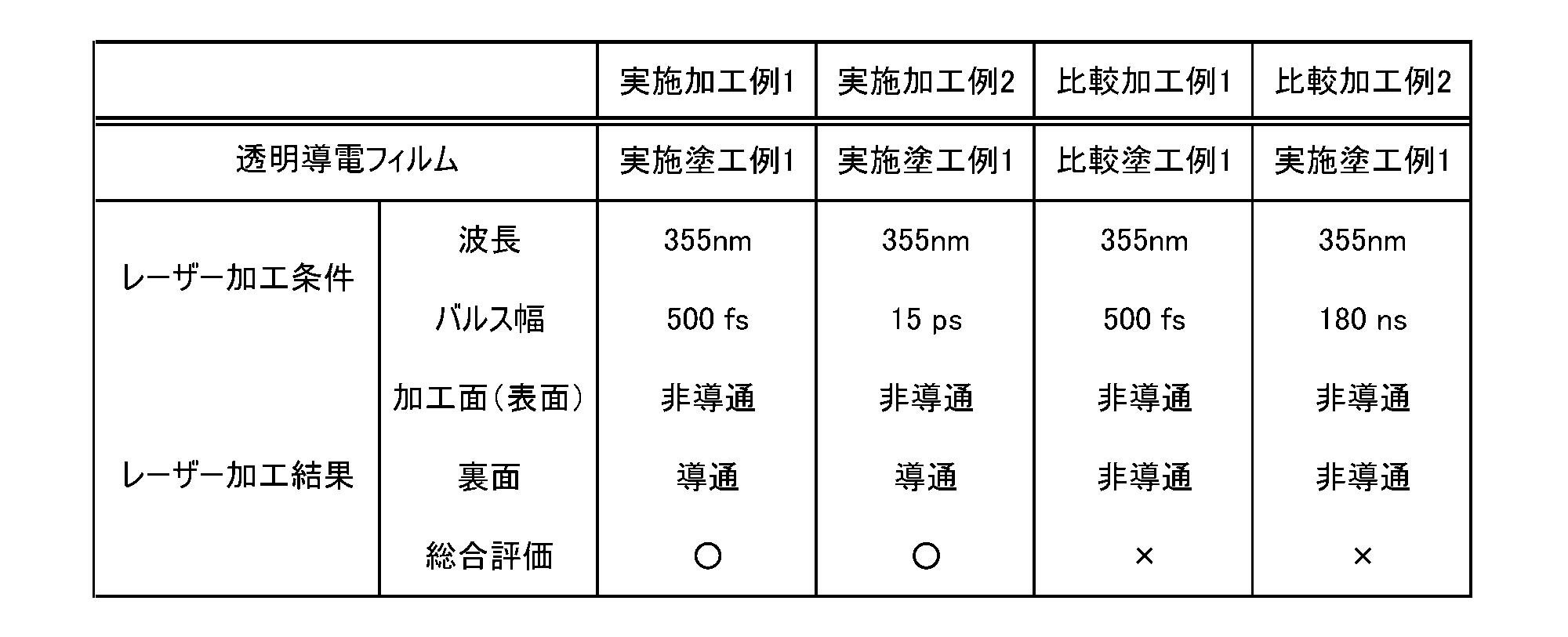
実施加工例1、2と比較加工例1の比較から明らかな通り、本実施形態で示した透明導電フィルムを用いることで、一方の面に選択的にレーザーエッチング加工が可能なことが示された。また、実施加工例1、2と比較加工例2の比較から分かる通り、同一の実施塗工例を用い、同一のレーザー波長で加工しても、パルス幅によってエッチング(パターニング)の成否が変わることが示された。すなわち、特許文献3で開示されている、基材厚み(樹脂種)とレーザー波長を指定するだけの手法では、必ずしも所望の加工(裏面に貫通しない加工)が実現できないことが分かる。
As is clear from the comparison between Practical Processing Examples 1 and 2 and Comparative Processing Example 1, it was shown that laser etching can be selectively performed on one surface by using the transparent conductive film shown in this embodiment. . In addition, as can be seen from the comparison between Practical Processing Examples 1 and 2 and Comparative Processing Example 2, even if the same Practical Coating Example is used and the same laser wavelength is used for processing, the success or failure of etching (patterning) varies depending on the pulse width. It has been shown. That is, it can be seen that the desired processing (processing that does not penetrate the back surface) cannot necessarily be achieved by the method disclosed in Patent Document 3, in which the base material thickness (resin type) and laser wavelength are only specified.
Claims (14)
前記基材の第一の主面及び第二の主面上にそれぞれ形成された、金属ナノワイヤの交差部を有するナノ構造ネットワークとバインダー樹脂とを含む、第一の透明導電膜及び第二の透明導電膜と、
前記第一の透明導電膜及び第二の透明導電膜の上にそれぞれ形成された第一の保護膜及び第二の保護膜と、
を有し、前記樹脂フィルムはベース樹脂と紫外線吸収剤とを含み、光透過スペクトルにおいて、波長350~370nmの領域における光線透過率が10%以下であり、前記ベース樹脂の、前記樹脂フィルムと同じ厚さのフィルムの光透過スペクトルにおいて、波長350~700nmの領域における光線透過率が80%以上である、ことを特徴とする透明導電フィルム。 a resin film as a base material;
A first transparent conductive film and a second transparent film comprising a nanostructure network having intersections of metal nanowires and a binder resin formed on the first main surface and the second main surface of the substrate, respectively. a conductive film;
a first protective film and a second protective film respectively formed on the first transparent conductive film and the second transparent conductive film;
The resin film contains a base resin and an ultraviolet absorber, and has a light transmittance of 10% or less in a wavelength range of 350 to 370 nm in the light transmission spectrum, and the base resin is the same as the resin film A transparent conductive film having a light transmittance of 80% or more in a wavelength region of 350 to 700 nm in a light transmission spectrum of a thick film.
前記第一の透明導電パターン膜が、第一の導電性領域及び第一の非導電性領域からなり、
前記第一の導電性領域が、金属ナノワイヤの交差部を有するナノ構造ネットワークとバインダー樹脂とを含み、
前記第二の透明導電パターン膜が、第二の導電性領域を含み、前記第二の導電性領域が、金属ナノワイヤの交差部を有するナノ構造ネットワークとバインダー樹脂とを含み、
前記樹脂フィルムは、ベース樹脂と紫外線吸収剤とを含み、光透過スペクトルにおいて、波長350~370nmの領域における光線透過率が10%以下であり、前記ベース樹脂の、前記樹脂フィルムと同じ厚さのフィルムの光透過スペクトルにおいて、波長350~700nmの領域における光線透過率が80%以上であることを特徴とする透明導電フィルム。 A first transparent conductive pattern film is provided on the first main surface of the base resin film, and a second transparent conductive pattern film different from the pattern of the first transparent conductive pattern film is provided on the second main surface. and having a first protective film on the first transparent conductive pattern film and a second protective film on the second transparent conductive pattern film,
the first transparent conductive pattern film comprises a first conductive region and a first non-conductive region;
wherein the first conductive region comprises a nanostructured network having intersections of metal nanowires and a binder resin;
said second transparent conductive pattern film comprising a second conductive region, said second conductive region comprising a nanostructured network having intersections of metal nanowires and a binder resin;
The resin film contains a base resin and an ultraviolet absorber, and has a light transmittance of 10% or less in a wavelength region of 350 to 370 nm in the light transmission spectrum, and the base resin has the same thickness as the resin film. A transparent conductive film having a light transmittance of 80% or more in a wavelength range of 350 to 700 nm in the light transmission spectrum of the film.
(A)カルボキシ基を含有するポリウレタンと、
(B)分子内に二個以上のエポキシ基を有するエポキシ化合物と、
(C)硬化促進剤と、
を含む硬化性樹脂組成物の熱硬化膜である請求項1から11のいずれか一項に記載の透明導電フィルム。 The first protective film and the second protective film are
(A) a polyurethane containing a carboxyl group;
(B) an epoxy compound having two or more epoxy groups in the molecule;
(C) a curing accelerator;
The transparent conductive film according to any one of claims 1 to 11, which is a thermoset film of a curable resin composition containing.
前記第一の透明導電膜上に第一の保護膜、前記第二の透明導電膜上に第二の保護膜、をそれぞれ形成する保護膜形成工程と、
波長が350~370nmの範囲内であり、パルス幅が1ナノ秒より短いパルスレーザーを用いて、前記第一の保護膜側から前記第一の透明導電膜にのみエッチング加工し、第一の透明導電パターンを形成するパターン形成工程と、
を有し、
前記樹脂フィルムはベース樹脂と紫外線吸収剤とを含み、光透過スペクトルにおいて、波長350~370nmの領域における光線透過率が10%以下であり、前記ベース樹脂の、前記樹脂フィルムと同じ厚さのフィルムの光透過スペクトルにおいて、波長350~700nmの領域における光線透過率が80%以上であることを特徴とする透明導電パターンの形成方法。 A first transparent conductive film containing a nanostructure network having intersections of metal nanowires and a binder resin on a first main surface of a resin film, and an intersection of metal nanowires on a second main surface of the resin film. a transparent conductive film forming step of respectively forming a second transparent conductive film containing a nanostructure network having moieties and a binder resin;
a protective film forming step of forming a first protective film on the first transparent conductive film and a second protective film on the second transparent conductive film;
Using a pulse laser having a wavelength in the range of 350 to 370 nm and a pulse width of less than 1 nanosecond, only the first transparent conductive film is etched from the first protective film side, and the first transparent A pattern forming step of forming a conductive pattern;
has
The resin film contains a base resin and an ultraviolet absorber, has a light transmittance of 10% or less in a wavelength region of 350 to 370 nm in the light transmission spectrum, and has the same thickness of the base resin as the resin film. A method for forming a transparent conductive pattern, wherein the light transmittance in the wavelength range of 350 to 700 nm is 80% or more in the light transmission spectrum of .
The step of etching only the second transparent conductive film from the second protective film side using a pulse laser having a pulse width shorter than 1 nanosecond to form a second transparent conductive pattern. 14. The method for forming a transparent conductive pattern according to 13.
Priority Applications (4)
| Application Number | Priority Date | Filing Date | Title |
|---|---|---|---|
| CN202280023850.6A CN117043890A (en) | 2021-03-29 | 2022-03-28 | Transparent conductive film and method for forming transparent conductive pattern |
| JP2023511293A JPWO2022210585A1 (en) | 2021-03-29 | 2022-03-28 | |
| US18/553,303 US20240203618A1 (en) | 2021-03-29 | 2022-03-28 | Transparent conductive film and method for forming transparent conduction pattern |
| KR1020237025900A KR20230128515A (en) | 2021-03-29 | 2022-03-28 | Formation method of transparent conductive film and transparent conductive pattern |
Applications Claiming Priority (2)
| Application Number | Priority Date | Filing Date | Title |
|---|---|---|---|
| JP2021055394 | 2021-03-29 | ||
| JP2021-055394 | 2021-03-29 |
Publications (1)
| Publication Number | Publication Date |
|---|---|
| WO2022210585A1 true WO2022210585A1 (en) | 2022-10-06 |
Family
ID=83459298
Family Applications (1)
| Application Number | Title | Priority Date | Filing Date |
|---|---|---|---|
| PCT/JP2022/015137 Ceased WO2022210585A1 (en) | 2021-03-29 | 2022-03-28 | Transparent conductive film and transparent conductive pattern forming method |
Country Status (6)
| Country | Link |
|---|---|
| US (1) | US20240203618A1 (en) |
| JP (1) | JPWO2022210585A1 (en) |
| KR (1) | KR20230128515A (en) |
| CN (1) | CN117043890A (en) |
| TW (1) | TW202306782A (en) |
| WO (1) | WO2022210585A1 (en) |
Citations (7)
| Publication number | Priority date | Publication date | Assignee | Title |
|---|---|---|---|---|
| WO2009035059A1 (en) * | 2007-09-12 | 2009-03-19 | Kuraray Co., Ltd. | Electroconductive film, electroconductive member, and process for producing electroconductive film |
| JP2010244747A (en) * | 2009-04-02 | 2010-10-28 | Konica Minolta Holdings Inc | Transparent electrode, method for producing transparent electrode, and organic electroluminescence element |
| JP2012064498A (en) * | 2010-09-17 | 2012-03-29 | Nagase Chemtex Corp | Transparent electrode substrate |
| WO2015146097A1 (en) * | 2014-03-25 | 2015-10-01 | 凸版印刷株式会社 | Transparent conductive laminated body and touch panel provided with transparent conductive laminated body |
| JP2015185512A (en) * | 2014-03-26 | 2015-10-22 | 信越ポリマー株式会社 | Conductive pattern forming substrate, and method for manufacturing the same |
| JP2016222847A (en) * | 2015-06-02 | 2016-12-28 | 昭和電工株式会社 | Resin composition for protective film of conductive pattern using metal nanowire and transparent conductive substrate |
| WO2020174975A1 (en) * | 2019-02-26 | 2020-09-03 | 日本ゼオン株式会社 | Lamination film |
Family Cites Families (3)
| Publication number | Priority date | Publication date | Assignee | Title |
|---|---|---|---|---|
| US9759846B2 (en) | 2013-09-27 | 2017-09-12 | Cam Holding Corporation | Silver nanostructure-based optical stacks and touch sensors with UV protection |
| US11154902B2 (en) | 2016-12-01 | 2021-10-26 | Showa Denko K.K. | Transparent conductive substrate and method for producing same |
| GB201803723D0 (en) | 2018-03-08 | 2018-04-25 | M Solv Ltd | Method of manufacturing a touch sensitive panel |
-
2022
- 2022-03-28 JP JP2023511293A patent/JPWO2022210585A1/ja active Pending
- 2022-03-28 US US18/553,303 patent/US20240203618A1/en active Pending
- 2022-03-28 CN CN202280023850.6A patent/CN117043890A/en active Pending
- 2022-03-28 KR KR1020237025900A patent/KR20230128515A/en active Pending
- 2022-03-28 WO PCT/JP2022/015137 patent/WO2022210585A1/en not_active Ceased
- 2022-03-29 TW TW111111904A patent/TW202306782A/en unknown
Patent Citations (7)
| Publication number | Priority date | Publication date | Assignee | Title |
|---|---|---|---|---|
| WO2009035059A1 (en) * | 2007-09-12 | 2009-03-19 | Kuraray Co., Ltd. | Electroconductive film, electroconductive member, and process for producing electroconductive film |
| JP2010244747A (en) * | 2009-04-02 | 2010-10-28 | Konica Minolta Holdings Inc | Transparent electrode, method for producing transparent electrode, and organic electroluminescence element |
| JP2012064498A (en) * | 2010-09-17 | 2012-03-29 | Nagase Chemtex Corp | Transparent electrode substrate |
| WO2015146097A1 (en) * | 2014-03-25 | 2015-10-01 | 凸版印刷株式会社 | Transparent conductive laminated body and touch panel provided with transparent conductive laminated body |
| JP2015185512A (en) * | 2014-03-26 | 2015-10-22 | 信越ポリマー株式会社 | Conductive pattern forming substrate, and method for manufacturing the same |
| JP2016222847A (en) * | 2015-06-02 | 2016-12-28 | 昭和電工株式会社 | Resin composition for protective film of conductive pattern using metal nanowire and transparent conductive substrate |
| WO2020174975A1 (en) * | 2019-02-26 | 2020-09-03 | 日本ゼオン株式会社 | Lamination film |
Also Published As
| Publication number | Publication date |
|---|---|
| JPWO2022210585A1 (en) | 2022-10-06 |
| KR20230128515A (en) | 2023-09-05 |
| CN117043890A (en) | 2023-11-10 |
| US20240203618A1 (en) | 2024-06-20 |
| TW202306782A (en) | 2023-02-16 |
Similar Documents
| Publication | Publication Date | Title |
|---|---|---|
| EP3988299A1 (en) | Transparent electroconductive film laminate and method for processing same | |
| JP7061734B2 (en) | Transparent conductive film laminate and its processing method | |
| KR102387063B1 (en) | Manufacturing method of transparent conductive film | |
| US20220139591A1 (en) | Transparent conductive film, and touch panel including same | |
| JP7435831B2 (en) | Transparent conductive film laminate | |
| WO2022210585A1 (en) | Transparent conductive film and transparent conductive pattern forming method | |
| WO2022210586A1 (en) | Transparent conductive film and method for forming transparent conductive pattern | |
| WO2021131099A1 (en) | Method for manufacturing transparent conductive film | |
| JP2023095255A (en) | heater | |
| US11685846B2 (en) | Transparent conducting film | |
| JP2023095223A (en) | Touch sensor and device provided with touch sensor | |
| JP2023095412A (en) | Decorative touch panel and touch panel built-in display | |
| JP2024067269A (en) | Transparent conductive film laminate, method for manufacturing the same, and transparent conductive film laminate for molding | |
| WO2023120620A1 (en) | Touch panel and method for manufacturing touch panel | |
| WO2023286602A1 (en) | Transparent conductive film laminate and method for manufacturing same | |
| CN112970075B (en) | Method for producing transparent conductive film | |
| WO2023286601A1 (en) | Transparent conductive film laminate and method for producing same | |
| JP2024066311A (en) | Silver nanowire ink and transparent conductive film |
Legal Events
| Date | Code | Title | Description |
|---|---|---|---|
| 121 | Ep: the epo has been informed by wipo that ep was designated in this application |
Ref document number: 22780796 Country of ref document: EP Kind code of ref document: A1 |
|
| ENP | Entry into the national phase |
Ref document number: 2023511293 Country of ref document: JP Kind code of ref document: A |
|
| ENP | Entry into the national phase |
Ref document number: 20237025900 Country of ref document: KR Kind code of ref document: A |
|
| WWE | Wipo information: entry into national phase |
Ref document number: 202280023850.6 Country of ref document: CN |
|
| WWE | Wipo information: entry into national phase |
Ref document number: 2301006319 Country of ref document: TH |
|
| WWE | Wipo information: entry into national phase |
Ref document number: 18553303 Country of ref document: US |
|
| NENP | Non-entry into the national phase |
Ref country code: DE |
|
| 122 | Ep: pct application non-entry in european phase |
Ref document number: 22780796 Country of ref document: EP Kind code of ref document: A1 |