JP2008222876A - Biodegradable oil-absorbing film - Google Patents
Biodegradable oil-absorbing film Download PDFInfo
- Publication number
- JP2008222876A JP2008222876A JP2007063733A JP2007063733A JP2008222876A JP 2008222876 A JP2008222876 A JP 2008222876A JP 2007063733 A JP2007063733 A JP 2007063733A JP 2007063733 A JP2007063733 A JP 2007063733A JP 2008222876 A JP2008222876 A JP 2008222876A
- Authority
- JP
- Japan
- Prior art keywords
- film
- oil
- acid
- sebum
- biodegradable
- Prior art date
- Legal status (The legal status is an assumption and is not a legal conclusion. Google has not performed a legal analysis and makes no representation as to the accuracy of the status listed.)
- Pending
Links
Images


Classifications
-
- A—HUMAN NECESSITIES
- A61—MEDICAL OR VETERINARY SCIENCE; HYGIENE
- A61K—PREPARATIONS FOR MEDICAL, DENTAL OR TOILETRY PURPOSES
- A61K8/00—Cosmetics or similar toiletry preparations
- A61K8/18—Cosmetics or similar toiletry preparations characterised by the composition
- A61K8/30—Cosmetics or similar toiletry preparations characterised by the composition containing organic compounds
- A61K8/33—Cosmetics or similar toiletry preparations characterised by the composition containing organic compounds containing oxygen
- A61K8/37—Esters of carboxylic acids
- A61K8/375—Esters of carboxylic acids the alcohol moiety containing more than one hydroxy group
-
- A—HUMAN NECESSITIES
- A61—MEDICAL OR VETERINARY SCIENCE; HYGIENE
- A61K—PREPARATIONS FOR MEDICAL, DENTAL OR TOILETRY PURPOSES
- A61K8/00—Cosmetics or similar toiletry preparations
- A61K8/02—Cosmetics or similar toiletry preparations characterised by special physical form
-
- A—HUMAN NECESSITIES
- A61—MEDICAL OR VETERINARY SCIENCE; HYGIENE
- A61K—PREPARATIONS FOR MEDICAL, DENTAL OR TOILETRY PURPOSES
- A61K8/00—Cosmetics or similar toiletry preparations
- A61K8/18—Cosmetics or similar toiletry preparations characterised by the composition
- A61K8/30—Cosmetics or similar toiletry preparations characterised by the composition containing organic compounds
- A61K8/31—Hydrocarbons
-
- A—HUMAN NECESSITIES
- A61—MEDICAL OR VETERINARY SCIENCE; HYGIENE
- A61Q—SPECIFIC USE OF COSMETICS OR SIMILAR TOILETRY PREPARATIONS
- A61Q19/00—Preparations for care of the skin
- A61Q19/008—Preparations for oily skin
-
- A—HUMAN NECESSITIES
- A61—MEDICAL OR VETERINARY SCIENCE; HYGIENE
- A61Q—SPECIFIC USE OF COSMETICS OR SIMILAR TOILETRY PREPARATIONS
- A61Q19/00—Preparations for care of the skin
- A61Q19/10—Washing or bathing preparations
Landscapes
- Health & Medical Sciences (AREA)
- Life Sciences & Earth Sciences (AREA)
- General Health & Medical Sciences (AREA)
- Veterinary Medicine (AREA)
- Public Health (AREA)
- Animal Behavior & Ethology (AREA)
- Birds (AREA)
- Epidemiology (AREA)
- Dermatology (AREA)
- Emergency Medicine (AREA)
- Cosmetics (AREA)
- Manufacture Of Macromolecular Shaped Articles (AREA)
- Detergent Compositions (AREA)
- Biological Depolymerization Polymers (AREA)
- Preparation Of Compounds By Using Micro-Organisms (AREA)
Abstract
【課題】生分解性を有するポリヒドロキシアルカン酸を含む皮脂吸着用化粧料、油分吸着用清掃用、吸油用フィルムの提供。
【解決手段】ポリヒドロキシアルカン酸を含む生分解性吸油用フィルム、ポリヒドロキシアルカン酸が、3−ヒドロキシプロピオン酸、3−ヒドロキシブタン酸、4−ヒドロキシブタン酸、3−ヒドロキシバレリル酸、3−ヒドロキシヘキサン酸、3−ヒドロキシオクタン酸、及び3−ヒドロキシドデカン酸から選択される1種又は2種以上からなる、生分解性吸油用フィルム。
【選択図】図1The present invention provides a sebum-adsorbing cosmetic material containing biodegradable polyhydroxyalkanoic acid, an oil-adsorbing cleaning material and an oil-absorbing film.
A biodegradable oil-absorbing film containing polyhydroxyalkanoic acid, the polyhydroxyalkanoic acid comprising 3-hydroxypropionic acid, 3-hydroxybutanoic acid, 4-hydroxybutanoic acid, 3-hydroxyvaleric acid, 3- A biodegradable oil-absorbing film comprising one or more selected from hydroxyhexanoic acid, 3-hydroxyoctanoic acid, and 3-hydroxydodecanoic acid.
[Selection] Figure 1
Description
本発明は、生分解性吸油用フィルム(以下、単に「給油用フィルム」ということがある)に関し、より詳しくは皮脂吸着用化粧料、油分吸着用清掃用品に関する。 The present invention relates to a biodegradable oil-absorbing film (hereinafter sometimes simply referred to as “oil-supplying film”), and more particularly to a sebum-absorbing cosmetic and an oil-absorbing cleaning article.
近年、環境への配慮の意識が高まっており、生分解性プラスチックの様々な製品への登用が研究されている。しかしながら、生分解性プラスチックは二次加工が困難であり、製造コストが高くなるといった問題から、実際に製品化されているものは少ない。 In recent years, awareness of environmental concerns has increased, and the promotion of biodegradable plastics to various products has been studied. However, few biodegradable plastics are actually commercialized due to problems such as difficulty in secondary processing and high manufacturing costs.
一方、化粧料分野において、皮膚の過剰な皮脂を取り除くための化粧料、すなわち、皮脂吸着用化粧料が知られている。皮膚表面の過剰な皮脂は、常に好ましいとは限らない。オイリー肌は、特に気温や湿度が高い気候のもとで問題となることが多い。例えば、皮脂の分泌の活性化により毛穴に角質や皮脂がたまることによりニキビができる。ここに細菌が作用し、炎症となることもある。この余分な皮脂を取り除くために、多くの皮脂吸着用化粧料が開発されている。 On the other hand, in the cosmetic field, cosmetics for removing excess sebum from the skin, that is, cosmetics for sebum adsorption are known. Excess sebum on the skin surface is not always preferred. Oily skin is often a problem, especially in climates with high temperatures and humidity. For example, acne can be produced by accumulating keratin and sebum in pores due to activation of sebum secretion. Bacteria can act here and cause inflammation. In order to remove this excess sebum, many cosmetics for sebum adsorption have been developed.
多くの人々の最近のライフスタイルとして、長時間外出先で過ごすことが多い。したがって、いつでもいかなる場所でも使用しやすい、使い捨てのスキンケア用品を携帯することが必要である。中でも、皮脂吸着用化粧料(脂とり紙又は脂とりフィルム)は、携帯用スキンケア用品として非常によく普及している。その理由としては、脂とり紙又は脂とりフィルムが、小さく軽くポケットやハンドバックにしまいやすく、簡単に素早くいつでもいかなる場所でも使用できるからである。 Many people spend a long time on the go as a recent lifestyle. Therefore, it is necessary to carry disposable skin care products that are easy to use anytime and anywhere. Among these, cosmetics for absorbing sebum (grease paper or grease film) are very popular as portable skin care products. The reason for this is that the degreased paper or the degreased film is small and light and easily put into a pocket or handbag, and can be used easily and quickly anytime and anywhere.
顔用皮脂吸着用素材としては、初期にはリネン(亜麻布)が使用されていたが、コストの面から、最近では紙が使用されている。しかしながら、紙素材のものは、リネン性のもの比べて効果が低い。効果を向上させるために紙(植物繊維)に絹糸等を混合したもの等も開発されているが、未だ十分な効果は得られていない(特許文献1)。また、さらに最近、多孔性熱可塑性フィルム素材のものが販売され始めた。このような皮脂吸着用フィルムは紙素材のもの等に比べれば皮脂吸着効果は高いが、いまだ十分な効果は得られない。さらに、このような素材は生分解性ではないか、または生分解性の作用が十分ではない。生分解性ポリエステル素材のものとして、ポリ乳酸繊維と無機粉体及び/又は生分解性有機粉体とのブレンドからなるものが開発されているが、この技術による素材も単独材料で効果を発揮するものではなく、完全に生分解性ではない(特許文献2)。したがって、バイオマス由来の素材を用いたものが望まれている。 Linen (linen cloth) was initially used as a material for adsorbing facial sebum, but paper has recently been used in terms of cost. However, the paper material is less effective than the linen material. In order to improve the effect, paper (plant fiber) mixed with silk thread or the like has been developed, but a sufficient effect has not been obtained yet (Patent Document 1). More recently, porous thermoplastic film materials have begun to be sold. Such a sebum-absorbing film has a higher sebum-adsorbing effect than a paper material, but a sufficient effect is not yet obtained. Furthermore, such materials are not biodegradable or do not have sufficient biodegradable action. A biodegradable polyester material has been developed that is a blend of polylactic acid fibers and inorganic powder and / or biodegradable organic powder. It is not a thing and is not completely biodegradable (patent document 2). Therefore, what uses the raw material derived from biomass is desired.
なお、ポリ乳酸は生分解性材料として知られているが、ポリ乳酸は自然環境中では分解されない。ただし、コンポスト(高温多湿条件:例えば、温度60℃、湿度70%)内等の特殊な条件下で加水分解するため、生分解性材料といわれることがある。しかしながら、自然環境中において微生物に分解される、という意味での生分解性材料にはポリ乳酸は該当しない。
Polylactic acid is known as a biodegradable material, but polylactic acid is not decomposed in the natural environment. However, it is sometimes referred to as a biodegradable material because it hydrolyzes under special conditions such as within compost (high temperature and high humidity conditions: for example,
また、布巾等の家庭用清掃用品に関しても、油分の吸着性が高いものが求められている。また、このような家庭用清掃用品が生分解性であればさらに望ましい。 In addition, household cleaning supplies such as cloths are also required to have high oil adsorbability. It is further desirable if such household cleaning articles are biodegradable.
本発明は、上記観点のもとになされたものであり、各種生分解性素材製品を提供することを課題とする。 This invention is made | formed based on the said viewpoint, and makes it a subject to provide various biodegradable raw material products.
本発明者らは、上記の課題を解決すべく鋭意研究を行った結果、生分解性ポリマーであるポリヒドロキシアルカン酸が、優れた吸油特性を有することを見出した。本発明者らは、この知見に基づき、生分解性吸油性フィルムを発明した。 As a result of intensive studies to solve the above problems, the present inventors have found that polyhydroxyalkanoic acid, which is a biodegradable polymer, has excellent oil absorption characteristics. Based on this finding, the present inventors have invented a biodegradable oil-absorbing film.
本発明の吸油性フィルムは、様々な自然環境中で完全に生分解性である。本発明により、生体及び自然生態系に適合性である種々のポリヒドロキシアルカン酸の吸油性フィルムとしての用途が初めて開示される。 The oil-absorbing film of the present invention is completely biodegradable in various natural environments. The present invention discloses for the first time the use of various polyhydroxyalkanoic acids that are compatible with living organisms and natural ecosystems as oil-absorbing films.
すなわち本発明は以下の通りである。
(1)ポリヒドロキシアルカン酸を含む生分解性吸油用フィルム。
(2)ポリヒドロキシアルカン酸が、3−ヒドロキシプロピオン酸、3−ヒドロキシブタン酸、4−ヒドロキシブタン酸、3−ヒドロキシバレリル酸、3−ヒドロキシヘキサン酸、3−ヒドロキシオクタン酸、及び3−ヒドロキシドデカン酸から選択される1種又は2種以上からなる、(1)に記載の生分解性吸油用フィルム。
(3)さらに石油系プラスチックを含む、(1)又は(2)に記載の生分解性吸油用フィルム。
(4)生分解性吸油用フィルムがソルベントキャスティング法、溶融−結晶化法、スピンキャスティング法、又はエレクトロスピニング法により成形されたものである、(1)〜(3)の何れかに記載の生分解性吸油用フィルム。
(5)化粧料である、(1)〜(4)の何れかに記載の生分解性吸油用フィルム。
(6)化粧料がスキンケア化粧料である、(5)に記載の生分解性吸油用フィルム。
(7)スキンケア化粧料が皮脂吸着用フィルムである、(6)に記載の生分解性吸油用フィルム。
(8)化粧料が皮膚洗浄用化粧料である、(5)に記載の生分解性吸油用フィルム。
(9)皮膚洗浄用化粧料がクレンジング剤である、(8)に記載の生分解性吸油用フィルム。
(10)清掃用品である、(1)〜(4)の何れかに記載の生分解性吸油用フィルム。
That is, the present invention is as follows.
(1) A biodegradable film for oil absorption containing polyhydroxyalkanoic acid.
(2) Polyhydroxyalkanoic acid is 3-hydroxypropionic acid, 3-hydroxybutanoic acid, 4-hydroxybutanoic acid, 3-hydroxyvaleric acid, 3-hydroxyhexanoic acid, 3-hydroxyoctanoic acid, and 3-hydroxy The biodegradable oil-absorbing film according to (1), comprising one or more selected from dodecanoic acid.
(3) The biodegradable film for oil absorption according to (1) or (2), further comprising petroleum plastic.
(4) The raw material according to any one of (1) to (3), wherein the biodegradable oil-absorbing film is formed by a solvent casting method, a melt-crystallization method, a spin casting method, or an electrospinning method. Degradable oil-absorbing film.
(5) The biodegradable oil-absorbing film according to any one of (1) to (4), which is a cosmetic.
(6) The biodegradable oil-absorbing film according to (5), wherein the cosmetic is a skin care cosmetic.
(7) The biodegradable oil-absorbing film according to (6), wherein the skin care cosmetic is a sebum-adsorbing film.
(8) The biodegradable oil-absorbing film according to (5), wherein the cosmetic is a skin cleansing cosmetic.
(9) The biodegradable oil-absorbing film according to (8), wherein the skin cleansing cosmetic is a cleansing agent.
(10) The biodegradable oil-absorbing film according to any one of (1) to (4), which is a cleaning article.
本発明により、吸油特性に優れ、かつ生分解性の吸油性フィルムが提供される。生分解性の吸油性フィルムとして、具体的には、例えば、皮脂吸着用フィルム等のスキンケア化粧料、布巾、精密機器に用いられるレンズ等の清掃具等の清掃用品等として使用可能である。 According to the present invention, an oil-absorbing film having excellent oil absorption characteristics and biodegradability is provided. Specifically, the biodegradable oil-absorbing film can be used as, for example, a skin care cosmetic such as a sebum-absorbing film, a cleaning article such as a cleaning tool such as a lens used in a cloth or a precision instrument.
本発明の皮脂吸着用フィルムは、皮脂吸着効果に優れ、生体(皮膚)適合性で、かつ環境適合性の皮脂吸着用フィルムである。さらに、本発明の皮脂吸着用フィルムは、皮脂が吸着すると、その部分の透明性が変化し、皮脂吸着を明確に示すことができる。そのため、使用者は皮脂吸着の効果を簡単に確認できる。この点でも、本発明の皮脂吸着用フィルムは製品として望ましい性質を有している。 The sebum adsorption film of the present invention is a sebum adsorption film that is excellent in sebum adsorption effect, is biocompatible (skin) compatible, and is environmentally compatible. Furthermore, when the sebum is adsorbed in the film for sebum adsorption of the present invention, the transparency of the part changes, and the sebum adsorption can be clearly shown. Therefore, the user can easily confirm the effect of sebum adsorption. Also in this respect, the sebum adsorption film of the present invention has desirable properties as a product.
また、本発明の吸油性フィルムの製造、使用、最終的な破棄の全ての工程は、炭素サイクルの観点から本質的に中立な持続可能なバイオベースの工程に基づくものである。 Also, all steps of manufacturing, using, and finally destroying the oil-absorbing film of the present invention are based on a sustainable bio-based process that is essentially neutral from the perspective of the carbon cycle.
(本発明の吸油用フィルム)
本発明により100%生分解性を有する吸油用フィルムが開発された。すなわち、本発明は、糖や植物油を原料として微生物により生合成され、他の微生物の分泌する分解酵素により完全に水と二酸化炭素に分解されるポリヒドロキシアルカン酸(PHA)を原料とした、100%生分解性を有する吸油用フィルムである。
(Oil-absorbing film of the present invention)
According to the present invention, an oil absorbing film having 100% biodegradability has been developed. That is, the present invention is based on polyhydroxyalkanoic acid (PHA), which is biosynthesized by microorganisms using sugar or vegetable oil as a raw material, and is completely decomposed into water and carbon dioxide by a decomposing enzyme secreted by other microorganisms. It is a film for oil absorption having% biodegradability.
本発明の吸油用フィルムは、PHAを含むことを特徴とする。本発明の吸油用フィルムは、優れた吸油特性を有し、かつ生分解性(PHA以外の非生分解性成分を混合した場合は部分的に生分解性であり得る)であるので、生態系に適合性であるという利点を有する。 The oil absorbing film of the present invention is characterized by containing PHA. The oil-absorbing film of the present invention has excellent oil-absorbing properties and is biodegradable (can be partially biodegradable when mixed with non-biodegradable components other than PHA). It has the advantage of being compatible.
本発明の吸油用フィルムは、吸油特性が求められる様々な製品及びその資材として使用され得る。例えば、化粧料(皮脂吸着用フィルム等のスキンケア化粧料、クレンジング剤等の皮膚洗浄用化粧料、メークアップ化粧料等)、食品(油分吸着用健康食品等)、生活用品(布巾、精密機器に用いられるレンズ等の清掃具等の清掃用品等)、環境浄化用資材(海上又は水上に流出した油の吸収用フィルム等)、精密機器洗浄資材等に利用され得る。 The oil absorbing film of the present invention can be used as various products and materials for which oil absorbing properties are required. For example, cosmetics (skin care cosmetics such as sebum-absorbing films, skin cleansing cosmetics such as cleansing agents, makeup cosmetics, etc.), foods (health foods for oil absorption, etc.), daily necessities (clothes, precision instruments, etc.) It can be used for cleaning supplies such as cleaning tools such as lenses used), environmental purification materials (such as films for absorbing oil spilled on the sea or water), and precision equipment cleaning materials.
(本発明の吸油用フィルムに用いるポリヒドロキシアルカン酸(PHA))
本発明の吸油用フィルムに用いるPHAとしては、特に制限されないが、例えば、3−ヒドロキシプロピオン酸、3−ヒドロキシブタン酸、4−ヒドロキシブタン酸、3−ヒドロキシバレリル酸、3−ヒドロキシヘキサン酸、3−ヒドロキシオクタン酸、及び3−ヒドロキシドデカン酸から選択される1種又は2種以上からなるポリマーが使用され得る。
(Polyhydroxyalkanoic acid (PHA) used in the oil-absorbing film of the present invention)
Although it does not restrict | limit especially as PHA used for the film for oil absorption of this invention, For example, 3-hydroxypropionic acid, 3-hydroxybutanoic acid, 4-hydroxybutanoic acid, 3-hydroxyvaleric acid, 3-hydroxyhexanoic acid, A polymer composed of one or more selected from 3-hydroxyoctanoic acid and 3-hydroxydodecanoic acid may be used.
上記ポリマーとしては、例えば、3−ヒドロキシブタン酸ホモポリマー、3−ヒドロキシブタン酸−co−3−ヒドロキシバレリル酸コポリマー、及び3−ヒドロキシブタン酸−co−3−ヒドロキシヘキサン酸コポリマー等が挙げられる。なお、モノマー比は特に制限されない。 Examples of the polymer include 3-hydroxybutanoic acid homopolymer, 3-hydroxybutanoic acid-co-3-hydroxyvaleric acid copolymer, and 3-hydroxybutanoic acid-co-3-hydroxyhexanoic acid copolymer. . The monomer ratio is not particularly limited.
本発明の吸油用フィルムに用いるPHAは、発酵合成法により合成することが可能である。発酵合成法とは、PHA生産能を有する微生物を培養し、その菌体内に蓄積されるPHAを取り出す方法である。 The PHA used for the oil-absorbing film of the present invention can be synthesized by a fermentation synthesis method. The fermentative synthesis method is a method of culturing a microorganism having PHA production ability and taking out PHA accumulated in the microbial cells.
発酵合成法で利用できる微生物としては、PHA生産能を有する微生物であれば特に限定されない。PHAのうち、ポリヒドロキシブタン酸(PHB)生産菌として、ラルストニア・ユートロファ(Ralstonia eutropha)、アルカリゲネス・ラタス(Alcaligenes latus)等のラルストニア属、及びアルカリゲネス属を始め60種以上の天然微生物が知られており、これらの微生物ではPHBが菌体内に蓄積される。また、ヒドロキシブタン酸とその他のヒドロキシアルカン酸とのコポリマー生産菌として、ポリ(3−ヒドロキシブタン酸−co−3−ヒドロキシバレリル酸)、及びポリ(3−ヒドロキシブタン酸−co−3−ヒドロキシヘキサン酸)生産菌であるラルストニア・ユートロファ(Ralstonia eutropha)、アエロモナス・キャビエ(Aeromonas caviae)、ポリ(3−ヒドロキシブタン酸−co−4−ヒドロキシブタン酸)生産菌であるラルストニア・ユートロファ(Ralstonia eutropha)、デルフリア・アシドボランス(Delfria acidovorans)等が知られている。 The microorganism that can be used in the fermentation synthesis method is not particularly limited as long as it is a microorganism having PHA-producing ability. Among PHA, more than 60 kinds of natural microorganisms are known as polyhydroxybutanoic acid (PHB) producing bacteria, including Ralstonia eutropha, Ralstonia genus such as Alcaligenes latus, and Alcaligenes genus. In these microorganisms, PHB accumulates in the cells. In addition, poly (3-hydroxybutanoic acid-co-3-hydroxyvaleric acid) and poly (3-hydroxybutanoic acid-co-3-hydroxy) are produced as a copolymer-producing bacterium of hydroxybutanoic acid and other hydroxyalkanoic acids. Hexanoic acid producing bacteria Ralstonia eutropha, Aeromonas caviae, poly (3-hydroxybutanoic acid-co-4-hydroxybutanoic acid) producing bacteria Ralstonia eutropha Delfria acidovorans are known.
発酵合成法においては、通常これらの微生物を、炭素源、窒素源、無機イオン及び必要に応じその他の有機成分を含有する通常の培地で培養することにより菌体内にPHAを蓄積させることができる。なお、これらの微生物に与える炭素源の組成を調整することにより、様々な組成からなるポリマーを得ることができる。菌体からのPHAの採取は、クロロホ
ルム等の有機溶媒による抽出や、菌体成分をリゾチーム等の酵素で分解した後PHAグラニュールを濾別する方法等により実施できる。
In the fermentative synthesis method, these microorganisms are usually cultured in a normal medium containing a carbon source, a nitrogen source, inorganic ions, and other organic components as required, so that PHA can be accumulated in the cells. In addition, the polymer which consists of various compositions can be obtained by adjusting the composition of the carbon source given to these microorganisms. The collection of PHA from the cells can be performed by extraction with an organic solvent such as chloroform, or by separating the cell components with an enzyme such as lysozyme and then filtering the PHA granules.
また、発酵合成法の一態様として、PHB合成遺伝子を含む組換えDNAを導入して形質転換させた微生物を培養し、その菌体内に生成したPHBを採取する方法が挙げられる。 Moreover, as one aspect of the fermentation synthesis method, a method of culturing a microorganism transformed by introducing a recombinant DNA containing a PHB synthesis gene and collecting PHB produced in the cell body can be mentioned.
形質転換体は好適な培地で培養し、PHBを菌体内に蓄積させる。使用する培地としては、炭素源、窒素源、無機イオン及び必要に応じその他の有機成分を含有する通常の培地が挙げられる。大腸菌を用いる場合、炭素源としてはグルコース等が挙げられ、窒素源としてはイーストエキス、トリプトン等の天然物由来のものが挙げられる。その他、アンモニウム塩などの無機の窒素化合物等が含まれていてもよい。培養は好気的条件下で12〜48時間、培養温度は30〜37℃、培養中のpHは6.0〜8.0に制御することが好ましい。菌体からのPHBの採取は、クロロホルム等の有機溶媒による抽出や、菌体成分をリゾチーム等の酵素で分解した後PHBグラニュールを濾別する方法等により実施できる。具体的には、例えば培養液から分離回収した乾燥菌体からPHBを適当な有機溶媒で抽出した後、沈殿剤で沈殿させることにより実施できる。 The transformant is cultured in a suitable medium, and PHB is accumulated in the microbial cells. Examples of the medium to be used include a normal medium containing a carbon source, a nitrogen source, inorganic ions, and other organic components as necessary. When using Escherichia coli, examples of the carbon source include glucose, and examples of the nitrogen source include those derived from natural products such as yeast extract and tryptone. In addition, inorganic nitrogen compounds such as ammonium salts may be contained. The culture is preferably performed under aerobic conditions for 12 to 48 hours, the culture temperature is controlled to 30 to 37 ° C., and the pH during the culture is controlled to 6.0 to 8.0. Collection of PHB from the microbial cells can be performed by extraction with an organic solvent such as chloroform, or a method in which the microbial components are decomposed with an enzyme such as lysozyme and then the PHB granules are separated by filtration. Specifically, for example, PHB can be extracted from a dry cell separated and collected from the culture solution with an appropriate organic solvent, and then precipitated with a precipitant.
本発明の吸油用フィルムに用いるPHAの分子量としては、本発明の効果を損なわない限り特に制限されないが、通常数平均分子量10万〜150万、好ましくは数平均分子量40万〜100万である。上記範囲内であれば、フィルムの形成を容易に行うことができる。 The molecular weight of PHA used in the oil-absorbing film of the present invention is not particularly limited as long as the effects of the present invention are not impaired, but is usually a number average molecular weight of 100,000 to 1,500,000, preferably a number average molecular weight of 400,000 to 1,000,000. If it is in the said range, formation of a film can be performed easily.
本発明の吸油用フィルムには、PHA以外に石油系プラスチックをさらに添加することも可能である。本発明の吸油用フィルムに用いる石油系プラスチックとしては、通常よく知られるポリプロピレン、脂肪族ポリエステル、芳香族ポリエステル等が使用され得る。石油系プラスチックの添加量は任意であり、目的の成形品に必要な物性に応じて適宜選択され得る。PHAにより非生分解性の石油系プラスチック成形品に、生分解性が付与される。 In addition to PHA, petroleum-based plastics can be further added to the oil absorbing film of the present invention. As the petroleum-based plastic used for the oil-absorbing film of the present invention, polypropylene, aliphatic polyester, aromatic polyester and the like that are generally well-known can be used. The amount of petroleum-based plastic added is arbitrary and can be appropriately selected according to the physical properties required for the target molded product. Biodegradability is imparted to non-biodegradable petroleum plastic molded products by PHA.
本発明の吸油用フィルムの成形材料としては、上記PHA以外に目的の成形品に通常使用される任意成分を添加することができる。例えば、フィルムであれば、通常フィルムに用いられる各種添加剤、例えば滑剤、紫外線吸収剤、耐候剤、帯電防止剤、酸化防止剤、熱安定剤、核剤、流動改良剤、着色剤、ビタミン等を必要に応じて含有させることができる。 As the molding material for the oil-absorbing film of the present invention, in addition to the above-mentioned PHA, optional components usually used for the objective molded product can be added. For example, in the case of a film, various additives usually used for films, such as lubricants, ultraviolet absorbers, weathering agents, antistatic agents, antioxidants, heat stabilizers, nucleating agents, flow improvers, colorants, vitamins, etc. Can be contained as required.
以下、本発明の吸油用フィルムを、皮脂吸着用フィルムを例に挙げて、さらに詳細に説明するが、本発明はこれにより本発明の範囲が限定されることはない。 Hereinafter, the oil-absorbing film of the present invention will be described in more detail by taking a sebum-adsorbing film as an example. However, the scope of the present invention is not limited thereby.
(皮脂吸着用フィルム)
本発明の皮脂吸着用フィルムは、生分解性であり、再生可能資源であるバイオマスを原料として生合成された微生物産生脂肪族ポリエステル(ポリヒドロキシアルカン酸)であるという点で新しいタイプの化粧品、すなわち、スキンケア製品である。本発明の皮脂吸着用フィルムは、皮膚表面から過剰な皮脂を吸い取るのに適している。本発明における特徴は、素材の選択にあり、その素材は、生分解性及び生体適合性の熱可塑性樹脂、すなわち、ポリヒドロキシアルカン酸(PHA)である。PHAは、プラスチック産業に使用される従来の簡便な技術で、薄い多孔性のフィルムに加工され得る。
(Sebum adsorption film)
The film for adsorbing sebum of the present invention is a new type of cosmetic product in that it is biodegradable and is a microbial-produced aliphatic polyester (polyhydroxyalkanoic acid) biosynthesized from biomass, which is a renewable resource. , A skin care product. The sebum adsorption film of the present invention is suitable for absorbing excess sebum from the skin surface. A feature of the present invention is the selection of a material, which is a biodegradable and biocompatible thermoplastic resin, that is, polyhydroxyalkanoic acid (PHA). PHA can be processed into a thin porous film with conventional and convenient techniques used in the plastics industry.
本発明の皮脂吸着用フィルムは、上記PHAを原料として以下の4種類の方法、すなわちソルベントキャスティング法、溶融−結晶化法、スピンキャスティング法、又はエレクトロスピニング法で製造され得る。このような方法であれば、フィルム表面に多孔を存在させ、また、フィルム表面の結晶化度を最小限にすることが可能である。 The sebum-adsorbing film of the present invention can be produced by the following four methods using the PHA as a raw material, that is, a solvent casting method, a melt-crystallization method, a spin casting method, or an electrospinning method. With such a method, it is possible to make the film surface have porosity and minimize the crystallinity of the film surface.
具体的には、次のように製造され得る。
ソルベントキャストフィルムは、PHAを揮発性の有機溶媒に溶解させ、シャーレ等に流し込み、溶媒を揮発させることで得られる。
溶融−結晶化フィルムは、PHAを融点以上で融解したのち、所定の温度で一定時間保持することにより製造される。
スピンキャストフィルムは、有機溶媒に溶解したPHAを回転している基盤上に滴下し、滴下と同時に溶媒を揮発させることにより得られる。
エレクトロスピニングフィルムは、有機溶媒に溶解させたPHAに電圧をかけることによりノズル先端から試料を放出し、ナノオーダーの極細繊維を作製し、積層させることにより製造される。
なお、本発明のフィルムは、上記の方法によって得られたものに限らず、フィルムを形成させる各種方法で得られたものであってよい。
Specifically, it can be manufactured as follows.
The solvent cast film is obtained by dissolving PHA in a volatile organic solvent, pouring it into a petri dish or the like, and volatilizing the solvent.
The melt-crystallized film is manufactured by melting PHA at a melting point or higher and holding it at a predetermined temperature for a predetermined time.
A spin cast film is obtained by dropping PHA dissolved in an organic solvent on a rotating substrate and volatilizing the solvent simultaneously with the dropping.
An electrospinning film is manufactured by discharging a sample from the tip of a nozzle by applying a voltage to PHA dissolved in an organic solvent, and producing and laminating nano-order ultrafine fibers.
The film of the present invention is not limited to that obtained by the above method, but may be obtained by various methods for forming a film.
本発明の皮脂吸着用フィルムの成形材料としては、通常化粧料に用いられる各種添加剤、例えば保湿剤(ポリエチレングリコール類、ポリプロピレングリコール類、ブチレングリコール類、ポリグリセリン類、糖アルコール類、単糖類、多糖類、アミノ多糖類(キチン、キトサン等)、ビタミン類)、油分、美白成分、消炎成分、色素、顔料、界面活性剤、殺菌剤等を必要に応じて含有させることができる。 As the molding material for the sebum adsorbing film of the present invention, various additives usually used in cosmetics, for example, humectants (polyethylene glycols, polypropylene glycols, butylene glycols, polyglycerins, sugar alcohols, monosaccharides, Polysaccharides, aminopolysaccharides (chitin, chitosan, etc.), vitamins), oils, whitening components, anti-inflammatory components, pigments, pigments, surfactants, bactericides, and the like can be included as necessary.
本発明の皮脂吸着用フィルムの物性としては、例えば、3−ヒドロキシブタン酸ホモポリマー(数平均分子量90万)からなるフィルムであれば、ガラス転移点(Tg)0〜10℃、融点(Tm)170〜185℃であり得る。3−ヒドロキシブタン酸とその他のPHAのコポリマー(数平均分子量40〜100万)からなるフィルムであれば、ガラス転移点(Tg)−10〜10℃、融点(Tm)25〜170℃であり得る。本発明の皮脂吸着用フィルムは適度な強度を有し、例えば、破壊強度10〜50MPa、破壊伸び5〜1000%であり得る。 As physical properties of the film for sebum adsorption of the present invention, for example, if it is a film made of 3-hydroxybutanoic acid homopolymer (number average molecular weight 900,000), glass transition point (Tg) 0 to 10 ° C., melting point (Tm) It can be 170-185 ° C. In the case of a film made of a copolymer of 3-hydroxybutanoic acid and other PHA (number average molecular weight: 40 to 1,000,000), it may have a glass transition point (Tg) of −10 to 10 ° C. and a melting point (Tm) of 25 to 170 ° C. . The sebum-adsorbing film of the present invention has an appropriate strength, and can have, for example, a breaking strength of 10 to 50 MPa and a breaking elongation of 5 to 1000%.
上記フィルムを適当な大きさ(例えば、3cm×3cm)にカットして、本発明の皮脂吸着用フィルムとすることができる。皮脂吸着用フィルムの厚みは、10〜40μmである。 The film can be cut into an appropriate size (for example, 3 cm × 3 cm) to obtain the sebum-adsorbing film of the present invention. The thickness of the sebum adsorption film is 10 to 40 μm.
本発明の皮脂吸着用フィルムは、皮膚表面を清浄にし、過剰な皮脂を取り除く目的で使用される皮脂吸着用フィルムである。既に市販されている種々の皮脂吸着用フィルムがあるが、本発明の皮脂吸着用フィルムの新規な点、及び際立った特徴は、環境適合性の特性である。 The film for adsorbing sebum of the present invention is a film for adsorbing sebum used for the purpose of cleaning the skin surface and removing excess sebum. Although there are various sebum-adsorbing films that are already on the market, the novel and distinguishing features of the sebum-adsorbing film of the present invention are its environmental compatibility characteristics.
また、本発明の皮脂吸着用フィルムは、肌に触れる際のあたりがやわらかく、かつ優れた油分吸着能、及び油分保持能を有する。本発明の皮脂吸着用フィルムの油分吸着能は、通常0.5g/g以上、好ましくは0.8g/g以上である。油分保持能は、通常70%以上、好ましくは75%以上である。 Moreover, the film for sebum adsorption of the present invention is soft when touching the skin, and has excellent oil adsorbing ability and oil retaining ability. The oil-absorbing ability of the sebum-adsorbing film of the present invention is usually 0.5 g / g or more, preferably 0.8 g / g or more. The oil content retention capacity is usually 70% or more, preferably 75% or more.
本発明の皮脂吸着用フィルムは、通常には多孔質構造を有する。多孔質構造とは、物質表面及び内部に多くの微細な孔を有する構造のことを意味する。多孔質構造を有する物質は、表面積が大きく、物質の高い吸着能を有する。本発明の皮脂吸着用フィルムと皮脂とを接触させると、このような孔に皮脂が取り込まれ、フィルム中に皮脂が吸着される。 The sebum-adsorbing film of the present invention usually has a porous structure. The porous structure means a structure having many fine pores on the surface and inside of the substance. A substance having a porous structure has a large surface area and a high adsorption ability of the substance. When the film for sebum adsorption of the present invention and sebum are brought into contact with each other, the sebum is taken into such holes, and the sebum is adsorbed in the film.
従来のプラスチックからなる皮脂吸着用フィルムでは、プラスチック自体は油分吸着能を有さないため、皮脂をフィルム中に吸着させるためにフィルム中に皮脂吸着用の添加剤を含有させ、皮脂を吸着させることが通常であった。本発明の皮脂吸着用フィルムは、PH
A自体が油分吸着能を有するため、皮脂吸着用の添加剤を添加する必要がない。したがって、製造コスト、品質の面で利点を有する。
In the sebum-adsorbing film made of conventional plastic, the plastic itself does not have the ability to adsorb oil, so in order to adsorb sebum into the film, the film contains an adsorbent for sebum adsorption and adsorbs sebum. Was normal. The sebum adsorption film of the present invention is PH
Since A itself has an oil adsorption capability, it is not necessary to add an additive for sebum adsorption. Therefore, it has advantages in terms of manufacturing cost and quality.
本発明の皮脂吸着用フィルムは、皮脂が吸着すると、その部分の透明度、すなわち、光の透過度が変化し、皮脂が吸着していない部分との間の透明度の差によって、皮脂の取れ具合の効果を目視により確認することができる。本発明の皮脂吸着用フィルムの透明性の変化率は、通常50%以上、好ましくは60%以上である。 The sebum-adsorbing film of the present invention, when sebum is adsorbed, the transparency of the part, that is, the light transmittance changes, and the difference in transparency from the part where the sebum is not adsorbed, The effect can be confirmed visually. The rate of change in transparency of the sebum-adsorbing film of the present invention is usually 50% or more, preferably 60% or more.
PHAフィルムの初期透明度はPHAモノマー組成を調整し、結晶化度をコントロールすることにより調整され得る。さらに、フィルムの製造工程において、特定の透明度を有するフィルムを製造するように調整が可能である。具体的には共重合体の組成比、種類、結晶化度により調整可能である。 The initial transparency of the PHA film can be adjusted by adjusting the PHA monomer composition and controlling the crystallinity. Furthermore, in the film manufacturing process, adjustment can be made so as to manufacture a film having specific transparency. Specifically, it can be adjusted by the composition ratio, type and crystallinity of the copolymer.
本発明により、PHAからなる、様々な皮脂吸着特性の程度の生分解性皮脂吸着用フィルムが提供される。PHAベースの皮脂吸着用フィルムは、見た目や感触は従来の非生分解性皮脂吸着用フィルムと同様であるが、PHAベースの皮脂吸着用フィルムは、生分解性であり、優れた吸油特性を示し、かつ油分に接触した際に透明性において変化を示す。PHAベースの皮脂吸着用フィルムは、廃棄された際、コンポスト、ごみ埋立地、土壌、水中環境、海洋環境、マングローブ、汚水処理タンク等の微生物活動がある場所で自然に分解される。PHAベースの皮脂吸着用フィルムは、好気性、嫌気性のいずれの条件でも分解され、トイレに流すことができる。 The present invention provides a biodegradable film for adsorbing sebum composed of PHA and having various sebum adsorption characteristics. The PHA-based sebum-adsorbing film looks and feels the same as the conventional non-biodegradable sebum-adsorbing film, but the PHA-based sebum-adsorbing film is biodegradable and exhibits excellent oil absorption properties. And changes in transparency when in contact with oil. When discarded, PHA-based sebum-absorbing films are naturally degraded in places with microbial activity such as compost, landfill, soil, aquatic environment, marine environment, mangroves and sewage treatment tanks. PHA-based sebum-adsorptive film can be decomposed under both aerobic and anaerobic conditions and flowed to the toilet.
以下、本発明を、実施例および参考例を参照してさらに詳細に説明するが、これらにより本発明の範囲が限定されることはない。 EXAMPLES Hereinafter, although this invention is demonstrated further in detail with reference to an Example and a reference example, the scope of the present invention is not limited by these.
[実施例1]ポリヒドロキシアルカン酸(PHA)の生合成及びPHAフィルムの製造
・使用菌株: ラルストニア・ユートロファ(Ralstonia eutropha) H16 (野生株及び変異株)
・細菌増殖及びPHA合成のための炭素源: パーム油産物、バレリル酸ナトリウム/プロピオン酸あるいはバレリル酸あるいはヘキサン酸ナトリウム
・培養方法:
細胞は、まず接種菌液調製のために富栄養培地で24時間、30℃で培養した。その後、3% (vol/vol)の接種菌液を、上記炭素源を含むミネラル培地に移した。細胞は、さらに72時間培養された。
[Example 1] Biosynthesis of polyhydroxyalkanoic acid (PHA) and production and use of PHA film: Ralstonia eutropha H16 (wild strain and mutant strain)
Carbon source for bacterial growth and PHA synthesis: Palm oil product, sodium valerate / propionic acid or valeric acid or hexanoate
The cells were first cultured at 30 ° C. for 24 hours in rich medium for preparation of the inoculum. Thereafter, 3% (vol / vol) inoculum was transferred to a mineral medium containing the carbon source. The cells were further cultured for 72 hours.
・抽出及び精製:
生合成されたPHAは、乾燥微生物細胞からクロロフォルムを用いて抽出した後、菌体を濾過し、濾液をエタノールに投入することにより精製した。
・PHAの物性の評価:
融点(Tm)とガラス転移温度(Tg)はDSCを用いて、破壊強度と破壊伸びは引っ張り試験を用いてそれぞれ測定した。
生合成されたPHAの特性について測定した結果を表1に示す。
Extraction and purification:
Biosynthesized PHA was extracted from dried microbial cells using chloroform, and then the cells were filtered and purified by putting the filtrate into ethanol.
・ Evaluation of physical properties of PHA:
The melting point (Tm) and glass transition temperature (Tg) were measured using DSC, and the breaking strength and breaking elongation were measured using a tensile test.
Table 1 shows the measurement results of the properties of the biosynthesized PHA.
・PHAフィルムの製造:
生合成されたPHAを用いて、PHAフィルムを製造した。
PHAをクロロフォルムに室温で溶解後、シャーレに流し込み、ドラフト中で3〜4日乾燥することによりソルベントキャストフィルムを得た。
・PHAフィルムの物性の評価:
PHAフィルムの特性について測定した結果を表1に示す。
・ PHA film production:
A PHA film was produced using biosynthesized PHA.
After dissolving PHA in chloroform at room temperature, it was poured into a petri dish and dried in a fume hood for 3-4 days to obtain a solvent cast film.
・ Evaluation of physical properties of PHA film:
Table 1 shows the measurement results of the characteristics of the PHA film.
[実施例2]皮脂吸着用フィルムの性能評価
実施例1において作製したPHAフィルムを2×2cmにカットし、皮脂吸着用フィルム(厚さ約20μm)とした。
得られた皮脂吸着用フィルム(実施例)及び市販の皮脂吸着用フィルム(比較例)について、皮脂吸着用フィルムとしての性能を評価した。すなわち、フィルムの油分吸着能、油分保持能、及び透明性変化率を下記の手順により測定し、評価した。
[Example 2] Performance evaluation of sebum-adsorbing film The PHA film produced in Example 1 was cut into 2 x 2 cm to obtain a sebum-adsorbing film (thickness: about 20 µm).
About the obtained sebum adsorption film (Example) and a commercially available sebum adsorption film (comparative example), the performance as a sebum adsorption film was evaluated. That is, the oil adsorption capacity, oil retention capacity, and transparency change rate of the film were measured and evaluated according to the following procedures.
(油分吸着能の測定)
1.フィルムの初期重量を測定する。
2.フィルムをミネラルオイルバスに1分間浸漬し、その後取り出し、重力により液をドリップさせる。
3.ペーパーワイパーで両表面をふき取った後、フィルムの重量を測定して、油分吸着能を測定した。油分吸着能の計算式は以下のとおりである。初期フィルム重量(g)に対する油分量(g)で表される。
(Measurement of oil adsorption capacity)
1. Measure the initial weight of the film.
2. Immerse the film in a mineral oil bath for 1 minute, then remove it and drip the liquid by gravity.
3. After wiping both surfaces with a paper wiper, the weight of the film was measured to determine the oil adsorption capacity. The formula for calculating the oil adsorption capacity is as follows. It is represented by the amount of oil (g) relative to the initial film weight (g).
(油分保持能の測定)
1.油分吸着能測定後のフィルムを、アルミホイルで覆ったスチール板下に直接設置した。2,000gの重りを1分間板上に載せ、その後フィルムを取り除き、計量した。油分保持能(%)の計算式は以下のとおりである。
*2,000gは人の指の力に相当する。
(Measurement of oil retention capacity)
1. The film after measuring the oil adsorption capacity was directly placed under the steel plate covered with aluminum foil. A 2,000 g weight was placed on the plate for 1 minute, after which the film was removed and weighed. The formula for oil retention (%) is as follows.
* 2,000g is equivalent to the strength of human fingers.
(透明性変化率の測定)
フィルムの外見が変化する(油分を保持した際に不透明から透明に変化する)能力を、スペクトロメーターを用いて測定した。
フィルムの吸光度測定は、各フィルムで最も測定に適した波長で行った。すなわち、PHAフィルム(実施例):500nm、市販の皮脂吸着用フィルム(ポリプロピレンベース)(比
較例)Product A:550nm、市販の皮脂吸着用フィルム(ポリウレタンベース、銀含有)(比較例)Product B:600nm、市販の皮脂吸着用フィルム(和紙)(比較例)Product C:400nmで行った。
1.フィルムをスペクトロメーターに設置し、適当な測定波長で測定した。初期ODを記録した。
2.油分吸着能の測定及び油分保持能の測定と同様の操作を行った後、再度フィルムをスペクトロメーターに設置し、測定した。透明性変化率(%)の計算式は以下のとおりである。
(Measurement of transparency change rate)
The ability of the film appearance to change (change from opaque to transparent when the oil was retained) was measured using a spectrometer.
The absorbance of the film was measured at the wavelength most suitable for the measurement of each film. That is, PHA film (Example): 500 nm, commercially available sebum adsorption film (polypropylene base) (comparative example) Product A: 550 nm, commercially available sebum adsorption film (polyurethane base, containing silver) (comparative example) Product B: It was carried out at 600 nm, a commercially available film for sebum adsorption (Japanese paper) (Comparative Example) Product C: 400 nm.
1. The film was placed on a spectrometer and measured at an appropriate measurement wavelength. The initial OD was recorded.
2. After performing the same operation as the measurement of the oil adsorption capacity and the oil retention capacity, the film was placed on the spectrometer again and measured. The formula for calculating the transparency change rate (%) is as follows.
P(3HB-co-3HHx)フィルムの測定結果を表2に示す。
P(3HB-co-3HV) フィルムの測定結果を表3に示す。
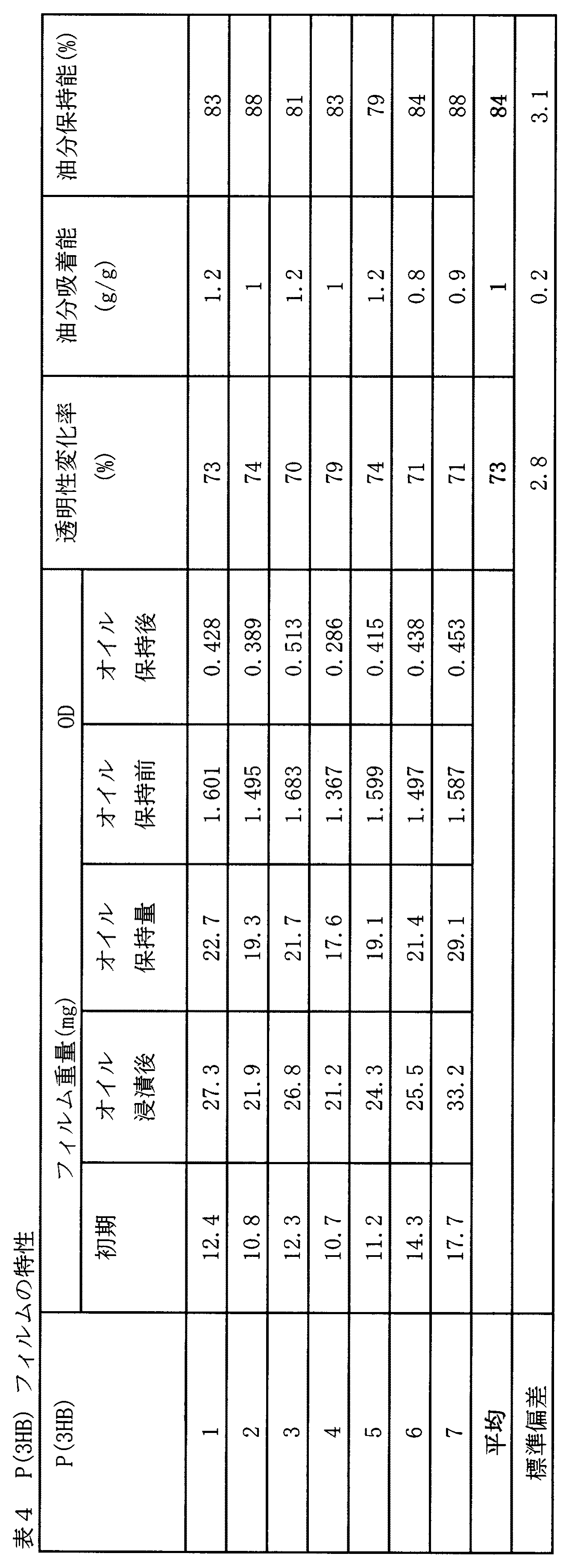
P(3HB) フィルムの測定結果を表4に示す。
Product A(比較例)の測定結果を表5に示す。
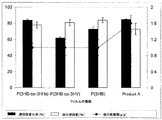
P(3HB-co-3HHx)フィルム、P(3HB-co-3HV) フィルム、P(3HB) フィルム及びProduct A(比較例)の油分吸着能、油分保持能、及び透明性変化率の比較(平均値での比較)結果を表6及び図1に示す。
P(3HB-co-3HHx)フィルム、Product A(比較例)、Product B(比較例)及びProduct C(比較例)の油分吸着能、油分保持能、及び透明性変化率の比較(平均値での比較)結果を表7及び図2に示す。
Table 2 shows the measurement results of the P (3HB-co-3HHx) film.
Table 3 shows the measurement results of the P (3HB-co-3HV) film.
Table 4 shows the measurement results of the P (3HB) film.
Table 5 shows the measurement results of Product A (comparative example).
Comparison of oil adsorption capacity, oil retention capacity, and transparency change rate of P (3HB-co-3HHx) film, P (3HB-co-3HV) film, P (3HB) film and Product A (comparative example) (average) Comparison by value) The results are shown in Table 6 and FIG.
Comparison of oil adsorption capacity, oil retention capacity, and transparency change rate of P (3HB-co-3HHx) film, Product A (comparative example), Product B (comparative example), and Product C (comparative example) The results are shown in Table 7 and FIG.
結果から、本発明の皮脂吸着用フィルムは、従来製品と同等又はそれ以上の油分吸着能、油分保持能、及び透明性変化率を有していることがわかる。 From the results, it can be seen that the sebum-adsorbing film of the present invention has oil adsorption capacity, oil retention capacity, and transparency change rate equivalent to or higher than those of conventional products.
[実施例3]フィルムの洗浄処理による性能への影響の評価
実施例1において作製したPHAフィルムをオイルにつけ、実施例2と同様の操作で1回目の実験(性能評価)を行う。その後、市販の油落とし(液体)につけ、一晩撹拌しながらフィルムから油を落とす。その後、乾燥させ、1回目と同様の実験を行う。下記表8〜11における各フィルムの番号は、7枚の別個のフィルムの番号である(1枚のフィルムにおいて7回この操作を繰り返した結果ではない。)
[Example 3] Evaluation of influence on performance by washing treatment of film The PHA film produced in Example 1 is put on oil, and a first experiment (performance evaluation) is performed in the same manner as in Example 2. Then, put it on a commercially available oil drop (liquid) and drop the oil from the film while stirring overnight. Then, it is dried and the same experiment as the first time is performed. The number of each film in the following Tables 8 to 11 is the number of seven separate films (not the result of repeating this operation seven times on one film).
P(3HB-co-3HHx)フィルムの測定結果を表8に示す。
P(3HB-co-3HV) フィルムの測定結果を表9に示す。
P(3HB) フィルムの測定結果を表10に示す。
Product A(比較例)の測定結果を表11に示す。
P(3HB-co-3HHx)フィルム、P(3HB-co-3HV) フィルム、P(3HB) フィルム及びProduct A(比較例)の油分吸着能、油分保持能、及び透明性変化率の比較(平均値での比較)結果を表12及び図3に示す。
Table 8 shows the measurement results of the P (3HB-co-3HHx) film.
Table 9 shows the measurement results of the P (3HB-co-3HV) film.
Table 10 shows the measurement results of the P (3HB) film.
Table 11 shows the measurement results of Product A (comparative example).
Comparison of oil adsorption capacity, oil retention capacity, and transparency change rate of P (3HB-co-3HHx) film, P (3HB-co-3HV) film, P (3HB) film and Product A (comparative example) (average) Comparison by value) The results are shown in Table 12 and FIG.
結果から、本発明の皮脂吸着用フィルムは、従来製品と同等又はそれ以上の油分吸着能、油分保持能、及び透明性変化率を有していることがわかる。 From the results, it can be seen that the sebum-adsorbing film of the present invention has oil adsorption capacity, oil retention capacity, and transparency change rate equivalent to or higher than those of conventional products.
[実施例5]皮脂吸着用フィルムの厚みの評価
実施例1において作製した皮脂吸着用フィルムのうち、任意の16枚を取り、厚さをMitsutoyoの厚さ計により計測した。
Product A及びProduct Cについても、任意の16枚の厚さを計測した。結果を表13及び図4に示す。
[Example 5] Evaluation of thickness of sebum-adsorbing film Of the sebum-adsorbing films prepared in Example 1, arbitrary 16 sheets were taken and the thickness was measured with a Mitsutoyo thickness meter.
For Product A and Product C, the thickness of any 16 sheets was measured. The results are shown in Table 13 and FIG.
結果から、本発明の皮脂吸着用フィルムは、厚さが薄く均一であり、油分吸着能に優れていることがわかる。 From the results, it can be seen that the sebum-adsorbing film of the present invention is thin and uniform, and is excellent in oil adsorbing ability.
本発明により、糖や植物油から微生物により合成される生分解性を有する脂肪族ポリエステル単独材料からの吸油用フィルムが得られる。例えば、皮脂吸着用フィルムの場合、従来のブレンド材料のものや植物繊維を用いた抄紙とは異なり、製造工程も容易で、非常に簡便に皮脂吸着用フィルムを作製できる点でも効果的である。 According to the present invention, an oil-absorbing film can be obtained from an aliphatic polyester single material having biodegradability synthesized by a microorganism from sugar or vegetable oil. For example, in the case of a film for sebum adsorption, unlike the conventional blended material or paper making using plant fibers, the production process is easy and it is effective in that the film for sebum adsorption can be produced very simply.
さらに、環境中に投棄されるごみになった場合においても、環境中の微生物により非常に速やかに分解されるため、環境問題に貢献できる。特に、ポリ乳酸が自然環境中では分解されないのに対し、本フィルムは自然環境中で数ヶ月以内に分解される点が、従来製品と大きく異なる。トイレに流しても問題ないなど使用後の処理も簡単である。 Furthermore, even when the waste is dumped into the environment, it is decomposed very quickly by the microorganisms in the environment, which can contribute to environmental problems. In particular, polylactic acid is not decomposed in the natural environment, whereas this film is greatly different from the conventional product in that it is decomposed within a few months in the natural environment. It is easy to handle after use because there is no problem even if it flows in the toilet.
Claims (10)
Priority Applications (3)
| Application Number | Priority Date | Filing Date | Title |
|---|---|---|---|
| JP2007063733A JP2008222876A (en) | 2007-03-13 | 2007-03-13 | Biodegradable oil-absorbing film |
| EP08250822A EP1980235A1 (en) | 2007-03-13 | 2008-03-11 | Biodegradable oil absorbing film |
| US12/047,279 US20080226580A1 (en) | 2007-03-13 | 2008-03-12 | Biodegradable oil absorbing film |
Applications Claiming Priority (1)
| Application Number | Priority Date | Filing Date | Title |
|---|---|---|---|
| JP2007063733A JP2008222876A (en) | 2007-03-13 | 2007-03-13 | Biodegradable oil-absorbing film |
Publications (1)
| Publication Number | Publication Date |
|---|---|
| JP2008222876A true JP2008222876A (en) | 2008-09-25 |
Family
ID=39619358
Family Applications (1)
| Application Number | Title | Priority Date | Filing Date |
|---|---|---|---|
| JP2007063733A Pending JP2008222876A (en) | 2007-03-13 | 2007-03-13 | Biodegradable oil-absorbing film |
Country Status (3)
| Country | Link |
|---|---|
| US (1) | US20080226580A1 (en) |
| EP (1) | EP1980235A1 (en) |
| JP (1) | JP2008222876A (en) |
Cited By (2)
| Publication number | Priority date | Publication date | Assignee | Title |
|---|---|---|---|---|
| JP2022514244A (en) * | 2018-12-20 | 2022-02-10 | ロレアル | Cosmetic composition containing polyhydroxyalkanoate in an oily medium |
| JP2023528858A (en) * | 2020-06-23 | 2023-07-06 | ロレアル | A cosmetic composition comprising a polyhydroxyalkanoate copolymer containing at least two different polymer units having (un)saturated hydrocarbon-based chains in an fatty medium |
Families Citing this family (14)
| Publication number | Priority date | Publication date | Assignee | Title |
|---|---|---|---|---|
| CN102408160B (en) * | 2011-09-30 | 2013-01-02 | 北京师范大学 | Biodegradable perforated plate for adsorption and biodegradation of petroleum hydrocarbon pollutants as well as preparation method thereof |
| US9717674B1 (en) | 2016-04-06 | 2017-08-01 | The Procter & Gamble Company | Skin cleansing compositions comprising biodegradable abrasive particles |
| CN113481294B (en) * | 2016-07-08 | 2024-03-12 | 花王株式会社 | Nucleic acid sample preparation methods |
| US10806692B2 (en) | 2016-10-03 | 2020-10-20 | The Procter & Gamble Company | Skin cleansing compositions comprising color stable abrasive particles |
| IT201700035338A1 (en) * | 2017-03-30 | 2018-09-30 | Bio On Spa | COSMETIC COMPOSITION INCLUDING A BIODEGRADABLE POLYESTER AND AN OLEOUS PHASE. |
| IT201900003981A1 (en) | 2019-03-19 | 2020-09-19 | Bio On Spa | PROCESS TO PRODUCE POROUS PARTICLES OF A POLYHYDROXIALKANOATE (PHA), POROUS PARTICLES OBTAINED FROM THIS PROCESS AND COSMETIC COMPOSITIONS THAT INCLUDE THEM. |
| JP7766301B2 (en) * | 2020-06-02 | 2025-11-10 | 三菱瓦斯化学株式会社 | Method for manufacturing polymer molded products |
| KR20230018416A (en) * | 2020-06-02 | 2023-02-07 | 미쯔비시 가스 케미칼 컴파니, 인코포레이티드 | Method for producing a polymer molding involving pretreatment by heating |
| FR3111812B1 (en) * | 2020-06-24 | 2023-02-10 | Oreal | Cosmetic composition comprising a grafted polyhydroxyalkanoate copolymer in a fatty medium |
| FR3130610B1 (en) * | 2021-12-20 | 2025-11-21 | Oreal | Composition comprising a long-chain hydrocarbon polyhydroxyalkanoate copolymer with ionic group(s), process for treating keratinous materials implementing the composition |
| FR3130611A1 (en) * | 2021-12-20 | 2023-06-23 | L'oreal | Polyhydroxyalkanoate copolymer with acetoacetate group, composition containing it and its use in cosmetics |
| FR3131202B1 (en) * | 2021-12-23 | 2024-09-13 | Oreal | Cosmetic composition comprising a polyhydroxyalkanoate copolymer with an (un)saturated hydrocarbon chain, and a natural resin |
| FR3131205B1 (en) * | 2021-12-23 | 2024-09-27 | Oreal | Cosmetic composition comprising a polyhydroxyalkanoate copolymer with an (un)saturated hydrocarbon chain, and a silicone polymer |
| FR3131211B1 (en) * | 2021-12-23 | 2024-10-04 | Oreal | Cosmetic composition comprising a polyhydroxyalkanoate copolymer with an (un)saturated hydrocarbon chain, and a clay |
Family Cites Families (9)
| Publication number | Priority date | Publication date | Assignee | Title |
|---|---|---|---|---|
| ZA95627B (en) * | 1994-01-28 | 1995-10-05 | Procter & Gamble | Biodegradable copolymers and plastic articles comprising biodegradable copolymers |
| SG49096A1 (en) * | 1994-01-28 | 1998-05-18 | Procter & Gamble | Biodegradable 3-polyhydtoxybuyrate/3- polyhydroxyhexanoate copolymer films |
| WO1999023146A1 (en) * | 1997-10-31 | 1999-05-14 | Monsanto Company | Plasticized polyhydroxyalkanoate compositions and methods for their use in the production of shaped polymeric articles |
| JP3055778B2 (en) * | 1997-12-05 | 2000-06-26 | ミネソタ マイニング アンド マニュファクチャリング カンパニー | Oil removal sheet for cosmetics |
| JP2000139755A (en) | 1998-11-12 | 2000-05-23 | Miki Tokushu Seishi Kk | Sebum-wiping paper and its manufacture |
| CN1313348A (en) * | 2000-03-15 | 2001-09-19 | 李发生 | Process for preparing biodegradable oil absorbing material |
| EP1373378A1 (en) * | 2001-03-27 | 2004-01-02 | The Procter & Gamble Company | Polyhydroxyalkanoate copolymer and polylactic acid polymer compositions for laminates and films |
| CN1405220A (en) * | 2001-08-22 | 2003-03-26 | 李发生 | Biodegradable oil-absorption material preparation |
| JP4267345B2 (en) | 2003-02-20 | 2009-05-27 | 日本バイリーン株式会社 | Oil-blowing sheet for skin |
-
2007
- 2007-03-13 JP JP2007063733A patent/JP2008222876A/en active Pending
-
2008
- 2008-03-11 EP EP08250822A patent/EP1980235A1/en not_active Withdrawn
- 2008-03-12 US US12/047,279 patent/US20080226580A1/en not_active Abandoned
Cited By (3)
| Publication number | Priority date | Publication date | Assignee | Title |
|---|---|---|---|---|
| JP2022514244A (en) * | 2018-12-20 | 2022-02-10 | ロレアル | Cosmetic composition containing polyhydroxyalkanoate in an oily medium |
| JP7259036B2 (en) | 2018-12-20 | 2023-04-17 | ロレアル | Cosmetic composition containing polyhydroxyalkanoate in oily medium |
| JP2023528858A (en) * | 2020-06-23 | 2023-07-06 | ロレアル | A cosmetic composition comprising a polyhydroxyalkanoate copolymer containing at least two different polymer units having (un)saturated hydrocarbon-based chains in an fatty medium |
Also Published As
| Publication number | Publication date |
|---|---|
| US20080226580A1 (en) | 2008-09-18 |
| EP1980235A1 (en) | 2008-10-15 |
Similar Documents
| Publication | Publication Date | Title |
|---|---|---|
| JP2008222876A (en) | Biodegradable oil-absorbing film | |
| Bugnicourt et al. | Polyhydroxyalkanoate (PHA): Review of synthesis, characteristics, processing and potential applications in packaging | |
| Eronen-Rasimus et al. | Degradation rates and bacterial community compositions vary among commonly used bioplastic materials in a brackish marine environment | |
| US5599858A (en) | Aliphatic-aromatic copolyesters and cellulose ester/polymer blends | |
| KR100233885B1 (en) | Alpha-aromatic copolyesters and cellulose ester/polymer blends | |
| Sridewi et al. | Degradation of commercially important polyhydroxyalkanoates in tropical mangrove ecosystem | |
| JP4885401B2 (en) | Copolyester and fiber material formed therefrom | |
| Zinn et al. | Tailored material properties of polyhydroxyalkanoates through biosynthesis and chemical modification | |
| Salgaonkar et al. | Biosynthesis of poly (3-hydroxybutyrate-co-3-hydroxyvalerate) by Halogeometricum borinquense strain E3 | |
| Thomas et al. | Natural polymers, biopolymers, biomaterials, and their composites, blends, and IPNs | |
| KR20160081998A (en) | Algae-blended compositions for thermoplastic articles | |
| Koller et al. | Biodegradability of polyhydroxyalkanoate (PHA) biopolyesters in nature: a review | |
| Salim et al. | Environmental degradation of microbial polyhydroxyalkanoates and oil palm-based composites | |
| WO2002028444A2 (en) | Absorbent articles comprising biodegradable polyester blend compositions | |
| Liu et al. | Hydrophilic and biodegradable PBAT copolyesters prepared from chemically recycled resources | |
| Jirage et al. | Poly-β-hydroxybutyrate: Intriguing biopolymer in biomedical applications and pharma formulation trends | |
| Ramachandran et al. | Superlative short chain length and medium chain length polyhydroxyalkanoates microbial producers isolated from Malaysian environment | |
| Getachew et al. | Production of sterilized medium chain length polyhydroxyalkanoates (Smcl-PHA) as a biofilm to tissue engineering application | |
| EP1897901A1 (en) | Biodegradable polymer, production method thereof, molded product thereof, and use thereof | |
| Koller et al. | Sustainable embedding of the bioplastic poly-(3-hydroxybutyrate) into the sugarcane industry: principles of a future-oriented technology in Brazil | |
| Zhao et al. | Biobased Polybutyrolactam Nanofiber with Excellent Biodegradability and Cell Growth for Sustainable Healthcare Textiles | |
| Faizal | Innovative Polyhydroxyalkanoates/Perovskite/Surfactant Composite Film as an Eco-Friendly Proton Exchange Membrane for Water Filtration | |
| Cedillo-Portillo et al. | Use of renewable source in biodegradable polymer | |
| Liao | Biodegradable poly (hydroxyalkanoates): melt, solid, and foam | |
| JP7121944B2 (en) | Nanofiber and its manufacturing method |