KR20230018416A - Method for producing a polymer molding involving pretreatment by heating - Google Patents
Method for producing a polymer molding involving pretreatment by heating Download PDFInfo
- Publication number
- KR20230018416A KR20230018416A KR1020227045045A KR20227045045A KR20230018416A KR 20230018416 A KR20230018416 A KR 20230018416A KR 1020227045045 A KR1020227045045 A KR 1020227045045A KR 20227045045 A KR20227045045 A KR 20227045045A KR 20230018416 A KR20230018416 A KR 20230018416A
- Authority
- KR
- South Korea
- Prior art keywords
- temperature
- melting
- sample
- heat treatment
- mol
- Prior art date
- Legal status (The legal status is an assumption and is not a legal conclusion. Google has not performed a legal analysis and makes no representation as to the accuracy of the status listed.)
- Pending
Links
Images




Classifications
-
- B—PERFORMING OPERATIONS; TRANSPORTING
- B29—WORKING OF PLASTICS; WORKING OF SUBSTANCES IN A PLASTIC STATE IN GENERAL
- B29C—SHAPING OR JOINING OF PLASTICS; SHAPING OF MATERIAL IN A PLASTIC STATE, NOT OTHERWISE PROVIDED FOR; AFTER-TREATMENT OF THE SHAPED PRODUCTS, e.g. REPAIRING
- B29C48/00—Extrusion moulding, i.e. expressing the moulding material through a die or nozzle which imparts the desired form; Apparatus therefor
- B29C48/25—Component parts, details or accessories; Auxiliary operations
- B29C48/78—Thermal treatment of the extrusion moulding material or of preformed parts or layers, e.g. by heating or cooling
-
- B—PERFORMING OPERATIONS; TRANSPORTING
- B29—WORKING OF PLASTICS; WORKING OF SUBSTANCES IN A PLASTIC STATE IN GENERAL
- B29C—SHAPING OR JOINING OF PLASTICS; SHAPING OF MATERIAL IN A PLASTIC STATE, NOT OTHERWISE PROVIDED FOR; AFTER-TREATMENT OF THE SHAPED PRODUCTS, e.g. REPAIRING
- B29C48/00—Extrusion moulding, i.e. expressing the moulding material through a die or nozzle which imparts the desired form; Apparatus therefor
- B29C48/022—Extrusion moulding, i.e. expressing the moulding material through a die or nozzle which imparts the desired form; Apparatus therefor characterised by the choice of material
-
- B—PERFORMING OPERATIONS; TRANSPORTING
- B29—WORKING OF PLASTICS; WORKING OF SUBSTANCES IN A PLASTIC STATE IN GENERAL
- B29C—SHAPING OR JOINING OF PLASTICS; SHAPING OF MATERIAL IN A PLASTIC STATE, NOT OTHERWISE PROVIDED FOR; AFTER-TREATMENT OF THE SHAPED PRODUCTS, e.g. REPAIRING
- B29C48/00—Extrusion moulding, i.e. expressing the moulding material through a die or nozzle which imparts the desired form; Apparatus therefor
- B29C48/25—Component parts, details or accessories; Auxiliary operations
- B29C48/92—Measuring, controlling or regulating
-
- D—TEXTILES; PAPER
- D01—NATURAL OR MAN-MADE THREADS OR FIBRES; SPINNING
- D01F—CHEMICAL FEATURES IN THE MANUFACTURE OF ARTIFICIAL FILAMENTS, THREADS, FIBRES, BRISTLES OR RIBBONS; APPARATUS SPECIALLY ADAPTED FOR THE MANUFACTURE OF CARBON FILAMENTS
- D01F6/00—Monocomponent artificial filaments or the like of synthetic polymers; Manufacture thereof
- D01F6/58—Monocomponent artificial filaments or the like of synthetic polymers; Manufacture thereof from homopolycondensation products
- D01F6/62—Monocomponent artificial filaments or the like of synthetic polymers; Manufacture thereof from homopolycondensation products from polyesters
- D01F6/625—Monocomponent artificial filaments or the like of synthetic polymers; Manufacture thereof from homopolycondensation products from polyesters derived from hydroxy-carboxylic acids, e.g. lactones
-
- D—TEXTILES; PAPER
- D01—NATURAL OR MAN-MADE THREADS OR FIBRES; SPINNING
- D01F—CHEMICAL FEATURES IN THE MANUFACTURE OF ARTIFICIAL FILAMENTS, THREADS, FIBRES, BRISTLES OR RIBBONS; APPARATUS SPECIALLY ADAPTED FOR THE MANUFACTURE OF CARBON FILAMENTS
- D01F6/00—Monocomponent artificial filaments or the like of synthetic polymers; Manufacture thereof
- D01F6/78—Monocomponent artificial filaments or the like of synthetic polymers; Manufacture thereof from copolycondensation products
- D01F6/84—Monocomponent artificial filaments or the like of synthetic polymers; Manufacture thereof from copolycondensation products from copolyesters
-
- B—PERFORMING OPERATIONS; TRANSPORTING
- B29—WORKING OF PLASTICS; WORKING OF SUBSTANCES IN A PLASTIC STATE IN GENERAL
- B29K—INDEXING SCHEME ASSOCIATED WITH SUBCLASSES B29B, B29C OR B29D, RELATING TO MOULDING MATERIALS OR TO MATERIALS FOR MOULDS, REINFORCEMENTS, FILLERS OR PREFORMED PARTS, e.g. INSERTS
- B29K2067/00—Use of polyesters or derivatives thereof, as moulding material
- B29K2067/04—Polyesters derived from hydroxycarboxylic acids
-
- B—PERFORMING OPERATIONS; TRANSPORTING
- B29—WORKING OF PLASTICS; WORKING OF SUBSTANCES IN A PLASTIC STATE IN GENERAL
- B29K—INDEXING SCHEME ASSOCIATED WITH SUBCLASSES B29B, B29C OR B29D, RELATING TO MOULDING MATERIALS OR TO MATERIALS FOR MOULDS, REINFORCEMENTS, FILLERS OR PREFORMED PARTS, e.g. INSERTS
- B29K2995/00—Properties of moulding materials, reinforcements, fillers, preformed parts or moulds
- B29K2995/0037—Other properties
- B29K2995/0059—Degradable
- B29K2995/006—Bio-degradable, e.g. bioabsorbable, bioresorbable or bioerodible
Landscapes
- Engineering & Computer Science (AREA)
- Mechanical Engineering (AREA)
- Chemical & Material Sciences (AREA)
- Chemical Kinetics & Catalysis (AREA)
- General Chemical & Material Sciences (AREA)
- Textile Engineering (AREA)
- Physics & Mathematics (AREA)
- Thermal Sciences (AREA)
- Polyesters Or Polycarbonates (AREA)
- Compositions Of Macromolecular Compounds (AREA)
- Biological Depolymerization Polymers (AREA)
Abstract
본 발명의 과제는, 부분용융을 위해 사용할 수 있는 온도역을 넓힐 수 있는 고분자 성형물의 제조방법을 제공하는 것이다. 본 발명에 따르면, 결정성 폴리하이드록시알카노에이트를 유리전이점 이상의 온도에서 가열처리하는 것; 및 상기 가열처리에서 얻어지는 상이한 라멜라두께를 갖는 라멜라결정을 포함하는 폴리하이드록시알카노에이트를, 일부의 라멜라결정은 용융하여 유동화하고, 그 외 잔부의 라멜라결정은 용융하지 않고 잔존하고 있는 온도범위에 있어서, 용융성형하는 것을 포함하는, 고분자 성형물의 제조방법이 제공된다.An object of the present invention is to provide a method for producing a polymer molding that can widen the temperature range that can be used for partial melting. According to the present invention, heat treatment of crystalline polyhydroxyalkanoate at a temperature above the glass transition point; and in the polyhydroxyalkanoate containing lamellar crystals having different lamellar thicknesses obtained in the heat treatment, some of the lamellar crystals are melted and fluidized, and the rest of the lamellar crystals remain without melting within a temperature range. In this, there is provided a method for producing a polymer molded article, including melt molding.
Description
본 발명은, 결정성 폴리하이드록시알카노에이트의 라멜라결정의 두께를 재구성함으로써, 그 후의 부분용융에 의한 열성형에 사용할 수 있는 온도역을 넓힌 것을 특징으로 하는, 고분자 성형물의 제조방법에 관한 것이다.The present invention relates to a method for producing a polymer molded product characterized by widening the temperature range that can be used for subsequent thermoforming by partial melting by reconstructing the thickness of lamellar crystals of crystalline polyhydroxyalkanoate. .
폴리하이드록시알카노에이트(Polyhydroxyalkanoate, 폴리하이드록시알칸산, 이후 PHA라고도 약칭한다)는, 미생물이 축적되는 열가소성의 폴리에스테르이며, 생분해성·생체적합성·생체흡수성의 플라스틱으로서 주목받아, 많은 연구가 이루어져 왔다(비특허문헌 1). PHA를 구성하는 모노머유닛은 100종류 이상 알려져 있다. 대표적인 PHA는, (R)-3-하이드록시부티레이트((R)-3-하이드록시부티르산이라고도 한다. 이하, 3HB라고 약칭한다)로 이루어지는 폴리-3-하이드록시부티레이트(이하, P(3HB)라고 약칭한다)이다(비특허문헌 1).Polyhydroxyalkanoate (polyhydroxyalkanoic acid, hereinafter also abbreviated as PHA) is a thermoplastic polyester in which microorganisms accumulate. This has been done (Non-Patent Document 1). More than 100 types of monomer units constituting PHA are known. Representative PHA is poly-3-hydroxybutyrate (hereinafter referred to as P(3HB)) composed of (R)-3-hydroxybutyrate (also referred to as (R)-3-hydroxybutyric acid. Hereinafter abbreviated as 3HB). abbreviation) (Non-Patent Document 1).
P(3HB)의 융점은 175~180℃ 정도이며, 폴리프로필렌(이하, PP라고 약칭한다)과 동일한 정도의 높은 융점을 갖는다. P(3HB)의 파괴강도는, PP와 동일한 정도인데, 파괴연신이 5% 이하이고, 유리전이점이 4℃(실온 이하)이다.The melting point of P(3HB) is about 175 to 180°C, and it has a melting point as high as that of polypropylene (hereinafter abbreviated as PP). The breaking strength of P(3HB) is about the same as that of PP, but the breaking elongation is 5% or less, and the glass transition point is 4°C (room temperature or less).
P(3HB)는, 결정성이 높고, 딱딱하여 깨지기 쉬운 재료인 점에서, 단체의 필름 등 성형체로는 사용되지 않는 경우가 많다. 공업적으로 PHA를 이용하고자 하는 경우, 그 물성(결정성, 기계적 물성 등)을 향상시키는 방법으로는, 제2성분 모노머유닛을 도입하여 공중합체화하는 방법, 분자량을 증대시키는 방법, 및 이종(異種) 고분자재료와 복합화하는 방법 등이 알려져 있다.Since P(3HB) is a highly crystalline, hard, and brittle material, it is often not used as a molded article such as a single film. In the case of industrial use of PHA, as a method of improving its physical properties (crystallinity, mechanical properties, etc.), a method of copolymerization by introducing a second component monomer unit, a method of increasing molecular weight, and a heterogeneous ) and a method of compounding with a polymer material, etc. are known.
한편, PHA의 결정화속도는 전통적인 공업용 폴리머보다 현저하게 느리고, 유리전이점은 실온 이하이다. PHA를 가열용융상태를 거쳐 성형(成型)하는 경우에는, 고화를 위한 냉각시간이 오래 걸려 생산성이 나쁘다는 문제, 용융방사에 있어서는 결정화가 느리기 때문에 아몰퍼스상태에서 권취되어, 실이 교착된다는 문제, 교착을 피하기 위해서는 겹치지 않도록 권취할 필요가 있다는 문제, 권취한 후에 고화(결정화)를 위해 긴 냉각시간이 걸린다는 문제 등, 성형가공상의 몇 가지 문제가 있다. 또한, 느린 결정화속도는 구정(球晶)의 큰 성장으로 이어져, 성형물의 물성의 저하나 경년열화에도 영향을 미친다. 공중합체화는, 추가적인 낮은 핵형성밀도, 요컨대 결정화속도의 감소를 일으키는 경우가 있어, 공중합체화시켜도 상기 성형가공의 문제는 여전히 남아 있다. 나아가, 고분자량으로 하면 용융점도가 지나치게 높아진다는 다른 문제도 있다.On the other hand, the crystallization rate of PHA is significantly slower than that of traditional industrial polymers, and its glass transition point is below room temperature. In the case of forming PHA through heating and molten state, it takes a long cooling time for solidification, resulting in poor productivity. In melt spinning, since crystallization is slow, it is wound in an amorphous state and the yarn is agglutinated. In order to avoid this, there are several problems in molding processing, such as the need to wind without overlapping and the long cooling time required for solidification (crystallization) after winding. In addition, a slow crystallization rate leads to large growth of spherulites, which also affects deterioration of physical properties and aging of moldings. Copolymerization sometimes causes a further low nucleation density, that is, a decrease in the crystallization rate, and even with copolymerization, the problem of the molding process still remains. Furthermore, there is another problem that the melt viscosity becomes too high when the molecular weight is high.
폴리에스테르 등의 열가소성 고분자재료의 용융성형에 있어서는, 결정화속도를 개선할 목적으로 다양한 결정핵제가 검토되고 있다.In melt molding of thermoplastic polymer materials such as polyester, various crystal nucleating agents are being investigated for the purpose of improving the crystallization rate.
공지의 결정핵제로는, 예를 들어 특정 폴리에스테르에 대하여,As a known crystal nucleating agent, for example, for specific polyesters,
Zn분말, Al분말, 그라파이트, 카본블랙 등의 무기물 단체;inorganic substances such as Zn powder, Al powder, graphite, and carbon black;
ZnO, MgO, A12O3, TiO2, MnO2, SiO2, Fe3O4 등의 금속산화물;metal oxides such as ZnO, MgO, A12O3, TiO2, MnO2, SiO2, and Fe3O4;
질화알루미늄, 질화규소, 질화티탄, 질화붕소 등의 질화물;nitrides such as aluminum nitride, silicon nitride, titanium nitride, and boron nitride;
Na2CO3, CaCO3, MgCo3, CaSO4, CaSiO3, BaSO4, Ca3(PO4)3 등의 무기염;inorganic salts such as Na2CO3, CaCO3, MgCo3, CaSO4, CaSiO3, BaSO4, and Ca3(PO4)3;
탈크, 카올린, 클레이, 백토 등의 점토류;clays such as talc, kaolin, clay, and white clay;
옥살산칼슘, 옥살산나트륨, 안식향산칼슘, 프탈산칼슘, 주석산칼슘, 스테아르산마그네슘, 폴리아크릴산염 등의 유기염류;organic salts such as calcium oxalate, sodium oxalate, calcium benzoate, calcium phthalate, calcium tartrate, magnesium stearate, and polyacrylates;
폴리에스테르, 폴리에틸렌, 폴리프로필렌 등의 고분자 화합물:High molecular compounds such as polyester, polyethylene, and polypropylene:
등을 첨가하는 것이 알려져 있다(특허문헌 1).It is known to add the like (Patent Document 1).
또한, PHA의 결정핵제로서, 탈크, 미립화운모, 질화붕소, 탄산칼슘과 같은 입상물이 시도되고 있다. 보다 효과적인 것으로는, 시클로헥실포스폰산 등의 유기포스폰산 혹은 유기포스핀산 또는 그들의 에스테르, 혹은 그들의 산 혹은 에스테르의 유도체, 및 주기율표의 제IA~VA족 또는 제IB~VB족의 금속의 산화물, 수산화물 및 포화 또는 불포화카르폰산염 등의 금속 화합물을 함께 긴밀하게 혼합하는 방법이 알려져 있다(특허문헌 2).Also, as a crystal nucleating agent for PHA, granular materials such as talc, micronized mica, boron nitride, and calcium carbonate have been tried. More effective ones are organic phosphonic acids such as cyclohexylphosphonic acid or organic phosphinic acids or their esters, or derivatives of those acids or esters, and oxides and hydroxides of metals in Groups IA to VA or Groups IB to VB of the periodic table. and a method of intimately mixing together a metal compound such as a saturated or unsaturated carboxylic acid salt is known (Patent Document 2).
나아가서는 PHA에 대한 핵제로는,Furthermore, as a nucleating agent for PHA,
소르비톨 및 안식향산나트륨(특허문헌 3);sorbitol and sodium benzoate (Patent Document 3);
에리스리톨, D-아라비톨, 리비톨, 자일리톨, 갈락티톨, D-만니톨, L-만니톨, D-소르비톨, myo-이노시톨, scyllo-이노시톨과 같은 당알코올(특허문헌 4);sugar alcohols such as erythritol, D-arabitol, ribitol, xylitol, galactitol, D-mannitol, L-mannitol, D-sorbitol, myo-inositol, and scyllo-inositol (Patent Document 4);
폴리비닐알코올, 키틴, 키토산(특허문헌 5);polyvinyl alcohol, chitin, and chitosan (Patent Document 5);
폴리에틸렌옥사이드, 폴리프로필렌옥사이드, 폴리부틸렌옥사이드 등의 폴리알킬렌옥사이드(특허문헌 6);polyalkylene oxides such as polyethylene oxide, polypropylene oxide, and polybutylene oxide (Patent Document 6);
폴리유산이나 PHA 등의 지방족 폴리에스테르에 지방족 카르본산아미드, 지방족 카르본산염, 지방족 알코올 및 지방족 카르본산에스테르(특허문헌 7~9);aliphatic carboxylic acid amides, aliphatic carboxylic acid salts, aliphatic alcohols, and aliphatic carboxylic acid esters in aliphatic polyesters such as polylactic acid and PHA (Patent Documents 7 to 9);
디메틸아디페이트, 디-2-에틸헥실아디페이트, 디이소부틸아디페이트, 디부틸아디페이트, 디이소데실아디페이트, 디부틸디글리콜아디페이트, 디부틸세바케이트, 디-2-에틸헥실세바케이트와 같은 지방산에스테르류(특허문헌 10);Dimethyl adipate, di-2-ethylhexyl adipate, diisobutyl adipate, dibutyl adipate, diisodecyl adipate, dibutyldiglycol adipate, dibutyl sebacate, di-2-ethylhexyl seba fatty acid esters such as Kate (Patent Document 10);
인디고, 퀴나크리돈, 퀴나크리돈마젠타와 같은 C=O와 NH, S 및 O로부터 선택되는 관능기를 분자 내에 갖는 환상 화합물(특허문헌 11);cyclic compounds having C=O and a functional group selected from NH, S, and O in a molecule such as indigo, quinacridone, and quinacridone magenta (Patent Document 11);
분자 내에 C=O와 NH기를 갖는 환상 화합물인 케토피롤류(특허문헌 12);ketopyrroles which are cyclic compounds having C=O and NH groups in the molecule (Patent Document 12);
비스벤질리덴소르비톨이나 비스(p-메틸벤질리덴)소르비톨과 같은 소르비톨계 유도체(특허문헌 13);sorbitol derivatives such as bisbenzylidenesorbitol and bis(p-methylbenzylidene)sorbitol (Patent Document 13);
피리딘, 피리미딘, 피라진, 피리다진, 트리아진, 이미다졸과 같은 질소함유 헤테로방향족핵을 포함하는 화합물(특허문헌 14);compounds containing nitrogen-containing heteroaromatic nuclei such as pyridine, pyrimidine, pyrazine, pyridazine, triazine, and imidazole (Patent Document 14);
인산에스테르 화합물(특허문헌 15);phosphoric acid ester compound (Patent Document 15);
고급지방산의 비스아미드 및 고급지방산의 금속염(특허문헌 16);bisamides of higher fatty acids and metal salts of higher fatty acids (Patent Document 16);
지방산이나 지방산아미드(특허문헌 17);fatty acids and fatty acid amides (Patent Document 17);
분지상 폴리유산(특허문헌 18);branched polylactic acid (Patent Document 18);
펜타에리스리톨(특허문헌 19);Pentaerythritol (Patent Document 19);
펜타에리스리톨과 무기충전제나 유기충전제(특허문헌 20);pentaerythritol and an inorganic filler or an organic filler (Patent Document 20);
소르비톨아세탈, 아미드결합을 갖는 화합물과 펜타에리스리톨(특허문헌 21)Sorbitol acetal, a compound having an amide bond and pentaerythritol (Patent Document 21)
트립토판, 페닐알라닌, p-클로로-페닐알라닌, m-티로신, 페닐글리신, p-하이드록시페닐글리신, 메티오닌, o-티로신 및 발린 등 아미노산류나 포스파티딜콜린(특허문헌 22~특허문헌 24);Amino acids or phosphatidylcholines such as tryptophan, phenylalanine, p-chloro-phenylalanine, m-tyrosine, phenylglycine, p-hydroxyphenylglycine, methionine, o-tyrosine and valine (Patent Documents 22 to 24);
아스파탐 등 디펩티드류(특허문헌 25); 및dipeptides such as aspartame (Patent Document 25); and
우라실, 티민 등의 핵산염기류(특허문헌 26)Nucleic acid bases such as uracil and thymine (Patent Document 26)
가 알려져 있다.is known
이들은, PHA나 폴리유산 등, 지방족 폴리에스테르의 느린 결정화속도를 촉진하고, 성형가공시의 가공성의 개선을 도모하기 위해 채용된 수단인데, 강도의 저하를 일으키거나, 성형체 표면외관이 악화되는 등 효과가 불충분하거나, 추가로 다른 첨가물을 첨가해야 하는 것 등의 문제는 여전히 남아 있다. 또한, 핵제의 종류에 따라서는 성형 후에 결정화가 진행됨에 따라, 상용성이나 분자량의 차이로부터 결정의 밖으로 압출되어 블룸이나 블리드를 일으키는 경우도 있으며, 그러한 경우에는 분산제, 응집방지제, 상용화제 등 추가로 첨가물이 필요하게 되는 경우도 있다. 생체 내에서 사용되는 것을 상정하여, 생체 내에서 분해흡수 혹은 대사되기 쉬운, 즉 독성이 없는 지방산류나 아미노산류로 이루어지는 핵제도 상기에는 포함되어 있으나, 실질적으로 효과가 높은 결정핵제는 아직 발견되지 않은 것이 현상이다.These are means adopted to promote the slow crystallization rate of aliphatic polyesters such as PHA and polylactic acid and to improve processability during molding, but have effects such as causing a decrease in strength or deteriorating the surface appearance of molded products. Problems such as insufficient or the need to additionally add other additives still remain. In addition, depending on the type of nucleating agent, as crystallization proceeds after molding, it may be extruded out of the crystal due to differences in compatibility or molecular weight, causing bloom or bleed. In some cases, additives may be required. Assuming to be used in vivo, nucleating agents composed of fatty acids and amino acids that are easily decomposed, absorbed or metabolized in vivo, that is, non-toxic, are also included in the above, but a crystal nucleating agent with a substantially high effect has not yet been discovered. It is a phenomenon.
또한, PHA의 결정화 특성을 개선하기 위해, 다른 PHA나 생분해성 폴리머를 블렌드하는 시도도 이루어지고 있다. 특허문헌 27~29에는, 3HB와 3-하이드록시발레레이트(3-하이드록시발레르산, 이하, 3HV라고 약칭한다)로 이루어지는 P(3HB-co-3HV) 공중합체, 3HB와 3-하이드록시헥사노에이트(3-하이드록시헥산산, 이하, 3HHx라고 약칭한다)로 이루어지는 P(3HB-co-3HHx) 공중합체, 또는 3HB와 3-하이드록시옥타노에이트(3-하이드록시옥탄산, 이하, 3HO라고 약칭한다)로 이루어지는 P(3HB-co-3HO) 공중합체에, 보다 융점이 높은 P(3HB)를 결정핵제(성핵재)로서 첨가하는 것이 개시되어 있다.In addition, in order to improve the crystallization properties of PHA, attempts have been made to blend other PHAs or biodegradable polymers. In Patent Documents 27 to 29, a P(3HB-co-3HV) copolymer composed of 3HB and 3-hydroxyvalerate (3-hydroxyvaleric acid, hereinafter abbreviated as 3HV), 3HB and 3-hydroxyhexa P(3HB-co-3HHx) copolymer consisting of noate (3-hydroxyhexanoic acid, hereinafter abbreviated as 3HHx), or 3HB and 3-hydroxyoctanoate (3-hydroxyoctanoic acid, hereinafter, It is disclosed that P(3HB) having a higher melting point is added as a crystal nucleating agent (nucleating material) to a P(3HB-co-3HO) copolymer composed of (abbreviated as 3HO).
특허문헌 27~29에 있어서는,In Patent Documents 27 to 29,
블렌드한 건조분말PHA를 그대로, 혹은 드라이아이스의 존재하에서 믹싱하는 건식 혼합;dry mixing in which the blended dry powder PHA is mixed as it is or in the presence of dry ice;
클로로포름 등의 용매로 일부 또는 전부를 용해시키면서 교반혼합한 후에 용매를 증발시켜 폴리머를 석출시키거나, 빈용매 중에서 석출시키거나 하는 용액혼합; 그리고solution mixing in which a polymer is precipitated by evaporating the solvent or precipitated in a poor solvent after stirring and mixing part or all of which is dissolved in a solvent such as chloroform; and
첨가하는 고융점측의 P(3HB)를 용융시키지 않는 온도이며, 첨가되는 저융점측의 PHA(실시예에 있어서 P(3HB-co-3HV), P(3HB-co-3HHx) 혹은 P(3HB-co-3HO))가 용융상태가 되는 온도에서 충분히 교반혼합하는, 이른바 부분용융혼합;It is a temperature at which the added high melting point P(3HB) does not melt, and the added low melting point PHA (P(3HB-co-3HV), P(3HB-co-3HHx) or P(3HB in the examples) -co-3HO)) is sufficiently stirred and mixed at a temperature at which it is in a molten state, so-called partial melt mixing;
등의 혼합방법이 기재되어 있는데, 혼합시키는 고융점측의 소량의 P(3HB)가 저융점측의 PHA 공중합체에 대하여 미세하고 균일하게 분산될 필요성을 언급하고 있다.and the like are described, mentioning the need for a small amount of P(3HB) on the high melting point side to be mixed finely and uniformly dispersed with respect to the PHA copolymer on the low melting point side.
상기한 혼합법에 있어서, 각각 불리한 점이 있다. 건식 혼합에서는 폴리머분말을 혼합하였다고 해도 분말입자경 이하에서의 균일혼합에는 한계가 있다. 용액혼합에서는 클로로포름 등의 양용매가 대량으로 필요하게 되고, 재침전회수하는 경우에는 빈용매가 양용매의 5~10배량으로 더욱 대량으로 필요하게 되는 것이나, 재침전시에 용해도의 차이로 인해 석출되는 폴리머종에 편재가 발생할 가능성이 있다. 블렌드물의 부분용융상태여도, 첨가된 결정성이 높고 융점도 높은 P(3HB)는, P(3HB)입자가 거의 그대로의 크기로 용융하지 않고 혼합될 수 있기 때문에, 미소의 균일한 미결정핵이 되기에는 적합하지 않다. 블렌드물을 균일하게 혼합하기 위해 P(3HB)의 융점 이상으로 온도를 높여 혼합하는 방법은 일반적인 용융혼합이 되는데, P(3HB)의 융점 부근에서는 P(3HB)를 비롯한 PHA류는 열분해나 교반에 따른 열화, 분자량 저하를 피할 수 없다.In the above mixing methods, each has disadvantages. In dry mixing, even if the polymer powder is mixed, there is a limit to uniform mixing below the powder particle size. In solution mixing, a large amount of a good solvent such as chloroform is required, and in the case of reprecipitation recovery, a poor solvent is required in an amount of 5 to 10 times the amount of a good solvent, and polymers precipitated due to differences in solubility during reprecipitation Species ubiquity is likely to occur. Even in the partially melted state of the blend, the added P(3HB) with high crystallinity and high melting point can be mixed with the P(3HB) particles in almost the same size without melting, so that they become uniform microcrystalline nuclei. is not suitable The method of mixing by raising the temperature above the melting point of P(3HB) to uniformly mix the blend is a general melt-mixing. In the vicinity of the melting point of P(3HB), PHA including P(3HB) is resistant to thermal decomposition or agitation. Deterioration and molecular weight reduction are unavoidable.
일단 균체로부터 취출된 P(3HB)와 PHA 공중합체의 블렌드에 의해 결정화 촉진을 목표로 하는 방법이 아닌, 결정핵이 될 수 있는 P(3HB)나 3HB 리치의 PHA를 다른 PHA 공중합체와 함께 배양 중에 균체 중에서 블렌드체로서 생산하고, 균체로부터 PHA를 취출한 후에 P(3HB)와 PHA를 블렌드하지 않아도 되는 방법도 보고되어 있다. 특허문헌 30에는, 배양 도중에 탄소원의 공급을 변화시킴으로써 P(3HB) 혹은 3HHx 비율이 낮은 P(3HB-co-3HHx)를 3HHx 비율이 증가한 P(3HB-co-3HHx)와 함께 생산시키는 방법이 기재되어 있다. 특허문헌 31 및 특허문헌 32에는, 유전자 재조합 기술에 의해 동일 균체 내에 기질특이성이 상이한 PHA 중합효소를 복수종 유지시킴으로써 융점이 상이한 PHA의 블렌드체를 동일 세포 내에서 제조하는 방법이 개시되어 있다. 170℃ 이하의 온도에서 성형가공하는 것도 가능하다는 기재도 있으나, 어떠한 온도범위에서 성형가공할 수 있는 것인지 불분명하고, 공지의 성형가공에 있어서는 고분자의 융점 이상으로 용융 후 성형하는 것이 일반적이며, 해당 문헌에 있어서도 한 번 용융한 PHA 블렌드체의 고화속도(결정화속도)를 향상시키는 것을 목적으로 하고 있다.It is not a method aimed at promoting crystallization by blending P(3HB) and PHA copolymers once extracted from cells, but culturing P(3HB) or 3HB-rich PHA that can become crystal nuclei with other PHA copolymers. There has also been reported a method in which P(3HB) and PHA do not need to be blended after being produced as a blended body from the cells and extracting the PHA from the cells. Patent Document 30 describes a method of producing P(3HB) or P(3HB-co-3HHx) having a low 3HHx ratio together with P(3HB-co-3HHx) having an increased 3HHx ratio by changing the supply of a carbon source during cultivation. has been Patent Literature 31 and Patent Literature 32 disclose a method for producing a blend of PHA having different melting points within the same cell by maintaining a plurality of PHA polymerases having different substrate specificities in the same cell by genetic recombination technology. There is also a description that molding can be performed at a temperature of 170 ° C or less, but it is unclear what temperature range can be molded, and in known molding, it is common to mold after melting above the melting point of the polymer. It is also aimed at improving the solidification rate (crystallization rate) of the PHA blend once melted.
비특허문헌 2~4는, P(3HB)가 결정핵이 될 수 있는 것을 목표한 것은 아닌데, P(3HB)와 PHA 공중합체를 동일균 내에서 블렌드 생산하는 PHA 생산 야생주에 대한 기재가 있고, 기질특이성이 상이한 PHA 중합효소를 동일 균체 내에 자연스럽게 유지함으로써, P(3HB) 호모폴리머와 C4~C12의 PHA 공중합체의 블렌드 생산이 기재되어 있다.
한편, 초고분자량체 P(3HB)를 이용한 보고나, 분자량에 의존하지 않고 결정형성을 제어하여 고강도화를 도모하는 보고도 있다. 예를 들어, 유전자 재조합 대장균을 이용하여 수평균분자량 150만(중량평균분자량 300만) 이상의 초고분자량 P(3HB)를 생합성하고, 이 초고분자량 P(3HB)를 이용하여, 물성이 개선된 P(3HB) 필름이 얻어지고 있다(특허문헌 33 및 비특허문헌 5).On the other hand, there are also reports using ultra-high molecular weight material P(3HB) and reports of achieving high strength by controlling crystal formation regardless of molecular weight. For example, by using recombinant Escherichia coli, ultra-high molecular weight P (3HB) having a number average molecular weight of 1.5 million (weight average molecular weight of 3 million) or more is biosynthesized, and P (3HB) having improved physical properties is used. 3HB) A film is obtained (Patent Document 33 and Non-Patent Document 5).
또한, 분자량에 의존하지 않는 P(3HB)의 섬유화의 방법으로서, P(3HB)를 용융압출하고, 유리전이점온도+15℃ 이하로 급랭, 고화시켜 비정질의 섬유를 제작하고, 비정질의 섬유를 냉연신하여 비정질의 섬유의 분자쇄를 배향시켜 열처리함으로써, P(3HB) 섬유가 얻어지고 있다(이하, 「냉연신법」이라고도 기재한다)(특허문헌 34 및 특허문헌 35). 나아가, 이 용융압출섬유를 PHA의 유리전이온도+15℃ 이하로 급랭, 고화시켜 비정질의 섬유를 제작하고, 이 비정질의 섬유를 유리전이온도+15℃ 이하에 방치하여 미결정핵을 형성(등온결정화)한 결정화섬유를 제작하고, 이 결정화섬유를 연신하고, 추가로 긴장열처리를 하는 것을 특징으로 하는 섬유의 제조방법(이하, 「미결정핵 연신법」이라고도 기재한다)도 개시되어 있다(특허문헌 36).In addition, as a method of fiberization of P (3HB) that does not depend on molecular weight, P (3HB) is melt-extruded, rapidly cooled and solidified to a glass transition point temperature of +15 ° C or less to produce amorphous fibers, and amorphous fibers P(3HB) fibers are obtained by cold stretching to orient molecular chains of amorphous fibers and heat treatment (hereinafter also referred to as “cold drawing method”) (Patent Document 34 and Patent Document 35). Furthermore, this melt-extruded fiber is rapidly cooled and solidified to the glass transition temperature of PHA + 15 ° C or less to produce an amorphous fiber, and the amorphous fiber is left at the glass transition temperature + 15 ° C or less to form microcrystalline nuclei (isothermal crystallization). ), a method for producing a fiber (hereinafter also referred to as "microcrystal nucleus drawing method") is also disclosed, characterized by producing a crystallized fiber, drawing the crystallized fiber, and further subjecting the crystallized fiber to strain heat treatment (Patent Document 36). ).
그러나 초고분자량 P(3HB)의 제조효율은 나빠 비용이 늘어나는 것, 냉연신법은 비정질의 섬유를 얻기 위해 유리전이온도 부근의 저온으로 급랭할 필요가 있는 것, 미결정핵 연신법은 일단 용융한 P(3HB)의 미결정을 생성시키기 위해, 유리전이온도 부근의 저온으로 급랭하고, 나아가 저온에서 장시간 유지할 필요가 있는 것 등으로부터, 상기 방법은, 공업적으로 불리하다.However, the production efficiency of ultra-high molecular weight P(3HB) is poor and the cost increases, the cold drawing method requires rapid cooling to a low temperature around the glass transition temperature to obtain an amorphous fiber, and the microcrystal nucleus drawing method once melts P( 3HB) is industrially disadvantageous because it is necessary to rapidly cool to a low temperature around the glass transition temperature and to maintain the temperature at a low temperature for a long time in order to generate microcrystals of 3HB).
유전자 재조합 대장균으로 만들어진 중량평균분자량이 270만인 초고분자량 P(3HB)를 통상의 미생물 유래에서 중량평균분자량이 52만인 P(3HB)에 첨가하고, 클로로포름에 용해 후 캐스트필름을 성형하고, 200℃에서 핫프레스 후에 빙수로 ??치 후, 냉연신을 실시한 초고분자량체 미량첨가 P(3HB) 필름에서의 200℃ 재가열 후의 결정성장관찰에서는, 초고분자량체 P(3HB)는 핵제와 같이 거동하여, 핵형성을 촉진하는 것이 시사되어 있다(비특허문헌 6). 중량평균분자량 347만의 초고분자량 P(3HB)를 중량평균분자량 52만의 P(3HB)에 소량 첨가하고, 180℃, 190℃, 200℃에서 용융방사를 행한 보고도 있으며(비특허문헌 7), 그곳에서는 융점 이상의 가열용융에 의해 분자량은 저하되어 있으나, 초고분자량 P(3HB)의 첨가는 P(3HB)의 분해 초기의 열분해를 억제하고, 용융방사의 가공성을 개선한 것이 나타나 있다. 용융방사 후에 4℃로 냉각하고, 2단계 냉연신의 적용에 의해, 초고분자량 P(3HB)를 5중량% 첨가한 블렌드 P(3HB) 섬유가 740MPa의 강도를 나타낸 것이 보고되어, 초고분자량 P(3HB) 사용량은 소량으로 가능하게 되나, 4℃라는 냉각상태에서의 2단계의 냉연신이 필요하고, 조작이 번잡하여 공업화에 적합하다고는 할 수 없다.Ultra-high molecular weight P (3HB) with a weight average molecular weight of 2.7 million made from genetically recombinant E. coli was added to P (3HB) with a weight average molecular weight of 520,000 derived from ordinary microorganisms, dissolved in chloroform, molded into a cast film, and at 200 ° C. In the observation of crystal growth after hot pressing, quenching with iced water, and cold stretching after reheating at 200 ° C. in an ultra-high molecular weight P (3HB) film with a small amount of addition, ultra-high molecular weight P (3HB) behaves like a nucleating agent and forms nuclei. It has been suggested to promote (Non-Patent Document 6). There is also a report of adding a small amount of ultra-high molecular weight P (3HB) with a weight average molecular weight of 3.47 million to P (3HB) with a weight average molecular weight of 520,000, and performing melt spinning at 180 ° C, 190 ° C, and 200 ° C (Non-Patent Document 7), there In , the molecular weight is lowered by heating and melting above the melting point, but the addition of ultra-high molecular weight P (3HB) suppresses the thermal decomposition of the initial decomposition of P (3HB) and improves the processability of melt spinning. It was reported that blend P(3HB) fibers containing 5% by weight of ultra-high molecular weight P(3HB) exhibited a strength of 740 MPa by cooling at 4° C. after melt spinning and applying two-step cold drawing, and ultra-high molecular weight P(3HB) ) It can be used in a small amount, but it requires two-step cold drawing in a cooling state of 4 ℃, and the operation is complicated, so it cannot be said to be suitable for industrialization.
또한, 특정 범위의 융점을 갖는 생분해성 폴리에스테르를 주체로 하는 성형재료를, 특정 범위의 가열온도에서 용융성형함으로써 용융성형물을 제조할 때에, 냉결정화열, 및 그 융해열과 냉결정화열의 합을, 각각 얻어진 용융성형물의 결정화능력, 및 그 결정화도의 지표로 하여, 특정 범위로 함으로써 용융성형물을 제조하는 것이 보고되어 있다(특허문헌 37). 나아가, 3HB와 3-하이드록시헥사노에이트의 공중합체를 결정을 완전히 용융하지 않는 온도(160℃ 전후)에서 가공하는 것이 보고되어 있다(비특허문헌 8). 나아가, 폴리(3-하이드록시부티레이트)계 수지로 이루어지는 튜브로서, 폴리(3-하이드록시부티레이트)계 수지의 시차주사열량분석에 있어서의 융점피크온도와, 융점피크의 종료온도의 차가 10℃ 이상인, 튜브가 보고되어 있다(특허문헌 38). 나아가, 폴리(3-하이드록시알카노에이트)를 포함하는 생분해성 수지 조성물을 가열용융혼련하여 성형체로 성형할 때에, 가열용융혼련한 후의 성형기 출구에서의 잔존결정량을 근적외분광법에 의한 스펙트럼에 의해 확인하고, 상기 성형체의 근적외분광법에 의한 결정화피크가 성형 직후로부터 200초 이내에 관찰되도록 상기 성형기 출구에서의 잔존결정량을 조정하는 것을 특징으로 하는 생분해성 수지 성형체의 제조법이 보고되어 있다(특허문헌 39). 그러나, 용융성형의 온도를, 플로우테스터 승온법에 의한 유출개시온도보다 높으며, 또한 시차주사열량계에 의해 측정되는 결정융해가 완전히 완료되는 것을 나타내는 온도(특히, 보외(補外) 융해종료온도보다 낮은 온도)로 하는 것에 대해서는 기재되어 있지 않다.In addition, when a molding material mainly composed of biodegradable polyester having a melting point in a specific range is melt-molded at a heating temperature in a specific range to produce a molten molded product, the heat of cold crystallization and the sum of the heat of fusion and heat of cold crystallization, It has been reported that a melt-molded product is produced by setting the crystallization ability of each obtained melt-molded product and its crystallinity as an index within a specific range (Patent Document 37). Furthermore, it has been reported that a copolymer of 3HB and 3-hydroxyhexanoate is processed at a temperature (around 160° C.) at which crystals are not completely melted (Non-Patent Document 8). Furthermore, a tube made of poly(3-hydroxybutyrate)-based resin, wherein the difference between the melting point peak temperature in differential scanning calorimetry of the poly(3-hydroxybutyrate)-based resin and the end temperature of the melting point peak is 10° C. or more. , tubes have been reported (Patent Document 38). Furthermore, when the biodegradable resin composition containing poly(3-hydroxyalkanoate) is heat-melted and kneaded to form a molded body, the amount of remaining crystals at the exit of the molding machine after heat-melted and kneaded is measured in a spectrum by near-infrared spectroscopy. A method for producing a biodegradable resin molded body characterized by adjusting the amount of remaining crystals at the exit of the molding machine so that the crystallization peak by near-infrared spectroscopy of the molded body is observed within 200 seconds from immediately after molding is reported (Patent Literature 39). However, the temperature of melting molding is higher than the outflow start temperature by the flow tester temperature rising method, and the temperature indicating complete completion of crystal melting measured by differential scanning calorimetry (in particular, lower than the extrapolation melting end temperature) temperature) is not described.
상기한 바와 같이, 종래의 방법은, 결정화가 느린 결정성 고분자(폴리에스테르)를 용융 후에, 신속하게 1차 핵형성시키는 것, 결함이 있는 큰 구정을 형성시키지 않는 것, 강도를 높이도록 결정화시키는 것, 가공하기 쉽도록 고화·결정화시키는 것과 같은 시점에서 개발되어 온 것이다. 생분해성 결정성 고분자의 용융성형에 있어서, 결정화속도의 느림으로부터 오는 가공성의 나쁨을 향상시키거나 강도를 높이거나 할 목적으로 다양한 결정화 촉진의 시도가 이루어지고 있으나, 여전히, 개량의 여지가 있다.As described above, conventional methods include rapidly forming primary nuclei after melting a crystalline polymer (polyester) having slow crystallization, not forming large defective spherulites, and crystallizing to increase strength. It has been developed at the same time as solidification and crystallization for easy processing. In the melt molding of biodegradable crystalline polymers, various attempts have been made to promote crystallization for the purpose of improving workability due to slow crystallization rate or increasing strength, but there is still room for improvement.
상기 문제를 해결하기 위한 수단으로서, 고분자 전체를 용융할 수 있는 온도보다 낮은 온도이며, 또한 상대적으로 얇고 융점이 보다 낮은 미세한 라멜라결정이나 비정영역을 유동화시키는 온도에 있어서, 고분자를 용융함(요컨대, 부분용융함)으로써, 미세하지만 두꺼운 라멜라결정이 용융하지 않는 상태에서 용융성형하는 방법이 검토되고 있다. 이러한 부분용융에 의해 고분자 성형물을 제조하는 경우, 부분용융을 위해 사용할 수 있는 온도역이 좁은 경우가 있다는 문제가 발견되었다. 본 발명은, 부분용융을 위해 사용할 수 있는 온도역을 넓힐 수 있는 고분자 성형물의 제조방법을 제공하는 것을 과제로 한다.As a means to solve the above problem, the polymer is melted at a temperature lower than the temperature at which the entire polymer can be melted, and at a temperature that fluidizes fine lamellar crystals or amorphous regions that are relatively thin and have a lower melting point (in short, Partial melting), a method of melt molding in a state where fine but thick lamellar crystals do not melt has been studied. In the case of producing a polymer molded article by such partial melting, a problem has been found that the temperature range that can be used for partial melting is narrow in some cases. An object of the present invention is to provide a method for producing a polymer molded article capable of widening the temperature range that can be used for partial melting.
본 발명자는 상기 과제를 해결하기 위해 예의 검토한 결과, 결정성 폴리하이드록시알카노에이트를 유리전이점 이상의 온도에서 가열처리한 후에, 부분용융성형을 행함으로써, 부분용융에 의한 열성형에 사용할 수 있는 온도역을 넓힐 수 있는 것을 발견하였다. 본 발명은 이들 지견에 기초하여 완성한 것이다.As a result of intensive studies to solve the above problems, the inventors of the present invention have found that crystalline polyhydroxyalkanoates can be used for thermoforming by partial melting by subjecting crystalline polyhydroxyalkanoate to heat treatment at a temperature equal to or higher than the glass transition point and then performing partial melt molding. It was found that the temperature range can be widened. The present invention was completed based on these findings.
본 발명에 따르면, 이하의 발명이 제공된다.According to the present invention, the following inventions are provided.
<1> 결정성 폴리하이드록시알카노에이트를 유리전이점 이상의 온도에서 가열처리하는 것; 및 상기 가열처리에서 얻어지는 상이한 라멜라두께를 갖는 라멜라결정을 포함하는 폴리하이드록시알카노에이트를, 일부의 라멜라결정은 용융하여 유동화하고, 그 외 잔부의 라멜라결정은 용융하지 않고 잔존하고 있는 온도범위에 있어서, 용융성형하는 것을 포함하는, 고분자 성형물의 제조방법.<1> heat treatment of crystalline polyhydroxyalkanoate at a temperature equal to or higher than the glass transition point; and in the polyhydroxyalkanoate containing lamellar crystals having different lamellar thicknesses obtained in the heat treatment, some of the lamellar crystals are melted and fluidized, and the rest of the lamellar crystals remain without melting within a temperature range. In the method for producing a polymer molded article comprising melt molding.
<2> 가열처리가, 기체, 액체 또는 고체에 의해 매개되는 가열처리인, <1>에 기재된 방법.<2> The method according to <1>, wherein the heat treatment is a heat treatment mediated by gas, liquid or solid.
<3> 가열처리가 액체에 의해 매개되는 가열처리이고, 가열상태에 있어서 폴리하이드록시알카노에이트가 액체 중에 완전히는 용해되지 않는, <1> 또는 <2>에 기재된 방법.<3> The method according to <1> or <2>, wherein the heat treatment is a heat treatment mediated by a liquid, and the polyhydroxyalkanoate is not completely dissolved in the liquid in a heated state.
<4> 상기 온도범위가, 플로우테스터 승온법에 의한 유출개시온도보다 높으며, 또한 시차주사열량계에 의해 측정되는 결정융해가 완전히 완료되는 것을 나타내는 온도보다 낮은 범위인, <1> 내지 <3> 중 어느 하나에 기재된 방법.<4> Among <1> to <3>, where the temperature range is higher than the outflow start temperature by the flow tester temperature rising method and lower than the temperature indicating complete completion of crystal melting measured by differential scanning calorimetry The method described in any one.
<5> 상기 온도범위가, 플로우테스터 승온법에 의한 유출개시온도보다 높으며, 또한 보외 융해종료온도보다 낮은 범위인, <1> 내지 <4> 중 어느 하나에 기재된 방법.<5> The method according to any one of <1> to <4>, wherein the temperature range is higher than the outflow start temperature by the flow tester heating method and lower than the extrapolation melting end temperature.
<6> 일부의 라멜라결정은 용융하여 유동화하고, 그 외 잔부의 라멜라결정은 용융하지 않고 잔존하고 있는 온도범위에 있어서, 용융시킨 고분자를, 공기 중에 있어서 냉각하는 것을 포함하는, <1> 내지 <5> 중 어느 하나에 기재된 방법.<6> <1> to <including cooling the molten polymer in the air in a temperature range where a part of the lamellar crystals melts and becomes fluidized, and the rest of the lamellar crystals remain unmelted. The method described in any one of 5>.
<7> 열성형이, 용융압출에 의한 성형인, <1> 내지 <6> 중 어느 하나에 기재된 방법.<7> The method according to any one of <1> to <6>, wherein the thermoforming is molding by melt extrusion.
<8> 열성형이, 용융압출방사에 의한 성형인, <1> 내지 <7> 중 어느 하나에 기재된 방법.<8> The method according to any one of <1> to <7>, wherein the thermoforming is molding by melt extrusion spinning.
<9> 결정성 폴리하이드록시알카노에이트가, 모노머유닛으로서 3-하이드록시부티르산 및 4-하이드록시부티르산을 포함하는 공중합체인, <1> 내지 <8> 중 어느 하나에 기재된 방법.<9> The method according to any one of <1> to <8>, wherein the crystalline polyhydroxyalkanoate is a copolymer containing 3-hydroxybutyric acid and 4-hydroxybutyric acid as monomer units.
<10> 상기 결정성 폴리하이드록시알카노에이트가, 모노머유닛으로서 3-하이드록시부티르산과 4-하이드록시부티르산을 포함하는 공중합체이고, 4-하이드록시부티르산의 비율이 5몰% 이상 40몰% 이하인, <1> 내지 <9> 중 어느 하나에 기재된 방법.<10> The crystalline polyhydroxyalkanoate is a copolymer containing 3-hydroxybutyric acid and 4-hydroxybutyric acid as monomer units, and the ratio of 4-hydroxybutyric acid is 5 mol% or more and 40 mol% The method described in any one of <1> to <9> below.
본 발명의 고분자 성형물의 제조방법에 따르면, 부분용융을 위해 사용할 수 있는 온도역을 넓힐 수 있다.According to the manufacturing method of the polymer molding of the present invention, it is possible to widen the temperature range that can be used for partial melting.
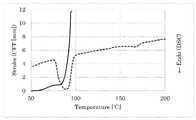
도 1은, 샘플 S1(P(3HB) 호모폴리머)의 플로우테스터 승온법에 의한 유동곡선(실선)과 DSC곡선(파선)을 나타낸다.
도 2는, 샘플 S2(P(3HB) 호모폴리머)의 플로우테스터 승온법에 의한 유동곡선(실선)과 DSC곡선(파선)을 나타낸다.
도 3은, 샘플 S3(P(3HB) 호모폴리머)의 플로우테스터 승온법에 의한 유동곡선(실선)과 DSC곡선(파선)을 나타낸다.
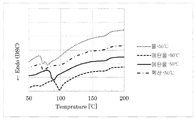
도 4는, 샘플 S1(실선), 샘플 S2(파선), 샘플 S3(성긴 파선)의 DSC곡선의 중첩을 나타낸다.
도 5는, 샘플 S4(P(3HB-co-13.1몰% 4HB))의 플로우테스터 승온법에 의한 유동곡선(실선)과 DSC곡선(파선)을 나타낸다. 샘플 S4의 보외 용융종료온도와 DSC곡선이 베이스라인으로 되돌아올 때의 온도를 나타내었다.
도 6은, 샘플 S5(P(3HB-co-13.1몰% 4HB))의 플로우테스터 승온법에 의한 유동곡선(실선)과 DSC곡선(파선)을 나타낸다. 샘플 S5의 보외 용융종료온도와 DSC곡선이 베이스라인으로 되돌아올 때의 온도를 나타내었다.
도 7은, 샘플 S6(P(3HB-co-13.1몰% 4HB))의 플로우테스터 승온법에 의한 유동곡선(실선)과 DSC곡선(파선)을 나타낸다. 샘플 S6의 보외 용융종료온도와 DSC곡선이 베이스라인으로 되돌아올 때의 온도를 나타내었다.
도 8은, 샘플 S4(실선), 샘플 S5(파선), 샘플 S6(일점쇄선), 샘플 S7(거친 파선)의 DSC곡선의 중첩을 나타낸다.
도 9는, 샘플 S8(P(3HB-co-61.5몰% 3HV))의 플로우테스터 승온법에 의한 유동곡선(실선)과 DSC곡선(파선)을 나타낸다.
도 10은, 샘플 S9(P(3HB-co-61.5몰% 3HV))의 플로우테스터 승온법에 의한 유동곡선(실선)과 DSC곡선(파선)을 나타낸다.
도 11은, 샘플 S10(P(3HB-co-61.5몰% 3HV))의 플로우테스터 승온법에 의한 유동곡선(실선)과 DSC곡선(파선)을 나타낸다.
도 12는, 샘플 S8(실선), 샘플 S9(파선), 샘플 S10(성긴 파선)의 DSC곡선의 중첩을 나타낸다.
도 13은, 샘플 S11의 각종 가열 전처리에 대한 DSC곡선의 변화를 나타낸다.
도 14는, 샘플 S11의 액 중 가열처리에 대한 DSC곡선의 변화를 나타낸다.Fig. 1 shows the flow curve (solid line) and DSC curve (dashed line) of sample S1 (P(3HB) homopolymer) by the flow tester heating method.
Fig. 2 shows the flow curve (solid line) and DSC curve (dashed line) of sample S2 (P(3HB) homopolymer) by the flow tester heating method.
Fig. 3 shows the flow curve (solid line) and DSC curve (dashed line) of sample S3 (P(3HB) homopolymer) by the flow tester heating method.
Fig. 4 shows the superposition of DSC curves of sample S1 (solid line), sample S2 (broken line), and sample S3 (sparse broken line).
Fig. 5 shows a flow curve (solid line) and a DSC curve (dashed line) of sample S4 (P(3HB-co-13.1 mol% 4HB)) by a flow tester heating method. The extra melting end temperature and the temperature at which the DSC curve returns to the baseline of sample S4 are shown.
Fig. 6 shows the flow curve (solid line) and DSC curve (broken line) of sample S5 (P(3HB-co-13.1 mol% 4HB)) by a flow tester heating method. The extra melting end temperature of sample S5 and the temperature when the DSC curve returns to the baseline are shown.
Fig. 7 shows a flow curve (solid line) and a DSC curve (dashed line) of sample S6 (P(3HB-co-13.1 mol% 4HB)) by a flow tester heating method. The extra melting end temperature and the temperature at which the DSC curve returns to the baseline of sample S6 are shown.
Fig. 8 shows the overlapping of the DSC curves of Sample S4 (solid line), Sample S5 (dashed line), Sample S6 (dotted and dashed line), and Sample S7 (rough dashed line).
Fig. 9 shows a flow curve (solid line) and a DSC curve (dashed line) of sample S8 (P(3HB-co-61.5 mol% 3HV)) by a flow tester heating method.
Fig. 10 shows the flow curve (solid line) and DSC curve (broken line) of sample S9 (P(3HB-co-61.5 mol% 3HV)) by a flow tester heating method.
Fig. 11 shows the flow curve (solid line) and DSC curve (dashed line) of sample S10 (P(3HB-co-61.5 mol% 3HV)) by a flow tester heating method.
Fig. 12 shows the superposition of the DSC curves of sample S8 (solid line), sample S9 (dashed line), and sample S10 (coarse broken line).
Fig. 13 shows changes in DSC curves of Sample S11 for various heat pretreatments.
Fig. 14 shows the change of the DSC curve for the in-liquid heat treatment of sample S11.
이하, 본 발명에 대하여 상세히 설명한다.Hereinafter, the present invention will be described in detail.
본 발명에 따른 고분자 성형물의 제조방법은, 결정성 폴리하이드록시알카노에이트(PHA)를 유리전이점 이상의 온도에서 가열처리하는 것; 및 상기 가열처리에서 얻어지는 상이한 라멜라두께를 갖는 라멜라결정을 포함하는 폴리하이드록시알카노에이트를, 일부의 라멜라결정은 용융하여 유동화하고, 그 외 잔부의 라멜라결정은 용융하지 않고 잔존하고 있는 온도범위에 있어서, 용융성형하는 것을 포함한다.The method for producing a polymer molding according to the present invention includes heat treatment of crystalline polyhydroxyalkanoate (PHA) at a temperature above the glass transition point; and in the polyhydroxyalkanoate containing lamellar crystals having different lamellar thicknesses obtained in the heat treatment, some of the lamellar crystals are melted and fluidized, and the rest of the lamellar crystals remain without melting within a temperature range. In the method, it includes melt molding.
[가열처리에 대하여][About heat treatment]
본 발명에 있어서는, 결정성 폴리하이드록시알카노에이트를 유리전이점 이상의 온도에서 가열처리한다. 이와 같이 가열처리함으로써, 라멜라결정의 두께를 재구성하고, 이에 따라 용융성형에 사용할 수 있는 온도역을 넓힐 수 있게 된다.In the present invention, the crystalline polyhydroxyalkanoate is heat-treated at a temperature equal to or higher than the glass transition point. By heat treatment in this way, the thickness of the lamellar crystal can be reconstructed, thereby widening the temperature range that can be used for melt molding.
비정질의 고체를 가열한 경우는, 저온에서는 결정과 동등하게 딱딱하고 유동성이 없었던 고체가, 어느 좁은 온도범위에서 급속히 강성과 점도가 저하되고 유동성이 증가한다. 이 온도가 유리전이점이다.When an amorphous solid is heated, the rigidity and viscosity of the solid, which was not as hard and fluid as that of a crystal at low temperatures, rapidly decrease and the fluidity increases within a narrow temperature range. This temperature is the glass transition point.
가열온도는, 결정성 폴리하이드록시알카노에이트를 유리전이점 이상이며, 또한 모든 결정을 용융시키는 일이 없는 온도범위가 바람직하고, 일반적으로는, 결정성 폴리하이드록시알카노에이트를 유리전이점보다 20~170℃ 높은 온도(바람직하게는 40~120℃ 높은 온도)에서 가열처리할 수 있다.The heating temperature is preferably a temperature range in which the crystalline polyhydroxyalkanoate is above the glass transition point and all the crystals are not melted. Heat treatment can be performed at a temperature higher than 20 to 170° C. (preferably at a temperature higher than 40 to 120° C.).
가열시간은, 특별히 한정되지 않는데, 일반적으로는, 1시간~72시간, 바람직하게는 6시간~48시간, 보다 바람직하게는 12시간~36시간 가열할 수 있다.The heating time is not particularly limited, but is generally from 1 hour to 72 hours, preferably from 6 hours to 48 hours, more preferably from 12 hours to 36 hours.
가열처리의 수단은, 특별히 한정되지 않고, 가열처리는, 기체, 액체 또는 고체에 의해 매개되는 가열처리 중 어느 것이어도 된다.The heat treatment means is not particularly limited, and the heat treatment may be any heat treatment mediated by gas, liquid or solid.
기체에 의해 매개되는 가열처리란, 기체 중에 있어서 결정성 폴리하이드록시알카노에이트를 가열처리하는 것을 말한다. 기체로는, 공기, 불활성 가스(질소 등) 등을 들 수 있다.Heat treatment mediated by a gas refers to heat treatment of crystalline polyhydroxyalkanoate in a gas. As the gas, air, an inert gas (such as nitrogen), and the like are exemplified.
액체에 의해 매개되는 가열처리란, 액체 중에 있어서 결정성 폴리하이드록시알카노에이트를 가열처리하는 것을 말한다. 액체로는, 물, 저급알코올(메탄올, 에탄올 등), 다가알코올(글리세린, 프로필렌글리콜 등), 헥산, 아세톤 등 유기용매, 또는 이들의 혼합물 등을 들 수 있다. 액체에 의해 매개되는 가열처리에 있어서는, 가열상태에 있어서 폴리하이드록시알카노에이트가 액체 중에 완전히는 용해되지 않는 것이 바람직하다.Heat treatment mediated by a liquid refers to heat treatment of crystalline polyhydroxyalkanoate in a liquid. Examples of the liquid include water, lower alcohols (such as methanol and ethanol), polyhydric alcohols (such as glycerin and propylene glycol), organic solvents such as hexane and acetone, or mixtures thereof. In the liquid-mediated heat treatment, it is preferable that the polyhydroxyalkanoate is not completely dissolved in the liquid in the heated state.
고체에 의해 매개되는 가열처리란, 예를 들어, 고체인 매체(예를 들어, 플레이트 등)에 결정성 폴리하이드록시알카노에이트를 접촉시켜 가열처리하는 것을 말한다. 고체로는, 예를 들어, 금속(알루미늄, 구리, 은, 철, 스테인리스강 등), 세라믹스, 유리 등을 들 수 있다.Heat treatment mediated by a solid means, for example, heat treatment by bringing crystalline polyhydroxyalkanoate into contact with a solid medium (eg, plate). Examples of the solid include metals (aluminum, copper, silver, iron, stainless steel, etc.), ceramics, and glass.
[결정성 폴리하이드록시알카노에이트에 대하여][About crystalline polyhydroxyalkanoate]
폴리하이드록시알카노에이트로는,As polyhydroxyalkanoates,
하이드록시알칸산의 호모폴리머(예를 들어, 폴리3-하이드록시프로피온산, 폴리3-하이드록시부티르산, 폴리3-하이드록시발레르산, 폴리4-하이드록시부티르산, 폴리3-하이드록시헥산산, 폴리3-하이드록시옥탄산, 폴리4-하이드록시발레르산, 폴리4-하이드록시헥산산, 폴리5-하이드록시발레르산, 폴리2-하이드록시부티르산, 폴리2-하이드록시발레르산, 폴리2-하이드록시헥산산 등);Homopolymers of hydroxyalkanoic acids (e.g., poly3-hydroxypropionic acid, poly3-hydroxybutyric acid, poly3-hydroxyvaleric acid, poly4-hydroxybutyric acid, poly3-hydroxyhexanoic acid, poly 3-hydroxyoctanoic acid, poly4-hydroxyvaleric acid, poly4-hydroxyhexanoic acid, poly5-hydroxyvaleric acid, poly2-hydroxybutyric acid, poly2-hydroxyvaleric acid, poly2-hydroxy hydroxyhexanoic acid, etc.);
하이드록시알칸산의 코폴리머(예를 들어, 3-하이드록시프로피온산과 3-하이드록시부티르산의 코폴리머, 3-하이드록시프로피온산과 3-하이드록시발레르산의 코폴리머, 3-하이드록시프로피온산과 4-하이드록시부티르산의 코폴리머, 3-하이드록시프로피온산과 3-하이드록시헥산산의 코폴리머, 3-하이드록시프로피온산과 3-하이드록시옥탄산의 코폴리머, 3-하이드록시부티르산과 3-하이드록시발레르산의 코폴리머, 3-하이드록시부티르산과 4-하이드록시부티르산의 코폴리머, 3-하이드록시부티르산과 3-하이드록시헥산산의 코폴리머, 3-하이드록시부티르산과 3-하이드록시옥탄산의 코폴리머, 3-하이드록시발레르산과 4-하이드록시부티르산의 코폴리머, 3-하이드록시발레르산과 3-하이드록시헥산산의 코폴리머, 3-하이드록시발레르산과 3-하이드록시옥탄산의 코폴리머, 유산과 3-하이드록시프로피온산의 코폴리머, 유산과 3-하이드록시부티르산의 코폴리머, 유산과 3-하이드록시발레르산의 코폴리머, 유산과 3-하이드록시부티르산의 코폴리머, 유산과 3-하이드록시헥산산의 코폴리머, 유산과 3-하이드록시옥탄산의 코폴리머, 글리콜산과 3-하이드록시프로피온산의 코폴리머, 글리콜산과 3-하이드록시부티르산의 코폴리머, 글리콜산과 3-하이드록시발레르산의 코폴리머, 글리콜산과 4-하이드록시부티르산의 코폴리머, 글리콜산과 3-하이드록시헥산산의 코폴리머, 글리콜산과 3-하이드록시옥탄산의 코폴리머); 및Copolymers of hydroxyalkanoic acids (e.g., copolymers of 3-hydroxypropionic acid and 3-hydroxybutyric acid, copolymers of 3-hydroxypropionic acid and 3-hydroxyvaleric acid, 3-hydroxypropionic acid and 4 -Hydroxybutyric acid copolymer, 3-hydroxypropionic acid and 3-hydroxyhexanoic acid copolymer, 3-hydroxypropionic acid and 3-hydroxyoctanoic acid copolymer, 3-hydroxybutyric acid and 3-hydroxy Copolymer of valeric acid, copolymer of 3-hydroxybutyric acid and 4-hydroxybutyric acid, copolymer of 3-hydroxybutyric acid and 3-hydroxyhexanoic acid, 3-hydroxybutyric acid and 3-hydroxyoctanoic acid copolymers, copolymers of 3-hydroxyvaleric acid and 4-hydroxybutyric acid, copolymers of 3-hydroxyvaleric acid and 3-hydroxyhexanoic acid, copolymers of 3-hydroxyvaleric acid and 3-hydroxyoctanoic acid, Copolymer of lactic acid and 3-hydroxypropionic acid, copolymer of lactic acid and 3-hydroxybutyric acid, copolymer of lactic acid and 3-hydroxyvaleric acid, copolymer of lactic acid and 3-hydroxybutyric acid, lactic acid and 3-hydroxy Copolymer of hydroxyhexanoic acid, copolymer of lactic acid and 3-hydroxyoctanoic acid, copolymer of glycolic acid and 3-hydroxypropionic acid, copolymer of glycolic acid and 3-hydroxybutyric acid, copolymer of glycolic acid and 3-hydroxyvaleric acid copolymers, copolymers of glycolic acid and 4-hydroxybutyric acid, copolymers of glycolic acid and 3-hydroxyhexanoic acid, copolymers of glycolic acid and 3-hydroxyoctanoic acid); and
터폴리머 등의 3종류 이상의 모노머로 구성되는 공중합체,Copolymers composed of three or more types of monomers such as terpolymers;
등을 들 수 있다.etc. can be mentioned.
한편, 폴리하이드록시알카노에이트는 1종을 단독으로 사용할 수도 있고, 2종 이상을 조합하여 이용할 수도 있다.On the other hand, polyhydroxyalkanoate may be used individually by 1 type, and may be used in combination of 2 or more types.
본 발명에서 취급하는 폴리하이드록시알카노에이트에 있어서, 라멜라결정이나 방상(房狀) 미셀구조, 구정, 덴드라이트, 씨시카밥 구조, 연신쇄결정 등 결정성 세그먼트의 고분자구조를 구성하기 위해서는 고결정성의 연속 모노머유닛 연쇄, 예를 들어, 3-하이드록시프로피온산의 연쇄, 3-하이드록시부티르산의 연쇄, 3-하이드록시발레르산의 연쇄, 4-하이드록시부티르산의 연쇄, 3-하이드록시헥산산의 연쇄, 3-하이드록시헥산산의 연쇄, 3-하이드록시옥탄산의 연쇄, 4-하이드록시발레르산의 연쇄, 4-하이드록시헥산산의 연쇄, 5-하이드록시발레르산의 연쇄, 2-하이드록시부티르산의 연쇄, 2-하이드록시발레르산의 연쇄, 2-하이드록시헥산산의 연쇄 등, 결정성의 마이크로구조를 취하기에 충분한 연쇄구조가 고분자쇄 중에 반복존재하는 것이 바람직하다. 모노머유닛으로서 입체이성체 혹은 광학이성체가 존재하는 경우에는, 동일한 입체이성체로 만들어진 연쇄로 이루어지는 결정성 세그먼트가 필요하며, 예를 들어, R-3-하이드록시부티르산의 연쇄, S-3-하이드록시부티르산의 연쇄, R-3-하이드록시발레르산의 연쇄, S-3-하이드록시발레르산의 연쇄, R-3-하이드록시헥산산의 연쇄, S-3-하이드록시헥산산의 연쇄 등, 동일한 입체이성체의 연쇄구조가 결정구조를 구성하기 위해서는 중요한 요소이다. 입체이성체 혹은 광학이성체가 존재하는 모노머유닛을 포함하는 폴리하이드록시알카노에이트의 경우, 결정성이 저하되고, 결정성 세그먼트가 얻어지기 어려워진다. 특히 생물학적으로 이들 모노머유닛으로 이루어지는 고분자를 합성하는 경우에는, R-3-하이드록시부티르산의 연쇄를 갖고, 제2성분으로서 그 외 모노머유닛을 도입한 2원 공중합체 혹은 3원 이상의 공중합체가 보다 바람직하다.In the polyhydroxyalkanoates handled in the present invention, in order to construct the polymer structure of crystalline segments such as lamellar crystals, spindle-shaped micelle structures, spherulites, dendrites, sisikabab structures, and stretched chain crystals, A chain of qualitative sequential monomer units, for example, a chain of 3-hydroxypropionic acid, a chain of 3-hydroxybutyric acid, a chain of 3-hydroxyvaleric acid, a chain of 4-hydroxybutyric acid, a chain of 3-hydroxyhexanoic acid chain, 3-hydroxyhexanoic acid chain, 3-hydroxyoctanoic acid chain, 4-hydroxyvaleric acid chain, 4-hydroxyhexanoic acid chain, 5-hydroxyvaleric acid chain, 2- It is preferable that a chain structure sufficient to obtain a crystalline microstructure, such as a chain of hydroxybutyric acid, a chain of 2-hydroxyvaleric acid, and a chain of 2-hydroxyhexanoic acid, is repeatedly present in the polymer chain. When stereoisomers or optical isomers exist as a monomer unit, a crystalline segment consisting of a chain made of the same stereoisomer is required, for example, a chain of R-3-hydroxybutyric acid, a chain of S-3-hydroxybutyric acid A chain of R-3-hydroxyvaleric acid, a chain of S-3-hydroxyvaleric acid, a chain of R-3-hydroxyhexanoic acid, a chain of S-3-hydroxyhexanoic acid, etc. The chain structure of isomers is an important factor in constructing the crystal structure. In the case of polyhydroxyalkanoates containing monomer units in which stereoisomers or optical isomers are present, crystallinity is lowered and it becomes difficult to obtain crystalline segments. In particular, when synthesizing a polymer composed of these monomer units biologically, a binary copolymer or a tertiary or more copolymer having a chain of R-3-hydroxybutyric acid and introducing other monomer units as a second component is preferred. desirable.
폴리하이드록시알카노에이트는 화학합성법이어도 생물합성법의 어느 것에 의해 생성되어도 상관없는데, 연쇄구조에 의한 결정성 세그먼트를 확보하기 위해서는, 입체이성체가 있는 모노머유닛을 포함하는 경우에는, 예를 들어 R-3-하이드록시부티르산과 4-하이드록시부티르산의 공중합체, S-3-하이드록시부티르산과 4-하이드록시부티르산의 공중합체와 같이, 어느 쪽의 입체이성체로 이루어지는 공중합체인 것이 바람직하다.Polyhydroxyalkanoate may be produced by either chemical synthesis or biosynthesis, but in order to secure a crystalline segment by chain structure, in the case of containing monomer units with stereoisomers, for example, R- It is preferably a copolymer composed of either stereoisomer, such as a copolymer of 3-hydroxybutyric acid and 4-hydroxybutyric acid or a copolymer of S-3-hydroxybutyric acid and 4-hydroxybutyric acid.
폴리하이드록시알카노에이트가, 3-하이드록시부티르산단위와 4-하이드록시부티르산단위를 포함하는 경우에 있어서는, 전체 모노머단위에 대한 4-하이드록시부티르산단위의 비율은, 바람직하게는 5몰% 이상 40몰% 이하이다. 전체 모노머단위에 대한 4-하이드록시부티르산단위의 비율은, 6몰% 이상, 7몰% 이상, 8몰% 이상, 9몰% 이상, 10몰% 이상, 11몰% 이상, 12몰% 이상, 13몰% 이상, 14몰% 이상, 15몰% 이상, 또는 16몰% 이상이어도 되고, 17몰% 이상, 18몰% 이상, 19몰% 이상, 20몰% 이상이어도 된다. 전체 모노머단위에 대한 4-하이드록시부티르산단위의 비율은, 35몰% 이하, 34몰% 이하, 33몰% 이하, 32몰% 이하, 31몰% 이하, 30몰% 이하, 29몰% 이하, 28몰% 이하, 27몰% 이하, 26몰% 이하, 25몰% 이하, 24몰% 이하, 23몰% 이하, 22몰% 이하, 또는 21몰% 이하여도 된다.When the polyhydroxyalkanoate contains 3-hydroxybutyric acid units and 4-hydroxybutyric acid units, the ratio of 4-hydroxybutyric acid units to all monomer units is preferably 5 mol% or more. It is 40 mol% or less. The ratio of 4-hydroxybutyric acid units to all monomer units is 6 mol% or more, 7 mol% or more, 8 mol% or more, 9 mol% or more, 10 mol% or more, 11 mol% or more, 12 mol% or more, It may be 13 mol% or more, 14 mol% or more, 15 mol% or more, or 16 mol% or more, or 17 mol% or more, 18 mol% or more, 19 mol% or more, or 20 mol% or more. The ratio of 4-hydroxybutyric acid units to all monomer units is 35 mol% or less, 34 mol% or less, 33 mol% or less, 32 mol% or less, 31 mol% or less, 30 mol% or less, 29 mol% or less, 28 mol% or less, 27 mol% or less, 26 mol% or less, 25 mol% or less, 24 mol% or less, 23 mol% or less, 22 mol% or less, or 21 mol% or less may be sufficient.
폴리에스테르가, 3-하이드록시부티르산단위와 3-하이드록시발레르산단위를 포함하는 경우에 있어서는, 전체 모노머단위에 대한 3-하이드록시발레르산단위의 비율은, 바람직하게는 5몰% 이상 90몰% 이하이다. 전체 모노머단위에 대한 3-하이드록시발레르산단위의 비율은, 5몰% 이상, 6몰% 이상, 7몰% 이상, 8몰% 이상, 9몰% 이상, 10몰% 이상, 15몰% 이상, 20몰% 이상, 25몰% 이상, 30몰% 이상, 35몰% 이상, 또는 40몰% 이상이어도 되고, 45몰% 이상, 50몰% 이상, 55몰% 이상, 60몰% 이상이어도 된다. 전체 모노머단위에 대한 3-하이드록시발레레이트단위의 비율은, 90몰% 이하, 85몰% 이하, 80몰% 이하, 75몰% 이하, 70몰% 이하, 65몰% 이하여도 된다.In the case where the polyester contains 3-hydroxybutyric acid units and 3-hydroxyvaleric acid units, the ratio of 3-hydroxyvaleric acid units to all monomer units is preferably 5 mol% or more and 90 mol%. less than % The ratio of 3-hydroxyvaleric acid units to all monomer units is 5 mol% or more, 6 mol% or more, 7 mol% or more, 8 mol% or more, 9 mol% or more, 10 mol% or more, 15 mol% or more , 20 mol% or more, 25 mol% or more, 30 mol% or more, 35 mol% or more, or 40 mol% or more may be 45 mol% or more, 50 mol% or more, 55 mol% or more, or 60 mol% or more . The ratio of 3-hydroxyvalerate units to all monomer units may be 90 mol% or less, 85 mol% or less, 80 mol% or less, 75 mol% or less, 70 mol% or less, or 65 mol% or less.
<폴리하이드록시알카노에이트 분자량><Polyhydroxyalkanoate Molecular Weight>
폴리하이드록시알카노에이트에 대하여, 폴리스티렌 환산 겔침투 크로마토그래피 측정에 의한 중량평균분자량은, 바람직하게는 10만 이상이고, 보다 바람직하게는 20만 이상이며, 나아가 30만 이상, 40만 이상 또는 50만 이상이어도 된다. 폴리스티렌 환산 겔침투 크로마토그래피 측정에 의한 중량평균분자량은, 60만 이상, 70만 이상, 80만 이상, 90만 이상, 100만 이상, 110만 이상, 120만 이상, 130만 이상, 140만 이상, 150만 이상, 200만 이상, 300만 이상, 또는 400만 이상이어도 된다. 폴리스티렌 환산 겔침투 크로마토그래피 측정에 의한 중량평균분자량의 상한은 특별히 한정되지 않는데, 일반적으로는, 2000만 이하이며, 1000만 이하, 800만 이하, 700만 이하, 600만 이하, 500만 이하, 400만 이하, 또는 300만 이하여도 된다. 단 용융성형을 행하는 경우에는 열분해에 의한 분자량 저하와 용융시의 점도가 지나치게 높아지지 않는 것을 감안하여, 폴리스티렌 환산 겔침투 크로마토그래피 측정에 의한 중량평균분자량은 40만 이상, 250만 이하가 바람직하고, 보다 바람직하게는 50만 이상, 220만 이하이며, 더욱 바람직하게는 60만 이상, 200만 이하이다.For polyhydroxyalkanoate, the weight average molecular weight measured by gel permeation chromatography in terms of polystyrene is preferably 100,000 or more, more preferably 200,000 or more, and further 300,000 or more, 400,000 or more, or 500,000 or more. It may be ten thousand or more. The weight average molecular weight by gel permeation chromatography measurement in terms of polystyrene is 600,000 or more, 700,000 or more, 800,000 or more, 900,000 or more, 1 million or more, 1.1 million or more, 1.2 million or more, 1.3 million or more, 1.4 million or more, It may be 1.5 million or more, 2 million or more, 3 million or more, or 4 million or more. The upper limit of the weight average molecular weight by gel permeation chromatography measurement in terms of polystyrene is not particularly limited, but is generally 20 million or less, 10 million or less, 8 million or less, 7 million or less, 6 million or less, 5 million or less, 4 million or less. 10,000 or less, or 3,000,000 or less may be sufficient. However, in the case of melt molding, the weight average molecular weight measured by gel permeation chromatography in terms of polystyrene is preferably 400,000 or more and 2.500,000 or less, considering that the molecular weight due to thermal decomposition and the viscosity at the time of melting are not excessively increased, More preferably, they are 500,000 or more and 2,200,000 or less, More preferably, they are 600,000 or more and 2,000,000 or less.
부분용융성형을 행하는 경우에는, 열분해에 의한 분자량 저하가 관찰되는 170℃ 주변의 온도역보다 저온에서의 용융온도를 이용하는 것이 많은 경우에서 가능하기 때문에, 부분용융성형을 행하는 경우에는 열분해에 의한 분자량 저하가 억제되기 쉬운 관점에서 이용하는 폴리머의 분자량은 용융성형시보다 저분자량이어도 되고, 폴리스티렌 환산 겔침투 크로마토그래피 측정에 의한 중량평균분자량은 20만 이상, 250만 이하가 바람직하고, 보다 바람직하게는 40만 이상, 200만 이하이고, 더욱 바람직하게는 60만 이상, 150만 이하이다.In the case of performing partial melt molding, since it is possible in many cases to use a melting temperature lower than the temperature range around 170 ° C. in which molecular weight reduction due to thermal decomposition is observed, in the case of performing partial melt molding, molecular weight reduction due to thermal decomposition The molecular weight of the polymer used may be lower than that at the time of melt molding from the viewpoint of easily suppressing, and the weight average molecular weight as measured by gel permeation chromatography in terms of polystyrene is preferably 200,000 or more and 2.5 million or less, more preferably 400,000 or more and 2 million or less, more preferably 600,000 or more and 1.5 million or less.
<폴리하이드록시알카노에이트의 바람직한 태양><Preferable aspects of polyhydroxyalkanoates>
본 발명의 고분자는, 랜덤 폴리머, 블록 폴리머, 교호 폴리머, 또는 그래프트 폴리머 중 어느 것이어도 되는데, 바람직하게는 랜덤 폴리머이다.The polymer of the present invention may be a random polymer, a block polymer, an alternating polymer, or a graft polymer, but is preferably a random polymer.
폴리하이드록시알카노에이트는, 열가소성 수지일 수도 있다.Polyhydroxyalkanoate may be a thermoplastic resin.
폴리하이드록시알카노에이트는, 바람직하게는 생분해성 고분자이고, 더욱 바람직하게는 생체흡수성 고분자이다. 생분해성이란, 자연환경(예를 들어, 토양, 퇴비, 호소(湖沼), 해수 등)에 있어서 미생물이나 효소에 의해 분해될 수 있거나, 또는 생체 내에서 비독성 성분으로 분해될 수 있는 것을 의미한다. 생체흡수성이란, 인간 또는 동물 등의 생체에 의해 대사될 수 있는 것을 의미한다.Polyhydroxyalkanoate is preferably a biodegradable polymer, more preferably a bioabsorbable polymer. Biodegradable means that it can be degraded by microorganisms or enzymes in the natural environment (eg, soil, compost, lakes, seawater, etc.), or can be degraded into non-toxic components in vivo. . Bioabsorbability means that it can be metabolized by living organisms such as humans or animals.
폴리하이드록시알카노에이트의 융점은 특별히 한정되지 않는데, 바람직하게는 180℃ 이하이고, 보다 바람직하게는 175℃ 이하(또는 175℃ 미만)이고, 더욱 바람직하게는 170℃ 이하이다. 폴리하이드록시알카노에이트의 융점은, 160℃ 이하, 150℃ 이하, 140℃ 이하, 또는 130℃ 이하여도 된다. 폴리하이드록시알카노에이트의 융점의 하한은 특별히 한정되지 않는데, 일반적으로는, 40℃ 이상이며, 50℃ 이상, 60℃ 이상, 70℃ 이상, 80℃ 이상, 90℃ 이상, 또는 100℃ 이상이어도 된다. 폴리하이드록시알카노에이트가 복수의 융점을 갖는 경우에는, 주성분의 융점이 상기 범위 내이면 된다.The melting point of the polyhydroxyalkanoate is not particularly limited, but is preferably 180°C or lower, more preferably 175°C or lower (or lower than 175°C), still more preferably 170°C or lower. The melting point of the polyhydroxyalkanoate may be 160°C or lower, 150°C or lower, 140°C or lower, or 130°C or lower. The lower limit of the melting point of the polyhydroxyalkanoate is not particularly limited, but is generally 40°C or higher, and may be 50°C or higher, 60°C or higher, 70°C or higher, 80°C or higher, 90°C or higher, or 100°C or higher. do. When polyhydroxyalkanoate has a plurality of melting points, the melting point of the main component may be within the above range.
[용융성형에 대하여][About melting molding]
본 발명에 있어서는, 결정성 폴리하이드록시알카노에이트의 유동성을 플로우테스터 승온법으로 평가했을 때에 측정한 유출개시온도 이상이며, 시차주사열량계(DSC)에 의해 측정되는 결정융해가 완전히 완료되는 것을 나타내는 온도보다 저온의 온도역에서 용융하고, 그 후 성형함으로써, 결정화가 느리고 가공특성이 나쁜 열가소성 수지의 가공성을 향상시킬 수 있다.In the present invention, when the fluidity of the crystalline polyhydroxyalkanoate is evaluated by the flow tester temperature rising method, it is higher than the outflow start temperature measured, indicating that the crystal melting measured by differential scanning calorimetry (DSC) is completely completed. By melting in a temperature range lower than the temperature and then shaping, the processability of a thermoplastic resin having slow crystallization and poor processing properties can be improved.
용융성형에 앞서 유리전이점 이상의 온도에서 열처리를 함으로써, 결정성 폴리하이드록시알카노에이트의 라멜라결정의 두께를 재구성함으로써, 그 후의 부분용융에 의한 열성형에 사용할 수 있는 온도역을 넓힐 수 있다.By performing heat treatment at a temperature above the glass transition point prior to melt molding to reconstruct the lamellar thickness of crystalline polyhydroxyalkanoate, the temperature range that can be used for subsequent thermoforming by partial melting can be widened.
「시차주사열량계(DSC)에 의해 측정되는 결정융해가 완전히 완료되는 것을 나타내는 온도」는, 바람직하게는, 융해피크의 보외 융해종료온도이다. 융해피크의 보외 융해종료온도란, 후기하는 실시예에 기재된 바와 같이 구할 수 있다. 즉, 융해피크가 샤프한 경우에는, JIS-K7121에 준거하고, 융해피크의 보외 융해종료온도는, 피크종료 전의 최대경사의 점에서 그은 접선과 피크 후의 베이스라인의 교점의 온도이다(Rigaku, Thermo plus EVO 소프트웨어에 의해 인식시킨다). 융해피크 형상이 복수 중첩되어 있는 경우에는, 보다 고온측의 피크에 대하여 매뉴얼로 접선을 다시 그어, 베이스라인과의 교점을 보외 융해종료온도로 한다.The "temperature at which crystal melting is completely completed as measured by differential scanning calorimetry (DSC)" is preferably an extrapolated melting end temperature of the melting peak. The extrapolated melting end temperature of the melting peak can be obtained as described in Examples to be described later. That is, when the melting peak is sharp, in accordance with JIS-K7121, the extrapolated melting end temperature of the melting peak is the temperature at the intersection of the tangent line drawn at the point of maximum slope before the end of the peak and the baseline after the peak (Rigaku, Thermo plus recognized by the EVO software). When a plurality of melting peak shapes are overlapped, a tangent line is manually redrawn for the peak on the higher temperature side, and the point of intersection with the baseline is taken as the extrapolated melting end temperature.
나아가, 용융성형은 종래에 있어서는, 융점+20℃, 융점+10℃, 융점+5℃ 등, 융점 이상의 온도에서 용융되고, 그 후 성형되는 것이 일반적이다. 이에 반해, 본 발명과 같이 부분용융상태에서 성형하는 경우에는 융점보다 낮은 온도에서 부분용융시키기 때문에, 융점과 열분해점이 가까운 고분자의 경우에는 열에 의한 분해, 즉 분자량 저하를 억제할 수 있어, 성형 후의 고분자의 분자량을 높은 상태로 유지할 수 있으므로, 물성 면에서도 보다 유익하다. 나아가 부분용융상태에서의 용융에는, 완전용융보다 더욱 낮은 온도이기 때문에, 고분자의 열분해뿐만 아니라, 미량으로 혼입되는 수분이 가열상태로 관여하는 폴리하이드록시알카노에이트의 분자쇄의 가수분해도 감소할 수 있는 것이 추찰되므로, 원료의 수분함량은 일반적으로는 낮은 편이 바람직한데, 특별히 저농도가 되도록 감량·유지할 필요성이 감소한다. 이에 따라, 방사나 성형장치에 있어서 대기 중의 수분이 원료 고분자로 이행하는, 건조 원료 폴리하이드록시알카노에이트의 건조상태를 엄밀하게 유지하기 위한 특별한 장치가 필요없게 된다는 이점도 예상된다.Furthermore, conventionally, melt molding is generally performed at a temperature equal to or higher than the melting point, such as melting point +20°C, melting point +10°C, or melting point +5°C, and then molded. On the other hand, in the case of molding in a partially melted state as in the present invention, partial melting is performed at a temperature lower than the melting point, so in the case of a polymer having a close melting point and thermal decomposition point, decomposition by heat, that is, a decrease in molecular weight, can be suppressed. Since the molecular weight of can be maintained in a high state, it is more beneficial in terms of physical properties. Furthermore, since the melting in the partial melting state is at a lower temperature than the complete melting, not only the thermal decomposition of the polymer but also the hydrolysis of the molecular chain of polyhydroxyalkanoate, which is involved in the heating state with trace amounts of water, can be reduced. Since it is assumed that there is, the water content of the raw material is generally preferably low, but the need to reduce and maintain it to a particularly low concentration is reduced. Accordingly, an advantage is expected that there is no need for a special device for strictly maintaining the dry state of the dry raw material polyhydroxyalkanoate, in which moisture in the atmosphere migrates to the raw material polymer in the spinning or molding equipment.
한편, 본 발명은 결정핵제의 첨가를 하지 않아도 용융결정화가 느린 폴리에스테르의 성형가공성을 개선하고, 생산성을 향상시키는 것인데, 결정핵제의 사용을 방해하는 것은 아니다.On the other hand, the present invention is to improve the molding processability and productivity of polyester having slow melt crystallization even without adding a nucleating agent, but it does not prevent the use of a nucleating agent.
본 발명의 일례로는, 폴리하이드록시알카노에이트로서 P(3HB-co-4HB)를 사용할 수 있다. 이 경우, 본 발명의 방법은, P(3HB-co-4HB)의 용융시에, 폴리머 내부의 3HB 세그먼트로 이루어지는 상대적으로 얇은 라멜라결정을 비롯한 결정이나 비정영역이 용융, 유동화하기 시작하는 온도로부터, 3HB 세그먼트로 이루어지는 상대적으로 두꺼운 라멜라결정 등이 용융하는 온도의 사이에서 용융압출하는 공정을 포함하는 것을 특징으로 한다.As an example of the present invention, P(3HB-co-4HB) can be used as the polyhydroxyalkanoate. In this case, the method of the present invention, when P(3HB-co-4HB) is melted, from the temperature at which crystals or amorphous regions, including relatively thin lamellar crystals composed of 3HB segments inside the polymer, begin to melt and fluidize, It is characterized by including a step of melting and extruding at a temperature at which a relatively thick lamellar crystal or the like composed of 3HB segments melts.
본 발명은, 폴리하이드록시알카노에이트에 포함되는 라멜라결정을 비롯한 결정의 일부를 남기고 용융성형하고, 그 다 녹지 않고 남은 결정이 결정핵이 됨으로써, 일반적인 용융성형에서의 1차 핵형성을 기다리지 않고 성형하는 것이 가능해지는 것을 특징으로 하는, 생분해성 폴리에스테르 성형물의 제조방법에 관한 것이다.In the present invention, melt molding is performed while leaving some of the crystals, including lamellar crystals, included in polyhydroxyalkanoate, and the remaining unmelted crystals become crystal nuclei, without waiting for primary nucleation in general melt molding. It relates to a method for producing a biodegradable polyester molding, characterized in that it becomes possible to mold.
따라서, 결정화가 느린 결정성 열가소성 폴리하이드록시알카노에이트의 성형가공성의 나쁨을 개선하고, 완전용융시와는 달리 결정 1차 핵형성을 기다리는 일 없이, 부분용융 직후에 성형할 수 있어, 생산성이 향상된다.Therefore, the poor molding processability of crystalline thermoplastic polyhydroxyalkanoate with slow crystallization is improved, and unlike complete melting, it is possible to mold immediately after partial melting without waiting for the primary crystal nucleation, and productivity is improved. It improves.
결정성 열가소성 폴리하이드록시알카노에이트의 벌크 중에 이미 분산되어 있는 라멜라결정을 비롯한 결정의 일부의 결정이 다 녹지 않고 남아 결정핵으로서 작용하기 때문에, 1차 핵형성의 대기시간이 필요없게 되고, 용융압출 직후의 결정성의 낮음에서 오는 점착성도 감소하여, 섬유나 필름 등 성형체가 교착하기 어려워지고, 용융방사 직후, 필름화 직후에 권취나 연신이 가능하여, 생산성이 향상된다.Since some of the crystals, including lamellar crystals already dispersed in the bulk of the crystalline thermoplastic polyhydroxyalkanoate, remain undissolved and act as crystal nuclei, there is no need for waiting time for primary nucleation, and melting The tackiness due to the low crystallinity immediately after extrusion is also reduced, making it difficult for molded articles such as fibers and films to stick together, and winding and stretching are possible immediately after melt spinning and immediately after film formation, improving productivity.
일부의 결정이 다 녹지 않고 남은 상태에서 용융방사하고, 그 직후에 연신함으로써, 다 녹지 않고 남아 있는 라멜라결정은 배향하고, 비정상태의 고분자쇄는 고배향하고, 결정을 성형하기 쉬운 모노머유닛 연속세그먼트가 모여 결정화가 촉진된다. 열분해를 일으키는 고온에서의 용융을 행하지 않음으로써, 열분해에 의한 분자량 저하가 억제되고, 성형물의 분자량 유지, 요컨대, 열에 의한 열화를 방지하는 것으로도 이어진다. 나아가 고분자에 잔존수분이 있는 경우나, 공기 중의 수분을 흡습하기 쉬운 고분자여도, 부분용융성형으로 온도를 낮출 수 있기 때문에, 완전용융성형보다 열과 수분이 관여하는 가수분해의 정도도 저하할 수 있어, 폴리하이드록시알카노에이트의 분자량 저하가 억제되고, 성형물의 분자량 유지로 이어진다.Melt-spinning is performed while a part of the crystals remain undissolved, and the lamellar crystals remaining undissolved are oriented and the polymer chains in the amorphous state are highly oriented, resulting in continuous monomer unit segments that are easy to form crystals. crystallization is promoted. By not melting at a high temperature that causes thermal decomposition, the molecular weight decrease due to thermal decomposition is suppressed, and the molecular weight of the molded article is maintained, that is, the deterioration due to heat is prevented. Furthermore, even when there is residual moisture in the polymer or a polymer that easily absorbs moisture in the air, since the temperature can be lowered by partial melting molding, the degree of hydrolysis involving heat and moisture can be lowered than that of complete melting molding. A decrease in the molecular weight of polyhydroxyalkanoate is suppressed, leading to the maintenance of the molecular weight of the molded product.
본 발명에 있어서는, 폴리하이드록시알카노에이트를 용융성형한다. 폴리하이드록시알카노에이트를 용융성형할 때에는, 본 발명의 효과를 손상시키지 않는 한 추가로, 첨가제를 첨가할 수도 있다.In the present invention, polyhydroxyalkanoate is melt-molded. When melt-molding polyhydroxyalkanoate, additives may be added as long as the effect of the present invention is not impaired.
첨가제로는, 산화방지제, 열안정제(예를 들어, 힌더드페놀, 하이드로퀴논, 포스파이트류 및 이들의 치환체 등), 자외선흡수제(예를 들어, 레조르시놀, 살리실레이트), 착색방지제(아인산염, 차아인산염 등), 활제, 이형제(몬탄산 및 그의 금속염, 그의 에스테르, 그의 하프에스테르, 스테아릴알코올, 스테아라미드 및 폴리에틸렌왁스 등), 착색제(염료 또는 안료 등), 도전제 혹은 착색제로서의 카본블랙, 가소제, 난연제(브롬계 난연제, 인계 난연제, 적린, 실리콘계 난연제 등), 난연조제, 및 대전방지제로부터 선택되는 1종 이상을 들 수 있다.As additives, antioxidants, heat stabilizers (for example, hindered phenols, hydroquinones, phosphites and their substituents, etc.), ultraviolet absorbers (for example, resorcinol, salicylate), anti-coloring agents ( phosphite, hypophosphite, etc.), lubricant, release agent (montanic acid and its metal salt, its ester, its half ester, stearyl alcohol, stearamide and polyethylene wax, etc.), colorant (dyes or pigments, etc.), conductive agent or as a colorant and at least one selected from carbon black, plasticizers, flame retardants (bromine-based flame retardants, phosphorus-based flame retardants, red phosphorus, silicon-based flame retardants, etc.), flame retardant aids, and antistatic agents.
폴리하이드록시알카노에이트에 첨가제를 배합하는 방법으로는, 특별히 한정되는 것은 아니고, 드라이블렌드, 용액배합, 폴리하이드록시알카노에이트의 화학중합시에 있어서의 첨가 등을 들 수 있다.The method of blending the additive with the polyhydroxyalkanoate is not particularly limited, and includes dry blending, solution blending, addition during chemical polymerization of the polyhydroxyalkanoate, and the like.
폴리하이드록시알카노에이트는, 사출성형, 사출압축성형, 압축성형, 압출성형(용융압출성형), 블로우성형, 프레스성형, 방사(용융압출방사) 등의 공지의 용융성형을 행할 수 있다.Polyhydroxyalkanoate can be subjected to known melt molding such as injection molding, injection compression molding, compression molding, extrusion molding (melt extrusion molding), blow molding, press molding, and spinning (melt extrusion spinning).
용융성형의 횟수는 특별히 한정되지 않는데, 바람직하게는 1회만 행할 수 있다.The number of melt moldings is not particularly limited, but is preferably performed only once.
본 발명에 있어서, 성형 후에 고화하는 공정은, 성형금형 중, 기체(예를 들어, 공기, 질소 등) 중, 또는 액체(예를 들어, 물, 알코올, 글리세린 혹은 그들의 혼합물 등) 중에 행할 수 있다. 즉, 본 발명의 방법에 의해 부분용융한 폴리하이드록시알카노에이트를, 성형금형 중, 기체 중 또는 액체 중에 있어서 냉각함으로써, 고화를 행할 수 있다. 바람직하게는, 부분용융한 폴리하이드록시알카노에이트를, 성형금형 중, 공기 중 또는 수중에 있어서 냉각할 수 있다. 보다 바람직하게는, 부분용융한 폴리하이드록시알카노에이트를, 성형금형 중, 또는 공기 중에 있어서 냉각할 수 있다.In the present invention, the step of solidifying after molding can be performed in a molding mold, in a gas (eg, air, nitrogen, etc.), or in a liquid (eg, water, alcohol, glycerin or a mixture thereof, etc.) . That is, the polyhydroxyalkanoate partially melted by the method of the present invention can be solidified by cooling it in a molding die, in a gas or in a liquid. Preferably, the partially melted polyhydroxyalkanoate can be cooled in a mold, in air or in water. More preferably, the partially melted polyhydroxyalkanoate can be cooled in a mold or in the air.
본 발명의 방법으로 제조되는 폴리하이드록시알카노에이트 성형품으로는, 사출성형품, 압출성형품, 프레스성형품, 시트, 파이프, 미연신필름, 1축연신필름, 2축연신필름 등의 각종 필름, 미연신사, 초연신사 등의 각종 섬유 등을 들 수 있다. 한편, 본 발명의 방법으로 제조되는 고분자 성형품으로는, 튜브 형상의 것이어도 되고, 튜브 형상 이외의 것이어도 된다.Polyhydroxyalkanoate molded products produced by the method of the present invention include injection molded products, extrusion molded products, press molded products, sheets, pipes, various films such as unstretched films, uniaxially oriented films and biaxially oriented films, and unstretched yarns. and various fibers such as super-stretched yarn. On the other hand, the polymer molded article produced by the method of the present invention may be tubular or other than tubular.
이하에 실시예, 비교예를 나타내어, 본 발명을 상세히 서술한다. 한편 본 출원의 명세서에 있어서의 실시예, 비교예의 기재는, 본 발명의 내용의 이해를 지원하기 위한 설명으로서, 그 기재는 본 발명의 기술적 범위를 좁게 해석할 근거가 되는 성격의 것은 아니다.Examples and comparative examples are shown below to explain the present invention in detail. On the other hand, the description of Examples and Comparative Examples in the specification of the present application is a description to support understanding of the content of the present invention, and the description is not of a nature that serves as a basis for narrowly interpreting the technical scope of the present invention.
실시예Example
<사용 폴리머><Polymer used>
폴리3-하이드록시부티르산(P(3HB))은 미쯔비시가스화학제의 「비오그린(Mw 94만, 융점 약 175℃, 유리전이점 약 2℃)」을 사용하였다.As poly 3-hydroxybutyric acid (P(3HB)), "Biogreen (Mw 940,000, melting point about 175°C, glass transition point about 2°C)" manufactured by Mitsubishi Gas Chemical was used.
P(3HB-co-4HB) 공중합체는 WO2019/044837에 기재된 방법에 따라 배양법에 의해 제조할 수 있다. 사용하는 탄소원의 종류나 공급비율을 적당히 변경함으로써 다양한 4HB비율의 P(3HB-co-4HB) 공중합체를 제조할 수 있다.The P(3HB-co-4HB) copolymer can be prepared by a culture method according to the method described in WO2019/044837. P(3HB-co-4HB) copolymers with various 4HB ratios can be prepared by appropriately changing the type of carbon source used or the supply ratio.
P(3HB-co-61.5몰% 3HV)는 일본특허공개 H01-069622에 기재된 방법에 따라 배양법에 의해 제조하였다.P(3HB-co-61.5 mol% 3HV) was prepared by a culture method according to the method described in Japanese Patent Publication H01-069622.
균체로부터의 PHA의 추출방법은 이미 공지된 바와 같이, 클로로포름을 비롯한 할로겐화 탄화수소용매를 이용하여 추출하고, 헥산이나 메탄올과 같은 빈용매로 석출시키는 용매추출법을 이용할 수도 있고, 일본특허공고 H04-061638, 일본특허공개 H07-177894, WO2004029266에 기재가 있는 바와 같이, 수계 추출법을 이용할 수도 있다.As already known, a method for extracting PHA from cells may use a solvent extraction method in which extraction is performed using halogenated hydrocarbon solvents such as chloroform and then precipitation is performed with poor solvents such as hexane or methanol. Japanese Patent Publication H04-061638, As described in Japanese Patent Publication H07-177894 and WO2004029266, an aqueous extraction method may be used.
<PHA의 분자량 측정(겔 퍼미에이션 크로마토그래피(GPC)법)><Measurement of molecular weight of PHA (gel permeation chromatography (GPC) method)>
PHA 분자량의 측정은 이하와 같이 겔 퍼미에이션 크로마토그래피법에 의해 행하였다.The measurement of the PHA molecular weight was performed by the gel permeation chromatography method as follows.
PHA가 약 0.5mg/ml가 되도록 클로로포름을 첨가하고, 60℃에서 4시간 용해시킨 후, 실온으로 되돌리고, 구멍직경 0.2μm의 PTFE 필터로 여과하여 불용물을 제거하고, 측정샘플로 하였다. GPC조건은 이하와 같다.Chloroform was added so that the PHA was about 0.5 mg/ml, dissolved at 60° C. for 4 hours, then returned to room temperature, filtered through a PTFE filter with a pore diameter of 0.2 μm to remove insoluble matter, and used as a measurement sample. The GPC conditions are as follows.
장치: 시마즈제작소제 HPLC Prominence 시스템Apparatus: HPLC Prominence system manufactured by Shimadzu Corporation
칼럼: 쇼와전공제 Shodex K-806L(2개 직렬)Column: Showa Denko Shodex K-806L (2 pieces in series)
칼럼온도: 40℃Column temperature: 40°C
이동상: 클로로포름(1ml/min)Mobile phase: chloroform (1ml/min)
검출기: RI(40℃)Detector: RI (40℃)
스탠더드: Shodex 폴리스티렌 분자량 스탠더드(687만~1270)Standard: Shodex polystyrene molecular weight standard (6.87 million to 12.70)
주입량: 60μlInjection volume: 60μl
분석시간: 30분Analysis time: 30 minutes
<플로우테스터에 의한 PHA의 유출개시온도 측정><Measurement of outflow initiation temperature of PHA by flow tester>
PHA를 플로우테스터 CFT-500D형(Capillary Rheometer Flowtester, (주)시마즈제작소제) 혹은 CFT-500EX((주)시마즈제작소제)를 사용하여 측정한다. 측정에 사용하는 샘플양은, 펠릿상, 분말상, 필름상 등의 PHA가 약 1.2g 정도이며, 실린더에 충전하여 측정한다. 분말상의 고분자를 사용하는 경우에는 적절한 조립기(造粒器), 프레스기를 사용하여 성형해서 실린더에 충전할 수도 있다. 다이(노즐)는 직경 1.0mm, 두께 1.0mm인 것을 사용하고, 5kg의 압출하중을 가하여, 초기설정온도 30℃~140℃(고분자의 종류와 융점에 따라 적절히 선택한다)에서 예열시간 240초 후, 3℃/분의 속도로 130~260℃(고분자의 종류와 융점에 따라 적절히 선택한다)까지 등속승온했을 때의 스트로크길이(mm)와 온도의 곡선을 구한다. 온도상승에 수반하여, PHA가 가열되고, 다이로부터 폴리머가 유출되기 시작한다. 이때의 온도를 유출개시온도로 한다.PHA is measured using a flow tester type CFT-500D (Capillary Rheometer Flowtester, manufactured by Shimadzu Corporation) or CFT-500EX (manufactured by Shimadzu Corporation). The amount of the sample used for the measurement is about 1.2 g of PHA in the form of pellets, powders, films, etc., and is measured by filling a cylinder. In the case of using a powdery polymer, it may be molded using an appropriate granulator or press machine and then filled into a cylinder. A die (nozzle) with a diameter of 1.0 mm and a thickness of 1.0 mm is used, an extrusion load of 5 kg is applied, the initial set temperature is 30 ℃ ~ 140 ℃ (appropriately selected according to the type and melting point of the polymer), and after 240 seconds of preheating time , Obtain the curve of stroke length (mm) and temperature when the temperature is raised at a constant rate to 130 to 260 ° C (appropriately selected according to the type of polymer and melting point) at a rate of 3 ° C / min. Accompanying the temperature rise, the PHA heats up and the polymer starts flowing out of the die. The temperature at this time is taken as the outflow start temperature.
<PHA의 용융거동 측정: 시차주사열량계(DSC)에 의한 열적 성질의 측정><Measurement of melting behavior of PHA: measurement of thermal properties by differential scanning calorimetry (DSC)>
PHA의 용융거동은, 시차주사열량계(Rigaku, Thermo plus EVO DSC8230)를 이용하여 측정하였다. 측정분위기는 질소(30ml/분)로 하고, 30℃로부터 130~260℃(PHA의 종류와 융점에 따라 적절히 선택한다)까지 20℃/분으로 승온하였다. 샘플은 1mg 전후로 하고, 알루미늄제의 샘플팬을 사용하였다. 온도 교정(校正)에는 인듐을 사용하였다.The melting behavior of PHA was measured using a differential scanning calorimeter (Rigaku, Thermo plus EVO DSC8230). The measurement atmosphere was nitrogen (30 ml/min), and the temperature was raised from 30 °C to 130 to 260 °C (appropriately selected according to the type and melting point of PHA) at 20 °C/min. The sample was about 1 mg, and an aluminum sample pan was used. Indium was used for temperature calibration.
융해피크가 샤프한 경우에는, JIS-K7121에 준거하고, 융해피크의 보외 융해종료온도는, 피크종료 전의 최대경사의 점에서 그은 접선과 피크 후의 베이스라인의 교점의 온도로 하는데(Rigaku, Thermo plus EVO 소프트웨어에 의해 인식시킨다), 융해피크 형상이 복수 중첩되어 있는 경우에는, 보다 고온측의 피크에 대하여 매뉴얼로 접선을 다시 그어, 베이스라인과의 교점을 보외 융해종료온도로 하였다.When the melting peak is sharp, the extrapolated melting end temperature of the melting peak is determined to be the temperature at the intersection of the tangent line drawn at the point of the maximum slope before the end of the peak and the baseline after the peak in accordance with JIS-K7121 (Rigaku, Thermo plus EVO Recognized by software), when a plurality of melting peak shapes overlap, a tangent line was manually redrawn for the peak on the higher temperature side, and the point of intersection with the baseline was set as the extrapolated melting end temperature.
각 샘플의 유리전이점(Tg)은 인트라쿨러를 장착한 시차주사열량계(DSC) model: DSC 8500(PerkinElme, USA)을 이용하여 질소분위기하(20mL/min)에서 측정하였다. 1strun은 승온속도 10℃/min로 50℃로부터 200℃까지 승온하고, 200℃에서 1분간 등온처리하여 샘플을 용융시켰다. 그 후, 200℃/min로 -50℃까지 급랭하고, -50℃에서 1분간 등온처리한 후, 10℃/min로 -50℃로부터 200℃까지 승온하고, 2ndrun에서 Tg를 측정하였다. 샘플팬은 알루미늄제인 것을 사용하였다. 온도교정에는 인듐을 사용하였다.The glass transition point (Tg) of each sample was measured under a nitrogen atmosphere (20 mL/min) using a differential scanning calorimeter (DSC) model: DSC 8500 (PerkinElme, USA) equipped with an intracooler. In 1 st run, the temperature was raised from 50 °C to 200 °C at a heating rate of 10 °C/min, and the sample was melted by isothermal treatment at 200 °C for 1 minute. After that, it was rapidly cooled to -50 ° C at 200 ° C / min, wasothermized at -50 ° C for 1 minute, heated from -50 ° C to 200 ° C at 10 ° C / min, and T g was measured in the 2nd run. . A sample pan made of aluminum was used. Indium was used for temperature calibration.
<PHA의 부분용융압출 및 용융압출: 플로우테스터를 이용한 일정 온도에 의한 용융방사><Partial melt extrusion and melt extrusion of PHA: melt spinning at a constant temperature using a flow tester>
플로우테스터 CFT-500D형((주)시마즈제작소제) 혹은 CFT-500EX((주)시마즈제작소제)를 사용하여 용융압출방사를 행하였다.Melt extrusion spinning was performed using a flow tester type CFT-500D (manufactured by Shimadzu Corporation) or CFT-500EX (manufactured by Shimadzu Corporation).
<비교예 1> P(3HB)분말, 열처리 없음 샘플 S1<Comparative Example 1> P(3HB) powder, no heat treatment Sample S1
수계 정제된 P(3HB)분말을 샘플 S1로 하였다. 샘플 S1의 Mw는 94만이었다. 샘플 S1을 CFT(캐필러리 플로우테스터: Capillary Flowtester)와 DSC로 분석하였다. CFT 유출개시온도는 181.0℃이고, DSC에 의한 결정융해피크의 폭은 약 140~189℃였다. 결정융해피크 정점은 175.0℃이고, DSC 보외 융해종료온도는 179.5℃, 융점피크가 베이스라인에 도달하는 온도는 188.7℃였다. CFT 유출개시온도보다 DSC 보외 융해종료온도가 낮으며, 완전용융상태가 아니면 유출되지 않는 것이 판명되었다. 도 1에 CFT와 DSC의 측정결과를 나타내었다.The water-based purified P(3HB) powder was taken as Sample S1. Mw of Sample S1 was 940,000. Sample S1 was analyzed by CFT (Capillary Flowtester) and DSC. The CFT outflow onset temperature was 181.0 °C, and the width of the crystal melting peak by DSC was about 140 to 189 °C. The apex of the crystal melting peak was 175.0 °C, the DSC extrapolation melting end temperature was 179.5 °C, and the temperature at which the melting point peak reached the baseline was 188.7 °C. It was found that the DSC extrapolation end temperature was lower than the CFT outflow start temperature, and no outflow occurred unless it was completely melted. 1 shows the measurement results of CFT and DSC.
한편 CFT 유출개시온도보다 융점피크의 베이스라인에 도달하는 온도가 높아, 여기에 주목하면 샘플 S1도 부분용융 가능하도록 계측값상은 생각하는 것도 가능한데, 고분자의 용융상태는 온도뿐만 아니라 가열되고 있는 시간 등 다른 팩터에도 영향을 받을 수 있는 것, 용융압출시의 압력이 높으면 부분용융압출하기 쉬워지는 것 등의 고려해야 할 점이 있기 때문에, CFT 유출개시온도로부터 DSC 보외 융해종료온도까지를 부분용융압출 가능온도로서 표에 기재하였다.On the other hand, the temperature reaching the baseline of the melting point peak is higher than the CFT outflow start temperature, so if you pay attention to this, it is possible to think on the measured value that sample S1 can also be partially melted. Since there are points to be considered, such as being influenced by other factors and that partial melt extrusion becomes easier when the pressure at the time of melt extrusion is high, the CFT outflow start temperature to the DSC extra-melting end temperature is used as the partial melt extrusion possible temperature. listed in the table.
<실시예 1> P(3HB)분말, 70℃ 수욕열처리 샘플 S2<Example 1> P (3HB) powder, 70 ℃ water bath heat treatment Sample S2
수계 정제된 샘플 S1의 P(3HB)분말을 물에 침지하고 70℃에서 24시간 온욕처리 후, 진공건조하여 샘플 S2를 얻었다. 샘플 S2의 Mw는 94만이었다. 샘플 S2를 CFT와 DSC로 분석하였다. CFT 유출개시온도는 178.6℃이고, DSC에 의한 결정융해피크의 폭은 약 140~188℃였다. 결정융해피크 정점은 175.1℃이고, DSC 보외 용융종료온도는 182.0℃, 융점피크가 베이스라인에 도달하는 온도는 188.0℃였다. CFT 유출개시온도보다 DSC 보외 용융종료온도가 높고, 부분용융상태에서 유출은 가능하나, CFT 유출개시온도와 DSC 보외 용융종료온도는 거의 동일한 온도역(온도차 3.4℃)이며, 실질적으로 부분용융상태에서 성형하기 위해서는 엄밀한 온도컨트롤이 필요하게 된다고 생각된다. 도 2에 CFT와 DSC의 측정결과를 나타내었다.The P(3HB) powder of the water-based purified sample S1 was immersed in water, subjected to a hot bath treatment at 70° C. for 24 hours, and vacuum dried to obtain sample S2. The Mw of Sample S2 was 940,000. Sample S2 was analyzed by CFT and DSC. The CFT outflow onset temperature was 178.6 °C, and the width of the crystal melting peak by DSC was about 140 to 188 °C. The apex of the crystal melting peak was 175.1 °C, the DSC extrapolation melting end temperature was 182.0 °C, and the temperature at which the melting point peak reached the baseline was 188.0 °C. The DSC outflow start temperature is higher than the DSC outflow start temperature, and outflow is possible in a partially melted state. It is thought that strict temperature control is required for molding. 2 shows the measurement results of CFT and DSC.
<실시예 2> P(3HB)분말, 70℃ 건열처리 샘플 S3<Example 2> P (3HB) powder, 70 ℃ dry heat treatment Sample S3
수계 정제된 샘플 S1의 P(3HB)분말을 건열오븐 70℃에서 24시간 건열처리 후, 실온으로 되돌려 샘플 S3을 얻었다. 샘플 S3의 Mw는 94만이었다. CFT 유출개시온도는 178.6℃이고, DSC에 의한 결정융해피크의 폭은 약 140~187℃였다. 결정융해피크 정점은 174.9℃이고, DSC 보외 용융종료온도는 180.5℃, 융점피크가 베이스라인에 도달하는 온도는 186.9℃였다. CFT 유출개시온도보다 DSC 보외 용융종료온도가 높고, 부분용융상태에서 유출은 가능하나, CFT 유출개시온도와 DSC 보외 용융종료온도는 거의 동일한 온도역(온도차 1.9℃)이며, 실질적으로 부분용융상태에서 성형하기 위해서는 엄밀한 온도컨트롤이 필요하게 된다고 생각된다. 도 3에 CFT와 DSC의 측정결과를 나타내었다.The water-based purified P(3HB) powder of Sample S1 was subjected to dry heat treatment in a dry heat oven at 70° C. for 24 hours, and then returned to room temperature to obtain Sample S3. The Mw of Sample S3 was 940,000. The CFT outflow onset temperature was 178.6 °C, and the width of the crystal melting peak by DSC was about 140 to 187 °C. The apex of the crystal melting peak was 174.9°C, the DSC extrapolation melting end temperature was 180.5°C, and the temperature at which the melting point peak reached the baseline was 186.9°C. The DSC outflow start temperature is higher than the DSC outflow start temperature, and outflow is possible in the partially melted state, but the CFT outflow start temperature and the DSC outflow end temperature are almost the same temperature range (temperature difference 1.9℃), and substantially in the partial melt state. It is thought that strict temperature control is required for molding. 3 shows the measurement results of CFT and DSC.
도 4에는 비교예 1, 실시예 1, 실시예 2의 샘플 S1, 샘플 S2, 샘플 S3의 DSC곡선의 중첩을 나타내었다. P(3HB)는 결정성이 높은 (R)-3HB의 연속 모노머유닛쇄로 이루어지고, PHA 공중합체와 같이 열처리의 유무에 따라 메인 융점피크의 피크탑 위치가 크게 변화하는 일은 없으며, 거의 동일한 DSC곡선이다. 벌크 P(3HB)의 70℃에 의한 수욕·건열가열처리에 의해 약간 CFT의 유출개시온도는 181.0℃보다 약간 저온측으로 시프트하였다(178.6℃).4 shows the overlapping of the DSC curves of Sample S1, Sample S2, and Sample S3 of Comparative Example 1, Example 1, and Example 2. P(3HB) is composed of a highly crystalline (R)-3HB continuous monomer unit chain, and the peak top position of the main melting point peak does not change greatly depending on the presence or absence of heat treatment like the PHA copolymer, and the DSC is almost the same. it's a curve Due to the water bath/dry heat heat treatment of bulk P (3HB) at 70°C, the outflow start temperature of CFT was slightly shifted from 181.0°C to a lower temperature side (178.6°C).
<실시예 3> P(3HB-co-13.1몰% 4HB)분말, 샘플 S4<Example 3> P(3HB-co-13.1 mol% 4HB) powder, sample S4
70℃에서 35시간의 수계 반응을 거쳐 수계 정제된 P(3HB-co-13.1몰% 4HB)를 샘플 S4로 하였다. 샘플 S4의 Mw는 100만, 유리전이점(Tg)은 약 -4℃였다. 샘플 S4를 CFT와 DSC로 분석하였다. CFT 유출개시온도는 125.1℃이고, DSC에 의한 결정융해피크의 폭은 약 49~157℃였다. 결정융해피크 정점은 63.7℃와 114.8℃이고, DSC 보외 융해종료온도는 135.1℃, 융점피크가 베이스라인에 도달하는 온도는 155.0℃였다. CFT 유출개시온도보다 DSC 보외 융해종료온도가 높으며, 125.1 이상 135.1℃ 미만의 범위에서 부분용융압출할 수 있는 것이 판명되었다. 도 5에 CFT와 DSC의 측정결과를 나타내었다.Water-based purified P (3HB-co-13.1 mol% 4HB) through a water-based reaction at 70 ° C. for 35 hours was used as Sample S4. Sample S4 had a Mw of 1,000,000 and a glass transition point (Tg) of about -4°C. Sample S4 was analyzed by CFT and DSC. The CFT outflow onset temperature was 125.1 °C, and the width of the crystal melting peak by DSC was about 49 to 157 °C. The crystal melting peak peaks were 63.7 °C and 114.8 °C, the DSC extrapolation melting end temperature was 135.1 °C, and the temperature at which the melting point peak reached the baseline was 155.0 °C. It was found that the DSC extra-melting end temperature was higher than the CFT outflow start temperature, and partial melt extrusion was possible in the range of 125.1 or more and less than 135.1 ° C. 5 shows the measurement results of CFT and DSC.
부분용융이 가능한 온도로서 126℃, 130℃, 135℃, 거의 용융해 있는 온도로서 150℃, 160℃, 170℃에서 용융방사를 행하였다.Melt spinning was performed at 126°C, 130°C, and 135°C as temperatures at which partial melting is possible, and at 150°C, 160°C, and 170°C as temperatures that are almost melted.
용융방사 전의 Mw는 100만이었던 것에 반해, 126℃에서의 부분용융방사 후의 Mw는 95만, 130℃에서의 부분용융방사 후의 Mw는 97만, 135℃에서의 부분용융방사 후의 Mw는 97만, 150℃에서의 용융방사 후의 Mw는 82만, 160℃에서의 용융방사 후의 Mw는 65만이고, 170℃에서의 용융방사 후의 Mw는 54만이었다. 각각의 온도에서의 용융방사 후의 분자량Mw의 잔존율은 용융방사 전의 분자량Mw 100만을 100%로 하면, 126℃에서 95%, 130℃에서 97%, 135℃에서 97%, 140℃에서 91%, 150℃에서 82%, 160℃에서 65%인 것에 반해 170℃에서는 53%이며, 보다 저온에서 방사할 수 있는 것은 분자량 저하의 억제에 효과적인 것이 명확해졌다. 특히 완전용융상태가 아닌 것이 명확한 135℃ 이하에서의 부분용융방사에서는 분자량 저하 억제가 현저하였다.While the Mw before melt spinning was 1 million, the Mw after partial melt spinning at 126°C was 950,000, the Mw after partial melt spinning at 130°C was 970,000, the Mw after partial melt spinning at 135°C was 970,000, The Mw after melt spinning at 150°C was 820,000, the Mw after melt spinning at 160°C was 650,000, and the Mw after melt spinning at 170°C was 540,000. The residual rate of molecular weight Mw after melt spinning at each temperature is 95% at 126 ° C, 97% at 130 ° C, 97% at 135 ° C, 91% at 140 ° C, It was 82% at 150 ° C. and 65% at 160 ° C., but 53% at 170 ° C., and it became clear that spinning at a lower temperature is effective in suppressing molecular weight reduction. In particular, in partial melt spinning at 135 ° C. or lower, where it is clear that the state is not completely melted, the suppression of molecular weight reduction was remarkable.
결과를 표 2에 나타내었다.The results are shown in Table 2.
170℃의 용융방사에서는, 압출된 폴리머의 점착성이 강하여, 교착이 보이고, 권취 후에 고화한 폴리머는 해서(解舒)할 수 없었다. 한편으로 135℃ 이하에서 부분 용융압출방사한 실에서는 점착성이 거의 보이지 않고, 방사 직후에 교착하지 않고 권취나 연신이 가능하였다. 즉, 부분 용융압출방사에 의해, 결정화시간을 단축하고, 고분자의 용융가공성을 개선하고, 생산성을 향상시킬 수 있는 것이 나타났다.In melt spinning at 170 ° C., the adhesiveness of the extruded polymer was strong, agglutination was observed, and the polymer solidified after winding could not be unwound. On the other hand, yarn partially melt-extruded at 135 ° C. or less showed almost no tackiness, and it was possible to wind or draw without sticking immediately after spinning. That is, it was shown that the crystallization time can be shortened, the melt processability of the polymer can be improved, and the productivity can be improved by partial melt extrusion spinning.
<실시예 4> P(3HB-co-13.1몰% 4HB)분말, 샘플 S5<Example 4> P(3HB-co-13.1 mol% 4HB) powder, sample S5
수계 정제된 건조상태의 P(3HB-co-13.1몰% 4HB)의 샘플 S4를 재차, 물에 침지하고 70℃에서 24시간 온욕처리 후, 진공건조하여 샘플 S5를 얻었다. 샘플 S5의 Mw는 100만이었다. 샘플 S5를 CFT와 DSC로 분석하였다. CFT 유출개시온도는 109.8℃이고, DSC에 의한 결정융해피크의 폭은 약 88~159℃였다. 결정융해피크 정점은 95.0℃와 118.6℃이고, DSC 보외 융해종료온도는 139.1℃, 융점피크가 베이스라인에 도달하는 온도는 158.5℃였다. CFT 유출개시온도보다 DSC 보외 융해종료온도가 높으며, 109.8℃ 이상 139.8℃ 미만의 범위에서 부분용융압출할 수 있는 것이 판명되었다. 도 6에 CFT와 DSC의 측정결과를 나타내었다.Sample S4 of water-based purified dry P (3HB-co-13.1 mol% 4HB) was again immersed in water, treated with a warm bath at 70 ° C. for 24 hours, and then vacuum dried to obtain sample S5. The Mw of sample S5 was 1 million. Sample S5 was analyzed by CFT and DSC. The CFT outflow onset temperature was 109.8 °C, and the width of the crystal melting peak by DSC was about 88 to 159 °C. The crystal melting peak peaks were 95.0 °C and 118.6 °C, the DSC extrapolation melting end temperature was 139.1 °C, and the temperature at which the melting point peak reached the baseline was 158.5 °C. It was found that the DSC extra melting end temperature was higher than the CFT outflow start temperature, and partial melt extrusion was possible in the range of 109.8 ° C or more and less than 139.8 ° C. 6 shows the measurement results of CFT and DSC.
샘플 S4에서는 125.1℃ 이상 140.2℃ 미만의 범위에서 부분용융압출할 수 있었는데, 물 70℃ 가열처리를 행한 샘플 S5에서는 109.8℃ 이상 139.8℃ 미만의 범위에서 부분용융압출할 수 있으며, 가열처리에 의해 부분용융압출할 수 있는 온도범위가 저온측으로 약 15℃나 넓어졌다.In sample S4, partial melt extrusion was possible in the range of 125.1 ° C or more and less than 140.2 ° C, but in sample S5 subjected to 70 ° C water heat treatment, partial melt extrusion was possible in the range of 109.8 ° C or more and less than 139.8 ° C. The temperature range that can be melted and extruded has widened by about 15°C toward the low temperature side.
<실시예 5> P(3HB-co-13.1몰% 4HB)분말, 샘플 S6<Example 5> P(3HB-co-13.1 mol % 4HB) powder, sample S6
수계 정제된 건조상태의 P(3HB-co-13.1몰% 4HB)의 샘플 S4를 오븐 70℃에서 24시간 건열처리 후, 실온으로 되돌려 샘플 S6을 얻었다. 샘플 S6의 Mw는 100만이었다. 샘플 S6을 CFT와 DSC로 분석하였다. CFT 유출개시온도는 110.0℃이고, DSC에 의한 결정융해피크의 폭은 약 75~160℃였다. 결정융해피크 정점은 81.9℃와 119.1℃이고, DSC 보외 융해종료온도는 137.8℃, 융점피크가 베이스라인에 도달하는 온도는 158.8℃였다. CFT 유출개시온도보다 DSC 보외 융해종료온도가 높으며, 110.0℃ 이상 137.8℃ 미만의 범위에서 부분용융압출할 수 있는 것이 판명되었다. 도 7에 CFT와 DSC의 측정결과를 나타내었다.Sample S4 of water-based purified dry P (3HB-co-13.1 mol% 4HB) was subjected to dry heat treatment in an oven at 70° C. for 24 hours, and then returned to room temperature to obtain sample S6. The Mw of sample S6 was 1 million. Sample S6 was analyzed by CFT and DSC. The CFT outflow onset temperature was 110.0 °C, and the width of the crystal melting peak by DSC was about 75 to 160 °C. The crystal melting peak peaks were 81.9 °C and 119.1 °C, the DSC extrapolation melting end temperature was 137.8 °C, and the temperature at which the melting point peak reached the baseline was 158.8 °C. It was found that the DSC extra melting end temperature was higher than the CFT outflow start temperature, and partial melt extrusion was possible in the range of 110.0 ° C or more and less than 137.8 ° C. 7 shows the measurement results of CFT and DSC.
도 8에는 실시예 3, 실시예 4, 실시예 5의 샘플 S4, 샘플 S5, 샘플 S6의 DSC곡선의 중첩을 나타내었다. 나아가 샘플 S4를 클로로포름에 용해 후, 캐스트필름을 작성하고, 1주일 이상 실온에서 에이징한 필름(샘플 S7)의 DSC곡선도 함께 나타내었다. 도 4에 나타낸 P(3HB)의 DSC곡선과는 달리, P(3HB-co-4HB) 공중합체의 DSC곡선은 그 열이력의 부여방법이나, 용매에의 용해와 용매증발에 따라 크게 용융피크의 형상이 변화하였다.8 shows the overlapping of DSC curves of Samples S4, S5, and S6 of Examples 3, 4, and 5. Furthermore, after dissolving sample S4 in chloroform, a cast film was prepared, and the DSC curve of the film (sample S7) aged for one week or more at room temperature was also shown. Unlike the DSC curve of P(3HB) shown in FIG. 4, the DSC curve of the P(3HB-co-4HB) copolymer has a large melting peak depending on the heat history imparting method, dissolution in the solvent, and solvent evaporation. shape has changed.
샘플 S4에서는 125.1℃ 이상 140.2℃ 미만의 범위에서 부분용융압출할 수 있었는데, 물 70℃ 가열처리를 행한 샘플 S5에서는 109.8℃ 이상 139.8℃ 미만의 범위에서 부분용융압출할 수 있고, 또한 건열 70℃ 가열처리를 행한 샘플 S6에서는 110.0℃ 이상 139.1℃ 미만의 범위에서 부분용융압출할 수 있었다. 가열처리에 의해 부분용융압출할 수 있는 온도범위가 저온측으로 약 15℃나 넓어졌다.In sample S4, partial melt extrusion was possible in the range of 125.1 ° C or more and less than 140.2 ° C, but in sample S5 subjected to heat treatment at 70 ° C in water, partial melt extrusion was possible in the range of 109.8 ° C or more and less than 139.8 ° C, and also heated at 70 ° C in dry heat. In the treated sample S6, partial melt extrusion could be performed in the range of 110.0°C or more and less than 139.1°C. The temperature range in which partial melt extrusion can be performed by heat treatment has been extended by about 15°C toward the low temperature side.
<비교예 2> 샘플 S8 용매추출 열처리 없음<Comparative Example 2> Sample S8 without solvent extraction heat treatment
용매추출침전(클로로포름추출-헥산침전계)으로 정제된 P(3HB-co-61.5몰% 3HV)를 샘플 S8로 하였다. 샘플 S8의 Mw는 73만, 유리전이점(Tg)은 약 -11℃였다. 샘플 S8을 CFT와 DSC로 분석하였다. CFT 유출개시온도는 84.5℃이고, DSC에 의한 결정융해피크의 폭은 약 56~179℃였다. 결정융해피크 정점은 90.5℃이고, 166.3℃에도 3HB 리치 결정 유래로 생각되는 작은 용융피크의 정점이 있었다. 메인의 용융피크의 DSC 보외 융해종료온도는 97.5℃, 고온측의 용융피크의 DSC 보외 융해종료온도는 173.2℃, 융점피크가 베이스라인에 도달하는 온도는 178.5℃였다. CFT 유출개시온도보다 DSC 보외 융해종료온도가 높으며, 84.5 이상 173.2℃ 미만의 범위에서 부분용융압출할 수 있는 것이 판명되었다. 가령 3HB 리치 결정 유래로 생각되는 고온측의 작은 용융피크를 나타내는 성분이 혼입되어 있지 않다고 가정해도, 저온측의 용융피크의 보외 융해종료온도는 97.5℃이고, 그 경우에는 84.5℃ 이상 97.5℃ 미만의 범위에서 부분용융압출할 수 있는 것을 알 수 있다. 도 9에 CFT와 DSC의 측정결과를 나타내었다.P (3HB-co-61.5 mol% 3HV) purified by solvent extraction precipitation (chloroform extraction-hexane precipitation system) was used as sample S8. Sample S8 had a Mw of 730,000 and a glass transition point (Tg) of about -11°C. Sample S8 was analyzed by CFT and DSC. The CFT outflow onset temperature was 84.5 °C, and the width of the crystal melting peak by DSC was about 56 to 179 °C. The apex of the crystal melting peak was 90.5°C, and even at 166.3°C, there was a peak of a small melting peak thought to be derived from the 3HB-rich crystal. The DSC extrapolated melting end temperature of the main melting peak was 97.5°C, the DSC extrapolated melting end temperature of the high-temperature melting peak was 173.2°C, and the temperature at which the melting point peak reached the baseline was 178.5°C. It was found that the DSC extra melting end temperature was higher than the CFT outflow start temperature, and partial melt extrusion was possible in the range of 84.5 or more and less than 173.2 ° C. Even if it is assumed that a component showing a small melting peak on the high temperature side, which is considered to be derived from 3HB-rich crystals, is not mixed, the extrapolation melting end temperature of the melting peak on the low temperature side is 97.5 ° C. In that case, it is 84.5 ° C. It can be seen that partial melt extrusion can be performed within the range. 9 shows the measurement results of CFT and DSC.
<실시예 6> 샘플 S9 용매추출 물 70℃ 열처리<Example 6> Heat treatment of sample S9 solvent extract at 70°C
용매추출침전으로 정제된 샘플 S8의 P(3HB-co-61.5몰% 3HV)를 물에 침지하고 70℃에서 24시간 온욕처리 후, 진공건조하여 샘플 S9를 얻었다. 샘플 S9의 Mw는 72만이었다. 샘플 S9를 CFT와 DSC로 분석하였다. CFT 유출개시온도는 80.8℃이고, DSC에 의한 결정융해피크의 폭은 약 49~178℃였다. 결정융해피크 정점은 90.7℃이고, 165.6℃에도 3HB 리치 결정 유래로 생각되는 작은 용융피크의 정점이 있었다. 메인의 용융피크의 DSC 보외 융해종료온도는 96.9℃, 고온측의 용융피크의 DSC 보외 융해종료온도는 172.6℃, 융점피크가 베이스라인에 도달하는 온도는 176.2℃였다. CFT 유출개시온도보다 DSC 보외 융해종료온도가 높으며, 80.8℃ 이상 172.6℃ 미만의 범위에서 부분용융압출할 수 있는 것이 판명되었다. 가령 3HB 리치 결정 유래로 생각되는 고온측의 작은 용융피크를 나타내는 성분이 혼입되어 있지 않다고 가정해도, 저온측의 용융피크의 보외 융해종료온도는 96.9℃이고, 그 경우에는 80.8℃ 이상 96.9℃ 미만의 범위에서 부분용융압출할 수 있는 것을 알 수 있다. 도 10에 CFT와 DSC의 측정결과를 나타내었다.Sample S9 was obtained by immersing P (3HB-co-61.5 mol% 3HV) in sample S8 purified by solvent extraction precipitation in water, treating it in a hot bath at 70 ° C. for 24 hours, and vacuum drying. Mw of Sample S9 was 720,000. Sample S9 was analyzed by CFT and DSC. The CFT outflow onset temperature was 80.8 °C, and the width of the crystal melting peak by DSC was about 49 to 178 °C. The apex of the crystal melting peak was 90.7°C, and even at 165.6°C, there was a peak of a small melting peak thought to be derived from the 3HB-rich crystal. The DSC extrapolated melting end temperature of the main melting peak was 96.9°C, the DSC extrapolated melting end temperature of the high-temperature melting peak was 172.6°C, and the temperature at which the melting point peak reached the baseline was 176.2°C. It was found that the DSC extra-melting end temperature was higher than the CFT outflow start temperature, and partial melt extrusion was possible in the range of 80.8 ° C or more and less than 172.6 ° C. Even if it is assumed that the component showing the small melting peak on the high-temperature side, which is thought to be derived from 3HB-rich crystals, is not mixed, the extrapolation melting end temperature of the melting peak on the low-temperature side is 96.9 ° C. It can be seen that partial melt extrusion can be performed within the range. 10 shows the measurement results of CFT and DSC.
<실시예 7> 샘플 S10 용매추출 건열 70℃ 열처리<Example 7> Sample S10 solvent extraction dry heat heat treatment at 70 ° C
용매추출침전으로 정제된 샘플 S8의 P(3HB-co-61.5몰% 3HV)를 재차, 오븐 70℃에서 24시간 건열처리 후, 실온으로 되돌려 샘플 S10을 얻었다. 샘플 S10의 Mw는 73만이었다. 샘플 S10을 CFT와 DSC로 분석하였다. CFT 유출개시온도는 79.8℃이고, DSC에 의한 결정융해피크의 폭은 약 75~178℃였다. 결정융해피크 정점은 88.9℃이고, 167.0℃에도 3HB 리치 결정 유래로 생각되는 작은 용융피크의 정점이 있었다. 메인의 용융피크의 DSC 보외 융해종료온도는 97.5℃, 고온측의 용융피크의 DSC 보외 융해종료온도는 173.3℃, 융점피크가 베이스라인에 도달하는 온도는 177.3℃였다. CFT 유출개시온도보다 DSC 보외 융해종료온도가 높으며, 79.8℃ 이상 173.3℃ 미만의 범위에서 부분용융압출할 수 있는 것이 판명되었다. 가령 3HB 리치 결정 유래로 생각되는 고온측의 작은 용융피크를 나타내는 성분이 혼입되어 있지 않다고 가정해도, 저온측의 용융피크의 보외 융해종료온도는 97.5℃이고, 그 경우에는 79.8℃ 이상 97.5℃ 미만의 범위에서 부분용융압출할 수 있는 것을 알 수 있다. 도 11에 CFT와 DSC의 측정결과를 나타내었다.P (3HB-co-61.5 mol% 3HV) of sample S8 purified by solvent extraction precipitation was again subjected to dry heat treatment in an oven at 70 ° C. for 24 hours, and then returned to room temperature to obtain sample S10. Mw of sample S10 was 730,000. Sample S10 was analyzed by CFT and DSC. The CFT outflow onset temperature was 79.8 °C, and the width of the crystal melting peak by DSC was about 75 to 178 °C. The apex of the crystal melting peak was 88.9°C, and even at 167.0°C, there was a peak of a small melting peak thought to be derived from the 3HB-rich crystal. The DSC extrapolated melting end temperature of the main melting peak was 97.5°C, the DSC extrapolated melting end temperature of the high-temperature melting peak was 173.3°C, and the temperature at which the melting point peak reached the baseline was 177.3°C. It was found that the DSC extra melting end temperature was higher than the CFT outflow start temperature, and partial melt extrusion was possible in the range of 79.8 ° C or more and less than 173.3 ° C. Even if it is assumed that a component showing a small melting peak on the high temperature side, which is considered to be derived from 3HB-rich crystals, is not mixed, the extra melting end temperature of the melting peak on the low temperature side is 97.5 ° C. In that case, it is 79.8 ° C. It can be seen that partial melt extrusion can be performed within the range. 11 shows the measurement results of CFT and DSC.
도 12에는 비교예 2, 실시예 6, 실시예 7의 샘플 S8, 샘플 S9, 샘플 S10의 DSC곡선의 중첩을 나타내었다. 도 4에 나타낸 P(3HB)의 DSC곡선과는 달리, P(3HB-co-3HV) 공중합체의 DSC곡선은 그 열이력의 부여방법에 따라 크게 용융피크의 형상이 변화하였다.12 shows the overlapping of DSC curves of Samples S8, Sample S9, and Sample S10 of Comparative Example 2, Example 6, and Example 7. Unlike the DSC curve of P(3HB) shown in FIG. 4, the shape of the melting peak of the DSC curve of the P(3HB-co-3HV) copolymer was greatly changed depending on the method of giving the thermal history.
샘플 S8에서는 84.5℃ 이상 173.2℃ 미만의 범위에서 부분용융압출할 수 있었는데, 물 70℃ 가열처리를 행한 샘플 S9에서는 80.8℃ 이상 172.6℃ 미만의 범위에서 부분용융압출할 수 있고, 또한 건열 70℃ 가열처리를 행한 샘플 S10에서는 79.8℃ 이상 173.3℃ 미만의 범위에서 부분용융압출할 수 있었다. 가열처리에 의해 부분용융압출할 수 있는 온도범위가 저온측으로 약 5℃ 정도 넓어졌다.In sample S8, partial melt extrusion was possible in the range of 84.5°C or more and less than 173.2°C, but in sample S9 subjected to heat treatment at 70°C in water, partial melt extrusion was possible in the range of 80.8°C or more and less than 172.6°C, and also heated at 70°C in dry heat. In the treated sample S10, partial melt extrusion could be performed in the range of 79.8°C or more and less than 173.3°C. By the heat treatment, the temperature range in which partial melt extrusion can be performed was widened by about 5°C toward the low temperature side.
<실시예><Example>
수계 정제된 Mw 62만, 유리전이점(Tg)이 약 -5℃인 P(3HB-co-16.0몰% 4HB)분말을 샘플 S11로 하였다. 샘플 S11을 공기 중 70℃ 건열 24시간 처리, 수중 50℃ 24시간 처리, 수중 60℃ 24시간 처리, 수중 70℃ 24시간 처리, 수중 80℃ 시간 처리하고, 수중에서 열처리한 PHA는 동결건조하여 건조체를 얻었다. 각 열처리 샘플을 DSC로 평가하고, 그 승온 퍼스트사이클의 DSC곡선(서모그램)을 겹쳐 쓴 것을 도 13에 나타내었다.P(3HB-co-16.0 mol% 4HB) powder having an aqueous-purified Mw of 620,000 and a glass transition point (Tg) of about -5°C was used as Sample S11. Sample S11 was subjected to dry heat treatment at 70 ° C in air for 24 hours, treatment at 50 ° C in water for 24 hours, treatment at 60 ° C in water for 24 hours, treatment at 70 ° C in water for 24 hours, treatment at 80 ° C in water for 24 hours, and PHA heat-treated in water was lyophilized and dried. got Each heat treatment sample was evaluated by DSC, and the DSC curve (thermogram) of the temperature increase first cycle was overwritten and shown in FIG. 13 .
나아가 동일한 샘플 S11을 수중 50℃ 24시간 처리, 메탄올 중 50℃ 12시간 처리, 에탄올 중 50℃ 12시간 처리, 헥산 중 50℃ 12시간 처리하고, 그 후, 진공건조하여 건조체를 얻었다. 각 열처리 샘플을 DSC로 평가하고, 그 승온 퍼스트사이클의 DSC곡선(서모그램)을 겹쳐 쓴 것을 도 14에 나타내었다.Further, the same sample S11 was subjected to treatment at 50°C in water for 24 hours, treatment at 50°C in methanol for 12 hours, treatment at 50°C in ethanol for 12 hours, treatment at 50°C in hexane for 12 hours, and then vacuum drying to obtain a dried product. Each heat treatment sample was evaluated by DSC, and the DSC curve (thermogram) of the temperature increase first cycle was overwritten and shown in FIG. 14 .
각종 열처리에 의해, 각종 열처리에 따른 용융피크 형상을 나타내었다. 결정성의 고분자에 있어서 DSC 용융피크온도는 라멜라결정의 두께에 의존하는 것이 알려져 있다. PHA 중에서도 P(3HB)에 있어서는 도 4에 나타내는 바와 같이, 70℃의 수중 열처리나 건열처리에 있어서 메인의 DSC 용융피크위치에 큰 변화는 보이지 않았으나, P(3HB-co-4HB)에 있어서는 도 13 및 도 14에 나타내는 바와 같이, 수중, 용매 중, 공기 중에 있어서 처리온도에 의존하는 주요한 용융피크 형상을 나타내었다. 피크의 형상이 열처리에 의해 변화하는 현상이 P(3HB-co-3HV) 공중합체에서도 보이고 있고(도 12), PHA의 유리전이점 이상이며 또한 PHA 자체를 용융시키지 않는 온도역에서 가열처리함으로써 라멜라결정의 재구성이 일어나고, 라멜라결정의 두께를 컨트롤하는 것으로 이어져, 용융가공성의 제어로 결부되는 기술이며, 부분용융성형을 유리하게 진행하기 위한 전처리로서 유용하다.By the various heat treatment, the melting peak shape according to the various heat treatment was shown. It is known that the DSC melting peak temperature for crystalline polymers depends on the lamellar thickness. As shown in Fig. 4, among PHA, in P(3HB), no significant change was seen in the main DSC melting peak position in water heat treatment or dry heat treatment at 70 ° C., but in P (3HB-co-4HB), Fig. 13 And as shown in Fig. 14, the major melting peak shapes depending on the processing temperature in water, solvent, and air were shown. A phenomenon in which the shape of the peak changes by heat treatment is also seen in the P(3HB-co-3HV) copolymer (FIG. 12). Reconstruction of the crystal occurs, leading to control of the thickness of the lamellar crystal, which is a technique associated with control of the melt processability, and is useful as a pretreatment for favorably proceeding partial melt forming.
[표 1][Table 1]

[표 2][Table 2]

Claims (10)
가열처리가, 기체, 액체 또는 고체에 의해 매개되는 가열처리인, 방법.According to claim 1,
A method in which the heat treatment is a heat treatment mediated by a gas, liquid or solid.
가열처리가 액체에 의해 매개되는 가열처리이고, 가열상태에 있어서 폴리하이드록시알카노에이트가 액체 중에 완전히는 용해되지 않는, 방법.According to claim 1 or 2,
A method in which the heat treatment is a heat treatment mediated by a liquid, and the polyhydroxyalkanoate is not completely dissolved in the liquid in a heated state.
상기 온도범위가, 플로우테스터 승온법에 의한 유출개시온도보다 높으며, 또한 시차주사열량계에 의해 측정되는 결정융해가 완전히 완료되는 것을 나타내는 온도보다 낮은 범위인, 방법.According to any one of claims 1 to 3,
The method according to claim 1 , wherein the temperature range is higher than the outflow start temperature by the flow tester temperature rising method and lower than the temperature indicating complete completion of crystal melting measured by differential scanning calorimetry.
상기 온도범위가, 플로우테스터 승온법에 의한 유출개시온도보다 높으며, 또한 보외 융해종료온도보다 낮은 범위인, 방법.According to any one of claims 1 to 4,
The method, wherein the temperature range is higher than the outflow start temperature by the flow tester temperature rising method and lower than the extrapolation melting end temperature.
일부의 라멜라결정은 용융하여 유동화하고, 그 외 잔부의 라멜라결정은 용융하지 않고 잔존하고 있는 온도범위에 있어서, 용융시킨 고분자를, 공기 중에 있어서 냉각하는 것을 포함하는, 방법.According to any one of claims 1 to 5,
A method comprising cooling the molten polymer in air in a temperature range in which a part of the lamellar crystals are melted and fluidized, and the rest of the lamellar crystals remain without melting.
열성형이, 용융압출에 의한 성형인, 방법.According to any one of claims 1 to 6,
A method in which thermoforming is molding by melt extrusion.
열성형이, 용융압출방사에 의한 성형인, 방법.According to any one of claims 1 to 7,
A method in which thermoforming is molding by melt extrusion spinning.
결정성 폴리하이드록시알카노에이트가, 모노머유닛으로서 3-하이드록시부티르산 및 4-하이드록시부티르산을 포함하는 공중합체인, 방법.According to any one of claims 1 to 8,
The method in which the crystalline polyhydroxyalkanoate is a copolymer containing 3-hydroxybutyric acid and 4-hydroxybutyric acid as monomer units.
상기 결정성 폴리하이드록시알카노에이트가, 모노머유닛으로서 3-하이드록시부티르산과 4-하이드록시부티르산을 포함하는 공중합체이고, 4-하이드록시부티르산의 비율이 5몰% 이상 40몰% 이하인, 방법.According to any one of claims 1 to 9,
The crystalline polyhydroxyalkanoate is a copolymer containing 3-hydroxybutyric acid and 4-hydroxybutyric acid as monomer units, and the ratio of 4-hydroxybutyric acid is 5 mol% or more and 40 mol% or less. .
Applications Claiming Priority (3)
| Application Number | Priority Date | Filing Date | Title |
|---|---|---|---|
| JPJP-P-2020-096145 | 2020-06-02 | ||
| JP2020096145 | 2020-06-02 | ||
| PCT/JP2021/020957 WO2021246434A1 (en) | 2020-06-02 | 2021-06-02 | Method of manufacturing polymer molded product including pretreatment by heating |
Publications (1)
| Publication Number | Publication Date |
|---|---|
| KR20230018416A true KR20230018416A (en) | 2023-02-07 |
Family
ID=78831095
Family Applications (1)
| Application Number | Title | Priority Date | Filing Date |
|---|---|---|---|
| KR1020227045045A Pending KR20230018416A (en) | 2020-06-02 | 2021-06-02 | Method for producing a polymer molding involving pretreatment by heating |
Country Status (7)
| Country | Link |
|---|---|
| US (1) | US12605875B2 (en) |
| EP (1) | EP4159901A4 (en) |
| JP (1) | JP7766302B2 (en) |
| KR (1) | KR20230018416A (en) |
| CN (1) | CN115698398B (en) |
| TW (1) | TW202212088A (en) |
| WO (1) | WO2021246434A1 (en) |
Cited By (1)
| Publication number | Priority date | Publication date | Assignee | Title |
|---|---|---|---|---|
| WO2024262936A1 (en) * | 2023-06-20 | 2024-12-26 | 씨제이제일제당(주) | Biodegradable polymer dispersion, preparation method therefor, and biodegradable article using same |
Families Citing this family (4)
| Publication number | Priority date | Publication date | Assignee | Title |
|---|---|---|---|---|
| JP7766301B2 (en) * | 2020-06-02 | 2025-11-10 | 三菱瓦斯化学株式会社 | Method for manufacturing polymer molded products |
| KR20230018416A (en) * | 2020-06-02 | 2023-02-07 | 미쯔비시 가스 케미칼 컴파니, 인코포레이티드 | Method for producing a polymer molding involving pretreatment by heating |
| CN115157478B (en) * | 2022-09-02 | 2022-12-06 | 北京蓝晶微生物科技有限公司 | Granulation processing method of degradable material and formed body prepared by granulation processing method |
| WO2025058065A1 (en) * | 2023-09-14 | 2025-03-20 | 旭化成株式会社 | Continuous long fiber of aliphatic copolymerized polyester, and method for producing same |
Citations (39)
| Publication number | Priority date | Publication date | Assignee | Title |
|---|---|---|---|---|
| JPH0324151A (en) | 1989-05-30 | 1991-02-01 | Imperial Chem Ind Plc <Ici> | 3-hydroxybutylate polymer compound |
| JPH06299054A (en) | 1993-04-13 | 1994-10-25 | Mitsui Toatsu Chem Inc | Molding method of lactic acid polymer |
| JPH06345950A (en) | 1993-06-10 | 1994-12-20 | Terumo Corp | Hydroxyalkanoate polymer composition |
| JPH07126496A (en) | 1993-10-28 | 1995-05-16 | Polyplastics Co | Polyester resin composition and molded article |
| JPH07188537A (en) | 1993-12-27 | 1995-07-25 | Tokuyama Corp | Resin composition |
| JPH0827363A (en) | 1994-07-12 | 1996-01-30 | Mitsui Toatsu Chem Inc | Lactic acid-based polymer composition |
| JPH08510498A (en) | 1993-05-24 | 1996-11-05 | ゼネカ・リミテッド | Polyester composition |
| JPH09278991A (en) | 1995-12-21 | 1997-10-28 | Mitsui Toatsu Chem Inc | Method for producing aliphatic polyester molded article and molded article produced thereby |
| JPH10504583A (en) | 1994-06-13 | 1998-05-06 | モンサント・カンパニー | Aliphatic polyester composition |
| JPH10158369A (en) | 1996-11-29 | 1998-06-16 | Mitsui Chem Inc | Resin composition and molding product therefrom |
| JPH10176070A (en) | 1996-12-18 | 1998-06-30 | Rikagaku Kenkyusho | Film made of poly (3-hydroxybutanoic acid) |
| JPH115849A (en) | 1997-06-19 | 1999-01-12 | Mitsui Chem Inc | Resin composition and its molded product |
| JPH11116783A (en) | 1997-10-09 | 1999-04-27 | Mitsui Chem Inc | Molding and its production |
| WO2002050461A1 (en) | 2000-12-18 | 2002-06-27 | Tripat Singh Mangat | Valve |
| WO2002055581A2 (en) | 2000-12-21 | 2002-07-18 | Procter & Gamble | Biodegradable polyhydroxyalkanoate copolymers having improved crystallization properties |
| JP2003192884A (en) | 2001-12-28 | 2003-07-09 | Asahi Denka Kogyo Kk | Polylactic acid-based polymer composition, molded article and method for producing the same |
| JP2003238779A (en) | 2002-02-15 | 2003-08-27 | Sony Corp | Resin composition |
| JP2003328231A (en) | 2002-02-28 | 2003-11-19 | Japan Science & Technology Corp | High strength and high modulus fiber of polyhydroxyalkanoic acid and method for producing the same |
| JP2003327803A (en) | 2002-05-09 | 2003-11-19 | Sony Corp | Resin composition |
| JP2003328230A (en) | 2002-02-28 | 2003-11-19 | Japan Science & Technology Corp | High strength fiber of polyhydroxyalkanoic acid and method for producing the same |
| JP2004250629A (en) | 2003-02-21 | 2004-09-09 | Kanegafuchi Chem Ind Co Ltd | Method for producing polyhydroxyalkanoic acid |
| WO2006012917A1 (en) | 2004-08-06 | 2006-02-09 | Cognis Ip Management Gmbh | Use of fatty alcohols as plasticizer to improve the physical-mechanical properties and processability of phb and its co-polymers |
| WO2006038373A1 (en) | 2004-10-01 | 2006-04-13 | Riken | High-strength fiber of biodegradable aliphatic polyester and process for producing the same |
| JP2006282940A (en) | 2005-04-04 | 2006-10-19 | Sony Corp | Resin composition and molded product produced therefrom |
| JP2007077232A (en) | 2005-09-13 | 2007-03-29 | Tokyo Institute Of Technology | Biodegradable polyester resin composition |
| JP2007517126A (en) | 2003-12-30 | 2007-06-28 | メタボリックス インコーポレイティッド | Nucleator |
| WO2008099586A1 (en) | 2007-02-15 | 2008-08-21 | Tokyo Institute Of Technology | Biodegradable resin composition |
| JP2009024058A (en) | 2007-07-18 | 2009-02-05 | Biobase Kk | Polylactic acid resin composition and additive for polylactic acid resin |
| JP4245306B2 (en) | 2002-05-09 | 2009-03-25 | 旭化成ケミカルズ株式会社 | Biodegradable polyester stretch molding |
| JP2010229407A (en) | 2009-03-06 | 2010-10-14 | Tokyo Institute Of Technology | Resin composition |
| JP2010241075A (en) | 2009-04-09 | 2010-10-28 | Kaneka Corp | Manufacturing method of biodegradable resin molding |
| WO2014068943A1 (en) | 2012-10-29 | 2014-05-08 | 株式会社カネカ | Aliphatic polyester resin composition and molded body containing aliphatic polyester resin composition |
| WO2015052876A1 (en) | 2013-10-11 | 2015-04-16 | 株式会社カネカ | Aliphatic polyester resin composition and aliphatic polyester resin molded body |
| WO2015146195A1 (en) | 2014-03-28 | 2015-10-01 | 株式会社カネカ | Microorganism having multiple genes encoding pha synthase and method for producing pha using same |
| WO2017056442A1 (en) | 2015-09-28 | 2017-04-06 | 株式会社カネカ | Microorganism having pha synthase-coding genes and method for producing pha using same |
| JP2017101256A (en) | 2012-08-03 | 2017-06-08 | 株式会社カネカ | Polyester resin composition and molded article containing the resin composition |
| JP2019119840A (en) | 2018-01-11 | 2019-07-22 | 株式会社カネカ | Aliphatic polyester resin composition |
| JP2019119839A (en) | 2018-01-11 | 2019-07-22 | 株式会社カネカ | Polyester resin composition |
| WO2020040093A1 (en) | 2018-08-20 | 2020-02-27 | 株式会社カネカ | Poly(3-hydroxybutyrate)-based resin tube and method for producing same |
Family Cites Families (32)
| Publication number | Priority date | Publication date | Assignee | Title |
|---|---|---|---|---|
| JPS6469622A (en) | 1987-09-09 | 1989-03-15 | Mitsubishi Gas Chemical Co | Preparation of copolymer |
| DE3875367T2 (en) | 1987-04-28 | 1993-03-25 | Mitsubishi Gas Chemical Co | METHOD FOR PRODUCING A RANDOM COPOLYMER CONTAINING D - (-) - 3-HYDROXYBUTYRATE AND D - (-) - 3-HYDROXYVALERATE UNITS. |
| JPH0461638A (en) | 1990-06-27 | 1992-02-27 | Ube Ind Ltd | optical recording medium |
| GB9325952D0 (en) | 1993-12-20 | 1994-02-23 | Zeneca Ltd | Process for preparing films and coatings |
| JPH07177894A (en) | 1993-12-22 | 1995-07-18 | Mitsubishi Gas Chem Co Inc | Method for separating and purifying poly-3-hydroxybutyric acid |
| US5763513A (en) * | 1994-05-19 | 1998-06-09 | Mitsui Toatsu Chemicals, Inc. | L-lactic acid polymer composition, molded product and film |
| US6111006A (en) | 1994-12-19 | 2000-08-29 | Monsanto Company | Process for preparing films and coatings |
| WO1997004669A1 (en) * | 1995-07-28 | 1997-02-13 | Snow Brand Milk Products Co., Ltd. | Process for producing low fat sausage |
| JPH09131779A (en) | 1995-11-07 | 1997-05-20 | Gunze Ltd | Manufacture of biodegradable sheet |
| US6417294B1 (en) * | 1995-12-21 | 2002-07-09 | Mitsui Chemicals, Inc. | Films and molded articles formed from aliphatic polyester compositions containing nucleating agents |
| JPH1060099A (en) | 1996-08-27 | 1998-03-03 | Takasago Internatl Corp | Yarn comprising biodegradable polymer composition and its production |
| JP4562316B2 (en) | 2001-06-11 | 2010-10-13 | 株式会社カネカ | Biodegradable fiber and method for producing the same |
| KR100643250B1 (en) * | 2001-12-28 | 2006-11-10 | 가부시키가이샤 아데카 | Polylactic Acid-Based Resin Compositions, Molded Products and Manufacturing Method Thereof |
| WO2003072857A1 (en) * | 2002-02-28 | 2003-09-04 | Riken | Polyhydroxyalkanoic acid fibers with high strength, fibers with high strength and high modulus of elasticity and processes for producing the same |
| JP2003311825A (en) * | 2002-04-25 | 2003-11-06 | Inst Of Physical & Chemical Res | High strength film comprising polyhydroxyalkanoic acid and method for producing the same |
| PL375578A1 (en) | 2002-09-30 | 2005-11-28 | Kaneka Corporation | Method of purifying 3-hydroxyalkanoic acid copolymer |
| JP2004204128A (en) | 2002-12-26 | 2004-07-22 | Mitsubishi Plastics Ind Ltd | Polylactic acid-based polymer composition for thermoforming, polylactic acid-based polymer sheet for thermoforming, and thermoformed article using the same |
| US7329723B2 (en) * | 2003-09-18 | 2008-02-12 | Eastman Chemical Company | Thermal crystallization of polyester pellets in liquid |
| JP2008222876A (en) * | 2007-03-13 | 2008-09-25 | Institute Of Physical & Chemical Research | Biodegradable oil-absorbing film |
| CN101538750A (en) * | 2008-03-18 | 2009-09-23 | 天津国韵生物材料有限公司 | Polyhydroxyalkanoates fiber and preparation method thereof |
| TWI532787B (en) | 2009-06-17 | 2016-05-11 | 東麗股份有限公司 | Method for producing crystallization polyester |
| CN102108563B (en) | 2010-11-16 | 2012-11-21 | 清华大学 | Method for preparing polyhydroxyalkanoate fibers |
| JP5924623B2 (en) * | 2011-03-25 | 2016-05-25 | 国立大学法人 東京大学 | Biodegradable polyester fiber excellent in thermal stability and strength and method for producing the same |
| US9732443B2 (en) | 2013-09-02 | 2017-08-15 | Tokyo Institute Of Technology | Polyester fiber |
| CN106414026B (en) * | 2014-06-20 | 2018-12-11 | 日精Asb机械株式会社 | Manufacturing method and manufacturing device of hollow container |
| EP3677685A4 (en) | 2017-08-29 | 2020-10-28 | Mitsubishi Gas Chemical Company, Inc. | METHOD OF MANUFACTURING POLYESTER |
| KR102921472B1 (en) * | 2017-08-29 | 2026-02-02 | 미쯔비시 가스 케미칼 컴파니, 인코포레이티드 | Polyester including 4-hydroxybutyrate units |
| KR102847285B1 (en) | 2019-05-13 | 2025-08-19 | 미쯔비시 가스 케미칼 컴파니, 인코포레이티드 | aliphatic polyester copolymer |
| WO2021059762A1 (en) * | 2019-09-25 | 2021-04-01 | 株式会社カネカ | Method for producing polyhydroxyalkanoate |
| JP7766301B2 (en) * | 2020-06-02 | 2025-11-10 | 三菱瓦斯化学株式会社 | Method for manufacturing polymer molded products |
| KR20230018416A (en) | 2020-06-02 | 2023-02-07 | 미쯔비시 가스 케미칼 컴파니, 인코포레이티드 | Method for producing a polymer molding involving pretreatment by heating |
| ES3056356T3 (en) * | 2020-10-26 | 2026-02-19 | Mitsubishi Gas Chemical Co | Bioabsorbable fibrous medical material |
-
2021
- 2021-06-02 KR KR1020227045045A patent/KR20230018416A/en active Pending
- 2021-06-02 CN CN202180039544.7A patent/CN115698398B/en active Active
- 2021-06-02 JP JP2022528860A patent/JP7766302B2/en active Active
- 2021-06-02 TW TW110119986A patent/TW202212088A/en unknown
- 2021-06-02 US US18/000,446 patent/US12605875B2/en active Active
- 2021-06-02 EP EP21816826.8A patent/EP4159901A4/en active Pending
- 2021-06-02 WO PCT/JP2021/020957 patent/WO2021246434A1/en not_active Ceased
Patent Citations (39)
| Publication number | Priority date | Publication date | Assignee | Title |
|---|---|---|---|---|
| JPH0324151A (en) | 1989-05-30 | 1991-02-01 | Imperial Chem Ind Plc <Ici> | 3-hydroxybutylate polymer compound |
| JPH06299054A (en) | 1993-04-13 | 1994-10-25 | Mitsui Toatsu Chem Inc | Molding method of lactic acid polymer |
| JPH08510498A (en) | 1993-05-24 | 1996-11-05 | ゼネカ・リミテッド | Polyester composition |
| JPH06345950A (en) | 1993-06-10 | 1994-12-20 | Terumo Corp | Hydroxyalkanoate polymer composition |
| JPH07126496A (en) | 1993-10-28 | 1995-05-16 | Polyplastics Co | Polyester resin composition and molded article |
| JPH07188537A (en) | 1993-12-27 | 1995-07-25 | Tokuyama Corp | Resin composition |
| JPH10504583A (en) | 1994-06-13 | 1998-05-06 | モンサント・カンパニー | Aliphatic polyester composition |
| JPH0827363A (en) | 1994-07-12 | 1996-01-30 | Mitsui Toatsu Chem Inc | Lactic acid-based polymer composition |
| JPH09278991A (en) | 1995-12-21 | 1997-10-28 | Mitsui Toatsu Chem Inc | Method for producing aliphatic polyester molded article and molded article produced thereby |
| JPH10158369A (en) | 1996-11-29 | 1998-06-16 | Mitsui Chem Inc | Resin composition and molding product therefrom |
| JPH10176070A (en) | 1996-12-18 | 1998-06-30 | Rikagaku Kenkyusho | Film made of poly (3-hydroxybutanoic acid) |
| JPH115849A (en) | 1997-06-19 | 1999-01-12 | Mitsui Chem Inc | Resin composition and its molded product |
| JPH11116783A (en) | 1997-10-09 | 1999-04-27 | Mitsui Chem Inc | Molding and its production |
| WO2002050461A1 (en) | 2000-12-18 | 2002-06-27 | Tripat Singh Mangat | Valve |
| WO2002055581A2 (en) | 2000-12-21 | 2002-07-18 | Procter & Gamble | Biodegradable polyhydroxyalkanoate copolymers having improved crystallization properties |
| JP2003192884A (en) | 2001-12-28 | 2003-07-09 | Asahi Denka Kogyo Kk | Polylactic acid-based polymer composition, molded article and method for producing the same |
| JP2003238779A (en) | 2002-02-15 | 2003-08-27 | Sony Corp | Resin composition |
| JP2003328230A (en) | 2002-02-28 | 2003-11-19 | Japan Science & Technology Corp | High strength fiber of polyhydroxyalkanoic acid and method for producing the same |
| JP2003328231A (en) | 2002-02-28 | 2003-11-19 | Japan Science & Technology Corp | High strength and high modulus fiber of polyhydroxyalkanoic acid and method for producing the same |
| JP2003327803A (en) | 2002-05-09 | 2003-11-19 | Sony Corp | Resin composition |
| JP4245306B2 (en) | 2002-05-09 | 2009-03-25 | 旭化成ケミカルズ株式会社 | Biodegradable polyester stretch molding |
| JP2004250629A (en) | 2003-02-21 | 2004-09-09 | Kanegafuchi Chem Ind Co Ltd | Method for producing polyhydroxyalkanoic acid |
| JP2007517126A (en) | 2003-12-30 | 2007-06-28 | メタボリックス インコーポレイティッド | Nucleator |
| WO2006012917A1 (en) | 2004-08-06 | 2006-02-09 | Cognis Ip Management Gmbh | Use of fatty alcohols as plasticizer to improve the physical-mechanical properties and processability of phb and its co-polymers |
| WO2006038373A1 (en) | 2004-10-01 | 2006-04-13 | Riken | High-strength fiber of biodegradable aliphatic polyester and process for producing the same |
| JP2006282940A (en) | 2005-04-04 | 2006-10-19 | Sony Corp | Resin composition and molded product produced therefrom |
| JP2007077232A (en) | 2005-09-13 | 2007-03-29 | Tokyo Institute Of Technology | Biodegradable polyester resin composition |
| WO2008099586A1 (en) | 2007-02-15 | 2008-08-21 | Tokyo Institute Of Technology | Biodegradable resin composition |
| JP2009024058A (en) | 2007-07-18 | 2009-02-05 | Biobase Kk | Polylactic acid resin composition and additive for polylactic acid resin |
| JP2010229407A (en) | 2009-03-06 | 2010-10-14 | Tokyo Institute Of Technology | Resin composition |
| JP2010241075A (en) | 2009-04-09 | 2010-10-28 | Kaneka Corp | Manufacturing method of biodegradable resin molding |
| JP2017101256A (en) | 2012-08-03 | 2017-06-08 | 株式会社カネカ | Polyester resin composition and molded article containing the resin composition |
| WO2014068943A1 (en) | 2012-10-29 | 2014-05-08 | 株式会社カネカ | Aliphatic polyester resin composition and molded body containing aliphatic polyester resin composition |
| WO2015052876A1 (en) | 2013-10-11 | 2015-04-16 | 株式会社カネカ | Aliphatic polyester resin composition and aliphatic polyester resin molded body |
| WO2015146195A1 (en) | 2014-03-28 | 2015-10-01 | 株式会社カネカ | Microorganism having multiple genes encoding pha synthase and method for producing pha using same |
| WO2017056442A1 (en) | 2015-09-28 | 2017-04-06 | 株式会社カネカ | Microorganism having pha synthase-coding genes and method for producing pha using same |
| JP2019119840A (en) | 2018-01-11 | 2019-07-22 | 株式会社カネカ | Aliphatic polyester resin composition |
| JP2019119839A (en) | 2018-01-11 | 2019-07-22 | 株式会社カネカ | Polyester resin composition |
| WO2020040093A1 (en) | 2018-08-20 | 2020-02-27 | 株式会社カネカ | Poly(3-hydroxybutyrate)-based resin tube and method for producing same |
Non-Patent Citations (8)
| Title |
|---|
| Alistair J.Anderson et al., Microbiological Reviews, Vol.54, No.4, 450-472, 1990 |
| H.Abe, et al., International Journal of Biological Macromolecules, 1994, vol.16, 115-119. |
| H.Matsusaki et al., Journal of bacteriorogy, 1998, vol.180, 6459-6467. |
| Kusaka et al., Appl.Microbiol.Biotechnol., 47 140-143(1997). Molecular mass of poly[(R)-3-hydroxybutyric acid] produced in a recombinant Escherichia coli. |
| M.Kato et Aal., Bull.Chem.Soc.Jpn, 1996, vol.69, 515-520. |
| T.Kabe en al., ACS synposium series on Biobased Monomers, Polymers, and Materials, Chaper 5, 63-75. |
| T.Kabe et al., Macromolecules, 2012, 45, 1858-1865. |
| 일본포장학회지 Vo.28, No.2(2019) 109-115 |
Cited By (1)
| Publication number | Priority date | Publication date | Assignee | Title |
|---|---|---|---|---|
| WO2024262936A1 (en) * | 2023-06-20 | 2024-12-26 | 씨제이제일제당(주) | Biodegradable polymer dispersion, preparation method therefor, and biodegradable article using same |
Also Published As
| Publication number | Publication date |
|---|---|
| CN115698398A (en) | 2023-02-03 |
| CN115698398B (en) | 2025-05-30 |
| US20230211539A1 (en) | 2023-07-06 |
| TW202212088A (en) | 2022-04-01 |
| EP4159901A4 (en) | 2024-12-04 |
| JP7766302B2 (en) | 2025-11-10 |
| US12605875B2 (en) | 2026-04-21 |
| JPWO2021246434A1 (en) | 2021-12-09 |
| WO2021246434A1 (en) | 2021-12-09 |
| EP4159901A1 (en) | 2023-04-05 |
Similar Documents
| Publication | Publication Date | Title |
|---|---|---|
| KR20230018416A (en) | Method for producing a polymer molding involving pretreatment by heating | |
| EP3404130B1 (en) | Biodegradable aliphatic polyester-based fiber and method for producing same | |
| JP6368245B2 (en) | Aliphatic polyester resin composition and molded article containing the resin composition | |
| JP5291461B2 (en) | Aliphatic polyester composition and method for producing the same | |
| TWI860716B (en) | Acid nucleating agent for polyhydroxyalkanoate and polyhydroxyalkanoate molded product | |
| JP2017101256A (en) | Polyester resin composition and molded article containing the resin composition | |
| US20170198136A1 (en) | Polyester resin composition, molded article formed from such resin composition, and method for manufacturing such molded article | |
| JPWO2008018474A1 (en) | Polylactic acid and method for producing the same | |
| JP2009024058A (en) | Polylactic acid resin composition and additive for polylactic acid resin | |
| JP2013057039A (en) | Aliphatic polyester resin composition | |
| JP6172795B2 (en) | POLYESTER RESIN COMPOSITION, PROCESS FOR PRODUCING THE SAME, AND MOLDED BODY FORMED FROM SAME COMPOSITION | |
| JP5285834B2 (en) | Method for producing polylactic acid | |
| CN115698399B (en) | Method for producing polymer molded product | |
| JP2008248176A (en) | Method for producing stereocomplex polylactic acid | |
| TWI913277B (en) | Manufacturing method of polymer molded materials | |
| JP6675612B2 (en) | Method for producing biodegradable fiber | |
| CN121399197A (en) | Film and method for producing the same | |
| JP2024113402A (en) | Method for producing molded aliphatic polyester product and molded aliphatic polyester product | |
| TW202502970A (en) | Crystal nucleating agent for biodegradable resin and biodegradable resin composition comprising the same | |
| US20260125556A1 (en) | Stretched film | |
| JP2014224191A (en) | Glycerin fatty acid ester and polylactic acid containing cold crystallization composition, formed article thereof, and forming method |
Legal Events
| Date | Code | Title | Description |
|---|---|---|---|
| PA0105 | International application |
Patent event date: 20221221 Patent event code: PA01051R01D Comment text: International Patent Application |
|
| PG1501 | Laying open of application | ||
| A201 | Request for examination | ||
| PA0201 | Request for examination |
Patent event code: PA02012R01D Patent event date: 20240415 Comment text: Request for Examination of Application |