EP3760654A1 - Supported hybrid metallocene catalyst and method for preparing olefin polymer by using same - Google Patents
Supported hybrid metallocene catalyst and method for preparing olefin polymer by using same Download PDFInfo
- Publication number
- EP3760654A1 EP3760654A1 EP20742086.0A EP20742086A EP3760654A1 EP 3760654 A1 EP3760654 A1 EP 3760654A1 EP 20742086 A EP20742086 A EP 20742086A EP 3760654 A1 EP3760654 A1 EP 3760654A1
- Authority
- EP
- European Patent Office
- Prior art keywords
- group
- chemical formula
- hybrid supported
- metallocene catalyst
- olefin polymer
- Prior art date
- Legal status (The legal status is an assumption and is not a legal conclusion. Google has not performed a legal analysis and makes no representation as to the accuracy of the status listed.)
- Pending
Links
Classifications
-
- C—CHEMISTRY; METALLURGY
- C08—ORGANIC MACROMOLECULAR COMPOUNDS; THEIR PREPARATION OR CHEMICAL WORKING-UP; COMPOSITIONS BASED THEREON
- C08F—MACROMOLECULAR COMPOUNDS OBTAINED BY REACTIONS ONLY INVOLVING CARBON-TO-CARBON UNSATURATED BONDS
- C08F210/00—Copolymers of unsaturated aliphatic hydrocarbons having only one carbon-to-carbon double bond
- C08F210/16—Copolymers of ethene with alpha-alkenes, e.g. EP rubbers
-
- C—CHEMISTRY; METALLURGY
- C07—ORGANIC CHEMISTRY
- C07F—ACYCLIC, CARBOCYCLIC OR HETEROCYCLIC COMPOUNDS CONTAINING ELEMENTS OTHER THAN CARBON, HYDROGEN, HALOGEN, OXYGEN, NITROGEN, SULFUR, SELENIUM OR TELLURIUM
- C07F17/00—Metallocenes
-
- C—CHEMISTRY; METALLURGY
- C08—ORGANIC MACROMOLECULAR COMPOUNDS; THEIR PREPARATION OR CHEMICAL WORKING-UP; COMPOSITIONS BASED THEREON
- C08F—MACROMOLECULAR COMPOUNDS OBTAINED BY REACTIONS ONLY INVOLVING CARBON-TO-CARBON UNSATURATED BONDS
- C08F2/00—Processes of polymerisation
- C08F2/01—Processes of polymerisation characterised by special features of the polymerisation apparatus used
-
- C—CHEMISTRY; METALLURGY
- C08—ORGANIC MACROMOLECULAR COMPOUNDS; THEIR PREPARATION OR CHEMICAL WORKING-UP; COMPOSITIONS BASED THEREON
- C08F—MACROMOLECULAR COMPOUNDS OBTAINED BY REACTIONS ONLY INVOLVING CARBON-TO-CARBON UNSATURATED BONDS
- C08F2/00—Processes of polymerisation
- C08F2/38—Polymerisation using regulators, e.g. chain terminating agents, e.g. telomerisation
-
- C—CHEMISTRY; METALLURGY
- C08—ORGANIC MACROMOLECULAR COMPOUNDS; THEIR PREPARATION OR CHEMICAL WORKING-UP; COMPOSITIONS BASED THEREON
- C08F—MACROMOLECULAR COMPOUNDS OBTAINED BY REACTIONS ONLY INVOLVING CARBON-TO-CARBON UNSATURATED BONDS
- C08F210/00—Copolymers of unsaturated aliphatic hydrocarbons having only one carbon-to-carbon double bond
- C08F210/02—Ethene
-
- C—CHEMISTRY; METALLURGY
- C08—ORGANIC MACROMOLECULAR COMPOUNDS; THEIR PREPARATION OR CHEMICAL WORKING-UP; COMPOSITIONS BASED THEREON
- C08F—MACROMOLECULAR COMPOUNDS OBTAINED BY REACTIONS ONLY INVOLVING CARBON-TO-CARBON UNSATURATED BONDS
- C08F4/00—Polymerisation catalysts
- C08F4/42—Metals; Metal hydrides; Metallo-organic compounds; Use thereof as catalyst precursors
- C08F4/44—Metals; Metal hydrides; Metallo-organic compounds; Use thereof as catalyst precursors selected from light metals, zinc, cadmium, mercury, copper, silver, gold, boron, gallium, indium, thallium, rare earths or actinides
- C08F4/60—Metals; Metal hydrides; Metallo-organic compounds; Use thereof as catalyst precursors selected from light metals, zinc, cadmium, mercury, copper, silver, gold, boron, gallium, indium, thallium, rare earths or actinides together with refractory metals, iron group metals, platinum group metals, manganese, rhenium technetium or compounds thereof
- C08F4/62—Refractory metals or compounds thereof
- C08F4/64—Titanium, zirconium, hafnium or compounds thereof
- C08F4/659—Component covered by group C08F4/64 containing a transition metal-carbon bond
- C08F4/65904—Component covered by group C08F4/64 containing a transition metal-carbon bond in combination with another component of C08F4/64
-
- C—CHEMISTRY; METALLURGY
- C08—ORGANIC MACROMOLECULAR COMPOUNDS; THEIR PREPARATION OR CHEMICAL WORKING-UP; COMPOSITIONS BASED THEREON
- C08F—MACROMOLECULAR COMPOUNDS OBTAINED BY REACTIONS ONLY INVOLVING CARBON-TO-CARBON UNSATURATED BONDS
- C08F4/00—Polymerisation catalysts
- C08F4/42—Metals; Metal hydrides; Metallo-organic compounds; Use thereof as catalyst precursors
- C08F4/44—Metals; Metal hydrides; Metallo-organic compounds; Use thereof as catalyst precursors selected from light metals, zinc, cadmium, mercury, copper, silver, gold, boron, gallium, indium, thallium, rare earths or actinides
- C08F4/60—Metals; Metal hydrides; Metallo-organic compounds; Use thereof as catalyst precursors selected from light metals, zinc, cadmium, mercury, copper, silver, gold, boron, gallium, indium, thallium, rare earths or actinides together with refractory metals, iron group metals, platinum group metals, manganese, rhenium technetium or compounds thereof
- C08F4/62—Refractory metals or compounds thereof
- C08F4/64—Titanium, zirconium, hafnium or compounds thereof
- C08F4/659—Component covered by group C08F4/64 containing a transition metal-carbon bond
- C08F4/65912—Component covered by group C08F4/64 containing a transition metal-carbon bond in combination with an organoaluminium compound
-
- C—CHEMISTRY; METALLURGY
- C08—ORGANIC MACROMOLECULAR COMPOUNDS; THEIR PREPARATION OR CHEMICAL WORKING-UP; COMPOSITIONS BASED THEREON
- C08F—MACROMOLECULAR COMPOUNDS OBTAINED BY REACTIONS ONLY INVOLVING CARBON-TO-CARBON UNSATURATED BONDS
- C08F4/00—Polymerisation catalysts
- C08F4/42—Metals; Metal hydrides; Metallo-organic compounds; Use thereof as catalyst precursors
- C08F4/44—Metals; Metal hydrides; Metallo-organic compounds; Use thereof as catalyst precursors selected from light metals, zinc, cadmium, mercury, copper, silver, gold, boron, gallium, indium, thallium, rare earths or actinides
- C08F4/60—Metals; Metal hydrides; Metallo-organic compounds; Use thereof as catalyst precursors selected from light metals, zinc, cadmium, mercury, copper, silver, gold, boron, gallium, indium, thallium, rare earths or actinides together with refractory metals, iron group metals, platinum group metals, manganese, rhenium technetium or compounds thereof
- C08F4/62—Refractory metals or compounds thereof
- C08F4/64—Titanium, zirconium, hafnium or compounds thereof
- C08F4/659—Component covered by group C08F4/64 containing a transition metal-carbon bond
- C08F4/65916—Component covered by group C08F4/64 containing a transition metal-carbon bond supported on a carrier, e.g. silica, MgCl2, polymer
-
- C—CHEMISTRY; METALLURGY
- C08—ORGANIC MACROMOLECULAR COMPOUNDS; THEIR PREPARATION OR CHEMICAL WORKING-UP; COMPOSITIONS BASED THEREON
- C08L—COMPOSITIONS OF MACROMOLECULAR COMPOUNDS
- C08L23/00—Compositions of homopolymers or copolymers of unsaturated aliphatic hydrocarbons having only one carbon-to-carbon double bond; Compositions of derivatives of such polymers
- C08L23/02—Compositions of homopolymers or copolymers of unsaturated aliphatic hydrocarbons having only one carbon-to-carbon double bond; Compositions of derivatives of such polymers not modified by chemical after-treatment
- C08L23/04—Homopolymers or copolymers of ethene
- C08L23/08—Copolymers of ethene
- C08L23/0807—Copolymers of ethene with unsaturated hydrocarbons only containing four or more carbon atoms
- C08L23/0815—Copolymers of ethene with unsaturated hydrocarbons only containing four or more carbon atoms with aliphatic 1-olefins containing one carbon-to-carbon double bond
-
- C—CHEMISTRY; METALLURGY
- C08—ORGANIC MACROMOLECULAR COMPOUNDS; THEIR PREPARATION OR CHEMICAL WORKING-UP; COMPOSITIONS BASED THEREON
- C08F—MACROMOLECULAR COMPOUNDS OBTAINED BY REACTIONS ONLY INVOLVING CARBON-TO-CARBON UNSATURATED BONDS
- C08F2420/00—Metallocene catalysts
- C08F2420/07—Heteroatom-substituted Cp, i.e. Cp or analog where at least one of the substituent of the Cp or analog ring is or contains a heteroatom
-
- C—CHEMISTRY; METALLURGY
- C08—ORGANIC MACROMOLECULAR COMPOUNDS; THEIR PREPARATION OR CHEMICAL WORKING-UP; COMPOSITIONS BASED THEREON
- C08F—MACROMOLECULAR COMPOUNDS OBTAINED BY REACTIONS ONLY INVOLVING CARBON-TO-CARBON UNSATURATED BONDS
- C08F2420/00—Metallocene catalysts
- C08F2420/10—Heteroatom-substituted bridge, i.e. Cp or analog where the bridge linking the two Cps or analogs is substituted by at least one group that contains a heteroatom
-
- C—CHEMISTRY; METALLURGY
- C08—ORGANIC MACROMOLECULAR COMPOUNDS; THEIR PREPARATION OR CHEMICAL WORKING-UP; COMPOSITIONS BASED THEREON
- C08F—MACROMOLECULAR COMPOUNDS OBTAINED BY REACTIONS ONLY INVOLVING CARBON-TO-CARBON UNSATURATED BONDS
- C08F4/00—Polymerisation catalysts
- C08F4/42—Metals; Metal hydrides; Metallo-organic compounds; Use thereof as catalyst precursors
- C08F4/44—Metals; Metal hydrides; Metallo-organic compounds; Use thereof as catalyst precursors selected from light metals, zinc, cadmium, mercury, copper, silver, gold, boron, gallium, indium, thallium, rare earths or actinides
- C08F4/60—Metals; Metal hydrides; Metallo-organic compounds; Use thereof as catalyst precursors selected from light metals, zinc, cadmium, mercury, copper, silver, gold, boron, gallium, indium, thallium, rare earths or actinides together with refractory metals, iron group metals, platinum group metals, manganese, rhenium technetium or compounds thereof
- C08F4/62—Refractory metals or compounds thereof
- C08F4/64—Titanium, zirconium, hafnium or compounds thereof
- C08F4/659—Component covered by group C08F4/64 containing a transition metal-carbon bond
- C08F4/6592—Component covered by group C08F4/64 containing a transition metal-carbon bond containing at least one cyclopentadienyl ring, condensed or not, e.g. an indenyl or a fluorenyl ring
- C08F4/65922—Component covered by group C08F4/64 containing a transition metal-carbon bond containing at least one cyclopentadienyl ring, condensed or not, e.g. an indenyl or a fluorenyl ring containing at least two cyclopentadienyl rings, fused or not
- C08F4/65925—Component covered by group C08F4/64 containing a transition metal-carbon bond containing at least one cyclopentadienyl ring, condensed or not, e.g. an indenyl or a fluorenyl ring containing at least two cyclopentadienyl rings, fused or not two cyclopentadienyl rings being mutually non-bridged
-
- C—CHEMISTRY; METALLURGY
- C08—ORGANIC MACROMOLECULAR COMPOUNDS; THEIR PREPARATION OR CHEMICAL WORKING-UP; COMPOSITIONS BASED THEREON
- C08F—MACROMOLECULAR COMPOUNDS OBTAINED BY REACTIONS ONLY INVOLVING CARBON-TO-CARBON UNSATURATED BONDS
- C08F4/00—Polymerisation catalysts
- C08F4/42—Metals; Metal hydrides; Metallo-organic compounds; Use thereof as catalyst precursors
- C08F4/44—Metals; Metal hydrides; Metallo-organic compounds; Use thereof as catalyst precursors selected from light metals, zinc, cadmium, mercury, copper, silver, gold, boron, gallium, indium, thallium, rare earths or actinides
- C08F4/60—Metals; Metal hydrides; Metallo-organic compounds; Use thereof as catalyst precursors selected from light metals, zinc, cadmium, mercury, copper, silver, gold, boron, gallium, indium, thallium, rare earths or actinides together with refractory metals, iron group metals, platinum group metals, manganese, rhenium technetium or compounds thereof
- C08F4/62—Refractory metals or compounds thereof
- C08F4/64—Titanium, zirconium, hafnium or compounds thereof
- C08F4/659—Component covered by group C08F4/64 containing a transition metal-carbon bond
- C08F4/6592—Component covered by group C08F4/64 containing a transition metal-carbon bond containing at least one cyclopentadienyl ring, condensed or not, e.g. an indenyl or a fluorenyl ring
- C08F4/65922—Component covered by group C08F4/64 containing a transition metal-carbon bond containing at least one cyclopentadienyl ring, condensed or not, e.g. an indenyl or a fluorenyl ring containing at least two cyclopentadienyl rings, fused or not
- C08F4/65927—Component covered by group C08F4/64 containing a transition metal-carbon bond containing at least one cyclopentadienyl ring, condensed or not, e.g. an indenyl or a fluorenyl ring containing at least two cyclopentadienyl rings, fused or not two cyclopentadienyl rings being mutually bridged
Definitions
- the present disclosure relates to a hybrid supported metallocene catalyst having high activity and high polymerizability, and a method for preparing an olefin polymer using the same.
- Ziegler-Natta catalysts of titanium or vanadium compounds have been widely used.
- the Ziegler-Natta catalyst has high activity, it is a multi-active site catalyst and thus the molecular weight distribution of the produced polymer is wide and the compositional distribution of comonomers is not uniform, and thus, has a limit in securing desired physical properties.
- a metallocene catalyst in which a ligand comprising a cyclopentadiene functional group is bound to a transition metal such as titanium, zirconium, hafnium, etc. has been developed and widely used.
- the metallocene compound is generally activated with aluminoxane, borane, borate or other activators before use.
- a metallocene compound having a ligand comprising a cyclopentadienyl group and two sigma chloride ligands uses aluminoxane as an activator.
- Such a metallocene catalyst is a single site catalyst having one kind of an active site, and it has advantages in that the molecular weight distribution of the produced polymer is narrow, and that the molecular weight, stereoregularity, degree of crystallinity, particularly reactivity of comonomers may be controlled according to the structure of the catalyst and the ligand.
- polyolefin polymer polymerized using a metallocene catalyst has narrow molecular weight distribution, and if applied for some products, productivity is remarkably decreased due to extrusion load and the like, rendering site application difficult.
- BOCD broad orthogonal comonomer distribution
- MFRR melt flow rate ratio
- a hybrid supported metallocene catalyst comprising a first metallocene compound represented by the following Chemical Formula 1, a second metallocene compound represented by the following Chemical Formula 2, and a support supporting the first and second metallocene compounds in Chemical Formula 1,
- a method for preparing an olefin polymer comprising subjecting an olefin monomer to a polymerization reaction in the presence of the hybrid supported metallocene catalyst.
- an olefin polymer which is prepared by the preparation method of the olefin polymer, and has a melt flow rate ratio (MFRR) of 22 to 50, a full notch creep test (FNCT) of 1000 to 3000 hr and a BOCD (broad orthogonal comonomer distribution) index of 0.8 to 3.0.
- MFRR melt flow rate ratio
- FNCT full notch creep test
- BOCD broad orthogonal comonomer distribution
- a hybrid supported metallocene catalyst that can not only exhibit high activity and polymerizability during production of olefin polymers, but also slightly widen the molecular weight distribution of the synthesized olefin polymers to secure excellent processability and long-term physical properties, and further contribute to reducing catalyst costs, and a method for preparing an olefin polymer using the hybrid supported metallocene catalyst. Therefore, the olefin polymer prepared according to the method of the present disclosure is excellent in processability and long-term physical properties, and thus, is suitable for use in pipes.
- a hybrid supported metallocene catalyst comprising a first metallocene compound represented by the following Chemical Formula 1, a second metallocene compound represented by the following Chemical Formula 2, and a support supporting the first and second metallocene compounds in Chemical Formula 1,
- Halogen may be fluorine (F), chlorine (Cl), bromine (Br) or iodine (I).
- a C 1-20 alkyl may be linear, branched or cyclic alkyl. Specifically, the C 1-20 alkyl may be C 1-20 linear alkyl; C 1-10 linear alkyl; C 1-5 linear alkyl; C 3-20 branched or cyclic alkyl; C 3-15 branched or cyclic alkyl; or C 3-10 branched or cyclic alkyl.
- the C 1-20 alkyl may be methyl group, ethyl group, n-propyl group, iso-propyl group, n-butyl group, iso-butyl group, tert-butyl group, n-pentyl group, iso-pentyl group or cyclohexyl group, etc.
- a C 2-20 alkenyl may be linear, branched or cyclic alkenyl.
- the C 2-20 alkenyl may be C 2-20 linear alkenyl, C 2-10 linear alkenyl, C 2-5 linear alkenyl, C 3-20 branched alkenyl, C 3-15 branched alkenyl, C 3-10 branched alkenyl, C 5-20 cyclic alkenyl or C 5-10 cyclic alkenyl. More specifically, the C 2-20 alkenyl may be ethenyl, propenyl, butenyl, pentenyl, or cyclohexenyl, etc.
- a C 6-20 aryl means monocyclic, bicyclic or tricyclic aromatic hydrocarbon. Specifically, the C 6-20 aryl may be phenyl group, naphthyl group or anthracenyl group, etc.
- a C 7-20 alkylaryl means aryl of which one or more hydrogen atoms are substituted with alkyl.
- the C 7-20 alkylaryl may be methylphenyl, ethylphenyl, n-propylphenyl, iso-propylphenyl, n-butylphenyl, iso-butylphenyl, tert-butylphenyl, or cyclohexylphenyl, etc.
- a C 7-20 arylalkyl means alkyl of which one or more hydrogen atoms are substituted with aryl.
- the C 7-20 arylalkyl may be benzyl group, phenylpropyl or phenylhexyl, etc.
- a C 1-20 alkoxy may be methoxy group, ethoxy group, phenyloxy group, cyclohexyloxy group, tert-butoxy hexyl group, etc.
- substituents may be optionally substituted with one or more substituents selected from the group consisting of hydroxy, halogen, alkyl, heterocycloalkyl, alkoxy, alkenyl, silyl, sulfonate, sulfone, aryl, and heteroaryl within the range that exerts the same or similar effect as the intended effect.
- the hybrid supported metallocene catalyst according to the one embodiment uses the first metallocene compound represented by Chemical Formula 1 and the second metallocene compound represented by Chemical Formula 2 together, and thereby, not only it can exhibit high activity and polymerizability, but also it can slightly widen the molecular weight distribution of the synthesized olefin polymers to improve BOCD and melt flow rate ratio (MFRR) and thus ensure excellent processability. In addition, it can secure long-term physical properties such as full notch creep test (FNCT) of the synthesized olefin polymer, whereby the olefin polymer may be suitable for use as a pipe.
- FNCT full notch creep test
- the first metallocene compound represented by Chemical Formula 1 all the 2- positions of the two indenyl groups, which are ligands, are substituted with methyl, and the 4-positions (R 1 and R 5 ) are substituted with phenyl substituted with alkyl, respectively, thereby exhibiting more excellent catalytic activity by an inductive effect capable of supplying sufficient electrons.
- the first metallocene compound includes zirconium (Zr) as a central metal, it has more orbitals capable of accepting electrons compared to other Group 14 elements, such as hafnium (Hf), thus exhibiting features that can easily bond to monomers with higher affinity, whereby more excellent effects of improving the catalytic activity can be exhibited.
- Zr zirconium
- Hf hafnium
- R 1 and R 5 in Chemical Formula 1 are each independently C 6-12 aryl substituted with C 1-10 alkyl, or phenyl substituted with C 3-6 branched alkyl, and more specifically, tert-butyl phenyl.
- the substitution position of the alkyl group with respect to the phenyl group may be the 4-position corresponding to the R 1 or Rs-position and the para-position bonded to the indenyl group.
- R 2 to R 4 and R 6 to R 8 in Chemical Formula 1 may be hydrogen, and the X 1 and X 2 may be chloro.
- a in Chemical Formula 1 may be silicon.
- R 9 and R 10 which are substituents of A, are each independently methyl; or C 5-9 linear alkyl substituted with tert-butoxy, and at least one of R 9 and R 10 may be a C 5-9 linear alkyl substituted with tert-butoxy. More specifically, the R 9 is methyl, and R 10 may be normal-hexyl substituted with tert-butoxy. By introducing mutually different substituents as these bridge substituents, it can exhibit catalytic activity with excellent support reactivity. Specifically, in the R 9 or R 10 , when the R 9 and R 10 are the same as each other, there may be a problem that the solubility at the time of preparing the supported catalyst is not good and so the support reactivity is reduced.
- a representative example of the first metallocene compound represented by Chemical Formula 1 may be the following Chemical Formula 1-1.
- the first metallocene compound represented by Chemical Formula 1 may be synthesized by applying known reactions, and for detailed synthesis method, the examples describe below may be referred to.
- the second metallocene compound represented by Chemical Formula 2 has a structure in which an indenyl group and a cyclopentadienyl group are not crosslinked, and can easily control the electronic/stereoscopic environment around zirconium (Zr), which is a transition metal.
- Zr zirconium
- the second metallocene compound includes zirconium (Zr) as a central metal, it has more orbitals capable of accepting electrons compared to other Group 14 elements, such as hafnium (Hf), thus exhibiting features that can easily bond to monomers with higher affinity, whereby more excellent effects of improving the catalytic activity can be exhibited.
- Zr zirconium
- Hf hafnium
- At least one position of the indenyl groups may be substituted with C 2-20 alkoxyalkyl.
- R 11 or R 12 may be substituted with C 2-20 alkoxyalkyl.
- R 11 or R 12 may be substituted with C 5-9 linear alkyl substituted with tert-butoxy or hexyl substituted with tert-butoxy.
- the indenyl groups By substituting at least one of the indenyl groups with C 2-20 alkoxyalkyl, it can affect the copolymerizability of alpha olefin comonomers such as 1-butene, or 1-hexene, and specifically, it can slightly widen the molecular weight distribution of the synthesized olefin polymer to secure excellent processability and long-term physical properties. Furthermore, the C 2-20 alkoxyalkyl substituted with the indenyl group can form a covalent bond through close interaction with the silanol group on the silica surface used as a support, and so stable support polymerization can be performed.
- At least one position of the cyclopentadienyl groups may be substituted with C 1-20 alkyl, and specifically, one of R 18 and R 19 may be substituted with C 1-20 alkyl. More specifically, one of R 18 and R 19 may be substituted with normal-butyl.
- R 11 , R 13 to R 17 , R 19 and R 20 may be hydrogen, and X 3 and X 4 may be chloro.
- a representative example of the second metallocene compound represented by Chemical Formula 2 may be the following Chemical Formula 2-1.
- the second metallocene compound represented by Chemical Formula 2 may be synthesized by applying known reactions, and for more detailed synthesis method, the examples described below may be referred to.
- the first and second metallocene compounds have the above-mentioned structural characteristics and so can be stably supported on a support.
- a support containing a hydroxy group or a siloxane group on the surface may be used.
- supports that are dried at high temperature to remove moisture on the surface, thus containing highly reactive hydroxy groups or siloxanes groups may be used.
- silica, alumina, magnesia or a mixture thereof may be used.
- the support may be dried at high temperature, and commonly comprise oxide, carbonate, sulfate, nitrate components such as Na 2 O, K 2 CO 3 , BaSO 4 and Mg(NO 3 ) 2 , etc.
- the drying temperature of the support is preferably 200 to 800°C, more preferably 300 to 600°C, and most preferably 300 to 400°C. If the drying temperature of the support is less than 200°C, it remains an excess of water and thus surface moisture may react with the cocatalyst; whereas if the drying temperature is greater than 800°C, pores on the support surface may be combined together to reduce the surface area, and also a lot of hydroxy groups may be lost on the surface and only siloxane groups may remain, thus decreasing the reaction sites with the cocatalyst, which is not preferable.
- the amount of the hydroxyl groups on the support surface may be preferably 0.1 to 10 mmol/g, more preferably 0.5 to 5 mmol/g.
- the amount of the hydroxyl groups on the support surface may be controlled by the preparation method and conditions of support, or drying conditions, for example, temperature, time, vacuum or spray drying and the like.
- the reaction sites with the cocatalyst may be little, and if it is greater than 10 mmol/g, there is a possibility of being derived from moisture other than hydroxyl groups existing on the support particle surface, which is not preferable.
- the hybrid supported metallocene catalyst according to the one embodiment may further include a cocatalyst for activating the transition metal compound which is a catalyst precursor.
- the cocatalyst is an organometallic compound containing a Group 13 metal, and is not particularly limited as long as it can be used when polymerizing an olefin under a general metallocene catalyst.
- the cocatalyst may be at least one compound selected from the group consisting of compounds represented by the following Chemical Formulas 3 to 5. [Chemical Formula 3] R 22 -[Al(R 21 )-O] n -R 23 in Chemical Formula 3,
- a hydrocarbyl group is a monovalent functional group in which hydrogen atom is removed from hydrocarbon, and it may include an alkyl group, an alkenyl group, an alkynyl group, an aryl group, an aralkyl group, an aralkenyl group, an aralkynyl group, an alkylaryl group, an alkenylaryl group, and an alkynylaryl group, etc.
- a C 1-20 hydrocarbyl group may be a C 1-15 or C 1-10 hydrocarbyl group.
- a C 1-20 hydrocarbyl group may be a linear, branched or cyclic alkyl group such as a methyl group, an ethyl group, an n-propyl group, an iso-propyl group, an n-butyl group, an iso-butyl group, a tert-butyl group, an n-pentyl group, an n-hexyl group, an n-heptyl group, a cyclohexyl group, etc.; or an aryl group such as a phenyl group, a naphthyl group, an anthracenyl group, etc.
- a hydrocarbyloxy group is a functional group in which a hydrocarbyl group is bonded to oxygen.
- a C 1-20 hydrocarbyloxy group may be a C 1-15 or C 1-10 hydrocarbyloxyl group. More specifically, a C 1-20 hydrocarbyloxy group may be a linear, branched or cyclic alkoxy group such as a methoxy group, an ethoxy group, an n-propoxy group, an iso-propoxy group, an n-butoxy group, an iso-butoxy group, a tert-butoxy group, an n-pentoxy group, an n-hexoxy group an n-heptoxy group, a cyclohexoxy group, etc.; or an aryloxy group such as a phenoxy group, a naphthaleneoxy group, etc.
- a hydrocarbyl(oxy)silyl group is a functional group in which 1 to 3 hydrogen atoms of -SiH 3 are substituted with 1 to 3 hydrocarbyl groups or hydrocarbyloxy groups.
- a C 1-20 hydrocarbyl(oxy)silyl group may be a C 1-15 , C 1-10 , or C 1-5 hydrocarbyl(oxy)silyl group.
- a C 1-20 hydrocarbyl(oxy)silyl group may be an alkylsilyl group such as a methylsilyl group, a dimethylsilyl group, a trimethylsilyl group, a dimethylethylsilyl group, a diethylmethylsilyl group, a dimethylpropylsilyl group, etc.; an alkoxysilyl group such as a methoxysilyl group, a dimethoxysilyl group, a trimethoxysilyl group, a dimethoxyethoxysilyl group, etc.; or an alkoxyalkylsilyl group such as a methoxydimethylsilyl group, a diethoxymethylsilyl group, a dimethoxypropylsilyl group, etc.
- Non-limiting examples of the compounds represented by the Chemical Formula 3 may include methylaluminoxane, ethylaluminoxane, isobutylaluminoxane, or tert-butylaluminoxane, etc.
- non-limiting examples of the compounds represented by the Chemical Formula 4 may include trimethylaluminum, triethylaluminum, tri isobutylaluminum, tripropylaluminum, tributylaluminum, dimethylchloroaluminum, triisopropylaluminum, tri-sec-butylaluminum, tricyclopentylaluminum, tripentylaluminum, triisopentylaluminum, trihexylaluminum, trioctylaluminum, ethyldimethylaluminum, methyldiethylaluminum, triphenylaluminum, tri-p-tolylaluminum, dimethylaluminum methoxide, dimethylaluminum ethoxide, etc.
- non-limiting examples of the compounds represented by the Chemical Formula 5 may include trimethylammonium tetrakis(pentafluorophenyl)borate, triethylammonium tetrakis(pentafluorophenyl)borate, N,N-dimethylanilinium tetrakis(pentafluorophenyl)borate, N,N-dimethylanilinium n-butyltris(pentafluorophenyl)borate, N,N-dimethylanilinium benzyltris(pentafluorophenyl)borate, N,N-dimethylanilinium tetrakis(4-(t-butyldimethylsilyl)-2,3,5,6-tetrafluorophenyl)borate, N,N-dimethylanilinium tetrakis(4-(triisopropylsilyl)-2,3,5,6-tetrafluorophen
- the amount of the cocatalyst used may be appropriately adjusted according to the physical properties or effects of the desired hybrid supported metallocene catalyst.
- the hybrid supported metallocene catalyst according to the one embodiment can be produced, for example, by a process including a step of supporting a cocatalyst on the support, and a step of supporting the above-mentioned first and second metallocene compounds, which are catalyst precursors, on the cocatalyst-supported support.
- a cocatalyst-supported support in the step of supporting the cocatalyst on the support, can be prepared by adding a cocatalyst to a support dried at high temperature and stirring it at a temperature of about 20 to 120°C.
- a supported catalyst in the step of supporting the catalyst precursor on the cocatalyst-supported support, can be produced by adding the first and second metallocene compounds to the cocatalyst-supported support obtained in the step of supporting the cocatalyst on the support, and again stirring the mixture at a temperature of about 20 to 120°C.
- a supported catalyst in the step of supporting the catalyst precursor on the cocatalyst-supported support, can be produced by adding the first and second metallocene compounds to the cocatalyst-supported support, stirring the mixture, and then further adding the cocatalyst.
- the content of the support, the cocatalyst, the cocatalyst-supported support, and the transition metal compound used in the hybrid supported metallocene catalyst according to the one embodiment may be appropriately adjusted depending on the physical properties or effects of the desired supported catalyst.
- a molar ratio of the first metallocene compound and the second metallocene compound may be 1: 1 to 15: 1.
- the molar ratio of the first metallocene compound and the second metallocene compound is less than 1: 1, the copolymerizability and the processability may be deteriorated. If the molar ratio exceeds 15: 1, the activity and the physical properties may be deteriorated.
- the weight ratio between the entire metallocene compound including the first and second metallocene compounds and the support may be 1:10 to 1: 1,000 or 1:10 to 1: 500. If the support and the metallocene compound are contained in the above-mentioned range, the optimum shape can be exhibited.
- the weight ratio of the cocatalyst to the support may be 1: 1 to 1: 100 or 1: 1 to 1:50.
- the cocatalyst and the support are included in the above weight ratio, it is possible to optimize the activity and the polymer microstructure.
- a hydrocarbon solvent such as pentane, hexane, and heptane; or alternatively, an aromatic solvent such as benzene or toluene may be used.
- the preparation method of the supported catalyst is not limited to the content described herein, and the preparation method may further adopt a step that is ordinarily adopted in the technical field to which the present disclosure belongs.
- the step(s) of the preparation method may be modified by a generally changeable step(s).
- a method for preparing an olefin polymer comprising the step of subjecting an olefin monomer to a polymerization reaction in the presence of the hybrid supported metallocene catalyst.
- the hybrid supported metallocene catalyst has a broad molecular weight distribution due to a specific structure, compared to an olefin polymer polymerized using a conventional metallocene compound catalyst, thus, providing an olefin polymer capable of securing excellent processability and long-term physical properties.
- olefin monomer polymerizable with the hybrid supported catalyst examples include ethylene, alpha-olefin, and cyclic olefin, etc., and a diene olefin-based monomer or a triene olefin-based monomer having two or more double bonds can also be polymerized.
- the monomers include ethylene, propylene, 1-butene, 1-pentene, 4-methyl-1-pentene, 1-hexene, 1-heptene, 1-octene, 1-decene, 1-undecene, 1-dodecene, 1-tetradecene, 1-hexadecene, 1-eitocene, norbornene, norbornadiene, ethylidene norbornene, phenyl norbornene, vinyl norbornene, dicyclopentadiene, 1,4-butadiene, 1,5-pentadiene, 1,6-hexadiene, styrene, alpha-methylstyrene, divinylbenzene, 3-chloromethylstyrene, etc., and two or more of these monomers may also be mixed and copolymerized.
- the comonomer is preferably one or more comonomers selected from the group consisting of propylene, 1-butene, 1-hexene, 4-methyl-1-pentene and 1-octene.
- polymerization reaction of the olefin monomer various polymerization processes known for a polymerization reaction of an olefin monomer, such as a continuous solution polymerization process, a bulk polymerization process, a suspension polymerization process, a slurry polymerization process, or an emulsion polymerization process, may be adopted. More specifically, the polymerization reaction may be performed in a semi-batch reactor.
- the polymerization reaction may be performed under a temperature of about 50 to 110°C or about 60 to 100°C and a pressure of about 1 to 100 kgf/cm 2 or about 1 to 50 kgf/cm 2 .
- the hybrid supported catalyst may be used in a state of being dissolved or diluted in a solvent such as pentane, hexane, heptane, nonane, decane, toluene, benzene, dichloromethane, chlorobenzene, etc.
- a solvent such as pentane, hexane, heptane, nonane, decane, toluene, benzene, dichloromethane, chlorobenzene, etc.
- the solvent can be treated with a small amount of alkylaluminium, etc., and thereby, a small amount of water or air, etc. that may adversely affect the catalyst can be removed in advance.
- the olefin polymer prepared by the above method is prepared by using the above-mentioned hybrid supported metallocene catalyst, it has a slightly wide molecular weight distribution and can secure excellent processability by improving the BOCD and the melt flow rate ratio (MFRR), and further can secure long-term physical properties such as full notch creep test (FNCT) of the synthesized olefin polymer.
- MFRR melt flow rate ratio
- FNCT full notch creep test
- the olefin polymer has a melt flow rate ratio (MFRR) of 22 to 50 or 25 to 32, a full notch creep test (FNCT) of 1000 to 3000 hr or 1000 to 2000 hr, and a BOCD (broad orthogonal comonomer distribution) index of 0.8 to 3.0 or 0.9 to 1.4.
- MFRR melt flow rate ratio
- FNCT full notch creep test
- BOCD broad orthogonal comonomer distribution
- the polymer polymerized using the above-mentioned hybrid supported catalyst is, for example, an ethylene-alpha olefin copolymer, preferably an ethylene-1-butene polymer, the above physical properties can be more appropriately satisfied.
- Step 1 Preparation of ((6-(t-butoxy)hexyl)methylsilane-diyl)-bis((2-methyl-4-t-butyl-phenylindenyl)silane
- 2-Methyl-4-t-butyl-phenylindene (10.0 g, compound 1) was dissolved in 76.2 mL of diethyl ether (Et 2 O) and then cooled to -25°C. Then, 16.0 mL of n-butyllithium solution (2.5 M, hexane solvent) was slowly added dropwise, followed by stirring at room temperature for 4 hours. After cooling to -25°C, 1 mol% of copper cyanide (CuCN) was added, and then 2.92 mL of (6-(t-butoxy)hexyl)methyldichlorosilane was dissolved in 38 mL of diethyl ether and slowly added dropwise, and the mixture was stirred at room temperature for 16 hours.
- Et 2 O diethyl ether
- n-butyllithium solution 2.5 M, hexane solvent
- Step 2 Preparation of [((6-(t-butoxy)hexyl)methylsilane-diyl)-bis((2-methyl-4-t-butyl-phenylindenyl)]zirconium dichloride
- step 1 ((6-(t-butoxy)hexyl)methylsilane-diyl)-bis((2-methyl-4-t-butyl-phenylindenyl)silane prepared in step 1 was dissolved in 95.3 mL of diethyl ether (Et 2 O), and then cooled to -25°C. 8 mL of n-butyllithium solution (2.5 M) was slowly added dropwise, followed by stirring at room temperature for 4 hours. Then, the mixture was cooled to -25°C, and 3.59 g of zirconium tetrachloride tetrahydrofuran complex [ZrCl 4 ⁇ 2THF] was added dropwise, and the mixture was stirred at room temperature for 16 hours.
- Et 2 O diethyl ether
- ZrCl 4 ⁇ 2THF zirconium tetrachloride tetrahydrofuran complex
- Step 2 Preparation of 3-(6-(t-butoxy)hexyl)-1H-inden-1-yl)(3-butylcyclopenta-2,4-dien-1-yl)zirconium dichloride
- Example 1 Preparation of hybrid supported catalyst and olefin polymer using the same
- Silica (SYLOPOL 948 produced by Grace Davison) was dehydrated under vacuum at a temperature of 200°C for 15 hours. 10 g of dried silica was charged into a glass reactor, and 100 mL of toluene was further added and stirred. 50 mL of a 10 wt% methylaluminoxane(MAO)/toluene solution was added. After raising the temperature to 60°C, the mixture was reacted with stirring for 12 hours. After lowering the temperature of the reactor to 40°C, the stirring was stopped, settling was performed for 10 minutes, and then the reaction solution was subjected to decantation.
- MAO methylaluminoxane
- Toluene was filled up to 100 mL of the reactor, and 0.01 mmol of the first metallocene compound (A) of Preparation Example 1 was dissolved in 10 ml of toluene and added together, and reacted for 1 hour. After the reaction was completed, 0.01 mmol of the second metallocene compound(B) of Preparation Example 2 was dissolved in 10 ml of toluene, and then added together, followed by further reacting for 1 hour.
- a hybrid supported catalyst and an olefin polymer were prepared in the same manner as in Example 1, except that the first metallocene compound(A) of Preparation Example 1 was used in an amount of 0.05 mmol in Example 1.
- a hybrid supported catalyst and an olefin polymer were prepared in the same manner as in Example 1, except that the first metallocene compound(A) of Preparation Example 1 was used in an amount of 0.1 mmol in Example 1.
- a hybrid supported catalyst and an olefin polymer were prepared in the same manner as in Example 1, except that the first metallocene compound(A) of Preparation Example 1 was used in an amount of 0.15 mmol in Example 1.
- a hybrid supported catalyst and an olefin polymer were prepared in the same manner as in Example 1, except that 0.01mmol of the second metallocene compound (B) of Preparation Example 2 and 0.01mmol of the metallocene compound (C) represented by the following Chemical Formula C were used at the molar ratio (1/1) shown in Table 1 below, instead of the composition (A/B) of the first and second metallocene compounds in Example 1.
- An olefin polymer was prepared in the same manner as in Example 1, except that the Ziegler-Natta catalyst (Z/N catalyst) of Preparation Example 3 was used in an amount of 0.1 mmol in Example 1.
- a hybrid supported catalyst and an olefin polymer were prepared in the same manner as in Example 1, except that only the first metallocene compound (A) of Preparation Example 1 was used in an amount of 0.1 mmol in Example 1.
- a hybrid supported catalyst and an olefin polymer were prepared in the same manner as in Example 1, except that only the second metallocene compound (B) of Preparation Example 2 was used in an amount of 0.1 mmol in Example 1.
- a hybrid supported catalyst and an olefin polymer were prepared in the same manner as in Example 1, except that 0.01mmol of the second metallocene compound (B) of Preparation Example 2 and 0.01mmol of the metallocene compound (C) represented by the following Chemical Formula D were used at the molar ratio (1/1) shown in Table 1 below, instead of the composition (A/B) of the first and second metallocene compounds in Example 1.
- a hybrid supported catalyst and an olefin polymer were prepared in the same manner as in Example 1, except that 0.01mmol of a metallocene compound represented by the following Chemical Formula E and 0.01mmol of a metallocene compound represented by the following Chemical Formula F were used at the molar ratio (1/1) shown in Table 1 below, instead of the composition (A/B) of the first and second metallocene compounds in Example 1.
- Test Example Evaluation of activity of hybrid supported catalyst and physical properties of olefin polymer
- a primary antioxidant Irganox 1010, CIBA
- 1500 ppm of a secondary antioxidant Irgafos 168, CIBA
- 1000ppm of a processing aid SC110, Ca-St, Duboon Yuhaw Inc.
- SC110, Ca-St, Duboon Yuhaw Inc. ethylene polymers
- the extruding test for the processability of the resin was performed under the conditions of 190 to 220°C (Temp.
Landscapes
- Chemical & Material Sciences (AREA)
- Organic Chemistry (AREA)
- Health & Medical Sciences (AREA)
- Chemical Kinetics & Catalysis (AREA)
- Medicinal Chemistry (AREA)
- Polymers & Plastics (AREA)
- Crystallography & Structural Chemistry (AREA)
- Engineering & Computer Science (AREA)
- Materials Engineering (AREA)
- Transition And Organic Metals Composition Catalysts For Addition Polymerization (AREA)
Abstract
Description
- This application claims the benefit of priority based on Korean Patent Application No.
10-2019-0006226 filed on January 17, 2019 10-2019-0172478 filed on December 20, 2019 - The present disclosure relates to a hybrid supported metallocene catalyst having high activity and high polymerizability, and a method for preparing an olefin polymer using the same.
- In the existing commercial preparation process of polyolefin polymer, Ziegler-Natta catalysts of titanium or vanadium compounds have been widely used. Although the Ziegler-Natta catalyst has high activity, it is a multi-active site catalyst and thus the molecular weight distribution of the produced polymer is wide and the compositional distribution of comonomers is not uniform, and thus, has a limit in securing desired physical properties.
- Thus, recently, a metallocene catalyst in which a ligand comprising a cyclopentadiene functional group is bound to a transition metal such as titanium, zirconium, hafnium, etc. has been developed and widely used. The metallocene compound is generally activated with aluminoxane, borane, borate or other activators before use. For example, a metallocene compound having a ligand comprising a cyclopentadienyl group and two sigma chloride ligands uses aluminoxane as an activator. Such a metallocene catalyst is a single site catalyst having one kind of an active site, and it has advantages in that the molecular weight distribution of the produced polymer is narrow, and that the molecular weight, stereoregularity, degree of crystallinity, particularly reactivity of comonomers may be controlled according to the structure of the catalyst and the ligand. However, polyolefin polymer polymerized using a metallocene catalyst has narrow molecular weight distribution, and if applied for some products, productivity is remarkably decreased due to extrusion load and the like, rendering site application difficult.
- In particular, in the case of an existing PE-RT (Polyethylene-Raised Temperature resistance) pipe product, although it is an ethylene copolymer using a metallocene catalyst, there is an advantage in that the molecular weight distribution is narrow and thus, desired physical properties can be obtained. On the other hand, there is a problem that due to the narrow molecular weight distribution, long-term physical properties such as full notch creep test (FNCT) and processability decrease compared to a conventional PE-RT pipe.
- It is an object of the present disclosure to provide a hybrid supported metallocene catalyst which can complement disadvantages in product processing by improving BOCD (broad orthogonal comonomer distribution) and melt flow rate ratio (MFRR), and can prepare an olefin polymer for pipes with excellent physical properties, and a method for preparing an olefin polymer using the same.
- In one aspect of the present disclosure, there is provided a hybrid supported metallocene catalyst comprising a first metallocene compound represented by the following Chemical Formula 1, a second metallocene compound represented by the following Chemical Formula 2, and a support supporting the first and second metallocene compounds


- X1 and X2 are each independently halogen,
- R1 and R5 are each independently C6-20 aryl substituted with C1-20 alkyl,
- R2 to R4 and R6 to R8 are each independently hydrogen, halogen, C1-20 alkyl, C2-20 alkenyl, C1-20 alkylsilyl, C1-20 silylalkyl, C1-20 alkoxysilyl, C1-20 ether, C1-20 silyl ether, C1-20 alkoxy, C6-20 aryl, C7-20 alkylaryl, or C7-20 arylalkyl,
- A is carbon, silicon or germanium, and
- R9 and R10 are each independently C1-2 linear alkyl; or C3-10 linear alkyl substituted with C1-10 alkoxy, wherein at least one of R9 and R10 is C3-10 linear alkyl substituted with C1-10 alkoxy,

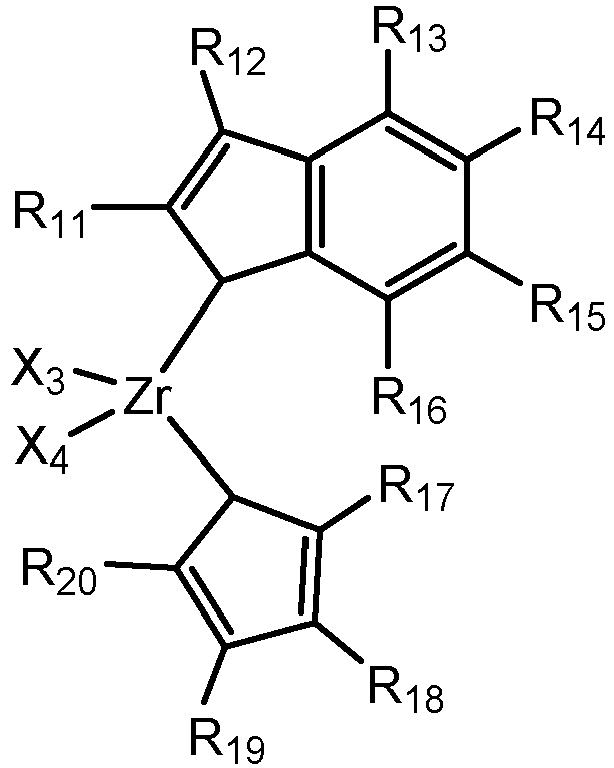
- X3 and X4 are each independently halogen,
- R11 to R20 are each independently hydrogen, halogen, C1-20 alkyl, C2-20 alkenyl, C1-20 alkylsilyl, C1-20 silylalkyl, C1-20 alkoxysilyl, C1-20 ether, C1-20 silyl ether, C1-20 alkoxy, C2-20 alkoxyalkyl, C6-20 aryl, C7-20 alkylaryl, or C7-20 arylalkyl,
- wherein at least one of R11 and R12 is C2-20 alkoxyalkyl, and
- at least one of R17 to R20 is C1-20 alkyl.
- In another aspect of the present disclosure, there is provided a method for preparing an olefin polymer comprising subjecting an olefin monomer to a polymerization reaction in the presence of the hybrid supported metallocene catalyst.
- In yet another aspect of the present disclosure, there is provided an olefin polymer which is prepared by the preparation method of the olefin polymer, and has a melt flow rate ratio (MFRR) of 22 to 50, a full notch creep test (FNCT) of 1000 to 3000 hr and a BOCD (broad orthogonal comonomer distribution) index of 0.8 to 3.0.
- According to the present disclosure, there can be provided a hybrid supported metallocene catalyst that can not only exhibit high activity and polymerizability during production of olefin polymers, but also slightly widen the molecular weight distribution of the synthesized olefin polymers to secure excellent processability and long-term physical properties, and further contribute to reducing catalyst costs, and a method for preparing an olefin polymer using the hybrid supported metallocene catalyst. Therefore, the olefin polymer prepared according to the method of the present disclosure is excellent in processability and long-term physical properties, and thus, is suitable for use in pipes.
- Hereinafter, a hybrid supported metallocene catalyst, a method for preparing an olefin polymer using the same, and an olefin polymer prepared therefrom according to specific embodiments of the present disclosure will be described.
- According to one embodiment of the present disclosure, there is provided a hybrid supported metallocene catalyst comprising a first metallocene compound represented by the following Chemical Formula 1, a second metallocene compound represented by the following Chemical Formula 2, and a support supporting the first and second metallocene compounds

- X1 and X2 are each independently halogen,
- R1 and R5 are each independently C6-20 aryl substituted with C1-20 alkyl,
- R2 to R4 and R6 to R8 are each independently hydrogen, halogen, C1-20 alkyl, C2-20 alkenyl, C1-20 alkylsilyl, C1-20 silylalkyl, C1-20 alkoxysilyl, C1-20 ether, C1-20 silyl ether, C1-20 alkoxy, C6-20 aryl, C7-20 alkylaryl, or C7-20 arylalkyl,
- A is carbon, silicon or germanium, and
- R9 and R10 are each independently C1-2 linear alkyl; or C3-10 linear alkyl substituted with C1-10 alkoxy, wherein at least one of R9 and R10 is C3-10 linear alkyl substituted with C1-10 alkoxy,

- X3 and X4 are each independently halogen,
- R11 to R20 are each independently hydrogen, halogen, C1-20 alkyl, C2-20 alkenyl, C1-20 alkylsilyl, C1-20 silylalkyl, C1-20 alkoxysilyl, C1-20 ether, C1-20 silyl ether, C1-20 alkoxy, C2-20 alkoxyalkyl, C6-20 aryl, C7-20 alkylaryl, or C7-20 arylalkyl,
- wherein at least one of R11 and R12 is C2-20 alkoxyalkyl, and
- at least one of R17 to R20 is C1-20 alkyl.
- Unless specifically limited herein, the following terms may be defined as follows.
- Halogen may be fluorine (F), chlorine (Cl), bromine (Br) or iodine (I).
- A C1-20 alkyl may be linear, branched or cyclic alkyl. Specifically, the C1-20 alkyl may be C1-20 linear alkyl; C1-10 linear alkyl; C1-5 linear alkyl; C3-20 branched or cyclic alkyl; C3-15 branched or cyclic alkyl; or C3-10 branched or cyclic alkyl. More specifically, the C1-20 alkyl may be methyl group, ethyl group, n-propyl group, iso-propyl group, n-butyl group, iso-butyl group, tert-butyl group, n-pentyl group, iso-pentyl group or cyclohexyl group, etc.
- A C2-20 alkenyl may be linear, branched or cyclic alkenyl. Specifically, the C2-20 alkenyl may be C2-20 linear alkenyl, C2-10 linear alkenyl, C2-5 linear alkenyl, C3-20 branched alkenyl, C3-15 branched alkenyl, C3-10 branched alkenyl, C5-20 cyclic alkenyl or C5-10 cyclic alkenyl. More specifically, the C2-20 alkenyl may be ethenyl, propenyl, butenyl, pentenyl, or cyclohexenyl, etc.
- A C6-20 aryl means monocyclic, bicyclic or tricyclic aromatic hydrocarbon. Specifically, the C6-20 aryl may be phenyl group, naphthyl group or anthracenyl group, etc.
- A C7-20 alkylaryl means aryl of which one or more hydrogen atoms are substituted with alkyl. Specifically, the C7-20 alkylaryl may be methylphenyl, ethylphenyl, n-propylphenyl, iso-propylphenyl, n-butylphenyl, iso-butylphenyl, tert-butylphenyl, or cyclohexylphenyl, etc.
- A C7-20 arylalkyl means alkyl of which one or more hydrogen atoms are substituted with aryl. Specifically, the C7-20 arylalkyl may be benzyl group, phenylpropyl or phenylhexyl, etc.
- A C1-20 alkoxy may be methoxy group, ethoxy group, phenyloxy group, cyclohexyloxy group, tert-butoxy hexyl group, etc.
- The above-mentioned substituents may be optionally substituted with one or more substituents selected from the group consisting of hydroxy, halogen, alkyl, heterocycloalkyl, alkoxy, alkenyl, silyl, sulfonate, sulfone, aryl, and heteroaryl within the range that exerts the same or similar effect as the intended effect.
- The hybrid supported metallocene catalyst according to the one embodiment uses the first metallocene compound represented by Chemical Formula 1 and the second metallocene compound represented by Chemical Formula 2 together, and thereby, not only it can exhibit high activity and polymerizability, but also it can slightly widen the molecular weight distribution of the synthesized olefin polymers to improve BOCD and melt flow rate ratio (MFRR) and thus ensure excellent processability. In addition, it can secure long-term physical properties such as full notch creep test (FNCT) of the synthesized olefin polymer, whereby the olefin polymer may be suitable for use as a pipe.
- Specifically, in the first metallocene compound represented by Chemical Formula 1, all the 2- positions of the two indenyl groups, which are ligands, are substituted with methyl, and the 4-positions (R1 and R5) are substituted with phenyl substituted with alkyl, respectively, thereby exhibiting more excellent catalytic activity by an inductive effect capable of supplying sufficient electrons.
- Further, as the first metallocene compound includes zirconium (Zr) as a central metal, it has more orbitals capable of accepting electrons compared to other Group 14 elements, such as hafnium (Hf), thus exhibiting features that can easily bond to monomers with higher affinity, whereby more excellent effects of improving the catalytic activity can be exhibited.
- More specifically, the R1 and R5 in Chemical Formula 1 are each independently C6-12 aryl substituted with C1-10 alkyl, or phenyl substituted with C3-6 branched alkyl, and more specifically, tert-butyl phenyl. In addition, the substitution position of the alkyl group with respect to the phenyl group may be the 4-position corresponding to the R1 or Rs-position and the para-position bonded to the indenyl group.
- Further, the R2 to R4 and R6 to R8 in Chemical Formula 1 may be hydrogen, and the X1 and X2 may be chloro.
- Further, the A in Chemical Formula 1 may be silicon.
- Further, the R9 and R10 which are substituents of A, are each independently methyl; or C5-9 linear alkyl substituted with tert-butoxy, and at least one of R9 and R10 may be a C5-9 linear alkyl substituted with tert-butoxy. More specifically, the R9 is methyl, and R10 may be normal-hexyl substituted with tert-butoxy.
By introducing mutually different substituents as these bridge substituents, it can exhibit catalytic activity with excellent support reactivity. Specifically, in the R9 or R10, when the R9 and R10 are the same as each other, there may be a problem that the solubility at the time of preparing the supported catalyst is not good and so the support reactivity is reduced. - A representative example of the first metallocene compound represented by Chemical Formula 1 may be the following Chemical Formula 1-1.

- The first metallocene compound represented by Chemical Formula 1 may be synthesized by applying known reactions, and for detailed synthesis method, the examples describe below may be referred to.
- Meanwhile, the second metallocene compound represented by Chemical Formula 2 has a structure in which an indenyl group and a cyclopentadienyl group are not crosslinked, and can easily control the electronic/stereoscopic environment around zirconium (Zr), which is a transition metal. As a result, properties such as the chemical structure, molecular weight distribution, and mechanical properties of the prepared olefin polymer can be easily adjusted.
- Further, as the second metallocene compound includes zirconium (Zr) as a central metal, it has more orbitals capable of accepting electrons compared to other Group 14 elements, such as hafnium (Hf), thus exhibiting features that can easily bond to monomers with higher affinity, whereby more excellent effects of improving the catalytic activity can be exhibited.
- More specifically, in Chemical Formula 2, at least one position of the indenyl groups (any one of R11 to R16) may be substituted with C2-20 alkoxyalkyl. Specifically, R11 or R12 may be substituted with C2-20 alkoxyalkyl. More specifically, R11 or R12 may be substituted with C5-9 linear alkyl substituted with tert-butoxy or hexyl substituted with tert-butoxy. By substituting at least one of the indenyl groups with C2-20 alkoxyalkyl, it can affect the copolymerizability of alpha olefin comonomers such as 1-butene, or 1-hexene, and specifically, it can slightly widen the molecular weight distribution of the synthesized olefin polymer to secure excellent processability and long-term physical properties. Furthermore, the C2-20 alkoxyalkyl substituted with the indenyl group can form a covalent bond through close interaction with the silanol group on the silica surface used as a support, and so stable support polymerization can be performed.
- Further, at least one position of the cyclopentadienyl groups (one of R17 to R20) may be substituted with C1-20 alkyl, and specifically, one of R18 and R19 may be substituted with C1-20 alkyl. More specifically, one of R18 and R19 may be substituted with normal-butyl.
- Further, in Chemical Formula 2, , R11, R13 to R17, R19 and R20 may be hydrogen, and X3 and X4 may be chloro.
- A representative example of the second metallocene compound represented by Chemical Formula 2 may be the following Chemical Formula 2-1.


- The second metallocene compound represented by Chemical Formula 2 may be synthesized by applying known reactions, and for more detailed synthesis method, the examples described below may be referred to.
- Meanwhile, the first and second metallocene compounds have the above-mentioned structural characteristics and so can be stably supported on a support.
- As the support, a support containing a hydroxy group or a siloxane group on the surface may be used. Specifically, as the support, supports that are dried at high temperature to remove moisture on the surface, thus containing highly reactive hydroxy groups or siloxanes groups may be used. More specifically, as the support, silica, alumina, magnesia or a mixture thereof may be used. The support may be dried at high temperature, and commonly comprise oxide, carbonate, sulfate, nitrate components such as Na2O, K2CO3, BaSO4 and Mg(NO3)2, etc.
- The drying temperature of the support is preferably 200 to 800°C, more preferably 300 to 600°C, and most preferably 300 to 400°C. If the drying temperature of the support is less than 200°C, it remains an excess of water and thus surface moisture may react with the cocatalyst; whereas if the drying temperature is greater than 800°C, pores on the support surface may be combined together to reduce the surface area, and also a lot of hydroxy groups may be lost on the surface and only siloxane groups may remain, thus decreasing the reaction sites with the cocatalyst, which is not preferable.
- The amount of the hydroxyl groups on the support surface may be preferably 0.1 to 10 mmol/g, more preferably 0.5 to 5 mmol/g. The amount of the hydroxyl groups on the support surface may be controlled by the preparation method and conditions of support, or drying conditions, for example, temperature, time, vacuum or spray drying and the like.
- If the amount of the hydroxyl groups are less than 0.1 mmol/g, the reaction sites with the cocatalyst may be little, and if it is greater than 10 mmol/g, there is a possibility of being derived from moisture other than hydroxyl groups existing on the support particle surface, which is not preferable.
- The hybrid supported metallocene catalyst according to the one embodiment may further include a cocatalyst for activating the transition metal compound which is a catalyst precursor. The cocatalyst is an organometallic compound containing a Group 13 metal, and is not particularly limited as long as it can be used when polymerizing an olefin under a general metallocene catalyst. Specifically, the cocatalyst may be at least one compound selected from the group consisting of compounds represented by the following Chemical Formulas 3 to 5.
[Chemical Formula 3] R22-[Al(R21)-O]n-R23
in Chemical Formula 3, - R21, R22 and R23 are each independently hydrogen, halogen, a C1-20 hydrocarbyl group, or a C1-20 hydrocarbyl group substituted with halogen, and
- n is an integer of 2 or more;
- D is aluminum or boron, and
- each R24 is independently halogen, a C1-20 hydrocarbyl group, a C1-20 hydrocarbyloxy group, or a C1-20 hydrocarbyl group substituted with halogen;
- L is neutral or cationic Lewis base,
- H is a hydrogen atom,
- W is a Group 13 atom, and
- each A is independently one of a C1-20 hydrocarbyl group; a C1-20 hydrocarbyloxy group; and substituents in which at least one hydrogen atom of the above substituents is substituted with at least one substituent selected among halogen, a C1-20 hydrocarbyloxy group and a C1-20 hydrocarbyl(oxy)silyl group.
- Unless specifically limited herein, the following terms may be defined as follows.
- A hydrocarbyl group is a monovalent functional group in which hydrogen atom is removed from hydrocarbon, and it may include an alkyl group, an alkenyl group, an alkynyl group, an aryl group, an aralkyl group, an aralkenyl group, an aralkynyl group, an alkylaryl group, an alkenylaryl group, and an alkynylaryl group, etc. And, a C1-20 hydrocarbyl group may be a C1-15 or C1-10 hydrocarbyl group. Specifically, a C1-20 hydrocarbyl group may be a linear, branched or cyclic alkyl group such as a methyl group, an ethyl group, an n-propyl group, an iso-propyl group, an n-butyl group, an iso-butyl group, a tert-butyl group, an n-pentyl group, an n-hexyl group, an n-heptyl group, a cyclohexyl group, etc.; or an aryl group such as a phenyl group, a naphthyl group, an anthracenyl group, etc.
- A hydrocarbyloxy group is a functional group in which a hydrocarbyl group is bonded to oxygen. Specifically, a C1-20 hydrocarbyloxy group may be a C1-15 or C1-10 hydrocarbyloxyl group. More specifically, a C1-20 hydrocarbyloxy group may be a linear, branched or cyclic alkoxy group such as a methoxy group, an ethoxy group, an n-propoxy group, an iso-propoxy group, an n-butoxy group, an iso-butoxy group, a tert-butoxy group, an n-pentoxy group, an n-hexoxy group an n-heptoxy group, a cyclohexoxy group, etc.; or an aryloxy group such as a phenoxy group, a naphthaleneoxy group, etc.
- A hydrocarbyl(oxy)silyl group is a functional group in which 1 to 3 hydrogen atoms of -SiH3 are substituted with 1 to 3 hydrocarbyl groups or hydrocarbyloxy groups. Specifically, a C1-20 hydrocarbyl(oxy)silyl group may be a C1-15, C1-10, or C1-5 hydrocarbyl(oxy)silyl group. More specifically, a C1-20 hydrocarbyl(oxy)silyl group may be an alkylsilyl group such as a methylsilyl group, a dimethylsilyl group, a trimethylsilyl group, a dimethylethylsilyl group, a diethylmethylsilyl group, a dimethylpropylsilyl group, etc.; an alkoxysilyl group such as a methoxysilyl group, a dimethoxysilyl group, a trimethoxysilyl group, a dimethoxyethoxysilyl group, etc.; or an alkoxyalkylsilyl group such as a methoxydimethylsilyl group, a diethoxymethylsilyl group, a dimethoxypropylsilyl group, etc.
- Non-limiting examples of the compounds represented by the Chemical Formula 3 may include methylaluminoxane, ethylaluminoxane, isobutylaluminoxane, or tert-butylaluminoxane, etc.
- And, non-limiting examples of the compounds represented by the Chemical Formula 4 may include trimethylaluminum, triethylaluminum, tri isobutylaluminum, tripropylaluminum, tributylaluminum, dimethylchloroaluminum, triisopropylaluminum, tri-sec-butylaluminum, tricyclopentylaluminum, tripentylaluminum, triisopentylaluminum, trihexylaluminum, trioctylaluminum, ethyldimethylaluminum, methyldiethylaluminum, triphenylaluminum, tri-p-tolylaluminum, dimethylaluminum methoxide, dimethylaluminum ethoxide, etc.
- Finally, non-limiting examples of the compounds represented by the Chemical Formula 5 may include trimethylammonium tetrakis(pentafluorophenyl)borate, triethylammonium tetrakis(pentafluorophenyl)borate, N,N-dimethylanilinium tetrakis(pentafluorophenyl)borate, N,N-dimethylanilinium n-butyltris(pentafluorophenyl)borate, N,N-dimethylanilinium benzyltris(pentafluorophenyl)borate, N,N-dimethylanilinium tetrakis(4-(t-butyldimethylsilyl)-2,3,5,6-tetrafluorophenyl)borate, N,N-dimethylanilinium tetrakis(4-(triisopropylsilyl)-2,3,5,6-tetrafluorophenyl)borate, N,N-dimethylanilinium pentafluorophenoxytris(pentafluorophenyl)borate, N,N-dimethyl(2,4,6-trimethylanilinium) tetrakis(pentafluorophenyl)borate, trimethylammonium tetrakis(2,3,4,6-tetrafluorophenyl)borate, N,N-dimethylanilinium tetrakis(2,3,4,6-tetrafluorophenyl)borate, hexadecyldimethylammonium tetrakis(pentafluorophenyl)borate, N-methyl-N-dodecylanilinium tetrakis(pentafluorophenyl)borate or methyldi(dodecyl)ammonium tetrakis(pentafluorophenyl)borate, etc.
- The amount of the cocatalyst used may be appropriately adjusted according to the physical properties or effects of the desired hybrid supported metallocene catalyst.
- The hybrid supported metallocene catalyst according to the one embodiment can be produced, for example, by a process including a step of supporting a cocatalyst on the support, and a step of supporting the above-mentioned first and second metallocene compounds, which are catalyst precursors, on the cocatalyst-supported support.
- Specifically, in the step of supporting the cocatalyst on the support, a cocatalyst-supported support can be prepared by adding a cocatalyst to a support dried at high temperature and stirring it at a temperature of about 20 to 120°C.
- And, in the step of supporting the catalyst precursor on the cocatalyst-supported support, a supported catalyst can be produced by adding the first and second metallocene compounds to the cocatalyst-supported support obtained in the step of supporting the cocatalyst on the support, and again stirring the mixture at a temperature of about 20 to 120°C.
- In the step of supporting the catalyst precursor on the cocatalyst-supported support, a supported catalyst can be produced by adding the first and second metallocene compounds to the cocatalyst-supported support, stirring the mixture, and then further adding the cocatalyst.
- The content of the support, the cocatalyst, the cocatalyst-supported support, and the transition metal compound used in the hybrid supported metallocene catalyst according to the one embodiment may be appropriately adjusted depending on the physical properties or effects of the desired supported catalyst.
- Specifically, in the hybrid supported metallocene catalyst, a molar ratio of the first metallocene compound and the second metallocene compound may be 1: 1 to 15: 1. By containing the first and second metallocene compounds in the above-mentioned mixing molar ratio, it is possible to provide a hybrid supported metallocene catalyst having high activity and high copolymerizability compared to a conventional one. In addition, when an olefin polymer is prepared by using the hybrid supported metallocene catalyst, it can widen the molecular weight distribution and thus improve long-term physical properties such as full notch creep test (FNCT), and improve BOCD and melt flow rate ratio (MFRR) and thus improve the processability.
- However, if the molar ratio of the first metallocene compound and the second metallocene compound is less than 1: 1, the copolymerizability and the processability may be deteriorated. If the molar ratio exceeds 15: 1, the activity and the physical properties may be deteriorated.
- In addition, in the hybrid supported metallocene catalyst according to the one embodiment, the weight ratio between the entire metallocene compound including the first and second metallocene compounds and the support may be 1:10 to 1: 1,000 or 1:10 to 1: 500. If the support and the metallocene compound are contained in the above-mentioned range, the optimum shape can be exhibited.
- Further, when the hybrid supported metallocene catalyst further includes a cocatalyst, the weight ratio of the cocatalyst to the support may be 1: 1 to 1: 100 or 1: 1 to 1:50. When the cocatalyst and the support are included in the above weight ratio, it is possible to optimize the activity and the polymer microstructure.
- As a reaction solvent during the production of the hybrid supported catalyst, a hydrocarbon solvent such as pentane, hexane, and heptane; or alternatively, an aromatic solvent such as benzene or toluene may be used.
- For more specific method for preparing the supported catalyst, the examples described below can be referred to. However, the preparation method of the supported catalyst is not limited to the content described herein, and the preparation method may further adopt a step that is ordinarily adopted in the technical field to which the present disclosure belongs. The step(s) of the preparation method may be modified by a generally changeable step(s).
- Meanwhile, according to yet another embodiment, there is provided a method for preparing an olefin polymer comprising the step of subjecting an olefin monomer to a polymerization reaction in the presence of the hybrid supported metallocene catalyst.
- As described above, the hybrid supported metallocene catalyst has a broad molecular weight distribution due to a specific structure, compared to an olefin polymer polymerized using a conventional metallocene compound catalyst, thus, providing an olefin polymer capable of securing excellent processability and long-term physical properties.
- Examples of the olefin monomer polymerizable with the hybrid supported catalyst include ethylene, alpha-olefin, and cyclic olefin, etc., and a diene olefin-based monomer or a triene olefin-based monomer having two or more double bonds can also be polymerized. Specific examples of the monomers include ethylene, propylene, 1-butene, 1-pentene, 4-methyl-1-pentene, 1-hexene, 1-heptene, 1-octene, 1-decene, 1-undecene, 1-dodecene, 1-tetradecene, 1-hexadecene, 1-eitocene, norbornene, norbornadiene, ethylidene norbornene, phenyl norbornene, vinyl norbornene, dicyclopentadiene, 1,4-butadiene, 1,5-pentadiene, 1,6-hexadiene, styrene, alpha-methylstyrene, divinylbenzene, 3-chloromethylstyrene, etc., and two or more of these monomers may also be mixed and copolymerized. When the olefin polymer is a copolymer of ethylene and another comonomer, the comonomer is preferably one or more comonomers selected from the group consisting of propylene, 1-butene, 1-hexene, 4-methyl-1-pentene and 1-octene.
- For the polymerization reaction of the olefin monomer, various polymerization processes known for a polymerization reaction of an olefin monomer, such as a continuous solution polymerization process, a bulk polymerization process, a suspension polymerization process, a slurry polymerization process, or an emulsion polymerization process, may be adopted. More specifically, the polymerization reaction may be performed in a semi-batch reactor.
- Specifically, the polymerization reaction may be performed under a temperature of about 50 to 110°C or about 60 to 100°C and a pressure of about 1 to 100 kgf/cm2 or about 1 to 50 kgf/cm2.
- Further, in the polymerization reaction, the hybrid supported catalyst may be used in a state of being dissolved or diluted in a solvent such as pentane, hexane, heptane, nonane, decane, toluene, benzene, dichloromethane, chlorobenzene, etc. In this case, the solvent can be treated with a small amount of alkylaluminium, etc., and thereby, a small amount of water or air, etc. that may adversely affect the catalyst can be removed in advance.
- As the olefin polymer prepared by the above method is prepared by using the above-mentioned hybrid supported metallocene catalyst, it has a slightly wide molecular weight distribution and can secure excellent processability by improving the BOCD and the melt flow rate ratio (MFRR), and further can secure long-term physical properties such as full notch creep test (FNCT) of the synthesized olefin polymer.
- Specifically, the olefin polymer has a melt flow rate ratio (MFRR) of 22 to 50 or 25 to 32, a full notch creep test (FNCT) of 1000 to 3000 hr or 1000 to 2000 hr, and a BOCD (broad orthogonal comonomer distribution) index of 0.8 to 3.0 or 0.9 to 1.4.
- In addition, when the polymer polymerized using the above-mentioned hybrid supported catalyst is, for example, an ethylene-alpha olefin copolymer, preferably an ethylene-1-butene polymer, the above physical properties can be more appropriately satisfied.
- Hereinafter, the actions and effects of the present disclosure will be explained in more detail with reference to specific examples. However, these examples are presented only as the illustration of the invention and the scope of the present disclosure is not limited thereto.
-

- 2-Methyl-4-t-butyl-phenylindene (10.0 g, compound 1) was dissolved in 76.2 mL of diethyl ether (Et2O) and then cooled to -25°C. Then, 16.0 mL of n-butyllithium solution (2.5 M, hexane solvent) was slowly added dropwise, followed by stirring at room temperature for 4 hours. After cooling to -25°C, 1 mol% of copper cyanide (CuCN) was added, and then 2.92 mL of (6-(t-butoxy)hexyl)methyldichlorosilane was dissolved in 38 mL of diethyl ether and slowly added dropwise, and the mixture was stirred at room temperature for 16 hours. Then, dichloromethane (DCM) and water were added to separate the organic layer, and then from the organic layer, water was removed using magnesium sulfate (MgSO4), filtered, and then the solvent was distilled under reduced pressure to give ((6-(t-butoxy)hexyl)methylsilane-diyl)-bis((2-methyl-4-t-butyl-phenylindenyl)silane.
- ((6-(t-butoxy)hexyl)methylsilane-diyl)-bis((2-methyl-4-t-butyl-phenylindenyl)silane prepared in step 1 was dissolved in 95.3 mL of diethyl ether (Et2O), and then cooled to -25°C. 8 mL of n-butyllithium solution (2.5 M) was slowly added dropwise, followed by stirring at room temperature for 4 hours. Then, the mixture was cooled to -25°C, and 3.59 g of zirconium tetrachloride tetrahydrofuran complex [ZrCl4·2THF] was added dropwise, and the mixture was stirred at room temperature for 16 hours. The solvent of the reaction solution was removed under reduced pressure, and then dichloromethane was added and filtered, and the filtrate was distilled off under reduced pressure. It was recrystallized from dichloromethane to give [((6-(t-butoxy)hexyl)methylsilane-diyl)-bis((2-methyl-4-t-butyl-phenylindenyl)]zirconium dichloride (1.0 g, yield: 14%).
-

- 10.8 g (100 mmol) of chlorohexanol was charged into a dried 250 mL Schlenk-flask, then 10 g of molecular sieve and 100 mL of MTBE (methyl t-butyl ether) were added, and 20 g sulfuric acid was slowly added over 30 minutes. The reaction mixture slowly turned pink over time, and after 16 hours, it was poured into a saturated sodium bicarbonate solution which was cooled cold with ice. The mixture was extracted four times using 100 mL of ether, and the combined organic layer was dried over MgSO4, filtered, and then the solvent was removed under reduced pressure to obtain 10 g (yield: 60%) of 1-(t-butoxy)-6-chlorohexene as a yellow liquid.
- 4.5 g (25 mmol) of 1-(t-butoxy)-6-chlorohexene synthesized above was charged into a dried 250 mL Schlenk-flask and dissolved in 40 mL of THF. 20 mL of sodium indenide THF solution was slowly added thereto, and then the mixture was stirred overnight. The reaction mixture was quenched by adding 50 mL of water, extracted with an ester (50 mL x 3), and then the collected organic layer was sufficiently washed with brine. The remaining moisture was dried with MgSO4, filtered, and then the solvent was removed under vacuum reduced pressure, thereby obtaining 3-(6-(t-butoxy)hexyl)-1 H-indene as a product in dark brown viscous form in quantitative yield.
- 4.57 g (20 mmol) of 3-(6-(t-butoxy)hexyl)-1H-indene prepared above was charged into a dried 250 mL Schlenk-flask, and dissolved in 60 mL of ether and 40 mL of THF. 13 mL of n-BuLi 2.0M hexane solution was added thereto and stirred overnight, and then a toluene solution (concentration: 0.378 mmol/g) of n-butyl cyclopentadiene ZrCl3 was slowly added at -78°C. The reaction mixture turned into a white suspension shape with a yellow solid floating in clear brown solution when raised to room temperature. After 12 hours, 100 mL of hexane was added to the reaction mixture to form another precipitate. It was then filtered under argon to obtain a yellow filtrate, which was dried, thereby confirming that the desired compound, 3-(6-(t-butoxy)hexyl)-1H-inden-1-yl)(3-butylcyclopenta-2,4-dien-1-yl) zirconium dichloride was produced.
- To prepare a Ziegler-Natta catalyst, 500 kg of magnesium ethylate was dispersed in a sufficient amount of hexane, and then 1700 kg of tetrachloride titanium was slowly added dropwise over 5.5 hours at 85°C, followed by tempering at 120°C. Thereafter, unreacted by-products containing the titanium compound were removed until the titanium concentration of the entire solution became 500 mmol, and then preactivated by contacting with triethyl aluminum at 120°C for 2 hours, and the unreacted by-products were removed to give a final catalyst.
- Silica (SYLOPOL 948 produced by Grace Davison) was dehydrated under vacuum at a temperature of 200°C for 15 hours. 10 g of dried silica was charged into a glass reactor, and 100 mL of toluene was further added and stirred. 50 mL of a 10 wt% methylaluminoxane(MAO)/toluene solution was added. After raising the temperature to 60°C, the mixture was reacted with stirring for 12 hours. After lowering the temperature of the reactor to 40°C, the stirring was stopped, settling was performed for 10 minutes, and then the reaction solution was subjected to decantation. Toluene was filled up to 100 mL of the reactor, and 0.01 mmol of the first metallocene compound (A) of Preparation Example 1 was dissolved in 10 ml of toluene and added together, and reacted for 1 hour. After the reaction was completed, 0.01 mmol of the second metallocene compound(B) of Preparation Example 2 was dissolved in 10 ml of toluene, and then added together, followed by further reacting for 1 hour.
- 2ml of TEAL (1.0M hexane) and 10 g of 1-butene were charged into a 2L autoclave high-pressure reactor, and 0.8kg of hexane was added, and then the temperature was raised to 80° C while stirring at 500rpm.
- 50 mg of the supported catalyst prepared above and hexane were placed in a 50 mL vial and then charged into the reactor, and when the temperature inside the reactor reached 78°C, the mixture was reacted for 1 hour while stirring at 500 rpm under ethylene pressure of 9 bar. After the reaction was completed, hexane was first removed through a filter, and dried in a vacuum oven at 80°C for 4 hours to obtain an olefin polymer.
- A hybrid supported catalyst and an olefin polymer were prepared in the same manner as in Example 1, except that the first metallocene compound(A) of Preparation Example 1 was used in an amount of 0.05 mmol in Example 1.
- A hybrid supported catalyst and an olefin polymer were prepared in the same manner as in Example 1, except that the first metallocene compound(A) of Preparation Example 1 was used in an amount of 0.1 mmol in Example 1.
- A hybrid supported catalyst and an olefin polymer were prepared in the same manner as in Example 1, except that the first metallocene compound(A) of Preparation Example 1 was used in an amount of 0.15 mmol in Example 1.
- A hybrid supported catalyst and an olefin polymer were prepared in the same manner as in Example 1, except that 0.01mmol of the second metallocene compound (B) of Preparation Example 2 and 0.01mmol of the metallocene compound (C) represented by the following Chemical Formula C were used at the molar ratio (1/1) shown in Table 1 below, instead of the composition (A/B) of the first and second metallocene compounds in Example 1.


- An olefin polymer was prepared in the same manner as in Example 1, except that the Ziegler-Natta catalyst (Z/N catalyst) of Preparation Example 3 was used in an amount of 0.1 mmol in Example 1.
- A hybrid supported catalyst and an olefin polymer were prepared in the same manner as in Example 1, except that only the first metallocene compound (A) of Preparation Example 1 was used in an amount of 0.1 mmol in Example 1.
- A hybrid supported catalyst and an olefin polymer were prepared in the same manner as in Example 1, except that only the second metallocene compound (B) of Preparation Example 2 was used in an amount of 0.1 mmol in Example 1.
- A hybrid supported catalyst and an olefin polymer were prepared in the same manner as in Example 1, except that 0.01mmol of the second metallocene compound (B) of Preparation Example 2 and 0.01mmol of the metallocene compound (C) represented by the following Chemical Formula D were used at the molar ratio (1/1) shown in Table 1 below, instead of the composition (A/B) of the first and second metallocene compounds in Example 1.

- A hybrid supported catalyst and an olefin polymer were prepared in the same manner as in Example 1, except that 0.01mmol of a metallocene compound represented by the following Chemical Formula E and 0.01mmol of a metallocene compound represented by the following Chemical Formula F were used at the molar ratio (1/1) shown in Table 1 below, instead of the composition (A/B) of the first and second metallocene compounds in Example 1.
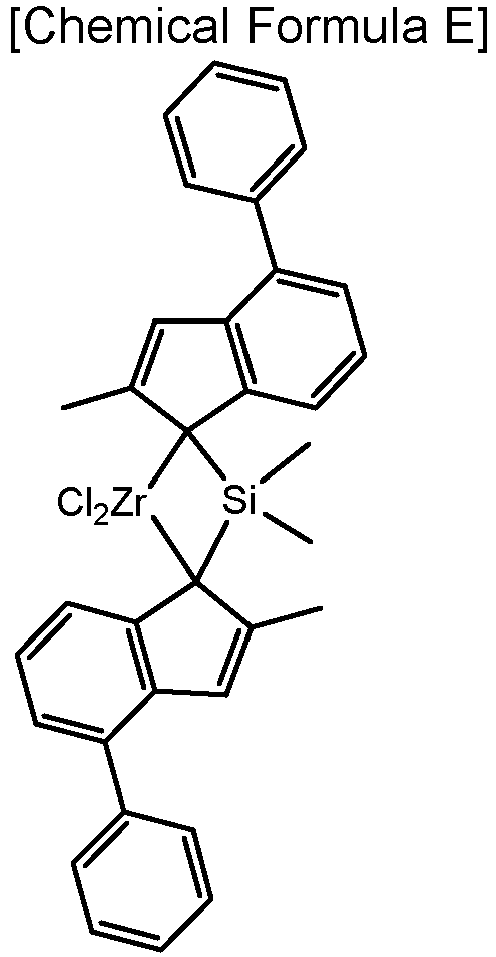

- The catalytic activity, melt index, melt flow rate ratio (MFRR), full notch creep test (FNCT) and BOCD index of the catalysts and olefin polymers of Examples 1 to 4 and Comparative Examples 1 to 5 were measured by the following methods, and the results are shown in Table 1 below.
- (1) Catalytic activity (kg PE / g SiO2)
The catalytic activity was calculated as the ratio of the weight of produced polymer (kg PE) per catalyst content (g SiO2) used per unit time (h). - (2) Melt index of the polymer (MI 2.16)
Melt index (MI 2.16) was measured at 190°C under a load of 2.16 kg according to ASTM D 1238 and expressed as the weight (g) of polymer melted and discharged for 10 minutes. - (3) Melt flow rate ratio (MFRR: MFR20/MFR2): it is the ratio of MFR20 melt index (MI, load of 21.6kg) divided by MFR2 (MI, load of 2.16kg).
- (4) BOCD Index (Broad Orthogonal Co-monomer Distribution index): In the analysis of the GPC-FTIR measurement results, the SCB content (unit: number/1,000C) was measured within a range of 30% (total 60%) on the left and right sides of the molecular weight distribution (MWD) based on the weight average molecular weight (Mw). The BOCD index was calculated by the following Mathematical Formula 1.
 MW: molecular weight)
- (5) Full notch creep test (FNCT, hr): As an evaluation method of molded articles of ethylene polymer, the test method for the full notch creep test is described in M. Flissner in Kunststoffe 77 (1987), pp. 45 et seq. and this corresponds to ISO/FDIS 16770 that is currently in force. In respect to ethylene glycol, which was a stress crack promotion medium using tension of 3.5 Mpa at 80°C, and the breakage time was reduced due to the reduction in the stress initiation time by the notch (1.6 mm/safety razor blade).
- For the preparation of the specimens, 750 ppm of a primary antioxidant (Irganox 1010, CIBA), 1500 ppm of a secondary antioxidant (Irgafos 168, CIBA) and 1000ppm of a processing aid (SC110, Ca-St, Duboon Yuhaw Inc.) were added to each ethylene polymers (PE) of Examples and Comparative Examples, and granulation was performed at an extrusion temperature of 170°C to 220°C using a twin screw extruder (W&P Twin Screw Extruder, 75 pie, L/D=36). The extruding test for the processability of the resin was performed under the conditions of 190 to 220°C (Temp. Profile (°C): 190/200/210/220) by using a Haake Single Screw Extruder (19 pie, L/D = 25). In addition, the pipe was extruded and molded at an extrusion temperature of 220°C by using a single screw extruder (Battenfeld Pipe M/C, 50 pie, L/D = 22, compression ratio = 3.5) so that the outer diameter was 32 mm and the thickness was 2.9 mm.
- Subsequently, three specimens having a size of 10 mm (width), 10 mm (height) and 90 mm (length) were manufactured by sawing the specimens from the plate compressed to have the thickness of 10 mm. In order to achieve this object, the safety razor blade was used in the notch device specifically manufactured and the central notch was provided to the specimen. The depth of the notch was 1.6 mm.
[Table 1] Precursor Catalyst A/B Ratio Activity (KgPE/gSiO2) MI 2.16 MFRR BOCD index FNCT (hr) Example 1 A/B 1/1 23 0.6 25 0.9 1000 Example 2 A/B 5/1 22 0.6 28 1.1 1700 Example 3 A/B 10/1 20 0.5 30 1.4 2000 Example 4 A/B 15/1 17 0.3 32 1.3 1800 Comparative Example 1 B/C 1/1 10 0.2 20 0.5 700 Comparative Example 2 Z/N catalyst - 11 0.4 18 0.1 800 Comparative Example 3 A - 10 0.02 12 0.6 700 Comparative Example 4 B - 25 5.0 5 0.1 10 Comparative Example 5 B/D 1/1 12 17 18 0.5 600 Comparative Example 6 E/F 1/1 8 3.0 15 0.5 30 - As shown in Table 1, it was confirmed that the polymers of Examples 1 to 4 of the present disclosure exhibited a high activity by using a supported catalyst using a combination of specific precursors. In addition, it was confirmed that in the polymers of Examples 1 to 4, all of MFRR, BOCD and FNCT were remarkably superior to those of Comparative Examples, and thus, a polymer for pipes with improved processability and long-term physical properties could be provided.
[Chemical Formula 4] D(R24)3
in Chemical Formula 4,
in Chemical Formula 5,
Claims (15)
- A hybrid supported metallocene catalyst comprising:a first metallocene compound represented by the following Chemical Formula 1,a second metallocene compound represented by the following Chemical Formula 2, anda support supporting the first and second metallocene compounds
 X1 and X2 are each independently halogen,R1 and R5 are each independently C6-20 aryl substituted with C1-20 alkyl,R2 to R4 and R6 to R8 are each independently hydrogen, halogen, C1-20 alkyl, C2-20 alkenyl, C1-20 alkylsilyl, C1-20 silylalkyl, C1-20 alkoxysilyl, C1-20 ether, C1-20 silyl ether, C1-20 alkoxy, C6-20 aryl, C7-20 alkylaryl, or C7-20 arylalkyl,A is carbon, silicon or germanium, andR9 and R10 are each independently C1-2 linear alkyl; or C3-10 linear alkyl substituted with C1-10 alkoxy, wherein at least one of R9 and R10 is C3-10 linear alkyl substituted with C1-10 alkoxy,
 X3 and X4 are each independently halogen,R11 to R20 are each independently hydrogen, halogen, C1-20 alkyl, C2-20 alkenyl, C1-20 alkylsilyl, C1-20 silylalkyl, C1-20 alkoxysilyl, C1-20 ether, C1-20 silyl ether, C1-20 alkoxy, C2-20 alkoxyalkyl, C6-20 aryl, C7-20 alkylaryl, or C7-20 arylalkyl,wherein at least one of R11 and R12 is C2-20 alkoxyalkyl, andat least one of R17 to R20 is C1-20 alkyl.
 - The hybrid supported metallocene catalyst of claim 1, wherein the R1 and R5 are each independently phenyl substituted with C3-6 branched alkyl.
- The hybrid supported metallocene catalyst of claim 1, wherein the R9 and R10 are each independently methyl; or C5-9 linear alkyl substituted with tert-butoxy, and at least one of R9 and R10 is a C5-9 linear alkyl substituted with tert-butoxy.
- The hybrid supported metallocene catalyst of claim 1, wherein the first metallocene compound represented by Chemical Formula 1 is the following Chemical Formula 1-1.

- The hybrid supported metallocene catalyst of claim 1, wherein R12 is a C5-9 linear alkyl substituted with tert-butoxy.
- The hybrid supported metallocene catalyst of claim 1, wherein one of R18 and R19 is normal-butyl.
- The hybrid supported metallocene catalyst of claim 1, wherein the second metallocene compound represented by Chemical Formula 2 is the following Chemical Formula 2-1.


- The hybrid supported metallocene catalyst of claim 1, wherein a molar ratio of the first metallocene compound and the second metallocene compound is 1: 1 to 15: 1.
- The hybrid supported metallocene catalyst of claim 1, wherein the support includes any one selected from the group consisting of silica, alumina and magnesia, or a mixture of two or more thereof.
- The hybrid supported metallocene catalyst of claim 1, further comprising at least one cocatalyst selected from the group consisting of compounds represented by the following Chemical Formulas 3 to 5:
[Chemical Formula 3] R22-[Al(R21)-O]n-R23
in Chemical Formula 3,R21, R22 and R23 are each independently hydrogen, halogen, a C1-20 hydrocarbyl group, or a C1-20 hydrocarbyl group substituted with halogen, andn is an integer of 2 or more,
[Chemical Formula 4] D(R24)3
in Chemical Formula 4,D is aluminum or boron, andeach R24 is independently halogen, a C1-20 hydrocarbyl group, a C1-20 hydrocarbyloxy group, or a C1-20 hydrocarbyl group substituted with halogen,
[Chemical Formula 5] [L-H]+[W(A)4]- or [L]+[W(A)4]-
in Chemical Formula 5,L is neutral or cationic Lewis base,H is a hydrogen atom,W is a Group 13 atom, andeach A is independently one of a C1-20 hydrocarbyl group; a C1-20 hydrocarbyloxy group; and substituents in which at least one hydrogen atom of the above substituents is substituted with at least one substituent selected among halogen, a C1-20 hydrocarbyloxy group and a C1-20 hydrocarbyl(oxy)silyl group. - A method for preparing an olefin polymer comprising subjecting an olefin monomer to a polymerization reaction in the presence of a hybrid supported metallocene catalyst of claim 1.
- The method for preparing the olefin polymer of claim 11, wherein the polymerization reaction is performed in a semi-batch reactor.
- The method for preparing the olefin polymer of claim 11, wherein the olefin monomer includes at least one selected from the group consisting of ethylene, propylene, 1-butene, 1-pentene, 4-methyl-1-pentene, 1-hexene, 1-heptene, 1-octene, 1-decene, 1-undecene, 1-dodecene, 1-tetradecene, 1-hexadecene, 1-eitocene, norbornene, norbornadiene, ethylidene norbornene, phenyl norbornene, vinyl norbornene, dicyclopentadiene, 1,4-butadiene, 1,5-pentadiene, 1,6-hexadiene, styrene, alpha-methylstyrene, divinylbenzene and 3-chloromethylstyrene.
- An olefin polymer which is prepared by the preparation method of claim 11, and has a melt flow rate ratio (MFRR) of 22 to 50, a full notch creep test (FNCT) of 1000 to 3000 hr, and a broad orthogonal comonomer distribution(BOCD) index of 0.8 to 3.0.
- The olefin polymer of claim 14, which is ethylene-1-butene polymer.
Applications Claiming Priority (3)
| Application Number | Priority Date | Filing Date | Title |
|---|---|---|---|
| KR20190006226 | 2019-01-17 | ||
| KR1020190172478A KR102432898B1 (en) | 2019-01-17 | 2019-12-20 | Supported hybrid metallocene catalyst and method for preparing olefin polymer using the same |
| PCT/KR2020/000748 WO2020149643A1 (en) | 2019-01-17 | 2020-01-15 | Supported hybrid metallocene catalyst and method for preparing olefin polymer by using same |
Publications (2)
| Publication Number | Publication Date |
|---|---|
| EP3760654A1 true EP3760654A1 (en) | 2021-01-06 |
| EP3760654A4 EP3760654A4 (en) | 2021-09-15 |
Family
ID=71893869
Family Applications (1)
| Application Number | Title | Priority Date | Filing Date |
|---|---|---|---|
| EP20742086.0A Pending EP3760654A4 (en) | 2019-01-17 | 2020-01-15 | HYBRID CATALYST ON SUPPORT AND PROCESS FOR PREPARING AN OLEFIN POLYMER USING THE SAME |
Country Status (4)
| Country | Link |
|---|---|
| US (1) | US11384183B2 (en) |
| EP (1) | EP3760654A4 (en) |
| KR (1) | KR102432898B1 (en) |
| CN (1) | CN112020522B (en) |
Families Citing this family (8)
| Publication number | Priority date | Publication date | Assignee | Title |
|---|---|---|---|---|
| KR102761660B1 (en) * | 2020-11-27 | 2025-01-31 | 롯데케미칼 주식회사 | Supported hybrid metallocene catalyst, method for preparing polyethylene using the same, and polyethylene copolymer |
| KR102781971B1 (en) * | 2022-04-22 | 2025-03-18 | 지에스칼텍스 주식회사 | Mononuclear metallocene compound and metallocene catalyst for preparing polyolefin using the same |
| EP4716706A1 (en) | 2023-05-23 | 2026-04-01 | ExxonMobil Technology and Engineering Company | Catalysts, polyethylenes, polymerizations thereof, and films thereof |
| CN121420001A (en) | 2023-05-23 | 2026-01-27 | 埃克森美孚技术与工程公司 | Polyethylene, catalysts used for their polymerization, and their membranes |
| WO2024242933A1 (en) | 2023-05-23 | 2024-11-28 | ExxonMobil Technology and Engineering Company | Catalysts and polymerizations for improved polyolefins |
| EP4716705A1 (en) | 2023-05-23 | 2026-04-01 | ExxonMobil Technology and Engineering Company | Low density polethylenes, films thereof, and methods and catalysts for production thereof |
| EP4716704A1 (en) | 2023-05-23 | 2026-04-01 | ExxonMobil Technology and Engineering Company | Polyethylenes having improved processability and films thereof |
| CN121646613A (en) | 2024-07-03 | 2026-03-10 | 株式会社Lg化学 | Hybrid supported metallocene catalyst and method for preparing polyethylene using the same |
Family Cites Families (15)
| Publication number | Priority date | Publication date | Assignee | Title |
|---|---|---|---|---|
| KR100579843B1 (en) | 2003-04-01 | 2006-05-12 | 주식회사 엘지화학 | Hybrid supported metallocene catalyst and its preparation method and polyolefin production method using the same |
| WO2008136621A1 (en) | 2007-05-02 | 2008-11-13 | Lg Chem, Ltd. | Polyolefin and preparation method thereof |
| US20120172548A1 (en) | 2007-05-02 | 2012-07-05 | Lg Chem, Ltd. | Polyolefin and preparation method thereof |
| KR101653356B1 (en) * | 2014-10-17 | 2016-09-01 | 주식회사 엘지화학 | Metallocene catalyst for preparing polyolefin with high molecular weight |
| KR101737568B1 (en) * | 2014-11-14 | 2017-05-18 | 주식회사 엘지화학 | Supported hybrid catalyst and method for preparing of olefin based polymer using the same |
| KR101723488B1 (en) * | 2014-12-24 | 2017-04-06 | 주식회사 엘지화학 | Method for preparing polypropylene and polypropylene prepared therefrom |
| KR101740149B1 (en) * | 2015-11-11 | 2017-06-08 | 한화토탈 주식회사 | Ethylene copolymer having excellent processing properties |
| KR102124102B1 (en) | 2015-12-18 | 2020-06-17 | 주식회사 엘지화학 | Supported hybrid catalyst and method for preparing of olefin based polymer using the same |
| KR102080640B1 (en) * | 2015-12-23 | 2020-05-27 | 주식회사 엘지화학 | Supported hybrid catalyst and method for preparing of olefin based polymer using the same |
| KR101711788B1 (en) | 2016-03-09 | 2017-03-14 | 한화케미칼 주식회사 | Hybride catalyst compositon, preparation method thereof, and manufactured polyolefin using the same |
| EP3415540B1 (en) * | 2016-11-15 | 2022-09-14 | LG Chem, Ltd. | Ethylene/alpha-olefin copolymer having excellent environmental stress crack resistance |
| KR101773722B1 (en) | 2016-12-16 | 2017-08-31 | 한화케미칼 주식회사 | High density ethylene polymer with excellent processability using supported hybrid metallocene catalyst and methods for producing the same |
| KR102211603B1 (en) * | 2017-02-28 | 2021-02-02 | 주식회사 엘지화학 | Catalyst composition for polymerizing olefin copolymer and preparation method of olefin copolymer |
| KR102248557B1 (en) * | 2017-12-20 | 2021-05-06 | 주식회사 엘지화학 | Catalyst composition and method for preparing olefin polymer using the same |
| KR102459861B1 (en) * | 2017-12-21 | 2022-10-27 | 주식회사 엘지화학 | Ethylene/1-butene copolymer having excellent processibility |
-
2019
- 2019-12-20 KR KR1020190172478A patent/KR102432898B1/en active Active
-
2020
- 2020-01-15 US US17/043,194 patent/US11384183B2/en active Active
- 2020-01-15 CN CN202080002414.1A patent/CN112020522B/en active Active
- 2020-01-15 EP EP20742086.0A patent/EP3760654A4/en active Pending
Also Published As
| Publication number | Publication date |
|---|---|
| CN112020522A (en) | 2020-12-01 |
| CN112020522B (en) | 2023-03-21 |
| EP3760654A4 (en) | 2021-09-15 |
| US11384183B2 (en) | 2022-07-12 |
| US20210054120A1 (en) | 2021-02-25 |
| KR102432898B1 (en) | 2022-08-17 |
| KR20200089599A (en) | 2020-07-27 |
Similar Documents
| Publication | Publication Date | Title |
|---|---|---|
| US11384183B2 (en) | Hybrid supported metallocene catalyst and method for preparing olefin polymer using the same | |
| KR102204960B1 (en) | Method for preparing of supported hybrid metallocene catalyst, the supported hybrid metallocene catalyst prepared by the same method, and method for preparing polyolefin using the same | |
| EP3421507B1 (en) | Supported hybrid catalyst | |
| KR102064990B1 (en) | Supported hybrid catalyst system for ethylene slurry polymerization and method for preparing ethylene polymer with the catalyst system | |
| EP3225638B1 (en) | Ethylene/ -olefin copolymer having excellent processability and surface characteristics | |
| KR20190110961A (en) | Preparation method of polyolefin using a supported hybrid metallocene catalyst | |
| US10280238B2 (en) | Transition metal compound, catalyst composition comprising same, and method for producing olefin polymer using same | |
| EP3932957A1 (en) | Hybrid supported metallocene catalyst and process for preparing polyethylene copolymer using same | |
| KR20190076136A (en) | Method For Preparing Supported Hybrid Metallocene Catalyst, Supported Hybrid Metallocene Catalyst Prepared By The Same Method, And Method For Preparing Polyolefin Using The Same | |
| US11993665B2 (en) | Hybrid supported catalyst and method of preparing polyolefin using the same | |
| US11072670B2 (en) | Catalyst composition and method for preparing olefin polymer using same | |
| KR102821274B1 (en) | Hybrid supported catalyst | |
| EP4506351A1 (en) | Transition metal compound for olefin polymerization catalyst, olefin polymerization catalyst comprising same, and polyolefin polymerized using same | |
| CN111491952B (en) | Process for preparing polyolefins using supported hybrid metallocene catalysts | |
| US20210238317A1 (en) | Catalyst Composition and Method for Preparing Polyolefin Using the Same | |
| EP3560965A1 (en) | Olefin polymer, preparation method therefor and film using same | |
| EP3670544B1 (en) | Catalyst composition and method for preparing olefin polymer by using same | |
| KR20130027316A (en) | Method for preparing supported metallocene catalyst, and supported metallocene catalyst using the same | |
| JP7362192B2 (en) | Ethylene/1-hexene copolymer with excellent workability and processability | |
| KR102905354B1 (en) | Polyethylene and method for preparing the same | |
| KR102074510B1 (en) | Supported hybrid catalyst and method for preparing olefin polymer using the same | |
| KR102925838B1 (en) | Hybrid supported catalyst | |
| US12146020B2 (en) | Hybrid supported metallocene catalyst and process for preparing polyethylene copolymer using the same | |
| KR102227351B1 (en) | Transition metal compound, catalyst composition comprising the same, and method for preparing olefin polymer using the same | |
| KR20160073081A (en) | Transition metal compound, catalyst composition comprising the same, and method for preparing olefin polymer using the same |
Legal Events
| Date | Code | Title | Description |
|---|---|---|---|
| STAA | Information on the status of an ep patent application or granted ep patent |
Free format text: STATUS: THE INTERNATIONAL PUBLICATION HAS BEEN MADE |
|
| PUAI | Public reference made under article 153(3) epc to a published international application that has entered the european phase |
Free format text: ORIGINAL CODE: 0009012 |
|
| STAA | Information on the status of an ep patent application or granted ep patent |
Free format text: STATUS: REQUEST FOR EXAMINATION WAS MADE |
|
| 17P | Request for examination filed |
Effective date: 20201002 |
|
| AK | Designated contracting states |
Kind code of ref document: A1 Designated state(s): AL AT BE BG CH CY CZ DE DK EE ES FI FR GB GR HR HU IE IS IT LI LT LU LV MC MK MT NL NO PL PT RO RS SE SI SK SM TR |
|
| AX | Request for extension of the european patent |
Extension state: BA ME |
|
| A4 | Supplementary search report drawn up and despatched |
Effective date: 20210817 |
|
| RIC1 | Information provided on ipc code assigned before grant |
Ipc: C08F 210/08 20060101ALN20210811BHEP Ipc: C08F 4/6592 20060101ALI20210811BHEP Ipc: C08F 210/16 20060101AFI20210811BHEP |
|
| DAV | Request for validation of the european patent (deleted) | ||
| DAX | Request for extension of the european patent (deleted) | ||
| STAA | Information on the status of an ep patent application or granted ep patent |
Free format text: STATUS: EXAMINATION IS IN PROGRESS |
|
| 17Q | First examination report despatched |
Effective date: 20251013 |
|
| GRAP | Despatch of communication of intention to grant a patent |
Free format text: ORIGINAL CODE: EPIDOSNIGR1 |
|
| STAA | Information on the status of an ep patent application or granted ep patent |
Free format text: STATUS: GRANT OF PATENT IS INTENDED |
|
| RIC1 | Information provided on ipc code assigned before grant |
Ipc: C08F 210/16 20060101AFI20260126BHEP Ipc: C08F 4/6592 20060101ALI20260126BHEP Ipc: C08F 210/08 20060101ALN20260126BHEP |
|
| INTG | Intention to grant announced |
Effective date: 20260204 |