KR102821274B1 - Hybrid supported catalyst - Google Patents
Hybrid supported catalyst Download PDFInfo
- Publication number
- KR102821274B1 KR102821274B1 KR1020190114307A KR20190114307A KR102821274B1 KR 102821274 B1 KR102821274 B1 KR 102821274B1 KR 1020190114307 A KR1020190114307 A KR 1020190114307A KR 20190114307 A KR20190114307 A KR 20190114307A KR 102821274 B1 KR102821274 B1 KR 102821274B1
- Authority
- KR
- South Korea
- Prior art keywords
- chemical formula
- transition metal
- supported catalyst
- hybrid supported
- group
- Prior art date
- Legal status (The legal status is an assumption and is not a legal conclusion. Google has not performed a legal analysis and makes no representation as to the accuracy of the status listed.)
- Active
Links
Classifications
-
- C—CHEMISTRY; METALLURGY
- C08—ORGANIC MACROMOLECULAR COMPOUNDS; THEIR PREPARATION OR CHEMICAL WORKING-UP; COMPOSITIONS BASED THEREON
- C08F—MACROMOLECULAR COMPOUNDS OBTAINED BY REACTIONS ONLY INVOLVING CARBON-TO-CARBON UNSATURATED BONDS
- C08F4/00—Polymerisation catalysts
- C08F4/42—Metals; Metal hydrides; Metallo-organic compounds; Use thereof as catalyst precursors
- C08F4/44—Metals; Metal hydrides; Metallo-organic compounds; Use thereof as catalyst precursors selected from light metals, zinc, cadmium, mercury, copper, silver, gold, boron, gallium, indium, thallium, rare earths or actinides
- C08F4/60—Metals; Metal hydrides; Metallo-organic compounds; Use thereof as catalyst precursors selected from light metals, zinc, cadmium, mercury, copper, silver, gold, boron, gallium, indium, thallium, rare earths or actinides together with refractory metals, iron group metals, platinum group metals, manganese, rhenium technetium or compounds thereof
- C08F4/62—Refractory metals or compounds thereof
- C08F4/64—Titanium, zirconium, hafnium or compounds thereof
- C08F4/659—Component covered by group C08F4/64 containing a transition metal-carbon bond
- C08F4/6592—Component covered by group C08F4/64 containing a transition metal-carbon bond containing at least one cyclopentadienyl ring, condensed or not, e.g. an indenyl or a fluorenyl ring
- C08F4/65922—Component covered by group C08F4/64 containing a transition metal-carbon bond containing at least one cyclopentadienyl ring, condensed or not, e.g. an indenyl or a fluorenyl ring containing at least two cyclopentadienyl rings, fused or not
- C08F4/65927—Component covered by group C08F4/64 containing a transition metal-carbon bond containing at least one cyclopentadienyl ring, condensed or not, e.g. an indenyl or a fluorenyl ring containing at least two cyclopentadienyl rings, fused or not two cyclopentadienyl rings being mutually bridged
-
- C—CHEMISTRY; METALLURGY
- C08—ORGANIC MACROMOLECULAR COMPOUNDS; THEIR PREPARATION OR CHEMICAL WORKING-UP; COMPOSITIONS BASED THEREON
- C08F—MACROMOLECULAR COMPOUNDS OBTAINED BY REACTIONS ONLY INVOLVING CARBON-TO-CARBON UNSATURATED BONDS
- C08F4/00—Polymerisation catalysts
- C08F4/42—Metals; Metal hydrides; Metallo-organic compounds; Use thereof as catalyst precursors
- C08F4/44—Metals; Metal hydrides; Metallo-organic compounds; Use thereof as catalyst precursors selected from light metals, zinc, cadmium, mercury, copper, silver, gold, boron, gallium, indium, thallium, rare earths or actinides
- C08F4/60—Metals; Metal hydrides; Metallo-organic compounds; Use thereof as catalyst precursors selected from light metals, zinc, cadmium, mercury, copper, silver, gold, boron, gallium, indium, thallium, rare earths or actinides together with refractory metals, iron group metals, platinum group metals, manganese, rhenium technetium or compounds thereof
- C08F4/62—Refractory metals or compounds thereof
- C08F4/64—Titanium, zirconium, hafnium or compounds thereof
- C08F4/659—Component covered by group C08F4/64 containing a transition metal-carbon bond
- C08F4/65904—Component covered by group C08F4/64 containing a transition metal-carbon bond in combination with another component of C08F4/64
-
- C—CHEMISTRY; METALLURGY
- C08—ORGANIC MACROMOLECULAR COMPOUNDS; THEIR PREPARATION OR CHEMICAL WORKING-UP; COMPOSITIONS BASED THEREON
- C08F—MACROMOLECULAR COMPOUNDS OBTAINED BY REACTIONS ONLY INVOLVING CARBON-TO-CARBON UNSATURATED BONDS
- C08F4/00—Polymerisation catalysts
- C08F4/42—Metals; Metal hydrides; Metallo-organic compounds; Use thereof as catalyst precursors
- C08F4/44—Metals; Metal hydrides; Metallo-organic compounds; Use thereof as catalyst precursors selected from light metals, zinc, cadmium, mercury, copper, silver, gold, boron, gallium, indium, thallium, rare earths or actinides
- C08F4/60—Metals; Metal hydrides; Metallo-organic compounds; Use thereof as catalyst precursors selected from light metals, zinc, cadmium, mercury, copper, silver, gold, boron, gallium, indium, thallium, rare earths or actinides together with refractory metals, iron group metals, platinum group metals, manganese, rhenium technetium or compounds thereof
- C08F4/62—Refractory metals or compounds thereof
- C08F4/64—Titanium, zirconium, hafnium or compounds thereof
- C08F4/659—Component covered by group C08F4/64 containing a transition metal-carbon bond
- C08F4/65908—Component covered by group C08F4/64 containing a transition metal-carbon bond in combination with an ionising compound other than alumoxane, e.g. (C6F5)4B-X+
-
- C—CHEMISTRY; METALLURGY
- C08—ORGANIC MACROMOLECULAR COMPOUNDS; THEIR PREPARATION OR CHEMICAL WORKING-UP; COMPOSITIONS BASED THEREON
- C08F—MACROMOLECULAR COMPOUNDS OBTAINED BY REACTIONS ONLY INVOLVING CARBON-TO-CARBON UNSATURATED BONDS
- C08F4/00—Polymerisation catalysts
- C08F4/42—Metals; Metal hydrides; Metallo-organic compounds; Use thereof as catalyst precursors
- C08F4/44—Metals; Metal hydrides; Metallo-organic compounds; Use thereof as catalyst precursors selected from light metals, zinc, cadmium, mercury, copper, silver, gold, boron, gallium, indium, thallium, rare earths or actinides
- C08F4/60—Metals; Metal hydrides; Metallo-organic compounds; Use thereof as catalyst precursors selected from light metals, zinc, cadmium, mercury, copper, silver, gold, boron, gallium, indium, thallium, rare earths or actinides together with refractory metals, iron group metals, platinum group metals, manganese, rhenium technetium or compounds thereof
- C08F4/62—Refractory metals or compounds thereof
- C08F4/64—Titanium, zirconium, hafnium or compounds thereof
- C08F4/659—Component covered by group C08F4/64 containing a transition metal-carbon bond
- C08F4/65912—Component covered by group C08F4/64 containing a transition metal-carbon bond in combination with an organoaluminium compound
-
- C—CHEMISTRY; METALLURGY
- C08—ORGANIC MACROMOLECULAR COMPOUNDS; THEIR PREPARATION OR CHEMICAL WORKING-UP; COMPOSITIONS BASED THEREON
- C08F—MACROMOLECULAR COMPOUNDS OBTAINED BY REACTIONS ONLY INVOLVING CARBON-TO-CARBON UNSATURATED BONDS
- C08F4/00—Polymerisation catalysts
- C08F4/42—Metals; Metal hydrides; Metallo-organic compounds; Use thereof as catalyst precursors
- C08F4/44—Metals; Metal hydrides; Metallo-organic compounds; Use thereof as catalyst precursors selected from light metals, zinc, cadmium, mercury, copper, silver, gold, boron, gallium, indium, thallium, rare earths or actinides
- C08F4/60—Metals; Metal hydrides; Metallo-organic compounds; Use thereof as catalyst precursors selected from light metals, zinc, cadmium, mercury, copper, silver, gold, boron, gallium, indium, thallium, rare earths or actinides together with refractory metals, iron group metals, platinum group metals, manganese, rhenium technetium or compounds thereof
- C08F4/62—Refractory metals or compounds thereof
- C08F4/64—Titanium, zirconium, hafnium or compounds thereof
- C08F4/659—Component covered by group C08F4/64 containing a transition metal-carbon bond
- C08F4/65916—Component covered by group C08F4/64 containing a transition metal-carbon bond supported on a carrier, e.g. silica, MgCl2, polymer
-
- C—CHEMISTRY; METALLURGY
- C08—ORGANIC MACROMOLECULAR COMPOUNDS; THEIR PREPARATION OR CHEMICAL WORKING-UP; COMPOSITIONS BASED THEREON
- C08F—MACROMOLECULAR COMPOUNDS OBTAINED BY REACTIONS ONLY INVOLVING CARBON-TO-CARBON UNSATURATED BONDS
- C08F4/00—Polymerisation catalysts
- C08F4/42—Metals; Metal hydrides; Metallo-organic compounds; Use thereof as catalyst precursors
- C08F4/44—Metals; Metal hydrides; Metallo-organic compounds; Use thereof as catalyst precursors selected from light metals, zinc, cadmium, mercury, copper, silver, gold, boron, gallium, indium, thallium, rare earths or actinides
- C08F4/60—Metals; Metal hydrides; Metallo-organic compounds; Use thereof as catalyst precursors selected from light metals, zinc, cadmium, mercury, copper, silver, gold, boron, gallium, indium, thallium, rare earths or actinides together with refractory metals, iron group metals, platinum group metals, manganese, rhenium technetium or compounds thereof
- C08F4/62—Refractory metals or compounds thereof
- C08F4/64—Titanium, zirconium, hafnium or compounds thereof
- C08F4/659—Component covered by group C08F4/64 containing a transition metal-carbon bond
- C08F4/6592—Component covered by group C08F4/64 containing a transition metal-carbon bond containing at least one cyclopentadienyl ring, condensed or not, e.g. an indenyl or a fluorenyl ring
- C08F4/65922—Component covered by group C08F4/64 containing a transition metal-carbon bond containing at least one cyclopentadienyl ring, condensed or not, e.g. an indenyl or a fluorenyl ring containing at least two cyclopentadienyl rings, fused or not
- C08F4/65925—Component covered by group C08F4/64 containing a transition metal-carbon bond containing at least one cyclopentadienyl ring, condensed or not, e.g. an indenyl or a fluorenyl ring containing at least two cyclopentadienyl rings, fused or not two cyclopentadienyl rings being mutually non-bridged
Landscapes
- Chemical & Material Sciences (AREA)
- Crystallography & Structural Chemistry (AREA)
- Engineering & Computer Science (AREA)
- Materials Engineering (AREA)
- Health & Medical Sciences (AREA)
- Chemical Kinetics & Catalysis (AREA)
- Medicinal Chemistry (AREA)
- Polymers & Plastics (AREA)
- Organic Chemistry (AREA)
- Transition And Organic Metals Composition Catalysts For Addition Polymerization (AREA)
Abstract
본 발명은 올레핀 중합에 높은 활성을 가지며, BOCD index 및 용융 유동율이 높고 내응력 균열성이 우수한 폴리올레핀을 제조할 수 있는 혼성 담지 촉매에 관한 것이다.The present invention relates to a hybrid supported catalyst capable of producing a polyolefin having high activity in olefin polymerization, a high BOCD index and melt flow rate, and excellent stress cracking resistance.
Description
본 발명은 BOCD 인덱스가 높고, 기계적 물성 및 가공성이 우수한 폴리올레핀을 제조할 수 있는 혼성 담지 촉매에 관한 것이다.The present invention relates to a hybrid supported catalyst capable of producing a polyolefin having a high BOCD index and excellent mechanical properties and processability.
대구경 고압 파이프관에 쓰이는 폴리올레핀 수지는 일반적으로 높은 내압특성 및 우수한 가공성이 요구된다. 높은 내압특성은 일반적으로 고밀도 영역에서 발현될 수 있는 물성으로서 이는 폴리올레핀 수지 내의 결정화도가 높을수록 강도(Modulus)가 증가하여 고압에 견디는 힘이 증가하기 때문이다. 파이프는 일반적으로 최소 50년 동안의 장기내압 안정성이 보장되어야 하지만, 밀도가 높으면 취성 파괴 모드(Brittle Fracture)에 대한 저항력이 떨어져서, 장기내압 특성이 떨어지는 단점이 있다. 또한, 분자량이 낮거나 분자량 분포가 좁으면 대구경 파이프는 가공시에 Sagging 현상(Melt 처짐 현상) 발생하여 가공이 어렵기 때문에, 분자량이 높고 분자량 분포가 매우 넓은 폴리올레핀 수지를 적용하여야 이러한 문제를 해결할 수 있다. 특히, 분자량이 높으면 압출부하가 많이 발생하고, 파이프 외관이 불량하기 때문에 반드시 매우 넓은 분자량 분포가 요구된다.Polyolefin resins used in large-diameter high-pressure pipes generally require high pressure resistance and excellent processability. High pressure resistance is a property that can generally be expressed in the high-density region, and this is because the higher the crystallinity in the polyolefin resin, the higher the strength (modulus), which increases the ability to withstand high pressure. Pipes generally must have long-term pressure stability for at least 50 years, but if the density is high, the resistance to brittle fracture is low, which has the disadvantage of low long-term pressure resistance. In addition, if the molecular weight is low or the molecular weight distribution is narrow, the large-diameter pipes are difficult to process due to the sagging phenomenon (melt sagging phenomenon) during processing, so polyolefin resins with high molecular weight and very wide molecular weight distribution must be applied to solve these problems. In particular, if the molecular weight is high, the extrusion load is high, and the pipe appearance is poor, so a very wide molecular weight distribution is absolutely required.
이러한 문제의 개선을 위해 많은 노력이 진행되고 있으며, 예를 들어, 한국 특허 출원 제2003-7007276호, 제1999-0064650호, 제2006-7005524호 및 제2003-7004360호 등에는 블로우 성형 제품 등에 적용하기 위한 이정 폴리에틸렌 수지, 이정 폴리에틸렌 수지를 포함하는 조성물 또는 이의 제조를 위한 촉매 등이 기재되어 있으나, 제품의 물성 및 가공성을 동시에 만족시키지는 못하는 문제점이 있다.Many efforts are being made to improve these problems, and for example, Korean Patent Application Nos. 2003-7007276, 1999-0064650, 2006-7005524, and 2003-7004360 disclose isotropic polyethylene resins for application to blow molded products, compositions containing isotropic polyethylene resins, catalysts for producing the same, etc. However, there is a problem that both physical properties and processability of the products cannot be satisfied at the same time.
이러한 배경에서 물성과 가공성 간의 균형이 이루어진 보다 우수한 제품의 제조가 끊임없이 요구되고 있으며, 특히 내응력 균열성의 개선이 더욱 필요한 상태이다.Against this backdrop, there is a constant demand for the manufacture of better products with a good balance between properties and processability, and in particular, improvement in stress crack resistance is more necessary.
본 발명은 우수한 올레핀 중합 활성을 나타내며, 높은 BOCD 및 가공성을 갖는 폴리올레핀을 제조할 수 있는 혼성 담지 촉매를 제공한다. The present invention provides a hybrid supported catalyst capable of producing a polyolefin having excellent olefin polymerization activity and high BOCD and processability.
또, 본 발명은 상기 혼성 담지 촉매를 이용한 폴리올레핀의 제조방법을 제공한다.In addition, the present invention provides a method for producing polyolefin using the hybrid supported catalyst.
본 발명의 일 구현예에 따르면, According to one embodiment of the present invention,
하기 화학식 1로 표시되는 제1 전이금속 화합물; A first transition metal compound represented by the following chemical formula 1;
하기 화학식 2로 표시되는 제2 전이금속 화합물; 및 A second transition metal compound represented by the following chemical formula 2; and
상기 제1 및 제2 전이금속 화합물을 담지하는 담체;A carrier carrying the first and second transition metal compounds;
를 포함하는 혼성 담지 촉매로서,As a hybrid supported catalyst comprising:
상기 제1 전이금속 화합물 및 제2 전이금속 화합물의 몰비는 1:4 내지 1:10 인, 혼성 담지 촉매가 제공된다:A hybrid supported catalyst is provided, wherein the molar ratio of the first transition metal compound and the second transition metal compound is 1:4 to 1:10:
[화학식 1] [Chemical Formula 1]

상기 화학식 1에서, In the above chemical formula 1,
M1은 4족 전이금속이고;M 1 is a group 4 transition metal;
X11 및 X12는 서로 동일하거나 상이하고, 각각 독립적으로 할로겐이고;X 11 and X 12 are the same or different from each other, and each independently is a halogen;
R11 및 R12는 서로 동일하거나 상이하고, 각각 독립적으로 C2 내지 C20의 알콕시알킬이고,R 11 and R 12 are the same or different and are each independently alkoxyalkyl having C2 to C20,
[화학식 2][Chemical formula 2]

상기 화학식 2에서,In the above chemical formula 2,
M2는 4족 전이금속이고;M 2 is a group 4 transition metal;
Cp는 사이클로펜타디에닐, 인데닐, 4,5,6,7-테트라하이드로-1-인데닐 및 플루오레닐로 이루어진 군으로부터 선택된 어느 하나의 고리 화합물이고, 상기 고리 화합물의 하나 이상의 수소는 각각 독립적으로 C1 내지 20의 알킬, C1 내지 C20의 알콕시, C2 내지 C20의 알콕시알킬, C6 내지 C20의 아릴, C7 내지 C20의 알킬아릴, 또는 C7 내지 C20의 아릴알킬 중 어느 하나의 치환기로 치환될 수 있고;Cp is any one cyclic compound selected from the group consisting of cyclopentadienyl, indenyl, 4,5,6,7-tetrahydro-1-indenyl, and fluorenyl, and at least one hydrogen of the cyclic compound may be independently substituted with any one substituent selected from the group consisting of C1 to C20 alkyl, C1 to C20 alkoxy, C2 to C20 alkoxyalkyl, C6 to C20 aryl, C7 to C20 alkylaryl, or C7 to C20 arylalkyl;
X21 및 X22는 서로 동일하거나 상이하고, 각각 독립적으로 할로겐, C1 내지 C20의 알킬, C2 내지 C10의 알케닐, C6 내지 C20의 아릴, C7 내지 C20의 알킬아릴, 또는 C7 내지 C20의 아릴알킬이고;X 21 and X 22 are the same or different from each other, and each independently represents halogen, C1 to C20 alkyl, C2 to C10 alkenyl, C6 to C20 aryl, C7 to C20 alkylaryl, or C7 to C20 arylalkyl;
B는 탄소, 실리콘, 또는 게르마늄이고;B is carbon, silicon, or germanium;
R21 내지 R23은 서로 동일하거나 상이하고, 각각 독립적으로 수소, C1 내지 C20의 알킬, C2 내지 C20의 알케닐, C1 내지 C20의 알콕시, C2 내지 C20의 알콕시알킬, C6 내지 C20의 아릴, C7 내지 C20의 알킬아릴, 또는 C7 내지 C20의 아릴알킬이다.R 21 to R 23 are the same or different, and are each independently hydrogen, C1 to C20 alkyl, C2 to C20 alkenyl, C1 to C20 alkoxy, C2 to C20 alkoxyalkyl, C6 to C20 aryl, C7 to C20 alkylaryl, or C7 to C20 arylalkyl.
본 발명에 따른 혼성 담지 촉매는 올레핀 중합에 높은 활성을 가지며, BOCD index 및 용융 유동율이 높아 가공성이 우수하며, 내응력 균열성이 우수한 폴리올레핀을 제조할 수 있다. The hybrid supported catalyst according to the present invention has high activity in olefin polymerization, has excellent processability due to high BOCD index and melt flow rate, and can produce a polyolefin having excellent stress cracking resistance.
본 발명에서, 제 1, 제 2 등의 용어는 다양한 구성요소들을 설명하는데 사용되며, 상기 용어들은 하나의 구성 요소를 다른 구성 요소로부터 구별하는 목적으로만 사용된다. In the present invention, the terms first, second, etc. are used to describe various components, and the terms are used only for the purpose of distinguishing one component from another.
본 명세서에서 사용되는 용어는 단지 예시적인 실시예들을 설명하기 위해 사용된 것으로, 본 발명을 한정하려는 의도는 아니다. 단수의 표현은 문맥상 명백하게 다르게 뜻하지 않는 한, 복수의 표현을 포함한다. 본 명세서에서, "포함하다", "구비하다" 또는 "가지다" 등의 용어는 실시된 특징, 단계, 구성 요소 또는 이들을 조합한 것이 존재함을 지정하려는 것이지, 하나 또는 그 이상의 다른 특징들이나 단계, 구성 요소, 또는 이들을 조합한 것들의 존재 또는 부가 가능성을 미리 배제하지 않는 것으로 이해되어야 한다.The terminology used herein is for the purpose of describing exemplary embodiments only and is not intended to be limiting of the present invention. The singular expression includes the plural expression unless the context clearly indicates otherwise. It should be understood that, as used herein, the terms "comprises," "includes," or "has" are intended to specify the presence of a feature, step, component, or combination thereof implemented, but do not preclude the possibility of the presence or addition of one or more other features, steps, components, or combinations thereof.
본 발명은 다양한 변경을 가할 수 있고 여러 가지 형태를 가질 수 있는 바, 특정 실시예들을 예시하고 하기에서 상세하게 설명하고자 한다. 그러나, 이는 본 발명을 특정한 개시 형태에 대해 한정하려는 것이 아니며, 본 발명의 사상 및 기술 범위에 포함되는 모든 변경, 균등물 내지 대체물을 포함하는 것으로 이해되어야 한다.The present invention may have various modifications and may take various forms, and thus specific embodiments are illustrated and described in detail below. However, this is not intended to limit the present invention to specific disclosed forms, but should be understood to include all modifications, equivalents, or substitutes included in the spirit and technical scope of the present invention.
이하, 본 발명을 상세히 설명한다.Hereinafter, the present invention will be described in detail.
본 발명의 일 구현예에 따르면, According to one embodiment of the present invention,
하기 화학식 1로 표시되는 제1 전이금속 화합물; A first transition metal compound represented by the following chemical formula 1;
하기 화학식 2로 표시되는 제2 전이금속 화합물; 및 A second transition metal compound represented by the following chemical formula 2; and
상기 제1 및 제2 전이금속 화합물을 담지하는 담체;A carrier carrying the first and second transition metal compounds;
를 포함하는 혼성 담지 촉매로서,As a hybrid supported catalyst comprising:
상기 제1 전이금속 화합물 및 제2 전이금속 화합물의 몰비는 1:4 내지 1:10 인, 혼성 담지 촉매가 제공된다:A hybrid supported catalyst is provided, wherein the molar ratio of the first transition metal compound and the second transition metal compound is 1:4 to 1:10:
[화학식 1][Chemical Formula 1]

상기 화학식 1에서, In the above chemical formula 1,
M1은 4족 전이금속이고;M 1 is a group 4 transition metal;
X11 및 X12는 서로 동일하거나 상이하고, 각각 독립적으로 할로겐이고;X 11 and X 12 are the same or different from each other, and each independently is a halogen;
R11 및 R12는 서로 동일하거나 상이하고, 각각 독립적으로 C2 내지 C20의 알콕시알킬이고,R 11 and R 12 are the same or different and are each independently alkoxyalkyl having C2 to C20,
[화학식 2][Chemical formula 2]

상기 화학식 2에서,In the above chemical formula 2,
M2는 4족 전이금속이고;M 2 is a group 4 transition metal;
Cp는 사이클로펜타디에닐, 인데닐, 4,5,6,7-테트라하이드로-1-인데닐 및 플루오레닐로 이루어진 군으로부터 선택된 어느 하나의 고리 화합물이고, 상기 고리 화합물의 하나 이상의 수소는 각각 독립적으로 C1 내지 20의 알킬, C1 내지 C20의 알콕시, C2 내지 C20의 알콕시알킬, C6 내지 C20의 아릴, C7 내지 C20의 알킬아릴, 또는 C7 내지 C20의 아릴알킬 중 어느 하나의 치환기로 치환될 수 있고;Cp is any one cyclic compound selected from the group consisting of cyclopentadienyl, indenyl, 4,5,6,7-tetrahydro-1-indenyl, and fluorenyl, and at least one hydrogen of the cyclic compound may be independently substituted with any one substituent selected from the group consisting of C1 to C20 alkyl, C1 to C20 alkoxy, C2 to C20 alkoxyalkyl, C6 to C20 aryl, C7 to C20 alkylaryl, or C7 to C20 arylalkyl;
X21 및 X22는 서로 동일하거나 상이하고, 각각 독립적으로 할로겐, C1 내지 C20의 알킬, C2 내지 C10의 알케닐, C6 내지 C20의 아릴, C7 내지 C20의 알킬아릴, 또는 C7 내지 C20의 아릴알킬이고;X 21 and X 22 are the same or different from each other, and each independently represents halogen, C1 to C20 alkyl, C2 to C10 alkenyl, C6 to C20 aryl, C7 to C20 alkylaryl, or C7 to C20 arylalkyl;
B는 탄소, 실리콘, 또는 게르마늄이고;B is carbon, silicon, or germanium;
R21 내지 R23은 서로 동일하거나 상이하고, 각각 독립적으로 수소, C1 내지 C20의 알킬, C2 내지 C20의 알케닐, C1 내지 C20의 알콕시, C2 내지 C20의 알콕시알킬, C6 내지 C20의 아릴, C7 내지 C20의 알킬아릴, 또는 C7 내지 C20의 아릴알킬이다.R 21 to R 23 are the same or different, and are each independently hydrogen, C1 to C20 alkyl, C2 to C20 alkenyl, C1 to C20 alkoxy, C2 to C20 alkoxyalkyl, C6 to C20 aryl, C7 to C20 alkylaryl, or C7 to C20 arylalkyl.
본 발명에서, 상기 화학식의 치환기들을 보다 구체적으로 설명하면 하기와 같다.In the present invention, the substituents of the chemical formula are described more specifically as follows.
할로겐(halogen)은 불소(F), 염소(Cl), 브롬(Br) 또는 요오드(I)일 수 있다.The halogen can be fluorine (F), chlorine (Cl), bromine (Br), or iodine (I).
C1 내지 C20의 알킬은 직쇄, 분지쇄 또는 고리형 알킬일 수 있다. 구체적으로, 상기 C1 내지 C20의 알킬은 탄소수 1 내지 20의 직쇄 알킬; 탄소수 1 내지 10의 직쇄 알킬; 탄소수 1 내지 5의 직쇄 알킬; 탄소수 3 내지 20의 분지쇄 또는 고리형 알킬; 탄소수 3 내지 15의 분지쇄 또는 고리형 알킬; 또는 탄소수 3 내지 10의 분지쇄 또는 고리형 알킬일 수 있다. 보다 구체적으로, 탄소수 1 내지 20의 알킬은 메틸기, 에틸기, n-프로필기, iso-프로필기, n-부틸기, iso-부틸기, tert-부틸기, n-펜틸기, iso-펜틸기 또는 사이클로헥실기 등일 수 있다.The C1 to C20 alkyl may be a straight-chain, branched-chain or cyclic alkyl. Specifically, the C1 to C20 alkyl may be a straight-chain alkyl having 1 to 20 carbon atoms; a straight-chain alkyl having 1 to 10 carbon atoms; a straight-chain alkyl having 1 to 5 carbon atoms; a branched-chain or cyclic alkyl having 3 to 20 carbon atoms; a branched-chain or cyclic alkyl having 3 to 15 carbon atoms; or a branched-chain or cyclic alkyl having 3 to 10 carbon atoms. More specifically, the alkyl having 1 to 20 carbon atoms may be a methyl group, an ethyl group, an n-propyl group, an iso-propyl group, an n-butyl group, an iso-butyl group, a tert-butyl group, an n-pentyl group, an iso-pentyl group or a cyclohexyl group, etc.
C2 내지 C20의 알케닐은 직쇄, 분지쇄 또는 고리형 알케닐일 수 있다. 구체적으로, 상기 C2 내지 C20의 알케닐은 탄소수 2 내지 20의 직쇄 알케닐, 탄소수 2 내지 10의 직쇄 알케닐, 탄소수 2 내지 5의 직쇄 알케닐, 탄소수 3 내지 20의 분지쇄 알케닐, 탄소수 3 내지 15의 분지쇄 알케닐, 탄소수 3 내지 10의 분지쇄 알케닐, 탄소수 5 내지 20의 고리형 알케닐 또는 탄소수 5 내지 10의 고리형 알케닐일 수 있다. 보다 구체적으로, 탄소수 2 내지 20의 알케닐은 에테닐, 프로페닐, 부테닐, 펜테닐 또는 사이클로헥세닐 등일 수 있다.The C2 to C20 alkenyl can be a straight chain, branched chain or cyclic alkenyl. Specifically, the C2 to C20 alkenyl can be a straight chain alkenyl having 2 to 20 carbon atoms, a straight chain alkenyl having 2 to 10 carbon atoms, a straight chain alkenyl having 2 to 5 carbon atoms, a branched chain alkenyl having 3 to 20 carbon atoms, a branched chain alkenyl having 3 to 15 carbon atoms, a branched chain alkenyl having 3 to 10 carbon atoms, a cyclic alkenyl having 5 to 20 carbon atoms or a cyclic alkenyl having 5 to 10 carbon atoms. More specifically, the alkenyl having 2 to 20 carbon atoms can be ethenyl, propenyl, butenyl, pentenyl or cyclohexenyl.
C1 내지 C20의 알콕시는 직쇄, 분지쇄 또는 고리형 알콕시기일 수 있다. 구체적으로, 상기 C1 내지 C20의 알콕시는 탄소수 1 내지 20의 직쇄 알콕시기; 탄소수 1 내지 10의 직쇄 알콕시; 탄소수 1 내지 5의 직쇄 알콕시기; 탄소수 3 내지 20의 분지쇄 또는 고리형 알콕시; 탄소수 3 내지 15의 분지쇄 또는 고리형 알콕시; 또는 탄소수 3 내지 10의 분지쇄 또는 고리형 알콕시일 수 있다. 보다 구체적으로, 탄소수 1 내지 20의 알콕시는 메톡시기, 에톡시기, n-프로폭시기, iso-프로폭시기, n-부톡시기, iso-부톡시기, tert-부톡시기, n-펜톡시기, iso-펜톡시기, neo-펜톡시기 또는 사이클로헥톡시기 등일 수 있다.The C1 to C20 alkoxy may be a straight-chain, branched-chain or cyclic alkoxy group. Specifically, the C1 to C20 alkoxy may be a straight-chain alkoxy group having 1 to 20 carbon atoms; a straight-chain alkoxy group having 1 to 10 carbon atoms; a straight-chain alkoxy group having 1 to 5 carbon atoms; a branched-chain or cyclic alkoxy having 3 to 20 carbon atoms; a branched-chain or cyclic alkoxy having 3 to 15 carbon atoms; or a branched-chain or cyclic alkoxy having 3 to 10 carbon atoms. More specifically, the alkoxy having 1 to 20 carbon atoms may be a methoxy group, an ethoxy group, an n-propoxy group, an iso-propoxy group, an n-butoxy group, an iso-butoxy group, a tert-butoxy group, an n-pentoxy group, an iso-pentoxy group, a neo-pentoxy group or a cyclohexene group.
C2 내지 C20의 알콕시알킬은 -Ry-O-Rz를 포함하는 구조로 알킬(-Ry)의 하나 이상의 수소가 알콕시(-O-Rz)로 치환된 치환기일 수 있다. 구체적으로, 상기 탄소수 C2 내지 C20의 알콕시알킬은 메톡시메틸기, 메톡시에틸기, 에톡시메틸기, iso-프로폭시메틸기, iso-프로폭시에틸기, iso-프로폭시헥틸기, tert-부톡시메틸기, tert-부톡시에틸기 또는 tert-부톡시헥실기 등일 수 있다.Alkoxyalkyl having C2 to C20 may be a substituent having a structure containing -R y -OR z in which at least one hydrogen of alkyl (-R y ) is replaced with alkoxy (-OR z ). Specifically, the alkoxyalkyl having C2 to C20 carbon atoms may be a methoxymethyl group, a methoxyethyl group, an ethoxymethyl group, an iso-propoxymethyl group, an iso-propoxyethyl group, an iso-propoxyhectyl group, a tert-butoxymethyl group, a tert-butoxyethyl group, or a tert-butoxyhexyl group.
C6 내지 C20의 아릴은 모노사이클릭, 바이사이클릭 또는 트라이사이클릭 방향족 탄화수소를 의미할 수 있다. 구체적으로, 상기 C6 내지 C20의 아릴은 페닐기, 나프틸기 또는 안트라세닐기 등일 수 있다.Aryl having C6 to C20 may refer to a monocyclic, bicyclic or tricyclic aromatic hydrocarbon. Specifically, the aryl having C6 to C20 may be a phenyl group, a naphthyl group or anthracenyl group.
C7 내지 C20의 알킬아릴은 아릴의 1 이상의 수소가 알킬에 의하여 치환된 치환기를 의미할 수 있다. 구체적으로, 상기 C7 내지 C20의 알킬아릴은 메틸페닐, 에틸페닐, n-프로필페닐, iso-프로필페닐, n-부틸페닐, iso-부틸페닐, tert-부틸페닐 또는 사이클로헥실페닐 등일 수 있다. C7 to C20 alkylaryl may refer to a substituent in which one or more hydrogens of an aryl are replaced by alkyl. Specifically, the C7 to C20 alkylaryl may be methylphenyl, ethylphenyl, n-propylphenyl, iso-propylphenyl, n-butylphenyl, iso-butylphenyl, tert-butylphenyl, or cyclohexylphenyl.
C7 내지 C20의 아릴알킬은 알킬의 1 이상의 수소가 아릴에 의하여 치환된 치환기를 의미할 수 있다. 구체적으로, 상기 C7 내지 C20의 아릴알킬은 벤질기, 페닐프로필 또는 페닐헥실 등일 수 있다.Arylalkyl having C7 to C20 may refer to a substituent in which one or more hydrogens of alkyl are replaced by aryl. Specifically, the arylalkyl having C7 to C20 may be a benzyl group, phenylpropyl, or phenylhexyl.
상기 4족 전이금속으로는 티타늄, 지르코늄, 하프늄 등을 들 수 있다. The above group 4 transition metals include titanium, zirconium, and hafnium.
본 발명의 일 구현예에 따른 상기 혼성 담지 촉매는, 저분자량 저공중합성의 제1 전이금속 화합물과, 고분자량 고공중합성의 제2 전이금속 화합물을 함께 포함하는 혼성(hybrid) 촉매이다. The hybrid supported catalyst according to one embodiment of the present invention is a hybrid catalyst comprising a first transition metal compound having a low molecular weight and low polymerizability and a second transition metal compound having a high molecular weight and high polymerizability.
구체적으로, 상기 화학식 1로 표시되는 제1 전이금속 화합물은 낮은 SCB(short chain branch) 함량을 가지는 저분자량의 공중합체를 제조하는데 기여하고, 상기 화학식 2로 표시되는 제2 전이금속 화합물은 높은 SCB 함량을 가지는 고분자량의 공중합체를 만드는데 기여한다. Specifically, the first transition metal compound represented by the chemical formula 1 contributes to producing a low molecular weight copolymer having a low SCB (short chain branch) content, and the second transition metal compound represented by the chemical formula 2 contributes to producing a high molecular weight copolymer having a high SCB content.
이에 따라, 본 발명의 혼성 담지 촉매는 상기 제2 전이금속 화합물에 의해 고분자량 영역의 폴리올레핀에서는 높은 공중합성을 나타내면서, 상기 제1 전이금속 화합물의 작용에 의해 저분자량 영역에서의 폴리올레핀에서는 낮은 공중합성을 나타낼 수 있다. 그 결과, 알파 올레핀과 같은 공단량체의 함량이 고분자량 주쇄에 집중되어 있는 구조, 즉 SCB 함량이 고분자량 쪽으로 갈수록 많아지는 구조인 BOCD (broad orthogonal co-monomer distribution) 구조를 갖는 폴리올레핀의 제조에 매우 유리하다. Accordingly, the hybrid supported catalyst of the present invention can exhibit high copolymerizability in polyolefins in a high molecular weight range due to the second transition metal compound, while exhibiting low copolymerizability in polyolefins in a low molecular weight range due to the action of the first transition metal compound. As a result, it is very advantageous in the production of polyolefins having a BOCD (broad orthogonal co-monomer distribution) structure in which the content of a comonomer such as an alpha olefin is concentrated in a high molecular weight backbone, that is, a structure in which the SCB content increases as it goes toward the high molecular weight.
또, 상기 혼성 담지 촉매에 의해 제조되는 폴리올레핀은 내응력 균열성이 우수하면서, 동시에 고분자량 영역에서 SCB(Short Chain Branch) 함량이 높은 BOCD 구조 및 높은 용융 유동율비를 가져, 우수한 가공성 및 압출 특성을 나타낼 수 있다. 이에, 본 발명의 혼성 담지 촉매에 의하여 제조되는 폴리올레핀은 기본적인 기계적 물성과 더불어 높은 내압 특성 및 우수한 가공성이 요구되는 고내압 난방관, 또는 PE-RT 파이프 등에 적합하게 사용될 수 있다. In addition, the polyolefin produced by the hybrid supported catalyst has excellent stress cracking resistance, and at the same time, has a BOCD structure with a high SCB (Short Chain Branch) content in the high molecular weight range and a high melt flow rate ratio, so that it can exhibit excellent processability and extrusion properties. Accordingly, the polyolefin produced by the hybrid supported catalyst of the present invention can be suitably used for high-pressure heating pipes or PE-RT pipes, which require high pressure resistance properties and excellent processability in addition to basic mechanical properties.
상기 화학식 1로 표시되는 제1 전이금속 화합물은 두 개의 4,5,6,7-테트라하이드로-1-인덴기를 포함하는 화합물로서, 종래 인덴기를 포함하는 화합물과 비교하여 보다 우수한 수소 반응성을 나타내어, 올레핀 중합 반응 시 수소 투입량을 감소시킬 수 있고, 그 결과 공정 안정성을 향상시킬 수 있다.The first transition metal compound represented by the above chemical formula 1 is a compound containing two 4,5,6,7-tetrahydro-1-indene groups, and exhibits better hydrogen reactivity compared to compounds containing conventional indene groups, thereby enabling a reduction in the amount of hydrogen input during an olefin polymerization reaction, and as a result, improving process stability.
상기 화학식 1로 표시되는 제1 전이금속 화합물은 4,5,6,7-테트라하이드로-1-인덴기에 알콕시 알킬기를 치환기로 포함하여, 알파 올레핀 공단량체를 이용한 폴리올레핀 제조 시 공단량체에 대한 낮은 전환율을 나타낼 수 있다. The first transition metal compound represented by the above chemical formula 1 contains an alkoxy alkyl group as a substituent in the 4,5,6,7-tetrahydro-1-indene group, and can exhibit a low conversion rate for the comonomer when producing a polyolefin using an alpha olefin comonomer.
상기 화학식 1로 표시되는 제1 전이금속 화합물의 중심 금속으로는 4족 전이금속이 사용될 수 있으며, 바람직하게는 지르코늄(Zr)일 수 있다. A Group 4 transition metal may be used as the central metal of the first transition metal compound represented by the above chemical formula 1, and preferably, it may be zirconium (Zr).
바람직하게는, 상기 화학식 1에서 X11 및 X12는 모두 Cl일 수 있다.Preferably, in the chemical formula 1, both X 11 and X 12 can be Cl.
바람직하게는, 상기 화학식 1에서 R11 및 R12는 서로 동일하거나 상이하고, 각각 독립적으로 C2 내지 C10의 알콕시알킬일 수 있다. 보다 구체적으로, 상기 R11 및 R12는 각각 독립적으로 이소프로폭시헥실, t-부톡시펜틸, t-부톡시헥실, 또는 t-부톡시헵틸일 수 있고, 바람직하게는, R11 및 R12는 모두 t-부톡시헥실일 수 있다. Preferably, in the chemical formula 1, R 11 and R 12 may be the same as or different from each other, and may each independently be alkoxyalkyl having C2 to C10. More specifically, R 11 and R 12 may each independently be isopropoxyhexyl, t-butoxypentyl, t-butoxyhexyl, or t-butoxyheptyl, and preferably, both R 11 and R 12 may be t-butoxyhexyl.
상기 화학식 1로 표시되는 제1 전이금속 화합물의 구체적인 예로는 하기의 화합물을 들 수 있으나, 이에만 한정되는 것은 아니다:Specific examples of the first transition metal compound represented by the above chemical formula 1 include, but are not limited to, the following compounds:

상기한 화학식 1로 표시되는 제1 전이 금속 화합물은 공지의 반응들을 응용하여 합성될 수 있으며, 보다 상세한 합성 방법은 실시예를 참고할 수 있다.The first transition metal compound represented by the above chemical formula 1 can be synthesized by applying known reactions, and more detailed synthesis methods can be found in the examples.
상기 화학식 2로 표시되는 제2 전이금속 화합물은 고분자량의 공중합체 제조에 기여하며, 제1 전이금속 화합물에 비하여 상대적으로 높은 공단량체 혼입률을 나타낸다.The second transition metal compound represented by the above chemical formula 2 contributes to the production of a high molecular weight copolymer and exhibits a relatively high comonomer incorporation rate compared to the first transition metal compound.
구체적으로, 상기 화학식 2에서, 중심금속 M2는 티타늄(Ti)일 수 있다.Specifically, in the chemical formula 2, the central metal M 2 may be titanium (Ti).
바람직하기로, 상기 화학식 2의 X21 및 X22는 할로겐기이며, 보다 바람직하게는 모두 Cl일 수 있다.Preferably, X 21 of the chemical formula 2 and X 22 are halogen groups, more preferably both can be Cl.
또, 상기 화학식 2에서, B는 실리콘(Si)일 수 있고, B의 치환기인 R21 및 R22 중 어느 하나는 -(CH2)n-Rb (상기 Rb는 C3 내지 C6 알콕시이고, n은 2 내지 10의 정수)의 알콕시알킬이고, 나머지 하나는 C1 내지 C4 알킬일 수 있다.In addition, in the chemical formula 2, B may be silicon (Si), and one of R 21 and R 22 , which are substituents of B, may be an alkoxyalkyl of -(CH 2 ) n- R b (wherein R b is a C3 to C6 alkoxy, and n is an integer from 2 to 10), and the other may be a C1 to C4 alkyl.
상기 화학식 2에서, Cp는 사이클로펜타디에닐일 수 있으며, 이때 사이클로펜타디에닐의 하나 이상의 수소는 C1 내지 C4 알킬로 치환된 것일 수 있다. 이와 같이 치환된 사이클로펜타디에닐은 전자를 공급하는 유도 효과(Inductive effect)에 의하여 보다 우수한 촉매 활성을 나타낼 수 있다. In the above chemical formula 2, Cp may be cyclopentadienyl, and at least one hydrogen of cyclopentadienyl may be substituted with C1 to C4 alkyl. Cyclopentadienyl substituted in this way may exhibit better catalytic activity due to the inductive effect of supplying electrons.
다른 일 구현예에서, Cp는 C1 내지 C4 알킬, C1 내지 C10의 알콕시알킬, 또는 C7 내지 C20의 아릴알킬로 치환된 인데닐일 수 있다. 또는, 상기 Cp는 비치환된 플루오레닐일 수 있으나 이에 제한되는 것은 아니다.In another embodiment, Cp can be indenyl substituted with C1 to C4 alkyl, C1 to C10 alkoxyalkyl, or C7 to C20 arylalkyl. Alternatively, Cp can be, but is not limited to, unsubstituted fluorenyl.
또, 상기 화학식 2에서 R23은 C1 내지 C10 알킬, 또는 C1 내지 C10의 알콕시알킬일 수 있다.Additionally, in the chemical formula 2, R 23 may be C1 to C10 alkyl, or C1 to C10 alkoxyalkyl.
상기 화학식 2로 표시되는 제2 전이금속 화합물의 구체적인 예로는 하기의 화합물을 들 수 있으나, 이에만 한정되는 것은 아니다:Specific examples of the second transition metal compound represented by the above chemical formula 2 include, but are not limited to, the following compounds:
상기한 화학식 2로 표시되는 제2 전이 금속 화합물은 공지의 반응들을 응용하여 합성될 수 있으며, 보다 상세한 합성 방법은 실시예를 참고할 수 있다.The second transition metal compound represented by the above chemical formula 2 can be synthesized by applying known reactions, and more detailed synthesis methods can be found in the examples.
본 발명의 혼성 담지 촉매는 상기 제1 및 제2 전이금속 화합물을 1:4 내지 1:10의 몰 비로 포함한다. 상기한 혼합비를 만족할 경우 촉매의 활성이 우수하게 유지되면서, 혼성 담지 촉매로부터 제조되는 폴리올레핀이 상술한 바와 같은 BOCD 구조를 가질 수 있고, 높은 용융 유동율비 및 내응력 균열성을 나타낼 수 있다. 만일 제1 및 제2 전이금속 화합물의 혼합비가 상기 범위를 벗어나, 제1 전이금속 화합물이 지나치게 많을 경우는 내응력 균열성 및 BOCD 구조 확보가 어려울 수 있다. 반대로 제2 전이금속 화합물이 지나치게 많을 경우는 촉매 활성이 저하되며, 제조된 폴리올레핀의 가공성이 저하될 뿐만 아니라 내응력 균열성 및 BOCD 구조 확보가 어려운 문제가 있을 수 있다.The hybrid supported catalyst of the present invention contains the first and second transition metal compounds in a molar ratio of 1:4 to 1:10. When the above-described mixing ratio is satisfied, the activity of the catalyst is excellently maintained, and the polyolefin produced from the hybrid supported catalyst can have the BOCD structure as described above and exhibit high melt flow rate ratio and stress cracking resistance. If the mixing ratio of the first and second transition metal compounds is out of the above range and the first transition metal compound is excessively abundant, it may be difficult to secure stress cracking resistance and BOCD structure. On the other hand, if the second transition metal compound is excessively abundant, the catalytic activity is reduced, and the processability of the produced polyolefin is reduced, and there may be a problem that it is difficult to secure stress cracking resistance and BOCD structure.
상기 제1 및 제2 전이금속을 담지하는 담체로는, 표면에 반응성이 큰 하이드록시기, 실라놀기 또는 실록산기를 갖는 담체를 사용할 수 있으며, 이를 위해 하소(calcination)에 의해 표면 개질되거나, 또는 건조에 의해 표면에 수분이 제거된 것이 사용될 수 있다. As a carrier supporting the first and second transition metals, a carrier having a highly reactive hydroxyl group, silanol group or siloxane group on the surface can be used. For this purpose, a carrier whose surface has been modified by calcination or whose surface moisture has been removed by drying can be used.
예컨대, 실리카겔을 하소하여 제조한 실리카, 고온에서 건조한 실리카와 같은 실리카, 실리카-알루미나, 및 실리카-마그네시아 등이 사용될 수 있고, 이들은 통상적으로 Na2O, K2CO3, BaSO4, 및 Mg(NO3)2 등의 산화물, 탄산염, 황산염, 및 질산염 성분을 함유할 수 있다. For example, silica manufactured by calcining silica gel, silica such as silica dried at high temperature, silica-alumina, and silica-magnesia can be used, and these can typically contain oxide, carbonate, sulfate, and nitrate components such as Na 2 O, K 2 CO 3 , BaSO 4 , and Mg(NO 3 ) 2 .
상기 담체에 대한 하소 또는 건조시 온도는 200 내지 600°C일 수 있으며, 250 내지 600°C일 수 있다. 상기 담체에 대한 하소 또는 건조 온도가 200°C 미만으로 낮을 경우에는 담체에 잔류하는 수분이 너무 많아서 표면의 수분과 조촉매가 반응할 우려가 있고, 또 과량으로 존재하는 하이드록실기로 인해 조촉매 담지율이 상대적으로 높아질 수 있으나, 이로 인해 많은 양의 조촉매가 요구되게 된다. 또 건조 또는 하소 온도가 600°C를 초과하여 지나치게 높을 경우에는 담체 표면의 기공들이 합쳐지면서 표면적이 감소하고, 표면에 하이드록시기 또는 실라놀기가 많이 없어지고, 실록산기만 남게 되어 조촉매와의 반응자리가 감소할 우려가 있다. The calcination or drying temperature for the carrier may be 200 to 600°C, and may be 250 to 600°C. If the calcination or drying temperature for the carrier is low, such as below 200°C, there is a concern that the moisture remaining in the carrier may be too much and the moisture on the surface may react with the cocatalyst, and although the cocatalyst loading rate may be relatively high due to the excessive presence of hydroxyl groups, this requires a large amount of cocatalyst. In addition, if the drying or calcination temperature is excessively high, exceeding 600°C, the pores on the surface of the carrier merge together, the surface area may decrease, many hydroxyl groups or silanol groups may disappear on the surface, and only siloxane groups may remain, which may reduce the reaction sites with the cocatalyst.
일례로 담체 표면의 하이드록시기 양은 0.1 내지 10 mmol/g, 또는 0.5 내지 5 mmol/g일 수 있다. 상기 담체 표면에 있는 하이드록시기의 양은 담체의 제조방법 및 조건 또는 건조 조건, 예컨대 온도, 시간, 진공 또는 스프레이 건조 등에 의해 조절할 수 있다. 상기 하이드록시기의 양이 지나치게 낮으면 조촉매와의 반응자리가 적고, 지나치게 많으면 담체 입자 표면에 존재하는 하이드록시기 이외에 수분에서 기인한 것일 가능성이 있다. For example, the amount of hydroxyl groups on the surface of the carrier may be 0.1 to 10 mmol/g, or 0.5 to 5 mmol/g. The amount of hydroxyl groups on the surface of the carrier can be controlled by the manufacturing method and conditions of the carrier or the drying conditions, such as temperature, time, vacuum or spray drying. If the amount of hydroxyl groups is too low, there are few reaction sites with the cocatalyst, and if it is too large, it may be caused by moisture other than the hydroxyl groups present on the surface of the carrier particles.
상기한 담체들 중에서도 실리카의 경우, 실리카 담체와 메탈로센 화합물의 작용기가 화학적으로 결합하여 담지되기 때문에, 공중합체 중합공정에서 담체 표면으로부터 유리되어 나오는 촉매가 거의 없다.Among the above-mentioned carriers, in the case of silica, since the silica carrier and the functional group of the metallocene compound are chemically bonded and supported, almost no catalyst is liberated from the carrier surface during the copolymer polymerization process.
상기 제1 및 제2 전이금속 화합물이 담체에 담지되는 경우, 상기 제1 및 제2 전이금속 화합물의 총 합계량으로 담체 중량당, 예컨대, 실리카 1 g을 기준으로 0.05 mmol 이상, 또는 0.1 mmol 이상이고, 10 mmol 이하, 또는 0.5 mmol 이하의 함량 범위로 담지될 수 있다. 상기 함량 범위로 담지될 때, 적절한 담지 촉매 활성을 나타내어 촉매의 활성 유지 및 경제성 측면에서 유리할 수 있다. When the first and second transition metal compounds are supported on a carrier, the total amount of the first and second transition metal compounds may be supported in a content range of 0.05 mmol or more, or 0.1 mmol or more, and 10 mmol or less, or 0.5 mmol or less, based on 1 g of silica. When supported in the content range, it may exhibit appropriate supported catalytic activity, which may be advantageous in terms of maintaining the activity of the catalyst and economic efficiency.
또, 발명의 일 구현예에 따른 혼성 담지 촉매는, 상기 제1 및 제2 전이금속 화합물 및 담체 이외에, 높은 활성과 공정 안정성을 향상시키는 측면에서 조촉매를 추가로 포함할 수 있다. 상기 조촉매로는 하기 화학식 3, 화학식 4, 또는 화학식 5로 표시되는 화합물 중 1종 이상을 포함할 수 있다.In addition, the hybrid supported catalyst according to one embodiment of the invention may further include a cocatalyst in addition to the first and second transition metal compounds and the support in terms of improving high activity and process stability. The cocatalyst may include at least one of the compounds represented by the following chemical formula 3, chemical formula 4, or chemical formula 5.
[화학식 3][Chemical Formula 3]
-[Al(R31)-O]m--[Al(R 31 )-O] m -
상기 화학식 3에서,In the above chemical formula 3,
R31은 서로 동일하거나 상이하고, 각각 독립적으로 할로겐; C1 내지 C20의 탄화수소; 또는 할로겐으로 치환된 C1 내지 C20의 탄화수소이고;R 31 are the same or different and each independently represent halogen; a C1 to C20 hydrocarbon; or a C1 to C20 hydrocarbon substituted by halogen;
m은 2 이상의 정수이며;m is an integer greater than or equal to 2;
[화학식 4][Chemical Formula 4]
J(R32)3 J(R 32 ) 3
상기 화학식 4에서,In the above chemical formula 4,
R32는 서로 동일하거나 상이하고, 각각 독립적으로 할로겐; C1 내지 C20의 탄화수소; 또는 할로겐으로 치환된 C1 내지 C20의 탄화수소이고;R 32 are the same or different and each independently represent halogen; a C1 to C20 hydrocarbon; or a C1 to C20 hydrocarbon substituted by halogen;
J는 알루미늄 또는 보론이며;J is aluminum or boron;
[화학식 5][Chemical Formula 5]
[E-H]+[ZQ4]- 또는 [E]+[ZQ4]- [EH] + [ZQ 4 ] - or [E] + [ZQ 4 ] -
상기 화학식 5에서,In the above chemical formula 5,
E는 중성 또는 양이온성 루이스 염기이고;E is a neutral or cationic Lewis base;
H는 수소 원자이며;H is a hydrogen atom;
Z는 13족 원소이고;Z is a group 13 element;
Q는 서로 동일하거나 상이하고, 각각 독립적으로 1 이상의 수소 원자가 할로겐, C1 내지 C20의 탄화수소, 알콕시 또는 페녹시로 치환되거나 또는 비치환된, C6 내지 C20의 아릴 또는 C1 내지 C20의 알킬이다.Q is the same or different and each independently represents a C6 to C20 aryl or a C1 to C20 alkyl, wherein one or more hydrogen atoms are substituted or unsubstituted with halogen, a C1 to C20 hydrocarbon, alkoxy or phenoxy.
상기 화학식 3으로 표시되는 화합물의 예로는 메틸알루미녹산, 에틸알루미녹산, 이소부틸알루미녹산, 또는 부틸알루미녹산 등의 알루미녹산계 화합물을 들 수 있으며, 이들 중 어느 하나 또는 둘 이상의 혼합물이 사용될 수 있다.Examples of compounds represented by the above chemical formula 3 include aluminoxane compounds such as methylaluminoxane, ethylaluminoxane, isobutylaluminoxane, or butylaluminoxane, and one or a mixture of two or more of these may be used.
상기 화학식 4로 표시되는 화합물의 예로는 트리메틸알루미늄, 트리에틸알루미늄, 트리이소부틸알루미늄, 트리프로필알루미늄, 트리부틸알루미늄, 디메틸클로로알루미늄, 트리이소프로필알루미늄, 트리-s-부틸알루미늄, 트리사이클로펜틸알루미늄, 트리펜틸알루미늄, 트리이소펜틸알루미늄, 트리헥실알루미늄, 트리옥틸알루미늄, 에틸디메틸알루미늄, 메틸디에틸알루미늄, 트리페닐알루미늄, 트리-p-톨릴알루미늄, 디메틸알루미늄메톡시드, 디메틸알루미늄에톡시드, 트리메틸보론, 트리에틸보론, 트리이소부틸보론, 트리프로필보론, 트리부틸보론 등이 포함되며, 보다 구체적으로는 트리메틸알루미늄, 트리에틸알루미늄, 및 트리이소부틸알루미늄 중에서 선택되는 것일 수 있다. Examples of the compound represented by the above chemical formula 4 include trimethylaluminum, triethylaluminum, triisobutylaluminum, tripropylaluminum, tributylaluminum, dimethylchloroaluminum, triisopropylaluminum, tri-s-butylaluminum, tricyclopentylaluminum, tripentylaluminum, triisopentylaluminum, trihexylaluminum, trioctylaluminum, ethyldimethylaluminum, methyldiethylaluminum, triphenylaluminum, tri-p-tolylaluminum, dimethylaluminum methoxide, dimethylaluminum ethoxide, trimethylboron, triethylboron, triisobutylboron, tripropylboron, tributylboron, and the like, and more specifically, the compound may be selected from trimethylaluminum, triethylaluminum, and triisobutylaluminum. there is.
또, 상기 화학식 5로 표시되는 화합물의 예로는 트리에틸암모니움테트라페닐보론, 트리부틸암모니움테트라페닐보론, 트리메틸암모니움테트라페닐보론, 트리프로필암모니움테트라페닐보론, 트리메틸암모니움테트라(p-톨릴)보론, 트리메틸암모니움테트라(o,p-디메틸페닐)보론, 트리부틸암모니움테트라(p-트리플로로메틸페닐)보론, 트리메틸암모니움테트라(p-트리플로로메틸페닐)보론, 트리부틸암모니움테트라펜타플로로페닐보론, N,N-디에틸아닐리니움테트라페닐보론, N,N-디에틸아닐리니움테트라펜타플로로페닐보론, 디에틸암모니움테트라펜타플로로페닐보론, 트리페닐포스포늄테트라페닐보론, 트리메틸포스포늄테트라페닐보론, 트리에틸암모니움테트라페닐알루미늄, 트리부틸암모니움테트라페닐알루미늄, 트리메틸암모니움테트라페닐알루미늄, 트리프로필암모니움테트라페닐알루미늄, 트리메틸암모니움테트라(p-톨릴)알루미늄, 트리프로필암모니움테트라(p-톨릴)알루미늄, 트리에틸암모니움테트라(o,p-디메틸페닐)알루미늄, 트리부틸암모니움테트라(p-트리플로로메틸페닐)알루미늄, 트리메틸암모니움테트라(p-트리플로로메틸페닐)알루미늄, 트리부틸암모니움테트라펜타플로로페닐알루미늄, N,N-디에틸아닐리니움테트라페닐알루미늄, N,N-디에틸아닐리니움테트라펜타플로로페닐알루미늄, 디에틸암모니움테트라펜타테트라페닐알루미늄, 트리페닐포스포늄테트라페닐알루미늄, 트리메틸포스포늄테트라페닐알루미늄, 트리프로필암모니움테트라(p-톨릴)보론, 트리에틸암모니움테트라(o,p-디메틸페닐)보론, 트리부틸암모니움테트라(p-트리플로로메틸페닐)보론, 트리페닐카보니움테트라(p-트리플로로메틸페닐)보론, 또는 트리페닐카보니움테트라펜타플로로페닐보론 등을 들 수 있으며, 이들 중 어느 하나 또는 둘 이상의 혼합물이 사용될 수 있다.In addition, examples of the compound represented by the chemical formula 5 include triethylammonium tetraphenylboron, tributylammonium tetraphenylboron, trimethylammonium tetraphenylboron, tripropylammonium tetraphenylboron, trimethylammonium tetra(p-tolyl)boron, trimethylammonium tetra(o,p-dimethylphenyl)boron, tributylammonium tetra(p-trifluoromethylphenyl)boron, trimethylammonium tetra(p-trifluoromethylphenyl)boron, tributylammonium tetrapentafluorophenylboron, N,N-diethylanilinium tetraphenylboron, N,N-diethylanilinium tetrapentafluorophenylboron, diethylammonium tetrapentafluorophenylboron, triphenylphosphonium tetraphenylboron, trimethylphosphonium tetraphenylboron, triethylammonium tetraphenylaluminum, tributylammonium tetraphenylaluminum, Trimethylammonium tetraphenylaluminum, tripropylammonium tetraphenylaluminum, trimethylammonium tetra(p-tolyl)aluminum, tripropylammonium tetra(p-tolyl)aluminum, triethylammonium tetra(o,p-dimethylphenyl)aluminum, tributylammonium tetra(p-trifluoromethylphenyl)aluminum, trimethylammonium tetra(p-trifluoromethylphenyl)aluminum, tributylammonium tetrapentafluorophenylaluminum, N,N-diethylanilinium tetraphenylaluminum, N,N-diethylanilinium tetrapentafluorophenylaluminum, diethylammonium tetrapentatetraphenylaluminum, triphenylphosphonium tetraphenylaluminum, trimethylphosphonium tetraphenylaluminum, tripropylammonium tetra(p-tolyl)boron, Examples thereof include triethylammonium tetra(o,p-dimethylphenyl)boron, tributylammonium tetra(p-trifluoromethylphenyl)boron, triphenylcarbonium tetra(p-trifluoromethylphenyl)boron, or triphenylcarbonium tetrapentafluorophenylboron, and one or a mixture of two or more thereof may be used.
상기한 조촉매 중에서도 상기한 제1 및 제2 전이금속 화합물과의 조합 사용시 보다 우수한 촉매 활성을 나타낼 수 있는 점을 고려할 때, 상기 조촉매로는 상기 화학식 3의 화합물, 보다 구체적으로는 메틸알루미녹산 등의 알킬 알루미녹산일 수 있다. 상기 알킬알루미녹산계 조촉매는 담체 표면에 존재하는 히드록실기의 스캐빈저(scavenger)로 작용하여 활성을 향상시킨다.Considering that among the above-mentioned cocatalysts, a better catalytic activity can be exhibited when used in combination with the above-mentioned first and second transition metal compounds, the cocatalyst may be a compound of the above-mentioned chemical formula 3, more specifically, an alkyl aluminoxane such as methylaluminoxane. The alkylaluminoxane-based cocatalyst acts as a scavenger for the hydroxyl groups present on the surface of the carrier, thereby improving the activity.
상기 조촉매는 담체 중량당, 예컨대, 담체 1 g을 기준으로 1 mmol 이상, 또는 3 mmol 이상이고, 25 mmol 이하, 또는 20 mmol 이하의 함량으로 담지될 수 있다. 상기한 함량 범위로 포함시 조촉매 사용에 따른 촉매 활성 개선 효과와 함께 미분 발생 저감 효과를 충분히 얻을 수 있다.The above-mentioned cocatalyst may be supported in an amount of 1 mmol or more, or 3 mmol or more, and 25 mmol or less, or 20 mmol or less, based on the weight of the carrier, for example, 1 g of the carrier. When included in the above-mentioned content range, the effect of improving catalytic activity according to the use of the cocatalyst and the effect of reducing fine particle generation can be sufficiently obtained.
상기 혼성 담지 촉매는 상기한 담체에 제1 및 제2 전이금속 화합물을 담지시킴으로써 제조될 수 있다. 상기 혼성 담지 촉매가 상기한 조촉매를 더 포함하는 경우에는, 제1 및 제2 전이금속 화합물의 담지 전 또는 담지 후 조촉매를 담지 시킬 수 있다. 또는, 제1 또는 제2 전이금속 화합물 중 1종을 먼저 담체에 담지한 후, 조촉매를 담지시키고, 이후 나머지 1종의 전이금속을 담지할 수 있다.The above hybrid supported catalyst can be prepared by supporting the first and second transition metal compounds on the above-described carrier. When the above-described hybrid supported catalyst further includes the above-described cocatalyst, the cocatalyst can be supported before or after supporting the first and second transition metal compounds. Alternatively, one of the first or second transition metal compounds can be supported on the carrier first, then the cocatalyst can be supported, and then the remaining one of the transition metals can be supported.
일례로, 상기 혼성 담지 촉매가 조촉매를 더 포함하는 경우, 담체에 제1 전이금속 화합물을 담지시키는 단계; 상기 제1 전이금속 화합물이 담지된 담체에 조촉매를 담지시키는 단계; 및 상기 제1 전이금속 화합물 및 조촉매가 담지된 담체에 제2 전이금속 화합물을 담지시키는 단계를 포함하는 제조방법에 의하여 본 발명의 혼성 담지 촉매를 제조할 수 있다. For example, when the hybrid supported catalyst further comprises a cocatalyst, the hybrid supported catalyst of the present invention can be produced by a production method including the steps of: supporting a first transition metal compound on a support; supporting a cocatalyst on the support on which the first transition metal compound is supported; and supporting a second transition metal compound on the support on which the first transition metal compound and the cocatalyst are supported.
이와 같은 담지/처리 순서에 따라 결정된 담지 촉매의 구조는 중합체 제조 시 촉매 활성 및 공정 안정성에 영향을 미칠 수 있는데, 상기한 바와 같이 제1 전이금속 화합물, 조촉매 및 제2 전이금속 화합물을 순차로 담지할 경우, 우수한 가공성 및 물성을 갖는 구조를 확보할 수 있다. The structure of the supported catalyst determined according to the loading/processing order can affect the catalytic activity and process stability during polymer production. As described above, when the first transition metal compound, cocatalyst, and second transition metal compound are loaded sequentially, a structure having excellent processability and physical properties can be secured.
상술한 바와 같은, 발명의 일 구현에에 따른 혼성 담지 촉매는 서로 다른 종류의 전이금속 화합물을 포함함으로써, 우수한 촉매활성을 나타낼 수 있다. 이에 따라 상기 혼성 담지 촉매는 올레핀계 단량체의 중합에 적합하게 사용될 수 있다. As described above, the hybrid supported catalyst according to one embodiment of the invention can exhibit excellent catalytic activity by including different types of transition metal compounds. Accordingly, the hybrid supported catalyst can be suitably used for the polymerization of olefin monomers.
이에, 본 발명의 일 구현예에서는 상기 혼성 담지 촉매의 존재 하에 올레핀계 단량체를 중합하는 단계를 포함하는, 폴리올레핀의 제조방법을 제공한다.Accordingly, one embodiment of the present invention provides a method for producing polyolefin, comprising a step of polymerizing an olefin monomer in the presence of the hybrid supported catalyst.
상기 올레핀계 단량체는 에틸렌, 알파-올레핀, 사이클릭 올레핀, 이중 결합을 2개 이상 가지고 있는 디엔 올레핀 또는 트리엔 올레핀일 수 있다.The above olefin monomer may be ethylene, an alpha-olefin, a cyclic olefin, a diene olefin or a triene olefin having two or more double bonds.
상기 올레핀계 단량체의 구체적인 예로서, 에틸렌, 프로필렌, 1-부텐, 1-펜텐, 4-메틸-1-펜텐, 1-헥센, 1-헵텐, 1-옥텐, 1-데센, 1-운데센, 1-도데센, 1-테트라데센, 1-헥사데센, 1-에이코센, 노보넨, 노보나디엔, 에틸리덴노보넨, 페닐노보넨, 비닐노보넨, 디사이클로펜타디엔, 1,4-부타디엔, 1,5-펜타디엔, 1,6-헥사디엔, 스티렌, 알파-메틸스티렌, 디비닐벤젠, 3-클로로메틸스티렌 등을 들 수 있으며, 이들 단량체를 2종 이상 혼합하여 공중합할 수도 있다.Specific examples of the above olefin monomers include ethylene, propylene, 1-butene, 1-pentene, 4-methyl-1-pentene, 1-hexene, 1-heptene, 1-octene, 1-decene, 1-undecene, 1-dodecene, 1-tetradecene, 1-hexadecene, 1-eicosene, norbornene, norbornadiene, ethylidenenorbornene, phenylnorbornene, vinylnorbornene, dicyclopentadiene, 1,4-butadiene, 1,5-pentadiene, 1,6-hexadiene, styrene, alpha-methylstyrene, divinylbenzene, 3-chloromethylstyrene, etc., and two or more types of these monomers can be mixed and copolymerized.
상기 중합 반응은 하나의 연속식 슬러리 중합 반응기, 루프 슬러리 반응기, 기상 반응기 또는 용액 반응기를 이용하여 하나의 올레핀계 단량체로 호모중합하거나 또는 2종 이상의 단량체로 공중합하여 진행할 수 있다.The above polymerization reaction can be carried out by homopolymerizing one olefin monomer or copolymerizing two or more monomers using a continuous slurry polymerization reactor, a loop slurry reactor, a gas phase reactor, or a solution reactor.
상기 혼성 담지 촉매는 탄소수 4 내지 12의 지방족 탄화수소 용매, 예를 들면 아이소부탄, 펜탄, 헥산, 헵탄, 노난, 데칸, 및 이들의 이성질체와 톨루엔, 벤젠과 같은 방향족 탄화수소 용매, 디클로로메탄, 클로로벤젠과 같은 염소원자로 치환된 탄화수소 용매 등에 용해하거나 희석하여 주입할 수 있다. 여기에 사용되는 용매는 소량의 알킬 알루미늄 처리함으로써 촉매 독으로 작용하는 소량의 물 또는 공기 등을 제거하여 사용하는 것이 바람직하며, 조촉매를 더 사용하여 실시하는 것도 가능하다. The above hybrid supported catalyst can be dissolved or diluted and injected into an aliphatic hydrocarbon solvent having 4 to 12 carbon atoms, such as isobutane, pentane, hexane, heptane, nonane, decane, and isomers thereof; an aromatic hydrocarbon solvent such as toluene and benzene; a hydrocarbon solvent substituted with a chlorine atom, such as dichloromethane and chlorobenzene. It is preferable to use the solvent used here after removing a small amount of water or air, which act as catalyst poisons, by treating it with a small amount of alkyl aluminum, and it is also possible to perform the process using a cocatalyst.
또 상기 중합 반응은 40 °C 이상, 또는 60 °C 이상이고, 110 °C 이하 또는 100 °C 이하의 온도에서 수행될 수 있으며, 압력 조건을 더 제어할 경우, 1 bar 이상, 또는 5 bar 이상이고, 15 bar 이하, 또는 10 bar 이하의 압력하에서 수행될 수 있다.In addition, the polymerization reaction can be performed at a temperature of 40 °C or higher, or 60 °C or higher, and 110 °C or lower, or 100 °C or lower, and when the pressure conditions are further controlled, it can be performed under a pressure of 1 bar or higher, or 5 bar or higher, and 15 bar or lower, or 10 bar or lower.
상기 본 발명의 혼성 담지 촉매에 의하여 제조되는 폴리올레핀은 BOCD 구조를 가지며, 높은 용융 유동율비를 나타내고, 내응력 균열성이 우수하여, 기계적 물성뿐만 아니라 가공성이 우수한 특징을 나타낸다. 바람직한 일 구현예에서, 상기 폴리올레핀은 에틸렌-1-부텐 공중합체일 수 있다.The polyolefin produced by the hybrid supported catalyst of the present invention has a BOCD structure, exhibits a high melt flow rate ratio, and has excellent stress crack resistance, so that it exhibits excellent mechanical properties as well as processability. In a preferred embodiment, the polyolefin may be an ethylene-1-butene copolymer.
구체적으로, 상기 혼성 담지 촉매를 이용하여 제조되는 폴리올레핀은 BOCD 인덱스 (Broad Orthogonal Comonomer Distribution index)가 1.0 내지 3.0일 수 있다.Specifically, the polyolefin manufactured using the hybrid supported catalyst may have a Broad Orthogonal Comonomer Distribution index (BOCD index) of 1.0 to 3.0.
상기 BOCD 구조란, 알파-올레핀과 같은 공단량체의 함량이 고분자량 주쇄에 집중되어 있는 구조, 즉 짧은 사슬 가지(Short Chain Branching, SCB) 함량이 고분자량 쪽으로 갈수록 많아지는 구조를 의미한다. 이때, 짧은 사슬 가지(SCB)라는 용어는, 주 사슬에 붙어 있는 2~6 의 탄소수를 가지는 가지들을 의미하며, 통상 공단량체로서 1-부텐, 1-헥센, 1-옥텐 등과 같이 탄소수 4 이상인 알파-올레핀을 사용할 경우 만들어지는 곁가지들을 의미한다.The above BOCD structure means a structure in which the content of a comonomer such as alpha-olefin is concentrated on the high molecular weight main chain, that is, a structure in which the content of short chain branches (SCB) increases as the high molecular weight increases. Here, the term short chain branches (SCB) refers to branches having 2 to 6 carbon atoms attached to the main chain, and usually refers to side branches created when an alpha-olefin having 4 or more carbon atoms, such as 1-butene, 1-hexene, and 1-octene, is used as a comonomer.
BOCD 인덱스는 GPC-FTIR 장치를 이용하여 표준 방법에 따라 측정될 수 있다. 구체적으로, 분자량(M)의 로그값(log M)을 x축으로 하고, 상기 로그값에 대한 분자량 분포(dwt/dlog M)를 y축으로 하여 분자량 분포 곡선을 그렸을 때, 전체 면적 대비 좌우 끝 20 %를 제외한 가운데 60 %의 좌측 및 우측 경계에서 SCB(Short Chain Branch) 함량(탄소 1,000 개당의 탄소수 2 내지 7 개의 곁가지(branch) 함량, 단위: 개/1,000C)을 측정하여 하기 수학식 1에 따라 BOCD 인덱스를 산출할 수 있다. 이때, 고분자량쪽 SCB 함량과, 저분자량쪽 SCB 함량은 각각 가운데 60 % 범위의 우측 및 좌측의 경계에서의 SCB 함량값을 의미한다. BOCD의 측정방법은 후술하는 실시예에서 보다 구체화하여 설명한다.The BOCD index can be measured according to the standard method using a GPC-FTIR device. Specifically, when a molecular weight distribution curve is drawn with the logarithm value (log M) of the molecular weight (M) as the x-axis and the molecular weight distribution (dwt/dlog M) for the logarithm value as the y-axis, the SCB (Short Chain Branch) content (branch content having 2 to 7 carbon atoms per 1,000 carbon atoms, unit: branches/1,000C) is measured at the left and right boundaries of the middle 60% excluding the left and right ends of the total area, and the BOCD index can be calculated according to the following mathematical equation 1. At this time, the high molecular weight SCB content and the low molecular weight SCB content mean the SCB content values at the right and left boundaries of the middle 60% range, respectively. The method for measuring BOCD will be described in more detail in the examples described below.
[수학식 1][Mathematical formula 1]
BOCD 인덱스=(고분자량 측 SCB 함량 - 저분자량 측 SCB 함량)/(저분자량 측 SCB 함량)BOCD index = (SCB content on the high molecular weight side - SCB content on the low molecular weight side) / (SCB content on the low molecular weight side)
BOCD 인덱스가 0 이하이면 BOCD 구조의 고분자가 아니고, 0 보다 크면 BOCD 구조의 고분자라고 볼 수 있는데, 그 값이 클수록 BOCD 특성이 우수한 것이라고 할 수 있다. BOCD 구조를 갖는 고분자는, 저분자량보다 상대적으로 물성을 담당하는 고분자량 부분에 SCB와 같은 연결분자(Tie Molecule)들을 집중함으로써, 보다 우수한 물성을 나타낼 수 있다. If the BOCD index is less than 0, it can be seen as a polymer that does not have a BOCD structure, and if it is greater than 0, it can be seen as a polymer that has a BOCD structure. The larger the value, the better the BOCD characteristics. Polymers with a BOCD structure can exhibit better properties by concentrating tie molecules such as SCB in the high molecular weight portion, which is relatively responsible for the properties, rather than in the low molecular weight portion.
본 발명에서는 상기한 혼성 담지 촉매의 사용으로 고분자량 부분에 SCB 를 집중시키는 동시에, 저분자량 부분에도 소량의 SCB를 구현함으로써, 제조되는 폴리올레핀의 물성 및 가공성을 더욱 개선시켰다. 구체적으로, 발명의 일 구현에에 따른 폴리올레핀은 1.0 내지 3.0, 또는 1.5 내지 2.0의 BOCD 인덱스를 갖는다. In the present invention, by concentrating SCB in a high molecular weight portion while simultaneously implementing a small amount of SCB in a low molecular weight portion by using the hybrid supported catalyst described above, the physical properties and processability of the polyolefin produced are further improved. Specifically, the polyolefin according to one embodiment of the invention has a BOCD index of 1.0 to 3.0, or 1.5 to 2.0.
또, 상기 폴리올레핀은, 중합 시 혼성 담지 촉매 내 전이금속 화합물의 혼합비 및 중합 조건의 제어를 통해 상기한 범위의 BOCD 인덱스와 함께, 30 내지 70, 보다 구체적으로는 40 내지 60의 용융 유동률비(MFRR) (MFR21.6/MFR2.16)를 나타낼 수 있다. 폴리올레핀의 MFRR이 30 미만이면, 가공성 저하의 우려가 있고, 70을 초과하면 기계적 강도 저하 우려가 있다. 발명의 일 구현예에 따른 상기 폴리올레핀은 상기한 범위의 MFRR을 가짐으로써, 우수한 가공성을 나타낼 수 있다.In addition, the polyolefin can exhibit a melt flow rate ratio (MFRR) of 30 to 70, more specifically, 40 to 60 (MFR 21.6 /MFR 2.16 ), together with a BOCD index within the above range by controlling the mixing ratio of the transition metal compound in the hybrid supported catalyst and the polymerization conditions during polymerization. When the MFRR of the polyolefin is less than 30, there is a concern of deterioration in processability, and when it exceeds 70, there is a concern of deterioration in mechanical strength. The polyolefin according to one embodiment of the invention can exhibit excellent processability by having an MFRR within the above range.
본 발명에 있어서, 폴리올레핀의 MFRR은 ASTM D1238에 따라 190°C에서 2.16 kg 하중의 조건에서 측정한 MFR2.16 에 대한, 190°C에서 21.6 kg 하중 조건에서 측정한 MFR21.6의 비(MFR21.6/MFR2.16)로, 상기 MFR21.6 및 MFR2.16은 Dynisco사의 D4002HV 장치를 이용하여 ASTM D1238에 따라 190°C에서 21.6 kg 하중 및 2.16 kg 하중의 조건에서 각각 측정될 수 있다. In the present invention, the MFRR of the polyolefin is the ratio of MFR 2.16 measured under the condition of 2.16 kg load at 190°C to MFR 21.6 measured under the condition of 21.6 kg load at 190°C (MFR 21.6 /MFR 2.16 ), where MFR 21.6 and MFR 2.16 can be measured under the conditions of 21.6 kg load and 2.16 kg load at 190°C, respectively, using a D4002HV device from Dynisco according to ASTM D1238.
또, 상기 폴리올레핀은 80,000 g/mol, 바람직하게는 100,000 g/mol 이상의 높은 중량평균분자량(Mw)을 나타내며, 분자량 분포(PDI)가 10 내지 15 범위를 만족한다. 이와 같은 범위를 만족함으로써, 우수한 가공성을 나타낼 수 있다.In addition, the polyolefin exhibits a high weight average molecular weight (Mw) of 80,000 g/mol, preferably 100,000 g/mol or more, and a molecular weight distribution (PDI) of 10 to 15. By satisfying such ranges, excellent processability can be exhibited.
한편, 본 발명에 있어서, 폴리올레핀의 중량평균분자량 및 분자량 분포는, 겔투과 크로마토그래피(GPC)를 이용하여 측정될 수 있다. 구체적으로, PDI는 중량평균 분자량(Mw) 및 수평균 분자량(Mn)을 측정한 후, 수평균 분자량에 대한 중량평균 분자량의 비(Mw/Mn)로 결정할 수 있다. 중량평균분자량 및 분자량 분포의 측정방법은 후술하는 실시예에서 보다 구체화하여 설명한다.Meanwhile, in the present invention, the weight average molecular weight and molecular weight distribution of the polyolefin can be measured using gel permeation chromatography (GPC). Specifically, PDI can be determined by measuring the weight average molecular weight (Mw) and the number average molecular weight (Mn), and then determining the ratio of the weight average molecular weight to the number average molecular weight (Mw/Mn). The method for measuring the weight average molecular weight and molecular weight distribution will be described in more detail in the examples described below.
또, 상기 폴리올레핀은 4.0 MPa와 80°C에서 ISO 16770에 따른 풀 노치 크립 테스트(FNCT)로 측정된 내응력 균열성(단위: 시간)이 1,000 시간 내지 6,000 시간으로, 우수한 기계적 물성이 장기적으로 유지될 수 있다. 보다 바람직하게는, 상기 내응력 균열성이, 1,000 시간 이상, 또는 1,200 시간 이상, 또는 1,300 시간 이상, 또는 1,500 시간 이상, 또는 1,700 시간 이상, 또는 2,000 시간 이상이다. 또한, 상기 내응력 균열성의 값이 클수록 물성이 우수한 것이므로 그 상한에 실질적인 제한은 없으나, 일례로 6,000 시간 이하, 또는 5,000 시간 이하, 또는 4,000 시간 이하일 수 있다.In addition, the polyolefin has a stress cracking resistance (unit: time) of 1,000 to 6,000 hours as measured by a full notch creep test (FNCT) according to ISO 16770 at 4.0 MPa and 80°C, so that excellent mechanical properties can be maintained for a long time. More preferably, the stress cracking resistance is 1,000 hours or more, or 1,200 hours or more, or 1,300 hours or more, or 1,500 hours or more, or 1,700 hours or more, or 2,000 hours or more. In addition, since the value of the stress cracking resistance is higher, the physical properties are better, and there is no practical limitation on the upper limit thereof, but for example, it may be 6,000 hours or less, or 5,000 hours or less, or 4,000 hours or less.
이처럼 본 발명의 혼성 담지 촉매에 의해 제조되는 폴리올레핀은 좁은 분자량 분포(PDI), 넓은 용융 유동율비, 및 큰 BOCD index를 가져 우수한 가공성을 나타내는 동시에, 우수한 내응력 균열성을 나타낼 수 있다. 그 결과 기계적 물성과 더불어 우수한 가공성 및 내구성이 요구되는 고내압 난방관, 또는 PE-RT 파이프 등에 적합하게 사용될 수 있다.In this way, the polyolefin produced by the hybrid supported catalyst of the present invention has a narrow molecular weight distribution (PDI), a wide melt flow ratio, and a large BOCD index, thereby exhibiting excellent processability and excellent stress crack resistance. As a result, it can be suitably used for high-pressure heating pipes or PE-RT pipes that require excellent processability and durability in addition to mechanical properties.
이하 본 발명의 이해를 돕기 위하여 바람직한 실시예를 제시하나, 하기 실시예는 본 발명을 예시하는 것일 뿐 본 발명의 범주 및 기술사상 범위 내에서 다양한 변경 및 수정이 가능함은 당업자에게 있어서 명백한 것이며, 이러한 변경 및 수정이 첨부된 특허청구범위에 속하는 것도 당연한 것이다.Hereinafter, preferred examples are presented to help understand the present invention, but the following examples are only illustrative of the present invention, and it will be apparent to those skilled in the art that various changes and modifications are possible within the scope and technical idea of the present invention, and it is also natural that such changes and modifications fall within the scope of the appended patent claims.
[실시예][Example]
<전이금속 화합물의 제조><Production of Transition Metal Compounds>
제조예 1: 화합물 A의 제조Manufacturing Example 1: Manufacturing of Compound A

건조된 봄베 반응기에 bis(3-(6-(tert-butoxy)hexyl)-1H-inden-1-yl)zirconium(IV) chloride (21 g, 30 mmol), Pd/C (2.4g, 10 mol%)를 넣고 40 mL의 DCM에 희석시켰다. 여기에 수소를 20기압을 유지하여 하룻동안 교반시켰다. 이후 Schlenk flask로 이송 후 건조, Hexane (20mL) 으로 치환 후, Celite 필터를 통하여 목적 화합물 21.2 g을 수득하였다.Bis(3-(6-(tert-butoxy)hexyl)-1H-inden-1-yl)zirconium(IV) chloride (21 g, 30 mmol) and Pd/C (2.4 g, 10 mol%) were added to a dried bomb reactor and diluted with 40 mL of DCM. The mixture was stirred at 20 atm with hydrogen for one day. Afterwards, the mixture was transferred to a Schlenk flask, dried, replaced with hexane (20 mL), and filtered through a Celite filter to obtain 21.2 g of the target compound.
1H NMR (500MHz, Benzene-D6) : 5.79 (1H, s), 5.69 (1H, s), 5.26 (1H, s), 5.22 (1H, s), 3.31 (4H, m), 3.01-2.90 (4H, m), 2.51-2.31 (8H, m), 1.92 (2H, m), 1.82 (2H, m), 1.65-1.27 (10H, m), 1.15 (18H, s) 1H NMR (500MHz, Benzene-D 6 ): 5.79 (1H, s), 5.69 (1H, s), 5.26 (1H, s), 5.22 (1H, s), 3.31 (4H, m), 3.01-2.90 (4H, m), 2.51-2.31 (8H, m), 1.92 (2H, m), 1.82 (2H, m), 1.65-1.27 (10H, m), 1.15 (18H, s)
제조예 2: 화합물 B의 제조Manufacturing Example 2: Manufacturing of Compound B

(단계 1)(Step 1)
상온에서 50 g의 Mg(s)를 10 L 반응기에 가한 후, THF 300 mL을 가하였다. I2 0.5 g 정도를 가한 후, 반응기 온도를 50 °C로 유지하였다. 반응기 온도가 안정화된 후 250 g의 6-t-부톡시헥실 클로라이드(6-t-buthoxyhexyl chloride)를 피딩펌프(feeding pump)를 이용하여 5 mL/min의 속도로 반응기에 가하였다. 6-t-부톡시헥실 클로라이드를 가함에 따라 반응기 온도가 4 내지 5°C정도 상승하는 것을 관찰하였다. 계속적으로 6-t-부톡시헥실 클로라이드을 가하면서 12 시간 교반하였다. 반응 12시간 후 검은색의 반응용액을 얻었다. 생성된 검은색의 용액 2 mL 취한 뒤 물을 가하여 유기층을 얻어 1H-NMR을 통해 6-t-부톡시헥산(6-t-buthoxyhexane)을 확인하였다. 상기 6-t-부톡시헥산으로부터 그리냐드(Gringanrd) 반응이 잘 진행되었음을 알 수 있었다. 그리하여 6-t-부톡시헥실 마그네슘 클로라이드(6-t-buthoxyhexyl magnesium chloride)를 합성하였다.At room temperature, 50 g of Mg(s) was added to a 10 L reactor, and then 300 mL of THF was added. About 0.5 g of I 2 was added, and the reactor temperature was maintained at 50 °C. After the reactor temperature stabilized, 250 g of 6-t-butoxyhexyl chloride was added to the reactor at a rate of 5 mL/min using a feeding pump. It was observed that the reactor temperature increased by about 4 to 5 °C as 6-t-butoxyhexyl chloride was added. The mixture was stirred for 12 hours while continuously adding 6-t-butoxyhexyl chloride. After 12 hours of reaction, a black reaction solution was obtained. 2 mL of the generated black solution was taken, water was added, and an organic layer was obtained, and 6-t-butoxyhexane was confirmed through 1 H-NMR. It was found that the Grignard reaction proceeded well from the above 6-t-butoxyhexane. Thus, 6-t-buthoxyhexyl magnesium chloride was synthesized.
MeSiCl3 500 g과 1 L의 THF를 반응기에 가한 후 반응기 온도를 -20°C까지 냉각하였다. 합성한 6-t-부톡시헥실 마그네슘 클로라이드 중 560 g을 피딩펌프를 이용하여 5 mL/min의 속도로 반응기에 가하였다. 그리냐드 시약(Grignard reagent)의 피딩(feeding)이 끝난 후 반응기 온도를 천천히 상온으로 올리면서 12시간 교반하였다. 반응 12시간 후 흰색의 MgCl2염이 생성되는 것을 확인하였다. 헥산 4 L을 가하여 랩도리(labdori)을 통해 염을 제거하여 필터용액을 얻었다. 얻은 필터용액을 반응기에 가한 후 70°C에서 헥산을 제거하여 엷은 노란색의 액체를 얻었다. 얻은 액체를 1H-NMR을 통해 원하는 메틸(6-t-부톡시 헥실)디클로로실란{Methyl(6-t-buthoxy hexyl)dichlorosilane} 화합물임을 확인하였다.After adding 500 g of MeSiCl 3 and 1 L of THF to the reactor, the reactor temperature was cooled to -20°C. 560 g of the synthesized 6-t-butoxyhexyl magnesium chloride was added to the reactor at a rate of 5 mL/min using a feeding pump. After the feeding of the Grignard reagent was completed, the reactor temperature was slowly increased to room temperature and the mixture was stirred for 12 hours. After 12 hours of reaction, it was confirmed that a white MgCl 2 salt was produced. 4 L of hexane was added, and the salt was removed through a labdori to obtain a filter solution. After adding the obtained filter solution to the reactor, hexane was removed at 70°C to obtain a pale yellow liquid. The obtained liquid was confirmed to be the desired methyl(6-t-buthoxy hexyl)dichlorosilane compound through 1 H-NMR.
1H-NMR (CDCl3): 3.3 (t, 2H), 1.5 (m, 3H), 1.3 (m, 5H), 1.2 (s, 9H), 1.1 (m, 2H), 0.7 (s, 3H) 1 H-NMR (CDCl3): 3.3 (t, 2H), 1.5 (m, 3H), 1.3 (m, 5H), 1.2 (s, 9H), 1.1 (m, 2H), 0.7 (s, 3H)
(단계 2)(Step 2)
테트라메틸시클로펜타디엔(tetramethylcyclopentadiene) 1.2 mol (150 g)와 2.4 L의 THF를 반응기에 가한 후 반응기 온도를 -20°C로 냉각하였다. n-BuLi 480 mL 피딩펌프를 이용하여 5 mL/min의 속도로 반응기에 가하였다. n-BuLi을 가한 후 반응기 온도를 천천히 상온으로 올리면서 12시간 교반하였다. 반응 12시간 후, 당량의 메틸(6-t-부톡시 헥실)디클로로실란(Methyl(6-t-buthoxy hexyl)dichlorosilane) (326 g, 350 mL)을 빠르게 반응기에 가하였다. 반응기 온도를 천천히 상온으로 올리면서 12시간 교반한 후 다시 반응기 온도를 0°C로 냉각시킨 후 2당량의 t-BuNH2을 가하였다. 반응기 온도를 천천히 상온으로 올리면서 12시간 교반하였다. 반응 12시간 후 THF을 제거하고 4 L의 헥산을 가하여 랩도리를 통해 염을 제거한 필터용액을 얻었다. 필터용액을 다시 반응기에 가한 후, 헥산을 70°C에서 제거하여 노란색의 용액을 얻었다. 얻을 노란색의 용액을 1H-NMR을 통해 메틸(6-t-부톡시헥실)(테트라메틸CpH)t-부틸아미노실란(Methyl(6-t-buthoxyhexyl)(tetramethylCpH)t-Butylaminosilane) 화합물임을 확인하였다. 1.2 mol (150 g) of tetramethylcyclopentadiene and 2.4 L of THF were added to the reactor, and the reactor temperature was cooled to -20°C. 480 mL of n-BuLi was added to the reactor at a rate of 5 mL/min using a feeding pump. After adding n-BuLi, the reactor temperature was slowly increased to room temperature and the mixture was stirred for 12 hours. After 12 hours of reaction, an equivalent amount of methyl(6-t-buthoxy hexyl)dichlorosilane (326 g, 350 mL) was rapidly added to the reactor. The reactor temperature was slowly increased to room temperature and the mixture was stirred for 12 hours. After cooling the reactor temperature to 0°C, 2 equivalents of t-BuNH 2 were added. The reactor temperature was slowly increased to room temperature and the mixture was stirred for 12 hours. After 12 hours of reaction, THF was removed, 4 L of hexane was added, and a filter solution was obtained by removing the salt through a labdori. The filter solution was added back to the reactor, and hexane was removed at 70°C to obtain a yellow solution. The obtained yellow solution was confirmed to be a methyl(6-t-buthoxyhexyl)(tetramethylCpH)t-butylaminosilane compound through 1 H-NMR.
n-BuLi과 리간드 디메틸(테트라메틸CpH)t-부틸아민실란 (Dimethyl(tetramethylCpH)t-Butylaminosilane)로부터 THF 용액에서 합성한 -78°C의 리간드의 디리튬염에 TiCl3(THF)3(10 mmol)을 빠르게 가하였다. 반응용액을 천천히 -78°C에서 상온으로 올리면서 12시간 교반하였다. 12시간 교반 후, 상온에서 당량의 PbCl2(10mmol)를 반응용액에 가한 후 12시간 교반하였다. 12시간 교반 후, 푸른색을 띠는 짙은 검은색의 용액을 얻었다. 생성된 반응용액에서 THF를 제거한 후 헥산을 가하여 생성물을 필터하였다. 얻을 필터용액에서 헥산을 제거한 후, 1H-NMR로부터 (tBu-O-(CH2)6)(CH3)Si(C5(CH3)4)(tBu-N)TiCl2 임을 확인하였다. TiCl 3 (THF) 3 (10 mmol) was rapidly added to the dilithium salt of the ligand synthesized from n-BuLi and the ligand dimethyl(tetramethylCpH) t-butylaminosilane in a THF solution at -78°C. The reaction solution was stirred for 12 hours while slowly warming from -78°C to room temperature. After 12 hours of stirring, an equivalent amount of PbCl 2 (10 mmol) was added to the reaction solution at room temperature, followed by stirring for 12 hours. After 12 hours of stirring, a dark black solution with a bluish tinge was obtained. After removing THF from the resulting reaction solution, hexane was added, and the product was filtered. After removing hexane from the obtained filter solution, it was confirmed to be (tBu-O-(CH 2 ) 6 )(CH 3 )Si(C 5 (CH 3 ) 4 )(tBu-N)TiCl 2 by 1 H-NMR.
1H-NMR (CDCl3): 3.3 (s, 4H), 2.2 (s, 6H), 2.1 (s, 6H), 1.8 ~ 0.8 (m), 1.4 (s, 9H), 1.2(s, 9H), 0.7 (s, 3H) 1 H-NMR (CDCl 3 ): 3.3 (s, 4H), 2.2 (s, 6H), 2.1 (s, 6H), 1.8 ~ 0.8 (m), 1.4 (s, 9H), 1.2 (s, 9H), 0.7 (s, 3H)
<담지 촉매의 제조><Manufacture of supported catalyst>
실시예 1Example 1
실리카(Grace Davison, SYLOPOL 948)를 650 °C 온도에서 15시간 동안 진공 상태에 두어 탈수시켰다. 40 °C 온도에서 300 mL 유리 반응기에 상기 건조된 실리카 10 g을 넣고, 톨루엔 100 mL를 넣어 교반하였다. 상기 제조예 1에서 제조된 전이금속 화합물(A) 0.01 mmol을 톨루엔 10 ml에 녹여 상기 반응기에 투입하고, 2시간 동안 교반하였다. 그 후, 10 중량% 메틸알루미녹산(MAO)/톨루엔 용액 50 ml를 반응기에 투입하고, 60 °C로 온도를 올린 후 12시간 동안 교반하였다. 반응기 온도를 40 °C로 낮춘 후 교반을 중지하고 10분 동안 settling한 후 반응 용액을 decantation 하였다. 톨루엔을 반응기의 100 mL 선까지 투입하고, 상기 제조예 2에서 제조된 전이금속 화합물(B) 0.1 mmol을 톨루엔 10 ml에 녹여 반응기에 투입하고, 2 시간 교반하였다. 교반을 중지하고 톨루엔 층을 분리한 후, 50 °C에서 감압하여 톨루엔을 제거하여, 혼성 담지 촉매를 제조하였다.Silica (Grace Davison, SYLOPOL 948) was dehydrated at 650 °C for 15 hours under vacuum. 10 g of the dried silica was placed in a 300 mL glass reactor at 40 °C, 100 mL of toluene was added, and the mixture was stirred. 0.01 mmol of the transition metal compound (A) prepared in Manufacturing Example 1 was dissolved in 10 mL of toluene, placed into the reactor, and stirred for 2 hours. Thereafter, 50 mL of a 10 wt% methylaluminoxane (MAO)/toluene solution was placed into the reactor, the temperature was increased to 60 °C, and stirred for 12 hours. After lowering the reactor temperature to 40 °C, stirring was stopped, and the mixture was allowed to settle for 10 minutes, and then the reaction solution was decantated. Toluene was added to the 100 mL line of the reactor, 0.1 mmol of the transition metal compound (B) prepared in Manufacturing Example 2 was dissolved in 10 mL of toluene, added to the reactor, and stirred for 2 hours. After stopping the stirring and separating the toluene layer, toluene was removed under reduced pressure at 50 °C, thereby preparing a hybrid supported catalyst.
실시예 2Example 2
제조예 1에서 제조된 전이금속 화합물(A)을 0.03 mmol 사용한 것을 제외하고는 실시예 1과 동일한 방법으로 혼성 담지 촉매를 제조하였다.A hybrid supported catalyst was prepared in the same manner as in Example 1, except that 0.03 mmol of the transition metal compound (A) prepared in Manufacturing Example 1 was used.
실시예 3Example 3
제조예 1에서 제조된 전이금속 화합물(A)을 0.04 mmol 사용한 것을 제외하고는 실시예 1과 동일한 방법으로 혼성 담지 촉매를 제조하였다.A hybrid supported catalyst was prepared in the same manner as in Example 1, except that 0.04 mmol of the transition metal compound (A) prepared in Manufacturing Example 1 was used.
비교예 1Comparative Example 1
제조예 1에서 제조된 전이금속 화합물(A) 대신 하기 구조의 전이금속 화합물 (C)를 0.03 mmol 사용한 것을 제외하고는 실시예 1과 동일한 방법으로 혼성 담지 촉매를 제조하였다.A hybrid supported catalyst was prepared in the same manner as in Example 1, except that 0.03 mmol of a transition metal compound (C) having the following structure was used instead of the transition metal compound (A) prepared in Manufacturing Example 1.

비교예 2Comparative Example 2
마그네슘 에틸레이트 500 kg을 충분한 헥산 중에 분산 시키고, 테트라클로라이드티타늄 1700 kg을 85 °C에서 5.5 시간에 걸쳐 천천히 적가한 후, 120 °C 에서 템퍼링하였다. 이후, 티탄 화합물을 포함한 미반응 부산물을 전체 용액의 티탄 농도가 500 mmol이 될 때까지 제거한 후, 트리에틸알루미늄으로 120 °C에서 2시간 동안 접촉시켜 전활성화 시키고, 미반응 부산물을 제거하여 지글러-나타(Z/N) 촉매를 얻었다. Magnesium ethylate (500 kg) was dispersed in sufficient hexane, and titanium tetrachloride (1700 kg) was slowly added dropwise at 85 °C over 5.5 hours, followed by tempering at 120 °C. Thereafter, unreacted by-products including titanium compounds were removed until the titanium concentration of the total solution became 500 mmol, and then pre-activated by contact with triethylaluminum at 120 °C for 2 hours, and unreacted by-products were removed to obtain a Ziegler-Natta (Z/N) catalyst.
비교예 3Comparative Example 3
제조예 1에서 제조된 전이금속 화합물(A)을 0.05 mmol 사용한 것을 제외하고는 실시예 1과 동일한 방법으로 혼성 담지 촉매를 제조하였다.A hybrid supported catalyst was prepared in the same manner as in Example 1, except that 0.05 mmol of the transition metal compound (A) prepared in Manufacturing Example 1 was used.
비교예 4Comparative Example 4
제조예 1에서 제조된 전이금속 화합물(A)을 0.005 mmol 사용한 것을 제외하고는 실시예 1과 동일한 방법으로 혼성 담지 촉매를 제조하였다.A hybrid supported catalyst was prepared in the same manner as in Example 1, except that 0.005 mmol of the transition metal compound (A) prepared in Manufacturing Example 1 was used.
<에틸렌-1-부텐 공중합체의 제조><Production of ethylene-1-butene copolymer>
2 L Autoclave 고압 반응기에 트리에틸알루미늄(TEAL) 2 ml(1.0 M Hexane), 상기 실시예 및 비교예에서 제조한 각 혼성 담지 촉매와 헥산을 vial에 담아 반응기에 투입, 헥산 0.8 kg을 투입한 후 500 rpm으로 교반하면서 온도를 80 °C로 승온하였다. 반응기 내부 온도가 80 °C가 되면 에틸렌과 부텐 10 g을 압력 9 bar 하에서 500 rpm으로 교반하면서 1시간 반응시켰다. 반응 종료 후 얻어진 폴리머는 필터를 통해 헥산을 1차 제거시킨 후, 80 °C 진공 오븐에서 4시간 동안 건조하였다. 2 ml (1.0 M hexane) of triethylaluminum (TEAL), each of the hybrid supported catalysts manufactured in the above examples and comparative examples, and hexane were placed in a vial in a 2 L autoclave high-pressure reactor and placed into the reactor. 0.8 kg of hexane was added, and the temperature was raised to 80 °C while stirring at 500 rpm. When the internal temperature of the reactor reached 80 °C, ethylene and 10 g of butene were reacted for 1 hour while stirring at 500 rpm under a pressure of 9 bar. After completion of the reaction, the obtained polymer was filtered to remove hexane first, and then dried in a vacuum oven at 80 °C for 4 hours.
시험예 Exam example
상기 실시예 및 비교예에서 제조한 혼성 담지 촉매의 중합 활성과 함께, 제조한 에틸렌-1-부텐 공중합체에 대하여 다음과 같은 방법으로 물성 평가를 수행하였다. 그 결과를 하기 표 2에 나타내었다.The polymerization activity of the hybrid supported catalysts manufactured in the above examples and comparative examples, as well as the physical properties of the manufactured ethylene-1-butene copolymers, were evaluated by the following method. The results are shown in Table 2 below.
(1) 중합 활성 (Activity, kg PE/g cat.hr): 단위 시간(h)을 기준으로 사용된 담지 촉매 질량(g)당 생성된 중합체의 무게(kg PE)의 비로 계산하였다.(1) Polymerization activity (Activity, kg PE/g cat . hr): Calculated as the ratio of the weight of polymer (kg PE) produced per mass (g) of supported catalyst used per unit time (h).
(2) 용융유동률비(MFRR, MFR21.6/MFR2.16): MFR21.6(190°C, 21.6 kg 하중)를 MFR 2.16(190°C, 2.16 kg 하중)으로 나눈 비율로, 상기 MFR21.6 및 MFR2.16은 Dynisco사의 D4002HV 장치를 이용하여 ASTM D1238에 따라 190°C에서 21.6 kg 하중 및 2.16 kg 하중의 조건에서 각각 측정하였다. (2) Melt Flow Rate Ratio (MFRR, MFR 21.6 /MFR 2.16 ): The ratio is calculated by dividing MFR 21.6 (190°C, 21.6 kg load) by MFR 2.16 (190°C, 2.16 kg load). The MFR 21.6 and MFR 2.16 were measured under the conditions of 21.6 kg load and 2.16 kg load at 190°C, respectively, using a D4002HV device from Dynisco according to ASTM D1238.
(3) 중량평균 분자량(Mw, g/mol) 및 분자량 분포(PDI, polydispersity index): 겔투과 크로마토그래피 (GPC) 를 이용하여 중량평균 분자량(Mw) 및 수평균 분자량(Mn)을 각각 측정하고 후, Mw/Mn의 비로 분자량 분포를 계산하였다. 구체적으로는 Polymer Laboratories PLgel MIX-B 300mm 길이 칼럼을 이용하여 Waters PL-GPC220 기기를 이용하여 측정하였다. 이때, 평가 온도는 160°C이며, 1,2,4-트리클로로벤젠을 용매로서 사용하였으며, 유속은 1mL/min이었다. 샘플은 10mg/10mL의 농도로 조제한 다음, 200 μL의 양으로 공급하였다. 폴리스티렌 표준을 이용하여 형성된 검정 곡선을 이용하여 Mw 및 Mn 의 값을 유도하였다. 폴리스티렌 표준품의 분자량(g/mol)은 2,000 / 10,000 / 30,000 / 70,000 / 200,000 / 700,000 / 2,000,000 / 4,000,000 / 10,000,000의 9종을 사용하였다. (3) Weight-average molecular weight (Mw, g/mol) and molecular weight distribution (PDI, polydispersity index): The weight-average molecular weight (Mw) and number-average molecular weight (Mn) were measured using gel permeation chromatography (GPC), and then the molecular weight distribution was calculated by the ratio of Mw/Mn. Specifically, the measurement was performed using a Waters PL-GPC220 instrument using a Polymer Laboratories PLgel MIX-B 300 mm long column. At this time, the evaluation temperature was 160°C, 1,2,4-trichlorobenzene was used as a solvent, and the flow rate was 1 mL/min. The sample was prepared at a concentration of 10 mg/10 mL and then supplied in an amount of 200 μL. The values of Mw and Mn were derived using a calibration curve formed using a polystyrene standard. The molecular weights (g/mol) of polystyrene standards were 2,000 / 10,000 / 30,000 / 70,000 / 200,000 / 700,000 / 2,000,000 / 4,000,000 / 10,000,000, nine types.
(4) BOCD 인덱스: GPC(PL-GPC220)와 연결된 PerkinElmer Spectrum 100 FT-IR를 이용하여 표준 방법에 따라 측정하였다.(4) BOCD index: Measured according to the standard method using a PerkinElmer Spectrum 100 FT-IR connected to GPC (PL-GPC220).
구체적으로는 분자량(M)의 로그값(log M)을 x축으로 하고, 상기 로그값에 대한 분자량 분포(dwt/dlog M)를 y축으로 하여 분자량 분포 곡선을 그렸을 때, 전체 면적 대비 좌우 끝 20%를 제외한 가운데 60%의 좌측 및 우측 경계에서 SCB(Short Chain Branch) 함량(탄소 1,000 개당의 탄소수 2 내지 7개의 곁가지(branch) 함량, 단위: 개/1,000C)을 측정하여 하기 수학식 1에 따라 BOCD 인덱스를 산출하였다.Specifically, when a molecular weight distribution curve was drawn with the logarithm value (log M) of the molecular weight (M) as the x-axis and the molecular weight distribution (dwt/dlog M) for the logarithm value as the y-axis, the SCB (Short Chain Branch) content (branch content of 2 to 7 carbon atoms per 1,000 carbon atoms, unit: units/1,000C) was measured at the left and right boundaries of the middle 60% excluding the left and right ends of the total area, and the BOCD index was calculated according to the following mathematical equation 1.
이때, 고분자량쪽 SCB 함량과, 저분자량쪽 SCB 함량은 각각 가운데 60% 범위의 우측 및 좌측의 경계에서의 SCB 함량값을 의미하고, 시료를 PL-SP260을 이용하여 BHT 0.0125%가 포함된 1, 2, 4-Trichlorobenzene에서 160°C, 10시간 동안 녹여 전처리한 후, 고온 GPC(PL-GPC220)와 연결된 Perkin Elmer Spectrum 100 FT-IR을 이용하여 160°C에서 측정하였다.At this time, the high molecular weight SCB content and the low molecular weight SCB content mean the SCB content values at the right and left boundaries of the middle 60% range, respectively, and the sample was pretreated by melting it in 1, 2, 4-trichlorobenzene containing 0.0125% BHT at 160°C for 10 hours using PL-SP260, and then measured at 160°C using Perkin Elmer Spectrum 100 FT-IR connected to high temperature GPC (PL-GPC220).
[수학식 1][Mathematical formula 1]
BOCD 인덱스=(고분자량 측 SCB 함량 - 저분자량 측 SCB 함량)/(저분자량 측 SCB 함량)BOCD index = (SCB content on the high molecular weight side - SCB content on the low molecular weight side) / (SCB content on the low molecular weight side)
(5) FNCT (Full Notch Creep Test): (5) FNCT (Full Notch Creep Test):
문헌[M.Fleissner in Kunststoffe 77 (1987), pp. 45 et seq.]에 기술되어 있고, 현재까지 시행되고 있는 ISO 16770에 따라 측정하였다. 80 °C에서 4.0 MPa의 장력을 사용한 응력 균열 촉진 매개물인 IGEPAL CO-630(Etoxilated Nonylphenol, Branched) 10 % 농도에서, 노치(1.5 mm/안전 면도날)에 의한 응력 개시 시간의 단축으로 인해 파손 시간이 단축되었다. 시편은 두께 10 mm의 압축된 명판으로부터 가로 10 mm, 세로 10 mm, 길이 100 mm 치수의 3개의 시편을 톱질하여 제작한다. 이러한 목적을 위해 구체적으로 제조된 노치 소자에서 안전 면도날을 사용하여 중앙 노치를 검체에 제공한다. 노치 깊이는 1.5 mm이다. 시편이 끊어지는 시간까지 측정하였다. It was measured according to ISO 16770 which is described in the literature [M. Fleissner in Kunststoffe 77 (1987), pp. 45 et seq.] and is still in force. At 80 °C and 4.0 MPa of tensile force, the stress crack accelerating medium IGEPAL CO-630 (Etoxilated Nonylphenol, Branched) 10 % concentration, the failure time was shortened due to the shortening of the stress initiation time by the notch (1.5 mm/safety razor blade). The specimens were manufactured by sawing three specimens with the dimensions 10 mm wide, 10 mm long and 100 mm long from a compressed nameplate with a thickness of 10 mm. A central notch was provided in the specimen using a safety razor blade in a notch device specifically manufactured for this purpose. The notch depth was 1.5 mm. The time until the specimen broke was measured.
사용량*
(mmol)catalyst
amount used*
(mmol)
(kg PE/g cat.hr)Catalytic activity
(kg PE/g cat . hr)
(g/mol)Mw
(g/mol)
(hr)FNCT
(hr)
* 촉매 사용량은 제1전이금속 화합물/제2전이금속 화합물 순서로 기재함* The amount of catalyst used is listed in the order of first transition metal compound/second transition metal compound.
상기 표 2를 참조하면, 화학식 1의 전이금속 화합물 및 화학식 2의 전이금속 화합물을 포함하는 혼성 담지 촉매의 경우, 기존의 촉매에 비하여 동등 이상의 촉매 활성을 나타내며, 높은 MFRR 및 BOCD 인덱스를 나타내고 내응력균열성이 우수한 폴리올레핀 공중합체의 제조가 가능한 것을 확인할 수 있다. 상기와 같이 높은 MFRR 및 공중합성을 나타내는 폴리올레핀은 물성뿐만 아니라 가공성이 우수하여, PE-RT 파이프 등의 소재로 적합하게 사용될 수 있다. 한편, 비교예 3 및 4를 참조하면, 상기 특성을 확보하기 위해서는 화학식 1의 전이금속 화합물 및 화학식 2의 전이금속 화합물을 소정의 몰 비로 포함하여야 함을 확인할 수 있다.Referring to Table 2 above, in the case of a hybrid supported catalyst including a transition metal compound of Chemical Formula 1 and a transition metal compound of Chemical Formula 2, it can be confirmed that the catalyst activity is equivalent or higher than that of existing catalysts, and that a polyolefin copolymer having high MFRR and BOCD indices and excellent stress crack resistance can be produced. The polyolefin exhibiting high MFRR and copolymerizability as described above has excellent processability as well as physical properties, and can be suitably used as a material for PE-RT pipes, etc. Meanwhile, referring to Comparative Examples 3 and 4, it can be confirmed that in order to secure the above properties, the transition metal compound of Chemical Formula 1 and the transition metal compound of Chemical Formula 2 must be included at a predetermined molar ratio.
Claims (12)
하기 화학식 2로 표시되는 제2 전이금속 화합물; 및
상기 제1 및 제2 전이금속 화합물을 담지하는 담체;
를 포함하는 혼성 담지 촉매로서,
상기 제1 전이금속 화합물 및 제2 전이금속 화합물의 몰비는 1:10 내지 4:10 인, 혼성 담지 촉매:
[화학식 1]

상기 화학식 1에서,
M1은 4족 전이금속이고;
X11 및 X12는 서로 동일하거나 상이하고, 각각 독립적으로 할로겐이고;
R11 및 R12는 서로 동일하거나 상이하고, 각각 독립적으로 C2 내지 C20의 알콕시알킬이고,
[화학식 2]

상기 화학식 2에서,
M2는 4족 전이금속이고;
Cp는 사이클로펜타디에닐, 인데닐, 4,5,6,7-테트라하이드로-1-인데닐 및 플루오레닐로 이루어진 군으로부터 선택된 어느 하나의 고리 화합물이고, 상기 고리 화합물의 하나 이상의 수소는 각각 독립적으로 C1 내지 20의 알킬, C1 내지 C20의 알콕시, C2 내지 C20의 알콕시알킬, C6 내지 C20의 아릴, C7 내지 C20의 알킬아릴, 또는 C7 내지 C20의 아릴알킬 중 어느 하나의 치환기로 치환될 수 있고;
X21 및 X22는 서로 동일하거나 상이하고, 각각 독립적으로 할로겐, C1 내지 C20의 알킬, C2 내지 C10의 알케닐, C6 내지 C20의 아릴, C7 내지 C20의 알킬아릴, 또는 C7 내지 C20의 아릴알킬이고;
B는 탄소, 실리콘, 또는 게르마늄이고;
R21 내지 R23은 서로 동일하거나 상이하고, 각각 독립적으로 수소, C1 내지 C20의 알킬, C2 내지 C20의 알케닐, C1 내지 C20의 알콕시, C2 내지 C20의 알콕시알킬, C6 내지 C20의 아릴, C7 내지 C20의 알킬아릴, 또는 C7 내지 C20의 아릴알킬이다.
A first transition metal compound represented by the following chemical formula 1;
A second transition metal compound represented by the following chemical formula 2; and
A carrier carrying the first and second transition metal compounds;
As a hybrid supported catalyst comprising:
A hybrid supported catalyst wherein the molar ratio of the first transition metal compound and the second transition metal compound is 1:10 to 4:10:
[Chemical Formula 1]
In the above chemical formula 1,
M 1 is a group 4 transition metal;
X 11 and X 12 are the same or different from each other, and each independently is a halogen;
R 11 and R 12 are the same or different and are each independently alkoxyalkyl having C2 to C20,
[Chemical formula 2]
In the above chemical formula 2,
M 2 is a group 4 transition metal;
Cp is any one cyclic compound selected from the group consisting of cyclopentadienyl, indenyl, 4,5,6,7-tetrahydro-1-indenyl, and fluorenyl, and at least one hydrogen of the cyclic compound may be independently substituted with any one substituent selected from the group consisting of C1 to C20 alkyl, C1 to C20 alkoxy, C2 to C20 alkoxyalkyl, C6 to C20 aryl, C7 to C20 alkylaryl, or C7 to C20 arylalkyl;
X 21 and X 22 are the same or different from each other, and each independently represents halogen, C1 to C20 alkyl, C2 to C10 alkenyl, C6 to C20 aryl, C7 to C20 alkylaryl, or C7 to C20 arylalkyl;
B is carbon, silicon, or germanium;
R 21 to R 23 are the same or different, and are each independently hydrogen, C1 to C20 alkyl, C2 to C20 alkenyl, C1 to C20 alkoxy, C2 to C20 alkoxyalkyl, C6 to C20 aryl, C7 to C20 alkylaryl, or C7 to C20 arylalkyl.
상기 화학식 1에서 R11 및 R12는 서로 동일하거나 상이하고, 각각 독립적으로 C2 내지 C10의 알콕시알킬인, 혼성 담지 촉매.
In the first paragraph,
A hybrid supported catalyst, wherein in the chemical formula 1, R 11 and R 12 are the same as or different from each other and each independently represent a C2 to C10 alkoxyalkyl.
상기 화학식 1에서 M1은 Zr이고, R11 및 R12는 모두 t-부톡시헥실인, 혼성 담지 촉매.
In the first paragraph,
A hybrid supported catalyst wherein in the above chemical formula 1, M 1 is Zr, and R 11 and R 12 are both t-butoxyhexyl.
상기 화학식 1은 하기 화학식 A로 표시되는 것인, 혼성 담지 촉매:
[화학식 A]
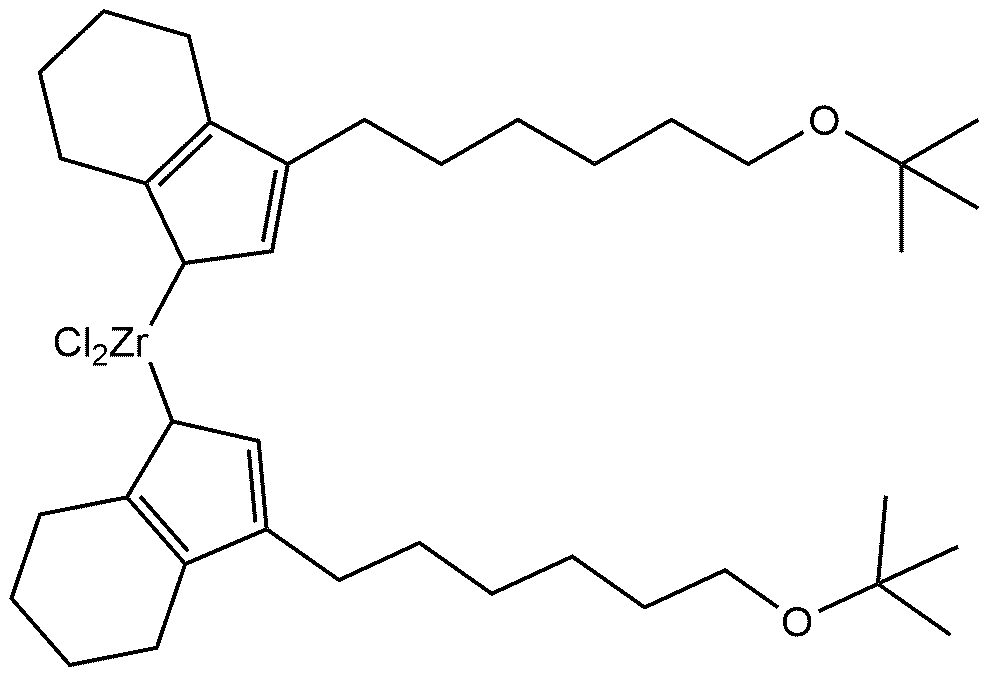
In the first paragraph,
The above chemical formula 1 is a hybrid supported catalyst represented by the following chemical formula A:
[Chemical Formula A]
상기 화학식 2에서, Cp가 C1 내지 C4 알킬로 1 이상 치환된 사이클로펜타디에닐인, 혼성 담지 촉매.
In the first paragraph,
A hybrid supported catalyst, wherein in the above chemical formula 2, Cp is cyclopentadienyl substituted with at least one C1 to C4 alkyl.
상기 화학식 2에서 B는 실리콘이고, R21 및 R22 중 어느 하나는 -(CH2)n-Rb (상기 Rb는 C3 내지 C6 알콕시이고, n은 2 내지 10의 정수)의 알콕시알킬이고, 나머지 하나는 C1 내지 C4 알킬인, 혼성 담지 촉매.
In the first paragraph,
A hybrid supported catalyst, wherein in the above chemical formula 2, B is silicon, one of R 21 and R 22 is an alkoxyalkyl of -(CH 2 ) n -R b (wherein R b is C3 to C6 alkoxy and n is an integer from 2 to 10), and the other is C1 to C4 alkyl.
상기 화학식 2로 표시되는 제2 전이금속 화합물은 하기로 구성되는 군에서 선택되는 어느 하나인, 혼성 담지 촉매:
In the first paragraph,
The second transition metal compound represented by the above chemical formula 2 is a hybrid supported catalyst selected from the group consisting of:
상기 담체는 실리카, 알루미나, 마그네시아 또는 이들의 혼합물인, 혼성 담지 촉매.
In the first paragraph,
The above-mentioned carrier is a hybrid supported catalyst comprising silica, alumina, magnesia or a mixture thereof.
하기 화학식 3 내지 5의 화합물로 이루어진 군에서 선택되는 1종 이상의 조촉매를 더 포함하는, 혼성 담지 촉매.
[화학식 3]
-[Al(R31)-O]m-
상기 화학식 3에서,
R31은 서로 동일하거나 상이하고, 각각 독립적으로 할로겐; C1 내지 C20의 탄화수소; 또는 할로겐으로 치환된 C1 내지 C20의 탄화수소이고;
m은 2 이상의 정수이며;
[화학식 4]
J(R32)3
상기 화학식 4에서,
R32는 서로 동일하거나 상이하고, 각각 독립적으로 할로겐; C1 내지 C20의 탄화수소; 또는 할로겐으로 치환된 C1 내지 C20의 탄화수소이고;
J는 알루미늄 또는 보론이며;
[화학식 5]
[E-H]+[ZQ4]- 또는 [E]+[ZQ4]-
상기 화학식 5에서,
E는 중성 또는 양이온성 루이스 염기이고;
H는 수소 원자이며;
Z는 13족 원소이고;
Q는 서로 동일하거나 상이하고, 각각 독립적으로 1 이상의 수소 원자가 할로겐, C1 내지 C20의 탄화수소, 알콕시 또는 페녹시로 치환되거나 또는 비치환된, C6 내지 C20의 아릴 또는 C1 내지 C20의 알킬이다.
In the first paragraph,
A hybrid supported catalyst further comprising at least one cocatalyst selected from the group consisting of compounds of the following chemical formulas 3 to 5.
[Chemical Formula 3]
-[Al(R 31 )-O] m -
In the above chemical formula 3,
R 31 are the same or different and each independently represent halogen; a C1 to C20 hydrocarbon; or a C1 to C20 hydrocarbon substituted by halogen;
m is an integer greater than or equal to 2;
[Chemical Formula 4]
J(R 32 ) 3
In the above chemical formula 4,
R 32 are the same or different and each independently represent halogen; a C1 to C20 hydrocarbon; or a C1 to C20 hydrocarbon substituted by halogen;
J is aluminum or boron;
[Chemical Formula 5]
[EH] + [ZQ 4 ] - or [E] + [ZQ 4 ] -
In the above chemical formula 5,
E is a neutral or cationic Lewis base;
H is a hydrogen atom;
Z is a group 13 element;
Q is the same or different and each independently represents a C6 to C20 aryl or a C1 to C20 alkyl, wherein one or more hydrogen atoms are substituted or unsubstituted with halogen, a C1 to C20 hydrocarbon, alkoxy or phenoxy.
상기 담체에 담지된 제1 및 제2 전이금속 화합물의 총 담지량은 담체 1 g에 대하여 0.05 내지 10 mmol인, 혼성 담지 촉매.
In the first paragraph,
A hybrid supported catalyst, wherein the total amount of the first and second transition metal compounds supported on the carrier is 0.05 to 10 mmol per 1 g of the carrier.
상기 올레핀계 단량체는 에틸렌, 알파-올레핀, 사이클릭 올레핀, 디엔 올레핀, 또는 트리엔 올레핀인, 폴리올레핀의 제조방법.A method for producing a polyolefin, comprising a step of polymerizing an olefin monomer in the presence of a hybrid supported catalyst according to any one of claims 1 to 10,
A method for producing a polyolefin, wherein the above olefin monomer is ethylene, alpha-olefin, cyclic olefin, diene olefin, or triene olefin.
Priority Applications (1)
| Application Number | Priority Date | Filing Date | Title |
|---|---|---|---|
| KR1020190114307A KR102821274B1 (en) | 2019-09-17 | 2019-09-17 | Hybrid supported catalyst |
Applications Claiming Priority (1)
| Application Number | Priority Date | Filing Date | Title |
|---|---|---|---|
| KR1020190114307A KR102821274B1 (en) | 2019-09-17 | 2019-09-17 | Hybrid supported catalyst |
Publications (2)
| Publication Number | Publication Date |
|---|---|
| KR20210032820A KR20210032820A (en) | 2021-03-25 |
| KR102821274B1 true KR102821274B1 (en) | 2025-06-13 |
Family
ID=75222708
Family Applications (1)
| Application Number | Title | Priority Date | Filing Date |
|---|---|---|---|
| KR1020190114307A Active KR102821274B1 (en) | 2019-09-17 | 2019-09-17 | Hybrid supported catalyst |
Country Status (1)
| Country | Link |
|---|---|
| KR (1) | KR102821274B1 (en) |
Families Citing this family (3)
| Publication number | Priority date | Publication date | Assignee | Title |
|---|---|---|---|---|
| US20250136728A1 (en) | 2022-12-15 | 2025-05-01 | Lg Chem, Ltd. | Hybrid Metallocene Catalyst and Method for Preparing Polyethylene Using the Same |
| CN121487975A (en) | 2024-06-05 | 2026-02-06 | 株式会社Lg化学 | Hybrid supported metallocene catalysts and methods for preparing polyethylene using the catalysts |
| WO2025254478A1 (en) | 2024-06-05 | 2025-12-11 | 주식회사 엘지화학 | Supported-metallocene hybrid catalyst and method for producing polyethylene using same |
Family Cites Families (2)
| Publication number | Priority date | Publication date | Assignee | Title |
|---|---|---|---|---|
| KR102459861B1 (en) * | 2017-12-21 | 2022-10-27 | 주식회사 엘지화학 | Ethylene/1-butene copolymer having excellent processibility |
| KR102363189B1 (en) * | 2018-01-11 | 2022-02-15 | 주식회사 엘지화학 | Preparation method of polyolefin using a supported hybrid metallocene catalyst |
-
2019
- 2019-09-17 KR KR1020190114307A patent/KR102821274B1/en active Active
Also Published As
| Publication number | Publication date |
|---|---|
| KR20210032820A (en) | 2021-03-25 |
Similar Documents
| Publication | Publication Date | Title |
|---|---|---|
| JP6487924B2 (en) | Ethylene / 1-hexene or ethylene / 1-butene copolymer excellent in processability and environmental stress crack resistance | |
| CN106687487B (en) | Olefin-based polymer having excellent processability | |
| CN106232638B (en) | Polyolefins with excellent environmental stress crack resistance | |
| JP7080540B2 (en) | Ethylene / 1-butene copolymer with excellent workability | |
| KR102432898B1 (en) | Supported hybrid metallocene catalyst and method for preparing olefin polymer using the same | |
| JP7134553B2 (en) | Ethylene/1-hexene copolymer with excellent long-term physical properties and workability | |
| CN110869399A (en) | Polyethylene copolymer and preparation method thereof | |
| KR102821274B1 (en) | Hybrid supported catalyst | |
| EP3476870B1 (en) | Method for preparing an olefin polymer | |
| WO2019125065A1 (en) | Ethylene/1-butene copolymer having excellent processability | |
| JP6862548B2 (en) | Olefin polymer, its production method, and film using this | |
| KR102612917B1 (en) | Hybrid supported catalyst | |
| JP7362192B2 (en) | Ethylene/1-hexene copolymer with excellent workability and processability | |
| US10766988B2 (en) | Ethylene/alpha-olefin copolymer having excellent processibility | |
| KR102806313B1 (en) | Hybrid supported catalyst | |
| KR102925838B1 (en) | Hybrid supported catalyst | |
| KR20230133210A (en) | Ethylene/1-hexene copolymer having improved improved long-term physical property stability and processibility | |
| KR102803732B1 (en) | Catalyst composition and process for preparation of polyethylene using the same | |
| KR20220062210A (en) | Hybride supported metallocene catalyst and process for preparing polyethylene copolymer using the same | |
| KR102608215B1 (en) | Ethylene/1-hexene copolymer having improved flexibility and processibility | |
| EP4461756A1 (en) | Polyethylene resin having excellent heat resistance | |
| EP4461755A1 (en) | Polyethylene resin having excellent thermal resistance | |
| RU2782607C2 (en) | Ethylene/1-butene copolymer with excellent recyclability | |
| WO2015072658A1 (en) | Olefin-based polymer with excellent processability |
Legal Events
| Date | Code | Title | Description |
|---|---|---|---|
| PA0109 | Patent application |
Patent event code: PA01091R01D Comment text: Patent Application Patent event date: 20190917 |
|
| PG1501 | Laying open of application | ||
| A201 | Request for examination | ||
| PA0201 | Request for examination |
Patent event code: PA02012R01D Patent event date: 20220304 Comment text: Request for Examination of Application Patent event code: PA02011R01I Patent event date: 20190917 Comment text: Patent Application |
|
| E902 | Notification of reason for refusal | ||
| PE0902 | Notice of grounds for rejection |
Comment text: Notification of reason for refusal Patent event date: 20240710 Patent event code: PE09021S01D |
|
| E701 | Decision to grant or registration of patent right | ||
| PE0701 | Decision of registration |
Patent event code: PE07011S01D Comment text: Decision to Grant Registration Patent event date: 20250324 |
|
| GRNT | Written decision to grant | ||
| PR0701 | Registration of establishment |
Comment text: Registration of Establishment Patent event date: 20250611 Patent event code: PR07011E01D |
|
| PR1002 | Payment of registration fee |
Payment date: 20250611 End annual number: 3 Start annual number: 1 |
|
| PG1601 | Publication of registration |