CN111491952B - Process for preparing polyolefins using supported hybrid metallocene catalysts - Google Patents
Process for preparing polyolefins using supported hybrid metallocene catalysts Download PDFInfo
- Publication number
- CN111491952B CN111491952B CN201980006507.9A CN201980006507A CN111491952B CN 111491952 B CN111491952 B CN 111491952B CN 201980006507 A CN201980006507 A CN 201980006507A CN 111491952 B CN111491952 B CN 111491952B
- Authority
- CN
- China
- Prior art keywords
- substituted
- unsubstituted
- borate
- group
- chemical formula
- Prior art date
- Legal status (The legal status is an assumption and is not a legal conclusion. Google has not performed a legal analysis and makes no representation as to the accuracy of the status listed.)
- Active
Links
Classifications
-
- C—CHEMISTRY; METALLURGY
- C08—ORGANIC MACROMOLECULAR COMPOUNDS; THEIR PREPARATION OR CHEMICAL WORKING-UP; COMPOSITIONS BASED THEREON
- C08F—MACROMOLECULAR COMPOUNDS OBTAINED BY REACTIONS ONLY INVOLVING CARBON-TO-CARBON UNSATURATED BONDS
- C08F4/00—Polymerisation catalysts
- C08F4/42—Metals; Metal hydrides; Metallo-organic compounds; Use thereof as catalyst precursors
- C08F4/44—Metals; Metal hydrides; Metallo-organic compounds; Use thereof as catalyst precursors selected from light metals, zinc, cadmium, mercury, copper, silver, gold, boron, gallium, indium, thallium, rare earths or actinides
- C08F4/60—Metals; Metal hydrides; Metallo-organic compounds; Use thereof as catalyst precursors selected from light metals, zinc, cadmium, mercury, copper, silver, gold, boron, gallium, indium, thallium, rare earths or actinides together with refractory metals, iron group metals, platinum group metals, manganese, rhenium technetium or compounds thereof
- C08F4/62—Refractory metals or compounds thereof
- C08F4/64—Titanium, zirconium, hafnium or compounds thereof
- C08F4/659—Component covered by group C08F4/64 containing a transition metal-carbon bond
- C08F4/6592—Component covered by group C08F4/64 containing a transition metal-carbon bond containing at least one cyclopentadienyl ring, condensed or not, e.g. an indenyl or a fluorenyl ring
- C08F4/65922—Component covered by group C08F4/64 containing a transition metal-carbon bond containing at least one cyclopentadienyl ring, condensed or not, e.g. an indenyl or a fluorenyl ring containing at least two cyclopentadienyl rings, fused or not
- C08F4/65927—Component covered by group C08F4/64 containing a transition metal-carbon bond containing at least one cyclopentadienyl ring, condensed or not, e.g. an indenyl or a fluorenyl ring containing at least two cyclopentadienyl rings, fused or not two cyclopentadienyl rings being mutually bridged
-
- C—CHEMISTRY; METALLURGY
- C08—ORGANIC MACROMOLECULAR COMPOUNDS; THEIR PREPARATION OR CHEMICAL WORKING-UP; COMPOSITIONS BASED THEREON
- C08F—MACROMOLECULAR COMPOUNDS OBTAINED BY REACTIONS ONLY INVOLVING CARBON-TO-CARBON UNSATURATED BONDS
- C08F110/00—Homopolymers of unsaturated aliphatic hydrocarbons having only one carbon-to-carbon double bond
- C08F110/02—Ethene
-
- C—CHEMISTRY; METALLURGY
- C08—ORGANIC MACROMOLECULAR COMPOUNDS; THEIR PREPARATION OR CHEMICAL WORKING-UP; COMPOSITIONS BASED THEREON
- C08F—MACROMOLECULAR COMPOUNDS OBTAINED BY REACTIONS ONLY INVOLVING CARBON-TO-CARBON UNSATURATED BONDS
- C08F2/00—Processes of polymerisation
- C08F2/12—Polymerisation in non-solvents
- C08F2/16—Aqueous medium
- C08F2/22—Emulsion polymerisation
- C08F2/24—Emulsion polymerisation with the aid of emulsifying agents
- C08F2/30—Emulsion polymerisation with the aid of emulsifying agents non-ionic
-
- C—CHEMISTRY; METALLURGY
- C08—ORGANIC MACROMOLECULAR COMPOUNDS; THEIR PREPARATION OR CHEMICAL WORKING-UP; COMPOSITIONS BASED THEREON
- C08F—MACROMOLECULAR COMPOUNDS OBTAINED BY REACTIONS ONLY INVOLVING CARBON-TO-CARBON UNSATURATED BONDS
- C08F4/00—Polymerisation catalysts
- C08F4/42—Metals; Metal hydrides; Metallo-organic compounds; Use thereof as catalyst precursors
- C08F4/44—Metals; Metal hydrides; Metallo-organic compounds; Use thereof as catalyst precursors selected from light metals, zinc, cadmium, mercury, copper, silver, gold, boron, gallium, indium, thallium, rare earths or actinides
- C08F4/52—Metals; Metal hydrides; Metallo-organic compounds; Use thereof as catalyst precursors selected from light metals, zinc, cadmium, mercury, copper, silver, gold, boron, gallium, indium, thallium, rare earths or actinides selected from boron, aluminium, gallium, indium, thallium or rare earths
-
- C—CHEMISTRY; METALLURGY
- C08—ORGANIC MACROMOLECULAR COMPOUNDS; THEIR PREPARATION OR CHEMICAL WORKING-UP; COMPOSITIONS BASED THEREON
- C08F—MACROMOLECULAR COMPOUNDS OBTAINED BY REACTIONS ONLY INVOLVING CARBON-TO-CARBON UNSATURATED BONDS
- C08F4/00—Polymerisation catalysts
- C08F4/42—Metals; Metal hydrides; Metallo-organic compounds; Use thereof as catalyst precursors
- C08F4/44—Metals; Metal hydrides; Metallo-organic compounds; Use thereof as catalyst precursors selected from light metals, zinc, cadmium, mercury, copper, silver, gold, boron, gallium, indium, thallium, rare earths or actinides
- C08F4/60—Metals; Metal hydrides; Metallo-organic compounds; Use thereof as catalyst precursors selected from light metals, zinc, cadmium, mercury, copper, silver, gold, boron, gallium, indium, thallium, rare earths or actinides together with refractory metals, iron group metals, platinum group metals, manganese, rhenium technetium or compounds thereof
- C08F4/62—Refractory metals or compounds thereof
- C08F4/64—Titanium, zirconium, hafnium or compounds thereof
- C08F4/642—Component covered by group C08F4/64 with an organo-aluminium compound
-
- C—CHEMISTRY; METALLURGY
- C08—ORGANIC MACROMOLECULAR COMPOUNDS; THEIR PREPARATION OR CHEMICAL WORKING-UP; COMPOSITIONS BASED THEREON
- C08F—MACROMOLECULAR COMPOUNDS OBTAINED BY REACTIONS ONLY INVOLVING CARBON-TO-CARBON UNSATURATED BONDS
- C08F4/00—Polymerisation catalysts
- C08F4/42—Metals; Metal hydrides; Metallo-organic compounds; Use thereof as catalyst precursors
- C08F4/44—Metals; Metal hydrides; Metallo-organic compounds; Use thereof as catalyst precursors selected from light metals, zinc, cadmium, mercury, copper, silver, gold, boron, gallium, indium, thallium, rare earths or actinides
- C08F4/60—Metals; Metal hydrides; Metallo-organic compounds; Use thereof as catalyst precursors selected from light metals, zinc, cadmium, mercury, copper, silver, gold, boron, gallium, indium, thallium, rare earths or actinides together with refractory metals, iron group metals, platinum group metals, manganese, rhenium technetium or compounds thereof
- C08F4/62—Refractory metals or compounds thereof
- C08F4/64—Titanium, zirconium, hafnium or compounds thereof
- C08F4/642—Component covered by group C08F4/64 with an organo-aluminium compound
- C08F4/6428—Component covered by group C08F4/64 with an organo-aluminium compound with an aluminoxane, i.e. a compound containing an Al-O-Al- group
-
- C—CHEMISTRY; METALLURGY
- C08—ORGANIC MACROMOLECULAR COMPOUNDS; THEIR PREPARATION OR CHEMICAL WORKING-UP; COMPOSITIONS BASED THEREON
- C08F—MACROMOLECULAR COMPOUNDS OBTAINED BY REACTIONS ONLY INVOLVING CARBON-TO-CARBON UNSATURATED BONDS
- C08F4/00—Polymerisation catalysts
- C08F4/42—Metals; Metal hydrides; Metallo-organic compounds; Use thereof as catalyst precursors
- C08F4/44—Metals; Metal hydrides; Metallo-organic compounds; Use thereof as catalyst precursors selected from light metals, zinc, cadmium, mercury, copper, silver, gold, boron, gallium, indium, thallium, rare earths or actinides
- C08F4/60—Metals; Metal hydrides; Metallo-organic compounds; Use thereof as catalyst precursors selected from light metals, zinc, cadmium, mercury, copper, silver, gold, boron, gallium, indium, thallium, rare earths or actinides together with refractory metals, iron group metals, platinum group metals, manganese, rhenium technetium or compounds thereof
- C08F4/62—Refractory metals or compounds thereof
- C08F4/64—Titanium, zirconium, hafnium or compounds thereof
- C08F4/647—Catalysts containing a specific non-metal or metal-free compound
- C08F4/649—Catalysts containing a specific non-metal or metal-free compound organic
-
- C—CHEMISTRY; METALLURGY
- C08—ORGANIC MACROMOLECULAR COMPOUNDS; THEIR PREPARATION OR CHEMICAL WORKING-UP; COMPOSITIONS BASED THEREON
- C08F—MACROMOLECULAR COMPOUNDS OBTAINED BY REACTIONS ONLY INVOLVING CARBON-TO-CARBON UNSATURATED BONDS
- C08F4/00—Polymerisation catalysts
- C08F4/42—Metals; Metal hydrides; Metallo-organic compounds; Use thereof as catalyst precursors
- C08F4/44—Metals; Metal hydrides; Metallo-organic compounds; Use thereof as catalyst precursors selected from light metals, zinc, cadmium, mercury, copper, silver, gold, boron, gallium, indium, thallium, rare earths or actinides
- C08F4/60—Metals; Metal hydrides; Metallo-organic compounds; Use thereof as catalyst precursors selected from light metals, zinc, cadmium, mercury, copper, silver, gold, boron, gallium, indium, thallium, rare earths or actinides together with refractory metals, iron group metals, platinum group metals, manganese, rhenium technetium or compounds thereof
- C08F4/62—Refractory metals or compounds thereof
- C08F4/64—Titanium, zirconium, hafnium or compounds thereof
- C08F4/647—Catalysts containing a specific non-metal or metal-free compound
- C08F4/649—Catalysts containing a specific non-metal or metal-free compound organic
- C08F4/6493—Catalysts containing a specific non-metal or metal-free compound organic containing halogen
-
- C—CHEMISTRY; METALLURGY
- C08—ORGANIC MACROMOLECULAR COMPOUNDS; THEIR PREPARATION OR CHEMICAL WORKING-UP; COMPOSITIONS BASED THEREON
- C08F—MACROMOLECULAR COMPOUNDS OBTAINED BY REACTIONS ONLY INVOLVING CARBON-TO-CARBON UNSATURATED BONDS
- C08F4/00—Polymerisation catalysts
- C08F4/42—Metals; Metal hydrides; Metallo-organic compounds; Use thereof as catalyst precursors
- C08F4/44—Metals; Metal hydrides; Metallo-organic compounds; Use thereof as catalyst precursors selected from light metals, zinc, cadmium, mercury, copper, silver, gold, boron, gallium, indium, thallium, rare earths or actinides
- C08F4/60—Metals; Metal hydrides; Metallo-organic compounds; Use thereof as catalyst precursors selected from light metals, zinc, cadmium, mercury, copper, silver, gold, boron, gallium, indium, thallium, rare earths or actinides together with refractory metals, iron group metals, platinum group metals, manganese, rhenium technetium or compounds thereof
- C08F4/62—Refractory metals or compounds thereof
- C08F4/64—Titanium, zirconium, hafnium or compounds thereof
- C08F4/659—Component covered by group C08F4/64 containing a transition metal-carbon bond
- C08F4/65904—Component covered by group C08F4/64 containing a transition metal-carbon bond in combination with another component of C08F4/64
-
- C—CHEMISTRY; METALLURGY
- C08—ORGANIC MACROMOLECULAR COMPOUNDS; THEIR PREPARATION OR CHEMICAL WORKING-UP; COMPOSITIONS BASED THEREON
- C08F—MACROMOLECULAR COMPOUNDS OBTAINED BY REACTIONS ONLY INVOLVING CARBON-TO-CARBON UNSATURATED BONDS
- C08F4/00—Polymerisation catalysts
- C08F4/42—Metals; Metal hydrides; Metallo-organic compounds; Use thereof as catalyst precursors
- C08F4/44—Metals; Metal hydrides; Metallo-organic compounds; Use thereof as catalyst precursors selected from light metals, zinc, cadmium, mercury, copper, silver, gold, boron, gallium, indium, thallium, rare earths or actinides
- C08F4/60—Metals; Metal hydrides; Metallo-organic compounds; Use thereof as catalyst precursors selected from light metals, zinc, cadmium, mercury, copper, silver, gold, boron, gallium, indium, thallium, rare earths or actinides together with refractory metals, iron group metals, platinum group metals, manganese, rhenium technetium or compounds thereof
- C08F4/62—Refractory metals or compounds thereof
- C08F4/64—Titanium, zirconium, hafnium or compounds thereof
- C08F4/659—Component covered by group C08F4/64 containing a transition metal-carbon bond
- C08F4/65916—Component covered by group C08F4/64 containing a transition metal-carbon bond supported on a carrier, e.g. silica, MgCl2, polymer
-
- C—CHEMISTRY; METALLURGY
- C08—ORGANIC MACROMOLECULAR COMPOUNDS; THEIR PREPARATION OR CHEMICAL WORKING-UP; COMPOSITIONS BASED THEREON
- C08F—MACROMOLECULAR COMPOUNDS OBTAINED BY REACTIONS ONLY INVOLVING CARBON-TO-CARBON UNSATURATED BONDS
- C08F4/00—Polymerisation catalysts
- C08F4/42—Metals; Metal hydrides; Metallo-organic compounds; Use thereof as catalyst precursors
- C08F4/44—Metals; Metal hydrides; Metallo-organic compounds; Use thereof as catalyst precursors selected from light metals, zinc, cadmium, mercury, copper, silver, gold, boron, gallium, indium, thallium, rare earths or actinides
- C08F4/60—Metals; Metal hydrides; Metallo-organic compounds; Use thereof as catalyst precursors selected from light metals, zinc, cadmium, mercury, copper, silver, gold, boron, gallium, indium, thallium, rare earths or actinides together with refractory metals, iron group metals, platinum group metals, manganese, rhenium technetium or compounds thereof
- C08F4/62—Refractory metals or compounds thereof
- C08F4/64—Titanium, zirconium, hafnium or compounds thereof
- C08F4/659—Component covered by group C08F4/64 containing a transition metal-carbon bond
- C08F4/6592—Component covered by group C08F4/64 containing a transition metal-carbon bond containing at least one cyclopentadienyl ring, condensed or not, e.g. an indenyl or a fluorenyl ring
- C08F4/65922—Component covered by group C08F4/64 containing a transition metal-carbon bond containing at least one cyclopentadienyl ring, condensed or not, e.g. an indenyl or a fluorenyl ring containing at least two cyclopentadienyl rings, fused or not
-
- C—CHEMISTRY; METALLURGY
- C08—ORGANIC MACROMOLECULAR COMPOUNDS; THEIR PREPARATION OR CHEMICAL WORKING-UP; COMPOSITIONS BASED THEREON
- C08F—MACROMOLECULAR COMPOUNDS OBTAINED BY REACTIONS ONLY INVOLVING CARBON-TO-CARBON UNSATURATED BONDS
- C08F8/00—Chemical modification by after-treatment
- C08F8/18—Introducing halogen atoms or halogen-containing groups
- C08F8/20—Halogenation
-
- C—CHEMISTRY; METALLURGY
- C08—ORGANIC MACROMOLECULAR COMPOUNDS; THEIR PREPARATION OR CHEMICAL WORKING-UP; COMPOSITIONS BASED THEREON
- C08F—MACROMOLECULAR COMPOUNDS OBTAINED BY REACTIONS ONLY INVOLVING CARBON-TO-CARBON UNSATURATED BONDS
- C08F8/00—Chemical modification by after-treatment
- C08F8/18—Introducing halogen atoms or halogen-containing groups
- C08F8/20—Halogenation
- C08F8/22—Halogenation by reaction with free halogens
-
- C—CHEMISTRY; METALLURGY
- C08—ORGANIC MACROMOLECULAR COMPOUNDS; THEIR PREPARATION OR CHEMICAL WORKING-UP; COMPOSITIONS BASED THEREON
- C08L—COMPOSITIONS OF MACROMOLECULAR COMPOUNDS
- C08L23/00—Compositions of homopolymers or copolymers of unsaturated aliphatic hydrocarbons having only one carbon-to-carbon double bond; Compositions of derivatives of such polymers
- C08L23/26—Compositions of homopolymers or copolymers of unsaturated aliphatic hydrocarbons having only one carbon-to-carbon double bond; Compositions of derivatives of such polymers modified by chemical after-treatment
- C08L23/28—Compositions of homopolymers or copolymers of unsaturated aliphatic hydrocarbons having only one carbon-to-carbon double bond; Compositions of derivatives of such polymers modified by chemical after-treatment by reaction with halogens or halogen-containing compounds
-
- C—CHEMISTRY; METALLURGY
- C08—ORGANIC MACROMOLECULAR COMPOUNDS; THEIR PREPARATION OR CHEMICAL WORKING-UP; COMPOSITIONS BASED THEREON
- C08L—COMPOSITIONS OF MACROMOLECULAR COMPOUNDS
- C08L23/00—Compositions of homopolymers or copolymers of unsaturated aliphatic hydrocarbons having only one carbon-to-carbon double bond; Compositions of derivatives of such polymers
- C08L23/26—Compositions of homopolymers or copolymers of unsaturated aliphatic hydrocarbons having only one carbon-to-carbon double bond; Compositions of derivatives of such polymers modified by chemical after-treatment
- C08L23/28—Compositions of homopolymers or copolymers of unsaturated aliphatic hydrocarbons having only one carbon-to-carbon double bond; Compositions of derivatives of such polymers modified by chemical after-treatment by reaction with halogens or halogen-containing compounds
- C08L23/286—Chlorinated polyethylene
-
- C—CHEMISTRY; METALLURGY
- C08—ORGANIC MACROMOLECULAR COMPOUNDS; THEIR PREPARATION OR CHEMICAL WORKING-UP; COMPOSITIONS BASED THEREON
- C08L—COMPOSITIONS OF MACROMOLECULAR COMPOUNDS
- C08L27/00—Compositions of homopolymers or copolymers of compounds having one or more unsaturated aliphatic radicals, each having only one carbon-to-carbon double bond, and at least one being terminated by a halogen; Compositions of derivatives of such polymers
- C08L27/02—Compositions of homopolymers or copolymers of compounds having one or more unsaturated aliphatic radicals, each having only one carbon-to-carbon double bond, and at least one being terminated by a halogen; Compositions of derivatives of such polymers not modified by chemical after-treatment
- C08L27/04—Compositions of homopolymers or copolymers of compounds having one or more unsaturated aliphatic radicals, each having only one carbon-to-carbon double bond, and at least one being terminated by a halogen; Compositions of derivatives of such polymers not modified by chemical after-treatment containing chlorine atoms
- C08L27/06—Homopolymers or copolymers of vinyl chloride
-
- C—CHEMISTRY; METALLURGY
- C08—ORGANIC MACROMOLECULAR COMPOUNDS; THEIR PREPARATION OR CHEMICAL WORKING-UP; COMPOSITIONS BASED THEREON
- C08F—MACROMOLECULAR COMPOUNDS OBTAINED BY REACTIONS ONLY INVOLVING CARBON-TO-CARBON UNSATURATED BONDS
- C08F2420/00—Metallocene catalysts
- C08F2420/02—Cp or analog bridged to a non-Cp X anionic donor
-
- C—CHEMISTRY; METALLURGY
- C08—ORGANIC MACROMOLECULAR COMPOUNDS; THEIR PREPARATION OR CHEMICAL WORKING-UP; COMPOSITIONS BASED THEREON
- C08F—MACROMOLECULAR COMPOUNDS OBTAINED BY REACTIONS ONLY INVOLVING CARBON-TO-CARBON UNSATURATED BONDS
- C08F2420/00—Metallocene catalysts
- C08F2420/07—Heteroatom-substituted Cp, i.e. Cp or analog where at least one of the substituent of the Cp or analog ring is or contains a heteroatom
-
- C—CHEMISTRY; METALLURGY
- C08—ORGANIC MACROMOLECULAR COMPOUNDS; THEIR PREPARATION OR CHEMICAL WORKING-UP; COMPOSITIONS BASED THEREON
- C08F—MACROMOLECULAR COMPOUNDS OBTAINED BY REACTIONS ONLY INVOLVING CARBON-TO-CARBON UNSATURATED BONDS
- C08F2420/00—Metallocene catalysts
- C08F2420/10—Heteroatom-substituted bridge, i.e. Cp or analog where the bridge linking the two Cps or analogs is substituted by at least one group that contains a heteroatom
-
- C—CHEMISTRY; METALLURGY
- C08—ORGANIC MACROMOLECULAR COMPOUNDS; THEIR PREPARATION OR CHEMICAL WORKING-UP; COMPOSITIONS BASED THEREON
- C08F—MACROMOLECULAR COMPOUNDS OBTAINED BY REACTIONS ONLY INVOLVING CARBON-TO-CARBON UNSATURATED BONDS
- C08F4/00—Polymerisation catalysts
- C08F4/42—Metals; Metal hydrides; Metallo-organic compounds; Use thereof as catalyst precursors
- C08F4/44—Metals; Metal hydrides; Metallo-organic compounds; Use thereof as catalyst precursors selected from light metals, zinc, cadmium, mercury, copper, silver, gold, boron, gallium, indium, thallium, rare earths or actinides
- C08F4/60—Metals; Metal hydrides; Metallo-organic compounds; Use thereof as catalyst precursors selected from light metals, zinc, cadmium, mercury, copper, silver, gold, boron, gallium, indium, thallium, rare earths or actinides together with refractory metals, iron group metals, platinum group metals, manganese, rhenium technetium or compounds thereof
- C08F4/62—Refractory metals or compounds thereof
- C08F4/64—Titanium, zirconium, hafnium or compounds thereof
- C08F4/659—Component covered by group C08F4/64 containing a transition metal-carbon bond
- C08F4/65912—Component covered by group C08F4/64 containing a transition metal-carbon bond in combination with an organoaluminium compound
-
- C—CHEMISTRY; METALLURGY
- C08—ORGANIC MACROMOLECULAR COMPOUNDS; THEIR PREPARATION OR CHEMICAL WORKING-UP; COMPOSITIONS BASED THEREON
- C08L—COMPOSITIONS OF MACROMOLECULAR COMPOUNDS
- C08L2201/00—Properties
- C08L2201/02—Flame or fire retardant/resistant
-
- C—CHEMISTRY; METALLURGY
- C08—ORGANIC MACROMOLECULAR COMPOUNDS; THEIR PREPARATION OR CHEMICAL WORKING-UP; COMPOSITIONS BASED THEREON
- C08L—COMPOSITIONS OF MACROMOLECULAR COMPOUNDS
- C08L2201/00—Properties
- C08L2201/08—Stabilised against heat, light or radiation or oxydation
-
- C—CHEMISTRY; METALLURGY
- C08—ORGANIC MACROMOLECULAR COMPOUNDS; THEIR PREPARATION OR CHEMICAL WORKING-UP; COMPOSITIONS BASED THEREON
- C08L—COMPOSITIONS OF MACROMOLECULAR COMPOUNDS
- C08L2203/00—Applications
- C08L2203/18—Applications used for pipes
-
- C—CHEMISTRY; METALLURGY
- C08—ORGANIC MACROMOLECULAR COMPOUNDS; THEIR PREPARATION OR CHEMICAL WORKING-UP; COMPOSITIONS BASED THEREON
- C08L—COMPOSITIONS OF MACROMOLECULAR COMPOUNDS
- C08L23/00—Compositions of homopolymers or copolymers of unsaturated aliphatic hydrocarbons having only one carbon-to-carbon double bond; Compositions of derivatives of such polymers
- C08L23/02—Compositions of homopolymers or copolymers of unsaturated aliphatic hydrocarbons having only one carbon-to-carbon double bond; Compositions of derivatives of such polymers not modified by chemical after-treatment
- C08L23/04—Homopolymers or copolymers of ethene
- C08L23/06—Polyethylene
-
- C—CHEMISTRY; METALLURGY
- C08—ORGANIC MACROMOLECULAR COMPOUNDS; THEIR PREPARATION OR CHEMICAL WORKING-UP; COMPOSITIONS BASED THEREON
- C08L—COMPOSITIONS OF MACROMOLECULAR COMPOUNDS
- C08L2314/00—Polymer mixtures characterised by way of preparation
- C08L2314/06—Metallocene or single site catalysts
Landscapes
- Chemical & Material Sciences (AREA)
- Health & Medical Sciences (AREA)
- Chemical Kinetics & Catalysis (AREA)
- Medicinal Chemistry (AREA)
- Polymers & Plastics (AREA)
- Organic Chemistry (AREA)
- Engineering & Computer Science (AREA)
- Materials Engineering (AREA)
- Crystallography & Structural Chemistry (AREA)
- General Chemical & Material Sciences (AREA)
- Transition And Organic Metals Composition Catalysts For Addition Polymerization (AREA)
Abstract
Description
技术领域technical field
相关申请的交叉引用Cross References to Related Applications
本申请要求于2018年1月11日向韩国知识产权局提交的第10-2018-0004040号和于2019年1月8日向韩国知识产权局提交的第10-2019-0002462号韩国专利申请的权益,其公开的内容整体并入本文。This application claims the benefit of Korean Patent Application No. 10-2018-0004040 filed with the Korean Intellectual Property Office on January 11, 2018 and Korean Patent Application No. 10-2019-0002462 filed with the Korean Intellectual Property Office on January 8, 2019, The disclosure thereof is incorporated herein in its entirety.
本公开涉及一种使用负载型混杂茂金属催化剂制备聚烯烃的方法。The present disclosure relates to a method for preparing polyolefins using a supported hybrid metallocene catalyst.
背景技术Background technique
烯烃聚合催化剂体系可以分为齐格勒-纳塔催化剂和茂金属催化剂,并且已经根据它们的特性开发了这些高活性催化剂体系。自上世纪五十年代开发了齐格勒-纳塔催化剂以来,其已被广泛应用于商用工艺。然而,由于齐格勒-纳塔催化剂是一种其中混合了多个活性位点的多活性位点催化剂,它具有以下特征:所得到的聚合物具有宽的分子量分布。另外,由于共聚单体的组成分布不均匀,因此存在难以获得期望的物理性质的问题。尤其是,宽分子量分布会由于聚合物链具有相对低的分子量而导致物理性质的下降。Olefin polymerization catalyst systems can be classified into Ziegler-Natta catalysts and metallocene catalysts, and these highly active catalyst systems have been developed according to their characteristics. Ziegler-Natta catalysts have been widely used in commercial processes since their development in the 1950s. However, since the Ziegler-Natta catalyst is a multi-site catalyst in which a plurality of active sites are mixed, it has a feature that the resulting polymer has a broad molecular weight distribution. In addition, since the composition distribution of the comonomer is not uniform, there is a problem that it is difficult to obtain desired physical properties. In particular, a broad molecular weight distribution may lead to a decrease in physical properties due to polymer chains having relatively low molecular weights.
同时,茂金属催化剂包括含有茂金属化合物作为主要成分的主催化剂,以及含有铝作为主要成分的有机金属化合物助催化剂。可以通过改变催化剂的配体结构和聚合条件来控制所得聚合物的立构规整度、共聚特性、分子量、结晶度等。Meanwhile, the metallocene catalyst includes a main catalyst containing a metallocene compound as a main component, and an organometallic compound cocatalyst containing aluminum as a main component. The tacticity, copolymerization characteristics, molecular weight, crystallinity, etc. of the obtained polymer can be controlled by changing the ligand structure of the catalyst and the polymerization conditions.
在美国专利第5,032,562号中,公开了一种通过将两种不同的过渡金属催化剂负载在一个载体上来制备聚合催化剂的方法。通过在一个载体上负载产生高分子量聚合物的基于钛(Ti)的齐格勒-纳塔催化剂和产生低分子量聚合物的基于锆(Zr)的茂金属催化剂来制备该催化剂,从而产生双峰分子量分布。该催化剂的不利之处在于,由于助催化剂,负载工艺复杂并且聚合物的形貌差。In US Patent No. 5,032,562, a method of preparing a polymerization catalyst by supporting two different transition metal catalysts on one support is disclosed. The catalyst is prepared by supporting a titanium (Ti)-based Ziegler-Natta catalyst that produces a high molecular weight polymer and a zirconium (Zr)-based metallocene catalyst that produces a low molecular weight polymer on a single support, resulting in a bimodal The molecular weight distribution. The disadvantage of this catalyst is that the loading process is complicated and the morphology of the polymer is poor due to the co-catalyst.
在美国专利第5,525,678号中,公开了一种使用催化剂体系进行烯烃聚合的方法,其中茂金属化合物和非茂金属化合物同时负载在载体上,以实现高分子量聚合物和低分子量聚合物的同时聚合。然而,存在的缺点是茂金属化合物和非茂金属化合物必须分别负载,并且必须用各种化合物预处理载体以用于负载。In U.S. Patent No. 5,525,678, a method for polymerizing olefins using a catalyst system in which a metallocene compound and a non-metallocene compound are simultaneously supported on a support to achieve simultaneous polymerization of high-molecular-weight polymers and low-molecular-weight polymers is disclosed . However, there is a disadvantage that metallocene compounds and non-metallocene compounds must be supported separately, and supports must be pretreated with various compounds for loading.
在美国专利第5,914,289号中,公开了一种使用分别负载在载体上的茂金属催化剂控制聚合物的分子量和分子量分布的方法。但是,需要大量的溶剂和长时间来制备该负载型催化剂,并且将茂金属催化剂负载在各个载体上的工艺很麻烦。In US Pat. No. 5,914,289, a method of controlling the molecular weight and molecular weight distribution of polymers using metallocene catalysts respectively supported on supports is disclosed. However, a large amount of solvent and a long time are required to prepare the supported catalyst, and the process of supporting the metallocene catalyst on each carrier is cumbersome.
此外,根据这些现有技术,难以有效地制备同时满足期望水平的密度和窄的分子量分布的聚烯烃,特别是乙烯(共)聚合物。Furthermore, according to these prior art techniques, it is difficult to efficiently produce polyolefins, especially ethylene (co)polymers, simultaneously satisfying desired levels of density and narrow molecular weight distribution.
特别地,通过与PVC复合,氯化的聚烯烃,例如氯化聚乙烯(CPE)被广泛地用于用在管材和窗户型材的冲击增强剂,并且它们通常通过使聚乙烯与氯在悬浮液中反应,或者通过使聚乙烯与氯在HCl水溶液中反应而制备。该PVC复合产品需要优异的冲击强度,并且该复合物的强度会根据氯化聚烯烃的物理性质而变化。在目前广为人知的通用氯化聚烯烃的情况下,由于应用了使用齐格勒-纳塔催化剂制备的聚烯烃,因此,由于宽的分子量分布,使得聚烯烃中的氯分布的均匀性降低。还有一个缺点是当与PVC复合时冲击强度不足。In particular, chlorinated polyolefins such as chlorinated polyethylene (CPE) are widely used as impact-reinforcing agents for pipes and window profiles by compounding them with PVC, and they usually , or prepared by reacting polyethylene with chlorine in aqueous HCl. The PVC compound product requires excellent impact strength, and the strength of the compound varies according to the physical properties of the chlorinated polyolefin. In the case of the currently well-known general-purpose chlorinated polyolefin, since the polyolefin prepared using the Ziegler-Natta catalyst is applied, the uniformity of chlorine distribution in the polyolefin is lowered due to a broad molecular weight distribution. There is also a disadvantage of insufficient impact strength when compounded with PVC.
因此,在氯化聚烯烃中需要优异的氯分布均匀性,以提高PVC复合物的冲击强度。因此,不断需要开发制备具有窄分子量分布的聚烯烃的方法。Therefore, excellent chlorine distribution uniformity is required in chlorinated polyolefins to improve the impact strength of PVC compounds. Therefore, there is a continuing need to develop methods for preparing polyolefins with narrow molecular weight distributions.
发明内容Contents of the invention
【技术问题】【technical problem】
本公开旨在提供一种更容易且有效地制备具有窄分子量分布的聚烯烃的方法,以提高PVC复合物的冲击强度。The present disclosure aims to provide a method for more easily and efficiently preparing polyolefins with narrow molecular weight distribution to improve the impact strength of PVC compounds.
本公开还提供了一种制备氯化聚烯烃的方法,其中,在通过上述方法制备聚烯烃之后,进一步进行氯化反应。The present disclosure also provides a method for preparing a chlorinated polyolefin, wherein after the polyolefin is prepared by the above method, a chlorination reaction is further performed.
本公开还提供了一种PVC组合物,其包括通过上述方法制备的氯化聚烯烃和聚氯乙烯(PVC)。The present disclosure also provides a PVC composition including the chlorinated polyolefin prepared by the above method and polyvinyl chloride (PVC).
【技术方案】【Technical solutions】
根据本公开的一个实施方式,提供了一种制备聚烯烃的方法,该方法包括以下步骤:在负载型茂金属催化剂和助催化剂的存在下聚合烯烃单体,同时以70cc/hr至140cc/hr引入助催化剂,在负载型茂金属催化剂中至少一种由以下化学式1表示的第一茂金属化合物和至少一种由以下化学式2表示的第二茂金属化合物负载在载体上:According to one embodiment of the present disclosure, there is provided a method for preparing polyolefins, the method comprising the steps of: polymerizing olefin monomers in the presence of a supported metallocene catalyst and a cocatalyst, while A cocatalyst is introduced, and at least one first metallocene compound represented by the following chemical formula 1 and at least one second metallocene compound represented by the following chemical formula 2 are supported on the carrier in the supported metallocene catalyst:
[化学式1][chemical formula 1]
(Cp1Ra)n(Cp2Rb)M1Z1 3-n (Cp 1 R a ) n (Cp 2 R b )M 1 Z 1 3-n
在化学式1中,In Chemical Formula 1,
M1是第4族过渡金属;M 1 is a Group 4 transition metal;
Cp1和Cp2彼此相同或不同,并且各自独立地选自茚基和4,5,6,7-四氢-1-茚基,其可以被C1至C20烃取代;Cp 1 and Cp 2 are the same or different from each other, and are each independently selected from indenyl and 4,5,6,7-tetrahydro-1-indenyl, which may be substituted by C1 to C20 hydrocarbons;
Ra和Rb彼此相同或不同,并且各自独立地为氢、取代或未取代的C1至C20烷基、取代或未取代的C1至C10烷氧基、取代或未取代的C2至C20烷氧基烷基、取代或未取代的C6至C20芳基、取代或未取代的C6至C10芳基氧基、取代或未取代的C2至C20烯基、取代或未取代的C7至C40烷基芳基、取代或未取代的C7至C40芳基烷基、取代或未取代的C8至C40芳基烯基、或取代或未取代的C2至C10炔基;R a and R b are the same or different from each other, and are each independently hydrogen, substituted or unsubstituted C1 to C20 alkyl, substituted or unsubstituted C1 to C10 alkoxy, substituted or unsubstituted C2 to C20 alkoxy substituted or unsubstituted C6 to C20 aryl, substituted or unsubstituted C6 to C10 aryloxy, substituted or unsubstituted C2 to C20 alkenyl, substituted or unsubstituted C7 to C40 alkylaryl substituted or unsubstituted C7 to C40 arylalkyl, substituted or unsubstituted C8 to C40 aryl alkenyl, or substituted or unsubstituted C2 to C10 alkynyl;
Z1各自独立地是卤素、取代或未取代的C1至C20烷基、取代或未取代的C2至C20烯基、取代或未取代的C7至C40烷基芳基、取代或未取代的C7至C40芳基烷基、取代或未取代的C6至C20芳基、取代或未取代的C1至C20亚烷基(alkylidene)、取代或未取代的氨基、取代或未取代的C2至C20烷基烷氧基、或取代或未取代的C7至C40芳基烷氧基;以及 Z1 is each independently halogen, substituted or unsubstituted C1 to C20 alkyl, substituted or unsubstituted C2 to C20 alkenyl, substituted or unsubstituted C7 to C40 alkylaryl, substituted or unsubstituted C7 to C20 C40 arylalkyl, substituted or unsubstituted C6 to C20 aryl, substituted or unsubstituted C1 to C20 alkylidene, substituted or unsubstituted amino, substituted or unsubstituted C2 to C20 alkyl alkane Oxygen, or substituted or unsubstituted C7 to C40 arylalkoxy; and
n为1或0;n is 1 or 0;
[化学式2][chemical formula 2]

在化学式2中,In Chemical Formula 2,
Q1和Q2彼此相同或不同,并且各自独立地为取代或未取代的C1至C20烷基、取代或未取代的C1至C10烷氧基、取代或未取代的C2至C20烷氧基烷基、或取代或未取代的C6至C20芳基; Q1 and Q2 are the same or different from each other, and are each independently substituted or unsubstituted C1 to C20 alkyl, substituted or unsubstituted C1 to C10 alkoxy, substituted or unsubstituted C2 to C20 alkoxyalkane A group, or a substituted or unsubstituted C6 to C20 aryl group;
A为包含碳、锗或硅原子的基团的至少一个或组合;A is at least one or a combination of groups comprising carbon, germanium or silicon atoms;
M2是第4族过渡金属; M is a Group 4 transition metal;
X1和X2彼此相同或不同,且各自独立地是卤素、取代或未取代的C1至C20烷基、取代或未取代的C2至C10烯基、取代或未取代的C7至C40烷基芳基、取代或未取代的C7至C40芳基烷基、取代或未取代的C6至C20芳基、取代或未取代的C1至C20亚烷基、取代或未取代的氨基、取代或未取代的C2至C20烷基烷氧基、或取代或未取代的C7至C40芳基烷氧基; X1 and X2 are the same or different from each other, and are each independently halogen, substituted or unsubstituted C1 to C20 alkyl, substituted or unsubstituted C2 to C10 alkenyl, substituted or unsubstituted C7 to C40 alkylaryl substituted or unsubstituted C7 to C40 arylalkyl, substituted or unsubstituted C6 to C20 aryl, substituted or unsubstituted C1 to C20 alkylene, substituted or unsubstituted amino, substituted or unsubstituted C2 to C20 alkylalkoxy, or substituted or unsubstituted C7 to C40 arylalkoxy;
R1至R16彼此相同或不同,并且各自独立地为氢、卤素、取代或未取代的C1至C20烷基、取代或未取代的C2至C20烯基、取代或未取代的C1至C20烷基甲硅烷基、取代或未取代的C1至C20甲硅烷基烷基、取代或未取代的C1至C20烷氧基甲硅烷基、取代或未取代的C1至C10烷氧基、取代或未取代的C2至C20烷氧基烷基、取代或未取代的C6至C20芳基、取代或未取代的C6至C10芳基氧基、取代或未取代的C7到C40烷基芳基、取代或未取代的C7至C40芳基烷基、取代或未取代的C8至C40芳基烯基、或取代或未取代的C2至C10炔基,以及R1至R16的彼此相邻的两个以上取代基可以相互连接以形成取代或未取代的脂肪族环或芳香族环;以及R 1 to R 16 are the same or different from each other, and are each independently hydrogen, halogen, substituted or unsubstituted C1 to C20 alkyl, substituted or unsubstituted C2 to C20 alkenyl, substituted or unsubstituted C1 to C20 alkane substituted or unsubstituted C1 to C20 silylalkyl, substituted or unsubstituted C1 to C20 alkoxysilyl, substituted or unsubstituted C1 to C10 alkoxy, substituted or unsubstituted C2 to C20 alkoxyalkyl, substituted or unsubstituted C6 to C20 aryl, substituted or unsubstituted C6 to C10 aryloxy, substituted or unsubstituted C7 to C40 alkylaryl, substituted or unsubstituted Substituted C7 to C40 arylalkyl, substituted or unsubstituted C8 to C40 arylalkenyl, or substituted or unsubstituted C2 to C10 alkynyl, and two or more substitutions of R1 to R16 adjacent to each other The groups can be connected to each other to form a substituted or unsubstituted aliphatic or aromatic ring; and
R1至R8的至少一个由以下化学式3表示,并且R9至R16中的至少一个由化学式3表示,At least one of R 1 to R 8 is represented by the following chemical formula 3, and at least one of R 9 to R 16 is represented by chemical formula 3,
[化学式3][chemical formula 3]
-L1-D1 -L 1 -D 1
在化学式3中,In Chemical Formula 3,
L1为C1至C10亚烷基,以及L is C1 to C10 alkylene, and
D1为C6至C20芳基、C4至C20环烷基或C2至C20烷氧基烷基。D 1 is a C6 to C20 aryl group, a C4 to C20 cycloalkyl group or a C2 to C20 alkoxyalkyl group.
本公开还提供了根据上述方法制备的聚烯烃。The present disclosure also provides polyolefins prepared according to the methods described above.
另外,本公开提供了一种用于制备氯化聚烯烃的方法,其包括用氯对聚烯烃进行氯化的步骤。In addition, the present disclosure provides a method for preparing a chlorinated polyolefin, which includes the step of chlorinating the polyolefin with chlorine.
本公开还提供了根据上述方法制备的氯化聚烯烃。The present disclosure also provides chlorinated polyolefins prepared according to the methods described above.
此外,本公开提供了一种包含氯化聚烯烃和聚氯乙烯(PVC)的PVC组合物。Additionally, the present disclosure provides a PVC composition comprising a chlorinated polyolefin and polyvinyl chloride (PVC).
在本公开中,术语“第一”、“第二”等用于描述各种组分,并且这些术语仅用于将特定组分与其他组分区分开。In the present disclosure, the terms "first", "second", etc. are used to describe various components, and these terms are only used to distinguish a specific component from other components.
本文所使用的术语仅出于描述特定实施方式的目的,并不意图限制本发明。除非上下文另外明确指出,否则单数形式也意图包括复数形式。将进一步理解的是,在本说明书中使用时,术语“包括”、“含有”或“具有”表明存在所述特征、数字、步骤、组分或其组合,但不排除存在或添加一个或多个其他特征、数字、步骤、组分或其组合。The terminology used herein is for the purpose of describing particular embodiments only and is not intended to be limiting of the invention. Unless the context clearly dictates otherwise, singular forms are intended to include plural forms. It will be further understood that when used in this specification, the term "comprising", "comprising" or "having" indicates the presence of said features, numbers, steps, components or combinations thereof, but does not exclude the presence or addition of one or more other features, numbers, steps, components or combinations thereof.
由于本发明可以被不同地修改并具有各种形式,因此将通过实施例的方式示出其具体实施方式并进行详细描述。然而,并不意图将本发明限制为所公开的特定形式,并且应当理解,本发明包括在本发明的理念和技术范围内的所有修改、等同和替换。Since the present invention can be variously modified and have various forms, specific embodiments thereof will be shown and described in detail by way of examples. However, it is not intended to limit the present invention to the specific forms disclosed, and it should be understood that the present invention includes all modifications, equivalents and replacements within the concept and technical scope of the present invention.
在下文中,将更详细地描述用于制备聚烯烃的方法和由其制备的聚烯烃,用于制备氯化聚烯烃的方法和由其制备的氯化聚烯烃,以及包含该氯化聚烯烃的PVC组合物。Hereinafter, a method for producing a polyolefin and a polyolefin produced therefrom, a method for producing a chlorinated polyolefin and a chlorinated polyolefin produced therefrom, and a polyolefin containing the chlorinated polyolefin will be described in more detail. PVC composition.
I.制备聚烯烃的方法以及聚烯烃I. Process for preparing polyolefins and polyolefins
根据本公开的一个实施方式,提供了一种制备聚烯烃的方法,该方法包括以下步骤:在负载型茂金属催化剂和助催化剂的存在下聚合烯烃单体,同时以70cc/hr至140cc/hr引入助催化剂,在负载型茂金属催化剂中至少一种由化学式1表示的第一茂金属化合物和至少一种由化学式2表示的第二茂金属化合物负载在载体上。According to one embodiment of the present disclosure, there is provided a method for preparing polyolefins, the method comprising the steps of: polymerizing olefin monomers in the presence of a supported metallocene catalyst and a cocatalyst, while A co-catalyst is introduced in which at least one first metallocene compound represented by Chemical Formula 1 and at least one second metallocene compound represented by Chemical Formula 2 are supported on a support in the supported metallocene catalyst.
根据本公开,当通过使用包含特定的茂金属化合物的负载型混杂催化剂并优化助催化剂的输入来进行烯烃聚合时,可以有效地生产具有窄分子量分布的聚烯烃,其中所述聚烯烃在氯化聚烯烃中表现出优异的氯分布的均匀性,从而提高PVC复合物的冲击强度。According to the present disclosure, when olefin polymerization is carried out by using a supported hybrid catalyst containing a specific metallocene compound and optimizing the input of a cocatalyst, polyolefins having a narrow molecular weight distribution can be efficiently produced, wherein the polyolefins are Exhibits excellent uniformity of chlorine distribution in polyolefins, thereby improving the impact strength of PVC compounds.
同时,根据本公开的一个实施方式,聚合反应在负载型茂金属催化剂的存在下进行,在负载型茂金属催化剂中,至少一种由以下化学式1表示的第一茂金属化合物和至少一种由以下化学式2表示的第二茂金属化合物负载在载体上。Meanwhile, according to an embodiment of the present disclosure, the polymerization reaction is carried out in the presence of a supported metallocene catalyst in which at least one first metallocene compound represented by the following Chemical Formula 1 and at least one The second metallocene compound represented by the following Chemical Formula 2 was supported on the carrier.
[化学式1][chemical formula 1]
(Cp1Ra)n(Cp2Rb)M1Z1 3-n (Cp 1 R a ) n (Cp 2 R b )M 1 Z 1 3-n
在化学式1中,In Chemical Formula 1,
M1是第4族过渡金属;M 1 is a Group 4 transition metal;
Cp1和Cp2彼此相同或不同,并且各自独立地选自茚基和4,5,6,7-四氢-1-茚基,其可以被C1至C20烃取代;Cp 1 and Cp 2 are the same or different from each other, and are each independently selected from indenyl and 4,5,6,7-tetrahydro-1-indenyl, which may be substituted by C1 to C20 hydrocarbons;
Ra和Rb彼此相同或不同,并且各自独立地为氢、取代或未取代的C1至C20烷基、取代或未取代的C1至C10烷氧基、取代或未取代的C2至C20烷氧基烷基、取代或未取代的C6至C20芳基、取代或未取代的C6至C10芳基氧基、取代或未取代的C2至C20烯基、取代或未取代的C7至C40烷基芳基、取代或未取代的C7至C40芳基烷基、取代或未取代的C8至C40芳基烯基、或取代或未取代的C2至C10炔基;R a and R b are the same or different from each other, and are each independently hydrogen, substituted or unsubstituted C1 to C20 alkyl, substituted or unsubstituted C1 to C10 alkoxy, substituted or unsubstituted C2 to C20 alkoxy substituted or unsubstituted C6 to C20 aryl, substituted or unsubstituted C6 to C10 aryloxy, substituted or unsubstituted C2 to C20 alkenyl, substituted or unsubstituted C7 to C40 alkylaryl substituted or unsubstituted C7 to C40 arylalkyl, substituted or unsubstituted C8 to C40 aryl alkenyl, or substituted or unsubstituted C2 to C10 alkynyl;
Z1各自独立地是卤素、取代或未取代的C1至C20烷基、取代或未取代的C2至C20烯基、取代或未取代的C7至C40烷基芳基、取代或未取代的C7至C40芳基烷基、取代或未取代的C6至C20芳基、取代或未取代的C1至C20亚烷基、取代或未取代的氨基、取代或未取代的C2至C20烷基烷氧基、或取代或未取代的C7至C40芳基烷氧基;以及 Z1 is each independently halogen, substituted or unsubstituted C1 to C20 alkyl, substituted or unsubstituted C2 to C20 alkenyl, substituted or unsubstituted C7 to C40 alkylaryl, substituted or unsubstituted C7 to C20 C40 arylalkyl, substituted or unsubstituted C6 to C20 aryl, substituted or unsubstituted C1 to C20 alkylene, substituted or unsubstituted amino, substituted or unsubstituted C2 to C20 alkylalkoxy, or substituted or unsubstituted C7 to C40 arylalkoxy; and
n为1或0;n is 1 or 0;
[化学式2][chemical formula 2]
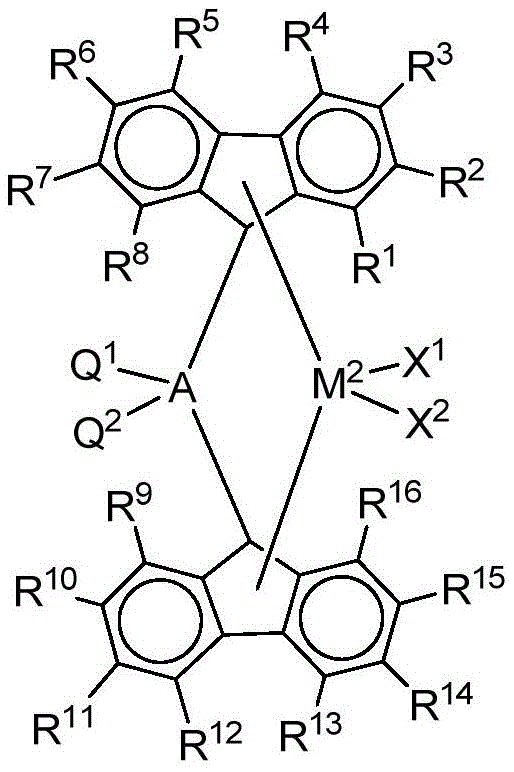
在化学式2中,In Chemical Formula 2,
Q1和Q2彼此相同或不同,并且各自独立地为取代或未取代的C1至C20烷基、取代或未取代的C1至C10烷氧基、取代或未取代的C2至C20烷氧基烷基、或取代或未取代的C6至C20芳基; Q1 and Q2 are the same or different from each other, and are each independently substituted or unsubstituted C1 to C20 alkyl, substituted or unsubstituted C1 to C10 alkoxy, substituted or unsubstituted C2 to C20 alkoxyalkane A group, or a substituted or unsubstituted C6 to C20 aryl group;
A为包含碳、锗或硅原子的基团的至少一个或组合;A is at least one or a combination of groups comprising carbon, germanium or silicon atoms;
M2是第4族过渡金属; M is a Group 4 transition metal;
X1和X2彼此相同或不同,且各自独立地是卤素、取代或未取代的C1至C20烷基、取代或未取代的C2至C10烯基、取代或未取代的C7至C40烷基芳基、取代或未取代的C7至C40芳基烷基、取代或未取代的C6至C20芳基、取代或未取代的C1至C20亚烷基、取代或未取代的氨基、取代或未取代的C2至C20烷基烷氧基、或取代或未取代的C7至C40芳基烷氧基; X1 and X2 are the same or different from each other, and are each independently halogen, substituted or unsubstituted C1 to C20 alkyl, substituted or unsubstituted C2 to C10 alkenyl, substituted or unsubstituted C7 to C40 alkylaryl substituted or unsubstituted C7 to C40 arylalkyl, substituted or unsubstituted C6 to C20 aryl, substituted or unsubstituted C1 to C20 alkylene, substituted or unsubstituted amino, substituted or unsubstituted C2 to C20 alkylalkoxy, or substituted or unsubstituted C7 to C40 arylalkoxy;
R1至R16彼此相同或不同,并且各自独立地为氢、卤素、取代或未取代的C1至C20烷基、取代或未取代的C2至C20烯基、取代或未取代的C1至C20烷基甲硅烷基、取代或未取代的C1至C20甲硅烷基烷基、取代或未取代的C1至C20烷氧基甲硅烷基、取代或未取代的C1至C10烷氧基、取代或未取代的C2至C20烷氧基烷基、取代或未取代的C6至C20芳基、取代或未取代的C6至C10芳基氧基、取代或未取代的C7到C40烷基芳基、取代或未取代的C7至C40芳基烷基、取代或未取代的C8至C40芳基烯基、或取代或未取代的C2至C10炔基,以及R1至R16的彼此相邻的两个以上取代基可以相互连接以形成取代或未取代的脂肪族环或芳香族环;以及R 1 to R 16 are the same or different from each other, and are each independently hydrogen, halogen, substituted or unsubstituted C1 to C20 alkyl, substituted or unsubstituted C2 to C20 alkenyl, substituted or unsubstituted C1 to C20 alkane substituted or unsubstituted C1 to C20 silylalkyl, substituted or unsubstituted C1 to C20 alkoxysilyl, substituted or unsubstituted C1 to C10 alkoxy, substituted or unsubstituted C2 to C20 alkoxyalkyl, substituted or unsubstituted C6 to C20 aryl, substituted or unsubstituted C6 to C10 aryloxy, substituted or unsubstituted C7 to C40 alkylaryl, substituted or unsubstituted Substituted C7 to C40 arylalkyl, substituted or unsubstituted C8 to C40 arylalkenyl, or substituted or unsubstituted C2 to C10 alkynyl, and two or more substitutions of R1 to R16 adjacent to each other The groups can be connected to each other to form a substituted or unsubstituted aliphatic or aromatic ring; and
R1至R8的至少一个由以下化学式3表示,并且R9至R16中的至少一个由化学式3表示,At least one of R 1 to R 8 is represented by the following chemical formula 3, and at least one of R 9 to R 16 is represented by chemical formula 3,
[化学式3][chemical formula 3]
-L1-D1 -L 1 -D 1
在化学式3中,In Chemical Formula 3,
L1为C1至C10亚烷基,以及L is C1 to C10 alkylene, and
D1为C6至C20芳基、C4至C20环烷基或C2至C20烷氧基烷基。D 1 is a C6 to C20 aryl group, a C4 to C20 cycloalkyl group or a C2 to C20 alkoxyalkyl group.
将更详细地描述可用于根据本公开的聚烯烃的制备方法中的负载型混杂茂金属催化剂的化学式1和2的取代基。The substituents of Chemical Formulas 1 and 2 usable in the supported hybrid metallocene catalyst in the production method of polyolefin according to the present disclosure will be described in more detail.
所述C1至C20烷基可以包括直链、支链或环状烷基,并且具体而言,其可以是甲基(Me)、乙基(Et)、丙基(Pr)、异丙基、正丁基(n-Bu)、叔丁基(t-Bu)、戊基(Pt)、己基(Hx)、庚基、辛基、环丁基、环戊基、环己基等,但不限于此。The C1 to C20 alkyl group may include linear, branched or cyclic alkyl groups, and specifically, it may be methyl (Me), ethyl (Et), propyl (Pr), isopropyl, n-butyl (n-Bu), tert-butyl (t-Bu), pentyl (Pt), hexyl (Hx), heptyl, octyl, cyclobutyl, cyclopentyl, cyclohexyl, etc., but not limited to this.
所述C1至C20亚烷基可以包括直链或支链亚烷基,并且具体而言,其可以是亚甲基、亚乙基、亚丙基、亚丁基、亚戊基、亚己基等,但不限于此。The C1 to C20 alkylene group may include straight chain or branched chain alkylene group, and specifically, it may be methylene group, ethylene group, propylene group, butylene group, pentylene group, hexylene group, etc., But not limited to this.
所述C4至C20环烷基是指如上所述的烷基中的环烷基,具体而言,其可以是环丁基、环戊基、环己基等,但不限于此。The C4 to C20 cycloalkyl group refers to the cycloalkyl group in the above-mentioned alkyl group, specifically, it may be cyclobutyl group, cyclopentyl group, cyclohexyl group, etc., but is not limited thereto.
所述C2至C20烯基可包括直链或支链的烯基,并且具体而言,其可以是烯丙基、乙烯基、丙烯基、丁烯基、戊烯基等,但不限于此。The C2 to C20 alkenyl may include linear or branched alkenyl, and specifically, it may be allyl, vinyl, propenyl, butenyl, pentenyl, etc., but is not limited thereto.
所述C6至C20芳基可包括单环芳基或稠环芳基,并且具体而言,其可以是苯基、联苯基、萘基、菲基、芴基等,但不限于此。The C6-C20 aryl group may include a single-ring aryl group or a fused-ring aryl group, and specifically, it may be phenyl, biphenyl, naphthyl, phenanthrenyl, fluorenyl, etc., but is not limited thereto.
所述C1至C20烷氧基可以是甲氧基、乙氧基、苯氧基、环己氧基等,但不限于此。The C1 to C20 alkoxy group may be methoxy, ethoxy, phenoxy, cyclohexyloxy, etc., but is not limited thereto.
所述C2至C20烷氧基烷基是其中烷基的至少一个氢被烷氧基取代的官能团,具体而言,其可以是烷氧基烷基,例如甲氧基甲基、甲氧基乙基、乙氧基甲基、异丙氧基甲基,异丙氧基乙基、异丙氧基己基、叔丁氧基甲基、叔丁氧基乙基、叔丁氧基己基;或者芳基氧基烷基,例如苯氧基己基,但不限于此。The C2 to C20 alkoxyalkyl group is a functional group in which at least one hydrogen of the alkyl group is replaced by an alkoxy group, specifically, it may be an alkoxyalkyl group such as methoxymethyl, methoxyethyl base, ethoxymethyl, isopropoxymethyl, isopropoxyethyl, isopropoxyhexyl, tert-butoxymethyl, tert-butoxyethyl, tert-butoxyhexyl; or aromatic oxyalkyl, such as, but not limited to, phenoxyhexyl.
所述C1至C20烷基甲硅烷基或C1至C20烷氧基甲硅烷基为其中-SiH3的1至3个氢被上述1至3个烷基或烷氧基取代的官能团,具体而言,其可以为烷基甲硅烷基,例如甲基甲硅烷基、二甲基甲硅烷基、三甲基甲硅烷基、二甲基乙基甲硅烷基、二乙基甲基甲硅烷基或二甲基丙基甲硅烷基;烷氧基甲硅烷基,例如甲氧基甲硅烷基、二甲氧基甲硅烷基、三甲氧基甲硅烷基或二甲氧基乙氧基甲硅烷基;或烷氧基烷基甲硅烷基,例如甲氧基二甲基甲硅烷基、二乙氧基甲基甲硅烷基或二甲氧基丙基甲硅烷基,但不限于此。The C1 to C20 alkylsilyl group or C1 to C20 alkoxysilyl group is a functional group in which 1 to 3 hydrogens of -SiH3 are replaced by the above-mentioned 1 to 3 alkyl or alkoxy groups, specifically , which can be an alkylsilyl group such as methylsilyl, dimethylsilyl, trimethylsilyl, dimethylethylsilyl, diethylmethylsilyl or diethylsilyl methylpropylsilyl; alkoxysilyl, such as methoxysilyl, dimethoxysilyl, trimethoxysilyl or dimethoxyethoxysilyl; or An alkoxyalkylsilyl group such as methoxydimethylsilyl, diethoxymethylsilyl or dimethoxypropylsilyl, but not limited thereto.
所述C1至C20甲硅烷基烷基是其中烷基的至少一个氢被甲硅烷基取代的官能团,具体而言,其可以是-CH2-SiH3、甲基甲硅烷基甲基或二甲基乙氧基甲硅烷基丙基等,但不限于此。The C1 to C20 silylalkyl group is a functional group in which at least one hydrogen of the alkyl group is replaced by a silyl group, specifically, it may be -CH 2 -SiH 3 , methylsilylmethyl or dimethyl ethoxysilylpropyl, etc., but not limited thereto.
所述卤素可以是氟(F)、氯(Cl)、溴(Br)或碘(I)。The halogen may be fluorine (F), chlorine (Cl), bromine (Br) or iodine (I).
所述磺酸酯基具有-O-SO2-R'的结构,其中R'可以是C1至C20烃基。具体而言,所述C1至C20磺酸酯基可包括甲磺酸酯基、苯磺酸酯基等,但不限于此。The sulfonate group has a structure of -O-SO 2 -R', wherein R' may be a C1 to C20 hydrocarbon group. Specifically, the C1 to C20 sulfonate groups may include mesylate groups, benzenesulfonate groups, etc., but are not limited thereto.
此外,在本公开中,“彼此相邻的两个取代基彼此连接以形成脂肪族环或芳香族环”是指两个取代基的一个或多个原子和两个取代基所连接的一个或多个原子彼此连接以形成环。具体地,R1至R16的相邻取代基,例如,R2和R3,或者R3和R4可以彼此连接以形成芳香族环。In addition, in the present disclosure, "two substituents adjacent to each other are connected to each other to form an aliphatic ring or an aromatic ring" means one or more atoms of the two substituents and one or more atoms to which the two substituents are connected. Multiple atoms are linked to each other to form a ring. Specifically, adjacent substituents of R 1 to R 16 , for example, R 2 and R 3 , or R 3 and R 4 may be connected to each other to form an aromatic ring.
上述取代基可以任选地被一个或多个选自以下的取代基取代:羟基;卤素;烷基或烯基、芳基、烷氧基;含有至少一个第14至16族杂原子的烷基或烯基、芳基、烷氧基;甲硅烷基;烷基甲硅烷或烷氧基甲硅烷基;膦基;磷化物基(phosphide);磺酸酯基;和砜基。The above substituents may be optionally substituted with one or more substituents selected from the group consisting of: hydroxyl; halogen; alkyl or alkenyl, aryl, alkoxy; alkyl containing at least one Group 14 to 16 heteroatom or alkenyl, aryl, alkoxy; silyl; alkylsilyl or alkoxysilyl; phosphino; phosphide; sulfonate;
第4族过渡金属可以是钛(Ti)、锆(Zr)、铪(Hf)等,但不限于此。The Group 4 transition metal may be titanium (Ti), zirconium (Zr), hafnium (Hf), etc., but is not limited thereto.
常规地,通过使用其中负载有具有环戊基作为配体的过渡金属化合物的催化剂制备的烯烃聚合物显示出控制分子量分布的问题。因此,通过使用其中负载有具有环戊基作为配体的过渡金属化合物的催化剂制备的聚烯烃具有宽的分子量分布,因此难以在氯化过程中生产具有高伸长率的氯化聚烯烃。Conventionally, an olefin polymer prepared by using a catalyst in which a transition metal compound having a cyclopentyl group as a ligand is supported shows a problem in controlling the molecular weight distribution. Therefore, a polyolefin produced by using a catalyst in which a transition metal compound having a cyclopentyl group as a ligand is supported has a broad molecular weight distribution, and thus it is difficult to produce a chlorinated polyolefin having a high elongation during chlorination.
然而,如本公开的实施方式中所述,当通过使用包含由化学式1和化学式2表示的茂金属化合物的负载型混杂催化剂来进行烯烃聚合时,可以有效地生产具有窄分子量分布的聚烯烃,其中所述聚烯烃在氯化聚烯烃中表现出优异的氯分布的均匀性,从而提高PVC复合物的冲击强度。However, as described in the embodiments of the present disclosure, when olefin polymerization is performed by using a supported hybrid catalyst including the metallocene compound represented by Chemical Formula 1 and Chemical Formula 2, polyolefin having a narrow molecular weight distribution can be efficiently produced, Wherein the polyolefin exhibits excellent uniformity of chlorine distribution in the chlorinated polyolefin, thereby improving the impact strength of the PVC compound.
具体而言,在负载型混杂催化剂中,第一茂金属化合物可以容易地制备包含长链分支并且具有低分子量的聚烯烃。并且,与第一茂金属化合物相比,第二茂金属化合物可以容易地制备包含较少量的长链分支并且具有相对高的分子量的聚烯烃。特别地,当聚合物具有大量的长链分支和大的分子量时,熔体强度增加。在第一茂金属化合物的情况下,由于与许多长链分支相比分子量低,因此对其进行改进是有限制的。Specifically, among the supported hybrid catalysts, the first metallocene compound can easily produce polyolefins containing long chain branches and having low molecular weight. Also, the second metallocene compound can easily prepare a polyolefin containing a smaller amount of long-chain branches and having a relatively high molecular weight, compared to the first metallocene compound. In particular, melt strength increases when the polymer has a large number of long chain branches and a large molecular weight. In the case of the first metallocene compound, there is a limit to its improvement due to the low molecular weight compared with many long-chain branches.
在本公开的聚烯烃的制备中,制备具有相对大量的长链分支并具有低分子量的聚合物的第一茂金属化合物和制备具有相对少量的长链分支并具有高分子量的聚合物的第二茂金属化合物被混杂负载,从而在保持高分子量的同时有效地控制分子量分布。由于通过混杂负载两种茂金属化合物存在于聚合物中的长链分支位于相对低的分子量侧,因此可以改善分子量分布。In the preparation of the polyolefins of the present disclosure, a first metallocene compound for preparing a polymer having a relatively large amount of long-chain branches and having a low molecular weight and a second metallocene compound for preparing a polymer having a relatively small amount of long-chain branches and having a high molecular weight The metallocene compounds are loaded in a heterogeneous manner, thereby effectively controlling the molecular weight distribution while maintaining a high molecular weight. Since the long-chain branch present in the polymer by hybrid loading of two metallocene compounds is located on the relatively low molecular weight side, the molecular weight distribution can be improved.
更具体而言,由化学式1表示的第一茂金属化合物具有包括基于茚基的配体的结构,并且具有该结构的催化剂可以聚合具有相对窄的分子量分布(PDI,MWD,Mw/Mn)和熔体流动速率比(MFRR),同时具有少量的长链分支的聚合物。More specifically, the first metallocene compound represented by Chemical Formula 1 has a structure including an indenyl-based ligand, and a catalyst having this structure can be polymerized with a relatively narrow molecular weight distribution (PDI, MWD, Mw/Mn) and Melt Flow Rate Ratio (MFRR), while having a small amount of long-chain branched polymers.
具体而言,由化学式1表示的第一茂金属化合物的结构中的茚基或4,5,6,7-四氢-1-茚基配体可影响,例如烯烃聚合的活性。Specifically, the indenyl or 4,5,6,7-tetrahydro-1-indenyl ligand in the structure of the first metallocene compound represented by Chemical Formula 1 may affect, for example, the activity of olefin polymerization.
在化学式1中,M1可以为Ti、Zr或Hf;Ra和Rb彼此相同或不同,并且可以各自独立地为氢、C1至C20烷基、C2至C20烷氧基烷基或C7至C40芳基烷基;以及Z1可以是卤素。或者,在化学式1中,Cp1和Cp2可以各自独立地为茚基或4,5,6,7-四氢-1-茚基;Ra和Rb可以各自独立地是氢、甲基或叔丁氧基己基;M1可以是Zr;以及Z1可以是卤素,例如氯。在此情况下,负载型混杂催化剂可以制备具有优异加工性的烯烃聚合物。In Chemical Formula 1, M 1 may be Ti, Zr or Hf; Ra and R b may be the same or different from each other, and may each independently be hydrogen, C1 to C20 alkyl, C2 to C20 alkoxyalkyl or C7 to C40 arylalkyl; and Z can be halogen. Alternatively, in Chemical Formula 1, Cp 1 and Cp 2 may each independently be indenyl or 4,5,6,7-tetrahydro-1-indenyl; R a and R b may each independently be hydrogen, methyl or tert-butoxyhexyl; M 1 can be Zr; and Z 1 can be halogen, such as chlorine. In this case, supported hybrid catalysts can prepare olefin polymers with excellent processability.
由化学式1表示的第一茂金属化合物的具体实例可包括双(3-(6-(叔丁氧基)己基)-1H-茚-1-基)氯化锆(IV)和双(3-(6-(叔丁氧基)己基)-4,5,6,7-四氢-1H-茚-1-基)氯化锆(IV),但本公开不限于此。Specific examples of the first metallocene compound represented by Chemical Formula 1 may include bis(3-(6-(tert-butoxy)hexyl)-1H-inden-1-yl)zirconium(IV) chloride and bis(3- (6-(tert-butoxy)hexyl)-4,5,6,7-tetrahydro-1H-inden-1-yl)zirconium(IV) chloride, but the disclosure is not limited thereto.
由化学式1表示的第一茂金属化合物可以通过应用已知反应来合成。具体而言,可以通过各种合成方法制备配体化合物,然后与金属前体化合物进行金属化来制备茂金属化合物。然而,本公开不限于此,并且所述合成方法可以参考实施例。The first metallocene compound represented by Chemical Formula 1 may be synthesized by applying known reactions. Specifically, metallocene compounds can be prepared by preparing ligand compounds through various synthetic methods, followed by metallation with metal precursor compounds. However, the present disclosure is not limited thereto, and the synthesis method can refer to Examples.
在负载型混杂催化剂中,由化学式2表示的第二茂金属化合物在配体中包括特定的取代基(环戊基甲基),并且该配体具有通过Si等交联的结构。具有这种结构的催化剂可以聚合具有相对窄的分子量分布(PDI,MWD,Mw/Mn)和熔体流动速率比(MFRR),同时具有少量的长链分支的聚合物。In the supported hybrid catalyst, the second metallocene compound represented by Chemical Formula 2 includes a specific substituent (cyclopentylmethyl) in a ligand, and the ligand has a structure crosslinked by Si or the like. Catalysts with this structure can polymerize polymers with relatively narrow molecular weight distributions (PDI, MWD, Mw/Mn) and melt flow rate ratios (MFRR) while having a small amount of long-chain branching.
具体而言,取决于由化学式2表示的第二茂金属化合物中取代的官能团的类型,通过调节位阻效应的程度,可以容易地控制要制备的烯烃聚合物的分子量。Specifically, depending on the type of functional group substituted in the second metallocene compound represented by Chemical Formula 2, by adjusting the degree of steric hindrance effect, the molecular weight of the olefin polymer to be prepared can be easily controlled.
具体而言,在化学式2中,M2可以为Ti、Zr或Hf;A可以是碳、锗或硅;Q1和Q2各自独立地为C1至C20烷基,或C2至C20烷氧基烷基;R2或R7可以由以下化学式3a表示,R10或R15可以由以下化学式3a表示,并且其余的R1至R16可以是氢、卤素或C1至C20烷基;以及X1和X2可以各自独立地是卤素。在此情况下,负载型混杂催化剂可以制备具有优异加工性的烯烃聚合物。Specifically, in Chemical Formula 2, M2 can be Ti, Zr or Hf; A can be carbon, germanium or silicon; Q1 and Q2 are each independently C1 to C20 alkyl, or C2 to C20 alkoxy Alkyl; R 2 or R 7 can be represented by the following chemical formula 3a, R 10 or R 15 can be represented by the following chemical formula 3a, and the remaining R 1 to R 16 can be hydrogen, halogen or C1 to C20 alkyl; and X 1 and X2 can each independently be halogen. In this case, supported hybrid catalysts can prepare olefin polymers with excellent processability.
[化学式3a][chemical formula 3a]
-L2-D2 -L 2 -D 2
在化学式3a中,In chemical formula 3a,
L2为C1至C10亚烷基,以及D2为C6至C20芳基,或C4至C20环烷基。L 2 is C1 to C10 alkylene, and D 2 is C6 to C20 aryl, or C4 to C20 cycloalkyl.
或者,在化学式2中,M2可以为Zr;A可以是硅;Q1和Q2可以各自独立地为甲基、乙基、丙基或叔丁氧基己基;R2或R7可以由以下化学式3b表示,R10或R15可以由以下化学式3b表示,并且其余的R1至R16可以是氢;以及X1和X2可以各自独立地是卤素。特别地,R2和R15可以由以下化学式3b表示,且R1、R3至R14,以及R16可以是氢。Alternatively, in Chemical Formula 2, M2 can be Zr; A can be silicon; Q1 and Q2 can be each independently methyl, ethyl, propyl or tert-butoxyhexyl; R2 or R7 can be represented by Represented by the following Chemical Formula 3b, R 10 or R 15 may be represented by the following Chemical Formula 3b, and the remaining R 1 to R 16 may be hydrogen; and X 1 and X 2 may each independently be a halogen. Specifically, R 2 and R 15 may be represented by the following Chemical Formula 3b, and R 1 , R 3 to R 14 , and R 16 may be hydrogen.
[化学式3b][chemical formula 3b]
-L3-D3 -L 3 -D 3
在化学式3b中,In chemical formula 3b,
L3为C1至C2亚烷基,以及D3为C6至C8芳基,或C5至C6环烷基。L 3 is C1 to C2 alkylene, and D 3 is C6 to C8 aryl, or C5 to C6 cycloalkyl.
由化学式2表示的第二茂金属化合物的具体实例可以包括二氯[[[6-(叔丁氧基)己基]甲基亚甲硅烷基]双[(4a,4b,8a,9,9a-η)-2-(环戊基甲基)-9H-芴-9-亚基]]合锆,二氯[[[(6-(叔丁氧基)己基]甲基亚甲硅烷基]双[[4a,4b,8a,9,9a-η)-2-(苯甲基)-9H-芴-9-亚基]]合锆,以及二氯[[[6-(叔丁氧基)己基]甲基亚甲硅烷基]双[(4a,4b,8a,9,9a-η)-2-(环己基甲基)-9H-芴-9-亚基]]合锆,但本公开不限于此。Specific examples of the second metallocene compound represented by Chemical Formula 2 may include dichloro[[[6-(tert-butoxy)hexyl]methylsilylene]bis[(4a,4b,8a,9,9a- η)-2-(cyclopentylmethyl)-9H-fluorene-9-ylidene]]zirconium, dichloro[[[(6-(tert-butoxy)hexyl]methylsilylene]bis [[4a,4b,8a,9,9a-η)-2-(phenylmethyl)-9H-fluorene-9-ylidene]]zirconium, and dichloro[[[6-(tert-butoxy) Hexyl]methylsilylene]bis[(4a,4b,8a,9,9a-η)-2-(cyclohexylmethyl)-9H-fluorene-9-ylidene]]zirconium, but the disclosure Not limited to this.
由化学式2表示的第二茂金属化合物可以通过应用已知反应来合成。具体而言,可以通过各种合成方法制备配体化合物,然后与金属前体化合物进行金属化来制备茂金属化合物。然而,本公开不限于此,并且所述合成方法可以参考实施例。The second metallocene compound represented by Chemical Formula 2 may be synthesized by applying known reactions. Specifically, metallocene compounds can be prepared by preparing ligand compounds through various synthetic methods, followed by metallation with metal precursor compounds. However, the present disclosure is not limited thereto, and the synthesis method can refer to Examples.
由此,负载型混杂茂金属催化剂包含第一和第二茂金属化合物,因此可以有效地制备具有以窄分子量分布的线性聚合物的高分子量的聚烯烃,同时表现出优异的加工性。Thus, the supported hybrid metallocene catalyst includes the first and second metallocene compounds, and thus can efficiently produce a high molecular weight polyolefin having a linear polymer in a narrow molecular weight distribution while exhibiting excellent processability.
特别地,所述第一茂金属化合物与第二茂金属化合物的混合摩尔比可以是约1:1至1:3或约1:1至1:2。所述第一茂金属化合物与第二茂金属化合物的混合摩尔比可以是1:1以上,以控制分子量,并且为了高活性可以是1:3以下。In particular, the mixing molar ratio of the first metallocene compound to the second metallocene compound may be about 1:1 to 1:3 or about 1:1 to 1:2. A mixing molar ratio of the first metallocene compound to the second metallocene compound may be 1:1 or more to control molecular weight, and may be 1:3 or less for high activity.
同时,根据本公开的制备聚烯烃的方法可以通过使用包含如上所述的特定茂金属化合物的负载型混杂催化剂,经由优化助催化剂的输入进行烯烃聚合,从而生产具有窄分子量分布的聚烯烃,表现出优异的氯分布的均匀性的氯化聚烯烃,以及具有改善的冲击强度的PVC组合物。Meanwhile, the method for preparing polyolefins according to the present disclosure can produce polyolefins with a narrow molecular weight distribution by using a supported hybrid catalyst comprising a specific metallocene compound as described above, by optimizing the input of a cocatalyst to perform olefin polymerization, showing Chlorinated polyolefins with excellent uniformity of chlorine distribution, and PVC compositions with improved impact strength.
具体而言,应在助催化剂的存在下进行本公开中制备聚烯烃的聚合反应,以防止因在聚合溶剂的水分引起的催化活性的降低,且以约70cc/hr至约140cc/hr引入所述助催化剂。具体而言,可以以约80cc/hr至135cc/hr、约90cc/hr至130cc/hr,或约90cc/hr至110cc/hr引入助催化剂。助催化剂气体的输入量应为约70cc/hr以上,以完全去除在聚合溶剂中的水分,以及,应为约140cc/hr以下,以防止由于助催化剂本身与催化剂的反应而引起的活性降低。Specifically, the polymerization reaction for preparing polyolefins in the present disclosure should be carried out in the presence of a cocatalyst to prevent a decrease in catalytic activity due to moisture in the polymerization solvent, and the cocatalyst should be introduced at about 70 cc/hr to about 140 cc/hr. co-catalyst. Specifically, the cocatalyst can be introduced at about 80 cc/hr to 135 cc/hr, about 90 cc/hr to 130 cc/hr, or about 90 cc/hr to 110 cc/hr. The input amount of the co-catalyst gas should be above about 70 cc/hr to completely remove the moisture in the polymerization solvent, and should be under about 140 cc/hr to prevent the activity reduction due to the reaction of the co-catalyst itself with the catalyst.
所述助催化剂是包含第13族金属的有机金属化合物,并且没有特别限制,只要其可以在常规茂金属催化剂的存在下用于烯烃聚合即可。The cocatalyst is an organometallic compound containing a Group 13 metal, and is not particularly limited as long as it can be used for olefin polymerization in the presence of a conventional metallocene catalyst.
可以使用连续淤浆聚合反应器、环流淤浆反应器、气相反应器或溶液反应器进行聚合反应。并且该反应可以是基于烯烃的单体的均聚或两种以上单体的共聚。然而,根据本实施方式的方法,更优选通过淤浆聚合或气相聚合来聚合烯烃单体,以更有效地控制分子量分布。The polymerization can be carried out using a continuous slurry polymerization reactor, a loop slurry reactor, a gas phase reactor or a solution reactor. And the reaction may be homopolymerization of olefin-based monomers or copolymerization of two or more monomers. However, according to the method of the present embodiment, it is more preferable to polymerize the olefin monomer by slurry polymerization or gas phase polymerization in order to more effectively control the molecular weight distribution.
特别地,可以通过在基于烃的溶剂(例如,诸如己烷、丁烷或戊烷的基于脂肪族烃的溶剂)中的淤浆相聚合来进行聚合反应。由于根据本公开的第一和第二茂金属化合物在基于脂肪族烃的溶剂中具有优异的溶解性,因此它们被稳定地溶解并被供应至反应体系,从而可以有效地进行聚合反应。In particular, the polymerization reaction may be carried out by slurry phase polymerization in a hydrocarbon-based solvent (for example, an aliphatic hydrocarbon-based solvent such as hexane, butane or pentane). Since the first and second metallocene compounds according to the present disclosure have excellent solubility in an aliphatic hydrocarbon-based solvent, they are stably dissolved and supplied to a reaction system, so that a polymerization reaction can be efficiently performed.
另外,根据本公开的一个实施方式的聚烯烃的制备方法可以在单CSTR反应器中进行。In addition, the method for preparing polyolefin according to an embodiment of the present disclosure may be performed in a single CSTR reactor.
在聚合反应器中,可以在惰性气体,例如氮气的存在下进行聚合。通过在聚合反应开始时抑制茂金属催化剂的快速反应,惰性气体可以延长催化剂中包含的茂金属化合物的反应活性。In the polymerization reactor, the polymerization may be performed in the presence of an inert gas such as nitrogen. The inert gas can prolong the reactivity of the metallocene compound contained in the catalyst by suppressing the rapid reaction of the metallocene catalyst at the beginning of the polymerization reaction.
在聚合反应中,可以为了控制聚烯烃的分子量和分子量分布的目的而使用氢气。In the polymerization reaction, hydrogen gas may be used for the purpose of controlling the molecular weight and molecular weight distribution of polyolefin.
可以在约70℃至约100℃,约80℃至约90℃,或约81℃或约83℃的温度进行聚合反应。当聚合温度太低时,聚合速度和生产率可能降低。相反,当聚合温度太高时,在反应器中可能发生结垢现象。The polymerization can be conducted at a temperature of about 70°C to about 100°C, about 80°C to about 90°C, or about 81°C or about 83°C. When the polymerization temperature is too low, the polymerization speed and productivity may decrease. On the contrary, when the polymerization temperature is too high, fouling phenomenon may occur in the reactor.
另外,聚合压力可以为约6.8kg/cm2至约8.7kg/cm2,约7.0kg/cm2至约8.5kg/cm2,或约8.0kg/cm2至约8.5kg/cm2,从而通过确保最佳生产率来提高催化剂的经济效率。聚合压力可以为约6.8kg/cm2以上,以防止由于高分子量的过量产生而引起的结块,并优化生产率;并且可以为约8.7kg/cm2以下,以防止乙烯源在高压聚合条件下的单元降解。In addition, the polymerization pressure may be about 6.8 kg/cm 2 to about 8.7 kg/cm 2 , about 7.0 kg/cm 2 to about 8.5 kg/cm 2 , or about 8.0 kg/cm 2 to about 8.5 kg/cm 2 , so that Improve catalyst economic efficiency by ensuring optimum productivity. The polymerization pressure may be above about 6.8kg/ cm2 to prevent agglomeration due to excessive production of high molecular weight and to optimize productivity; and may be below about 8.7kg/ cm2 to prevent the ethylene source from being under high pressure polymerization conditions unit degradation.
另外,在聚合反应中,可以进一步使用有机溶剂以作为反应介质或稀释剂。考虑到烯烃单体的量,可以以这样的量使用有机溶剂,从而可以适当地进行淤浆相聚合。In addition, in the polymerization reaction, an organic solvent may be further used as a reaction medium or a diluent. The organic solvent can be used in such an amount that the slurry phase polymerization can be properly performed in consideration of the amount of the olefin monomer.
具体而言,助催化剂化合物可以包括以下化学式4的含铝的第一助催化剂,以及以下化学式5的基于硼酸盐的第二助催化剂中的至少一种。Specifically, the co-catalyst compound may include at least one of an aluminum-containing first co-catalyst of the following Chemical Formula 4 and a borate-based second co-catalyst of the following Chemical Formula 5.
[化学式4][chemical formula 4]
Rc-[Al(Rd)-Ol]m-Re R c -[Al(R d )-O l ] m -R e
在化学式4中,In chemical formula 4,
Rc、Rd和Re彼此相同或不同,并且各自独立地为氢、卤素、C1至C20烃基或被卤素取代的C1至C20烃基;R c , R d and R e are the same or different from each other, and are each independently hydrogen, halogen, C1 to C20 hydrocarbon group or C1 to C20 hydrocarbon group substituted by halogen;
l为0或1;以及l is 0 or 1; and
m是2以上的整数;m is an integer of 2 or more;
[化学式5][chemical formula 5]
T+[BG4]- T + [BG 4 ] -
在化学式5中,In Chemical Formula 5,
T+为具有+1化合价的多原子离子,B为处于+3氧化态的硼,以及T + is a polyatomic ion with a valence of +1, B is boron in the +3 oxidation state, and
G各自独立地选自氢(hydride)、二烷基酰胺基(dialkylamido)、卤素(halide)、烷氧基(alkoxide)、芳氧基(aryloxide)、烃基、卤代碳基和卤素取代的烃基,条件是G具有20个以下的碳,并且G在一个以下的位置上是卤素。G is each independently selected from hydrogen (hydride), dialkylamide (dialkylamido), halogen (halide), alkoxy (alkoxide), aryloxy (aryloxide), hydrocarbon group, halogenated carbon group and halogen substituted hydrocarbon group , provided that G has less than 20 carbons and G is a halogen at less than one position.
化学式4的第一助催化剂可以是包括以线性、环状或网状键合的重复单元的基于烷基铝氧烷的化合物,并且可以是三烷基铝化合物。另外,在第一助催化剂化合物中与铝结合的烷基可以具有1至20个碳原子,或者1至10个碳原子。具体而言,所述第一助催化剂可以是选自以下的基于烷基铝氧烷的化合物:甲基铝氧烷(MAO)、乙基铝氧烷、异丁基铝氧烷和丁基铝氧烷;或选自以下的三烷基铝化合物:三甲基铝、三乙基铝(TEAL)、三异丁基铝、三己基铝、三辛基铝和异戊二烯基铝。The first co-catalyst of Chemical Formula 4 may be an alkylaluminoxane-based compound including repeating units bonded in a linear, cyclic, or network shape, and may be a trialkylaluminum compound. In addition, the aluminum-bonded alkyl group in the first co-catalyst compound may have 1 to 20 carbon atoms, or 1 to 10 carbon atoms. Specifically, the first cocatalyst may be an alkylaluminoxane-based compound selected from the group consisting of methylalumoxane (MAO), ethylalumoxane, isobutylalumoxane, and butylaluminum oxane; or a trialkylaluminum compound selected from the group consisting of trimethylaluminum, triethylaluminum (TEAL), triisobutylaluminum, trihexylaluminum, trioctylaluminum, and isoprenylaluminum.
并且,化学式5的第二助催化剂可以是以三取代铵盐、二烷基铵盐或三取代鏻盐形式的基于硼酸盐的化合物。所述第二助催化剂的具体实例可以包括选自以下化合物的三取代铵盐形式的基于硼酸盐的化合物:三甲基铵四苯基硼酸盐、甲基双十八烷基铵四苯基硼酸盐、三乙基铵四苯基硼酸盐、三丙基铵四苯基硼酸盐、三(正丁基)铵四苯基硼酸盐、甲基十四烷基十八烷基铵四苯基硼酸盐、N,N-二甲基苯铵四苯基硼酸盐、N,N-二乙基苯铵四苯基硼酸盐、N,N-二甲基(2,4,6-三甲基苯铵)四苯基硼酸盐、三甲基铵四(五氟苯基)硼酸盐、甲基双十四烷基铵四(五氟苯基)硼酸盐、甲基双十八烷基铵四(五氟苯基)硼酸盐、三乙基铵四(五氟苯基)硼酸盐、三丙基铵四(五氟苯基)硼酸盐、三(正丁基)铵四(五氟苯基)硼酸盐、三(仲丁基)铵四(五氟苯基)硼酸盐、N,N-二甲基苯铵四(五氟苯基)硼酸盐、N,N-二乙基苯铵四(五氟苯基)硼酸盐、N,N-二甲基(2,4,6-三甲基苯铵)四(五氟苯基)硼酸盐、三甲基铵四(2,3,4,6-四氟苯基)硼酸盐、三乙基铵四(2,3,4,6-四氟苯基)硼酸盐、三丙基铵四(2,3,4,6-四氟苯基)硼酸盐、三(正丁基)铵四(2,3,4,6-四氟苯基)硼酸盐、二甲基(叔丁基)铵四(2,3,4,6-四氟苯基)硼酸盐、N,N-二甲基苯铵四(2,3,4,6-四氟苯基)硼酸盐、N,N-二乙基苯铵四(2,3,4,6-四氟苯基)硼酸盐和N,N-二甲基-(2,4,6-三甲基苯铵)四-(2,3,4,6-四氟苯基)硼酸盐;选自以下化合物的二烷基铵盐形式的基于硼酸盐的化合物:双十八烷基铵四(五氟苯基)硼酸盐、双十四烷基铵四(五氟苯基)硼酸盐和二环己基铵四(五氟苯基)硼酸盐;或者选自以下化合物的三取代的鏻盐形式的基于硼酸盐的化合物:三苯基鏻四(五氟苯基)硼酸盐、甲基双十八烷基鏻四(五氟苯基)硼酸盐,以及三(2,6-二甲基苯基)鏻四(五氟苯基)硼酸盐。And, the second promoter of Chemical Formula 5 may be a borate-based compound in the form of a trisubstituted ammonium salt, a dialkylammonium salt, or a trisubstituted phosphonium salt. Specific examples of the second co-catalyst may include borate-based compounds in the form of trisubstituted ammonium salts selected from the group consisting of trimethylammonium tetraphenyl borate, methyl dioctadecyl ammonium tetraphenyl base borate, triethylammonium tetraphenylborate, tripropylammonium tetraphenylborate, tri(n-butyl)ammonium tetraphenylborate, methyl tetradecyl octadecane Ammonium tetraphenyl borate, N,N-dimethylanilinium tetraphenyl borate, N,N-diethylanilinium tetraphenyl borate, N,N-dimethyl (2 ,4,6-Trimethylanilinium) tetraphenyl borate, trimethylammonium tetrakis (pentafluorophenyl) borate, methyl ditetradecyl ammonium tetrakis (pentafluorophenyl) borate Salt, methyl dioctadecylammonium tetrakis (pentafluorophenyl) borate, triethylammonium tetrakis (pentafluorophenyl) borate, tripropylammonium tetrakis (pentafluorophenyl) borate , Tri(n-butyl)ammonium tetrakis(pentafluorophenyl)borate, tri(sec-butyl)ammonium tetrakis(pentafluorophenyl)borate, N,N-dimethylanilinium tetrakis(pentafluorophenyl)borate Phenyl)borate, N,N-diethylanilinium tetrakis(pentafluorophenyl)borate, N,N-dimethyl(2,4,6-trimethylanilinium)tetrakis(pentafluorophenyl) Fluorophenyl) borate, trimethylammonium tetrakis (2,3,4,6-tetrafluorophenyl) borate, triethylammonium tetrakis (2,3,4,6-tetrafluorophenyl) Borate, tripropylammonium tetrakis(2,3,4,6-tetrafluorophenyl)borate, tri(n-butyl)ammonium tetrakis(2,3,4,6-tetrafluorophenyl)boron salt, dimethyl(tert-butyl)ammonium tetrakis(2,3,4,6-tetrafluorophenyl)borate, N,N-dimethylanilinium tetrakis(2,3,4,6- tetrafluorophenyl)borate, N,N-diethylaniliniumtetrakis(2,3,4,6-tetrafluorophenyl)borate and N,N-dimethyl-(2,4, 6-trimethylanilinium)tetrakis-(2,3,4,6-tetrafluorophenyl)borate; borate-based compounds in the form of dialkylammonium salts selected from the group consisting of dioctadec Alkylammonium tetrakis(pentafluorophenyl)borate, ditetradecylammonium tetrakis(pentafluorophenyl)borate and dicyclohexylammonium tetrakis(pentafluorophenyl)borate; or selected from the following Borate-based compounds in the form of trisubstituted phosphonium salts of compounds: triphenylphosphonium tetrakis(pentafluorophenyl)borate, methyldioctadecylphosphonium tetrakis(pentafluorophenyl)borate, and tris(2,6-dimethylphenyl)phosphonium tetrakis(pentafluorophenyl)borate.
同时,本公开的负载型混杂茂金属催化剂的第一和第二茂金属化合物具有上述结构特征,并且可以稳定地负载在载体上。Meanwhile, the first and second metallocene compounds of the supported hybrid metallocene catalyst of the present disclosure have the above-mentioned structural features, and can be stably supported on the carrier.
作为载体,可以使用在表面含有羟基或硅氧烷基的那些。具体而言,可以使用通过在高温下干燥而除去表面上的水分的包含具有高反应性的羟基或硅氧烷基的载体。更具体而言,可以使用氧化硅、氧化铝、氧化镁或其混合物,并且更优选氧化硅。所述载体可以在高温下干燥,并且可以是在高温下干燥的氧化硅、氧化硅-氧化铝或氧化硅-氧化镁。所述载体通常可以包含氧化物、碳酸盐、硫酸盐和硝酸盐,例如Na2O、K2CO3、BaSO4、Mg(NO3)2等。As the carrier, those containing a hydroxyl group or a siloxane group on the surface can be used. Specifically, a support containing a highly reactive hydroxyl group or a siloxane group that removes moisture on the surface by drying at a high temperature can be used. More specifically, silicon oxide, aluminum oxide, magnesium oxide or a mixture thereof may be used, and silicon oxide is more preferred. The support may be dried at high temperature, and may be silica, silica-alumina, or silica-magnesia dried at high temperature. The support may generally contain oxides, carbonates, sulfates and nitrates, such as Na 2 O, K 2 CO 3 , BaSO 4 , Mg(NO 3 ) 2 and the like.
所述载体的干燥温度可优选为约200℃至800℃,更优选约300℃至600℃,且最优选约300℃至400℃。当所述载体的干燥温度低于约200℃时,由于过多的水分,表面水分可能会与助催化剂反应。当干燥温度大于约800℃时,在载体表面上的孔可能会合并而减小表面积,并且表面上可能会损失大量羟基,并且仅硅氧烷基会残留,因此减少了与助催化剂的反应位点,这不是优选的。The drying temperature of the support may be preferably about 200°C to 800°C, more preferably about 300°C to 600°C, and most preferably about 300°C to 400°C. When the drying temperature of the support is lower than about 200° C., surface moisture may react with the co-catalyst due to excessive moisture. When the drying temperature is greater than about 800 ° C, the pores on the surface of the support may merge to reduce the surface area, and a large amount of hydroxyl groups may be lost on the surface, and only the siloxane group will remain, thus reducing the reaction sites with the co-catalyst Point, this is not preferred.
在所述载体的表面上的羟基的量可优选为约0.1mmol/g至10mmol/g,更优选为约0.5mmol/g至5mmol/g。可以通过载体的制备方法和条件,或干燥条件,例如温度、时间、真空度、喷雾干燥等来控制所述载体的表面上羟基的量。The amount of hydroxyl groups on the surface of the support may preferably be about 0.1 mmol/g to 10 mmol/g, more preferably about 0.5 mmol/g to 5 mmol/g. The amount of hydroxyl groups on the surface of the support can be controlled by the preparation method and conditions of the support, or drying conditions, such as temperature, time, vacuum degree, spray drying, and the like.
当所述羟基的量小于约0.1mmol/g时,与助催化剂的反应位点可能很少,而当其大于约10mmol/g时,在载体颗粒的表面上有可能是源自水分而不是羟基,这是不优选的。When the amount of the hydroxyl group is less than about 0.1 mmol/g, there may be few reaction sites with the co-catalyst, and when it is greater than about 10 mmol/g, there may be moisture rather than hydroxyl groups on the surface of the carrier particles. , which is not preferred.
另外,在根据本公开的实施方式的负载型混杂催化剂中,可以进一步在载体上负载助催化剂以活化茂金属化合物。负载在载体上的所述助催化剂是包含第13族金属的有机金属化合物,并且没有特别限制,只要其可以在常规茂金属催化剂的存在下用于烯烃聚合即可。所述助催化剂的具体实例如上所述。In addition, in the supported hybrid catalyst according to the embodiment of the present disclosure, a co-catalyst may be further supported on the carrier to activate the metallocene compound. The cocatalyst supported on the carrier is an organometallic compound containing a Group 13 metal, and is not particularly limited as long as it can be used for olefin polymerization in the presence of a conventional metallocene catalyst. Specific examples of the cocatalyst are as described above.
在本实施方式的负载型混杂茂金属催化剂中,包含在第一和第二茂金属化合物中的总的过渡金属与载体的重量比可以是1:10至1:1000。当以上述重量比包含所述载体和所述茂金属化合物时,可以表现出最佳形状。In the supported hybrid metallocene catalyst of the present embodiment, the weight ratio of the total transition metal contained in the first and second metallocene compounds to the support may be 1:10 to 1:1000. When the support and the metallocene compound are included in the above weight ratio, the optimum shape may be exhibited.
此外,在负载型混杂茂金属催化剂中使用的助催化剂化合物与载体的重量比可以为1:1至1:100。当以上述重量比包含所述助催化剂和所述载体时,可以优化所述聚合物的活性和精细结构。In addition, the weight ratio of cocatalyst compound to support used in the supported hybrid metallocene catalyst may be 1:1 to 1:100. When the co-catalyst and the carrier are included in the above weight ratio, the activity and fine structure of the polymer can be optimized.
同时,可以通过使用包括以下步骤的方法来制备负载型混杂茂金属催化剂:在载体上负载助催化剂;以及在负载了助催化剂的载体上负载第一和第二茂金属化合物。Meanwhile, the supported hybrid metallocene catalyst may be prepared by using a method comprising: supporting a co-catalyst on a support; and supporting the first and second metallocene compounds on the support on which the co-catalyst is supported.
在此,可以一个接一个地依次负载第一和第二茂金属化合物,或者可以一起负载两个化合物。此时,对负载的顺序没有限制,但是可以通过预先负载形貌相对差的第二茂金属催化剂来改善负载型混杂茂金属催化剂的形态。因此,可以在第二茂金属之后负载第一茂金属催化剂。Here, the first and second metallocene compounds may be loaded sequentially one after the other, or both compounds may be loaded together. At this time, there is no limitation on the order of loading, but the morphology of the supported hybrid metallocene catalyst can be improved by pre-loading the second metallocene catalyst with relatively poor morphology. Therefore, the first metallocene catalyst can be supported after the second metallocene.
在上述方法中,对负载条件没有特别限制,并且可以在本领域技术人员公知的范围内进行负载步骤。例如,可以在高温和低温下适当地进行负载步骤。例如,负载温度可以在约-30℃至150℃的范围内,优选在室温(约25℃)至约100℃的范围内,更优选在室温至约80℃的范围内。负载时间可以根据待负载的茂金属化合物的量适当地控制。在通过过滤或在减压下蒸馏除去反应溶剂之后,可以在不进行进一步处理的情况下使用反应的负载型催化剂,或者如果需要,可以使用芳香族烃(例如甲苯)进行索氏抽滤(Soxhlet filtering)。In the above method, there is no particular limitation on the loading conditions, and the loading step can be performed within the range known to those skilled in the art. For example, the loading step can be suitably performed at high and low temperatures. For example, the loading temperature may be in the range of about -30°C to 150°C, preferably in the range of room temperature (about 25°C) to about 100°C, more preferably in the range of room temperature to about 80°C. The loading time can be appropriately controlled according to the amount of the metallocene compound to be loaded. After removal of the reaction solvent by filtration or distillation under reduced pressure, the supported catalyst of the reaction can be used without further treatment or, if desired, can be subjected to Soxhlet suction filtration (Soxhlet filtering).
可以在溶剂的存在下或在没有溶剂的情况下进行负载型催化剂的制备。当使用溶剂时,它可以包括脂肪族烃溶剂,例如己烷或戊烷;芳族烃溶剂,例如甲苯或苯;氯代烃溶剂,例如二氯甲烷;醚溶剂,例如二乙醚或四氢呋喃(THF);以及普通的有机溶剂,例如丙酮或乙酸乙酯。优选的是己烷、庚烷、甲苯和二氯甲烷。The preparation of the supported catalyst can be carried out in the presence of a solvent or without a solvent. When a solvent is used, it may include aliphatic hydrocarbon solvents such as hexane or pentane; aromatic hydrocarbon solvents such as toluene or benzene; chlorinated hydrocarbon solvents such as methylene chloride; ether solvents such as diethyl ether or tetrahydrofuran (THF ); and common organic solvents such as acetone or ethyl acetate. Preferred are hexane, heptane, toluene and dichloromethane.
同时,所述实施方式的负载型混杂茂金属催化剂可以原样用于烯烃单体的聚合中。而且,可以通过使催化剂与烯烃单体接触而将负载型混杂茂金属催化剂制备为预聚合催化剂。例如,可以通过使催化剂与烯烃单体如乙烯、丙烯、1-丁烯、1-己烯、1-辛烯等接触而制备为预聚合催化剂。Meanwhile, the supported hybrid metallocene catalyst of the embodiment may be used as it is in the polymerization of olefin monomers. Furthermore, supported hybrid metallocene catalysts can be prepared as prepolymerized catalysts by contacting the catalyst with olefin monomers. For example, it can be prepared as a prepolymerized catalyst by contacting the catalyst with an olefin monomer such as ethylene, propylene, 1-butene, 1-hexene, 1-octene, and the like.
所述烯烃单体可以是乙烯、α-烯烃、环状烯烃、具有两个以上双键的二烯烯烃或三烯烯烃。The olefin monomer may be ethylene, an α-olefin, a cyclic olefin, a diene olefin or a triene olefin having two or more double bonds.
所述烯烃单体的具体例子可包括乙烯、丙烯、1-丁烯、1-戊烯、4-甲基-1-戊烯、1-己烯、1-庚烯、1-辛烯、1-癸烯、1-十一碳烯、1-十二碳烯、1-十四碳烯、1-十六碳烯、1-二十碳烯、降冰片烯、降冰片二烯、亚乙基降冰片烯、苯基降冰片烯、乙烯基降冰片烯、二环戊二烯,1,4-丁二烯、1,5-戊二烯、1,6-己二烯、苯乙烯、α-甲基苯乙烯、二乙烯基苯、3-氯甲基苯乙烯等,并且可以通过混合其两种以上以共聚这些单体。Specific examples of the olefin monomer may include ethylene, propylene, 1-butene, 1-pentene, 4-methyl-1-pentene, 1-hexene, 1-heptene, 1-octene, 1- -decene, 1-undecene, 1-dodecene, 1-tetradecene, 1-hexadecene, 1-eicosene, norbornene, norbornadiene, ethylene Norbornene, phenylnorbornene, vinyl norbornene, dicyclopentadiene, 1,4-butadiene, 1,5-pentadiene, 1,6-hexadiene, styrene, α-methylstyrene, divinylbenzene, 3-chloromethylstyrene, etc., and these monomers can be copolymerized by mixing two or more thereof.
另外,可以在C5至C12的脂肪族烃溶剂(如戊烷、己烷、庚烷、壬烷、癸烷及其异构体)中,或在芳香族烃溶剂(如甲苯和苯)中,或在用氯取代的烃溶剂(如二氯甲烷和氯苯)中溶解或稀释负载型茂金属催化剂,并注入反应体系。在此使用的溶剂优选在通过用少量的烷基铝处理除去少量的作为催化剂毒物的水或空气之后使用。In addition, in C5 to C12 aliphatic hydrocarbon solvents (such as pentane, hexane, heptane, nonane, decane and its isomers), or in aromatic hydrocarbon solvents (such as toluene and benzene), Or dissolve or dilute the supported metallocene catalyst in a chlorine-substituted hydrocarbon solvent (such as methylene chloride and chlorobenzene), and inject it into the reaction system. The solvent used here is preferably used after removing a small amount of water or air as a catalyst poison by treating with a small amount of alkylaluminum.
在根据本公开的用于制备聚烯烃的方法中,可以通过将诸如分子量调节剂的添加剂与负载型茂金属催化剂以及助催化剂一起添加来进行聚合反应,在所述负载型茂金属催化剂中,至少一种由化学式1表示的第一茂金属化合物和至少一种由化学式2表示的第二茂金属化合物被负载在载体上。In the method for producing polyolefin according to the present disclosure, the polymerization reaction can be performed by adding an additive such as a molecular weight modifier together with a supported metallocene catalyst in which at least A first metallocene compound represented by Chemical Formula 1 and at least one second metallocene compound represented by Chemical Formula 2 are supported on a carrier.
根据实施方式的方法获得的聚烯烃的特征在于相对窄的分子量分布。特别地,所述聚烯烃可具有约13以下或约8.0至约13,约12.5以下或约8.2至约12.5,约11.5以下或约8.5至约11.5,或约10以下或约9.0至约10的熔体流动速率比(MFRR,MI21.6/MI5)。另外,聚烯烃可具有约0.1g/10min至约10g/10min,约0.2g/10min至约5g/10min,或约0.3g/10min至约1.5g/10min的熔体指数(MI5.0,条件E,190℃,5.0kg负荷)。例如,可以根据ASTM D1238(条件E,190℃,5.0kg负荷)测量熔体指数(MI5.0)。此外,可以通过以MFR21.6除以MFR5来计算熔体流动速率比(MFRR,21.6/5),以及可以根据ISO 1133在190℃在21.6kg的负荷下测量MFR21.6,以及可以根据ISO 1133在190℃在5kg的负荷下测量MFR5。The polyolefins obtained according to the process of the embodiments are characterized by a relatively narrow molecular weight distribution. In particular, the polyolefin may have an R of about 13 or less or about 8.0 to about 13, about 12.5 or less or about 8.2 to about 12.5, about 11.5 or less or about 8.5 to about 11.5, or about 10 or less or about 9.0 to about 10 Melt Flow Rate Ratio (MFRR, MI 21.6 /MI 5 ). Additionally, the polyolefin may have a melt index (MI 5.0 , Condition E , 190°C, 5.0kg load). For example, melt index (MI 5.0 ) can be measured according to ASTM D1238 (Condition E, 190° C., 5.0 kg load). Furthermore, the melt flow rate ratio (MFRR, 21.6/5) can be calculated by dividing MFR 21.6 by MFR 5 , and MFR 21.6 can be measured according to ISO 1133 at 190°C under a load of 21.6 kg, and can be measured according to ISO 1133 at MFR 5 is measured at 190° C. under a load of 5 kg.
所述聚烯烃可以具有约0.94g/cm3以上,或约0.94g/cm3至约0.96g/cm3的密度。这意味着聚烯烃具有高含量的晶体结构并且致密,因此难以在氯化过程中改变晶体结构。例如,可以根据ASTM D-792测量聚烯烃的密度。The polyolefin may have a density of about 0.94 g/cm 3 or greater, or about 0.94 g/cm 3 to about 0.96 g/cm 3 . This means that polyolefins have a high content of crystalline structure and are dense, so it is difficult to change the crystalline structure during chlorination. For example, the density of polyolefins can be measured according to ASTM D-792.
聚烯烃具有相对窄的分子量分布,从而在氯化过程中导致聚烯烃中氯分布的优异均匀性。因此,可以显著地提高氯化聚烯烃的伸长率,与PVC的相容性和冲击增强性能。因此,它表现出优异的耐化学性、耐候性、阻燃性、加工性和冲击强度增强效果,并且可以合适地用作PVC管材和窗户型材的冲击增强剂。Polyolefins have a relatively narrow molecular weight distribution, resulting in excellent uniformity of chlorine distribution in the polyolefin during chlorination. Therefore, the elongation, compatibility with PVC and impact-strengthening performance of chlorinated polyolefin can be significantly improved. Therefore, it exhibits excellent chemical resistance, weather resistance, flame retardancy, processability and impact strength enhancement effect, and can be suitably used as an impact reinforcing agent for PVC pipes and window profiles.
特别地,所述聚烯烃的特征在于具有相对窄的分子量分布,并且所述分子量分布(Mw/Mn)可以为约2.3至约5.0。此外,所述聚烯烃的重均分子量可以为约10000g/mol至约5000000g/mol,约10000g/mol至约1000000g/mol,或约50000g/mol至约200000g/mol。In particular, the polyolefin is characterized by a relatively narrow molecular weight distribution, and the molecular weight distribution (Mw/Mn) may be from about 2.3 to about 5.0. Additionally, the polyolefin may have a weight average molecular weight of about 10,000 g/mol to about 5,000,000 g/mol, about 10,000 g/mol to about 1,000,000 g/mol, or about 50,000 g/mol to about 200,000 g/mol.
例如,可以使用凝胶渗透色谱法(GPC,由Water制造)来测量分子量分布(MWD,多分散性指数)。可以通过测量重均分子量(Mw)和数均分子量(Mn),然后用重均分子量除以数均分子量来确定MWD。For example, the molecular weight distribution (MWD, polydispersity index) can be measured using gel permeation chromatography (GPC, manufactured by Water). MWD can be determined by measuring weight average molecular weight (Mw) and number average molecular weight (Mn), and then dividing the weight average molecular weight by the number average molecular weight.
具体而言,可以使用由Waters制造的PL-GPC220作为凝胶渗透色谱(GPC)仪器,并且可以使用Polymer Laboratories PLgel MIX-B 300mm长的柱。评价温度可以是160℃,并且1,2,4-三氯苯可以以1mL/min的流速用于溶剂。可以通过使用GPC分析仪(PL-GP220)将每种聚乙烯样品溶解在含有0.0125%的BHT的1,2,4-三氯苯中10小时以对其进行预处理,然后以10mg/10mL的浓度提供200微升(μL)的量的样品。可以使用以聚苯乙烯标准物形成的校准曲线获得Mw和Mn。使用分子量(g/mol)为2000/10000/30000/70000/200000/700000/2000000/4000000/10000000的9种聚苯乙烯标准物。Specifically, PL-GPC220 manufactured by Waters can be used as a gel permeation chromatography (GPC) instrument, and a Polymer Laboratories PLgel MIX-B 300 mm long column can be used. The evaluation temperature may be 160° C., and 1,2,4-trichlorobenzene may be used as a solvent at a flow rate of 1 mL/min. Each polyethylene sample can be pretreated by dissolving each polyethylene sample in 1,2,4-trichlorobenzene containing 0.0125% of BHT for 10 hours using a GPC analyzer (PL-GP220), and then treated with 10 mg/10 mL of Concentrations provide samples in quantities of 200 microliters (μL). Mw and Mn can be obtained using calibration curves formed with polystyrene standards. Nine polystyrene standards with molecular weights (g/mol) of 2000/10000/30000/70000/200000/700000/2000000/4000000/10000000 were used.
另外,通过聚合反应制备的聚烯烃可以是不包含单独的共聚物的烯烃的均聚物,例如乙烯均聚物。例如,当所述聚烯烃是乙烯均聚物,优选高密度聚乙烯(HDPE)时,可以更适当地满足上述物理性质。特别地,高密度聚乙烯在软化点、牢固性、强度和电绝缘性方面是优异的,并且被用于各种容器,包装膜,纤维,管道,填料,绝缘材料等。Additionally, the polyolefin prepared by polymerization may be a homopolymer of an olefin that does not comprise a separate copolymer, such as an ethylene homopolymer. For example, when the polyolefin is an ethylene homopolymer, preferably high-density polyethylene (HDPE), the above physical properties may be more suitably satisfied. In particular, high-density polyethylene is excellent in softening point, firmness, strength, and electrical insulation, and is used for various containers, packaging films, fibers, pipes, fillers, insulating materials, and the like.
II.制备氯化聚烯烃的方法及氯化聚烯烃II. Process for preparing chlorinated polyolefins and chlorinated polyolefins
根据本公开的另一个实施方式,其提供了一种用于制备氯化聚烯烃的方法,包括用氯对通过上述方法制备的聚烯烃进行氯化的步骤。According to another embodiment of the present disclosure, there is provided a method for preparing a chlorinated polyolefin, comprising the step of chlorinating the polyolefin prepared by the above method with chlorine.
本公开的制备氯化聚烯烃的方法包括以下步骤:在负载型茂金属催化剂和助催化剂的存在下聚合烯烃单体,同时以70cc/hr至140cc/hr引入助催化剂,并用氯对聚烯烃进行氯化,在负载型茂金属催化剂中,至少一种由以下化学式1表示的第一茂金属化合物和至少一种由以下化学式2表示的第二茂金属化合物负载在载体上:The method for preparing chlorinated polyolefins of the present disclosure comprises the following steps: polymerizing olefin monomers in the presence of a supported metallocene catalyst and a cocatalyst, while introducing the cocatalyst at 70cc/hr to 140cc/hr, and treating the polyolefin with chlorine Chlorination, in the supported metallocene catalyst, at least one first metallocene compound represented by the following chemical formula 1 and at least one second metallocene compound represented by the following chemical formula 2 are supported on a carrier:
[化学式1][chemical formula 1]
(Cp1Ra)n(Cp2Rb)M1Z1 3-n (Cp 1 R a ) n (Cp 2 R b )M 1 Z 1 3-n
在化学式1中,In Chemical Formula 1,
M1是第4族过渡金属;M 1 is a Group 4 transition metal;
Cp1和Cp2彼此相同或不同,并且各自独立地选自茚基和4,5,6,7-四氢-1-茚基,其可以被C1至C20烃取代;Cp 1 and Cp 2 are the same or different from each other, and are each independently selected from indenyl and 4,5,6,7-tetrahydro-1-indenyl, which may be substituted by C1 to C20 hydrocarbons;
Ra和Rb彼此相同或不同,并且各自独立地为氢、取代或未取代的C1至C20烷基、取代或未取代的C1至C10烷氧基、取代或未取代的C2至C20烷氧基烷基、取代或未取代的C6至C20芳基、取代或未取代的C6至C10芳基氧基、取代或未取代的C2至C20烯基、取代或未取代的C7至C40烷基芳基、取代或未取代的C7至C40芳基烷基、取代或未取代的C8至C40芳基烯基、或取代或未取代的C2至C10炔基;R a and R b are the same or different from each other, and are each independently hydrogen, substituted or unsubstituted C1 to C20 alkyl, substituted or unsubstituted C1 to C10 alkoxy, substituted or unsubstituted C2 to C20 alkoxy substituted or unsubstituted C6 to C20 aryl, substituted or unsubstituted C6 to C10 aryloxy, substituted or unsubstituted C2 to C20 alkenyl, substituted or unsubstituted C7 to C40 alkylaryl substituted or unsubstituted C7 to C40 arylalkyl, substituted or unsubstituted C8 to C40 aryl alkenyl, or substituted or unsubstituted C2 to C10 alkynyl;
Z1各自独立地是卤素、取代或未取代的C1至C20烷基、取代或未取代的C2至C20烯基、取代或未取代的C7至C40烷基芳基、取代或未取代的C7至C40芳基烷基、取代或未取代的C6至C20芳基、取代或未取代的C1至C20亚烷基、取代或未取代的氨基、取代或未取代的C2至C20烷基烷氧基、或取代或未取代的C7至C40芳基烷氧基;以及 Z1 is each independently halogen, substituted or unsubstituted C1 to C20 alkyl, substituted or unsubstituted C2 to C20 alkenyl, substituted or unsubstituted C7 to C40 alkylaryl, substituted or unsubstituted C7 to C20 C40 arylalkyl, substituted or unsubstituted C6 to C20 aryl, substituted or unsubstituted C1 to C20 alkylene, substituted or unsubstituted amino, substituted or unsubstituted C2 to C20 alkylalkoxy, or substituted or unsubstituted C7 to C40 arylalkoxy; and
n为1或0;n is 1 or 0;
[化学式2][chemical formula 2]

在化学式2中,In Chemical Formula 2,
Q1和Q2彼此相同或不同,并且各自独立地为取代或未取代的C1至C20烷基、取代或未取代的C1至C10烷氧基、取代或未取代的C2至C20烷氧基烷基、或取代或未取代的C6至C20芳基; Q1 and Q2 are the same or different from each other, and are each independently substituted or unsubstituted C1 to C20 alkyl, substituted or unsubstituted C1 to C10 alkoxy, substituted or unsubstituted C2 to C20 alkoxyalkane A group, or a substituted or unsubstituted C6 to C20 aryl group;
A为包含碳、锗或硅原子的基团的至少一个或组合;A is at least one or a combination of groups comprising carbon, germanium or silicon atoms;
M2是第4族过渡金属; M is a Group 4 transition metal;
X1和X2彼此相同或不同,且各自独立地是卤素、取代或未取代的C1至C20烷基、取代或未取代的C2至C10烯基、取代或未取代的C7至C40烷基芳基、取代或未取代的C7至C40芳基烷基、取代或未取代的C6至C20芳基、取代或未取代的C1至C20亚烷基、取代或未取代的氨基、取代或未取代的C2至C20烷基烷氧基、或取代或未取代的C7至C40芳基烷氧基; X1 and X2 are the same or different from each other, and are each independently halogen, substituted or unsubstituted C1 to C20 alkyl, substituted or unsubstituted C2 to C10 alkenyl, substituted or unsubstituted C7 to C40 alkylaryl substituted or unsubstituted C7 to C40 arylalkyl, substituted or unsubstituted C6 to C20 aryl, substituted or unsubstituted C1 to C20 alkylene, substituted or unsubstituted amino, substituted or unsubstituted C2 to C20 alkylalkoxy, or substituted or unsubstituted C7 to C40 arylalkoxy;
R1至R16彼此相同或不同,并且各自独立地为氢、卤素、取代或未取代的C1至C20烷基、取代或未取代的C2至C20烯基、取代或未取代的C1至C20烷基甲硅烷基、取代或未取代的C1至C20甲硅烷基烷基、取代或未取代的C1至C20烷氧基甲硅烷基、取代或未取代的C1至C10烷氧基、取代或未取代的C2至C20烷氧基烷基、取代或未取代的C6至C20芳基、取代或未取代的C6至C10芳基氧基、取代或未取代的C7到C40烷基芳基、取代或未取代的C7至C40芳基烷基、取代或未取代的C8至C40芳基烯基、或取代或未取代的C2至C10炔基,以及R1至R16的彼此相邻的两个以上取代基可以相互连接以形成取代或未取代的脂肪族环或芳香族环;以及R 1 to R 16 are the same or different from each other, and are each independently hydrogen, halogen, substituted or unsubstituted C1 to C20 alkyl, substituted or unsubstituted C2 to C20 alkenyl, substituted or unsubstituted C1 to C20 alkane substituted or unsubstituted C1 to C20 silylalkyl, substituted or unsubstituted C1 to C20 alkoxysilyl, substituted or unsubstituted C1 to C10 alkoxy, substituted or unsubstituted C2 to C20 alkoxyalkyl, substituted or unsubstituted C6 to C20 aryl, substituted or unsubstituted C6 to C10 aryloxy, substituted or unsubstituted C7 to C40 alkylaryl, substituted or unsubstituted Substituted C7 to C40 arylalkyl, substituted or unsubstituted C8 to C40 arylalkenyl, or substituted or unsubstituted C2 to C10 alkynyl, and two or more substitutions of R1 to R16 adjacent to each other The groups can be connected to each other to form a substituted or unsubstituted aliphatic or aromatic ring; and
R1至R8的至少一个由以下化学式3表示,并且R9至R16中的至少一个由化学式3表示,At least one of R 1 to R 8 is represented by the following chemical formula 3, and at least one of R 9 to R 16 is represented by chemical formula 3,
[化学式3][chemical formula 3]
-L1-D1 -L 1 -D 1
在化学式3中,In Chemical Formula 3,
L1为C1至C10亚烷基,以及L is C1 to C10 alkylene, and
D1为C6至C20芳基、C4至C20环烷基或C2至C20烷氧基烷基。D 1 is a C6 to C20 aryl group, a C4 to C20 cycloalkyl group or a C2 to C20 alkoxyalkyl group.
聚合烯烃单体以制备聚烯烃的步骤的具体反应条件,以及包含第一和第二茂金属化合物的负载型混杂催化剂、载体、助催化剂等的具体实例如上所述。Specific reaction conditions of the step of polymerizing olefin monomers to produce polyolefins, and specific examples of supported hybrid catalysts, supports, cocatalysts, etc. including the first and second metallocene compounds are as described above.
可以通过用氯对聚烯烃进行氯化来制备氯化聚烯烃。Chlorinated polyolefins can be prepared by chlorinating polyolefins with chlorine.
氯化聚烯烃通常通过其中聚烯烃以悬浮状态与氯反应的水相方法,或通过其中在HCl水溶液中使聚乙烯与氯反应的酸相方法来制备。当采用水相法或酸相法时,大大缩短了氯化聚烯烃的氯化时间和中和、洗涤等后处理时间。另外,氯化聚烯烃中氯分布的优异均匀性可以改善待制备的氯化聚烯烃的弹性。例如,水相法是使用乳化剂和分散剂与水一起的氯化方法,以及酸相法是使用乳化剂和分散剂的酸性水溶液(如盐酸(HCl)水溶液)的氯化的方法。Chlorinated polyolefins are generally prepared by an aqueous phase process in which the polyolefin is reacted with chlorine in a suspended state, or by an acid phase process in which polyethylene is reacted with chlorine in aqueous HCl. When the water phase method or the acid phase method is used, the chlorination time of chlorinated polyolefins and the post-treatment time of neutralization and washing are greatly shortened. In addition, the excellent uniformity of chlorine distribution in the chlorinated polyolefin can improve the elasticity of the chlorinated polyolefin to be prepared. For example, the aqueous phase method is a chlorination method using an emulsifier and a dispersant together with water, and the acid phase method is a chlorination method using an acidic aqueous solution such as an aqueous hydrochloric acid (HCl) solution of an emulsifier and a dispersant.
更具体而言,在根据本公开的制备氯化聚乙烯的方法中,氯化反应可以通过以下进行:将聚乙烯用水、乳化剂和分散剂分散,然后加入催化剂和氯来反应。More specifically, in the method of preparing chlorinated polyethylene according to the present disclosure, the chlorination reaction may be performed by dispersing polyethylene with water, an emulsifier, and a dispersant, and then adding a catalyst and chlorine to react.
例如,所述乳化剂可以是聚醚或聚环氧烷。For example, the emulsifier may be polyether or polyalkylene oxide.
例如,所述分散剂可以是聚合物盐或有机酸聚合物盐。For example, the dispersant may be a polymer salt or an organic acid polymer salt.
所述有机酸可以是,例如,甲基丙烯酸,丙烯酸等。The organic acid can be, for example, methacrylic acid, acrylic acid and the like.
所述催化剂可以是,例如,用于氯化的催化剂,过氧化物或有机过氧化物。The catalyst may be, for example, a catalyst for chlorination, a peroxide or an organic peroxide.
所述氯可以单独使用或与惰性气体组合使用。The chlorine can be used alone or in combination with an inert gas.
最终氯化温度可以是,例如,约60℃至约150℃,约70℃至约145℃,约90℃至约140℃,或约130℃至约137℃。The final chlorination temperature can be, for example, from about 60°C to about 150°C, from about 70°C to about 145°C, from about 90°C to about 140°C, or from about 130°C to about 137°C.
所述氯化反应可以进行,例如,约10分钟至约10小时,约1小时至约6小时,或约2小时至约4小时。The chlorination reaction can be performed, for example, for about 10 minutes to about 10 hours, about 1 hour to about 6 hours, or about 2 hours to about 4 hours.
同时,可通过在水中分散100重量份的聚烯烃,约0.01重量份至1.0重量份或约0.05重量份至0.5重量份的乳化剂,以及约0.1重量份至10重量份或约0.5重量份至5.0重量份的分散剂,然后添加约0.01重量份至1.0重量份或约0.05重量份至0.5重量份的催化剂,以及约80重量份至200重量份或约100重量份至150重量份的氯来进行氯化反应。Meanwhile, by dispersing 100 parts by weight of polyolefin in water, about 0.01 to 1.0 parts by weight or about 0.05 parts by weight to 0.5 parts by weight of emulsifier, and about 0.1 to 10 parts by weight or about 0.5 parts by weight to 5.0 parts by weight of dispersant, then add about 0.01 to 1.0 parts by weight or about 0.05 to 0.5 parts by weight of catalyst, and about 80 to 200 parts by weight or about 100 to 150 parts by weight of chlorine Chlorination reaction.
通过上述反应或氯化工艺制备的氯化聚乙烯可以通过进一步进行中和、洗涤和干燥而以粉末状氯化聚乙烯的形式获得。The chlorinated polyethylene prepared by the above reaction or chlorination process can be obtained in the form of powdered chlorinated polyethylene by further performing neutralization, washing and drying.
例如,所述中和工艺可以是在约70℃至约90℃或约75℃至约80℃下用碱溶液对已经经历了氯化处理的反应物进行中和约4小时至8小时的工艺。For example, the neutralization process may be a process of neutralizing the reactants that have undergone the chlorination treatment with an alkaline solution at about 70°C to about 90°C or about 75°C to about 80°C for about 4 hours to 8 hours.
由于聚烯烃具有窄的分子量分布,因此根据本实施方式的方法获得的氯化聚烯烃表现出优异的氯分布的均匀性,并且具有高的伸长率和与PVC的优异的相容性。特别地,氯化聚烯烃可以具有900%以上或900%至1500%,950%以上或950%至1400%,或1200%以上或1200%至1300%的伸长率。在此,可以根据ASTM D-2240测量氯化聚烯烃的伸长率(%)。Since the polyolefin has a narrow molecular weight distribution, the chlorinated polyolefin obtained according to the method of the present embodiment exhibits excellent uniformity of chlorine distribution, and has high elongation and excellent compatibility with PVC. In particular, the chlorinated polyolefin may have an elongation of 900% or more, or 900% to 1500%, 950% or more, or 950% to 1400%, or 1200% or more, or 1200% to 1300%. Here, the elongation (%) of the chlorinated polyolefin can be measured according to ASTM D-2240.
例如,氯化聚烯烃可以具有20重量%(wt%)至45重量%(wt%)、31wt%至40wt%、或33wt%至38wt%的氯含量。所述氯化聚烯烃的氯含量可以使用燃烧离子色谱法测量。例如,燃烧离子色谱法使用配有IonPac AS18(4x 250mm)色谱柱的燃烧IC(ICS-5000/AQF-2100H)设备。以及,可以使用KOH(30.5mM)作为洗脱液以1mL/min的流速在900℃的入口温度和1000℃的出口温度下测量氯含量。For example, the chlorinated polyolefin can have a chlorine content of 20 weight percent (wt %) to 45 weight percent (wt %), 31 wt % to 40 wt %, or 33 wt % to 38 wt %. The chlorine content of the chlorinated polyolefins can be measured using combustion ion chromatography. For example, Combustion Ion Chromatography uses Combustion IC (ICS-5000/AQF-2100H) equipment equipped with IonPac AS18 (4x 250mm) columns. And, the chlorine content can be measured at an inlet temperature of 900°C and an outlet temperature of 1000°C using KOH (30.5mM) as an eluent at a flow rate of 1 mL/min.
氯化聚烯烃可以是,例如,无规氯化聚烯烃,例如无规氯化聚乙烯。The chlorinated polyolefin may be, for example, a random chlorinated polyolefin, such as random chlorinated polyethylene.
根据本公开制备的氯化聚烯烃的耐化学性、耐候性、阻燃性、加工性和冲击强度增强效果优异,并且被广泛用作用于PVC管材和窗户型材的冲击增强剂。The chlorinated polyolefin prepared according to the present disclosure is excellent in chemical resistance, weather resistance, flame retardancy, processability and impact strength enhancement effect, and is widely used as an impact reinforcing agent for PVC pipes and window profiles.
III.PVC组合物III. PVC composition
根据本公开的另一个实施方式,其提供了一种包含通过上述方法制备的氯化聚烯烃和聚氯乙烯(PVC)的PVC组合物。According to another embodiment of the present disclosure, there is provided a PVC composition comprising the chlorinated polyolefin prepared by the above method and polyvinyl chloride (PVC).
所述PVC组合物可以包括,例如,约1wt%至约40wt%的通过上述方法制备的氯化聚烯烃和约60wt%至约99wt%的聚氯乙烯(PVC)。The PVC composition may include, for example, about 1 wt% to about 40 wt% of the chlorinated polyolefin prepared by the above method and about 60 wt% to about 99 wt% of polyvinyl chloride (PVC).
例如,可以以约1wt%至约15wt%,或约5wt%至约10wt%的量包含所述氯化聚烯烃。For example, the chlorinated polyolefin may be included in an amount of about 1 wt% to about 15 wt%, or about 5 wt% to about 10 wt%.
例如,可以以约85wt%至约99wt%,或约90wt%至约95wt%的量包含所述聚氯乙烯。For example, the polyvinyl chloride may be included in an amount of about 85 wt% to about 99 wt%, or about 90 wt% to about 95 wt%.
在另一个实施例中,本公开的PVC组合物可包含约1wt%至约20wt%的氯化聚乙烯,约70wt%至约90wt%的聚氯乙烯(PVC),约1wt%至约10wt%的TiO2,约1wt%至约10wt%的CaCO3和约1wt%至约10wt%的复合硬脂酸盐(硬脂酸钙/锌)。In another embodiment, the PVC composition of the present disclosure may comprise from about 1 wt% to about 20 wt% chlorinated polyethylene, from about 70 wt% to about 90 wt% polyvinyl chloride (PVC), from about 1 wt% to about 10 wt% TiO 2 , about 1 wt% to about 10 wt% CaCO 3 and about 1 wt% to about 10 wt% complex stearate (calcium/zinc stearate).
所述PVC组合物可具有约170秒以下,约150秒以下或约150秒至100秒的塑化时间。此外,在160℃至190℃下与聚氯乙烯(PVC)共混时,PVC组合物可以具有在-10℃的低温下测量的约10.9kJ/m2以上或约10.9kJ/m2至17kJ/m2,约11.1kJ/m2以上或约11.1kJ/m2至16.5kJ/m2,或大约13.8kJ/m2以上或约13.8kJ/m2至16.1kJ/m2的夏比冲击强度(Charpy impactstrength)。在此范围内,物理性质和生产率之间的平衡性优异。在本文中,可根据ASTM D-256来测量氯化聚烯烃的夏比冲击强度(-10℃,kJ/m2)。The PVC composition may have a plasticization time of about 170 seconds or less, about 150 seconds or less, or about 150 seconds to 100 seconds. In addition, when blended with polyvinyl chloride (PVC) at 160°C to 190°C, the PVC composition may have a value of about 10.9 kJ/m2 or more or about 10.9 kJ/ m2 to 17kJ measured at a low temperature of -10°C /m 2 , Charpy impact of about 11.1 kJ/m 2 or more or about 11.1 kJ/m 2 to 16.5 kJ/m 2 , or about 13.8 kJ/m 2 or more or about 13.8 kJ/m 2 to 16.1 kJ/m 2 Strength (Charpy impact strength). Within this range, the balance between physical properties and productivity is excellent. Herein, the Charpy impact strength (-10°C, kJ/m 2 ) of chlorinated polyolefins can be measured according to ASTM D-256.
【有益效果】【Beneficial effect】
根据本公开,通过在包含两种以上的具有特定化学结构的茂金属化合物的负载型混杂茂金属催化剂的存在下以最佳含量引入助催化剂可以非常有效地制备具有窄分子量分布的聚烯烃。根据本公开制备的聚烯烃在氯化期间表现出优异的在聚烯烃中的氯分布中的均匀性,从而显著地改善了氯化聚烯烃的伸长率,与PVC的相容性和冲击增强性能。因此,它表现出优异的耐化学性、耐候性、阻燃性、加工性和冲击强度增强效果,并且可以合适地用作PVC管材和窗户型材的冲击增强剂。According to the present disclosure, polyolefins having a narrow molecular weight distribution can be produced very efficiently by introducing a cocatalyst at an optimal content in the presence of a supported hybrid metallocene catalyst comprising two or more metallocene compounds having specific chemical structures. Polyolefins prepared according to the present disclosure exhibit excellent uniformity in the distribution of chlorine in the polyolefin during chlorination, thereby significantly improving the elongation, compatibility with PVC, and impact strength of chlorinated polyolefins performance. Therefore, it exhibits excellent chemical resistance, weather resistance, flame retardancy, processability and impact strength enhancement effect, and can be suitably used as an impact reinforcing agent for PVC pipes and window profiles.
具体实施方式Detailed ways
将参照下述实施例更详细地描述本发明。但是,这些实施例仅用于说明目的,本发明不限于这些实施例。The present invention will be described in more detail with reference to the following examples. However, these examples are for illustrative purposes only, and the present invention is not limited to these examples.
<实施例><Example>
<茂金属化合物的合成实施例><Synthesis Example of Metallocene Compound>
合成实施例1:第一茂金属化合物[tBu-O-(CH2)6-C9H6]2ZrCl2 Synthesis Example 1: The first metallocene compound [ t Bu-O-(CH 2 ) 6 -C 9 H 6 ] 2 ZrCl 2
使用6-氯己醇通过在Tetrahedron Lett.2951(1988)中显示出的方法制备叔丁基-O-(CH2)6-Cl,并与茚反应以得到叔丁基-O-(CH2)6-C9H7(收率90%)。此外,在-78℃下在THF中溶解叔丁基-O-(CH2)6-C9H7,并向其中缓慢添加正丁基锂(n-BuLi)。之后,将其加热至室温并反应8小时。在-78℃下将如上所述合成的锂盐溶液缓慢加入到ZrCl4(THF)2(1.70g,4.50mmol)/THF(30mL)的悬浮溶液中,并在室温下进一步反应约6小时。真空干燥所有挥发物,并通过加入己烷溶剂过滤所得的油状液体材料。将过滤的溶液在真空中干燥,并在低温(-20℃)下加入己烷以获得沉淀物。在低温下将所得到的沉淀物过滤,以得到白色固体形式的双(3-(6-(叔丁氧基)己基)-1H-茚-1-基)氯化锆(IV)([tBu-O-(CH2)6-C9H6]2ZrCl2)(收率88%)。tert-butyl-O-(CH 2 ) 6 -Cl was prepared by the method shown in Tetrahedron Lett. 2951 (1988) using 6- chlorohexanol and reacted with indene to give tert-butyl-O-(CH 2 ) 6 -C 9 H 7 (90% yield). Further, tert-butyl-O-(CH 2 ) 6 -C 9 H 7 was dissolved in THF at -78°C, and n-butyllithium (n-BuLi) was slowly added thereto. After that, it was heated to room temperature and reacted for 8 hours. The lithium salt solution synthesized as above was slowly added to a suspension solution of ZrCl 4 (THF) 2 (1.70 g, 4.50 mmol)/THF (30 mL) at -78°C, and further reacted at room temperature for about 6 hours. All volatiles were dried in vacuo and the resulting oily liquid material was filtered by solvent addition of hexane. The filtered solution was dried in vacuo, and hexane was added at low temperature (-20°C) to obtain a precipitate. The resulting precipitate was filtered at low temperature to give bis(3-(6-(tert-butoxy)hexyl)-1H-inden-1-yl)zirconium(IV) chloride ([ t Bu-O-(CH 2 ) 6 -C 9 H 6 ] 2 ZrCl 2 ) (yield 88%).
1H NMR(300MHz,CDCl3):0.84-1.63(38H,m),2.61-2.76(1H,m),2.87-2.97(1H,m),3.24-3.33(4H,m),5.66(0.5H,d),5.80(0.5H,d),6.04(0.5H,d),6.28(0.5H,d),7.18-7.63(8H,m). 1 H NMR (300MHz, CDCl 3 ): 0.84-1.63 (38H, m), 2.61-2.76 (1H, m), 2.87-2.97 (1H, m), 3.24-3.33 (4H, m), 5.66 (0.5H ,d),5.80(0.5H,d),6.04(0.5H,d),6.28(0.5H,d),7.18-7.63(8H,m).
合成实施例2:第一茂金属化合物[tBu-O-(CH2)6-C5H4]2ZrCl2 Synthesis Example 2: The first metallocene compound [ t Bu-O-(CH 2 ) 6 -C 5 H 4 ] 2 ZrCl 2
使用6-氯己醇通过在Tetrahedron Lett.2951(1988)中显示出的方法制备叔丁基-O-(CH2)6-Cl,并与NaCp反应以得到叔丁基-O-(CH2)6-C5H5(收率60%,沸点80℃/0.1mmHg)。tert-butyl-O-(CH 2 ) 6 -Cl was prepared by the method shown in Tetrahedron Lett. 2951 (1988) using 6- chlorohexanol and reacted with NaCp to give tert-butyl-O-(CH 2 ) 6 -C 5 H 5 (yield 60%, boiling point 80°C/0.1mmHg).
此外,在-78℃下在THF中溶解叔丁基-O-(CH2)6-C5H5,并向其中缓慢添加正丁基锂(n-BuLi)。之后,将其加热至室温并反应8小时。在-78℃下将如上所述合成的锂盐溶液缓慢加入到ZrCl4(THF)2(1.70g,4.50mmol)/THF(30mL)的悬浮溶液中,并在室温下进一步反应约6小时。Further, tert-butyl-O-(CH 2 ) 6 -C 5 H 5 was dissolved in THF at -78°C, and n-butyllithium (n-BuLi) was slowly added thereto. After that, it was heated to room temperature and reacted for 8 hours. The lithium salt solution synthesized as above was slowly added to a suspension solution of ZrCl 4 (THF) 2 (1.70 g, 4.50 mmol)/THF (30 mL) at -78°C, and further reacted at room temperature for about 6 hours.
真空干燥所有挥发物,并通过加入己烷溶剂过滤所得的油状液体材料。将过滤的溶液在真空中干燥,并在低温(-20℃)下加入己烷以获得沉淀物。在低温下将所得到的沉淀物过滤,以得到白色固体形式的[tBu-O-(CH2)6-C5H4]2ZrCl2(收率92%)。All volatiles were dried in vacuo and the resulting oily liquid material was filtered by solvent addition of hexane. The filtered solution was dried in vacuo, and hexane was added at low temperature (-20°C) to obtain a precipitate. The resulting precipitate was filtered at low temperature to obtain [ tBu -O-(CH 2 ) 6 -C 5 H 4 ] 2 ZrCl 2 as a white solid (yield 92%).
1H NMR(300MHz,CDCl3):6.28(t,J=2.6Hz,2H),6.19(t,J=2.6Hz,2H),3.31(t,6.6Hz,2H),2.62(t,J=8Hz),1.7-1.3(m,8H),1.17(s,9H). 1 H NMR (300MHz, CDCl 3 ): 6.28(t, J=2.6Hz, 2H), 6.19(t, J=2.6Hz, 2H), 3.31(t, 6.6Hz, 2H), 2.62(t, J= 8Hz), 1.7-1.3(m,8H), 1.17(s,9H).
13C NMR(CDCl3):135.09,116.66,112.28,72.42,61.52,30.66,30.61,30.14,29.18,27.58,26.00. 13 C NMR (CDCl 3 ): 135.09, 116.66, 112.28, 72.42, 61.52, 30.66, 30.61, 30.14, 29.18, 27.58, 26.00.
合成实施例3:第二茂金属化合物(tBu-O-(CH2)6)MeSi(9-C19H15)2ZrCl2 Synthesis example 3: the second metallocene compound ( t Bu-O-(CH 2 ) 6 )MeSi(9-C 19 H 15 ) 2 ZrCl 2
在THF溶剂中从叔丁基-O-(CH2)6Cl与Mg(0)之间的反应获得1.0摩尔的叔丁基-O-(CH2)6MgCl溶液(格氏试剂)。将上述制备的格氏化合物在约-30℃的温度下添加到含有MeSiCl3(176.1mL,1.5mol)和THF(2.0mL)的烧瓶中,在室温下搅拌约8小时以上,并将过滤溶液真空干燥以得到叔丁基-O-(CH2)6SiMeCl2(收率92%)。A 1.0 molar solution of tert-butyl-O-(CH 2 ) 6 MgCl (Grignard reagent) was obtained from the reaction between tert-butyl-O-(CH 2 ) 6 Cl and Mg(0) in THF solvent. Add the above-prepared Grignard compound to a flask containing MeSiCl 3 (176.1 mL, 1.5 mol) and THF (2.0 mL) at a temperature of about -30 ° C, stir at room temperature for about 8 hours, and filter the solution Vacuum dried to obtain tert-butyl-O-(CH 2 ) 6 SiMeCl 2 (yield 92%).
在约-20℃的干冰/丙酮浴中将2-(环戊基甲基)-9H-芴(3.33g,20mmol)溶解在约50mL的乙醚中,缓慢加入4.4mL(11mmol)的正丁基锂(2.5M在己烷中),并在室温下搅拌约6小时以制备2-(环戊基甲基)-9H-芴基锂溶液。搅拌结束后,将反应器的温度冷却至-30℃,并在约-30℃下在约1小时内向溶解在己烷(100mL)中的叔丁基-O-(CH2)6SiMeCl2(1.49g,5.5mmol)溶液中缓慢加入上述制备的2-(环戊基甲基)-9H-芴基锂溶液。在室温下搅拌约8小时或更长时间后,加入水进行萃取,然后蒸发,以获得(6-(叔丁氧基)己基)双(2-(环戊基甲基)-9H-芴-9-基)(甲基)硅烷(3.06g,收率88.1%)。通过1H-NMR确认配体的结构。Dissolve 2-(cyclopentylmethyl)-9H-fluorene (3.33g, 20mmol) in about 50mL of ether in a dry ice/acetone bath at about -20°C, and slowly add 4.4mL (11mmol) of n-butyl Lithium (2.5M in hexanes) and stirred at room temperature for about 6 hours to prepare a solution of lithium 2-(cyclopentylmethyl)-9H-fluorenyl. After the stirring was completed, the temperature of the reactor was cooled to -30°C, and tert-butyl-O-(CH 2 ) 6 SiMeCl 2 ( 1.49g, 5.5mmol) was slowly added to the 2-(cyclopentylmethyl)-9H-fluorenyllithium solution prepared above. After stirring at room temperature for about 8 hours or more, water was added for extraction followed by evaporation to obtain (6-(tert-butoxy)hexyl)bis(2-(cyclopentylmethyl)-9H-fluorene- 9-yl)(methyl)silane (3.06 g, 88.1% yield). The structure of the ligand was confirmed by 1H-NMR.
1H NMR(500MHz,CDCl3):-0.32(3H,d),0.25-1.73(35H,m),2.09-2.14(2H,dd),2.64-2.71(4H,m),3.21-3.24(2H,m),4.04(1H,d),4.10(1H,d),7.16-7.84(14H,m). 1 H NMR (500MHz, CDCl 3 ): -0.32(3H,d),0.25-1.73(35H,m),2.09-2.14(2H,dd),2.64-2.71(4H,m),3.21-3.24(2H ,m), 4.04(1H,d), 4.10(1H,d), 7.16-7.84(14H,m).
在约-20℃下将(6-(叔丁氧基)己基)双(2-(环戊基甲基)-9H-芴-9-基)(甲基)硅烷(3.06g,4.4mmol)溶解在约50mL的甲苯中,并向其中添加2.1mL的MTBE(甲基叔丁基醚)。此后,向其中缓慢加入3.9mL的正丁基锂(2.5M在己烷中)并反应约8小时以上,同时将温度升高至室温。然后,在约-20℃下向ZrCl4(THF)2(1.66g,4.4mmol)/甲苯(100mL)的淤浆液中缓慢加入上述制备的二锂盐的淤浆液,并在室温下进一步反应约8小时。将沉淀物过滤并用己烷清洗数次,以得到固体形式的二氯[[[6-(叔丁氧基)己基]甲基亚甲硅烷基]双[(4a,4b,8a,9,9a-η)-2-(环戊基甲基)-9H-芴-9-亚基]]合锆((tBu-O-(CH2)6)MeSi(9-C19H15)2ZrCl2)(1.25g,收率33.2%)。(6-(tert-butoxy)hexyl)bis(2-(cyclopentylmethyl)-9H-fluoren-9-yl)(methyl)silane (3.06 g, 4.4 mmol) at about -20 °C It was dissolved in about 50 mL of toluene, and 2.1 mL of MTBE (methyl tert-butyl ether) was added thereto. Thereafter, 3.9 mL of n-butyllithium (2.5 M in hexane) was slowly added thereto and reacted for about 8 hours or more while raising the temperature to room temperature. Then, the slurry of dilithium salt prepared above was slowly added to the slurry of ZrCl 4 (THF) 2 (1.66 g, 4.4 mmol)/toluene (100 mL) at about -20°C, and further reacted at room temperature for about 8 hours. The precipitate was filtered and washed several times with hexane to give dichloro[[[6-(tert-butoxy)hexyl]methylsilylene]bis[(4a,4b,8a,9,9a -η)-2-(cyclopentylmethyl)-9H-fluorene-9-ylidene]]zirconium (( t Bu-O-(CH 2 ) 6 )MeSi(9-C 19 H 15 ) 2 ZrCl 2 ) (1.25 g, yield 33.2%).
1H NMR(500MHz,CDCl3):1.21-1.27(12H,m),1.59-1.89(22H,m),2.10-2.24(6H,m),2.49-2.72(4H,m),3.46(2H,t),7.02-1.41(14H,m). 1 H NMR (500MHz, CDCl 3 ): 1.21-1.27 (12H, m), 1.59-1.89 (22H, m), 2.10-2.24 (6H, m), 2.49-2.72 (4H, m), 3.46 (2H, t),7.02-1.41(14H,m).
合成实施例4:第二茂金属化合物(tBu-O-(CH2)6)(CH3)Si(C5(CH3)4)(tBu-N)TiCl2 Synthesis Example 4: Second Metallocene Compound ( tBu -O-(CH 2 ) 6 )(CH 3 )Si(C 5 (CH 3 ) 4 )(tBu-N)TiCl 2
在室温下将50g的Mg(s)加入10L反应器中,然后加入300mL的THF。加入0.5g的I2,并且将反应器温度保持在50℃。在反应器温度稳定之后,使用进料泵以5mL/min的速率向反应器加入250g的6-叔丁氧基己基氯。随着6-叔丁氧基己基氯的加入,观察到反应器的温度升高约4℃至5℃。搅拌12小时,同时连续加入6-叔丁氧基己基氯。反应12小时后,产生黑色反应溶液。取2mL的黑色溶液,向其中加入水以获得有机层。通过1H-NMR确认有机层为6-叔丁氧基己烷。从上述6-叔丁氧基己烷可以看出,格氏反应顺利进行。因此,合成了6-叔丁氧基己基氯化镁。50 g of Mg(s) was added to a 10 L reactor at room temperature, followed by 300 mL of THF. 0.5 g of I2 was added and the reactor temperature was maintained at 50°C. After the reactor temperature stabilized, 250 g of 6-tert-butoxyhexyl chloride was added to the reactor at a rate of 5 mL/min using a feed pump. With the addition of 6-tert-butoxyhexyl chloride, an increase in the temperature of the reactor of approximately 4°C to 5°C was observed. Stir for 12 hours while continuously adding 6-tert-butoxyhexyl chloride. After 12 hours of reaction, a black reaction solution was produced. Take 2 mL of black solution, add water to it to obtain an organic layer. It was confirmed by 1 H-NMR that the organic layer was 6-tert-butoxyhexane. It can be seen from the above 6-tert-butoxyhexane that the Grignard reaction proceeds smoothly. Therefore, 6-tert-butoxyhexylmagnesium chloride was synthesized.
向反应器中引入500g的MeSiCl3和1L的THF,然后将反应器温度冷却至-20℃。使用进料泵以5mL/min的速率向反应器中加入560g的上述合成的6-叔丁氧基己基氯化镁。完成格氏试剂的进料后,将混合物搅拌12小时,同时将反应器温度缓慢升至室温。在反应12小时后,确认产生了白色的MgCl2盐。向其中加入4L的己烷,并通过过滤干燥器(labdori)除去盐以获得过滤的溶液。向反应器中加入过滤的溶液之后,在70℃下除去己烷以得到浅黄色液体。通过1H-NMR确认得到的液体为目标化合物甲基(6-叔丁氧基己基)二氯硅烷。500 g of MeSiCl 3 and 1 L of THF were introduced into the reactor, and then the reactor temperature was cooled to −20 °C. 560 g of the above-synthesized 6-tert-butoxyhexylmagnesium chloride was added to the reactor at a rate of 5 mL/min using a feed pump. After the Grignard reagent feed was complete, the mixture was stirred for 12 hours while the reactor temperature was slowly raised to room temperature. After 12 hours of reaction, it was confirmed that a white MgCl2 salt was produced. 4 L of hexane was added thereto, and the salt was removed by a filter drier (labdori) to obtain a filtered solution. After adding the filtered solution to the reactor, the hexane was removed at 70°C to obtain a pale yellow liquid. It was confirmed by 1H-NMR that the obtained liquid was the target compound methyl(6-tert-butoxyhexyl)dichlorosilane.
1H-NMR(CDCl3):3.3(t,2H),1.5(m,3H),1.3(m,5H),1.2(s,9H),1.1(m,2H),0.7(s,3H). 1 H-NMR(CDCl 3 ):3.3(t,2H),1.5(m,3H),1.3(m,5H),1.2(s,9H),1.1(m,2H),0.7(s,3H) .
向反应器中加入1.2mol的四甲基环戊二烯(150g)和2.4L的THF,然后将反应器温度冷却至-20℃。使用进料泵以5ml/min的速率向反应器中加入480mL的n-BuLi。加入正丁基锂后,将混合物搅拌12小时,同时将反应器温度缓慢升至室温。反应12小时后,向反应器中快速加入等当量的甲基(6-叔丁氧基己基)二氯硅烷(326g,350mL)。将混合物搅拌12小时,同时将反应器温度缓慢升至室温。然后,将反应器温度再次冷却至0℃,并加入2当量的t-BuNH2。将混合物搅拌12小时,同时将反应器温度缓慢升至室温。在反应12小时后,除去THF。之后,加入4L的己烷,并通过过滤干燥器(labdori)除去盐以获得过滤的溶液。向反应器中再次加入过滤的溶液,并在70℃下除去己烷以得到黄色溶液。通过1H-NMR证实了以上获得的黄色溶液为甲基(6-叔丁氧基己基)(四甲基环戊二烯基)叔丁基氨基硅烷。1.2 mol of tetramethylcyclopentadiene (150 g) and 2.4 L of THF were added to the reactor, and then the temperature of the reactor was cooled to -20°C. 480 mL of n-BuLi was added to the reactor at a rate of 5 ml/min using a feed pump. After the addition of n-butyllithium, the mixture was stirred for 12 hours while slowly increasing the temperature of the reactor to room temperature. After reacting for 12 hours, an equivalent of methyl(6-tert-butoxyhexyl)dichlorosilane (326 g, 350 mL) was quickly added to the reactor. The mixture was stirred for 12 hours while slowly increasing the temperature of the reactor to room temperature. Then, the reactor temperature was cooled down to 0 °C again, and 2 equivalents of t- BuNH2 were added. The mixture was stirred for 12 hours while slowly increasing the temperature of the reactor to room temperature. After 12 hours of reaction, THF was removed. After that, 4 L of hexane was added, and the salt was removed by a filter drier (labdori) to obtain a filtered solution. The filtered solution was added to the reactor again, and the hexane was removed at 70 °C to obtain a yellow solution. The yellow solution obtained above was confirmed to be methyl(6-tert-butoxyhexyl)(tetramethylcyclopentadienyl)tert-butylaminosilane by 1 H-NMR.
在-78℃下将TiCl3(THF)3(10mmol)快速添加到配体的二锂盐中,该盐由正丁基锂和二甲基(四甲基环戊二烯基)叔丁基氨基硅烷的配体在THF溶液中合成。在将反应溶液从-78℃缓慢加热至室温的同时,将其搅拌12小时。搅拌12小时后,在室温下向反应溶液中添加等当量的PbCl2(10mmol),然后搅拌12小时。在搅拌12小时后,获得具有蓝色的深黑色溶液。在添加己烷并过滤产物之前,从由此获得的反应溶液中除去THF。从过滤的溶液中除去己烷,然后通过1H-NMR确认产物是所需的(tBu-O-(CH2)6)(CH3)Si(C5(CH3)4)(tBu-N)TiCl2,其为([甲基(6-叔丁氧基己基)甲硅烷基(η5-四甲基环戊二烯基)(叔丁基氨基)]TiCl2)。At -78°C, TiCl 3 (THF) 3 (10 mmol) was quickly added to the dilithium salt of the ligand, which consisted of n-butyllithium and dimethyl(tetramethylcyclopentadienyl) tert-butyl Ligands for aminosilanes were synthesized in THF solution. While slowly warming the reaction solution from -78°C to room temperature, it was stirred for 12 hours. After stirring for 12 hours, an equivalent of PbCl 2 (10 mmol) was added to the reaction solution at room temperature, followed by stirring for 12 hours. After stirring for 12 hours, a deep black solution with a blue color was obtained. THF was removed from the reaction solution thus obtained before adding hexane and filtering the product. Hexane was removed from the filtered solution, and the product was then confirmed by 1H-NMR to be the desired ( tBu -O-( CH2 ) 6 )( CH3 )Si( C5 ( CH3 ) 4 )(tBu-N ) TiCl 2 which is ([methyl(6-tert-butoxyhexyl)silyl(η5-tetramethylcyclopentadienyl)(tert-butylamino)]TiCl 2 ).
1H-NMR(CDCl3):3.3(s,4H),2.2(s,6H),2.1(s,6H),1.8-0.8(m),1.4(s,9H),1.2(s,9H),0.7(s,3H). 1 H-NMR (CDCl 3 ): 3.3(s,4H), 2.2(s,6H), 2.1(s,6H), 1.8-0.8(m), 1.4(s,9H), 1.2(s,9H) ,0.7(s,3H).
合成实施例5:第二茂金属化合物(tBu-O-(CH2)6)MeSi(9-C13H9)2ZrCl2 Synthesis Example 5: The second metallocene compound ( t Bu-O-(CH 2 ) 6 )MeSi(9-C 13 H 9 ) 2 ZrCl 2
在THF溶剂中从叔丁基-O-(CH2)6Cl与Mg(0)之间的反应获得1.0摩尔的叔丁基-O-(CH2)6MgCl溶液(格氏试剂)。将上述制备的格氏化合物在-30℃下添加到含有MeSiCl3(176.1mL,1.5mol)和THF(2.0mL)的烧瓶中,在室温下搅拌约8小时以上,并将过滤溶液真空干燥以得到叔丁基-O-(CH2)6SiMeCl2(收率92%)。A 1.0 molar solution of tert-butyl-O-(CH 2 ) 6 MgCl (Grignard reagent) was obtained from the reaction between tert-butyl-O-(CH 2 ) 6 Cl and Mg(0) in THF solvent. The above-prepared Grignard compound was added to a flask containing MeSiCl 3 (176.1 mL, 1.5 mol) and THF (2.0 mL) at -30°C, stirred at room temperature for more than 8 hours, and the filtered solution was vacuum-dried to obtain Tert-butyl-O-(CH 2 ) 6 SiMeCl 2 was obtained (yield 92%).
在-20℃下向反应器中加入芴(3.33g,20mmol),己烷(100mL)和MTBE(甲基叔丁基醚,1.2mL,10mmol),并向其中缓慢加入8mL的正丁基锂(2.5M在己烷中),然后在室温下搅拌6小时。搅拌结束后,将反应器的温度冷却至-30℃,并在约-30℃下在1小时内向溶解在己烷(100mL)中的叔丁基-O-(CH2)6SiMeCl2(2.7g,10mmol)溶液中缓慢加入上述制备的芴基锂溶液。在室温下搅拌8小时以上之后,加入水进行萃取,然后蒸发以获得(叔丁基-O-(CH2)6)MeSi(9-C13H10)2(5.3g,收率100%)。通过1H-NMR确认配体的结构。Fluorene (3.33 g, 20 mmol), hexane (100 mL) and MTBE (methyl tert-butyl ether, 1.2 mL, 10 mmol) were added to the reactor at -20 °C, and 8 mL of n-butyllithium was slowly added thereto (2.5M in hexanes), then stirred at room temperature for 6 hours. After the stirring was completed, the temperature of the reactor was cooled to -30°C, and tert-butyl-O-(CH 2 ) 6 SiMeCl 2 (2.7 g, 10mmol) was slowly added to the fluorenyllithium solution prepared above. After stirring at room temperature for more than 8 hours, water was added for extraction and then evaporated to obtain (tert-butyl-O-(CH 2 ) 6 )MeSi(9-C 13 H 10 ) 2 (5.3 g, yield 100%) . The structure of the ligand was confirmed by 1H-NMR.
1H NMR(500MHz,CDCl3):-0.35(3H,s),0.26(2H,m),0.58(2H,m),0.95(4H,m),1.17(9H,s),1.29(2H,m),3.21(2H,t),4.10(2H,s),7.25(4H,m),7.35(4H,m),7.40(4H,m),7.85(4H,d). 1 H NMR (500MHz, CDCl 3 ): -0.35(3H,s),0.26(2H,m),0.58(2H,m),0.95(4H,m),1.17(9H,s),1.29(2H, m), 3.21(2H,t), 4.10(2H,s), 7.25(4H,m), 7.35(4H,m), 7.40(4H,m), 7.85(4H,d).
在-20℃下向(叔丁基-O-(CH2)6)MeSi(9-C13H10)2(3.18g,6mmol)/MTBE(20mL)溶液中缓慢加入4.8mL的正丁基锂(2.5M的己烷溶液)并反应8小时以上,同时将温度升至室温。然后,在约-20℃下向ZrCl4(THF)2(2.26g,6mmol)/己烷(20mL)的淤浆液中缓慢加入上述制备的二锂盐的淤浆液,并在室温下进一步反应8小时。将沉淀物过滤并用己烷洗涤几次,以获得红色固体形式的(叔丁基-O-(CH2)6)MeSi(9-C13H9)2ZrCl2(4.3g,收率94.5%)。To (tert-butyl-O-(CH 2 ) 6 )MeSi(9-C 13 H 10 ) 2 (3.18 g, 6 mmol)/MTBE (20 mL) solution was slowly added 4.8 mL of n-butyl Lithium (2.5M in hexane) and reacted for more than 8 hours while raising the temperature to room temperature. Then, the slurry of dilithium salt prepared above was slowly added to the slurry of ZrCl 4 (THF) 2 (2.26 g, 6 mmol)/hexane (20 mL) at about -20° C., and further reacted at room temperature for 8 Hour. The precipitate was filtered and washed several times with hexane to obtain (tert-butyl-O-(CH 2 ) 6 )MeSi(9-C 13 H 9 ) 2 ZrCl 2 (4.3 g, yield 94.5% ).
1H NMR(500MHz,C6D6):1.15(9H,s),1.26(3H,s),1.58(2H,m),1.66(4H,m),1.91(4H,m),3.32(2H,t),6.86(2H,t),6.90(2H,t),7.15(4H,m),7.60(4H,dd),7.64(2H,d),7.77(2H,d). 1 H NMR (500MHz, C 6 D 6 ): 1.15(9H,s), 1.26(3H,s), 1.58(2H,m), 1.66(4H,m), 1.91(4H,m), 3.32(2H ,t),6.86(2H,t),6.90(2H,t),7.15(4H,m),7.60(4H,dd),7.64(2H,d),7.77(2H,d).
<负载型混杂茂金属催化剂的制备实施例><Preparation Example of Supported Hybrid Metallocene Catalyst>
制备实施例1:负载型混杂茂金属催化剂Preparation Example 1: Supported Hybrid Metallocene Catalyst
(1)载体的制备(1) Preparation of carrier
将氧化硅(SP 952,由Grace Davison公司制造)脱水,并在600℃的温度下真空干燥12小时。Silica (SP 952, manufactured by Grace Davison Co.) was dehydrated and vacuum-dried at a temperature of 600° C. for 12 hours.
(2)负载型混杂茂金属催化剂的制备(2) Preparation of supported hybrid metallocene catalysts
向玻璃反应器中引入10g的干燥氧化硅,并且另外加入100mL的甲苯并搅拌。在氧化硅充分分散之后,向其中添加60.6mL的10wt%的甲基铝氧烷(MAO)/甲苯溶液。之后,将温度升高至80℃,并在200rpm下搅拌16小时的同时使混合物缓慢反应。在将温度再次降低至40℃以后,将反应溶液用足量的甲苯洗涤以除去未反应的铝化合物,并在减压下除去剩余的甲苯。再次向其中加入100mL的甲苯,向其中一起加入溶于甲苯中的0.25mmol的合成实施例1的第一茂金属催化剂,并反应1小时。反应结束后,添加溶解在甲苯中的0.25mmol的合成实施例3的第二茂金属催化剂,并在搅拌的同时进一步反应2小时。反应完成后,停止搅拌,分离并除去甲苯层。然后,在40℃下减压除去剩余的甲苯,以制备负载型混杂催化剂。Into the glass reactor was introduced 10 g of dry silica, and an additional 100 mL of toluene was added and stirred. After the silica was sufficiently dispersed, 60.6 mL of a 10 wt% methylaluminoxane (MAO)/toluene solution was added thereto. After that, the temperature was raised to 80° C., and the mixture was reacted slowly while stirring at 200 rpm for 16 hours. After lowering the temperature to 40° C. again, the reaction solution was washed with a sufficient amount of toluene to remove unreacted aluminum compounds, and the remaining toluene was removed under reduced pressure. 100 mL of toluene was added thereto again, 0.25 mmol of the first metallocene catalyst of Synthesis Example 1 dissolved in toluene was added together thereto, and reacted for 1 hour. After the reaction was completed, 0.25 mmol of the second metallocene catalyst of Synthesis Example 3 dissolved in toluene was added, and further reacted for 2 hours while stirring. After the reaction was complete, the stirring was stopped, and the toluene layer was separated and removed. Then, the remaining toluene was removed under reduced pressure at 40 °C to prepare a supported hybrid catalyst.
制备实施例2:负载型混杂茂金属催化剂Preparation Example 2: Supported Hybrid Metallocene Catalyst
(1)载体的制备(1) Preparation of carrier
将氧化硅(SP 952,由Grace Davison公司制造)脱水,并在600℃的温度下真空干燥12小时。Silica (SP 952, manufactured by Grace Davison Co.) was dehydrated and vacuum-dried at a temperature of 600° C. for 12 hours.
(2)负载型混杂茂金属催化剂的制备(2) Preparation of supported hybrid metallocene catalysts
向玻璃反应器中引入10g的干燥氧化硅,并且另外加入100mL的甲苯并搅拌。在氧化硅充分分散之后,向其中添加60.6mL的10wt%的甲基铝氧烷(MAO)/甲苯溶液。之后,将温度升高至80℃,并在200rpm下搅拌16小时的同时使混合物缓慢反应。在将温度再次降低至40℃以后,将反应溶液用足量的甲苯洗涤以除去未反应的铝化合物,并在减压下除去剩余的甲苯。再次向其中加入100mL的甲苯,向其中一起加入溶于甲苯中的0.25mmol的合成实施例2的第一茂金属催化剂,并反应1小时。反应结束后,添加溶解在甲苯中的0.25mmol的合成实施例4的第二茂金属催化剂,并在搅拌的同时进一步反应2小时。反应完成后,停止搅拌,分离并除去甲苯层。然后,在40℃下减压除去剩余的甲苯,以制备负载型混杂催化剂。Into the glass reactor was introduced 10 g of dry silica, and an additional 100 mL of toluene was added and stirred. After the silica was sufficiently dispersed, 60.6 mL of a 10 wt% methylaluminoxane (MAO)/toluene solution was added thereto. After that, the temperature was raised to 80° C., and the mixture was reacted slowly while stirring at 200 rpm for 16 hours. After lowering the temperature to 40° C. again, the reaction solution was washed with a sufficient amount of toluene to remove unreacted aluminum compounds, and the remaining toluene was removed under reduced pressure. 100 mL of toluene was added thereto again, 0.25 mmol of the first metallocene catalyst of Synthesis Example 2 dissolved in toluene was added thereto together, and reacted for 1 hour. After the reaction was completed, 0.25 mmol of the second metallocene catalyst of Synthesis Example 4 dissolved in toluene was added, and further reacted for 2 hours while stirring. After the reaction was complete, the stirring was stopped, and the toluene layer was separated and removed. Then, the remaining toluene was removed under reduced pressure at 40 °C to prepare a supported hybrid catalyst.
制备实施例3:负载型混杂茂金属催化剂Preparation Example 3: Supported Hybrid Metallocene Catalyst
(1)载体的制备(1) Preparation of carrier
将氧化硅(SP 952,由Grace Davison公司制造)脱水,并在600℃的温度下真空干燥12小时。Silica (SP 952, manufactured by Grace Davison Co.) was dehydrated and vacuum-dried at a temperature of 600° C. for 12 hours.
(2)负载型混杂茂金属催化剂的制备(2) Preparation of supported hybrid metallocene catalysts
向玻璃反应器中引入10g的干燥氧化硅,并且另外加入100mL的甲苯并搅拌。在氧化硅充分分散之后,向其中添加60.6mL的10wt%的甲基铝氧烷(MAO)/甲苯溶液。之后,将温度升高至80℃,并在200rpm下搅拌16小时的同时使混合物缓慢反应。在将温度再次降低至40℃以后,将反应溶液用足量的甲苯洗涤以除去未反应的铝化合物,并在减压下除去剩余的甲苯。再次向其中加入100mL的甲苯,向其中一起加入溶于甲苯中的0.25mmol的合成实施例2的第一茂金属催化剂,并反应1小时。反应结束后,添加溶解在甲苯中的0.25mmol的合成实施例3的第二茂金属催化剂,并在搅拌的同时进一步反应2小时。反应完成后,停止搅拌,分离并除去甲苯层。然后,在40℃下减压除去剩余的甲苯,以制备负载型混杂催化剂。Into the glass reactor was introduced 10 g of dry silica, and an additional 100 mL of toluene was added and stirred. After the silica was sufficiently dispersed, 60.6 mL of a 10 wt% methylaluminoxane (MAO)/toluene solution was added thereto. After that, the temperature was raised to 80° C., and the mixture was reacted slowly while stirring at 200 rpm for 16 hours. After lowering the temperature to 40° C. again, the reaction solution was washed with a sufficient amount of toluene to remove unreacted aluminum compounds, and the remaining toluene was removed under reduced pressure. 100 mL of toluene was added thereto again, 0.25 mmol of the first metallocene catalyst of Synthesis Example 2 dissolved in toluene was added thereto together, and reacted for 1 hour. After the reaction was completed, 0.25 mmol of the second metallocene catalyst of Synthesis Example 3 dissolved in toluene was added, and further reacted for 2 hours while stirring. After the reaction was complete, the stirring was stopped, and the toluene layer was separated and removed. Then, the remaining toluene was removed under reduced pressure at 40 °C to prepare a supported hybrid catalyst.
制备实施例4:负载型混杂茂金属催化剂Preparation Example 4: Supported Hybrid Metallocene Catalyst
(1)载体的制备(1) Preparation of carrier
将氧化硅(SP 952,由Grace Davison公司制造)脱水,并在600℃的温度下真空干燥12小时。Silica (SP 952, manufactured by Grace Davison Co.) was dehydrated and vacuum-dried at a temperature of 600° C. for 12 hours.
(2)负载型混杂茂金属催化剂的制备(2) Preparation of supported hybrid metallocene catalysts
向玻璃反应器中引入10g的干燥氧化硅,并且另外加入100mL的甲苯并搅拌。在氧化硅充分分散之后,向其中添加60.6mL的10wt%的甲基铝氧烷(MAO)/甲苯溶液。之后,将温度升高至80℃,并在200rpm下搅拌16小时的同时使混合物缓慢反应。在将温度再次降低至40℃以后,将反应溶液用足量的甲苯洗涤以除去未反应的铝化合物,并在减压下除去剩余的甲苯。再次向其中加入100mL的甲苯,向其中一起加入溶于甲苯中的0.25mmol的合成实施例1的第一茂金属催化剂,并反应1小时。反应结束后,添加溶解在甲苯中的0.25mmol的合成实施例5的第二茂金属催化剂,并在搅拌的同时进一步反应2小时。反应完成后,停止搅拌,分离并除去甲苯层。然后,在40℃下减压除去剩余的甲苯,以制备负载型混杂催化剂。Into the glass reactor was introduced 10 g of dry silica, and an additional 100 mL of toluene was added and stirred. After the silica was sufficiently dispersed, 60.6 mL of a 10 wt% methylaluminoxane (MAO)/toluene solution was added thereto. After that, the temperature was raised to 80° C., and the mixture was reacted slowly while stirring at 200 rpm for 16 hours. After lowering the temperature to 40° C. again, the reaction solution was washed with a sufficient amount of toluene to remove unreacted aluminum compounds, and the remaining toluene was removed under reduced pressure. 100 mL of toluene was added thereto again, 0.25 mmol of the first metallocene catalyst of Synthesis Example 1 dissolved in toluene was added together thereto, and reacted for 1 hour. After the reaction was completed, 0.25 mmol of the second metallocene catalyst of Synthesis Example 5 dissolved in toluene was added, and further reacted for 2 hours while stirring. After the reaction was complete, the stirring was stopped, and the toluene layer was separated and removed. Then, the remaining toluene was removed under reduced pressure at 40 °C to prepare a supported hybrid catalyst.
<烯烃单体的聚合的实施例><Example of Polymerization of Olefin Monomer>
实施例1:聚烯烃的制备Embodiment 1: the preparation of polyolefin
在如下表1所示的条件下,使用制备实施例1的负载型混杂茂金属催化剂(合成实施例1和3的前体)进行乙烯均聚反应。Under the conditions shown in Table 1 below, ethylene homopolymerization was carried out using the supported hybrid metallocene catalyst of Preparation Example 1 (the precursor of Synthesis Examples 1 and 3).
向0.2m3单CSTR反应器中引入23kg/hr的己烷、7kg/hr的乙烯、2.0g/hr的氢气和130cc/hr的三乙基铝(TEAL),然后以2g/hr(170μmol/hr)向其中注入根据制备实施例1的负载型混杂茂金属催化剂。此时,将反应器保持在82℃的温度下和7.0kg/cm2至7.5kg/cm2的压力下,并进行聚合约4小时。之后,通过溶剂去除设备和干燥器将聚合产物制成最终的聚乙烯。Introduce 23kg/hr of hexane, 7kg/hr of ethylene, 2.0g/hr of hydrogen and 130cc/hr of triethylaluminum (TEAL) in the 0.2m 3 single CSTR reactor, then with 2g/hr (170μmol/ hr) Injecting the supported hybrid metallocene catalyst according to Preparation Example 1 thereinto. At this time, the reactor was kept at a temperature of 82° C. and a pressure of 7.0 kg/cm 2 to 7.5 kg/cm 2 , and polymerization was performed for about 4 hours. Afterwards, the polymerized product is made into final polyethylene through solvent removal equipment and dryers.
将制备的聚乙烯与1000ppm的硬脂酸钙(由Doobon公司制造)和2000ppm的热稳定剂21B(由Songwon工业有限公司制造)混合,然后制成粒料。The prepared polyethylene was mixed with 1000 ppm of calcium stearate (manufactured by Doobon Corporation) and 2000 ppm of heat stabilizer 21B (manufactured by Songwon Industries Co., Ltd.), and then pelletized.
实施例2:聚烯烃的制备Embodiment 2: the preparation of polyolefin
除了如表1中所示将反应器的压力调节至8.0kg/cm2至8.5kg/cm2以外,以与实施例1中相同的方式制备聚乙烯。Polyethylene was prepared in the same manner as in Example 1 except that the pressure of the reactor was adjusted to 8.0 kg/cm 2 to 8.5 kg/cm 2 as shown in Table 1.
实施例3和4:聚烯烃的制备Examples 3 and 4: Preparation of polyolefins
除了如表1中所示分别以110cc/hr和90cc/hr的流速调节三乙基铝(TEAL)以外,以与实施例1中相同的方式制备聚乙烯。Polyethylene was prepared in the same manner as in Example 1, except that triethylaluminum (TEAL) was adjusted at flow rates of 110 cc/hr and 90 cc/hr, respectively, as shown in Table 1.
对比实施例1:聚烯烃的制备Comparative Example 1: Preparation of Polyolefin
除了如表1中所示使用根据制备实施例2(合成实施例2和4的前体)的负载型混杂茂金属催化剂进行聚合工艺以外,以与实施例1中相同的方式制备聚乙烯。Polyethylene was prepared in the same manner as in Example 1 except that the polymerization process was performed using the supported hybrid metallocene catalyst according to Preparation Example 2 (the precursor of Synthesis Examples 2 and 4) as shown in Table 1.
对比实施例2:聚烯烃的制备Comparative Example 2: Preparation of Polyolefin
除了如表1中所示以150cc/hr的流速调节三乙基铝(TEAL)以外,以与对比实施例2中相同的方式制备聚乙烯。Polyethylene was prepared in the same manner as in Comparative Example 2, except that triethylaluminum (TEAL) was adjusted at a flow rate of 150 cc/hr as shown in Table 1.
对比实施例3:聚烯烃的制备Comparative example 3: the preparation of polyolefin
除了如表1中所示使用根据制备实施例3(合成实施例2和3的前体)的负载型混杂茂金属催化剂进行聚合工艺以外,以与实施例1中相同的方式制备聚乙烯。Polyethylene was prepared in the same manner as in Example 1 except that the polymerization process was performed using the supported hybrid metallocene catalyst according to Preparation Example 3 (the precursor of Synthesis Examples 2 and 3) as shown in Table 1.
对比实施例4:聚烯烃的制备Comparative Example 4: Preparation of Polyolefin
除了如表1中所示使用根据制备实施例4(合成实施例1和5的前体)的负载型混杂茂金属催化剂进行聚合工艺以外,以与实施例1中相同的方式制备聚乙烯。Polyethylene was prepared in the same manner as in Example 1 except that the polymerization process was performed using the supported hybrid metallocene catalyst according to Preparation Example 4 (the precursor of Synthesis Examples 1 and 5) as shown in Table 1.
对比实施例5:聚烯烃的制备Comparative Example 5: Preparation of Polyolefin
除了如表1中所示以170cc/hr的流速调节三乙基铝(TEAL)以外,以与实施例1中相同的方式制备聚乙烯。Polyethylene was prepared in the same manner as in Example 1, except that triethylaluminum (TEAL) was adjusted at a flow rate of 170 cc/hr as shown in Table 1.
对比实施例6:聚烯烃的制备Comparative Example 6: Preparation of Polyolefin
除了如表1中所示以60cc/hr的流速调节三乙基铝(TEAL)以外,以与实施例1中相同的方式进行聚乙烯的聚合工艺。然而对比实施例6的工艺不稳定,因此,未能进行正常聚合且未能制备聚乙烯。The polymerization process of polyethylene was performed in the same manner as in Example 1 except that triethylaluminum (TEAL) was adjusted at a flow rate of 60 cc/hr as shown in Table 1. However, the process of Comparative Example 6 was unstable, and therefore, normal polymerization could not proceed and polyethylene could not be produced.
在实施例1至4和对比实施例1至6中采用的聚合条件如下表1中所示。The polymerization conditions employed in Examples 1 to 4 and Comparative Examples 1 to 6 are shown in Table 1 below.
【表1】【Table 1】

<聚烯烃、氯化聚烯烃和PVC组合物的物理性质的评价><Evaluation of Physical Properties of Polyolefin, Chlorinated Polyolefin and PVC Composition>
通过实施例1至4和对比实施例1至5的聚合工艺制备的聚乙烯,使用其制备的氯化聚乙烯,以及包含其的PVC组合物的物理性质示于下表2中。The physical properties of the polyethylene prepared by the polymerization process of Examples 1 to 4 and Comparative Examples 1 to 5, the chlorinated polyethylene prepared using the same, and the PVC composition including the same are shown in Table 2 below.
首先,将通过实施例1至4和对比实施例1至5的聚合工艺制备的聚乙烯氯化以制备氯化聚乙烯(CPE)。另外,通过将这样制备的氯化聚乙烯和聚氯乙烯(PVC)混合来制备PVC组合物。First, polyethylene prepared by the polymerization processes of Examples 1 to 4 and Comparative Examples 1 to 5 were chlorinated to prepare chlorinated polyethylene (CPE). In addition, a PVC composition was prepared by mixing the thus prepared chlorinated polyethylene with polyvinyl chloride (PVC).
氯化聚乙烯的制备Preparation of Chlorinated Polyethylene
向反应器中加入5,000L的水和550kg的高密度聚乙烯,接着加入聚甲基丙烯酸钠作为分散剂,氧化丙烯和氧化乙烯共聚醚作为乳化剂,以及过氧化苯甲酰作为催化剂。然后,通过在132℃的最终温度下注入气态氯进行氯化3小时。用NaOH或Na2CO3中和氯化反应物4小时,再用流水洗涤4小时,最后在120℃下干燥以制备粉末形式的氯化聚乙烯。5,000 L of water and 550 kg of high-density polyethylene were added to the reactor, followed by sodium polymethacrylate as a dispersant, propylene oxide and ethylene oxide copolyether as an emulsifier, and benzoyl peroxide as a catalyst. Chlorination was then carried out for 3 hours by injecting gaseous chlorine at a final temperature of 132°C. The chlorinated reactants were neutralized with NaOH or Na2CO3 for 4 hours, washed with running water for 4 hours, and finally dried at 120 °C to prepare chlorinated polyethylene in powder form.
PVC复合物的制备Preparation of PVC compound
通过配混6.5wt%的氯化聚乙烯,81.6wt%的聚氯乙烯(PVC),3.2wt%的TiO2,4.1wt%的CaCO3,和4.5wt%的复合硬脂酸(钙,锌)制备PVC复合物样品。By compounding 6.5wt% chlorinated polyethylene, 81.6wt% polyvinyl chloride (PVC), 3.2wt% TiO 2 , 4.1wt% CaCO 3 , and 4.5wt% complex stearic acid (calcium, zinc ) to prepare PVC composite samples.
物理性质的评价Evaluation of Physical Properties
(1)MI5.0和MFRR(21.6/5):根据ASTM D1238(条件E,190℃,5.0kg负荷)测量聚乙烯的熔体指数(MI5.0)。此外,通过以MFR21.6除以MFR5计算熔体流动速率比(MFRR,21.6/5),以及根据ISO 1133在190℃在21.6kg的负荷下测量MFR21.6,且根据ISO 1133在190℃在5kg的负荷下测量MFR5。(1) MI 5.0 and MFRR (21.6/5): Melt index (MI 5.0 ) of polyethylene was measured according to ASTM D1238 (Condition E, 190° C., 5.0 kg load). In addition, the melt flow rate ratio (MFRR, 21.6/5) was calculated by dividing MFR 21.6 by MFR 5 , and MFR 21.6 was measured according to ISO 1133 at 190° C. under a load of 21.6 kg, and according to ISO 1133 at 190° C. under a load of 5 kg MFR 5 is measured under load.
(2)密度(g/cm3):根据ASTM D-792测量密度(g/cm3)。(2) Density (g/cm 3 ): Density (g/cm 3 ) was measured according to ASTM D-792.
(3)CPE的伸长率(%):根据ASTM D-2240测量氯化聚乙烯的伸长率(%)。(3) Elongation (%) of CPE: The elongation (%) of chlorinated polyethylene was measured according to ASTM D-2240.
(4)PVC复合物的夏比冲击强度(-10℃,kJ/m2):根据ASTM D-256测量夏比冲击强度(-10℃,kJ/m2)。(4) Charpy impact strength (-10°C, kJ/m 2 ) of PVC compound: Charpy impact strength (-10°C, kJ/m 2 ) was measured according to ASTM D-256.
【表2】【Table 2】
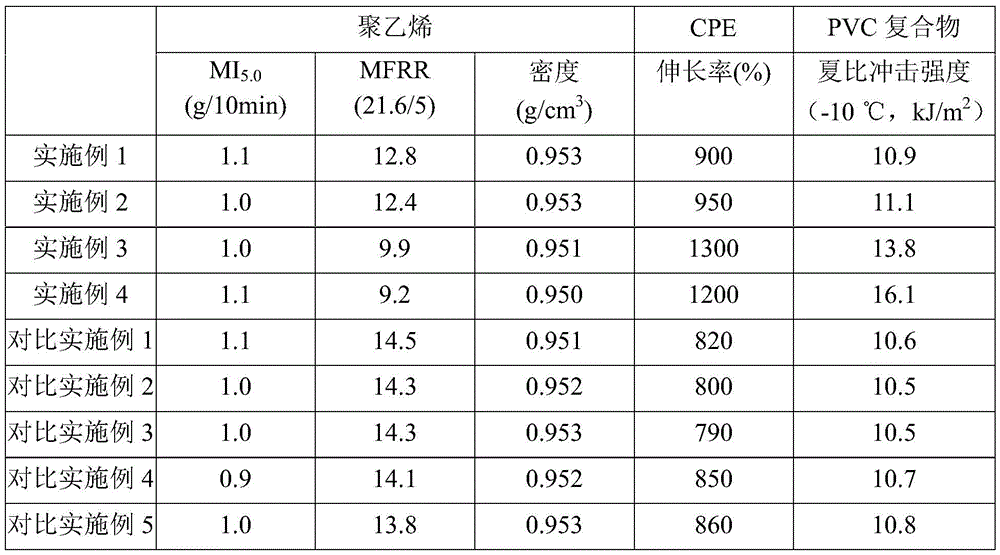
如表2中所示,由实施例1至4可知,高密度聚乙烯具有窄分子量分布,因此在氯化后实现高伸长率。因此,PVC复合物的冲击强度优异。特别地,实施例3和4表现出10以下的熔体流动速率比(MFRR),同时通过在聚合工艺中减少TEAL的输入量,不仅具有窄的分子量分布,而且还具有1200%以上的优异的伸长特性。因此,可以看出,冲击强度分别改进至13.8kJ/m2和16kJ/m2。As shown in Table 2, it can be seen from Examples 1 to 4 that high-density polyethylene has a narrow molecular weight distribution and thus achieves high elongation after chlorination. Therefore, the impact strength of the PVC compound is excellent. In particular, Examples 3 and 4 exhibited a melt flow rate ratio (MFRR) of 10 or less, while not only having a narrow molecular weight distribution, but also having an excellent melt flow rate ratio (MFRR) of more than 1200% by reducing the input amount of TEAL in the polymerization process. elongation properties. Therefore, it can be seen that the impact strength is improved to 13.8 kJ/m 2 and 16 kJ/m 2 , respectively.
另一方面,由于高密度聚乙烯的宽分子量分布,对比实施例1至5具有氯化聚乙烯的伸长率降低并且PVC复合物的冲击强度降低的问题。具体而言,对比实施例1至5具有13.8至14.5的熔体流动速率比(MFRR),并由于宽分子量分布而显示出比实施例差的伸长率和冲击强度。特别地,尽管在工艺中控制TEAL的输入,但是发现对比实施例2没有降低分子量分布的效果,并且最终PVC复合物的冲击强度大大降低。On the other hand, Comparative Examples 1 to 5 had problems that the elongation of the chlorinated polyethylene decreased and the impact strength of the PVC compound decreased due to the broad molecular weight distribution of the high-density polyethylene. Specifically, Comparative Examples 1 to 5 had melt flow rate ratios (MFRR) of 13.8 to 14.5, and exhibited inferior elongation and impact strength to Examples due to broad molecular weight distribution. In particular, although the input of TEAL was controlled in the process, it was found that Comparative Example 2 had no effect of lowering the molecular weight distribution, and the impact strength of the final PVC compound was greatly reduced.
Claims (9)

Applications Claiming Priority (5)
| Application Number | Priority Date | Filing Date | Title |
|---|---|---|---|
| KR20180004040 | 2018-01-11 | ||
| KR10-2018-0004040 | 2018-01-11 | ||
| KR1020190002462A KR102363189B1 (en) | 2018-01-11 | 2019-01-08 | Preparation method of polyolefin using a supported hybrid metallocene catalyst |
| KR10-2019-0002462 | 2019-01-08 | ||
| PCT/KR2019/000354 WO2019139355A1 (en) | 2018-01-11 | 2019-01-09 | Method for preparing polyolefin by using supported hybrid metallocene catalyst |
Publications (2)
| Publication Number | Publication Date |
|---|---|
| CN111491952A CN111491952A (en) | 2020-08-04 |
| CN111491952B true CN111491952B (en) | 2023-02-28 |
Family
ID=67512068
Family Applications (1)
| Application Number | Title | Priority Date | Filing Date |
|---|---|---|---|
| CN201980006507.9A Active CN111491952B (en) | 2018-01-11 | 2019-01-09 | Process for preparing polyolefins using supported hybrid metallocene catalysts |
Country Status (4)
| Country | Link |
|---|---|
| US (1) | US11560441B2 (en) |
| EP (1) | EP3715384A4 (en) |
| KR (1) | KR102363189B1 (en) |
| CN (1) | CN111491952B (en) |
Families Citing this family (3)
| Publication number | Priority date | Publication date | Assignee | Title |
|---|---|---|---|---|
| KR102219312B1 (en) * | 2018-08-30 | 2021-02-24 | 주식회사 엘지화학 | Polyethylene and its chlorinated polyethylene |
| KR102821274B1 (en) * | 2019-09-17 | 2025-06-13 | 주식회사 엘지화학 | Hybrid supported catalyst |
| KR102925838B1 (en) * | 2020-11-16 | 2026-02-09 | 주식회사 엘지화학 | Hybrid supported catalyst |
Citations (3)
| Publication number | Priority date | Publication date | Assignee | Title |
|---|---|---|---|---|
| CN101143954A (en) * | 2007-10-24 | 2008-03-19 | 华东理工大学 | PVC modified resin |
| KR20160045434A (en) * | 2014-10-17 | 2016-04-27 | 주식회사 엘지화학 | Polyethylene and its chlorinated polyethylene |
| CN107075007A (en) * | 2014-09-30 | 2017-08-18 | Lg化学株式会社 | The preparation method of the polyolefin polymer produced for fiber |
Family Cites Families (17)
| Publication number | Priority date | Publication date | Assignee | Title |
|---|---|---|---|---|
| US5032562A (en) | 1989-12-27 | 1991-07-16 | Mobil Oil Corporation | Catalyst composition and process for polymerizing polymers having multimodal molecular weight distribution |
| IT1256259B (en) * | 1992-12-30 | 1995-11-29 | Montecatini Tecnologie Srl | METTALLOCENIC COMPOUNDS HAVING FLUORENYLIC BINDERS |
| IT1264482B1 (en) * | 1993-06-30 | 1996-09-23 | Spherilene Srl | AMORPHOUS COPOLYMERS OF ETHYLENE WITH PROPYLENE AND PROCEDURE FOR THEIR PREPARATION |
| US5525678A (en) | 1994-09-22 | 1996-06-11 | Mobil Oil Corporation | Process for controlling the MWD of a broad/bimodal resin produced in a single reactor |
| IT1275857B1 (en) | 1995-03-03 | 1997-10-24 | Spherilene Srl | ATACTIC PROPYLENE COPOLYMERS WITH ETHYLENE |
| US5914289A (en) | 1996-02-19 | 1999-06-22 | Fina Research, S.A. | Supported metallocene-alumoxane catalysts for the preparation of polyethylene having a broad monomodal molecular weight distribution |
| JP3800797B2 (en) * | 1998-03-31 | 2006-07-26 | ダイソー株式会社 | Chlorinated polyolefin |
| EP1209179B1 (en) | 2000-03-31 | 2005-11-02 | Mitsui Chemicals, Inc. | Processes for producing polyolefin composition |
| EP1650231A1 (en) | 2004-10-21 | 2006-04-26 | Total Petrochemicals Research Feluy | Polyolefins prepared from a metallocene and a new single site catalyst components in a single reactor |
| KR100874029B1 (en) | 2006-01-17 | 2008-12-17 | 주식회사 엘지화학 | Method for producing a polyolefin polymer production catalyst having a narrow molecular weight distribution and the catalyst obtained thereby |
| BR112014020839B1 (en) | 2012-03-05 | 2020-09-29 | Univation Technologies, Llc | PROCESS FOR MANUFACTURING AN OLEFIN POLYMERIZATION CATALYST, PROCESS FOR MANUFACTURING A POLYETHYLENE, AND POLYETHYLENE |
| KR101657680B1 (en) | 2013-09-30 | 2016-09-19 | 주식회사 엘지화학 | Polyolefin |
| KR101658172B1 (en) | 2013-12-02 | 2016-09-20 | 주식회사 엘지화학 | Supported hybrid metallocene catalyst and method for preparing of olefin based polymer using the same |
| KR101666170B1 (en) * | 2014-06-18 | 2016-10-13 | 주식회사 엘지화학 | Transition metal compounds, catalyst composition comprising the same, and preparation method of poly-olefin |
| KR101725351B1 (en) * | 2014-12-04 | 2017-04-10 | 주식회사 엘지화학 | Method for preparing supported hybrid metallocene catalyst, and supported hybrid metallocene catalyst using the same |
| KR101783897B1 (en) * | 2014-12-10 | 2017-10-10 | 주식회사 엘지화학 | Polyolefin pellet for preparing fiber and fiber comprising the same |
| KR102107084B1 (en) | 2016-03-11 | 2020-05-06 | 주식회사 엘지화학 | Method for preparing of supported hybrid metallocene catalyst, the supported hybrid metallocene catalyst prepared by the same method, and method for preparing polyolefin using the same |
-
2019
- 2019-01-08 KR KR1020190002462A patent/KR102363189B1/en active Active
- 2019-01-09 CN CN201980006507.9A patent/CN111491952B/en active Active
- 2019-01-09 EP EP19738286.4A patent/EP3715384A4/en active Pending
- 2019-01-09 US US16/957,925 patent/US11560441B2/en active Active
Patent Citations (3)
| Publication number | Priority date | Publication date | Assignee | Title |
|---|---|---|---|---|
| CN101143954A (en) * | 2007-10-24 | 2008-03-19 | 华东理工大学 | PVC modified resin |
| CN107075007A (en) * | 2014-09-30 | 2017-08-18 | Lg化学株式会社 | The preparation method of the polyolefin polymer produced for fiber |
| KR20160045434A (en) * | 2014-10-17 | 2016-04-27 | 주식회사 엘지화학 | Polyethylene and its chlorinated polyethylene |
Also Published As
| Publication number | Publication date |
|---|---|
| EP3715384A4 (en) | 2021-03-10 |
| US11560441B2 (en) | 2023-01-24 |
| EP3715384A1 (en) | 2020-09-30 |
| KR20190085861A (en) | 2019-07-19 |
| US20210061930A1 (en) | 2021-03-04 |
| KR102363189B1 (en) | 2022-02-15 |
| CN111491952A (en) | 2020-08-04 |
Similar Documents
| Publication | Publication Date | Title |
|---|---|---|
| JP6488002B2 (en) | Olefin polymer excellent in processability | |
| JP6487924B2 (en) | Ethylene / 1-hexene or ethylene / 1-butene copolymer excellent in processability and environmental stress crack resistance | |
| CN106232638B (en) | Polyolefins with excellent environmental stress crack resistance | |
| KR100753477B1 (en) | Mixed supported metallocene catalyst, preparation method thereof, polyolefin manufactured using same and preparation method thereof | |
| US11384183B2 (en) | Hybrid supported metallocene catalyst and method for preparing olefin polymer using the same | |
| KR101709688B1 (en) | Method for preparing polyolfin and polyolefin prepared therefrom | |
| CN105705527B (en) | Process for producing polyolefins and polyolefins produced thereby | |
| CN110869399B (en) | Polyethylene copolymer and preparation method thereof | |
| CN107531828B (en) | Method for preparing supported metallocene catalyst | |
| JP6511151B2 (en) | Method of producing polyolefin | |
| KR20190076136A (en) | Method For Preparing Supported Hybrid Metallocene Catalyst, Supported Hybrid Metallocene Catalyst Prepared By The Same Method, And Method For Preparing Polyolefin Using The Same | |
| KR101412846B1 (en) | Method For Preparing Polyolefin And Polyolefin Therefrom | |
| CN107207661A (en) | Ethylene/alpha olefin polymer with excellent processing characteristics and surface characteristic | |
| KR102028736B1 (en) | Method for preparing supported hybrid metallocene catalyst, and supported hybrid metallocene catalyst using the same | |
| US20240294680A1 (en) | Polyethylene and Its Chlorinated Polyethylene | |
| CN111491952B (en) | Process for preparing polyolefins using supported hybrid metallocene catalysts | |
| WO2019139355A1 (en) | Method for preparing polyolefin by using supported hybrid metallocene catalyst | |
| KR20200090041A (en) | Method for preparing supported hybrid metallocene catalyst and method for preparing olefin polymer using the same | |
| KR102589954B1 (en) | Polyethylene and its chlorinated polyethylene | |
| KR20220043693A (en) | Hybrid supported metallocene catalyst and preparing mehtod a polyolefin using the same | |
| WO2016204457A1 (en) | Method for preparing polyolefin |
Legal Events
| Date | Code | Title | Description |
|---|---|---|---|
| PB01 | Publication | ||
| PB01 | Publication | ||
| SE01 | Entry into force of request for substantive examination | ||
| SE01 | Entry into force of request for substantive examination | ||
| GR01 | Patent grant | ||
| GR01 | Patent grant |