WO2022059486A1 - Powder cosmetic and cosmetic composition - Google Patents
Powder cosmetic and cosmetic composition Download PDFInfo
- Publication number
- WO2022059486A1 WO2022059486A1 PCT/JP2021/032136 JP2021032136W WO2022059486A1 WO 2022059486 A1 WO2022059486 A1 WO 2022059486A1 JP 2021032136 W JP2021032136 W JP 2021032136W WO 2022059486 A1 WO2022059486 A1 WO 2022059486A1
- Authority
- WO
- WIPO (PCT)
- Prior art keywords
- alkali metal
- powder
- metal salt
- polyaspartic acid
- acid alkali
- Prior art date
- Legal status (The legal status is an assumption and is not a legal conclusion. Google has not performed a legal analysis and makes no representation as to the accuracy of the status listed.)
- Ceased
Links
Images
Classifications
-
- A—HUMAN NECESSITIES
- A61—MEDICAL OR VETERINARY SCIENCE; HYGIENE
- A61K—PREPARATIONS FOR MEDICAL, DENTAL OR TOILETRY PURPOSES
- A61K8/00—Cosmetics or similar toiletry preparations
- A61K8/02—Cosmetics or similar toiletry preparations characterised by special physical form
- A61K8/0216—Solid or semisolid forms
- A61K8/022—Powders; Compacted Powders
-
- A—HUMAN NECESSITIES
- A61—MEDICAL OR VETERINARY SCIENCE; HYGIENE
- A61K—PREPARATIONS FOR MEDICAL, DENTAL OR TOILETRY PURPOSES
- A61K8/00—Cosmetics or similar toiletry preparations
- A61K8/18—Cosmetics or similar toiletry preparations characterised by the composition
- A61K8/72—Cosmetics or similar toiletry preparations characterised by the composition containing organic macromolecular compounds
- A61K8/84—Cosmetics or similar toiletry preparations characterised by the composition containing organic macromolecular compounds obtained by reactions otherwise than those involving only carbon-carbon unsaturated bonds
- A61K8/88—Polyamides
-
- A—HUMAN NECESSITIES
- A61—MEDICAL OR VETERINARY SCIENCE; HYGIENE
- A61K—PREPARATIONS FOR MEDICAL, DENTAL OR TOILETRY PURPOSES
- A61K8/00—Cosmetics or similar toiletry preparations
- A61K8/02—Cosmetics or similar toiletry preparations characterised by special physical form
- A61K8/0241—Containing particulates characterized by their shape and/or structure
-
- A—HUMAN NECESSITIES
- A61—MEDICAL OR VETERINARY SCIENCE; HYGIENE
- A61K—PREPARATIONS FOR MEDICAL, DENTAL OR TOILETRY PURPOSES
- A61K8/00—Cosmetics or similar toiletry preparations
- A61K8/02—Cosmetics or similar toiletry preparations characterised by special physical form
- A61K8/0241—Containing particulates characterized by their shape and/or structure
- A61K8/0245—Specific shapes or structures not provided for by any of the groups of A61K8/0241
-
- A—HUMAN NECESSITIES
- A61—MEDICAL OR VETERINARY SCIENCE; HYGIENE
- A61K—PREPARATIONS FOR MEDICAL, DENTAL OR TOILETRY PURPOSES
- A61K8/00—Cosmetics or similar toiletry preparations
- A61K8/18—Cosmetics or similar toiletry preparations characterised by the composition
- A61K8/19—Cosmetics or similar toiletry preparations characterised by the composition containing inorganic ingredients
- A61K8/25—Silicon; Compounds thereof
-
- A—HUMAN NECESSITIES
- A61—MEDICAL OR VETERINARY SCIENCE; HYGIENE
- A61K—PREPARATIONS FOR MEDICAL, DENTAL OR TOILETRY PURPOSES
- A61K8/00—Cosmetics or similar toiletry preparations
- A61K8/18—Cosmetics or similar toiletry preparations characterised by the composition
- A61K8/19—Cosmetics or similar toiletry preparations characterised by the composition containing inorganic ingredients
- A61K8/26—Aluminium; Compounds thereof
-
- A—HUMAN NECESSITIES
- A61—MEDICAL OR VETERINARY SCIENCE; HYGIENE
- A61K—PREPARATIONS FOR MEDICAL, DENTAL OR TOILETRY PURPOSES
- A61K8/00—Cosmetics or similar toiletry preparations
- A61K8/18—Cosmetics or similar toiletry preparations characterised by the composition
- A61K8/19—Cosmetics or similar toiletry preparations characterised by the composition containing inorganic ingredients
- A61K8/29—Titanium; Compounds thereof
-
- A—HUMAN NECESSITIES
- A61—MEDICAL OR VETERINARY SCIENCE; HYGIENE
- A61Q—SPECIFIC USE OF COSMETICS OR SIMILAR TOILETRY PREPARATIONS
- A61Q1/00—Make-up preparations; Body powders; Preparations for removing make-up
- A61Q1/02—Preparations containing skin colorants, e.g. pigments
-
- A—HUMAN NECESSITIES
- A61—MEDICAL OR VETERINARY SCIENCE; HYGIENE
- A61Q—SPECIFIC USE OF COSMETICS OR SIMILAR TOILETRY PREPARATIONS
- A61Q1/00—Make-up preparations; Body powders; Preparations for removing make-up
- A61Q1/12—Face or body powders for grooming, adorning or absorbing
-
- A—HUMAN NECESSITIES
- A61—MEDICAL OR VETERINARY SCIENCE; HYGIENE
- A61K—PREPARATIONS FOR MEDICAL, DENTAL OR TOILETRY PURPOSES
- A61K2800/00—Properties of cosmetic compositions or active ingredients thereof or formulation aids used therein and process related aspects
- A61K2800/40—Chemical, physico-chemical or functional or structural properties of particular ingredients
- A61K2800/41—Particular ingredients further characterized by their size
- A61K2800/412—Microsized, i.e. having sizes between 0.1 and 100 microns
-
- A—HUMAN NECESSITIES
- A61—MEDICAL OR VETERINARY SCIENCE; HYGIENE
- A61K—PREPARATIONS FOR MEDICAL, DENTAL OR TOILETRY PURPOSES
- A61K2800/00—Properties of cosmetic compositions or active ingredients thereof or formulation aids used therein and process related aspects
- A61K2800/40—Chemical, physico-chemical or functional or structural properties of particular ingredients
- A61K2800/60—Particulates further characterized by their structure or composition
- A61K2800/61—Surface treated
- A61K2800/62—Coated
- A61K2800/624—Coated by macromolecular compounds
-
- A—HUMAN NECESSITIES
- A61—MEDICAL OR VETERINARY SCIENCE; HYGIENE
- A61K—PREPARATIONS FOR MEDICAL, DENTAL OR TOILETRY PURPOSES
- A61K2800/00—Properties of cosmetic compositions or active ingredients thereof or formulation aids used therein and process related aspects
- A61K2800/40—Chemical, physico-chemical or functional or structural properties of particular ingredients
- A61K2800/60—Particulates further characterized by their structure or composition
- A61K2800/65—Characterized by the composition of the particulate/core
- A61K2800/651—The particulate/core comprising inorganic material
Definitions
- This disclosure relates to powder cosmetics and cosmetic compositions.
- Powder cosmetics give favorable aesthetic properties due to the optical properties of the powder.
- powder cosmetics having a better usability have been developed by improving the components or blending amounts of the powder.
- Japanese Patent Application Laid-Open No. 2006-265214 contains (a) a specific variant composite powder, and (b) one or more water-soluble components selected from amino acids, polyamino acids, derivatives or salts thereof.
- the powdered cosmetics that have been applied are listed. Thereby, it is disclosed that the powder cosmetic is excellent in the effect of smooth spreading and spreading when the cosmetic is applied, the adhesive force to the skin and the moisturizing feeling, and the effect of making the unevenness of the skin inconspicuous.
- Japanese Patent Application Laid-Open No. 2006-265214 is based on the premise that a plurality of substantially spherical particles are aggregated and coalesced, and a deformed composite powder having a shape having a plurality of irregularities on the surface is used.
- the method for confirming the effects of smooth spreading and spreading when applying cosmetics, adhesion to the skin and moisturizing feeling, and making unevenness of the skin inconspicuous is performed by sensory evaluation by a panelist. It is only being damaged. In other words, the effect was not confirmed by an objective index.
- the present disclosure has been made in view of the above, and one aspect of the present disclosure is that when the powder cosmetics are repeatedly applied, the powder cosmetics have a smooth spread and spread with little resistance to the skin, and the makeup is twisted.
- An object of the present invention is to provide powder cosmetics that are less likely to occur.
- another aspect of the present disclosure provides a cosmetic composition having a smooth spread and spread with less resistance to the skin and less likely to cause cosmetic twist when the cosmetic composition is repeatedly applied. The task is to do.
- the weight average molecular weight x of the polyaspartic acid alkali metal salt is 1,000 to 150,000.
- the weight average molecular weight x of the polyaspartic acid alkali metal salt and the mass ratio y of the polyaspartic acid alkali metal salt to the total amount of the inorganic powder and the polyaspartic acid alkali metal salt are given by the following formula ( Satisfy 1) and equation (2), Powder cosmetics.
- ⁇ 6> Any of the above ⁇ 1> to ⁇ 5>, wherein the polyaspartic acid alkali metal salt is at least one selected from the group consisting of lithium polyaspartate, potassium polyaspartate, and sodium polyaspartate.
- ⁇ 7> The powder cosmetic according to any one of ⁇ 1> to ⁇ 6>, wherein the polyaspartic acid alkali metal salt contains at least sodium polyaspartate.
- ⁇ 8> The powder according to any one of ⁇ 1> to ⁇ 7>, wherein the inorganic powder contains at least one selected from the group consisting of talc, mica, sericite, and titanium oxide. Body cosmetics.
- ⁇ 9> The powder cosmetic according to any one of ⁇ 1> to ⁇ 8>, wherein the average particle size (D50) of the inorganic powder is 1 ⁇ m to 100 ⁇ m.
- D50 average particle size of the inorganic powder
- a powder cosmetic that has a smooth spread and spread with little resistance to the skin and is less likely to cause makeup twist when the powder cosmetic is repeatedly applied. can.
- a cosmetic composition having a smooth spread and spread with less resistance to the skin and less likely to cause makeup twist when the cosmetic composition is repeatedly applied. Can be provided.
- the contents of the present disclosure will be described in detail below.
- the description of the constituents described below may be based on the representative embodiments of the present disclosure, but the present disclosure is not limited to such embodiments.
- the upper limit value or the lower limit value described in one numerical range may be replaced with the upper limit value or the lower limit value of the numerical range described in another stepwise description. ..
- the upper limit value or the lower limit value of the numerical range may be replaced with the value shown in the examples.
- the numerical range represented by using "-" means a range including the numerical values before and after "-" as the lower limit value and the upper limit value.
- the amount of each component in a composition such as a powder cosmetic or a cosmetic composition is used in the composition when a plurality of substances corresponding to each component in the composition are present, unless otherwise specified. Means the total amount of applicable substances present in. Further, in the notation of a group (atomic group) in the present specification, the notation that does not describe substitution or non-substitution includes those having no substituent as well as those having a substituent.
- process in the present specification is not limited to an independent process, and even if it cannot be clearly distinguished from other processes, the term “process” will be used as long as the intended purpose of the process is achieved. included.
- % by mass and “% by weight” are synonymous, and “parts by mass” and “parts by weight” are synonymous.
- a combination of two or more preferred embodiments is a more preferred embodiment.
- the powder cosmetics of the present disclosure include an inorganic powder and a polyaspartic acid alkali metal salt that covers a part or all of the surface of the inorganic powder, and the weight average molecular weight of the polyaspartic acid alkali metal salt.
- the polyaspartic acid is 1,000 to 150,000, and the weight average molecular weight x of the polyaspartic acid alkali metal salt and the polyaspartic acid with respect to the total amount of the inorganic powder and the polyaspartic acid alkali metal salt.
- the powder cosmetics of the present disclosure have a smooth spread and spread with little resistance to the skin when the powder cosmetics are repeatedly applied, and the makeup is less likely to be twisted.
- the powder layer shear force measurement is used for the evaluation of the powder cosmetics at the time of recoating the powder cosmetics.
- a load is applied to the powder filled in the cell in the vertical and horizontal directions, and the normal stress ⁇ is attenuated after the normal stress ⁇ and the shear stress ⁇ are in a steady state.
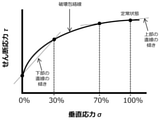
- a fracture wrapping line showing the relationship of the shear stress ⁇ with respect to the normal stress ⁇ is obtained (Fig. 1).
- the situation of the powder layer when it is sheared while applying a load like this is a cosmetic tool with powder cosmetics attached to the skin to which powder cosmetics are attached, and further powder makeup.
- an objective evaluation is performed by using an evaluation method using powder layer shear force measurement as an evaluation method of usability when powder cosmetics are repeatedly applied.
- the effect of the present application is most exhibited when the powder cosmetic is overcoated, but the same effect is naturally expected even when the powder cosmetic is not overcoated. That is, the effect of the present application is not limited to the case where the powder cosmetic according to the present disclosure is overcoated on the powder cosmetic according to the present disclosure, and the powder cosmetic according to the present disclosure is applied to the skin.
- the "feeling of use" of a powder cosmetic or a cosmetic composition, etc. refers to the skin when the powder cosmetic is repeatedly applied or when the powder cosmetic is simply applied. It has a smooth stretch and spread with little resistance, and includes the feeling that makeup twist is unlikely to occur.
- the spread or cosmetic twist may be described in parallel with the feeling of use.
- the sensation felt by the user such as skin familiarity, moisturizing feeling, smoothness, etc. of the powder cosmetic or cosmetic composition is also the "usability" of the powder cosmetic or cosmetic composition. It is a kind.
- the cosmetic twist means that the powder layer adhering to the skin moves, and refers to, for example, a foundation twist.
- the degree of curve can be obtained from the fracture envelope obtained by the powder layer shear force measurement.
- the slope of the straight line at the bottom of the fracture envelopment line means that the value of the normal stress ⁇ is 0% to 30 when the normal stress ⁇ when the normal stress ⁇ and the shear stress ⁇ are in a steady state is 100%.
- the slope of the straight line of the fracture line when the value is% that is, the straight line connecting the plot when the value of normal stress ⁇ is 0% and the plot when the value of normal stress ⁇ is 30%) is shown.
- the slope of the straight line at the top of the fracture entourage is when the value of the normal stress ⁇ is 70% to 100% when the normal stress ⁇ when the normal stress ⁇ and the shear stress ⁇ are in a steady state is 100%.
- the slope of the straight line of the fracture line at a certain time (that is, the straight line connecting the plot when the value of the normal stress ⁇ is 70% and the plot when the value of the normal stress ⁇ is 100%) is shown.
- the degree of curve correlates with the slipperiness of the powder. The higher the value of the degree of curve, the higher the shearing stress and the lower the slipperiness of the powder. Moreover, the problem that makeup twist is likely to occur is likely to occur.
- the shear stress ⁇ is parallel to a certain cross section inside the powder layer, and a pair of forces in opposite directions are applied to the upper and lower layers of the cross section, and the powder layer is slid along the surface.
- the stress required for shearing operation is shown. That is, the shear stress ⁇ is a stress that tends to slide the upper and lower powder layers on a certain surface inside the powder layer in a parallel direction.
- shear adhesion stress is a stress equal to a section in which the fracture entourage line is approximated by a straight line by the minimum square method and the straight line intersects the axis of the shear stress ⁇ . That is, the shear bond stress indicates the extrapolation value of the shear stress ⁇ when the normal stress ⁇ of the approximate expression reaches 0. Shear stress ⁇ and shear adhesion stress are used as indicators of adhesion between compacted powders.
- the powder cosmetic according to the present disclosure contains an inorganic powder and an alkali metal salt of polyaspartic acid.
- the polyaspartic acid alkali metal salt is present between the inorganic powders (that is, on the surface of both particles when the particles of the inorganic powder are close to each other), thereby reducing the frictional force between the inorganic powders. It is possible to improve the slipperiness of the powder cosmetic.
- the weight average molecular weight x of the polyaspartic acid alkali metal salt and the mass ratio y of the polyaspartic acid alkali metal salt to the total amount of the inorganic powder and the polyaspartic acid alkali metal salt according to the present disclosure are satisfied.
- the significance of equations (1) and (2) is presumed as follows.
- the weight average molecular weight x of the alkali metal salt of polyaspartic acid when the weight average molecular weight x of the alkali metal salt of polyaspartic acid is excessive, it is between the alkali metal salts of polyaspartic acid (that is, between the molecules of the alkali metal salt of polyaspartic acid).
- the interaction is strong, the increase in viscosity becomes remarkable, and the manufacturing suitability such as handling is impaired. Furthermore, the following problems may be more likely to occur.
- the numerical value of the degree of curve of the powder cosmetic is high.
- Friction between powder layers of powder cosmetics is large and slipperiness is low.
- the powder cosmetics according to the present disclosure if the mass ratio y of the polyaspartic acid alkali metal salt to the total amount of the inorganic powder and the polyaspartic acid alkali metal salt is excessive, the following problems occur. At this time, the numerical value of the degree of curve of the powder cosmetic is high. (2a) Since the amount of the polyaspartic acid alkali metal salt existing between the inorganic powders is large, the interaction between the polyaspartic acid alkali metal salts is strong. (2b) The increase in viscosity of the powder cosmetic containing the aqueous solution of polyaspartic acid alkali metal salt is remarkable. (2c) Friction between powder layers of powder cosmetics is large and slipperiness is low. (2d) When the powder cosmetics are repeatedly applied, they do not have a smooth spread and spread with little resistance to the skin, and make-up twists are likely to occur.
- the weight average molecular weight x of the polyaspartic acid alkali metal salt is excessive, and the polyaspartic acid alkali metal salt with respect to the total amount of the inorganic powder and the polyaspartic acid alkali metal salt. If the mass ratio y of the above is excessive, the numerical value of the degree of curve of the powder cosmetics becomes higher, and the above-mentioned problem is more likely to occur.
- the powder cosmetics according to the present disclosure if the weight average molecular weight x of the polyaspartic acid alkali metal salt is too small, the interaction between the polyaspartic acid alkali metal salts is weak and the manufacturing suitability such as handling is impaired. .. Furthermore, the following problems may be more likely to occur. Also at this time, the numerical value of the degree of curve of the powder cosmetic is high. (3a) The friction between the powder layers of the powder cosmetics due to the polyaspartic acid alkali metal salt is large, and the slipperiness improving effect cannot be sufficiently exhibited. (3b) When the powder cosmetics are repeatedly applied, they do not have a smooth spread and spread with little resistance to the skin, and make-up twists are likely to occur.
- the powder cosmetics according to the present disclosure if the mass ratio y of the polyaspartic acid alkali metal salt to the total amount of the inorganic powder and the polyaspartic acid alkali metal salt is too small, the following problems occur. Also at this time, the numerical value of the degree of curve of the powder cosmetic is high. (4a) Since the amount of the polyaspartic acid alkali metal salt existing between the inorganic powders is small, the interaction between the polyaspartic acid alkali metal salts is weak.
- the weight average molecular weight x of the polyaspartic acid alkali metal salt is too small, and the polyaspartic acid alkali metal salt with respect to the total amount of the inorganic powder and the polyaspartic acid alkali metal salt. If the mass ratio y of the above is too small, the numerical value of the degree of curve of the powder cosmetics becomes higher, and the above-mentioned problem is more likely to occur.
- the weight average molecular weight x of the alkali metal polyaspartate and the mass ratio of the alkali metal polyaspartate to the total amount of the inorganic powder and the alkali metal polyaspartate were obtained.
- the fact that the weight average molecular weight x of the polyaspartic acid alkali metal salt is excessive means that the weight average molecular weight of the polyaspartic acid alkali metal salt exceeds 150,000.
- the fact that the weight average molecular weight x of the polyaspartic acid alkali metal salt is too small means that the weight average molecular weight of the polyaspartic acid alkali metal salt is less than 1,000.
- the weight average molecular weight x of the polyaspartic acid alkali metal salt and the mass ratio y of the polyaspartic acid alkali metal salt to the total amount of the inorganic powder and the polyaspartic acid alkali metal salt are satisfied.
- the coefficients in the formula (1) "y ⁇ 1.6 x 10 7 x -2.275 " and the formula (2) "y ⁇ 1.3 x 10 5 x -2.232 " are numerical values derived by experience. Is.
- the value of the mass ratio of the polyaspartic acid alkali metal salt to the total amount of the inorganic powder and the polyaspartic acid alkali metal salt is controlled to be a relatively small value. There is. Therefore, although the polyaspartic acid alkali metal salt covers a part or all of the surface of the particles of the inorganic powder, the coating amount thereof is kept relatively small. Therefore, in the powder cosmetics according to the present disclosure, an excessive increase in viscosity due to the hydrophilic polyaspartic acid alkali metal salt is suppressed.
- the mass ratio of the polyaspartate alkali metal salt to the total amount of the inorganic powder and the polyaspartate alkali metal salt is also simply referred to as the mass ratio of the polyaspartate alkali metal salt.
- the value of the mass ratio of the polyaspartic acid alkali metal salt to the total amount of the inorganic powder and the polyaspartic acid alkali metal salt according to the present disclosure is dimensionless and therefore has no unit.
- the weight average molecular weight x of the polyaspartic acid alkali metal salt and the mass ratio y of the polyaspartic acid alkali metal salt to the total amount of the inorganic powder and the polyaspartic acid alkali metal salt y ⁇ 1.6. ⁇ 10 7 x -2.275 (formula (1)) and y ⁇ 1.5 ⁇ 10 5 x -2.232 (formula (5)) and the weight average molecular weight x of the polyaspartate alkali metal salt is 1, In the area surrounded by the range of 000 to 150,000, the powder cosmetics of the present disclosure are more effective.
- the weight average molecular weight x of the polyaspartic acid alkali metal salt and the mass ratio y of the polyaspartic acid alkali metal salt to the total amount of the inorganic powder and the polyaspartic acid alkali metal salt y ⁇ 8.0. ⁇ 10 6 x -2.275 (formula (4)) and y ⁇ 1.5 ⁇ 10 5 x -2.232 (formula (5)) and the weight average molecular weight x of the polyaspartate alkali metal salt is 1, In the area surrounded by the range of 000 to 150,000, the powder cosmetics of the present disclosure are more effective.
- the weight average molecular weight x of the polyaspartic acid alkali metal salt is 8,000 to 120. In the area surrounded by the range of 000, the powder cosmetics of the present disclosure are more effective.
- the powder cosmetics of the present disclosure are more effective in the region surrounded by the range of the weight average molecular weight x of the polyaspartic acid alkali metal salt described above.
- the above formula (1), formula (3), or formula (4), and y ⁇ 2 are more effective in the region surrounded by the range of .5 ⁇ 10 5 ⁇ -2.232 and the weight average molecular weight x of the above-mentioned polyaspartic acid alkali metal salt.
- the weight average molecular weight x of the polyaspartic acid alkali metal salt and the mass ratio y of the polyaspartic acid alkali metal salt to the total amount of the inorganic powder and the polyaspartic acid alkali metal salt are surrounded by the above range.
- the value is in the above region, the interaction between the alkali metal salts of polyaspartic acid is not too strong, the friction between the powder layers is lowered, the slipperiness of the powder is increased, and the handling during manufacturing is improved. , The effect of the present application can be further obtained.
- the interaction between the alkali metal salts of polyaspartic acid is not too weak, the friction between the powder layers is lowered to improve the slipperiness of the powder, the handling during manufacturing is improved, and the effect of the present application is further enhanced. Obtainable.
- the mass ratio y of the polyaspartic acid alkali metal salt to the weight average molecular weight x of the polyaspartic acid alkali metal salt. It is preferable that the larger the weight average molecular weight x of the polyaspartic alkali metal salt, the smaller the mass ratio y of the polyaspartic alkali metal salt. It is preferable that the smaller the weight average molecular weight x of the polyaspartic acid alkali metal salt, the larger the mass ratio y of the polyaspartic acid alkali metal salt.
- the strength of the interaction between the polymer polyaspartic acid alkali metal salts varies depending on the magnitude of the weight average molecular weight x (or number average molecular weight) of the polyaspartic acid alkali metal salt. Therefore, it is considered that there is a preferable range of the mass ratio y of the polyaspartic acid alkali metal salt to the weight average molecular weight x (or the number average molecular weight) of the polyaspartic acid alkali metal salt.
- the polyaspartic acid alkali metal salt is a polymer formed by an amide bond of the aspartic acid alkali metal salt, and generally has a structure containing a plurality of the following structural units.
- n is an integer of 1 or more.
- M represents an alkali metal.
- Alkali metals in M include lithium, sodium, potassium, rubidium, cesium, or francium.
- the amide bond in the main chain of the polyaspartic acid alkali metal salt may be an ⁇ bond or a ⁇ bond. Further, these bonding modes may be the same or different for each structural unit.
- the amide bond is an ⁇ bond when the amino group of the adjacent structural unit is bonded to the carboxyl group at the ⁇ -position of the alkali metal aspartate, and is bonded to the carboxyl group at the ⁇ -position of the alkali metal aspartate. This is a ⁇ -bond.
- the three-dimensional structure of the structural unit may be independently L-type or D-type, and may be, for example, an L-type polymer as a whole, a D-type polymer, or a racemate.
- the composition of the polyaspartic acid alkali metal salt according to the present disclosure is not particularly limited as long as the powder cosmetics of the present disclosure are effective.
- the polyaspartic acid alkali metal salt according to the present disclosure preferably contains at least one polyaspartic acid alkali metal salt selected from the group consisting of lithium polyaspartate, potassium polyaspartate and sodium polyaspartate.
- the alkali metal salt of polyaspartic acid when the powder cosmetics are repeatedly applied, the powder cosmetics have a smooth spread and spread with less resistance to the skin, and the makeup is twisted. It has become possible to realize difficult powder cosmetics.
- the polyaspartic acid alkali metal salt according to the present disclosure more preferably contains at least sodium polyaspartate.
- Sodium polyaspartate which is an example of the alkali metal salt of polyaspartic acid according to the present disclosure, is a polymer formed by an amide bond of sodium aspartate, and generally has a structure containing a plurality of the following structural units.
- n is an integer of 1 or more.
- the amide bond in the main chain of sodium polyaspartate may be an ⁇ bond or a ⁇ bond. Further, these bonding modes may be the same or different for each structural unit.
- the amide bond is an ⁇ bond when the amino group of the adjacent structural unit is bonded to the carboxyl group at the ⁇ -position of sodium aspartate, and ⁇ is the case where the amino group is bonded to the carboxyl group at the ⁇ -position of sodium aspartate. It is a bond.
- the problems that occur when the weight average molecular weight of the polyaspartic acid alkali metal salt is excessive are as described above.
- the viscosity of the polyaspartic acid alkali metal salt aqueous solution increases remarkably, the spinnability is exhibited, and handling becomes difficult at the time of powder mixing in the powder cosmetic manufacturing process.
- the viscosity can be suppressed by further diluting the polyaspartic acid alkali metal salt aqueous solution with water, but as a result, the amount of water added to the inorganic powder increases, so that the powder absorbs moisture when the powder is mixed. , Adhesion to the mixing tank and aggregation between powders occur, making uniform powder mixing difficult.
- the weight average molecular weight of the polyaspartic acid alkali metal salt according to the present disclosure is 1,000 to 150,000.
- the weight average molecular weight of the polyaspartic acid alkali metal salt according to the present disclosure is 1,000 to 150,000.
- the weight average molecular weight of the polyaspartic acid alkali metal salt according to the present disclosure is not particularly limited, but is preferably 8,000 to 120,000 from the viewpoint of increasing the slipperiness of the powder and from the viewpoint of handling during production. 10,000 to 120,000 is more preferable, 10,000 to 100,000 is more preferable, 16,000 to 60,000 is particularly preferable, and 20,000 to 35,000 is even more preferable, and 20,000 to 27. 000 is even more preferred.
- the number average molecular weight of the polyaspartic acid alkali metal salt is not particularly limited, but may be, for example, 1,000 to 60,000.
- the number average molecular weight of the polyaspartic acid alkali metal salt is preferably 6,000 to 50,000, preferably 7,000 to 48,000, from the viewpoint of increasing the slipperiness of the powder and handling at the time of production. Is more preferable, 8,000 to 40,000 is even more preferable, 10,000 to 36,000 is particularly preferable, 12,000 to 20,000 is even more preferable, and 13,000 to 16,000 is even more preferable.
- the degree of polydispersity of the molecular weight of the polyaspartic acid alkali metal salt according to the present disclosure is not particularly limited, but may be, for example, 1.00 to 2.60.
- the degree of polydispersity of the molecular weight of the polyaspartic acid alkali metal salt is preferably 1.20 to 2.40, preferably 1.30, from the viewpoint of increasing the slipperiness of the powder and from the viewpoint of handling during production. It is more preferably to 1.90, further preferably 1.40 to 1.80, particularly preferably 1.50 to 1.75, and preferably 1.50 to 1.70. Extremely preferable.
- the polyaspartic acid alkali metal salt having a weight average molecular weight, a number average molecular weight and a polydispersity of the molecular weight within the above range can be obtained, for example, by using the method for producing a polyaspartic acid alkali metal salt described later.
- the weight average molecular weight and the number average molecular weight of the polyaspartic acid alkali metal salt refer to the values measured by the following GPC measuring methods using gel permeation chromatography (GPC), respectively.
- LC-Solution (manufactured by Shimadzu Corporation) as an analysis device, RID-10A (manufactured by Shimadzu Corporation) as a detector, DGU-20A (manufactured by Shimadzu Corporation) as a degasser, LC-20AD (manufactured by Shimadzu Corporation) as a pump, SIL-20A (manufactured by Shimadzu Corporation) as an autosampler, CTO-20A (manufactured by Shimadzu Corporation) as a liquid transfer unit, As a column, Shodex Asahipak GF-7M HQ x 1 (manufactured by Showa Denko KK), As a guard column, Shodex Asahipak GF-1G7B (manufactured by Showa Denko KK), Is used.
- the temperature of the column oven is 45 ° C.
- the standard is Pullulan (Shodex STANDARD P-82 (showa Denko Co., Ltd. standard group kit)), of which P-5, P-10, P-20, P-50, P-100 and P- 200 is used to create a cubic calibration curve.
- a 0.1 mol / L saline solution is used as the mobile phase. From the obtained elution curve, the weight average molecular weight and the number average molecular weight are calculated from the main peak of the polymer.
- the polyaspartic acid alkali metal salt was obtained, for example, by heating asparagic acid in a water-insoluble solvent at 200 ° C. to 230 ° C. to obtain a polysuccinic acid imide, as described in Japanese Patent No. 3384420. It may be obtained by a method including hydrolyzing polysuccinic acidimide in an aqueous alkali metal hydroxide salt solution to produce an alkali metal hydroxide salt.
- a solvent that separates layers when mixed with water and has a boiling point of 200 ° C. or higher can be used.
- Examples thereof include saturated hydrocarbon compounds such as n-paraffin and liquid paraffin, silicone-based oils, fluorine-based oils, etc. Among them, those having a boiling point of 200 ° C. or higher (preferably 230 ° C. or higher) and further at 25 ° C. A solvent having a viscosity of 100 cP or less (preferably 20 cP or less) can be preferably used.
- the polysuccinic acid imide as a precursor can also be obtained by heating maleamic acid at a temperature of 160 ° C to 330 ° C. It is also possible to react maleic anhydride with aqueous ammonia in an aqueous solvent and then heat to a temperature of at least 170 ° C. to obtain polysuccinic imide.
- polymerization is carried out using at least one selected from a reaction product of maleic anhydride and ammonia and maleamic acid as a monomer to obtain a polyaspartic acid precursor polymer. It is also possible to produce a polyaspartate alkali metal salt by a method including preparation and treatment of the obtained polyaspartic acid precursor polymer with an aqueous alkali metal hydroxide salt solution to obtain a polyaspartate alkali metal salt. can.
- alkali metal salts of polyaspartate for example, in an example of the method for producing sodium polyaspartate, (1) L-aspartic acid is spread on a SUS bat and an oven at 230 ° C. for 4 hours under normal pressure in a nitrogen atmosphere. By allowing it to stand inside, a powdered polysuccinic acid imide is obtained, and (2) distilled water is added to the obtained powdered polysuccinic acid imide so that the temperature of the solution becomes 45 ° C to 55 ° C.
- the 32% by mass sodium hydroxide aqueous solution was added dropwise little by little while controlling to, and when the reaction material acquired fluidity, the pH measurement was started, and the 32% by mass sodium hydroxide aqueous solution was further added dropwise while measuring the pH.
- the pH does not fluctuate in the range of pH 10 to pH 10.5
- the dropping is terminated to obtain a sodium polyaspartate aqueous solution containing sodium polyaspartate.
- the sodium polyaspartate according to the present disclosure contains a part of succinimide structural units (for example, 10% or less, 5% or less, or 1% or less of the total number of structural units), but succinimide. It does not have to contain any structural units.
- the mass ratio of the polyaspartic acid alkali metal salt to the total amount of the inorganic powder and the polyaspartic acid alkali metal salt shall be in the range of 0.00000095 to 0.0045. Is preferable, and it is more preferably in the range of 0.000035 to 0.0010. By keeping it within the above range, the powder cosmetic has a smooth spread and spread with little resistance to the skin when the powder cosmetic is repeatedly applied, and the makeup is less likely to be twisted.
- the mass ratio of the polyaspartate alkali metal salt to the total amount of the inorganic powder and the polyaspartate alkali metal salt is [mass of polyaspartate alkali metal salt] / ([mass of inorganic powder] + [ It can be obtained from the formula of [mass of polyaspartic acid alkali metal salt]).
- the polyaspartic acid alkali metal salt covers a part or all of the surface of the inorganic powder. Since the polyaspartic acid alkali metal salt is present between the inorganic powders, it is possible to reduce the frictional force between the inorganic powders and improve the slipperiness of the powder cosmetics. Therefore, if the mass ratio of the polyaspartic acid alkali metal salt to the total amount of the inorganic powder and the polyaspartic acid alkali metal salt is excessive, the above-mentioned problems (2a) to (2d) occur, that is, the above-mentioned problems.
- the mass ratio of the polyaspartic acid alkali metal salt to the total amount of the inorganic powder and the polyaspartic acid alkali metal salt is 0 from the viewpoint of the interaction between the polyaspartic acid alkali metal salts and the friction between the powder layers. It is preferably 0.000035 to 0.0010, more preferably 0.000035 to 0.00065, further preferably 0.000055 to 0.00065, and particularly preferably 0.00985 to 0.00065. , 0.00015 to 0.00065, and even more preferably 0.00020 to 0.00065.
- the inorganic powder contained in the powder cosmetic according to the present disclosure is not particularly limited, and an inorganic powder generally used as an inorganic powder for powder cosmetics can be used.
- the shape of the inorganic powder may be spherical, plate-shaped, needle-shaped, or the like, and may be porous or non-porous.
- the material of the inorganic powder may be any of general inorganic powder, glitter powder, organic powder, dye powder, composite powder and the like.
- specific examples of inorganic powders include titanium oxide, black titanium oxide, conjo, ultramarine, red iron oxide, yellow iron oxide, black iron oxide, zinc oxide, aluminum oxide, silica, magnesium oxide, zirconium oxide, and magnesium carbonate.
- Examples thereof include a synthetic inorganic powder or a composite inorganic powder such as fine particle titanium oxide-coated mica titanium, fine particle zinc oxide-coated mica titanium, barium sulfate-coated mica titanium, titanium oxide-encapsulating silica, or zinc oxide-encapsulating silica.
- a synthetic inorganic powder or a composite inorganic powder such as fine particle titanium oxide-coated mica titanium, fine particle zinc oxide-coated mica titanium, barium sulfate-coated mica titanium, titanium oxide-encapsulating silica, or zinc oxide-encapsulating silica.
- any one of these inorganic powders may be used alone, or two or more of them may be contained in any combination.
- the inorganic powder according to the present disclosure has talc, mica, and serisite from the viewpoint that it has a smooth spread and spread with little resistance to the skin when the powder cosmetic is repeatedly applied, and the makeup is less likely to be twisted. , And at least one selected from the group consisting of titanium oxide.
- the inorganic powder according to the present disclosure may be, for example, a mixture of talc and titanium oxide.
- the inorganic powder according to the present disclosure preferably contains at least one selected from the group consisting of talc, mica, and sericite, and more preferably contains talc.
- the particle size of the inorganic powder contained in the powder cosmetics according to the present disclosure is not particularly limited, and ranges from an ultrafine particle size of about 0.02 ⁇ m to a relatively large size of about 200 ⁇ m in average particle size. Then, you can select the appropriate one according to your purpose.
- the average particle size according to the present disclosure is the integrated volume when the volume of each particle based on the particle size of each particle measured in a state where the inorganic powder is dispersed in the solvent is integrated from the small particle size side. Refers to the particle size value which is 50% of the total volume.
- the average particle size according to the present disclosure is synonymous with the median diameter, and is also referred to as "average particle size (D50)” or “volume average particle size D50".
- the volume average particle size D50 of the inorganic powder contained in the powder cosmetic according to the present disclosure uses reagent special grade hexane (solvent refractive index 1.38) (manufactured by Fujifilm Wako Pure Chemical Industries, Ltd.) as a dispersion solvent. , Disperse by in-device circulation, and measure using a Microtrac MT3300EXII (Microtrac particle size distribution meter) at a circulation rate of 50% (at 100%, 65 mL / sec) under the concentration conditions within the appropriate amount range of the device Loading Index. be able to.
- the average particle size of the inorganic powder according to the present disclosure is not particularly limited, but is, for example, 1 ⁇ m to 100 ⁇ m.
- the average particle size of the inorganic powder is preferably 3 ⁇ m to 60 ⁇ m, more preferably 4 ⁇ m to 40 ⁇ m, from the viewpoint that if it is too small, a feeling of use cannot be obtained, and if it is too large, the feeling of use deteriorates. It is more preferably 5 ⁇ m to 30 ⁇ m, and particularly preferably 6 ⁇ m to 20 ⁇ m.
- the powder cosmetic according to the present disclosure contains other powders other than the inorganic powder whose surface is partially or wholly covered with an alkali metal polyaspartic acid salt, as long as its effect is not impaired. May be good.
- other powders include the above-exemplified inorganic powders, organic pigment coated mica titanium, nylon powders, polymethylmethacrylate powders, and acrylonitrile-methacryl, whose surface is not coated with a polyaspartic acid alkali metal salt.
- Acid copolymer powder vinylidene chloride-methacrylic acid copolymer powder, polyethylene powder, polystyrene powder, organopolysiloxane elastomer powder, polymethylsilsesquioxane powder, polyurethane powder, wool powder, silk powder, crystalline cellulose powder, etc.
- examples thereof include organic powders of the above, or dye powders such as organic tar pigments or lake pigments of organic pigments.
- the powder cosmetic according to the present disclosure may contain additional ingredients described in the column of the powder cosmetic composition described later, as long as the effect is not impaired.
- the method for producing a powder cosmetic according to the present disclosure is to mix an inorganic powder and a polyaspartic acid alkali metal salt to obtain a mixture containing the inorganic powder and the polyaspartic acid alkali metal salt.
- the mixture may be ground and the ground mixture may be dried.
- the powder cosmetics according to the present disclosure can be manufactured by the above-mentioned manufacturing method.
- the method for producing the powder cosmetic according to the present disclosure is not limited to the above-mentioned production method, and the powder cosmetic according to the present disclosure can also be produced by another method.
- the mixing of the inorganic powder and the polyaspartic acid alkali metal salt may be carried out at room temperature, for example, but is not limited to this, and may be carried out at any temperature at which the polyaspartic acid alkali metal salt aqueous solution does not solidify or boil.
- the mixing may be carried out at a temperature within the temperature range of 5 ° C to 95 ° C.
- the aqueous medium may coexist, but the aqueous medium may not be present. That is, mixing the inorganic powder with the polyaspartic acid alkali metal salt may or may not include mixing the inorganic powder, the polyaspartic acid alkali metal salt and the aqueous medium. ..
- the aqueous medium may be simply water or a mixed solvent of water and a water-miscible solvent.
- a water-miscible solvent include alcohols such as methanol, ethanol, propanol, and ethylene glycol, acetone, and the like.
- the inorganic powder and the polyaspartic acid alkali metal salt can be mixed using a disper, a Henschel mixer, a Ladyge mixer, a kneader, a V-type mixer, a roll mill, a bead mill, a twin-screw kneader, or the like.
- the mixing time may be, for example, 1 minute to 1 hour, or 2 minutes to 20 minutes.
- Mixing is performed, for example, by adding a polyaspartic acid alkali metal salt to an inorganic powder or a mixed solution containing an inorganic powder and an aqueous medium, or by adding an aqueous solution of a polyaspartic acid alkali metal salt. You may go.
- the polyaspartic acid alkali metal salt may be added in a total amount from the beginning, or may be added in a plurality of times in partial amounts.
- the amount of the polyaspartic acid alkali metal salt added may be set to 0.00000095 to 0.0045 with respect to the total amount of the inorganic powder and the polyaspartic acid alkali metal salt, and may be set to 0.000035 to 0.0010. It may be set.
- the amount of the polyaspartic acid alkali metal salt added may be set to 0.00000095 to 0.0045 with respect to the total amount of the inorganic powder and the polyaspartic acid alkali metal salt, the feeling of resistance to the skin is further increased. It is possible to obtain a powder cosmetic having a small amount of smooth spreading and spreading, and which is less likely to cause makeup twisting.
- the inorganic powder and the polyaspartic acid alkali metal salt are mixed, in addition to the inorganic powder and the polyaspartic acid alkali metal salt, the other powders described above and the powder cosmetic composition described later may be used.
- the additional ingredients listed in the column may also be mixed together.
- the types of polyaspartic acid alkali metal salts in the powder cosmetics according to the present disclosure are described above. And the description of the weight average molecular weight can be diverted.
- the polyaspartate alkali metal salt with respect to the weight average molecular weight x of the polyaspartate alkali metal salt and the total amount of the inorganic powder and the polyaspartate alkali metal salt are described above.
- the weight average molecular weight x of the polyaspartic acid alkali metal salt in the powder cosmetics according to the present disclosure and the inorganic powder and the polyaspartic acid alkali metal salt are described above.
- the description of the formula satisfied by the mass ratio y of the polyaspartic acid alkali metal salt to the total amount of the above can be diverted.
- a mixture containing the inorganic powder obtained by the mixing and an alkali metal salt of polyaspartic acid, or a mixture containing the mixture and an aqueous medium is subjected to a pulverization treatment.
- the crushing process is jaw crusher, gyre crusher, impact crusher, cone crusher, roll crusher, cutter mill, self-made crusher, stamp mill, stone mill type, mortar, mortar, ring mill, roller mill, jet mill, hammer mill. , A pin mill, a rotary mill, a vibration mill, a planetary mill, an attritor, a bead mill, an atomizer, or the like.
- a suitable crusher may be selected so as to obtain a desired particle size according to the use of the powder cosmetic.
- the mixture after the pulverization treatment may be arbitrarily filtered if necessary.
- the inorganic powder having a desired particle size can be recovered, and if an aqueous medium is present, the inorganic powder can be separated from the aqueous medium to facilitate drying. can.
- the pore size of the filter used for filtration can be selected according to the desired particle size.
- Part or all of the surface is coated with the alkali metal salt of polyaspartic acid by drying the mixture in the mixed solution after the pulverization treatment or by drying the inorganic powder obtained by the optional filtration.
- a powder cosmetic containing the obtained inorganic powder can be obtained.
- the drying method is not particularly limited. The drying may be carried out by natural drying, under reduced pressure, or under heating. In the case of depressurizing, for example, the absolute pressure may be reduced to about 1 kPa to 20 kPa, and in the case of heating, for example, it may be heated to about 60 ° C. to 150 ° C. and dried.
- the inorganic powder obtained by drying and partially or wholly coated with the alkali metal salt of polyaspartic acid may be optionally mixed with the other powders described above.
- the powder cosmetic according to the present disclosure may be used alone as a powder, but a form of a cosmetic composition containing the powder cosmetic according to the present disclosure and at least one selected from water and an oil agent. It may be used in. That is, the cosmetic composition according to the present disclosure may be a cosmetic composition containing the powder cosmetic according to the present disclosure and at least one selected from water and oil. Even when used in such a cosmetic composition, the cosmetic composition according to the present disclosure has a smooth spread and spread with little resistance to the skin, and cosmetic twist occurs. It has the effect of being difficult.
- oils include paraffin wax, selecin wax, ozokelite, microcrystallin wax, montan wax, fishertropus wax, polyethylene wax, liquid paraffin, squalane, vaseline, polyisobutylene, or hydrocarbons such as polybutene; Natural waxes such as lanolin wax or candelilla; glyceryl tribehenate, pentaerythrit rosinate ester, jojoba oil, cetyl isooctanate, isopropyl myristate, glyceryl trioctanoate, diglyceryl triisostearate, or dipentaerytrit fatty acid Esters such as esters; fatty acids such as stearic acid, behenic acid, or 12-hydroxystearic acid; higher alcohols such as cetanol, stearyl alcohol, or behenyl alcohol; fats and oils such as olive oil, paraffin oil, mink oil, or mokuro; lanolin fatty acid isopropyl
- the cosmetic composition according to the present disclosure may contain ingredients other than the above-mentioned powder cosmetics, water, and oils as long as the effects are not impaired.
- additional ingredients include ingredients commonly used in cosmetics, such as water-soluble components such as water-miscible solvents, surfactants, oil gelling agents, polyhydric alcohols or moisturizers, UV rays. Absorbents, preservatives, cosmetological ingredients, fragrances and the like can be mentioned.
- the cosmetic composition according to the present disclosure can be produced by mixing the powder cosmetic according to the present disclosure with at least one selected from water and oil and optionally the other components described above.
- the form of the powder cosmetic according to the present disclosure and the form of the cosmetic composition according to the present disclosure are not particularly limited and can be appropriately selected according to the purpose.
- the powder cosmetics according to the present disclosure or the cosmetic compositions according to the present disclosure include, for example, powder, powder pact, two-way cake, powder foundation, liquid foundation, cream foundation, concealer, BB cream, CC cream, makeup base, primer. , Eye shadow, or brusher.
- the powder cosmetics and the cosmetic composition according to the present disclosure there is an effect that the powder cosmetics and the cosmetic composition have a smooth spread and spread with little resistance to the skin, and the makeup is less likely to be twisted.
- aqueous solution of sodium polyaspartate A was prepared as follows. First, 320 g of L-aspartic acid (manufactured by Wako Pure Chemical Industries, Ltd., reagent special grade) is spread on a SUS vat, and the powder is allowed to stand in an oven at 230 ° C. for 4 hours under normal pressure in a nitrogen atmosphere. 233 g of polysuccinate imide was obtained. 166 g of distilled water was added to 233 g of the obtained polysuccinic acid imide, and a 32 mass% sodium hydroxide aqueous solution was added dropwise little by little while controlling the temperature of the solution to be 45 ° C. to 55 ° C.
- the amount of sodium polyaspartate added to the inorganic powder is the predetermined amount shown in Table 1 (the above-mentioned relative to the total amount of the inorganic powder and sodium polyaspartate A).
- a solution diluted to 10 g with distilled water was added so that the mass ratio of sodium polyaspartate A was 0.0004).
- the powder mixed by the Henschel mixer was applied to an atomizer (model number K2-1, manufactured by Fuji Powder Co., Ltd.) to crush the solid content. Grinding with an atomizer was performed using a stepped liner with a screen diameter of 2 mm ⁇ and a screw pitch of 20 mm. The crushing time was 30 to 60 minutes.
- the obtained pulverized product was filtered using a filter cloth having a pore size of 2 mm, and the powder on the filter cloth was recovered.
- the recovered powder was dried in an instrument dryer.
- the drying temperature and drying time were 80 ° C. for 3 hours and then 40 ° C. for overnight drying.
- an inorganic powder hereinafter, also referred to as "mixed powder" whose surface was partially or wholly covered with sodium polyaspartate A was obtained.
- Example 2 to 5 and Comparative Example 2 In Examples 2 to 5 and Comparative Example 2, the mass ratio of the sodium polyaspartate A to the total amount of the inorganic powder and the sodium polyaspartate A was changed as shown in Table 1. Obtained a mixed powder in the same manner as in Example 1.
- Comparative Example 1 In Comparative Example 1, 10 g of 40 mass% sodium polyaspartate A aqueous solution was added to 1.0 kg of the inorganic powder, and the above-mentioned sodium polyaspartate A with respect to the total amount of the inorganic powder and sodium polyaspartate A. A mixed powder was obtained in the same manner as in Example 1 except that the mass ratio of was changed to 0.004.
- Example 6 instead of the sodium polyaspartate A in Example 1, the sodium polyaspartate B obtained as follows was used. According to the method of Example 1 of Japanese Patent No. 3384420, 133.0 g of L-aspartic acid and 200 g of liquid paraffin (manufactured by Wako Pure Chemical Industries, Ltd., reagent special grade) were added to a 1 L flask. This was reacted at 220 ° C. for 4 hours and cooled to 50 ° C. Further, 286.0 g of a 14% aqueous sodium hydroxide solution was added, and the mixture was stirred for 1 hour.
- liquid paraffin manufactured by Wako Pure Chemical Industries, Ltd., reagent special grade
- the reaction product was separated into an aqueous layer and an organic layer, and the aqueous layer was taken out.
- the obtained aqueous layer was turbid due to residual liquid paraffin.
- Celite and activated carbon By treating the aqueous layer with the addition of Celite and activated carbon, a uniform yellow transparent sodium polyaspartate B aqueous solution was obtained.
- Mw weight average molecular weight
- Mn number average molecular weight
- Example 7, Example 8, and Comparative Example 4> In Examples 7, 8 and 4 except that the mass ratio of the sodium polyaspartate B to the total amount of the inorganic powder and the sodium polyaspartate B was changed as shown in Table 1. Obtained a mixed powder in the same manner as in Example 6.
- Comparative Example 3 In Comparative Example 3, 58.7 g of a 30 mass% sodium polyaspartate B aqueous solution was added to 1.0 kg of the inorganic powder, and the polyaspartic acid was added to the total amount of the inorganic powder and the sodium polyaspartate B. A mixed powder was obtained in the same manner as in Example 6 except that the mass ratio of sodium B was changed to 0.0176.
- Example 9 instead of the sodium polyaspartate A in Example 1, sodium polyaspartate C obtained as follows was used. That is, L-aspartic acid (manufactured by Fujifilm Wako Pure Chemical Industries, Ltd., reagent special grade) 118 g, sulfolane (manufactured by Fujifilm Wako Pure Chemical Industries, Ltd., no grade) 235 g, xylene (manufactured by Fujifilm Wako Pure Chemical Industries, Ltd., Wako special grade) ) 83 g and 70 g of 35% hydrochloric acid (manufactured by Fujifilm Wako Pure Chemical Industries, Ltd., special grade reagent) were placed in a 3 L four-necked flask and reacted at 110 ° C to 115 ° C for 3 hours.
- L-aspartic acid manufactured by Fujifilm Wako Pure Chemical Industries, Ltd., reagent special grade
- 118 g sulfolane (manufactured by
- the distillate was collected and extracted appropriately with the Dean-Stark apparatus. Then, the reaction was carried out at 118 ° C. to 147 ° C. for 5 hours, and then reacted at 147 ° C. to 154 ° C. for 5 hours. Further, xylene was collected and extracted with a Dean-Stark apparatus at 154 ° C to 162 ° C for 2 hours. Then, 1600 g of acetonitrile (manufactured by Wako Pure Chemical Industries, Ltd., special grade reagent) was added, crystallization was performed, and the mixture was stirred at room temperature for 1 hour.
- acetonitrile manufactured by Wako Pure Chemical Industries, Ltd., special grade reagent
- the weight average molecular weight (Mw) was 50,000 and the number average molecular weight (Mn) was 30,000. Except for the fact that sodium polyaspartate C was used and the mass ratio of the sodium polyaspartate C to the total amount of the inorganic powder and sodium polyaspartate C was changed to 0.00001, the same as in Example 1. Similarly, a mixed powder was obtained.
- Example 10 Example 11, and Comparative Example 5 to Comparative Example 7>
- the mass ratio of the sodium polyaspartate C to the total amount of the inorganic powder and the sodium polyaspartate C is as shown in Table 1.
- a mixed powder was obtained in the same manner as in Example 9 except that it was changed.
- Example 12 instead of the sodium polyaspartate A in Example 1, the sodium polyaspartate D obtained as follows was used. That is, 58 g of L-aspartic acid (manufactured by Fujifilm Wako Pure Chemical Industries, Ltd., special grade reagent), 96 g of sulfolane (manufactured by Fujifilm Wako Pure Chemical Industries, Ltd., no grade) and polyphosphoric acid-105 (manufactured by Nippon Chemical Industrial Co., Ltd.). 29 g was placed in a 3 L four-necked flask and reacted at 155 ° C to 175 ° C for 3 hours. The distillate was collected and extracted appropriately with the Dean-Stark apparatus.
- L-aspartic acid manufactured by Fujifilm Wako Pure Chemical Industries, Ltd., special grade reagent
- 96 g of sulfolane manufactured by Fujifilm Wako Pure Chemical Industries, Ltd., no grade
- polyphosphoric acid-105 manufactured by Nippon Chemical Industrial Co
- Example 12 except that the mass ratio of the sodium polyaspartate D to the total amount of the inorganic powder and the sodium polyaspartate D was changed as shown in Table 1. In the same manner as above, a mixed powder was obtained.
- Example 13 a mixed powder was obtained in the same manner as in Example 1 except that sericite (OC-100R manufactured by Ochem Trading Co., Ltd.) was used as the inorganic powder.
- Comparative Example 10 In Comparative Example 10, 10 g of 40 mass% sodium polyaspartate A aqueous solution was added to 1.0 kg of the inorganic powder, and the above-mentioned sodium polyaspartate A with respect to the total amount of the inorganic powder and sodium polyaspartate A. A mixed powder was obtained in the same manner as in Example 13 except that the mass ratio of was changed to 0.004.
- Example 14 In Example 14, mica (manufactured by Yamaguchi Mica Co., Ltd., Y-2300X) was used as the inorganic powder, and the mass ratio of the sodium polyaspartate A to the total amount of the inorganic powder and the sodium polyaspartate A was determined. A mixed powder was obtained in the same manner as in Example 1 except that it was changed to 0.0001.
- a powder layer shear force measuring device NS-S500 type manufactured by Nanoseeds Co., Ltd.
- the method for measuring the shear force of the powder layer was as follows. (1) A powder sample was filled in a columnar cell (upper fixed cell, lower movable cell), and normal stress was gradually applied at a constant speed. (2) After the normal stress reached 150 N, the load of the normal stress was stopped and a relaxation time of the powder layer was provided in a constant volume state. (3) After sufficient stress relaxation occurred, a horizontal external force was applied to the cell at a constant speed.
- the normal stress was set to 150 N, assuming the pressure applied to the skin when the powder cosmetic was applied to the skin.
- the degree of curve was obtained from the fracture envelopes obtained from each mixed powder.
- the slope of the straight line at the bottom of the fracture envelopment line means that the value of the normal stress ⁇ is 0% to 30 when the normal stress ⁇ when the normal stress ⁇ and the shear stress ⁇ are in a steady state is 100%. Shows the slope of the straight line of the fracture envelope when it is%.
- the slope of the straight line at the top of the fracture entourage is when the value of the normal stress ⁇ is 70% to 100% when the normal stress ⁇ when the normal stress ⁇ and the shear stress ⁇ are in a steady state is 100%. Shows the slope of a straight line of the fracture envelope at a given time.
- Table 1 shows the relative values [-] of the curvilinearity of each mixed powder in Examples 1 to 14 and Comparative Examples 1 to 10 when the curvaceousness value of only the inorganic powder is 1.00. Shown in.
- Table 1 the relative value of the degree of curvature, the mass ratio of the alkali metal salt of polyaspartic acid, and the weight average molecular weight of the alkali metal salt of polyaspartic acid do not have a unit, so the unit is represented by [-].
- the mass ratio of the alkali metal polyaspartate is shown, that is, the mass ratio of the alkali metal polyaspartate to the total amount of the inorganic powder and the alkali metal polyaspartate.
- the mixed powder having a relative degree of curvability greater than 1.00 has lower slipperiness than the inorganic powder (that is, only the inorganic powder) before the addition of the polyaspartic acid alkali metal salt. .. It is shown that the mixed powder having a relative degree of curvability less than 1.00 has increased slipperiness as compared with the inorganic powder before the addition of the polyaspartic acid alkali metal salt.
- the relative value of the degree of curve of the mixed powder is less than 1.00, "the mixed powder has a smooth spread and spread with little resistance to the skin at the time of recoating, and cosmetic twist occurs. It's difficult. "
- Example 1 to 14 and Comparative Examples 1 to 10 the relative value of the degree of curvature with respect to the weight average molecular weight [-] of the polyaspartic acid alkali metal salt and the mass ratio [-] of the polyaspartic acid alkali metal salt.
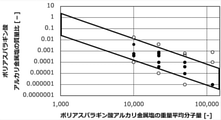
- the relationship between the above is shown in FIG.
- the horizontal axis is the weight average molecular weight of the alkali metal salt of polyaspartic acid. Since the weight average molecular weight is a relative value and has no unit, the unit is represented by [-].
- FIG. 2 the horizontal axis is the weight average molecular weight of the alkali metal salt of polyaspartic acid. Since the weight average molecular weight is a relative value and has no unit, the unit is represented by [-].
- the vertical axis is the mass ratio of the alkali metal polyaspartate (that is, the mass ratio of the alkali metal polyaspartate to the total amount of the inorganic powder and the alkali metal polyaspartate). Since the mass ratio of the alkali metal salt of polyaspartic acid does not have a unit, the unit is represented by [-].
- the vertical axis is a logarithmic axis. In FIG. 2, the black circle indicates that it is an embodiment, that is, it indicates that the relative value of the curve degree of the mixed powder is smaller than 1.00. White circles indicate that they are comparative examples.
- the weight average molecular weight x of the polyaspartic acid alkali metal salt and the mass ratio y of the polyaspartic acid alkali metal salt to the total amount of the inorganic powder and the polyaspartic acid alkali metal salt is 1, In Examples 1 to 14 included in the area surrounded by the range of 000 to 150,000 (or 8,000 to 120,000), a feeling of resistance to the skin is felt when the powder cosmetics are repeatedly applied.
Landscapes
- Health & Medical Sciences (AREA)
- Life Sciences & Earth Sciences (AREA)
- Animal Behavior & Ethology (AREA)
- General Health & Medical Sciences (AREA)
- Public Health (AREA)
- Veterinary Medicine (AREA)
- Birds (AREA)
- Epidemiology (AREA)
- Chemical & Material Sciences (AREA)
- Inorganic Chemistry (AREA)
- Physics & Mathematics (AREA)
- Geometry (AREA)
- Cosmetics (AREA)
Abstract
Description
本開示は、粉体化粧料及び化粧料組成物に関する。 This disclosure relates to powder cosmetics and cosmetic compositions.
粉体(パウダー)化粧料は、粉体の光学的特性により、好ましい美観等の特性を与えるものである。従来から、粉体の成分又は配合量等を改良することで、より使用感の良い粉体化粧料が開発されている。 Powder cosmetics give favorable aesthetic properties due to the optical properties of the powder. Conventionally, powder cosmetics having a better usability have been developed by improving the components or blending amounts of the powder.
例えば、特開2006-265214号公報は、(a)特定の異形複合粉体、及び(b)アミノ酸、ポリアミノ酸、これらの誘導体又は塩から選ばれる一種又は二種以上の水溶性成分、を配合された粉体化粧料が記載されている。それにより、粉体化粧料は、化粧料塗布時の滑らかな伸び広がり、肌への付着力及び保湿感、並びに皮膚の凹凸を目立たなくする効果に優れることが開示されている。 For example, Japanese Patent Application Laid-Open No. 2006-265214 contains (a) a specific variant composite powder, and (b) one or more water-soluble components selected from amino acids, polyamino acids, derivatives or salts thereof. The powdered cosmetics that have been applied are listed. Thereby, it is disclosed that the powder cosmetic is excellent in the effect of smooth spreading and spreading when the cosmetic is applied, the adhesive force to the skin and the moisturizing feeling, and the effect of making the unevenness of the skin inconspicuous.
しかしながら、上記特開2006-265214号公報は、複数の略球状粒子が凝集合一し、表面に複数の凹凸を有する形状の異形複合粉体を用いることを前提とするものである。上記特開2006-265214号公報における、化粧料塗布時の滑らかな伸び広がり、肌への付着力及び保湿感、並びに皮膚の凹凸を目立たなくするという効果の確認方法は、パネラーによる官能評価によって行われているのみである。つまり当該効果は客観的指標によって確認されたものではない。さらに、上記特開2006-265214号公報においては、化粧料を重ね塗りした場合の影響(重ね塗り時の抵抗感、化粧ヨレの発生など)については何ら記載もされておらず、また、依然として化粧料の肌に対する滑らかな伸び広がりも十分には得られない場合があることが明らかとなった。 However, Japanese Patent Application Laid-Open No. 2006-265214 is based on the premise that a plurality of substantially spherical particles are aggregated and coalesced, and a deformed composite powder having a shape having a plurality of irregularities on the surface is used. In the above Japanese Patent Application Laid-Open No. 2006-265214, the method for confirming the effects of smooth spreading and spreading when applying cosmetics, adhesion to the skin and moisturizing feeling, and making unevenness of the skin inconspicuous is performed by sensory evaluation by a panelist. It is only being damaged. In other words, the effect was not confirmed by an objective index. Further, in the above-mentioned Japanese Unexamined Patent Publication No. 2006-265214, there is no description about the influence of recoating cosmetics (resistance during recoating, occurrence of makeup twist, etc.), and makeup is still applied. It has become clear that the smooth spread and spread of the agent on the skin may not be sufficiently obtained.
本開示は、上記に鑑みなされたものであり、本開示の一態様は、粉体化粧料の重ね塗り時において、肌に対して抵抗感の少ない滑らかな伸び広がりを有し、かつ化粧ヨレが生じにくい粉体化粧料を提供することを課題とする。さらには、本開示の他の一態様は、化粧料組成物の重ね塗り時において、肌に対して抵抗感の少ない滑らかな伸び広がりを有し、かつ化粧ヨレが生じにくい化粧料組成物を提供することを課題とする。 The present disclosure has been made in view of the above, and one aspect of the present disclosure is that when the powder cosmetics are repeatedly applied, the powder cosmetics have a smooth spread and spread with little resistance to the skin, and the makeup is twisted. An object of the present invention is to provide powder cosmetics that are less likely to occur. Further, another aspect of the present disclosure provides a cosmetic composition having a smooth spread and spread with less resistance to the skin and less likely to cause cosmetic twist when the cosmetic composition is repeatedly applied. The task is to do.
課題を解決するための具体的手段には、以下の態様が含まれる。
<1> 無機粉体と、
前記無機粉体の表面の一部又は全部を被覆するポリアスパラギン酸アルカリ金属塩と、を含み、
前記ポリアスパラギン酸アルカリ金属塩の重量平均分子量xが1,000~150,000であり、
かつ、前記ポリアスパラギン酸アルカリ金属塩の重量平均分子量x、及び、前記無機粉体と前記ポリアスパラギン酸アルカリ金属塩との合計量に対する前記ポリアスパラギン酸アルカリ金属塩の質量比yが、下記式(1)及び式(2)を満たす、
粉体化粧料。
y ≦ 1.6×10⁷x-2.275 式(1)
y ≧ 1.3×10⁵x-2.232 式(2)
<2> 前記ポリアスパラギン酸アルカリ金属塩の重量平均分子量x、及び、前記無機粉体と前記ポリアスパラギン酸アルカリ金属塩との合計量に対する前記ポリアスパラギン酸アルカリ金属塩の質量比yが、さらに下記式(3)を満たす、前記<1>に記載の粉体化粧料。
y ≦ 1.0×10⁷x-2.275 式(3)
<3> 前記ポリアスパラギン酸アルカリ金属塩の重量平均分子量x、及び、前記無機粉体と前記ポリアスパラギン酸アルカリ金属塩との合計量に対する前記ポリアスパラギン酸アルカリ金属塩の質量比yが、さらに下記式(4)を満たす、前記<1>に記載の粉体化粧料。
y ≦ 8.0×10⁶x-2.275 式(4)
<4> 前記ポリアスパラギン酸アルカリ金属塩の重量平均分子量x、及び、前記無機粉体と前記ポリアスパラギン酸アルカリ金属塩との合計量に対する前記ポリアスパラギン酸アルカリ金属塩の質量比yが、さらに下記式(5)を満たす、前記<1>~<3>のいずれか1つに記載の粉体化粧料。
y ≧ 1.5×10⁵x-2.232 式(5)
<5> 前記ポリアスパラギン酸アルカリ金属塩の重量平均分子量xが、8,000~120,000である、前記<1>~<4>のいずれか1つに記載の粉体化粧料。
<6> 前記ポリアスパラギン酸アルカリ金属塩が、ポリアスパラギン酸リチウム、ポリアスパラギン酸カリウム、及びポリアスパラギン酸ナトリウムからなる群より選択される少なくとも1種である、前記<1>~<5>のいずれか1つに記載の粉体化粧料。
<7> 前記ポリアスパラギン酸アルカリ金属塩が、少なくともポリアスパラギン酸ナトリウムを含有する、前記<1>~<6>のいずれか1つに記載の粉体化粧料。
<8> 前記無機粉体は、タルク、マイカ、セリサイト、及び酸化チタンからなる群より選択される少なくとも1種を含有する、前記<1>~<7>のいずれか1つに記載の粉体化粧料。
<9> 前記無機粉体の平均粒径(D50)が1μm~100μmである、前記<1>~<8>のいずれか1つに記載の粉体化粧料。
<10> 前記<1>~<9>のいずれか1つに記載の粉体化粧料と、水及び油剤から選択される少なくとも1種とを含む化粧料組成物。
Specific means for solving the problem include the following aspects.
<1> Inorganic powder and
Containing a polyaspartic acid alkali metal salt that covers a part or all of the surface of the inorganic powder,
The weight average molecular weight x of the polyaspartic acid alkali metal salt is 1,000 to 150,000.
Moreover, the weight average molecular weight x of the polyaspartic acid alkali metal salt and the mass ratio y of the polyaspartic acid alkali metal salt to the total amount of the inorganic powder and the polyaspartic acid alkali metal salt are given by the following formula ( Satisfy 1) and equation (2),
Powder cosmetics.
y ≤ 1.6 x 10 7 x -2.275 formula (1)
y ≧ 1.3 × 10 5 × -2.232 formula (2)
<2> The weight average molecular weight x of the polyaspartic acid alkali metal salt and the mass ratio y of the polyaspartic acid alkali metal salt to the total amount of the inorganic powder and the polyaspartic acid alkali metal salt are further described below. The powder cosmetic according to <1>, which satisfies the formula (3).
y ≤ 1.0 x 10 7 x -2.275 formula (3)
<3> The weight average molecular weight x of the polyaspartic acid alkali metal salt and the mass ratio y of the polyaspartic acid alkali metal salt to the total amount of the inorganic powder and the polyaspartic acid alkali metal salt are further described below. The powder cosmetic according to <1>, which satisfies the formula (4).
y ≤ 8.0 x 10 6 x -2.275 formula (4)
<4> The weight average molecular weight x of the polyaspartic acid alkali metal salt and the mass ratio y of the polyaspartic acid alkali metal salt to the total amount of the inorganic powder and the polyaspartic alkali metal salt are further described below. The powder cosmetic according to any one of <1> to <3>, which satisfies the formula (5).
y ≧ 1.5 × 10 5 × -2.232 formula (5)
<5> The powder cosmetic according to any one of <1> to <4>, wherein the polyaspartic acid alkali metal salt has a weight average molecular weight x of 8,000 to 120,000.
<6> Any of the above <1> to <5>, wherein the polyaspartic acid alkali metal salt is at least one selected from the group consisting of lithium polyaspartate, potassium polyaspartate, and sodium polyaspartate. The powder cosmetics listed in one.
<7> The powder cosmetic according to any one of <1> to <6>, wherein the polyaspartic acid alkali metal salt contains at least sodium polyaspartate.
<8> The powder according to any one of <1> to <7>, wherein the inorganic powder contains at least one selected from the group consisting of talc, mica, sericite, and titanium oxide. Body cosmetics.
<9> The powder cosmetic according to any one of <1> to <8>, wherein the average particle size (D50) of the inorganic powder is 1 μm to 100 μm.
<10> A cosmetic composition containing the powder cosmetic according to any one of <1> to <9> and at least one selected from water and oil.
本開示の一態様によれば、粉体化粧料の重ね塗り時において、肌に対して抵抗感の少ない滑らかな伸び広がりを有し、かつ化粧ヨレが生じにくい粉体化粧料を提供することができる。さらには、本開示の他の一態様によれば、化粧料組成物の重ね塗り時において、肌に対して抵抗感の少ない滑らかな伸び広がりを有し、かつ化粧ヨレが生じにくい化粧料組成物を提供することができる。 According to one aspect of the present disclosure, it is possible to provide a powder cosmetic that has a smooth spread and spread with little resistance to the skin and is less likely to cause makeup twist when the powder cosmetic is repeatedly applied. can. Further, according to another aspect of the present disclosure, a cosmetic composition having a smooth spread and spread with less resistance to the skin and less likely to cause makeup twist when the cosmetic composition is repeatedly applied. Can be provided.
以下において、本開示の内容について詳細に説明する。以下に記載する構成要件の説明は、本開示の代表的な実施態様に基づいてなされることがあるが、本開示はそのような実施態様に限定されるものではない。
本開示中に段階的に記載されている数値範囲において、1つの数値範囲で記載された上限値又は下限値は、他の段階的な記載の数値範囲の上限値又は下限値に置き換えてもよい。また、本開示中に記載されている数値範囲において、その数値範囲の上限値又は下限値は、実施例に示されている値に置き換えてもよい。
本開示において、「~」を用いて表される数値範囲は、「~」の前後に記載される数値を下限値及び上限値として含む範囲を意味する。
The contents of the present disclosure will be described in detail below. The description of the constituents described below may be based on the representative embodiments of the present disclosure, but the present disclosure is not limited to such embodiments.
In the numerical range described stepwise in the present disclosure, the upper limit value or the lower limit value described in one numerical range may be replaced with the upper limit value or the lower limit value of the numerical range described in another stepwise description. .. Further, in the numerical range described in the present disclosure, the upper limit value or the lower limit value of the numerical range may be replaced with the value shown in the examples.
In the present disclosure, the numerical range represented by using "-" means a range including the numerical values before and after "-" as the lower limit value and the upper limit value.
更に、本開示において粉体化粧料又は化粧料組成物等の組成物中の各成分の量は、組成物中の各成分に該当する物質が複数存在する場合、特に断らない限り、組成物中に存在する該当する複数の物質の合計量を意味する。
また、本明細書における基(原子団)の表記において、置換及び無置換を記していない表記は、置換基を有さないものと共に置換基を有するものをも包含するものである。
Further, in the present disclosure, the amount of each component in a composition such as a powder cosmetic or a cosmetic composition is used in the composition when a plurality of substances corresponding to each component in the composition are present, unless otherwise specified. Means the total amount of applicable substances present in.
Further, in the notation of a group (atomic group) in the present specification, the notation that does not describe substitution or non-substitution includes those having no substituent as well as those having a substituent.
また、本明細書中の「工程」の用語は、独立した工程だけではなく、他の工程と明確に区別できない場合であっても、その工程の所期の目的が達成されれば本用語に含まれる。
また、本開示において、「質量%」と「重量%」とは同義であり、「質量部」と「重量部」とは同義である。
更に、本開示において、2以上の好ましい態様の組み合わせは、より好ましい態様である。
In addition, the term "process" in the present specification is not limited to an independent process, and even if it cannot be clearly distinguished from other processes, the term "process" will be used as long as the intended purpose of the process is achieved. included.
Further, in the present disclosure, "% by mass" and "% by weight" are synonymous, and "parts by mass" and "parts by weight" are synonymous.
Further, in the present disclosure, a combination of two or more preferred embodiments is a more preferred embodiment.
≪粉体化粧料≫
本開示の粉体化粧料は、無機粉体と、前記無機粉体の表面の一部又は全部を被覆するポリアスパラギン酸アルカリ金属塩と、を含み、前記ポリアスパラギン酸アルカリ金属塩の重量平均分子量xが1,000~150,000であり、かつ、前記ポリアスパラギン酸アルカリ金属塩の重量平均分子量x、及び、前記無機粉体と前記ポリアスパラギン酸アルカリ金属塩との合計量に対する前記ポリアスパラギン酸アルカリ金属塩の質量比yが、下記式(1)及び式(2)を満たす、粉体化粧料である。
y ≦ 1.6×10⁷x-2.275 式(1)
y ≧ 1.3×10⁵x-2.232 式(2)
≪Powder cosmetics≫
The powder cosmetics of the present disclosure include an inorganic powder and a polyaspartic acid alkali metal salt that covers a part or all of the surface of the inorganic powder, and the weight average molecular weight of the polyaspartic acid alkali metal salt. The polyaspartic acid is 1,000 to 150,000, and the weight average molecular weight x of the polyaspartic acid alkali metal salt and the polyaspartic acid with respect to the total amount of the inorganic powder and the polyaspartic acid alkali metal salt. A powder cosmetic having a mass ratio y of an alkali metal salt satisfying the following formulas (1) and (2).
y ≤ 1.6 x 10 7 x -2.275 formula (1)
y ≧ 1.3 × 10 5 × -2.232 formula (2)
本開示の粉体化粧料は、粉体化粧料の重ね塗り時において、肌に対して抵抗感の少ない滑らかな伸び広がりを有し、かつ化粧ヨレが生じにくい。 The powder cosmetics of the present disclosure have a smooth spread and spread with little resistance to the skin when the powder cosmetics are repeatedly applied, and the makeup is less likely to be twisted.
本開示に係る粉体化粧料の作用は明確ではないが、以下のように推定される。 The action of the powder cosmetics according to this disclosure is not clear, but it is presumed as follows.
本開示において、粉体化粧料の重ね塗り時における粉体化粧料の評価は、粉体層せん断力測定を利用する。粉体層せん断力測定では、セルに充填された粉体に対して垂直方向及び水平方向に負荷をかけて、垂直応力σ及びせん断応力τが定常状態となった後に、垂直応力σを減衰させることで、垂直応力σに対するせん断応力τの関係を表す破壊包絡線を得る(図1)。このような、荷重をかけながらせん断される時の粉体層の状況は、粉体化粧料が付着している肌に対して、粉体化粧料を付着させた化粧道具で、さらに粉体化粧料を重ね塗り(例えば、化粧直し、しみ隠し、又は汚れ隠し)する時の粉体層の状況と類似している。よって、本開示において、粉体化粧料を重ね塗りした場合の使用感の評価方法を、粉体層せん断力測定を利用した評価方法とすることで、客観的な評価を行う。
なお粉体化粧料の重ね塗り時に本願効果が最も奏されるが、前記重ね塗りでない場合にも当然に同様の効果が期待される。つまり、本願効果が奏されるのは、本開示に係る粉体化粧料に対して本開示に係る粉体化粧料を重ね塗りする場合に限らず、地肌に対して本開示に係る粉体化粧料を塗布する場合、地肌に塗布した下地(液状、クリーム状等)に対して本開示に係る粉体化粧料を塗布する場合、又は本開示に係る粉体化粧料上に塗布したチーク、コンシーラー等(液体、粉状等)に対して本開示に係る粉体化粧料を塗布する場合であっても、本願効果(すなわち、肌に対して抵抗感の少ない滑らかな伸び広がりを有し、かつ化粧ヨレが生じにくい粉体化粧料を提供すること)が奏される。
In the present disclosure, the powder layer shear force measurement is used for the evaluation of the powder cosmetics at the time of recoating the powder cosmetics. In the powder layer shear force measurement, a load is applied to the powder filled in the cell in the vertical and horizontal directions, and the normal stress σ is attenuated after the normal stress σ and the shear stress τ are in a steady state. As a result, a fracture wrapping line showing the relationship of the shear stress τ with respect to the normal stress σ is obtained (Fig. 1). The situation of the powder layer when it is sheared while applying a load like this is a cosmetic tool with powder cosmetics attached to the skin to which powder cosmetics are attached, and further powder makeup. It is similar to the situation of the powder layer when recoating (eg, redressing, concealing stains, or concealing stains). Therefore, in the present disclosure, an objective evaluation is performed by using an evaluation method using powder layer shear force measurement as an evaluation method of usability when powder cosmetics are repeatedly applied.
The effect of the present application is most exhibited when the powder cosmetic is overcoated, but the same effect is naturally expected even when the powder cosmetic is not overcoated. That is, the effect of the present application is not limited to the case where the powder cosmetic according to the present disclosure is overcoated on the powder cosmetic according to the present disclosure, and the powder cosmetic according to the present disclosure is applied to the skin. When applying the agent, when applying the powder cosmetic according to the present disclosure to the base (liquid, cream, etc.) applied to the skin, or when applying the powder cosmetic according to the present disclosure, teak, concealer applied on the powder cosmetic according to the present disclosure. Even when the powder cosmetic according to the present disclosure is applied to the above (liquid, powder, etc.), the effect of the present application (that is, it has a smooth spreading and spreading with less resistance to the skin, and (Providing powder cosmetics that are less likely to cause makeup twisting) is achieved.
なお本開示において、粉体化粧料又は化粧料組成物等の「使用感」とは、粉体化粧料の重ね塗り時において、又は、粉体化粧料を単に塗る時等において、肌に対して抵抗感の少ない滑らかな伸び広がりを有し、かつ化粧ヨレが生じにくい、という感覚を含む。本開示では、伸び広がり又は化粧ヨレに直接言及するために、伸び広がり又は化粧ヨレを、使用感と並列して記載する場合もある。また本開示において、粉体化粧料又は化粧料組成物の、肌なじみ、潤い感、滑らかさ等の、使用者が感じる感覚も、粉体化粧料又は化粧料組成物等の「使用感」の一種である。なお化粧ヨレとは、肌に付着していた粉体層が動くことであって、例えば、ファンデーションヨレをいう。 In the present disclosure, the "feeling of use" of a powder cosmetic or a cosmetic composition, etc., refers to the skin when the powder cosmetic is repeatedly applied or when the powder cosmetic is simply applied. It has a smooth stretch and spread with little resistance, and includes the feeling that makeup twist is unlikely to occur. In the present disclosure, in order to directly refer to the spread or cosmetic twist, the spread or cosmetic twist may be described in parallel with the feeling of use. Further, in the present disclosure, the sensation felt by the user such as skin familiarity, moisturizing feeling, smoothness, etc. of the powder cosmetic or cosmetic composition is also the "usability" of the powder cosmetic or cosmetic composition. It is a kind. The cosmetic twist means that the powder layer adhering to the skin moves, and refers to, for example, a foundation twist.
図1に示したように、前記粉体層せん断力測定によって得られた破壊包絡線から、曲線度を得ることができる。曲線度は、曲線度=[破壊包絡線の下部の直線の傾き]/[破壊包絡線の上部の直線の傾き]、の式より算出する。なお、破壊包絡線の下部の直線の傾きとは、垂直応力σ及びせん断応力τが定常状態となったときの垂直応力σを100%とした場合に、垂直応力σの値が0%~30%であるときの破壊包絡線の直線(すなわち垂直応力σの値が0%のときのプロットと30%のときのプロットとを繋げた直線)の傾きを示す。破壊包絡線の上部の直線の傾きとは、垂直応力σ及びせん断応力τが定常状態となったときの垂直応力σを100%とした場合に、垂直応力σの値が70%~100%であるときの破壊包絡線の直線(すなわち垂直応力σの値が70%のときのプロットと100%のときのプロットとを繋げた直線)の傾きを示す。前記曲線度は、粉体の滑り性と相関する。曲線度の数値が高いほど、せん断付着応力が高く、粉体の滑り性が低く、つまり粉体化粧料の重ね塗り時において、肌に対して抵抗感の少ない滑らかな伸び広がりを有さず、かつ化粧ヨレが生じやすいという問題が起こりやすい。一方で、曲線度の数値が低いほど、せん断付着応力が低く、粉体の滑り性が高く、つまり粉体化粧料の重ね塗り時において前記した問題は起こりにくい。なお「せん断応力τ」とは、粉体層内部のある断面に対して平行であり、互いに反対向きの一対の力を断面の上下の層に作用させ、その面に沿って粉体層を滑らせてせん断動作をする際に必要となる応力を示す。すなわち、せん断応力τは、粉体層内部のある面と並行方向に、その面で上下の粉体層を滑らせようとする応力である。「せん断付着応力」とは、破壊包絡線を最小二乗法で直線にて近似し、その直線がせん断応力τの軸に交差する切片と等しい応力である。すなわち、せん断付着応力は、近似式の垂直応力σが0に達した時のせん断応力τの外挿値を示す。せん断応力τ及びせん断付着応力は、圧密された粉体間の付着力の指標として用いられる。 As shown in FIG. 1, the degree of curve can be obtained from the fracture envelope obtained by the powder layer shear force measurement. The degree of curve is calculated from the formula of degree of curve = [slope of a straight line at the bottom of the fracture envelope] / [slope of a straight line at the top of the fracture envelope]. The slope of the straight line at the bottom of the fracture envelopment line means that the value of the normal stress σ is 0% to 30 when the normal stress σ when the normal stress σ and the shear stress τ are in a steady state is 100%. The slope of the straight line of the fracture line when the value is% (that is, the straight line connecting the plot when the value of normal stress σ is 0% and the plot when the value of normal stress σ is 30%) is shown. The slope of the straight line at the top of the fracture entourage is when the value of the normal stress σ is 70% to 100% when the normal stress σ when the normal stress σ and the shear stress τ are in a steady state is 100%. The slope of the straight line of the fracture line at a certain time (that is, the straight line connecting the plot when the value of the normal stress σ is 70% and the plot when the value of the normal stress σ is 100%) is shown. The degree of curve correlates with the slipperiness of the powder. The higher the value of the degree of curve, the higher the shearing stress and the lower the slipperiness of the powder. Moreover, the problem that makeup twist is likely to occur is likely to occur. On the other hand, the lower the value of the degree of curve, the lower the shear stress and the higher the slipperiness of the powder, that is, the above-mentioned problem is less likely to occur when the powder cosmetic is repeatedly applied. The "shear stress τ" is parallel to a certain cross section inside the powder layer, and a pair of forces in opposite directions are applied to the upper and lower layers of the cross section, and the powder layer is slid along the surface. The stress required for shearing operation is shown. That is, the shear stress τ is a stress that tends to slide the upper and lower powder layers on a certain surface inside the powder layer in a parallel direction. The "shear adhesion stress" is a stress equal to a section in which the fracture entourage line is approximated by a straight line by the minimum square method and the straight line intersects the axis of the shear stress τ. That is, the shear bond stress indicates the extrapolation value of the shear stress τ when the normal stress σ of the approximate expression reaches 0. Shear stress τ and shear adhesion stress are used as indicators of adhesion between compacted powders.
本開示に係る粉体化粧料は、無機粉体と、ポリアスパラギン酸アルカリ金属塩とを含む。ポリアスパラギン酸アルカリ金属塩は、無機粉体間(すなわち無機粉体の粒子と粒子とが互いに近接したときの、両粒子の表面上)に存在することで、無機粉体同士の摩擦力を低下させ、粉体化粧料の滑り性を向上させることができる。本開示に係る、ポリアスパラギン酸アルカリ金属塩の重量平均分子量x、及び、前記無機粉体と前記ポリアスパラギン酸アルカリ金属塩との合計量に対する前記ポリアスパラギン酸アルカリ金属塩の質量比yが満たす前記式(1)及び式(2)の意義は、以下のように推定される。 The powder cosmetic according to the present disclosure contains an inorganic powder and an alkali metal salt of polyaspartic acid. The polyaspartic acid alkali metal salt is present between the inorganic powders (that is, on the surface of both particles when the particles of the inorganic powder are close to each other), thereby reducing the frictional force between the inorganic powders. It is possible to improve the slipperiness of the powder cosmetic. The weight average molecular weight x of the polyaspartic acid alkali metal salt and the mass ratio y of the polyaspartic acid alkali metal salt to the total amount of the inorganic powder and the polyaspartic acid alkali metal salt according to the present disclosure are satisfied. The significance of equations (1) and (2) is presumed as follows.
本開示に係る粉体化粧料において、ポリアスパラギン酸アルカリ金属塩の重量平均分子量xが過大であると、ポリアスパラギン酸アルカリ金属塩間(すなわちポリアスパラギン酸アルカリ金属塩の分子と分子との間)の相互作用が強く、粘度増加が顕著となり、ハンドリング等の製造適性を損なう。さらには、以下の問題が生じやすくなることもある。なおこの時、粉体化粧料の曲線度の数値は高くなる。
(1a)粉体化粧料の粉体層間における摩擦が大きく、滑り性が低い。
(1b)粉体化粧料の重ね塗り時において、肌に対して抵抗感の少ない滑らかな伸び広がりを有さず、かつ化粧ヨレが生じやすい。
In the powder cosmetics according to the present disclosure, when the weight average molecular weight x of the alkali metal salt of polyaspartic acid is excessive, it is between the alkali metal salts of polyaspartic acid (that is, between the molecules of the alkali metal metal salt of polyaspartic acid). The interaction is strong, the increase in viscosity becomes remarkable, and the manufacturing suitability such as handling is impaired. Furthermore, the following problems may be more likely to occur. At this time, the numerical value of the degree of curve of the powder cosmetic is high.
(1a) Friction between powder layers of powder cosmetics is large and slipperiness is low.
(1b) When the powder cosmetics are repeatedly applied, they do not have a smooth spread and spread with little resistance to the skin, and make-up twists are likely to occur.
また、本開示に係る粉体化粧料において、無機粉体とポリアスパラギン酸アルカリ金属塩との合計量に対する前記ポリアスパラギン酸アルカリ金属塩の質量比yが過大であると、以下の問題が生じる。なおこの時、粉体化粧料の曲線度の数値は高くなる。
(2a)無機粉体間に存在するポリアスパラギン酸アルカリ金属塩の量が多いため、ポリアスパラギン酸アルカリ金属塩間の相互作用が強い。
(2b)ポリアスパラギン酸アルカリ金属塩水溶液を含む粉体化粧料の粘度増加が顕著である。
(2c)粉体化粧料の粉体層間における摩擦が大きく、滑り性が低い。
(2d)粉体化粧料の重ね塗り時において、肌に対して抵抗感の少ない滑らかな伸び広がりを有さず、かつ化粧ヨレが生じやすい。
Further, in the powder cosmetics according to the present disclosure, if the mass ratio y of the polyaspartic acid alkali metal salt to the total amount of the inorganic powder and the polyaspartic acid alkali metal salt is excessive, the following problems occur. At this time, the numerical value of the degree of curve of the powder cosmetic is high.
(2a) Since the amount of the polyaspartic acid alkali metal salt existing between the inorganic powders is large, the interaction between the polyaspartic acid alkali metal salts is strong.
(2b) The increase in viscosity of the powder cosmetic containing the aqueous solution of polyaspartic acid alkali metal salt is remarkable.
(2c) Friction between powder layers of powder cosmetics is large and slipperiness is low.
(2d) When the powder cosmetics are repeatedly applied, they do not have a smooth spread and spread with little resistance to the skin, and make-up twists are likely to occur.
上記のことから、粉体化粧料において、ポリアスパラギン酸アルカリ金属塩の重量平均分子量xが過大であり、かつ無機粉体とポリアスパラギン酸アルカリ金属塩との合計量に対する前記ポリアスパラギン酸アルカリ金属塩の質量比yが過大であると、粉体化粧料の曲線度の数値はより高くなり、上記した問題はより発生しやすい。 From the above, in the powder cosmetics, the weight average molecular weight x of the polyaspartic acid alkali metal salt is excessive, and the polyaspartic acid alkali metal salt with respect to the total amount of the inorganic powder and the polyaspartic acid alkali metal salt. If the mass ratio y of the above is excessive, the numerical value of the degree of curve of the powder cosmetics becomes higher, and the above-mentioned problem is more likely to occur.
一方で、本開示に係る粉体化粧料において、ポリアスパラギン酸アルカリ金属塩の重量平均分子量xが過小であると、ポリアスパラギン酸アルカリ金属塩間の相互作用が弱く、ハンドリング等の製造適性を損なう。さらには、以下の問題が生じやすくなることもある。なおこの時も、粉体化粧料の曲線度の数値は高くなる。
(3a)ポリアスパラギン酸アルカリ金属塩による粉体化粧料の粉体層間における摩擦が大きく、滑り性向上効果を十分に発揮できない。
(3b)粉体化粧料の重ね塗り時において、肌に対して抵抗感の少ない滑らかな伸び広がりを有さず、かつ化粧ヨレが生じやすい。
On the other hand, in the powder cosmetics according to the present disclosure, if the weight average molecular weight x of the polyaspartic acid alkali metal salt is too small, the interaction between the polyaspartic acid alkali metal salts is weak and the manufacturing suitability such as handling is impaired. .. Furthermore, the following problems may be more likely to occur. Also at this time, the numerical value of the degree of curve of the powder cosmetic is high.
(3a) The friction between the powder layers of the powder cosmetics due to the polyaspartic acid alkali metal salt is large, and the slipperiness improving effect cannot be sufficiently exhibited.
(3b) When the powder cosmetics are repeatedly applied, they do not have a smooth spread and spread with little resistance to the skin, and make-up twists are likely to occur.
また、本開示に係る粉体化粧料において、無機粉体とポリアスパラギン酸アルカリ金属塩との合計量に対する前記ポリアスパラギン酸アルカリ金属塩の質量比yが過小であると、以下の問題が生じる。なおこの時も、粉体化粧料の曲線度の数値は高くなる。
(4a)無機粉体間に存在するポリアスパラギン酸アルカリ金属塩の量が少ないため、ポリアスパラギン酸アルカリ金属塩間の相互作用が弱い。
(4b)無機粉体の局所にポリアスパラギン酸アルカリ金属塩が存在することで、ポリアスパラギン酸アルカリ金属塩による粉体化粧料の均一な流動が阻害され、粉体層間における摩擦が大きく、滑り性向上効果を十分に発揮できない。
(4c)粉体化粧料の重ね塗り時において、肌に対して抵抗感の少ない滑らかな伸び広がりを有さず、かつ化粧ヨレが生じやすい。
Further, in the powder cosmetics according to the present disclosure, if the mass ratio y of the polyaspartic acid alkali metal salt to the total amount of the inorganic powder and the polyaspartic acid alkali metal salt is too small, the following problems occur. Also at this time, the numerical value of the degree of curve of the powder cosmetic is high.
(4a) Since the amount of the polyaspartic acid alkali metal salt existing between the inorganic powders is small, the interaction between the polyaspartic acid alkali metal salts is weak.
(4b) The presence of the polyaspartic acid alkali metal salt locally in the inorganic powder hinders the uniform flow of the powder cosmetics by the polyaspartic acid alkali metal salt, causes a large friction between the powder layers, and is slippery. The improvement effect cannot be fully exhibited.
(4c) When the powder cosmetics are repeatedly applied, they do not have a smooth spread and spread with little resistance to the skin, and make-up twists are likely to occur.
上記のことから、粉体化粧料において、ポリアスパラギン酸アルカリ金属塩の重量平均分子量xが過小であり、かつ無機粉体とポリアスパラギン酸アルカリ金属塩との合計量に対する前記ポリアスパラギン酸アルカリ金属塩の質量比yが過小であると、やはり粉体化粧料の曲線度の数値はより高くなり、上記した問題はより発生しやすい。 From the above, in the powder cosmetics, the weight average molecular weight x of the polyaspartic acid alkali metal salt is too small, and the polyaspartic acid alkali metal salt with respect to the total amount of the inorganic powder and the polyaspartic acid alkali metal salt. If the mass ratio y of the above is too small, the numerical value of the degree of curve of the powder cosmetics becomes higher, and the above-mentioned problem is more likely to occur.
以上の理由から、粉体化粧料において、ポリアスパラギン酸アルカリ金属塩の重量平均分子量x、及び、無機粉体とポリアスパラギン酸アルカリ金属塩との合計量に対する前記ポリアスパラギン酸アルカリ金属塩の質量比yが満たす前記式(1)及び式(2)が求められた。なお本開示において、前記ポリアスパラギン酸アルカリ金属塩の重量平均分子量xが過大であるとは、ポリアスパラギン酸アルカリ金属塩の重量平均分子量が150,000を超えることをいう。前記ポリアスパラギン酸アルカリ金属塩の重量平均分子量xが過小であるとは、ポリアスパラギン酸アルカリ金属塩の重量平均分子量が1,000未満であることをいう。 For the above reasons, in powder cosmetics, the weight average molecular weight x of the alkali metal polyaspartate and the mass ratio of the alkali metal polyaspartate to the total amount of the inorganic powder and the alkali metal polyaspartate. The equations (1) and (2) that y satisfies were obtained. In the present disclosure, the fact that the weight average molecular weight x of the polyaspartic acid alkali metal salt is excessive means that the weight average molecular weight of the polyaspartic acid alkali metal salt exceeds 150,000. The fact that the weight average molecular weight x of the polyaspartic acid alkali metal salt is too small means that the weight average molecular weight of the polyaspartic acid alkali metal salt is less than 1,000.
上記のとおり、前記ポリアスパラギン酸アルカリ金属塩の重量平均分子量x、及び、前記無機粉体と前記ポリアスパラギン酸アルカリ金属塩との合計量に対する前記ポリアスパラギン酸アルカリ金属塩の質量比yが満たす、式(1)「y ≦ 1.6×10⁷x-2.275」及び式(2)「y ≧ 1.3×10⁵x-2.232」中の係数は、経験により導かれた数値である。 As described above, the weight average molecular weight x of the polyaspartic acid alkali metal salt and the mass ratio y of the polyaspartic acid alkali metal salt to the total amount of the inorganic powder and the polyaspartic acid alkali metal salt are satisfied. The coefficients in the formula (1) "y ≤ 1.6 x 10 7 x -2.275 " and the formula (2) "y ≥ 1.3 x 10 5 x -2.232 " are numerical values derived by experience. Is.
なお本開示に係る粉体化粧料において、無機粉体とポリアスパラギン酸アルカリ金属塩との合計量に対する前記ポリアスパラギン酸アルカリ金属塩の質量比の値は、比較的小さい値になるよう制御されている。そのため、ポリアスパラギン酸アルカリ金属塩は無機粉体の粒子の表面の一部又は全部を被覆するものの、その被覆量は比較的小さく抑えられている。よって、本開示に係る粉体化粧料において、親水性であるポリアスパラギン酸アルカリ金属塩に起因する過度な粘度増加が抑制されている。 In the powder cosmetics according to the present disclosure, the value of the mass ratio of the polyaspartic acid alkali metal salt to the total amount of the inorganic powder and the polyaspartic acid alkali metal salt is controlled to be a relatively small value. There is. Therefore, although the polyaspartic acid alkali metal salt covers a part or all of the surface of the particles of the inorganic powder, the coating amount thereof is kept relatively small. Therefore, in the powder cosmetics according to the present disclosure, an excessive increase in viscosity due to the hydrophilic polyaspartic acid alkali metal salt is suppressed.
なお本開示において、無機粉体とポリアスパラギン酸アルカリ金属塩との合計量に対する前記ポリアスパラギン酸アルカリ金属塩の質量比は、単に、ポリアスパラギン酸アルカリ金属塩の質量比とも称する。 In the present disclosure, the mass ratio of the polyaspartate alkali metal salt to the total amount of the inorganic powder and the polyaspartate alkali metal salt is also simply referred to as the mass ratio of the polyaspartate alkali metal salt.
本開示に係る、無機粉体とポリアスパラギン酸アルカリ金属塩との合計量に対する前記ポリアスパラギン酸アルカリ金属塩の質量比の値は無次元であるため、単位を有さない。 The value of the mass ratio of the polyaspartic acid alkali metal salt to the total amount of the inorganic powder and the polyaspartic acid alkali metal salt according to the present disclosure is dimensionless and therefore has no unit.
前記ポリアスパラギン酸アルカリ金属塩の重量平均分子量x、及び、前記無機粉体と前記ポリアスパラギン酸アルカリ金属塩との合計量に対する前記ポリアスパラギン酸アルカリ金属塩の質量比yに関して、y ≦ 1.6×10⁷x-2.275(式(1))及びy ≧ 1.3×10⁵x-2.232(式(2))並びに前記ポリアスパラギン酸アルカリ金属塩の重量平均分子量xは1,000~150,000、である範囲で囲まれた領域において、本開示の粉体化粧料は効果を奏する。
なお、前記範囲は、図2のグラフエリア内における、太枠の四辺形で示された範囲に相当する。
With respect to the weight average molecular weight x of the polyaspartic acid alkali metal salt and the mass ratio y of the polyaspartic acid alkali metal salt to the total amount of the inorganic powder and the polyaspartic acid alkali metal salt, y ≤ 1.6. × 10 7 x -2.275 (formula (1)) and y ≧ 1.3 × 10 5 x -2.232 (formula (2)) and the weight average molecular weight x of the polyaspartate alkali metal salt is 1, In the area surrounded by the range of 000 to 150,000, the powder cosmetics of the present disclosure are effective.
The range corresponds to the range shown by the quadrilateral of the thick frame in the graph area of FIG.
前記ポリアスパラギン酸アルカリ金属塩の重量平均分子量x、及び、前記無機粉体と前記ポリアスパラギン酸アルカリ金属塩との合計量に対する前記ポリアスパラギン酸アルカリ金属塩の質量比yに関して、y ≦ 1.0×10⁷x-2.275(式(3))及びy ≧ 1.3×10⁵x-2.232(式(2))並びに前記ポリアスパラギン酸アルカリ金属塩の重量平均分子量xは1,000~150,000、である範囲で囲まれた領域において、本開示の粉体化粧料は、より効果を奏する。 With respect to the weight average molecular weight x of the polyaspartic acid alkali metal salt and the mass ratio y of the polyaspartic acid alkali metal salt to the total amount of the inorganic powder and the polyaspartic acid alkali metal salt, y ≤ 1.0. × 10 7 x -2.275 (formula (3)) and y ≧ 1.3 × 10 5 x -2.232 (formula (2)) and the weight average molecular weight x of the polyaspartate alkali metal salt is 1, In the area surrounded by the range of 000 to 150,000, the powder cosmetics of the present disclosure are more effective.
前記ポリアスパラギン酸アルカリ金属塩の重量平均分子量x、及び、前記無機粉体と前記ポリアスパラギン酸アルカリ金属塩との合計量に対する前記ポリアスパラギン酸アルカリ金属塩の質量比yに関して、y ≦ 8.0×10⁶x-2.275(式(4))及びy ≧ 1.3×10⁵x-2.232(式(2))並びに前記ポリアスパラギン酸アルカリ金属塩の重量平均分子量xは1,000~150,000、である範囲で囲まれた領域において、本開示の粉体化粧料は、より効果を奏する。 With respect to the weight average molecular weight x of the polyaspartic acid alkali metal salt and the mass ratio y of the polyaspartic acid alkali metal salt to the total amount of the inorganic powder and the polyaspartic acid alkali metal salt, y ≤ 8.0. × 10 6 x -2.275 (formula (4)) and y ≧ 1.3 × 10 5 x -2.232 (formula (2)) and the weight average molecular weight x of the polyaspartate alkali metal salt is 1, In the area surrounded by the range of 000 to 150,000, the powder cosmetics of the present disclosure are more effective.
前記ポリアスパラギン酸アルカリ金属塩の重量平均分子量x、及び、前記無機粉体と前記ポリアスパラギン酸アルカリ金属塩との合計量に対する前記ポリアスパラギン酸アルカリ金属塩の質量比yに関して、y ≦ 1.6×10⁷x-2.275(式(1))及びy ≧ 1.5×10⁵x-2.232(式(5))並びに前記ポリアスパラギン酸アルカリ金属塩の重量平均分子量xは1,000~150,000、である範囲で囲まれた領域において、本開示の粉体化粧料は、より効果を奏する。 With respect to the weight average molecular weight x of the polyaspartic acid alkali metal salt and the mass ratio y of the polyaspartic acid alkali metal salt to the total amount of the inorganic powder and the polyaspartic acid alkali metal salt, y ≤ 1.6. × 10 7 x -2.275 (formula (1)) and y ≧ 1.5 × 10 5 x -2.232 (formula (5)) and the weight average molecular weight x of the polyaspartate alkali metal salt is 1, In the area surrounded by the range of 000 to 150,000, the powder cosmetics of the present disclosure are more effective.
前記ポリアスパラギン酸アルカリ金属塩の重量平均分子量x、及び、前記無機粉体と前記ポリアスパラギン酸アルカリ金属塩との合計量に対する前記ポリアスパラギン酸アルカリ金属塩の質量比yに関して、y ≦ 1.0×10⁷x-2.275(式(3))及びy ≧ 1.5×10⁵x-2.232(式(5))並びに前記ポリアスパラギン酸アルカリ金属塩の重量平均分子量xは1,000~150,000、である範囲で囲まれた領域において、本開示の粉体化粧料は、より効果を奏する。 With respect to the weight average molecular weight x of the polyaspartic acid alkali metal salt and the mass ratio y of the polyaspartic acid alkali metal salt to the total amount of the inorganic powder and the polyaspartic acid alkali metal salt, y ≤ 1.0. × 10 7 x -2.275 (formula (3)) and y ≧ 1.5 × 10 5 x -2.232 (formula (5)) and the weight average molecular weight x of the polyaspartate alkali metal salt is 1, In the area surrounded by the range of 000 to 150,000, the powder cosmetics of the present disclosure are more effective.
前記ポリアスパラギン酸アルカリ金属塩の重量平均分子量x、及び、前記無機粉体と前記ポリアスパラギン酸アルカリ金属塩との合計量に対する前記ポリアスパラギン酸アルカリ金属塩の質量比yに関して、y ≦ 8.0×10⁶x-2.275(式(4))及びy ≧ 1.5×10⁵x-2.232(式(5))並びに前記ポリアスパラギン酸アルカリ金属塩の重量平均分子量xは1,000~150,000、である範囲で囲まれた領域において、本開示の粉体化粧料は、より効果を奏する。 With respect to the weight average molecular weight x of the polyaspartic acid alkali metal salt and the mass ratio y of the polyaspartic acid alkali metal salt to the total amount of the inorganic powder and the polyaspartic acid alkali metal salt, y ≤ 8.0. × 10 6 x -2.275 (formula (4)) and y ≧ 1.5 × 10 5 x -2.232 (formula (5)) and the weight average molecular weight x of the polyaspartate alkali metal salt is 1, In the area surrounded by the range of 000 to 150,000, the powder cosmetics of the present disclosure are more effective.
なお、粉体の滑り性を高くする観点、及び後述する製造時のハンドリング等の観点から、上記した式を満たし、かつ前記ポリアスパラギン酸アルカリ金属塩の重量平均分子量xは8,000~120,000である範囲で囲まれた領域において、本開示の粉体化粧料は、より効果を奏する。 From the viewpoint of increasing the slipperiness of the powder and the handling at the time of manufacturing described later, the above formula is satisfied, and the weight average molecular weight x of the polyaspartic acid alkali metal salt is 8,000 to 120. In the area surrounded by the range of 000, the powder cosmetics of the present disclosure are more effective.
さらには、肌に対して抵抗感の少ない滑らかな伸び広がりを有し、かつ化粧ヨレを生じにくくする観点から、y ≦ 5.0×10⁶x-2.275及び上記式(2)若しくは式(5)並びに上記した前記ポリアスパラギン酸アルカリ金属塩の重量平均分子量xの範囲で囲まれた領域において、本開示の粉体化粧料は、より効果を奏する。 Furthermore, from the viewpoint of having a smooth spreading and spreading with little resistance to the skin and making it difficult for makeup to be twisted, y ≤ 5.0 × 10 6 × -2.275 and the above formula (2) or formula. (5) In addition, the powder cosmetics of the present disclosure are more effective in the region surrounded by the range of the weight average molecular weight x of the polyaspartic acid alkali metal salt described above.
さらには、肌に対して抵抗感の少ない滑らかな伸び広がりを有し、かつ化粧ヨレを生じにくくする観点から、上記式(1)、式(3)、もしくは式(4)、及びy ≧ 2.5×10⁵x-2.232並びに上記した前記ポリアスパラギン酸アルカリ金属塩の重量平均分子量xの範囲で囲まれた領域において、本開示の粉体化粧料は、より効果を奏する。前記y ≧ 2.5×10⁵x-2.232を、y ≧ 4.0×10⁵x-2.232、y ≧ 5.0×10⁵x-2.232、又はy ≧ 9.0×10⁵x-2.232に置き換えることは、肌に対して抵抗感の少ない滑らかな伸び広がりを有し、かつ化粧ヨレを生じにくくする観点から、より好ましい。 Furthermore, from the viewpoint of having a smooth spreading and spreading with little resistance to the skin and making it difficult for makeup to be twisted, the above formula (1), formula (3), or formula (4), and y ≧ 2 The powder cosmetics of the present disclosure are more effective in the region surrounded by the range of .5 × 10 5 × -2.232 and the weight average molecular weight x of the above-mentioned polyaspartic acid alkali metal salt. The above y ≧ 2.5 × 10 5 x -2.232 , y ≧ 4.0 × 10 5 x -2.232 , y ≧ 5.0 × 10 5 x -2.232 , or y ≧ 9.0. It is more preferable to replace with × 10 5 × -2.232 from the viewpoint of having a smooth spreading and spreading with less resistance to the skin and making it difficult for makeup to be twisted.
前記ポリアスパラギン酸アルカリ金属塩の重量平均分子量x、及び、前記無機粉体と前記ポリアスパラギン酸アルカリ金属塩との合計量に対する前記ポリアスパラギン酸アルカリ金属塩の質量比yが、前記範囲で囲まれた領域の値であると、ポリアスパラギン酸アルカリ金属塩間の相互作用を強すぎないようにし、粉体層間における摩擦を低くして粉体の滑り性を高くし、製造時のハンドリングを良好にし、本願効果をより一層得ることができる。又は、ポリアスパラギン酸アルカリ金属塩間の相互作用を弱すぎないようにし、粉体層間における摩擦を低くして粉体の滑り性を高くし、製造時のハンドリングを良好にし、本願効果をより一層得ることができる。 The weight average molecular weight x of the polyaspartic acid alkali metal salt and the mass ratio y of the polyaspartic acid alkali metal salt to the total amount of the inorganic powder and the polyaspartic acid alkali metal salt are surrounded by the above range. When the value is in the above region, the interaction between the alkali metal salts of polyaspartic acid is not too strong, the friction between the powder layers is lowered, the slipperiness of the powder is increased, and the handling during manufacturing is improved. , The effect of the present application can be further obtained. Alternatively, the interaction between the alkali metal salts of polyaspartic acid is not too weak, the friction between the powder layers is lowered to improve the slipperiness of the powder, the handling during manufacturing is improved, and the effect of the present application is further enhanced. Obtainable.
上記したように、ポリアスパラギン酸アルカリ金属塩の重量平均分子量xに対して、ポリアスパラギン酸アルカリ金属塩の質量比yの好ましい範囲が存在する。ポリアスパラギン酸アルカリ金属塩の重量平均分子量xが大きいほど、ポリアスパラギン酸アルカリ金属塩の質量比yは小さいことが好ましい。ポリアスパラギン酸アルカリ金属塩の重量平均分子量xが小さいほど、ポリアスパラギン酸アルカリ金属塩の質量比yは大きいことが好ましい。ポリアスパラギン酸アルカリ金属塩は、その重量平均分子量x(又は、数平均分子量)の大小によって、ポリマーであるポリアスパラギン酸アルカリ金属塩間の相互作用の力の強さが変化する。よって、ポリアスパラギン酸アルカリ金属塩の重量平均分子量x(又は、数平均分子量)に対して、ポリアスパラギン酸アルカリ金属塩の質量比yの好ましい範囲が存在すると考えられる。 As described above, there is a preferable range of the mass ratio y of the polyaspartic acid alkali metal salt to the weight average molecular weight x of the polyaspartic acid alkali metal salt. It is preferable that the larger the weight average molecular weight x of the polyaspartic alkali metal salt, the smaller the mass ratio y of the polyaspartic alkali metal salt. It is preferable that the smaller the weight average molecular weight x of the polyaspartic acid alkali metal salt, the larger the mass ratio y of the polyaspartic acid alkali metal salt. The strength of the interaction between the polymer polyaspartic acid alkali metal salts varies depending on the magnitude of the weight average molecular weight x (or number average molecular weight) of the polyaspartic acid alkali metal salt. Therefore, it is considered that there is a preferable range of the mass ratio y of the polyaspartic acid alkali metal salt to the weight average molecular weight x (or the number average molecular weight) of the polyaspartic acid alkali metal salt.
なお、本開示は、上記推定機構には何ら制限されない。 Note that this disclosure is not limited to the above estimation mechanism.
(ポリアスパラギン酸アルカリ金属塩)
-ポリアスパラギン酸アルカリ金属塩-
ポリアスパラギン酸アルカリ金属塩は、アスパラギン酸アルカリ金属塩のアミド結合により形成されるポリマーであり、一般に以下の構造単位を複数含む構造を有している。
(Polyaspartic acid alkali metal salt)
-Polyaspartic acid alkali metal salt-
The polyaspartic acid alkali metal salt is a polymer formed by an amide bond of the aspartic acid alkali metal salt, and generally has a structure containing a plurality of the following structural units.
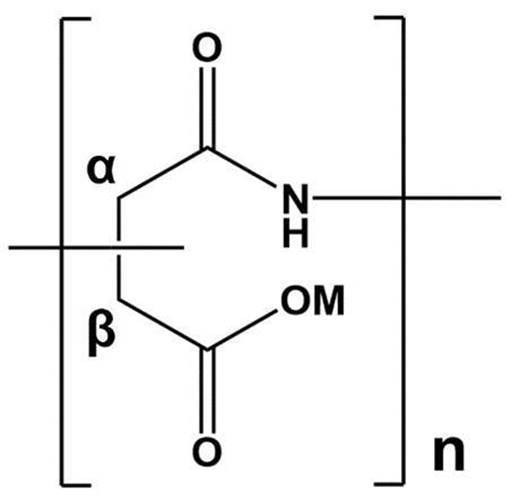
式中、nは1以上の整数である。式中、Mはアルカリ金属を示す。Mにおけるアルカリ金属としては、リチウム、ナトリウム、カリウム、ルビジウム、セシウム、又はフランシウムが含まれる。ポリアスパラギン酸アルカリ金属塩の主鎖中のアミド結合は、α結合でもβ結合でもかまわない。また、これら結合様式は、構造単位毎に同じでもよく、異なっていてもよい。なお、前記アミド結合は、隣接する構造単位のアミノ基が、アスパラギン酸アルカリ金属塩のα位のカルボキシル基と結合した場合がα結合であり、アスパラギン酸アルカリ金属塩のβ位のカルボキシル基と結合した場合がβ結合である。
また、構造単位の立体構造はそれぞれ独立にL型でもD型でもよく、例えば全体としてL型のポリマーであっても、D型のポリマーであっても、ラセミ体であってもよい。
In the formula, n is an integer of 1 or more. In the formula, M represents an alkali metal. Alkali metals in M include lithium, sodium, potassium, rubidium, cesium, or francium. The amide bond in the main chain of the polyaspartic acid alkali metal salt may be an α bond or a β bond. Further, these bonding modes may be the same or different for each structural unit. The amide bond is an α bond when the amino group of the adjacent structural unit is bonded to the carboxyl group at the α-position of the alkali metal aspartate, and is bonded to the carboxyl group at the β-position of the alkali metal aspartate. This is a β-bond.
Further, the three-dimensional structure of the structural unit may be independently L-type or D-type, and may be, for example, an L-type polymer as a whole, a D-type polymer, or a racemate.
本開示に係るポリアスパラギン酸アルカリ金属塩の構成は、本開示の粉体化粧料が効果を示す限り特に限定されない。本開示に係るポリアスパラギン酸アルカリ金属塩は、好ましくは、ポリアスパラギン酸リチウム、ポリアスパラギン酸カリウム及びポリアスパラギン酸ナトリウムからなる群より選択される少なくとも1種のポリアスパラギン酸アルカリ金属塩を含む。本開示の一態様においては、ポリアスパラギン酸アルカリ金属塩を用いることにより、粉体化粧料の重ね塗り時において、肌に対して抵抗感の少ない滑らかな伸び広がりを有し、かつ化粧ヨレが生じにくい粉体化粧料を実現することが可能となった。本開示に係るポリアスパラギン酸アルカリ金属塩は、少なくともポリアスパラギン酸ナトリウムを含有することがより好ましい。 The composition of the polyaspartic acid alkali metal salt according to the present disclosure is not particularly limited as long as the powder cosmetics of the present disclosure are effective. The polyaspartic acid alkali metal salt according to the present disclosure preferably contains at least one polyaspartic acid alkali metal salt selected from the group consisting of lithium polyaspartate, potassium polyaspartate and sodium polyaspartate. In one aspect of the present disclosure, by using the alkali metal salt of polyaspartic acid, when the powder cosmetics are repeatedly applied, the powder cosmetics have a smooth spread and spread with less resistance to the skin, and the makeup is twisted. It has become possible to realize difficult powder cosmetics. The polyaspartic acid alkali metal salt according to the present disclosure more preferably contains at least sodium polyaspartate.
本開示に係るポリアスパラギン酸アルカリ金属塩の一例であるポリアスパラギン酸ナトリウムは、アスパラギン酸ナトリウムのアミド結合により形成されるポリマーであり、一般に以下の構造単位を複数含む構造を有している。 Sodium polyaspartate, which is an example of the alkali metal salt of polyaspartic acid according to the present disclosure, is a polymer formed by an amide bond of sodium aspartate, and generally has a structure containing a plurality of the following structural units.
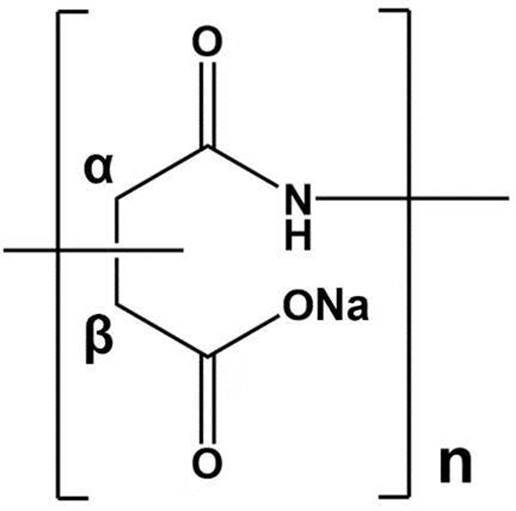
式中、nは1以上の整数である。ポリアスパラギン酸ナトリウムの主鎖中のアミド結合は、α結合でもβ結合でもかまわない。また、これら結合様式は、構造単位毎に同じでもよく、異なっていてもよい。なお、前記アミド結合は、隣接する構造単位のアミノ基が、アスパラギン酸ナトリウムのα位のカルボキシル基と結合した場合がα結合であり、アスパラギン酸ナトリウムのβ位のカルボキシル基と結合した場合がβ結合である。 In the formula, n is an integer of 1 or more. The amide bond in the main chain of sodium polyaspartate may be an α bond or a β bond. Further, these bonding modes may be the same or different for each structural unit. The amide bond is an α bond when the amino group of the adjacent structural unit is bonded to the carboxyl group at the α-position of sodium aspartate, and β is the case where the amino group is bonded to the carboxyl group at the β-position of sodium aspartate. It is a bond.
-ポリアスパラギン酸アルカリ金属塩の分子量-
以下、ポリアスパラギン酸アルカリ金属塩の分子量について、重量平均分子量(Mw)、数平均分子量(Mn)、及び分子量の多分散度(重量平均分子量(Mw)/数平均分子量(Mn))の観点から詳細に説明する。
-Molecular weight of polyaspartic acid alkali metal salt-
Hereinafter, regarding the molecular weight of the polyaspartic acid alkali metal salt, from the viewpoint of weight average molecular weight (Mw), number average molecular weight (Mn), and polydispersity of molecular weight (weight average molecular weight (Mw) / number average molecular weight (Mn)). It will be explained in detail.
ポリアスパラギン酸アルカリ金属塩の重量平均分子量が過大である場合に生じる問題点は、上記したとおりである。ポリアスパラギン酸アルカリ金属塩水溶液の粘度増加が顕著となることにより、曵糸性が発現し、粉体化粧料の製造工程における粉体混合時にハンドリングが困難になる。ポリアスパラギン酸アルカリ金属塩水溶液をさらに水で希釈することで粘度を抑えることはできるが、結果的に無機粉体に対する水の添加量が多くなってしまうため、粉体混合時に粉体が吸湿し、混合槽への付着及び粉体間の凝集が発生し、均一な粉体混合が困難になる。このような粉体混合時の困難を解消するために、ポリアスパラギン酸アルカリ金属塩水溶液を予め濃縮し、無機粉体に対するポリアスパラギン酸アルカリ金属塩濃縮水溶液の添加量を少なくすることも考えられる。しかしながら、粉体化粧料の製造工程中に新たに濃縮工程を導入する必要があるため、製造コストが高くなってしまう。
一方で、ポリアスパラギン酸アルカリ金属塩の重量平均分子量が過小である場合に生じる問題点は、上記したとおりである。
以上の観点から、本開示に係るポリアスパラギン酸アルカリ金属塩の重量平均分子量は、1,000~150,000とする。
The problems that occur when the weight average molecular weight of the polyaspartic acid alkali metal salt is excessive are as described above. When the viscosity of the polyaspartic acid alkali metal salt aqueous solution increases remarkably, the spinnability is exhibited, and handling becomes difficult at the time of powder mixing in the powder cosmetic manufacturing process. The viscosity can be suppressed by further diluting the polyaspartic acid alkali metal salt aqueous solution with water, but as a result, the amount of water added to the inorganic powder increases, so that the powder absorbs moisture when the powder is mixed. , Adhesion to the mixing tank and aggregation between powders occur, making uniform powder mixing difficult. In order to solve such difficulties in powder mixing, it is conceivable to concentrate the polyaspartic acid alkali metal salt aqueous solution in advance and reduce the amount of the polyaspartic acid alkali metal salt concentrated aqueous solution added to the inorganic powder. However, since it is necessary to newly introduce a concentration step during the manufacturing process of the powder cosmetic, the manufacturing cost becomes high.
On the other hand, the problems that occur when the weight average molecular weight of the polyaspartic acid alkali metal salt is too small are as described above.
From the above viewpoint, the weight average molecular weight of the polyaspartic acid alkali metal salt according to the present disclosure is 1,000 to 150,000.
本開示に係るポリアスパラギン酸アルカリ金属塩の重量平均分子量は、1,000~150,000である。本開示に係るポリアスパラギン酸アルカリ金属塩の重量平均分子量は、特に限定されないが、粉体の滑り性を高くする観点、及び製造時のハンドリング等の観点から、8,000~120,000が好ましく、10,000~120,000がより好ましく、10,000~100,000がさらに好ましく、16,000~60,000が特に好ましく、20,000~35,000が一層好ましく、20,000~27,000がより一層好ましい。 The weight average molecular weight of the polyaspartic acid alkali metal salt according to the present disclosure is 1,000 to 150,000. The weight average molecular weight of the polyaspartic acid alkali metal salt according to the present disclosure is not particularly limited, but is preferably 8,000 to 120,000 from the viewpoint of increasing the slipperiness of the powder and from the viewpoint of handling during production. 10,000 to 120,000 is more preferable, 10,000 to 100,000 is more preferable, 16,000 to 60,000 is particularly preferable, and 20,000 to 35,000 is even more preferable, and 20,000 to 27. 000 is even more preferred.
本開示に係るポリアスパラギン酸アルカリ金属塩においては、ポリアスパラギン酸アルカリ金属塩の数平均分子量は特に限定されないが、例えば、1,000~60,000としてもよい。なお粉体の滑り性を高くする観点、及び製造時のハンドリング等の観点から、ポリアスパラギン酸アルカリ金属塩の数平均分子量は、6,000~50,000が好ましく、7,000~48,000がより好ましく、8,000~40,000がさらに好ましく、10,000~36,000が特に好ましく、12,000~20,000が一層好ましく、13,000~16,000がより一層好ましい。 In the polyaspartic acid alkali metal salt according to the present disclosure, the number average molecular weight of the polyaspartic acid alkali metal salt is not particularly limited, but may be, for example, 1,000 to 60,000. The number average molecular weight of the polyaspartic acid alkali metal salt is preferably 6,000 to 50,000, preferably 7,000 to 48,000, from the viewpoint of increasing the slipperiness of the powder and handling at the time of production. Is more preferable, 8,000 to 40,000 is even more preferable, 10,000 to 36,000 is particularly preferable, 12,000 to 20,000 is even more preferable, and 13,000 to 16,000 is even more preferable.
本開示に係るポリアスパラギン酸アルカリ金属塩の分子量の多分散度は特に限定されないが、例えば、1.00~2.60としてもよい。ポリアスパラギン酸アルカリ金属塩の分子量の多分散度は、粉体の滑り性を高くする観点、及び製造時のハンドリング等の観点から、1.20~2.40であることが好ましく、1.30~1.90であることがより好ましく、1.40~1.80であることがさらに好ましく、1.50~1.75であることが特に好ましく、1.50~1.70であることが極めて好ましい。 The degree of polydispersity of the molecular weight of the polyaspartic acid alkali metal salt according to the present disclosure is not particularly limited, but may be, for example, 1.00 to 2.60. The degree of polydispersity of the molecular weight of the polyaspartic acid alkali metal salt is preferably 1.20 to 2.40, preferably 1.30, from the viewpoint of increasing the slipperiness of the powder and from the viewpoint of handling during production. It is more preferably to 1.90, further preferably 1.40 to 1.80, particularly preferably 1.50 to 1.75, and preferably 1.50 to 1.70. Extremely preferable.
上記範囲内の重量平均分子量、数平均分子量及び分子量の多分散度を有するポリアスパラギン酸アルカリ金属塩は、例えば、後述のポリアスパラギン酸アルカリ金属塩の製法を用いることで得ることができる。 The polyaspartic acid alkali metal salt having a weight average molecular weight, a number average molecular weight and a polydispersity of the molecular weight within the above range can be obtained, for example, by using the method for producing a polyaspartic acid alkali metal salt described later.
-ポリアスパラギン酸アルカリ金属塩の分子量測定方法-
なお、本開示において、ポリアスパラギン酸アルカリ金属塩の重量平均分子量及び数平均分子量は、それぞれ、ゲル浸透クロマトグラフィー(GPC)を用いて、下記GPC測定方法により測定された値を指す。
解析装置としてLC-Solution(株式会社島津製作所製)、
検出器としてRID-10A(株式会社島津製作所製)、
デガッサーとしてDGU-20A(株式会社島津製作所製)、
ポンプとしてLC-20AD(株式会社島津製作所製)、
オートサンプラーとしてSIL-20A(株式会社島津製作所製)、
送液ユニットとしてCTO-20A(株式会社島津製作所製)、
カラムとしてShodex Asahipak GF-7M HQ×1(昭和電工株式会社製)、
ガードカラムとしてShodex Asahipak GF-1G7B(昭和電工株式会社製)、
を用いる。カラムオーブンの温度は45℃とする。標品は、プルラン(Shodex STANDARD P-82(昭和電工株式会社製の標品群キット))であり、そのうちP-5、P-10、P-20、P-50、P-100及びP-200を用いて3次式の検量線を作成する。移動相としては0.1mol/L食塩水を使用する。得られた溶出曲線のうち、ポリマーのメインピークから重量平均分子量及び数平均分子量を算出する。
-Method for measuring the molecular weight of polyaspartic acid alkali metal salt-
In the present disclosure, the weight average molecular weight and the number average molecular weight of the polyaspartic acid alkali metal salt refer to the values measured by the following GPC measuring methods using gel permeation chromatography (GPC), respectively.
LC-Solution (manufactured by Shimadzu Corporation) as an analysis device,
RID-10A (manufactured by Shimadzu Corporation) as a detector,
DGU-20A (manufactured by Shimadzu Corporation) as a degasser,
LC-20AD (manufactured by Shimadzu Corporation) as a pump,
SIL-20A (manufactured by Shimadzu Corporation) as an autosampler,
CTO-20A (manufactured by Shimadzu Corporation) as a liquid transfer unit,
As a column, Shodex Asahipak GF-7M HQ x 1 (manufactured by Showa Denko KK),
As a guard column, Shodex Asahipak GF-1G7B (manufactured by Showa Denko KK),
Is used. The temperature of the column oven is 45 ° C. The standard is Pullulan (Shodex STANDARD P-82 (showa Denko Co., Ltd. standard group kit)), of which P-5, P-10, P-20, P-50, P-100 and P- 200 is used to create a cubic calibration curve. A 0.1 mol / L saline solution is used as the mobile phase. From the obtained elution curve, the weight average molecular weight and the number average molecular weight are calculated from the main peak of the polymer.
-ポリアスパラギン酸アルカリ金属塩の製法-
ポリアスパラギン酸アルカリ金属塩は、例えば、特許第3384420号公報に記載されたように、アスパラギン酸を非水溶性溶媒中200℃~230℃に加熱してポリコハク酸イミドを得ること、及び得られたポリコハク酸イミドを水酸化アルカリ金属塩水溶液中で加水分解してポリアスパラギン酸アルカリ金属塩を製造すること、を含む方法によって得てもよい。非水溶性溶媒としては、水と混合したときに分層する溶媒であって沸点が200℃以上の溶媒が使用可能である。例えば、n-パラフィン、流動パラフィン等の飽和炭化水素化合物、シリコーン系オイル、フッ素系オイル等が挙げられ、その中でも、200℃以上(好ましくは230℃以上)の沸点を有し、さらに25℃での粘度が100cP以下(好ましくは20cP以下)の溶媒を好適に使用することができる。
前駆体としてのポリコハク酸イミドは、マレアミド酸を160℃~330℃の温度で加熱して得ることもできる。また、無水マレイン酸を水溶媒中でアンモニア水と反応させ、その後少なくとも170℃の温度に加熱してポリコハク酸イミドを得ることもできる。あるいは、国際公開公報第2011/102293号に記載のように、無水マレイン酸とアンモニアの反応物及びマレアミド酸から選択される少なくとも1種をモノマーとして用いて重合を行ってポリアスパラギン酸前駆体ポリマーを調製すること、及び得られたポリアスパラギン酸前駆体ポリマーを水酸化アルカリ金属塩水溶液で処理してポリアスパラギン酸アルカリ金属塩を得ること、を含む方法によりポリアスパラギン酸アルカリ金属塩を製造することもできる。
-Manufacturing method of alkali metal salt of polyaspartic acid-
The polyaspartic acid alkali metal salt was obtained, for example, by heating asparagic acid in a water-insoluble solvent at 200 ° C. to 230 ° C. to obtain a polysuccinic acid imide, as described in Japanese Patent No. 3384420. It may be obtained by a method including hydrolyzing polysuccinic acidimide in an aqueous alkali metal hydroxide salt solution to produce an alkali metal hydroxide salt. As the water-insoluble solvent, a solvent that separates layers when mixed with water and has a boiling point of 200 ° C. or higher can be used. Examples thereof include saturated hydrocarbon compounds such as n-paraffin and liquid paraffin, silicone-based oils, fluorine-based oils, etc. Among them, those having a boiling point of 200 ° C. or higher (preferably 230 ° C. or higher) and further at 25 ° C. A solvent having a viscosity of 100 cP or less (preferably 20 cP or less) can be preferably used.
The polysuccinic acid imide as a precursor can also be obtained by heating maleamic acid at a temperature of 160 ° C to 330 ° C. It is also possible to react maleic anhydride with aqueous ammonia in an aqueous solvent and then heat to a temperature of at least 170 ° C. to obtain polysuccinic imide. Alternatively, as described in International Publication No. 2011/102293, polymerization is carried out using at least one selected from a reaction product of maleic anhydride and ammonia and maleamic acid as a monomer to obtain a polyaspartic acid precursor polymer. It is also possible to produce a polyaspartate alkali metal salt by a method including preparation and treatment of the obtained polyaspartic acid precursor polymer with an aqueous alkali metal hydroxide salt solution to obtain a polyaspartate alkali metal salt. can.
ポリアスパラギン酸アルカリ金属塩のうち、例えば、ポリアスパラギン酸ナトリウムの製造方法の一例においては、(1)SUS製のバットにL-アスパラギン酸を敷き、窒素雰囲気の常圧下において230℃で4時間オーブン内に静置することで、粉体のポリコハク酸イミドを得て、さらに、(2)得られた粉体のポリコハク酸イミドに蒸留水を加え、溶液の温度が45℃~55℃となるように制御しながら32質量%水酸化ナトリウム水溶液を少量ずつ滴下し、反応物が流動性を獲得したところで、pH測定を開始し、pHを測定しながら32質量%水酸化ナトリウム水溶液をさらに滴下し、pHがpH10~pH10.5の範囲で変動しなくなった時に滴下を終了して、ポリアスパラギン酸ナトリウムを含むポリアスパラギン酸ナトリウム水溶液を得る。
Among the alkali metal salts of polyaspartate, for example, in an example of the method for producing sodium polyaspartate, (1) L-aspartic acid is spread on a SUS bat and an oven at 230 ° C. for 4 hours under normal pressure in a nitrogen atmosphere. By allowing it to stand inside, a powdered polysuccinic acid imide is obtained, and (2) distilled water is added to the obtained powdered polysuccinic acid imide so that the temperature of the solution becomes 45 ° C to 55 ° C. The 32% by mass sodium hydroxide aqueous solution was added dropwise little by little while controlling to, and when the reaction material acquired fluidity, the pH measurement was started, and the 32% by mass sodium hydroxide aqueous solution was further added dropwise while measuring the pH. When the pH does not fluctuate in the range of
ポリアスパラギン酸アルカリ金属塩のうち、例えば、ポリアスパラギン酸ナトリウムをポリコハク酸イミドの加水分解によって得る場合、ポリマー中には、一部、加水分解されなかったコハク酸イミド構造単位が残留してもよい。言い換えると、本開示に係るポリアスパラギン酸ナトリウムはコハク酸イミド構造単位を一部(例えば全構造単位数の10%以下、又は5%以下、又は1%以下)含有していても、コハク酸イミド構造単位を全く含有していなくてもよい。 Of the alkali metal salts of polyaspartic acid, for example, when sodium polyaspartate is obtained by hydrolysis of polyspartic acid imide, a part of the unhydrolyzed succinic acid imide structural unit may remain in the polymer. .. In other words, the sodium polyaspartate according to the present disclosure contains a part of succinimide structural units (for example, 10% or less, 5% or less, or 1% or less of the total number of structural units), but succinimide. It does not have to contain any structural units.
-ポリアスパラギン酸アルカリ金属塩の質量比-
本開示に係る粉体化粧料において、無機粉体とポリアスパラギン酸アルカリ金属塩との合計量に対する前記ポリアスパラギン酸アルカリ金属塩の質量比は、0.00000095~0.0045の範囲内にすることが好ましく、0.000035~0.0010の範囲内にすることがより好ましい。前記範囲内にすることで、より一層、粉体化粧料の重ね塗り時において、粉体化粧料は肌に対して抵抗感の少ない滑らかな伸び広がりを有し、かつ化粧ヨレが生じにくい。なお、無機粉体とポリアスパラギン酸アルカリ金属塩との合計量に対する前記ポリアスパラギン酸アルカリ金属塩の質量比は、[ポリアスパラギン酸アルカリ金属塩の質量]/([無機粉体の質量]+[ポリアスパラギン酸アルカリ金属塩の質量])の式から求めることができる。
-Mass ratio of polyaspartic acid alkali metal salt-
In the powder cosmetics according to the present disclosure, the mass ratio of the polyaspartic acid alkali metal salt to the total amount of the inorganic powder and the polyaspartic acid alkali metal salt shall be in the range of 0.00000095 to 0.0045. Is preferable, and it is more preferably in the range of 0.000035 to 0.0010. By keeping it within the above range, the powder cosmetic has a smooth spread and spread with little resistance to the skin when the powder cosmetic is repeatedly applied, and the makeup is less likely to be twisted. The mass ratio of the polyaspartate alkali metal salt to the total amount of the inorganic powder and the polyaspartate alkali metal salt is [mass of polyaspartate alkali metal salt] / ([mass of inorganic powder] + [ It can be obtained from the formula of [mass of polyaspartic acid alkali metal salt]).
より詳細には、以下のとおりである。本開示に係る粉体化粧料において、ポリアスパラギン酸アルカリ金属塩と無機粉体とを混合することで、ポリアスパラギン酸アルカリ金属塩は、無機粉体の表面の一部又は全部を被覆する。ポリアスパラギン酸アルカリ金属塩は、無機粉体間に存在することで、無機粉体同士の摩擦力を低下させ、粉体化粧料の滑り性を向上させることができる。
よって、無機粉体とポリアスパラギン酸アルカリ金属塩との合計量に対する前記ポリアスパラギン酸アルカリ金属塩の質量比が過大であると、上記した(2a)~(2d)の問題が生じ、つまり前記した重ね塗り時の問題が起きる。一方で、無機粉体とポリアスパラギン酸アルカリ金属塩との合計量に対する前記ポリアスパラギン酸アルカリ金属塩の質量比が過小であると、上記した(4a)~(4c)の問題が生じ、つまり前記した重ね塗り時の問題が起きる。
More details are as follows. In the powder cosmetics according to the present disclosure, by mixing the polyaspartic acid alkali metal salt and the inorganic powder, the polyaspartic acid alkali metal salt covers a part or all of the surface of the inorganic powder. Since the polyaspartic acid alkali metal salt is present between the inorganic powders, it is possible to reduce the frictional force between the inorganic powders and improve the slipperiness of the powder cosmetics.
Therefore, if the mass ratio of the polyaspartic acid alkali metal salt to the total amount of the inorganic powder and the polyaspartic acid alkali metal salt is excessive, the above-mentioned problems (2a) to (2d) occur, that is, the above-mentioned problems. Problems with recoating occur. On the other hand, if the mass ratio of the polyaspartic acid alkali metal salt to the total amount of the inorganic powder and the polyaspartic acid alkali metal salt is too small, the above-mentioned problems (4a) to (4c) occur, that is, the above-mentioned problem. Problems occur when recoating.
無機粉体とポリアスパラギン酸アルカリ金属塩との合計量に対する前記ポリアスパラギン酸アルカリ金属塩の質量比は、ポリアスパラギン酸アルカリ金属塩間の相互作用、及び粉体層間における摩擦等の観点から、0.000035~0.0010が好ましく、0.000035~0.00065であることがより好ましく、0.000055~0.00065であることがさらに好ましく、0.000085~0.00065であることが特に好ましく、0.00015~0.00065であることが一層好ましく、0.00020~0.00065がより一層好ましい。 The mass ratio of the polyaspartic acid alkali metal salt to the total amount of the inorganic powder and the polyaspartic acid alkali metal salt is 0 from the viewpoint of the interaction between the polyaspartic acid alkali metal salts and the friction between the powder layers. It is preferably 0.000035 to 0.0010, more preferably 0.000035 to 0.00065, further preferably 0.000055 to 0.00065, and particularly preferably 0.00985 to 0.00065. , 0.00015 to 0.00065, and even more preferably 0.00020 to 0.00065.
(無機粉体)
-無機粉体-
本開示に係る粉体化粧料中に含まれる無機粉体は特に限定されず、粉体化粧料用の無機粉体として一般に用いられている無機粉体を用いることができる。無機粉体の形状は球状、板状、針状等の形状であってもよく、多孔質であっても無孔性の形状であってもよい。
(Inorganic powder)
-Inorganic powder-
The inorganic powder contained in the powder cosmetic according to the present disclosure is not particularly limited, and an inorganic powder generally used as an inorganic powder for powder cosmetics can be used. The shape of the inorganic powder may be spherical, plate-shaped, needle-shaped, or the like, and may be porous or non-porous.
無機粉体の材質は、一般的な無機粉体、光輝性粉体、有機粉体、色素粉体、又は複合粉体等のいずれであってもよい。無機粉体の例としては、具体的には、酸化チタン、黒色酸化チタン、コンジョウ、群青、ベンガラ、黄色酸化鉄、黒色酸化鉄、酸化亜鉛、酸化アルミニウム、シリカ、酸化マグネシウム、酸化ジルコニウム、炭酸マグネシウム、炭酸カルシウム、酸化クロム、水酸化クロム、カーボンブラック、ケイ酸アルミニウム、ケイ酸マグネシウム、ケイ酸アルミニウムマグネシウム、マイカ、合成雲母、合成雲母鉄、セリサイト、タルク、カオリン、炭化珪素、硫酸バリウム、ベントナイト、スメクタイト、若しくは窒化硼素等の一般的な無機粉体、オキシ塩化ビスマス、酸化チタン被覆マイカ、酸化鉄被覆マイカ、酸化鉄被覆マイカチタン、酸化鉄・酸化チタン焼結体、若しくはアルミニウムパウダー等の光輝性無機粉体、又は、微粒子酸化チタン被覆マイカチタン、微粒子酸化亜鉛被覆マイカチタン、硫酸バリウム被覆マイカチタン、酸化チタン内包シリカ、若しくは酸化亜鉛内包シリカ等の複合無機粉体が挙げられる。本開示に係る粉体化粧料は、これらの無機粉体のうち任意のものを一種単独で用いてもよいし、二種以上を任意の組み合わせで含んでいてもよい。 The material of the inorganic powder may be any of general inorganic powder, glitter powder, organic powder, dye powder, composite powder and the like. Specific examples of inorganic powders include titanium oxide, black titanium oxide, conjo, ultramarine, red iron oxide, yellow iron oxide, black iron oxide, zinc oxide, aluminum oxide, silica, magnesium oxide, zirconium oxide, and magnesium carbonate. , Calcium carbonate, chromium oxide, chromium hydroxide, carbon black, aluminum silicate, magnesium silicate, aluminum magnesium silicate, mica, synthetic mica, synthetic mica iron, sericite, talc, kaolin, silicon carbide, barium sulfate, bentonite , Smectite, or general inorganic powder such as boron nitride, bismuth oxychloride, titanium oxide-coated mica, iron oxide-coated mica, iron oxide-coated mica titanium, iron oxide / titanium oxide sintered body, or aluminum powder. Examples thereof include a synthetic inorganic powder or a composite inorganic powder such as fine particle titanium oxide-coated mica titanium, fine particle zinc oxide-coated mica titanium, barium sulfate-coated mica titanium, titanium oxide-encapsulating silica, or zinc oxide-encapsulating silica. In the powder cosmetics according to the present disclosure, any one of these inorganic powders may be used alone, or two or more of them may be contained in any combination.
本開示に係る無機粉体は、粉体化粧料の重ね塗り時において、肌に対して抵抗感の少ない滑らかな伸び広がりを有し、かつ化粧ヨレが生じにくい観点から、タルク、マイカ、セリサイト、及び酸化チタンからなる群より選択される少なくとも1種を含有することが好ましい。本開示に係る無機粉体は、例えばタルク及び酸化チタンの混合物であってもよい。本開示に係る無機粉体は、タルク、マイカ、及びセリサイトからなる群より選択される少なくとも1種を含有することがより好ましく、タルクを含有することがさらに好ましい。 The inorganic powder according to the present disclosure has talc, mica, and serisite from the viewpoint that it has a smooth spread and spread with little resistance to the skin when the powder cosmetic is repeatedly applied, and the makeup is less likely to be twisted. , And at least one selected from the group consisting of titanium oxide. The inorganic powder according to the present disclosure may be, for example, a mixture of talc and titanium oxide. The inorganic powder according to the present disclosure preferably contains at least one selected from the group consisting of talc, mica, and sericite, and more preferably contains talc.
-平均粒径-
本開示に係る粉体化粧料中に含まれる無機粉体の粒径は、特に限定されず、平均粒径で0.02μm程度の超微粒子サイズから200μm程度の比較的大きなサイズまでの範囲の中で、目的に応じて適切なものを選択することができる。なお、本開示に係る平均粒径とは、無機粉体を溶媒中に分散させた状態で測定した各粒子の粒径に基づく各粒子の体積を小粒径側から積算した場合に、積算体積が全体積の50%となる粒径値をいう。つまり本開示に係る平均粒径は、メジアン径と同義であり、「平均粒径(D50)」又は「体積平均粒径D50」とも表す。本開示に係る粉体化粧料中に含まれる無機粉体の体積平均粒径D50は、分散溶媒として試薬特級ヘキサン(溶媒屈折率1.38)(富士フイルム和光純薬株式会社製)を使用し、装置内循環にて分散させ、装置Loading Index適量範囲内の濃度条件において、循環速度50%(100%時、65mL/秒)で、Microtrac MT3300EXII(Microtrac社製 粒度分布計)を用いて測定することができる。
-Average particle size-
The particle size of the inorganic powder contained in the powder cosmetics according to the present disclosure is not particularly limited, and ranges from an ultrafine particle size of about 0.02 μm to a relatively large size of about 200 μm in average particle size. Then, you can select the appropriate one according to your purpose. The average particle size according to the present disclosure is the integrated volume when the volume of each particle based on the particle size of each particle measured in a state where the inorganic powder is dispersed in the solvent is integrated from the small particle size side. Refers to the particle size value which is 50% of the total volume. That is, the average particle size according to the present disclosure is synonymous with the median diameter, and is also referred to as "average particle size (D50)" or "volume average particle size D50". The volume average particle size D50 of the inorganic powder contained in the powder cosmetic according to the present disclosure uses reagent special grade hexane (solvent refractive index 1.38) (manufactured by Fujifilm Wako Pure Chemical Industries, Ltd.) as a dispersion solvent. , Disperse by in-device circulation, and measure using a Microtrac MT3300EXII (Microtrac particle size distribution meter) at a circulation rate of 50% (at 100%, 65 mL / sec) under the concentration conditions within the appropriate amount range of the device Loading Index. be able to.
本開示に係る無機粉体の平均粒径は特に限定されないが、例えば、1μm~100μmである。なお無機粉体の平均粒径は、小さすぎると使用感が得られず、大きすぎると使用感が悪くなるという観点から、3μm~60μmであることが好ましく、4μm~40μmであることがより好ましく、5μm~30μmであることがさらに好ましく、6μm~20μmであることが特に好ましい。 The average particle size of the inorganic powder according to the present disclosure is not particularly limited, but is, for example, 1 μm to 100 μm. The average particle size of the inorganic powder is preferably 3 μm to 60 μm, more preferably 4 μm to 40 μm, from the viewpoint that if it is too small, a feeling of use cannot be obtained, and if it is too large, the feeling of use deteriorates. It is more preferably 5 μm to 30 μm, and particularly preferably 6 μm to 20 μm.
(その他の粉体)
本開示に係る粉体化粧料は、その効果が損なわれない限り、ポリアスパラギン酸アルカリ金属塩により表面の一部又は全部が被覆された前記無機粉体以外の、他の粉体を含んでいてもよい。他の粉体の例としては、ポリアスパラギン酸アルカリ金属塩により表面が被覆されていない状態の、先に例示した無機粉体、有機顔料被覆マイカチタン、ナイロンパウダー、ポリメチルメタクリレートパウダー、アクリロニトリル-メタクリル酸共重合体パウダー、塩化ビニリデン-メタクリル酸共重合体パウダー、ポリエチレンパウダー、ポリスチレンパウダー、オルガノポリシロキサンエラストマーパウダー、ポリメチルシルセスキオキサンパウダー、ポリウレタンパウダー、ウールパウダー、シルクパウダー、若しくは結晶セルロースパウダー等の有機粉体、又は、有機タール系顔料若しくは有機色素のレーキ顔料等の色素粉体等が挙げられる。また、本開示に係る粉体化粧料は、その効果が損なわれない限り、後述の粉体化粧料組成物の欄に記載される追加的成分を含んでいてもよい。
(Other powders)
The powder cosmetic according to the present disclosure contains other powders other than the inorganic powder whose surface is partially or wholly covered with an alkali metal polyaspartic acid salt, as long as its effect is not impaired. May be good. Examples of other powders include the above-exemplified inorganic powders, organic pigment coated mica titanium, nylon powders, polymethylmethacrylate powders, and acrylonitrile-methacryl, whose surface is not coated with a polyaspartic acid alkali metal salt. Acid copolymer powder, vinylidene chloride-methacrylic acid copolymer powder, polyethylene powder, polystyrene powder, organopolysiloxane elastomer powder, polymethylsilsesquioxane powder, polyurethane powder, wool powder, silk powder, crystalline cellulose powder, etc. Examples thereof include organic powders of the above, or dye powders such as organic tar pigments or lake pigments of organic pigments. In addition, the powder cosmetic according to the present disclosure may contain additional ingredients described in the column of the powder cosmetic composition described later, as long as the effect is not impaired.
≪粉体化粧料の製造方法≫
本開示に係る粉体化粧料の製造方法は、無機粉体と、ポリアスパラギン酸アルカリ金属塩と、を混合して、前記無機粉体と前記ポリアスパラギン酸アルカリ金属塩とを含む混合物を得ること、前記混合物を粉砕すること、並びに、粉砕された前記混合物を乾燥すること、を含んでいてもよい。
≪Manufacturing method of powder cosmetics≫
The method for producing a powder cosmetic according to the present disclosure is to mix an inorganic powder and a polyaspartic acid alkali metal salt to obtain a mixture containing the inorganic powder and the polyaspartic acid alkali metal salt. , The mixture may be ground and the ground mixture may be dried.
前記製造方法によって、本開示に係る粉体化粧料を製造することができる。ただし、本開示に係る粉体化粧料の製造方法は前記製造方法に限定されるものではなく、他の方法により本開示に係る粉体化粧料を製造することも可能である。 The powder cosmetics according to the present disclosure can be manufactured by the above-mentioned manufacturing method. However, the method for producing the powder cosmetic according to the present disclosure is not limited to the above-mentioned production method, and the powder cosmetic according to the present disclosure can also be produced by another method.
無機粉体とポリアスパラギン酸アルカリ金属塩との混合は、例えば室温で行ってもよいがこれに限定されず、ポリアスパラギン酸アルカリ金属塩水溶液が凝固又は沸騰しない任意の温度で行ってもよい。例えば、混合は、5℃~95℃の温度範囲内の温度で行ってもよい。混合の際には、水性媒体が共存していてもよいが、水性媒体は存在しなくてもよい。つまり、前記無機粉体とポリアスパラギン酸アルカリ金属塩とを混合することは、無機粉体、ポリアスパラギン酸アルカリ金属塩及び水性媒体を混合することを含んでいても、含んでいなくてもよい。前記水性媒体は、単に水であってもよいし、水と水混和性の溶媒との混合溶媒であってもよい。このような水混和性溶媒の例としては、メタノール、エタノール、プロパノール、及びエチレングリコール等のアルコール、又はアセトン等が挙げられる。 The mixing of the inorganic powder and the polyaspartic acid alkali metal salt may be carried out at room temperature, for example, but is not limited to this, and may be carried out at any temperature at which the polyaspartic acid alkali metal salt aqueous solution does not solidify or boil. For example, the mixing may be carried out at a temperature within the temperature range of 5 ° C to 95 ° C. At the time of mixing, the aqueous medium may coexist, but the aqueous medium may not be present. That is, mixing the inorganic powder with the polyaspartic acid alkali metal salt may or may not include mixing the inorganic powder, the polyaspartic acid alkali metal salt and the aqueous medium. .. The aqueous medium may be simply water or a mixed solvent of water and a water-miscible solvent. Examples of such a water-miscible solvent include alcohols such as methanol, ethanol, propanol, and ethylene glycol, acetone, and the like.
無機粉体とポリアスパラギン酸アルカリ金属塩との混合は、ディスパー、ヘンシェルミキサー、レディゲミキサー、ニーダー、V型混合機、ロールミル、ビーズミル、又は2軸混練機等を用いて行うことができる。混合時間は、例えば1分~1時間としてもよく、2分~20分であってもよい。混合は、例えば、無機粉体に、又は無機粉体と水性媒体とを含む混合液に、ポリアスパラギン酸アルカリ金属塩を添加することで、又はポリアスパラギン酸アルカリ金属塩の水溶液を添加することで行ってもよい。この場合、ポリアスパラギン酸アルカリ金属塩は最初から全量を投入してもよく、部分量ずつ複数回に分けて添加してもよい。 The inorganic powder and the polyaspartic acid alkali metal salt can be mixed using a disper, a Henschel mixer, a Ladyge mixer, a kneader, a V-type mixer, a roll mill, a bead mill, a twin-screw kneader, or the like. The mixing time may be, for example, 1 minute to 1 hour, or 2 minutes to 20 minutes. Mixing is performed, for example, by adding a polyaspartic acid alkali metal salt to an inorganic powder or a mixed solution containing an inorganic powder and an aqueous medium, or by adding an aqueous solution of a polyaspartic acid alkali metal salt. You may go. In this case, the polyaspartic acid alkali metal salt may be added in a total amount from the beginning, or may be added in a plurality of times in partial amounts.
ポリアスパラギン酸アルカリ金属塩の添加量は、無機粉体とポリアスパラギン酸アルカリ金属塩との合計量に対して0.00000095~0.0045に設定してもよく、0.000035~0.0010に設定してもよい。ポリアスパラギン酸アルカリ金属塩の添加量を無機粉体とポリアスパラギン酸アルカリ金属塩との合計量に対して0.00000095~0.0045に設定することで、より一層、肌に対して抵抗感の少ない滑らかな伸び広がりを有し、かつ化粧ヨレが生じにくい粉体化粧料を得ることができる。なお、無機粉体とポリアスパラギン酸アルカリ金属塩との混合の際には、無機粉体及びポリアスパラギン酸アルカリ金属塩に加えて、上記の他の粉体、後述の粉体化粧料組成物の欄に記載される追加的成分等も一緒に混合してもよい。 The amount of the polyaspartic acid alkali metal salt added may be set to 0.00000095 to 0.0045 with respect to the total amount of the inorganic powder and the polyaspartic acid alkali metal salt, and may be set to 0.000035 to 0.0010. It may be set. By setting the amount of the polyaspartic acid alkali metal salt added to 0.00000095 to 0.0045 with respect to the total amount of the inorganic powder and the polyaspartic acid alkali metal salt, the feeling of resistance to the skin is further increased. It is possible to obtain a powder cosmetic having a small amount of smooth spreading and spreading, and which is less likely to cause makeup twisting. When the inorganic powder and the polyaspartic acid alkali metal salt are mixed, in addition to the inorganic powder and the polyaspartic acid alkali metal salt, the other powders described above and the powder cosmetic composition described later may be used. The additional ingredients listed in the column may also be mixed together.
本開示に係る粉体化粧料の製造方法において、ポリアスパラギン酸アルカリ金属塩の種類及び重量平均分子量の説明については、上述した、本開示に係る粉体化粧料におけるポリアスパラギン酸アルカリ金属塩の種類及び重量平均分子量の説明を流用することができる。本開示に係る粉体化粧料の製造方法において、ポリアスパラギン酸アルカリ金属塩の重量平均分子量x、及び前記無機粉体と前記ポリアスパラギン酸アルカリ金属塩との合計量に対する前記ポリアスパラギン酸アルカリ金属塩の質量比yが満たす式の説明については、上述した、本開示に係る粉体化粧料におけるポリアスパラギン酸アルカリ金属塩の重量平均分子量x、及び前記無機粉体と前記ポリアスパラギン酸アルカリ金属塩との合計量に対する前記ポリアスパラギン酸アルカリ金属塩の質量比yが満たす式の説明を流用することができる。 Regarding the description of the type of polyaspartic acid alkali metal salt and the weight average molecular weight in the method for producing powder cosmetics according to the present disclosure, the types of polyaspartic acid alkali metal salts in the powder cosmetics according to the present disclosure are described above. And the description of the weight average molecular weight can be diverted. In the method for producing powdered cosmetics according to the present disclosure, the polyaspartate alkali metal salt with respect to the weight average molecular weight x of the polyaspartate alkali metal salt and the total amount of the inorganic powder and the polyaspartate alkali metal salt. Regarding the description of the formula satisfied by the mass ratio y of, the weight average molecular weight x of the polyaspartic acid alkali metal salt in the powder cosmetics according to the present disclosure, and the inorganic powder and the polyaspartic acid alkali metal salt are described above. The description of the formula satisfied by the mass ratio y of the polyaspartic acid alkali metal salt to the total amount of the above can be diverted.
前記混合によって得られた無機粉体とポリアスパラギン酸アルカリ金属塩とを含む混合物、又は前記混合物に加えて水性媒体とを含む混合液は、粉砕処理に供される。粉砕処理は、ジョークラッシャー、ジャイレトリークラッシャー、インパクトクラッシャー、コーンクラッシャー、ロールクラッシャー、カッターミル、自生粉砕機、スタンプミル、石臼型、乳鉢、らいかい機、リングミル、ローラーミル、ジェットミル、ハンマーミル、ピンミル、回転ミル、振動ミル、遊星ミル、アトライター、ビーズミル、又はアトマイザー等を用いて行うことができる。粉体化粧料の用途に合わせた所望の粒径が得られるように好適な粉砕機を選択すればよい。 A mixture containing the inorganic powder obtained by the mixing and an alkali metal salt of polyaspartic acid, or a mixture containing the mixture and an aqueous medium is subjected to a pulverization treatment. The crushing process is jaw crusher, gyre crusher, impact crusher, cone crusher, roll crusher, cutter mill, self-made crusher, stamp mill, stone mill type, mortar, mortar, ring mill, roller mill, jet mill, hammer mill. , A pin mill, a rotary mill, a vibration mill, a planetary mill, an attritor, a bead mill, an atomizer, or the like. A suitable crusher may be selected so as to obtain a desired particle size according to the use of the powder cosmetic.
粉砕処理後の混合物については、必要に応じて、任意に濾過を行ってもよい。濾過を行うことで、所望の粒径の無機粉体を回収することができ、また、水性媒体が存在する場合は無機粉体を水性媒体と分離することで乾燥を容易なものとすることができる。濾過に用いるフィルターの孔径は、所望の粒径に合わせて選択することができる。 The mixture after the pulverization treatment may be arbitrarily filtered if necessary. By filtering, the inorganic powder having a desired particle size can be recovered, and if an aqueous medium is present, the inorganic powder can be separated from the aqueous medium to facilitate drying. can. The pore size of the filter used for filtration can be selected according to the desired particle size.
前記粉砕処理後の混合液中の混合物を乾燥させることで、又は任意に行われる前記濾過により得られる無機粉体を乾燥させることで、表面の一部又は全部がポリアスパラギン酸アルカリ金属塩によって被覆された無機粉体を含む粉体化粧料が得られる。乾燥の手法は特に限定されない。乾燥は、自然乾燥により行ってもよく、減圧下で行ってもよく、加熱下で行ってもよい。減圧をする場合には、例えば絶対圧力で1kPa~20kPa程度に減圧をすればよく、加熱をする場合には、例えば60℃~150℃程度に加熱して乾燥させればよい。 Part or all of the surface is coated with the alkali metal salt of polyaspartic acid by drying the mixture in the mixed solution after the pulverization treatment or by drying the inorganic powder obtained by the optional filtration. A powder cosmetic containing the obtained inorganic powder can be obtained. The drying method is not particularly limited. The drying may be carried out by natural drying, under reduced pressure, or under heating. In the case of depressurizing, for example, the absolute pressure may be reduced to about 1 kPa to 20 kPa, and in the case of heating, for example, it may be heated to about 60 ° C. to 150 ° C. and dried.
乾燥により得られた、表面の一部又は全部がポリアスパラギン酸アルカリ金属塩によって被覆された無機粉体は、任意に、前述した他の粉体と混合されてもよい。 The inorganic powder obtained by drying and partially or wholly coated with the alkali metal salt of polyaspartic acid may be optionally mixed with the other powders described above.
≪化粧料組成物≫
本開示に係る粉体化粧料は、単独で粉体として用いてもよいが、本開示に係る粉体化粧料と、水及び油剤から選択される少なくとも1種とを含む化粧料組成物の形態で用いてもよい。すなわち、本開示に係る化粧料組成物は、本開示に係る粉体化粧料と、水及び油剤から選択される少なくとも1種とを含む化粧料組成物としてもよい。このような化粧料組成物の中で用いられた場合であっても、本開示に係る化粧料組成物は、肌に対して抵抗感の少ない滑らかな伸び広がりを有し、かつ化粧ヨレが生じにくいといった効果を奏する。
≪Cosmetic composition≫
The powder cosmetic according to the present disclosure may be used alone as a powder, but a form of a cosmetic composition containing the powder cosmetic according to the present disclosure and at least one selected from water and an oil agent. It may be used in. That is, the cosmetic composition according to the present disclosure may be a cosmetic composition containing the powder cosmetic according to the present disclosure and at least one selected from water and oil. Even when used in such a cosmetic composition, the cosmetic composition according to the present disclosure has a smooth spread and spread with little resistance to the skin, and cosmetic twist occurs. It has the effect of being difficult.
油剤の例としては、パラフィンワックス、セレシンワックス、オゾケライト、マイクロクリスタリンワックス、モンタンワックス、フィッシャトロプスワックス、ポリエチレンワックス、流動パラフィン、スクワラン、ワセリン、ポリイソブチレン、若しくはポリブテン等の炭化水素;カルナウバロウ、ミツロウ、ラノリンワックス、若しくはキャンデリラ等の天然ロウ類;トリベヘン酸グリセリル、ロジン酸ペンタエリトリットエステル、ホホバ油、セチルイソオクタネート、ミリスチン酸イソプロピル、トリオクタン酸グリセリル、トリイソステアリン酸ジグリセリル、若しくはジペンタエリトリット脂肪酸エステル等のエステル;ステアリン酸、ベヘニン酸、若しくは12-ヒドロキシステアリン酸等の脂肪酸;セタノール、ステアリルアルコール、若しくはベヘニルアルコール等の高級アルコール;オリーブ油、ヒマシ油、ミンク油、若しくはモクロウ等の油脂;ラノリン脂肪酸イソプロピル若しくはラノリンアルコール等のラノリン誘導体;N-ラウロイル-L-グルタミン酸ジ(コレステリル/ベヘニル/オクチルドデシル)等のアミノ酸誘導体;又は、パーフルオロポリエーテル、パーフルオロデカン、若しくはパーフルオロオクタン等のフッ素系油剤等が挙げられる。 Examples of oils include paraffin wax, selecin wax, ozokelite, microcrystallin wax, montan wax, fishertropus wax, polyethylene wax, liquid paraffin, squalane, vaseline, polyisobutylene, or hydrocarbons such as polybutene; Natural waxes such as lanolin wax or candelilla; glyceryl tribehenate, pentaerythrit rosinate ester, jojoba oil, cetyl isooctanate, isopropyl myristate, glyceryl trioctanoate, diglyceryl triisostearate, or dipentaerytrit fatty acid Esters such as esters; fatty acids such as stearic acid, behenic acid, or 12-hydroxystearic acid; higher alcohols such as cetanol, stearyl alcohol, or behenyl alcohol; fats and oils such as olive oil, paraffin oil, mink oil, or mokuro; lanolin fatty acid isopropyl Alternatively, a lanolin derivative such as lanolin alcohol; an amino acid derivative such as di (cholesteryl / behenyl / octyldodecyl) N-lauroyl-L-glutamate; or a fluorine-based oil such as perfluoropolyether, perfluorodecane, or perfluorooctane, etc. Can be mentioned.
本開示に係る化粧料組成物は、その効果を損なわない限り、上記の粉体化粧料、水、及び油剤以外の成分を含んでいてもよい。このような追加的成分の例としては、化粧料に通常使用される成分、例えば、水混和性溶媒、界面活性剤、油ゲル化剤、多価アルコール類若しくは保湿剤などの水溶性成分、紫外線吸収剤、防腐剤、美容成分、又は香料等を挙げることができる。 The cosmetic composition according to the present disclosure may contain ingredients other than the above-mentioned powder cosmetics, water, and oils as long as the effects are not impaired. Examples of such additional ingredients include ingredients commonly used in cosmetics, such as water-soluble components such as water-miscible solvents, surfactants, oil gelling agents, polyhydric alcohols or moisturizers, UV rays. Absorbents, preservatives, cosmetological ingredients, fragrances and the like can be mentioned.
本開示に係る化粧料組成物は、本開示に係る粉体化粧料を、水及び油剤から選択される少なくとも1種及び任意に前述の他の成分と混合することによって製造することができる。 The cosmetic composition according to the present disclosure can be produced by mixing the powder cosmetic according to the present disclosure with at least one selected from water and oil and optionally the other components described above.
本開示に係る粉体化粧料及び本開示に係る化粧料組成物の形態(化粧料の製品形態)は特に限定されず、目的に応じて適切に選択することができる。本開示に係る粉体化粧料又は本開示に係る化粧料組成物は、例えば、パウダー、パウダーパクト、ツーウェイケーキ、パウダーファンデーション、リキッドファンデーション、クリームファンデーション、コンシーラー、BBクリーム、CCクリーム、化粧下地、プライマー、アイシャドー、又はブラッシャであってもよい。 The form of the powder cosmetic according to the present disclosure and the form of the cosmetic composition according to the present disclosure (product form of the cosmetic) are not particularly limited and can be appropriately selected according to the purpose. The powder cosmetics according to the present disclosure or the cosmetic compositions according to the present disclosure include, for example, powder, powder pact, two-way cake, powder foundation, liquid foundation, cream foundation, concealer, BB cream, CC cream, makeup base, primer. , Eye shadow, or brusher.
上述のとおり、本開示に係る粉体化粧料及び化粧料組成物によれば、肌に対して抵抗感の少ない滑らかな伸び広がりを有し、かつ化粧ヨレが生じにくいという効果を奏する。 As described above, according to the powder cosmetics and the cosmetic composition according to the present disclosure, there is an effect that the powder cosmetics and the cosmetic composition have a smooth spread and spread with little resistance to the skin, and the makeup is less likely to be twisted.
以下、本開示を実施例により更に具体的に説明するが、本開示はその主旨を越えない限り、以下の実施例に限定されるものではない。なお、特に断りのない限り、「部」は質量基準である。「%」も同様に質量基準である。 Hereinafter, the present disclosure will be described in more detail by way of examples, but the present disclosure is not limited to the following examples as long as the gist of the present disclosure is not exceeded. Unless otherwise specified, "part" is based on mass. "%" Is also a mass standard.
<実施例1>
ポリアスパラギン酸ナトリウムA水溶液を、以下のようにして調製した。まず、SUS製のバットにL-アスパラギン酸(富士フイルム和光純薬株式会社製、試薬特級)を320g敷き、窒素雰囲気の常圧下において230℃で4時間オーブン内に静置することで、粉体のポリコハク酸イミドを233g得た。得られたポリコハク酸イミド233gに蒸留水166gを加え、溶液の温度が45℃~55℃となるように制御しながら32質量%水酸化ナトリウム水溶液を少量ずつ滴下した。反応物が流動性を獲得したところで、pH測定を開始し、pHを測定しながら32質量%水酸化ナトリウム水溶液をさらに滴下し、pHがpH10~pH10.5の範囲で変動しなくなった時に滴下を終了した。使用した32質量%水酸化ナトリウム水溶液は291gであった。この結果、均一な褐色透明のポリアスパラギン酸ナトリウムA水溶液が得られた。さらに蒸留水を128g添加することで、40質量%のポリアスパラギン酸ナトリウムA水溶液を818g得た。
得られた40質量%ポリアスパラギン酸ナトリウムA水溶液に含まれるポリアスパラギン酸ナトリウムAの分子量測定を行ったところ、重量平均分子量(Mw)は22,000であり、数平均分子量(Mn)は14,000であった。なお、分子量測定は、上述したゲル浸透クロマトグラフィー(GPC)の装置及びGPC測定方法により測定した。
<Example 1>
An aqueous solution of sodium polyaspartate A was prepared as follows. First, 320 g of L-aspartic acid (manufactured by Wako Pure Chemical Industries, Ltd., reagent special grade) is spread on a SUS vat, and the powder is allowed to stand in an oven at 230 ° C. for 4 hours under normal pressure in a nitrogen atmosphere. 233 g of polysuccinate imide was obtained. 166 g of distilled water was added to 233 g of the obtained polysuccinic acid imide, and a 32 mass% sodium hydroxide aqueous solution was added dropwise little by little while controlling the temperature of the solution to be 45 ° C. to 55 ° C. When the reaction material has acquired fluidity, pH measurement is started, and a 32 mass% sodium hydroxide aqueous solution is further added dropwise while measuring the pH, and when the pH does not fluctuate in the range of
When the molecular weight of sodium polyaspartate A contained in the obtained 40 mass% sodium polyaspartate A aqueous solution was measured, the weight average molecular weight (Mw) was 22,000 and the number average molecular weight (Mn) was 14. It was 000. The molecular weight was measured by the above-mentioned gel permeation chromatography (GPC) apparatus and GPC measuring method.
無機粉体として、タルク(浅田製粉株式会社製、JA-46R(化粧品用))1.0kgをヘンシェルミキサー(型番FM10C/I:日本コークス工業株式会社製)に装入した。さらに前記40質量%ポリアスパラギン酸ナトリウムA水溶液を用い、無機粉体に対するポリアスパラギン酸ナトリウムAの添加量が、表1に示す所定量(無機粉体とポリアスパラギン酸ナトリウムAとの合計量に対する前記ポリアスパラギン酸ナトリウムAの質量比が0.0004)となるように、蒸留水で10gに希釈したものを添加した。前記40質量%ポリアスパラギン酸ナトリウムA水溶液の所定量の半分を添加したところで一旦添加を止め、前記ヘンシェルミキサーで3000rpm(回転/分)で3分間混合した。さらに、前記40質量%ポリアスパラギン酸ナトリウムA水溶液の所定量の残りの半分を添加し、前記ヘンシェルミキサーで3000rpm(回転/分)で3分間混合した。 As an inorganic powder, 1.0 kg of talc (manufactured by Asada Flour Milling Co., Ltd., JA-46R (for cosmetics)) was charged into a Henschel mixer (model number FM10C / I: manufactured by Nippon Coke Industries Co., Ltd.). Further, using the 40 mass% sodium polyaspartate A aqueous solution, the amount of sodium polyaspartate added to the inorganic powder is the predetermined amount shown in Table 1 (the above-mentioned relative to the total amount of the inorganic powder and sodium polyaspartate A). A solution diluted to 10 g with distilled water was added so that the mass ratio of sodium polyaspartate A was 0.0004). When half of the predetermined amount of the 40 mass% sodium polyaspartate A aqueous solution was added, the addition was temporarily stopped, and the mixture was mixed with the Henschel mixer at 3000 rpm (rotation / min) for 3 minutes. Further, the other half of the predetermined amount of the 40 mass% sodium polyaspartate A aqueous solution was added, and the mixture was mixed with the Henschel mixer at 3000 rpm (rotation / min) for 3 minutes.
ヘンシェルミキサーによる混合後の粉体をアトマイザー(型番K2-1、不二パウダル株式会社製)にかけて固形分を粉砕した。アトマイザーによる粉砕は、スクリーン径を2mmφとし、スクリューピッチを20mmとし、段付きライナーを用いて行った。また、粉砕時間は30分~60分とした。得られた粉砕物を孔径2mmの濾布を用いて濾過し、濾布上の粉体を回収した。 The powder mixed by the Henschel mixer was applied to an atomizer (model number K2-1, manufactured by Fuji Powder Co., Ltd.) to crush the solid content. Grinding with an atomizer was performed using a stepped liner with a screen diameter of 2 mmφ and a screw pitch of 20 mm. The crushing time was 30 to 60 minutes. The obtained pulverized product was filtered using a filter cloth having a pore size of 2 mm, and the powder on the filter cloth was recovered.
回収された粉体を、器具乾燥機で乾燥した。乾燥温度及び乾燥時間は、80℃で3時間の乾燥後に40℃で一晩放置による乾燥とした。乾燥の結果、ポリアスパラギン酸ナトリウムAにより表面の一部又は全部が被覆された無機粉体(以下、「混合粉体」とも称する)を得た。 The recovered powder was dried in an instrument dryer. The drying temperature and drying time were 80 ° C. for 3 hours and then 40 ° C. for overnight drying. As a result of drying, an inorganic powder (hereinafter, also referred to as "mixed powder") whose surface was partially or wholly covered with sodium polyaspartate A was obtained.
<実施例2~実施例5、及び比較例2>
実施例2~実施例5、及び比較例2においては、無機粉体とポリアスパラギン酸ナトリウムAとの合計量に対する前記ポリアスパラギン酸ナトリウムAの質量比を、表1に記載の通り変更したこと以外は、実施例1と同様にして、混合粉体を得た。
<Examples 2 to 5 and Comparative Example 2>
In Examples 2 to 5 and Comparative Example 2, the mass ratio of the sodium polyaspartate A to the total amount of the inorganic powder and the sodium polyaspartate A was changed as shown in Table 1. Obtained a mixed powder in the same manner as in Example 1.
<比較例1>
比較例1においては、無機粉体1.0kgに対し40質量%ポリアスパラギン酸ナトリウムA水溶液を10g添加したことと、無機粉体とポリアスパラギン酸ナトリウムAとの合計量に対する前記ポリアスパラギン酸ナトリウムAの質量比を0.004に変更したこと以外は、実施例1と同様にして、混合粉体を得た。
<Comparative Example 1>
In Comparative Example 1, 10 g of 40 mass% sodium polyaspartate A aqueous solution was added to 1.0 kg of the inorganic powder, and the above-mentioned sodium polyaspartate A with respect to the total amount of the inorganic powder and sodium polyaspartate A. A mixed powder was obtained in the same manner as in Example 1 except that the mass ratio of was changed to 0.004.
<実施例6>
実施例6においては、実施例1におけるポリアスパラギン酸ナトリウムAの代わりに、以下のようにして得たポリアスパラギン酸ナトリウムBを使用した。特許第3384420号公報の実施例1の方法に従い、1Lフラスコ中に、L-アスパラギン酸133.0g及び流動パラフィン(富士フイルム和光純薬株式会社製、試薬特級)200gを加えた。これを220℃で4時間反応させ、50℃まで冷却した。さらに、14%水酸化ナトリウム水溶液を286.0g加え1時間攪拌した。反応物を水層と有機層に分層させ、水層を取り出した。得られた水層は、残留流動パラフィンにより濁っていた。水層をセライト及び活性炭を添加して処理することにより、均一な黄色透明のポリアスパラギン酸ナトリウムB水溶液を得た。ポリアスパラギン酸ナトリウムBの分子量測定をGPC測定方法により行ったところ、重量平均分子量(Mw)は10,000であり、数平均分子量(Mn)は7,000であった。ポリアスパラギン酸ナトリウムBを使用したこと以外は、実施例1と同様にして、混合粉体を得た。
<Example 6>
In Example 6, instead of the sodium polyaspartate A in Example 1, the sodium polyaspartate B obtained as follows was used. According to the method of Example 1 of Japanese Patent No. 3384420, 133.0 g of L-aspartic acid and 200 g of liquid paraffin (manufactured by Wako Pure Chemical Industries, Ltd., reagent special grade) were added to a 1 L flask. This was reacted at 220 ° C. for 4 hours and cooled to 50 ° C. Further, 286.0 g of a 14% aqueous sodium hydroxide solution was added, and the mixture was stirred for 1 hour. The reaction product was separated into an aqueous layer and an organic layer, and the aqueous layer was taken out. The obtained aqueous layer was turbid due to residual liquid paraffin. By treating the aqueous layer with the addition of Celite and activated carbon, a uniform yellow transparent sodium polyaspartate B aqueous solution was obtained. When the molecular weight of sodium polyaspartate B was measured by the GPC measurement method, the weight average molecular weight (Mw) was 10,000 and the number average molecular weight (Mn) was 7,000. A mixed powder was obtained in the same manner as in Example 1 except that sodium polyaspartate B was used.
<実施例7、実施例8、及び比較例4>
実施例7、実施例8、及び比較例4においては、無機粉体とポリアスパラギン酸ナトリウムBとの合計量に対する前記ポリアスパラギン酸ナトリウムBの質量比を、表1に記載の通り変更したこと以外は、実施例6と同様にして、混合粉体を得た。
<Example 7, Example 8, and Comparative Example 4>
In Examples 7, 8 and 4 except that the mass ratio of the sodium polyaspartate B to the total amount of the inorganic powder and the sodium polyaspartate B was changed as shown in Table 1. Obtained a mixed powder in the same manner as in Example 6.
<比較例3>
比較例3においては、無機粉体1.0kgに対し30質量%ポリアスパラギン酸ナトリウムB水溶液を58.7g添加したことと、無機粉体とポリアスパラギン酸ナトリウムBとの合計量に対する前記ポリアスパラギン酸ナトリウムBの質量比を0.0176に変更したこと以外は、実施例6と同様にして、混合粉体を得た。
<Comparative Example 3>
In Comparative Example 3, 58.7 g of a 30 mass% sodium polyaspartate B aqueous solution was added to 1.0 kg of the inorganic powder, and the polyaspartic acid was added to the total amount of the inorganic powder and the sodium polyaspartate B. A mixed powder was obtained in the same manner as in Example 6 except that the mass ratio of sodium B was changed to 0.0176.
<実施例9>
実施例9においては、実施例1におけるポリアスパラギン酸ナトリウムAの代わりに、以下のようにして得たポリアスパラギン酸ナトリウムCを使用した。
すなわち、L-アスパラギン酸(富士フイルム和光純薬株式会社製、試薬特級)118g、スルホラン(富士フイルム和光純薬株式会社製、等級無し)235g、キシレン(富士フイルム和光純薬株式会社製、和光特級)83g、及び35%塩酸(富士フイルム和光純薬株式会社製、試薬特級)70gを、3Lの4つ口フラスコに装入し、110℃~115℃で3時間反応させた。留出水はディーンスターク装置にて捕集及び抜出を適宜行った。その後、118℃~147℃で5時間反応させ、147℃~154℃で5時間反応させた。さらに、154℃~162℃で2時間、キシレンをディーンスターク装置にて捕集及び抜出を実施した。その後、アセトニトリル(富士フイルム和光純薬株式会社製、試薬特級)1600gを添加し、晶析させ室温で1時間撹拌した。その後、孔径7μmの濾紙にて濾過し、濾紙上に残った白色粉体を、真空乾燥機にて、70℃、5Torrで24時間乾燥させることで、白色粉体のポリコハク酸イミド81gを得た。得られたポリコハク酸イミド81gに蒸留水99gを加え、溶液の温度が45℃~55℃となるように制御しながら32質量%水酸化ナトリウム水溶液を少量ずつ滴下した。反応物が流動性を獲得したところで、pH測定を開始し、pHを測定しながら32質量%水酸化ナトリウム水溶液をさらに滴下し、pHがpH10~pH10.5の範囲で変動しなくなった時に滴下を終了した。使用した32質量%水酸化ナトリウム水溶液は94gであった。この結果、均一な黄色透明のポリアスパラギン酸ナトリウムC水溶液が得られた。さらに蒸留水を12g添加することで、40質量%のポリアスパラギン酸ナトリウムC水溶液を286g得た。得られたポリアスパラギン酸ナトリウムCの分子量測定をGPC測定方法により行ったところ、重量平均分子量(Mw)は50,000であり、数平均分子量(Mn)は30,000であった。
ポリアスパラギン酸ナトリウムCを使用したことと、無機粉体とポリアスパラギン酸ナトリウムCとの合計量に対する前記ポリアスパラギン酸ナトリウムCの質量比を、0.00001に変更したこと以外は、実施例1と同様にして、混合粉体を得た。
<Example 9>
In Example 9, instead of the sodium polyaspartate A in Example 1, sodium polyaspartate C obtained as follows was used.
That is, L-aspartic acid (manufactured by Fujifilm Wako Pure Chemical Industries, Ltd., reagent special grade) 118 g, sulfolane (manufactured by Fujifilm Wako Pure Chemical Industries, Ltd., no grade) 235 g, xylene (manufactured by Fujifilm Wako Pure Chemical Industries, Ltd., Wako special grade) ) 83 g and 70 g of 35% hydrochloric acid (manufactured by Fujifilm Wako Pure Chemical Industries, Ltd., special grade reagent) were placed in a 3 L four-necked flask and reacted at 110 ° C to 115 ° C for 3 hours. The distillate was collected and extracted appropriately with the Dean-Stark apparatus. Then, the reaction was carried out at 118 ° C. to 147 ° C. for 5 hours, and then reacted at 147 ° C. to 154 ° C. for 5 hours. Further, xylene was collected and extracted with a Dean-Stark apparatus at 154 ° C to 162 ° C for 2 hours. Then, 1600 g of acetonitrile (manufactured by Wako Pure Chemical Industries, Ltd., special grade reagent) was added, crystallization was performed, and the mixture was stirred at room temperature for 1 hour. Then, it was filtered through a filter paper having a pore size of 7 μm, and the white powder remaining on the filter paper was dried in a vacuum dryer at 70 ° C. and 5 Torr for 24 hours to obtain 81 g of polysuccinic acid imide as a white powder. .. 99 g of distilled water was added to 81 g of the obtained polysuccinic acid imide, and a 32 mass% sodium hydroxide aqueous solution was added dropwise little by little while controlling the temperature of the solution to be 45 ° C. to 55 ° C. When the reaction material has acquired fluidity, pH measurement is started, and a 32 mass% sodium hydroxide aqueous solution is further added dropwise while measuring the pH, and when the pH does not fluctuate in the range of
Except for the fact that sodium polyaspartate C was used and the mass ratio of the sodium polyaspartate C to the total amount of the inorganic powder and sodium polyaspartate C was changed to 0.00001, the same as in Example 1. Similarly, a mixed powder was obtained.
<実施例10、実施例11、及び比較例5~比較例7>
実施例10、実施例11、及び比較例5~比較例7においては、無機粉体とポリアスパラギン酸ナトリウムCとの合計量に対する前記ポリアスパラギン酸ナトリウムCの質量比を、表1に記載の通り変更したこと以外は、実施例9と同様にして、混合粉体を得た。
<Example 10, Example 11, and Comparative Example 5 to Comparative Example 7>
In Example 10, Example 11, and Comparative Examples 5 to 7, the mass ratio of the sodium polyaspartate C to the total amount of the inorganic powder and the sodium polyaspartate C is as shown in Table 1. A mixed powder was obtained in the same manner as in Example 9 except that it was changed.
<実施例12>
実施例12においては、実施例1におけるポリアスパラギン酸ナトリウムAの代わりに、以下のようにして得たポリアスパラギン酸ナトリウムDを使用した。
すなわち、L-アスパラギン酸(富士フイルム和光純薬株式会社製、試薬特級)58gと、スルホラン(富士フイルム和光純薬株式会社製、等級無し)96g及びポリ燐酸-105(日本化学工業株式会社製)29gを、3Lの4つ口フラスコに装入し、155℃~175℃で3時間反応させた。留出水はディーンスターク装置にて捕集及び抜出を適宜行った。その後、N,N-ジメチルホルムアミド(富士フイルム和光純薬株式会社製、試薬特級)203gにて希釈し、50℃まで冷却した。さらに、メタノール(富士フイルム和光純薬株式会社製、試薬特級)348gを添加し、晶析させ室温で1時間撹拌した。その後、孔径7μmの濾紙にて濾過し、濾紙上に残った白色粉体を、真空乾燥機にて、100℃、5Torrで24時間乾燥させることで、白色粉体のポリコハク酸イミド43gを得た。得られたポリコハク酸イミド43gに蒸留水51gを加え、溶液の温度が45℃~55℃となるように制御しながら32質量%水酸化ナトリウム水溶液を少量ずつ滴下した。反応物が流動性を獲得したところで、pH測定を開始し、pHを測定しながら32質量%水酸化ナトリウム水溶液をさらに滴下し、pHがpH10~pH10.5の範囲で変動しなくなった時に滴下を終了した。使用した32質量%水酸化ナトリウム水溶液は55gであった。この結果、均一な黄色透明のポリアスパラギン酸ナトリウムD水溶液が得られた。さらに蒸留水を3g添加することで、40質量%のポリアスパラギン酸ナトリウムD水溶液を152g得た。得られたポリアスパラギン酸ナトリウムDの分子量測定をGPC測定方法により行ったところ、重量平均分子量(Mw)は120,000であり、数平均分子量(Mn)は48,000であった。
ポリアスパラギン酸ナトリウムDを使用したことと、無機粉体とポリアスパラギン酸ナトリウムDとの合計量に対する前記ポリアスパラギン酸ナトリウムDの質量比を、0.000001に変更したこと以外は、実施例1と同様にして、混合粉体を得た。
<Example 12>
In Example 12, instead of the sodium polyaspartate A in Example 1, the sodium polyaspartate D obtained as follows was used.
That is, 58 g of L-aspartic acid (manufactured by Fujifilm Wako Pure Chemical Industries, Ltd., special grade reagent), 96 g of sulfolane (manufactured by Fujifilm Wako Pure Chemical Industries, Ltd., no grade) and polyphosphoric acid-105 (manufactured by Nippon Chemical Industrial Co., Ltd.). 29 g was placed in a 3 L four-necked flask and reacted at 155 ° C to 175 ° C for 3 hours. The distillate was collected and extracted appropriately with the Dean-Stark apparatus. Then, it was diluted with 203 g of N, N-dimethylformamide (manufactured by Fujifilm Wako Pure Chemical Industries, Ltd., special grade reagent) and cooled to 50 ° C. Further, 348 g of methanol (manufactured by Wako Pure Chemical Industries, Ltd., special grade reagent) was added, crystallized, and stirred at room temperature for 1 hour. Then, it was filtered through a filter paper having a pore size of 7 μm, and the white powder remaining on the filter paper was dried in a vacuum dryer at 100 ° C. and 5 Torr for 24 hours to obtain 43 g of polysuccinic acid imide as a white powder. .. 51 g of distilled water was added to 43 g of the obtained polysuccinic acid imide, and a 32 mass% sodium hydroxide aqueous solution was added dropwise little by little while controlling the temperature of the solution to be 45 ° C. to 55 ° C. When the reaction material has acquired fluidity, pH measurement is started, and a 32 mass% sodium hydroxide aqueous solution is further added dropwise while measuring the pH, and when the pH does not fluctuate in the range of
Example 1 except that the sodium polyaspartate D was used and the mass ratio of the sodium polyaspartate D to the total amount of the inorganic powder and the sodium polyaspartate D was changed to 0.000001. Similarly, a mixed powder was obtained.
<比較例8及び比較例9>
比較例8及び比較例9においては、無機粉体とポリアスパラギン酸ナトリウムDとの合計量に対する前記ポリアスパラギン酸ナトリウムDの質量比を、表1に記載の通り変更したこと以外は、実施例12と同様にして、混合粉体を得た。
<Comparative Example 8 and Comparative Example 9>
In Comparative Example 8 and Comparative Example 9, Example 12 except that the mass ratio of the sodium polyaspartate D to the total amount of the inorganic powder and the sodium polyaspartate D was changed as shown in Table 1. In the same manner as above, a mixed powder was obtained.
<実施例13>
実施例13においては、無機粉体としてセリサイト(オーケム通商株式会社製、OC-100R)を使用したこと以外は、実施例1と同様にして、混合粉体を得た。
<Example 13>
In Example 13, a mixed powder was obtained in the same manner as in Example 1 except that sericite (OC-100R manufactured by Ochem Trading Co., Ltd.) was used as the inorganic powder.
<比較例10>
比較例10においては、無機粉体1.0kgに対し40質量%ポリアスパラギン酸ナトリウムA水溶液を10g添加したことと、無機粉体とポリアスパラギン酸ナトリウムAとの合計量に対する前記ポリアスパラギン酸ナトリウムAの質量比を0.004に変更したこと以外は、実施例13と同様にして、混合粉体を得た。
<Comparative Example 10>
In Comparative Example 10, 10 g of 40 mass% sodium polyaspartate A aqueous solution was added to 1.0 kg of the inorganic powder, and the above-mentioned sodium polyaspartate A with respect to the total amount of the inorganic powder and sodium polyaspartate A. A mixed powder was obtained in the same manner as in Example 13 except that the mass ratio of was changed to 0.004.
<実施例14>
実施例14においては、無機粉体としてマイカ(株式会社ヤマグチマイカ製、Y-2300X)を使用し、無機粉体とポリアスパラギン酸ナトリウムAとの合計量に対する前記ポリアスパラギン酸ナトリウムAの質量比を0.0001に変更したこと以外は、実施例1と同様にして、混合粉体を得た。
<Example 14>
In Example 14, mica (manufactured by Yamaguchi Mica Co., Ltd., Y-2300X) was used as the inorganic powder, and the mass ratio of the sodium polyaspartate A to the total amount of the inorganic powder and the sodium polyaspartate A was determined. A mixed powder was obtained in the same manner as in Example 1 except that it was changed to 0.0001.
<粉体層せん断力の測定>
実施例1~実施例14及び比較例1~比較例10で得られた、ポリアスパラギン酸アルカリ金属塩により表面の一部又は全部が被覆された無機粉体(混合粉体)について、下記のようにして粉体層せん断力測定を実施して、粉体層の破壊包絡線を得た。
<Measurement of powder layer shear force>
The inorganic powders (mixed powders) obtained in Examples 1 to 14 and Comparative Examples 1 to 10 and whose surface is partially or wholly covered with an alkali metal salt of polyaspartic acid are as follows. Then, the shear force of the powder layer was measured to obtain a fracture entourage of the powder layer.
(粉体層せん断力の測定方法)
粉体層せん断力を測定するための装置として、粉体層せん断力測定装置NS-S500型(株式会社ナノシーズ製)を使用した。
粉体層せん断力を測定する方法は、以下の通りとした。
(1)円柱状のセル(上部固定セル、下部可動セル)内部に粉末サンプルを充填し、垂直応力を一定の速度で徐々に負荷した。
(2)垂直応力が150Nに達した後、垂直応力の負荷を停止し定容積状態で粉体層の緩和時間を設けた。
(3)十分に応力緩和が起こった後に、セルに一定速度で水平方向の外力を負荷した。
(4)せん断が定常状態(すなわち垂直応力とせん断応力の値がそれぞれ一定となる状態)に達した後、水平方向の外力を保持したまま垂直応力を徐々に減衰させた。
(5)前記減衰過程で、垂直応力とせん断応力を検知して得られた各垂直応力σ(横軸;x軸)に対応するせん断応力τ(縦軸;y軸)をプロットした破壊包絡線を得た。
(Measurement method of powder layer shear force)
As a device for measuring the powder layer shear force, a powder layer shear force measuring device NS-S500 type (manufactured by Nanoseeds Co., Ltd.) was used.
The method for measuring the shear force of the powder layer was as follows.
(1) A powder sample was filled in a columnar cell (upper fixed cell, lower movable cell), and normal stress was gradually applied at a constant speed.
(2) After the normal stress reached 150 N, the load of the normal stress was stopped and a relaxation time of the powder layer was provided in a constant volume state.
(3) After sufficient stress relaxation occurred, a horizontal external force was applied to the cell at a constant speed.
(4) After the shear reached a steady state (that is, a state in which the values of the normal stress and the shear stress were constant), the normal stress was gradually attenuated while maintaining the external force in the horizontal direction.
(5) Destruction envelope plotting shear stress τ (vertical axis; y-axis) corresponding to each normal stress σ (horizontal axis; x-axis) obtained by detecting normal stress and shear stress in the damping process. Got
なお、より詳細な粉体層せん断力の測定条件は以下の通りとした。
サンプル量 :20g
サンプリング周波数 :10Hz
装置構成識別記号 :BF22XB
上部固定セルの内径 :43mm
下部可動セルの深さ :5mm
せん断速度 :10μm/秒
せん断帯厚み :0.2mm
圧縮速度 :0.2mm/秒
The more detailed measurement conditions for the powder layer shear force are as follows.
Sample amount: 20 g
Sampling frequency: 10Hz
Device configuration identification code: BF22XB
Inner diameter of upper fixed cell: 43 mm
Lower movable cell depth: 5 mm
Shear velocity: 10 μm / sec Shear band thickness: 0.2 mm
Compression speed: 0.2 mm / sec
なお、粉体層せん断力の測定方法の(2)においては、粉体化粧料を肌に塗布する場合の肌にかかる圧力を想定して、垂直応力は150Nとした。 In (2) of the method for measuring the shear force of the powder layer, the normal stress was set to 150 N, assuming the pressure applied to the skin when the powder cosmetic was applied to the skin.
各混合粉体から得られた破壊包絡線から、曲線度を得た。曲線度は、曲線度=[破壊包絡線の下部の直線の傾き]/[破壊包絡線の上部の直線の傾き]、の式より算出した。なお、破壊包絡線の下部の直線の傾きとは、垂直応力σ及びせん断応力τが定常状態となったときの垂直応力σを100%とした場合に、垂直応力σの値が0%~30%であるときの破壊包絡線の直線の傾きを示す。破壊包絡線の上部の直線の傾きとは、垂直応力σ及びせん断応力τが定常状態となったときの垂直応力σを100%とした場合に、垂直応力σの値が70%~100%であるときの破壊包絡線の直線の傾きを示す。 The degree of curve was obtained from the fracture envelopes obtained from each mixed powder. The degree of curve was calculated from the formula: degree of curve = [slope of a straight line at the bottom of the fracture envelope] / [slope of a straight line at the top of the fracture envelope]. The slope of the straight line at the bottom of the fracture envelopment line means that the value of the normal stress σ is 0% to 30 when the normal stress σ when the normal stress σ and the shear stress τ are in a steady state is 100%. Shows the slope of the straight line of the fracture envelope when it is%. The slope of the straight line at the top of the fracture entourage is when the value of the normal stress σ is 70% to 100% when the normal stress σ when the normal stress σ and the shear stress τ are in a steady state is 100%. Shows the slope of a straight line of the fracture envelope at a given time.
無機粉体のみの曲線度の値を1.00とした時の、実施例1~実施例14及び比較例1~比較例10における各混合粉体の曲線度の相対値[-]を表1に示す。なお表1中、曲線度の相対値、ポリアスパラギン酸アルカリ金属塩の質量比、及びポリアスパラギン酸アルカリ金属塩の重量平均分子量は、単位を有しないため、単位を[-]で表している。表1中、ポリアスパラギン酸アルカリ金属塩の質量比とは、つまり、無機粉体とポリアスパラギン酸アルカリ金属塩との合計量に対する前記ポリアスパラギン酸アルカリ金属塩の質量比を示す。 Table 1 shows the relative values [-] of the curvilinearity of each mixed powder in Examples 1 to 14 and Comparative Examples 1 to 10 when the curvaceousness value of only the inorganic powder is 1.00. Shown in. In Table 1, the relative value of the degree of curvature, the mass ratio of the alkali metal salt of polyaspartic acid, and the weight average molecular weight of the alkali metal salt of polyaspartic acid do not have a unit, so the unit is represented by [-]. In Table 1, the mass ratio of the alkali metal polyaspartate is shown, that is, the mass ratio of the alkali metal polyaspartate to the total amount of the inorganic powder and the alkali metal polyaspartate.
曲線度の相対値が1.00より大きい混合粉体は、ポリアスパラギン酸アルカリ金属塩を添加する前の無機粉体(つまり、無機粉体のみ)よりも滑り性が低下していることを示す。曲線度の相対値が1.00より小さい混合粉体は、ポリアスパラギン酸アルカリ金属塩を添加する前の無機粉体よりも滑り性が増加していることを示す。混合粉体の曲線度の相対値が1.00より小さいとき、「当該混合粉体は、重ね塗り時において、肌に対して抵抗感の少ない滑らかな伸び広がりを有し、かつ化粧ヨレが生じにくい。」と判断した。 It is shown that the mixed powder having a relative degree of curvability greater than 1.00 has lower slipperiness than the inorganic powder (that is, only the inorganic powder) before the addition of the polyaspartic acid alkali metal salt. .. It is shown that the mixed powder having a relative degree of curvability less than 1.00 has increased slipperiness as compared with the inorganic powder before the addition of the polyaspartic acid alkali metal salt. When the relative value of the degree of curve of the mixed powder is less than 1.00, "the mixed powder has a smooth spread and spread with little resistance to the skin at the time of recoating, and cosmetic twist occurs. It's difficult. "
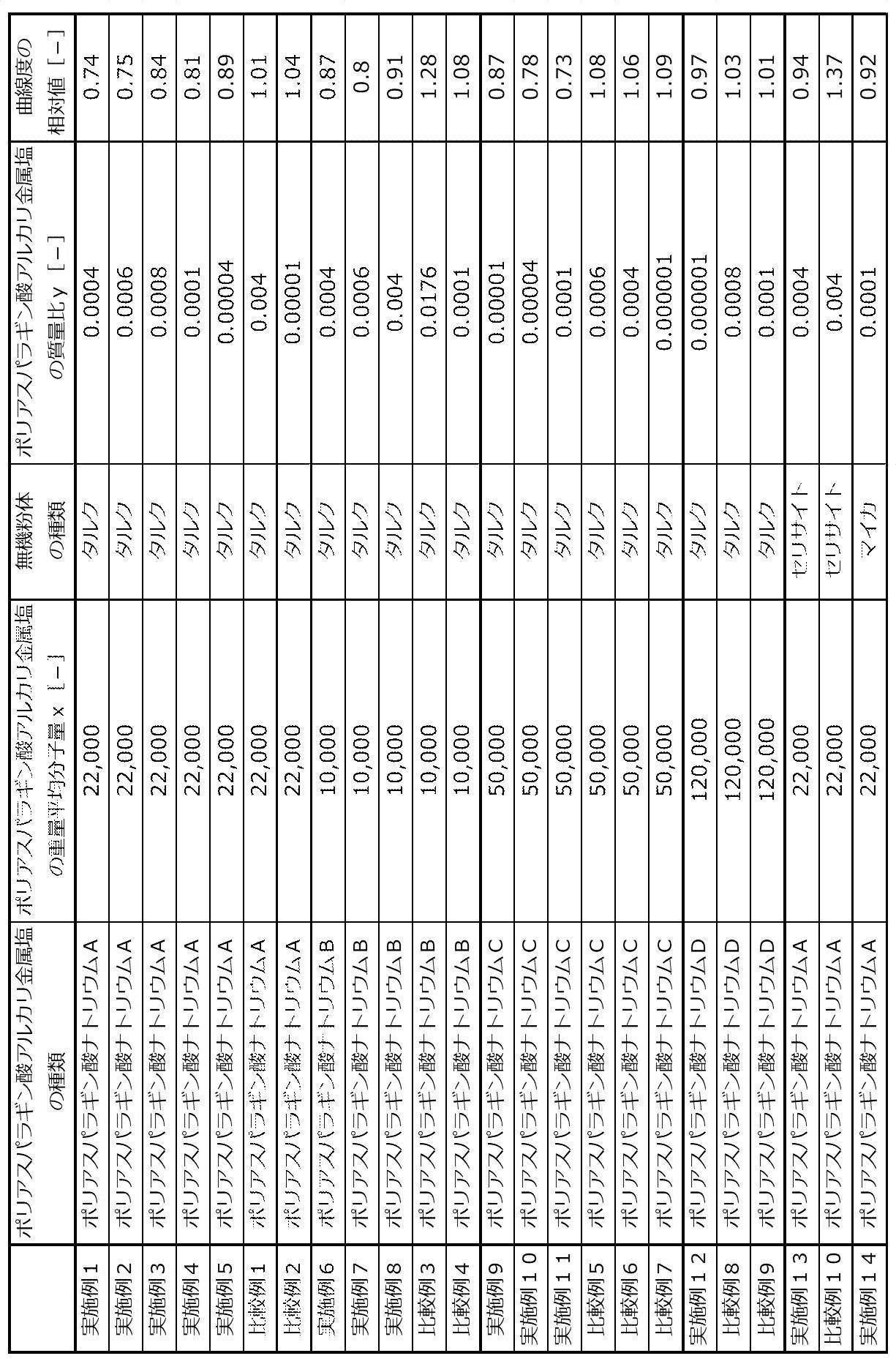
実施例1~実施例14及び比較例1~比較例10において、ポリアスパラギン酸アルカリ金属塩の重量平均分子量[-]及びポリアスパラギン酸アルカリ金属塩の質量比[-]に対する、曲線度の相対値の関係について、図2に示す。なお図2中、横軸はポリアスパラギン酸アルカリ金属塩の重量平均分子量である。重量平均分子量は相対値であり、単位を有しないため、単位を[-]で表している。図2中、縦軸はポリアスパラギン酸アルカリ金属塩の質量比(つまり、無機粉体とポリアスパラギン酸アルカリ金属塩との合計量に対する前記ポリアスパラギン酸アルカリ金属塩の質量比)である。ポリアスパラギン酸アルカリ金属塩の質量比は単位を有しないため、単位を[-]で表している。なお縦軸は対数軸で示している。図2中、黒丸は実施例であることを表し、つまり、混合粉体の曲線度の相対値が1.00より小さいことを表す。白丸は比較例であることを表す。 In Examples 1 to 14 and Comparative Examples 1 to 10, the relative value of the degree of curvature with respect to the weight average molecular weight [-] of the polyaspartic acid alkali metal salt and the mass ratio [-] of the polyaspartic acid alkali metal salt. The relationship between the above is shown in FIG. In FIG. 2, the horizontal axis is the weight average molecular weight of the alkali metal salt of polyaspartic acid. Since the weight average molecular weight is a relative value and has no unit, the unit is represented by [-]. In FIG. 2, the vertical axis is the mass ratio of the alkali metal polyaspartate (that is, the mass ratio of the alkali metal polyaspartate to the total amount of the inorganic powder and the alkali metal polyaspartate). Since the mass ratio of the alkali metal salt of polyaspartic acid does not have a unit, the unit is represented by [-]. The vertical axis is a logarithmic axis. In FIG. 2, the black circle indicates that it is an embodiment, that is, it indicates that the relative value of the curve degree of the mixed powder is smaller than 1.00. White circles indicate that they are comparative examples.
表1及び図2から、曲線度の相対値は、ポリアスパラギン酸アルカリ金属塩の重量平均分子量[-]及びポリアスパラギン酸アルカリ金属塩の質量比に依存することが確認された。 From Table 1 and FIG. 2, it was confirmed that the relative value of the degree of curve depends on the weight average molecular weight [-] of the polyaspartic acid alkali metal salt and the mass ratio of the polyaspartic acid alkali metal salt.
以上のことから、前記ポリアスパラギン酸アルカリ金属塩の重量平均分子量x、及び、前記無機粉体と前記ポリアスパラギン酸アルカリ金属塩との合計量に対する前記ポリアスパラギン酸アルカリ金属塩の質量比yに関して、前記式(1)(又は、前記式(3)若しくは式(4))及び前記式(2)(又は、前記式(5))並びに前記ポリアスパラギン酸アルカリ金属塩の重量平均分子量xは1,000~150,000(又は8,000~120,000)の範囲で囲まれた領域に含まれる実施例1~実施例14では、粉体化粧料の重ね塗り時において、肌に対して抵抗感の少ない滑らかな伸び広がりを有し、かつ化粧ヨレが生じにくい粉体化粧料を得ることができた。一方、前記範囲で囲まれた領域に含まれない比較例1~比較例10では、前記のような粉体化粧料を得ることはできなかった。 From the above, regarding the weight average molecular weight x of the polyaspartic acid alkali metal salt and the mass ratio y of the polyaspartic acid alkali metal salt to the total amount of the inorganic powder and the polyaspartic acid alkali metal salt. The weight average molecular weight x of the formula (1) (or the formula (3) or the formula (4)), the formula (2) (or the formula (5)), and the polyaspartic acid alkali metal salt is 1, In Examples 1 to 14 included in the area surrounded by the range of 000 to 150,000 (or 8,000 to 120,000), a feeling of resistance to the skin is felt when the powder cosmetics are repeatedly applied. We were able to obtain a powdered cosmetic that has a smooth spread and spread with little alcohol and is less likely to cause cosmetic twisting. On the other hand, in Comparative Examples 1 to 10 not included in the region surrounded by the range, the powder cosmetic as described above could not be obtained.
2020年9月15日に出願された日本国特許出願2020-154913号の開示は、その全体が参照により本明細書に取り込まれる。
本明細書に記載されたすべての文献、特許出願、及び技術規格は、個々の文献、特許出願、及び技術規格が参照により取り込まれることが具体的かつ個々に記された場合と同程度に、本明細書中に参照により取り込まれる。
The disclosure of Japanese Patent Application No. 2020-154913, filed September 15, 2020, is incorporated herein by reference in its entirety.
All documents, patent applications, and technical standards described herein are to the same extent as specifically and individually stated that the individual documents, patent applications, and technical standards are incorporated by reference. Incorporated by reference herein.
Claims (10)
前記無機粉体の表面の一部又は全部を被覆するポリアスパラギン酸アルカリ金属塩と、を含み、
前記ポリアスパラギン酸アルカリ金属塩の重量平均分子量xが1,000~150,000であり、
かつ、前記ポリアスパラギン酸アルカリ金属塩の重量平均分子量x、及び、前記無機粉体と前記ポリアスパラギン酸アルカリ金属塩との合計量に対する前記ポリアスパラギン酸アルカリ金属塩の質量比yが、下記式(1)及び式(2)を満たす、
粉体化粧料。
y ≦ 1.6×10⁷x-2.275 式(1)
y ≧ 1.3×10⁵x-2.232 式(2) Inorganic powder and
Containing a polyaspartic acid alkali metal salt that covers a part or all of the surface of the inorganic powder,
The weight average molecular weight x of the polyaspartic acid alkali metal salt is 1,000 to 150,000.
Moreover, the weight average molecular weight x of the polyaspartic acid alkali metal salt and the mass ratio y of the polyaspartic acid alkali metal salt to the total amount of the inorganic powder and the polyaspartic acid alkali metal salt are given by the following formula ( Satisfy 1) and equation (2),
Powder cosmetics.
y ≤ 1.6 x 10 7 x -2.275 formula (1)
y ≧ 1.3 × 10 5 × -2.232 formula (2)
y ≦ 1.0×10⁷x-2.275 式(3) The weight average molecular weight x of the polyaspartic acid alkali metal salt and the mass ratio y of the polyaspartic acid alkali metal salt to the total amount of the inorganic powder and the polyaspartic acid alkali metal salt are further expressed by the following formula (3). ), The powder cosmetic according to claim 1.
y ≤ 1.0 x 10 7 x -2.275 formula (3)
y ≦ 8.0×10⁶x-2.275 式(4) The weight average molecular weight x of the polyaspartic acid alkali metal salt and the mass ratio y of the polyaspartic acid alkali metal salt to the total amount of the inorganic powder and the polyaspartic acid alkali metal salt are further expressed by the following formula (4). ), The powder cosmetic according to claim 1.
y ≤ 8.0 x 10 6 x -2.275 formula (4)
y ≧ 1.5×10⁵x-2.232 式(5) The weight average molecular weight x of the polyaspartic acid alkali metal salt and the mass ratio y of the polyaspartic acid alkali metal salt to the total amount of the inorganic powder and the polyaspartic acid alkali metal salt are further expressed by the following formula (5). ), The powder cosmetic according to any one of claims 1 to 3.
y ≧ 1.5 × 10 5 × -2.232 formula (5)
Priority Applications (5)
| Application Number | Priority Date | Filing Date | Title |
|---|---|---|---|
| KR1020237007795A KR20230044530A (en) | 2020-09-15 | 2021-09-01 | Powder cosmetics and cosmetic compositions |
| JP2022550448A JP7387910B2 (en) | 2020-09-15 | 2021-09-01 | Powder cosmetics and cosmetic compositions |
| EP21869173.1A EP4197597A4 (en) | 2020-09-15 | 2021-09-01 | COSMETIC PRODUCT IN POWDER AND COSMETIC COMPOSITION |
| US18/043,918 US20230320944A1 (en) | 2020-09-15 | 2021-09-01 | Powder cosmetic and cosmetic composition |
| CN202180054133.5A CN116437890B (en) | 2020-09-15 | 2021-09-01 | Powder cosmetic and cosmetic composition |
Applications Claiming Priority (2)
| Application Number | Priority Date | Filing Date | Title |
|---|---|---|---|
| JP2020-154913 | 2020-09-15 | ||
| JP2020154913 | 2020-09-15 |
Publications (1)
| Publication Number | Publication Date |
|---|---|
| WO2022059486A1 true WO2022059486A1 (en) | 2022-03-24 |
Family
ID=80776003
Family Applications (1)
| Application Number | Title | Priority Date | Filing Date |
|---|---|---|---|
| PCT/JP2021/032136 Ceased WO2022059486A1 (en) | 2020-09-15 | 2021-09-01 | Powder cosmetic and cosmetic composition |
Country Status (6)
| Country | Link |
|---|---|
| US (1) | US20230320944A1 (en) |
| EP (1) | EP4197597A4 (en) |
| JP (1) | JP7387910B2 (en) |
| KR (1) | KR20230044530A (en) |
| CN (1) | CN116437890B (en) |
| WO (1) | WO2022059486A1 (en) |
Cited By (1)
| Publication number | Priority date | Publication date | Assignee | Title |
|---|---|---|---|---|
| JP2024027379A (en) * | 2022-08-17 | 2024-03-01 | 東色ピグメント株式会社 | powder cosmetics |
Citations (6)
| Publication number | Priority date | Publication date | Assignee | Title |
|---|---|---|---|---|
| JP3384420B2 (en) | 1994-08-26 | 2003-03-10 | 味の素株式会社 | Method for producing polyaspartate |
| JP2006265214A (en) | 2005-03-25 | 2006-10-05 | Kose Corp | Powder cosmetic |
| JP2007537116A (en) * | 2004-03-31 | 2007-12-20 | ビーエーエスエフ アクチェンゲゼルシャフト | Surface-modified metal oxide, process for its production and its use in cosmetic preparations |
| WO2011102293A1 (en) | 2010-02-18 | 2011-08-25 | 三井化学株式会社 | Processes for production of polyaspartic acid precursor polymer and polyaspartic acid salts |
| JP2020147525A (en) * | 2019-03-13 | 2020-09-17 | 三井化学株式会社 | A powder cosmetic containing an inorganic powder coated with sodium polyaspartate, a method for producing the same, and a cosmetic composition containing the powder cosmetic. |
| JP2020154913A (en) | 2019-03-22 | 2020-09-24 | 住友電気工業株式会社 | Object detection devices and methods, traffic support servers, computer programs and sensor devices |
Family Cites Families (3)
| Publication number | Priority date | Publication date | Assignee | Title |
|---|---|---|---|---|
| DE102004016649A1 (en) * | 2004-03-31 | 2005-10-20 | Basf Ag | Surface-modified metal oxides useful in cosmetics comprise nanoparticulate aluminum, cerium, iron, titanium, zinc or zirconium oxides coated with polyaspartic acid |
| DE102005046263A1 (en) * | 2005-09-27 | 2007-03-29 | Basf Ag | Preparation of an aqueous suspension of surface-modified nanoparticles of metallic oxides, useful e.g. as UV-absorbers, comprises mixing an aqueous solution of metal salts with an aqueous solution of polymers and heating the mixture |
| KR102311285B1 (en) * | 2015-03-13 | 2021-10-13 | (주)아모레퍼시픽 | Complex Powder of Inorganic Powder Coated with Pressure Sensitive Adhesive Polymer, Cosmetic Composition Comprising Thereof and the Manufacturing Method Thereof |
-
2021
- 2021-09-01 CN CN202180054133.5A patent/CN116437890B/en active Active
- 2021-09-01 WO PCT/JP2021/032136 patent/WO2022059486A1/en not_active Ceased
- 2021-09-01 EP EP21869173.1A patent/EP4197597A4/en not_active Withdrawn
- 2021-09-01 KR KR1020237007795A patent/KR20230044530A/en not_active Ceased
- 2021-09-01 US US18/043,918 patent/US20230320944A1/en not_active Abandoned
- 2021-09-01 JP JP2022550448A patent/JP7387910B2/en active Active
Patent Citations (6)
| Publication number | Priority date | Publication date | Assignee | Title |
|---|---|---|---|---|
| JP3384420B2 (en) | 1994-08-26 | 2003-03-10 | 味の素株式会社 | Method for producing polyaspartate |
| JP2007537116A (en) * | 2004-03-31 | 2007-12-20 | ビーエーエスエフ アクチェンゲゼルシャフト | Surface-modified metal oxide, process for its production and its use in cosmetic preparations |
| JP2006265214A (en) | 2005-03-25 | 2006-10-05 | Kose Corp | Powder cosmetic |
| WO2011102293A1 (en) | 2010-02-18 | 2011-08-25 | 三井化学株式会社 | Processes for production of polyaspartic acid precursor polymer and polyaspartic acid salts |
| JP2020147525A (en) * | 2019-03-13 | 2020-09-17 | 三井化学株式会社 | A powder cosmetic containing an inorganic powder coated with sodium polyaspartate, a method for producing the same, and a cosmetic composition containing the powder cosmetic. |
| JP2020154913A (en) | 2019-03-22 | 2020-09-24 | 住友電気工業株式会社 | Object detection devices and methods, traffic support servers, computer programs and sensor devices |
Non-Patent Citations (1)
| Title |
|---|
| See also references of EP4197597A4 |
Cited By (1)
| Publication number | Priority date | Publication date | Assignee | Title |
|---|---|---|---|---|
| JP2024027379A (en) * | 2022-08-17 | 2024-03-01 | 東色ピグメント株式会社 | powder cosmetics |
Also Published As
| Publication number | Publication date |
|---|---|
| KR20230044530A (en) | 2023-04-04 |
| EP4197597A4 (en) | 2024-11-13 |
| JP7387910B2 (en) | 2023-11-28 |
| US20230320944A1 (en) | 2023-10-12 |
| JPWO2022059486A1 (en) | 2022-03-24 |
| EP4197597A1 (en) | 2023-06-21 |
| CN116437890B (en) | 2025-12-23 |
| CN116437890A (en) | 2023-07-14 |
Similar Documents
| Publication | Publication Date | Title |
|---|---|---|
| KR101555345B1 (en) | Granulated silica particle composite powder their production methods and cosmetic preparation containing them | |
| JP5790673B2 (en) | Powder comprising inorganic compound-supported polyamide porous particles | |
| US20120034281A1 (en) | Solid Powder Cosmetic And Method For Producing The Same | |
| CN107205909A (en) | Composite particles and their preparation | |
| CN115515551B (en) | Powder material for cosmetics, method for producing powder material for cosmetics, and cosmetic | |
| US20210022970A1 (en) | Dispersion with a dispersed fatty phase having a high pigment content | |
| JP2007507550A (en) | Soft focus cosmetic composition containing fumed alumina | |
| JP7356703B2 (en) | solid powder cosmetics | |
| WO2022059486A1 (en) | Powder cosmetic and cosmetic composition | |
| JP7248206B2 (en) | Powder cosmetic containing inorganic powder coated with sodium polyaspartate, method for producing the same, and cosmetic composition containing the powder cosmetic | |
| WO2023094468A1 (en) | Shell-free macroscopic dispersion with pigmented fatty phase | |
| JP2005298385A (en) | Cosmetic composition containing surface-modified pearlescent pigment | |
| KR100941025B1 (en) | Manufacturing method of composite powder for cosmetics | |
| WO2018084176A1 (en) | Solid powder cosmetic | |
| US20170151134A1 (en) | Oil-Enclosed Powdery Composition and Production Method of the Same | |
| JP5584005B2 (en) | Iron oxide / organopolysiloxane hybrid powder, method for producing the same, and cosmetics containing the same | |
| JPH09183617A (en) | Porous calcium carbonate-based compound and cosmetic composition containing the same | |
| JP7139117B2 (en) | oily cosmetic composition | |
| EP3470050A1 (en) | Use of calcined kaolin as a mattifying agent | |
| JP7842693B2 (en) | Powder manufacturing method | |
| JP2011213670A (en) | Water-based solid cosmetic | |
| JP2016216422A (en) | Cosmetic | |
| TW202440743A (en) | Composite particles, composite particle manufacturing method and cosmetic | |
| HK40064271B (en) | Powder-containing cosmetic | |
| JP2003246708A (en) | Solid powder cosmetics |
Legal Events
| Date | Code | Title | Description |
|---|---|---|---|
| 121 | Ep: the epo has been informed by wipo that ep was designated in this application |
Ref document number: 21869173 Country of ref document: EP Kind code of ref document: A1 |
|
| ENP | Entry into the national phase |
Ref document number: 2022550448 Country of ref document: JP Kind code of ref document: A |
|
| ENP | Entry into the national phase |
Ref document number: 20237007795 Country of ref document: KR Kind code of ref document: A |
|
| WWE | Wipo information: entry into national phase |
Ref document number: 202317015709 Country of ref document: IN |
|
| ENP | Entry into the national phase |
Ref document number: 2021869173 Country of ref document: EP Effective date: 20230313 |
|
| NENP | Non-entry into the national phase |
Ref country code: DE |
|
| WWW | Wipo information: withdrawn in national office |
Ref document number: 2021869173 Country of ref document: EP |
|
| WWR | Wipo information: refused in national office |
Ref document number: 1020237007795 Country of ref document: KR |