WO2021046008A1 - Aromatic dicarbinols - Google Patents
Aromatic dicarbinols Download PDFInfo
- Publication number
- WO2021046008A1 WO2021046008A1 PCT/US2020/048862 US2020048862W WO2021046008A1 WO 2021046008 A1 WO2021046008 A1 WO 2021046008A1 US 2020048862 W US2020048862 W US 2020048862W WO 2021046008 A1 WO2021046008 A1 WO 2021046008A1
- Authority
- WO
- WIPO (PCT)
- Prior art keywords
- aromatic
- integer
- phenylene
- bis
- found
- Prior art date
- Legal status (The legal status is an assumption and is not a legal conclusion. Google has not performed a legal analysis and makes no representation as to the accuracy of the status listed.)
- Ceased
Links
- FKBINBJJSGOMRL-UHFFFAOYSA-N CC(COC)OCC(C)OCC(C)(c1cc(C(C)(COC(C)COC(C)COC)[O](C)=C)ccc1)OC Chemical compound CC(COC)OCC(C)OCC(C)(c1cc(C(C)(COC(C)COC(C)COC)[O](C)=C)ccc1)OC FKBINBJJSGOMRL-UHFFFAOYSA-N 0.000 description 1
- UREMWELOADXCRJ-UHFFFAOYSA-N CC1(c2cccc(C3(C)OC3)c2)OC1 Chemical compound CC1(c2cccc(C3(C)OC3)c2)OC1 UREMWELOADXCRJ-UHFFFAOYSA-N 0.000 description 1
- 0 CCC(C)(C)c1ccc(C2(C)*C2)cc1 Chemical compound CCC(C)(C)c1ccc(C2(C)*C2)cc1 0.000 description 1
Classifications
-
- C—CHEMISTRY; METALLURGY
- C09—DYES; PAINTS; POLISHES; NATURAL RESINS; ADHESIVES; COMPOSITIONS NOT OTHERWISE PROVIDED FOR; APPLICATIONS OF MATERIALS NOT OTHERWISE PROVIDED FOR
- C09D—COATING COMPOSITIONS, e.g. PAINTS, VARNISHES OR LACQUERS; FILLING PASTES; CHEMICAL PAINT OR INK REMOVERS; INKS; CORRECTING FLUIDS; WOODSTAINS; PASTES OR SOLIDS FOR COLOURING OR PRINTING; USE OF MATERIALS THEREFOR
- C09D5/00—Coating compositions, e.g. paints, varnishes or lacquers, characterised by their physical nature or the effects produced; Filling pastes
- C09D5/02—Emulsion paints including aerosols
- C09D5/024—Emulsion paints including aerosols characterised by the additives
-
- C—CHEMISTRY; METALLURGY
- C07—ORGANIC CHEMISTRY
- C07C—ACYCLIC OR CARBOCYCLIC COMPOUNDS
- C07C43/00—Ethers; Compounds having groups, groups or groups
- C07C43/02—Ethers
- C07C43/03—Ethers having all ether-oxygen atoms bound to acyclic carbon atoms
- C07C43/14—Unsaturated ethers
- C07C43/178—Unsaturated ethers containing hydroxy or O-metal groups
- C07C43/1785—Unsaturated ethers containing hydroxy or O-metal groups having more than one ether bound
-
- C—CHEMISTRY; METALLURGY
- C07—ORGANIC CHEMISTRY
- C07C—ACYCLIC OR CARBOCYCLIC COMPOUNDS
- C07C41/00—Preparation of ethers; Preparation of compounds having groups, groups or groups
- C07C41/01—Preparation of ethers
- C07C41/02—Preparation of ethers from oxiranes
- C07C41/03—Preparation of ethers from oxiranes by reaction of oxirane rings with hydroxy groups
-
- C—CHEMISTRY; METALLURGY
- C09—DYES; PAINTS; POLISHES; NATURAL RESINS; ADHESIVES; COMPOSITIONS NOT OTHERWISE PROVIDED FOR; APPLICATIONS OF MATERIALS NOT OTHERWISE PROVIDED FOR
- C09D—COATING COMPOSITIONS, e.g. PAINTS, VARNISHES OR LACQUERS; FILLING PASTES; CHEMICAL PAINT OR INK REMOVERS; INKS; CORRECTING FLUIDS; WOODSTAINS; PASTES OR SOLIDS FOR COLOURING OR PRINTING; USE OF MATERIALS THEREFOR
- C09D7/00—Features of coating compositions, not provided for in group C09D5/00; Processes for incorporating ingredients in coating compositions
- C09D7/20—Diluents or solvents
-
- C—CHEMISTRY; METALLURGY
- C09—DYES; PAINTS; POLISHES; NATURAL RESINS; ADHESIVES; COMPOSITIONS NOT OTHERWISE PROVIDED FOR; APPLICATIONS OF MATERIALS NOT OTHERWISE PROVIDED FOR
- C09D—COATING COMPOSITIONS, e.g. PAINTS, VARNISHES OR LACQUERS; FILLING PASTES; CHEMICAL PAINT OR INK REMOVERS; INKS; CORRECTING FLUIDS; WOODSTAINS; PASTES OR SOLIDS FOR COLOURING OR PRINTING; USE OF MATERIALS THEREFOR
- C09D7/00—Features of coating compositions, not provided for in group C09D5/00; Processes for incorporating ingredients in coating compositions
- C09D7/40—Additives
- C09D7/60—Additives non-macromolecular
- C09D7/63—Additives non-macromolecular organic
-
- C—CHEMISTRY; METALLURGY
- C09—DYES; PAINTS; POLISHES; NATURAL RESINS; ADHESIVES; COMPOSITIONS NOT OTHERWISE PROVIDED FOR; APPLICATIONS OF MATERIALS NOT OTHERWISE PROVIDED FOR
- C09D—COATING COMPOSITIONS, e.g. PAINTS, VARNISHES OR LACQUERS; FILLING PASTES; CHEMICAL PAINT OR INK REMOVERS; INKS; CORRECTING FLUIDS; WOODSTAINS; PASTES OR SOLIDS FOR COLOURING OR PRINTING; USE OF MATERIALS THEREFOR
- C09D7/00—Features of coating compositions, not provided for in group C09D5/00; Processes for incorporating ingredients in coating compositions
- C09D7/40—Additives
- C09D7/65—Additives macromolecular
-
- C—CHEMISTRY; METALLURGY
- C08—ORGANIC MACROMOLECULAR COMPOUNDS; THEIR PREPARATION OR CHEMICAL WORKING-UP; COMPOSITIONS BASED THEREON
- C08K—Use of inorganic or non-macromolecular organic substances as compounding ingredients
- C08K5/00—Use of organic ingredients
- C08K5/04—Oxygen-containing compounds
- C08K5/06—Ethers; Acetals; Ketals; Ortho-esters
Definitions
- This application relates to chemistry generally.
- this application relates dicarbinols and more particularly to aromatic dicarbinols.
- Dicarbinols are useful in a variety of chemical applications such as plasticizers, diluents, wetting agents and paint additives and as intermediates in chemical processes. Diluents, wetting agents and paint additives often are volatile and evaporate into the atmosphere during use.
- coalescing aids that are added to water-based paints, act as temporary plasticizers in latex emulsions. The coalescing aids lower the glass transition temperature (Tg) of the latex polymer and as the paint dries, the polymers that have been softened by the coalescing aid are allowed to flow together and form a film after the water has left the system. Coalescing aids that are volatile evaporate out of the film. This allows the polymer to return to the original Tg thereby giving harder films for better block and print resistant coatings.
- A is (Cs-2o) aryl
- R 1a and R 1b are independently each R 4 is independently (Ci-i2)alkyl, or -C(0)R 5 ; each R 5 is (Ci-i2)alkyl unsubstituted or substituted by R 6 , (C2-i2)alkenyl unsubstituted or substituted by R 6 , (C3-s)cycloalkyl, or 5- to 9- membered aryl; each R 6 is (Ci-4)alkoxy, or oxo; and each n is independently an integer from 1 to 15.
- Alkyl means an aliphatic hydrocarbon.
- the alkyl can specify the number of carbon atoms, for example (Ci-s)alkyl.
- the alkyl group can be unbranched or branched. In some embodiments, the alkyl group is branched. In some embodiments, the alkyl group is unbranched.
- alkanes include methane, ethane, propane, isopropyl (i.e., branched propyl), butyl, and the like.
- alkenyl means an aliphatic hydrocarbon with one or more unsaturated carbon-carbon bonds.
- the alkenyl can specify the number of carbon atoms, for example (C2-i2)alkenyl.
- the alkyl group can be unbranched or branched. In some embodiments, the alkyl group is branched. In some embodiments, the alkyl group is unbranched.
- alkanes include ethenyl, propenyl, butenyl, hexa-3,5- dienyl, and the like.
- Alcohol means a chemical containing one or more hydroxyl groups.
- Aldehyde means a chemical containing one or more -C(0)H groups.
- Cycloalkyl means a cyclic hydrocarbon compound.
- the cycloalkyl can specify the number of carbon atoms in ring system, for example (C3- 8)cycloalkyl.
- Non-limiting examples of cycloalkyl include cyclopropyl, cyclobutyl, cyclohexyl, and cyclooctyl.
- Aryl means a ring system made up carbon atoms that has at least one ring that is aromatic.
- the carbon units making up the aryl ring may be specified, for example 5- to 9-membered aryl.
- Non-limiting examples of aryl include phenyl, naphthyl, 2,3-dihydro-1 H-indene, and 1 , 2,3,4- tetrahydronaphthalene.
- Values may be expressed as “about” or “approximately” a given number.
- ranges may be expressed herein as from “about” one particular value and/or to “about” or another particular value. When such a range is expressed, another aspect includes from the one particular value and/or to the other particular value.
- values are expressed as approximations, by use of the antecedent “about,” it will be understood that the particular value forms another aspect.
- the term “and/or,” when used in a list of two or more items, means that any one of the listed items can be employed by itself or any combination of two or more of the listed items can be employed. For example, if a composition is described as containing components A, B, and/or C, the composition can contain A alone; B alone; C alone; A and B in combination; A and C in combination, B and C in combination; or A, B, and C in combination.
- the terms “comprising,” “comprises,” and “comprise” are open-ended transition terms used to transition from a subject recited before the term to one or more elements recited after the term, where the element or elements listed after the transition term are not necessarily the only elements that make up the subject.
- Y is chosen from A, B, and C means Y can be individually A, B, or C.
- Y is chosen from A, B, or C means Y can be individually A, B, or C,; or a combination of A and B, A and C, B and C, or A, B, and C.
- the invention is a compound according to Formula I: wherein: A is (C8-20) aryl;
- R 1a and R 1b are independently each R 4 is independently (Ci-i2)alkyl, or -C(0)R 5 ; each R 5 is (Ci-i2)alkyl unsubstituted or substituted by R 6 , (C2-i2)alkenyl unsubstituted or substituted by R 6 , (C3-8)cycloalkyl, or 5- to 9- membered aryl; each R 6 is (Ci-4)alkoxy, or oxo; and each n is independently an integer from 1 to 15.
- A is 1 ,2-, 1 ,3-, or 1 ,4-disubstituted phenyl.
- each n is an integer from 1 to 3.
- each R 4 is hydrogen. In some embodiments, each R 4 is (Ci-i2)alkyl. In some embodiments, each R 4 is independently ethyl. In some embodiments, each R 4 is (C2-i2)alkenyl. In some embodiments, each R 4 is -C(0)R 5 .
- each R 5 is (Ci-i2)alkyl unsubstituted or substituted by R 6 . In some embodiments, each R 5 is (Ci-i2)alkenyl unsubstituted or substituted by R 6 . In some embodiments, each R 5 is (C3- 8)cycloalkyl. In some embodiments, each R 5 is 5- to 9-membered aryl.
- each n is an integer from 1 to 2. In some embodiments, each n is an integer from 1 to 3. In some embodiments, each n is an integer from 1 to 4. In some embodiments, each n is an integer from 1 to 5. In some embodiments, n is an integer from 1 to 6. In some embodiments, n is an integer from 1 to 7. In some embodiments, n is an integer from 1 to 8. In some embodiments, n is an integer from 1 to 9. In some embodiments, n is an integer from 1 to 10. In some embodiments, n is an integer from 1 to 11 . In some embodiments, n is an integer from 1 to 12. In some embodiments, n is an integer from 1 to 13. In some embodiments, n is an integer from 1 to 14.
- n is an integer from 1 to 15.
- the compounds of Formulas I have a volatile organic content of less than 50 wt% according to ASTM D6886. In some embodiments, the volatile organic content is less than 30 wt %. In some embodiments, the volatile organic content is less than 10 wt %. In some embodiments, the volatile organic content is less than 5 wt %. In some embodiments, the volatile organic content is less than 3 wt %. In some embodiments, the volatile organic content is less than 2 wt %. In some embodiments, the volatile organic content is less than 1 wt %. In some embodiments, the volatile organic content is less than 0.8 wt %.
- aromatic dicarbinol compounds that have particular utility as reactants in processes for the synthesis of aromatic enol ether compounds.
- the composition comprises the dicarbinol compounds represented by Formulas I.
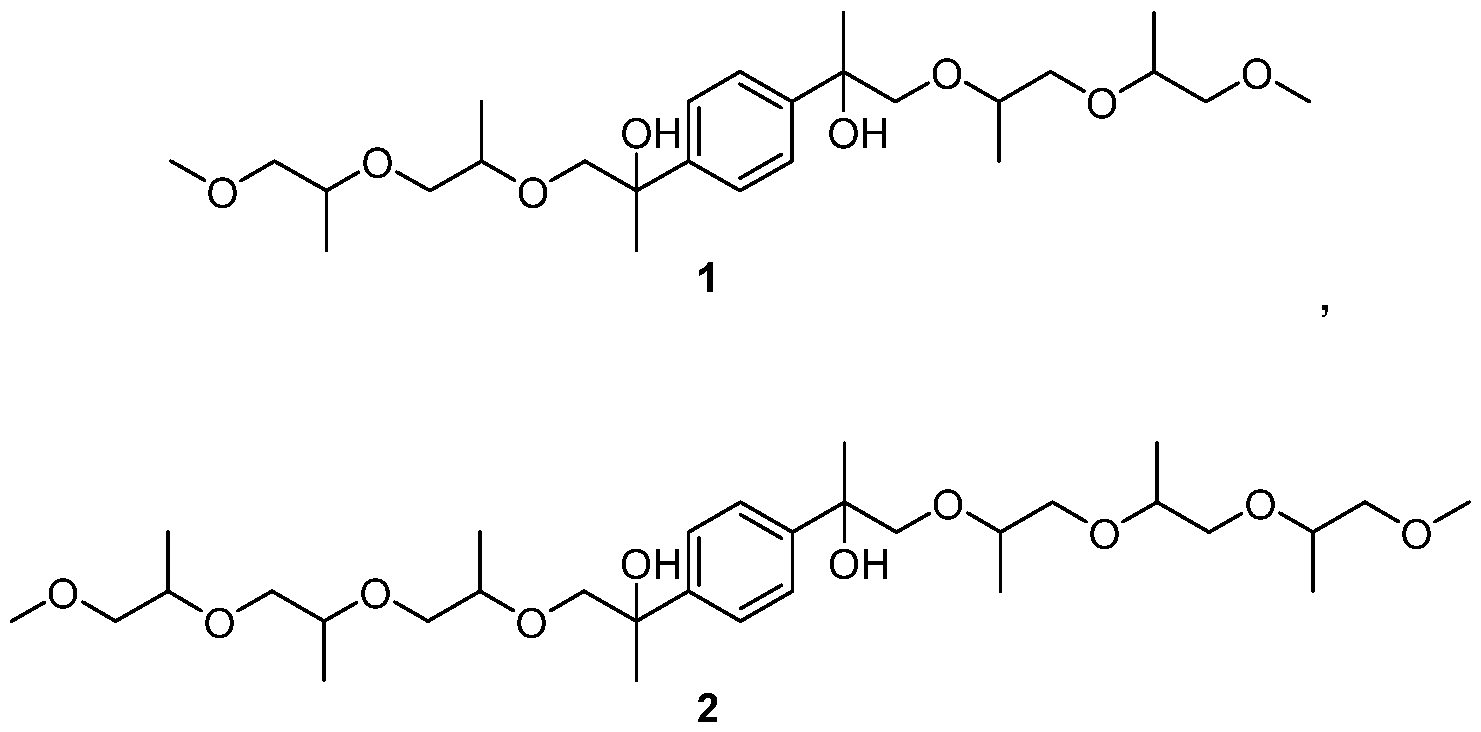
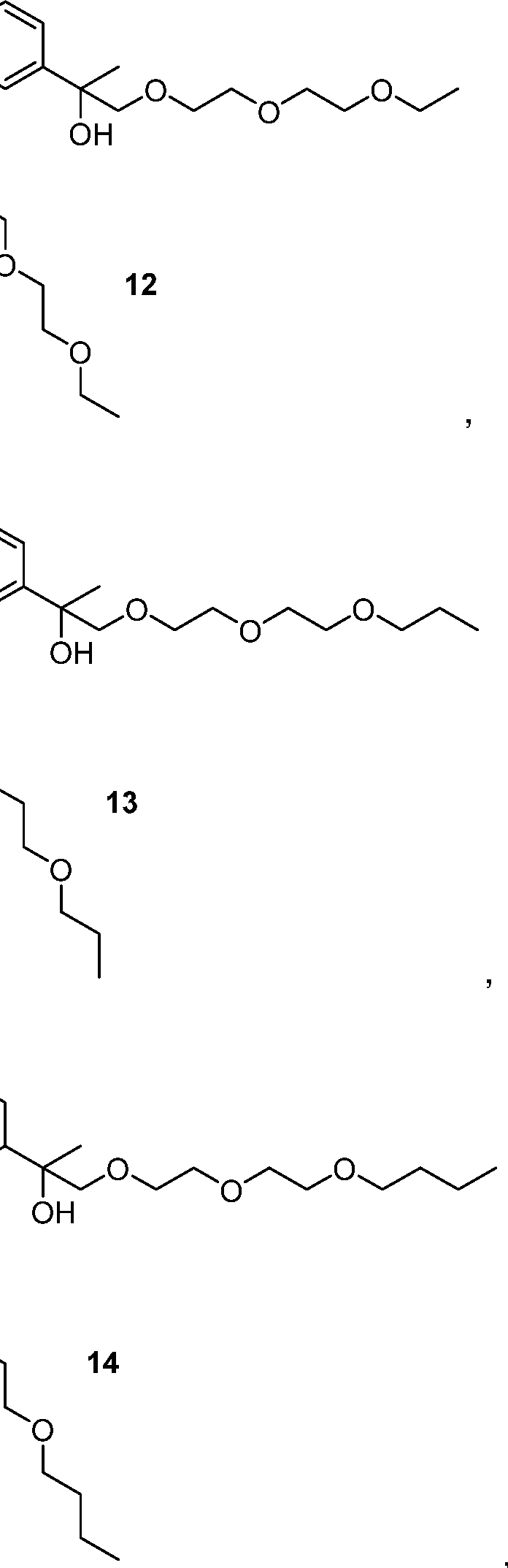
- the compounds of Formula I are aromatic dicarbinols represented by Formulas 1- 16:
- aromatic dicarbinol compounds depicted by Formulas 1 -16 are representative of the aromatic dicarbinol compounds claimed herein. Isomers of the aromatic dicarbinol compounds depicted by Formulas 1 -16 are expected to be produced during synthesis of the aromatic dicarbinol compounds depicted by Formulas 1 -16. All isomers of the aromatic dicarbinol compounds depicted by Formulas 1 -16 and are within the scope of the claims set forth herein.
- the aromatic dicarbinol compounds of the of the present invention include those having a weight percent volatile content of less than 50%, as measured according to ASTM Method D6886. This test may be conducted generally by heating the sample in a forced air oven at 110°C. for 60 minutes.
- the weight loss after the test is deemed to result from a loss of volatiles originally present in the sample; the percent volatile present in the original sample may then be calculated.
- the cited test can be conducted on coating compositions containing other components such as latex polymers, the values cited herein may be obtained from a sample of the additive itself.
- the weight percent volatile of a film-hardening aid may be used herein as a yardstick to measure the amount of VOC the additive would contribute to the VOC in a particular end use such as a component of a coating composition.
- mL is milliliter; wt % is weight percent; eq is equivalent(s); hrs or h is hour(s); mm is millimeter; m is meter; GC is gas chromatography; °C is degree Celsius; min is minute; tR is retention time; VOC is volatile organic compound; MeP is methyl palmitate; w/v is weight/volume; pL is microliter.
- RFHA reactive film-hardening additive.
- Mass spectra were acquired with a Micromass LCT mass spectromenter, which was coupled to the LC. Mass spectra were collected using electrospray ionization in both the positive-ion and negative ion modes. Ammonium acetate (50 mM in MeOH) was added post column (0.1 mL/min) to enhance ionization efficiency. ES+/ES- scane range was 60-3300 amu (25 and 75V).
Landscapes
- Chemical & Material Sciences (AREA)
- Organic Chemistry (AREA)
- Life Sciences & Earth Sciences (AREA)
- Engineering & Computer Science (AREA)
- Materials Engineering (AREA)
- Wood Science & Technology (AREA)
- Chemical Kinetics & Catalysis (AREA)
- Dispersion Chemistry (AREA)
- Organic Low-Molecular-Weight Compounds And Preparation Thereof (AREA)
Abstract
Disclosed are aromatic dicarbinol compounds that may have utility in a variety of chemical applications such as plasticizers, diluents, wetting agents and paint additives and as intermediates in chemical processes. The aromatic dicarbinols have particular utility as reactants in processes for the synthesis of aromatic enol ether compounds.
Description
AROMATIC DICARBINOLS
FIELD OF THE INVENTION
[0001] This application relates to chemistry generally. In particular, this application relates dicarbinols and more particularly to aromatic dicarbinols.
BACKGROUND OF THE INVENTION
[0002] Dicarbinols are useful in a variety of chemical applications such as plasticizers, diluents, wetting agents and paint additives and as intermediates in chemical processes. Diluents, wetting agents and paint additives often are volatile and evaporate into the atmosphere during use. For example, coalescing aids that are added to water-based paints, act as temporary plasticizers in latex emulsions. The coalescing aids lower the glass transition temperature (Tg) of the latex polymer and as the paint dries, the polymers that have been softened by the coalescing aid are allowed to flow together and form a film after the water has left the system. Coalescing aids that are volatile evaporate out of the film. This allows the polymer to return to the original Tg thereby giving harder films for better block and print resistant coatings.
[0003] Due to environmental concerns, the use of volatile materials such as paint additives, plasticizers, diluents, wetting agents and coalescing aids are increasing undesirable. There is a need for materials that can be used as paint additives, plasticizers, diluents, wetting agents and coalescing aids that exhibit low volatility. There is also a need for materials that can be used to make paint additives, plasticizers, diluents, wetting agents and coalescing aids that have low volatility.
SUMMARY OF THE INVENTION [0004] The Invention is set forth in the appended claims.
[0005] The present relates to an aromatic dicarbinol compound according
to Formula I:

I wherein: A is (Cs-2o) aryl;
R1a and R1b are independently
 each R4 is independently (Ci-i2)alkyl, or -C(0)R5; each R5 is (Ci-i2)alkyl unsubstituted or substituted by R6, (C2-i2)alkenyl unsubstituted or substituted by R6, (C3-s)cycloalkyl, or 5- to 9- membered aryl; each R6 is (Ci-4)alkoxy, or oxo; and each n is independently an integer from 1 to 15.
DETAILED DESCRIPTION
Definitions:
[0006] In this specification and in the claims that follow, reference will be made to a number of terms, which shall be defined to have the following meanings.
[0007] “Alkyl” means an aliphatic hydrocarbon. The alkyl can specify the number of carbon atoms, for example (Ci-s)alkyl. Unless otherwise specified, the alkyl group can be unbranched or branched. In some embodiments, the alkyl group is branched. In some embodiments, the alkyl group is unbranched. Non-limiting examples of alkanes include methane, ethane,
propane, isopropyl (i.e., branched propyl), butyl, and the like.
[0008] “Alkenyl” means an aliphatic hydrocarbon with one or more unsaturated carbon-carbon bonds. The alkenyl can specify the number of carbon atoms, for example (C2-i2)alkenyl. Unless otherwise specified, the alkyl group can be unbranched or branched. In some embodiments, the alkyl group is branched. In some embodiments, the alkyl group is unbranched. Non-limiting examples of alkanes include ethenyl, propenyl, butenyl, hexa-3,5- dienyl, and the like.
[0009] “Alcohol” means a chemical containing one or more hydroxyl groups.
[0010] “Aldehyde” means a chemical containing one or more -C(0)H groups.
[0011] “Cycloalkyl” means a cyclic hydrocarbon compound. The cycloalkyl can specify the number of carbon atoms in ring system, for example (C3- 8)cycloalkyl. Non-limiting examples of cycloalkyl include cyclopropyl, cyclobutyl, cyclohexyl, and cyclooctyl.
[0012] “Aryl” means a ring system made up carbon atoms that has at least one ring that is aromatic. The carbon units making up the aryl ring may be specified, for example 5- to 9-membered aryl. Non-limiting examples of aryl include phenyl, naphthyl, 2,3-dihydro-1 H-indene, and 1 , 2,3,4- tetrahydronaphthalene.
[0013] Values may be expressed as “about” or “approximately” a given number. Similarly, ranges may be expressed herein as from “about” one particular value and/or to “about” or another particular value. When such a range is expressed, another aspect includes from the one particular value and/or to the other particular value. Similarly, when values are expressed as approximations, by use of the antecedent “about,” it will be understood that the particular value forms another aspect.
[0014] As used herein, the terms “a,” “an,” and “the” mean one or more.
[0015] As used herein, the term “and/or,” when used in a list of two or more items, means that any one of the listed items can be employed by itself
or any combination of two or more of the listed items can be employed. For example, if a composition is described as containing components A, B, and/or C, the composition can contain A alone; B alone; C alone; A and B in combination; A and C in combination, B and C in combination; or A, B, and C in combination.
[0016] As used herein, the terms “comprising,” “comprises,” and “comprise” are open-ended transition terms used to transition from a subject recited before the term to one or more elements recited after the term, where the element or elements listed after the transition term are not necessarily the only elements that make up the subject.
[0017] As used herein, the terms “having,” “has,” and “have” have the same open-ended meaning as “comprising,” “comprises,” and “comprise” provided above.
[0018] As used herein, the terms “including,” “includes,” and “include” have the same open-ended meaning as “comprising,” “comprises,” and “comprise” provided above.
[0019] “Chosen from” as used herein can be used with “or” or “and.” For example, Y is chosen from A, B, and C means Y can be individually A, B, or C. Alternatively, Y is chosen from A, B, or C means Y can be individually A, B, or C,; or a combination of A and B, A and C, B and C, or A, B, and C.
[0020] Presented herein are compounds which can be used to make enol ethers which have can be used as diluents, wetting agents, coalescing aids and paint additives.
[0021] In some embodiments the invention is a compound according to Formula I:
 wherein: A is (C8-20) aryl;
R1a and R1b are independently
 each R4 is independently (Ci-i2)alkyl, or -C(0)R5; each R5 is (Ci-i2)alkyl unsubstituted or substituted by R6, (C2-i2)alkenyl unsubstituted or substituted by R6, (C3-8)cycloalkyl, or 5- to 9- membered aryl; each R6 is (Ci-4)alkoxy, or oxo; and each n is independently an integer from 1 to 15.
[0022] In some embodiments, A is 1 ,2-, 1 ,3-, or 1 ,4-disubstituted phenyl. In some embodiments, each n is an integer from 1 to 3.
[0023] In some embodiments each R4 is hydrogen. In some embodiments, each R4 is (Ci-i2)alkyl. In some embodiments, each R4 is independently ethyl. In some embodiments, each R4 is (C2-i2)alkenyl. In some embodiments, each R4 is -C(0)R5.
[0024] In some embodiments of, each R5 is (Ci-i2)alkyl unsubstituted or substituted by R6. In some embodiments, each R5 is (Ci-i2)alkenyl unsubstituted or substituted by R6. In some embodiments, each R5 is (C3- 8)cycloalkyl. In some embodiments, each R5 is 5- to 9-membered aryl.
[0025] In some embodiments each n is an integer from 1 to 2. In some embodiments, each n is an integer from 1 to 3. In some embodiments, each n is an integer from 1 to 4. In some embodiments, each n is an integer from 1 to 5. In some embodiments, n is an integer from 1 to 6. In some embodiments, n is an integer from 1 to 7. In some embodiments, n is an integer from 1 to 8. In some embodiments, n is an integer from 1 to 9. In some embodiments, n is an integer from 1 to 10. In some embodiments, n is an integer from 1 to 11 . In some embodiments, n is an integer from 1 to 12.
In some embodiments, n is an integer from 1 to 13. In some embodiments, n is an integer from 1 to 14. In some embodiments, n is an integer from 1 to 15. [0026] In some embodiments, the compounds of Formulas I have a volatile organic content of less than 50 wt% according to ASTM D6886. In some embodiments, the volatile organic content is less than 30 wt %. In some embodiments, the volatile organic content is less than 10 wt %. In some embodiments, the volatile organic content is less than 5 wt %. In some embodiments, the volatile organic content is less than 3 wt %. In some embodiments, the volatile organic content is less than 2 wt %. In some embodiments, the volatile organic content is less than 1 wt %. In some embodiments, the volatile organic content is less than 0.8 wt %.
Compositions
[0027] Disclosed are aromatic dicarbinol compounds that have particular utility as reactants in processes for the synthesis of aromatic enol ether compounds.
[0028] In some embodiments, the composition comprises the dicarbinol compounds represented by Formulas I. In some embodiments, the compounds of Formula I are aromatic dicarbinols represented by Formulas 1- 16:

10



[0030] The aromatic dicarbinol compounds of the of the present invention include those having a weight percent volatile content of less than 50%, as measured according to ASTM Method D6886. This test may be conducted generally by heating the sample in a forced air oven at 110°C. for 60 minutes.
The weight loss after the test is deemed to result from a loss of volatiles originally present in the sample; the percent volatile present in the original
sample may then be calculated. Although the cited test can be conducted on coating compositions containing other components such as latex polymers, the values cited herein may be obtained from a sample of the additive itself. Thus, the weight percent volatile of a film-hardening aid may be used herein as a yardstick to measure the amount of VOC the additive would contribute to the VOC in a particular end use such as a component of a coating composition.
EXAMPLES
[0031] This invention can be further illustrated by the following examples thereof, although it will be understood that these examples are included merely for purposes of illustration and are not intended to limit the scope of the invention unless otherwise specifically indicated.
Abbreviations:
[0032] mL is milliliter; wt % is weight percent; eq is equivalent(s); hrs or h is hour(s); mm is millimeter; m is meter; GC is gas chromatography; °C is degree Celsius; min is minute; tR is retention time; VOC is volatile organic compound; MeP is methyl palmitate; w/v is weight/volume; pL is microliter. RFHA is reactive film-hardening additive.
General procedure for epoxide opening
[0033] To a 4-necked round-bottom flask fitted with thermocouple, nitrogen inlet, and overhead stirrer was added glycol ether (5 equiv.). Then the di epoxide was added all at once. The mixture was heated to an internal temperature of 50 oC (note: the 1 ,4-di-epoxide is a solid that requires some additional time for dissolution; the 1 ,3-di-epoxide is a liquid at room temperature). The KOH (90%, flakes, 2 equiv.) was added portion-wise such that the internal temperature did not exceed 70 oC (usually over the course of 1 to 1.5 hrs). Once the addition of base was complete, the reaction was monitored by 1 H NMR (aliquot was dissolved in DMSO-d6). After the di-
epoxide was completely consumed, the mixture was cooled to room temperature. The mixture was then poured into ice water. Toluene was added to the mixture and then acetic acid (2.05 equiv. was added). The mixture was transferred to a separatory funnel. After layer separation, the aqueous layer was back-extracted with ethyl acetate. The organics were combined and dried with MgS04, while stirring with activated carbon. The mixture was filtered, and the volatiles were removed using a rotary evaporator. Kugelrohr distillation was used to remove excess glycol ether, if needed.
Example 1 : Preparation of 2,2'-(1,4-phenylene)bis(1-((1-((1- methoxypropan-2-yl)oxy)propan-2-yl)oxy)propan-2-ol) [1 ]

LC-MS tR : 6.46 min (Exact mass: 486.32 m/z, found: 486.3 m/z).
Example 2: Preparation of 13,13'-(1,4-phenylene)bis(4,7,10-trimethyl- 2,5,8, 11 -tetraoxatetradecan-13-ol) [2]

LC-MS tR : 7.54 min (Exact mass: 602.40 m/z, found: 602.4 m/z).
Example 3: Preparation of 2,2’-(1,4-phenylene)bis(1-(2-(2- methoxyethoxy)ethoxy)propan-2-ol) [3]

LC-MS tR : 4.44 min (Exact mass: 430.26 m/z, found: 430.3 m/z).
Example 4: Preparation of 2,2’-(1,4-phenylene)bis(1-(2-(2- ethoxyethoxy)ethoxy)propan-2-ol) [4]

LC-MS tR : 5.32 min (Exact mass: 458.29 m/z, found: 458.3 m/z).
Example 5: Preparation of 2,2'-(1,4-phenylene)bis(1-(2-(2- propoxyethoxy)ethoxy)propan-2-ol) [5]

LC-MS tR : 6.46 min (Exact mass: 486.32 m/z, found: 486.3 m/z).
Example 6: Preparation of 2,2'-(1,4-phenylene)bis(1-(2-(2- butoxyethoxy)ethoxy)propan-2-ol) [6]

LC-MS tR : 7.60 min (Exact mass: 514.35 m/z, found: 514.4 m/z).
Example 7: Preparation of 13,13'-(1,4-phenylene)bis(2,5,8,11- tetraoxatetradecan-13-ol) [7]

LC-MS tR : 4.62 min (Exact mass: 518.31 m/z, found: 518.3 m/z).
Example 8: Preparation of 2,2'-(1,4-phenylene)bis(4,7,10,13- tetraoxaheptadecan-2-ol) [8]

LC-MS tR : 7.54 min (Exact mass: 602.40 m/z, found: 602.4 m/z).
Example 9: Preparation of 2,2'-(1,3-phenylene)bis(1-((1-((1- methoxypropan-2-yl)oxy)propan-2-yl)oxy)propan-2-ol) [9]

LC-MS tR : 6.40 min (Exact mass: 486.32 m/z, found: 486.3 m/z).
Example 10: Preparation of 2,2'-(1,3-phenylene)bis(1-((1-((1- methoxypropan-2-yl)oxy)propan-2-yl)oxy)propan-2-ol) [10[

LC-MS tR : 7.41 min (Exact mass: 602.40 m/z, found: 602.4 m/z).
Example 11 : Preparation of 2,2'-(1 ,3-phenylene)bis(1 -(2-(2- methoxyethoxy)ethoxy)propan-2-ol) [11 ]

LC-MS tR : 4.56 min (Exact mass: 430.26 m/z, found: 430.3 m/z).
Example 12: Preparation of 2,2'-(1,3-phenylene)bis(1-(2-(2- ethoxyethoxy)ethoxy)propan-2-ol) [12]

LC-MS tR : 5.26 min (Exact mass: 458.29 m/z, found: 458.3 m/z).
Example 13: Preparation of 2,2'-(1,3-phenylene)bis(1-(2-(2- propoxyethoxy)ethoxy)propan-2-ol) [13]

LC-MS tR : 6.60 min (Exact mass: 486.32 m/z, found: 486.3 m/z).
Example 14: Preparation of 2,2'-(1,3-phenylene)bis(1-(2-(2- butoxyethoxy)ethoxy)propan-2-ol) [14]

LC-MS tR : 7.73 min (Exact mass: 514.35 m/z, found: 514.3 m/z).
Example 15: Preparation of 13,13'-(1,3-phenylene)bis(2,5,8,11- tetraoxatetradecan-13-ol) [15}

LC-MS tR : 4.63 min (Exact mass: 518.31 m/z, found: 518.3 m/z).
Example 16: Preparation of 2,2'-(1,3-phenylene)bis(4,7,10,13- tetraoxaheptadecan-2-ol) [16]

LC-MS tR : 7.66 min (Exact mass: 602.40 m/z, found 602.4 m/z).
LC-MS Instrument Conditions (Agilent 1100 LC):
• Sample Prep: 2-3 mg/mL in DMSO
• Column: Zorbax XDB-C18 x 4.6 mm, 5 pm
• Column Temp: 40 °C
• Injection Volume: 2 pL
• DAD: 190-600 nm collection
• Pump Conditions: Initial - 97% water (2.5 mM NFUOAc) (Solvent A) and 3% acetonitrile (Solvent B)
• Gradient:

• Mass spectra were acquired with a Micromass LCT mass spectromenter, which was coupled to the LC. Mass spectra were collected using electrospray ionization in both the positive-ion and negative ion modes. Ammonium acetate (50 mM in MeOH) was added post column (0.1 mL/min) to enhance ionization efficiency. ES+/ES- scane range was 60-3300 amu (25 and 75V).
[0034] The invention has been described in detail with reference to the embodiments disclosed herein, but it will be understood that variations and modifications can be effected within the spirit and scope of the invention.
Claims
1 . A compound according to Formula I:

I wherein: A is (C8-20) aryl;
R1a and R1b are independently
 each R4 is independently (Ci-i2)alkyl, or -C(0)R5; each R5 is (Ci-i2)alkyl unsubstituted or substituted by R6, (C2-i2)alkenyl unsubstituted or substituted by R6, (C3-8)cycloalkyl, or 5- to 9- membered aryl; each R6 is (Ci-4)alkoxy, or oxo; and each n is independently an integer from 1 to 15.
2. The compound of claim 1 wherein A is 1 ,2-, 1 ,3-, or 1 ,4-disubstituted phenyl.
3. The compound of claim 1 wherein R4 is hydrogen or ethyl.
4. The compound of claim 1 wherein, n is an integer from 1 to 4.
5. An aromatic dicarbinol compound having Formulas 1-16:


Priority Applications (2)
| Application Number | Priority Date | Filing Date | Title |
|---|---|---|---|
| EP20775454.0A EP4025639A1 (en) | 2019-09-04 | 2020-09-01 | Aromatic dicarbinols |
| CN202080047532.4A CN114096507A (en) | 2019-09-04 | 2020-09-01 | Aromatic dimethanol |
Applications Claiming Priority (2)
| Application Number | Priority Date | Filing Date | Title |
|---|---|---|---|
| US16/559,887 US10815179B1 (en) | 2019-09-04 | 2019-09-04 | Aromatic dicarbinols |
| US16/559,887 | 2019-09-04 |
Publications (1)
| Publication Number | Publication Date |
|---|---|
| WO2021046008A1 true WO2021046008A1 (en) | 2021-03-11 |
Family
ID=72561936
Family Applications (1)
| Application Number | Title | Priority Date | Filing Date |
|---|---|---|---|
| PCT/US2020/048862 Ceased WO2021046008A1 (en) | 2019-09-04 | 2020-09-01 | Aromatic dicarbinols |
Country Status (4)
| Country | Link |
|---|---|
| US (1) | US10815179B1 (en) |
| EP (1) | EP4025639A1 (en) |
| CN (1) | CN114096507A (en) |
| WO (1) | WO2021046008A1 (en) |
Citations (3)
| Publication number | Priority date | Publication date | Assignee | Title |
|---|---|---|---|---|
| WO2017176504A1 (en) * | 2016-04-07 | 2017-10-12 | Ascend Performance Materials Operations Llc | Tri-carboxylic compounds as low-voc coalescing agents and plasticizing agents |
| EP3415571A1 (en) * | 2017-06-13 | 2018-12-19 | Dow Global Technologies Llc | Glycidyl ether alkoxylate block copolymers |
| WO2019069210A1 (en) * | 2017-10-02 | 2019-04-11 | Tbf Environmental Technology Inc. | Solvent compounds for use as glycol ether replacements |
Family Cites Families (25)
| Publication number | Priority date | Publication date | Assignee | Title |
|---|---|---|---|---|
| US2578724A (en) | 1951-12-18 | Jpeeparation of | ||
| US4038327A (en) * | 1972-05-26 | 1977-07-26 | The Quaker Oats Company | 3,5-disubstituted-4-hydroxybenzyl derivative |
| DE2829511A1 (en) * | 1978-07-05 | 1980-01-24 | Hoechst Ag | RADIATION-SENSITIVE MIXTURE AND METHOD FOR PRODUCING RELIEF IMAGES |
| US4839413A (en) | 1986-08-22 | 1989-06-13 | S.C. Johnson & Son, Inc. | Resin-fortified emulsion polymers and methods of preparing the same |
| GB8721538D0 (en) | 1987-09-14 | 1987-10-21 | Polyvinyl Chemie Holland Bv | Aqueous dispersions |
| GB8721536D0 (en) | 1987-09-14 | 1987-10-21 | Polyvinyl Chemical Ind | Aqueous dispersions |
| JPH021868A (en) * | 1988-06-13 | 1990-01-08 | Konica Corp | Photoelectric photographic material and photoelectric photographic method |
| US4939233A (en) | 1988-12-05 | 1990-07-03 | Eastman Kodak Company | Aqueous polymer compositions and methods for their preparation |
| US4946932A (en) | 1988-12-05 | 1990-08-07 | Eastman Kodak Company | Water-dispersible polyester blends |
| US5053556A (en) | 1989-01-31 | 1991-10-01 | Chisso Corporation | Process for producing alkenyl ethers |
| DE69124354T3 (en) | 1990-12-21 | 2003-04-24 | Rohm And Haas Co., Philadelphia | Air-curing polymer composition |
| US5247040A (en) | 1991-06-27 | 1993-09-21 | Rohm And Haas Company | Graft copolymers prepared by two staged aqueous emulsion polymerization |
| US5296530A (en) | 1992-07-28 | 1994-03-22 | Rohm And Haas Company | Method for light-assisted curing of coatings |
| AU742504B2 (en) | 1997-04-08 | 2002-01-03 | Rohm And Haas Company | Reactive coalescents |
| DE19927978A1 (en) | 1999-06-18 | 2000-12-21 | Basf Ag | New esters of cyclohexane-1,3- and -1,4-dicarboxylic acid, useful as toxicologically acceptable plasticizers, e.g. for PVC, obtained by hydrogenation of corresponding isophthalate and terephthalate esters |
| EP1380340A4 (en) | 2001-03-12 | 2007-10-03 | Nippon Catalytic Chem Ind | Catalyst for producing epoxy compound and process for producing epoxy compound with the same |
| EP1813608B8 (en) | 2004-07-08 | 2009-09-09 | Basf Se | Preparation of alpha-hydroxy ketones |
| TW200707106A (en) | 2005-05-17 | 2007-02-16 | Kyowa Hakko Chemical Co Ltd | Photoresist composition |
| JP4734056B2 (en) | 2005-07-25 | 2011-07-27 | 出光興産株式会社 | Method for producing 2-position branched long chain alkyl aldehyde |
| EP1991518A2 (en) | 2006-01-20 | 2008-11-19 | Archer-Daniels-Midland Company | Levulinic acid ester derivatives as reactive plasticizers and coalescent solvents |
| US20130197276A1 (en) * | 2012-01-31 | 2013-08-01 | Wolfgang Spiegler | Alkoxylates of hydrogenated farnesols and use thereof |
| IN2014DN08121A (en) | 2012-06-28 | 2015-05-01 | Lonza Ag | |
| CN107531601A (en) * | 2015-04-20 | 2018-01-02 | 尤尼威蒂恩技术有限责任公司 | Bridging biaryl perfume base ligand and transistion metal compound prepared therefrom |
| US9932486B1 (en) | 2016-10-05 | 2018-04-03 | Eastman Chemical Company | Coalescent and non-ionic surfactant blend |
| US10513568B2 (en) * | 2017-12-01 | 2019-12-24 | Rohm and Haas Electronic Materials | Methods of making stable and thermally polymerizable vinyl, amino or oligomeric phenoxy benzocyclobutene monomers with improved curing kinetics |
-
2019
- 2019-09-04 US US16/559,887 patent/US10815179B1/en not_active Expired - Fee Related
-
2020
- 2020-09-01 CN CN202080047532.4A patent/CN114096507A/en active Pending
- 2020-09-01 WO PCT/US2020/048862 patent/WO2021046008A1/en not_active Ceased
- 2020-09-01 EP EP20775454.0A patent/EP4025639A1/en not_active Withdrawn
Patent Citations (3)
| Publication number | Priority date | Publication date | Assignee | Title |
|---|---|---|---|---|
| WO2017176504A1 (en) * | 2016-04-07 | 2017-10-12 | Ascend Performance Materials Operations Llc | Tri-carboxylic compounds as low-voc coalescing agents and plasticizing agents |
| EP3415571A1 (en) * | 2017-06-13 | 2018-12-19 | Dow Global Technologies Llc | Glycidyl ether alkoxylate block copolymers |
| WO2019069210A1 (en) * | 2017-10-02 | 2019-04-11 | Tbf Environmental Technology Inc. | Solvent compounds for use as glycol ether replacements |
Also Published As
| Publication number | Publication date |
|---|---|
| CN114096507A (en) | 2022-02-25 |
| US10815179B1 (en) | 2020-10-27 |
| EP4025639A1 (en) | 2022-07-13 |
Similar Documents
| Publication | Publication Date | Title |
|---|---|---|
| Burke et al. | 3, 4-Dihydro-1, 3, 2H-Benzoxazines. Reaction of Polyhydroxybenzenes with N-Methylolamines1 | |
| EP3514191B1 (en) | Epoxy resin, epoxy resin composition, epoxy resin cured object, and composite material | |
| EP2404924A1 (en) | Aqueous solution of piperazinyl-containing silanol compound and making method | |
| Lakshmi et al. | Synthesis and characterization of new epoxy and cyanate ester resins | |
| KR20190067783A (en) | Epoxy resin, epoxy resin composition, epoxy resin cured product and composite material | |
| EP4025552A1 (en) | Aromatic enol ethers | |
| Lu et al. | Facile and eco-friendly synthesis of hydrogen bonding-rich bio-based bisbenzoxazine resins with low surface free energy, strong adhesion strength and high thermal stability | |
| KR20160147792A (en) | Sorbate ester or sorbamide coalescent in coatings formulation | |
| EP4025639A1 (en) | Aromatic dicarbinols | |
| CN114072374B (en) | Aromatic enol ethers | |
| KR20140119003A (en) | Curable water soluble epoxy acrylate resin compositions | |
| WO2022076365A1 (en) | Aromatic enol ethers | |
| WO2022125856A1 (en) | Aromatic enol ethers | |
| WO2021046010A1 (en) | A process to make aromatic enol ethers and olefin isomers of aromatic enol ethers | |
| WO2022076359A1 (en) | A process for making enol ethers | |
| CN116445031B (en) | Application of 2,5-tetrahydrofuran dimethanol derivatives in the preparation of water-based coatings | |
| JP2826160B2 (en) | New organic gelling agent | |
| WO2021046045A1 (en) | Enol ethers | |
| WO2021046037A1 (en) | Aromatic enol ether paint additives | |
| Ma et al. | Carbon‐13 NMR Studies of Some Sydnone Derivatives | |
| WO2019230318A1 (en) | Composition and production method therefor | |
| TWI799615B (en) | Novel polyacyloxymethyl-4,4'-acyloxybiphenyl compound | |
| US5189184A (en) | 2-(3'-butenyl)-3,4-dihydro-2h-pyrans, their synthesis and use | |
| Izmaylov et al. | Novel oligo-m-carboranylenemethylenesilanes | |
| CN113387803A (en) | Isocaprylic acid-3-alkoxy-2-hydroxypropyl ester film-forming aid and preparation method thereof |
Legal Events
| Date | Code | Title | Description |
|---|---|---|---|
| 121 | Ep: the epo has been informed by wipo that ep was designated in this application |
Ref document number: 20775454 Country of ref document: EP Kind code of ref document: A1 |
|
| NENP | Non-entry into the national phase |
Ref country code: DE |
|
| ENP | Entry into the national phase |
Ref document number: 2020775454 Country of ref document: EP Effective date: 20220404 |