WO2020004105A1 - Metal powder, production method therefor, and sintering temperature prediction method - Google Patents
Metal powder, production method therefor, and sintering temperature prediction method Download PDFInfo
- Publication number
- WO2020004105A1 WO2020004105A1 PCT/JP2019/023910 JP2019023910W WO2020004105A1 WO 2020004105 A1 WO2020004105 A1 WO 2020004105A1 JP 2019023910 W JP2019023910 W JP 2019023910W WO 2020004105 A1 WO2020004105 A1 WO 2020004105A1
- Authority
- WO
- WIPO (PCT)
- Prior art keywords
- sulfur
- metal
- metal powder
- concentration
- gas
- Prior art date
- Legal status (The legal status is an assumption and is not a legal conclusion. Google has not performed a legal analysis and makes no representation as to the accuracy of the status listed.)
- Ceased
Links
Images


Classifications
-
- B—PERFORMING OPERATIONS; TRANSPORTING
- B22—CASTING; POWDER METALLURGY
- B22F—WORKING METALLIC POWDER; MANUFACTURE OF ARTICLES FROM METALLIC POWDER; MAKING METALLIC POWDER; APPARATUS OR DEVICES SPECIALLY ADAPTED FOR METALLIC POWDER
- B22F1/00—Metallic powder; Treatment of metallic powder, e.g. to facilitate working or to improve properties
-
- B—PERFORMING OPERATIONS; TRANSPORTING
- B22—CASTING; POWDER METALLURGY
- B22F—WORKING METALLIC POWDER; MANUFACTURE OF ARTICLES FROM METALLIC POWDER; MAKING METALLIC POWDER; APPARATUS OR DEVICES SPECIALLY ADAPTED FOR METALLIC POWDER
- B22F9/00—Making metallic powder or suspensions thereof
- B22F9/16—Making metallic powder or suspensions thereof using chemical processes
- B22F9/18—Making metallic powder or suspensions thereof using chemical processes with reduction of metal compounds
- B22F9/28—Making metallic powder or suspensions thereof using chemical processes with reduction of metal compounds starting from gaseous metal compounds
-
- B—PERFORMING OPERATIONS; TRANSPORTING
- B22—CASTING; POWDER METALLURGY
- B22F—WORKING METALLIC POWDER; MANUFACTURE OF ARTICLES FROM METALLIC POWDER; MAKING METALLIC POWDER; APPARATUS OR DEVICES SPECIALLY ADAPTED FOR METALLIC POWDER
- B22F2301/00—Metallic composition of the powder or its coating
- B22F2301/15—Nickel or cobalt
-
- C—CHEMISTRY; METALLURGY
- C22—METALLURGY; FERROUS OR NON-FERROUS ALLOYS; TREATMENT OF ALLOYS OR NON-FERROUS METALS
- C22C—ALLOYS
- C22C19/00—Alloys based on nickel or cobalt
- C22C19/03—Alloys based on nickel or cobalt based on nickel
Definitions
- One of the embodiments of the present invention relates to a metal powder and a method for producing the same.
- one of the embodiments of the present invention relates to a method for quality control of a metal powder, a method for estimating characteristics of a metal powder, or a method for estimating a sintering temperature.
- metal powders Aggregates containing fine metal particles (hereinafter referred to as metal powders) are used in various fields, and metal powders of highly conductive metals such as copper, nickel, and silver are used, for example, in multilayer ceramic capacitors (MLCCs).
- MLCCs multilayer ceramic capacitors
- the MLCC has, as a basic structure, a laminate of a ceramic layer containing a dielectric material and an internal electrode containing a metal. This lamination is formed by alternately applying the dispersion containing the dielectric material and the dispersion containing the metal powder and then heating the mixture, and then sintering the dielectric material and the metal powder.
- Patent Documents 1 and 2 disclose methods for controlling the sintering characteristics of metal powder during heating.
- One object of one embodiment of the present invention is to provide a metal powder containing metal particles in which the concentration and distribution of sulfur are controlled, and a method for producing the same.
- One of the embodiments according to the present invention is a metal powder.
- This metal powder contains metal and metal particles containing sulfur.
- the bulk concentration of sulfur in the metal particles is 0.01% by weight or more and 1.0% by weight or less, and the local concentration of sulfur at a position of 4 nm from the surface of the metal particles is 2% by atom or more.
- the bulk concentration and the local concentration are estimated by an inductively coupled plasma emission spectrometer and an energy dispersive X-ray spectrometer provided in a scanning transmission electron microscope, respectively.
- One of the embodiments according to the present invention is a method for producing a metal powder.
- the method includes producing a metal chloride gas by chlorination of the metal with chlorine and producing metal particles by reducing the gaseous metal chloride in the presence of a sulfur-containing gas. The reduction is performed so that the bulk concentration of sulfur in the metal particles is 0.01% by weight or more and 1.0% by weight or less, and the local concentration of sulfur at a position of 4 nm from the surface of the metal particles is 2% by atom or more.
- the bulk concentration and the local concentration are estimated by an inductively coupled plasma emission spectrometer and an energy dispersive X-ray spectrometer provided in a scanning transmission electron microscope, respectively.
- One of the embodiments according to the present invention is a method for estimating a sintering temperature of a metal powder.
- the method includes measuring a local concentration of sulfur at a position 4 nm from the surface of a metal particle selected from a metal powder.
- the local concentration of sulfur is measured using a scanning transmission electron microscope equipped with an energy dispersive X-ray spectrometer.
- FIG. 1 is a schematic cross-sectional view of a reduction furnace of a metal powder production device according to one embodiment of the present invention.
- the figure which shows the profile of the sulfur concentration of the metal particle contained in the metal powder of an Example and a comparative example.
- the metal powder 100 is an aggregate of a plurality of metal particles 102, and the metal particles 102 contain metal and sulfur.
- the metal is selected from nickel, copper, silver, etc., and is typically nickel.
- the number average particle size of the metal powder 100 may be 50 nm or more and 400 nm or less, 100 nm or more and 300 nm or less, or 100 nm or more and 250 nm or less. In other words, the average value of the particle diameters of a plurality of (for example, 600) metal particles 102 selected from the metal powders 100 can fall within the above range as the number average particle diameter of the metal powders 100.
- the number average particle diameter for example, it is possible to observe the metal particles 102 contained in the metal powder 100 with a scanning electron microscope, measure the particle diameters of a plurality of particles (for example, 600 particles), and adopt the average value. it can.
- the particle diameter is the diameter of the smallest circle that inscribes the particles.
- the metal powder 100 contains sulfur. Specifically, the bulk concentration of sulfur in the metal powder 100 is 0.01% by weight or more and 1.0% by weight or less, or more than 0.01% by weight and 0.6% by weight or less, or 0.15% by weight. % To 0.6% by weight, or 0.16% to 0.6% by weight. In other words, the average value of the bulk concentration of sulfur of the plurality of (for example, 0.5 g) metal particles 102 selected from the metal powders 100 falls within the above-described range.
- the bulk concentration of sulfur is the ratio of the weight of sulfur to the weight of metal particles 102.
- the bulk concentration of sulfur of one metal particle 102 selected from the metal powders 100 or the average of the bulk concentration of sulfur of the plurality of metal particles 102 is calculated as the bulk concentration of the metal powder 100.
- ⁇ ⁇ ⁇ Bulk sulfur concentration can be measured by inductively coupled plasma emission spectroscopy.
- the measurement may be performed using an inductively coupled plasma emission spectrometer (SPS3100) manufactured by SII Nano Technology Co., Ltd.
- SPS3100 inductively coupled plasma emission spectrometer
- the bulk concentration of sulfur can be obtained by first dissolving the metal powder 100 with an acid and then performing ICP emission spectroscopy at a measuring wavelength of 182.036 nm.
- the metal particles 102 contain sulfur not only in the vicinity of the surface but also in the interior relatively far from the surface toward the inside of the particles. Specifically, although the sulfur concentration decreases as it approaches the inside from the surface of the metal particle 102, the sulfur concentration at a position 4 nm from the surface (hereinafter, the sulfur concentration at a specific position of the metal particle 102 is referred to as a local concentration Is 2 atomic% or more. Note that the concentration of sulfur at a position 4 nm from the surface may be 4 atomic% or less.
- the average value of the local sulfur concentration at the above-described positions of a plurality of (for example, 10) metal particles 102 selected from the metal powder 100 falls within the above-described range.
- a position having a local concentration of half of the local concentration of sulfur on the surface of the metal particle 102 may exist in a range of 2 nm to 4 nm from the surface. That is, the average value of the half-depths of a plurality (for example, 10) of the metal particles 102 selected from the metal powder 100 can fall within the above-described range.
- the above-mentioned local concentration of sulfur can be estimated by, for example, an energy dispersive X-ray spectrometer (STEM-EDS: Scanning Transmission Electron Microscope-Energy Dispersive X-ray Spectroscope) provided in a scanning transmission electron microscope.
- STEM-EDS Scanning Transmission Electron Microscope-Energy Dispersive X-ray Spectroscope
- a local concentration can be obtained.
- the conditions of an acceleration voltage of 200 kV, a probe diameter of 1 nm, a pitch width of 3 nm, and a measurement time per point of 15 seconds can be selected.
- the metal powder 100 including the metal particles 102 has a high bulk concentration of sulfur and a high sintering start temperature due to the wide distribution of sulfur in the surface layer portion of the metal particles 102.
- the sintering start temperature is shown in the range of not less than ° C.
- the sintering start temperature may be 700 ° C. or lower.
- the local concentration of sulfur in the surface layer of the metal particles is measured, and when the local concentration satisfies the above conditions, the metal powder, which is an aggregate of the metal particles, has a high sintering start temperature It is possible to determine that it has. Therefore, the present embodiment provides an effective method for estimating the properties of the metal powder.
- metal particles arbitrarily selected from metal powders are analyzed by STEM-EDS, and when the condition that the local concentration of sulfur at a position of 4 nm from the surface of the metal particles is 2 atomic% or more is satisfied, the metal It can be estimated that the sintering temperature of the metal powder containing the particles is 600 ° C. or higher.
- the sintering behavior of the metal powder can be estimated by measuring the sulfur concentration of the surface layer without sintering the metal powder, and the quality of the metal powder can be reduced. An effective way to manage is provided.
- the dispersion containing the dielectric contains Ba or Ti-based oxide powder, a polymer material functioning as a binder, a solvent, a dispersant, and the like. , A binder, a solvent, a dispersant, and the like. During firing, these binders, solvents, and dispersants evaporate or decompose and the oxide powder or metal powder sinters to provide a dielectric film and internal electrodes, respectively.
- the sintering start temperature of the dielectric is higher than that of the metal powder, so that the sintering of the metal powder starts first during firing.
- a gap is formed between the dielectric and the internal electrode during firing, and the separation may occur between the internal electrode and the dielectric film due to the gap, which causes a decrease in the characteristics and yield of the MLCC.
- the metal powder 100 according to the present embodiment has a high sintering start temperature, sintering starts at a temperature closer to the sintering start temperature of the oxide powder or the like. As a result, high adhesion between the internal electrode and the dielectric can be ensured during firing, and peeling can be suppressed. Therefore, the metal powder 100 can be used as a raw material for providing various electronic components having excellent characteristics.
- the sintering behavior of the metal powder can be estimated without sintering. Therefore, the quality for producing a metal powder having high reliability as a material for an electrode of the MLCC can be estimated. It is possible to provide a management method.
- the metal powder 100 is manufactured using a gas phase method. That is, it is produced by reducing in the presence of a sulfur-containing gas the vapor of a metal chloride (hereinafter also simply referred to as chloride) obtained by salinating a metal or the vapor obtained by heating a metal chloride.
- a sulfur-containing gas the vapor of a metal chloride (hereinafter also simply referred to as chloride) obtained by salinating a metal or the vapor obtained by heating a metal chloride.
- chloride vapor of high purity can be obtained and the supply amount of chloride vapor can be stabilized, it is more preferable to generate chloride vapor by chlorination of metal.
- a known apparatus for chlorinating metals (chlorination furnace) may be used, and a description thereof will be omitted.
- FIG. 1 shows a schematic cross-sectional view of a reducing device 110 which is a device for reducing chloride.
- the reduction device 110 has a function of reducing the chloride to generate the metal powder 100 and simultaneously introducing sulfur to the metal particles 102.
- the reduction device 110 includes a reduction furnace 112 and a heater 114 for heating the reduction furnace 112 as a basic configuration.
- a first transport pipe 116 is connected to the reduction furnace 112, through which a metal chloride gas is introduced into the reduction furnace 112.
- the reduction furnace 112 is further provided with a first gas introduction pipe 118 for supplying a reducing gas such as hydrogen, hydrazine, ammonia, and methane.
- a reducing gas supply source (not shown) is connected to the first gas introduction pipe 118.
- a valve 120 is attached to the first gas introduction pipe 118, whereby the supply amount of the reducing gas is controlled.
- the first transport pipe 116 is provided with a second gas introduction pipe 122 for supplying a sulfur-containing gas.
- a sulfur-containing gas supply source (not shown) is connected to the second gas introduction pipe 122 via a valve 124, and the supply amount is adjusted by the valve 124.
- the reducing gas can be brought into contact with the mixed gas of the chloride gas and the sulfur-containing gas.
- the first gas introduction pipe 118 and the second gas introduction pipe 122 may be further connected to an inert gas supply source, thereby mixing an inert gas as a carrier gas to reduce the reducing gas or the sulfur-containing gas.
- a mixed gas of a chloride gas and a sulfur-containing gas is supplied to the reduction furnace 112.
- the second gas introduction pipe 122 is connected to the reduction furnace 112 without being connected to the first transport pipe 116, and the chloride gas and the sulfur-containing gas are separately supplied to the reduction furnace 112. Good.
- Chloride is reduced by the reducing gas in the reducing furnace 112 heated by the heater 114, thereby generating the metal particles 102 and introducing sulfur derived from the sulfur-containing gas into the metal particles 102.
- the reduction furnace 112 is further provided with a third gas introduction pipe 126 for supplying a cooling gas to the reduction furnace 112.
- the third gas introduction pipe 126 is preferably installed at a position away from the first transport pipe 116.
- the cooling gas an inert gas such as nitrogen or argon can be used, and a supply source (not shown) of these gases is connected to the third gas introduction pipe 126.
- the flow rate of the cooling gas is controlled by a valve 128.
- the reduction furnace 112 When performing the reduction, the reduction furnace 112 is heated by the heater 114, and the metal chloride gas and the sulfur-containing gas are introduced into the reduction furnace 112 via the first transport pipe 116 and the second gas introduction pipe 122. At the same time, the reducing gas is supplied into the reduction furnace 112 through the first gas introduction pipe 118.
- the heating temperature of the reduction furnace 112 is preferably lower than the melting point of the metal, and is selected, for example, from the range of 800 ° C. to 1100 ° C. Thereby, the metal generated in the reduction furnace 112 can be taken out as the solid metal particles 102.
- the amount of the reducing gas supplied to the reduction furnace 112 is adjusted using the valve 120 such that the amount thereof is stoichiometrically equivalent to the supplied metal chloride or a small excess.
- the sulfur-containing gas is a gas containing a component selected from hydrogen sulfide, sulfur dioxide, or sulfur halide.
- the halogenated sulfur S n Cl 2 (n is an integer of 2 or more), SF 6, SF 5 Cl , etc. SF 5 Br and the like. Of these, sulfur dioxide, which is easy to handle, is preferred.
- the valve 124 is operated such that the flow rate of the sulfur-containing gas is 0.01% by weight or more and 1.0% by weight or less with respect to the metal powder generated from chlorides per unit time supplied to the reduction furnace 112. Adjusted using.
- the bulk concentration and the local concentration of sulfur can be controlled within the range described in the first embodiment, and the sulfur concentration is high not only in the vicinity of the surface but also in the interior away from the surface.
- the metal powder 100 containing the metal particles 102 can be manufactured.
- Example 1 In this example, an example in which the metal powder 100 is manufactured by applying the manufacturing method described in the second embodiment will be described.
- the chlorine gas reacts with the nickel in the chlorine furnace to generate nickel chloride gas, and the reduction furnace 112 is heated to 1100 ° C., and the nickel gas and the sulfur-containing gas are supplied from the first transport pipe 116 connected to the chlorine furnace.
- a mixed gas of a sulfur dioxide gas and a nitrogen gas was introduced into the reduction furnace 112 at a flow rate of 2.8 m / sec (converted to 1100 ° C.).
- hydrogen was introduced from the first gas introduction pipe 118 into the reduction furnace 112 at a flow rate of 2.2 m / sec (converted to 1100 ° C.). Nitrogen was used as the cooling gas and supplied from the third gas introduction pipe 126.
- the obtained nickel powder (number average particle diameter 190 nm) was purified using a generator (not shown) or the like.
- the bulk concentration of sulfur in the obtained nickel powder was 0.15% by weight.
- Comparative Example 1 As Comparative Example 1 with respect to Example 1, a nickel powder produced by performing a sulfur treatment on a nickel powder obtained by reducing nickel chloride in the absence of a sulfur-containing gas was used. It was measured. The nickel powder of Comparative Example 1 was produced by producing a nickel powder without introducing the sulfur-containing gas into the reduction furnace 112 in the above example, and then performing the following post-treatment.
- the slurry obtained in the process of purifying the nickel powder (number average particle diameter 190 nm) produced in the absence of the sulfur-containing gas has a sulfur content of 0.15% by weight based on the nickel powder.
- a thiourea aqueous solution was added to the mixture, and the mixture was stirred for 30 minutes.
- the nickel powder of Comparative Example 1 was obtained by drying the slurry with a flash dryer.
- Example 1 As shown in Table 1 and FIG. 2, in the nickel powder of Comparative Example 1, although the local concentration of sulfur at the surface was higher than that of Example 1, as the depth from the surface increased, that is, It was found that it decreased rapidly as approaching the inside. On the other hand, in the nickel powder of Example 1, although the local concentration of sulfur on the surface was low, the reduction rate in the depth direction was small, and it was confirmed that sulfur was distributed inside the nickel powder. In Example 1, the half-depth was 3.2 nm.
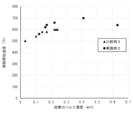
- Example 2 In Example 2, the effect of the bulk sulfur concentration on the sintering start temperature was examined. Applying the same method as in Example 1, changing the flow rate of the sulfur-containing gas from 1.7 m / sec to 2.2 m / sec (converted to 1100 ° C.) to produce nickel powders having various sulfur bulk concentrations. did. Similarly, using the same method as in Comparative Example 1 described in Example 1, the concentration and addition amount of the thiourea aqueous solution were changed, and nickel powders having various sulfur bulk concentrations were produced as Comparative Example 2. The measurement of the sulfur bulk concentration was performed in the same manner as in Example 1.
- the sintering start temperature was measured by a scanning electron microscope (SU-5000 manufactured by Hitachi High-Technologies Corporation) equipped with a heating stage (Murano 525 heating stage manufactured by Gatan). To exemplify a specific method, first, the metal powder 100 was formed into a pellet of ⁇ 5 mm ⁇ 1 mm, adhered to a heating stage, and introduced into a scanning electron microscope. Observation was performed with a scanning electron microscope while the temperature of the heating stage was gradually increased from room temperature to 800 ° C. The metal particles 102 start sintering as the temperature rises, and the temperature at which more than half of the nickel powder in the field of view sinters is defined as the sintering start temperature. The results are shown in FIG.
- Comparative Example 2 it can be seen that the sintering start temperature increases as the sulfur bulk concentration increases.
- the sulfur does not distribute at a high concentration to the inside of the metal particles, there is an upper limit on the bulk concentration of sulfur.
- the bulk concentration of sulfur is at most about 0.2% by weight, and the sintering onset temperature is only around 500-600 ° C.
- the nickel powder of Example 2 has a higher sintering start temperature than Comparative Example 2. Further, in Example 2, since sulfur is distributed to the inside of the nickel particles, a higher sulfur bulk concentration can be realized as compared with the nickel powder of Comparative Example 2. For example, in the second embodiment, a metal powder having a sulfur bulk concentration of more than 0.2% by weight and further having a sulfur bulk concentration of 0.3% by weight or more is obtained. Due to this, the sintering start temperature of the nickel powder of Example 2 can exceed 600 ° C., and reaches about 700 ° C. Further, it was found that when the bulk concentration of sulfur was the same, a nickel powder having a higher sintering start temperature could be produced by applying the production method of the present embodiment.
- Example 2 when the bulk concentration of sulfur is 0.15% by weight or more, a sintering start temperature of 600 ° C or more, and even more than 600 ° C, can be realized with a high probability. For this reason, by setting the bulk concentration of sulfur in the metal powder 100 to 0.15% by weight or more, even if the bulk concentration of sulfur changes significantly, the sintering start temperature is not affected, and the sintering start temperature is not affected. Can be effectively suppressed. In other words, according to the manufacturing method of the present embodiment, it is possible to provide a metal powder having a small variation in the sintering start temperature.
- 100 Metal powder
- 102 Metal particles
- 110 Reduction device
- 112 Reduction furnace
- 114 Heater
- 116 First transport pipe
- 118 First gas introduction pipe
- 120 Valve
- 122 Second Gas introduction pipe
- 124 valve
- 126 third gas introduction pipe
- 128 valve
- 130 second transport pipe
Landscapes
- Chemical & Material Sciences (AREA)
- Chemical Kinetics & Catalysis (AREA)
- General Chemical & Material Sciences (AREA)
- Engineering & Computer Science (AREA)
- Materials Engineering (AREA)
- Mechanical Engineering (AREA)
- Metallurgy (AREA)
- Organic Chemistry (AREA)
- Powder Metallurgy (AREA)
- Manufacture Of Metal Powder And Suspensions Thereof (AREA)
- Non-Insulated Conductors (AREA)
- Conductive Materials (AREA)
Abstract
Description
本発明の実施形態の一つは、金属粉体、およびその製造方法に関する。あるいは本発明の実施形態の一つは、金属粉体の品質管理方法、金属粉体の特性推定方法、または焼結温度の予測方法に関する。 One of the embodiments of the present invention relates to a metal powder and a method for producing the same. Alternatively, one of the embodiments of the present invention relates to a method for quality control of a metal powder, a method for estimating characteristics of a metal powder, or a method for estimating a sintering temperature.
微細な金属粒子を含む集合体(以下、金属粉体)は種々の分野で利用されており、銅やニッケル、銀などの高い導電性を示す金属の金属粉体は、例えば積層セラミックコンデンサ(MLCC)の内部電極などの電子部品の原材料として幅広く利用されている。MLCCは、誘電体材料を含むセラミック層と金属を含む内部電極の積層を基本構造として有している。この積層は、誘電体材料を含む分散液と金属粉体を含む分散液を交互に塗布した後に加熱を行い、誘電体材料と金属粉体を焼結することで形成される。例えば特許文献1や2では、加熱時の金属粉体の焼結特性を制御するための方法が開示されている。
Aggregates containing fine metal particles (hereinafter referred to as metal powders) are used in various fields, and metal powders of highly conductive metals such as copper, nickel, and silver are used, for example, in multilayer ceramic capacitors (MLCCs). ) Is widely used as a raw material for electronic components such as internal electrodes. The MLCC has, as a basic structure, a laminate of a ceramic layer containing a dielectric material and an internal electrode containing a metal. This lamination is formed by alternately applying the dispersion containing the dielectric material and the dispersion containing the metal powder and then heating the mixture, and then sintering the dielectric material and the metal powder. For example,
本発明の実施形態の一つは、硫黄の濃度やその分布が制御された金属粒子を含む金属粉体、およびその製造方法を提供することを課題の一つとする。あるいは本発明の実施形態の一つは、高い焼結開始温度を有する金属粉体、およびその製造方法を提供することを課題の一つとする。あるいは本発明の実施形態の一つは、焼結開始温度のばらつきの小さい金属粉体、およびその製造方法を提供することを課題の一つとする。あるいは本発明の実施形態の一つは、金属粉体の品質管理方法や金属粉体の特性推定方法、または焼結温度の予測方法を提供することを課題の一つとする。 One object of one embodiment of the present invention is to provide a metal powder containing metal particles in which the concentration and distribution of sulfur are controlled, and a method for producing the same. Alternatively, it is an object of one embodiment of the present invention to provide a metal powder having a high sintering start temperature and a method for producing the same. Alternatively, it is an object of one embodiment of the present invention to provide a metal powder having a small variation in sintering start temperature and a method for producing the same. Alternatively, it is an object of one embodiment of the present invention to provide a quality control method for a metal powder, a method for estimating characteristics of a metal powder, or a method for estimating a sintering temperature.
本発明に係る実施形態の一つは、金属粉体である。この金属粉体は、金属と、硫黄を含む金属粒子とを含む。金属粒子中の硫黄のバルク濃度は、0.01重量%以上1.0重量%以下であり、金属粒子の表面から4nmの位置における硫黄の局所濃度は2原子%以上である。バルク濃度と局所濃度はそれぞれ、誘導結合プラズマ発光分光分析装置、および走査透過型電子顕微鏡に備えられるエネルギー分散型X線分光分析器によって見積もられる。 One of the embodiments according to the present invention is a metal powder. This metal powder contains metal and metal particles containing sulfur. The bulk concentration of sulfur in the metal particles is 0.01% by weight or more and 1.0% by weight or less, and the local concentration of sulfur at a position of 4 nm from the surface of the metal particles is 2% by atom or more. The bulk concentration and the local concentration are estimated by an inductively coupled plasma emission spectrometer and an energy dispersive X-ray spectrometer provided in a scanning transmission electron microscope, respectively.
本発明に係る実施形態の一つは、金属粉体を製造する方法である。この方法は、塩素による金属の塩素化によって金属塩化物のガスを生成すること、および硫黄を含むガスの存在下、ガスである金属塩化物を還元することによって金属粒子を生成することを含む。還元は、金属粒子の硫黄のバルク濃度が0.01重量%以上1.0重量%以下、金属粒子の表面から4nmの位置における硫黄の局所濃度が2原子%以上となるように行われる。バルク濃度と局所濃度はそれぞれ、誘導結合プラズマ発光分光分析装置、および走査透過型電子顕微鏡に備えられるエネルギー分散型X線分光分析器によって見積もられる。 One of the embodiments according to the present invention is a method for producing a metal powder. The method includes producing a metal chloride gas by chlorination of the metal with chlorine and producing metal particles by reducing the gaseous metal chloride in the presence of a sulfur-containing gas. The reduction is performed so that the bulk concentration of sulfur in the metal particles is 0.01% by weight or more and 1.0% by weight or less, and the local concentration of sulfur at a position of 4 nm from the surface of the metal particles is 2% by atom or more. The bulk concentration and the local concentration are estimated by an inductively coupled plasma emission spectrometer and an energy dispersive X-ray spectrometer provided in a scanning transmission electron microscope, respectively.
本発明に係る実施形態の一つは、金属粉体の焼結温度を予測する方法である。この方法は、金属粉体から選択される金属粒子の表面から4nmの位置における硫黄の局所濃度を測定することを含む。硫黄の局所濃度は、エネルギー分散型X線分光分析器が備えられた走査透過型電子顕微鏡を用いて測定される。
One of the embodiments according to the present invention is a method for estimating a sintering temperature of a metal powder. The method includes measuring a local concentration of sulfur at a
以下、本発明の各実施形態について、図面などを参照しつつ説明する。但し、本発明は、その要旨を逸脱しない範囲において様々な態様で実施することができ、以下に例示する実施形態の記載内容に限定して解釈されるものではない。 Hereinafter, embodiments of the present invention will be described with reference to the drawings and the like. However, the present invention can be carried out in various modes without departing from the gist of the present invention, and is not to be construed as being limited to the description of the embodiments exemplified below.
図面は、説明をより明確にするため、実際の態様に比べ、各部の幅、厚さ、形状等について模式的に表される場合があるが、あくまで一例であって、本開示の解釈を限定するものではない。本明細書と各図において、既出の図に関して説明したものと同様の機能を備えた要素には、同一の符号を付して、重複する説明を省くことがある。 The drawings may be schematically illustrated in terms of width, thickness, shape, and the like of each portion as compared with actual embodiments in order to make the description clearer, but are merely examples, and the interpretation of the present disclosure is limited. It does not do. In the specification and the drawings, elements having the same functions as those described in relation to the already described drawings are denoted by the same reference numerals, and redundant description may be omitted.
<第1実施形態>
本実施形態では、本発明に係る実施形態の一つである金属粉体100の構造と特性を説明する。
<First embodiment>
In the present embodiment, the structure and characteristics of the
1.構造
金属粉体100は複数の金属粒子102の集合体であり、金属粒子102は金属と硫黄を含む。金属はニッケル、銅、銀などから選択され、典型的にはニッケルである。金属粉体100の個数平均粒径は50nm以上400nm以下、100nm以上300nm以下、あるいは100nm以上250nm以下であってよい。換言すると、金属粉体100から選択される複数(例えば600個)の金属粒子102の粒径の平均値は金属粉体100の個数平均粒子径として上記範囲に収まりうる。上記個数平均粒子径としては、例えば走査電子顕微鏡により金属粉体100に含まれる金属粒子102を観察し、複数の粒子(例えば600個)の粒径を測定し、その平均値を採用することができる。粒子径は粒子を内接する最小円の直径である。
1. Structure The
金属粉体100は硫黄を含有する。具体的には、金属粉体100の硫黄のバルク濃度は、0.01重量%以上1.0重量%以下、あるいは0.01重量%よりも高く0.6重量%以下、あるいは0.15重量%以上0.6重量%以下、あるいは0.16重量%以上0.6重量%以下である。換言すると、金属粉体100から選択される複数(例えば0.5gに相当する個数)の金属粒子102の硫黄のバルク濃度の平均値は上述した範囲に収まる。ここで硫黄のバルク濃度とは、金属粒子102の重量に占める硫黄の重量の割合である。金属粉体100から選択される一つの金属粒子102の硫黄のバルク濃度、あるいは複数の金属粒子102の硫黄のバルク濃度の平均が金属粉体100のバルク濃度として算出される。
The
硫黄のバルク濃度は、誘導結合プラズマ発光分光によって測定することができる。例えば、SIIナノテクノロジー株式会社製誘導結合プラズマ発光分光分析装置(SPS3100)を使用して測定すればよい。具体的な測定方法を例示すると、まず金属粉体100を酸で溶解させた後、測定波長182.036nmでICP発光分光分析を行うことで硫黄のバルク濃度を得ることができる。
バ ル ク Bulk sulfur concentration can be measured by inductively coupled plasma emission spectroscopy. For example, the measurement may be performed using an inductively coupled plasma emission spectrometer (SPS3100) manufactured by SII Nano Technology Co., Ltd. As an example of a specific measuring method, the bulk concentration of sulfur can be obtained by first dissolving the
金属粒子102は、表面近傍のみならず、表面から粒子内側に向かって比較的離れた内部にも硫黄を含有する。具体的には、硫黄の濃度は、金属粒子102の表面から内部に近づくにつれて減少するものの、表面から4nmの位置における硫黄の濃度(以下、金属粒子102の特定位置における硫黄の濃度を局所濃度と呼ぶ)は2原子%以上である。なお、該表面から4nmの位置における硫黄の濃度は4原子%以下であってよい。金属粉体100から選択される複数(例えば10個)の金属粒子102の上記位置における硫黄の局所濃度の平均値は、上述した範囲に収まる。
The metal particles 102 contain sulfur not only in the vicinity of the surface but also in the interior relatively far from the surface toward the inside of the particles. Specifically, although the sulfur concentration decreases as it approaches the inside from the surface of the metal particle 102, the sulfur concentration at a
また、金属粒子102の表面における硫黄の局所濃度の2分の1の局所濃度を有する位置(以下、半減深さ)は、表面から2nm以上4nm以下の範囲に存在しうる。すなわち、金属粉体100から選択される複数(例えば10個)の金属粒子102の半減深さの平均値は、上述した範囲に収まりうる。
位置 Further, a position having a local concentration of half of the local concentration of sulfur on the surface of the metal particle 102 (hereinafter, a half-depth) may exist in a range of 2 nm to 4 nm from the surface. That is, the average value of the half-depths of a plurality (for example, 10) of the metal particles 102 selected from the
上述した硫黄の局所濃度は、例えば走査透過型電子顕微鏡に備えられるエネルギー分散型X線分光分析器(STEM-EDS:Scanning Transmission Electron Microscope-Energy Dispersive X-ray Spectroscope)によって見積もることができる。具体的な測定方法を例示すると、まず、金属粉体100を樹脂に分散し、樹脂を硬化する。その後、クロスセクションポリッシャー(CP)を用いて断面を露出させ、集束イオンビーム(FIB)を用いて平面サンプリングによる薄膜試料を作製する。試料の厚さは100nm程度とすることで、金属粒子102がこの厚さを有する薄膜へ成形される。その後得られた薄膜に対して金属粒子102の中央を通る直線上でEDS測定を行うことで局所濃度を得ることができる。EDS測定の条件としては、例えば加速電圧200kV、プローブ径1nm、ピッチ幅3nm、一点あたりの測定時間15秒という条件を選択することができる。
局 所 The above-mentioned local concentration of sulfur can be estimated by, for example, an energy dispersive X-ray spectrometer (STEM-EDS: Scanning Transmission Electron Microscope-Energy Dispersive X-ray Spectroscope) provided in a scanning transmission electron microscope. To illustrate a specific measuring method, first, the
2.特性
金属粒子102を含む金属粉体100は、高い硫黄のバルク濃度を有すること、および金属粒子102の表層部における硫黄の広い分布に起因して高い焼結開始温度を有しており、例えば600℃以上の範囲に焼結開始温度を示す。なお、焼結開始温度は700℃以下であってもよい。以上の特性に基づき、金属粒子の表層部の硫黄の局所濃度を測定し、局所濃度が上述した条件を満たす場合には、その金属粒子の集合体である金属粉体が高い焼結開始温度を有すると判断することが可能である。したがって、本実施形態により、金属粉体の特性を予想するための有効な方法が提供される。
2. Characteristics The
実施例に示すように、硫黄の広い分布と高いバルク濃度は金属粉体100の高い焼結開始温度と相関することが示唆される。なお、仮に硫黄のバルク濃度が同じである場合は硫黄分布が広い(表層において深くまで硫黄が存在する)と焼結開始温度改善の観点で有利である。このことを利用すると、硫黄の表層における分布やバルク濃度を測定することによって金属粉体の焼結開始温度を推定する、あるいは見積もることが可能である。例えば、金属粉体から任意に選択される金属粒子をSTEM-EDSによって分析し、金属粒子の表面から4nmの位置における硫黄の局所濃度が2原子%以上であるという条件を満たした場合、その金属粒子を含む金属粉体の焼結温度が600℃以上であることが推定可能である。換言すると、本実施形態により、金属粉体の焼結を行わなくても、表面層の硫黄濃度を測定することで金属粉体の焼結挙動を推定することができ、金属粉体の品質を管理するための有効な方法が提供される。
広 い As shown in the examples, it is suggested that a wide distribution of sulfur and a high bulk concentration correlate with a high sintering start temperature of the
上述したように、例えば金属粉体をMLCCの内部電極用の原材料として使用する場合、誘電体を含む分散液と金属粉体を含む分散液を交互に塗布した後に焼成を行う。誘電体を含む分散液には、BaやTi系の酸化物粉末やバインダとして機能する高分子材料、溶媒、分散剤などが含まれ、金属粉体を含む分散液にも金属粉体のみならず、バインダや溶媒、分散剤などが含まれる。焼成の際、これらのバインダや溶媒、分散剤が蒸発あるいは分解するとともに酸化物粉末や金属粉体が焼結し、それぞれ誘電体膜と内部電極を与える。通常、誘電体の焼結開始温度は金属粉体のそれよりも高いため、焼成時に金属粉体の焼結が先に開始する。その結果、焼成時に誘電体と内部電極間に間隙が生じ、この間隙に起因して内部電極と誘電体膜間で剥離が生じることがあり、これはMLCCの特性や歩留まりの低下を招く。 As described above, for example, when metal powder is used as a raw material for an internal electrode of the MLCC, baking is performed after alternately applying a dispersion containing a dielectric and a dispersion containing a metal powder. The dispersion containing the dielectric contains Ba or Ti-based oxide powder, a polymer material functioning as a binder, a solvent, a dispersant, and the like. , A binder, a solvent, a dispersant, and the like. During firing, these binders, solvents, and dispersants evaporate or decompose and the oxide powder or metal powder sinters to provide a dielectric film and internal electrodes, respectively. Usually, the sintering start temperature of the dielectric is higher than that of the metal powder, so that the sintering of the metal powder starts first during firing. As a result, a gap is formed between the dielectric and the internal electrode during firing, and the separation may occur between the internal electrode and the dielectric film due to the gap, which causes a decrease in the characteristics and yield of the MLCC.
これに対し、本実施形態に係る金属粉体100は高い焼結開始温度を示すため、酸化物粉末等の焼結開始温度とより近い温度で焼結が開始する。その結果、焼成時において内部電極と誘電体の間に高い密着性が確保でき、剥離を抑制することができる。このため、金属粉体100は、優れた特性を有する種々の電子部品を提供するための原料として利用することが可能である。
On the other hand, since the
以上述べたように、本実施形態によって、焼結を行わなくても金属粉体の焼結挙動が推定できるため、MLCCの電極用材料として高い信頼性を有する金属粉体を製造するための品質管理方法を提供することが可能である。 As described above, according to the present embodiment, the sintering behavior of the metal powder can be estimated without sintering. Therefore, the quality for producing a metal powder having high reliability as a material for an electrode of the MLCC can be estimated. It is possible to provide a management method.
<第2実施形態>
本実施形態では、金属粉体100の製造方法の一例を説明する。
<Second embodiment>
In the present embodiment, an example of a method for manufacturing the
金属粉体100は気相法を利用して製造される。すなわち、金属を塩化して得られる金属塩化物(以下、単に塩化物とも記す)の蒸気、あるいは金属塩化物を加熱して得られる蒸気を硫黄含有ガスの存在下還元することで製造される。ただし、高い純度の塩化物蒸気が得られ、かつ、塩化物蒸気の供給量を安定化できるため、金属の塩化によって塩化物の蒸気を生成することがより好ましい。金属を塩化するための装置(塩化炉)は公知のものを利用すればよいので説明は割愛する。
The
塩化物を還元するための装置である還元装置110の断面模式図を図1に示す。還元装置110は、塩化物を還元して金属粉体100を生成すると同時に硫黄を金属粒子102に導入する機能を有する。還元装置110は、還元炉112、還元炉112を加熱するためのヒータ114を基本的な構成として備える。還元炉112には第1の輸送管116が連結され、これを介して還元炉112に金属塩化物のガスが導入される。還元炉112にはさらに、還元性ガスである水素やヒドラジン、アンモニア、メタンなどを供給するための第1のガス導入管118が設けられる。第1のガス導入管118には図示しない還元ガス供給源が接続される。バルブ120が第1のガス導入管118に取り付けられ、これによって還元ガスの供給量が制御される。
FIG. 1 shows a schematic cross-sectional view of a reducing
第1の輸送管116には硫黄含有ガスを供給するための第2のガス導入管122が設けられる。第2のガス導入管122には図示しない硫黄含有ガス供給源がバルブ124を介して接続され、バルブ124によってその供給量が調整される。この構成により、塩化物のガスと硫黄含有ガスの混合ガスに対して還元性ガスを接触させることができる。第1のガス導入管118、第2のガス導入管122はさらに不活性ガス供給源と接続されてもよく、これにより、キャリアガスとしての不活性ガスを混合して還元性ガスや硫黄含有ガスを還元炉112に供給することができる。この構成により、塩化物のガスと硫黄含有ガスの混合ガスが還元炉112に供給される。図示しないが、第2のガス導入管122を第1の輸送管116と接続せずに還元炉112に接続し、塩化物のガスと硫黄含有ガスをそれぞれ個別に還元炉112に供給してもよい。
に は The
ヒータ114によって加熱された還元炉112内で塩化物が還元性ガスによって還元され、これによって金属粒子102が生成されるとともに、硫黄含有ガスに由来する硫黄が金属粒子102に導入される。なお、塩化物ガスは単離されたものでなく、図示省略の塩化炉にて生成したものを導入することが好ましい。このような形態とすることで、塩化と還元を連続的に行うことができ、金属粉体を効率的に製造可能である。
(4) Chloride is reduced by the reducing gas in the reducing
還元炉112には、還元炉112に冷却ガスを供給するための第3のガス導入管126がさらに備えられる。第3のガス導入管126は、第1の輸送管116から離れた位置に設置することが好ましい。例えば第1の輸送管116を還元炉112の上部に設置する場合には、第3のガス導入管126は還元炉112の下部に設置される。冷却ガスとしては窒素やアルゴンなどの不活性ガスを使用することができ、これらのガスの供給源(図示しない)が第3のガス導入管126に接続される。冷却ガスの流量はバルブ128によって制御される。冷却ガスを供給することで、還元炉112で形成される金属粒子102の成長を制御することができる。金属粉体100は、冷却ガスによって第2の輸送管130を通して分離装置や回収装置へ輸送され、単離、精製される。
The
還元を行う際には、還元炉112をヒータ114によって加熱し、第1の輸送管116と第2のガス導入管122を介して金属塩化物のガスと硫黄含有ガスを還元炉112に導入するとともに、還元性ガスを第1のガス導入管118を通して還元炉112内に供給する。還元炉112の加熱温度は金属の融点よりも低いことが好ましく、例えば800℃から1100℃の範囲から選択される。これにより、還元炉112で生成する金属を固体状の金属粒子102として取り出すことができる。還元炉112に供給される還元性ガスの量は、供給される金属塩化物と化学量論的に等量、もしくは小過剰となるように、バルブ120を用いて調整される。
When performing the reduction, the
硫黄含有ガスとしては、硫化水素、二酸化硫黄、あるいはハロゲン化硫黄から選択される成分を含むガスである。ハロゲン化硫黄としては、SnCl2(nは2以上の整数)、SF6、SF5Cl、SF5Brなどが挙げられる。この中でも取り扱いの容易な二酸化硫黄が好ましい。硫黄含有ガスの流量は、還元炉112に供給される単位時間当たりの塩化物から生成される金属粉体に対し、0.01重量%以上1.0重量%以下となるように、バルブ124を用いて調整される。
The sulfur-containing gas is a gas containing a component selected from hydrogen sulfide, sulfur dioxide, or sulfur halide. The halogenated sulfur, S n Cl 2 (n is an integer of 2 or more), SF 6, SF 5 Cl , etc. SF 5 Br and the like. Of these, sulfur dioxide, which is easy to handle, is preferred. The
上述した方法を採用することにより、硫黄のバルク濃度と局所濃度を第1実施形態で述べた範囲内に制御することができ、表面近傍のみならず、表面から離れた内部にも高い濃度で硫黄を含有する金属粒子102、および金属粒子102を含む金属粉体100を製造することができる。
By employing the above-described method, the bulk concentration and the local concentration of sulfur can be controlled within the range described in the first embodiment, and the sulfur concentration is high not only in the vicinity of the surface but also in the interior away from the surface. And the
1.実施例1
本実施例では、第2実施形態で述べた製造方法を適用して金属粉体100を製造した例を示す。
1. Example 1
In this example, an example in which the
塩化炉において塩素ガスとニッケルを反応させて塩化ニッケルガスを生成させ、還元炉112を1100℃に加熱し、塩化炉に接続された第1の輸送管116から塩化ニッケルガス、硫黄含有ガスである二酸化硫黄ガス、および窒素ガスの混合ガスを2.8m/秒(1100℃換算)の流速で還元炉112に導入した。同時に第1のガス導入管118から水素を2.2m/秒(1100℃換算)の流速で還元炉112に導入した。冷却ガスとしては窒素を用い、第3のガス導入管126から供給した。得られたニッケル粉体(個数平均粒子径190nm)は、図示しない生成装置などを用いて精製した。得られたニッケル粉体の硫黄のバルク濃度は0.15重量%であった。
The chlorine gas reacts with the nickel in the chlorine furnace to generate nickel chloride gas, and the
この実施例1に対する比較例1として、塩化ニッケルの還元を硫黄含有ガスの非存在下で行って得られるニッケル粉体に対して硫黄処理を行って作製したニッケル粉体を用い、その硫黄濃度を測定した。比較例1のニッケル粉体は、上記実施例において硫黄含有ガスを還元炉112に導入せずにニッケル粉体を作製し、その後以下の後処理を行うことで作製した。
As Comparative Example 1 with respect to Example 1, a nickel powder produced by performing a sulfur treatment on a nickel powder obtained by reducing nickel chloride in the absence of a sulfur-containing gas was used. It was measured. The nickel powder of Comparative Example 1 was produced by producing a nickel powder without introducing the sulfur-containing gas into the
すなわち、硫黄含有ガスの非存在下で作製したニッケル粉体(個数平均粒子径190nm)を精製する過程で得られるスラリーに、ニッケル粉体に対して硫黄含有率が0.15重量%となるようにチオ尿素水溶液を加え30分間撹拌した。その後、スラリーを気流乾燥機により乾燥することで比較例1のニッケル粉体を得た。 That is, the slurry obtained in the process of purifying the nickel powder (number average particle diameter 190 nm) produced in the absence of the sulfur-containing gas has a sulfur content of 0.15% by weight based on the nickel powder. A thiourea aqueous solution was added to the mixture, and the mixture was stirred for 30 minutes. Then, the nickel powder of Comparative Example 1 was obtained by drying the slurry with a flash dryer.
実施例1と比較例1のニッケル粉体をSTEM-EDSを用い、表面から深さ方向に硫黄の局所濃度を測定した。測定は、エネルギー分散型X線分光分析器(日本電子株式会社製JED-2300T)を備える走査透過型電子顕微鏡(日本電子株式会社製JEM-2100F)を用いて行った。得られた結果を表1と図2に示す。 (4) The local concentration of sulfur was measured in the depth direction from the surface of the nickel powders of Example 1 and Comparative Example 1 using STEM-EDS. The measurement was performed using a scanning transmission electron microscope (JEM-2100F manufactured by JEOL Ltd.) equipped with an energy dispersive X-ray spectrometer (JED-2300T manufactured by JEOL Ltd.). The results obtained are shown in Table 1 and FIG.

表1と図2に示すように、比較例1のニッケル粉体では、表面における硫黄の局所濃度は実施例1のそれよりも高いものの、表面からの深さが増大するにしたがって、すなわち、より内部に近づくにつれて急激に減少することが分かった。これに対して実施例1のニッケル粉体は、表面における硫黄の局所濃度は低いものの、深さ方向における減少率は小さく、ニッケル粉体内部にも硫黄が分布していることが確認された。この実施例1では、半減深さは3.2nmであった。 As shown in Table 1 and FIG. 2, in the nickel powder of Comparative Example 1, although the local concentration of sulfur at the surface was higher than that of Example 1, as the depth from the surface increased, that is, It was found that it decreased rapidly as approaching the inside. On the other hand, in the nickel powder of Example 1, although the local concentration of sulfur on the surface was low, the reduction rate in the depth direction was small, and it was confirmed that sulfur was distributed inside the nickel powder. In Example 1, the half-depth was 3.2 nm.
これらの結果から、本発明の実施形態に係る製造方法を用いることで、より深い位置まで硫黄が分布する金属粉体が得られることが分かった。 From these results, it was found that by using the manufacturing method according to the embodiment of the present invention, a metal powder in which sulfur was distributed to a deeper position was obtained.
2.実施例2
本実施例2では、硫黄のバルク濃度が焼結開始温度に与える影響について検討を行った。実施例1と同様の方法を適用し、硫黄含有ガスの流量を1.7m/秒から2.2m/秒(1100℃換算)まで変化させ、種々の硫黄のバルク濃度を有するニッケル粉体を作製した。同様に、実施例1で述べた比較例1と同様の方法を用い、チオ尿素水溶液の濃度や添加量を変化させ、種々の硫黄のバルク濃度を有するニッケル粉体を比較例2として作製した。硫黄のバルク濃度の測定は、実施例1と同様の方法で行った。
2. Example 2
In Example 2, the effect of the bulk sulfur concentration on the sintering start temperature was examined. Applying the same method as in Example 1, changing the flow rate of the sulfur-containing gas from 1.7 m / sec to 2.2 m / sec (converted to 1100 ° C.) to produce nickel powders having various sulfur bulk concentrations. did. Similarly, using the same method as in Comparative Example 1 described in Example 1, the concentration and addition amount of the thiourea aqueous solution were changed, and nickel powders having various sulfur bulk concentrations were produced as Comparative Example 2. The measurement of the sulfur bulk concentration was performed in the same manner as in Example 1.
焼結開始温度の測定は加熱ステージ(Gatan社製 Murano 525 heating stage)を備えた走査型電子顕微鏡(株式会社日立ハイテクノロジーズ製SU-5000)により行った。具体的な方法を例示すると、まず金属粉体100をφ5mm×1mmのペレットに成形し、加熱ステージに接着し、走査型電子顕微鏡に導入した。加熱ステージを室温から800℃まで段階的に昇温しながら、走査型電子顕微鏡で観察を行った。昇温に伴い金属粒子102が焼結を開始するが、視野内のニッケル粉体の半数以上が焼結した時の温度を焼結開始温度とした。結果を図3に示す。
The sintering start temperature was measured by a scanning electron microscope (SU-5000 manufactured by Hitachi High-Technologies Corporation) equipped with a heating stage (Murano 525 heating stage manufactured by Gatan). To exemplify a specific method, first, the
比較例2では、硫黄のバルク濃度が増大するにしたがって焼結開始温度が上昇することが分かる。しかしながら、実施例1でも述べたように、比較例2の金属粉体では、硫黄は金属粒子の内部まで高濃度で分布しないため、硫黄のバルク濃度に上限がある。おそらくこのことに起因し、硫黄のバルク濃度は最大で約0.2重量%であり、焼結開始温度は500℃から600℃程度にとどまっている。 In Comparative Example 2, it can be seen that the sintering start temperature increases as the sulfur bulk concentration increases. However, as described in Example 1, in the metal powder of Comparative Example 2, since the sulfur does not distribute at a high concentration to the inside of the metal particles, there is an upper limit on the bulk concentration of sulfur. Probably due to this, the bulk concentration of sulfur is at most about 0.2% by weight, and the sintering onset temperature is only around 500-600 ° C.
これに対して実施例2のニッケル粉体は、比較例2と比べて焼結開始温度が高いことが分かる。また、実施例2では、ニッケル粒子の内部まで硫黄が分布するため、比較例2のニッケル粉体と比較すると高い硫黄のバルク濃度を実現することができる。例えば本実施例2では、硫黄のバルク濃度は0.2重量%を超える、さらには0.3重量%以上の硫黄のバルク濃度を有する金属粉体が得られている。これに起因し、実施例2のニッケル粉体の焼結開始温度は600℃超を達成でき、約700℃にも達する。また、硫黄のバルク濃度が同じ場合、本実施形態の製造方法を適用することで、より高い焼結開始温度のニッケル粉体が作製できることが分かった。 On the other hand, it can be seen that the nickel powder of Example 2 has a higher sintering start temperature than Comparative Example 2. Further, in Example 2, since sulfur is distributed to the inside of the nickel particles, a higher sulfur bulk concentration can be realized as compared with the nickel powder of Comparative Example 2. For example, in the second embodiment, a metal powder having a sulfur bulk concentration of more than 0.2% by weight and further having a sulfur bulk concentration of 0.3% by weight or more is obtained. Due to this, the sintering start temperature of the nickel powder of Example 2 can exceed 600 ° C., and reaches about 700 ° C. Further, it was found that when the bulk concentration of sulfur was the same, a nickel powder having a higher sintering start temperature could be produced by applying the production method of the present embodiment.
ここで注目すべき点は、実施例2では硫黄のバルク濃度が0.15重量%以上となると焼結開始温度600℃以上、さらには600℃超を高い確率で実現できるという点である。このため、金属粉体100中の硫黄のバルク濃度を0.15重量%以上とすることで、硫黄のバルク濃度が大きく変化しても焼結開始温度には影響が現れず、焼結開始温度の変動を効果的に抑制することができる。換言すると、本実施形態の製造方法により、焼結開始温度のばらつきが小さい金属粉体を提供することが可能である。
す べ き It should be noted that in Example 2, when the bulk concentration of sulfur is 0.15% by weight or more, a sintering start temperature of 600 ° C or more, and even more than 600 ° C, can be realized with a high probability. For this reason, by setting the bulk concentration of sulfur in the
本発明の実施形態を基にして、当業者が適宜構成要素の追加、削除もしくは設計変更を行ったもの、または、工程の追加、省略もしくは条件変更を行ったものも、本発明の要旨を備えている限り、本発明の範囲に含まれる。 Those in which those skilled in the art have appropriately added, deleted, or changed the design of the components, or added, omitted, or changed the conditions based on the embodiments of the present invention also have the gist of the present invention. As long as it is included in the scope of the present invention.
上述した各実施形態の態様によりもたらされる作用効果とは異なる他の作用効果であっても、本明細書の記載から明らかなもの、又は、当業者において容易に予測し得るものについては、当然に本発明によりもたらされるものと解される。 Regarding other effects different from the effects obtained by the aspects of the above-described embodiments, those that are obvious from the description in this specification or that can be easily predicted by those skilled in the art are, of course, It is understood that the present invention brings about.
100:金属粉体、102:金属粒子、110:還元装置、112:還元炉、114:ヒータ、116:第1の輸送管、118:第1のガス導入管、120:バルブ、122:第2のガス導入管、124:バルブ、126:第3のガス導入管、128:バルブ、130:第2の輸送管 100: Metal powder, 102: Metal particles, 110: Reduction device, 112: Reduction furnace, 114: Heater, 116: First transport pipe, 118: First gas introduction pipe, 120: Valve, 122: Second Gas introduction pipe, 124: valve, 126: third gas introduction pipe, 128: valve, 130: second transport pipe
Claims (9)
前記金属粒子の表面から4nmの位置における硫黄の局所濃度が2原子%以上であり、
前記バルク濃度と前記局所濃度はそれぞれ、誘導結合プラズマ発光分光分析装置、および走査透過型電子顕微鏡に備えられるエネルギー分散型X線分光分析器によって見積もられる金属粉体。 Metal and metal particles containing sulfur having a bulk concentration of 0.01% by weight or more and 1.0% by weight or less,
The local concentration of sulfur at a position 4 nm from the surface of the metal particles is 2 atomic% or more;
A metal powder wherein the bulk concentration and the local concentration are respectively estimated by an inductively coupled plasma emission spectrometer and an energy dispersive X-ray spectrometer provided in a scanning transmission electron microscope.
硫黄を含むガスの存在下、ガスである前記金属塩化物を還元することによって金属粒子を生成することを含み、
前記還元は、前記金属粒子の硫黄のバルク濃度が0.01重量%以上1.0重量%以下、前記金属粒子の表面から4nmの位置における硫黄の局所濃度が2原子%以上となるように行われ、
前記バルク濃度と前記局所濃度はそれぞれ、誘導結合プラズマ発光分光分析装置、および走査透過型電子顕微鏡に備えられるエネルギー分散型X線分光分析器によって見積もられる、金属粉体を製造する方法。 Generating a metal chloride gas by chlorinating the metal with chlorine, and generating metal particles by reducing the gaseous metal chloride in the presence of a sulfur-containing gas;
The reduction is performed so that the bulk concentration of sulfur in the metal particles is 0.01% by weight or more and 1.0% by weight or less, and the local concentration of sulfur at a position 4 nm from the surface of the metal particles is 2% by atom or more. I,
A method for producing a metal powder, wherein the bulk concentration and the local concentration are respectively estimated by an inductively coupled plasma emission spectrometer and an energy dispersive X-ray spectrometer provided in a scanning transmission electron microscope.
前記硫黄の局所濃度は、エネルギー分散型X線分光分析器が備えられた走査透過型電子顕微鏡を用いて測定される、金属粉体の焼結温度の予測方法。 Measuring the local concentration of sulfur at a position 4 nm from the surface of the metal particles selected from the metal powder,
A method for predicting a sintering temperature of metal powder, wherein the local concentration of sulfur is measured using a scanning transmission electron microscope equipped with an energy dispersive X-ray spectrometer.
前記硫黄のバルク濃度は、前記エネルギー分散型X線分光分析器が備えられた前記走査透過型電子顕微鏡を用いて測定される、請求項8に記載の予測方法。 Further comprising measuring the bulk concentration of sulfur in the metal powder,
The prediction method according to claim 8, wherein the bulk concentration of the sulfur is measured using the scanning transmission electron microscope equipped with the energy dispersive X-ray spectrometer.
Priority Applications (3)
| Application Number | Priority Date | Filing Date | Title |
|---|---|---|---|
| CN201980043273.5A CN112423912B (en) | 2018-06-28 | 2019-06-17 | Metal powder, method for producing same, and method for predicting sintering temperature |
| KR1020217001236A KR102484793B1 (en) | 2018-06-28 | 2019-06-17 | Metal powder, manufacturing method thereof, and method for predicting sintering temperature |
| JP2020527409A JP7193534B2 (en) | 2018-06-28 | 2019-06-17 | Nickel powder and its production method |
Applications Claiming Priority (2)
| Application Number | Priority Date | Filing Date | Title |
|---|---|---|---|
| JP2018122789 | 2018-06-28 | ||
| JP2018-122789 | 2018-06-28 |
Publications (1)
| Publication Number | Publication Date |
|---|---|
| WO2020004105A1 true WO2020004105A1 (en) | 2020-01-02 |
Family
ID=68986492
Family Applications (1)
| Application Number | Title | Priority Date | Filing Date |
|---|---|---|---|
| PCT/JP2019/023910 Ceased WO2020004105A1 (en) | 2018-06-28 | 2019-06-17 | Metal powder, production method therefor, and sintering temperature prediction method |
Country Status (5)
| Country | Link |
|---|---|
| JP (1) | JP7193534B2 (en) |
| KR (1) | KR102484793B1 (en) |
| CN (1) | CN112423912B (en) |
| TW (1) | TWI720523B (en) |
| WO (1) | WO2020004105A1 (en) |
Cited By (1)
| Publication number | Priority date | Publication date | Assignee | Title |
|---|---|---|---|---|
| KR20250132354A (en) | 2024-02-28 | 2025-09-04 | 도호 티타늄 가부시키가이샤 | Nickel-containing particles, method for manufacturing nickel-containing particles, and slurry |
Citations (3)
| Publication number | Priority date | Publication date | Assignee | Title |
|---|---|---|---|---|
| JP2005008981A (en) * | 2003-06-16 | 2005-01-13 | Jfe Mineral Co Ltd | Nickel alloy powder and method for producing the same |
| WO2011037150A1 (en) * | 2009-09-24 | 2011-03-31 | 住友金属鉱山株式会社 | Nickel powder and production method thereof |
| WO2015156080A1 (en) * | 2014-04-08 | 2015-10-15 | 東邦チタニウム株式会社 | Nickel powder |
Family Cites Families (20)
| Publication number | Priority date | Publication date | Assignee | Title |
|---|---|---|---|---|
| EP0887133B1 (en) * | 1996-12-02 | 2006-01-18 | Toho Titanium Co., Ltd. | Process for the production of metal powder and equipment therefor |
| JPH1180816A (en) * | 1997-09-10 | 1999-03-26 | Sumitomo Metal Mining Co Ltd | Nickel powder for conductive paste and method for producing the same |
| JP4611464B2 (en) * | 1998-06-12 | 2011-01-12 | 東邦チタニウム株式会社 | Method for producing metal powder |
| JP3492672B1 (en) * | 2002-05-29 | 2004-02-03 | 東邦チタニウム株式会社 | Metal powder manufacturing method and manufacturing apparatus |
| US7449044B2 (en) * | 2002-09-30 | 2008-11-11 | Toho Titanium Co., Ltd. | Method and apparatus for producing metal powder |
| JP4392283B2 (en) * | 2004-04-12 | 2009-12-24 | 日機装株式会社 | Carbon nanofiber manufacturing method and carbon nanofiber post-processing method |
| KR101085265B1 (en) * | 2004-06-16 | 2011-11-22 | 도호 티타늄 가부시키가이샤 | Nickel powder and its manufacturing method |
| US7344584B2 (en) * | 2004-09-03 | 2008-03-18 | Inco Limited | Process for producing metal powders |
| JP2010043345A (en) * | 2008-08-18 | 2010-02-25 | Sumitomo Electric Ind Ltd | Nickel powder or alloy powder composed mainly of nickel and method for producing the same, conductive paste, and multilayer ceramic capacitor |
| JP5067312B2 (en) * | 2008-08-18 | 2012-11-07 | 住友金属鉱山株式会社 | Nickel powder and its manufacturing method |
| JP5768322B2 (en) * | 2010-03-19 | 2015-08-26 | 住友金属鉱山株式会社 | Nickel fine powder and method for producing the same |
| CN101857276A (en) * | 2010-06-21 | 2010-10-13 | 中国科学院苏州纳米技术与纳米仿生研究所 | A kind of preparation method of universal nano metal sulfide |
| KR20120049026A (en) * | 2010-11-08 | 2012-05-16 | 삼성전기주식회사 | A nickel powder coated by sulfur, a paste for inner electrode, a laminated ceramic electronic parts by using the same and a process thereof |
| TWI597112B (en) * | 2012-04-06 | 2017-09-01 | 東邦鈦股份有限公司 | Nickel metal powder and process for production thereof |
| JP5962562B2 (en) * | 2013-03-22 | 2016-08-03 | 住友金属鉱山株式会社 | Nickel powder and its manufacturing method |
| JP5826204B2 (en) * | 2013-03-26 | 2015-12-02 | 大陽日酸株式会社 | Method for producing metal fine particles |
| JP5882960B2 (en) * | 2013-08-13 | 2016-03-09 | Jx金属株式会社 | Surface-treated metal powder and method for producing the same |
| WO2017122689A1 (en) * | 2016-01-12 | 2017-07-20 | 東邦チタニウム株式会社 | Nickel powder |
| JP6746321B2 (en) * | 2016-02-05 | 2020-08-26 | 株式会社村田製作所 | Ni powder, method of manufacturing Ni powder, internal electrode paste, and electronic component |
| CN107768609A (en) * | 2016-08-16 | 2018-03-06 | 中国科学院上海硅酸盐研究所 | A kind of cathode material for sodium-chloride battery and its preparation method and application |
-
2019
- 2019-06-17 JP JP2020527409A patent/JP7193534B2/en active Active
- 2019-06-17 KR KR1020217001236A patent/KR102484793B1/en active Active
- 2019-06-17 WO PCT/JP2019/023910 patent/WO2020004105A1/en not_active Ceased
- 2019-06-17 CN CN201980043273.5A patent/CN112423912B/en active Active
- 2019-06-28 TW TW108122839A patent/TWI720523B/en active
Patent Citations (3)
| Publication number | Priority date | Publication date | Assignee | Title |
|---|---|---|---|---|
| JP2005008981A (en) * | 2003-06-16 | 2005-01-13 | Jfe Mineral Co Ltd | Nickel alloy powder and method for producing the same |
| WO2011037150A1 (en) * | 2009-09-24 | 2011-03-31 | 住友金属鉱山株式会社 | Nickel powder and production method thereof |
| WO2015156080A1 (en) * | 2014-04-08 | 2015-10-15 | 東邦チタニウム株式会社 | Nickel powder |
Cited By (1)
| Publication number | Priority date | Publication date | Assignee | Title |
|---|---|---|---|---|
| KR20250132354A (en) | 2024-02-28 | 2025-09-04 | 도호 티타늄 가부시키가이샤 | Nickel-containing particles, method for manufacturing nickel-containing particles, and slurry |
Also Published As
| Publication number | Publication date |
|---|---|
| JP7193534B2 (en) | 2022-12-20 |
| KR20210019547A (en) | 2021-02-22 |
| TW202000344A (en) | 2020-01-01 |
| CN112423912B (en) | 2023-05-23 |
| TWI720523B (en) | 2021-03-01 |
| KR102484793B1 (en) | 2023-01-05 |
| JPWO2020004105A1 (en) | 2021-08-05 |
| CN112423912A (en) | 2021-02-26 |
Similar Documents
| Publication | Publication Date | Title |
|---|---|---|
| US11072533B2 (en) | Manufacture of tungsten monocarbide (WC) spherical powder | |
| TWI803486B (en) | Copper particle and its manufacturing method | |
| TWI716526B (en) | Nickel powder | |
| JP7473475B2 (en) | Metal powder for use as an electrode material in multilayer ceramic capacitors and methods of making and using same - Patents.com | |
| JP6559118B2 (en) | Nickel powder | |
| TW201719678A (en) | Nickel powder and nickel paste | |
| Delaportas et al. | γ-Al2O3 nanoparticle production by arc-discharge in water: in situ discharge characterization and nanoparticle investigation | |
| WO2020004105A1 (en) | Metal powder, production method therefor, and sintering temperature prediction method | |
| TWI813559B (en) | Nickel powder and nickel paste | |
| JP6738460B1 (en) | Method for producing copper powder | |
| CN114786839B (en) | Copper powder and method for producing same | |
| TW202539827A (en) | Nickel-containing particles, method for producing nickel-containing particles, and slurry | |
| Delaportas et al. | Ta2O5 crystalline nanoparticle synthesis by DC anodic arc in water | |
| JP5969118B2 (en) | Copper powder | |
| CN116547091A (en) | Coated particles and method of making same |
Legal Events
| Date | Code | Title | Description |
|---|---|---|---|
| 121 | Ep: the epo has been informed by wipo that ep was designated in this application |
Ref document number: 19826572 Country of ref document: EP Kind code of ref document: A1 |
|
| ENP | Entry into the national phase |
Ref document number: 2020527409 Country of ref document: JP Kind code of ref document: A |
|
| NENP | Non-entry into the national phase |
Ref country code: DE |
|
| ENP | Entry into the national phase |
Ref document number: 20217001236 Country of ref document: KR Kind code of ref document: A |
|
| 122 | Ep: pct application non-entry in european phase |
Ref document number: 19826572 Country of ref document: EP Kind code of ref document: A1 |