WO2019222880A1 - Procédé et appareil de configuration de dispositif réseau, et support de données - Google Patents
Procédé et appareil de configuration de dispositif réseau, et support de données Download PDFInfo
- Publication number
- WO2019222880A1 WO2019222880A1 PCT/CN2018/087662 CN2018087662W WO2019222880A1 WO 2019222880 A1 WO2019222880 A1 WO 2019222880A1 CN 2018087662 W CN2018087662 W CN 2018087662W WO 2019222880 A1 WO2019222880 A1 WO 2019222880A1
- Authority
- WO
- WIPO (PCT)
- Prior art keywords
- network device
- terminal
- message
- target terminal
- terminal group
- Prior art date
- Legal status (The legal status is an assumption and is not a legal conclusion. Google has not performed a legal analysis and makes no representation as to the accuracy of the status listed.)
- Ceased
Links
Images

Classifications
-
- H—ELECTRICITY
- H04—ELECTRIC COMMUNICATION TECHNIQUE
- H04L—TRANSMISSION OF DIGITAL INFORMATION, e.g. TELEGRAPHIC COMMUNICATION
- H04L41/00—Arrangements for maintenance, administration or management of data switching networks, e.g. of packet switching networks
- H04L41/08—Configuration management of networks or network elements
- H04L41/0803—Configuration setting
- H04L41/0806—Configuration setting for initial configuration or provisioning, e.g. plug-and-play
-
- H—ELECTRICITY
- H04—ELECTRIC COMMUNICATION TECHNIQUE
- H04L—TRANSMISSION OF DIGITAL INFORMATION, e.g. TELEGRAPHIC COMMUNICATION
- H04L41/00—Arrangements for maintenance, administration or management of data switching networks, e.g. of packet switching networks
- H04L41/08—Configuration management of networks or network elements
- H04L41/0893—Assignment of logical groups to network elements
-
- H—ELECTRICITY
- H04—ELECTRIC COMMUNICATION TECHNIQUE
- H04L—TRANSMISSION OF DIGITAL INFORMATION, e.g. TELEGRAPHIC COMMUNICATION
- H04L41/00—Arrangements for maintenance, administration or management of data switching networks, e.g. of packet switching networks
- H04L41/16—Arrangements for maintenance, administration or management of data switching networks, e.g. of packet switching networks using machine learning or artificial intelligence
Definitions
- the present invention relates to the technical field of data transmission, and in particular, to a method and device for configuring network equipment, and a storage medium.
- VLAN virtual local area network
- IP Internet Protocol
- AAA authentication, authorization, accounting
- you can configure the parameters of the device interface connected to different types of terminals these parameters can include transmission rate limit, transmission priority, access control list (English: access control list; ACL ), And the identifier (ID) of the VLAN added to the message through the device interface.
- the present application provides a configuration method and device of a network device, and a storage medium, which can solve the problem of a large workload in the configuration process.
- the technical solutions provided in this application are as follows:
- the present application provides a method for configuring a network device, including: determining a target terminal group in which the target terminal is located among a plurality of terminal groups according to a message sending and receiving feature of the target terminal.
- the message sending and receiving characteristics are determined based on multiple messages sent and received by the target terminal.
- the multiple terminal groups are in one-to-one correspondence with multiple configurations.
- the network device to be configured is configured based on a target configuration corresponding to the target terminal group.
- the network device to be configured is a network device that forwards the multiple packets.
- the method for configuring a network device classifies the target terminal based on the message receiving and sending characteristics reflecting the situation of the target terminal receiving and sending the message, and configures the network device to be configured based on the classification result. Compared with the implementation method of manually configuring the network device, there is no need to manually confirm the target configuration of the network device according to the target terminal, and the target configuration of the target terminal can be confirmed according to the message sending and receiving characteristics of the target terminal, which effectively reduces the configuration process. Workload.
- the message receiving and sending characteristics reflect the correlation between the multiple messages, and are relative to the terminal ’s MAC address and other inherent characteristics. Since the inherent characteristics such as the MAC address are usually used to reflect information such as the terminal manufacturer, the classification criteria for classifying the terminal type according to the inherent characteristics are relatively rough, and the message sending and receiving characteristics can reflect the message sending and receiving situation of the target terminal. According to the message, The classification of terminal types is refined when the receiving and sending characteristics are used to classify the terminal types. When determining the target terminal group to which the target terminal belongs in multiple terminal groups according to the message sending and receiving characteristics, the accuracy of determining the target terminal group can be improved. , Thereby improving the accuracy of network device configuration.
- the message sending and receiving characteristics include: sequencing of the multiple messages.
- the message sending and receiving feature further includes one or more of the following: a message sending time interval between two messages in the multiple messages, and a message type of the multiple messages Sorting, sorting the message sizes of the plurality of messages.
- the message sending and receiving characteristics may further include: ordering of source ports corresponding to multiple messages, ordering of destination ports corresponding to multiple messages, MAC address and IP address of a message sending end, and MAC address of a message receiving end And one or more of the IP address, the source port number and destination port number of the message, and the DSCP value carried in the received and sent messages.
- the method further includes: acquiring message receiving and transmitting characteristics of a plurality of sample terminals; and based on the message transmitting and receiving characteristics of the plurality of sample terminals, using a machine learning method to train a grouping model to obtain a trained grouping. model.
- This process is a process of training a grouping model based on training samples.
- it is not necessary to execute this process every time, that is, when determining the target configuration corresponding to the target terminal, it can be directly completed by training.
- determining the target terminal group in which the target terminal is located among multiple terminal groups according to the message sending and receiving characteristics of the target terminal includes: based on a training-completed grouping model and sending and receiving according to the message. Characteristics, among the plurality of terminal groups, respectively determining a score that the target terminal belongs to each terminal group, and the grouping model is used to separately determine that the target terminal belongs to each terminal based on input message sending and receiving characteristics The score of the group, the score corresponding to each terminal group is used to characterize the possibility that the target terminal belongs to the corresponding terminal group; among the scores of the target terminal belonging to each terminal group, the highest score is determined; the highest score is corresponding Is determined as the target terminal group.
- the present application provides an apparatus for configuring a network device, including: a determining module, configured to determine a target terminal group where the test terminal is located among a plurality of terminal groups according to a message sending and receiving feature of the testing terminal. The message sending and receiving characteristics are determined based on multiple messages sent and received by the test terminal.
- the multiple terminal groups are in one-to-one correspondence with multiple configurations.
- a configuration module is configured to configure a network device to be configured based on a target configuration corresponding to the target terminal group.
- the network device to be configured is a network device that forwards the multiple packets.
- the message receiving and sending characteristics include: an ordering of the multiple messages.
- the message receiving and sending feature further includes one or more of the following: a message sending time interval between two messages in the plurality of messages, an ordering of message types of the plurality of messages, Ordering the message sizes of the plurality of messages.
- the apparatus further includes: an acquiring module for acquiring message receiving and transmitting characteristics of multiple sample terminals; and a training module for grouping the message receiving and transmitting characteristics of the multiple sample terminals by using a machine learning method The model is trained to obtain the trained grouping model.
- the determining module is configured to: based on the training grouping model, determine the score of the test terminal belonging to each terminal group among the multiple terminal groups according to the message sending and receiving characteristics,
- the grouping model is used to separately determine the score of the target terminal belonging to the each terminal group based on the input message sending and receiving characteristics, and the score corresponding to each terminal group is used to characterize that the target terminal belongs to the corresponding terminal group. Possibility; determine the highest score among the scores of the test terminals belonging to each terminal group; determine the terminal group corresponding to the highest score as the target terminal group.
- the present application provides a device for configuring a network device.
- the device for configuring a network device includes: a processor; a memory for storing executable instructions of the processor; wherein the processor is configured To determine the target terminal group where the target terminal is located among multiple terminal groups according to the message sending and receiving characteristics of the target terminal. The message sending and receiving characteristics are determined based on multiple messages sent and received by the target terminal, and the multiple terminal groups are in one-to-one correspondence with multiple configurations.
- the network device to be configured is configured based on a target configuration corresponding to the target terminal group.
- the network device to be configured is a network device that forwards the multiple packets.
- the present application provides a storage medium, and when an instruction in the storage medium is executed by a processor of a terminal, the terminal is capable of executing the method for configuring a network device according to any one of the first aspect.
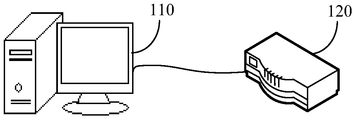
- FIG. 1 is a schematic diagram of a scenario involved in a method for configuring a network device provided in this application;
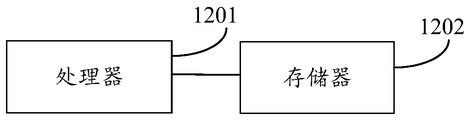
- FIG. 2 is a schematic structural diagram of a network device provided by the present application.
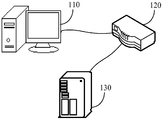
- FIG. 3 is a schematic diagram of a scenario involved in another method for configuring a network device provided in this application;
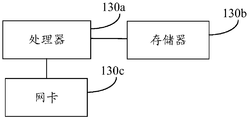
- FIG. 4 is a schematic structural diagram of a server provided by the present application.
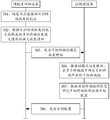
- FIG. 5 is a flowchart of a method for configuring a network device provided by the present application.
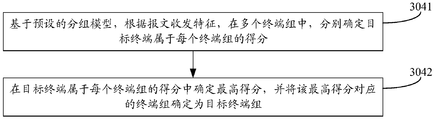
- FIG. 6 is a flowchart of a method for determining a target terminal group where a target terminal is located among multiple terminal groups provided by the present application;
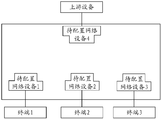
- FIG. 7 is a schematic diagram of a network device 1 to be configured, a network device 2 to be configured, and a network device 3 to be configured, which are connected to a network through the network device 4 to be configured;
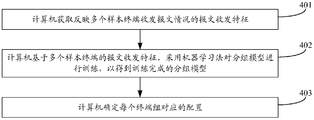
- FIG. 8 is a flowchart of a method for training a grouping model according to training samples and confirming a correspondence between a terminal group and a configuration according to the present application;
- FIG. 9 is a schematic diagram of a principle for determining a mode baseline for classifying multiple sample terminals provided in the present application.
- FIG. 10 is a schematic diagram of a message sending and receiving situation of a terminal A provided in the present application.
- FIG. 11 is a schematic diagram of a message sending and receiving situation of a terminal B provided in the present application.
- FIG. 12 is a schematic diagram of a message sending and receiving situation of a terminal C provided in the present application.
- FIG. 13 is a block diagram of a configuration apparatus for a network device provided by the present application.
- FIG. 14 is a block diagram of another apparatus for configuring a network device provided by the present application.
- FIG. 15 is a schematic structural diagram of a configuration device for a network device provided in the present application.
- An embodiment of the present invention provides a method for configuring a network device.
- the method for configuring the network device may have multiple scenarios.
- the scenario may include a terminal and a network device, or
- the scenario may include a terminal, a network device, and a controller device. The two scenarios are described below:
- FIG. 1 shows a schematic diagram of a first scenario involved in the method for configuring a network device.
- the scenario may include: a terminal 110 and a network device 120, and the network device 120 may perform a configuration operation to be performed Network device 120 (ie, the network device to be configured).
- the terminal 110 can access the network through the network device 120.
- the message sent and received by the terminal 110 is forwarded by the network device 120.
- the terminal 110 may be a printer, a set-top box, a camera, an IP phone, a sensor (such as a temperature sensor, a humidity sensor, and a light sensor, etc.), a smartphone, a computer, a multimedia player, an e-book reader, or a wearable device.
- the network device 120 may be a switch, a router, or a wireless access point (English: wireless access point; WAP).
- the network device 120 may obtain a message sent and received by the terminal 110, determine the type of the terminal 110 according to the message sent and received by the terminal 110, and then configure the network device 120 according to the type of the terminal 110.
- the global settings of the network device may be configured to perform a specified processing operation on all packets forwarded by the network device according to the configured network device, or the local settings of the network device may also be configured. Configure to perform a specified processing operation on a part of the packets forwarded by the network device according to the local settings of the configured network device.
- the device interface of the network device 120 may be configured.
- the network device 120 may obtain a message sent by the terminal 110 within a preset time period of accessing the network, determine the type of the terminal according to the message, and then according to the terminal 110 The type of the device determines the target configuration corresponding to the terminal 110, so as to configure the parameters of the device interface according to the target configuration.
- Network devices can have functions for data processing, data storage, and message forwarding.
- the functions of data processing, data storage, and message forwarding may be implemented by any one of components such as a processor and a forwarding chip, or the data processing, data storage, and message forwarding may be implemented by multiple components, respectively.
- the network device 120 may include: a processor 1201 and a memory 1202.
- the memory 1202 is used to store data and other data required by the processor 1201 for calculation.
- FIG. 3 shows a schematic diagram of a second scenario involved in the method for configuring a network device.
- the scenario may include a terminal 110, a network device 120, and a controller device 130.
- the terminal 110 can access the network through the network device 120, and the network device 120 and the controller device 130 can be connected through a wired or wireless network, and the packets sent and received by the terminal 110 are forwarded by the network device 120.
- the terminal in FIG. 3 has the same function as the terminal in FIG. 1.
- the network device 120 may send a message sending and receiving feature reflecting the status of the message sent and received by the terminal to the controller device 130 according to the message sent and received by the terminal.
- the controller device 130 may determine the type of the terminal 110 according to the message sending and receiving characteristics, and determine the target configuration for configuring the network device 120 according to the type of the terminal 110, and send the target configuration to the network device 120, so that the network device 120 Perform the configuration operation based on the target configuration.
- the functions of the controller device 130 may be implemented by a computer program running in at least one server or switch.
- the server when implemented by a computer program running on a server, the server can have functions for data processing, data storage, and communication with other devices.
- the functions of data processing and data storage may be implemented through any one of a processor and a memory, or the functions of data processing, data storage, and message forwarding may be implemented through multiple components, respectively.
- the server may include a processor 130a, a memory 130b, and a network card 130c.
- the processor 130a is configured to process data.
- the processor 130a is configured to be responsible for protocol calculation and device state maintenance.
- the memory 130b is used to store data and other data required for calculation by the processor 130a.
- the network card 130c is used to communicate with other devices.
- the processor may be a general-purpose processor, for example, a central processing unit (CPU), a forwarding chip, or a combination of a CPU and a forwarding chip.
- the processor may be a hardware chip, and the hardware chip may be an application-specific integrated circuit (ASIC), a programmable logic device (PLD), or a combination thereof.
- the PLD may be a complex programmable logic device (CPLD), a field-programmable gate array (FPGA), a general array logic (GAL), or any combination thereof.
- the forwarding chip may include a network processor (NP), an FPGA, or an ASIC.
- the NP, FPGA or ASIC has a message forwarding function.
- the memory may include a volatile memory, such as a random access memory (RAM); or the memory may also include a non-volatile memory, such as a flash memory, a hard disk (HDD), or a solid state hard disk (SSD). Alternatively, the memory may further include a combination of the aforementioned types of memories.
- RAM random access memory
- non-volatile memory such as a flash memory, a hard disk (HDD), or a solid state hard disk (SSD).
- the memory may further include a combination of the aforementioned types of memories.
- An embodiment of the present invention provides a method for configuring a network device.
- the method for configuring a network device may be applied to the scenario shown in FIG. 1 or FIG. 3.
- the method for configuring a network device may include:
- Step 301 The to-be-configured network device forwards a packet sent and received by a target terminal connected to the network device.
- the target terminal Before determining the target configuration of the network device to be configured, the target terminal can connect to the network device to be configured by default, and the network device to be configured can forward the packets that the target terminal needs to send and receive according to the default configuration.
- Step 302 The to-be-configured network device obtains a message sending and receiving feature reflecting the situation of the message sent and received by the target terminal according to the message sent and received by the target terminal.
- the message sending and receiving characteristics reflecting the situation of the message sent and received by the target terminal can be obtained according to the message sent and received by the target terminal.
- the message sending and receiving characteristics may include: sequencing of multiple messages.
- the message sending and receiving feature may further include one or more of the following: ordering of message sizes of multiple messages, ordering of message types of multiple messages, and two messages of multiple messages Inter-message message sending interval, etc.
- the sorting of the multiple messages may sort the original content of the multiple messages.
- the original content of a message may be data represented by multiple binary values.
- the order of the multiple messages may be data represented by multiple pieces of binary values, and each piece of binary values is used to represent a message.
- Original content may be sorted.
- the sorting of the multiple messages may sort the message digests of the multiple messages.
- the message digest is obtained based on the original content of the message.
- the message digest can be the value of each field in the header and / or payload of the message, for example: the Media Access Control (English: Media Access Control; MAC) address and IP address of the message sender.
- the two messages may be two messages adjacent in time sequence, or the two messages may be Any two of multiple messages.
- the message sending and receiving characteristics may include message sending between message 1 and message 2.
- Time interval, message transmission time interval between message 2 and message 3, and message transmission time interval between message 3 and message 4; or, the message sending and receiving characteristics may include: message 1 and message Message sending interval between 2 messages, message sending interval between message 1 and message 3, and message sending interval between message 1 and message 4.
- Step 303 The to-be-configured network device sends the message receiving and sending characteristics of the target terminal to the controller device.
- the network device to be configured may send the message receiving and sending characteristics to the controller device in the form of a message.
- the message receiving and sending characteristics may be encapsulated in a control protocol message, and then the control protocol message is sent to the control through a forwarding chip in the network device to be configured. Device.
- the network device to be configured will send the message receiving and receiving characteristics obtained according to the original content to the controller device. Reduce the amount of data sent, thereby improving the efficiency of data transmission.
- the network device to be configured may determine the terminal group where the target terminal is located according to the message sending and receiving characteristics, that is, After step 302 is performed, step 304 is performed directly. Accordingly, when the configuration method is applied to the scenario shown in FIG. 1, the operations performed by the controller device in steps 304 to 306 are performed by the network device to be configured, and the network device to be configured is performing specific steps.
- the implementation process of the time can refer to the implementation process of the controller device when executing the corresponding steps.
- the network device that forwards the message to the target terminal in steps 301 to 303 is not limited to the network device to be configured, but may also be another network device that directly or indirectly forwards and receives messages to and from the target terminal, for example, in step 302
- the network device may also be another network device connected to the target terminal connected to the network device to be configured.
- Step 304 The controller device determines a target terminal group in which the target terminal is located among the multiple terminal groups according to the message sending and receiving characteristics.
- an implementation manner of step 304 may include:
- Step 3041 Based on a preset grouping model and according to the characteristics of message transmission and reception, among multiple terminal groups, determine the score of the target terminal belonging to each terminal group.
- the preset grouping model may be a pre-trained grouping model.
- the mapping relationship between the input and output of the trained grouping model can be determined, and it can be determined
- the grouping information obtained after the training grouping model is used to group the training samples.
- the trained grouping model can determine the score of each terminal group among the multiple terminal groups indicated by the grouping information according to the mapping relationship. That is, the possibility that the target terminal belongs to each terminal group is determined.
- Step 3042 Determine the highest score among the scores of the target terminal belonging to each terminal group, and determine the terminal group corresponding to the highest score as the target terminal group.
- the highest score can be determined from the scores of the target terminal belonging to each terminal group, and the highest score corresponding to The terminal group is determined as the target terminal group.
- the grouping information output by the trained grouping model indicates that a plurality of sample terminals are divided into three terminal groups.
- the three terminal groups are terminal group 1, terminal group 2, and terminal group 3 respectively.
- the training group model determines that the target terminal belongs to the three terminal groups.
- the scores are: 190, 56 and 10, then terminal group 1 can be determined as the target terminal group. .
- the message receiving and sending characteristics reflect the correlation between the multiple messages, and are relative to the terminal ’s MAC address and other inherent characteristics. Since the inherent characteristics such as the MAC address are usually used to reflect information such as the terminal manufacturer, the classification criteria for classifying the terminal type according to the inherent characteristics are relatively rough, and the message sending and receiving characteristics can reflect the message sending and receiving situation of the target terminal. According to the message, The classification of terminal types is refined when the receiving and sending characteristics are used to classify the terminal types. When determining the target terminal group to which the target terminal belongs in multiple terminal groups according to the message sending and receiving characteristics, the accuracy of determining the target terminal group can be improved. , Thereby improving the accuracy of network device configuration.
- Step 305 The controller device determines a target configuration corresponding to the target terminal group according to the information of the target terminal group.
- the second controller device may determine a target configuration corresponding to the target terminal group according to a predetermined mapping relationship between the terminal group and the configuration.
- terminal group 1 corresponds to configuration 1
- terminal group 2 corresponds to configuration 2
- terminal group 3 corresponds to configuration 3
- the target terminal group obtained by the controller device is The information indicates that terminal group 1 is the target terminal group, and then configuration 1 may be determined as the target configuration.
- Step 306 The controller device sends the target configuration to the network device to be configured, so that the network device to be configured is configured according to the target configuration.
- the implementation process of step 306 may include: the controller device sends the target configuration to the network device to be configured, Configure the network device to perform configuration operations based on the target configuration.
- the implementation process of step 306 may include: after the network device to be configured determines the target configuration corresponding to the target terminal group, the network device to be configured Configure it with the target configuration.
- the configuration process of the network device may include: configuring a transmission rate limit of the network device, a transmission priority, an access control list, and a VLAN ID added to the packet through the device interface.
- the network device 1 to be configured, the network device 2 to be configured, and the network device 3 to be configured are connected to the network through the network device 4 to be configured, where the terminal 1 is connected through the device interface of the network device 1 to be configured To the network, the terminal 2 is connected to the network through the device interface of the network device 2 to be configured, the terminal 3 is connected to the network through the device interface of the network device 2 to be configured, and the network device 4 to be configured is connected to the upstream device (such as a switch, router, etc.) through the device interface.
- the upstream device such as a switch, router, etc.
- the configuration of the device interface of the network device is as follows: the device interface of the network device 1 to be configured is a VLAN added with a packet ID of 10, the interface type of the device interface is Access, and the network device 1 to be configured performs authentication according to the protocol 802.1X.
- the number of the access control list of the device interface of the network device 1 to be configured is 3000.
- the device interface of the network device 2 to be configured is a VLAN with an ID of 20, and the interface type of the device interface is Access.
- the device interface of network device 3 to be configured is a VLAN with IDs 30 and 10 added to the packet, and the interface type of the device interface is Hybird.
- the device interface of network device 4 to be configured is a VLAN with IDs 10, 20, and 30 added to the packet, and the interface type of the device interface is Trunk. Among them, Access, Hybird and Trunk are all commonly used interface types.
- the method for configuring the network device may further include a process of training the grouping model according to the training samples and confirming the correspondence between the terminal group and the configuration.
- the process may be performed in a computer, where the computer may be a general-purpose computer, a special-purpose computer, a network device, a server, a personal computer, a router, a mobile terminal, or a distribution Equipment with computing functions, such as digital devices. Please refer to FIG. 8, the implementation of this process is as follows:
- Step 401 The computer obtains message transmission and reception characteristics that reflect the situation of message transmission and reception by multiple sample terminals.
- step 401 there may be multiple implementations of step 401.
- a computer is connected to multiple sample terminals, the computer obtains packets sent and received by multiple sample terminals, and The message obtains the characteristics of message transmission and reception.
- multiple sample terminals are connected to the network device, and the network device is connected to the computer. After the network device forwards the message to be sent and received for the sample terminal, the network device forwards the message to the computer, and the computer according to the message Obtain the message transmission and reception characteristics, or after the network device forwards the message to be transmitted and received for the sample terminal, obtain the message transmission and reception characteristics according to the message, and send the message transmission and reception characteristics to the computer.
- the process of obtaining the message receiving and sending characteristics according to the message sent and received by the sample terminal reference may be made to step 302 above.
- Step 402 The computer trains the grouping model by using a machine learning method based on the message sending and receiving characteristics of multiple sample terminals to obtain a trained grouping model.
- the training of the grouping model refers to the process of adjusting the relevant parameters of the grouping model according to the input training samples to obtain a grouping model that has a good classification effect on the input samples. That is, the training process is to establish the input samples and output.
- the process of classifying the input samples by the grouping model can be understood as: according to the mapping relationship between the input samples and the output, it is determined that the terminal corresponding to the message sending and receiving characteristic belongs to each terminal group in the multiple terminal groups.
- the process of dividing a terminal into corresponding terminal groups according to the score is described in the process of the process of dividing a terminal into corresponding terminal groups according to the score.
- the grouping model can determine the score of the target terminal belonging to each terminal group based on the established mapping relationship.
- the score corresponding to each terminal group is used to represent the possibility that the target terminal belongs to the corresponding terminal group.
- the grouping model used in the embodiment of the present invention may be a neural network, a Naive Bayes model, a k-means clustering model, a fuzzy clustering model, or a support vector machine (English: support vector machine (SVM) model.
- the training method of the grouping model may include supervised learning, unsupervised learning, and semi-supervised learning.
- the training samples of the input grouping model include: the message sending and receiving characteristics of multiple sample terminals and the grouping information of multiple sample terminals (used to identify the terminal group to which each sample terminal belongs).
- the grouping model can generate an output according to the input message sending and receiving characteristics, and determine the deviation between the output and the grouping information, and then adjust the relevant parameters in the grouping model based on the deviation, and execute the process cyclically until after adjusting the relevant parameters
- the deviation between the output generated by the grouping model and the grouping information is less than a preset deviation threshold, it is determined to complete the training of the grouping model.
- a plurality of sample terminals may be grouped according to a preset grouping condition to obtain grouping information, so that the types of the plurality of sample terminals included in the grouped terminal group are the same.
- multiple sample terminals may be grouped according to the manufacturer, hardware version number, software version number, and attributes of the end user of the sample terminal to obtain grouping information of the multiple sample terminals.
- the training samples of the input grouping model include: the message receiving and sending characteristics of multiple sample terminals.
- the grouping model can analyze and compare all the input and receiving message receiving characteristics to obtain The similarities and differences reflected by the message sending and receiving characteristics of multiple sample terminals, and a pattern baseline for classifying the multiple sample terminals is determined according to the similarities and differences to divide the multiple sample terminals into multiple terminal groups (that is, output grouping information). Then, the output grouping information is compared with preset grouping information by manual confirmation. When the deviation between the output grouping information and the preset grouping information is less than a preset deviation threshold, it is determined that the grouping model is completed. Training; otherwise, the training process is continued until the deviation between the output group information and the preset group information is less than a preset deviation threshold.
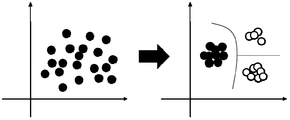
- FIG. 9 a schematic diagram for determining a pattern baseline for classifying multiple sample terminals is shown in FIG. 9.
- the computer can input the characteristics of message transmission and reception into a grouping model.
- the grouping model can use machine learning to perform pattern analysis on the characteristics of message transmission and reception of each sample terminal, and map the characteristics of message transmission and reception of each sample terminal into a multi-dimensional space.
- a pattern point (the dots in FIG.
- the classification algorithm in the machine learning method is used to divide the multiple pattern points corresponding to multiple sample terminals into multiple classes, and each class includes at least one pattern point, That is, a plurality of sample terminals are divided into a plurality of terminal groups.
- the dividing line that distinguishes multiple sample terminals into multiple terminal groups is the mode baseline (dashed lines in FIG. 9).
- This FIG. 9 only shows an example in which the dimensions of each mode point are two-dimensional. In actual applications, according to different grouping models, the dimensions of the corresponding mode points are different.
- the process of training the packet model can be completed in a laboratory, and packet capture software (a software for viewing the contents of data packets transmitted on the network) can be used to obtain the message receiving and sending characteristics of the sample terminal.
- packet capture software a software for viewing the contents of data packets transmitted on the network
- the message receiving and transmitting characteristics are input to the grouping model to be trained, so as to train the grouping model to be trained.
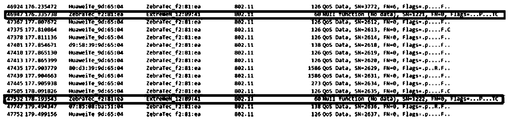
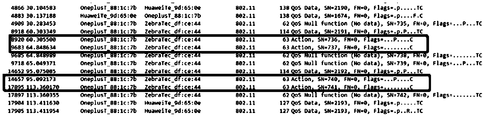
- FIG. 10, FIG. 11 and FIG. 12 are the message receiving and receiving characteristics of the sample terminal A, sample terminal B, and sample terminal C, which are obtained by the packet capture software, respectively.
- the first column is the serial number of the received and sent message
- the second column is the MAC address of the message sending end
- the third column is the MAC address of the message receiving end
- the fourth column is the message type
- the fifth column is the sending and receiving After the value of each field in the packet payload of the .seq. Is input to the packet receiving and sending characteristics of the three sample terminals, the packeting model uses machine learning to analyze the message receiving and receiving characteristics, and sample terminals A
- the message sending and receiving situation of sample terminal B and sample terminal C has the following rules: Sample terminal A and sample terminal B send messages every about 1-2 seconds.
- the MAC address of the receiving end is 74: 67: f7: 12: 89: 41.
- sample terminal A and sample terminal B are divided into the same sample terminal group, and sample terminal C is divided into another sample terminal group to obtain a pattern baseline for dividing the sample terminal. , And then complete the training of the grouping model.
- step 401 if the message receiving and receiving characteristics obtained by the computer is the ordering of the original contents of the received and sent messages, in one implementation of step 402, the grouping model can perform multiple message processing based on the original contents of the received and sent messages. Perform analysis and obtain the similarities and differences reflected by the message sending and receiving characteristics of multiple sample terminals to achieve classification of the multiple sample terminals. If the computer obtains the message sending and receiving characteristics based on the original content, in step 402, In another implementation manner, the grouping model can only analyze multiple messages according to the message receiving and receiving characteristics obtained according to the original content, so as to achieve classification of multiple sample terminals.
- the implementation of classifying multiple sample terminals according to the original content of the received and sent messages provides more information sources for analyzing multiple messages, making the analysis The similarities and differences of the obtained multiple sample terminals are closer to the real situation, and the multiple sample terminals can be classified more accurately.
- the messages involved in steps 401 to 402 may refer to a single message or a combination of multiple messages.
- Step 403 The computer determines the configuration corresponding to each terminal group.
- the computer can be a single device such as a general-purpose computer, special-purpose computer, network device, server, personal computer, router, or mobile terminal, or it can be a distributed device.
- the functions of the computer may be implemented by a network controller and a network analyzer, where the network analyzer may be used to perform steps 401 and 402, and the network controller is used to perform step 403.
- the network analyzer and the network controller may be a separate device, or may be a component integrated in a device such as a network device or a server.
- the implementation of step 403 is different. The following describes the two implementations:
- steps 402 and 403 are performed by the computer.
- the computer may receive a first configuration instruction, where the first configuration instruction is used to indicate a configuration corresponding to each terminal group in the grouping information.
- the first configuration instruction and the grouping information obtained in step 402 may determine a configuration corresponding to each terminal group.
- the functions of the computer device are implemented by a network controller and a network analyzer, and the network analyzer is used to perform step 402, and the network controller is used to perform step 403 as an example to describe the implementation method thereof.
- the network controller may receive group information and a first configuration instruction, where the group information is used to indicate a terminal group to which each sample terminal belongs, and the first configuration instruction is used to indicate each of the group information.
- the network controller can establish a one-to-one correspondence between the terminal group and the configuration under the instruction of the grouping information and the first configuration instruction, that is, determine the configuration corresponding to each terminal group.
- the correspondence relationship between the configuration and the terminal group recorded in the first configuration instruction may be implemented by confirming in advance and confirming afterwards. Two implementation manners are described below:
- a configuration corresponding to all or part of the sample terminals in the plurality of sample terminals is determined separately. After grouping the sample terminals, if the configuration of all the sample terminals in the terminal group is known, the corresponding relationship between the configuration and the terminal group can be obtained directly; after grouping the sample terminals, if only some of the sample terminals in the terminal group have If the configuration is known, the configuration corresponding to the sample terminal with the known configuration may be determined as the configuration corresponding to the terminal group where the sample terminal is located, so as to obtain the correspondence between the configuration and the terminal group.
- ex post confirmation after grouping a plurality of sample terminals (that is, after determining the grouping information), at least one sample terminal is selected in each terminal group, and the configuration corresponding to the selected at least one sample terminal is determined, The determined configuration is then determined as the configuration corresponding to the corresponding terminal group.
- at least one sample terminal may be selected in each terminal group randomly or according to actual needs.
- the action of determining the configuration corresponding to the sample terminal can be performed manually, and the configuration corresponding to the sample terminal with a known configuration is determined as the action corresponding to the configuration of the terminal group where the sample terminal is located.
- the first configuration instruction may only record the correspondence between the selected sample terminal and the configuration.
- the network controller may determine the configuration information corresponding to the selected sample terminal as the terminal group where the sample terminal is located. Corresponding configuration, and then establish a one-to-one correspondence between the terminal group and the configuration.
- the global settings of the network device may be configured to perform a specified processing operation on all messages forwarded by the network device according to the configured network device, or the local settings of the network device may also be configured. Perform a specified processing operation on a part of the packets forwarded by the network device according to the configured network device, for example, configure a device interface of the network device, and add a VLAN ID to the packet forwarded by the device interface through the device interface.
- the multiple packets sent and received in the above steps 301 and 401 may be packets sent and received by one or more terminals.
- the one or more terminals are connected with
- the part that needs to be configured is the part that affects the sending and receiving of packets to one or more terminals.
- the part that needs to be configured can be the network.
- the specified device interface of the device can be the device.
- the above steps 401 to 403 are the processes of obtaining training samples, training a grouping model based on the training samples, and establishing the corresponding relationship between the terminal group and the configuration.
- the method for configuring a network device is not only applicable to training a model based on message sending and receiving characteristics reflecting the sample terminal receiving and sending messages, and determining a target terminal group to which the target terminal belongs according to the trained model, and then according to the target terminal
- the application scenario of the configuration corresponding to the group to the configuration of the network device may also be applicable to other acquisition scenarios, grouping according to characteristics, and determining other scenarios of corresponding information according to the grouping result to improve the flexibility of the configuration method.
- the configuration method of the network device can also be applied to the Internet of Things, for example, a router can be configured according to information sent by a sensor in the Internet of Things.
- the method for configuring a network device classifies the target terminal according to the message sending and receiving characteristics reflecting the situation of the target terminal receiving and sending the message, and configures the network device to be configured based on the classification result.
- the implementation method of manually configuring the network device there is no need to manually confirm the target configuration of the network device according to the target terminal, and the target configuration of the target terminal can be confirmed according to the message sending and receiving characteristics of the target terminal, which effectively reduces the configuration process. Workload.
- the message receiving and sending characteristics reflect the correlation between the multiple messages, and are relative to the terminal ’s MAC address and other inherent characteristics. Since the inherent characteristics such as the MAC address are usually used to reflect information such as the terminal manufacturer, the classification criteria for classifying the terminal type according to the inherent characteristics are relatively rough, and the message sending and receiving characteristics can reflect the message sending and receiving situation of the target terminal. According to the message, The classification of terminal types is refined when the receiving and sending characteristics are used to classify the terminal types. When determining the target terminal group to which the target terminal belongs in multiple terminal groups according to the message sending and receiving characteristics, the accuracy of determining the target terminal group can be improved. , Thereby improving the accuracy of network device configuration.
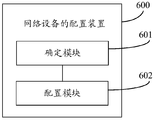
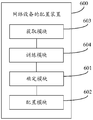
- FIG. 13 shows a block diagram of a configuration device for a network device according to an embodiment of the present invention.
- the configuration device 600 for a network device may include:
- a determining module 601 is configured to determine a target terminal group where the test terminal is located among multiple terminal groups according to the message sending and receiving characteristics of the test terminal. The message sending and receiving characteristics are determined based on multiple messages sent and received by the test terminal. Terminal groups correspond one-to-one with multiple configurations.
- a configuration module 602 is configured to configure a network device to be configured based on a target configuration corresponding to a target terminal group, where the network device to be configured is a network device that forwards multiple packets.
- the message sending and receiving features include: sequencing of multiple messages.
- the message sending and receiving feature further includes one or more of the following: a message sending time interval between two messages in a plurality of messages, an ordering of a message type of the plurality of messages, and a message of a plurality of messages. Sort text size.
- the apparatus 600 may further include:
- the obtaining module 603 is configured to obtain message receiving and sending characteristics of multiple sample terminals.
- a training module 604 is configured to train a grouping model by using a machine learning method based on the message sending and receiving characteristics of multiple sample terminals to obtain a trained grouping model.
- a determining module 601 is configured to: based on the trained grouping model, determine the scores of the test terminals belonging to each terminal group among multiple terminal groups according to the message sending and receiving characteristics, and the grouping model is used for input-based The characteristics of the message receiving and sending determine the score of the target terminal belonging to each terminal group, and the score corresponding to each terminal group is used to characterize the possibility that the target terminal belongs to the corresponding terminal group. Among the scores for which the test terminal belongs to each terminal group, the highest score is determined. The terminal group corresponding to the highest score is determined as the target terminal group.
- the network device configuration device provided by the embodiment of the present invention classifies the target terminal according to the message sending and receiving characteristics reflecting the status of the message sent and received by the target terminal, and the configuration module performs the configuration on the network device to be configured based on the classification result.
- Configuration compared to the implementation of manually configuring network devices, without manually confirming the target configuration of the network device based on the target terminal, it can confirm the target configuration of the target terminal based on the message sending and receiving characteristics of the target terminal, effectively reducing the configuration The workload in the process.
- An embodiment of the present invention further provides a device for configuring a network device.
- the device for configuring the network device may include: a processor; a memory for storing executable instructions of the processor; wherein the processor is configured to: The characteristics of the message sending and receiving, determine the target terminal group where the target terminal is located among multiple terminal groups, wherein the message sending and receiving characteristics are determined based on the multiple messages sent and received by the target terminal, and the multiple terminal groups correspond to the multiple configurations one by one. ; Configure the network device to be configured based on the target configuration corresponding to the target terminal group, where the network device to be configured is a network device that forwards multiple messages.
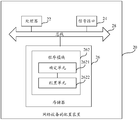
- an embodiment of the present invention further provides a configuration device 20 for a network device.
- the configuration device 20 for the network device may include a processor 22 and a signal interface 24.
- the processor 22 includes one or more processing cores.
- the processor 22 executes various functional applications and data processing by running software programs and modules.
- the processor 22 may include one or more of a central processing unit, a digital signal processor, a microprocessor, a microcontroller, or an artificial intelligence processor, and may further optionally include a hardware accelerator required to perform an operation, such as Various logic operation circuits.
- the signal interface 24 is used to establish a connection with other devices or modules.
- the signal interface 24 may be connected to a transceiver. Therefore, optionally, the device 20 may further include a transceiver (not shown in the figure).
- the transceiver specifically performs signal transmission and reception.
- the processor 22 needs to perform a signal transceiving operation, it can call or drive the transceiver to perform the corresponding transceiving operation. Therefore, when the device 20 performs signal transmission and reception, the processor 22 is used to determine or initiate a transmission and reception operation, which is equivalent to the initiator, and the transceiver is used to perform specific transmission and reception, which is equivalent to the performer.
- the transceiver may also be a transceiver circuit, a radio frequency circuit, or a radio frequency unit, which is not limited in this embodiment.
- the network device configuration device 20 further includes components such as a memory 26 and a bus 28.
- the memory 26 and the signal interface 24 are connected to the processor 22 through a bus 28, respectively.
- the memory 26 may be used to store software programs and modules. Specifically, the memory 26 may store at least one program module 262 required for a function, and the program may be an application program or a driver program.
- the program module 262 may include:
- the determining unit 2621 has the same or similar functions as the determining module 601.
- the configuration unit 2622 has the same or similar functions as the configuration module 602.
- An embodiment of the present invention further provides a storage medium.
- the storage medium may be a non-volatile computer-readable storage medium.
- the terminal can execute the embodiments provided by the embodiment of the present invention. Network device configuration method.
- An embodiment of the present invention also provides a computer program product containing instructions.
- the computer program product runs on a computer, the computer causes the computer to execute the method for configuring a network device provided by the embodiment of the present invention.
- the program may be stored in a computer-readable storage medium.
- the storage medium mentioned may be a read-only memory, a magnetic disk or an optical disk.
Landscapes
- Engineering & Computer Science (AREA)
- Computer Networks & Wireless Communication (AREA)
- Signal Processing (AREA)
- Artificial Intelligence (AREA)
- Computer Vision & Pattern Recognition (AREA)
- Databases & Information Systems (AREA)
- Evolutionary Computation (AREA)
- Medical Informatics (AREA)
- Software Systems (AREA)
- Data Exchanges In Wide-Area Networks (AREA)
- Computer And Data Communications (AREA)
Abstract
L'invention concerne un procédé et un appareil de configuration d'un dispositif réseau, et un support de données, appartenant au domaine technique de la transmission de données. Le procédé de configuration consiste à : déterminer, dans de multiples groupes de terminaux, selon une caractéristique d'émission-réception de message d'un terminal cible, un groupe terminal cible dans lequel se trouve le terminal cible, la caractéristique d'émission-réception de message étant déterminée sur la base de multiples messages émis et reçus par le terminal cible, et les multiples groupes de terminaux correspondent à de multiples configurations sur une base unique ; et configurer, sur la base d'une configuration cible correspondant au groupe de terminaux cibles, un dispositif de réseau à configurer, le dispositif de réseau à configurer étant un dispositif de réseau transmettant les multiples messages. Selon la présente invention, la charge de travail pendant un processus de configuration est efficacement réduite. La présente invention est utilisée pour configurer un dispositif réseau.
Priority Applications (5)
| Application Number | Priority Date | Filing Date | Title |
|---|---|---|---|
| EP18919632.2A EP3790228B1 (fr) | 2018-05-21 | 2018-05-21 | Procédé et appareil de configuration de dispositif réseau, et support de données |
| PCT/CN2018/087662 WO2019222880A1 (fr) | 2018-05-21 | 2018-05-21 | Procédé et appareil de configuration de dispositif réseau, et support de données |
| JP2020565332A JP7254099B2 (ja) | 2018-05-21 | 2018-05-21 | ネットワークデバイスを設定するための方法および装置ならびに記憶媒体 |
| CN201880093338.2A CN112189322B (zh) | 2018-05-21 | 2018-05-21 | 网络设备的配置方法及装置、存储介质 |
| US17/100,364 US11463305B2 (en) | 2018-05-21 | 2020-11-20 | Method and apparatus for configuring network device, and storage medium |
Applications Claiming Priority (1)
| Application Number | Priority Date | Filing Date | Title |
|---|---|---|---|
| PCT/CN2018/087662 WO2019222880A1 (fr) | 2018-05-21 | 2018-05-21 | Procédé et appareil de configuration de dispositif réseau, et support de données |
Related Child Applications (1)
| Application Number | Title | Priority Date | Filing Date |
|---|---|---|---|
| US17/100,364 Continuation US11463305B2 (en) | 2018-05-21 | 2020-11-20 | Method and apparatus for configuring network device, and storage medium |
Publications (1)
| Publication Number | Publication Date |
|---|---|
| WO2019222880A1 true WO2019222880A1 (fr) | 2019-11-28 |
Family
ID=68616264
Family Applications (1)
| Application Number | Title | Priority Date | Filing Date |
|---|---|---|---|
| PCT/CN2018/087662 Ceased WO2019222880A1 (fr) | 2018-05-21 | 2018-05-21 | Procédé et appareil de configuration de dispositif réseau, et support de données |
Country Status (5)
| Country | Link |
|---|---|
| US (1) | US11463305B2 (fr) |
| EP (1) | EP3790228B1 (fr) |
| JP (1) | JP7254099B2 (fr) |
| CN (1) | CN112189322B (fr) |
| WO (1) | WO2019222880A1 (fr) |
Families Citing this family (3)
| Publication number | Priority date | Publication date | Assignee | Title |
|---|---|---|---|---|
| KR102476700B1 (ko) * | 2021-05-13 | 2022-12-12 | 서울대학교산학협력단 | 비정상 단말을 포함하는 무선 분산 학습 시스템 및 그의 동작 방법 |
| JP7581268B2 (ja) | 2022-02-04 | 2024-11-12 | キヤノン株式会社 | 情報処理装置、情報処理装置の制御方法及びプログラム |
| TWI894746B (zh) * | 2023-12-26 | 2025-08-21 | 神基科技股份有限公司 | 自動配置方法及自動配置系統 |
Citations (4)
| Publication number | Priority date | Publication date | Assignee | Title |
|---|---|---|---|---|
| CN102170641A (zh) * | 2010-02-26 | 2011-08-31 | 中兴通讯股份有限公司 | 一种m2m业务组资源配置和分配的方法及系统 |
| CN103079272A (zh) * | 2006-11-17 | 2013-05-01 | 佳能株式会社 | 通信控制设备和通信设备及其控制方法,无线通信系统 |
| US9019121B1 (en) * | 2011-12-22 | 2015-04-28 | Landis+Gyr Technologies, Llc | Configuration over power distribution lines |
| CN105471609A (zh) * | 2014-09-05 | 2016-04-06 | 华为技术有限公司 | 一种用于配置业务的方法和装置 |
Family Cites Families (18)
| Publication number | Priority date | Publication date | Assignee | Title |
|---|---|---|---|---|
| US6522628B1 (en) * | 1999-03-01 | 2003-02-18 | Cisco Technology, Inc. | Method and system for managing transmission resources in a wireless communication network |
| ATE413744T1 (de) * | 2001-03-30 | 2008-11-15 | Nokia Corp | Methode zur konfiguration eines netwerkes durch definieren von clustern |
| JP3886432B2 (ja) * | 2002-09-17 | 2007-02-28 | 沖電気工業株式会社 | ルーティング処理装置及びパケット種類識別装置 |
| US7409709B2 (en) * | 2005-02-14 | 2008-08-05 | Etsec, Inc. | Systems and methods for automatically reconfiguring a network device |
| US8775571B2 (en) * | 2005-06-07 | 2014-07-08 | Extreme Networks, Inc. | Methods, systems, and computer program products for dynamic network access device port and user device configuration for implementing device-based and user-based policies |
| CN101540958B (zh) * | 2009-04-24 | 2011-08-03 | 华为技术有限公司 | 一种网元资源的管理方法及装置 |
| EP2708057A4 (fr) * | 2011-05-09 | 2015-05-06 | Intel Corp | Techniques pour gestion de dispositifs machine-machine |
| US20140025796A1 (en) * | 2012-07-19 | 2014-01-23 | Commvault Systems, Inc. | Automated grouping of computing devices in a networked data storage system |
| JP6063340B2 (ja) * | 2013-05-01 | 2017-01-18 | エヌ・ティ・ティ・コミュニケーションズ株式会社 | 指令元特定装置、指令元特定方法、及び指令元特定プログラム |
| CN103533512A (zh) * | 2013-09-17 | 2014-01-22 | 英华达(上海)科技有限公司 | 一种配置设备加入网络群组的方法、装置及系统 |
| US9432260B2 (en) * | 2014-03-28 | 2016-08-30 | Brocade Communications Systems, Inc. | Automated configuration for network devices |
| CN105337893B (zh) * | 2014-05-30 | 2020-12-01 | 索尼公司 | 电子设备、中心节点和网络侧设备、传输方法和配置方法 |
| WO2015194604A1 (fr) * | 2014-06-18 | 2015-12-23 | 日本電信電話株式会社 | Système de réseau, appareil de commande, appareil de communication, procédé de commande de communication et programme de commande de communication |
| CN105744540B (zh) * | 2014-12-10 | 2019-09-17 | 电信科学技术研究院 | 一种基于网络感知的服务策略配置方法及网络设备 |
| US10419282B1 (en) * | 2015-09-24 | 2019-09-17 | Amazon Technologies, Inc. | Self-configuring network devices |
| US9992120B2 (en) * | 2015-10-21 | 2018-06-05 | Citrix Systems, Inc. | System and method for rate-based packet transmission over a network |
| CN107124312A (zh) * | 2017-05-09 | 2017-09-01 | 北京匡恩网络科技有限责任公司 | 网络中设备配置的方法和装置 |
| US20190044869A1 (en) * | 2018-08-17 | 2019-02-07 | Intel Corporation | Technologies for classifying network flows using adaptive virtual routing |
-
2018
- 2018-05-21 WO PCT/CN2018/087662 patent/WO2019222880A1/fr not_active Ceased
- 2018-05-21 JP JP2020565332A patent/JP7254099B2/ja active Active
- 2018-05-21 CN CN201880093338.2A patent/CN112189322B/zh active Active
- 2018-05-21 EP EP18919632.2A patent/EP3790228B1/fr active Active
-
2020
- 2020-11-20 US US17/100,364 patent/US11463305B2/en active Active
Patent Citations (4)
| Publication number | Priority date | Publication date | Assignee | Title |
|---|---|---|---|---|
| CN103079272A (zh) * | 2006-11-17 | 2013-05-01 | 佳能株式会社 | 通信控制设备和通信设备及其控制方法,无线通信系统 |
| CN102170641A (zh) * | 2010-02-26 | 2011-08-31 | 中兴通讯股份有限公司 | 一种m2m业务组资源配置和分配的方法及系统 |
| US9019121B1 (en) * | 2011-12-22 | 2015-04-28 | Landis+Gyr Technologies, Llc | Configuration over power distribution lines |
| CN105471609A (zh) * | 2014-09-05 | 2016-04-06 | 华为技术有限公司 | 一种用于配置业务的方法和装置 |
Non-Patent Citations (1)
| Title |
|---|
| See also references of EP3790228A4 * |
Also Published As
| Publication number | Publication date |
|---|---|
| CN112189322B (zh) | 2022-07-22 |
| EP3790228B1 (fr) | 2023-04-05 |
| CN112189322A (zh) | 2021-01-05 |
| JP7254099B2 (ja) | 2023-04-07 |
| EP3790228A4 (fr) | 2021-05-05 |
| EP3790228A1 (fr) | 2021-03-10 |
| JP2021525040A (ja) | 2021-09-16 |
| US20210075672A1 (en) | 2021-03-11 |
| US11463305B2 (en) | 2022-10-04 |
Similar Documents
| Publication | Publication Date | Title |
|---|---|---|
| US10917437B2 (en) | Conflict detection and resolution methods and apparatuses | |
| CN110445653B (zh) | 网络状态预测方法、装置、设备及介质 | |
| US9923913B2 (en) | System and method for malware detection learning | |
| CN103916294B (zh) | 协议类型的识别方法和装置 | |
| EP2849384B1 (fr) | Procédé de mise en correspondance approximative et dispositif associé ainsi que système de communication | |
| US9356844B2 (en) | Efficient application recognition in network traffic | |
| CN110839017B (zh) | 代理ip地址识别方法、装置、电子设备及存储介质 | |
| US11463305B2 (en) | Method and apparatus for configuring network device, and storage medium | |
| US20250016203A1 (en) | Enhanced learning and determination of security rules for data traffic | |
| CN113595812B (zh) | 一种客户端识别方法、装置、存储介质及网络设备 | |
| CN103873464B (zh) | 报文处理的方法及转发设备 | |
| CN116055411A (zh) | 基于机器学习的upf数据流分类方法、系统、设备及介质 | |
| CN104883362A (zh) | 异常访问行为控制方法及装置 | |
| CN107517121B (zh) | 设备配置方法及装置 | |
| JP2023165633A (ja) | 機械学習ベースのマルウェア検出のためのシステムおよび方法 | |
| CN112839051B (zh) | 基于卷积神经网络的加密流量实时分类方法及装置 | |
| CN107483508B (zh) | 报文过滤方法、装置、设备及存储介质 | |
| CN114363005A (zh) | 基于机器学习的icmp检测方法、系统、设备及介质 | |
| CN113098852A (zh) | 一种日志处理方法及装置 | |
| CN111294856B (zh) | 一种共享流量终端识别方法、装置、设备及可读存储介质 | |
| US11627110B2 (en) | Systems and methods for operating a networking device | |
| CN115499383A (zh) | 一种流量识别方法、装置、电子设备及存储介质 | |
| CN113645054B (zh) | 无线网络设备配置方法及系统 | |
| CN109905325B (zh) | 一种流量引导方法及流量识别设备 | |
| CN109412898B (zh) | 特征数据库生成方法和装置及对应的流量分拣方法和装置 |
Legal Events
| Date | Code | Title | Description |
|---|---|---|---|
| 121 | Ep: the epo has been informed by wipo that ep was designated in this application |
Ref document number: 18919632 Country of ref document: EP Kind code of ref document: A1 |
|
| ENP | Entry into the national phase |
Ref document number: 2020565332 Country of ref document: JP Kind code of ref document: A |
|
| NENP | Non-entry into the national phase |
Ref country code: DE |
|
| ENP | Entry into the national phase |
Ref document number: 2018919632 Country of ref document: EP Effective date: 20201204 |