WO2010114253A2 - Novel organic electroluminescent compounds and organic electroluminescent device using the same - Google Patents
Novel organic electroluminescent compounds and organic electroluminescent device using the same Download PDFInfo
- Publication number
- WO2010114253A2 WO2010114253A2 PCT/KR2010/001813 KR2010001813W WO2010114253A2 WO 2010114253 A2 WO2010114253 A2 WO 2010114253A2 KR 2010001813 W KR2010001813 W KR 2010001813W WO 2010114253 A2 WO2010114253 A2 WO 2010114253A2
- Authority
- WO
- WIPO (PCT)
- Prior art keywords
- substituent
- organic electroluminescent
- alkyl
- fused
- aryl
- Prior art date
- Legal status (The legal status is an assumption and is not a legal conclusion. Google has not performed a legal analysis and makes no representation as to the accuracy of the status listed.)
- Ceased
Links
- 0 CC1(C)C(C=CCC2)=C2c(c2c3cccc2)c1cc3-c1c(cccc2)c2c(*)c2ccccc12 Chemical compound CC1(C)C(C=CCC2)=C2c(c2c3cccc2)c1cc3-c1c(cccc2)c2c(*)c2ccccc12 0.000 description 1
Classifications
-
- C—CHEMISTRY; METALLURGY
- C09—DYES; PAINTS; POLISHES; NATURAL RESINS; ADHESIVES; COMPOSITIONS NOT OTHERWISE PROVIDED FOR; APPLICATIONS OF MATERIALS NOT OTHERWISE PROVIDED FOR
- C09K—MATERIALS FOR MISCELLANEOUS APPLICATIONS, NOT PROVIDED FOR ELSEWHERE
- C09K11/00—Luminescent materials, e.g. electroluminescent or chemiluminescent
- C09K11/06—Luminescent materials, e.g. electroluminescent or chemiluminescent containing organic luminescent materials
-
- C—CHEMISTRY; METALLURGY
- C07—ORGANIC CHEMISTRY
- C07D—HETEROCYCLIC COMPOUNDS
- C07D209/00—Heterocyclic compounds containing five-membered rings, condensed with other rings, with one nitrogen atom as the only ring hetero atom
- C07D209/56—Ring systems containing three or more rings
- C07D209/80—[b, c]- or [b, d]-condensed
- C07D209/82—Carbazoles; Hydrogenated carbazoles
- C07D209/86—Carbazoles; Hydrogenated carbazoles with only hydrogen atoms, hydrocarbon or substituted hydrocarbon radicals, directly attached to carbon atoms of the ring system
-
- C—CHEMISTRY; METALLURGY
- C07—ORGANIC CHEMISTRY
- C07D—HETEROCYCLIC COMPOUNDS
- C07D213/00—Heterocyclic compounds containing six-membered rings, not condensed with other rings, with one nitrogen atom as the only ring hetero atom and three or more double bonds between ring members or between ring members and non-ring members
- C07D213/02—Heterocyclic compounds containing six-membered rings, not condensed with other rings, with one nitrogen atom as the only ring hetero atom and three or more double bonds between ring members or between ring members and non-ring members having three double bonds between ring members or between ring members and non-ring members
- C07D213/04—Heterocyclic compounds containing six-membered rings, not condensed with other rings, with one nitrogen atom as the only ring hetero atom and three or more double bonds between ring members or between ring members and non-ring members having three double bonds between ring members or between ring members and non-ring members having no bond between the ring nitrogen atom and a non-ring member or having only hydrogen or carbon atoms directly attached to the ring nitrogen atom
- C07D213/06—Heterocyclic compounds containing six-membered rings, not condensed with other rings, with one nitrogen atom as the only ring hetero atom and three or more double bonds between ring members or between ring members and non-ring members having three double bonds between ring members or between ring members and non-ring members having no bond between the ring nitrogen atom and a non-ring member or having only hydrogen or carbon atoms directly attached to the ring nitrogen atom containing only hydrogen and carbon atoms in addition to the ring nitrogen atom
- C07D213/16—Heterocyclic compounds containing six-membered rings, not condensed with other rings, with one nitrogen atom as the only ring hetero atom and three or more double bonds between ring members or between ring members and non-ring members having three double bonds between ring members or between ring members and non-ring members having no bond between the ring nitrogen atom and a non-ring member or having only hydrogen or carbon atoms directly attached to the ring nitrogen atom containing only hydrogen and carbon atoms in addition to the ring nitrogen atom containing only one pyridine ring
-
- C—CHEMISTRY; METALLURGY
- C07—ORGANIC CHEMISTRY
- C07D—HETEROCYCLIC COMPOUNDS
- C07D217/00—Heterocyclic compounds containing isoquinoline or hydrogenated isoquinoline ring systems
- C07D217/02—Heterocyclic compounds containing isoquinoline or hydrogenated isoquinoline ring systems with only hydrogen atoms or radicals containing only carbon and hydrogen atoms, directly attached to carbon atoms of the nitrogen-containing ring; Alkylene-bis-isoquinolines
-
- C—CHEMISTRY; METALLURGY
- C07—ORGANIC CHEMISTRY
- C07D—HETEROCYCLIC COMPOUNDS
- C07D241/00—Heterocyclic compounds containing 1,4-diazine or hydrogenated 1,4-diazine rings
- C07D241/36—Heterocyclic compounds containing 1,4-diazine or hydrogenated 1,4-diazine rings condensed with carbocyclic rings or ring systems
- C07D241/38—Heterocyclic compounds containing 1,4-diazine or hydrogenated 1,4-diazine rings condensed with carbocyclic rings or ring systems with only hydrogen or carbon atoms directly attached to the ring nitrogen atoms
- C07D241/40—Benzopyrazines
- C07D241/42—Benzopyrazines with only hydrogen atoms, hydrocarbon or substituted hydrocarbon radicals, directly attached to carbon atoms of the hetero ring
-
- C—CHEMISTRY; METALLURGY
- C07—ORGANIC CHEMISTRY
- C07D—HETEROCYCLIC COMPOUNDS
- C07D263/00—Heterocyclic compounds containing 1,3-oxazole or hydrogenated 1,3-oxazole rings
- C07D263/52—Heterocyclic compounds containing 1,3-oxazole or hydrogenated 1,3-oxazole rings condensed with carbocyclic rings or ring systems
- C07D263/54—Benzoxazoles; Hydrogenated benzoxazoles
- C07D263/56—Benzoxazoles; Hydrogenated benzoxazoles with only hydrogen atoms, hydrocarbon or substituted hydrocarbon radicals, directly attached in position 2
- C07D263/57—Aryl or substituted aryl radicals
-
- C—CHEMISTRY; METALLURGY
- C07—ORGANIC CHEMISTRY
- C07D—HETEROCYCLIC COMPOUNDS
- C07D265/00—Heterocyclic compounds containing six-membered rings having one nitrogen atom and one oxygen atom as the only ring hetero atoms
- C07D265/28—1,4-Oxazines; Hydrogenated 1,4-oxazines
- C07D265/34—1,4-Oxazines; Hydrogenated 1,4-oxazines condensed with carbocyclic rings
- C07D265/38—[b, e]-condensed with two six-membered rings
-
- C—CHEMISTRY; METALLURGY
- C07—ORGANIC CHEMISTRY
- C07D—HETEROCYCLIC COMPOUNDS
- C07D277/00—Heterocyclic compounds containing 1,3-thiazole or hydrogenated 1,3-thiazole rings
- C07D277/60—Heterocyclic compounds containing 1,3-thiazole or hydrogenated 1,3-thiazole rings condensed with carbocyclic rings or ring systems
- C07D277/62—Benzothiazoles
- C07D277/64—Benzothiazoles with only hydrocarbon or substituted hydrocarbon radicals attached in position 2
- C07D277/66—Benzothiazoles with only hydrocarbon or substituted hydrocarbon radicals attached in position 2 with aromatic rings or ring systems directly attached in position 2
-
- C—CHEMISTRY; METALLURGY
- C07—ORGANIC CHEMISTRY
- C07D—HETEROCYCLIC COMPOUNDS
- C07D279/00—Heterocyclic compounds containing six-membered rings having one nitrogen atom and one sulfur atom as the only ring hetero atoms
- C07D279/10—1,4-Thiazines; Hydrogenated 1,4-thiazines
- C07D279/14—1,4-Thiazines; Hydrogenated 1,4-thiazines condensed with carbocyclic rings or ring systems
- C07D279/18—[b, e]-condensed with two six-membered rings
- C07D279/22—[b, e]-condensed with two six-membered rings with carbon atoms directly attached to the ring nitrogen atom
-
- C—CHEMISTRY; METALLURGY
- C07—ORGANIC CHEMISTRY
- C07D—HETEROCYCLIC COMPOUNDS
- C07D307/00—Heterocyclic compounds containing five-membered rings having one oxygen atom as the only ring hetero atom
- C07D307/77—Heterocyclic compounds containing five-membered rings having one oxygen atom as the only ring hetero atom ortho- or peri-condensed with carbocyclic rings or ring systems
- C07D307/91—Dibenzofurans; Hydrogenated dibenzofurans
-
- C—CHEMISTRY; METALLURGY
- C07—ORGANIC CHEMISTRY
- C07D—HETEROCYCLIC COMPOUNDS
- C07D333/00—Heterocyclic compounds containing five-membered rings having one sulfur atom as the only ring hetero atom
- C07D333/50—Heterocyclic compounds containing five-membered rings having one sulfur atom as the only ring hetero atom condensed with carbocyclic rings or ring systems
- C07D333/76—Dibenzothiophenes
-
- C—CHEMISTRY; METALLURGY
- C07—ORGANIC CHEMISTRY
- C07D—HETEROCYCLIC COMPOUNDS
- C07D471/00—Heterocyclic compounds containing nitrogen atoms as the only ring hetero atoms in the condensed system, at least one ring being a six-membered ring with one nitrogen atom, not provided for by groups C07D451/00 - C07D463/00
- C07D471/02—Heterocyclic compounds containing nitrogen atoms as the only ring hetero atoms in the condensed system, at least one ring being a six-membered ring with one nitrogen atom, not provided for by groups C07D451/00 - C07D463/00 in which the condensed system contains two hetero rings
- C07D471/04—Ortho-condensed systems
-
- C—CHEMISTRY; METALLURGY
- C07—ORGANIC CHEMISTRY
- C07D—HETEROCYCLIC COMPOUNDS
- C07D487/00—Heterocyclic compounds containing nitrogen atoms as the only ring hetero atoms in the condensed system, not provided for by groups C07D451/00 - C07D477/00
- C07D487/02—Heterocyclic compounds containing nitrogen atoms as the only ring hetero atoms in the condensed system, not provided for by groups C07D451/00 - C07D477/00 in which the condensed system contains two hetero rings
- C07D487/04—Ortho-condensed systems
-
- C—CHEMISTRY; METALLURGY
- C07—ORGANIC CHEMISTRY
- C07F—ACYCLIC, CARBOCYCLIC OR HETEROCYCLIC COMPOUNDS CONTAINING ELEMENTS OTHER THAN CARBON, HYDROGEN, HALOGEN, OXYGEN, NITROGEN, SULFUR, SELENIUM OR TELLURIUM
- C07F7/00—Compounds containing elements of Groups 4 or 14 of the Periodic Table
- C07F7/02—Silicon compounds
- C07F7/08—Compounds having one or more C—Si linkages
- C07F7/0803—Compounds with Si-C or Si-Si linkages
- C07F7/081—Compounds with Si-C or Si-Si linkages comprising at least one atom selected from the elements N, O, halogen, S, Se or Te
- C07F7/0812—Compounds with Si-C or Si-Si linkages comprising at least one atom selected from the elements N, O, halogen, S, Se or Te comprising a heterocyclic ring
- C07F7/0816—Compounds with Si-C or Si-Si linkages comprising at least one atom selected from the elements N, O, halogen, S, Se or Te comprising a heterocyclic ring said ring comprising Si as a ring atom
-
- C—CHEMISTRY; METALLURGY
- C07—ORGANIC CHEMISTRY
- C07F—ACYCLIC, CARBOCYCLIC OR HETEROCYCLIC COMPOUNDS CONTAINING ELEMENTS OTHER THAN CARBON, HYDROGEN, HALOGEN, OXYGEN, NITROGEN, SULFUR, SELENIUM OR TELLURIUM
- C07F7/00—Compounds containing elements of Groups 4 or 14 of the Periodic Table
- C07F7/02—Silicon compounds
- C07F7/08—Compounds having one or more C—Si linkages
- C07F7/0834—Compounds having one or more O-Si linkage
-
- H—ELECTRICITY
- H10—SEMICONDUCTOR DEVICES; ELECTRIC SOLID-STATE DEVICES NOT OTHERWISE PROVIDED FOR
- H10K—ORGANIC ELECTRIC SOLID-STATE DEVICES
- H10K50/00—Organic light-emitting devices
- H10K50/10—OLEDs or polymer light-emitting diodes [PLED]
- H10K50/11—OLEDs or polymer light-emitting diodes [PLED] characterised by the electroluminescent [EL] layers
-
- H—ELECTRICITY
- H10—SEMICONDUCTOR DEVICES; ELECTRIC SOLID-STATE DEVICES NOT OTHERWISE PROVIDED FOR
- H10K—ORGANIC ELECTRIC SOLID-STATE DEVICES
- H10K85/00—Organic materials used in the body or electrodes of devices covered by this subclass
- H10K85/60—Organic compounds having low molecular weight
- H10K85/615—Polycyclic condensed aromatic hydrocarbons, e.g. anthracene
- H10K85/626—Polycyclic condensed aromatic hydrocarbons, e.g. anthracene containing more than one polycyclic condensed aromatic rings, e.g. bis-anthracene
-
- H—ELECTRICITY
- H10—SEMICONDUCTOR DEVICES; ELECTRIC SOLID-STATE DEVICES NOT OTHERWISE PROVIDED FOR
- H10K—ORGANIC ELECTRIC SOLID-STATE DEVICES
- H10K85/00—Organic materials used in the body or electrodes of devices covered by this subclass
- H10K85/60—Organic compounds having low molecular weight
- H10K85/631—Amine compounds having at least two aryl rest on at least one amine-nitrogen atom, e.g. triphenylamine
- H10K85/633—Amine compounds having at least two aryl rest on at least one amine-nitrogen atom, e.g. triphenylamine comprising polycyclic condensed aromatic hydrocarbons as substituents on the nitrogen atom
-
- C—CHEMISTRY; METALLURGY
- C09—DYES; PAINTS; POLISHES; NATURAL RESINS; ADHESIVES; COMPOSITIONS NOT OTHERWISE PROVIDED FOR; APPLICATIONS OF MATERIALS NOT OTHERWISE PROVIDED FOR
- C09K—MATERIALS FOR MISCELLANEOUS APPLICATIONS, NOT PROVIDED FOR ELSEWHERE
- C09K2211/00—Chemical nature of organic luminescent or tenebrescent compounds
- C09K2211/10—Non-macromolecular compounds
- C09K2211/1003—Carbocyclic compounds
- C09K2211/1007—Non-condensed systems
-
- C—CHEMISTRY; METALLURGY
- C09—DYES; PAINTS; POLISHES; NATURAL RESINS; ADHESIVES; COMPOSITIONS NOT OTHERWISE PROVIDED FOR; APPLICATIONS OF MATERIALS NOT OTHERWISE PROVIDED FOR
- C09K—MATERIALS FOR MISCELLANEOUS APPLICATIONS, NOT PROVIDED FOR ELSEWHERE
- C09K2211/00—Chemical nature of organic luminescent or tenebrescent compounds
- C09K2211/10—Non-macromolecular compounds
- C09K2211/1003—Carbocyclic compounds
- C09K2211/1011—Condensed systems
-
- C—CHEMISTRY; METALLURGY
- C09—DYES; PAINTS; POLISHES; NATURAL RESINS; ADHESIVES; COMPOSITIONS NOT OTHERWISE PROVIDED FOR; APPLICATIONS OF MATERIALS NOT OTHERWISE PROVIDED FOR
- C09K—MATERIALS FOR MISCELLANEOUS APPLICATIONS, NOT PROVIDED FOR ELSEWHERE
- C09K2211/00—Chemical nature of organic luminescent or tenebrescent compounds
- C09K2211/10—Non-macromolecular compounds
- C09K2211/1018—Heterocyclic compounds
- C09K2211/1025—Heterocyclic compounds characterised by ligands
- C09K2211/1029—Heterocyclic compounds characterised by ligands containing one nitrogen atom as the heteroatom
-
- C—CHEMISTRY; METALLURGY
- C09—DYES; PAINTS; POLISHES; NATURAL RESINS; ADHESIVES; COMPOSITIONS NOT OTHERWISE PROVIDED FOR; APPLICATIONS OF MATERIALS NOT OTHERWISE PROVIDED FOR
- C09K—MATERIALS FOR MISCELLANEOUS APPLICATIONS, NOT PROVIDED FOR ELSEWHERE
- C09K2211/00—Chemical nature of organic luminescent or tenebrescent compounds
- C09K2211/10—Non-macromolecular compounds
- C09K2211/1018—Heterocyclic compounds
- C09K2211/1025—Heterocyclic compounds characterised by ligands
- C09K2211/1029—Heterocyclic compounds characterised by ligands containing one nitrogen atom as the heteroatom
- C09K2211/1033—Heterocyclic compounds characterised by ligands containing one nitrogen atom as the heteroatom with oxygen
-
- C—CHEMISTRY; METALLURGY
- C09—DYES; PAINTS; POLISHES; NATURAL RESINS; ADHESIVES; COMPOSITIONS NOT OTHERWISE PROVIDED FOR; APPLICATIONS OF MATERIALS NOT OTHERWISE PROVIDED FOR
- C09K—MATERIALS FOR MISCELLANEOUS APPLICATIONS, NOT PROVIDED FOR ELSEWHERE
- C09K2211/00—Chemical nature of organic luminescent or tenebrescent compounds
- C09K2211/10—Non-macromolecular compounds
- C09K2211/1018—Heterocyclic compounds
- C09K2211/1025—Heterocyclic compounds characterised by ligands
- C09K2211/1029—Heterocyclic compounds characterised by ligands containing one nitrogen atom as the heteroatom
- C09K2211/1037—Heterocyclic compounds characterised by ligands containing one nitrogen atom as the heteroatom with sulfur
-
- C—CHEMISTRY; METALLURGY
- C09—DYES; PAINTS; POLISHES; NATURAL RESINS; ADHESIVES; COMPOSITIONS NOT OTHERWISE PROVIDED FOR; APPLICATIONS OF MATERIALS NOT OTHERWISE PROVIDED FOR
- C09K—MATERIALS FOR MISCELLANEOUS APPLICATIONS, NOT PROVIDED FOR ELSEWHERE
- C09K2211/00—Chemical nature of organic luminescent or tenebrescent compounds
- C09K2211/10—Non-macromolecular compounds
- C09K2211/1018—Heterocyclic compounds
- C09K2211/1025—Heterocyclic compounds characterised by ligands
- C09K2211/1029—Heterocyclic compounds characterised by ligands containing one nitrogen atom as the heteroatom
- C09K2211/104—Heterocyclic compounds characterised by ligands containing one nitrogen atom as the heteroatom with other heteroatoms
-
- C—CHEMISTRY; METALLURGY
- C09—DYES; PAINTS; POLISHES; NATURAL RESINS; ADHESIVES; COMPOSITIONS NOT OTHERWISE PROVIDED FOR; APPLICATIONS OF MATERIALS NOT OTHERWISE PROVIDED FOR
- C09K—MATERIALS FOR MISCELLANEOUS APPLICATIONS, NOT PROVIDED FOR ELSEWHERE
- C09K2211/00—Chemical nature of organic luminescent or tenebrescent compounds
- C09K2211/10—Non-macromolecular compounds
- C09K2211/1018—Heterocyclic compounds
- C09K2211/1025—Heterocyclic compounds characterised by ligands
- C09K2211/1044—Heterocyclic compounds characterised by ligands containing two nitrogen atoms as heteroatoms
-
- C—CHEMISTRY; METALLURGY
- C09—DYES; PAINTS; POLISHES; NATURAL RESINS; ADHESIVES; COMPOSITIONS NOT OTHERWISE PROVIDED FOR; APPLICATIONS OF MATERIALS NOT OTHERWISE PROVIDED FOR
- C09K—MATERIALS FOR MISCELLANEOUS APPLICATIONS, NOT PROVIDED FOR ELSEWHERE
- C09K2211/00—Chemical nature of organic luminescent or tenebrescent compounds
- C09K2211/10—Non-macromolecular compounds
- C09K2211/1018—Heterocyclic compounds
- C09K2211/1025—Heterocyclic compounds characterised by ligands
- C09K2211/1059—Heterocyclic compounds characterised by ligands containing three nitrogen atoms as heteroatoms
-
- C—CHEMISTRY; METALLURGY
- C09—DYES; PAINTS; POLISHES; NATURAL RESINS; ADHESIVES; COMPOSITIONS NOT OTHERWISE PROVIDED FOR; APPLICATIONS OF MATERIALS NOT OTHERWISE PROVIDED FOR
- C09K—MATERIALS FOR MISCELLANEOUS APPLICATIONS, NOT PROVIDED FOR ELSEWHERE
- C09K2211/00—Chemical nature of organic luminescent or tenebrescent compounds
- C09K2211/10—Non-macromolecular compounds
- C09K2211/1018—Heterocyclic compounds
- C09K2211/1025—Heterocyclic compounds characterised by ligands
- C09K2211/1088—Heterocyclic compounds characterised by ligands containing oxygen as the only heteroatom
-
- C—CHEMISTRY; METALLURGY
- C09—DYES; PAINTS; POLISHES; NATURAL RESINS; ADHESIVES; COMPOSITIONS NOT OTHERWISE PROVIDED FOR; APPLICATIONS OF MATERIALS NOT OTHERWISE PROVIDED FOR
- C09K—MATERIALS FOR MISCELLANEOUS APPLICATIONS, NOT PROVIDED FOR ELSEWHERE
- C09K2211/00—Chemical nature of organic luminescent or tenebrescent compounds
- C09K2211/10—Non-macromolecular compounds
- C09K2211/1018—Heterocyclic compounds
- C09K2211/1025—Heterocyclic compounds characterised by ligands
- C09K2211/1092—Heterocyclic compounds characterised by ligands containing sulfur as the only heteroatom
-
- H—ELECTRICITY
- H10—SEMICONDUCTOR DEVICES; ELECTRIC SOLID-STATE DEVICES NOT OTHERWISE PROVIDED FOR
- H10K—ORGANIC ELECTRIC SOLID-STATE DEVICES
- H10K71/00—Manufacture or treatment specially adapted for the organic devices covered by this subclass
- H10K71/10—Deposition of organic active material
- H10K71/16—Deposition of organic active material using physical vapour deposition [PVD], e.g. vacuum deposition or sputtering
- H10K71/164—Deposition of organic active material using physical vapour deposition [PVD], e.g. vacuum deposition or sputtering using vacuum deposition
Definitions
- the present invention relates to novel organic electroluminescent compounds and organic electroluminescent devices employing the same. Specifically, it relates to novel anthracene derivatives having electroluminescent properties, and organic electroluminescent devices employing the same as electroluminescent material.
- electroluminescence (EL) devices being self-luminous type display devices, have advantages of wide visual angle, excellent contrast as well as rapid response rate.
- Eastman Kodak firstly developed an organic EL device employing low molecular aromatic diamine and aluminum complex as a substance for forming an electroluminescent layer, in 1987 [Appl. Phys. Lett. 51, 913, 1987].
- An organic EL device is a device wherein, when charge is applied to an organic film formed between an electron injection electrode (cathode) and a hole injection electrode (anode), an electron and a hole form a pair and then become extinct with emitting light.
- a device can be formed on a transparent flexible substrate such as plastics. The device can be operated at a lower voltage (not more than 10 V) with relatively lower power consumption but excellent color purity, as compared to a plasma display panel or an inorganic EL display. Since the organic electroluminescent (EL) devices can develop three colors (green, blue and red), they have been focused for full colored display devices for next generation.
- electroluminescent material The most important factor to determine luminous efficiency, lifetime or the like in an organic EL device is electroluminescent material.
- electroluminescent materials include that the material should have high luminescent quantum yield in solid state and high mobility of electrons and holes, is not easily decomposed during vapor-deposition in vacuum, and forms uniform and stable thin film.
- An organic EL device is composed of anode/HIL/HTL/EML/ETL/EIL/cathode.
- the color of the light emitted (blue, green, red) from the organic electroluminescent device can be realized depending on how the electroluminescent layer (EML) is formed.
- the electroluminescent materials are classified into host materials and dopant materials from the aspect of their functions. It is generally known that a device structure having the most excellent EL properties can be fabricated with an EL layer prepared by doping a dopant to a host. Recently, development of organic EL devices with high efficiency and long life comes to the fore as an urgent subject, and particularly urgent is development of a material with far better EL properties as compared to conventional EL materials as considering EL properties required for a medium to large sized OLED panel.
- a green fluorescent material As a green fluorescent material, a system wherein a coumarine derivative (Compound d, C545T), a quinacridone derivative (Compound e), DPT (Compound f) or the like is doped to Alq (a host), as a dopant, in a concentration from several % to not more than 20 % has been developed and widely used.
- the conventional electroluminescent materials suffer from significant problem in view of lifetime with noticeable reduction of initial efficiency, though they show good performance in view of initial luminous efficiency at the level of practical use.
- the materials have limitations to be employed for a high performance panel of larger screen.
- the object of the invention is to overcome the problems described above, and to provide organic electroluminescent compounds comprising an excellent backbone to obtain better luminous efficiency, device life and appropriate color coordinate, as compared to conventional host materials.
- Another object of the invention is to provide organic electroluminescent devices of high efficiency and long life by employing those organic electroluminescent compounds as electroluminescent material.
- novel organic electroluminescent compounds were prepared according to the invention.
- Those compounds can be employed as electroluminescent material for an organic electroluminescent device, particularly as electroluminescent host, preferably green host.
- the compounds according to the invention provides organic electroluminescent devices with enhanced efficiency, lowered operation voltage and improved stability.
- the present invention provides organic electroluminescent compounds represented by Chemical Formula (1):
- L 1 and L 2 independently represent a chemical bond, (C6-C30)arylene with or without substituent(s), (C3-C30)heteroarylene with or without substituent(s), 5- to 7-membered heterocycloalkylene with or without substituent(s), substituted or unsubstituted 5- to 7-membered heterocycloalkylene fused with one or more aromatic ring(s), (C3-C30)cycloalkylene with or without substituent(s), substituted or unsubstituted (C3-C30)cycloalkylene fused with one or more aromatic ring(s), adamantylene with or without substituent(s), (C7-C30)bicycloalkylene with or without substituent(s), (C2-C30)alkenylene with or without substituent(s), (C2-C30)alkynylene with or without substituent(s), (C6-C30)ar(C1-C30)alkylene with or without substituent(s
- R 1 through R 4 and Ar 1 independently represent hydrogen, deuterium, halogen, (C1-C30)alkyl with or without substituent(s), (C6-C30) aryl with or without substituent(s), substituted or unsubstituted (C6-C30)aryl fused with one or more (C3-C30)cycloalkyl(s) with or without substituent(s), (C3-C30)heteroaryl with or without substituent(s), 5- to 7-membered heterocycloalkyl with or without substituent(s), substituted or unsubstituted 5- to 7-membered heterocycloalkyl fused with one or more aromatic ring(s), (C3-C30)cycloalkyl with or without substituent(s), substituted or unsubstituted (C3-C30)cycloalkyl fused with one or more aromatic ring(s), adamantyl with or without substituent(s), (C7-C30)bicy
- n an integer 1 or 2.
- alkyl and other substituents containing ‘alkyl’ moiety described herein include both linear and branched species.
- aryl represents an organic radical derived from aromatic hydrocarbon by deleting one hydrogen atom therefrom.
- An aryl group may be a monocyclic or a fused ring system, each ring of which suitably contains from 4 to 7, preferably from 5 or 6 cyclic atoms. Structures wherein two or more aryl groups are combined through single bond(s) are also included. Specific examples include phenyl, naphthyl, biphenyl, anthryl, indenyl, fluorenyl, phenanthryl, triphenylenyl, pyrenyl, perylenyl, chrysenyl, naphtacenyl, fluoranthenyl and the like, but are not restricted thereto.
- the naphthyl may be 1-naphthyl or 2-naphthyl
- the anthryl may be 1-anthryl, 2-anthryl or 9-anthryl
- the fluorenyl may be any one of 1-fluorenyl, 2-fluorenyl, 3-fluorenyl, 4-fluorenyl and 9-fluorenyl.
- the heteroaryl may be a 5- or 6-membered monocyclic heteroaryl or a polycyclic heteroaryl which is fused with one or more benzene ring(s), and may be partially saturated.
- the structures having one or more heteroaryl group(s) bonded through a single bond are also included.
- the heteroaryl groups may include divalent aryl groups of which the heteroatoms are oxidized or quarternized to form N-oxides, quaternary salts, or the like.
- Specific examples include monocyclic heteroaryl groups such as furyl, thiophenyl, pyrrolyl, imidazolyl, pyrazolyl, thiazolyl, thiadiazolyl, isothiazolyl, isoxazolyl, oxazolyl, oxadiazolyl, triazinyl, tetrazinyl, triazolyl, tetrazolyl, furazanyl, pyridyl, pyrazinyl, pyrimidinyl, pyridazinyl; polycyclic heteroaryl groups such as benzofuranyl, benzothiophenyl, isobenzofuranyl, benzimidazolyl, benzothiazolyl, benzisothiazolyl, benzisoxazo
- the alkyl groups in ‘C1-C30)alkyl, tri(C1-C30)alkylsilyl, di(C1-C30)alkyl(C6-C30)arylsilyl, (C6-C30)ar(C1-C30)alkyl, (C1-C30)alkyloxy, (C1-C30)alkylthio, (C1-C30)alkyloxycarbonyl, (C1-C30)alkylcarbonyl, (C1-C30)alkyloxycarbonyloxy, (C1-C30)alkylcarbonyloxy’ described in the present specification may have restricted carbon number from 1 to 20, or from 1 to 10.
- the aryl groups in ‘(C6-C30)aryl, di(C1-C30)alkyl(C6-C30)arylsilyl, tri(C6-C30)arylsilyl, (C6-C30)ar(C1-C30)alkyl, (C6-C30)aryloxy, (C6-C30)arylthio, (C6-C30)arylcarbonyl, (C6-C30)aryloxycarbonyl, (C6-C30)arylcarbonyloxy or (C6-C30)aryloxycarbonyloxy’ may have restricted carbon number from 6 to 20, or from 6 to 12.
- the heteroaryl groups in ‘(C3-C30)heteroaryl’ may have restricted carbon number from 4 to 20, or from 4 to 12.
- the cycloalkyl groups in ‘(C3-C30)cycloalkyl’ may have restricted carbon number from 3 to 20, or from 3 to 7.
- the alkenyl or alkynyl of ‘(C2-C30)alkenyl or alkynyl’ may have restricted carbon number from 2 to 20, or from 2 to 10.
- L 1 and L 2 are independently selected from a chemical bond; arylene groups such as phenylene, naphthylene, anthracenylene, biphenylene, fluorenylene, triphenylenylene, fluoranthenylene, chrysenylene, terphenylene, phenanthrylene, pyrenylene and perylenylene; and heteroarylene groups such as pyridinylene, pyrazinylene, furylene, thienylene, selenophenylene, quinolinylene, quinoxalinylene, phenanthrolinylene, but they are not restricted thereto. Those groups may be further substituted as described for Chemical Formula (1).
- R 51 through R 58 independently represent substituted or unsubstituted (C1-C30)alkyl, substituted or unsubstituted (C6-C30)aryl, or substituted or unsubstituted (C3-C30)heteroaryl, or each of them may be linked to an adjacent substituent via (C3-C30)alkylene or (C3-C30)alkenylene with or without a fused ring to form an alicyclic ring, or a monocyclic or polycyclic aromatic ring.
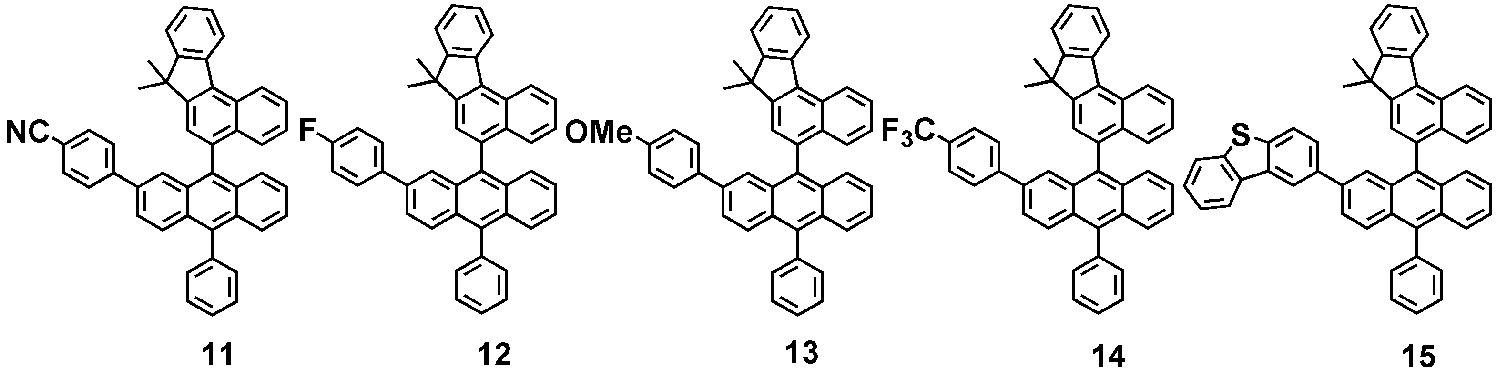
- organic electroluminescent compounds according to the present invention can be more specifically exemplified by the following compounds, but they are not restricted thereto.
- R 1 through R 4 , L 1 , L 2 and Ar 1 are defined as for Chemical Formula (1).
- the present invention also provides an organic electroluminescent device which is comprised of a first electrode; a second electrode; and at least one organic layer(s) interposed between the first electrode and the second electrode; wherein the organic layer comprises one or more organic electroluminescent compound(s) represented by Chemical Formula (1).
- the organic electroluminescent compound is employed as host material of the electroluminescent layer.
- the organic electroluminescent device according to the present invention is characterized in that the organic layer comprises an electroluminescent layer containing one or more organic electroluminescent compound(s) represented by Chemical Formula (1), as well as one or more dopant(s).
- the dopant to be applied to an organic electroluminescent device according to the invention is not particularly restricted, but preferably selected from the compounds represented by Chemical Formula (2) or (3):
- L represents (C6-C30)arylene with or without substituent(s), (C3-C30)heteroarylene with or without substituent(s);
- the electroluminescent layer means the layer where electroluminescence occurs, and it may be a single layer or a multi-layer consisting of two or more layers laminated.
- a mixture of host-dopant is used according to the constitution of the present invention, noticeable improvement in luminous efficiency due to the inventive electroluminescent host could be confirmed. This can be achieved by the doping concentration of 0.5 to 10% by weight.
- the host according to the present invention exhibits higher hole and electron conductivity, and excellent stability of material as compared to other conventional host materials, and provides improved device life as well as luminous efficiency.
- the dopant compounds represented by Chemical Formula (3) can be exemplified by those described in Korean Patent Application No. 10-2009-0023442. More preferably they are selected from the following structures, but not restricted thereto.
- the organic electroluminescent device according to the present invention may further comprise one or more compound(s) selected from a group consisting of arylamine compounds and styrylarylamine compounds, in addition to the organic electroluminescent compound represented by Chemical Formula (1).
- the arylamine or styrylarylamine compounds are exemplified in Korean Patent Application Nos. 10-2008-0123276, 10-2008-0107606 and 10-2008-0118428, but not being restricted thereto.
- the organic layer may further comprise one or more metal(s) selected from a group consisting of organometals of Group 1, Group 2, 4 th period and 5 th period transition metals, lanthanide metals and d-transition elements in the Periodic Table of Elements, or complex(es) thereof, as well as the electroluminescent compound represented by Chemical Formula (1).
- the organic layer may comprise an electroluminescent layer and a charge generating layer at the same time.
- the organic electroluminescent device may also comprise one or more organic electroluminescent layer(s) emitting blue, green or red light, in addition to the organic electroluminescent compound(s) represented by Chemical Formula (1), to form an organic electroluminescent device emitting white light.
- the compounds emitting blue, green or red light are exemplified by Korean Patent Application Nos. 10-2008-0123276, 10-2008-0107606 and 10-2008-0118428, but not being restricted thereto.
- an organic electroluminescent device it is preferable to arrange one or more layer(s) (here-in-below, referred to as the ‘surface layer’) selected from chalcogenide layers, metal halide layers and metal oxide layers, on the inner surface of at least one side of the pair of electrodes.
- the surface layer selected from chalcogenide layers, metal halide layers and metal oxide layers.
- a chalcogenide layer of silicon and aluminum metal (including oxides) on the anode surface of the EL medium layer, and a metal halide layer or a metal oxide layer on the cathode surface of the EL medium layer.
- Examples of metal halides preferably include LiF, MgF 2 , CaF 2 , fluorides of rare earth metal or the like.
- Examples of metal oxides preferably include Cs 2 O, Li 2 O, MgO, SrO, BaO, CaO, or the like.
- an organic electroluminescent device it is also preferable to arrange, on at least one surface of the pair of electrodes thus manufactured, a mixed region of electron transport compound and a reductive dopant, or a mixed region of a hole transport compound with an oxidative dopant. Accordingly, the electron transport compound is reduced to an anion, so that injection and transportation of electrons from the mixed region to an EL medium are facilitated. In addition, since the hole transport compound is oxidized to form a cation, injection and transportation of holes from the mixed region to an EL medium are facilitated.
- Preferable oxidative dopants include various Lewis acids and acceptor compounds.
- Preferable reductive dopants include alkali metals, alkali metal compounds, alkaline earth metals, rare-earth metals, and mixtures thereof.
- a white electroluminescent device having two or more electroluminescent layers can be manufactured by employing a reductive dopant layer as a charge generating layer.
- the organic electroluminescent compounds according to the present invention exhibit high luminous efficiency and excellent life property of the material, so that OLED’s having very good operation life can be manufactured therefrom.
- OLED devices were manufactured by using the electroluminescent material according to the invention.
- a transparent electrode ITO thin film (15 ⁇ / ⁇ ) prepared from glass for OLED (produced by Samsung-Corning) was subjected to ultrasonic washing with trichloroethylene, acetone, ethanol and distilled water, sequentially, and stored in isopropanol before use.
- an ITO substrate was equipped in a substrate folder of a vacuum vapor-deposit device, and 4,4′4′′-tris(N,N-(2-naphthyl)-phenylamino)triphenylamine (2-TNATA)(of which the chemical structure is shown below) was placed in a cell of the vacuum vapor-deposit device, which was then ventilated up to 10 -6 torr of vacuum in the chamber. Electric current was applied to the cell to evaporate 2-TNATA, thereby providing vapor-deposit of a hole injection layer having 60 nm of thickness on the ITO substrate.
- 2-TNATA 4,4′4′′-tris(N,N-(2-naphthyl)-phenylamino)triphenylamine
- NPB N,N′-bis( ⁇ -naphthyl)-N,N′-diphenyl-4,4′-diamine
- an electroluminescent layer was vapor-deposited thereon as follows. To one cell of a vacuum vapor-deposit device, charged was Compound (1) according to the present invention as host, and Compound (A) was charged to another cell as dopant. Two substances were evaporated at different rates to provide doping at a concentration of 2 to 5% by weight on the basis of the host. Thus, an electroluminescent layer having the thickness of 30 nm was vapor-deposited on the hole transport layer.
- Each material employed for manufacturing an OLED was used as the electroluminescent material after purifying via vacuum sublimation at 10 -6 torr.
- an electron transport layer and an electron injecting layer were vapor-deposited according to the same procedures as in Example 1, and Al cathode was vapor-deposited by using another vacuum vapor-deposit device with a thickness of 150 nm, to manufacture an OLED.
- an electron transport layer and an electron injecting layer were vapor-deposited according to the same procedures as in Example 1, and Al cathode was vapor-deposited by using another vacuum vapor-deposit device with a thickness of 150 nm, to manufacture an OLED.
Landscapes
- Chemical & Material Sciences (AREA)
- Organic Chemistry (AREA)
- Engineering & Computer Science (AREA)
- Materials Engineering (AREA)
- Physics & Mathematics (AREA)
- Spectroscopy & Molecular Physics (AREA)
- Optics & Photonics (AREA)
- Electroluminescent Light Sources (AREA)
- Organic Low-Molecular-Weight Compounds And Preparation Thereof (AREA)
- Quinoline Compounds (AREA)
- Indole Compounds (AREA)
Abstract
Description




Claims (8)
- An organic electroluminescent compound represented by Chemical Formula (1):[Chemical Formula 1]
 wherein,L1 and L2 independently represent a chemical bond, (C6-C30)arylene with or without substituent(s), (C3-C30)heteroarylene with or without substituent(s), 5- to 7-membered heterocycloalkylene with or without substituent(s), substituted or unsubstituted 5- to 7-membered heterocycloalkylene fused with one or more aromatic ring(s), (C3-C30)cycloalkylene with or without substituent(s), substituted or unsubstituted (C3-C30)cycloalkylene fused with one or more aromatic ring(s), adamantylene with or without substituent(s), (C7-C30)bicycloalkylene with or without substituent(s), (C2-C30)alkenylene with or without substituent(s), (C2-C30)alkynylene with or without substituent(s), (C6-C30)ar(C1-C30)alkylene with or without substituent(s), (C1-C30)alkylenethio with or without substituent(s), (C1-C30)alkylenoxy with or without substituent(s), (C6-C30)arylenoxy with or without substituent(s), (C6-C30)arylenethio with or without substituent(s), -O- or -S-;R1 through R4 and Ar1 independently represent hydrogen, deuterium, halogen, (C1-C30)alkyl with or without substituent(s), (C6-C30) aryl with or without substituent(s), substituted or unsubstituted (C6-C30)aryl fused with one or more (C3-C30)cycloalkyl(s) with or without substituent(s), (C3-C30)heteroaryl with or without substituent(s), 5- to 7-membered heterocycloalkyl with or without substituent(s), substituted or unsubstituted 5- to 7-membered heterocycloalkyl fused with one or more aromatic ring(s), (C3-C30)cycloalkyl with or without substituent(s), substituted or unsubstituted (C3-C30)cycloalkyl fused with one or more aromatic ring(s), adamantyl with or without substituent(s), (C7-C30)bicycloalkyl with or without substituent(s), cyano, NR11R12, BR13R14, PR15R16, P(=O)R17R18 [wherein R11 through R18 independently represent (C1-C30)alkyl with or without substituent(s), (C6-C30)aryl with or without substituent(s) or (C3-C30)heteroaryl with or without substituent(s)], tri(C1-C30)alkylsilyl with or without substituent(s), di(C1-C30)alkyl(C6-C30)arylsilyl with or without substituent(s), tri(C6-C30)arylsilyl with or without substituent(s), (C6-C30)ar(C1-C30)alkyl with or without substituent(s), (C1-C30)alkyloxy with or without substituent(s), (C1-C30)alkylthio with or without substituent(s), (C6-C30)aryloxy with or without substituent(s), (C6-C30)arylthio with or without substituent(s), (C1-C30)alkoxycarbonyl with or without substituent(s), (C1-C30)alkylcarbonyl with or without substituent(s), (C6-C30)arylcarbonyl with or without substituent(s), (C2-C30)alkenyl with or without substituent(s), (C2-C30)alkynyl with or without substituent(s), (C6-C30)aryloxycarbonyl with or without substituent(s), (C1-C30)alkoxycarbonyloxy with or without substituent(s), (C1-C30)alkylcarbonyloxy with or without substituent(s), (C6-C30)arylcarbonyloxy with or without substituent(s), (C6-C30)aryloxycarbonyloxy with or without substituent(s), carboxyl, nitro,,
 or hydroxyl, or each of them may be linked to an adjacent substituent via (C3-C30)alkylene or (C3-C30)alkenylene with or without a fused ring to form an alicyclic ring or a mono- or polycyclic aromatic ring;
 W represents -(CR51R52)m-, -(R51)C=C(R52)-, -N(R53)-, -S-, -O-, -Si(R54)(R55)-, -P(R56)-, -P(=O)(R57)-, -C(=O)- or -B(R58)-, and R51 through R58 and R61 through R63 are defined as above for R1 through R4;each one of the heterocycloalkyl and heteroaryl contains one or more heteroatom(s) selected from B, N, O, S, P(=O), Si and P; andm represents an integer 1 or 2.
 - The organic electroluminescent compound according to claim 1, wherein each substituent of L1 and L2, R1 through R4, R11 through R18, R51 through R58, R61 through R63 and Ar1 is independently substituted by one or more substituent(s) selected from a group consisting of hydrogen, deuterium, halogen, (C1-C30)alkyl with or without halogen substituent(s), (C6-C30)aryl, (C3-C30)heteroaryl with or without (C6-C30)aryl substituent(s), 5- to 7-membered heterocycloalkyl, 5- to 7-membered heterocycloalkyl fused with one or more aromatic ring(s), (C3-C30)cycloalkyl, (C3-C30)cycloalkyl fused with one or more aromatic ring(s), tri(C1-C30)alkylsilyl, di(C1-C30)alkyl(C6-C30)arylsilyl, tri(C6-C30)arylsilyl, adamantyl, (C7-C30)bicycloalkyl, (C2-C30)alkenyl, (C2-C30)alkynyl, cyano, carbazolyl, NR21R22, BR23R24, PR25R26, P(=O)R27R28 [wherein R21 through R28 independently represent (C1-C30)alkyl with or without substituent(s), (C6-C30)aryl with or without substituent(s) or (C3-C30)heteroaryl with or without substituent(s)], (C6-C30)ar(C1-C30)alkyl, (C1-C30)alkyl(C6-C30)aryl, (C1-C30)alkyloxy, (C1-C30)alkylthio, (C6-C30)aryloxy, (C6-C30)arylthio, (C1-C30)alkoxycarbonyl, (C1-C30)alkylcarbonyl, (C6-C30)arylcarbonyl, (C6-C30)aryloxycarbonyl, (C1-C30)alkoxycarbonyloxy, (C1-C30)alkylcarbonyloxy, (C6-C30)arylcarbonyloxy, (C6-C30)aryloxycarbonyloxy, carboxyl, nitro and hydroxyl, or the adjacent substituents are linked each other to form a ring.
- An organic electroluminescent device comprising the organic electroluminescent compound according to claim 1 or 2.
- The organic electroluminescent device according to claim 3, which is comprised of a first electrode; a second electrode; and one or more organic layer(s) interposed between the first electrode and the second electrode, wherein the organic layer comprises one or more organic electroluminescent compound(s) according to claim 1, and one or more dopant(s) represented by Chemical Formula (2) or (3):[Chemical Formula 2]
 [Chemical Formula 3]
 wherein,L represents (C6-C30)arylene with or without substituent(s), (C3-C30)heteroarylene with or without substituent(s);R151 through R154 independently represent hydrogen, deuterium, halogen, (C1-C30)alkyl with or without substituent(s), (C6-C30) aryl with or without substituent(s), (C3-C30)heteroaryl with or without substituent(s), 5- to 7-membered heterocycloalkyl with or without substituent(s), substituted or unsubstituted 5- to 7-membered heterocycloalkyl fused with one or more aromatic ring(s), (C3-C30)cycloalkyl with or without substituent(s), substituted or unsubstituted (C3-C30)cycloalkyl fused with one or more aromatic ring(s), adamantyl with or without substituent(s), (C7-C30)bicycloalkyl with or without substituent(s), cyano, NR41R42, BR43R44, PR45R46, P(=O)R47R48 [wherein R41 through R48 independently represent (C1-C30)alkyl with or without substituent(s), (C6-C30)aryl with or without substituent(s) or (C3-C30)heteroaryl with or without substituent(s)], tri(C1-C30)alkylsilyl with or without substituent(s), di(C1-C30)alkyl(C6-C30)arylsilyl with or without substituent(s), tri(C6-C30)arylsilyl with or without substituent(s), (C6-C30)ar(C1-C30)alkyl with or without substituent(s), (C1-C30)alkyloxy with or without substituent(s), (C1-C30)alkylthio with or without substituent(s), (C6-C30)aryloxy with or without substituent(s), (C6-C30)arylthio with or without substituent(s), (C1-C30)alkoxycarbonyl with or without substituent(s), (C1-C30)alkylcarbonyl with or without substituent(s), (C6-C30)arylcarbonyl with or without substituent(s), (C2-C30)alkenyl with or without substituent(s), (C2-C30)alkynyl with or without substituent(s), (C6-C30)aryloxycarbonyl with or without substituent(s), (C1-C30)alkoxycarbonyloxy with or without substituent(s), (C1-C30)alkylcarbonyloxy with or without substituent(s), (C6-C30)arylcarbonyloxy with or without substituent(s), (C6-C30)aryloxycarbonyloxy with or without substituent(s), carboxyl, nitro or hydroxyl, or each of them may be linked to an adjacent carbon via (C3-C30)alkylene or (C3-C30)alkenylene with or without a fused ring to form a fused ring; andeach one of the heterocycloalkyl and heteroaryl contains one or more heteroatom(s) selected from B, N, O, S, P(=O), Si and P.
 - The organic electroluminescent device according to claim 4, wherein the organic layer comprises one or more compound(s) selected from a group consisting of arylamine compounds and styrylarylamine compounds.
- The organic electroluminescent device according to claim 4, wherein the organic layer further comprises one or more metal(s) selected from a group consisting of organic metals of Group 1, Group 2, 4th period and 5th period transition metals, lanthanide metals and d-transition elements in the Periodic Table of Elements, or complex(es) thereof.
- The organic electroluminescent device according to claim 4, wherein the organic layer comprises an electroluminescent layer and a charge generating layer.
- The organic electroluminescent device according to claim 4, which is a white light-emitting organic electroluminescent device wherein the organic layer simultaneously comprises one or more organic electroluminescent layer(s) emitting blue, red or green light.
Priority Applications (2)
| Application Number | Priority Date | Filing Date | Title |
|---|---|---|---|
| JP2012503312A JP5781499B2 (en) | 2009-03-31 | 2010-03-24 | Novel organic electroluminescent compound and organic electroluminescent device using the same |
| CN2010800250539A CN102449110A (en) | 2009-03-31 | 2010-03-24 | Novel organic electroluminescent compounds and organic electroluminescent device using the same |
Applications Claiming Priority (2)
| Application Number | Priority Date | Filing Date | Title |
|---|---|---|---|
| KR10-2009-0027846 | 2009-03-31 | ||
| KR1020090027846A KR20100109293A (en) | 2009-03-31 | 2009-03-31 | Novel organic electroluminescent compounds and organic electroluminescent device using the same |
Publications (2)
| Publication Number | Publication Date |
|---|---|
| WO2010114253A2 true WO2010114253A2 (en) | 2010-10-07 |
| WO2010114253A3 WO2010114253A3 (en) | 2010-12-23 |
Family
ID=42828814
Family Applications (1)
| Application Number | Title | Priority Date | Filing Date |
|---|---|---|---|
| PCT/KR2010/001813 Ceased WO2010114253A2 (en) | 2009-03-31 | 2010-03-24 | Novel organic electroluminescent compounds and organic electroluminescent device using the same |
Country Status (5)
| Country | Link |
|---|---|
| JP (1) | JP5781499B2 (en) |
| KR (1) | KR20100109293A (en) |
| CN (1) | CN102449110A (en) |
| TW (1) | TW201105776A (en) |
| WO (1) | WO2010114253A2 (en) |
Cited By (11)
| Publication number | Priority date | Publication date | Assignee | Title |
|---|---|---|---|---|
| JP2009280571A (en) * | 2008-04-24 | 2009-12-03 | Semiconductor Energy Lab Co Ltd | Anthracene derivative, light-emitting material, material for light-emitting element, composition for coating, light-emitting element, light-emitting device and electronic device |
| JP2012089725A (en) * | 2010-10-21 | 2012-05-10 | Konica Minolta Holdings Inc | Organic photoelectric conversion element and solar battery |
| WO2014034869A1 (en) * | 2012-09-03 | 2014-03-06 | 出光興産株式会社 | Organic electroluminescence element |
| US8722904B2 (en) | 2008-04-02 | 2014-05-13 | Semiconductor Energy Laboratory Co., Ltd. | Anthracene derivative, light-emitting device and electronic appliance |
| WO2015009076A1 (en) * | 2013-07-17 | 2015-01-22 | Rohm And Haas Electronic Materials Korea Ltd. | A combination of a dopant compound and a host compound and an organic electroluminescent device comprising the same |
| US9147847B2 (en) | 2009-05-29 | 2015-09-29 | Idemitsu Kosan Co., Ltd. | Anthracene derivative and organic electroluminescent element using the same |
| US9312500B2 (en) | 2012-08-31 | 2016-04-12 | Idemitsu Kosan Co., Ltd. | Organic electroluminescence device |
| KR20160052526A (en) | 2013-09-06 | 2016-05-12 | 이데미쓰 고산 가부시키가이샤 | Anthracene derivative and organic electroluminescent element using same |
| US9748492B2 (en) | 2012-11-02 | 2017-08-29 | Idemitsu Kosan Co., Ltd. | Organic electroluminescent device |
| KR20200020459A (en) * | 2018-08-17 | 2020-02-26 | 주식회사 엘지화학 | Novel compound and organic light emitting device comprising the same |
| CN112996779A (en) * | 2019-02-20 | 2021-06-18 | 株式会社Lg化学 | Anthracene derivative and organic electronic device using the same |
Families Citing this family (8)
| Publication number | Priority date | Publication date | Assignee | Title |
|---|---|---|---|---|
| KR101427605B1 (en) * | 2009-03-31 | 2014-08-07 | 롬엔드하스전자재료코리아유한회사 | Novel organic light emitting compounds and organic electroluminescent devices employing the same |
| KR101596547B1 (en) * | 2012-02-27 | 2016-02-23 | 주식회사 엘지화학 | Organic light emitting diode |
| CN106033793B (en) * | 2015-03-09 | 2018-11-13 | 广东阿格蕾雅光电材料有限公司 | Organic electroluminescence device |
| CN106033798B (en) * | 2015-03-09 | 2017-11-14 | 广东阿格蕾雅光电材料有限公司 | Organic electroluminescence device |
| CN106032350B (en) * | 2015-03-09 | 2019-03-01 | 广东阿格蕾雅光电材料有限公司 | Organic electronic material |
| CN106033801B (en) * | 2015-03-09 | 2018-04-06 | 广东阿格蕾雅光电材料有限公司 | Organic electroluminescence device |
| CN106831448B (en) * | 2016-12-16 | 2019-04-02 | 烟台九目化学制品有限公司 | A kind of novel aromatic amine luminescent material and its application |
| CN107954942B (en) * | 2017-12-08 | 2019-04-09 | 北京鼎材科技有限公司 | Benzopyrazine Substituted Anthracene Derivatives and Organic Electroluminescent Devices |
Family Cites Families (11)
| Publication number | Priority date | Publication date | Assignee | Title |
|---|---|---|---|---|
| US6929870B2 (en) * | 2000-08-10 | 2005-08-16 | Mitsui Chemicals, Inc. | Hydrocarbon compounds, materials for organic electroluminescent elements and organic electroluminescent elements |
| JP4080213B2 (en) * | 2002-02-01 | 2008-04-23 | 三井化学株式会社 | Organic electroluminescence device |
| TW200304371A (en) * | 2002-02-22 | 2003-10-01 | Akzo Nobel Nv | Substituted 10-ary1-11H-benzo [b] fluorenes and 7-ary1-5, 6-dihydro-benz [a] anthracenes for selective effects on estrogen receptors |
| US6849348B2 (en) * | 2002-12-31 | 2005-02-01 | Eastman Kodak Company | Complex fluorene-containing compounds |
| US7887931B2 (en) * | 2003-10-24 | 2011-02-15 | Global Oled Technology Llc | Electroluminescent device with anthracene derivative host |
| KR100788254B1 (en) * | 2005-08-16 | 2007-12-27 | (주)그라쎌 | Green electroluminescent compounds and organic electroluminescent device using the same |
| DE102006031990A1 (en) * | 2006-07-11 | 2008-01-17 | Merck Patent Gmbh | New materials for organic electroluminescent devices |
| JP5233228B2 (en) * | 2006-10-05 | 2013-07-10 | Jnc株式会社 | Benzofluorene compound, light emitting layer material and organic electroluminescent device using the compound |
| US8465848B2 (en) * | 2006-12-29 | 2013-06-18 | E I Du Pont De Nemours And Company | Benzofluorenes for luminescent applications |
| KR101178219B1 (en) * | 2008-11-21 | 2012-08-29 | 롬엔드하스전자재료코리아유한회사 | Electroluminescent device using the electroluminescent compounds |
| KR101427605B1 (en) * | 2009-03-31 | 2014-08-07 | 롬엔드하스전자재료코리아유한회사 | Novel organic light emitting compounds and organic electroluminescent devices employing the same |
-
2009
- 2009-03-31 KR KR1020090027846A patent/KR20100109293A/en not_active Abandoned
-
2010
- 2010-03-24 WO PCT/KR2010/001813 patent/WO2010114253A2/en not_active Ceased
- 2010-03-24 JP JP2012503312A patent/JP5781499B2/en not_active Expired - Fee Related
- 2010-03-24 CN CN2010800250539A patent/CN102449110A/en active Pending
- 2010-03-31 TW TW099109823A patent/TW201105776A/en unknown
Cited By (17)
| Publication number | Priority date | Publication date | Assignee | Title |
|---|---|---|---|---|
| US8722904B2 (en) | 2008-04-02 | 2014-05-13 | Semiconductor Energy Laboratory Co., Ltd. | Anthracene derivative, light-emitting device and electronic appliance |
| US8741449B2 (en) | 2008-04-24 | 2014-06-03 | Semiconductor Energy Laboratory Co., Ltd. | Anthracene derivative, light-emitting material, material for light-emitting element, composition for coating, light-emitting element, light-emitting device, and electronic device |
| JP2009280571A (en) * | 2008-04-24 | 2009-12-03 | Semiconductor Energy Lab Co Ltd | Anthracene derivative, light-emitting material, material for light-emitting element, composition for coating, light-emitting element, light-emitting device and electronic device |
| US9147847B2 (en) | 2009-05-29 | 2015-09-29 | Idemitsu Kosan Co., Ltd. | Anthracene derivative and organic electroluminescent element using the same |
| US9373792B2 (en) | 2009-05-29 | 2016-06-21 | Idemitsu Kosan Co., Ltd. | Anthracene derivative and organic electroluminescent element using the same |
| JP2012089725A (en) * | 2010-10-21 | 2012-05-10 | Konica Minolta Holdings Inc | Organic photoelectric conversion element and solar battery |
| US9312500B2 (en) | 2012-08-31 | 2016-04-12 | Idemitsu Kosan Co., Ltd. | Organic electroluminescence device |
| WO2014034869A1 (en) * | 2012-09-03 | 2014-03-06 | 出光興産株式会社 | Organic electroluminescence element |
| US10388885B2 (en) | 2012-11-02 | 2019-08-20 | Idemitsu Kosan Co., Ltd. | Organic electroluminescent device |
| US9748492B2 (en) | 2012-11-02 | 2017-08-29 | Idemitsu Kosan Co., Ltd. | Organic electroluminescent device |
| WO2015009076A1 (en) * | 2013-07-17 | 2015-01-22 | Rohm And Haas Electronic Materials Korea Ltd. | A combination of a dopant compound and a host compound and an organic electroluminescent device comprising the same |
| KR20160052526A (en) | 2013-09-06 | 2016-05-12 | 이데미쓰 고산 가부시키가이샤 | Anthracene derivative and organic electroluminescent element using same |
| KR20200020459A (en) * | 2018-08-17 | 2020-02-26 | 주식회사 엘지화학 | Novel compound and organic light emitting device comprising the same |
| CN112996779A (en) * | 2019-02-20 | 2021-06-18 | 株式会社Lg化学 | Anthracene derivative and organic electronic device using the same |
| EP3878844A4 (en) * | 2019-02-20 | 2022-01-05 | LG Chem, Ltd. | ANTHRACENE DERIVATIVES AND ORGANIC ELECTRONIC DEVICE USING THIS |
| CN112996779B (en) * | 2019-02-20 | 2024-08-02 | 株式会社Lg化学 | Anthracene derivative and organic electronic device using the same |
| US12167681B2 (en) | 2019-02-20 | 2024-12-10 | Lg Chem, Ltd. | Anthracene derivatives and organic electronic device using same |
Also Published As
| Publication number | Publication date |
|---|---|
| CN102449110A (en) | 2012-05-09 |
| JP5781499B2 (en) | 2015-09-24 |
| WO2010114253A3 (en) | 2010-12-23 |
| KR20100109293A (en) | 2010-10-08 |
| JP2012522041A (en) | 2012-09-20 |
| TW201105776A (en) | 2011-02-16 |
Similar Documents
| Publication | Publication Date | Title |
|---|---|---|
| WO2010114253A2 (en) | Novel organic electroluminescent compounds and organic electroluminescent device using the same | |
| WO2010114256A2 (en) | Novel organic electroluminescent compounds and organic electroluminescent device using the same | |
| WO2012050371A1 (en) | Novel compounds for organic electronic material and organic electroluminescent device using the same | |
| WO2010126270A1 (en) | Novel organic electroluminescent compounds and organic electroluminescent device using the same | |
| WO2011019156A1 (en) | Novel organic electroluminescent compounds and organic electroluminescent device using the same | |
| WO2010114266A2 (en) | Novel organic electroluminescent compounds and organic electroluminescent device using the same | |
| WO2011010843A1 (en) | Novel organic electroluminescent compounds and organic electroluminescent device using the same | |
| WO2011126224A1 (en) | Novel organic electroluminescent compounds and organic electroluminescent device using the same | |
| WO2010126234A1 (en) | Novel organic electroluminescent compounds and organic electroluminescent device using the same | |
| WO2010151006A1 (en) | Novel organic electroluminescent compounds and organic electroluminescent device using the same | |
| WO2011132866A1 (en) | Novel compounds for organic electronic material and organic electroluminescent device using the same | |
| WO2011071255A1 (en) | Novel organic electroluminescent compounds and organic electroluminescent device using the same | |
| WO2011136484A1 (en) | Novel organic electroluminescent compounds and organic electroluminescent device using the same | |
| WO2010110553A2 (en) | Novel organic electroluminescent compounds and organic electroluminescent device using the same | |
| WO2013109030A1 (en) | Organic electroluminescent device comprising the organic electroluminescent compounds | |
| WO2010151011A1 (en) | Novel organic electroluminescent compounds and organic electroluminescent device using the same | |
| WO2012050347A1 (en) | Novel compounds for organic electronic material and organic electroluminescent device using the same | |
| WO2014061963A1 (en) | Organic electroluminescence compounds and organic electroluminescence device comprising the same | |
| WO2012011756A1 (en) | Novel organic electroluminescent compounds and organic electroluminescent devices including the same | |
| WO2011055911A1 (en) | Novel organic electroluminescent compounds and organic electroluminescent device using the same | |
| WO2011010839A1 (en) | Novel organic electroluminescent compounds and organic electroluminescent device using the same | |
| WO2011136482A1 (en) | Novel organic electroluminescent compounds and organic electroluminescent device using the same | |
| WO2010114264A2 (en) | Novel organic electroluminescent compounds and organic electroluminescent device using the same | |
| WO2011115378A1 (en) | Novel organic electroluminescent compounds and organic electroluminescent device using the same | |
| WO2012015265A1 (en) | Novel organic electroluminescent compounds and organic electroluminescent device using the same |
Legal Events
| Date | Code | Title | Description |
|---|---|---|---|
| WWE | Wipo information: entry into national phase |
Ref document number: 201080025053.9 Country of ref document: CN |
|
| 121 | Ep: the epo has been informed by wipo that ep was designated in this application |
Ref document number: 10758978 Country of ref document: EP Kind code of ref document: A2 |
|
| WWE | Wipo information: entry into national phase |
Ref document number: 2012503312 Country of ref document: JP |
|
| NENP | Non-entry into the national phase |
Ref country code: DE |
|
| 122 | Ep: pct application non-entry in european phase |
Ref document number: 10758978 Country of ref document: EP Kind code of ref document: A2 |