WO2010015306A1 - Organic electroluminescence device - Google Patents
Organic electroluminescence device Download PDFInfo
- Publication number
- WO2010015306A1 WO2010015306A1 PCT/EP2009/004954 EP2009004954W WO2010015306A1 WO 2010015306 A1 WO2010015306 A1 WO 2010015306A1 EP 2009004954 W EP2009004954 W EP 2009004954W WO 2010015306 A1 WO2010015306 A1 WO 2010015306A1
- Authority
- WO
- WIPO (PCT)
- Prior art keywords
- formula
- group
- organic electroluminescent
- electroluminescent device
- compounds
- Prior art date
- Legal status (The legal status is an assumption and is not a legal conclusion. Google has not performed a legal analysis and makes no representation as to the accuracy of the status listed.)
- Ceased
Links
- 0 C*c1c(C)c(*)nc(C)n1 Chemical compound C*c1c(C)c(*)nc(C)n1 0.000 description 9
- MIXRAQMOLYAKHA-UHFFFAOYSA-N C[n]1c(-c2nc(-c3ccc[n]3C)nc(-c(cc3)cc4c3-c3ccccc3C43c4ccccc4-c4c3cccc4)n2)ccc1 Chemical compound C[n]1c(-c2nc(-c3ccc[n]3C)nc(-c(cc3)cc4c3-c3ccccc3C43c4ccccc4-c4c3cccc4)n2)ccc1 MIXRAQMOLYAKHA-UHFFFAOYSA-N 0.000 description 1
- WIOWDICUKUXTEY-UHFFFAOYSA-N Cc1nc([AlH2])nc([AlH2])n1 Chemical compound Cc1nc([AlH2])nc([AlH2])n1 WIOWDICUKUXTEY-UHFFFAOYSA-N 0.000 description 1
- MGNCLNQXLYJVJD-UHFFFAOYSA-N Clc1nc(Cl)nc(Cl)n1 Chemical compound Clc1nc(Cl)nc(Cl)n1 MGNCLNQXLYJVJD-UHFFFAOYSA-N 0.000 description 1
- YZNWZUPYTZVYTN-UHFFFAOYSA-N [AlH2]c1nc([AlH2])nc(Cl)n1 Chemical compound [AlH2]c1nc([AlH2])nc(Cl)n1 YZNWZUPYTZVYTN-UHFFFAOYSA-N 0.000 description 1
- PHUNAIWWUHEFRN-UHFFFAOYSA-N [AlH2]c1nc([AlH2])nc([AlH2])n1 Chemical compound [AlH2]c1nc([AlH2])nc([AlH2])n1 PHUNAIWWUHEFRN-UHFFFAOYSA-N 0.000 description 1
- PSDIBYSGMYTOGX-UHFFFAOYSA-M [AlH2]c1nc([AlH]I)nc([AlH2])n1 Chemical compound [AlH2]c1nc([AlH]I)nc([AlH2])n1 PSDIBYSGMYTOGX-UHFFFAOYSA-M 0.000 description 1
- PUNRVROCVYDAPZ-UHFFFAOYSA-N c(cc1)cc2c1-c1ccccc1C21c(cc(cc2)-c3nc(-c4ccncc4)nc(-c4ccncc4)n3)c2-c2c1cccc2 Chemical compound c(cc1)cc2c1-c1ccccc1C21c(cc(cc2)-c3nc(-c4ccncc4)nc(-c4ccncc4)n3)c2-c2c1cccc2 PUNRVROCVYDAPZ-UHFFFAOYSA-N 0.000 description 1
- WSPQKPZHCKFMOG-UHFFFAOYSA-N c(cc1)ccc1N(c1ccccc1)c(cc1)ccc1-c1nc(-c(cc2)cc(C34c5ccccc5-c5c3cccc5)c2-c2c4cccc2)nc(-c(cc2)ccc2N(c2ccccc2)c2ccccc2)n1 Chemical compound c(cc1)ccc1N(c1ccccc1)c(cc1)ccc1-c1nc(-c(cc2)cc(C34c5ccccc5-c5c3cccc5)c2-c2c4cccc2)nc(-c(cc2)ccc2N(c2ccccc2)c2ccccc2)n1 WSPQKPZHCKFMOG-UHFFFAOYSA-N 0.000 description 1
Classifications
-
- C—CHEMISTRY; METALLURGY
- C09—DYES; PAINTS; POLISHES; NATURAL RESINS; ADHESIVES; COMPOSITIONS NOT OTHERWISE PROVIDED FOR; APPLICATIONS OF MATERIALS NOT OTHERWISE PROVIDED FOR
- C09K—MATERIALS FOR MISCELLANEOUS APPLICATIONS, NOT PROVIDED FOR ELSEWHERE
- C09K11/00—Luminescent materials, e.g. electroluminescent or chemiluminescent
- C09K11/06—Luminescent materials, e.g. electroluminescent or chemiluminescent containing organic luminescent materials
-
- C—CHEMISTRY; METALLURGY
- C09—DYES; PAINTS; POLISHES; NATURAL RESINS; ADHESIVES; COMPOSITIONS NOT OTHERWISE PROVIDED FOR; APPLICATIONS OF MATERIALS NOT OTHERWISE PROVIDED FOR
- C09B—ORGANIC DYES OR CLOSELY-RELATED COMPOUNDS FOR PRODUCING DYES, e.g. PIGMENTS; MORDANTS; LAKES
- C09B57/00—Other synthetic dyes of known constitution
-
- H—ELECTRICITY
- H10—SEMICONDUCTOR DEVICES; ELECTRIC SOLID-STATE DEVICES NOT OTHERWISE PROVIDED FOR
- H10K—ORGANIC ELECTRIC SOLID-STATE DEVICES
- H10K50/00—Organic light-emitting devices
- H10K50/10—OLEDs or polymer light-emitting diodes [PLED]
- H10K50/11—OLEDs or polymer light-emitting diodes [PLED] characterised by the electroluminescent [EL] layers
-
- H—ELECTRICITY
- H10—SEMICONDUCTOR DEVICES; ELECTRIC SOLID-STATE DEVICES NOT OTHERWISE PROVIDED FOR
- H10K—ORGANIC ELECTRIC SOLID-STATE DEVICES
- H10K85/00—Organic materials used in the body or electrodes of devices covered by this subclass
- H10K85/60—Organic compounds having low molecular weight
- H10K85/615—Polycyclic condensed aromatic hydrocarbons, e.g. anthracene
- H10K85/626—Polycyclic condensed aromatic hydrocarbons, e.g. anthracene containing more than one polycyclic condensed aromatic rings, e.g. bis-anthracene
-
- H—ELECTRICITY
- H10—SEMICONDUCTOR DEVICES; ELECTRIC SOLID-STATE DEVICES NOT OTHERWISE PROVIDED FOR
- H10K—ORGANIC ELECTRIC SOLID-STATE DEVICES
- H10K85/00—Organic materials used in the body or electrodes of devices covered by this subclass
- H10K85/60—Organic compounds having low molecular weight
- H10K85/649—Aromatic compounds comprising a hetero atom
- H10K85/654—Aromatic compounds comprising a hetero atom comprising only nitrogen as heteroatom
-
- H—ELECTRICITY
- H10—SEMICONDUCTOR DEVICES; ELECTRIC SOLID-STATE DEVICES NOT OTHERWISE PROVIDED FOR
- H10K—ORGANIC ELECTRIC SOLID-STATE DEVICES
- H10K2101/00—Properties of the organic materials covered by group H10K85/00
- H10K2101/10—Triplet emission
-
- Y—GENERAL TAGGING OF NEW TECHNOLOGICAL DEVELOPMENTS; GENERAL TAGGING OF CROSS-SECTIONAL TECHNOLOGIES SPANNING OVER SEVERAL SECTIONS OF THE IPC; TECHNICAL SUBJECTS COVERED BY FORMER USPC CROSS-REFERENCE ART COLLECTIONS [XRACs] AND DIGESTS
- Y10—TECHNICAL SUBJECTS COVERED BY FORMER USPC
- Y10S—TECHNICAL SUBJECTS COVERED BY FORMER USPC CROSS-REFERENCE ART COLLECTIONS [XRACs] AND DIGESTS
- Y10S428/00—Stock material or miscellaneous articles
- Y10S428/917—Electroluminescent
Definitions
- the present invention relates to phosphorescent organic electroluminescent devices which contain fluorene derivatives and spirobifluorene derivatives as matrix materials.
- Organic semiconductors are being developed for a variety of electronic applications.
- OLEDs organic electroluminescent devices
- the structure of organic electroluminescent devices (OLEDs) in which these organic semiconductors are used as functional materials is described, for example, in US Pat. No. 4,539,507, US Pat. No. 5,151,629, EP 0676461 and WO 98/27136.
- further improvements are needed.
- the compounds have a high thermal stability and a high glass transition temperature and can sublime undecomposed.
- carbazole derivatives e.g. Bis (carbazolyl) biphenyl
- matrix materials e.g. Bis (carbazolyl) biphenyl
- ketones WO 04/093207
- phosphine oxides and sulfones WO 05/003253
- ketones low operating voltages and long lifetimes are achieved.
- metal complexes containing ketoketonate ligands for example, acetylacetonate.
- metal complexes for example BAIq or bis [2- (2-benzothiazole) phenolate] zinc (II), are used as matrix materials for phosphorescent emitters. There is still room for improvement here, especially with regard to the operating voltage and the chemical stability. Pure organic compounds are often more stable than these metal complexes. Thus, some of these metal complexes are sensitive to hydrolysis, which makes the handling of the complexes more difficult.
- fluorene derivatives and corresponding heterocyclic derivatives which are substituted by triazine or other electron-poor nitrogen heterocycles, in particular spirobifluorene derivatives are very suitable as matrix materials for phosphorescent emitters and in this use lead to OLEDs which simultaneously have high efficiencies. have long lifetimes and low operating voltages, even with phosphorescent emitters containing ketoketonate ligands.
- the invention thus relates to an organic electroluminescent device comprising in at least one emitting layer
- Ar is the same or different at each occurrence, a heteroaryl group selected from the group consisting of triazine, pyrazine, pyrimidine, pyridazine, pyridine, pyrazole, imidazole, oxazole, oxadiazole or thiazole, which are each substituted with one or more groups R 1 can;
- X is identical or different at each occurrence, a group according to formula (3), wherein the dashed bond in each case indicates the bond to the two benzene rings: - A -
- Ar 1 is, identically or differently, an aromatic or heteroaromatic ring system with 5 to 30 aromatic 2 at each occurrence
- R 2 is identical or different at each occurrence H 1 D or an aliphatic, aromatic and / or heteroaromatic hydrocarbon radical having 1 to 20 carbon atoms, in which H atoms may be replaced by D or F; two or more adjacent substituents R 2 may also together form a mono- or polycyclic, aliphatic or aromatic ring system;
- n 0 or 1
- n 0, 1, 2 or 3;
- anode, cathode and at least one emitting layer which is arranged between the anode and the cathode, contains, wherein at least one layer between the anode and the cathode contains at least one organic or organometallic compound.
- at least one emitting layer contains at least one phosphorescent emitter and at least one compound of the above-mentioned formula (1) or (2).
- An organic electroluminescent device need not necessarily contain only layers that are composed of organic or metallo-organic materials. So it is also possible that one or more layers contain inorganic materials or are constructed entirely of inorganic materials.
- a phosphorescent compound in the context of this invention is a compound which at room temperature luminescence from an ange ⁇ shows excited state with higher spin multiplicity, ie a spin state> 1, in particular from an excited triplet state.
- a spin state> 1 in particular from an excited triplet state.
- all luminescent iridium and platinum compounds are to be regarded as phosphorescent compounds.
- An aryl group in the sense of this invention contains at least 6 C atoms;
- a heteroaryl group contains at least 2 C atoms and at least 1 heteroatom, with the proviso that the sum of C atoms and heteroatoms gives at least 5.
- the heteroatoms are preferably selected from N, O and / or S.
- a simple aromatic cycle ie benzene, or a simple heteroaromatic cycle, for example pyridine, pyrimidine, thiophene, etc., or a fused aryl or heteroaryl group, for example naphthalene, anthracene, pyrene, quinoline, isoquinoline, etc., understood.
- An aromatic ring system in the context of this invention contains at least 6 C atoms in the ring system.
- a heteroaromatic ring system in the sense of this invention contains at least 2 C atoms and at least one heteroatom in the ring system, with the proviso that the sum of C atoms and heteroatoms gives at least 5.
- the heteroatoms are preferably selected from N 1 O and / or S.
- An aromatic or heteroaromatic ring system in the context of this invention is to be understood as meaning a system which does not necessarily contain only aryl or heteroaryl groups but in which also several aryl or heteroaryl groups a short, non-aromatic moiety (preferably less than 10% of the atoms other than H), e.g. B.
- a sp 3 - or sp 2 -hybridized C, N or O atom may be interrupted.
- systems such as 9,9'-spirobifluorene, 9,9-diaryl fluorene, triarylamine, diaryl ether, stilbene, benzophenone, etc. are to be understood as aromatic ring systems in the context of this invention.
- aromatic or heteroaromatic ring system is understood as meaning systems in which a plurality of aryl or heteroaryl groups are linked together by single bonds, for example biphenyl, terphenyl or bipyridine.
- a C 1 to C 40 -alkyl group in which individual H atoms or CH 2 groups may also be substituted by the abovementioned groups, particularly preferably the radicals methyl, ethyl, n-propyl, Propyl, n-butyl, i-butyl, s-butyl, f-butyl, 2-methylbutyl, n-pentyl, s-pentyl, ferf-pentyl, 2-pentyl, cyclopentyl, n-hexyl, s-hexyl, f- Hexyl, 2-hexyl, 3-hexyl, cyclohexyl, 2-methylpentyl, n-heptyl, 2-heptyl, 3-heptyl, 4-heptyl, cycloheptyl, 1-methylcyclohexyl, n-octyl, 2-ethylhexy
- o-alkoxy group are particularly preferably methoxy, trifluoromethoxy, ethoxy, n-propoxy, / propoxy, n-butoxy, / -butoxy, s-butoxy, f-butoxy or 2-methylbutoxy understood.
- an aromatic or heteroaromatic ring system having 5-60 aromatic ring atoms, which may be substituted in each case with the abovementioned radicals R and which may be linked via any positions on the aromatic or heteroaromatic, are understood in particular groups which are derived from benzene, Naphthalene, anthracene, phenanthrene, benzanthracene, pyrene,
- the compounds of the formula (1) and (2) preferably have a glass transition temperature TG of greater than 70 ° C., more preferably greater than 90 ° C., very particularly preferably greater than 110 ° C.
- the group X stands for a group according to formula (3) or for a divalent bridge selected from C (R 1 ) 2 , Si (R 1 ) 2 and NR 1 .
- the group X is a group of the formula (3) or C (R 1 ) 2 .
- the compound according to formula (1) is thus particularly preferably either a spirobifluorene derivative, if the group X is a group according to
- Formula (3) or it is a fluorene derivative, if the group X is C (R 1 ) 2 .
- the compound of the formula (2) is particularly preferably a spirobifluorene derivative, a fluorene derivative or a compound containing a spirobifluorene group and a fluorene group.
- a particularly preferred embodiment of the invention are therefore the fluorene derivatives according to the formulas (4) and (5) and the spirobifluorene derivatives according to the formulas (6) and (7),
- the group Ar is an electron-poor heteroaromatic.
- the group Ar is the same or different at each occurrence for a 6-membered heteroaromatic ring, ie for triazine, pyrazine, pyrimidine, pyridazine or pyridine, which in each case substituted by one or more radicals R 1 can be.
- the monovalent group Ar in compounds of the formulas (1), (2) and (4) to (7) is selected from the groups according to the following formulas (8) to (20), wherein the dashed bond each indicates the binding of the group to the fluorene or the spirobifluorene or to the corresponding heterocyclic derivative and R 1 has the same meaning, as described above:
- the divalent group Ar in compounds of the formulas (2) and (7) is selected from the groups according to the following formulas (21) to (28), wherein the dotted bonds each indicate the bond of the group to the fluorene or indicate the spirobifluorene or the corresponding heterocyclic derivative and R 1 has the same meaning, as described above:
- the group Ar contains two or three nitrogen atoms. Therefore, preferred monovalent groups Ar are the groups of the formulas (8) to (17), and preferred divalent groups Ar are the groups of the formulas (21) to (26). Most preferably, the group Ar contains three nitrogen atoms. Particularly preferred monovalent groups Ar are therefore the groups of the formulas (8) to (11), in particular the group according to formula (8), and particularly preferred bivalent groups Ar are the groups of the formulas (21) and (22), in particular the group according to formula (21).
- the radical R 1 which is bonded to the groups of the formulas (8) to (28), identical or different at each occurrence for H, D is a straight-chain alkyl or alkoxy group having 1 to 10 C atoms or a branched or cyclic alkyl or alkoxy group having 3 to 10 carbon atoms, each of which may be substituted by one or more radicals R 2 , wherein one or more H atoms may be replaced by D or F, or a aromatic or heteroaromatic ring system having 5 to 30 aromatic ring atoms, each of which may be substituted by one or more radicals R 2 , or a combination of these systems.
- the radical R 1 which is bonded to the groups of the formulas (8) to (28), identical or different at each occurrence for H or D, a straight-chain alkyl group having 1 to 5 C atoms or a branched or cyclic alkyl group having 3 to 6 C-atoms which may each be substituted by one or more radicals R 2 , wherein one or more H atoms may be replaced by D or F, or an aromatic or heteroaromatic ring system having from 5 to 25 aromatic ring atoms, each by one or more radicals R 2 may be substituted, or a combination of these systems.
- the radical R 1 which is bonded to the groups of the formulas (8) to (28), identical or different at each occurrence for H or D or for an aromatic or heteroaromatic ring system having 5 to 14 aromatic ring atoms the each may be substituted by one or more radicals R 2 , in particular phenyl, naphthyl or biphenyl, wweellcchheess jjeewweeiillss dduurrcchh eeiinneenn ooddeerr n multiple radicals R 2 may be substituted, but is preferably unsubstituted.
- the radical R 1 which is bonded directly to the fluorene or spirobifluorene or the corresponding heterocyclic compound, is identical or different at each occurrence for H, a straight-chain alkyl or
- the radical R 1 which is bonded directly to the fluorene or spirobifluorene or the corresponding heterocyclic compound, is identical or different at each occurrence for H, a straight-chain alkyl group having 1 to 5 C atoms or a branched or cyclic alkyl group having 3 to 6 C atoms, each of which may be substituted by one or more R 2 radicals, where one or more H atoms may be replaced by D or F, or by an aromatic or heteroaromatic ring system comprising 5 to 25 aromatic ring atoms, which may be substituted in each case by one or more radicals R 2 .
- the group Ar is bonded in the 2-position of the fluorine or spirobifluorene or of the corresponding heterocycle. If more than one group Ar is present, the other groups Ar are preferably attached in the 7-position and in spirobifluorene derivatives also in the 2'-position and 7'-position. Particularly preferred compounds according to formulas (1), (2) and (4) to (7) are therefore the compounds according to the formulas (29) to (32),
- a preferred embodiment of the compounds according to formula (29) and (30) are compounds in which X is C (R 1 ) 2 .
- Preferred embodiments of the compounds according to formulas (29) to (32) are compounds in which the group Ar is a group according to the above-mentioned formulas (8) to (28).
- the compounds according to formula (35) contain one or two triazine groups.
- the compounds of the formula (35) are therefore more preferably selected from compounds of the formulas (37), (38) and (39)
- Examples of preferred compounds according to the formulas (1), (2), (4) to (7) and (29) to (39) are the structures (1) to (96) shown below.
- the compounds according to formula (1) can be synthesized, for example, according to the processes described in US 6,229,012, US 6,225,467 and WO 05/053055.
- metal-catalyzed coupling reactions are suitable for the synthesis of the compounds, in particular the Suzuki coupling, as shown in the following Scheme 1 using the example of triazine.
- a fluorene, spirobifluorene or other heterocyclic derivative which is in each case substituted by a boronic acid or a boronic acid derivative, be coupled under palladium catalysis with the group Ar, which for compounds according to formula (1) with a reactive leaving group and for compounds of formula (2) is substituted with two reactive leaving groups.
- Suitable reactive leaving groups are, for example, halogens, in particular chlorine, bromine and iodine, triflate or tosylate.
- the compounds of the formulas (1) and (2) are used as matrix materials for phosphorescent emitters.
- Particularly suitable as phosphorescent compounds are compounds which emit light, preferably in the visible range, with suitable excitation and also contain at least one atom of atomic number greater than 20, preferably greater than 38 and less than 84, particularly preferably greater than 56 and less than 80.
- Preferred phosphorescence emitters used are compounds containing copper, molybdenum, tungsten, rhenium, ruthenium, osmium, rhodium, iridium, palladium, platinum, silver, gold or europium, in particular compounds containing iridium or platinum.
- Particularly preferred organic electroluminescent devices contain as phosphorescent emitter at least one compound of the formulas (40) to (43),
- R 1 has the same meaning as described above for formula (1) and (2), and for the other symbols used:
- DCy is the same or different at each occurrence, a cyclic one
- CCy is the same or different at each occurrence a cyclic
- A is the same or different at each occurrence as a mononionic, bidentate chelating ligand, preferably a diketonate ligand.
- Examples of the emitters described above can be found in the applications WO 00/70655, WO 01/41512, WO 02/02714, WO 02/15645, EP 1191613, EP 1191612, EP 1191614 and WO 05/033244.
- all phosphorescent complexes as described in accordance with The prior art can be used for phosphorescent OLEDs and as they are known in the art of organic electroluminescence, and the skilled artisan can use other phosphorescent complexes without inventive step.
- the organic electroluminescent device may contain further layers. These are, for example, selected from in each case one or more hole injection layers, hole transport layers, hole blocking layers, electron transport layers, electron injection layers, electron blocking layers, exciton blocking layers,
- interlayers may be present which control the charge balance in the device.
- the layers, in particular the charge transport layers may also be doped. The doping of the layers may be advantageous for improved charge transport. It should be noted, however, that not necessarily each of these layers must be present and the choice of layers always depends on the compounds used.
- the organic electroluminescent device contains a plurality of emitting layers, wherein at least one emitting layer contains at least one compound according to formula (1) or formula (2) and at least one phosphorescent emitter. Particularly preferably, these emission layers have a total of several emission maxima between 380 nm and 750 nm, so that overall white emission results, d. H. in the emitting layers are emitting different
- Used compounds that can fluoresce or phosphoresce and emit the blue and yellow, orange or red light are particularly preferred.
- three-layer systems ie systems with three emitting layers, wherein at least one of these layers at least one compound according to formula (1) or formula (2) and contains at least one phosphorescent emitter and wherein the three layers show blue, green and orange or red emission (for the basic structure, see, for example, WO 05/011013).
- the use of more than three emitting layers may also be preferred.
- white emission emitters which have broadband emission bands and thereby show white emission.
- the emitting layer containing the mixture of the compound of the formula (1) or the formula (2) and the phosphorescent emitter preferably contains between 99 and 50% by volume, preferably between 98 and 50% by volume, more preferably between 97 and 60% by volume, in particular between 95 and 85% by volume of the compound of the formula (1) or formula (2), based on the total mixture of emitter and matrix material. Accordingly, the mixture contains between 1 and 50% by volume, preferably between 2 and 50% by volume, more preferably between 3 and 40% by volume, in particular between 5 and 15% by volume of the phosphorescent emitter relative to the total mixture made of emitter and matrix material.
- a matrix material is selected from compounds of the formula (1) or (2).
- the compounds according to formula (1) and formula (2) have predominantly electron transporting properties by the electron-poor nitrogen heterocycles Ar. Therefore, when a mixture of two or more matrix materials is used, another component of the mixture is preferably a hole transporting one
- Preferred hole-conducting matrix materials are triarylamines, carbazole derivatives, e.g. B. CBP (N, N-Biscarbazolylbiphenyl) or in WO 05/039246, US 2005/0069729, JP 2004/288381, EP 1205527 or WO 08/086851 disclosed carbazole derivatives, Azacarbazole, z. B. according to EP 1617710, EP 1617711, EP 1731584, JP 2005/347160, bipolar
- Matrix materials e.g. B. according to WO 07/137725, and 9,9-diarylfluorene derivatives, for. B. according to the not disclosed application DE 102008017591.9.
- the mixture of matrix materials may also contain more than two matrix materials.
- the matrix material according to formula (1) or formula (2) as a mixture with a to use further electron-transporting matrix material.
- Preferred further electron-transporting matrix materials are ketones, e.g. B. according to WO 04/093207, tetraaryl ketones, z. B. according to DE 102008033943.1, phosphine oxides, sulfoxides and sulfones, z. B.
- oligophenylenes oligophenylenes, bipolar matrix materials, eg. B. according to WO 07/137725, silanes, z.
- bipolar matrix materials eg. B. according to WO 07/137725
- silanes z.
- 9,9-diarylfluorene derivatives for example according to the unpublished application DE 102008017591.9
- azaboroles or boronic esters for example according to WO 06/117052.
- an organic electroluminescent device characterized in that one or more layers are coated with a sublimation process.
- the materials are vacuum deposited in vacuum sublimation at an initial pressure less than 10 "5 mbar, preferably less than 10 " 6 mbar. It should be noted, however, that the pressure can be even lower, for example less than 10 -7 mbar.
- an organic electroluminescent device characterized in that one or more layers are coated with the OVPD (Organic Vapor Phase Deposition) method or with the aid of a carrier gas sublimation.
- the materials are applied at a pressure between 10 "applied 5 mbar and 1 bar.
- OVJP organic vapor jet printing
- the materials are applied directly through a nozzle and patterned (eg. BMS Arnold et al., Appl. Phys. Lett., 2008, 92, 053301).
- an organic electroluminescent device characterized in that one or more layers of solution, such. B. by spin coating, or with any printing process, such.
- any printing process such as screen printing, flexographic printing or offset printing, but more preferably LITI (Light Induced Thermal Imaging, thermal transfer printing) or inkjet printing (ink jet printing), are produced.
- LITI Light Induced Thermal Imaging, thermal transfer printing
- inkjet printing ink jet printing
- soluble compounds are needed. High solubility can be achieved by suitable substitution of the compounds.
- Solutions are applied from individual materials, but also solutions containing multiple compounds, such as matrix materials and dopants.
- the organic electroluminescent device may also be made as a hybrid system by exposing one or more layers
- Solution are applied and one or more other layers are evaporated.
- an emitting layer comprising a compound of the formula (1) or (2) and a phosphorescent dopant from solution and then evaporate a hole blocking layer and / or an electron transport layer in vacuo.
- the emitting layer containing a compound of the formula (1) or (2) and a phosphorescent dopant may be vacuum deposited and one or more other layers may be applied from solution.
- Another object of the present invention are mixtures comprising at least one phosphorescent emitter and at least one compound according to formula (1) or formula (2).
- Another object of the invention are solutions containing a mixture of at least one phosphorescent emitter and at least one compound of formula (1) or formula (2) and at least one organic solvent.
- Yet another object of the present invention is the use of compounds according to formula (1) or formula (2) as a matrix material for phosphorescent emitters in an organic electroluminescent device.
- the organic electroluminescent devices according to the invention have the following surprising advantages over the prior art:
- the organic electroluminescent devices according to the invention have a very high efficiency.
- the organic electroluminescent devices according to the invention simultaneously have an improved lifetime.
- the organic electroluminescent devices according to the invention simultaneously have a reduced operating voltage.
- the educts can be obtained from ALDRICH (potassium fluoride (spray-dried), tri-fer-butyl-phosphine, palladium (II) acetate).
- ALDRICH potential fluoride (spray-dried), tri-fer-butyl-phosphine, palladium (II) acetate).
- 3-Chloro-5,6-diphenyl-1,2,4-triazine can be prepared analogously to EP 577559.
- Example 3 Synthesis of 2- (4,6-diphenyl-1,3,5-triazin-2-yl) spiro-9,9 'bifluorene (TRIAZIN3)
- Electroluminescent devices according to the invention can be prepared as described, for example, in WO 05/003253. Here the results of different OLEDs are compared.
- the basic structure, the materials used, the degree of doping and their layer thicknesses are identical for better comparability.
- Examples 5-7, 12 and 15 describe comparative standards of the prior art in which the emission layer of the host material (or matrix material) bis (9,9'-spirobifluoren-2-yl) ketone (SK) or BAIq or a 50th : 50 Mixture SK: CBP and different guest materials (dopants) TER for red and TEG for green triplet emission.
- OLEDs containing the fluorene triazine derivatives or spirobifluorotriazine derivatives as host material are described. Analogously to the above-mentioned general method, the OLEDs are produced with the following structure:
- HIL Hole Injection Layer 20 nm 2,2 ⁇ 7,7'-tetrakis (di-para-tolylamino) spiro-9,9'-bifluorene
- HTL Hole transporting layer 20 nm NPB (N-naphthyl-N-phenyl-4,4 1 - diaminobiphenyl).
- Emission Layer 40 nm Host Material: Spiro-Ketone (SK)
- Dopant 15 vol.% Doping
- HBL Hole blocking layer
- ETL Electron conductor
- the triazines TRIAZIN2 and TRIAZIN3 used have the structures depicted in Examples 2 and 3 above.
- OLEDs are characterized by default; For this purpose, the electroluminescence spectra, the efficiency (measured in cd / A) as a function of the brightness, the operating voltage, calculated from current-voltage-brightness characteristics (ILJL characteristics), and the lifetime are determined.
- Tables 1 and 3 devices show superior performance over the control devices SK or BAIq in measured efficiencies, voltages, and lifetimes. Furthermore, in Table 2 it can be seen that TRIAZIN2 and TRIAZIN3 are very well suited to form a mixed host with carbazole-containing host materials (here CBP). Table 1: Device results with TRIAZIN2 or TRIAZIN3 in combination with TER-1 and TER-2 as dopants
- Table 2 Device results with TRIAZIN2 or TRIAZIN3 in combination with CBP and with TER-1 or TER-2 as dopants
Landscapes
- Chemical & Material Sciences (AREA)
- Engineering & Computer Science (AREA)
- Materials Engineering (AREA)
- Physics & Mathematics (AREA)
- Spectroscopy & Molecular Physics (AREA)
- Organic Chemistry (AREA)
- Optics & Photonics (AREA)
- Electroluminescent Light Sources (AREA)
Abstract
Description
Organische Elektrolumineszenzvorrichtung Organic electroluminescent device
Die vorliegende Erfindung betrifft phosphoreszierende organische Elektrolumineszenzvorrichtungen, welche Fluoren- und Spirobifluoren- derivate als Matrixmaterialien enthalten.The present invention relates to phosphorescent organic electroluminescent devices which contain fluorene derivatives and spirobifluorene derivatives as matrix materials.
Organische Halbleiter werden für eine Reihe verschiedenartiger elektronischer Anwendungen entwickelt. Der Aufbau organischer Elektro- lumineszenzvorrichtungen (OLEDs), in denen diese organischen Halbleiter als funktionelle Materialien eingesetzt werden, ist beispielsweise in US 4539507, US 5151629, EP 0676461 und WO 98/27136 beschrieben. Allerdings sind noch weitere Verbesserungen erforderlich. So gibt es insbesondere in Bezug auf die Lebensdauer, die Effizienz und die Betriebsspannung organischer Elektrolumineszenzvorrichtungen noch Verbesserungsbedarf. Weiterhin ist es erforderlich, dass die Verbindungen eine hohe thermische Stabilität und eine hohe Glasübergangstemperatur aufweisen und sich unzersetzt sublimieren lassen.Organic semiconductors are being developed for a variety of electronic applications. The structure of organic electroluminescent devices (OLEDs) in which these organic semiconductors are used as functional materials is described, for example, in US Pat. No. 4,539,507, US Pat. No. 5,151,629, EP 0676461 and WO 98/27136. However, further improvements are needed. Thus, there is still room for improvement, especially with regard to the lifetime, the efficiency and the operating voltage of organic electroluminescent devices. Furthermore, it is necessary that the compounds have a high thermal stability and a high glass transition temperature and can sublime undecomposed.
Gerade auch bei phosphoreszierenden Elektrolumineszenzvorrichtungen sind noch Verbesserungen der oben genannten Eigenschaften erforderlich. Insbesondere besteht Verbesserungsbedarf bei Matrixmaterialien für phosphoreszierende Emitter, die gleichzeitig zu guter Effizienz, hoher Lebensdauer und geringer Betriebsspannung führen. Gerade die Eigenschaften der Matrixmaterialien sind häufig limitierend für die Lebensdauer und die Effizienz der organischen Elektrolumineszenzvorrichtung.Especially in the case of phosphorescent electroluminescent devices, improvements of the abovementioned properties are still required. In particular, there is a need for improvement in matrix materials for phosphorescent emitters, which at the same time lead to good efficiency, a long service life and low operating voltage. Especially the properties of the matrix materials are often limiting for the life and the efficiency of the organic electroluminescent device.
Gemäß dem Stand der Technik werden häufig Carbazolderivate, z. B. Bis(carbazolyl)biphenyl, als Matrixmaterialien verwendet. Hier besteht noch Verbesserungsbedarf insbesondere in Bezug auf die Lebensdauer und die Glasübergangstemperatur der Materialien.In the prior art, carbazole derivatives, e.g. Bis (carbazolyl) biphenyl, used as matrix materials. There is still room for improvement here, especially with regard to the service life and the glass transition temperature of the materials.
Weiterhin werden Ketone (WO 04/093207), Phosphinoxide und Sulfone (WO 05/003253) als Matrixmaterialien für phosphoreszierende Emitter verwendet. Insbesondere mit Ketonen werden niedrige Betriebsspannungen und lange Lebensdauern erzielt. Hier besteht noch Verbesserungsbedarf insbesondere in Bezug auf die Effizienz und die Kompatibilität mit Metallkomplexen, welche Ketoketonat-Liganden enthalten, beispielsweise Acetylacetonat.Furthermore, ketones (WO 04/093207), phosphine oxides and sulfones (WO 05/003253) are used as matrix materials for phosphorescent emitters. Especially with ketones low operating voltages and long lifetimes are achieved. Here still exists In particular, there is a need for improvement in terms of efficiency and compatibility with metal complexes containing ketoketonate ligands, for example, acetylacetonate.
Weiterhin werden Metallkomplexe, beispielsweise BAIq oder Bis[2-(2- benzothiazol)phenolat]-zink(ll), als Matrixmaterialien für phosphoreszierende Emitter verwendet. Hier besteht noch Verbesserungsbedarf insbesondere in Bezug auf die Betriebsspannung und die chemische Stabilität. Rein organische Verbindungen sind häufig stabiler als diese Metallkomplexe. So sind einige dieser Metallkomplexe hydrolyse- empfindlich, was die Handhabung der Komplexe erschwert.Furthermore, metal complexes, for example BAIq or bis [2- (2-benzothiazole) phenolate] zinc (II), are used as matrix materials for phosphorescent emitters. There is still room for improvement here, especially with regard to the operating voltage and the chemical stability. Pure organic compounds are often more stable than these metal complexes. Thus, some of these metal complexes are sensitive to hydrolysis, which makes the handling of the complexes more difficult.
Insbesondere besteht noch Verbesserungsbedarf bei Matrixmaterialien für phosphoreszierende Emitter, welche gleichzeitig zu hohen Effizienzen, langen Lebensdauern und geringen Betriebsspannungen führen und welche auch mit phosphoreszierenden Emittern, welche Ketoketonat- Liganden tragen, kompatibel sind.In particular, there is still room for improvement in matrix materials for phosphorescent emitters, which simultaneously lead to high efficiencies, long lifetimes and low operating voltages and which are compatible with phosphorescent emitters which carry ketoketonate ligands.
Überraschend wurde gefunden, dass Fluorenderivate und entsprechende heterocyclische Derivate, welche mit Triazin oder anderen elektronen- armen Stickstoffheterocyclen substituiert sind, insbesondere Spiro- bifluorenderivate, sich sehr gut als Matrixmaterialien für phosphoreszierende Emitter eignen und in dieser Verwendung zu OLEDs führen, welche gleichzeitig hohe Effizienzen, lange Lebensdauern und geringe Betriebsspannungen aufweisen, auch mit phosphoreszierenden Emittern, welche Ketoketonatliganden enthalten.Surprisingly, it has been found that fluorene derivatives and corresponding heterocyclic derivatives which are substituted by triazine or other electron-poor nitrogen heterocycles, in particular spirobifluorene derivatives, are very suitable as matrix materials for phosphorescent emitters and in this use lead to OLEDs which simultaneously have high efficiencies. have long lifetimes and low operating voltages, even with phosphorescent emitters containing ketoketonate ligands.
In der US 6,229,012 und US 6,225,467 ist die Verwendung von Fluoren- derivaten, welche mit Triazingruppen substituiert sind, als Elektronen- transportmaterial in OLEDs offenbart. Es ist der Anmeldung jedoch nicht zu entnehmen, dass sich diese Materialien auch als Matrixmaterialien für phosphoreszierende Emitter eignen.No. 6,229,012 and US Pat. No. 6,225,467 disclose the use of fluorene derivatives which are substituted by triazine groups as electron transport material in OLEDs. However, it is not apparent from the application that these materials are also suitable as matrix materials for phosphorescent emitters.
In der WO 05/053055 wird die Verwendung von Triazinderivaten, insbesondere von Spirobifluorenderivaten, welche mit Triazingruppen substituiert sind, als Lochblockiermaterial in phosphoreszierenden OLEDs offenbart. Es ist der Anmeldung jedoch nicht zu entnehmen, dass sich diese Materialien auch als Matrixmaterialien für phosphoreszierende Emitter eignen.In WO 05/053055, the use of triazine derivatives, in particular spirobifluorene derivatives, which are substituted with triazine, as hole blocking material in phosphorescent OLEDs disclosed. However, it is not apparent from the application that these materials are also suitable as matrix materials for phosphorescent emitters.
Gegenstand der Erfindung ist somit eine organische Elektrolumineszenz- vorrichtung enthaltend in mindestens einer emittierenden SchichtThe invention thus relates to an organic electroluminescent device comprising in at least one emitting layer
(A) mindestens eine phosphoreszierende Verbindung, und(A) at least one phosphorescent compound, and
(B) mindestens eine Verbindung gemäß Formel (1 ) oder Formel (2),(B) at least one compound according to formula (1) or formula (2),

Formel (1)Formula 1)

Formel (2)Formula (2)
wobei für die verwendeten Symbole und Indizes gilt:where the symbols and indices used are:
Ar ist bei jedem Auftreten gleich oder verschieden eine Heteroaryl- gruppe, ausgewählt aus der Gruppe bestehend aus Triazin, Pyrazin, Pyrimidin, Pyridazin, Pyridin, Pyrazol, Imidazol, Oxazol, Oxadiazol oder Thiazol, welche jeweils mit einer oder mehreren Gruppen R1 substituiert sein kann;Ar is the same or different at each occurrence, a heteroaryl group selected from the group consisting of triazine, pyrazine, pyrimidine, pyridazine, pyridine, pyrazole, imidazole, oxazole, oxadiazole or thiazole, which are each substituted with one or more groups R 1 can;
X ist bei jedem Auftreten gleich oder verschieden eine Gruppe gemäß Formel (3), wobei die gestrichelte Bindung jeweils die Bindung an die beiden Benzolringe andeutet: - A -X is identical or different at each occurrence, a group according to formula (3), wherein the dashed bond in each case indicates the bond to the two benzene rings: - A -

oder X ist gleich oder verschieden bei jedem Auftreten eine bivalente Brücke, ausgewählt aus B(R1), C(R1)2, Si(R1)2, C=C(R1)2l O, S, S=O,or X is the same or different at each occurrence as a divalent bridge selected from B (R 1 ), C (R 1 ) 2 , Si (R 1 ) 2 , C = C (R 1 ) 2l O, S, S = O .
SO2, N(R1), P(R1) und P(=O)R1;SO 2 , N (R 1 ), P (R 1 ) and P (= O) R 1 ;
R1 ist bei jedem Auftreten gleich oder verschieden H, D, F, Cl, Br, I, CHO, N(Ar1 )2, C(=O)Ar1, P(=O)(Ar1)2) S(=O)Ar1, S(=O)2Ar1, CR2=CR2Ar1, CN, NO2, Si(R2)3, B(OR2)2, B(R2J2, B(N(R2)2)2, OSO2R2, eine geradkettige Alkyl-, Alkoxy- oder Thioalkoxygruppe mit 1 bis 40 C-Atomen oder eine geradkettige Alkenyl-oder Alkinylgruppe mit 2 bis 40 C-Atomen oder eine verzweigte oder cyclische Alkyl-, Alkenyl-, Alkinyl-, Alkoxy- oder Thioalkoxygruppe mit 3 bis 40 C-Atomen, die jeweils mit einem oder mehreren Resten R2 substituiert sein kann, wobei eine oder mehrere bevorzugt nicht benachbarte CH2-Gruppen durch R2C=CR2, C=C , Si(R2)2, Ge(R2)2, Sn(R2J2, C=O, C=S, C=Se,R 1 is the same or different at each occurrence H, D, F, Cl, Br, I, CHO, N (Ar 1 ) 2 , C (= O) Ar 1 , P (= O) (Ar 1 ) 2) S (= O) Ar 1 , S (= O) 2 Ar 1 , CR 2 = CR 2 Ar 1 , CN, NO 2 , Si (R 2 ) 3 , B (OR 2 ) 2 , B (R 2 J 2 , B (N (R 2 ) 2 ) 2 , OSO 2 R 2 , a straight-chain alkyl, alkoxy or thioalkoxy group having 1 to 40 C atoms or a straight-chain alkenyl or alkynyl group having 2 to 40 C atoms or a branched or cyclic alkyl, alkenyl, alkynyl, alkoxy or thioalkoxy group having 3 to 40 carbon atoms, each of which may be substituted with one or more R 2 radicals, wherein one or more preferably non-adjacent CH 2 groups by R 2 C = CR 2 , C = C, Si (R 2 ) 2 , Ge (R 2 ) 2 , Sn (R 2 J 2 , C = O, C = S, C = Se,
C=NR2, P(=O)(R2), SO, SO2, NR2, O, S oder CONR2 ersetzt sein können und wobei ein oder mehrere H-Atome durch D, F, Cl, Br, I, CN oder NO2 ersetzt sein können, oder ein aromatisches oder heteroaromatisches Ringsystem mit 5 bis 60 aromatischen Ring- 2 atomen, das jeweils durch einen oder mehrere Reste R substituiert sein kann, oder eine Aryloxy- oder Heteroaryloxygruppe mit 5 bis 60 aromatischen Ringatomen, die durch einen oder mehrere Reste R2 substituiert sein kann, oder eine Kombination dieser Systeme; dabei können zwei oder mehrere benachbarte Substituenten R1 auch miteinander ein mono- oder polycyclisches, aliphatisches oder aromatisches Ringsystem bilden;C = NR 2 , P (= O) (R 2 ), SO, SO 2 , NR 2 , O, S or CONR 2 may be replaced and wherein one or more H atoms represented by D, F, Cl, Br, I , CN or NO 2 may be replaced, or an aromatic or heteroaromatic ring system having 5 to 60 aromatic ring atoms, each of which may be substituted by one or more radicals R, or an aryloxy or heteroaryloxy group having 5 to 60 aromatic ring atoms, which may be substituted by one or more radicals R 2 , or a combination of these systems; two or more adjacent substituents R 1 may also together form a mono- or polycyclic, aliphatic or aromatic ring system;
Ar1 ist bei jedem Auftreten gleich oder verschieden ein aromatisches oder heteroaromatisches Ringsystem mit 5 bis 30 aromatischen 2Ar 1 is, identically or differently, an aromatic or heteroaromatic ring system with 5 to 30 aromatic 2 at each occurrence
Ringatomen, das mit einem oder mehreren Resten R substituiert sein kann; dabei können auch zwei Reste Ar1, welche an dasselbe Stickstoff-, Phosphor- oder Boratom binden, durch eine Einfachbindung oder eine Brücke, ausgewählt aus B(R2), C(R2)2, Si(R2)2, C=O, C=NR2, C=C(R2)2, O, S1 S=O, SO2, N(R2), P(R2) und P(=O)R2, miteinander verknüpft sein;Ring atoms substituted by one or more R radicals can be; two radicals Ar 1 which bind to the same nitrogen, phosphorus or boron atom can also be replaced by a single bond or a bridge selected from B (R 2 ), C (R 2 ) 2 , Si (R 2 ) 2 , C = O, C = NR 2 , C = C (R 2 ) 2 , O, S 1 S = O, SO 2 , N (R 2 ), P (R 2 ) and P (= O) R 2 , linked together be;
R2 ist bei jedem Auftreten gleich oder verschieden H1 D oder ein alipha- tischer, aromatischer und/oder heteroaromatischer Kohlenwasserstoffrest mit 1 bis 20 C-Atomen, in dem auch H-Atome durch D oder F ersetzt sein können; dabei können zwei oder mehrere benachbarte Substituenten R2 auch miteinander ein mono- oder polycyclisches, aliphatisches oder aromatisches Ringsystem bilden;R 2 is identical or different at each occurrence H 1 D or an aliphatic, aromatic and / or heteroaromatic hydrocarbon radical having 1 to 20 carbon atoms, in which H atoms may be replaced by D or F; two or more adjacent substituents R 2 may also together form a mono- or polycyclic, aliphatic or aromatic ring system;
n ist 0 oder 1 ;n is 0 or 1;
m ist 0, 1 , 2 oder 3;m is 0, 1, 2 or 3;
o ist 0, 1 , 2, 3 oder 4, wenn n = 0 ist und ist 0, 1 , 2 oder 3, wenn n = 1 ist.o is 0, 1, 2, 3 or 4 when n = 0 and 0, 1, 2 or 3 when n = 1.
Unter einer organischen Elektrolumineszenzvorrichtung wird eineUnder an organic electroluminescent device is a
Vorrichtung verstanden, welche Anode, Kathode und mindestens eine emittierende Schicht, welche zwischen der Anode und der Kathode angeordnet ist, enthält, wobei mindestens eine Schicht zwischen der Anode und der Kathode mindestens eine organische bzw. metall- organische Verbindung enthält. Dabei enthält mindestens eine emittierende Schicht mindestens einen phosphoreszierenden Emitter und mindestens eine Verbindung der oben aufgeführten Formel (1 ) oder (2). Eine organische Elektrolumineszenzvorrichtung muss nicht notwendigerweise nur Schichten enthalten, welche aus organischen oder metall- organischen Materialien aufgebaut sind. So ist es auch möglich, dass eine oder mehrere Schichten anorganische Materialien enthalten oder ganz aus anorganischen Materialien aufgebaut sind.Device understood which anode, cathode and at least one emitting layer, which is arranged between the anode and the cathode, contains, wherein at least one layer between the anode and the cathode contains at least one organic or organometallic compound. In this case, at least one emitting layer contains at least one phosphorescent emitter and at least one compound of the above-mentioned formula (1) or (2). An organic electroluminescent device need not necessarily contain only layers that are composed of organic or metallo-organic materials. So it is also possible that one or more layers contain inorganic materials or are constructed entirely of inorganic materials.
Eine phosphoreszierende Verbindung im Sinne dieser Erfindung ist eine Verbindung, welche bei Raumtemperatur Lumineszenz aus einem ange- regten Zustand mit höherer Spinmultiplizität zeigt, also einem Spinzustand > 1 , insbesondere aus einem angeregten Triplettzustand. Im Sinne dieser Erfindung sollen insbesondere alle lumineszierenden Iridium- und Platinverbindungen als phosphoreszierende Verbindungen angesehen werden.A phosphorescent compound in the context of this invention is a compound which at room temperature luminescence from an ange¬ shows excited state with higher spin multiplicity, ie a spin state> 1, in particular from an excited triplet state. For the purposes of this invention, in particular all luminescent iridium and platinum compounds are to be regarded as phosphorescent compounds.
Eine Arylgruppe im Sinne dieser Erfindung enthält mindestens 6 C-Atome; eine Heteroarylgruppe im Sinne dieser Erfindung enthält mindestens 2 C-Atome und mindestens 1 Heteroatom, mit der Maßgabe, dass die Summe aus C-Atomen und Heteroatomen mindestens 5 ergibt. Die Heteroatome sind bevorzugt ausgewählt aus N, O und/oder S. Dabei wird unter einer Arylgruppe bzw. Heteroarylgruppe entweder ein einfacher aromatischer Cyclus, also Benzol, bzw. ein einfacher heteroaromatischer Cyclus, beispielsweise Pyridin, Pyrimidin, Thiophen, etc., oder eine kondensierte Aryl- oder Heteroarylgruppe, beispielsweise Naphthalin, Anthracen, Pyren, Chinolin, Isochinolin, etc., verstanden.An aryl group in the sense of this invention contains at least 6 C atoms; For the purposes of this invention, a heteroaryl group contains at least 2 C atoms and at least 1 heteroatom, with the proviso that the sum of C atoms and heteroatoms gives at least 5. The heteroatoms are preferably selected from N, O and / or S. Here, under an aryl group or heteroaryl either a simple aromatic cycle, ie benzene, or a simple heteroaromatic cycle, for example pyridine, pyrimidine, thiophene, etc., or a fused aryl or heteroaryl group, for example naphthalene, anthracene, pyrene, quinoline, isoquinoline, etc., understood.
Ein aromatisches Ringsystem im Sinne dieser Erfindung enthält mindestens 6 C-Atome im Ringsystem. Ein heteroaromatisches Ringsystem im Sinne dieser Erfindung enthält mindestens 2 C-Atome und mindestens ein Heteroatom im Ringsystem, mit der Maßgabe, dass die Summe aus C-Atomen und Heteroatomen mindestens 5 ergibt. Die Heteroatome sind bevorzugt ausgewählt aus N1 O und/oder S. Unter einem aromatischen oder heteroaromatischen Ringsystem im Sjnne dieser Erfindung soll ein System verstanden werden, das nicht notwendigerweise nur Aryl- oder Heteroarylgruppen enthält, sondern in dem auch mehrere Aryl- oder Heteroarylgruppen durch eine kurze, nicht-aromatische Einheit (bevorzugt weniger als 10 % der von H verschiedenen Atome), wie z. B. ein sp3- oder sp2-hybridisiertes C-, N- oder O-Atom, unterbrochen sein können. So sollen beispielsweise auch Systeme wie 9,9'-Spirobifluoren, 9,9-Diarylfluoren, Triarylamin, Diarylether, Stilben, Benzophenon, etc. als aromatische Ringsysteme im Sinne dieser Erfindung verstanden werden. Ebenso werden unter einem aromatischen bzw. heteroaromatischen Ringsystem Systeme verstanden, in denen mehrere Aryl- bzw. Heteroarylgruppen durch Einfachbindungen miteinander verknüpft sind, beispielsweise Biphenyl, Terphenyl oder Bipyridin. Im Rahmen der vorliegenden Erfindung werden unter einer Cr bis C40- Alkylgruppe, in der auch einzelne H-Atome oder CH2-Gruppen durch die oben genannten Gruppen substituiert sein können, besonders bevorzugt die Reste Methyl, Ethyl, n-Propyl, /-Propyl, n-Butyl, i-Butyl, s-Butyl, f-Butyl, 2-Methylbutyl, n-Pentyl, s-Pentyl, ferf-Pentyl, 2-Pentyl, Cyclopentyl, n-Hexyl, s-Hexyl, f-Hexyl, 2-Hexyl, 3-Hexyl, Cyclohexyl, 2-Methylpentyl, n-Heptyl, 2-Heptyl, 3-Heptyl, 4-Heptyl, Cycloheptyl, 1-Methylcyclohexyl, n-Octyl, 2-Ethylhexyl, Cyclooctyl, 1-Bicyclo[2,2,2]octyl, 2-Bicyclo[2,2,2]- octyl, 2-(2,6-Dimethyl)octyl, 3-(3,7-Dimethyl)octyl, Trifluormethyl, Penta- fluorethyl, 2,2,2-Trifluorethyl, Ethenyl, Propenyl, Butenyl, Pentenyl, Cyclopentenyl, Hexenyl, Cyclohexenyl, Heptenyl, Cycloheptenyl, Octenyl, Cyclooctenyl, Ethinyl, Propinyl, Butinyl, Pentinyl, Hexinyl, Heptinyl oder Octinyl verstanden. Unter einer CV bis C4o-Alkoxygruppe werden besonders bevorzugt Methoxy, Trifluormethoxy, Ethoxy, n-Propoxy, /-Propoxy, n-Butoxy, /-Butoxy, s-Butoxy, f-Butoxy oder 2-Methylbutoxy verstanden. Unter einem aromatischen oder heteroaromatischen Ringsystem mit 5 - 60 aromatischen Ringatomen, welches noch jeweils mit den oben genannten Resten R substituiert sein kann und welches über beliebige Positionen am Aromaten bzw. Heteroaromaten verknüpft sein kann, werden insbesondere Gruppen verstanden, die abgeleitet sind von Benzol, Naphthalin, Anthracen, Phenanthren, Benzanthracen, Pyren,An aromatic ring system in the context of this invention contains at least 6 C atoms in the ring system. A heteroaromatic ring system in the sense of this invention contains at least 2 C atoms and at least one heteroatom in the ring system, with the proviso that the sum of C atoms and heteroatoms gives at least 5. The heteroatoms are preferably selected from N 1 O and / or S. An aromatic or heteroaromatic ring system in the context of this invention is to be understood as meaning a system which does not necessarily contain only aryl or heteroaryl groups but in which also several aryl or heteroaryl groups a short, non-aromatic moiety (preferably less than 10% of the atoms other than H), e.g. B. a sp 3 - or sp 2 -hybridized C, N or O atom, may be interrupted. Thus, for example, systems such as 9,9'-spirobifluorene, 9,9-diaryl fluorene, triarylamine, diaryl ether, stilbene, benzophenone, etc. are to be understood as aromatic ring systems in the context of this invention. Likewise, an aromatic or heteroaromatic ring system is understood as meaning systems in which a plurality of aryl or heteroaryl groups are linked together by single bonds, for example biphenyl, terphenyl or bipyridine. In the context of the present invention, a C 1 to C 40 -alkyl group in which individual H atoms or CH 2 groups may also be substituted by the abovementioned groups, particularly preferably the radicals methyl, ethyl, n-propyl, Propyl, n-butyl, i-butyl, s-butyl, f-butyl, 2-methylbutyl, n-pentyl, s-pentyl, ferf-pentyl, 2-pentyl, cyclopentyl, n-hexyl, s-hexyl, f- Hexyl, 2-hexyl, 3-hexyl, cyclohexyl, 2-methylpentyl, n-heptyl, 2-heptyl, 3-heptyl, 4-heptyl, cycloheptyl, 1-methylcyclohexyl, n-octyl, 2-ethylhexyl, cyclooctyl, 1 Bicyclo [2,2,2] octyl, 2-bicyclo [2,2,2] octyl, 2- (2,6-dimethyl) octyl, 3- (3,7-dimethyl) octyl, trifluoromethyl, pentafluoroethyl , 2,2,2-trifluoroethyl, ethenyl, propenyl, butenyl, pentenyl, cyclopentenyl, hexenyl, cyclohexenyl, heptenyl, cycloheptenyl, octenyl, cyclooctenyl, ethynyl, propynyl, butynyl, pentynyl, hexynyl, heptynyl or octynyl. Under a CV to C 4 o-alkoxy group are particularly preferably methoxy, trifluoromethoxy, ethoxy, n-propoxy, / propoxy, n-butoxy, / -butoxy, s-butoxy, f-butoxy or 2-methylbutoxy understood. By an aromatic or heteroaromatic ring system having 5-60 aromatic ring atoms, which may be substituted in each case with the abovementioned radicals R and which may be linked via any positions on the aromatic or heteroaromatic, are understood in particular groups which are derived from benzene, Naphthalene, anthracene, phenanthrene, benzanthracene, pyrene,
Chrysen, Perylen, Fluoranthen, Benzfluoranthen, Naphthacen, Pentacen, Benzpyren, Biphenyl, Biphenylen, Terphenyl, Terphenylen, Fluoren, Benzofluoren, Dibenzofluoren, Spirobifluoren, Dihydrophenanthren, Dihydropyren, Tetrahydropyren, eis- oder trans-lndenofluoren, eis- oder trans-Monobenzoindenofluoren, eis- oder trans-Dibenzoindenofluoren, Truxen, Isotruxen, Spirotruxen, Spiroisotruxen, Furan, Benzofuran, Isobenzofuran, Dibenzofuran, Thiophen, Benzothiophen, Isobenzo- thiophen, Dibenzothiophen, Pyrrol, Indol, Isoindol, Carbazol, Pyridin, Chinolin, Isochinolin, Acridin, Phenanthridin, Benzo-5,6-chinolin, Benzo- 6,7-chinolin, Benzo-7,8-chinolin, Phenothiazin, Phenoxazin, Pyrazol, Indazol, Imidazol, Benzimidazol, Naphthimidazol, Phenanthrimidazol, Pyridimidazol, Pyrazinimidazol, Chinoxalinimidazol, Oxazol, Benzoxazol, Naphthoxazol, Anthroxazol, Phenanthroxazol, Isoxazol, 1 ,2-Thiazol, 1 ,3-Thiazol, Benzothiazol, Pyridazin, Benzopyridazin, Pyrimidin, Benz- pyrimidin, Chinoxalin, 1 ,5-Diazaanthracen, 2,7-Diazapyren, 2,3-Diaza- pyren, 1 ,6-Diazapyren, 1 ,8-Diazapyren, 4,5-Diazapyren, 4,5,9, 10-Tetra- azaperylen, Pyrazin, Phenazin, Phenoxazin, Phenothiazin, Fluorubin, Naphthyridin, Azacarbazol, Benzocarbolin, Phenanthrolin, 1 ,2,3-Triazol, 1 ,2,4-Triazol, Benzotriazol, 1 ,2,3-Oxadiazol, 1 ,2,4-Oxadiazol, 1 ,2,5-Oxa- diazol, 1 ,3,4-Oxadiazol, 1 ,2,3-Thiadiazol, 1 ,2,4-Thiadiazol, 1 ,2,5-Thia- diazol, 1 ,3,4-Thiadiazol, 1 ,3,5-Triazin, 1 ,2,4-Triazin, 1 ,2,3-Triazin, Tetrazol,Chrysene, perylene, fluoranthene, benzfluoranthene, naphthacene, pentacene, benzopyrene, biphenyl, biphenylene, terphenyl, terphenyls, fluorene, benzofluorene, dibenzofluorene, spirobifluorene, dihydrophenanthrene, dihydropyrene, tetrahydropyrene, cis or trans indenofluorene, cis- or trans-monobenzoindofluorene, cis or trans dibenzoindenofluorene, truxene, isotruxene, spirotruxene, spiroisotruxene, furan, benzofuran, isobenzofuran, dibenzofuran, thiophene, benzothiophene, isobenzothiophene, dibenzothiophene, pyrrole, indole, isoindole, carbazole, pyridine, quinoline, isoquinoline, acridine, phenanthridine , Benzo-5,6-quinoline, benzo-6,7-quinoline, benzo-7,8-quinoline, phenothiazine, phenoxazine, pyrazole, indazole, imidazole, benzimidazole, naphthimidazole, phenanthrimidazole, pyrimididazole, pyrazine imidazole, quinoxaline imidazole, oxazole, benzoxazole , Naphthoxazole, anthroxazole, phenanthroxazole, isoxazole, 1, 2-thiazole, 1, 3-thiazole, benzothiazole, pyridazine, benzopyridazine, pyrimidine, benz-pyrimidine, quinoxaline, 1, 5-diaza anthracene, 2,7-diazapyrene, 2,3-diaza pyrene, 1,6-diazapyrene, 1,8-diazapyrene, 4,5-diazapyrene, 4,5,9,10-tetraazaperylene, pyrazine, phenazine, phenoxazine, phenothiazine, fluorubin, naphthyridine, azacarbazole, benzocarboline, phenanthroline, 1, 2,3-triazole, 1, 2,4-triazole, benzotriazole, 1, 2,3-oxadiazole, 1, 2,4-oxadiazole, 1, 2,5-oxadiazole, 1, 3,4- Oxadiazole, 1, 2,3-thiadiazole, 1, 2,4-thiadiazole, 1, 2,5-thiadiazole, 1, 3,4-thiadiazole, 1, 3,5-triazine, 1, 2,4- Triazine, 1, 2,3-triazine, tetrazole,
1 ,2,4,5-Tetrazin, 1 ,2,3,4-Tetrazin, 1 ,2,3,5-Tetrazin, Purin, Pteridin, Indolizin und Benzothiadiazol.1, 2,4,5-tetrazine, 1, 2,3,4-tetrazine, 1, 2,3,5-tetrazine, purine, pteridine, indolizine and benzothiadiazole.
Bevorzugt weisen die Verbindungen gemäß Formel (1 ) und (2) eine Glas- Übergangstemperatur TG von größer als 70 0C auf, besonders bevorzugt größer als 90 0C, ganz besonders bevorzugt größer als 110 0C.The compounds of the formula (1) and (2) preferably have a glass transition temperature TG of greater than 70 ° C., more preferably greater than 90 ° C., very particularly preferably greater than 110 ° C.
In einer bevorzugten Ausführungsform der Erfindung steht die Gruppe X gleich oder verschieden bei jedem Auftreten für eine Gruppe gemäß Formel (3) oder für eine bivalente Brücke ausgewählt aus C(R1)2, Si(R1)2 und NR1. In einer besonders bevorzugten Ausführungsform der Erfindung steht die Gruppe X für eine Gruppe gemäß Formel (3) oder für C(R1)2.In a preferred embodiment of the invention, the group X, identically or differently on each occurrence, stands for a group according to formula (3) or for a divalent bridge selected from C (R 1 ) 2 , Si (R 1 ) 2 and NR 1 . In a particularly preferred embodiment of the invention, the group X is a group of the formula (3) or C (R 1 ) 2 .
Die Verbindung gemäß Formel (1 ) ist also besonders bevorzugt entweder ein Spirobifluorenderivat, wenn die Gruppe X für eine Gruppe gemäßThe compound according to formula (1) is thus particularly preferably either a spirobifluorene derivative, if the group X is a group according to
Formel (3) steht, oder sie ist ein Fluorenderivat, wenn die die Gruppe X für C(R1)2 steht. Ebenso ist die Verbindung gemäß Formel (2) besonders bevorzugt ein Spirobifluorenderivat, ein Fluorenderivat oder eine Verbindung, welche eine Spirobifluorengruppe und eine Fluorengruppe enthält. Eine besonders bevorzugte Ausführungsform der Erfindung sind daher die Fluorenderivate gemäß den Formeln (4) und (5) und die Spirobifluorenderivate gemäß den Formeln (6) und (7),Formula (3), or it is a fluorene derivative, if the group X is C (R 1 ) 2 . Also, the compound of the formula (2) is particularly preferably a spirobifluorene derivative, a fluorene derivative or a compound containing a spirobifluorene group and a fluorene group. A particularly preferred embodiment of the invention are therefore the fluorene derivatives according to the formulas (4) and (5) and the spirobifluorene derivatives according to the formulas (6) and (7),

Formel (4)

Formel (5)

Formel (6)

Formel (7)Formula (7)
wobei die verwendeten Symbole und Indizes dieselben Bedeutungen haben, wie oben beschrieben.wherein the symbols and indices used have the same meanings as described above.
Die Gruppe Ar stellt einen elektronenarmen Heteroaromaten dar. Bevorzugt steht die Gruppe Ar gleich oder verschieden bei jedem Auftreten für einen 6-Ring-Heteroaromaten, also für Triazin, Pyrazin, Pyrimidin, Pyridazin oder Pyridin, welcher jeweils mit einem oder mehreren Resten R1 substituiert sein kann. In einer bevorzugten Ausführungsform der Erfindung ist die monovalente Gruppe Ar in Verbindungen der Formeln (1 ), (2) und (4) bis (7) ausgewählt aus den Gruppen gemäß den folgenden Formeln (8) bis (20), wobei die gestrichelte Bindung jeweils die Bindung der Gruppe an das Fluoren bzw. das Spirobifluoren bzw. an das entsprechende heterocyclische Derivat andeutet und R1 dieselbe Bedeutung hat, wie oben beschrieben:The group Ar is an electron-poor heteroaromatic. Preferably, the group Ar is the same or different at each occurrence for a 6-membered heteroaromatic ring, ie for triazine, pyrazine, pyrimidine, pyridazine or pyridine, which in each case substituted by one or more radicals R 1 can be. In a preferred embodiment of the invention, the monovalent group Ar in compounds of the formulas (1), (2) and (4) to (7) is selected from the groups according to the following formulas (8) to (20), wherein the dashed bond each indicates the binding of the group to the fluorene or the spirobifluorene or to the corresponding heterocyclic derivative and R 1 has the same meaning, as described above:

Formel (8) Formel (9) Formel (10) Formel (11 )Formula (8) Formula (9) Formula (10) Formula (11)

Formel (16) Formel (17) Formel (18) Formel (19)

In einer bevorzugten Ausführungsform der Erfindung ist die bivalente Gruppe Ar in Verbindungen der Formeln (2) und (7) ausgewählt aus den Gruppen gemäß den folgenden Formeln (21 ) bis (28), wobei die gestrichelten Bindungen jeweils die Bindung der Gruppe an das Fluoren bzw. das Spirobifluoren bzw. das entsprechende heterocyclische Derivat andeuten und R1 dieselbe Bedeutung hat, wie oben beschrieben:In a preferred embodiment of the invention, the divalent group Ar in compounds of the formulas (2) and (7) is selected from the groups according to the following formulas (21) to (28), wherein the dotted bonds each indicate the bond of the group to the fluorene or indicate the spirobifluorene or the corresponding heterocyclic derivative and R 1 has the same meaning, as described above:

Formel (21 ) Formel (22) Formel (23) Formel (24)

In einer bevorzugten Ausführungsform der Erfindung enthält die Gruppe Ar zwei oder drei Stickstoffatome. Bevorzugte monovalente Gruppen Ar sind daher die Gruppen der Formeln (8) bis (17), und bevorzugte bivalente Gruppen Ar sind die Gruppen der Formeln (21 ) bis (26). Besonders bevorzugt enthält die Gruppe Ar drei Stickstoffatome. Besonders bevorzugte monovalente Gruppen Ar sind daher die Gruppen der Formeln (8) bis (11 ), insbesondere die Gruppe gemäß Formel (8), und besonders bevorzugte bivalente Gruppen Ar sind die Gruppen der Formeln (21 ) und (22), insbesondere die Gruppe gemäß Formel (21 ).In a preferred embodiment of the invention, the group Ar contains two or three nitrogen atoms. Therefore, preferred monovalent groups Ar are the groups of the formulas (8) to (17), and preferred divalent groups Ar are the groups of the formulas (21) to (26). Most preferably, the group Ar contains three nitrogen atoms. Particularly preferred monovalent groups Ar are therefore the groups of the formulas (8) to (11), in particular the group according to formula (8), and particularly preferred bivalent groups Ar are the groups of the formulas (21) and (22), in particular the group according to formula (21).
In nochmals einer bevorzugten Ausführungsform der Erfindung steht der Rest R1, welcher an die Gruppen der Formeln (8) bis (28) gebunden ist, gleich oder verschieden bei jedem Auftreten für H, D, eine geradkettige Alkyl- oder Alkoxygruppe mit 1 bis 10 C-Atomen oder eine verzweigte oder cyclische Alkyl- oder Alkoxygruppe mit 3 bis 10 C-Atomen, die jeweils mit einem oder mehreren Resten R2 substituiert sein kann, wobei ein oder mehrere H-Atome durch D oder F ersetzt sein können, oder ein aromatisches oder heteroaromatisches Ringsystem mit 5 bis 30 aromatischen Ringatomen, das jeweils durch einen oder mehrere Reste R2 substituiert sein kann, oder eine Kombination dieser Systeme. In einer besonders bevorzugten Ausführungsform der Erfindung steht der Rest R1, welcher an die Gruppen der Formeln (8) bis (28) gebunden ist, gleich oder verschieden bei jedem Auftreten für H oder D, eine geradkettige Alkylgruppe mit 1 bis 5 C-Atomen oder eine verzweigte oder cyclische Alkylgruppe mit 3 bis 6 C-Atomen, die jeweils mit einem oder mehreren Resten R2 substituiert sein kann, wobei ein oder mehrere H-Atome durch D oder F ersetzt sein können, oder für ein aromatisches oder heteroaromatisches Ringsystem mit 5 bis 25 aromatischen Ringatomen, das jeweils durch einen oder mehrere Reste R2 substituiert sein kann, oder eine Kombination dieser Systeme. Ganz besonders bevorzugt steht der Rest R1, welcher an die Gruppen der Formeln (8) bis (28) gebunden ist, gleich oder verschieden bei jedem Auftreten für H oder D oder für ein aromatisches oder heteroaromatisches Ringsystem mit 5 bis 14 aromatischen Ringatomen, das jeweils durch einen oder mehrere Reste R2 substituiert sein kann, insbesondere für Phenyl, Naphthyl oder Biphenyl, wweellcchheess jjeewweeiillss dduurrcchh eeiinneenn ooddeerr n mehrere Reste R2 substituiert sein kann, jedoch bevorzugt unsubstituiert ist.In yet a further preferred embodiment of the invention, the radical R 1 which is bonded to the groups of the formulas (8) to (28), identical or different at each occurrence for H, D, is a straight-chain alkyl or alkoxy group having 1 to 10 C atoms or a branched or cyclic alkyl or alkoxy group having 3 to 10 carbon atoms, each of which may be substituted by one or more radicals R 2 , wherein one or more H atoms may be replaced by D or F, or a aromatic or heteroaromatic ring system having 5 to 30 aromatic ring atoms, each of which may be substituted by one or more radicals R 2 , or a combination of these systems. In a particularly preferred embodiment of the invention, the radical R 1 , which is bonded to the groups of the formulas (8) to (28), identical or different at each occurrence for H or D, a straight-chain alkyl group having 1 to 5 C atoms or a branched or cyclic alkyl group having 3 to 6 C-atoms which may each be substituted by one or more radicals R 2 , wherein one or more H atoms may be replaced by D or F, or an aromatic or heteroaromatic ring system having from 5 to 25 aromatic ring atoms, each by one or more radicals R 2 may be substituted, or a combination of these systems. Most preferably, the radical R 1 which is bonded to the groups of the formulas (8) to (28), identical or different at each occurrence for H or D or for an aromatic or heteroaromatic ring system having 5 to 14 aromatic ring atoms, the each may be substituted by one or more radicals R 2 , in particular phenyl, naphthyl or biphenyl, wweellcchheess jjeewweeiillss dduurrcchh eeiinneenn ooddeerr n multiple radicals R 2 may be substituted, but is preferably unsubstituted.
In nochmals einer bevorzugten Ausführungsform der Erfindung steht der Rest R1, welcher direkt an das Fluoren bzw. Spirobifluoren bzw. die entsprechende heterocyclische Verbindung gebunden ist, gleich oder verschieden bei jedem Auftreten für H, eine geradkettige Alkyl- oderIn yet another preferred embodiment of the invention, the radical R 1 , which is bonded directly to the fluorene or spirobifluorene or the corresponding heterocyclic compound, is identical or different at each occurrence for H, a straight-chain alkyl or
Alkoxygruppe mit 1 bis 10 C-Atomen oder eine verzweigte oder cyclische Alkyl- oder Alkoxygruppe mit 3 bis 10 C-Atomen, die jeweils mit einem oder mehreren Resten R2 substituiert sein kann, wobei ein oder mehrere H-Atome durch D oder F ersetzt sein können, oder ein aromatisches oder heteroaromatisches Ringsystem mit 5 bis 30 aromatischen Ringatomen, das jeweils durch einen oder mehrere Reste R2 substituiert sein kann, oder eine Kombination dieser Systeme. In einer besonders bevorzugten Ausführungsform der Erfindung steht der Rest R1, welcher direkt an das Fluoren bzw. Spirobifluoren bzw. die entsprechende heterocyclische Verbindung gebunden ist, gleich oder verschieden bei jedem Auftreten für H, eine geradkettige Alkylgruppe mit 1 bis 5 C-Atomen oder eine verzweigte oder cyclische Alkylgruppe mit 3 bis 6 C-Atomen, die jeweils mit einem oder mehreren Resten R2 substituiert sein kann, wobei ein oder mehrere H-Atome durch D oder F ersetzt sein können, oder für ein aromatisches oder heteroaromatisches Ringsystem mit 5 bis 25 aromatischen Ringatomen, das jeweils durch einen oder mehrere Reste R2 substituiert sein kann.Alkoxy group having 1 to 10 carbon atoms or a branched or cyclic alkyl or alkoxy group having 3 to 10 carbon atoms, each of which may be substituted by one or more radicals R 2 , wherein one or more H atoms replaced by D or F. or an aromatic or heteroaromatic ring system having 5 to 30 aromatic ring atoms, each of which may be substituted by one or more radicals R 2 , or a combination of these systems. In a particularly preferred embodiment of the invention, the radical R 1 , which is bonded directly to the fluorene or spirobifluorene or the corresponding heterocyclic compound, is identical or different at each occurrence for H, a straight-chain alkyl group having 1 to 5 C atoms or a branched or cyclic alkyl group having 3 to 6 C atoms, each of which may be substituted by one or more R 2 radicals, where one or more H atoms may be replaced by D or F, or by an aromatic or heteroaromatic ring system comprising 5 to 25 aromatic ring atoms, which may be substituted in each case by one or more radicals R 2 .
In einer weiteren bevorzugten Ausführungsform der Erfindung ist die Gruppe Ar in 2-Position des Fluorens bzw. Spirobifluorens bzw. des entsprechenden Heterocyclus gebunden. Falls mehr als eine Gruppe Ar vorhanden ist, sind die anderen Gruppen Ar bevorzugt in 7-Position und in Spirobifluorenderivaten auch in der 2'-Position und 7'-Position gebunden. Besonders bevorzugte Verbindungen gemäß Formel (1 ), (2) und (4) bis (7) sind daher die Verbindungen gemäß den Formeln (29) bis (32),In a further preferred embodiment of the invention, the group Ar is bonded in the 2-position of the fluorine or spirobifluorene or of the corresponding heterocycle. If more than one group Ar is present, the other groups Ar are preferably attached in the 7-position and in spirobifluorene derivatives also in the 2'-position and 7'-position. Particularly preferred compounds according to formulas (1), (2) and (4) to (7) are therefore the compounds according to the formulas (29) to (32),

Formel (29)Formula (29)

Formel (30)Formula (30)

Formel (31) Formula (31)

Formel (32)Formula (32)
wobei die Symbole und Indizes dieselbe Bedeutung haben, wie oben beschrieben und wobei für n = 0 in der entsprechenden Position auch ein Substituent R1 gebunden sein kann. Eine bevorzugte Ausführungsform der Verbindungen gemäß Formel (29) und (30) sind Verbindungen, in denen X für C(R1 )2 steht.where the symbols and indices have the same meaning as described above and wherein for n = 0 in the corresponding position also a substituent R 1 can be bound. A preferred embodiment of the compounds according to formula (29) and (30) are compounds in which X is C (R 1 ) 2 .
In einer bevorzugten Ausführungsform von Verbindungen gemäß Formel (1), (2), (4) bis (7) und (29) bis (32) ist der Index m = 0, d. h. außer der Gruppe Ar ist an diesem Benzolring kein weiterer Substituent gebunden.In a preferred embodiment of compounds according to formulas (1), (2), (4) to (7) and (29) to (32), the index m = 0, d. H. except the group Ar, no further substituent is attached to this benzene ring.
In einer weiteren bevorzugten Ausführungsform von Verbindungen gemäß Formel (1 ), (2), (4) bis (7) und (29) bis (32) ist an jedem Benzolring die Summe der Indizes n + o = 0 oder 1 , d. h. an jeden Benzolring ist maximal eine Gruppe Ar oder maximal ein Rest R1 gebunden.In a further preferred embodiment of compounds according to formulas (1), (2), (4) to (7) and (29) to (32), the sum of the indices n + o = 0 or 1, ie Each benzene ring is bound to a maximum of one group Ar or at most one radical R 1 .
Bevorzugte Ausführungsformen der Verbindungen gemäß Formel (29) bis (32) sind Verbindungen, in denen die Gruppe Ar für eine Gruppe gemäß den vorne aufgeführten Formeln (8) bis (28) steht.Preferred embodiments of the compounds according to formulas (29) to (32) are compounds in which the group Ar is a group according to the above-mentioned formulas (8) to (28).
In einer ganz besonders bevorzugten Ausführungsform der Erfindung steht in den Verbindungen gemäß Formel (29) bis (32) die Gruppe Ar für eine Gruppe gemäß Formel (8) bzw. Formel (21). Besonders bevorzugt ist weiterhin in diesen Verbindungen m = 0 und n + o = 0 oder 1 an jedem
Benzolring. Ganz besonders bevorzugt sind daher die Verbindungen gemäß den Formeln (33) bis (36),

Formel (34)
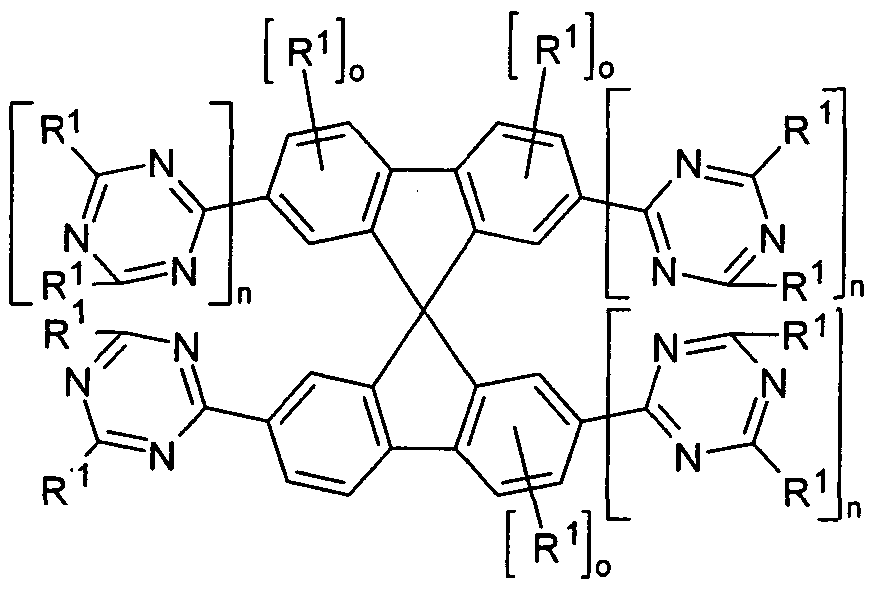
Formel (35) Formula (35)

wobei die verwendeten Symbole und Indizes die oben genannten Bedeutungen haben und weiterhin gilt, dass an jedem Benzolring n + o = 0 oder 1 ist und wobei der Rest R1 für n = 0 und o = 1 an jeder beliebigen freien Stelle des Benzolrings gebunden sein kann. Bevorzugte Ausführungsformen für Verbindungen gemäß Formel (33) und (34) sind solche, in denen X für C(R1 )2 steht.where the symbols and indices used have the abovementioned meanings and furthermore that on each benzene ring n + o = 0 or 1 and in which the radical R 1 for n = 0 and o = 1 is bonded to any free point of the benzene ring can. Preferred embodiments of compounds according to formula (33) and (34) are those in which X is C (R 1 ) 2 .
Besonders bevorzugt sind die Spirobifluorenderivate der Formeln (35) und (36), insbesondere das Spirobifluorenderivat der Formel (35). Ganz besonders bevorzugt enthalten die Verbindungen gemäß Formel (35) eine oder zwei Triazingruppen. Die Verbindungen gemäß Formel (35) sind also besonders bevorzugt ausgewählt aus Verbindungen gemäß Formel (37), (38) und (39),Particular preference is given to the spirobifluorene derivatives of the formulas (35) and (36), in particular the spirobifluorene derivative of the formula (35). Most preferably, the compounds according to formula (35) contain one or two triazine groups. The compounds of the formula (35) are therefore more preferably selected from compounds of the formulas (37), (38) and (39)


Formel (39)Formula (39)
wobei die verwendeten Symbole die oben genannten Bedeutungen haben und o gleich oder verschieden bei jedem Auftreten für 0 oder 1 steht.where the symbols used have the abovementioned meanings and o is the same or different at each occurrence as 0 or 1.
Beispiele für bevorzugte Verbindungen gemäß den Formeln (1 ), (2), (4) bis (7) und (29) bis (39) sind die im Folgenden abgebildeten Strukturen (1) bis (96).Examples of preferred compounds according to the formulas (1), (2), (4) to (7) and (29) to (39) are the structures (1) to (96) shown below.


(37) (38) (39)(37) (38) (39)

(40) (41) (42)(40) (41) (42)

(43) (44) (45)(43) (44) (45)

(46) (47) (48)(46) (47) (48)

(49) (50) (51) (49) (50) (51)

(52) (53) (54)(52) (53) (54)

(55) (56) (57)(55) (56) (57)

(58) (59) (60)(58) (59) (60)

(61) (62) (63)(61) (62) (63)

(64) (65) (66) (64) (65) (66)


Die Verbindungen gemäß Formel (1) können beispielsweise gemäß den in US 6,229,012, US 6,225,467 und WO 05/053055 beschriebenen Verfahren synthetisiert werden. Allgemein eignen sich metallkatalysierte Kupplungsreaktionen zur Synthese der Verbindungen, insbesondere die Suzuki-Kupplung, wie im folgenden Schema 1 am Beispiel des Triazins dargestellt. So kann ein Fluoren, Spirobifluoren oder anderes hetero- cyclisches Derivat, welches jeweils mit einer Boronsäure oder einem Boronsäurederivat substituiert ist, unter Palladium-Katalyse mit der Gruppe Ar gekuppelt werden, welche für Verbindungen gemäß Formel (1 ) mit einer reaktiven Abgangsgruppe und für Verbindungen gemäß Formel (2) mit zwei reaktiven Abgangsgruppen substituiert ist. Geeignete reaktive Abgangsgruppen sind beispielsweise Halogene, insbesondere Chlor, Brom und lod, Triflat oder Tosylat.The compounds according to formula (1) can be synthesized, for example, according to the processes described in US 6,229,012, US 6,225,467 and WO 05/053055. In general, metal-catalyzed coupling reactions are suitable for the synthesis of the compounds, in particular the Suzuki coupling, as shown in the following Scheme 1 using the example of triazine. Thus, a fluorene, spirobifluorene or other heterocyclic derivative, which is in each case substituted by a boronic acid or a boronic acid derivative, be coupled under palladium catalysis with the group Ar, which for compounds according to formula (1) with a reactive leaving group and for compounds of formula (2) is substituted with two reactive leaving groups. Suitable reactive leaving groups are, for example, halogens, in particular chlorine, bromine and iodine, triflate or tosylate.
Schema 1 :Scheme 1:

Wie oben beschrieben, werden die Verbindungen gemäß den Formeln (1) und (2) als Matrixmaterialien für phosphoreszierende Emitter verwendet.As described above, the compounds of the formulas (1) and (2) are used as matrix materials for phosphorescent emitters.
Als phosphoreszierende Verbindungen eignen sich insbesondere Verbindungen, die bei geeigneter Anregung Licht, vorzugsweise im sichtbaren Bereich, emittieren und außerdem mindestens ein Atom der Ordnungszahl größer 20, bevorzugt größer 38 und kleiner 84, besonders bevorzugt größer 56 und kleiner 80 enthalten. Bevorzugt werden als Phosphoreszenzemitter Verbindungen, die Kupfer, Molybdän, Wolfram, Rhenium, Ruthenium, Osmium, Rhodium, Iridium, Palladium, Platin, Silber, Gold oder Europium enthalten, verwendet, insbesondere Verbindungen, die Iridium oder Platin enthalten.Particularly suitable as phosphorescent compounds are compounds which emit light, preferably in the visible range, with suitable excitation and also contain at least one atom of atomic number greater than 20, preferably greater than 38 and less than 84, particularly preferably greater than 56 and less than 80. Preferred phosphorescence emitters used are compounds containing copper, molybdenum, tungsten, rhenium, ruthenium, osmium, rhodium, iridium, palladium, platinum, silver, gold or europium, in particular compounds containing iridium or platinum.
Besonders bevorzugte organische Elektrolumineszenzvorrichtungen enthalten als phosphoreszierenden Emitter mindestens eine Verbindung der Formeln (40) bis (43),

Formel (40) Formel (41 )Formula (40) Formula (41)

Formel (42) Formel (43)Formula (42) Formula (43)
wobei R1 dieselbe Bedeutung hat, wie oben für Formel (1 ) und (2) beschrieben, und für die weiteren verwendeten Symbole gilt:wherein R 1 has the same meaning as described above for formula (1) and (2), and for the other symbols used:
DCy ist gleich oder verschieden bei jedem Auftreten eine cyclischeDCy is the same or different at each occurrence, a cyclic one
Gruppe, die mindestens ein Donoratom, bevorzugt Stickstoff, Kohlenstoff in Form eines Carbens oder Phosphor, enthält, über welches die cyclische Gruppe an das Metall gebunden ist, und die wiederum einen oder mehrere Substituenten R1 tragen kann; die Gruppen DCy und CCy sind über eine kovalente Bindung miteinander verbunden;A group containing at least one donor atom, preferably nitrogen, carbon in the form of a carbene or phosphorus, via which the cyclic group is bonded to the metal, and which in turn may carry one or more substituents R 1 ; the groups DCy and CCy are linked by a covalent bond;
CCy ist gleich oder verschieden bei jedem Auftreten eine cyclischeCCy is the same or different at each occurrence a cyclic
Gruppe, die ein Kohlenstoffatom enthält, über welches die cyclische Gruppe an das Metall gebunden ist und die wiederum einen oder mehrere Substituenten R1 tragen kann;A group containing a carbon atom through which the cyclic group is bonded to the metal and which in turn may carry one or more substituents R 1 ;
A ist gleich oder verschieden bei jedem Auftreten ein mono- anionischer, zweizähnig chelatisierender Ligand, bevorzugt ein Diketonatligand.A is the same or different at each occurrence as a mononionic, bidentate chelating ligand, preferably a diketonate ligand.
Dabei kann durch Bildung von Ringsystemen zwischen mehreren Resten R1 auch eine Brücke zwischen den Gruppen DCy und CCy vorliegen.In this case, by forming ring systems between a plurality of radicals R 1, there may also be a bridge between the groups DCy and CCy.
Beispiele der oben beschriebenen Emitter können den Anmeldungen WO 00/70655, WO 01/41512, WO 02/02714, WO 02/15645, EP 1191613, EP 1191612, EP 1191614 und WO 05/033244 entnommen werden. Generell eignen sich alle phosphoreszierenden Komplexe, wie sie gemäß dem Stand der Technik für phosphoreszierende OLEDs verwendet werden und wie sie dem Fachmann auf dem Gebiet der organischen Elektro- lumineszenz bekannt sind, und der Fachmann kann ohne erfinderisches Zutun weitere phosphoreszierende Komplexe verwenden.Examples of the emitters described above can be found in the applications WO 00/70655, WO 01/41512, WO 02/02714, WO 02/15645, EP 1191613, EP 1191612, EP 1191614 and WO 05/033244. In general, all phosphorescent complexes, as described in accordance with The prior art can be used for phosphorescent OLEDs and as they are known in the art of organic electroluminescence, and the skilled artisan can use other phosphorescent complexes without inventive step.
Außer Kathode, Anode und einer oder mehreren emittierenden Schichten kann die organische Elektrolumineszenzvorrichtung noch weitere Schichten enthalten. Diese sind beispielsweise gewählt aus jeweils einer oder mehreren Lochinjektionsschichten, Lochtransportschichten, Lochblockierschichten, Elektronentransportschichten, Elektroneninjektions- schichten, Elektronenblockierschichten, Excitonenblockierschichten,In addition to the cathode, anode and one or more emitting layers, the organic electroluminescent device may contain further layers. These are, for example, selected from in each case one or more hole injection layers, hole transport layers, hole blocking layers, electron transport layers, electron injection layers, electron blocking layers, exciton blocking layers,
Ladungserzeugungsschichten (=Charge-Generation Layers, IDMC 2003, Taiwan; Session 21 OLED (5), T. Matsumoto, T. Nakada, J. Endo, K. Mori, N. Kawamura, A. Yokoi, J. Kido, Multiphoton Organic EL Device Having Charge Generation Layer) und/oder organischen oder anorganischen p/n- Übergängen. Außerdem können Interlayers vorhanden sein, welche die Ladungsbalance im Device steuern. Weiterhin können die Schichten, insbesondere die Ladungstransportschichten, auch dotiert sein. Die Dotierung der Schichten kann für einen verbesserten Ladungstransport vorteilhaft sein. Es sei aber darauf hingewiesen, dass nicht notwendigerweise jede dieser Schichten vorhanden sein muss und die Wahl der Schichten immer von den verwendeten Verbindungen abhängt.Charge generation layers (= Charge Generation Layers, IDMC 2003, Taiwan, Session 21 OLED (5), T. Matsumoto, T. Nakada, J. Endo, K. Mori, N. Kawamura, A. Yokoi, J. Kido, Multiphoton Organic EL Device Having Charge Generation Layer) and / or organic or inorganic p / n transitions. In addition, interlayers may be present which control the charge balance in the device. Furthermore, the layers, in particular the charge transport layers, may also be doped. The doping of the layers may be advantageous for improved charge transport. It should be noted, however, that not necessarily each of these layers must be present and the choice of layers always depends on the compounds used.
In einer weiteren bevorzugten Ausführungsform der Erfindung enthält die organische Elektrolumineszenzvorrichtung mehrere emittierende Schichten, wobei mindestens eine emittierende Schicht mindestens eine Verbindung gemäß Formel (1 ) oder Formel (2) und mindestens einen phosphoreszierenden Emitter enthält. Besonders bevorzugt weisen diese Emissionsschichten insgesamt mehrere Emissionsmaxima zwischen 380 nm und 750 nm auf, so dass insgesamt weiße Emission resultiert, d. h. in den emittierenden Schichten werden verschiedene emittierendeIn a further preferred embodiment of the invention, the organic electroluminescent device contains a plurality of emitting layers, wherein at least one emitting layer contains at least one compound according to formula (1) or formula (2) and at least one phosphorescent emitter. Particularly preferably, these emission layers have a total of several emission maxima between 380 nm and 750 nm, so that overall white emission results, d. H. in the emitting layers are emitting different
Verbindungen verwendet, die fluoreszieren oder phosphoreszieren können und die blaues und gelbes, orange oder rotes Licht emittieren. Insbesondere bevorzugt sind Dreischichtsysteme, also Systeme mit drei emittierenden Schichten, wobei mindestens eine dieser Schichten mindestens eine Verbindung gemäß Formel (1 ) oder Formel (2) und mindestens einen phosphoreszierenden Emitter enthält und wobei die drei Schichten blaue, grüne und orange oder rote Emission zeigen (für den prinzipiellen Aufbau siehe z. B. WO 05/011013). Auch die Verwendung von mehr als drei emittierenden Schichten kann bevorzugt sein. Ebenso eignen sich für weiße Emission Emitter, welche breitbandige Emissions- banden aufweisen und dadurch weiße Emission zeigen.Used compounds that can fluoresce or phosphoresce and emit the blue and yellow, orange or red light. Particularly preferred are three-layer systems, ie systems with three emitting layers, wherein at least one of these layers at least one compound according to formula (1) or formula (2) and contains at least one phosphorescent emitter and wherein the three layers show blue, green and orange or red emission (for the basic structure, see, for example, WO 05/011013). The use of more than three emitting layers may also be preferred. Also suitable for white emission emitters, which have broadband emission bands and thereby show white emission.
Die emittierende Schicht, welche die Mischung aus der Verbindung gemäß Formel (1 ) bzw. Formel (2) und dem phosphoreszierenden Emitter enthält, enthält bevorzugt zwischen 99 und 50 Vol.-%, vorzugsweise zwischen 98 und 50 Vol.-%, besonders bevorzugt zwischen 97 und 60 Vol.-%, insbesondere zwischen 95 und 85 Vol.-% der Verbindung gemäß Formel (1 ) bzw. Formel (2) bezogen auf die Gesamtmischung aus Emitter und Matrixmaterial. Entsprechend enthält die Mischung zwischen 1 und 50 Vol.-%, vorzugsweise zwischen 2 und 50 Vol.-%, besonders bevorzugt zwischen 3 und 40 Vol.-%, insbesondere zwischen 5 und 15 Vol.-% des phosphoreszierenden Emitters bezogen auf die Gesamtmischung aus Emitter und Matrixmaterial.The emitting layer containing the mixture of the compound of the formula (1) or the formula (2) and the phosphorescent emitter preferably contains between 99 and 50% by volume, preferably between 98 and 50% by volume, more preferably between 97 and 60% by volume, in particular between 95 and 85% by volume of the compound of the formula (1) or formula (2), based on the total mixture of emitter and matrix material. Accordingly, the mixture contains between 1 and 50% by volume, preferably between 2 and 50% by volume, more preferably between 3 and 40% by volume, in particular between 5 and 15% by volume of the phosphorescent emitter relative to the total mixture made of emitter and matrix material.
Bevorzugt ist weiterhin auch die Verwendung mehrerer Matrixmaterialien als Mischung, wobei ein Matrixmaterial ausgewählt ist aus Verbindungen der Formel (1 ) oder (2). Die Verbindungen gemäß Formel (1 ) und Formel (2) haben überwiegend elektronentransportierende Eigenschaften durch die elektronenarmen Stickstoffheterocyclen Ar. Wenn eine Mischung aus zwei oder mehr Matrixmaterialien verwendet wird, ist daher eine weitere Komponente der Mischung bevorzugt eine lochtransportierendeAlso preferred is the use of a plurality of matrix materials as a mixture, wherein a matrix material is selected from compounds of the formula (1) or (2). The compounds according to formula (1) and formula (2) have predominantly electron transporting properties by the electron-poor nitrogen heterocycles Ar. Therefore, when a mixture of two or more matrix materials is used, another component of the mixture is preferably a hole transporting one
Verbindung. Bevorzugte lochleitende Matrixmaterialien sind Triarylamine, Carbazolderivate, z. B. CBP (N,N-Biscarbazolylbiphenyl) oder die in WO 05/039246, US 2005/0069729, JP 2004/288381 , EP 1205527 oder WO 08/086851 offenbarten Carbazolderivate, Azacarbazole, z. B. gemäß EP 1617710, EP 1617711 , EP 1731584, JP 2005/347160, bipolareConnection. Preferred hole-conducting matrix materials are triarylamines, carbazole derivatives, e.g. B. CBP (N, N-Biscarbazolylbiphenyl) or in WO 05/039246, US 2005/0069729, JP 2004/288381, EP 1205527 or WO 08/086851 disclosed carbazole derivatives, Azacarbazole, z. B. according to EP 1617710, EP 1617711, EP 1731584, JP 2005/347160, bipolar
Matrixmaterialien, z. B. gemäß WO 07/137725, und 9,9-Diarylfluoren- derivate, z. B. gemäß der nicht offen gelegten Anmeldung DE 102008017591.9. Die Mischung der Matrixmaterialien kann auch mehr als zwei Matrixmaterialien enthalten. Es ist weiterhin auch möglich, das Matrixmaterial gemäß Formel (1 ) bzw. Formel (2) als Mischung mit einem weiteren elektronentransportierenden Matrixmaterial zu verwenden. Bevorzugte weitere elektronentransportierende Matrixmaterialien sind Ketone, z. B. gemäß WO 04/093207, Tetraarylketone, z. B. gemäß DE 102008033943.1 , Phosphinoxide, Sulfoxide und Sulfone, z. B. gemäß WO 05/003253, Oligophenylene, bipolare Matrixmaterialien, z. B. gemäß WO 07/137725, Silane, z. B. gemäß WO 05/111172, 9,9-Diarylfluoren- derivate (z. B. gemäß der nicht offen gelegten Anmeldung DE 102008017591.9), Azaborole oder Boronester (z. B. gemäß WO 06/117052).Matrix materials, e.g. B. according to WO 07/137725, and 9,9-diarylfluorene derivatives, for. B. according to the not disclosed application DE 102008017591.9. The mixture of matrix materials may also contain more than two matrix materials. It is also possible, the matrix material according to formula (1) or formula (2) as a mixture with a to use further electron-transporting matrix material. Preferred further electron-transporting matrix materials are ketones, e.g. B. according to WO 04/093207, tetraaryl ketones, z. B. according to DE 102008033943.1, phosphine oxides, sulfoxides and sulfones, z. B. according to WO 05/003253, oligophenylenes, bipolar matrix materials, eg. B. according to WO 07/137725, silanes, z. For example, according to WO 05/111172, 9,9-diarylfluorene derivatives (for example according to the unpublished application DE 102008017591.9), azaboroles or boronic esters (for example according to WO 06/117052).
Weiterhin bevorzugt ist eine organische Elektrolumineszenzvorrichtung, dadurch gekennzeichnet, dass eine oder mehrere Schichten mit einem Sublimationsverfahren beschichtet werden. Dabei werden die Materialien in Vakuum-Sublimationsanlagen bei einem Anfangsdruck kleiner 10"5 mbar, bevorzugt kleiner 10"6 mbar aufgedampft. Es sei jedoch angemerkt, dass der Druck auch noch geringer sein kann, beispielsweise kleiner 10'7 mbar.Further preferred is an organic electroluminescent device, characterized in that one or more layers are coated with a sublimation process. The materials are vacuum deposited in vacuum sublimation at an initial pressure less than 10 "5 mbar, preferably less than 10 " 6 mbar. It should be noted, however, that the pressure can be even lower, for example less than 10 -7 mbar.
Bevorzugt ist ebenfalls eine organische Elektrolumineszenzvorrichtung, dadurch gekennzeichnet, dass eine oder mehrere Schichten mit dem OVPD (Organic Vapour Phase Deposition) Verfahren oder mit Hilfe einer Trägergassublimation beschichtet werden. Dabei werden die Materialien bei einem Druck zwischen 10"5 mbar und 1 bar aufgebracht. Ein Spezialfall dieses Verfahrens ist das OVJP (Organic Vapour Jet Printing) Verfahren, bei dem die Materialien direkt durch eine Düse aufgebracht und so strukturiert werden (z. B. M. S. Arnold et al., Appl. Phys. Lett. 2008, 92, 053301 ).Also preferred is an organic electroluminescent device, characterized in that one or more layers are coated with the OVPD (Organic Vapor Phase Deposition) method or with the aid of a carrier gas sublimation. The materials are applied at a pressure between 10 "applied 5 mbar and 1 bar. A special case of this method is the OVJP (organic vapor jet printing) method in which the materials are applied directly through a nozzle and patterned (eg. BMS Arnold et al., Appl. Phys. Lett., 2008, 92, 053301).
Weiterhin bevorzugt ist eine organische Elektrolumineszenzvorrichtung, dadurch gekennzeichnet, dass eine oder mehrere Schichten aus Lösung, wie z. B. durch Spincoating, oder mit einem beliebigen Druckverfahren, wie z. B. Siebdruck, Flexodruck oder Offsetdruck, besonders bevorzugt aber LITI (Light Induced Thermal Imaging, Thermotransferdruck) oder InkJet Druck (Tintenstrahldruck), hergestellt werden. Hierfür sind lösliche Verbindungen nötig. Hohe Löslichkeit lässt sich durch geeignete Substitution der Verbindungen erreichen. Dabei können nicht nur Lösungen aus einzelnen Materialien aufgebracht werden, sondern auch Lösungen, die mehrere Verbindungen enthalten, beispielsweise Matrixmaterialien und Dotanden.Further preferred is an organic electroluminescent device, characterized in that one or more layers of solution, such. B. by spin coating, or with any printing process, such. As screen printing, flexographic printing or offset printing, but more preferably LITI (Light Induced Thermal Imaging, thermal transfer printing) or inkjet printing (ink jet printing), are produced. For this purpose, soluble compounds are needed. High solubility can be achieved by suitable substitution of the compounds. Not only can Solutions are applied from individual materials, but also solutions containing multiple compounds, such as matrix materials and dopants.
Die organische Elektrolumineszenzvorrichtung kann auch als Hybrid- System hergestellt werden, indem eine oder mehrere Schichten ausThe organic electroluminescent device may also be made as a hybrid system by exposing one or more layers
Lösung aufgebracht werden und eine oder mehrere andere Schichten aufgedampft werden. So ist es beispielsweise möglich, eine emittierende Schicht enthaltend eine Verbindung gemäß Formel (1 ) oder (2) und einen phosphoreszierenden Dotanden aus Lösung aufzubringen und darauf eine Lochblockierschicht und/oder eine Elektronentransportschicht im Vakuum aufzudampfen. Ebenso kann die emittierende Schicht enthaltend eine Verbindung gemäß Formel (1) oder (2) und einen phosphoreszierenden Dotanden im Vakuum aufgedampft werden und eine oder mehrere andere Schichten können aus Lösung aufgebracht werden.Solution are applied and one or more other layers are evaporated. Thus, for example, it is possible to apply an emitting layer comprising a compound of the formula (1) or (2) and a phosphorescent dopant from solution and then evaporate a hole blocking layer and / or an electron transport layer in vacuo. Likewise, the emitting layer containing a compound of the formula (1) or (2) and a phosphorescent dopant may be vacuum deposited and one or more other layers may be applied from solution.
Diese Verfahren sind dem Fachmann generell bekannt und können von ihm ohne Probleme auf organische Elektrolumineszenzvorrichtungen enthaltend Verbindungen gemäß Formel (1 ) oder (2) bzw. die oben aufgeführten bevorzugten Ausführungsformen angewandt werden.These methods are generally known to the person skilled in the art and can be applied by him without problems to organic electroluminescent devices comprising compounds of the formula (1) or (2) or the preferred embodiments listed above.
Ein weiterer Gegenstand der vorliegenden Erfindung sind Mischungen, enthaltend mindestens einen phosphoreszierenden Emitter und mindestens eine Verbindung gemäß Formel (1 ) oder Formel (2).Another object of the present invention are mixtures comprising at least one phosphorescent emitter and at least one compound according to formula (1) or formula (2).
Ein weiterer Gegenstand der Erfindung sind Lösungen enthaltend eine Mischung aus mindestens einem phosphoreszierenden Emitter und mindestens einer Verbindung gemäß Formel (1 ) oder Formel (2) sowie mindestens ein organisches Lösungsmittel.Another object of the invention are solutions containing a mixture of at least one phosphorescent emitter and at least one compound of formula (1) or formula (2) and at least one organic solvent.
Nochmals ein weiterer Gegenstand der vorliegenden Erfindung ist die Verwendung von Verbindungen gemäß Formel (1) oder Formel (2) als Matrixmaterial für phosphoreszierende Emitter in einer organischen Elektrolumineszenzvorrichtung. Die erfindungsgemäßen organischen Elektrolumineszenzvorrichtungen folgende überraschende Vorteile gegenüber dem Stand der Technik auf:Yet another object of the present invention is the use of compounds according to formula (1) or formula (2) as a matrix material for phosphorescent emitters in an organic electroluminescent device. The organic electroluminescent devices according to the invention have the following surprising advantages over the prior art:
1. Die erfindungsgemäßen organischen Elektrolumineszenzvorrichtungen weisen eine sehr hohe Effizienz auf.1. The organic electroluminescent devices according to the invention have a very high efficiency.
2. Die erfindungsgemäßen organischen Elektrolumineszenzvorrichtungen weisen gleichzeitig eine verbesserte Lebensdauer auf.2. The organic electroluminescent devices according to the invention simultaneously have an improved lifetime.
3. Die erfindungsgemäßen organischen Elektrolumineszenzvorrichtungen weisen gleichzeitig eine verringerte Betriebsspannung auf.3. The organic electroluminescent devices according to the invention simultaneously have a reduced operating voltage.
4. Die oben genannten verbesserten Eigenschaften der organischen Elektrolumineszenzvorrichtungen werden nicht nur mit tris-ortho- metallierten Metallkomplexen erhalten, sondern insbesondere auch mit Komplexen, welche noch einen Ketoketonat-Liganden, z. B. Acetyl- acetonat, enthalten. Matrixmaterialien gemäß dem Stand der Technik zeigen gerade für derartige Komplexe noch Verbesserungsbedarf in Bezug auf Effizienz, Lebensdauer und Betriebsspannung.4. The abovementioned improved properties of the organic electroluminescent devices are obtained not only with tris-ortho-metallated metal complexes, but in particular also with complexes which also contain a ketoketonate ligand, eg. As acetyl acetonate included. Prior art matrix materials still indicate room for improvement in terms of efficiency, lifetime, and operating voltage for such complexes.
Die Erfindung wird durch die nachfolgenden Beispiele genauer beschrieben, ohne sie dadurch einschränken zu wollen. Der Fachmann kann, ohne erfinderisch tätig zu werden, weitere erfindungsgemäße Verbindungen herstellen und diese in organischen elektronischen Vorrichtungen verwenden.The invention will be described in more detail by the following examples without wishing to limit them thereby. The person skilled in the art, without being inventive, can produce further compounds according to the invention and use them in organic electronic devices.
Beispiele:Examples:
Die nachfolgenden Synthesen werden, sofern nicht anders angegeben, unter einer Schutzgasatmosphäre in getrockneten Lösungsmitteln durchgeführt. Die Edukte können von ALDRICH (Kaliumfluorid (sprüh- getrocknet), Tri-ferf-butylphosphin, Palladium(ll)acetat) bezogen werden. 3-Chlor-5,6-diphenyl-1 ,2,4-triazin kann analog zu EP 577559 dargestellt werden. 2',7'-Di-te/f-butyl-spiro-9I9'-bifluoren-2,7-bisboronsäureglycolester kann nach WO 02/077060 und 2-Chlor-4,6-diphenyl-1 ,3,5-triazin nach US 5,438138 dargestellt werden. Spiro-9,9'-bifluoren-2,7-bis(boronsäure- glycolester) kann analog zu WO 02/077060 dargestellt werden. Beispiel 1 : Synthese von 2,7-Bis(4,6-diphenyl-1 ,3,5-triazin-2-yl)-2',7'- di-fert-butyl-spiro-9,9'-bifluoren (TRIAZIN 1 )Unless stated otherwise, the following syntheses are carried out under an inert gas atmosphere in dried solvents. The educts can be obtained from ALDRICH (potassium fluoride (spray-dried), tri-fer-butyl-phosphine, palladium (II) acetate). 3-Chloro-5,6-diphenyl-1,2,4-triazine can be prepared analogously to EP 577559. 2 ', 7'-Di-tert-butyl-spiro-9 I 9 ' -bifluorene-2,7-bisboronic acid glycol ester can according to WO 02/077060 and 2-chloro-4,6-diphenyl-1,3,5 triazine according to US 5,438,138. Spiro-9,9'-bifluorene-2,7-bis (boronic acid glycol ester) can be prepared analogously to WO 02/077060. Example 1: Synthesis of 2,7-bis (4,6-diphenyl-1,3,5-triazin-2-yl) -2 ', 7'-di-tert-butyl spiro-9,9'-bifluorene (TRIAZINE 1)

28.4 g (50.0 mmol) 2',7'-Di-terf-butyl-spiro-9,9'-bifluoren-2,7-bisboron- säureglycolester, 29.5 g (110.0 mmol) 2-Chlor-4,6-diphenyl-1 ,3,5-triazin und 44.6 g (210.0 mmol) Trikaliumphosphat werden in 500 mL Toulol, 500 mL Dioxan und 500 mL Wasser suspendiert. Zu dieser Suspension werden 913 mg (3.0 mmol) Tri-o-tolylphosphin und dann 112 mg (0.5 mmol) Palladium(ll)acetat gegeben, und die Reaktionsmischung wird 16 h unter Rückfluss erhitzt. Nach Erkalten wird die organische Phase abgetrennt, über Kieselgel filtriert, dreimal mit 200 mL Wasser gewaschen und anschließend zur Trockene eingeengt. Der Rückstand wird aus Toluol und aus Dichlormethan / /so-Propanol umkristallisiert und abschließend im Hochvakuum (p = 5 x 10"5 mbar, T = 385 "C) sublimiert. Die Ausbeute beträgt 39.9 g (44.8 mmol), entsprechend 89.5 % der Theorie.28.4 g (50.0 mmol) of 2 ', 7'-di-tert-butyl-spiro-9,9' -bifluoren-2,7-bisboron- säureglycolester, 29.5 g (110.0 mmol) of 2-chloro-4,6-diphenyl -1, 3,5-triazine and 44.6 g (210.0 mmol) of tripotassium phosphate are suspended in 500 ml of toluene, 500 ml of dioxane and 500 ml of water. 913 mg (3.0 mmol) of tri-o-tolylphosphine and then 112 mg (0.5 mmol) of palladium (II) acetate are added to this suspension, and the reaction mixture is heated under reflux for 16 h. After cooling, the organic phase is separated off, filtered through silica gel, washed three times with 200 ml of water and then concentrated to dryness. The residue is recrystallized / / so-propanol from toluene and dichloromethane and finally in high vacuum (p = 5 x 10 "5 mbar, T = 385" C) sublimated. The yield is 39.9 g (44.8 mmol), corresponding to 89.5% of theory.
Beispiel 2: Synthese von 2,7-Bis(4,6-diphenyl-1 ,3,5-triazin-2-yl)- spiro-9,9'-bifluoren (TRIAZIN2)Example 2: Synthesis of 2,7-bis (4,6-diphenyl-1,3,5-triazin-2-yl) spiro-9,9'-bifluorene (TRIAZIN2)

Die Synthese wird analog Beispiel 1 durchgeführt, wobei der 2',7'-Di-te/t- butyl-spiro-9,9'-bifluoren-2,7-bis(boronsäureglycolester) durch 22.8 g (50 mmol) Spiro-9,9'-bifluoren-2,7-bis(boronsäureglycolester) ersetzt wird. Die Ausbeute beträgt 32.3 g (41.5 mmol), entsprechend 82.9 % der Theorie. Beispiel 3: Synthese von 2-(4,6-diphenyl-1,3,5-triazin-2-yl)spiro-9,9' bifluoren (TRIAZIN3)The synthesis is carried out analogously to Example 1, wherein the 2 ', 7'-di-te / t-butyl-spiro-9,9' -bifluoren-2,7-bis (boronsäureglycolester) by 22.8 g (50 mmol) of spiro 9,9 '-bifluoren-2,7-bis is replaced (boronsäureglycolester). The yield is 32.3 g (41.5 mmol), corresponding to 82.9% of theory. Example 3: Synthesis of 2- (4,6-diphenyl-1,3,5-triazin-2-yl) spiro-9,9 'bifluorene (TRIAZIN3)

a) Synthese von Spiro-9,9'-bifluoren-2-boronsäure Eine auf -78 0C gekühlte Lösung von 71 g (180 mmol) 2-Brom-9-spiro- bifluoren in 950 ml Diethylether wird tropfenweise mit 73.7 ml (184 mmol) n-Buthyllithium (2.5 M in Hexan) versetzt. Die Reaktionsmischung wird 30 min. bei -78 0C gerührt. Man lässt auf Raumtemperatur kommen, kühlt erneut auf -78 0C und versetzt dann schnell mit einer Mischung von 26.4 ml (234 mmol) Trimethylborat in 50 ml Diethylether. Nach Erwärmen auf -10 0C wird mit 90 ml 2 N Salzsäure hydrolysiert. Die organische Phase wird abgetrennt, mit Wasser gewaschen, über Natriumsulfat getrocknet und zur Trockene eingeengt. Der Rückstand wird in 200 ml n-Heptan aufgenommen, der farblose Feststoff wird abgesaugt, mit n-Heptan gewaschen und im Vakuum getrocknet. Ausbeute: 63 g (170 mmol), 98 % d. Th.; Reinheit: 98 % nach 1H-NMR.a) Synthesis of Spiro-9,9 '-bifluoren-2-boronic acid A cooled to -78 0 C solution of 71 g (180 mmol) of 2-bromo-9-spiro-bifluorene in 950 ml of diethyl ether is added dropwise (with 73.7 ml 184 mmol) of n-butyllithium (2.5 M in hexane). The reaction mixture is 30 min. at -78 0 C stirred. It is allowed to come to room temperature, cooled again to -78 0 C and then added quickly with a mixture of 26.4 ml (234 mmol) of trimethyl borate in 50 ml of diethyl ether. After warming to -10 0 C is hydrolyzed with 90 ml of 2 N hydrochloric acid. The organic phase is separated, washed with water, dried over sodium sulfate and concentrated to dryness. The residue is taken up in 200 ml of n-heptane, and the colorless solid is filtered off with suction, washed with n-heptane and dried in vacuo. Yield: 63 g (170 mmol), 98% of theory. Th .; Purity: 98% after 1 H NMR.
b) Synthese von 2-(4,6-Diphenyl-1,3,5-triazin-2-yl)-spiro-9,9'-bifluorenb) Synthesis of 2- (4,6-diphenyl-1,3,5-triazin-2-yl) -spiro-9,9 '-bifluoren
Die Synthese wird analog Beispiel 1 durchgeführt, wobei der 2',7'-Di-ferf- butyl-spiro-9,9'-bifluoren-2,7-bis(boronsäureglycolester) durch 28 gThe synthesis is carried out analogously to Example 1, wherein the 2 ', 7'-di-ferf- butyl-spiro-9,9' -bifluoren-2,7-bis (boronsäureglycolester) by 28 g
(50 mmol) Spiro-9,9'-bifluoren-2-boronsäure ersetzt wird. Die Ausbeute beträgt 38 g (41.5 mmol), entsprechend 95.0 % der Theorie.(50 mmol) of spiro-9,9 '-bifluoren-2-boronic acid is replaced. The yield is 38 g (41.5 mmol), corresponding to 95.0% of theory.
Beispiel 4: Herstellung und Charakterisierung von organischen Elektrolumineszenzvorrichtungen enthaltend TriazinverbindungenExample 4 Production and Characterization of Organic Electroluminescent Devices Containing Triazine Compounds
Erfindungsgemäße Elektrolumineszenzvorrichtungen können, wie beispielsweise in WO 05/003253 beschrieben, dargestellt werden. Hier werden die Ergebnisse verschiedener OLEDs gegenübergestellt. Der grundlegende Aufbau, die verwendeten Materialien, der Dotierungsgrad und ihre Schichtdicken sind zur besseren Vergleichbarkeit identisch. Beispiele 5-7, 12 und 15 beschreiben Vergleichsstandards nach dem Stand der Technik, bei denen die Emissionsschicht aus dem Wirtsmaterial (bzw. Matrixmaterial) Bis(9,9'-spirobifluoren-2-yl)keton (SK) oder BAIq oder einer 50:50 Mischung SK:CBP und verschiedenen Gastmaterialien (Dotanden) TER für rote bzw. TEG für grüne Triplettemission besteht. Des Weiteren werden OLEDs, die die Fluorentriazinderivate bzw. Spirobifluorentriazinderivate als Wirtsmaterial enthalten, beschrieben. Analog dem o. g. allgemeinen Verfahren werden die OLEDs mit folgendem Aufbau erzeugt:Electroluminescent devices according to the invention can be prepared as described, for example, in WO 05/003253. Here the results of different OLEDs are compared. The basic structure, the materials used, the degree of doping and their layer thicknesses are identical for better comparability. Examples 5-7, 12 and 15 describe comparative standards of the prior art in which the emission layer of the host material (or matrix material) bis (9,9'-spirobifluoren-2-yl) ketone (SK) or BAIq or a 50th : 50 Mixture SK: CBP and different guest materials (dopants) TER for red and TEG for green triplet emission. Furthermore, OLEDs containing the fluorene triazine derivatives or spirobifluorotriazine derivatives as host material are described. Analogously to the above-mentioned general method, the OLEDs are produced with the following structure:
Lochinjektionsschicht (HIL) 20 nm 2,2\7,7'-Tetrakis(di-para-tolyl- amino)spiro-9,9'-bifluorenHole Injection Layer (HIL) 20 nm 2,2 \ 7,7'-tetrakis (di-para-tolylamino) spiro-9,9'-bifluorene
Lochtransportschicht (HTL) 20 nm NPB (N-Naphthyl-N-phenyl-4,41- diaminobiphenyl).Hole transporting layer (HTL) 20 nm NPB (N-naphthyl-N-phenyl-4,4 1 - diaminobiphenyl).
Emissionsschicht (EML) 40 nm Wirtsmaterial: Spiro-Keton (SK)Emission Layer (EML) 40 nm Host Material: Spiro-Ketone (SK)
(Bis(9,9'-spirobifluoren-2-yl)keton) oder(Bis (9,9 'spirobifluorene-2-yl) ketone) or
BAIq (1 ,1'-Biphenyl-4'-oxy)bis(8-hydroxy-2- methylquinolinato)aluminum) oder SK undBAIq (1,1'-biphenyl-4'-oxy) bis (8-hydroxy-2-methylquinolinato) aluminum) or SK and
CBP (4,4'-Bis(carbazol-9-yl)biphenyl) zu gleichen Anteilen gemischt als Vergleich oder erfindungsgemäße Verbindungen.CBP (4,4'-bis (carbazol-9-yl) biphenyl) mixed in equal proportions as a comparison or compounds of the invention.
Dotand: 15 Vol.-% Dotierung;Dopant: 15 vol.% Doping;
Verbindungen siehe unten.Connections see below.
Lochblockierschicht (HBL) 10 nm SK (optional) Elektronenleiter (ETL) 20 nm AIQ3 Hole blocking layer (HBL) 10 nm SK (optional) Electron conductor (ETL) 20 nm AlQ 3
(Tris(chinolinato)aluminium(lll)).(Tris (quinolinato) aluminum (III)).
Kathode 1 nm LiF, darauf 100 nm AI.Cathode 1 nm LiF, then 100 nm Al.
Die Strukturen von TER-1 , TER-2, TEG, SK, BAIq, CBP sind der Übersichtlichkeit halber im Folgenden abgebildet.

TER-1 TER-2 TEGTER-1 TER-2 TEG

Spiro-Keton (SK) BAIqSpiro-ketone (SK) BAIq

Die verwendeten Triazine TRIAZIN2 und TRIAZIN3 haben die oben in Beispiel 2 und 3 abgebildeten Strukturen.The triazines TRIAZIN2 and TRIAZIN3 used have the structures depicted in Examples 2 and 3 above.
Diese noch nicht optimierten OLEDs werden standardmäßig charakterisiert; hierfür werden die Elektrolumineszenzspektren, die Effizienz (gemessen in cd/A) in Abhängigkeit von der Helligkeit, die Betriebsspannung, berechnet aus Strom-Spannungs-Helligkeit-Kennlinien (ILJL-Kennlinien), und die Lebensdauer bestimmt.These not yet optimized OLEDs are characterized by default; For this purpose, the electroluminescence spectra, the efficiency (measured in cd / A) as a function of the brightness, the operating voltage, calculated from current-voltage-brightness characteristics (ILJL characteristics), and the lifetime are determined.
Wie man Tabelle 1 und 3 entnehmen kann, zeigen Devices in den gemessenen Effizienzen, Spannungen und Lebensdauern ein überlegenes Verhalten gegenüber den Vergleichsdevices mit den Wirtsmaterialien SK oder BAIq. Des Weiteren ist in Tabelle 2 zu sehen, dass TRIAZIN2 und TRIAZIN3 sehr gut geeignet sind, um mit carbazolhaltigen Wirtsmaterialien (hier CBP) einen Mischwirt zu bilden. Tabelle 1 : Device-Ergebnisse mit TRIAZIN2 bzw. TRIAZIN3 in Kombination mit TER-1 bzw. TER-2 als DotandenAs can be seen in Tables 1 and 3, devices show superior performance over the control devices SK or BAIq in measured efficiencies, voltages, and lifetimes. Furthermore, in Table 2 it can be seen that TRIAZIN2 and TRIAZIN3 are very well suited to form a mixed host with carbazole-containing host materials (here CBP). Table 1: Device results with TRIAZIN2 or TRIAZIN3 in combination with TER-1 and TER-2 as dopants

Tabelle 2: Device-Ergebnisse mit TRIAZIN2 bzw. TRIAZIN3 in Kombination mit CBP und mit TER-1 bzw. TER-2 als DotandenTable 2: Device results with TRIAZIN2 or TRIAZIN3 in combination with CBP and with TER-1 or TER-2 as dopants


Claims


Priority Applications (4)
| Application Number | Priority Date | Filing Date | Title |
|---|---|---|---|
| JP2011521448A JP5694159B2 (en) | 2008-08-08 | 2009-07-08 | Organic electroluminescent device |
| CN200980125118.4A CN102077379B (en) | 2008-08-08 | 2009-07-08 | Organic electroluminescence device, manufacture method and uses |
| EP09777050A EP2311111B1 (en) | 2008-08-08 | 2009-07-08 | Organic electroluminescence device |
| US12/999,792 US8951647B2 (en) | 2008-08-08 | 2009-07-08 | Organic electroluminescence device |
Applications Claiming Priority (2)
| Application Number | Priority Date | Filing Date | Title |
|---|---|---|---|
| DE102008036982A DE102008036982A1 (en) | 2008-08-08 | 2008-08-08 | Organic electroluminescent device |
| DE102008036982.9 | 2008-08-08 |
Publications (1)
| Publication Number | Publication Date |
|---|---|
| WO2010015306A1 true WO2010015306A1 (en) | 2010-02-11 |
Family
ID=40943775
Family Applications (1)
| Application Number | Title | Priority Date | Filing Date |
|---|---|---|---|
| PCT/EP2009/004954 Ceased WO2010015306A1 (en) | 2008-08-08 | 2009-07-08 | Organic electroluminescence device |
Country Status (8)
| Country | Link |
|---|---|
| US (1) | US8951647B2 (en) |
| EP (1) | EP2311111B1 (en) |
| JP (1) | JP5694159B2 (en) |
| KR (1) | KR101591286B1 (en) |
| CN (1) | CN102077379B (en) |
| DE (1) | DE102008036982A1 (en) |
| TW (1) | TW201022401A (en) |
| WO (1) | WO2010015306A1 (en) |
Cited By (363)
| Publication number | Priority date | Publication date | Assignee | Title |
|---|---|---|---|---|
| WO2010072300A1 (en) * | 2008-12-22 | 2010-07-01 | Merck Patent Gmbh | Organic electroluminescent device comprising triazine derivatives |
| WO2011000455A1 (en) | 2009-06-30 | 2011-01-06 | Merck Patent Gmbh | Materials for organic electroluminescence devices |
| WO2011006574A1 (en) | 2009-07-14 | 2011-01-20 | Merck Patent Gmbh | Materials for organic electroluminescent devices |
| WO2011032626A1 (en) | 2009-09-16 | 2011-03-24 | Merck Patent Gmbh | Metal complexes |
| WO2011032624A1 (en) | 2009-09-16 | 2011-03-24 | Merck Patent Gmbh | Organic electroluminescent device |
| WO2011042107A2 (en) | 2009-10-08 | 2011-04-14 | Merck Patent Gmbh | Materials for organic electroluminescent devices |
| WO2011044988A1 (en) | 2009-10-16 | 2011-04-21 | Merck Patent Gmbh | Metal complexes |
| WO2011057706A2 (en) | 2009-11-14 | 2011-05-19 | Merck Patent Gmbh | Materials for electronic devices |
| WO2011060867A1 (en) | 2009-11-18 | 2011-05-26 | Merck Patent Gmbh | Nitrogen-containing condensed heterocyclic compounds for oleds |
| WO2011060859A1 (en) | 2009-11-17 | 2011-05-26 | Merck Patent Gmbh | Materials for organic electroluminescent devices |
| WO2011060877A2 (en) | 2009-11-17 | 2011-05-26 | Merck Patent Gmbh | Materials for organic light emitting devices |
| WO2011066898A1 (en) | 2009-12-05 | 2011-06-09 | Merck Patent Gmbh | Electronic device containing metal complexes |
| WO2011088877A1 (en) | 2010-01-25 | 2011-07-28 | Merck Patent Gmbh | Compounds for electronic devices |
| DE102010010481A1 (en) | 2010-03-06 | 2011-09-08 | Merck Patent Gmbh | Organic electroluminescent device |
| WO2011107186A2 (en) | 2010-03-02 | 2011-09-09 | Merck Patent Gmbh | Compounds for electronic devices |
| WO2011116865A1 (en) | 2010-03-25 | 2011-09-29 | Merck Patent Gmbh | Materials for organic electroluminescence devices |
| WO2011116857A1 (en) | 2010-03-23 | 2011-09-29 | Merck Patent Gmbh | Materials for organic electroluminescent devices |
| DE102010018321A1 (en) | 2010-04-27 | 2011-10-27 | Merck Patent Gmbh | Organic electroluminescent device |
| WO2011137951A1 (en) | 2010-05-04 | 2011-11-10 | Merck Patent Gmbh | Organic electroluminescence devices |
| WO2011141109A1 (en) | 2010-05-11 | 2011-11-17 | Merck Patent Gmbh | Organic electroluminescent devices |
| DE102010024335A1 (en) | 2010-06-18 | 2011-12-22 | Merck Patent Gmbh | Connections for electronic devices |
| WO2011157339A1 (en) | 2010-06-15 | 2011-12-22 | Merck Patent Gmbh | Metal complexes |
| DE102010024542A1 (en) | 2010-06-22 | 2011-12-22 | Merck Patent Gmbh | Materials for electronic devices |
| WO2011160758A1 (en) | 2010-06-24 | 2011-12-29 | Merck Patent Gmbh | Materials for organic electroluminescent devices |
| DE102010027316A1 (en) | 2010-07-16 | 2012-01-19 | Merck Patent Gmbh | metal complexes |
| WO2012007086A1 (en) | 2010-07-16 | 2012-01-19 | Merck Patent Gmbh | Metal complexes |
| WO2012007088A1 (en) | 2010-07-16 | 2012-01-19 | Merck Patent Gmbh | Metal complexes |
| WO2012013271A1 (en) | 2010-07-30 | 2012-02-02 | Merck Patent Gmbh | Organic electroluminescent device |
| WO2012016630A1 (en) | 2010-08-05 | 2012-02-09 | Merck Patent Gmbh | Materials for electronic devices |
| DE102010045405A1 (en) | 2010-09-15 | 2012-03-15 | Merck Patent Gmbh | Materials for organic electroluminescent devices |
| WO2012045384A1 (en) | 2010-10-09 | 2012-04-12 | Merck Patent Gmbh | Materials for electronic devices |
| WO2012048781A1 (en) | 2010-10-15 | 2012-04-19 | Merck Patent Gmbh | Triphenylene-based materials for organic electroluminescent devices |
| WO2012048820A1 (en) * | 2010-10-11 | 2012-04-19 | Solvay (Societe Anonyme) | A spirobifluorene compound for light emitting devices |
| WO2012048780A1 (en) | 2010-10-15 | 2012-04-19 | Merck Patent Gmbh | Compounds for electronic devices |
| WO2012048819A1 (en) * | 2010-10-11 | 2012-04-19 | Solvay (Societe Anonyme) | Novel spirobifluorene compounds |
| WO2012069121A1 (en) | 2010-11-24 | 2012-05-31 | Merck Patent Gmbh | Materials for organic electroluminescent devices |
| DE102010054316A1 (en) | 2010-12-13 | 2012-06-14 | Merck Patent Gmbh | Substituted tetraarylbenzenes |
| WO2012079741A1 (en) | 2010-12-15 | 2012-06-21 | Merck Patent Gmbh | Metal complexes |
| WO2012095143A1 (en) | 2011-01-13 | 2012-07-19 | Merck Patent Gmbh | Compounds for organic electroluminescent devices |
| DE102012000064A1 (en) | 2011-01-21 | 2012-07-26 | Merck Patent Gmbh | New heterocyclic compound excluding 9,10-dioxa-4b-aza-9a-phospha-indeno(1,2-a)indene and 9,10-dioxa-4b-aza-indeno(1,2-a)indene, useful e.g. as matrix material for fluorescent or phosphorescent emitters of electronic devices |
| EP2482159A2 (en) | 2011-01-28 | 2012-08-01 | Honeywell International, Inc. | Methods and reconfigurable systems to optimize the performance of a condition based health maintenance system |
| WO2012107158A1 (en) | 2011-02-10 | 2012-08-16 | Merck Patent Gmbh | 1,3-dioxan-5-one compounds |
| WO2012107163A1 (en) | 2011-02-12 | 2012-08-16 | Merck Patent Gmbh | Substituted dibenzonaphthacene |
| DE102011011539A1 (en) | 2011-02-17 | 2012-08-23 | Merck Patent Gmbh | Connections for electronic devices |
| WO2012136295A1 (en) | 2011-04-05 | 2012-10-11 | Merck Patent Gmbh | Organic electroluminescent device |
| WO2012136296A1 (en) | 2011-04-04 | 2012-10-11 | Merck Patent Gmbh | Metal complexes |
| WO2012139692A1 (en) | 2011-04-13 | 2012-10-18 | Merck Patent Gmbh | Materials for electronic devices |
| WO2012139693A1 (en) | 2011-04-13 | 2012-10-18 | Merck Patent Gmbh | Compounds for electronic devices |
| WO2012143080A2 (en) | 2011-04-18 | 2012-10-26 | Merck Patent Gmbh | Materials for organic electroluminescent devices |
| WO2012143079A1 (en) | 2011-04-18 | 2012-10-26 | Merck Patent Gmbh | Compounds for electronic devices |
| WO2012149992A1 (en) | 2011-05-04 | 2012-11-08 | Merck Patent Gmbh | Device for preserving fresh goods |
| WO2012150001A1 (en) | 2011-05-05 | 2012-11-08 | Merck Patent Gmbh | Compounds for electronic devices |
| WO2012149999A1 (en) | 2011-05-05 | 2012-11-08 | Merck Patent Gmbh | Compounds for electronic devices |
| DE102012007810A1 (en) | 2011-05-16 | 2012-11-22 | Merck Patent Gmbh | Electronic device, preferably organic electroluminescent device comprises a transition metal compound exhibiting a transition metal-tin bond |
| WO2012163471A1 (en) | 2011-06-03 | 2012-12-06 | Merck Patent Gmbh | Metal complexes |
| WO2012163465A1 (en) | 2011-06-03 | 2012-12-06 | Merck Patent Gmbh | Organic electroluminescence device |
| WO2013017189A1 (en) | 2011-07-29 | 2013-02-07 | Merck Patent Gmbh | Compounds for electronic devices |
| WO2013017192A1 (en) | 2011-08-03 | 2013-02-07 | Merck Patent Gmbh | Materials for electronic devices |
| WO2013020631A1 (en) | 2011-08-10 | 2013-02-14 | Merck Patent Gmbh | Metal complexes |
| DE102012016192A1 (en) | 2011-08-19 | 2013-02-21 | Merck Patent Gmbh | New compounds capable of forming hydrogen bonds are useful in electronic device, e.g. organic electroluminescent device, organic light-emitting transistor and organic light-emitting electrochemical cell |
| WO2013026515A1 (en) | 2011-08-22 | 2013-02-28 | Merck Patent Gmbh | Organic electroluminescence device |
| WO2013041176A1 (en) | 2011-09-21 | 2013-03-28 | Merck Patent Gmbh | Carbazole derivatives for organic electroluminescence devices |
| DE102011116165A1 (en) | 2011-10-14 | 2013-04-18 | Merck Patent Gmbh | Benzodioxepin-3-one compounds |
| WO2013056776A1 (en) | 2011-10-20 | 2013-04-25 | Merck Patent Gmbh | Materials for organic electroluminescent devices |
| WO2013060418A1 (en) | 2011-10-27 | 2013-05-02 | Merck Patent Gmbh | Materials for electronic devices |
| WO2013064206A1 (en) | 2011-11-01 | 2013-05-10 | Merck Patent Gmbh | Organic electroluminescent device |
| WO2013083216A1 (en) | 2011-11-17 | 2013-06-13 | Merck Patent Gmbh | Spiro dihydroacridine derivatives and the use thereof as materials for organic electroluminescence devices |
| WO2013087142A1 (en) | 2011-12-12 | 2013-06-20 | Merck Patent Gmbh | Compounds for electronic devices |
| DE102012022880A1 (en) | 2011-12-22 | 2013-06-27 | Merck Patent Gmbh | Electronic device e.g. organic integrated circuits, organic field-effect transistors, organic thin-film transistors, organic light emitting transistors, comprises an organic layer comprising substituted heteroaryl compounds |
| WO2013097920A1 (en) | 2011-12-27 | 2013-07-04 | Merck Patent Gmbh | Metal complexes comprising 1,2,3-triazoles |
| WO2013107487A1 (en) | 2012-01-16 | 2013-07-25 | Merck Patent Gmbh | Organic metal complexes |
| WO2013120577A1 (en) | 2012-02-14 | 2013-08-22 | Merck Patent Gmbh | Spirobifluorene compounds for organic electroluminescent devices |
| KR20130094222A (en) | 2010-06-24 | 2013-08-23 | 도레이 카부시키가이샤 | Light-emitting device material and light-emitting device |
| WO2013135352A1 (en) | 2012-03-15 | 2013-09-19 | Merck Patent Gmbh | Electronic devices |
| WO2013139431A1 (en) | 2012-03-23 | 2013-09-26 | Merck Patent Gmbh | 9,9'-spirobixanthene derivatives for electroluminescent devices |
| US20130256645A1 (en) * | 2010-12-02 | 2013-10-03 | Soo-Hyun Min | Compound for organic optoelectronic device, organic light emitting diode including the same, and display device including the organic light emitting diode |
| US20130277617A1 (en) * | 2010-12-23 | 2013-10-24 | Merck Patent Gmbh | Organic electroluminescent device |
| US8597798B2 (en) | 2008-11-13 | 2013-12-03 | Merck Patent Gmbh | Materials for organic electroluminescent devices |
| DE102012011335A1 (en) | 2012-06-06 | 2013-12-12 | Merck Patent Gmbh | Connections for Organic Electronic Devices |
| US8610110B2 (en) | 2008-03-11 | 2013-12-17 | Merck Patent Gmbh | Optoelectronic component comprising neutral transition metal complexes |
| JP2014500612A (en) * | 2010-10-14 | 2014-01-09 | メルク パテント ゲーエムベーハー | Formulation for organic electroluminescent device |
| WO2014008967A2 (en) | 2012-07-10 | 2014-01-16 | Merck Patent Gmbh | Materials for organic electroluminescent devices |
| WO2014008982A1 (en) | 2012-07-13 | 2014-01-16 | Merck Patent Gmbh | Metal complexes |
| WO2014015937A1 (en) | 2012-07-23 | 2014-01-30 | Merck Patent Gmbh | Compounds and organic electroluminescent devices |
| WO2014015935A2 (en) | 2012-07-23 | 2014-01-30 | Merck Patent Gmbh | Compounds and organic electronic devices |
| WO2014015931A1 (en) | 2012-07-23 | 2014-01-30 | Merck Patent Gmbh | Materials for organic electroluminescent devices |
| WO2014015938A1 (en) | 2012-07-23 | 2014-01-30 | Merck Patent Gmbh | Derivatives of 2-diarylaminofluorene and organic electronic compounds containing them |
| WO2014023388A1 (en) | 2012-08-10 | 2014-02-13 | Merck Patent Gmbh | Materials for organic electroluminescence devices |
| WO2014023377A2 (en) | 2012-08-07 | 2014-02-13 | Merck Patent Gmbh | Metal complexes |
| JP2014503983A (en) * | 2010-10-14 | 2014-02-13 | メルク パテント ゲーエムベーハー | Materials for organic electronic devices |
| WO2014044347A1 (en) | 2012-09-20 | 2014-03-27 | Merck Patent Gmbh | Metal complexes |
| WO2014044344A1 (en) | 2012-09-18 | 2014-03-27 | Merck Patent Gmbh | Materials for electronic devices |
| WO2014056567A1 (en) | 2012-10-11 | 2014-04-17 | Merck Patent Gmbh | Materials for organic electroluminescent devices |
| DE102012020167A1 (en) | 2012-10-13 | 2014-04-17 | Eberhard Karls Universität Tübingen | metal complexes |
| WO2014067614A1 (en) | 2012-10-31 | 2014-05-08 | Merck Patent Gmbh | Electronic device |
| DE102012021650A1 (en) | 2012-11-03 | 2014-05-08 | Eberhard Karls Universität Tübingen | metal complexes |
| WO2014079532A1 (en) | 2012-11-20 | 2014-05-30 | Merck Patent Gmbh | Formulation in high-purity solvent for producing electronic devices |
| WO2014082705A1 (en) | 2012-11-30 | 2014-06-05 | Merck Patent Gmbh | Electronic device |
| WO2014106522A1 (en) | 2013-01-03 | 2014-07-10 | Merck Patent Gmbh | Materials for electronic devices |
| WO2014106524A2 (en) | 2013-01-03 | 2014-07-10 | Merck Patent Gmbh | Materials for electronic devices |
| US8835021B2 (en) | 2008-09-22 | 2014-09-16 | Merck Patent Gmbh | Materials for organic electroluminescence devices |
| DE102013008189A1 (en) | 2013-05-14 | 2014-12-04 | Eberhard Karls Universität Tübingen | metal complexes |
| WO2015082046A2 (en) | 2013-12-06 | 2015-06-11 | Merck Patent Gmbh | Substituted oxepines |
| WO2015086108A1 (en) | 2013-12-12 | 2015-06-18 | Merck Patent Gmbh | Materials for electronic devices |
| US9066410B2 (en) | 2009-02-17 | 2015-06-23 | Merck Patent Gmbh | Organic electronic device |
| WO2015090504A2 (en) | 2013-12-19 | 2015-06-25 | Merck Patent Gmbh | Heterocyclic spiro compounds |
| WO2015165563A1 (en) | 2014-04-30 | 2015-11-05 | Merck Patent Gmbh | Materials for electronic devices |
| WO2015169412A1 (en) | 2014-05-05 | 2015-11-12 | Merck Patent Gmbh | Materials for organic light emitting devices |
| US9196835B2 (en) | 2010-12-13 | 2015-11-24 | Samsung Electronics Co., Ltd. | Polymer, method of manufacture thereof, and organic light-emitting device including the polymer |
| DE102015006708A1 (en) | 2014-06-12 | 2015-12-17 | Merck Patent Gmbh | metal complexes |
| WO2015192941A1 (en) | 2014-06-18 | 2015-12-23 | Merck Patent Gmbh | Compositions for electronic devices |
| WO2015197156A1 (en) | 2014-06-25 | 2015-12-30 | Merck Patent Gmbh | Materials for organic electroluminescent devices |
| DE102014012818A1 (en) | 2014-08-28 | 2016-03-03 | Eberhard Karls Universität Tübingen | metal complexes |
| WO2016074755A1 (en) | 2014-11-11 | 2016-05-19 | Merck Patent Gmbh | Materials for organic electroluminescent devices |
| WO2016091353A1 (en) | 2014-12-12 | 2016-06-16 | Merck Patent Gmbh | Organic compounds with soluble groups |
| WO2016119992A1 (en) | 2015-01-30 | 2016-08-04 | Merck Patent Gmbh | Materials for electronic devices |
| WO2016124304A1 (en) | 2015-02-03 | 2016-08-11 | Merck Patent Gmbh | Metal complexes |
| WO2016198144A1 (en) | 2015-06-10 | 2016-12-15 | Merck Patent Gmbh | Materials for organic electroluminescent devices |
| WO2017012694A1 (en) | 2015-07-23 | 2017-01-26 | Merck Patent Gmbh | Phenyl derivatives substituted with at least two electron acceptors and at least two electron donors for use in organic electronic devices |
| WO2017012687A1 (en) | 2015-07-22 | 2017-01-26 | Merck Patent Gmbh | Materials for organic electroluminescent devices |
| WO2017016630A1 (en) | 2015-07-30 | 2017-02-02 | Merck Patent Gmbh | Materials for organic electroluminescent devices |
| WO2017025166A1 (en) | 2015-08-13 | 2017-02-16 | Merck Patent Gmbh | Hexamethylindanes |
| WO2017028940A1 (en) | 2015-08-14 | 2017-02-23 | Merck Patent Gmbh | Phenoxazine derivatives for organic electroluminescent devices |
| WO2017036573A1 (en) | 2015-08-28 | 2017-03-09 | Merck Patent Gmbh | Compounds for electronic devices |
| DE102015013381A1 (en) | 2015-10-14 | 2017-04-20 | Eberhard Karls Universität Tübingen | metal complexes |
| WO2017071791A1 (en) | 2015-10-27 | 2017-05-04 | Merck Patent Gmbh | Materials for organic electroluminescent devices |
| DE102015016016A1 (en) | 2015-12-10 | 2017-06-14 | Eberhard Karls Universität Tübingen | metal complexes |
| US9705088B2 (en) | 2013-12-13 | 2017-07-11 | Samsung Display Co., Ltd. | Triazine-based compounds and organic light-emitting devices including triazine-based compounds |
| WO2017133829A1 (en) | 2016-02-05 | 2017-08-10 | Merck Patent Gmbh | Materials for electronic devices |
| WO2017148565A1 (en) | 2016-03-03 | 2017-09-08 | Merck Patent Gmbh | Materials for organic electroluminescence devices |
| WO2017157983A1 (en) | 2016-03-17 | 2017-09-21 | Merck Patent Gmbh | Compounds with spirobifluorene-structures |
| WO2017178311A1 (en) | 2016-04-11 | 2017-10-19 | Merck Patent Gmbh | Heterocyclic compounds comprising dibenzofuran and/or dibenzothiophene structures |
| WO2017186760A1 (en) | 2016-04-29 | 2017-11-02 | Merck Patent Gmbh | Materials for organic electroluminescent devices |
| WO2017207596A1 (en) | 2016-06-03 | 2017-12-07 | Merck Patent Gmbh | Materials for organic electroluminescent devices |
| WO2018001990A1 (en) | 2016-06-30 | 2018-01-04 | Merck Patent Gmbh | Method for the separation of enantiomeric mixtures from metal complexes |
| WO2018007421A1 (en) | 2016-07-08 | 2018-01-11 | Merck Patent Gmbh | Materials for organic electroluminescent devices |
| WO2018011186A1 (en) | 2016-07-14 | 2018-01-18 | Merck Patent Gmbh | Metal complexes |
| WO2018019687A1 (en) | 2016-07-25 | 2018-02-01 | Merck Patent Gmbh | Dinuclear and oligonuclear metal complexes containing tripodal bidentate part ligands and their use in electronic devices |
| WO2018019688A1 (en) | 2016-07-25 | 2018-02-01 | Merck Patent Gmbh | Metal complexes for use as emitters in organic electroluminescence devices |
| WO2018041769A1 (en) | 2016-08-30 | 2018-03-08 | Merck Patent Gmbh | Binuclear and trinuclear metal complexes composed of two inter-linked tripodal hexadentate ligands for use in electroluminescent devices |
| WO2018050583A1 (en) | 2016-09-14 | 2018-03-22 | Merck Patent Gmbh | Compounds with carbazole structures |
| WO2018050584A1 (en) | 2016-09-14 | 2018-03-22 | Merck Patent Gmbh | Compounds with spirobifluorene-structures |
| WO2018054798A1 (en) | 2016-09-21 | 2018-03-29 | Merck Patent Gmbh | Binuclear metal complexes for use as emitters in organic electroluminescent devices |
| WO2018060218A1 (en) | 2016-09-30 | 2018-04-05 | Merck Patent Gmbh | Carbazoles with diazadibenzofurane or diazadibenzothiophene structures |
| WO2018060307A1 (en) | 2016-09-30 | 2018-04-05 | Merck Patent Gmbh | Compounds with diazadibenzofurane or diazadibenzothiophene structures |
| WO2018069273A1 (en) | 2016-10-13 | 2018-04-19 | Merck Patent Gmbh | Metal complexes |
| WO2018069197A1 (en) | 2016-10-12 | 2018-04-19 | Merck Patent Gmbh | Metal complexes |
| WO2018069196A1 (en) | 2016-10-12 | 2018-04-19 | Merck Patent Gmbh | Binuclear metal complexes and electronic devices, in particular organic electroluminescent devices containing said metal complexes |
| DE102017008794A1 (en) | 2016-10-17 | 2018-04-19 | Merck Patent Gmbh | Materials for use in electronic devices |
| WO2018069167A1 (en) | 2016-10-10 | 2018-04-19 | Merck Patent Gmbh | Electronic device |
| WO2018077769A1 (en) | 2016-10-25 | 2018-05-03 | Merck Patent Gmbh | Metal complexes |
| WO2018083053A1 (en) | 2016-11-02 | 2018-05-11 | Merck Patent Gmbh | Materials for electronic devices |
| WO2018087022A1 (en) | 2016-11-09 | 2018-05-17 | Merck Patent Gmbh | Materials for organic electroluminescent devices |
| WO2018087020A1 (en) | 2016-11-08 | 2018-05-17 | Merck Patent Gmbh | Compounds for electronic devices |
| WO2018087346A1 (en) | 2016-11-14 | 2018-05-17 | Merck Patent Gmbh | Compounds with an acceptor and a donor group |
| WO2018091435A1 (en) | 2016-11-17 | 2018-05-24 | Merck Patent Gmbh | Materials for organic electroluminescent devices |
| WO2018095839A1 (en) | 2016-11-22 | 2018-05-31 | Merck Patent Gmbh | Bridged triarylamines for electronic devices |
| WO2018099846A1 (en) | 2016-11-30 | 2018-06-07 | Merck Patent Gmbh | Compounds having valerolactam structures |
| WO2018104193A1 (en) | 2016-12-05 | 2018-06-14 | Merck Patent Gmbh | Materials for organic electroluminescent devices |
| WO2018104194A1 (en) | 2016-12-05 | 2018-06-14 | Merck Patent Gmbh | Materials for organic electroluminescent devices |
| WO2018104195A1 (en) | 2016-12-05 | 2018-06-14 | Merck Patent Gmbh | Nitrogen-containing heterocycles for use in oleds |
| WO2018114882A1 (en) | 2016-12-22 | 2018-06-28 | Merck Patent Gmbh | Materials for electronic devices |
| WO2018114883A1 (en) | 2016-12-22 | 2018-06-28 | Merck Patent Gmbh | Mixtures comprising at least two organofunctional compounds |
| EP3345984A1 (en) | 2013-12-06 | 2018-07-11 | Merck Patent GmbH | Connections and organic electronic devices |
| WO2018127465A1 (en) | 2017-01-04 | 2018-07-12 | Merck Patent Gmbh | Materials for organic electroluminescent devices |
| WO2018138039A1 (en) | 2017-01-25 | 2018-08-02 | Merck Patent Gmbh | Carbazole derivatives |
| WO2018138306A1 (en) | 2017-01-30 | 2018-08-02 | Merck Patent Gmbh | Materials for organic electroluminescent devices |
| WO2018141706A1 (en) | 2017-02-02 | 2018-08-09 | Merck Patent Gmbh | Materials for electronic devices |
| WO2018149769A1 (en) | 2017-02-14 | 2018-08-23 | Merck Patent Gmbh | Materials for organic electroluminescent devices |
| WO2018157981A1 (en) | 2017-03-02 | 2018-09-07 | Merck Patent Gmbh | Materials for organic electronic devices |
| WO2018158232A1 (en) | 2017-03-01 | 2018-09-07 | Merck Patent Gmbh | Organic electroluminescent device |
| WO2018166934A1 (en) | 2017-03-15 | 2018-09-20 | Merck Patent Gmbh | Materials for organic electroluminescent devices |
| WO2018166932A1 (en) | 2017-03-13 | 2018-09-20 | Merck Patent Gmbh | Compounds with arylamine structures |
| EP3378857A1 (en) | 2012-11-12 | 2018-09-26 | Merck Patent GmbH | Materials for electronic devices |
| WO2018177981A1 (en) | 2017-03-29 | 2018-10-04 | Merck Patent Gmbh | Aromatic compounds |
| WO2018189134A1 (en) | 2017-04-13 | 2018-10-18 | Merck Patent Gmbh | Composition for organic electronic devices |
| WO2018197447A1 (en) | 2017-04-25 | 2018-11-01 | Merck Patent Gmbh | Compounds for electronic devices |
| WO2018198973A1 (en) | 2017-04-27 | 2018-11-01 | 住友化学株式会社 | Composition and light-emitting element using same |
| WO2018206526A1 (en) | 2017-05-11 | 2018-11-15 | Merck Patent Gmbh | Organoboron complexes for organic electroluminescent devices |
| WO2018206537A1 (en) | 2017-05-11 | 2018-11-15 | Merck Patent Gmbh | Carbazole-based bodipys for organic electroluminescent devices |
| WO2018215318A1 (en) | 2017-05-22 | 2018-11-29 | Merck Patent Gmbh | Hexacyclic heteroaromatic compounds for electronic devices |
| WO2018234220A1 (en) | 2017-06-21 | 2018-12-27 | Merck Patent Gmbh | MATERIALS FOR ELECTRONIC DEVICES |
| WO2018234346A1 (en) | 2017-06-23 | 2018-12-27 | Merck Patent Gmbh | MATERIALS FOR ORGANIC ELECTROLUMINESCENT DEVICES |
| WO2019002198A1 (en) | 2017-06-26 | 2019-01-03 | Merck Patent Gmbh | Homogeneous mixtures |
| WO2019002190A1 (en) | 2017-06-28 | 2019-01-03 | Merck Patent Gmbh | Materials for electronic devices |
| WO2019007866A1 (en) | 2017-07-05 | 2019-01-10 | Merck Patent Gmbh | COMPOSITION FOR ORGANIC ELECTRONIC DEVICES |
| WO2019007867A1 (en) | 2017-07-05 | 2019-01-10 | Merck Patent Gmbh | COMPOSITION FOR ORGANIC ELECTRONIC DEVICES |
| WO2019020538A1 (en) | 2017-07-25 | 2019-01-31 | Merck Patent Gmbh | METALLIC COMPLEXES |
| WO2019020654A1 (en) | 2017-07-28 | 2019-01-31 | Merck Patent Gmbh | Spirobifluorene derivatives for use in electronic devices |
| WO2019048443A1 (en) | 2017-09-08 | 2019-03-14 | Merck Patent Gmbh | Materials for electronic devices |
| WO2019052933A1 (en) | 2017-09-12 | 2019-03-21 | Merck Patent Gmbh | MATERIALS FOR ORGANIC ELECTROLUMINESCENT DEVICES |
| WO2019068679A1 (en) | 2017-10-06 | 2019-04-11 | Merck Patent Gmbh | Materials for organic electroluminescent devices |
| WO2019076789A1 (en) | 2017-10-17 | 2019-04-25 | Merck Patent Gmbh | Materials for organic electroluminescent devices |
| WO2019081391A1 (en) | 2017-10-24 | 2019-05-02 | Merck Patent Gmbh | MATERIALS FOR ORGANIC ELECTROLUMINESCENT DEVICES |
| WO2019096717A2 (en) | 2017-11-14 | 2019-05-23 | Merck Patent Gmbh | Composition for organic electronic devices |
| WO2019101833A1 (en) | 2017-11-24 | 2019-05-31 | Merck Patent Gmbh | Materials for organic electroluminescent devices |
| WO2019101719A1 (en) | 2017-11-23 | 2019-05-31 | Merck Patent Gmbh | Materials for electronic devices |
| WO2019101835A1 (en) | 2017-11-24 | 2019-05-31 | Merck Patent Gmbh | Materials for organic electroluminescent devices |
| WO2019115423A1 (en) | 2017-12-13 | 2019-06-20 | Merck Patent Gmbh | Metal complexes |
| WO2019115577A1 (en) | 2017-12-15 | 2019-06-20 | Merck Patent Gmbh | Substituted aromatic amines for use in organic electroluminescent devices |
| WO2019121483A1 (en) | 2017-12-20 | 2019-06-27 | Merck Patent Gmbh | Heteroaromatic compounds |
| WO2019121458A1 (en) | 2017-12-19 | 2019-06-27 | Merck Patent Gmbh | Heterocyclic compound for use in electronic devices |
| WO2019145316A1 (en) | 2018-01-25 | 2019-08-01 | Merck Patent Gmbh | Materials for organic electroluminescent devices |
| WO2019158453A1 (en) | 2018-02-13 | 2019-08-22 | Merck Patent Gmbh | Metal complexes |
| WO2019170578A1 (en) | 2018-03-06 | 2019-09-12 | Merck Patent Gmbh | Materials for organic electroluminescent devices |
| WO2019170572A1 (en) | 2018-03-06 | 2019-09-12 | Merck Patent Gmbh | Materials for organic electroluminescent devices |
| WO2019175149A1 (en) | 2018-03-16 | 2019-09-19 | Merck Patent Gmbh | Materials for organic electroluminescent devices |
| WO2019179909A1 (en) | 2018-03-19 | 2019-09-26 | Merck Patent Gmbh | Metal complexes |
| WO2019229011A1 (en) | 2018-05-30 | 2019-12-05 | Merck Patent Gmbh | Composition for organic electronic devices |
| WO2019233904A1 (en) | 2018-06-07 | 2019-12-12 | Merck Patent Gmbh | Organic electroluminescence devices |
| WO2020011686A1 (en) | 2018-07-09 | 2020-01-16 | Merck Patent Gmbh | Materials for organic electroluminescent devices |
| WO2020016264A1 (en) | 2018-07-20 | 2020-01-23 | Merck Patent Gmbh | Materials for organic electroluminescent devices |
| WO2020039708A1 (en) | 2018-08-23 | 2020-02-27 | 国立大学法人九州大学 | Organic electroluminescence element |
| WO2020043646A1 (en) | 2018-08-28 | 2020-03-05 | Merck Patent Gmbh | Materials for organic electroluminescent devices |
| WO2020043640A1 (en) | 2018-08-28 | 2020-03-05 | Merck Patent Gmbh | Materials for organic electroluminescent devices |
| WO2020043657A1 (en) | 2018-08-28 | 2020-03-05 | Merck Patent Gmbh | Materials for organic electroluminescent devices |
| WO2020053315A1 (en) | 2018-09-12 | 2020-03-19 | Merck Patent Gmbh | Electroluminescent devices |
| WO2020053314A1 (en) | 2018-09-12 | 2020-03-19 | Merck Patent Gmbh | Electroluminescent devices |
| WO2020053150A1 (en) | 2018-09-12 | 2020-03-19 | Merck Patent Gmbh | Materials for organic electroluminescent devices |
| WO2020064666A1 (en) | 2018-09-27 | 2020-04-02 | Merck Patent Gmbh | Compounds that can be used in an organic electronic device as active compounds |
| WO2020064662A2 (en) | 2018-09-27 | 2020-04-02 | Merck Patent Gmbh | Method for producing sterically hindered, nitrogen-containing heteroaromatic compounds |
| EP3647393A1 (en) | 2013-07-30 | 2020-05-06 | Merck Patent GmbH | Materials for electronic devices |
| WO2020089138A1 (en) | 2018-10-31 | 2020-05-07 | Merck Patent Gmbh | Materials for organic electroluminescent devices |
| WO2020094539A1 (en) | 2018-11-05 | 2020-05-14 | Merck Patent Gmbh | Compounds that can be used in an organic electronic device |
| WO2020094542A1 (en) | 2018-11-06 | 2020-05-14 | Merck Patent Gmbh | 5,6-diphenyl-5,6-dihydro-dibenz[c,e][1,2]azaphosphorin and 6-phenyl-6h-dibenzo[c,e][1,2]thiazin-5,5-dioxide derivatives and similar compounds as organic electroluminescent materials for oleds |
| WO2020099349A1 (en) | 2018-11-14 | 2020-05-22 | Merck Patent Gmbh | Compounds that can be used for producing an organic electronic device |
| WO2020099307A1 (en) | 2018-11-15 | 2020-05-22 | Merck Patent Gmbh | Materials for organic electroluminescent devices |
| WO2020127165A1 (en) | 2018-12-19 | 2020-06-25 | Merck Patent Gmbh | Materials for organic electroluminescent devices |
| WO2020148243A1 (en) | 2019-01-16 | 2020-07-23 | Merck Patent Gmbh | Materials for organic electroluminescent devices |
| WO2020165064A1 (en) | 2019-02-11 | 2020-08-20 | Merck Patent Gmbh | Mononuclear iridium complexes containing three ortho-metallated bidentate ligands and optical orientating anistrophy |
| WO2020169241A1 (en) | 2019-02-18 | 2020-08-27 | Merck Patent Gmbh | Composition for organic electronic devices |
| WO2020178230A1 (en) | 2019-03-04 | 2020-09-10 | Merck Patent Gmbh | Ligands for nano-sized materials |
| WO2020182779A1 (en) | 2019-03-12 | 2020-09-17 | Merck Patent Gmbh | Materials for organic electroluminescent devices |
| EP3712229A1 (en) | 2013-07-30 | 2020-09-23 | Merck Patent GmbH | Materials for electronic devices |
| WO2020187865A1 (en) | 2019-03-20 | 2020-09-24 | Merck Patent Gmbh | Materials for organic electroluminescent devices |
| WO2020193447A1 (en) | 2019-03-25 | 2020-10-01 | Merck Patent Gmbh | Materials for organic electroluminescent devices |
| WO2020208051A1 (en) | 2019-04-11 | 2020-10-15 | Merck Patent Gmbh | Materials for organic electroluminescent devices |
| WO2020212296A1 (en) | 2019-04-15 | 2020-10-22 | Merck Patent Gmbh | Metal complexes |
| EP3547385B1 (en) | 2016-11-23 | 2020-11-04 | Guangzhou Chinaray Optoelectronic Materials Ltd. | Organic mixture, composition, and organic electronic component |
| WO2021037401A1 (en) | 2019-08-26 | 2021-03-04 | Merck Patent Gmbh | Materials for organic electroluminescent devices |
| WO2021043755A1 (en) | 2019-09-03 | 2021-03-11 | Merck Patent Gmbh | Materials for organic electroluminescent devices |
| WO2021043703A1 (en) | 2019-09-02 | 2021-03-11 | Merck Patent Gmbh | Materials for organic electroluminescent devices |
| WO2021052924A1 (en) | 2019-09-16 | 2021-03-25 | Merck Patent Gmbh | Materials for organic electroluminescent devices |
| WO2021052921A1 (en) | 2019-09-19 | 2021-03-25 | Merck Patent Gmbh | Mixture of two host materials, and organic electroluminescent device comprising same |
| WO2021053046A1 (en) | 2019-09-20 | 2021-03-25 | Merck Patent Gmbh | Peri-condensed heterocyclic compounds as materials for electronic devices |
| WO2021078831A1 (en) | 2019-10-25 | 2021-04-29 | Merck Patent Gmbh | Compounds that can be used in an organic electronic device |
| WO2021078710A1 (en) | 2019-10-22 | 2021-04-29 | Merck Patent Gmbh | Materials for organic electroluminescent devices |
| WO2021089450A1 (en) | 2019-11-04 | 2021-05-14 | Merck Patent Gmbh | Materials for organic electroluminescent devices |
| WO2021094269A1 (en) | 2019-11-12 | 2021-05-20 | Merck Patent Gmbh | Materials for organic electroluminescent devices |
| WO2021110741A1 (en) | 2019-12-04 | 2021-06-10 | Merck Patent Gmbh | Materials for organic electroluminescent devices |
| WO2021110720A1 (en) | 2019-12-04 | 2021-06-10 | Merck Patent Gmbh | Metal complexes |
| WO2021122538A1 (en) | 2019-12-18 | 2021-06-24 | Merck Patent Gmbh | Aromatic compounds for organic electroluminescent devices |
| WO2021122740A1 (en) | 2019-12-19 | 2021-06-24 | Merck Patent Gmbh | Polycyclic compounds for organic electroluminescent devices |
| WO2021122535A1 (en) | 2019-12-17 | 2021-06-24 | Merck Patent Gmbh | Materials for organic electroluminescent devices |
| WO2021151922A1 (en) | 2020-01-29 | 2021-08-05 | Merck Patent Gmbh | Benzimidazole derivatives |
| WO2021160898A2 (en) | 2020-05-27 | 2021-08-19 | Merck Patent Gmbh | Materials for electronic devices |
| WO2021170522A1 (en) | 2020-02-25 | 2021-09-02 | Merck Patent Gmbh | Use of heterocyclic compounds in an organic electronic device |
| WO2021175706A1 (en) | 2020-03-02 | 2021-09-10 | Merck Patent Gmbh | Use of sulfone compounds in an organic electronic device |
| WO2021185829A1 (en) | 2020-03-17 | 2021-09-23 | Merck Patent Gmbh | Heterocyclic compounds for organic electroluminescent devices |
| WO2021185712A1 (en) | 2020-03-17 | 2021-09-23 | Merck Patent Gmbh | Heteroaromatic compounds for organic electroluminescent devices |
| WO2021191183A1 (en) | 2020-03-26 | 2021-09-30 | Merck Patent Gmbh | Cyclic compounds for organic electroluminescent devices |
| WO2021191058A1 (en) | 2020-03-23 | 2021-09-30 | Merck Patent Gmbh | Materials for organic electroluminescent devices |
| WO2021191117A1 (en) | 2020-03-24 | 2021-09-30 | Merck Patent Gmbh | Materials for electronic devices |
| WO2021198213A1 (en) | 2020-04-02 | 2021-10-07 | Merck Patent Gmbh | Materials for organic electroluminescent devices |
| WO2021204646A1 (en) | 2020-04-06 | 2021-10-14 | Merck Patent Gmbh | Polycyclic compounds for organic electroluminescent devices |
| EP3904361A2 (en) | 2013-10-02 | 2021-11-03 | Merck Patent GmbH | Boron containing compounds |
| WO2021254984A1 (en) | 2020-06-18 | 2021-12-23 | Merck Patent Gmbh | Indenoazanaphthalenes |
| WO2022002772A1 (en) | 2020-06-29 | 2022-01-06 | Merck Patent Gmbh | Heteroaromatic compounds for organic electroluminescent devices |
| WO2022002771A1 (en) | 2020-06-29 | 2022-01-06 | Merck Patent Gmbh | Heterocyclic compounds for organic electroluminescent devices |
| WO2022017997A1 (en) | 2020-07-22 | 2022-01-27 | Merck Patent Gmbh | Materials for organic electroluminescent devices |
| WO2022029096A1 (en) | 2020-08-06 | 2022-02-10 | Merck Patent Gmbh | Materials for organic electroluminescent devices |
| WO2022034046A1 (en) | 2020-08-13 | 2022-02-17 | Merck Patent Gmbh | Metal complexes |
| WO2022038066A1 (en) | 2020-08-19 | 2022-02-24 | Merck Patent Gmbh | Materials for organic electroluminescent devices |
| WO2022038065A1 (en) | 2020-08-18 | 2022-02-24 | Merck Patent Gmbh | Materials for organic electroluminescent devices |
| WO2022065098A1 (en) | 2020-09-24 | 2022-03-31 | 住友化学株式会社 | Light emitting element and composition |
| WO2022065102A1 (en) | 2020-09-24 | 2022-03-31 | 住友化学株式会社 | Light-emitting element and composition |
| WO2022065100A1 (en) | 2020-09-24 | 2022-03-31 | 住友化学株式会社 | Light-emitting element and composition |
| WO2022065101A1 (en) | 2020-09-24 | 2022-03-31 | 住友化学株式会社 | Luminescent element and composition |
| WO2022065099A1 (en) | 2020-09-24 | 2022-03-31 | 住友化学株式会社 | Light emitting element and composition |
| WO2022069421A1 (en) | 2020-09-30 | 2022-04-07 | Merck Patent Gmbh | Compounds that can be used for structuring functional layers of organic electroluminescent devices |
| WO2022069422A1 (en) | 2020-09-30 | 2022-04-07 | Merck Patent Gmbh | Compounds for structuring functional layers of organic electroluminescent devices |
| WO2022069380A1 (en) | 2020-09-29 | 2022-04-07 | Merck Patent Gmbh | Mononuclear tripodal hexadentate iridium complexes for use in oleds |
| WO2022079067A1 (en) | 2020-10-16 | 2022-04-21 | Merck Patent Gmbh | Compounds comprising heteroatoms for organic electroluminescent devices |
| WO2022079068A1 (en) | 2020-10-16 | 2022-04-21 | Merck Patent Gmbh | Heterocyclic compounds for organic electroluminescent devices |
| WO2022101171A1 (en) | 2020-11-10 | 2022-05-19 | Merck Patent Gmbh | Sulfurous compounds for organic electroluminescent devices |
| WO2022117473A1 (en) | 2020-12-02 | 2022-06-09 | Merck Patent Gmbh | Heterocyclic compounds for organic electroluminescent devices |
| WO2022122682A2 (en) | 2020-12-10 | 2022-06-16 | Merck Patent Gmbh | Materials for organic electroluminescent devices |
| WO2022129113A1 (en) | 2020-12-18 | 2022-06-23 | Merck Patent Gmbh | Nitrogenous heteroaromatic compounds for organic electroluminescent devices |
| WO2022129116A1 (en) | 2020-12-18 | 2022-06-23 | Merck Patent Gmbh | Indolo[3.2.1-jk]carbazole-6-carbonitrile derivatives as blue fluorescent emitters for use in oleds |
| WO2022129114A1 (en) | 2020-12-18 | 2022-06-23 | Merck Patent Gmbh | Nitrogenous compounds for organic electroluminescent devices |
| WO2022148717A1 (en) | 2021-01-05 | 2022-07-14 | Merck Patent Gmbh | Materials for organic electroluminescent devices |
| WO2022157343A1 (en) | 2021-01-25 | 2022-07-28 | Merck Patent Gmbh | Nitrogenous compounds for organic electroluminescent devices |
| EP4037000A1 (en) | 2014-07-21 | 2022-08-03 | Merck Patent GmbH | Materials for electronic devices |
| WO2022184601A1 (en) | 2021-03-02 | 2022-09-09 | Merck Patent Gmbh | Compounds for organic electroluminescent devices |
| WO2022194799A1 (en) | 2021-03-18 | 2022-09-22 | Merck Patent Gmbh | Heteroaromatic compounds for organic electroluminescent devices |
| WO2022200638A1 (en) | 2021-07-06 | 2022-09-29 | Merck Patent Gmbh | Materials for organic electroluminescent devices |
| EP4079742A1 (en) | 2021-04-14 | 2022-10-26 | Merck Patent GmbH | Metal complexes |
| WO2022229234A1 (en) | 2021-04-30 | 2022-11-03 | Merck Patent Gmbh | Nitrogenous heterocyclic compounds for organic electroluminescent devices |
| WO2022229126A1 (en) | 2021-04-29 | 2022-11-03 | Merck Patent Gmbh | Materials for organic electroluminescent devices |
| WO2022229298A1 (en) | 2021-04-29 | 2022-11-03 | Merck Patent Gmbh | Materials for organic electroluminescent devices |
| US11518769B2 (en) | 2017-07-20 | 2022-12-06 | Lg Chem, Ltd. | Heterocyclic compounds and organic light emitting device using the same |
| US11563183B2 (en) | 2017-06-21 | 2023-01-24 | Samsung Display Co., Ltd. | Heterocyclic compound and organic light-emitting device including the same |
| US11588111B2 (en) | 2017-08-04 | 2023-02-21 | Samsung Display Co., Ltd. | Condensed-cyclic compound and organic light-emitting device including the same |
| WO2023041454A1 (en) | 2021-09-14 | 2023-03-23 | Merck Patent Gmbh | Boronic heterocyclic compounds for organic electroluminescent devices |
| WO2023052313A1 (en) | 2021-09-28 | 2023-04-06 | Merck Patent Gmbh | Materials for electronic devices |
| WO2023052275A1 (en) | 2021-09-28 | 2023-04-06 | Merck Patent Gmbh | Materials for electronic devices |
| WO2023052314A1 (en) | 2021-09-28 | 2023-04-06 | Merck Patent Gmbh | Materials for electronic devices |
| WO2023052272A1 (en) | 2021-09-28 | 2023-04-06 | Merck Patent Gmbh | Materials for electronic devices |
| WO2023072799A1 (en) | 2021-10-27 | 2023-05-04 | Merck Patent Gmbh | Boronic and nitrogenous heterocyclic compounds for organic electroluminescent devices |
| WO2023094412A1 (en) | 2021-11-25 | 2023-06-01 | Merck Patent Gmbh | Materials for electronic devices |
| WO2023099543A1 (en) | 2021-11-30 | 2023-06-08 | Merck Patent Gmbh | Compounds having fluorene structures |
| WO2023110742A1 (en) | 2021-12-13 | 2023-06-22 | Merck Patent Gmbh | Materials for organic electroluminescent devices |
| WO2023117835A1 (en) | 2021-12-21 | 2023-06-29 | Merck Patent Gmbh | Electronic devices |
| WO2023117836A1 (en) | 2021-12-21 | 2023-06-29 | Merck Patent Gmbh | Electronic devices |
| WO2023117837A1 (en) | 2021-12-21 | 2023-06-29 | Merck Patent Gmbh | Process for preparing deuterated organic compounds |
| WO2023152063A1 (en) | 2022-02-09 | 2023-08-17 | Merck Patent Gmbh | Materials for organic electroluminescent devices |
| WO2023152346A1 (en) | 2022-02-14 | 2023-08-17 | Merck Patent Gmbh | Materials for electronic devices |
| EP4236652A2 (en) | 2015-07-29 | 2023-08-30 | Merck Patent GmbH | Materials for organic electroluminescent devices |
| WO2023161168A1 (en) | 2022-02-23 | 2023-08-31 | Merck Patent Gmbh | Aromatic hetreocycles for organic electroluminescent devices |
| WO2023161167A1 (en) | 2022-02-23 | 2023-08-31 | Merck Patent Gmbh | Nitrogenous heterocycles for organic electroluminescent devices |
| WO2023213837A1 (en) | 2022-05-06 | 2023-11-09 | Merck Patent Gmbh | Cyclic compounds for organic electroluminescent devices |
| WO2023222559A1 (en) | 2022-05-18 | 2023-11-23 | Merck Patent Gmbh | Process for preparing deuterated organic compounds |
| WO2023247338A1 (en) | 2022-06-20 | 2023-12-28 | Merck Patent Gmbh | Organic heterocycles for photoelectric devices |
| WO2023247345A1 (en) | 2022-06-20 | 2023-12-28 | Merck Patent Gmbh | Heterocycles for photoelectric devices |
| WO2024013004A1 (en) | 2022-07-11 | 2024-01-18 | Merck Patent Gmbh | Materials for electronic devices |
| EP4311849A1 (en) | 2022-07-27 | 2024-01-31 | UDC Ireland Limited | Metal complexes |
| WO2024061942A1 (en) | 2022-09-22 | 2024-03-28 | Merck Patent Gmbh | Nitrogen-containing compounds for organic electroluminescent devices |
| WO2024061948A1 (en) | 2022-09-22 | 2024-03-28 | Merck Patent Gmbh | Nitrogen-containing hetreocycles for organic electroluminescent devices |
| WO2024094592A2 (en) | 2022-11-01 | 2024-05-10 | Merck Patent Gmbh | Nitrogenous heterocycles for organic electroluminescent devices |
| WO2024105066A1 (en) | 2022-11-17 | 2024-05-23 | Merck Patent Gmbh | Materials for organic electroluminescent devices |
| WO2024133048A1 (en) | 2022-12-20 | 2024-06-27 | Merck Patent Gmbh | Method for preparing deuterated aromatic compounds |
| WO2024132993A1 (en) | 2022-12-19 | 2024-06-27 | Merck Patent Gmbh | Materials for electronic devices |
| WO2024149694A1 (en) | 2023-01-10 | 2024-07-18 | Merck Patent Gmbh | Nitrogenous heterocycles for organic electroluminescent devices |
| WO2024153568A1 (en) | 2023-01-17 | 2024-07-25 | Merck Patent Gmbh | Heterocycles for organic electroluminescent devices |
| WO2024170605A1 (en) | 2023-02-17 | 2024-08-22 | Merck Patent Gmbh | Materials for organic electroluminescent devices |
| US12084433B2 (en) | 2018-03-23 | 2024-09-10 | Samsung Display Co., Ltd. | Heterocyclic compound and organic light-emitting device including the same |
| WO2024184050A1 (en) | 2023-03-07 | 2024-09-12 | Merck Patent Gmbh | Cyclic nitrogen compounds for organic electroluminescent devices |
| WO2024194264A1 (en) | 2023-03-20 | 2024-09-26 | Merck Patent Gmbh | Materials for organic electroluminescent devices |
| WO2024218109A1 (en) | 2023-04-20 | 2024-10-24 | Merck Patent Gmbh | Materials for electronic devices |
| WO2024240725A1 (en) | 2023-05-25 | 2024-11-28 | Merck Patent Gmbh | Tris[1,2,4]triazolo[1,5-a:1',5'-c:1'',5''-e][1,3,5]triazine derivatives for use in organic electroluminescent devices |
| WO2024256357A1 (en) | 2023-06-12 | 2024-12-19 | Merck Patent Gmbh | Organic heterocycles for photoelectric devices |
| EP4486099A1 (en) | 2023-06-30 | 2025-01-01 | Merck Patent GmbH | Compounds for organic electroluminescent devices |
| WO2025003084A1 (en) | 2023-06-28 | 2025-01-02 | Merck Patent Gmbh | Dicyanoaryl compounds for organic electroluminescent devices |
| WO2025012253A1 (en) | 2023-07-12 | 2025-01-16 | Merck Patent Gmbh | Materials for electronic devices |
| WO2025021855A1 (en) | 2023-07-27 | 2025-01-30 | Merck Patent Gmbh | Materials for organic light-emitting devices and organic sensors |
| WO2025045935A1 (en) | 2023-08-31 | 2025-03-06 | Merck Patent Gmbh | Cyano group-containing aromatic compounds for organic electroluminescent devices |
| WO2025045842A1 (en) | 2023-08-30 | 2025-03-06 | Merck Patent Gmbh | Materials for organic light-emitting devices |
| WO2025045843A1 (en) | 2023-08-30 | 2025-03-06 | Merck Patent Gmbh | Materials for organic light-emitting devices |
| WO2025045851A1 (en) | 2023-08-30 | 2025-03-06 | Merck Patent Gmbh | Materials for organic light-emitting devices |
| WO2025109056A1 (en) | 2023-11-24 | 2025-05-30 | Merck Patent Gmbh | Oxygen-containing heterocycles for organic electroluminescent devices |
| WO2025119821A1 (en) | 2023-12-05 | 2025-06-12 | Merck Patent Gmbh | Material composition for organic electroluminescent devices |
| WO2025132547A1 (en) | 2023-12-21 | 2025-06-26 | Merck Patent Gmbh | Mechanochemical method for deuterating organic compounds |
| WO2025132551A1 (en) | 2023-12-22 | 2025-06-26 | Merck Patent Gmbh | Materials for electronic devices |
| WO2025181124A1 (en) | 2024-03-01 | 2025-09-04 | Merck Patent Gmbh | Materials for organic electroluminescent devices |
| WO2025181044A1 (en) | 2024-02-29 | 2025-09-04 | Merck Patent Gmbh | Nitrogen-containing compounds for organic electroluminescent devices |
| WO2025181097A1 (en) | 2024-02-29 | 2025-09-04 | Merck Patent Gmbh | Nitrogen-containing hetreocycles for organic electroluminescent devices |
| WO2025195961A1 (en) | 2024-03-19 | 2025-09-25 | Merck Patent Gmbh | Organic light-emitting devices |
| WO2025196145A1 (en) | 2024-03-22 | 2025-09-25 | Merck Patent Gmbh | Materials for organic light emitting devices |
| WO2025210013A1 (en) | 2024-04-04 | 2025-10-09 | Merck Patent Gmbh | Compounds for electronic devices, in particular compounds for oleds |
| WO2026008710A1 (en) | 2024-07-05 | 2026-01-08 | Merck Patent Gmbh | Cyclic silicon compounds for organic electroluminescent devices |
| WO2026022016A1 (en) | 2024-07-22 | 2026-01-29 | Merck Patent Gmbh | Materials for organic light-emitting devices |
| WO2026041632A1 (en) | 2024-08-21 | 2026-02-26 | Merck Patent Gmbh | Heterocyclic materials for organic light-emitting devices |
| WO2026073855A1 (en) | 2024-10-01 | 2026-04-09 | Merck Patent Gmbh | Silicon compounds for organic electroluminescent devices |
Families Citing this family (117)
| Publication number | Priority date | Publication date | Assignee | Title |
|---|---|---|---|---|
| DE102008027005A1 (en) | 2008-06-05 | 2009-12-10 | Merck Patent Gmbh | Organic electronic device containing metal complexes |
| DE102008033563A1 (en) | 2008-07-17 | 2010-01-21 | Merck Patent Gmbh | Complexes with Small Singlet-Triplet Energy Intervals for Use in Opto-Electronic Devices (Singlet Harvesting Effect) |
| DE102008036247A1 (en) | 2008-08-04 | 2010-02-11 | Merck Patent Gmbh | Electronic devices containing metal complexes |
| DE102008050841B4 (en) | 2008-10-08 | 2019-08-01 | Merck Patent Gmbh | New materials for organic electroluminescent devices |
| DE102009022858A1 (en) | 2009-05-27 | 2011-12-15 | Merck Patent Gmbh | Organic electroluminescent devices |
| DE102008056688A1 (en) | 2008-11-11 | 2010-05-12 | Merck Patent Gmbh | Materials for organic electroluminescent devices |
| JP5701766B2 (en) | 2008-11-11 | 2015-04-15 | メルク パテント ゲーエムベーハー | Organic electroluminescent device |
| DE102008063490B4 (en) | 2008-12-17 | 2023-06-15 | Merck Patent Gmbh | Organic electroluminescent device and method for adjusting the color locus of a white-emitting electroluminescent device |
| DE102009007038A1 (en) | 2009-02-02 | 2010-08-05 | Merck Patent Gmbh | metal complexes |
| DE102009011223A1 (en) | 2009-03-02 | 2010-09-23 | Merck Patent Gmbh | metal complexes |
| DE102009012346B4 (en) | 2009-03-09 | 2024-02-15 | Merck Patent Gmbh | Organic electroluminescent device and method for producing the same |
| DE102009013041A1 (en) | 2009-03-13 | 2010-09-16 | Merck Patent Gmbh | Materials for organic electroluminescent devices |
| DE102009014513A1 (en) | 2009-03-23 | 2010-09-30 | Merck Patent Gmbh | Organic electroluminescent device |
| DE102009017064A1 (en) | 2009-04-09 | 2010-10-14 | Merck Patent Gmbh | Organic electroluminescent device |
| DE102009023155A1 (en) | 2009-05-29 | 2010-12-02 | Merck Patent Gmbh | Materials for organic electroluminescent devices |
| US20120104380A1 (en) | 2009-06-22 | 2012-05-03 | Merck Patent Gmbh | Conducting formulation |
| CN106058048B (en) | 2009-09-16 | 2018-11-30 | 默克专利有限公司 | For manufacturing the compound and electronic device and its manufacturing method of electronic device |
| DE102009042693A1 (en) | 2009-09-23 | 2011-03-24 | Merck Patent Gmbh | Materials for electronic devices |
| CN102668152A (en) | 2009-12-23 | 2012-09-12 | 默克专利有限公司 | Composition including polymeric binder |
| WO2011076324A1 (en) | 2009-12-23 | 2011-06-30 | Merck Patent Gmbh | Compositions comprising organic semiconducting compounds |
| DE102010004803A1 (en) | 2010-01-16 | 2011-07-21 | Merck Patent GmbH, 64293 | Materials for organic electroluminescent devices |
| DE102010009193B4 (en) | 2010-02-24 | 2022-05-19 | MERCK Patent Gesellschaft mit beschränkter Haftung | Composition containing fluorine-fluorine associates, processes for their production, their use and organic electronic devices containing them |
| DE102010013068A1 (en) | 2010-03-26 | 2011-09-29 | Merck Patent Gmbh | Connections for electronic devices |
| KR101896723B1 (en) | 2010-04-12 | 2018-09-07 | 메르크 파텐트 게엠베하 | Composition and method for preparation of organic electronic devices |
| WO2011128034A1 (en) | 2010-04-12 | 2011-10-20 | Merck Patent Gmbh | Composition having improved performance |
| DE102010014933A1 (en) | 2010-04-14 | 2011-10-20 | Merck Patent Gmbh | Materials for electronic devices |
| KR101778825B1 (en) | 2010-05-03 | 2017-09-14 | 메르크 파텐트 게엠베하 | Formulations and electronic devices |
| DE102010020567A1 (en) | 2010-05-14 | 2011-11-17 | Merck Patent Gmbh | metal complexes |
| SG185680A1 (en) | 2010-05-27 | 2012-12-28 | Merck Patent Gmbh | Formulation and method for preparation of organic electronic devices |
| DE102010027218A1 (en) | 2010-07-15 | 2012-01-19 | Merck Patent Gmbh | Organic complexes containing metals |
| DE102010046412B4 (en) | 2010-09-23 | 2022-01-13 | Merck Patent Gmbh | metal-ligand coordination compounds |
| DE102010046512A1 (en) | 2010-09-24 | 2012-03-29 | Merck Patent Gmbh | Phosphorus-containing metal complexes |
| DE102010054525A1 (en) | 2010-12-15 | 2012-04-26 | Merck Patent Gmbh | Organic electroluminescent device |
| DE102010055902A1 (en) | 2010-12-23 | 2012-06-28 | Merck Patent Gmbh | Organic electroluminescent device |
| DE112012007377B4 (en) * | 2011-02-16 | 2025-08-07 | Semiconductor Energy Laboratory Co., Ltd. | Light-emitting element |
| DE102011117422A1 (en) | 2011-10-28 | 2013-05-02 | Merck Patent Gmbh | Hyperbranched polymers, process for their preparation and their use in electronic devices |
| US9159937B2 (en) * | 2011-12-28 | 2015-10-13 | Solvay Sa | Heteroleptic light-emitting complexes |
| KR101507001B1 (en) | 2011-12-30 | 2015-03-31 | 제일모직 주식회사 | Compound for organic optoelectronic device, organic light emitting diode including the same and display including the organic light emitting diode |
| WO2013174471A1 (en) | 2012-05-24 | 2013-11-28 | Merck Patent Gmbh | Metal complexes comprising condensed heteroaromatic rings |
| CN103509053A (en) * | 2012-12-10 | 2014-01-15 | Tcl集团股份有限公司 | Blue-phosphorescence bipolar compounds, preparation method and application thereof, as well as electroluminescent device |
| US20150340636A1 (en) * | 2013-01-03 | 2015-11-26 | Merck Patent Gmbh | Electronic Device |
| KR102094356B1 (en) * | 2013-05-20 | 2020-05-27 | 덕산네오룩스 주식회사 | Method for synthesizing compound for organic electronic element and compound produced by the same |
| JP2015005747A (en) * | 2013-06-21 | 2015-01-08 | ダウ グローバル テクノロジーズ エルエルシー | Thin film containing compound obtained from triazine, and electronic device formed from the same |
| KR102018091B1 (en) * | 2013-07-26 | 2019-09-04 | 덕산네오룩스 주식회사 | An organic electronic element comprising a layer for improving light efficiency, and an electronic device comprising the same |
| DE102013013876A1 (en) | 2013-08-20 | 2015-03-12 | Merck Patent Gmbh | metal complexes |
| US20160301003A1 (en) | 2013-12-06 | 2016-10-13 | Merck Patent Gmbh | Compositions containing a polymeric binder which comprises acrylic and/or methacrylic acid ester units |
| KR20150115622A (en) | 2014-04-04 | 2015-10-14 | 주식회사 엘지화학 | Hetero-cyclic compound and organic light emitting device comprising the same |
| KR101537500B1 (en) | 2014-04-04 | 2015-07-20 | 주식회사 엘지화학 | Organic light emitting diode |
| KR101542714B1 (en) | 2014-04-04 | 2015-08-12 | 주식회사 엘지화학 | Hetero-cyclic compound and organic light emitting device comprising the same |
| WO2015152651A1 (en) * | 2014-04-04 | 2015-10-08 | 주식회사 엘지화학 | Heterocyclic compound and organic light-emitting element comprising same |
| EP2960315A1 (en) | 2014-06-27 | 2015-12-30 | cynora GmbH | Organic electroluminescent device |
| EP2963044A1 (en) | 2014-06-30 | 2016-01-06 | cynora GmbH | Binuclear metal (I) complexes with tetradentate ligands for optoelectronic applications |
| CN106687563B (en) | 2014-09-05 | 2023-03-14 | 默克专利有限公司 | formulations and electronics |
| EP3221422B1 (en) | 2014-11-18 | 2018-06-13 | cynora GmbH | Copper(i) complexes for optoelectronic applications |
| EP3241248A1 (en) | 2014-12-30 | 2017-11-08 | Merck Patent GmbH | Formulations and electronic devices |
| WO2016120007A1 (en) | 2015-01-30 | 2016-08-04 | Merck Patent Gmbh | Formulations with a low particle content |
| CN107431139B (en) | 2015-03-30 | 2020-12-01 | 默克专利有限公司 | Formulations of Organic Functional Materials Containing Siloxane Solvents |
| EP3581633B1 (en) | 2015-06-12 | 2021-01-27 | Merck Patent GmbH | Esters containing non-aromatic cycles as solvents for oled formulations |
| KR102059021B1 (en) * | 2015-06-19 | 2019-12-24 | 삼성에스디아이 주식회사 | Composition for organic optoelectronic device, organic optoelectric device and display device |
| CN107836046B (en) | 2015-07-15 | 2020-08-04 | 默克专利有限公司 | Compositions comprising organic semiconducting compounds |
| JP2018527733A (en) | 2015-08-28 | 2018-09-20 | メルク パテント ゲーエムベーハー | Formulation of organic functional material containing epoxy group-containing solvent |
| KR102721890B1 (en) | 2015-12-10 | 2024-10-24 | 메르크 파텐트 게엠베하 | Formulations comprising a ketone containing a non-aromatic cycle |
| KR102627398B1 (en) | 2015-12-11 | 2024-01-22 | 삼성디스플레이 주식회사 | Condensed-cyclic compound and organic light emitting device comprising the same |
| CN108369997B (en) | 2015-12-15 | 2020-03-24 | 默克专利有限公司 | Aromatic group-containing esters as solvents for organic electronic formulations |
| JP7438661B2 (en) | 2015-12-16 | 2024-02-27 | メルク パテント ゲーエムベーハー | Formulations containing solid solvents |
| US11407916B2 (en) | 2015-12-16 | 2022-08-09 | Merck Patent Gmbh | Formulations containing a mixture of at least two different solvents |
| US10461262B2 (en) | 2015-12-22 | 2019-10-29 | Samsung Display Co., Ltd. | Condensed cyclic compound and an organic light-emitting device including the same |
| US10840448B2 (en) | 2016-02-17 | 2020-11-17 | Merck Patent Gmbh | Formulation of an organic functional material |
| DE102016003104A1 (en) | 2016-03-15 | 2017-09-21 | Merck Patent Gmbh | Container comprising a formulation containing at least one organic semiconductor |
| KR102479135B1 (en) * | 2016-04-18 | 2022-12-21 | 롬엔드하스전자재료코리아유한회사 | A plurality of host materials and organic electroluminescent device comprising the same |
| CN105932173B (en) * | 2016-05-27 | 2018-04-24 | 上海道亦化工科技有限公司 | A kind of phosphorescence host compound and its organic electroluminescence device based on fluorenes |
| CN109153871A (en) | 2016-06-16 | 2019-01-04 | 默克专利有限公司 | The preparation of organic functional material |
| JP2019523998A (en) | 2016-06-17 | 2019-08-29 | メルク パテント ゲーエムベーハー | Formulation of organic functional materials |
| KR102063663B1 (en) | 2016-06-23 | 2020-01-08 | 삼성에스디아이 주식회사 | Compound for organic optoelectronic device, composition for organic optoelectronic device and organic optoelectronic device and display device |
| TW201815998A (en) | 2016-06-28 | 2018-05-01 | 德商麥克專利有限公司 | Organic functional material formulation |
| CN109563402B (en) | 2016-08-04 | 2022-07-15 | 默克专利有限公司 | Preparation of organic functional materials |
| KR101956790B1 (en) * | 2016-10-20 | 2019-03-13 | 주식회사 엘지화학 | Polycyclic compound and organic light emitting device comprising the same |
| CN109890939B (en) | 2016-10-31 | 2023-07-11 | 默克专利有限公司 | Formulation of organic functional materials |
| CN109863223B (en) | 2016-10-31 | 2023-06-20 | 默克专利有限公司 | Formulation of organic functional materials |
| CN109791982B (en) * | 2016-11-23 | 2023-10-17 | 广州华睿光电材料有限公司 | Organic mixtures, organic compositions, organic electronic devices and preparation methods thereof |
| CN110036498B (en) | 2016-12-06 | 2023-04-18 | 默克专利有限公司 | Method for manufacturing electronic device |
| WO2018108760A1 (en) | 2016-12-13 | 2018-06-21 | Merck Patent Gmbh | Formulation of an organic functional material |
| WO2018114744A1 (en) | 2016-12-20 | 2018-06-28 | Merck Patent Gmbh | A white light emitting solid state light source |
| TWI763772B (en) | 2017-01-30 | 2022-05-11 | 德商麥克專利有限公司 | Method for forming an organic element of an electronic device |
| TWI791481B (en) | 2017-01-30 | 2023-02-11 | 德商麥克專利有限公司 | Method for forming an organic electroluminescence (el) element |
| WO2018178136A1 (en) | 2017-03-31 | 2018-10-04 | Merck Patent Gmbh | Printing method for an organic light emitting diode (oled) |
| KR102632027B1 (en) | 2017-04-10 | 2024-01-31 | 메르크 파텐트 게엠베하 | Formulation of organic functional materials |
| JP7330898B2 (en) | 2017-05-03 | 2023-08-22 | メルク パテント ゲーエムベーハー | Formulation of organic functional material |
| KR102080286B1 (en) * | 2017-05-22 | 2020-04-07 | 주식회사 엘지화학 | Novel compound and organic light emitting device comprising the same |
| TWI813576B (en) | 2017-07-03 | 2023-09-01 | 德商麥克專利有限公司 | Formulations with a low content of phenol type impurities |
| KR102698061B1 (en) | 2017-07-18 | 2024-08-22 | 메르크 파텐트 게엠베하 | Formulation of organic functional materials |
| CN110785411B (en) * | 2017-07-28 | 2023-03-31 | 株式会社Lg化学 | Fluorene derivative and organic light emitting device comprising the same |
| EP3467894B1 (en) * | 2017-09-26 | 2023-08-02 | Samsung Display Co., Ltd. | Organic light-emitting device |
| CN111418081B (en) | 2017-12-15 | 2024-09-13 | 默克专利有限公司 | Preparation of organic functional materials |
| GB2569636A (en) * | 2017-12-21 | 2019-06-26 | Sumitomo Chemical Co | Composition |
| KR102710151B1 (en) | 2018-02-26 | 2024-09-25 | 메르크 파텐트 게엠베하 | Formulation of organic functional materials |
| EP3807367B1 (en) | 2018-06-15 | 2023-07-19 | Merck Patent GmbH | Formulation of an organic functional material |
| WO2020027444A1 (en) * | 2018-07-31 | 2020-02-06 | Rohm And Haas Electronic Materials Korea Ltd. | A plurality of host materials and organic electroluminescent device comprising the same |
| KR102804104B1 (en) * | 2018-07-31 | 2025-05-12 | 듀폰스페셜티머터리얼스코리아 유한회사 | A plurality of host materials and organic electroluminescent device comprising the same |
| CN112740432B (en) | 2018-09-24 | 2024-09-20 | 默克专利有限公司 | Method for producing granular material |
| JP2022506510A (en) | 2018-11-06 | 2022-01-17 | メルク パテント ゲーエムベーハー | How to Form Organic Devices for Electronic Devices |
| KR102692704B1 (en) * | 2019-12-24 | 2024-08-07 | 솔루스첨단소재 주식회사 | Organic compound and organic electroluminescent device using the same |
| KR102603291B1 (en) | 2020-01-30 | 2023-11-15 | 삼성에스디아이 주식회사 | Compound for organic optoelectronic device, composition for organic optoelectronic device, organic optoelectronic device and display device |
| KR102495278B1 (en) | 2020-03-23 | 2023-02-01 | 삼성에스디아이 주식회사 | Composition for organic optoelectronic device, organic optoelectronic device and display device |
| US20230151235A1 (en) | 2020-04-21 | 2023-05-18 | Merck Patent Gmbh | Formulation of an organic functional material |
| KR102914927B1 (en) | 2020-06-23 | 2026-01-19 | 메르크 파텐트 게엠베하 | Method for preparing the mixture |
| CN111606866A (en) * | 2020-06-30 | 2020-09-01 | 上海天马有机发光显示技术有限公司 | An organic compound and its electroluminescence application |
| KR102919367B1 (en) | 2020-09-18 | 2026-01-28 | 삼성디스플레이 주식회사 | organic electroluminescent devices |
| CN116635491A (en) | 2020-12-08 | 2023-08-22 | 默克专利有限公司 | Ink system and method for inkjet printing |
| EP4326826A1 (en) | 2021-04-23 | 2024-02-28 | Merck Patent GmbH | Formulation of an organic functional material |
| KR20240012506A (en) | 2021-05-21 | 2024-01-29 | 메르크 파텐트 게엠베하 | Method for continuous purification of at least one functional substance and device for continuous purification of at least one functional substance |
| JP7751160B2 (en) * | 2021-08-03 | 2025-10-08 | 保土谷化学工業株式会社 | Spirobifluorene compounds and organic electroluminescent devices |
| TW202349760A (en) | 2021-10-05 | 2023-12-16 | 德商麥克專利有限公司 | Method for forming an organic element of an electronic device |
| KR20230167725A (en) * | 2022-06-02 | 2023-12-11 | 에스에프씨 주식회사 | Organic compound and Organic light-emitting device comprising the same |
| TW202440819A (en) | 2022-12-16 | 2024-10-16 | 德商麥克專利有限公司 | Formulation of an organic functional material |
| WO2025032039A1 (en) | 2023-08-07 | 2025-02-13 | Merck Patent Gmbh | Process for the preparation of an electronic device |
| KR20250064579A (en) | 2023-11-02 | 2025-05-09 | 듀폰스페셜티머터리얼스코리아 유한회사 | Compound, and organic electroluminescent material and organic electroluminescent device comprising the same |
Citations (2)
| Publication number | Priority date | Publication date | Assignee | Title |
|---|---|---|---|---|
| WO2005053055A1 (en) * | 2003-11-27 | 2005-06-09 | Merck Patent Gmbh | Organic electroluminescent element |
| WO2008086851A1 (en) * | 2007-01-18 | 2008-07-24 | Merck Patent Gmbh | Carbazole derivatives for organc electroluminescent devices |
Family Cites Families (50)
| Publication number | Priority date | Publication date | Assignee | Title |
|---|---|---|---|---|
| US4539507A (en) | 1983-03-25 | 1985-09-03 | Eastman Kodak Company | Organic electroluminescent devices having improved power conversion efficiencies |
| US5151629A (en) | 1991-08-01 | 1992-09-29 | Eastman Kodak Company | Blue emitting internal junction organic electroluminescent device (I) |
| TW252111B (en) | 1992-07-02 | 1995-07-21 | Ciba Geigy | |
| DE59510315D1 (en) | 1994-04-07 | 2002-09-19 | Covion Organic Semiconductors | Spiro compounds and their use as electroluminescent materials |
| DE19652261A1 (en) | 1996-12-16 | 1998-06-18 | Hoechst Ag | Aryl-substituted poly (p-arylenevinylenes), process for their preparation and their use in electroluminescent devices |
| US6229012B1 (en) | 1998-10-01 | 2001-05-08 | Xerox Corporation | Triazine compositions |
| CN101312235B (en) | 1999-05-13 | 2010-06-09 | 普林斯顿大学理事会 | Ultra-efficient organic light-emitting devices based on electrophosphorescence |
| JP4357781B2 (en) | 1999-12-01 | 2009-11-04 | ザ、トラスティーズ オブ プリンストン ユニバーシティ | Complexes of formula L2MX as phosphorescent dopants for organic LEDs |
| US6225467B1 (en) | 2000-01-21 | 2001-05-01 | Xerox Corporation | Electroluminescent (EL) devices |
| US6821643B1 (en) * | 2000-01-21 | 2004-11-23 | Xerox Corporation | Electroluminescent (EL) devices |
| US6660410B2 (en) | 2000-03-27 | 2003-12-09 | Idemitsu Kosan Co., Ltd. | Organic electroluminescence element |
| US20020121638A1 (en) | 2000-06-30 | 2002-09-05 | Vladimir Grushin | Electroluminescent iridium compounds with fluorinated phenylpyridines, phenylpyrimidines, and phenylquinolines and devices made with such compounds |
| JP5241053B2 (en) | 2000-08-11 | 2013-07-17 | ザ、トラスティーズ オブ プリンストン ユニバーシティ | Organometallic compounds and radiation-transfer organic electrophosphors |
| JP4154139B2 (en) | 2000-09-26 | 2008-09-24 | キヤノン株式会社 | Light emitting element |
| JP4154140B2 (en) | 2000-09-26 | 2008-09-24 | キヤノン株式会社 | Metal coordination compounds |
| JP4154138B2 (en) | 2000-09-26 | 2008-09-24 | キヤノン株式会社 | Light emitting element, display device and metal coordination compound |
| US6929872B2 (en) * | 2000-10-05 | 2005-08-16 | Nippon Steel Chemical Co., Ltd. | Organic electroluminescent devices |
| JP4259875B2 (en) | 2001-03-24 | 2009-04-30 | メルク パテント ゲーエムベーハー | Conjugated polymers containing spirobifluorene units and fluorene units and uses thereof |
| US6998487B2 (en) * | 2001-04-27 | 2006-02-14 | Lg Chem, Ltd. | Double-spiro organic compounds and organic electroluminescent devices using the same |
| JP2003109768A (en) * | 2001-07-25 | 2003-04-11 | Toray Ind Inc | Light emitting element |
| JP4089331B2 (en) | 2001-07-25 | 2008-05-28 | 東レ株式会社 | Light emitting element |
| DE10229370A1 (en) * | 2002-06-29 | 2004-01-15 | Covion Organic Semiconductors Gmbh | 2,1,3-benzothiadiazoles |
| TWI278503B (en) * | 2003-01-21 | 2007-04-11 | Univ Nat Taiwan | Pyrimidine containing di-fluorene oligomer for OLED |
| JP4411851B2 (en) | 2003-03-19 | 2010-02-10 | コニカミノルタホールディングス株式会社 | Organic electroluminescence device |
| EP1717291A3 (en) | 2003-04-15 | 2007-03-21 | Merck Patent GmbH | Mixtures of matrix materials and organic semiconductors capable of emission, use of the same and electronic components containing said mixtures |
| EP1617711B1 (en) | 2003-04-23 | 2016-08-17 | Konica Minolta Holdings, Inc. | Organic electroluminescent device and display |
| US8592614B2 (en) | 2003-07-07 | 2013-11-26 | Merck Patent Gmbh | Mixtures of organic emissive semiconductors and matrix materials, their use and electronic components comprising said materials |
| DE10333232A1 (en) | 2003-07-21 | 2007-10-11 | Merck Patent Gmbh | Organic electroluminescent element |
| DE10345572A1 (en) | 2003-09-29 | 2005-05-19 | Covion Organic Semiconductors Gmbh | metal complexes |
| US7795801B2 (en) | 2003-09-30 | 2010-09-14 | Konica Minolta Holdings, Inc. | Organic electroluminescent element, illuminator, display and compound |
| KR100553752B1 (en) * | 2003-10-13 | 2006-02-20 | 삼성에스디아이 주식회사 | Imidazole ring-containing compound and organic electroluminescent device using same |
| US7790890B2 (en) | 2004-03-31 | 2010-09-07 | Konica Minolta Holdings, Inc. | Organic electroluminescence element material, organic electroluminescence element, display device and illumination device |
| KR100556421B1 (en) * | 2004-04-09 | 2006-03-03 | 엘지전자 주식회사 | Blue phosphorescent organic EL device |
| KR100556422B1 (en) * | 2004-04-19 | 2006-03-03 | 엘지전자 주식회사 | Blue phosphorescent organic EL device |
| DE102004023277A1 (en) | 2004-05-11 | 2005-12-01 | Covion Organic Semiconductors Gmbh | New material mixtures for electroluminescence |
| JP4862248B2 (en) | 2004-06-04 | 2012-01-25 | コニカミノルタホールディングス株式会社 | Organic electroluminescence element, lighting device and display device |
| ITRM20040352A1 (en) * | 2004-07-15 | 2004-10-15 | Univ Roma La Sapienza | OLIGOMERIC DERIVATIVES OF SPIROBIFLUORENE, THEIR PREPARATION AND THEIR USE. |
| KR100708655B1 (en) * | 2004-11-27 | 2007-04-18 | 삼성에스디아이 주식회사 | Organic electroluminescent element |
| KR101030008B1 (en) * | 2004-12-31 | 2011-04-20 | 삼성모바일디스플레이주식회사 | Organic electroluminescent element |
| KR100787428B1 (en) | 2005-03-05 | 2007-12-26 | 삼성에스디아이 주식회사 | Organic electroluminescent element |
| EP1888706B1 (en) | 2005-05-03 | 2017-03-01 | Merck Patent GmbH | Organic electroluminescent device and boric acid and borinic acid derivatives used therein |
| JP5017858B2 (en) * | 2005-12-27 | 2012-09-05 | コニカミノルタホールディングス株式会社 | Organic electroluminescence device |
| JP4907192B2 (en) | 2006-02-22 | 2012-03-28 | 東ソー株式会社 | 1,3,5-triazine derivative having pyridyl group, process for producing the same, and organic electroluminescent device comprising the same |
| DE102006025777A1 (en) | 2006-05-31 | 2007-12-06 | Merck Patent Gmbh | New materials for organic electroluminescent devices |
| JP5180446B2 (en) * | 2006-07-20 | 2013-04-10 | 株式会社ナノシステムソリューションズ | Exposure apparatus and exposure method |
| CN101506197A (en) * | 2006-08-21 | 2009-08-12 | 保土谷化学工业株式会社 | Compound having triazine ring structure substituted with pyridyl group and organic electroluminescent device |
| JP2008112417A (en) * | 2006-10-31 | 2008-05-15 | Dkk Toa Corp | Measurement management system and remote management system |
| JP5207760B2 (en) * | 2008-02-07 | 2013-06-12 | ケミプロ化成株式会社 | Novel pyrimidine-based or triazine-based derivative, electron transport material comprising the same, and organic electroluminescence device including the same |
| DE102008017591A1 (en) | 2008-04-07 | 2009-10-08 | Merck Patent Gmbh | New materials for organic electroluminescent devices |
| JP5304010B2 (en) * | 2008-04-23 | 2013-10-02 | コニカミノルタ株式会社 | Organic electroluminescence element, display device and lighting device |
-
2008
- 2008-08-08 DE DE102008036982A patent/DE102008036982A1/en not_active Withdrawn
-
2009
- 2009-07-08 KR KR1020107028452A patent/KR101591286B1/en active Active
- 2009-07-08 US US12/999,792 patent/US8951647B2/en active Active
- 2009-07-08 EP EP09777050A patent/EP2311111B1/en active Active
- 2009-07-08 JP JP2011521448A patent/JP5694159B2/en active Active
- 2009-07-08 CN CN200980125118.4A patent/CN102077379B/en active Active
- 2009-07-08 WO PCT/EP2009/004954 patent/WO2010015306A1/en not_active Ceased
- 2009-07-31 TW TW098125916A patent/TW201022401A/en unknown
Patent Citations (2)
| Publication number | Priority date | Publication date | Assignee | Title |
|---|---|---|---|---|
| WO2005053055A1 (en) * | 2003-11-27 | 2005-06-09 | Merck Patent Gmbh | Organic electroluminescent element |
| WO2008086851A1 (en) * | 2007-01-18 | 2008-07-24 | Merck Patent Gmbh | Carbazole derivatives for organc electroluminescent devices |
Non-Patent Citations (2)
| Title |
|---|
| LEE R H ET AL: "Efficient fluorescent red, green, and blue organic light-emitting devices with a blue host of spirobifluorene derivative", THIN SOLID FILMS, ELSEVIER-SEQUOIA S.A. LAUSANNE, CH, vol. 516, no. 15, 2 June 2008 (2008-06-02), pages 5062 - 5068, XP022622347, ISSN: 0040-6090, [retrieved on 20080219] * |
| SHEN J Y ET AL: "High Tg blue emitting materials for electroluminescent devices", JOURNAL OF MATERIALS CHEMISTRY, THE ROYAL SOCIETY OF CHEMISTRY, CAMBRIDGE, GB, vol. 15, no. 25, 12 May 2005 (2005-05-12), pages 2455 - 2463, XP003011710, ISSN: 0959-9428 * |
Cited By (457)
| Publication number | Priority date | Publication date | Assignee | Title |
|---|---|---|---|---|
| US8610110B2 (en) | 2008-03-11 | 2013-12-17 | Merck Patent Gmbh | Optoelectronic component comprising neutral transition metal complexes |
| US8835021B2 (en) | 2008-09-22 | 2014-09-16 | Merck Patent Gmbh | Materials for organic electroluminescence devices |
| US8597798B2 (en) | 2008-11-13 | 2013-12-03 | Merck Patent Gmbh | Materials for organic electroluminescent devices |
| EP4408147A3 (en) * | 2008-12-22 | 2024-10-30 | Merck Patent GmbH | Organic electroluminescence device |
| WO2010072300A1 (en) * | 2008-12-22 | 2010-07-01 | Merck Patent Gmbh | Organic electroluminescent device comprising triazine derivatives |
| EP2849243A1 (en) * | 2008-12-22 | 2015-03-18 | Merck Patent GmbH | Organic electroluminescent device |
| EP3457450A1 (en) * | 2008-12-22 | 2019-03-20 | Merck Patent GmbH | Organic electroluminescent device |
| US8679647B2 (en) | 2008-12-22 | 2014-03-25 | Merck Patent Gmbh | Organic electroluminescent device comprising triazine derivatives |
| US9066410B2 (en) | 2009-02-17 | 2015-06-23 | Merck Patent Gmbh | Organic electronic device |
| WO2011000455A1 (en) | 2009-06-30 | 2011-01-06 | Merck Patent Gmbh | Materials for organic electroluminescence devices |
| WO2011006574A1 (en) | 2009-07-14 | 2011-01-20 | Merck Patent Gmbh | Materials for organic electroluminescent devices |
| WO2011032624A1 (en) | 2009-09-16 | 2011-03-24 | Merck Patent Gmbh | Organic electroluminescent device |
| WO2011032626A1 (en) | 2009-09-16 | 2011-03-24 | Merck Patent Gmbh | Metal complexes |
| WO2011042107A2 (en) | 2009-10-08 | 2011-04-14 | Merck Patent Gmbh | Materials for organic electroluminescent devices |
| WO2011044988A1 (en) | 2009-10-16 | 2011-04-21 | Merck Patent Gmbh | Metal complexes |
| WO2011057706A2 (en) | 2009-11-14 | 2011-05-19 | Merck Patent Gmbh | Materials for electronic devices |
| WO2011060877A2 (en) | 2009-11-17 | 2011-05-26 | Merck Patent Gmbh | Materials for organic light emitting devices |
| WO2011060859A1 (en) | 2009-11-17 | 2011-05-26 | Merck Patent Gmbh | Materials for organic electroluminescent devices |
| DE102009053644B4 (en) | 2009-11-17 | 2019-07-04 | Merck Patent Gmbh | Materials for organic electroluminescent devices |
| WO2011060867A1 (en) | 2009-11-18 | 2011-05-26 | Merck Patent Gmbh | Nitrogen-containing condensed heterocyclic compounds for oleds |
| WO2011066898A1 (en) | 2009-12-05 | 2011-06-09 | Merck Patent Gmbh | Electronic device containing metal complexes |
| WO2011088877A1 (en) | 2010-01-25 | 2011-07-28 | Merck Patent Gmbh | Compounds for electronic devices |
| WO2011107186A2 (en) | 2010-03-02 | 2011-09-09 | Merck Patent Gmbh | Compounds for electronic devices |
| WO2011110262A1 (en) | 2010-03-06 | 2011-09-15 | Merck Patent Gmbh | Organic electroluminescent device |
| DE102010010481A1 (en) | 2010-03-06 | 2011-09-08 | Merck Patent Gmbh | Organic electroluminescent device |
| WO2011116857A1 (en) | 2010-03-23 | 2011-09-29 | Merck Patent Gmbh | Materials for organic electroluminescent devices |
| DE102010012738A1 (en) | 2010-03-25 | 2011-09-29 | Merck Patent Gmbh | Materials for organic electroluminescent devices |
| WO2011116865A1 (en) | 2010-03-25 | 2011-09-29 | Merck Patent Gmbh | Materials for organic electroluminescence devices |
| WO2011134577A1 (en) | 2010-04-27 | 2011-11-03 | Merck Patent Gmbh | Organic electroluminescent device |
| DE102010018321A1 (en) | 2010-04-27 | 2011-10-27 | Merck Patent Gmbh | Organic electroluminescent device |
| DE102010019306A1 (en) | 2010-05-04 | 2011-11-10 | Merck Patent Gmbh | Organic electroluminescent devices |
| WO2011137951A1 (en) | 2010-05-04 | 2011-11-10 | Merck Patent Gmbh | Organic electroluminescence devices |
| DE102010020044A1 (en) | 2010-05-11 | 2011-11-17 | Merck Patent Gmbh | Organic electroluminescent device |
| WO2011141109A1 (en) | 2010-05-11 | 2011-11-17 | Merck Patent Gmbh | Organic electroluminescent devices |
| WO2011157339A1 (en) | 2010-06-15 | 2011-12-22 | Merck Patent Gmbh | Metal complexes |
| WO2011157346A1 (en) | 2010-06-18 | 2011-12-22 | Merck Patent Gmbh | Compounds for electronic devices |
| DE102010024335A1 (en) | 2010-06-18 | 2011-12-22 | Merck Patent Gmbh | Connections for electronic devices |
| DE102010024542A1 (en) | 2010-06-22 | 2011-12-22 | Merck Patent Gmbh | Materials for electronic devices |
| WO2011160757A1 (en) | 2010-06-22 | 2011-12-29 | Merck Patent Gmbh | Materials for electronic devices |
| DE102010024897A1 (en) | 2010-06-24 | 2011-12-29 | Merck Patent Gmbh | Materials for organic electroluminescent devices |
| KR20130094222A (en) | 2010-06-24 | 2013-08-23 | 도레이 카부시키가이샤 | Light-emitting device material and light-emitting device |
| WO2011160758A1 (en) | 2010-06-24 | 2011-12-29 | Merck Patent Gmbh | Materials for organic electroluminescent devices |
| DE102010027316A1 (en) | 2010-07-16 | 2012-01-19 | Merck Patent Gmbh | metal complexes |
| DE102010027319A1 (en) | 2010-07-16 | 2012-01-19 | Merck Patent Gmbh | metal complexes |
| DE102010027317A1 (en) | 2010-07-16 | 2012-01-19 | Merck Patent Gmbh | metal complexes |
| WO2012007088A1 (en) | 2010-07-16 | 2012-01-19 | Merck Patent Gmbh | Metal complexes |
| WO2012007086A1 (en) | 2010-07-16 | 2012-01-19 | Merck Patent Gmbh | Metal complexes |
| WO2012007087A1 (en) | 2010-07-16 | 2012-01-19 | Merck Patent Gmbh | Metal complexes |
| WO2012013271A1 (en) | 2010-07-30 | 2012-02-02 | Merck Patent Gmbh | Organic electroluminescent device |
| DE102010033548A1 (en) | 2010-08-05 | 2012-02-09 | Merck Patent Gmbh | Materials for electronic devices |
| WO2012016630A1 (en) | 2010-08-05 | 2012-02-09 | Merck Patent Gmbh | Materials for electronic devices |
| TWI503300B (en) * | 2010-09-15 | 2015-10-11 | Merck Patent Gmbh | Materials for organic electroluminescent devices |
| DE102010045405A1 (en) | 2010-09-15 | 2012-03-15 | Merck Patent Gmbh | Materials for organic electroluminescent devices |
| US9312495B2 (en) | 2010-09-15 | 2016-04-12 | Merck Patent Gmbh | Materials for organic electroluminescent devices |
| WO2012034627A1 (en) | 2010-09-15 | 2012-03-22 | Merck Patent Gmbh | Materials for organic electroluminescent devices |
| US9947874B2 (en) | 2010-09-15 | 2018-04-17 | Merck Patent Gmbh | Materials for organic electroluminescent devices |
| WO2012045384A1 (en) | 2010-10-09 | 2012-04-12 | Merck Patent Gmbh | Materials for electronic devices |
| CN103261368A (en) * | 2010-10-11 | 2013-08-21 | 索尔维公司 | Novel spirobifluorene compounds |
| US20130327995A1 (en) * | 2010-10-11 | 2013-12-12 | Solvay Societe Anonyme | Spirobifluorene compound for light emitting devices |
| TWI558789B (en) * | 2010-10-11 | 2016-11-21 | 首威公司 | Spiro steroids for illuminating devices |
| CN106008319A (en) * | 2010-10-11 | 2016-10-12 | 索尔维公司 | Spirobifluorene compound for light emitting devices |
| CN106008319B (en) * | 2010-10-11 | 2019-04-02 | 住友化学株式会社 | Spirobifluorene compounds for light-emitting devices |
| WO2012048820A1 (en) * | 2010-10-11 | 2012-04-19 | Solvay (Societe Anonyme) | A spirobifluorene compound for light emitting devices |
| US9978946B2 (en) * | 2010-10-11 | 2018-05-22 | Sumitomo Chemical Co., Ltd. | Spirobifluorene compound for light emitting devices |
| CN103283308B (en) * | 2010-10-11 | 2016-06-22 | 索尔维公司 | Spirobifluorene compounds for light-emitting devices |
| CN103283308A (en) * | 2010-10-11 | 2013-09-04 | 索尔维公司 | Spirobifluorene compounds for light-emitting devices |
| KR101868179B1 (en) * | 2010-10-11 | 2018-06-15 | 스미또모 가가꾸 가부시키가이샤 | A spirobifluorene compound for light emitting devices |
| US9076971B2 (en) | 2010-10-11 | 2015-07-07 | Solvay (Societe Anonyme) | Spirobifluorene compounds |
| WO2012048819A1 (en) * | 2010-10-11 | 2012-04-19 | Solvay (Societe Anonyme) | Novel spirobifluorene compounds |
| KR20130118330A (en) * | 2010-10-11 | 2013-10-29 | 솔베이(소시에떼아노님) | A spirobifluorene compound for light emitting devices |
| JP2014500239A (en) * | 2010-10-11 | 2014-01-09 | ソルヴェイ(ソシエテ アノニム) | Novel spirobifluorene compounds |
| JP2014500240A (en) * | 2010-10-11 | 2014-01-09 | ソルヴェイ(ソシエテ アノニム) | Spirobifluorene compounds for light-emitting devices |
| TWI594985B (en) * | 2010-10-11 | 2017-08-11 | 住友化學股份有限公司 | Spiro steroids for illuminating devices |
| JP2014500612A (en) * | 2010-10-14 | 2014-01-09 | メルク パテント ゲーエムベーハー | Formulation for organic electroluminescent device |
| KR101943289B1 (en) * | 2010-10-14 | 2019-01-29 | 메르크 파텐트 게엠베하 | Materials for organic electroluminescence devices |
| JP2014503983A (en) * | 2010-10-14 | 2014-02-13 | メルク パテント ゲーエムベーハー | Materials for organic electronic devices |
| KR20140045290A (en) * | 2010-10-14 | 2014-04-16 | 프라운호퍼-게젤샤프트 추르 푀르데룽 데어 안제반텐 포르슝 에 파우 | Materials for organic electroluminescence devices |
| DE102010048607A1 (en) | 2010-10-15 | 2012-04-19 | Merck Patent Gmbh | Connections for electronic devices |
| DE102010048608A1 (en) | 2010-10-15 | 2012-04-19 | Merck Patent Gmbh | Materials for organic electroluminescent devices |
| WO2012048780A1 (en) | 2010-10-15 | 2012-04-19 | Merck Patent Gmbh | Compounds for electronic devices |
| WO2012048781A1 (en) | 2010-10-15 | 2012-04-19 | Merck Patent Gmbh | Triphenylene-based materials for organic electroluminescent devices |
| CN103228647A (en) * | 2010-11-24 | 2013-07-31 | 默克专利有限公司 | Materials for organic electroluminescent devices |
| JP2014503502A (en) * | 2010-11-24 | 2014-02-13 | メルク パテント ゲーエムベーハー | Materials for organic electroluminescent devices |
| CN103228647B (en) * | 2010-11-24 | 2017-02-15 | 默克专利有限公司 | Materials for organic electroluminescent devices |
| WO2012069121A1 (en) | 2010-11-24 | 2012-05-31 | Merck Patent Gmbh | Materials for organic electroluminescent devices |
| US9324954B2 (en) | 2010-11-24 | 2016-04-26 | Merck Patent Gmbh | Materials for organic electroluminescent devices |
| US9559309B2 (en) * | 2010-12-02 | 2017-01-31 | Cheil Industries, Inc. | Compound for organic optoelectronic device, organic light emitting diode including the same, and display device including the organic light emitting diode |
| US20130256645A1 (en) * | 2010-12-02 | 2013-10-03 | Soo-Hyun Min | Compound for organic optoelectronic device, organic light emitting diode including the same, and display device including the organic light emitting diode |
| US9196835B2 (en) | 2010-12-13 | 2015-11-24 | Samsung Electronics Co., Ltd. | Polymer, method of manufacture thereof, and organic light-emitting device including the polymer |
| DE102010054316A1 (en) | 2010-12-13 | 2012-06-14 | Merck Patent Gmbh | Substituted tetraarylbenzenes |
| WO2012079678A1 (en) | 2010-12-13 | 2012-06-21 | Merck Patent Gmbh | Substituted tetraarylbenzenes |
| WO2012079741A1 (en) | 2010-12-15 | 2012-06-21 | Merck Patent Gmbh | Metal complexes |
| US9478762B2 (en) * | 2010-12-23 | 2016-10-25 | Merck Patent Gmbh | Organic electroluminescent device |
| US20130277617A1 (en) * | 2010-12-23 | 2013-10-24 | Merck Patent Gmbh | Organic electroluminescent device |
| WO2012095143A1 (en) | 2011-01-13 | 2012-07-19 | Merck Patent Gmbh | Compounds for organic electroluminescent devices |
| DE102012000064A1 (en) | 2011-01-21 | 2012-07-26 | Merck Patent Gmbh | New heterocyclic compound excluding 9,10-dioxa-4b-aza-9a-phospha-indeno(1,2-a)indene and 9,10-dioxa-4b-aza-indeno(1,2-a)indene, useful e.g. as matrix material for fluorescent or phosphorescent emitters of electronic devices |
| EP2482159A2 (en) | 2011-01-28 | 2012-08-01 | Honeywell International, Inc. | Methods and reconfigurable systems to optimize the performance of a condition based health maintenance system |
| DE102011010841A1 (en) | 2011-02-10 | 2012-08-16 | Merck Patent Gmbh | (1,3) -dioxane-5-one compounds |
| WO2012107158A1 (en) | 2011-02-10 | 2012-08-16 | Merck Patent Gmbh | 1,3-dioxan-5-one compounds |
| DE102011011104A1 (en) | 2011-02-12 | 2012-08-16 | Merck Patent Gmbh | Substituted dibenzonaphthacenes |
| WO2012107163A1 (en) | 2011-02-12 | 2012-08-16 | Merck Patent Gmbh | Substituted dibenzonaphthacene |
| WO2012110182A1 (en) | 2011-02-17 | 2012-08-23 | Merck Patent Gmbh | Compounds for electronic devices |
| DE102011011539A1 (en) | 2011-02-17 | 2012-08-23 | Merck Patent Gmbh | Connections for electronic devices |
| WO2012136296A1 (en) | 2011-04-04 | 2012-10-11 | Merck Patent Gmbh | Metal complexes |
| WO2012136295A1 (en) | 2011-04-05 | 2012-10-11 | Merck Patent Gmbh | Organic electroluminescent device |
| WO2012139692A1 (en) | 2011-04-13 | 2012-10-18 | Merck Patent Gmbh | Materials for electronic devices |
| WO2012139693A1 (en) | 2011-04-13 | 2012-10-18 | Merck Patent Gmbh | Compounds for electronic devices |
| WO2012143080A2 (en) | 2011-04-18 | 2012-10-26 | Merck Patent Gmbh | Materials for organic electroluminescent devices |
| WO2012143079A1 (en) | 2011-04-18 | 2012-10-26 | Merck Patent Gmbh | Compounds for electronic devices |
| WO2012149992A1 (en) | 2011-05-04 | 2012-11-08 | Merck Patent Gmbh | Device for preserving fresh goods |
| WO2012150001A1 (en) | 2011-05-05 | 2012-11-08 | Merck Patent Gmbh | Compounds for electronic devices |
| WO2012149999A1 (en) | 2011-05-05 | 2012-11-08 | Merck Patent Gmbh | Compounds for electronic devices |
| DE102012007810A1 (en) | 2011-05-16 | 2012-11-22 | Merck Patent Gmbh | Electronic device, preferably organic electroluminescent device comprises a transition metal compound exhibiting a transition metal-tin bond |
| WO2012163471A1 (en) | 2011-06-03 | 2012-12-06 | Merck Patent Gmbh | Metal complexes |
| WO2012163465A1 (en) | 2011-06-03 | 2012-12-06 | Merck Patent Gmbh | Organic electroluminescence device |
| WO2013017189A1 (en) | 2011-07-29 | 2013-02-07 | Merck Patent Gmbh | Compounds for electronic devices |
| EP3439065A1 (en) | 2011-08-03 | 2019-02-06 | Merck Patent GmbH | Materials for electronic devices |
| WO2013017192A1 (en) | 2011-08-03 | 2013-02-07 | Merck Patent Gmbh | Materials for electronic devices |
| WO2013020631A1 (en) | 2011-08-10 | 2013-02-14 | Merck Patent Gmbh | Metal complexes |
| DE102012016192A1 (en) | 2011-08-19 | 2013-02-21 | Merck Patent Gmbh | New compounds capable of forming hydrogen bonds are useful in electronic device, e.g. organic electroluminescent device, organic light-emitting transistor and organic light-emitting electrochemical cell |
| WO2013026515A1 (en) | 2011-08-22 | 2013-02-28 | Merck Patent Gmbh | Organic electroluminescence device |
| WO2013041176A1 (en) | 2011-09-21 | 2013-03-28 | Merck Patent Gmbh | Carbazole derivatives for organic electroluminescence devices |
| DE102011116165A1 (en) | 2011-10-14 | 2013-04-18 | Merck Patent Gmbh | Benzodioxepin-3-one compounds |
| WO2013056776A1 (en) | 2011-10-20 | 2013-04-25 | Merck Patent Gmbh | Materials for organic electroluminescent devices |
| WO2013060418A1 (en) | 2011-10-27 | 2013-05-02 | Merck Patent Gmbh | Materials for electronic devices |
| WO2013064206A1 (en) | 2011-11-01 | 2013-05-10 | Merck Patent Gmbh | Organic electroluminescent device |
| WO2013083216A1 (en) | 2011-11-17 | 2013-06-13 | Merck Patent Gmbh | Spiro dihydroacridine derivatives and the use thereof as materials for organic electroluminescence devices |
| WO2013087142A1 (en) | 2011-12-12 | 2013-06-20 | Merck Patent Gmbh | Compounds for electronic devices |
| DE102012022880A1 (en) | 2011-12-22 | 2013-06-27 | Merck Patent Gmbh | Electronic device e.g. organic integrated circuits, organic field-effect transistors, organic thin-film transistors, organic light emitting transistors, comprises an organic layer comprising substituted heteroaryl compounds |
| WO2013097920A1 (en) | 2011-12-27 | 2013-07-04 | Merck Patent Gmbh | Metal complexes comprising 1,2,3-triazoles |
| WO2013107487A1 (en) | 2012-01-16 | 2013-07-25 | Merck Patent Gmbh | Organic metal complexes |
| WO2013120577A1 (en) | 2012-02-14 | 2013-08-22 | Merck Patent Gmbh | Spirobifluorene compounds for organic electroluminescent devices |
| EP3235892A1 (en) | 2012-02-14 | 2017-10-25 | Merck Patent GmbH | Materials for organic electroluminescent devices |
| EP3101088A1 (en) | 2012-02-14 | 2016-12-07 | Merck Patent GmbH | Materials for organic electroluminescent devices |
| EP3460864A1 (en) | 2012-03-15 | 2019-03-27 | Merck Patent GmbH | Electronic devices |
| EP4369378A2 (en) | 2012-03-15 | 2024-05-15 | Merck Patent GmbH | Electronic devices |
| WO2013135352A1 (en) | 2012-03-15 | 2013-09-19 | Merck Patent Gmbh | Electronic devices |
| EP4707357A2 (en) | 2012-03-15 | 2026-03-11 | Merck Patent GmbH | Electronic devices |
| WO2013139431A1 (en) | 2012-03-23 | 2013-09-26 | Merck Patent Gmbh | 9,9'-spirobixanthene derivatives for electroluminescent devices |
| DE102012011335A1 (en) | 2012-06-06 | 2013-12-12 | Merck Patent Gmbh | Connections for Organic Electronic Devices |
| WO2013182263A1 (en) | 2012-06-06 | 2013-12-12 | Merck Patent Gmbh | Phenanthrene compounds for organic electronic devices |
| WO2014008967A2 (en) | 2012-07-10 | 2014-01-16 | Merck Patent Gmbh | Materials for organic electroluminescent devices |
| WO2014008982A1 (en) | 2012-07-13 | 2014-01-16 | Merck Patent Gmbh | Metal complexes |
| EP3424907A2 (en) | 2012-07-23 | 2019-01-09 | Merck Patent GmbH | Connections and organic electronic devices |
| WO2014015937A1 (en) | 2012-07-23 | 2014-01-30 | Merck Patent Gmbh | Compounds and organic electroluminescent devices |
| WO2014015935A2 (en) | 2012-07-23 | 2014-01-30 | Merck Patent Gmbh | Compounds and organic electronic devices |
| WO2014015931A1 (en) | 2012-07-23 | 2014-01-30 | Merck Patent Gmbh | Materials for organic electroluminescent devices |
| WO2014015938A1 (en) | 2012-07-23 | 2014-01-30 | Merck Patent Gmbh | Derivatives of 2-diarylaminofluorene and organic electronic compounds containing them |
| DE202013012401U1 (en) | 2012-07-23 | 2016-10-12 | Merck Patent Gmbh | Connections and Organic Electronic Devices |
| EP3424936A1 (en) | 2012-08-07 | 2019-01-09 | Merck Patent GmbH | Metal complexes |
| WO2014023377A2 (en) | 2012-08-07 | 2014-02-13 | Merck Patent Gmbh | Metal complexes |
| CN104541576A (en) * | 2012-08-10 | 2015-04-22 | 默克专利有限公司 | Materials for Organic Electroluminescent Devices |
| WO2014023388A1 (en) | 2012-08-10 | 2014-02-13 | Merck Patent Gmbh | Materials for organic electroluminescence devices |
| CN104541576B (en) * | 2012-08-10 | 2017-03-08 | 默克专利有限公司 | Materials for Organic Electroluminescent Devices |
| WO2014044344A1 (en) | 2012-09-18 | 2014-03-27 | Merck Patent Gmbh | Materials for electronic devices |
| WO2014044347A1 (en) | 2012-09-20 | 2014-03-27 | Merck Patent Gmbh | Metal complexes |
| WO2014056567A1 (en) | 2012-10-11 | 2014-04-17 | Merck Patent Gmbh | Materials for organic electroluminescent devices |
| DE102012020167A1 (en) | 2012-10-13 | 2014-04-17 | Eberhard Karls Universität Tübingen | metal complexes |
| WO2014067614A1 (en) | 2012-10-31 | 2014-05-08 | Merck Patent Gmbh | Electronic device |
| EP3806176A1 (en) | 2012-10-31 | 2021-04-14 | Merck Patent GmbH | Electronic device |
| DE102012021650A1 (en) | 2012-11-03 | 2014-05-08 | Eberhard Karls Universität Tübingen | metal complexes |
| EP3378857A1 (en) | 2012-11-12 | 2018-09-26 | Merck Patent GmbH | Materials for electronic devices |
| WO2014079532A1 (en) | 2012-11-20 | 2014-05-30 | Merck Patent Gmbh | Formulation in high-purity solvent for producing electronic devices |
| WO2014082705A1 (en) | 2012-11-30 | 2014-06-05 | Merck Patent Gmbh | Electronic device |
| WO2014106524A2 (en) | 2013-01-03 | 2014-07-10 | Merck Patent Gmbh | Materials for electronic devices |
| WO2014106522A1 (en) | 2013-01-03 | 2014-07-10 | Merck Patent Gmbh | Materials for electronic devices |
| DE102013008189A1 (en) | 2013-05-14 | 2014-12-04 | Eberhard Karls Universität Tübingen | metal complexes |
| EP3647393A1 (en) | 2013-07-30 | 2020-05-06 | Merck Patent GmbH | Materials for electronic devices |
| EP3712229A1 (en) | 2013-07-30 | 2020-09-23 | Merck Patent GmbH | Materials for electronic devices |
| EP3904361A2 (en) | 2013-10-02 | 2021-11-03 | Merck Patent GmbH | Boron containing compounds |
| EP3345984A1 (en) | 2013-12-06 | 2018-07-11 | Merck Patent GmbH | Connections and organic electronic devices |
| EP3693437A1 (en) | 2013-12-06 | 2020-08-12 | Merck Patent GmbH | Compounds and organic electronic devices |
| WO2015082046A2 (en) | 2013-12-06 | 2015-06-11 | Merck Patent Gmbh | Substituted oxepines |
| WO2015086108A1 (en) | 2013-12-12 | 2015-06-18 | Merck Patent Gmbh | Materials for electronic devices |
| US9705088B2 (en) | 2013-12-13 | 2017-07-11 | Samsung Display Co., Ltd. | Triazine-based compounds and organic light-emitting devices including triazine-based compounds |
| WO2015090504A2 (en) | 2013-12-19 | 2015-06-25 | Merck Patent Gmbh | Heterocyclic spiro compounds |
| EP3708634A1 (en) | 2013-12-19 | 2020-09-16 | Merck Patent GmbH | Heterocyclic spiro compounds |
| EP4438693A2 (en) | 2013-12-19 | 2024-10-02 | Merck Patent GmbH | Heterocyclic spiro compounds |
| EP3533794A2 (en) | 2014-04-30 | 2019-09-04 | Merck Patent GmbH | Materials for electronic devices |
| WO2015165563A1 (en) | 2014-04-30 | 2015-11-05 | Merck Patent Gmbh | Materials for electronic devices |
| WO2015169412A1 (en) | 2014-05-05 | 2015-11-12 | Merck Patent Gmbh | Materials for organic light emitting devices |
| DE102015006708A1 (en) | 2014-06-12 | 2015-12-17 | Merck Patent Gmbh | metal complexes |
| DE102014008722B4 (en) | 2014-06-18 | 2024-08-22 | Merck Patent Gmbh | Compositions for electronic devices, formulation containing them, use of the composition, use of the formulation and organic electronic device containing the composition |
| DE102014008722A1 (en) | 2014-06-18 | 2015-12-24 | Merck Patent Gmbh | Compositions for electronic devices |
| WO2015192941A1 (en) | 2014-06-18 | 2015-12-23 | Merck Patent Gmbh | Compositions for electronic devices |
| WO2015197156A1 (en) | 2014-06-25 | 2015-12-30 | Merck Patent Gmbh | Materials for organic electroluminescent devices |
| EP4037000A1 (en) | 2014-07-21 | 2022-08-03 | Merck Patent GmbH | Materials for electronic devices |
| DE102014012818A1 (en) | 2014-08-28 | 2016-03-03 | Eberhard Karls Universität Tübingen | metal complexes |
| WO2016074755A1 (en) | 2014-11-11 | 2016-05-19 | Merck Patent Gmbh | Materials for organic electroluminescent devices |
| WO2016091353A1 (en) | 2014-12-12 | 2016-06-16 | Merck Patent Gmbh | Organic compounds with soluble groups |
| WO2016119992A1 (en) | 2015-01-30 | 2016-08-04 | Merck Patent Gmbh | Materials for electronic devices |
| WO2016124304A1 (en) | 2015-02-03 | 2016-08-11 | Merck Patent Gmbh | Metal complexes |
| WO2016198144A1 (en) | 2015-06-10 | 2016-12-15 | Merck Patent Gmbh | Materials for organic electroluminescent devices |
| WO2017012687A1 (en) | 2015-07-22 | 2017-01-26 | Merck Patent Gmbh | Materials for organic electroluminescent devices |
| WO2017012694A1 (en) | 2015-07-23 | 2017-01-26 | Merck Patent Gmbh | Phenyl derivatives substituted with at least two electron acceptors and at least two electron donors for use in organic electronic devices |
| EP4236652A2 (en) | 2015-07-29 | 2023-08-30 | Merck Patent GmbH | Materials for organic electroluminescent devices |
| WO2017016630A1 (en) | 2015-07-30 | 2017-02-02 | Merck Patent Gmbh | Materials for organic electroluminescent devices |
| EP4301110A2 (en) | 2015-07-30 | 2024-01-03 | Merck Patent GmbH | Materials for organic electroluminescent devices |
| WO2017025166A1 (en) | 2015-08-13 | 2017-02-16 | Merck Patent Gmbh | Hexamethylindanes |
| WO2017028940A1 (en) | 2015-08-14 | 2017-02-23 | Merck Patent Gmbh | Phenoxazine derivatives for organic electroluminescent devices |
| WO2017036573A1 (en) | 2015-08-28 | 2017-03-09 | Merck Patent Gmbh | Compounds for electronic devices |
| DE102015013381A1 (en) | 2015-10-14 | 2017-04-20 | Eberhard Karls Universität Tübingen | metal complexes |
| WO2017071791A1 (en) | 2015-10-27 | 2017-05-04 | Merck Patent Gmbh | Materials for organic electroluminescent devices |
| DE102015016016A1 (en) | 2015-12-10 | 2017-06-14 | Eberhard Karls Universität Tübingen | metal complexes |
| WO2017097397A1 (en) | 2015-12-10 | 2017-06-15 | Merck Patent Gmbh | Metal complexes |
| WO2017133829A1 (en) | 2016-02-05 | 2017-08-10 | Merck Patent Gmbh | Materials for electronic devices |
| WO2017148565A1 (en) | 2016-03-03 | 2017-09-08 | Merck Patent Gmbh | Materials for organic electroluminescence devices |
| WO2017148564A1 (en) | 2016-03-03 | 2017-09-08 | Merck Patent Gmbh | Materials for organic electroluminescent devices |
| WO2017157983A1 (en) | 2016-03-17 | 2017-09-21 | Merck Patent Gmbh | Compounds with spirobifluorene-structures |
| WO2017178311A1 (en) | 2016-04-11 | 2017-10-19 | Merck Patent Gmbh | Heterocyclic compounds comprising dibenzofuran and/or dibenzothiophene structures |
| WO2017186760A1 (en) | 2016-04-29 | 2017-11-02 | Merck Patent Gmbh | Materials for organic electroluminescent devices |
| EP3978477A2 (en) | 2016-06-03 | 2022-04-06 | Merck Patent GmbH | Materials for organic electroluminescent devices |
| WO2017207596A1 (en) | 2016-06-03 | 2017-12-07 | Merck Patent Gmbh | Materials for organic electroluminescent devices |
| WO2018001990A1 (en) | 2016-06-30 | 2018-01-04 | Merck Patent Gmbh | Method for the separation of enantiomeric mixtures from metal complexes |
| EP3792235A1 (en) | 2016-07-08 | 2021-03-17 | Merck Patent GmbH | Materials for organic electroluminescent devices |
| WO2018007421A1 (en) | 2016-07-08 | 2018-01-11 | Merck Patent Gmbh | Materials for organic electroluminescent devices |
| WO2018011186A1 (en) | 2016-07-14 | 2018-01-18 | Merck Patent Gmbh | Metal complexes |
| WO2018019688A1 (en) | 2016-07-25 | 2018-02-01 | Merck Patent Gmbh | Metal complexes for use as emitters in organic electroluminescence devices |
| WO2018019687A1 (en) | 2016-07-25 | 2018-02-01 | Merck Patent Gmbh | Dinuclear and oligonuclear metal complexes containing tripodal bidentate part ligands and their use in electronic devices |
| WO2018041769A1 (en) | 2016-08-30 | 2018-03-08 | Merck Patent Gmbh | Binuclear and trinuclear metal complexes composed of two inter-linked tripodal hexadentate ligands for use in electroluminescent devices |
| WO2018050583A1 (en) | 2016-09-14 | 2018-03-22 | Merck Patent Gmbh | Compounds with carbazole structures |
| WO2018050584A1 (en) | 2016-09-14 | 2018-03-22 | Merck Patent Gmbh | Compounds with spirobifluorene-structures |
| WO2018054798A1 (en) | 2016-09-21 | 2018-03-29 | Merck Patent Gmbh | Binuclear metal complexes for use as emitters in organic electroluminescent devices |
| WO2018060218A1 (en) | 2016-09-30 | 2018-04-05 | Merck Patent Gmbh | Carbazoles with diazadibenzofurane or diazadibenzothiophene structures |
| WO2018060307A1 (en) | 2016-09-30 | 2018-04-05 | Merck Patent Gmbh | Compounds with diazadibenzofurane or diazadibenzothiophene structures |
| WO2018069167A1 (en) | 2016-10-10 | 2018-04-19 | Merck Patent Gmbh | Electronic device |
| EP4255151A2 (en) | 2016-10-10 | 2023-10-04 | Merck Patent GmbH | Spiro[fluorene-9,9'-(thio)xanthene] compounds |
| EP4113643A1 (en) | 2016-10-10 | 2023-01-04 | Merck Patent GmbH | Electronic device |
| WO2018069196A1 (en) | 2016-10-12 | 2018-04-19 | Merck Patent Gmbh | Binuclear metal complexes and electronic devices, in particular organic electroluminescent devices containing said metal complexes |
| WO2018069197A1 (en) | 2016-10-12 | 2018-04-19 | Merck Patent Gmbh | Metal complexes |
| WO2018069273A1 (en) | 2016-10-13 | 2018-04-19 | Merck Patent Gmbh | Metal complexes |
| DE102017008794A1 (en) | 2016-10-17 | 2018-04-19 | Merck Patent Gmbh | Materials for use in electronic devices |
| WO2018077769A1 (en) | 2016-10-25 | 2018-05-03 | Merck Patent Gmbh | Metal complexes |
| WO2018083053A1 (en) | 2016-11-02 | 2018-05-11 | Merck Patent Gmbh | Materials for electronic devices |
| WO2018087020A1 (en) | 2016-11-08 | 2018-05-17 | Merck Patent Gmbh | Compounds for electronic devices |
| WO2018087022A1 (en) | 2016-11-09 | 2018-05-17 | Merck Patent Gmbh | Materials for organic electroluminescent devices |
| WO2018087346A1 (en) | 2016-11-14 | 2018-05-17 | Merck Patent Gmbh | Compounds with an acceptor and a donor group |
| EP4271163A2 (en) | 2016-11-14 | 2023-11-01 | Merck Patent GmbH | Compounds with an acceptor and a donor group |
| WO2018091435A1 (en) | 2016-11-17 | 2018-05-24 | Merck Patent Gmbh | Materials for organic electroluminescent devices |
| WO2018095839A1 (en) | 2016-11-22 | 2018-05-31 | Merck Patent Gmbh | Bridged triarylamines for electronic devices |
| EP3547385B1 (en) | 2016-11-23 | 2020-11-04 | Guangzhou Chinaray Optoelectronic Materials Ltd. | Organic mixture, composition, and organic electronic component |
| WO2018099846A1 (en) | 2016-11-30 | 2018-06-07 | Merck Patent Gmbh | Compounds having valerolactam structures |
| EP3978491A1 (en) | 2016-12-05 | 2022-04-06 | Merck Patent GmbH | Nitrogen-containing heterocycles for use in oleds |
| WO2018104193A1 (en) | 2016-12-05 | 2018-06-14 | Merck Patent Gmbh | Materials for organic electroluminescent devices |
| WO2018104194A1 (en) | 2016-12-05 | 2018-06-14 | Merck Patent Gmbh | Materials for organic electroluminescent devices |
| WO2018104195A1 (en) | 2016-12-05 | 2018-06-14 | Merck Patent Gmbh | Nitrogen-containing heterocycles for use in oleds |
| WO2018114882A1 (en) | 2016-12-22 | 2018-06-28 | Merck Patent Gmbh | Materials for electronic devices |
| WO2018114883A1 (en) | 2016-12-22 | 2018-06-28 | Merck Patent Gmbh | Mixtures comprising at least two organofunctional compounds |
| WO2018127465A1 (en) | 2017-01-04 | 2018-07-12 | Merck Patent Gmbh | Materials for organic electroluminescent devices |
| CN110198936A (en) * | 2017-01-25 | 2019-09-03 | 默克专利有限公司 | Carbazole derivates |
| CN110198936B (en) * | 2017-01-25 | 2024-03-12 | 默克专利有限公司 | carbazole derivatives |
| WO2018138039A1 (en) | 2017-01-25 | 2018-08-02 | Merck Patent Gmbh | Carbazole derivatives |
| WO2018138306A1 (en) | 2017-01-30 | 2018-08-02 | Merck Patent Gmbh | Materials for organic electroluminescent devices |
| WO2018141706A1 (en) | 2017-02-02 | 2018-08-09 | Merck Patent Gmbh | Materials for electronic devices |
| WO2018149769A1 (en) | 2017-02-14 | 2018-08-23 | Merck Patent Gmbh | Materials for organic electroluminescent devices |
| WO2018158232A1 (en) | 2017-03-01 | 2018-09-07 | Merck Patent Gmbh | Organic electroluminescent device |
| WO2018157981A1 (en) | 2017-03-02 | 2018-09-07 | Merck Patent Gmbh | Materials for organic electronic devices |
| WO2018166932A1 (en) | 2017-03-13 | 2018-09-20 | Merck Patent Gmbh | Compounds with arylamine structures |
| WO2018166934A1 (en) | 2017-03-15 | 2018-09-20 | Merck Patent Gmbh | Materials for organic electroluminescent devices |
| WO2018177981A1 (en) | 2017-03-29 | 2018-10-04 | Merck Patent Gmbh | Aromatic compounds |
| WO2018189134A1 (en) | 2017-04-13 | 2018-10-18 | Merck Patent Gmbh | Composition for organic electronic devices |
| WO2018197447A1 (en) | 2017-04-25 | 2018-11-01 | Merck Patent Gmbh | Compounds for electronic devices |
| WO2018198973A1 (en) | 2017-04-27 | 2018-11-01 | 住友化学株式会社 | Composition and light-emitting element using same |
| WO2018206526A1 (en) | 2017-05-11 | 2018-11-15 | Merck Patent Gmbh | Organoboron complexes for organic electroluminescent devices |
| WO2018206537A1 (en) | 2017-05-11 | 2018-11-15 | Merck Patent Gmbh | Carbazole-based bodipys for organic electroluminescent devices |
| WO2018215318A1 (en) | 2017-05-22 | 2018-11-29 | Merck Patent Gmbh | Hexacyclic heteroaromatic compounds for electronic devices |
| US11563183B2 (en) | 2017-06-21 | 2023-01-24 | Samsung Display Co., Ltd. | Heterocyclic compound and organic light-emitting device including the same |
| US11844273B2 (en) | 2017-06-21 | 2023-12-12 | Samsung Display Co., Ltd. | Heterocyclic compound and organic light-emitting device including the same |
| WO2018234220A1 (en) | 2017-06-21 | 2018-12-27 | Merck Patent Gmbh | MATERIALS FOR ELECTRONIC DEVICES |
| WO2018234346A1 (en) | 2017-06-23 | 2018-12-27 | Merck Patent Gmbh | MATERIALS FOR ORGANIC ELECTROLUMINESCENT DEVICES |
| WO2019002198A1 (en) | 2017-06-26 | 2019-01-03 | Merck Patent Gmbh | Homogeneous mixtures |
| WO2019002190A1 (en) | 2017-06-28 | 2019-01-03 | Merck Patent Gmbh | Materials for electronic devices |
| EP4186898A1 (en) | 2017-07-05 | 2023-05-31 | Merck Patent GmbH | Composition for organic electronic compounds |
| WO2019007867A1 (en) | 2017-07-05 | 2019-01-10 | Merck Patent Gmbh | COMPOSITION FOR ORGANIC ELECTRONIC DEVICES |
| WO2019007866A1 (en) | 2017-07-05 | 2019-01-10 | Merck Patent Gmbh | COMPOSITION FOR ORGANIC ELECTRONIC DEVICES |
| US11578076B2 (en) | 2017-07-20 | 2023-02-14 | Lg Chem, Ltd. | Heterocyclic compound and organic light emitting device using the same |
| US11518769B2 (en) | 2017-07-20 | 2022-12-06 | Lg Chem, Ltd. | Heterocyclic compounds and organic light emitting device using the same |
| US11840538B2 (en) | 2017-07-20 | 2023-12-12 | Lg Chem, Ltd. | Heterocyclic compounds and organic light emitting device using the same |
| WO2019020538A1 (en) | 2017-07-25 | 2019-01-31 | Merck Patent Gmbh | METALLIC COMPLEXES |
| WO2019020654A1 (en) | 2017-07-28 | 2019-01-31 | Merck Patent Gmbh | Spirobifluorene derivatives for use in electronic devices |
| EP4603562A2 (en) | 2017-07-28 | 2025-08-20 | Merck Patent GmbH | Spirobifluorene derivatives for use in electronic devices |
| US11588111B2 (en) | 2017-08-04 | 2023-02-21 | Samsung Display Co., Ltd. | Condensed-cyclic compound and organic light-emitting device including the same |
| WO2019048443A1 (en) | 2017-09-08 | 2019-03-14 | Merck Patent Gmbh | Materials for electronic devices |
| WO2019052933A1 (en) | 2017-09-12 | 2019-03-21 | Merck Patent Gmbh | MATERIALS FOR ORGANIC ELECTROLUMINESCENT DEVICES |
| WO2019068679A1 (en) | 2017-10-06 | 2019-04-11 | Merck Patent Gmbh | Materials for organic electroluminescent devices |
| WO2019076789A1 (en) | 2017-10-17 | 2019-04-25 | Merck Patent Gmbh | Materials for organic electroluminescent devices |
| WO2019081391A1 (en) | 2017-10-24 | 2019-05-02 | Merck Patent Gmbh | MATERIALS FOR ORGANIC ELECTROLUMINESCENT DEVICES |
| WO2019096717A2 (en) | 2017-11-14 | 2019-05-23 | Merck Patent Gmbh | Composition for organic electronic devices |
| WO2019101719A1 (en) | 2017-11-23 | 2019-05-31 | Merck Patent Gmbh | Materials for electronic devices |
| EP4242286A2 (en) | 2017-11-23 | 2023-09-13 | Merck Patent GmbH | Materials for electronic devices |
| WO2019101835A1 (en) | 2017-11-24 | 2019-05-31 | Merck Patent Gmbh | Materials for organic electroluminescent devices |
| WO2019101833A1 (en) | 2017-11-24 | 2019-05-31 | Merck Patent Gmbh | Materials for organic electroluminescent devices |
| WO2019115423A1 (en) | 2017-12-13 | 2019-06-20 | Merck Patent Gmbh | Metal complexes |
| WO2019115577A1 (en) | 2017-12-15 | 2019-06-20 | Merck Patent Gmbh | Substituted aromatic amines for use in organic electroluminescent devices |
| WO2019121458A1 (en) | 2017-12-19 | 2019-06-27 | Merck Patent Gmbh | Heterocyclic compound for use in electronic devices |
| EP4451832A2 (en) | 2017-12-20 | 2024-10-23 | Merck Patent GmbH | Heteroaromatic compounds |
| WO2019121483A1 (en) | 2017-12-20 | 2019-06-27 | Merck Patent Gmbh | Heteroaromatic compounds |
| WO2019145316A1 (en) | 2018-01-25 | 2019-08-01 | Merck Patent Gmbh | Materials for organic electroluminescent devices |
| WO2019158453A1 (en) | 2018-02-13 | 2019-08-22 | Merck Patent Gmbh | Metal complexes |
| WO2019170572A1 (en) | 2018-03-06 | 2019-09-12 | Merck Patent Gmbh | Materials for organic electroluminescent devices |
| WO2019170578A1 (en) | 2018-03-06 | 2019-09-12 | Merck Patent Gmbh | Materials for organic electroluminescent devices |
| WO2019175149A1 (en) | 2018-03-16 | 2019-09-19 | Merck Patent Gmbh | Materials for organic electroluminescent devices |
| WO2019179909A1 (en) | 2018-03-19 | 2019-09-26 | Merck Patent Gmbh | Metal complexes |
| US12084433B2 (en) | 2018-03-23 | 2024-09-10 | Samsung Display Co., Ltd. | Heterocyclic compound and organic light-emitting device including the same |
| WO2019229011A1 (en) | 2018-05-30 | 2019-12-05 | Merck Patent Gmbh | Composition for organic electronic devices |
| WO2019233904A1 (en) | 2018-06-07 | 2019-12-12 | Merck Patent Gmbh | Organic electroluminescence devices |
| WO2020011686A1 (en) | 2018-07-09 | 2020-01-16 | Merck Patent Gmbh | Materials for organic electroluminescent devices |
| WO2020016264A1 (en) | 2018-07-20 | 2020-01-23 | Merck Patent Gmbh | Materials for organic electroluminescent devices |
| WO2020039708A1 (en) | 2018-08-23 | 2020-02-27 | 国立大学法人九州大学 | Organic electroluminescence element |
| WO2020043646A1 (en) | 2018-08-28 | 2020-03-05 | Merck Patent Gmbh | Materials for organic electroluminescent devices |
| WO2020043640A1 (en) | 2018-08-28 | 2020-03-05 | Merck Patent Gmbh | Materials for organic electroluminescent devices |
| WO2020043657A1 (en) | 2018-08-28 | 2020-03-05 | Merck Patent Gmbh | Materials for organic electroluminescent devices |
| DE202019005924U1 (en) | 2018-09-12 | 2023-05-10 | MERCK Patent Gesellschaft mit beschränkter Haftung | Electroluminescent devices |
| WO2020053315A1 (en) | 2018-09-12 | 2020-03-19 | Merck Patent Gmbh | Electroluminescent devices |
| WO2020053314A1 (en) | 2018-09-12 | 2020-03-19 | Merck Patent Gmbh | Electroluminescent devices |
| DE202019005923U1 (en) | 2018-09-12 | 2023-06-27 | MERCK Patent Gesellschaft mit beschränkter Haftung | Electroluminescent devices |
| WO2020053150A1 (en) | 2018-09-12 | 2020-03-19 | Merck Patent Gmbh | Materials for organic electroluminescent devices |
| WO2020064662A2 (en) | 2018-09-27 | 2020-04-02 | Merck Patent Gmbh | Method for producing sterically hindered, nitrogen-containing heteroaromatic compounds |
| EP4190880A1 (en) | 2018-09-27 | 2023-06-07 | Merck Patent GmbH | Compounds usable as active compounds in an organic electronic device |
| WO2020064666A1 (en) | 2018-09-27 | 2020-04-02 | Merck Patent Gmbh | Compounds that can be used in an organic electronic device as active compounds |
| EP4601449A2 (en) | 2018-09-27 | 2025-08-13 | Merck Patent GmbH | Compounds usable as active compounds in an organic electronic device |
| WO2020089138A1 (en) | 2018-10-31 | 2020-05-07 | Merck Patent Gmbh | Materials for organic electroluminescent devices |
| WO2020094539A1 (en) | 2018-11-05 | 2020-05-14 | Merck Patent Gmbh | Compounds that can be used in an organic electronic device |
| WO2020094542A1 (en) | 2018-11-06 | 2020-05-14 | Merck Patent Gmbh | 5,6-diphenyl-5,6-dihydro-dibenz[c,e][1,2]azaphosphorin and 6-phenyl-6h-dibenzo[c,e][1,2]thiazin-5,5-dioxide derivatives and similar compounds as organic electroluminescent materials for oleds |
| WO2020099349A1 (en) | 2018-11-14 | 2020-05-22 | Merck Patent Gmbh | Compounds that can be used for producing an organic electronic device |
| WO2020099307A1 (en) | 2018-11-15 | 2020-05-22 | Merck Patent Gmbh | Materials for organic electroluminescent devices |
| WO2020127165A1 (en) | 2018-12-19 | 2020-06-25 | Merck Patent Gmbh | Materials for organic electroluminescent devices |
| WO2020148243A1 (en) | 2019-01-16 | 2020-07-23 | Merck Patent Gmbh | Materials for organic electroluminescent devices |
| WO2020165064A1 (en) | 2019-02-11 | 2020-08-20 | Merck Patent Gmbh | Mononuclear iridium complexes containing three ortho-metallated bidentate ligands and optical orientating anistrophy |
| WO2020169241A1 (en) | 2019-02-18 | 2020-08-27 | Merck Patent Gmbh | Composition for organic electronic devices |
| WO2020178230A1 (en) | 2019-03-04 | 2020-09-10 | Merck Patent Gmbh | Ligands for nano-sized materials |
| WO2020182779A1 (en) | 2019-03-12 | 2020-09-17 | Merck Patent Gmbh | Materials for organic electroluminescent devices |
| WO2020187865A1 (en) | 2019-03-20 | 2020-09-24 | Merck Patent Gmbh | Materials for organic electroluminescent devices |
| WO2020193447A1 (en) | 2019-03-25 | 2020-10-01 | Merck Patent Gmbh | Materials for organic electroluminescent devices |
| WO2020208051A1 (en) | 2019-04-11 | 2020-10-15 | Merck Patent Gmbh | Materials for organic electroluminescent devices |
| WO2020212296A1 (en) | 2019-04-15 | 2020-10-22 | Merck Patent Gmbh | Metal complexes |
| WO2021037401A1 (en) | 2019-08-26 | 2021-03-04 | Merck Patent Gmbh | Materials for organic electroluminescent devices |
| WO2021043703A1 (en) | 2019-09-02 | 2021-03-11 | Merck Patent Gmbh | Materials for organic electroluminescent devices |
| WO2021043755A1 (en) | 2019-09-03 | 2021-03-11 | Merck Patent Gmbh | Materials for organic electroluminescent devices |
| WO2021052924A1 (en) | 2019-09-16 | 2021-03-25 | Merck Patent Gmbh | Materials for organic electroluminescent devices |
| EP4697919A2 (en) | 2019-09-19 | 2026-02-18 | Merck Patent GmbH | Organic electroluminescence device |
| WO2021052921A1 (en) | 2019-09-19 | 2021-03-25 | Merck Patent Gmbh | Mixture of two host materials, and organic electroluminescent device comprising same |
| WO2021053046A1 (en) | 2019-09-20 | 2021-03-25 | Merck Patent Gmbh | Peri-condensed heterocyclic compounds as materials for electronic devices |
| WO2021078710A1 (en) | 2019-10-22 | 2021-04-29 | Merck Patent Gmbh | Materials for organic electroluminescent devices |
| WO2021078831A1 (en) | 2019-10-25 | 2021-04-29 | Merck Patent Gmbh | Compounds that can be used in an organic electronic device |
| WO2021089450A1 (en) | 2019-11-04 | 2021-05-14 | Merck Patent Gmbh | Materials for organic electroluminescent devices |
| WO2021094269A1 (en) | 2019-11-12 | 2021-05-20 | Merck Patent Gmbh | Materials for organic electroluminescent devices |
| WO2021110741A1 (en) | 2019-12-04 | 2021-06-10 | Merck Patent Gmbh | Materials for organic electroluminescent devices |
| WO2021110720A1 (en) | 2019-12-04 | 2021-06-10 | Merck Patent Gmbh | Metal complexes |
| WO2021122535A1 (en) | 2019-12-17 | 2021-06-24 | Merck Patent Gmbh | Materials for organic electroluminescent devices |
| WO2021122538A1 (en) | 2019-12-18 | 2021-06-24 | Merck Patent Gmbh | Aromatic compounds for organic electroluminescent devices |
| WO2021122740A1 (en) | 2019-12-19 | 2021-06-24 | Merck Patent Gmbh | Polycyclic compounds for organic electroluminescent devices |
| WO2021151922A1 (en) | 2020-01-29 | 2021-08-05 | Merck Patent Gmbh | Benzimidazole derivatives |
| WO2021170522A1 (en) | 2020-02-25 | 2021-09-02 | Merck Patent Gmbh | Use of heterocyclic compounds in an organic electronic device |
| WO2021175706A1 (en) | 2020-03-02 | 2021-09-10 | Merck Patent Gmbh | Use of sulfone compounds in an organic electronic device |
| WO2021185829A1 (en) | 2020-03-17 | 2021-09-23 | Merck Patent Gmbh | Heterocyclic compounds for organic electroluminescent devices |
| WO2021185712A1 (en) | 2020-03-17 | 2021-09-23 | Merck Patent Gmbh | Heteroaromatic compounds for organic electroluminescent devices |
| WO2021191058A1 (en) | 2020-03-23 | 2021-09-30 | Merck Patent Gmbh | Materials for organic electroluminescent devices |
| WO2021191117A1 (en) | 2020-03-24 | 2021-09-30 | Merck Patent Gmbh | Materials for electronic devices |
| WO2021191183A1 (en) | 2020-03-26 | 2021-09-30 | Merck Patent Gmbh | Cyclic compounds for organic electroluminescent devices |
| WO2021198213A1 (en) | 2020-04-02 | 2021-10-07 | Merck Patent Gmbh | Materials for organic electroluminescent devices |
| WO2021204646A1 (en) | 2020-04-06 | 2021-10-14 | Merck Patent Gmbh | Polycyclic compounds for organic electroluminescent devices |
| WO2021160898A2 (en) | 2020-05-27 | 2021-08-19 | Merck Patent Gmbh | Materials for electronic devices |
| WO2021254984A1 (en) | 2020-06-18 | 2021-12-23 | Merck Patent Gmbh | Indenoazanaphthalenes |
| WO2022002772A1 (en) | 2020-06-29 | 2022-01-06 | Merck Patent Gmbh | Heteroaromatic compounds for organic electroluminescent devices |
| WO2022002771A1 (en) | 2020-06-29 | 2022-01-06 | Merck Patent Gmbh | Heterocyclic compounds for organic electroluminescent devices |
| WO2022017997A1 (en) | 2020-07-22 | 2022-01-27 | Merck Patent Gmbh | Materials for organic electroluminescent devices |
| WO2022029096A1 (en) | 2020-08-06 | 2022-02-10 | Merck Patent Gmbh | Materials for organic electroluminescent devices |
| WO2022034046A1 (en) | 2020-08-13 | 2022-02-17 | Merck Patent Gmbh | Metal complexes |
| WO2022038065A1 (en) | 2020-08-18 | 2022-02-24 | Merck Patent Gmbh | Materials for organic electroluminescent devices |
| US20230295104A1 (en) * | 2020-08-19 | 2023-09-21 | Merck Patent Gmbh | Materials for organic electroluminescent devices |
| WO2022038066A1 (en) | 2020-08-19 | 2022-02-24 | Merck Patent Gmbh | Materials for organic electroluminescent devices |
| WO2022065098A1 (en) | 2020-09-24 | 2022-03-31 | 住友化学株式会社 | Light emitting element and composition |
| WO2022065102A1 (en) | 2020-09-24 | 2022-03-31 | 住友化学株式会社 | Light-emitting element and composition |
| WO2022065100A1 (en) | 2020-09-24 | 2022-03-31 | 住友化学株式会社 | Light-emitting element and composition |
| WO2022065101A1 (en) | 2020-09-24 | 2022-03-31 | 住友化学株式会社 | Luminescent element and composition |
| WO2022065099A1 (en) | 2020-09-24 | 2022-03-31 | 住友化学株式会社 | Light emitting element and composition |
| WO2022069380A1 (en) | 2020-09-29 | 2022-04-07 | Merck Patent Gmbh | Mononuclear tripodal hexadentate iridium complexes for use in oleds |
| WO2022069421A1 (en) | 2020-09-30 | 2022-04-07 | Merck Patent Gmbh | Compounds that can be used for structuring functional layers of organic electroluminescent devices |
| WO2022069422A1 (en) | 2020-09-30 | 2022-04-07 | Merck Patent Gmbh | Compounds for structuring functional layers of organic electroluminescent devices |
| WO2022079067A1 (en) | 2020-10-16 | 2022-04-21 | Merck Patent Gmbh | Compounds comprising heteroatoms for organic electroluminescent devices |
| WO2022079068A1 (en) | 2020-10-16 | 2022-04-21 | Merck Patent Gmbh | Heterocyclic compounds for organic electroluminescent devices |
| WO2022101171A1 (en) | 2020-11-10 | 2022-05-19 | Merck Patent Gmbh | Sulfurous compounds for organic electroluminescent devices |
| WO2022117473A1 (en) | 2020-12-02 | 2022-06-09 | Merck Patent Gmbh | Heterocyclic compounds for organic electroluminescent devices |
| WO2022122682A2 (en) | 2020-12-10 | 2022-06-16 | Merck Patent Gmbh | Materials for organic electroluminescent devices |
| WO2022129113A1 (en) | 2020-12-18 | 2022-06-23 | Merck Patent Gmbh | Nitrogenous heteroaromatic compounds for organic electroluminescent devices |
| EP4676208A2 (en) | 2020-12-18 | 2026-01-07 | Merck Patent GmbH | Nitrogen-containing hetero-aromatics for organic electroluminescent devices |
| WO2022129114A1 (en) | 2020-12-18 | 2022-06-23 | Merck Patent Gmbh | Nitrogenous compounds for organic electroluminescent devices |
| WO2022129116A1 (en) | 2020-12-18 | 2022-06-23 | Merck Patent Gmbh | Indolo[3.2.1-jk]carbazole-6-carbonitrile derivatives as blue fluorescent emitters for use in oleds |
| WO2022148717A1 (en) | 2021-01-05 | 2022-07-14 | Merck Patent Gmbh | Materials for organic electroluminescent devices |
| WO2022157343A1 (en) | 2021-01-25 | 2022-07-28 | Merck Patent Gmbh | Nitrogenous compounds for organic electroluminescent devices |
| WO2022184601A1 (en) | 2021-03-02 | 2022-09-09 | Merck Patent Gmbh | Compounds for organic electroluminescent devices |
| WO2022194799A1 (en) | 2021-03-18 | 2022-09-22 | Merck Patent Gmbh | Heteroaromatic compounds for organic electroluminescent devices |
| EP4079742A1 (en) | 2021-04-14 | 2022-10-26 | Merck Patent GmbH | Metal complexes |
| WO2022229298A1 (en) | 2021-04-29 | 2022-11-03 | Merck Patent Gmbh | Materials for organic electroluminescent devices |
| WO2022229126A1 (en) | 2021-04-29 | 2022-11-03 | Merck Patent Gmbh | Materials for organic electroluminescent devices |
| WO2022229234A1 (en) | 2021-04-30 | 2022-11-03 | Merck Patent Gmbh | Nitrogenous heterocyclic compounds for organic electroluminescent devices |
| WO2022200638A1 (en) | 2021-07-06 | 2022-09-29 | Merck Patent Gmbh | Materials for organic electroluminescent devices |
| WO2023041454A1 (en) | 2021-09-14 | 2023-03-23 | Merck Patent Gmbh | Boronic heterocyclic compounds for organic electroluminescent devices |
| WO2023052314A1 (en) | 2021-09-28 | 2023-04-06 | Merck Patent Gmbh | Materials for electronic devices |
| WO2023052272A1 (en) | 2021-09-28 | 2023-04-06 | Merck Patent Gmbh | Materials for electronic devices |
| WO2023052275A1 (en) | 2021-09-28 | 2023-04-06 | Merck Patent Gmbh | Materials for electronic devices |
| WO2023052313A1 (en) | 2021-09-28 | 2023-04-06 | Merck Patent Gmbh | Materials for electronic devices |
| WO2023072799A1 (en) | 2021-10-27 | 2023-05-04 | Merck Patent Gmbh | Boronic and nitrogenous heterocyclic compounds for organic electroluminescent devices |
| WO2023094412A1 (en) | 2021-11-25 | 2023-06-01 | Merck Patent Gmbh | Materials for electronic devices |
| WO2023099543A1 (en) | 2021-11-30 | 2023-06-08 | Merck Patent Gmbh | Compounds having fluorene structures |
| WO2023110742A1 (en) | 2021-12-13 | 2023-06-22 | Merck Patent Gmbh | Materials for organic electroluminescent devices |
| WO2023117835A1 (en) | 2021-12-21 | 2023-06-29 | Merck Patent Gmbh | Electronic devices |
| WO2023117836A1 (en) | 2021-12-21 | 2023-06-29 | Merck Patent Gmbh | Electronic devices |
| WO2023117837A1 (en) | 2021-12-21 | 2023-06-29 | Merck Patent Gmbh | Process for preparing deuterated organic compounds |
| WO2023152063A1 (en) | 2022-02-09 | 2023-08-17 | Merck Patent Gmbh | Materials for organic electroluminescent devices |
| WO2023152346A1 (en) | 2022-02-14 | 2023-08-17 | Merck Patent Gmbh | Materials for electronic devices |
| WO2023161167A1 (en) | 2022-02-23 | 2023-08-31 | Merck Patent Gmbh | Nitrogenous heterocycles for organic electroluminescent devices |
| WO2023161168A1 (en) | 2022-02-23 | 2023-08-31 | Merck Patent Gmbh | Aromatic hetreocycles for organic electroluminescent devices |
| EP4719022A2 (en) | 2022-02-23 | 2026-04-01 | UDC Ireland Limited | Nitrogen-containing heterocycles for organic electroluminescent devices |
| WO2023213837A1 (en) | 2022-05-06 | 2023-11-09 | Merck Patent Gmbh | Cyclic compounds for organic electroluminescent devices |
| WO2023222559A1 (en) | 2022-05-18 | 2023-11-23 | Merck Patent Gmbh | Process for preparing deuterated organic compounds |
| WO2023247338A1 (en) | 2022-06-20 | 2023-12-28 | Merck Patent Gmbh | Organic heterocycles for photoelectric devices |
| WO2023247345A1 (en) | 2022-06-20 | 2023-12-28 | Merck Patent Gmbh | Heterocycles for photoelectric devices |
| WO2024013004A1 (en) | 2022-07-11 | 2024-01-18 | Merck Patent Gmbh | Materials for electronic devices |
| EP4311849A1 (en) | 2022-07-27 | 2024-01-31 | UDC Ireland Limited | Metal complexes |
| WO2024061948A1 (en) | 2022-09-22 | 2024-03-28 | Merck Patent Gmbh | Nitrogen-containing hetreocycles for organic electroluminescent devices |
| WO2024061942A1 (en) | 2022-09-22 | 2024-03-28 | Merck Patent Gmbh | Nitrogen-containing compounds for organic electroluminescent devices |
| WO2024094592A2 (en) | 2022-11-01 | 2024-05-10 | Merck Patent Gmbh | Nitrogenous heterocycles for organic electroluminescent devices |
| WO2024105066A1 (en) | 2022-11-17 | 2024-05-23 | Merck Patent Gmbh | Materials for organic electroluminescent devices |
| WO2024132993A1 (en) | 2022-12-19 | 2024-06-27 | Merck Patent Gmbh | Materials for electronic devices |
| WO2024133048A1 (en) | 2022-12-20 | 2024-06-27 | Merck Patent Gmbh | Method for preparing deuterated aromatic compounds |
| WO2024149694A1 (en) | 2023-01-10 | 2024-07-18 | Merck Patent Gmbh | Nitrogenous heterocycles for organic electroluminescent devices |
| WO2024153568A1 (en) | 2023-01-17 | 2024-07-25 | Merck Patent Gmbh | Heterocycles for organic electroluminescent devices |
| WO2024170605A1 (en) | 2023-02-17 | 2024-08-22 | Merck Patent Gmbh | Materials for organic electroluminescent devices |
| WO2024184050A1 (en) | 2023-03-07 | 2024-09-12 | Merck Patent Gmbh | Cyclic nitrogen compounds for organic electroluminescent devices |
| WO2024194264A1 (en) | 2023-03-20 | 2024-09-26 | Merck Patent Gmbh | Materials for organic electroluminescent devices |
| WO2024218109A1 (en) | 2023-04-20 | 2024-10-24 | Merck Patent Gmbh | Materials for electronic devices |
| WO2024240725A1 (en) | 2023-05-25 | 2024-11-28 | Merck Patent Gmbh | Tris[1,2,4]triazolo[1,5-a:1',5'-c:1'',5''-e][1,3,5]triazine derivatives for use in organic electroluminescent devices |
| WO2024256357A1 (en) | 2023-06-12 | 2024-12-19 | Merck Patent Gmbh | Organic heterocycles for photoelectric devices |
| WO2025003084A1 (en) | 2023-06-28 | 2025-01-02 | Merck Patent Gmbh | Dicyanoaryl compounds for organic electroluminescent devices |
| EP4486099A1 (en) | 2023-06-30 | 2025-01-01 | Merck Patent GmbH | Compounds for organic electroluminescent devices |
| WO2025012253A1 (en) | 2023-07-12 | 2025-01-16 | Merck Patent Gmbh | Materials for electronic devices |
| WO2025021855A1 (en) | 2023-07-27 | 2025-01-30 | Merck Patent Gmbh | Materials for organic light-emitting devices and organic sensors |
| WO2025045842A1 (en) | 2023-08-30 | 2025-03-06 | Merck Patent Gmbh | Materials for organic light-emitting devices |
| WO2025045843A1 (en) | 2023-08-30 | 2025-03-06 | Merck Patent Gmbh | Materials for organic light-emitting devices |
| WO2025045851A1 (en) | 2023-08-30 | 2025-03-06 | Merck Patent Gmbh | Materials for organic light-emitting devices |
| WO2025045935A1 (en) | 2023-08-31 | 2025-03-06 | Merck Patent Gmbh | Cyano group-containing aromatic compounds for organic electroluminescent devices |
| WO2025109056A1 (en) | 2023-11-24 | 2025-05-30 | Merck Patent Gmbh | Oxygen-containing heterocycles for organic electroluminescent devices |
| WO2025119821A1 (en) | 2023-12-05 | 2025-06-12 | Merck Patent Gmbh | Material composition for organic electroluminescent devices |
| WO2025132547A1 (en) | 2023-12-21 | 2025-06-26 | Merck Patent Gmbh | Mechanochemical method for deuterating organic compounds |
| WO2025132551A1 (en) | 2023-12-22 | 2025-06-26 | Merck Patent Gmbh | Materials for electronic devices |
| WO2025181097A1 (en) | 2024-02-29 | 2025-09-04 | Merck Patent Gmbh | Nitrogen-containing hetreocycles for organic electroluminescent devices |
| WO2025181044A1 (en) | 2024-02-29 | 2025-09-04 | Merck Patent Gmbh | Nitrogen-containing compounds for organic electroluminescent devices |
| WO2025181124A1 (en) | 2024-03-01 | 2025-09-04 | Merck Patent Gmbh | Materials for organic electroluminescent devices |
| WO2025195961A1 (en) | 2024-03-19 | 2025-09-25 | Merck Patent Gmbh | Organic light-emitting devices |
| WO2025196145A1 (en) | 2024-03-22 | 2025-09-25 | Merck Patent Gmbh | Materials for organic light emitting devices |
| WO2025210013A1 (en) | 2024-04-04 | 2025-10-09 | Merck Patent Gmbh | Compounds for electronic devices, in particular compounds for oleds |
| WO2026008710A1 (en) | 2024-07-05 | 2026-01-08 | Merck Patent Gmbh | Cyclic silicon compounds for organic electroluminescent devices |
| WO2026022016A1 (en) | 2024-07-22 | 2026-01-29 | Merck Patent Gmbh | Materials for organic light-emitting devices |
| WO2026041632A1 (en) | 2024-08-21 | 2026-02-26 | Merck Patent Gmbh | Heterocyclic materials for organic light-emitting devices |
| WO2026073855A1 (en) | 2024-10-01 | 2026-04-09 | Merck Patent Gmbh | Silicon compounds for organic electroluminescent devices |
Also Published As
| Publication number | Publication date |
|---|---|
| KR20110052540A (en) | 2011-05-18 |
| EP2311111B1 (en) | 2012-09-19 |
| KR101591286B1 (en) | 2016-02-03 |
| CN102077379A (en) | 2011-05-25 |
| EP2311111A1 (en) | 2011-04-20 |
| JP5694159B2 (en) | 2015-04-01 |
| CN102077379B (en) | 2012-12-19 |
| US20110121274A1 (en) | 2011-05-26 |
| DE102008036982A1 (en) | 2010-02-11 |
| US8951647B2 (en) | 2015-02-10 |
| TW201022401A (en) | 2010-06-16 |
| JP2011530802A (en) | 2011-12-22 |
Similar Documents
| Publication | Publication Date | Title |
|---|---|---|
| EP2311111B1 (en) | Organic electroluminescence device | |
| EP2371016B1 (en) | Organic light emitting evices comprising triazine derivatives | |
| EP2883422B1 (en) | Materials for organic electroluminescence devices | |
| EP2102309B1 (en) | Carbazole derivatives for organic electroluminescent devices | |
| DE102008015526B4 (en) | Metal complexes | |
| EP2307520B1 (en) | Materials for organic electroluminescence devices | |
| EP2303814B1 (en) | Compounds for electronic devices | |
| EP2024465B1 (en) | New materials for organic electroluminescent devices | |
| DE102008063490B4 (en) | Organic electroluminescent device and method for adjusting the color locus of a white-emitting electroluminescent device | |
| WO2011060877A2 (en) | Materials for organic light emitting devices | |
| WO2017076485A1 (en) | Materials for organic electroluminescent devices | |
| WO2006058737A1 (en) | Compounds for organic electronic devices | |
| DE102008056688A1 (en) | Materials for organic electroluminescent devices | |
| DE102009023155A1 (en) | Materials for organic electroluminescent devices | |
| DE102009053382A1 (en) | Materials for electronic devices | |
| EP2773721A1 (en) | Organic electroluminescent device | |
| WO2010069442A1 (en) | Organic electroluminescence device | |
| EP3335254A1 (en) | Materials for organic electroluminescent devices | |
| WO2011120626A1 (en) | Materials for organic electroluminescence devices | |
| EP4476215A1 (en) | Materials for organic electroluminescent devices |
Legal Events
| Date | Code | Title | Description |
|---|---|---|---|
| WWE | Wipo information: entry into national phase |
Ref document number: 200980125118.4 Country of ref document: CN |
|
| 121 | Ep: the epo has been informed by wipo that ep was designated in this application |
Ref document number: 09777050 Country of ref document: EP Kind code of ref document: A1 |
|
| WWE | Wipo information: entry into national phase |
Ref document number: 2009777050 Country of ref document: EP |
|
| ENP | Entry into the national phase |
Ref document number: 2011521448 Country of ref document: JP Kind code of ref document: A |
|
| ENP | Entry into the national phase |
Ref document number: 20107028452 Country of ref document: KR Kind code of ref document: A |
|
| WWE | Wipo information: entry into national phase |
Ref document number: 12999792 Country of ref document: US |
|
| NENP | Non-entry into the national phase |
Ref country code: DE |