KR20230046485A - Positive electrode active material for rechargeable lithium battery, method of preparing the same, and rechargeable lithium battery - Google Patents
Positive electrode active material for rechargeable lithium battery, method of preparing the same, and rechargeable lithium battery Download PDFInfo
- Publication number
- KR20230046485A KR20230046485A KR1020210129532A KR20210129532A KR20230046485A KR 20230046485 A KR20230046485 A KR 20230046485A KR 1020210129532 A KR1020210129532 A KR 1020210129532A KR 20210129532 A KR20210129532 A KR 20210129532A KR 20230046485 A KR20230046485 A KR 20230046485A
- Authority
- KR
- South Korea
- Prior art keywords
- active material
- lithium
- boron
- secondary battery
- positive electrode
- Prior art date
- Legal status (The legal status is an assumption and is not a legal conclusion. Google has not performed a legal analysis and makes no representation as to the accuracy of the status listed.)
- Ceased
Links
Images





Classifications
-
- C—CHEMISTRY; METALLURGY
- C01—INORGANIC CHEMISTRY
- C01B—NON-METALLIC ELEMENTS; COMPOUNDS THEREOF; METALLOIDS OR COMPOUNDS THEREOF NOT COVERED BY SUBCLASS C01C
- C01B35/00—Boron; Compounds thereof
- C01B35/08—Compounds containing boron and nitrogen, phosphorus, oxygen, sulfur, selenium or tellurium
- C01B35/10—Compounds containing boron and oxygen
- C01B35/12—Borates
- C01B35/121—Borates of alkali metal
-
- C—CHEMISTRY; METALLURGY
- C01—INORGANIC CHEMISTRY
- C01G—COMPOUNDS CONTAINING METALS NOT COVERED BY SUBCLASSES C01D OR C01F
- C01G53/00—Compounds of nickel
- C01G53/40—Complex oxides containing nickel and at least one other metal element
- C01G53/42—Complex oxides containing nickel and at least one other metal element containing alkali metals, e.g. LiNiO2
-
- C—CHEMISTRY; METALLURGY
- C01—INORGANIC CHEMISTRY
- C01G—COMPOUNDS CONTAINING METALS NOT COVERED BY SUBCLASSES C01D OR C01F
- C01G53/00—Compounds of nickel
- C01G53/80—Compounds containing nickel, with or without oxygen or hydrogen, and containing one or more other elements
- C01G53/82—Compounds containing nickel, with or without oxygen or hydrogen, and containing two or more other elements
-
- H—ELECTRICITY
- H01—ELECTRIC ELEMENTS
- H01M—PROCESSES OR MEANS, e.g. BATTERIES, FOR THE DIRECT CONVERSION OF CHEMICAL ENERGY INTO ELECTRICAL ENERGY
- H01M10/00—Secondary cells; Manufacture thereof
- H01M10/05—Accumulators with non-aqueous electrolyte
- H01M10/052—Li-accumulators
- H01M10/0525—Rocking-chair batteries, i.e. batteries with lithium insertion or intercalation in both electrodes; Lithium-ion batteries
-
- H—ELECTRICITY
- H01—ELECTRIC ELEMENTS
- H01M—PROCESSES OR MEANS, e.g. BATTERIES, FOR THE DIRECT CONVERSION OF CHEMICAL ENERGY INTO ELECTRICAL ENERGY
- H01M4/00—Electrodes
- H01M4/02—Electrodes composed of, or comprising, active material
- H01M4/04—Processes of manufacture in general
- H01M4/0471—Processes of manufacture in general involving thermal treatment, e.g. firing, sintering, backing particulate active material, thermal decomposition, pyrolysis
-
- H—ELECTRICITY
- H01—ELECTRIC ELEMENTS
- H01M—PROCESSES OR MEANS, e.g. BATTERIES, FOR THE DIRECT CONVERSION OF CHEMICAL ENERGY INTO ELECTRICAL ENERGY
- H01M4/00—Electrodes
- H01M4/02—Electrodes composed of, or comprising, active material
- H01M4/13—Electrodes for accumulators with non-aqueous electrolyte, e.g. for lithium-accumulators; Processes of manufacture thereof
- H01M4/139—Processes of manufacture
- H01M4/1391—Processes of manufacture of electrodes based on mixed oxides or hydroxides, or on mixtures of oxides or hydroxides, e.g. LiCoOx
-
- H—ELECTRICITY
- H01—ELECTRIC ELEMENTS
- H01M—PROCESSES OR MEANS, e.g. BATTERIES, FOR THE DIRECT CONVERSION OF CHEMICAL ENERGY INTO ELECTRICAL ENERGY
- H01M4/00—Electrodes
- H01M4/02—Electrodes composed of, or comprising, active material
- H01M4/36—Selection of substances as active materials, active masses, active liquids
- H01M4/362—Composites
- H01M4/366—Composites as layered products
-
- H—ELECTRICITY
- H01—ELECTRIC ELEMENTS
- H01M—PROCESSES OR MEANS, e.g. BATTERIES, FOR THE DIRECT CONVERSION OF CHEMICAL ENERGY INTO ELECTRICAL ENERGY
- H01M4/00—Electrodes
- H01M4/02—Electrodes composed of, or comprising, active material
- H01M4/36—Selection of substances as active materials, active masses, active liquids
- H01M4/48—Selection of substances as active materials, active masses, active liquids of inorganic oxides or hydroxides
- H01M4/52—Selection of substances as active materials, active masses, active liquids of inorganic oxides or hydroxides of nickel, cobalt or iron
- H01M4/525—Selection of substances as active materials, active masses, active liquids of inorganic oxides or hydroxides of nickel, cobalt or iron of mixed oxides or hydroxides containing iron, cobalt or nickel for inserting or intercalating light metals, e.g. LiNiO2, LiCoO2 or LiCoOxFy
-
- H—ELECTRICITY
- H01—ELECTRIC ELEMENTS
- H01M—PROCESSES OR MEANS, e.g. BATTERIES, FOR THE DIRECT CONVERSION OF CHEMICAL ENERGY INTO ELECTRICAL ENERGY
- H01M4/00—Electrodes
- H01M4/02—Electrodes composed of, or comprising, active material
- H01M4/36—Selection of substances as active materials, active masses, active liquids
- H01M4/58—Selection of substances as active materials, active masses, active liquids of inorganic compounds other than oxides or hydroxides, e.g. sulfides, selenides, tellurides, halogenides or LiCoFy; of polyanionic structures, e.g. phosphates, silicates or borates
- H01M4/5825—Oxygenated metallic salts or polyanionic structures, e.g. borates, phosphates, silicates, olivines
-
- H—ELECTRICITY
- H01—ELECTRIC ELEMENTS
- H01M—PROCESSES OR MEANS, e.g. BATTERIES, FOR THE DIRECT CONVERSION OF CHEMICAL ENERGY INTO ELECTRICAL ENERGY
- H01M4/00—Electrodes
- H01M4/02—Electrodes composed of, or comprising, active material
- H01M4/62—Selection of inactive substances as ingredients for active masses, e.g. binders, fillers
-
- C—CHEMISTRY; METALLURGY
- C01—INORGANIC CHEMISTRY
- C01P—INDEXING SCHEME RELATING TO STRUCTURAL AND PHYSICAL ASPECTS OF SOLID INORGANIC COMPOUNDS
- C01P2002/00—Crystal-structural characteristics
- C01P2002/50—Solid solutions
- C01P2002/52—Solid solutions containing elements as dopants
-
- C—CHEMISTRY; METALLURGY
- C01—INORGANIC CHEMISTRY
- C01P—INDEXING SCHEME RELATING TO STRUCTURAL AND PHYSICAL ASPECTS OF SOLID INORGANIC COMPOUNDS
- C01P2002/00—Crystal-structural characteristics
- C01P2002/50—Solid solutions
- C01P2002/52—Solid solutions containing elements as dopants
- C01P2002/54—Solid solutions containing elements as dopants one element only
-
- C—CHEMISTRY; METALLURGY
- C01—INORGANIC CHEMISTRY
- C01P—INDEXING SCHEME RELATING TO STRUCTURAL AND PHYSICAL ASPECTS OF SOLID INORGANIC COMPOUNDS
- C01P2002/00—Crystal-structural characteristics
- C01P2002/80—Crystal-structural characteristics defined by measured data other than those specified in group C01P2002/70
- C01P2002/89—Crystal-structural characteristics defined by measured data other than those specified in group C01P2002/70 by mass-spectroscopy
-
- C—CHEMISTRY; METALLURGY
- C01—INORGANIC CHEMISTRY
- C01P—INDEXING SCHEME RELATING TO STRUCTURAL AND PHYSICAL ASPECTS OF SOLID INORGANIC COMPOUNDS
- C01P2004/00—Particle morphology
- C01P2004/01—Particle morphology depicted by an image
- C01P2004/03—Particle morphology depicted by an image obtained by SEM
-
- C—CHEMISTRY; METALLURGY
- C01—INORGANIC CHEMISTRY
- C01P—INDEXING SCHEME RELATING TO STRUCTURAL AND PHYSICAL ASPECTS OF SOLID INORGANIC COMPOUNDS
- C01P2004/00—Particle morphology
- C01P2004/01—Particle morphology depicted by an image
- C01P2004/04—Particle morphology depicted by an image obtained by TEM, STEM, STM or AFM
-
- C—CHEMISTRY; METALLURGY
- C01—INORGANIC CHEMISTRY
- C01P—INDEXING SCHEME RELATING TO STRUCTURAL AND PHYSICAL ASPECTS OF SOLID INORGANIC COMPOUNDS
- C01P2004/00—Particle morphology
- C01P2004/20—Particle morphology extending in two dimensions, e.g. plate-like
-
- C—CHEMISTRY; METALLURGY
- C01—INORGANIC CHEMISTRY
- C01P—INDEXING SCHEME RELATING TO STRUCTURAL AND PHYSICAL ASPECTS OF SOLID INORGANIC COMPOUNDS
- C01P2004/00—Particle morphology
- C01P2004/30—Particle morphology extending in three dimensions
- C01P2004/45—Aggregated particles or particles with an intergrown morphology
-
- C—CHEMISTRY; METALLURGY
- C01—INORGANIC CHEMISTRY
- C01P—INDEXING SCHEME RELATING TO STRUCTURAL AND PHYSICAL ASPECTS OF SOLID INORGANIC COMPOUNDS
- C01P2004/00—Particle morphology
- C01P2004/54—Particles characterised by their aspect ratio, i.e. the ratio of sizes in the longest to the shortest dimension
-
- C—CHEMISTRY; METALLURGY
- C01—INORGANIC CHEMISTRY
- C01P—INDEXING SCHEME RELATING TO STRUCTURAL AND PHYSICAL ASPECTS OF SOLID INORGANIC COMPOUNDS
- C01P2004/00—Particle morphology
- C01P2004/60—Particles characterised by their size
- C01P2004/62—Submicrometer sized, i.e. from 0.1-1 micrometer
-
- C—CHEMISTRY; METALLURGY
- C01—INORGANIC CHEMISTRY
- C01P—INDEXING SCHEME RELATING TO STRUCTURAL AND PHYSICAL ASPECTS OF SOLID INORGANIC COMPOUNDS
- C01P2004/00—Particle morphology
- C01P2004/80—Particles consisting of a mixture of two or more inorganic phases
-
- C—CHEMISTRY; METALLURGY
- C01—INORGANIC CHEMISTRY
- C01P—INDEXING SCHEME RELATING TO STRUCTURAL AND PHYSICAL ASPECTS OF SOLID INORGANIC COMPOUNDS
- C01P2006/00—Physical properties of inorganic compounds
- C01P2006/16—Pore diameter
-
- C—CHEMISTRY; METALLURGY
- C01—INORGANIC CHEMISTRY
- C01P—INDEXING SCHEME RELATING TO STRUCTURAL AND PHYSICAL ASPECTS OF SOLID INORGANIC COMPOUNDS
- C01P2006/00—Physical properties of inorganic compounds
- C01P2006/40—Electric properties
-
- H—ELECTRICITY
- H01—ELECTRIC ELEMENTS
- H01M—PROCESSES OR MEANS, e.g. BATTERIES, FOR THE DIRECT CONVERSION OF CHEMICAL ENERGY INTO ELECTRICAL ENERGY
- H01M10/00—Secondary cells; Manufacture thereof
- H01M10/05—Accumulators with non-aqueous electrolyte
- H01M10/052—Li-accumulators
-
- H—ELECTRICITY
- H01—ELECTRIC ELEMENTS
- H01M—PROCESSES OR MEANS, e.g. BATTERIES, FOR THE DIRECT CONVERSION OF CHEMICAL ENERGY INTO ELECTRICAL ENERGY
- H01M4/00—Electrodes
- H01M4/02—Electrodes composed of, or comprising, active material
- H01M2004/021—Physical characteristics, e.g. porosity, surface area
-
- H—ELECTRICITY
- H01—ELECTRIC ELEMENTS
- H01M—PROCESSES OR MEANS, e.g. BATTERIES, FOR THE DIRECT CONVERSION OF CHEMICAL ENERGY INTO ELECTRICAL ENERGY
- H01M4/00—Electrodes
- H01M4/02—Electrodes composed of, or comprising, active material
- H01M2004/026—Electrodes composed of, or comprising, active material characterised by the polarity
- H01M2004/028—Positive electrodes
-
- Y—GENERAL TAGGING OF NEW TECHNOLOGICAL DEVELOPMENTS; GENERAL TAGGING OF CROSS-SECTIONAL TECHNOLOGIES SPANNING OVER SEVERAL SECTIONS OF THE IPC; TECHNICAL SUBJECTS COVERED BY FORMER USPC CROSS-REFERENCE ART COLLECTIONS [XRACs] AND DIGESTS
- Y02—TECHNOLOGIES OR APPLICATIONS FOR MITIGATION OR ADAPTATION AGAINST CLIMATE CHANGE
- Y02E—REDUCTION OF GREENHOUSE GAS [GHG] EMISSIONS, RELATED TO ENERGY GENERATION, TRANSMISSION OR DISTRIBUTION
- Y02E60/00—Enabling technologies; Technologies with a potential or indirect contribution to GHG emissions mitigation
- Y02E60/10—Energy storage using batteries
-
- Y—GENERAL TAGGING OF NEW TECHNOLOGICAL DEVELOPMENTS; GENERAL TAGGING OF CROSS-SECTIONAL TECHNOLOGIES SPANNING OVER SEVERAL SECTIONS OF THE IPC; TECHNICAL SUBJECTS COVERED BY FORMER USPC CROSS-REFERENCE ART COLLECTIONS [XRACs] AND DIGESTS
- Y02—TECHNOLOGIES OR APPLICATIONS FOR MITIGATION OR ADAPTATION AGAINST CLIMATE CHANGE
- Y02P—CLIMATE CHANGE MITIGATION TECHNOLOGIES IN THE PRODUCTION OR PROCESSING OF GOODS
- Y02P70/00—Climate change mitigation technologies in the production process for final industrial or consumer products
- Y02P70/50—Manufacturing or production processes characterised by the final manufactured product
Landscapes
- Chemical & Material Sciences (AREA)
- Chemical Kinetics & Catalysis (AREA)
- Electrochemistry (AREA)
- General Chemical & Material Sciences (AREA)
- Organic Chemistry (AREA)
- Inorganic Chemistry (AREA)
- Engineering & Computer Science (AREA)
- Composite Materials (AREA)
- Manufacturing & Machinery (AREA)
- Materials Engineering (AREA)
- Crystallography & Structural Chemistry (AREA)
- Battery Electrode And Active Subsutance (AREA)
- Secondary Cells (AREA)
Abstract
Description
리튬 이차 전지용 양극 활물질, 이의 제조 방법 및 이를 포함하는 리튬 이차 전지에 관한 것이다.It relates to a cathode active material for a lithium secondary battery, a manufacturing method thereof, and a lithium secondary battery including the same.
휴대 전화, 노트북, 스마트폰 등의 이동 정보 단말기의 구동 전원으로서 높은 에너지 밀도를 가지면서도 휴대가 용이한 리튬 이차 전지가 주로 사용되고 있다. 최근에는 에너지 밀도가 높은 리튬 이차 전지를 하이브리드 자동차나 전지 자동차의 구동용 전원 또는 전력 저장용 전원으로 사용하기 위한 연구가 활발하게 진행되고 있다. Lithium secondary batteries, which have high energy density and are easy to carry, are mainly used as driving power sources for mobile information terminals such as mobile phones, laptop computers, and smart phones. Recently, research into using a lithium secondary battery with high energy density as a driving power source or power storage power source for a hybrid vehicle or a battery-powered vehicle has been actively conducted.
이러한 용도에 부합하는 리튬 이차 전지를 구현하기 위하여 다양한 양극 활물질이 검토되고 있다. 그 중 리튬 니켈계 산화물, 리튬 니켈 망간 코발트 복합 산화물, 리튬 니켈 코발트 알루미늄 복합 산화물, 리튬 코발트 산화물 등이 주로 양극 활물질로 사용된다. 그러나 이러한 양극 활물질은 충방전을 반복함에 따라 구조가 붕괴되거나 크랙이 발생하여, 리튬 이차 전지의 장기 수명이 저하되고 저항이 증가하여 만족스러운 용량 특성을 나타내지 못하는 문제들이 있다. 이에 고용량, 고에너지 밀도를 구현하면서도 장기 수명 특성을 확보할 수 있는 새로운 양극 활물질의 개발이 요구된다. Various cathode active materials are being reviewed to realize a lithium secondary battery that meets these uses. Among them, lithium nickel-based oxide, lithium nickel manganese cobalt composite oxide, lithium nickel cobalt aluminum composite oxide, and lithium cobalt oxide are mainly used as cathode active materials. However, such a cathode active material has problems in that the structure of the cathode active material is collapsed or cracks are generated as the charge and discharge cycle is repeated, and thus the long lifespan of the lithium secondary battery is reduced and the resistance is increased, thereby failing to exhibit satisfactory capacity characteristics. Therefore, it is required to develop a new cathode active material capable of securing long lifespan characteristics while realizing high capacity and high energy density.
높은 용량을 구현하면서 수명 특성이 향상된 리튬 이차 전지용 양극 활물질과 이의 제조 방법 및 이를 포함하는 리튬 이차 전지를 제공한다. Provided are a positive electrode active material for a lithium secondary battery having improved lifespan characteristics while realizing high capacity, a manufacturing method thereof, and a lithium secondary battery including the same.
일 구현예에서는 리튬 니켈계 복합 산화물을 포함하는 리튬 이차 전지용 양극 활물질로서, 복수의 1차 입자들이 응집되어 이루어지고 상기 1차 입자들의 적어도 일부분이 방사형으로 배열된 2차 입자, 상기 2차 입자의 표면 상에 위치하고 붕산리튬을 포함하는 보론 코팅층, 및 상기 2차 입자의 표면에 노출된 1차 입자의 내부에 위치하는 보론 도핑층을 포함하는 리튬 이차 전지용 양극 활물질을 제공한다. In one embodiment, a positive electrode active material for a lithium secondary battery including a lithium nickel-based composite oxide, wherein a plurality of primary particles are aggregated and at least a portion of the primary particles are radially arranged secondary particles, the secondary particles Provided is a cathode active material for a lithium secondary battery including a boron coating layer located on a surface and containing lithium borate, and a boron doped layer located inside the primary particles exposed on the surface of the secondary particles.
다른 일 구현예에서는 니켈계 수산화물, 리튬 원료, 및 보론 원료를 혼합하고 열처리하는 것을 포함하는 리튬 이차 전지용 양극 활물질의 제조 방법을 제공한다. Another embodiment provides a method for producing a cathode active material for a lithium secondary battery, which includes mixing and heat-treating nickel-based hydroxide, a lithium source, and a boron source.
또 다른 일 구현예에서는 전술한 양극 활물질을 포함하는 양극, 음극, 상기 양극과 상기 음극 사이에 위치하는 분리막, 및 전해질을 포함하는 리튬 이차 전지를 제공한다. Another embodiment provides a lithium secondary battery including a positive electrode including the positive electrode active material described above, a negative electrode, a separator disposed between the positive electrode and the negative electrode, and an electrolyte.
일 구현예에 따른 리튬 이차 전지용 양극 활물질과 이를 포함하는 리튬 이차 전지는 고 용량 및 고 에너지 밀도를 구현하면서 뛰어난 수명 특성을 나타낼 수 있다. A cathode active material for a lithium secondary battery according to an embodiment and a lithium secondary battery including the same may exhibit excellent lifespan characteristics while implementing high capacity and high energy density.
도 1은 플레이트 형 1차 입자의 형상을 나타낸 모식도이다.
도 2는 2차 입자에서 방사형의 정의를 설명하기 위한 도면이다.
도 3은 일 구현예에 따른 2차 입자의 단면 구조를 나타낸 모식도이다.
도 4는 일 구현예에 따른 리튬 이차 전지를 개략적으로 도시한 단면도이다.
도 5는 실시예 1에서 제조한 양극 활물질 전구체의 단면에 대한 주사 전자 현미경(SEM) 사진이다.
도 6은 실시예 1에서 제조한 양극 활물질의 단면에 대한 SEM 사진이다.
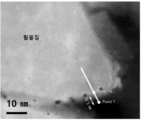
도 7은 실시예 1의 양극 활물질에서 2차 입자의 표면에 노출된 1차 입자에 대한 투과 전자 현미경(TEM) 사진이다.
도 8은 도 7에 나타낸 point 1에서부터 point 10까지 총 10군데에 대한 TEM-EELS (투과 전자 현미경 - 전자 에너지 손실 분광) 분석 그래프이다.
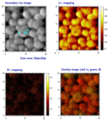
도 9는 실시예 1의 양극 활물질 표면에 대한 ToF-SIMS 분석 사진이다.
도 10은 도 9의 ToF-SIMS 분석의 질량 스펙트럼 결과이다.
도 11은 보론 투입량에 따른 보론 코팅층(외부) 및 입계 보론 코팅부(내부)의 보론 함량을 ICP 발광 분광 분석을 통해 측정한 그래프이다.
도 12는 실시예 1 및 비교예 1 내지 3의 전지에 대한 초기 충방전 용량 및 고온에서의 50사이클 용량 유지율을 나타낸 그래프이다.
도 13은 실시예 1 및 비교예 1 내지 3의 전지에 대한 고온에서의 50사이클 용량 유지율을 나타낸 수명 특성 그래프이다. 1 is a schematic diagram showing the shape of plate-shaped primary particles.
FIG. 2 is a diagram for explaining the definition of a radial shape in secondary particles.
3 is a schematic diagram showing a cross-sectional structure of a secondary particle according to an embodiment.
4 is a schematic cross-sectional view of a lithium secondary battery according to an embodiment.
5 is a scanning electron microscope (SEM) photograph of a cross section of the positive electrode active material precursor prepared in Example 1.
6 is a SEM photograph of a cross section of the positive electrode active material prepared in Example 1.
7 is a transmission electron microscope (TEM) photograph of primary particles exposed on the surface of secondary particles in the cathode active material of Example 1.
8 is a TEM-EELS (transmission electron microscope-electron energy loss spectroscopy) analysis graph for a total of 10 locations from
9 is a ToF-SIMS analysis photograph of the surface of the positive electrode active material of Example 1.
10 is a mass spectrum result of the ToF-SIMS analysis of FIG. 9 .
11 is a graph obtained by measuring the boron content of the boron coating layer (external) and the grain boundary boron coating portion (internal) according to the amount of boron input through ICP emission spectroscopy analysis.
12 is a graph showing initial charge and discharge capacities and 50 cycle capacity retention rates at high temperatures for the batteries of Example 1 and Comparative Examples 1 to 3.
13 is a life characteristic graph showing 50 cycle capacity retention rates at high temperatures for the batteries of Example 1 and Comparative Examples 1 to 3.
이하, 구체적인 구현예에 대하여 이 기술분야에서 통상의 지식을 가진 자가 용이하게 실시할 수 있도록 상세히 설명한다. 그러나 본 발명은 여러 가지 상이한 형태로 구현될 수 있으며 여기에서 설명하는 구현예에 한정되지 않는다.Hereinafter, specific embodiments will be described in detail so that those skilled in the art can easily implement them. However, the present invention may be embodied in many different forms and is not limited to the embodiments set forth herein.
여기서 사용되는 용어는 단지 예시적인 구현예들을 설명하기 위해 사용된 것으로, 본 발명을 한정하려는 의도는 아니다. 단수의 표현은 문맥상 명백하게 다르게 뜻하지 않는 한, 복수의 표현을 포함한다.Terms used herein are merely used to describe exemplary implementations and are not intended to limit the present invention. Singular expressions include plural expressions unless the context clearly dictates otherwise.
여기서 "이들의 조합"이란, 구성물의 혼합물, 적층물, 복합체, 공중합체, 합금, 블렌드, 반응 생성물 등을 의미한다. As used herein, “combination thereof” means a mixture of constituents, laminates, composites, copolymers, alloys, blends, reaction products, and the like.
여기서 "포함하다", "구비하다" 또는 "가지다" 등의 용어는 실시된 특징, 숫자, 단계, 구성 요소 또는 이들을 조합한 것이 존재함을 지정하려는 것이지, 하나 또는 그 이상의 다른 특징들이나 숫자, 단계, 구성 요소, 또는 이들을 조합한 것들의 존재 또는 부가 가능성을 미리 배제하지 않는 것으로 이해되어야 한다.The terms “comprise,” “comprise,” or “have” are intended to indicate that there is an embodied feature, number, step, component, or combination thereof, but that one or more other features, numbers, or steps are present. It should be understood that it does not preclude the possibility of existence or addition of components, components, or combinations thereof.
도면에서 여러 층 및 영역을 명확하게 표현하기 위하여 두께를 확대하여 나타내었으며, 명세서 전체를 통하여 유사한 부분에 대해서는 동일한 도면 부호를 붙였다. 층, 막, 영역, 판 등의 부분이 다른 부분 "위에" 또는 “상에” 있다고 할 때, 이는 다른 부분 "바로 위에" 있는 경우뿐만 아니라 그 중간에 또 다른 부분이 있는 경우도 포함한다. 반대로 어떤 부분이 다른 부분 "바로 위에" 있다고 할 때에는 중간에 다른 부분이 없는 것을 뜻한다. In the drawings, the thickness is enlarged in order to clearly express various layers and regions, and the same reference numerals are attached to similar parts throughout the specification. When a part such as a layer, film, region, plate, etc. is said to be "on" or "on" another part, this includes not only the case where it is "directly on" the other part, but also the case where there is another part in between. Conversely, when a part is said to be "directly on" another part, it means that there is no other part in between.
또한 여기서 “층”은 평면도로 관찰했을 때 전체 면에 형성되어 있는 형상뿐만 아니라 일부 면에 형성되어 있는 형상도 포함한다.In addition, the term "layer" includes not only shapes formed on the entire surface when observed in plan view, but also shapes formed on some surfaces.
또한 평균 입경은 당업자에게 널리 공지된 방법으로 측정될 수 있으며, 예를 들어, 입도 분석기로 측정하거나, 또는 투과전자현미경 사진 또는 주사전자현미경 사진으로 측정할 수도 있다. 다른 방법으로는, 동적광산란법을 이용하여 측정하고 데이터 분석을 실시하여 각각의 입자 사이즈 범위에 대하여 입자수를 카운팅한 뒤 이로부터 계산하여 평균 입경 값을 얻을 수 있다. 별도의 정의가 없는 한, 평균 입경은 입도 분포에서 누적 체적이 50 부피%인 입자의 지름(D50)을 의미할 수 있다.Also, the average particle diameter can be measured by a method well known to those skilled in the art, for example, it can be measured with a particle size analyzer, or it can be measured with a transmission electron micrograph or a scanning electron micrograph. Alternatively, the average particle diameter value can be obtained by measuring using the dynamic light scattering method, performing data analysis, counting the number of particles for each particle size range, and then calculating from this. Unless otherwise defined, the average particle diameter may mean the diameter (D50) of particles whose cumulative volume is 50% by volume in the particle size distribution.
양극 활물질cathode active material
일 구현예에서는 리튬 니켈계 복합 산화물을 포함하는 리튬 이차 전지용 양극 활물질로서, 복수의 1차 입자들이 응집되어 이루어지고 상기 1차 입자들의 적어도 일부분이 방사형으로 배열된 2차 입자, 상기 2차 입자의 표면 상에 위치하고 붕산리튬을 포함하는 보론 코팅층, 및 상기 2차 입자의 표면에 노출된 1차 입자의 내부에 위치하는 보론 도핑층을 포함하는 리튬 이차 전지용 양극 활물질을 제공한다. In one embodiment, a positive electrode active material for a lithium secondary battery including a lithium nickel-based composite oxide, wherein a plurality of primary particles are aggregated and at least a portion of the primary particles are radially arranged secondary particles, the secondary particles Provided is a cathode active material for a lithium secondary battery including a boron coating layer located on a surface and containing lithium borate, and a boron doped layer located inside the primary particles exposed on the surface of the secondary particles.
종래에는 양극 활물질에 보론을 코팅하는 경우, 리튬 금속 복합 산화물을 제조한 후에 이것과 보론 원료를 습식 또는 건식으로 혼합하여 열처리하는 방법을 사용하는 것이 일반적이다. 그러나 이 경우 보론이 양극 활물질의 표면에서 저항으로 작용하여 오히려 용량과 수명을 악화시키는 문제가 있었다. 반면, 일 구현예에 따르면, 니켈계 수산화물 등의 특정한 양극 활물질 전구체에 리튬 원료 및 보론 원료를 함께 투입하고, 특정 조건으로 열처리하는 방법 등을 통하여, 1차 입자의 적어도 일부분이 방사형으로 배열된 2차 입자 형태의 양극 활물질을 제조하면서 보론 코팅층과 보론 도핑층이 동시에 형성된 양극 활물질을 얻을 수 있다. 적절한 양의 보론 코팅층과 보론 도핑층이 동시에 형성됨으로써, 보론은 더 이상 저항으로 작용하지 않고, 양극 활물질의 구조적 안정성을 향상시키며, 리튬 이차 전지의 용량 특성과 고온 수명 특성을 동시에 향상시킬 수 있다. Conventionally, when boron is coated on a cathode active material, it is common to prepare a lithium metal composite oxide and then heat-treat by mixing this and a boron raw material in a wet or dry manner. However, in this case, boron acts as a resistance on the surface of the positive electrode active material, thereby deteriorating capacity and lifetime. On the other hand, according to one embodiment, at least a portion of the primary particles are radially arranged through a method of adding a lithium raw material and a boron raw material to a specific cathode active material precursor such as nickel-based hydroxide and heat-treating under specific conditions. A cathode active material in which a boron coating layer and a boron doped layer are simultaneously formed may be obtained while preparing a cathode active material in the form of secondary particles. By simultaneously forming an appropriate amount of the boron coating layer and the boron doping layer, boron no longer acts as a resistor, improves the structural stability of the cathode active material, and simultaneously improves the capacity characteristics and high-temperature lifespan characteristics of the lithium secondary battery.
상기 보론 코팅층은 상기 2차 입자의 표면에 위치하는 것으로, 상기 2차 입자의 표면에 고르게 코팅된 것일 수 있다. 상기 보론 코팅층의 붕산리튬은 리튬 보론 산화물 또는 리튬 보레이트로 표현할 수 있으며, 예를 들어 LiBO2, Li3B7O12, Li6B4O9, Li3B11O18, Li2B4O7, Li3BO3, Li8B6O13, Li5B3O7, Li4B2O5, Li10B4O11, Li8B2O7, 또는 이들의 조합을 포함할 수 있다. The boron coating layer is located on the surface of the secondary particle and may be evenly coated on the surface of the secondary particle. The lithium borate of the boron coating layer can be expressed as lithium boron oxide or lithium borate, for example, LiBO 2 , Li 3 B 7 O 12 , Li 6 B 4 O 9 , Li 3 B 11 O 18 , Li 2 B 4 O 7 , Li 3 BO 3 , Li 8 B 6 O 13 , Li 5 B 3 O 7 , Li 4 B 2 O 5 , Li 10 B 4 O 11 , Li 8 B 2 O 7 , or combinations thereof. there is.
상기 보론 코팅층에서 상기 붕산리튬의 함량은 상기 양극 활물질 전체 중량에 대하여 0.02 중량% 내지 0.5 중량%일 수 있고, 예를 들어 0.03 중량% 내지 0.4 중량%, 0.04 중량% 내지 0.3 중량% 또는 0.05 중량% 내지 0.2 중량% 등일 수 있다. 이 같은 함량 범위를 만족하는 경우 상기 보론 코팅층은 저항으로 작용하지 않고 양극 활물질의 구조적 안정성을 향상시키고 수명 특성을 개선할 수 있다. The content of the lithium borate in the boron coating layer may be 0.02 wt% to 0.5 wt% based on the total weight of the cathode active material, for example, 0.03 wt% to 0.4 wt%, 0.04 wt% to 0.3 wt%, or 0.05 wt% to 0.2% by weight and the like. When the content range is satisfied, the boron coating layer does not act as a resistance and can improve structural stability and lifespan characteristics of the positive electrode active material.
상기 보론 도핑층은 2차 입자의 내부에 위치한다고 할 수 있고, 구체적으로, 2차 입자의 표면에 노출된 1차 입자들의 내부에 위치한다고 할 수 있다. 상기 2차 입자의 표면에 노출된 1차 입자는 2차 입자의 최외곽에 있는 1차 입자를 의미할 수 있다. 예를 들어 상기 보론 도핑층은 상기 2차 입자의 표면에 노출된 1차 입자들의 외곽 표면에서부터, 10 nm의 깊이 범위 내에 위치하는 것일 수 있다. 2차 입자의 표면에 노출된 1차 입자들의 외곽 표면을 0 nm라고 하면, 상기 도핑층은 표면에서 시작하여 0 nm 내지 10 nm의 깊이 범위에 존재한다고 할 수 있다. 다른 표현으로, 상기 보론 도핑층은 2차 입자의 표면에서부터 10 nm의 깊이 범위 내에 위치한다고 할 수도 있다. 2차 입자 표면을 0 nm라고 하면 상기 도핑층은 표면에서 시작하여 0 nm 내지 10 nm의 깊이 범위에 존재한다고 할 수 있다. The boron-doped layer can be said to be located inside the secondary particles, and specifically, it can be said to be located inside the primary particles exposed on the surface of the secondary particles. The primary particle exposed on the surface of the secondary particle may mean a primary particle at the outermost part of the secondary particle. For example, the boron-doped layer may be located within a depth range of 10 nm from the outer surfaces of the primary particles exposed to the surface of the secondary particles. Assuming that the outer surface of the primary particles exposed to the surface of the secondary particle is 0 nm, the doped layer may be said to exist in a depth range of 0 nm to 10 nm starting from the surface. In other words, the boron-doped layer may be located within a depth range of 10 nm from the surface of the secondary particle. Assuming that the surface of the secondary particle is 0 nm, it can be said that the doped layer exists in a depth range of 0 nm to 10 nm starting from the surface.
상기 보론 도핑층은 예를 들어 상기 2차 입자의 표면에 노출된 1차 입자들의 외곽 표면에서부터 9 nm의 깊이 범위 내, 8 nm의 깊이 범위 내, 7 nm의 깊이 범위 내, 6 nm의 깊이 범위 내, 5 nm의 깊이 범위 내, 4 nm의 깊이 범위 내, 3 nm의 깊이 범위 내, 또는 2.5 nm의 깊이 범위 내에 위치하는 것일 수 있다. 이러한 보론 도핑층은 상기 보론 코팅층과 구분되는 것이며, 후술할 입계 보론 코팅부와도 구분되는 것으로, 양극 활물질의 구조적 안정성에 기여하는 것으로 생각된다. The boron-doped layer is, for example, within a depth range of 9 nm, within a depth range of 8 nm, within a depth range of 7 nm, and within a depth range of 6 nm from the outer surface of the primary particles exposed to the surface of the secondary particles. It may be located within, within a depth range of 5 nm, within a depth range of 4 nm, within a depth range of 3 nm, or within a depth range of 2.5 nm. This boron-doped layer is distinguished from the boron coating layer and is also distinguished from a grain boundary boron coating part to be described later, and is thought to contribute to the structural stability of the positive electrode active material.
한편, 상기 양극 활물질은 상기 2차 입자 내부의 1차 입자들의 표면에 위치하고 붕산리튬을 포함하는 입계 보론 코팅부를 더 포함할 수 있다. 이러한 입계 보론 코팅부는 2차 입자의 표면이 아닌 내부에 존재하는 것으로, 2차 입자 내부에 위치하는 1차 입자들의 계면을 따라 코팅되어 있다고 할 수 있다. 여기서 2차 입자의 내부라 함은 표면을 제외한 내부 전체를 의미하며, 예를 들어 외각 표면에서 대략 2 ㎛의 깊이에서부터 안쪽 전체를 의미할 수 있고, 양극 활물질 2차 입자를 증류수로 세척할 때 증류수가 닿지 않는 부분으로 표현할 수도 있다. Meanwhile, the cathode active material may further include a grain boundary boron coating portion located on the surface of the primary particles inside the secondary particles and including lithium borate. The grain boundary boron coating portion is present inside the secondary particle rather than on the surface, and may be said to be coated along the interface of the primary particles located inside the secondary particle. Here, the inside of the secondary particle means the entire inside excluding the surface, for example, it can mean the entire inside from a depth of about 2 μm from the outer surface, and when washing the secondary particles of the positive electrode active material with distilled water, distilled water It can also be expressed as an inaccessible part.
일 구현예에 따르면, 상기 보론 코팅층의 중량은 상기 입계 보론 코팅부의 중량보다 클 수 있다. 예를 들어, 보론 코팅층과 입계 보론 코팅부의 총량에 대하여, 입계 보론 코팅부는 2 중량% 내지 30 중량%로 포함될 수 있고, 구체적으로 3 중량% 내지 25 중량%, 또는 5 중량% 내지 20 중량%로 포함될 수 있으며, 또한 보론 코팅층은 70 중량% 내지 98 중량%으로 포함될 수 있고, 75 중량% 내지 97 중량%, 또는 80 중량% 내지 95 중량% 등으로 포함될 수 있다. 예를 들어, 상기 보론 코팅층과 상기 입계 보론 코팅부의 중량비는 70:30 내지 98:2일 수 있고 예를 들어 75:25 내지 97:3, 또는 80:20 내지 95:5일 수 있다. 보론 코팅층과 입계 보론 코팅부의 함량 비율이 이와 같은 경우, 보론은 양극 활물질에서 저항으로 작용하지 않고 성능을 향상시키는 역할을 할 수 있으며, 리튬 이차 전지의 용량 특성과 수명 특성을 동시에 개선할 수 있다. According to one embodiment, a weight of the boron coating layer may be greater than a weight of the grain boundary boron coating portion. For example, with respect to the total amount of the boron coating layer and the grain boundary boron coating portion, the grain boundary boron coating portion may be included in 2% to 30% by weight, specifically 3% to 25% by weight, or 5% to 20% by weight. In addition, the boron coating layer may be included in an amount of 70 wt% to 98 wt%, 75 wt% to 97 wt%, or 80 wt% to 95 wt%. For example, the weight ratio of the boron coating layer and the grain boundary boron coating portion may be 70:30 to 98:2, for example, 75:25 to 97:3, or 80:20 to 95:5. When the content ratio of the boron coating layer and the intergranular boron coating portion is like this, boron may serve to improve performance without acting as resistance in the cathode active material, and simultaneously improve capacity characteristics and lifespan characteristics of the lithium secondary battery.
상기 보론 코팅층의 함량, 즉 보론 코팅층의 붕산리튬의 함량은 예를 들어, 상기 양극 활물질 전체 중량에 대하여 0.02 중량% 내지 0.5 중량%일 수 있고, 0.03 중량% 내지 0.4 중량%, 0.04 중량% 내지 0.3 중량%, 또는 0.05 중량% 내지 0.2 중량% 등일 수 있다. 상기 입계 보론 코팅부의 함량, 즉 입계 보론 코팅부의 붕산리튬의 함량은 예를 들어 상기 양극 활물질에 대하여 0.001 중량% 내지 0.05 중량%일 수 있고, 0.001 중량% 내지 0.04 중량%, 0.002 중량% 내지 0.03 중량%, 또는 0.003 중량% 내지 0.02 중량%일 수 있으나, 이에 한정되는 것은 아니다. 상기 양극 활물질에 대한 보론 코팅층과 입계 보론 코팅부의 함량이 이와 같을 경우, 리튬 이차 전지의 용량 특성과 수명 특성을 모두 개선할 수 있다. The content of the boron coating layer, that is, the content of lithium borate in the boron coating layer may be, for example, 0.02 wt% to 0.5 wt%, 0.03 wt% to 0.4 wt%, 0.04 wt% to 0.3 wt%, based on the total weight of the positive electrode active material. % by weight, or 0.05% to 0.2% by weight or the like. The content of the grain boundary boron coating, that is, the content of lithium borate in the grain boundary boron coating may be, for example, 0.001% to 0.05% by weight, 0.001% to 0.04% by weight, 0.002% to 0.03% by weight, based on the positive electrode active material. %, or 0.003% to 0.02% by weight, but is not limited thereto. When the contents of the boron coating layer and the grain boundary boron coating portion of the cathode active material are the same as above, both capacity characteristics and lifespan characteristics of the lithium secondary battery may be improved.
상기 보론 코팅층과 상기 입계 보론 코팅부의 총량은 상기 양극 활물질 전체에 대하여 0.1 몰% 내지 5 몰%일 수 있고, 예를 들어 0.1 몰% 내지 3 몰%, 0.1 몰% 내지 2.5 몰%, 0.1 몰% 내지 2 몰%, 0.1 몰% 내지 1.5몰%, 또는 0.5 몰% 내지 1.3 몰%일 수 있다. 보론 코팅층과 입계 보론 코팅부의 총량이 일정 함량을 벗어나면 초기 방전 용량이 감소하고 수명 특성이 저하될 수 있다. 특히 2차 입자의 표면에 존재하는 보론 코팅층의 함량이 과다해 지면 보론이 저항으로 작용하면서 리튬 이차 전지의 초기 방전 용량이 크게 감소할 수 있다. The total amount of the boron coating layer and the grain boundary boron coating portion may be 0.1 mol% to 5 mol%, for example, 0.1 mol% to 3 mol%, 0.1 mol% to 2.5 mol%, or 0.1 mol% with respect to the total amount of the positive electrode active material. to 2 mol%, 0.1 mol% to 1.5 mol%, or 0.5 mol% to 1.3 mol%. If the total amount of the boron coating layer and the grain boundary boron coating portion is out of a certain amount, the initial discharge capacity may decrease and life characteristics may deteriorate. In particular, when the content of the boron coating layer present on the surface of the secondary particle is excessive, the initial discharge capacity of the lithium secondary battery may be greatly reduced while boron acts as resistance.
한편, 상기 양극 활물질은 적어도 2개 이상의 1차 입자가 응집된 2차 입자를 포함하고, 상기 1차 입자들의 적어도 일부분은 방사형 배열 구조를 가진다. 상기 1차 입자 중 적어도 일부는 플레이트 형상을 가질 수 있다. 상기 플레이트 형상의 1차 입자는 두께가 장축 길이보다 작게 형성될 수 있다. 여기서, 장축 길이는 1차 입자의 가장 넓은 면을 기준으로 하여 최대 길이를 의미한다. 즉, 1차 입자는 한쪽 축 방향(즉 두께 방향)의 길이(t)가 다른 방향(즉 면방향)의 장축 길이(a)에 비하여 작게 형성되어 있는 구조를 가질 수 있다.Meanwhile, the cathode active material includes secondary particles in which at least two or more primary particles are aggregated, and at least a portion of the primary particles has a radial arrangement structure. At least some of the primary particles may have a plate shape. The plate-shaped primary particles may have a thickness smaller than a major axis length. Here, the major axis length means the maximum length based on the widest surface of the primary particle. That is, the primary particles may have a structure in which the length t in one axis direction (ie, the thickness direction) is smaller than the length a of the major axis in the other direction (ie, the plane direction).
도 1은 제1 양극 활물질의 1차 입자의 플레이트 형상을 나타낸 모식도이다. 도 1을 참고하면, 일 구현예에 따른 1차 입자는 (A) 육각형 등의 다각형 나노판 형상, (B) 나노 디스크 형상, (C) 직육면체 형상 등, 기본적으로 플레이트 구조를 가지면서도 다양한 세부 형상을 가질 수 있다. 도 1에서 “a”는 1차 입자의 장축의 길이를 의미하고, “b”는 1차 입자의 단축의 길이를 의미하며, “t”는 1차 입자의 두께를 의미한다. 상기 1차 입자의 두께 t는 면방향의 길이인 a 및 b에 비하여 작을 수 있다. 면방향의 길이 중 a는 b에 비하여 길거나 또는 동일할 수 있다. 상기 1차 입자에서 두께 t가 정의된 방향을 두께 방향이라고 정의하고 길이 a 및 b가 함유된 방향을 면 방향이라고 정의한다.1 is a schematic diagram showing the plate shape of primary particles of a first positive electrode active material. Referring to FIG. 1 , primary particles according to an embodiment have various detailed shapes while basically having a plate structure, such as (A) a polygonal nanoplate shape such as a hexagon, (B) a nanodisk shape, and (C) a cuboid shape. can have In FIG. 1, “a” means the length of the major axis of the primary particle, “b” means the length of the minor axis of the primary particle, and “t” means the thickness of the primary particle. The thickness t of the primary particle may be smaller than the lengths a and b of the surface direction. Among the lengths in the plane direction, a may be longer than or equal to b. The direction in which the thickness t is defined in the primary particle is defined as the thickness direction, and the direction containing the lengths a and b is defined as the plane direction.
상기 양극 활물질에서, 상기 1차 입자의 적어도 일부는 방사형으로 배열되어 있으며, 예를 들어 상기 1차 입자의 장축이 방사형 방향으로 배열되어 있을 수 있다. 도 2는 일 구현예에 따른 2차 입자에서 방사형의 정의를 설명하기 위한 도면이다. 일 구현예에서 방사형 배열 구조라 함은, 도 2에 나타난 바와 같이 1차 입자의 두께(t) 방향이 2차 입자의 중심에서 표면으로 향하는 방향(R)과 수직 또는 수직 방향과 ±5°의 각을 이루도록 배열되는 것을 의미한다.In the cathode active material, at least some of the primary particles are arranged radially, and for example, long axes of the primary particles may be arranged in a radial direction. 2 is a diagram for explaining definition of a radial shape in a secondary particle according to an embodiment. In one embodiment, the radial arrangement structure means, as shown in FIG. 2, the thickness (t) direction of the primary particles is perpendicular to the direction (R) from the center of the secondary particles to the surface, or an angle of ±5 ° with the vertical direction. It means that it is arranged to achieve
상기 2차 입자를 구성하는 1차 입자의 평균 길이는 0.01㎛ 내지 5㎛일 수 있고, 예를 들어 0.01㎛ 내지 2㎛, 0.01㎛ 내지 1㎛, 0.02㎛ 내지 1㎛, 0.05㎛ 내지 0.5㎛, 또는 150nm 내지 500nm일 수 있다. 여기서 평균 길이는 1차 입자가 플레이트 형일 경우 면 방향에서 장축 길이(a)의 평균 길이를 의미하고, 1차 입자가 구형일 경우 평균 입경을 의미한다.The average length of the primary particles constituting the secondary particles may be 0.01 μm to 5 μm, for example, 0.01 μm to 2 μm, 0.01 μm to 1 μm, 0.02 μm to 1 μm, 0.05 μm to 0.5 μm, Or it may be 150 nm to 500 nm. Here, the average length means the average length of the major axis length (a) in the plane direction when the primary particles are plate-shaped, and means the average particle diameter when the primary particles are spherical.
상기 1차 입자가 플레이트 형일 경우, 상기 1차 입자의 평균 두께는 예를 들어 50 nm 이상, 100 nm 이상, 200 nm 이상, 300 nm 이상, 400 nm 이상, 500 nm 이상, 600 nm 이상, 700 nm, 800 nm 이상, 또는 900 nm 이상일 수 있고, 예를 들어 5 ㎛ 이하, 4 ㎛ 이하, 3 ㎛ 이하, 2 ㎛ 이하, 1 ㎛ 이하, 900 nm 이하, 800 nm 이하, 700 nm 이하, 600 nm 이하, 또는 500 nm 이하일 수 있고, 일 예로 100 nm 내지 200 nm일 수 있다. 또한 상기 1차 입자에서, 상기 평균 두께와 상기 평균 길이의 비는 1:1 내지 1:10일 수 있고, 예를 들어 1:1 내지 1:8, 1:1 내지 1:6 또는 1:2 내지 1:5일 수 있다. When the primary particles are plate-shaped, the average thickness of the primary particles is, for example, 50 nm or more, 100 nm or more, 200 nm or more, 300 nm or more, 400 nm or more, 500 nm or more, 600 nm or more, 700 nm or more. , 800 nm or more, or 900 nm or more, for example, 5 μm or less, 4 μm or less, 3 μm or less, 2 μm or less, 1 μm or less, 900 nm or less, 800 nm or less, 700 nm or less, 600 nm or less , Or may be 500 nm or less, for example, 100 nm to 200 nm. In addition, in the primary particles, the ratio of the average thickness and the average length may be 1:1 to 1:10, for example, 1:1 to 1:8, 1:1 to 1:6, or 1:2 to 1:5.
이와 같이 1차 입자의 평균 길이, 평균 두께 및 평균 두께와 평균 길이의 비가 상술한 범위를 만족하고, 1차 입자들의 적어도 일부분이 방사형으로 배열되어 있는 경우, 표면 쪽에 입계 사이의 리튬 확산 통로를 상대적으로 많이 가질 수 있고, 외부에 리튬 전달이 가능한 결정면이 많이 노출되어 리튬 확산도가 향상되어 높은 초기 효율 및 용량의 확보가 가능하다. 또한 1차 입자들이 방사형으로 배열되어 있으면, 표면에 노출된 기공이 2차 입자의 중심 방향으로 향하게 되어 리튬의 확산을 촉진시킬 수 있다. 그리고 방사형으로 배열된 1차 입자들에 의해 리튬의 탈리 및/또는 삽입시 균일한 수축, 팽창이 가능하고, 리튬 탈리시 입자가 팽창하는 방향인 (001) 방향 쪽에 기공이 존재하여 완충 작용을 해 줄 수 있다. 또한 1차 입자의 크기와 배열로 인해 활물질의 수축 팽창시 크랙이 일어날 확률이 낮아지며, 내부의 기공이 추가로 부피 변화를 완화시켜 주어 충방전시 1차 입자간에 발생되는 크랙이 감소하여, 리튬 이차 전지의 수명 특성이 향상되고 저항 증가 현상이 줄어들 수 있다.In this way, when the average length, average thickness, and ratio of the average thickness and average length of the primary particles satisfy the above-described range, and at least a portion of the primary particles are arranged radially, the lithium diffusion passage between the grain boundaries is relatively , and a lot of crystal planes capable of delivering lithium are exposed to the outside, so that lithium diffusivity is improved, so that high initial efficiency and capacity can be secured. In addition, when the primary particles are arranged radially, the pores exposed on the surface are directed toward the center of the secondary particles, thereby promoting the diffusion of lithium. In addition, uniform contraction and expansion are possible when lithium is desorbed and/or inserted by the radially arranged primary particles, and pores exist in the (001) direction, which is the direction in which particles expand during lithium desorption, to act as a buffer. can give In addition, due to the size and arrangement of the primary particles, the probability of cracks occurring during contraction and expansion of the active material is lowered, and the internal pores additionally alleviate the volume change, reducing the cracks generated between the primary particles during charging and discharging. Lifespan characteristics of the battery may be improved and resistance increase may be reduced.
상기 양극 활물질은 2차 입자의 내부와 외부 중 적어도 하나에 불규칙 다공성 기공(irregular porous structure)을 가질 수 있다. 상기 불규칙 다공성 구조는 기공 크기 및 형태가 규칙적이지 않고 균일성이 없는 기공을 갖는 구조를 의미한다. 예를 들어 상기 2차 입자는 불규칙 다공성 구조를 포함하는 내부와, 방사형 배열 구조를 포함하는 외부를 가지는 것일 수 있다. 즉, 내부에 배치되는 1차 입자는 외부에 배치되는 1차 입자와는 달리 규칙성 없이 배열되어 있을 수 있다. 불규칙 다공성 구조를 포함하는 내부는 외부와 마찬가지로 1차 입자를 포함한다.The cathode active material may have an irregular porous structure on at least one of the inside and outside of the secondary particle. The irregular porous structure refers to a structure having pores whose pore size and shape are not regular and non-uniform. For example, the secondary particles may have an irregular porous structure on the inside and a radially arranged structure on the outside. That is, the primary particles disposed inside may be arranged without regularity, unlike the primary particles disposed outside. The interior containing the irregular porous structure contains primary particles as well as the exterior.
상기 2차 입자의 반경(입자의 중심에서 표면까지의 거리)에 대해 상기 내부의 반경의 비율은 40 길이% 내지 60 길이%일 수 있고, 그러한 영역을 내부라고 정의할 수 있다. 상기 외부는 상기 2차 입자의 반경 중 최표면에서부터 40 길이% 내지 60 길이%까지의 영역을 의미하는 것일 수 있다. 또한 상기 2차 입자의 부피에 대한 상기 외부 부피의 비율은 90 부피% 이하, 87 부피% 이하, 85 부피% 이하일 수 있다. The ratio of the radius of the interior to the radius of the secondary particle (the distance from the center of the particle to the surface) may be 40% to 60% by length, and such a region may be defined as the interior. The outside may mean an area from the outermost surface to 40 length% to 60 length% of the radius of the secondary particle. In addition, the ratio of the external volume to the volume of the secondary particle may be 90 vol% or less, 87 vol% or less, or 85 vol% or less.
상기 양극 활물질의 2차 입자는 방사형으로 배향된 외부와 불규칙 다공성 구조를 포함하는 내부를 함유하면서, 상기 2차 입자의 내부는 외부 대비 큰 기공 사이즈를 갖는 것일 수 있다. 예를 들어, 상기 양극 활물질에서 내부의 기공 사이즈는 150 nm 내지 1 ㎛이고, 외부의 기공 사이즈는 150 nm 미만일 수 있다. 이와 같이 내부의 기공 사이즈가 외부에 비해 더 큰 경우, 내부의 기공 사이즈와 외부의 기공 사이즈가 동일한 이차 입자와 비교하여, 활물질 내부에서 리튬 확산 거리가 짧아지는 장점이 있고, 외부에서 리튬의 삽입은 용이하며, 충방전시에 일어나는 부피 변화가 완화되는 효과가 있다. 여기서 기공 사이즈는 기공이 구형 또는 원형인 경우 평균 직경을 의미하고 기공이 타원형 등인 경우 장축의 길이를 의미할 수 있다.The secondary particles of the cathode active material may have a radially oriented exterior and an interior including an irregular porous structure, and the interior of the secondary particles may have a larger pore size than the exterior. For example, in the cathode active material, an internal pore size may be 150 nm to 1 μm, and an external pore size may be less than 150 nm. In this way, when the internal pore size is larger than the external one, compared to secondary particles having the same internal pore size and external pore size, there is an advantage in that the lithium diffusion distance is shortened inside the active material, and lithium insertion from the outside It is easy, and there is an effect of mitigating the volume change occurring during charging and discharging. Here, the pore size may mean an average diameter when the pore is spherical or circular, and may mean the length of a major axis when the pore is elliptical or the like.
상기 양극 활물질의 2차 입자는, 표면에 위치하면서 내부의 중심부 쪽을 향하는 열린 기공(open pore)를 가질 수 있고, 상기 열린 기공의 크기는 약 150 nm 미만, 예를 들어 10 nm 내지 148 nm일 수 있다. 상기 열린 기공은 물질이 드나들 수 있는 노출된 기공이다. 상기 열린 기공은 상기 2차 입자의 표면으로부터 평균적으로 150 nm 이하, 예를 들어 0.001 nm 내지 100 nm, 예를 들어 1 nm 내지 50 nm의 깊이까지 형성될 수 있다.The secondary particles of the cathode active material may have open pores located on the surface and facing toward the inner center, and the size of the open pores may be less than about 150 nm, for example, 10 nm to 148 nm can The open pores are exposed pores through which substances can enter and exit. The open pores may be formed to a depth of 150 nm or less on average from the surface of the secondary particle, for example, 0.001 nm to 100 nm, for example, 1 nm to 50 nm.
상기 2차 입자 내부에는 닫힌 기공이 존재하고 외부에는 닫힌 기공 및/또는 열린 기공이 존재할 수 있다. 상기 닫힌 기공은 전해질 등이 포함되기 어려운 데 반하여 열린 기공은 기공 내부에 전해질 등이 함유될 수 있다. 상기 닫힌 기공은 기공의 벽면이 모두 닫힌 구조로 형성되어 다른 기공과 연결되지 않은 독립 기공이고, 열린 기공은 기공의 벽면 중 적어도 일부가 열린 구조로 형성되어 입자 외부와 연결된 연속 기공이라고 할 수 있다.Closed pores may exist inside the secondary particle, and closed pores and/or open pores may exist outside. The closed pores are difficult to contain an electrolyte, while the open pores may contain an electrolyte or the like inside the pores. The closed pores are independent pores that are not connected to other pores because all of the walls of the pores are closed, and the open pores are continuous pores that have at least a part of the wall surfaces of the pores that are open and connected to the outside of the particle.
도 3은 상기 양극 활물질의 2차 입자의 단면 구조를 나타낸 모식도이다. 도 3을 참고하면, 일 구현예에 따른 양극 활물질의 2차 입자(11)는 플레이트 형상을 갖는 1차 입자가 방사형 방향으로 배열된 구조를 갖는 외부(14)와, 1차 입자(13)가 불규칙적으로 배열된 내부(12)를 함유한다. 내부 (12)에는 1차 입자 사이의 빈 공간이 외부에 비하여 더 존재할 수 있다. 그리고 내부에서의 기공 크기 및 기공도는 외부에서의 기공 크기 및 기공도에 비하여 크며 불규칙적이다. 도 3에서 화살표는 리튬 이온의 이동 방향을 나타낸 것이다.3 is a schematic diagram showing a cross-sectional structure of secondary particles of the positive electrode active material. Referring to FIG. 3 , the
상기 2차 입자에서 내부는 다공성 구조를 가져서 내부까지의 리튬 이온의 확산 거리가 줄어드는 효과가 있고, 외부는 방사형 구조를 가지고 있어 표면으로 리튬 이온이 삽입되기가 용이하다. 그리고 1차 입자의 크기가 작아 결정립 사이의 리튬 전달 경로를 확보하기가 쉽다. 그리고 1차 입자의 크기가 작고 1차 입자 사이의 기공이 충방전시에 일어나는 부피 변화를 완화시켜 주어 충방전시 부피 변화에 따른 스트레스가 최소화된다. 이러한 양극 활물질은 리튬 이차 전지의 저항을 감소시키고 용량 특성 및 수명 특성을 개선할 수 있다. The interior of the secondary particle has a porous structure, so that the diffusion distance of lithium ions to the interior is reduced, and the exterior has a radial structure, so that lithium ions are easily inserted into the surface. In addition, since the size of the primary particles is small, it is easy to secure a lithium transfer path between crystal grains. In addition, the size of the primary particles is small and the pores between the primary particles relieve the volume change occurring during charging and discharging, thereby minimizing stress due to the volume change during charging and discharging. Such a cathode active material may reduce resistance and improve capacity characteristics and lifespan characteristics of a lithium secondary battery.
한편, 상기 2차 입자에서, 복수의 1차 입자는 1차 입자의 두께 방향을 따라 면(面)접촉을 이루도록 일(1)중심을 향하여 배열되어 방사형 배열 구조를 가질 수 있고, 또는 상기 2차 입자는 복수의 중심을 가지는 다중심 방사형 배열 구조를 가질 수도 있다. 이와 같이 2차 입자가 일중심 또는 다중심 방사형 배열 구조를 가지는 경우 2차 입자의 중심부까지 리튬이 탈/삽입되는 것이 용이해 진다.Meanwhile, in the secondary particles, a plurality of primary particles may have a radial arrangement structure by being arranged toward one (1) center so as to make surface contact along the thickness direction of the primary particles, or the secondary particles may have a radial arrangement structure. The particles may have a multi-centered radial array structure with multiple centers. In this way, when the secondary particles have a single-centered or multi-centered radial arrangement structure, lithium can be easily desorbed/inserted to the center of the secondary particles.
상기 2차 입자는 방사형 1차 입자와 비방사형 1차 입자를 포함할 수 있다. 비방사형 1차 입자의 함량은 방사형 1차 입자와 비방사형 1차 입자의 총중량을 기준으로 하여 30 중량% 이하, 예를 들어 0.01 중량% 내지 30 중량%, 구체적으로 0.1 중량% 내지 20 중량% 포함할 수 있다. The secondary particles may include radial primary particles and non-radiative primary particles. The content of the non-emissive primary particles is 30% by weight or less, for example, 0.01% to 30% by weight, specifically 0.1% to 20% by weight, based on the total weight of the radial primary particles and the non-emissive primary particles. can do.
상기 양극 활물질은 리튬 니켈계 복합 산화물을 포함한다. 상기 리튬 니켈계 복합 산화물에서 니켈의 함량은, 리튬을 제외한 금속의 총량을 기준으로 30 몰% 이상일 수 있고, 예를 들어 40 몰% 이상, 50 몰% 이상, 60 몰% 이상, 70 몰% 이상, 80 몰% 이상, 또는 90 몰% 이상일 수 있고, 99.9 몰% 이하, 또는 99 몰% 이하일 수 있다. 일 예로, 리튬 니켈계 복합 산화물에서 니켈의 함량은 코발트, 망간, 알루미늄 등의 다른 금속 각각의 함량에 비해 더 높을 수 있다. 니켈의 함량이 상기 범위를 만족하는 경우 양극 활물질은 높은 용량을 구현하면서 뛰어난 전지 성능을 나타낼 수 있다. The cathode active material includes a lithium nickel-based composite oxide. The content of nickel in the lithium nickel-based composite oxide may be 30 mol% or more based on the total amount of metals other than lithium, for example, 40 mol% or more, 50 mol% or more, 60 mol% or more, 70 mol% or more. , 80 mol% or more, or 90 mol% or more, and may be 99.9 mol% or less, or 99 mol% or less. For example, the content of nickel in the lithium nickel-based composite oxide may be higher than the content of each of other metals such as cobalt, manganese, and aluminum. When the content of nickel satisfies the above range, the cathode active material may exhibit excellent battery performance while realizing high capacity.
상기 리튬 니켈계 복합 산화물은 구체적으로 아래 화학식 1로 표시될 수 있다. The lithium nickel-based composite oxide may be specifically represented by
[화학식 1][Formula 1]
Lia1Nix1M1 y1M2 1-x1-y1O2 Li a1 Ni x1 M 1 y1 M 2 1-x1-y1 O 2
상기 화학식 1에서, 0.9≤a1≤1.8, 0.3≤x1≤1, 0≤y1≤0.7이고, M1 및 M2는 각각 독립적으로 Al, B, Ba, Ca, Ce, Co, Cr, Cu, F, Fe, Mg, Mn, Mo, Nb, P, S, Si, Sr, Ti, V, W, Zr 및 이들의 조합에서 선택된다. In
상기 화학식 1에서, 0.4≤x1≤1 및 0≤y1≤0.6일 수 있고, 0.5≤x1≤1 및 0≤y1≤0.5이거나, 0.6≤x1≤1 및 0≤y1≤0.4이거나, 0.7≤x1≤1 및 0≤y1≤0.3이거나, 0.8≤x1≤1 및 0≤y1≤0.2이거나, 또는 0.9≤x1≤1 및 0≤y1≤0.1일 수 있다. In
상기 리튬 니켈계 복합 산화물은 예를 들어 아래 화학식 2으로 표시될 수도 있다. The lithium nickel-based composite oxide may be represented by
[화학식 2][Formula 2]
Lia2Nix2Coy2M3 1-x2-y2O2 Li a2 Ni x2 Co y2 M 3 1-x2-y2 O 2
상기 화학식 2에서, 0.9≤a2≤1.8, 0.3≤x2<1, 0<y2≤0.7이고 M3은 Al, B, Ba, Ca, Ce, Cr, Cu, F, Fe, Mg, Mn, Mo, Nb, P, S, Si, Sr, Ti, V, W, Zr 및 이들의 조합에서 선택된다. In
상기 화학식 2에서 0.3≤x2≤0.99 및 0.01≤y2≤0.7일 수 있고, 0.4≤x2≤0.99 및 0.01≤y2≤0.6이거나, 0.5≤x2≤0.99 및 0.01≤y2≤0.5이거나, 0.6≤x2≤0.99 및 0.01≤y2≤0.4이거나, 0.7≤x2≤0.99 및 0.01≤y2≤0.3이거나, 0.8≤x2≤0.99 및 0.01≤y2≤0.2이거나, 또는 0.9≤x2≤0.99 및 0.01≤y2≤0.1일 수 있다. In
상기 리튬 니켈계 복합 산화물은 예를 들어 아래 화학식 3으로 표시될 수도 있다.The lithium nickel-based composite oxide may be represented by Formula 3 below, for example.
[화학식 3][Formula 3]
Lia3Nix3Coy3M4 z3M5 1-x3-y3-z3O2 Li a3 Ni x3 Co y3 M 4 z3 M 5 1-x3-y3-z3 O 2
상기 화학식 3에서, 0.9≤a3≤1.8, 0.3≤x3≤0.98, 0.01≤y3≤0.69, 0.01≤z3≤0.69이고, M4는 Al, Mn 및 이들의 조합에서 선택되고, M5는 B, Ba, Ca, Ce, Cr, Cu, F, Fe, Mg, Mo, Nb, P, S, Si, Sr, Ti, V, W, Zr 및 이들의 조합에서 선택된다. In Formula 3, 0.9≤a3≤1.8, 0.3≤x3≤0.98, 0.01≤y3≤0.69, 0.01≤z3≤0.69, M 4 is selected from Al, Mn and combinations thereof, M 5 is B, Ba , Ca, Ce, Cr, Cu, F, Fe, Mg, Mo, Nb, P, S, Si, Sr, Ti, V, W, Zr, and combinations thereof.
상기 화학식 3에서 0.4≤x3≤0.98, 0.01≤y3≤0.59, 및 0.01≤z3≤0.59일 수 있고, 0.5≤x3≤0.98, 0.01≤y3≤0.49, 및 0.01≤z3≤0.49이거나, 0.6≤x3≤0.98, 0.01≤y3≤0.39, 및 0.01≤z3≤0.39이거나, 0.7≤x3≤0.98, 0.01≤y3≤0.29, 및 0.01≤z3≤0.29이거나, 0.8≤x3≤0.98, 0.01≤y3≤0.19, 및 0.01≤z3≤0.19이거나, 또는 0.9≤x3≤0.98, 0.01≤y3≤0.09, 및 0.01≤z3≤0.09일 수 있다. In Formula 3, 0.4≤x3≤0.98, 0.01≤y3≤0.59, and 0.01≤z3≤0.59, 0.5≤x3≤0.98, 0.01≤y3≤0.49, and 0.01≤z3≤0.49, or 0.6≤x3≤ 0.98, 0.01≤y3≤0.39, and 0.01≤z3≤0.39, or 0.7≤x3≤0.98, 0.01≤y3≤0.29, and 0.01≤z3≤0.29; ≤z3≤0.19, or 0.9≤x3≤0.98, 0.01≤y3≤0.09, and 0.01≤z3≤0.09.
일반적으로 양극 활물질에서 니켈 함량이 증가할수록 Ni2+ 이온이 리튬 사이트를 차지하는 양이온 혼합이 증가하여 오히려 용량이 감소하거나, NiO 등의 불순물에 의해 리튬 이온의 확산이 방해 받아 전지 수명이 저하될 수 있고, 충방전에 따른 양극 활물질의 구조적 붕괴나 크랙으로 인해 전해질과 부반응이 증가하고 이로 인해 전지 수명이 감소하고 안전성이 문제될 수 있다. 이를 해결하기 위해 종래의 방법으로 활물질의 표면에만 보론을 코팅하는 경우, 보론이 저항으로 작용하여 오히려 용량이 감소하고 수명이 저하되는 문제가 있었다. 반면 일 구현예에 따른 양극 활물질은 고니켈계를 사용하더라도, 보론 코팅층과 보론 도핑층이 적절히 형성됨으로써, 고농도의 니켈에 따른 문제들이 개선되어, 고용량을 구현하면서 동시에 초기 방전 용량의 저하 없이, 수명 특성까지 향상될 수 있다.In general, as the nickel content in the cathode active material increases, the mixing of cations in which Ni 2+ ions occupy lithium sites increases, and rather, the capacity decreases, or the diffusion of lithium ions is hindered by impurities such as NiO, which can reduce battery life. , Structural collapse or cracking of the cathode active material due to charging and discharging increases side reactions with the electrolyte, which reduces battery life and may cause safety issues. In order to solve this problem, when boron is coated only on the surface of the active material in a conventional method, boron acts as resistance, and rather decreases capacity and life. On the other hand, even if a high nickel-based cathode active material according to an embodiment is used, the boron coating layer and the boron doping layer are appropriately formed, thereby improving problems caused by high concentration of nickel, realizing high capacity and at the same time without deterioration of initial discharge capacity, life span. characteristics can be improved.
양극 활물질의 제조 방법Manufacturing method of cathode active material
일 구현예에서는 니켈계 수산화물, 리튬 원료 및 보론 원료를 혼합하고 열처리하는 것을 포함하는 리튬 이차 전지용 양극 활물질의 제조 방법을 제공한다. One embodiment provides a method for producing a cathode active material for a lithium secondary battery, which includes mixing and heat-treating nickel-based hydroxide, a lithium source, and a boron source.
종래에는 양극 활물질에 보론을 코팅하는 경우, 니켈 전이금속 복합 수산화물에 리튬 원료를 혼합하여 열처리를 하여 리튬 니켈계 복합 산화물을 제조하고, 여기에 보론 소스를 습식 또는 건식으로 혼합하여 다시 열처리를 하는 방법이 일반적이었다. 이 경우, 양극 활물질의 표면에만 보론이 코팅되고, 이에 따라 보론이 저항으로 작용하여 오히려 용량과 수명을 저하시키는 문제가 있었다. 반면 일 구현예의 제조 방법에 따르면, 1차 입자들의 적어도 일부분이 방사형으로 배열된 2차 입자 형태가 제조되면서 동시에 보론 코팅층과 보론 도핑층이 적절히 형성되어 보론이 저항으로 작용하지 않아 구조적으로 안정하고 수명 특성이 뛰어난 양극 활물질을 수득할 수 있다. Conventionally, in the case of coating boron on a cathode active material, a lithium source is mixed with a nickel transition metal composite hydroxide and heat treated to produce a lithium nickel-based composite oxide, and a boron source is mixed therein in a wet or dry method to perform heat treatment again this was common In this case, boron is coated only on the surface of the positive electrode active material, and accordingly, boron acts as a resistance, thereby reducing capacity and lifetime. On the other hand, according to the manufacturing method of one embodiment, secondary particles in which at least a portion of the primary particles are radially arranged are manufactured, and at the same time, the boron coating layer and the boron doped layer are properly formed, so that boron does not act as resistance, so that it is structurally stable and has a lifespan. A positive electrode active material having excellent characteristics can be obtained.
상기 제조 방법에서, 상기 니켈계 수산화물은 양극 활물질의 전구체로서, 니켈 금속 복합 수산화물, 또는 니켈 전이금속 복합 수산화물 등으로 표현할 수 있고, 공침법 등으로 제조될 수 있다. In the preparation method, the nickel-based hydroxide is a precursor of a positive electrode active material, and may be expressed as a nickel metal composite hydroxide or a nickel transition metal composite hydroxide, and may be prepared by a coprecipitation method or the like.
상기 니켈계 수산화물은 예를 들어 아래 화학식 11로 표시될 수 있다. The nickel-based hydroxide may be represented by
[화학식 11][Formula 11]
Nix11M11 y11M12 1-x11-y11(OH)2 Ni x11 M 11 y11 M 12 1-x11-y11 (OH) 2
상기 화학식 11에서, 0.3≤x11≤1, 0≤y11≤0.7이고, M11 및 M12는 각각 독립적으로 Al, B, Ba, Ca, Ce, Co, Cr, Cu, F, Fe, Mg, Mn, Mo, Nb, P, S, Si, Sr, Ti, V, W, Zr 및 이들의 조합에서 선택된다. In
구체적인 예로서 상기 니켈계 수산화물은 아래 화학식 12 또는 화학식 13으로 표시될 수 있다. As a specific example, the nickel-based hydroxide may be represented by
[화학식 12][Formula 12]
Nix12Coy12M13 1-x12-y12(OH)2 Ni x12 Co y12 M 13 1-x12-y12 (OH) 2
상기 화학식 12에서, 0.3≤x12<1, 0<y12≤0.7이고 M13은 Al, B, Ba, Ca, Ce, Cr, Cu, F, Fe Mg, Mn, Mo, Nb, P, S, Si, Sr, Ti, V, W, Zr 및 이들의 조합에서 선택된다. In
[화학식 13][Formula 13]
Nix13Coy13M14 z13M15 1-x13-y13-z13(OH) 2 Ni x13 Co y13 M 14 z13 M 15 1-x13-y13-z13 (OH) 2
상기 화학식 13에서, 0.3≤x13≤0.98, 0.01≤y13≤0.69, 0.01≤z13≤0.69이고, M14는 Al, Mn 및 이들의 조합에서 선택되고, M15는 B, Ba, Ca, Ce, Cr, Cu, F, Fe, Mg, Mo, Nb, P, S, Si, Sr, Ti, V, W, Zr 및 이들의 조합에서 선택된다. In
상기 리튬 원료는 예를 들어 리튬 수산화물 등일 수 있으며, 상기 니켈계 수산화물 1 몰에 대하여 0.8 몰 내지 1.8 몰, 또는 0.8 몰 내지 1.2 몰의 비율로 혼합될 수 있다. The lithium source may be, for example, lithium hydroxide, and may be mixed in an amount of 0.8 to 1.8 moles or 0.8 to 1.2 moles based on 1 mole of the nickel-based hydroxide.
상기 보론 원료는 보론을 함유하는 화합물로서, 예를 들어 H3BO3, HBO2, B2O3, C6H5B(OH)2, (C6H5O)3B, [CH3(CH2)3O]3B, (C3H7O)3B, C3H9B3O6, C13H19BO3, 또는 이들의 조합을 포함할 수 있다. The boron raw material is a compound containing boron, for example, H 3 BO 3 , HBO 2 , B 2 O 3 , C 6 H 5 B(OH) 2 , (C 6 H 5 O) 3 B, [CH 3 (CH 2 ) 3 O] 3 B, (C 3 H 7 O) 3 B, C 3 H 9 B 3 O 6 , C 13 H 19 BO 3 , or combinations thereof.
상기 보론 원료의 함량은 상기 니켈계 수산화물 100 몰부에 대하여 0.1 몰부 내지 5 몰부일 수 있고, 예를 들어 0.1 몰부 내지 4 몰부, 0.1 몰부 내지 3 몰부, 0.1 몰부 내지 2.9 몰부, 0.1 몰부 내지 2.5 몰부, 0.1 몰부 내지 2 몰부, 0.1 몰부 내지 1.5 몰부, 또는 0.5 몰부 내지 1.3 몰부일 수 있다. 보론 원료의 함량이 상기 범위를 만족하는 경우, 양극 활물질에서 보론이 저항으로 작용하지 않고 리튬 이차 전지 성능을 향상시키는 역할을 할 수 있으며 이에 따라 용량이 향상되고 수명 특성이 개선될 수 있다. 보론 원료의 함량이 과다해 지면 보론 코팅층의 함량이 지나치게 증가하여 보론이 양극 활물질에서 저항으로 작용하여 전지의 용량과 수명을 저하시킬 수 있다. The content of the boron raw material may be 0.1 to 5 parts by mole, for example, 0.1 to 4 parts by mole, 0.1 to 3 parts by mole, 0.1 to 2.9 parts by mole, 0.1 to 2.5 parts by mole, based on 100 parts by mole of the nickel-based hydroxide. 0.1 part by mole to 2 part by mole, 0.1 part by mole to 1.5 part by mole, or 0.5 part by mole to 1.3 part by mole. When the content of the boron raw material satisfies the above range, boron does not act as resistance in the positive electrode active material and can serve to improve the performance of the lithium secondary battery, thereby improving capacity and improving lifespan characteristics. If the content of the boron raw material is excessive, the content of the boron coating layer is excessively increased, and boron acts as resistance in the cathode active material, which may decrease the capacity and lifespan of the battery.
상기 열처리는 예를 들어 650 ℃ 내지 850 ℃, 또는 690 ℃ 내지 780 ℃의 온도에서 수행될 수 있고, 이 경우 보론 코팅층과 보론 도핑층을 모두 포함하면서 안정적인 구조의 리튬 이차 전지용 양극 활물질을 제조할 수 있다. The heat treatment may be performed, for example, at a temperature of 650 °C to 850 °C, or 690 °C to 780 °C, and in this case, a cathode active material for a lithium secondary battery having a stable structure including both a boron coating layer and a boron doped layer can be prepared. there is.
또한 상기 열처리는 5 시간 내지 15 시간 동안, 예를 들어 8 시간 내지 12 시간 동안 진행될 수 있고, 이 경우 보론 코팅층과 보론 도핑층을 모두 포함하면서 안정적인 구조의 리튬 이차 전지용 양극 활물질을 제조할 수 있다. In addition, the heat treatment may be performed for 5 hours to 15 hours, for example, 8 hours to 12 hours, and in this case, a cathode active material for a lithium secondary battery having a stable structure including both a boron coating layer and a boron doped layer can be prepared.
리튬 이차 전지lithium secondary battery
다른 일 구현예는, 양극, 음극, 상기 양극과 상기 양극 사이에 위치하는 분리막 및 전해질을 포함하는 리튬 이차 전지를 제공한다. Another embodiment provides a lithium secondary battery including a positive electrode, a negative electrode, a separator positioned between the positive electrode and the positive electrode, and an electrolyte.
도 4는 일 구현예에 따른 리튬 이차 전지를 도시한 개략도이다. 도 4를 참조하면, 본 발명의 일 구현예에 따른 리튬 이차 전지(100)는 양극(114), 양극(114)과 대향하여 위치하는 음극(112), 양극(114)과 음극(112) 사이에 배치되어 있는 세퍼레이터(113) 및 양극(114), 음극(112) 및 세퍼레이터(113)를 함침하는 리튬 이차 전지용 전해질을 포함하는 전지 셀과, 상기 전지 셀을 담고 있는 전지 용기(120) 및 상기 전지 용기(120)를 밀봉하는 밀봉 부재(140)를 포함한다.4 is a schematic diagram illustrating a lithium secondary battery according to an embodiment. Referring to FIG. 4 , the lithium
양극anode
리튬 이차 전지용 양극은 집전체 및 이 집전체 상에 위치하는 양극 활물질층을 포함할 수 있다. 상기 양극 활물질 층은 양극 활물질을 포함하고, 바인더 및/또는 도전재를 더 포함할 수 있다. A cathode for a lithium secondary battery may include a current collector and a cathode active material layer disposed on the current collector. The cathode active material layer may include a cathode active material and may further include a binder and/or a conductive material.
상기 바인더는 양극 활물질 입자들을 서로 잘 부착시키고, 또한 양극 활물질을 전류 집전체에 잘 부착시키는 역할을 하며, 그 대표적인 예로는 폴리비닐알콜, 카르복시메틸셀룰로즈, 히드록시프로필셀룰로즈, 디아세틸셀룰로즈, 폴리비닐클로라이드, 카르복실화된 폴리비닐클로라이드, 폴리비닐플루오라이드, 에틸렌 옥사이드를 포함하는 폴리머, 폴리비닐피롤리돈, 폴리우레탄, 폴리테트라플루오로에틸렌, 폴리비닐리덴 플루오라이드, 폴리에틸렌, 폴리프로필렌, 스티렌-부타디엔 러버, 아크릴레이티드 스티렌-부타디엔 러버, 에폭시 수지, 나일론 등을 사용할 수 있으나, 이에 한정되는 것은 아니다.The binder serves to well attach the cathode active material particles to each other and to well attach the cathode active material to the current collector, and representative examples thereof include polyvinyl alcohol, carboxymethyl cellulose, hydroxypropyl cellulose, diacetyl cellulose, and polyvinyl Chloride, carboxylated polyvinylchloride, polyvinylfluoride, polymers containing ethylene oxide, polyvinylpyrrolidone, polyurethane, polytetrafluoroethylene, polyvinylidene fluoride, polyethylene, polypropylene, styrene- Butadiene rubber, acrylated styrene-butadiene rubber, epoxy resin, nylon, etc. may be used, but is not limited thereto.
상기 양극 활물질층에서 바인더의 함량은 양극 활물질층 전체 중량에 대하여 대략 1 중량% 내지 5 중량%일 수 있다.The content of the binder in the positive electrode active material layer may be approximately 1% to 5% by weight based on the total weight of the positive electrode active material layer.
상기 도전재는 전극에 도전성을 부여하기 위해 사용되는 것으로서, 구성되는 전지에 있어서, 화학변화를 야기하지 않고 전자 전도성 재료이면 어떠한 것도 사용 가능하며, 그 예로 천연 흑연, 인조 흑연, 카본 블랙, 아세틸렌 블랙, 케첸블랙, 탄소섬유, 탄소나노튜브 등의 탄소계 물질; 구리, 니켈, 알루미늄, 은 등을 함유하고 금속 분말 또는 금속 섬유 형태의 금속계 물질; 폴리페닐렌 유도체 등의 도전성 폴리머; 또는 이들의 혼합물을 포함하는 도전성 재료를 사용할 수 있다.The conductive material is used to impart conductivity to the electrode, and in the battery, any material that does not cause chemical change and conducts electrons can be used, such as natural graphite, artificial graphite, carbon black, acetylene black, and Ketjen. carbon-based materials such as black, carbon fibers, and carbon nanotubes; metal-based materials containing copper, nickel, aluminum, silver, etc., in the form of metal powders or metal fibers; conductive polymers such as polyphenylene derivatives; Alternatively, a conductive material including a mixture thereof may be used.
상기 양극 활물질층에서 도전재의 함량은 양극 활물질층 전체 중량에 대하여 1 중량% 내지 5 중량%일 수 있다.The content of the conductive material in the positive electrode active material layer may be 1% to 5% by weight based on the total weight of the positive electrode active material layer.
상기 집전체로는 알루미늄 박을 사용할 수 있으나 이에 한정되는 것은 아니다.An aluminum foil may be used as the current collector, but is not limited thereto.
음극cathode
리튬 이차 전지용 음극은 집전체, 및 이 집전체 상에 위치하는 음극 활물질층을 포함한다. 상기 음극 활물질 층은 음극 활물질을 포함하고, 바인더 및/또는 도전재를 더 포함할 수 있다. A negative electrode for a lithium secondary battery includes a current collector and a negative electrode active material layer positioned on the current collector. The anode active material layer may include an anode active material, and may further include a binder and/or a conductive material.
상기 음극 활물질은 리튬 이온을 가역적으로 인터칼레이션/디인터칼레이션할 수 있는 물질, 리튬 금속, 리튬 금속의 합금, 리튬에 도프 및 탈도프 가능한 물질 또는 전이 금속 산화물을 포함한다.The anode active material includes a material capable of reversibly intercalating/deintercalating lithium ions, lithium metal, an alloy of lithium metal, a material capable of doping and undoping lithium, or a transition metal oxide.
상기 리튬 이온을 가역적으로 인터칼레이션/디인터칼레이션할 수 있는 물질로는 탄소계 음극 활물질로, 예를 들어 결정질 탄소, 비정질 탄소 또는 이들의 조합을 포함할 수 있다. 상기 결정질 탄소의 예로는 무정형, 판상형, 린편상(flake), 구형 또는 섬유형의 천연 흑연 또는 인조 흑연과 같은 흑연을 들 수 있고, 상기 비정질 탄소의 예로는 소프트 카본 또는 하드 카본, 메조페이스 피치 탄화물, 소성된 코크스 등을 들 수 있다.The material capable of reversibly intercalating/deintercalating the lithium ions is a carbon-based negative electrode active material, and may include, for example, crystalline carbon, amorphous carbon, or a combination thereof. Examples of the crystalline carbon include graphite such as amorphous, plate-like, flake, spherical or fibrous natural graphite or artificial graphite, and examples of the amorphous carbon include soft carbon or hard carbon, mesophase pitch carbide , calcined coke, and the like.
상기 리튬 금속의 합금으로는 리튬과 Na, K, Rb, Cs, Fr, Be, Mg, Ca, Sr, Si, Sb, Pb, In, Zn, Ba, Ra, Ge, Al 및 Sn으로 이루어진 군에서 선택되는 금속의 합금이 사용될 수 있다.The alloy of lithium metal is from the group consisting of lithium and Na, K, Rb, Cs, Fr, Be, Mg, Ca, Sr, Si, Sb, Pb, In, Zn, Ba, Ra, Ge, Al and Sn. Alloys of selected metals may be used.
상기 리튬에 도프 및 탈도프 가능한 물질로는 Si계 음극 활물질 또는 Sn계 음극 활물질을 사용할 수 있으며, 상기 Si계 음극 활물질로는 실리콘, 실리콘-탄소 복합체, SiOx(0 < x < 2), Si-Q 합금(상기 Q는 알칼리 금속, 알칼리 토금속, 13족 원소, 14족 원소, 15족 원소, 16족 원소, 전이금속, 희토류 원소 및 이들의 조합으로 이루어진 군에서 선택되는 원소이며, Si은 아님), 상기 Sn계 음극 활물질로는 Sn, SnO2, Sn-R 합금(상기 R은 알칼리 금속, 알칼리 토금속, 13족 원소, 14족 원소, 15족 원소, 16족 원소, 전이금속, 희토류 원소 및 이들의 조합으로 이루어진 군에서 선택되는 원소이며, Sn은 아님) 등을 들 수 있고, 또한 이들 중 적어도 하나와 SiO2를 혼합하여 사용할 수도 있다. 상기 원소 Q 및 R로는 Mg, Ca, Sr, Ba, Ra, Sc, Y, Ti, Zr, Hf, Rf, V, Nb, Ta, Db, Cr, Mo, W, Sg, Tc, Re, Bh, Fe, Pb, Ru, Os, Hs, Rh, Ir, Pd, Pt, Cu, Ag, Au, Zn, Cd, B, Al, Ga, Sn, In, Tl, Ge, P, As, Sb, Bi, S, Se, Te, Po, 및 이들의 조합으로 이루어진 군에서 선택되는 것을 사용할 수 있다. A Si-based negative active material or a Sn-based negative active material may be used as the material capable of doping and undoping the lithium, and the Si-based negative active material may include silicon, silicon-carbon composite, SiO x (0 < x < 2), Si -Q alloy (Q is an element selected from the group consisting of alkali metals, alkaline earth metals,
상기 실리콘-탄소 복합체는 예를 들어 결정질 탄소 및 실리콘 입자를 포함하는 코어 및 이 코어 표면에 위치하는 비정질 탄소 코팅층을 포함하는 실리콘-탄소 복합체일 수 있다. 상기 결정질 탄소는 인조 흑연, 천연 흑연 또는 이들의 조합일 수 있다. 상기 비정질 탄소 전구체로는 석탄계 핏치, 메조페이스 핏치, 석유계 핏치, 석탄계 오일, 석유계 중질유 또는 페놀 수지, 퓨란 수지, 폴리이미드 수지 등의 고분자 수지를 사용할 수 있다. 이때, 실리콘의 함량은 실리콘-탄소 복합체 전체 중량에 대하여 10 중량% 내지 50 중량%일 수 있다. 또한, 상기 결정질 탄소의 함량은 실리콘-탄소 복합체 전체 중량에 대하여 10 중량% 내지 70 중량%일 수 있고, 상기 비정질 탄소의 함량은 실리콘-탄소 복합체 전체 중량에 대하여 20 중량% 내지 40 중량%일 수 있다. 또한, 상기 비정질 탄소 코팅층의 두께는 5nm 내지 100nm일 수 있다. 상기 실리콘 입자의 평균 입경(D50)은 10nm 내지 20μm일 수 있다. 상기 실리콘 입자의 평균 입경(D50)은 바람직하게 10nm 내지 200nm일 수 있다. 상기 실리콘 입자는 산화된 형태로 존재할 수 있고, 이때, 산화 정도를 나타내는 실리콘 입자내 Si:O의 원자 함량 비율은 99:1 내지 33:66 중량비일 수 있다. 상기 실리콘 입자는 SiOx 입자일 수 있으며 이때 SiOx에서 x 범위는 0 초과, 2 미만일 수 있다. 본 명세서에서, 별도의 정의가 없는 한, 평균 입경(D50)은 입도 분포에서 누적 체적이 50 부피%인 입자의 지름을 의미한다.The silicon-carbon composite may be, for example, a silicon-carbon composite including a core including crystalline carbon and silicon particles and an amorphous carbon coating layer positioned on a surface of the core. The crystalline carbon may be artificial graphite, natural graphite, or a combination thereof. As the amorphous carbon precursor, coal-based pitch, mesophase pitch, petroleum-based pitch, coal-based oil, petroleum-based heavy oil, or a polymer resin such as a phenol resin, a furan resin, or a polyimide resin may be used. In this case, the content of silicon may be 10% to 50% by weight based on the total weight of the silicon-carbon composite. In addition, the content of the crystalline carbon may be 10% to 70% by weight based on the total weight of the silicon-carbon composite, and the content of the amorphous carbon may be 20% to 40% by weight based on the total weight of the silicon-carbon composite. there is. In addition, the thickness of the amorphous carbon coating layer may be 5 nm to 100 nm. An average particle diameter (D50) of the silicon particles may be 10 nm to 20 μm. The average particle diameter (D50) of the silicon particles may be preferably 10 nm to 200 nm. The silicon particles may exist in an oxidized form, and at this time, the atomic content ratio of Si:O in the silicon particles indicating the degree of oxidation may be 99:1 to 33:66 by weight. The silicon particles may be SiO x particles, and in this case, the range of x in SiO x may be greater than 0 and less than 2. In this specification, unless otherwise defined, the average particle diameter (D50) means the diameter of particles whose cumulative volume is 50% by volume in the particle size distribution.
상기 Si계 음극 활물질 또는 Sn계 음극 활물질은 탄소계 음극 활물질과 혼합하여 사용될 수 있다. Si계 음극 활물질 또는 Sn계 음극 활물질과 탄소계 음극 활물질을 혼합 사용시, 그 혼합비는 중량비로 1 : 99 내지 90 : 10일 수 있다. The Si-based negative active material or the Sn-based negative active material may be used in combination with a carbon-based negative active material. When the Si-based negative active material or the Sn-based negative active material and the carbon-based negative active material are mixed and used, the mixing ratio may be 1:99 to 90:10 by weight.
상기 음극 활물질층에서 음극 활물질의 함량은 음극 활물질 층 전체 중량에 대하여 95 중량% 내지 99 중량%일 수 있다.The content of the negative active material in the negative active material layer may be 95% to 99% by weight based on the total weight of the negative active material layer.
일 구현예에서 상기 음극 활물질층은 바인더를 더 포함하며, 선택적으로 도전재를 더욱 포함할 수 있다. 상기 음극 활물질층에서 바인더의 함량은 음극 활물질층 전체 중량에 대하여 1 중량% 내지 5 중량%일 수 있다. 또한 도전재를 더욱 포함하는 경우 상기 음극 활물질층은 음극 활물질을 90 중량% 내지 98 중량%, 바인더를 1 중량% 내지 5 중량%, 도전재를 1 중량% 내지 5 중량% 포함할 수 있다.In one embodiment, the negative active material layer may further include a binder and optionally further include a conductive material. The content of the binder in the negative active material layer may be 1% to 5% by weight based on the total weight of the negative active material layer. In addition, when the conductive material is further included, the negative electrode active material layer may include 90% to 98% by weight of the negative electrode active material, 1% to 5% by weight of the binder, and 1% to 5% by weight of the conductive material.
상기 바인더는 음극 활물질 입자들을 서로 잘 부착시키고, 또한 음극 활물질을 전류 집전체에 잘 부착시키는 역할을 한다. 상기 바인더로는 비수용성 바인더, 수용성 바인더 또는 이들의 조합을 사용할 수 있다.The binder serves to well attach the anode active material particles to each other and also to well attach the anode active material to the current collector. As the binder, a water-insoluble binder, a water-soluble binder, or a combination thereof may be used.
상기 비수용성 바인더로는 폴리비닐클로라이드, 카르복실화된 폴리비닐클로라이드, 폴리비닐플루오라이드, 에틸렌 옥사이드를 포함하는 폴리머, 에틸렌 프로필렌 공중합체, 폴리스티렌, 폴리비닐피롤리돈, 폴리우레탄, 폴리테트라플루오로에틸렌, 폴리비닐리덴 플루오라이드, 폴리에틸렌, 폴리프로필렌, 폴리아미드이미드, 폴리이미드 또는 이들의 조합을 들 수 있다. Examples of the water-insoluble binder include polyvinyl chloride, carboxylated polyvinyl chloride, polyvinyl fluoride, polymers containing ethylene oxide, ethylene propylene copolymers, polystyrene, polyvinylpyrrolidone, polyurethane, polytetrafluoro ethylene, polyvinylidene fluoride, polyethylene, polypropylene, polyamideimide, polyimide, or combinations thereof.
상기 수용성 바인더로는 고무계 바인더 또는 고분자 수지 바인더를 들 수 있다. 상기 고무계 바인더는 스티렌-부타디엔 러버, 아크릴레이티드 스티렌-부타디엔 러버, 아크릴로나이트릴-부타디엔 러버, 아크릴 고무, 부틸고무, 불소고무, 및 이들의 조합에서 선택되는 것일 수 있다. 상기 고분자 수지 바인더는 폴리에틸렌옥시드, 폴리비닐피롤리돈, 폴리에피크로로히드린, 폴리포스파젠, 폴리아크릴로니트릴, 에틸렌프로필렌디엔공중합체, 폴리비닐피리딘, 클로로설폰화폴리에틸렌, 라텍스, 폴리에스테르수지, 아크릴수지, 페놀수지, 에폭시 수지, 폴리비닐알콜으로 및 이들의 조합에서 선택되는 것일 수 있다. The water-soluble binder may include a rubber-based binder or a polymer resin binder. The rubber-based binder may be selected from styrene-butadiene rubber, acrylated styrene-butadiene rubber, acrylonitrile-butadiene rubber, acrylic rubber, butyl rubber, fluororubber, and combinations thereof. The polymeric resin binder is polyethylene oxide, polyvinylpyrrolidone, polyepicrohydrin, polyphosphazene, polyacrylonitrile, ethylenepropylene diene copolymer, polyvinylpyridine, chlorosulfonated polyethylene, latex, poly It may be selected from ester resins, acrylic resins, phenol resins, epoxy resins, polyvinyl alcohol, and combinations thereof.
상기 음극 바인더로 수용성 바인더를 사용하는 경우, 점성을 부여할 수 있는 셀룰로즈 계열 화합물을 더욱 포함할 수 있다. 이 셀룰로즈 계열 화합물로는 카르복시메틸 셀룰로즈, 하이드록시프로필메틸 셀룰로즈, 메틸 셀룰로즈, 또는 이들의 알칼리 금속염 등을 1종 이상 혼합하여 사용할 수 있다. 상기 알칼리 금속으로는 Na, K 또는 Li를 사용할 수 있다. 이러한 증점제 사용 함량은 음극 활물질 100 중량부에 대하여 0.1 중량부 내지 3 중량부일 수 있다. When a water-soluble binder is used as the negative electrode binder, a cellulose-based compound capable of imparting viscosity may be further included. As the cellulose-based compound, at least one of carboxymethyl cellulose, hydroxypropylmethyl cellulose, methyl cellulose, or an alkali metal salt thereof may be used in combination. As the alkali metal, Na, K or Li may be used. The content of the thickener may be 0.1 part by weight to 3 parts by weight based on 100 parts by weight of the negative electrode active material.
상기 도전재는 전극에 도전성을 부여하기 위해 사용되는 것으로서, 구성되는 전지에 있어서, 화학변화를 야기하지 않고 전자 전도성 재료이면 어떠한 것도 사용 가능하며, 그 예로 천연 흑연, 인조 흑연, 카본 블랙, 아세틸렌 블랙, 케첸블랙, 탄소섬유, 탄소나노튜브 등의 탄소계 물질; 구리, 니켈, 알루미늄, 은 등을 포함하고 금속 분말 또는 금속 섬유 형태의 금속계 물질; 폴리페닐렌 유도체 등의 도전성 폴리머; 또는 이들의 혼합물을 포함하는 도전성 재료를 사용할 수 있다.The conductive material is used to impart conductivity to the electrode, and in the battery, any material that does not cause chemical change and conducts electrons can be used, such as natural graphite, artificial graphite, carbon black, acetylene black, and Ketjen. carbon-based materials such as black, carbon fibers, and carbon nanotubes; metal-based materials including copper, nickel, aluminum, silver, etc. in the form of metal powder or metal fibers; conductive polymers such as polyphenylene derivatives; Alternatively, a conductive material including a mixture thereof may be used.
상기 집전체로는 구리 박, 니켈 박, 스테인레스강 박, 티타늄 박, 니켈 발포체(foam), 구리 발포체, 전도성 금속이 코팅된 폴리머 기재, 및 이들의 조합으로 이루어진 군에서 선택되는 것을 사용할 수 있다.As the current collector, one selected from the group consisting of copper foil, nickel foil, stainless steel foil, titanium foil, nickel foam, copper foam, a conductive metal-coated polymer substrate, and combinations thereof may be used.
전해질electrolyte
상기 전해질은 비수성 유기 용매와 리튬염을 포함한다.The electrolyte includes a non-aqueous organic solvent and a lithium salt.
상기 비수성 유기 용매는 전지의 전기화학적 반응에 관여하는 이온들이 이동할 수 있는 매질 역할을 한다. 비수성 유기용매로는 카보네이트계, 에스테르계, 에테르계, 케톤계, 알코올계, 또는 비양성자성 용매를 사용할 수 있다. 상기 카보네이트계 용매로는 디메틸 카보네이트(DMC), 디에틸 카보네이트(DEC), 디프로필 카보네이트(DPC), 메틸프로필 카보네이트(MPC), 에틸프로필 카보네이트(EPC), 메틸에틸 카보네이트(MEC), 에틸렌 카보네이트(EC), 프로필렌 카보네이트(PC), 부틸렌 카보네이트(BC) 등이 사용될 수 있다. 상기 에스테르계 용매로는 메틸 아세테이트, 에틸 아세테이트, n-프로필 아세테이트, 디메틸아세테이트, 메틸프로피오네이트, 에틸프로피오네이트, γ-부티로락톤, 데카놀라이드(decanolide), 발레로락톤, 메발로노락톤(mevalonolactone), 카프로락톤(caprolactone) 등이 사용될 수 있다. 상기 에테르계 용매로는 디부틸 에테르, 테트라글라임, 디글라임, 디메톡시에탄, 2-메틸테트라히드로퓨란, 테트라히드로퓨란 등이 사용될 수 있으며, 상기 케톤계 용매로는 시클로헥사논 등이 사용될 수 있다. 또한 상기 알코올계 용매로는 에틸알코올, 이소프로필 알코올 등이 사용될 수 있으며, 상기 비양성자성 용매로는 R-CN(여기서, R은 C2 내지 C20 직쇄상, 분지상, 또는 환 구조의 탄화수소기이며, 이중결합 방향 환 또는 에테르 결합을 포함할 수 있다) 등의 니트릴류 디메틸포름아미드 등의 아미드류, 1,3-디옥솔란 등의 디옥솔란류 설포란(sulfolane)류 등이 사용될 수 있다.The non-aqueous organic solvent serves as a medium through which ions involved in the electrochemical reaction of the battery can move. As the non-aqueous organic solvent, a carbonate-based, ester-based, ether-based, ketone-based, alcohol-based, or aprotic solvent may be used. As the carbonate-based solvent, dimethyl carbonate (DMC), diethyl carbonate (DEC), dipropyl carbonate (DPC), methylpropyl carbonate (MPC), ethylpropyl carbonate (EPC), methylethyl carbonate (MEC), ethylene carbonate ( EC), propylene carbonate (PC), butylene carbonate (BC) and the like may be used. Examples of the ester-based solvent include methyl acetate, ethyl acetate, n-propyl acetate, dimethyl acetate, methyl propionate, ethyl propionate, γ-butyrolactone, decanolide, valerolactone, mevalono Lactone (mevalonolactone), caprolactone (caprolactone) and the like can be used. Dibutyl ether, tetraglyme, diglyme, dimethoxyethane, 2-methyltetrahydrofuran, tetrahydrofuran, etc. may be used as the ether-based solvent, and cyclohexanone or the like may be used as the ketone-based solvent. there is. In addition, ethyl alcohol, isopropyl alcohol, etc. may be used as the alcohol-based solvent, and R-CN as the aprotic solvent (where R is a C2 to C20 linear, branched, or cyclic hydrocarbon group) , double bonded aromatic rings or ether linkages), nitriles such as dimethylformamide, amides such as dimethylformamide, dioxolanes such as 1,3-dioxolane, sulfolanes, and the like may be used.
상기 비수성 유기 용매는 단독으로 또는 하나 이상 혼합하여 사용할 수 있으며, 하나 이상 혼합하여 사용하는 경우의 혼합 비율은 목적하는 전지 성능에 따라 적절하게 조절할 수 있고, 이는 당해 분야에 종사하는 사람들에게는 널리 이해될 수 있다.The above non-aqueous organic solvents may be used alone or in combination with one or more of them, and when used in combination with one or more, the mixing ratio may be appropriately adjusted according to the desired battery performance, which is widely understood by those skilled in the art. It can be.
또한, 상기 카보네이트계 용매의 경우 환형(cyclic) 카보네이트와 사슬형(chain) 카보네이트를 혼합하여 사용할 수 있다. 이 경우 환형 카보네이트와 사슬형 카보네이트는 약 1:1 내지 약 1:9의 부피비로 혼합하여 사용하는 경우 전해액의 성능이 우수하게 나타날 수 있다.In addition, in the case of the carbonate-based solvent, a mixture of cyclic carbonate and chain carbonate may be used. In this case, when the cyclic carbonate and the chain carbonate are mixed in a volume ratio of about 1:1 to about 1:9, the performance of the electrolyte may be excellent.
상기 비수성 유기용매는 상기 카보네이트계 용매에 방향족 탄화수소계 유기용매를 더 포함할 수도 있다. 이때 상기 카보네이트계 용매와 방향족 탄화수소계 유기용매는 약 1:1 내지 약 30:1의 부피비로 혼합될 수 있다.The non-aqueous organic solvent may further include an aromatic hydrocarbon-based organic solvent in addition to the carbonate-based solvent. In this case, the carbonate-based solvent and the aromatic hydrocarbon-based organic solvent may be mixed in a volume ratio of about 1:1 to about 30:1.
상기 방향족 탄화수소계 용매로는 하기 화학식 I의 방향족 탄화수소계 화합물이 사용될 수 있다.As the aromatic hydrocarbon-based solvent, an aromatic hydrocarbon-based compound of Formula I below may be used.
[화학식 I][Formula I]

상기 화학식 I에서, R4 내지 R9는 서로 동일하거나 상이하며 수소, 할로겐, 탄소수 1 내지 10의 알킬기, 할로알킬기 및 이들의 조합으로 이루어진 군에서 선택되는 것이다.In Formula I, R 4 to R 9 are the same as or different from each other and are selected from the group consisting of hydrogen, halogen, an alkyl group having 1 to 10 carbon atoms, a haloalkyl group, and combinations thereof.
상기 방향족 탄화수소계 용매의 구체적인 예로는 벤젠, 플루오로벤젠, 1,2-디플루오로벤젠, 1,3-디플루오로벤젠, 1,4-디플루오로벤젠, 1,2,3-트리플루오로벤젠, 1,2,4-트리플루오로벤젠, 클로로벤젠, 1,2-디클로로벤젠, 1,3-디클로로벤젠, 1,4-디클로로벤젠, 1,2,3-트리클로로벤젠, 1,2,4-트리클로로벤젠, 아이오도벤젠, 1,2-디아이오도벤젠, 1,3-디아이오도벤젠, 1,4-디아이오도벤젠, 1,2,3-트리아이오도벤젠, 1,2,4-트리아이오도벤젠, 톨루엔, 플루오로톨루엔, 2,3-디플루오로톨루엔, 2,4-디플루오로톨루엔, 2,5-디플루오로톨루엔, 2,3,4-트리플루오로톨루엔, 2,3,5-트리플루오로톨루엔, 클로로톨루엔, 2,3-디클로로톨루엔, 2,4-디클로로톨루엔, 2,5-디클로로톨루엔, 2,3,4-트리클로로톨루엔, 2,3,5-트리클로로톨루엔, 아이오도톨루엔, 2,3-디아이오도톨루엔, 2,4-디아이오도톨루엔, 2,5-디아이오도톨루엔, 2,3,4-트리아이오도톨루엔, 2,3,5-트리아이오도톨루엔, 자일렌, 및 이들의 조합으로 이루어진 군에서 선택되는 것이다.Specific examples of the aromatic hydrocarbon-based solvent include benzene, fluorobenzene, 1,2-difluorobenzene, 1,3-difluorobenzene, 1,4-difluorobenzene, 1,2,3-trifluoro Low benzene, 1,2,4-trifluorobenzene, chlorobenzene, 1,2-dichlorobenzene, 1,3-dichlorobenzene, 1,4-dichlorobenzene, 1,2,3-trichlorobenzene, 1, 2,4-trichlorobenzene, iodobenzene, 1,2-diiodobenzene, 1,3-diiodobenzene, 1,4-diiodobenzene, 1,2,3-triiodobenzene, 1,2 ,4-triiodobenzene, toluene, fluorotoluene, 2,3-difluorotoluene, 2,4-difluorotoluene, 2,5-difluorotoluene, 2,3,4-trifluoro Toluene, 2,3,5-trifluorotoluene, chlorotoluene, 2,3-dichlorotoluene, 2,4-dichlorotoluene, 2,5-dichlorotoluene, 2,3,4-trichlorotoluene, 2,3 ,5-trichlorotoluene, iodotoluene, 2,3-diiodotoluene, 2,4-diiodotoluene, 2,5-diiodotoluene, 2,3,4-triiodotoluene, 2,3, It is selected from the group consisting of 5-triiodotoluene, xylene, and combinations thereof.
상기 전해액은 전지 수명을 향상시키기 위하여 비닐렌 카보네이트 또는 하기 화학식 II의 에틸렌계 카보네이트계 화합물을 수명 향상 첨가제로 더욱 포함할 수도 있다.The electrolyte solution may further include vinylene carbonate or an ethylene-based carbonate-based compound represented by Formula II below as a life-enhancing additive in order to improve battery life.
[화학식 II][Formula II]

상기 화학식 II에서, R10 및 R11은 서로 동일하거나 상이하며, 수소, 할로겐기, 시아노기, 니트로기 및 불소화된 탄소수 1 내지 5의 알킬기로 이루어진 군에서 선택되며, 상기 R10 및 R11 중 적어도 하나는 할로겐기, 시아노기, 니트로기 및 불소화된 탄소수 1 내지 5의 알킬기로 이루어진 군에서 선택되나, 단 R10 및 R11 모두 수소는 아니다.In Formula II, R 10 and R 11 are the same as or different from each other, and are selected from the group consisting of hydrogen, a halogen group, a cyano group, a nitro group, and a fluorinated alkyl group having 1 to 5 carbon atoms, and among R 10 and R 11 At least one is selected from the group consisting of a halogen group, a cyano group, a nitro group, and a fluorinated C1-C5 alkyl group, provided that neither R 10 nor R 11 is hydrogen.
상기 에틸렌계 카보네이트계 화합물의 대표적인 예로는 디플루오로 에틸렌카보네이트, 클로로에틸렌 카보네이트, 디클로로에틸렌 카보네이트, 브로모에틸렌 카보네이트, 디브로모에틸렌 카보네이트, 니트로에틸렌 카보네이트, 시아노에틸렌 카보네이트 또는 플루오로에틸렌 카보네이트 등을 들 수 있다. 이러한 수명 향상 첨가제를 더욱 사용하는 경우 그 사용량은 적절하게 조절할 수 있다.Representative examples of the ethylene-based carbonate-based compound include difluoroethylene carbonate, chloroethylene carbonate, dichloroethylene carbonate, bromoethylene carbonate, dibromoethylene carbonate, nitroethylene carbonate, cyanoethylene carbonate, or fluoroethylene carbonate. can be heard When such a life-enhancing additive is further used, its amount may be appropriately adjusted.
상기 리튬염은 비수성 유기 용매에 용해되어, 전지 내에서 리튬 이온의 공급원으로 작용하여 기본적인 리튬 이차 전지의 작동을 가능하게 하고, 양극과 음극 사이의 리튬 이온의 이동을 촉진하는 역할을 하는 물질이다. The lithium salt is a substance that dissolves in a non-aqueous organic solvent, acts as a source of lithium ions in the battery, enables basic lithium secondary battery operation, and promotes the movement of lithium ions between the positive electrode and the negative electrode. .
리튬염의 대표적인 예로는 LiPF6, LiBF4, LiSbF6, LiAsF6, LiN(SO2C2F5)2, Li(CF3SO2)2N, LiN(SO3C2F5)2, Li(FSO2)2N(리튬 비스플루오로설포닐이미드 (lithium bis(fluorosulfonyl)imide): LiFSI), LiC4F9SO3, LiClO4, LiAlO2, LiAlCl4, LiPO2F2, LiN(CxF2x+1SO2)(CyF2y+1SO2)(여기서, x 및 y는 자연수이며, 예를 들면 1 내지 20의 정수임), 리튬 디플루오로비스옥살레이토 포스페이트(lithium difluoro(bisoxolato) phosphate), LiCl, LiI, LiB(C2O4)2(리튬 비스(옥살레이토) 보레이트(lithium bis(oxalato) borate): LiBOB), 및 리튬 디플로오로(옥살레이토)보레이트(LiDFOB)로 이루어진 군에서 선택되는 하나 또는 둘 이상을 들 수 있다. Representative examples of lithium salts include LiPF 6 , LiBF 4 , LiSbF 6 , LiAsF 6 , LiN(SO 2 C 2 F 5 ) 2 , Li(CF 3 SO 2 ) 2 N, LiN(SO 3 C 2 F 5 ) 2 , Li (FSO 2 ) 2 N (lithium bis(fluorosulfonyl)imide: LiFSI), LiC 4 F 9 SO 3 , LiClO 4 , LiAlO 2 , LiAlCl 4 , LiPO 2 F 2 , LiN ( C x F 2x+1 SO 2 )(C y F 2y+1 SO 2 ) (where x and y are natural numbers, eg integers from 1 to 20), lithium difluorobisoxalato phosphate (lithium difluoro (bisoxolato) phosphate), LiCl, LiI, LiB(C 2 O 4 ) 2 (lithium bis(oxalato) borate: LiBOB), and lithium difluoro(oxalato)borate (LiDFOB) ) and one or more selected from the group consisting of.
리튬염의 농도는 0.1M 내지 2.0M 범위 내에서 사용하는 것이 좋다. 리튬염의 농도가 상기 범위에 포함되면, 전해질이 적절한 전도도 및 점도를 가지므로 우수한 전해질 성능을 나타낼 수 있고, 리튬 이온이 효과적으로 이동할 수 있다.The concentration of the lithium salt is preferably used within the range of 0.1M to 2.0M. When the concentration of the lithium salt is within the above range, the electrolyte has appropriate conductivity and viscosity, so excellent electrolyte performance can be exhibited, and lithium ions can move effectively.
세퍼레이터separator
세퍼레이터(113)는 분리막으로도 불리며, 양극(114)과 음극(112)을 분리하고 리튬 이온의 이동 통로를 제공하는 것으로 리튬 이온 전지에서 통상적으로 사용되는 것이라면 모두 사용할 수 있다. 즉, 전해질의 이온 이동에 대하여 낮은 저항을 가지면서 전해액 함습 능력이 우수한 것이 사용될 수 있다. 예를 들어, 유리 섬유, 폴리에스테르, 테프론, 폴리에틸렌, 폴리프로필렌, 폴리테트라플루오로에틸렌 또는 이들의 조합물 중에서 선택된 것으로서, 부직포 또는 직포 형태이어도 무방하다. 예를 들어, 리튬 이온 전지에는 폴리에틸렌, 폴리프로필렌 등과 같은 폴리올레핀계 고분자 세퍼레이터가 주로 사용되고, 내열성 또는 기계적 강도 확보를 위해 세라믹 성분 또는 고분자 물질이 포함된 코팅된 세퍼레이터가 사용될 수도 있으며, 선택적으로 단층 또는 다층 구조로 사용될 수 있다.The
리튬 이차 전지는 사용하는 세퍼레이터와 전해질의 종류에 따라 리튬 이온 전지, 리튬 이온 폴리머 전지 및 리튬 폴리머 전지로 분류될 수 있고, 형태에 따라 원통형, 각형, 코인형, 파우치형 등으로 분류될 수 있으며, 사이즈에 따라 벌크 타입과 박막 타입으로 나눌 수 있다. 이들 전지의 구조와 제조 방법은 이 분야에 널리 알려 져 있으므로 상세한 설명은 생략한다.Lithium secondary batteries can be classified into lithium ion batteries, lithium ion polymer batteries, and lithium polymer batteries according to the type of separator and electrolyte used, and can be classified into cylindrical, prismatic, coin, pouch, etc. depending on the shape, Depending on the size, it can be divided into a bulk type and a thin film type. Structures and manufacturing methods of these batteries are well known in the art, so detailed descriptions thereof will be omitted.
일 구현예에 따른 리튬 이차 전지는 고용량을 구현하고, 고온에서 저장 안정성, 수명 특성 및 고율 특성 등이 우수하여 전기차량(electric vehicle, EV)에 사용될 수 있고, 플러그인 하이브리드 차량(plug-in hybrid electric vehicle, PHEV) 등의 하이브리드 차량에 사용될 수 있다.A lithium secondary battery according to an embodiment implements high capacity and has excellent storage stability at high temperatures, lifespan characteristics, high rate characteristics, etc., so that it can be used for electric vehicles (EVs) and plug-in hybrid electric vehicles (plug-in hybrid electric vehicles). vehicle, PHEV) and the like.
이하 본 발명의 실시예 및 비교예를 기재한다. 하기한 실시예는 본 발명의 일 예일뿐 본 발명이 하기한 실시예에 한정되는 것은 아니다.Examples and comparative examples of the present invention are described below. The following examples are only examples of the present invention, but the present invention is not limited to the following examples.
실시예 1Example 1
1. 양극 활물질 전구체의 제조1. Preparation of cathode active material precursor
다음과 같은 공침법을 통해 양극 활물질 전구체를 제조한다. 금속 원료로는 황산니켈, 황산코발트 및 질산 알루미늄을 이용한다. A cathode active material precursor is prepared through the following co-precipitation method. Nickel sulfate, cobalt sulfate and aluminum nitrate are used as metal raw materials.
[1단계: 1.5kW/㎥, NH4OH 0.35M, pH 11.5 내지 11.7, 반응시간 6시간][Step 1: 1.5kW/m3, NH 4 OH 0.35M, pH 11.5 to 11.7,
먼저, 반응기에 농도가 0.35M인 암모니아수를 넣는다. 교반동력 1.5 kW/㎥, 반응온도 50℃에서 금속원료 및 착화제를 각각 85ml/min 및 9 ml/min의 속도로 투입하면서 반응을 시작한다. pH를 유지하기 위하여 NaOH를 투입하면서 6시간 동안 반응을 실시한다. 반응 결과 얻어진 코어 입자의 평균 사이즈가 약 6.5 ㎛ 내지 7.5㎛ 범위인 것을 확인하고 다음과 같이 2단계를 실시한다.First, ammonia water having a concentration of 0.35M is put into the reactor. At an agitation power of 1.5 kW/m and a reaction temperature of 50° C., the reaction is started while introducing the metal raw material and the complexing agent at rates of 85 ml/min and 9 ml/min, respectively. The reaction is carried out for 6 hours while adding NaOH to maintain the pH. After confirming that the average size of the core particles obtained as a result of the reaction is in the range of about 6.5 μm to 7.5 μm, the second step is performed as follows.
[2단계: 1.0kW/㎥, NH4OH 0.40M, pH 11.5 내지 11.7, 반응시간 16시간][Step 2: 1.0kW/m3, NH 4 OH 0.40M, pH 11.5 to 11.7,
반응 온도 50℃를 유지하면서 금속원료 및 착화제를 각각 107ml/min 및 13 ml/min의 속도로 변경하여 투입하면서 착화제의 농도가 0.40M이 유지되도록 한다. pH를 유지하기 위해 NaOH를 투입하면서 16시간 반응한다. 이 때 교반동력은 1단계보다 낮은 1.0kW/㎥로 낮추어 반응을 진행한다. 이러한 반응을 실시하여 얻어진 코어 및 중간층을 함유한 생성물 입자의 평균 사이즈가 10.5 ㎛ 내지 11.5㎛인 것을 확인하고 3단계를 다음과 같이 실시한다.While maintaining the reaction temperature of 50° C., the metal raw material and the complexing agent are changed and introduced at rates of 107 ml/min and 13 ml/min, respectively, so that the concentration of the complexing agent is maintained at 0.40 M. React for 16 hours while adding NaOH to maintain pH. At this time, the stirring power is lowered to 1.0 kW / ㎥ lower than the first step to proceed with the reaction. After confirming that the average size of the product particles containing the core and the intermediate layer obtained by carrying out this reaction is 10.5 μm to 11.5 μm, step 3 is carried out as follows.
[3단계: 0.5kW/㎥, NH4OH 0.40M, pH 11.5 내지 11.7, 반응시간 5시간][Step 3: 0.5kW/m3, NH 4 OH 0.40M, pH 11.5 to 11.7,
반응온도 50℃를 유지하면서 금속원료 및 착화제를 각각 142ml/min 및 17ml/min의 속도로 변경하여 투입하면서 착화제의 농도가 상기 2단계와 동일하게 유지 되도록 한다. pH를 유지하기 위해 NaOH를 투입하면서 입자의 평균 사이즈가 14㎛에 도달 하도록 5시간 반응한다. 이때 교반동력은 2단계보다 낮은 0.5kW/㎥로 낮추어 반응을 진행한다.While maintaining the reaction temperature of 50 ° C., the metal raw material and the complexing agent are changed and introduced at rates of 142 ml / min and 17 ml / min, respectively, so that the concentration of the complexing agent is maintained the same as in the second step. While adding NaOH to maintain the pH, react for 5 hours so that the average size of the particles reaches 14 μm. At this time, the stirring power is lowered to 0.5 kW / ㎥ lower than the second step to proceed with the reaction.
[후공정][post-process]
상기 결과물을 세척한 후, 세척된 결과물을 약 150℃에서 24시간 동안 열풍 건조하여 양극 활물질의 전구체인 니켈계 수산화물(Ni0.945Co0.04Al0.015(OH)2)을 얻는다. 도 5는 실시예 1에서 제조한 양극 활물질 전구체의 단면에 대한 SEM 사진이다. After washing the product, the washed product is hot air dried at about 150° C. for 24 hours to obtain nickel-based hydroxide (Ni 0.945 Co 0.04 Al 0.015 (OH) 2 ), which is a precursor of a cathode active material. 5 is a SEM picture of a cross section of the positive electrode active material precursor prepared in Example 1.
2. 양극 활물질의 제조2. Manufacture of cathode active material
수득한 니켈계 수산화물과 LiOH를 1:1의 몰비로 혼합하고, 상기 니켈계 수산화물에 대하여 붕산 1.0 몰부를 혼합하여, 산소 분위기 725℃에서 10시간 동안 열처리하여 양극 활물질을 얻는다. 도 6은 실시예 1에서 제조한 양극 활물질의 단면에 대한 SEM 사진이다. 도 6을 참고하면, 상기 양극 활물질은 복수의 1차 입자들이 응집된 2차 입자의 구조이며, 내부에 다공성 중심을 가지고, 외부에는 1차 입자들이 방사형으로 배열된 구조를 가진다는 것을 확인할 수 있다. The obtained nickel-based hydroxide and LiOH were mixed in a molar ratio of 1:1, and 1.0 mole part of boric acid was mixed with the nickel-based hydroxide, and heat-treated in an oxygen atmosphere at 725° C. for 10 hours to obtain a positive electrode active material. 6 is a SEM photograph of a cross section of the positive electrode active material prepared in Example 1. Referring to FIG. 6 , it can be confirmed that the cathode active material has a structure of secondary particles in which a plurality of primary particles are aggregated, has a porous center inside, and has a structure in which primary particles are radially arranged outside. .
3. 양극의 제조3. Manufacture of anode
수득한 양극활물질 96 중량%, 폴리비닐리덴플로라이드 2 중량%, 탄소나노튜브 2 중량% 및 용매인 N-메틸피롤리돈을 믹서기에서 혼합하여 양극 활물질층 형성용 슬러리를 제조한다. 상기 양극 활물질층 형성용 슬러리를 알루미늄 호일에 코팅하여 극판 형태로 만든 후, 이를 135 ℃에서 3 시간 이상 건조시킨 후, 압연과 진공 건조 과정을 거쳐 양극을 제작한다.96% by weight of the obtained cathode active material, 2% by weight of polyvinylidene fluoride, 2% by weight of carbon nanotubes, and N-methylpyrrolidone as a solvent were mixed in a mixer to prepare a slurry for forming a cathode active material layer. After coating the slurry for forming the positive electrode active material layer on aluminum foil to form an electrode plate, drying the slurry at 135 ° C. for 3 hours or more, and manufacturing a positive electrode through rolling and vacuum drying processes.
4. 전지의 제조4. Manufacture of batteries
상기 양극과 상대극으로서 리튬 금속 대극을 사용하여 코인 하프셀을 제조한다. 상기 양극과 리튬 금속 대극 사이에는 다공질 폴리에틸렌 필름으로 이루어진 세퍼레이터(두께: 약 16㎛)를 개재하고, 전해액을 주입한다. 상기 전해액은 에틸렌카보네이트(EC)와 에틸메틸카보네이트(EMC)를 3:5의 부피비로 혼합한 용매에 용해된 1.1M LiPF6가 포함된 용액을 사용한다.A coin half cell is manufactured using a lithium metal counter electrode as the positive electrode and a counter electrode. An electrolyte solution is injected between the positive electrode and the lithium metal counter electrode through a separator (thickness: about 16 μm) made of a porous polyethylene film. The electrolyte solution uses a solution containing 1.1M LiPF 6 dissolved in a solvent in which ethylene carbonate (EC) and ethyl methyl carbonate (EMC) are mixed in a volume ratio of 3:5.
비교예 1Comparative Example 1
일반적인 2차 입자로 구성되고 입경이 대략 14㎛인 LiNi0.945Co0.04Al0.015O2 를 비교예 2의 양극 활물질로 사용하고, 그 외에는 실시예 1과 동일한 방법으로 양극 및 전지를 제조한다. LiNi 0.945 Co 0.04 Al 0.015 O 2 composed of general secondary particles and having a particle size of about 14 μm was used as the positive electrode active material of Comparative Example 2, and a positive electrode and a battery were prepared in the same manner as in Example 1 except for that.
비교예 2 Comparative Example 2
비교예 1의 양극 활물질(LiNi0.945Co0.04Al0.015O2)에 붕산 1.0 몰%를 혼합하여 산소 분위기 350℃에서 8시간 동안 열처리함으로써, 종래의 방법으로 보론 화합물을 코팅한 양극 활물질을 제조한다. 이를 비교예 2의 양극 활물질로 사용하고, 그 외에는 실시예 1과 동일한 방법으로 양극 및 전지를 제조한다. A cathode active material coated with a boron compound was prepared in a conventional manner by mixing 1.0 mol% of boric acid with the cathode active material of Comparative Example 1 (LiNi 0.945 Co 0.04 Al 0.015 O 2 ) and heat-treating at 350° C. for 8 hours in an oxygen atmosphere. This was used as the positive electrode active material of Comparative Example 2, and a positive electrode and a battery were prepared in the same manner as in Example 1 except for this.
비교예 3 Comparative Example 3
비교예 1의 양극 활물질(LiNi0.945Co0.04Al0.015O2)에 붕산을 넣지 않고 산소 분위기 350℃에서 8시간 동안 열처리여 양극 활물질을 제조한다. 이를 비교예 3의 양극 활물질로 사용하고, 그 외에는 실시예 1과 동일한 방법으로 양극 및 전지를 제조한다. The cathode active material (LiNi 0.945 Co 0.04 Al 0.015 O 2 ) of Comparative Example 1 was heat-treated at 350° C. for 8 hours in an oxygen atmosphere without adding boric acid to prepare a cathode active material. This was used as the positive electrode active material of Comparative Example 3, and a positive electrode and a battery were prepared in the same manner as in Example 1 except for this.
평가예 1: TEM-EELS 분석을 통해 보론 도핑층의 확인Evaluation Example 1: Confirmation of boron doped layer through TEM-EELS analysis
도 7은 실시예 1에서 제조한 양극 활물질에서, 2차 입자의 표면에 노출된 1차 입자, 즉 2차 입자의 최외곽에 있는 1차 입자에 대한 TEM 사진이다. 도 7에 표시한 point 1에서부터 point 10까지 총 10군데에 대한 전자 에너지 손실 분광 분석(electron energy loss spectroscopy; EELS)을 실시하였고, 그 결과를 도 8에 나타내었다. 도 8에서 예를 들어 ①은 point 1에서의 분석 그래프를 의미한다. 도 8의 아래쪽 그래프를 참고하면 코발트는 point 4에서부터 즉 point 4 내지 point 10에서 검출되었다. 이에 따르면 활물질의 표면의 시작점은 대략 point 4라고 할 수 있다. 도 8의 위쪽 그래프를 참고하면, 보론은 point 3 내지 point 8에서 검출된다는 것을 알 수 있다. 여기서 point 3 위치에서 검출된 보론은 활물질의 표면에 존재하는 보론 코팅층이라고 할 수 있고, point 4 내지 point 8 위치에서 검출된 보론은 활물질 내부에 존재하는 것으로 매우 얇은 두께의 보론 도핑층이라고 할 수 있다. 7 is a TEM image of primary particles exposed on the surface of secondary particles, that is, primary particles located at the outermost part of the secondary particles in the positive electrode active material prepared in Example 1. Electron energy loss spectroscopy (EELS) was performed on a total of 10 locations from
평가예 2: 코팅층 확인Evaluation Example 2: Confirmation of the coating layer
도 9는 실시예 1에서 제조한 양극 활물질의 표면에 대한 ToF-SIMS (Time-of-Flight Secondary Ion Mass Spectrometry) 분석 사진이고, 도 10은 상기 ToF-SIMS 분석의 질량 스펙트럼 결과이다. 도 9에서 보론 원소가 양극 활물질의 표면에서 고르게 분포되어 있다는 것을 확인할 수 있고, 도 10에서 BO2 형태가 많음을 확인할 수 있다. 이를 통해 실시예 1의 양극 활물질 표면에 리튬 보론 화합물이 고르게 코팅되어 있고 LiBO2등의 붕산리튬이 주성분인 것으로 이해된다. 9 is a ToF-SIMS (Time-of-Flight Secondary Ion Mass Spectrometry) analysis photograph of the surface of the positive electrode active material prepared in Example 1, and FIG. 10 is a mass spectrum result of the ToF-SIMS analysis. In FIG. 9 , it can be confirmed that the boron element is evenly distributed on the surface of the positive electrode active material, and in FIG . From this, it is understood that the lithium boron compound is evenly coated on the surface of the positive electrode active material of Example 1, and lithium borate such as LiBO 2 is the main component.
평가예 3: 보론 코팅층과 입계 보론 코팅부의 보론 함량 평가Evaluation Example 3: Boron content evaluation of boron coating layer and grain boundary boron coating part
실시예 1에서 제조한 양극 활물질에 대해 ICP (Inductively Coupled Plasma) 발광 분광 분석을 실시하여 보론의 함량을 측정한다. 이후 양극 활물질 10g을 증류수 100g에 넣고 30분간 교반하여 필터로 양극 활물질을 거른다. 이러한 수세 과정을 통해 양극 활물질의 표면에 존재하는 보론은 모두 제거된다. 회수된 양극 활물질을 130℃에서 24시간 건조한 후, 다시 ICP 발광 분광 분석을 실시하여, 양극 활물질에 남아 있는 보론의 양을 측정하고, 이를 ‘내부’의 보론 함량으로 표시한다. 이는 입계 보론 코팅부의 함량을 의미한다. 또한 수세 전 보론의 양에서 수세 후의 보론의 양을 뺀 값, 즉 수세 과정을 통해 제거된 보론의 양을 ‘외부’의 보론 함량으로 표시한다. 이는 보론 코팅층의 함량을 의미한다. The positive electrode active material prepared in Example 1 was subjected to ICP (Inductively Coupled Plasma) emission spectroscopic analysis to measure the boron content. Thereafter, 10 g of the cathode active material was put into 100 g of distilled water and stirred for 30 minutes to filter the cathode active material through a filter. Boron present on the surface of the cathode active material is all removed through this water washing process. After drying the recovered cathode active material at 130 ° C. for 24 hours, ICP emission spectroscopy is again performed to measure the amount of boron remaining in the cathode active material, and this is expressed as ‘internal’ boron content. This means the content of the grain boundary boron coating. In addition, the value obtained by subtracting the amount of boron after washing from the amount of boron before washing, that is, the amount of boron removed through the washing process is expressed as the 'external' boron content. This means the content of the boron coating layer.
실시예 1과 동일한 방법으로 양극 활물질을 제조하되, 붕산의 투입량을 0 몰부, 0.5 몰부, 1.5 몰부, 3.0 몰부, 및 5.0 몰부로 변경한 실시예들에 대해서도 (실시예 1은 1.0 몰부 투입함) 위와 같은 방법으로 내부 및 외부의 보론 함량을 분석하고, 그 결과를 도 11에 나타낸다. 도 11에서, 단위 ppm은 10-4 중량%를 의미할 수 있고, 양극 활물질 전체 중량에 대한 보론의 중량 비율을 의미할 수 있다. A cathode active material was prepared in the same manner as in Example 1, but the amount of boric acid was changed to 0, 0.5, 1.5, 3.0, and 5.0 moles (Example 1 added 1.0 mole part). Internal and external boron contents were analyzed in the same manner as above, and the results are shown in FIG. 11 . In FIG. 11 , the unit ppm may mean 10 -4 wt % and may mean the weight ratio of boron to the total weight of the positive electrode active material.
도 11을 참고하면, 보론 투입량이 1.0 몰부인 실시예 1에서는 외부(보론 코팅층)의 보론 함량은 양극 활물질 전체에 대해 대략 1000 ppm, 즉 0.1 중량%이고, 내부(입계 보론 코팅부)의 보론 함량은 양극 활물질 전체에 대해 대략 50 ppm, 즉 0.005 중량%임을 알 수 있다. 여기서 외부:내부의 보론 중량비는 약 95:5로 계산된다. 또한 도 11에서 보론 투입량이 1.5 몰부인 경우는 외부:내부의 보론 중량비가 약 92:8로 계산된다. 도 11에 통해, 붕산리튬 등의 보론 화합물이 양극 활물질 2차 입자의 표면뿐만 아니라 내부 입계에까지 코팅되었음을 확인할 수 있고, 표면에서의 보론 함량은 내부 입계에서의 보론 함량의 4배 이상이라는 것을 알 수 있다. Referring to FIG. 11, in Example 1 in which the amount of boron input was 1.0 mol part, the boron content of the external (boron coating layer) was approximately 1000 ppm, that is, 0.1% by weight, with respect to the entire positive electrode active material, and the boron content of the internal (grain boundary boron coating portion) was It can be seen that silver is approximately 50 ppm, that is, 0.005% by weight, with respect to the entirety of the positive electrode active material. Here, the outer:inner boron weight ratio is calculated to be about 95:5. In addition, in FIG. 11, when the amount of boron input is 1.5 parts by mole, the weight ratio of external:internal boron is calculated to be about 92:8. 11, it can be confirmed that the boron compound such as lithium borate is coated not only on the surface of the secondary particles of the positive electrode active material but also on the inner grain boundaries, and the boron content on the surface is 4 times or more than the boron content on the inner grain boundaries. there is.
평가예 4: 용량 및 고온 수명 특성 평가Evaluation Example 4: Evaluation of capacity and high-temperature life characteristics
실시예 및 비교예에서 제조한 전지들을 25℃에서 0.2C의 정전류로 상한 전압 4.25V까지 충전한 후, 방전 종지 전압 3.0V까지 0.2C로 방전하여 초기 충방전 용량을 측정하고, 그 결과를 도 12에 나타내었다. 도 12에서 회색 막대 그래프가 초기 충전 용량이고 검정색 막대 그래프가 초기 방전 용량을 나타낸다. 초기 충방전 이후, 45℃에서 3.0V 내지 4.3V의 전압 범위에서 1C로 충전 및 1C로 방전하는 것을 50회 이상 반복하여 고온 수명 특성을 평가하고, 그 결과를 도 13에 나타낸다. 50회 사이클에서의 용량 유지율을 도 12의 점선 그래프로도 표시하였다. The batteries prepared in Examples and Comparative Examples were charged at 25° C. with a constant current of 0.2C to an upper limit voltage of 4.25V, and then discharged at 0.2C to a discharge end voltage of 3.0V to measure initial charge and discharge capacities, and the results were also shown. 12. 12, the gray bar graph represents the initial charge capacity and the black bar graph represents the initial discharge capacity. After the initial charge and discharge, the high-temperature life characteristics were evaluated by repeating charging and discharging at 1C at 45 ° C. in a voltage range of 3.0 V to 4.3 V more than 50 times, and the results are shown in FIG. 13 . The capacity retention rate at 50 cycles is also indicated by the dotted line graph in FIG. 12 .
도 12 및 도 13을 참고하면, 일반 2차 입자 형태의 양극 활물질을 적용한 비교예 1, 종래의 방법으로 보론 코팅한 양극 활물질의 비교예 2와 보론 코팅 없이 추가 열처리를 진행한 양극 활물질의 비교예 3에 비하여, 실시예 1의 경우 초기 충전 용량 및 초기 방전 용량이 모두 높고, 이와 동시에 고온 수명 특성이 향상되었다는 것을 확인할 수 있다. 12 and 13, Comparative Example 1 using a positive electrode active material in the form of general secondary particles, Comparative Example 2 of a positive electrode active material coated with boron in a conventional method, and Comparative Example of a positive electrode active material subjected to additional heat treatment without boron coating Compared to Example 3, in the case of Example 1, it can be confirmed that both the initial charge capacity and the initial discharge capacity are high, and at the same time, the high-temperature lifespan characteristics are improved.
이상 바람직한 실시예들에 대해 상세하게 설명하였지만, 본 발명의 권리 범위는 이에 한정되는 것이 아니고, 다음의 청구 범위에서 정의하고 있는 기본 개념을 이용한 당업자의 여러 변형 및 개량 형태 또한 본 발명의 권리 범위에 속하는 것이다.Although the preferred embodiments have been described in detail, the scope of the present invention is not limited thereto, and various modifications and improvements of those skilled in the art using the basic concepts defined in the following claims are also within the scope of the present invention. it belongs
11: 2차 입자
12: 2차 입자의 내부
13: 1차 입자
14: 2차 입자의 외부
100: 리튬 이차 전지
112: 음극
113: 분리막
114: 양극
120: 전지 용기
140: 봉입 부재11: secondary particle 12: inside of secondary particle
13: primary particle 14: outside of secondary particle
100: lithium secondary battery 112: negative electrode
113: Separator 114: Anode
120: battery container 140: sealing member
Claims (20)
복수의 1차 입자들이 응집되어 이루어지고 상기 1차 입자들의 적어도 일부분이 방사형으로 배열된 2차 입자,
상기 2차 입자의 표면 상에 위치하고 붕산리튬을 포함하는 보론 코팅층, 및
상기 2차 입자의 표면에 노출된 1차 입자의 내부에 위치하는 보론 도핑층을 포함하는 리튬 이차 전지용 양극 활물질. As a positive electrode active material for a lithium secondary battery containing a lithium nickel-based composite oxide,
Secondary particles formed by aggregation of a plurality of primary particles and at least a portion of the primary particles arranged radially;
A boron coating layer located on the surface of the secondary particle and containing lithium borate, and
A cathode active material for a lithium secondary battery comprising a boron doped layer located inside the primary particles exposed on the surface of the secondary particles.
상기 보론 도핑층은 상기 2차 입자의 표면에 노출된 1차 입자의 외곽 표면에서부터 10 nm의 깊이 범위 내에 위치하는 것인 리튬 이차 전지용 양극 활물질.In paragraph 1,
The boron-doped layer is located within a depth range of 10 nm from the outer surface of the primary particle exposed on the surface of the secondary particle.
상기 보론 도핑층은 상기 2차 입자의 표면에 노출된 1차 입자의 외곽 표면에서부터 5 nm의 깊이 범위 내에 위치하는 것인 리튬 이차 전지용 양극 활물질.In paragraph 1,
The boron-doped layer is located within a depth range of 5 nm from the outer surface of the primary particle exposed on the surface of the secondary particle.
상기 보론 코팅층의 상기 붕산리튬은 LiBO2, Li3B7O12, Li6B4O9, Li3B11O18, Li2B4O7, Li3BO3, Li8B6O13, Li5B3O7, Li4B2O5, Li10B4O11, Li8B2O7, 또는 이들의 조합을 포함하는 리튬 이차 전지용 양극 활물질.In paragraph 1,
The lithium borate of the boron coating layer is LiBO 2 , Li 3 B 7 O 12 , Li 6 B 4 O 9 , Li 3 B 11 O 18 , Li 2 B 4 O 7 , Li 3 BO 3 , Li 8 B 6 O 13 , Li 5 B 3 O 7 , Li 4 B 2 O 5 , Li 10 B 4 O 11 , Li 8 B 2 O 7 , or a cathode active material for a lithium secondary battery including a combination thereof.
상기 보론 코팅층의 상기 붕산리튬의 함량은 상기 양극 활물질에 대하여 0.02 중량% 내지 0.5 중량%인 리튬 이차 전지용 양극 활물질.In paragraph 1,
The content of the lithium borate of the boron coating layer is 0.02% by weight to 0.5% by weight with respect to the positive electrode active material, the cathode active material for a lithium secondary battery.
상기 양극 활물질은 상기 2차 입자 내부의 1차 입자들의 표면에 위치하고 붕산리튬을 포함하는 입계 보론 코팅부를 더 포함하는 리튬 이차 전지용 양극 활물질.In paragraph 1,
The cathode active material for a lithium secondary battery further comprises a grain boundary boron coating portion located on the surface of the primary particles inside the secondary particles and containing lithium borate.
상기 보론 코팅층의 중량은 상기 입계 보론 코팅부의 중량보다 큰 것인 리튬 이차 전지용 양극 활물질.In paragraph 6,
The weight of the boron coating layer is greater than the weight of the grain boundary boron coating portion of the cathode active material for a lithium secondary battery.
상기 보론 코팅층의 중량은 상기 입계 보론 코팅부의 중량의 4배 이상인 리튬 이차 전지용 양극 활물질.In paragraph 6,
The positive electrode active material for a lithium secondary battery in which the weight of the boron coating layer is 4 times or more the weight of the grain boundary boron coating portion.
상기 보론 코팅층과 상기 입계 보론 코팅부의 총량에 대해, 상기 보론 코팅층은 70 중량% 내지 98 중량% 포함되고, 상기 입계 보론 코팅부는 2 중량% 내지 30 중량% 포함되는 리튬 이차 전지용 양극 활물질.In paragraph 6,
With respect to the total amount of the boron coating layer and the intergranular boron coating portion, the boron coating layer is included in 70 wt% to 98 wt%, and the intergranular boron coating portion is included in 2 wt% to 30 wt%. Cathode active material for a lithium secondary battery.
상기 양극 활물질에 대하여, 상기 보론 코팅층의 함량은 0.02 중량% 내지 0.5 중량%이고, 상기 입계 보론 코팅부의 함량은 0.001 중량% 내지 0.05 중량%인 리튬 이차 전지용 양극 활물질. In paragraph 6,
With respect to the positive electrode active material, the content of the boron coating layer is 0.02% by weight to 0.5% by weight, the content of the grain boundary boron coating portion is 0.001% by weight to 0.05% by weight of the positive electrode active material for a lithium secondary battery.
상기 1차 입자는 플레이트 형상을 가지며, 상기 플레이트 형상의 1차 입자 중 적어도 일부는 방사형으로 배열된 것인 리튬 이차 전지용 양극 활물질.In paragraph 1,
The positive electrode active material for a lithium secondary battery, wherein the primary particles have a plate shape, and at least some of the plate-shaped primary particles are radially arranged.
상기 플레이트 형상의 1차 입자의 평균 장축의 길이는 150 nm 내지 500 nm이고, 평균 두께는 100 nm 내지 200 nm이며, 평균 두께와 평균 장축의 길이의 비는 1:2 내지 1:5인 리튬 이차 전지용 양극 활물질.In paragraph 11,
The average long axis length of the plate-shaped primary particles is 150 nm to 500 nm, the average thickness is 100 nm to 200 nm, and the ratio between the average thickness and the average long axis length is 1:2 to 1:5 lithium secondary. Cathode active material for batteries.
상기 2차 입자는 내부 및 상기 내부를 둘러싸는 외부를 포함하고, 상기 내부는 불규칙 다공성 구조를 포함하며, 상기 외부는 방사형 배열 구조를 포함하는 리튬 이차 전지용 양극 활물질.In paragraph 1,
The secondary particle includes an inside and an outside surrounding the inside, the inside includes an irregular porous structure, and the outside includes a radial arrangement structure.
상기 2차 입자의 내부는 외부보다 더 큰 기공 사이즈를 가지며,
상기 내부의 기공 사이즈는 150 nm 내지 1 ㎛이고,
상기 외부의 기공 사이즈는 150 nm 미만인 리튬 이차 전지용 양극 활물질.In paragraph 13,
The inside of the secondary particle has a larger pore size than the outside,
The internal pore size is 150 nm to 1 μm,
The external pore size of the cathode active material for a lithium secondary battery is less than 150 nm.
상기 2차 입자는, 상기 2차 입자의 표면에 위치하고 내부의 중심부를 향하고 있는 크기가 150 nm 미만인 열린 기공(open pore)을 포함하는 리튬 이차 전지용 양극 활물질.In paragraph 1,
The secondary particle is a cathode active material for a lithium secondary battery including open pores having a size of less than 150 nm located on a surface of the secondary particle and facing an inner center thereof.
상기 리튬 니켈계 복합 산화물은 하기 화학식 1로 표시되는 것인 리튬 이차 전지용 양극 활물질:
[화학식 1]
Lia1Nix1M1 y1M2 1-x1-y1O2
상기 화학식 1에서, 0.9≤a1≤1.8, 0.3≤x1≤1, 0≤y1≤0.7이고, M1 및 M2는 각각 독립적으로 Al, B, Ba, Ca, Ce, Co, Cr, Cu, F, Fe, Mg, Mn, Mo, Nb, P, S, Si, Sr, Ti, V, W, Zr 및 이들의 조합에서 선택된다. In paragraph 1,
The lithium nickel-based composite oxide is a positive electrode active material for a lithium secondary battery represented by Formula 1 below:
[Formula 1]
Li a1 Ni x1 M 1 y1 M 2 1-x1-y1 O 2
In Formula 1, 0.9≤a1≤1.8, 0.3≤x1≤1, 0≤y1≤0.7, and M 1 and M 2 are each independently Al, B, Ba, Ca, Ce, Co, Cr, Cu, F , Fe, Mg, Mn, Mo, Nb, P, S, Si, Sr, Ti, V, W, Zr, and combinations thereof.
상기 보론 원료의 함량은 상기 니켈계 수산화물 100 몰부에 대하여 0.1 몰부 내지 5 몰부인 리튬 이차 전지용 양극 활물질의 제조 방법.In paragraph 17,
The content of the boron raw material is 0.1 part by mole to 5 parts by mole based on 100 parts by mole of the nickel-based hydroxide. Method for producing a cathode active material for a secondary battery.
상기 열처리는 650 ℃ 내지 850 ℃의 온도에서 5 시간 내지 20 시간 동안 진행되는 것인 리튬 이차 전지용 양극 활물질의 제조 방법.In paragraph 17,
The method of manufacturing a cathode active material for a lithium secondary battery, wherein the heat treatment is performed at a temperature of 650 ° C to 850 ° C for 5 hours to 20 hours.
Priority Applications (4)
| Application Number | Priority Date | Filing Date | Title |
|---|---|---|---|
| KR1020210129532A KR20230046485A (en) | 2021-09-30 | 2021-09-30 | Positive electrode active material for rechargeable lithium battery, method of preparing the same, and rechargeable lithium battery |
| US17/936,544 US20230098411A1 (en) | 2021-09-30 | 2022-09-29 | Positive electrode active material for rechargeable lithium battery, method of preparing the same, and rechargeable lithium battery |
| CN202211214814.6A CN115911298A (en) | 2021-09-30 | 2022-09-30 | Positive electrode active material, preparation method thereof, and rechargeable lithium battery comprising same |
| EP22199252.2A EP4159688A3 (en) | 2021-09-30 | 2022-09-30 | Positive electrode active material for rechargeable lithium battery, method of preparing the same, and rechargeable lithium battery |
Applications Claiming Priority (1)
| Application Number | Priority Date | Filing Date | Title |
|---|---|---|---|
| KR1020210129532A KR20230046485A (en) | 2021-09-30 | 2021-09-30 | Positive electrode active material for rechargeable lithium battery, method of preparing the same, and rechargeable lithium battery |
Publications (1)
| Publication Number | Publication Date |
|---|---|
| KR20230046485A true KR20230046485A (en) | 2023-04-06 |
Family
ID=83546919
Family Applications (1)
| Application Number | Title | Priority Date | Filing Date |
|---|---|---|---|
| KR1020210129532A Ceased KR20230046485A (en) | 2021-09-30 | 2021-09-30 | Positive electrode active material for rechargeable lithium battery, method of preparing the same, and rechargeable lithium battery |
Country Status (4)
| Country | Link |
|---|---|
| US (1) | US20230098411A1 (en) |
| EP (1) | EP4159688A3 (en) |
| KR (1) | KR20230046485A (en) |
| CN (1) | CN115911298A (en) |
Family Cites Families (6)
| Publication number | Priority date | Publication date | Assignee | Title |
|---|---|---|---|---|
| JP6723545B2 (en) * | 2016-03-04 | 2020-07-15 | エルジー・ケム・リミテッド | Positive electrode active material for secondary battery, method for producing the same, and secondary battery including the same |
| US11302919B2 (en) * | 2016-07-20 | 2022-04-12 | Samsung Sdi Co., Ltd. | Nickel-based active material for lithium secondary battery, method of preparing the same, and lithium secondary battery including positive electrode including the nickel-based active material |
| KR102295366B1 (en) * | 2016-07-20 | 2021-08-31 | 삼성에스디아이 주식회사 | Nickel-based active material for lithium secondary battery, preparing method thereof, and lithium secondary battery comprising positive electrode including nickel-based active material |
| US11670754B2 (en) * | 2017-12-04 | 2023-06-06 | Samsung Sdi Co., Ltd. | Positive active material for rechargeable lithium battery, preparing method thereof and rechargeable lithium battery comprising positive electrode including positive active material |
| EP3989316A4 (en) * | 2019-07-10 | 2023-08-09 | Battery Solution | ACTIVE CATHODE MATERIAL FOR SECONDARY LITHIUM BATTERY, METHOD FOR MAKING THEREOF, AND SECONDARY LITHIUM BATTERY COMPRISING THE SAME |
| US12308418B2 (en) * | 2019-08-07 | 2025-05-20 | L&F Co., Ltd. | Secondary battery active material |
-
2021
- 2021-09-30 KR KR1020210129532A patent/KR20230046485A/en not_active Ceased
-
2022
- 2022-09-29 US US17/936,544 patent/US20230098411A1/en active Pending
- 2022-09-30 CN CN202211214814.6A patent/CN115911298A/en active Pending
- 2022-09-30 EP EP22199252.2A patent/EP4159688A3/en active Pending
Also Published As
| Publication number | Publication date |
|---|---|
| EP4159688A2 (en) | 2023-04-05 |
| EP4159688A3 (en) | 2023-04-19 |
| US20230098411A1 (en) | 2023-03-30 |
| CN115911298A (en) | 2023-04-04 |
Similar Documents
| Publication | Publication Date | Title |
|---|---|---|
| KR102818646B1 (en) | Positive active material for rechargeable lithium battery, preparing method thereof and rechargeable lithium battery including the same | |
| KR20220160919A (en) | Positive active material for rechargeable lithium battery, preparing method thereof and rechargeable lithium battery including the same | |
| KR102816123B1 (en) | Positive active material for rechargeable lithium battery, preparing method thereof and rechargeable lithium battery including the same | |
| KR102761656B1 (en) | Positive active material precursor for rechargeable lithium battery, method for preparing positive active material using the precursor, and positive active material for rechargeable lithium battery | |
| KR20230025342A (en) | Positive active material for rechargeable lithium battery, preparing method thereof and rechargeable lithium battery including the same | |
| EP4276072A1 (en) | Positive electrode active material for rechargeable lithium battery, method of preparing the same, and rechargeable lithium battery | |
| US20250219056A1 (en) | Positive electrode active material for rechargeable lithium battery, method of preparing the same, and rechargeable lithium battery | |
| KR20260007162A (en) | Positive active material for rechargeable lithium battery, preparing method thereof and rechargeable lithium battery including the same | |
| KR20250165299A (en) | Positive active material for rechargeable lithium battery, preparing method thereof and rechargeable lithium battery including the same | |
| KR20250050848A (en) | Positive active material for rechargeable lithium battery and rechargeable lithium battery including the same | |
| KR102918044B1 (en) | Positive active material for rechargeable lithium batteries, preparation method thereof, and rechargeable lithium batteries | |
| KR20240094715A (en) | Positive electrode for rechargeable lithium battery, and rechargeable lithium battery including the same | |
| KR20250024955A (en) | Positive electrode active material for rechargeable lithium battery and rechargeable lithium battery | |
| US12355078B2 (en) | Rechargeable lithium battery | |
| EP4159688A2 (en) | Positive electrode active material for rechargeable lithium battery, method of preparing the same, and rechargeable lithium battery | |
| KR102820708B1 (en) | Positive active material for rechargeable lithium battery, preparing method thereof and rechargeable lithium battery including the same | |
| KR20240092537A (en) | Positive active material for rechargeable lithium battery and rechargeable lithium battery including the same | |
| KR20240085142A (en) | Positive active material for rechargeable lithium battery, preparing method thereof and rechargeable lithium battery including the same |
Legal Events
| Date | Code | Title | Description |
|---|---|---|---|
| PA0109 | Patent application |
St.27 status event code: A-0-1-A10-A12-nap-PA0109 |
|
| P22-X000 | Classification modified |
St.27 status event code: A-2-2-P10-P22-nap-X000 |
|
| PA0201 | Request for examination |
St.27 status event code: A-1-2-D10-D11-exm-PA0201 |
|
| PG1501 | Laying open of application |
St.27 status event code: A-1-1-Q10-Q12-nap-PG1501 |
|
| D13-X000 | Search requested |
St.27 status event code: A-1-2-D10-D13-srh-X000 |
|
| E902 | Notification of reason for refusal | ||
| PE0902 | Notice of grounds for rejection |
St.27 status event code: A-1-2-D10-D21-exm-PE0902 |
|
| P11-X000 | Amendment of application requested |
St.27 status event code: A-2-2-P10-P11-nap-X000 |
|
| P13-X000 | Application amended |
St.27 status event code: A-2-2-P10-P13-nap-X000 |
|
| B15 | Application refused following examination |
Free format text: ST27 STATUS EVENT CODE: N-2-6-B10-B15-EXM-PE0601 (AS PROVIDED BY THE NATIONAL OFFICE) |
|
| PE0601 | Decision on rejection of patent |
St.27 status event code: N-2-6-B10-B15-exm-PE0601 |
|
| E13 | Pre-grant limitation requested |
Free format text: ST27 STATUS EVENT CODE: A-2-3-E10-E13-LIM-X000 (AS PROVIDED BY THE NATIONAL OFFICE) |
|
| E13-X000 | Pre-grant limitation requested |
St.27 status event code: A-2-3-E10-E13-lim-X000 |
|
| P11 | Amendment of application requested |
Free format text: ST27 STATUS EVENT CODE: A-2-2-P10-P11-NAP-X000 (AS PROVIDED BY THE NATIONAL OFFICE) |
|
| P11-X000 | Amendment of application requested |
St.27 status event code: A-2-2-P10-P11-nap-X000 |