KR20220160919A - Positive active material for rechargeable lithium battery, preparing method thereof and rechargeable lithium battery including the same - Google Patents
Positive active material for rechargeable lithium battery, preparing method thereof and rechargeable lithium battery including the same Download PDFInfo
- Publication number
- KR20220160919A KR20220160919A KR1020210069175A KR20210069175A KR20220160919A KR 20220160919 A KR20220160919 A KR 20220160919A KR 1020210069175 A KR1020210069175 A KR 1020210069175A KR 20210069175 A KR20210069175 A KR 20210069175A KR 20220160919 A KR20220160919 A KR 20220160919A
- Authority
- KR
- South Korea
- Prior art keywords
- active material
- positive electrode
- electrode active
- nickel
- cathode active
- Prior art date
- Legal status (The legal status is an assumption and is not a legal conclusion. Google has not performed a legal analysis and makes no representation as to the accuracy of the status listed.)
- Granted
Links
Images


Classifications
-
- H—ELECTRICITY
- H01—ELECTRIC ELEMENTS
- H01M—PROCESSES OR MEANS, e.g. BATTERIES, FOR THE DIRECT CONVERSION OF CHEMICAL ENERGY INTO ELECTRICAL ENERGY
- H01M4/00—Electrodes
- H01M4/02—Electrodes composed of, or comprising, active material
- H01M4/36—Selection of substances as active materials, active masses, active liquids
- H01M4/362—Composites
- H01M4/364—Composites as mixtures
-
- C—CHEMISTRY; METALLURGY
- C01—INORGANIC CHEMISTRY
- C01G—COMPOUNDS CONTAINING METALS NOT COVERED BY SUBCLASSES C01D OR C01F
- C01G53/00—Compounds of nickel
- C01G53/40—Complex oxides containing nickel and at least one other metal element
-
- C—CHEMISTRY; METALLURGY
- C01—INORGANIC CHEMISTRY
- C01G—COMPOUNDS CONTAINING METALS NOT COVERED BY SUBCLASSES C01D OR C01F
- C01G53/00—Compounds of nickel
- C01G53/40—Complex oxides containing nickel and at least one other metal element
- C01G53/42—Complex oxides containing nickel and at least one other metal element containing alkali metals, e.g. LiNiO2
- C01G53/44—Complex oxides containing nickel and at least one other metal element containing alkali metals, e.g. LiNiO2 containing manganese
-
- C—CHEMISTRY; METALLURGY
- C01—INORGANIC CHEMISTRY
- C01G—COMPOUNDS CONTAINING METALS NOT COVERED BY SUBCLASSES C01D OR C01F
- C01G53/00—Compounds of nickel
- C01G53/40—Complex oxides containing nickel and at least one other metal element
- C01G53/42—Complex oxides containing nickel and at least one other metal element containing alkali metals, e.g. LiNiO2
- C01G53/44—Complex oxides containing nickel and at least one other metal element containing alkali metals, e.g. LiNiO2 containing manganese
- C01G53/50—Complex oxides containing nickel and at least one other metal element containing alkali metals, e.g. LiNiO2 containing manganese of the type (MnO2)n-, e.g. Li(NixMn1-x)O2 or Li(MyNixMn1-x-y)O2
-
- H—ELECTRICITY
- H01—ELECTRIC ELEMENTS
- H01M—PROCESSES OR MEANS, e.g. BATTERIES, FOR THE DIRECT CONVERSION OF CHEMICAL ENERGY INTO ELECTRICAL ENERGY
- H01M10/00—Secondary cells; Manufacture thereof
- H01M10/05—Accumulators with non-aqueous electrolyte
- H01M10/052—Li-accumulators
-
- H—ELECTRICITY
- H01—ELECTRIC ELEMENTS
- H01M—PROCESSES OR MEANS, e.g. BATTERIES, FOR THE DIRECT CONVERSION OF CHEMICAL ENERGY INTO ELECTRICAL ENERGY
- H01M10/00—Secondary cells; Manufacture thereof
- H01M10/05—Accumulators with non-aqueous electrolyte
- H01M10/052—Li-accumulators
- H01M10/0525—Rocking-chair batteries, i.e. batteries with lithium insertion or intercalation in both electrodes; Lithium-ion batteries
-
- H—ELECTRICITY
- H01—ELECTRIC ELEMENTS
- H01M—PROCESSES OR MEANS, e.g. BATTERIES, FOR THE DIRECT CONVERSION OF CHEMICAL ENERGY INTO ELECTRICAL ENERGY
- H01M4/00—Electrodes
- H01M4/02—Electrodes composed of, or comprising, active material
- H01M4/04—Processes of manufacture in general
- H01M4/0471—Processes of manufacture in general involving thermal treatment, e.g. firing, sintering, backing particulate active material, thermal decomposition, pyrolysis
-
- H—ELECTRICITY
- H01—ELECTRIC ELEMENTS
- H01M—PROCESSES OR MEANS, e.g. BATTERIES, FOR THE DIRECT CONVERSION OF CHEMICAL ENERGY INTO ELECTRICAL ENERGY
- H01M4/00—Electrodes
- H01M4/02—Electrodes composed of, or comprising, active material
- H01M4/36—Selection of substances as active materials, active masses, active liquids
- H01M4/362—Composites
- H01M4/366—Composites as layered products
-
- H—ELECTRICITY
- H01—ELECTRIC ELEMENTS
- H01M—PROCESSES OR MEANS, e.g. BATTERIES, FOR THE DIRECT CONVERSION OF CHEMICAL ENERGY INTO ELECTRICAL ENERGY
- H01M4/00—Electrodes
- H01M4/02—Electrodes composed of, or comprising, active material
- H01M4/36—Selection of substances as active materials, active masses, active liquids
- H01M4/48—Selection of substances as active materials, active masses, active liquids of inorganic oxides or hydroxides
- H01M4/485—Selection of substances as active materials, active masses, active liquids of inorganic oxides or hydroxides of mixed oxides or hydroxides for inserting or intercalating light metals, e.g. LiTi2O4 or LiTi2OxFy
-
- H—ELECTRICITY
- H01—ELECTRIC ELEMENTS
- H01M—PROCESSES OR MEANS, e.g. BATTERIES, FOR THE DIRECT CONVERSION OF CHEMICAL ENERGY INTO ELECTRICAL ENERGY
- H01M4/00—Electrodes
- H01M4/02—Electrodes composed of, or comprising, active material
- H01M4/36—Selection of substances as active materials, active masses, active liquids
- H01M4/48—Selection of substances as active materials, active masses, active liquids of inorganic oxides or hydroxides
- H01M4/50—Selection of substances as active materials, active masses, active liquids of inorganic oxides or hydroxides of manganese
- H01M4/505—Selection of substances as active materials, active masses, active liquids of inorganic oxides or hydroxides of manganese of mixed oxides or hydroxides containing manganese for inserting or intercalating light metals, e.g. LiMn2O4 or LiMn2OxFy
-
- H—ELECTRICITY
- H01—ELECTRIC ELEMENTS
- H01M—PROCESSES OR MEANS, e.g. BATTERIES, FOR THE DIRECT CONVERSION OF CHEMICAL ENERGY INTO ELECTRICAL ENERGY
- H01M4/00—Electrodes
- H01M4/02—Electrodes composed of, or comprising, active material
- H01M4/36—Selection of substances as active materials, active masses, active liquids
- H01M4/48—Selection of substances as active materials, active masses, active liquids of inorganic oxides or hydroxides
- H01M4/52—Selection of substances as active materials, active masses, active liquids of inorganic oxides or hydroxides of nickel, cobalt or iron
- H01M4/525—Selection of substances as active materials, active masses, active liquids of inorganic oxides or hydroxides of nickel, cobalt or iron of mixed oxides or hydroxides containing iron, cobalt or nickel for inserting or intercalating light metals, e.g. LiNiO2, LiCoO2 or LiCoOxFy
-
- H—ELECTRICITY
- H01—ELECTRIC ELEMENTS
- H01M—PROCESSES OR MEANS, e.g. BATTERIES, FOR THE DIRECT CONVERSION OF CHEMICAL ENERGY INTO ELECTRICAL ENERGY
- H01M4/00—Electrodes
- H01M4/02—Electrodes composed of, or comprising, active material
- H01M4/36—Selection of substances as active materials, active masses, active liquids
- H01M4/58—Selection of substances as active materials, active masses, active liquids of inorganic compounds other than oxides or hydroxides, e.g. sulfides, selenides, tellurides, halogenides or LiCoFy; of polyanionic structures, e.g. phosphates, silicates or borates
- H01M4/5825—Oxygenated metallic salts or polyanionic structures, e.g. borates, phosphates, silicates, olivines
-
- H—ELECTRICITY
- H01—ELECTRIC ELEMENTS
- H01M—PROCESSES OR MEANS, e.g. BATTERIES, FOR THE DIRECT CONVERSION OF CHEMICAL ENERGY INTO ELECTRICAL ENERGY
- H01M4/00—Electrodes
- H01M4/02—Electrodes composed of, or comprising, active material
- H01M4/62—Selection of inactive substances as ingredients for active masses, e.g. binders, fillers
-
- H—ELECTRICITY
- H01—ELECTRIC ELEMENTS
- H01M—PROCESSES OR MEANS, e.g. BATTERIES, FOR THE DIRECT CONVERSION OF CHEMICAL ENERGY INTO ELECTRICAL ENERGY
- H01M4/00—Electrodes
- H01M4/02—Electrodes composed of, or comprising, active material
- H01M4/62—Selection of inactive substances as ingredients for active masses, e.g. binders, fillers
- H01M4/628—Inhibitors, e.g. gassing inhibitors, corrosion inhibitors
-
- C—CHEMISTRY; METALLURGY
- C01—INORGANIC CHEMISTRY
- C01P—INDEXING SCHEME RELATING TO STRUCTURAL AND PHYSICAL ASPECTS OF SOLID INORGANIC COMPOUNDS
- C01P2004/00—Particle morphology
- C01P2004/80—Particles consisting of a mixture of two or more inorganic phases
- C01P2004/82—Particles consisting of a mixture of two or more inorganic phases two phases having the same anion, e.g. both oxidic phases
-
- C—CHEMISTRY; METALLURGY
- C01—INORGANIC CHEMISTRY
- C01P—INDEXING SCHEME RELATING TO STRUCTURAL AND PHYSICAL ASPECTS OF SOLID INORGANIC COMPOUNDS
- C01P2006/00—Physical properties of inorganic compounds
- C01P2006/12—Surface area
-
- H—ELECTRICITY
- H01—ELECTRIC ELEMENTS
- H01M—PROCESSES OR MEANS, e.g. BATTERIES, FOR THE DIRECT CONVERSION OF CHEMICAL ENERGY INTO ELECTRICAL ENERGY
- H01M4/00—Electrodes
- H01M4/02—Electrodes composed of, or comprising, active material
- H01M2004/021—Physical characteristics, e.g. porosity, surface area
-
- H—ELECTRICITY
- H01—ELECTRIC ELEMENTS
- H01M—PROCESSES OR MEANS, e.g. BATTERIES, FOR THE DIRECT CONVERSION OF CHEMICAL ENERGY INTO ELECTRICAL ENERGY
- H01M4/00—Electrodes
- H01M4/02—Electrodes composed of, or comprising, active material
- H01M2004/026—Electrodes composed of, or comprising, active material characterised by the polarity
- H01M2004/028—Positive electrodes
-
- Y—GENERAL TAGGING OF NEW TECHNOLOGICAL DEVELOPMENTS; GENERAL TAGGING OF CROSS-SECTIONAL TECHNOLOGIES SPANNING OVER SEVERAL SECTIONS OF THE IPC; TECHNICAL SUBJECTS COVERED BY FORMER USPC CROSS-REFERENCE ART COLLECTIONS [XRACs] AND DIGESTS
- Y02—TECHNOLOGIES OR APPLICATIONS FOR MITIGATION OR ADAPTATION AGAINST CLIMATE CHANGE
- Y02E—REDUCTION OF GREENHOUSE GAS [GHG] EMISSIONS, RELATED TO ENERGY GENERATION, TRANSMISSION OR DISTRIBUTION
- Y02E60/00—Enabling technologies; Technologies with a potential or indirect contribution to GHG emissions mitigation
- Y02E60/10—Energy storage using batteries
Landscapes
- Chemical & Material Sciences (AREA)
- Chemical Kinetics & Catalysis (AREA)
- Electrochemistry (AREA)
- General Chemical & Material Sciences (AREA)
- Inorganic Chemistry (AREA)
- Composite Materials (AREA)
- Organic Chemistry (AREA)
- Engineering & Computer Science (AREA)
- Manufacturing & Machinery (AREA)
- Materials Engineering (AREA)
- Crystallography & Structural Chemistry (AREA)
- Battery Electrode And Active Subsutance (AREA)
Abstract
복수의 1차 입자들이 응집된 2차 입자 형태의 제1 양극 활물질, 및 단결정 형태의 제2 양극 활물질을 포함하는 리튬 이차 전지용 양극 활물질로서, 제1 양극 활물질 및 제2 양극 활물질은 모두 니켈계 양극 활물질이며, 제1 양극 활물질 및 제2 양극 활물질 각각은 코발트로 코팅되어 있고, 제2 양극 활물질 표면의 최대 거칠기는 15 nm 이상인 리튬 이차 전지용 양극 활물질과 이의 제조 방법 및 이를 포함하는 리튬 이차 전지에 관한 것이다.A positive electrode active material for a lithium secondary battery comprising a first positive electrode active material in the form of secondary particles in which a plurality of primary particles are aggregated, and a second positive electrode active material in the form of a single crystal, wherein both the first positive electrode active material and the second positive electrode active material are nickel-based positive electrodes. active material, each of the first positive electrode active material and the second positive electrode active material is coated with cobalt, and the maximum roughness of the surface of the second positive electrode active material is 15 nm or more. will be.
Description
리튬 이차 전지용 양극 활물질, 이의 제조 방법 및 이를 포함하는 리튬 이차 전지에 관한 것이다.It relates to a cathode active material for a lithium secondary battery, a manufacturing method thereof, and a lithium secondary battery including the same.
휴대 전화, 노트북, 스마트폰 등의 이동 정보 단말기의 구동 전원으로서 높은 에너지 밀도를 가지면서도 휴대가 용이한 리튬 이차 전지가 주로 사용되고 있다. 최근에는 에너지 밀도가 높은 리튬 이차 전지를 하이브리드 자동차나 전지 자동차의 구동용 전원 또는 전력 저장용 전원으로 사용하기 위한 연구가 활발하게 진행되고 있다. Lithium secondary batteries, which have high energy density and are easy to carry, are mainly used as driving power sources for mobile information terminals such as mobile phones, laptop computers, and smart phones. Recently, research into using a lithium secondary battery with high energy density as a driving power source or power storage power source for a hybrid vehicle or a battery-powered vehicle has been actively conducted.
이러한 용도에 부합하는 리튬 이차 전지를 구현하기 위하여 다양한 양극 활물질이 검토되고 있다. 그 중 리튬 니켈계 산화물, 리튬 니켈 망간 코발트 복합 산화물, 리튬 니켈 코발트 알루미늄 복합 산화물, 리튬 코발트 산화물 등이 주로 양극 활물질로 사용된다. 그러나 이러한 양극 활물질은 충방전을 반복함에 따라 구조가 붕괴되거나 크랙이 발생하여, 리튬 이차 전지의 장기 수명이 저하되고 저항이 증가하여 만족스러운 용량 특성을 나타내지 못하는 문제들이 있다. 이에 고용량, 고에너지 밀도를 구현하면서도 장기 수명 특성을 확보할 수 있는 새로운 양극 활물질의 개발이 요구된다. Various cathode active materials are being reviewed to realize a lithium secondary battery that meets these uses. Among them, lithium nickel-based oxide, lithium nickel manganese cobalt composite oxide, lithium nickel cobalt aluminum composite oxide, and lithium cobalt oxide are mainly used as cathode active materials. However, such a cathode active material has problems in that the structure of the cathode active material is collapsed or cracks are generated as the charge and discharge cycle is repeated, and thus the long lifespan of the lithium secondary battery is reduced and the resistance is increased, thereby failing to exhibit satisfactory capacity characteristics. Therefore, it is required to develop a new cathode active material capable of securing long lifespan characteristics while realizing high capacity and high energy density.
높은 용량을 구현하면서 수명 특성이 향상된 리튬 이차 전지용 양극 활물질과 이의 제조 방법 및 이를 포함하는 리튬 이차 전지를 제공한다. Provided are a positive electrode active material for a lithium secondary battery having improved lifespan characteristics while realizing high capacity, a manufacturing method thereof, and a lithium secondary battery including the same.
일 구현예에서는 복수의 1차 입자들이 응집된 2차 입자 형태의 제1 양극 활물질, 및 단결정 형태의 제2 양극 활물질을 포함하는 리튬 이차 전지용 양극 활물질로서, 제1 양극 활물질 및 제2 양극 활물질은 모두 니켈계 양극 활물질이며, 제1 양극 활물질 및 제2 양극 활물질 각각은 코발트로 코팅되어 있고, 제2 양극 활물질 표면의 최대 거칠기는 15 nm 이상인 리튬 이차 전지용 양극 활물질을 제공한다. In one embodiment, a positive electrode active material for a lithium secondary battery comprising a first positive electrode active material in the form of secondary particles in which a plurality of primary particles are aggregated, and a second positive electrode active material in the form of a single crystal, wherein the first positive electrode active material and the second positive electrode active material are All are nickel-based cathode active materials, each of the first cathode active material and the second cathode active material is coated with cobalt, and the maximum roughness of the surface of the second cathode active material is 15 nm or more.
다른 일 구현예에서는 제1 니켈계 수산화물 및 리튬 원료를 혼합하고 제1 열처리하여 제1 니켈계 산화물을 준비하고, 제2 니켈계 수산화물 및 리튬 원료를 혼합하고 제2 열처리하여 제2 니켈계 산화물을 준비하고, 그리고 제1 니켈계 산화물, 제2 니켈계 산화물 및 코발트 화합물을 혼합하고 제3 열처리하여 코발트 코팅을 진행하고, 제1 양극 활물질 및 제2 양극 활물질을 포함하는 최종 양극 활물질을 얻는 것을 포함하는 리튬 이차 전지용 양극 활물질의 제조 방법을 제공한다. In another embodiment, a first nickel-based oxide is prepared by mixing the first nickel-based hydroxide and a lithium source and performing a first heat treatment, and mixing the second nickel-based hydroxide and a lithium source and performing a second heat treatment to obtain a second nickel-based oxide. preparing, and mixing the first nickel-based oxide, the second nickel-based oxide, and a cobalt compound and subjecting the cobalt coating to a third heat treatment to obtain a final positive electrode active material including the first positive electrode active material and the second positive electrode active material It provides a method for producing a cathode active material for a lithium secondary battery.
또 다른 일 구현예에서는 상기 양극 활물질을 포함하는 양극과 음극 및 전해질을 포함하는 리튬 이차 전지를 제공한다. Another embodiment provides a lithium secondary battery including a positive electrode and a negative electrode including the positive electrode active material and an electrolyte.
일 구현예에 따라 제조된 리튬 이차 전지용 양극 활물질과 이를 포함하는 리튬 이차 전지는 고 용량 및 고 에너지 밀도를 구현하면서 뛰어난 충방전 효율 및 수명 특성을 나타낼 수 있다. A cathode active material for a lithium secondary battery prepared according to an embodiment and a lithium secondary battery including the same may exhibit excellent charge/discharge efficiency and lifespan characteristics while realizing high capacity and high energy density.
도 1은 일 구현예에 따른 리튬 이차 전지를 도시한 개략도이다.
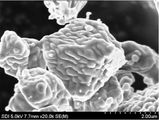
도 2는 실시예 1의 제2 양극 활물질에 대한 주사전자현미경 사진이다.
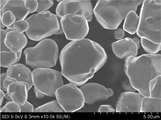
도 3은 비교예 1의 제2 양극 활물질에 대한 주사전자현미경 사진이다.
도 4는 비교예 2의 제2 양극 활물질에 대한 주사전자현미경 사진이다. 1 is a schematic diagram illustrating a lithium secondary battery according to an embodiment.
2 is a scanning electron micrograph of the second positive electrode active material of Example 1;
3 is a scanning electron micrograph of the second positive electrode active material of Comparative Example 1;
4 is a scanning electron micrograph of the second positive electrode active material of Comparative Example 2.
이하, 구체적인 구현예에 대하여 이 기술분야에서 통상의 지식을 가진 자가 용이하게 실시할 수 있도록 상세히 설명한다. 그러나 본 발명은 여러 가지 상이한 형태로 구현될 수 있으며 여기에서 설명하는 구현예에 한정되지 않는다.Hereinafter, specific embodiments will be described in detail so that those skilled in the art can easily implement them. However, the present invention may be embodied in many different forms and is not limited to the embodiments set forth herein.
여기서 사용되는 용어는 단지 예시적인 구현예들을 설명하기 위해 사용된 것으로, 본 발명을 한정하려는 의도는 아니다. 단수의 표현은 문맥상 명백하게 다르게 뜻하지 않는 한, 복수의 표현을 포함한다.Terms used herein are merely used to describe exemplary implementations and are not intended to limit the present invention. Singular expressions include plural expressions unless the context clearly dictates otherwise.
여기서 "이들의 조합"이란, 구성물의 혼합물, 적층물, 복합체, 공중합체, 합금, 블렌드, 반응 생성물 등을 의미한다. As used herein, “combination thereof” means a mixture of constituents, laminates, composites, copolymers, alloys, blends, reaction products, and the like.
여기서 "포함하다", "구비하다" 또는 "가지다" 등의 용어는 실시된 특징, 숫자, 단계, 구성 요소 또는 이들을 조합한 것이 존재함을 지정하려는 것이지, 하나 또는 그 이상의 다른 특징들이나 숫자, 단계, 구성 요소, 또는 이들을 조합한 것들의 존재 또는 부가 가능성을 미리 배제하지 않는 것으로 이해되어야 한다.The terms “comprise,” “comprise,” or “have” are intended to indicate that there is an embodied feature, number, step, component, or combination thereof, but that one or more other features, numbers, or steps are present. It should be understood that it does not preclude the possibility of existence or addition of components, components, or combinations thereof.
도면에서 여러 층 및 영역을 명확하게 표현하기 위하여 두께를 확대하여 나타내었으며, 명세서 전체를 통하여 유사한 부분에 대해서는 동일한 도면 부호를 붙였다. 층, 막, 영역, 판 등의 부분이 다른 부분 "위에" 또는 “상에” 있다고 할 때, 이는 다른 부분 "바로 위에" 있는 경우뿐만 아니라 그 중간에 또 다른 부분이 있는 경우도 포함한다. 반대로 어떤 부분이 다른 부분 "바로 위에" 있다고 할 때에는 중간에 다른 부분이 없는 것을 뜻한다. In the drawings, the thickness is enlarged in order to clearly express various layers and regions, and the same reference numerals are attached to similar parts throughout the specification. When a part such as a layer, film, region, plate, etc. is said to be "on" or "on" another part, this includes not only the case where it is "directly on" the other part, but also the case where there is another part in between. Conversely, when a part is said to be "directly on" another part, it means that there is no other part in between.
또한 여기서 “층”은 평면도로 관찰했을 때 전체 면에 형성되어 있는 형상뿐만 아니라 일부 면에 형성되어 있는 형상도 포함한다.In addition, the term "layer" includes not only shapes formed on the entire surface when observed in plan view, but also shapes formed on some surfaces.
또한 평균 입경은 당업자에게 널리 공지된 방법으로 측정될 수 있으며, 예를 들어, 입도 분석기로 측정하거나, 또는 투과전자현미경 사진 또는 주사전자현미경 사진으로 측정할 수도 있다. 다른 방법으로는, 동적광산란법을 이용하여 측정하고 데이터 분석을 실시하여 각각의 입자 사이즈 범위에 대하여 입자수를 카운팅한 뒤 이로부터 계산하여 평균 입경 값을 얻을 수 있다. 별도의 정의가 없는 한, 평균 입경은 입도 분포에서 누적 체적이 50 부피%인 입자의 지름(D50)을 의미할 수 있다.Also, the average particle diameter can be measured by a method well known to those skilled in the art, for example, it can be measured with a particle size analyzer, or it can be measured with a transmission electron micrograph or a scanning electron micrograph. Alternatively, the average particle diameter value can be obtained by measuring using the dynamic light scattering method, performing data analysis, counting the number of particles for each particle size range, and then calculating from this. Unless otherwise defined, the average particle diameter may mean the diameter (D50) of particles whose cumulative volume is 50% by volume in the particle size distribution.
양극 활물질cathode active material
일 구현예에서는 복수의 1차 입자들이 응집된 2차 입자 형태의 제1 양극 활물질, 및 단결정 형태의 제2 양극 활물질을 포함하는 리튬 이차 전지용 양극 활물질로서, 제1 양극 활물질 및 제2 양극 활물질은 모두 니켈계 양극 활물질로, 각각 코발트로 코팅되어 있고, 제2 양극 활물질 표면의 최대 거칠기는 15 nm 이상인 리튬 이차 전지용 양극 활물질을 제공한다. 이러한 양극 활물질은 고 용량 및 고 에너지 밀도를 구현하면서 향상된 수명 특성을 나타낼 수 있다. In one embodiment, a positive electrode active material for a lithium secondary battery comprising a first positive electrode active material in the form of secondary particles in which a plurality of primary particles are aggregated, and a second positive electrode active material in the form of a single crystal, wherein the first positive electrode active material and the second positive electrode active material are All are nickel-based cathode active materials, each coated with cobalt, and the maximum roughness of the surface of the second cathode active material is 15 nm or more. Such a cathode active material may exhibit improved lifespan characteristics while realizing high capacity and high energy density.
제1 양극 활물질First cathode active material
제1 양극 활물질은 다결정(polycrystal) 형태로서, 적어도 2개 이상의 1차 입자가 응집된 2차 입자를 포함한다. The first positive electrode active material is in a polycrystal form and includes secondary particles in which at least two or more primary particles are aggregated.
일 구현예에 따른 제1 양극 활물질은 코발트로 코팅되어 있다. 예를 들어, 제1 양극 활물질의 상기 2차 입자는 표면에 코발트가 코팅된 것일 수 있다. 즉, 제1 양극 활물질은 2차 입자 및 상기 2차 입자의 표면에 존재하는 코발트 코팅층을 포함할 수 있다. 제1 양극 활물질은 코발트로 코팅됨으로써 충방전의 반복에 따른 구조의 붕괴가 효과적으로 억제되어 상온 및 고온 수명 특성이 향상될 수 있다. The first cathode active material according to an embodiment is coated with cobalt. For example, the surface of the secondary particle of the first cathode active material may be coated with cobalt. That is, the first positive electrode active material may include secondary particles and a cobalt coating layer present on the surface of the secondary particles. Since the first cathode active material is coated with cobalt, structural collapse caused by repeated charging and discharging is effectively suppressed, and lifespan characteristics at room temperature and high temperature may be improved.
여기서 코발트로 코팅된 것은 코발트 함유 화합물로 코팅된 것으로 표현될 수도 있다. 상기 코발트 함유 화합물은 예를 들어 코발트 산화물, 코발트 수산화물, 코발트 카보네이트, 이들의 합성물 또는 이들의 혼합물 등일 수 있고, 이들은 리튬 및/또는 니켈 등을 더 포함할 수도 있다.Here, coated with cobalt may also be expressed as coated with a cobalt-containing compound. The cobalt-containing compound may be, for example, cobalt oxide, cobalt hydroxide, cobalt carbonate, a compound thereof, or a mixture thereof, and may further include lithium and/or nickel.
제1 양극 활물질에서 코발트 코팅량은 제1 양극 활물질 전체에 대해서 0.01 몰% 내지 7 몰%일 수 있고, 예를 들어 0.01 몰% 내지 6 몰%, 0.01 몰% 내지 5 몰%, 0.1 몰% 내지 4 몰%, 0.1 몰% 내지 3 몰%, 또는 0.5 몰% 내지 3 몰%일 수 있고, 또한 0.01 원자% 내지 7 원자%, 0.1 원자% 내지 5 원자%, 또는 0.5 원자% 내지 3 원자%일 수 있다. 이 경우 제1 양극 활물질을 포함하는 리튬 이차 전지는 뛰어난 상온 및 고온 수명 특성을 구현할 수 있다. In the first positive electrode active material, the coating amount of cobalt may be 0.01 mol% to 7 mol% with respect to the entirety of the first positive electrode active material, for example, 0.01 mol% to 6 mol%, 0.01 mol% to 5 mol%, 0.1 mol% to 0.1 mol% 4 mol%, 0.1 mol% to 3 mol%, or 0.5 mol% to 3 mol%, and also 0.01 atomic% to 7 atomic%, 0.1 atomic% to 5 atomic%, or 0.5 atomic% to 3 atomic% can In this case, the lithium secondary battery including the first positive electrode active material may realize excellent lifespan characteristics at room temperature and high temperature.
제1 양극 활물질에서 코발트 코팅층의 두께는 코팅 시의 소성 온도에 따라 가변적이며, 소성 온도에 따라 코발트가 활물질 내부로 침투하여 코팅 및/또는 도핑될 수도 있다. 이에 따라 상기 코발트 코팅층의 두께는 예를 들어 1 nm 내지 2 ㎛일 수 있고, 1 nm 내지 1.5 ㎛, 1 nm 내지 1 ㎛, 1 nm 내지 900 nm, 1 nm 내지 700 nm, 1 nm 내지 500 nm, 1 nm 내지 300 nm, 5 nm 내지 100 nm, 또는 5 nm 내지 50 nm일 수 있다. 이 경우 제1 양극 활물질을 포함하는 리튬 이차 전지는 우수한 상온 및 고온 수명 특성을 나타낼 수 있다. The thickness of the cobalt coating layer in the first cathode active material is variable according to the firing temperature during coating, and according to the firing temperature, cobalt may penetrate into the active material to be coated and/or doped. Accordingly, the thickness of the cobalt coating layer may be, for example, 1 nm to 2 μm, 1 nm to 1.5 μm, 1 nm to 1 μm, 1 nm to 900 nm, 1 nm to 700 nm, 1 nm to 500 nm, 1 nm to 300 nm, 5 nm to 100 nm, or 5 nm to 50 nm. In this case, the lithium secondary battery including the first cathode active material may exhibit excellent lifespan characteristics at room temperature and high temperature.
제1 양극 활물질 평균 입경, 즉 상기 2차 입자의 평균 입경은 7 ㎛ 내지 25 ㎛일 수 있다. 예를 들어, 9 ㎛ 내지 25 ㎛, 10 ㎛ 내지 25 ㎛, 15 ㎛ 내지 25 ㎛, 또는 10 ㎛ 내지 20 ㎛일 수 있다. 제1 양극 활물질의 2차 입자의 평균 입경은 후술할 단결정의 제2 양극 활물질의 평균 입경과 같거나 더 클 수 있다. 일 구현예에 따른 양극 활물질은 다결정이자 대립자인 제1 양극 활물질과 단결정이자 소립자인 제2 양극 활물질를 혼합한 형태일 수 있으며, 이에 따라 합제 밀도를 향상시킬 수 있고, 높은 용량과 높은 에너지 밀도를 구현할 수 있다. The average particle diameter of the first positive electrode active material, that is, the average particle diameter of the secondary particles may be 7 μm to 25 μm. For example, it may be 9 μm to 25 μm, 10 μm to 25 μm, 15 μm to 25 μm, or 10 μm to 20 μm. The average particle diameter of the secondary particles of the first positive electrode active material may be equal to or larger than that of the single crystal second positive electrode active material to be described later. The cathode active material according to an embodiment may be a mixture of a first cathode active material that is polycrystalline and opposite and a second cathode active material that is single crystal and small particles, thereby improving the density of the mixture and realizing high capacity and high energy density. can
제1 양극 활물질은 니켈계 양극 활물질로서 리튬 니켈 복합 산화물(또는 제1 니켈계 산화물)을 포함할 수 있다. 상기 리튬 니켈 복합 산화물에서 니켈의 함량은, 리튬을 제외한 전이금속의 총량를 기준으로 30 몰% 이상일 수 있고, 예를 들어 40 몰% 이상, 50 몰% 이상, 60 몰% 이상, 70 몰% 이상, 80 몰% 이상, 또는 90 몰% 이상일 수 있고, 99.9 몰% 이하, 또는 99 몰% 이하일 수 있다. 일 예로, 리튬 니켈 복합 산화물에서 니켈의 함량은 코발트, 망간, 알루미늄 등의 다른 금속 각각의 함량에 비해 더 높을 수 있다. 니켈의 함량이 상기 범위를 만족하는 경우 양극 활물질은 높은 용량을 구현하면서 뛰어난 전지 성능을 나타낼 수 있다. The first positive electrode active material may include lithium-nickel composite oxide (or first nickel-based oxide) as a nickel-based positive electrode active material. The content of nickel in the lithium-nickel composite oxide may be 30 mol% or more based on the total amount of transition metals other than lithium, for example, 40 mol% or more, 50 mol% or more, 60 mol% or more, 70 mol% or more, It may be 80 mol% or more, or 90 mol% or more, and may be 99.9 mol% or less, or 99 mol% or less. For example, the content of nickel in the lithium-nickel composite oxide may be higher than the content of each of other metals such as cobalt, manganese, and aluminum. When the content of nickel satisfies the above range, the cathode active material may exhibit excellent battery performance while realizing high capacity.
제1 양극 활물질은 구체적으로, 아래 화학식 1로 표시되는 화합물을 포함할 수 있다. The first positive electrode active material may specifically include a compound represented by Chemical Formula 1 below.
[화학식 1][Formula 1]
Lia1Nix1M1 y1M2 1-x1-y1O2 Li a1 Ni x1 M 1 y1 M 2 1-x1-y1 O 2
상기 화학식 1에서, 0.9≤a1≤1.8, 0.3≤x1≤1, 0≤y1≤0.7이고, M1 및 M2는 각각 독립적으로 Al, B, Ce, Co, Cr, F, Mg, Mn, Mo, Nb, P, S, Si, Sr, Ti, V, W, Zr 및 이들의 조합으로 이루어진 군에서 선택된다. In Formula 1, 0.9≤a1≤1.8, 0.3≤x1≤1, 0≤y1≤0.7, and M 1 and M 2 are each independently Al, B, Ce, Co, Cr, F, Mg, Mn, Mo , Nb, P, S, Si, Sr, Ti, V, W, Zr, and combinations thereof.
제1 양극 활물질은 예를 들어 아래 화학식 2의 화합물을 포함할 수 있다. The first positive electrode active material may include, for example, a compound represented by Chemical Formula 2 below.
[화학식 2][Formula 2]
Lia2Nix2Coy2M3 1-x2-y2O2 Li a2 Ni x2 Co y2 M 3 1-x2-y2 O 2
상기 화학식 2에서, 0.9≤a2≤1.8, 0.3≤x2<1, 0<y2≤0.7이고 M3은 Al, B, Ce, Cr, F, Mg, Mn, Mo, Nb, P, S, Si, Sr, Ti, V, W, Zr 및 이들의 조합으로 이루어진 군에서 선택된다. In Formula 2, 0.9≤a2≤1.8, 0.3≤x2<1, 0<y2≤0.7 and M 3 is Al, B, Ce, Cr, F, Mg, Mn, Mo, Nb, P, S, Si, It is selected from the group consisting of Sr, Ti, V, W, Zr, and combinations thereof.
제1 양극 활물질은 예를 들어 아래 화학식 3의 화합물을 포함할 수 있다. The first positive electrode active material may include, for example, a compound represented by Chemical Formula 3 below.
[화학식 3][Formula 3]
Lia3Nix3Coy3Alz3M4 1-x3-y3-z3O2 Li a3 Ni x3 Co y3 Al z3 M 4 1-x3-y3-z3 O 2
상기 화학식 3에서, 0.9≤a3≤1.8, 0.3≤x3<1, 0<y3<0.7, 0<z2<0.4이고, M4는 B, Ce, Cr, F, Mg, Mn, Mo, Nb, P, S, Si, Sr, Ti, V, W, Zr 및 이들의 조합으로 이루어진 군에서 선택된다. In Formula 3, 0.9≤a3≤1.8, 0.3≤x3<1, 0<y3<0.7, 0<z2<0.4, and M 4 is B, Ce, Cr, F, Mg, Mn, Mo, Nb, P , S, Si, Sr, Ti, V, W, Zr, and combinations thereof.
일 구현예에 따른 양극 활물질에서, 제1 양극 활물질과 제2 양극 활물질의 총량에 대하여, 제1 양극 활물질은 50 중량% 내지 90 중량%로 포함되고, 제2 양극 활물질은 10 중량% 내지 50 중량%로 포함될 수 있다. 제1 양극 활물질은 예를 들어 60 중량% 내지 90 중량%, 또는 70 중량% 내지 90 중량%로 포함될 수 있고, 제2 양극 활물질은 10 중량% 내지 40 중량%, 또는 10 중량% 내지 30 중량%로 포함될 수 있다. 제1 양극 활물질과 제2 양극 활물질의 함량 비율이 이와 같은 경우, 이를 포함하는 양극 활물질은 높은 용량을 구현하고 합제 밀도가 향상되며 높은 에너지 밀도를 나타낼 수 있다. In the cathode active material according to an embodiment, the first cathode active material is included in an amount of 50 wt% to 90 wt%, and the second cathode active material is included in an amount of 10 wt% to 50 wt%, based on the total amount of the first and second cathode active materials. % can be included. The first positive electrode active material may be included in an amount of, for example, 60% to 90% by weight, or 70% to 90% by weight, and the amount of the second positive electrode active material is 10% to 40% by weight, or 10% to 30% by weight. can be included as When the content ratio of the first cathode active material and the second cathode active material is like this, the cathode active material including the same may realize high capacity, improve mixture density, and exhibit high energy density.
제2 양극 활물질Second cathode active material
제2 양극 활물질은 단결정(single crystal) 형태로서, 이는 입자 내에 입자 경계(grain boundary)를 가지지 않고 단독으로 존재하며 하나의 입자로 이루어진 것을 의미하고, 모폴로지 상으로 입자들이 상호 응집되지 않은 독립된 상(phase)으로 존재하는 모노리스(monolith) 구조 또는 단일체 구조를 의미할 수 있으며, 단일 입자(single crystal particle)라고 표현할 수도 있다. 일 구현예에 따른 양극 활물질은 이러한 제2 양극 활물질을 포함함으로써 고용량, 고 에너지 밀도를 구현하면서 향상된 수명 특성을 나타낼 수 있다. The second positive electrode active material is in the form of a single crystal, which means that it exists alone without having a grain boundary in the particle and is composed of one particle, and is an independent phase in which the particles are not aggregated with each other in the morphological phase ( phase) may mean a monolith structure or a single body structure, and may also be expressed as a single crystal particle. A cathode active material according to an embodiment may exhibit improved lifespan characteristics while realizing high capacity and high energy density by including the second cathode active material.
제2 양극 활물질의 형상은 특별히 제한되지 않고, 다면체, 구형, 타원형, 플레이트형, 막대형, 비정형 등 다양한 형상을 가질 수 있다.The shape of the second positive electrode active material is not particularly limited, and may have various shapes such as polyhedral, spherical, elliptical, plate, rod, and irregular shapes.
일 구현예에 따른 제2 양극 활물질은 코발트로 코팅되어 있다. 예를 들어, 제2 양극 활물질의 표면은 코발트 함유 화합물로 코팅된 것일 수 있다. 제2 양극 활물질은 단결정 및 상기 단결정의 표면에 존재하는 코발트 코팅층을 포함할 수 있다. 제2 양극 활물질은 코발트로 코팅됨으로써 충방전의 반복에 따른 구조의 붕괴가 효과적으로 억제되어 상온 및 고온 수명 특성이 향상될 수 있다.The second cathode active material according to an embodiment is coated with cobalt. For example, the surface of the second cathode active material may be coated with a cobalt-containing compound. The second cathode active material may include a single crystal and a cobalt coating layer present on the surface of the single crystal. Since the second cathode active material is coated with cobalt, structural collapse caused by repeated charging and discharging is effectively suppressed, and lifespan characteristics at room temperature and high temperature may be improved.
후술할 일 구현예에 따른 양극 활물질의 제조 방법에서는, 제1 양극 활물질과 제2 양극 활물질을 개별적으로 코발트 코팅을 진행하지 않고, 제1 니켈계 산화물과 제2 니켈계 산화물을 혼합한 후 코발트 코팅을 진행하고 제3 열처리를 진행하여 동시 코팅 및 소성을 진행한다. 이에 따르면, 코발트가 코팅된 단결정의 제2 양극 활물질의 표면은 평탄하거나 매끄럽지 않고 특정한 요철이 생긴 울퉁불퉁한 형태가 된다. 이에 따라 제2 양극 활물질의 표면 거칠기가 증가하고 비표면적이 증가하게 된다. 일 구현예에 따른 제2 양극 활물질은 코발트 등의 코팅을 진행한 종래의 단결정 양극 활물질에 비하여, 표면 거칠기 및 비표면적이 상승하여 전지의 충방전 효율과 수명 특성을 향상시킬 수 있다. In a method for manufacturing a positive electrode active material according to an embodiment to be described later, cobalt coating is performed after mixing the first nickel-based oxide and the second nickel-based oxide without individually coating the first positive electrode active material and the second positive electrode active material with cobalt. and proceed with the third heat treatment to proceed with simultaneous coating and firing. According to this, the surface of the single crystal second cathode active material coated with cobalt is not flat or smooth, but has a bumpy shape with specific irregularities. Accordingly, the surface roughness and specific surface area of the second positive electrode active material increase. Compared to the conventional single crystal cathode active material coated with cobalt, the second cathode active material according to an embodiment has an increased surface roughness and specific surface area, thereby improving charge/discharge efficiency and lifespan characteristics of a battery.
일 구현예에 따른 제2 양극 활물질은 표면에 요철이 존재하고, 예를 들어 선형의 요철, 또는 비정형의 요철이 존재할 수 있다. 예를 들어, 단결정의 제2 양극 활물질의 표면에는 코발트 함유 화합물이 부착되어 있는 형태일 수 있고, 선형으로 부착되어 있거나 비정형으로 부착되어 있을 수 있고, 코발트 함유 화합물이 울퉁불퉁한 형태로 단결정의 표면을 덮고 있을 수 있다. 이러한 형태는 기존의 아일랜드 형태의 코팅과는 구별된다. The surface of the second positive active material according to an embodiment may have irregularities, for example, linear or irregular irregularities. For example, the cobalt-containing compound may be attached to the surface of the single crystal second cathode active material, may be attached linearly or irregularly, and the cobalt-containing compound may be attached to the surface of the single crystal in a bumpy form. may be covered This form is distinct from conventional island-type coatings.
이러한 제2 양극 활물질은 표면 거칠기가 높다. 상기 표면 거칠기(roughness)는 대상을 원자힘 현미경(atomic force microscopy; AFM) 등으로 촬영한 사진을 이용해 표면 거칠기 측정기, 예를 들어 옵티컬 프로파일러(optical profiler)를 통해 측정할 수 있다. 최대 거칠기(Rmax; peak to peak height; maximum roughness depth)는 거칠기 단면 곡선(거칠기 프로파일)의 기준 길이 내에서 제일 높은 피크(highest peak)와 제일 깊은 피크(lowest valley) 사이의 수직 거리를 의미할 수 있다. 평균 거칠기(Ra; average roughness)는 중심선 평균 거칠기라고도 하며 거칠기 프로파일의 기준 길이 내에서 세로값(ordinate; 중심선에서 피크까지의 길이)의 절대값의 산술 평균을 의미할 수 있다. 제곱평균 거칠기(Rq; root mean square roughness)는 거칠기 프로파일의 기준 길이 내에서 세로값의 제곱 평균 제곱근(rms)을 의미할 수 있다. 이러한 표면 거칠기에 대해서는 KS B 0601 또는 ISO 4287/1에 정의된 파라미터 정의 및 측정 방법을 참고할 수 있다. The second positive electrode active material has a high surface roughness. The surface roughness may be measured using a surface roughness measuring device, for example, an optical profiler, using a photograph taken of an object with an atomic force microscope (AFM) or the like. Maximum roughness depth (R max ; peak to peak height; maximum roughness depth) may mean the vertical distance between the highest peak and the lowest valley within the reference length of the roughness cross-section curve (roughness profile). can Average roughness (R a ) is also referred to as center line average roughness and may mean an arithmetic average of absolute values of ordinate values (length from center line to peak) within a reference length of a roughness profile. Root mean square roughness (R q ) may mean the root mean square (rms) of vertical values within a reference length of a roughness profile. For such surface roughness, reference may be made to parameter definitions and measurement methods defined in KS B 0601 or ISO 4287/1.
제2 양극 활물질 표면의 최대 거칠기(Rmax; peak to peak height)는 15 nm 이상이며, 예를 들어 20nm 이상일 수 있고, 15 nm 내지 100 nm, 15 nm 내지 50 nm, 15 nm 내지 40 nm, 또는 20 nm 내지 35 nm일 수 있다. 이 경우 제2 양극 활물질을 포함하는 리튬 이차 전지용 양극 활물질은 고에너지 밀도 및 고용량을 나타내고 뛰어난 충방전 효율 및 수명 특성을 구현할 수 있다. The maximum roughness (R max ; peak to peak height) of the surface of the second cathode active material is 15 nm or more, for example, 20 nm or more, 15 nm to 100 nm, 15 nm to 50 nm, 15 nm to 40 nm, or 20 nm to 35 nm. In this case, the cathode active material for a lithium secondary battery including the second cathode active material may exhibit high energy density and high capacity, and may realize excellent charge/discharge efficiency and lifespan characteristics.
제2 양극 활물질 표면의 평균 거칠기(Ra; average roughness)는 1.5 nm 이상일 수 있고, 예를 들어 1.8 nm 이상일 수 있으며, 1.5 nm 내지 10 nm, 1.5 nm 내지 8.0 nm, 1.5 nm 내지 6.0 nm, 1.8 nm 내지 5.0 nm, 2.0 nm 내지 10 nm, 또는 3.0 nm 내지 10 nm일 수 있다. 이 경우 제2 양극 활물질을 포함하는 리튬 이차 전지용 양극 활물질은 고에너지 밀도 및 고용량을 나타내고 우수한 충방전 효율 및 수명 특성을 구현할 수 있다. The average roughness (R a ) of the surface of the second cathode active material may be 1.5 nm or more, for example, 1.8 nm or more, 1.5 nm to 10 nm, 1.5 nm to 8.0 nm, 1.5 nm to 6.0 nm, or 1.8 nm. nm to 5.0 nm, 2.0 nm to 10 nm, or 3.0 nm to 10 nm. In this case, the cathode active material for a lithium secondary battery including the second cathode active material may exhibit high energy density and high capacity, and may realize excellent charge/discharge efficiency and lifespan characteristics.
제2 양극 활물질 표면의 제곱평균 거칠기(Rq; root mean square roughness)는 2.0 nm 이상일 수 있고, 예를 들어 2.3 nm 이상일 수 있으며, 2.0 nm 내지 10 nm, 2.0 nm 내지 8 nm, 2.0 nm 내지 6 nm, 2.3 nm 내지 5 nm, 또는 3.0 nm 내지 10 nm, 4.0 nm 내지 10 nm일 수 있다. 이 경우 제2 양극 활물질을 포함하는 리튬 이차 전지용 양극 활물질은 고에너지 밀도 및 고용량을 나타내고 뛰어난 충방전 효율 및 수명 특성을 구현할 수 있다.The root mean square roughness (R q ) of the surface of the second cathode active material may be 2.0 nm or more, for example, 2.3 nm or more, 2.0 nm to 10 nm, 2.0 nm to 8 nm, 2.0 nm to 6 nm. nm, 2.3 nm to 5 nm, or 3.0 nm to 10 nm, 4.0 nm to 10 nm. In this case, the cathode active material for a lithium secondary battery including the second cathode active material may exhibit high energy density and high capacity, and may realize excellent charge/discharge efficiency and lifespan characteristics.
제1 양극 활물질과 제2 양극 활물질을 포함하는 양극 활물질 전체의 BET 비표면적은 0.2 m2/g 내지 0.6 m2/g일 수 있고, 예를 들어 0.3 m2/g 내지 약 0.5 m2/g, 0.3 m2/g 내지 약 0.4 m2/g일 수 있다. 이 경우 양극활물질은 뛰어난 충방전 효율과 수명 특성을 구현할 수 있다. The BET specific surface area of the entire positive electrode active material including the first positive electrode active material and the second positive electrode active material may be 0.2 m 2 /g to 0.6 m 2 /g, for example, 0.3 m 2 /g to about 0.5 m 2 /g. , 0.3 m 2 /g to about 0.4 m 2 /g. In this case, the cathode active material can realize excellent charge/discharge efficiency and lifespan characteristics.
제2 양극 활물질에서 코발트 코팅량은 제2 양극 활물질 전체에 대해서 0.01 몰% 내지 7 몰%일 수 있고, 예를 들어 0.01 몰% 내지 6 몰%, 0.05 몰% 내지 5 몰%, 0.1 몰% 내지 4 몰%, 또는 0.5 몰% 내지 3 몰%일 수 있고, 또한 0.01 원자% 내지 7 원자%, 0.1 원자% 내지 5 원자%, 또는 0.5 원자% 내지 3 원자%일 수 있다. 이 경우 제2 양극 활물질을 포함하는 리튬 이차 전지는 뛰어난 상온 및 고온 수명 특성을 구현할 수 있다. In the second positive electrode active material, the cobalt coating amount may be 0.01 mol% to 7 mol% based on the total amount of the second positive electrode active material, for example, 0.01 mol% to 6 mol%, 0.05 mol% to 5 mol%, 0.1 mol% to 0.1 mol% 4 mol %, or 0.5 mol % to 3 mol %, and may also be 0.01 atomic % to 7 atomic %, 0.1 atomic % to 5 atomic %, or 0.5 atomic % to 3 atomic %. In this case, the lithium secondary battery including the second cathode active material may realize excellent lifespan characteristics at room temperature and high temperature.
제2 양극 활물질에서 코발트 코팅층의 두께는 약 1 nm 내지 2 ㎛일 수 있고, 예를 들어 1 nm 내지 1 ㎛, 1 nm 내지 900 nm, 1 nm 내지 700 nm, 1 nm 내지 500 nm, 1 nm 내지 300 nm, 5 nm 내지 100 nm, 또는 5 nm 내지 50 nm일 수 있다. 이 경우 제2 양극활물질을 포함하는 리튬 이차 전지는 우수한 상온 및 고온 수명 특성을 나타낼 수 있다. The thickness of the cobalt coating layer in the second cathode active material may be about 1 nm to 2 μm, for example, 1 nm to 1 μm, 1 nm to 900 nm, 1 nm to 700 nm, 1 nm to 500 nm, 1 nm to 300 nm, 5 nm to 100 nm, or 5 nm to 50 nm. In this case, the lithium secondary battery including the second cathode active material may exhibit excellent lifespan characteristics at room temperature and high temperature.
제2 양극 활물질의 평균 입경, 즉 단결정의 평균 입경은 1㎛ 내지 10㎛일 수 있고, 예를 들어 1㎛ 내지 8㎛, 2㎛ 내지 7㎛, 2㎛ 내지 6㎛, 또는 2㎛ 내지 5㎛일 수 있으며, 구체적으로 2㎛ 내지 4㎛일 수 있다. 제2 양극 활물질의 입경은 제1 양극 활물질과 같거나 더 작을 수 있고, 이에 따라 양극 활물질의 밀도를 더욱 높일 수 있다. The average particle diameter of the second cathode active material, that is, the average particle diameter of a single crystal may be 1 μm to 10 μm, for example, 1 μm to 8 μm, 2 μm to 7 μm, 2 μm to 6 μm, or 2 μm to 5 μm. It may be, and specifically may be 2㎛ to 4㎛. The particle diameter of the second cathode active material may be the same as or smaller than that of the first cathode active material, and accordingly, the density of the cathode active material may be further increased.
제2 양극 활물질은 니켈계 활물질로서 리튬 니켈계 복합 산화물(또는 제2 니켈계 산화물)을 포함할 수 있다. 상기 리튬 니켈 복합 산화물에서 니켈의 함량은, 리튬을 제외한 전이금속의 총량를 기준으로 30 몰% 이상일 수 있고, 예를 들어 40 몰% 이상, 50 몰% 이상, 60 몰% 이상, 70 몰% 이상, 80 몰% 이상, 또는 90 몰% 이상일 수 있고, 99.9 몰% 이하, 또는 99 몰% 이하일 수 있다. 일 예로, 리튬 니켈 복합 산화물에서 니켈의 함량은 코발트, 망간, 알루미늄 등의 다른 금속 각각의 함량에 비해 더 높을 수 있다. 니켈의 함량이 상기 범위를 만족하는 경우 양극 활물질은 높은 용량을 구현하면서 뛰어난 전지 성능을 나타낼 수 있다. The second cathode active material may include lithium nickel-based composite oxide (or second nickel-based oxide) as a nickel-based active material. The content of nickel in the lithium-nickel composite oxide may be 30 mol% or more based on the total amount of transition metals other than lithium, for example, 40 mol% or more, 50 mol% or more, 60 mol% or more, 70 mol% or more, It may be 80 mol% or more, or 90 mol% or more, and may be 99.9 mol% or less, or 99 mol% or less. For example, the content of nickel in the lithium-nickel composite oxide may be higher than the content of each of other metals such as cobalt, manganese, and aluminum. When the content of nickel satisfies the above range, the cathode active material may exhibit excellent battery performance while realizing high capacity.
상기 제2 양극 활물질은 예를 들어 하기 화학식 11로 표시되는 화합물을 포함할 수 있다. The second cathode active material may include, for example, a compound represented by Chemical Formula 11 below.
[화학식 11][Formula 11]
Lia11Nix11M11 y11M12 1-x11-y11O2 Li a11 Ni x11 M 11 y11 M 12 1-x11-y11 O 2
상기 화학식 11에서, 0.9≤a11≤1.8, 0.3≤x11≤1, 0≤y11≤0.7이고, M11 및 M12는 각각 독립적으로 Al, B, Ce, Co, Cr, F, Mg, Mn, Mo, Nb, P, S, Si, Sr, Ti, V, W, Zr 및 이들의 조합으로 이루어진 군에서 선택된다. In Formula 11, 0.9≤a11≤1.8, 0.3≤x11≤1, 0≤y11≤0.7, and M 11 and M 12 are each independently Al, B, Ce, Co, Cr, F, Mg, Mn, Mo , Nb, P, S, Si, Sr, Ti, V, W, Zr, and combinations thereof.
상기 화학식 11에서 니켈의 함량을 나타내는 x11은 예를 들어 0.4≤x11<1, 0.5≤x11<1, 0.6≤x11<1, 0.8≤x11<1, 또는 0.9≤x11<1일 수 있다. 이 경우 이를 포함하는 양극 활물질은 고용량은 구현할 수 있다. In Formula 11, x11 representing the nickel content may be, for example, 0.4≤x11<1, 0.5≤x11<1, 0.6≤x11<1, 0.8≤x11<1, or 0.9≤x11<1. In this case, the positive electrode active material including the same can realize high capacity.
제2 양극 활물질은 일 예로, 하기 화학식 12 또는 화학식 13으로 표시될 수 있다. For example, the second cathode active material may be represented by Formula 12 or Formula 13 below.
[화학식 12][Formula 12]
Lia12Nix12Coy12Mnz12M13 1-x12-y12-z12O2 Li a12 Ni x12 Co y12 Mn z12 M 13 1-x12-y12-z12 O 2
상기 화학식 12에서, 0.9≤a12≤1.8, 0.3≤x12<1, 0<y12<0.7, 0<z12<0.7이고, M13은 Al, B, Ce, Cr, F, Mg, Mo, Nb, P, S, Si, Sr, Ti, V, W, Zr 및 이들의 조합으로 이루어진 군에서 선택된다.In Formula 12, 0.9≤a12≤1.8, 0.3≤x12<1, 0<y12<0.7, 0<z12<0.7, and M 13 is Al, B, Ce, Cr, F, Mg, Mo, Nb, P , S, Si, Sr, Ti, V, W, Zr, and combinations thereof.
[화학식 13][Formula 13]
Lia13Nix13Coy13M14 1-x13-y13O2 Li a13 Ni x13 Co y13 M 14 1-x13-y13 O 2
상기 화학식 13에서, 0.9≤a13≤1.8, 0.3≤x13<1, 0<y13≤0.7이고, M14는 B, Ce, Cr, F, Mg, Mn, Mo, Nb, P, S, Si, Sr, Ti, V, W, Zr 및 이들의 조합으로 이루어진 군에서 선택된다.In Formula 13, 0.9≤a13≤1.8, 0.3≤x13<1, 0<y13≤0.7, and M 14 is B, Ce, Cr, F, Mg, Mn, Mo, Nb, P, S, Si, Sr , Ti, V, W, Zr, and combinations thereof.
상기 제2 양극 활물질이 상기 화학식 12 또는 화학식 13으로 표시되는 화합물을 포함할 경우, 고용량을 구현하면서 초기 방전 용량이 저하되지 않으며 수명 특성이 향상되는 효과를 얻을 수 있다. When the second cathode active material includes the compound represented by Chemical Formula 12 or Chemical Formula 13, an effect of improving lifespan characteristics without deteriorating initial discharge capacity while realizing high capacity can be obtained.
상기 화학식 12에서, 예를 들어 0.5≤x12<1 및 0<y12<0.5, 0<z12<0.5일 수 있고, 0.6≤x12<1 및 0<y12<0.4, 0<z12<0.4이거나, 0.8≤x12<1 및 0<y12<0.2, 0<z12<0.2일 수 있다. 또한 상기 화학식 13에서, 0.5≤x13<1 및 0<y13≤0.5일 수 있고, 0.6≤x13<1 및 0<y13≤0.4이거나, 0.8≤x13≤0.99, 0.01≤y13≤0.2일 수 있다. In Formula 12, for example, 0.5≤x12<1 and 0<y12<0.5, 0<z12<0.5, 0.6≤x12<1 and 0<y12<0.4, 0<z12<0.4, or 0.8≤ x12<1 and 0<y12<0.2, 0<z12<0.2. In Formula 13, 0.5≤x13<1 and 0<y13≤0.5, 0.6≤x13<1 and 0<y13≤0.4, or 0.8≤x13≤0.99 and 0.01≤y13≤0.2.
양극 활물질의 제조 방법Manufacturing method of cathode active material
일 구현예에서는 제1 니켈계 수산화물 및 리튬 원료를 혼합하고 제1 열처리하여 제1 니켈계 산화물을 준비하고, 제2 니켈계 수산화물 및 리튬 원료를 혼합하고 제2 열처리하여 제2 니켈계 산화물을 준비하고, 그리고 제1 니켈계 산화물, 제2 니켈계 산화물 및 코발트 화합물을 혼합하고 제3 열처리하여 코발트 코팅을 진행하고, 제1 양극 활물질 및 제2 양극 활물질을 포함하는 최종 양극 활물질을 얻는 것을 포함하는, 리튬 이차 전지용 양극 활물질의 제조 방법을 제공한다. In one embodiment, the first nickel-based oxide is prepared by mixing the first nickel-based hydroxide and the lithium source and subjected to a first heat treatment, and the second nickel-based oxide is prepared by mixing the second nickel-based hydroxide and the lithium source and performing a second heat treatment. And mixing the first nickel-based oxide, the second nickel-based oxide and the cobalt compound and performing a third heat treatment to perform cobalt coating, and obtaining a final positive electrode active material including the first positive electrode active material and the second positive electrode active material , It provides a method for manufacturing a cathode active material for a lithium secondary battery.
여기서, 상기 제1 니켈계 산화물 및 제1 양극 활물질은 복수의 1차 입자들이 응집된 2차 입자 형태이고, 상기 제2 니켈계 산화물 및 제2 양극 활물질은 단결정 형태이다. 제1 양극 활물질은 제1 니켈계 산화물의 표면에 코발트가 코팅된 물질이고, 제2 양극 활물질은 제2 니켈계 산화물의 표면에 코발트가 코팅된 물질이라고 할 수 있다. Here, the first nickel-based oxide and the first cathode active material are in the form of secondary particles in which a plurality of primary particles are aggregated, and the second nickel-based oxide and the second cathode active material are in the form of single crystals. The first cathode active material may be a material in which cobalt is coated on the surface of the first nickel-based oxide, and the second cathode active material may be a material in which cobalt is coated on the surface of the second nickel-based oxide.
일 구현예에서는 제1 양극 활물질과 제2 양극 활물질을 각각 개별적으로 코발트 코팅을 진행하지 않고, 제1 니켈계 산화물과 제2 니켈계 산화물을 혼합한 상태에서 동시에 코발트 코팅을 진행한다. 이에 따르면, 코발트가 코팅된 단결정의 제2 양극 활물질은 표면이 매끄럽거나 평탄하지 않고, 울퉁불퉁한 형태를 띠게 되며, 이에 따라 높은 표면 거칠기와 비표면적을 가지게 된다. 이러한 제2 양극 활물질을 포함하는 리튬 이차 전지용 양극 활물질은 높은 비표면적을 나타내고 이에 따라 뛰어난 용량 특성 및 수명 특성을 구현할 수 있다. In one embodiment, cobalt coating is simultaneously performed in a mixed state of the first nickel-based oxide and the second nickel-based oxide, rather than individually coating the first and second positive electrode active materials with cobalt. According to this, the cobalt-coated single-crystal second cathode active material has an uneven or uneven surface, and thus has a high surface roughness and specific surface area. A cathode active material for a lithium secondary battery including the second cathode active material exhibits a high specific surface area, and thus can realize excellent capacity characteristics and lifespan characteristics.
제1 니켈계 수산화물과 제2 니켈계 수산화물은 양극 활물질의 전구체로서, 각각 독립적으로 니켈 수산화물이거나 니켈 이외에 다른 원소를 포함하는 니켈계 복합 수산화물일 수 있고, 니켈 이외에 다른 금속을 포함하는 니켈-금속 복합 수산화물일 수 있으며, 니켈 이외에 다른 전이금속을 포함하는 니켈-전이금속 복합 수산화물일 수도 있다. The first nickel-based hydroxide and the second nickel-based hydroxide are precursors of a positive electrode active material, and may independently be nickel hydroxide or a nickel-based composite hydroxide containing an element other than nickel, and a nickel-metal composite containing a metal other than nickel. It may be a hydroxide, and may be a nickel-transition metal composite hydroxide containing a transition metal other than nickel.
예를 들어, 상기 제1 니켈계 수산화물과 제2 니켈계 수산화물은 각각 독립적으로 아래 화학식 21로 표시되는 것일 수 있다. For example, the first nickel-based hydroxide and the second nickel-based hydroxide may each independently be represented by Chemical Formula 21 below.
[화학식 21][Formula 21]
Nix21M21 y21M22 1-x21-y21(OH)2 Ni x21 M 21 y21 M 22 1-x21-y21 (OH) 2
상기 화학식 21에서, 0.3≤x21≤1, 0≤y21≤0.7이고, M21 및 M22는 각각 독립적으로 Al, B, Ce, Co, Cr, F, Mg, Mn, Mo, Nb, P, S, Si, Sr, Ti, V, W, Zr 및 이들의 조합으로 이루어진 군에서 선택된다. In Formula 21, 0.3≤x21≤1, 0≤y21≤0.7, and M 21 and M 22 are each independently Al, B, Ce, Co, Cr, F, Mg, Mn, Mo, Nb, P, S , Si, Sr, Ti, V, W, Zr, and combinations thereof.
제1 니켈계 수산화물의 입경은 10 ㎛ 내지 30 ㎛일 수 있고, 예를 들어 10 ㎛ 내지 25 ㎛, 15 ㎛ 내지 25 ㎛, 또는 10 ㎛ 내지 20 ㎛일 수 있다. 제2 니켈계 수산화물의 입경은 1 ㎛ 내지 9 ㎛일 수 있고, 예를 들어, 2 ㎛ 내지 9 ㎛, 2 ㎛ 내지 8 ㎛, 또는 3 ㎛ 내지 7 ㎛일 수 있다.The particle size of the first nickel-based hydroxide may be 10 μm to 30 μm, for example, 10 μm to 25 μm, 15 μm to 25 μm, or 10 μm to 20 μm. The particle diameter of the second nickel-based hydroxide may be 1 μm to 9 μm, for example, 2 μm to 9 μm, 2 μm to 8 μm, or 3 μm to 7 μm.
상기 리튬 원료는 양극 활물질의 리튬 공급원으로서 예를 들어 Li2CO3, LiOH, 이들의 수화물, 또는 이들의 조합일 수 있다.The lithium source may be, for example, Li 2 CO 3 , LiOH, a hydrate thereof, or a combination thereof as a source of lithium for the cathode active material.
상기 제1 열처리는 산화성 가스 분위기에서 진행될 수 있으며 예를 들어 산소 분위기 또는 공기 분위기에서 진행될 수 있다. 또한 제1 열처리는 예를 들어 600 ℃ 내지 900 ℃ 또는 600 ℃ 내지 800 ℃에서 실시될 수 있고, 예를 들어 5 내지 15 시간 동안 실시될 수 있다. The first heat treatment may be performed in an oxidizing gas atmosphere, for example, in an oxygen atmosphere or an air atmosphere. In addition, the first heat treatment may be performed at 600 °C to 900 °C or 600 °C to 800 °C, for example, for 5 to 15 hours.
상기 제2 열처리 역시 산화성 가스 분위기에서 진행될 수 있으며 예를 들어 산소 분위기 또는 공기 분위기에서 진행될 수 있다. 또한 제2 열처리는 예를 들어 800 ℃ 내지 1100 ℃, 또는 900 ℃ 내지 1000 ℃에서 실시될 수 있고, 예를 들어 5 내지 20 시간 동안 실시될 수 있다. The second heat treatment may also be performed in an oxidizing gas atmosphere, for example, in an oxygen atmosphere or an air atmosphere. In addition, the second heat treatment may be performed at, for example, 800 °C to 1100 °C, or 900 °C to 1000 °C, and may be performed for, for example, 5 to 20 hours.
제2 니켈계 산화물은 단결정 형태로서, 제2 열처리의 온도, 시간 등의 조건을 조절함으로써 단결정 형태를 얻을 수도 있고, 제2 니켈계 수산화물을 공침법으로 합성할 때의 여러 조건들을 통해 단결정 형태를 얻을 수도 있다. The second nickel-based oxide is in a single crystal form, and the single crystal form can be obtained by adjusting conditions such as temperature and time of the second heat treatment, and the single crystal form can be obtained through various conditions when synthesizing the second nickel-based hydroxide by the coprecipitation method. you can also get
상기 리튬 이차 전지용 양극 활물질의 제조 방법은 제2 니켈계 수산화물 및 리튬 원료를 혼합하여 제2 열처리한 이후에 수득물을 분쇄하는 것을 더 포함할 수 있으며, 이를 통해 단결정의 제2 니켈계 산화물을 수득할 수도 있다. 상기 분쇄하는 것은 제트 밀 등 다양한 분쇄 장치 등을 이용하여 수행될 수 있다. The manufacturing method of the cathode active material for a lithium secondary battery may further include mixing the second nickel-based hydroxide and the lithium source, subjecting the second nickel-based hydroxide to a second heat treatment, and then pulverizing the resultant product, thereby obtaining a single-crystal second nickel-based oxide. You may. The grinding may be performed using various grinding devices such as a jet mill.
제2 니켈계 수산화물과 리튬 원료를 혼합할 때, 제2 니켈계 수산화물에 포함되는 금속의 몰수에 대한 리튬 원료에서의 리튬의 몰수의 비는 예를 들어 0.8 이상, 0.85 이상, 0.9 이상, 0.95 이상, 또는 1.0 이상일 수 있고, 1.8 이하, 1.5 이하, 1.2 이하, 1.1 이하, 또는 1.05 이하일 수 있다.When mixing the second nickel-based hydroxide and the lithium source, the ratio of the number of moles of lithium in the lithium source to the number of moles of metal contained in the second nickel-based hydroxide is, for example, 0.8 or more, 0.85 or more, 0.9 or more, or 0.95 or more. , or 1.0 or more, and may be 1.8 or less, 1.5 or less, 1.2 or less, 1.1 or less, or 1.05 or less.
제1 니켈계 산화물과 제2 니켈계 산화물을 혼합하는 과정에서, 제1 니켈계 산화물과 제2 니켈계 산화물의 중량비는 9:1 내지 5:5일 수 있고, 예를 들어 9:1 내지 6:4, 또는 8:2 내지 7:3일 수 있다. 제1 니켈계 산화물과 제2 니켈계 산화물의 혼합비가 전술한 범위를 만족할 경우, 제조된 양극 활물질은 고용량 고에너지 밀도를 나타낼 수 있으며 높은 극판 밀도를 나타낼 수 있다. In the process of mixing the first nickel-based oxide and the second nickel-based oxide, the weight ratio of the first nickel-based oxide and the second nickel-based oxide may be 9:1 to 5:5, for example, 9:1 to 6 :4, or 8:2 to 7:3. When the mixing ratio of the first nickel-based oxide and the second nickel-based oxide satisfies the aforementioned range, the prepared cathode active material may exhibit high capacity, high energy density, and high electrode plate density.
제1 니켈계 산화물과 제2 니켈계 산화물이 혼합된 혼합물에 코발트 코팅을 진행한다. 코발트 코팅은 건식 또는 습식으로 진행될 수 있다. 예를 들어 상기 혼합물에 코발트 화합물을 투입하여 제3 열처리하는 건식 코팅을 진행할 수 있다. 또는 상기 혼합물을 증류수 등에 투입하여 혼합하면서 세정하고 코발트 화합물을 적하하여 습식 코팅을 진행하고 제3 열처리를 할 수도 있다. Cobalt coating is performed on a mixture of the first nickel-based oxide and the second nickel-based oxide. Cobalt coating can be done dry or wet. For example, dry coating may be performed by adding a cobalt compound to the mixture and performing a third heat treatment. Alternatively, the mixture may be put into distilled water, washed while mixing, wet coating may be performed by dropping a cobalt compound, and a third heat treatment may be performed.
코발트 코팅 함량은 활물질의 전이금속 100 몰부에 대하여 0.01 몰부 내지 7 몰부, 또는 0.01 몰부 내지 5 몰부, 또는 0.1 몰부 내지 3 몰부일 수 있다. 상기 코발트 화합물은 예를 들어 황산 코발트염, 산화코발트, 질산 코발트염 등일 수 있다.The cobalt coating content may be 0.01 to 7 parts by mole, or 0.01 to 5 parts by mole, or 0.1 to 3 parts by mole, based on 100 parts by mole of the transition metal of the active material. The cobalt compound may be, for example, cobalt sulfate, cobalt oxide, or cobalt nitrate.
상기 제3 열처리는 산화성 가스 분위기하에서 수행될 수 있다. 상기 산화성 가스 분위기는 산소 또는 공기 분위기일 수 있다. 상기 제3 열처리는 예를 들어 650 ℃ 내지 900 ℃ 또는 650 ℃ 내지 800 ℃에서 실시될 수 있다. 제3 열처리 시간은 열처리 온도 등에 따라 가변적이지만 예를 들어 5 내지 30 시간 동안 또는 10 내지 24 시간 동안 실시할 수 있다.The third heat treatment may be performed under an oxidizing gas atmosphere. The oxidizing gas atmosphere may be an oxygen or air atmosphere. The third heat treatment may be performed at, for example, 650 °C to 900 °C or 650 °C to 800 °C. The third heat treatment time is variable depending on the heat treatment temperature and the like, but may be performed for, for example, 5 to 30 hours or 10 to 24 hours.
이후, 열처리를 종료하고 실온으로 냉각시켜, 전술한 일 구현예에 따른 리튬 이차 전지용 양극 활물질을 수득할 수 있다. 제조된 양극 활물질은 1차 입자들이 응집된 2차 입자를 포함하는 제1 양극 활물질과, 단결정 형태의 제2 양극 활물질이 혼합된 상태이며, 제1 양극 활물질과 제2 양극 활물질 각각은 코발트로 코팅되어 있고, 제2 양극 활물질의 표면에 요철이 형성되어 있다. Thereafter, the heat treatment may be terminated and cooled to room temperature to obtain the cathode active material for a lithium secondary battery according to the above-described embodiment. The prepared cathode active material is a mixture of a first cathode active material including secondary particles in which primary particles are aggregated and a second cathode active material in a single crystal form, and each of the first cathode active material and the second cathode active material is coated with cobalt. and irregularities are formed on the surface of the second positive electrode active material.
양극anode
리튬 이차 전지용 양극은 집전체 및 이 집전체 상에 위치하는 양극 활물질층을 포함할 수 있다. 상기 양극 활물질 층은 양극 활물질을 포함하고, 바인더 및/또는 도전재를 더 포함할 수 있다. A cathode for a lithium secondary battery may include a current collector and a cathode active material layer positioned on the current collector. The cathode active material layer may include a cathode active material and may further include a binder and/or a conductive material.
상기 바인더는 양극 활물질 입자들을 서로 잘 부착시키고, 또한 양극 활물질을 전류 집전체에 잘 부착시키는 역할을 하며, 그 대표적인 예로는 폴리비닐알콜, 카르복시메틸셀룰로즈, 히드록시프로필셀룰로즈, 디아세틸셀룰로즈, 폴리비닐클로라이드, 카르복실화된 폴리비닐클로라이드, 폴리비닐플루오라이드, 에틸렌 옥사이드를 포함하는 폴리머, 폴리비닐피롤리돈, 폴리우레탄, 폴리테트라플루오로에틸렌, 폴리비닐리덴 플루오라이드, 폴리에틸렌, 폴리프로필렌, 스티렌-부타디엔 러버, 아크릴레이티드 스티렌-부타디엔 러버, 에폭시 수지, 나일론 등을 사용할 수 있으나, 이에 한정되는 것은 아니다.The binder serves to well attach the cathode active material particles to each other and to well attach the cathode active material to the current collector, and representative examples thereof include polyvinyl alcohol, carboxymethyl cellulose, hydroxypropyl cellulose, diacetyl cellulose, and polyvinyl Chloride, carboxylated polyvinylchloride, polyvinylfluoride, polymers containing ethylene oxide, polyvinylpyrrolidone, polyurethane, polytetrafluoroethylene, polyvinylidene fluoride, polyethylene, polypropylene, styrene- Butadiene rubber, acrylated styrene-butadiene rubber, epoxy resin, nylon, etc. may be used, but is not limited thereto.
상기 양극 활물질층에서 바인더의 함량은 양극 활물질층 전체 중량에 대하여 대략 1 중량% 내지 5 중량%일 수 있다.The content of the binder in the positive electrode active material layer may be approximately 1% to 5% by weight based on the total weight of the positive electrode active material layer.
상기 도전재는 전극에 도전성을 부여하기 위해 사용되는 것으로서, 구성되는 전지에 있어서, 화학변화를 야기하지 않고 전자 전도성 재료이면 어떠한 것도 사용 가능하며, 그 예로 천연 흑연, 인조 흑연, 카본 블랙, 아세틸렌 블랙, 케첸블랙, 탄소섬유, 탄소나노튜브 등의 탄소계 물질; 구리, 니켈, 알루미늄, 은 등을 함유하고 금속 분말 또는 금속 섬유 형태의 금속계 물질; 폴리페닐렌 유도체 등의 도전성 폴리머; 또는 이들의 혼합물을 포함하는 도전성 재료를 사용할 수 있다.The conductive material is used to impart conductivity to the electrode, and in the battery, any material that does not cause chemical change and conducts electrons can be used, such as natural graphite, artificial graphite, carbon black, acetylene black, and Ketjen. carbon-based materials such as black, carbon fibers, and carbon nanotubes; metal-based materials containing copper, nickel, aluminum, silver, etc., in the form of metal powders or metal fibers; conductive polymers such as polyphenylene derivatives; Alternatively, a conductive material including a mixture thereof may be used.
상기 양극 활물질층에서 도전재의 함량은 양극 활물질층 전체 중량에 대하여 1 중량% 내지 5 중량%일 수 있다.The content of the conductive material in the positive electrode active material layer may be 1% to 5% by weight based on the total weight of the positive electrode active material layer.
상기 집전체로는 알루미늄 박을 사용할 수 있으나 이에 한정되는 것은 아니다.An aluminum foil may be used as the current collector, but is not limited thereto.
음극cathode
리튬 이차 전지용 음극은 집전체, 및 이 집전체 상에 위치하는 음극 활물질층을 포함한다. 상기 음극 활물질 층은 음극 활물질을 포함하고, 바인더 및/또는 도전재를 더 포함할 수 있다. A negative electrode for a lithium secondary battery includes a current collector and a negative electrode active material layer positioned on the current collector. The anode active material layer may include an anode active material, and may further include a binder and/or a conductive material.
상기 음극 활물질은 리튬 이온을 가역적으로 인터칼레이션/디인터칼레이션할 수 있는 물질, 리튬 금속, 리튬 금속의 합금, 리튬에 도프 및 탈도프 가능한 물질 또는 전이 금속 산화물을 포함한다.The anode active material includes a material capable of reversibly intercalating/deintercalating lithium ions, lithium metal, an alloy of lithium metal, a material capable of doping and undoping lithium, or a transition metal oxide.
상기 리튬 이온을 가역적으로 인터칼레이션/디인터칼레이션할 수 있는 물질로는 탄소계 음극 활물질로, 예를 들어 결정질 탄소, 비정질 탄소 또는 이들의 조합을 포함할 수 있다. 상기 결정질 탄소의 예로는 무정형, 판상형, 린편상(flake), 구형 또는 섬유형의 천연 흑연 또는 인조 흑연과 같은 흑연을 들 수 있고, 상기 비정질 탄소의 예로는 소프트 카본 또는 하드 카본, 메조페이스 피치 탄화물, 소성된 코크스 등을 들 수 있다.The material capable of reversibly intercalating/deintercalating the lithium ions is a carbon-based negative electrode active material, and may include, for example, crystalline carbon, amorphous carbon, or a combination thereof. Examples of the crystalline carbon include graphite such as amorphous, plate-like, flake, spherical or fibrous natural graphite or artificial graphite, and examples of the amorphous carbon include soft carbon or hard carbon, mesophase pitch carbide , calcined coke, and the like.
상기 리튬 금속의 합금으로는 리튬과 Na, K, Rb, Cs, Fr, Be, Mg, Ca, Sr, Si, Sb, Pb, In, Zn, Ba, Ra, Ge, Al 및 Sn으로 이루어진 군에서 선택되는 금속의 합금이 사용될 수 있다.The alloy of lithium metal is from the group consisting of lithium and Na, K, Rb, Cs, Fr, Be, Mg, Ca, Sr, Si, Sb, Pb, In, Zn, Ba, Ra, Ge, Al and Sn. Alloys of selected metals may be used.
상기 리튬에 도프 및 탈도프 가능한 물질로는 Si계 음극 활물질 또는 Sn계 음극 활물질을 사용할 수 있으며, 상기 Si계 음극 활물질로는 실리콘, 실리콘-탄소 복합체, SiOx(0 < x < 2), Si-Q 합금(상기 Q는 알칼리 금속, 알칼리 토금속, 13족 원소, 14족 원소, 15족 원소, 16족 원소, 전이금속, 희토류 원소 및 이들의 조합으로 이루어진 군에서 선택되는 원소이며, Si은 아님), 상기 Sn계 음극 활물질로는 Sn, SnO2, Sn-R 합금(상기 R은 알칼리 금속, 알칼리 토금속, 13족 원소, 14족 원소, 15족 원소, 16족 원소, 전이금속, 희토류 원소 및 이들의 조합으로 이루어진 군에서 선택되는 원소이며, Sn은 아님) 등을 들 수 있고, 또한 이들 중 적어도 하나와 SiO2를 혼합하여 사용할 수도 있다. 상기 원소 Q 및 R로는 Mg, Ca, Sr, Ba, Ra, Sc, Y, Ti, Zr, Hf, Rf, V, Nb, Ta, Db, Cr, Mo, W, Sg, Tc, Re, Bh, Fe, Pb, Ru, Os, Hs, Rh, Ir, Pd, Pt, Cu, Ag, Au, Zn, Cd, B, Al, Ga, Sn, In, Tl, Ge, P, As, Sb, Bi, S, Se, Te, Po, 및 이들의 조합으로 이루어진 군에서 선택되는 것을 사용할 수 있다. A Si-based negative active material or a Sn-based negative active material may be used as the material capable of doping and undoping the lithium, and the Si-based negative active material may include silicon, silicon-carbon composite, SiO x (0 < x < 2), Si -Q alloy (Q is an element selected from the group consisting of alkali metals, alkaline earth metals, group 13 elements, group 14 elements, group 15 elements, group 16 elements, transition metals, rare earth elements, and combinations thereof, and Si is not ), the Sn-based negative electrode active material is Sn, SnO 2 , Sn-R alloy (wherein R is an alkali metal, an alkaline earth metal, a group 13 element, a group 14 element, a group 15 element, a group 16 element, a transition metal, a rare earth element, and It is an element selected from the group consisting of combinations thereof, but not Sn), and the like, and at least one of these and SiO 2 may be mixed and used. The elements Q and R include Mg, Ca, Sr, Ba, Ra, Sc, Y, Ti, Zr, Hf, Rf, V, Nb, Ta, Db, Cr, Mo, W, Sg, Tc, Re, Bh, Fe, Pb, Ru, Os, Hs, Rh, Ir, Pd, Pt, Cu, Ag, Au, Zn, Cd, B, Al, Ga, Sn, In, Tl, Ge, P, As, Sb, Bi, What is selected from the group consisting of S, Se, Te, Po, and combinations thereof may be used.
상기 실리콘-탄소 복합체는 예를 들어 결정질 탄소 및 실리콘 입자를 포함하는 코어 및 이 코어 표면에 위치하는 비정질 탄소 코팅층을 포함하는 실리콘-탄소 복합체일 수 있다. 상기 결정질 탄소는 인조 흑연, 천연 흑연 또는 이들의 조합일 수 있다. 상기 비정질 탄소 전구체로는 석탄계 핏치, 메조페이스 핏치, 석유계 핏치, 석탄계 오일, 석유계 중질유 또는 페놀 수지, 퓨란 수지, 폴리이미드 수지 등의 고분자 수지를 사용할 수 있다. 이때, 실리콘의 함량은 실리콘-탄소 복합체 전체 중량에 대하여 10 중량% 내지 50 중량%일 수 있다. 또한, 상기 결정질 탄소의 함량은 실리콘-탄소 복합체 전체 중량에 대하여 10 중량% 내지 70 중량%일 수 있고, 상기 비정질 탄소의 함량은 실리콘-탄소 복합체 전체 중량에 대하여 20 중량% 내지 40 중량%일 수 있다. 또한, 상기 비정질 탄소 코팅층의 두께는 5nm 내지 100nm일 수 있다. 상기 실리콘 입자의 평균 입경(D50)은 10nm 내지 20μm일 수 있다. 상기 실리콘 입자의 평균 입경(D50)은 바람직하게 10nm 내지 200nm일 수 있다. 상기 실리콘 입자는 산화된 형태로 존재할 수 있고, 이때, 산화 정도를 나타내는 실리콘 입자내 Si:O의 원자 함량 비율은 99:1 내지 33:66 중량비일 수 있다. 상기 실리콘 입자는 SiOx 입자일 수 있으며 이때 SiOx에서 x 범위는 0 초과, 2 미만일 수 있다. 본 명세서에서, 별도의 정의가 없는 한, 평균 입경(D50)은 입도 분포에서 누적 체적이 50 부피%인 입자의 지름을 의미한다.The silicon-carbon composite may be, for example, a silicon-carbon composite including a core including crystalline carbon and silicon particles and an amorphous carbon coating layer positioned on a surface of the core. The crystalline carbon may be artificial graphite, natural graphite, or a combination thereof. As the amorphous carbon precursor, coal-based pitch, mesophase pitch, petroleum-based pitch, coal-based oil, petroleum-based heavy oil, or a polymer resin such as a phenol resin, a furan resin, or a polyimide resin may be used. In this case, the content of silicon may be 10% to 50% by weight based on the total weight of the silicon-carbon composite. In addition, the content of the crystalline carbon may be 10% to 70% by weight based on the total weight of the silicon-carbon composite, and the content of the amorphous carbon may be 20% to 40% by weight based on the total weight of the silicon-carbon composite. have. In addition, the thickness of the amorphous carbon coating layer may be 5 nm to 100 nm. An average particle diameter (D50) of the silicon particles may be 10 nm to 20 μm. The average particle diameter (D50) of the silicon particles may be preferably 10 nm to 200 nm. The silicon particle may exist in an oxidized form, and at this time, the atomic content ratio of Si:O in the silicon particle indicating the degree of oxidation may be 99:1 to 33:66 by weight. The silicon particles may be SiO x particles, and in this case, the range of x in SiO x may be greater than 0 and less than 2. In this specification, unless otherwise defined, the average particle diameter (D50) means the diameter of particles whose cumulative volume is 50% by volume in the particle size distribution.
상기 Si계 음극 활물질 또는 Sn계 음극 활물질은 탄소계 음극 활물질과 혼합하여 사용될 수 있다. Si계 음극 활물질 또는 Sn계 음극 활물질과 탄소계 음극 활물질을 혼합 사용시, 그 혼합비는 중량비로 1:99 내지 90:10일 수 있다. The Si-based negative active material or the Sn-based negative active material may be used in combination with a carbon-based negative active material. When the Si-based negative active material or the Sn-based negative active material and the carbon-based negative active material are mixed and used, the mixing ratio may be 1:99 to 90:10 by weight.
상기 음극 활물질층에서 음극 활물질의 함량은 음극 활물질 층 전체 중량에 대하여 95 중량% 내지 99 중량%일 수 있다.The content of the negative active material in the negative active material layer may be 95% to 99% by weight based on the total weight of the negative active material layer.
일 구현예에서 상기 음극 활물질층은 바인더를 더 포함하며, 선택적으로 도전재를 더욱 포함할 수 있다. 상기 음극 활물질층에서 바인더의 함량은 음극 활물질층 전체 중량에 대하여 1 중량% 내지 5 중량%일 수 있다. 또한 도전재를 더욱 포함하는 경우 상기 음극 활물질층은 음극 활물질을 90 중량% 내지 98 중량%, 바인더를 1 중량% 내지 5 중량%, 도전재를 1 중량% 내지 5 중량% 포함할 수 있다.In one embodiment, the negative active material layer may further include a binder and optionally further include a conductive material. The content of the binder in the negative active material layer may be 1% to 5% by weight based on the total weight of the negative active material layer. In addition, when the conductive material is further included, the negative electrode active material layer may include 90% to 98% by weight of the negative electrode active material, 1% to 5% by weight of the binder, and 1% to 5% by weight of the conductive material.
상기 바인더는 음극 활물질 입자들을 서로 잘 부착시키고, 또한 음극 활물질을 전류 집전체에 잘 부착시키는 역할을 한다. 상기 바인더로는 비수용성 바인더, 수용성 바인더 또는 이들의 조합을 사용할 수 있다.The binder serves to well attach the anode active material particles to each other and also to well attach the anode active material to the current collector. As the binder, a water-insoluble binder, a water-soluble binder, or a combination thereof may be used.
상기 비수용성 바인더로는 폴리비닐클로라이드, 카르복실화된 폴리비닐클로라이드, 폴리비닐플루오라이드, 에틸렌 옥사이드를 포함하는 폴리머, 에틸렌 프로필렌 공중합체, 폴리스티렌, 폴리비닐피롤리돈, 폴리우레탄, 폴리테트라플루오로에틸렌, 폴리비닐리덴 플루오라이드, 폴리에틸렌, 폴리프로필렌, 폴리아미드이미드, 폴리이미드 또는 이들의 조합을 들 수 있다. Examples of the water-insoluble binder include polyvinyl chloride, carboxylated polyvinyl chloride, polyvinyl fluoride, polymers containing ethylene oxide, ethylene propylene copolymers, polystyrene, polyvinylpyrrolidone, polyurethane, polytetrafluoro ethylene, polyvinylidene fluoride, polyethylene, polypropylene, polyamideimide, polyimide, or combinations thereof.
상기 수용성 바인더로는 고무계 바인더 또는 고분자 수지 바인더를 들 수 있다. 상기 고무계 바인더는 스티렌-부타디엔 러버, 아크릴레이티드 스티렌-부타디엔 러버, 아크릴로나이트릴-부타디엔 러버, 아크릴 고무, 부틸고무, 불소고무, 및 이들의 조합에서 선택되는 것일 수 있다. 상기 고분자 수지 바인더는 폴리에틸렌옥시드, 폴리비닐피롤리돈, 폴리에피크로로히드린, 폴리포스파젠, 폴리아크릴로니트릴, 에틸렌프로필렌디엔공중합체, 폴리비닐피리딘, 클로로설폰화폴리에틸렌, 라텍스, 폴리에스테르수지, 아크릴수지, 페놀수지, 에폭시 수지, 폴리비닐알콜으로 및 이들의 조합에서 선택되는 것일 수 있다. The water-soluble binder may include a rubber-based binder or a polymer resin binder. The rubber-based binder may be selected from styrene-butadiene rubber, acrylated styrene-butadiene rubber, acrylonitrile-butadiene rubber, acrylic rubber, butyl rubber, fluororubber, and combinations thereof. The polymeric resin binder is polyethylene oxide, polyvinylpyrrolidone, polyepicrohydrin, polyphosphazene, polyacrylonitrile, ethylenepropylene diene copolymer, polyvinylpyridine, chlorosulfonated polyethylene, latex, poly It may be selected from ester resins, acrylic resins, phenol resins, epoxy resins, polyvinyl alcohol, and combinations thereof.
상기 음극 바인더로 수용성 바인더를 사용하는 경우, 점성을 부여할 수 있는 셀룰로즈 계열 화합물을 더욱 포함할 수 있다. 이 셀룰로즈 계열 화합물로는 카르복시메틸 셀룰로즈, 하이드록시프로필메틸 셀룰로즈, 메틸 셀룰로즈, 또는 이들의 알칼리 금속염 등을 1종 이상 혼합하여 사용할 수 있다. 상기 알칼리 금속으로는 Na, K 또는 Li를 사용할 수 있다. 이러한 증점제 사용 함량은 음극 활물질 100 중량부에 대하여 0.1 중량부 내지 3 중량부일 수 있다. When a water-soluble binder is used as the negative electrode binder, a cellulose-based compound capable of imparting viscosity may be further included. As the cellulose-based compound, at least one of carboxymethyl cellulose, hydroxypropylmethyl cellulose, methyl cellulose, or an alkali metal salt thereof may be used in combination. As the alkali metal, Na, K or Li may be used. The content of the thickener may be 0.1 part by weight to 3 parts by weight based on 100 parts by weight of the negative electrode active material.
상기 도전재는 전극에 도전성을 부여하기 위해 사용되는 것으로서, 구성되는 전지에 있어서, 화학변화를 야기하지 않고 전자 전도성 재료이면 어떠한 것도 사용 가능하며, 그 예로 천연 흑연, 인조 흑연, 카본 블랙, 아세틸렌 블랙, 케첸블랙, 탄소섬유, 탄소나노튜브 등의 탄소계 물질; 구리, 니켈, 알루미늄, 은 등을 포함하고 금속 분말 또는 금속 섬유 형태의 금속계 물질; 폴리페닐렌 유도체 등의 도전성 폴리머; 또는 이들의 혼합물을 포함하는 도전성 재료를 사용할 수 있다.The conductive material is used to impart conductivity to the electrode, and in the battery, any material that does not cause chemical change and conducts electrons can be used, such as natural graphite, artificial graphite, carbon black, acetylene black, and Ketjen. carbon-based materials such as black, carbon fibers, and carbon nanotubes; metal-based materials including copper, nickel, aluminum, silver, etc. in the form of metal powder or metal fibers; conductive polymers such as polyphenylene derivatives; Alternatively, a conductive material including a mixture thereof may be used.
상기 집전체로는 구리 박, 니켈 박, 스테인레스강 박, 티타늄 박, 니켈 발포체(foam), 구리 발포체, 전도성 금속이 코팅된 폴리머 기재, 및 이들의 조합으로 이루어진 군에서 선택되는 것을 사용할 수 있다.As the current collector, one selected from the group consisting of copper foil, nickel foil, stainless steel foil, titanium foil, nickel foam, copper foam, a conductive metal-coated polymer substrate, and combinations thereof may be used.
리튬 이차 전지lithium secondary battery
다른 일 구현예는, 양극, 음극, 상기 양극과 상기 양극 사이에 위치하는 분리막 및 전해질을 포함하는 리튬 이차 전지를 제공한다. 여기서 전술한 전극은 양극 및/또는 음극일 수 있다. Another embodiment provides a lithium secondary battery including a positive electrode, a negative electrode, a separator positioned between the positive electrode and the positive electrode, and an electrolyte. The electrode described herein may be an anode and/or a cathode.
도 1은 일 구현예에 따른 리튬 이차 전지를 도시한 개략도이다. 도 1을 참조하면, 일 구현예에 따른 리튬 이차 전지(100)는 양극(114), 양극(114)과 대향하여 위치하는 음극(112), 양극(114)과 음극(112) 사이에 배치되어 있는 세퍼레이터(113) 및 양극(114), 음극(112) 및 세퍼레이터(113)를 함침하는 리튬 이차 전지용 전해질을 포함하는 전지 셀과, 상기 전지 셀을 담고 있는 전지 용기(120) 및 상기 전지 용기(120)를 밀봉하는 밀봉 부재(140)를 포함한다.1 is a schematic diagram illustrating a lithium secondary battery according to an embodiment. Referring to FIG. 1, a lithium
상기 전해질은 비수성 유기 용매와 리튬염을 포함한다.The electrolyte includes a non-aqueous organic solvent and a lithium salt.
상기 비수성 유기 용매는 전지의 전기화학적 반응에 관여하는 이온들이 이동할 수 있는 매질 역할을 한다. 비수성 유기용매로는 카보네이트계, 에스테르계, 에테르계, 케톤계, 알코올계, 또는 비양성자성 용매를 사용할 수 있다. 상기 카보네이트계 용매로는 디메틸 카보네이트(DMC), 디에틸 카보네이트(DEC), 디프로필 카보네이트(DPC), 메틸프로필 카보네이트(MPC), 에틸프로필 카보네이트(EPC), 메틸에틸 카보네이트(MEC), 에틸렌 카보네이트(EC), 프로필렌 카보네이트(PC), 부틸렌 카보네이트(BC) 등이 사용될 수 있다. 상기 에스테르계 용매로는 메틸 아세테이트, 에틸 아세테이트, n-프로필 아세테이트, 디메틸아세테이트, 메틸프로피오네이트, 에틸프로피오네이트, γ-부티로락톤, 데카놀라이드(decanolide), 발레로락톤, 메발로노락톤(mevalonolactone), 카프로락톤(caprolactone) 등이 사용될 수 있다. 상기 에테르계 용매로는 디부틸 에테르, 테트라글라임, 디글라임, 디메톡시에탄, 2-메틸테트라히드로퓨란, 테트라히드로퓨란 등이 사용될 수 있으며, 상기 케톤계 용매로는 시클로헥사논 등이 사용될 수 있다. 또한 상기 알코올계 용매로는 에틸알코올, 이소프로필 알코올 등이 사용될 수 있으며, 상기 비양성자성 용매로는 R-CN(여기서, R은 C2 내지 C20 직쇄상, 분지상, 또는 환 구조의 탄화수소기이며, 이중결합 방향 환 또는 에테르 결합을 포함할 수 있다) 등의 니트릴류 디메틸포름아미드 등의 아미드류, 1,3-디옥솔란 등의 디옥솔란류 설포란(sulfolane)류 등이 사용될 수 있다.The non-aqueous organic solvent serves as a medium through which ions involved in the electrochemical reaction of the battery can move. As the non-aqueous organic solvent, a carbonate-based, ester-based, ether-based, ketone-based, alcohol-based, or aprotic solvent may be used. As the carbonate-based solvent, dimethyl carbonate (DMC), diethyl carbonate (DEC), dipropyl carbonate (DPC), methylpropyl carbonate (MPC), ethylpropyl carbonate (EPC), methylethyl carbonate (MEC), ethylene carbonate ( EC), propylene carbonate (PC), butylene carbonate (BC) and the like may be used. Examples of the ester-based solvent include methyl acetate, ethyl acetate, n-propyl acetate, dimethyl acetate, methyl propionate, ethyl propionate, γ-butyrolactone, decanolide, valerolactone, mevalono Lactone (mevalonolactone), caprolactone (caprolactone) and the like can be used. Dibutyl ether, tetraglyme, diglyme, dimethoxyethane, 2-methyltetrahydrofuran, tetrahydrofuran, etc. may be used as the ether-based solvent, and cyclohexanone or the like may be used as the ketone-based solvent. have. In addition, ethyl alcohol, isopropyl alcohol, etc. may be used as the alcohol-based solvent, and R-CN as the aprotic solvent (where R is a C2 to C20 linear, branched, or cyclic hydrocarbon group) , double bonded aromatic rings or ether linkages), nitriles such as dimethylformamide, amides such as dimethylformamide, dioxolanes such as 1,3-dioxolane, sulfolanes, and the like may be used.
상기 비수성 유기 용매는 단독으로 또는 하나 이상 혼합하여 사용할 수 있으며, 하나 이상 혼합하여 사용하는 경우의 혼합 비율은 목적하는 전지 성능에 따라 적절하게 조절할 수 있고, 이는 당해 분야에 종사하는 사람들에게는 널리 이해될 수 있다.The above non-aqueous organic solvents may be used alone or in combination with one or more of them, and when used in combination with one or more, the mixing ratio may be appropriately adjusted according to the desired battery performance, which is widely understood by those skilled in the art. It can be.
또한, 상기 카보네이트계 용매의 경우 환형(cyclic) 카보네이트와 사슬형(chain) 카보네이트를 혼합하여 사용할 수 있다. 이 경우 환형 카보네이트와 사슬형 카보네이트는 약 1:1 내지 약 1:9의 부피비로 혼합하여 사용하는 경우 전해액의 성능이 우수하게 나타날 수 있다.In addition, in the case of the carbonate-based solvent, a mixture of cyclic carbonate and chain carbonate may be used. In this case, when the cyclic carbonate and the chain carbonate are mixed in a volume ratio of about 1:1 to about 1:9, the performance of the electrolyte may be excellent.
상기 비수성 유기용매는 상기 카보네이트계 용매에 방향족 탄화수소계 유기용매를 더 포함할 수도 있다. 이때 상기 카보네이트계 용매와 방향족 탄화수소계 유기용매는 약 1:1 내지 약 30:1의 부피비로 혼합될 수 있다.The non-aqueous organic solvent may further include an aromatic hydrocarbon-based organic solvent in addition to the carbonate-based solvent. In this case, the carbonate-based solvent and the aromatic hydrocarbon-based organic solvent may be mixed in a volume ratio of about 1:1 to about 30:1.
상기 방향족 탄화수소계 용매로는 하기 화학식 I의 방향족 탄화수소계 화합물이 사용될 수 있다.As the aromatic hydrocarbon-based solvent, an aromatic hydrocarbon-based compound of Formula I below may be used.
[화학식 I][Formula I]

상기 화학식 I에서, R4 내지 R9는 서로 동일하거나 상이하며 수소, 할로겐, 탄소수 1 내지 10의 알킬기, 할로알킬기 및 이들의 조합으로 이루어진 군에서 선택되는 것이다.In Formula I, R 4 to R 9 are the same as or different from each other and are selected from the group consisting of hydrogen, halogen, an alkyl group having 1 to 10 carbon atoms, a haloalkyl group, and combinations thereof.
상기 방향족 탄화수소계 용매의 구체적인 예로는 벤젠, 플루오로벤젠, 1,2-디플루오로벤젠, 1,3-디플루오로벤젠, 1,4-디플루오로벤젠, 1,2,3-트리플루오로벤젠, 1,2,4-트리플루오로벤젠, 클로로벤젠, 1,2-디클로로벤젠, 1,3-디클로로벤젠, 1,4-디클로로벤젠, 1,2,3-트리클로로벤젠, 1,2,4-트리클로로벤젠, 아이오도벤젠, 1,2-디아이오도벤젠, 1,3-디아이오도벤젠, 1,4-디아이오도벤젠, 1,2,3-트리아이오도벤젠, 1,2,4-트리아이오도벤젠, 톨루엔, 플루오로톨루엔, 2,3-디플루오로톨루엔, 2,4-디플루오로톨루엔, 2,5-디플루오로톨루엔, 2,3,4-트리플루오로톨루엔, 2,3,5-트리플루오로톨루엔, 클로로톨루엔, 2,3-디클로로톨루엔, 2,4-디클로로톨루엔, 2,5-디클로로톨루엔, 2,3,4-트리클로로톨루엔, 2,3,5-트리클로로톨루엔, 아이오도톨루엔, 2,3-디아이오도톨루엔, 2,4-디아이오도톨루엔, 2,5-디아이오도톨루엔, 2,3,4-트리아이오도톨루엔, 2,3,5-트리아이오도톨루엔, 자일렌, 및 이들의 조합으로 이루어진 군에서 선택되는 것이다.Specific examples of the aromatic hydrocarbon-based solvent include benzene, fluorobenzene, 1,2-difluorobenzene, 1,3-difluorobenzene, 1,4-difluorobenzene, 1,2,3-trifluoro Low benzene, 1,2,4-trifluorobenzene, chlorobenzene, 1,2-dichlorobenzene, 1,3-dichlorobenzene, 1,4-dichlorobenzene, 1,2,3-trichlorobenzene, 1, 2,4-trichlorobenzene, iodobenzene, 1,2-diiodobenzene, 1,3-diiodobenzene, 1,4-diiodobenzene, 1,2,3-triiodobenzene, 1,2 ,4-triiodobenzene, toluene, fluorotoluene, 2,3-difluorotoluene, 2,4-difluorotoluene, 2,5-difluorotoluene, 2,3,4-trifluoro Toluene, 2,3,5-trifluorotoluene, chlorotoluene, 2,3-dichlorotoluene, 2,4-dichlorotoluene, 2,5-dichlorotoluene, 2,3,4-trichlorotoluene, 2,3 ,5-trichlorotoluene, iodotoluene, 2,3-diiodotoluene, 2,4-diiodotoluene, 2,5-diiodotoluene, 2,3,4-triiodotoluene, 2,3, It is selected from the group consisting of 5-triiodotoluene, xylene, and combinations thereof.
상기 전해액은 전지 수명을 향상시키기 위하여 비닐렌 카보네이트 또는 하기 화학식 II의 에틸렌계 카보네이트계 화합물을 수명 향상 첨가제로 더욱 포함할 수도 있다.The electrolyte solution may further include vinylene carbonate or an ethylene-based carbonate-based compound represented by Formula II below as a life-enhancing additive in order to improve battery life.
[화학식 II][Formula II]

상기 화학식 II에서, R10 및 R11은 서로 동일하거나 상이하며, 수소, 할로겐기, 시아노기, 니트로기 및 불소화된 탄소수 1 내지 5의 알킬기로 이루어진 군에서 선택되며, 상기 R10 및 R11 중 적어도 하나는 할로겐기, 시아노기, 니트로기 및 불소화된 탄소수 1 내지 5의 알킬기로 이루어진 군에서 선택되나, 단 R10 및 R11 모두 수소는 아니다.In Formula II, R 10 and R 11 are the same as or different from each other, and are selected from the group consisting of hydrogen, a halogen group, a cyano group, a nitro group, and a fluorinated alkyl group having 1 to 5 carbon atoms, and among R 10 and R 11 At least one is selected from the group consisting of a halogen group, a cyano group, a nitro group, and a fluorinated C1-C5 alkyl group, provided that neither R 10 nor R 11 is hydrogen.
상기 에틸렌계 카보네이트계 화합물의 대표적인 예로는 디플루오로 에틸렌카보네이트, 클로로에틸렌 카보네이트, 디클로로에틸렌 카보네이트, 브로모에틸렌 카보네이트, 디브로모에틸렌 카보네이트, 니트로에틸렌 카보네이트, 시아노에틸렌 카보네이트 또는 플루오로에틸렌 카보네이트 등을 들 수 있다. 이러한 수명 향상 첨가제를 더욱 사용하는 경우 그 사용량은 적절하게 조절할 수 있다.Representative examples of the ethylene-based carbonate-based compound include difluoroethylene carbonate, chloroethylene carbonate, dichloroethylene carbonate, bromoethylene carbonate, dibromoethylene carbonate, nitroethylene carbonate, cyanoethylene carbonate, or fluoroethylene carbonate. can be heard When such a life-enhancing additive is further used, its amount may be appropriately adjusted.
상기 리튬염은 비수성 유기 용매에 용해되어, 전지 내에서 리튬 이온의 공급원으로 작용하여 기본적인 리튬 이차 전지의 작동을 가능하게 하고, 양극과 음극 사이의 리튬 이온의 이동을 촉진하는 역할을 하는 물질이다. The lithium salt is a substance that dissolves in a non-aqueous organic solvent, acts as a source of lithium ions in the battery, enables basic lithium secondary battery operation, and promotes the movement of lithium ions between the positive electrode and the negative electrode. .
리튬염의 대표적인 예로는 LiPF6, LiBF4, LiSbF6, LiAsF6, LiN(SO2C2F5)2, Li(CF3SO2)2N, LiN(SO3C2F5)2, Li(FSO2)2N(리튬 비스플루오로설포닐이미드 (lithium bis(fluorosulfonyl)imide): LiFSI), LiC4F9SO3, LiClO4, LiAlO2, LiAlCl4, LiPO2F2, LiN(CxF2x+1SO2)(CyF2y+1SO2)(여기서, x 및 y는 자연수이며, 예를 들면 1 내지 20의 정수임), 리튬 디플루오로비스옥살레이토 포스페이트(lithium difluoro(bisoxolato) phosphate), LiCl, LiI, LiB(C2O4)2(리튬 비스(옥살레이토) 보레이트(lithium bis(oxalato) borate): LiBOB), 및 리튬 디플로오로(옥살레이토)보레이트(LiDFOB)로 이루어진 군에서 선택되는 하나 또는 둘 이상을 들 수 있다. Representative examples of lithium salts include LiPF 6 , LiBF 4 , LiSbF 6 , LiAsF 6 , LiN(SO 2 C 2 F 5 ) 2 , Li(CF 3 SO 2 ) 2 N, LiN(SO 3 C 2 F 5 ) 2 , Li (FSO 2 ) 2 N (lithium bis(fluorosulfonyl)imide: LiFSI), LiC 4 F 9 SO 3 , LiClO 4 , LiAlO 2 , LiAlCl 4 , LiPO 2 F 2 , LiN ( C x F 2x+1 SO 2 )(C y F 2y+1 SO 2 ) (where x and y are natural numbers, eg integers from 1 to 20), lithium difluorobisoxalato phosphate (lithium difluoro (bisoxolato) phosphate), LiCl, LiI, LiB(C 2 O 4 ) 2 (lithium bis(oxalato) borate: LiBOB), and lithium difluoro(oxalato)borate (LiDFOB) ) and one or more selected from the group consisting of.
리튬염의 농도는 0.1M 내지 2.0M 범위 내에서 사용하는 것이 좋다. 리튬염의 농도가 상기 범위에 포함되면, 전해질이 적절한 전도도 및 점도를 가지므로 우수한 전해질 성능을 나타낼 수 있고, 리튬 이온이 효과적으로 이동할 수 있다.The concentration of the lithium salt is preferably used within the range of 0.1M to 2.0M. When the concentration of the lithium salt is within the above range, the electrolyte has appropriate conductivity and viscosity, so excellent electrolyte performance can be exhibited, and lithium ions can move effectively.
세퍼레이터(113)는 분리막으로도 불리며, 양극(114)과 음극(112)을 분리하고 리튬 이온의 이동 통로를 제공하는 것으로 리튬 이온 전지에서 통상적으로 사용되는 것이라면 모두 사용할 수 있다. 즉, 전해질의 이온 이동에 대하여 낮은 저항을 가지면서 전해액 함습 능력이 우수한 것이 사용될 수 있다. 예를 들어, 유리 섬유, 폴리에스테르, 테프론, 폴리에틸렌, 폴리프로필렌, 폴리테트라플루오로에틸렌 또는 이들의 조합물 중에서 선택된 것으로서, 부직포 또는 직포 형태이어도 무방하다. 예를 들어, 리튬 이온 전지에는 폴리에틸렌, 폴리프로필렌 등과 같은 폴리올레핀계 고분자 세퍼레이터가 주로 사용되고, 내열성 또는 기계적 강도 확보를 위해 세라믹 성분 또는 고분자 물질이 포함된 코팅된 세퍼레이터가 사용될 수도 있으며, 선택적으로 단층 또는 다층 구조로 사용될 수 있다.The
리튬 이차 전지는 사용하는 세퍼레이터와 전해질의 종류에 따라 리튬 이온 전지, 리튬 이온 폴리머 전지 및 리튬 폴리머 전지로 분류될 수 있고, 형태에 따라 원통형, 각형, 코인형, 파우치형 등으로 분류될 수 있으며, 사이즈에 따라 벌크 타입과 박막 타입으로 나눌 수 있다. 이들 전지의 구조와 제조 방법은 이 분야에 널리 알려 져 있으므로 상세한 설명은 생략한다.Lithium secondary batteries can be classified into lithium ion batteries, lithium ion polymer batteries, and lithium polymer batteries according to the type of separator and electrolyte used, and can be classified into cylindrical, prismatic, coin, pouch, etc. depending on the shape, Depending on the size, it can be divided into a bulk type and a thin film type. Structures and manufacturing methods of these batteries are well known in the art, so detailed descriptions thereof will be omitted.
일 구현예에 따른 리튬 이차 전지는 고용량을 구현하고, 고온에서 저장 안정성, 수명 특성 및 고율 특성 등이 우수하여 전기차량(electric vehicle, EV)에 사용될 수 있고, 플러그인 하이브리드 차량(plug-in hybrid electric vehicle, PHEV) 등의 하이브리드 차량에 사용될 수 있으며, 휴대용 전자기기 등에 사용될 수도 있다. A lithium secondary battery according to an embodiment implements high capacity and has excellent storage stability at high temperatures, lifespan characteristics, high rate characteristics, etc., so that it can be used for electric vehicles (EVs) and plug-in hybrid electric vehicles (plug-in hybrid electric vehicles). vehicle, PHEV), etc., and may be used for portable electronic devices.
이하 본 발명의 실시예 및 비교예를 기재한다. 하기한 실시예는 본 발명의 일 예일뿐 본 발명이 하기한 실시예에 한정되는 것은 아니다.Examples and comparative examples of the present invention are described below. The following examples are only examples of the present invention, but the present invention is not limited to the following examples.
실시예 1Example 1
1. 2차 입자 형태의 제1 니켈계 산화물의 제조1. Preparation of the first nickel-based oxide in the form of secondary particles
우선 공침법을 통해 제조된 제1 니켈계 수산화물 (Ni0.95Co0.04Mn0.01OH)을 준비한다.제1 니켈계 수산화물의 전이금속 총량에 대한 리튬의 몰 비율이 1.04가 되도록, 준비한 제1 니켈계 수산화물과 LiOH를 혼합하여 산소 분위기에서 약 750℃에서 15시간 동안 제1 열처리함으로써, 제1 니켈계 산화물(LiNi0.95Co0.04Mn0.01O2)을 얻는다. 얻어진 제1 니켈계 산화물은 평균 입경이 대략 13.8 ㎛ 이고, 2개 이상의 1차 입자들로 이루어진 2차 입자 형태이다. First, a first nickel-based hydroxide (Ni 0.95 Co 0.04 Mn 0.01 OH) prepared through the coprecipitation method is prepared. A first nickel-based oxide (LiNi 0.95 Co 0.04 Mn 0.01 O 2 ) is obtained by mixing hydroxide and LiOH and performing a first heat treatment at about 750° C. for 15 hours in an oxygen atmosphere. The obtained first nickel-based oxide has an average particle diameter of approximately 13.8 μm and is in the form of secondary particles composed of two or more primary particles.
2. 단결정 형태의 제2 니켈계 산화물의 제조2. Preparation of the second nickel-based oxide in single crystal form
[공침 공정][Co-precipitation process]
황산니켈(NiSO4·6H2O), 황산코발트 (CoSO4·7H2O) 및 황산망간(MnSO4·H2O)을 용매인 증류수에 녹여 혼합 용액을 준비한다. 착화합물 형성을 위해 암모니아수(NH4OH) 희석액과, 침전제로서 수산화나트륨(NaOH)을 준비한다. 이후, 반응기에 금속 원료 혼합용액, 암모니아수, 수산화나트륨을 각각 반응기 내부에 투입한다. 다음으로 교반을 수행하면서 약 20 시간 동안 반응을 진행한다. 이후, 반응기 내의 슬러리 용액을 여과 및 고순도의 증류수로 세척 후 24 시간 건조하여 제2 니켈계 수산화물(Ni0.94Co0.05Mn0.01(OH)2) 분말을 얻는다. 얻어진 제2 니켈계 수산화물 분말은 평균 입경이 약 4.0 ㎛이고, BET 측정법에 의해 측정되는 비표면적은 약 15 m2/g 이다. Prepare a mixed solution by dissolving nickel sulfate (NiSO 4 ·6H 2 O), cobalt sulfate (CoSO 4 ·7H 2 O), and manganese sulfate (MnSO 4 ·H 2 O) in distilled water as a solvent. To form a complex compound, dilute ammonia water (NH 4 OH) and sodium hydroxide (NaOH) are prepared as a precipitant. Thereafter, the metal raw material mixture solution, ammonia water, and sodium hydroxide are respectively introduced into the reactor. Next, the reaction proceeds for about 20 hours while stirring. Thereafter, the slurry solution in the reactor is filtered, washed with high-purity distilled water, and then dried for 24 hours to obtain a second nickel-based hydroxide (Ni 0.94 Co 0.05 Mn 0.01 (OH) 2 ) powder. The obtained second nickel-based hydroxide powder had an average particle diameter of about 4.0 mu m and a specific surface area measured by the BET measurement method of about 15 m 2 /g.
[산화 공정][Oxidation process]
수득한 제2 니켈계 수산화물과 LiOH를 Li/(Ni+Co+Mn) = 1.05 를 만족하도록 혼합하여 소성로에 투입하고, 산소 분위기에서 910 ℃로 8 시간 동안 제2 열처리를 실시하여 제2 니켈계 산화물(LiNi0.94Co0.05Mn0.01O2)을 얻었다. 이후, 얻어진 제2 니켈계 산화물을 약 30 분 동안 분쇄하여, 단결정 구조를 갖는 다수의 제2 니켈계 산화물들로 분리/분산시킨다. 수득한 단결정 구조의 제2 니켈계 산화물의 평균 입경은 약 3.7㎛이다.The obtained second nickel-based hydroxide and LiOH were mixed to satisfy Li/(Ni+Co+Mn) = 1.05, introduced into a sintering furnace, and subjected to a second heat treatment at 910° C. for 8 hours in an oxygen atmosphere to obtain a second nickel-based hydroxide. An oxide (LiNi 0.94 Co 0.05 Mn 0.01 O 2 ) was obtained. Then, the obtained second nickel-based oxide is pulverized for about 30 minutes to separate/disperse into a plurality of second nickel-based oxides having a single crystal structure. The average particle diameter of the obtained second nickel-based oxide having a single crystal structure was about 3.7 mu m.
3. 코발트 코팅 및 최종 양극 활물질의 제조3. Preparation of Cobalt Coating and Final Cathode Active Material
제1 니켈계 산화물과 제2 니켈계 산화물을 7:3의 중량비로 혼합하고, 이혼합물과 물의 중량비를 1:1로 하여 교반기에서 수세정을 진행하고 150 ℃에서 건조한다. 여기에 니켈계 산화물의 전이금속 100 몰부에 대해 수산화리튬 5 몰부 및 산화코발트 3 몰부를 추가로 혼합하여 소성로에 투입 후, 산소 분위기에서 약 700℃로 15 시간 동안 제3 열처리를 실시한다. 이후, 소성로를 실온으로 냉각하여, 제1 양극 활물질과 제2 양극 활물질이 혼합된 최종 양극활물질을 얻는다.The first nickel-based oxide and the second nickel-based oxide are mixed in a weight ratio of 7:3, washed with water in a stirrer at a weight ratio of the dilute mixture to water at 1:1, and dried at 150 °C. Here, 5 mol parts of lithium hydroxide and 3 mol parts of cobalt oxide are additionally mixed with 100 mol parts of the transition metal of the nickel-based oxide, put into a sintering furnace, and then a third heat treatment is performed at about 700° C. for 15 hours in an oxygen atmosphere. Thereafter, the furnace is cooled to room temperature to obtain a final cathode active material in which the first cathode active material and the second cathode active material are mixed.
최종 양극 활물질은 2차 입자 형태의 제1 양극 활물질과, 단결정 형태의 제2 양극 활물질들이 혼합되어 있고, 각각은 코발트로 코팅되어 있다. The final cathode active material is a mixture of a first cathode active material in the form of secondary particles and a second cathode active material in the form of a single crystal, each of which is coated with cobalt.
도 2는 실시예 1에 따라 제조된 제2 양극 활물질에 대한 주사전자현미경 사진이다. 도 2를 참고하면, 단결정인 제2 양극 활물질의 표면에 특정한 요철이 형성된 상태임을 확인할 수 있다. 2 is a scanning electron micrograph of the second positive electrode active material prepared according to Example 1; Referring to FIG. 2 , it can be confirmed that specific irregularities are formed on the surface of the single crystal second cathode active material.
4. 양극의 제조4. Preparation of anode
최종 양극 활물질 95중량%, 폴리비닐리덴 플루오라이드 바인더 3중량% 및 탄소나노튜브 도전재 2중량%를 N-메틸피롤리돈 용매 중에서 혼합하여 양극 활물질 슬러리를 제조한다. 알루미늄 집전체에 상기 양극 활물질 슬러리를 도포하고 건조한 후, 압연하여 양극을 준비한다. A cathode active material slurry was prepared by mixing 95% by weight of the final cathode active material, 3% by weight of a polyvinylidene fluoride binder, and 2% by weight of a carbon nanotube conductive material in an N-methylpyrrolidone solvent. The positive active material slurry is applied to an aluminum current collector, dried, and then rolled to prepare a positive electrode.
5. 리튬 이차 전지의 제조5. Manufacturing of lithium secondary battery
준비한 양극과 리튬 금속 대극을 사용하고, 그 사이에 폴리에틸렌 폴리프로필렌 다층 구조의 세퍼레이터를 개재하고, 에틸렌 카보네이트와 디에틸 카보네이트를 50:50 부피비로 혼합한 용매에 1.0 M의 LiPF6 리튬염을 첨가한 전해액을 주입하여 코인 하프셀을 제조한다. Using the prepared positive electrode and lithium metal counter electrode, a polyethylene polypropylene multilayer structure separator was interposed therebetween, and 1.0 M of LiPF 6 lithium salt was added to a solvent mixed with ethylene carbonate and diethyl carbonate in a volume ratio of 50:50. A coin half-cell is manufactured by injecting an electrolyte solution.
실시예 2Example 2
상기 실시예 1의 “3. 코발트 코팅 및 최종 양극 활물질의 제조”에서, 코발트 코팅을 습식으로 진행하는 것을 제외하고는 실시예 1과 동일한 방법으로 양극 활물질과 양극 및 전지를 제조한다. 코발트 코팅 공정은 다음과 같다. 제1 니켈계 산화물과 제2 니켈계 산화물을 7:3의 중량비로 혼합하여, 증류수에 투입하고 혼합하면서 세정한다. 여기에 니켈계 산화물의 전이금속 100 몰부에 대해 3 몰부에 해당하는 황산코발트 (CoSO4)를 천천히 투입하여 코발트 코팅을 진행한다. 또한 소듐 하이드록사이드(NaOH)를 천천히 투입한다. 이후, 수득물을 150℃에서 12시간 동안 건조한다. 건조된 물질을 소성로에 투입 후, 산소 분위기에서 약 700 ℃로 15 시간 동안 제3 열처리를 실시한다. 이후, 소성로를 실온으로 냉각하여, 제1 양극 활물질과 제2 양극 활물질이 혼합된 최종 양극 활물질을 얻는다. 수득한 최종 양극 활물질에서 단결정의 제2 양극 활물질은 표면에 요철이 형성되어 있었고, 평균 입경은 약 4 ㎛이다. In Example 1, “3. In the section “Manufacture of Cobalt Coating and Final Cathode Active Material,” a cathode active material, a cathode, and a battery were prepared in the same manner as in Example 1, except that the cobalt coating was performed in a wet method. The cobalt coating process is as follows. The first nickel-based oxide and the second nickel-based oxide are mixed in a weight ratio of 7:3, put into distilled water, and washed while mixing. Here, cobalt sulfate (CoSO 4 ) corresponding to 3 mol parts with respect to 100 mol parts of the transition metal of the nickel-based oxide is slowly added to proceed with the cobalt coating. Also add sodium hydroxide (NaOH) slowly. Thereafter, the obtained product is dried at 150° C. for 12 hours. After putting the dried material into a firing furnace, a third heat treatment is performed at about 700 ° C. for 15 hours in an oxygen atmosphere. Thereafter, the sintering furnace is cooled to room temperature to obtain a final positive electrode active material in which the first positive electrode active material and the second positive electrode active material are mixed. In the obtained final positive electrode active material, the single-crystal second positive electrode active material had irregularities formed on the surface, and had an average particle diameter of about 4 μm.
비교예 1Comparative Example 1
상기 실시예 1의 “3. 코발트 코팅 및 최종 양극 활물질의 제조”에서, 제1 니켈계 산화물과 제2 니켈계 산화물을 혼합한 후 코발트 코팅을 진행하지 않고, 제1 니켈계 산화물과 제2 니켈계 산화물을 개별적으로 코발트 코팅을 진행한 후 혼합하는 방법을 사용하는 것을 제외하고는 실시예 1과 동일한 방법으로 양극 활물질과 전지를 제조한다. 코발트 코팅 공정은 다음과 같다. 제1 니켈계 산화물에 전이금속 100 몰부에 대해 수산화리튬 5 몰부 및 산화코발트 3 몰부를 혼합하여 소성로에 투입 후, 산소 분위기에서 약 700 ℃로 15 시간 동안 제3 열처리를 실시하고, 소성로를 실온으로 냉각하여 제1 양극 활물질을 수득한다. 또한 제2 니켈계 산화물에 전이금속 100 몰부에 대해 수산화리튬 5 몰부 및 산화코발트 3 몰부를 혼합하여 소성로에 투입 후, 산소 분위기에서 약 850 ℃로 15 시간 동안 제3 열처리를 실시하고, 소성로를 실온으로 냉각하여 제2 양극 활물질을 수득한다. 코발트가 코팅된 제1 양극 활물질과 코발트가 코팅된 제2 양극 활물질을 7:3의 중량비로 혼합하여 비교예 1에 따른 최종 양극 활물질을 준비한다. In Example 1, “3. In “Manufacture of Cobalt Coating and Final Cathode Active Material”, after mixing the first nickel-based oxide and the second nickel-based oxide, the first nickel-based oxide and the second nickel-based oxide are individually coated with cobalt without performing the cobalt coating. A positive electrode active material and a battery were prepared in the same manner as in Example 1, except for using the mixing method after proceeding. The cobalt coating process is as follows. After mixing 5 parts by mole of lithium hydroxide and 3 parts by mole of cobalt oxide with respect to 100 parts by mole of the transition metal with the first nickel-based oxide and putting it into a sintering furnace, a third heat treatment is performed at about 700 ° C. for 15 hours in an oxygen atmosphere, and the sintering furnace is brought to room temperature. Cool to obtain a first positive electrode active material. In addition, after mixing 5 parts by mole of lithium hydroxide and 3 parts by mole of cobalt oxide with respect to 100 parts by mole of the transition metal in the second nickel-based oxide, and putting it into a sintering furnace, a third heat treatment is performed at about 850 ° C. for 15 hours in an oxygen atmosphere, and the sintering furnace is room temperature and cooled to obtain a second positive electrode active material. A final cathode active material according to Comparative Example 1 was prepared by mixing the cobalt-coated first cathode active material and the cobalt-coated second cathode active material in a weight ratio of 7:3.
도 3은 비교예 1에 따라 제조된 제2 양극 활물질에 대한 주사전자현미경 사진이다. 도 3을 참고하면, 비교예 1의 제2 양극 활물질의 표면은 요철이 형성되지 않고 매끄러우며 평탄하다는 것을 확인할 수 있다. 3 is a scanning electron micrograph of the second positive electrode active material prepared according to Comparative Example 1; Referring to FIG. 3 , it can be seen that the surface of the second positive electrode active material of Comparative Example 1 is smooth and flat without irregularities.
비교예 2Comparative Example 2
비교예 1에서 제2 니켈계 산화물에 대한 제3 열처리 단계를 산소 분위기에서 약 700 ℃로 15시간 진행한 것을 제외하고는 비교예 1과 동일한 방법으로 양극 활물질 및 전지를 제조한다. A positive electrode active material and a battery were prepared in the same manner as in Comparative Example 1, except that the third heat treatment step for the second nickel-based oxide in Comparative Example 1 was performed at about 700 ° C. for 15 hours in an oxygen atmosphere.
도 4는 비교예 2에 따라 제조된 제2 양극 활물질에 대한 주사전자현미경 사진이다. 도 4를 참고하면, 비교예 2의 제2 양극 활물질의 표면은 요철이 형성되지 않고 매끄러우며 평탄하다는 것을 확인할 수 있다. 4 is a scanning electron micrograph of the second positive active material prepared according to Comparative Example 2; Referring to FIG. 4 , it can be seen that the surface of the second positive electrode active material of Comparative Example 2 is smooth and flat without irregularities.
평가예 1: 제2 양극 활물질의 표면 거칠기 평가Evaluation Example 1: Evaluation of Surface Roughness of Second Positive Active Material
실시예 1, 2 및 비교예 1, 2에서 제조한 양극 활물질에 대하여, 원자힘 현미경을 이용한 표면 거칠기 측정기(DME UHV AFM; scan speed 0.25 ㎛/s, non-contact mode range 250nm x 250nm)를 통해 제2 양극 활물질의 표면 거칠기를 측정한다. 그 결과를 아래 표 1에 나타낸다.For the cathode active materials prepared in Examples 1 and 2 and Comparative Examples 1 and 2, a surface roughness meter using an atomic force microscope (DME UHV AFM; scan speed 0.25 μm/s, non-contact mode range 250 nm x 250 nm) The surface roughness of the second positive electrode active material is measured. The results are shown in Table 1 below.
표 1을 참고하면, 실시예들의 제2 양극 활물질은 비교예들의 제2 양극 활물질에 비하여 더 높은 최대 거칠기, 평균 거칠기 및 제곱평균 거칠기 값을 나타낸다는 것을 확인할 수 있다. Referring to Table 1, it can be seen that the second positive electrode active materials of Examples exhibit higher maximum roughness, average roughness, and root mean roughness values than those of the second positive electrode active materials of Comparative Examples.
평가예 2: 비표면적 평가Evaluation Example 2: Evaluation of specific surface area
실시예 1 및 2와 비교예 1 및 2의 양극 활물질에 대해 비표면적을 측정하여 그 결과를 아래 표 2에 나타내었다. 비표면적은 물리적 흡착 및 화학적 흡착 현상 및 Brunauer-Emmett-Teller(BET) 방법을 이용하여 측정하였다. 즉, 제조된 활물질 무게를 측정한 후, 이 활물질 표면에 질소를 흡착시켜 흡착된 질소 가스 양을 측정한 후, BET 계산식을 이용하여 비표면적을 구하였다. The specific surface areas of the cathode active materials of Examples 1 and 2 and Comparative Examples 1 and 2 were measured, and the results are shown in Table 2 below. The specific surface area was measured using physical adsorption and chemical adsorption phenomena and the Brunauer-Emmett-Teller (BET) method. That is, after measuring the weight of the prepared active material, nitrogen was adsorbed on the surface of the active material to measure the adsorbed amount of nitrogen gas, and then the specific surface area was obtained using the "BET" calculation formula.
표 2를 참고하면, 실시예 1 및 실시예 2의 경우, 제1 양극 활물질과 제2 양극 활물질을 포함하는 양극 활물질 전체의 비표면적이 비교예들에 비하여 상승한 것을 확인할 수 있다. Referring to Table 2, in the case of Examples 1 and 2, it can be confirmed that the specific surface area of the entire positive electrode active material including the first positive electrode active material and the second positive electrode active material is increased compared to Comparative Examples.
평가예 3: 충방전 효율 및 수명 특성Evaluation Example 3: Charge/Discharge Efficiency and Life Characteristics
실시예 1 및 2와 비교예 1 및 2의 코인하프셀 각각을 정전류(0.2 C) 및 정전압(4.25 V, 0.05 C cut-off) 조건에서 충전시켜 충전 용량을 측정하고, 10 분간 휴지하고 정전류(0.2 C) 조건하에서 3.0 V가 될 때까지 방전시켜 방전 용량을 측정한다. 충전 용량에 대한 방전 용량의 비율을 효율로 나타낸다. 결과는 아래 표 3에 나타내었다. Each of the coin half cells of Examples 1 and 2 and Comparative Examples 1 and 2 was charged under constant current (0.2 C) and constant voltage (4.25 V, 0.05 C cut-off) conditions to measure the charging capacity, resting for 10 minutes, and constant current ( Discharge capacity is measured by discharging until it becomes 3.0 V under 0.2 C) condition. The ratio of discharge capacity to charge capacity is expressed as efficiency. The results are shown in Table 3 below.
또한, 초기 충방전 실시 후 45℃에서 1C로 50회 충방전을 반복하여 50회에서의 방전 용량을 측정하고, 초기 방전 용량 대비 50회 방전 용량의 비율(%)을 용량 유지율, 즉 수명 특성으로 표 3에 나타낸다.In addition, after the initial charge and discharge, the charge and discharge were repeated 50 times at 1C at 45 ° C to measure the discharge capacity at 50 times, and the ratio (%) of the discharge capacity at 50 times compared to the initial discharge capacity was expressed as capacity retention rate, that is, life characteristics. Table 3 shows.
상기 표 3을 참고하면, 실시예 1 및 2의 경우, 제1 양극 활물질과 제2 양극 활물질에 개별적으로 코발트 코팅하여 소성한 비교예 1 및 2에 비하여, 방전 용량이 증가하고 충방전 효율이 개선되었으며, 고온 수명 특성 역시 향상되었다는 것을 확인할 수 있다. 이상 바람직한 실시예들에 대해 상세하게 설명하였지만, 본 발명의 권리 범위는 이에 한정되는 것이 아니고, 다음의 청구 범위에서 정의하고 있는 기본 개념을 이용한 당업자의 여러 변형 및 개량 형태 또한 본 발명의 권리 범위에 속하는 것이다.Referring to Table 3, in the case of Examples 1 and 2, compared to Comparative Examples 1 and 2 in which the first and second positive electrode active materials were separately coated with cobalt and fired, the discharge capacity increased and the charge/discharge efficiency was improved. It can be confirmed that the high temperature life characteristics are also improved. Although the preferred embodiments have been described in detail, the scope of the present invention is not limited thereto, and various modifications and improvements of those skilled in the art using the basic concepts defined in the following claims are also within the scope of the present invention. it belongs
100: 리튬 이차 전지
112: 음극
113: 분리막
114: 양극
120: 전지 용기
140: 봉입 부재100: lithium secondary battery 112: negative electrode
113: Separator 114: Anode
120: battery container 140: sealing member
Claims (9)
단결정 형태의 제2 양극 활물질을 포함하는 리튬 이차 전지용 양극 활물질로서,
제1 양극 활물질 및 제2 양극 활물질은 모두 니켈계 양극 활물질이며,
제1 양극 활물질 및 제2 양극 활물질 각각은 코발트로 코팅되어 있고,
제2 양극 활물질 표면의 최대 거칠기(Rmax; peak to peak height)는 15 nm 이상인 리튬 이차 전지용 양극 활물질.A first positive electrode active material in the form of secondary particles in which a plurality of primary particles are aggregated, and
A cathode active material for a lithium secondary battery comprising a second cathode active material in a single crystal form,
Both the first positive electrode active material and the second positive electrode active material are nickel-based positive electrode active materials,
Each of the first positive electrode active material and the second positive electrode active material is coated with cobalt,
A cathode active material for a lithium secondary battery having a maximum roughness (R max ; peak to peak height) of a surface of the second cathode active material of 15 nm or more.
제2 양극 활물질 표면의 평균 거칠기(Ra; average roughness)는 1.5 nm 이상이고,
제2 양극 활물질 표면의 제곱평균 거칠기(Rq; root mean square roughness)는 2.0 nm 이상인 리튬 이차 전지용 양극 활물질. In paragraph 1,
The average roughness (R a ; average roughness) of the surface of the second positive electrode active material is 1.5 nm or more,
A cathode active material for a lithium secondary battery, wherein a root mean square roughness (R q ) of a surface of the second cathode active material is 2.0 nm or more.
제1 양극 활물질과 제2 양극 활물질을 포함하는 리튬 이차 전지용 양극 활물질의 BET 비표면적은 0.2 m2/g 내지 0.6 m2/g인 리튬 이차 전지용 양극 활물질.In paragraph 1,
A positive electrode active material for a lithium secondary battery comprising a first positive electrode active material and a second positive electrode active material having a BET specific surface area of 0.2 m 2 /g to 0.6 m 2 /g.
제2 양극 활물질은 표면에 요철이 존재하는 것인 리튬 이차 전지용 양극 활물질.In paragraph 1,
The second positive electrode active material is a positive electrode active material for a lithium secondary battery having irregularities on its surface.
제1 양극 활물질의 평균 입경은 7 ㎛ 내지 25 ㎛이고,
제2 양극 활물질의 평균 입경은 1 ㎛ 내지 10 ㎛인 리튬 이차 전지용 양극 활물질.In paragraph 1,
The average particle diameter of the first positive electrode active material is 7 μm to 25 μm,
The cathode active material for a lithium secondary battery, wherein the second cathode active material has an average particle diameter of 1 μm to 10 μm.
제1 양극 활물질과 제2 양극 활물질의 총량에 대하여, 제1 양극 활물질은 50 중량% 내지 90 중량% 포함되고, 제2 양극 활물질은 10 중량% 내지 50 중량% 포함되는 리튬 이차 전지용 양극 활물질.In paragraph 1,
With respect to the total amount of the first positive electrode active material and the second positive electrode active material, the first positive electrode active material is included in 50% to 90% by weight, and the second positive electrode active material is included in 10% to 50% by weight. Cathode active material for a lithium secondary battery.
제1 양극 활물질은 하기 화학식 1로 표시되는 화합물을 포함하고,
제2 양극 활물질은 하기 화학식 11로 표시되는 화합물을 포함하는 리튬 이차 전지용 양극 활물질:
[화학식 1]
Lia1Nix1M1 y1M2 1-x1-y1O2
상기 화학식 1에서, 0.9≤a1≤1.8, 0.3≤x1≤1, 0≤y1≤0.7이고, M1 및 M2는 각각 독립적으로 Al, B, Ce, Co, Cr, F, Mg, Mn, Mo, Nb, P, S, Si, Sr, Ti, V, W, Zr 및 이들의 조합으로 이루어진 군에서 선택되고,
[화학식 11]
Lia11Nix11M11 y11M12 1-x11-y11O2
상기 화학식 11에서, 0.9≤a11≤1.8, 0.3≤x11≤1, 0≤y11≤0.7이고, M11 및 M12는 각각 독립적으로 Al, B, Ce, Co, Cr, F, Mg, Mn, Mo, Nb, P, S, Si, Sr, Ti, V, W, Zr 및 이들의 조합으로 이루어진 군에서 선택된다. In paragraph 1,
The first positive electrode active material includes a compound represented by Formula 1 below,
The second cathode active material is a cathode active material for a lithium secondary battery including a compound represented by Chemical Formula 11:
[Formula 1]
Li a1 Ni x1 M 1 y1 M 2 1-x1-y1 O 2
In Formula 1, 0.9≤a1≤1.8, 0.3≤x1≤1, 0≤y1≤0.7, and M 1 and M 2 are each independently Al, B, Ce, Co, Cr, F, Mg, Mn, Mo , Nb, P, S, Si, Sr, Ti, V, W, Zr, and selected from the group consisting of combinations thereof,
[Formula 11]
Li a11 Ni x11 M 11 y11 M 12 1-x11-y11 O 2
In Formula 11, 0.9≤a11≤1.8, 0.3≤x11≤1, 0≤y11≤0.7, and M 11 and M 12 are each independently Al, B, Ce, Co, Cr, F, Mg, Mn, Mo , Nb, P, S, Si, Sr, Ti, V, W, Zr, and combinations thereof.
제2 니켈계 수산화물 및 리튬 원료를 혼합하고 제2 열처리하여 제2 니켈계 산화물을 준비하고,
제1 니켈계 산화물, 제2 니켈계 산화물 및 코발트 화합물을 혼합하고 제3 열처리하여 코발트 코팅을 진행하고,
제1항 내지 제7항 중 어느 한 항에 따른 리튬 이차 전지용 양극 활물질을 얻는 것을 포함하는
리튬 이차 전지용 양극 활물질의 제조 방법.Preparing a first nickel-based oxide by mixing the first nickel-based hydroxide and a lithium source and performing a first heat treatment;
Preparing a second nickel-based oxide by mixing the second nickel-based hydroxide and a lithium source and performing a second heat treatment;
Cobalt coating is performed by mixing the first nickel-based oxide, the second nickel-based oxide, and a cobalt compound and performing a third heat treatment;
Claims 1 to 7 comprising obtaining a cathode active material for a lithium secondary battery according to any one of claims
Method for manufacturing a cathode active material for a lithium secondary battery.
Priority Applications (7)
| Application Number | Priority Date | Filing Date | Title |
|---|---|---|---|
| KR1020210069175A KR102853967B1 (en) | 2021-05-28 | 2021-05-28 | Positive active material for rechargeable lithium battery, preparing method thereof and rechargeable lithium battery including the same |
| US17/529,172 US11777075B2 (en) | 2017-12-04 | 2021-11-17 | Positive active material for rechargeable lithium battery, preparing method thereof and rechargeable lithium battery comprising positive electrode including positive active material |
| US17/657,316 US12300807B2 (en) | 2021-05-28 | 2022-03-30 | Positive active material for rechargeable lithium battery, preparing method thereof and rechargeable lithium battery including the same |
| EP22165926.1A EP4095949B1 (en) | 2021-05-28 | 2022-03-31 | Positive active material for rechargeable lithium battery, preparing method thereof and rechargeable lithium battery including the same |
| CN202210361208.0A CN115411237A (en) | 2021-05-28 | 2022-04-07 | Positive active material, method of preparing the same, and rechargeable lithium battery including the same |
| US18/603,865 US12322791B2 (en) | 2021-05-28 | 2024-03-13 | Positive active material for rechargeable lithium battery, preparing method thereof and rechargeable lithium battery including the same |
| US19/182,356 US20250391841A1 (en) | 2021-05-28 | 2025-04-17 | Positive active material for rechargeable lithium battery, preparing method thereof and rechargeable lithium battery including the same |
Applications Claiming Priority (1)
| Application Number | Priority Date | Filing Date | Title |
|---|---|---|---|
| KR1020210069175A KR102853967B1 (en) | 2021-05-28 | 2021-05-28 | Positive active material for rechargeable lithium battery, preparing method thereof and rechargeable lithium battery including the same |
Publications (2)
| Publication Number | Publication Date |
|---|---|
| KR20220160919A true KR20220160919A (en) | 2022-12-06 |
| KR102853967B1 KR102853967B1 (en) | 2025-09-01 |
Family
ID=81074070
Family Applications (1)
| Application Number | Title | Priority Date | Filing Date |
|---|---|---|---|
| KR1020210069175A Active KR102853967B1 (en) | 2017-12-04 | 2021-05-28 | Positive active material for rechargeable lithium battery, preparing method thereof and rechargeable lithium battery including the same |
Country Status (4)
| Country | Link |
|---|---|
| US (3) | US12300807B2 (en) |
| EP (1) | EP4095949B1 (en) |
| KR (1) | KR102853967B1 (en) |
| CN (1) | CN115411237A (en) |
Cited By (8)
| Publication number | Priority date | Publication date | Assignee | Title |
|---|---|---|---|---|
| WO2024128588A1 (en) * | 2022-12-16 | 2024-06-20 | 포스코홀딩스 주식회사 | Positive electrode active material for rechargeable lithium battery, method of preparing same, and rechargeable lithium battery including same |
| WO2024128866A1 (en) * | 2022-12-15 | 2024-06-20 | 주식회사 엘지에너지솔루션 | Positive electrode active material and positive electrode comprising same |
| KR20240093384A (en) * | 2022-12-15 | 2024-06-24 | 주식회사 엘지에너지솔루션 | Positive electrode active material and positive electrode including the same |
| WO2024136534A1 (en) * | 2022-12-23 | 2024-06-27 | 주식회사 엘지에너지솔루션 | Cathode material, cathode comprising same, and lithium secondary battery |
| WO2024136231A1 (en) * | 2022-12-23 | 2024-06-27 | (주)포스코퓨처엠 | Cathode active material for rechargeable lithium battery, and rechargeable lithium battery comprising same |
| WO2024136230A1 (en) * | 2022-12-23 | 2024-06-27 | (주)포스코퓨처엠 | Cathode active material for lithium secondary battery, and lithium secondary battery comprising same |
| KR20240143523A (en) * | 2023-03-24 | 2024-10-02 | 삼성에스디아이 주식회사 | Cathode active material for lithium secondary battery, preparing method thereof, cathode for lithium secondary battery including the same, and lithium secondary battery comprising cathode including the same |
| KR20250133163A (en) * | 2024-02-29 | 2025-09-05 | 주식회사 엘지에너지솔루션 | Method for rcycling cathode active material and rycycled cathode active material |
Families Citing this family (4)
| Publication number | Priority date | Publication date | Assignee | Title |
|---|---|---|---|---|
| EP4382489A1 (en) * | 2022-12-07 | 2024-06-12 | Samsung SDI Co., Ltd. | Positive active material for rechargeable lithium batteries, preparation method thereof and rechargeable lithium batteries including the same |
| KR20240111604A (en) * | 2023-01-10 | 2024-07-17 | 삼성에스디아이 주식회사 | Negative active material for rechargeable lithium battery and rechargeable lithium battery including same |
| KR20250020187A (en) * | 2023-08-03 | 2025-02-11 | 삼성에스디아이 주식회사 | Positive active material, positive electrode, and rechargeable lithium batteries |
| KR20250089797A (en) * | 2023-12-12 | 2025-06-19 | 삼성에스디아이 주식회사 | Cathode active material for lithium secondary battery and lithium secondary battery including the same |
Citations (2)
| Publication number | Priority date | Publication date | Assignee | Title |
|---|---|---|---|---|
| KR20140093529A (en) * | 2013-01-18 | 2014-07-28 | 삼성에스디아이 주식회사 | composit cathode active material, cathode and lithium battery containing the material, and preparation method thereof |
| KR20190065963A (en) * | 2017-12-04 | 2019-06-12 | 삼성에스디아이 주식회사 | Positive active material for lithium secondary battery, preparing method thereof, and lithium secondary battery comprising positive electrode including positive active material |
Family Cites Families (83)
| Publication number | Priority date | Publication date | Assignee | Title |
|---|---|---|---|---|
| DK1137598T3 (en) | 1998-11-13 | 2003-08-18 | Fmc Corp | Layered lithium metal oxides free of local cubic spinel-like structural phases and processes for making the same |
| JP4482987B2 (en) | 1999-12-07 | 2010-06-16 | 株式会社豊田中央研究所 | Lithium transition metal composite oxide for positive electrode active material of lithium secondary battery and method for producing the same |
| JP4836371B2 (en) | 2001-09-13 | 2011-12-14 | パナソニック株式会社 | Positive electrode active material and non-aqueous electrolyte secondary battery including the same |
| EP3432392B1 (en) | 2003-12-31 | 2023-03-29 | LG Energy Solution, Ltd. | Electrode active material powder with size dependent composition and method to prepare the same |
| KR101220677B1 (en) | 2005-04-28 | 2013-01-09 | 닛산 지도우샤 가부시키가이샤 | Positive electrode material for lithium ion battery with nonaqueous electrolyte, and battery using the same |
| KR100932256B1 (en) | 2006-03-20 | 2009-12-16 | 주식회사 엘지화학 | High-performance cathode material for lithium secondary battery |
| JP4909347B2 (en) | 2006-06-09 | 2012-04-04 | Agcセイミケミカル株式会社 | A method for producing a positive electrode active material for a non-aqueous electrolyte secondary battery. |
| WO2008155989A1 (en) | 2007-06-21 | 2008-12-24 | Agc Seimi Chemical Co., Ltd. | Lithium containing composite oxide powder and process for production of the same |
| KR101452950B1 (en) | 2007-07-13 | 2014-10-21 | 주식회사 엘지화학 | Lithium Nickel-based Oxide for Cathode Active Material of Secondary Battery and Method for Preparation of the Same |
| JP4972624B2 (en) | 2008-09-30 | 2012-07-11 | 日立ビークルエナジー株式会社 | Positive electrode material for lithium secondary battery and lithium secondary battery using the same |
| CN101626080B (en) | 2008-10-17 | 2011-02-09 | 成都晶元新材料技术有限公司 | Nickel-cobalt-manganese multiplex doped lithium ion battery anode material and preparation method thereof |
| EP2405511B1 (en) | 2009-03-03 | 2016-04-27 | LG Chem, Ltd. | Positive electrode material having a high energy density, and lithium secondary battery comprising same |
| KR101189499B1 (en) | 2009-06-03 | 2012-10-11 | 주식회사 엘지화학 | Electrode Active Material for Lithium Secondary Battery |
| US8852452B2 (en) | 2009-11-05 | 2014-10-07 | Umicore | Core-shell lithium transition metal oxides |
| US8871113B2 (en) | 2010-03-31 | 2014-10-28 | Samsung Sdi Co., Ltd. | Positive active material, and positive electrode and lithium battery including positive active material |
| JP5789932B2 (en) * | 2010-08-30 | 2015-10-07 | 日産自動車株式会社 | Electrode for lithium ion secondary battery |
| WO2012046557A1 (en) | 2010-10-08 | 2012-04-12 | 日本碍子株式会社 | Plate-shaped particles for positive electrode active material of lithium secondary battery |
| JP5698951B2 (en) | 2010-10-19 | 2015-04-08 | シャープ株式会社 | Positive electrode active material and method for producing the same, positive electrode and non-aqueous electrolyte secondary battery |
| US9325001B2 (en) | 2011-02-02 | 2016-04-26 | Toyota Jidosha Kabushiki Kaisha | Composite active material, method for producing composite active material, and battery |
| EP2701222A4 (en) | 2011-04-18 | 2014-10-08 | Primearth Ev Energy Co Ltd | Alkaline storage battery cathode, method for producing alkaline storage battery cathode, alkaline storage battery, method for producing alkaline storage battery, cathode active material for alkaline storage battery, method for producing cathode active material for alkaline storage battery |
| JP5686700B2 (en) | 2011-08-10 | 2015-03-18 | プライムアースEvエナジー株式会社 | Positive electrode active material for alkaline storage battery, method for producing positive electrode active material for alkaline storage battery, positive electrode for alkaline storage battery, and alkaline storage battery |
| KR101630821B1 (en) | 2011-06-17 | 2016-06-16 | 우미코르 | Lithium metal oxide partcles coated with a mixture of the elements of the core material and one or more metal oxides |
| JP5970978B2 (en) | 2011-07-04 | 2016-08-17 | 日産自動車株式会社 | Positive electrode active material for electric device, positive electrode for electric device and electric device |
| JP5985818B2 (en) | 2011-12-07 | 2016-09-06 | Jx金属株式会社 | Positive electrode active material for lithium ion battery, positive electrode for lithium ion battery, and lithium ion battery |
| JP6094584B2 (en) * | 2012-07-25 | 2017-03-15 | 日立金属株式会社 | Positive electrode active material for lithium secondary battery, positive electrode for lithium secondary battery and lithium secondary battery using the same, and method for producing positive electrode active material for lithium secondary battery |
| WO2014061399A1 (en) | 2012-10-15 | 2014-04-24 | 日本碍子株式会社 | Positive active material for lithium secondary battery, and positive electrode obtained using same |
| EP2940761B1 (en) | 2012-12-26 | 2019-12-18 | IUCF-HYU (Industry-University Cooperation Foundation Hanyang University) | Cathode active material for lithium secondary batteries |
| KR101785262B1 (en) | 2013-07-08 | 2017-10-16 | 삼성에스디아이 주식회사 | Positive electrode active material, preparing method thereof, positive electrode including the same, and lithium secondary battery employing the positive electrode |
| US9979012B2 (en) | 2013-09-02 | 2018-05-22 | Panasonic Intellectual Property Management Co., Ltd. | Lithium ion secondary battery and method for manufacturing the same |
| KR101646729B1 (en) | 2013-10-11 | 2016-08-08 | 주식회사 엘 앤 에프 | Positive electrode active material for rechargeable lithium battery, method of preparing the same, and rechargeable lithium battery including the same |
| JP6196175B2 (en) | 2013-10-11 | 2017-09-13 | 日本碍子株式会社 | Method for producing positive electrode active material for lithium secondary battery and active material precursor powder used therefor |
| CN104781960B (en) | 2013-10-29 | 2018-03-06 | 株式会社Lg 化学 | Preparation method of positive electrode active material and positive electrode active material for lithium secondary battery prepared by the method |
| KR101595322B1 (en) | 2013-12-31 | 2016-02-22 | 주식회사 에코프로 | Manufacturing method of positive active material for lithium rechargeable batteries and positive active material made by the same |
| KR102228109B1 (en) | 2014-01-27 | 2021-03-15 | 스미또모 가가꾸 가부시끼가이샤 | Positive electrode active material for lithium secondary batteries, positive electrode for lithium secondary batteries, and lithium secondary battery |
| KR102183992B1 (en) | 2014-02-07 | 2020-11-27 | 삼성에스디아이 주식회사 | Positive active material, positive electrode and lithium battery containing the same, and manufacturing method thereof |
| JP6449594B2 (en) | 2014-08-28 | 2019-01-09 | ユミコア | Positive electrode material for lithium ion battery and method for producing the same |
| KR101791744B1 (en) | 2014-09-30 | 2017-10-30 | 주식회사 엘지화학 | Cathode active material and preparation method thereof |
| JP2016076294A (en) | 2014-10-02 | 2016-05-12 | 日本電気株式会社 | Positive electrode active material for lithium ion secondary battery, positive electrode and lithium ion secondary battery using the same and estimation selecting method |
| KR101787199B1 (en) | 2014-10-02 | 2017-10-18 | 주식회사 엘지화학 | Positive electrode active material for lithium secondary battery, method for preparing the same, and lithium secondary battery comprising the same |
| KR101758992B1 (en) | 2014-10-02 | 2017-07-17 | 주식회사 엘지화학 | Positive electrode active material for lithium secondary battery, method for preparing the same, and lithium secondary battery comprising the same |
| KR101777466B1 (en) | 2014-10-02 | 2017-09-11 | 주식회사 엘지화학 | Positive electrode active material for lithium secondary battery, method for preparing the same, and lithium secondary battery comprising the same |
| KR101762508B1 (en) | 2014-10-02 | 2017-07-27 | 주식회사 엘지화학 | Positive electrode active material for lithium secondary battery, method for preparing the same, and lithium secondary battery comprising the same |
| KR101593401B1 (en) | 2014-10-14 | 2016-02-12 | 주식회사 이엔에프테크놀로지 | Porous cathod active material for lithium rechargeable battery and preparation method thereof |
| CN107112515B (en) | 2014-10-28 | 2020-08-18 | 株式会社Lg 化学 | Positive electrode active material for lithium secondary battery, method for producing the same, and lithium secondary battery including the same |
| US20160156020A1 (en) | 2014-11-27 | 2016-06-02 | Hitachi Metals, Ltd. | Method for manufacturing cathode electrode materials |
| JPWO2016129629A1 (en) | 2015-02-12 | 2017-11-24 | マクセルホールディングス株式会社 | Non-aqueous secondary battery |
| JP6544951B2 (en) | 2015-03-05 | 2019-07-17 | 国立大学法人信州大学 | Positive electrode active material, method for producing the same, and non-aqueous electrolyte secondary battery |
| JP6564064B2 (en) | 2015-04-30 | 2019-08-21 | エルジー・ケム・リミテッド | Positive electrode active material for secondary battery, method for producing the same, and secondary battery including the same |
| CN105185982A (en) | 2015-08-31 | 2015-12-23 | 宁波金和锂电材料有限公司 | Cathode material and preparation method thereof and lithium-ion battery |
| KR101913897B1 (en) | 2015-09-30 | 2018-12-28 | 주식회사 엘지화학 | Positive electrode active material for secondary battery and secondary battery comprising the same |
| EP3246973B1 (en) | 2015-11-13 | 2019-02-20 | Hitachi Metals, Ltd. | Positive-electrode material for lithium-ion secondary battery, method for producing the same, and lithium-ion secondary battery |
| PL3386015T3 (en) | 2015-11-30 | 2025-06-09 | Lg Energy Solution, Ltd. | Cathode active material for secondary battery, and secondary battery comprising same |
| KR102295296B1 (en) | 2015-12-24 | 2021-08-27 | 주식회사 포스코 | Positive active material for rechargeable lithium battery, method of preparing the same, and rechargeable lithium battery including the same |
| WO2017135792A1 (en) | 2016-02-04 | 2017-08-10 | 주식회사 엘지화학 | Positive electrode and lithium secondary battery comprising same |
| JP6723545B2 (en) | 2016-03-04 | 2020-07-15 | エルジー・ケム・リミテッド | Positive electrode active material for secondary battery, method for producing the same, and secondary battery including the same |
| US11302919B2 (en) | 2016-07-20 | 2022-04-12 | Samsung Sdi Co., Ltd. | Nickel-based active material for lithium secondary battery, method of preparing the same, and lithium secondary battery including positive electrode including the nickel-based active material |
| KR102462060B1 (en) | 2016-11-08 | 2022-11-01 | 혼다 기켄 고교 가부시키가이샤 | Electrode for nonaqueous electrolyte secondary batteries, and nonaqueous electrolyte secondary battery provided with same |
| WO2018097137A1 (en) * | 2016-11-25 | 2018-05-31 | 住友金属鉱山株式会社 | Transition metal-containing composite hydroxide and production method thereof, positive electrode active substance for non-aqueous electrolyte secondary battery and production method thereof, and non-aqueous electrolyte secondary battery |
| JP2018092931A (en) | 2016-11-30 | 2018-06-14 | 三星エスディアイ株式会社Samsung SDI Co., Ltd. | Nickel-based active material for lithium secondary battery, manufacturing method thereof, and lithium secondary battery including positive electrode including the same |
| US10693131B2 (en) | 2017-02-24 | 2020-06-23 | Farasis Energy (Ganzhou) Co. Ltd. | Composite for cathode of Li-ion battery, its preparation process and the Li-ion battery |
| KR102402388B1 (en) | 2017-04-28 | 2022-05-26 | 삼성에스디아이 주식회사 | Positive active material, lithium secondary battery containing the material, and method of manufacturing the material |
| CN107437616B (en) | 2017-07-11 | 2020-03-10 | 贵州振华新材料股份有限公司 | Lithium ion battery anode material and lithium ion battery |
| KR20190048923A (en) | 2017-10-31 | 2019-05-09 | 울산과학기술원 | Cathode active material for lithium ion secondary batteries, method for manufacturing the same, and lithium ion secondary batteries including the same |
| US10847781B2 (en) | 2017-12-04 | 2020-11-24 | Samsung Sdi Co., Ltd. | Positive active material for rechargeable lithium battery, preparing method thereof and rechargeable lithium battery comprising positive electrode including positive active material |
| HUE056745T2 (en) | 2017-12-22 | 2022-03-28 | Umicore Nv | Positive electrode material for rechargeable lithium ion batteries |
| KR20190130932A (en) | 2018-05-15 | 2019-11-25 | 삼성에스디아이 주식회사 | Positive electrode material for lithium secondary battery and lithium secondary battery comprising positive electrode including nickel-based active material |
| KR20200029961A (en) | 2018-09-11 | 2020-03-19 | 주식회사 에코프로비엠 | Positive electrode active material for lithium secondary battery and lithium secondary battery comprising the same |
| CN110890525B (en) | 2018-09-11 | 2023-08-11 | 艾可普罗 Bm 有限公司 | Positive electrode active material for lithium secondary battery and lithium secondary battery including same |
| KR102436308B1 (en) | 2018-10-18 | 2022-08-24 | 에스케이온 주식회사 | Lithium secondary battery |
| KR102263998B1 (en) | 2018-11-02 | 2021-06-11 | 삼성에스디아이 주식회사 | Positive active material for rechargeable lithium battery, method of preparing same and rechargeable lithium battery including same |
| JP6600734B1 (en) | 2018-11-30 | 2019-10-30 | 住友化学株式会社 | Lithium metal composite oxide powder, positive electrode active material for lithium secondary battery, positive electrode, and lithium secondary battery |
| KR102543571B1 (en) | 2018-12-10 | 2023-06-15 | 주식회사 엘지에너지솔루션 | Positive electrode material, producing method thereof, positive electrode and lithium secondary battery comprising the same |
| JP7308462B2 (en) | 2018-12-28 | 2023-07-14 | パナソニックIpマネジメント株式会社 | Positive electrode active material for non-aqueous electrolyte secondary battery, and non-aqueous electrolyte secondary battery |
| KR102175126B1 (en) | 2019-02-14 | 2020-11-06 | 울산과학기술원 | A cathode active material, method of preparing the same, and lithium secondary battery comprising a cathode comprising the cathode active material |
| KR102385749B1 (en) | 2019-03-15 | 2022-04-11 | 삼성에스디아이 주식회사 | Positive active material for rechargeable lithium battery, method of preparing the same and rechargeable lithium battery including the same |
| CN120709289A (en) | 2019-12-02 | 2025-09-26 | 宁德时代新能源科技股份有限公司 | Secondary batteries, battery modules, battery packs and devices |
| JP6803451B1 (en) | 2019-12-13 | 2020-12-23 | 住友化学株式会社 | Lithium metal composite oxide, positive electrode active material for lithium secondary battery, positive electrode for lithium secondary battery and lithium secondary battery |
| CN119208527A (en) | 2019-12-19 | 2024-12-27 | 株式会社Lg新能源 | Positive electrode optimized for improving high temperature life characteristics and secondary battery containing the same |
| KR102144056B1 (en) | 2019-12-24 | 2020-08-12 | 주식회사 에스엠랩 | A cathode active material, method of preparing the same, and lithium secondary battery comprising a cathode comprising the cathode active material |
| CN112151794A (en) | 2020-10-22 | 2020-12-29 | 珠海冠宇电池股份有限公司 | A positive electrode sheet capable of high rate discharge and a lithium ion battery comprising the positive electrode sheet |
| CN112750999B (en) | 2020-12-28 | 2022-06-21 | 北京当升材料科技股份有限公司 | Cathode material, preparation method thereof and lithium ion battery |
| KR102669978B1 (en) | 2021-01-22 | 2024-05-30 | 삼성에스디아이 주식회사 | Nickel-based metal oxide for lithium secondary battery, nickel-based active material for lithium secondary battery formed from the same, preparing method thereof, and lithium secondary battery comprising positive electrode including the nickel-based active material |
| CN116565177A (en) | 2023-06-20 | 2023-08-08 | 宁波容百新能源科技股份有限公司 | A kind of positive electrode material and its preparation method and application |
-
2021
- 2021-05-28 KR KR1020210069175A patent/KR102853967B1/en active Active
-
2022
- 2022-03-30 US US17/657,316 patent/US12300807B2/en active Active
- 2022-03-31 EP EP22165926.1A patent/EP4095949B1/en active Active
- 2022-04-07 CN CN202210361208.0A patent/CN115411237A/en active Pending
-
2024
- 2024-03-13 US US18/603,865 patent/US12322791B2/en active Active
-
2025
- 2025-04-17 US US19/182,356 patent/US20250391841A1/en active Pending
Patent Citations (2)
| Publication number | Priority date | Publication date | Assignee | Title |
|---|---|---|---|---|
| KR20140093529A (en) * | 2013-01-18 | 2014-07-28 | 삼성에스디아이 주식회사 | composit cathode active material, cathode and lithium battery containing the material, and preparation method thereof |
| KR20190065963A (en) * | 2017-12-04 | 2019-06-12 | 삼성에스디아이 주식회사 | Positive active material for lithium secondary battery, preparing method thereof, and lithium secondary battery comprising positive electrode including positive active material |
Cited By (14)
| Publication number | Priority date | Publication date | Assignee | Title |
|---|---|---|---|---|
| WO2024128866A1 (en) * | 2022-12-15 | 2024-06-20 | 주식회사 엘지에너지솔루션 | Positive electrode active material and positive electrode comprising same |
| KR20240093384A (en) * | 2022-12-15 | 2024-06-24 | 주식회사 엘지에너지솔루션 | Positive electrode active material and positive electrode including the same |
| JP2025517006A (en) * | 2022-12-15 | 2025-05-30 | エルジー エナジー ソリューション リミテッド | Positive electrode active material and positive electrode containing the same |
| US12191488B2 (en) | 2022-12-15 | 2025-01-07 | Lg Energy Solution, Ltd. | Positive electrode active material and positive electrode including the same |
| WO2024128588A1 (en) * | 2022-12-16 | 2024-06-20 | 포스코홀딩스 주식회사 | Positive electrode active material for rechargeable lithium battery, method of preparing same, and rechargeable lithium battery including same |
| KR20240094899A (en) * | 2022-12-16 | 2024-06-25 | 포스코홀딩스 주식회사 | Positive active material for rechargeable lithium battery, method of preparing the same, and rechargeable lithium battery including the same |
| WO2024136230A1 (en) * | 2022-12-23 | 2024-06-27 | (주)포스코퓨처엠 | Cathode active material for lithium secondary battery, and lithium secondary battery comprising same |
| KR20240101084A (en) * | 2022-12-23 | 2024-07-02 | 주식회사 엘지에너지솔루션 | Cathode material, cathode containing the same, and lithium secondary battery |
| KR20240102078A (en) * | 2022-12-23 | 2024-07-03 | (주)포스코퓨처엠 | Positive active material for rechargeable lithium battery, and rechargeable lithium battery including the same |
| KR20240102077A (en) * | 2022-12-23 | 2024-07-03 | (주)포스코퓨처엠 | Positive active material for rechargeable lithium battery, and rechargeable lithium battery including the same |
| WO2024136231A1 (en) * | 2022-12-23 | 2024-06-27 | (주)포스코퓨처엠 | Cathode active material for rechargeable lithium battery, and rechargeable lithium battery comprising same |
| WO2024136534A1 (en) * | 2022-12-23 | 2024-06-27 | 주식회사 엘지에너지솔루션 | Cathode material, cathode comprising same, and lithium secondary battery |
| KR20240143523A (en) * | 2023-03-24 | 2024-10-02 | 삼성에스디아이 주식회사 | Cathode active material for lithium secondary battery, preparing method thereof, cathode for lithium secondary battery including the same, and lithium secondary battery comprising cathode including the same |
| KR20250133163A (en) * | 2024-02-29 | 2025-09-05 | 주식회사 엘지에너지솔루션 | Method for rcycling cathode active material and rycycled cathode active material |
Also Published As
| Publication number | Publication date |
|---|---|
| US20220384780A1 (en) | 2022-12-01 |
| KR102853967B1 (en) | 2025-09-01 |
| US12322791B2 (en) | 2025-06-03 |
| US20250391841A1 (en) | 2025-12-25 |
| US20240222602A1 (en) | 2024-07-04 |
| EP4095949A1 (en) | 2022-11-30 |
| CN115411237A (en) | 2022-11-29 |
| US12300807B2 (en) | 2025-05-13 |
| EP4095949B1 (en) | 2025-09-24 |
Similar Documents
| Publication | Publication Date | Title |
|---|---|---|
| KR102853967B1 (en) | Positive active material for rechargeable lithium battery, preparing method thereof and rechargeable lithium battery including the same | |
| JP7607619B2 (en) | Positive electrode active material for lithium secondary battery, method for producing same, and lithium secondary battery including same | |
| US11777075B2 (en) | Positive active material for rechargeable lithium battery, preparing method thereof and rechargeable lithium battery comprising positive electrode including positive active material | |
| KR102818646B1 (en) | Positive active material for rechargeable lithium battery, preparing method thereof and rechargeable lithium battery including the same | |
| KR102796388B1 (en) | Positive active material for rechargeable lithium battery, preparing method thereof and rechargeable lithium battery including the same | |
| KR102761656B1 (en) | Positive active material precursor for rechargeable lithium battery, method for preparing positive active material using the precursor, and positive active material for rechargeable lithium battery | |
| KR20220109912A (en) | Positive active material for rechargeable lithium battery, preparing method thereof and rechargeable lithium battery including the same | |
| KR102907167B1 (en) | Positive electrode active material for rechargeable lithium battery, method of preparing the same, and rechargeable lithium battery | |
| KR20260007162A (en) | Positive active material for rechargeable lithium battery, preparing method thereof and rechargeable lithium battery including the same | |
| KR20250050848A (en) | Positive active material for rechargeable lithium battery and rechargeable lithium battery including the same | |
| KR20250165299A (en) | Positive active material for rechargeable lithium battery, preparing method thereof and rechargeable lithium battery including the same | |
| JP7669428B2 (en) | Positive electrode active material for lithium secondary battery, method for producing same, and lithium secondary battery including same | |
| KR20240094715A (en) | Positive electrode for rechargeable lithium battery, and rechargeable lithium battery including the same | |
| KR102853968B1 (en) | Positive active material for rechargeable lithium battery and rechargeable lithium battery including the same | |
| KR102820708B1 (en) | Positive active material for rechargeable lithium battery, preparing method thereof and rechargeable lithium battery including the same | |
| US20240213465A1 (en) | Positive active material for rechargeable lithium battery and rechargeable lithium battery including the same | |
| KR20240085142A (en) | Positive active material for rechargeable lithium battery, preparing method thereof and rechargeable lithium battery including the same | |
| KR20240092537A (en) | Positive active material for rechargeable lithium battery and rechargeable lithium battery including the same | |
| KR20230046485A (en) | Positive electrode active material for rechargeable lithium battery, method of preparing the same, and rechargeable lithium battery |
Legal Events
| Date | Code | Title | Description |
|---|---|---|---|
| PA0109 | Patent application |
St.27 status event code: A-0-1-A10-A12-nap-PA0109 |
|
| P11-X000 | Amendment of application requested |
St.27 status event code: A-2-2-P10-P11-nap-X000 |
|
| P13-X000 | Application amended |
St.27 status event code: A-2-2-P10-P13-nap-X000 |
|
| R18-X000 | Changes to party contact information recorded |
St.27 status event code: A-3-3-R10-R18-oth-X000 |
|
| P22-X000 | Classification modified |
St.27 status event code: A-2-2-P10-P22-nap-X000 |
|
| A201 | Request for examination | ||
| PA0201 | Request for examination |
St.27 status event code: A-1-2-D10-D11-exm-PA0201 |
|
| PG1501 | Laying open of application |
St.27 status event code: A-1-1-Q10-Q12-nap-PG1501 |
|
| E902 | Notification of reason for refusal | ||
| PE0902 | Notice of grounds for rejection |
St.27 status event code: A-1-2-D10-D21-exm-PE0902 |
|
| E701 | Decision to grant or registration of patent right | ||
| PE0701 | Decision of registration |
St.27 status event code: A-1-2-D10-D22-exm-PE0701 |
|
| F11 | Ip right granted following substantive examination |
Free format text: ST27 STATUS EVENT CODE: A-2-4-F10-F11-EXM-PR0701 (AS PROVIDED BY THE NATIONAL OFFICE) |
|
| PR0701 | Registration of establishment |
St.27 status event code: A-2-4-F10-F11-exm-PR0701 |
|
| PR1002 | Payment of registration fee |
St.27 status event code: A-2-2-U10-U11-oth-PR1002 Fee payment year number: 1 |
|
| U11 | Full renewal or maintenance fee paid |
Free format text: ST27 STATUS EVENT CODE: A-2-2-U10-U11-OTH-PR1002 (AS PROVIDED BY THE NATIONAL OFFICE) Year of fee payment: 1 |
|
| PG1601 | Publication of registration |
St.27 status event code: A-4-4-Q10-Q13-nap-PG1601 |
|
| Q13 | Ip right document published |
Free format text: ST27 STATUS EVENT CODE: A-4-4-Q10-Q13-NAP-PG1601 (AS PROVIDED BY THE NATIONAL OFFICE) |
|
| P22-X000 | Classification modified |
St.27 status event code: A-4-4-P10-P22-nap-X000 |