KR20210029533A - Non-aqueous electrolyte solution for lithium secondary battery and lithium secondary battery comprising the same - Google Patents
Non-aqueous electrolyte solution for lithium secondary battery and lithium secondary battery comprising the same Download PDFInfo
- Publication number
- KR20210029533A KR20210029533A KR1020190110894A KR20190110894A KR20210029533A KR 20210029533 A KR20210029533 A KR 20210029533A KR 1020190110894 A KR1020190110894 A KR 1020190110894A KR 20190110894 A KR20190110894 A KR 20190110894A KR 20210029533 A KR20210029533 A KR 20210029533A
- Authority
- KR
- South Korea
- Prior art keywords
- secondary battery
- lithium secondary
- aqueous electrolyte
- lithium
- organic solvent
- Prior art date
- Legal status (The legal status is an assumption and is not a legal conclusion. Google has not performed a legal analysis and makes no representation as to the accuracy of the status listed.)
- Granted
Links
Classifications
-
- H—ELECTRICITY
- H01—ELECTRIC ELEMENTS
- H01M—PROCESSES OR MEANS, e.g. BATTERIES, FOR THE DIRECT CONVERSION OF CHEMICAL ENERGY INTO ELECTRICAL ENERGY
- H01M10/00—Secondary cells; Manufacture thereof
- H01M10/05—Accumulators with non-aqueous electrolyte
- H01M10/056—Accumulators with non-aqueous electrolyte characterised by the materials used as electrolytes, e.g. mixed inorganic/organic electrolytes
- H01M10/0564—Accumulators with non-aqueous electrolyte characterised by the materials used as electrolytes, e.g. mixed inorganic/organic electrolytes the electrolyte being constituted of organic materials only
- H01M10/0566—Liquid materials
- H01M10/0567—Liquid materials characterised by the additives
-
- H—ELECTRICITY
- H01—ELECTRIC ELEMENTS
- H01M—PROCESSES OR MEANS, e.g. BATTERIES, FOR THE DIRECT CONVERSION OF CHEMICAL ENERGY INTO ELECTRICAL ENERGY
- H01M10/00—Secondary cells; Manufacture thereof
- H01M10/05—Accumulators with non-aqueous electrolyte
- H01M10/052—Li-accumulators
-
- H—ELECTRICITY
- H01—ELECTRIC ELEMENTS
- H01M—PROCESSES OR MEANS, e.g. BATTERIES, FOR THE DIRECT CONVERSION OF CHEMICAL ENERGY INTO ELECTRICAL ENERGY
- H01M10/00—Secondary cells; Manufacture thereof
- H01M10/05—Accumulators with non-aqueous electrolyte
- H01M10/056—Accumulators with non-aqueous electrolyte characterised by the materials used as electrolytes, e.g. mixed inorganic/organic electrolytes
- H01M10/0564—Accumulators with non-aqueous electrolyte characterised by the materials used as electrolytes, e.g. mixed inorganic/organic electrolytes the electrolyte being constituted of organic materials only
- H01M10/0566—Liquid materials
- H01M10/0569—Liquid materials characterised by the solvents
-
- H—ELECTRICITY
- H01—ELECTRIC ELEMENTS
- H01M—PROCESSES OR MEANS, e.g. BATTERIES, FOR THE DIRECT CONVERSION OF CHEMICAL ENERGY INTO ELECTRICAL ENERGY
- H01M10/00—Secondary cells; Manufacture thereof
- H01M10/42—Methods or arrangements for servicing or maintenance of secondary cells or secondary half-cells
- H01M10/4235—Safety or regulating additives or arrangements in electrodes, separators or electrolyte
-
- H—ELECTRICITY
- H01—ELECTRIC ELEMENTS
- H01M—PROCESSES OR MEANS, e.g. BATTERIES, FOR THE DIRECT CONVERSION OF CHEMICAL ENERGY INTO ELECTRICAL ENERGY
- H01M2300/00—Electrolytes
- H01M2300/0017—Non-aqueous electrolytes
- H01M2300/0025—Organic electrolyte
- H01M2300/0028—Organic electrolyte characterised by the solvent
- H01M2300/0037—Mixture of solvents
- H01M2300/0042—Four or more solvents
-
- Y—GENERAL TAGGING OF NEW TECHNOLOGICAL DEVELOPMENTS; GENERAL TAGGING OF CROSS-SECTIONAL TECHNOLOGIES SPANNING OVER SEVERAL SECTIONS OF THE IPC; TECHNICAL SUBJECTS COVERED BY FORMER USPC CROSS-REFERENCE ART COLLECTIONS [XRACs] AND DIGESTS
- Y02—TECHNOLOGIES OR APPLICATIONS FOR MITIGATION OR ADAPTATION AGAINST CLIMATE CHANGE
- Y02E—REDUCTION OF GREENHOUSE GAS [GHG] EMISSIONS, RELATED TO ENERGY GENERATION, TRANSMISSION OR DISTRIBUTION
- Y02E60/00—Enabling technologies; Technologies with a potential or indirect contribution to GHG emissions mitigation
- Y02E60/10—Energy storage using batteries
Landscapes
- Chemical & Material Sciences (AREA)
- Engineering & Computer Science (AREA)
- Manufacturing & Machinery (AREA)
- Chemical Kinetics & Catalysis (AREA)
- Electrochemistry (AREA)
- General Chemical & Material Sciences (AREA)
- Physics & Mathematics (AREA)
- Condensed Matter Physics & Semiconductors (AREA)
- General Physics & Mathematics (AREA)
- Inorganic Chemistry (AREA)
- Secondary Cells (AREA)
Abstract
본 발명은 리튬 이차전지용 비수 전해액 및 이를 포함하는 리튬 이차전지에 관한 것으로, 보다 상세하게는 리튬염, 비수성 유기용매 및 첨가제를 포함하고, 상기 첨가제로 화학식 1 로 표시되는 화합물 및 1,4-디시아노-2-부텐 (DCB)을 포함하며, 상기 화학식 1 로 표시되는 화합물:1,4-디시아노-2-부텐은 1:1 내지 1:3 중량비로 포함되는 리튬 이차전지용 비수 전해액 및 이를 포함하는 리튬 이차전지에 관한 것이다. The present invention relates to a non-aqueous electrolyte for a lithium secondary battery and a lithium secondary battery comprising the same, and more particularly, a lithium salt, a non-aqueous organic solvent and an additive, and the compound represented by Formula 1 as the additive, and 1,4- Dicyano-2-butene (DCB), and the compound represented by Chemical Formula 1: 1,4-dicyano-2-butene is a non-aqueous electrolyte for a lithium secondary battery contained in a weight ratio of 1:1 to 1:3, and It relates to a lithium secondary battery comprising.
Description
본 발명은 리튬 이차전지용 비수 전해액 및 이를 포함하는 리튬 이차전지에 관한 것으로, 보다 상세하게는 고온 저장 시에 저항 증가를 최소화할 수 있는 리튬 이차전지용 비수 전해액과 이를 포함하는 리튬 이차전지에 관한 것이다.The present invention relates to a non-aqueous electrolyte for a lithium secondary battery and a lithium secondary battery including the same, and more particularly, to a non-aqueous electrolyte for a lithium secondary battery that can minimize an increase in resistance during high temperature storage, and a lithium secondary battery including the same.
정보사회의 발달로 인한 개인 IT 디바이스와 전산망이 발달되고 이에 수반하여 전반적인 사회의 전기에너지에 대한 의존도가 높아지면서, 전기 에너지를 효율적으로 저장하고 활용할 수 있는 이차전지에 대한 기술 개발이 요구되고 있다.As personal IT devices and computer networks are developed due to the development of the information society, the overall society's dependence on electric energy increases, and there is a need for technology development for secondary batteries that can efficiently store and utilize electric energy.
특히, 리튬 이온 이차전지는 이론적으로 에너지 밀도가 가장 높고, 개인 IT 디바이스 등에 적용될 수 있을 정도로 소형화가 가능하기 때문에, 이를 전기자동차, 전력 저장 장치 등 여러 디바이스에 적용하기 위한 연구가 활발히 진행되고 있다. In particular, since lithium-ion secondary batteries have the highest energy density theoretically and can be miniaturized enough to be applied to personal IT devices, studies are being actively conducted to apply them to various devices such as electric vehicles and power storage devices.
현재 적용되고 있는 이차전지 중에서 1990년대 초에 개발된 리튬 이차전지는 리튬 이온을 흡장 및 방출할 수 있는 탄소재 등의 음극, 리튬 함유 산화물 등으로 된 양극 및 혼합 유기 용매에 리튬염이 적당량 용해된 비수 전해액으로 구성되어 있다. Among the currently applied secondary batteries, the lithium secondary battery developed in the early 1990s is a negative electrode such as a carbon material capable of occluding and releasing lithium ions, a positive electrode made of lithium-containing oxide, and an appropriate amount of lithium salt dissolved in a mixed organic solvent. It consists of a non-aqueous electrolyte.
한편, 상기 리튬 함유 산화물로 코발트산 리튬 등을 사용하는 전지는 충방전을 반복하면서 양극 활물질의 일부 결정(結晶)구조에서 비가역적인 변화가 일어나 충방전 용량이나 충방전 효율이 저하하고, 전극과 비수 전해액 간의 부반응에 의한 비수 전해액의 분해 반응이 야기되어 가스가 발생하는 문제점이 있다. On the other hand, in the battery using lithium cobalt oxide as the lithium-containing oxide, an irreversible change occurs in the crystal structure of a part of the positive electrode active material while repeating charging and discharging, resulting in a decrease in charge/discharge capacity or charge/discharge efficiency. There is a problem in that gas is generated by causing a decomposition reaction of the non-aqueous electrolyte solution due to a side reaction between the electrolyte solutions.
이러한 문제점을 해결하기 위해, 비수 전해액에 숙시노니트릴과 같은 다양한 니트릴계 화합물을 사용하여 전지의 스웰링 현상을 억제하는 방법이 제안되었나, 만족할 만한 결과를 얻지는 못하고 있다. In order to solve this problem, a method of suppressing the swelling phenomenon of a battery by using various nitrile compounds such as succinonitrile in a non-aqueous electrolyte has been proposed, but satisfactory results have not been obtained.
더욱이, 최근 리튬 이차전지에서 고에너지 밀도를 달성하기 위하여, 높은 구동 전압이 요구되고 있지만, 기존에 사용되던 비수 전해액을 통해 형성된 전극 피막은 구동 전압이 높아짐에 따라 지속적으로 붕괴가 일어나고, 이로 인한 가스 발생 및 지속적인 전해액 고갈을 효과적으로 억제하지 못한다.Moreover, in order to achieve a high energy density in a lithium secondary battery recently, a high driving voltage is required, but the electrode film formed by the non-aqueous electrolyte used in the past continuously collapses as the driving voltage increases, resulting in gas. Generation and continuous depletion of electrolyte cannot be effectively suppressed.
이에, 고전압하에서 충방전 시에 전극 표면에 안정한 피막을 형성하여 전극과 비수 전해액 간의 부반응을 억제하고, 비수 전해액의 분해 및 저전압 불량을 억제하여, 전지의 용량 특성 및 수명 특성을 향상시킬 수 있는 새로운 구성의 비수 전해액의 개발이 필요한 실정이다.Accordingly, it is possible to form a stable film on the surface of the electrode during charging and discharging under high voltage to suppress side reactions between the electrode and the non-aqueous electrolyte, suppress decomposition of the non-aqueous electrolyte and low-voltage defects, thereby improving the capacity characteristics and life characteristics of the battery. There is a need to develop a non-aqueous electrolyte solution.
본 발명은 상기와 같은 문제점을 해결하기 위한 것으로, 전극 표면에 견고한 피막을 형성하여 전극과 전해액과의 산화 부반응을 억제할 수 있는 리튬 이차전지용 비수 전해액을 제공하고자 한다.The present invention is to solve the above problems, and to provide a non-aqueous electrolyte for a lithium secondary battery capable of suppressing side reactions of oxidation between the electrode and the electrolyte by forming a solid film on the surface of the electrode.
또한, 본 발명에서는 상기 리튬 이차전지용 비수 전해액을 포함함으로써, 우수한 고전압 및 고온 안정성과 사이클 특성을 가지는 리튬 이차전지를 제공하고자 한다.In addition, in the present invention, by including the non-aqueous electrolyte for a lithium secondary battery, it is intended to provide a lithium secondary battery having excellent high voltage and high temperature stability and cycle characteristics.
구체적으로, 본 발명의 일 실시예에서는Specifically, in one embodiment of the present invention
리튬염, 비수성 유기용매 및 첨가제를 포함하고,Including a lithium salt, a non-aqueous organic solvent and an additive,
상기 첨가제로 하기 화학식 1 로 표시되는 화합물 및 1,4-디시아노-2-부텐 (DCB)을 포함하며,The additive includes a compound represented by the following Formula 1 and 1,4-dicyano-2-butene (DCB),
상기 화학식 1 로 표시되는 화합물:1,4-디시아노-2-부텐은 1:1 내지 1:3 중량비로 포함되는 것인 리튬 이차전지용 비수 전해액을 제공한다.The compound represented by Formula 1: 1,4-dicyano-2-butene provides a non-aqueous electrolyte for a lithium secondary battery that is contained in a weight ratio of 1:1 to 1:3.
[화학식 1][Formula 1]

상기 화학식 1에 있어서.In Formula 1 above.
R은 불소로 치환 또는 비치환된 탄소수 1 내지 10의 알킬렌기이다.R is an alkylene group having 1 to 10 carbon atoms unsubstituted or substituted with fluorine.
상기 리튬 이차전지용 비수 전해액은 1,3-프로판설톤(PS) 및 1,3-프로펜 설톤(PRS) 중 적어도 하나 이상을 더 포함할 수 있다.The non-aqueous electrolyte for a lithium secondary battery may further include at least one or more of 1,3-propane sultone (PS) and 1,3-propene sultone (PRS).
또한, 본 발명은 In addition, the present invention
양극 활물질을 포함하는 양극; A positive electrode including a positive electrode active material;
음극 활물질을 포함하는 음극; A negative electrode including a negative active material;
상기 음극 및 양극 사이에 개재되는 세퍼레이터; 및 A separator interposed between the negative electrode and the positive electrode; And
본 발명의 리튬 이차전지용 비수 전해액을 포함하는 리튬 이차전지를 제공한다.It provides a lithium secondary battery comprising the non-aqueous electrolyte for a lithium secondary battery of the present invention.
상기 양극은 리튬-코발트계 산화물로 이루어진 양극 활물질을 포함할 수 있다.The positive electrode may include a positive electrode active material made of a lithium-cobalt-based oxide.
본 발명의 비수 전해액에 포함되는 화학식 1 로 표시되는 화합물은 구조 내에 설포네이트기 및 불소 치환 알킬기를 포함하여, 고전압하의 산화성 분해 반응에 의해 양극 및 음극 표면에 견고한 피막을 형성할 수 있다. 또한, 본 발명의 비수 전해액에 포함되는 1,4-디시아노-2-부텐 (DCB)은 구조 내에 시아노기를 포함하여, 전극 표면에 안정한 피막을 형성함으로써 양극과 비수 전해액의 부반응을 억제할 수 있고, 양극으로부터 전이금속이 용출되는 것을 효과적으로 제어할 수 있다. 따라서, 비수전해액 첨가제로 화학식 1 로 표시되는 화합물과 1,4-디시아노-2-부텐 (DCB)을 특정 비율로 포함하는 경우, 전극 표면에 보다 안정한 피막을 형성하여 전극과 비수 전해액과의 부반응을 억제할 수 있으므로, 우수한 고전압 및 고온 안정성과 사이클 특성을 갖는 리튬 이차전지를 구현할 수 있다.The compound represented by Formula 1 contained in the non-aqueous electrolyte solution of the present invention includes a sulfonate group and a fluorine-substituted alkyl group in its structure, and can form a solid film on the anode and cathode surfaces by an oxidative decomposition reaction under high voltage. In addition, 1,4-dicyano-2-butene (DCB) contained in the non-aqueous electrolyte of the present invention contains cyano groups in the structure and forms a stable film on the electrode surface, thereby suppressing side reactions between the anode and the non-aqueous electrolyte. In addition, it is possible to effectively control the elution of the transition metal from the anode. Therefore, when a compound represented by Formula 1 and 1,4-dicyano-2-butene (DCB) are included in a specific ratio as a non-aqueous electrolyte additive, a more stable film is formed on the electrode surface, thereby forming a side reaction between the electrode and the non-aqueous electrolyte. As can be suppressed, it is possible to implement a lithium secondary battery having excellent high voltage and high temperature stability and cycle characteristics.
이하, 본 발명을 더욱 상세하게 설명한다. Hereinafter, the present invention will be described in more detail.
본 명세서 및 청구범위에 사용된 용어나 단어는 통상적이거나 사전적인 의미로 한정해서 해석되어서는 아니 되며, 발명자는 그 자신의 발명을 가장 최선의 방법으로 설명하기 위해 용어의 개념을 적절하게 정의할 수 있다는 원칙에 입각하여 본 발명의 기술적 사상에 부합하는 의미와 개념으로 해석되어야만 한다.The terms or words used in the specification and claims should not be construed as being limited to their usual or dictionary meanings, and the inventor may appropriately define the concept of terms in order to describe his own invention in the best way. It should be interpreted as a meaning and concept consistent with the technical idea of the present invention based on the principle that there is.
리튬 이온 전지의 경우, 초기 충방전 시에 비수 전해액이 분해되면서, 양극 및 음극 표면에 부동태 능력을 가지는 피막이 형성되어 고온 저장 특성을 향상시킨다. 하지만, 고전압 및 고온 저장 시에 상기 피막이 열화되면서, 전극과 전해액의 부반응이 야기되고, 저항이 증가하여, 사이클 특성 및 용량 특성이 지속적으로 저하되시는 문제가 존재한다.In the case of a lithium ion battery, as the non-aqueous electrolyte is decomposed during initial charging and discharging, a film having passivation capability is formed on the surfaces of the positive electrode and the negative electrode, thereby improving high-temperature storage characteristics. However, as the film deteriorates during storage at high voltage and high temperature, side reactions between the electrode and the electrolyte are caused, resistance increases, and cycle characteristics and capacity characteristics are continuously deteriorated.
이에 본 발명에서는 양극 표면 상에 안정적인 피막을 형성하여, 양극과 전해액 간의 부반응을 억제할 수 있는 비수 전해액 첨가제를 포함하는 비수 전해액을 제공하고자 한다. 또한, 본 발명에서는 상기 비수 전해액을 포함함으로써 고전압 및 고온 저장 시에 사이클 특성이 개선된 리튬 이차전지를 제공하고자 한다.Accordingly, in the present invention, it is intended to provide a nonaqueous electrolyte solution including a nonaqueous electrolyte additive capable of suppressing side reactions between the anode and the electrolyte by forming a stable film on the surface of the anode. In addition, in the present invention, by including the non-aqueous electrolyte, it is intended to provide a lithium secondary battery having improved cycle characteristics during high voltage and high temperature storage.
리튬 이차전지용 비수 전해액Non-aqueous electrolyte for lithium secondary batteries
먼저, 본 발명에 따른 리튬 이차전지용 비수 전해액에 대해 설명한다.First, the non-aqueous electrolyte solution for a lithium secondary battery according to the present invention will be described.
본 발명의 리튬 이차전지용 비수 전해액은 The non-aqueous electrolyte for lithium secondary batteries of the present invention
상기 첨가제로 하기 화학식 1 로 표시되는 화합물 및 1,4-디시아노-2-부텐 (DCB)을 포함하며,The additive includes a compound represented by the following Formula 1 and 1,4-dicyano-2-butene (DCB),
상기 화학식 1 로 표시되는 화합물:1,4-디시아노-2-부텐은 1:1 내지 1:3 중량비로 포함될 수 있다.The compound represented by Formula 1: 1,4-dicyano-2-butene may be included in a weight ratio of 1:1 to 1:3.
[화학식 1][Formula 1]

상기 화학식 1에 있어서.In Formula 1 above.
R은 불소로 치환 또는 비치환된 탄소수 1 내지 10의 알킬렌기이다.R is an alkylene group having 1 to 10 carbon atoms unsubstituted or substituted with fluorine.
(1) 리튬염(1) lithium salt
상기 리튬염은 리튬 이차전지용 전해액에 통상적으로 사용되는 것들이 제한 없이 사용될 수 있으며, 예를 들어 양이온으로 Li+를 포함하고, 음이온으로는 F-, Cl-, Br-, I-, NO3 -, N(CN)2 -, BF4 -, ClO4 -, B10Cl10 -, AlCl4 -, AlO4 -, PF6 -, CF3SO3 -, CH3CO2 -, CF3CO2 -, AsF6 -, SbF6 -, CH3SO3 -, (CF3CF2SO2)2N-, (CF3SO2)2N-, (FSO2)2N-, BF2C2O4 -, BC4O8 -, PF4C2O4 -, PF2C4O8 -, (CF3)2PF4 -, (CF3)3PF3 -, (CF3)4PF2 -, (CF3)5PF-, (CF3)6P-, C4F9SO3 -, CF3CF2SO3 -, CF3CF2(CF3)2CO-, (CF3SO2)2CH-, CF3(CF2)7SO3 -, SCN- 및 로 이루어진 군으로부터 선택된 적어도 어느 하나를 포함할 수 있다. The lithium salt may be used, without limitation, those which are commonly used in a lithium secondary battery electrolyte, for example, is to include Li + as the cation, and the anion F -, Cl -, Br - , I -, NO 3 -, N (CN) 2 -, BF 4 -, ClO 4 -, B 10 Cl 10 -, AlCl 4 -, AlO 4 -, PF 6 -, CF 3 SO 3 -, CH 3 CO 2 -, CF 3 CO 2 - , AsF 6 -, SbF 6 - , CH 3 SO 3 -, (CF 3 CF 2 SO 2) 2 N -, (CF 3 SO 2) 2 N -, (FSO 2) 2 N -, BF 2 C 2 O 4 -, BC 4 O 8 - , PF 4 C 2 O 4 -, PF 2 C 4 O 8 -, (CF 3) 2 PF 4 -, (CF 3) 3 PF 3 -, (CF 3) 4 PF 2 -, (CF 3) 5 PF -, (CF 3) 6 P -, C 4 F 9 SO 3 -, CF 3 CF 2 SO 3 -, CF 3 CF 2 (CF 3) 2 CO -, (CF 3 SO 2) 2 CH -, CF 3 (CF 2) 7 SO 3 - may include at least one selected from the group consisting of -, SCN.
구체적으로, 상기 리튬염은 LiCl, LiBr, LiI, LiBF4, LiClO4, LiB10Cl10, LiAlCl4, LiAlO4, LiPF6, LiCF3SO3, LiCH3CO2, LiCF3CO2, LiAsF6, LiSbF6, LiCH3SO3, LiFSI (Lithium bis(fluorosulfonyl)imide, LiN(SO2F)2), LiBETI (lithium bisperfluoroethanesulfonimide, LiN(SO2CF2CF3)2 및 LiTFSI (lithium (bis)trifluoromethanesulfonimide, LiN(SO2CF3)2)로 이루어진 군으로부터 선택된 단일물 또는 2종 이상의 혼합물을 포함할 수 있다. 이들 외에도 리튬 이차전지의 전해액에 통상적으로 사용되는 리튬염이 제한 없이 사용할 수 있다. Specifically, the lithium salt is LiCl, LiBr, LiI, LiBF 4 , LiClO 4 , LiB 10 Cl 10 , LiAlCl 4 , LiAlO 4 , LiPF 6 , LiCF 3 SO 3 , LiCH 3 CO 2 , LiCF 3 CO 2 , LiAsF 6 , LiSbF 6 , LiCH 3 SO 3 , LiFSI (Lithium bis(fluorosulfonyl)imide, LiN(SO 2 F) 2 ), LiBETI (lithium bisperfluoroethanesulfonimide, LiN(SO 2 CF 2 CF 3 ) 2 and LiTFSI (lithium (bis)trifluoromethanesulfonimide , LiN(SO 2 CF 3 ) 2 ) It may include a single substance or a mixture of two or more selected from the group consisting of. In addition to these, a lithium salt commonly used in an electrolyte solution of a lithium secondary battery may be used without limitation.
상기 리튬염은 통상적으로 사용 가능한 범위 내에서 적절히 변경할 수 있으나, 최적의 전극 표면의 부식 방지용 피막 형성 효과를 얻기 위하여, 전해액 내에 0.8 M 내지 3.0 M의 농도, 구체적으로 1.0M 내지 3.0M 농도로 포함될 수 있다.The lithium salt may be appropriately changed within the range that is usually usable, but in order to obtain an optimum effect of forming a corrosion-preventing film on the electrode surface, the lithium salt may be contained in a concentration of 0.8 M to 3.0 M, specifically 1.0 M to 3.0 M. I can.
상기 리튬염의 농도가 0.8 M 미만이면, 리튬 이온의 이동성이 감소하여 고온 저장 시 사이클 특성 개선의 효과가 미미하고, 상기 리튬염의 농도가 3.0 M 농도를 초과하면 비수 전해액의 점도가 과도하게 증가하여 비수 전해액의 함침성이 저하될 수 있고, 피막 형성 효과가 감소할 수 있다.If the concentration of the lithium salt is less than 0.8 M, the mobility of lithium ions decreases, so that the effect of improving the cycle characteristics during high temperature storage is insignificant. If the concentration of the lithium salt exceeds the concentration of 3.0 M, the viscosity of the non-aqueous electrolyte is excessively increased. The impregnation property of the electrolyte solution may be deteriorated, and the film-forming effect may be reduced.
(2) 유기용매(2) organic solvent
상기 유기용매는 환형 카보네이트계 유기용매 및 선형 에스테르 유기용매를 포함할 수 있다.The organic solvent may include a cyclic carbonate-based organic solvent and a linear ester organic solvent.
상기 환형 카보네이트계 유기용매는 고점도의 유기용매로서 유전율이 높아 전해질 내의 리튬염을 잘 해리시킬 수 있는 유기용매로서, 그 구체적인 예로 에틸렌 카보네이트(EC), 프로필렌 카보네이트(PC), 1,2-부틸렌 카보네이트, 2,3-부틸렌 카보네이트, 1,2-펜틸렌 카보네이트, 2,3-펜틸렌 카보네이트 및 비닐렌 카보네이트로 이루어진 군으로부터 선택되는 적어도 하나 이상의 유기용매를 포함할 수 있으며, 이 중에서도 에틸렌 카보네이트 및 프로필렌 카보네이트(PC) 중 적어도 하나 이상을 포함할 수 있다.The cyclic carbonate-based organic solvent is an organic solvent having a high viscosity and has a high dielectric constant, and is an organic solvent capable of dissociating lithium salts in an electrolyte well.Specific examples thereof include ethylene carbonate (EC), propylene carbonate (PC), and 1,2-butylene. Carbonate, 2,3-butylene carbonate, 1,2-pentylene carbonate, 2,3-pentylene carbonate, and vinylene carbonate may contain at least one or more organic solvents selected from the group consisting of carbonate, among which ethylene carbonate And propylene carbonate (PC).
또한, 상기 환형 카보네이트계 유기용매와 함께 융점이 낮고, 고온에서 안정성이 높은 선형 에스테르계 유기용매를 혼합하여 사용하는 경우 보다 높은 이온 전도율을 갖는 비수 전해액을 제조할 수 있다.In addition, when a linear ester-based organic solvent having a low melting point and high stability at a high temperature is mixed together with the cyclic carbonate-based organic solvent, a non-aqueous electrolyte having a higher ionic conductivity can be prepared.
이러한 선형 에스테르계 유기용매는 알킬 아세테이트 또는 알킬 프로피오네이트 중 적어도 하나 이상일 수 있다.The linear ester-based organic solvent may be at least one of alkyl acetate or alkyl propionate.
상기 알킬 아세테이트는 메틸 아세테이트, 에틸 아세테이트 및 프로필 아세테이트 중 적어도 하나 이상을 포함할 수 있다. 또한, 상기 알킬 프로피오네이트는 메틸 프로피오네이트, 에틸 프로피오네이트, 프로필 프로피오네이트 및 부틸 프로피오네이트로 이루어진 군으로부터 선택되는 적어도 하나 이상을 포함할 수 있다. 구체적으로, 상기 선형 에스테르계 유기용매는 알킬 아세테이트 보다 높은 고전압 안전성 및 열적 안정성을 가지는 알킬 프로피오네이트를 포함할 수 있다.The alkyl acetate may include at least one or more of methyl acetate, ethyl acetate and propyl acetate. In addition, the alkyl propionate may include at least one selected from the group consisting of methyl propionate, ethyl propionate, propyl propionate, and butyl propionate. Specifically, the linear ester-based organic solvent may include alkyl propionate having higher voltage stability and thermal stability than alkyl acetate.
상기 환형 카보네이트 유기용매 및 선형 에스테르 유기용매는 2:8 내지 5:5, 구체적으로 2:8 내지 4:6 부피로 혼합하여 사용될 수 있다.The cyclic carbonate organic solvent and the linear ester organic solvent may be used by mixing in a volume of 2:8 to 5:5, specifically 2:8 to 4:6.
상기 환형 카보네이트 유기용매와 선형 에스테르 유기용매의 부피비는 이차전지 제조 시에 고온 및 상온에서의 용량 및 사이클 특성을 모두 향상시키는데 중요한 영향을 미칠 수 있으며, 상기 환형 카보네이트 유기용매 및 선형 에스테르 유기용매의 부피 비율이 상기 범위를 만족하는 경우 두 유기 용매의 혼용에 의한 시너지 효과가 발현될 수 있다.The volume ratio of the cyclic carbonate organic solvent and the linear ester organic solvent may have an important effect on improving both the capacity and cycle characteristics at high and room temperature during manufacturing a secondary battery, and the volume of the cyclic carbonate organic solvent and the linear ester organic solvent When the ratio satisfies the above range, a synergistic effect may be exhibited by mixing the two organic solvents.
예컨대, 상기 환형 카보네이트 유기용매 및 선형 에스테르 유기용매가 상기 범위로 포함되는 경우, 4.45V 이상의 고전압 및 60℃ 이상의 고온 저장 시에 가스 발생 및 셀 팽윤을 억제하여, 고온 저장 안정성을 향상시킬 수 있으며, 동시에 전해액의 높은 이온전도도를 확보하여 사이클 특성 및 용량 특성을 충분히 개선시킬 수 있다. For example, when the cyclic carbonate organic solvent and the linear ester organic solvent are included in the above range, gas generation and cell swelling can be suppressed during storage at a high voltage of 4.45 V or higher and at a high temperature of 60° C. or higher, thereby improving high temperature storage stability, At the same time, it is possible to sufficiently improve cycle characteristics and capacity characteristics by securing high ionic conductivity of the electrolyte.
만약, 상기 선형 에스테르 유기용매에 대한 환형 카보네이트 유기용매의 부피비가 2 미만인 경우, 즉 환형 카보네이트 유기용매에 대한 선형 에스테르 유기용매의 부피비가 8을 초과하면, 리튬염의 해리도가 떨어져 이온전도성이 불량해지고, 안정한 SEI 부동태 막을 형성하기 어려워, 셀의 안전성이 저하될 수 있다. If the volume ratio of the cyclic carbonate organic solvent to the linear ester organic solvent is less than 2, that is, if the volume ratio of the linear ester organic solvent to the cyclic carbonate organic solvent exceeds 8, the dissociation degree of the lithium salt decreases, resulting in poor ionic conductivity, It is difficult to form a stable SEI passivation film, and the safety of the cell may be deteriorated.
한편, 상기 환형 카보네이트 유기용매는 고전압에서 반응성이 높아 부반응에 민감하기 때문에, 고전압 전지 적용 시에 비수계 용매로 이를 과량 사용하는 경우 가스 발생이 증가하여, 셀 팽윤이 증가하고, 고온 저장 안정성이 열화될 수 있다. 따라서, 상기 선형 에스테르 유기용매에 대한 환형 카보네이트 유기용매의 부피비가 5를 초과하면, 즉 환형 카보네이트 유기용매에 대한 선형 에스테르 유기용매의 부피비가 5 미만으로 포함되는 경우, 전해질의 점도가 상승하여 전해질 젖음성이 저하되고, 카보네이트계의 산화 반응이 증가하여 고전압에서 셀 안정성이 저하되고, 셀 팽윤 현상이 증가할 수 있다.On the other hand, since the cyclic carbonate organic solvent is highly reactive at high voltage and is sensitive to side reactions, when an excessive amount of it is used as a non-aqueous solvent when applying a high voltage battery, gas generation increases, cell swelling increases, and high temperature storage stability is deteriorated. Can be. Therefore, when the volume ratio of the cyclic carbonate organic solvent to the linear ester organic solvent exceeds 5, that is, when the volume ratio of the linear ester organic solvent to the cyclic carbonate organic solvent is less than 5, the viscosity of the electrolyte increases, resulting in electrolyte wettability. This decreases, the oxidation reaction of the carbonate system increases, the cell stability at a high voltage decreases, and the cell swelling phenomenon may increase.
한편, 본 발명에서는 전해액 함침 효과를 높이기 위한 목적으로, 필요에 따라 저점도 및 저유전율을 가지는 선형 카보네이트계 유기용매 및 환형 에스테르계 유기용매로 이루어진 군으로부터 선택된 적어도 하나 이상의 유기용매를 추가로 포함할 수도 있다.Meanwhile, in the present invention, for the purpose of enhancing the electrolytic solution impregnation effect, if necessary, at least one organic solvent selected from the group consisting of a linear carbonate-based organic solvent and a cyclic ester-based organic solvent having a low viscosity and a low dielectric constant may be further included. May be.
상기 선형 카보네이트계 유기용매는 대표적인 예로 디메틸 카보네이트(dimethyl carbonate, DMC), 디에틸 카보네이트(diethyl carbonate, DEC), 디프로필 카보네이트, 에틸메틸 카보네이트(EMC), 메틸프로필 카보네이트 및 에틸프로필 카보네이트로 이루어진 군으로부터 선택되는 적어도 하나 이상의 유기용매를 사용할 수 있으며, 구체적으로 에틸메틸 카보네이트(EMC)를 포함할 수 있다.The linear carbonate-based organic solvent is a representative example from the group consisting of dimethyl carbonate (DMC), diethyl carbonate (DEC), dipropyl carbonate, ethylmethyl carbonate (EMC), methylpropyl carbonate, and ethylpropyl carbonate. At least one selected organic solvent may be used, and specifically ethylmethyl carbonate (EMC) may be included.
또한, 상기 환형 에스테르계 유기용매로는 γ-부티로락톤, γ-발레로락톤, γ-카프로락톤, σ-발레로락톤 및 ε-카프로락톤 중 적어도 하나 이상을 들 수 있다.In addition, the cyclic ester-based organic solvent may include at least one of γ-butyrolactone, γ-valerolactone, γ-caprolactone, σ-valerolactone, and ε-caprolactone.
(3) 화학식 1로 표시되는 화합물(3) Compound represented by Formula 1
본 발명의 리튬 이차전지용 비수 전해액은 제1 첨가제로 하기 화학식 1로 표시되는 화합물을 포함할 수 있다.The non-aqueous electrolyte solution for a lithium secondary battery of the present invention may include a compound represented by the following Formula 1 as a first additive.
[화학식 1][Formula 1]

상기 화학식 1에 있어서.In Formula 1 above.
R은 불소로 치환 또는 비치환된 탄소수 1 내지 10의 알킬렌기이다.R is an alkylene group having 1 to 10 carbon atoms unsubstituted or substituted with fluorine.
상기 화학식 1에 있어서, R은 불소로 치환 또는 비치환된 탄소수 1 내지 6의 알킬렌기일 수 있으며, 구체적으로 R은 불소로 치환 또는 비치환된 탄소수 1 내지 3의 알킬렌기일 수 있다. 보다 구체적으로, 상기 화학식 1에 있어서, R은 활발한 피막 형성 및 전지 저항 증가율의 감소 효과를 위하여 불소로 비치환된 탄소수 1 내지 3의 알킬렌기일 수 있다. In Formula 1, R may be an alkylene group having 1 to 6 carbon atoms substituted or unsubstituted with fluorine, and specifically, R may be an alkylene group having 1 to 3 carbon atoms substituted or unsubstituted with fluorine. More specifically, in Formula 1, R may be an alkylene group having 1 to 3 carbon atoms unsubstituted with fluorine in order to form an active film and reduce the rate of increase in battery resistance.
가장 바람직하게, 상기 제1 첨가제는 2,2,2-트리플루오로에틸 메탄설포네이트 (TFE-Ms)을 들 수 있다. Most preferably, the first additive is 2,2,2-trifluoroethyl methanesulfonate (TFE-Ms).
상기 화학식 1로 표시되는 화합물은 구조 내에 설포네이트기를 포함하며, 고전압하에서 산화성 분해 반응에 의해 양극 및 음극 표면에 견고한 피막을 형성할 수 있으므로, 양극으로부터 금속 이물 용출을 억제할 수 있고, 나아가 양극과 전해액의 부반응에 의해 생성되는 가스 발생을 억제하여, 고전압 및 고온 저장 시에 전지 안정성, 스웰링 및 사이클 특성을 보다 개선할 수 있다.The compound represented by Formula 1 contains a sulfonate group in its structure, and can form a solid film on the anode and cathode surfaces by oxidative decomposition reaction under high voltage, so that the elution of metal foreign matter from the anode can be suppressed, and furthermore, the anode and By suppressing the generation of gas generated by side reactions of the electrolyte, battery stability, swelling, and cycle characteristics can be further improved during high voltage and high temperature storage.
상기 화학식 1 로 표시되는 제1 첨가제는 비수 전해액 전체 중량에 대하여 0.1 중량% 내지 3 중량%, 구체적으로 0.5 중량% 내지 2 중량%, 더욱 구체적으로 1 중량% 내지 2 중량%로 포함될 수 있다.The first additive represented by Formula 1 may be included in an amount of 0.1% to 3% by weight, specifically 0.5% to 2% by weight, and more specifically 1% to 2% by weight, based on the total weight of the non-aqueous electrolyte.
상기 제1 첨가제의 전체 함량이 상기 범위로 포함되는 경우, 음극 및 양극 표면 상에 안정한 피막을 형성할 수 있고, 또한 우수한 금속 이온 용출 억제 효과 및 가스 발생 및 셀 팽윤 억제 효과를 얻을 수 있어, 제반 성능이 더욱 향상된 이차전지를 제조할 수 있다. When the total content of the first additive is included in the above range, a stable film can be formed on the surface of the negative electrode and the positive electrode, and excellent metal ion elution suppression effect and gas generation and cell swelling suppression effect can be obtained. It is possible to manufacture a secondary battery with improved performance.
만약, 상기 제1 첨가제의 함량이 0.1 중량% 미만이면 전극 표면 상에 견고한 피막 형성이 미미할 수 있다. 상기 제1 첨가제의 함량이 3 중량%를 초과하면 금속 용출 억제 효과는 개선되는 반면에, 잉여의 화합물에 의해 전해액의 점도가 증가할 뿐만 아니라, 점도 증가에 따라 이온전도도가 감소할 수 있다. 특히 양극 표면에서 화학식 1로 표시되는 화합물에 의한 피막 형성 반응이 과다하게 일어나 전지의 계면저항의 증가를 초래하므로, 전지 내 이온의 이동성을 저하시켜 용량 특성 및 사이클 특성이 저하될 수 있다. If the content of the first additive is less than 0.1% by weight, the formation of a solid film on the electrode surface may be insignificant. When the content of the first additive exceeds 3% by weight, the effect of inhibiting metal elution is improved, but not only the viscosity of the electrolyte solution increases due to the excess compound, but the ionic conductivity may decrease as the viscosity increases. In particular, since a film formation reaction by the compound represented by Formula 1 occurs excessively on the surface of the positive electrode, it causes an increase in the interfacial resistance of the battery, thereby reducing the mobility of ions in the battery, thereby reducing the capacity characteristics and cycle characteristics.
(4) 1,4-디시아노-2-부텐 (DCB)(4) 1,4-dicyano-2-butene (DCB)
본 발명의 리튬 이차전지용 비수 전해액은 제2 첨가제 성분으로 1,4-디시아노-2-부텐 (DCB)을 포함할 수 있다.The non-aqueous electrolyte for a lithium secondary battery of the present invention may include 1,4-dicyano-2-butene (DCB) as a second additive component.
상기 1,4-디시아노-2-부텐 (DCB)은 구조 내에 2개의 시아노기를 함유하는 니트릴계 화합물로서, 전지의 충방전 반복 과정 또는 전해액의 화학적 용해 반응에 의해 양극으로부터 용출되는 Co, Mn, 또는 Ni 등의 전이 금속 이온과 매우 높은 결합 친화성을 갖는다. 따라서, 고온에서 상기 전이 금속 이온에 상기 화합물이 흡착되어 양극 표면 상에 보다 안정한 이온전도성 피막을 형성하므로, 전해질과 양극의 부반응을 방지하여, 가스 발생 및 셀 팽윤 억제 효과를 구현할 수 있다. 더욱이, 상기 1,4-디시아노-2-부텐 (DCB)은 고온 저장 시에 양극으로부터 용출된 전이 금속 이온뿐만 아니라, 원재료나 제조 공정 시 혼입된 금속 이물질들과도 착물을 형성하여, 금속 이온이 음극 표면에 전착되거나, 석출되는 것을 방지할 수 있다. 또한, 상기 1,4-디시아노-2-부텐 (DCB)은 금속 이온 흡착 외에도 질소 원소의 비공유 전자쌍이 리튬염의 음이온을 안정화시켜, 리튬염 분해로 인한 HF 발생을 억제하므로, 이차전지의 고온 저장 특성을 보다 개선할 수 있다. 특히, 상기 1,4-디시아노-2-부텐 (DCB)은 양 말단에 높은 쌍극자 모멘트를 가지는 극성의 시아노기(즉, -CN, 니트릴기)를 포함함으로써, 고온에서 양극 표면과 더욱 강한 결합을 형성하여 착체 구조 또는 리간드를 형성하므로, 양극 표면 상에 보다 안정한 이온전도성 피막을 형성할 수 있다. 즉, 상기 1,4-디시아노-2-부텐 (DCB)은 시아노기(즉, -CN, 니트릴기)를 하나만 포함하는 아디포니트릴, 부티로니트릴 등에 비해, 이중 결합에 의한 트렌스 (trans) 구조에 의해 보다 우수한 피막 형성 효과와 용출 억제 효과를 얻을 수 있다.The 1,4-dicyano-2-butene (DCB) is a nitrile-based compound containing two cyano groups in the structure, and Co, Mn eluted from the positive electrode through repeated charging and discharging processes of a battery or a chemical dissolution reaction of an electrolyte. , Or a transition metal ion such as Ni and has a very high binding affinity. Accordingly, since the compound is adsorbed to the transition metal ions at a high temperature to form a more stable ion conductive film on the surface of the anode, side reactions between the electrolyte and the anode can be prevented, and gas generation and cell swelling can be suppressed. Moreover, the 1,4-dicyano-2-butene (DCB) forms a complex with not only the transition metal ions eluted from the anode during high temperature storage, but also metal foreign substances mixed with raw materials or during the manufacturing process, Electrodeposition or precipitation on the negative electrode surface can be prevented. In addition, in addition to adsorption of metal ions, the 1,4-dicyano-2-butene (DCB) stabilizes the anion of the lithium salt by stabilizing the anion of the lithium salt in addition to the adsorption of metal ions, so that the secondary battery is stored at a high temperature. The properties can be further improved. In particular, the 1,4-dicyano-2-butene (DCB) contains a polar cyano group (i.e., -CN, nitrile group) having a high dipole moment at both ends, thereby stronger bonding with the anode surface at high temperature. By forming a complex structure or a ligand, a more stable ion conductive film can be formed on the surface of the anode. That is, the 1,4-dicyano-2-butene (DCB) is trans (trans) due to a double bond compared to adiponitrile, butyronitrile and the like containing only one cyano group (i.e., -CN, nitrile group) By the structure, it is possible to obtain a more excellent film-forming effect and a dissolution inhibiting effect.
한편, 본 발명의 리튬 이차전지용 비수 전해액 중 상기 화학식 1 로 표시되는 화합물:1,4-디시아노-2-부텐은 1:1 내지 1:3 중량비, 구체적으로 1:1 내지 1:2 중량비로 포함될 수 있다.On the other hand, in the non-aqueous electrolyte for a lithium secondary battery of the present invention, the compound represented by Formula 1: 1,4-dicyano-2-butene is in a weight ratio of 1:1 to 1:3, specifically 1:1 to 1:2 by weight. Can be included.
상기 화학식 1 로 표시되는 화합물:1,4-디시아노-2-부텐의 중량비는 이차전지 제조 시에 고전압 및 고온 저장 후 용량 특성을 모두 향상시키는데 중요한 영향을 미칠 수 있다.The weight ratio of the compound represented by Chemical Formula 1: 1,4-dicyano-2-butene may have an important effect in improving both the capacity characteristics after high voltage and high temperature storage in manufacturing a secondary battery.
즉, 상기 화학식 1 로 표시되는 화합물과 1,4-디시아노-2-부텐이 상기 범위로 포함되는 경우, 4.45V 이상의 고전압 및 60℃ 이상의 고온 저장 시에 안정한 피막을 형성함으로써, 양극으로부터의 금속 용출을 억제하고, 양극과 전해액의 부반응을 방지하여, 양극과 전해액의 부반응에 의해 야기되는 가스 발생 및 셀 팽윤을 억제할 수 있다. 따라서, 고온 저장 안정성을 향상시킬 수 있다. 더욱이, 부반응 등에 의한 용량 저하 및 저항 증가를 최대한 억제하면서, 전이금속 용출 효과와 이차전지의 사이클 특성 및 용량 특성을 충분히 개선시킬 수 있다. That is, when the compound represented by Formula 1 and 1,4-dicyano-2-butene are included in the above range, a stable film is formed when stored at a high voltage of 4.45 V or higher and at a high temperature of 60° C. or higher, thereby forming a metal from the anode. It is possible to suppress elution and prevent side reactions between the anode and the electrolyte, thereby suppressing gas generation and cell swelling caused by side reactions between the anode and the electrolyte. Therefore, it is possible to improve the high temperature storage stability. Moreover, it is possible to sufficiently improve the transition metal elution effect and the cycle characteristics and capacity characteristics of the secondary battery while suppressing the decrease in capacity and increase in resistance due to side reactions as much as possible.
상기 화학식 1 로 표시되는 화합물에 대한 1,4-디시아노-2-부텐의 중량비가 1 미만인 경우, 양극 표면에 안정한 피막 형성이 어렵기 때문에, 양극으로부터 전이 금속 이온이 용출되어 음극 표면에서 환원되고, 이로 인해 전지 용량이 감소하여, 사이클 특성이 열화될 수 있다. 또한, 상기 화학식 1 로 표시되는 화합물에 대한 1,4-디시아노-2-부텐의 중량비가 3을 초과하는 경우, 전극 표면 상에 과도한 피막이 형성되어 저항이 증가하고, 용출 억제 효과가 감소되어 전지 용량 특성 등의 저하를 야기할 수 있다.When the weight ratio of 1,4-dicyano-2-butene to the compound represented by Formula 1 is less than 1, since it is difficult to form a stable film on the anode surface, transition metal ions are eluted from the anode and reduced at the cathode surface. , As a result, battery capacity may decrease, and cycle characteristics may deteriorate. In addition, when the weight ratio of 1,4-dicyano-2-butene to the compound represented by Formula 1 exceeds 3, an excessive film is formed on the electrode surface to increase resistance, and the effect of inhibiting elution is reduced. It may cause deterioration in capacity characteristics and the like.
(5) 설톤계 화합물(5) Sultone compounds
또한, 본 발명의 리튬 이차전지용 비수 전해액은 제3 첨가제 성분으로 1,3-프로판설톤(PS) 및 1,3-프로펜 설톤(PRS) 중 적어도 하나 이상을 설톤계 화합물을 추가로 포함할 수 있다.In addition, the non-aqueous electrolyte for a lithium secondary battery of the present invention may further include a sultone-based compound including at least one of 1,3-propane sultone (PS) and 1,3-propene sultone (PRS) as a third additive component. have.
상기 1,3-프로판설톤 및 1,3-프로펜 설톤(PRS)은 고온 저장 시 내구성 증가 효과를 구현하기 위한 성분으로서, 이를 포함함으로써 음극 표면에서 환원반응에 의한 안정한 SEI 막을 형성하여, 고온에서 음극과 전해액의 반응에 의해 야기되는 가스 발생을 감소시킬 수 있다. 다만, 상기 1,3-프로펜 설톤(PRS)에 비하여 1,3-프로판설톤(PS)이 음극 상에 낮은 저항을 갖는 패시베이션 층을 형성하는데 보다 효과적이므로, 본 발명에서는 상기 설톤계 화합물로서 1,3-프로판설톤(PS)을 사용하는 것이 보다 바람직하다.The 1,3-propane sultone and 1,3-propene sultone (PRS) are components for realizing an effect of increasing durability when stored at high temperatures, and by including them, a stable SEI film is formed by a reduction reaction on the surface of the cathode, It is possible to reduce the generation of gas caused by the reaction of the cathode and the electrolyte. However, compared to the 1,3-propene sultone (PRS), 1,3-propane sultone (PS) is more effective in forming a passivation layer having a lower resistance on the negative electrode. It is more preferable to use ,3-propanesultone (PS).
한편, 본 발명의 리튬 이차전지용 비수 전해액에서, 화학식 1로 표시되는 화합물:설톤계 화합물의 혼합비는 1:1 내지 1:3 중량비, 구체적으로 1:1 내지 1:2 중량비일 수 있다.On the other hand, in the non-aqueous electrolyte for a lithium secondary battery of the present invention, the mixing ratio of the compound represented by Formula 1: the sultone-based compound may be 1:1 to 1:3 weight ratio, specifically 1:1 to 1:2 weight ratio.
상기 화학식 1로 표시되는 화합물과 설톤계 화합물의 혼합비는 고전압 및 고온 저장 시에 제반 성능을 개선하기 위하여 중요한 영향을 미칠 수 있다.The mixing ratio of the compound represented by Formula 1 and the sultone-based compound may have an important effect in order to improve overall performance during high voltage and high temperature storage.
만약, 상기 화학식 1로 표시되는 화합물에 대한 설톤계 화합물의 중량비가 1 미만인 경우, 양극 표면에 안정한 피막 형성이 어렵기 때문에, 양극으로부터 전이 금속 이온이 용출되어 음극 표면에서 환원됨으로 인해, 전지 용량이 감소하여, 사이클 특성이 열화될 수 있다. 또한, 상기 화학식 1로 표시되는 화합물에 대한 설톤계 화합물의 중량비가 3을 초과하는 경우, 저항의 증가와 용출 억제력의 감소로 인해 전지 성능의 감소를 야기 할 수 있다.If the weight ratio of the sultone-based compound to the compound represented by Formula 1 is less than 1, since it is difficult to form a stable film on the surface of the positive electrode, transition metal ions are eluted from the positive electrode and reduced on the negative electrode surface, so that the battery capacity is reduced. As a result, the cycle characteristics may be deteriorated. In addition, when the weight ratio of the sultone-based compound to the compound represented by Formula 1 exceeds 3, it may cause a decrease in battery performance due to an increase in resistance and a decrease in dissolution inhibiting power.
(6) 부가적 첨가제(6) additional additives
또한, 본 발명의 리튬 이차전지용 비수 전해액은 고출력의 환경에서 비수 전해액이 분해되어 음극 붕괴가 유발되는 것을 방지하거나, 저온 고율방전 특성, 고온 안정성, 과충전 방지, 고온에서의 전지 팽창 억제 효과 등을 더욱 향상시키기 위하여, 필요에 따라 상기 비수 전해액 내에 통상적으로 사용되는 SEI 형성용 첨가제 등을 추가로 포함할 수 있다. In addition, the non-aqueous electrolyte for a lithium secondary battery of the present invention prevents negative electrode collapse due to decomposition of the non-aqueous electrolyte in a high-power environment, or further enhances low-temperature high-rate discharge characteristics, high-temperature stability, prevention of overcharging, and inhibiting battery expansion at high temperatures. In order to improve, if necessary, an additive for forming SEI, which is commonly used in the non-aqueous electrolyte, may be further included.
이러한 SEI 형성용 첨가제는 그 대표적인 예로 환형 카보네이트계 화합물, 할로겐 치환된 카보네이트계 화합물, 상기 1,3-프로판설톤(PS) 및 1,3-프로펜 설톤(PRS)을 제외한 설톤계 화합물, 설페이트계 화합물, 포스페이트계 화합물, 보레이트계 화합물, 1,4-디시아노-2-부텐을 제외한 니트릴계 화합물, 벤젠계 화합물, 아민계 화합물, 실란계 화합물 및 리튬염계 화합물로 이루어진 군으로부터 선택된 적어도 하나 이상의 SEI막 형성용 첨가제를 포함할 수 있다. Representative examples of such SEI-forming additives include cyclic carbonate-based compounds, halogen-substituted carbonate-based compounds, sultone-based compounds excluding 1,3-propane sultone (PS) and 1,3-propene sultone (PRS), and sulfate-based compounds. At least one SEI selected from the group consisting of compounds, phosphate compounds, borate compounds, nitrile compounds excluding 1,4-dicyano-2-butene, benzene compounds, amine compounds, silane compounds, and lithium salt compounds It may contain an additive for film formation.
상기 환형 카보네이트계 화합물은 비닐렌카보네이트(VC) 또는 비닐에틸렌 카보네이트를 들 수 있으며, 비수 전해액 전체 중량을 기준으로 3중량% 이하로 포함할 수 있다. 상기 전해질 중에 환형 카보네이트계 화합물의 함량이 3중량%를 초과하는 경우, 셀 팽윤 억제 성능이 열화될 수 있다.The cyclic carbonate-based compound may include vinylene carbonate (VC) or vinyl ethylene carbonate, and may be included in an amount of 3% by weight or less based on the total weight of the non-aqueous electrolyte. When the content of the cyclic carbonate-based compound in the electrolyte exceeds 3% by weight, cell swelling inhibiting performance may be deteriorated.
상기 할로겐 치환된 카보네이트계 화합물은 플루오로에틸렌 카보네이트(FEC)를 들 수 있으며, 이는 전해질 전체 중량을 기준으로 5중량% 이하로 포함할 수 있다. 상기 전해질 중에 할로겐 치환된 카보네이트계 화합물의 함량이 5중량%를 초과하는 경우, 셀 팽윤 성능이 열화될 수 있다.The halogen-substituted carbonate-based compound may include fluoroethylene carbonate (FEC), which may be included in an amount of 5% by weight or less based on the total weight of the electrolyte. When the content of the halogen-substituted carbonate-based compound in the electrolyte exceeds 5% by weight, cell swelling performance may be deteriorated.
상기 설톤계 화합물은 1,3-프로판설톤(PS) 및 1,3-프로펜 설톤(PRS) 이외의 설톤계 화합물로서, 그 대표적인 예로 1,4-부탄 설톤, 에텐설톤, 1,4-부텐 설톤 및 1-메틸-1,3-프로펜 설톤으로 이루어진 군으로부터 선택된 적어도 하나 이상의 화합물을 들 수 있다. The sultone compound is a sultone compound other than 1,3-propane sultone (PS) and 1,3-propene sultone (PRS), and representative examples thereof include 1,4-butane sultone, ethene sultone, and 1,4-butene. And at least one compound selected from the group consisting of sultone and 1-methyl-1,3-propene sultone.
상기 설톤계 화합물은 비수 전해액 전체 중량을 기준으로 .3중량% 내지 5중량%, 구체적으로 1 중량% 내지 5 중량%로 포함될 수 있다. 상기 전해질 중에 설톤계 화합물의 함량이 5중량%를 초과하는 경우, 전극 표면에 지나치게 두꺼운 피막이 형성되어 저항 증가와 출력 열화가 발생할 수 있고, 전해질 중 과량의 첨가제의 의한 저항이 증가되어, 출력 특성이 열화될 수 있다.The sultone-based compound may be included in an amount of .3% to 5% by weight, specifically 1% to 5% by weight, based on the total weight of the non-aqueous electrolyte. When the content of the sultone compound in the electrolyte exceeds 5% by weight, an excessively thick film is formed on the electrode surface, resulting in increased resistance and deterioration of output, and resistance due to an excessive amount of additive in the electrolyte is increased, resulting in an output characteristic. It can be deteriorated.
상기 설페이트계 화합물은 에틸렌 설페이트(Ethylene Sulfate; Esa), 트리메틸렌설페이트 (Trimethylene sulfate; TMS), 또는 메틸트리메틸렌설페이트 (Methyl trimethylene sulfate; MTMS)을 들 수 있으며, 전해질 전체 중량을 기준으로 5중량% 이하로 포함될 수 있다.The sulfate-based compound may include ethylene sulfate (Esa), trimethylene sulfate (TMS), or methyl trimethylene sulfate (MTMS), and 5% by weight based on the total weight of the electrolyte. It may be included below.
상기 포스페이트계 화합물은 리튬 디플루오로(비스옥살라토)포스페이트, 리튬 디플루오로포스페이트, 테트라메틸 트리메틸 실릴 포스페이트, 트리메틸 실릴 포스파이트, 트리스(2,2,2-트리플루오로에틸)포스페이트 및 트리스(트리플루오로에틸) 포스파이트로 이루어진 군으로부터 선택된 1종 이상의 화합물을 들 수 있으며, 전해질 전체 중량을 기준으로 5중량% 이하로 포함될 수 있다.The phosphate-based compound is lithium difluoro (bisoxalato) phosphate, lithium difluoro phosphate, tetramethyl trimethyl silyl phosphate, trimethyl silyl phosphite, tris (2,2,2-trifluoroethyl) phosphate and tris One or more compounds selected from the group consisting of (trifluoroethyl) phosphite may be mentioned, and may be included in an amount of 5% by weight or less based on the total weight of the electrolyte.
상기 보레이트계 화합물은 테트라페닐보레이트, 리튬 옥살릴디플루오로보레이트를 들 수 있으며, 전해질 전체 중량을 기준으로 5중량% 이하로 포함될 수 있다.The borate-based compound may include tetraphenylborate and lithium oxalyldifluoroborate, and may be included in an amount of 5% by weight or less based on the total weight of the electrolyte.
상기 니트릴계 화합물은 1,4-디시아노-2-부텐 (DCB) 이외의 니트릴계 화합물로서, 그 대표직인 예로 숙시노니트릴, 아디포니트릴, 아세토니트릴, 프로피오니트릴, 부티로니트릴, 발레로니트릴, 카프릴로니트릴, 헵탄니트릴, 사이클로펜탄 카보니트릴, 사이클로헥산 카보니트릴, 2-플루오로벤조니트릴, 4-플루오로벤조니트릴, 다이플루오로벤조니트릴, 트리플루오로벤조니트릴, 페닐아세토니트릴, 2-플루오로페닐아세토니트릴, 및 4-플루오로페닐아세토니트릴 및 1,3,6-헥산트리카보니트릴로 이루어진 군에서 선택되는 적어도 하나 이상의 화합물을 들 수 있다.The nitrile compound is a nitrile compound other than 1,4-dicyano-2-butene (DCB), and representative examples thereof include succinonitrile, adiponitrile, acetonitrile, propionitrile, butyronitrile, valero. Nitrile, caprylonitrile, heptanenitrile, cyclopentane carbonitrile, cyclohexane carbonitrile, 2-fluorobenzonitrile, 4-fluorobenzonitrile, difluorobenzonitrile, trifluorobenzonitrile, phenylacetonitrile, 2 -Fluorophenylacetonitrile, and at least one or more compounds selected from the group consisting of 4-fluorophenylacetonitrile and 1,3,6-hexanetricarbonitrile.
상기 니트릴계 화합물은 비수 전해액 전체 중량을 기준으로 5중량% 내지 8중량%, 구체적으로 6중량% 내지 8중량%일 수 있다. 상기 전해질 중에 니트릴계 화합물의 전체 함량이 8중량%를 초과하는 경우, 전극 표면에 형성되는 피막 증가로 저항이 커져, 전지 성능이 열화될 수 있다. The nitrile-based compound may be 5% to 8% by weight, specifically 6% to 8% by weight, based on the total weight of the non-aqueous electrolyte. When the total content of the nitrile-based compound in the electrolyte exceeds 8% by weight, resistance increases due to an increase in the film formed on the electrode surface, and battery performance may deteriorate.
상기 벤젠계 화합물은 플루오로벤젠을 들 수 있고, 상기 아민계 화합물은 트리에탄올아민 또는 에틸렌 디아민 등을 들 수 있으며, 상기 실란계 화합물로 테트라비닐실란을 들 수 있다.The benzene-based compound may be fluorobenzene, the amine-based compound may be triethanolamine or ethylene diamine, and the silane-based compound may be tetravinylsilane.
상기 리튬염계 화합물은 상기 비수 전해액에 포함되는 리튬염과 상이한 화합물로서, LiPO2F2, LiODFB, LiBOB(리튬 비스옥살레이토보레이트(LiB(C2O4)2) 및 LiBF4로 이루어진 군으로부터 선택된 1종 이상의 화합물을 들 수 있으며, 전해질 전체 중량을 기준으로 5중량% 이하로 포함될 수 있다.The lithium salt-based compound is a compound different from the lithium salt contained in the non-aqueous electrolyte, and is selected from the group consisting of LiPO 2 F 2 , LiODFB, LiBOB (lithium bisoxalatoborate (LiB(C 2 O 4 ) 2 ) and LiBF 4 ). One or more compounds may be mentioned and may be included in an amount of 5% by weight or less based on the total weight of the electrolyte.
이러한 SEI 형성용 첨가제 중, 비닐렌 카보네이트, 비닐에틸렌 카보네이트 또는 숙시노 니트릴 등을 추가로 포함하는 경우에 이차전지의 초기 활성화 공정시 음극 표면에 보다 견고한 SEI 피막을 형성할 수 있다. Among these additives for SEI formation, when vinylene carbonate, vinylethylene carbonate, succinonitrile, or the like is additionally included, a more robust SEI film may be formed on the negative electrode surface during the initial activation process of the secondary battery.
상기 LiBF4를 포함하는 경우에는 고온시의 전해액의 분해로 인하여 생성될 수 있는 가스 발생을 억제하여, 이차전지의 고온 안정성을 향상시킬 수 있다.When the LiBF 4 is included, generation of gas that may be generated due to decomposition of the electrolyte solution at high temperature may be suppressed, thereby improving high temperature stability of the secondary battery.
한편, 상기 SEI 형성용 첨가제들은 2 종 이상이 혼합되어 사용될 수 있으며, 비수 전해액 전체 중량을 기준으로 0.1 내지 50 중량%, 구체적으로 0.01 내지 10 중량%로 포함될 수 있으며, 바람직하게는 0.05 내지 5 중량% 일 수 있다. 상기 SEI 형성용 첨가제의 함량이 0.01 중량% 보다 적으면 전지의 저온 출력 개선 및 고온 저장 특성 및 고온 수명 특성 개선의 효과가 미미하고, 상기 SEI 형성용 첨가제의 함량이 50 중량%를 초과하면 전지의 충방전시 전해액 내의 부반응이 과도하게 발생할 가능성이 있다. 특히, 상기 SEI 막 형성용 첨가제들이 과량으로 첨가될 시에 고온에서 충분히 분해되지 못하여, 상온에서 전해액 내에서 미반응물 또는 석출된 채로 존재하고 있을 수 있다. 이에 따라 이차전지의 수명 또는 저항특성이 저하되는 부반응이 발생될 수 있다.On the other hand, the additives for SEI formation may be used in combination of two or more, and may be included in 0.1 to 50% by weight, specifically 0.01 to 10% by weight, based on the total weight of the non-aqueous electrolyte, preferably 0.05 to 5% by weight It can be %. If the content of the additive for forming the SEI is less than 0.01% by weight, the effect of improving the low-temperature output and improving the high-temperature storage characteristics and high-temperature life characteristics of the battery is insignificant, and when the content of the additive for forming the SEI exceeds 50% by weight, the battery During charging and discharging, there is a possibility that excessive side reactions in the electrolyte may occur. In particular, when the additives for forming the SEI film are added in an excessive amount, they may not be sufficiently decomposed at high temperature, and thus may be present as unreacted or precipitated in the electrolyte solution at room temperature. Accordingly, a side reaction may occur in which the lifespan or resistance characteristics of the secondary battery are deteriorated.
리튬 이차전지Lithium secondary battery
본 발명의 또 다른 일 실시예에서는 본 발명의 리튬 이차전지용 비수 전해액을 포함하는 리튬 이차전지를 제공한다.Another embodiment of the present invention provides a lithium secondary battery including the non-aqueous electrolyte for a lithium secondary battery of the present invention.
이러한 본 발명의 리튬 이차전지는 양극 활물질을 포함하는 양극과 음극 활물질을 포함하는 음극 사이에 세퍼레이터가 순차적으로 적층되어 있는 전극 조립체를 형성하여 전지 케이스에 수납한 다음, 본 발명의 비수 전해액을 투입하여 제조할 수 있다.In the lithium secondary battery of the present invention, an electrode assembly in which a separator is sequentially stacked between a positive electrode including a positive electrode active material and a negative electrode including a negative electrode active material is formed and stored in a battery case, and then the non-aqueous electrolyte solution of the present invention is added. Can be manufactured.
이때, 상기 비수 전해액에 대해서는 상술하였으므로, 이에 대한 설명은 생략하고, 이하에서는 다른 구성요소들에 대해 설명한다. At this time, since the non-aqueous electrolyte has been described above, a description thereof will be omitted, and other components will be described below.
본 발명의 리튬 이차전지에 포함되는 양극, 음극 및 세퍼레이터는 당 기술 분야에 알려진 통상적인 방법에 따라 제조되어 적용될 수 있으며, 구체적으로 후술하는 바와 같다.The positive electrode, negative electrode, and separator included in the lithium secondary battery of the present invention may be manufactured and applied according to a conventional method known in the art, and will be described in detail later.
(1) 양극(1) anode
상기 양극은 양극 집전체 상에 양극활물질, 바인더, 도전재 및 용매 등을 포함하는 양극 슬러리를 코팅한 다음, 건조 및 압연하여 제조할 수 있다.The positive electrode may be prepared by coating a positive electrode slurry including a positive electrode active material, a binder, a conductive material, a solvent, etc. on a positive electrode current collector, followed by drying and rolling.
상기 양극 집전체는 당해 전지에 화학적 변화를 유발하지 않으면서 도전성을 가진 것이라면 특별히 제한되는 것은 아니며, 예를 들어, 스테인리스 스틸, 알루미늄, 니켈, 티탄, 소성 탄소, 또는 알루미늄이나 스테인리스 스틸의 표면에 카본, 니켈, 티탄, 은 등으로 표면 처리한 것 등이 사용될 수 있다. The positive electrode current collector is not particularly limited as long as it has conductivity without causing chemical changes to the battery, for example, stainless steel, aluminum, nickel, titanium, calcined carbon, or carbon on the surface of aluminum or stainless steel. , Nickel, titanium, silver, or the like may be used.
상기 양극 활물질은 리튬의 가역적인 인터칼레이션 및 디인터칼레이션이 가능한 화합물로서, 구체적으로는 리튬-코발트계 산화물(예를 들면, LiCoO2 등) 또는 코발트, 망간, 니켈 또는 알루미늄과 같은 1종 이상의 금속과 리튬을 포함하는 리튬 복합금속 산화물을 포함할 수 있다. The positive electrode active material is a compound capable of reversible intercalation and deintercalation of lithium, and specifically, a lithium-cobalt-based oxide (eg, LiCoO 2 ) or one such as cobalt, manganese, nickel, or aluminum. It may include a lithium composite metal oxide including the above metal and lithium.
보다 구체적으로, 상기 리튬 복합금속 산화물은 리튬-망간계 산화물(예를 들면, LiMnO2, LiMn2O4 등), 리튬-니켈계 산화물(예를 들면, LiNiO2 등), 리튬-니켈-망간계 산화물(예를 들면, LiNi1-YMnYO2(0<Y<1), LiMn2-zNizO4(0<Z<2), 리튬-니켈-코발트계 산화물(예를 들면, LiNi1-Y1CoY1O2(0<Y1<1), 리튬-망간-코발트계 산화물(예를 들면, LiCo1-Y2MnY2O2(0<Y2<1), LiMn2-z1Coz1O4(0<Z1<2), 리튬-니켈-망간-코발트계 산화물(예를 들면, Li(NipCoqMnr1)O2(0<p<1, 0<q<1, 0<r1<1, p+q+r1=1) 또는 Li(Nip1Coq1Mnr2)O4(0<p1<2, 0<q1<2, 0<r2<2, p1+q1+r2=2), 또는 리튬-니켈-코발트-전이금속(M) 산화물(예를 들면, Li(Nip2Coq2Mnr3MS2)O2(M은 Al, Fe, V, Cr, Ti, Ta, Mg 및 Mo로 이루어지는 군으로부터 선택되고, p2, q2, r3 및 s2는 각각 독립적인 원소들의 원자분율로서, 0<p2<1, 0<q2<1, 0<r3<1, 0<s2<1, p2+q2+r3+s2=1이다) 등을 들 수 있으며, 이들 중 어느 하나 또는 둘 이상의 화합물이 포함될 수 있다. 이 중에서도 전지의 사이클 특성 및 안정성을 높일 수 있다는 점에서 상기 리튬 복합금속 산화물은 LiMnO2, LiNiO2, 리튬 니켈망간코발트 산화물(예를 들면, Li(Ni0.6Mn0.2Co0.2)O2, Li(Ni0.5Mn0.3Co0.2)O2, 또는 Li(Ni0.8Mn0.1Co0.1)O2 등), 또는 리튬 니켈코발트알루미늄 산화물(예를 들면, Li(Ni0.8Co0.15Al0.05)O2 등) 등일 수 있으며, 리튬 복합금속 산화물을 형성하는 구성원소의 종류 및 함량비 제어에 따른 개선 효과의 현저함을 고려할 때 상기 리튬 복합금속 산화물은 Li(Ni0.6Mn0.2Co0.2)O2, Li(Ni0.5Mn0.3Co0.2)O2, Li(Ni0.7Mn0.15Co0.15)O2 또는 Li(Ni0.8Mn0.1Co0.1)O2 등일 수 있으며, 이들 중 어느 하나 또는 둘 이상의 혼합물이 사용될 수 있다.More specifically, the lithium composite metal oxide is a lithium-manganese-based oxide (eg, LiMnO 2 , LiMn 2 O 4, etc.), a lithium-nickel-based oxide (eg, LiNiO 2, etc.), and lithium-nickel-manganese Oxide (e.g., LiNi 1-Y Mn Y O 2 (0<Y<1), LiMn 2-z Ni z O 4 (0<Z<2), lithium-nickel-cobalt oxide (e.g. , LiNi 1-Y1 Co Y1 O 2 (0<Y1<1), lithium-manganese-cobalt oxide (e.g., LiCo 1-Y2 Mn Y2 O 2 (0<Y2<1), LiMn 2-z1 Co z1 O 4 (0<Z1<2), lithium-nickel-manganese-cobalt oxide (e.g., Li(Ni p Co q Mn r1 )O 2 (0<p<1, 0<q<1, 0 <r1<1, p+q+r1=1) or Li(Ni p1 Co q1 Mn r2 )O 4 (0<p1<2, 0<q1<2, 0<r2<2, p1+q1+r2= 2), or lithium-nickel-cobalt-transition metal (M) oxide (e.g., Li(Ni p2 Co q2 Mn r3 M S2 )O 2 (M is Al, Fe, V, Cr, Ti, Ta, Mg And it is selected from the group consisting of Mo, p2, q2, r3 and s2 are the atomic fractions of each independent element, 0<p2<1, 0<q2<1, 0<r3<1, 0<s2<1, p2+q2+r3+s2=1), and the like, and any one or two or more compounds may be included. LiMnO 2 , LiNiO 2 , lithium nickel manganese cobalt oxide (for example, Li(Ni 0.6 Mn 0.2 Co 0.2 )O 2 , Li(Ni 0.5 Mn 0.3 Co 0.2 )O 2 , or Li(Ni 0.8 Mn 0.1 Co 0.1 )O 2, etc.), or lithium nickel cobalt aluminum oxide (e.g., Li(Ni 0.8 Co 0.15 Al 0.05 ) O 2 etc. ), etc., in consideration of the remarkable improvement effect according to the type and content ratio control of the constituent elements forming the lithium composite metal oxide, the lithium composite metal oxide is Li(Ni 0.6 Mn 0.2 Co 0.2 )O 2 , Li(Ni 0.5 Mn 0.3 Co 0.2 )O 2 , Li(Ni 0.7 Mn 0.15 Co 0.15 )O 2 or Li(Ni 0.8 Mn 0.1 Co 0.1 )O 2, etc., any one or a mixture of two or more of them may be used. have.
상기 양극 활물질은 양극 슬러리 중 고형분의 전체 중량을 기준으로 80 중량% 내지 99 중량%, 구체적으로 90 중량% 내지 99 중량%로 포함될 수 있다. 이때, 상기 양극 활물질의 함량이 80 중량% 이하인 경우 에너지 밀도가 낮아져 용량이 저하될 수 있다.The positive electrode active material may be included in an amount of 80% to 99% by weight, specifically 90% to 99% by weight, based on the total weight of the solid content in the positive electrode slurry. In this case, when the content of the positive active material is 80% by weight or less, the energy density may be lowered and the capacity may be lowered.
상기 바인더는 활물질과 도전재 등의 결합과 집전체에 대한 결합에 조력하는 성분으로서, 통상적으로 양극 슬러리 중 고형분의 전체 중량을 기준으로 1 내지 30 중량%로 첨가된다. 이러한 바인더의 예로는, 폴리비닐리덴플루오라이드, 폴리비닐알코올, 카르복시메틸셀룰로우즈(CMC), 전분, 히드록시프로필셀룰로우즈, 재생 셀룰로우즈, 폴리비닐피롤리돈, 테트라플루오로에틸렌, 폴리에틸렌, 폴리프로필렌, 에틸렌-프로필렌-디엔 테르 모노머, 스티렌-부타디엔 고무, 불소 고무, 다양한 공중합체 등을 들 수 있다.The binder is a component that aids in bonding of an active material and a conductive material and bonding to a current collector, and is typically added in an amount of 1 to 30% by weight based on the total weight of the solid content in the positive electrode slurry. Examples of such a binder include polyvinylidene fluoride, polyvinyl alcohol, carboxymethylcellulose (CMC), starch, hydroxypropylcellulose, regenerated cellulose, polyvinylpyrrolidone, tetrafluoroethylene, Polyethylene, polypropylene, ethylene-propylene-diene terpolymer, styrene-butadiene rubber, fluorine rubber, and various copolymers.
또한, 상기 도전재는 당해 전지에 화학적 변화를 유발하지 않으면서 도전성을 부여하는 물질로서, 양극 슬러리 중 고형분의 전체 중량을 기준으로 1 내지 20 중량%로 첨가될 수 있다. In addition, the conductive material is a material that imparts conductivity without causing chemical changes to the battery, and may be added in an amount of 1 to 20% by weight based on the total weight of the solid content in the positive electrode slurry.
이러한 도전재는 그 대표적인 예로 카본블랙, 아세틸렌 블랙, 케첸 블랙, 채널 블랙, 퍼니스 블랙, 램프 블랙, 또는 서멀 블랙 등의 탄소 분말; 결정구조가 매우 발달된 천연 흑연, 인조흑연, 또는 그라파이트 등의 흑연 분말; 탄소 섬유나 금속 섬유 등의 도전성 섬유; 불화 카본 분말, 알루미늄 분말, 니켈 분말 등의 도전성 분말; 산화아연, 티탄산 칼륨 등의 도전성 위스키; 산화티탄 등의 도전성 금속 산화물; 폴리페닐렌 유도체 등의 도전성 소재 등이 사용될 수 있다.Typical examples of such a conductive material include carbon powder such as carbon black, acetylene black, Ketjen black, channel black, furnace black, lamp black, or thermal black; Graphite powders such as natural graphite, artificial graphite, or graphite having a very developed crystal structure; Conductive fibers such as carbon fibers and metal fibers; Conductive powders such as carbon fluoride powder, aluminum powder, and nickel powder; Conductive whiskey such as zinc oxide and potassium titanate; Conductive metal oxides such as titanium oxide; Conductive materials such as polyphenylene derivatives may be used.
또한, 상기 용매는 NMP(N-methyl-2-pyrrolidone) 등의 유기용매를 포함할 수 있으며, 상기 양극 활물질 및 선택적으로 바인더 및 도전재 등을 포함할 때 바람직한 점도가 되는 양으로 사용될 수 있다. 예를 들면, 양극 활물질 및 선택적으로 바인더 및 도전재를 포함하는 양극 슬러리 중의 고형분 농도가 10 중량% 내지 60 중량%, 바람직하게 20 중량% 내지 50 중량%가 되도록 포함될 수 있다.In addition, the solvent may include an organic solvent such as NMP (N-methyl-2-pyrrolidone), and may be used in an amount having a desirable viscosity when the positive electrode active material and optionally a binder and a conductive material are included. For example, it may be included so that the solid content concentration in the positive electrode slurry including the positive electrode active material and optionally a binder and a conductive material is 10% by weight to 60% by weight, preferably 20% by weight to 50% by weight.
(2) 음극(2) cathode
상기 음극은 음극 집전체 상에 음극활물질, 바인더, 도전재 및 용매 등을 포함하는 음극 슬러리를 코팅한 다음, 건조 및 압연하여 제조할 수 있다.The negative electrode may be prepared by coating a negative electrode slurry including a negative electrode active material, a binder, a conductive material, and a solvent on a negative electrode current collector, followed by drying and rolling.
상기 음극 집전체는 일반적으로 3 내지 500㎛의 두께를 가진다. 이러한 음극 집전체는, 당해 전지에 화학적 변화를 유발하지 않으면서 높은 도전성을 가지는 것이라면 특별히 제한되는 것은 아니며, 예를 들어, 구리, 스테인리스 스틸, 알루미늄, 니켈, 티탄, 소성 탄소, 구리나 스테인리스 스틸의 표면에 카본, 니켈, 티탄, 은 등으로 표면 처리한 것, 알루미늄-카드뮴 합금 등이 사용될 수 있다. 또한, 양극 집전체와 마찬가지로, 표면에 미세한 요철을 형성하여 음극 활물질의 결합력을 강화시킬 수도 있으며, 필름, 시트, 호일, 네트, 다공질체, 발포체, 부직포체 등 다양한 형태로 사용될 수 있다.The negative electrode current collector generally has a thickness of 3 to 500 μm. Such a negative electrode current collector is not particularly limited as long as it has high conductivity without causing chemical changes in the battery, for example, copper, stainless steel, aluminum, nickel, titanium, calcined carbon, copper or stainless steel. Surface treatment with carbon, nickel, titanium, silver, or the like, aluminum-cadmium alloy, etc. may be used on the surface. In addition, like the positive electrode current collector, it is possible to enhance the bonding strength of the negative electrode active material by forming fine irregularities on the surface thereof, and it may be used in various forms such as films, sheets, foils, nets, porous bodies, foams, and nonwoven fabrics.
또한, 상기 음극활물질은 리튬 금속, 리튬 이온을 가역적으로 인터칼레이션/디인터칼레이션할 수 있는 탄소 물질, 금속 또는 이들 금속과 리튬의 합금, 금속 복합 산화물, 리튬을 도프 및 탈도프할 수 있는 물질 및 전이 금속 산화물로 이루어진 군으로부터 선택된 적어도 하나 이상을 포함할 수 있다. In addition, the negative electrode active material is a lithium metal, a carbon material capable of reversibly intercalating/deintercalating lithium ions, a metal or an alloy of these metals and lithium, a metal complex oxide, and capable of doping and undoping lithium. It may include at least one or more selected from the group consisting of a substance and a transition metal oxide.
상기 리튬 이온을 가역적으로 인터칼레이션/디인터칼레이션할 수 있는 탄소 물질로는, 리튬 이온 이차전지에서 일반적으로 사용되는 탄소계 음극 활물질이라면 특별히 제한 없이 사용할 수 있으며, 그 대표적인 예로는 결정질 탄소, 비정질 탄소 또는 이들을 함께 사용할 수 있다. 상기 결정질 탄소의 예로는 무정형, 판상, 인편상(flake), 구형 또는 섬유형의 천연 흑연 또는 인조 흑연과 같은 흑연을 들 수 있고, 상기 비정질 탄소의 예로는 소프트 카본(soft carbon: 저온 소성 탄소) 또는 하드 카본(hard carbon), 메조페이스 피치 탄화물, 소성된 코크스 등을 들 수 있다.As a carbon material capable of reversibly intercalating/deintercalating lithium ions, any carbon-based negative active material generally used in lithium ion secondary batteries may be used without particular limitation, and representative examples thereof include crystalline carbon, Amorphous carbon or these can be used together. Examples of the crystalline carbon include graphite such as amorphous, plate-shaped, flake, spherical or fibrous natural graphite or artificial graphite, and examples of the amorphous carbon include soft carbon (low-temperature calcined carbon). Alternatively, hard carbon, mesophase pitch carbide, and fired coke may be used.
상기 금속 또는 이들 금속과 리튬의 합금으로는 Cu, Ni, Na, K, Rb, Cs, Fr, Be, Mg, Ca, Sr, Si, Sb, Pb, In, Zn, Ba, Ra, Ge, Al 및 Sn으로 이루어진 군에서 선택되는 금속 또는 이들 금속과 리튬의 합금이 사용될 수 있다.The metal or an alloy of these metals and lithium is Cu, Ni, Na, K, Rb, Cs, Fr, Be, Mg, Ca, Sr, Si, Sb, Pb, In, Zn, Ba, Ra, Ge, Al And a metal selected from the group consisting of Sn or an alloy of these metals and lithium may be used.
상기 금속 복합 산화물로는 PbO, PbO2, Pb2O3, Pb3O4, Sb2O3, Sb2O4, Sb2O5, GeO, GeO2, Bi2O3, Bi2O4, Bi2O5, LixFe2O3(0≤x≤1), LixWO2(0≤x≤1) 및 SnxMe1-xMe'yOz (Me: Mn, Fe, Pb, Ge; Me': Al, B, P, Si, 주기율표의 1족, 2족, 3족 원소, 할로겐; 0<x≤1; 1≤y≤3; 1≤z≤8) 로 이루어진 군에서 선택되는 것이 사용될 수 있다.The metal complex oxides include PbO, PbO 2 , Pb 2 O 3 , Pb 3 O 4 , Sb 2 O 3 , Sb 2 O 4 , Sb 2 O 5 , GeO, GeO 2 , Bi 2 O 3 , Bi 2 O 4 , Bi 2 O 5 , Li x Fe 2 O 3 (0≤x≤1), Li x WO 2 (0≤x≤1) and Sn x Me 1-x Me' y O z (Me: Mn, Fe, Pb, Ge; Me': Al, B, P, Si, elements of groups 1, 2, and 3 of the periodic table, halogen; 0<x≤1;1≤y≤3; 1≤z≤8) Any one selected from can be used.
상기 리튬을 도프 및 탈도프할 수 있는 물질로는 Si, SiOx(0<x≤2), Si-Y 합금(상기 Y는 알칼리 금속, 알칼리 토금속, 13족 원소, 14족 원소, 전이금속, 희토류 원소 및 이들의 조합으로 이루어진 군에서 선택되는 원소이며, Si은 아님), Sn, SnO2, Sn-Y(상기 Y는 알칼리 금속, 알칼리 토금속, 13족 원소, 14족 원소, 전이금속, 희토류 원소 및 이들의 조합으로 이루어진 군에서 선택되는 원소이며, Sn은 아님) 등을 들 수 있고, 또한 이들 중 적어도 하나와 SiO2를 혼합하여 사용할 수도 있다. 상기 원소 Y로는 Mg, Ca, Sr, Ba, Ra, Sc, Y, Ti, Zr, Hf, Rf, V, Nb, Ta, Db, Cr, Mo, W, Sg, Tc, Re, Bh, Fe, Pb, Ru, Os, Hs, Rh, Ir, Pd, Pt, Cu, Ag, Au, Zn, Cd, B, Al, Ga, Sn, In, Ge, P, As, Sb, Bi, S, Se, Te, Po 및 이들의 조합으로 이루어진 군에서 선택될 수 있다.Materials capable of doping and undoping lithium include Si, SiO x (0<x≤2), Si-Y alloy (wherein Y is an alkali metal, alkaline earth metal, group 13 element, group 14 element, transition metal, It is an element selected from the group consisting of rare earth elements and combinations thereof, but not Si), Sn, SnO 2 , Sn-Y (where Y is an alkali metal, alkaline earth metal, group 13 element, group 14 element, transition metal, rare earth It is an element selected from the group consisting of an element and a combination thereof, and not Sn), and the like, and at least one of these and SiO 2 may be mixed and used. The element Y is Mg, Ca, Sr, Ba, Ra, Sc, Y, Ti, Zr, Hf, Rf, V, Nb, Ta, Db, Cr, Mo, W, Sg, Tc, Re, Bh, Fe, Pb, Ru, Os, Hs, Rh, Ir, Pd, Pt, Cu, Ag, Au, Zn, Cd, B, Al, Ga, Sn, In, Ge, P, As, Sb, Bi, S, Se, It may be selected from the group consisting of Te, Po, and combinations thereof.
상기 전이 금속 산화물로는 리튬 함유 티타늄 복합 산화물(LTO), 바나듐 산화물, 리튬 바나듐 산화물 등을 들 수 있다.Examples of the transition metal oxide include lithium-containing titanium composite oxide (LTO), vanadium oxide, and lithium vanadium oxide.
상기 음극 활물질은 음극 슬러리 중 고형분의 전체 중량을 기준으로 80 중량% 내지 99중량%로 포함될 수 있다.The negative active material may be included in an amount of 80% to 99% by weight based on the total weight of the solid content in the negative electrode slurry.
상기 바인더는 도전재, 활물질 및 집전체 간의 결합에 조력하는 성분으로서, 통상적으로 음극 슬러리 중 고형분의 전체 중량을 기준으로 1 내지 30 중량%로 첨가된다. 이러한 바인더의 예로는, 폴리비닐리덴플루오라이드, 폴리비닐알코올, 카르복시메틸셀룰로우즈(CMC), 전분, 히드록시프로필셀룰로우즈, 재생 셀룰로우즈, 폴리비닐피롤리돈, 테트라플루오로에틸렌, 폴리에틸렌, 폴리프로필렌, 에틸렌-프로필렌-디엔 모노머, 스티렌-부타디엔 고무, 불소 고무, 이들의 다양한 공중합체 등을 들 수 있다.The binder is a component that aids in bonding between the conductive material, the active material, and the current collector, and is typically added in an amount of 1 to 30% by weight based on the total weight of the solid content in the negative electrode slurry. Examples of such a binder include polyvinylidene fluoride, polyvinyl alcohol, carboxymethylcellulose (CMC), starch, hydroxypropylcellulose, regenerated cellulose, polyvinylpyrrolidone, tetrafluoroethylene, Polyethylene, polypropylene, ethylene-propylene-diene monomer, styrene-butadiene rubber, fluorine rubber, and various copolymers thereof.
상기 도전재는 음극 활물질의 도전성을 더욱 향상시키기 위한 성분으로서, 음극 슬러리 중 고형분의 전체 중량을 기준으로 1 내지 20 중량%로 첨가될 수 있다. 이러한 도전재는 당해 전지에 화학적 변화를 유발하지 않으면서 도전성을 가진 것이라면 특별히 제한되는 것은 아니며, 예를 들어, 카본블랙, 아세틸렌 블랙, 케첸 블랙, 채널 블랙, 퍼니스 블랙, 램프 블랙, 또는 서멀 블랙 등의 탄소 분말; 결정구조가 매우 발달된 천연 흑연, 인조흑연, 또는 그라파이트 등의 흑연 분말; 탄소 섬유나 금속 섬유 등의 도전성 섬유; 불화 카본 분말, 알루미늄 분말, 니켈 분말 등의 도전성 분말; 산화아연, 티탄산 칼륨 등의 도전성 위스커; 산화티탄 등의 도전성 금속 산화물; 폴리페닐렌 유도체 등의 도전성 소재 등이 사용될 수 있다. The conductive material is a component for further improving the conductivity of the negative active material, and may be added in an amount of 1 to 20% by weight based on the total weight of the solid content in the negative electrode slurry. Such a conductive material is not particularly limited as long as it has conductivity without causing a chemical change in the battery, for example, carbon black, acetylene black, Ketjen black, channel black, furnace black, lamp black, or thermal black. Carbon powder; Graphite powders such as natural graphite, artificial graphite, or graphite having a very developed crystal structure; Conductive fibers such as carbon fibers and metal fibers; Conductive powders such as carbon fluoride powder, aluminum powder, and nickel powder; Conductive whiskers such as zinc oxide and potassium titanate; Conductive metal oxides such as titanium oxide; Conductive materials such as polyphenylene derivatives may be used.
상기 용매는 물 또는 NMP, 알코올 등의 유기용매를 포함할 수 있으며, 상기 음극 활물질 및 선택적으로 바인더 및 도전재 등을 포함할 때 바람직한 점도가 되는 양으로 사용될 수 있다. 예를 들면, 음극 활물질 및 선택적으로 바인더 및 도전재를 포함하는 슬러리 중의 고형분 농도가 50 중량% 내지 75 중량%, 바람직하게 50 중량% 내지 65 중량%가 되도록 포함될 수 있다.The solvent may include water or an organic solvent such as NMP or alcohol, and may be used in an amount having a desirable viscosity when the negative active material and optionally a binder and a conductive material are included. For example, it may be included so that the solid content concentration in the slurry including the negative electrode active material and optionally a binder and a conductive material is 50% to 75% by weight, preferably 50% to 65% by weight.
(3) 세퍼레이터(3) separator
본 발명의 리튬 이차전지에 포함되는 상기 세퍼레이터는 일반적으로 사용되는 통상적인 다공성 고분자 필름, 예를 들어 에틸렌 단독중합체, 프로필렌 단독중합체, 에틸렌/부텐 공중합체, 에틸렌/헥센 공중합체 및 에틸렌/메타크릴레이트 공중합체 등과 같은 폴리올레핀계 고분자로 제조한 다공성 고분자 필름을 단독으로 또는 이들을 적층하여 사용할 수 있으며, 또는 통상적인 다공성 부직포, 예를 들어 고융점의 유리 섬유, 폴리에틸렌테레프탈레이트 섬유 등으로 된 부직포를 사용할 수 있으나, 이에 한정되는 것은 아니다.The separator included in the lithium secondary battery of the present invention is a conventional porous polymer film generally used, such as ethylene homopolymer, propylene homopolymer, ethylene/butene copolymer, ethylene/hexene copolymer, and ethylene/methacrylate. A porous polymer film made of a polyolefin-based polymer such as a copolymer can be used alone or by laminating them, or a non-woven fabric made of a conventional porous non-woven fabric such as high melting point glass fiber, polyethylene terephthalate fiber, etc. can be used. However, it is not limited thereto.
본 발명의 리튬 이차전지의 외형은 특별한 제한이 없으나, 캔을 사용한 원통형, 각형, 파우치(pouch)형 또는 코인(coin)형 등이 될 수 있다.The appearance of the lithium secondary battery of the present invention is not particularly limited, but may be a cylindrical shape using a can, a square shape, a pouch type, or a coin type.
이하, 본 발명을 구체적으로 설명하기 위해 실시예를 들어 상세하게 설명하기로 한다. 그러나 본 발명에 따른 실시예는 여러 가지 다른 형태로 변형될 수 있으며, 본 발명의 범위가 아래에서 상술하는 실시예에 한정되는 것으로 해석되어서는 안 된다. 본 발명의 실시예는 당업계에서 평균적인 지식을 가진 자에게 본 발명을 보다 완전하게 설명하기 위해서 제공되는 것이다.Hereinafter, examples will be described in detail in order to describe the present invention in detail. However, the embodiments according to the present invention may be modified in various other forms, and the scope of the present invention should not be construed as being limited to the embodiments described below. The embodiments of the present invention are provided to more completely describe the present invention to those of ordinary skill in the art.
실시예Example
실시예 1.Example 1.
(리튬 이차전지용 비수 전해액 제조)(Manufacture of non-aqueous electrolyte for lithium secondary battery)
에틸렌 카보네이트(EC):프로필렌 카보네이트(PC):에틸 프로피오네이트(EP):프로필 프로피오네이트(PP)를 2:1:2.5:4.5 부피비로 혼합한 비수성 유기용매 90g에 LiPF6를 1.2M이 되도록 용해시킨 후, 첨가제로 2,2,2-트리플루오로에틸 메탄설포네이트 (TFE-Ms) 1g, 1,4-디시아노-2-부텐(DCB) 1g, 비닐에틸렌 카보네이트(VEC) 0.5g, 플루오로에틸렌 카보네이트(FEC) 7g 및 리튬 다이플루오로(옥살라토) 보레이트(LiODFB) 0.5g을 첨가하여 리튬 이차전지용 비수 전해액을 제조하였다 (하기 표 1 참조).Ethylene carbonate (EC): propylene carbonate (PC): ethyl propionate (EP): propyl propionate (PP) in a volume ratio of 2:1:2.5:4.5 to 90 g of a non-aqueous organic solvent mixed with 1.2M LiPF 6 2,2,2-trifluoroethyl methanesulfonate (TFE-Ms) 1g, 1,4-dicyano-2-butene (DCB) 1g, vinylethylene carbonate (VEC) 0.5 g, 7 g of fluoroethylene carbonate (FEC) and 0.5 g of lithium difluoro (oxalato) borate (LiODFB) were added to prepare a non-aqueous electrolyte for a lithium secondary battery (see Table 1 below).
(리튬 이차전지 제조)(Manufacture of lithium secondary battery)
N-메틸-2-피롤리돈(NMP)에 양극 활물질 (LiCoO2), 도전재(카본 블랙) 및 바인더(폴리비닐리덴플루오라이드)를 97.5:1:1.5 중량비로 첨가하여 양극 슬러리(고형분 함량: 50 중량%)를 제조하였다. 상기 양극 슬러리를 12㎛ 두께의 양극 집전체인 알루미늄(Al) 박막에 도포 및 건조한 후, 롤 프레스(roll press)를 실시하여 양극을 제조하였다. A positive electrode active material (LiCoO 2 ), a conductive material (carbon black), and a binder (polyvinylidene fluoride) were added to N-methyl-2-pyrrolidone (NMP) in a weight ratio of 97.5:1:1.5 to obtain a positive electrode slurry (solid content). : 50% by weight) was prepared. The positive electrode slurry was applied and dried on an aluminum (Al) thin film that is a positive electrode current collector having a thickness of 12 μm, and then roll pressed to prepare a positive electrode.
음극 활물질 (그라파이트), 바인더(SBR-CMC) 및 도전재(카본 블랙)를 95:3.5:1.5 중량비로 용매인 물에 첨가하여 음극 슬러리(고형분 함량: 60 중량%)를 제조하였다. 상기 음극 슬러리를 6㎛ 두께의 음극 집전체인 구리(Cu) 박막에 도포 및 건조한 후, 롤 프레스(roll press)를 실시하여 음극을 제조하였다.A negative electrode active material (graphite), a binder (SBR-CMC), and a conductive material (carbon black) were added to water as a solvent in a weight ratio of 95:3.5:1.5 to prepare a negative electrode slurry (solid content: 60% by weight). The negative electrode slurry was coated and dried on a copper (Cu) thin film, which is a negative electrode current collector having a thickness of 6 μm, and then roll pressed to prepare a negative electrode.
상기 양극, 무기물 입자(Al2O3)가 도포된 폴리올레핀계 다공성 세퍼레이터 및 음극을 순차적으로 적층하여 전극조립체를 제조하였다.The positive electrode, the inorganic particles (Al 2 O 3 ) coated polyolefin-based porous separator and the negative electrode were sequentially stacked to prepare an electrode assembly.
파우치형 전지 케이스 내에 상기 조립된 전극조립체를 수납하고, 상기 리튬 이차전지용 비수 전해액을 주액하여 파우치형 리튬 이차전지를 제조하였다.The assembled electrode assembly was accommodated in a pouch-type battery case, and the non-aqueous electrolyte solution for lithium secondary batteries was injected to prepare a pouch-type lithium secondary battery.
실시예 2. Example 2.
비수성 유기용매 88g에 LiPF6를 1.2M가 되도록 용해시킨 후, 첨가제로 2,2,2-트리플루오로에틸 메탄설포네이트 (TFE-Ms) 1g, 1,4-디시아노-2-부텐(DCB) 3g, 비닐에틸렌 카보네이트(VEC) 0.5g, 플루오로에틸렌 카보네이트(FEC) 7g 및 리튬 다이플루오로(옥살라토) 보레이트(LiODFB) 0.5g을 첨가하여 비수 전해액을 제조하는 것을 제외하고는, 실시예 1과 동일한 방법으로 리튬 이차전지를 제조하였다. After dissolving LiPF 6 to 1.2 M in 88 g of a non-aqueous organic solvent, 2,2,2-trifluoroethyl methanesulfonate (TFE-Ms) 1 g, 1,4-dicyano-2-butene ( DCB) 3g, vinylethylene carbonate (VEC) 0.5g, fluoroethylene carbonate (FEC) 7g and lithium difluoro (oxalato) borate (LiODFB) 0.5g, except to prepare a non-aqueous electrolyte solution, A lithium secondary battery was manufactured in the same manner as in Example 1.
실시예 3. Example 3.
비수성 유기용매 86g에 LiPF6를 1.2M가 되도록 용해시킨 후, 첨가제로 2,2,2-트리플루오로에틸 메탄설포네이트 (TFE-Ms) 3g, 1,4-디시아노-2-부텐(DCB) 3g, 비닐에틸렌 카보네이트(VEC) 0.5g, 플루오로에틸렌 카보네이트(FEC) 7g 및 리튬 다이플루오로(옥살라토) 보레이트(LiODFB) 0.5g을 첨가하여 비수 전해액을 제조하는 것을 제외하고는, 실시예 1과 동일한 방법으로 리튬 이차전지를 제조하였다. After dissolving LiPF 6 to 1.2 M in 86 g of a non-aqueous organic solvent, 2,2,2-trifluoroethyl methanesulfonate (TFE-Ms) 3 g, 1,4-dicyano-2-butene ( DCB) 3g, vinylethylene carbonate (VEC) 0.5g, fluoroethylene carbonate (FEC) 7g and lithium difluoro (oxalato) borate (LiODFB) 0.5g, except to prepare a non-aqueous electrolyte solution, A lithium secondary battery was manufactured in the same manner as in Example 1.
실시예 4. Example 4.
비수성 유기용매 89g에 LiPF6를 1.2M가 되도록 용해시킨 후, 첨가제로 2,2,2-트리플루오로에틸 메탄설포네이트 (TFE-Ms) 1g, 1,4-디시아노-2-부텐(DCB) 1g, 1,3-프로판설톤 1g, 비닐에틸렌 카보네이트(VEC) 0.5g, 플루오로에틸렌 카보네이트(FEC) 7g 및 리튬 다이플루오로(옥살라토) 보레이트(LiODFB) 0.5g을 첨가하여 비수 전해액을 제조하는 것을 제외하고는, 실시예 1과 동일한 방법으로 리튬 이차전지를 제조하였다. After dissolving LiPF 6 to 1.2 M in 89 g of a non-aqueous organic solvent, 2,2,2-trifluoroethyl methanesulfonate (TFE-Ms) 1 g, 1,4-dicyano-2-butene ( DCB) 1g, 1,3-propanesultone 1g, vinylethylene carbonate (VEC) 0.5g, fluoroethylene carbonate (FEC) 7g and lithium difluoro (oxalato) borate (LiODFB) 0.5g added to non-aqueous electrolyte Except for manufacturing, a lithium secondary battery was manufactured in the same manner as in Example 1.
실시예 5. Example 5.
비수성 유기용매 87g에 LiPF6를 1.2M가 되도록 용해시킨 후, 첨가제로 2,2,2-트리플루오로에틸 메탄설포네이트 (TFE-Ms) 1g, 1,4-디시아노-2-부텐(DCB) 3g, 1,3-프로판설톤 1g, 비닐에틸렌 카보네이트(VEC) 0.5g, 플루오로에틸렌 카보네이트(FEC) 7g 및 리튬 다이플루오로(옥살라토) 보레이트(LiODFB) 0.5g을 첨가하여 비수 전해액을 제조하는 것을 제외하고는, 실시예 1과 동일한 방법으로 리튬 이차전지를 제조하였다. After dissolving LiPF 6 to 1.2M in 87 g of a non-aqueous organic solvent, 2,2,2-trifluoroethyl methanesulfonate (TFE-Ms) 1 g, 1,4-dicyano-2-butene ( DCB) 3g, 1,3-propanesultone 1g, vinylethylene carbonate (VEC) 0.5g, fluoroethylene carbonate (FEC) 7g and lithium difluoro (oxalato) borate (LiODFB) 0.5g added to non-aqueous electrolyte Except for manufacturing, a lithium secondary battery was manufactured in the same manner as in Example 1.
실시예 6. Example 6.
비수성 유기용매 87g에 LiPF6를 1.2M가 되도록 용해시킨 후, 첨가제로 2,2,2-트리플루오로에틸 메탄설포네이트 (TFE-Ms) 1g, 1,4-디시아노-2-부텐(DCB) 1g, 1,3-프로판설톤 3g, 비닐에틸렌 카보네이트(VEC) 0.5g, 플루오로에틸렌 카보네이트(FEC) 7g 및 리튬 다이플루오로(옥살라토) 보레이트(LiODFB) 0.5g을 첨가하여 비수 전해액을 제조하는 것을 제외하고는, 실시예 1과 동일한 방법으로 리튬 이차전지를 제조하였다. After dissolving LiPF 6 to 1.2M in 87 g of a non-aqueous organic solvent, 2,2,2-trifluoroethyl methanesulfonate (TFE-Ms) 1 g, 1,4-dicyano-2-butene ( DCB) 1g, 1,3-propanesultone 3g, vinylethylene carbonate (VEC) 0.5g, fluoroethylene carbonate (FEC) 7g and lithium difluoro (oxalato) borate (LiODFB) 0.5g added to non-aqueous electrolyte Except for manufacturing, a lithium secondary battery was manufactured in the same manner as in Example 1.
실시예 7 Example 7
비수성 유기용매 85g에 LiPF6를 1.2M가 되도록 용해시킨 후, 첨가제로 2,2,2-트리플루오로에틸 메탄설포네이트 (TFE-Ms) 1g, 1,4-디시아노-2-부텐(DCB) 3g, 1,3-프로판설톤 3g, 비닐에틸렌 카보네이트(VEC) 0.5g, 플루오로에틸렌 카보네이트(FEC) 7g 및 리튬 다이플루오로(옥살라토) 보레이트(LiODFB) 0.5g을 첨가하여 비수 전해액을 제조하는 것을 제외하고는, 실시예 1과 동일한 방법으로 리튬 이차전지를 제조하였다. After dissolving LiPF 6 to 1.2M in 85 g of a non-aqueous organic solvent, 2,2,2-trifluoroethyl methanesulfonate (TFE-Ms) 1 g, 1,4-dicyano-2-butene ( DCB) 3g, 1,3-propanesultone 3g, vinylethylene carbonate (VEC) 0.5g, fluoroethylene carbonate (FEC) 7g and lithium difluoro (oxalato) borate (LiODFB) 0.5g added to non-aqueous electrolyte Except for manufacturing, a lithium secondary battery was manufactured in the same manner as in Example 1.
실시예 8. Example 8.
비수성 유기용매 83g에 LiPF6를 1.2M가 되도록 용해시킨 후, 첨가제로 2,2,2-트리플루오로에틸 메탄설포네이트 (TFE-Ms) 3g, 1,4-디시아노-2-부텐(DCB) 3g, 1,3-프로판설톤 3g, 비닐에틸렌 카보네이트(VEC) 0.5g, 플루오로에틸렌 카보네이트(FEC) 7g 및 리튬 다이플루오로(옥살라토) 보레이트(LiODFB) 0.5g을 첨가하여 비수 전해액을 제조하는 것을 제외하고는, 실시예 1과 동일한 방법으로 리튬 이차전지를 제조하였다. After dissolving LiPF 6 to 1.2 M in 83 g of a non-aqueous organic solvent, 2,2,2-trifluoroethyl methanesulfonate (TFE-Ms) 3 g, 1,4-dicyano-2-butene ( DCB) 3g, 1,3-propanesultone 3g, vinylethylene carbonate (VEC) 0.5g, fluoroethylene carbonate (FEC) 7g and lithium difluoro (oxalato) borate (LiODFB) 0.5g added to non-aqueous electrolyte Except for manufacturing, a lithium secondary battery was manufactured in the same manner as in Example 1.
실시예 9. Example 9.
비수성 유기용매 86.5g에 LiPF6를 1.2M가 되도록 용해시킨 후, 첨가제로 2,2,2-트리플루오로에틸 메탄설포네이트 (TFE-Ms) 1.5g, 1,4-디시아노-2-부텐(DCB) 2g, 1,3-프로판설톤 2g, 비닐에틸렌 카보네이트(VEC) 0.5g, 플루오로에틸렌 카보네이트(FEC) 7g 및 리튬 다이플루오로(옥살라토) 보레이트(LiODFB) 0.5g을 첨가하여 비수 전해액을 제조하는 것을 제외하고는, 실시예 1과 동일한 방법으로 리튬 이차전지를 제조하였다. After dissolving LiPF 6 to 1.2 M in 86.5 g of a non-aqueous organic solvent, 2,2,2-trifluoroethyl methanesulfonate (TFE-Ms) 1.5 g, 1,4-dicyano-2- By adding 2 g of butene (DCB), 2 g of 1,3-propane sultone, 0.5 g of vinylethylene carbonate (VEC), 7 g of fluoroethylene carbonate (FEC), and 0.5 g of lithium difluoro (oxalato) borate (LiODFB) Except for preparing a non-aqueous electrolyte, a lithium secondary battery was manufactured in the same manner as in Example 1.
실시예 10. Example 10.
비수성 유기용매 84g에 LiPF6를 1.2M가 되도록 용해시킨 후, 첨가제로 2,2,2-트리플루오로에틸 메탄설포네이트 (TFE-Ms) 2g, 1,4-디시아노-2-부텐(DCB) 2g, 1,3-프로판설톤 4g, 비닐에틸렌 카보네이트(VEC) 0.5g, 플루오로에틸렌 카보네이트(FEC) 7g 및 리튬 다이플루오로(옥살라토) 보레이트(LiODFB) 0.5g을 첨가하여 비수 전해액을 제조하는 것을 제외하고는, 실시예 1과 동일한 방법으로 리튬 이차전지를 제조하였다. After dissolving LiPF 6 to 1.2 M in 84 g of a non-aqueous organic solvent, 2,2,2-trifluoroethyl methanesulfonate (TFE-Ms) 2 g, 1,4-dicyano-2-butene ( DCB) 2g, 1,3-propanesultone 4g, vinylethylene carbonate (VEC) 0.5g, fluoroethylene carbonate (FEC) 7g and lithium difluoro (oxalato) borate (LiODFB) 0.5g added to non-aqueous electrolyte Except for manufacturing, a lithium secondary battery was manufactured in the same manner as in Example 1.
실시예 11. Example 11.
비수성 유기용매 84g에 LiPF6를 1.2M가 되도록 용해시킨 후, 첨가제로 2,2,2-트리플루오로에틸 메탄설포네이트 (TFE-Ms) 2.0g, 1,4-디시아노-2-부텐(DCB) 4.0g, 1,3-프로판설톤 2.0g, 비닐에틸렌 카보네이트(VEC) 0.5g, 플루오로에틸렌 카보네이트(FEC) 7g 및 리튬 다이플루오로(옥살라토) 보레이트(LiODFB) 0.5g을 첨가하여 비수 전해액을 제조하는 것을 제외하고는, 실시예 1과 동일한 방법으로 리튬 이차전지를 제조하였다. After dissolving LiPF 6 to 1.2 M in 84 g of a non-aqueous organic solvent, 2.0 g of 2,2,2-trifluoroethyl methanesulfonate (TFE-Ms), 1,4-dicyano-2-butene as an additive (DCB) 4.0g, 1,3-propanesultone 2.0g, vinylethylene carbonate (VEC) 0.5g, fluoroethylene carbonate (FEC) 7g and lithium difluoro (oxalato) borate (LiODFB) 0.5g added A lithium secondary battery was manufactured in the same manner as in Example 1, except that a non-aqueous electrolyte was prepared.
실시예 12. Example 12.
비수성 유기용매 83g에 LiPF6를 1.2M가 되도록 용해시킨 후, 첨가제로 2,2,2-트리플루오로에틸 메탄설포네이트 (TFE-Ms) 3.0g, 1,4-디시아노-2-부텐(DCB) 3.0g, 1-프로펜 1,3-설톤 (PRS) 3.0g, 비닐에틸렌 카보네이트(VEC) 0.5g, 플루오로에틸렌 카보네이트(FEC) 7g 및 리튬 다이플루오로(옥살라토) 보레이트(LiODFB) 0.5g을 첨가하여 비수 전해액을 제조하는 것을 제외하고는, 실시예 1과 동일한 방법으로 리튬 이차전지를 제조하였다. After dissolving LiPF6 to become 1.2M in 83 g of a non-aqueous organic solvent, 3.0 g of 2,2,2-trifluoroethyl methanesulfonate (TFE-Ms), 1,4-dicyano-2-butene ( DCB) 3.0 g, 1-propene 1,3-sultone (PRS) 3.0 g, vinylethylene carbonate (VEC) 0.5 g, fluoroethylene carbonate (FEC) 7 g and lithium difluoro (oxalato) borate (LiODFB) ) A lithium secondary battery was manufactured in the same manner as in Example 1, except that 0.5 g was added to prepare a non-aqueous electrolyte.
실시예 13. Example 13.
비수성 유기용매 86.5g에 LiPF6를 1.2M가 되도록 용해시킨 후, 첨가제로 2,2,2-트리플루오로에틸 메탄설포네이트 (TFE-Ms) 2.0g, 1,4-디시아노-2-부텐(DCB) 2.0g, 1,3-프로판설톤 1.5g, 비닐에틸렌 카보네이트(VEC) 0.5g, 플루오로에틸렌 카보네이트(FEC) 7g 및 리튬 다이플루오로(옥살라토) 보레이트(LiODFB) 0.5g을 첨가하여 비수 전해액을 제조하는 것을 제외하고는, 실시예 1과 동일한 방법으로 리튬 이차전지를 제조하였다. After dissolving LiPF 6 to 1.2 M in 86.5 g of a non-aqueous organic solvent, 2.0 g of 2,2,2-trifluoroethyl methanesulfonate (TFE-Ms) as an additive, 1,4-dicyano-2- 2.0 g of butene (DCB), 1.5 g of 1,3-propane sultone, 0.5 g of vinylethylene carbonate (VEC), 7 g of fluoroethylene carbonate (FEC) and 0.5 g of lithium difluoro (oxalato) borate (LiODFB) A lithium secondary battery was manufactured in the same manner as in Example 1, except that a non-aqueous electrolyte was prepared by adding.
비교예 1.Comparative Example 1.
비수성 유기용매 92g에 LiPF6를 1.2M가 되도록 용해시킨 후, 첨가제로 비닐에틸렌 카보네이트(VEC) 0.5g, 플루오로에틸렌 카보네이트(FEC) 7g 및 리튬 다이플루오로(옥살라토) 보레이트(LiODFB) 0.5g을 첨가하여 비수 전해액을 제조하는 것을 제외하고는, 실시예 1과 동일한 방법으로 리튬 이차전지를 제조하였다 (하기 표 1 참조). After dissolving LiPF 6 to 1.2 M in 92 g of a non-aqueous organic solvent, 0.5 g of vinylethylene carbonate (VEC), 7 g of fluoroethylene carbonate (FEC), and lithium difluoro (oxalato) borate (LiODFB) as additives A lithium secondary battery was manufactured in the same manner as in Example 1, except that 0.5 g was added to prepare a non-aqueous electrolyte solution (see Table 1 below).
비교예 2.Comparative Example 2.
비수성 유기용매 88.5g에 LiPF6를 1.2M가 되도록 용해시킨 후, 첨가제로 2,2,2-트리플루오로에틸 메탄설포네이트 (TFE-Ms) 1.5g, 1,4-디시아노-2-부텐(DCB) 1.0g, 1,3-프로판설톤 1.0g, 비닐에틸렌 카보네이트(VEC) 0.5g, 플루오로에틸렌 카보네이트(FEC) 7g 및 리튬 다이플루오로(옥살라토) 보레이트(LiODFB) 0.5g을 첨가하여 비수 전해액을 제조하는 것을 제외하고는, 실시예 1과 동일한 방법으로 리튬 이차전지를 제조하였다. After dissolving LiPF 6 to 1.2 M in 88.5 g of a non-aqueous organic solvent, 2,2,2-trifluoroethyl methanesulfonate (TFE-Ms) 1.5 g, 1,4-dicyano-2- Butene (DCB) 1.0g, 1,3-propanesultone 1.0g, vinylethylene carbonate (VEC) 0.5g, fluoroethylene carbonate (FEC) 7g and lithium difluoro (oxalato) borate (LiODFB) 0.5g A lithium secondary battery was manufactured in the same manner as in Example 1, except that a non-aqueous electrolyte was prepared by adding.
비교예 3. Comparative Example 3.
비수성 유기용매 86.5g에 LiPF6를 1.2M가 되도록 용해시킨 후, 첨가제로 2,2,2-트리플루오로에틸 메탄설포네이트 (TFE-Ms) 2.0g, 1,4-디시아노-2-부텐(DCB) 1.5g, 1,3-프로판설톤 2.0g, 비닐에틸렌 카보네이트(VEC) 0.5g, 플루오로에틸렌 카보네이트(FEC) 7g 및 리튬 다이플루오로(옥살라토) 보레이트(LiODFB) 0.5g을 첨가하여 비수 전해액을 제조하는 것을 제외하고는, 실시예 1과 동일한 방법으로 리튬 이차전지를 제조하였다. After dissolving LiPF 6 to 1.2 M in 86.5 g of a non-aqueous organic solvent, 2.0 g of 2,2,2-trifluoroethyl methanesulfonate (TFE-Ms) as an additive, 1,4-dicyano-2- 1.5 g of butene (DCB), 2.0 g of 1,3-propane sultone, 0.5 g of vinylethylene carbonate (VEC), 7 g of fluoroethylene carbonate (FEC), and 0.5 g of lithium difluoro (oxalato) borate (LiODFB) A lithium secondary battery was manufactured in the same manner as in Example 1, except that a non-aqueous electrolyte was prepared by adding.
비교예 4. Comparative Example 4.
비수성 유기용매 87.5g에 LiPF6를 1.2M가 되도록 용해시킨 후, 첨가제로 2,2,2-트리플루오로에틸 메탄설포네이트 (TFE-Ms) 0.5g, 1,4-디시아노-2-부텐(DCB) 2.0g, 1,3-프로판설톤 2.0g, 비닐에틸렌 카보네이트(VEC) 0.5g, 플루오로에틸렌 카보네이트(FEC) 7g 및 리튬 다이플루오로(옥살라토) 보레이트(LiODFB) 0.5g을 첨가하여 비수 전해액을 제조하는 것을 제외하고는, 실시예 1과 동일한 방법으로 리튬 이차전지를 제조하였다. After dissolving LiPF 6 to 1.2 M in 87.5 g of a non-aqueous organic solvent, 0.5 g of 2,2,2-trifluoroethyl methanesulfonate (TFE-Ms), 1,4-dicyano-2- 2.0 g of butene (DCB), 2.0 g of 1,3-propane sultone, 0.5 g of vinylethylene carbonate (VEC), 7 g of fluoroethylene carbonate (FEC) and 0.5 g of lithium difluoro (oxalato) borate (LiODFB) A lithium secondary battery was manufactured in the same manner as in Example 1, except that a non-aqueous electrolyte was prepared by adding.
비교예 5. Comparative Example 5.
비수성 유기용매 84g에 LiPF6를 1.2M가 되도록 용해시킨 후, 첨가제로 2,2,2-트리플루오로에틸 메탄설포네이트 (TFE-Ms) 4.0g, 1,4-디시아노-2-부텐(DCB) 2.0g, 1,3-프로판설톤 2.0g, 비닐에틸렌 카보네이트(VEC) 0.5g, 플루오로에틸렌 카보네이트(FEC) 7g 및 리튬 다이플루오로(옥살라토) 보레이트(LiODFB) 0.5g을 첨가하여 비수 전해액을 제조하는 것을 제외하고는, 실시예 1과 동일한 방법으로 리튬 이차전지를 제조하였다. After dissolving LiPF 6 to 1.2 M in 84 g of a non-aqueous organic solvent, 2,2,2-trifluoroethyl methanesulfonate (TFE-Ms) 4.0 g, 1,4-dicyano-2-butene as an additive (DCB) 2.0g, 1,3-propanesultone 2.0g, vinylethylene carbonate (VEC) 0.5g, fluoroethylene carbonate (FEC) 7g and lithium difluoro (oxalato) borate (LiODFB) 0.5g added A lithium secondary battery was manufactured in the same manner as in Example 1, except that a non-aqueous electrolyte was prepared.
비교예 6. Comparative Example 6.
비수성 유기용매 83g에 LiPF6를 1.2M가 되도록 용해시킨 후, 첨가제로 2,2,2-트리플루오로에틸 메탄설포네이트 (TFE-Ms) 3.0g, 아디포니트릴 (ADN) 3.0g, 1,3-프로판설톤 3.0g, 비닐에틸렌 카보네이트(VEC) 0.5g, 플루오로에틸렌 카보네이트(FEC) 7g 및 리튬 다이플루오로(옥살라토) 보레이트(LiODFB) 0.5g을 첨가하여 비수 전해액을 제조하는 것을 제외하고는, 실시예 1과 동일한 방법으로 리튬 이차전지를 제조하였다. After dissolving LiPF 6 to 1.2 M in 83 g of a non-aqueous organic solvent, 2,2,2-trifluoroethyl methanesulfonate (TFE-Ms) 3.0 g, adiponitrile (ADN) 3.0 g, 1 ,3-propanesultone 3.0g, vinylethylene carbonate (VEC) 0.5g, fluoroethylene carbonate (FEC) 7g and lithium difluoro (oxalato) borate (LiODFB) 0.5g to prepare a non-aqueous electrolyte Except, a lithium secondary battery was manufactured in the same manner as in Example 1.
비교예 7. Comparative Example 7.
비수성 유기용매 90g에 LiPF6를 1.2M가 되도록 용해시킨 후, 첨가제로 2,2,2-트리플루오로에틸 메탄설포네이트 (TFE-Ms) 1g, 1,3-프로판설톤 1g, 비닐에틸렌 카보네이트(VEC) 0.5g, 플루오로에틸렌 카보네이트(FEC) 7g 및 리튬 다이플루오로(옥살라토) 보레이트(LiODFB) 0.5g을 첨가하여 비수 전해액을 제조하는 것을 제외하고는, 실시예 1과 동일한 방법으로 리튬 이차전지를 제조하였다. After dissolving LiPF 6 to 1.2 M in 90 g of a non-aqueous organic solvent, 2,2,2-trifluoroethyl methanesulfonate (TFE-Ms) 1 g, 1,3-propane sultone 1 g, vinylethylene carbonate as an additive (VEC) 0.5 g, fluoroethylene carbonate (FEC) 7 g, and lithium difluoro (oxalato) borate (LiODFB) 0.5 g, except to prepare a non-aqueous electrolyte solution, in the same manner as in Example 1 A lithium secondary battery was prepared.
비교예 8. Comparative Example 8.
비수성 유기용매 88g에 LiPF6를 1.2M가 되도록 용해시킨 후, 첨가제로 2,2,2-트리플루오로에틸 메탄설포네이트 (TFE-Ms) 1g, 1,3-프로판설톤 3g, 비닐에틸렌 카보네이트(VEC) 0.5g, 플루오로에틸렌 카보네이트(FEC) 7g 및 리튬 다이플루오로(옥살라토) 보레이트(LiODFB) 0.5g을 첨가하여 비수 전해액을 제조하는 것을 제외하고는, 실시예 1과 동일한 방법으로 리튬 이차전지를 제조하였다. After dissolving LiPF 6 to 1.2 M in 88 g of a non-aqueous organic solvent, 2,2,2-trifluoroethyl methanesulfonate (TFE-Ms) 1 g, 1,3-propanesultone 3 g, vinylethylene carbonate as an additive (VEC) 0.5 g, fluoroethylene carbonate (FEC) 7 g, and lithium difluoro (oxalato) borate (LiODFB) 0.5 g, except to prepare a non-aqueous electrolyte solution, in the same manner as in Example 1 A lithium secondary battery was prepared.
비교예 9. Comparative Example 9.
비수성 유기용매 86g에 LiPF6를 1.2M가 되도록 용해시킨 후, 첨가제로 2,2,2-트리플루오로에틸 메탄설포네이트 (TFE-Ms) 3g, 1,3-프로판설톤 3g, 비닐에틸렌 카보네이트(VEC) 0.5g, 플루오로에틸렌 카보네이트(FEC) 7g 및 리튬 다이플루오로(옥살라토) 보레이트(LiODFB) 0.5g을 첨가하여 비수 전해액을 제조하는 것을 제외하고는, 실시예 1과 동일한 방법으로 리튬 이차전지를 제조하였다. After dissolving LiPF 6 to 1.2 M in 86 g of a non-aqueous organic solvent, 2,2,2-trifluoroethyl methanesulfonate (TFE-Ms) 3 g, 1,3-propane sultone 3 g, vinylethylene carbonate as an additive (VEC) 0.5 g, fluoroethylene carbonate (FEC) 7 g, and lithium difluoro (oxalato) borate (LiODFB) 0.5 g, except to prepare a non-aqueous electrolyte solution, in the same manner as in Example 1 A lithium secondary battery was prepared.
한편, 하기 표 1에서 화합물의 약칭은 각각 이하를 의미한다.Meanwhile, in Table 1 below, the abbreviations of the compounds mean the following, respectively.
EC: 에틸렌 카보네이트 EC: ethylene carbonate
PC: 프로필렌 카보네이트PC: propylene carbonate
EP: 에틸 프로피오네이트EP: ethyl propionate
PP: 프로필 프로피오네이트PP: propyl propionate
TFE-Ms: 2,2,2-트리플루오로에틸 메탄설포네이트TFE-Ms: 2,2,2-trifluoroethyl methanesulfonate
DCB: 1,4-디시아노-2-부텐DCB: 1,4-dicyano-2-butene
PS: 1,3-프로판 설톤PS: 1,3-propane sultone
PRS: 1-프로펜 1,3-설톤PRS: 1-propene 1,3-sultone
VEC: 비닐에틸렌 카보네이트VEC: Vinylethylene carbonate
FEC: 플루오로에틸렌 카보네이트FEC: fluoroethylene carbonate
LiODFB: 리튬 다이플루오로(옥살라토) 보레이트LiODFB: lithium difluoro (oxalato) borate
ADN: 아디포니트릴ADN: Adiponitrile
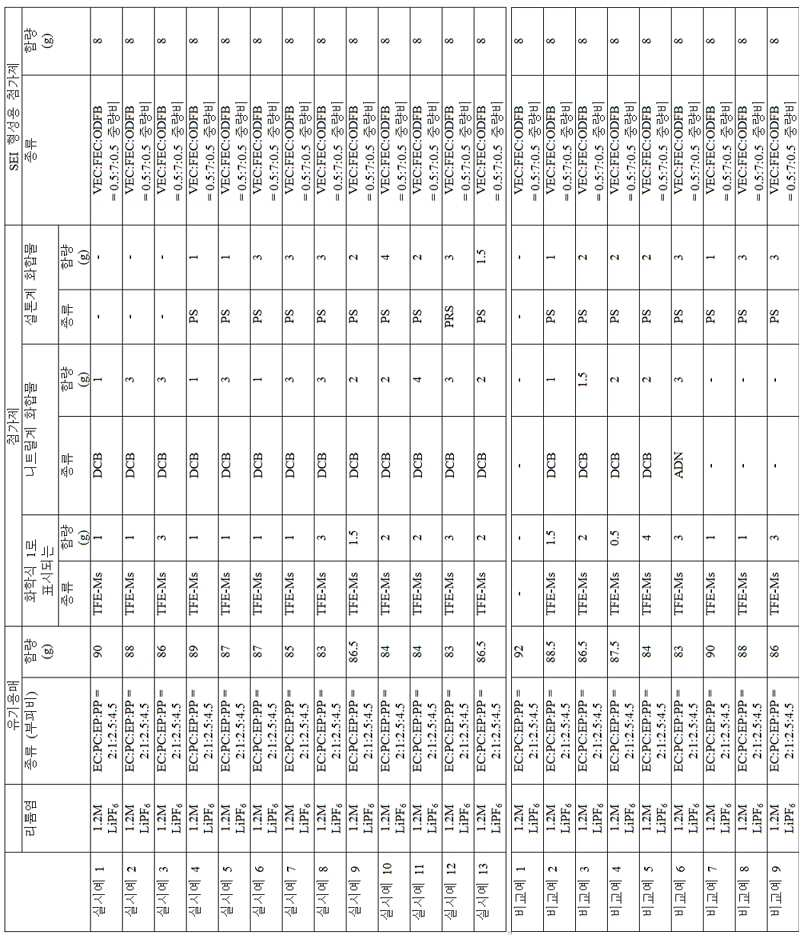
실험예Experimental example
실험예 1. 고온 사이클 특성 평가Experimental Example 1. Evaluation of high-temperature cycle characteristics
실시예 1 내지 13에서 제조된 리튬 이차전지와 비교예 1 내지 9에서 리튬 이차전지에 대하여 고온(45℃)에서 0.2C rate로 정전류/정전압 조건으로 4.45V, 0.05c cut-off까지 충전하고, 0.2C rate로 3.0V까지 방전하는 것을 1 사이클로 하는 초기 충방전 공정을 3 사이클을 실시하였다. 이때, 전지의 충방전을 위해 사용하는 충방전기는 PNE-0506 충방전기(제조사: PNE solution)를 사용하였다 The lithium secondary batteries prepared in Examples 1 to 13 and the lithium secondary batteries in Comparative Examples 1 to 9 were charged to 4.45V and 0.05c cut-off under constant current/constant voltage conditions at 0.2C rate at high temperature (45°C), 3 cycles of the initial charging/discharging process in which discharging to 3.0 V at a 0.2 C rate was performed as 1 cycle. At this time, the charger and discharger used for charging and discharging the battery was a PNE-0506 charger (manufacturer: PNE solution).
이어서, 각각의 리튬 이차전지를 충방전기를 이용하여 고온(45℃)에서 1.0C rate로 4.45V, 0.05c cut-off로 정전류/정전압으로 충전하고, 1.0C rate로 3.0V cut-off로 정전류로 방전하는 것을 1 사이클로 하는 충방전 공정을 100 사이클을 실시한 다음, 용량 유지율(%)을 측정하였다. 이때, 용량 유지율(%)은 하기 [식 1]에 따라 계산하였으며, 측정 결과는 하기 표 2에 기재하였다.Then, each lithium secondary battery is charged at a high temperature (45℃) at a high temperature (45℃) at a constant current/constant voltage at a 1.0C rate and a 0.05c cut-off, and a constant current at a 3.0V cut-off at a 1.0C rate. After carrying out 100 cycles of the charging/discharging process in which discharging to 1 cycle was performed, the capacity retention rate (%) was measured. At this time, the capacity retention rate (%) was calculated according to the following [Equation 1], and the measurement results are shown in Table 2 below.
[식 1][Equation 1]
용량 유지율(%) = (100 사이클 후 방전 용량/1 사이클 후 방전용량)×100Capacity retention rate (%) = (discharge capacity after 100 cycles/1 discharge capacity after cycle)×100
상기 표 2를 살펴보면, 본 발명의 리튬 이차전지용 비수 전해액을 구비한 실시예 1 내지 13의 리튬 이차전지는, 첨가제를 사용하지 않은 비수 전해액을 구비한 비교예 1의 리튬 이차전지, 화학식 1로 표시되는 화합물과 1,4-디시아노-2-부텐의 함량 비율이 본 발명의 범위를 벗어나는 비수전해액을 구비한 비교예 2 내지 비교예 5의 리튬 이차전지, 1,4-디시아노-2-부텐 대신 아디포니트릴을 포함하는 비수전해액을 구비한 비교예 6의 리튬 이차전지 및 1,4-디시아노-2-부텐을 포함하지 않는 비수 전해액을 구비한 비교예 7 내지 9의 리튬 이차전지에 비해 100 사이클 후 방전 용량 및 용량 유지율이 모두 개선된 것을 알 수 있다.Looking at Table 2, the lithium secondary batteries of Examples 1 to 13 having a non-aqueous electrolyte for a lithium secondary battery of the present invention are the lithium secondary batteries of Comparative Example 1 having a non-aqueous electrolyte without using an additive, represented by Formula 1 Lithium secondary batteries of Comparative Examples 2 to 5, 1,4-dicyano-2-butene having a non-aqueous electrolyte in which the content ratio of the compound and 1,4-dicyano-2-butene is outside the scope of the present invention, 1,4-dicyano-2-butene Instead, compared to the lithium secondary battery of Comparative Example 6 having a non-aqueous electrolyte containing adiponitrile and the lithium secondary battery of Comparative Examples 7 to 9 having a non-aqueous electrolyte not containing 1,4-dicyano-2-butene It can be seen that both the discharge capacity and the capacity retention rate are improved after 100 cycles.
실험예 2. 고온 저장 특성 평가Experimental Example 2. Evaluation of high temperature storage characteristics
실시예 1 내지 11에서 제조된 리튬 이차전지와 비교예 1 내지 9에서 리튬 이차전지에 대하여 상온(25℃)에서 0.2C rate로 정전류/정전압 조건으로 4.45V, 0.05c cut-off까지 충전하고, 0.2C rate로 3.0V까지 방전하는 것을 1 사이클로 하는 초기 충방전 공정을 3 사이클을 실시하였다. 이때, 전지의 충방전을 위해 사용하는 충방전기는 PNE-0506 충방전기(제조사: PNE solution)를 사용하였다 Charge the lithium secondary battery prepared in Examples 1 to 11 and the lithium secondary battery in Comparative Examples 1 to 9 at a constant current/constant voltage condition at a rate of 0.2C at room temperature (25°C) to 4.45V and 0.05c cut-off, 3 cycles of the initial charging/discharging process in which discharging to 3.0 V at a 0.2 C rate was performed as 1 cycle. At this time, the charger and discharger used for charging and discharging the battery was a PNE-0506 charger (manufacturer: PNE solution).
이어서, 각각의 리튬 이차전지를 고온(85℃)에서 8시간 저장 후, 0.7C rate로 정전류/정전압 조건으로 4.45V까지 충전하고, 0.2C rate 조건으로 방전하는 것을 1 사이클로 하는 충방전 공정을 3 사이클을 실시한 다음, 용량 유지율(%)을 측정하였다. 용량 유지율(%)은 하기 [식 2]에 따라 계산하였다. 측정 결과는 하기 표 3에 기재하였다.Then, after storing each lithium secondary battery at high temperature (85°C) for 8 hours, charging to 4.45V under constant current/constant voltage conditions at 0.7C rate, and discharging at 0.2C rate conditions as 1 cycle was performed. After performing the cycle, the capacity retention (%) was measured. The capacity retention rate (%) was calculated according to the following [Equation 2]. The measurement results are shown in Table 3 below.
[식 2][Equation 2]
용량 유지율(%): (8시간 고온 저장 후 방전 용량 /고온 저장 전 방전 용량)×100Capacity retention rate (%): (Discharge capacity after 8 hours high temperature storage / Discharge capacity before high temperature storage)×100
상기 표 3을 살펴보면, 본 발명의 리튬 이차전지용 비수 전해액을 구비한 실시예 1 내지 11의 리튬 이차전지는, 첨가제를 사용하지 않은 비수 전해액을 구비한 비교예 1의 리튬 이차전지, 화학식 1로 표시되는 화합물과 1,4-디시아노-2-부텐의 함량 비율이 본 발명의 범위를 벗어나는 비수전해액을 구비한 비교예 2 내지 비교예 5의 리튬 이차전지, 1,4-디시아노-2-부텐 대신 아디포니트릴을 포함하는 비수전해액을 구비한 비교예 6의 리튬 이차전지 및 1,4-디시아노-2-부텐을 포함하지 않는 비수 전해액을 구비한 비교예 7 내지 9의 리튬 이차전지에 비해 8시간 고온 저장 후 방전 용량 및 용량 유지율이 모두 개선된 것을 알 수 있다.Looking at Table 3, the lithium secondary batteries of Examples 1 to 11 provided with the non-aqueous electrolyte for a lithium secondary battery of the present invention are the lithium secondary batteries of Comparative Example 1 provided with a non-aqueous electrolyte without using an additive, represented by Formula 1 Lithium secondary batteries of Comparative Examples 2 to 5, 1,4-dicyano-2-butene having a nonaqueous electrolyte in which the content ratio of the compound and 1,4-dicyano-2-butene is out of the scope of the present invention Instead, compared to the lithium secondary battery of Comparative Example 6 having a non-aqueous electrolyte containing adiponitrile and the lithium secondary battery of Comparative Examples 7 to 9 having a non-aqueous electrolyte not containing 1,4-dicyano-2-butene It can be seen that both the discharge capacity and capacity retention rate were improved after 8 hours of high temperature storage.
Claims (11)
상기 첨가제로 하기 화학식 1로 표시되는 화합물 및 1,4-디시아노-2-부텐 (DCB)을 포함하며,
상기 화학식 1로 표시되는 화합물:1,4-디시아노-2-부텐은 1:1 내지 1:3 중량비로 포함되는 리튬 이차전지용 비수 전해액.
[화학식 1]

상기 화학식 1에 있어서.
R은 불소로 치환 또는 비치환된 탄소수 1 내지 10의 알킬렌기이다.
Including a lithium salt, a non-aqueous organic solvent and an additive,
As the additive, a compound represented by the following Formula 1 and 1,4-dicyano-2-butene (DCB),
The compound represented by Formula 1: 1,4-dicyano-2-butene is a non-aqueous electrolyte for a lithium secondary battery contained in a weight ratio of 1:1 to 1:3.
[Formula 1]
In Formula 1 above.
R is an alkylene group having 1 to 10 carbon atoms unsubstituted or substituted with fluorine.
상기 유기용매는 환형 카보네이트 유기용매 및 선형 에스테르 유기용매를 포함하는 것인 리튬 이차전지용 비수 전해액.
The method according to claim 1,
The organic solvent is a non-aqueous electrolyte for a lithium secondary battery comprising a cyclic carbonate organic solvent and a linear ester organic solvent.
상기 환형 카보네이트 유기용매와 선형 에스테르 유기용매는 2:8 내지 5:5 부피 비율로 포함되는 것인 리튬 이차전지용 비수 전해액.
The method according to claim 2,
The cyclic carbonate organic solvent and the linear ester organic solvent are contained in a volume ratio of 2:8 to 5:5. Non-aqueous electrolyte for a lithium secondary battery.
상기 선형 에스테르 유기용매는 알킬 프로피오네이트인 것인 리튬 이차전지용 비수 전해액.
The method according to claim 2,
The linear ester organic solvent is an alkyl propionate non-aqueous electrolyte for a lithium secondary battery.
상기 화학식 1에 있어서. R은 불소로 치환 또는 비치환된 탄소수 1 내지 6의 알킬렌기인 것인 리튬 이차전지용 비수 전해액.
The method according to claim 1,
In Formula 1 above. R is a non-aqueous electrolyte for a lithium secondary battery that is an alkylene group having 1 to 6 carbon atoms unsubstituted or substituted with fluorine.
상기 화학식 1에 있어서. R은 불소로 치환 또는 비치환된 탄소수 1 내지 3의 알킬렌기인 것인 리튬 이차전지용 비수 전해액.
The method of claim 5,
In Formula 1 above. R is a non-aqueous electrolyte for a lithium secondary battery that is an alkylene group having 1 to 3 carbon atoms substituted or unsubstituted with fluorine.
상기 화학식 1로 표시되는 화합물은 비수 전해액 전체 중량에 대하여 0.1 중량% 내지 3 중량%로 포함되는 것인 리튬 이차전지용 비수 전해액.
The method according to claim 1,
The compound represented by Formula 1 is a non-aqueous electrolyte for a lithium secondary battery contained in an amount of 0.1% to 3% by weight based on the total weight of the non-aqueous electrolyte.
상기 화학식 1 로 표시되는 화합물:1,4-디시아노-2-부텐은 1:1 내지 1:2 중량비로 포함되는 것인 리튬 이차전지용 비수 전해액.
The method according to claim 1,
The compound represented by Chemical Formula 1: 1,4-dicyano-2-butene is a non-aqueous electrolyte for a lithium secondary battery that is contained in a weight ratio of 1:1 to 1:2.
상기 리튬 이차전지용 비수 전해액은 1,3-프로판설톤(PS) 및 1,3-프로펜 설톤(PRS) 중 적어도 하나 이상을 추가로 포함하는 것인 리튬 이차전지용 비수 전해액.
The method according to claim 1,
The non-aqueous electrolyte for a lithium secondary battery further comprises at least one or more of 1,3-propane sultone (PS) and 1,3-propene sultone (PRS).
상기 화학식 1로 표시되는 화합물:1,3-프로판설톤의 혼합비는 1:1 내지 1:3 중량비인 것인 리튬 이차전지용 비수 전해액.
The method of claim 9,
The mixing ratio of the compound represented by Formula 1: 1,3-propane sultone is 1:1 to 1:3 weight ratio.
음극 활물질을 포함하는 음극;
상기 음극 및 양극 사이에 개재되는 세퍼레이터; 및
청구항 1의 리튬 이차전지용 비수 전해액을 포함하는 리튬 이차전지.A positive electrode including a positive electrode active material;
A negative electrode including a negative active material;
A separator interposed between the negative electrode and the positive electrode; And
A lithium secondary battery comprising the non-aqueous electrolyte for a lithium secondary battery of claim 1.
Priority Applications (1)
| Application Number | Priority Date | Filing Date | Title |
|---|---|---|---|
| KR1020190110894A KR102821227B1 (en) | 2019-09-06 | 2019-09-06 | Non-aqueous electrolyte solution for lithium secondary battery and lithium secondary battery comprising the same |
Applications Claiming Priority (1)
| Application Number | Priority Date | Filing Date | Title |
|---|---|---|---|
| KR1020190110894A KR102821227B1 (en) | 2019-09-06 | 2019-09-06 | Non-aqueous electrolyte solution for lithium secondary battery and lithium secondary battery comprising the same |
Publications (2)
| Publication Number | Publication Date |
|---|---|
| KR20210029533A true KR20210029533A (en) | 2021-03-16 |
| KR102821227B1 KR102821227B1 (en) | 2025-06-17 |
Family
ID=75223910
Family Applications (1)
| Application Number | Title | Priority Date | Filing Date |
|---|---|---|---|
| KR1020190110894A Active KR102821227B1 (en) | 2019-09-06 | 2019-09-06 | Non-aqueous electrolyte solution for lithium secondary battery and lithium secondary battery comprising the same |
Country Status (1)
| Country | Link |
|---|---|
| KR (1) | KR102821227B1 (en) |
Cited By (8)
| Publication number | Priority date | Publication date | Assignee | Title |
|---|---|---|---|---|
| CN114256508A (en) * | 2022-01-14 | 2022-03-29 | 南方科技大学 | Non-aqueous electrolyte and secondary battery |
| CN114927761A (en) * | 2022-05-30 | 2022-08-19 | 珠海市赛纬电子材料股份有限公司 | Non-aqueous electrolyte of sodium ion battery and sodium ion battery |
| WO2022260373A1 (en) * | 2021-06-07 | 2022-12-15 | 주식회사 엘지에너지솔루션 | Non-aqueous electrolyte solution for lithium secondary battery, and lithium secondary battery comprising same |
| WO2023063648A1 (en) * | 2021-10-12 | 2023-04-20 | 주식회사 엘지에너지솔루션 | Non-aqueous electrolyte for lithium secondary battery and lithium secondary battery comprising same |
| CN116799304A (en) * | 2023-06-29 | 2023-09-22 | 珠海冠宇电池股份有限公司 | An electrolyte solution including composite additives and a battery including the electrolyte solution |
| WO2024096678A1 (en) * | 2022-11-04 | 2024-05-10 | 주식회사 엘지에너지솔루션 | Lithium secondary battery |
| WO2024136572A1 (en) * | 2022-12-22 | 2024-06-27 | 주식회사 엘지에너지솔루션 | Non-aqueous electrolyte and lithium secondary battery comprising same |
| WO2025208257A1 (en) * | 2024-03-31 | 2025-10-09 | 宁德新能源科技有限公司 | Secondary battery and electronic device |
Citations (3)
| Publication number | Priority date | Publication date | Assignee | Title |
|---|---|---|---|---|
| JP2012084384A (en) * | 2010-10-12 | 2012-04-26 | Mitsubishi Chemicals Corp | Nonaqueous electrolyte and nonaqueous electrolyte secondary battery using the same |
| KR20130092597A (en) | 2010-10-19 | 2013-08-20 | 다이킨 고교 가부시키가이샤 | Non-aqueous electrolyte solution |
| CN108963340A (en) * | 2018-07-13 | 2018-12-07 | 东莞市杉杉电池材料有限公司 | A kind of high pressure resistant lithium ion battery and its electrolyte |
-
2019
- 2019-09-06 KR KR1020190110894A patent/KR102821227B1/en active Active
Patent Citations (3)
| Publication number | Priority date | Publication date | Assignee | Title |
|---|---|---|---|---|
| JP2012084384A (en) * | 2010-10-12 | 2012-04-26 | Mitsubishi Chemicals Corp | Nonaqueous electrolyte and nonaqueous electrolyte secondary battery using the same |
| KR20130092597A (en) | 2010-10-19 | 2013-08-20 | 다이킨 고교 가부시키가이샤 | Non-aqueous electrolyte solution |
| CN108963340A (en) * | 2018-07-13 | 2018-12-07 | 东莞市杉杉电池材料有限公司 | A kind of high pressure resistant lithium ion battery and its electrolyte |
Cited By (8)
| Publication number | Priority date | Publication date | Assignee | Title |
|---|---|---|---|---|
| WO2022260373A1 (en) * | 2021-06-07 | 2022-12-15 | 주식회사 엘지에너지솔루션 | Non-aqueous electrolyte solution for lithium secondary battery, and lithium secondary battery comprising same |
| WO2023063648A1 (en) * | 2021-10-12 | 2023-04-20 | 주식회사 엘지에너지솔루션 | Non-aqueous electrolyte for lithium secondary battery and lithium secondary battery comprising same |
| CN114256508A (en) * | 2022-01-14 | 2022-03-29 | 南方科技大学 | Non-aqueous electrolyte and secondary battery |
| CN114927761A (en) * | 2022-05-30 | 2022-08-19 | 珠海市赛纬电子材料股份有限公司 | Non-aqueous electrolyte of sodium ion battery and sodium ion battery |
| WO2024096678A1 (en) * | 2022-11-04 | 2024-05-10 | 주식회사 엘지에너지솔루션 | Lithium secondary battery |
| WO2024136572A1 (en) * | 2022-12-22 | 2024-06-27 | 주식회사 엘지에너지솔루션 | Non-aqueous electrolyte and lithium secondary battery comprising same |
| CN116799304A (en) * | 2023-06-29 | 2023-09-22 | 珠海冠宇电池股份有限公司 | An electrolyte solution including composite additives and a battery including the electrolyte solution |
| WO2025208257A1 (en) * | 2024-03-31 | 2025-10-09 | 宁德新能源科技有限公司 | Secondary battery and electronic device |
Also Published As
| Publication number | Publication date |
|---|---|
| KR102821227B1 (en) | 2025-06-17 |
Similar Documents
| Publication | Publication Date | Title |
|---|---|---|
| KR102167592B1 (en) | Non-aqueous electrolyte for secondary battery and secondary battery comprising the same | |
| KR102643744B1 (en) | Nonaqueous electrolyte for lithium secondary battery and lithium secondary battery comprising the same | |
| KR102242252B1 (en) | Electrolyte for lithium secondary battery, and lithium secondary battery comprising the same | |
| KR102434070B1 (en) | Non-aqueous electrolyte for lithium secondary battery and lithium secondary battery comprising the same | |
| KR102784736B1 (en) | Non-aqueous electrolyte solution and lithium secondary battery comprising the same | |
| KR102345312B1 (en) | Non-aqueous electrolyte solution and lithium secondary battery comprising the same | |
| KR102821227B1 (en) | Non-aqueous electrolyte solution for lithium secondary battery and lithium secondary battery comprising the same | |
| KR102294866B1 (en) | Non-aqueous electrolyte solution and lithium secondary battery comprising the same | |
| KR102811666B1 (en) | Non-aqueous electrolyte for lithium secondary battery and lithium secondary battery comprising the same | |
| KR102811667B1 (en) | Non-aqueous electrolyte and lithium secondary battery comprising the same | |
| KR20210055604A (en) | Non-aqueous electrolyte solution for lithium secondary battery and lithium secondary battery comprising the same | |
| KR20210007345A (en) | Non-aqueous electrolyte solution for lithium secondary battery and lithium secondary battery comprising the same | |
| KR102829174B1 (en) | Lithium secondary battery having improved cycle property | |
| KR20210011342A (en) | Lithium secondary battery | |
| KR102736128B1 (en) | Non-aqueous electrolyte for lithium secondary battery and lithium secondary battery comprising the same | |
| KR20190139446A (en) | Electrolyte for lithium secondary battery and lithium secondary battery comprising the same | |
| KR102814035B1 (en) | Electrolyte additives for electrolyte, non-aqueous electrolyte and secondary battery comprising same | |
| KR102494419B1 (en) | Nonaqueous electrolyte additive for lithium secondary battery, nonaqueous electrolyte for lithium secondary battery comprising the same, and lithium secondary battery | |
| KR20200112732A (en) | Non-aqueous electrolyte solution and lithium secondary battery comprising the same | |
| EP4318713A1 (en) | Non-aqueous electrolyte comprising additive for non-aqueous electrolyte, and lithium secondary battery comprising same | |
| KR20220076413A (en) | Non-aqueous electrolyte solution and lithium secondary battery comprising the same | |
| KR102697789B1 (en) | Non-aqueous electrolyte solution and lithium secondary battery comprising the same | |
| KR102828356B1 (en) | Non-aqueous electrolyte for lithium secondary battery and lithium secondary battery comprising the same | |
| KR102721825B1 (en) | Electrolyte for lithium secondary battery and lithium secondary battery comprising the same | |
| EP4369459B1 (en) | Non-aqueous electrolyte including additives for non-aqueous electrolyte, and lithium secondary battery including the same |
Legal Events
| Date | Code | Title | Description |
|---|---|---|---|
| PA0109 | Patent application |
Patent event code: PA01091R01D Comment text: Patent Application Patent event date: 20190906 |
|
| PG1501 | Laying open of application | ||
| N231 | Notification of change of applicant | ||
| PN2301 | Change of applicant |
Patent event date: 20210601 Comment text: Notification of Change of Applicant Patent event code: PN23011R01D |
|
| E902 | Notification of reason for refusal | ||
| PE0902 | Notice of grounds for rejection |
Comment text: Notification of reason for refusal Patent event date: 20241002 Patent event code: PE09021S01D |
|
| E701 | Decision to grant or registration of patent right | ||
| PE0701 | Decision of registration |
Patent event code: PE07011S01D Comment text: Decision to Grant Registration Patent event date: 20250604 |
|
| GRNT | Written decision to grant | ||
| PR0701 | Registration of establishment |
Comment text: Registration of Establishment Patent event date: 20250611 Patent event code: PR07011E01D |
|
| PR1002 | Payment of registration fee |
Payment date: 20250612 End annual number: 3 Start annual number: 1 |
|
| PG1601 | Publication of registration |