CN114256508A - Non-aqueous electrolyte and secondary battery - Google Patents
Non-aqueous electrolyte and secondary battery Download PDFInfo
- Publication number
- CN114256508A CN114256508A CN202210044262.2A CN202210044262A CN114256508A CN 114256508 A CN114256508 A CN 114256508A CN 202210044262 A CN202210044262 A CN 202210044262A CN 114256508 A CN114256508 A CN 114256508A
- Authority
- CN
- China
- Prior art keywords
- aqueous electrolyte
- structural formula
- terminal
- carbonate
- solvent
- Prior art date
- Legal status (The legal status is an assumption and is not a legal conclusion. Google has not performed a legal analysis and makes no representation as to the accuracy of the status listed.)
- Granted
Links
Images


Classifications
-
- H—ELECTRICITY
- H01—ELECTRIC ELEMENTS
- H01M—PROCESSES OR MEANS, e.g. BATTERIES, FOR THE DIRECT CONVERSION OF CHEMICAL ENERGY INTO ELECTRICAL ENERGY
- H01M10/00—Secondary cells; Manufacture thereof
- H01M10/05—Accumulators with non-aqueous electrolyte
- H01M10/056—Accumulators with non-aqueous electrolyte characterised by the materials used as electrolytes, e.g. mixed inorganic/organic electrolytes
- H01M10/0564—Accumulators with non-aqueous electrolyte characterised by the materials used as electrolytes, e.g. mixed inorganic/organic electrolytes the electrolyte being constituted of organic materials only
- H01M10/0566—Liquid materials
- H01M10/0567—Liquid materials characterised by the additives
-
- H—ELECTRICITY
- H01—ELECTRIC ELEMENTS
- H01M—PROCESSES OR MEANS, e.g. BATTERIES, FOR THE DIRECT CONVERSION OF CHEMICAL ENERGY INTO ELECTRICAL ENERGY
- H01M10/00—Secondary cells; Manufacture thereof
- H01M10/05—Accumulators with non-aqueous electrolyte
- H01M10/052—Li-accumulators
-
- H—ELECTRICITY
- H01—ELECTRIC ELEMENTS
- H01M—PROCESSES OR MEANS, e.g. BATTERIES, FOR THE DIRECT CONVERSION OF CHEMICAL ENERGY INTO ELECTRICAL ENERGY
- H01M10/00—Secondary cells; Manufacture thereof
- H01M10/05—Accumulators with non-aqueous electrolyte
- H01M10/052—Li-accumulators
- H01M10/0525—Rocking-chair batteries, i.e. batteries with lithium insertion or intercalation in both electrodes; Lithium-ion batteries
-
- H—ELECTRICITY
- H01—ELECTRIC ELEMENTS
- H01M—PROCESSES OR MEANS, e.g. BATTERIES, FOR THE DIRECT CONVERSION OF CHEMICAL ENERGY INTO ELECTRICAL ENERGY
- H01M10/00—Secondary cells; Manufacture thereof
- H01M10/05—Accumulators with non-aqueous electrolyte
- H01M10/056—Accumulators with non-aqueous electrolyte characterised by the materials used as electrolytes, e.g. mixed inorganic/organic electrolytes
- H01M10/0564—Accumulators with non-aqueous electrolyte characterised by the materials used as electrolytes, e.g. mixed inorganic/organic electrolytes the electrolyte being constituted of organic materials only
- H01M10/0566—Liquid materials
- H01M10/0569—Liquid materials characterised by the solvents
-
- H—ELECTRICITY
- H01—ELECTRIC ELEMENTS
- H01M—PROCESSES OR MEANS, e.g. BATTERIES, FOR THE DIRECT CONVERSION OF CHEMICAL ENERGY INTO ELECTRICAL ENERGY
- H01M10/00—Secondary cells; Manufacture thereof
- H01M10/42—Methods or arrangements for servicing or maintenance of secondary cells or secondary half-cells
- H01M10/4235—Safety or regulating additives or arrangements in electrodes, separators or electrolyte
-
- H—ELECTRICITY
- H01—ELECTRIC ELEMENTS
- H01M—PROCESSES OR MEANS, e.g. BATTERIES, FOR THE DIRECT CONVERSION OF CHEMICAL ENERGY INTO ELECTRICAL ENERGY
- H01M2300/00—Electrolytes
- H01M2300/0017—Non-aqueous electrolytes
- H01M2300/0025—Organic electrolyte
-
- Y—GENERAL TAGGING OF NEW TECHNOLOGICAL DEVELOPMENTS; GENERAL TAGGING OF CROSS-SECTIONAL TECHNOLOGIES SPANNING OVER SEVERAL SECTIONS OF THE IPC; TECHNICAL SUBJECTS COVERED BY FORMER USPC CROSS-REFERENCE ART COLLECTIONS [XRACs] AND DIGESTS
- Y02—TECHNOLOGIES OR APPLICATIONS FOR MITIGATION OR ADAPTATION AGAINST CLIMATE CHANGE
- Y02E—REDUCTION OF GREENHOUSE GAS [GHG] EMISSIONS, RELATED TO ENERGY GENERATION, TRANSMISSION OR DISTRIBUTION
- Y02E60/00—Enabling technologies; Technologies with a potential or indirect contribution to GHG emissions mitigation
- Y02E60/10—Energy storage using batteries
Landscapes
- Chemical & Material Sciences (AREA)
- Engineering & Computer Science (AREA)
- Manufacturing & Machinery (AREA)
- Chemical Kinetics & Catalysis (AREA)
- Electrochemistry (AREA)
- General Chemical & Material Sciences (AREA)
- Physics & Mathematics (AREA)
- Condensed Matter Physics & Semiconductors (AREA)
- General Physics & Mathematics (AREA)
- Inorganic Chemistry (AREA)
- Materials Engineering (AREA)
- Secondary Cells (AREA)
Abstract
本发明涉及电化学技术领域,具体涉及一种非水电解液以及二次电池。本发明所述的非水电解液包括非水有机溶剂、锂盐以及添加剂,所述添加剂包括结构式1至结构式3所示的端单氟取代化合物中的至少一种:


The invention relates to the technical field of electrochemistry, in particular to a non-aqueous electrolyte and a secondary battery. The non-aqueous electrolyte solution of the present invention includes a non-aqueous organic solvent, a lithium salt and an additive, and the additive includes at least one of the terminal monofluoro-substituted compounds shown in structural formula 1 to structural formula 3:
Description
Technical Field
The invention relates to the technical field of electrochemistry, in particular to a non-aqueous electrolyte and a secondary battery.
Background
The electrolyte is known as 'blood' in the lithium ion battery, and plays an important role in the capacity exertion of electrode materials in the lithium ion battery, the cycling stability of the battery, the safety of the battery and the like.
In the conventional lithium ion battery, because the theoretical specific capacity (372mAh/g) of the graphite negative electrode is low, a lithium metal material (3860mAh/g, -3.04Vvs. SHE) with higher specific capacity and lower potential is searched as a negative electrode material. Carbonate electrolyte solvents represented by Ethylene Carbonate (EC), Ethyl Methyl Carbonate (EMC), dimethyl carbonate (DMC), diethyl carbonate (DEC), and the like are not suitable for lithium metal batteries, mainly because lithium metal has a low potential and strong reducibility, and can react with most ester electrolytes, thereby easily causing growth of lithium dendrites and formation of dead lithium during charging and discharging, and finally causing rapid battery degradation and being difficult to meet requirements. In addition, since lithium polysulfide can also chemically react with an ester electrolyte, conventional ester electrolytes are also difficult to use in lithium sulfur batteries.
On the other hand, ether electrolytes represented by ethylene glycol dimethyl ether (DME) and 1, 3-cyclopentane (DOL) react slowly with lithium metal, and exhibit good stability to lithium metal, and thus have been used in the research of lithium metal batteries by many researchers. In addition, lithium polysulfide has good solubility in ether electrolyte and does not react with a solvent, so the ether electrolyte is commonly used for lithium-sulfur batteries, and the classical formula is that 1M lithium bistrifluoromethylsulfonyl imide (LiTFSI) is dissolved in DME/DOL (1: 1v/v), and 1-2% LiNO3 is added as an additive. Although the ether electrolyte system has good stability to lithium metal and can relieve the growth of lithium dendrites, the oxidative decomposition potential is low, and the requirement of high-voltage cathode materials (such as ternary cathode materials NCM, spinel lithium nickel manganese oxide and other cathode materials) is difficult to meet. Meanwhile, the ether electrolyte is as flammable as the ester electrolyte, and brings a series of potential safety hazards to the lithium ion battery pack.
On the other hand, although the electrochemical performance of the battery can be improved to a small extent by adding the sulfone compound into the electrolyte, the existing sulfone compound additive, such as the sulfonamide compound or the sulfonate compound, does not have a good effect of improving the oxidation resistance of the electrolyte.
Disclosure of Invention
In order to solve the above technical problems, the present invention provides a non-aqueous electrolyte and a secondary battery, wherein a monofluoro-terminated ether, hydrocarbon and sulfonate compound is added to the non-aqueous electrolyte, and the monofluoro-terminated ether, hydrocarbon and sulfonate compound has high oxidation potential and low flammability, so that the non-aqueous electrolyte has good solubility to a lithium salt as an electrolyte, and can form a stable electrolyte system with the lithium salt, so as to optimize and improve the cycle performance of a lithium ion battery to the maximum extent.
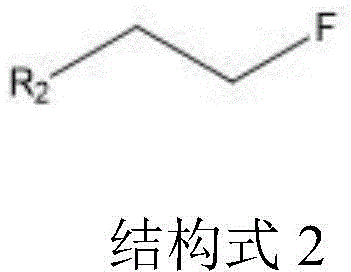
In order to achieve the above object, a first aspect of the present invention provides a nonaqueous electrolytic solution comprising a nonaqueous organic solvent, a lithium salt, and an additive, the additive comprising at least one of terminal monofluoro substituted compounds represented by structural formulae 1 to 3:

wherein R is1Selected from C1-C5 alkyl, C1-C5 fluoroalkyl, C1-C5 fluoroalkoxy or C1-C5 fluoroalkenyl;

wherein R is2Selected from C1-C6 alkyl, C1-C6 fluoroalkyl or C1-C6 fluoroalkenyl;

wherein R is3Is selected from C1-C6 alkyl, C1-C6 fluoroalkyl, C1-C6 fluoroalkoxy or C1-C6 fluoroalkenyl.
According to the invention, the terminal monofluoro substituted ether, hydrocarbon and sulfonate compound are added into the non-aqueous electrolyte, so that the direct contact between solvent molecules with higher reactivity and the positive/negative electrode interface can be effectively reduced, and the side reaction in the secondary battery, which is unfavorable for electrochemical cycle, can be reduced; meanwhile, because the compounds of terminal monofluoro substituted ethers, hydrocarbons and sulfonic acid esters have high oxidation potential and low flammability, the compound has good solubility to lithium salt serving as an electrolyte, can form a stable electrolyte system with the lithium salt, can also be decomposed on the surface of an electrode with other components in a non-aqueous electrolyte to participate in passive film formation on the surface of the electrode, and forms an SEI/CEI film rich in metal fluoride on the surface of the electrode, thereby effectively inhibiting the growth of lithium dendrites and the shuttle effect of polysulfide, improving the oxidation resistance potential of the non-aqueous electrolyte and further improving the cycle performance of a secondary battery.
For the monofluoro-terminated substituted compounds of formula 1 to formula 3, R1、R2Or R3The fluoro group of the radical may be perfluorinated or partially fluorinated, while R1、R2Or R3The degree of fluorine substitution of the group and the carbon chain length are related to the polarity thereof, and specifically, the higher the degree of fluorine substitution of the fluoro group, the longer the carbon chain length thereof and the lower the polarity thereof, the poorer the solubility to lithium salts, and R1、R2Or R3The longer the carbon chain of the group is, the better the oxidation resistance and flame retardancy of the nonaqueous electrolyte solution is, but the longer the carbon chain of the group is, the longer R is1、R2Or R3The overlong carbon chain length of the group can cause the polarity of solvent molecules to be reduced, the dissolving capacity of the solvent to lithium salt is reduced, the improvement of the conductivity of the non-aqueous electrolyte is not facilitated, and R1、R2Or R3The carbon chain length of the group is relatively short, which can increase the polar functional group-CH in the terminal monofluoro substituted compound2The proportion of F in the whole molecule is favorable for dissociation of lithium ions, thereby providing higher ion conductivity.
In addition, in R1Selected from the group consisting of alkyl, fluoroalkyl, fluoroalkoxy, and fluoroalkenyl, said alkyl may be a straight or branched alkyl, said alkoxy may be a straight or branched alkoxy, and said alkenyl may be a straight or branched alkenyl; at R2Selected from the group consisting of alkyl, fluoroalkyl and fluoroalkenyl, said alkyl group may be a linear or branched alkyl group, and said alkenyl group may be a linear or branched alkenyl group; at R3Selected from the group consisting of alkyl, fluoroalkyl, fluoroalkoxy, and fluoroalkenyl, the alkyl group may be a straight or branched alkyl group, the alkoxy group may be a straight or branched alkoxy group, and the alkenyl group may be a straight or branched alkenyl group.
Further, the terminal monofluoro substituted compound shown in the structural formula 1 is selected from one or more of the following compounds:

the terminal monofluoro substituted compound shown in the structural formula 2 is selected from one or more of the following compounds:

the terminal monofluoro substituted compound shown in the structural formula 3 is selected from one or more of the following compounds:

the terminal monofluoro substituted compound of the invention comprises-CH2The terminal monofluoro substituent group with F as the main part can dissociate lithium salt due to the unique monofluoroalkyl chain in the group, and shows good solubility to the lithium salt, thereby providing higher ionic conductivity.
In addition, the inventor also finds that the substitution of fluorine by the terminal monofluorine substituted compound can effectively improve the oxidation resistance potential of solvent molecules while providing good ionic conductivity, so that the obtained nonaqueous electrolytic solution can show stability to a high-voltage positive electrode and is beneficial to stable circulation of a high-voltage battery. Moreover, on the negative electrode side, groups (including ether, alkane and sulfonate) of selected compounds all show good chemical stability to lithium metal, have fewer side reactions and are beneficial to highly reversible deposition of the lithium metal.
And the substituted monofluorine functional group can be reduced and decomposed preferentially at the lithium metal negative electrode to generate a fluoride-rich Solid Electrolyte Interface (SEI) film, which is favorable for preventing the further reaction of the electrolyte and the lithium metal, so that the deposition and the stripping of the lithium metal are favorable, and the coulomb efficiency of the lithium metal is improved. Because the solvent containing the terminal monofluoro substituted compound has weaker relay capacity on lithium salt than a strong interaction solvent, lithium ions in a formed solvation structure are easier to remove from the surface of the electrode, so that the intercalation reaction of solvent molecules among graphite sheet layers can be inhibited, and the stability of the electrolyte on a graphite negative electrode is improved. Based on the principle, the nonaqueous electrolytic solution generates a thin and stable fluoride SEI/CEI protective layer on the surface of the positive/negative electrode, so that the negative electrodes such as lithium metal, graphite, silicon oxygen and the like and the high-voltage positive electrode can be stably cycled.
Further, the mass percent of the terminal monofluoro substituted compound is 10-100% based on the total mass of the non-aqueous electrolyte as 100%; further preferably 80%.
Because the terminal monofluoro substituted compound has higher oxidation resistance potential and flame retardance, the flammability of the nonaqueous electrolyte can be reduced and the safety of the nonaqueous electrolyte can be improved by adding a proper amount of the terminal monofluoro substituted compound into the nonaqueous electrolyte.
Further, the volume ratio of the solvent to the terminal monofluoro substituted compound is 0: 100-90: 10; more preferably 20: 80.
further, the solvent includes one or more of an ether solvent, a nitrile solvent, a carbonate solvent, and a carboxylate solvent.
Preferably, the ether solvent is at least one selected from the group consisting of ethylene glycol dimethyl ether, methyl nonafluoro n-butyl ether, 1,2, 2-tetrafluoroethyl-2, 2,3, 3-tetrafluoropropyl ether, and ethylene glycol dipropionitrile ether.
Preferably, the nitrile solvent is at least one selected from succinonitrile, glutaronitrile, hexanetricarbonitrile, adiponitrile, pimelonitrile, suberonitrile, and nonadinitrile.
Preferably, the carbonate-based solvent is at least one selected from the group consisting of ethylene carbonate, propylene carbonate, dimethyl carbonate, diethyl carbonate, and ethyl methyl carbonate.
Preferably, the carboxylic ester solvent is at least one selected from ethyl acetate, propyl acetate and propionic acetic acid.
Further, the lithium salt is selected from LiTFSI and LiPF6、LiBOB、LiDFOB、LiPO2F2、LiBF4、LiSbF6、LiAsF6、LiN(SO2F)2And LiBETI.
Further, the nonaqueous electrolytic solution further comprises an additive selected from at least one of biphenyl, fluorobenzene, vinylene carbonate, ethylene trifluoromethyl carbonate, ethylene carbonate, 1, 3-propane sultone, 1, 4-butane sultone, vinyl sulfate, vinyl sulfite, methylene methanedisulfonate, succinonitrile, adiponitrile, 1, 2-bis (2-cyanoethoxy) ethane and 1,3, 6-hexanetrinitrile.
In a second aspect, the present invention further provides a secondary battery, comprising a positive electrode sheet, a negative electrode sheet, a separator and the nonaqueous electrolyte solution described in any one of the above paragraphs; the positive plate comprises a positive current collector and a positive diaphragm coated on the positive current collector, and the negative plate comprises a negative current collector and a negative diaphragm coated on the negative current collector.
Compared with the prior art, the invention has the following advantages:
(1) according to the invention, the terminal monofluoro substituted compound shown in the structural formula 1, the structural formula 2 or the structural formula 3 is added into the non-aqueous electrolyte as an additive, so that the direct contact between solvent molecules with higher reactivity and a positive/negative electrode interface can be effectively reduced, the adverse side reaction to electrochemical cycle in a secondary battery is reduced, and meanwhile, when the non-aqueous electrolyte containing the terminal monofluoro substituted compound shown in the structural formula 1, the structural formula 2 or the structural formula 3 is applied to a lithium ion battery, the growth of lithium dendrite can be effectively inhibited, so that the cycle stability of the lithium ion battery is improved;
(2) the terminal monofluoro substituted compound containing the structural formula 1, the structural formula 2 or the structural formula 3 has higher oxidation resistance potential and flame retardance, and can effectively reduce the flammability of the non-aqueous electrolyte and improve the safety of the lithium ion battery;
(3) when the non-aqueous electrolyte containing the terminal monofluoro substituted compound shown in the structural formula 1, the structural formula 2 or the structural formula 3 is applied to a lithium-sulfur battery, the solubility of lithium polysulfide in the non-aqueous electrolyte can be reduced, the shuttle effect of the lithium polysulfide is slowed down, the oxidation resistance potential of the non-aqueous electrolyte is improved, and therefore the cycle performance of the secondary battery is improved.
Drawings
FIG. 1 is a graph showing the cycle characteristics of an NCM811 battery prepared in example 1 of the present invention;
FIG. 2 is a graph showing the cycle characteristics of the NCM811 battery obtained in comparative example 3 of the present invention;
fig. 3 is a graph of the average coulombic efficiency of the lithium sulfur batteries in examples 26-28 of the present invention.
Detailed Description
The technical solutions in the embodiments of the present invention will be described clearly and completely with reference to the embodiments of the present invention, and it is obvious that the described embodiments are only a part of the embodiments of the present invention, and not all of the embodiments. All other embodiments, which can be derived by a person skilled in the art from the embodiments given herein without making any creative effort, shall fall within the protection scope of the present invention. The present invention will be described in detail below by way of examples.
TABLE 1

Note: the compounds 1 to 18 used in the following examples and comparative examples are selected from Table 1.
Example 1
Firstly, preparation of non-aqueous electrolyte
Ethylene Carbonate (EC), diethyl carbonate (DEC) and Ethyl Methyl Carbonate (EMC) were mixed in a mass ratio of EC: DEC: EMC ═ 1:1:1, and then lithium hexafluorophosphate (LiPF) was added6) Adding the compound 1 in the mass percentage shown in the example 1 in the table 2 into the nonaqueous electrolytic solution until the molar concentration is 2mol/L and the total weight of the nonaqueous electrolytic solution is 100%, stirring and fully dissolving to obtain the composite material.
Assembling of battery and testing of battery performance
NCM811 is used as a positive electrode, a lithium sheet is used as a negative electrode, commercial polypropylene is used as a diaphragm, and the NCM811 and the lithium sheet are assembled in a CR2032 type button battery case together with the non-aqueous electrolyte prepared by 40 uL; standing for 3 hours at a constant temperature of 24 ℃, circulating for 300 circles under the condition of a current density of 1C, wherein the charging and discharging voltage range is 2.4-4.4V, calculating the battery capacity retention ratio under the condition, and circulating for 270 circles under the condition of a current density of 2C, and calculating the battery capacity retention ratio under the condition.
The capacity retention of the cycle was calculated as follows:
battery capacity retention (%) — last discharge capacity/1 st discharge capacity × 100%.
Examples 2 to 25
Examples 2-25 include most of the processing steps of example 1, with the following differences:
during the preparation of the nonaqueous electrolytic solution, the components shown in examples 2 to 25 in Table 2 were added in mass%. The test results obtained are filled in table 2.
Comparative examples 1 to 4
Comparative examples 1-4 include most of the operating steps of example 1, with the following differences:
during the preparation of the nonaqueous electrolytic solution, the components shown in comparative examples 1 to 4 in Table 2 were added in mass%. The test results obtained are filled in table 2.
TABLE 2

As can be seen from the data in fig. 1-2, examples 1-25, and comparative examples 1-4, when the terminal monofluoro substituted compound represented by structural formula 1, structural formula 2, or structural formula 3 is added to the nonaqueous electrolytic solution, the normal temperature cycle stability of the lithium ion battery can be significantly improved, and particularly when the mass percentage of the terminal monofluoro substituted compound represented by structural formula 1, structural formula 2, or structural formula 3 is 10% to 100%, the capacity retention rate of the lithium ion battery prepared from the terminal monofluoro substituted compound can reach 80% or more at 1C cycle for 300 weeks under normal temperature conditions, the capacity retention rate of the lithium ion battery at 2C cycle for 270 weeks can reach 85% or more, and the volume ratio of the solvent to the terminal monofluoro substituted compound is 20: at 80 hours, the capacity retention rate of the prepared lithium ion battery at 1C cycle for 300 weeks is up to 91%, and the capacity retention rate at 2C cycle for 270 weeks is up to 93%;
comparative example 1 is that 5% of terminal monofluoro substituted compound containing structural formula 1, structural formula 2 or structural formula 3 is added into non-aqueous electrolyte, the capacity retention rate of the lithium ion battery prepared by the compound under the normal temperature condition is 73% in 1C circulation for 300 weeks, and the capacity retention rate is 75% in 2C circulation for 270 weeks, therefore, the added amount of the terminal monofluoro substituted compound has certain influence on the cycle stability of the lithium ion battery, the cycle stability of the lithium ion battery can be improved most effectively only by adding a proper amount of terminal monofluoro substituted compound, such as 10% -100% of terminal monofluoro substituted compound described in the application, comparative example 2 is that a certain amount of the additive is added into non-aqueous electrolyte containing a small amount of the terminal monofluoro substituted compound, the cycle performance of the lithium ion battery is not improved greatly, therefore, only by adding a proper amount of the additive containing structural formula 1, When the non-aqueous electrolyte of the terminal monofluoro substituted compound shown in the structural formula 2 or the structural formula 3 is applied to a lithium ion battery, the growth of lithium dendrite can be effectively inhibited, so that the cycle stability of the lithium ion battery is improved;
comparative example 3 and comparative example 4 are respectively to add the terminal monofluoro substituted compound containing structural formula 1, structural formula 2 or structural formula 3 to the nonaqueous electrolytic solution, and it can be seen from the data of comparative example 3 and comparative example 4 that the lithium ion batteries prepared therefrom are poor in cycle stability.
Example 26
Example 26 includes most of the processing steps of example 1, with the following differences:
in the assembly process of the battery, a sulfur simple substance is taken as a positive electrode, a layered structure is formed on the surface of a current collector, a lithium sheet is taken as a negative electrode, commercial polypropylene is taken as a diaphragm, and the lithium sheet and the non-aqueous electrolyte prepared by 40uL are assembled in a CR2032 type button battery case; the current density is 0.5mA/cm2Surface capacity of 1mAh/cm2The average coulombic efficiency of the sample is 99.4 percent after 200 cycles of the reaction.
Example 27
Example 27 includes most of the processing steps of example 1, with the following differences:
in the preparation process of the nonaqueous electrolytic solution, compound 9 in the mass percentage shown in example 13 in table 2 is added; in the assembly process of the battery, a sulfur simple substance is taken as a positive electrode, a layered structure is formed on the surface of a current collector, a lithium sheet is taken as a negative electrode, commercial polypropylene is taken as a diaphragm, and the lithium sheet and the non-aqueous electrolyte prepared by 40uL are assembled in a CR2032 type button battery case; the current density is 0.5mA/cm2Surface capacity of 1mAh/cm2The average coulombic efficiency of the sample is 99.6 percent after 200 cycles of the reaction.
Example 28
Example 28 includes most of the processing steps of example 1, with the following differences:
during the preparation of the nonaqueous electrolyte, compound 16 in the mass percentage shown in example 20 in table 2 was added; in the assembly process of the battery, a sulfur simple substance is taken as a positive electrode, a layered structure is formed on the surface of a current collector, a lithium sheet is taken as a negative electrode, commercial polypropylene is taken as a diaphragm, and the lithium sheet and the non-aqueous electrolyte prepared by 40uL are assembled in a CR2032 type button battery case; the current density is 0.5mA/cm2Surface capacity of 1mAh/cm2The average coulombic efficiency of the sample is 99.5 percent after 200 cycles of the reaction.
As can be seen from the data in FIG. 3 and examples 26 to 28, the current density of the nonaqueous electrolytic solution containing the terminal monofluoro substituted compound represented by the structural formula 1, the structural formula 2 or the structural formula 3 was 0.5mA/cm when it was prepared into different lithium-sulfur batteries2Surface capacity of 1mAh/cm2The average coulombic efficiency of 200 cycles of the lithium-sulfur battery is higher than 99.5%, and therefore, when the terminal monofluoro substituted compound containing the structural formula 1, the structural formula 2 or the structural formula 3 is applied to the preparation of the lithium-sulfur battery, the prepared lithium-sulfur battery has high coulombic efficiency, can reduce the solubility of lithium polysulfide in a non-aqueous electrolyte, and slow down the shuttle effect of the lithium polysulfide, and is used for improving the oxidation resistance potential of the non-aqueous electrolyte, so that the cycle performance of the secondary battery is improved, and the cycle service life of the secondary battery is prolonged.
In summary, the present invention provides a non-aqueous electrolyte and a secondary battery, wherein a terminal monofluoro substituted compound represented by structural formula 1, structural formula 2 or structural formula 3 is added into the non-aqueous electrolyte, so as to effectively reduce direct contact between solvent molecules with high reactivity and a positive/negative electrode interface, so as to reduce adverse side reactions in the secondary battery to electrochemical cycle, and meanwhile, when the non-aqueous electrolyte containing the terminal monofluoro substituted compound represented by structural formula 1, structural formula 2 or structural formula 3 is applied to a lithium ion battery, the terminal monofluoro substituted compound represented by structural formula 1, structural formula 2 or structural formula 3 decomposes on the surface of a lithium ion electrode with other components in the non-aqueous electrolyte, participates in formation of a passivation film on the surface of the electrode, and forms an SEI/CEI film rich in metal fluoride on the surface of the electrode, so as to effectively inhibit growth of lithium dendrite, the method is used for improving the cycle stability of the lithium ion battery; moreover, the terminal monofluoro substituted compound containing the structural formula 1, the structural formula 2 or the structural formula 3 has higher oxidation resistance potential and flame retardance, and can effectively reduce the flammability of the non-aqueous electrolyte and improve the safety of the lithium ion battery. In addition, when the non-aqueous electrolyte containing the terminal monofluoro substituted compound shown in the structural formula 1, the structural formula 2 or the structural formula 3 is applied to a lithium-sulfur battery, the solubility of lithium polysulfide in the non-aqueous electrolyte can be reduced, the shuttle effect of the lithium polysulfide is relieved, and the oxidation resistance potential of the non-aqueous electrolyte is improved, so that the cycle performance of the secondary battery is improved.
The present invention has been further described with reference to specific embodiments, but it should be understood that the detailed description should not be construed as limiting the spirit and scope of the present invention, and various modifications made to the above-described embodiments by those of ordinary skill in the art after reading this specification are within the scope of the present invention.
Claims (8)



Priority Applications (2)
| Application Number | Priority Date | Filing Date | Title |
|---|---|---|---|
| CN202210044262.2A CN114256508B (en) | 2022-01-14 | 2022-01-14 | Nonaqueous electrolyte and secondary battery |
| PCT/CN2022/127703 WO2023134262A1 (en) | 2022-01-14 | 2022-10-26 | Non-aqueous electrolyte and secondary battery |
Applications Claiming Priority (1)
| Application Number | Priority Date | Filing Date | Title |
|---|---|---|---|
| CN202210044262.2A CN114256508B (en) | 2022-01-14 | 2022-01-14 | Nonaqueous electrolyte and secondary battery |
Publications (2)
| Publication Number | Publication Date |
|---|---|
| CN114256508A true CN114256508A (en) | 2022-03-29 |
| CN114256508B CN114256508B (en) | 2024-08-02 |
Family
ID=80799616
Family Applications (1)
| Application Number | Title | Priority Date | Filing Date |
|---|---|---|---|
| CN202210044262.2A Active CN114256508B (en) | 2022-01-14 | 2022-01-14 | Nonaqueous electrolyte and secondary battery |
Country Status (2)
| Country | Link |
|---|---|
| CN (1) | CN114256508B (en) |
| WO (1) | WO2023134262A1 (en) |
Cited By (6)
| Publication number | Priority date | Publication date | Assignee | Title |
|---|---|---|---|---|
| CN115472914A (en) * | 2022-10-26 | 2022-12-13 | 吉林师范大学 | Electrolyte of high-sulfur-surface-loading lithium-sulfur battery and high-sulfur-surface-loading lithium-sulfur battery |
| CN116445941A (en) * | 2023-04-28 | 2023-07-18 | 湖南法恩莱特新能源科技有限公司 | Preparation method of fluorine-containing sulfonate and its electrolyte and electrochemical device |
| WO2023134262A1 (en) * | 2022-01-14 | 2023-07-20 | 南方科技大学 | Non-aqueous electrolyte and secondary battery |
| CN118522948A (en) * | 2024-07-22 | 2024-08-20 | 深圳新宙邦科技股份有限公司 | Polymer solid electrolyte and secondary battery |
| US20250140924A1 (en) * | 2023-10-24 | 2025-05-01 | 24M Technologies, Inc. | Electrolyte including electrolyte solvent, fluoroether and bis(fluorosulfonyl)imide salt, and lithium metal electrochemical cells including the same |
| US12431537B2 (en) | 2023-10-24 | 2025-09-30 | 24M Technologies, Inc. | Electrolyte including electrolyte solvent, fluoroether, and bis(fluorosulfonyl) salt, and lithium metal electrochemical cells including the same |
Families Citing this family (3)
| Publication number | Priority date | Publication date | Assignee | Title |
|---|---|---|---|---|
| CN116914264B (en) * | 2023-09-14 | 2023-12-19 | 泉州市博泰半导体科技有限公司 | Electrolyte, preparation method thereof, battery, electrochemical device and assembly |
| CN117682972B (en) * | 2024-01-31 | 2024-04-30 | 安徽盟维新能源科技有限公司 | Organic compound containing sulfonamide group and fluorinated group and application thereof |
| WO2025188859A1 (en) * | 2024-03-05 | 2025-09-12 | Apple Inc. | Electrolyte solvent for batteries |
Citations (13)
| Publication number | Priority date | Publication date | Assignee | Title |
|---|---|---|---|---|
| JPH09293533A (en) * | 1996-04-26 | 1997-11-11 | Mitsubishi Chem Corp | Non-aqueous electrolyte secondary battery |
| CN1641922A (en) * | 2004-01-15 | 2005-07-20 | 松下电器产业株式会社 | Nonaqueous electrolyte for electrochemical devices |
| JP2011187235A (en) * | 2010-03-05 | 2011-09-22 | Mitsubishi Chemicals Corp | Nonaqueous electrolyte and nonaqueous electrolyte secondary battery using the same |
| CN103443991A (en) * | 2011-03-28 | 2013-12-11 | 日本电气株式会社 | Secondary battery and electrolyte |
| US20140178772A1 (en) * | 2012-12-24 | 2014-06-26 | Samsung Sdi Co., Ltd. | Electrolyte for rechargeable lithium battery and rechargeable lithium battery including the same |
| CN104241593A (en) * | 2013-06-19 | 2014-12-24 | 株式会社杰士汤浅国际 | Electric storage device and electric storage module |
| CN105098237A (en) * | 2014-05-20 | 2015-11-25 | 浙江省化工研究院有限公司 | High-voltage electrolyte additive and application thereof |
| KR20170064509A (en) * | 2017-05-26 | 2017-06-09 | 삼성에스디아이 주식회사 | Electrolyte for rechargeable lithium battery and rechargeable lithium battery including the same |
| CN111525191A (en) * | 2020-04-29 | 2020-08-11 | 宁德新能源科技有限公司 | An electrolyte and electrochemical device |
| CN112382792A (en) * | 2020-10-31 | 2021-02-19 | 华南理工大学 | Fluoroether-containing electrolyte cosolvent for lithium metal/lithium ion/lithium sulfur battery, electrolyte and lithium secondary battery |
| KR20210029533A (en) * | 2019-09-06 | 2021-03-16 | 주식회사 엘지화학 | Non-aqueous electrolyte solution for lithium secondary battery and lithium secondary battery comprising the same |
| WO2021125301A1 (en) * | 2019-12-17 | 2021-06-24 | 三菱ケミカル株式会社 | Non-aqueous electrolyte solution and energy device |
| KR20210116547A (en) * | 2020-12-29 | 2021-09-27 | 동관 엠프렉스 테크놀로지 리미티드 | Electrolytes, electrochemical devices and electronics |
Family Cites Families (6)
| Publication number | Priority date | Publication date | Assignee | Title |
|---|---|---|---|---|
| JPS634569A (en) * | 1986-06-24 | 1988-01-09 | Bridgestone Corp | Nonaqueous electrolyte secondary battery |
| JP2548574B2 (en) * | 1987-07-27 | 1996-10-30 | 日本電信電話株式会社 | Electrolyte for lithium battery |
| CN102479977A (en) * | 2010-11-29 | 2012-05-30 | 张家港市国泰华荣化工新材料有限公司 | Non-aqueous electrolyte solution and application thereof |
| CN111740160B (en) * | 2018-09-21 | 2022-04-15 | 宁德新能源科技有限公司 | Electrolyte and electrochemical device comprising the same |
| CN111354978A (en) * | 2020-03-09 | 2020-06-30 | 东莞维科电池有限公司 | High-voltage ternary lithium ion battery electrolyte and high-voltage ternary lithium ion battery |
| CN114256508B (en) * | 2022-01-14 | 2024-08-02 | 南方科技大学 | Nonaqueous electrolyte and secondary battery |
-
2022
- 2022-01-14 CN CN202210044262.2A patent/CN114256508B/en active Active
- 2022-10-26 WO PCT/CN2022/127703 patent/WO2023134262A1/en not_active Ceased
Patent Citations (13)
| Publication number | Priority date | Publication date | Assignee | Title |
|---|---|---|---|---|
| JPH09293533A (en) * | 1996-04-26 | 1997-11-11 | Mitsubishi Chem Corp | Non-aqueous electrolyte secondary battery |
| CN1641922A (en) * | 2004-01-15 | 2005-07-20 | 松下电器产业株式会社 | Nonaqueous electrolyte for electrochemical devices |
| JP2011187235A (en) * | 2010-03-05 | 2011-09-22 | Mitsubishi Chemicals Corp | Nonaqueous electrolyte and nonaqueous electrolyte secondary battery using the same |
| CN103443991A (en) * | 2011-03-28 | 2013-12-11 | 日本电气株式会社 | Secondary battery and electrolyte |
| US20140178772A1 (en) * | 2012-12-24 | 2014-06-26 | Samsung Sdi Co., Ltd. | Electrolyte for rechargeable lithium battery and rechargeable lithium battery including the same |
| CN104241593A (en) * | 2013-06-19 | 2014-12-24 | 株式会社杰士汤浅国际 | Electric storage device and electric storage module |
| CN105098237A (en) * | 2014-05-20 | 2015-11-25 | 浙江省化工研究院有限公司 | High-voltage electrolyte additive and application thereof |
| KR20170064509A (en) * | 2017-05-26 | 2017-06-09 | 삼성에스디아이 주식회사 | Electrolyte for rechargeable lithium battery and rechargeable lithium battery including the same |
| KR20210029533A (en) * | 2019-09-06 | 2021-03-16 | 주식회사 엘지화학 | Non-aqueous electrolyte solution for lithium secondary battery and lithium secondary battery comprising the same |
| WO2021125301A1 (en) * | 2019-12-17 | 2021-06-24 | 三菱ケミカル株式会社 | Non-aqueous electrolyte solution and energy device |
| CN111525191A (en) * | 2020-04-29 | 2020-08-11 | 宁德新能源科技有限公司 | An electrolyte and electrochemical device |
| CN112382792A (en) * | 2020-10-31 | 2021-02-19 | 华南理工大学 | Fluoroether-containing electrolyte cosolvent for lithium metal/lithium ion/lithium sulfur battery, electrolyte and lithium secondary battery |
| KR20210116547A (en) * | 2020-12-29 | 2021-09-27 | 동관 엠프렉스 테크놀로지 리미티드 | Electrolytes, electrochemical devices and electronics |
Cited By (9)
| Publication number | Priority date | Publication date | Assignee | Title |
|---|---|---|---|---|
| WO2023134262A1 (en) * | 2022-01-14 | 2023-07-20 | 南方科技大学 | Non-aqueous electrolyte and secondary battery |
| CN115472914A (en) * | 2022-10-26 | 2022-12-13 | 吉林师范大学 | Electrolyte of high-sulfur-surface-loading lithium-sulfur battery and high-sulfur-surface-loading lithium-sulfur battery |
| CN115472914B (en) * | 2022-10-26 | 2023-08-15 | 吉林师范大学 | Electrolyte of lithium-sulfur battery with high sulfur surface loading and lithium-sulfur battery with high sulfur surface loading |
| CN116445941A (en) * | 2023-04-28 | 2023-07-18 | 湖南法恩莱特新能源科技有限公司 | Preparation method of fluorine-containing sulfonate and its electrolyte and electrochemical device |
| US20250140924A1 (en) * | 2023-10-24 | 2025-05-01 | 24M Technologies, Inc. | Electrolyte including electrolyte solvent, fluoroether and bis(fluorosulfonyl)imide salt, and lithium metal electrochemical cells including the same |
| US12300786B1 (en) * | 2023-10-24 | 2025-05-13 | 24M Technologies, Inc. | Electrolyte including electrolyte solvent, fluoroether, and bis(fluorosulfonyl) imide salt, and lithium metal electrochemical cells including the same |
| US12431537B2 (en) | 2023-10-24 | 2025-09-30 | 24M Technologies, Inc. | Electrolyte including electrolyte solvent, fluoroether, and bis(fluorosulfonyl) salt, and lithium metal electrochemical cells including the same |
| CN118522948A (en) * | 2024-07-22 | 2024-08-20 | 深圳新宙邦科技股份有限公司 | Polymer solid electrolyte and secondary battery |
| CN118522948B (en) * | 2024-07-22 | 2024-11-01 | 深圳新宙邦科技股份有限公司 | A polymer solid electrolyte and secondary battery |
Also Published As
| Publication number | Publication date |
|---|---|
| CN114256508B (en) | 2024-08-02 |
| WO2023134262A1 (en) | 2023-07-20 |
Similar Documents
| Publication | Publication Date | Title |
|---|---|---|
| CN114256508B (en) | Nonaqueous electrolyte and secondary battery | |
| CN114639873B (en) | Battery electrolytes, secondary batteries and terminals | |
| CN115443570A (en) | Anode-free lithium battery | |
| US9548515B2 (en) | Electrolyte for lithium secondary battery and lithium secondary battery comprising same | |
| CN113782835A (en) | Perfluorinated solvent high-voltage electrolyte and application thereof in lithium ion battery | |
| WO2014114068A1 (en) | Non-aqueous organic electrolyte, preparation method therefor and lithium ion secondary battery | |
| CN111490294B (en) | Functional additives for non-aqueous electrolytes, non-aqueous electrolytes and lithium-ion batteries | |
| KR20230069948A (en) | Sulfonyl-based electrolyte solvent, electrolyte prepared using the same, and electrochemical device prepared using the electrolyte | |
| WO2006084096A1 (en) | Electrolyte solutions for electrochemical energy devices | |
| Sasaki | Organic electrolytes of secondary lithium batteries | |
| US12272790B2 (en) | Localized high-salt-concentration electrolytes containing longer-sidechain glyme-based solvents and fluorinated diluents, and uses thereof | |
| JP2023531758A (en) | Sulfate-based compound, non-aqueous electrolyte containing the same, storage device, electric device, non-aqueous electrolyte additive, and use thereof | |
| WO2019078159A1 (en) | Non-aqueous electrolyte secondary cell | |
| US20160276709A1 (en) | Electrolyte for lithium secondary battery, and lithium secondary battery including same | |
| JP5050404B2 (en) | Non-aqueous electrolyte secondary battery | |
| KR20140067223A (en) | Electrolyte for secondary battery and lithium secondary battery containing the same | |
| CN118522948B (en) | A polymer solid electrolyte and secondary battery | |
| WO2025103268A1 (en) | Composite electrolyte and lithium battery | |
| KR20140067242A (en) | Electrolyte for secondary battery and lithium secondary battery containing the same | |
| CN114447425B (en) | A non-aqueous electrolyte and battery | |
| JP7671801B2 (en) | Electrolyte Composition | |
| JP2018125219A (en) | Electrolyte for lithium ion secondary battery | |
| CN118507840A (en) | Non-aqueous electrolyte co-solvent, non-aqueous electrolyte and lithium secondary battery | |
| CN118367214A (en) | Nonaqueous electrolyte and lithium ion battery thereof | |
| CN116315089B (en) | Nonaqueous electrolyte diluent, nonaqueous electrolyte and secondary battery |
Legal Events
| Date | Code | Title | Description |
|---|---|---|---|
| PB01 | Publication | ||
| PB01 | Publication | ||
| SE01 | Entry into force of request for substantive examination | ||
| SE01 | Entry into force of request for substantive examination | ||
| GR01 | Patent grant | ||
| GR01 | Patent grant |