KR20110009920A - Novel organic light emitting compound and organic electroluminescent device comprising same - Google Patents
Novel organic light emitting compound and organic electroluminescent device comprising same Download PDFInfo
- Publication number
- KR20110009920A KR20110009920A KR1020090067370A KR20090067370A KR20110009920A KR 20110009920 A KR20110009920 A KR 20110009920A KR 1020090067370 A KR1020090067370 A KR 1020090067370A KR 20090067370 A KR20090067370 A KR 20090067370A KR 20110009920 A KR20110009920 A KR 20110009920A
- Authority
- KR
- South Korea
- Prior art keywords
- light emitting
- organic
- alkyl
- compound
- aryl
- Prior art date
- Legal status (The legal status is an assumption and is not a legal conclusion. Google has not performed a legal analysis and makes no representation as to the accuracy of the status listed.)
- Ceased
Links
Classifications
-
- C—CHEMISTRY; METALLURGY
- C07—ORGANIC CHEMISTRY
- C07D—HETEROCYCLIC COMPOUNDS
- C07D471/00—Heterocyclic compounds containing nitrogen atoms as the only ring hetero atoms in the condensed system, at least one ring being a six-membered ring with one nitrogen atom, not provided for by groups C07D451/00 - C07D463/00
- C07D471/22—Heterocyclic compounds containing nitrogen atoms as the only ring hetero atoms in the condensed system, at least one ring being a six-membered ring with one nitrogen atom, not provided for by groups C07D451/00 - C07D463/00 in which the condensed systems contains four or more hetero rings
-
- C—CHEMISTRY; METALLURGY
- C07—ORGANIC CHEMISTRY
- C07D—HETEROCYCLIC COMPOUNDS
- C07D209/00—Heterocyclic compounds containing five-membered rings, condensed with other rings, with one nitrogen atom as the only ring hetero atom
- C07D209/56—Ring systems containing three or more rings
- C07D209/80—[b, c]- or [b, d]-condensed
-
- C—CHEMISTRY; METALLURGY
- C07—ORGANIC CHEMISTRY
- C07D—HETEROCYCLIC COMPOUNDS
- C07D209/00—Heterocyclic compounds containing five-membered rings, condensed with other rings, with one nitrogen atom as the only ring hetero atom
- C07D209/56—Ring systems containing three or more rings
- C07D209/80—[b, c]- or [b, d]-condensed
- C07D209/82—Carbazoles; Hydrogenated carbazoles
-
- C—CHEMISTRY; METALLURGY
- C07—ORGANIC CHEMISTRY
- C07D—HETEROCYCLIC COMPOUNDS
- C07D209/00—Heterocyclic compounds containing five-membered rings, condensed with other rings, with one nitrogen atom as the only ring hetero atom
- C07D209/56—Ring systems containing three or more rings
- C07D209/80—[b, c]- or [b, d]-condensed
- C07D209/82—Carbazoles; Hydrogenated carbazoles
- C07D209/86—Carbazoles; Hydrogenated carbazoles with only hydrogen atoms, hydrocarbon or substituted hydrocarbon radicals, directly attached to carbon atoms of the ring system
-
- C—CHEMISTRY; METALLURGY
- C07—ORGANIC CHEMISTRY
- C07D—HETEROCYCLIC COMPOUNDS
- C07D401/00—Heterocyclic compounds containing two or more hetero rings, having nitrogen atoms as the only ring hetero atoms, at least one ring being a six-membered ring with only one nitrogen atom
- C07D401/02—Heterocyclic compounds containing two or more hetero rings, having nitrogen atoms as the only ring hetero atoms, at least one ring being a six-membered ring with only one nitrogen atom containing two hetero rings
- C07D401/04—Heterocyclic compounds containing two or more hetero rings, having nitrogen atoms as the only ring hetero atoms, at least one ring being a six-membered ring with only one nitrogen atom containing two hetero rings directly linked by a ring-member-to-ring-member bond
-
- C—CHEMISTRY; METALLURGY
- C07—ORGANIC CHEMISTRY
- C07D—HETEROCYCLIC COMPOUNDS
- C07D401/00—Heterocyclic compounds containing two or more hetero rings, having nitrogen atoms as the only ring hetero atoms, at least one ring being a six-membered ring with only one nitrogen atom
- C07D401/02—Heterocyclic compounds containing two or more hetero rings, having nitrogen atoms as the only ring hetero atoms, at least one ring being a six-membered ring with only one nitrogen atom containing two hetero rings
- C07D401/10—Heterocyclic compounds containing two or more hetero rings, having nitrogen atoms as the only ring hetero atoms, at least one ring being a six-membered ring with only one nitrogen atom containing two hetero rings linked by a carbon chain containing aromatic rings
-
- C—CHEMISTRY; METALLURGY
- C07—ORGANIC CHEMISTRY
- C07D—HETEROCYCLIC COMPOUNDS
- C07D401/00—Heterocyclic compounds containing two or more hetero rings, having nitrogen atoms as the only ring hetero atoms, at least one ring being a six-membered ring with only one nitrogen atom
- C07D401/14—Heterocyclic compounds containing two or more hetero rings, having nitrogen atoms as the only ring hetero atoms, at least one ring being a six-membered ring with only one nitrogen atom containing three or more hetero rings
-
- C—CHEMISTRY; METALLURGY
- C07—ORGANIC CHEMISTRY
- C07D—HETEROCYCLIC COMPOUNDS
- C07D403/00—Heterocyclic compounds containing two or more hetero rings, having nitrogen atoms as the only ring hetero atoms, not provided for by group C07D401/00
- C07D403/02—Heterocyclic compounds containing two or more hetero rings, having nitrogen atoms as the only ring hetero atoms, not provided for by group C07D401/00 containing two hetero rings
- C07D403/04—Heterocyclic compounds containing two or more hetero rings, having nitrogen atoms as the only ring hetero atoms, not provided for by group C07D401/00 containing two hetero rings directly linked by a ring-member-to-ring-member bond
-
- C—CHEMISTRY; METALLURGY
- C07—ORGANIC CHEMISTRY
- C07D—HETEROCYCLIC COMPOUNDS
- C07D403/00—Heterocyclic compounds containing two or more hetero rings, having nitrogen atoms as the only ring hetero atoms, not provided for by group C07D401/00
- C07D403/02—Heterocyclic compounds containing two or more hetero rings, having nitrogen atoms as the only ring hetero atoms, not provided for by group C07D401/00 containing two hetero rings
- C07D403/06—Heterocyclic compounds containing two or more hetero rings, having nitrogen atoms as the only ring hetero atoms, not provided for by group C07D401/00 containing two hetero rings linked by a carbon chain containing only aliphatic carbon atoms
-
- C—CHEMISTRY; METALLURGY
- C07—ORGANIC CHEMISTRY
- C07D—HETEROCYCLIC COMPOUNDS
- C07D403/00—Heterocyclic compounds containing two or more hetero rings, having nitrogen atoms as the only ring hetero atoms, not provided for by group C07D401/00
- C07D403/02—Heterocyclic compounds containing two or more hetero rings, having nitrogen atoms as the only ring hetero atoms, not provided for by group C07D401/00 containing two hetero rings
- C07D403/08—Heterocyclic compounds containing two or more hetero rings, having nitrogen atoms as the only ring hetero atoms, not provided for by group C07D401/00 containing two hetero rings linked by a carbon chain containing alicyclic rings
-
- C—CHEMISTRY; METALLURGY
- C07—ORGANIC CHEMISTRY
- C07D—HETEROCYCLIC COMPOUNDS
- C07D403/00—Heterocyclic compounds containing two or more hetero rings, having nitrogen atoms as the only ring hetero atoms, not provided for by group C07D401/00
- C07D403/02—Heterocyclic compounds containing two or more hetero rings, having nitrogen atoms as the only ring hetero atoms, not provided for by group C07D401/00 containing two hetero rings
- C07D403/10—Heterocyclic compounds containing two or more hetero rings, having nitrogen atoms as the only ring hetero atoms, not provided for by group C07D401/00 containing two hetero rings linked by a carbon chain containing aromatic rings
-
- C—CHEMISTRY; METALLURGY
- C07—ORGANIC CHEMISTRY
- C07D—HETEROCYCLIC COMPOUNDS
- C07D409/00—Heterocyclic compounds containing two or more hetero rings, at least one ring having sulfur atoms as the only ring hetero atoms
- C07D409/02—Heterocyclic compounds containing two or more hetero rings, at least one ring having sulfur atoms as the only ring hetero atoms containing two hetero rings
- C07D409/04—Heterocyclic compounds containing two or more hetero rings, at least one ring having sulfur atoms as the only ring hetero atoms containing two hetero rings directly linked by a ring-member-to-ring-member bond
-
- C—CHEMISTRY; METALLURGY
- C07—ORGANIC CHEMISTRY
- C07D—HETEROCYCLIC COMPOUNDS
- C07D413/00—Heterocyclic compounds containing two or more hetero rings, at least one ring having nitrogen and oxygen atoms as the only ring hetero atoms
- C07D413/02—Heterocyclic compounds containing two or more hetero rings, at least one ring having nitrogen and oxygen atoms as the only ring hetero atoms containing two hetero rings
- C07D413/04—Heterocyclic compounds containing two or more hetero rings, at least one ring having nitrogen and oxygen atoms as the only ring hetero atoms containing two hetero rings directly linked by a ring-member-to-ring-member bond
-
- C—CHEMISTRY; METALLURGY
- C07—ORGANIC CHEMISTRY
- C07D—HETEROCYCLIC COMPOUNDS
- C07D417/00—Heterocyclic compounds containing two or more hetero rings, at least one ring having nitrogen and sulfur atoms as the only ring hetero atoms, not provided for by group C07D415/00
- C07D417/02—Heterocyclic compounds containing two or more hetero rings, at least one ring having nitrogen and sulfur atoms as the only ring hetero atoms, not provided for by group C07D415/00 containing two hetero rings
- C07D417/04—Heterocyclic compounds containing two or more hetero rings, at least one ring having nitrogen and sulfur atoms as the only ring hetero atoms, not provided for by group C07D415/00 containing two hetero rings directly linked by a ring-member-to-ring-member bond
-
- C—CHEMISTRY; METALLURGY
- C07—ORGANIC CHEMISTRY
- C07D—HETEROCYCLIC COMPOUNDS
- C07D417/00—Heterocyclic compounds containing two or more hetero rings, at least one ring having nitrogen and sulfur atoms as the only ring hetero atoms, not provided for by group C07D415/00
- C07D417/02—Heterocyclic compounds containing two or more hetero rings, at least one ring having nitrogen and sulfur atoms as the only ring hetero atoms, not provided for by group C07D415/00 containing two hetero rings
- C07D417/10—Heterocyclic compounds containing two or more hetero rings, at least one ring having nitrogen and sulfur atoms as the only ring hetero atoms, not provided for by group C07D415/00 containing two hetero rings linked by a carbon chain containing aromatic rings
-
- C—CHEMISTRY; METALLURGY
- C07—ORGANIC CHEMISTRY
- C07D—HETEROCYCLIC COMPOUNDS
- C07D471/00—Heterocyclic compounds containing nitrogen atoms as the only ring hetero atoms in the condensed system, at least one ring being a six-membered ring with one nitrogen atom, not provided for by groups C07D451/00 - C07D463/00
- C07D471/02—Heterocyclic compounds containing nitrogen atoms as the only ring hetero atoms in the condensed system, at least one ring being a six-membered ring with one nitrogen atom, not provided for by groups C07D451/00 - C07D463/00 in which the condensed system contains two hetero rings
- C07D471/04—Ortho-condensed systems
-
- C—CHEMISTRY; METALLURGY
- C07—ORGANIC CHEMISTRY
- C07D—HETEROCYCLIC COMPOUNDS
- C07D471/00—Heterocyclic compounds containing nitrogen atoms as the only ring hetero atoms in the condensed system, at least one ring being a six-membered ring with one nitrogen atom, not provided for by groups C07D451/00 - C07D463/00
- C07D471/12—Heterocyclic compounds containing nitrogen atoms as the only ring hetero atoms in the condensed system, at least one ring being a six-membered ring with one nitrogen atom, not provided for by groups C07D451/00 - C07D463/00 in which the condensed system contains three hetero rings
- C07D471/14—Ortho-condensed systems
-
- C—CHEMISTRY; METALLURGY
- C07—ORGANIC CHEMISTRY
- C07D—HETEROCYCLIC COMPOUNDS
- C07D487/00—Heterocyclic compounds containing nitrogen atoms as the only ring hetero atoms in the condensed system, not provided for by groups C07D451/00 - C07D477/00
- C07D487/02—Heterocyclic compounds containing nitrogen atoms as the only ring hetero atoms in the condensed system, not provided for by groups C07D451/00 - C07D477/00 in which the condensed system contains two hetero rings
- C07D487/04—Ortho-condensed systems
-
- C—CHEMISTRY; METALLURGY
- C07—ORGANIC CHEMISTRY
- C07F—ACYCLIC, CARBOCYCLIC OR HETEROCYCLIC COMPOUNDS CONTAINING ELEMENTS OTHER THAN CARBON, HYDROGEN, HALOGEN, OXYGEN, NITROGEN, SULFUR, SELENIUM OR TELLURIUM
- C07F7/00—Compounds containing elements of Groups 4 or 14 of the Periodic Table
- C07F7/02—Silicon compounds
- C07F7/08—Compounds having one or more C—Si linkages
- C07F7/0803—Compounds with Si-C or Si-Si linkages
- C07F7/081—Compounds with Si-C or Si-Si linkages comprising at least one atom selected from the elements N, O, halogen, S, Se or Te
- C07F7/0812—Compounds with Si-C or Si-Si linkages comprising at least one atom selected from the elements N, O, halogen, S, Se or Te comprising a heterocyclic ring
-
- C—CHEMISTRY; METALLURGY
- C07—ORGANIC CHEMISTRY
- C07F—ACYCLIC, CARBOCYCLIC OR HETEROCYCLIC COMPOUNDS CONTAINING ELEMENTS OTHER THAN CARBON, HYDROGEN, HALOGEN, OXYGEN, NITROGEN, SULFUR, SELENIUM OR TELLURIUM
- C07F7/00—Compounds containing elements of Groups 4 or 14 of the Periodic Table
- C07F7/02—Silicon compounds
- C07F7/08—Compounds having one or more C—Si linkages
- C07F7/0803—Compounds with Si-C or Si-Si linkages
- C07F7/081—Compounds with Si-C or Si-Si linkages comprising at least one atom selected from the elements N, O, halogen, S, Se or Te
- C07F7/0812—Compounds with Si-C or Si-Si linkages comprising at least one atom selected from the elements N, O, halogen, S, Se or Te comprising a heterocyclic ring
- C07F7/0816—Compounds with Si-C or Si-Si linkages comprising at least one atom selected from the elements N, O, halogen, S, Se or Te comprising a heterocyclic ring said ring comprising Si as a ring atom
-
- C—CHEMISTRY; METALLURGY
- C09—DYES; PAINTS; POLISHES; NATURAL RESINS; ADHESIVES; COMPOSITIONS NOT OTHERWISE PROVIDED FOR; APPLICATIONS OF MATERIALS NOT OTHERWISE PROVIDED FOR
- C09B—ORGANIC DYES OR CLOSELY-RELATED COMPOUNDS FOR PRODUCING DYES, e.g. PIGMENTS; MORDANTS; LAKES
- C09B5/00—Dyes with an anthracene nucleus condensed with one or more heterocyclic rings with or without carbocyclic rings
- C09B5/24—Dyes with an anthracene nucleus condensed with one or more heterocyclic rings with or without carbocyclic rings the heterocyclic rings being only condensed with an anthraquinone nucleus in 1-2 or 2-3 position
-
- C—CHEMISTRY; METALLURGY
- C09—DYES; PAINTS; POLISHES; NATURAL RESINS; ADHESIVES; COMPOSITIONS NOT OTHERWISE PROVIDED FOR; APPLICATIONS OF MATERIALS NOT OTHERWISE PROVIDED FOR
- C09B—ORGANIC DYES OR CLOSELY-RELATED COMPOUNDS FOR PRODUCING DYES, e.g. PIGMENTS; MORDANTS; LAKES
- C09B57/00—Other synthetic dyes of known constitution
-
- C—CHEMISTRY; METALLURGY
- C09—DYES; PAINTS; POLISHES; NATURAL RESINS; ADHESIVES; COMPOSITIONS NOT OTHERWISE PROVIDED FOR; APPLICATIONS OF MATERIALS NOT OTHERWISE PROVIDED FOR
- C09K—MATERIALS FOR MISCELLANEOUS APPLICATIONS, NOT PROVIDED FOR ELSEWHERE
- C09K11/00—Luminescent materials, e.g. electroluminescent or chemiluminescent
- C09K11/06—Luminescent materials, e.g. electroluminescent or chemiluminescent containing organic luminescent materials
-
- H—ELECTRICITY
- H05—ELECTRIC TECHNIQUES NOT OTHERWISE PROVIDED FOR
- H05B—ELECTRIC HEATING; ELECTRIC LIGHT SOURCES NOT OTHERWISE PROVIDED FOR; CIRCUIT ARRANGEMENTS FOR ELECTRIC LIGHT SOURCES, IN GENERAL
- H05B33/00—Electroluminescent light sources
- H05B33/10—Apparatus or processes specially adapted to the manufacture of electroluminescent light sources
-
- H—ELECTRICITY
- H10—SEMICONDUCTOR DEVICES; ELECTRIC SOLID-STATE DEVICES NOT OTHERWISE PROVIDED FOR
- H10K—ORGANIC ELECTRIC SOLID-STATE DEVICES
- H10K85/00—Organic materials used in the body or electrodes of devices covered by this subclass
- H10K85/40—Organosilicon compounds, e.g. TIPS pentacene
-
- H—ELECTRICITY
- H10—SEMICONDUCTOR DEVICES; ELECTRIC SOLID-STATE DEVICES NOT OTHERWISE PROVIDED FOR
- H10K—ORGANIC ELECTRIC SOLID-STATE DEVICES
- H10K85/00—Organic materials used in the body or electrodes of devices covered by this subclass
- H10K85/60—Organic compounds having low molecular weight
- H10K85/615—Polycyclic condensed aromatic hydrocarbons, e.g. anthracene
-
- H—ELECTRICITY
- H10—SEMICONDUCTOR DEVICES; ELECTRIC SOLID-STATE DEVICES NOT OTHERWISE PROVIDED FOR
- H10K—ORGANIC ELECTRIC SOLID-STATE DEVICES
- H10K85/00—Organic materials used in the body or electrodes of devices covered by this subclass
- H10K85/60—Organic compounds having low molecular weight
- H10K85/615—Polycyclic condensed aromatic hydrocarbons, e.g. anthracene
- H10K85/626—Polycyclic condensed aromatic hydrocarbons, e.g. anthracene containing more than one polycyclic condensed aromatic rings, e.g. bis-anthracene
-
- H—ELECTRICITY
- H10—SEMICONDUCTOR DEVICES; ELECTRIC SOLID-STATE DEVICES NOT OTHERWISE PROVIDED FOR
- H10K—ORGANIC ELECTRIC SOLID-STATE DEVICES
- H10K85/00—Organic materials used in the body or electrodes of devices covered by this subclass
- H10K85/60—Organic compounds having low molecular weight
- H10K85/649—Aromatic compounds comprising a hetero atom
- H10K85/654—Aromatic compounds comprising a hetero atom comprising only nitrogen as heteroatom
-
- H—ELECTRICITY
- H10—SEMICONDUCTOR DEVICES; ELECTRIC SOLID-STATE DEVICES NOT OTHERWISE PROVIDED FOR
- H10K—ORGANIC ELECTRIC SOLID-STATE DEVICES
- H10K85/00—Organic materials used in the body or electrodes of devices covered by this subclass
- H10K85/60—Organic compounds having low molecular weight
- H10K85/649—Aromatic compounds comprising a hetero atom
- H10K85/655—Aromatic compounds comprising a hetero atom comprising only sulfur as heteroatom
-
- H—ELECTRICITY
- H10—SEMICONDUCTOR DEVICES; ELECTRIC SOLID-STATE DEVICES NOT OTHERWISE PROVIDED FOR
- H10K—ORGANIC ELECTRIC SOLID-STATE DEVICES
- H10K85/00—Organic materials used in the body or electrodes of devices covered by this subclass
- H10K85/60—Organic compounds having low molecular weight
- H10K85/649—Aromatic compounds comprising a hetero atom
- H10K85/656—Aromatic compounds comprising a hetero atom comprising two or more different heteroatoms per ring
-
- H—ELECTRICITY
- H10—SEMICONDUCTOR DEVICES; ELECTRIC SOLID-STATE DEVICES NOT OTHERWISE PROVIDED FOR
- H10K—ORGANIC ELECTRIC SOLID-STATE DEVICES
- H10K85/00—Organic materials used in the body or electrodes of devices covered by this subclass
- H10K85/60—Organic compounds having low molecular weight
- H10K85/649—Aromatic compounds comprising a hetero atom
- H10K85/656—Aromatic compounds comprising a hetero atom comprising two or more different heteroatoms per ring
- H10K85/6565—Oxadiazole compounds
-
- H—ELECTRICITY
- H10—SEMICONDUCTOR DEVICES; ELECTRIC SOLID-STATE DEVICES NOT OTHERWISE PROVIDED FOR
- H10K—ORGANIC ELECTRIC SOLID-STATE DEVICES
- H10K85/00—Organic materials used in the body or electrodes of devices covered by this subclass
- H10K85/60—Organic compounds having low molecular weight
- H10K85/649—Aromatic compounds comprising a hetero atom
- H10K85/657—Polycyclic condensed heteroaromatic hydrocarbons
-
- H—ELECTRICITY
- H10—SEMICONDUCTOR DEVICES; ELECTRIC SOLID-STATE DEVICES NOT OTHERWISE PROVIDED FOR
- H10K—ORGANIC ELECTRIC SOLID-STATE DEVICES
- H10K85/00—Organic materials used in the body or electrodes of devices covered by this subclass
- H10K85/60—Organic compounds having low molecular weight
- H10K85/649—Aromatic compounds comprising a hetero atom
- H10K85/657—Polycyclic condensed heteroaromatic hydrocarbons
- H10K85/6572—Polycyclic condensed heteroaromatic hydrocarbons comprising only nitrogen in the heteroaromatic polycondensed ring system, e.g. phenanthroline or carbazole
-
- H—ELECTRICITY
- H10—SEMICONDUCTOR DEVICES; ELECTRIC SOLID-STATE DEVICES NOT OTHERWISE PROVIDED FOR
- H10K—ORGANIC ELECTRIC SOLID-STATE DEVICES
- H10K85/00—Organic materials used in the body or electrodes of devices covered by this subclass
- H10K85/60—Organic compounds having low molecular weight
- H10K85/649—Aromatic compounds comprising a hetero atom
- H10K85/657—Polycyclic condensed heteroaromatic hydrocarbons
- H10K85/6576—Polycyclic condensed heteroaromatic hydrocarbons comprising only sulfur in the heteroaromatic polycondensed ring system, e.g. benzothiophene
-
- C—CHEMISTRY; METALLURGY
- C09—DYES; PAINTS; POLISHES; NATURAL RESINS; ADHESIVES; COMPOSITIONS NOT OTHERWISE PROVIDED FOR; APPLICATIONS OF MATERIALS NOT OTHERWISE PROVIDED FOR
- C09K—MATERIALS FOR MISCELLANEOUS APPLICATIONS, NOT PROVIDED FOR ELSEWHERE
- C09K2211/00—Chemical nature of organic luminescent or tenebrescent compounds
- C09K2211/10—Non-macromolecular compounds
- C09K2211/1003—Carbocyclic compounds
- C09K2211/1007—Non-condensed systems
-
- C—CHEMISTRY; METALLURGY
- C09—DYES; PAINTS; POLISHES; NATURAL RESINS; ADHESIVES; COMPOSITIONS NOT OTHERWISE PROVIDED FOR; APPLICATIONS OF MATERIALS NOT OTHERWISE PROVIDED FOR
- C09K—MATERIALS FOR MISCELLANEOUS APPLICATIONS, NOT PROVIDED FOR ELSEWHERE
- C09K2211/00—Chemical nature of organic luminescent or tenebrescent compounds
- C09K2211/10—Non-macromolecular compounds
- C09K2211/1003—Carbocyclic compounds
- C09K2211/1011—Condensed systems
-
- C—CHEMISTRY; METALLURGY
- C09—DYES; PAINTS; POLISHES; NATURAL RESINS; ADHESIVES; COMPOSITIONS NOT OTHERWISE PROVIDED FOR; APPLICATIONS OF MATERIALS NOT OTHERWISE PROVIDED FOR
- C09K—MATERIALS FOR MISCELLANEOUS APPLICATIONS, NOT PROVIDED FOR ELSEWHERE
- C09K2211/00—Chemical nature of organic luminescent or tenebrescent compounds
- C09K2211/10—Non-macromolecular compounds
- C09K2211/1018—Heterocyclic compounds
- C09K2211/1025—Heterocyclic compounds characterised by ligands
- C09K2211/1029—Heterocyclic compounds characterised by ligands containing one nitrogen atom as the heteroatom
-
- C—CHEMISTRY; METALLURGY
- C09—DYES; PAINTS; POLISHES; NATURAL RESINS; ADHESIVES; COMPOSITIONS NOT OTHERWISE PROVIDED FOR; APPLICATIONS OF MATERIALS NOT OTHERWISE PROVIDED FOR
- C09K—MATERIALS FOR MISCELLANEOUS APPLICATIONS, NOT PROVIDED FOR ELSEWHERE
- C09K2211/00—Chemical nature of organic luminescent or tenebrescent compounds
- C09K2211/10—Non-macromolecular compounds
- C09K2211/1018—Heterocyclic compounds
- C09K2211/1025—Heterocyclic compounds characterised by ligands
- C09K2211/1029—Heterocyclic compounds characterised by ligands containing one nitrogen atom as the heteroatom
- C09K2211/1033—Heterocyclic compounds characterised by ligands containing one nitrogen atom as the heteroatom with oxygen
-
- C—CHEMISTRY; METALLURGY
- C09—DYES; PAINTS; POLISHES; NATURAL RESINS; ADHESIVES; COMPOSITIONS NOT OTHERWISE PROVIDED FOR; APPLICATIONS OF MATERIALS NOT OTHERWISE PROVIDED FOR
- C09K—MATERIALS FOR MISCELLANEOUS APPLICATIONS, NOT PROVIDED FOR ELSEWHERE
- C09K2211/00—Chemical nature of organic luminescent or tenebrescent compounds
- C09K2211/10—Non-macromolecular compounds
- C09K2211/1018—Heterocyclic compounds
- C09K2211/1025—Heterocyclic compounds characterised by ligands
- C09K2211/1029—Heterocyclic compounds characterised by ligands containing one nitrogen atom as the heteroatom
- C09K2211/1037—Heterocyclic compounds characterised by ligands containing one nitrogen atom as the heteroatom with sulfur
-
- C—CHEMISTRY; METALLURGY
- C09—DYES; PAINTS; POLISHES; NATURAL RESINS; ADHESIVES; COMPOSITIONS NOT OTHERWISE PROVIDED FOR; APPLICATIONS OF MATERIALS NOT OTHERWISE PROVIDED FOR
- C09K—MATERIALS FOR MISCELLANEOUS APPLICATIONS, NOT PROVIDED FOR ELSEWHERE
- C09K2211/00—Chemical nature of organic luminescent or tenebrescent compounds
- C09K2211/10—Non-macromolecular compounds
- C09K2211/1018—Heterocyclic compounds
- C09K2211/1025—Heterocyclic compounds characterised by ligands
- C09K2211/1044—Heterocyclic compounds characterised by ligands containing two nitrogen atoms as heteroatoms
-
- C—CHEMISTRY; METALLURGY
- C09—DYES; PAINTS; POLISHES; NATURAL RESINS; ADHESIVES; COMPOSITIONS NOT OTHERWISE PROVIDED FOR; APPLICATIONS OF MATERIALS NOT OTHERWISE PROVIDED FOR
- C09K—MATERIALS FOR MISCELLANEOUS APPLICATIONS, NOT PROVIDED FOR ELSEWHERE
- C09K2211/00—Chemical nature of organic luminescent or tenebrescent compounds
- C09K2211/10—Non-macromolecular compounds
- C09K2211/1018—Heterocyclic compounds
- C09K2211/1025—Heterocyclic compounds characterised by ligands
- C09K2211/1059—Heterocyclic compounds characterised by ligands containing three nitrogen atoms as heteroatoms
-
- C—CHEMISTRY; METALLURGY
- C09—DYES; PAINTS; POLISHES; NATURAL RESINS; ADHESIVES; COMPOSITIONS NOT OTHERWISE PROVIDED FOR; APPLICATIONS OF MATERIALS NOT OTHERWISE PROVIDED FOR
- C09K—MATERIALS FOR MISCELLANEOUS APPLICATIONS, NOT PROVIDED FOR ELSEWHERE
- C09K2211/00—Chemical nature of organic luminescent or tenebrescent compounds
- C09K2211/10—Non-macromolecular compounds
- C09K2211/1018—Heterocyclic compounds
- C09K2211/1025—Heterocyclic compounds characterised by ligands
- C09K2211/1092—Heterocyclic compounds characterised by ligands containing sulfur as the only heteroatom
-
- C—CHEMISTRY; METALLURGY
- C09—DYES; PAINTS; POLISHES; NATURAL RESINS; ADHESIVES; COMPOSITIONS NOT OTHERWISE PROVIDED FOR; APPLICATIONS OF MATERIALS NOT OTHERWISE PROVIDED FOR
- C09K—MATERIALS FOR MISCELLANEOUS APPLICATIONS, NOT PROVIDED FOR ELSEWHERE
- C09K2211/00—Chemical nature of organic luminescent or tenebrescent compounds
- C09K2211/10—Non-macromolecular compounds
- C09K2211/1018—Heterocyclic compounds
- C09K2211/1025—Heterocyclic compounds characterised by ligands
- C09K2211/1096—Heterocyclic compounds characterised by ligands containing other heteroatoms
-
- H—ELECTRICITY
- H10—SEMICONDUCTOR DEVICES; ELECTRIC SOLID-STATE DEVICES NOT OTHERWISE PROVIDED FOR
- H10K—ORGANIC ELECTRIC SOLID-STATE DEVICES
- H10K2101/00—Properties of the organic materials covered by group H10K85/00
- H10K2101/10—Triplet emission
-
- H—ELECTRICITY
- H10—SEMICONDUCTOR DEVICES; ELECTRIC SOLID-STATE DEVICES NOT OTHERWISE PROVIDED FOR
- H10K—ORGANIC ELECTRIC SOLID-STATE DEVICES
- H10K50/00—Organic light-emitting devices
- H10K50/10—OLEDs or polymer light-emitting diodes [PLED]
- H10K50/11—OLEDs or polymer light-emitting diodes [PLED] characterised by the electroluminescent [EL] layers
Landscapes
- Chemical & Material Sciences (AREA)
- Organic Chemistry (AREA)
- Engineering & Computer Science (AREA)
- Materials Engineering (AREA)
- Physics & Mathematics (AREA)
- Spectroscopy & Molecular Physics (AREA)
- Manufacturing & Machinery (AREA)
- Electroluminescent Light Sources (AREA)
- Organic Low-Molecular-Weight Compounds And Preparation Thereof (AREA)
Abstract
본 발명은 신규한 유기 발광 화합물 및 이를 포함하고 있는 유기 전계 발광 소자에 관한 것으로, 보다 상세하게 본 발명에 따른 유기 발광 화합물은 하기 화학식 1 내지 6으로부터 선택된다.The present invention relates to a novel organic light emitting compound and an organic electroluminescent device comprising the same, in more detail the organic light emitting compound according to the present invention is selected from the following formula (1) -6.

[상기 화학식 1 내지 6에서, X 및 Y는 각각 독립적으로 N(R1), C(R2)(R3) 및 Si(R4)(R5)로부터 선택되고, 단 X 및 Y 중 반드시 하나는 N(R1)이고, 나머지는 C(R2)(R3) 또는 Si(R4)(R5)이며; Z1 내지 Z8은 각각 독립적으로 C(R6) 및 N으로부터 선택되고, R6은 서로 다를 수 있으며, 인접한 R6는 서로 결합하여 환을 형성할 수 있다.][In Formulas 1 to 6, X and Y are each independently selected from N (R 1 ), C (R 2 ) (R 3 ) and Si (R 4 ) (R 5 ), provided that X and Y are necessarily One is N (R 1 ) and the other is C (R 2 ) (R 3 ) or Si (R 4 ) (R 5 ); Z 1 To Z 8 are each independently selected from C (R 6 ) and N, R 6 may be different from each other, and adjacent R 6 may combine with each other to form a ring.]
본 발명에 따른 유기 발광 화합물은 OLED 소자에서 유기 발광 재료의 호스트 재료로 사용되어 기존 호스트 재료에 비해 발광효율이 좋고 재료의 수명특성이 뛰어나 소자의 구동수명이 매우 양호한 OLED를 제조할 수 있는 장점이 있다.The organic light emitting compound according to the present invention is used as the host material of the organic light emitting material in the OLED device has the advantage of excellent OLED emission efficiency and excellent life characteristics of the material compared to the existing host material can be produced OLED with a very good driving life of the device have.
Description
본 발명은 신규한 유기 발광 화합물 및 이를 포함하는 유기 전계 발광 소자 에 관한 것으로, 보다 구체적으로는 발광 재료로서 사용되는 신규한 유기 발광 화합물 및 이를 호스트로서 채용하고 있는 유기 전계 발광 소자에 관한 것이다.The present invention relates to a novel organic light emitting compound and an organic electroluminescent device comprising the same, and more particularly to a novel organic light emitting compound used as a light emitting material and an organic electroluminescent device employing the same as a host.
OLED에서 발광 효율을 결정하는 가장 중요한 요인은 발광 재료이다. 발광 재료로는 현재까지 형광 재료가 널리 사용되고 있으나, 전기발광의 메커니즘 상 인광 재료의 개발은 이론적으로 4배까지 발광 효율을 개선시킬 수 있는 가장 좋은 방법 중 하나이다. 현재까지 이리듐(III)착물 계열이 인광 발광 재료로 널리 알려져 있으며, 각 RGB 별로는 (acac)Ir(btp)2, Ir(ppy)3 및 Firpic 등의 재료가 알려져 있다. 특히, 최근 일본, 구미에서 많은 인광 재료들이 연구되어지고 있다.The most important factor determining the luminous efficiency in OLEDs is the luminous material. Fluorescent materials are widely used as the light emitting materials to date, but the development of phosphorescent materials is one of the best ways to improve the luminous efficiency theoretically up to 4 times. To date, iridium (III) complexes are widely known as phosphorescent materials, and for each RGB, materials such as (acac) Ir (btp) 2 , Ir (ppy) 3, and Firpic are known. In particular, many phosphorescent materials have recently been studied in Japan and Europe.

인광 발광체의 호스트 재료로는 현재까지 CBP가 가장 널리 알려져 있으며, BCP 및 BAlq 등의 정공차단층을 적용한 고효율의 OLED가 공지되어 있으며, 일본의 파이오니어 등에서는 BAlq 유도체를 호스트로 이용한 고성능의 OLED가 공지되어 있다.CBP is the most widely known host material for phosphorescent emitters, and high-efficiency OLEDs using a hole blocking layer such as BCP and BAlq are known, and high-performance OLEDs using BAlq derivatives as a host are known in Pioneer, Japan. It is.

그러나 기존의 재료들은 발광 특성 측면에서는 유리한 면이 있으나, 유리전이온도가 낮고 열적 안정성이 매우 좋지 않아서, 진공 하에서 고온 증착 공정을 거칠 때, 물질이 변하는 등 단점을 갖고 있다. OLED에서 전력효율 = (π/전압) × 전류효율 이므로, 전력효율은 전압에 반비례하는데, OLED의 소비 전력이 낮으려면 전력 효율이 높아야한다. 실제 인광 발광 재료를 사용한 OLED는 형광 발광 재료를 사용한 OLED에 비해 전류 효율(cd/A)이 상당히 높으나, 인광 발광 재료의 호스트로 BAlq 나 CBP 등 종래의 재료를 사용할 경우, 형광재료를 사용한 OLED에 비해 구동 전압이 높아서 전력 효율(lm/w)면에서 큰 이점이 없었다. 또한, OLED 소자에서의 수명 측면에서도 결코 만족할만한 수준이 되질 못하여 더욱 안정되고, 더욱 성능이 뛰어난 호스트 재료의 개발이 요구되고 있다.However, existing materials have advantages in terms of luminescence properties, but the glass transition temperature is low and the thermal stability is not very good, and thus has a disadvantage such that the material changes when undergoing a high temperature deposition process under vacuum. Since power efficiency = (π / voltage) × current efficiency in OLEDs, power efficiency is inversely proportional to voltage. However, low power consumption of OLEDs requires high power efficiency. Actually, OLEDs using phosphorescent materials have significantly higher current efficiency (cd / A) than OLEDs using fluorescent materials.However, when a conventional material such as BAlq or CBP is used as a host of phosphorescent materials, OLEDs using fluorescent materials Compared with the higher driving voltage, there was no significant advantage in terms of power efficiency (lm / w). In addition, in terms of lifespan in OLED devices, they are never satisfactory, and development of a more stable and more excellent host material is required.
따라서, 본 발명자들은 상기의 종래의 문제점을 해결하기 위하여 노력한 결과, 발광 효율이 뛰어나고 수명이 획기적으로 개선된 유기 전계 발광 소자를 실현하기 위한 새로운 발광 화합물을 발명하게 되었다.Accordingly, the present inventors have endeavored to solve the above-mentioned conventional problems. As a result, the present inventors have invented a new light emitting compound for realizing an organic electroluminescent device having excellent luminous efficiency and dramatically improved lifespan.
본 발명의 목적은 상기한 문제점들을 해결하기 위하여 기존의 호스트 재료보다 발광 효율 및 소자 수명이 좋으며, 적절한 색좌표를 갖는 우수한 골격의 유기 발광 화합물을 제공하는 것이며, 또 다른 목적으로서 상기 유기 발광 화합물을 발광 재료로서 채용하는 고효율 및 장수명의 유기 전계 발광 소자를 제공하는 것이다.Disclosure of Invention An object of the present invention is to provide an organic light emitting compound having an excellent luminescence efficiency and device lifetime, and having an appropriate color coordinate, in order to solve the above problems, and to emit the organic light emitting compound as another object. It is to provide an organic electroluminescent device having high efficiency and long life, which is employed as a material.
본 발명은 하기 화학식 1 내지 6으로 표시되는 유기 발광 화합물 및 이를 포함하는 유기 전계 발광 소자에 관한 것으로서, 본 발명에 따른 유기 발광 화합물은 기존 호스트 재료에 비해 발광효율이 좋고 재료의 수명특성이 뛰어나 소자의 구동수명이 매우 양호한 OLED를 제조할 수 있는 장점이 있다.The present invention relates to an organic light emitting compound represented by the following Chemical Formulas 1 to 6 and an organic electroluminescent device comprising the same, the organic light emitting compound according to the present invention has a light emission efficiency and excellent life characteristics of the device compared to the existing host material There is an advantage that the OLED can have a very good driving life.

[상기 화학식 1 내지 6에서, [In Formulas 1 to 6,
X 및 Y는 각각 독립적으로 N(R1), C(R2)(R3) 및 Si(R4)(R5)로부터 선택되고, 단 X 및 Y 중 반드시 하나는 N(R1)이고, X나머지는 C(R2)(R3) 또는 Si(R4)(R5)이며;X and Y are each independently selected from N (R 1 ), C (R 2 ) (R 3 ) and Si (R 4 ) (R 5 ), provided that at least one of X and Y is N (R 1 ) And X is C (R 2 ) (R 3 ) or Si (R 4 ) (R 5 );
Z1 내지 Z8은 각각 독립적으로 C(R6) 및 N으로부터 선택되고, R6은 서로 다를 수 있으며, 인접한 R6는 서로 결합하여 환을 형성할 수 있으며;Z 1 to Z 8 are each independently selected from C (R 6 ) and N, R 6 may be different from each other, and adjacent R 6 may combine with each other to form a ring;
R1 내지 R5는 서로 독립적으로 (C1-C30)알킬, (C3-C30)시클로알킬, 5원 내지 7원의 헤테로시클로알킬, (C2-C30)알케닐, (C2-C30)알키닐, (C6-C30)아릴 및 (C3-C30)헤테로아릴로부터 선택되며;R 1 to R 5 are independently of each other (C1-C30) alkyl, (C3-C30) cycloalkyl, 5- to 7-membered heterocycloalkyl, (C2-C30) alkenyl, (C2-C30) alkynyl, (C6-C30) aryl and (C3-C30) heteroaryl;
R 및 R6는 서로 독립적으로 수소, (C1-C30)알킬, 할로겐, 시아노, (C3-C30)시클로알킬, 5원 내지 7원의 헤테로시클로알킬, (C2-C30)알케닐, (C2-C30)알키닐, (C6-C30)아릴, (C3-C30)헤테로아릴, 모노 또는 디(C1-C30)알킬아미노, 모노 또는 디(C6-C30)아릴아미노, RaRbRcSi-[Ra, Rb 및 Rc는 서로 독립적으로 (C1-C30)알킬 또는 (C6-C30)아릴이다.], RdY-[Y는 O 또는 S이고, Rd는 (C1-C30)알킬 또는 (C6-C30)아릴이다.], 모노 또는 디(C6-C30)아릴보라닐, 모노 또는 디(C1-C60)알킬보라닐, 나이트로 및 하이드록시로부터 선택되며;R and R 6 independently of one another are hydrogen, (C1-C30) alkyl, halogen, cyano, (C3-C30) cycloalkyl, 5- to 7-membered heterocycloalkyl, (C2-C30) alkenyl, (C2 -C30) alkynyl, (C6-C30) aryl, (C3-C30) heteroaryl, mono or di (C1-C30) alkylamino, mono or di (C6-C30) arylamino, R a R b R c Si -[R a , R b and R c are independently of each other (C1-C30) alkyl or (C6-C30) aryl.], R d Y- [Y is O or S, and R d is (C1-C30) ) Alkyl or (C6-C30) aryl], mono or di (C6-C30) arylboranyl, mono or di (C1-C60) alkylboranyl, nitro and hydroxy;
상기 R 및 R1 내지 R6의 알킬, 시클로알킬, 헤테로시클로알킬, 알케닐, 알키닐, 아릴, 헤테로아릴, 알킬아미노, 아릴아미노, 아릴보라닐 또는 알킬보라닐 및 Ra, Rb, Rc 및 Rd의 알킬 또는 아릴은 (C1-C30)알킬, 할로겐, 시아노, (C3-C30)시클로알킬, 5원 내지 7원의 헤테로시클로알킬, (C2-C30)알케닐, (C2-C30)알키닐, (C6-C30)아릴, (C1-C30)알콕시, (C6-C30)아릴옥시, P(=O)ReRf [Re 및 Rf는 서로 독립적으로 (C1-C30)알킬 또는 (C6-C30)아릴이다.]가 치환된 (C6-C30)아릴, (C3-C30)헤테로아릴, (C6-C30)아릴이 치환된 (C3-C30)헤테로아릴, (C1-C30)알킬이 치환된 (C3-C30)헤테로아릴, (C6-C30)아르(C1-C30)알킬, (C6-C30)아릴티오, (C1-C30)알킬티오, 모노 또는 디(C1-C30)알킬아미노, 모노 또는 디(C6-C30)아릴아미노, 트리(C1-C30)알킬실릴, 디(C1-C30)알킬(C6-C30)아릴실릴, 트리(C6-C30)아릴실릴, 모노 또는 디(C6-C30)아릴보라닐, 모노 또는 디(C1-C30)알킬보라닐, 나이트로 및 하이드록시로 이루어진 군으로부터 선택되는 하나 이상의 치환기로 더 치환될 수 있으며;R and R 1 To R 6 alkyl, cycloalkyl, heterocycloalkyl, alkenyl, alkynyl, aryl, heteroaryl, alkylamino, arylamino, aryl Bora carbonyl or alkyl carbonyl and R a, R b, R c and R d Alkyl or aryl is (C1-C30) alkyl, halogen, cyano, (C3-C30) cycloalkyl, 5- to 7-membered heterocycloalkyl, (C2-C30) alkenyl, (C2-C30) alkynyl, (C6-C30) aryl, (C1-C30) alkoxy, (C6-C30) aryloxy, P (= 0) R e R f [ R e and R f are independently of each other (C1-C30) alkyl or (C6 Is substituted with (C6-C30) aryl, (C3-C30) heteroaryl, (C6-C30) aryl substituted with (C3-C30) heteroaryl substituted with (C1-C30) alkyl (C3-C30) heteroaryl, (C6-C30) ar (C1-C30) alkyl, (C6-C30) arylthio, (C1-C30) alkylthio, mono or di (C1-C30) alkylamino, mono Or di (C6-C30) arylamino, tri (C1-C30) alkylsilyl, di (C1-C30) alkyl (C6-C30) arylsilyl, tri (C6-C30) arylsilyl, mono or di (C6-C30 Arylboranyl, May be further substituted with one or more substituents selected from the group consisting of mono or di (C1-C30) alkylboranyl, nitro and hydroxy;
상기 헤테로시클로알킬 및 헤테로아릴은 B, N, O, S, P(=O), Si 및 P로부터 선택된 하나 이상의 헤테로원자를 포함한다.]Wherein said heterocycloalkyl and heteroaryl include one or more heteroatoms selected from B, N, O, S, P (= 0), Si and P.]
또한, 본 발명에 기재되어 있는 “(C1-C30)알킬, 트리(C1-C30)알킬실릴, 디(C1-C30)알킬(C6-C30)아릴실릴, (C6-C30)아르(C1-C30)알킬, (C1-C30)알킬옥시, (C1-C30)알킬티오” 등의 알킬은 탄소수 1 내지 20개로 제한될 수 있고, 탄소수 1 내지 10개로 제한될 수 있다. “(C6-C30)아릴, 디(C1-C30)알킬(C6-C30)아릴실릴, 트리(C6-C30)아릴실릴, (C6-C30)아르(C1-C30)알킬, (C6-C30)아릴옥시, (C6-C30)아릴티오”등의 아릴은 탄소수 6 내지 20개로 제한될 수 있고, 탄소수 6 내지 12개로 제한될 수 있다. “(C3-C30)헤테로아릴”의 헤테로아릴은 탄소수 4 내지 20개로 제한될 수 있고, 탄소수 4 내지 12개로 제한될 수 있다. “(C3-C30)시클로알킬”의 시클로알킬은 탄소수 3 내지 20개로 제한될 수 있고, 탄소수 3 내지 7개로 제한될 수 있다. “(C2-C30)알케닐 또는 알키닐”의 알케닐 또는 알키닐은 탄소수 2 내지 20개로 제한될 수 있고, 탄소수 2 내지 10개로 제한될 수 있다.Also described herein are “(C1-C30) alkyl, tri (C1-C30) alkylsilyl, di (C1-C30) alkyl (C6-C30) arylsilyl, (C6-C30) ar (C1-C30) Alkyl, such as) alkyl, (C1-C30) alkyloxy, (C1-C30) alkylthio ”, etc., may be limited to 1 to 20 carbon atoms, and may be limited to 1 to 10 carbon atoms. “(C6-C30) aryl, di (C1-C30) alkyl (C6-C30) arylsilyl, tri (C6-C30) arylsilyl, (C6-C30) ar (C1-C30) alkyl, (C6-C30) Aryl, such as aryloxy, (C6-C30) arylthio ", may be limited to 6 to 20 carbon atoms, and may be limited to 6 to 12 carbon atoms. Heteroaryl of "(C3-C30) heteroaryl" may be limited to 4 to 20 carbon atoms, it may be limited to 4 to 12 carbon atoms. The cycloalkyl of "(C3-C30) cycloalkyl" may be limited to 3 to 20 carbon atoms, and may be limited to 3 to 7 carbon atoms. Alkenyl or alkynyl of "(C2-C30) alkenyl or alkynyl" may be limited to 2 to 20 carbon atoms, and may be limited to 2 to 10 carbon atoms.
본 발명에 기재된 「알킬」은 탄소 원자 및 수소 원자만으로 구성된 직쇄 또는 분지쇄의 포화된 1가 탄화수소 라디칼 또는 그의 조합물을 포함한다. 본 발명에 기재된 “시클로알킬”은 단일 고리계 뿐만 아니라 아다만틸 또는 바이시클로알킬과 같은 여러 고리계 탄화수소도 포함한다."Alkyl" described in the present invention includes straight or branched chain saturated monovalent hydrocarbon radicals or combinations thereof composed of only carbon and hydrogen atoms. The "cycloalkyl" described in the present invention includes not only a single ring system but also various ring hydrocarbons such as adamantyl or bicycloalkyl.
본 발명에 기재된 「아릴」은 하나의 수소 제거에 의해서 방향족 탄화수소로부터 유도된 유기 라디칼로, 각 고리에 적절하게는 4 내지 7개, 바람직하게는 5 또는 6개의 고리원자를 포함하는 단일 또는 융합고리계를 포함하며, 다수개의 아릴이 단일결합으로 연결되어 있는 형태까지 포함한다. 구체적인 예로 페닐, 나프틸, 비페닐, 안트릴, 인데닐(indenyl), 플루오레닐, 페난트릴, 트리페닐레닐, 피렌일, 페 릴렌일, 크라이세닐, 나프타세닐, 플루오란텐일 등을 포함하지만, 이에 한정되지 않는다. 상기 나프틸은 1-나프틸 및 2-나프틸을 포함하며, 안트릴은 1-안트릴, 2-안트릴 및 9-안트릴을 포함하며, 플루오레닐은 1-플루오레닐, 2-플루오레닐, 3-플루오레닐, 4-플루오레닐 및 9-플루오레닐을 모두 포함한다. 본 발명에 기재된 「헤테로아릴」은 방향족 고리 골격 원자로서 B, N, O, S, P(=O), Si 및 P로부터 선택되는 1 내지 4개의 헤테로원자를 포함하고, 나머지 방향족 고리 골격 원자가 탄소인 아릴 그룹을 의미하는 것으로, 5 내지 6원 단환 헤테로아릴, 및 하나 이상의 벤젠 환과 축합된 다환식 헤테로아릴이며, 부분적으로 포화될 수도 있다. 또한, 본 발명에서의 헤테로아릴은 하나 이상의 헤테로아릴이 단일결합으로 연걸된 형태도 포함한다. 상기 헤테로아릴기는 고리내 헤테로원자가 산화되거나 사원화되어, 예를 들어 N-옥사이드 또는 4차 염을 형성하는 2가 아릴 그룹을 포함한다. 구체적인 예로 퓨릴, 티오펜일, 피롤릴, 이미다졸릴, 피라졸릴, 티아졸릴, 티아디아졸릴, 이소티아졸릴, 이속사졸릴, 옥사졸릴, 옥사디아졸릴, 트리아진일, 테트라진일, 트리아졸릴, 테트라졸릴, 퓨라잔일, 피리딜, 피라진일, 피리미딘일, 피리다진일 등의 단환 헤테로아릴, 벤조퓨란일, 벤조티오펜일, 이소벤조퓨란일, 벤조이미다졸릴, 벤조티아졸릴, 벤조이소티아졸릴, 벤조이속사졸릴, 벤조옥사졸릴, 이소인돌릴, 인돌릴, 인다졸릴, 벤조티아디아졸릴, 퀴놀릴, 이소퀴놀릴, 신놀리닐, 퀴나졸리닐, 퀴녹살리닐, 카바졸릴, 페난트리딘일, 벤조디옥솔릴 등의 다환식 헤테로아릴 및 이들의 상응하는 N-옥사이드(예를 들어, 피리딜 N-옥사이드, 퀴놀릴 N-옥사이드), 이들의 4차 염 등을 포함하지만, 이에 한정되지 않는다."Aryl" described in the present invention is an organic radical derived from an aromatic hydrocarbon by one hydrogen removal, and a single or fused ring containing 4 to 7, preferably 5 or 6 ring atoms in each ring as appropriate. It includes a system, including a form in which a plurality of aryl is connected by a single bond. Specific examples include phenyl, naphthyl, biphenyl, anthryl, indenyl, fluorenyl, phenanthryl, triphenylenyl, pyrenyl, peryleneyl, chrysenyl, naphthacenyl, fluoranthenyl, and the like. It is not limited to this. Said naphthyl includes 1-naphthyl and 2-naphthyl, anthryl includes 1-anthryl, 2-anthryl and 9-anthryl, and fluorenyl is 1-fluorenyl, 2- Fluorenyl, 3-fluorenyl, 4-fluorenyl and 9-fluorenyl. The "heteroaryl" described in the present invention contains 1 to 4 heteroatoms selected from B, N, O, S, P (= O), Si, and P as aromatic ring skeleton atoms, and the remaining aromatic ring skeleton atoms are carbon. Meaning an aryl group which is 5 to 6 membered monocyclic heteroaryl, and polycyclic heteroaryl condensed with one or more benzene rings, which may be partially saturated. In addition, the heteroaryl in the present invention also includes a form in which one or more heteroaryls are linked by a single bond. Such heteroaryl groups include divalent aryl groups in which heteroatoms in the ring are oxidized or quaternized to form, for example, N-oxides or quaternary salts. Specific examples include furyl, thiophenyl, pyrrolyl, imidazolyl, pyrazolyl, thiazolyl, thiadiazolyl, isothiazolyl, isoxazolyl, oxazolyl, oxadiazolyl, triazinyl, tetrazinyl, triazolyl, tetra Monocyclic heteroaryl such as zolyl, furazanyl, pyridyl, pyrazinyl, pyrimidinyl, pyridazinyl, benzofuranyl, benzothiophenyl, isobenzofuranyl, benzoimidazolyl, benzothiazolyl, benzoisothia Zolyl, Benzoisoxazolyl, Benzoxazolyl, Isoindoleyl, Indolyl, Indazolyl, Benzothiadiazolyl, Quinolyl, Isoquinolyl, Cinolinyl, Quinazolinyl, Quinoxalinyl, Carbazolyl, Phenantridinyl , Polycyclic heteroaryls such as benzodioxolyl and the like, and their corresponding N-oxides (eg, pyridyl N-oxides, quinolyl N-oxides), quaternary salts thereof, and the like. .
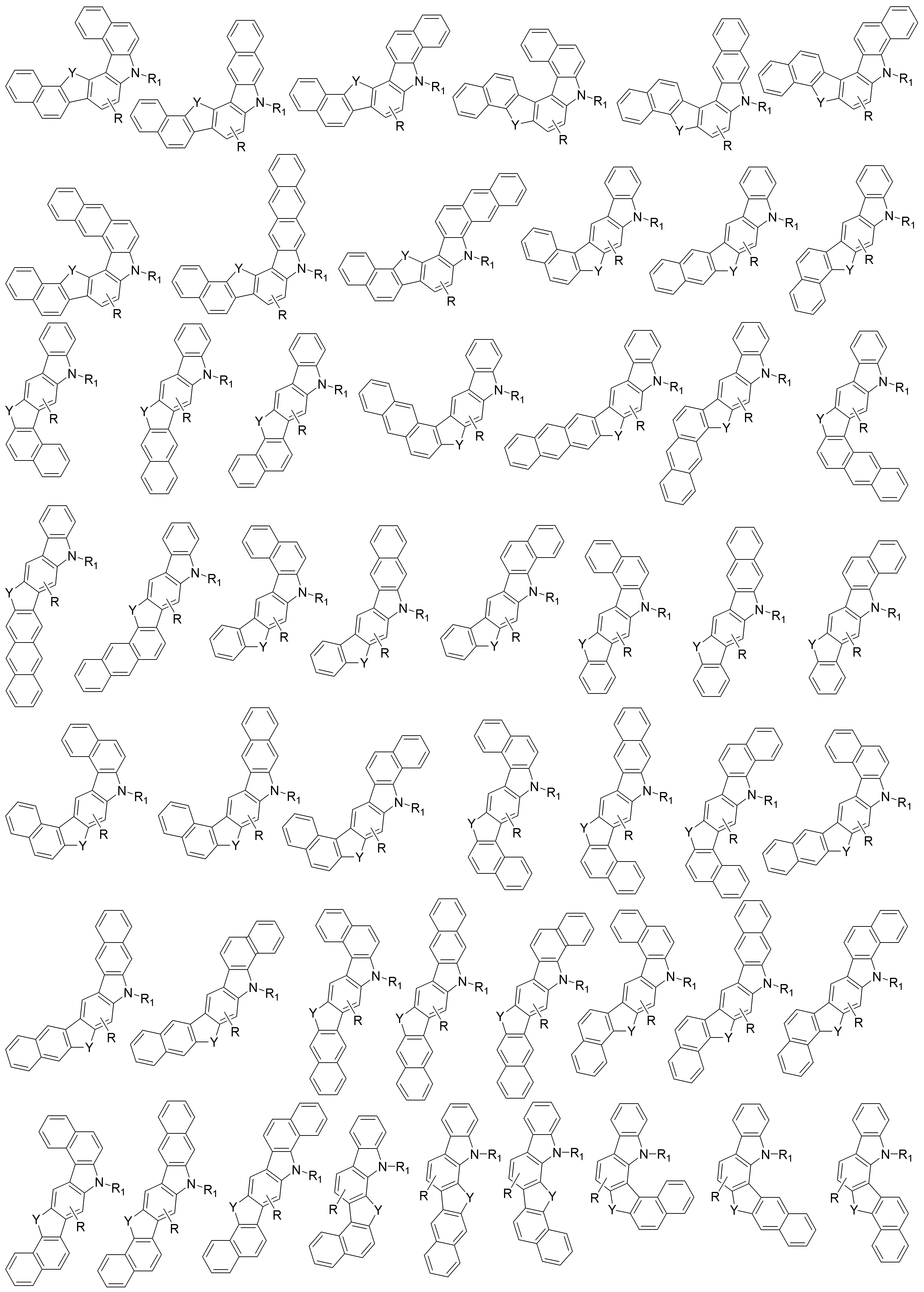
또한, 본 발명의 유기 발광 화합물은 하기 구조의 화합물로 예시될 수 있다.In addition, the organic light emitting compound of the present invention can be exemplified by a compound having the following structure.


[상기 Y는 C(R2)(R3) 또는 Si(R4)(R5)이며; R, R1 내지 R5는 상기 화학식 1 내지 6에서의 정의와 동일하다.][Y is C (R 2 ) (R 3 ) or Si (R 4 ) (R 5 ); R, R 1 to R 5 have the same definitions as in the above Formulas 1 to 6.
또한, 본 발명의 유기 발광 화합물은 하기 구조의 화합물로 예시될 수 있다.In addition, the organic light emitting compound of the present invention can be exemplified by a compound having the following structure.

[상기 Y는 C(R2)(R3) 또는 Si(R4)(R5)이며; R, R1 내지 R5는 상기 화학식 1 내 지 6에서의 정의와 동일하다.][Y is C (R 2 ) (R 3 ) or Si (R 4 ) (R 5 ); R, R 1 to R 5 are the same as defined in Formulas 1 to 6.
또한, 본 발명의 유기 발광 화합물은 하기 구조의 화합물로 예시될 수 있다.In addition, the organic light emitting compound of the present invention can be exemplified by a compound having the following structure.

[상기 R, R1 내지 R6는 상기 화학식 1 내지 6에서의 정의와 동일하다.][Wherein R, R 1 to R 6 are the same as defined in Formulas 1 to 6 above.]
더욱 구체적으로, 상기 R 및 R2 내지 R5는 서로 독립적으로 수소, 할로겐, 메틸, 에틸, 프로필, 부틸, 펜틸, 헥실, 에틸헥실, 헵틸, 옥틸 등의 알킬, 페닐, 나프틸, 플루오레닐, 바이페닐, 페난트릴, 터페닐, 피레닐, 퍼릴레닐, 스피로바이플루오레닐, 플루오란테닐, 크리세닐, 트리페닐레닐 등의 아릴로부터 선택되어지나, 이에 한정되는 것은 아니다.More specifically, R and R 2 to R 5 are independently of each other hydrogen, halogen, methyl, ethyl, propyl, butyl, pentyl, hexyl, ethylhexyl, heptyl, octyl, alkyl, phenyl, naphthyl, fluorenyl , Biphenyl, phenanthryl, terphenyl, pyrenyl, perilenyl, spirobifluorenyl, fluoranthenyl, chrysenyl, triphenylenyl, and the like, but are not limited thereto.
더욱 구체적으로, 상기 R1 및 R6는 서로 독립적으로 페닐, 1-나프틸, 2-나프틸이거나, 하기 구조에서 선택되는 치환기이나, 이에 한정되지는 않는다.More specifically, R 1 and R 6 are each independently phenyl, 1-naphthyl, 2-naphthyl, or a substituent selected from the following structures, but is not limited thereto.


또한 본 발명은 유기 전계 발광 소자를 제공하며, 본 발명에 따른 유기 전계 발광 소자는 제1전극; 제2전극; 및 상기 제1전극 및 제2전극 사이에 개재되는 1층 이상의 유기물층으로 이루어진 유기 발광 소자에 있어서, 상기 유기물층은 상기 화학식 1 내지 6에서 선택되는 유기 발광 화합물을 하나 이상 포함하는 것을 특징으 로 한다. In another aspect, the present invention provides an organic electroluminescent device, the organic electroluminescent device according to the present invention comprises a first electrode; A second electrode; And at least one organic material layer interposed between the first electrode and the second electrode, wherein the organic material layer includes at least one organic light emitting compound selected from Chemical Formulas 1 to 6 above.
본 발명에 따른 유기 전계 발광 소자는 상기 유기물층이 발광층을 포함하며, 상기 발광층은 상기 화학식 1 내지 6에서 선택되는 유기 발광 화합물 하나 이상을 발광 호스트로 하여 하나 이상의 인광 도판트를 포함하며, 상기 발광 도판트는 특별히 제한되지 않는다.In the organic electroluminescent device according to the present invention, the organic material layer includes a light emitting layer, and the light emitting layer includes one or more phosphorescent dopants using at least one organic light emitting compound selected from Chemical Formulas 1 to 6 as a light emitting host, and the light emitting plate Is not particularly limited.
본 발명의 유기 전계 발광 소자에 있어서, 상기 화학식 1 내지 6에서 선택되는 유기 발광 화합물 하나 이상을 포함하고, 동시에 아릴아민계 화합물 또는 스티릴아릴아민계 화합물로 이루어진 군으로부터 선택된 하나 이상의 화합물을 더 포함할 수 있다.In the organic electroluminescent device of the present invention, at least one organic light emitting compound selected from Chemical Formulas 1 to 6, and at the same time further comprises at least one compound selected from the group consisting of arylamine compounds or styrylarylamine compounds. can do.
또한, 본 발명의 유기 발광 소자에 있어서, 유기물층에 상기 화학식 1 내지 6에서 선택되는 유기 발광 화합물 하나 이상 이외에 1족, 2족, 4주기, 5주기 전이금속, 란탄계열금속 및 d-전이원소의 유기금속으로 이루어진 군으로부터 선택되는 하나 이상의 금속 또는 착체화합물을 더 포함할 수도 있고, 상기 유기물층은 발광층 및 전하생성층을 포함할 수 있다.In addition, in the organic light emitting device of the present invention, in addition to at least one organic light emitting compound selected from Chemical Formulas 1 to 6 in the organic material layer of Group 1, Group 2, 4 cycle, 5 cycle transition metal, lanthanum series metal and d-transition element One or more metals or complex compounds selected from the group consisting of organic metals may be further included, and the organic material layer may include a light emitting layer and a charge generating layer.
또한, 상기 유기물층에 상기 유기 발광 화합물 이외에 청색, 적색 또는 녹색 발광을 하는 유기발광층 하나 이상을 동시에 포함하여 백색 발광을 하는 유기 전계 발광 소자를 형성할 수 있다.In addition, an organic electroluminescent device that emits white light may be formed in the organic material layer by simultaneously including one or more organic light emitting layers emitting blue, red, or green light in addition to the organic light emitting compound.
본 발명에 따른 유기 발광 화합물은 OLED 소자에서 유기 발광 재료의 호스트 재료로 사용되어 기존 호스트 재료에 비해 발광효율이 좋고 재료의 수명특성이 뛰 어나 소자의 구동수명이 매우 양호한 OLED를 제조할 수 있는 장점이 있다.The organic light emitting compound according to the present invention is used as a host material of the organic light emitting material in the OLED device has the advantage that the light emitting efficiency and excellent life characteristics of the material compared to the existing host material can be produced OLED with a very good driving life of the device There is this.
이하에서, 본 발명의 상세한 이해를 위하여 본 발명의 대표 화합물을 들어 본 발명에 따른 유기 발광 화합물, 이의 제조방법 및 소자의 발광특성을 설명하나, 이는 단지 그 실시 양태를 예시하기 위한 것일 뿐, 본 발명의 범위를 한정하는 것은 아니다.Hereinafter, the organic light emitting compound according to the present invention, a method for preparing the same and a light emitting property of the device are described for the detailed understanding of the present invention, but the present invention is only intended to illustrate the embodiments of the present invention. It does not limit the scope of the invention.
[[ 제조예Production Example ]]
[[ 제조예Production Example 1]화합물 A의 제조 1] Preparation of Compound A

화합물 A-1의 제조Preparation of Compound A-1
1-브로모나이트로벤젠 16g(74.25mmol), 9,9-다이메틸-9H-플루오렌-2-일보론산 23g(96.60mmol), Pd(PPh3)4 4.2g(3.63mmol), 2M K2CO3 수용액 111mL, EtOH 100mL 및 톨루엔 200mL를 혼합한 후 120℃로 가열시키면서 3시간 교반하였다. 반응이 끝나면 증류수로 씻어주고 EA로 추출한 뒤 유기층을 MgSO4로 건조시킨 후 회전 증발기로 용매를 제거한 후 컬럼으로 정제하여 화합물 A-1 22g(95%)를 얻었다. 16 g (74.25 mmol) of 1-bromonotrobenzene, 23 g (96.60 mmol) of 9,9-dimethyl-9H-fluorene-2-ylboronic acid, 4.2 g (3.63 mmol) of Pd (PPh 3 ) 4 , 2 M K 111 mL of 2 CO 3 aqueous solution, 100 mL of EtOH and 200 mL of toluene were mixed, followed by stirring for 3 hours while heating to 120 ° C. After the reaction, the mixture was washed with distilled water, extracted with EA, dried over MgSO 4 , dried over MgSO 4 , solvent was removed on a rotary evaporator, and purified by column to obtain Compound A-1 22g (95%).
화합물 A-2의 제조Preparation of Compound A-2
화합물 A-1 24g(76.10mmol), 트리에틸포스파이트 200mL 및 1,2-다이클로로벤젠 200mL를 혼합한 후 180℃로 가열하여 12시간 교반하였다. 반응이 끝나면 디스틸레이션(distillation) 장치를 이용해서 미반응 트리에틸포스파이트과 1,2-디클로로벤젠을 제거한 후, 증류수로 씻어주고 EA로 추출한 뒤 유기층을 MgSO4로 건조시켰다. 회전 증발기로 용매를 제거한 후 컬럼으로 정제하여 화합물 A-2 7g(33%)를 얻었다. 24 g (76.10 mmol) of Compound A-1, 200 mL of triethyl phosphite, and 200 mL of 1,2-dichlorobenzene were mixed and then heated to 180 ° C. and stirred for 12 hours. After the reaction was completed, an unreacted triethylphosphite and 1,2-dichlorobenzene were removed using a distillation apparatus, washed with distilled water, extracted with EA, and dried over MgSO 4 . The solvent was removed on a rotary evaporator, and then purified by column to obtain compound A-2 7g (33%).
화합물 A-3의 제조Preparation of Compound A-3
NaH(60%) 1.15g(28.90mmol)에 DMF 10mL를 가하고 실온에서 교반하였다. 화합물 A-2 6.3g(28.98mmol)를 DMF 50mL에 녹인 후 NaH가 들어있는 반응용기에 천천히 첨가하였다. 1시간동안 실온에서 교반 후, 여기에 2,4-디클로로피리미딘 4.9g(33.34mmol)를 DMF 50mL에 녹여서 천천히 첨가하였다. 5시간 반응 후 H2O 50mL를 첨가하였다. 생성된 고체를 여과시킨 후 MC에 녹여서, 추출한 뒤 유기층을 MgSO4로 건조시켰다. 회전 증발기로 용매를 제거한 후 컬럼으로 정제하여 화합물 A-3 4g(45%)를 얻었다. 10 mL of DMF was added to 1.15 g (28.90 mmol) of NaH (60%), followed by stirring at room temperature. 6.3 g (28.98 mmol) of Compound A-2 was dissolved in 50 mL of DMF, and then slowly added to a reaction vessel containing NaH. After stirring at room temperature for 1 hour, 4.9 g (33.34 mmol) of 2,4-dichloropyrimidine was dissolved in 50 mL of DMF and slowly added thereto. After 5 hours, 50 mL of H 2 O was added. The resulting solid was filtered, dissolved in MC, extracted and the organic layer was dried over MgSO 4 . The solvent was removed using a rotary evaporator, and then purified by column to obtain 4 g (45%) of Compound A-3.
화합물 A-4의 제조Preparation of Compound A-4
1,3-디브로모벤젠 20g(84.77mmol)을 반응용기에 넣고 진공 상태에서 질소 분위기로 만들고, THF 500mL를 가하고 -78℃에서 10분간 교반하였다. N-BuLi(2.5M) 33.9mL(84.77mmol)를 천천히 첨가한 후 -78℃에서 1시간 동안 교반하였다. 클로로트리페닐실란 29.9g(107.72mmol)를 THF 100mL에 녹인 후 천천히 첨가하였다. 실온에서 12시간 교반한 후, 반응이 종결되면 증류수로 씻어주고 EA로 추출한 뒤 유기층을 MgSO4로 건조시켰다. 회전 증발기로 용매를 제거한 후 MC와 MeOH로 재결정하여 화합물 A-4 62g(63%)를 얻었다.20 g (84.77 mmol) of 1,3-dibromobenzene was placed in a reaction vessel, placed in a nitrogen atmosphere in a vacuum state, and 500 mL of THF was added thereto, followed by stirring at -78 ° C for 10 minutes. 33.9 mL (84.77 mmol) of N-BuLi (2.5M) was added slowly, followed by stirring at −78 ° C. for 1 hour. 29.9 g (107.72 mmol) of chlorotriphenylsilane was dissolved in 100 mL of THF, and then slowly added thereto. After stirring for 12 hours at room temperature, the reaction was terminated, washed with distilled water, extracted with EA and dried over MgSO 4 . After removing the solvent by a rotary evaporator to recrystallized with MC and MeOH to give 62 g (63%) of Compound A-4.
화합물 A-5의 제조Preparation of Compound A-5
화합물 A-4 22.5g(0.10mol)을 반응용기에 넣고 진공 상태에서 질소 분위기로 만들고, THF 1.3L를 넣고 -78℃에서 10분간 교반하였다. N-BuLi(2.5M) 48.6mL(0.12mol)를 천천히 첨가한 후 -78℃에서 1시간 동안 교반하였다. 트리에틸보레이트 18mL(0.16mmol)를 천천히 첨가하였다. 실온에서 12시간 교반한 후, 반응이 종결되면 증류수로 씻어주고 EA로 추출한 뒤 유기층을 MgSO4로 건조시켰다. 회전 증발기로 용매를 제거한 후 컬럼으로 정제하여 화합물 A-5 10g(45%)를 얻었다.22.5 g (0.10 mol) of Compound A-4 was added to a reaction vessel, and the mixture was placed in a vacuum atmosphere under a nitrogen atmosphere, and 1.3 L of THF was added thereto, followed by stirring at -78 ° C for 10 minutes. 48.6 mL (0.12 mol) of N-BuLi (2.5M) was added slowly, followed by stirring at -78 ° C for 1 hour. 18 mL (0.16 mmol) of triethylborate was added slowly. After stirring for 12 hours at room temperature, the reaction was terminated, washed with distilled water, extracted with EA and dried over MgSO 4 . The solvent was removed using a rotary evaporator, and then purified by column to obtain 10 g (45%) of Compound A-5.
화합물 A의 제조Preparation of Compound A
화합물 A-3 2.5g(6.31mmol), 화합물 A-5 3.6g(9.47mmol), Pd(PPh3)4 730mg(0.63mmol), K2CO3(2M) 19mL, EtOH 19mL 및 톨루엔 40mL를 혼합한 후 120℃로 가열시킨 후 3시간 교반하였다. 반응이 끝나면 증류수로 씻어주고 EA로 추출한 뒤 유기층을 MgSO4로 건조시킨 후 회전 증발기로 용매를 제거한 후 컬럼으로 정제하여 화합물 A 3.8g(88%)를 얻었다. Mix 2.5 g (6.31 mmol) of compound A-3, 3.6 g (9.47 mmol) of compound A-5, 730 mg (0.63 mmol) of Pd (PPh 3 ) 4, 19 mL of K 2 CO 3 (2M), 19 mL of EtOH and 40 mL of toluene After heating to 120 ℃ and stirred for 3 hours. After the reaction, the mixture was washed with distilled water, extracted with EA, the organic layer was dried over MgSO 4 , the solvent was removed with a rotary evaporator, and purified by a column to obtain Compound A (3.8g, 88%).
[[ 제조예Production Example 2] 화합물 B의 제조 2] Preparation of Compound B

화합물 B-2의 제조Preparation of Compound B-2
화합물 B-1 50.0g(179 mmol)을 DMF 200mL에 녹이고 구리분말 27.0g(424mmol)을 가하여 125℃에서 3시간 동안 교반하였다. 반응 혼합물을 실온으로 냉각하고 침전물을 여과하여 제거한 후 건조하였다. MeOH 500mL로 세척하여 화합물 B-2 27.1g(88%)를 얻었다.50.0 g (179 mmol) of Compound B-1 was dissolved in 200 mL of DMF, and 27.0 g (424 mmol) of copper powder was added thereto, followed by stirring at 125 ° C. for 3 hours. The reaction mixture was cooled to room temperature and the precipitate was filtered off and dried. Washing with 500 mL MeOH afforded 27.1 g (88%) of compound B-2.
화합물 B-3의 제조Preparation of Compound B-3
화합물 B-2 15g(37.3mmol)를 에탄올 200mL에 녹이고 32%(w/w) HCl 수용액 120mL을 가하였다. 실온에서 주석 분말 17.6g(147mmol)를 10분동안 portion-wise 하고 100℃에서 2시간동안 교반하였다. 실온으로 냉각하고 그 반응 혼합물을 얼음물에 부었다. 20%(w/w) NaOH 수용액 150mL를 사용하여 염기상태로 만들었다. 디에틸에테르로 추출하고 브린으로 세척한 후 건조한 후 에탄올로 재결정하여 화합물 B-3 9.2g(72%)을 얻었다.15 g (37.3 mmol) of Compound B-2 were dissolved in 200 mL of ethanol, and 120 mL of 32% (w / w) HCl aqueous solution was added thereto. 17.6 g (147 mmol) of tin powder at room temperature were portion-wise for 10 minutes and stirred at 100 ° C. for 2 hours. Cool to room temperature and pour the reaction mixture into ice water. It was made basic using 150 mL of 20% (w / w) NaOH aqueous solution. Extraction with diethyl ether, washing with brine, drying and recrystallization with ethanol yielded 9.2 g (72%) of compound B-3.
화합물 B-4의 제조Preparation of Compound B-4
0℃에서 화합물 B-3 8.5g(25mmol)이 들어있는 둥근 바닥 플라스크에 17%(w/w) HCl 수용액 85mL를 가하고 NaNO2 수용액[NaNO2 4.3g(62mmol)+ 물 15mL]을 첨가하였다. 30분 동안 교반하고 KI 수용액[KI 41.5g(250_mmol)+ 물 15mL]을 가하였다. 1시간동안 실온에서 교반하고 60℃에서 3시간 동안 교반하였다. 포화된 KOH 용매로 중화시키고 에틸아세테이트로 추출하고 포화 Na2SO3로 씻어준 다음, 실리카 컬럼으로 정제하여 화합물 B-4 4g(29%)를 얻었다.From 0 ℃ compound B-3 8.5g (25mmol) of 17% in a round bottom flask containing (w / w) was added to 85mL aqueous solution of HCl was added NaNO 2 solution [NaNO 2 4.3g (62mmol) + water 15mL]. Stirred for 30 minutes and an aqueous KI solution [KI 41.5 g (250 mmol) + 15 mL water] was added. Stir at room temperature for 1 hour and stir at 60 ° C. for 3 hours. Neutralized with saturated KOH solvent, extracted with ethyl acetate, washed with saturated Na 2 S0 3 , and purified by silica column to obtain compound B-4 4g (29%).
화합물 B-5의 제조Preparation of Compound B-5
화합물 B-4 4g(7.1mmol)가 들어있는 둥근 바닥 플라스크에 아르곤 가스를 채우고 THF 30mL를 가하고 -78℃로 냉각하였다. n-BuLi(2.5M in hexane) 6.2mL(15.6mmol)을 천천히 가하고 1시간동안 교반하였다. 디클로로디메틸실란 2.0g(15.6mmol)을 가하고 12시간동안 교반하면서 천천히 실온으로 온도를 올린 후 EA로 추출하고 물로 세척하였다. 얻어진 유기층을 건조하고 실리카 컬럼으로 정제하여 화합물 B-5 2g(76%)를 얻었다.A round bottom flask containing 4 g (7.1 mmol) of Compound B-4 was charged with argon gas, 30 mL of THF was added, and cooled to -78 ° C. 6.2 mL (15.6 mmol) of n-BuLi (2.5 M in hexane) was slowly added and stirred for 1 hour. 2.0 g (15.6 mmol) of dichlorodimethylsilane were added and the temperature was slowly raised to room temperature with stirring for 12 hours, followed by extraction with EA and washing with water. The obtained organic layer was dried and purified by silica column to obtain compound B-5 2g (76%).
화합물 B-6의 제조Preparation of Compound B-6
화합물 B-5 2g(5.43mmol)가 들어있는 둥근 바닥 플라스크에 아르곤 가스를 채우고 THF 25mL를 가하고 -78℃로 냉각하였다. n-BuLi(2.5M in hexane) 2.2mL(5.43mmol)을 천천히 가하고 1시간동안 교반하였다. 1M HCl 20mL을 가하고 2시간동안 교반하였다. 교반이 완료된 후 EA로 추출하고 물로 세척하였다. 얻어진 유기층을 건조하고 실리카 컬럼으로 정제하여 화합물 B-6 1.5g(96%)을 얻었다.A round bottom flask containing 2 g (5.43 mmol) of Compound B-5 was charged with argon gas, 25 mL of THF was added, and cooled to -78 ° C. 2.2 mL (5.43 mmol) of n-BuLi (2.5 M in hexane) was slowly added and stirred for 1 hour. 20 mL of 1M HCl was added and stirred for 2 hours. After stirring was complete, extracted with EA and washed with water. The obtained organic layer was dried and purified by silica column to obtain 1.5 g (96%) of compound B-6.
화합물 B-8의 제조Preparation of Compound B-8
화합물 B-6 15g(51.9mmol)이 들어있는 둥근 바닥 플라스크에 아르곤 가스를 채우고 THF 300mL를 가하고 -78℃로 냉각하였다. n-BuLi(2.5M in hexane) 20.8mL(51.9mmol)을 천천히 가하고 1시간동안 교반하였다. 화합물 B-7 335mg(62.3mmol)을 가하고 12시간동안 교반하면서 천천히 실온으로 온도를 온도를 올린 후 EA로 추출하고 물로 세척하였다. 얻어진 유기층을 건조하고 실리카 컬럼으로 정제하여 화합물 B-8 12g(69%)을 얻었다.A round bottom flask containing 15 g (51.9 mmol) of Compound B-6 was charged with argon gas, 300 mL of THF was added, and cooled to -78 ° C. 20.8 mL (51.9 mmol) of n-BuLi (2.5 M in hexane) was slowly added and stirred for 1 hour. 335 mg (62.3 mmol) of Compound B-7 were added thereto, followed by stirring for 12 hours. The temperature was slowly raised to room temperature, extracted with EA, and washed with water. The obtained organic layer was dried and purified by silica column to obtain 12 g (69%) of compound B-8.
화합물 B-9의 제조Preparation of Compound B-9
화합물 B-8 12g(35.7mmol)이 들어있는 둥근 바닥 플라스크에 2-브로모나이트로벤젠 8.65g(42.8mmol)과 Pd(PPh3)4 1.24g(1.07mmol)을 넣고 아르곤 가스를 채웠다. 톨루엔 120mL과 에탄올 60mL, 2M K2CO3 60mL를 넣고 4시간동안 환류교반하였다. 실온으로 냉각하고 EA로 추출하고 물로 세척하였다. 얻어진 유기층을 건조하고 실리카 컬럼으로 정제하여 화합물 B-9 9.5g(80%)를 얻었다.Into a round-bottomed flask containing 12 g (35.7 mmol) of Compound B-8, 8.65 g (42.8 mmol) of 2-bromonitetrobenzene and 1.24 g (1.07 mmol) of Pd (PPh 3 ) 4 were added and filled with argon gas. 120 mL of toluene, 60 mL of ethanol, and 60 mL of 2M K 2 CO 3 were added and refluxed for 4 hours. Cool to room temperature, extract with EA and wash with water. The obtained organic layer was dried and purified by silica column to obtain 9.5 g (80%) of compound B-9.
화합물 B-10의 제조Preparation of Compound B-10
화합물 B-9 9.5g(28.7mmol)이 들어있는 둥근 바닥 플라스크에 아르곤 가스를 채우고 트리에틸포스파이트 100mL와 1,2-디클로로벤젠 500mL을 가하고 12시간동안 환류교반하였다. 실온으로 냉각하고 EA로 추출하고 물로 세척하였다. 얻어진 유기층을 건조하고 실리카 컬럼으로 정제하여 화합물 B-10 7.2g(84%)를 얻었다.Argon gas was charged into a round bottom flask containing 9.5 g (28.7 mmol) of Compound B-9, and 100 mL of triethyl phosphite and 500 mL of 1,2-dichlorobenzene were added and stirred under reflux for 12 hours. Cool to room temperature, extract with EA and wash with water. The obtained organic layer was dried and purified by silica column to obtain 7.2 g (84%) of compound B-10.
화합물 B-13의 제조Preparation of Compound B-13
화합물 B-12 10g(67.1mmol)이 들어있는 둥근 바닥 플라스크에 화합물 B-11 9.8g(80.5mmol)과 Pd(PPh3)4 2.33g(2.01mmol)을 넣고 아르곤 가스를 채웠다. 톨루엔 240mL과 에탄올 120mL, 2M K2CO3 120 mL를 넣고 4시간동안 환류교반하였다. 실온으로 냉각하고 EA로 추출하고 물로 세척하였다. 얻어진 유기층을 건조하고 실리카 컬럼으로 정제하여 화합물 B-13 11g(86%)를 얻었다.In a round bottom flask containing 10 g (67.1 mmol) of Compound B-12, 9.8 g (80.5 mmol) of Compound B-11 and 2.33 g (2.01 mmol) of Pd (PPh 3 ) 4 were charged with argon gas. 240 mL of toluene, 120 mL of ethanol, and 120 mL of 2M K 2 CO 3 were added and refluxed for 4 hours. Cool to room temperature, extract with EA and wash with water. The obtained organic layer was dried and purified by silica column to obtain 11 g (86%) of compound B-13.
화합물 B의 제조Preparation of Compound B
NaH 288mg(12mmol)과 DMF 100mL가 들어있는 둥근 바닥 플라스크에 화합물 B-10 3.0g(10.0mmol)을 DMF 200mL에 녹인 혼합물을 천천히 첨가하고 1시간동안 교반하였다. 화합물 B-13 1.5g(10mmol)을 DMF 200mL에 녹여서 천천히 가하고 12시간동안 실온에서 교반하였다. 반응혼합물을 여과하고 물과 MeOH로 씻고 건조하여 화합물 B 2.1g(46%)를 얻었다.In a round bottom flask containing 288 mg (12 mmol) of NaH and 100 mL of DMF, a mixture of 3.0 g (10.0 mmol) of Compound B-10 in 200 mL of DMF was slowly added and stirred for 1 hour. 1.5 g (10 mmol) of Compound B-13 was dissolved in 200 mL of DMF, and slowly added thereto, followed by stirring at room temperature for 12 hours. The reaction mixture was filtered, washed with water and MeOH and dried to obtain 2.1 g (46%) of compound B.
[[ 제조예Production Example 3] 화합물 C의 제조 3] Preparation of Compound C

화합물 C-1의 제조Preparation of Compound C-1
화합물 B-4를 출발물질로 하여 디클로로디메틸실란 대신에 디클로로디페닐실란을 사용하는 것을 제외하고는 제조예 2의 화합물 B-5를 제조하는 방법과 동일한 방법으로 화합물 C-1 1.7g(50%)를 얻었다.1.7 g (50%) of compound C-1 in the same manner as in the preparation of compound B-5 of Preparation Example 2, except that dichlorodiphenylsilane was used instead of dichlorodimethylsilane using Compound B-4 as a starting material. )
화합물 C의 제조Preparation of Compound C
화합물 C-1을 출발물질로 하여 제조예 2의 화합물 B-6, B-8, B-9, B-10 및 B를 제조하는 방법과 동일한 방법으로 화합물 C 347mg(55%)를 얻었다.347 mg (55%) of compound C was obtained by the same method as the method of preparing compounds B-6, B-8, B-9, B-10, and B of Preparation Example 2, using compound C-1 as a starting material.
상기 제조예 1 내지 3의 방법을 이용하여 유기 발광 화합물(TA, TB 및 TC)을 제조하였으며, 표 1 내지 표 4에 제조된 유기 발광 화합물들의 치환기, 1H NMR 및 MS/FAB를 나타내었다.The organic light emitting compounds (TA, TB and TC) were prepared using the methods of Preparation Examples 1 to 3, and the substituents, 1 H NMR and MS / FAB of the organic light emitting compounds prepared in Tables 1 to 4 were shown.
[표 1]TABLE 1
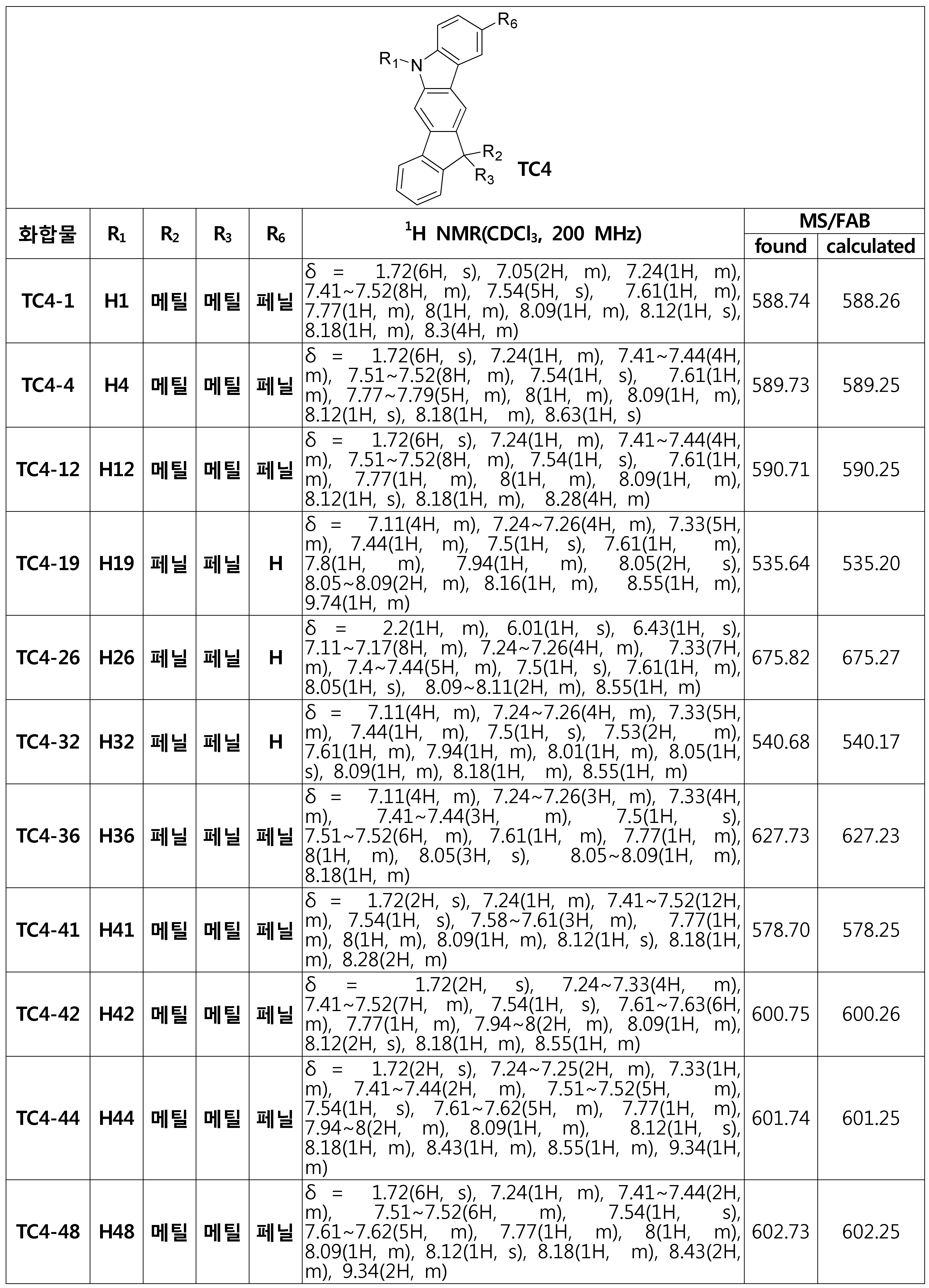


[표 2]TABLE 2


[표 3][Table 3]


[표 4][Table 4]

[실시예 1] 본 발명에 따른 유기 발광 화합물을 이용한 OLED 소자 제작Example 1 Fabrication of an OLED Device Using an Organic Light Emitting Compound According to the Present Invention
본 발명의 발광 재료를 이용한 구조의 OLED 소자를 제작하였다. 우선, OLED용 글래스(삼성-코닝사 제조)로부터 얻어진 투명전극 ITO 박막(15 Ω/□) 을, 트리클로로에틸렌, 아세톤, 에탄올, 증류수를 순차적으로 사용하여 초음파 세척을 실시한 후, 이소프로판올에 넣어 보관한 후 사용하였다. 다음으로, 진공 증착 장비의 기판 폴더에 ITO 기판을 설치하고, 진공 증착 장비 내의 셀에4,4',4"-tris(N,N-(2- naphthyl)-phenylamino)triphenylamine (2-TNATA)을 넣고, 챔버 내의 진공도가 10-6 torr에 도달할 때까지 배기시킨 후, 셀에 전류를 인가하여 2-TNATA를 증발시켜 ITO 기판 상에 60 nm 두께의 정공주입층을 증착하였다.An OLED device having a structure using the light emitting material of the present invention was produced. First, a transparent electrode ITO thin film (15 Ω / □) obtained from an OLED glass (manufactured by Samsung Corning Corporation) was subjected to ultrasonic cleaning using trichloroethylene, acetone, ethanol and distilled water sequentially, and then stored in isopropanol. It was used after. Next, the ITO substrate is installed in the substrate folder of the vacuum deposition equipment, and 4,4 ', 4 "-tris (N, N- (2-naphthyl) -phenylamino) triphenylamine (2-TNATA) is installed in the cell in the vacuum deposition equipment. After the evacuation and evacuation until the vacuum in the chamber reached 10 −6 torr, a current was applied to the cell to evaporate 2-TNATA to deposit a 60 nm thick hole injection layer on the ITO substrate.
이어서, 진공 증착 장비 내의 다른 셀에 N,N'-bis(α-naphthyl)-N,N'-diphenyl-4,4'-diamine (NPB)을 넣고, 셀에 전류를 인가하여 NPB를 증발시켜 정공주입층 위에 20 nm 두께의 정공전달층을 증착하였다.Then, to another cell of the vacuum vapor-deposit device N, N '-bis (α- naphthyl) - N, N' into the -diphenyl-4,4'-diamine (NPB) , and evaporation of the NPB by applying a current to the cell A 20 nm thick hole transport layer was deposited on the hole injection layer.
진공 증착 장비 내의 한쪽 셀에 호스트 재료로 10-6torr하에서 진공 승화 정제된 본 발명에 따른 화합물(예 :화합물 TC10-19)을 넣고, 다른쪽 셀에는 발광 도판트(예 :화합물 (piq)2Ir(acac)[ bis-(1-phenylisoquinolyl)iridium(III)acetylacetonate])를 각각 넣은 후, 두 물질을 다른 속도로 증발시켜 4 내지 10mol%로 도핑함으로써 상기 정공 전달층 위에 30 nm 두께의 발광층을 증착하였다.In one cell of a vacuum deposition apparatus, a compound according to the present invention (e.g., compound TC10-19 ), which was vacuum sublimated and purified at 10 -6 torr as a host material, was put, and in another cell, a light emitting dopant (e.g., compound (piq) 2 ). After adding Ir (acac) [bis- (1-phenylisoquinolyl) iridium (III) acetylacetonate]), respectively, the two materials were evaporated at different rates and doped at 4 to 10 mol% to form a 30 nm thick light emitting layer on the hole transport layer. Deposited.
이어서 전자전달층으로써 tris(8-hydroxyquinoline)-aluminum(III) (Alq)를 20 nm 두께로 증착한 다음, 전자주입층으로 화합물 lithium quinolate (Liq)를 1 내지 2 nm 두께로 증착한 후, 다른 진공 증착 장비를 이용하여 Al 음극을 150 nm의 두께로 증착하여 OLED를 제작하였다.Subsequently, tris (8-hydroxyquinoline) -aluminum (III) (Alq) was deposited to a thickness of 20 nm as an electron transport layer, and then a compound lithium quinolate (Liq) was deposited to a thickness of 1 to 2 nm using an electron injection layer. An OLED was manufactured by depositing an Al cathode to a thickness of 150 nm using a vacuum deposition apparatus.
[실시예 2] 본 발명에 따른 유기 발광 화합물을 이용한 OLED 소자의 제조 Example 2 Fabrication of OLED Device Using Organic Light Emitting Compound According to the Present Invention
호스트 재료로서 본 발명에 따른 화합물(예 :화합물 TC10-12)을 이용하고, 상기 발광층 위에 정공차단층으로 비스(2-메틸-8-퀴놀리네이토)(p-페닐페놀레이토) 알루미늄(III) (BAlq)을 5 nm의 두께로 증착시키고 그 외의 나머지는 실시예 1과 동일한 방법으로 OLED를 제작하였다.Using a compound according to the present invention (e.g., compound TC10-12 ) as a host material, bis (2-methyl-8-quinolinate) ( p -phenylphenolraito) aluminum (III) as a hole blocking layer on the light emitting layer ) (BAlq) was deposited to a thickness of 5 nm and the rest of the OLED was produced in the same manner as in Example 1.
[실시예 3] 본 발명에 따른 유기 발광 화합물을 이용한 OLED 소자의 제조Example 3 Fabrication of OLED Device Using Organic Light Emitting Compound According to the Present Invention
호스트 재료로서 본 발명에 따른 화합물(예 :화합물 TC10-97)을 이용하고, 발광 도판트로서 유기 이리듐 착물(Ir(ppy)3[tris(2-phenylpyridine)iridium])을 이용한 것 외에는, 실시예 1과 동일한 방법으로 OLED소자를 제작하였다. Except for using a compound according to the present invention as a host material (e.g. Compound TC10-97 ) and using an organic iridium complex (Ir (ppy) 3 [tris (2-phenylpyridine) iridium]) as a light emitting dopant. An OLED device was manufactured in the same manner as in Example 1.
[실시예 4] 본 발명에 따른 유기 발광 화합물을 이용한 OLED 소자의 제조Example 4 Fabrication of OLED Device Using Organic Light Emitting Compound According to the Present Invention
호스트 재료로서 본 발명에 따른 화합물(예 :화합물 TC4-105)을 이용하고, 상기 발광층 위에 정공차단층으로 비스(2-메틸-8-퀴놀리네이토)(p-페닐페놀레이토)알루미늄(III) (BAlq)을 5 nm의 두께로 증착시키고 그 외의 나머지는 실시예 3과 동일한 방법으로 OLED를 제작하였다.As a host material, a compound according to the present invention (e.g. Compound TC4-105 ) is used, and bis (2-methyl-8-quinolinate) ( p -phenylphenolraito) aluminum (III) is used as a hole blocking layer on the light emitting layer. ) (BAlq) was deposited to a thickness of 5 nm and the rest of the OLED was produced in the same manner as in Example 3.
[비교예 1 및 2] 종래의 발광 재료를 이용한 OLED 소자 제작[Comparative Examples 1 and 2] Fabrication of OLED Devices Using Conventional Light-Emitting Materials
진공 증착 장비 내의 다른 셀에 발광 호스트 재료로서 본 발명에 따른 유기 발광 화합물 대신에 4,4'-디(9H-카바졸-9-일)비페닐(CBP)을 넣은 것 이외에는 실시예 2 및 실시예 4와 동일한 방법으로 OLED 소자를 제작하였다.Example 2 and implementation except that 4,4'-di (9H-carbazol-9-yl) biphenyl (CBP) was added to the other cell in the vacuum deposition equipment in place of the organic light emitting compound according to the present invention as a light emitting host material. An OLED device was manufactured in the same manner as in Example 4.
상기 실시예 1 내지 4와 비교예 1 및 2에서 제조된 본 발명에 따른 유기 발광 화합물과 종래의 발광 화합물을 함유하는 OLED 소자의 전력 효율을 각각 1,000 cd/m2 에서 측정하여 하기 표 5에 나타내었다.The power efficiency of the organic light emitting compound according to the present invention prepared in Examples 1 to 4 and Comparative Examples 1 and 2 and a conventional light emitting compound is measured at 1,000 cd / m 2 and are shown in Table 5 below. It was.
[표 5]TABLE 5

상기 표 5에 나타난 바와 같이, 본 발명에서 개발한 유기 발광 화합물들의 발광 특성이 종래의 재료 대비 우수한 특성을 보이는 것을 확인할 수 있었다. 또한 본 발명에 따른 유기 발광 화합물을 적색 또는 녹색 발광용 호스트 재료로 사용한 소자는 발광특성이 뛰어날 뿐만 아니라 구동전압을 강하시켜줌으로써 전력효율의 상승을 유도하여 소비전력을 개선시킬 수 있었다. 상기 표 5에 나타난 바와 같이, 본 발명에서 개발한 유기 발광 화합물들의 발광 특성이 종래의 재료 대비 우수한 특성을 보이는 것을 확인할 수 있었다. 또한 본 발명에 따른 유기 발광 화합물을 적색 또는 녹색 발광용 호스트 재료로 사용한 소자는 발광특성이 뛰어날 뿐만 아니라 구동전압을 강하시켜줌으로써 전력효율의 상승을 유도하여 소비전력을 개선시킬 수 있었다. As shown in Table 5, it was confirmed that the light emission characteristics of the organic light emitting compounds developed in the present invention shows superior properties compared to the conventional material. In addition, the device using the organic light emitting compound according to the present invention as a red or green light emitting host material was not only excellent in the light emitting characteristics, but also by lowering the driving voltage to increase the power efficiency to improve the power consumption. As shown in Table 5, it was confirmed that the light emission characteristics of the organic light emitting compounds developed in the present invention shows superior properties compared to the conventional material. In addition, the device using the organic light emitting compound according to the present invention as a red or green light emitting host material was not only excellent in the light emitting characteristics, but also by lowering the driving voltage to increase the power efficiency to improve the power consumption.
Claims (10)




Priority Applications (10)
| Application Number | Priority Date | Filing Date | Title |
|---|---|---|---|
| KR1020090067370A KR20110009920A (en) | 2009-07-23 | 2009-07-23 | Novel organic light emitting compound and organic electroluminescent device comprising same |
| CN201080039344.3A CN102625819B (en) | 2009-07-23 | 2010-07-19 | New organic electroluminescent compound and organic electroluminescent device using the same |
| CN201410097500.1A CN103819455B (en) | 2009-07-23 | 2010-07-19 | The organic electroluminescent device of new organic electroluminescent compounds and this compound of use |
| CN201410095165.1A CN103864832A (en) | 2009-07-23 | 2010-07-19 | Novel organic electroluminescent compounds and organic electroluminescent device using the same |
| CN201410095803.XA CN103805171A (en) | 2009-07-23 | 2010-07-19 | Novel organic electroluminescent compounds and organic electroluminescent device using the same |
| CN201410095811.4A CN103880731A (en) | 2009-07-23 | 2010-07-19 | Novel Organic Electroluminescent Compounds And Organic Electroluminescent Device Using The Same |
| CN201410095831.1A CN103820105A (en) | 2009-07-23 | 2010-07-19 | Novel organic electroluminescent compounds and organic electroluminescent device using same |
| PCT/KR2010/004699 WO2011010844A1 (en) | 2009-07-23 | 2010-07-19 | Novel organic electroluminescent compounds and organic electroluminescent device using the same |
| US13/386,616 US20120206037A1 (en) | 2009-07-23 | 2010-07-19 | Novel organic electroluminescent compounds and organic electroluminescent device using the same |
| TW099123920A TW201109305A (en) | 2009-07-23 | 2010-07-21 | Novel organic electroluminescent compounds and organic electroluminescent device using the same |
Applications Claiming Priority (1)
| Application Number | Priority Date | Filing Date | Title |
|---|---|---|---|
| KR1020090067370A KR20110009920A (en) | 2009-07-23 | 2009-07-23 | Novel organic light emitting compound and organic electroluminescent device comprising same |
Related Child Applications (3)
| Application Number | Title | Priority Date | Filing Date |
|---|---|---|---|
| KR20140116300A Division KR20140130637A (en) | 2014-09-02 | 2014-09-02 | Novel organic electroluminescent compounds and organic electroluminescent device using the same |
| KR20150018171A Division KR20150034146A (en) | 2015-02-05 | 2015-02-05 | Novel organic electroluminescent compounds and organic electroluminescent device using the same |
| KR1020150115633A Division KR101778046B1 (en) | 2015-08-17 | 2015-08-17 | Novel organic electroluminescent compounds and organic electroluminescent device using the same |
Publications (1)
| Publication Number | Publication Date |
|---|---|
| KR20110009920A true KR20110009920A (en) | 2011-01-31 |
Family
ID=43499252
Family Applications (1)
| Application Number | Title | Priority Date | Filing Date |
|---|---|---|---|
| KR1020090067370A Ceased KR20110009920A (en) | 2009-07-23 | 2009-07-23 | Novel organic light emitting compound and organic electroluminescent device comprising same |
Country Status (5)
| Country | Link |
|---|---|
| US (1) | US20120206037A1 (en) |
| KR (1) | KR20110009920A (en) |
| CN (6) | CN103805171A (en) |
| TW (1) | TW201109305A (en) |
| WO (1) | WO2011010844A1 (en) |
Cited By (4)
| Publication number | Priority date | Publication date | Assignee | Title |
|---|---|---|---|---|
| KR20140074286A (en) * | 2011-09-09 | 2014-06-17 | 이데미쓰 고산 가부시키가이샤 | Organic electroluminescence element |
| US9309197B2 (en) | 2011-10-10 | 2016-04-12 | Samsung Display Co., Ltd. | Heterocyclic compound, organic light-emitting diode comprising the heterocyclic compound, and flat panel display device comprising the organic light-emitting diode |
| US9324953B2 (en) | 2012-07-31 | 2016-04-26 | Samsung Display Co., Ltd. | Condensed-cyclic compounds and organic light-emitting diodes comprising the same |
| US11522135B2 (en) | 2018-09-21 | 2022-12-06 | Samsung Display Co., Ltd. | Organic electroluminescence device and manufacturing method of the same |
Families Citing this family (19)
| Publication number | Priority date | Publication date | Assignee | Title |
|---|---|---|---|---|
| KR20110113297A (en) * | 2010-04-09 | 2011-10-17 | 다우어드밴스드디스플레이머티리얼 유한회사 | Novel organic electronic material compound and organic electroluminescent device comprising same |
| CN102153503A (en) * | 2011-02-22 | 2011-08-17 | 黑龙江省科学院石油化学研究院 | Carbazole-fluorene compounds and synthesis method thereof |
| CN102267948B (en) * | 2011-06-17 | 2013-09-04 | 上海大学 | Fluoreno diimidazole derivatives and preparation method thereof |
| US9373793B2 (en) | 2011-06-27 | 2016-06-21 | Lg Chem, Ltd. | Compound and organic light-emitting device using same |
| JP5938175B2 (en) * | 2011-07-15 | 2016-06-22 | 出光興産株式会社 | Nitrogen-containing aromatic heterocyclic derivative and organic electroluminescence device using the same |
| KR20130011405A (en) * | 2011-07-21 | 2013-01-30 | 롬엔드하스전자재료코리아유한회사 | Novel organic electroluminescence compounds and organic electroluminescence device using the same |
| KR20130015400A (en) * | 2011-08-03 | 2013-02-14 | 삼성디스플레이 주식회사 | Heterocyclic compound and organic light-emitting diode comprising the same |
| KR20130118059A (en) * | 2012-04-19 | 2013-10-29 | 롬엔드하스전자재료코리아유한회사 | Novel organic electroluminescent compounds and organic electroluminescent device using the same |
| KR20140032823A (en) * | 2012-09-07 | 2014-03-17 | 롬엔드하스전자재료코리아유한회사 | Organic electroluminescence device |
| CN103936659B (en) * | 2013-12-12 | 2016-06-22 | 石家庄诚志永华显示材料有限公司 | Compound containing carbon bridging carbazole structure unit and preparation method thereof and application |
| KR102490882B1 (en) * | 2014-12-31 | 2023-01-25 | 삼성디스플레이 주식회사 | Organic light-emitting device |
| US12522608B2 (en) | 2018-04-13 | 2026-01-13 | Universal Display Corporation | Host materials for electroluminescent devices |
| CN111087416B (en) * | 2018-10-24 | 2024-05-14 | 北京夏禾科技有限公司 | Silicon-containing electron transport material and use thereof |
| KR102853709B1 (en) * | 2018-12-06 | 2025-09-02 | 삼성디스플레이 주식회사 | Organic light-emitting device |
| CN109912639A (en) * | 2019-04-11 | 2019-06-21 | 西安欧得光电材料有限公司 | A kind of bromo- 9,9- dimethyl silicon heterofluorene of 2- and its synthetic method |
| CN111230114A (en) * | 2020-02-28 | 2020-06-05 | 沈阳工业大学 | A laser additive manufacturing method of TC4/IN625 functionally graded composite material |
| CN115073480A (en) * | 2021-03-10 | 2022-09-20 | 上海和辉光电股份有限公司 | Luminescent material and organic electroluminescent device |
| CN113121584B (en) * | 2021-03-30 | 2024-05-14 | 武汉尚赛光电科技有限公司 | Heterocyclic compound and organic electroluminescent device comprising same |
| CN115838374A (en) * | 2021-09-08 | 2023-03-24 | 上海和辉光电股份有限公司 | Luminescent material and organic electroluminescent device |
Family Cites Families (22)
| Publication number | Priority date | Publication date | Assignee | Title |
|---|---|---|---|---|
| US5942340A (en) * | 1997-10-02 | 1999-08-24 | Xerox Corporation | Indolocarbazole electroluminescent devices |
| JP2001278889A (en) * | 2000-03-28 | 2001-10-10 | Fuji Photo Film Co Ltd | New silicon compound, organic luminescent element material and organic luminescent element using the same |
| KR101030010B1 (en) * | 2004-09-18 | 2011-04-20 | 삼성모바일디스플레이주식회사 | Blue light emitting polymer and organic electroluminescent device employing the same |
| DE102005023437A1 (en) * | 2005-05-20 | 2006-11-30 | Merck Patent Gmbh | Connections for organic electronic devices |
| JPWO2007063796A1 (en) * | 2005-12-01 | 2009-05-07 | 新日鐵化学株式会社 | Organic electroluminescence device |
| DE102006031990A1 (en) * | 2006-07-11 | 2008-01-17 | Merck Patent Gmbh | New materials for organic electroluminescent devices |
| KR20080047209A (en) * | 2006-11-24 | 2008-05-28 | 삼성전자주식회사 | Organic light emitting compound and organic light emitting device having the same |
| WO2008132103A1 (en) * | 2007-04-26 | 2008-11-06 | Basf Se | Pentaphenylene derivatives as photosensitizers in solar cells |
| CN100548984C (en) * | 2007-11-26 | 2009-10-14 | 山东大学 | A kind of indoles [3,2-b] carbazole derivative organic electroluminescent material |
| CN102056899B (en) * | 2008-06-05 | 2013-11-20 | 出光兴产株式会社 | Polycyclic compound and organic electroluminescent element using same |
| EP2298774A4 (en) * | 2008-06-05 | 2012-12-19 | Idemitsu Kosan Co | HALOGENATED COMPOUND, POLYCYCLIC COMPOUND, AND ORGANIC ELECTROLUMINESCENT ELEMENT COMPRISING SAID POLYCYCLIC COMPOUND |
| CN102056911B (en) * | 2008-06-05 | 2015-07-22 | 出光兴产株式会社 | Halogen compound, polycyclic compound, and organic electroluminescent element using same |
| US8049411B2 (en) * | 2008-06-05 | 2011-11-01 | Idemitsu Kosan Co., Ltd. | Material for organic electroluminescence device and organic electroluminescence device using the same |
| DE102009005289B4 (en) * | 2009-01-20 | 2023-06-22 | Merck Patent Gmbh | Materials for organic electroluminescent devices, methods for their production and electronic devices containing them |
| DE102009005288A1 (en) * | 2009-01-20 | 2010-07-22 | Merck Patent Gmbh | Materials for organic electroluminescent devices |
| KR101596906B1 (en) * | 2009-02-27 | 2016-03-07 | 신닛테츠 수미킨 가가쿠 가부시키가이샤 | Organic electroluminescent element |
| CN102482279B (en) * | 2009-03-30 | 2015-08-12 | 德山新勒克斯 | Organic electronic devices and their compounds and terminals |
| DE102009023155A1 (en) * | 2009-05-29 | 2010-12-02 | Merck Patent Gmbh | Materials for organic electroluminescent devices |
| KR101333694B1 (en) * | 2009-06-25 | 2013-11-27 | 제일모직주식회사 | Compounds for organic photoelectric device and organic photoelectric device containing the same |
| KR101174088B1 (en) * | 2009-06-25 | 2012-08-14 | 제일모직주식회사 | Compounds?for organic photoelectric?device and organic photoelectric?device containing the same |
| KR101251453B1 (en) * | 2010-05-26 | 2013-04-05 | 덕산하이메탈(주) | Compound Containing Conjugated Carbazole And Fluorene And Organic Electronic Element Using The Same, Terminal Thereof |
| KR101832171B1 (en) * | 2010-10-25 | 2018-04-16 | 삼성디스플레이 주식회사 | A condensed-cyclic compound, an organic light emitting diode comprising the same and flat display device |
-
2009
- 2009-07-23 KR KR1020090067370A patent/KR20110009920A/en not_active Ceased
-
2010
- 2010-07-19 CN CN201410095803.XA patent/CN103805171A/en active Pending
- 2010-07-19 WO PCT/KR2010/004699 patent/WO2011010844A1/en not_active Ceased
- 2010-07-19 CN CN201410095811.4A patent/CN103880731A/en active Pending
- 2010-07-19 CN CN201410097500.1A patent/CN103819455B/en active Active
- 2010-07-19 CN CN201080039344.3A patent/CN102625819B/en active Active
- 2010-07-19 CN CN201410095831.1A patent/CN103820105A/en active Pending
- 2010-07-19 US US13/386,616 patent/US20120206037A1/en not_active Abandoned
- 2010-07-19 CN CN201410095165.1A patent/CN103864832A/en active Pending
- 2010-07-21 TW TW099123920A patent/TW201109305A/en unknown
Cited By (4)
| Publication number | Priority date | Publication date | Assignee | Title |
|---|---|---|---|---|
| KR20140074286A (en) * | 2011-09-09 | 2014-06-17 | 이데미쓰 고산 가부시키가이샤 | Organic electroluminescence element |
| US9309197B2 (en) | 2011-10-10 | 2016-04-12 | Samsung Display Co., Ltd. | Heterocyclic compound, organic light-emitting diode comprising the heterocyclic compound, and flat panel display device comprising the organic light-emitting diode |
| US9324953B2 (en) | 2012-07-31 | 2016-04-26 | Samsung Display Co., Ltd. | Condensed-cyclic compounds and organic light-emitting diodes comprising the same |
| US11522135B2 (en) | 2018-09-21 | 2022-12-06 | Samsung Display Co., Ltd. | Organic electroluminescence device and manufacturing method of the same |
Also Published As
| Publication number | Publication date |
|---|---|
| US20120206037A1 (en) | 2012-08-16 |
| CN103805171A (en) | 2014-05-21 |
| CN102625819A (en) | 2012-08-01 |
| CN103864832A (en) | 2014-06-18 |
| CN103820105A (en) | 2014-05-28 |
| WO2011010844A1 (en) | 2011-01-27 |
| CN102625819B (en) | 2015-12-02 |
| CN103819455A (en) | 2014-05-28 |
| CN103819455B (en) | 2016-01-20 |
| TW201109305A (en) | 2011-03-16 |
| CN103880731A (en) | 2014-06-25 |
Similar Documents
| Publication | Publication Date | Title |
|---|---|---|
| CN102625819B (en) | New organic electroluminescent compound and organic electroluminescent device using the same | |
| JP6356183B2 (en) | Novel organic electroluminescent compound and organic electroluminescent device using the same | |
| KR101423066B1 (en) | Novel organic electroluminescent compounds and organic electroluminescent device using the same | |
| KR20110116618A (en) | Novel organic light emitting compound and organic electroluminescent device comprising same | |
| TW201410686A (en) | A novel combination of a host compound and a dopant compound and an organic electroluminescence device comprising the same | |
| KR20100118690A (en) | Novel organic electroluminescent compounds and organic electroluminescent device using the same | |
| KR20110013220A (en) | Novel organic light emitting compound and organic electroluminescent device comprising same | |
| KR20110132721A (en) | Novel organic light emitting compound and organic electroluminescent device employing the same | |
| KR20110049217A (en) | Novel organic light emitting compound and organic electroluminescent device employing the same | |
| KR20100106014A (en) | Novel organic electroluminescent compounds and organic electroluminescent device using the same | |
| KR20120034140A (en) | Novel organic electroluminescent compounds and organic electroluminescent device using the same | |
| KR20120038060A (en) | Novel compounds for organic electronic material and organic electroluminescent device using the same | |
| KR20120031684A (en) | Novel organic electroluminescent compounds and organic electroluminescent device using the same | |
| JP2009149607A (en) | Novel organic electroluminescent compound and organic electroluminescent device using the same | |
| CN104583184A (en) | A novel combination of a host compound and a dopant compound and an organic electroluminescence device comprising the same | |
| TWI512080B (en) | Polycyclic compound including nitrogen and organic light emitting device using the same | |
| KR101778046B1 (en) | Novel organic electroluminescent compounds and organic electroluminescent device using the same | |
| KR101513987B1 (en) | Aromatic amine derivative and organic electroluminescent device including the same | |
| KR20140130637A (en) | Novel organic electroluminescent compounds and organic electroluminescent device using the same | |
| KR101682893B1 (en) | Novel organic electroluminescent compounds and organic electroluminescent device using the same | |
| KR101650294B1 (en) | Novel organic electroluminescent compounds and organic electroluminescent device using the same | |
| KR20150034146A (en) | Novel organic electroluminescent compounds and organic electroluminescent device using the same | |
| KR20140049531A (en) | Novel organic electroluminescent compounds and organic electroluminescent device using the same | |
| KR20140049530A (en) | Novel organic electroluminescent compounds and organic electroluminescent device using the same | |
| KR20140053056A (en) | Novel organic electroluminescent compounds and organic electroluminescent device using the same |
Legal Events
| Date | Code | Title | Description |
|---|---|---|---|
| PA0109 | Patent application |
Patent event code: PA01091R01D Comment text: Patent Application Patent event date: 20090723 |
|
| PG1501 | Laying open of application | ||
| N231 | Notification of change of applicant | ||
| PN2301 | Change of applicant |
Patent event date: 20120402 Comment text: Notification of Change of Applicant Patent event code: PN23011R01D |
|
| A201 | Request for examination | ||
| A302 | Request for accelerated examination | ||
| PA0201 | Request for examination |
Patent event code: PA02012R01D Patent event date: 20131227 Comment text: Request for Examination of Application Patent event code: PA02011R01I Patent event date: 20090723 Comment text: Patent Application |
|
| PA0302 | Request for accelerated examination |
Patent event date: 20131227 Patent event code: PA03022R01D Comment text: Request for Accelerated Examination Patent event date: 20090723 Patent event code: PA03021R01I Comment text: Patent Application |
|
| E902 | Notification of reason for refusal | ||
| PE0902 | Notice of grounds for rejection |
Comment text: Notification of reason for refusal Patent event date: 20140702 Patent event code: PE09021S01D |
|
| A107 | Divisional application of patent | ||
| AMND | Amendment | ||
| PA0107 | Divisional application |
Comment text: Divisional Application of Patent Patent event date: 20140902 Patent event code: PA01071R01D |
|
| E902 | Notification of reason for refusal | ||
| PE0902 | Notice of grounds for rejection |
Comment text: Notification of reason for refusal Patent event date: 20141105 Patent event code: PE09021S01D |
|
| A107 | Divisional application of patent | ||
| AMND | Amendment | ||
| PA0107 | Divisional application |
Comment text: Divisional Application of Patent Patent event date: 20150205 Patent event code: PA01071R01D |
|
| E601 | Decision to refuse application | ||
| PE0601 | Decision on rejection of patent |
Patent event date: 20150408 Comment text: Decision to Refuse Application Patent event code: PE06012S01D Patent event date: 20141105 Comment text: Notification of reason for refusal Patent event code: PE06011S01I Patent event date: 20140702 Comment text: Notification of reason for refusal Patent event code: PE06011S01I |
|
| AMND | Amendment | ||
| PX0901 | Re-examination |
Patent event code: PX09011S01I Patent event date: 20150408 Comment text: Decision to Refuse Application Patent event code: PX09012R01I Patent event date: 20150205 Comment text: Amendment to Specification, etc. Patent event code: PX09012R01I Patent event date: 20140902 Comment text: Amendment to Specification, etc. |
|
| PX0601 | Decision of rejection after re-examination |
Comment text: Decision to Refuse Application Patent event code: PX06014S01D Patent event date: 20150715 Comment text: Amendment to Specification, etc. Patent event code: PX06012R01I Patent event date: 20150608 Comment text: Decision to Refuse Application Patent event code: PX06011S01I Patent event date: 20150408 Comment text: Amendment to Specification, etc. Patent event code: PX06012R01I Patent event date: 20150205 Comment text: Notification of reason for refusal Patent event code: PX06013S01I Patent event date: 20141105 Comment text: Amendment to Specification, etc. Patent event code: PX06012R01I Patent event date: 20140902 Comment text: Notification of reason for refusal Patent event code: PX06013S01I Patent event date: 20140702 |
|
| A107 | Divisional application of patent | ||
| PA0107 | Divisional application |
Comment text: Divisional Application of Patent Patent event date: 20150817 Patent event code: PA01071R01D |