DE102009005289B4 - Materials for organic electroluminescent devices, methods for their production and electronic devices containing them - Google Patents
Materials for organic electroluminescent devices, methods for their production and electronic devices containing them Download PDFInfo
- Publication number
- DE102009005289B4 DE102009005289B4 DE102009005289.5A DE102009005289A DE102009005289B4 DE 102009005289 B4 DE102009005289 B4 DE 102009005289B4 DE 102009005289 A DE102009005289 A DE 102009005289A DE 102009005289 B4 DE102009005289 B4 DE 102009005289B4
- Authority
- DE
- Germany
- Prior art keywords
- substituted
- aromatic
- radicals
- atoms
- replaced
- Prior art date
- Legal status (The legal status is an assumption and is not a legal conclusion. Google has not performed a legal analysis and makes no representation as to the accuracy of the status listed.)
- Active
Links
Classifications
-
- C—CHEMISTRY; METALLURGY
- C07—ORGANIC CHEMISTRY
- C07D—HETEROCYCLIC COMPOUNDS
- C07D333/00—Heterocyclic compounds containing five-membered rings having one sulfur atom as the only ring hetero atom
- C07D333/50—Heterocyclic compounds containing five-membered rings having one sulfur atom as the only ring hetero atom condensed with carbocyclic rings or ring systems
- C07D333/76—Dibenzothiophenes
-
- C—CHEMISTRY; METALLURGY
- C07—ORGANIC CHEMISTRY
- C07D—HETEROCYCLIC COMPOUNDS
- C07D209/00—Heterocyclic compounds containing five-membered rings, condensed with other rings, with one nitrogen atom as the only ring hetero atom
- C07D209/56—Ring systems containing three or more rings
- C07D209/80—[b, c]- or [b, d]-condensed
- C07D209/94—[b, c]- or [b, d]-condensed containing carbocyclic rings other than six-membered
-
- C—CHEMISTRY; METALLURGY
- C07—ORGANIC CHEMISTRY
- C07D—HETEROCYCLIC COMPOUNDS
- C07D333/00—Heterocyclic compounds containing five-membered rings having one sulfur atom as the only ring hetero atom
- C07D333/50—Heterocyclic compounds containing five-membered rings having one sulfur atom as the only ring hetero atom condensed with carbocyclic rings or ring systems
-
- C—CHEMISTRY; METALLURGY
- C07—ORGANIC CHEMISTRY
- C07D—HETEROCYCLIC COMPOUNDS
- C07D333/00—Heterocyclic compounds containing five-membered rings having one sulfur atom as the only ring hetero atom
- C07D333/50—Heterocyclic compounds containing five-membered rings having one sulfur atom as the only ring hetero atom condensed with carbocyclic rings or ring systems
- C07D333/78—Heterocyclic compounds containing five-membered rings having one sulfur atom as the only ring hetero atom condensed with carbocyclic rings or ring systems condensed with rings other than six-membered or with ring systems containing such rings
-
- C—CHEMISTRY; METALLURGY
- C07—ORGANIC CHEMISTRY
- C07D—HETEROCYCLIC COMPOUNDS
- C07D401/00—Heterocyclic compounds containing two or more hetero rings, having nitrogen atoms as the only ring hetero atoms, at least one ring being a six-membered ring with only one nitrogen atom
- C07D401/02—Heterocyclic compounds containing two or more hetero rings, having nitrogen atoms as the only ring hetero atoms, at least one ring being a six-membered ring with only one nitrogen atom containing two hetero rings
- C07D401/04—Heterocyclic compounds containing two or more hetero rings, having nitrogen atoms as the only ring hetero atoms, at least one ring being a six-membered ring with only one nitrogen atom containing two hetero rings directly linked by a ring-member-to-ring-member bond
-
- C—CHEMISTRY; METALLURGY
- C07—ORGANIC CHEMISTRY
- C07D—HETEROCYCLIC COMPOUNDS
- C07D401/00—Heterocyclic compounds containing two or more hetero rings, having nitrogen atoms as the only ring hetero atoms, at least one ring being a six-membered ring with only one nitrogen atom
- C07D401/14—Heterocyclic compounds containing two or more hetero rings, having nitrogen atoms as the only ring hetero atoms, at least one ring being a six-membered ring with only one nitrogen atom containing three or more hetero rings
-
- C—CHEMISTRY; METALLURGY
- C07—ORGANIC CHEMISTRY
- C07D—HETEROCYCLIC COMPOUNDS
- C07D403/00—Heterocyclic compounds containing two or more hetero rings, having nitrogen atoms as the only ring hetero atoms, not provided for by group C07D401/00
- C07D403/02—Heterocyclic compounds containing two or more hetero rings, having nitrogen atoms as the only ring hetero atoms, not provided for by group C07D401/00 containing two hetero rings
- C07D403/04—Heterocyclic compounds containing two or more hetero rings, having nitrogen atoms as the only ring hetero atoms, not provided for by group C07D401/00 containing two hetero rings directly linked by a ring-member-to-ring-member bond
-
- C—CHEMISTRY; METALLURGY
- C07—ORGANIC CHEMISTRY
- C07D—HETEROCYCLIC COMPOUNDS
- C07D403/00—Heterocyclic compounds containing two or more hetero rings, having nitrogen atoms as the only ring hetero atoms, not provided for by group C07D401/00
- C07D403/14—Heterocyclic compounds containing two or more hetero rings, having nitrogen atoms as the only ring hetero atoms, not provided for by group C07D401/00 containing three or more hetero rings
-
- C—CHEMISTRY; METALLURGY
- C07—ORGANIC CHEMISTRY
- C07D—HETEROCYCLIC COMPOUNDS
- C07D409/00—Heterocyclic compounds containing two or more hetero rings, at least one ring having sulfur atoms as the only ring hetero atoms
- C07D409/02—Heterocyclic compounds containing two or more hetero rings, at least one ring having sulfur atoms as the only ring hetero atoms containing two hetero rings
- C07D409/04—Heterocyclic compounds containing two or more hetero rings, at least one ring having sulfur atoms as the only ring hetero atoms containing two hetero rings directly linked by a ring-member-to-ring-member bond
-
- C—CHEMISTRY; METALLURGY
- C07—ORGANIC CHEMISTRY
- C07D—HETEROCYCLIC COMPOUNDS
- C07D409/00—Heterocyclic compounds containing two or more hetero rings, at least one ring having sulfur atoms as the only ring hetero atoms
- C07D409/14—Heterocyclic compounds containing two or more hetero rings, at least one ring having sulfur atoms as the only ring hetero atoms containing three or more hetero rings
-
- C—CHEMISTRY; METALLURGY
- C07—ORGANIC CHEMISTRY
- C07D—HETEROCYCLIC COMPOUNDS
- C07D413/00—Heterocyclic compounds containing two or more hetero rings, at least one ring having nitrogen and oxygen atoms as the only ring hetero atoms
- C07D413/02—Heterocyclic compounds containing two or more hetero rings, at least one ring having nitrogen and oxygen atoms as the only ring hetero atoms containing two hetero rings
- C07D413/04—Heterocyclic compounds containing two or more hetero rings, at least one ring having nitrogen and oxygen atoms as the only ring hetero atoms containing two hetero rings directly linked by a ring-member-to-ring-member bond
-
- C—CHEMISTRY; METALLURGY
- C07—ORGANIC CHEMISTRY
- C07D—HETEROCYCLIC COMPOUNDS
- C07D413/00—Heterocyclic compounds containing two or more hetero rings, at least one ring having nitrogen and oxygen atoms as the only ring hetero atoms
- C07D413/14—Heterocyclic compounds containing two or more hetero rings, at least one ring having nitrogen and oxygen atoms as the only ring hetero atoms containing three or more hetero rings
-
- C—CHEMISTRY; METALLURGY
- C07—ORGANIC CHEMISTRY
- C07D—HETEROCYCLIC COMPOUNDS
- C07D487/00—Heterocyclic compounds containing nitrogen atoms as the only ring hetero atoms in the condensed system, not provided for by groups C07D451/00 - C07D477/00
- C07D487/02—Heterocyclic compounds containing nitrogen atoms as the only ring hetero atoms in the condensed system, not provided for by groups C07D451/00 - C07D477/00 in which the condensed system contains two hetero rings
- C07D487/04—Ortho-condensed systems
-
- C—CHEMISTRY; METALLURGY
- C07—ORGANIC CHEMISTRY
- C07D—HETEROCYCLIC COMPOUNDS
- C07D495/00—Heterocyclic compounds containing in the condensed system at least one hetero ring having sulfur atoms as the only ring hetero atoms
- C07D495/02—Heterocyclic compounds containing in the condensed system at least one hetero ring having sulfur atoms as the only ring hetero atoms in which the condensed system contains two hetero rings
- C07D495/04—Ortho-condensed systems
-
- C—CHEMISTRY; METALLURGY
- C07—ORGANIC CHEMISTRY
- C07F—ACYCLIC, CARBOCYCLIC OR HETEROCYCLIC COMPOUNDS CONTAINING ELEMENTS OTHER THAN CARBON, HYDROGEN, HALOGEN, OXYGEN, NITROGEN, SULFUR, SELENIUM OR TELLURIUM
- C07F9/00—Compounds containing elements of Groups 5 or 15 of the Periodic Table
- C07F9/02—Phosphorus compounds
- C07F9/547—Heterocyclic compounds, e.g. containing phosphorus as a ring hetero atom
- C07F9/6553—Heterocyclic compounds, e.g. containing phosphorus as a ring hetero atom having sulfur atoms, with or without selenium or tellurium atoms, as the only ring hetero atoms
- C07F9/655345—Heterocyclic compounds, e.g. containing phosphorus as a ring hetero atom having sulfur atoms, with or without selenium or tellurium atoms, as the only ring hetero atoms the sulfur atom being part of a five-membered ring
- C07F9/655354—Heterocyclic compounds, e.g. containing phosphorus as a ring hetero atom having sulfur atoms, with or without selenium or tellurium atoms, as the only ring hetero atoms the sulfur atom being part of a five-membered ring condensed with carbocyclic rings or carbocyclic ring systems
-
- C—CHEMISTRY; METALLURGY
- C09—DYES; PAINTS; POLISHES; NATURAL RESINS; ADHESIVES; COMPOSITIONS NOT OTHERWISE PROVIDED FOR; APPLICATIONS OF MATERIALS NOT OTHERWISE PROVIDED FOR
- C09B—ORGANIC DYES OR CLOSELY-RELATED COMPOUNDS FOR PRODUCING DYES, e.g. PIGMENTS; MORDANTS; LAKES
- C09B15/00—Acridine dyes
-
- C—CHEMISTRY; METALLURGY
- C09—DYES; PAINTS; POLISHES; NATURAL RESINS; ADHESIVES; COMPOSITIONS NOT OTHERWISE PROVIDED FOR; APPLICATIONS OF MATERIALS NOT OTHERWISE PROVIDED FOR
- C09B—ORGANIC DYES OR CLOSELY-RELATED COMPOUNDS FOR PRODUCING DYES, e.g. PIGMENTS; MORDANTS; LAKES
- C09B17/00—Azine dyes
-
- C—CHEMISTRY; METALLURGY
- C09—DYES; PAINTS; POLISHES; NATURAL RESINS; ADHESIVES; COMPOSITIONS NOT OTHERWISE PROVIDED FOR; APPLICATIONS OF MATERIALS NOT OTHERWISE PROVIDED FOR
- C09B—ORGANIC DYES OR CLOSELY-RELATED COMPOUNDS FOR PRODUCING DYES, e.g. PIGMENTS; MORDANTS; LAKES
- C09B19/00—Oxazine dyes
-
- C—CHEMISTRY; METALLURGY
- C09—DYES; PAINTS; POLISHES; NATURAL RESINS; ADHESIVES; COMPOSITIONS NOT OTHERWISE PROVIDED FOR; APPLICATIONS OF MATERIALS NOT OTHERWISE PROVIDED FOR
- C09B—ORGANIC DYES OR CLOSELY-RELATED COMPOUNDS FOR PRODUCING DYES, e.g. PIGMENTS; MORDANTS; LAKES
- C09B57/00—Other synthetic dyes of known constitution
-
- C—CHEMISTRY; METALLURGY
- C09—DYES; PAINTS; POLISHES; NATURAL RESINS; ADHESIVES; COMPOSITIONS NOT OTHERWISE PROVIDED FOR; APPLICATIONS OF MATERIALS NOT OTHERWISE PROVIDED FOR
- C09B—ORGANIC DYES OR CLOSELY-RELATED COMPOUNDS FOR PRODUCING DYES, e.g. PIGMENTS; MORDANTS; LAKES
- C09B57/00—Other synthetic dyes of known constitution
- C09B57/008—Triarylamine dyes containing no other chromophores
-
- C—CHEMISTRY; METALLURGY
- C09—DYES; PAINTS; POLISHES; NATURAL RESINS; ADHESIVES; COMPOSITIONS NOT OTHERWISE PROVIDED FOR; APPLICATIONS OF MATERIALS NOT OTHERWISE PROVIDED FOR
- C09K—MATERIALS FOR MISCELLANEOUS APPLICATIONS, NOT PROVIDED FOR ELSEWHERE
- C09K11/00—Luminescent materials, e.g. electroluminescent or chemiluminescent
- C09K11/06—Luminescent materials, e.g. electroluminescent or chemiluminescent containing organic luminescent materials
-
- H—ELECTRICITY
- H05—ELECTRIC TECHNIQUES NOT OTHERWISE PROVIDED FOR
- H05B—ELECTRIC HEATING; ELECTRIC LIGHT SOURCES NOT OTHERWISE PROVIDED FOR; CIRCUIT ARRANGEMENTS FOR ELECTRIC LIGHT SOURCES, IN GENERAL
- H05B33/00—Electroluminescent light sources
- H05B33/12—Light sources with substantially two-dimensional [2D] radiating surfaces
- H05B33/14—Light sources with substantially two-dimensional [2D] radiating surfaces characterised by the chemical or physical composition or the arrangement of the electroluminescent material, or by the simultaneous addition of the electroluminescent material in or onto the light source
-
- H—ELECTRICITY
- H10—SEMICONDUCTOR DEVICES; ELECTRIC SOLID-STATE DEVICES NOT OTHERWISE PROVIDED FOR
- H10K—ORGANIC ELECTRIC SOLID-STATE DEVICES
- H10K85/00—Organic materials used in the body or electrodes of devices covered by this subclass
- H10K85/60—Organic compounds having low molecular weight
- H10K85/631—Amine compounds having at least two aryl rest on at least one amine-nitrogen atom, e.g. triphenylamine
-
- H—ELECTRICITY
- H10—SEMICONDUCTOR DEVICES; ELECTRIC SOLID-STATE DEVICES NOT OTHERWISE PROVIDED FOR
- H10K—ORGANIC ELECTRIC SOLID-STATE DEVICES
- H10K85/00—Organic materials used in the body or electrodes of devices covered by this subclass
- H10K85/60—Organic compounds having low molecular weight
- H10K85/649—Aromatic compounds comprising a hetero atom
- H10K85/657—Polycyclic condensed heteroaromatic hydrocarbons
- H10K85/6572—Polycyclic condensed heteroaromatic hydrocarbons comprising only nitrogen in the heteroaromatic polycondensed ring system, e.g. phenanthroline or carbazole
-
- H—ELECTRICITY
- H10—SEMICONDUCTOR DEVICES; ELECTRIC SOLID-STATE DEVICES NOT OTHERWISE PROVIDED FOR
- H10K—ORGANIC ELECTRIC SOLID-STATE DEVICES
- H10K85/00—Organic materials used in the body or electrodes of devices covered by this subclass
- H10K85/60—Organic compounds having low molecular weight
- H10K85/649—Aromatic compounds comprising a hetero atom
- H10K85/657—Polycyclic condensed heteroaromatic hydrocarbons
- H10K85/6576—Polycyclic condensed heteroaromatic hydrocarbons comprising only sulfur in the heteroaromatic polycondensed ring system, e.g. benzothiophene
-
- C—CHEMISTRY; METALLURGY
- C09—DYES; PAINTS; POLISHES; NATURAL RESINS; ADHESIVES; COMPOSITIONS NOT OTHERWISE PROVIDED FOR; APPLICATIONS OF MATERIALS NOT OTHERWISE PROVIDED FOR
- C09K—MATERIALS FOR MISCELLANEOUS APPLICATIONS, NOT PROVIDED FOR ELSEWHERE
- C09K2211/00—Chemical nature of organic luminescent or tenebrescent compounds
- C09K2211/10—Non-macromolecular compounds
- C09K2211/1003—Carbocyclic compounds
- C09K2211/1011—Condensed systems
-
- C—CHEMISTRY; METALLURGY
- C09—DYES; PAINTS; POLISHES; NATURAL RESINS; ADHESIVES; COMPOSITIONS NOT OTHERWISE PROVIDED FOR; APPLICATIONS OF MATERIALS NOT OTHERWISE PROVIDED FOR
- C09K—MATERIALS FOR MISCELLANEOUS APPLICATIONS, NOT PROVIDED FOR ELSEWHERE
- C09K2211/00—Chemical nature of organic luminescent or tenebrescent compounds
- C09K2211/10—Non-macromolecular compounds
- C09K2211/1003—Carbocyclic compounds
- C09K2211/1014—Carbocyclic compounds bridged by heteroatoms, e.g. N, P, Si or B
-
- C—CHEMISTRY; METALLURGY
- C09—DYES; PAINTS; POLISHES; NATURAL RESINS; ADHESIVES; COMPOSITIONS NOT OTHERWISE PROVIDED FOR; APPLICATIONS OF MATERIALS NOT OTHERWISE PROVIDED FOR
- C09K—MATERIALS FOR MISCELLANEOUS APPLICATIONS, NOT PROVIDED FOR ELSEWHERE
- C09K2211/00—Chemical nature of organic luminescent or tenebrescent compounds
- C09K2211/10—Non-macromolecular compounds
- C09K2211/1018—Heterocyclic compounds
- C09K2211/1025—Heterocyclic compounds characterised by ligands
- C09K2211/1029—Heterocyclic compounds characterised by ligands containing one nitrogen atom as the heteroatom
-
- C—CHEMISTRY; METALLURGY
- C09—DYES; PAINTS; POLISHES; NATURAL RESINS; ADHESIVES; COMPOSITIONS NOT OTHERWISE PROVIDED FOR; APPLICATIONS OF MATERIALS NOT OTHERWISE PROVIDED FOR
- C09K—MATERIALS FOR MISCELLANEOUS APPLICATIONS, NOT PROVIDED FOR ELSEWHERE
- C09K2211/00—Chemical nature of organic luminescent or tenebrescent compounds
- C09K2211/10—Non-macromolecular compounds
- C09K2211/1018—Heterocyclic compounds
- C09K2211/1025—Heterocyclic compounds characterised by ligands
- C09K2211/1029—Heterocyclic compounds characterised by ligands containing one nitrogen atom as the heteroatom
- C09K2211/1033—Heterocyclic compounds characterised by ligands containing one nitrogen atom as the heteroatom with oxygen
-
- C—CHEMISTRY; METALLURGY
- C09—DYES; PAINTS; POLISHES; NATURAL RESINS; ADHESIVES; COMPOSITIONS NOT OTHERWISE PROVIDED FOR; APPLICATIONS OF MATERIALS NOT OTHERWISE PROVIDED FOR
- C09K—MATERIALS FOR MISCELLANEOUS APPLICATIONS, NOT PROVIDED FOR ELSEWHERE
- C09K2211/00—Chemical nature of organic luminescent or tenebrescent compounds
- C09K2211/10—Non-macromolecular compounds
- C09K2211/1018—Heterocyclic compounds
- C09K2211/1025—Heterocyclic compounds characterised by ligands
- C09K2211/1092—Heterocyclic compounds characterised by ligands containing sulfur as the only heteroatom
-
- H—ELECTRICITY
- H10—SEMICONDUCTOR DEVICES; ELECTRIC SOLID-STATE DEVICES NOT OTHERWISE PROVIDED FOR
- H10K—ORGANIC ELECTRIC SOLID-STATE DEVICES
- H10K2101/00—Properties of the organic materials covered by group H10K85/00
- H10K2101/10—Triplet emission
-
- H—ELECTRICITY
- H10—SEMICONDUCTOR DEVICES; ELECTRIC SOLID-STATE DEVICES NOT OTHERWISE PROVIDED FOR
- H10K—ORGANIC ELECTRIC SOLID-STATE DEVICES
- H10K50/00—Organic light-emitting devices
- H10K50/10—OLEDs or polymer light-emitting diodes [PLED]
- H10K50/11—OLEDs or polymer light-emitting diodes [PLED] characterised by the electroluminescent [EL] layers
-
- H—ELECTRICITY
- H10—SEMICONDUCTOR DEVICES; ELECTRIC SOLID-STATE DEVICES NOT OTHERWISE PROVIDED FOR
- H10K—ORGANIC ELECTRIC SOLID-STATE DEVICES
- H10K50/00—Organic light-emitting devices
- H10K50/10—OLEDs or polymer light-emitting diodes [PLED]
- H10K50/14—Carrier transporting layers
-
- Y—GENERAL TAGGING OF NEW TECHNOLOGICAL DEVELOPMENTS; GENERAL TAGGING OF CROSS-SECTIONAL TECHNOLOGIES SPANNING OVER SEVERAL SECTIONS OF THE IPC; TECHNICAL SUBJECTS COVERED BY FORMER USPC CROSS-REFERENCE ART COLLECTIONS [XRACs] AND DIGESTS
- Y02—TECHNOLOGIES OR APPLICATIONS FOR MITIGATION OR ADAPTATION AGAINST CLIMATE CHANGE
- Y02E—REDUCTION OF GREENHOUSE GAS [GHG] EMISSIONS, RELATED TO ENERGY GENERATION, TRANSMISSION OR DISTRIBUTION
- Y02E10/00—Energy generation through renewable energy sources
- Y02E10/50—Photovoltaic [PV] energy
- Y02E10/549—Organic PV cells
Landscapes
- Chemical & Material Sciences (AREA)
- Organic Chemistry (AREA)
- Engineering & Computer Science (AREA)
- Materials Engineering (AREA)
- Physics & Mathematics (AREA)
- Spectroscopy & Molecular Physics (AREA)
- Life Sciences & Earth Sciences (AREA)
- Biochemistry (AREA)
- General Health & Medical Sciences (AREA)
- Molecular Biology (AREA)
- Health & Medical Sciences (AREA)
- Electroluminescent Light Sources (AREA)
- Photovoltaic Devices (AREA)
- Organic Low-Molecular-Weight Compounds And Preparation Thereof (AREA)
Abstract
Verbindung der allgemeinen Formel Via, Vlla, Vllla oder IXa,wobeiA der allgemeinen Formel Ventspricht und wobei die Verknüpfung mit der Verbindung der allgemeinen Formel Vla, Vlla, Vllla oder IXa über Y erfolgt;Y gleich N ist;Z gleich CR ist;X eine bivalente Brücke ist, ausgewählt aus O, S, und N(R1);R jeweils unabhängig voneinander H, D, F, Cl, Br, I, N(R2)2, N(Ar)2, C(=O)Ar, P(=O)Ar2, S(=O)Ar, S(=O)2Ar, CR2=CR2Ar, CN, NO2, Si(R2)3, B(OR2)2, OSO2R2, eine geradkettige Alkyl-, Alkenyl-, Alkinyl-, Alkoxy- oder Thioalkoxygruppe mit 1 bis 40 C-Atomen oder eine verzweigte oder cyclische Alkyl-, Alkenyl-, Alkinyl-, Alkoxy- oder Thioalkoxygruppe mit 3 bis 40 C-Atomen ist, die jeweils mit einem oder mehreren Resten R2substituiert sein kann, wobei eine oder mehrere nicht benachbarte CH2-Gruppen durch R2C=CR2, C=C, Si(R2)2, Ge(R2)2, Sn(R2)2, C=O, C=S, C=Se, C=NR2, P(=O)(R2), SO, SO2, NR2, O, S oder CONR2ersetzt sein können und wobei ein oder mehrere H-Atome durch F, CI, Br, I, CN oder NO2ersetzt sein können, oder ein aromatisches oder heteroaromatisches Ringsystem mit 5 bis 40 aromatischen Ringatomen, das jeweils durch einen oder mehrere Reste R2substituiert sein kann, oder eine Aryloxy- oder Heteroaryloxygruppe mit 5 bis 40 aromatischen Ringatomen, die durch einen oder mehrere Reste R2substituiert sein kann, oder eine Kombination dieser Systeme; wobei zwei oder mehrere Substituenten R auch miteinander ein mono- oder polycyclisches aliphatisches Ringsystem bilden können.R1jeweils unabhängig voneinander H, D, F, CI, Br, I, CN, NO2, N(R2)2, B(OR2)2, Si(R2)3, eine geradkettige Alkyl-, Alkenyl-, Alkinyl-, Alkoxy- oder Thioalkoxygruppe mit 1 bis 40 C-Atomen oder eine verzweigte oder cyclische Alkyl-, Alkenyl-, Alkinyl-, Alkoxy- oder Thioalkoxygruppe mit 3 bis 40 C-Atomen ist, die jeweils mit einem oder mehreren Resten R2substituiert sein kann, wobei eine oder mehrere nicht benachbarte CH2-Gruppen durch -R2C=CR2-, -C=C-, Si(R2)2, Ge(R2)2, Sn(R2)2, C=O, C=S, C=Se, C=NR2, -O-, -S-, -COO- oder -CONR2- ersetzt sein können und wobei ein oder mehrere H-Atome durch F, CI, Br, I, CN oder NO2ersetzt sein können, oder Arylamine, oder substituierte Carbazole die jeweils mit einem oder mehreren Resten R2substituiert sein können, oder ein aromatisches oder heteroaromatisches Ringsystem mit 5 bis 40 aromatischen Ringatomen, das durch einen oder mehrere nichtaromatische Reste R1substituiert sein kann, oder eine Aryloxy- oder Heteroaryloxygruppe mit 5 bis 40 aromatischen Ringatomen, die durch einen oder mehrere nicht-aromatische Reste R1substituiert sein kann, oder eine Kombination dieser Systeme, wobei zwei oder mehrere Substituenten R1auch miteinander ein mono- oder polycyclisches Ringsystem bilden können;R2jeweils unabhängig voneinander H, D oder ein aliphatischer oder aromatischer Kohlenwasserstoffrest mit 1 bis 20 C-Atomen ist;Ar jeweils unabhängig voneinander ein aromatisches oder heteroaromatisches Ringsystem mit 5 bis 40 aromatischen Ringatomen ist, das mit einem oder mehreren Resten R1substituiert sein kann;E jeweils unabhängig voneinander eine Einfachbindung, N(R1), O, S, C(R1)2, Si(R1)2oder B(R1) ist;q gleich 1 ist;t jeweils unabhängig voneinander 0 oder 1 ist, wobei t = 0 bedeutet, dass anstelle von E eine Gruppe R1gebunden ist;v jeweils unabhängig voneinander 0 oder 1 ist, wobei für v = 0 gilt, dass an der Stelle des betroffenen Y ein Rest R2oder Ar gebunden ist.A compound of the general formula Via, VIIa, VIIla or IXa, where A corresponds to the general formula V and the linkage to the compound of the general formula VIa, VIIa, VIIla or IXa is via Y;Y is N;Z is CR;X is a divalent bridge selected from O, S, and N(R1); each R is independently H, D, F, Cl, Br, I, N(R2)2, N(Ar)2, C(=O)Ar , P(=O)Ar2, S(=O)Ar, S(=O)2Ar, CR2=CR2Ar, CN, NO2, Si(R2)3, B(OR2)2, OSO2R2, a straight-chain alkyl, alkenyl -, alkynyl, alkoxy or thioalkoxy group with 1 to 40 carbon atoms or a branched or cyclic alkyl, alkenyl, alkynyl, alkoxy or thioalkoxy group with 3 to 40 carbon atoms, each with one or more radicals R2 may be substituted, one or more non-adjacent CH2 groups being replaced by R2C=CR2, C=C, Si(R2)2, Ge(R2)2, Sn(R2)2, C=O, C=S, C= Se, C=NR2, P(=O)(R2), SO, SO2, NR2, O, S or CONR2 can be replaced and one or more H atoms can be replaced by F, Cl, Br, I, CN or NO2 , or an aromatic or heteroaromatic ring system having 5 to 40 aromatic ring atoms, each of which may be substituted by one or more R2 radicals, or an aryloxy or heteroaryloxy group having 5 to 40 aromatic ring atoms, which may be substituted by one or more R2 radicals, or one combination of these systems; where two or more substituents R can also form a mono- or polycyclic aliphatic ring system with one another.R1 are each independently H, D, F, CI, Br, I, CN, NO2, N(R2)2, B(OR2)2, Si (R2)3, a straight-chain alkyl, alkenyl, alkynyl, alkoxy or thioalkoxy group with 1 to 40 C atoms or a branched or cyclic alkyl, alkenyl, alkynyl, alkoxy or thioalkoxy group with 3 to 40 C -atoms, each of which can be substituted by one or more R2 radicals, one or more non-adjacent CH2 groups being replaced by -R2C=CR2-, -C=C-, Si(R2)2, Ge(R2)2, Sn (R2)2, C=O, C=S, C=Se, C=NR2, -O-, -S-, -COO- or -CONR2- can be replaced and one or more H atoms can be replaced by F, CI, Br, I, CN or NO2 can be replaced, or arylamines, or substituted carbazoles, each of which can be substituted by one or more R2 radicals, or an aromatic or heteroaromatic ring system having 5 to 40 aromatic ring atoms, which is substituted by one or more non-aromatic R1 radicals or an aryloxy or heteroaryloxy group having 5 to 40 aromatic ring atoms which can be substituted by one or more non-aromatic radicals R1, or a combination of these systems, where two or more substituents R1 can also form a mono- or polycyclic ring system with one another ;R2 is in each case independently H, D or an aliphatic or aromatic hydrocarbon radical having 1 to 20 carbon atoms;Ar is in each case independently an aromatic or heteroaromatic ring system having 5 to 40 aromatic ring atoms, which can be substituted by one or more radicals R1;E each independently is a single bond, N(R1), O, S, C(R1)2, Si(R1)2 or B(R1); q is 1; each t is independently 0 or 1, where t = 0 means that a group R1 is bonded instead of E; v is independently 0 or 1, where v=0 means that a radical R2 or Ar is bonded at the position of the Y concerned.
Description
Die vorliegende Erfindung beschreibt Indenofluorenderivate mit heteroaromatischen Brückenatomen und Aminen in para-Stellung zum Brückenatom als neue Materialklasse mit emittierenden und lochtransportierenden Eigenschaften, insbesondere zur Verwendung in der Emissions- und/oder Ladungstransportschicht von Elektrolumineszenzvorrichtungen. Die Erfindung betrifft ferner ein Verfahren zur Herstellung der erfindungsgemäßen Verbindungen sowie elektronische Vorrichtungen, enthaltend diese.The present invention describes indenofluorene derivatives with heteroaromatic bridging atoms and amines in the para position to the bridging atom as a new class of materials with emitting and hole-transporting properties, in particular for use in the emission and/or charge-transporting layer of electroluminescent devices. The invention also relates to a method for producing the compounds according to the invention and electronic devices containing them.
Der allgemeine Aufbau organischer Elektrolumineszenzvorrichtungen ist beispielsweise in
- 1. Die Effizienz ist gerade bei fluoreszierenden OLEDs immer noch niedrig und sollte verbessert werden.
- 2. Die operative Lebensdauer ist häufig insbesondere bei blauer Emission immer noch gering, so dass es hier immer noch Verbesserungsbedarf gibt.
- 3. Die Betriebsspannung ist gerade bei fluoreszierenden OLEDs recht hoch. Eine Verringerung der Betriebsspannung führt zu einer Verbesserung der Leistungseffizienz. Das ist insbesondere für mobile Anwendungen von großer Bedeutung.
- 4. Bei Lochtransportmaterialien gemäß dem Stand der Technik ist die Spannung abhängig von der Schichtdicke der Lochtransportschicht. In der Praxis wäre häufig eine dickere Schichtdicke der Lochtransportschicht wünschenswert. Dies lässt sich jedoch wegen des damit verbundenen Spannungsanstiegs mit Materialien gemäß dem Stand der Technik nur schwierig realisieren.
- 5. Einige Materialien gemäß dem Stand der Technik zeigen das Problem, dass sie während der Aufdampfung am Rand der Aufdampfquelle kristallisieren und hier die Aufdampfquelle verstopfen. Diese Materialien sind in der Massenproduktion daher nur unter deutlich erhöhtem technischen Aufwand einsetzbar.
- 1. The efficiency is still low, especially with fluorescent OLEDs, and should be improved.
- 2. The operational lifespan is often still short, especially with blue emission, so that there is still room for improvement here.
- 3. The operating voltage is quite high, especially with fluorescent OLEDs. Reducing the operating voltage leads to an improvement in power efficiency. This is particularly important for mobile applications.
- 4. In the case of hole-transport materials according to the prior art, the stress depends on the layer thickness of the hole-transport layer. In practice, a thicker layer thickness of the hole transport layer would often be desirable. However, because of the associated increase in stress, this can only be achieved with difficulty using materials according to the prior art.
- 5. Some prior art materials show the problem that they crystallize at the edge of the evaporation source during the evaporation and clog the evaporation source here. These materials can therefore only be used in mass production with significantly increased technical effort.
Indenofluorenamine finden aufgrund sehr guter Lochbeweglichkeit als Ladungstransportmaterialien und -injektionsmaterialien Verwendung. Hierbei zeigt diese Materialklasse eine vergleichsweise geringe Abhängigkeit der Spannung von der Dicke der Transportschicht.
Es besteht insbesondere weiterhin ein Bedarf an verbesserten emittierenden Verbindungen, insbesondere blau emittierenden Verbindungen, die in organischen Elektrolumineszenzvorrichtungen zu guten Effizienzen und gleichzeitig zu hohen Lebensdauern führen und die technisch unproblematisch zu verarbeiten sind. Dies gilt ebenso für Ladungstransport- und -injektionsverbindungen bzw. zur Matrixmaterialien für fluoreszierende oder phosphoreszierende Verbindungen, Insbesondere gibt es Verbesserungsbedarf bei der Kristallinität der Materialien.In particular, there is still a need for improved emitting compounds, in particular blue-emitting compounds, which lead to good efficiencies and at the same time to long lifetimes in organic electroluminescent devices and which can be processed without any technical problems. This also applies to charge transport and charge injection compounds or to matrix materials for fluorescent or phosphorescent compounds. In particular, there is a need for improvement in the crystallinity of the materials.
Die Aufgabe der vorliegenden Erfindung besteht somit in der Bereitstellung solcher Verbindungen.The object of the present invention is therefore to provide such compounds.
Es wurde überraschend gefunden, dass Elektrolumineszenzvorrichtungen, die Indenofluorenderivate, insbesondere Derivate mit heteroaromatischen Brückenatomen, welche mit Aminen in para-Stellung zu den Brückenatomen substituiert sind, als blau emittierende Dotanden in einem Hostmaterial oder als Lochtransportverbindungen enthalten, deutliche Verbesserungen gegenüber dem Stand der Technik aufweisen. Dabei stehen die Verbesserung der Prozessierbarkeit (Verminderung der Kristiallinität), die Senkung der Betriebsspannung bei erhöhter Lochmobilität sowie die Verbesserung der Farbkoordinaten bei Verwendung als blaue Dotanden im Vordergrund. Beim Einsatz als Lochtransportverbindungen kann durch den Ersatz von Kohlenstoff durch Heteroatome in den Brücken sowie durch die Substitution mit Aminen in para-Stellung zu den Brückenatomen eine Reduzierung der Kristallinität und somit eine verbesserte Prozessierbarkeit erreicht werden. Weiterhin ergeben sich geringere Betriebsspannungen, möglicherweise aufgrund von Änderungen in der Grenzflächenmorphologie sowie eine geringere Abhängigkeit der Spannung von der Ladungstransportschichtdicke aufgrund verbesserter Lochmobilität. Die gilt insbesondere bei Verwendung der Materialien in Schichten mit größerer Schichtdicke. Beim Einsatz als blaue Dotanden führen die Verbindungen zu verbesserten Farbkoordinaten.It has surprisingly been found that electroluminescent devices containing indenofluorene derivatives, in particular derivatives with heteroaromatic bridging atoms which are substituted with amines in the para position to the bridging atoms, as blue-emitting dopants in a host material or as hole transport compounds, have significant improvements over the prior art . The focus here is on improving the processability (reduction in crystallinity), reducing the operating voltage with increased hole mobility and improving the color coordinates when used as blue dopants. When used as hole-transport compounds, replacing carbon with heteroatoms in the bridges and substituting amines in the para-position to the bridge atoms can reduce crystallinity and thus improve processability. Furthermore, lower operating voltages result, possibly due to changes in the interface morphology and a lower dependence of the voltage on the charge t transport layer thickness due to improved hole mobility. This applies in particular when the materials are used in layers with a greater layer thickness. When used as blue dopants, the compounds lead to improved color coordinates.
Die Erfindung stellt dazu eine Verbindung der allgemeinen Formel VIa, Vlla, Vllla und IXa bereit,

- A
- der allgemeinen Formel V

- Y
- N ist;
- Z
- CR ist;
- X
- eine bivalente Brücke ist, ausgewählt aus O, S und N(R1);
- R
- jeweils unabhängig voneinander H, D, F, Cl, Br, I, N(R2)2, N(Ar)2, C(=O)Ar, P(=O)Ar2, S(=O)Ar, S(=O)2Ar, CR2=CR2Ar, CN, NO2, Si(R2)3, B(OR2)2, OSO2R2, eine geradkettige Alkyl-, Alkenyl-, Alkinyl-, Alkoxy- oder Thioalkoxygruppe mit 1 bis 40 C-Atomen oder eine verzweigte oder cyclische Alkyl-, Alkenyl-, Alkinyl-, Alkoxy- oder Thioalkoxygruppe mit 3 bis 40 C-Atomen ist, die jeweils mit einem oder mehreren Resten R2 substituiert sein kann, wobei eine oder mehrere nicht benachbarte CH2-Gruppen durch R2C=CR2, C=C, Si(R2)2, Ge(R2)2, Sn(R2)2, C=O, C=S, C=Se, C=NR2, P(=O)(R2), SO, SO2, NR2, O, S oder CONR2 ersetzt sein können und wobei ein oder mehrere H-Atome durch F, CI, Br, I, CN oder NO2 ersetzt sein können, oder ein aromatisches oder heteroaromatisches Ringsystem mit 5 bis 40 aromatischen Ringatomen, das jeweils durch einen oder mehrere Reste R2 substituiert sein kann, oder eine Aryloxy- oder Heteroaryloxygruppe mit 5 bis 40 aromatischen Ringatomen, die durch einen oder mehrere Reste R2 substituiert sein kann, oder eine Kombination dieser Systeme; wobei zwei oder mehrere Substituenten R auch miteinander ein mono- oder polycyclisches aliphatisches Ringsystem bilden können.
- R1
- jeweils unabhängig voneinander H, D, F, Cl, Br, I, CN, NO2, N(R2)2, B(OR2)2, Si(R2)3, eine geradkettige Alkyl-, Alkenyl-, Alkinyl-, Alkoxy- oder Thioalkoxygruppe mit 1 bis 40 C-Atomen oder eine verzweigte oder cyclische Alkyl-, Alkenyl-, Alkinyl-, Alkoxy- oder Thioalkoxygruppe mit 3 bis 40 C-Atomen ist, die jeweils mit einem oder mehreren Resten R2 substituiert sein kann, wobei eine oder mehrere nicht benachbarte CH2-Gruppen durch -R2C=CR2-, -C=C-, Si(R2)2, Ge(R2)2, Sn(R2)2, C=O, C=S, C=Se, C=NR2, -O-, -S-, -COO- oder -CONR2- ersetzt sein können und wobei ein oder mehrere H-Atome durch F, CI, Br, I, CN oder NO2 ersetzt sein können, oder Arylamine, oder substituierte Carbazole die jeweils mit einem oder mehreren Resten R2 substituiert sein können, oder ein aromatisches oder heteroaromatisches Ringsystem mit 5 bis 40 aromatischen Ringatomen, das durch einen oder mehrere nichtaromatische Reste R1 substituiert sein kann, oder eine Aryloxy- oder Heteroaryloxygruppe mit 5 bis 40 aromatischen Ringatomen, die durch einen oder mehrere nicht-aromatische Reste R1 substituiert sein kann, oder eine Kombination dieser Systeme, wobei zwei oder mehrere Substituenten R1 auch miteinander ein mono- oder polycyclisches Ringsystem bilden können;
- R2
- jeweils unabhängig voneinander H, D oder ein aliphatischer oder aromatischer Kohlenwasserstoffrest mit 1 bis 20 C-Atomen ist;
- Ar
- jeweils unabhängig voneinander ein aromatisches oder heteroaromatisches Ringsystem mit 5 bis 40 aromatischen Ringatomen ist, das mit einem oder mehreren Resten R1 substituiert sein kann;
- E
- jeweils unabhängig voneinander eine Einfachbindung, N(R1), O, S, C(R1)2, Si(R1)2 oder B(R1) ist;
- q
- = 1;
- t
- jeweils unabhängig voneinander 0 oder 1 ist und wobei t = 0 bedeutet, dass anstelle von E eine Gruppe R1 gebunden ist;
- v
- jeweils unabhängig voneinander 0 oder 1 ist, wobei für v = 0 gilt, dass an der Stelle des betroffenen Y ein Rest R2, Ar gebunden ist.
- A
- of the general formula V
- Y
- N is;
- Z
- CR is;
- X
- is a divalent bridge selected from O, S and N(R 1 );
- R
- each independently H, D, F, Cl, Br, I, N(R 2 ) 2 , N(Ar) 2 , C(=O)Ar, P(=O)Ar 2 , S(=O)Ar, S(=O) 2 Ar, CR 2 =CR 2 Ar, CN, NO 2 , Si(R 2 ) 3 , B(OR 2 ) 2 , OSO 2 R 2 , a straight-chain alkyl, alkenyl, alkynyl, Alkoxy or thioalkoxy group having 1 to 40 carbon atoms or a branched or cyclic alkyl, alkenyl, alkynyl, alkoxy or thioalkoxy group having 3 to 40 carbon atoms, each of which can be substituted by one or more radicals R 2 , where one or more non-adjacent CH 2 groups are replaced by R 2 C=CR 2 , C=C, Si(R 2 ) 2 , Ge(R 2 ) 2 , Sn(R 2 ) 2 , C=O, C= S, C=Se, C=NR 2 , P(=O)(R 2 ), SO, SO 2 , NR 2 , O, S or CONR 2 can be replaced and one or more H atoms can be replaced by F, CI , Br, I, CN or NO 2 can be replaced, or an aromatic or heteroaromatic ring system having 5 to 40 aromatic ring atoms, which can each be substituted by one or more radicals R 2 , or an aryloxy or heteroaryloxy group having 5 to 40 aromatic ring atoms which may be substituted by one or more R 2 radicals, or a combination of these systems; where two or more substituents R can also form a mono- or polycyclic aliphatic ring system with one another.
- R1
- each independently H, D, F, Cl, Br, I, CN, NO 2 , N(R 2 ) 2 , B(OR 2 ) 2 , Si(R 2 ) 3 , straight-chain alkyl, alkenyl, alkynyl -, alkoxy or thioalkoxy group having 1 to 40 carbon atoms or a branched or cyclic alkyl, alkenyl, alkynyl, alkoxy or thioalkoxy group having 3 to 40 carbon atoms, each of which is substituted with one or more radicals R 2 where one or more non-adjacent CH 2 groups are replaced by -R 2 C=CR 2 -, -C=C-, Si(R 2 ) 2 , Ge(R 2 ) 2 , Sn(R 2 ) 2 , C=O, C=S, C=Se, C=NR 2 , -O-, -S-, -COO- or -CONR 2 - can be replaced and one or more H atoms can be replaced by F, CI, Br , I, CN or NO 2 can be replaced, or arylamines, or substituted carbazoles, each of which can be substituted by one or more radicals R 2 , or an aromatic or heteroaromatic ring system having 5 to 40 aromatic ring atoms which is substituted by one or more non-aromatic radicals R 1 may be substituted, or an aryloxy or heteroaryloxy group having 5 to 40 aromatic ring atoms, which may be substituted by one or more non-aromatic radicals R 1 , or a combination of these systems, where two or more substituents R 1 also together can form mono- or polycyclic ring system;
- R2
- each independently is H, D or an aliphatic or aromatic hydrocarbon radical having 1 to 20 carbon atoms;
- are
- each independently is an aromatic or heteroaromatic ring system containing from 5 to 40 aromatic ring atoms which may be substituted with one or more R 1 groups;
- E
- each independently is a single bond, N(R 1 ), O, S, C(R 1 ) 2 , Si(R 1 ) 2 or B(R 1 );
- q
- = 1;
- t
- each independently is 0 or 1 and where t=0 means that a group R 1 is attached instead of E;
- v
- is in each case independently 0 or 1, where for v=0 it applies that a radical R 2 , Ar is bonded at the site of the Y in question.
Es ist ferner bevorzugt, dass X gleich N(R1) oder S ist.It is further preferred that X is N(R 1 ) or S.
In noch einer weiteren Ausführungsform der Erfindung ist bevorzugt, dass in den Verbindungen der allgemeinen Formel VIa, Vlla, Vllla oder IXa Ar Phenyl, Naphthyl, ein substituiertes aromatisches oder heteroaromatisches Ringsystem mit 5-15 Kohlenstoffatomen, oder ein mit Arylamin oder Carbazol substituierter Aromat oder Heteroaromat ist.In yet another embodiment of the invention, it is preferred that in the compounds of the general formula VIa, VIIa, VIIla or IXa Ar is phenyl, naphthyl, a substituted aromatic or heteroaromatic ring system having 5-15 carbon atoms, or an aromatic substituted with arylamine or carbazole or is heteroaromatic.
In noch einer weiteren Ausführungsform der Erfindung ist E nicht vorhanden, also t = 0, oder und anstelle von E ist eine Gruppe R1 gebunden; oder t=1 und E ist eine Einfachbindung oder C(R1)2, wobei R1 die oben angegebene Bedeutung hat.In yet another embodiment of the invention, E is absent, ie t=0, or and instead of E, a group R 1 is attached; or t=1 and E is a single bond or C(R 1 ) 2 , where R 1 has the meaning given above.
Es ist ferner bevorzugt, dass in den Verbindungen der allgemeinen Formel VIa, Vlla, Vllla oder IXa der Index v = 1 ist.It is also preferred that the index v=1 in the compounds of the general formula VIa, VIIa, VIIla or IXa.
Es ist ferner bevorzugt, dass die erfindungsgemäßen Verbindungen den folgenden Strukturformeln 1 bis 92 genügen.


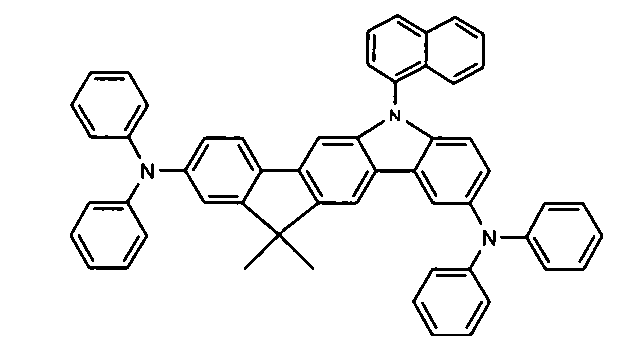


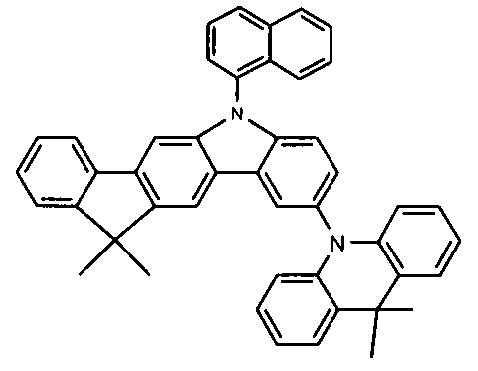


Die obenstehenden und im Folgenden mit # markierten Verbindungen sind nicht anspruchsgemäß.The compounds above and marked with # in the following are not according to the claims.
Im Rahmen der vorliegenden Erfindung werden unter einer Alkylgruppe mit 1 bis 40 C-Atomen, in der auch einzelne H-Atome oder CH2-Gruppen durch die oben in der Definition von R1 genannten Gruppen substituiert sein können, bevorzugt die Reste Methyl, Ethyl, n-Propyl, i-Propyl, n-Butyl, i-Butyl, s-Butyl, t-Butyl, 2-Methylbutyl, n-Pentyl, s-Pentyl, Cyclopentyl, n-Hexyl, Cyclohexyl, n-Heptyl, Cycloheptyl, n-Octyl, Cyclooctyl, 2-Ethylhexyl, Trifluormethyl, Pentafluorethyl oder 2,2,2-Trifluorethyl verstanden. Unter einer Alkenylgruppe im Sinne dieser Erfindung wird beispielsweise Ethenyl, Propenyl, Butenyl, Pentenyl, Cyclopentenyl, Hexenyl, Cyclohexenyl, Heptenyl, Cycloheptenyl, Octenyl oder Cyclooctenyl verstanden. Unter einer Alkinylgruppe im Sinne dieser Erfindung wird beispielsweise Ethinyl, Propinyl, Butinyl, Pentinyl, Hexinyl, Heptinyl oder Octinyl verstanden. Unter einer C1- bis C40-Alkoxygruppe werden beispielsweise Methoxy, Trifluormethoxy, Ethoxy, n-Propoxy, i-Propoxy, n-Butoxy, i-Butoxy, s-Butoxy, t-Butoxy oder 2-Methylbutoxy verstanden.In the context of the present invention, an alkyl group having 1 to 40 carbon atoms, in which individual H atoms or CH 2 groups can also be substituted by the groups mentioned above in the definition of R 1 , preferably the radicals methyl, ethyl , n-propyl, i-propyl, n-butyl, i-butyl, s-butyl, t-butyl, 2-methylbutyl, n-pentyl, s-pentyl, cyclopentyl, n-hexyl, cyclohexyl, n-heptyl, cycloheptyl , n-octyl, cyclooctyl, 2-ethylhexyl, trifluoromethyl, pentafluoroethyl or 2,2,2-trifluoroethyl understood. For the purposes of this invention, an alkenyl group is understood to mean, for example, ethenyl, propenyl, butenyl, pentenyl, cyclopentenyl, hexenyl, cyclohexenyl, heptenyl, cycloheptenyl, octenyl or cyclooctenyl. For the purposes of this invention, an alkynyl group is understood to mean, for example, ethynyl, propynyl, butynyl, pentynyl, hexynyl, heptynyl or octynyl. A C 1 - to C 40 -alkoxy group is understood as meaning, for example, methoxy, trifluoromethoxy, ethoxy, n-propoxy, i-propoxy, n-butoxy, i-butoxy, s-butoxy, t-butoxy or 2-methylbutoxy.
Eine Arylgruppe im Sinne dieser Erfindung enthält bevorzugt 5 bis 40 C-Atome; eine Heteroarylgruppe im Sinne dieser Erfindung enthält 2 bis 40 C-Atome und mindestens ein Heteroatom, mit der Maßgabe, dass die Summe aus C-Atomen und Heteroatomen mindestens 5 ergibt. Die Heteroatome sind bevorzugt ausgewählt aus N, O und/oder S. Dabei wird unter einer Arylgruppe bzw. Heteroarylgruppe entweder ein einfacher aromatischer Cyclus, also Benzol, bzw. ein einfacher heteroaromatischer Cyclus, beispielsweise Pyridin, Pyrimidin, Thiophen, etc., oder eine kondensierte Aryl- oder Heteroarylgruppe, beispielsweise Naphthalin, Anthracen, Benzanthracen, Phenanthren, Pyren, Perylen, Chinolin, Isochinolin, Benzothiophen, Benzofuran und Indol etc., verstanden.An aryl group within the meaning of this invention preferably contains 5 to 40 carbon atoms; a heteroaryl group within the meaning of this invention contains 2 to 40 carbon atoms and at least one heteroatom, with the proviso that the sum of carbon atoms and heteroatoms is at least 5. The heteroatoms are preferably selected from N, O and/or S. An aryl group or heteroaryl group is either a simple aromatic cycle, ie benzene, or a simple heteroaromatic cycle, for example pyridine, pyrimidine, thiophene, etc., or one fused aryl or heteroaryl group, for example naphthalene, anthracene, benzanthracene, phenanthrene, pyrene, perylene, quinoline, isoquinoline, benzothiophene, benzofuran and indole etc. understood.
Ein aromatisches Ringsystem im Sinne dieser Erfindung enthält 5 bis 40 C-Atome im Ringsystem. Ein heteroaromatisches Ringsystem im Sinne dieser Erfindung enthält 2 bis 40 C-Atome und mindestens ein Heteroatom im Ringsystem, mit der Maßgabe, dass die Summe aus C-Atomen und Heteroatomen mindestens 5 ergibt. Die Heteroatome sind bevorzugt ausgewählt aus N, O und/oder S. Unter einem aromatischen oder heteroaromatischen Ringsystem im Sinne dieser Erfindung soll ein System verstanden werden, das nicht notwendigerweise nur Aryl- oder Heteroarylgruppen enthält, sondern in dem auch mehrere Aryl- oder Heteroarylgruppen durch eine nicht-aromatische Einheit (bevorzugt weniger als 10 % der von H verschiedenen Atome), wie z. B. ein sp3-hybridisiertes C-, N- oder O-Atom, unterbrochen sein können. So sollen beispielsweise auch Systeme wie 9,9'-Spirobifluoren, 9,9-Diarylfluoren, Triarylamin, Diarylether, Stilben, etc. als aromatische Ringsysteme im Sinne dieser Erfindung verstanden werden, und ebenso Systeme, in denen zwei oder mehrere Arylgruppen beispielsweise durch eine lineare oder cyclische Alkylgruppe oder durch eine Silylgruppe unterbrochen sind.An aromatic ring system within the meaning of this invention contains 5 to 40 carbon atoms in the ring system. A heteroaromatic ring system within the meaning of this invention contains 2 to 40 carbon atoms and at least one heteroatom in the ring system, with the proviso that the sum of carbon atoms and heteroatoms is at least 5. The heteroatoms are preferably selected from N, O and/or S. An aromatic or heteroaromatic ring system in the context of this invention is to be understood as meaning a system which does not necessarily only contain aryl or heteroaryl groups, but also in which several aryl or heteroaryl groups a non-aromatic moiety (preferably less than 10% of the non-H atoms), such as e.g. B. an sp 3 -hybridised C, N or O atom can be interrupted. For example, systems such as 9,9'-spirobifluorene, 9,9-diarylfluorene, triarylamine, diaryl ether, stilbene, etc. are to be understood as aromatic ring systems in the context of this invention, and also systems in which two or more aryl groups are replaced, for example by one linear or cyclic alkyl group or interrupted by a silyl group.
Unter einem aromatischen oder heteroaromatischen Ringsystem mit 5 - 60 aromatischen Ringatomen, welches noch jeweils mit den oben genannten Resten R substituiert sein kann und welches über beliebige Positionen am Aromaten bzw. Heteroaromaten verknüpft sein kann, werden insbesondere Gruppen verstanden, die abgeleitet sind von Benzol, Naphthalin, Anthracen, Phenanthren, Benzanthracen, Pyren, Chrysen, Perylen, Fluoranthen, Naphthacen, Pentacen, Benzpyren, Biphenyl, Biphenylen, Terphenyl, Terphenylen, Fluoren, Spirobifluoren, Dihydrophenanthren, Dihydropyren, Tetrahydropyren, cis- oder trans-Indenofluoren, Truxen, Isotruxen, Spirotruxen, Spiroisotruxen, Furan, Benzofuran, Isobenzofuran, Dibenzofuran, Thiophen, Benzothiophen, Isobenzothiophen, Dibenzothiophen, Pyrrol, Indol, Isoindol, Carbazol, Pyridin, Chinolin, Isochinolin, Acridin, Phenanthridin, Benzo-5,6-chinolin, Benzo-6,7-chinolin, Benzo-7,8-chinolin, Phenothiazin, Phenoxazin, Pyrazol, Indazol, Imidazol, Benzimidazol, Naphthimidazol, Phenanthrimidazol, Pyridimidazol, Pyrazinimidazol, Chinoxalinimidazol, Oxazol, Benzoxazol, Naphthoxazol, Anthroxazol, Phenanthroxazol, Isoxazol, 1,2-Thiazol, 1,3-Thiazol, Benzothiazol, Pyridazin, Benzopyridazin, Pyrimidin, Benzpyrimidin, Chinoxalin, 1,5-Diazaanthracen, 2,7-Diazapyren, 2,3-Diazapyren, 1,6-Diazapyren, 1,8-Diazapyren, 4,5-Diazapyren, 4,5,9,10-Tetraazaperylen, Pyrazin, Phenazin, Phenoxazin, Phenothiazin, Fluorubin, Naphthyridin, Azacarbazol, Benzocarbolin, Phenanthrolin, 1,2,3-Triazol, 1,2,4-Triazol, Benzotriazol, 1,2,3-Oxadiazol, 1,2,4-Oxadiazol, 1,2,5-Oxadiazol, 1,3,4-Oxadiazol, 1,2,3-Thiadiazol, 1,2,4-Thiadiazol, 1,2,5-Thiadiazol, 1,3,4-Thiadiazol, 1,3,5-Triazin, 1,2,4-Triazin, 1,2,3-Triazin, Tetrazol, 1,2,4,5-Tetrazin, 1,2,3,4-Tetrazin, 1,2,3,5-Tetrazin, Purin, Pteridin, Indolizin und Benzothiadiazol.An aromatic or heteroaromatic ring system with 5-60 aromatic ring atoms, which can also be substituted by the abovementioned R radicals and which can be linked via any position on the aromatic or heteroaromatic, is understood to mean, in particular, groups which are derived from benzene, Naphthalene, anthracene, phenanthrene, benzanthracene, pyrene, chrysene, perylene, fluoranthene, naphthacene, pentacene, benzopyrene, biphenyl, biphenylene, terphenyl, terphenylene, fluorene, spirobifluorene, dihydrophenanthrene, dihydropyrene, tetrahydropyrene, cis or trans indenofluorene, truxene, isotruxene , spirotruxen, spiroisotruxen, furan, benzofuran, isobenzofuran, dibenzofuran, thiophene, benzothiophene, isobenzothiophene, dibenzothiophene, pyrrole, indole, isoindole, carbazole, pyridine, quinoline, isoquinoline, acridine, phenanthridine, benzo-5,6-quinoline, benzo-6 ,7-quinoline, benzo-7,8-quinoline, phenothiazine, phenoxazine, pyrazole, indazole, imidazole, benzimidazole, naphthimidazole, phenanthrimidazole, pyridimidazole, pyrazineimidazole, quinoxalineimidazole, oxazole, benzoxazole, naphthoxazole, anthroxazole, phenanthroxazole, isoxazole, 1,2 -Thiazole, 1,3-thiazole, benzothiazole, pyridazine, benzopyridazine, pyrimidine, Benzopyrimidine, quinoxaline, 1,5-diazaanthracene, 2,7-diazapyrene, 2,3-diazapyrene, 1,6-diazapyrene, 1,8-diazapyrene, 4,5-diazapyrene, 4,5,9,10-tetraazaperylene, Pyrazine, Phenazine, Phenoxazine, Phenothiazine, Fluorubine, Naphthyridine, Azacarbazole, Benzocarboline, Phenanthroline, 1,2,3-Triazole, 1,2,4-Triazole, Benzotriazole, 1,2,3-Oxadiazole, 1,2,4- oxadiazole, 1,2,5-oxadiazole, 1,3,4-oxadiazole, 1,2,3-thiadiazole, 1,2,4-thiadiazole, 1,2,5-thiadiazole, 1,3,4-thiadiazole, 1,3,5-Triazine, 1,2,4-Triazine, 1,2,3-Triazine, Tetrazole, 1,2,4,5-Tetrazine, 1,2,3,4-Tetrazine, 1,2, 3,5-tetrazine, purine, pteridine, indolizine and benzothiadiazole.
Die erfindungsgemäßen Verbindungen können nach dem Fachmann bekannten Syntheseschritten, wie z. B. Bromierung, Suzuki-Kupplung, Hartwig-Buchwald-Kupplung, etc., dargestellt werden.The compounds according to the invention can be prepared by synthesis steps known to those skilled in the art, such as, for. B. bromination, Suzuki coupling, Hartwig-Buchwald coupling, etc., are shown.
So können die Indenofluoren-Vorstufen beispielsweise hergestellt werden, wie in Syntheseschema 1 abgebildet: Durch Suzuki-Kupplung einer Benzolboronsäure und einer substituierten 1,4-Dibrombenzol-Verbindung, gefolgt von Ringschluss, beispielsweise unter Einwirkung einer starken Säure und Reduktion ist das unsubstituierte trans-Indenofluoren erhältlich, welches mit Alkylierungsmitteln alkyliert werden kann. Dieses kann entweder halogeniert, beispielsweise bromiert, werden oder durch Nitrierung und Reduktion in die entsprechende Aminoverbindung umgewandelt werden. Die Synthese von Bis-diarylamino-indenofluorenen kann durch Hartwig-Buchwald-Kupplung der Dibromverbindung erfolgen, wie in Syntheseschema 2 dargestellt.For example, the indenofluorene precursors can be prepared as depicted in Synthetic Scheme 1: Suzuki coupling of a benzene boronic acid and a substituted 1,4-dibromobenzene compound, followed by ring closure, e.g., under the action of a strong acid and reduction, gives the unsubstituted trans- Indenofluorene available, which can be alkylated with alkylating agents. This can either be halogenated, for example brominated, or converted into the corresponding amino compound by nitration and reduction. Bis-diarylamino-indenofluorenes can be synthesized by Hartwig-Buchwald coupling of the dibromo compound, as shown in Synthesis Scheme 2.
Die Synthese von Indenofluoren enthaltenden Phosphinen bzw. Phosphinoxiden kann aus Dibromindenofluoren durch Lithiierung und Umsetzung mit Diarylchlorphosphinen erfolgen, wie in Syntheseschema 3 dargestellt. Oxidation ergibt dann das entsprechende Phosphinoxid. Ebenso lassen sich hier andere Elektrophile einsetzen, wie z. B. AsCl3, AryIPCl2, SOCl2, Ar2S2, etc. Weitere erfindungsgemäße Verbindungen können nach diesen und ähnlichen Syntheseschemata leicht in dem Fachmann für organische Synthese bekannten Verfahren synthetisiert werden. Weiterhin können die erhaltenen Verbindungen nach Standardverfahren bromiert werden und können so als Monomere für Polymere, Oligomere oder Dendrimere eingesetzt werden.Phosphines or phosphine oxides containing indenofluorene can be synthesized from dibromoindenofluorene by lithiation and reaction with diarylchlorophosphines, as shown in synthesis scheme 3. Oxidation then gives the corresponding phosphine oxide. Other electrophiles can also be used here, such as e.g. B. AsCl 3 , AryIPCl 2 , SOCl 2 , Ar 2 S 2 , etc. Other compounds of the invention can be readily synthesized following these and similar synthetic schemes using methods known to those skilled in the art of organic synthesis. Furthermore, the compounds obtained can be brominated by standard methods and can thus be used as monomers for polymers, oligomers or dendrimers.
Ein weiterer Gegenstand der Erfindung ist ein Verfahren zur Herstellung einer Verbindung der allgemeinen Formel Vla, Vlla, Vllla oder IXa, gekennzeichnet durch die Schritte:
- a) Durchführung einer metallkatalysierten Kreuzkupplungsreaktion einer mit X1 substituierten aromatischen oder heteroaromatischen Dihalogen-Verbindung mit weiteren, gegebenenfalls mit A substituierten, aromatischen oder heteroaromatischen Verbindungen,
- b) Bilden einer bivalenten Brücke -X- zwischen den gekuppelten aromatischen oder heteroaromatischen Verbindungen,
- a) Carrying out a metal-catalyzed cross-coupling reaction of an aromatic or heteroaromatic dihalogen compound substituted by X 1 with other aromatic or heteroaromatic compounds optionally substituted by A,
- b) forming a bivalent bridge -X- between the coupled aromatic or heteroaromatic compounds,
Bei der aromatischen oder heteroaromatischen Dihalogen-Verbindung handelt es sich bevorzugt um eine 1,4-Dibrombenzolverbindung, welche bevorzugt in ortho-Stellung zu den Halogenen mit X1 substituiert ist, zur Erzeugung von trans-Derivaten oder um eine entsprechende 1,2-Dibrombenzolverbindung zur Erzeugung von cis-Derivaten.The aromatic or heteroaromatic dihalo compound is preferably a 1,4-dibromobenzene compound, which is preferably substituted ortho to the halogens with X 1 to produce trans derivatives, or a corresponding 1,2-dibromobenzene compound to generate cis derivatives.
Die gegebenfalls mit A substituierten, aromatischen oder heteroaromatischen Verbindungen tragen bevorzugt eine Boronsäure- oder Boronsäureester-Funktionalität.The aromatic or heteroaromatic compounds optionally substituted with A preferably carry a boronic acid or boronic ester functionality.
Nach erfolgreichem Ringschluss bildet X eine bivalente Brücke zwischen den aromatischen bzw. heteroaromatischen Komponenten (siehe Syntheseschema 1). Dabei eignet sich beispielsweise eine Carbonsäureestergruppe oder eine Acetylgruppe als Gruppe X1, welche dann in der Ringschlussreaktion zu einer Brücke X = Kohlenstoff umgesetzt werden kann. Weiterhin eignet sich eine Nitrogruppe als Gruppe X1, welche dann in der Ringschlussreaktion zu einer Brücke X = Stickstoff umgesetzt werden kann. Weiterhin eignet sich eine Thioethergruppe, insbesondere eine Alkylthioethergruppe, als Gruppe X1, welche dann in der Ringschlussreaktion zu einer Brücke X = Schwefel umgesetzt werden kann. Die bivalente Brücke X kann im weiteren Verlauf mit weiteren Resten substituiert werden, beispielsweise mit Alkyl- oder Arylgruppen oder allgemein mit R1, wie oben definiert. Die so hergestellte Indenofluoren-Verbindung kann nun in einem weiteren Schritt funktionalisiert werden, beispielsweise halogeniert, bevorzugt bromiert. Dadurch steht eine funktionelle Gruppe für die Einbringung der in Syntheseschema 2 und 3 gezeigten Reste zur Verfügung.


Die Verbindungen gemäß Formel Vla, Vlla, Vllla oder IXa können in organischen Elektrolumineszenzvorrichtungen eingesetzt werden. Die genaue Verwendung der Verbindungen hängt dabei von den Substituenten ab.The compounds of the formula Vla, Vlla, Vllla or IXa can be used in organic electroluminescent devices. The exact use of the compounds depends on the substituents.
In einer bevorzugten Ausführungsform der Erfindung wird die Verbindung gemäß einer der Formeln VIa, Vlla, Vllla oder IXa in einer emittierenden Schicht, bevorzugt in Mischung mit mindestens einer weiteren Verbindung eingesetzt. Es ist bevorzugt, wenn die Verbindung gemäß einer der Formeln Vla, Vlla, Villa oder IXa in der Mischung die emittierende Verbindung (der Dotand) ist. Bevorzugte Hostmaterialien sind organische Verbindungen, deren Emission kurzwelliger ist als die der Verbindung gemäß einer der Formeln Via, Vlla, Vllla oder IXa oder die überhaupt nicht emittieren.In a preferred embodiment of the invention, the compound of one of the formulas VIa, VIIa, VIIla or IXa is used in an emitting layer, preferably in a mixture with at least one further compound. It is preferred if the compound according to one of the formulas VIa, VIIa, VIIIa or IXa is the emitting compound (the dopant) in the mixture. Preferred host materials are organic compounds whose emission is of shorter wavelength than that of the compound according to one of the formulas Via, VIIa, VIIla or IXa or which do not emit at all.
Weiterer Gegenstand der Erfindung sind daher Mischungen aus einer oder mehreren Verbindungen gemäß einer der Formeln VIa, Vlla, Vllla oder IXa mit einem oder mehreren Hostmaterialien.The invention therefore also relates to mixtures of one or more compounds of one of the formulas VIa, VIIa, VIIla or IXa with one or more host materials.
Der Anteil der Verbindung gemäß einer der Formeln Vla, Vlla, Vllla oder IXa in der Mischung der emittierenden Schicht beträgt zwischen 0.1 und 99.0 Vol.%, bevorzugt zwischen 0.5 und 50.0 Vol.%, besonders bevorzugt zwischen 1.0 und 20.0 Vol.%, insbesondere zwischen 1.0 und 10.0 Vol.%. Entsprechend beträgt der Anteil des Hostmaterials in der Schicht zwischen 1.0 und 99.9 Vol.%, bevorzugt zwischen 50.0 und 99.5 Vol.%, besonders bevorzugt zwischen 80.0 und 99.0 Vol.%, insbesondere zwischen 90.0 und 99.0 Vol.%.The proportion of the compound according to one of the formulas Vla, Vlla, Vllla or IXa in the mixture of the emitting layer is between 0.1 and 99.0% by volume, preferably between 0.5 and 50.0% by volume, particularly preferably between 1.0 and 20.0% by volume, in particular between 1.0 and 10.0% by volume. Correspondingly, the proportion of host material in the layer is between 1.0 and 99.9% by volume, preferably between 50.0 and 99.5% by volume, particularly preferably between 80.0 and 99.0% by volume, in particular between 90.0 and 99.0% by volume.
Als Hostmaterialien kommen verschiedene Stoffklassen in Frage. Bevorzugte Hostmaterialien sind ausgewählt aus den Klassen der Oligoarylene (z. B. 2,2',7,7'-tetraphenyl-spirobifluoren gemäß
Es ist weiterhin insbesondere bevorzugt, dass die Verbindungen gemäß einer der Formeln VIa, VIIa, VIIIa oder IXa als Lochtransportmaterial und/oder als Lochinjektionsmaterial eingesetzt werden. Die Verbindungen werden dann bevorzugt in einer Lochtransportschicht und/oder in einer Lochinjektionsschicht eingesetzt. Eine Lochinjektionsschicht im Sinne dieser Erfindung ist eine Schicht, die direkt an die Anode angrenzt. Eine Lochtransportschicht im Sinne dieser Erfindung ist eine Schicht, die zwischen der Lochinjektionsschicht und der Emissionsschicht liegt. Wenn die Verbindungen gemäß einer der Formeln I, II, III oder IV als Lochtransport- bzw. als Lochinjektionsmaterial verwendet werden, kann es bevorzugt sein, wenn sie mit Elektronenakzeptor-Verbindungen dotiert sind, beispielsweise mit F4-TCNQ oder mit Verbindungen, wie sie in
Wird die Verbindung gemäß einer der Formeln VIa oder VIIa als Lochtransportmaterial in einer Lochtransportschicht eingesetzt, kann auch ein Anteil von 100 % bevorzugt sein, also die Verwendung dieser Verbindung als Reinmaterial.If the compound of one of the formulas VIa or VIIa is used as a hole-transport material in a hole-transport layer, a proportion of 100% can also be preferred, ie the use of this compound as a pure material.
Insbesondere bevorzugt ist auch die Verwendung gemäß einer der Formeln VIa, VIIa, VIIIa oder IXa in einer Lochtransport- oder -injektionsschicht in Kombination mit einer Schicht, welche ein Hexaazatriphenylenderivat enthält, insbesondere Hexacyanohexaazatriphenylen (z. B. gemäß
Ein weiterer Gegenstand der Erfindung ist die Verwendung der oben definierten Verbindungen in elektronischen Vorrichtungen.Another object of the invention is the use of the compounds defined above in electronic devices.
Die oben dargestellten Verbindungen können auch zur Herstellung von Polymeren, Oligomeren oder Dendrimeren verwendet werden. Dies erfolgt gewöhnlich über polymerisierbare funktionelle Gruppen. Hierzu sind insbesondere solche Verbindungen bevorzugt, welche mit reaktiven Abgangsgruppen, wie Brom, lod, Boronsäure, Boronsäureester, Tosylat oder Triflat substituiert sind. Diese können auch als Comonomere zur Erzeugung entsprechender konjugierter, teilkonjugierter oder nichtkonjugierter Polymere, Oligomere oder auch als Kern von Dendrimeren Verwendung finden. Die Polymerisation erfolgt dabei bevorzugt über die Halogenfunktionalität bzw. die Boronsäurefunktionalität. Ein weiterer Gegenstand der Erfindung sind somit Polymere, Oligomere oder Dendrimere, enthaltend eine oder mehrere Verbindungen gemäß einer der Formeln VIa, VIIa, VIIIa oder IXa wobei ein oder mehrere Reste oder H-Atome der oben definierten Verbindungen eine Bindung zum Polymer, Oligomer oder Dendrimer darstellen. Dabei können die Polymere, Oligomere oder Dendrimere konjugiert, teilkonjugiert oder nicht-konjugiert sein. Ebenfalls umfasst sind Blends der erfindungsgemäßen Polymere, Oligomere oder Dendrimere mit weiteren Polymeren, Oligomeren oder Dendrimeren.The compounds shown above can also be used to prepare polymers, oligomers or dendrimers. This is usually done via polymerizable functional groups. For this purpose, particular preference is given to compounds which are substituted with reactive leaving groups, such as bromine, iodine, boronic acid, boronic esters, tosylate or triflate. These can also be used as comonomers to produce corresponding conjugated, partially conjugated or non-conjugated polymers, oligomers or as cores of dendrimers. The polymerization preferably takes place via the halogen functionality or the boronic acid functionality. A further subject of the invention are therefore polymers, oligomers or dendrimers containing one or more compounds according to one of the formulas VIa, VIIa, VIIIa or IXa where one or more radicals or H atoms of the compound defined above gene represent a bond to the polymer, oligomer or dendrimer. The polymers, oligomers or dendrimers can be conjugated, partially conjugated or non-conjugated. Blends of the polymers, oligomers or dendrimers according to the invention with other polymers, oligomers or dendrimers are also included.
Als Oligomer wird im Sinne dieser Erfindung eine Verbindung bezeichnet, welche etwa drei bis neun Wiederholungseinheiten aufweist. Als Polymer im Sinne der Erfindung wird eine Verbindung verstanden, welche zehn oder mehr Wiederholungseinheiten aufweist.In the context of this invention, an oligomer is a compound which has about three to nine repeating units. For the purposes of the invention, a polymer is understood to mean a compound which has ten or more repeating units.
Diese Polymere können weitere Wiederholeinheiten enthalten. Diese weiteren Wiederholeinheiten sind vorzugsweise ausgewählt aus der Gruppe, bestehend aus Fluorenen (z. B. gemäß
Ebenfalls Gegenstand der Erfindung ist die Verwendung der oben definierten Polymere, Oligomere oder Dendrimere in elektronischen Vorrichtungen.The invention also relates to the use of the polymers, oligomers or dendrimers defined above in electronic devices.
Ein weiterer Gegenstand der Erfindung ist eine elektronische Vorrichtung, enthaltend mindestens eine Verbindung wie oben definert oder ein Polymer, Oligomer oder Dendrimer wie oben defniert.Another subject of the invention is an electronic device containing at least one compound as defined above or a polymer, oligomer or dendrimer as defined above.
Die organische elektronische Vorrichtung ist bevorzugt ausgewählt aus der Gruppe bestehend aus organischen Elektrolumineszenzvorrichtungen (OLEDs), organischen Feld-Effekt-Transistoren (O-FETs), organischen Dünnfilmtransistoren (O-TFTs), organischen lichtemittierenden Transistoren (O-LETs), organischen integrierten Schaltungen (O-ICs), organischen Solarzellen (O-SCs), organischen Feld-Quench-Devices (O-FQDs), lichtemittierenden elektrochemischen Zellen (LECs), organischen Photorezeptoren oder organischen Laserdioden (O-Laser).The organic electronic device is preferably selected from the group consisting of organic electroluminescent devices (OLEDs), organic field effect transistors (O-FETs), organic thin film transistors (O-TFTs), organic light-emitting transistors (O-LETs), organic integrated circuits (O-ICs), organic solar cells (O-SCs), organic field quench devices (O-FQDs), light-emitting electrochemical cells (LECs), organic photoreceptors or organic laser diodes (O-lasers).
Es ist im Rahmen der Erfindung bevorzugt, dass in der organischen elektronischen Vorrichtung die erfindungsgemäßen Verbindungen gemäß einer der Formeln VIa, Vlla, Vllla oder IXa oder die erfindungsgemäßen Polymere, Oligomere oder Dendrimere als Lochtransportmaterial in einer Lochtransportschicht und/oder in einer Lochinjektionsschicht eingesetzt werden und dass die Verbindungen gemäß einer der Formeln VIa, Vlla, Vllla oder IXa oder die Polymere, Oligomere oder Dendrimere in diesen Schichten gegebenenfalls durch Elektronenakzeptor-Verbindungen dotiert sein können.It is preferred within the scope of the invention that the compounds according to the invention according to one of the formulas VIa, VIIa, VIIla or IXa or the polymers, oligomers or dendrimers according to the invention are used as hole-transport material in a hole-transport layer and/or in a hole-injection layer in the organic electronic device and that the compounds according to one of the formulas VIa, VIIa, VIIla or IXa or the polymers, oligomers or dendrimers in these layers can optionally be doped by electron acceptor compounds.
Es ist im Rahmen der Erfindung ferner bevorzugt, dass in der organischen Elektrolumineszenzvorrichtung die erfindungsgemäßen Verbindungen gemäß einer der Formeln VIa, Vlla, Vllla oder IXa oder die erfindungsgemäßen Polymere, Oligomere oder Dendrimere als Elektronentransportmaterial in einer Elektronentransportschicht und/oder als Lochblockiermaterial in einer Lochblockierschicht und/oder als Triplett-Matrixmaterial in einer emittierenden Schicht eingesetzt werden.It is also preferred within the scope of the invention that in the organic electroluminescent device the compounds according to the invention according to one of the formulas VIa, VIIa, VIIla or IXa or the polymers, oligomers or dendrimers according to the invention are used as electron transport material in an electron transport layer and/or as hole blocking material in a hole blocking layer and /or used as a triplet matrix material in an emitting layer.
Die organische Elektrolumineszenzvorrichtung umfasst eine Anode, eine Kathode und mindestens eine emittierende Schicht, wobei die emittierende Schicht oder eine der anderen Schichten mindestens eine Verbindung gemäß einer der Formeln VIa, Vlla, Vllla oder IXa oder die erfindungsgemäßen Polymere, Oligomere oder Dendrimere enthält.The organic electroluminescence device comprises an anode, a cathode and at least one emitting layer, the emitting layer or one of the other layers containing at least one compound of one of the formulas VIa, VIIa, VIIla or IXa or the polymers, oligomers or dendrimers according to the invention.
Als Kathode sind Metalle mit geringer Austrittsarbeit, Metalllegierungen oder mehrlagige Strukturen aus verschiedenen Metallen bevorzugt, wie beispielsweise Erdalkalimetalle, Alkalimetalle, Hauptgruppenmetalle oder Lathanoide (z. B. Ca, Ba, Mg, Al, In, Mg, Yb, Sm, etc.). Weiterhin eignen sich Legierungen aus einem Alkali- oder Erdalkalimetall und Silber, beispielsweise eine Legierung aus Magnesium und Silber. Bei mehrlagigen Strukturen können auch zusätzlich zu den genannten Metallen weitere Metalle verwendet werden, die eine relativ hohe Austrittsarbeit aufweisen, wie z. B. Ag, wobei dann in der Regel Kombinationen der Metalle, wie beispielsweise Ca/Ag oder Ba/Ag verwendet werden. Es kann auch bevorzugt sein, zwischen einer metallischen Kathode und dem organischen Halbleiter eine dünne Zwischenschicht eines Materials mit einer hohen Dielektrizitätskonstante einzubringen. Hierfür kommen beispielsweise Alkalimetall- oder Erdalkalimetallfluoride, aber auch die entsprechenden Oxide oder Carbonate in Frage (z. B. LiF, Li2O, BaF2, MgO, NaF, CsF, Cs2CO3, etc.). Die Schichtdicke dieser Schicht beträgt bevorzugt zwischen 0.5 und 5 nm.Metals with a low work function, metal alloys or multilayer structures made of different metals are preferred as cathodes, such as alkaline earth metals, alkali metals, main group metals or lanthanides (e.g. Ca, Ba, Mg, Al, In, Mg, Yb, Sm, etc.) . Also suitable are alloys of an alkali metal or alkaline earth metal and silver, for example an alloy of magnesium and silver. In the case of multilayer structures, in addition to the metals mentioned, other metals can also be used which have a relatively high work function, such as e.g. B. Ag, in which case combinations of the metals, such as Ca/Ag or Ba/Ag, are then generally used. It can also be preferred to use a thin intermediate layer of a mate between a metallic cathode and the organic semiconductor introduce rials with a high dielectric constant. Alkali metal or alkaline earth metal fluorides, for example, but also the corresponding oxides or carbonates (eg LiF, Li 2 O, BaF 2 , MgO, NaF, CsF, Cs 2 CO 3 , etc.) are suitable for this purpose. The layer thickness of this layer is preferably between 0.5 and 5 nm.
Als Anode sind Materialien mit hoher Austrittsarbeit bevorzugt. Bevorzugt weist die Anode eine Austrittsarbeit größer 4.5 eV vs. Vakuum auf. Hierfür sind einerseits Metalle mit hohem Redoxpotential geeignet, wie beispielsweise Ag, Pt oder Au. Es können andererseits auch Metall/Metalloxid-Elektronen (z. B. Al/Ni/NiOx, Al/PtOx) bevorzugt sein. Für einige Anwendungen muss mindestens eine der Elektroden transparent sein, um entweder die Bestrahlung des organischen Materials (O-SC) oder die Auskopplung von Licht (OLED/PLED, O-LASER) zu ermöglichen. Ein bevorzugter Aufbau verwendet eine transparente Anode. Bevorzugte Anodenmaterialien sind hier leitfähige gemischte Metalloxide. Besonders bevorzugt sind Indium-Zinn-Oxid (ITO) oder Indium-Zink Oxid (IZO). Bevorzugt sind weiterhin leitfähige, dotierte organische Materialien, insbesondere leitfähige dotierte Polymere.Materials with a high work function are preferred as the anode. The anode preferably has a work function of greater than 4.5 eV vs. vacuum. On the one hand, metals with a high redox potential, such as Ag, Pt or Au, are suitable for this. On the other hand, metal/metal oxide electrons (eg Al/Ni/NiO x , Al/PtO x ) can also be preferred. For some applications, at least one of the electrodes must be transparent to allow either the irradiation of the organic material (O-SC) or the extraction of light (OLED/PLED, O-LASER). A preferred construction uses a transparent anode. Preferred anode materials here are conductive mixed metal oxides. Indium tin oxide (ITO) or indium zinc oxide (IZO) are particularly preferred. Conductive, doped organic materials, in particular conductive, doped polymers, are also preferred.
Die Vorrichtung wird entsprechend (je nach Anwendung) strukturiert, kontaktiert und schließlich hermetisch versiegelt, da sich die Lebensdauer derartiger Vorrichtungen bei Anwesenheit von Wasser und/oder Luft drastisch verkürzt.The device is structured accordingly (depending on the application), contacted and finally hermetically sealed, since the service life of such devices is drastically reduced in the presence of water and/or air.
Auch in Polymeren, Oligomeren oder Dendrimeren können Verbindungen gemäß einer der Formeln VIa, VIIa, VIIIa oder IXa entweder als emittierende Einheit und/oder als lochtransportierende Einheit und/oder als elektronentransportierende Einheit und/oder als Matrix-Einheit eingesetzt werden.In polymers, oligomers or dendrimers, too, compounds of one of the formulas VIa, VIIa, VIIIa or IXa can be used either as an emitting unit and/or as a hole-transporting unit and/or as an electron-transporting unit and/or as a matrix unit.
Weiterhin bevorzugt sind organische Elektrolumineszenzvorrichtungen, dadurch gekennzeichnet, dass mehrere emittierende Verbindungen in derselben Schicht oder in unterschiedlichen Schichten verwendet werden. Besonders bevorzugt weisen diese Verbindungen ins-gesamt mehrere Emissionsmaxima zwischen 380 nm und 750 nm auf, so dass insgesamt weiße Emission resultiert, d. h. es werden mehrere emittierende Verbindungen verwendet, die fluoreszieren oder phosphoreszieren können. Insbesondere bevorzugt sind Dreischichtsysteme, wobei die Schichten blaue, grüne und orange oder rote Emission zeigen (für den prinzipiellen Aufbau siehe z. B.
Außer Kathode, Anode und der emittierenden Schicht kann die organische Elektrolumineszenzvorrichtung noch weitere Schichten enthalten. Diese können beispielsweise sein: Lochinjektionsschicht, Lochtransportschicht, Lochblockierschicht, Elektronentransportschicht, Elektronenblockierschicht, Elektroneninjektionsschicht und/oder eine Charge-Generation Layer (T. Matsumoto et al., Multiphoton Organic EL Device Having Charge Generation Layer, IDMC 2003, Taiwan; Session 21 OLED (5)) oder organische oder anorganische p/n-Übergänge. Weiterhin können zwischen den Schichten, insbesondere zwischen zwei emittierenden Schichten Zwischenschichten (Interlayers) eingebracht sein. Es sei aber an dieser Stelle darauf hingewiesen, dass nicht notwendigerweise jede dieser Schichten vorhanden sein muss. So werden insbesondere bei Verwendung von Verbindungen gemäß einer der Formeln VIa, VIIa, VIIIa oder IXa mit elektronenleitenden Hostmaterialien weiterhin sehr gute Ergebnisse erhalten, wenn die organische Elektrolumineszenzvorrichtung keine separate Elektronentransportschicht enthält und die emittierende Schicht direkt an die Elektroneninjektionsschicht oder an die Kathode grenzt. Alternativ kann das Hostmaterial auch gleichzeitig in einer Elektronentransportschicht als Elektronentransportmaterial dienen. Ebenfalls kann es bevorzugt sein, wenn die organische Elektrolumineszenzvorrichtung keine separate Lochtransportschicht enthält und die emittierende Schicht direkt an die Lochinjektionsschicht oder an die Anode grenzt. Weiterhin kann es bevorzugt sein, wenn die Verbindung gemäß einer der Formeln VIa, VIIa, VIIIa oder IXa gleichzeitig als Dotand in der emittierenden Schicht und als lochleitende Verbindung (als Reinsubstanz oder als Mischung) in einer Lochtransportschicht und/oder in einer Lochinjektionsschicht verwendet wird.In addition to the cathode, anode and the emitting layer, the organic electroluminescent device can also contain further layers. These can be, for example: hole injection layer, hole transport layer, hole blocking layer, electron transport layer, electron blocking layer, electron injection layer and/or a charge generation layer (T. Matsumoto et al., Multiphoton Organic EL Device Having Charge Generation Layer, IDMC 2003, Taiwan; Session 21 OLED ( 5)) or organic or inorganic p/n transitions. Furthermore, intermediate layers (interlayers) can be introduced between the layers, in particular between two emitting layers. However, it should be pointed out at this point that each of these layers does not necessarily have to be present. In particular when using compounds according to one of the formulas VIa, VIIa, VIIIa or IXa with electron-conducting host materials, very good results are still obtained if the organic electroluminescent device does not contain a separate electron transport layer and the emitting layer is directly adjacent to the electron injection layer or to the cathode. Alternatively, the host material can also simultaneously serve as electron transport material in an electron transport layer. It can also be preferred if the organic electroluminescent device does not contain a separate hole-transport layer and the emitting layer is directly adjacent to the hole-injection layer or to the anode. Furthermore, it can be preferred if the compound according to one of the formulas VIa, VIIa, VIIIa or IXa is used simultaneously as a dopant in the emitting layer and as a hole-conducting compound (as a pure substance or as a mixture) in a hole-transport layer and/or in a hole-injection layer.
Weiterhin bevorzugt ist eine organische Elektrolumineszenzvorrichtung, dadurch gekennzeichnet, dass eine oder mehrere Schichten mit einem Sublimationsverfahren beschichtet werden. Dabei werden die Materialien in Vakuum-Sublimationsanlagen bei einem Anfangsdruck von üblicherweise kleiner als 10-5 mbar, bevorzugt kleiner 10-6 mbar aufgedampft. Es ist dabei aber auch möglich, bei noch geringerem Druck zu arbeiten, beispielsweise bei einem Anfangsdruck von kleiner 10-7 mbar.Also preferred is an organic electroluminescent device, characterized in that one or more layers are coated using a sublimation process. The materials are vapour-deposited in vacuum sublimation systems at an initial pressure of usually less than 10 -5 mbar, preferably less than 10 -6 mbar. However, it is also possible to work at an even lower pressure, for example at an initial pressure of less than 10 -7 mbar.
Bevorzugt ist ebenfalls eine organische Elektrolumineszenzvorrichtung, dadurch gekennzeichnet, dass eine oder mehrere Schichten mit dem OVPD (Organic Vapour Phase Deposition) Verfahren oder mit Hilfe einer Trägergassublimation beschichtet werden. Dabei werden die Materialien bei einem Druck zwischen 10-5 mbar und 1 bar aufgebracht. Ein Spezialfall dieses Verfahrens ist das OVJP (Organic Vapour Jet Printing) Verfahren, bei dem die Materialien direkt durch eine Düse aufgebracht und so strukturiert werden (z. B. M. S. Arnold et al., Appl. Phys. Lett. 2008, 92, 053301).An organic electroluminescent device is also preferred, characterized in that one or more layers are coated using the OVPD (organic vapor phase deposition) method or with the aid of carrier gas sublimation. The materials are applied at a pressure between 10 -5 mbar and 1 bar. A special case of this process is the OVJP (Organic Vapor Jet Printing) Process in which the materials are applied directly through a nozzle and structured in this way (e.g. BMS Arnold et al., Appl. Phys. Lett. 2008, 92, 053301).
Weiterhin bevorzugt ist eine organische Elektrolumineszenzvorrichtung, dadurch gekennzeichnet, dass eine oder mehrere Schichten aus Lösung, wie z. B. durch Spincoating, oder mit einem beliebigen Druckverfahren, wie z. B. Siebdruck, Flexodruck oder Offsetdruck, besonders bevorzugt aber LITI (Light Induced Thermal Imaging, Thermotransferdruck) oder Ink-Jet Druck (Tintenstrahldruck), hergestellt werden. Hierfür sind lösliche Verbindungen gemäß einer der Formeln VIa, Vlla, Villa oder IXa nötig. Hohe Löslichkeit lässt sich durch geeignete Substitution der Verbindungen erreichen. Diese Verfahren zur Herstellung von Schichten eignen sich insbesondere für Polymere, Oligomere oder Dendrimere.Also preferred is an organic electroluminescent device, characterized in that one or more layers of solution, such as. B. by spin coating, or with any printing method, such as. B. screen printing, flexographic printing or offset printing, but particularly preferably LITI (Light Induced Thermal Imaging, thermal transfer printing) or ink-jet printing (ink jet printing). This requires soluble compounds according to one of the formulas VIa, VIIa, Villa or IXa. High solubility can be achieved by suitable substitution of the compounds. These methods for producing layers are particularly suitable for polymers, oligomers or dendrimers.
Die erfindungsgemäßen Verbindungen weisen bei Verwendung in organischen Elektrolumineszenzvorrichtungen folgende überraschende Vorteile gegenüber dem Stand der Technik auf:
- 1. Die Effizienz, insbesondere die Leistungseffizienz, entsprechender Vorrichtungen wird höher im Vergleich zu Systemen gemäß dem Stand der Technik.
- 2. Die Stabilität entsprechender Vorrichtungen wird höher im Vergleich zu Systemen gemäß dem Stand der Technik, was sich vor allem in einer deutlich höheren Lebensdauer zeigt. Dies gilt insbesondere für die Verwendung der erfindungsgemäßen Verbindungen in dicken Schichten.
- 3. Bei Verwendung der erfindungsgemäßen Verbindungen als Lochtransportmaterial in einer Lochtransport- und/oder Lochinjektionsschicht zeigt sich, dass die Spannung nahezu unabhängig von der Schichtdicke der entsprechenden Lochtransport- bzw. Lochinjektionsschicht ist. Dagegen erhält man mit Materialien gemäß dem Stand der Technik bei dickeren Schichtdicken der Lochtransport- bzw. Lochinjektionsschichten einen deutlichen Spannungsanstieg, welcher wiederum zu einer geringeren Leistungseffizienz der OLED führt.
- 4. Die erfindungsgemäßen Materialien zeigen keinerlei oder kaum Neigung, während des Aufdampfprozesses am Rand der Aufdampfquelle zu kristallisieren und diese zu verstopfen. Sie eignen sich daher deutlich besser für die Massenproduktion als Materialien gemäß dem Stand der Technik, die dieses Problem aufweisen.
- 1. The efficiency, in particular the power efficiency, of corresponding devices is higher compared to systems according to the prior art.
- 2. The stability of corresponding devices is higher in comparison to systems according to the state of the art, which is reflected above all in a significantly longer service life. This applies in particular to the use of the compounds according to the invention in thick layers.
- 3. When the compounds according to the invention are used as hole-transport material in a hole-transport and/or hole-injection layer, it is found that the stress is almost independent of the layer thickness of the corresponding hole-transport or hole-injection layer. In contrast, with materials according to the prior art, with thicker layer thicknesses of the hole transport or hole injection layers, a significant increase in voltage is obtained, which in turn leads to a lower power efficiency of the OLED.
- 4. The materials according to the invention show little or no tendency to crystallize at the edge of the vapor deposition source and clog it during the vapor deposition process. They are therefore significantly better suited to mass production than prior art materials that exhibit this problem.
Im vorliegenden Anmeldetext und auch in den im Weiteren folgenden Beispielen wird auf die Verwendung der erfindungsgemäßen Verbindungen in Bezug auf OLEDs und die entsprechenden Displays abgezielt. Trotz dieser Beschränkung der Beschreibung ist es für den Fachmann ohne weiteres erfinderisches Zutun möglich, die erfindungsgemäßen Verbindungen auch für weitere Verwendungen in anderen elektronischen Vorrichtungen einzusetzen, z. B. für organische Feld-Effekt-Transistoren (O-FETs), organische Dünnfilmtransistoren (O-TFTs), organische lichtemittierende Transistoren (O-LETs), organische integrierte Schaltungen (O-ICs), organische Solarzellen (O-SCs), organische Feld-Quench-Devices (O-FQDs), lichtemittierende elektrochemische Zellen (LECs), organische Photorezeptoren oder auch organische Laserdioden (O-Laser), um nur einige Anwendungen zu nennen.In the present application text and also in the examples below, the aim is to use the compounds according to the invention in relation to OLEDs and the corresponding displays. Despite this limitation of the description, it is possible for the person skilled in the art to use the compounds according to the invention for other uses in other electronic devices, e.g. B. for organic field effect transistors (O-FETs), organic thin film transistors (O-TFTs), organic light-emitting transistors (O-LETs), organic integrated circuits (O-ICs), organic solar cells (O-SCs), organic Field quench devices (O-FQDs), light-emitting electrochemical cells (LECs), organic photoreceptors or organic laser diodes (O-lasers), to name just a few applications.
Die Verwendung der erfindungsgemäßen Verbindungen in den entsprechenden Vorrichtungen ebenso wie diese Vorrichtungen selbst sind ebenfalls ein Gegenstand der vorliegenden Erfindung.The use of the compounds according to the invention in the corresponding devices as well as these devices themselves are also a subject matter of the present invention.
Die Erfindung wird durch die nachfolgenden Beispiele näher erläutert, ohne sie dadurch einschränken zu wollen.The invention is explained in more detail by the examples below, without intending to limit it thereby.
Beispiele:Examples:
Die nachfolgenden Synthesen werden, sofern nicht anders angegeben, unter einer Schutzgasatmosphäre in getrockneten Lösungsmitteln durchgeführt.Unless otherwise stated, the following syntheses are carried out under a protective gas atmosphere in dried solvents.
Beispiel 1:Example 1:
a) Synthese des Thioethersa) Synthesis of the thioether

b) Oxidationb) oxidation
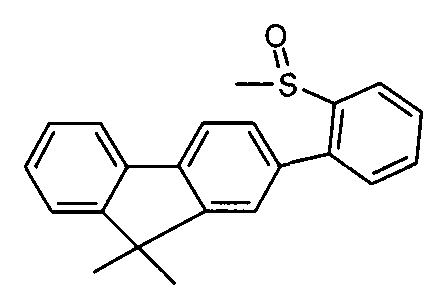
Unter Schutzgas werden 196 g (619.3 mmol) der Verbindung aus a) in 2.3 L Eisessig und 250 mL Dichlormethan vorgelegt und auf 0 °C gekühlt. Zu dieser Lösung wird 1.1 L (619 mmol) 30% H2O2-Lösung zugetropft und über Nacht gerührt. Das Gemisch wird mit Na2SO3 Lösung versetzt, die Phasen werden getrennt und das Lösungsmittel im Vakuum entfernt. Der Gehalt an Produkt beträgt gemäß 1H-NMR ca. 98 % bei einer Gesamtausbeute von 200 g (99 %).196 g (619.3 mmol) of the compound from a) in 2.3 L glacial acetic acid and 250 mL dichloromethane are introduced under protective gas and cooled to 0.degree. 1.1 L (619 mmol) of 30% H 2 O 2 solution is added dropwise to this solution and the mixture is stirred overnight. Na 2 SO 3 solution is added to the mixture, the phases are separated and the solvent is removed in vacuo. According to 1 H-NMR, the product content is about 98% with a total yield of 200 g (99%).
c) Synthese des Indenodibenzothiophensc) Synthesis of indenodibenzothiophene

Eine Mischung aus 91 g (273 mmol) der Verbindung aus b) und 737 ml (8329 mmol) Trifluormethansulfonsäure wird 48 h bei 5 °C gerührt. Anschließend wird die Mischung mit 2.4 L Wasser/Pyridin 5:1 versetzt und 20 min. unter Rückfluss erhitzt. Nach Abkühlen auf Raumtemperatur werden vorsichtig 500 ml Wasser und 1000 ml Dichlormethan zugesetzt. Die organische Phase wird mit 4 x 50 mL H2O gewaschen, über MgSO4 getrocknet und die Lösungsmittel im Vakuum entfernt. Das reine Produkt erhält man durch Umkristallisation. Der Gehalt an Produkt beträgt gemäß HPLC 98% % bei einer Gesamtausbeute von 65 g (80 %).A mixture of 91 g (273 mmol) of the compound from b) and 737 ml (8329 mmol) of trifluoromethanesulfonic acid is stirred at 5° C. for 48 h. The mixture is then mixed with 2.4 L water/pyridine 5:1 and heated under reflux for 20 min. After cooling to room temperature, 500 ml of water and 1000 ml of dichloromethane are carefully added. The organic phase is washed with 4×50 mL H 2 O, dried over MgSO 4 and the solvents are removed in vacuo. The pure product is obtained by recrystallization. According to HPLC, the product content is 98% with a total yield of 65 g (80%).
d) Bromierungd) bromination

Unter Schutzgas werden 95.3 g (317.6 mmol) der Verbindung aus c) in 2.5 L Dichlormethan vorgelegt und auf 5 °C gekühlt. Zu dieser Lösung werden 38.4 ml (763.2mmol) Br2 gelöst in 250 mL Chloroform zugetropft und über Nacht gerührt. Das Gemisch wird mit Na2SO3 Lösung versetzt, die Phasen werden getrennt und das Lösungsmittel im Vakuum entfernt. Der Gehalt an Produkt beträgt gemäß 1H-NMR ca. 98% bei einer Gesamtausbeute von 138 g (95 %).95.3 g (317.6 mmol) of the compound from c) are placed in 2.5 L of dichloromethane under a protective gas and cooled to 5.degree. 38.4 ml (763.2 mmol) Br 2 dissolved in 250 ml chloroform are added dropwise to this solution and the mixture is stirred overnight. Na 2 SO 3 solution is added to the mixture, the phases are separated and the solvent is removed in vacuo. According to 1 H-NMR, the product content is about 98% with a total yield of 138 g (95%).
e) Synthese von Amin-1e) Synthesis of amine-1

Eine entgaste Lösung von 19.2 g (42 mmol) der Verbindung aus d) und 26 g (93 mmol) Diphenylamin in 1000 ml Dioxan wird 1 h lang mit N2 gesättigt. Danach wird die Lösung zuerst mit 0.97 ml (4.2 mmol) P(tBu)3, dann mit 0.47g (2.12 mmol) Palladiumacetat versetzt und anschließend 12 g (127 mmol) NaOtBu im festen Zustand zugegeben. Die Reaktionsmischung wird 18 h unter Rückfluss erhitzt. Nach Abkühlen auf Raumtemperatur werden vorsichtig 1000 ml Wasser zugesetzt. Die organische Phase wird mit 4 x 50 mL H2O gewaschen, über MgSO4 getrocknet und die Lösungsmittel im Vakuum entfernt. Das reine Produkt erhält man durch Umkristallisation. Der Gehalt an Produkt beträgt gemäß HPLC 98 % bei einer Gesamtausbeute von 25 g (94 %).A degassed solution of 19.2 g (42 mmol) of the compound from d) and 26 g (93 mmol) of diphenylamine in 1000 ml of dioxane is saturated with N 2 for 1 h. Thereafter, first 0.97 ml (4.2 mmol) of P( tBu ) 3 , then 0.47 g (2.12 mmol) of palladium acetate are added to the solution, and then 12 g (127 mmol) of NaOtBu are added in the solid state. The reaction mixture is refluxed for 18 h. After cooling to room temperature, 1000 ml of water are carefully added. The organic phase is washed with 4×50 mL H 2 O, dried over MgSO 4 and the solvents are removed in vacuo. The pure product is obtained by recrystallization. According to HPLC, the product content is 98% with a total yield of 25 g (94%).
Beispiel 2: Herstellung der OLEDsExample 2 Production of the OLEDs
Die Herstellung von erfindungsgemäßen OLEDs erfolgt nach einem allgemeinen Verfahren gemäß
In den folgenden Beispielen 3 bis 10 werden die Ergebnisse verschiedener OLEDs vorgestellt. Glasplättchen, die mit strukturiertem ITO (Indium Zinn Oxid) beschichtet sind, bilden die Substrate der OLEDs. Zur verbesserten Prozessierung werden 20 nm PEDOT (Poly(3,4-ethylendioxy-2,5-thiophen), aus Wasser aufgeschleudert, bezogen von H. C. Starck, Goslar, Deutschland) auf das Substrat aufgebracht. Die OLEDs bestehen aus folgender Schichtenfolge: Substrat / PEDOT 20 nm / HIL1 5 nm / Lochtransportschicht (HTM) 20, 110 oder 200 nm / NPB 20 nm / Emissionsschicht (EML) 30 oder 40 nm / Elektronentransportschicht (ETM) 20 nm und abschließend eine Kathode.The results of various OLEDs are presented in Examples 3 to 10 below. Glass flakes coated with structured ITO (indium tin oxide) form the substrates of the OLEDs. For improved processing, 20 nm PEDOT (poly(3,4-ethylenedioxy-2,5-thiophene), spin-coated from water, obtained from H. C. Starck, Goslar, Germany) is applied to the substrate. The OLEDs consist of the following layer sequence: substrate / PEDOT 20 nm / HIL1 5 nm / hole transport layer (HTM) 20, 110 or 200 nm / NPB 20 nm / emission layer (EML) 30 or 40 nm / electron transport layer (ETM) 20 nm and finally one Cathode.
Die Materialien bis auf PEDOT werden in einer Vakuumkammer thermisch aufgedampft. Dabei besteht die Emissionsschicht immer aus einem Matrixmaterial (Host) und einem Dotierstoff (Dotand), der durch Coverdampfung dem Host beigemischt wird. Die Elektronentransportschicht besteht bei allen gezeigten Beispielen aus Alq3 (Aluminium-tris-chinolinat). Die Kathode wird durch eine 1 nm dicke LiF-Schicht und eine darauf abgeschiedene 100 nm dicke Aluminiumschicht gebildet. Tabelle 1 zeigt die chemischen Strukturen der zum Aufbau der OLEDs verwendeten Materialien. Dabei sind HTM1, HTM2 und H2 Materialien gemäß dem Stand der Technik, Amin-1 und H3 sind Beispiele für erfindungsgemäße Verbindungen.The materials except for PEDOT are thermally vapor-deposited in a vacuum chamber. The emission layer always consists of a matrix material (host) and a dopant (dopant), which is added to the host by co-evaporation. In all examples shown, the electron transport layer consists of Alq 3 (aluminum trisquinolinate). The cathode is formed by a 1 nm thick LiF layer and a 100 nm thick aluminum layer deposited on top. Table 1 shows the chemical structures of the materials used to construct the OLEDs. HTM1, HTM2 and H2 are materials according to the prior art, amine-1 and H3 are examples of compounds according to the invention.
Die OLEDs werden standardmäßig charakterisiert. Hierfür werden die Elektrolumineszenzspektren, die Stromeffizienz (gemessen in cd/A), die Leistungseffizienz (gemessen in Im/W) in Abhängigkeit der Helligkeit, berechnet aus Strom-Spannungs-Helligkeit-Kennlinien (IUL-Kennlinien) und die Lebensdauer bestimmt. Als Lebensdauer wird die Zeit definiert, nach der die Helligkeit von einem Anfangswert (25000 cd/m2 bzw. 8000 cd/m2) auf die Hälfte gesunken ist. Die Einsatzspannung ist definiert als diejenige Spannung, bei der die OLED eine Helligkeit von 1 cd/m2 erreicht.The OLEDs are characterized by default. For this purpose, the electroluminescence spectra, the current efficiency (measured in cd/A), the power efficiency (measured in lm/W) as a function of the brightness, calculated from current-voltage-brightness curves (IUL curves) and the lifetime are determined. The service life is defined as the time after which the brightness has dropped from an initial value (25000 cd/m 2 or 8000 cd/m 2 ) by half. The threshold voltage is defined as the voltage at which the OLED achieves a brightness of 1 cd/m 2 .
In Tabelle 2 sind die Ergebnisse einiger OLEDs (Beispiele 3 bis 10) zusammengefasst. Die Lebensdauern werden bei Verwendung des fluoreszierenden Dotanden D1 ab einer Starthelligkeit von 25000 cd/m2, bei Verwendung des phosphoreszierenden Dotanden D2 (Ir(ppy)3) ab einer Starthelligkeit von 8000 cd/m2 gemessen. Als erfindungsgemäßes Lochtransportmaterial wird die Verbindung Amin-1, als Host-Material die Verbindung H3 aus Tabelle 1 verwendet. Als Vergleich werden die Verbindungen HTM1 bzw. H2 gemäß dem Stand der Technik verwendet.Table 2 summarizes the results of some OLEDs (Examples 3 to 10). The lifetimes are measured from an initial brightness of 25000 cd/m 2 when using the fluorescent dopant D1, and from an initial brightness of 8000 cd/m 2 when using the phosphorescent dopant D2 (Ir(ppy) 3 ). The compound amine-1 is used as the hole-transport material according to the invention, and the compound H3 from Table 1 is used as the host material. The compounds HTM1 and H2 according to the prior art are used as a comparison.
Verglichen mit dem Stand der Technik zeichnet sich die Verbindungen Amin-1 gegenüber der Verbindung HTM1 gemäß dem Stand der Technik beim Einsatz als Lochtransportmaterial durch eine verringerte Einsatzspannung sowie eine verringerte Betriebsspannung aus (siehe Beispiele 3-8 in Tabelle 2). Dies gilt im Besonderen bei Verwendung dicker Lochtransportschichten, die in der Massenproduktion aufgrund der höheren Produktionsausbeute vorteilhaft sind (siehe Beispiele 5 und 8 in Tabelle 2). Weiterhin ergeben sich bei Verwendung der erfindungsgemäßen Verbindung Amin-1 leicht höhere Stromeffizienzen (gemessen in cd/A), was zusammen mit der verringerten Spannung zu deutlich höheren Leistungseffizienzen (gemessen in Im/W) führt. Die höchste Verbesserung beträgt hier über 30% bei Einsatz einer 200 nm dicken Lochtransportschicht (siehe Beispiele 5 und 8 in Tabelle 2). Dies ist vor allem für Mobilanwendungen ein wichtiger Aspekt, da hier die Betriebszeit entscheidend von der benötigten Leistung des Displays bestimmt wird. Ein weiterer Vorteil der erfindungsgemäßen Verbindung Amin-1 ist, dass die Lebensdauer bei dickeren Lochtransportschichten verglichen mit dem Stand der Technik HTM1 weit weniger stark einbricht.Compared to the prior art, the compounds Amin-1 are distinguished from the compound HTM1 according to the prior art when used as a hole transport material by a reduced initiation voltage and a reduced operating voltage (see Examples 3-8 in Table 2). This applies in particular when using thick hole-transport layers, which are advantageous in mass production because of the higher production yield (see Examples 5 and 8 in Table 2). Furthermore, there are Using the compound amine-1 according to the invention results in slightly higher current efficiencies (measured in cd/A), which, together with the reduced voltage, leads to significantly higher power efficiencies (measured in lm/W). The highest improvement here is over 30% when using a 200 nm thick hole transport layer (see Examples 5 and 8 in Table 2). This is an important aspect, especially for mobile applications, since the operating time here is largely determined by the required performance of the display. A further advantage of the compound amine-1 according to the invention is that the service life in the case of thicker hole-transport layers falls far less sharply compared with the prior art HTM1.
Bei Verwendung der Verbindung H3 als Host Material in einer phosphoreszierenden OLED ergeben sich mehrere Vorteile gegenüber dem Einsatz der Verbindung H2 gemäß dem Stand der Technik (siehe Beispiele 9 und 10 in Tabelle 2). Zum einen ergibt sich eine deutliche Absenkung der Einsatz- und Betriebsspannung, vor allem jedoch erhält man beim Einsatz der Verbindung H3 eine deutlich verbesserte Stromeffizienz, wodurch sich eine sehr hohe Steigerung der Leistungseffizienz um einen Faktor von etwa zwei gegenüber dem Stand der Technik erzielen lässt. Weiterhin erhält man eine um einen Faktor von etwa 3.5 höhere Lebensdauer im Vergleich zu OLEDs, in denen die Verbindung H2 gemäß dem Stand der Technik verwendet wird. Tabelle 1 


Die obenstehenden und im Folgenden mit # markierten Verbindungen und Beispiele sind nicht anspruchsgemäß. Tabelle 2
Claims (9)


Priority Applications (7)
| Application Number | Priority Date | Filing Date | Title |
|---|---|---|---|
| DE102009005289.5A DE102009005289B4 (en) | 2009-01-20 | 2009-01-20 | Materials for organic electroluminescent devices, methods for their production and electronic devices containing them |
| JP2011546614A JP5680551B2 (en) | 2009-01-20 | 2009-12-22 | Materials for organic electroluminescence devices |
| PCT/EP2009/009220 WO2010083872A2 (en) | 2009-01-20 | 2009-12-22 | Materials for organic electroluminescence devices |
| KR1020117019303A KR101810247B1 (en) | 2009-01-20 | 2009-12-22 | Materials for organic electroluminescence devices |
| US13/144,841 US9475792B2 (en) | 2009-01-20 | 2009-12-22 | Materials for organic electroluminescence devices |
| CN200980154943.7A CN102282130B (en) | 2009-01-20 | 2009-12-22 | For the material of organic electroluminescence device |
| TW099101103A TW201038576A (en) | 2009-01-20 | 2010-01-15 | Materials for organic electroluminescent devices |
Applications Claiming Priority (1)
| Application Number | Priority Date | Filing Date | Title |
|---|---|---|---|
| DE102009005289.5A DE102009005289B4 (en) | 2009-01-20 | 2009-01-20 | Materials for organic electroluminescent devices, methods for their production and electronic devices containing them |
Publications (2)
| Publication Number | Publication Date |
|---|---|
| DE102009005289A1 DE102009005289A1 (en) | 2010-07-22 |
| DE102009005289B4 true DE102009005289B4 (en) | 2023-06-22 |
Family
ID=42041698
Family Applications (1)
| Application Number | Title | Priority Date | Filing Date |
|---|---|---|---|
| DE102009005289.5A Active DE102009005289B4 (en) | 2009-01-20 | 2009-01-20 | Materials for organic electroluminescent devices, methods for their production and electronic devices containing them |
Country Status (7)
| Country | Link |
|---|---|
| US (1) | US9475792B2 (en) |
| JP (1) | JP5680551B2 (en) |
| KR (1) | KR101810247B1 (en) |
| CN (1) | CN102282130B (en) |
| DE (1) | DE102009005289B4 (en) |
| TW (1) | TW201038576A (en) |
| WO (1) | WO2010083872A2 (en) |
Families Citing this family (49)
| Publication number | Priority date | Publication date | Assignee | Title |
|---|---|---|---|---|
| KR20110009920A (en) * | 2009-07-23 | 2011-01-31 | 다우어드밴스드디스플레이머티리얼 유한회사 | Novel organic light emitting compound and organic electroluminescent device comprising same |
| DE102009052428A1 (en) | 2009-11-10 | 2011-05-12 | Merck Patent Gmbh | Connection for electronic devices |
| EP2371828B1 (en) * | 2010-04-01 | 2018-01-10 | Samsung Display Co., Ltd. | Condensed-Cyclic Compound and Organic Light-Emitting Device Including the Same |
| KR101832171B1 (en) | 2010-10-25 | 2018-04-16 | 삼성디스플레이 주식회사 | A condensed-cyclic compound, an organic light emitting diode comprising the same and flat display device |
| KR101423173B1 (en) | 2010-11-04 | 2014-07-25 | 제일모직 주식회사 | Compound for organic photoelectric device and organic photoelectric device including the same |
| JP5699581B2 (en) * | 2010-12-15 | 2015-04-15 | Jnc株式会社 | Fused pyrrole polycyclic compound, material for light emitting layer, and organic electroluminescent device using the same |
| US20130264560A1 (en) * | 2010-12-20 | 2013-10-10 | E I Du Pont De Nemours And Company | Triazine derivatives for electronic applications |
| EP2714659B1 (en) | 2011-05-25 | 2017-07-05 | American Dye Source, Inc. | Compounds with oxime ester and/or acyl groups |
| JP2015013804A (en) * | 2011-09-16 | 2015-01-22 | 出光興産株式会社 | Aromatic amine derivative and organic electroluminescent element using the same |
| JP6174030B2 (en) | 2011-09-21 | 2017-08-02 | メルク パテント ゲーエムベーハー | Carbazole derivatives for organic electroluminescent devices |
| KR102045197B1 (en) * | 2011-10-27 | 2019-11-18 | 메르크 파텐트 게엠베하 | Materials for electronic devices |
| US10305040B2 (en) | 2011-11-17 | 2019-05-28 | Merck Patent Gmbh | Spiro dihydroacridine derivatives and the use thereof as materials for organic electroluminescence devices |
| KR101418146B1 (en) * | 2012-03-09 | 2014-07-09 | 주식회사 두산 | Novel compounds and organic electro luminescence device using the same |
| WO2013133575A1 (en) * | 2012-03-09 | 2013-09-12 | 주식회사 두산 | Novel compound and organic electroluminescence element including same |
| KR101434723B1 (en) * | 2012-03-09 | 2014-08-26 | 주식회사 두산 | Novel compounds and organic electro luminescence device using the same |
| KR101418149B1 (en) * | 2012-05-08 | 2014-07-09 | 주식회사 두산 | Novel compounds and organic electro luminescence device using the same |
| WO2013147431A1 (en) * | 2012-03-28 | 2013-10-03 | 주식회사 두산 | Novel compound and organic electroluminescent element comprising same |
| KR101434724B1 (en) * | 2012-03-28 | 2014-08-27 | 주식회사 두산 | Novel compounds and organic electro luminescence device using the same |
| EP2889296A4 (en) | 2012-08-21 | 2016-06-15 | Cheil Ind Inc | Compound for organic optoelectric device, organic light-emitting diode including same, and display device including organic light-emitting diode |
| JP5896863B2 (en) * | 2012-08-27 | 2016-03-30 | 富士フイルム株式会社 | Organic thin film transistor, organic semiconductor thin film and organic semiconductor material |
| JP5896935B2 (en) * | 2012-08-27 | 2016-03-30 | 富士フイルム株式会社 | Organic thin film transistor, organic semiconductor thin film and organic semiconductor material |
| WO2014082705A1 (en) * | 2012-11-30 | 2014-06-05 | Merck Patent Gmbh | Electronic device |
| KR101684979B1 (en) * | 2012-12-31 | 2016-12-09 | 제일모직 주식회사 | Organic optoelectronic device and display including the same |
| KR20140122613A (en) | 2013-04-10 | 2014-10-20 | 삼성디스플레이 주식회사 | Heteroaryl-based compound and Organic light emitting diode comprising the same |
| KR101658111B1 (en) * | 2013-05-13 | 2016-09-20 | 제일모직 주식회사 | COMPOUND FOR OPTOELECTRIC DEVICE, ORGANIC LiGHT EMITTING DIODE INCLUDING THE SAME AND DISPLAY INCLUDING THE ORGANIC LiGHT EMITTING DIODE |
| KR101627755B1 (en) | 2013-06-13 | 2016-06-07 | 제일모직 주식회사 | Organic compound and organic optoelectric device and display device |
| KR102148643B1 (en) * | 2013-09-26 | 2020-08-28 | 롬엔드하스전자재료코리아유한회사 | Novel organic electroluminescent compounds and organic electroluminescent device comprising the same |
| WO2015105316A1 (en) * | 2014-01-10 | 2015-07-16 | 삼성에스디아이 주식회사 | Fused-ring compound and organic light-emitting device comprising same |
| JP6247568B2 (en) * | 2014-03-03 | 2017-12-13 | 富士フイルム株式会社 | Organic thin-film transistors, organic semiconductor materials for non-emissive organic semiconductor devices and their applications |
| KR101627211B1 (en) * | 2014-04-02 | 2016-06-13 | 주식회사 이엘엠 | Organic Light Emitting Material Having Aromatic Amine Compound and Organic Light Emitting Diode Using The Same |
| KR102319999B1 (en) | 2014-07-10 | 2021-11-01 | 삼성디스플레이 주식회사 | Organic compound and organic light emitting diode device including the same |
| KR101892234B1 (en) | 2014-10-31 | 2018-08-27 | 삼성에스디아이 주식회사 | Organic optoelectric device and display device |
| WO2016079944A1 (en) * | 2014-11-18 | 2016-05-26 | 保土谷化学工業株式会社 | Organic electroluminescent element |
| KR102190108B1 (en) * | 2014-12-31 | 2020-12-11 | 에스에프씨주식회사 | organic light-emitting diode with High efficiency and long lifetime |
| KR101974860B1 (en) * | 2015-02-04 | 2019-09-05 | 에스에프씨주식회사 | organic light-emitting diode with low operating voltage and long lifetime |
| EP3274419B1 (en) * | 2015-03-25 | 2019-04-03 | Merck Patent GmbH | Materials for organic electroluminescent devices |
| US10367147B2 (en) * | 2015-05-27 | 2019-07-30 | Samsung Display Co., Ltd. | Organic light-emitting device |
| KR101933384B1 (en) * | 2015-07-14 | 2018-12-28 | 삼성에스디아이 주식회사 | Compound for organic optoelectronic device, organic optoelectronic device and display device |
| US11174258B2 (en) | 2015-12-04 | 2021-11-16 | Idemitsu Kosan Co., Ltd. | Benzimidazolo[1,2-a]benzimidazole derivatives for organic light emitting diodes |
| US20180093962A1 (en) * | 2016-10-05 | 2018-04-05 | Sfc Co., Ltd. | Novel organic compound and oranic light-emitting diode comprising same background of the invention |
| CN106699746A (en) * | 2017-01-04 | 2017-05-24 | 华南理工大学 | Bipolar small molecular light-emitting material based on naphthothiodibenzofuran unit as well as preparation method and application of bipolar small molecular light-emitting material |
| KR102393153B1 (en) * | 2017-07-27 | 2022-05-02 | 에스에프씨주식회사 | organic light-emitting diode with high efficiency, low voltage and long lifetime |
| JP7286625B2 (en) | 2017-09-08 | 2023-06-05 | メルク パテント ゲーエムベーハー | Materials for electronic devices |
| EP3679024B1 (en) | 2017-09-08 | 2022-11-02 | Merck Patent GmbH | Materials for electronic devices |
| JP7325731B2 (en) | 2018-08-23 | 2023-08-15 | 国立大学法人九州大学 | organic electroluminescence element |
| CN110845483B (en) * | 2019-11-29 | 2021-11-16 | 武汉天马微电子有限公司 | Compound and application thereof |
| KR102603291B1 (en) * | 2020-01-30 | 2023-11-15 | 삼성에스디아이 주식회사 | Compound for organic optoelectronic device, composition for organic optoelectronic device, organic optoelectronic device and display device |
| KR102556335B1 (en) * | 2020-12-22 | 2023-07-18 | 엘티소재주식회사 | Heterocyclic compound and organic light emitting device comprising same |
| US20240431202A1 (en) | 2021-10-14 | 2024-12-26 | Merck Patent Gmbh | Materials for organic electroluminescent devices |
Citations (33)
| Publication number | Priority date | Publication date | Assignee | Title |
|---|---|---|---|---|
| US4539507A (en) | 1983-03-25 | 1985-09-03 | Eastman Kodak Company | Organic electroluminescent devices having improved power conversion efficiencies |
| US5151629A (en) | 1991-08-01 | 1992-09-29 | Eastman Kodak Company | Blue emitting internal junction organic electroluminescent device (I) |
| WO1992018552A1 (en) | 1991-04-11 | 1992-10-29 | Wacker-Chemie Gmbh | Conductive polymers with conjugated double bonds |
| EP0676461A2 (en) | 1994-04-07 | 1995-10-11 | Hoechst Aktiengesellschaft | Spiro compounds and their application as electroluminescence materials |
| EP0707020A2 (en) | 1994-10-14 | 1996-04-17 | Hoechst Aktiengesellschaft | Conjugated polymers with a spiro atom and their use as electroluminescent materials |
| EP0842208A1 (en) | 1995-07-28 | 1998-05-20 | The Dow Chemical Company | 2,7-aryl-9-substituted fluorenes and 9-substituted fluorene oligomers and polymers |
| WO1998027136A1 (en) | 1996-12-16 | 1998-06-25 | Aventis Research & Technologies Gmbh & Co Kg | ARYL-SUBSTITUTED POLY(p-ARYLENE VINYLENES), METHOD FOR THE PRODUCTION AND USE THEREOF IN ELECTROLUMINESCENT COMPONENTS |
| EP0894107A1 (en) | 1996-04-17 | 1999-02-03 | Hoechst Research & Technology Deutschland GmbH & Co. KG | Polymers with spiro atoms and their use as electroluminescent materials |
| WO2000022026A1 (en) | 1998-10-10 | 2000-04-20 | Celanese Ventures Gmbh | Conjugated polymers containing special fluorene structural elements with improved properties |
| EP1028136A2 (en) | 1999-02-10 | 2000-08-16 | Carnegie-Mellon University | A method of forming poly-(3-substituted) thiophenes |
| EP1175470A1 (en) | 1999-12-31 | 2002-01-30 | LG Chemical Co. Ltd | Electronic device comprising organic compound having p-type semiconducting characteristics |
| WO2004041901A1 (en) | 2002-11-08 | 2004-05-21 | Covion Organic Semiconductors Gmbh | Aryl-substituted polyindenofluorenes for use in organic electroluminiscent devices |
| WO2004058911A2 (en) | 2002-12-23 | 2004-07-15 | Covion Organic Semiconductors Gmbh | Organic electroluminescent element |
| WO2004070772A2 (en) | 2003-02-06 | 2004-08-19 | Covion Organic Semiconductors Gmbh | Conjugated polymers and blends containing carbazole, representation and use thereof |
| WO2004081017A1 (en) | 2003-03-11 | 2004-09-23 | Covion Organic Semiconductors Gmbh | Metal complexes |
| EP1476881A2 (en) | 2002-02-20 | 2004-11-17 | Novaled GmbH | Doped organic semiconductor material and method for production thereof |
| WO2004113468A1 (en) | 2003-06-26 | 2004-12-29 | Covion Organic Semiconductors Gmbh | Novel materials for electroluminescence |
| WO2004113412A2 (en) | 2003-06-23 | 2004-12-29 | Covion Organic Semiconductors Gmbh | Polymer |
| WO2005011013A1 (en) | 2003-07-21 | 2005-02-03 | Covion Organic Semiconductors Gmbh | Organic electroluminescent element |
| WO2005014689A2 (en) | 2003-08-12 | 2005-02-17 | Covion Organic Semiconductors Gmbh | Conjugated polymers containing dihydrophenanthrene units and use thereof |
| WO2005040302A1 (en) | 2003-10-22 | 2005-05-06 | Merck Patent Gmbh | New materials for electroluminescence and the utilization thereof |
| WO2005104264A1 (en) | 2004-04-26 | 2005-11-03 | Merck Patent Gmbh | Electroluminescent polymers and use therof |
| EP1596445A1 (en) | 2003-12-04 | 2005-11-16 | Novaled GmbH | Process for doping organic semiconductors with derivatives of diiminoquinones |
| EP1655359A1 (en) | 2004-11-06 | 2006-05-10 | Covion Organic Semiconductors GmbH | Organic electroluminescent device |
| US20060125009A1 (en) | 2004-12-14 | 2006-06-15 | Xerox Corporation | Thin film transistors including indolocarbazoles |
| WO2006100896A1 (en) | 2005-03-18 | 2006-09-28 | Idemitsu Kosan Co., Ltd. | Aromatic amine derivative and organic electroluminescence device utilizing the same |
| WO2006117052A1 (en) | 2005-05-03 | 2006-11-09 | Merck Patent Gmbh | Organic electroluminescent device and boric acid and borinic acid derivatives used therein |
| WO2006122630A1 (en) | 2005-05-20 | 2006-11-23 | Merck Patent Gmbh | Compounds for organic electronic devices |
| DE102005060438A1 (en) | 2005-12-17 | 2007-06-21 | Merck Patent Gmbh | Substitution of indenofluorenes |
| DE102006025846A1 (en) | 2006-06-02 | 2007-12-06 | Merck Patent Gmbh | New materials for organic electroluminescent devices |
| WO2008006449A1 (en) | 2006-07-11 | 2008-01-17 | Merck Patent Gmbh | Novel materials for organic electroluminescent devices |
| WO2008145239A2 (en) | 2007-05-29 | 2008-12-04 | Merck Patent Gmbh | Benzanthracene derivatives for organic electroluminescent devices |
| WO2020005084A1 (en) | 2018-06-27 | 2020-01-02 | Instytut Biotechnologii I Medycyny Molekularnej | Fusion single-stranded dna polymerase bst, nucleic acid molecule encoding fusion dna polymerase neqssb-bst, method of preparation and utilisation thereof |
Family Cites Families (12)
| Publication number | Priority date | Publication date | Assignee | Title |
|---|---|---|---|---|
| DE3919786A1 (en) | 1989-06-16 | 1991-01-03 | Wacker Chemie Gmbh | COATING MATERIALS BASED ON (POLY) BOROSILOXANANE AND METHOD FOR PRODUCING GLASS GLASSES AND THEIR USE THEREOF |
| JP4322457B2 (en) * | 2002-01-22 | 2009-09-02 | 財団法人石油産業活性化センター | Novel azaaromatic compound having amino group and organic electroluminescence device using the same |
| JP3829982B2 (en) | 2002-02-19 | 2006-10-04 | 財団法人石油産業活性化センター | Novel condensed aromatic compound and organic electroluminescence device using the same |
| JP2005068367A (en) * | 2003-08-27 | 2005-03-17 | Toyo Ink Mfg Co Ltd | Material for organic electroluminescence device and organic electroluminescence device |
| JP4325336B2 (en) | 2003-09-19 | 2009-09-02 | 東洋インキ製造株式会社 | Material for organic electroluminescence device and organic electroluminescence device |
| DE102004008304A1 (en) | 2004-02-20 | 2005-09-08 | Covion Organic Semiconductors Gmbh | Organic electronic devices |
| US8062769B2 (en) | 2006-11-09 | 2011-11-22 | Nippon Steel Chemical Co., Ltd. | Indolocarbazole compound for use in organic electroluminescent device and organic electroluminescent device |
| JP4819181B2 (en) * | 2008-05-08 | 2011-11-24 | 新日鐵化学株式会社 | Compound for organic electroluminescence device and organic electroluminescence device |
| US8318323B2 (en) * | 2008-06-05 | 2012-11-27 | Idemitsu Kosan Co., Ltd. | Polycyclic compounds and organic electroluminescence device employing the same |
| CN102056899B (en) * | 2008-06-05 | 2013-11-20 | 出光兴产株式会社 | Polycyclic compound and organic electroluminescent element using same |
| CN102056889B (en) | 2008-07-03 | 2016-01-20 | 三菱化学株式会社 | Method for producing pentamethylenediamine and method for producing polyamide resin |
| JP5493309B2 (en) * | 2008-08-18 | 2014-05-14 | コニカミノルタ株式会社 | ORGANIC ELECTROLUMINESCENT ELEMENT MATERIAL, ORGANIC ELECTROLUMINESCENT ELEMENT, DISPLAY DEVICE AND LIGHTING DEVICE |
-
2009
- 2009-01-20 DE DE102009005289.5A patent/DE102009005289B4/en active Active
- 2009-12-22 CN CN200980154943.7A patent/CN102282130B/en active Active
- 2009-12-22 US US13/144,841 patent/US9475792B2/en active Active
- 2009-12-22 WO PCT/EP2009/009220 patent/WO2010083872A2/en not_active Ceased
- 2009-12-22 JP JP2011546614A patent/JP5680551B2/en active Active
- 2009-12-22 KR KR1020117019303A patent/KR101810247B1/en active Active
-
2010
- 2010-01-15 TW TW099101103A patent/TW201038576A/en unknown
Patent Citations (35)
| Publication number | Priority date | Publication date | Assignee | Title |
|---|---|---|---|---|
| US4539507A (en) | 1983-03-25 | 1985-09-03 | Eastman Kodak Company | Organic electroluminescent devices having improved power conversion efficiencies |
| WO1992018552A1 (en) | 1991-04-11 | 1992-10-29 | Wacker-Chemie Gmbh | Conductive polymers with conjugated double bonds |
| US5151629A (en) | 1991-08-01 | 1992-09-29 | Eastman Kodak Company | Blue emitting internal junction organic electroluminescent device (I) |
| EP0676461A2 (en) | 1994-04-07 | 1995-10-11 | Hoechst Aktiengesellschaft | Spiro compounds and their application as electroluminescence materials |
| EP0676461B1 (en) | 1994-04-07 | 2002-08-14 | Covion Organic Semiconductors GmbH | Spiro compounds and their application as electroluminescence materials |
| EP0707020A2 (en) | 1994-10-14 | 1996-04-17 | Hoechst Aktiengesellschaft | Conjugated polymers with a spiro atom and their use as electroluminescent materials |
| EP0842208A1 (en) | 1995-07-28 | 1998-05-20 | The Dow Chemical Company | 2,7-aryl-9-substituted fluorenes and 9-substituted fluorene oligomers and polymers |
| EP0894107A1 (en) | 1996-04-17 | 1999-02-03 | Hoechst Research & Technology Deutschland GmbH & Co. KG | Polymers with spiro atoms and their use as electroluminescent materials |
| WO1998027136A1 (en) | 1996-12-16 | 1998-06-25 | Aventis Research & Technologies Gmbh & Co Kg | ARYL-SUBSTITUTED POLY(p-ARYLENE VINYLENES), METHOD FOR THE PRODUCTION AND USE THEREOF IN ELECTROLUMINESCENT COMPONENTS |
| WO2000022026A1 (en) | 1998-10-10 | 2000-04-20 | Celanese Ventures Gmbh | Conjugated polymers containing special fluorene structural elements with improved properties |
| EP1028136A2 (en) | 1999-02-10 | 2000-08-16 | Carnegie-Mellon University | A method of forming poly-(3-substituted) thiophenes |
| EP1175470A1 (en) | 1999-12-31 | 2002-01-30 | LG Chemical Co. Ltd | Electronic device comprising organic compound having p-type semiconducting characteristics |
| EP1476881A2 (en) | 2002-02-20 | 2004-11-17 | Novaled GmbH | Doped organic semiconductor material and method for production thereof |
| WO2004041901A1 (en) | 2002-11-08 | 2004-05-21 | Covion Organic Semiconductors Gmbh | Aryl-substituted polyindenofluorenes for use in organic electroluminiscent devices |
| WO2004058911A2 (en) | 2002-12-23 | 2004-07-15 | Covion Organic Semiconductors Gmbh | Organic electroluminescent element |
| WO2004070772A2 (en) | 2003-02-06 | 2004-08-19 | Covion Organic Semiconductors Gmbh | Conjugated polymers and blends containing carbazole, representation and use thereof |
| WO2004081017A1 (en) | 2003-03-11 | 2004-09-23 | Covion Organic Semiconductors Gmbh | Metal complexes |
| WO2004113412A2 (en) | 2003-06-23 | 2004-12-29 | Covion Organic Semiconductors Gmbh | Polymer |
| WO2004113468A1 (en) | 2003-06-26 | 2004-12-29 | Covion Organic Semiconductors Gmbh | Novel materials for electroluminescence |
| WO2005011013A1 (en) | 2003-07-21 | 2005-02-03 | Covion Organic Semiconductors Gmbh | Organic electroluminescent element |
| WO2005014689A2 (en) | 2003-08-12 | 2005-02-17 | Covion Organic Semiconductors Gmbh | Conjugated polymers containing dihydrophenanthrene units and use thereof |
| WO2005040302A1 (en) | 2003-10-22 | 2005-05-06 | Merck Patent Gmbh | New materials for electroluminescence and the utilization thereof |
| EP1596445A1 (en) | 2003-12-04 | 2005-11-16 | Novaled GmbH | Process for doping organic semiconductors with derivatives of diiminoquinones |
| WO2005104264A1 (en) | 2004-04-26 | 2005-11-03 | Merck Patent Gmbh | Electroluminescent polymers and use therof |
| EP1655359A1 (en) | 2004-11-06 | 2006-05-10 | Covion Organic Semiconductors GmbH | Organic electroluminescent device |
| US20060125009A1 (en) | 2004-12-14 | 2006-06-15 | Xerox Corporation | Thin film transistors including indolocarbazoles |
| WO2006100896A1 (en) | 2005-03-18 | 2006-09-28 | Idemitsu Kosan Co., Ltd. | Aromatic amine derivative and organic electroluminescence device utilizing the same |
| EP1860097A1 (en) | 2005-03-18 | 2007-11-28 | Idemitsu Kosan Co., Ltd. | Aromatic amine derivative and organic electroluminescence device utilizing the same |
| WO2006117052A1 (en) | 2005-05-03 | 2006-11-09 | Merck Patent Gmbh | Organic electroluminescent device and boric acid and borinic acid derivatives used therein |
| WO2006122630A1 (en) | 2005-05-20 | 2006-11-23 | Merck Patent Gmbh | Compounds for organic electronic devices |
| DE102005060438A1 (en) | 2005-12-17 | 2007-06-21 | Merck Patent Gmbh | Substitution of indenofluorenes |
| DE102006025846A1 (en) | 2006-06-02 | 2007-12-06 | Merck Patent Gmbh | New materials for organic electroluminescent devices |
| WO2008006449A1 (en) | 2006-07-11 | 2008-01-17 | Merck Patent Gmbh | Novel materials for organic electroluminescent devices |
| WO2008145239A2 (en) | 2007-05-29 | 2008-12-04 | Merck Patent Gmbh | Benzanthracene derivatives for organic electroluminescent devices |
| WO2020005084A1 (en) | 2018-06-27 | 2020-01-02 | Instytut Biotechnologii I Medycyny Molekularnej | Fusion single-stranded dna polymerase bst, nucleic acid molecule encoding fusion dna polymerase neqssb-bst, method of preparation and utilisation thereof |
Also Published As
| Publication number | Publication date |
|---|---|
| US20110272684A1 (en) | 2011-11-10 |
| CN102282130B (en) | 2015-09-09 |
| JP2012515733A (en) | 2012-07-12 |
| WO2010083872A3 (en) | 2010-09-23 |
| TW201038576A (en) | 2010-11-01 |
| KR101810247B1 (en) | 2017-12-18 |
| CN102282130A (en) | 2011-12-14 |
| DE102009005289A1 (en) | 2010-07-22 |
| JP5680551B2 (en) | 2015-03-04 |
| KR20110122129A (en) | 2011-11-09 |
| WO2010083872A2 (en) | 2010-07-29 |
| US9475792B2 (en) | 2016-10-25 |
Similar Documents
| Publication | Publication Date | Title |
|---|---|---|
| DE102009005289B4 (en) | Materials for organic electroluminescent devices, methods for their production and electronic devices containing them | |
| DE112009004294B4 (en) | Materials for organic electroluminescent devices, their use, processes for their preparation and electronic device | |
| DE102009053644B4 (en) | Materials for organic electroluminescent devices | |
| DE102009009277B4 (en) | Organic electronic device, process for its production and use of compounds | |
| EP2024465B1 (en) | New materials for organic electroluminescent devices | |
| DE112009003900B4 (en) | Compounds for electronic devices, methods for their manufacture, their use and electronic devices | |
| EP2024310B1 (en) | Materials for organic electroluminescent devices | |
| DE112010006144B4 (en) | Organic electroluminescent devices | |
| EP2705552B1 (en) | Compounds for electronic devices | |
| EP2791105B1 (en) | Compounds for electronic devices | |
| EP2102309B1 (en) | Carbazole derivatives for organic electroluminescent devices | |
| EP2663567B1 (en) | Compounds for organic electroluminescent devices | |
| EP3439065B1 (en) | Materials for electronic devices | |
| EP2344607B1 (en) | Organic electroluminescent devices | |
| EP2340290B1 (en) | Novel materials for organic electroluminescence devices | |
| DE102009032922A1 (en) | Materials for organic electroluminescent devices | |
| DE102009022858A1 (en) | Organic electroluminescent devices | |
| WO2012149999A1 (en) | Compounds for electronic devices | |
| DE102009023155A1 (en) | Materials for organic electroluminescent devices | |
| DE102010005697A1 (en) | Connections for electronic devices | |
| WO2014106524A2 (en) | Materials for electronic devices | |
| WO2011006568A1 (en) | Materials for electronic devices |
Legal Events
| Date | Code | Title | Description |
|---|---|---|---|
| R012 | Request for examination validly filed | ||
| R016 | Response to examination communication | ||
| R016 | Response to examination communication | ||
| R018 | Grant decision by examination section/examining division | ||
| R020 | Patent grant now final |