JP4892257B2 - Gripping device - Google Patents
Gripping device Download PDFInfo
- Publication number
- JP4892257B2 JP4892257B2 JP2006066003A JP2006066003A JP4892257B2 JP 4892257 B2 JP4892257 B2 JP 4892257B2 JP 2006066003 A JP2006066003 A JP 2006066003A JP 2006066003 A JP2006066003 A JP 2006066003A JP 4892257 B2 JP4892257 B2 JP 4892257B2
- Authority
- JP
- Japan
- Prior art keywords
- node
- output node
- angle
- gripping
- driving
- Prior art date
- Legal status (The legal status is an assumption and is not a legal conclusion. Google has not performed a legal analysis and makes no representation as to the accuracy of the status listed.)
- Expired - Fee Related
Links
Images



Landscapes
- Manipulator (AREA)
- Prostheses (AREA)
Description
本発明は、物体を把持する把持装置に関する。より詳細には、ロボットハンド、義手などに好適に採用できる把持装置に関する。 The present invention relates to a gripping device that grips an object. More specifically, the present invention relates to a gripping device that can be suitably used for robot hands, artificial hands, and the like.
一般にロボットハンドや義手には、物体を把持(或いは挟持)する把持装置が組込まれている。ロボットに関する技術は近年にあって飛躍的に進歩しており、把持装置についても多くの研究がなされている。把持装置は、コップ、ボールなどの把持対象となる種々の物体(以下、把持対象物と称する)を人間が把持するのと同様に把持できることが望ましい。人間の指は複数の関節で形成されており柔軟性を備えているので、例えば把持しようとする把持対象物が複雑な形状であったり、把持対象物を把持する箇所や把持を行う位置が適切でなかったりする場合であっても指先姿勢や把持力を適度に調節して把持することができる。ところが、従来の一般的な把持装置では把持対象物に接触する部分(指に相当する部分)が樹脂や金属などの硬質材で形成されていたので、把持力の調整が不適切である場合には把持対象物が破損したり、把持動作を行う位置が不正確である場合には把持対象物を安定に把持できなかったり、把持・操りの中途に失敗する等の問題が発生していた。 In general, a robot hand or a prosthetic hand incorporates a gripping device that grips (or clamps) an object. The technology related to robots has advanced dramatically in recent years, and much research has been done on gripping devices. The gripping device is preferably capable of gripping various objects (hereinafter referred to as gripping objects) to be gripped, such as a cup and a ball, in the same way as a human grips. Since human fingers are formed with multiple joints and have flexibility, for example, the gripping object to be gripped has a complicated shape, the location where the gripping object is gripped, and the position where gripping is appropriate Even if it is not, it can be gripped by appropriately adjusting the fingertip posture and gripping force. However, in the conventional general gripping device, the part that contacts the gripping object (the part corresponding to the finger) is formed of a hard material such as resin or metal. However, when the object to be grasped is damaged, or the position where the grasping operation is performed is inaccurate, the object to be grasped cannot be stably grasped, or the gripping / manipulating operation fails.
上記に対して、例えば特許文献1は把持フィンガーにバネ(弾性体)を介在させて把持対象物を把持するようにした把持装置を開示する。この把持装置は指本体部分と指先部分との間にバネを備えているので、把持対象物の硬さに多少のバラツキがあっても確実に把持できる。また、特許文献2は、関節を備えた把持フィンガーの指先部分を出没させるようにバネを配置した把持装置を開示する。この把持装置は、把持対象物と接触したときに指先部分が弾性的に受動して必要以上の把持力を発生させないように把持を行うので、把持対象物を確実に把持できる。
On the other hand, for example,
上記両特許文献で開示する把持装置は指に相当する部分にバネが配置されているので、バネを備えていない従前の把持装置と比較した場合には、種々の把持対象物を的確に把持できる。このように指部分にバネを配置した構造を採用すれば、柔軟性が付与されるので把持対象物を確実に把持できるようになる。しかしながら、組付けされたバネのストローク(バネ変位量)は一定であるので、把持対象物によっては好ましくない把持形態となる場合がある。この点について具体的に説明する。例えば、相対的にストロークが大きなバネを採用していると、把持対象物を把持する際の指部分の受動可能範囲が広くなる。このような把持装置で、大きく、重い把持対象物を把持しようとすると、指先が反り返ってしまい適切に把持できないことになる。また、これとは逆にストロークが小さなバネを採用していると、把持対象物を把持する際の指部分の受動可能範囲が狭くなる。このような把持装置で、小さく、破損し易い把持対象物を把持しようとすると、指先が硬くために把持対象物を正確に把持できない、或いは把持対象物を破損させてしまうことになる。これでは指部分にバネを配置したメリットが失われてしまう。なお、ここでの受動可能範囲とは、把持対象物を把持したときに反力を受けた指部分が逆向きに変位可能な範囲である。 Since the gripping devices disclosed in both of the above patent documents are provided with a spring at a portion corresponding to a finger, various gripping objects can be accurately gripped when compared with a conventional gripping device that does not include a spring. . By adopting a structure in which the spring is arranged on the finger portion in this way, flexibility is imparted, so that the object to be grasped can be reliably grasped. However, since the stroke (spring displacement amount) of the assembled spring is constant, an unpreferable gripping form may occur depending on the gripping object. This point will be specifically described. For example, when a spring having a relatively large stroke is employed, the passive range of the finger portion when gripping the gripping object is widened. If an attempt is made to grip a large and heavy gripping object with such a gripping device, the fingertip will bend back and cannot be gripped properly. On the other hand, if a spring with a small stroke is employed, the passive range of the finger portion when gripping the gripping object is narrowed. If an attempt is made to grip a gripping object that is small and easily damaged with such a gripping device, the gripping object cannot be gripped accurately because the fingertip is stiff, or the gripping object is damaged. This loses the merit of placing a spring on the finger. The passable range here is a range in which a finger part that has received a reaction force when a grasped object is grasped can be displaced in the reverse direction.
ところで、人間の手による把持動作を詳細に検討すると、把持対象物を把持しようとするとき(或いは、把持対象物を掴もうとするとき)の状態には2形態がある。指の関節を伸ばして把持対象物を把持する状態と、手の平及び指の関節を適度に湾曲させて(曲げて)把持対象物を握るように把持する状態とがある。頑丈で、大きな把持対象物を把持するときには、伝わる把持力が大きくても破損することがないので、指の関節を伸ばし指先が逆向きに反る範囲(前述した受動範囲)を小さくして強く把持する。これに対して、壊れやすく小さな把持対象物を把持するときには、手の平及び指の関節を湾曲させて指先が逆向きに反る範囲を大きくして(即ち、柔軟性を持って)把持対象物を握るように把持する。人間が把持動作を行うときは、把持対象物に応じて適切な把持形態を実行していると言える。把持装置で把持する種々の把持対象物は、人間が使用する物体であるから、人間の手と同様に把持動作を行える把持装置を設計することが望ましいことになる。 By the way, when the grasping operation by a human hand is examined in detail, there are two states when trying to grasp the grasped object (or when trying to grasp the grasped object). There are a state in which the joint of the finger is extended and the object to be grasped is gripped, and a state in which the palm and the joint of the finger are appropriately bent (bent) to grip the object to be gripped. When gripping a large object that is sturdy and strong, it will not break even if the gripping force transmitted is large. Hold it. On the other hand, when gripping a fragile and small gripping object, the palm and the joint of the finger are curved to increase the range in which the fingertip warps in the opposite direction (that is, with flexibility). Grip like holding. When a human performs a gripping operation, it can be said that an appropriate gripping form is executed according to the gripping object. Since various gripping objects to be gripped by the gripping device are objects used by humans, it is desirable to design a gripping device that can perform a gripping operation in the same manner as a human hand.
上記のように人間の手は指の湾曲に応じて受動範囲が変化するので、把持する把持対象物を的確に把持することができる。しかし、このような見地に基づいて設計された把持装置は現時点においては存在していない。すなわち、従来にあっては特許文献1及び特許文献2で開示されている把持装置のように、指部分にバネを配置して柔軟性を付与するというアイデアはあった。しかし、指部分の湾曲度合いに応じて柔軟性を変更させること、すなわち、指部分の角度に関連付けして上記受動可能範囲を変化させるという発想には到っていない。また、仮にこのような機能を備えた把持装置を実現しようとすると、装置が大型化及び複雑化してしまうという問題もある。
As described above, since the passive range of the human hand changes according to the curvature of the finger, the grasped object to be grasped can be accurately grasped. However, there is currently no gripping device designed based on such a viewpoint. That is, conventionally, there has been an idea of providing flexibility by arranging a spring on a finger portion as in the gripping devices disclosed in
したがって、本発明の目的は、把持対象物をより確実に把持できる把持装置を提供することである。 Accordingly, an object of the present invention is to provide a gripping device that can grip a gripping object more reliably.
上記目的は、基端側を軸として回動可能に固定され、把持対象物を把持可能な出力節と、一端部側が前記出力節の基端側と接続し、前記出力節を回動可能に固定する原動節と、一端部側が前記原動節が接続した側と反対側の前記出力節の基端側と接続し、前記出力節を回動可能に固定する連動節と、前記出力節と前記連動節との接続部分に設けられ、前記連動節に対して前記出力節が把持対象物側に回動するよう付勢する弾性体と、前記連動節に対する前記出力節の把持対象物側への回動が可能な範囲を規制する範囲規制機構と、前記出力節と前記原動節との接続部分に設けられ、前記出力節が把持対象物を把持したときの反力で前記原動節に対して前記出力節が把持対象物の反対側に回動する角度である受動角が受動変位することが可能な範囲を規制する受動範囲規制機構と、を備え、前記出力節の基端側を軸として前記原動節と前記連動節とのなす角度を変更することで、前記原動節に対して前記出力節が把持対象物側に屈折する角度である関節角を任意に変更し、前記受動範囲規制機構は、前記原動節側に設けられた円弧状の突起部と、前記出力節側に設けられ、前記出力節の回動に伴って前記突起部の把持対象物側の端部と当接可能な第1壁面、および前記突起部の他端部と当接可能な第2壁面と、を有し、前記関節角がゼロのときに前記突起部の把持対象物側の端部と第1壁面との間隔が前記突起部の他端部と第2壁面との間隔よりも大きくなるように前記突起部、前記第1壁面および前記第2壁面を設けることで、前記関節角が大きくなるほど前記受動角が受動変位することが可能な範囲が拡大する把持装置により達成できる。
The above-mentioned purpose is fixed so as to be rotatable about the base end side as an axis, and an output node capable of gripping an object to be grasped and one end portion side connected to the base end side of the output node so that the output node can be rotated. A driving node to be fixed, an end portion connected to a base end side of the output node opposite to a side to which the driving node is connected, an interlocking node for rotatably fixing the output node, the output node and the An elastic body provided at a connection portion with the interlocking node and biasing the output node to rotate toward the gripping object with respect to the interlocking node; and the output node with respect to the interlocking node toward the gripping object A range regulating mechanism that regulates a range in which rotation is possible, and a connecting portion between the output node and the driving node, and the reaction force when the output node grips the object to be gripped with respect to the driving node A passive angle, which is an angle at which the output node rotates to the opposite side of the grasped object, can be passively displaced. A passive range regulating mechanism that regulates the surroundings, and by changing an angle formed between the driving node and the interlocking node with the base end side of the output node as an axis, the output node is connected to the driving node. The joint angle, which is an angle that is refracted toward the object to be grasped, is arbitrarily changed, and the passive range restriction mechanism is provided on an arcuate protrusion provided on the driving node side and on the output node side, and the output A first wall surface that can come into contact with the end of the protrusion on the gripping object side as the node rotates, and a second wall surface that can come into contact with the other end of the protrusion, The protrusions such that when the joint angle is zero, the distance between the end of the protrusion on the gripping object side and the first wall surface is larger than the distance between the other end of the protrusion and the second wall surface; By providing the first wall surface and the second wall surface, the passive angle is passively displaced as the joint angle increases. It can be achieved by the gripping device to expand the range capable.
本発明によると、出力節と原動節とが成す関節角に応じて、出力節の受動可能範囲を変更することができるので、形状、大きさ、重量等が異なる種々の把持対象物に応じた把持動作を行うことができる。よって、種類の異なる把持対象物でも確実に把持できる把持装置を提供できる。
According to the present invention, the passable range of the output node can be changed according to the joint angle formed by the output node and the driving node , so that it corresponds to various gripping objects having different shapes, sizes, weights, etc. A gripping operation can be performed. Therefore, it is possible to provide a gripping device that can reliably grip even different types of gripping objects.
また、一端部側が前記連動節の他端部側と接続し、前記連動節を回動可能に固定する従動節と、一端部側が前記原動節の他端部側と接続し、かつ、他端部側が前記従動節の他端部側と接続し、前記原動節および前記従動節を回動可能に連結する固定節と、を有し、前記固定節に対して前記原動節を把持対象物側に稼動させる角度である稼動角を変化させることで、前記出力節の基端側を軸として前記原動節と前記連動節とのなす角度を変更して前記関節角を任意に変更するリンク機構を備える構造として実現してもよい。
Further, one end side is connected to the other end side of the interlocking node, the driven node is rotatably fixed, the one end side is connected to the other end side of the driving node, and the other end And a stationary node that is connected to the other end side of the driven node and rotatably connects the driven node and the driven node, and holds the driven node with respect to the fixed node A link mechanism that arbitrarily changes the joint angle by changing an angle formed by the driving node and the interlocking node with the base end side of the output node as an axis by changing an operating angle that is an operating angle. You may implement | achieve as a structure provided .
この場合には上記受動可能範囲が関節角、或いは稼動角及び関節角に連動して大きくなる。この状態は原動節に対して出力節が折れ曲がった姿勢となるので、出力節の柔軟性を増して把持対象物を把持できる。
In this case, the passive range is increased in conjunction with the joint angle or the operating angle and the joint angle. In this state, since the output node is bent with respect to the driving node , the flexibility of the output node can be increased and the object to be held can be gripped.
本発明によれば、把持対象物をより確実に把持できる把持装置を提供できる。 According to the present invention, it is possible to provide a gripping device that can grip a gripping object more reliably.
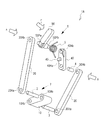
以下、本発明の実施形態に係る把持装置について説明する。把持装置は把持対象物を把持するものであるから、少なくとも把持対象物を両側から把持(或いは挟持)する構造を備えている。ただし、ここでは発明の特徴的部分の理解を容易とするため、まず実施例に係る把持装置の要部構造を取出して説明する。図1は把持装置の要部構造1Aを示した図であり、(A)は要部構造1Aを前方側から示した外観斜視図、(B)は同構造1Aを後方側から示した外観斜視図である。また、図2は要部構造1Aの分解斜視図である。なお、以下の説明において必要な場合は、A矢視方向へ見た面を表面、B矢視方向へ見た面を裏面と称する。
Hereinafter, a gripping device according to an embodiment of the present invention will be described. Since the gripping device grips the gripping object, it has a structure for gripping (or pinching) at least the gripping object from both sides. However, here, in order to facilitate understanding of the characteristic part of the invention, first, the structure of the main part of the gripping device according to the embodiment will be described. 1A and 1B are views showing a
把持装置の要部構造1Aは、4個の節10、20、30、40を組合せた4節リンク機構と、この4節リンク機構によって駆動される出力節50とを含んでいる。4節リンク機構は、第1節となる固定節10、第2節となる原動節20、第3節となる従動節30及び第4となる連動節40を含んでいる。これらの節は、互いに長短差や厚み差があるが大略において棒状体であり、それぞれの両端部には嵌合穴が形成されている。これらの嵌合穴にシャフト等を挿入することで4個の節が直接的、間接的に接続されている。なお、各節10〜40に形成した嵌合穴は、図2で示すように、10Ha,10Hb、20Ha,20Hb、30Ha,30Hb、40Ha,40Hbの符号で示す。
The
ここで固定節10は基準となるリンクであり、図示しない把持装置本体などの定位置にセットされている。すなわち、この固定節10を基部として他の3個の節20〜40が揺動する。固定節10の嵌合穴10Haと原動節20の嵌合穴20Haには第1シャフト2が嵌め込まれている。固定節10の反対側の嵌合穴10Hbと従動節30の嵌合穴30Haには第2シャフト3が嵌め込まれている。また、従動節30の反対側の嵌合穴30Hbと連動節40の嵌合穴40Haには第3シャフト4が嵌め込まれている。
Here, the
そして、原動節20の反対側の嵌合穴20Hbと連動節40の反対側の嵌合穴40Hbとは、出力節50を介して接続されている。ここで出力節50は表裏面のそれぞれに突起部50Pa,50Pbを備えており、これらがシャフトとして機能して嵌合穴20Hbと嵌合穴40Hbとに嵌め込まれている。連動節40と出力節50との間には、弾性体としてコイルバネ5が介挿されている。コイルバネ5の端部は、連動節40に設けた突起係止部45と出力節50に設けた突起係止部55に係止されおり(図1(B)参照)、連動節40に対して出力節50が反時計方向に付勢されている。
Then, the fitting hole 20Hb on the opposite side of the driving
各節10、20、30、40及び50は、以上で説明したように組付けられている。ここで原動節20にはステップモータなどのアクチュエータによる回転力が作用している。例えば図1(B)で示すようにステップモータMの駆動軸が第1シャフト2と同軸に設定されている。この第1シャフト2は原動節20の嵌合穴20Haと固着しているが、固定節10の嵌合穴10Haには所定の遊び(空間)をもって嵌合されている。よって、ステップモータMを回動させると、第1シャフト2を中心に原動節20を揺動(稼動)させることができる。これに伴って、他の節30〜50が所定の揺動動作を行うことができる。
Each
上記図1及び図2で示した構造では、原動節20と出力節50とが把持対象物を把持する指部分に相当している。特に、出力節50が指先部分に相当している。原動節20は、出力節50との接続部分に第1関節6、固定節10との接続部分に第2関節7を有した構造となっている。第1関節6は出力節50と連動節40との間に配置したコイルバネ5の付勢力に基づいて、把持力を発生させている。その一方で、出力節50が把持対象物を把持したときに受ける外力(反力F)を受けると反対側に変位する(出力節50が反対側に反る)ように形成されている。すなわち、第1関節6は把持対象物を把持するときに受動して把持力を弾性的に伝達する弾性受動関節となっている。また、第2関節7は原動節20を稼動させる稼動関節となっている。
In the structure shown in FIG. 1 and FIG. 2, the driving
そして、出力節50の受動可能範囲(変位できる範囲)は原動節20と出力節50とが成す角(以下、関節角と称する)に応じて、変更するように形成されている。より具体的には、人間の指の場合と同様に、把持対象物を把持するときに出力節50が原動節20に対して屈折させる関節角が大きくなる程、受動可能範囲が拡大するように設計されている。
The passable range (displaceable range) of the
ところで、前述したように受動可能範囲は把持対象物から受けた出力節50が反対側に変位する範囲であるが、出力節50は第1関節6を中心に回動するので受動可能範囲も角度により規定できる。出力節50が把持対象物から反力Fを受け、この反力がコイルバネ5の付勢力より大きいと反対側へ反る(回動する)ことになる。この反りより発生する傾きを受動角と称する。この受動角が受動可能範囲に相当することになる。よって、関節角が大きくなる程、受動角の角度が拡大するように前記の各節10、20、30、40及び50が組付けられている。
By the way, as described above, the passive range is a range in which the output joint 50 received from the grasped object is displaced to the opposite side. However, since the output joint 50 rotates about the first joint 6, the passive range is also an angle. Can be defined by When the
また、原動節20が固定節10に対して稼動したとき(この実施例では反時計方向へ回転したとき)、すなわち原動節20の稼動角が大きくなるのと連動して関節角も大きくなるようにリンクが組上げられている。このように、図1及び図2に示す把持装置の構造は、固定節10に対する稼動角が拡大すると関節角も拡大して指先部分を湾曲させたのと同様の形態を実現できるように設計されている。
In addition, when the driving
以下さらに、原動節20の稼動に伴って出力節10の受動可能範囲を変更させるように形成した構造を、各節の動作と交えながら説明する。図3は、原動節20の移動位置に対して出力節50の受動可能範囲が変化する様子まとめて示した図である。
Hereinafter, a structure formed so that the passive range of the
図3で、(I)は原動節20及び出力節50が垂直に立ち上がった状態であり、出力節50は原動節20に対してほぼ直線状態となっている(I)で示す状態は、原動節20が稼動される前の初期位置にある状態である。この初期状態を基準にして、原動節20の稼動角α、原動節20に対する出力節50の関節角β及び出力節50の受動角γを規定する。稼動角αは垂直線Vに対して反時計方向へ回動した原動節20が成す角である。関節角βは、原動節20の長手方向Lに対して出力節50が成す角である。そして、受動角γは、反力Fを作用させたときに出力節50が時計方向へ回動する角度である。
In FIG. 3, (I) is a state in which the driving
図3で(II)は原動節20が稼動され反時計方向へ約90度、移動した後の状態を示しているまた、図3の(III)は、(I)に示す初期状態のときの受動角mγ、(IV)は(III)に示す状態に稼動されたときの受動角Mγを示している。この受動角を生じさせる力は把持対象物を把持したときに出力軸50が受ける反力Fであり、受動角mγ、Mγは受動可能範囲に相当することになる。
In FIG. 3, (II) shows the state after the
図3で示す(III)の状態は、稼動角αの増加に応じて関節角βも大きくなっている。この状態は、人間の指が壊れやすく小さな把持対象物を把持するときの形態に対応している。(III)の状態は、出力軸50の受動角が原動節20を稼動する前の小さなmγに対して、稼動後では大きなMγとなっているので指先部分に相当する出力節50に十分な柔軟性を備えて把持対象物をソフトに保持できる。
In the state of (III) shown in FIG. 3, the joint angle β increases as the operating angle α increases. This state corresponds to a form in which a human finger is easily broken and grips a small gripping object. In the state of (III), the passive angle of the
原動節20が稼動されて稼動角αが変化したときに、関節角βも角度を大きくするという連動の動作する構成は、前述した各節10、20、30、40の接続関係、及び節40と節50に介挿したコイルバネ5によって実現されている。さらに、図4及び図5を参照して関節角βが大きくなるほど受動角も拡大する構造について説明する。
When the driving
弾性受動関節となる第1関節6は、出力節50を原動節20と連動節40で両側から挟持した状態で形成されている。図4の各図は、第1関節6を形成する各節の対向面を拡大して示した図である。図4(A)は原動節20の端部の裏面、同(B)は出力節50の端部の表面を示している。なお、前述したように図2でA矢視方向へ見た面が表面、B矢視方向へ見た面が裏面である。図4(A)、(B)で示す両者が互いに対向し、出力節50の突起部50Paが原動節20の嵌合穴20Hbに嵌合される。
The first joint 6 serving as an elastic passive joint is formed in a state where the output joint 50 is sandwiched between the driving joint 20 and the interlocking joint 40 from both sides. Each drawing in FIG. 4 is an enlarged view of the opposing surface of each node forming the
ここで、原動節20には嵌合穴20Hbより外側にストッパとして機能する円弧状の突起部21が形成されている。一方、出力節50の対向面は段状に形成されており、突起部50Paの両側にほぼ垂直な壁面51a、51bが形成されている。この両壁面51a、51bは、原動節20の突起部21の両端部21a、21bに当接させるように形成したものである。原動節20と出力節50は互いに回動するので、壁面51a、51b間での突起部21の位置は変化する。原動節20側の突起部21の端部21bと、出力節50側の壁面51bの間隔が、前述した受動角を規定している。この点については、後に図5を参照して詳細に説明する。
Here, an arc-shaped
図4(C)は連動節40の端部の表面、同(D)は出力節50の端部の裏面を示している。この両者も互いに対向し、出力節50の突起部50Pbが連動節40の嵌合穴40Hbに嵌合される。連動節40には嵌合穴40Hbの略半分を含むようにして段部が形成されている。そして、嵌合穴40Hbを間にしてほぼ垂直な壁面41a、41bが形成されている。一方、出力節50の対向面には突起部52が形成されている。この突起部52の両端52a、52bは、壁面41a、41bに当接させるように形成されている。連動節40と出力節50も互いに回動するので、壁面41a、41b間での突起部51の位置は変化する。図4(A)、(B)で示すストッパ構造は受動角を規定するものである。図4(C)、(D)で示すストッパ構造はコイルバネが許容応力を超えないように保護するためのものである。この点についても後に図5を参照して詳細に説明する。
4C shows the surface of the end of the interlocking
図5は、受動関節6のC−C断面、及びD−D断面での変化をまとめて示した図である。図5の上段はC−C断面を示しており、原動節20の突起部21と出力節50に形成した壁面51a、51bとの位置関係で受動角γが変化する様子を示している。一方、下段は連動節40に形成した連動節40の壁面41a、41bと出力節50に形成した突起部52との位置変化の様子を示している。なお、図5の(I)〜(IV)は、図2で示している状態に対応している。また、図5では原動節20の構造は突起部21だけが図示される。
FIG. 5 is a diagram collectively showing changes in the CC cross section and the DD cross section of the
先ず、受動角γの変化について説明する。稼動前受動前(I)では反力Fが作用していないのでコイルバネ5の付勢力によって出力節50は反時計方向で連動節40に当接されている。(I)の下段に示すように出力節50の突起部52の端部52bが、連動節40の壁面41bに当接して止められている。このときには、原動節20の突起部21の端部21bと出力節50の壁面51bとの間には角度θ1による間隔がある。この角度θ1が受動角mγに対応する。
First, the change of the passive angle γ will be described. Since the reaction force F is not applied before the passive operation (I) before operation, the
よって、反力Fを受動して変位した状態を示す(III)では、出力節50が受動角mγ分だけ時計方向に反り返る(傾斜する)ことになる。なお、(I)の下段で示すように出力節50の突起部52は右側に十分に大きな可動角θ4が設定されているので、出力節50が(I)から(III)に姿勢を変化させる際の障害になることはない。(III)下段の突起部52の可動角θ5は、受動角mγに対応する。
Therefore, in (III) showing a state in which the reaction force F is passively displaced, the
(II)の状態は原動節20が反時計方向へ稼動して、稼動角α及び関節角βが大きくなって出力節50が下向きとなった状態である(図3(II)参照)。このときにも(III)の下段に示すように出力節50の突起部52の端部52bが、連動節40の壁面41bに当接して止められている。ところが、原動節20の突起部21の端部21bと出力節50の壁面51bとの間の角度が角度θ2に拡大している。この角度θ2が受動角Mγに対応する。このように受動角がmγからMγに拡大するのは、原動節20が稼動したときに原動節20の突起部21と出力節50の壁面51bの相対位置が広がるように設計されているからである。よって、反力Fを受動して変位した状態を示す(IV)では、出力節50が拡大された受動角Mγ分だけ時計方向に大きく反り返る(傾斜する)ことになる。なお、(II)の下段で示すように出力節50の突起部52は右側に十分に大きな可動角θ6が設定されているので、出力節50が(II)から(IV)に姿勢を変化させる際の障害となることはない。(IV)下段の突起部52の可動角θ7は、受動角Mγに対応している。
The state (II) is a state in which the driving
以上詳述したところから明らかなように、原動節20が稼動して稼動角αが増加すると関節角βが増加する。関節角βが大きくなるとこれに応じて受動角γが拡大する。よって、原動節20に対して出力節50が直線状態にあるときより、折り曲がった状態の方が受動角γが大きくなる。なお、図5(III)下段に示す可動角θ6は、θ2よりθ3だけ小さく形成されている。よって、(IV)の稼動後受動後の状態を形成したときには出力節50の突起部52の端部52aが連動節40の壁面41aに当接して受動角Mγを規定する。この受動角Mγはθ2よりθ3だけ小さな角度となっている。このように可動角θ6を小さめに設定しとおくことで許容応力を超えてコイルバネ5が変形しないよう保護している。
As is clear from the above detailed description, the joint angle β increases when the driving
以上で説明した実施例は、発明の理解を容易とするため把持装置の要部構造1Aの詳細な構成について説明している。前述したように把持対象物を把持する場合には少なくとも把持対象物を両側から挟む状態(或いは握る状態)を形成することが必要である。例えば図6に示すように、実施例で示した要部構造1Aを左右対称に配置することで、実際に把持対象物Wを把持する把持装置100を構成することができる。(A)は関節角βがゼロであり出力節50が原動節20に対して曲がっていない状態で把持対象物Wを把持する様子を示している。(B)は関節角βが約90度であり出力節50が原動節20に対して大きく屈折している状態で把持対象物Wを把持する様子を示している。
In the embodiment described above, the detailed configuration of the
(A)で示す把持形態は、相対的に重量があって大きめの把持対象物Wを把持するのに適している。この場合には受動角(受動可能範囲)を小さくし、出力節50を把持対象物Wに広く接触させ、把持力を十分に把持対象物Wに伝達する把持を行う。これとは逆に(B)で示す把持形態は、相対的に把持し難く、壊れやすい把持対象物Wを把持するのに適している。この場合には受動角を大きく出力節50を柔らかくして把持対象物Wを掴むように把持する。このように実施例の要部構造1Aを備える把持装置100は、確りした把持と繊細な把持とを使いかけて把持対象物を確実に把持できる。なお、図6は左右に要部構造1Aを配置する構造例を示すが、このような形態に限るものではない。片側にのみ要部構造1Aを配置して他方は単純な棒状の部材としてもよい。また、前述した実施例では説明の便宜から第1の節10を位置が一定である固定節10としたが、図6(B)に示すように第1の節10を原動節20の稼動時に対応させて駆動させれば、原動節20の姿勢を一定に維持して図示のように関節角βを屈折させることができる。
The gripping form shown by (A) is suitable for gripping a relatively large and heavy gripping object W. In this case, the passive angle (passive possible range) is reduced, the
さらに、図6(A)で例示的に示すように把持対象物Wの形状を認識する画像認識装置101、原動節20の位置確認センサ102、出力節50の開度を検出する角度センサ103及びこれらを全体的に制御するマイクロコンピュータ104などを配置することで把持装置100を作製することができる。図6(A)で示している確りした把持と、(B)で示している指先を柔らかくした把持のどちらを実行するかは、例えばマイクロコンピュータ104に格納したプログラムに基づいて定めれるようにすればよい。その際、把持対象物Wを画像認識装置101で認識して、マイクロコンピュータ104が適した把持形態を判断するように設定すればよい。
Furthermore, as shown in FIG. 6A exemplarily, an
図7及び図8は、要部構造1Aの変形例について示している。上記実施例は4個の棒状リンク10、20、30、40を組んで、関節角に対応して出力節50の受動角を拡大させる構造を示している。しかし、上記実施例の構造は一例であり、他に種々の構造で実現できる。図7は、ギアにより原動節20を稼動させる第1変形例について示している。なお、上記実施例と同様の節には同じ符号を付している。
7 and 8 show a modification of the
図7(A)は原動節20の稼動前、(B)は原動節20の稼動後について示している。図7で示す構造1Bでは、第1のギア31と第2のギア32に互いに噛合している。第1のギア31には固定節10が固定され、第2のギアには連動節40が固定されている。この構造1Bでは第1のギア31と第2のギア32とが、実施例の従動節30の機能を果たしている。すなわち、図7で示している構造1Bは図1〜図3で示した実施例の要部構造1Aと等価な構造となる。
FIG. 7A shows the operation before the driving
図8は、プーリとプーリベルトにより原動節20を稼動させる第2変形例について示している。図8(A)は原動節20の稼動前、(B)は原動節20の稼動後について示している。図8で示す構造1Cの場合は、第1のプーリ35と第2のプーリ36とがタスキ掛けしたプーリベルト37により接続されている。固定節10に第1のプーリ35が回動自在には固定され、第2のプーリ36の軸が連動節40の嵌合穴40Hbに嵌合され固定されている。この構造1Cでは第1のプーリ35、第2のプーリ36及びプーリベルト37によって、実施例の従動節30の機能が果されている。すなわち、図8で示す構造1Cは図1〜図3で示した実施例の要部構造1Aと等価な構造となる。なお、プーリベルト37に替えてワイヤを採用してもよい。
FIG. 8 shows a second modification in which the driving
上記した実施例と特許請求の範囲との関係では、固定節10が第3の節、原動節20が第2の節、出力節50が第1の節が対応する。また、特許請求の範囲の受動範囲規制機構は、その一形態が節10,20、30、40、50及びコイルバネ5によって実現されている。
In the relationship between the embodiment described above and the claims, the fixed
以上本発明の好ましい実施形態について詳述したが、本発明は係る特定の実施形態に限定されるものではなく、特許請求の範囲に記載された本発明の要旨の範囲内において、種々の変形・変更が可能である。 Although the preferred embodiments of the present invention have been described in detail above, the present invention is not limited to the specific embodiments, and various modifications and changes can be made within the scope of the gist of the present invention described in the claims. It can be changed.
1A〜1C 把持装置の要部構造
5 コイルバネ
6 第1関節(弾性受動関節)
7 第2関節(稼動関節)
10 固定節(第3の節)
20 原動節(第2の節)
30 従動節
40 連動節
50 出力節(第1の節)
W 把持対象物
F 反力
α 稼動角
β 関節角
γ 受動角(受動可能範囲)
1A-1C Structure of main part of
7 Second joint (working joint)
10 Fixed clause (third clause)
20 prime mover (second clause)
30
W Grasping object F Reaction force α Working angle β Joint angle γ Passive angle (passive range)
Claims (2)
一端部側が前記出力節の基端側と接続し、前記出力節を回動可能に固定する原動節と、
一端部側が前記原動節が接続した側と反対側の前記出力節の基端側と接続し、前記出力節を回動可能に固定する連動節と、
前記出力節と前記連動節との接続部分に設けられ、前記連動節に対して前記出力節が把持対象物側に回動するよう付勢する弾性体と、
前記連動節に対する前記出力節の把持対象物側への回動が可能な範囲を規制する範囲規制機構と、
前記出力節と前記原動節との接続部分に設けられ、前記出力節が把持対象物を把持したときの反力で前記原動節に対して前記出力節が把持対象物の反対側に回動する角度である受動角が受動変位することが可能な範囲を規制する受動範囲規制機構と、を備え、
前記出力節の基端側を軸として前記原動節と前記連動節とのなす角度を変更することで、前記原動節に対して前記出力節が把持対象物側に屈折する角度である関節角を任意に変更し、
前記受動範囲規制機構は、前記原動節側に設けられた円弧状の突起部と、前記出力節側に設けられ、前記出力節の回動に伴って前記突起部の把持対象物側の端部と当接可能な第1壁面、および前記突起部の他端部と当接可能な第2壁面と、を有し、前記関節角がゼロのときに前記突起部の把持対象物側の端部と第1壁面との間隔が前記突起部の他端部と第2壁面との間隔よりも大きくなるように前記突起部、前記第1壁面および前記第2壁面を設けることで、前記関節角が大きくなるほど前記受動角が受動変位することが可能な範囲が拡大することを特徴とする把持装置。 An output node fixed so as to be rotatable about the base end side as an axis, and capable of gripping a gripping object;
One end side is connected to the base end side of the output node, and a driving node that rotatably fixes the output node;
One end side is connected to the base end side of the output node opposite to the side to which the driving node is connected, and an interlocking node that fixes the output node rotatably,
An elastic body that is provided at a connection portion between the output node and the interlocking node, and urges the output node to rotate toward the gripping object with respect to the interlocking node;
A range regulating mechanism that regulates a range in which the output node can rotate to the gripping object side with respect to the interlocking node;
Provided at a connection portion between the output node and the driving node, the output node rotates to the opposite side of the gripping object with respect to the driving node by a reaction force when the output node grips the gripping object. A passive range regulation mechanism that regulates a range in which a passive angle that is an angle can be passively displaced, and
By changing the angle formed by the driving node and the interlocking node with the base end side of the output node as an axis, a joint angle that is an angle at which the output node is refracted toward the grasped object with respect to the driving node is obtained. Change it arbitrarily,
The passive range regulating mechanism includes an arc-shaped projection provided on the driving node side, and an end on the gripping object side of the projection provided on the output node side as the output node rotates. A first wall surface that can come into contact with the second wall surface, and a second wall surface that can come into contact with the other end portion of the protrusion, and when the joint angle is zero, the end of the protrusion on the gripping object side By providing the protrusion, the first wall surface, and the second wall surface so that the distance between the first wall surface and the other wall surface of the protrusion is larger than the distance between the first wall surface and the first wall surface, A gripping device in which the range in which the passive angle can be passively displaced increases as the size increases .
一端部側が前記原動節の他端部側と接続し、かつ、他端部側が前記従動節の他端部側と接続し、前記原動節および前記従動節を回動可能に連結する固定節と、を有し、
前記固定節に対して前記原動節を把持対象物側に稼動させる角度である稼動角を変化させることで、前記出力節の基端側を軸として前記原動節と前記連動節とのなす角度を変更して前記関節角を任意に変更するリンク機構を備えることを特徴とする請求項1記載の把持装置。 One end side is connected to the other end side of the interlocking node, and the interlocking node is rotatably fixed,
A fixed joint that has one end connected to the other end of the drive node, and the other end connected to the other end of the follower, and rotatably connects the drive and the follower. Have
By changing an operating angle that is an angle at which the driving node is operated toward the gripping object with respect to the fixed node, an angle formed between the driving node and the interlocking node with the base end side of the output node as an axis is changed. The gripping device according to claim 1, further comprising a link mechanism that changes the joint angle arbitrarily .
Priority Applications (1)
| Application Number | Priority Date | Filing Date | Title |
|---|---|---|---|
| JP2006066003A JP4892257B2 (en) | 2006-03-10 | 2006-03-10 | Gripping device |
Applications Claiming Priority (1)
| Application Number | Priority Date | Filing Date | Title |
|---|---|---|---|
| JP2006066003A JP4892257B2 (en) | 2006-03-10 | 2006-03-10 | Gripping device |
Publications (2)
| Publication Number | Publication Date |
|---|---|
| JP2007237364A JP2007237364A (en) | 2007-09-20 |
| JP4892257B2 true JP4892257B2 (en) | 2012-03-07 |
Family
ID=38583383
Family Applications (1)
| Application Number | Title | Priority Date | Filing Date |
|---|---|---|---|
| JP2006066003A Expired - Fee Related JP4892257B2 (en) | 2006-03-10 | 2006-03-10 | Gripping device |
Country Status (1)
| Country | Link |
|---|---|
| JP (1) | JP4892257B2 (en) |
Cited By (1)
| Publication number | Priority date | Publication date | Assignee | Title |
|---|---|---|---|---|
| US10744653B2 (en) | 2017-03-17 | 2020-08-18 | Kabushiki Kaisha Toshiba | Holding mechanism, transfer device, handling robot system, and robot handling method |
Families Citing this family (3)
| Publication number | Priority date | Publication date | Assignee | Title |
|---|---|---|---|---|
| JP2014076522A (en) | 2012-10-11 | 2014-05-01 | Seiko Epson Corp | Robot hand and robot device |
| JP2022112987A (en) * | 2021-01-22 | 2022-08-03 | アズビル株式会社 | robot hand |
| WO2026043112A1 (en) * | 2024-08-23 | 2026-02-26 | 한국로봇융합연구원 | Gripper |
Family Cites Families (11)
| Publication number | Priority date | Publication date | Assignee | Title |
|---|---|---|---|---|
| JPS4882666A (en) * | 1972-02-02 | 1973-11-05 | ||
| JPS63144985A (en) * | 1986-12-09 | 1988-06-17 | 工業技術院長 | Gripping mechanism |
| JPS6438280A (en) * | 1987-08-03 | 1989-02-08 | Takamatsu Yushi Kk | Thermal transfer coating agent |
| JPH01252386A (en) * | 1988-03-30 | 1989-10-09 | Toyama Pref Gov | Robot hand |
| JP3170903B2 (en) * | 1992-10-28 | 2001-05-28 | 三菱電機株式会社 | Robot hand |
| JP2003220589A (en) * | 2002-01-29 | 2003-08-05 | Seiko Epson Corp | Finger joint mechanism of robot hand and finger joint mechanism unit of robot hand using the same |
| JP3759916B2 (en) * | 2002-07-09 | 2006-03-29 | 独立行政法人科学技術振興機構 | Electric prosthesis |
| JP2005131719A (en) * | 2003-10-29 | 2005-05-26 | Kawada Kogyo Kk | Walking robot |
| JP4618769B2 (en) * | 2003-12-18 | 2011-01-26 | 国立大学法人 東京大学 | Rotating telescopic link mechanism |
| JP2006000992A (en) * | 2004-06-18 | 2006-01-05 | Toyota Motor Corp | Robot hand |
| JP4933805B2 (en) * | 2006-03-09 | 2012-05-16 | 学校法人東海大学 | Manipulator and driving force transmission mechanism |
-
2006
- 2006-03-10 JP JP2006066003A patent/JP4892257B2/en not_active Expired - Fee Related
Cited By (2)
| Publication number | Priority date | Publication date | Assignee | Title |
|---|---|---|---|---|
| US10744653B2 (en) | 2017-03-17 | 2020-08-18 | Kabushiki Kaisha Toshiba | Holding mechanism, transfer device, handling robot system, and robot handling method |
| US11110613B2 (en) | 2017-03-17 | 2021-09-07 | Kabushiki Kaisha Toshiba | Holding mechanism, transfer device, handling robot system, and robot handling method |
Also Published As
| Publication number | Publication date |
|---|---|
| JP2007237364A (en) | 2007-09-20 |
Similar Documents
| Publication | Publication Date | Title |
|---|---|---|
| US20090025502A1 (en) | Manipulator and robot | |
| JP7608408B2 (en) | Robot end effector with back-supported actuator mechanism | |
| US8720964B2 (en) | Self-adaptive mechanical finger and method | |
| US20170252930A1 (en) | Mechanical finger for grasping apparatus | |
| US11123879B2 (en) | Finger mechanism and humanoid hand incorporating same finger mechanism | |
| CN110014443B (en) | Joint structure for robots | |
| US20140132021A1 (en) | Compliant Underactuated Grasper | |
| US11897122B2 (en) | Robot hand | |
| EP2917002A1 (en) | Compliant underactuated grasper | |
| KR20100030879A (en) | Robot hand and humanoid robot having the same | |
| JP6948647B2 (en) | A robot hand with a finger drive mechanism and a finger having the drive mechanism. | |
| Dollar et al. | The SDM Hand: A highly adaptive compliant grasper for unstructured environments | |
| KR101610745B1 (en) | Robot Finger structure | |
| Salvietti et al. | Soft hands with embodied constraints: The soft scoopgripper | |
| CN116766244B (en) | Finger of artificial hand for reproducing hand approaching phase and holding phase functions | |
| JP2011062788A (en) | Manipulator device and method for controlling the same | |
| JP2001277174A (en) | Finger joint mechanism and gripping unit using it | |
| JPH06143179A (en) | Robot hand | |
| JP4892257B2 (en) | Gripping device | |
| JP2021159999A (en) | Mechanism for driving robot hand having multiple fingers | |
| Li et al. | Design of a structure-controlled variable stiffness actuator based on rotary flexure hinges | |
| JP2005131719A (en) | Walking robot | |
| JP2006000992A (en) | Robot hand | |
| WO2021141024A1 (en) | Robot hand | |
| Samuels et al. | Two-finger multi-DOF folding robot grippers |
Legal Events
| Date | Code | Title | Description |
|---|---|---|---|
| A621 | Written request for application examination |
Free format text: JAPANESE INTERMEDIATE CODE: A621 Effective date: 20090224 |
|
| A977 | Report on retrieval |
Free format text: JAPANESE INTERMEDIATE CODE: A971007 Effective date: 20100826 |
|
| A131 | Notification of reasons for refusal |
Free format text: JAPANESE INTERMEDIATE CODE: A131 Effective date: 20110614 |
|
| A521 | Written amendment |
Free format text: JAPANESE INTERMEDIATE CODE: A523 Effective date: 20110804 |
|
| TRDD | Decision of grant or rejection written | ||
| A01 | Written decision to grant a patent or to grant a registration (utility model) |
Free format text: JAPANESE INTERMEDIATE CODE: A01 Effective date: 20111206 |
|
| A01 | Written decision to grant a patent or to grant a registration (utility model) |
Free format text: JAPANESE INTERMEDIATE CODE: A01 |
|
| A61 | First payment of annual fees (during grant procedure) |
Free format text: JAPANESE INTERMEDIATE CODE: A61 Effective date: 20111219 |
|
| FPAY | Renewal fee payment (event date is renewal date of database) |
Free format text: PAYMENT UNTIL: 20141222 Year of fee payment: 3 |
|
| LAPS | Cancellation because of no payment of annual fees |