JP3968420B2 - Cubic rock salt type lithium ferrite complex oxide and method for producing the same - Google Patents
Cubic rock salt type lithium ferrite complex oxide and method for producing the same Download PDFInfo
- Publication number
- JP3968420B2 JP3968420B2 JP2002113976A JP2002113976A JP3968420B2 JP 3968420 B2 JP3968420 B2 JP 3968420B2 JP 2002113976 A JP2002113976 A JP 2002113976A JP 2002113976 A JP2002113976 A JP 2002113976A JP 3968420 B2 JP3968420 B2 JP 3968420B2
- Authority
- JP
- Japan
- Prior art keywords
- lithium
- salt
- composite oxide
- producing
- lithium ferrite
- Prior art date
- Legal status (The legal status is an assumption and is not a legal conclusion. Google has not performed a legal analysis and makes no representation as to the accuracy of the status listed.)
- Expired - Lifetime
Links
Images



Classifications
-
- Y—GENERAL TAGGING OF NEW TECHNOLOGICAL DEVELOPMENTS; GENERAL TAGGING OF CROSS-SECTIONAL TECHNOLOGIES SPANNING OVER SEVERAL SECTIONS OF THE IPC; TECHNICAL SUBJECTS COVERED BY FORMER USPC CROSS-REFERENCE ART COLLECTIONS [XRACs] AND DIGESTS
- Y02—TECHNOLOGIES OR APPLICATIONS FOR MITIGATION OR ADAPTATION AGAINST CLIMATE CHANGE
- Y02E—REDUCTION OF GREENHOUSE GAS [GHG] EMISSIONS, RELATED TO ENERGY GENERATION, TRANSMISSION OR DISTRIBUTION
- Y02E60/00—Enabling technologies; Technologies with a potential or indirect contribution to GHG emissions mitigation
- Y02E60/10—Energy storage using batteries
Landscapes
- Inorganic Compounds Of Heavy Metals (AREA)
- Secondary Cells (AREA)
- Battery Electrode And Active Subsutance (AREA)
Description
【0001】
【発明の属する技術分野】
本発明は、次世代低コストリチウムイオン二次電池の正極材料として有用なリチウムフェライト系複合酸化物およびその製造方法に関する。
【0002】
【従来の技術】
現在我が国において、携帯電話、ノートパソコンなどのポータブル機器に搭載されている二次電池の殆どは、リチウムイオン二次電池である。また、リチウムイオン二次電池は、今後電気自動車、電力負荷平準化システムなどの大型電池としても実用化されるものと予測されており、その重要性はますます高まっている。
【0003】
現在、リチウムイオン二次電池においては、正極材料として主にリチウムコバルト酸化物(LiCoO2)材料を使用し、負極材料として黒鉛などの炭素材料を使用し、電解質として有機電解液を用いている。
【0004】
特に、正極材料としてのLiCoO2は、電池の作動電圧(正極中の遷移金属の酸化還元電位と負極元素の酸化還元電位との差)、充放電容量(正極から脱離・挿入可能なLi量)などの電池性能に関連する重要な材料であるので、今後需要が一層増大するものと予測されている。しかしながら、この化合物は、希少金属であるコバルトを含むために、リチウムイオン二次電池の高コスト要因の一つとなっている。さらに、現在すでに全世界のコバルト生産量の約20%が電池産業において用いられていることを考慮すれば、LiCoO2からなる正極材料のみでは、今後の需要拡大に対応出来るか否かは不明であり、コバルト資源枯渇の危険性を無視することは出来ない。
【0005】
現在、より安価で資源的制約の少ない正極材料として、リチウムニッケル酸化物(LiNiO2)、リチウムマンガン酸化物(LiMn2O4)などが知られており、一部はLiCoO2に代替して実用化されている。しかしながら、これらの材料は、電池充電時の安全性の問題(LiNiO2)、50℃以上でのマンガンの溶解による顕著な特性劣化(LiMn2O4)などの問題点を有しているので、これら材料によるLiCoO2の代替は、予期された程には進展していない。
【0006】
さらに、マンガンおよびニッケルに比べて、資源的により一層豊富であり、毒性が低く、安価な鉄を含むリチウムフェライト(LiFeO2)について、電極材料としての可能性が検討されている。しかしながら、通常の鉄源とLi源とを用いて、高温焼成により得られるリチウムフェライトは、殆ど充放電しない(すなわち、リチウムイオン二次電池の正極材料としての活性を有していない)。
【0007】
一方、α-NaFeO2またはFeOOHを出発物質として、H/Liイオン交換法あるいはNa/Liイオン交換法を用いて得られるLiFeO2は、4V付近に充電平坦電位を有しているものの、放電電位は3V以下である。(R.Kanno, T.Shirane, Y.Kawamoto, Y.Takeda, M.Takano, M.Ohashi and Y.Yamaguchi, J. Electrochem. Soc., 143, [8], 2435, (1996);Y.Sakurai, H.Arai, S.Okada and J.Yamaki, J. Power Sources, 68, 711, (1997);L.Guenne, P.Deniard, A.Lecerf, P.Biensan, C.Siret, L.Fournes and R.Brec, Ionics, 4, 220, (1998);特開平10-120421号公報、特開平8-295518号公報など)。この様なイオン交換法により得られたLiFeO2の放電電位は、LiCoO2の放電電位に比べて、約2V以上低く、LiFeO2によるLiCoO2の代替は、かなり困難である。この様に、実用的レベルに達するリチウムフェライトの製造技術は、未だ確立されていない。
【0008】
本発明者らは、立方晶岩塩型構造を有するリチウム含有鉄-チタン系酸化物((Li1+x(Ti1-yFey)1-xO2(但し、0≦x<0.33、0.05<y<0.95))が、100mAh/g以上の放電容量を有する3V級リチウム二次電池用正極材料としての機能を発揮することを見出した(2001年8月1日出願に係る特願2001-233197号;以下においては、この出願を「先出願」という)。
【0009】
しかしながら、リチウム二次電池において、LiCoO2に代替しうる正極材料としては、4V付近に放電平坦電位を有することが特に望ましい。もし4V以上の作動電圧を有しており、安価で、かつ資源的な制約を受けないリチウムフェライト系複合酸化物を開発することができれば、これを正極材料とするリチウムイオン電池の有用性がより一層高まることになる。
【0010】
【発明が解決しようとする課題】
従って、本発明は、資源的な制約が少なくかつ安価な原料を使用して、既存のリチウムコバルト酸化物系正極材料と同等の作動電圧領域(約4V)において安定に充放電させることができる新規な材料を提供することを主な目的とする。
【0011】
【課題を解決するための手段】
本発明者は、先出願発明を含む上記従来技術の問題に鑑みて鋭意研究を重ねてきた。
【0012】
その結果、上記先出願に係るリチウム含有鉄-チタン系酸化物Li1+x(Ti1-yFey)1-xO2中にさらに特定量のNiを固溶させた鉄-チタン-ニッケル含有固溶体をリチウムイオン二次電池の正極材料として使用する場合には、4V領域のサイクル劣化が著しく改善されることを見出し、本発明を完成するに至った。
【0013】
すなわち、本発明は、下記に示すリチウムフェライト系複合酸化物、その製造方法、リチウムフェライト系複合酸化物からなるリチウムイオン二次電池用正極材料およびリチウムイオン二次電池を提供する。
1.組成式Li1+x(Ti1-y-zFeyNiz)1-xO2(但し、0≦x≦0.33、0<y≦0.95、0<z≦0.5、0<y +z<1) で表され、かつ Li/(Ti + Fe + Ni) の値(モル比)が 1.2 である、立方晶岩塩型構造を有するリチウムフェライト系複合酸化物。
2.水溶性チタン塩、水溶性鉄塩および水溶性ニッケル塩を含む混合水溶液をアルカリにより共沈させ、得られた沈殿生成物を酸化剤および水溶性リチウム塩とともに101〜400℃の温度範囲で水熱処理し、次いで過剰の塩類を除去した後、水熱処理反応生成物を300〜800℃で熱処理することを特徴とする上記項1に記載のリチウムフェライト系複合酸化物の製造方法。
3.水熱処理反応生成物の熱処理を大気中、酸化雰囲気中或いは還元雰囲気中で行う上記項2記載のリチウムフェライト系複合酸化物の製造方法。
4.熱処理前の水熱反応処理物にリチウム塩を添加・混合し、熱処理した後、熱処理物を溶媒洗浄して過剰のリチウム塩を除去する上記項3に記載のリチウムフェライト系複合酸化物の製造方法。
5.組成式Li1+x(Ti1-y-zFeyNiz)1-xO2(但し、0≦x≦0.33、0<y≦0.95、0<z≦0.5、0<y +z<1) で表され、かつ Li/(Ti + Fe + Ni) の値(モル比)が 1.2 である、立方晶岩塩型構造を有するリチウムフェライト系複合酸化物からなるリチウムイオン二次電池用正極材料。
6.組成式Li1+x(Ti1-y-zFeyNiz)1-xO2(但し、0≦x≦0.33、0<y≦0.95、0<z≦0.5、0<y +z<1) で表され、かつ Li/(Ti + Fe + Ni) の値(モル比)が 1.2 である、立方晶岩塩型構造を有するリチウムフェライト系複合酸化物からなる正極材料を構成要素とするリチウムイオン二次電池。
【0014】
【発明の実施の形態】
本発明によるニッケル含有リチウムフェライト系酸化物は、α-LiFeO2に類似する立方晶岩塩型構造を有する。この構造は、立方最密充填した酸化物イオンの8面体格子間位置にLiイオン、FeイオンおよびNiイオンがランダムに分布したものである。本発明のニッケル含有リチウムフェライト系酸化物Li1+x(Ti1-y-zFeyNiz)1-xO2においては、Feイオンと同じ格子位置をTiおよびNiイオンが占有していることを特徴とする。すなわち、Feイオンは、両イオンとの共存により、希釈されている。両イオンが共存しないLiFeO2は、ほとんど充放電容量を有しない。
【0015】
従って、固溶させるFeイオン量は、遷移金属(Fe+Ti+Ni)イオン量の5〜95モル%(0.05≦Fe/Fe+Ti+Ni≦0.95)程度であることが好ましく、20〜80モル%程度であることがより好ましい。Feの固溶量が多すぎる場合には、充放電に関与しないFeが多くなるので、電池特性上好ましくない。これに対して、Feの固溶量が少なすぎる場合には、充放電容量が小さくなるので、やはり好ましくない。
【0016】
固溶させるNiイオン量は、50モル%を上限とする(0<z≦0.5)ことが好ましく、1〜50モル%であることがより好ましい。Niの固溶量が少なすぎる場合には、4V領域での放電容量の劣化が大きくなるので、電池特性上好ましくない。これに対して、TiおよびFeに比して高価であるNiの固溶量が多すぎる場合には、本発明材料の特徴である低コスト性が失われてしまう。
【0017】
なお、本発明によるニッケル含有リチウムフェライト系酸化物は、充放電特性に実質的に影響を及ぼさない範囲(最大10モル%程度)で、製造原料に由来する水酸化リチウム、炭酸リチウムなどの不純物相を少量含んでいても良い。
【0018】
本発明複合酸化物は、通常の複合酸化物合成法である水熱反応法、固相反応法などにより製造することが可能である。しかしながら、一般に、乾式混合プロセスを用いる固相反応法においては、金属イオン間の均質混合(特にFeイオンとTiイオンとNiイオンとの混合)が困難である。従って、本発明の複合金属酸化物は、各イオンの生成源となる金属塩を水、水/アルコール混合物などに溶解させた混合溶液を用いて、水熱反応法で製造することが、より好ましい。
【0019】
本発明において、水熱反応は、通常、水溶性鉄塩、水溶性チタン塩および水溶性ニッケル塩を含む水溶液または水-アルコール混合溶液にアルカリ水溶液を添加して共沈物を得た後、酸化剤の存在下にこの共沈物とリチウム源となる化合物とを加熱することにより、行われる。
【0020】
水熱反応法において使用するLi以外の各金属(Ti、FeおよびNi)源材料としては、水溶性塩(塩化物、硝酸塩、硫酸塩、シュウ酸塩、酢酸塩など)、水酸化物などが挙げられる。これらの塩は、無水物および水和物のいずれであってもよい。これらの塩類および水酸化物は、いずれの金属についても、それぞれ単独で使用してもよく、2種以上を併用してもよい。また、金属源としては、いずれの金属についても、金属酸化物を塩酸などの酸で溶解させた水溶液を用いてもよい。
【0021】
また、上記の様にして得られた共沈物と水熱反応させるリチウム源としては、水酸化リチウム(無水物および/または水和物)、塩化リチウム、硝酸リチウム、炭酸リチウムなどが好ましい。
【0022】
水熱反応において使用する混合水溶液中のLi/(Fe+Ti+Ni)モル比は、目的とする複合金属酸化物中のLi/(Fe+Ti+Ni)モル比に応じて、適宜選択することができる。このモル比は、1〜3程度であることが好ましく、1.5〜2.5程度であることがより好ましい。
【0023】
上記混合水溶液から共沈物を形成させるためのアルカリ源としては、水酸化リチウム、水酸化ナトリウム、水酸化カリウム、アンモニア水などが好ましい。
【0024】
本発明による金属複合酸化物の製造方法は、過剰のリチウム化合物の除去を水熱反応物の焼成前に行うか或いは焼成後に行うかにより、2つの態様に区別される。
【0025】
より具体的に、本発明の一実施態様による金属複合酸化物を製造するに際しては、所定モル比の鉄塩、チタン塩およびニッケル塩を全濃度0.01〜5M(無水物換算)程度、より好ましくは0.1〜2M程度になるように蒸留水または蒸留水-アルコール混合溶媒中で溶解させる。次いで、得られた混合溶液を攪拌しつつ、0.1〜20M程度、より好ましくは0.5〜10M程度に相当する水酸化カリウムなどのアルカリの水溶液を混合溶液が完全にアルカリ性(pH11以上)になるまで滴下することにより、共沈物を生成させる。滴下終了後、0〜150℃程度、より好ましくは20-100℃程度の温度で、2〜7日間程度、より好ましくは3〜5日間程度にわたり、反応溶液に空気を吹き込みながら、共沈物の酸化・熟成処理を行う。次いで、得られた沈殿を蒸留水で洗浄して、過剰のアルカリ成分および残留塩類を除去し、濾別した沈殿を80℃以上の温度(通常100℃程度の温度)で乾燥することにより、精製したFe-Ni-Ti共沈物を得る。
【0026】
次いで、精製共沈物をビーカー(例えば、ポリテトラフルオロエチレン製ビーカー)中で蒸留水と混合し、これに水酸化リチウム(無水物および/または水和物)、塩化リチウム、硝酸リチウム、炭酸リチウムなどのリチウム塩を0.1〜10M程度、より好ましくは1〜8M程度となるように加え、さらに塩素酸カリウム、過酸化水素などの酸化剤を0.1〜10M程度、より好ましくは0.5〜5M程度となるように加えた後、このビーカーを水熱反応装置(例えば、市販のオートクレーブ)内に静置して、混合物を水熱反応に供する。水熱反応条件は、特に限定されるものではないが、通常100〜400℃程度の温度で0.1〜150時間程度であり、より好ましくは150〜300℃程度の温度で1〜100時間程度である。
【0027】
水熱反応終了後、残存塩類を除去するために、反応生成物を水、水-アルコール、アセトンなどより洗浄し、濾過し、80℃以上の温度(より好ましくは100℃程度の温度)で加熱乾燥することにより、所望の立方晶岩塩型リチウムフェライト系複合酸化物を得る。
【0028】
本発明においては、さらに必要に応じて、立方晶岩塩型リチウムフェライト系複合酸化物としての結晶性を一層向上させるためには、上記で得られた複合酸化物を粉砕し、粉末形態或いは水溶液形態のLi塩(水酸化リチウム、塩化リチウム、硝酸リチウム、炭酸リチウムなど)と混合し、大気中、酸化性雰囲気中、不活性雰囲気中或いは還元雰囲気中で200〜800℃程度(より好ましくは300〜600℃程度)で1〜100時間程度(より好ましくは20-60時間程度)焼成してもよい。リチウム塩は、反応の均一性を確保するために、水溶液の形態で使用することがより好ましい。さらに、この焼成終了後、必要ならば、過剰のリチウム塩を除去するために、焼成物を水洗処理或いは溶媒洗浄処理し、濾過した後、80℃以上の温度(より好ましくは100℃程度の温度)で加熱乾燥してもよい。
【0029】
さらに、この加熱乾燥物を粉砕し、焼成し、洗浄し、乾燥するという一連の操作を繰り返し行うことにより、リチウムフェライト系複合酸化物の優れた特性(リチウムイオン二次電池用正極材料としての作動電圧領域における安定的な充放電特性、高容量など)をより一層改善することができる。
【0030】
本発明によるリチウムフェライト系複合酸化物を用いるリチウムイオン二次電池は、公知の手法により製造することができる。すなわち、正極材料として、本発明による新規な複合酸化物を使用し、負極材料として、公知の金属リチウム、炭素系材料(活性炭、黒鉛)などを使用し、電解液として、公知のエチレンカーボネート、ジメチルカーボネートなどの溶媒に過塩素酸リチウム、LiPF6などのリチウム塩を溶解させた溶液を使用し、さらにその他の公知の電池構成要素を使用して、常法に従って、リチウムイオン二次電池を組立てることができる。
【0031】
【発明の効果】
本発明によれば、安価な原料を使用して、既存のリチウムコバルト酸化物系正極材料と同等の作動電圧領域(約4V)において安定に充放電させることができる新規なリチウムフェライト系複合酸化物材料を得ることができる。
【0032】
本発明によるリチウムフェライト系複合酸化物は、サイクル劣化の少ない、低コストのリチウムイオン二次電池用正極材料として、極めて有用である。
【0033】
【実施例】
以下に実施例および比較例を示し、本発明の特徴とするところを一層明確にする。本発明は、これら実施例により限定されるものではない。
【0034】
なお、以下の実施例および比較例で得られた各酸化物試料の結晶相はX線回折分析により、組成は誘導結合高周波プラズマ分光分析(ICP)および原子吸光分析により、粒径は透過型電子顕微鏡(TEM)により、それぞれ評価した。また、各酸化物を正極材料とし、金属リチウムを負極材料とするコイン型リチウム電池を作製し、その充放電特性を測定した。
実施例1
硫酸鉄(II)7水和物34.75g、塩化ニッケル(II)6水和物14.86gおよび30%硫酸チタン(IV)水溶液50g(全量0.25mol、Fe:Ti:Niモル比=2:2:1)を400mlの蒸留水に加え、完全に溶解させた。この水溶液を攪拌しつつ水酸化カリウム水溶液(蒸留水400mlに水酸化ナトリウム100gを溶解させた溶液)を徐々に滴下することにより、沈殿物を形成させた。反応液が完全にアルカリ性(pH11以上)になっていることを確認し、攪拌下に共沈物を含む反応液に室温で3日間空気を吹き込んで酸化処理した後、反応液を60℃で3日間保持して、沈殿を熟成させた。
【0035】
得られた沈殿を蒸留水で洗浄し、濾別した後、水酸化リチウム1水和物40g、塩素酸カリウム40g、蒸留水200mlとともにポリテトラフルオロエチレン製ビーカー中に入れ、よく攪拌した後、水熱反応炉(オートクレーブ)内に設置し、220℃で8時間水熱処理した。
【0036】
水熱処理終了後、反応炉を室温付近まで冷却し、水熱処理反応液を含むビーカーをオートクレーブ外に取り出し、生成している沈殿物を蒸留水で洗浄して、過剰に存在する水酸化リチウムなどの塩類を除去し、濾過し、乾燥することにより、粉末状生成物を得た。
【0037】
次いで、得られた生成物の結晶性を改善するために、生成物粉末と水酸化リチウム1水和物0.25モル(10.49g)を蒸留水150mlに溶解させた水酸化リチウム水溶液とを混合し、100℃で乾燥し、粉砕し、得られた粉末を大気中500℃で20時間焼成した。次いで、過剰のリチウム塩を除去するために、焼成物を蒸留水で水洗し、濾過し、乾燥して、黒色の粉末状生成物を得た。
【0038】
この最終生成物のX線回折パターンを図2(a)に示す。すべてのピークは、既存の粉末X線回折データ(JCPDSカード17-0938および“J.C.Mikkelsen, J. AM. Ceram. Soc., 63, 332, (1980)”に記載されている立方晶岩塩型のα-LiFeO2およびLi1.33Ti0.67O2の単位胞(空間群:Fm3m, a=4.158および4.140 Å)で、指数付けすることができた。
【0039】
本実施例において得られた最終生成物の各ピークから計算される格子定数(a=4.1437±0.0002Å)が、α-LiFeO2とLi1.33Ti0.67O2との中間的な値を有していること、化学分析(下記表1)により、FeおよびNiがほぼ仕込量通りにそれぞれ51±1モル%および26±1モル%含まれていること、Li/(Fe+Ti+Ni)値がほぼ1.2であることから、本実施例において、Li1+x(Fe0.5Ni0.25Ti0.25)1-xO2が得られたことが確認できた。
【0040】
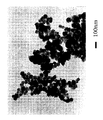
また、図3は、本実施例で得られたLi1+x(Fe0.5Ni0.25Ti0.25)1-xO2の電子顕微鏡写真を電子的に画像処理した図面である。図3から、本実施例によるLi1+x(Fe0.5Ni0.25Ti0.25)1-xO2は、粒径が100nm程度のほぼ同一形状を有する微粒子により構成されていることが、明らかである。
比較例1
硫酸鉄(II)7水和物34.75gおよび30%硫酸チタン(IV)水溶液50g(全量0.25mol、Fe:Tiモル比=1:1)を400mlの蒸留水に加え、完全に溶解させた。この水溶液を攪拌しつつ水酸化カリウム水溶液(蒸留水400mlに水酸化ナトリウム100gを溶解させた溶液)を徐々に滴下することにより、沈殿物を形成させた。反応液が完全にアルカリ性(pH11以上)になっていることを確認し、攪拌下に共沈物を含む反応液に室温で3日間空気を吹き込んで酸化処理した後、反応液を60℃で3日間保持して、沈殿を熟成させた。
【0041】
得られた沈殿を蒸留水で洗浄し、濾別した後、水酸化リチウム1水和物40g、塩素酸カリウム40g、蒸留水200mlとともにポリテトラフルオロエチレン製ビーカー中に入れ、よく攪拌した後、水熱反応炉(オートクレーブ)内に設置し、220℃で8時間水熱処理した。
【0042】
水熱処理終了後、反応炉を室温付近まで冷却し、水熱処理反応液を含むビーカーをオートクレーブ外に取り出し、生成している沈殿物を蒸留水で洗浄して、過剰に存在する水酸化リチウムなどの塩類を除去し、濾過し、乾燥することにより、粉末状生成物を得た。
【0043】
次いで、得られた生成物の結晶性を改善するために、生成物粉末と水酸化リチウム1水和物0.25モル(10.49g)を蒸留水150mlに溶解させた水酸化リチウム水溶液とを混合し、100℃で乾燥し、粉砕し、得られた粉末を大気中500℃で20時間焼成した。次いで、過剰のリチウム塩を除去するために、焼成物を蒸留水で水洗し、濾過し、乾燥して、粉末状生成物を得た。
【0044】
この最終生成物のX線回折パターンを図2(b)に示す。すべてのピークは、既存の粉末X線回折データ(JCPDSカード17-0938および“J.C.Mikkelsen, J. Am. Ceram. Soc., 63, 332, (1980)”に記載されている立方晶岩塩型のα-LiFeO2およびLi1.33Ti0.67O2の単位胞(空間群:Fm3m, a=4.158および4.140 Å)で、指数付けすることができた。
【0045】
本比較例において得られた最終生成物の各ピークから計算される格子定数(a=4.1445±0.0015Å)が、α-LiFeO2とLi1.33Ti0.67O2との中間的な値を有していること、化学分析(下記表1)により、Feがほぼ仕込量通りに54±2モル%含まれていること、Li/(Fe+Ti)値がほぼ1.4であることから、本比較例において、Li1+x(Fe0.5Ti0.50)1-xO2が得られたことが確認できた。
【0046】
【表1】

実施例2および比較例2
上記実施例1および比較例1で得られた各試料を正極材料とし、金属リチウムを負極材料として、LiPF6をエチレンカーボネートとジメチルカーボネートとの混合溶媒に溶解させた1M溶液を電解液として、リチウム電池としての充放電特性(電位範囲2.5-4.3V、電流密度7.5mA/g)を検討した(図4)。
【0048】
実施例1による正極材料と比較例1による正極材料において、初期充電容量はともに130mAh/g以上であるが、初期および10サイクル後の充放電曲線(図4において、右上がりの曲線が充電曲線に対応し、右下がりの曲線が放電曲線に対応する)が著しく異なっている。特に、4V付近の電位平坦部の初期および10サイクル後の容量において、実施例1による試料の方が、比較例1による試料に比して、大きな値を示している。
【図面の簡単な説明】
【図1】本発明によるLi1+x(Ti1-y-zFeyNiz)1-xO2の結晶構造を示す模式的な斜面図である。
【図2】実施例1で得られたLi1+x(Fe0.5Ni0.25Ti0.25)1-xO2のX線回折パターン(a)と比較例1で得られたLi1+x(Fe0.5Ti0.50)1-xO2のX線回折パターン(b)とを示す図面である。
【図3】実施例1で得られたLi1+x(Fe0.5Ni0.25Ti0.25)1-xO2の透過型電子顕微鏡写真を電子的に画像処理した図面である。
【図4】実施例1で得られたLi1+x(Fe0.5Ni0.25Ti0.25)1-xO2 (a)および比較例1で得られたLi1+x(Fe0.5Ti0.50)1-xO2 (b)をそれぞれ正極材料とし、Li金属を負極材料とする2種のコイン型リチウム電池の初期および10サイクル後の充放電特性を示すグラフである。[0001]
BACKGROUND OF THE INVENTION
The present invention relates to a lithium ferrite composite oxide useful as a positive electrode material for a next-generation low-cost lithium ion secondary battery and a method for producing the same.
[0002]
[Prior art]
In Japan, most of the secondary batteries installed in portable devices such as mobile phones and notebook computers are lithium ion secondary batteries. In addition, lithium ion secondary batteries are expected to be put into practical use as large batteries for electric vehicles and power load leveling systems in the future, and their importance is increasing.
[0003]
Currently, in lithium ion secondary batteries, a lithium cobalt oxide (LiCoO 2 ) material is mainly used as a positive electrode material, a carbon material such as graphite is used as a negative electrode material, and an organic electrolyte is used as an electrolyte.
[0004]
In particular, LiCoO 2 as the positive electrode material has a battery operating voltage (difference between the redox potential of the transition metal in the positive electrode and the redox potential of the negative electrode element), charge / discharge capacity (the amount of Li that can be desorbed and inserted from the positive electrode). ) And other important materials related to battery performance, and demand is expected to increase further in the future. However, since this compound contains cobalt which is a rare metal, it is one of the high cost factors of the lithium ion secondary battery. Furthermore, considering that about 20% of the world's cobalt production is already used in the battery industry, it is unclear whether the cathode material consisting of LiCoO 2 alone can meet future demand growth. Yes, the danger of cobalt resource depletion cannot be ignored.
[0005]
Currently, as a cheaper and more cathode material less resource limitations, lithium nickel oxide (LiNiO 2), lithium manganese oxide and (LiMn 2 O 4) or the like are known, some are replaced in LiCoO 2 practical It has become. However, these materials have problems such as safety problems during battery charging (LiNiO 2 ) and significant characteristic degradation due to manganese dissolution at 50 ° C. or higher (LiMn 2 O 4 ). Replacement of LiCoO 2 with these materials has not progressed as expected.
[0006]
In addition, lithium ferrite (LiFeO 2 ) containing iron, which is more abundant in resources, less toxic, and cheaper than manganese and nickel, is being investigated as a potential electrode material. However, lithium ferrite obtained by high-temperature firing using a normal iron source and Li source hardly charges or discharges (that is, has no activity as a positive electrode material of a lithium ion secondary battery).
[0007]
On the other hand, as a starting material alpha-NaFeO 2 or FeOOH, LiFeO 2 obtained using the H / Li ion exchange or Na / Li ion exchange method, although a charge flat potential in the vicinity of 4V, discharge potential Is less than 3V. (R. Kanno, T. Shirane, Y. Kawamoto, Y. Takeda, M. Takano, M. Ohashi and Y. Yamaguchi, J. Electrochem. Soc., 143, [8], 2435, (1996); Sakurai, H. Arai, S. Okada and J. Yamaki, J. Power Sources, 68, 711, (1997); L. Guenne, P. Deniard, A. Lecerf, P. Biensan, C. Siret, L. Fournes and R. Brec, Ionics, 4, 220, (1998); JP-A-10-120421, JP-A-8-295518, etc.). Discharge potential of LiFeO 2 obtained by such ion exchange method, as compared to the discharge potential of LiCoO 2, about 2V or more low, alternative LiCoO 2 by LiFeO 2 is rather difficult. As described above, a production technique for lithium ferrite reaching a practical level has not yet been established.
[0008]
The present inventors have prepared a lithium-containing iron-titanium oxide having a cubic rock salt structure ((Li 1 + x (Ti 1-y Fe y ) 1-x O 2 (where 0 ≦ x <0.33, 0.05 <Y <0.95)) has been found to function as a positive electrode material for a 3V-class lithium secondary battery having a discharge capacity of 100 mAh / g or more (Japanese Patent Application No. 2001- filed on August 1, 2001) 233197; hereinafter, this application is referred to as a "prior application").
[0009]
However, as a positive electrode material that can replace LiCoO 2 in a lithium secondary battery, it is particularly desirable to have a discharge flat potential in the vicinity of 4V. If a lithium ferrite composite oxide that has an operating voltage of 4 V or higher, is inexpensive, and is not subject to resource constraints, the usefulness of a lithium ion battery that uses this as a positive electrode material becomes more useful. It will be even higher.
[0010]
[Problems to be solved by the invention]
Therefore, the present invention is a novel that can be stably charged and discharged in an operating voltage region (about 4 V) equivalent to that of an existing lithium cobalt oxide-based positive electrode material by using an inexpensive raw material with less resource restrictions. The main purpose is to provide new materials.
[0011]
[Means for Solving the Problems]
The present inventor has intensively studied in view of the problems of the prior art including the invention of the prior application.
[0012]
As a result, the iron-titanium-nickel in which a specific amount of Ni is further dissolved in the lithium-containing iron-titanium oxide Li 1 + x (Ti 1-y Fe y ) 1-x O 2 according to the prior application. When the contained solid solution is used as a positive electrode material of a lithium ion secondary battery, it has been found that the cycle deterioration in the 4V region is remarkably improved, and the present invention has been completed.
[0013]
That is, the present invention provides a lithium ferrite composite oxide, a method for producing the lithium ferrite composite oxide, a positive electrode material for a lithium ion secondary battery, and a lithium ion secondary battery comprising the lithium ferrite composite oxide.
1. Composition formula Li 1 + x (Ti 1-yz Fe y Ni z ) 1-x O 2 (However, 0 ≦ x ≦ 0.33, 0 <y ≦ 0.95, 0 <z ≦ 0.5, 0 <y + z <1) in the represented, and Li / (Ti + Fe + Ni ) of values (molar ratio) is 1.2, the lithium ferrite based composite oxide having a cubic rock salt structure.
2. A mixed aqueous solution containing water-soluble titanium salt, water-soluble iron salt and water-soluble nickel salt is coprecipitated with alkali, and the resulting precipitation product is hydrothermally treated in the temperature range of 101 to 400 ° C together with an oxidizing agent and water-soluble lithium salt. Then, after removing excess salts, the hydrothermal treatment reaction product is heat-treated at 300 to 800 ° C. The method for producing a lithium ferrite-based composite oxide according to
3. Item 3. The method for producing a lithium ferrite composite oxide according to Item 2, wherein the hydrothermal treatment reaction product is heat-treated in air, in an oxidizing atmosphere, or in a reducing atmosphere.
4). Item 4. The method for producing a lithium ferrite composite oxide according to Item 3, wherein a lithium salt is added to and mixed with the hydrothermal reaction product before heat treatment, the heat treatment is performed, and then the heat treatment product is washed with a solvent to remove excess lithium salt. .
5). Composition formula Li 1 + x (Ti 1-yz Fe y Ni z ) 1-x O 2 (However, 0 ≦ x ≦ 0.33, 0 <y ≦ 0.95, 0 <z ≦ 0.5, 0 <y + z <1) in the represented, and Li / (Ti + Fe + Ni ) of values (molar ratio) is 1.2, a positive electrode material for a lithium ion secondary battery comprising lithium ferrite composite oxide having a cubic rock salt structure.
6). Composition formula Li 1 + x (Ti 1-yz Fe y Ni z ) 1-x O 2 (However, 0 ≦ x ≦ 0.33, 0 <y ≦ 0.95, 0 <z ≦ 0.5, 0 <y + z <1) in expressed, and the value of Li / (Ti + Fe + Ni ) ( molar ratio) is 1.2, a lithium ion secondary to a positive electrode material components comprising lithium ferrite composite oxide having a cubic rock-salt type structure Next battery.
[0014]
DETAILED DESCRIPTION OF THE INVENTION
The nickel-containing lithium ferrite oxide according to the present invention has a cubic rock salt structure similar to α-LiFeO 2 . In this structure, Li ions, Fe ions, and Ni ions are randomly distributed at the positions between the octahedral lattices of the oxide ions that are close packed in cubic. In the nickel-containing lithium ferrite-based oxide Li 1 + x (Ti 1-yz Fe y Ni z ) 1-x O 2 of the present invention, it is confirmed that Ti and Ni ions occupy the same lattice positions as Fe ions. Features. That is, Fe ions are diluted by coexistence with both ions. LiFeO 2 in which both ions do not coexist has almost no charge / discharge capacity.
[0015]
Therefore, the amount of Fe ions to be dissolved is preferably about 5 to 95 mol% (0.05 ≦ Fe / Fe + Ti + Ni ≦ 0.95) of the amount of transition metal (Fe + Ti + Ni) ions, 20 to 80 More preferably, it is about mol%. When the amount of solid solution of Fe is too large, Fe that does not participate in charge / discharge increases, which is not preferable in terms of battery characteristics. On the other hand, when the amount of Fe dissolved is too small, the charge / discharge capacity becomes small, which is also not preferable.
[0016]
The amount of Ni ions to be dissolved is preferably 50 mol% (0 <z ≦ 0.5), more preferably 1 to 50 mol%. When the amount of Ni dissolved is too small, the discharge capacity deteriorates in the 4V region, which is not preferable in terms of battery characteristics. On the other hand, when the amount of Ni, which is expensive compared to Ti and Fe, is too large, the low cost characteristic of the material of the present invention is lost.
[0017]
The nickel-containing lithium ferrite-based oxide according to the present invention has an impurity phase such as lithium hydroxide and lithium carbonate derived from the production raw material within a range that does not substantially affect the charge / discharge characteristics (up to about 10 mol%). It may contain a small amount.
[0018]
The composite oxide of the present invention can be produced by a hydrothermal reaction method, a solid phase reaction method, or the like, which is a common composite oxide synthesis method. However, in general, in a solid-phase reaction method using a dry mixing process, it is difficult to homogeneously mix metal ions (particularly, mixing Fe ions, Ti ions, and Ni ions). Therefore, the composite metal oxide of the present invention is more preferably produced by a hydrothermal reaction method using a mixed solution in which a metal salt that is a source of each ion is dissolved in water, a water / alcohol mixture, or the like. .
[0019]
In the present invention, the hydrothermal reaction is usually carried out by adding an alkaline aqueous solution to an aqueous solution containing water-soluble iron salt, water-soluble titanium salt and water-soluble nickel salt or a water-alcohol mixed solution to obtain a coprecipitate, followed by oxidation. This is performed by heating the coprecipitate and the lithium source compound in the presence of the agent.
[0020]
Source materials for metals other than Li used in the hydrothermal reaction method (Ti, Fe and Ni) include water-soluble salts (chlorides, nitrates, sulfates, oxalates, acetates, etc.), hydroxides, etc. Can be mentioned. These salts may be either anhydrides or hydrates. These salts and hydroxides may be used alone or in combination of two or more for any metal. As the metal source, for any metal, an aqueous solution in which a metal oxide is dissolved with an acid such as hydrochloric acid may be used.
[0021]
As the lithium source to be hydrothermally reacted with the coprecipitate obtained as described above, lithium hydroxide (anhydride and / or hydrate), lithium chloride, lithium nitrate, lithium carbonate and the like are preferable.
[0022]
The Li / (Fe + Ti + Ni) molar ratio in the mixed aqueous solution used in the hydrothermal reaction is appropriately selected according to the Li / (Fe + Ti + Ni) molar ratio in the target composite metal oxide. be able to. This molar ratio is preferably about 1 to 3, and more preferably about 1.5 to 2.5.
[0023]
As an alkali source for forming a coprecipitate from the mixed aqueous solution, lithium hydroxide, sodium hydroxide, potassium hydroxide, aqueous ammonia and the like are preferable.
[0024]
The method for producing a metal composite oxide according to the present invention is classified into two modes depending on whether the removal of the excess lithium compound is performed before or after calcination of the hydrothermal reaction product.
[0025]
More specifically, when producing a metal composite oxide according to an embodiment of the present invention, a total molar ratio of iron salt, titanium salt and nickel salt is about 0.01 to 5M (anhydride conversion), more preferably Dissolve in distilled water or distilled water-alcohol mixed solvent so that the concentration is about 0.1 to 2M. Next, while stirring the obtained mixed solution, an alkaline aqueous solution such as potassium hydroxide corresponding to about 0.1 to 20M, more preferably about 0.5 to 10M is dropped until the mixed solution becomes completely alkaline (pH 11 or more). By doing so, a coprecipitate is generated. After completion of the dropwise addition, the coprecipitate is heated while blowing air into the reaction solution at a temperature of about 0 to 150 ° C., more preferably about 20 to 100 ° C., for about 2 to 7 days, more preferably about 3 to 5 days. Oxidation / aging process is performed. Next, the obtained precipitate is washed with distilled water to remove excess alkali components and residual salts, and the filtered precipitate is dried at a temperature of 80 ° C. or higher (usually about 100 ° C.) to purify the precipitate. Fe-Ni-Ti coprecipitate is obtained.
[0026]
The purified coprecipitate is then mixed with distilled water in a beaker (eg, a polytetrafluoroethylene beaker) to which lithium hydroxide (anhydride and / or hydrate), lithium chloride, lithium nitrate, lithium carbonate Lithium salt such as about 0.1 to 10M, more preferably about 1 to 8M, and further oxidizing agent such as potassium chlorate and hydrogen peroxide is about 0.1 to 10M, more preferably about 0.5 to 5M. After that, the beaker is left in a hydrothermal reactor (for example, a commercially available autoclave), and the mixture is subjected to a hydrothermal reaction. Hydrothermal reaction conditions are not particularly limited, but are usually about 100 to 400 ° C. for about 0.1 to 150 hours, more preferably about 150 to 300 ° C. for about 1 to 100 hours. .
[0027]
After completion of the hydrothermal reaction, the reaction product is washed with water, water-alcohol, acetone, etc. to remove residual salts, filtered, and heated at a temperature of 80 ° C. or higher (more preferably about 100 ° C.). By drying, a desired cubic rock salt type lithium ferrite composite oxide is obtained.
[0028]
In the present invention, if necessary, in order to further improve the crystallinity as a cubic rock salt type lithium ferrite composite oxide, the composite oxide obtained above is pulverized, and is in a powder form or an aqueous solution form. Li salt (lithium hydroxide, lithium chloride, lithium nitrate, lithium carbonate, etc.), in the atmosphere, in an oxidizing atmosphere, in an inert atmosphere or in a reducing atmosphere, about 200-800 ° C. (more preferably 300- It may be fired at about 600 ° C. for about 1 to 100 hours (more preferably about 20 to 60 hours). The lithium salt is more preferably used in the form of an aqueous solution in order to ensure the uniformity of the reaction. Further, after the calcination, if necessary, the baked product is washed with water or a solvent to remove excess lithium salt, filtered, and then filtered at a temperature of 80 ° C. or higher (more preferably about 100 ° C.). ) May be heat-dried.
[0029]
Furthermore, by repeating a series of operations of pulverizing, baking, washing, and drying this heat-dried product, the excellent properties of lithium ferrite-based composite oxides (operation as a positive electrode material for lithium ion secondary batteries) Stable charge / discharge characteristics in the voltage region, high capacity, etc.) can be further improved.
[0030]
The lithium ion secondary battery using the lithium ferrite composite oxide according to the present invention can be manufactured by a known method. That is, the novel composite oxide according to the present invention is used as the positive electrode material, the known metal lithium, carbon-based material (activated carbon, graphite), etc. are used as the negative electrode material, and the known ethylene carbonate and dimethyl are used as the electrolyte. Assembling a lithium ion secondary battery according to a conventional method using a solution in which a lithium salt such as lithium perchlorate or LiPF 6 is dissolved in a solvent such as carbonate, and using other known battery components Can do.
[0031]
【The invention's effect】
According to the present invention, a novel lithium ferrite composite oxide that can be stably charged and discharged in an operating voltage range (about 4 V) equivalent to that of an existing lithium cobalt oxide-based positive electrode material using an inexpensive raw material Material can be obtained.
[0032]
The lithium ferrite composite oxide according to the present invention is extremely useful as a low-cost positive electrode material for lithium ion secondary batteries with little cycle deterioration.
[0033]
【Example】
Examples and comparative examples are shown below to further clarify the features of the present invention. The present invention is not limited to these examples.
[0034]
The crystal phase of each oxide sample obtained in the following examples and comparative examples is determined by X-ray diffraction analysis, the composition is determined by inductively coupled plasma spectroscopy (ICP) and atomic absorption analysis, and the particle size is determined by transmission electron. Each was evaluated with a microscope (TEM). Moreover, a coin-type lithium battery using each oxide as a positive electrode material and metallic lithium as a negative electrode material was produced, and its charge / discharge characteristics were measured.
Example 1
Iron sulfate (II) sulfate heptahydrate 34.75 g, nickel chloride (II) hexahydrate 14.86 g and 30% titanium sulfate (IV) aqueous solution 50 g (total amount 0.25 mol, Fe: Ti: Ni molar ratio = 2: 2: 1) was added to 400 ml of distilled water and completely dissolved. While this aqueous solution was stirred, a potassium hydroxide aqueous solution (a solution obtained by dissolving 100 g of sodium hydroxide in 400 ml of distilled water) was gradually added dropwise to form a precipitate. After confirming that the reaction solution was completely alkaline (pH 11 or higher) and stirring, the reaction solution containing the coprecipitate was blown at room temperature for 3 days to oxidize the reaction solution. The precipitate was aged by holding for one day.
[0035]
The resulting precipitate was washed with distilled water and filtered, then placed in a polytetrafluoroethylene beaker with 40 g of lithium hydroxide monohydrate, 40 g of potassium chlorate, and 200 ml of distilled water. It was placed in a thermal reactor (autoclave) and hydrothermally treated at 220 ° C. for 8 hours.
[0036]
After the hydrothermal treatment is completed, the reaction furnace is cooled to near room temperature, the beaker containing the hydrothermal treatment reaction solution is taken out of the autoclave, and the generated precipitate is washed with distilled water to remove excess lithium hydroxide and the like. Salts were removed, filtered and dried to give a powdered product.
[0037]
Next, in order to improve the crystallinity of the resulting product, the product powder and lithium hydroxide aqueous solution in which 0.25 mol (10.49 g) of lithium hydroxide monohydrate was dissolved in 150 ml of distilled water were mixed, It was dried at 100 ° C. and pulverized, and the obtained powder was calcined at 500 ° C. for 20 hours in the air. Subsequently, in order to remove excess lithium salt, the fired product was washed with distilled water, filtered and dried to obtain a black powdery product.
[0038]
The X-ray diffraction pattern of this final product is shown in FIG. All peaks are shown in the existing powder X-ray diffraction data (JCPDS card 17-0938 and “JCMikkelsen, J. AM. Ceram. Soc., 63, 332, (1980)”). -LiFeO 2 and Li 1.33 Ti 0.67 O 2 unit cells (space group: Fm3m, a = 4.158 and 4.140 Å) could be indexed.
[0039]
The lattice constant (a = 4.1437 ± 0.0002Å) calculated from each peak of the final product obtained in this example has an intermediate value between α-LiFeO 2 and Li 1.33 Ti 0.67 O 2. According to chemical analysis (Table 1 below), Fe and Ni are contained almost as much as 51 ± 1 mol% and 26 ± 1 mol%, respectively, and the Li / (Fe + Ti + Ni) value Since it was approximately 1.2, it was confirmed that Li 1 + x (Fe 0.5 Ni 0.25 Ti 0.25 ) 1-x O 2 was obtained in this example.
[0040]
FIG. 3 is a drawing of electronic image processing of an electron micrograph of Li 1 + x (Fe 0.5 Ni 0.25 Ti 0.25 ) 1-x O 2 obtained in this example. From FIG. 3, it is clear that Li 1 + x (Fe 0.5 Ni 0.25 Ti 0.25 ) 1-x O 2 according to this example is composed of fine particles having a particle size of about 100 nm and having almost the same shape. .
Comparative Example 1
34.75 g of iron (II) sulfate heptahydrate and 50 g of 30% titanium sulfate (IV) aqueous solution (total amount 0.25 mol, Fe: Ti molar ratio = 1: 1) were added to 400 ml of distilled water and completely dissolved. While this aqueous solution was stirred, a potassium hydroxide aqueous solution (a solution obtained by dissolving 100 g of sodium hydroxide in 400 ml of distilled water) was gradually added dropwise to form a precipitate. After confirming that the reaction solution was completely alkaline (pH 11 or higher) and stirring, the reaction solution containing the coprecipitate was blown at room temperature for 3 days to oxidize the reaction solution. The precipitate was aged by holding for one day.
[0041]
The resulting precipitate was washed with distilled water and filtered, then placed in a polytetrafluoroethylene beaker with 40 g of lithium hydroxide monohydrate, 40 g of potassium chlorate, and 200 ml of distilled water. It was placed in a thermal reactor (autoclave) and hydrothermally treated at 220 ° C. for 8 hours.
[0042]
After the hydrothermal treatment is completed, the reaction furnace is cooled to near room temperature, the beaker containing the hydrothermal treatment reaction solution is taken out of the autoclave, and the generated precipitate is washed with distilled water to remove excess lithium hydroxide and the like. Salts were removed, filtered and dried to give a powdered product.
[0043]
Next, in order to improve the crystallinity of the resulting product, the product powder and lithium hydroxide aqueous solution in which 0.25 mol (10.49 g) of lithium hydroxide monohydrate was dissolved in 150 ml of distilled water were mixed, It was dried at 100 ° C. and pulverized, and the obtained powder was calcined at 500 ° C. for 20 hours in the air. Subsequently, in order to remove excess lithium salt, the fired product was washed with distilled water, filtered and dried to obtain a powdery product.
[0044]
The X-ray diffraction pattern of this final product is shown in FIG. All peaks are shown in existing powder X-ray diffraction data (JCPDS card 17-0938 and “JCMikkelsen, J. Am. Ceram. Soc., 63, 332, (1980)”). -LiFeO 2 and Li 1.33 Ti 0.67 O 2 unit cells (space group: Fm3m, a = 4.158 and 4.140 Å) could be indexed.
[0045]
The lattice constant (a = 4.1445 ± 0.0015Å) calculated from each peak of the final product obtained in this comparative example has an intermediate value between α-LiFeO 2 and Li 1.33 Ti 0.67 O 2. In this comparative example, the chemical analysis (Table 1 below) shows that Fe is contained as much as 54 ± 2 mol% as charged, and the Li / (Fe + Ti) value is approximately 1.4. It was confirmed that Li 1 + x (Fe 0.5 Ti 0.50 ) 1-x O 2 was obtained.
[0046]
[Table 1]
Example 2 and Comparative Example 2
Each sample obtained in Example 1 and Comparative Example 1 was used as a positive electrode material, metallic lithium as a negative electrode material, and a 1M solution in which LiPF 6 was dissolved in a mixed solvent of ethylene carbonate and dimethyl carbonate as an electrolytic solution. The charge / discharge characteristics (potential range 2.5-4.3V, current density 7.5mA / g) as a battery were examined (FIG. 4).
[0048]
In the positive electrode material according to Example 1 and the positive electrode material according to Comparative Example 1, both initial charge capacities are 130 mAh / g or more, but the initial and 10th cycle charge / discharge curves (in FIG. 4, the upward curve is the charge curve). Correspondingly, the lower right curve corresponds to the discharge curve). In particular, the sample according to Example 1 shows a larger value than the sample according to Comparative Example 1 in the initial stage of the potential flat portion near 4 V and the capacity after 10 cycles.
[Brief description of the drawings]
FIG. 1 is a schematic slope view showing a crystal structure of Li 1 + x (Ti 1-yz Fe y Ni z ) 1-x O 2 according to the present invention.
FIG. 2 shows the X-ray diffraction pattern (a) of Li 1 + x (Fe 0.5 Ni 0.25 Ti 0.25 ) 1-x O 2 obtained in Example 1 and Li 1 + x (Fe 1 is a drawing showing an X-ray diffraction pattern (b) of 0.5 Ti 0.50 ) 1-x O 2 .
3 is a drawing obtained by electronic image processing of a transmission electron micrograph of Li 1 + x (Fe 0.5 Ni 0.25 Ti 0.25 ) 1-x O 2 obtained in Example 1. FIG.
4 shows Li 1 + x (Fe 0.5 Ni 0.25 Ti 0.25 ) 1-x O 2 (a) obtained in Example 1 and Li 1 + x (Fe 0.5 Ti 0.50 ) 1 obtained in Comparative Example 1. FIG. 2 is a graph showing charge and discharge characteristics of two types of coin-type lithium batteries each having —x O 2 (b) as a positive electrode material and Li metal as a negative electrode material, and after 10 cycles.
Claims (6)
Priority Applications (1)
| Application Number | Priority Date | Filing Date | Title |
|---|---|---|---|
| JP2002113976A JP3968420B2 (en) | 2002-04-16 | 2002-04-16 | Cubic rock salt type lithium ferrite complex oxide and method for producing the same |
Applications Claiming Priority (1)
| Application Number | Priority Date | Filing Date | Title |
|---|---|---|---|
| JP2002113976A JP3968420B2 (en) | 2002-04-16 | 2002-04-16 | Cubic rock salt type lithium ferrite complex oxide and method for producing the same |
Publications (2)
| Publication Number | Publication Date |
|---|---|
| JP2003306332A JP2003306332A (en) | 2003-10-28 |
| JP3968420B2 true JP3968420B2 (en) | 2007-08-29 |
Family
ID=29395983
Family Applications (1)
| Application Number | Title | Priority Date | Filing Date |
|---|---|---|---|
| JP2002113976A Expired - Lifetime JP3968420B2 (en) | 2002-04-16 | 2002-04-16 | Cubic rock salt type lithium ferrite complex oxide and method for producing the same |
Country Status (1)
| Country | Link |
|---|---|
| JP (1) | JP3968420B2 (en) |
Families Citing this family (4)
| Publication number | Priority date | Publication date | Assignee | Title |
|---|---|---|---|---|
| JP4963059B2 (en) * | 2006-11-20 | 2012-06-27 | 独立行政法人産業技術総合研究所 | Lithium manganese composite oxide containing titanium and nickel |
| CN114759159B (en) * | 2022-04-25 | 2024-03-15 | 湖北万润新能源科技股份有限公司 | Preparation method of high-activity lithium ferrite, high-activity lithium ferrite anode and battery |
| JP2025012287A (en) | 2023-07-13 | 2025-01-24 | 住友金属鉱山株式会社 | Positive electrode active material for lithium-ion secondary batteries |
| JP2025012286A (en) | 2023-07-13 | 2025-01-24 | 住友金属鉱山株式会社 | Positive electrode active material for lithium-ion secondary batteries |
-
2002
- 2002-04-16 JP JP2002113976A patent/JP3968420B2/en not_active Expired - Lifetime
Also Published As
| Publication number | Publication date |
|---|---|
| JP2003306332A (en) | 2003-10-28 |
Similar Documents
| Publication | Publication Date | Title |
|---|---|---|
| JP4963059B2 (en) | Lithium manganese composite oxide containing titanium and nickel | |
| US8021783B2 (en) | Lithium manganese-based composite oxide and method for preparing the same | |
| JP5263761B2 (en) | Monoclinic lithium manganese composite oxide having cation ordered structure and method for producing the same | |
| JP3940788B2 (en) | Lithium ferrite composite oxide and method for producing the same | |
| JP5516926B2 (en) | Monoclinic Lithium Manganese Composite Oxide with Regular Structure and Method for Producing the Same | |
| JP4997609B2 (en) | Method for producing lithium manganese composite oxide | |
| JP6119003B2 (en) | Lithium manganese composite oxide and method for producing the same | |
| JP3500424B2 (en) | Single-phase lithium ferrite composite oxide | |
| JP5958926B2 (en) | Lithium manganese composite oxide and method for producing the same | |
| JP7128475B2 (en) | Lithium-manganese composite oxide and method for producing the same | |
| JP5673932B2 (en) | Lithium manganese composite oxide having cubic rock salt structure and method for producing the same | |
| JP6083556B2 (en) | Cathode active material for sodium ion secondary battery | |
| JP6872816B2 (en) | Nickel-manganese-based composite oxide and its manufacturing method | |
| JP4457213B2 (en) | Method for producing lithium ferrite composite oxide | |
| JP7048944B2 (en) | Titanium and / or germanium-substituted lithium-manganese-based composite oxide and its production method | |
| JP4423391B2 (en) | Lithium ferrite composite oxide and method for producing the same | |
| JP3968420B2 (en) | Cubic rock salt type lithium ferrite complex oxide and method for producing the same | |
| JP3914981B2 (en) | Cubic rock salt type lithium ferrite oxide and method for producing the same | |
| JP4543156B2 (en) | Lithium ferrite composite oxide and method for producing the same | |
| JP3407042B2 (en) | Lithium ion secondary battery positive electrode material and method for producing the same | |
| JP4734672B2 (en) | Method for producing lithium-iron-manganese composite oxide | |
| JPWO2019235573A1 (en) | Lithium manganese-based composite oxide and its manufacturing method | |
| JP7192397B2 (en) | Lithium-cobalt-manganese composite oxide and lithium secondary battery containing the same | |
| JPH11292550A (en) | Method for producing lithium composite oxide |
Legal Events
| Date | Code | Title | Description |
|---|---|---|---|
| A977 | Report on retrieval |
Free format text: JAPANESE INTERMEDIATE CODE: A971007 Effective date: 20060630 |
|
| A131 | Notification of reasons for refusal |
Free format text: JAPANESE INTERMEDIATE CODE: A131 Effective date: 20060919 |
|
| A521 | Request for written amendment filed |
Free format text: JAPANESE INTERMEDIATE CODE: A523 Effective date: 20061107 |
|
| A02 | Decision of refusal |
Free format text: JAPANESE INTERMEDIATE CODE: A02 Effective date: 20070116 |
|
| A521 | Request for written amendment filed |
Free format text: JAPANESE INTERMEDIATE CODE: A523 Effective date: 20070201 |
|
| A911 | Transfer to examiner for re-examination before appeal (zenchi) |
Free format text: JAPANESE INTERMEDIATE CODE: A911 Effective date: 20070409 |
|
| TRDD | Decision of grant or rejection written | ||
| A01 | Written decision to grant a patent or to grant a registration (utility model) |
Free format text: JAPANESE INTERMEDIATE CODE: A01 Effective date: 20070508 |
|
| R150 | Certificate of patent or registration of utility model |
Ref document number: 3968420 Country of ref document: JP Free format text: JAPANESE INTERMEDIATE CODE: R150 Free format text: JAPANESE INTERMEDIATE CODE: R150 |
|
| S533 | Written request for registration of change of name |
Free format text: JAPANESE INTERMEDIATE CODE: R313533 |
|
| R350 | Written notification of registration of transfer |
Free format text: JAPANESE INTERMEDIATE CODE: R350 |
|
| EXPY | Cancellation because of completion of term |