EP2440183B1 - Improved lipid formulation - Google Patents
Improved lipid formulation Download PDFInfo
- Publication number
- EP2440183B1 EP2440183B1 EP10786869.7A EP10786869A EP2440183B1 EP 2440183 B1 EP2440183 B1 EP 2440183B1 EP 10786869 A EP10786869 A EP 10786869A EP 2440183 B1 EP2440183 B1 EP 2440183B1
- Authority
- EP
- European Patent Office
- Prior art keywords
- lipid
- gene
- peg
- nucleic acid
- rna
- Prior art date
- Legal status (The legal status is an assumption and is not a legal conclusion. Google has not performed a legal analysis and makes no representation as to the accuracy of the status listed.)
- Active
Links
- MTVUDFBYBPMGMR-UHFFFAOYSA-N CCCNNCC Chemical compound CCCNNCC MTVUDFBYBPMGMR-UHFFFAOYSA-N 0.000 description 1
Images


Classifications
-
- A—HUMAN NECESSITIES
- A61—MEDICAL OR VETERINARY SCIENCE; HYGIENE
- A61K—PREPARATIONS FOR MEDICAL, DENTAL OR TOILETRY PURPOSES
- A61K9/00—Medicinal preparations characterised by special physical form
- A61K9/10—Dispersions; Emulsions
- A61K9/127—Synthetic bilayered vehicles, e.g. liposomes or liposomes with cholesterol as the only non-phosphatidyl surfactant
- A61K9/1271—Non-conventional liposomes, e.g. PEGylated liposomes or liposomes coated or grafted with polymers
- A61K9/1272—Non-conventional liposomes, e.g. PEGylated liposomes or liposomes coated or grafted with polymers comprising non-phosphatidyl surfactants as bilayer-forming substances, e.g. cationic lipids or non-phosphatidyl liposomes coated or grafted with polymers
-
- A—HUMAN NECESSITIES
- A61—MEDICAL OR VETERINARY SCIENCE; HYGIENE
- A61K—PREPARATIONS FOR MEDICAL, DENTAL OR TOILETRY PURPOSES
- A61K31/00—Medicinal preparations containing organic active ingredients
- A61K31/21—Esters, e.g. nitroglycerine, selenocyanates
- A61K31/215—Esters, e.g. nitroglycerine, selenocyanates of carboxylic acids
- A61K31/22—Esters, e.g. nitroglycerine, selenocyanates of carboxylic acids of acyclic acids, e.g. pravastatin
-
- A—HUMAN NECESSITIES
- A61—MEDICAL OR VETERINARY SCIENCE; HYGIENE
- A61K—PREPARATIONS FOR MEDICAL, DENTAL OR TOILETRY PURPOSES
- A61K31/00—Medicinal preparations containing organic active ingredients
- A61K31/70—Carbohydrates; Sugars; Derivatives thereof
- A61K31/7088—Compounds having three or more nucleosides or nucleotides
-
- A—HUMAN NECESSITIES
- A61—MEDICAL OR VETERINARY SCIENCE; HYGIENE
- A61K—PREPARATIONS FOR MEDICAL, DENTAL OR TOILETRY PURPOSES
- A61K31/00—Medicinal preparations containing organic active ingredients
- A61K31/70—Carbohydrates; Sugars; Derivatives thereof
- A61K31/7088—Compounds having three or more nucleosides or nucleotides
- A61K31/7105—Natural ribonucleic acids, i.e. containing only riboses attached to adenine, guanine, cytosine or uracil and having 3'-5' phosphodiester links
-
- A—HUMAN NECESSITIES
- A61—MEDICAL OR VETERINARY SCIENCE; HYGIENE
- A61K—PREPARATIONS FOR MEDICAL, DENTAL OR TOILETRY PURPOSES
- A61K31/00—Medicinal preparations containing organic active ingredients
- A61K31/70—Carbohydrates; Sugars; Derivatives thereof
- A61K31/7088—Compounds having three or more nucleosides or nucleotides
- A61K31/712—Nucleic acids or oligonucleotides having modified sugars, i.e. other than ribose or 2'-deoxyribose
-
- A—HUMAN NECESSITIES
- A61—MEDICAL OR VETERINARY SCIENCE; HYGIENE
- A61K—PREPARATIONS FOR MEDICAL, DENTAL OR TOILETRY PURPOSES
- A61K31/00—Medicinal preparations containing organic active ingredients
- A61K31/70—Carbohydrates; Sugars; Derivatives thereof
- A61K31/7088—Compounds having three or more nucleosides or nucleotides
- A61K31/713—Double-stranded nucleic acids or oligonucleotides
-
- A—HUMAN NECESSITIES
- A61—MEDICAL OR VETERINARY SCIENCE; HYGIENE
- A61K—PREPARATIONS FOR MEDICAL, DENTAL OR TOILETRY PURPOSES
- A61K38/00—Medicinal preparations containing peptides
- A61K38/16—Peptides having more than 20 amino acids; Gastrins; Somatostatins; Melanotropins; Derivatives thereof
- A61K38/17—Peptides having more than 20 amino acids; Gastrins; Somatostatins; Melanotropins; Derivatives thereof from animals; from humans
- A61K38/1703—Peptides having more than 20 amino acids; Gastrins; Somatostatins; Melanotropins; Derivatives thereof from animals; from humans from vertebrates
- A61K38/1709—Peptides having more than 20 amino acids; Gastrins; Somatostatins; Melanotropins; Derivatives thereof from animals; from humans from vertebrates from mammals
-
- A—HUMAN NECESSITIES
- A61—MEDICAL OR VETERINARY SCIENCE; HYGIENE
- A61K—PREPARATIONS FOR MEDICAL, DENTAL OR TOILETRY PURPOSES
- A61K38/00—Medicinal preparations containing peptides
- A61K38/16—Peptides having more than 20 amino acids; Gastrins; Somatostatins; Melanotropins; Derivatives thereof
- A61K38/43—Enzymes; Proenzymes; Derivatives thereof
- A61K38/46—Hydrolases (3)
- A61K38/48—Hydrolases (3) acting on peptide bonds (3.4)
- A61K38/482—Serine endopeptidases (3.4.21)
- A61K38/4846—Factor VII (3.4.21.21); Factor IX (3.4.21.22); Factor Xa (3.4.21.6); Factor XI (3.4.21.27); Factor XII (3.4.21.38)
-
- A—HUMAN NECESSITIES
- A61—MEDICAL OR VETERINARY SCIENCE; HYGIENE
- A61K—PREPARATIONS FOR MEDICAL, DENTAL OR TOILETRY PURPOSES
- A61K47/00—Medicinal preparations characterised by the non-active ingredients used, e.g. carriers or inert additives; Targeting or modifying agents chemically bound to the active ingredient
- A61K47/06—Organic compounds, e.g. natural or synthetic hydrocarbons, polyolefins, mineral oil, petrolatum or ozokerite
- A61K47/08—Organic compounds, e.g. natural or synthetic hydrocarbons, polyolefins, mineral oil, petrolatum or ozokerite containing oxygen, e.g. ethers, acetals, ketones, quinones, aldehydes, peroxides
- A61K47/14—Esters of carboxylic acids, e.g. fatty acid monoglycerides, medium-chain triglycerides, parabens or PEG fatty acid esters
-
- A—HUMAN NECESSITIES
- A61—MEDICAL OR VETERINARY SCIENCE; HYGIENE
- A61K—PREPARATIONS FOR MEDICAL, DENTAL OR TOILETRY PURPOSES
- A61K47/00—Medicinal preparations characterised by the non-active ingredients used, e.g. carriers or inert additives; Targeting or modifying agents chemically bound to the active ingredient
- A61K47/50—Medicinal preparations characterised by the non-active ingredients used, e.g. carriers or inert additives; Targeting or modifying agents chemically bound to the active ingredient the non-active ingredient being chemically bound to the active ingredient, e.g. polymer-drug conjugates
- A61K47/51—Medicinal preparations characterised by the non-active ingredients used, e.g. carriers or inert additives; Targeting or modifying agents chemically bound to the active ingredient the non-active ingredient being chemically bound to the active ingredient, e.g. polymer-drug conjugates the non-active ingredient being a modifying agent
- A61K47/54—Medicinal preparations characterised by the non-active ingredients used, e.g. carriers or inert additives; Targeting or modifying agents chemically bound to the active ingredient the non-active ingredient being chemically bound to the active ingredient, e.g. polymer-drug conjugates the non-active ingredient being a modifying agent the modifying agent being an organic compound
- A61K47/549—Sugars, nucleosides, nucleotides or nucleic acids
-
- A—HUMAN NECESSITIES
- A61—MEDICAL OR VETERINARY SCIENCE; HYGIENE
- A61K—PREPARATIONS FOR MEDICAL, DENTAL OR TOILETRY PURPOSES
- A61K47/00—Medicinal preparations characterised by the non-active ingredients used, e.g. carriers or inert additives; Targeting or modifying agents chemically bound to the active ingredient
- A61K47/50—Medicinal preparations characterised by the non-active ingredients used, e.g. carriers or inert additives; Targeting or modifying agents chemically bound to the active ingredient the non-active ingredient being chemically bound to the active ingredient, e.g. polymer-drug conjugates
- A61K47/51—Medicinal preparations characterised by the non-active ingredients used, e.g. carriers or inert additives; Targeting or modifying agents chemically bound to the active ingredient the non-active ingredient being chemically bound to the active ingredient, e.g. polymer-drug conjugates the non-active ingredient being a modifying agent
- A61K47/54—Medicinal preparations characterised by the non-active ingredients used, e.g. carriers or inert additives; Targeting or modifying agents chemically bound to the active ingredient the non-active ingredient being chemically bound to the active ingredient, e.g. polymer-drug conjugates the non-active ingredient being a modifying agent the modifying agent being an organic compound
- A61K47/55—Medicinal preparations characterised by the non-active ingredients used, e.g. carriers or inert additives; Targeting or modifying agents chemically bound to the active ingredient the non-active ingredient being chemically bound to the active ingredient, e.g. polymer-drug conjugates the non-active ingredient being a modifying agent the modifying agent being an organic compound the modifying agent being also a pharmacologically or therapeutically active agent, i.e. the entire conjugate being a codrug
- A61K47/551—Medicinal preparations characterised by the non-active ingredients used, e.g. carriers or inert additives; Targeting or modifying agents chemically bound to the active ingredient the non-active ingredient being chemically bound to the active ingredient, e.g. polymer-drug conjugates the non-active ingredient being a modifying agent the modifying agent being an organic compound the modifying agent being also a pharmacologically or therapeutically active agent, i.e. the entire conjugate being a codrug one of the codrug's components being a vitamin, e.g. niacinamide, vitamin B3, cobalamin, vitamin B12, folate, vitamin A or retinoic acid
-
- A—HUMAN NECESSITIES
- A61—MEDICAL OR VETERINARY SCIENCE; HYGIENE
- A61K—PREPARATIONS FOR MEDICAL, DENTAL OR TOILETRY PURPOSES
- A61K47/00—Medicinal preparations characterised by the non-active ingredients used, e.g. carriers or inert additives; Targeting or modifying agents chemically bound to the active ingredient
- A61K47/50—Medicinal preparations characterised by the non-active ingredients used, e.g. carriers or inert additives; Targeting or modifying agents chemically bound to the active ingredient the non-active ingredient being chemically bound to the active ingredient, e.g. polymer-drug conjugates
- A61K47/69—Medicinal preparations characterised by the non-active ingredients used, e.g. carriers or inert additives; Targeting or modifying agents chemically bound to the active ingredient the non-active ingredient being chemically bound to the active ingredient, e.g. polymer-drug conjugates the conjugate being characterised by physical or galenical forms, e.g. emulsion, particle, inclusion complex, stent or kit
- A61K47/6905—Medicinal preparations characterised by the non-active ingredients used, e.g. carriers or inert additives; Targeting or modifying agents chemically bound to the active ingredient the non-active ingredient being chemically bound to the active ingredient, e.g. polymer-drug conjugates the conjugate being characterised by physical or galenical forms, e.g. emulsion, particle, inclusion complex, stent or kit the form being a colloid or an emulsion
- A61K47/6911—Medicinal preparations characterised by the non-active ingredients used, e.g. carriers or inert additives; Targeting or modifying agents chemically bound to the active ingredient the non-active ingredient being chemically bound to the active ingredient, e.g. polymer-drug conjugates the conjugate being characterised by physical or galenical forms, e.g. emulsion, particle, inclusion complex, stent or kit the form being a colloid or an emulsion the form being a liposome
-
- A—HUMAN NECESSITIES
- A61—MEDICAL OR VETERINARY SCIENCE; HYGIENE
- A61K—PREPARATIONS FOR MEDICAL, DENTAL OR TOILETRY PURPOSES
- A61K48/00—Medicinal preparations containing genetic material which is inserted into cells of the living body to treat genetic diseases; Gene therapy
- A61K48/0008—Medicinal preparations containing genetic material which is inserted into cells of the living body to treat genetic diseases; Gene therapy characterised by an aspect of the 'non-active' part of the composition delivered, e.g. wherein such 'non-active' part is not delivered simultaneously with the 'active' part of the composition
- A61K48/0025—Medicinal preparations containing genetic material which is inserted into cells of the living body to treat genetic diseases; Gene therapy characterised by an aspect of the 'non-active' part of the composition delivered, e.g. wherein such 'non-active' part is not delivered simultaneously with the 'active' part of the composition wherein the non-active part clearly interacts with the delivered nucleic acid
- A61K48/0033—Medicinal preparations containing genetic material which is inserted into cells of the living body to treat genetic diseases; Gene therapy characterised by an aspect of the 'non-active' part of the composition delivered, e.g. wherein such 'non-active' part is not delivered simultaneously with the 'active' part of the composition wherein the non-active part clearly interacts with the delivered nucleic acid the non-active part being non-polymeric
-
- A—HUMAN NECESSITIES
- A61—MEDICAL OR VETERINARY SCIENCE; HYGIENE
- A61K—PREPARATIONS FOR MEDICAL, DENTAL OR TOILETRY PURPOSES
- A61K9/00—Medicinal preparations characterised by special physical form
- A61K9/10—Dispersions; Emulsions
- A61K9/127—Synthetic bilayered vehicles, e.g. liposomes or liposomes with cholesterol as the only non-phosphatidyl surfactant
- A61K9/1277—Preparation processes; Proliposomes
- A61K9/1278—Post-loading, e.g. by ion or pH gradient
-
- A—HUMAN NECESSITIES
- A61—MEDICAL OR VETERINARY SCIENCE; HYGIENE
- A61P—SPECIFIC THERAPEUTIC ACTIVITY OF CHEMICAL COMPOUNDS OR MEDICINAL PREPARATIONS
- A61P25/00—Drugs for disorders of the nervous system
- A61P25/28—Drugs for disorders of the nervous system for treating neurodegenerative disorders of the central nervous system, e.g. nootropic agents, cognition enhancers, drugs for treating Alzheimer's disease or other forms of dementia
-
- A—HUMAN NECESSITIES
- A61—MEDICAL OR VETERINARY SCIENCE; HYGIENE
- A61P—SPECIFIC THERAPEUTIC ACTIVITY OF CHEMICAL COMPOUNDS OR MEDICINAL PREPARATIONS
- A61P9/00—Drugs for disorders of the cardiovascular system
-
- C—CHEMISTRY; METALLURGY
- C07—ORGANIC CHEMISTRY
- C07C—ACYCLIC OR CARBOCYCLIC COMPOUNDS
- C07C227/00—Preparation of compounds containing amino and carboxyl groups bound to the same carbon skeleton
- C07C227/14—Preparation of compounds containing amino and carboxyl groups bound to the same carbon skeleton from compounds containing already amino and carboxyl groups or derivatives thereof
- C07C227/18—Preparation of compounds containing amino and carboxyl groups bound to the same carbon skeleton from compounds containing already amino and carboxyl groups or derivatives thereof by reactions involving amino or carboxyl groups, e.g. hydrolysis of esters or amides, by formation of halides, salts or esters
-
- C—CHEMISTRY; METALLURGY
- C07—ORGANIC CHEMISTRY
- C07C—ACYCLIC OR CARBOCYCLIC COMPOUNDS
- C07C227/00—Preparation of compounds containing amino and carboxyl groups bound to the same carbon skeleton
- C07C227/38—Separation; Purification; Stabilisation; Use of additives
- C07C227/40—Separation; Purification
-
- C—CHEMISTRY; METALLURGY
- C07—ORGANIC CHEMISTRY
- C07C—ACYCLIC OR CARBOCYCLIC COMPOUNDS
- C07C229/00—Compounds containing amino and carboxyl groups bound to the same carbon skeleton
- C07C229/02—Compounds containing amino and carboxyl groups bound to the same carbon skeleton having amino and carboxyl groups bound to acyclic carbon atoms of the same carbon skeleton
- C07C229/04—Compounds containing amino and carboxyl groups bound to the same carbon skeleton having amino and carboxyl groups bound to acyclic carbon atoms of the same carbon skeleton the carbon skeleton being acyclic and saturated
- C07C229/06—Compounds containing amino and carboxyl groups bound to the same carbon skeleton having amino and carboxyl groups bound to acyclic carbon atoms of the same carbon skeleton the carbon skeleton being acyclic and saturated having only one amino and one carboxyl group bound to the carbon skeleton
- C07C229/10—Compounds containing amino and carboxyl groups bound to the same carbon skeleton having amino and carboxyl groups bound to acyclic carbon atoms of the same carbon skeleton the carbon skeleton being acyclic and saturated having only one amino and one carboxyl group bound to the carbon skeleton the nitrogen atom of the amino group being further bound to acyclic carbon atoms or to carbon atoms of rings other than six-membered aromatic rings
- C07C229/12—Compounds containing amino and carboxyl groups bound to the same carbon skeleton having amino and carboxyl groups bound to acyclic carbon atoms of the same carbon skeleton the carbon skeleton being acyclic and saturated having only one amino and one carboxyl group bound to the carbon skeleton the nitrogen atom of the amino group being further bound to acyclic carbon atoms or to carbon atoms of rings other than six-membered aromatic rings to carbon atoms of acyclic carbon skeletons
-
- C—CHEMISTRY; METALLURGY
- C07—ORGANIC CHEMISTRY
- C07C—ACYCLIC OR CARBOCYCLIC COMPOUNDS
- C07C29/00—Preparation of compounds having hydroxy or O-metal groups bound to a carbon atom not belonging to a six-membered aromatic ring
- C07C29/58—Preparation of compounds having hydroxy or O-metal groups bound to a carbon atom not belonging to a six-membered aromatic ring by elimination of halogen, e.g. by hydrogenolysis, splitting-off
-
- C—CHEMISTRY; METALLURGY
- C07—ORGANIC CHEMISTRY
- C07D—HETEROCYCLIC COMPOUNDS
- C07D475/00—Heterocyclic compounds containing pteridine ring systems
- C07D475/02—Heterocyclic compounds containing pteridine ring systems with an oxygen atom directly attached in position 4
- C07D475/04—Heterocyclic compounds containing pteridine ring systems with an oxygen atom directly attached in position 4 with a nitrogen atom directly attached in position 2
-
- C—CHEMISTRY; METALLURGY
- C12—BIOCHEMISTRY; BEER; SPIRITS; WINE; VINEGAR; MICROBIOLOGY; ENZYMOLOGY; MUTATION OR GENETIC ENGINEERING
- C12N—MICROORGANISMS OR ENZYMES; COMPOSITIONS THEREOF; PROPAGATING, PRESERVING, OR MAINTAINING MICROORGANISMS; MUTATION OR GENETIC ENGINEERING; CULTURE MEDIA
- C12N15/00—Mutation or genetic engineering; DNA or RNA concerning genetic engineering, vectors, e.g. plasmids, or their isolation, preparation or purification; Use of hosts therefor
- C12N15/09—Recombinant DNA-technology
- C12N15/11—DNA or RNA fragments; Modified forms thereof; Non-coding nucleic acids having a biological activity
- C12N15/113—Non-coding nucleic acids modulating the expression of genes, e.g. antisense oligonucleotides; Antisense DNA or RNA; Triplex- forming oligonucleotides; Catalytic nucleic acids, e.g. ribozymes; Nucleic acids used in co-suppression or gene silencing
-
- C—CHEMISTRY; METALLURGY
- C12—BIOCHEMISTRY; BEER; SPIRITS; WINE; VINEGAR; MICROBIOLOGY; ENZYMOLOGY; MUTATION OR GENETIC ENGINEERING
- C12N—MICROORGANISMS OR ENZYMES; COMPOSITIONS THEREOF; PROPAGATING, PRESERVING, OR MAINTAINING MICROORGANISMS; MUTATION OR GENETIC ENGINEERING; CULTURE MEDIA
- C12N15/00—Mutation or genetic engineering; DNA or RNA concerning genetic engineering, vectors, e.g. plasmids, or their isolation, preparation or purification; Use of hosts therefor
- C12N15/09—Recombinant DNA-technology
- C12N15/11—DNA or RNA fragments; Modified forms thereof; Non-coding nucleic acids having a biological activity
- C12N15/113—Non-coding nucleic acids modulating the expression of genes, e.g. antisense oligonucleotides; Antisense DNA or RNA; Triplex- forming oligonucleotides; Catalytic nucleic acids, e.g. ribozymes; Nucleic acids used in co-suppression or gene silencing
- C12N15/1137—Non-coding nucleic acids modulating the expression of genes, e.g. antisense oligonucleotides; Antisense DNA or RNA; Triplex- forming oligonucleotides; Catalytic nucleic acids, e.g. ribozymes; Nucleic acids used in co-suppression or gene silencing against enzymes
-
- A—HUMAN NECESSITIES
- A61—MEDICAL OR VETERINARY SCIENCE; HYGIENE
- A61K—PREPARATIONS FOR MEDICAL, DENTAL OR TOILETRY PURPOSES
- A61K2300/00—Mixtures or combinations of active ingredients, wherein at least one active ingredient is fully defined in groups A61K31/00 - A61K41/00
-
- C—CHEMISTRY; METALLURGY
- C12—BIOCHEMISTRY; BEER; SPIRITS; WINE; VINEGAR; MICROBIOLOGY; ENZYMOLOGY; MUTATION OR GENETIC ENGINEERING
- C12N—MICROORGANISMS OR ENZYMES; COMPOSITIONS THEREOF; PROPAGATING, PRESERVING, OR MAINTAINING MICROORGANISMS; MUTATION OR GENETIC ENGINEERING; CULTURE MEDIA
- C12N2310/00—Structure or type of the nucleic acid
- C12N2310/10—Type of nucleic acid
- C12N2310/14—Type of nucleic acid interfering nucleic acids [NA]
-
- C—CHEMISTRY; METALLURGY
- C12—BIOCHEMISTRY; BEER; SPIRITS; WINE; VINEGAR; MICROBIOLOGY; ENZYMOLOGY; MUTATION OR GENETIC ENGINEERING
- C12N—MICROORGANISMS OR ENZYMES; COMPOSITIONS THEREOF; PROPAGATING, PRESERVING, OR MAINTAINING MICROORGANISMS; MUTATION OR GENETIC ENGINEERING; CULTURE MEDIA
- C12N2310/00—Structure or type of the nucleic acid
- C12N2310/30—Chemical structure
- C12N2310/31—Chemical structure of the backbone
- C12N2310/315—Phosphorothioates
-
- C—CHEMISTRY; METALLURGY
- C12—BIOCHEMISTRY; BEER; SPIRITS; WINE; VINEGAR; MICROBIOLOGY; ENZYMOLOGY; MUTATION OR GENETIC ENGINEERING
- C12N—MICROORGANISMS OR ENZYMES; COMPOSITIONS THEREOF; PROPAGATING, PRESERVING, OR MAINTAINING MICROORGANISMS; MUTATION OR GENETIC ENGINEERING; CULTURE MEDIA
- C12N2310/00—Structure or type of the nucleic acid
- C12N2310/30—Chemical structure
- C12N2310/32—Chemical structure of the sugar
- C12N2310/321—2'-O-R Modification
-
- C—CHEMISTRY; METALLURGY
- C12—BIOCHEMISTRY; BEER; SPIRITS; WINE; VINEGAR; MICROBIOLOGY; ENZYMOLOGY; MUTATION OR GENETIC ENGINEERING
- C12N—MICROORGANISMS OR ENZYMES; COMPOSITIONS THEREOF; PROPAGATING, PRESERVING, OR MAINTAINING MICROORGANISMS; MUTATION OR GENETIC ENGINEERING; CULTURE MEDIA
- C12N2310/00—Structure or type of the nucleic acid
- C12N2310/30—Chemical structure
- C12N2310/32—Chemical structure of the sugar
- C12N2310/322—2'-R Modification
-
- C—CHEMISTRY; METALLURGY
- C12—BIOCHEMISTRY; BEER; SPIRITS; WINE; VINEGAR; MICROBIOLOGY; ENZYMOLOGY; MUTATION OR GENETIC ENGINEERING
- C12N—MICROORGANISMS OR ENZYMES; COMPOSITIONS THEREOF; PROPAGATING, PRESERVING, OR MAINTAINING MICROORGANISMS; MUTATION OR GENETIC ENGINEERING; CULTURE MEDIA
- C12N2310/00—Structure or type of the nucleic acid
- C12N2310/30—Chemical structure
- C12N2310/34—Spatial arrangement of the modifications
- C12N2310/341—Gapmers, i.e. of the type ===---===
-
- C—CHEMISTRY; METALLURGY
- C12—BIOCHEMISTRY; BEER; SPIRITS; WINE; VINEGAR; MICROBIOLOGY; ENZYMOLOGY; MUTATION OR GENETIC ENGINEERING
- C12N—MICROORGANISMS OR ENZYMES; COMPOSITIONS THEREOF; PROPAGATING, PRESERVING, OR MAINTAINING MICROORGANISMS; MUTATION OR GENETIC ENGINEERING; CULTURE MEDIA
- C12N2310/00—Structure or type of the nucleic acid
- C12N2310/30—Chemical structure
- C12N2310/34—Spatial arrangement of the modifications
- C12N2310/346—Spatial arrangement of the modifications having a combination of backbone and sugar modifications
-
- C—CHEMISTRY; METALLURGY
- C12—BIOCHEMISTRY; BEER; SPIRITS; WINE; VINEGAR; MICROBIOLOGY; ENZYMOLOGY; MUTATION OR GENETIC ENGINEERING
- C12N—MICROORGANISMS OR ENZYMES; COMPOSITIONS THEREOF; PROPAGATING, PRESERVING, OR MAINTAINING MICROORGANISMS; MUTATION OR GENETIC ENGINEERING; CULTURE MEDIA
- C12N2310/00—Structure or type of the nucleic acid
- C12N2310/30—Chemical structure
- C12N2310/35—Nature of the modification
- C12N2310/351—Conjugate
-
- C—CHEMISTRY; METALLURGY
- C12—BIOCHEMISTRY; BEER; SPIRITS; WINE; VINEGAR; MICROBIOLOGY; ENZYMOLOGY; MUTATION OR GENETIC ENGINEERING
- C12N—MICROORGANISMS OR ENZYMES; COMPOSITIONS THEREOF; PROPAGATING, PRESERVING, OR MAINTAINING MICROORGANISMS; MUTATION OR GENETIC ENGINEERING; CULTURE MEDIA
- C12N2310/00—Structure or type of the nucleic acid
- C12N2310/30—Chemical structure
- C12N2310/35—Nature of the modification
- C12N2310/351—Conjugate
- C12N2310/3515—Lipophilic moiety, e.g. cholesterol
-
- C—CHEMISTRY; METALLURGY
- C12—BIOCHEMISTRY; BEER; SPIRITS; WINE; VINEGAR; MICROBIOLOGY; ENZYMOLOGY; MUTATION OR GENETIC ENGINEERING
- C12N—MICROORGANISMS OR ENZYMES; COMPOSITIONS THEREOF; PROPAGATING, PRESERVING, OR MAINTAINING MICROORGANISMS; MUTATION OR GENETIC ENGINEERING; CULTURE MEDIA
- C12N2310/00—Structure or type of the nucleic acid
- C12N2310/30—Chemical structure
- C12N2310/35—Nature of the modification
- C12N2310/352—Nature of the modification linked to the nucleic acid via a carbon atom
- C12N2310/3521—Methyl
-
- C—CHEMISTRY; METALLURGY
- C12—BIOCHEMISTRY; BEER; SPIRITS; WINE; VINEGAR; MICROBIOLOGY; ENZYMOLOGY; MUTATION OR GENETIC ENGINEERING
- C12N—MICROORGANISMS OR ENZYMES; COMPOSITIONS THEREOF; PROPAGATING, PRESERVING, OR MAINTAINING MICROORGANISMS; MUTATION OR GENETIC ENGINEERING; CULTURE MEDIA
- C12N2310/00—Structure or type of the nucleic acid
- C12N2310/30—Chemical structure
- C12N2310/35—Nature of the modification
- C12N2310/353—Nature of the modification linked to the nucleic acid via an atom other than carbon
- C12N2310/3533—Halogen
-
- C—CHEMISTRY; METALLURGY
- C12—BIOCHEMISTRY; BEER; SPIRITS; WINE; VINEGAR; MICROBIOLOGY; ENZYMOLOGY; MUTATION OR GENETIC ENGINEERING
- C12N—MICROORGANISMS OR ENZYMES; COMPOSITIONS THEREOF; PROPAGATING, PRESERVING, OR MAINTAINING MICROORGANISMS; MUTATION OR GENETIC ENGINEERING; CULTURE MEDIA
- C12N2320/00—Applications; Uses
- C12N2320/30—Special therapeutic applications
- C12N2320/32—Special delivery means, e.g. tissue-specific
-
- Y—GENERAL TAGGING OF NEW TECHNOLOGICAL DEVELOPMENTS; GENERAL TAGGING OF CROSS-SECTIONAL TECHNOLOGIES SPANNING OVER SEVERAL SECTIONS OF THE IPC; TECHNICAL SUBJECTS COVERED BY FORMER USPC CROSS-REFERENCE ART COLLECTIONS [XRACs] AND DIGESTS
- Y02—TECHNOLOGIES OR APPLICATIONS FOR MITIGATION OR ADAPTATION AGAINST CLIMATE CHANGE
- Y02A—TECHNOLOGIES FOR ADAPTATION TO CLIMATE CHANGE
- Y02A50/00—TECHNOLOGIES FOR ADAPTATION TO CLIMATE CHANGE in human health protection, e.g. against extreme weather
- Y02A50/30—Against vector-borne diseases, e.g. mosquito-borne, fly-borne, tick-borne or waterborne diseases whose impact is exacerbated by climate change
Definitions
- the invention relates to the field of therapeutic agent delivery using lipid particles.
- the present invention relates to a specific cationic lipid, uses thereof in delivering a therapeutic agent to a cell, and lipid formulations comprising said cationic lipid.
- Therapeutic nucleic acids include, e.g ., small interfering RNA (siRNA), micro RNA (miRNA), antisense oligonucleotides, ribozymes, plasmids, and immune stimulating nucleic acids. These nucleic acids act via a variety of mechanisms. In the case of siRNA or miRNA, these nucleic acids can down-regulate intracellular levels of specific proteins through a process termed RNA interference (RNAi). Following introduction of siRNA or miRNA into the cell cytoplasm, these double-stranded RNA constructs can bind to a protein termed RISC.
- siRNA small interfering RNA
- miRNA micro RNA
- RNAi RNA interference
- the sense strand of the siRNA or miRNA is displaced from the RISC complex providing a template within RISC that can recognize and bind mRNA with a complementary sequence to that of the bound siRNA or miRNA. Having bound the complementary mRNA the RISC complex cleaves the mRNA and releases the cleaved strands.
- RNAi can provide down-regulation of specific proteins by targeting specific destruction of the corresponding mRNA that encodes for protein synthesis.
- RNAi The therapeutic applications of RNAi are extremely broad, since siRNA and miRNA constructs can be synthesized with any nucleotide sequence directed against a target protein. To date, siRNA constructs have shown the ability to specifically down-regulate target proteins in both in vitro and in vivo models. In addition, siRNA constructs are currently being evaluated in clinical studies.
- siRNA or miRNA constructs Two problems currently faced by siRNA or miRNA constructs are, first, their susceptibility to nuclease digestion in plasma and, second, their limited ability to gain access to the intracellular compartment where they can bind RISC when administered systemically as the free siRNA or miRNA.
- These double-stranded constructs can be stabilized by incorporation of chemically modified nucleotide linkers within the molecule, for example, phosphothioate groups.
- these chemical modifications provide only limited protection from nuclease digestion and may decrease the activity of the construct.
- Intracellular delivery of siRNA or miRNA can be facilitated by use of carrier systems such as polymers, cationic liposomes or by chemical modification of the construct, for example by the covalent attachment of cholesterol molecules.
- carrier systems such as polymers, cationic liposomes or by chemical modification of the construct, for example by the covalent attachment of cholesterol molecules.
- improved delivery systems are required to increase the potency of siRNA and miRNA molecules and reduce or eliminate the requirement for chemical
- Antisense oligonucleotides and ribozymes can also inhibit mRNA translation into protein.
- these single stranded deoxynucleic acids have a complementary sequence to that of the target protein mRNA and can bind to the mRNA by Watson-Crick base pairing. This binding either prevents translation of the target mRNA and/or triggers RNase H degradation of the mRNA transcripts. Consequently, antisense oligonucleotides have tremendous potential for specificity of action ( i.e. , down-regulation of a specific disease-related protein).
- Antisense can also affect cellular activity by hybridizing specifically with chromosomal DNA. Advanced human clinical assessments of several antisense drugs are currently underway. Targets for these drugs include the bcl2 and apolipoprotein B genes and mRNA products.
- Immune-stimulating nucleic acids include deoxyribonucleic acids and ribonucleic acids.
- deoxyribonucleic acids certain sequences or motifs have been shown to illicit immune stimulation in mammals. These sequences or motifs include the CpG motif, pyrimidine-rich sequences and palindromic sequences. It is believed that the CpG motif in deoxyribonucleic acids is specifically recognized by an endosomal receptor, toll-like receptor 9 (TLR-9), which then triggers both the innate and acquired immune stimulation pathway.
- TLR-9 endosomal receptor
- Certain immune stimulating ribonucleic acid sequences have also been reported. It is believed that these RNA sequences trigger immune activation by binding to toll-like receptors 6 and 7 (TLR-6 and TLR-7).
- RNA double-stranded RNA is also reported to be immune stimulating and is believe to activate via binding to TLR-3.
- One well known problem with the use of therapeutic nucleic acids relates to the stability of the phosphodiester internucleotide linkage and the susceptibility of this linker to nucleases. The presence of exonucleases and endonucleases in serum results in the rapid digestion of nucleic acids possessing phosphodiester linkers and, hence, therapeutic nucleic acids can have very short half-lives in the presence of serum or within cells.
- lipid-based carrier systems to deliver chemically modified or unmodified therapeutic nucleic acids.
- the authors refer to the use of anionic (conventional) liposomes, pH sensitive liposomes, immunoliposomes, fusogenic liposomes, and cationic lipid/antisense aggregates.
- siRNA has been administered systemically in cationic liposomes, and these nucleic acid-lipid particles have been reported to provide improved down-regulation of target proteins in mammals including non-human primates ( Zimmermann et al., Nature 441: 111-114 (2006 )).
- US 2009/0023673 A1 describes compositions and methods useful in administering nucleic acid based therapies, such as liposomes and lipoplexes.
- US 2003/0229037 A1 describes a cationic amphiphile for facilitating the transport of biologically active molecules into cells, said amphiphile comprising a lipid anchor, a spacer group, and a head group.
- these compositions would encapsulate nucleic acids with high-efficiency, have high drug:lipid ratios, protect the encapsulated nucleic acid from degradation and clearance in serum, be suitable for systemic delivery, and provide intracellular delivery of the encapsulated nucleic acid.
- these lipid-nucleic acid particles should be well-tolerated and provide an adequate therapeutic index, such that patient treatment at an effective dose of the nucleic acid is not associated with significant toxicity and/or risk to the patient.
- the present invention provides such compositions. Further, described herein are methods of making the compositions, and methods of using the compositions to introduce nucleic acids into cells, including for the treatment of diseases.
- the present invention relates to the following items:
- the present invention provides novel cationic lipids, as well as lipid particles comprising the same. These lipid particles may further comprise an active agent and be used according to related methods of the invention to deliver the active agent to a cell.
- the lipid of this invention may contain one or more isomeric forms. All such isomeric forms of this compound are expressly included in the present invention.
- the compound of this invention may also contain linkages (e.g., carbon-carbon bonds) or substituents that can restrict bond rotation, e.g. restriction resulting from the presence of a double bond. Accordingly, all cis / trans and E / Z isomers are expressly included in the present invention.
- the invention provides improved lipid formulations comprising a cationic lipid of formula I, wherein formula I is:
- Formula I can also be referred to as DLin-M-C3-DMA, MC3 or M-C3.
- Each of Formula I, DLin-M-C3-DMA, MC3 and M-C3 have the formula as provided directly above.
- Lipid formulations typically also comprise a neutral lipid, a sterol and a PEG or PEG-modified lipid.
- the improved lipid formulation also includes a targeting lipid (e.g., a GalNAc and/or folate containing lipid).
- a targeting lipid e.g., a GalNAc and/or folate containing lipid
- Described herein is the preparation for the improved lipid formulations via an extrusion or an in-line mixing method.
- Described herein is a method of administering the improved lipid formulations containing RNA-based construct to an animal, and evaluating the expression of the target gene.
- a lipid formulation featured in the invention such as a lipid formulation complexed with an oligonucleotide, such as a double stranded RNA (dsRNA), can be used to modify (e.g., decrease) target gene expression in a tumor cell in vivo or in vitro.
- a lipid formulation featured in the invention can be used to modify target gene expression in a tumor cell line, including but not limited to HeLa, HCT116, A375, MCF7, B16F10, Hep3b, HUH7, HepG2, Skov3, U87, and PC3 cell lines.
- lipid particle comprising the lipid of the present invention.
- the lipid particle further comprises a neutral lipid and a lipid capable of reducing particle aggregation.
- the lipid particle consists essentially of (i) at least one lipid of the present invention; (ii) a neutral lipid selected from DSPC, DPPC, POPC, DOPE and SM; (iii) sterol, e.g. cholesterol; and (iv) peg-lipid, e.g. PEG-DMG or PEG-cDMA, in a molar ratio of about 20-60% cationic lipid: 5-25% neutral lipid: 25-55% sterol; 0.5-15% PEG-lipid.
- the lipid of the present invention is optically pure.
- the therapeutic agent is a nucleic acid.
- the nucleic acid is a plasmid, an immunostimulatory oligonucleotide, a single stranded oligonucleotide, e.g. an antisense oligonucleotide, an antagomir; a double stranded oligonucleotide, e.g. a siRNA; an aptamer or a ribozyme.
- described herein is a pharmaceutical composition
- a pharmaceutical composition comprising a lipid particle described herein and a pharmaceutically acceptable excipient, carrier of diluent.
- a method of modulating the expression of a target gene in a cell comprising providing to a cell a lipid particle or pharmaceutical composition described herein.
- the target gene can be a wild type gene.
- the target gene contains one or more mutations.
- the method comprises specifically modulating expression of a target gene containing one or more mutations.
- the lipid particle comprises a therapeutic agent selected from an immunostimulatory oligonucleotide, a single stranded oligonucleotide, e.g.
- the nucleic acid is plasmid that encodes a siRNA, an antisense oligonucleotide, an aptamer or a ribozyme.
- the target gene is selected from the group consisting of Factor VII, Eg5, PCSK9, TPX2, apoB, SAA, TTR, RSV, PDGF beta gene, Erb-B gene, Src gene, CRK gene, GRB2 gene, RAS gene, MEKK gene, JNK gene, RAF gene, Erkl/2 gene, PCNA(p21) gene, MYB gene, JUN gene, FOS gene, BCL-2 gene, Cyclin D gene, VEGF gene, EGFR gene, Cyclin A gene, Cyclin E gene, WNT-1 gene, beta-catenin gene, c-MET gene, PKC gene, NFKB gene, STAT3 gene, survivin gene, Her2/Neu gene, topoisomerase I gene, topoisomerase II alpha gene, p73 gene, p21(WAF1/CIP1) gene, p27(KIP1) gene, PPM1D gene, RAS gene, caveolin I gene, MIB I gene, MTAI gene, M
- the nucleic acid is a plasmid that encodes a polypeptide or a functional variant or fragment thereof, such that expression of the polypeptide or the functional variant or fragment thereof is increased.
- a method of treating a disease or disorder characterized by overexpression of a polypeptide in a subject comprising providing to the subject a lipid particle or pharmaceutical composition described herein, wherein the therapeutic agent is selected from an siRNA, a microRNA, an antisense oligonucleotide, and a plasmid capable of expressing an siRNA, a microRNA, or an antisense oligonucleotide, and wherein the siRNA, microRNA, or antisense RNA comprises a polynucleotide that specifically binds to a polynucleotide that encodes the polypeptide, or a complement thereof.
- the therapeutic agent is selected from an siRNA, a microRNA, an antisense oligonucleotide, and a plasmid capable of expressing an siRNA, a microRNA, or an antisense oligonucleotide
- the siRNA, microRNA, or antisense RNA comprises a polynucleotide that specifically bind
- described herein is a method of treating a disease or disorder characterized by underexpression of a polypeptide in a subject, comprising providing to the subject the pharmaceutical composition described herein, wherein the therapeutic agent is a plasmid that encodes the polypeptide or a functional variant or fragment thereof.
- described herein is a method of inducing an immune response in a subject, comprising providing to the subject a pharmaceutical composition described herein, wherein the therapeutic agent is an immunostimulatory oligonucleotide.
- the pharmaceutical composition is provided to the patient in combination with a vaccine or antigen.
- a vaccine comprising the lipid particle described herein and an antigen associated with a disease or pathogen.
- the lipid particle comprises an immunostimulatory nucleic acid or oligonucleotide.
- the antigen is a tumor antigen.
- the antigen is a viral antigen, a bacterial antigen, or a parasitic antigen.
- described herein is a method of evaluating a composition that includes an agent, e.g. a therapeutic agent or diagnostic agent, and a lipid of the present invention.
- an improved lipid formulation which can be used, for example, as a delivering an agent, e.g., a nucleic acid-based agent, such as an RNA-based construct, to a cell or subject. Also described herein are methods of administering the improved lipid formulations containing an RNA-based construct to an animal, and in some embodiments, evaluating the expression of the target gene.
- the improved lipid formulation includes a targeting lipid (e.g., a targeting lipid described herein such as a GalNAc or folate containing lipid).
- lipid formulations comprising a cationic lipid of formula I, a neutral lipid, a sterol and a PEG or PEG-modified lipid, wherein formula I is
- the lipid is a racemic mixture.
- the lipid is enriched in one diastereomer, e.g. the lipid has at least 95%, at least 90%, at least 80% or at least 70% diastereomeric execess.
- the lipid is chirally pure, e.g. is a single isomer.
- the lipid is enriched for one isomer.
- the formulations described herein are entrapped by at least 75%, at least 80% or at least 90%.
- the formulation include from about 25% to about 75% on a molar basis of cationic lipid of formula I e.g., from about 35 to about 65%, from about 45 to about 65%, about 60%, about 57.5%, about 50% or about 40% on a molar basis.
- the formulation includes from about 0.5% to about 15% on a molar basis of the neutral lipid e.g., from about 3 to about 12%, from about 5 to about 10% or about 15%, about 10%, or about 7.5% on a molar basis.
- the formulation includes from about 5% to about 50% on a molar basis of the sterol (e.g., about 15 to about 45%, about 20 to about 40%, about 40%, about 38.5%, about 35%, or about 31% on a molar basis.
- the sterol is cholesterol.
- the formulation includes from about 0.5% to about 20% on a molar basis of the PEG or PEG-modified lipid (e.g., about 0.5 to about 10%, about 0.5 to about 5%, about 1.5%, about 0.5%, about 1.5%, about 3.5%, or about 5% on a molar basis.
- a molar basis of the PEG or PEG-modified lipid e.g., about 0.5 to about 10%, about 0.5 to about 5%, about 1.5%, about 0.5%, about 1.5%, about 3.5%, or about 5% on a molar basis.
- the formulations described herein include 25-75% of cationic lipid of formula I, 0.5-15% of the neutral lipid, 5-50% of the sterol, and 0.5-20% of the PEG or PEG-modified lipid on a molar basis.
- the formulations described herein include 35-65% of cationic lipid of formula I, 3-12% of the neutral lipid, 15-45% of the sterol, and 0.5-10% of the PEG or PEG-modified lipid on a molar basis.
- the formulations described herein include 45-65% of cationic lipid of formula I, 5-10% of the neutral lipid, 25-40% of the sterol, and 0.5-10% of the PEG or PEG-modified lipid on a molar basis.
- the formulations described herein include about 60% of cationic lipid of formula I, about 7.5% of the neutral lipid, about 31 % of the sterol, and about 1.5% of the PEG or PEG-modified lipid on a molar basis.
- the cationic lipid is the compound of formula I
- the neutral lipid is DSPC
- the sterol is cholesterol
- the PEG lipid is PEG-DMG (also referred herein as PEG-C14 or C14-PEG).
- the PEG or PEG modified lipid comprises a PEG molecule of an average molecular weight of 2,000 Da.
- the PEG or PEG modified lipid comprises a PEG molecule of an average molecular weight of less than 2,000, for example around 1,500 Da, around 1,000 Da, or around 500 Da.
- the PEG or PEG modified lipid is a compound of the following Formula VI: with a PEG molecule of an average molecular weight of 2,000 Da.
- the PEG or PEG modified lipid is PEG-distearoyl glycerol (PEG-DSG, also referred herein as PEG-C18 or C18-PEG).
- the formulations described herein include about 50% of cationic lipid of formula I, about 10% of the neutral lipid, about 38.5 % of the sterol, and about 1.5% of the PEG or PEG-modified lipid on a molar basis.
- the cationic lipid is the compound of formula I
- the neutral lipid is DSPC
- the sterol is cholesterol
- the PEG lipid is PEG-DMG (also referred herein as PEG-C14 or C14-PEG).
- the PEG or PEG modified lipid is PEG-distyryl glycerol (PEG-DSG, also referred herein as PEG-C18 or C18-PEG).
- the PEG or PEG modified lipid is PEG-DPG (PEG-dipalmitoylglycerol). In one embodiment, the PEG or PEG modified lipid comprises a PEG molecule of an average molecular weight of 2,000 Da.
- the formulations described herein include about 50% of cationic lipid of formula I, about 10% of the neutral lipid, about 35 % of the sterol, about 4.5% of the PEG or PEG-modified lipid, and about 0.5% of the targeting lipid on a molar basis.
- the cationic lipid is the compound of formula I
- the neutral lipid is DSPC
- the sterol is cholesterol
- the PEG lipid is PEG-distearoyl glycerol (PEG-DSG, also referred herein as PEG-C18 or C18-PEG)
- the targeting lipid is GalNAc3-PEG-DSG.
- the formulations described herein include about 50% of cationic lipid of formula I, about 10% of the neutral lipid, about 35 % of the sterol, about 4.5% of the PEG or PEG-modified lipid, and about 0.5% of the targeting lipid on a molar basis.
- the cationic lipid is the compound of formula I
- the neutral lipid is DSPC
- the sterol is cholesterol
- the PEG lipid is PEG-DMG (also referred herein as PEG-C14 or C14-PEG).
- the formulations described herein include about 40% of cationic lipid of formula I, about 15% of the neutral lipid, about 40% of the sterol, and about 5% of the PEG or PEG-modified lipid on a molar basis.
- the cationic lipid is the compound of formula I
- the neutral lipid is DSPC
- the sterol is cholesterol
- the PEG lipid is PEG-DMG (also referred herein as PEG-C14 or C14-PEG).
- the formulations described herein include about 50% of cationic lipid of formula I, about 10% of the neutral lipid, about 35% of the sterol, and about 5% of the PEG or PEG-modified lipid on a molar basis.
- the cationic lipid is the compound of formula I
- the neutral lipid is DSPC
- the sterol is cholesterol
- the PEG lipid is PEG-DMG (also referred herein as PEG-C14 or C14-PEG).
- the formulations described herein include about 57.2% of cationic lipid of formula I, about 7.1% of the neutral lipid, about 34.3% of the sterol, and about 1.4% of the PEG or PEG-modified lipid on a molar basis.
- the cationic lipid is the compound of formula I
- the neutral lipid is DPPC
- the sterol is cholesterol
- the PEG lipid is PEG-cDMA (PEG-cDMA is further discussed in Heyes et al. (J. Controlled Release, 107, 276-287 (2005 )).
- the PEG or PEG modified lipid is a compound of the Formula VI or PEG-DSG, wherein the PEG molecule has an average molecular weight of 2,000 Da.
- the formulations described herein include about 57.5% of cationic lipid of formula I, about 7.5% of the neutral lipid, about 31.5 % of the sterol, and about 3.5% of the PEG or PEG-modified lipid on a molar basis.
- the cationic lipid is the compound of formula I
- the neutral lipid is DSPC
- the sterol is cholesterol
- the PEG lipid is PEG-DMG.
- the ratio of lipid:siRNA is at least about 0.5:1, at least about 1:1, at least about 2:1, at least about 3:1, at least about 4:1, at least about 5:1, at least about 6:1, at least about 7:1, at least about 8:1, at least about 10:1, at least about 11:1, at least about 12:1, to at least about 15:1. In one embodiment, the ratio of lipid:siRNA ratio is between about 1:1 to about 20:1, about 3:1 to about 15:1, about 4:1 to about 15:1, about 5:1 to about 13:1. In one embodiment, the ratio of lipid:siRNA ratio is between about 0.5:1 to about 15:1.
- the improved lipid formulation also includes a targeting lipid.
- the targeting lipid includes a GalNAc moiety (i.e., an N-galactosamine moiety).
- a targeting lipid including a GalNAc moiety can include those disclosed in USSN 12/328,669 , filed 12/4/2008.
- a targeting lipid can also include any other lipid (e.g., targeting lipid) known in the art, for example, as described in USSN 12/328,669 , or International Publication No. WO 2008/042973 .
- the targeting lipid includes a plurality of GalNAc moieties, e.g., two or three GalNAc moieties.
- the targeting lipid contains a plurality, e.g., two or three N-acetylgalactosamine (GalNAc) moieties.
- the lipid in the targeting lipid is 1,2-Di- O -hexadecyl- sn -glyceride (i.e., DSG).
- the targeting lipid includes a PEG moiety (e.g., a PEG moiety having a molecular weight of at least about 500 Da, such as about 1000 Da, 1500 Da, 2000 Da or greater), for example, the targeting moiety is connected to the lipid via a PEG moiety.
- the targeting lipid includes a folate moiety.
- a targeting lipid including a folate moiety can include those disclosed in USSN 12/328,669 , filed 12/4/2008.
- a targeting lipid including a folate moiety can include the compound of Formula V.
- Exemplary targeting lipids are represented by formula L below: (Targeting group) n -L-Lipid formula L wherein
- the linking group includes a PEG moiety.
- the targeting lipid is compound II, III, IV or V as provided below:
- the targeting lipid is present in the formulation in an amount of from about 0.001% to about 5% (e.g., about 0.005%, 0.15%, 0.3%, 0.5%, 1.5%, 2%, 2.5%, 3%, 4%, or 5%) on a molar basis. In some embodiments, the targeting lipid is present in the formulation in an amount from about 0.005% to about 1.5%. In some embodiments, the targeting lipid is included in a formulation described herein.
- the lipid formulation also included an antioxidant (e.g., a radical scavenger).
- the antioxidant can be present in the formulation, for example, at an amound from about 0.01% to about 5%.
- the antioxidant can be hydrophobic or hydrophilic (e.g., soluble in lipids or soluble in water).
- the antioxidant is a phenolic compound, for example, butylhydroxytoluene, resveratrol, coenzyme Q10, or other flavinoids, or a vitamin, for example, vitamin E or vitamin C.
- Other exemplary antioxidants include lipoic acid, uric acid, a carotene such as beta-carotene or retinol (vitamin A), glutathione, melatonin, selenium, and ubiquinol.
- the receptor for the targeting lipid e.g., a GalNAc containing lipid
- the receptor for the targeting lipid is the asialoglycoprotein receptor (i.e., ASGPR).
- the formulations described herein are produced via an extrusion method or an in-line mixing method.
- the extrusion method (also refer to as preformed method or batch process) is a method where the empty liposomes (i.e. no nucleic acid) are prepared first, followed by the the addition of nucleic acid to the empty liposome.
- Extrusion of liposome compositions through a small-pore polycarbonate membrane or an asymmetric ceramic membrane results in a relatively well-defined size distribution.
- the suspension is cycled through the membrane one or more times until the desired liposome complex size distribution is achieved.
- the liposomes may be extruded through successively smaller-pore membranes, to achieve a gradual reduction in liposome size.
- the lipid-nucleic acid compositions which are formed can be used without any sizing.
- the in-line mixing method is a method wherein both the lipids and the nucleic acid are added in parallel into a mixing chamber.
- the mixing chamber can be a simple T-connector or any other mixing chamber that is known to one skill in the art. These methods are disclosed in US patent nos. 6,534,018 and US 6,855,277 ; US publication 2007/0042031 and Pharmaceuticals Research, Vol. 22, No. 3, Mar. 2005, p. 362-372 .
- formulations described herein can be prepared by any methods known to one of ordinary skill in the art.
- representative formulations comprising the compound of formula I are delineated in Table 1.
- Table 1 MC3 DSPC Cholesterol PEG 60 7.5 31 1.5 50 10 38.5 1.5 40 20 38.5 1.5 50 10 38.5 1.5 50 10 38.5 1.5 40 20 38.5 1.5 60 7.5 21 1.5 50 10 38.5 1.5 50 10 38.5 1.5 40 20 (DMPC) 38.5 1.5 30 30 38.5 1.5 50 10 (DMPC) 38.5 1.5 30 30 (DMPC) 38.5 1.5 51 10 (DLPC) 38.5 1.5 40 20 (DLPC) 38.5 1.5 40 20 38.5 1.5 40 10 40 10 60 10 20 10 40 20 37 3 60 10 27 3
- the formulations described herein are entrapped by at least 75%, at least 80% or at least 90%.
- the formulations described herein further comprise an apolipoprotein.
- apolipoprotein or “lipoprotein” refers to apolipoproteins known to those of skill in the art and variants and fragments thereof and to apolipoprotein agonists, analogues or fragments thereof described below.
- Suitable apolipoproteins include, but are not limited to, ApoA-I, ApoA-II, ApoA-IV, ApoA-V and ApoE, and active polymorphic forms, isoforms, variants and mutants as well as fragments or truncated forms thereof.
- the apolipoprotein is a thiol containing apolipoprotein.
- Thiol containing apolipoprotein refers to an apolipoprotein, variant, fragment or isoform that contains at least one cysteine residue.
- ApoA-I Milano ApoA-I M
- ApoA-I Paris ApoA-I P
- ApoA-I I, ApoE2 and ApoE3 are also thiol containing apolipoproteins. Isolated ApoE and/or active fragments and polypeptide analogues thereof, including recombinantly produced forms thereof, are described in U.S. Pat. Nos.
- the apolipoprotein can be in its mature form, in its preproapolipoprotein form or in its proapolipoprotein form.
- Homo- and heterodimers (where feasible) of pro- and mature ApoA-I Duverger et al., 1996, Arterioscler. Thromb. Vasc. Biol. 16(12):1424-29 ), ApoA-I Milano ( Klon et al., 2000, Biophys. J. 79:(3)1679-87 ; Franceschini et al., 1985, J. Biol. Chem. 260: 1632-35 ), ApoA-I Paris ( Daum et al., 1999, J. Mol. Med.
- the apolipoprotein can be a fragment, variant or isoform of the apolipoprotein.
- fragment refers to any apolipoprotein having an amino acid sequence shorter than that of a native apolipoprotein and which fragment retains the activity of native apolipoprotein, including lipid binding properties.
- variant is meant substitutions or alterations in the amino acid sequences of the apolipoprotein, which substitutions or alterations, e.g., additions and deletions of amino acid residues, do not abolish the activity of native apolipoprotein, including lipid binding properties.
- a variant can comprise a protein or peptide having a substantially identical amino acid sequence to a native apolipoprotein provided herein in which one or more amino acid residues have been conservatively substituted with chemically similar amino acids.
- conservative substitutions include the substitution of at least one hydrophobic residue such as isoleucine, valine, leucine or methionine for another.
- the substitution of at least one hydrophilic residue such as, for example, between arginine and lysine, between glutamine and asparagine, and between glycine and serine is contemplated (see U.S. Pat. Nos. 6,004,925 , 6,037,323 and 6,046,166 ).
- isoform refers to a protein having the same, greater or partial function and similar, identical or partial sequence, and may or may not be the product of the same gene and usually tissue specific (see Weisgraber 1990, J. Lipid Res. 31(8):1503-11 ; Hixson and Powers 1991, J. Lipid Res. 32(9):1529-35 ; Lackner et al., 1985, J. Biol. Chem. 260(2):703-6 ; Hoeg et al., 1986, J. Biol. Chem. 261(9):3911-4 ; Gordon et al., 1984, J. Biol. Chem.
- a chimeric construction of an apolipoprotein can be comprised of an apolipoprotein domain with high lipid binding capacity associated with an apolipoprotein domain containing ischemia reperfusion protective properties.
- a chimeric construction of an apolipoprotein can be a construction that includes separate regions within an apolipoprotein (i.e., homologous construction) or a chimeric construction can be a construction that includes separate regions between different apolipoproteins (i.e., heterologous constructions).
- compositions comprising a chimeric construction can also include segments that are apolipoprotein variants or segments designed to have a specific character (e.g., lipid binding, receptor binding, enzymatic, enzyme activating, antioxidant or reduction-oxidation property) (see Weisgraber 1990, J. Lipid Res. 31(8):1503-11 ; Hixson and Powers 1991, J. Lipid Res. 32(9):1529-35 ; Lackner et al., 1985, J. Biol. Chem. 260(2):703-6 ; Hoeg et al, 1986, J. Biol. Chem. 261(9):3911-4 ; Gordon et al., 1984, J. Biol. Chem.
- a specific character e.g., lipid binding, receptor binding, enzymatic, enzyme activating, antioxidant or reduction-oxidation property
- Apolipoproteins utilized herein also include recombinant, synthetic, semi-synthetic or purified apolipoproteins. Methods for obtaining apolipoproteins or equivalents thereof, utilized herein are well-known in the art. For example, apolipoproteins can be separated from plasma or natural products by, for example, density gradient centrifugation or immunoaffinity chromatography, or produced synthetically, semi-synthetically or using recombinant DNA techniques known to those of the art (see, e.g., Mulugeta et al., 1998, J. Chromatogr. 798(1-2): 83-90 ; Chung et al., 1980, J. Lipid Res.
- Apolipoproteins utilized herein further include apolipoprotein agonists such as peptides and peptide analogues that mimic the activity of ApoA-I, ApoA-I Milano (ApoA-I M ), ApoA-I Paris (ApoA-Ip), ApoA-II, ApoA-IV, and ApoE.
- apolipoprotein can be any of those described in U.S. Pat. Nos. 6,004,925 , 6,037,323 , 6,046,166 , and 5,840,688 .
- Apolipoprotein agonist peptides or peptide analogues can be synthesized or manufactured using any technique for peptide synthesis known in the art including, e.g., the techniques described in U.S. Pat. Nos. 6,004,925 , 6,037,323 and 6,046,166 .
- the peptides may be prepared using the solid-phase synthetic technique initially described by Merrifield (1963, J. Am. Chem. Soc. 85:2149-2154 ).
- Other peptide synthesis techniques may be found in Bodanszky et al., Peptide Synthesis, John Wiley & Sons, 2d Ed., (1976 ) and other references readily available to those skilled in the art.
- the apolipoprotein can be a mixture of apolipoproteins.
- the apolipoprotein can be a homogeneous mixture, that is, a single type of apolipoprotein.
- the apolipoprotein can be a heterogeneous mixture of apolipoproteins, that is, a mixture of two or more different apolipoproteins.
- Embodiments of heterogenous mixtures of apolipoproteins can comprise, for example, a mixture of an apolipoprotein from an animal source and an apolipoprotein from a semi-synthetic source.
- a heterogenous mixture can comprise, for example, a mixture of ApoA-I and ApoA-I Milano.
- a heterogeneous mixture can comprise, for example, a mixture of ApoA-I Milano and ApoA-I Paris. Suitable mixtures for use in the methods and compositions described herein will be apparent to one of skill in the art.
- the apolipoprotein is obtained from natural sources, it can be obtained from a plant or animal source. If the apolipoprotein is obtained from an animal source, the apolipoprotein can be from any species. In certain embodiments, the apolipoprotien can be obtained from an animal source. In certain embodiments, the apolipoprotein can be obtained from a human source. In preferred embodiments, the apolipoprotein is derived from the same species as the individual to which the apolipoprotein is administered.
- the target gene is selected from the group consisting of Factor VII, Eg5, PCSK9, TPX2, apoB, SAA, TTR, RSV, PDGF beta gene, Erb-B gene, Src gene, CRK gene, GRB2 gene, RAS gene, MEKK gene, JNK gene, RAF gene, Erk1/2 gene, PCNA(p21) gene, MYB gene, JUN gene, FOS gene, BCL-2 gene, Cyclin D gene, VEGF gene, EGFR gene, Cyclin A gene, Cyclin E gene, WNT-1 gene, beta-catenin gene, c-MET gene, PKC gene, NFKB gene, STAT3 gene, survivin gene, Her2/Neu gene, topoisomerase I gene, topoisomerase II alpha gene, p73 gene, p21(WAF1/CIP1) gene, p27(KIP1) gene, PPM1D gene, RAS gene, caveolin I gene, MIB I gene, MTAI gene, M68
- the target gene is a gene expressed in the liver, e.g., the Factor VII (FVII) gene.
- the effect of the expression of the target gene, e.g., FVII is evaluated by measuring FVII levels in a biological sample, such as a serum or tissue sample.
- a biological sample such as a serum or tissue sample.
- the level of FVII e.g., as measured by assay of FVII activity
- the level of mRNA in the liver can be evaluated.
- at least two types of evaluation are made, e.g., an evaluation of protein level (e.g., in blood), and a measure of mRNA level (e.g., in the liver) are both made.
- the agent is a nucleic acid, such as a double-stranded RNA (dsRNA).
- dsRNA double-stranded RNA
- the nucleic acid agent is a single-stranded DNA or RNA, or double-stranded DNA or RNA, or DNA-RNA hybrid.
- a double-stranded DNA can be a structural gene, a gene including control and termination regions, or a self-replicating system such as a viral or plasmid DNA.
- a double-stranded RNA can be, e.g., a dsRNA or another RNA interference reagent.
- a single-stranded nucleic acid can be, e.g., an antisense oligonucleotide, ribozyme, microRNA, or triplex-forming oligonucleotide.
- a biological sample such as a fluid sample, e.g., blood, plasma, or serum, or a tissue sample, such as a liver sample, is taken from the test subject and tested for an effect of the agent on target protein or mRNA expression levels.
- the candidate agent is a dsRNA that targets FVII
- the biological sample is tested for an effect on Factor VII protein or mRNA levels.
- plasma levels of FVII protein are assayed, such as by using an immunohistochemistry assay or a chromogenic assay.
- levels of FVII mRNA in the liver are tested by an assay, such as a branched DNA assay, or a Northern blot or RT-PCR assay.
- the agent e.g., a composition including the improved lipid formulation
- the model subject can be monitored for physical effects, such as by a change in weight or cageside behavior.
- the method further includes subjecting the agent, e.g., a composition comprising the improved lipid formulation, to a further evaluation.
- the further evaluation can include, for example, (i) a repetition of the evaluation described above, (ii) a repetition of the evaluation described above with a different number of animals or with different doses, or (iii) by a different method, e.g., evaluation in another animal model, e.g., a non-human primate.
- described herein is a method of evaluating the improved lipid formulation for its suitability for delivering a therapeutic agent to a cell.
- a method of evaluating the improved lipid formulation for its suitability for delivering an RNA-based construct e.g., a dsRNA that targets FVII.
- the method includes providing a composition that includes a dsRNA that targets FVII and a candidate amino lipid, administering the composition to a rodent, e.g., a mouse, evaluating the expression of FVII as a function of at least one of the level of FVII in the blood or the level of FVII mRNA in the liver, thereby evaluating the candidate amino lipid.
- the method further comprises comparing expression of the target gene with a preselected reference value.
- compositions that include lipid containing components, such as a liposome, and these are described in greater detail below.
- lipid containing components such as a liposome
- exemplary nucleic acid-based agents include dsRNAs, antisense oligonucleotides, ribozymes, microRNAs, immunostimulatory oligonucleotides, or triplex-forming oligonucleotides. These agents are also described in greater detail below.
- Alkyl means a straight chain or branched, noncyclic or cyclic, saturated aliphatic hydrocarbon containing from 1 to 24 carbon atoms.
- Representative saturated straight chain alkyls include methyl, ethyl, n-propyl, n-butyl, n-pentyl, n-hexyl, and the like; while saturated branched alkyls include isopropyl, sec-butyl, isobutyl, tert- butyl, isopentyl, and the like.
- saturated cyclic alkyls include cyclopropyl, cyclobutyl, cyclopentyl, cyclohexyl, and the like; while unsaturated cyclic alkyls include cyclopentenyl and cyclohexenyl, and the like.
- Alkenyl means an alkyl, as defined above, containing at least one double bond between adjacent carbon atoms. Alkenyls include both cis and trans isomers. Representative straight chain and branched alkenyls include ethylenyl, propylenyl, 1-butenyl, 2-butenyl, isobutylenyl, 1-pentenyl, 2-pentenyl, 3-methyl-1-butenyl, 2-methyl-2-butenyl, 2,3-dimethyl-2-butenyl, and the like.
- Alkynyl means any alkyl or alkenyl, as defined above, which additionally contains at least one triple bond between adjacent carbons.
- Representative straight chain and branched alkynyls include acetylenyl, propynyl, 1-butynyl, 2-butynyl, 1-pentynyl, 2-pentynyl, 3-methyl-1 butynyl, and the like.
- Acyl means any alkyl, alkenyl, or alkynyl wherein the carbon at the point of attachment is substituted with an oxo group, as defined below.
- aryl refers to an aromatic monocyclic, bicyclic, or tricyclic hydrocarbon ring system, wherein any ring atom can be substituted.
- aryl moieties include, but are not limited to, phenyl, naphthyl, anthracenyl, and pyrenyl.
- Heterocycle means a 5- to 7-membered monocyclic, or 7- to 10-membered bicyclic, heterocyclic ring which is either saturated, unsaturated, or aromatic, and which contains from 1 or 2 heteroatoms independently selected from nitrogen, oxygen and sulfur, and wherein the nitrogen and sulfur heteroatoms may be optionally oxidized, and the nitrogen heteroatom may be optionally quaternized, including bicyclic rings in which any of the above heterocycles are fused to a benzene ring.
- the heterocycle may be attached via any heteroatom or carbon atom.
- Heterocycles include heteroaryls as defined below.
- Heterocycles include morpholinyl, pyrrolidinonyl, pyrrolidinyl, piperidinyl, piperizynyl, hydantoinyl, valerolactamyl, oxiranyl, oxetanyl, tetrahydrofuranyl, tetrahydropyranyl, tetrahydropyridinyl, tetrahydroprimidinyl, tetrahydrothiophenyl, tetrahydrothiopyranyl, tetrahydropyrimidinyl, tetrahydrothiophenyl, tetrahydrothiopyranyl, and the like.
- heteroaryl refers to an aromatic 5-8 membered monocyclic, 8-12 membered bicyclic, or 11-14 membered tricyclic ring system having 1-3 heteroatoms if monocyclic, 1-6 heteroatoms if bicyclic, or 1-9 heteroatoms if tricyclic, said heteroatoms selected from O, N, or S (e.g., carbon atoms and 1-3, 1-6, or 1-9 heteroatoms of N, O, or S if monocyclic, bicyclic, or tricyclic, respectively), wherein any ring atom can be substituted.
- the heteroaryl groups herein described may also contain fused rings that share a common carbon-carbon bond.
- alkylheterocyle refers to a heteroaryl wherein at least one of the ring atoms is substituted with alkyl, alkenyl or alkynyl
- substituted refers to the replacement of one or more hydrogen radicals in a given structure with the radical of a specified substituent including, but not limited to: halo, alkyl, alkenyl, alkynyl, aryl, heterocyclyl, thiol, alkylthio, oxo, thioxy, arylthio, alkylthioalkyl, arylthioalkyl, alkylsulfonyl, alkylsulfonylalkyl, arylsulfonylalkyl, alkoxy, aryloxy, aralkoxy, aminocarbonyl, alkylaminocarbonyl, arylaminocarbonyl, alkoxycarbonyl, aryloxycarbonyl, haloalkyl, amino, trifluoromethyl, cyano, nitro, alkylamino, arylamino, alkylaminoalkyl, arylaminoalkyl, amino, trifluoro
- alkylamine and “dialkylamine” refer to -NH(alkyl) and -N (alkyl) 2 radicals respectively.
- alkylphosphate refers to -O-P(Q')(Q")-O-R, wherein Q' and Q" are each independently O, S, N(R) 2 , optionally substituted alkyl or alkoxy; and R is optionally substituted alkyl, ⁇ -aminoalkyl or ⁇ -(substituted)aminoalkyl.
- alkylphosphorothioate refers to an alkylphosphate wherein at least one of Q' or Q" is S.
- alkylphosphonate refers to an alkylphosphate wherein at least one of Q' or Q" is alkyl.
- hydroxyalkyl means -O-alkyl radical.
- alkylheterocycle refers to an alkyl where at least one methylene has been replaced by a heterocycle.
- ⁇ -aminoalkyl refers to -alkyl-NH2 radical.
- ⁇ -(substituted)aminoalkyl refers to an ⁇ -aminoalkyl wherein at least one of the H on N has been replaced with alkyl.
- ⁇ -phosphoalkyl refers to -alkyl-O-P(Q')(Q")-O-R, wherein Q' and Q" are each independently O or S and R optionally substituted alkyl.
- ⁇ -thiophosphoalkyl refers to ⁇ -phosphoalkyl wherein at least one of Q' or Q" is S.
- protecting groups within the context described herein are any group that reduces or eliminates unwanted reactivity of a functional group.
- a protecting group can be added to a functional group to mask its reactivity during certain reactions and then removed to reveal the original functional group.
- an "alcohol protecting group” is used.
- An “alcohol protecting group” is any group which decreases or eliminates unwanted reactivity of an alcohol functional group.
- Protecting groups can be added and removed using techniques well known in the art.
- lipid particles include, but are not limited to, liposomes.
- a liposome is a structure having lipid-containing membranes enclosing an aqueous interior. Liposomes may have one or more lipid membranes. Both single-layered liposomes, which are referred to as unilamellar, and multi-layered liposomes, which are referred to as multilamellar are contemplated.
- lipid particles may also be lipoplexes, which are composed of cationic lipid bilayers sandwiched between DNA layers, as described, e.g. , in Feigner, Scientific American .
- Lipid particles may further include one or more additional lipids and/or other components such as cholesterol.
- Other lipids may be included in the liposome compositions for a variety of purposes, such as to prevent lipid oxidation or to attach ligands onto the liposome surface. Any of a number of lipids may be present, including amphipathic, neutral, cationic, and anionic lipids. Such lipids can be used alone or in combination. Specific examples of additional lipid components that may be present are described below.
- lipid particle Additional components that may be present in a lipid particle include bilayer stabilizing components such as polyamide oligomers ( see, e.g ., U.S. Patent No. 6,320,017 ), peptides, proteins, detergents, lipid-derivatives, such as PEG coupled to phosphatidylethanolamine and PEG conjugated to ceramides ( see , U.S. Patent No. 5,885,613 ).
- the lipid particle includes a targeting agent such as a targeting lipid described herein.
- a lipid particle can include one or more of a second amino lipid or cationic lipid, a neutral lipid, a sterol, and a lipid selected to reduce aggregation of lipid particles during formation, which may result from steric stabilization of particles which prevents charge-induced aggregation during formation.
- cationic lipid is meant to include those lipids having one or two fatty acid or fatty alkyl chains and an amino head group (including an alkylamino or dialkylamino group) that may be protonated to form a cationic lipid at physiological pH.
- a cationic lipid is referred to as an "amino lipid.”
- cationic lipids would include those having alternative fatty acid groups and other dialkylamino groups, including those in which the alkyl substituents are different (e.g., N-ethyl-N-methylamino-, N-propyl-N-ethylamino- and the like).
- lipids e.g., a cationic lipid
- Cationic lipids containing unsaturated fatty acids with carbon chain lengths in the range of C 10 to C 20 are preferred.
- Other scaffolds can also be used to separate the amino group (e.g., the amino group of the cationic lipid) and the fatty acid or fatty alkyl portion of the cationic lipid. Suitable scaffolds are known to those of skill in the art.
- cationic lipids have at least one protonatable or deprotonatable group, such that the lipid is positively charged at a pH at or below physiological pH (e.g. pH 7.4), and neutral at a second pH, preferably at or above physiological pH.
- a pH at or below physiological pH e.g. pH 7.4
- a second pH preferably at or above physiological pH.
- Such lipids are also referred to as cationic lipids.
- the addition or removal of protons as a function of pH is an equilibrium process, and that the reference to a charged or a neutral lipid refers to the nature of the predominant species and does not require that all of the lipid be present in the charged or neutral form.
- Lipids that have more than one protonatable or deprotonatable group, or which are zwiterrionic, are not excluded herein.
- protonatable lipids i.e., cationic lipids
- pKa of the protonatable group in the range of about 4 to about 11.
- pKa of this lipids will be cationic at a lower pH formulation stage, while particles will be largely (though not completely) surface neutralized at physiological pH around pH 7.4.
- One of the benefits of this pKa is that at least some nucleic acid associated with the outside surface of the particle will lose its electrostatic interaction at physiological pH and be removed by simple dialysis; thus greatly reducing the particle's susceptibility to clearance.
- lipids that reduce aggregation of particles during formation include polyethylene glycol (PEG)-modified lipids, monosialoganglioside Gml, and polyamide oligomers ("PAO") such as (described in US Pat. No. 6,320,017 ).
- PEG polyethylene glycol
- PAO polyamide oligomers
- ATTA-lipids are described, e.g ., in U.S. Patent No. 6,320,017
- PEG-lipid conjugates are described, e.g., in U.S. Patent Nos. 5,820,873 , 5,534,499 and 5,885,613 .
- the concentration of the lipid component selected to reduce aggregation is about 1 to 15% (by mole
- PEG polyethylene glycol
- PAO polyamide oligomers
- ATTA-lipids are described, e.g. , in U.S. Patent No.
- the concentration of the lipid component selected to reduce aggregation is about 1 to 15% (by mole percent of lipids).
- PEG-modified lipids or lipid-polyoxyethylene conjugates
- suitable PEG-modified lipids include PEG-modified phosphatidylethanolamine and phosphatidic acid, PEG-ceramide conjugates (e.g ., PEG-CerC14 or PEG-CerC20) which are described in co-pending USSN 08/486,214 , PEG-modified dialkylamines and PEG-modified 1,2-diacyloxypropan-3-amines.
- the total mol% of PEG lipids within a particle is about 1.5 mol%.
- the particle includes a plurality of PEG lipids described herein such as a PEG-modified lipid as described above and a targeting lipid containing a PEG, the total amount of the PEG containing lipids when taken together is about 1.5 mol%.
- a sterically-large moiety such as PEG or ATTA are conjugated to a lipid anchor
- the selection of the lipid anchor depends on what type of association the conjugate is to have with the lipid particle. It is well known that mePEG (mw2000)-diastearoylphosphatidylethanolamine (PEG-DSPE) will remain associated with a liposome until the particle is cleared from the circulation, possibly a matter of days.
- Other conjugates, such as PEG-CerC20 have similar staying capacity.
- PEG-CerC14 rapidly exchanges out of the formulation upon exposure to serum, with a T 1/2 less than 60 mins. in some assays. As illustrated in US Pat.
- the PEG-modified lipid may be rapidly lost from the nucleic acid-lipid particle in vivo and hence the PEG-modified lipid will possess relatively short lipid anchors.
- the nucleic acid-lipid particle may exhibit a longer plasma circulation lifetime and hence the PEG-modified lipid will possess relatively longer lipid anchors.
- Exemplary lipid anchors include those having lengths of from about C 14 to about C 22 , preferably from about C 14 to about C 16 .
- a PEG moiety for example an mPEG-NH 2 , has a size of about 1000, 2000, 5000, 10,000, 15,000 or 20,000 daltons.
- aggregation preventing compounds do not necessarily require lipid conjugation to function properly. Free PEG or free ATTA in solution may be sufficient to prevent aggregation. If the particles are stable after formulation, the PEG or ATTA can be dialyzed away before administration to a subject.
- Neutral lipids when present in the lipid particle, can be any of a number of lipid species which exist either in an uncharged or neutral zwitterionic form at physiological pH.
- Such lipids include, for example diacylphosphatidylcholine, diacylphosphatidylethanolamine, ceramide, sphingomyelin, dihydrosphingomyelin, cephalin, and cerebrosides.
- the selection of neutral lipids for use in the particles described herein is generally guided by consideration of, e.g., liposome size and stability of the liposomes in the bloodstream.
- the neutral lipid component is a lipid having two acyl groups, (i.e., diacylphosphatidylcholine and diacylphosphatidylethanolamine).
- Lipids having a variety of acyl chain groups of varying chain length and degree of saturation are available or may be isolated or synthesized by well-known techniques.
- lipids containing saturated fatty acids with carbon chain lengths in the range of C 14 to C 22 are preferred.
- lipids with mono or diunsaturated fatty acids with carbon chain lengths in the range of C 14 to C 22 are used.
- lipids having mixtures of saturated and unsaturated fatty acid chains can be used.
- the neutral lipids used herein are DOPE, DSPC, DPPC, POPC, or any related phosphatidylcholine.
- the neutral lipids useful herein may also be composed of sphingomyelin, dihydrosphingomyeline, or phospholipids with other head groups, such as serine and inositol.
- the sterol component of the lipid mixture when present, can be any of those sterols conventionally used in the field of liposome, lipid vesicle or lipid particle preparation.
- a preferred sterol is cholesterol.
- cationic lipids which carry a net positive charge at about physiological pH, in addition to those specifically described above, may also be included in lipid particles described herein.
- cationic lipids include, but are not limited to, N,N-dioleyl-N,N-dimethylammonium chloride (“DODAC”); N-(2,3-dioleyloxy)propyl-N,N-N-triethylammonium chloride (“DOTMA”); N,N-distearyl-N,N-dimethylammonium bromide (“DDAB”); N-(2,3-dioleoyloxy)propyl)-N,N,N-trimethylammonium chloride (“DOTAP”); 1,2-Dioleyloxy-3-trimethylaminopropane chloride salt (“DOTAP.Cl”); 3 ⁇ -(N-(N',N'-dimethylaminoethane)-carbamoyl)cholesterol (“DC-Chol”)
- cationic lipids can be used, such as, e.g ., LIPOFECTIN (including DOTMA and DOPE, available from GIBCO/BRL), and LIPOFECTAMINE (comprising DOSPA and DOPE, available from GIBCO/BRL).
- LIPOFECTIN including DOTMA and DOPE, available from GIBCO/BRL
- LIPOFECTAMINE comprising DOSPA and DOPE, available from GIBCO/BRL
- a cationic lipid is an amino lipid.
- Anionic lipids suitable for use in lipid particles described herein include, but are not limited to, phosphatidylglycerol, cardiolipin, diacylphosphatidylserine, diacylphosphatidic acid, N-dodecanoyl phosphatidylethanoloamine, N-succinyl phosphatidylethanolamine, N-glutaryl phosphatidylethanolamine, lysylphosphatidylglycerol, and other anionic modifying groups joined to neutral lipids.
- amphipathic lipids are included in lipid particles described herein.
- “Amphipathic lipids” refer to any suitable material, wherein the hydrophobic portion of the lipid material orients into a hydrophobic phase, while the hydrophilic portion orients toward the aqueous phase.
- Such compounds include, but are not limited to, phospholipids, aminolipids, and sphingolipids.
- Representative phospholipids include sphingomyelin, phosphatidylcholine, phosphatidylethanolamine, phosphatidylserine, phosphatidylinositol, phosphatidic acid, palmitoyloleoyl phosphatdylcholine, lysophosphatidylcholine, lysophosphatidylethanolamine, dipalmitoylphosphatidylcholine (DPPC), dioleoylphosphatidylcholine (DOPC), distearoylphosphatidylcholine (DSPC), dimyristoylphosphatidyl choline (DMPC), or dilinoleylphosphatidylcholine (DLPC).
- DPPC dipalmitoylphosphatidylcholine
- DOPC dioleoylphosphatidylcholine
- DSPC distearoylphosphatidylcholine
- DMPC dimyristoylphosphatid
- phosphorus-lacking compounds such as sphingolipids, glycosphingolipid families, diacylglycerols, and ⁇ -acyloxyacids, can also be used. Additionally, such amphipathic lipids can be readily mixed with other lipids, such as triglycerides and sterols.
- lipid particles described herein are programmable fusion lipids.
- Such lipid particles have little tendency to fuse with cell membranes and deliver their payload until a given signal event occurs. This allows the lipid particle to distribute more evenly after injection into an organism or disease site before it starts fusing with cells.
- the signal event can be, for example, a change in pH, temperature, ionic environment, or time.
- a fusion delaying or "cloaking" component such as an ATTA-lipid conjugate or a PEG-lipid conjugate, can simply exchange out of the lipid particle membrane over time.
- Exemplary lipid anchors include those having lengths of from about C 14 to about C 22 , preferably from about C 14 to about C 16 .
- a PEG moiety for example an mPEG-NH 2 , has a size of about 1000, 2000, 5000, 10,000, 15,000 or 20,000 daltons.
- the lipid particle By the time the lipid particle is suitably distributed in the body, it has lost sufficient cloaking agent so as to be fusogenic. With other signal events, it is desirable to choose a signal that is associated with the disease site or target cell, such as increased temperature at a site of inflammation.
- a lipid particle conjugated to a nucleic acid agent can also include a targeting moiety, e.g., a targeting moiety that is specific to a cell type or tissue.
- a targeting moiety e.g., a targeting moiety that is specific to a cell type or tissue.
- Targeting of lipid particles using a variety of targeting moieties, such as ligands, cell surface receptors, glycoproteins, vitamins ( e.g ., riboflavin) and monoclonal antibodies, has been previously described ( see , e.g ., U.S. Patent Nos. 4,957,773 and 4,603,044 ).
- Exexmplary targeting moieties include a targeting lipid such as a targeting lipid described herein.
- the targeting lipid is a GalNAc containing targeting lipid such as GalNAc3-DSG and GalNAc3-PEG-DSG as described herein.
- the targeting moieties can include the entire protein or fragments thereof.
- Targeting mechanisms generally require that the targeting agents be positioned on the surface of the lipid particle in such a manner that the targeting moiety is available for interaction with the target, for example, a cell surface receptor.
- a variety of different targeting agents and methods are known and available in the art, including those described, e.g ., in Sapra, P. and Allen, TM, Prog. Lipid Res. 42(5):439-62 (2003 ); and Abra, RM et al., J. Liposome Res. 12:1-3, (2002 ).
- lipid particles i.e. , liposomes
- hydrophilic polymer chains such as polyethylene glycol (PEG) chains
- a ligand such as an antibody, for targeting the lipid particle is linked to the polar head group of lipids forming the lipid particle.
- the targeting ligand is attached to the distal ends of the PEG chains forming the hydrophilic polymer coating ( Klibanov, et al., Journal of Liposome Research 2: 321-334 (1992 ); Kirpotin et al., FEBS Letters 388: 115-118 (1996 )).
- Standard methods for coupling the target agents can be used.
- phosphatidylethanolamine which can be activated for attachment of target agents
- derivatized lipophilic compounds such as lipid-derivatized bleomycin
- Antibody-targeted liposomes can be constructed using, for instance, liposomes that incorporate protein A ( see , Renneisen, et al., J. Bio. Chem., 265:16337-16342 (1990 ) and Leonetti, et al., Proc. Natl. Acad. Sci. (USA), 87:2448-2451 (1990 ).
- Other examples of antibody conjugation are disclosed in U.S. Patent No. 6,027,726 .
- targeting moieties can also include other proteins, specific to cellular components, including antigens associated with neoplasms or tumors. Proteins used as targeting moieties can be attached to the liposomes via covalent bonds ( see , Heath, Covalent Attachment of Proteins to Liposomes, 149 Methods in Enzymology 111-119 (Academic Press, Inc. 1987 )). Other targeting methods include the biotin-avidin system.
- the lipid particle comprises a mixture of the cationic lipid of the present invention, neutral lipids (other than a cationic lipid), a sterol (e.g., cholesterol) and a PEG-modified lipid (e.g., a PEG-DMG or PEG-cDMA).
- the lipid mixture consists of or consists essentially of the cationic lipid of the present invention, a neutral lipid, cholesterol, and a PEG-modified lipid.
- the lipid particle consists of or consists essentially of the above lipid mixture in molar ratios of about 20-70% DLin-M-C3-DMA: 5-45% neutral lipid:20-55% cholesterol:0.5-15% PEG-modified lipid.
- the lipid particle consists of or consists essentially of DLin-M-C3-DMA, DSPC, Chol, and either PEG-DMG or PEG-cDMA, e.g ., in a molar ratio of about 20-60% DLin-M-C3-DMA: 5-25% DSPC :25-55% Chol:0.5-15% PEG-DMG or PEG-cDMA.
- the molar lipid ratio is approximately 40/10/40/10 (mol% DLin-M-C3-DMA /DSPC/Chol/PEG-DMG or PEG-cDMA), 35/15/40/10 (mol% DLin-M-C3-DMA /DSPC/Chol/PEG-DMG or PEG-cDMA) or 52/13/30/5 (mol% DLin-M-C3-DMA /DSPC/Chol/PEG-DMG or PEG-cDMA).
- the neutral lipid, DSPC, in these compositions is replaced with POPC, DPPC, DOPE or SM.
- compositions comprising a lipid particle described herein and an active agent, wherein the active agent is associated with the lipid particle.
- the active agent is a therapeutic agent.
- the active agent is encapsulated within an aqueous interior of the lipid particle.
- the active agent is present within one or more lipid layers of the lipid particle.
- the active agent is bound to the exterior or interior lipid surface of a lipid particle.
- “Fully encapsulated” as used herein indicates that the nucleic acid in the particles is not significantly degraded after exposure to serum or a nuclease assay that would significantly degrade free DNA.
- a fully encapsulated system preferably less than 25% of particle nucleic acid is degraded in a treatment that would normally degrade 100% of free nucleic acid, more preferably less than 10% and most preferably less than 5% of the particle nucleic acid is degraded.
- full encapsulation may be determined by an Oligreen® assay. Oligreen® is an ultra-sensitive fluorescent nucleic acid stain for quantitating oligonucleotides and single-stranded DNA in solution (available from Invitrogen Corporation, Carlsbad, CA). Fully encapsulated also suggests that the particles are serum stable, that is, that they do not rapidly decompose into their component parts upon in vivo administration.
- Active agents include any molecule or compound capable of exerting a desired effect on a cell, tissue, organ, or subject. Such effects may be biological, physiological, or cosmetic, for example. Active agents may be any type of molecule or compound, including e.g ., nucleic acids, peptides and polypeptides, including, e.g. , antibodies, such as, e.g.
- polyclonal antibodies polyclonal antibodies, monoclonal antibodies, antibody fragments; humanized antibodies, recombinant antibodies, recombinant human antibodies, and PrimatizedTM antibodies, cytokines, growth factors, apoptotic factors, differentiation-inducing factors, cell surface receptors and their ligands; hormones; and small molecules, including small organic molecules or compounds.
- the active agent is a therapeutic agent, or a salt or derivative thereof.
- Therapeutic agent derivatives may be therapeutically active themselves or they may be prodrugs, which become active upon further modification.
- a therapeutic agent derivative retains some or all of the therapeutic activity as compared to the unmodified agent, while in another embodiment, a therapeutic agent derivative lacks therapeutic activity.
- therapeutic agents include any therapeutically effective agent or drug, such as anti-inflammatory compounds, anti-depressants, stimulants, analgesics, antibiotics, birth control medication, antipyretics, vasodilators, anti-angiogenics, cytovascular agents, signal transduction inhibitors, cardiovascular drugs, e.g ., anti-arrhythmic agents, vasoconstrictors, hormones, and steroids.
- therapeutically effective agent or drug such as anti-inflammatory compounds, anti-depressants, stimulants, analgesics, antibiotics, birth control medication, antipyretics, vasodilators, anti-angiogenics, cytovascular agents, signal transduction inhibitors, cardiovascular drugs, e.g ., anti-arrhythmic agents, vasoconstrictors, hormones, and steroids.
- the therapeutic agent is an oncology drug, which may also be referred to as an anti-tumor drug, an anti-cancer drug, a tumor drug, an antineoplastic agent, or the like.
- oncology drugs include, but are not limited to, adriamycin, alkeran, allopurinol, altretamine, amifostine, anastrozole, araC, arsenic trioxide, azathioprine, bexarotene, biCNU, bleomycin, busulfan intravenous, busulfan oral, capecitabine (Xeloda), carboplatin, carmustine, CCNU, celecoxib, chlorambucil, cisplatin, cladribine, cyclosporin A, cytarabine, cytosine arabinoside, daunorubicin, cytoxan, daunorubicin, dexamethasone, dexrazox
- lipid particles described herein are associated with a nucleic acid, resulting in a nucleic acid-lipid particle.
- the nucleic acid is fully encapsulated in the lipid particle.
- the term "nucleic acid” is meant to include any oligonucleotide or polynucleotide. Fragments containing up to 50 nucleotides are generally termed oligonucleotides, and longer fragments are called polynucleotides. In particular embodiments, oligonucleotides described herein are 20-50 nucleotides in length.
- polynucleotide and “oligonucleotide” refer to a polymer or oligomer of nucleotide or nucleoside monomers consisting of naturally occurring bases, sugars and intersugar (backbone) linkages.
- polynucleotide and oligonucleotide also includes polymers or oligomers comprising non-naturally occurring monomers, or portions thereof, which function similarly. Such modified or substituted oligonucleotides are often preferred over native forms because of properties such as, for example, enhanced cellular uptake and increased stability in the presence of nucleases.
- Oligonucleotides are classified as deoxyribooligonucleotides or ribooligonucleotides.
- a deoxyribooligonucleotide consists of a 5-carbon sugar called deoxyribose joined covalently to phosphate at the 5' and 3' carbons of this sugar to form an alternating, unbranched polymer.
- a ribooligonucleotide consists of a similar repeating structure where the 5-carbon sugar is ribose.
- the nucleic acid that is present in a lipid-nucleic acid particle described herein includes any form of nucleic acid that is known.
- the nucleic acids used herein can be single-stranded DNA or RNA, or double-stranded DNA or RNA, or DNA-RNA hybrids.
- double-stranded DNA include structural genes, genes including control and termination regions, and self-replicating systems such as viral or plasmid DNA.
- double-stranded RNA include siRNA and other RNA interference reagents.
- Single-stranded nucleic acids include, e.g. , antisense oligonucleotides, ribozymes, microRNA, and triplex-forming oligonucleotides.
- Nucleic acids described herein may be of various lengths, generally dependent upon the particular form of nucleic acid.
- plasmids or genes may be from about 1,000 to 100,000 nucleotide residues in length.
- oligonucleotides may range from about 10 to 100 nucleotides in length.
- oligonucleotides, both single-stranded, double-stranded, and triple-stranded may range in length from about 10 to about 50 nucleotides, from about 20 o about 50 nucleotides, from about 15 to about 30 nucleotides, from about 20 to about 30 nucleotides in length.
- an oligonucleotide (or a strand thereof) described herein specifically hybridizes to or is complementary to a target polynucleotide.
- “Specifically hybridizable” and “complementary” are terms which are used to indicate a sufficient degree of complementarity such that stable and specific binding occurs between the DNA or RNA target and the oligonucleotide. It is understood that an oligonucleotide need not be 100% complementary to its target nucleic acid sequence to be specifically hybridizable.
- an oligonucleotide is specifically hybridizable when binding of the oligonucleotide to the target interferes with the normal function of the target molecule to cause a loss of utility or expression therefrom, and there is a sufficient degree of complementarity to avoid non-specific binding of the oligonucleotide to non-target sequences under conditions in which specific binding is desired, i.e ., under physiological conditions in the case of in vivo assays or therapeutic treatment, or, in the case of in vitro assays, under conditions in which the assays are conducted.
- this oligonucleotide includes 1, 2, or 3 base substitutions as compared to the region of a gene or mRNA sequence that it is targeting or to which it specifically hybridizes.
- nucleic acid-lipid particles described herein are associated with RNA interference (RNAi) molecules.
- RNA interference methods using RNAi molecules may be used to disrupt the expression of a gene or polynucleotide of interest.
- small interfering RNA siRNA
- SiRNAs are RNA duplexes normally 21-30 nucleotides long that can associate with a cytoplasmic multi-protein complex known as RNAi-induced silencing complex (RISC).
- RISC RNAi-induced silencing complex
- siRNA Unlike other antisense technologies, siRNA function through a natural mechanism evolved to control gene expression through non-coding RNA. This is generally considered to be the reason why their activity is more potent in vitro and in vivo than either antisense ODN or ribozymes.
- RNAi reagents including siRNAs targeting clinically relevant targets, are currently under pharmaceutical development, as described, e.g ., in de Fougerolles, A. et al., Nature Reviews 6:443-453 (2007 ).
- RNAi molecules While the first described RNAi molecules were RNA:RNA hybrids comprising both an RNA sense and an RNA antisense strand, it has now been demonstrated that DNA sense:RNA antisense hybrids, RNA sense:DNA antisense hybrids, and DNA:DNA hybrids are capable of mediating RNAi ( Lamberton, J.S. and Christian, A.T., (2003) Molecular Biotechnology 24:111-119 ). Thus, included herein is the use of RNAi molecules comprising any of these different types of double-stranded molecules. In addition, it is understood that RNAi molecules may be used and introduced to cells in a variety of forms.
- RNAi molecules encompasses any and all molecules capable of inducing an RNAi response in cells, including, but not limited to, double-stranded polynucleotides comprising two separate strands, i.e. a sense strand and an antisense strand, e.g. , small interfering RNA (siRNA); polynucleotides comprising a hairpin loop of complementary sequences, which forms a double-stranded region, e.g ., shRNAi molecules, and expression vectors that express one or more polynucleotides capable of forming a double-stranded polynucleotide alone or in combination with another polynucleotide.
- siRNA small interfering RNA
- a "single strand siRNA compound” as used herein, is an siRNA compound which is made up of a single molecule. It may include a duplexed region, formed by intra-strand pairing, e.g ., it may be, or include, a hairpin or pan-handle structure. Single strand siRNA compounds may be antisense with regard to the target molecule
- a single strand siRNA compound may be sufficiently long that it can enter the RISC and participate in RISC mediated cleavage of a target mRNA.
- a single strand siRNA compound is at least 14, and in other embodiments at least 15, 20, 25, 29, 35, 40, or 50 nucleotides in length. In certain embodiments, it is less than 200, 100, or 60 nucleotides in length.
- Hairpin siRNA compounds will have a duplex region equal to or at least 17, 18, 19, 29, 21, 22, 23, 24, or 25 nucleotide pairs.
- the duplex region will may be equal to or less than 200, 100, or 50, in length. In certain embodiments, ranges for the duplex region are 15-30, 17 to 23, 19 to 23, and 19 to 21 nucleotides pairs in length.
- the hairpin may have a single strand overhang or terminal unpaired region. In certain embodiments, the overhangs are 2-3 nucleotides in length. In some embodiments, the overhang is at the sense side of the hairpin and in some embodiments on the antisense side of the hairpin.
- a "double stranded siRNA compound” as used herein, is an siRNA compound which includes more than one, and in some cases two, strands in which interchain hybridization can form a region of duplex structure.
- the antisense strand of a double stranded siRNA compound may be equal to or at least, 14, 15, 16 17, 18, 19, 25, 29, 40, or 60 nucleotides in length. It maybe equal to or less than 200, 100, or 50, nucleotides in length. Ranges may be 17 to 25, 19 to 23, and 19 to21 nucleotides in length.
- antisense strand means the strand of an siRNA compound that is sufficiently complementary to a target molecule, e.g. a target RNA.
- the sense strand of a double stranded siRNA compound may be equal to or at least 14, 15, 16 17, 18, 19, 25, 29, 40, or 60 nucleotides in length. It maybe equal to or less than 200, 100, or 50, nucleotides in length. Ranges may be 17 to 25, 19 to 23, and 19 to 21 nucleotides in length.
- the double strand portion of a double stranded siRNA compound may be equal to or at least, 14, 15, 16 17, 18, 19, 20, 21, 22, 23, 24, 25, 29, 40, or 60 nucleotide pairs in length. It may be equal to or less than 200, 100, or 50, nucleotides pairs in length. Ranges may be 15-30, 17 to 23, 19 to 23, and 19 to 21 nucleotides pairs in length.
- the siRNA compound is sufficiently large that it can be cleaved by an endogenous molecule, e.g ., by Dicer, to produce smaller siRNA compounds, e.g ., siRNAs agents
- the sense and antisense strands may be chosen such that the double-stranded siRNA compound includes a single strand or unpaired region at one or both ends of the molecule.
- a double-stranded siRNA compound may contain sense and antisense strands, paired to contain an overhang, e.g ., one or two 5' or 3' overhangs, or a 3' overhang of 1 - 3 nucleotides.
- the overhangs can be the result of one strand being longer than the other, or the result of two strands of the same length being staggered. Some embodiments will have at least one 3' overhang. In one embodiment, both ends of an siRNA molecule will have a 3' overhang. In some embodiments, the overhang is 2 nucleotides.
- the length for the duplexed region is between 15 and , 30, or 18, 19, 20, 21, 22, and 23 nucleotides in length, e.g ., in the ssiRNA compound range discussed above.
- ssiRNA compounds can resemble in length and structure the natural Dicer processed products from long dsiRNAs.
- Embodiments in which the two strands of the ssiRNA compound are linked, e.g ., covalently linked are also included. Hairpin, or other single strand structures which provide the required double stranded region, and a 3' overhang are also within the invention.
- the siRNA compounds described herein, including double-stranded siRNA compounds and single-stranded siRNA compounds can mediate silencing of a target RNA, e.g. , mRNA, e.g. , a transcript of a gene that encodes a protein.
- mRNA e.g. a transcript of a gene that encodes a protein.
- mRNA to be silenced a gene that encodes a protein.
- RNAi refers to the ability to silence, in a sequence specific manner, a target RNA. While not wishing to be bound by theory, it is believed that silencing uses the RNAi machinery or process and a guide RNA, e.g ., an ssiRNA compound of 21 to 23 nucleotides.
- an siRNA compound is "sufficiently complementary" to a target RNA, e.g. , a target mRNA, such that the siRNA compound silences production of protein encoded by the target mRNA.
- the siRNA compound is "exactly complementary" to a target RNA, e.g. , the target RNA and the siRNA compound anneal, for example to form a hybrid made exclusively of Watson-Crick base pairs in the region of exact complementarity.
- a "sufficiently complementary" target RNA can include an internal region ( e.g ., of at least 10 nucleotides) that is exactly complementary to a target RNA.
- the siRNA compound specifically discriminates a single-nucleotide difference. In this case, the siRNA compound only mediates RNAi if exact complementary is found in the region ( e.g ., within 7 nucleotides of) the single-nucleotide difference.
- RNA interference may be used to specifically inhibit expression of target polynucleotides. Double-stranded RNA-mediated suppression of gene and nucleic acid expression may be accomplished by introducing dsRNA, siRNA or shRNA into cells or organisms. SiRNA may be double-stranded RNA, or a hybrid molecule comprising both RNA and DNA, e.g ., one RNA strand and one DNA strand. It has been demonstrated that the direct introduction of siRNAs to a cell can trigger RNAi in mammalian cells ( Elshabir, S.M., et al. Nature 411:494-498 (2001 )).
- RNA silencing occurred at the RNA level and was specific for the targeted genes, with a strong correlation between RNA and protein suppression ( Caplen, N. et al., Proc. Natl. Acad. Sci. USA 98:9746-9747 (2001 )).
- cell lines including HeLa S3, COS7, 293, NIH/3T3, A549, HT-29, CHO-KI and MCF-7 cells, are susceptible to some level of siRNA silencing ( Brown, D. et al. TechNotes 9(1): 1-7 , available on the worldwide web at www.dot.ambion.dot.com/techlib/tn/91/912.html (9/1/02)).
- RNAi molecules targeting specific polynucleotides can be readily prepared according to procedures known in the art. Structural characteristics of effective siRNA molecules have been identified. Elshabir, S.M. et al. (2001) Nature 411:494-498 and Elshabir, S.M. et al. (2001), EMBO 20:6877-6888 . Accordingly, one of skill in the art would understand that a wide variety of different siRNA molecules may be used to target a specific gene or transcript.
- siRNA molecules according to the invention are double-stranded and 16 - 30 or 18 - 25 nucleotides in length, including each integer in between. In one embodiment, an siRNA is 21 nucleotides in length.
- siRNAs have 0-7 nucleotide 3' overhangs or 0-4 nucleotide 5' overhangs. In one embodiment, an siRNA molecule has a two nucleotide 3' overhang. In one embodiment, an siRNA is 21 nucleotides in length with two nucleotide 3' overhangs ( i.e. they contain a 19 nucleotide complementary region between the sense and antisense strands). In certain embodiments, the overhangs are UU or dTdT 3' overhangs.
- siRNA molecules are completely complementary to one strand of a target DNA molecule, since even single base pair mismatches have been shown to reduce silencing.
- siRNAs may have a modified backbone composition, such as, for example, 2'-deoxy- or 2'-O-methyl modifications.
- the entire strand of the siRNA is not made with either 2' deoxy or 2'-O-modified bases.
- a cell including a vector for inhibiting the expression of a gene in a cell.
- the vector includes a regulatory sequence operably linked to a nucleotide sequence that encodes at least one strand of one of the dsRNA described herein.
- siRNA target sites are selected by scanning the target mRNA transcript sequence for the occurrence of AA dinucleotide sequences. Each AA dinucleotide sequence in combination with the 3' adjacent approximately 19 nucleotides are potential siRNA target sites.
- siRNA target sites are preferentially not located within the 5' and 3' untranslated regions (UTRs) or regions near the start codon (within approximately 75 bases), since proteins that bind regulatory regions may interfere with the binding of the siRNP endonuclease complex ( Elshabir, S. et al. Nature 411:494-498 (2001 ); Elshabir, S. et al. EMBO J. 20:6877-6888 (2001 )).
- potential target sites may be compared to an appropriate genome database, such as BLASTN 2.0.5, available on the NCBI server at www.ncbi.nlm, and potential target sequences with significant homology to other coding sequences eliminated.
- short hairpin RNAs constitute the nucleic acid component of nucleic acid-lipid particles described herein.
- Short Hairpin RNA is a form of hairpin RNA capable of sequence-specifically reducing expression of a target gene.
- Short hairpin RNAs may offer an advantage over siRNAs in suppressing gene expression, as they are generally more stable and less susceptible to degradation in the cellular environment. It has been established that such short hairpin RNA-mediated gene silencing works in a variety of normal and cancer cell lines, and in mammalian cells, including mouse and human cells. Paddison, P. et al., Genes Dev. 16(8):948-58 (2002 ).
- transgenic cell lines bearing chromosomal genes that code for engineered shRNAs have been generated. These cells are able to constitutively synthesize shRNAs, thereby facilitating long-lasting or constitutive gene silencing that may be passed on to progeny cells.
- ShRNAs contain a stem loop structure. In certain embodiments, they may contain variable stem lengths, typically from 19 to 29 nucleotides in length, or any number in between. In certain embodiments, hairpins contain 19 to 21 nucleotide stems, while in other embodiments, hairpins contain 27 to 29 nucleotide stems. In certain embodiments, loop size is between 4 to 23 nucleotides in length, although the loop size may be larger than 23 nucleotides without significantly affecting silencing activity. ShRNA molecules may contain mismatches, for example G-U mismatches between the two strands of the shRNA stem without decreasing potency.
- shRNAs are designed to include one or several G-U pairings in the hairpin stem to stabilize hairpins during propagation in bacteria, for example.
- complementarity between the portion of the stem that binds to the target mRNA (antisense strand) and the mRNA is typically required, and even a single base pair mismatch is this region may abolish silencing.
- 5' and 3' overhangs are not required, since they do not appear to be critical for shRNA function, although they may be present ( Paddison et al. (2002) Genes & Dev. 16(8):948-58 ).
- miRNAs are a highly conserved class of small RNA molecules that are transcribed from DNA in the genomes of plants and animals, but are not translated into protein.
- Processed miRNAs are single stranded ⁇ 17-25 nucleotide (nt) RNA molecules that become incorporated into the RNA-induced silencing complex (RISC) and have been identified as key regulators of development, cell proliferation, apoptosis and differentiation. They are believed to play a role in regulation of gene expression by binding to the 3'-untranslated region of specific mRNAs.
- RISC mediates down-regulation of gene expression through translational inhibition, transcript cleavage, or both. RISC is also implicated in transcriptional silencing in the nucleus of a wide range of eukaryotes.
- miRNA sequences identified to date is large and growing, illustrative examples of which can be found, for example, in: " miRBase: microRNA sequences, targets and gene nomenclature” Griffiths-Jones S, Grocock RJ, van Dongen S, Bateman A, Enright AJ. NAR, 2006, 34, Database Issue, D140-D144 ; " The microRNA Registry” Griffiths-Jones S. NAR, 2004, 32, Database Issue, D109-D111 ; and also on the worldwide web at microrna.dot.sanger.dot.ac.dot.uk/sequences/.
- a nucleic acid is an antisense oligonucleotide directed to a target polynucleotide.
- antisense oligonucleotide or simply “antisense” is meant to include oligonucleotides that are complementary to a targeted polynucleotide sequence.
- Antisense oligonucleotides are single strands of DNA or RNA that are complementary to a chosen sequence. In the case of antisense RNA, they prevent translation of complementary RNA strands by binding to it.
- Antisense DNA can be used to target a specific, complementary (coding or non-coding) RNA. If binding takes places this DNA/RNA hybrid can be degraded by the enzyme RNase H.
- antisense oligonucleotides contain from about 10 to about 50 nucleotides, more preferably about 15 to about 30 nucleotides.
- the term also encompasses antisense oligonucleotides that may not be exactly complementary to the desired target gene.
- the invention can be utilized in instances where non-target specific-activities are found with antisense, or where an antisense sequence containing one or more mismatches with the target sequence is the most preferred for a particular use.
- Antisense oligonucleotides have been demonstrated to be effective and targeted inhibitors of protein synthesis, and, consequently, can be used to specifically inhibit protein synthesis by a targeted gene.
- the efficacy of antisense oligonucleotides for inhibiting protein synthesis is well established. For example, the synthesis of polygalactauronase and the muscarine type 2 acetylcholine receptor are inhibited by antisense oligonucleotides directed to their respective mRNA sequences ( U. S. Patent 5,739,119 and U. S. Patent 5,759,829 ).
- antisense constructs have also been described that inhibit and can be used to treat a variety of abnormal cellular proliferations, e.g. cancer ( U. S. Patent 5,747,470 ; U. S. Patent 5,591,317 and U. S. Patent 5,783,683 ).
- antisense oligonucleotides are known in the art and can be readily adapted to produce an antisense oligonucleotide that targets any polynucleotide sequence. Selection of antisense oligonucleotide sequences specific for a given target sequence is based upon analysis of the chosen target sequence and determination of secondary structure, T m , binding energy, and relative stability. Antisense oligonucleotides may be selected based upon their relative inability to form dimers, hairpins, or other secondary structures that would reduce or prohibit specific binding to the target mRNA in a host cell.
- Highly preferred target regions of the mRNA include those regions at or near the AUG translation initiation codon and those sequences that are substantially complementary to 5' regions of the mRNA.
- These secondary structure analyses and target site selection considerations can be performed, for example, using v.4 of the OLIGO primer analysis software (Molecular Biology Insights) and/or the BLASTN 2.0.5 algorithm software ( Altschul et al., Nucleic Acids Res. 1997, 25(17):3389-402 ).
- Antagomirs are RNA-like oligonucleotides that harbor various modifications for RNAse protection and pharmacologic properties, such as enhanced tissue and cellular uptake. They differ from normal RNA by, for example, complete 2'- O- methylation of sugar, phosphorothioate backbone and, for example, a cholesterol-moiety at 3'-end. Antagomirs may be used to efficiently silence endogenous miRNAs by forming duplexes comprising the antagomir and endogenous miRNA, thereby preventing miRNA-induced gene silencing.
- antagomir-mediated miRNA silencing is the silencing of miR-122, described in Krutzfeldt et al, Nature, 2005, 438: 685-689 .
- Antagomir RNAs may be synthesized using standard solid phase oligonucleotide synthesis protocols. See US Patent Application Ser. Nos. 11/502,158 and 11/657,341 .
- An antagomir can include ligand-conjugated monomer subunits and monomers for oligonucleotide synthesis. Exemplary monomers are described in U.S. Application No. 10/916,185, filed on August 10, 2004 .
- An antagomir can have a ZXY structure, such as is described in PCT Application No. PCT/US2004/07070 filed on March 8, 2004 .
- An antagomir can be complexed with an amphipathic moiety. Exemplary amphipathic moieties for use with oligonucleotide agents are described in PCT Application No. PCT/US2004/07070, filed on March 8, 2004 .
- Aptamers are nucleic acid or peptide molecules that bind to a particular molecule of interest with high affinity and specificity ( Tuerk and Gold, Science 249:505 (1990 ); Ellington and Szostak, Nature 346:818 (1990 )). DNA or RNA aptamers have been successfully produced which bind many different entities from large proteins to small organic molecules. See Eaton, Curr. Opin. Chem. Biol. 1:10-16 (1997 ), Famulok, Curr. Opin. Struct. Biol. 9:324-9(1999 ), and Hermann and Patel, Science 287:820-5 (2000 ). Aptamers may be RNA or DNA based, and may include a riboswitch.
- a riboswitch is a part of an mRNA molecule that can directly bind a small target molecule, and whose binding of the target affects the gene's activity.
- an mRNA that contains a riboswitch is directly involved in regulating its own activity, depending on the presence or absence of its target molecule.
- aptamers are engineered through repeated rounds of in vitro selection or equivalently, SELEX (systematic evolution of ligands by exponential enrichment) to bind to various molecular targets such as small molecules, proteins, nucleic acids, and even cells, tissues and organisms.
- the aptamer may be prepared by any known method, including synthetic, recombinant, and purification methods, and may be used alone or in combination with other aptamers specific for the same target. Further, as described more fully herein, the term “aptamer” specifically includes "secondary aptamers” containing a consensus sequence derived from comparing two or more known aptamers to a given target.
- nucleic acid-lipid particles are associated with ribozymes.
- Ribozymes are RNA-protein complexes having specific catalytic domains that possess endonuclease activity ( Kim and Cech, Proc Natl Acad Sci USA. 1987 Dec;84(24):8788-92 ; Forster and Symons, Cell. 1987 Apr 24;49(2):211-20 ).
- a large number of ribozymes accelerate phosphoester transfer reactions with a high degree of specificity, often cleaving only one of several phosphoesters in an oligonucleotide substrate ( Cech et al., Cell.
- enzymatic nucleic acids act by first binding to a target RNA. Such binding occurs through the target binding portion of a enzymatic nucleic acid which is held in close proximity to an enzymatic portion of the molecule that acts to cleave the target RNA. Thus, the enzymatic nucleic acid first recognizes and then binds a target RNA through complementary base-pairing, and once bound to the correct site, acts enzymatically to cut the target RNA.
- RNA Strategic cleavage of such a target RNA will destroy its ability to direct synthesis of an encoded protein. After an enzymatic nucleic acid has bound and cleaved its RNA target, it is released from that RNA to search for another target and can repeatedly bind and cleave new targets.
- the enzymatic nucleic acid molecule may be formed in a hammerhead, hairpin, a hepatitis ⁇ virus, group I intron or RNaseP RNA (in association with an RNA guide sequence) or Neurospora VS RNA motif, for example.
- hammerhead motifs are described by Rossi et al. Nucleic Acids Res. 1992 Sep 11;20(17):4559-65 .
- hairpin motifs are described by Hampel et al. (Eur. Pat. Appl. Publ. No. EP 0360257 ), Hampel and Tritz, Biochemistry 1989 Jun 13;28(12):4929-33 ; Hampel et al., Nucleic Acids Res.
- enzymatic nucleic acid molecules used according to the invention have a specific substrate binding site which is complementary to one or more of the target gene DNA or RNA regions, and that they have nucleotide sequences within or surrounding that substrate binding site which impart an RNA cleaving activity to the molecule.
- the ribozyme constructs need not be limited to specific motifs mentioned herein.
- Ribozymes may be designed as described in Int. Pat. Appl. Publ. No. WO 93/23569 and Int. Pat. Appl. Publ. No. WO 94/02595 , and synthesized to be tested in vitro and in vivo , as described therein.
- Ribozyme activity can be optimized by altering the length of the ribozyme binding arms or chemically synthesizing ribozymes with modifications that prevent their degradation by serum ribonucleases (see e.g., Int. Pat. Appl. Publ. No. WO 92/07065 ; Int. Pat. Appl. Publ. No. WO 93/15187 ; Int. Pat. Appl. Publ. No. WO 91/03162 ; Eur. Pat. Appl. Publ. No. 92110298.4 ; U. S. Patent 5,334,711 ; and Int. Pat. Appl. Publ. No. WO 94/13688 , which describe various chemical modifications that can be made to the sugar moieties of enzymatic RNA molecules), modifications which enhance their efficacy in cells, and removal of stem II bases to shorten RNA synthesis times and reduce chemical requirements.
- ODNs oligonucleotides
- ODNs used in the compositions and methods described herein have a phosphodiester ("PO”) backbone or a phosphorothioate (“PS”) backbone, and/or at least one methylated cytosine residue in a CpG motif.
- PO phosphodiester
- PS phosphorothioate
- DNA-based antisense oligodeoxynucleotides (ODN) and ribozymes (RNA) represented an exciting new paradigm for drug design and development, but their application in vivo was prevented by endo- and exo- nuclease activity as well as a lack of successful intracellular delivery.
- ODN oligodeoxynucleotides
- RNA ribozymes
- the degradation issue was effectively overcome following extensive research into chemical modifications that prevented the oligonucleotide (oligo) drugs from being recognized by nuclease enzymes but did not inhibit their mechanism of action.
- This research was so successful that antisense ODN drugs in development today remain intact in vivo for days compared to minutes for unmodified molecules ( Kurreck, J. 2003. Antisense technologies. Improvement through novel chemical modifications. Eur J Biochem 270:1628-44 ).
- intracellular delivery and mechanism of action issues have so far limited antisense ODN and ribozymes from becoming clinical products.
- RNA duplexes are inherently more stable to nucleases than single stranded DNA or RNA, and unlike antisense ODN, unmodified siRNA show good activity once they access the cytoplasm. Even so, the chemical modifications developed to stabilize antisense ODN and ribozymes have also been systematically applied to siRNA to determine how much chemical modification can be tolerated and if pharmacokinetic and pharmacodynamic activity can be enhanced.
- RNA interference by siRNA duplexes requires an antisense and sense strand, which have different functions. Both are necessary to enable the siRNA to enter RISC, but once loaded the two strands separate and the sense strand is degraded whereas the antisense strand remains to guide RISC to the target mRNA.
- nucleoside is a base-sugar combination.
- Nucleotides are nucleosides that further include a phosphate group covalently linked to the sugar portion of the nucleoside.
- the phosphate group can be linked to either the 2', 3' or 5' hydroxyl moiety of the sugar.
- the phosphate groups covalently link adjacent nucleosides to one another to form a linear polymeric compound. In turn the respective ends of this linear polymeric structure can be further joined to form a circular structure.
- the phosphate groups are commonly referred to as forming the internucleoside backbone of the oligonucleotide.
- the normal linkage or backbone of RNA and DNA is a 3' to 5' phosphodiester linkage.
- the nucleic acid that is used in a lipid-nucleic acid particle described herein includes any form of nucleic acid that is known.
- the nucleic acid may be a modified nucleic acid of the type used previously to enhance nuclease resistance and serum stability.
- acceptable therapeutic products can also be prepared using the method described herein to formulate lipid-nucleic acid particles from nucleic acids that have no modification to the phosphodiester linkages of natural nucleic acid polymers, and the use of unmodified phosphodiester nucleic acids (i.e ., nucleic acids in which all of the linkages are phosphodiester linkages) is a preferred embodiment.
- Antisense, siRNA and other oligonucleotides useful herein include, but are not limited to, oligonucleotides containing modified backbones or non-natural internucleoside linkages. Oligonucleotides having modified backbones include those that retain a phosphorus atom in the backbone and those that do not have a phosphorus atom in the backbone. Modified oligonucleotides that do not have a phosphorus atom in their internucleoside backbone can also be considered to be oligonucleosides.
- Modified oligonucleotide backbones include, for example, phosphorothioates, chiral phosphorothioates, phosphorodithioates, phosphotriesters, aminoalkylphosphotri-esters, methyl and other alkyl phosphonates including 3'-alkylene phosphonates and chiral phosphonates, phosphinates, phosphoramidates including 3'-amino phosphoramidate and aminoalkylphosphoramidates, thionophosphoramidates, thionoalkylphosphonates, thionoalkylphosphotriesters, phosphoroselenate, methylphosphonate, or O-alkyl phosphotriester linkages, and boranophosphates having normal 3'-5' linkages, 2'-5' linked analogs of these, and those having inverted polarity wherein the adjacent pairs of nucleoside units are linked 3'-5' to 5'-3' or 2'-5' to 5'-2'.
- modified oligonucleotide backbones that do not include a phosphorus atom therein have backbones that are formed by short chain alkyl or cycloalkyl internucleoside linkages, mixed heteroatom and alkyl or cycloalkyl internucleoside linkages, or one or more short chain heteroatomic or heterocyclic internucleoside linkages.
- These include, e.g., those having morpholino linkages (formed in part from the sugar portion of a nucleoside); siloxane backbones; sulfide, sulfoxide and sulfone backbones; formacetyl and thioformacetyl backbones; methylene formacetyl and thioformacetyl backbones; alkene containing backbones; sulfamate backbones; methyleneimino and methylenehydrazino backbones; sulfonate and sulfonamide backbones; amide backbones; and others having mixed N, O, S and CH 2 component parts.
- siloxane backbones e.g., those having morpholino linkages (formed in part from the sugar portion of a nucleoside); siloxane backbones; sulfide, sulfoxide and sulfone backbones; formacetyl and thioformacety
- oligonucleosides include, but are not limited to, U.S. Pat. Nos. 5,034,506 ; 5,166,315 ; 5,185,444 ; 5,214,134 ; 5,216,141 ; 5,235,033 ; 5,264,562 ; 5,264,564 ; 5,405,938 ; 5,434,257 ; 5,466,677 ; 5,470,967 ; 5,489,677 ; 5,541,307 ; 5,561,225 ; 5,596,086 ; 5,602,240 ; 5,610,289 ; 5,602,240 ; 5,608,046 ; 5,610,289 ; 5,618,704 ; 5,623,070 ; 5,663,312 ; 5,633,360 ; 5,677,437 ; and 5,677,439 .
- the phosphorothioate backbone modification (Table 3, #1), where a non-bridging oxygen in the phosphodiester bond is replaced by sulfur, is one of the earliest and most common means deployed to stabilize nucleic acid drugs against nuclease degradation.
- PS modifications can be made extensively to both siRNA strands without much impact on activity ( Kurreck, J., Eur. J. Biochem. 270:1628-44, 2003 ).
- PS oligos are known to avidly associate non-specifically with proteins resulting in toxicity, especially upon i.v. administration. Therefore, the PS modification is usually restricted to one or two bases at the 3' and 5' ends.
- the boranophosphate linker (Table 3, #2) is a recent modification that is apparently more stable than PS, enhances siRNA activity and has low toxicity ( Hall et al., Nucleic Acids Res. 32:5991-6000, 2004 ). Table 3. Chemical Modifications Applied to siRNA and Other Nucleic Acids # Abbreviation Name Modification Site Structure 1 PS Phosphorothioate Backbone 2 PB Boranophosphate Backbone 3 N3-MU N3-methyl-uridine Base 4 5'-BU 5'-bromo-uracil Base 5 5'-IU 5'-iodo-uracil Base 6 2,6-DP 2,6-diaminopurine Base 7 2'-F 2'-Fluoro Sugar 8 2'-OME 2"-O-methyl Sugar 9 2'-O-MOE 2'-O-(2-methoxylethyl) Sugar 10 2'-DNP 2'-O-(2,4-dinitrophenyl) Sugar 11 LNA Locked Nucle
- nucleic acids derivatives include those nucleic acids molecules in which the bridging oxygen atoms (those forming the phosphoester linkages) have been replaced with -S-, -NH-, -CH2- and the like.
- the alterations to the antisense, siRNA, or other nucleic acids used will not completely affect the negative charges associated with the nucleic acids.
- the use of antisense, siRNA, and other nucleic acids in which a portion of the linkages are replaced with, for example, the neutral methyl phosphonate or phosphoramidate linkages is contemplated.
- neutral linkages in certain embodiments, less than 80% of the nucleic acid linkages are so substituted, or less than 50% of the linkages are so substituted.
- oligonucleotides may also include nucleobase (often referred to in the art simply as “base”) modifications or substitutions.
- nucleobases include the purine bases adenine (A) and guanine (G), and the pyrimidine bases thymine (T), cytosine (C) and uracil (U).
- Modified nucleobases include other synthetic and natural nucleobases such as 5-methylcytosine (5-me-C or m5c), 5-hydroxymethyl cytosine, xanthine, hypoxanthine, 2-aminoadenine, 6-methyl and other alkyl derivatives of adenine and guanine, 2-propyl and other alkyl derivatives of adenine and guanine, 2-thiouracil, 2-thiothymine and 2-thiocytosine, 5-halouracil and cytosine, 5-propynyl uracil and cytosine, 6-azo uracil, cytosine and thymine, 5-uracil (pseudouracil), 4-thiouracil, 8-halo, 8-amino, 8-thiol, 8-thioalkyl, 8-hydroxyl and other 8-substituted adenines and guanines, 5-halo particularly 5-bromo, 5-trifluoromethyl and other
- nucleobases are particularly useful for increasing the binding affinity of the oligomeric compounds described herein, including 5-substituted pyrimidines, 6-azapyrimidines and N-2, N-6 and O-6 substituted purines, including 2-aminopropyladenine, 5-propynyluracil and 5-propynylcytosine. 5-methylcytosine substitutions have been shown to increase nucleic acid duplex stability by 0.6-1.2° C. ( Sanghvi, Y. S., Crooke, S. T. and Lebleu, B., eds., Antisense Research and Applications 1993, CRC Press, Boca Raton, pages 276-278 ).
- RNA interference and chemically modified small interfering RNAs occur at the 2'-OH of the RNA sugar ring, which provides a convenient chemically reactive site ( Manoharan, M. 2004. RNA interference and chemically modified small interfering RNAs. Curr Opin Chem Biol 8:570-9 ; Zhang, H.Y., Du, Q., Wahlestedt, C., Liang, Z. 2006. RNA Interference with chemically modified siRNA. Curr Top Med Chem 6:893-900 ).
- the 2'-F and 2'-OME (0.7 and 8) are common and both increase stability, the 2'-OME modification does not reduce activity as long as it is restricted to less than 4 nucleotides per strand ( Holen, T., Amarzguioui, M., Babaie, E., Prydz, H. 2003. Similar behaviour of single-strand and double-strand siRNAs suggests they act through a common RNAi pathway. Nucleic Acids Res 31:2401-7 ).
- the 2'-O-MOE (0.9) is most effective in siRNA when modified bases are restricted to the middle region of the molecule ( Prakash, T.P., Allerson, C.R., Dande, P., Vickers, T.A., Sioufi, N., Jarres, R., Baker, B.F., Swayze, E.E., Griffey, R.H., Bhat, B. 2005. Positional effect of chemical modifications on short interference RNA activity in mammalian cells. J Med Chem 48:4247-53 ). Other modifications found to stabilize siRNA without loss of activity are shown in 0.10-14.
- Modified oligonucleotides may also contain one or more substituted sugar moieties.
- oligonucleotides that comprise one of the following at the 2' position: OH; F; O-, S-, or N-alkyl, O-alkyl-O-alkyl, O-, S-, or N-alkenyl, or O-, S- or N-alkynyl, wherein the alkyl, alkenyl and alkynyl may be substituted or unsubstituted C 1 to C 10 alkyl or C2 to C10 alkenyl and alkynyl.
- oligonucleotides comprise one of the following at the 2' position: C 1 to C 10 lower alkyl, substituted lower alkyl, alkaryl, aralkyl, O-alkaryl or O-aralkyl, SH, SCH 3 , OCN, Cl, Br, CN, CF 3 , OCF 3 , SOCH 3 , SO 2 CH 3 , ONO 2 , NO 2 , N 3 , NH 2 , heterocycloalkyl, heterocycloalkaryl, aminoalkylamino, polyalkylamino, substituted silyl, an RNA cleaving group, a reporter group, an intercalator, a group for improving the pharmacokinetic properties of an oligonucleotide, or a group for improving the pharmacodynamic properties of an oligonucleotide, and other substituents having similar properties.
- One modification includes 2'-methoxyethoxy (2'-O--CH 2 CH 2 OCH 3 , also known as 2'-O-(2-methoxyethyl) or 2'-MOE) ( Martin et al., Helv. Chim. Acta 1995, 78, 486-504 ), i.e., an alkoxyalkoxy group.
- Other modifications include 2'-dimethylaminooxyethoxy, i.e., a O(CH 2 ) 2 ON(CH 3 ) 2 group, also known as 2'-DMAOE, and 2'-dimethylaminoethoxyethoxy (2'-DMAEOE).
- Additional modifications include 2'-methoxy (2'-O--CH 3 ), 2'-aminopropoxy (2'-OCH 2 CH 2 CH 2 NH 2 ) and 2'-fluoro (2'-F). Similar modifications may also be made at other positions on the oligonucleotide, particularly the 3' position of the sugar on the 3' terminal nucleotide or in 2'-5' linked oligonucleotides and the 5' position of 5' terminal nucleotide. Oligonucleotides may also have sugar mimetics such as cyclobutyl moieties in place of the pentofuranosyl sugar. Representative United States patents that teach the preparation of such modified sugars structures include, but are not limited to, U.S. Pat. Nos.
- both the sugar and the internucleoside linkage, i.e., the backbone, of the nucleotide units are replaced with novel groups, although the base units are maintained for hybridization with an appropriate nucleic acid target compound.
- One such oligomeric compound, an oligonucleotide mimetic that has been shown to have excellent hybridization properties is referred to as a peptide nucleic acid (PNA).
- PNA peptide nucleic acid
- the sugar-backbone of an oligonucleotide is replaced with an amide containing backbone, in particular an aminoethylglycine backbone.
- nucleobases are retained and are bound directly or indirectly to aza nitrogen atoms of the amide portion of the backbone.
- Representative United States patents that teach the preparation of PNA compounds include, but are not limited to, U.S. Pat. Nos. 5,539,082 ; 5,714,331 ; and 5,719,262 . Further teaching of PNA compounds can be found in Nielsen et al. (Science, 1991, 254, 1497-1500 ).
- oligonucleotides with phosphorothioate backbones and oligonucleosides with heteroatom backbones and in particular --CH 2 --NH--O--CH 2 --, --CH 2 --N(CH 3 )--O--CH 2 - (referred to as a methylene (methylimino) or MMI backbone) --CH 2 --O--N(CH 3 )--CH 2 --, --CH 2 -N(CH 3 )--N(CH 3 )--CH 2 -- and --O--N(CH 3 )-CH 2 -CH 2 -(wherein the native phosphodiester backbone is represented as --O--P--O--CH 2 --) of the above referenced U.S.
- an oligonucleotide can include nucleotides containing e.g., arabinose, as the sugar.
- the monomer can have an alpha linkage at the 1' position on the sugar, e.g., alpha-nucleosides.
- Oligonucleotides can also include "abasic" sugars, which lack a nucleobase at C-1'. These abasic sugars can also be further containing modifications at one or more of the constituent sugar atoms.
- Oligonucleotides can also contain one or more sugars that are in the L form, e.g. L-nucleosides.
- oligonucleotides described herein are chimeric oligonucleotides.
- Chimeric oligonucleotides or “chimeras,” in the context herein, are oligonucleotides that contain two or more chemically distinct regions, each made up of at least one nucleotide.
- oligonucleotides typically contain at least one region of modified nucleotides that confers one or more beneficial properties (such as, e,g ., increased nuclease resistance, increased uptake into cells, increased binding affinity for the RNA target) and a region that is a substrate for RNase H cleavage.
- a chimeric oligonucleotide comprises at least one region modified to increase target binding affinity.
- Affinity of an oligonucleotide for its target is routinely determined by measuring the Tm of an oligonucleotide/target pair, which is the temperature at which the oligonucleotide and target dissociate; dissociation is detected spectrophotometrically. The higher the Tm, the greater the affinity of the oligonucleotide for the target.
- the region of the oligonucleotide which is modified to increase target mRNA binding affinity comprises at least one nucleotide modified at the 2' position of the sugar, most preferably a 2'-O-alkyl, 2'-O-alkyl-O-alkyl or 2'-fluoro-modified nucleotide.
- modifications are routinely incorporated into oligonucleotides and these oligonucleotides have been shown to have a higher Tm ( i.e ., higher target binding affinity) than 2'-deoxyoligonucleotides against a given target. The effect of such increased affinity is to greatly enhance oligonucleotide inhibition of target gene expression.
- a chimeric oligonucletoide comprises a region that acts as a substrate for RNAse H.
- oligonucleotides may include any combination of the various modifications described herein.
- Another modification of the oligonucleotides described herein involves chemically linking to the oligonucleotide one or more moieties or conjugates which enhance the activity, cellular distribution or cellular uptake of the oligonucleotide.
- Such conjugates and methods of preparing the same are known in the art.
- oligonucleotides used in accordance with this invention may be conveniently and routinely made through the well-known technique of solid phase synthesis. Equipment for such synthesis is sold by several vendors including Applied Biosystems. Any other means for such synthesis may also be employed; the actual synthesis of the oligonucleotides is well within the talents of the routineer. It is also well known to use similar techniques to prepare other oligonucleotides such as the phosphorothioates and alkylated derivatives.
- Nucleic acids associated with lipid particles described herein may be immunostimulatory, including immunostimulatory oligonucleotides (ISS; single-or double-stranded) capable of inducing an immune response when administered to a subject, which may be a mammal or other patient.
- ISS immunostimulatory oligonucleotides
- ISS include, e.g ., certain palindromes leading to hairpin secondary structures (see Yamamoto S., et al. (1992) J. Immunol. 148: 4072-4076 ), or CpG motifs, as well as other known ISS features (such as multi-G domains, see WO 96/11266 ).
- the immune response may be an innate or an adaptive immune response.
- the immune system is divided into a more innate immune system, and acquired adaptive immune system of vertebrates, the latter of which is further divided into humoral cellular components.
- the immune response may be mucosal.
- an immunostimulatory nucleic acid is only immunostimulatory when administered in combination with a lipid particle, and is not immunostimulatory when administered in its "free form.” According to the present invention, such an oligonucleotide is considered to be immunostimulatory.
- Immunostimulatory nucleic acids are considered to be non-sequence specific when it is not required that they specifically bind to and reduce the expression of a target polynucleotide in order to provoke an immune response.
- certain immunostimulatory nucleic acids may comprise a seuqence correspondign to a region of a naturally occurring gene or mRNA, but they may still be considered non-sequence specific immunostimulatory nucleic acids.
- the immunostimulatory nucleic acid or oligonucleotide comprises at least one CpG dinucleotide.
- the oligonucleotide or CpG dinucleotide may be unmethylated or methylated.
- the immunostimulatory nucleic acid comprises at least one CpG dinucleotide having a methylated cytosine.
- the nucleic acid comprises a single CpG dinucleotide, wherein the cytosine in said CpG dinucleotide is methylated.
- the nucleic acid comprises the sequence 5' TAACGTTGAGGGGCAT 3'.
- the nucleic acid comprises at least two CpG dinucleotides, wherein at least one cytosine in the CpG dinucleotides is methylated. In a further embodiment, each cytosine in the CpG dinucleotides present in the sequence is methylated. In another embodiment, the nucleic acid comprises a plurality of CpG dinucleotides, wherein at least one of said CpG dinucleotides comprises a methylated cytosine.
- the nucleic acid comprises the sequence 5' TTCCATGACGTTCCTGACGT 3'.
- the nucleic acid sequence comprises the sequence 5' TCCATGACGTTCCTGACGT 3', wherein the two cytosines indicated in bold are methylated.
- the ODN is selected from a group of ODNs consisting of ODN #1, ODN #2, ODN #3, ODN #4, ODN #5, ODN #6, ODN #7, ODN #8, and ODN #9, as shown below. Table 4.
- Exemplary Immunostimulatory Oligonucleotides (ODNs) ODN NAME EQ ID ODN SEQUENCE (5'-3').
- ODN 14 is a 15-mer oligonucleotide and ODN 1 is the same oligonucleotide having a thymidine added onto the 5' end making ODN 1 into a 16-mer. No difference in biological activity between ODN 14 and ODN 1 has been detected and both exhibit similar immunostimulatory activity (Mui et al., 2001)
- ODNs oligonucleotides
- P phosphodiester
- PS phosphorothioate
- oligonucleotides bearing the consensus binding sequence of a specific transcription factor can be used as tools for manipulating gene expression in living cells.
- This strategy involves the intracellular delivery of such "decoy oligonucleotides", which are then recognized and bound by the target factor. Occupation of the transcription factor's DNA-binding site by the decoy renders the transcription factor incapable of subsequently binding to the promoter regions of target genes. Decoys can be used as therapeutic agents, either to inhibit the expression of genes that are activated by a transcription factor, or to upregulate genes that are suppressed by the binding of a transcription factor. Examples of the utilization of decoy oligonucleotides may be found in Mann et al., J. Clin. Invest., 2000, 106: 1071-1075 .
- a supermir refers to a single stranded, double stranded or partially double stranded oligomer or polymer of ribonucleic acid (RNA) or deoxyribonucleic acid (DNA) or both or modifications thereof, which has a nucleotide sequence that is substantially identical to an miRNA and that is antisense with respect to its target.
- This term includes oligonucleotides composed of naturally-occurring nucleobases, sugars and covalent internucleoside (backbone) linkages and which contain at least one non-naturally-occurring portion which functions similarly.
- modified or substituted oligonucleotides are preferred over native forms because of desirable properties such as, for example, enhanced cellular uptake, enhanced affinity for nucleic acid target and increased stability in the presence of nucleases.
- the supermir does not include a sense strand, and in another preferred embodiment, the supermir does not self-hybridize to a significant extent.
- An supermir featured herein can have secondary structure, but it is substantially single-stranded under physiological conditions.
- An supermir that is substantially single-stranded is single-stranded to the extent that less than about 50% ( e.g ., less than about 40%, 30%, 20%, 10%, or 5%) of the supermir is duplexed with itself.
- the supermir can include a hairpin segment, e.g., sequence, preferably at the 3' end can self hybridize and form a duplex region, e.g., a duplex region of at least 1, 2, 3, or 4 and preferably less than 8, 7, 6, or n nucleotides, e.g., 5 nuclotides.
- the duplexed region can be connected by a linker, e.g., a nucleotide linker, e.g., 3, 4, 5, or 6 dTs, e.g., modified dTs.
- the supermir is duplexed with a shorter oligo, e.g., of 5, 6, 7, 8, 9, or 10 nucleotides in length, e.g., at one or both of the 3' and 5' end or at one end and in the non-terminal or middle of the supermir.
- a shorter oligo e.g., of 5, 6, 7, 8, 9, or 10 nucleotides in length, e.g., at one or both of the 3' and 5' end or at one end and in the non-terminal or middle of the supermir.
- miRNA mimics represent a class of molecules that can be used to imitate the gene silencing ability of one or more miRNAs.
- miRNA mimic refers to synthetic non-coding RNAs (i.e. the miRNA is not obtained by purification from a source of the endogenous miRNA) that are capable of entering the RNAi pathway and regulating gene expression.
- miRNA mimics can be designed as mature molecules (e.g. single stranded) or mimic precursors (e.g., pri- or pre-miRNAs).
- miRNA mimics can be comprised of nucleic acid (modified or modified nucleic acids) including oligonucleotides comprising, without limitation, RNA, modified RNA, DNA, modified DNA, locked nucleic acids, or 2'-O,4'-C-ethylene-bridged nucleic acids (ENA), or any combination of the above (including DNA-RNA hybrids).
- miRNA mimics can comprise conjugates that can affect delivery, intracellular compartmentalization, stability, specificity, functionality, strand usage, and/or potency.
- miRNA mimics are double stranded molecules (e.g., with a duplex region of between about 16 and about 31 nucleotides in length) and contain one or more sequences that have identity with the mature strand of a given miRNA.
- Modifications can comprise 2' modifications (including 2'-O methyl modifications and 2' F modifications) on one or both strands of the molecule and internucleotide modifications (e.g. phorphorthioate modifications) that enhance nucleic acid stability and/or specificity.
- miRNA mimics can include overhangs. The overhangs can consist of 1-6 nucleotides on either the 3' or 5' end of either strand and can be modified to enhance stability or functionality.
- a miRNA mimic comprises a duplex region of between 16 and 31 nucleotides and one or more of the following chemical modification patterns: the sense strand contains 2'-O-methyl modifications of nucleotides 1 and 2 (counting from the 5' end of the sense oligonucleotide), and all of the Cs and Us; the antisense strand modifications can comprise 2' F modification of all of the Cs and Us, phosphorylation of the 5' end of the oligonucleotide, and stabilized internucleotide linkages associated with a 2 nucleotide 3 ' overhang.
- Antimir or miRNA inhibitor are antimir or miRNA inhibitor.
- antimir microRNA inhibitor
- miR inhibitor miR inhibitor
- inhibitor refers to oligonucleotides or modified oligonucleotides that interfere with the ability of specific miRNAs.
- the inhibitors are nucleic acid or modified nucleic acids in nature including oligonucleotides comprising RNA, modified RNA, DNA, modified DNA, locked nucleic acids (LNAs), or any combination of the above.
- Modifications include 2' modifications (including 2'-0 alkyl modifications and 2' F modifications) and internucleotide modifications (e.g. phosphorothioate modifications) that can affect delivery, stability, specificity, intracellular compartmentalization, or potency.
- miRNA inhibitors can comprise conjugates that can affect delivery, intracellular compartmentalization, stability, and/or potency.
- Inhibitors can adopt a variety of configurations including single stranded, double stranded (RNA/RNA or RNA/DNA duplexes), and hairpin designs, in general, microRNA inhibitors comprise contain one or more sequences or portions of sequences that are complementary or partially complementary with the mature strand (or strands) of the miRNA to be targeted, in addition, the miRNA inhibitor may also comprise additional sequences located 5' and 3' to the sequence that is the reverse complement of the mature miRNA.
- the additional sequences may be the reverse complements of the sequences that are adjacent to the mature miRNA in the pri-miRNA from which the mature miRNA is derived, or the additional sequences may be arbitrary sequences (having a mixture of A, G, C, or U). In some embodiments, one or both of the additional sequences are arbitrary sequences capable of forming hairpins. Thus, in some embodiments, the sequence that is the reverse complement of the miRNA is flanked on the 5' side and on the 3' side by hairpin structures.
- Micro-RNA inhibitors when double stranded, may include mismatches between nucleotides on opposite strands. Furthermore, micro-RNA inhibitors may be linked to conjugate moieties in order to facilitate uptake of the inhibitor into a cell.
- a micro-RNA inhibitor may be linked to cholesteryl 5-(bis(4-methoxyphenyl)(phenyl)methoxy)-3 hydroxypentylcarbamate) which allows passive uptake of a micro-RNA inhibitor into a cell.
- Micro-RNA inhibitors including hairpin miRNA inhibitors, are described in detail in Vermeulen et al., "Double-Stranded Regions Are Essential Design Components Of Potent Inhibitors of RISC Function," RNA 13: 723-730 (2007 ) and in WO2007/095387 and WO 2008/036825 .
- a person of ordinary skill in the art can select a sequence from the database for a desired miRNA and design an inhibitor useful for the methods disclosed herein.
- U1 adaptor inhibit polyA sites and are bifunctional oligonucleotides with a target domain complementary to a site in the target gene's terminal exon and a 'U1 domain' that binds to the U1 smaller nuclear RNA component of the U1 snRNP ( Goraczniak, et al., 2008, Nature Biotechnology, 27(3), 257-263 ).
- U1 snRNP is a ribonucleoprotein complex that functions primarily to direct early steps in spliceosome formation by binding to the pre-mRNA exon- intron boundary ( Brown and Simpson, 1998, Annu Rev Plant Physiol Plant Mol Biol 49:77-95 ).
- Nucleotides 2-11 of the 5'end of U1 snRNA base pair bind with the 5'ss of the pre mRNA.
- oligonucleotides described herein are U1 adaptors.
- the U1 adaptor can be administered in combination with at least one other iRNA agent.
- Unmodified oligonucleotides may be less than optimal in some applications, e.g., unmodified oligonucleotides can be prone to degradation by e.g., cellular nucleases. Nucleases can hydrolyze nucleic acid phosphodiester bonds. However, chemical modifications of oligonucleotides can confer improved properties, and, e.g ., can render oligonucleotides more stable to nucleases.
- oligonucleotides are polymers of subunits or monomers, many of the modifications described below occur at a position which is repeated within an oligonucleotide, e.g ., a modification of a base, a sugar, a phosphate moiety, or the non-bridging oxygen of a phosphate moiety. It is not necessary for all positions in a given oligonucleotide to be uniformly modified, and in fact more than one of the aforementioned modifications may be incorporated in a single oligonucleotide or even at a single nucleoside within an oligonucleotide.
- the modification will occur at all of the subject positions in the oligonucleotide but in many, and in fact in most cases it will not.
- a modification may only occur at a 3' or 5' terminal position, may only occur in the internal region, may only occur in a terminal regions, e.g. at a position on a terminal nucleotide or in the last 2, 3, 4, 5, or 10 nucleotides of an oligonucleotide.
- a modification may occur in a double strand region, a single strand region, or in both.
- a modification may occur only in the double strand region of a double-stranded oligonucleotide or may only occur in a single strand region of a double-stranded oligonucleotide.
- a phosphorothioate modification at a non-bridging oxygen position may only occur at one or both termini, may only occur in a terminal regions, e.g ., at a position on a terminal nucleotide or in the last 2, 3, 4, 5, or 10 nucleotides of a strand, or may occur in double strand and single strand regions, particularly at termini.
- the 5' end or ends can be phosphorylated.
- a modification described herein may be the sole modification, or the sole type of modification included on multiple nucleotides, or a modification can be combined with one or more other modifications described herein.
- the modifications described herein can also be combined onto an oligonucleotide, e.g. different nucleotides of an oligonucleotide have different modifications described herein.
- nucleobases in overhangs, or to include modified nucleotides or nucleotide surrogates, in single strand overhangs, e.g ., in a 5' or 3' overhang, or in both.
- all or some of the bases in a 3' or 5' overhang will be modified, e.g ., with a modification described herein.
- Modifications can include, e.g ., the use of modifications at the 2' OH group of the ribose sugar, e.g ., the use of deoxyribonucleotides, e.g ., deoxythymidine, instead of ribonucleotides, and modifications in the phosphate group, e.g ., phosphothioate modifications. Overhangs need not be homologous with the target sequence.
- the phosphate group is a negatively charged species. The charge is distributed equally over the two non-bridging oxygen atoms. However, the phosphate group can be modified by replacing one of the oxygens with a different substituent. One result of this modification to RNA phosphate backbones can be increased resistance of the oligoribonucleotide to nucleolytic breakdown. Thus while not wishing to be bound by theory, it can be desirable in some embodiments to introduce alterations which result in either an uncharged linker or a charged linker with unsymmetrical charge distribution.
- modified phosphate groups include phosphorothioate, phosphoroselenates, borano phosphates, borano phosphate esters, hydrogen phosphonates, phosphoroamidates, alkyl or aryl phosphonates and phosphotriesters.
- one of the non-bridging phosphate oxygen atoms in the phosphate backbone moiety can be replaced by any of the following: S, Se, BR 3 (R is hydrogen, alkyl, aryl), C (i.e. an alkyl group, an aryl group, etc...), H, NR 2 (R is hydrogen, alkyl, aryl), or OR (R is alkyl or aryl).
- the phosphorous atom in an unmodified phosphate group is achiral. However, replacement of one of the non-bridging oxygens with one of the above atoms or groups of atoms renders the phosphorous atom chiral; in other words a phosphorous atom in a phosphate group modified in this way is a stereogenic center.
- the stereogenic phosphorous atom can possess either the "R" configuration (herein Rp) or the "S" configuration (herein Sp).
- Phosphorodithioates have both non-bridging oxygens replaced by sulfur.
- the phosphorus center in the phosphorodithioates is achiral which precludes the formation of oligoribonucleotides diastereomers.
- modifications to both non-bridging oxygens, which eliminate the chiral center, e.g. phosphorodithioate formation may be desirable in that they cannot produce diastereomer mixtures.
- the non-bridging oxygens can be independently any one of S, Se, B, C, H, N, or OR (R is alkyl or aryl).
- the phosphate linker can also be modified by replacement of bridging oxygen, (i.e. oxgen that links the phosphate to the nucleoside), with nitrogen (bridged phosphoroamidates), sulfur (bridged phosphorothioates) and carbon (bridged methylenephosphonates).
- bridging oxygen i.e. oxgen that links the phosphate to the nucleoside
- nitrogen bridged phosphoroamidates
- sulfur bridged phosphorothioates
- carbon bridged methylenephosphonates
- the phosphate group can be replaced by non-phosphorus containing connectors. While not wishing to be bound by theory, it is believed that since the charged phosphodiester group is the reaction center in nucleolytic degradation, its replacement with neutral structural mimics should impart enhanced nuclease stability. Again, while not wishing to be bound by theory, it can be desirable, in some embodiment, to introduce alterations in which the charged phosphate group is replaced by a neutral moiety.
- moieties which can replace the phosphate group include methyl phosphonate, hydroxylamino, siloxane, carbonate, carboxymethyl, carbamate, amide, thioether, ethylene oxide linker, sulfonate, sulfonamide, thioformacetal, formacetal, oxime, methyleneimino, methylenemethylimino, methylenehydrazo, methylenedimethylhydrazo and methyleneoxymethylimino.
- Preferred replacements include the methylenecarbonylamino and methylenemethylimino groups.
- Modified phosphate linkages where at least one of the oxygens linked to the phosphate has been replaced or the phosphate group has been replaced by a non-phosphorous group are also referred to as "non phosphodiester backbone linkage.”
- Oligonucleotide- mimicking scaffolds can also be constructed wherein the phosphate linker and ribose sugar are replaced by nuclease resistant nucleoside or nucleotide surrogates. While not wishing to be bound by theory, it is believed that the absence of a repetitively charged backbone diminishes binding to proteins that recognize polyanions (e.g. nucleases). Again, while not wishing to be bound by theory, it can be desirable in some embodiment, to introduce alterations in which the bases are tethered by a neutral surrogate backbone. Examples include the mophilino, cyclobutyl, pyrrolidine and peptide nucleic acid (PNA) nucleoside surrogates. A preferred surrogate is a PNA surrogate.
- the 3' and 5' ends of an oligonucleotide can be modified. Such modifications can be at the 3' end, 5' end or both ends of the molecule. They can include modification or replacement of an entire terminal phosphate or of one or more of the atoms of the phosphate group. E.g ., the 3' and 5' ends of an oligonucleotide can be conjugated to other functional molecular entities such as labeling moieties, e.g ., fluorophores (e.g., pyrene, TAMRA, fluorescein, Cy3 or Cy5 dyes) or protecting groups (based e.g ., on sulfur, silicon, boron or ester).
- labeling moieties e.g ., fluorophores (e.g., pyrene, TAMRA, fluorescein, Cy3 or Cy5 dyes) or protecting groups (based e.g ., on sulfur, silicon, boron or ester).
- the functional molecular entities can be attached to the sugar through a phosphate group and/or a linker.
- the terminal atom of the linker can connect to or replace the linking atom of the phosphate group or the C-3' or C-5' O, N, S or C group of the sugar.
- the linker can connect to or replace the terminal atom of a nucleotide surrogate (e.g ., PNAs).
- this array can substitute for a hairpin RNA loop in a hairpin-type RNA agent.
- Terminal modifications useful for modulating activity include modification of the 5' end with phosphate or phosphate analogs.
- antisense strands of dsRNAs are 5' phosphorylated or include a phosphoryl analog at the 5' prime terminus.
- 5'-phosphate modifications include those which are compatible with RISC mediated gene silencing.
- Suitable modifications include: 5'-monophosphate ((HO) 2 (O)P-O-5'); 5'-diphosphate ((HO) 2 (O)P-O-P(HO)(O)-O-5'); 5'-triphosphate ((HO) 2 (O)P-O-(HO)(O)P-O-P(HO)(O)-O-5'); 5'-guanosine cap (7-methylated or non-methylated) (7m-G-O-5'-(HO)(O)P-O-(HO)(O)P-O-P(HO)(O)-O-5'); 5'-adenosine cap (Appp), and any modified or unmodified nucleotide cap structure (N-O-5'-(HO)(O)P-O-(HO)(O)P-O-P(HO)(O)-O-5');5'-monothiophosphate (phosphorothioate; (HO) 2 (S)P-O-5'); 5'
- Terminal modifications can also be useful for monitoring distribution, and in such cases the preferred groups to be added include fluorophores, e.g ., fluorscein or an Alexa dye, e.g ., Alexa 488. Terminal modifications can also be useful for enhancing uptake, useful modifications for this include cholesterol. Terminal modifications can also be useful for cross-linking an RNA agent to another moiety; modifications useful for this include mitomycin C.
- Adenine, guanine, cytosine and uracil are the most common bases found in RNA. These bases can be modified or replaced to provide RNA's having improved properties.
- nuclease resistant oligoribonucleotides can be prepared with these bases or with synthetic and natural nucleobases (e.g ., inosine, thymine, xanthine, hypoxanthine, nubularine, isoguanisine, or tubercidine) and any one of the above modifications.
- substituted or modified analogs of any of the above bases can be employed.
- Examples include without limitation 2-aminoadenine, 6-methyl and other alkyl derivatives of adenine and guanine, 2-propyl and other alkyl derivatives of adenine and guanine, 5-halouracil and cytosine, 5-propynyl uracil and cytosine, 6-azo uracil, cytosine and thymine, 5-uracil (pseudouracil), 4-thiouracil, 5-halouracil, 5-(2-aminopropyl)uracil, 5-amino allyl uracil, 8-halo, amino, thiol, thioalkyl, hydroxyl and other 8-substituted adenines and guanines, 5-trifluoromethyl and other
- purines and pyrimidines include those disclosed in U.S. Pat. No. 3,687,808 , those disclosed in the Concise Encyclopedia Of Polymer Science And Engineering, pages 858-859, Kroschwitz, J. I., ed. John Wiley & Sons, 1990 , and those disclosed by Englisch et al., Angewandte Chemie, International Edition, 1991, 30, 613 .
- Modifications to oligonucleotides can also include attachment of one or more cationic groups to the sugar, base, and/or the phosphorus atom of a phosphate or modified phosphate backbone moiety.
- a cationic group can be attached to any atom capable of substitution on a natural, unusual or universal base.
- a preferred position is one that does not interfere with hybridization, i.e., does not interfere with the hydrogen bonding interactions needed for base pairing.
- a cationic group can be attached e.g., through the C2' position of a sugar or analogous position in a cyclic or acyclic sugar surrogate.
- modifications may preferably be included on an oligonucleotide at a particular location, e.g., at an internal position of a strand, or on the 5' or 3' end of an oligonucleotide.
- a preferred location of a modification on an oligonucleotide may confer preferred properties on the agent.
- preferred locations of particular modifications may confer optimum gene silencing properties, or increased resistance to endonuclease or exonuclease activity.
- One or more nucleotides of an oligonucleotide may have a 2'-5' linkage.
- One or more nucleotides of an oligonucleotide may have inverted linkages, e.g. 3'-3', 5'-5', 2'-2' or 2'-3' linkages.
- a double-stranded oligonucleotide may include at least one 5'-uridine-adenine-3' (5'-UA-3') dinucleotide wherein the uridine is a 2'-modified nucleotide, or a terminal 5'-uridine-guanine-3' (5'-UG-3') dinucleotide, wherein the 5'-uridine is a 2'-modified nucleotide, or a terminal 5'-cytidine-adenine-3' (5'-CA-3') dinucleotide, wherein the 5'-cytidine is a 2'-modified nucleotide, or a terminal 5'-uridine-uridine-3' (5'-UU-3') dinucleotide, wherein the 5'-uridine is a 2'-modified nucleotide, or a terminal 5'-cytidine-cytidine-3' (5'-CC-3') dinucleotide, wherein
- oligoribonucleotides and oligoribonucleosides used herein may be synthesized with solid phase synthesis, see for example " Oligonucleotide synthesis, a practical approach”, Ed. M. J. Gait, IRL Press, 1984 ; “ Oligonucleotides and Analogues, A Practical Approach”, Ed. F.
- the preparation of phosphinate oligoribonucleotides is described in U.S. Pat. No. 5,508,270 .
- the preparation of alkyl phosphonate oligoribonucleotides is described in U.S. Pat. No. 4,469,863 .
- the preparation of phosphoramidite oligoribonucleotides is described in U.S. Pat. No. 5,256,775 or U.S. Pat. No. 5,366,878 .
- the preparation of phosphotriester oligoribonucleotides is described in U.S. Pat. No. 5,023,243 .
- the preparation of borano phosphate oligoribonucleotide is described in U.S. Pat. Nos.
- MMI linked oligoribonucleosides also identified herein as MMI linked oligoribonucleosides, methylenedimethylhydrazo linked oligoribonucleosides, also identified herein as MDH linked oligoribonucleosides, and methylenecarbonylamino linked oligonucleosides, also identified herein as amide-3 linked oligoribonucleosides, and methyleneaminocarbonyl linked oligonucleosides, also identified herein as amide-4 linked oligoribonucleosides as well as mixed backbone compounds having, as for instance, alternating MMI and PO or PS linkages can be prepared as is described in U.S. Pat. Nos.
- Formacetal and thioformacetal linked oligoribonucleosides can be prepared as is described in U.S. Pat. Nos. 5,264,562 and 5,264,564 .
- Ethylene oxide linked oligoribonucleosides can be prepared as is described in U.S. Pat. No. 5,223,618 .
- Siloxane replacements are described in Cormier,J.F. et al. Nucleic Acids Res. 1988, 16, 4583 .
- Carbonate replacements are described in Tittensor, J.R. J. Chem. Soc. C 1971, 1933 . Carboxymethyl replacements are described in Edge, M.D. et al. J. Chem. Soc. Perkin Trans. 1 1972, 1991 . Carbamate replacements are described in Stirchak, E.P. Nucleic Acids Res. 1989, 17, 6129 .
- Cyclobutyl sugar surrogate compounds can be prepared as is described in U.S. Pat. No. 5,359,044 .
- Pyrrolidine sugar surrogate can be prepared as is described in U.S. Pat. No. 5,519,134 .
- Morpholino sugar surrogates can be prepared as is described in U.S. Pat. Nos. 5,142,047 and 5,235,033 , and other related patent disclosures.
- Peptide Nucleic Acids PNAs
- PNAs are known per se and can be prepared in accordance with any of the various procedures referred to in Peptide Nucleic Acids (PNA): Synthesis, Properties and Potential Applications, Bioorganic & Medicinal Chemistry, 1996, 4, 5-23 . They may also be prepared in accordance with U.S. Pat. No. 5,539,083 .
- N-2 substitued purine nucleoside amidites can be prepared as is described in U.S. Pat. No. 5,459,255 .
- 3-Deaza purine nucleoside amidites can be prepared as is described in U.S. Pat. No. 5,457,191 .
- 5,6-Substituted pyrimidine nucleoside amidites can be prepared as is described in U.S. Pat. No. 5,614,617 .
- 5-Propynyl pyrimidine nucleoside amidites can be prepared as is described in U.S. Pat. No. 5,484,908 .
- linker means an organic moiety that connects two parts of a compound.
- Linkers typically comprise a direct bond or an atom such as oxygen or sulfur, a unit such as NR 1 , C(O), C(O)NH, SO, SO 2 , SO 2 NH or a chain of atoms, such as substituted or unsubstituted alkyl, substituted or unsubstituted alkenyl, substituted or unsubstituted alkynyl, arylalkyl, arylalkenyl, arylalkynyl, heteroarylalkyl, heteroarylalkenyl, heteroarylalkynyl, heterocyclylalkyl, heterocyclylalkenyl, heterocyclylalkynyl, aryl, heteroaryl, heterocyclyl, cycloalkyl, cycloalkenyl, alkylarylalkyl, alkylarylalkenyl, alkylarylalkynyl, alkenyl
- the linker comprises at least one cleavable linking group.
- the linker is a branched linker.
- the branchpoint of the branched linker may be at least trivalent, but may be a tetravalent, pentavalent or hexavalent atom, or a group presenting such multiple valencies.
- the branchpoint is , -N, -N(Q)-C, -O-C, -S-C, -SS-C, -C(O)N(Q)-C,-OC(O)N(Q)-C, -N(Q)C(O)-C, or -N(Q)C(O)O-C; wherein Q is independently for each occurrence H or optionally substituted alkyl.
- the branchpoint is glycerol or glycerol derivative.
- a cleavable linking group is one which is sufficiently stable outside the cell, but which upon entry into a target cell is cleaved to release the two parts the linker is holding together.
- the cleavable linking group is cleaved at least 10 times or more, preferably at least 100 times faster in the target cell or under a first reference condition (which can, e.g., be selected to mimic or represent intracellular conditions) than in the blood of a subject, or under a second reference condition (which can, e.g., be selected to mimic or represent conditions found in the blood or serum).
- Cleavable linking groups are susceptible to cleavage agents, e.g., pH, redox potential or the presence of degradative molecules. Generally, cleavage agents are more prevalent or found at higher levels or activities inside cells than in serum or blood. Examples of such degradative agents include: redox agents which are selected for particular substrates or which have no substrate specificity, including, e.g., oxidative or reductive enzymes or reductive agents such as mercaptans, present in cells, that can degrade a redox cleavable linking group by reduction; esterases; endosomes or agents that can create an acidic environment, e.g., those that result in a pH of five or lower; enzymes that can hydrolyze or degrade an acid cleavable linking group by acting as a general acid, peptidases (which can be substrate specific), and phosphatases.
- redox agents which are selected for particular substrates or which have no substrate specificity, including, e.g.,
- a cleavable linkage group such as a disulfide bond can be susceptible to pH.
- the pH of human serum is 7.4, while the average intracellular pH is slightly lower, ranging from about 7.1-7.3.
- Endosomes have a more acidic pH, in the range of 5.5-6.0, and lysosomes have an even more acidic pH at around 5.0.
- Some linkers will have a cleavable linking group that is cleaved at a preferred pH, thereby releasing the cationic lipid from the ligand inside the cell, or into the desired compartment of the cell.
- a linker can include a cleavable linking group that is cleavable by a particular enzyme.
- the type of cleavable linking group incorporated into a linker can depend on the cell to be targeted. For example, liver targeting ligands can be linked to the cationic lipids through a linker that includes an ester group. Liver cells are rich in esterases, and therefore the linker will be cleaved more efficiently in liver cells than in cell types that are not esterase-rich. Other cell-types rich in esterases include cells of the lung, renal cortex, and testis.
- Linkers that contain peptide bonds can be used when targeting cell types rich in peptidases, such as liver cells and synoviocytes.
- the suitability of a candidate cleavable linking group can be evaluated by testing the ability of a degradative agent (or condition) to cleave the candidate linking group. It will also be desirable to also test the candidate cleavable linking group for the ability to resist cleavage in the blood or when in contact with other non-target tissue.
- a degradative agent or condition
- the candidate cleavable linking group for the ability to resist cleavage in the blood or when in contact with other non-target tissue.
- the evaluations can be carried out in cell free systems, in cells, in cell culture, in organ or tissue culture, or in whole animals.
- useful candidate compounds are cleaved at least 2, 4, 10 or 100 times faster in the cell (or under in vitro conditions selected to mimic intracellular conditions) as compared to blood or serum (or under in vitro conditions selected to mimic extracellular conditions).
- cleavable linking groups are redox cleavable linking groups that are cleaved upon reduction or oxidation.
- An example of reductively cleavable linking group is a disulphide linking group (-S-S-).
- a candidate cleavable linking group is a suitable "reductively cleavable linking group," or for example is suitable for use with a particular iRNA moiety and particular targeting agent one can look to methods described herein.
- a candidate can be evaluated by incubation with dithiothreitol (DTT), or other reducing agent using reagents know in the art, which mimic the rate of cleavage which would be observed in a cell, e.g., a target cell.
- the candidates can also be evaluated under conditions which are selected to mimic blood or serum conditions.
- candidate compounds are cleaved by at most 10% in the blood.
- useful candidate compounds are degraded at least 2, 4, 10 or 100 times faster in the cell (or under in vitro conditions selected to mimic intracellular conditions) as compared to blood (or under in vitro conditions selected to mimic extracellular conditions).
- the rate of cleavage of candidate compounds can be determined using standard enzyme kinetics assays under conditions chosen to mimic intracellular media and compared to conditions chosen to mimic extracellular media.
- Phosphate-based cleavable linking groups are cleaved by agents that degrade or hydrolyze the phosphate group.
- An example of an agent that cleaves phosphate groups in cells are enzymes such as phosphatases in cells.
- phosphate-based linking groups are -O-P(O)(ORk)-O-, -O-P(S)(ORk)-O-, -O-P(S)(SRk)-O-, -S-P(O)(ORk)-O-, -O-P(O)(ORk)-S-, -O-P(O)(ORk)-S-, -O-P(O)(ORk)-S-, -O-P(S)(ORk)-S-, -S-P(S)(ORk)-O-, -O-P(O)(Rk)-O-, -O-P(S)(Rk)-O-, -S-
- Preferred embodiments are -O-P(O)(OH)-O-, -O-P(S)(OH)-O-, -O-P(S)(SH)-O-, -S-P(O)(OH)-O-, -O-P(O)(OH)-S-, -S-P(O)(OH)-S-, -O-P(S)(OH)-S-, -S-P(S)(OH)-O-, -O-P(O)(H)-O-, -O-P(S)(H)-O-, -S-P(O)(H)-O-, -S-P(O)(H)-O-, -S-P(O)(H)-S-, -O-P(S)(H)-S-, -O-P(S)(H)-S-.
- a preferred embodiment is -O-P(O)(OH)-O-.
- Acid cleavable linking groups are linking groups that are cleaved under acidic conditions.
- acid cleavable linking groups are cleaved in an acidic environment with a pH of about 6.5 or lower (e.g., about 6.0, 5.5, 5.0, or lower), or by agents such as enzymes that can act as a general acid.
- specific low pH organelles such as endosomes and lysosomes can provide a cleaving environment for acid cleavable linking groups.
- acid cleavable linking groups include but are not limited to hydrazones, esters, and esters of amino acids.
- a preferred embodiment is when the carbon attached to the oxygen of the ester (the alkoxy group) is an aryl group, substituted alkyl group, or tertiary alkyl group such as dimethyl pentyl or t-butyl.
- Ester-based cleavable linking groups are cleaved by enzymes such as esterases and amidases in cells.
- Examples of ester-based cleavable linking groups include but are not limited to esters of alkylene, alkenylene and alkynylene groups.
- Ester cleavable linking groups have the general formula -C(O)O-, or -OC(O)-. These candidates can be evaluated using methods analogous to those described above.
- Peptide-based cleavable linking groups are cleaved by enzymes such as peptidases and proteases in cells.
- Peptide-based cleavable linking groups are peptide bonds formed between amino acids to yield oligopeptides (e.g., dipeptides, tripeptides etc.) and polypeptides.
- Peptide-based cleavable groups do not include the amide group (-C(O)NH-).
- the amide group can be formed between any alkylene, alkenylene or alkynelene.
- a peptide bond is a special type of amide bond formed between amino acids to yield peptides and proteins.
- the peptide based cleavage group is generally limited to the peptide bond (i.e., the amide bond) formed between amino acids yielding peptides and proteins and does not include the entire amide functional group.
- Peptide-based cleavable linking groups have the general formula-NHCHR A C(O)NHCHR B C(O)-, where R A and R B are the R groups of the two adjacent amino acids. These candidates can be evaluated using methods analogous to those described above.
- moieties are ligands, which are coupled, preferably covalently, either directly or indirectly via an intervening tether.
- a ligand alters the distribution, targeting or lifetime of the molecule into which it is incorporated.
- a ligand provides an enhanced affinity for a selected target, e.g., molecule, cell or cell type, compartment, e.g ., a cellular or organ compartment, tissue, organ or region of the body, as, e.g., compared to a species absent such a ligand.
- Ligands providing enhanced affinity for a selected target are also termed targeting ligands.
- Preferred ligands for conjugation to the lipids of the present invention are targeting ligands.
- Some ligands can have endosomolytic properties.
- the endosomolytic ligands promote the lysis of the endosome and/or transport of the composition described herein, or its components, from the endosome to the cytoplasm of the cell.
- the endosomolytic ligand may be a polyanionic peptide or peptidomimetic which shows pH-dependent membrane activity and fusogenicity.
- the endosomolytic ligand assumes its active conformation at endosomal pH.
- the "active" conformation is that conformation in which the endosomolytic ligand promotes lysis of the endosome and/or transport of the composition described herein, or its components, from the endosome to the cytoplasm of the cell.
- Exemplary endosomolytic ligands include the GALA peptide ( Subbarao et al., Biochemistry, 1987, 26: 2964-2972 ), the EALA peptide ( Vogel et al., J. Am. Chem. Soc., 1996, 118: 1581-1586 ), and their derivatives ( Turk et al., Biochem. Biophys. Acta, 2002, 1559: 56-68 ).
- the endosomolytic component may contain a chemical group (e.g., an amino acid) which will undergo a change in charge or protonation in response to a change in pH.
- the endosomolytic component may be linear or branched.
- Table 5 List of peptides with endosomolytic activity. Name Sequence (N to C) Ref. GALA AALEALAEALEALAEALEALAEAAAAGGC 1 EALA AALAEALAEALAEALAAAAGGC 2 ALEALAEALEALAEA 3 INF-7 GLFEAIEGFIENGWEGMIWDYG 4 Inf HA-2 GLFGAIAGFIENGWEGMIDGWYG 5 diINF-7 GLF EAI EGFI ENGW EGMI DGWYGC 5 GLF EAI EGFI ENGW EGMI DGWYGC diINF3 GLF EAI EGFI ENGW EGMI DGGC 6 GLF EAI EGFI ENGW EGMI DGGC 6 GLF EAI EGFI ENGW EGMI DGGC GLF GLFGALAEALAEHLAEALAEALEALAAGGSC 6 GALA-INF3 GLFEAIEGFIENGWEGLAEALAEALEALAAGGSC 5 I
- Preferred ligands can improve transport, hybridization, and specificity properties and may also improve nuclease resistance of the resultant natural or modified oligoribonucleotide, or a polymeric molecule comprising any combination of monomers described herein and/or natural or modified ribonucleotides.
- Ligands in general can include therapeutic modifiers, e.g., for enhancing uptake; diagnostic compounds or reporter groups e.g., for monitoring distribution; cross-linking agents; and nuclease-resistance conferring moieties.
- therapeutic modifiers e.g., for enhancing uptake
- diagnostic compounds or reporter groups e.g., for monitoring distribution
- cross-linking agents e.g., for monitoring distribution
- nuclease-resistance conferring moieties lipids, steroids, vitamins, sugars, proteins, peptides, polyamines, and peptide mimics.
- Ligands can include a naturally occurring substance, such as a protein (e.g., human serum albumin (HSA), low-density lipoprotein (LDL), high-density lipoprotein (HDL), or globulin); an carbohydrate (e.g., a dextran, pullulan, chitin, chitosan, inulin, cyclodextrin or hyaluronic acid); or a lipid.
- the ligand may also be a recombinant or synthetic molecule, such as a synthetic polymer, e.g., a synthetic polyamino acid, an oligonucleotide (e.g. an aptamer).
- polyamino acids examples include polyamino acid is a polylysine (PLL), poly L-aspartic acid, poly L-glutamic acid, styrene-maleic acid anhydride copolymer, poly(L-lactide-co-glycolied) copolymer, divinyl ether-maleic anhydride copolymer, N-(2-hydroxypropyl)methacrylamide copolymer (HMPA), polyethylene glycol (PEG), polyvinyl alcohol (PVA), polyurethane, poly(2-ethylacryllic acid), N-isopropylacrylamide polymers, or polyphosphazine.
- PLL polylysine
- poly L-aspartic acid poly L-glutamic acid
- styrene-maleic acid anhydride copolymer poly(L-lactide-co-glycolied) copolymer
- divinyl ether-maleic anhydride copolymer divinyl ether-
- polyamines include: polyethylenimine, polylysine (PLL), spermine, spermidine, polyamine, pseudopeptide-polyamine, peptidomimetic polyamine, dendrimer polyamine, arginine, amidine, protamine, cationic lipid, cationic porphyrin, quaternary salt of a polyamine, or an alpha helical peptide.
- Ligands can also include targeting groups, e.g., a cell or tissue targeting agent, e.g., a lectin, glycoprotein, lipid or protein, e.g., an antibody, that binds to a specified cell type such as a kidney cell.
- a cell or tissue targeting agent e.g., a lectin, glycoprotein, lipid or protein, e.g., an antibody, that binds to a specified cell type such as a kidney cell.
- a targeting group can be a thyrotropin, melanotropin, lectin, glycoprotein, surfactant protein A, Mucin carbohydrate, multivalent lactose, multivalent galactose, N-acetyl-galactosamine, N-acetyl-gulucosamine multivalent mannose, multivalent fucose, glycosylated polyaminoacids, multivalent galactose, transferrin, bisphosphonate, polyglutamate, polyaspartate, a lipid, cholesterol, a steroid, bile acid, folate, vitamin B12, biotin, an RGD peptide, an RGD peptide mimetic or an aptamer.
- Table 6 shows some examples of targeting ligands and their associated receptors.
- Table 6 Targeting Ligands and their associated receptors Liver Cells Ligand Receptor 1) Parenchymal Cell (PC) (Hepatocytes) Galactose ASGP-R (Asiologlycoprotein receptor) Gal NAc (n-acetyl-galactosamine) ASPG-R Gal NAc Receptor Lactose Asialofetuin ASPG-r 2) Sinusoidal Endothelial Cell (SEC) Hyaluronan Hyaluronan receptor Procollagen Procollagen receptor Negatively charged molecules Scavenger receptors Mannose Mannose receptors N-acetyl Glucosamine Scavenger receptors Immunoglobulins Fc Receptor LPS CD14 Receptor Insulin Receptor mediated transcytosis Transferrin Receptor mediated transcytosis Albumins Non-specific Sugar-Albumin conjugates Mannose-6-phosphate Mannose-6-phosphate receptor 3) Kupffer
- ligands include dyes, intercalating agents (e.g . acridines), cross-linkers (e.g . psoralene, mitomycin C), porphyrins (TPPC4, texaphyrin, Sapphyrin), polycyclic aromatic hydrocarbons (e.g ., phenazine, dihydrophenazine), artificial endonucleases (e.g .
- EDTA lipophilic molecules, e.g, cholesterol, cholic acid, adamantane acetic acid, 1-pyrene butyric acid, dihydrotestosterone, 1,3-Bis-O(hexadecyl)glycerol, geranyloxyhexyl group, hexadecylglycerol, borneol, menthol, 1,3-propanediol, heptadecyl group, palmitic acid, myristic acid,O3-(oleoyl)lithocholic acid, O3-(oleoyl)cholenic acid, dimethoxytrityl, or phenoxazine)and peptide conjugates (e.g ., antennapedia peptide, Tat peptide), alkylating agents, phosphate, amino, mercapto, PEG ( e.g ., PEG-40K), MPEG, [MPEG] 2 , polyamino, alpha
- biotin e.g ., aspirin, vitamin E, folic acid
- transport/absorption facilitators e.g ., aspirin, vitamin E, folic acid
- synthetic ribonucleases e.g ., imidazole, bisimidazole, histamine, imidazole clusters, acridine-imidazole conjugates, Eu3+ complexes of tetraazamacrocycles), dinitrophenyl, HRP, or AP.
- Ligands can be proteins, e.g., glycoproteins, or peptides, e.g., molecules having a specific affinity for a co-ligand, or antibodies e.g ., an antibody, that binds to a specified cell type such as a cancer cell, endothelial cell, or bone cell.
- Ligands may also include hormones and hormone receptors. They can also include non-peptidic species, such as lipids, lectins, carbohydrates, vitamins, cofactors, multivalent lactose, multivalent galactose, N-acetyl-galactosamine, N-acetyl-gulucosamine multivalent mannose, multivalent fucose, or aptamers.
- the ligand can be, for example, a lipopolysaccharide, an activator of p38 MAP kinase, or an activator of NF- ⁇ B.
- the ligand can be a substance, e.g, a drug, which can increase the uptake of the iRNA agent into the cell, for example, by disrupting the cell's cytoskeleton, e.g., by disrupting the cell's microtubules, microfilaments, and/or intermediate filaments.
- the drug can be, for example, taxon, vincristine, vinblastine, cytochalasin, nocodazole, japlakinolide, latrunculin A, phalloidin, swinholide A, indanocine, or myoservin.
- the ligand can increase the uptake of the iRNA agent into the cell by activating an inflammatory response, for example.
- exemplary ligands that would have such an effect include tumor necrosis factor alpha (TNFalpha), interleukin-1 beta, or gamma interferon.
- the ligand is a lipid or lipid-based molecule.
- a lipid or lipid-based molecule preferably binds a serum protein, e.g., human serum albumin (HSA).
- HSA binding ligand allows for distribution of the conjugate to a target tissue, e.g., a non-kidney target tissue of the body.
- the target tissue can be the liver, including parenchymal cells of the liver.
- Other molecules that can bind HSA can also be used as ligands. For example, neproxin or aspirin can be used.
- a lipid or lipid-based ligand can (a) increase resistance to degradation of the conjugate, (b) increase targeting or transport into a target cell or cell membrane, and/or (c) can be used to adjust binding to a serum protein, e.g., HSA.
- a serum protein e.g., HSA.
- a lipid based ligand can be used to modulate, e.g., control the binding of the conjugate to a target tissue.
- a lipid or lipid-based ligand that binds to HSA more strongly will be less likely to be targeted to the kidney and therefore less likely to be cleared from the body.
- a lipid or lipid-based ligand that binds to HSA less strongly can be used to target the conjugate to the kidney.
- the lipid based ligand binds HSA.
- it binds HSA with a sufficient affinity such that the conjugate will be preferably distributed to a non-kidney tissue.
- the affinity it is preferred that the affinity not be so strong that the HSA-ligand binding cannot be reversed.
- the lipid based ligand binds HSA weakly or not at all, such that the conjugate will be preferably distributed to the kidney.
- Other moieties that target to kidney cells can also be used in place of or in addition to the lipid based ligand.
- the ligand is a moiety, e.g., a vitamin, which is taken up by a target cell, e.g., a proliferating cell.
- a target cell e.g., a proliferating cell.
- vitamins include vitamin A, E, and K.
- B vitamin e.g., folic acid, B12, riboflavin, biotin, pyridoxal or other vitamins or nutrients taken up by cancer cells.
- HAS low density lipoprotein
- HDL high-density lipoprotein
- the ligand is a cell-permeation agent, preferably a helical cell-permeation agent.
- the agent is amphipathic.
- An exemplary agent is a peptide such as tat or antennopedia. If the agent is a peptide, it can be modified, including a peptidylmimetic, invertomers, non-peptide or pseudo-peptide linkages, and use of D-amino acids.
- the helical agent is preferably an alpha-helical agent, which preferably has a lipophilic and a lipophobic phase.
- the ligand can be a peptide or peptidomimetic.
- a peptidomimetic also referred to herein as an oligopeptidomimetic is a molecule capable of folding into a defined three-dimensional structure similar to a natural peptide.
- the peptide or peptidomimetic moiety can be about 5-50 amino acids long, e.g ., about 5, 10, 15, 20, 25, 30, 35, 40, 45, or 50 amino acids long (see Table 7, for example). Table 7 . Exemplary Cell Permeation Peptides.
- a peptide or peptidomimetic can be, for example, a cell permeation peptide, cationic peptide, amphipathic peptide, or hydrophobic peptide ( e.g ., consisting primarily of Tyr, Trp or Phe).
- the peptide moiety can be a dendrimer peptide, Amino acid Sequence Reference Penetratin RQIKIWFQNRRMKWKK Derossi et al., J. Biol. Chem. 269:10444, 1994 Tat fragment (48-60) GRKKRRQRRRPPQC Vives et al., J. Biol.
- the peptide moiety can include a hydrophobic membrane translocation sequence (MTS).
- MTS membrane translocation sequence
- An exemplary hydrophobic MTS-containing peptide is RFGF having the amino acid sequence AAVALLPAVLLALLAP.
- An RFGF analogue e.g., amino acid sequence AALLPVLLAAP
- a hydrophobic MTS can also be a targeting moiety.
- the peptide moiety can be a "delivery" peptide, which can carry large polar molecules including peptides, oligonucleotides, and protein across cell membranes.
- delivery peptide can carry large polar molecules including peptides, oligonucleotides, and protein across cell membranes.
- sequences from the HIV Tat protein (GRKKRRQRRRPPQ) and the Drosophila Antennapedia protein (RQIKIWFQNRRMKWKK) have been found to be capable of functioning as delivery peptides.
- a peptide or peptidomimetic can be encoded by a random sequence of DNA, such as a peptide identified from a phage-display library, or one-bead-one-compound (OBOC) combinatorial library ( Lam et al., Nature, 354:82-84, 1991 ).
- OBOC one-bead-one-compound
- the peptide or peptidomimetic tethered to an iRNA agent via an incorporated monomer unit is a cell targeting peptide such as an arginine-glycine-aspartic acid (RGD)-peptide, or RGD mimic.
- RGD arginine-glycine-aspartic acid
- a peptide moiety can range in length from about 5 amino acids to about 40 amino acids.
- the peptide moieties can have a structural modification, such as to increase stability or direct conformational properties. Any of the structural modifications described below can be utilized.
- An RGD peptide moiety can be used to target a tumor cell, such as an endothelial tumor cell or a breast cancer tumor cell ( Zitzmann et al., Cancer Res., 62:5139-43, 2002 ).
- An RGD peptide can facilitate targeting of an iRNA agent to tumors of a variety of other tissues, including the lung, kidney, spleen, or liver ( Aoki et al., Cancer Gene Therapy 8:783-787, 2001 ).
- the RGD peptide will facilitate targeting of an iRNA agent to the kidney.
- the RGD peptide can be linear or cyclic, and can be modified, e.g ., glycosylated or methylated to facilitate targeting to specific tissues.
- a glycosylated RGD peptide can deliver an iRNA agent to a tumor cell expressing ⁇ V ⁇ 3 ( Haubner et al., Jour. Nucl. Med., 42:326-336, 2001 ).
- RGD containing peptides and peptidomimetics can target cancer cells, in particular cells that exhibit an ⁇ v ⁇ 3 integrin.
- RGD one can use other moieties that target the ⁇ v ⁇ 3 integrin ligand.
- such ligands can be used to control proliferating cells and angiogeneis.
- Preferred conjugates of this type lignads that targets PECAM-1, VEGF, or other cancer gene e.g., a cancer gene described herein.
- a "cell permeation peptide” is capable of permeating a cell, e.g., a microbial cell, such as a bacterial or fungal cell, or a mammalian cell, such as a human cell.
- a microbial cell-permeating peptide can be, for example, an ⁇ -helical linear peptide ( e.g ., LL-37 or Ceropin PI), a disulfide bond-containing peptide ( e.g., ⁇ -defensin, ⁇ -defensin or bactenecin), or a peptide containing only one or two dominating amino acids (e.g ., PR-39 or indolicidin).
- a cell permeation peptide can also include a nuclear localization signal (NLS).
- NLS nuclear localization signal
- a cell permeation peptide can be a bipartite amphipathic peptide, such as MPG, which is derived from the fusion peptide domain of HIV-1 gp41 and the NLS of SV40 large T antigen ( Simeoni et al., Nucl. Acids Res. 31:2717-2724, 2003 ).
- a targeting peptide tethered to an iRNA agent and/or the carrier oligomer can be an amphipathic ⁇ -helical peptide.
- amphipathic ⁇ -helical peptides include, but are not limited to, cecropins, lycotoxins, paradaxins, buforin, CPF, bombinin-like peptide (BLP), cathelicidins, ceratotoxins, S.
- clava peptides hagfish intestinal antimicrobial peptides (HFIAPs), magainines, brevinins-2, dermaseptins, melittins, pleurocidin, H2A peptides, Xenopus peptides, esculentinis-1, and caerins.
- HFIAPs hagfish intestinal antimicrobial peptides
- magainines brevinins-2, dermaseptins, melittins, pleurocidin
- H2A peptides Xenopus peptides
- esculentinis-1 esculentinis-1
- caerins a number of factors will preferably be considered to maintain the integrity of helix stability.
- a maximum number of helix stabilization residues will be utilized (e.g., leu, ala, or lys), and a minimum number helix destabilization residues will be utilized (e.g ., proline, or cyclic monomeric units.
- the capping residue will be considered (for example Gly is an exemplary N-capping residue and/or C-terminal amidation can be used to provide an extra H-bond to stabilize the helix.
- Formation of salt bridges between residues with opposite charges, separated by i ⁇ 3, or i ⁇ 4 positions can provide stability.
- cationic residues such as lysine, arginine, homo-arginine, ornithine or histidine can form salt bridges with the anionic residues glutamate or aspartate.
- Peptide and peptidomimetic ligands include those having naturally occurring or modified peptides, e.g., D or L peptides; ⁇ , ⁇ , or ⁇ peptides; N-methyl peptides; azapeptides; peptides having one or more amide, i.e., peptide, linkages replaced with one or more urea, thiourea, carbamate, or sulfonyl urea linkages; or cyclic peptides.
- D or L peptides e.g., D or L peptides
- ⁇ , ⁇ , or ⁇ peptides N-methyl peptides
- azapeptides peptides having one or more amide, i.e., peptide, linkages replaced with one or more urea, thiourea, carbamate, or sulfonyl urea linkages
- cyclic peptides include those having naturally occurring or
- the targeting ligand can be any ligand that is capable of targeting a specific receptor. Examples are: folate, GalNAc, galactose, mannose, mannose-6P, clusters of sugars such as GalNAc cluster, mannose cluster, galactose cluster, or an apatamer. A cluster is a combination of two or more sugar units.
- the targeting ligands also include integrin receptor ligands, Chemokine receptor ligands, transferrin, biotin, serotonin receptor ligands, PSMA, endothelin, GCPII, somatostatin, LDL and HDL ligands.
- the ligands can also be based on nucleic acid, e.g., an aptamer.
- the aptamer can be unmodified or have any combination of modifications disclosed herein.
- Endosomal release agents include imidazoles, poly or oligoimidazoles, PEIs, peptides, fusogenic peptides, polycaboxylates, polyacations, masked oligo or poly cations or anions, acetals, polyacetals, ketals/polyketyals, orthoesters, polymers with masked or unmasked cationic or anionic charges, dendrimers with masked or unmasked cationic or anionic charges.
- PK modulator stands for pharmacokinetic modulator.
- PK modulator include lipophiles, bile acids, steroids, phospholipid analogues, peptides, protein binding agents, PEG, vitamins etc.
- Examplary PK modulator include, but are not limited to, cholesterol, fatty acids, cholic acid, lithocholic acid, dialkylglycerides, diacylglyceride, phospholipids, sphingolipids, naproxen, ibuprofen, vitamin E, biotin etc.
- Oligonucleotides that comprise a number of phosphorothioate linkages are also known to bind to serum protein, thus short oligonucleotides, e.g.
- oligonucleotides of about 5 bases, 10 bases, 15 bases or 20 bases, comprising multiple of phosphorothioate linkages in the backbaone are also amenable to the present invention as ligands (e.g. as PK modulating ligands).
- aptamers that bind serum components are also amenable as PK modulating ligands.
- the ligands can all have same properties, all have different properties or some ligands have the same properties while others have different properties.
- a ligand can have targeting properties, have endosomolytic activity or have PK modulating properties.
- all the ligands have different properties.
- Ligands can be coupled to the oligonucleotides various places, for example, 3'-end, 5'-end, and/or at an internal position.
- the ligand is attached to the oligonucleotides via an intervening tether.
- the ligand or tethered ligand may be present on a monomer when said monomer is incorporated into the growing strand.
- the ligand may be incorporated via coupling to a "precursor" monomer after said "precursor" monomer has been incorporated into the growing strand.
- a monomer having, e.g., an amino-terminated tether (i.e., having no associated ligand), e.g., TAP-(CH 2 ) n NH 2 may be incorporated into a growing sense or antisense strand.
- a ligand having an electrophilic group e.g., a pentafluorophenyl ester or aldehyde group, can subsequently be attached to the precursor monomer by coupling the electrophilic group of the ligand with the terminal nucleophilic group of the precursor monomer's tether.
- ligands can be attached to one or both strands.
- a double-stranded iRNA agent contains a ligand conjugated to the sense strand.
- a double-stranded iRNA agent contains a ligand conjugated to the antisense strand.
- lignad can be conjugated to nucleobases, sugar moieties, or internucleosidic linkages of nucleic acid molecules. Conjugation to purine nucleobases or derivatives thereof can occur at any position including, endocyclic and exocyclic atoms. In some embodiments, the 2-, 6-, 7-, or 8-positions of a purine nucleobase are attached to a conjugate moiety. Conjugation to pyrimidine nucleobases or derivatives thereof can also occur at any position. In some embodiments, the 2-, 5-, and 6-positions of a pyrimidine nucleobase can be substituted with a conjugate moiety.
- Conjugation to sugar moieties of nucleosides can occur at any carbon atom.
- Example carbon atoms of a sugar moiety that can be attached to a conjugate moiety include the 2', 3', and 5' carbon atoms. The 1' position can also be attached to a conjugate moiety, such as in an abasic residue.
- Internucleosidic linkages can also bear conjugate moieties.
- the conjugate moiety can be attached directly to the phosphorus atom or to an O, N, or S atom bound to the phosphorus atom.
- amine- or amide-containing internucleosidic linkages e.g., PNA
- the conjugate moiety can be attached to the nitrogen atom of the amine or amide or to an adjacent carbon atom.
- an oligomeric compound is attached to a conjugate moiety by contacting a reactive group (e.g., OH, SH, amine, carboxyl, aldehyde, and the like) on the oligomeric compound with a reactive group on the conjugate moiety.
- a reactive group e.g., OH, SH, amine, carboxyl, aldehyde, and the like
- one reactive group is electrophilic and the other is nucleophilic.
- an electrophilic group can be a carbonyl-containing functionality and a nucleophilic group can be an amine or thiol.
- Methods for conjugation of nucleic acids and related oligomeric compounds with and without linking groups are well described in the literature such as, for example, in Manoharan in Antisense Research and Applications, Crooke and LeBleu, eds., CRC Press, Boca Raton, Fla., 1993, Chapter 17 .
- oligonucleotide conjugates include, but are not limited to, U.S. Pat. Nos. 4,828,979 ; 4,948,882 ; 5,218 , 105 ; 5,525,465 ; 5,541,313 ; 5,545,730 ; 5,552,538 ; 5,578, 717 , 5,580,731 ; 5,580,731 ; 5,591,584 ; 5,109,124 ; 5,118, 802 ; 5,138,045 ; 5,414,077 ; 5,486,603 ; 5,512,439; 5,578, 718 ; 5,608,046 ; 4,587,044 ; 4,605,735 ; 4,667,025 ; 4,762, 779 ; 4,789,737 ; 4,824,941 ; 4,835,263 ; 4,876,335 ; 4,904, 582 ; 4,958,013 ; 5,082,830 ; 5,112,96
- G,” “C,” “A” and “U” each generally stand for a nucleotide that contains guanine, cytosine, adenine, and uracil as a base, respectively.
- ribonucleotide or “nucleotide” can also refer to a modified nucleotide, as further detailed below, or a surrogate replacement moiety.
- guanine, cytosine, adenine, and uracil may be replaced by other moieties without substantially altering the base pairing properties of an oligonucleotide including a nucleotide bearing such replacement moiety.
- nucleotide including inosine as its base may base pair with nucleotides containing adenine, cytosine, or uracil.
- nucleotides containing uracil, guanine, or adenine may be replaced in the nucleotide sequences described herein by a nucleotide containing, for example, inosine. Sequences including such replacement moieties are embodiments described herein.
- Fractor VII as used herein is meant a Factor VII mRNA, protein, peptide, or polypeptide.
- the term “Factor VII” is also known in the art as AI132620, Cf7, Coagulation factor VII precursor, coagulation factor VII, FVII, Serum prothrombin conversion accelerator, FVII coagulation protein, and eptacog alfa.
- target sequence refers to a contiguous portion of the nucleotide sequence of an mRNA molecule formed during the transcription of the gene, including mRNA that is a product of RNA processing of a primary transcription product.
- strand including a sequence refers to an oligonucleotide including a chain of nucleotides that is described by the sequence referred to using the standard nucleotide nomenclature.
- the term "complementary,” when used in the context of a nucleotide pair, means a classic Watson-Crick pair, i.e., GC, AT, or AU. It also extends to classic Watson-Crick pairings where one or both of the nuclotides has been modified as decribed herein, e.g., by a rbose modification or a phosphate backpone modification. It can also include pairing with an inosine or other entity that does not substantially alter the base pairing properties.
- the term "complementary,” when used to describe a first nucleotide sequence in relation to a second nucleotide sequence, refers to the ability of an oligonucleotide or polynucleotide including the first nucleotide sequence to hybridize and form a duplex structure under certain conditions with an oligonucleotide or polynucleotide including the second nucleotide sequence, as will be understood by the skilled person.
- Complementarity can include, full complementarity, substantial complementarity, and sufficient complementarity to allow hybridization under physiological conditions, e.g, under physiologically relevant conditions as may be encountered inside an organism.
- Full complementarity refers to complementarity, as defined above for an individual pair, at all of the pairs of the first and second sequence.
- sequence is “substantially complementary” with respect to a second sequence herein, the two sequences can be fully complementary, or they may form one or more, but generally not more than 4, 3 or 2 mismatched base pairs upon hybridization, while retaining the ability to hybridize under the conditions most relevant to their ultimate application.
- Substantial complementarity can also be defined as hybridization under stringent conditions, where stringent conditions may include: 400 mM NaCl, 40 mM PIPES pH 6.4, 1 mM EDTA, 50°C or 70°C for 12-16 hours followed by washing. The skilled person will be able to determine the set of conditions most appropriate for a test of complementarity of two sequences in accordance with the ultimate application of the hybridized nucleotides.
- a dsRNA including one oligonucleotide 21 nucleotides in length and another oligonucleotide 23 nucleotides in length wherein the longer oligonucleotide includes a sequence of 21 nucleotides that is fully complementary to the shorter oligonucleotide, may yet be referred to as "fully complementary”.
- “Complementary” sequences may also include, or be formed entirely from, non-Watson-Crick base pairs and/or base pairs formed from non-natural and modified nucleotides, in as far as the above requirements with respect to their ability to hybridize are fulfilled.
- a polynucleotide which is "complementary, e.g., substantially complementary to at least part of' a messenger RNA (mRNA) refers to a polynucleotide which is complementary, e.g., substantially complementary, to a contiguous portion of the mRNA of interest (e.g., encoding Factor VII).
- mRNA messenger RNA
- a polynucleotide is complementary to at least a part of a Factor VII mRNA if the sequence is substantially complementary to a non-interrupted portion of an mRNA encoding Factor VII.
- double-stranded RNA refers to a ribonucleic acid molecule, or complex of ribonucleic acid molecules, having a duplex structure including two anti-parallel and substantially complementary, as defined above, nucleic acid strands.
- the two strands forming the duplex structure may be different portions of one larger RNA molecule, or they may be separate RNA molecules. Where the two strands are part of one larger molecule, and therefore are connected by an uninterrupted chain of nucleotides between the 3'-end of one strand and the 5'end of the respective other strand forming the duplex structure, the connecting RNA chain is referred to as a "hairpin loop".
- RNA strands may have the same or a different number of nucleotides. The maximum number of base pairs is the number of nucleotides in the shortest strand of the dsRNA.
- a dsRNA may comprise one or more nucleotide overhangs.
- a dsRNA as used herein is also refered to as a "small inhibitory RNA,” “siRNA,” “siRNA agent,” “iRNA agent” or "RNAi agent.”
- nucleotide overhang refers to the unpaired nucleotide or nucleotides that protrude from the duplex structure of a dsRNA when a 3'-end of one strand of the dsRNA extends beyond the 5'-end of the other strand, or vice versa.
- Bount or “blunt end” means that there are no unpaired nucleotides at that end of the dsRNA, i.e., no nucleotide overhang.
- a “blunt ended" dsRNA is a dsRNA that is double-stranded over its entire length, i.e., no nucleotide overhang at either end of the molecule.
- antisense strand refers to the strand of a dsRNA which includes a region that is substantially complementary to a target sequence.
- region of complementarity refers to the region on the antisense strand that is substantially complementary to a sequence, for example a target sequence, as defined herein. Where the region of complementarity is not fully complementary to the target sequence, the mismatches are most tolerated in the terminal regions and, if present, are generally in a terminal region or regions, e.g., within 6, 5, 4, 3, or 2 nucleotides of the 5' and/or 3' terminus.
- sense strand refers to the strand of a dsRNA that includes a region that is substantially complementary to a region of the antisense strand.
- identity is the relationship between two or more polynucleotide sequences, as determined by comparing the sequences. Identity also means the degree of sequence relatedness between polynucleotide sequences, as determined by the match between strings of such sequences. While there exist a number of methods to measure identity between two polynucleotide sequences, the term is well known to skilled artisans (see, e.g., Sequence Analysis in Molecular Biology, von Heinje, G., Academic Press (1987 ); and Sequence Analysis Primer, Gribskov., M. and Devereux, J., eds., M. Stockton Press, New York (1991 )).
- substantially identical means there is a very high degree of homology (preferably 100% sequence identity) between the sense strand of the dsRNA and the corresponding part of the target gene.
- dsRNA having greater than 90%, or 95% sequence identity may be used herein, and thus sequence variations that might be expected due to genetic mutation, strain polymorphism, or evolutionary divergence can be tolerated.
- 100% identity is preferred, the dsRNA may contain single or multiple base-pair random mismatches between the RNA and the target gene.
- dsRNA "Introducing into a cell", when referring to a dsRNA, means facilitating uptake or absorption into the cell, as is understood by those skilled in the art. Absorption or uptake of dsRNA can occur through unaided diffusive or active cellular processes, or by auxiliary agents or devices. The meaning of this term is not limited to cells in vitro; a dsRNA may also be “introduced into a cell," wherein the cell is part of a living organism. In such instance, introduction into the cell will include the delivery to the organism. For example, for in vivo delivery, dsRNA can be injected into a tissue site or administered systemically. In vitro introduction into a cell includes methods known in the art such as electroporation and lipofection.
- the degree of inhibition is usually expressed in terms of mRNA in control cells ⁇ mRNA in treated cells mRNA in control cells ⁇ 100 %
- the degree of inhibition may be given in terms of a reduction of a parameter that is functionally linked to Factor VII gene transcription, e.g. the amount of protein encoded by the Factor VII gene which is secreted by a cell, or the number of cells displaying a certain phenotype, e.g apoptosis.
- Factor VII gene silencing may be determined in any cell expressing the target, either constitutively or by genomic engineering, and by any appropriate assay.
- the assays provided in the Examples below shall serve as such reference.
- expression of the Factor VII gene is suppressed by at least about 20%, 25%, 35%, 40% or 50% by administration of the double-stranded oligonucleotide described herein.
- the Factor VII gene is suppressed by at least about 60%, 70%, or 80% by administration of the double-stranded oligonucleotide described herein.
- the Factor VII gene is suppressed by at least about 85%, 90%, or 95% by administration of the double-stranded oligonucleotide described herein.
- treat refers to relief from or alleviation of a disease or disorder.
- any of the other conditions recited herein below e.g., a Factor VII -mediated condition other than a thrombotic disorder
- the terms “treat,” “treatment,” and the like mean to relieve or alleviate at least one symptom associated with such condition, or to slow or reverse the progression of such condition.
- a "therapeutically relevant" composition can alleviate a disease or disorder, or a symptom of a disease or disorder when administered at an appropriate dose.
- Factor VII -mediated condition or disease refers to a condition or disorder characterized by inappropriate, e.g., greater than normal, Factor VII activity. Inappropriate Factor VII functional activity might arise as the result of Factor VII expression in cells which normally do not express Factor VII, or increased Factor VII expression (leading to, e.g., a symptom of a viral hemorrhagic fever, or a thrombus).
- a Factor VII-mediated condition or disease may be completely or partially mediated by inappropriate Factor VII functional activity.
- a Factor VII-mediated condition or disease is one in which modulation of Factor VII results in some effect on the underlying condition or disorder (e.g., a Factor VII inhibitor results in some improvement in patient well-being in at least some patients).
- a "hemorrhagic fever” includes a combination of illnesses caused by a viral infection. Fever and gastrointestinal symptoms are typically followed by capillary hemorrhaging.
- a "coagulopathy” is any defect in the blood clotting mechanism of a subject.
- thrombotic disorder is any disorder, preferably resulting from unwanted FVII expression, including any disorder characterized by unwanted blood coagulation.
- the phrases “therapeutically effective amount” and “prophylactically effective amount” refer to an amount that provides a therapeutic benefit in the treatment, prevention, or management of a viral hemorrhagic fever, or an overt symptom of such disorder, e.g., hemorraging, fever, weakness, muscle pain, headache, inflammation, or circulatory shock.
- the specific amount that is therapeutically effective can be readily determined by ordinary medical practitioner, and may vary depending on factors known in the art, such as, e.g. the type of thrombotic disorder, the patient's history and age, the stage of the disease, and the administration of other agents.
- a “pharmaceutical composition” includes a pharmacologically effective amount of a dsRNA and a pharmaceutically acceptable carrier.
- pharmaceutically effective amount refers to that amount of an RNA effective to produce the intended pharmacological, therapeutic or preventive result. For example, if a given clinical treatment is considered effective when there is at least a 25% reduction in a measurable parameter associated with a disease or disorder, a therapeutically effective amount of a drug for the treatment of that disease or disorder is the amount necessary to effect at least a 25% reduction in that parameter.
- pharmaceutically acceptable carrier refers to a carrier for administration of a therapeutic agent.
- Such carriers include, but are not limited to, saline, buffered saline, dextrose, water, glycerol, ethanol, and combinations thereof.
- the term specifically excludes cell culture medium.
- pharmaceutically acceptable carriers include, but are not limited to pharmaceutically acceptable excipients such as inert diluents, disintegrating agents, binding agents, lubricating agents, sweetening agents, flavoring agents, coloring agents and preservatives.
- suitable inert diluents include sodium and calcium carbonate, sodium and calcium phosphate, and lactose, while corn starch and alginic acid are suitable disintegrating agents.
- Binding agents may include starch and gelatin, while the lubricating agent, if present, will generally be magnesium stearate, stearic acid or talc. If desired, the tablets may be coated with a material such as glyceryl monostearate or glyceryl distearate, to delay absorption in the gastrointestinal tract.
- a "transformed cell” is a cell into which a vector has been introduced from which a dsRNA molecule may be expressed.
- nucleic acid-lipid particles in which nucleic acids are encapsulated within a lipid layer.
- nucleic acid-lipid particles incorporating siRNA oligonucleotides, are characterized using a variety of biophysical parameters including: (1) drug to lipid ratio; (2) encapsulation efficiency; and (3) particle size.
- High drug to lipid rations, high encapsulation efficiency, good nuclease resistance and serum stability and controllable particle size, generally less than 200 nm in diameter are desirable.
- nucleic acid to lipid ratio is the amount of nucleic acid in a defined volume of preparation divided by the amount of lipid in the same volume. This may be on a mole per mole basis or on a weight per weight basis, or on a weight per mole basis.
- nucleic acid:lipid ratio is calculated after dialysis, chromatography and/or enzyme (e.g ., nuclease) digestion has been employed to remove as much of the external nucleic acid as possible;
- Encapsulation efficiency refers to the drug to lipid ratio of the starting mixture divided by the drug to lipid ratio of the final, administration competent formulation. This is a measure of relative efficiency. For a measure of absolute efficiency, the total amount of nucleic acid added to the starting mixture that ends up in the administration competent formulation, can also be calculated. The amount of lipid lost during the formulation process may also be calculated. Efficiency is a measure of the wastage and expense of the formulation; and Size indicates the size (diameter) of the particles formed. Size distribution may be determined using quasi-elastic light scattering (QELS) on a Nicomp Model 370 sub-micron particle sizer. Particles under 200 nm are preferred for distribution to neo-vascularized (leaky) tissues, such as neoplasms and sites of inflammation.
- QELS quasi-elastic light scattering
- lipid particles including those associated with a therapeutic agent, e.g., a nucleic acid.
- a mixture of lipids is combined with a buffered aqueous solution of nucleic acid to produce an intermediate mixture containing nucleic acid encapsulated in lipid particles wherein the encapsulated nucleic acids are present in a nucleic acid/lipid ratio of about 3 wt% to about 25 wt%, preferably 5 to 15 wt%.
- the intermediate mixture may optionally be sized to obtain lipid-encapsulated nucleic acid particles wherein the lipid portions are unilamellar vesicles, preferably having a diameter of 30 to 150 nm, more preferably about 40 to 90 nm.
- the pH is then raised to neutralize at least a portion of the surface charges on the lipid-nucleic acid particles, thus providing an at least partially surface-neutralized lipid-encapsulated nucleic acid composition.
- lipid vesicles can be formed at the lower pH with titratable cationic lipids and other vesicle components in the presence of nucleic acids. In this manner, the vesicles will encapsulate and entrap the nucleic acids.
- the surface charge of the newly formed vesicles can be neutralized by increasing the pH of the medium to a level above the pKa of the titratable cationic lipids present, i.e., to physiological pH or higher.
- Particularly advantageous aspects of this process include both the facile removal of any surface adsorbed nucleic acid and a resultant nucleic acid delivery vehicle which has a neutral surface. Liposomes or lipid particles having a neutral surface are expected to avoid rapid clearance from circulation and to avoid certain toxicities which are associated with cationic liposome preparations. Additional details concerning these uses of such titratable cationic lipids in the formulation of nucleic acid-lipid particles are provided in US Patent 6,287,591 and US Patent 6,858,225 .
- the vesicles formed in this manner provide formulations of uniform vesicle size with high content of nucleic acids. Additionally, the vesicles have a size range of from about 30 to about 150 nm, more preferably about 30 to about 90 nm.
- nucleic acid encapsulation is a result of electrostatic interaction at low pH.
- acidic pH e.g. pH 4.0
- the vesicle surface is charged and binds a portion of the nucleic acids through electrostatic interactions.
- a more neutral buffer e.g .. pH 7.5
- the surface of the lipid particle or liposome is neutralized, allowing any external nucleic acid to be removed.
- lipid/nucleic acid formulations a mixture of lipids is combined with a buffered aqueous solution of nucleic acid to produce an intermediate mixture containing nucleic acid encapsulated in lipid particles, e.g ., wherein the encapsulated nucleic acids are present in a nucleic acid/lipid ratio of about 10 wt% to about 20 wt%.
- the intermediate mixture may optionally be sized to obtain lipid-encapsulated nucleic acid particles wherein the lipid portions are unilamellar vesicles, preferably having a diameter of 30 to 150 nm, more preferably about 40 to 90 nm.
- the pH is then raised to neutralize at least a portion of the surface charges on the lipid-nucleic acid particles, thus providing an at least partially surface-neutralized lipid-encapsulated nucleic acid composition.
- the mixture of lipids includes at least two lipid components: a first amino lipid component described herein that is selected from among lipids which have a pKa such that the lipid is cationic at pH below the pKa and neutral at pH above the pKa, and a second lipid component that is selected from among lipids that prevent particle aggregation during lipid-nucleic acid particle formation.
- the amino lipid is a novel cationic lipid described herein.
- the mixture of lipids is typically a solution of lipids in an organic solvent.
- This mixture of lipids can then be dried to form a thin film or lyophilized to form a powder before being hydrated with an aqueous buffer to form liposomes.
- the lipid mixture can be solubilized in a water miscible alcohol, such as ethanol, and this ethanolic solution added to an aqueous buffer resulting in spontaneous liposome formation.
- the alcohol is used in the form in which it is commercially available.
- ethanol can be used as absolute ethanol (100%), or as 95% ethanol, the remainder being water. This method is described in more detail in US Patent 5,976,567 ).
- the mixture of lipids is a mixture of cationic lipids, neutral lipids (other than a cationic lipid), a sterol (e.g ., cholesterol) and a PEG-modified lipid (e.g., a PEG-DMG or PEG-cDMA) in an alcohol solvent.
- the lipid mixture consists essentially of a cationic lipid, a neutral lipid, cholesterol and a PEG-modified lipid in alcohol, more preferably ethanol.
- the first solution consists of the above lipid mixture in molar ratios of about 20-70% cationic lipid: 5-45% neutral lipid:20-55% cholesterol:0.5-15% PEG-modified lipid.
- the first solution consists essentially of a lipid chosen from Table 1, DSPC, Chol and PEG-DMG or PEG-cDMA, more preferably in a molar ratio of about 20-60% cationic lipid: 5-25% DSPC:25-55% Chol:0.5-15% PEG-DMG or PEG-DMA.
- the molar lipid ratio is approximately 50/10/38.5/1.5 (mol% cationic lipid/DSPC/Chol/PEG-DMG, PEG-DSG or PEG-DPG), 57.2/7.1/34.3/1.4 (mol% cationic lipid/DPPC/Chol/PEG-cDMA), 40/15/40/5 (mol% cationic lipid/DSPC/Chol/PEG-DMG), 50/10/35/4.5/0.5 (mol% cationic lipid/DSPC/Chol/PEG-DSG or GalNAc3-PEG-DSG), 50/10/35/5 (cationic lipid/DSPC/Chol/PEG-DMG), 40/10/40/10 (mol% cationic lipid/DSPC/Chol/PEG-DMG or PEG-cDMA), 35/15/40/10 (mol% cationic lipid/DSPC/Chol/PEG-DMG or PEG-cDMA) or 52/13/30/5 (mol% cationic lipid/DSPC
- the neutral lipid in these compositions is replaced with POPC, DPPC, DOPE or SM.
- the lipid mixture is combined with a buffered aqueous solution that may contain the nucleic acids.
- the buffered aqueous solution of is typically a solution in which the buffer has a pH of less than the pKa of the protonatable lipid in the lipid mixture.
- suitable buffers include citrate, phosphate, acetate, and MES.
- a particularly preferred buffer is citrate buffer.
- Preferred buffers will be in the range of 1-1000 mM of the anion, depending on the chemistry of the nucleic acid being encapsulated, and optimization of buffer concentration may be significant to achieving high loading levels ( see, e.g., US Patent 6,287,591 and US Patent 6,858,225 ).
- pure water acidified to pH 5-6 with chloride, sulfate or the like may be useful.
- it may be suitable to add 5% glucose, or another non-ionic solute which will balance the osmotic potential across the particle membrane when the particles are dialyzed to remove ethanol, increase the pH, or mixed with a pharmaceutically acceptable carrier such as normal saline.
- the amount of nucleic acid in buffer can vary, but will typically be from about 0.01 mg/mL to about 200 mg/mL, more preferably from about 0.5 mg/mL to about 50 mg/mL.
- the mixture of lipids and the buffered aqueous solution of therapeutic nucleic acids is combined to provide an intermediate mixture.
- the intermediate mixture is typically a mixture of lipid particles having encapsulated nucleic acids. Additionally, the intermediate mixture may also contain some portion of nucleic acids which are attached to the surface of the lipid particles (liposomes or lipid vesicles) due to the ionic attraction of the negatively-charged nucleic acids and positively-charged lipids on the lipid particle surface (the amino lipids or other lipid making up the protonatable first lipid component are positively charged in a buffer having a pH of less than the pK a of the protonatable group on the lipid).
- the mixture of lipids is an alcohol solution of lipids and the volumes of each of the solutions is adjusted so that upon combination, the resulting alcohol content is from about 20% by volume to about 45% by volume.
- the method of combining the mixtures can include any of a variety of processes, often depending upon the scale of formulation produced. For example, when the total volume is about 10-20 mL or less, the solutions can be combined in a test tube and stirred together using a vortex mixer. Large-scale processes can be carried out in suitable production scale glassware.
- the lipid-encapsulated therapeutic agent e.g ., nucleic acid
- the compositions provided herein will be sized to a mean diameter of from about 70 to about 200 nm, more preferably about 90 to about 130 nm.
- Several techniques are available for sizing liposomes to a desired size. One sizing method is described in U.S. Pat. No. 4,737,323 .
- Sonicating a liposome suspension either by bath or probe sonication produces a progressive size reduction down to small unilamellar vesicles (SUVs) less than about 0.05 microns in size.
- Homogenization is another method which relies on shearing energy to fragment large liposomes into smaller ones.
- multilamellar vesicles are recirculated through a standard emulsion homogenizer until selected liposome sizes, typically between about 0.1 and 0.5 microns, are observed.
- the particle size distribution can be monitored by conventional laser-beam particle size determination.
- extrusion is used to obtain a uniform vesicle size.
- Extrusion of liposome compositions through a small-pore polycarbonate membrane or an asymmetric ceramic membrane results in a relatively well-defined size distribution.
- the suspension is cycled through the membrane one or more times until the desired liposome complex size distribution is achieved.
- the liposomes may be extruded through successively smaller-pore membranes, to achieve a gradual reduction in liposome size.
- the lipid-nucleic acid compositions which are formed can be used without any sizing.
- methods described herein further comprise a step of neutralizing at least some of the surface charges on the lipid portions of the lipid-nucleic acid compositions.
- unencapsulated nucleic acid is freed from the lipid particle surface and can be removed from the composition using conventional techniques.
- unencapsulated and surface adsorbed nucleic acids are removed from the resulting compositions through exchange of buffer solutions.
- buffer solutions For example, replacement of a citrate buffer (pH about 4.0, used for forming the compositions) with a HEPES-buffered saline (HBS pH about 7.5) solution, results in the neutralization of liposome surface and nucleic acid release from the surface.
- the released nucleic acid can then be removed via chromatography using standard methods, and then switched into a buffer with a pH above the pKa of the lipid used.
- the lipid vesicles can be formed by hydration in an aqueous buffer and sized using any of the methods described above prior to addition of the nucleic acid.
- the aqueous buffer should be of a pH below the pKa of the amino lipid.
- a solution of the nucleic acids can then be added to these sized, preformed vesicles.
- the mixture should contain an alcohol, such as ethanol. In the case of ethanol, it should be present at a concentration of about 20% (w/w) to about 45% (w/w).
- nucleic acid encapsulation process it may be necessary to warm the mixture of pre-formed vesicles and nucleic acid in the aqueous buffer-ethanol mixture to a temperature of about 25° C to about 50° C depending on the composition of the lipid vesicles and the nature of the nucleic acid. It will be apparent to one of ordinary skill in the art that optimization of the encapsulation process to achieve a desired level of nucleic acid in the lipid vesicles will require manipulation of variable such as ethanol concentration and temperature. Examples of suitable conditions for nucleic acid encapsulation are provided in the Examples. Once the nucleic acids are encapsulated within the prefromed vesicles, the external pH can be increased to at least partially neutralize the surface charge. Unencapsulated and surface adsorbed nucleic acids can then be removed as described above.
- the lipid particles described herein may be used to deliver a therapeutic agent to a cell, in vitro or in vivo.
- the therapeutic agent is a nucleic acid, which is delivered to a cell using a nucleic acid-lipid particle described herein. While the following description of various methods of using the lipid particles and related pharmaceutical compositions described herein are exemplified by description related to nucleic acid-lipid particles, it is understood that these methods and compositions may be readily adapted for the delivery of any therapeutic agent for the treatment of any disease or disorder that would benefit from such treatment.
- nucleic acids for introduction into cells are siRNA, immune-stimulating oligonucleotides, plasmids, antisense and ribozymes. These methods may be carried out by contacting the particles or compositions described herein with the cells for a period of time sufficient for intracellular delivery to occur.
- compositions described herein can be adsorbed to almost any cell type, e.g., tumor cell lines, including but not limited to HeLa, HCT116, A375, MCF7, B16F10, Hep3b, HUH7, HepG2, Skov3, U87, and PC3 cell lines.
- tumor cell lines including but not limited to HeLa, HCT116, A375, MCF7, B16F10, Hep3b, HUH7, HepG2, Skov3, U87, and PC3 cell lines.
- the nucleic acid-lipid particles can either be endocytosed by a portion of the cells, exchange lipids with cell membranes, or fuse with the cells. Transfer or incorporation of the nucleic acid portion of the complex can take place via any one of these pathways.
- compositions can vary widely depending on the particular application, but is generally between about 1 ⁇ mol and about 10 mmol.
- treatment of the cells with the lipid-nucleic acid compositions will generally be carried out at physiological temperatures (about 37°C) for periods of time from about 1 to 24 hours, preferably from about 2 to 8 hours.
- the delivery of nucleic acids can be to any cell grown in culture, whether of plant or animal origin, vertebrate or invertebrate, and of any tissue or type.
- the cells will be animal cells, more preferably mammalian cells, and most preferably human cells.
- a lipid-nucleic acid particle suspension is added to 60-80% confluent plated cells having a cell density of from about 10 3 to about 10 5 cells/mL, more preferably about 2 ⁇ 10 4 cells/mL.
- the concentration of the suspension added to the cells is preferably of from about 0.01 to 20 ⁇ g/mL, more preferably about 1 ⁇ g/mL.
- Typical applications include using well known procedures to provide intracellular delivery of siRNA to knock down or silence specific cellular targets.
- Alternatively applications include delivery of DNA or mRNA sequences that code for therapeutically useful polypeptides.
- therapy is provided for genetic diseases by supplying deficient or absent gene products (i.e., for Duchenne's dystrophy, see Kunkel, et al., Brit. Med. Bull. 45(3):630-643 (1989 ), and for cystic fibrosis, see Goodfellow, Nature 341:102-103 (1989 )).
- Other uses for the compositions described herein include introduction of antisense oligonucleotides in cells (see, Bennett, et al., Mol. Pharm. 41:1023-1033 (1992 )).
- compositions described herein can also be used for deliver of nucleic acids to cells in vivo, using methods which are known to those of skill in the art.
- CMV cytomegalovirus
- CAT chloramphenicol acetyltransferase
- Hyde et al., Nature 362:250-256 (1993 ), describes the delivery of the cystic fibrosis transmembrane conductance regulator (CFTR) gene to epithelia of the airway and to alveoli in the lung of mice, using liposomes.
- CTR cystic fibrosis transmembrane conductance regulator
- Brigham, et al., Am. J. Med. Sci. 298:278-281 (1989 ) describes the in vivo transfection of lungs of mice with a functioning prokaryotic gene encoding the intracellular enzyme, chloramphenicol acetyltransferase (CAT).
- CAT chloramphenicol acetyltransferase
- the formulations described herein can be used to silence or modulate a target gene such as but not limited to FVII, Eg5, PCSK9, TPX2, apoB, SAA, TTR, RSV, PDGF beta gene, Erb-B gene, Src gene, CRK gene, GRB2 gene, RAS gene, MEKK gene, JNK gene, RAF gene, Erkl/2 gene, PCNA(p21) gene, MYB gene, JUN gene, FOS gene, BCL-2 gene, Cyclin D gene, VEGF gene, EGFR gene, Cyclin A gene, Cyclin E gene, WNT-1 gene, beta-catenin gene, c-MET gene, PKC gene, NFKB gene, STAT3 gene, survivin gene, Her2/Neu gene, topoisomerase I gene, topoisomerase II alpha gene, p73 gene, p21(WAF1/CIP1) gene, p27(KIP1) gene, PPM1D gene, RAS gene, cave
- Louis Encephalitis gene a gene that is required for St. Louis Encephalitis replication, Tick-borne encephalitis virus gene, a gene that is required for Tick-borne encephalitis virus replication, Murray Valley encephalitis virus gene, a gene that is required for Murray Valley encephalitis virus replication, dengue virus gene, a gene that is required for dengue virus gene replication, Simian Virus 40 gene, a gene that is required for Simian Virus 40 replication, Human T Cell Lymphotropic Virus gene, a gene that is required for Human T Cell Lymphotropic Virus replication, Moloney-Murine Leukemia Virus gene, a gene that is required for Moloney-Murine Leukemia Virus replication, encephalomyocarditis virus gene, a gene that is required for encephalomyocarditis virus replication, measles virus gene, a gene that is required for measles virus replication, Vericella zoster virus gene, a gene that is required for Vericella
- the pharmaceutical compositions are preferably administered parenterally, i.e., intraarticularly, intravenously, intraperitoneally, subcutaneously, or intramuscularly.
- the pharmaceutical compositions are administered intravenously or intraperitoneally by a bolus injection.
- a bolus injection for one example, see Stadler, et al., U.S. Patent No. 5,286,634 .
- Intracellular nucleic acid delivery has also been discussed in Straubringer, et al., METHODS IN ENZYMOLOGY, Academic Press, New York. 101:512-527 (1983 ); Mannino, et al., Biotechniques 6:682-690 (1988 ); Nicolau, et al., Crit.
- the pharmaceutical preparations may be contacted with the target tissue by direct application of the preparation to the tissue.
- the application may be made by topical, "open” or “closed” procedures.
- topical it is meant the direct application of the pharmaceutical preparation to a tissue exposed to the environment, such as the skin, oropharynx, external auditory canal, and the like.
- Open procedures are those procedures which include incising the skin of a patient and directly visualizing the underlying tissue to which the pharmaceutical preparations are applied. This is generally accomplished by a surgical procedure, such as a thoracotomy to access the lungs, abdominal laparotomy to access abdominal viscera, or other direct surgical approach to the target tissue.
- “Closed” procedures are invasive procedures in which the internal target tissues are not directly visualized, but accessed via inserting instruments through small wounds in the skin.
- the preparations may be administered to the peritoneum by needle lavage.
- the pharmaceutical preparations may be administered to the meninges or spinal cord by infusion during a lumbar puncture followed by appropriate positioning of the patient as commonly practiced for spinal anesthesia or metrazamide imaging of the spinal cord.
- the preparations may be administered through endoscopic devices.
- lipid-nucleic acid compositions can also be administered in an aerosol inhaled into the lungs ( see, Brigham, et al., Am. J. Sci. 298(4):278-281 (1989 )) or by direct injection at the site of disease ( Culver, Human Gene Therapy, MaryAnn Liebert, Inc., Publishers, New York. pp.70-71 (1994 )).
- hosts include mammalian species, such as humans, non-human primates, dogs, cats, cattle, horses, sheep, and the like.
- Dosages for the lipid-therapeutic agent particles described herein will depend on the ratio of therapeutic agent to lipid and the administrating physician's opinion based on age, weight, and condition of the patient.
- described herein is a method of modulating the expression of a target polynucleotide or polypeptide. These methods generally comprise contacting a cell with a lipid particle described herein that is associated with a nucleic acid capable of modulating the expression of a target polynucleotide or polypeptide.
- modulating refers to altering the expression of a target polynucleotide or polypeptide. In different embodiments, modulating can mean increasing or enhancing, or it can mean decreasing or reducing.
- Methods of measuring the level of expression of a target polynucleotide or polypeptide include, e.g., methods employing reverse transcription-polymerase chain reaction (RT-PCR) and immunohistochemical techniques.
- RT-PCR reverse transcription-polymerase chain reaction
- the level of expression of a target polynucleotide or polypeptide is increased or reduced by at least 10%, 20%, 30%, 40%, 50%, or greater than 50% as compared to an appropriate control value.
- the nucleic acid may be an expression vector that includes a polynucleotide that encodes the desired polypeptide.
- the nucleic acid may be, e.g., an antisense oligonucleotide, siRNA, or microRNA that comprises a polynucleotide sequence that specifically hybridizes to a polnucleotide that encodes the target polypeptide, thereby disrupting expression of the target polynucleotide or polypeptide.
- the nucleic acid may be a plasmid that expresses such an antisense oligonucletoide, siRNA, or microRNA.
- a method of modulating the expression of a polypeptide by a cell comprising providing to a cell a lipid particle that consists of or consists essentially of a cationic lipid of formula I, a neutral lipid, a sterol, a PEG of PEG-modified lipid, e.g ., in a molar ratio of about 20-65% of cationic lipid of formula I, 3-25% of the neutral lipid, 15-55% of the sterol, and 0.5-15% of the PEG or PEG-modified lipid, wherein the lipid particle is associated with a nucleic acid capable of modulating the expression of the polypeptide.
- the molar lipid ratio is approximately 60/7.5/31/1.5, 57.5/7.5/31.5/3.5, 57.2/7.1/34.3/1.4, 52/13/30/5, 50/10/38.5/1.5, 50/10/35/5, 40/10/40/10, 40/15/40/5, or 35/15/40/10 (mol% cationic lipid of formula I/DSPC or DPPC/Chol/PEG-DMG or PEG-cDMA).
- the lipid particle also includes a targeting moiety such as a targeting lipid described herein (e.g., the lipid particle consists essentially of a cationic lipid of formula I, a neutral lipid, a sterol, a PEG or PEG-modified lipid and a targeting moiety).
- a targeting lipid described herein e.g., the lipid particle consists essentially of a cationic lipid of formula I, a neutral lipid, a sterol, a PEG or PEG-modified lipid and a targeting moiety.
- the neutral lipid in these compositions is replaced with DPPC, POPC, DOPE or SM.
- the PEG or PEG-modified lipid is replaced with PEG-DSG, PEG-DMG or PEG-DPG.
- the therapeutic agent is selected from an siRNA, a microRNA, an antisense oligonucleotide, and a plasmid capable of expressing an siRNA, a microRNA, or an antisense oligonucleotide, and wherein the siRNA, microRNA, or antisense RNA comprises a polynucleotide that specifically binds to a polynucleotide that encodes the polypeptide, or a complement thereof, such that the expression of the polypeptide is reduced.
- the nucleic acid is a plasmid that encodes the polypeptide or a functional variant or fragment thereof, such that expression of the polypeptide or the functional variant or fragment thereof is increased.
- lipid formulations described herein can be used to deliver nucleic acids to cultured cells (e.g., adherent cells, suspension cells, etc.).
- described herein is a method of treating a disease or disorder characterized by overexpression of a polypeptide in a subject, comprising providing to the subject a pharmaceutical composition described herein, wherein the therapeutic agent is selected from an siRNA, a microRNA, an antisense oligonucleotide, and a plasmid capable of expressing an siRNA, a microRNA, or an antisense oligonucleotide, and wherein the siRNA, microRNA, or antisense RNA comprises a polynucleotide that specifically binds to a polynucleotide that encodes the polypeptide, or a complement thereof.
- the therapeutic agent is selected from an siRNA, a microRNA, an antisense oligonucleotide, and a plasmid capable of expressing an siRNA, a microRNA, or an antisense oligonucleotide
- the siRNA, microRNA, or antisense RNA comprises a polynucleotide that specifically
- the pharmaceutical composition comprises a lipid particle that consists of or consists essentially of a cationic lipid of formula I, DSPC, Chol and PEG-DMG, PEG-C-DOMG or PEG-cDMA, e.g ., in a molar ratio of about 20-65% of cationic lipid of formula I, 3-25% of the neutral lipid, 15-55% of the sterol, and 0.5-15% of the PEG or PEG-modified lipid PEG-DMG, PEG-C-DOMG or PEG-cDMA, wherein the lipid particle is assocated with the therapeutic nucleic acid.
- the molar lipid ratio is approximately 60/7.5/31/1.5, 57.5/7.5/31.5/3.5, 57.2/7.1/34.3/1.4, 52/13/30/5, 50/10/38.5/1.5, 50/10/35/5, 40/10/40/10, 35/15/40/10 or 40/15/40/5 (mol% cationic lipid of formula I/DSPC/Chol/PEG-DMG or PEG-cDMA).
- the lipid particle also includes a targeting lipid described herein (e.g., the lipid particle consists essentially of a cationic lipid of formula I, a neutral lipid, a sterol, a PEG or PEG-modified lipid and a targeting moiety (e.g., GalNAc3-PEG-DSG)).
- a targeting lipid described herein e.g., the lipid particle consists essentially of a cationic lipid of formula I, a neutral lipid, a sterol, a PEG or PEG-modified lipid and a targeting moiety (e.g., GalNAc3-PEG-DSG)).
- the amount of PEG-modified lipid is reduced such that the total amount of PEG-moidfied lipid (i.e., PEG-modified lipid, for example PEG-DMG, and the PEG-containing targeting lipid) is kept at a constant mol percentage (e.g., 0.3%, 1.5 mol%, or 3.5 mol%).
- the neutral lipid in these compositions is replaced with DPPC, POPC, DOPE or SM.
- the PEG or PEG-modified lipid is replaced with PEG-DSG or PEG-DPG.
- described herein is a method of treating a disease or disorder characterized by underexpression of a polypeptide in a subject, comprising providing to the subject a pharmaceutical composition described herein, wherein the therapeutic agent is a plasmid that encodes the polypeptide or a functional variant or fragment thereof.
- the immune response is a humoral or mucosal immune response consists of or consists essentially of a cationic lipid of formula I, DSPC, Chol and PEG-DMG, PEG-C-DOMG or PEG-cDMA, e.g., in a molar ratio of about 20-65% of cationic lipid of formula I, 3-25% of the neutral lipid, 15-55% of the sterol, and 0.5-15% of the PEG or PEG-modified lipid PEG-DMG, PEG-C-DOMG or PEG-cDMA, wherein the lipid particle is assocated with the therapeutic nucleic acid.
- the molar lipid ratio is approximately 60/7.5/31/1.5, 57.5/7.5/31.5/3.5, 57.2/7.1/34.3/1.4, 52/13/30/5, 50/10/38.5/1.5, 50/10/35/5, 40/10/40/10, 35/15/40/10 or 40/15/40/5 (mol% cationic lipid of formula I/DSPC/Chol/PEG-DMG or PEG-cDMA).
- the lipid particle also includes a targeting lipid described herein (e.g., the lipid particle consists essentially of a cationic lipid of formula I, a neutral lipid, a sterol, a PEG or PEG-modified lipid and a targeting moiety).
- the amount of PEG-modified lipid is reduced such that the total amount of PEG-moidfied lipid (i.e., PEG-modified lipid, for example PEG-DMG, and the PEG-containing targeting lipid) is kept at a constant mol percentage (e.g., 0.3%, 1.5 mol%, or 3.5 mol%).
- the neutral lipid in these compositions is replaced with DPPC, POPC, DOPE or SM.
- the PEG or PEG-modified lipid is replaced with PEG-DSG or PEG-DPG.
- the pharmaceutical composition is provided to the subject in combination with a vaccine or antigen.
- vaccines comprising a lipid particle described herein, which comprises an immunostimulatory oligonucleotide, and is also associated with an antigen to which an immune response is desired.
- the antigen is a tumor antigen or is associated with an infective agent, such as, e.g., a virus, bacteria, or parasiste.
- antigens suitable for use herein include, but are not limited to, polypeptide antigens and DNA antigens.
- Specific examples of antigens are Hepatitis A, Hepatitis B, small pox, polio, anthrax, influenza, typhus, tetanus, measles, rotavirus, diphtheria, pertussis, tuberculosis, and rubella antigens.
- the antigen is a Hepatitis B recombinant antigen.
- the antigen is a Hepatitis A recombinant antigen.
- the antigen is a tumor antigen. Examples of such tumor-associated antigens are MUC-1, EBV antigen and antigens associated with Burkitt's lymphoma.
- the antigen is a tyrosinase-related protein tumor antigen recombinant antigen. Those of skill in the art will know of other suitable antigens.
- Tumor-associated antigens suitable for use herein include both mutated and non-mutated molecules that may be indicative of single tumor type, shared among several types of tumors, and/or exclusively expressed or overexpressed in tumor cells in comparison with normal cells.
- tumor-specific patterns of expression of carbohydrates, gangliosides, glycolipids and mucins have also been documented.
- Exemplary tumor-associated antigens for use in the subject cancer vaccines include protein products of oncogenes, tumor suppressor genes and other genes with mutations or rearrangements unique to tumor cells, reactivated embryonic gene products, oncofetal antigens, tissue-specific (but not tumor-specific) differentiation antigens, growth factor receptors, cell surface carbohydrate residues, foreign viral proteins and a number of other self proteins.
- tumor-associated antigens include, e.g., mutated antigens such as the protein products of the Ras p21 protooncogenes, tumor suppressor p53 and BCR-abl oncogenes, as well as CDK4, MUM1, Caspase 8, and Beta catenin; overexpressed antigens such as galectin 4, galectin 9, carbonic anhydrase, Aldolase A, PRAME, Her2/neu, ErbB-2 and KSA, oncofetal antigens such as alpha fetoprotein (AFP), human chorionic gonadotropin (hCG); self antigens such as carcinoembryonic antigen (CEA) and melanocyte differentiation antigens such as Mart 1/Melan A, gp100, gp75, Tyrosinase, TRP1 and TRP2; prostate associated antigens such as PSA, PAP, PSMA, PSM-P1 and PSM-P2; reactivated embryonic gene products such as
- Pathogens include, but are not limited to, infectious agents, e.g., viruses, that infect mammals, and more particularly humans.
- infectious virus include, but are not limited to: Retroviridae (e.g ., human immunodeficiency viruses, such as HIV-1 (also referred to as HTLV-III, LAV or HTLV-III/LAV, or HIV-III; and other isolates, such as HIV-LP; Picornaviridae ( e.g ., polio viruses, hepatitis A virus; enteroviruses, human Coxsackie viruses, rhinoviruses, echoviruses); Calciviridae ( e.g., strains that cause gastroenteritis); Togaviridae ( e.g., equine encephalitis viruses, rubella viruses); Flaviridae ( e.g ., dengue viruses, encephalitis viruses, yellow fever viruses); Coronoviridae ( e.g., coronaviruses
- gram negative and gram positive bacteria serve as antigens in vertebrate animals.
- Such gram positive bacteria include, but are not limited to Pasteurella species, Staphylococci species, and Streptococcus species.
- Gram negative bacteria include, but are not limited to, Escherichia coli, Pseudomonas species, and Salmonella species.
- infectious bacteria include but are not limited to: Helicobacterpyloris, Borelia burgdorferi, Legionella pneumophilia, Mycobacteria sps ( e.g., M. tuberculosis, M. avium, M. intracellulare, M. kansaii, M.
- Streptococcus pyogenes Group A Streptococcus
- Streptococcus agalactiae Group B Streptococcus
- Streptococcus viridans group
- Streptococcusfaecalis Streptococcus bovis
- Streptococcus anaerobic sps.
- Streptococcus pneumoniae pathogenic Campylobacter sp., Enterococcus sp., Haemophilus infuenzae, Bacillus antracis, corynebacterium diphtheriae, corynebacterium sp., Erysipelothrix rhusiopathiae, Clostridium perfringers, Clostridium tet
- infectious fungi examples include, but are not limited to, infectious fungi that infect mammals, and more particularly humans.
- infectious fingi include, but are not limited to: Cryptococcus neoformans, Histoplasma capsulatum, Coccidioides immitis, Blastomyces dermatitidis, Chlamydia trachomatis, Candida albicans.
- infectious parasites include Plasmodium such as Plasmodium falciparum, Plasmodium malariae, Plasmodium ovale, and Plasmodium vivax.
- Other infectious organisms i.e., protists
- Other infectious organisms i.e., protists
- compositions comprising a nucleic acid agent identified by the liver screening model described herein.
- the composition includes the agent, e.g., a dsRNA, and a pharmaceutically acceptable carrier.
- the pharmaceutical composition is useful for treating a disease or disorder associated with the expression or activity of the gene.
- Such pharmaceutical compositions are formulated based on the mode of delivery.
- One example is compositions that are formulated for systemic administration via parenteral delivery.Pharmaceutical compositions including the identified agent are administered in dosages sufficient to inhibit expression of the target gene, e.g., the Factor VII gene.
- a suitable dose of dsRNA agent will be in the range of 0.01 to 5.0 milligrams per kilogram body weight of the recipient per day, generally in the range of 1 microgram to 1 mg per kilogram body weight per day.
- the pharmaceutical composition may be administered once daily, or the dsRNA may be administered as two, three, or more sub-doses at appropriate intervals throughout the day or even using continuous infusion or delivery through a controlled release formulation. In that case, the dsRNA contained in each sub-dose must be correspondingly smaller in order to achieve the total daily dosage.
- the dosage unit can also be compounded for delivery over several days, e.g., using a conventional sustained release formulation which provides sustained release of the dsRNA over a several day period. Sustained release formulations are well known in the art and are particularly useful for vaginal delivery of agents, such as could be used with the agents described herein. In this embodiment, the dosage unit contains a corresponding multiple of the daily dose.
- treatment of a subject with a therapeutically effective amount of a composition can include a single treatment or a series of treatments.
- Estimates of effective dosages and in vivo half-lives for the individual dsRNAs described herein can be made using conventional methodologies or on the basis of in vivo testing using an appropriate animal model, as described elsewhere herein.
- compositions comprising the lipid-nucleic acid particles described herein are prepared according to standard techniques and further comprise a pharmaceutically acceptable carrier.
- a pharmaceutically acceptable carrier e.g ., water, buffered water, 0.9% saline, 0.3% glycine, and the like, including glycoproteins for enhanced stability, such as albumin, lipoprotein, globulin, etc.
- the carrier is preferably added following lipid particle formation.
- the compositions can be diluted into pharmaceutically acceptable carriers such as normal saline.
- the resulting pharmaceutical preparations may be sterilized by conventional, well known sterilization techniques.
- the aqueous solutions can then be packaged for use or filtered under aseptic conditions and lyophilized, the lyophilized preparation being combined with a sterile aqueous solution prior to administration.
- the compositions may contain pharmaceutically acceptable auxiliary substances as required to approximate physiological conditions, such as pH adjusting and buffering agents, tonicity adjusting agents and the like, for example, sodium acetate, sodium lactate, sodium chloride, potassium chloride, calcium chloride, etc.
- the lipidic suspension may include lipid-protective agents which protect lipids against free-radical and lipid-peroxidative damages on storage. Lipophilic free-radical quenchers, such as ⁇ -tocopherol and water-soluble iron-specific chelators, such as ferrioxamine, are suitable.
- the concentration of lipid particle or lipid-nucleic acid particle in the pharmaceutical formulations can vary widely, i.e., from less than about 0.01%, usually at or at least about 0.05-5% to as much as 10 to 30% by weight and will be selected primarily by fluid volumes, viscosities, etc., in accordance with the particular mode of administration selected.
- the concentration may be increased to lower the fluid load associated with treatment. This may be particularly desirable in patients having atherosclerosis-associated congestive heart failure or severe hypertension.
- complexes composed of irritating lipids may be diluted to low concentrations to lessen inflammation at the site of administration.
- the nucleic acid will have an attached label and will be used for diagnosis (by indicating the presence of complementary nucleic acid).
- the amount of complexes administered will depend upon the particular label used, the disease state being diagnosed and the judgement of the clinician but will generally be between about 0.01 and about 50 mg per kilogram of body weight (e.g., of the nucleic acid agent), preferably between about 0.1 and about 5 mg/kg of body weight.
- a complex administered includes from about 0.004 and about 50 mg per kilogram of body weight of neucleic acid agent (e.g., from about 0.006 mg/kg to about 0.2 mg/kg).
- the lipid-therapeutic agent e.g ., nucleic acid
- the lipid-therapeutic agent may include polyethylene glycol (PEG)-modified phospholipids, PEG-ceramide, or ganglioside G M1 -modified lipids or other lipids effective to prevent or limit aggregation. Addition of such components does not merely prevent complex aggregation. Rather, it may also provide a means for increasing circulation lifetime and increasing the delivery of the lipid-nucleic acid composition to the target tissues.
- PEG polyethylene glycol
- PEG-ceramide polyethylene glycol
- ganglioside G M1 -modified lipids or other lipids effective to prevent or limit aggregation additive of such components does not merely prevent complex aggregation. Rather, it may also provide a means for increasing circulation lifetime and increasing the delivery of the lipid-nucleic acid composition to the target tissues.
- kits will typically be comprised of a container that is compartmentalized for holding the various elements of the kit.
- the kit will contain the particles or pharmaceutical compositions described herein, preferably in dehydrated or concentrated form, with instructions for their rehydration or dilution and administration.
- the particles comprise the active agent, while in other embodiments, they do not.
- compositions containing an agent identified by the liver screening model may be administered in a number of ways depending upon whether local or systemic treatment is desired and upon the area to be treated.
- Administration may be topical, pulmonary, e.g., by inhalation or insufflation of powders or aerosols, including by nebulizer; intratracheal, intranasal, epidermal and transdermal), oral or parenteral.
- Admininstration may also be designed to result in preferential localization to particular tissues through local delivery, e.g. by direct intraarticular injection into joints, by rectal administration for direct delivery to the gut and intestines, by intravaginal administration for delivery to the cervix and vagina, by intravitreal administration for delivery to the eye.
- Parenteral administration includes intravenous, intraarterial, intraarticular, subcutaneous, intraperitoneal or intramuscular injection or infusion; or intracranial, e.g., intrathecal or intraventricular, administration.
- compositions and formulations for topical administration may include transdermal patches, ointments, lotions, creams, gels, drops, suppositories, sprays, liquids and powders.
- Conventional pharmaceutical carriers, aqueous, powder or oily bases, thickeners and the like may be necessary or desirable.
- Coated condoms, gloves and the like may also be useful.
- Preferred topical formulations include those in which the dsRNAs described herein are in admixture with a topical delivery component, such as a lipid, liposome, fatty acid, fatty acid ester, steroid, chelating agent or surfactant.
- Preferred lipids and liposomes include neutral (e.g.
- DsRNAs described herein may be encapsulated within liposomes or may form complexes thereto, in particular to cationic liposomes. Alternatively, dsRNAs may be complexed to lipids, in particular to cationic lipids.
- Preferred fatty acids and esters include but are not limited arachidonic acid, oleic acid, eicosanoic acid, lauric acid, caprylic acid, capric acid, myristic acid, palmitic acid, stearic acid, linoleic acid, linolenic acid, dicaprate, tricaprate, monoolein, dilaurin, glyceryl 1-monocaprate, 1-dodecylazacycloheptan-2-one, an acylcarnitine, an acylcholine, or a C 1-10 alkyl ester (e.g. isopropylmyristate IPM), monoglyceride, diglyceride or pharmaceutically acceptable salt thereof.
- Topical formulations are described in detail in U.S. patent application Ser. No. 09/315,298 filed on May 20, 1999 .
- compositions and formulations for oral administration include powders or granules, microparticulates, nanoparticulates, suspensions or solutions in water or non-aqueous media, capsules, gel capsules, sachets, tablets or minitablets. Thickeners, flavoring agents, diluents, emulsifiers, dispersing aids or binders may be desirable.
- Preferred oral formulations are those in which dsRNAs described herein are administered in conjunction with one or more penetration enhancers surfactants and chelators.
- Preferred surfactants include fatty acids and/or esters or salts thereof, bile acids and/or salts thereof.
- Preferred bile acids/salts include chenodeoxycholic acid (CDCA) and ursodeoxychenodeoxycholic acid (UDCA), cholic acid, dehydrocholic acid, deoxycholic acid, glucholic acid, glycholic acid, glycodeoxycholic acid, taurocholic acid, taurodeoxycholic acid, sodium tauro-24,25-dihydro-fusidate and sodium glycodihydrofusidate.
- DCA chenodeoxycholic acid
- UDCA ursodeoxychenodeoxycholic acid
- cholic acid dehydrocholic acid
- deoxycholic acid deoxycholic acid
- glucholic acid glycholic acid
- glycodeoxycholic acid taurocholic acid
- taurodeoxycholic acid sodium tauro-24,25-dihydro-fusidate and sodium glycodihydrofusidate.
- Preferred fatty acids include arachidonic acid, undecanoic acid, oleic acid, lauric acid, caprylic acid, capric acid, myristic acid, palmitic acid, stearic acid, linoleic acid, linolenic acid, dicaprate, tricaprate, monoolein, dilaurin, glyceryl 1-monocaprate, 1-dodecylazacycloheptan-2-one, an acylcarnitine, an acylcholine, or a monoglyceride, a diglyceride or a pharmaceutically acceptable salt thereof (e.g. sodium).
- arachidonic acid arachidonic acid, undecanoic acid, oleic acid, lauric acid, caprylic acid, capric acid, myristic acid, palmitic acid, stearic acid, linoleic acid, linolenic acid, dicaprate, tricaprate, monoolein, dilaurin, glyce
- penetration enhancers for example, fatty acids/salts in combination with bile acids/salts.
- a particularly preferred combination is the sodium salt of lauric acid, capric acid and UDCA.
- Further penetration enhancers include polyoxyethylene-9-lauryl ether, polyoxyethylene-20-cetyl ether. DsRNAs described herein may be delivered orally, in granular form including sprayed dried particles, or complexed to form micro or nanoparticles.
- DsRNA complexing agents include poly-amino acids; polyimines; polyacrylates; polyalkylacrylates, polyoxethanes, polyalkylcyanoacrylates; cationized gelatins, albumins, starches, acrylates, polyethyleneglycols (PEG) and starches; polyalkylcyanoacrylates; DEAE-derivatized polyimines, pollulans, celluloses and starches.
- Particularly preferred complexing agents include chitosan, N-trimethylchitosan, poly-L-lysine, polyhistidine, polyornithine, polyspermines, protamine, polyvinylpyridine, polythiodiethylaminomethylethylene P(TDAE), polyaminostyrene (e.g.
- compositions and formulations for parenteral, intrathecal or intraventricular administration may include sterile aqueous solutions which may also contain buffers, diluents and other suitable additives such as, but not limited to, penetration enhancers, carrier compounds and other pharmaceutically acceptable carriers or excipients.
- compositions include, but are not limited to, solutions, emulsions, and liposome-containing formulations. These compositions may be generated from a variety of components that include, but are not limited to, preformed liquids, self-emulsifying solids and self-emulsifying semisolids.
- the pharmaceutical formulations may be prepared according to conventional techniques well known in the pharmaceutical industry. Such techniques include the step of bringing into association the active ingredients with the pharmaceutical carrier(s) or excipient(s). In general, the formulations are prepared by uniformly and intimately bringing into association the active ingredients with liquid carriers or finely divided solid carriers or both, and then, if necessary, shaping the product.
- compositions may be formulated into any of many possible dosage forms such as, but not limited to, tablets, capsules, gel capsules, liquid syrups, soft gels, suppositories, and enemas.
- the compositions described herein may also be formulated as suspensions in aqueous, non-aqueous or mixed media.
- Aqueous suspensions may further contain substances which increase the viscosity of the suspension including, for example, sodium carboxymethylcellulose, sorbitol and/or dextran.
- the suspension may also contain stabilizers.
- the pharmaceutical compositions may be formulated and used as foams.
- Pharmaceutical foams include formulations such as, but not limited to, emulsions, microemulsions, creams, jellies and liposomes. While basically similar in nature these formulations vary in the components and the consistency of the final product.
- the preparation of such compositions and formulations is generally known to those skilled in the pharmaceutical and formulation arts and may be applied to the formulation of the compositions described herein.
- ApoE refers to ApoE3 unless otherwise identified.
- Example 1 siRNA duplexes for Luc and FVII targeting.
- Table 8 below provides exemplary sequences for the targeting of Luc and FVII. Table 8. Duplex Sense/Antisense Sequence 5'-3' Target 1000/2434 Luc 2433/1001 Luc 2433/2434 Luc 1000/1001 Luc AD-1596 FVII AD-1661 FVII
- L8 is lowercase is 2'-O-methyl modified nucleotide
- * is phosphorothioate backbone linkages
- fN is a 2'-fluoro nucleotide
- dN is 2'-deoxy nucleotide.
- Example 2 FVII in vivo evaluation using the cationic lipid derived liposomes
- liver mRNA levels were assessed, at various time points post-administration, animals were sacrificed and livers were harvested and snap frozen in liquid nitrogen. Frozen liver tissue was ground into powder. Tissue lysates were prepared and liver mRNA levels of Factor VII and apoB were determined using a branched DNA assay (QuantiGene Assay, Panomics, CA).
- FVII Factor VII
- hepatocytes a prominent protein in the coagulation cascade
- FVII levels in plasma can be determined by a simple, plate-based colorimetric assay.
- FVII represents a convenient model for determining sirna-mediated downregulation of hepatocyte-derived proteins, as well as monitoring plasma concentrations and tissue distribution of the nucleic acid lipid particles and siRNA.
- FVII activity was evaluated in FVII siRNA-treated animals at 24 hours after intravenous (bolus) injection in C57BL/6 mice.
- FVII was measured using a commercially available kit for determining protein levels in serum or tissue, following the manufacturer's instructions at a microplate scale.
- FVII reduction was determined against untreated control mice, and the results were expressed as % Residual FVII.
- Four dose levels (2, 5, 12.5, 25 mg/kg FVII siRNA) were used in the initial screen of each novel liposome composition, and this dosing was expanded in subsequent studies based on the results obtained in the initial screen.
- each novel liposomal siRNA formulation was evaluated by monitoring weight change, cageside observations, clinical chemistry and, in some instances, hematology. Animal weights were recorded prior to treatment and at 24 hours after treatment. Data was recorded as % Change in Body Weight. In addition to body weight measurements, a full clinical chemistry panel, including liver function markers, was obtained at each dose level (2, 5, 12.5 and 25 mg/kg siRNA) at 24 hours post-injection using an aliquot of the serum collected for FVII analysis. Samples were sent to the Central Laboratory for Veterinarians (Langley, BC) for analysis. In some instances, additional mice were included in the treatment group to allow collection of whole blood for hematology analysis.
- the MTD for these studies was set as the lowest dose causing >7% decrease in body weight and a >200-fold increase in alanine aminotransferase (ALT), a clinical chemistry marker with good specificity for liver damage in rodents.
- ALT alanine aminotransferase
- the ED 50 was determined from FVII dose-activity curves.
- AD 1661 siRNA as provided in Example 1 was administered in formulations comprising the following molar ratio of DLin-M-C3-DMA:DSPC:Chol:PEG-DMG, which were prepared and tested in the methods as described in Example 2: 60:7.5:31:1.5; 50:10:38:.5:1.5; and 40:20:38.5:1.5.
- the results of these in vivo experiments are provided in FIG. 1 , demonstrating the silencing ability of the formulations as tested.
- 1,2-Di-O-tetradecyl-sn-glyceride Ia (30 g, 61.80 mmol) and N,N'- succinimidylcarboante (DSC, 23.76 g, 1.5eq) were taken in dichloromethane (DCM, 500 mL) and stirred over an ice water mixture. Triethylamine (TEA, 25.30 mL, 3 eq) was added to the stirring solution and subsequently the reaction mixture was allowed to stir overnight at ambient temperature. Progress of the reaction was monitored by TLC.
- the reaction mixture was diluted with DCM (400 mL) and the organic layer was washed with water (2X500 mL), aqueous NaHCO 3 solution (500 mL) followed by standard work-up. The residue obtained was dried at ambient temperature under high vacuum overnight. After drying the crude carbonate IIa thus obtained was dissolved in dichloromethane (500 mL) and stirred over an ice bath. To the stirring solution mPEG 2000 -NH 2 (III, 103.00 g, 47.20 mmol, purchased from NOF Corporation, Japan) and anhydrous pyridine (Py, 80 mL, excess) were added under argon. The reaction mixture was then allowed to stir at ambient temperature overnight.
- Example 5 Preparation of DLin-M-C3-DMA (i.e., (6Z,9Z,28Z,31Z)-heptatriaconta-6,9,28,31-tetraen-19-yl 4-(dimethylamino)butanoate)
- Example 6 Efficacy of MC3 liposomes having various liposomal compositions in rats.
- Example 7 Efficacy of MC3 liposomes show ApoE dependence of in mice.
- mice wildtype and ApoE knockout mice were administered MC3 liposomes containing the AD-1661 siRNA composition, at 0.1, 0.03, and 0.01 mg/kg essentially as described in Example 2.
- Half of the liposome formulations were premixed with recombinant ApoE protein in order to determine whether exogenous addition of ApoE can overcome the absence of the protein in mice.
- Table 10 shows exemplary formulations as tested.
- Table 10 Experimental Plan Animals C57BL/6 and ApoE knockout Total 42 Inj Vol. (uL) variable based on weight Group Group size Mouse Type Target siRNA Conc.
- MC3 liposomes formulated as described above with the 1661 siRNA were administered at concentrations of 0.1, 0.03, and 0.01 mg/kg by itself or premixed with ApoE lipoprotein. At much higher doses (e.g., ⁇ 1.0 mg/kg or above), however, MC3-formulated formulations were found to mediate silencing of the FVII mRNA and protein (not shown). As shown in FIG.
- MC3 formulated liposomal formulations tested are unable to mediate silencing of FVII in ApoE knockout mice, unless pre-mixed with recombinant ApoE. Thus, activity could be rescued in ApoE knockout mice by premixing MC3 (an MC3-containing liposome) with ApoE.
- Example 8 Efficacy of MC3 containing liposomal formulations varying in mole percentage and tail length of phosphocholines.
- FIG. 4 shows the effects of changes in the mole percentage of the MC3, e.g., comparing 50 and 40 mole percent, and for the case of DMPC containing formulation, 50, 40, and 30 mole percent.
- FIG. 4 also shows the effect of changes in the neutral lipid, showing the differing results for MC3 liposomal formulations comprising DSPC, DMPC, and DLPC.
- Example 9 Incorporation of GalNAc lipids into liposome formulations.
- GalNAc N-acetyl galactosamine
- the total amount of PEG-conjugated lipids was kept constant (e.g., where 0.5% mol of GalNAc3-PEG is added, the corresponding amount of PEG-DSG was decreased by 0.5 % mol).
- Four animals were used for each of the nine groups per genotype in the experiment.
- Table 12 below provides experimental detail for the methods including MC3 containing liposomes having 5% PEG lipid concentration, where the formulations were tested in C57BL6 mice.
- the liposomes comprising the following relative molar amounts: 50/10/35/5 of MC3/DSPC/Chol/PEG-DSG. Where 0.5% GalNAc3-PEG is added, the corresponding amount of PEG-DSG is reduced to 4.5%.
- Table 12 Experimental Plan Animals C57BL6 Total 36 Inj Vol. (uL) variable based on weight Group Group size Target siRNA Conc. (mg/mL) Inj Vol.
- Table 13 below provides experimental detail for the methods including MC3 containing liposomes having 10 mol % concentration of PEG-DSG lipid, where the formulations were tested in C57BL6 mice.
- the liposomes comprised the following relative molar amounts: 50/10/30/10 of MC3/DSPC/Chol/PEG-DSG. Where 0.5% GalNAc3-PEG is added, the corresponding amount of PEG-DSG is reduced to 9.5%.
- Table 13 Experimental Plan Animals C57BL6 Total 36 Inj Vol. (uL) variable based on weight Group Group size Target siRNA Cone. (mg/mL) Inj Vol.
- Table 15 below provides experimental detail for the methods including MC3 containing liposomes having 10% PEG lipid concentration, where the formulations were tested in rats.
- the liposomes comprising the following relative molar amounts: 50/10/30/10 of MC3/DSPC/Chol/PEG-DSG. Where 0.5% GalNAc3-PEG is added, the corresponding amount of PEG-DSG is reduced to 9.5%.
- Table 15 Experimental Plan Animals Sprague-Dawley Total 36 Inj Vol. (uL) Bolus injection Group Group size Target siRNA Conc. (mg/mL) Inj Vol.
- FIG. 6 shows results of MC3 formulations containing C18 PEG at 5 mol % and 10 mol% administered to rats at the indicated dosages.
- Formulations containing 10 mol% of PEG-DSG shows little silencing at the concentrations tested (0.625 - 5 mg/kg) in rats.
- inclusion of 0.5 mol% GalNAc3-PEG-DSG of Formula III i.e., replacing 0.5 mol% of the C18-PEG
- restores knockdown of FVII restores knockdown of FVII. Therefore, when compared with mice, in the rat, more highly shielded formulation generally better retains potency as shown in the differences between concentrations of 5 mol% and 10 mol% PEG.
- Example 10 Evaluation of variations of mol % of components in MC3 containing liposomal formulations with and without inclusion of 0.5 mol% GalNAc3-PEG-DSG
- GlaNAc As shown in FIG. 7 , addition of the GlaNAc to the liposomal formulations improves silencing of FVII in each formulation, i.e., wherein the MC3 is present at 50, 40, and 30 mol%.
- Example 11 Efficacy of MC3 and GalNAc containing liposomes in WT and ASGPR KO mice.
- FIG. 8 shows the results of these experiments, demonstrating that restoration of FVII knockdown in formulations containing C18 PEG by inclusion of the GalNAc3-PEG-DSG lipid is abolished when administered in a mouse strain deficient in the Asialoglycoprotein Receptor (ASGPR), which is the expected receptor for GalNAc targeting moiety.
- ASGPR Asialoglycoprotein Receptor
- oligonucleotides are synthesized on an AKTAoligopilot synthesizer.
- Commercially available controlled pore glass solid support (dT-CPG, 500', Prime Synthesis) and RNA phosphoramidites with standard protecting groups, 5'- O- dimethoxytrityl N6-benzoyl-2'- t -butyldimethylsilyl-adenosine-3'- O -N,N'-diisopropyl-2-cyanoethylphosphoramidite, 5'- O -dimethoxytrityl-N4-acetyl-2'- t- butyldimethylsilyl-cytidine-3'- O -N,N'-diisopropyl-2-cyanoethylphosphoramidite, 5'- O -dimethoxytrityl-N2--isobutryl-2'- t -butyldimethylsilyl-guanosine-3
- the 2'-F phosphoramidites, 5'- O -dimethoxytrityl-N4-acetyl-2' -fluro-cytidine-3'- O -N,N'-diisopropyl-2-cyanoethyl-phosphoramidite and 5'- O -dimethoxytrityl-2'-fluro-uridine-3'-O-N,N'-diisopropyl-2-cyanoethyl-phosphoramidite are purchased from (Promega).
- All phosphoramidites are used at a concentration of 0.2M in acetonitrile (CH 3 CN) except for guanosine which is used at 0.2M concentration in 10% THF/ANC (v/v). Coupling/recycling time of 16 minutes is used.
- the activator is 5-ethyl thiotetrazole (0.75M, American International Chemicals); for the PO-oxidation iodine/water/pyridine is used and for the PS-oxidation PADS (2%) in 2,6-lutidine/ACN (1:1 v/v) is used.
- 3'-ligand conjugated strands are synthesized using solid support containing the corresponding ligand.
- the introduction of cholesterol unit in the sequence is performed from a hydroxyprolinol-cholesterol phosphoramidite.
- Cholesterol is tethered to trans -4-hydroxyprolinol via a 6-aminohexanoate linkage to obtain a hydroxyprolinol-cholesterol moiety.
- 5'-end Cy-3 and Cy-5.5 (fluorophore) labeled siRNAs are synthesized from the corresponding Quasar-570 (Cy-3) phosphoramidite are purchased from Biosearch Technologies.
- Conjugation of ligands to 5'-end and or internal position is achieved by using appropriately protected ligand-phosphoramidite building block.
- Oxidation of the intemucleotide phosphite to the phosphate is carried out using standard iodine-water as reported (1) or by treatment with tert-butyl hydroperoxide/acetonitrile/water (10: 87: 3) with 10 min oxidation wait time conjugated oligonucleotide.
- Phosphorothioate is introduced by the oxidation of phosphite to phosphorothioate by using a sulfur transfer reagent such as DDTT (purchased from AM Chemicals), PADS and or Beaucage reagent.
- DDTT purchased from AM Chemicals
- PADS PADS
- Beaucage reagent The cholesterol phosphoramidite is synthesized in house and used at a concentration of 0.1 M in dichloromethane. Coupling time for the cholesterol phosphoramidite is 16 minutes.
- the support is transferred to a 100 mL glass bottle (VWR).
- the oligonucleotide is cleaved from the support with simultaneous deprotection of base and phosphate groups with 80 mL of a mixture of ethanolic ammonia [ammonia: ethanol (3:1)] for 6.5 h at 55°C.
- the bottle is cooled briefly on ice and then the ethanolic ammonia mixture is filtered into a new 250-mL bottle.
- the CPG is washed with 2 x 40 mL portions of ethanol/water (1:1 v/v).
- the volume of the mixture is then reduced to ⁇ 30 mL by roto-vap.
- the mixture is then frozen on dry ice and dried under vacuum on a speed vac.
- the dried residue is resuspended in 26 mL of triethylamine, triethylamine trihydrofluoride (TEA•3HF) or pyridine-HF and DMSO (3:4:6) and heated at 60°C for 90 minutes to remove the tert -butyldimethylsilyl (TBDMS) groups at the 2' position.
- TDA triethylamine, triethylamine trihydrofluoride
- pyridine-HF and DMSO 3:4:6
- DMS tert -butyldimethylsilyl
- the oligonucleotides are analyzed by high-performance liquid chromatography (HPLC) prior to purification and selection of buffer and column depends on nature of the sequence and or conjugated ligand.
- HPLC high-performance liquid chromatography
- the ligand-conjugated oligonucleotides are purified by reverse-phase preparative HPLC.
- the unconjugated oligonucleotides are purified by anion-exchange HPLC on a TSK gel column packed in house.
- the buffers are 20 mM sodium phosphate (pH 8.5) in 10% CH3CN (buffer A) and 20 mM sodium phosphate (pH 8.5) in 10% CH 3 CN, 1M NaBr (buffer B). Fractions containing full-length oligonucleotides are pooled, desalted, and lyophilized.
- oligonucleotidess Approximately 0.15 OD of desalted oligonucleotidess are diluted in water to 150 ⁇ L and then pipetted into special vials for CGE and LC/MS analysis. Compounds are then analyzed by LC-ESMS and CGE.
- Nf is a 2'F modified nucleobase
- dT is deoxythymidine
- s is phosphothioate
- Example 13 Synthesis of mPEG2000-1,2-Di- O -alkyl- sn 3-carbomoylglyceride
- PEG-lipids such as mPEG2000-1,2-Di- O -alkyl- sn 3-carbomoylglyceride were synthesized using the following procedures:
- the reaction mixture was diluted with DCM (400 mL) and the organic layer was washed with water (2X500 mL), aqueous NaHCO 3 solution (500 mL) followed by standard work-up. Residue obtained was dried at ambient temperature under high vacuum overnight. After drying the crude carbonate 2a thus obtained was dissolved in dichloromethane (500 mL) and stirred over an ice bath. To the stirring solution mPEG 2000 -NH 2 (3, 103.00 g, 47.20 mmol, purchased from NOF Corporation, Japan) and anhydrous pyridine (80 mL, excess) were added under argon.
- the reaction mixture was then allowed stir at ambient temperature overnight. Solvents and volatiles were removed under vacuum and the residue was dissolved in DCM (200 mL) and charged on a column of silica gel packed in ethyl acetate. The column was initially eluted with ethyl acetate and subsequently with gradient of 5-10 % methanol in dichloromethane to afford the desired PEG-Lipid 4a as a white solid (105.30g, 83%).
- Lipids (cationic lipid of formula I, DSPC, cholesterol, DMG-PEG) are solubilized and mixed in ethanol according to the desired molar ratio. Liposomes are formed by an ethanol injection method where mixed lipids are added to sodium acetate buffer at pH 5.2. This results in the spontaneous formation of liposomes in 35 % ethanol. The liposomes are extruded through a 0.08 ⁇ m polycarbonate membrane at least 2 times. A stock siRNA solution was prepared in sodium acetate and 35% ethanol and was added to the liposome to load. The siRNA-liposome solution was incubated at 37°C for 30 min and, subsequently, diluted. Ethanol was removed and exchanged to PBS buffer by dialysis or tangential flow filtration.
- Lipid stock containing cationic lipid of formula I, DSPC, cholesterol and PEG lipid is prepared by solubilized in 90% ethanol. The remaining 10% is low pH citrate buffer. The concentration of the lipid stock is 4 mg/mL. The pH of this citrate buffer can range between pH 3-5, depending on the type of fusogenic lipid employed.
- the siRNA is also solubilized in citrate buffer at a concentration of 4 mg/mL. For small scale, 5 mL of each stock solution is prepared.
- siRNAs used in the process may be unmodified oligonucleotides or modified and may be conjugated with lipophilic moieties such as cholesterol.
- the individual stocks are combined by pumping each solution to a T-junction.
- a dual-head Watson-Marlow pump is used to simultaneously control the start and stop of the two streams.
- a 1.6 mm polypropylene tubing is further downsized to a 0.8 mm tubing in order to increase the linear flow rate.
- the polypropylene T has a linear edge of 1.6 mm for a resultant volume of 4.1 mm 3 .
- Each of the large ends (1.6 mm) of polypropylene line is placed into test tubes containing either solubilized lipid stock or solubilized siRNA. After the T-junction a single tubing is placed where the combined stream will emit.
- the tubing is then extending into a container with 2 ⁇ volume of PBS.
- the PBS is rapidly stirring.
- the flow rate for the pump is at a setting of 300 rpm or 110 mL/min.
- Ethanol is removed and exchanged for PBS by dialysis.
- the lipid formulations are then concentrated using centrifugation or diafiltration to an appropriate working concentration.
- Example 16 Synthesis of [6 Z ,9 Z ,28 Z ,31 Z )-heptatriaconta-6,9,28,31-tetraen-19-yl-4-(dimethylamino)butanoate] (a cationic lipid of formula I or MC3)
- reaction mixture was stirred at 0 °C for 1 h after which the TLC (5% EtOAc in DCM; PMA stain) of the reaction mixture showed complete disappearance of starting alcohol.
- TLC 5% EtOAc in DCM; PMA stain
- 17 L of ice-cold water was added and the layers were separated.
- the top aqueous layer was again washed with 10 L of DCM and the layers were separated.
- the combined organic layers were washed with 2 X 10 L of dilute hydrochloric acid (prepared by mixing 2 L of Con. HCl with 18 L of RO water), 2 X 7.5 L of water and 10 L of brine (prepared by dissolving 11 Kg of NaCl in 10 L of RO water).
- the reaction mixture was diluted with 70 L of water and extracted with 57 L of hexanes.
- the aqueous layer was further extracted with 2 X 10 L of hexanes and the combined organic layers (approximately 120 L) were washed again with 2 X 10 L of water and 1 X 10 L of brine (prepared by dissolving 14 Kg of sodium chloride in 10 L of water).
- the obtained organic layer (120 L) was dried over sodium sulfate (4 Kg) and concentrated under reduced pressure to obtain the crude product (6.5 Kg).
- the crude product was purified by column chromatography using 60-120 mesh silica gel using hexanes as eluent.
- a clean, dry 20 L all glass reactor fitted with argon inlet, reflux condenser and thermowell was degassed and purged with argon.
- the reactor was charged with 277 g (11.3 mol) of activated magnesium followed by 1.5 L of anhydrous ether.
- the reactor was again degassed three times and purged with argon.
- the bromide 4 (2.5 Kg, 7.6 mol) was dissolved in 5 L of anhydrous ether under argon and 1L of this solution was added to the reactor followed by 25 mL (0.35 mol) of dibromomethane.
- the contents of the reactor were heated to 40 °C using a water bath (effervescence was observed followed by reflux indicating the initiation of Grignard reagent formation).
- reaction mixture was cooled below 10 °C using an ice bath and a solution of ethyl formate (275 mL in 4 L of ether) in ether was added over a period of 2 hr 30 min and after completion of the addition the reaction mixture was warmed to room temperature and stirred for 1 hr.
- the reaction mixture was cooled back to 10 °C and acetone (1.15 L) was added slowly to the mixture followed by the addition of 7 L of ice-cold water and a solution of 10% sulfuric acid (prepared by diluting 3.4 L of sulfuric acid with 34 L of ice-cold water).
- the product was extracted with 3 X 10 L of ether and the combined organic layers were washed with 10 L of brine and dried over sodium sulfate (2 Kg). Concentration of the organic layer over reduced pressure provided the crude product (2 Kg) as a mixture of required dilinoleyl alcohol along with minor amounts of O-formylated product. This crude product was redissoloved in THF (4L) and charged into the 20L glass reactor.
- the dilinoleyl methanol 6 (144 g, 272 mmol) was dissolved in 1 L of dichloromethane and to it the hydrochloride salt of dimethylaminobutyric acid 7 (55 g, 328 mmol) was added followed by diisopropylethylamine (70 mL) and DMAP (4 g). After stirring for 5 min. at ambient temperature, EDCI (80 g, 417 mmol) was added and the reaction mixture was stirred at room temperature overnight after which the TLC (silica gel, 5% MeOH in CH 2 Cl 2 ) analysis showed complete disappearance of the starting alcohol.
- TLC sica gel, 5% MeOH in CH 2 Cl 2
- reaction mixture was diluted with CH 2 Cl 2 (500 mL) and washed with saturated NaHCO 3 (400 mL), water (400 mL) and brine (500 mL). The combined organic layers were dried over anhyd. Na 2 SO 4 and solvents were removed in vacuo.
- the crude product (180 g) thus obtained was purified by Flash column chromatography [2.5 Kg silica gel, Using the following eluents i) column packed with 6L of 0.1% NEt 3 in DCM; after loading ii) 4 L of 0.1% NEt 3 in DCM; iii) 16L of 2% MeOH - 98% of 0.1% NEt 3 in DCM; iv) 4L of 2.5% MeOH - 97.5% of 0.1% NEt 3 in DCM; v) 12L of 3% MeOH - 97% of 0.1% NEt 3 in DCM] to isolate the pure product 8 (MC3, 159 g, 91%) as a colorless oil.
- Cationic lipid containing particles were made using the preformed vesicle method.
- Cationic lipid, DSPC, cholesterol and PEG-lipid were solubilised in ethanol at a molar ratio of 40/10/40/10, respectively.
- the lipid mixture was added to an aqueous buffer (50mM citrate, pH 4) with mixing to a final ethanol and lipid concentration of 30% (vol/vol) and 6.1 mg/mL respectively and allowed to equilibrate at room temperature for 2 min before extrusion.
- the hydrated lipids were extruded through two stacked 80 nm pore-sized filters (Nuclepore) at 22°C using a Lipex Extruder (Northern Lipids, Vancouver, BC) until a vesicle diameter of 70-90 nm, as determined by Nicomp analysis, was obtained. This generally required 1-3 passes. For some cationic lipid mixtures which did not form small vesicles hydrating the lipid mixture with a lower pH buffer (50mM citrate, pH 3) to protonate the phosphate group on the DSPC headgroup helped form stable 70-90 nm vesicles.
- a lower pH buffer 50mM citrate, pH 3
- the FVII siRNA (solubilised in a 50mM citrate, pH 4 aqueous solution containing 30% ethanol) was added to the vesicles, pre-equilibrated to 35°C, at a rate of ⁇ 5mL/min with mixing. After a final target siRNA/lipid ratio of 0.06 (wt/wt) was achieved, the mixture was incubated for a further 30 min at 35°C to allow vesicle reorganization and encapsulation of the FVII siRNA. The ethanol was then removed and the external buffer replaced with PBS (155mM NaCl, 3mM Na 2 HPO 4 , 1mM KH 2 PO 4 , pH 7.5) by either dialysis or tangential flow diafiltration.
- PBS 155mM NaCl, 3mM Na 2 HPO 4 , 1mM KH 2 PO 4 , pH 7.5
- the final encapsulated siRNA-to-lipid ratio was determined after removal of unencapsulated siRNA using size-exclusion spin columns or ion exchange spin columns.
- the dose response curve illustrating the % residual FVII again the dose (mg/kg) is illustrated in figure 9 .
- the pKa of the cationic lipid of formula I was determined essentially as described ( Eastman et al 1992 Biochemistry 31:4262-4268 ) using the fluorescent probe 2-(p-toluidino)-6-naphthalenesulfonic acid (TNS), which is non-fluorescent in water but becomes appreciably fluorescent when bound to membranes.
- TMS 2-(p-toluidino)-6-naphthalenesulfonic acid
- the pKa of the cationic lipid-containing vesicles was determined by plotting the measured fluorescence against the pH of the solutions and fitting the data to a Sigmodial curve using the commercial graphing program IgorPro. The pKa titration curve for the cationic lipid of formula I is shown in figure 10 .
Landscapes
- Health & Medical Sciences (AREA)
- Chemical & Material Sciences (AREA)
- Life Sciences & Earth Sciences (AREA)
- Engineering & Computer Science (AREA)
- Organic Chemistry (AREA)
- General Health & Medical Sciences (AREA)
- Animal Behavior & Ethology (AREA)
- Veterinary Medicine (AREA)
- Public Health (AREA)
- Medicinal Chemistry (AREA)
- Pharmacology & Pharmacy (AREA)
- Epidemiology (AREA)
- Bioinformatics & Cheminformatics (AREA)
- Molecular Biology (AREA)
- Genetics & Genomics (AREA)
- Biomedical Technology (AREA)
- Biochemistry (AREA)
- Biotechnology (AREA)
- Zoology (AREA)
- Wood Science & Technology (AREA)
- General Engineering & Computer Science (AREA)
- Dispersion Chemistry (AREA)
- Biophysics (AREA)
- Chemical Kinetics & Catalysis (AREA)
- General Chemical & Material Sciences (AREA)
- Plant Pathology (AREA)
- Microbiology (AREA)
- Physics & Mathematics (AREA)
- Proteomics, Peptides & Aminoacids (AREA)
- Immunology (AREA)
- Gastroenterology & Hepatology (AREA)
- Neurology (AREA)
- Nuclear Medicine, Radiotherapy & Molecular Imaging (AREA)
- Neurosurgery (AREA)
- Emergency Medicine (AREA)
- Oil, Petroleum & Natural Gas (AREA)
- Virology (AREA)
- Marine Sciences & Fisheries (AREA)
- Cardiology (AREA)
- Heart & Thoracic Surgery (AREA)
Description
- The invention relates to the field of therapeutic agent delivery using lipid particles. In particular, the present invention relates to a specific cationic lipid, uses thereof in delivering a therapeutic agent to a cell, and lipid formulations comprising said cationic lipid.
- Therapeutic nucleic acids include, e.g., small interfering RNA (siRNA), micro RNA (miRNA), antisense oligonucleotides, ribozymes, plasmids, and immune stimulating nucleic acids. These nucleic acids act via a variety of mechanisms. In the case of siRNA or miRNA, these nucleic acids can down-regulate intracellular levels of specific proteins through a process termed RNA interference (RNAi). Following introduction of siRNA or miRNA into the cell cytoplasm, these double-stranded RNA constructs can bind to a protein termed RISC. The sense strand of the siRNA or miRNA is displaced from the RISC complex providing a template within RISC that can recognize and bind mRNA with a complementary sequence to that of the bound siRNA or miRNA. Having bound the complementary mRNA the RISC complex cleaves the mRNA and releases the cleaved strands. RNAi can provide down-regulation of specific proteins by targeting specific destruction of the corresponding mRNA that encodes for protein synthesis.
- The therapeutic applications of RNAi are extremely broad, since siRNA and miRNA constructs can be synthesized with any nucleotide sequence directed against a target protein. To date, siRNA constructs have shown the ability to specifically down-regulate target proteins in both in vitro and in vivo models. In addition, siRNA constructs are currently being evaluated in clinical studies.
- However, two problems currently faced by siRNA or miRNA constructs are, first, their susceptibility to nuclease digestion in plasma and, second, their limited ability to gain access to the intracellular compartment where they can bind RISC when administered systemically as the free siRNA or miRNA. These double-stranded constructs can be stabilized by incorporation of chemically modified nucleotide linkers within the molecule, for example, phosphothioate groups. However, these chemical modifications provide only limited protection from nuclease digestion and may decrease the activity of the construct. Intracellular delivery of siRNA or miRNA can be facilitated by use of carrier systems such as polymers, cationic liposomes or by chemical modification of the construct, for example by the covalent attachment of cholesterol molecules. However, improved delivery systems are required to increase the potency of siRNA and miRNA molecules and reduce or eliminate the requirement for chemical modification.
- Antisense oligonucleotides and ribozymes can also inhibit mRNA translation into protein. In the case of antisense constructs, these single stranded deoxynucleic acids have a complementary sequence to that of the target protein mRNA and can bind to the mRNA by Watson-Crick base pairing. This binding either prevents translation of the target mRNA and/or triggers RNase H degradation of the mRNA transcripts. Consequently, antisense oligonucleotides have tremendous potential for specificity of action (i.e., down-regulation of a specific disease-related protein). To date, these compounds have shown promise in several in vitro and in vivo models, including models of inflammatory disease, cancer, and HIV (reviewed in Agrawal, Trends in Biotech. 14:376-387 (1996)). Antisense can also affect cellular activity by hybridizing specifically with chromosomal DNA. Advanced human clinical assessments of several antisense drugs are currently underway. Targets for these drugs include the bcl2 and apolipoprotein B genes and mRNA products.
- Immune-stimulating nucleic acids include deoxyribonucleic acids and ribonucleic acids. In the case of deoxyribonucleic acids, certain sequences or motifs have been shown to illicit immune stimulation in mammals. These sequences or motifs include the CpG motif, pyrimidine-rich sequences and palindromic sequences. It is believed that the CpG motif in deoxyribonucleic acids is specifically recognized by an endosomal receptor, toll-like receptor 9 (TLR-9), which then triggers both the innate and acquired immune stimulation pathway. Certain immune stimulating ribonucleic acid sequences have also been reported. It is believed that these RNA sequences trigger immune activation by binding to toll-
like receptors 6 and 7 (TLR-6 and TLR-7). In addition, double-stranded RNA is also reported to be immune stimulating and is believe to activate via binding to TLR-3. One well known problem with the use of therapeutic nucleic acids relates to the stability of the phosphodiester internucleotide linkage and the susceptibility of this linker to nucleases. The presence of exonucleases and endonucleases in serum results in the rapid digestion of nucleic acids possessing phosphodiester linkers and, hence, therapeutic nucleic acids can have very short half-lives in the presence of serum or within cells. (Zelphati, O., et al., Antisense. Res. Dev. 3:323-338 (1993); and Thierry, A.R., et al., pp147-161 in Gene Regulation: Biology of Antisense RNA and DNA (Eds. Erickson, RP and Izant, JG; Raven Press, NY (1992)). Therapeutic nucleic acid being currently being developed do not employ the basic phosphodiester chemistry found in natural nucleic acids, because of these and other known problems. - This problem has been partially overcome by chemical modifications that reduce serum or intracellular degradation. Modifications have been tested at the internucleotide phosphodiester bridge (e.g., using phosphorothioate, methylphosphonate or phosphoramidate linkages), at the nucleotide base (e.g., 5-propynyl-pyrimidines), or at the sugar (e.g., 2'-modified sugars) (Uhlmann E., et al. Antisense: Chemical Modifications. Encyclopedia of Cancer, Vol. X., pp 64-81 Academic Press Inc. (1997)). Others have attempted to improve stability using 2'-5' sugar linkages (see, e.g.,
US Pat. No. 5,532,130 ). Other changes have been attempted. However, none of these solutions have proven entirely satisfactory, and in vivo free therapeutic nucleic acids still have only limited efficacy. - In addition, as noted above relating to siRNA and miRNA, problems remain with the limited ability of therapeutic nucleic acids to cross cellular membranes (see, Vlassov, et al., Biochim. Biophys. Acta 1197:95-1082 (1994)) and in the problems associated with systemic toxicity, such as complement-mediated anaphylaxis, altered coagulatory properties, and cytopenia (Galbraith, et al., Antisense Nucl. Acid Drug Des. 4:201-206 (1994)).
- To attempt to improve efficacy, investigators have also employed lipid-based carrier systems to deliver chemically modified or unmodified therapeutic nucleic acids. In Zelphati, O and Szoka, F.C., J. Contr. Rel. 41:99-119 (1996), the authors refer to the use of anionic (conventional) liposomes, pH sensitive liposomes, immunoliposomes, fusogenic liposomes, and cationic lipid/antisense aggregates. Similarly siRNA has been administered systemically in cationic liposomes, and these nucleic acid-lipid particles have been reported to provide improved down-regulation of target proteins in mammals including non-human primates (Zimmermann et al., Nature 441: 111-114 (2006)).
- In this context,
US 2009/0023673 A1 describes compositions and methods useful in administering nucleic acid based therapies, such as liposomes and lipoplexes. Further,US 2003/0229037 A1 describes a cationic amphiphile for facilitating the transport of biologically active molecules into cells, said amphiphile comprising a lipid anchor, a spacer group, and a head group. - In spite of recent progress, there remains a need in the art for improved lipid-therapeutic nucleic acid compositions that are suitable for general therapeutic use. Preferably, these compositions would encapsulate nucleic acids with high-efficiency, have high drug:lipid ratios, protect the encapsulated nucleic acid from degradation and clearance in serum, be suitable for systemic delivery, and provide intracellular delivery of the encapsulated nucleic acid. In addition, these lipid-nucleic acid particles should be well-tolerated and provide an adequate therapeutic index, such that patient treatment at an effective dose of the nucleic acid is not associated with significant toxicity and/or risk to the patient. The present invention provides such compositions. Further, described herein are methods of making the compositions, and methods of using the compositions to introduce nucleic acids into cells, including for the treatment of diseases.
- The present invention relates to the following items:
- 1. A cationic lipid of formula I:

- 2. The cationic lipid of
claim 1 for use in delivering a therapeutic agent to a cell. - 3. A lipid formulation comprising a cationic lipid of
claim 1. - 4. The lipid formulation of
claim 3, further comprising a therapeutic agent, wherein the therapeutic agent comprises a nucleic acid. - 5. The lipid formulation of
claim 4, wherein the nucleic acid is selected from the group consisting of an siRNA, a microRNA, an antagomir, a microRNA inhibitor, an immune stimulatory nucleic acid or a U1 adaptor. - 6. The lipid formulation of
claim 3, further comprising at least one apolipoprotein. - 7. The lipid formulation of
claim 4, wherein the therapeutic agent is an antisense, siRNA or ribozyme. - The present invention provides novel cationic lipids, as well as lipid particles comprising the same. These lipid particles may further comprise an active agent and be used according to related methods of the invention to deliver the active agent to a cell.
- The lipid of this invention may contain one or more isomeric forms. All such isomeric forms of this compound are expressly included in the present invention. The compound of this invention may also contain linkages (e.g., carbon-carbon bonds) or substituents that can restrict bond rotation, e.g. restriction resulting from the presence of a double bond. Accordingly, all cis/trans and E/Z isomers are expressly included in the present invention.
- In one aspect, the invention provides improved lipid formulations comprising a cationic lipid of formula I, wherein formula I is:

- Formula I can also be referred to as DLin-M-C3-DMA, MC3 or M-C3. Each of Formula I, DLin-M-C3-DMA, MC3 and M-C3 have the formula as provided directly above.
- Lipid formulations typically also comprise a neutral lipid, a sterol and a PEG or PEG-modified lipid.
- In one aspect, the improved lipid formulation also includes a targeting lipid (e.g., a GalNAc and/or folate containing lipid).
- Described herein is the preparation for the improved lipid formulations via an extrusion or an in-line mixing method.
- Described herein is a method of administering the improved lipid formulations containing RNA-based construct to an animal, and evaluating the expression of the target gene.
- In one aspect, a lipid formulation featured in the invention, such as a lipid formulation complexed with an oligonucleotide, such as a double stranded RNA (dsRNA), can be used to modify (e.g., decrease) target gene expression in a tumor cell in vivo or in vitro. In some embodiments, a lipid formulation featured in the invention can be used to modify target gene expression in a tumor cell line, including but not limited to HeLa, HCT116, A375, MCF7, B16F10, Hep3b, HUH7, HepG2, Skov3, U87, and PC3 cell lines.
- Described herein is a lipid particle comprising the lipid of the present invention. In certain embodiments, the lipid particle further comprises a neutral lipid and a lipid capable of reducing particle aggregation. In one embodiment, the lipid particle consists essentially of (i) at least one lipid of the present invention; (ii) a neutral lipid selected from DSPC, DPPC, POPC, DOPE and SM; (iii) sterol, e.g. cholesterol; and (iv) peg-lipid, e.g. PEG-DMG or PEG-cDMA, in a molar ratio of about 20-60% cationic lipid: 5-25% neutral lipid: 25-55% sterol; 0.5-15% PEG-lipid. In one embodiment, the lipid of the present invention is optically pure.
- In additional related embodiments, described herein are lipid particles that further comprise therapeutic agent. In one embodiment, the therapeutic agent is a nucleic acid. In one embodiment, the nucleic acid is a plasmid, an immunostimulatory oligonucleotide, a single stranded oligonucleotide, e.g. an antisense oligonucleotide, an antagomir; a double stranded oligonucleotide, e.g. a siRNA; an aptamer or a ribozyme.
- In yet another related embodiment, described herein is a pharmaceutical composition comprising a lipid particle described herein and a pharmaceutically acceptable excipient, carrier of diluent.
- Described herein is, in other related embodiments, a method of modulating the expression of a target gene in a cell, the method comprising providing to a cell a lipid particle or pharmaceutical composition described herein. The target gene can be a wild type gene. In another embodiment, the target gene contains one or more mutations. In a particular embodiment, the method comprises specifically modulating expression of a target gene containing one or more mutations. In particular embodiments, the lipid particle comprises a therapeutic agent selected from an immunostimulatory oligonucleotide, a single stranded oligonucleotide, e.g. an antisense oligonucleotide, an antagomir; a double stranded oligonucleotide, e.g. a siRNA, an aptamer, a ribozyme. In one embodiment, the nucleic acid is plasmid that encodes a siRNA, an antisense oligonucleotide, an aptamer or a ribozyme.
- In one aspect, the target gene is selected from the group consisting of Factor VII, Eg5, PCSK9, TPX2, apoB, SAA, TTR, RSV, PDGF beta gene, Erb-B gene, Src gene, CRK gene, GRB2 gene, RAS gene, MEKK gene, JNK gene, RAF gene, Erkl/2 gene, PCNA(p21) gene, MYB gene, JUN gene, FOS gene, BCL-2 gene, Cyclin D gene, VEGF gene, EGFR gene, Cyclin A gene, Cyclin E gene, WNT-1 gene, beta-catenin gene, c-MET gene, PKC gene, NFKB gene, STAT3 gene, survivin gene, Her2/Neu gene, topoisomerase I gene, topoisomerase II alpha gene, p73 gene, p21(WAF1/CIP1) gene, p27(KIP1) gene, PPM1D gene, RAS gene, caveolin I gene, MIB I gene, MTAI gene, M68 gene, SORT1 gene, XBP1 gene, mutations in tumor suppressor genes, p53 tumor suppressor gene, and combinations thereof.
- In another embodiment, the nucleic acid is a plasmid that encodes a polypeptide or a functional variant or fragment thereof, such that expression of the polypeptide or the functional variant or fragment thereof is increased.
- In yet a further related embodiment, described herein is a method of treating a disease or disorder characterized by overexpression of a polypeptide in a subject, comprising providing to the subject a lipid particle or pharmaceutical composition described herein, wherein the therapeutic agent is selected from an siRNA, a microRNA, an antisense oligonucleotide, and a plasmid capable of expressing an siRNA, a microRNA, or an antisense oligonucleotide, and wherein the siRNA, microRNA, or antisense RNA comprises a polynucleotide that specifically binds to a polynucleotide that encodes the polypeptide, or a complement thereof.
- In another related embodiment, described herein is a method of treating a disease or disorder characterized by underexpression of a polypeptide in a subject, comprising providing to the subject the pharmaceutical composition described herein, wherein the therapeutic agent is a plasmid that encodes the polypeptide or a functional variant or fragment thereof.
- In a further embodiment, described herein is a method of inducing an immune response in a subject, comprising providing to the subject a pharmaceutical composition described herein, wherein the therapeutic agent is an immunostimulatory oligonucleotide. In particular embodiments, the pharmaceutical composition is provided to the patient in combination with a vaccine or antigen.
- In a related embodiment, described herein is a vaccine comprising the lipid particle described herein and an antigen associated with a disease or pathogen. In one embodiment, the lipid particle comprises an immunostimulatory nucleic acid or oligonucleotide. In a particular embodiment, the antigen is a tumor antigen. In another embodiment, the antigen is a viral antigen, a bacterial antigen, or a parasitic antigen.
- Further described herein are methods of preparing the lipid particles and pharmaceutical compositions described herein, as well as kits useful in the preparation of these lipid particle and pharmaceutical compositions.
- In another aspect, described herein is a method of evaluating a composition that includes an agent, e.g. a therapeutic agent or diagnostic agent, and a lipid of the present invention.
- The figures show:
-
FIG. 1 is a bar graph depicting the effect of lipid formulations including DLin-M-C3-DMA on the silencing of FVII in a mouse model. -
FIG. 2 is a bar graph depicting the dose response of MC3 in rats with various liposomal compositions. -
FIG. 3 is a bar graph that shows the ApoE dependence of efficacy of formulations comprising MC3. Wildtype but not ApoE knockout mice showed dose-dependent reduction in FVII protein levels.FIG. 2 also depicts a graph that demonstrates that ApoE dependence of the MC3 liposomal formulation and the lack of silencing in ApoE KO mice using MC3 can be effectively rescued by premixing with ApoE. -
FIG. 4 is a bar graph that shows the effects of variations in the mole percentage of MC3 in a liposomal formulation and also the effects of variations in the neutral lipid (e.g., varying the neutral lipid with DSPC, DMPC, and DLPC). -
FIG. 5 is a bar graph showing that increasing PEG-shielding decreases non-GalNAc-mediated silencing in mice. -
FIG. 6 is a bar graph showing that increasing PEG-shielding decreases non-GalNAc-mediated silencing in rats. -
FIG. 7 is a bar graph showing the efficacy of liposomal formulations having different mol% of MC3, with and without GalNAc. -
FIG. 8 is a bar graph showing that the activity of GalNAc-targeted liposomes is abolished in Asialoglycoprotein Receptor (ASGPR) knockout mice. -
FIG. 9 is a dose response curve of % residual FVII and dose (mg/kg) for the formulation prepared in Example 17. -
FIG. 10 is the pKa titration curve of a cationic lipid of formula I as determined in Example 18. - Described herein is an improved lipid formulation, which can be used, for example, as a delivering an agent, e.g., a nucleic acid-based agent, such as an RNA-based construct, to a cell or subject. Also described herein are methods of administering the improved lipid formulations containing an RNA-based construct to an animal, and in some embodiments, evaluating the expression of the target gene. In some embodiments the improved lipid formulation includes a targeting lipid (e.g., a targeting lipid described herein such as a GalNAc or folate containing lipid).
- Described herein are improved lipid formulations comprising a cationic lipid of formula I, a neutral lipid, a sterol and a PEG or PEG-modified lipid, wherein formula I is

- In one embodiment, the lipid is a racemic mixture.
- In one embodiment, the lipid is enriched in one diastereomer, e.g. the lipid has at least 95%, at least 90%, at least 80% or at least 70% diastereomeric execess.
- In one embodiment, the lipid is chirally pure, e.g. is a single isomer.
- In one embodiment, the lipid is enriched for one isomer.
- In one embodiment, the formulations described herein are entrapped by at least 75%, at least 80% or at least 90%.In one embodiment, the formulation include from about 25% to about 75% on a molar basis of cationic lipid of formula I e.g., from about 35 to about 65%, from about 45 to about 65%, about 60%, about 57.5%, about 50% or about 40% on a molar basis.
- In one embodiment, the formulation includes from about 0.5% to about 15% on a molar basis of the neutral lipid e.g., from about 3 to about 12%, from about 5 to about 10% or about 15%, about 10%, or about 7.5% on a molar basis.
- In one embodiment, the formulation includes from about 5% to about 50% on a molar basis of the sterol (e.g., about 15 to about 45%, about 20 to about 40%, about 40%, about 38.5%, about 35%, or about 31% on a molar basis. In one embodiment, the sterol is cholesterol.
- In one embodiment, the formulation includes from about 0.5% to about 20% on a molar basis of the PEG or PEG-modified lipid (e.g., about 0.5 to about 10%, about 0.5 to about 5%, about 1.5%, about 0.5%, about 1.5%, about 3.5%, or about 5% on a molar basis.
- In one embodiment, the formulations described herein include 25-75% of cationic lipid of formula I, 0.5-15% of the neutral lipid, 5-50% of the sterol, and 0.5-20% of the PEG or PEG-modified lipid on a molar basis.
- In one embodiment, the formulations described herein include 35-65% of cationic lipid of formula I, 3-12% of the neutral lipid, 15-45% of the sterol, and 0.5-10% of the PEG or PEG-modified lipid on a molar basis.
- In one embodiment, the formulations described herein include 45-65% of cationic lipid of formula I, 5-10% of the neutral lipid, 25-40% of the sterol, and 0.5-10% of the PEG or PEG-modified lipid on a molar basis.
- In one embodiment, the formulations described herein include about 60% of cationic lipid of formula I, about 7.5% of the neutral lipid, about 31 % of the sterol, and about 1.5% of the PEG or PEG-modified lipid on a molar basis. In one preferred embodiment, the cationic lipid is the compound of formula I, the neutral lipid is DSPC, the sterol is cholesterol and the PEG lipid is PEG-DMG (also referred herein as PEG-C14 or C14-PEG). In one embodiment, the PEG or PEG modified lipid comprises a PEG molecule of an average molecular weight of 2,000 Da. In other embodiments, the PEG or PEG modified lipid comprises a PEG molecule of an average molecular weight of less than 2,000, for example around 1,500 Da, around 1,000 Da, or around 500 Da. In one embodiment, the PEG or PEG modified lipid is a compound of the following Formula VI:

- In one embodiment, the formulations described herein include about 50% of cationic lipid of formula I, about 10% of the neutral lipid, about 38.5 % of the sterol, and about 1.5% of the PEG or PEG-modified lipid on a molar basis. In one preferred embodiment, the cationic lipid is the compound of formula I, the neutral lipid is DSPC, the sterol is cholesterol and the PEG lipid is PEG-DMG (also referred herein as PEG-C14 or C14-PEG). In one embodiment, the PEG or PEG modified lipid is PEG-distyryl glycerol (PEG-DSG, also referred herein as PEG-C18 or C18-PEG). In one embodiment, the PEG or PEG modified lipid is PEG-DPG (PEG-dipalmitoylglycerol). In one embodiment, the PEG or PEG modified lipid comprises a PEG molecule of an average molecular weight of 2,000 Da.
- In one embodiment, the formulations described herein include about 50% of cationic lipid of formula I, about 10% of the neutral lipid, about 35 % of the sterol, about 4.5% of the PEG or PEG-modified lipid, and about 0.5% of the targeting lipid on a molar basis. In one preferred embodiment, the cationic lipid is the compound of formula I, the neutral lipid is DSPC, the sterol is cholesterol, the PEG lipid is PEG-distearoyl glycerol (PEG-DSG, also referred herein as PEG-C18 or C18-PEG), and the targeting lipid is GalNAc3-PEG-DSG.
- In one embodiment, the formulations described herein include about 50% of cationic lipid of formula I, about 10% of the neutral lipid, about 35 % of the sterol, about 4.5% of the PEG or PEG-modified lipid, and about 0.5% of the targeting lipid on a molar basis. In one preferred embodiment, the cationic lipid is the compound of formula I, the neutral lipid is DSPC, the sterol is cholesterol, the PEG lipid is PEG-DMG (also referred herein as PEG-C14 or C14-PEG).
- In one embodiment, the formulations described herein include about 40% of cationic lipid of formula I, about 15% of the neutral lipid, about 40% of the sterol, and about 5% of the PEG or PEG-modified lipid on a molar basis. In one preferred embodiment, the cationic lipid is the compound of formula I, the neutral lipid is DSPC, the sterol is cholesterol, the PEG lipid is PEG-DMG (also referred herein as PEG-C14 or C14-PEG).
- In one embodiment, the formulations described herein include about 50% of cationic lipid of formula I, about 10% of the neutral lipid, about 35% of the sterol, and about 5% of the PEG or PEG-modified lipid on a molar basis. In one preferred embodiment, the cationic lipid is the compound of formula I, the neutral lipid is DSPC, the sterol is cholesterol, the PEG lipid is PEG-DMG (also referred herein as PEG-C14 or C14-PEG).
- In one embodiment, the formulations described herein include about 57.2% of cationic lipid of formula I, about 7.1% of the neutral lipid, about 34.3% of the sterol, and about 1.4% of the PEG or PEG-modified lipid on a molar basis. In one preferred embodiment, the cationic lipid is the compound of formula I, the neutral lipid is DPPC, the sterol is cholesterol, the PEG lipid is PEG-cDMA (PEG-cDMA is further discussed in Heyes et al. (J. Controlled Release, 107, 276-287 (2005)).
- GalNAc3-PEG-DSGIn one embodiment, the PEG or PEG modified lipid is a compound of the Formula VI or PEG-DSG, wherein the PEG molecule has an average molecular weight of 2,000 Da.
- In one embodiment, the formulations described herein include about 57.5% of cationic lipid of formula I, about 7.5% of the neutral lipid, about 31.5 % of the sterol, and about 3.5% of the PEG or PEG-modified lipid on a molar basis. In one preferred embodiment, the cationic lipid is the compound of formula I, the neutral lipid is DSPC, the sterol is cholesterol and the PEG lipid is PEG-DMG.
- In one embodiment, the ratio of lipid:siRNA is at least about 0.5:1, at least about 1:1, at least about 2:1, at least about 3:1, at least about 4:1, at least about 5:1, at least about 6:1, at least about 7:1, at least about 8:1, at least about 10:1, at least about 11:1, at least about 12:1, to at least about 15:1. In one embodiment, the ratio of lipid:siRNA ratio is between about 1:1 to about 20:1, about 3:1 to about 15:1, about 4:1 to about 15:1, about 5:1 to about 13:1. In one embodiment, the ratio of lipid:siRNA ratio is between about 0.5:1 to about 15:1.
- In one aspect, the improved lipid formulation also includes a targeting lipid. In some embodiments, the targeting lipid includes a GalNAc moiety (i.e., an N-galactosamine moiety). For example, a targeting lipid including a GalNAc moiety can include those disclosed in USSN
12/328,669 12/328,669 WO 2008/042973 . In some embodiments, the targeting lipid includes a plurality of GalNAc moieties, e.g., two or three GalNAc moieties. In some embodiments, the targeting lipid contains a plurality, e.g., two or three N-acetylgalactosamine (GalNAc) moieties. In some embodiments, the lipid in the targeting lipid is 1,2-Di-O-hexadecyl-sn-glyceride (i.e., DSG). In some embodiments, the targeting lipid includes a PEG moiety (e.g., a PEG moiety having a molecular weight of at least about 500 Da, such as about 1000 Da, 1500 Da, 2000 Da or greater), for example, the targeting moiety is connected to the lipid via a PEG moiety. - In some embodiments, the targeting lipid includes a folate moiety. For example, a targeting lipid including a folate moiety can include those disclosed in USSN
12/328,669 - Exemplary targeting lipids are represented by formula L below:
(Targeting group)n-L-Lipid formula L
wherein - Targeting group is any targeting group that known by one skilled in the art and/or described herein (e.g., a cell surface receptor);
- n is an integer from 1 to 5, (e.g., 3)
- L is a linking group; and
- Lipid is a lipid such as a lipid described herein (e.g., a neutral lipid such as DSG).
- In some embodiments, the linking group includes a PEG moiety.
- In some embodiments, the targeting lipid is compound II, III, IV or V as provided below:




- In some embodiments, the targeting lipid is present in the formulation in an amount of from about 0.001% to about 5% (e.g., about 0.005%, 0.15%, 0.3%, 0.5%, 1.5%, 2%, 2.5%, 3%, 4%, or 5%) on a molar basis. In some embodiments, the targeting lipid is present in the formulation in an amount from about 0.005% to about 1.5%. In some embodiments, the targeting lipid is included in a formulation described herein.
- In some embodiments, the lipid formulation also included an antioxidant (e.g., a radical scavenger). The antioxidant can be present in the formulation, for example, at an amound from about 0.01% to about 5%. The antioxidant can be hydrophobic or hydrophilic (e.g., soluble in lipids or soluble in water). In some embodiments, the antioxidant is a phenolic compound, for example, butylhydroxytoluene, resveratrol, coenzyme Q10, or other flavinoids, or a vitamin, for example, vitamin E or vitamin C. Other exemplary antioxidants include lipoic acid, uric acid, a carotene such as beta-carotene or retinol (vitamin A), glutathione, melatonin, selenium, and ubiquinol.
- In some embodiments, the receptor for the targeting lipid (e.g., a GalNAc containing lipid) is the asialoglycoprotein receptor (i.e., ASGPR).
- In one embodiment, the formulations described herein are produced via an extrusion method or an in-line mixing method.
- The extrusion method (also refer to as preformed method or batch process) is a method where the empty liposomes (i.e. no nucleic acid) are prepared first, followed by the the addition of nucleic acid to the empty liposome. Extrusion of liposome compositions through a small-pore polycarbonate membrane or an asymmetric ceramic membrane results in a relatively well-defined size distribution. Typically, the suspension is cycled through the membrane one or more times until the desired liposome complex size distribution is achieved. The liposomes may be extruded through successively smaller-pore membranes, to achieve a gradual reduction in liposome size. In some instances, the lipid-nucleic acid compositions which are formed can be used without any sizing. These methods are disclosed in the
US 5,008,050 ;US 4,927,637 ;US 4,737,323 ; Biochim Biophys Acta. 1979 Oct 19;557(1):9-23; Biochim Biophys Acta. 1980 Oct 2;601(3):559-7; Biochim Biophys Acta. 1986 Jun 13;858(1):161-8; and Biochim. Biophys. Acta 1985 812, 55-65. - The in-line mixing method is a method wherein both the lipids and the nucleic acid are added in parallel into a mixing chamber. The mixing chamber can be a simple T-connector or any other mixing chamber that is known to one skill in the art. These methods are disclosed in
US patent nos. 6,534,018 andUS 6,855,277 ;US publication 2007/0042031 and Pharmaceuticals Research, Vol. 22, No. 3, Mar. 2005, p. 362-372. - It is further understood that the formulations described herein can be prepared by any methods known to one of ordinary skill in the art.
- In a further embodiment, representative formulations comprising the compound of formula I, are delineated in Table 1.
Table 1 MC3 DSPC Cholesterol PEG 60 7.5 31 1.5 50 10 38.5 1.5 40 20 38.5 1.5 50 10 38.5 1.5 50 10 38.5 1.5 40 20 38.5 1.5 60 7.5 21 1.5 50 10 38.5 1.5 50 10 38.5 1.5 40 20 (DMPC) 38.5 1.5 30 30 38.5 1.5 50 10 (DMPC) 38.5 1.5 30 30 (DMPC) 38.5 1.5 51 10 (DLPC) 38.5 1.5 40 20 (DLPC) 38.5 1.5 40 20 38.5 1.5 40 10 40 10 60 10 20 10 40 20 37 3 60 10 27 3 - In one embodiment, specific formulations comprising the compound of formula I are described as follows:
-
- 50/10/38.5/1.5 (MC3 : DSPC : Cholesterol: PEG-DMG)
Lipid:siRNA ∼ 11 - 40/15/40/5 (MC3 : DSPC : Cholesterol : PEG-DMG)
Lipid:siRNA ratio ∼ 11 - 50/10/35/4.5/0.5% (MC3 : DSPC : Cholesterol : PEG-DSG (C18-PEG): GalNAc3-PEG-DSG)
Lipid:siRNA ratio ∼ 11 - 50/10/30/9.5/0.5% (MC3 : DSPC : Cholesterol : PEG-DSG: GalNAc3-PEG-DSG)
Lipid:siRNA ratio ∼ 11 - 50/10/35/5% (MC3 : DSPC : Cholesterol : PEG-DSG
Lipid:siRNA ratio ∼ 11 - 50/10/38.5/1.5 (MC3 : DPPC : Cholesterol : PEG-DMG)
Lipid:siRNA ∼ 11 - 40/15/40/5 (MC3 : DPPC : Cholesterol: PEG-DMG)
Lipid:siRNA ratio ∼ 11 - 50/10/35/4.5/0.5% (MC3 : DPPC : Cholesterol : PEG-DSG: GalNAc3-PEG-DSG)
Lipid:siRNA ratio ∼ 11 - 50/10/30/9.5/0.5% (MC3 : DPPC : Cholesterol : PEG-DSG: GalNAc3-PEG-DSG)
Lipid:siRNA ratio ∼ 11 - 50/10/35/5% (MC3 : DPPC : Cholesterol : PEG-DSG
Lipid:siRNA ratio ∼ 11 - 50/10/38.5/1.5 (MC3 : DSPC : Cholesterol : PEG-DMG)
Lipid:siRNA ∼ 7 - 50/10/38.5/1.5 (MC3 : DSPC : Cholesterol : PEG-DSG)
Lipid:siRNA ∼ 10 - 50/10/38.5/1.5 (MC3 : DSPC : Cholesterol: PEG-DMG)
Lipid:siRNA ∼ 12 - 50/10/35/5% (MC3 : DSPC : Cholesterol : PEG-DMG
Lipid:siRNA ratio ∼ 8 - 50/10/35/5% (MC3 : DSPC : Cholesterol: PEG-DMG
Lipid:siRNA ratio ∼ 10 - In one embodiment, the formulations described herein are entrapped by at least 75%, at least 80% or at least 90%.
- In one embodiment, the formulations described herein further comprise an apolipoprotein. As used herein, the term "apolipoprotein" or "lipoprotein" refers to apolipoproteins known to those of skill in the art and variants and fragments thereof and to apolipoprotein agonists, analogues or fragments thereof described below.
- Suitable apolipoproteins include, but are not limited to, ApoA-I, ApoA-II, ApoA-IV, ApoA-V and ApoE, and active polymorphic forms, isoforms, variants and mutants as well as fragments or truncated forms thereof. In certain embodiments, the apolipoprotein is a thiol containing apolipoprotein. "Thiol containing apolipoprotein" refers to an apolipoprotein, variant, fragment or isoform that contains at least one cysteine residue. The most common thiol containing apolipoproteins are ApoA-I Milano (ApoA-IM) and ApoA-I Paris (ApoA-IP) which contain one cysteine residue (Jia et al., 2002, Biochem. Biophys. Res. Comm. 297: 206-13; Bielicki and Oda, 2002, Biochemistry 41: 2089-96). ApoA-II, ApoE2 and ApoE3 are also thiol containing apolipoproteins. Isolated ApoE and/or active fragments and polypeptide analogues thereof, including recombinantly produced forms thereof, are described in
U.S. Pat. Nos. 5,672,685 ;5,525,472 ;5,473,039 ;5,182,364 ;5,177,189 ;5,168,045 ;5,116,739 . ApoE3 is disclosed in Weisgraber, et al., "Human E apoprotein heterogeneity: cysteine-arginine interchanges in the amino acid sequence of the apo-E isoforms," J. Biol. Chem. (1981) 256: 9077-9083; and Rall, et al., "Structural basis for receptor binding heterogeneity of apolipoprotein E from type III hyperlipoproteinemic subjects," Proc. Nat. Acad. Sci. (1982) 79: 4696-4700. See also GenBank accession number K00396. - In certain embodiments, the apolipoprotein can be in its mature form, in its preproapolipoprotein form or in its proapolipoprotein form. Homo- and heterodimers (where feasible) of pro- and mature ApoA-I (Duverger et al., 1996, Arterioscler. Thromb. Vasc. Biol. 16(12):1424-29), ApoA-I Milano (Klon et al., 2000, Biophys. J. 79:(3)1679-87; Franceschini et al., 1985, J. Biol. Chem. 260: 1632-35), ApoA-I Paris (Daum et al., 1999, J. Mol. Med. 77:614-22), ApoA-II (Shelness et al., 1985, J. Biol. Chem. 260(14):8637-46; Shelness et al., 1984, J. Biol. Chem. 259(15):9929-35), ApoA-IV (Duverger et al., 1991, Euro. J. Biochem. 201(2):373-83), and ApoE (McLean et al., 1983, J. Biol. Chem. 258(14):8993-9000) can also be utilized.
- In certain embodiments, the apolipoprotein can be a fragment, variant or isoform of the apolipoprotein. The term "fragment" refers to any apolipoprotein having an amino acid sequence shorter than that of a native apolipoprotein and which fragment retains the activity of native apolipoprotein, including lipid binding properties. By "variant" is meant substitutions or alterations in the amino acid sequences of the apolipoprotein, which substitutions or alterations, e.g., additions and deletions of amino acid residues, do not abolish the activity of native apolipoprotein, including lipid binding properties. Thus, a variant can comprise a protein or peptide having a substantially identical amino acid sequence to a native apolipoprotein provided herein in which one or more amino acid residues have been conservatively substituted with chemically similar amino acids. Examples of conservative substitutions include the substitution of at least one hydrophobic residue such as isoleucine, valine, leucine or methionine for another. Likewise, for example, the substitution of at least one hydrophilic residue such as, for example, between arginine and lysine, between glutamine and asparagine, and between glycine and serine is contemplated (see
U.S. Pat. Nos. 6,004,925 ,6,037,323 and6,046,166 ). The term "isoform" refers to a protein having the same, greater or partial function and similar, identical or partial sequence, and may or may not be the product of the same gene and usually tissue specific (see Weisgraber 1990, J. Lipid Res. 31(8):1503-11; Hixson and Powers 1991, J. Lipid Res. 32(9):1529-35; Lackner et al., 1985, J. Biol. Chem. 260(2):703-6; Hoeg et al., 1986, J. Biol. Chem. 261(9):3911-4; Gordon et al., 1984, J. Biol. Chem. 259(1):468-74; Powell et al., 1987, Cell 50(6):831-40; Aviram et al., 1998, Arterioscler. Thromb. Vase. Biol. 18(10):1617-24; Aviram et al., 1998, J. Clin. Invest. 101(8):1581-90; Billecke et al., 2000, Drug Metab. Dispos. 28(11):1335-42; Draganov et al., 2000, J. Biol. Chem. 275(43):33435-42; Steinmetz and Utermann 1985, J. Biol. Chem. 260(4):2258-64; Widler et al., 1980, J. Biol. Chem. 255(21):10464-71; Dyer et al., 1995, J. Lipid Res. 36(1):80-8; Sacre et al., 2003, FEBS Lett. 540(1-3):181-7; Weers, et al., 2003, Biophys. Chem. 100(1-3):481-92; Gong et al., 2002, J. Biol. Chem. 277(33):29919-26; Ohta et al., 1984, J. Biol. Chem. 259(23):14888-93 andU.S. Pat. No. 6,372,886 ). - In certain embodiments, the methods and compositions described herein include the use of a chimeric construction of an apolipoprotein. For example, a chimeric construction of an apolipoprotein can be comprised of an apolipoprotein domain with high lipid binding capacity associated with an apolipoprotein domain containing ischemia reperfusion protective properties. A chimeric construction of an apolipoprotein can be a construction that includes separate regions within an apolipoprotein (i.e., homologous construction) or a chimeric construction can be a construction that includes separate regions between different apolipoproteins (i.e., heterologous constructions). Compositions comprising a chimeric construction can also include segments that are apolipoprotein variants or segments designed to have a specific character (e.g., lipid binding, receptor binding, enzymatic, enzyme activating, antioxidant or reduction-oxidation property) (see Weisgraber 1990, J. Lipid Res. 31(8):1503-11; Hixson and Powers 1991, J. Lipid Res. 32(9):1529-35; Lackner et al., 1985, J. Biol. Chem. 260(2):703-6; Hoeg et al, 1986, J. Biol. Chem. 261(9):3911-4; Gordon et al., 1984, J. Biol. Chem. 259(1):468-74; Powell et al., 1987, Cell 50(6):831-40; Aviram et al., 1998, Arterioscler. Thromb. Vasc. Biol. 18(10):1617-24; Aviram et al., 1998, J. Clin. Invest. 101(8):1581-90; Billecke et al., 2000, Drug Metab. Dispos. 28(11):1335-42; Draganov et al., 2000, J. Biol. Chem. 275(43):33435-42; Steinmetz and Utermann 1985, J. Biol. Chem. 260(4):2258-64; Widler et al., 1980, J. Biol. Chem. 255(21):10464-71; Dyer et al., 1995, J. Lipid Res. 36(1):80-8; Sorenson et al., 1999, Arterioscler. Thromb. Vasc. Biol. 19(9):2214-25; Palgunachari 1996, Arterioscler. Throb. Vase. Biol. 16(2):328-38: Thurberg et al., J. Biol. Chem. 271(11):6062-70; Dyer 1991, J. Biol. Chem. 266(23):150009-15; Hill 1998, J. Biol. Chem. 273(47):30979-84).
- Apolipoproteins utilized herein also include recombinant, synthetic, semi-synthetic or purified apolipoproteins. Methods for obtaining apolipoproteins or equivalents thereof, utilized herein are well-known in the art. For example, apolipoproteins can be separated from plasma or natural products by, for example, density gradient centrifugation or immunoaffinity chromatography, or produced synthetically, semi-synthetically or using recombinant DNA techniques known to those of the art (see, e.g., Mulugeta et al., 1998, J. Chromatogr. 798(1-2): 83-90; Chung et al., 1980, J. Lipid Res. 21(3):284-91; Cheung et al., 1987, J. Lipid Res. 28(8):913-29; Persson, et al., 1998, J. Chromatogr. 711:97-109;
U.S. Pat. Nos. 5,059,528 ,5,834,596 ,5,876,968 and5,721,114 ; andPCT Publications WO 86/04920 WO 87/02062 - Apolipoproteins utilized herein further include apolipoprotein agonists such as peptides and peptide analogues that mimic the activity of ApoA-I, ApoA-I Milano (ApoA-IM), ApoA-I Paris (ApoA-Ip), ApoA-II, ApoA-IV, and ApoE. For example, the apolipoprotein can be any of those described in
U.S. Pat. Nos. 6,004,925 ,6,037,323 ,6,046,166 , and5,840,688 . - Apolipoprotein agonist peptides or peptide analogues can be synthesized or manufactured using any technique for peptide synthesis known in the art including, e.g., the techniques described in
U.S. Pat. Nos. 6,004,925 ,6,037,323 and6,046,166 . For example, the peptides may be prepared using the solid-phase synthetic technique initially described by Merrifield (1963, J. Am. Chem. Soc. 85:2149-2154). Other peptide synthesis techniques may be found in Bodanszky et al., Peptide Synthesis, John Wiley & Sons, 2d Ed., (1976) and other references readily available to those skilled in the art. A summary of polypeptide synthesis techniques can be found in Stuart and Young, Solid Phase Peptide. Synthesis, Pierce Chemical Company, Rockford, Ill., (1984). Peptides may also be synthesized by solution methods as described in The Proteins, Vol. II, 3d Ed., Neurath et. al., Eds., p. 105-237, Academic Press, New York, N.Y. (1976). Appropriate protective groups for use in different peptide syntheses are described in the above-mentioned texts as well as in McOmie, Protective Groups in Organic Chemistry, Plenum Press, New York, N.Y. (1973). The peptides described herein might also be prepared by chemical or enzymatic cleavage from larger portions of, for example, apolipoprotein A-I. - In certain embodiments, the apolipoprotein can be a mixture of apolipoproteins. In one embodiment, the apolipoprotein can be a homogeneous mixture, that is, a single type of apolipoprotein. In another embodiment, the apolipoprotein can be a heterogeneous mixture of apolipoproteins, that is, a mixture of two or more different apolipoproteins. Embodiments of heterogenous mixtures of apolipoproteins can comprise, for example, a mixture of an apolipoprotein from an animal source and an apolipoprotein from a semi-synthetic source. In certain embodiments, a heterogenous mixture can comprise, for example, a mixture of ApoA-I and ApoA-I Milano. In certain embodiments, a heterogeneous mixture can comprise, for example, a mixture of ApoA-I Milano and ApoA-I Paris. Suitable mixtures for use in the methods and compositions described herein will be apparent to one of skill in the art.
- If the apolipoprotein is obtained from natural sources, it can be obtained from a plant or animal source. If the apolipoprotein is obtained from an animal source, the apolipoprotein can be from any species. In certain embodiments, the apolipoprotien can be obtained from an animal source. In certain embodiments, the apolipoprotein can be obtained from a human source. In preferred embodiments, the apolipoprotein is derived from the same species as the individual to which the apolipoprotein is administered.
- In one embodiment, the target gene is selected from the group consisting of Factor VII, Eg5, PCSK9, TPX2, apoB, SAA, TTR, RSV, PDGF beta gene, Erb-B gene, Src gene, CRK gene, GRB2 gene, RAS gene, MEKK gene, JNK gene, RAF gene, Erk1/2 gene, PCNA(p21) gene, MYB gene, JUN gene, FOS gene, BCL-2 gene, Cyclin D gene, VEGF gene, EGFR gene, Cyclin A gene, Cyclin E gene, WNT-1 gene, beta-catenin gene, c-MET gene, PKC gene, NFKB gene, STAT3 gene, survivin gene, Her2/Neu gene, topoisomerase I gene, topoisomerase II alpha gene, p73 gene, p21(WAF1/CIP1) gene, p27(KIP1) gene, PPM1D gene, RAS gene, caveolin I gene, MIB I gene, MTAI gene, M68 gene, mutations in tumor suppressor genes, p53 tumor suppressor gene, and combinations thereof. In one embodiment the target gene is a gene expressed in the liver, e.g., the Factor VII (FVII) gene. The effect of the expression of the target gene, e.g., FVII, is evaluated by measuring FVII levels in a biological sample, such as a serum or tissue sample. For example, the level of FVII, e.g., as measured by assay of FVII activity, in blood can be determined. In one embodiment, the level of mRNA in the liver can be evaluated. In another preferred embodiment, at least two types of evaluation are made, e.g., an evaluation of protein level (e.g., in blood), and a measure of mRNA level (e.g., in the liver) are both made.
- In one embodiment, the agent is a nucleic acid, such as a double-stranded RNA (dsRNA).
- In another embodiment, the nucleic acid agent is a single-stranded DNA or RNA, or double-stranded DNA or RNA, or DNA-RNA hybrid. For example, a double-stranded DNA can be a structural gene, a gene including control and termination regions, or a self-replicating system such as a viral or plasmid DNA. A double-stranded RNA can be, e.g., a dsRNA or another RNA interference reagent. A single-stranded nucleic acid can be, e.g., an antisense oligonucleotide, ribozyme, microRNA, or triplex-forming oligonucleotide.
- In yet another embodiment, at various time points after administration of a candidate agent, a biological sample, such as a fluid sample, e.g., blood, plasma, or serum, or a tissue sample, such as a liver sample, is taken from the test subject and tested for an effect of the agent on target protein or mRNA expression levels. In one particularly preferred embodiment, the candidate agent is a dsRNA that targets FVII, and the biological sample is tested for an effect on Factor VII protein or mRNA levels. In one embodiment, plasma levels of FVII protein are assayed, such as by using an immunohistochemistry assay or a chromogenic assay. In another embodiment, levels of FVII mRNA in the liver are tested by an assay, such as a branched DNA assay, or a Northern blot or RT-PCR assay.
- In one embodiment, the agent, e.g., a composition including the improved lipid formulation, is evaluated for toxicity. In yet another embodiment, the model subject can be monitored for physical effects, such as by a change in weight or cageside behavior.
- In one embodiment, the method further includes subjecting the agent, e.g., a composition comprising the improved lipid formulation, to a further evaluation. The further evaluation can include, for example, (i) a repetition of the evaluation described above, (ii) a repetition of the evaluation described above with a different number of animals or with different doses, or (iii) by a different method, e.g., evaluation in another animal model, e.g., a non-human primate.
- In another embodiment, a decision is made regarding whether or not to include the agent and the improved lipid formulation in further studies, such as in a clinical trial, depending on the observed effect of the candidate agent on liver protein or mRNA levels. For example, if a candidate dsRNA is observed to decrease protein or mRNA levels by at least 20%, 30%, 40%, 50%, or more, then the agent can be considered for a clinical trial.
- In yet another embodiment, a decision is made regarding whether or not to include the agent and the improved lipid formulation in a pharmaceutical composition, depending on the observed effect of the candidate agent and amino lipid on liver protein or mRNA levels. For example, if a candidate dsRNA is observed to decrease protein or mRNA levels by at least 20%, 30%, 40%, 50%, or more, then the agent can be considered for a clinical trial.
- In another aspect, described herein is a method of evaluating the improved lipid formulation for its suitability for delivering a therapeutic agent to a cell. In some embodiments, described herein is a method of evaluating the improved lipid formulation for its suitability for delivering an RNA-based construct, e.g., a dsRNA that targets FVII. The method includes providing a composition that includes a dsRNA that targets FVII and a candidate amino lipid, administering the composition to a rodent, e.g., a mouse, evaluating the expression of FVII as a function of at least one of the level of FVII in the blood or the level of FVII mRNA in the liver, thereby evaluating the candidate amino lipid. In some embodiments, the method further comprises comparing expression of the target gene with a preselected reference value.
- Compositions that include lipid containing components, such as a liposome, and these are described in greater detail below. Exemplary nucleic acid-based agents include dsRNAs, antisense oligonucleotides, ribozymes, microRNAs, immunostimulatory oligonucleotides, or triplex-forming oligonucleotides. These agents are also described in greater detail below.
- "Alkyl" means a straight chain or branched, noncyclic or cyclic, saturated aliphatic hydrocarbon containing from 1 to 24 carbon atoms. Representative saturated straight chain alkyls include methyl, ethyl, n-propyl, n-butyl, n-pentyl, n-hexyl, and the like; while saturated branched alkyls include isopropyl, sec-butyl, isobutyl, tert-butyl, isopentyl, and the like. Representative saturated cyclic alkyls include cyclopropyl, cyclobutyl, cyclopentyl, cyclohexyl, and the like; while unsaturated cyclic alkyls include cyclopentenyl and cyclohexenyl, and the like.
- "Alkenyl" means an alkyl, as defined above, containing at least one double bond between adjacent carbon atoms. Alkenyls include both cis and trans isomers. Representative straight chain and branched alkenyls include ethylenyl, propylenyl, 1-butenyl, 2-butenyl, isobutylenyl, 1-pentenyl, 2-pentenyl, 3-methyl-1-butenyl, 2-methyl-2-butenyl, 2,3-dimethyl-2-butenyl, and the like.
- "Alkynyl" means any alkyl or alkenyl, as defined above, which additionally contains at least one triple bond between adjacent carbons. Representative straight chain and branched alkynyls include acetylenyl, propynyl, 1-butynyl, 2-butynyl, 1-pentynyl, 2-pentynyl, 3-methyl-1 butynyl, and the like.
- "Acyl" means any alkyl, alkenyl, or alkynyl wherein the carbon at the point of attachment is substituted with an oxo group, as defined below. For example, -C(=O)alkyl, -C(=O)alkenyl, and -C(=O)alkynyl are acyl groups.
- The term "aryl" refers to an aromatic monocyclic, bicyclic, or tricyclic hydrocarbon ring system, wherein any ring atom can be substituted. Examples of aryl moieties include, but are not limited to, phenyl, naphthyl, anthracenyl, and pyrenyl.
- "Heterocycle" means a 5- to 7-membered monocyclic, or 7- to 10-membered bicyclic, heterocyclic ring which is either saturated, unsaturated, or aromatic, and which contains from 1 or 2 heteroatoms independently selected from nitrogen, oxygen and sulfur, and wherein the nitrogen and sulfur heteroatoms may be optionally oxidized, and the nitrogen heteroatom may be optionally quaternized, including bicyclic rings in which any of the above heterocycles are fused to a benzene ring. The heterocycle may be attached via any heteroatom or carbon atom. Heterocycles include heteroaryls as defined below. Heterocycles include morpholinyl, pyrrolidinonyl, pyrrolidinyl, piperidinyl, piperizynyl, hydantoinyl, valerolactamyl, oxiranyl, oxetanyl, tetrahydrofuranyl, tetrahydropyranyl, tetrahydropyridinyl, tetrahydroprimidinyl, tetrahydrothiophenyl, tetrahydrothiopyranyl, tetrahydropyrimidinyl, tetrahydrothiophenyl, tetrahydrothiopyranyl, and the like.
- The terms "optionally substituted alkyl", "optionally substituted alkenyl", "optionally substituted alkynyl", "optionally substituted acyl", and "optionally substituted heterocycle" means that, when substituted, at least one hydrogen atom is replaced with a substituent. In the case of an oxo substituent (=O) two hydrogen atoms are replaced. In this regard, substituents include oxo, halogen, heterocycle, - CN, -ORx, -NRxRy, -NRxC(=O)Ry, -NRxSO2Ry, -C(=O)Rx, -C(=O)ORx, -C(=O)NRxRy, -SOnRx and -SOnNRxRy, wherein n is 0, 1 or 2, Rx and Ry are the same or different and independently hydrogen, alkyl or heterocycle, and each of said alkyl and heterocycle substituents may be further substituted with one or more of oxo, halogen, -OH, -CN, alkyl, -ORx, heterocycle, -NRxRy, -NRxC(=O)Ry, -NRxSO2Ry, -C(=O)Rx, -C(=O)ORx, -C(=O)NRxRy, -SOnRx and -SOnNRxRy.
- The term "heteroaryl" refers to an aromatic 5-8 membered monocyclic, 8-12 membered bicyclic, or 11-14 membered tricyclic ring system having 1-3 heteroatoms if monocyclic, 1-6 heteroatoms if bicyclic, or 1-9 heteroatoms if tricyclic, said heteroatoms selected from O, N, or S (e.g., carbon atoms and 1-3, 1-6, or 1-9 heteroatoms of N, O, or S if monocyclic, bicyclic, or tricyclic, respectively), wherein any ring atom can be substituted. The heteroaryl groups herein described may also contain fused rings that share a common carbon-carbon bond. The term "alkylheterocyle" refers to a heteroaryl wherein at least one of the ring atoms is substituted with alkyl, alkenyl or alkynyl
- The term "substituted" refers to the replacement of one or more hydrogen radicals in a given structure with the radical of a specified substituent including, but not limited to: halo, alkyl, alkenyl, alkynyl, aryl, heterocyclyl, thiol, alkylthio, oxo, thioxy, arylthio, alkylthioalkyl, arylthioalkyl, alkylsulfonyl, alkylsulfonylalkyl, arylsulfonylalkyl, alkoxy, aryloxy, aralkoxy, aminocarbonyl, alkylaminocarbonyl, arylaminocarbonyl, alkoxycarbonyl, aryloxycarbonyl, haloalkyl, amino, trifluoromethyl, cyano, nitro, alkylamino, arylamino, alkylaminoalkyl, arylaminoalkyl, aminoalkylamino, hydroxy, alkoxyalkyl, carboxyalkyl, alkoxycarbonylalkyl, aminocarbonylalkyl, acyl, aralkoxycarbonyl, carboxylic acid, sulfonic acid, sulfonyl, phosphonic acid, aryl, heteroaryl, heterocyclic, and aliphatic. It is understood that the substituent may be further substituted. "Halogen" means fluoro, chloro, bromo and iodo.
- The terms "alkylamine" and "dialkylamine" refer to -NH(alkyl) and -N (alkyl)2 radicals respectively.
- The term "alkylphosphate" refers to -O-P(Q')(Q")-O-R, wherein Q' and Q" are each independently O, S, N(R)2, optionally substituted alkyl or alkoxy; and R is optionally substituted alkyl, ω-aminoalkyl or ω-(substituted)aminoalkyl.
- The term "alkylphosphorothioate" refers to an alkylphosphate wherein at least one of Q' or Q" is S.
- The term "alkylphosphonate" refers to an alkylphosphate wherein at least one of Q' or Q" is alkyl.
- The terem "hydroxyalkyl" means -O-alkyl radical.
- The term "alkylheterocycle" refers to an alkyl where at least one methylene has been replaced by a heterocycle.
- The term "ω-aminoalkyl" refers to -alkyl-NH2 radical. And the term "ω-(substituted)aminoalkyl refers to an ω-aminoalkyl wherein at least one of the H on N has been replaced with alkyl.
- The term "ω-phosphoalkyl" refers to -alkyl-O-P(Q')(Q")-O-R, wherein Q' and Q" are each independently O or S and R optionally substituted alkyl.
- The term "ω-thiophosphoalkyl refers to ω-phosphoalkyl wherein at least one of Q' or Q" is S.
- In some embodiments, the methods described herein may require the use of protecting groups. Protecting group methodology is well known to those skilled in the art (see, for example, PROTECTIVE GROUPS IN ORGANIC SYNTHESIS, Green, T.W. et. al., Wiley-Interscience, New York City, 1999). Briefly, protecting groups within the context described herein are any group that reduces or eliminates unwanted reactivity of a functional group. A protecting group can be added to a functional group to mask its reactivity during certain reactions and then removed to reveal the original functional group. In some embodiments an "alcohol protecting group" is used. An "alcohol protecting group" is any group which decreases or eliminates unwanted reactivity of an alcohol functional group. Protecting groups can be added and removed using techniques well known in the art.
- The agents and/or amino lipids for testing in the liver screening model featured herein can be formulated in lipid particles. Lipid particles include, but are not limited to, liposomes. As used herein, a liposome is a structure having lipid-containing membranes enclosing an aqueous interior. Liposomes may have one or more lipid membranes. Both single-layered liposomes, which are referred to as unilamellar, and multi-layered liposomes, which are referred to as multilamellar are contemplated. When complexed with nucleic acids, lipid particles may also be lipoplexes, which are composed of cationic lipid bilayers sandwiched between DNA layers, as described, e.g., in Feigner, Scientific American .
- Lipid particles may further include one or more additional lipids and/or other components such as cholesterol. Other lipids may be included in the liposome compositions for a variety of purposes, such as to prevent lipid oxidation or to attach ligands onto the liposome surface. Any of a number of lipids may be present, including amphipathic, neutral, cationic, and anionic lipids. Such lipids can be used alone or in combination. Specific examples of additional lipid components that may be present are described below.
- Additional components that may be present in a lipid particle include bilayer stabilizing components such as polyamide oligomers (see, e.g.,
U.S. Patent No. 6,320,017 ), peptides, proteins, detergents, lipid-derivatives, such as PEG coupled to phosphatidylethanolamine and PEG conjugated to ceramides (see,U.S. Patent No. 5,885,613 ). In some embodiments, the lipid particle includes a targeting agent such as a targeting lipid described herein. - A lipid particle can include one or more of a second amino lipid or cationic lipid, a neutral lipid, a sterol, and a lipid selected to reduce aggregation of lipid particles during formation, which may result from steric stabilization of particles which prevents charge-induced aggregation during formation.
- As used herein, the term "cationic lipid" is meant to include those lipids having one or two fatty acid or fatty alkyl chains and an amino head group (including an alkylamino or dialkylamino group) that may be protonated to form a cationic lipid at physiological pH. In some embodiments, a cationic lipid is referred to as an "amino lipid."
- Other cationic lipids would include those having alternative fatty acid groups and other dialkylamino groups, including those in which the alkyl substituents are different (e.g., N-ethyl-N-methylamino-, N-propyl-N-ethylamino- and the like). In general, lipids (e.g., a cationic lipid) having less saturated acyl chains are more easily sized, particularly when the complexes are sized below about 0.3 microns, for purposes of filter sterilization. Cationic lipids containing unsaturated fatty acids with carbon chain lengths in the range of C10 to C20 are preferred. Other scaffolds can also be used to separate the amino group (e.g., the amino group of the cationic lipid) and the fatty acid or fatty alkyl portion of the cationic lipid. Suitable scaffolds are known to those of skill in the art.
- In certain embodiments, cationic lipids have at least one protonatable or deprotonatable group, such that the lipid is positively charged at a pH at or below physiological pH (e.g. pH 7.4), and neutral at a second pH, preferably at or above physiological pH. Such lipids are also referred to as cationic lipids. It will, of course, be understood that the addition or removal of protons as a function of pH is an equilibrium process, and that the reference to a charged or a neutral lipid refers to the nature of the predominant species and does not require that all of the lipid be present in the charged or neutral form. Lipids that have more than one protonatable or deprotonatable group, or which are zwiterrionic, are not excluded herein.
- In certain embodiments, protonatable lipids (i.e., cationic lipids) have a pKa of the protonatable group in the range of about 4 to about 11. Most preferred is pKa of about 4 to about 7, because these lipids will be cationic at a lower pH formulation stage, while particles will be largely (though not completely) surface neutralized at physiological pH around pH 7.4. One of the benefits of this pKa is that at least some nucleic acid associated with the outside surface of the particle will lose its electrostatic interaction at physiological pH and be removed by simple dialysis; thus greatly reducing the particle's susceptibility to clearance.
- Examples of lipids that reduce aggregation of particles during formation include polyethylene glycol (PEG)-modified lipids, monosialoganglioside Gml, and polyamide oligomers ("PAO") such as (described in
US Pat. No. 6,320,017 ). Other compounds with uncharged, hydrophilic, steric-barrier moieties, which prevent aggregation during formulation, like PEG, Gm1 or ATTA, can also be coupled to lipids for use as in the methods and compositions described herein. ATTA-lipids are described, e.g., inU.S. Patent No. 6,320,017 , and PEG-lipid conjugates are described, e.g., inU.S. Patent Nos. 5,820,873 ,5,534,499 and5,885,613 . Typically, the concentration of the lipid component selected to reduce aggregation is about 1 to 15% (by mole percent of lipids). - Examples of lipids that reduce aggregation and/or are suitable for conjugation to nucleic acid agents that can be used in the liver screening model are polyethylene glycol (PEG)-modified lipids, monosialoganglioside Gm1, and polyamide oligomers ("PAO") such as (described in
US Pat. No. 6,320,017 ). Other compounds with uncharged, hydrophilic, steric-barrier moieties, which prevent aggregation during formulation, like PEG, Gm1 or ATTA, can also be coupled to lipids for use as in the methods and compositions described herein. ATTA-lipids are described, e.g., inU.S. Patent No. 6,320,017 , and PEG-lipid conjugates are described, e.g., inU.S. Patent Nos. 5,820,873 ,5,534,499 and5,885,613 . Typically, the concentration of the lipid component selected to reduce aggregation is about 1 to 15% (by mole percent of lipids). - Specific examples of PEG-modified lipids (or lipid-polyoxyethylene conjugates) that are useful herein can have a variety of "anchoring" lipid portions to secure the PEG portion to the surface of the lipid vesicle. Examples of suitable PEG-modified lipids include PEG-modified phosphatidylethanolamine and phosphatidic acid, PEG-ceramide conjugates (e.g., PEG-CerC14 or PEG-CerC20) which are described in co-pending USSN
08/486,214 , PEG-modified dialkylamines and PEG-modified 1,2-diacyloxypropan-3-amines. Particularly preferred are PEG-modified diacylglycerols and dialkylglycerols. In some embodiments, the total mol% of PEG lipids within a particle is about 1.5 mol%. For example, when the particle includes a plurality of PEG lipids described herein such as a PEG-modified lipid as described above and a targeting lipid containing a PEG, the total amount of the PEG containing lipids when taken together is about 1.5 mol%. - In embodiments where a sterically-large moiety such as PEG or ATTA are conjugated to a lipid anchor, the selection of the lipid anchor depends on what type of association the conjugate is to have with the lipid particle. It is well known that mePEG (mw2000)-diastearoylphosphatidylethanolamine (PEG-DSPE) will remain associated with a liposome until the particle is cleared from the circulation, possibly a matter of days. Other conjugates, such as PEG-CerC20 have similar staying capacity. PEG-CerC14, however, rapidly exchanges out of the formulation upon exposure to serum, with a T1/2 less than 60 mins. in some assays. As illustrated in US Pat. Application SN
08/486,214 , at least three characteristics influence the rate of exchange: length of acyl chain, saturation of acyl chain, and size of the steric-barrier head group. Compounds having suitable variations of these features may be useful herein. For some therapeutic applications it may be preferable for the PEG-modified lipid to be rapidly lost from the nucleic acid-lipid particle in vivo and hence the PEG-modified lipid will possess relatively short lipid anchors. In other therapeutic applications it may be preferable for the nucleic acid-lipid particle to exhibit a longer plasma circulation lifetime and hence the PEG-modified lipid will possess relatively longer lipid anchors. Exemplary lipid anchors include those having lengths of from about C14 to about C22, preferably from about C14 to about C16. In some embodiments, a PEG moiety, for example an mPEG-NH2, has a size of about 1000, 2000, 5000, 10,000, 15,000 or 20,000 daltons. - It should be noted that aggregation preventing compounds do not necessarily require lipid conjugation to function properly. Free PEG or free ATTA in solution may be sufficient to prevent aggregation. If the particles are stable after formulation, the PEG or ATTA can be dialyzed away before administration to a subject.
- Neutral lipids, when present in the lipid particle, can be any of a number of lipid species which exist either in an uncharged or neutral zwitterionic form at physiological pH. Such lipids include, for example diacylphosphatidylcholine, diacylphosphatidylethanolamine, ceramide, sphingomyelin, dihydrosphingomyelin, cephalin, and cerebrosides. The selection of neutral lipids for use in the particles described herein is generally guided by consideration of, e.g., liposome size and stability of the liposomes in the bloodstream. Preferably, the neutral lipid component is a lipid having two acyl groups, (i.e., diacylphosphatidylcholine and diacylphosphatidylethanolamine). Lipids having a variety of acyl chain groups of varying chain length and degree of saturation are available or may be isolated or synthesized by well-known techniques. In one group of embodiments, lipids containing saturated fatty acids with carbon chain lengths in the range of C14 to C22 are preferred. In another group of embodiments, lipids with mono or diunsaturated fatty acids with carbon chain lengths in the range of C14 to C22 are used. Additionally, lipids having mixtures of saturated and unsaturated fatty acid chains can be used. Preferably, the neutral lipids used herein are DOPE, DSPC, DPPC, POPC, or any related phosphatidylcholine. The neutral lipids useful herein may also be composed of sphingomyelin, dihydrosphingomyeline, or phospholipids with other head groups, such as serine and inositol.
- The sterol component of the lipid mixture, when present, can be any of those sterols conventionally used in the field of liposome, lipid vesicle or lipid particle preparation. A preferred sterol is cholesterol.
- Other cationic lipids, which carry a net positive charge at about physiological pH, in addition to those specifically described above, may also be included in lipid particles described herein. Such cationic lipids include, but are not limited to, N,N-dioleyl-N,N-dimethylammonium chloride ("DODAC"); N-(2,3-dioleyloxy)propyl-N,N-N-triethylammonium chloride ("DOTMA"); N,N-distearyl-N,N-dimethylammonium bromide ("DDAB"); N-(2,3-dioleoyloxy)propyl)-N,N,N-trimethylammonium chloride ("DOTAP"); 1,2-Dioleyloxy-3-trimethylaminopropane chloride salt ("DOTAP.Cl"); 3β-(N-(N',N'-dimethylaminoethane)-carbamoyl)cholesterol ("DC-Chol"), N-(1-(2,3-dioleyloxy)propyl)-N-2-(sperminecarboxamido)ethyl)-N,N-dimethylammonium trifluoracetate ("DOSPA"), dioctadecylamidoglycyl carboxyspermine ("DOGS"), 1,2-dileoyl-sn-3-phosphoethanolamine ("DOPE"), 1,2-dioleoyl-3-dimethylammonium propane ("DODAP"), N, N-dimethyl-2,3-dioleyloxy)propylamine ("DODMA"), and N-(1,2-dimyristyloxyprop-3-yl)-N,N-dimethyl-N-hydroxyethyl ammonium bromide ("DMRIE"). Additionally, a number of commercial preparations of cationic lipids can be used, such as, e.g., LIPOFECTIN (including DOTMA and DOPE, available from GIBCO/BRL), and LIPOFECTAMINE (comprising DOSPA and DOPE, available from GIBCO/BRL). In particular embodiments, a cationic lipid is an amino lipid.
- Anionic lipids suitable for use in lipid particles described herein include, but are not limited to, phosphatidylglycerol, cardiolipin, diacylphosphatidylserine, diacylphosphatidic acid, N-dodecanoyl phosphatidylethanoloamine, N-succinyl phosphatidylethanolamine, N-glutaryl phosphatidylethanolamine, lysylphosphatidylglycerol, and other anionic modifying groups joined to neutral lipids.
- In numerous embodiments, amphipathic lipids are included in lipid particles described herein. "Amphipathic lipids" refer to any suitable material, wherein the hydrophobic portion of the lipid material orients into a hydrophobic phase, while the hydrophilic portion orients toward the aqueous phase. Such compounds include, but are not limited to, phospholipids, aminolipids, and sphingolipids. Representative phospholipids include sphingomyelin, phosphatidylcholine, phosphatidylethanolamine, phosphatidylserine, phosphatidylinositol, phosphatidic acid, palmitoyloleoyl phosphatdylcholine, lysophosphatidylcholine, lysophosphatidylethanolamine, dipalmitoylphosphatidylcholine (DPPC), dioleoylphosphatidylcholine (DOPC), distearoylphosphatidylcholine (DSPC), dimyristoylphosphatidyl choline (DMPC), or dilinoleylphosphatidylcholine (DLPC). Other phosphorus-lacking compounds, such as sphingolipids, glycosphingolipid families, diacylglycerols, and β-acyloxyacids, can also be used. Additionally, such amphipathic lipids can be readily mixed with other lipids, such as triglycerides and sterols.
- Also suitable for inclusion in the lipid particles described herein are programmable fusion lipids. Such lipid particles have little tendency to fuse with cell membranes and deliver their payload until a given signal event occurs. This allows the lipid particle to distribute more evenly after injection into an organism or disease site before it starts fusing with cells. The signal event can be, for example, a change in pH, temperature, ionic environment, or time. In the latter case, a fusion delaying or "cloaking" component, such as an ATTA-lipid conjugate or a PEG-lipid conjugate, can simply exchange out of the lipid particle membrane over time. Exemplary lipid anchors include those having lengths of from about C14 to about C22, preferably from about C14 to about C16. In some embodiments, a PEG moiety, for example an mPEG-NH2, has a size of about 1000, 2000, 5000, 10,000, 15,000 or 20,000 daltons.
- By the time the lipid particle is suitably distributed in the body, it has lost sufficient cloaking agent so as to be fusogenic. With other signal events, it is desirable to choose a signal that is associated with the disease site or target cell, such as increased temperature at a site of inflammation.
- A lipid particle conjugated to a nucleic acid agent can also include a targeting moiety, e.g., a targeting moiety that is specific to a cell type or tissue. Targeting of lipid particles using a variety of targeting moieties, such as ligands, cell surface receptors, glycoproteins, vitamins (e.g., riboflavin) and monoclonal antibodies, has been previously described (see, e.g.,
U.S. Patent Nos. 4,957,773 and4,603,044 ). Exexmplary targeting moieties include a targeting lipid such as a targeting lipid described herein. In some embodiments, the targeting lipid is a GalNAc containing targeting lipid such as GalNAc3-DSG and GalNAc3-PEG-DSG as described herein. The targeting moieties can include the entire protein or fragments thereof. Targeting mechanisms generally require that the targeting agents be positioned on the surface of the lipid particle in such a manner that the targeting moiety is available for interaction with the target, for example, a cell surface receptor. A variety of different targeting agents and methods are known and available in the art, including those described, e.g., in Sapra, P. and Allen, TM, Prog. Lipid Res. 42(5):439-62 (2003); and Abra, RM et al., J. Liposome Res. 12:1-3, (2002). - The use of lipid particles, i.e., liposomes, with a surface coating of hydrophilic polymer chains, such as polyethylene glycol (PEG) chains, for targeting has been proposed (Allen, et al., Biochimica et Biophysica Acta 1237: 99-108 (1995); DeFrees, et al., Journal of the American Chemistry Society 118: 6101-6104 (1996); Blume, et al., Biochimica et Biophysica Acta 1149: 180-184 (1993); Klibanov, et al., Journal of Liposome Research 2: 321-334 (1992);
U.S. Patent No. 5,013556 ; Zalipsky, Bioconjugate Chemistry 4: 296-299 (1993); Zalipsky, FEBS Letters 353: 71-74 (1994); Zalipsky, in Stealth Liposomes Chapter 9 (Lasic and Martin, Eds) CRC Press, Boca Raton Fl (1995). In one approach, a ligand, such as an antibody, for targeting the lipid particle is linked to the polar head group of lipids forming the lipid particle. In another approach, the targeting ligand is attached to the distal ends of the PEG chains forming the hydrophilic polymer coating (Klibanov, et al., Journal of Liposome Research 2: 321-334 (1992); Kirpotin et al., FEBS Letters 388: 115-118 (1996)). - Standard methods for coupling the target agents can be used. For example, phosphatidylethanolamine, which can be activated for attachment of target agents, or derivatized lipophilic compounds, such as lipid-derivatized bleomycin, can be used. Antibody-targeted liposomes can be constructed using, for instance, liposomes that incorporate protein A (see, Renneisen, et al., J. Bio. Chem., 265:16337-16342 (1990) and Leonetti, et al., Proc. Natl. Acad. Sci. (USA), 87:2448-2451 (1990). Other examples of antibody conjugation are disclosed in
U.S. Patent No. 6,027,726 . Examples of targeting moieties can also include other proteins, specific to cellular components, including antigens associated with neoplasms or tumors. Proteins used as targeting moieties can be attached to the liposomes via covalent bonds (see, Heath, Covalent Attachment of Proteins to Liposomes, 149 Methods in Enzymology 111-119 (Academic Press, Inc. 1987)). Other targeting methods include the biotin-avidin system. - In one exemplary embodiment, the lipid particle comprises a mixture of the cationic lipid of the present invention, neutral lipids (other than a cationic lipid), a sterol (e.g., cholesterol) and a PEG-modified lipid (e.g., a PEG-DMG or PEG-cDMA). In certain embodiments, the lipid mixture consists of or consists essentially of the cationic lipid of the present invention, a neutral lipid, cholesterol, and a PEG-modified lipid. In further preferred embodiments, the lipid particle consists of or consists essentially of the above lipid mixture in molar ratios of about 20-70% DLin-M-C3-DMA: 5-45% neutral lipid:20-55% cholesterol:0.5-15% PEG-modified lipid.
- In particular embodiments, the lipid particle consists of or consists essentially of DLin-M-C3-DMA, DSPC, Chol, and either PEG-DMG or PEG-cDMA, e.g., in a molar ratio of about 20-60% DLin-M-C3-DMA: 5-25% DSPC :25-55% Chol:0.5-15% PEG-DMG or PEG-cDMA. In particular embodiments, the molar lipid ratio is approximately 40/10/40/10 (mol% DLin-M-C3-DMA /DSPC/Chol/PEG-DMG or PEG-cDMA), 35/15/40/10 (mol% DLin-M-C3-DMA /DSPC/Chol/PEG-DMG or PEG-cDMA) or 52/13/30/5 (mol% DLin-M-C3-DMA /DSPC/Chol/PEG-DMG or PEG-cDMA).
- In another group of embodiments, the neutral lipid, DSPC, in these compositions is replaced with POPC, DPPC, DOPE or SM.
- Described herein are compositions comprising a lipid particle described herein and an active agent, wherein the active agent is associated with the lipid particle. In particular embodiments, the active agent is a therapeutic agent. In particular embodiments, the active agent is encapsulated within an aqueous interior of the lipid particle. In other embodiments, the active agent is present within one or more lipid layers of the lipid particle. In other embodiments, the active agent is bound to the exterior or interior lipid surface of a lipid particle.
- "Fully encapsulated" as used herein indicates that the nucleic acid in the particles is not significantly degraded after exposure to serum or a nuclease assay that would significantly degrade free DNA. In a fully encapsulated system, preferably less than 25% of particle nucleic acid is degraded in a treatment that would normally degrade 100% of free nucleic acid, more preferably less than 10% and most preferably less than 5% of the particle nucleic acid is degraded. Alternatively, full encapsulation may be determined by an Oligreen® assay. Oligreen® is an ultra-sensitive fluorescent nucleic acid stain for quantitating oligonucleotides and single-stranded DNA in solution (available from Invitrogen Corporation, Carlsbad, CA). Fully encapsulated also suggests that the particles are serum stable, that is, that they do not rapidly decompose into their component parts upon in vivo administration.
- Active agents, as used herein, include any molecule or compound capable of exerting a desired effect on a cell, tissue, organ, or subject. Such effects may be biological, physiological, or cosmetic, for example. Active agents may be any type of molecule or compound, including e.g., nucleic acids, peptides and polypeptides, including, e.g., antibodies, such as, e.g., polyclonal antibodies, monoclonal antibodies, antibody fragments; humanized antibodies, recombinant antibodies, recombinant human antibodies, and Primatized™ antibodies, cytokines, growth factors, apoptotic factors, differentiation-inducing factors, cell surface receptors and their ligands; hormones; and small molecules, including small organic molecules or compounds.
- In one embodiment, the active agent is a therapeutic agent, or a salt or derivative thereof. Therapeutic agent derivatives may be therapeutically active themselves or they may be prodrugs, which become active upon further modification. Thus, in one embodiment, a therapeutic agent derivative retains some or all of the therapeutic activity as compared to the unmodified agent, while in another embodiment, a therapeutic agent derivative lacks therapeutic activity.
- In various embodiments, therapeutic agents include any therapeutically effective agent or drug, such as anti-inflammatory compounds, anti-depressants, stimulants, analgesics, antibiotics, birth control medication, antipyretics, vasodilators, anti-angiogenics, cytovascular agents, signal transduction inhibitors, cardiovascular drugs, e.g., anti-arrhythmic agents, vasoconstrictors, hormones, and steroids.
- In certain embodiments, the therapeutic agent is an oncology drug, which may also be referred to as an anti-tumor drug, an anti-cancer drug, a tumor drug, an antineoplastic agent, or the like. Examples of oncology drugs that may be used include, but are not limited to, adriamycin, alkeran, allopurinol, altretamine, amifostine, anastrozole, araC, arsenic trioxide, azathioprine, bexarotene, biCNU, bleomycin, busulfan intravenous, busulfan oral, capecitabine (Xeloda), carboplatin, carmustine, CCNU, celecoxib, chlorambucil, cisplatin, cladribine, cyclosporin A, cytarabine, cytosine arabinoside, daunorubicin, cytoxan, daunorubicin, dexamethasone, dexrazoxane, dodetaxel, doxorubicin, doxorubicin, DTIC, epirubicin, estramustine, etoposide phosphate, etoposide and VP-16, exemestane, FK506, fludarabine, fluorouracil, 5-FU, gemcitabine (Gemzar), gemtuzumab-ozogamicin, goserelin acetate, hydrea, hydroxyurea, idarubicin, ifosfamide, imatinib mesylate, interferon, irinotecan (Camptostar, CPT-111), letrozole, leucovorin, leustatin, leuprolide, levamisole, litretinoin, megastrol, melphalan, L-PAM, mesna, methotrexate, methoxsalen, mithramycin, mitomycin, mitoxantrone, nitrogen mustard, paclitaxel, pamidronate, Pegademase, pentostatin, porfimer sodium, prednisone, rituxan, streptozocin, STI-571, tamoxifen, taxotere, temozolamide, teniposide, VM-26, topotecan (Hycamtin), toremifene, tretinoin, ATRA, valrubicin, velban, vinblastine, vincristine, VP16, and vinorelbine. Other examples of oncology drugs that may be used are ellipticin and ellipticin analogs or derivatives, epothilones, intracellular kinase inhibitors and camptothecins.
- In certain embodiments, lipid particles described herein are associated with a nucleic acid, resulting in a nucleic acid-lipid particle. In particular embodiments, the nucleic acid is fully encapsulated in the lipid particle. As used herein, the term "nucleic acid" is meant to include any oligonucleotide or polynucleotide. Fragments containing up to 50 nucleotides are generally termed oligonucleotides, and longer fragments are called polynucleotides. In particular embodiments, oligonucleotides described herein are 20-50 nucleotides in length.
- In the context of this invention, the terms "polynucleotide" and "oligonucleotide" refer to a polymer or oligomer of nucleotide or nucleoside monomers consisting of naturally occurring bases, sugars and intersugar (backbone) linkages. The terms "polynucleotide" and "oligonucleotide" also includes polymers or oligomers comprising non-naturally occurring monomers, or portions thereof, which function similarly. Such modified or substituted oligonucleotides are often preferred over native forms because of properties such as, for example, enhanced cellular uptake and increased stability in the presence of nucleases.
- Oligonucleotides are classified as deoxyribooligonucleotides or ribooligonucleotides. A deoxyribooligonucleotide consists of a 5-carbon sugar called deoxyribose joined covalently to phosphate at the 5' and 3' carbons of this sugar to form an alternating, unbranched polymer. A ribooligonucleotide consists of a similar repeating structure where the 5-carbon sugar is ribose.
- The nucleic acid that is present in a lipid-nucleic acid particle described herein includes any form of nucleic acid that is known. The nucleic acids used herein can be single-stranded DNA or RNA, or double-stranded DNA or RNA, or DNA-RNA hybrids. Examples of double-stranded DNA include structural genes, genes including control and termination regions, and self-replicating systems such as viral or plasmid DNA. Examples of double-stranded RNA include siRNA and other RNA interference reagents. Single-stranded nucleic acids include, e.g., antisense oligonucleotides, ribozymes, microRNA, and triplex-forming oligonucleotides.
- Nucleic acids described herein may be of various lengths, generally dependent upon the particular form of nucleic acid. For example, in particular embodiments, plasmids or genes may be from about 1,000 to 100,000 nucleotide residues in length. In particular embodiments, oligonucleotides may range from about 10 to 100 nucleotides in length. In various related embodiments, oligonucleotides, both single-stranded, double-stranded, and triple-stranded, may range in length from about 10 to about 50 nucleotides, from about 20 o about 50 nucleotides, from about 15 to about 30 nucleotides, from about 20 to about 30 nucleotides in length.
- In particular embodiments, an oligonucleotide (or a strand thereof) described herein specifically hybridizes to or is complementary to a target polynucleotide. "Specifically hybridizable" and "complementary" are terms which are used to indicate a sufficient degree of complementarity such that stable and specific binding occurs between the DNA or RNA target and the oligonucleotide. It is understood that an oligonucleotide need not be 100% complementary to its target nucleic acid sequence to be specifically hybridizable. An oligonucleotide is specifically hybridizable when binding of the oligonucleotide to the target interferes with the normal function of the target molecule to cause a loss of utility or expression therefrom, and there is a sufficient degree of complementarity to avoid non-specific binding of the oligonucleotide to non-target sequences under conditions in which specific binding is desired, i.e., under physiological conditions in the case of in vivo assays or therapeutic treatment, or, in the case of in vitro assays, under conditions in which the assays are conducted. Thus, in other embodiments, this oligonucleotide includes 1, 2, or 3 base substitutions as compared to the region of a gene or mRNA sequence that it is targeting or to which it specifically hybridizes.
- In particular embodiments, nucleic acid-lipid particles described herein are associated with RNA interference (RNAi) molecules. RNA interference methods using RNAi molecules may be used to disrupt the expression of a gene or polynucleotide of interest. In the last 5 years small interfering RNA (siRNA) has essentially replaced antisense ODN and ribozymes as the next generation of targeted oligonucleotide drugs under development. SiRNAs are RNA duplexes normally 21-30 nucleotides long that can associate with a cytoplasmic multi-protein complex known as RNAi-induced silencing complex (RISC). RISC loaded with siRNA mediates the degradation of homologous mRNA transcripts, therefore siRNA can be designed to knock down protein expression with high specificity. Unlike other antisense technologies, siRNA function through a natural mechanism evolved to control gene expression through non-coding RNA. This is generally considered to be the reason why their activity is more potent in vitro and in vivo than either antisense ODN or ribozymes. A variety of RNAi reagents, including siRNAs targeting clinically relevant targets, are currently under pharmaceutical development, as described, e.g., in de Fougerolles, A. et al., Nature Reviews 6:443-453 (2007).
- While the first described RNAi molecules were RNA:RNA hybrids comprising both an RNA sense and an RNA antisense strand, it has now been demonstrated that DNA sense:RNA antisense hybrids, RNA sense:DNA antisense hybrids, and DNA:DNA hybrids are capable of mediating RNAi (Lamberton, J.S. and Christian, A.T., (2003) Molecular Biotechnology 24:111-119). Thus, included herein is the use of RNAi molecules comprising any of these different types of double-stranded molecules. In addition, it is understood that RNAi molecules may be used and introduced to cells in a variety of forms. Accordingly, as used herein, RNAi molecules encompasses any and all molecules capable of inducing an RNAi response in cells, including, but not limited to, double-stranded polynucleotides comprising two separate strands, i.e. a sense strand and an antisense strand, e.g., small interfering RNA (siRNA); polynucleotides comprising a hairpin loop of complementary sequences, which forms a double-stranded region, e.g., shRNAi molecules, and expression vectors that express one or more polynucleotides capable of forming a double-stranded polynucleotide alone or in combination with another polynucleotide.
- A "single strand siRNA compound" as used herein, is an siRNA compound which is made up of a single molecule. It may include a duplexed region, formed by intra-strand pairing, e.g., it may be, or include, a hairpin or pan-handle structure. Single strand siRNA compounds may be antisense with regard to the target molecule
- A single strand siRNA compound may be sufficiently long that it can enter the RISC and participate in RISC mediated cleavage of a target mRNA. A single strand siRNA compound is at least 14, and in other embodiments at least 15, 20, 25, 29, 35, 40, or 50 nucleotides in length. In certain embodiments, it is less than 200, 100, or 60 nucleotides in length.
- Hairpin siRNA compounds will have a duplex region equal to or at least 17, 18, 19, 29, 21, 22, 23, 24, or 25 nucleotide pairs. The duplex region will may be equal to or less than 200, 100, or 50, in length. In certain embodiments, ranges for the duplex region are 15-30, 17 to 23, 19 to 23, and 19 to 21 nucleotides pairs in length. The hairpin may have a single strand overhang or terminal unpaired region. In certain embodiments, the overhangs are 2-3 nucleotides in length. In some embodiments, the overhang is at the sense side of the hairpin and in some embodiments on the antisense side of the hairpin.
- A "double stranded siRNA compound" as used herein, is an siRNA compound which includes more than one, and in some cases two, strands in which interchain hybridization can form a region of duplex structure.
- The antisense strand of a double stranded siRNA compound may be equal to or at least, 14, 15, 16 17, 18, 19, 25, 29, 40, or 60 nucleotides in length. It maybe equal to or less than 200, 100, or 50, nucleotides in length. Ranges may be 17 to 25, 19 to 23, and 19 to21 nucleotides in length. As used herein, term "antisense strand" means the strand of an siRNA compound that is sufficiently complementary to a target molecule, e.g. a target RNA.
- The sense strand of a double stranded siRNA compound may be equal to or at least 14, 15, 16 17, 18, 19, 25, 29, 40, or 60 nucleotides in length. It maybe equal to or less than 200, 100, or 50, nucleotides in length. Ranges may be 17 to 25, 19 to 23, and 19 to 21 nucleotides in length.
- The double strand portion of a double stranded siRNA compound may be equal to or at least, 14, 15, 16 17, 18, 19, 20, 21, 22, 23, 24, 25, 29, 40, or 60 nucleotide pairs in length. It may be equal to or less than 200, 100, or 50, nucleotides pairs in length. Ranges may be 15-30, 17 to 23, 19 to 23, and 19 to 21 nucleotides pairs in length.
- In many embodiments, the siRNA compound is sufficiently large that it can be cleaved by an endogenous molecule, e.g., by Dicer, to produce smaller siRNA compounds, e.g., siRNAs agents
- The sense and antisense strands may be chosen such that the double-stranded siRNA compound includes a single strand or unpaired region at one or both ends of the molecule. Thus, a double-stranded siRNA compound may contain sense and antisense strands, paired to contain an overhang, e.g., one or two 5' or 3' overhangs, or a 3' overhang of 1 - 3 nucleotides. The overhangs can be the result of one strand being longer than the other, or the result of two strands of the same length being staggered. Some embodiments will have at least one 3' overhang. In one embodiment, both ends of an siRNA molecule will have a 3' overhang. In some embodiments, the overhang is 2 nucleotides.
- In certain embodiments, the length for the duplexed region is between 15 and , 30, or 18, 19, 20, 21, 22, and 23 nucleotides in length, e.g., in the ssiRNA compound range discussed above. ssiRNA compounds can resemble in length and structure the natural Dicer processed products from long dsiRNAs. Embodiments in which the two strands of the ssiRNA compound are linked, e.g., covalently linked are also included. Hairpin, or other single strand structures which provide the required double stranded region, and a 3' overhang are also within the invention.
- The siRNA compounds described herein, including double-stranded siRNA compounds and single-stranded siRNA compounds can mediate silencing of a target RNA, e.g., mRNA, e.g., a transcript of a gene that encodes a protein. For convenience, such mRNA is also referred to herein as mRNA to be silenced. Such a gene is also referred to as a target gene. In general, the RNA to be silenced is an endogenous gene or a pathogen gene. In addition, RNAs other than mRNA, e.g., tRNAs, and viral RNAs, can also be targeted.
- As used herein, the phrase "mediates RNAi" refers to the ability to silence, in a sequence specific manner, a target RNA. While not wishing to be bound by theory, it is believed that silencing uses the RNAi machinery or process and a guide RNA, e.g., an ssiRNA compound of 21 to 23 nucleotides.
- In one embodiment, an siRNA compound is "sufficiently complementary" to a target RNA, e.g., a target mRNA, such that the siRNA compound silences production of protein encoded by the target mRNA. In another embodiment, the siRNA compound is "exactly complementary" to a target RNA, e.g., the target RNA and the siRNA compound anneal, for example to form a hybrid made exclusively of Watson-Crick base pairs in the region of exact complementarity. A "sufficiently complementary" target RNA can include an internal region (e.g., of at least 10 nucleotides) that is exactly complementary to a target RNA. Moreover, in certain embodiments, the siRNA compound specifically discriminates a single-nucleotide difference. In this case, the siRNA compound only mediates RNAi if exact complementary is found in the region (e.g., within 7 nucleotides of) the single-nucleotide difference.
- RNA interference (RNAi) may be used to specifically inhibit expression of target polynucleotides. Double-stranded RNA-mediated suppression of gene and nucleic acid expression may be accomplished by introducing dsRNA, siRNA or shRNA into cells or organisms. SiRNA may be double-stranded RNA, or a hybrid molecule comprising both RNA and DNA, e.g., one RNA strand and one DNA strand. It has been demonstrated that the direct introduction of siRNAs to a cell can trigger RNAi in mammalian cells (Elshabir, S.M., et al. Nature 411:494-498 (2001)). Furthermore, suppression in mammalian cells occurred at the RNA level and was specific for the targeted genes, with a strong correlation between RNA and protein suppression (Caplen, N. et al., Proc. Natl. Acad. Sci. USA 98:9746-9747 (2001)). In addition, it was shown that a wide variety of cell lines, including HeLa S3, COS7, 293, NIH/3T3, A549, HT-29, CHO-KI and MCF-7 cells, are susceptible to some level of siRNA silencing (Brown, D. et al. TechNotes 9(1): 1-7, available on the worldwide web at www.dot.ambion.dot.com/techlib/tn/91/912.html (9/1/02)).
- RNAi molecules targeting specific polynucleotides can be readily prepared according to procedures known in the art. Structural characteristics of effective siRNA molecules have been identified. Elshabir, S.M. et al. (2001) Nature 411:494-498 and Elshabir, S.M. et al. (2001), EMBO 20:6877-6888. Accordingly, one of skill in the art would understand that a wide variety of different siRNA molecules may be used to target a specific gene or transcript. In certain embodiments, siRNA molecules according to the invention are double-stranded and 16 - 30 or 18 - 25 nucleotides in length, including each integer in between. In one embodiment, an siRNA is 21 nucleotides in length. In certain embodiments, siRNAs have 0-7 nucleotide 3' overhangs or 0-4 nucleotide 5' overhangs. In one embodiment, an siRNA molecule has a two nucleotide 3' overhang. In one embodiment, an siRNA is 21 nucleotides in length with two nucleotide 3' overhangs (i.e. they contain a 19 nucleotide complementary region between the sense and antisense strands). In certain embodiments, the overhangs are UU or dTdT 3' overhangs.
- Generally, siRNA molecules are completely complementary to one strand of a target DNA molecule, since even single base pair mismatches have been shown to reduce silencing. In other embodiments, siRNAs may have a modified backbone composition, such as, for example, 2'-deoxy- or 2'-O-methyl modifications. However, in preferred embodiments, the entire strand of the siRNA is not made with either 2' deoxy or 2'-O-modified bases.
- In another embodiment, described herein is a cell including a vector for inhibiting the expression of a gene in a cell. The vector includes a regulatory sequence operably linked to a nucleotide sequence that encodes at least one strand of one of the dsRNA described herein.
- In one embodiment, siRNA target sites are selected by scanning the target mRNA transcript sequence for the occurrence of AA dinucleotide sequences. Each AA dinucleotide sequence in combination with the 3' adjacent approximately 19 nucleotides are potential siRNA target sites. In one embodiment, siRNA target sites are preferentially not located within the 5' and 3' untranslated regions (UTRs) or regions near the start codon (within approximately 75 bases), since proteins that bind regulatory regions may interfere with the binding of the siRNP endonuclease complex (Elshabir, S. et al. Nature 411:494-498 (2001); Elshabir, S. et al. EMBO J. 20:6877-6888 (2001)). In addition, potential target sites may be compared to an appropriate genome database, such as BLASTN 2.0.5, available on the NCBI server at www.ncbi.nlm, and potential target sequences with significant homology to other coding sequences eliminated.
- In particular embodiments, short hairpin RNAs constitute the nucleic acid component of nucleic acid-lipid particles described herein. Short Hairpin RNA (shRNA) is a form of hairpin RNA capable of sequence-specifically reducing expression of a target gene. Short hairpin RNAs may offer an advantage over siRNAs in suppressing gene expression, as they are generally more stable and less susceptible to degradation in the cellular environment. It has been established that such short hairpin RNA-mediated gene silencing works in a variety of normal and cancer cell lines, and in mammalian cells, including mouse and human cells. Paddison, P. et al., Genes Dev. 16(8):948-58 (2002). Furthermore, transgenic cell lines bearing chromosomal genes that code for engineered shRNAs have been generated. These cells are able to constitutively synthesize shRNAs, thereby facilitating long-lasting or constitutive gene silencing that may be passed on to progeny cells. Paddison, P. et al., Proc. Natl. Acad. Sci. USA 99(3):1443-1448 (2002).
- ShRNAs contain a stem loop structure. In certain embodiments, they may contain variable stem lengths, typically from 19 to 29 nucleotides in length, or any number in between. In certain embodiments, hairpins contain 19 to 21 nucleotide stems, while in other embodiments, hairpins contain 27 to 29 nucleotide stems. In certain embodiments, loop size is between 4 to 23 nucleotides in length, although the loop size may be larger than 23 nucleotides without significantly affecting silencing activity. ShRNA molecules may contain mismatches, for example G-U mismatches between the two strands of the shRNA stem without decreasing potency. In fact, in certain embodiments, shRNAs are designed to include one or several G-U pairings in the hairpin stem to stabilize hairpins during propagation in bacteria, for example. However, complementarity between the portion of the stem that binds to the target mRNA (antisense strand) and the mRNA is typically required, and even a single base pair mismatch is this region may abolish silencing. 5' and 3' overhangs are not required, since they do not appear to be critical for shRNA function, although they may be present (Paddison et al. (2002) Genes & Dev. 16(8):948-58).
- Micro RNAs (miRNAs) are a highly conserved class of small RNA molecules that are transcribed from DNA in the genomes of plants and animals, but are not translated into protein. Processed miRNAs are single stranded ∼17-25 nucleotide (nt) RNA molecules that become incorporated into the RNA-induced silencing complex (RISC) and have been identified as key regulators of development, cell proliferation, apoptosis and differentiation. They are believed to play a role in regulation of gene expression by binding to the 3'-untranslated region of specific mRNAs.RISC mediates down-regulation of gene expression through translational inhibition, transcript cleavage, or both. RISC is also implicated in transcriptional silencing in the nucleus of a wide range of eukaryotes.
- The number of miRNA sequences identified to date is large and growing, illustrative examples of which can be found, for example, in: "miRBase: microRNA sequences, targets and gene nomenclature" Griffiths-Jones S, Grocock RJ, van Dongen S, Bateman A, Enright AJ. NAR, 2006, 34, Database Issue, D140-D144; "The microRNA Registry" Griffiths-Jones S. NAR, 2004, 32, Database Issue, D109-D111; and also on the worldwide web at microrna.dot.sanger.dot.ac.dot.uk/sequences/.
- In one embodiment, a nucleic acid is an antisense oligonucleotide directed to a target polynucleotide. The term "antisense oligonucleotide" or simply "antisense" is meant to include oligonucleotides that are complementary to a targeted polynucleotide sequence. Antisense oligonucleotides are single strands of DNA or RNA that are complementary to a chosen sequence. In the case of antisense RNA, they prevent translation of complementary RNA strands by binding to it. Antisense DNA can be used to target a specific, complementary (coding or non-coding) RNA. If binding takes places this DNA/RNA hybrid can be degraded by the enzyme RNase H. In particular embodiment, antisense oligonucleotides contain from about 10 to about 50 nucleotides, more preferably about 15 to about 30 nucleotides. The term also encompasses antisense oligonucleotides that may not be exactly complementary to the desired target gene. Thus, the invention can be utilized in instances where non-target specific-activities are found with antisense, or where an antisense sequence containing one or more mismatches with the target sequence is the most preferred for a particular use.
- Antisense oligonucleotides have been demonstrated to be effective and targeted inhibitors of protein synthesis, and, consequently, can be used to specifically inhibit protein synthesis by a targeted gene. The efficacy of antisense oligonucleotides for inhibiting protein synthesis is well established. For example, the synthesis of polygalactauronase and the muscarine type 2 acetylcholine receptor are inhibited by antisense oligonucleotides directed to their respective mRNA sequences (
U. S. Patent 5,739,119 andU. S. Patent 5,759,829 ). Further, examples of antisense inhibition have been demonstrated with the nuclear protein cyclin, the multiple drug resistance gene (MDG1), ICAM-1, E-selectin, STK-1, striatal GABAA receptor and human EGF (Jaskulski et al., Science. 1988 ; Vasanthakumar and Ahmed, Cancer Commun. 1989;1(4):225-32; Peris et al., Brain Res Mol Brain Res. 1998 ;U. S. Patent 5,801,154 ;U.S. Patent 5,789,573 ;U. S. Patent 5,718,709 andU.S. Patent 5,610,288 ). Furthermore, antisense constructs have also been described that inhibit and can be used to treat a variety of abnormal cellular proliferations, e.g. cancer (U. S. Patent 5,747,470 ;U. S. Patent 5,591,317 andU. S. Patent 5,783,683 ). - Methods of producing antisense oligonucleotides are known in the art and can be readily adapted to produce an antisense oligonucleotide that targets any polynucleotide sequence. Selection of antisense oligonucleotide sequences specific for a given target sequence is based upon analysis of the chosen target sequence and determination of secondary structure, Tm, binding energy, and relative stability. Antisense oligonucleotides may be selected based upon their relative inability to form dimers, hairpins, or other secondary structures that would reduce or prohibit specific binding to the target mRNA in a host cell. Highly preferred target regions of the mRNA include those regions at or near the AUG translation initiation codon and those sequences that are substantially complementary to 5' regions of the mRNA. These secondary structure analyses and target site selection considerations can be performed, for example, using v.4 of the OLIGO primer analysis software (Molecular Biology Insights) and/or the BLASTN 2.0.5 algorithm software (Altschul et al., Nucleic Acids Res. 1997, 25(17):3389-402).
- Antagomirs are RNA-like oligonucleotides that harbor various modifications for RNAse protection and pharmacologic properties, such as enhanced tissue and cellular uptake. They differ from normal RNA by, for example, complete 2'-O-methylation of sugar, phosphorothioate backbone and, for example, a cholesterol-moiety at 3'-end. Antagomirs may be used to efficiently silence endogenous miRNAs by forming duplexes comprising the antagomir and endogenous miRNA, thereby preventing miRNA-induced gene silencing. An example of antagomir-mediated miRNA silencing is the silencing of miR-122, described in Krutzfeldt et al, Nature, 2005, 438: 685-689. Antagomir RNAs may be synthesized using standard solid phase oligonucleotide synthesis protocols. See
US Patent Application Ser. Nos. 11/502,158 and11/657,341 - An antagomir can include ligand-conjugated monomer subunits and monomers for oligonucleotide synthesis. Exemplary monomers are described in
U.S. Application No. 10/916,185, filed on August 10, 2004 PCT/US2004/07070 filed on March 8, 2004 . An antagomir can be complexed with an amphipathic moiety. Exemplary amphipathic moieties for use with oligonucleotide agents are described in PCT Application No.PCT/US2004/07070, filed on March 8, 2004 . - Aptamers are nucleic acid or peptide molecules that bind to a particular molecule of interest with high affinity and specificity (Tuerk and Gold, Science 249:505 (1990); Ellington and Szostak, Nature 346:818 (1990)). DNA or RNA aptamers have been successfully produced which bind many different entities from large proteins to small organic molecules. See Eaton, Curr. Opin. Chem. Biol. 1:10-16 (1997), Famulok, Curr. Opin. Struct. Biol. 9:324-9(1999), and Hermann and Patel, Science 287:820-5 (2000). Aptamers may be RNA or DNA based, and may include a riboswitch. A riboswitch is a part of an mRNA molecule that can directly bind a small target molecule, and whose binding of the target affects the gene's activity. Thus, an mRNA that contains a riboswitch is directly involved in regulating its own activity, depending on the presence or absence of its target molecule. Generally, aptamers are engineered through repeated rounds of in vitro selection or equivalently, SELEX (systematic evolution of ligands by exponential enrichment) to bind to various molecular targets such as small molecules, proteins, nucleic acids, and even cells, tissues and organisms. The aptamer may be prepared by any known method, including synthetic, recombinant, and purification methods, and may be used alone or in combination with other aptamers specific for the same target. Further, as described more fully herein, the term "aptamer" specifically includes "secondary aptamers" containing a consensus sequence derived from comparing two or more known aptamers to a given target.
- According to another embodiment described herein, nucleic acid-lipid particles are associated with ribozymes. Ribozymes are RNA-protein complexes having specific catalytic domains that possess endonuclease activity (Kim and Cech, Proc Natl Acad Sci USA. 1987 Dec;84(24):8788-92; Forster and Symons, Cell. 1987 Apr 24;49(2):211-20). For example, a large number of ribozymes accelerate phosphoester transfer reactions with a high degree of specificity, often cleaving only one of several phosphoesters in an oligonucleotide substrate (Cech et al., Cell. 1981 Dec;27(3 Pt 2):487-96; Michel and Westhof, J Mol Biol. 1990 ; Reinhold-Hurek and Shub, Nature. 1992 May 14;357(6374):173-6). This specificity has been attributed to the requirement that the substrate bind via specific base-pairing interactions to the internal guide sequence ("IGS") of the ribozyme prior to chemical reaction.
- At least six basic varieties of naturally-occurring enzymatic RNAs are known presently. Each can catalyze the hydrolysis of RNA phosphodiester bonds in trans (and thus can cleave other RNA molecules) under physiological conditions. In general, enzymatic nucleic acids act by first binding to a target RNA. Such binding occurs through the target binding portion of a enzymatic nucleic acid which is held in close proximity to an enzymatic portion of the molecule that acts to cleave the target RNA. Thus, the enzymatic nucleic acid first recognizes and then binds a target RNA through complementary base-pairing, and once bound to the correct site, acts enzymatically to cut the target RNA. Strategic cleavage of such a target RNA will destroy its ability to direct synthesis of an encoded protein. After an enzymatic nucleic acid has bound and cleaved its RNA target, it is released from that RNA to search for another target and can repeatedly bind and cleave new targets.
- The enzymatic nucleic acid molecule may be formed in a hammerhead, hairpin, a hepatitis δ virus, group I intron or RNaseP RNA (in association with an RNA guide sequence) or Neurospora VS RNA motif, for example. Specific examples of hammerhead motifs are described by Rossi et al. Nucleic Acids Res. 1992 Sep 11;20(17):4559-65. Examples of hairpin motifs are described by Hampel et al. (Eur. Pat. Appl. Publ. No.
EP 0360257 ), Hampel and Tritz, Biochemistry 1989 Jun 13;28(12):4929-33; Hampel et al., Nucleic Acids Res. 1990 andU. S. Patent 5,631,359 . An example of the hepatitis δ virus motif is described by Perrotta and Been, Biochemistry. 1992 ; an example of the RNaseP motif is described by Guerrier-Takada et al., Cell. 1983 Dec;35(3 Pt 2):849-57; Neurospora VS RNA ribozyme motif is described by Collins (Saville and Collins, Cell. 1990 May 18;61(4):685-96; Saville and Collins, Proc Natl Acad Sci USA. 1991 ; Collins and Olive, Biochemistry. 1993 Mar 23;32(11):2795-9); and an example of the Group I intron is described inU. S. Patent 4,987,071 . Important characteristics of enzymatic nucleic acid molecules used according to the invention are that they have a specific substrate binding site which is complementary to one or more of the target gene DNA or RNA regions, and that they have nucleotide sequences within or surrounding that substrate binding site which impart an RNA cleaving activity to the molecule. Thus the ribozyme constructs need not be limited to specific motifs mentioned herein. - Methods of producing a ribozyme targeted to any polynucleotide sequence are known in the art. Ribozymes may be designed as described in Int. Pat. Appl. Publ. No.
WO 93/23569 WO 94/02595 - Ribozyme activity can be optimized by altering the length of the ribozyme binding arms or chemically synthesizing ribozymes with modifications that prevent their degradation by serum ribonucleases (see e.g., Int. Pat. Appl. Publ. No.
WO 92/07065 WO 93/15187 WO 91/03162 92110298.4 U. S. Patent 5,334,711 ; and Int. Pat. Appl. Publ. No.WO 94/13688 - Additional specific nucleic acid sequences of oligonucleotides (ODNs) suitable for use in the compositions and methods described herein are described in
U.S. Patent Appln. 60/379,343 ,U.S. patent application Ser. No. 09/649,527 , Int. Publ.WO 02/069369 WO 01/15726 U.S. Pat. No. 6,406,705 , and Raney et al., Journal of Pharmacology and Experimental Therapeutics, 298:1185-1192 (2001). In certain embodiments, ODNs used in the compositions and methods described herein have a phosphodiester ("PO") backbone or a phosphorothioate ("PS") backbone, and/or at least one methylated cytosine residue in a CpG motif. - In the 1990's DNA-based antisense oligodeoxynucleotides (ODN) and ribozymes (RNA) represented an exciting new paradigm for drug design and development, but their application in vivo was prevented by endo- and exo- nuclease activity as well as a lack of successful intracellular delivery. The degradation issue was effectively overcome following extensive research into chemical modifications that prevented the oligonucleotide (oligo) drugs from being recognized by nuclease enzymes but did not inhibit their mechanism of action. This research was so successful that antisense ODN drugs in development today remain intact in vivo for days compared to minutes for unmodified molecules (Kurreck, J. 2003. Antisense technologies. Improvement through novel chemical modifications. Eur J Biochem 270:1628-44). However, intracellular delivery and mechanism of action issues have so far limited antisense ODN and ribozymes from becoming clinical products.
- RNA duplexes are inherently more stable to nucleases than single stranded DNA or RNA, and unlike antisense ODN, unmodified siRNA show good activity once they access the cytoplasm. Even so, the chemical modifications developed to stabilize antisense ODN and ribozymes have also been systematically applied to siRNA to determine how much chemical modification can be tolerated and if pharmacokinetic and pharmacodynamic activity can be enhanced. RNA interference by siRNA duplexes requires an antisense and sense strand, which have different functions. Both are necessary to enable the siRNA to enter RISC, but once loaded the two strands separate and the sense strand is degraded whereas the antisense strand remains to guide RISC to the target mRNA. Entry into RISC is a process that is structurally less stringent than the recognition and cleavage of the target mRNA. Consequently, many different chemical modifications of the sense strand are possible, but only limited changes are tolerated by the antisense strand (Zhang et al., 2006).
- As is known in the art, a nucleoside is a base-sugar combination. Nucleotides are nucleosides that further include a phosphate group covalently linked to the sugar portion of the nucleoside. For those nucleosides that include a pentofuranosyl sugar, the phosphate group can be linked to either the 2', 3' or 5' hydroxyl moiety of the sugar. In forming oligonucleotides, the phosphate groups covalently link adjacent nucleosides to one another to form a linear polymeric compound. In turn the respective ends of this linear polymeric structure can be further joined to form a circular structure. Within the oligonucleotide structure, the phosphate groups are commonly referred to as forming the internucleoside backbone of the oligonucleotide. The normal linkage or backbone of RNA and DNA is a 3' to 5' phosphodiester linkage.
- The nucleic acid that is used in a lipid-nucleic acid particle described herein includes any form of nucleic acid that is known. Thus, the nucleic acid may be a modified nucleic acid of the type used previously to enhance nuclease resistance and serum stability. Surprisingly, however, acceptable therapeutic products can also be prepared using the method described herein to formulate lipid-nucleic acid particles from nucleic acids that have no modification to the phosphodiester linkages of natural nucleic acid polymers, and the use of unmodified phosphodiester nucleic acids (i.e., nucleic acids in which all of the linkages are phosphodiester linkages) is a preferred embodiment.
- Antisense, siRNA and other oligonucleotides useful herein include, but are not limited to, oligonucleotides containing modified backbones or non-natural internucleoside linkages. Oligonucleotides having modified backbones include those that retain a phosphorus atom in the backbone and those that do not have a phosphorus atom in the backbone. Modified oligonucleotides that do not have a phosphorus atom in their internucleoside backbone can also be considered to be oligonucleosides. Modified oligonucleotide backbones include, for example, phosphorothioates, chiral phosphorothioates, phosphorodithioates, phosphotriesters, aminoalkylphosphotri-esters, methyl and other alkyl phosphonates including 3'-alkylene phosphonates and chiral phosphonates, phosphinates, phosphoramidates including 3'-amino phosphoramidate and aminoalkylphosphoramidates, thionophosphoramidates, thionoalkylphosphonates, thionoalkylphosphotriesters, phosphoroselenate, methylphosphonate, or O-alkyl phosphotriester linkages, and boranophosphates having normal 3'-5' linkages, 2'-5' linked analogs of these, and those having inverted polarity wherein the adjacent pairs of nucleoside units are linked 3'-5' to 5'-3' or 2'-5' to 5'-2'. Particular non-limiting examples of particular modifications that may be present in a nucleic acid described herein are shown in Table 2.
- Various salts, mixed salts and free acid forms are also included. Representative United States patents that teach the preparation of the above linkages include, but are not limited to,
U.S. Patent Nos. 3,687,808 ;4,469,863 ;4,476,301 ;5,023,243 ;5,177,196 ;5,188,897 ;5,264,423 ;5,276,019 ;5,278,302 ;5,286,717 ;5,321,131 ;5,399,676 ;5,405,939 ;5,453,496 ;5,455,233 ;5,466,677 ;5,476,925 ;5,519,126 ;5,536,821 ;5,541,306 ;5,550,111 ;5,563,253 ;5,571,799 ;5,587,361 ; and5,625,050 . - In certain embodiments, modified oligonucleotide backbones that do not include a phosphorus atom therein have backbones that are formed by short chain alkyl or cycloalkyl internucleoside linkages, mixed heteroatom and alkyl or cycloalkyl internucleoside linkages, or one or more short chain heteroatomic or heterocyclic internucleoside linkages. These include, e.g., those having morpholino linkages (formed in part from the sugar portion of a nucleoside); siloxane backbones; sulfide, sulfoxide and sulfone backbones; formacetyl and thioformacetyl backbones; methylene formacetyl and thioformacetyl backbones; alkene containing backbones; sulfamate backbones; methyleneimino and methylenehydrazino backbones; sulfonate and sulfonamide backbones; amide backbones; and others having mixed N, O, S and CH2 component parts. Representative United States patents that describe the above oligonucleosides include, but are not limited to,
U.S. Pat. Nos. 5,034,506 ;5,166,315 ;5,185,444 ;5,214,134 ;5,216,141 ;5,235,033 ;5,264,562 ;5,264,564 ;5,405,938 ;5,434,257 ;5,466,677 ;5,470,967 ;5,489,677 ;5,541,307 ;5,561,225 ;5,596,086 ;5,602,240 ;5,610,289 ;5,602,240 ;5,608,046 ;5,610,289 ;5,618,704 ;5,623,070 ;5,663,312 ;5,633,360 ;5,677,437 ; and5,677,439 . - The phosphorothioate backbone modification (Table 3, #1), where a non-bridging oxygen in the phosphodiester bond is replaced by sulfur, is one of the earliest and most common means deployed to stabilize nucleic acid drugs against nuclease degradation. In general, it appears that PS modifications can be made extensively to both siRNA strands without much impact on activity (Kurreck, J., Eur. J. Biochem. 270:1628-44, 2003). However, PS oligos are known to avidly associate non-specifically with proteins resulting in toxicity, especially upon i.v. administration. Therefore, the PS modification is usually restricted to one or two bases at the 3' and 5' ends. The boranophosphate linker (Table 3, #2) is a recent modification that is apparently more stable than PS, enhances siRNA activity and has low toxicity (Hall et al., Nucleic Acids Res. 32:5991-6000, 2004).
Table 3. Chemical Modifications Applied to siRNA and Other Nucleic Acids # Abbreviation Name Modification Site Structure 1 PS Phosphorothioate Backbone 
2 PB Boranophosphate Backbone 
3 N3-MU N3-methyl- uridine Base 
4 5'-BU 5'-bromo- uracil Base 
5 5'-IU 5'-iodo- uracil Base 
6 2,6-DP 2,6-diaminopurine Base 
7 2'-F 2'- Fluoro Sugar 
8 2'-OME 2"-O-methyl Sugar 
9 2'-O-MOE 2'-O-(2-methoxylethyl) Sugar 
10 2'-DNP 2'-O-(2,4-dinitrophenyl) Sugar 
11 LNA Locked Nucleic Acid (methylene bridge connecting the 2'-oxygen with the 4'-carbon of the ribose ring) Sugar 
12 2'-Amino 2'-Amino Sugar 
13 2'-Deoxy 2'-Deoxy Sugar 
14 4'-thio 4'-thio-ribonucleotide Sugar 
- Other useful nucleic acids derivatives include those nucleic acids molecules in which the bridging oxygen atoms (those forming the phosphoester linkages) have been replaced with -S-, -NH-, -CH2- and the like. In certain embodiments, the alterations to the antisense, siRNA, or other nucleic acids used will not completely affect the negative charges associated with the nucleic acids. Thus, the use of antisense, siRNA, and other nucleic acids in which a portion of the linkages are replaced with, for example, the neutral methyl phosphonate or phosphoramidate linkages is contemplated. When neutral linkages are used, in certain embodiments, less than 80% of the nucleic acid linkages are so substituted, or less than 50% of the linkages are so substituted.
- Base modifications are less common than those to the backbone and sugar. The modifications shown in 0.3-6 all appear to stabilize siRNA against nucleases and have little effect on activity (Zhang, H.Y., Du, Q., Wahlestedt, C., Liang, Z. 2006. RNA Interference with chemically modified siRNA. Curr Top Med Chem 6:893-900).
- Accordingly, oligonucleotides may also include nucleobase (often referred to in the art simply as "base") modifications or substitutions. As used herein, "unmodified" or "natural" nucleobases include the purine bases adenine (A) and guanine (G), and the pyrimidine bases thymine (T), cytosine (C) and uracil (U). Modified nucleobases include other synthetic and natural nucleobases such as 5-methylcytosine (5-me-C or m5c), 5-hydroxymethyl cytosine, xanthine, hypoxanthine, 2-aminoadenine, 6-methyl and other alkyl derivatives of adenine and guanine, 2-propyl and other alkyl derivatives of adenine and guanine, 2-thiouracil, 2-thiothymine and 2-thiocytosine, 5-halouracil and cytosine, 5-propynyl uracil and cytosine, 6-azo uracil, cytosine and thymine, 5-uracil (pseudouracil), 4-thiouracil, 8-halo, 8-amino, 8-thiol, 8-thioalkyl, 8-hydroxyl and other 8-substituted adenines and guanines, 5-halo particularly 5-bromo, 5-trifluoromethyl and other 5-substituted uracils and cytosines, 7-methylguanine and 7-methyladenine, 8-azaguanine and 8-azaadenine, 7-deazaguanine and 7-deazaadenine and 3-deazaguanine and 3-deazaadenine.
- Certain nucleobases are particularly useful for increasing the binding affinity of the oligomeric compounds described herein, including 5-substituted pyrimidines, 6-azapyrimidines and N-2, N-6 and O-6 substituted purines, including 2-aminopropyladenine, 5-propynyluracil and 5-propynylcytosine. 5-methylcytosine substitutions have been shown to increase nucleic acid duplex stability by 0.6-1.2° C. (Sanghvi, Y. S., Crooke, S. T. and Lebleu, B., eds., Antisense Research and Applications 1993, CRC Press, Boca Raton, pages 276-278). These may be combined, in particular embodiments, with 2'-O-methoxyethyl sugar modifications. United States patents that teach the preparation of certain of these modified nucleobases as well as other modified nucleobases include, but are not limited to, the above noted
U.S. Pat. No. 3,687,808 , as well asU.S. Pat. Nos. 4,845,205 ;5,130,302 ;5,134,066 ;5,175,273 ;5,367,066 ;5,432,272 ;5,457,187 ;5,459,255 ;5,484,908 ;5,502,177 ;5,525,711 ;5,552,540 ;5,587,469 ;5,594,121 ,5,596,091 ;5,614,617 ; and5,681,941 . - Most modifications on the sugar group occur at the 2'-OH of the RNA sugar ring, which provides a convenient chemically reactive site (Manoharan, M. 2004. RNA interference and chemically modified small interfering RNAs. Curr Opin Chem Biol 8:570-9; Zhang, H.Y., Du, Q., Wahlestedt, C., Liang, Z. 2006. RNA Interference with chemically modified siRNA. Curr Top Med Chem 6:893-900). The 2'-F and 2'-OME (0.7 and 8) are common and both increase stability, the 2'-OME modification does not reduce activity as long as it is restricted to less than 4 nucleotides per strand (Holen, T., Amarzguioui, M., Babaie, E., Prydz, H. 2003. Similar behaviour of single-strand and double-strand siRNAs suggests they act through a common RNAi pathway. Nucleic Acids Res 31:2401-7). The 2'-O-MOE (0.9) is most effective in siRNA when modified bases are restricted to the middle region of the molecule ( Prakash, T.P., Allerson, C.R., Dande, P., Vickers, T.A., Sioufi, N., Jarres, R., Baker, B.F., Swayze, E.E., Griffey, R.H., Bhat, B. 2005. Positional effect of chemical modifications on short interference RNA activity in mammalian cells. J Med Chem 48:4247-53). Other modifications found to stabilize siRNA without loss of activity are shown in 0.10-14.
- Modified oligonucleotides may also contain one or more substituted sugar moieties. For example, included herein are oligonucleotides that comprise one of the following at the 2' position: OH; F; O-, S-, or N-alkyl, O-alkyl-O-alkyl, O-, S-, or N-alkenyl, or O-, S- or N-alkynyl, wherein the alkyl, alkenyl and alkynyl may be substituted or unsubstituted C1 to C10 alkyl or C2 to C10 alkenyl and alkynyl. Particularly preferred are O[(CH2)nO]mCH3, O(CH2)nOCH3, O(CH2)2ON(CH3)2, O(CH2)nNH2, O(CH2)nCH3, O(CH2)nONH2, and O(CH2)nON[(CH2)nCH3)]2, where n and m are from 1 to about 10. Other preferred oligonucleotides comprise one of the following at the 2' position: C1 to C10 lower alkyl, substituted lower alkyl, alkaryl, aralkyl, O-alkaryl or O-aralkyl, SH, SCH3, OCN, Cl, Br, CN, CF3, OCF3, SOCH3, SO2CH3, ONO2, NO2, N3, NH2, heterocycloalkyl, heterocycloalkaryl, aminoalkylamino, polyalkylamino, substituted silyl, an RNA cleaving group, a reporter group, an intercalator, a group for improving the pharmacokinetic properties of an oligonucleotide, or a group for improving the pharmacodynamic properties of an oligonucleotide, and other substituents having similar properties. One modification includes 2'-methoxyethoxy (2'-O--CH2CH2OCH3, also known as 2'-O-(2-methoxyethyl) or 2'-MOE) (Martin et al., Helv. Chim. Acta 1995, 78, 486-504), i.e., an alkoxyalkoxy group. Other modifications include 2'-dimethylaminooxyethoxy, i.e., a O(CH2)2ON(CH3)2 group, also known as 2'-DMAOE, and 2'-dimethylaminoethoxyethoxy (2'-DMAEOE).
- Additional modifications include 2'-methoxy (2'-O--CH3), 2'-aminopropoxy (2'-OCH2CH2CH2NH2) and 2'-fluoro (2'-F). Similar modifications may also be made at other positions on the oligonucleotide, particularly the 3' position of the sugar on the 3' terminal nucleotide or in 2'-5' linked oligonucleotides and the 5' position of 5' terminal nucleotide. Oligonucleotides may also have sugar mimetics such as cyclobutyl moieties in place of the pentofuranosyl sugar. Representative United States patents that teach the preparation of such modified sugars structures include, but are not limited to,
U.S. Pat. Nos. 4,981,957 ;5,118,800 ;5,319,080 ;5,359,044 ;5,393,878 ;5,446,137 ;5,466,786 ;5,514,785 ;5,519,134 ;5,567,811 ;5,576,427 ;5,591,722 ;5,597,909 ;5,610,300 ;5,627,053 ;5,639,873 ;5,646,265 ;5,658,873 ;5,670,633 ; and5,700,920 . - In other oligonucleotide mimetics, both the sugar and the internucleoside linkage, i.e., the backbone, of the nucleotide units are replaced with novel groups, although the base units are maintained for hybridization with an appropriate nucleic acid target compound. One such oligomeric compound, an oligonucleotide mimetic that has been shown to have excellent hybridization properties, is referred to as a peptide nucleic acid (PNA). In PNA compounds, the sugar-backbone of an oligonucleotide is replaced with an amide containing backbone, in particular an aminoethylglycine backbone. The nucleobases are retained and are bound directly or indirectly to aza nitrogen atoms of the amide portion of the backbone. Representative United States patents that teach the preparation of PNA compounds include, but are not limited to,
U.S. Pat. Nos. 5,539,082 ;5,714,331 ; and5,719,262 . Further teaching of PNA compounds can be found in Nielsen et al. (Science, 1991, 254, 1497-1500). - Particular embodiments described herein are oligonucleotides with phosphorothioate backbones and oligonucleosides with heteroatom backbones, and in particular --CH2--NH--O--CH2--, --CH2--N(CH3)--O--CH2- (referred to as a methylene (methylimino) or MMI backbone) --CH2--O--N(CH3)--CH2--, --CH2-N(CH3)--N(CH3)--CH2-- and --O--N(CH3)-CH2-CH2-(wherein the native phosphodiester backbone is represented as --O--P--O--CH2--) of the above referenced
U.S. Pat. No. 5,489,677 , and the amide backbones of the above referencedU.S. Pat. No. 5,602,240 . Also preferred are oligonucleotides having morpholino backbone structures of the above-referencedU.S. Pat. No. 5,034,506 . - The sugar group can also contain one or more carbons that possess the opposite stereochemical configuration than that of the corresponding carbon in ribose. Thus, an oligonucleotide can include nucleotides containing e.g., arabinose, as the sugar. The monomer can have an alpha linkage at the 1' position on the sugar, e.g., alpha-nucleosides. Oligonucleotides can also include "abasic" sugars, which lack a nucleobase at C-1'. These abasic sugars can also be further containing modifications at one or more of the constituent sugar atoms. Oligonucleotides can also contain one or more sugars that are in the L form, e.g. L-nucleosides.
- It is not necessary for all positions in a given compound to be uniformly modified, and in fact more than one of the aforementioned modifications may be incorporated in a single compound or even at a single nucleoside within an oligonucleotide. Certain preferred oligonucleotides described herein are chimeric oligonucleotides. "Chimeric oligonucleotides" or "chimeras," in the context herein, are oligonucleotides that contain two or more chemically distinct regions, each made up of at least one nucleotide. These oligonucleotides typically contain at least one region of modified nucleotides that confers one or more beneficial properties (such as, e,g., increased nuclease resistance, increased uptake into cells, increased binding affinity for the RNA target) and a region that is a substrate for RNase H cleavage.
- In one embodiment, a chimeric oligonucleotide comprises at least one region modified to increase target binding affinity. Affinity of an oligonucleotide for its target is routinely determined by measuring the Tm of an oligonucleotide/target pair, which is the temperature at which the oligonucleotide and target dissociate; dissociation is detected spectrophotometrically. The higher the Tm, the greater the affinity of the oligonucleotide for the target. In one embodiment, the region of the oligonucleotide which is modified to increase target mRNA binding affinity comprises at least one nucleotide modified at the 2' position of the sugar, most preferably a 2'-O-alkyl, 2'-O-alkyl-O-alkyl or 2'-fluoro-modified nucleotide. Such modifications are routinely incorporated into oligonucleotides and these oligonucleotides have been shown to have a higher Tm (i.e., higher target binding affinity) than 2'-deoxyoligonucleotides against a given target. The effect of such increased affinity is to greatly enhance oligonucleotide inhibition of target gene expression.
- In another embodiment, a chimeric oligonucletoide comprises a region that acts as a substrate for RNAse H. Of course, it is understood that oligonucleotides may include any combination of the various modifications described herein.
- Another modification of the oligonucleotides described herein involves chemically linking to the oligonucleotide one or more moieties or conjugates which enhance the activity, cellular distribution or cellular uptake of the oligonucleotide. Such conjugates and methods of preparing the same are known in the art.
- Those skilled in the art will realize that for in vivo utility, such as therapeutic efficacy, a reasonable rule of thumb is that if a thioated version of the sequence works in the free form, that encapsulated particles of the same sequence, of any chemistry, will also be efficacious. Encapsulated particles may also have a broader range of in vivo utilities, showing efficacy in conditions and models not known to be otherwise responsive to antisense therapy. Those skilled in the art know that applying this invention they may find old models which now respond to antisense therapy. Further, they may revisit discarded antisense sequences or chemistries and find efficacy by employing the invention.
- The oligonucleotides used in accordance with this invention may be conveniently and routinely made through the well-known technique of solid phase synthesis. Equipment for such synthesis is sold by several vendors including Applied Biosystems. Any other means for such synthesis may also be employed; the actual synthesis of the oligonucleotides is well within the talents of the routineer. It is also well known to use similar techniques to prepare other oligonucleotides such as the phosphorothioates and alkylated derivatives.
- Nucleic acids associated with lipid particles described herein may be immunostimulatory, including immunostimulatory oligonucleotides (ISS; single-or double-stranded) capable of inducing an immune response when administered to a subject, which may be a mammal or other patient. ISS include, e.g., certain palindromes leading to hairpin secondary structures (see Yamamoto S., et al. (1992) J. Immunol. 148: 4072-4076), or CpG motifs, as well as other known ISS features (such as multi-G domains, see
WO 96/11266 - The immune response may be an innate or an adaptive immune response. The immune system is divided into a more innate immune system, and acquired adaptive immune system of vertebrates, the latter of which is further divided into humoral cellular components. In particular embodiments, the immune response may be mucosal.
- In particular embodiments, an immunostimulatory nucleic acid is only immunostimulatory when administered in combination with a lipid particle, and is not immunostimulatory when administered in its "free form." According to the present invention, such an oligonucleotide is considered to be immunostimulatory.
- Immunostimulatory nucleic acids are considered to be non-sequence specific when it is not required that they specifically bind to and reduce the expression of a target polynucleotide in order to provoke an immune response. Thus, certain immunostimulatory nucleic acids may comprise a seuqence correspondign to a region of a naturally occurring gene or mRNA, but they may still be considered non-sequence specific immunostimulatory nucleic acids.
- In one embodiment, the immunostimulatory nucleic acid or oligonucleotide comprises at least one CpG dinucleotide. The oligonucleotide or CpG dinucleotide may be unmethylated or methylated. In another embodiment, the immunostimulatory nucleic acid comprises at least one CpG dinucleotide having a methylated cytosine. In one embodiment, the nucleic acid comprises a single CpG dinucleotide, wherein the cytosine in said CpG dinucleotide is methylated. In a specific embodiment, the nucleic acid comprises the sequence 5' TAACGTTGAGGGGCAT 3'. In an alternative embodiment, the nucleic acid comprises at least two CpG dinucleotides, wherein at least one cytosine in the CpG dinucleotides is methylated. In a further embodiment, each cytosine in the CpG dinucleotides present in the sequence is methylated. In another embodiment, the nucleic acid comprises a plurality of CpG dinucleotides, wherein at least one of said CpG dinucleotides comprises a methylated cytosine.
- In one specific embodiment, the nucleic acid comprises the sequence 5' TTCCATGACGTTCCTGACGT 3'. In another specific embodiment, the nucleic acid sequence comprises the sequence 5' TCCATGACGTTCCTGACGT 3', wherein the two cytosines indicated in bold are methylated. In particular embodiments, the ODN is selected from a group of ODNs consisting of
ODN # 1, ODN #2,ODN # 3,ODN # 4,ODN # 5,ODN # 6, ODN #7,ODN # 8, and ODN #9, as shown below.Table 4. Exemplary Immunostimulatory Oligonucleotides (ODNs) ODN NAME EQ ID ODN SEQUENCE (5'-3'). ODN 1 human c-myc 5'-TAACGTTGAGGGGCAT-3 * ODN 1m 5'-TAAZGTTGAGGGGCAT-3 ODN 2 5'-TCCATGACGTTCCTGACGTT-3 * ODN 2m 5'-TCCATGAZGTTCCTGAZGTT-3 ODN 3 5'-TAAGCATACGGGGTGT-3 ODN 5 5'-AACGTT-3 ODN 6 5'-GATGCTGTGTCGGGGTCTCCGGGC-3' ODN 7 5'-TCGTCGTTTTGTCGTTTTGTCGTT-3' ODN 7m 5'-TZGTZGTTTTGTZGTTTTGTZGTT-3' ODN 8 5'-TCCAGGACTTCTCTCAGGTT-3' ODN 9 5'-TCTCCCAGCGTGCGCCAT-3' ODN 10 murine Intracellular Adhesion Molecule-1 5'-TGCATCCCCCAGGCCACCAT-3 ODN 11 human Intracellular Adhesion Molecule-1 5'-GCCCAAGCTGGCATCCGTCA-3' ODN 12 human Intracellular Adhesion Molecule-1 5'-GCCCAAGCTGGCATCCGTCA-3' ODN 13 human erb-B-2 5'-GGT GCTCACTGC GGC-3' ODN 14 human c-myc 5'-AACC GTT GAG GGG CAT-3' ODN 15 human c-myc 
ODN 16 5'-GTGCCG GGGTCTTCGGGC-3' ODN 17 human Insulin Growth Factor 1 - Receptor 5'-GGACCCTCCTCCGGAGCC-3' ODN 18 human Insulin Growth Factor 1 - Receptor 5'-TCC TCC GGA GCC AGA CTT-3' ODN 19 human Epidermal Growth Factor - Receptor 5'-AAC GTT GAG GGG CAT-3' ODN 20 Epidermal Growth Factor - Receptor 5'-CCGTGGTCA TGCTCC-3' ODN 21 human Vascular Endothelial Growth Factor 5'-CAG CCTGGCTCACCG CCTTGG-3' ODN 22 murine Phosphokinase C - alpha 5'-CAG CCA TGG TTC CCC CCA AC-3' ODN 23 5'-GTT CTC GCT GGT GAG TTT CA-3' ODN 24 human Bcl-2 5'-TCT CCCAGCGTGCGCCAT-3' ODN 25 human C-Raf-s 5'-GTG CTC CAT TGA TGC-3' ODN #26 human Vascular Endothelial Growth Factor Receptor-1 
ODN #27 5'-RRCGYY-3' ODN # 28 5'-AACGTTGAGGGGCAT-3' ODN #29 5'-CAACGTTATGGGGAGA-3' ODN #30 human c-myc 5'-TAACGTTGAGGGGCAT-3' "Z" represents a methylated cytosine residue. ODN 14 is a 15-mer oligonucleotide and ODN 1 is the same oligonucleotide having a thymidine added onto the 5'end making ODN 1 into a 16-mer. No difference in biological activity between ODN 14 andODN 1 has been detected and both exhibit similar immunostimulatory activity (Mui et al., 2001) - Additional specific nucleic acid sequences of oligonucleotides (ODNs) suitable for use in the compositions and methods described herein are described in Raney et al., Journal of Pharmacology and Experimental Therapeutics, 298:1185-1192 (2001). In certain embodiments, ODNs used in the compositions and methods described herein have a phosphodiester ("PO") backbone or a phosphorothioate ("PS") backbone, and/or at least one methylated cytosine residue in a CpG motif.
- Because transcription factors recognize their relatively short binding sequences, even in the absence of surrounding genomic DNA, short oligonucleotides bearing the consensus binding sequence of a specific transcription factor can be used as tools for manipulating gene expression in living cells. This strategy involves the intracellular delivery of such "decoy oligonucleotides", which are then recognized and bound by the target factor. Occupation of the transcription factor's DNA-binding site by the decoy renders the transcription factor incapable of subsequently binding to the promoter regions of target genes. Decoys can be used as therapeutic agents, either to inhibit the expression of genes that are activated by a transcription factor, or to upregulate genes that are suppressed by the binding of a transcription factor. Examples of the utilization of decoy oligonucleotides may be found in Mann et al., J. Clin. Invest., 2000, 106: 1071-1075.
- A supermir refers to a single stranded, double stranded or partially double stranded oligomer or polymer of ribonucleic acid (RNA) or deoxyribonucleic acid (DNA) or both or modifications thereof, which has a nucleotide sequence that is substantially identical to an miRNA and that is antisense with respect to its target. This term includes oligonucleotides composed of naturally-occurring nucleobases, sugars and covalent internucleoside (backbone) linkages and which contain at least one non-naturally-occurring portion which functions similarly. Such modified or substituted oligonucleotides are preferred over native forms because of desirable properties such as, for example, enhanced cellular uptake, enhanced affinity for nucleic acid target and increased stability in the presence of nucleases. In a preferred embodiment, the supermir does not include a sense strand, and in another preferred embodiment, the supermir does not self-hybridize to a significant extent. An supermir featured herein can have secondary structure, but it is substantially single-stranded under physiological conditions. An supermir that is substantially single-stranded is single-stranded to the extent that less than about 50% (e.g., less than about 40%, 30%, 20%, 10%, or 5%) of the supermir is duplexed with itself. The supermir can include a hairpin segment, e.g., sequence, preferably at the 3' end can self hybridize and form a duplex region, e.g., a duplex region of at least 1, 2, 3, or 4 and preferably less than 8, 7, 6, or n nucleotides, e.g., 5 nuclotides. The duplexed region can be connected by a linker, e.g., a nucleotide linker, e.g., 3, 4, 5, or 6 dTs, e.g., modified dTs. In another embodiment the supermir is duplexed with a shorter oligo, e.g., of 5, 6, 7, 8, 9, or 10 nucleotides in length, e.g., at one or both of the 3' and 5' end or at one end and in the non-terminal or middle of the supermir.
- miRNA mimics represent a class of molecules that can be used to imitate the gene silencing ability of one or more miRNAs. Thus, the term "microRNA mimic" refers to synthetic non-coding RNAs (i.e. the miRNA is not obtained by purification from a source of the endogenous miRNA) that are capable of entering the RNAi pathway and regulating gene expression. miRNA mimics can be designed as mature molecules (e.g. single stranded) or mimic precursors (e.g., pri- or pre-miRNAs). miRNA mimics can be comprised of nucleic acid (modified or modified nucleic acids) including oligonucleotides comprising, without limitation, RNA, modified RNA, DNA, modified DNA, locked nucleic acids, or 2'-O,4'-C-ethylene-bridged nucleic acids (ENA), or any combination of the above (including DNA-RNA hybrids). In addition, miRNA mimics can comprise conjugates that can affect delivery, intracellular compartmentalization, stability, specificity, functionality, strand usage, and/or potency. In one design, miRNA mimics are double stranded molecules (e.g., with a duplex region of between about 16 and about 31 nucleotides in length) and contain one or more sequences that have identity with the mature strand of a given miRNA. Modifications can comprise 2' modifications (including 2'-O methyl modifications and 2' F modifications) on one or both strands of the molecule and internucleotide modifications (e.g. phorphorthioate modifications) that enhance nucleic acid stability and/or specificity. In addition, miRNA mimics can include overhangs. The overhangs can consist of 1-6 nucleotides on either the 3' or 5' end of either strand and can be modified to enhance stability or functionality. In one embodiment, a miRNA mimic comprises a duplex region of between 16 and 31 nucleotides and one or more of the following chemical modification patterns: the sense strand contains 2'-O-methyl modifications of
nucleotides 1 and 2 (counting from the 5' end of the sense oligonucleotide), and all of the Cs and Us; the antisense strand modifications can comprise 2' F modification of all of the Cs and Us, phosphorylation of the 5' end of the oligonucleotide, and stabilized internucleotide linkages associated with a 2 nucleotide 3 ' overhang. - The terms " antimir" "microRNA inhibitor", "miR inhibitor", or "inhibitor" are synonymous and refer to oligonucleotides or modified oligonucleotides that interfere with the ability of specific miRNAs. In general, the inhibitors are nucleic acid or modified nucleic acids in nature including oligonucleotides comprising RNA, modified RNA, DNA, modified DNA, locked nucleic acids (LNAs), or any combination of the above. Modifications include 2' modifications (including 2'-0 alkyl modifications and 2' F modifications) and internucleotide modifications (e.g. phosphorothioate modifications) that can affect delivery, stability, specificity, intracellular compartmentalization, or potency. In addition, miRNA inhibitors can comprise conjugates that can affect delivery, intracellular compartmentalization, stability, and/or potency. Inhibitors can adopt a variety of configurations including single stranded, double stranded (RNA/RNA or RNA/DNA duplexes), and hairpin designs, in general, microRNA inhibitors comprise contain one or more sequences or portions of sequences that are complementary or partially complementary with the mature strand (or strands) of the miRNA to be targeted, in addition, the miRNA inhibitor may also comprise additional sequences located 5' and 3' to the sequence that is the reverse complement of the mature miRNA. The additional sequences may be the reverse complements of the sequences that are adjacent to the mature miRNA in the pri-miRNA from which the mature miRNA is derived, or the additional sequences may be arbitrary sequences (having a mixture of A, G, C, or U). In some embodiments, one or both of the additional sequences are arbitrary sequences capable of forming hairpins. Thus, in some embodiments, the sequence that is the reverse complement of the miRNA is flanked on the 5' side and on the 3' side by hairpin structures. Micro-RNA inhibitors, when double stranded, may include mismatches between nucleotides on opposite strands. Furthermore, micro-RNA inhibitors may be linked to conjugate moieties in order to facilitate uptake of the inhibitor into a cell. For example, a micro-RNA inhibitor may be linked to cholesteryl 5-(bis(4-methoxyphenyl)(phenyl)methoxy)-3 hydroxypentylcarbamate) which allows passive uptake of a micro-RNA inhibitor into a cell. Micro-RNA inhibitors, including hairpin miRNA inhibitors, are described in detail in Vermeulen et al., "Double-Stranded Regions Are Essential Design Components Of Potent Inhibitors of RISC Function," RNA 13: 723-730 (2007) and in
WO2007/095387 andWO 2008/036825 . A person of ordinary skill in the art can select a sequence from the database for a desired miRNA and design an inhibitor useful for the methods disclosed herein. - U1 adaptor inhibit polyA sites and are bifunctional oligonucleotides with a target domain complementary to a site in the target gene's terminal exon and a 'U1 domain' that binds to the U1 smaller nuclear RNA component of the U1 snRNP (Goraczniak, et al., 2008, Nature Biotechnology, 27(3), 257-263). U1 snRNP is a ribonucleoprotein complex that functions primarily to direct early steps in spliceosome formation by binding to the pre-mRNA exon- intron boundary (Brown and Simpson, 1998, Annu Rev Plant Physiol Plant Mol Biol 49:77-95). Nucleotides 2-11 of the 5'end of U1 snRNA base pair bind with the 5'ss of the pre mRNA. In one embodiment, oligonucleotides described herein are U1 adaptors. In one embodiment, the U1 adaptor can be administered in combination with at least one other iRNA agent.
- Unmodified oligonucleotides may be less than optimal in some applications, e.g., unmodified oligonucleotides can be prone to degradation by e.g., cellular nucleases. Nucleases can hydrolyze nucleic acid phosphodiester bonds. However, chemical modifications of oligonucleotides can confer improved properties, and, e.g., can render oligonucleotides more stable to nucleases.
- As oligonucleotides are polymers of subunits or monomers, many of the modifications described below occur at a position which is repeated within an oligonucleotide, e.g., a modification of a base, a sugar, a phosphate moiety, or the non-bridging oxygen of a phosphate moiety. It is not necessary for all positions in a given oligonucleotide to be uniformly modified, and in fact more than one of the aforementioned modifications may be incorporated in a single oligonucleotide or even at a single nucleoside within an oligonucleotide.
- In some cases the modification will occur at all of the subject positions in the oligonucleotide but in many, and in fact in most cases it will not. By way of example, a modification may only occur at a 3' or 5' terminal position, may only occur in the internal region, may only occur in a terminal regions, e.g. at a position on a terminal nucleotide or in the last 2, 3, 4, 5, or 10 nucleotides of an oligonucleotide. A modification may occur in a double strand region, a single strand region, or in both.
- A modification may occur only in the double strand region of a double-stranded oligonucleotide or may only occur in a single strand region of a double-stranded oligonucleotide. E.g., a phosphorothioate modification at a non-bridging oxygen position may only occur at one or both termini, may only occur in a terminal regions, e.g., at a position on a terminal nucleotide or in the last 2, 3, 4, 5, or 10 nucleotides of a strand, or may occur in double strand and single strand regions, particularly at termini. The 5' end or ends can be phosphorylated.
- A modification described herein may be the sole modification, or the sole type of modification included on multiple nucleotides, or a modification can be combined with one or more other modifications described herein. The modifications described herein can also be combined onto an oligonucleotide, e.g. different nucleotides of an oligonucleotide have different modifications described herein.
- In some embodiments it is particularly preferred, e.g., to enhance stability, to include particular nucleobases in overhangs, or to include modified nucleotides or nucleotide surrogates, in single strand overhangs, e.g., in a 5' or 3' overhang, or in both. E.g., it can be desirable to include purine nucleotides in overhangs. In some embodiments all or some of the bases in a 3' or 5' overhang will be modified, e.g., with a modification described herein. Modifications can include, e.g., the use of modifications at the 2' OH group of the ribose sugar, e.g., the use of deoxyribonucleotides, e.g., deoxythymidine, instead of ribonucleotides, and modifications in the phosphate group, e.g., phosphothioate modifications. Overhangs need not be homologous with the target sequence.
- Specific modifications are discussed in more detail below.
- The phosphate group is a negatively charged species. The charge is distributed equally over the two non-bridging oxygen atoms. However, the phosphate group can be modified by replacing one of the oxygens with a different substituent. One result of this modification to RNA phosphate backbones can be increased resistance of the oligoribonucleotide to nucleolytic breakdown. Thus while not wishing to be bound by theory, it can be desirable in some embodiments to introduce alterations which result in either an uncharged linker or a charged linker with unsymmetrical charge distribution.
- Examples of modified phosphate groups include phosphorothioate, phosphoroselenates, borano phosphates, borano phosphate esters, hydrogen phosphonates, phosphoroamidates, alkyl or aryl phosphonates and phosphotriesters. In certain embodiments, one of the non-bridging phosphate oxygen atoms in the phosphate backbone moiety can be replaced by any of the following: S, Se, BR3 (R is hydrogen, alkyl, aryl), C (i.e. an alkyl group, an aryl group, etc...), H, NR2 (R is hydrogen, alkyl, aryl), or OR (R is alkyl or aryl). The phosphorous atom in an unmodified phosphate group is achiral. However, replacement of one of the non-bridging oxygens with one of the above atoms or groups of atoms renders the phosphorous atom chiral; in other words a phosphorous atom in a phosphate group modified in this way is a stereogenic center. The stereogenic phosphorous atom can possess either the "R" configuration (herein Rp) or the "S" configuration (herein Sp).
- Phosphorodithioates have both non-bridging oxygens replaced by sulfur. The phosphorus center in the phosphorodithioates is achiral which precludes the formation of oligoribonucleotides diastereomers. Thus, while not wishing to be bound by theory, modifications to both non-bridging oxygens, which eliminate the chiral center, e.g. phosphorodithioate formation, may be desirable in that they cannot produce diastereomer mixtures. Thus, the non-bridging oxygens can be independently any one of S, Se, B, C, H, N, or OR (R is alkyl or aryl).
- The phosphate linker can also be modified by replacement of bridging oxygen, (i.e. oxgen that links the phosphate to the nucleoside), with nitrogen (bridged phosphoroamidates), sulfur (bridged phosphorothioates) and carbon (bridged methylenephosphonates). The replacement can occur at the either linking oxygen or at both the linking oxygens. When the bridging oxygen is the 3'-oxygen of a nucleoside, replcament with carbon is preferred. When the bridging oxygen is the 5'-oxygen of a nucleoside, replacment with nitrogen is preferred.
- The phosphate group can be replaced by non-phosphorus containing connectors. While not wishing to be bound by theory, it is believed that since the charged phosphodiester group is the reaction center in nucleolytic degradation, its replacement with neutral structural mimics should impart enhanced nuclease stability. Again, while not wishing to be bound by theory, it can be desirable, in some embodiment, to introduce alterations in which the charged phosphate group is replaced by a neutral moiety.
- Examples of moieties which can replace the phosphate group include methyl phosphonate, hydroxylamino, siloxane, carbonate, carboxymethyl, carbamate, amide, thioether, ethylene oxide linker, sulfonate, sulfonamide, thioformacetal, formacetal, oxime, methyleneimino, methylenemethylimino, methylenehydrazo, methylenedimethylhydrazo and methyleneoxymethylimino. Preferred replacements include the methylenecarbonylamino and methylenemethylimino groups.
- Modified phosphate linkages where at least one of the oxygens linked to the phosphate has been replaced or the phosphate group has been replaced by a non-phosphorous group, are also referred to as "non phosphodiester backbone linkage."
- Oligonucleotide- mimicking scaffolds can also be constructed wherein the phosphate linker and ribose sugar are replaced by nuclease resistant nucleoside or nucleotide surrogates. While not wishing to be bound by theory, it is believed that the absence of a repetitively charged backbone diminishes binding to proteins that recognize polyanions (e.g. nucleases). Again, while not wishing to be bound by theory, it can be desirable in some embodiment, to introduce alterations in which the bases are tethered by a neutral surrogate backbone. Examples include the mophilino, cyclobutyl, pyrrolidine and peptide nucleic acid (PNA) nucleoside surrogates. A preferred surrogate is a PNA surrogate.
- The 3' and 5' ends of an oligonucleotide can be modified. Such modifications can be at the 3' end, 5' end or both ends of the molecule. They can include modification or replacement of an entire terminal phosphate or of one or more of the atoms of the phosphate group. E.g., the 3' and 5' ends of an oligonucleotide can be conjugated to other functional molecular entities such as labeling moieties, e.g., fluorophores (e.g., pyrene, TAMRA, fluorescein, Cy3 or Cy5 dyes) or protecting groups (based e.g., on sulfur, silicon, boron or ester). The functional molecular entities can be attached to the sugar through a phosphate group and/or a linker. The terminal atom of the linker can connect to or replace the linking atom of the phosphate group or the C-3' or C-5' O, N, S or C group of the sugar. Alternatively, the linker can connect to or replace the terminal atom of a nucleotide surrogate (e.g., PNAs).
- When a linker/phosphate-functional molecular entity-linker/phosphate array is interposed between two strands of a dsRNA, this array can substitute for a hairpin RNA loop in a hairpin-type RNA agent.
- Terminal modifications useful for modulating activity include modification of the 5' end with phosphate or phosphate analogs. E.g., in preferred embodiments antisense strands of dsRNAs, are 5' phosphorylated or include a phosphoryl analog at the 5' prime terminus. 5'-phosphate modifications include those which are compatible with RISC mediated gene silencing. Suitable modifications include: 5'-monophosphate ((HO)2(O)P-O-5'); 5'-diphosphate ((HO)2(O)P-O-P(HO)(O)-O-5'); 5'-triphosphate ((HO)2(O)P-O-(HO)(O)P-O-P(HO)(O)-O-5'); 5'-guanosine cap (7-methylated or non-methylated) (7m-G-O-5'-(HO)(O)P-O-(HO)(O)P-O-P(HO)(O)-O-5'); 5'-adenosine cap (Appp), and any modified or unmodified nucleotide cap structure (N-O-5'-(HO)(O)P-O-(HO)(O)P-O-P(HO)(O)-O-5');5'-monothiophosphate (phosphorothioate; (HO)2(S)P-O-5'); 5'-monodithiophosphate (phosphorodithioate; (HO)(HS)(S)P-O-5'), 5'-phosphorothiolate ((HO)2(O)P-S-5'); any additional combination of oxgen/sulfur replaced monophosphate, diphosphate and triphosphates (e.g. 5'-alpha-thiotriphosphate, 5'-gamma-thiotriphosphate, etc.), 5'-phosphoramidates ((HO)2(O)P-NH-5', (HO)(NH2)(O)P-O-5'), 5'-alkylphosphonates (R=alkyl=methyl, ethyl, isopropyl, propyl, etc., e.g. RP(OH)(O)-O-5'-, (OH)2(O)P-5'-CH2-), 5'-alkyletherphosphonates (R=alkylether=methoxymethyl (MeOCH2-), ethoxymethyl, etc., e.g. RP(OH)(O)-O-5'-).
- Terminal modifications can also be useful for monitoring distribution, and in such cases the preferred groups to be added include fluorophores, e.g., fluorscein or an Alexa dye, e.g., Alexa 488. Terminal modifications can also be useful for enhancing uptake, useful modifications for this include cholesterol. Terminal modifications can also be useful for cross-linking an RNA agent to another moiety; modifications useful for this include mitomycin C.
- Adenine, guanine, cytosine and uracil are the most common bases found in RNA. These bases can be modified or replaced to provide RNA's having improved properties. E.g., nuclease resistant oligoribonucleotides can be prepared with these bases or with synthetic and natural nucleobases (e.g., inosine, thymine, xanthine, hypoxanthine, nubularine, isoguanisine, or tubercidine) and any one of the above modifications. Alternatively, substituted or modified analogs of any of the above bases, e.g., "unusual bases", "modified bases", "non-natual bases" and "universal bases" described herein, can be employed. Examples include without limitation 2-aminoadenine, 6-methyl and other alkyl derivatives of adenine and guanine, 2-propyl and other alkyl derivatives of adenine and guanine, 5-halouracil and cytosine, 5-propynyl uracil and cytosine, 6-azo uracil, cytosine and thymine, 5-uracil (pseudouracil), 4-thiouracil, 5-halouracil, 5-(2-aminopropyl)uracil, 5-amino allyl uracil, 8-halo, amino, thiol, thioalkyl, hydroxyl and other 8-substituted adenines and guanines, 5-trifluoromethyl and other 5-substituted uracils and cytosines, 7-methylguanine, 5-substituted pyrimidines, 6-azapyrimidines and N-2, N-6 and O-6 substituted purines, including 2-aminopropyladenine, 5-propynyluracil and 5-propynylcytosine, dihydrouracil, 3-deaza-5-azacytosine, 2-aminopurine, 5-alkyluracil, 7-alkylguanine, 5-alkyl cytosine,7-deazaadenine, N6, N6-dimethyladenine, 2,6-diaminopurine, 5-amino-allyl-uracil, N3-methyluracil, substituted 1,2,4-triazoles, 2-pyridinone, 5-nitroindole, 3-nitropyrrole, 5-methoxyuracil, uracil-5-oxyacetic acid, 5-methoxycarbonylmethyluracil, 5-methyl-2-thiouracil, 5-methoxycarbonylmethyl-2-thiouracil, 5-methylaminomethyl-2-thiouracil, 3-(3-amino-3carboxypropyl)uracil, 3-methylcytosine, 5-methylcytosine, N4-acetyl cytosine, 2-thiocytosine, N6-methyladenine, N6-isopentyladenine, 2-methylthio-N6-isopentenyladenine, N-methylguanines, or O-alkylated bases. Further purines and pyrimidines include those disclosed in
U.S. Pat. No. 3,687,808 , those disclosed in the Concise Encyclopedia Of Polymer Science And Engineering, pages 858-859, Kroschwitz, J. I., ed. John Wiley & Sons, 1990, and those disclosed by Englisch et al., Angewandte Chemie, International Edition, 1991, 30, 613. - Modifications to oligonucleotides can also include attachment of one or more cationic groups to the sugar, base, and/or the phosphorus atom of a phosphate or modified phosphate backbone moiety. A cationic group can be attached to any atom capable of substitution on a natural, unusual or universal base. A preferred position is one that does not interfere with hybridization, i.e., does not interfere with the hydrogen bonding interactions needed for base pairing. A cationic group can be attached e.g., through the C2' position of a sugar or analogous position in a cyclic or acyclic sugar surrogate. Cationic groups can include e.g., protonated amino groups, derived from e.g., O-AMINE (AMINE = NH2; alkylamino, dialkylamino, heterocyclyl, arylamino, diaryl amino, heteroaryl amino, or diheteroaryl amino, ethylene diamine, polyamino); aminoalkoxy, e.g., O(CH2)nAMINE, (e.g., AMINE = NH2; alkylamino, dialkylamino, heterocyclyl, arylamino, diaryl amino, heteroaryl amino, or diheteroaryl amino, ethylene diamine, polyamino); amino (e.g. NH2; alkylamino, dialkylamino, heterocyclyl, arylamino, diaryl amino, heteroaryl amino, diheteroaryl amino, or amino acid); or NH(CH2CH2NH)nCH2CH2-AMINE (AMINE = NH2; alkylamino, dialkylamino, heterocyclyl, arylamino, diaryl amino, heteroaryl amino,or diheteroaryl amino).
- Some modifications may preferably be included on an oligonucleotide at a particular location, e.g., at an internal position of a strand, or on the 5' or 3' end of an oligonucleotide. A preferred location of a modification on an oligonucleotide, may confer preferred properties on the agent. For example, preferred locations of particular modifications may confer optimum gene silencing properties, or increased resistance to endonuclease or exonuclease activity.
- One or more nucleotides of an oligonucleotide may have a 2'-5' linkage. One or more nucleotides of an oligonucleotide may have inverted linkages, e.g. 3'-3', 5'-5', 2'-2' or 2'-3' linkages.
- A double-stranded oligonucleotide may include at least one 5'-uridine-adenine-3' (5'-UA-3') dinucleotide wherein the uridine is a 2'-modified nucleotide, or a terminal 5'-uridine-guanine-3' (5'-UG-3') dinucleotide, wherein the 5'-uridine is a 2'-modified nucleotide, or a terminal 5'-cytidine-adenine-3' (5'-CA-3') dinucleotide, wherein the 5'-cytidine is a 2'-modified nucleotide, or a terminal 5'-uridine-uridine-3' (5'-UU-3') dinucleotide, wherein the 5'-uridine is a 2'-modified nucleotide, or a terminal 5'-cytidine-cytidine-3' (5'-CC-3') dinucleotide, wherein the 5'-cytidine is a 2'-modified nucleotide, or a terminal 5'-cytidine-uridine-3' (5'-CU-3') dinucleotide, wherein the 5'-cytidine is a 2'-modified nucleotide, or a terminal 5'-uridine-cytidine-3' (5'-UC-3') dinucleotide, wherein the 5'-uridine is a 2'-modified nucleotide. Double-stranded oligonucleotides including these modifications are particularly stabilized against endonuclease activity.
- The oligoribonucleotides and oligoribonucleosides used herein may be synthesized with solid phase synthesis, see for example "Oligonucleotide synthesis, a practical approach", Ed. M. J. Gait, IRL Press, 1984; "Oligonucleotides and Analogues, A Practical Approach", Ed. F. Eckstein, IRL Press, 1991 (especially
Chapter 1, Modern machine-aided methods of oligodeoxyribonucleotide synthesis, Chapter 2, Oligoribonucleotide synthesis,Chapter 3, 2'-O-Methyloligoribonucleotide- s: synthesis and applications,Chapter 4, Phosphorothioate oligonucleotides,Chapter 5, Synthesis of oligonucleotide phosphorodithioates,Chapter 6, Synthesis of oligo-2'-deoxyribonucleoside methylphosphonates, and. Chapter 7, Oligodeoxynucleotides containing modified bases. Other particularly useful synthetic procedures, reagents, blocking groups and reaction conditions are described in Martin, P., Helv. Chim. Acta, 1995, 78, 486-504; Beaucage, S. L. and Iyer, R. P., Tetrahedron, 1992, 48, 2223-2311 and Beaucage, S. L. and Iyer, R. P., Tetrahedron, 1993, 49, 6123-6194, or references referred to therein. Modification described inWO 00/44895 WO01/75164 WO02/44321 - The preparation of phosphinate oligoribonucleotides is described in
U.S. Pat. No. 5,508,270 . The preparation of alkyl phosphonate oligoribonucleotides is described inU.S. Pat. No. 4,469,863 . The preparation of phosphoramidite oligoribonucleotides is described inU.S. Pat. No. 5,256,775 orU.S. Pat. No. 5,366,878 . The preparation of phosphotriester oligoribonucleotides is described inU.S. Pat. No. 5,023,243 . The preparation of borano phosphate oligoribonucleotide is described inU.S. Pat. Nos. 5,130,302 and5,177,198 . The preparation of 3'-Deoxy-3'-amino phosphoramidate oligoribonucleotides is described inU.S. Pat. No. 5,476,925 . 3'-Deoxy-3'-methylenephosphonate oligoribonucleotides is described in An, H, et al. J. Org. Chem. 2001, 66, 2789-2801. Preparation of sulfur bridged nucleotides is described in Sproat et al. Nucleosides Nucleotides 1988, 7,651 and Crosstick et al. Tetrahedron Lett. 1989, 30, 4693. - Modifications to the 2' modifications can be found in Verma, S. et al. Annu. Rev. Biochem. 1998, 67, 99-134 and all references therein. Specific modifications to the ribose can be found in the following references: 2'-fluoro (Kawasaki et. al., J. Med. Chem., 1993, 36, 831-841), 2'-MOE (Martin, P. Helv. Chim. Acta 1996, 79, 1930-1938), "LNA" (Wengel, J. Acc. Chem. Res. 1999, 32, 301-310).
- Methylenemethylimino linked oligoribonucleosides, also identified herein as MMI linked oligoribonucleosides, methylenedimethylhydrazo linked oligoribonucleosides, also identified herein as MDH linked oligoribonucleosides, and methylenecarbonylamino linked oligonucleosides, also identified herein as amide-3 linked oligoribonucleosides, and methyleneaminocarbonyl linked oligonucleosides, also identified herein as amide-4 linked oligoribonucleosides as well as mixed backbone compounds having, as for instance, alternating MMI and PO or PS linkages can be prepared as is described in
U.S. Pat. Nos. 5,378,825 ,5,386,023 ,5,489,677 and in published PCT applicationsPCT/US92/04294 PCT/US92/04305 WO 92/20822 92/20823 U.S. Pat. Nos. 5,264,562 and5,264,564 . Ethylene oxide linked oligoribonucleosides can be prepared as is described inU.S. Pat. No. 5,223,618 . Siloxane replacements are described in Cormier,J.F. et al. Nucleic Acids Res. 1988, 16, 4583. Carbonate replacements are described in Tittensor, J.R. J. Chem. Soc. C 1971, 1933. Carboxymethyl replacements are described in Edge, M.D. et al. J. Chem. Soc. Perkin Trans. 1 1972, 1991. Carbamate replacements are described in Stirchak, E.P. Nucleic Acids Res. 1989, 17, 6129. - Cyclobutyl sugar surrogate compounds can be prepared as is described in
U.S. Pat. No. 5,359,044 . Pyrrolidine sugar surrogate can be prepared as is described inU.S. Pat. No. 5,519,134 . Morpholino sugar surrogates can be prepared as is described inU.S. Pat. Nos. 5,142,047 and5,235,033 , and other related patent disclosures. Peptide Nucleic Acids (PNAs) are known per se and can be prepared in accordance with any of the various procedures referred to in Peptide Nucleic Acids (PNA): Synthesis, Properties and Potential Applications, Bioorganic & Medicinal Chemistry, 1996, 4, 5-23. They may also be prepared in accordance withU.S. Pat. No. 5,539,083 . - Terminal modifications are described in Manoharan, M. et al. Antisense and Nucleic Acid Drug Development 12, 103-128 (2002) and references therein.
- N-2 substitued purine nucleoside amidites can be prepared as is described in
U.S. Pat. No. 5,459,255 . 3-Deaza purine nucleoside amidites can be prepared as is described inU.S. Pat. No. 5,457,191 . 5,6-Substituted pyrimidine nucleoside amidites can be prepared as is described inU.S. Pat. No. 5,614,617 . 5-Propynyl pyrimidine nucleoside amidites can be prepared as is described inU.S. Pat. No. 5,484,908 . - The term "linker" means an organic moiety that connects two parts of a compound. Linkers typically comprise a direct bond or an atom such as oxygen or sulfur, a unit such as NR1, C(O), C(O)NH, SO, SO2, SO2NH or a chain of atoms, such as substituted or unsubstituted alkyl, substituted or unsubstituted alkenyl, substituted or unsubstituted alkynyl, arylalkyl, arylalkenyl, arylalkynyl, heteroarylalkyl, heteroarylalkenyl, heteroarylalkynyl, heterocyclylalkyl, heterocyclylalkenyl, heterocyclylalkynyl, aryl, heteroaryl, heterocyclyl, cycloalkyl, cycloalkenyl, alkylarylalkyl, alkylarylalkenyl, alkylarylalkynyl, alkenylarylalkyl, alkenylarylalkenyl, alkenylarylalkynyl, alkynylarylalkyl, alkynylarylalkenyl, alkynylarylalkynyl, alkylheteroarylalkyl, alkylheteroarylalkenyl, alkylheteroarylalkynyl, alkenylheteroarylalkyl, alkenylheteroarylalkenyl, alkenylheteroarylalkynyl, alkynylheteroarylalkyl, alkynylheteroarylalkenyl, alkynylheteroarylalkynyl, alkylheterocyclylalkyl, alkylheterocyclylalkenyl, alkylhererocyclylalkynyl, alkenylheterocyclylalkyl, alkenylheterocyclylalkenyl, alkenylheterocyclylalkynyl, alkynylheterocyclylalkyl, alkynylheterocyclylalkenyl, alkynylheterocyclylalkynyl, alkylaryl, alkenylaryl, alkynylaryl, alkylheteroaryl, alkenylheteroaryl, alkynylhereroaryl, where one or more methylenes can be interrupted or terminated by O, S, S(O), SO2, N(R1)2, C(O), cleavable linking group, substituted or unsubstituted aryl, substituted or unsubstituted heteroaryl, substituted or unsubstituted heterocyclic; where R1 is hydrogen, acyl, aliphatic or substituted aliphatic.
- In one embodiment, the linker is -[(P-Q-R)q-X-(P'-Q'-R')q']q"-T-, wherein:
P, R, T, P', R' and T are each independently for each occurrence absent, CO, NH, O, S, OC(O), NHC(O), CH2, CH2NH, CH2O; NHCH(Ra)C(O), -C(O)-CH(Ra)-NH-, CH=N-O,

Q and Q' are each independently for each occurrence absent, -(CH2)n-,-C(R1)(R2)(CH2)n-, -(CH2)nC(R1)(R2)-, -(CH2CH2O)mCH2CH2-, or-(CH2CH2O)mCH2CH2NH-;
X is absent or a cleavable linking group;
Ra is H or an amino acid side chain;
R1 and R2 are each independently for each occurrence H, CH3, OH, SH or N(RN)2;
RN is independently for each occurrence H, methyl, ethyl, propyl, isopropyl, butyl or benzyl;
q, q' and q" are each independently for each occurrence 0-20 and wherein the repeating unit can be the same or different;
n is independently for each occurrence 1-20; and
m is independently for each occurrence 0-50. - In one embodiment, the linker comprises at least one cleavable linking group.
- In certain embodiments, the linker is a branched linker. The branchpoint of the branched linker may be at least trivalent, but may be a tetravalent, pentavalent or hexavalent atom, or a group presenting such multiple valencies. In certain embodiments, the branchpoint is , -N, -N(Q)-C, -O-C, -S-C, -SS-C, -C(O)N(Q)-C,-OC(O)N(Q)-C, -N(Q)C(O)-C, or -N(Q)C(O)O-C; wherein Q is independently for each occurrence H or optionally substituted alkyl. In other embodiment, the branchpoint is glycerol or glycerol derivative.
- A cleavable linking group is one which is sufficiently stable outside the cell, but which upon entry into a target cell is cleaved to release the two parts the linker is holding together. In a preferred embodiment, the cleavable linking group is cleaved at least 10 times or more, preferably at least 100 times faster in the target cell or under a first reference condition (which can, e.g., be selected to mimic or represent intracellular conditions) than in the blood of a subject, or under a second reference condition (which can, e.g., be selected to mimic or represent conditions found in the blood or serum).
- Cleavable linking groups are susceptible to cleavage agents, e.g., pH, redox potential or the presence of degradative molecules. Generally, cleavage agents are more prevalent or found at higher levels or activities inside cells than in serum or blood. Examples of such degradative agents include: redox agents which are selected for particular substrates or which have no substrate specificity, including, e.g., oxidative or reductive enzymes or reductive agents such as mercaptans, present in cells, that can degrade a redox cleavable linking group by reduction; esterases; endosomes or agents that can create an acidic environment, e.g., those that result in a pH of five or lower; enzymes that can hydrolyze or degrade an acid cleavable linking group by acting as a general acid, peptidases (which can be substrate specific), and phosphatases.
- A cleavable linkage group, such as a disulfide bond can be susceptible to pH. The pH of human serum is 7.4, while the average intracellular pH is slightly lower, ranging from about 7.1-7.3. Endosomes have a more acidic pH, in the range of 5.5-6.0, and lysosomes have an even more acidic pH at around 5.0. Some linkers will have a cleavable linking group that is cleaved at a preferred pH, thereby releasing the cationic lipid from the ligand inside the cell, or into the desired compartment of the cell.
- A linker can include a cleavable linking group that is cleavable by a particular enzyme. The type of cleavable linking group incorporated into a linker can depend on the cell to be targeted. For example, liver targeting ligands can be linked to the cationic lipids through a linker that includes an ester group. Liver cells are rich in esterases, and therefore the linker will be cleaved more efficiently in liver cells than in cell types that are not esterase-rich. Other cell-types rich in esterases include cells of the lung, renal cortex, and testis.
- Linkers that contain peptide bonds can be used when targeting cell types rich in peptidases, such as liver cells and synoviocytes.
- In general, the suitability of a candidate cleavable linking group can be evaluated by testing the ability of a degradative agent (or condition) to cleave the candidate linking group. It will also be desirable to also test the candidate cleavable linking group for the ability to resist cleavage in the blood or when in contact with other non-target tissue. Thus one can determine the relative susceptibility to cleavage between a first and a second condition, where the first is selected to be indicative of cleavage in a target cell and the second is selected to be indicative of cleavage in other tissues or biological fluids, e.g., blood or serum. The evaluations can be carried out in cell free systems, in cells, in cell culture, in organ or tissue culture, or in whole animals. It may be useful to make initial evaluations in cell-free or culture conditions and to confirm by further evaluations in whole animals. In preferred embodiments, useful candidate compounds are cleaved at least 2, 4, 10 or 100 times faster in the cell (or under in vitro conditions selected to mimic intracellular conditions) as compared to blood or serum (or under in vitro conditions selected to mimic extracellular conditions).
- One class of cleavable linking groups are redox cleavable linking groups that are cleaved upon reduction or oxidation. An example of reductively cleavable linking group is a disulphide linking group (-S-S-). To determine if a candidate cleavable linking group is a suitable "reductively cleavable linking group," or for example is suitable for use with a particular iRNA moiety and particular targeting agent one can look to methods described herein. For example, a candidate can be evaluated by incubation with dithiothreitol (DTT), or other reducing agent using reagents know in the art, which mimic the rate of cleavage which would be observed in a cell, e.g., a target cell. The candidates can also be evaluated under conditions which are selected to mimic blood or serum conditions. In a preferred embodiment, candidate compounds are cleaved by at most 10% in the blood. In preferred embodiments, useful candidate compounds are degraded at least 2, 4, 10 or 100 times faster in the cell (or under in vitro conditions selected to mimic intracellular conditions) as compared to blood (or under in vitro conditions selected to mimic extracellular conditions). The rate of cleavage of candidate compounds can be determined using standard enzyme kinetics assays under conditions chosen to mimic intracellular media and compared to conditions chosen to mimic extracellular media.
- Phosphate-based cleavable linking groups are cleaved by agents that degrade or hydrolyze the phosphate group. An example of an agent that cleaves phosphate groups in cells are enzymes such as phosphatases in cells. Examples of phosphate-based linking groups are -O-P(O)(ORk)-O-, -O-P(S)(ORk)-O-, -O-P(S)(SRk)-O-, -S-P(O)(ORk)-O-, -O-P(O)(ORk)-S-, -S-P(O)(ORk)-S-, -O-P(S)(ORk)-S-, -S-P(S)(ORk)-O-, -O-P(O)(Rk)-O-, -O-P(S)(Rk)-O-, -S-P(O)(Rk)-O-, -S-P(S)(Rk)-O-,-S-P(O)(Rk)-S-, -O-P(S)(Rk)-S-. Preferred embodiments are -O-P(O)(OH)-O-, -O-P(S)(OH)-O-, -O-P(S)(SH)-O-, -S-P(O)(OH)-O-, -O-P(O)(OH)-S-, -S-P(O)(OH)-S-,-O-P(S)(OH)-S-, -S-P(S)(OH)-O-, -O-P(O)(H)-O-, -O-P(S)(H)-O-, -S-P(O)(H)-O-, -S-P(S)(H)-O-, -S-P(O)(H)-S-, -O-P(S)(H)-S-. A preferred embodiment is -O-P(O)(OH)-O-. These candidates can be evaluated using methods analogous to those described above.
- Acid cleavable linking groups are linking groups that are cleaved under acidic conditions. In preferred embodiments acid cleavable linking groups are cleaved in an acidic environment with a pH of about 6.5 or lower (e.g., about 6.0, 5.5, 5.0, or lower), or by agents such as enzymes that can act as a general acid. In a cell, specific low pH organelles, such as endosomes and lysosomes can provide a cleaving environment for acid cleavable linking groups. Examples of acid cleavable linking groups include but are not limited to hydrazones, esters, and esters of amino acids. Acid cleavable groups can have the general formula -C=NN-, C(O)O, or -OC(O). A preferred embodiment is when the carbon attached to the oxygen of the ester (the alkoxy group) is an aryl group, substituted alkyl group, or tertiary alkyl group such as dimethyl pentyl or t-butyl. These candidates can be evaluated using methods analogous to those described above.
- Ester-based cleavable linking groups are cleaved by enzymes such as esterases and amidases in cells. Examples of ester-based cleavable linking groups include but are not limited to esters of alkylene, alkenylene and alkynylene groups. Ester cleavable linking groups have the general formula -C(O)O-, or -OC(O)-. These candidates can be evaluated using methods analogous to those described above.
- Peptide-based cleavable linking groups are cleaved by enzymes such as peptidases and proteases in cells. Peptide-based cleavable linking groups are peptide bonds formed between amino acids to yield oligopeptides (e.g., dipeptides, tripeptides etc.) and polypeptides. Peptide-based cleavable groups do not include the amide group (-C(O)NH-). The amide group can be formed between any alkylene, alkenylene or alkynelene. A peptide bond is a special type of amide bond formed between amino acids to yield peptides and proteins. The peptide based cleavage group is generally limited to the peptide bond (i.e., the amide bond) formed between amino acids yielding peptides and proteins and does not include the entire amide functional group. Peptide-based cleavable linking groups have the general formula-NHCHRAC(O)NHCHRBC(O)-, where RA and RB are the R groups of the two adjacent amino acids. These candidates can be evaluated using methods analogous to those described above.
- A wide variety of entities can be coupled to the oligonucleotides and lipids described herein. Preferred moieties are ligands, which are coupled, preferably covalently, either directly or indirectly via an intervening tether.
- In preferred embodiments, a ligand alters the distribution, targeting or lifetime of the molecule into which it is incorporated. In preferred embodiments a ligand provides an enhanced affinity for a selected target, e.g., molecule, cell or cell type, compartment, e.g., a cellular or organ compartment, tissue, organ or region of the body, as, e.g., compared to a species absent such a ligand. Ligands providing enhanced affinity for a selected target are also termed targeting ligands. Preferred ligands for conjugation to the lipids of the present invention are targeting ligands.
- Some ligands can have endosomolytic properties. The endosomolytic ligands promote the lysis of the endosome and/or transport of the composition described herein, or its components, from the endosome to the cytoplasm of the cell. The endosomolytic ligand may be a polyanionic peptide or peptidomimetic which shows pH-dependent membrane activity and fusogenicity. In certain embodiments, the endosomolytic ligand assumes its active conformation at endosomal pH. The "active" conformation is that conformation in which the endosomolytic ligand promotes lysis of the endosome and/or transport of the composition described herein, or its components, from the endosome to the cytoplasm of the cell. Exemplary endosomolytic ligands include the GALA peptide (Subbarao et al., Biochemistry, 1987, 26: 2964-2972), the EALA peptide (Vogel et al., J. Am. Chem. Soc., 1996, 118: 1581-1586), and their derivatives (Turk et al., Biochem. Biophys. Acta, 2002, 1559: 56-68). In certain embodiments, the endosomolytic component may contain a chemical group (e.g., an amino acid) which will undergo a change in charge or protonation in response to a change in pH. The endosomolytic component may be linear or branched. Exemplary primary sequences of peptide based endosomolytic ligands are shown in Table 5.
Table 5: List of peptides with endosomolytic activity. Name Sequence (N to C) Ref. GALA AALEALAEALEALAEALEALAEAAAAGGC 1 EALA AALAEALAEALAEALAEALAEALAAAAGGC 2 ALEALAEALEALAEA 3 INF-7 GLFEAIEGFIENGWEGMIWDYG 4 Inf HA-2 GLFGAIAGFIENGWEGMIDGWYG 5 diINF-7 GLF EAI EGFI ENGW EGMI DGWYGC 5 GLF EAI EGFI ENGW EGMI DGWYGC diINF3 GLF EAI EGFI ENGW EGMI DGGC 6 GLF EAI EGFI ENGW EGMI DGGC GLF GLFGALAEALAEALAEHLAEALAEALEALAAGGSC 6 GALA- INF3 GLFEAIEGFIENGWEGLAEALAEALEALAAGGSC 5 INF-5 GLF EAI EGFI ENGW EGnI DG K 4 GLF EAI EGFI ENGW EGnI DG n, norleucine -
- 1. Subbarao et al., Biochemistry, 1987, 26: 2964-2972.
- 2. Vogel et al., J. Am. Chem. Soc., 1996, 118: 1581-1586
- 3. Turk, M. J., Reddy, J. A. et al. (2002). Characterization of a novel pH-sensitive peptide that enhances drug release from folate-targeted liposomes at endosomal pHs. Biochim. Biophys. Acta 1559, 56-68.
- 4. Plank, C. Oberhauser, B. Mechtler, K. Koch, C. Wagner, E. (1994). The influence of endosome-disruptive peptides on gene transfer using synthetic virus-like gene transfer systems, J. Biol. Chem. 269 12918-12924.
- 5. Mastrobattista, E., Koning, G. A. et al. (2002). Functional characterization of an endosome-disruptive peptide and its application in cytosolic delivery of immunoliposome-entrapped proteins. J. Biol. Chem. 277, 27135-43.
- 6. Oberhauser, B., Plank, C. et al. (1995). Enhancing endosomal exit of nucleic acids using pH-sensitive viral fusion peptides. Deliv. Strategies Antisense Oligonucleotide Ther. 247-66.
- Preferred ligands can improve transport, hybridization, and specificity properties and may also improve nuclease resistance of the resultant natural or modified oligoribonucleotide, or a polymeric molecule comprising any combination of monomers described herein and/or natural or modified ribonucleotides.
- Ligands in general can include therapeutic modifiers, e.g., for enhancing uptake; diagnostic compounds or reporter groups e.g., for monitoring distribution; cross-linking agents; and nuclease-resistance conferring moieties. General examples include lipids, steroids, vitamins, sugars, proteins, peptides, polyamines, and peptide mimics.
- Ligands can include a naturally occurring substance, such as a protein (e.g., human serum albumin (HSA), low-density lipoprotein (LDL), high-density lipoprotein (HDL), or globulin); an carbohydrate (e.g., a dextran, pullulan, chitin, chitosan, inulin, cyclodextrin or hyaluronic acid); or a lipid. The ligand may also be a recombinant or synthetic molecule, such as a synthetic polymer, e.g., a synthetic polyamino acid, an oligonucleotide (e.g. an aptamer). Examples of polyamino acids include polyamino acid is a polylysine (PLL), poly L-aspartic acid, poly L-glutamic acid, styrene-maleic acid anhydride copolymer, poly(L-lactide-co-glycolied) copolymer, divinyl ether-maleic anhydride copolymer, N-(2-hydroxypropyl)methacrylamide copolymer (HMPA), polyethylene glycol (PEG), polyvinyl alcohol (PVA), polyurethane, poly(2-ethylacryllic acid), N-isopropylacrylamide polymers, or polyphosphazine. Example of polyamines include: polyethylenimine, polylysine (PLL), spermine, spermidine, polyamine, pseudopeptide-polyamine, peptidomimetic polyamine, dendrimer polyamine, arginine, amidine, protamine, cationic lipid, cationic porphyrin, quaternary salt of a polyamine, or an alpha helical peptide.
- Ligands can also include targeting groups, e.g., a cell or tissue targeting agent, e.g., a lectin, glycoprotein, lipid or protein, e.g., an antibody, that binds to a specified cell type such as a kidney cell. A targeting group can be a thyrotropin, melanotropin, lectin, glycoprotein, surfactant protein A, Mucin carbohydrate, multivalent lactose, multivalent galactose, N-acetyl-galactosamine, N-acetyl-gulucosamine multivalent mannose, multivalent fucose, glycosylated polyaminoacids, multivalent galactose, transferrin, bisphosphonate, polyglutamate, polyaspartate, a lipid, cholesterol, a steroid, bile acid, folate, vitamin B12, biotin, an RGD peptide, an RGD peptide mimetic or an aptamer. Table 6 shows some examples of targeting ligands and their associated receptors.
Table 6: Targeting Ligands and their associated receptors Liver Cells Ligand Receptor 1) Parenchymal Cell (PC) (Hepatocytes) Galactose ASGP-R (Asiologlycoprotein receptor) Gal NAc (n-acetyl-galactosamine) ASPG-R Gal NAc Receptor Lactose Asialofetuin ASPG-r 2) Sinusoidal Endothelial Cell (SEC) Hyaluronan Hyaluronan receptor Procollagen Procollagen receptor Negatively charged molecules Scavenger receptors Mannose Mannose receptors N-acetyl Glucosamine Scavenger receptors Immunoglobulins Fc Receptor LPS CD14 Receptor Insulin Receptor mediated transcytosis Transferrin Receptor mediated transcytosis Albumins Non-specific Sugar-Albumin conjugates Mannose-6-phosphate Mannose-6-phosphate receptor 3) Kupffer Cell (KC) Mannose Mannose receptors Fucose Fucose receptors Albumins Non-specific Mannose-albumin conjugates - Other examples of ligands include dyes, intercalating agents (e.g. acridines), cross-linkers (e.g. psoralene, mitomycin C), porphyrins (TPPC4, texaphyrin, Sapphyrin), polycyclic aromatic hydrocarbons (e.g., phenazine, dihydrophenazine), artificial endonucleases (e.g. EDTA), lipophilic molecules, e.g, cholesterol, cholic acid, adamantane acetic acid, 1-pyrene butyric acid, dihydrotestosterone, 1,3-Bis-O(hexadecyl)glycerol, geranyloxyhexyl group, hexadecylglycerol, borneol, menthol, 1,3-propanediol, heptadecyl group, palmitic acid, myristic acid,O3-(oleoyl)lithocholic acid, O3-(oleoyl)cholenic acid, dimethoxytrityl, or phenoxazine)and peptide conjugates (e.g., antennapedia peptide, Tat peptide), alkylating agents, phosphate, amino, mercapto, PEG (e.g., PEG-40K), MPEG, [MPEG]2, polyamino, alkyl, substituted alkyl, radiolabeled markers, enzymes, haptens (e.g. biotin), transport/absorption facilitators (e.g., aspirin, vitamin E, folic acid), synthetic ribonucleases (e.g., imidazole, bisimidazole, histamine, imidazole clusters, acridine-imidazole conjugates, Eu3+ complexes of tetraazamacrocycles), dinitrophenyl, HRP, or AP.
- Ligands can be proteins, e.g., glycoproteins, or peptides, e.g., molecules having a specific affinity for a co-ligand, or antibodies e.g., an antibody, that binds to a specified cell type such as a cancer cell, endothelial cell, or bone cell. Ligands may also include hormones and hormone receptors. They can also include non-peptidic species, such as lipids, lectins, carbohydrates, vitamins, cofactors, multivalent lactose, multivalent galactose, N-acetyl-galactosamine, N-acetyl-gulucosamine multivalent mannose, multivalent fucose, or aptamers. The ligand can be, for example, a lipopolysaccharide, an activator of p38 MAP kinase, or an activator of NF-κB.
- The ligand can be a substance, e.g, a drug, which can increase the uptake of the iRNA agent into the cell, for example, by disrupting the cell's cytoskeleton, e.g., by disrupting the cell's microtubules, microfilaments, and/or intermediate filaments. The drug can be, for example, taxon, vincristine, vinblastine, cytochalasin, nocodazole, japlakinolide, latrunculin A, phalloidin, swinholide A, indanocine, or myoservin.
- The ligand can increase the uptake of the iRNA agent into the cell by activating an inflammatory response, for example. Exemplary ligands that would have such an effect include tumor necrosis factor alpha (TNFalpha), interleukin-1 beta, or gamma interferon.
- In one aspect, the ligand is a lipid or lipid-based molecule. Such a lipid or lipid-based molecule preferably binds a serum protein, e.g., human serum albumin (HSA). An HSA binding ligand allows for distribution of the conjugate to a target tissue, e.g., a non-kidney target tissue of the body. For example, the target tissue can be the liver, including parenchymal cells of the liver. Other molecules that can bind HSA can also be used as ligands. For example, neproxin or aspirin can be used. A lipid or lipid-based ligand can (a) increase resistance to degradation of the conjugate, (b) increase targeting or transport into a target cell or cell membrane, and/or (c) can be used to adjust binding to a serum protein, e.g., HSA.
- A lipid based ligand can be used to modulate, e.g., control the binding of the conjugate to a target tissue. For example, a lipid or lipid-based ligand that binds to HSA more strongly will be less likely to be targeted to the kidney and therefore less likely to be cleared from the body. A lipid or lipid-based ligand that binds to HSA less strongly can be used to target the conjugate to the kidney.
- In a preferred embodiment, the lipid based ligand binds HSA. Preferably, it binds HSA with a sufficient affinity such that the conjugate will be preferably distributed to a non-kidney tissue. However, it is preferred that the affinity not be so strong that the HSA-ligand binding cannot be reversed.
- In another preferred embodiment, the lipid based ligand binds HSA weakly or not at all, such that the conjugate will be preferably distributed to the kidney. Other moieties that target to kidney cells can also be used in place of or in addition to the lipid based ligand.
- In another aspect, the ligand is a moiety, e.g., a vitamin, which is taken up by a target cell, e.g., a proliferating cell. These are particularly useful for treating disorders characterized by unwanted cell proliferation, e.g., of the malignant or non-malignant type, e.g., cancer cells. Exemplary vitamins include vitamin A, E, and K. Other exemplary vitamins include are B vitamin, e.g., folic acid, B12, riboflavin, biotin, pyridoxal or other vitamins or nutrients taken up by cancer cells. Also included are HAS, low density lipoprotein (LDL) and high-density lipoprotein (HDL).
- In another aspect, the ligand is a cell-permeation agent, preferably a helical cell-permeation agent. Preferably, the agent is amphipathic. An exemplary agent is a peptide such as tat or antennopedia. If the agent is a peptide, it can be modified, including a peptidylmimetic, invertomers, non-peptide or pseudo-peptide linkages, and use of D-amino acids. The helical agent is preferably an alpha-helical agent, which preferably has a lipophilic and a lipophobic phase.
- The ligand can be a peptide or peptidomimetic. A peptidomimetic (also referred to herein as an oligopeptidomimetic) is a molecule capable of folding into a defined three-dimensional structure similar to a natural peptide. The peptide or peptidomimetic moiety can be about 5-50 amino acids long, e.g., about 5, 10, 15, 20, 25, 30, 35, 40, 45, or 50 amino acids long (see Table 7, for example).
Table 7. Exemplary Cell Permeation Peptides. A peptide or peptidomimetic can be, for example, a cell permeation peptide, cationic peptide, amphipathic peptide, or hydrophobic peptide (e.g., consisting primarily of Tyr, Trp or Phe). The peptide moiety can be a dendrimer peptide, Amino acid Sequence Reference Penetratin RQIKIWFQNRRMKWKK Derossi et al., J. Biol. Chem. 269:10444, 1994 Tat fragment (48-60) GRKKRRQRRRPPQC Vives et al., J. Biol. Chem., 272:16010, 1997 Signal Sequence-based peptide 
Chaloin et al., Biochem. Biophys. Res. Commun., 243:601, 1998 PVEC LLIILRRRIRKQAHAHSK Elmquist et al., Exp. Cell Res., 269:237, 2001 Transportan GWTLNSAGYLLKINLKALAALAKKIL Pooga et al., FASEB J., 12:67, 1998 Amphiphilic model peptide KLALKLALKALKAALKLA Oehlke et al., Mol. Ther., 2:339, 2000 Arg9 RRRRRRRRR Mitchell et al., J. Pept. Res., 56:318, 2000 Bacterial cell wall permeating KFFKFFKFFK LL-37 
Cecropin P1 
α-defensin 
b-defensin 
Bactenecin RKCRIVVIRVCR PR-39 
Indolicidin ILPWKWPWWPWRR-NH2 - An RGD peptide moiety can be used to target a tumor cell, such as an endothelial tumor cell or a breast cancer tumor cell (Zitzmann et al., Cancer Res., 62:5139-43, 2002). An RGD peptide can facilitate targeting of an iRNA agent to tumors of a variety of other tissues, including the lung, kidney, spleen, or liver (Aoki et al., Cancer Gene Therapy 8:783-787, 2001). Preferably, the RGD peptide will facilitate targeting of an iRNA agent to the kidney. The RGD peptide can be linear or cyclic, and can be modified, e.g., glycosylated or methylated to facilitate targeting to specific tissues. For example, a glycosylated RGD peptide can deliver an iRNA agent to a tumor cell expressing αVβ3 (Haubner et al., Jour. Nucl. Med., 42:326-336, 2001).
- Peptides that target markers enriched in proliferating cells can be used. E.g., RGD containing peptides and peptidomimetics can target cancer cells, in particular cells that exhibit an αvβ3 integrin. Thus, one could use RGD peptides, cyclic peptides containing RGD, RGD peptides that include D-amino acids, as well as synthetic RGD mimics. In addition to RGD, one can use other moieties that target the αvβ3 integrin ligand. Generally, such ligands can be used to control proliferating cells and angiogeneis. Preferred conjugates of this type lignads that targets PECAM-1, VEGF, or other cancer gene, e.g., a cancer gene described herein.
- A "cell permeation peptide" is capable of permeating a cell, e.g., a microbial cell, such as a bacterial or fungal cell, or a mammalian cell, such as a human cell. A microbial cell-permeating peptide can be, for example, an α-helical linear peptide (e.g., LL-37 or Ceropin PI), a disulfide bond-containing peptide (e.g., α-defensin, β-defensin or bactenecin), or a peptide containing only one or two dominating amino acids (e.g., PR-39 or indolicidin). A cell permeation peptide can also include a nuclear localization signal (NLS). For example, a cell permeation peptide can be a bipartite amphipathic peptide, such as MPG, which is derived from the fusion peptide domain of HIV-1 gp41 and the NLS of SV40 large T antigen (Simeoni et al., Nucl. Acids Res. 31:2717-2724, 2003).
- In one embodiment, a targeting peptide tethered to an iRNA agent and/or the carrier oligomer can be an amphipathic α-helical peptide. Exemplary amphipathic α-helical peptides include, but are not limited to, cecropins, lycotoxins, paradaxins, buforin, CPF, bombinin-like peptide (BLP), cathelicidins, ceratotoxins, S. clava peptides, hagfish intestinal antimicrobial peptides (HFIAPs), magainines, brevinins-2, dermaseptins, melittins, pleurocidin, H2A peptides, Xenopus peptides, esculentinis-1, and caerins. A number of factors will preferably be considered to maintain the integrity of helix stability. For example, a maximum number of helix stabilization residues will be utilized (e.g., leu, ala, or lys), and a minimum number helix destabilization residues will be utilized (e.g., proline, or cyclic monomeric units. The capping residue will be considered (for example Gly is an exemplary N-capping residue and/or C-terminal amidation can be used to provide an extra H-bond to stabilize the helix. Formation of salt bridges between residues with opposite charges, separated by i ± 3, or i ± 4 positions can provide stability. For example, cationic residues such as lysine, arginine, homo-arginine, ornithine or histidine can form salt bridges with the anionic residues glutamate or aspartate.
- Peptide and peptidomimetic ligands include those having naturally occurring or modified peptides, e.g., D or L peptides; α, β, or γ peptides; N-methyl peptides; azapeptides; peptides having one or more amide, i.e., peptide, linkages replaced with one or more urea, thiourea, carbamate, or sulfonyl urea linkages; or cyclic peptides.
- The targeting ligand can be any ligand that is capable of targeting a specific receptor. Examples are: folate, GalNAc, galactose, mannose, mannose-6P, clusters of sugars such as GalNAc cluster, mannose cluster, galactose cluster, or an apatamer. A cluster is a combination of two or more sugar units. The targeting ligands also include integrin receptor ligands, Chemokine receptor ligands, transferrin, biotin, serotonin receptor ligands, PSMA, endothelin, GCPII, somatostatin, LDL and HDL ligands. The ligands can also be based on nucleic acid, e.g., an aptamer. The aptamer can be unmodified or have any combination of modifications disclosed herein.
- Endosomal release agents include imidazoles, poly or oligoimidazoles, PEIs, peptides, fusogenic peptides, polycaboxylates, polyacations, masked oligo or poly cations or anions, acetals, polyacetals, ketals/polyketyals, orthoesters, polymers with masked or unmasked cationic or anionic charges, dendrimers with masked or unmasked cationic or anionic charges.
- PK modulator stands for pharmacokinetic modulator. PK modulator include lipophiles, bile acids, steroids, phospholipid analogues, peptides, protein binding agents, PEG, vitamins etc. Examplary PK modulator include, but are not limited to, cholesterol, fatty acids, cholic acid, lithocholic acid, dialkylglycerides, diacylglyceride, phospholipids, sphingolipids, naproxen, ibuprofen, vitamin E, biotin etc. Oligonucleotides that comprise a number of phosphorothioate linkages are also known to bind to serum protein, thus short oligonucleotides, e.g. oligonucleotides of about 5 bases, 10 bases, 15 bases or 20 bases, comprising multiple of phosphorothioate linkages in the backbaone are also amenable to the present invention as ligands (e.g. as PK modulating ligands).
- In addition, aptamers that bind serum components (e.g. serum proteins) are also amenable as PK modulating ligands.
- Other ligands amenable herein are described in copending applications USSN:
10/916,185, filed August 10, 2004 10/946,873, filed September 21, 2004 10/833,934, filed August 3, 2007 11/115,989 filed April 27, 2005 11/944,227 filed November 21, 2007 - When two or more ligands are present, the ligands can all have same properties, all have different properties or some ligands have the same properties while others have different properties. For example, a ligand can have targeting properties, have endosomolytic activity or have PK modulating properties. In a preferred embodiment, all the ligands have different properties.
- Ligands can be coupled to the oligonucleotides various places, for example, 3'-end, 5'-end, and/or at an internal position. In preferred embodiments, the ligand is attached to the oligonucleotides via an intervening tether. The ligand or tethered ligand may be present on a monomer when said monomer is incorporated into the growing strand. In some embodiments, the ligand may be incorporated via coupling to a "precursor" monomer after said "precursor" monomer has been incorporated into the growing strand. For example, a monomer having, e.g., an amino-terminated tether (i.e., having no associated ligand), e.g., TAP-(CH2)nNH2 may be incorporated into a growing sense or antisense strand. In a subsequent operation, i.e., after incorporation of the precursor monomer into the strand, a ligand having an electrophilic group, e.g., a pentafluorophenyl ester or aldehyde group, can subsequently be attached to the precursor monomer by coupling the electrophilic group of the ligand with the terminal nucleophilic group of the precursor monomer's tether.
- For double- stranded oligonucleotides, ligands can be attached to one or both strands. In some embodiments, a double-stranded iRNA agent contains a ligand conjugated to the sense strand. In other embodiments, a double-stranded iRNA agent contains a ligand conjugated to the antisense strand.
- In some embodiments, lignad can be conjugated to nucleobases, sugar moieties, or internucleosidic linkages of nucleic acid molecules. Conjugation to purine nucleobases or derivatives thereof can occur at any position including, endocyclic and exocyclic atoms. In some embodiments, the 2-, 6-, 7-, or 8-positions of a purine nucleobase are attached to a conjugate moiety. Conjugation to pyrimidine nucleobases or derivatives thereof can also occur at any position. In some embodiments, the 2-, 5-, and 6-positions of a pyrimidine nucleobase can be substituted with a conjugate moiety. Conjugation to sugar moieties of nucleosides can occur at any carbon atom. Example carbon atoms of a sugar moiety that can be attached to a conjugate moiety include the 2', 3', and 5' carbon atoms. The 1' position can also be attached to a conjugate moiety, such as in an abasic residue. Internucleosidic linkages can also bear conjugate moieties. For phosphorus-containing linkages (e.g., phosphodiester, phosphorothioate, phosphorodithiotate, phosphoroamidate, and the like), the conjugate moiety can be attached directly to the phosphorus atom or to an O, N, or S atom bound to the phosphorus atom. For amine- or amide-containing internucleosidic linkages (e.g., PNA), the conjugate moiety can be attached to the nitrogen atom of the amine or amide or to an adjacent carbon atom.
- There are numerous methods for preparing conjugates of oligomeric compounds. Generally, an oligomeric compound is attached to a conjugate moiety by contacting a reactive group (e.g., OH, SH, amine, carboxyl, aldehyde, and the like) on the oligomeric compound with a reactive group on the conjugate moiety. In some embodiments, one reactive group is electrophilic and the other is nucleophilic.
- For example, an electrophilic group can be a carbonyl-containing functionality and a nucleophilic group can be an amine or thiol. Methods for conjugation of nucleic acids and related oligomeric compounds with and without linking groups are well described in the literature such as, for example, in Manoharan in Antisense Research and Applications, Crooke and LeBleu, eds., CRC Press, Boca Raton, Fla., 1993, Chapter 17.
- Representative United States patents that teach the preparation of oligonucleotide conjugates include, but are not limited to,
U.S. Pat. Nos. 4,828,979 ;4,948,882 ;5,218 ,105 ;5,525,465 ;5,541,313 ;5,545,730 ;5,552,538 ;5,578, 717 ,5,580,731 ;5,580,731 ;5,591,584 ;5,109,124 ;5,118, 802 ;5,138,045 ;5,414,077 ;5,486,603 ;5,512,439; 5,578, 718 ;5,608,046 ;4,587,044 ;4,605,735 ;4,667,025 ;4,762, 779 ;4,789,737 ;4,824,941 ;4,835,263 ;4,876,335 ;4,904, 582 ;4,958,013 ;5,082,830 ;5,112,963 ;5,214,136 ;5,082, 830 ;5,112,963 ;5,149,782 ;5,214,136 ;5,245,022 ;5,254, 469 ;5,258,506 ;5,262,536 ;5,272,250 ;5,292,873 ;5,317, 098 ;5,371,241 ,5,391,723 ;5,416,203 ,5,451,463 ;5,510, 475 ;5,512,667 ;5,514,785 ;5,565,552 ;5,567,810 ;5,574, 142 ;5,585,481 ;5,587,371 ;5,595,726 ;5,597,696 ;5,599, 923 ;5,599,928 ;5,672,662 ;5,688,941 ;5,714,166 ;6,153, 737 ;6,172,208 ;6,300,319 ;6,335,434 ;6,335,437 ;6,395, 437 ;6,444,806 ;6,486,308 ;6,525,031 ;6,528,631 ;6,559, 279 . - For convenience, the meaning of certain terms and phrases used in the specification, examples, and appended claims, are provided below. If there is an apparent discrepancy between the usage of a term in other parts of this specification and its definition provided in this section, the definition in this section shall prevail.
- "G," "C," "A" and "U" each generally stand for a nucleotide that contains guanine, cytosine, adenine, and uracil as a base, respectively. However, it will be understood that the term "ribonucleotide" or "nucleotide" can also refer to a modified nucleotide, as further detailed below, or a surrogate replacement moiety. The skilled person is well aware that guanine, cytosine, adenine, and uracil may be replaced by other moieties without substantially altering the base pairing properties of an oligonucleotide including a nucleotide bearing such replacement moiety. For example, without limitation, a nucleotide including inosine as its base may base pair with nucleotides containing adenine, cytosine, or uracil. Hence, nucleotides containing uracil, guanine, or adenine may be replaced in the nucleotide sequences described herein by a nucleotide containing, for example, inosine. Sequences including such replacement moieties are embodiments described herein.
- By "Factor VII" as used herein is meant a Factor VII mRNA, protein, peptide, or polypeptide. The term "Factor VII" is also known in the art as AI132620, Cf7, Coagulation factor VII precursor, coagulation factor VII, FVII, Serum prothrombin conversion accelerator, FVII coagulation protein, and eptacog alfa.
- As used herein, "target sequence" refers to a contiguous portion of the nucleotide sequence of an mRNA molecule formed during the transcription of the gene, including mRNA that is a product of RNA processing of a primary transcription product.
- As used herein, the term "strand including a sequence" refers to an oligonucleotide including a chain of nucleotides that is described by the sequence referred to using the standard nucleotide nomenclature.
- As used herein, and unless otherwise indicated, the term "complementary," when used in the context of a nucleotide pair, means a classic Watson-Crick pair, i.e., GC, AT, or AU. It also extends to classic Watson-Crick pairings where one or both of the nuclotides has been modified as decribed herein, e.g., by a rbose modification or a phosphate backpone modification. It can also include pairing with an inosine or other entity that does not substantially alter the base pairing properties.
- As used herein, and unless otherwise indicated, the term "complementary," when used to describe a first nucleotide sequence in relation to a second nucleotide sequence, refers to the ability of an oligonucleotide or polynucleotide including the first nucleotide sequence to hybridize and form a duplex structure under certain conditions with an oligonucleotide or polynucleotide including the second nucleotide sequence, as will be understood by the skilled person. Complementarity can include, full complementarity, substantial complementarity, and sufficient complementarity to allow hybridization under physiological conditions, e.g, under physiologically relevant conditions as may be encountered inside an organism. Full complementarity refers to complementarity, as defined above for an individual pair, at all of the pairs of the first and second sequence. When a sequence is "substantially complementary" with respect to a second sequence herein, the two sequences can be fully complementary, or they may form one or more, but generally not more than 4, 3 or 2 mismatched base pairs upon hybridization, while retaining the ability to hybridize under the conditions most relevant to their ultimate application. Substantial complementarity can also be defined as hybridization under stringent conditions, where stringent conditions may include: 400 mM NaCl, 40 mM PIPES pH 6.4, 1 mM EDTA, 50°C or 70°C for 12-16 hours followed by washing. The skilled person will be able to determine the set of conditions most appropriate for a test of complementarity of two sequences in accordance with the ultimate application of the hybridized nucleotides.
- However, where two oligonucleotides are designed to form, upon hybridization, one or more single stranded overhangs, such overhangs shall not be regarded as mismatches with regard to the determination of complementarity. For example, a dsRNA including one oligonucleotide 21 nucleotides in length and another oligonucleotide 23 nucleotides in length, wherein the longer oligonucleotide includes a sequence of 21 nucleotides that is fully complementary to the shorter oligonucleotide, may yet be referred to as "fully complementary".
- "Complementary" sequences, as used herein, may also include, or be formed entirely from, non-Watson-Crick base pairs and/or base pairs formed from non-natural and modified nucleotides, in as far as the above requirements with respect to their ability to hybridize are fulfilled.
- The terms "complementary", "fully complementary", "substantially complementary" and sufficient complementarity to allow hybridization under physiological conditions, e.g, under physiologically relevant conditions as may be encountered inside an organism, may be used herein with respect to the base matching between the sense strand and the antisense strand of a dsRNA, or between the antisense strand of a dsRNA and a target sequence, as will be understood from the context of their use.
- As used herein, a polynucleotide which is "complementary, e.g., substantially complementary to at least part of' a messenger RNA (mRNA) refers to a polynucleotide which is complementary, e.g., substantially complementary, to a contiguous portion of the mRNA of interest (e.g., encoding Factor VII). For example, a polynucleotide is complementary to at least a part of a Factor VII mRNA if the sequence is substantially complementary to a non-interrupted portion of an mRNA encoding Factor VII.
- The term "double-stranded RNA" or "dsRNA", as used herein, refers to a ribonucleic acid molecule, or complex of ribonucleic acid molecules, having a duplex structure including two anti-parallel and substantially complementary, as defined above, nucleic acid strands. The two strands forming the duplex structure may be different portions of one larger RNA molecule, or they may be separate RNA molecules. Where the two strands are part of one larger molecule, and therefore are connected by an uninterrupted chain of nucleotides between the 3'-end of one strand and the 5'end of the respective other strand forming the duplex structure, the connecting RNA chain is referred to as a "hairpin loop". Where the two strands are connected covalently by means other than an uninterrupted chain of nucleotides between the 3'-end of one strand and the 5'end of the respective other strand forming the duplex structure, the connecting structure is referred to as a "linker." The RNA strands may have the same or a different number of nucleotides. The maximum number of base pairs is the number of nucleotides in the shortest strand of the dsRNA. In addition to the duplex structure, a dsRNA may comprise one or more nucleotide overhangs. A dsRNA as used herein is also refered to as a "small inhibitory RNA," "siRNA," "siRNA agent," "iRNA agent" or "RNAi agent."
- As used herein, a "nucleotide overhang" refers to the unpaired nucleotide or nucleotides that protrude from the duplex structure of a dsRNA when a 3'-end of one strand of the dsRNA extends beyond the 5'-end of the other strand, or vice versa. "Blunt" or "blunt end" means that there are no unpaired nucleotides at that end of the dsRNA, i.e., no nucleotide overhang. A "blunt ended" dsRNA is a dsRNA that is double-stranded over its entire length, i.e., no nucleotide overhang at either end of the molecule.
- The term "antisense strand" refers to the strand of a dsRNA which includes a region that is substantially complementary to a target sequence. As used herein, the term "region of complementarity" refers to the region on the antisense strand that is substantially complementary to a sequence, for example a target sequence, as defined herein. Where the region of complementarity is not fully complementary to the target sequence, the mismatches are most tolerated in the terminal regions and, if present, are generally in a terminal region or regions, e.g., within 6, 5, 4, 3, or 2 nucleotides of the 5' and/or 3' terminus.
- The term "sense strand," as used herein, refers to the strand of a dsRNA that includes a region that is substantially complementary to a region of the antisense strand.
- The term "identity" is the relationship between two or more polynucleotide sequences, as determined by comparing the sequences. Identity also means the degree of sequence relatedness between polynucleotide sequences, as determined by the match between strings of such sequences. While there exist a number of methods to measure identity between two polynucleotide sequences, the term is well known to skilled artisans (see, e.g., Sequence Analysis in Molecular Biology, von Heinje, G., Academic Press (1987); and Sequence Analysis Primer, Gribskov., M. and Devereux, J., eds., M. Stockton Press, New York (1991)). "Substantially identical," as used herein, means there is a very high degree of homology (preferably 100% sequence identity) between the sense strand of the dsRNA and the corresponding part of the target gene. However, dsRNA having greater than 90%, or 95% sequence identity may be used herein, and thus sequence variations that might be expected due to genetic mutation, strain polymorphism, or evolutionary divergence can be tolerated. Although 100% identity is preferred, the dsRNA may contain single or multiple base-pair random mismatches between the RNA and the target gene.
- "Introducing into a cell", when referring to a dsRNA, means facilitating uptake or absorption into the cell, as is understood by those skilled in the art. Absorption or uptake of dsRNA can occur through unaided diffusive or active cellular processes, or by auxiliary agents or devices. The meaning of this term is not limited to cells in vitro; a dsRNA may also be "introduced into a cell," wherein the cell is part of a living organism. In such instance, introduction into the cell will include the delivery to the organism. For example, for in vivo delivery, dsRNA can be injected into a tissue site or administered systemically. In vitro introduction into a cell includes methods known in the art such as electroporation and lipofection.
- The terms "silence" and "inhibit the expression of," in as far as they refer to the Factor VII gene, herein refer to the at least partial suppression of the expression of the Factor VII gene, as manifested by a reduction of the amount of mRNA from the Factor VII gene which may be isolated from a first cell or group of cells in which the Factor VII gene is transcribed and which has or have been treated such that the expression of the Factor VII gene is inhibited, as compared to a second cell or group of cells substantially identical to the first cell or group of cells but which has or have not been so treated (control cells). The degree of inhibition is usually expressed in terms of

- Alternatively, the degree of inhibition may be given in terms of a reduction of a parameter that is functionally linked to Factor VII gene transcription, e.g. the amount of protein encoded by the Factor VII gene which is secreted by a cell, or the number of cells displaying a certain phenotype, e.g apoptosis. In principle, Factor VII gene silencing may be determined in any cell expressing the target, either constitutively or by genomic engineering, and by any appropriate assay. However, when a reference is needed in order to determine whether a given siRNA inhibits the expression of the Factor VII gene by a certain degree, the assays provided in the Examples below shall serve as such reference.
- For example, in certain instances, expression of the Factor VII gene is suppressed by at least about 20%, 25%, 35%, 40% or 50% by administration of the double-stranded oligonucleotide described herein. In one embodiment, the Factor VII gene is suppressed by at least about 60%, 70%, or 80% by administration of the double-stranded oligonucleotide described herein. In a more preferred embodiment, the Factor VII gene is suppressed by at least about 85%, 90%, or 95% by administration of the double-stranded oligonucleotide described herein.
- The terms "treat," "treatment," and the like, refer to relief from or alleviation of a disease or disorder. Insofar as it relates to any of the other conditions recited herein below (e.g., a Factor VII -mediated condition other than a thrombotic disorder), the terms "treat," "treatment," and the like mean to relieve or alleviate at least one symptom associated with such condition, or to slow or reverse the progression of such condition.
- A "therapeutically relevant" composition can alleviate a disease or disorder, or a symptom of a disease or disorder when administered at an appropriate dose.
- As used herein, the term "Factor VII -mediated condition or disease" and related terms and phrases refer to a condition or disorder characterized by inappropriate, e.g., greater than normal, Factor VII activity. Inappropriate Factor VII functional activity might arise as the result of Factor VII expression in cells which normally do not express Factor VII, or increased Factor VII expression (leading to, e.g., a symptom of a viral hemorrhagic fever, or a thrombus). A Factor VII-mediated condition or disease may be completely or partially mediated by inappropriate Factor VII functional activity. However, a Factor VII-mediated condition or disease is one in which modulation of Factor VII results in some effect on the underlying condition or disorder (e.g., a Factor VII inhibitor results in some improvement in patient well-being in at least some patients).
- A "hemorrhagic fever" includes a combination of illnesses caused by a viral infection. Fever and gastrointestinal symptoms are typically followed by capillary hemorrhaging.
- A "coagulopathy" is any defect in the blood clotting mechanism of a subject.
- As used herein, a "thrombotic disorder" is any disorder, preferably resulting from unwanted FVII expression, including any disorder characterized by unwanted blood coagulation.
- As used herein, the phrases "therapeutically effective amount" and "prophylactically effective amount" refer to an amount that provides a therapeutic benefit in the treatment, prevention, or management of a viral hemorrhagic fever, or an overt symptom of such disorder, e.g., hemorraging, fever, weakness, muscle pain, headache, inflammation, or circulatory shock. The specific amount that is therapeutically effective can be readily determined by ordinary medical practitioner, and may vary depending on factors known in the art, such as, e.g. the type of thrombotic disorder, the patient's history and age, the stage of the disease, and the administration of other agents.
- As used herein, a "pharmaceutical composition" includes a pharmacologically effective amount of a dsRNA and a pharmaceutically acceptable carrier. As used herein, "pharmacologically effective amount," "therapeutically effective amount" or simply "effective amount" refers to that amount of an RNA effective to produce the intended pharmacological, therapeutic or preventive result. For example, if a given clinical treatment is considered effective when there is at least a 25% reduction in a measurable parameter associated with a disease or disorder, a therapeutically effective amount of a drug for the treatment of that disease or disorder is the amount necessary to effect at least a 25% reduction in that parameter.
- The term "pharmaceutically acceptable carrier" refers to a carrier for administration of a therapeutic agent. Such carriers include, but are not limited to, saline, buffered saline, dextrose, water, glycerol, ethanol, and combinations thereof. The term specifically excludes cell culture medium. For drugs administered orally, pharmaceutically acceptable carriers include, but are not limited to pharmaceutically acceptable excipients such as inert diluents, disintegrating agents, binding agents, lubricating agents, sweetening agents, flavoring agents, coloring agents and preservatives. Suitable inert diluents include sodium and calcium carbonate, sodium and calcium phosphate, and lactose, while corn starch and alginic acid are suitable disintegrating agents. Binding agents may include starch and gelatin, while the lubricating agent, if present, will generally be magnesium stearate, stearic acid or talc. If desired, the tablets may be coated with a material such as glyceryl monostearate or glyceryl distearate, to delay absorption in the gastrointestinal tract.
- As used herein, a "transformed cell" is a cell into which a vector has been introduced from which a dsRNA molecule may be expressed.
- In certain embodiments, described herein are methods and compositions for producing lipid-encapsulated nucleic acid particles in which nucleic acids are encapsulated within a lipid layer. Such nucleic acid-lipid particles, incorporating siRNA oligonucleotides, are characterized using a variety of biophysical parameters including: (1) drug to lipid ratio; (2) encapsulation efficiency; and (3) particle size. High drug to lipid rations, high encapsulation efficiency, good nuclease resistance and serum stability and controllable particle size, generally less than 200 nm in diameter are desirable. In addition, the nature of the nucleic acid polymer is of significance, since the modification of nucleic acids in an effort to impart nuclease resistance adds to the cost of therapeutics while in many cases providing only limited resistance. Unless stated otherwise, these criteria are calculated in this specification as follows:
Nucleic acid to lipid ratio is the amount of nucleic acid in a defined volume of preparation divided by the amount of lipid in the same volume. This may be on a mole per mole basis or on a weight per weight basis, or on a weight per mole basis. For final, administration-ready formulations, the nucleic acid:lipid ratio is calculated after dialysis, chromatography and/or enzyme (e.g., nuclease) digestion has been employed to remove as much of the external nucleic acid as possible; - Encapsulation efficiency refers to the drug to lipid ratio of the starting mixture divided by the drug to lipid ratio of the final, administration competent formulation. This is a measure of relative efficiency. For a measure of absolute efficiency, the total amount of nucleic acid added to the starting mixture that ends up in the administration competent formulation, can also be calculated. The amount of lipid lost during the formulation process may also be calculated. Efficiency is a measure of the wastage and expense of the formulation; and
Size indicates the size (diameter) of the particles formed. Size distribution may be determined using quasi-elastic light scattering (QELS) on a Nicomp Model 370 sub-micron particle sizer. Particles under 200 nm are preferred for distribution to neo-vascularized (leaky) tissues, such as neoplasms and sites of inflammation. - The methods and compositions described herein make use of certain cationic lipids, the synthesis, preparation and characterization of which is described below and in the accompanying Examples. In addition, described herein are methods of preparing lipid particles, including those associated with a therapeutic agent, e.g., a nucleic acid. In the methods described herein, a mixture of lipids is combined with a buffered aqueous solution of nucleic acid to produce an intermediate mixture containing nucleic acid encapsulated in lipid particles wherein the encapsulated nucleic acids are present in a nucleic acid/lipid ratio of about 3 wt% to about 25 wt%, preferably 5 to 15 wt%. The intermediate mixture may optionally be sized to obtain lipid-encapsulated nucleic acid particles wherein the lipid portions are unilamellar vesicles, preferably having a diameter of 30 to 150 nm, more preferably about 40 to 90 nm. The pH is then raised to neutralize at least a portion of the surface charges on the lipid-nucleic acid particles, thus providing an at least partially surface-neutralized lipid-encapsulated nucleic acid composition.
- As described above, several of these cationic lipids are amino lipids that are charged at a pH below the pKa of the amino group and substantially neutral at a pH above the pKa. These cationic lipids are termed titratable cationic lipids and can be used in the formulations described herein using a two-step process. First, lipid vesicles can be formed at the lower pH with titratable cationic lipids and other vesicle components in the presence of nucleic acids. In this manner, the vesicles will encapsulate and entrap the nucleic acids. Second, the surface charge of the newly formed vesicles can be neutralized by increasing the pH of the medium to a level above the pKa of the titratable cationic lipids present, i.e., to physiological pH or higher. Particularly advantageous aspects of this process include both the facile removal of any surface adsorbed nucleic acid and a resultant nucleic acid delivery vehicle which has a neutral surface. Liposomes or lipid particles having a neutral surface are expected to avoid rapid clearance from circulation and to avoid certain toxicities which are associated with cationic liposome preparations. Additional details concerning these uses of such titratable cationic lipids in the formulation of nucleic acid-lipid particles are provided in
US Patent 6,287,591 andUS Patent 6,858,225 . - It is further noted that the vesicles formed in this manner provide formulations of uniform vesicle size with high content of nucleic acids. Additionally, the vesicles have a size range of from about 30 to about 150 nm, more preferably about 30 to about 90 nm.
- Without intending to be bound by any particular theory, it is believed that the very high efficiency of nucleic acid encapsulation is a result of electrostatic interaction at low pH. At acidic pH (e.g. pH 4.0) the vesicle surface is charged and binds a portion of the nucleic acids through electrostatic interactions. When the external acidic buffer is exchanged for a more neutral buffer (e.g.. pH 7.5) the surface of the lipid particle or liposome is neutralized, allowing any external nucleic acid to be removed. More detailed information on the formulation process is provided in various publications (e.g.,
US Patent 6,287,591 andUS Patent 6,858,225 ). - In view of the above, described herein are methods of preparing lipid/nucleic acid formulations. In the methods described herein, a mixture of lipids is combined with a buffered aqueous solution of nucleic acid to produce an intermediate mixture containing nucleic acid encapsulated in lipid particles, e.g., wherein the encapsulated nucleic acids are present in a nucleic acid/lipid ratio of about 10 wt% to about 20 wt%. The intermediate mixture may optionally be sized to obtain lipid-encapsulated nucleic acid particles wherein the lipid portions are unilamellar vesicles, preferably having a diameter of 30 to 150 nm, more preferably about 40 to 90 nm. The pH is then raised to neutralize at least a portion of the surface charges on the lipid-nucleic acid particles, thus providing an at least partially surface-neutralized lipid-encapsulated nucleic acid composition.
- In certain embodiments, the mixture of lipids includes at least two lipid components: a first amino lipid component described herein that is selected from among lipids which have a pKa such that the lipid is cationic at pH below the pKa and neutral at pH above the pKa, and a second lipid component that is selected from among lipids that prevent particle aggregation during lipid-nucleic acid particle formation. In particular embodiments, the amino lipid is a novel cationic lipid described herein.
- In preparing the nucleic acid-lipid particles described herein, the mixture of lipids is typically a solution of lipids in an organic solvent. This mixture of lipids can then be dried to form a thin film or lyophilized to form a powder before being hydrated with an aqueous buffer to form liposomes. Alternatively, in a preferred method, the lipid mixture can be solubilized in a water miscible alcohol, such as ethanol, and this ethanolic solution added to an aqueous buffer resulting in spontaneous liposome formation. In most embodiments, the alcohol is used in the form in which it is commercially available. For example, ethanol can be used as absolute ethanol (100%), or as 95% ethanol, the remainder being water. This method is described in more detail in
US Patent 5,976,567 ). - In one exemplary embodiment, the mixture of lipids is a mixture of cationic lipids, neutral lipids (other than a cationic lipid), a sterol (e.g., cholesterol) and a PEG-modified lipid (e.g., a PEG-DMG or PEG-cDMA) in an alcohol solvent. In preferred embodiments, the lipid mixture consists essentially of a cationic lipid, a neutral lipid, cholesterol and a PEG-modified lipid in alcohol, more preferably ethanol. In further preferred embodiments, the first solution consists of the above lipid mixture in molar ratios of about 20-70% cationic lipid: 5-45% neutral lipid:20-55% cholesterol:0.5-15% PEG-modified lipid. In still further preferred embodiments, the first solution consists essentially of a lipid chosen from Table 1, DSPC, Chol and PEG-DMG or PEG-cDMA, more preferably in a molar ratio of about 20-60% cationic lipid: 5-25% DSPC:25-55% Chol:0.5-15% PEG-DMG or PEG-DMA. In particular embodiments, the molar lipid ratio is approximately 50/10/38.5/1.5 (mol% cationic lipid/DSPC/Chol/PEG-DMG, PEG-DSG or PEG-DPG), 57.2/7.1/34.3/1.4 (mol% cationic lipid/DPPC/Chol/PEG-cDMA), 40/15/40/5 (mol% cationic lipid/DSPC/Chol/PEG-DMG), 50/10/35/4.5/0.5 (mol% cationic lipid/DSPC/Chol/PEG-DSG or GalNAc3-PEG-DSG), 50/10/35/5 (cationic lipid/DSPC/Chol/PEG-DMG), 40/10/40/10 (mol% cationic lipid/DSPC/Chol/PEG-DMG or PEG-cDMA), 35/15/40/10 (mol% cationic lipid/DSPC/Chol/PEG-DMG or PEG-cDMA) or 52/13/30/5 (mol% cationic lipid/DSPC/Chol/PEG-DMG or PEG-cDMA). In another group of preferred embodiments, the neutral lipid in these compositions is replaced with POPC, DPPC, DOPE or SM. The lipid mixture is combined with a buffered aqueous solution that may contain the nucleic acids. The buffered aqueous solution of is typically a solution in which the buffer has a pH of less than the pKa of the protonatable lipid in the lipid mixture. Examples of suitable buffers include citrate, phosphate, acetate, and MES. A particularly preferred buffer is citrate buffer. Preferred buffers will be in the range of 1-1000 mM of the anion, depending on the chemistry of the nucleic acid being encapsulated, and optimization of buffer concentration may be significant to achieving high loading levels (see, e.g.,
US Patent 6,287,591 andUS Patent 6,858,225 ). Alternatively, pure water acidified to pH 5-6 with chloride, sulfate or the like may be useful. In this case, it may be suitable to add 5% glucose, or another non-ionic solute which will balance the osmotic potential across the particle membrane when the particles are dialyzed to remove ethanol, increase the pH, or mixed with a pharmaceutically acceptable carrier such as normal saline. The amount of nucleic acid in buffer can vary, but will typically be from about 0.01 mg/mL to about 200 mg/mL, more preferably from about 0.5 mg/mL to about 50 mg/mL. - The mixture of lipids and the buffered aqueous solution of therapeutic nucleic acids is combined to provide an intermediate mixture. The intermediate mixture is typically a mixture of lipid particles having encapsulated nucleic acids. Additionally, the intermediate mixture may also contain some portion of nucleic acids which are attached to the surface of the lipid particles (liposomes or lipid vesicles) due to the ionic attraction of the negatively-charged nucleic acids and positively-charged lipids on the lipid particle surface (the amino lipids or other lipid making up the protonatable first lipid component are positively charged in a buffer having a pH of less than the pKa of the protonatable group on the lipid). In one group of preferred embodiments, the mixture of lipids is an alcohol solution of lipids and the volumes of each of the solutions is adjusted so that upon combination, the resulting alcohol content is from about 20% by volume to about 45% by volume. The method of combining the mixtures can include any of a variety of processes, often depending upon the scale of formulation produced. For example, when the total volume is about 10-20 mL or less, the solutions can be combined in a test tube and stirred together using a vortex mixer. Large-scale processes can be carried out in suitable production scale glassware.
- Optionally, the lipid-encapsulated therapeutic agent (e.g., nucleic acid) complexes which are produced by combining the lipid mixture and the buffered aqueous solution of therapeutic agents (nucleic acids) can be sized to achieve a desired size range and relatively narrow distribution of lipid particle sizes. Preferably, the compositions provided herein will be sized to a mean diameter of from about 70 to about 200 nm, more preferably about 90 to about 130 nm. Several techniques are available for sizing liposomes to a desired size. One sizing method is described in
U.S. Pat. No. 4,737,323 . Sonicating a liposome suspension either by bath or probe sonication produces a progressive size reduction down to small unilamellar vesicles (SUVs) less than about 0.05 microns in size. Homogenization is another method which relies on shearing energy to fragment large liposomes into smaller ones. In a typical homogenization procedure, multilamellar vesicles are recirculated through a standard emulsion homogenizer until selected liposome sizes, typically between about 0.1 and 0.5 microns, are observed. In both methods, the particle size distribution can be monitored by conventional laser-beam particle size determination. For certain methods herein, extrusion is used to obtain a uniform vesicle size. - Extrusion of liposome compositions through a small-pore polycarbonate membrane or an asymmetric ceramic membrane results in a relatively well-defined size distribution. Typically, the suspension is cycled through the membrane one or more times until the desired liposome complex size distribution is achieved. The liposomes may be extruded through successively smaller-pore membranes, to achieve a gradual reduction in liposome size. In some instances, the lipid-nucleic acid compositions which are formed can be used without any sizing.
- In particular embodiments, methods described herein further comprise a step of neutralizing at least some of the surface charges on the lipid portions of the lipid-nucleic acid compositions. By at least partially neutralizing the surface charges, unencapsulated nucleic acid is freed from the lipid particle surface and can be removed from the composition using conventional techniques. Preferably, unencapsulated and surface adsorbed nucleic acids are removed from the resulting compositions through exchange of buffer solutions. For example, replacement of a citrate buffer (pH about 4.0, used for forming the compositions) with a HEPES-buffered saline (HBS pH about 7.5) solution, results in the neutralization of liposome surface and nucleic acid release from the surface. The released nucleic acid can then be removed via chromatography using standard methods, and then switched into a buffer with a pH above the pKa of the lipid used.
- Optionally the lipid vesicles (i.e., lipid particles) can be formed by hydration in an aqueous buffer and sized using any of the methods described above prior to addition of the nucleic acid. As described above, the aqueous buffer should be of a pH below the pKa of the amino lipid. A solution of the nucleic acids can then be added to these sized, preformed vesicles. To allow encapsulation of nucleic acids into such "pre-formed" vesicles the mixture should contain an alcohol, such as ethanol. In the case of ethanol, it should be present at a concentration of about 20% (w/w) to about 45% (w/w). In addition, it may be necessary to warm the mixture of pre-formed vesicles and nucleic acid in the aqueous buffer-ethanol mixture to a temperature of about 25° C to about 50° C depending on the composition of the lipid vesicles and the nature of the nucleic acid. It will be apparent to one of ordinary skill in the art that optimization of the encapsulation process to achieve a desired level of nucleic acid in the lipid vesicles will require manipulation of variable such as ethanol concentration and temperature. Examples of suitable conditions for nucleic acid encapsulation are provided in the Examples. Once the nucleic acids are encapsulated within the prefromed vesicles, the external pH can be increased to at least partially neutralize the surface charge. Unencapsulated and surface adsorbed nucleic acids can then be removed as described above.
- The lipid particles described herein may be used to deliver a therapeutic agent to a cell, in vitro or in vivo. In particular embodiments, the therapeutic agent is a nucleic acid, which is delivered to a cell using a nucleic acid-lipid particle described herein. While the following description of various methods of using the lipid particles and related pharmaceutical compositions described herein are exemplified by description related to nucleic acid-lipid particles, it is understood that these methods and compositions may be readily adapted for the delivery of any therapeutic agent for the treatment of any disease or disorder that would benefit from such treatment.
- In certain embodiments, described herein are methods for introducing a nucleic acid into a cell. Preferred nucleic acids for introduction into cells are siRNA, immune-stimulating oligonucleotides, plasmids, antisense and ribozymes. These methods may be carried out by contacting the particles or compositions described herein with the cells for a period of time sufficient for intracellular delivery to occur.
- The compositions described herein can be adsorbed to almost any cell type, e.g., tumor cell lines, including but not limited to HeLa, HCT116, A375, MCF7, B16F10, Hep3b, HUH7, HepG2, Skov3, U87, and PC3 cell lines. Once adsorbed, the nucleic acid-lipid particles can either be endocytosed by a portion of the cells, exchange lipids with cell membranes, or fuse with the cells. Transfer or incorporation of the nucleic acid portion of the complex can take place via any one of these pathways. It is believed that in the case of particles taken up into the cell by endocytosis the particles then interact with the endosomal membrane, resulting in destabilization of the endosomal membrane, possibly by the formation of non-bilayer phases, resulting in introduction of the encapsulated nucleic acid into the cell cytoplasm. Similarly in the case of direct fusion of the particles with the cell plasma membrane, when fusion takes place, the liposome membrane is integrated into the cell membrane and the contents of the liposome combine with the intracellular fluid. Contact between the cells and the lipid-nucleic acid compositions, when carried out in vitro, will take place in a biologically compatible medium. The concentration of compositions can vary widely depending on the particular application, but is generally between about 1 µmol and about 10 mmol. In certain embodiments, treatment of the cells with the lipid-nucleic acid compositions will generally be carried out at physiological temperatures (about 37°C) for periods of time from about 1 to 24 hours, preferably from about 2 to 8 hours. For in vitro applications, the delivery of nucleic acids can be to any cell grown in culture, whether of plant or animal origin, vertebrate or invertebrate, and of any tissue or type. In preferred embodiments, the cells will be animal cells, more preferably mammalian cells, and most preferably human cells.
- In one group of embodiments, a lipid-nucleic acid particle suspension is added to 60-80% confluent plated cells having a cell density of from about 103 to about 105 cells/mL, more preferably about 2 × 10⁴ cells/mL. The concentration of the suspension added to the cells is preferably of from about 0.01 to 20 µg/mL, more preferably about 1 µg/mL.
- Typical applications include using well known procedures to provide intracellular delivery of siRNA to knock down or silence specific cellular targets. Alternatively applications include delivery of DNA or mRNA sequences that code for therapeutically useful polypeptides. In this manner, therapy is provided for genetic diseases by supplying deficient or absent gene products (i.e., for Duchenne's dystrophy, see Kunkel, et al., Brit. Med. Bull. 45(3):630-643 (1989), and for cystic fibrosis, see Goodfellow, Nature 341:102-103 (1989)). Other uses for the compositions described herein include introduction of antisense oligonucleotides in cells (see, Bennett, et al., Mol. Pharm. 41:1023-1033 (1992)).
- Alternatively, the compositions described herein can also be used for deliver of nucleic acids to cells in vivo, using methods which are known to those of skill in the art. With respect to application of the invention for delivery of DNA or mRNA sequences, Zhu, et al., Science 261:209-211 (1993), describes the intravenous delivery of cytomegalovirus (CMV)-chloramphenicol acetyltransferase (CAT) expression plasmid using DOTMA-DOPE complexes. Hyde, et al., Nature 362:250-256 (1993), describes the delivery of the cystic fibrosis transmembrane conductance regulator (CFTR) gene to epithelia of the airway and to alveoli in the lung of mice, using liposomes. Brigham, et al., Am. J. Med. Sci. 298:278-281 (1989), describes the in vivo transfection of lungs of mice with a functioning prokaryotic gene encoding the intracellular enzyme, chloramphenicol acetyltransferase (CAT). Thus, the compositions described herein can be used in the treatment of infectious diseases.
- Therefore, in another aspect, the formulations described herein can be used to silence or modulate a target gene such as but not limited to FVII, Eg5, PCSK9, TPX2, apoB, SAA, TTR, RSV, PDGF beta gene, Erb-B gene, Src gene, CRK gene, GRB2 gene, RAS gene, MEKK gene, JNK gene, RAF gene, Erkl/2 gene, PCNA(p21) gene, MYB gene, JUN gene, FOS gene, BCL-2 gene, Cyclin D gene, VEGF gene, EGFR gene, Cyclin A gene, Cyclin E gene, WNT-1 gene, beta-catenin gene, c-MET gene, PKC gene, NFKB gene, STAT3 gene, survivin gene, Her2/Neu gene, topoisomerase I gene, topoisomerase II alpha gene, p73 gene, p21(WAF1/CIP1) gene, p27(KIP1) gene, PPM1D gene, RAS gene, caveolin I gene, MIB I gene, MTAI gene, M68 gene, tumor suppressor genes, p53 tumor suppressor gene, p53 family member DN-p63, pRb tumor suppressor gene, APC1 tumor suppressor gene, BRCA1 tumor suppressor gene, PTEN tumor suppressor gene, mLL fusion gene, BCR/ABL fusion gene, TEL/AML1 fusion gene, EWS/FLI1 fusion gene, TLS/FUS1 fusion gene, PAX3/FKHR fusion gene, AML1/ETO fusion gene, alpha v-integrin gene, Flt-1 receptor gene, tubulin gene, Human Papilloma Virus gene, a gene required for Human Papilloma Virus replication, Human Immunodeficiency Virus gene, a gene required for Human Immunodeficiency Virus replication, Hepatitis A Virus gene, a gene required for Hepatitis A Virus replication, Hepatitis B Virus gene, a gene required for Hepatitis B Virus replication, Hepatitis C Virus gene, a gene required for Hepatitis C Virus replication, Hepatitis D Virus gene, a gene required for Hepatitis D Virus replication, Hepatitis E Virus gene, a gene required for Hepatitis E Virus replication, Hepatitis F Virus gene, a gene required for Hepatitis F Virus replication, Hepatitis G Virus gene, a gene required for Hepatitis G Virus replication, Hepatitis H Virus gene, a gene required for Hepatitis H Virus replication, Respiratory Syncytial Virus gene, a gene that is required for Respiratory Syncytial Virus replication, Herpes Simplex Virus gene, a gene that is required for Herpes Simplex Virus replication, herpes Cytomegalovirus gene, a gene that is required for herpes Cytomegalovirus replication, herpes Epstein Barr Virus gene, a gene that is required for herpes Epstein Barr Virus replication, Kaposi's Sarcoma-associated Herpes Virus gene, a gene that is required for Kaposi's Sarcoma-associated Herpes Virus replication, JC Virus gene, human gene that is required for JC Virus replication, myxovirus gene, a gene that is required for myxovirus gene replication, rhinovirus gene, a gene that is required for rhinovirus replication, coronavirus gene, a gene that is required for coronavirus replication, West Nile Virus gene, a gene that is required for West Nile Virus replication, St. Louis Encephalitis gene, a gene that is required for St. Louis Encephalitis replication, Tick-borne encephalitis virus gene, a gene that is required for Tick-borne encephalitis virus replication, Murray Valley encephalitis virus gene, a gene that is required for Murray Valley encephalitis virus replication, dengue virus gene, a gene that is required for dengue virus gene replication, Simian Virus 40 gene, a gene that is required for Simian Virus 40 replication, Human T Cell Lymphotropic Virus gene, a gene that is required for Human T Cell Lymphotropic Virus replication, Moloney-Murine Leukemia Virus gene, a gene that is required for Moloney-Murine Leukemia Virus replication, encephalomyocarditis virus gene, a gene that is required for encephalomyocarditis virus replication, measles virus gene, a gene that is required for measles virus replication, Vericella zoster virus gene, a gene that is required for Vericella zoster virus replication, adenovirus gene, a gene that is required for adenovirus replication, yellow fever virus gene, a gene that is required for yellow fever virus replication, poliovirus gene, a gene that is required for poliovirus replication, poxvirus gene, a gene that is required for poxvirus replication, plasmodium gene, a gene that is required for plasmodium gene replication, Mycobacterium ulcerans gene, a gene that is required for Mycobacterium ulcerans replication, Mycobacterium tuberculosis gene, a gene that is required for Mycobacterium tuberculosis replication, Mycobacterium leprae gene, a gene that is required for Mycobacterium leprae replication, Staphylococcus aureus gene, a gene that is required for Staphylococcus aureus replication, Streptococcus pneumoniae gene, a gene that is required for Streptococcus pneumoniae replication, Streptococcus pyogenes gene, a gene that is required for Streptococcus pyogenes replication, Chlamydia pneumoniae gene, a gene that is required for Chlamydia pneumoniae replication, Mycoplasma pneumoniae gene, a gene that is required for Mycoplasma pneumoniae replication, an integrin gene, a selectin gene, complement system gene, chemokine gene, chemokine receptor gene, GCSF gene, Gro1 gene, Gro2 gene, Gro3 gene, PF4 gene, MIG gene, Pro-Platelet Basic Protein gene, MIP-1I gene, MIP-1J gene, RANTES gene, MCP-1 gene, MCP-2 gene, MCP-3 gene, CMBKR1 gene, CMBKR2 gene, CMBKR3 gene, CMBKR5v, AIF-1 gene, 1-309 gene, a gene to a component of an ion channel, a gene to a neurotransmitter receptor, a gene to a neurotransmitter ligand, amyloid-family gene, presenilin gene, HD gene, DRPLA gene, SCA1 gene, SCA2 gene, MJD1 gene, CACNL1A4 gene, SCA7 gene, SCA8 gene, allele gene found in LOH cells, or one allele gene of a polymorphic gene.
- For in vivo administration, the pharmaceutical compositions are preferably administered parenterally, i.e., intraarticularly, intravenously, intraperitoneally, subcutaneously, or intramuscularly. In particular embodiments, the pharmaceutical compositions are administered intravenously or intraperitoneally by a bolus injection. For one example, see
Stadler, et al., U.S. Patent No. 5,286,634 . Intracellular nucleic acid delivery has also been discussed in Straubringer, et al., METHODS IN ENZYMOLOGY, Academic Press, New York. 101:512-527 (1983); Mannino, et al., Biotechniques 6:682-690 (1988); Nicolau, et al., Crit. Rev. Ther. Drug Carrier Syst. 6:239-271 (1989), and Behr, Acc. Chem. Res. 26:274-278 (1993). Still other methods of administering lipid-based therapeutics are described in, for example,Rahman et al., U.S. Patent No. 3,993,754 ; Sears,U.S. Patent No. 4,145,410 ;Papahadjopoulos et al., U.S. Patent No. 4,235,871 ;Schneider, U.S. Patent No. 4,224,179 ;Lenk et al., U.S. Patent No. 4,522,803 ; andFountain et al., U.S. Patent No. 4,588,578 . - In other methods, the pharmaceutical preparations may be contacted with the target tissue by direct application of the preparation to the tissue. The application may be made by topical, "open" or "closed" procedures. By "topical," it is meant the direct application of the pharmaceutical preparation to a tissue exposed to the environment, such as the skin, oropharynx, external auditory canal, and the like. "Open" procedures are those procedures which include incising the skin of a patient and directly visualizing the underlying tissue to which the pharmaceutical preparations are applied. This is generally accomplished by a surgical procedure, such as a thoracotomy to access the lungs, abdominal laparotomy to access abdominal viscera, or other direct surgical approach to the target tissue. "Closed" procedures are invasive procedures in which the internal target tissues are not directly visualized, but accessed via inserting instruments through small wounds in the skin. For example, the preparations may be administered to the peritoneum by needle lavage. Likewise, the pharmaceutical preparations may be administered to the meninges or spinal cord by infusion during a lumbar puncture followed by appropriate positioning of the patient as commonly practiced for spinal anesthesia or metrazamide imaging of the spinal cord. Alternatively, the preparations may be administered through endoscopic devices.
- The lipid-nucleic acid compositions can also be administered in an aerosol inhaled into the lungs (see, Brigham, et al., Am. J. Sci. 298(4):278-281 (1989)) or by direct injection at the site of disease (Culver, Human Gene Therapy, MaryAnn Liebert, Inc., Publishers, New York. pp.70-71 (1994)).
- The methods described herein may be practiced in a variety of hosts. Preferred hosts include mammalian species, such as humans, non-human primates, dogs, cats, cattle, horses, sheep, and the like.
- Dosages for the lipid-therapeutic agent particles described herein will depend on the ratio of therapeutic agent to lipid and the administrating physician's opinion based on age, weight, and condition of the patient.
- In one embodiment, described herein is a method of modulating the expression of a target polynucleotide or polypeptide. These methods generally comprise contacting a cell with a lipid particle described herein that is associated with a nucleic acid capable of modulating the expression of a target polynucleotide or polypeptide. As used herein, the term "modulating" refers to altering the expression of a target polynucleotide or polypeptide. In different embodiments, modulating can mean increasing or enhancing, or it can mean decreasing or reducing. Methods of measuring the level of expression of a target polynucleotide or polypeptide are known and available in the arts and include, e.g., methods employing reverse transcription-polymerase chain reaction (RT-PCR) and immunohistochemical techniques. In particular embodiments, the level of expression of a target polynucleotide or polypeptide is increased or reduced by at least 10%, 20%, 30%, 40%, 50%, or greater than 50% as compared to an appropriate control value.
- For example, if increased expression of a polypeptide desired, the nucleic acid may be an expression vector that includes a polynucleotide that encodes the desired polypeptide. On the other hand, if reduced expression of a polynucleotide or polypeptide is desired, then the nucleic acid may be, e.g., an antisense oligonucleotide, siRNA, or microRNA that comprises a polynucleotide sequence that specifically hybridizes to a polnucleotide that encodes the target polypeptide, thereby disrupting expression of the target polynucleotide or polypeptide. Alternatively, the nucleic acid may be a plasmid that expresses such an antisense oligonucletoide, siRNA, or microRNA.
- In one particular embodiment, described herein is a method of modulating the expression of a polypeptide by a cell, comprising providing to a cell a lipid particle that consists of or consists essentially of a cationic lipid of formula I, a neutral lipid, a sterol, a PEG of PEG-modified lipid, e.g., in a molar ratio of about 20-65% of cationic lipid of formula I, 3-25% of the neutral lipid, 15-55% of the sterol, and 0.5-15% of the PEG or PEG-modified lipid, wherein the lipid particle is associated with a nucleic acid capable of modulating the expression of the polypeptide. In particular embodiments, the molar lipid ratio is approximately 60/7.5/31/1.5, 57.5/7.5/31.5/3.5, 57.2/7.1/34.3/1.4, 52/13/30/5, 50/10/38.5/1.5, 50/10/35/5, 40/10/40/10, 40/15/40/5, or 35/15/40/10 (mol% cationic lipid of formula I/DSPC or DPPC/Chol/PEG-DMG or PEG-cDMA). In some embodiments, the lipid particle also includes a targeting moiety such as a targeting lipid described herein (e.g., the lipid particle consists essentially of a cationic lipid of formula I, a neutral lipid, a sterol, a PEG or PEG-modified lipid and a targeting moiety). In another group of embodiments, the neutral lipid in these compositions is replaced with DPPC, POPC, DOPE or SM. In another group of embodiments, the PEG or PEG-modified lipid is replaced with PEG-DSG, PEG-DMG or PEG-DPG.
- In particular embodiments, the therapeutic agent is selected from an siRNA, a microRNA, an antisense oligonucleotide, and a plasmid capable of expressing an siRNA, a microRNA, or an antisense oligonucleotide, and wherein the siRNA, microRNA, or antisense RNA comprises a polynucleotide that specifically binds to a polynucleotide that encodes the polypeptide, or a complement thereof, such that the expression of the polypeptide is reduced.
- In other embodiments, the nucleic acid is a plasmid that encodes the polypeptide or a functional variant or fragment thereof, such that expression of the polypeptide or the functional variant or fragment thereof is increased.
- In related embodiments, described herein are reagents useful for transfection of cells in culture. For example, the lipid formulations described herein can be used to deliver nucleic acids to cultured cells (e.g., adherent cells, suspension cells, etc.).
- In related embodiments, described herein is a method of treating a disease or disorder characterized by overexpression of a polypeptide in a subject, comprising providing to the subject a pharmaceutical composition described herein, wherein the therapeutic agent is selected from an siRNA, a microRNA, an antisense oligonucleotide, and a plasmid capable of expressing an siRNA, a microRNA, or an antisense oligonucleotide, and wherein the siRNA, microRNA, or antisense RNA comprises a polynucleotide that specifically binds to a polynucleotide that encodes the polypeptide, or a complement thereof.
- In one embodiment, the pharmaceutical composition comprises a lipid particle that consists of or consists essentially of a cationic lipid of formula I, DSPC, Chol and PEG-DMG, PEG-C-DOMG or PEG-cDMA, e.g., in a molar ratio of about 20-65% of cationic lipid of formula I, 3-25% of the neutral lipid, 15-55% of the sterol, and 0.5-15% of the PEG or PEG-modified lipid PEG-DMG, PEG-C-DOMG or PEG-cDMA, wherein the lipid particle is assocated with the therapeutic nucleic acid. In particular embodiments, the molar lipid ratio is approximately 60/7.5/31/1.5, 57.5/7.5/31.5/3.5, 57.2/7.1/34.3/1.4, 52/13/30/5, 50/10/38.5/1.5, 50/10/35/5, 40/10/40/10, 35/15/40/10 or 40/15/40/5 (mol% cationic lipid of formula I/DSPC/Chol/PEG-DMG or PEG-cDMA). In some embodiments, the lipid particle also includes a targeting lipid described herein (e.g., the lipid particle consists essentially of a cationic lipid of formula I, a neutral lipid, a sterol, a PEG or PEG-modified lipid and a targeting moiety (e.g., GalNAc3-PEG-DSG)). In some embodiments, when the targeting lipid includes a PEG moiety and is added to an existing liposomal formulation, the amount of PEG-modified lipid is reduced such that the total amount of PEG-moidfied lipid (i.e., PEG-modified lipid, for example PEG-DMG, and the PEG-containing targeting lipid) is kept at a constant mol percentage (e.g., 0.3%, 1.5 mol%, or 3.5 mol%). In another group of embodiments, the neutral lipid in these compositions is replaced with DPPC, POPC, DOPE or SM. In another group of embodiments, the PEG or PEG-modified lipid is replaced with PEG-DSG or PEG-DPG. In another related embodiment, described herein is a method of treating a disease or disorder characterized by underexpression of a polypeptide in a subject, comprising providing to the subject a pharmaceutical composition described herein, wherein the therapeutic agent is a plasmid that encodes the polypeptide or a functional variant or fragment thereof.
- Further described herein is a method of inducing an immune response in a subject, comprising providing to the subject the pharmaceutical composition described herein, wherein the therapeutic agent is an immunostimulatory oligonucleotide. In certain embodiments, the immune response is a humoral or mucosal immune response consists of or consists essentially of a cationic lipid of formula I, DSPC, Chol and PEG-DMG, PEG-C-DOMG or PEG-cDMA, e.g., in a molar ratio of about 20-65% of cationic lipid of formula I, 3-25% of the neutral lipid, 15-55% of the sterol, and 0.5-15% of the PEG or PEG-modified lipid PEG-DMG, PEG-C-DOMG or PEG-cDMA, wherein the lipid particle is assocated with the therapeutic nucleic acid. In particular embodiments, the molar lipid ratio is approximately 60/7.5/31/1.5, 57.5/7.5/31.5/3.5, 57.2/7.1/34.3/1.4, 52/13/30/5, 50/10/38.5/1.5, 50/10/35/5, 40/10/40/10, 35/15/40/10 or 40/15/40/5 (mol% cationic lipid of formula I/DSPC/Chol/PEG-DMG or PEG-cDMA). In some embodiments, the lipid particle also includes a targeting lipid described herein (e.g., the lipid particle consists essentially of a cationic lipid of formula I, a neutral lipid, a sterol, a PEG or PEG-modified lipid and a targeting moiety). In some embodiments, when the targeting lipid includes a PEG moiety and is added to an existing liposomal formulation, the amount of PEG-modified lipid is reduced such that the total amount of PEG-moidfied lipid (i.e., PEG-modified lipid, for example PEG-DMG, and the PEG-containing targeting lipid) is kept at a constant mol percentage (e.g., 0.3%, 1.5 mol%, or 3.5 mol%). In another group of embodiments, the neutral lipid in these compositions is replaced with DPPC, POPC, DOPE or SM. In another group of embodiments, the PEG or PEG-modified lipid is replaced with PEG-DSG or PEG-DPG. In further embodiments, the pharmaceutical composition is provided to the subject in combination with a vaccine or antigen. Thus, provided herein are vaccines comprising a lipid particle described herein, which comprises an immunostimulatory oligonucleotide, and is also associated with an antigen to which an immune response is desired. In particular embodiments, the antigen is a tumor antigen or is associated with an infective agent, such as, e.g., a virus, bacteria, or parasiste.
- A variety of tumor antigens, infections agent antigens, and antigens associated with other disease are well known in the art and examples of these are described in references cited herein. Examples of antigens suitable for use herein include, but are not limited to, polypeptide antigens and DNA antigens. Specific examples of antigens are Hepatitis A, Hepatitis B, small pox, polio, anthrax, influenza, typhus, tetanus, measles, rotavirus, diphtheria, pertussis, tuberculosis, and rubella antigens. In one embodiment, the antigen is a Hepatitis B recombinant antigen. In other aspects, the antigen is a Hepatitis A recombinant antigen. In another aspect, the antigen is a tumor antigen. Examples of such tumor-associated antigens are MUC-1, EBV antigen and antigens associated with Burkitt's lymphoma. In a further aspect, the antigen is a tyrosinase-related protein tumor antigen recombinant antigen. Those of skill in the art will know of other suitable antigens.
- Tumor-associated antigens suitable for use herein include both mutated and non-mutated molecules that may be indicative of single tumor type, shared among several types of tumors, and/or exclusively expressed or overexpressed in tumor cells in comparison with normal cells. In addition to proteins and glycoproteins, tumor-specific patterns of expression of carbohydrates, gangliosides, glycolipids and mucins have also been documented. Exemplary tumor-associated antigens for use in the subject cancer vaccines include protein products of oncogenes, tumor suppressor genes and other genes with mutations or rearrangements unique to tumor cells, reactivated embryonic gene products, oncofetal antigens, tissue-specific (but not tumor-specific) differentiation antigens, growth factor receptors, cell surface carbohydrate residues, foreign viral proteins and a number of other self proteins.
- Specific embodiments of tumor-associated antigens include, e.g., mutated antigens such as the protein products of the Ras p21 protooncogenes, tumor suppressor p53 and BCR-abl oncogenes, as well as CDK4, MUM1,
Caspase 8, and Beta catenin; overexpressed antigens such asgalectin 4, galectin 9, carbonic anhydrase, Aldolase A, PRAME, Her2/neu, ErbB-2 and KSA, oncofetal antigens such as alpha fetoprotein (AFP), human chorionic gonadotropin (hCG); self antigens such as carcinoembryonic antigen (CEA) and melanocyte differentiation antigens such asMart 1/Melan A, gp100, gp75, Tyrosinase, TRP1 and TRP2; prostate associated antigens such as PSA, PAP, PSMA, PSM-P1 and PSM-P2; reactivated embryonic gene products such asMAGE 1,MAGE 3,MAGE 4,GAGE 1, GAGE 2, BAGE, RAGE, and other cancer testis antigens such as NY-ESO1, SSX2 and SCP1; mucins such as Muc-1 and Muc-2; gangliosides such as GM2, GD2 and GD3, neutral glycolipids and glycoproteins such as Lewis (y) and globo-H; and glycoproteins such as Tn, Thompson-Freidenreich antigen (TF) and sTn. Also included as tumor-associated antigens herein are whole cell and tumor cell lysates as well as immunogenic portions thereof, as well as immunoglobulin idiotypes expressed on monoclonal proliferations of B lymphocytes for use against B cell lymphomas. - Pathogens include, but are not limited to, infectious agents, e.g., viruses, that infect mammals, and more particularly humans. Examples of infectious virus include, but are not limited to: Retroviridae (e.g., human immunodeficiency viruses, such as HIV-1 (also referred to as HTLV-III, LAV or HTLV-III/LAV, or HIV-III; and other isolates, such as HIV-LP; Picornaviridae (e.g., polio viruses, hepatitis A virus; enteroviruses, human Coxsackie viruses, rhinoviruses, echoviruses); Calciviridae (e.g., strains that cause gastroenteritis); Togaviridae (e.g., equine encephalitis viruses, rubella viruses); Flaviridae (e.g., dengue viruses, encephalitis viruses, yellow fever viruses); Coronoviridae (e.g., coronaviruses); Rhabdoviradae (e.g., vesicular stomatitis viruses, rabies viruses); Coronaviridae (e.g., coronaviruses); Rhabdoviridae (e.g., vesicular stomatitis viruses, rabies viruses); Filoviridae (e.g., ebola viruses); Paramyxoviridae (e.g., parainfluenza viruses, mumps virus, measles virus, respiratory syncytial virus); Orthomyxoviridae (e.g.,influenza viruses); Bungaviridae (e.g., Hantaan viruses, bunga viruses, phleboviruses and Nairo viruses); Arena viridae (hemorrhagic fever viruses); Reoviridae (e.g., reoviruses, orbiviurses and rotaviruses); Birnaviridae; Hepadnaviridae (Hepatitis B virus); Parvovirida (parvoviruses); Papovaviridae (papilloma viruses, polyoma viruses); Adenoviridae (most adenoviruses); Herpesviridae herpes simplex virus (HSV) 1 and 2, varicella zoster virus, cytomegalovirus (CMV), herpes virus; Poxviridae (variola viruses, vaccinia viruses, pox viruses); and Iridoviridae (e.g., African swine fever virus); and unclassified viruses (e.g., the etiological agents of Spongiform encephalopathies, the agent of delta hepatitis (thought to be a defective satellite of hepatitis B virus), the agents of non-A, non-B hepatitis (class 1=internally transmitted; class 2=parenterally transmitted (i.e., Hepatitis C); Norwalk and related viruses, and astroviruses).
- Also, gram negative and gram positive bacteria serve as antigens in vertebrate animals. Such gram positive bacteria include, but are not limited to Pasteurella species, Staphylococci species, and Streptococcus species. Gram negative bacteria include, but are not limited to, Escherichia coli, Pseudomonas species, and Salmonella species. Specific examples of infectious bacteria include but are not limited to: Helicobacterpyloris, Borelia burgdorferi, Legionella pneumophilia, Mycobacteria sps (e.g., M. tuberculosis, M. avium, M. intracellulare, M. kansaii, M. gordonae), Staphylococcus aureus, Neisseria gonorrhoeae, Neisseria meningitidis, Listeria monocytogenes, Streptococcus pyogenes (Group A Streptococcus), Streptococcus agalactiae (Group B Streptococcus), Streptococcus (viridans group), Streptococcusfaecalis, Streptococcus bovis, Streptococcus (anaerobic sps.), Streptococcus pneumoniae, pathogenic Campylobacter sp., Enterococcus sp., Haemophilus infuenzae, Bacillus antracis, corynebacterium diphtheriae, corynebacterium sp., Erysipelothrix rhusiopathiae, Clostridium perfringers, Clostridium tetani, Enterobacter aerogenes, Klebsiella pneumoniae, Pasturella multocida, Bacteroides sp., Fusobacterium nucleatum, Streptobacillus moniliformis, Treponema pallidium, Treponema pertenue, Leptospira, Rickettsia, and Actinomyces israelli.
- Additional examples of pathogens include, but are not limited to, infectious fungi that infect mammals, and more particularly humans. Examples of infectious fingi include, but are not limited to: Cryptococcus neoformans, Histoplasma capsulatum, Coccidioides immitis, Blastomyces dermatitidis, Chlamydia trachomatis, Candida albicans. Examples of infectious parasites include Plasmodium such as Plasmodium falciparum, Plasmodium malariae, Plasmodium ovale, and Plasmodium vivax. Other infectious organisms (i.e., protists) include Toxoplasma gondii.
- In one embodiment, described herein are pharmaceutical compositions comprising a nucleic acid agent identified by the liver screening model described herein. The composition includes the agent, e.g., a dsRNA, and a pharmaceutically acceptable carrier. The pharmaceutical composition is useful for treating a disease or disorder associated with the expression or activity of the gene. Such pharmaceutical compositions are formulated based on the mode of delivery. One example is compositions that are formulated for systemic administration via parenteral delivery.Pharmaceutical compositions including the identified agent are administered in dosages sufficient to inhibit expression of the target gene, e.g., the Factor VII gene. In general, a suitable dose of dsRNA agent will be in the range of 0.01 to 5.0 milligrams per kilogram body weight of the recipient per day, generally in the range of 1 microgram to 1 mg per kilogram body weight per day. The pharmaceutical composition may be administered once daily, or the dsRNA may be administered as two, three, or more sub-doses at appropriate intervals throughout the day or even using continuous infusion or delivery through a controlled release formulation. In that case, the dsRNA contained in each sub-dose must be correspondingly smaller in order to achieve the total daily dosage. The dosage unit can also be compounded for delivery over several days, e.g., using a conventional sustained release formulation which provides sustained release of the dsRNA over a several day period. Sustained release formulations are well known in the art and are particularly useful for vaginal delivery of agents, such as could be used with the agents described herein. In this embodiment, the dosage unit contains a corresponding multiple of the daily dose.
- The skilled artisan will appreciate that certain factors may influence the dosage and timing required to effectively treat a subject, including but not limited to the severity of the disease or disorder, previous treatments, the general health and/or age of the subject, and other diseases present. Moreover, treatment of a subject with a therapeutically effective amount of a composition can include a single treatment or a series of treatments. Estimates of effective dosages and in vivo half-lives for the individual dsRNAs described herein can be made using conventional methodologies or on the basis of in vivo testing using an appropriate animal model, as described elsewhere herein.
- In particular embodiments, pharmaceutical compositions comprising the lipid-nucleic acid particles described herein are prepared according to standard techniques and further comprise a pharmaceutically acceptable carrier. Generally, normal saline will be employed as the pharmaceutically acceptable carrier. Other suitable carriers include, e.g., water, buffered water, 0.9% saline, 0.3% glycine, and the like, including glycoproteins for enhanced stability, such as albumin, lipoprotein, globulin, etc. In compositions comprising saline or other salt containing carriers, the carrier is preferably added following lipid particle formation. Thus, after the lipid-nucleic acid compositions are formed, the compositions can be diluted into pharmaceutically acceptable carriers such as normal saline.
- The resulting pharmaceutical preparations may be sterilized by conventional, well known sterilization techniques. The aqueous solutions can then be packaged for use or filtered under aseptic conditions and lyophilized, the lyophilized preparation being combined with a sterile aqueous solution prior to administration. The compositions may contain pharmaceutically acceptable auxiliary substances as required to approximate physiological conditions, such as pH adjusting and buffering agents, tonicity adjusting agents and the like, for example, sodium acetate, sodium lactate, sodium chloride, potassium chloride, calcium chloride, etc. Additionally, the lipidic suspension may include lipid-protective agents which protect lipids against free-radical and lipid-peroxidative damages on storage. Lipophilic free-radical quenchers, such as α-tocopherol and water-soluble iron-specific chelators, such as ferrioxamine, are suitable.
- The concentration of lipid particle or lipid-nucleic acid particle in the pharmaceutical formulations can vary widely, i.e., from less than about 0.01%, usually at or at least about 0.05-5% to as much as 10 to 30% by weight and will be selected primarily by fluid volumes, viscosities, etc., in accordance with the particular mode of administration selected. For example, the concentration may be increased to lower the fluid load associated with treatment. This may be particularly desirable in patients having atherosclerosis-associated congestive heart failure or severe hypertension. Alternatively, complexes composed of irritating lipids may be diluted to low concentrations to lessen inflammation at the site of administration. In one group of embodiments, the nucleic acid will have an attached label and will be used for diagnosis (by indicating the presence of complementary nucleic acid). In this instance, the amount of complexes administered will depend upon the particular label used, the disease state being diagnosed and the judgement of the clinician but will generally be between about 0.01 and about 50 mg per kilogram of body weight (e.g., of the nucleic acid agent), preferably between about 0.1 and about 5 mg/kg of body weight. In some embodiments a complex administered includes from about 0.004 and about 50 mg per kilogram of body weight of neucleic acid agent (e.g., from about 0.006 mg/kg to about 0.2 mg/kg).
- As noted above, the lipid-therapeutic agent (e.g., nucleic acid) particels described herein may include polyethylene glycol (PEG)-modified phospholipids, PEG-ceramide, or ganglioside GM1-modified lipids or other lipids effective to prevent or limit aggregation. Addition of such components does not merely prevent complex aggregation. Rather, it may also provide a means for increasing circulation lifetime and increasing the delivery of the lipid-nucleic acid composition to the target tissues.
- Also described herein are lipid-therapeutic agent compositions in kit form. The kit will typically be comprised of a container that is compartmentalized for holding the various elements of the kit. The kit will contain the particles or pharmaceutical compositions described herein, preferably in dehydrated or concentrated form, with instructions for their rehydration or dilution and administration. In certain embodiments, the particles comprise the active agent, while in other embodiments, they do not.
- The pharmaceutical compositions containing an agent identified by the liver screening model may be administered in a number of ways depending upon whether local or systemic treatment is desired and upon the area to be treated. Administration may be topical, pulmonary, e.g., by inhalation or insufflation of powders or aerosols, including by nebulizer; intratracheal, intranasal, epidermal and transdermal), oral or parenteral. Admininstration may also be designed to result in preferential localization to particular tissues through local delivery, e.g. by direct intraarticular injection into joints, by rectal administration for direct delivery to the gut and intestines, by intravaginal administration for delivery to the cervix and vagina, by intravitreal administration for delivery to the eye. Parenteral administration includes intravenous, intraarterial, intraarticular, subcutaneous, intraperitoneal or intramuscular injection or infusion; or intracranial, e.g., intrathecal or intraventricular, administration.
- Pharmaceutical compositions and formulations for topical administration may include transdermal patches, ointments, lotions, creams, gels, drops, suppositories, sprays, liquids and powders. Conventional pharmaceutical carriers, aqueous, powder or oily bases, thickeners and the like may be necessary or desirable. Coated condoms, gloves and the like may also be useful. Preferred topical formulations include those in which the dsRNAs described herein are in admixture with a topical delivery component, such as a lipid, liposome, fatty acid, fatty acid ester, steroid, chelating agent or surfactant. Preferred lipids and liposomes include neutral (e.g. dioleoylphosphatidyl ethanolamine (DOPE), dimyristoylphosphatidyl choline (DMPC), distearolyphosphatidyl choline) negative (e.g. dimyristoylphosphatidyl glycerol, or DMPG) and cationic (e.g. dioleoyltetramethylaminopropyl DOTAP and dioleoylphosphatidyl ethanolamine DOTMA). DsRNAs described herein may be encapsulated within liposomes or may form complexes thereto, in particular to cationic liposomes. Alternatively, dsRNAs may be complexed to lipids, in particular to cationic lipids. Preferred fatty acids and esters include but are not limited arachidonic acid, oleic acid, eicosanoic acid, lauric acid, caprylic acid, capric acid, myristic acid, palmitic acid, stearic acid, linoleic acid, linolenic acid, dicaprate, tricaprate, monoolein, dilaurin, glyceryl 1-monocaprate, 1-dodecylazacycloheptan-2-one, an acylcarnitine, an acylcholine, or a C1-10 alkyl ester (e.g. isopropylmyristate IPM), monoglyceride, diglyceride or pharmaceutically acceptable salt thereof. Topical formulations are described in detail in U.S. patent application Ser. No.
09/315,298 filed on May 20, 1999 - Compositions and formulations for oral administration include powders or granules, microparticulates, nanoparticulates, suspensions or solutions in water or non-aqueous media, capsules, gel capsules, sachets, tablets or minitablets. Thickeners, flavoring agents, diluents, emulsifiers, dispersing aids or binders may be desirable. Preferred oral formulations are those in which dsRNAs described herein are administered in conjunction with one or more penetration enhancers surfactants and chelators. Preferred surfactants include fatty acids and/or esters or salts thereof, bile acids and/or salts thereof. Preferred bile acids/salts include chenodeoxycholic acid (CDCA) and ursodeoxychenodeoxycholic acid (UDCA), cholic acid, dehydrocholic acid, deoxycholic acid, glucholic acid, glycholic acid, glycodeoxycholic acid, taurocholic acid, taurodeoxycholic acid, sodium tauro-24,25-dihydro-fusidate and sodium glycodihydrofusidate. Preferred fatty acids include arachidonic acid, undecanoic acid, oleic acid, lauric acid, caprylic acid, capric acid, myristic acid, palmitic acid, stearic acid, linoleic acid, linolenic acid, dicaprate, tricaprate, monoolein, dilaurin, glyceryl 1-monocaprate, 1-dodecylazacycloheptan-2-one, an acylcarnitine, an acylcholine, or a monoglyceride, a diglyceride or a pharmaceutically acceptable salt thereof (e.g. sodium). Also preferred are combinations of penetration enhancers, for example, fatty acids/salts in combination with bile acids/salts. A particularly preferred combination is the sodium salt of lauric acid, capric acid and UDCA. Further penetration enhancers include polyoxyethylene-9-lauryl ether, polyoxyethylene-20-cetyl ether. DsRNAs described herein may be delivered orally, in granular form including sprayed dried particles, or complexed to form micro or nanoparticles. DsRNA complexing agents include poly-amino acids; polyimines; polyacrylates; polyalkylacrylates, polyoxethanes, polyalkylcyanoacrylates; cationized gelatins, albumins, starches, acrylates, polyethyleneglycols (PEG) and starches; polyalkylcyanoacrylates; DEAE-derivatized polyimines, pollulans, celluloses and starches. Particularly preferred complexing agents include chitosan, N-trimethylchitosan, poly-L-lysine, polyhistidine, polyornithine, polyspermines, protamine, polyvinylpyridine, polythiodiethylaminomethylethylene P(TDAE), polyaminostyrene (e.g. p-amino), poly(methylcyanoacrylate), poly(ethylcyanoacrylate), poly(butylcyanoacrylate), poly(isobutylcyanoacrylate), poly(isohexylcynaoacrylate), DEAE-methacrylate, DEAE-hexylacrylate, DEAE-acrylamide, DEAE-albumin and DEAE-dextran, polymethylacrylate, polyhexylacrylate, poly(D,L-lactic acid), poly(DL-lactic-co-glycolic acid (PLGA), alginate, and polyethyleneglycol (PEG). Oral formulations for dsRNAs and their preparation are described in detail in U.S. application. Ser. No.
08/886,829 (filed Jul. 1, 1997 ), Ser. No.09/108,673 (filed Jul. 1, 1998 09/256,515 (filed Feb. 23, 1999 09/082,624 (filed May 21, 1998 09/315,298 (filed May 20, 1999 - Compositions and formulations for parenteral, intrathecal or intraventricular administration may include sterile aqueous solutions which may also contain buffers, diluents and other suitable additives such as, but not limited to, penetration enhancers, carrier compounds and other pharmaceutically acceptable carriers or excipients.
- Pharmaceutical compositions include, but are not limited to, solutions, emulsions, and liposome-containing formulations. These compositions may be generated from a variety of components that include, but are not limited to, preformed liquids, self-emulsifying solids and self-emulsifying semisolids.
- The pharmaceutical formulations, which may conveniently be presented in unit dosage form, may be prepared according to conventional techniques well known in the pharmaceutical industry. Such techniques include the step of bringing into association the active ingredients with the pharmaceutical carrier(s) or excipient(s). In general, the formulations are prepared by uniformly and intimately bringing into association the active ingredients with liquid carriers or finely divided solid carriers or both, and then, if necessary, shaping the product.
- The compositions may be formulated into any of many possible dosage forms such as, but not limited to, tablets, capsules, gel capsules, liquid syrups, soft gels, suppositories, and enemas. The compositions described herein may also be formulated as suspensions in aqueous, non-aqueous or mixed media. Aqueous suspensions may further contain substances which increase the viscosity of the suspension including, for example, sodium carboxymethylcellulose, sorbitol and/or dextran. The suspension may also contain stabilizers.
- In one embodiment the pharmaceutical compositions may be formulated and used as foams. Pharmaceutical foams include formulations such as, but not limited to, emulsions, microemulsions, creams, jellies and liposomes. While basically similar in nature these formulations vary in the components and the consistency of the final product. The preparation of such compositions and formulations is generally known to those skilled in the pharmaceutical and formulation arts and may be applied to the formulation of the compositions described herein.
- The phraseology and terminology used herein is for the purpose of description and should not be regarded as limiting. The use of "including," "comprising," or "having," "containing", "involving", and variations thereof herein, is meant to encompass the items listed thereafter and equivalents thereof as well as additional items.
- The following examples are offered to illustrate, but not to limit the claimed invention.
- As used in the Examples provided herein, the term "ApoE" refers to ApoE3 unless otherwise identified.
- Table 8 below provides exemplary sequences for the targeting of Luc and FVII.
Table 8. Duplex Sense/Antisense Sequence 5'-3' Target 1000/2434 
Luc 2433/1001 
Luc 2433/2434 
Luc 1000/1001 
Luc AD-1596 
FVII AD-1661 
FVII - Note: L8 is

- In vivo rodent Factor VII and ApoB silencing experiments. C57BL/6 mice (Charles River Labs, MA) and Sprague-Dawley rats (Charles River Labs, MA) received either saline or siRNA in desired formulations via tail vein injection at a volume of 0.01 mL/g. At various time points post-administration, animals were anesthesized by isofluorane inhalation and blood was collected into serum separator tubes by retro orbital bleed. Serum levels of Factor VII protein were determined in samples using a chromogenic assay (Coaset Factor VII, DiaPharma Group, OH or Biophen FVII, Aniara Corporation, OH) according to manufacturer protocols. A standard curve was generated using serum collected from saline treated animals. In experiments where liver mRNA levels were assessed, at various time points post-administration, animals were sacrificed and livers were harvested and snap frozen in liquid nitrogen. Frozen liver tissue was ground into powder. Tissue lysates were prepared and liver mRNA levels of Factor VII and apoB were determined using a branched DNA assay (QuantiGene Assay, Panomics, CA).
- Factor VII (FVII), a prominent protein in the coagulation cascade, is synthesized in the liver (hepatocytes) and secreted into the plasma. FVII levels in plasma can be determined by a simple, plate-based colorimetric assay. As such, FVII represents a convenient model for determining sirna-mediated downregulation of hepatocyte-derived proteins, as well as monitoring plasma concentrations and tissue distribution of the nucleic acid lipid particles and siRNA.
- FVII activity was evaluated in FVII siRNA-treated animals at 24 hours after intravenous (bolus) injection in C57BL/6 mice. FVII was measured using a commercially available kit for determining protein levels in serum or tissue, following the manufacturer's instructions at a microplate scale. FVII reduction was determined against untreated control mice, and the results were expressed as % Residual FVII. Four dose levels (2, 5, 12.5, 25 mg/kg FVII siRNA) were used in the initial screen of each novel liposome composition, and this dosing was expanded in subsequent studies based on the results obtained in the initial screen.
- The tolerability of each novel liposomal siRNA formulation was evaluated by monitoring weight change, cageside observations, clinical chemistry and, in some instances, hematology. Animal weights were recorded prior to treatment and at 24 hours after treatment. Data was recorded as % Change in Body Weight. In addition to body weight measurements, a full clinical chemistry panel, including liver function markers, was obtained at each dose level (2, 5, 12.5 and 25 mg/kg siRNA) at 24 hours post-injection using an aliquot of the serum collected for FVII analysis. Samples were sent to the Central Laboratory for Veterinarians (Langley, BC) for analysis. In some instances, additional mice were included in the treatment group to allow collection of whole blood for hematology analysis.
- Therapeutic index (TI) is an arbitrary parameter generated by comparing measures of toxicity and activity. For these studies, TI was determined as:

- The MTD for these studies was set as the lowest dose causing >7% decrease in body weight and a >200-fold increase in alanine aminotransferase (ALT), a clinical chemistry marker with good specificity for liver damage in rodents. The ED50 was determined from FVII dose-activity curves.
-
AD 1661 siRNA as provided in Example 1 was administered in formulations comprising the following molar ratio of DLin-M-C3-DMA:DSPC:Chol:PEG-DMG, which were prepared and tested in the methods as described in Example 2: 60:7.5:31:1.5; 50:10:38:.5:1.5; and 40:20:38.5:1.5. The results of these in vivo experiments are provided inFIG. 1 , demonstrating the silencing ability of the formulations as tested. -

- 1,2-Di-O-tetradecyl-sn-glyceride Ia (30 g, 61.80 mmol) and N,N'-succinimidylcarboante (DSC, 23.76 g, 1.5eq) were taken in dichloromethane (DCM, 500 mL) and stirred over an ice water mixture. Triethylamine (TEA, 25.30 mL, 3 eq) was added to the stirring solution and subsequently the reaction mixture was allowed to stir overnight at ambient temperature. Progress of the reaction was monitored by TLC. The reaction mixture was diluted with DCM (400 mL) and the organic layer was washed with water (2X500 mL), aqueous NaHCO3 solution (500 mL) followed by standard work-up. The residue obtained was dried at ambient temperature under high vacuum overnight. After drying the crude carbonate IIa thus obtained was dissolved in dichloromethane (500 mL) and stirred over an ice bath. To the stirring solution mPEG2000-NH2 (III, 103.00 g, 47.20 mmol, purchased from NOF Corporation, Japan) and anhydrous pyridine (Py, 80 mL, excess) were added under argon. The reaction mixture was then allowed to stir at ambient temperature overnight. Solvents and volatiles were removed under vacuum and the residue was dissolved in DCM (200 mL) and charged on a column of silica gel packed in ethyl acetate. The column was initially eluted with ethyl acetate and subsequently with gradient of 5-10 % methanol in dichloromethane to afford the desired PEG-Lipid IVa as a white solid (105.30g, 83%). 1H NMR (CDCl3, 400 MHz) δ = 5.20-5.12(m, 1H), 4.18-4.01(m, 2H), 3.80-3.70(m, 2H), 3.70-3.20(m, -O-CH2-CH2-O-, PEG-CH2), 2.10-2.01(m, 2H), 1.70-1.60 (m, 2H), 1.56-1.45(m, 4H), 1.31-1.15(m, 48H), 0.84(t, J= 6.5Hz, 6H). MS range found: 2660-2836.
- 1,2-Di-O-hexadecyl-sn-glyceride Ib (1.00 g, 1.848 mmol) and DSC (0.710 g, 1.5eq) were taken together in dichloromethane (20 mL) and cooled down to 0°C in an ice water mixture. Triethylamine (1.00 mL, 3eq) was added and the reaction was stirred overnight. The reaction was followed by TLC, diluted with DCM, washed with water (2 times), NaHCO3 solution and dried over sodium sulfate. Solvents were removed under reduced pressure and the resulting residue of IIb was maintained under high vacuum overnight. This compound was directly used for the next reaction without further purification. MPEG2000-NH2 III (1.50g, 0.687 mmol, purchased from NOF Corporation, Japan) and IIb (0.702g, 1.5eq) were dissolved in dichloromethane (20 mL) under argon. The reaction was cooled to 0°C. Pyridine (1 mL, excess) was added and the reaction stirred overnight. The reaction was monitored by TLC. Solvents and volatiles were removed under vacuum and the residue was purified by chromatography (first ethyl acetate followed by 5-10% MeOH/DCM as a gradient elution) to obtain the required compound IVb as a white solid (1.46 g, 76 %). 1H NMR (CDCl3, 400 MHz) δ = 5.17(t, J= 5.5Hz, 1H), 4.13(dd, J= 4.00Hz, 11.00 Hz, 1H), 4.05(dd, J= 5.00Hz, 11.00 Hz, 1H), 3.82-3.75(m, 2H), 3.70-3.20(m, -O-CH2-CH2-O-, PEG-CH2), 2.05-1.90(m, 2H), 1.80-1.70 (m, 2H), 1.61-1.45(m, 6H), 1.35-1.17(m, 56H), 0.85(t, J= 6.5Hz, 6H). MS range found: 2716-2892.
- 1,2-Di-O-octadecyl-sn-glyceride Ic (4.00 g, 6.70 mmol) and DSC (2.58 g, 1.5eq) were taken together in dichloromethane (60 mL) and cooled down to 0°C in an ice water mixture. Triethylamine (2.75 mL, 3eq) was added and the reaction was stirred overnight. The reaction was followed by TLC, diluted with DCM, washed with water (2 times), NaHCO3 solution, and dried over sodium sulfate. Solvents were removed under reduced pressure and the residue was maintained under high vacuum overnight. This compound was directly used for the next reaction without further purification. MPEG2000-NH2 III (1.50g, 0.687 mmol, purchased from NOF Corporation, Japan) and IIc (0.760g, 1.5eq) were dissolved in dichloromethane (20 mL) under argon. The reaction was cooled to 0°C. Pyridine (1 mL, excess) was added and the reaction was stirred overnight. The reaction was monitored by TLC. Solvents and volatiles were removed under vacuum and the residue was purified by chromatography (ethyl acetate followed by 5-10% MeOH/DCM as a gradient elution) to obtain the desired compound IVc as a white solid (0.92 g, 48 %). 1H NMR (CDCl3, 400 MHz) δ = 5.22-5.15(m, 1H), 4.16(dd, J= 4.00Hz, 11.00 Hz, 1H), 4.06(dd, J= 5.00Hz, 11.00 Hz, 1H), 3.81-3.75(m, 2H), 3.70-3.20(m, -O-CH2-CH2-O-, PEG-CH2), 1.80-1.70 (m, 2H), 1.60-1.48(m, 4H), 1.31-1.15(m, 64H), 0.85(t, J= 6.5Hz, 6H). MS range found: 2774-2948.
- A solution of (6Z,9Z,28Z,31Z)-heptatriaconta-6,9,28,31-tetraen-19-ol (0.53 g), 4-N,N-dimethylaminobutyric acid hydrochloride (0.51 g), 4-N,N-dimethylaminopyridine (0.61g) and 1-ethyl-3-(3-dimethylaminopropyl)carbodiimide hydrochloride (0.53 g) in dichloromethane (5 mL) was stirred at room temperature overnight. The solution was washed with dilute hydrochloric acid followed by dilute aqueous sodium bicarbonate. The organic fractions were dried over anhydrous magnesium sulphate, filtered and the solvent removed on a rotovap. The residue was passed down a silica gel column (20 g) using a 1-5% methanol/dichloromethane elution gradient. Fractions containing the purified product were combined and the solvent removed, yielding a colorless oil (0.54 g).
- Compounds described herein can be synthesized by the procedures described in the following papers:
- 1. Schlueter, Urs; Lu, Jun; Fraser-Reid, Bert. Synthetic Approaches To Heavily Lipidated Phosphoglyceroinositides. Organic Letters (2003), 5(3), 255-257.
- 2. King, J. F.; Allbutt, A. D. Can. J. Chem. 1970, 48, 1754-1769
- 3. Mach, Mateusz; Schlueter, Urs; Mathew, Felix; Fraser-Reid, Bert; Hazen, Kevin C. Comparing n-pentenyl orthoesters and n-pentenyl glycosides as alternative glycosyl donors. Tetrahedron (2002), 58(36), 7345-7354.
- To examine the dose response of MC3 containing liposomal formulations in rats, the following liposomal formulations were prepared essentially as described in Example 2. As provided in the table below, the components, included are indicated as follows: MC3-DSPC-Cholesterol.-PEG-C14. Table 9 below provides exemplary formulations as tested.
Animals Sprague-Dawley Total 27 Inj Vol. (uL) 5 ul/g injection Group Group size Target siRNA Conc. (mg/mL) Inj Vol. (uL/g) Dose (mg/kg) Vehicle 1 3 5 PBS 2 3 FVII 1661 0.06 5 0.30 50-10-38.5-1.5 3 3 FVII 1661 0.02 5 0.10 50-10-38.5-1.5 4 3 FVII 1661 0.006 5 0.03 50-10-38.5-1.5 5 3 FVII 1661 0.002 5 0.01 50-10-38.5-1.5 6 3 FVII 1661 0.06 5 0.30 40-15-40-5 7 3 FVII 1661 0.02 5 0.10 40-15-40-5 8 3 FVII 1661 0.006 5 0.03 40-15-40-5 9 3 FVII 1661 0.002 5 0.01 40-15-40-5 FIG. 2 , the liposomal formulation having 50 mol% MC3 showed a dosage response curve with efficacy at slightly lower siRNA concentrations than that of the liposomal formulation having 40 mol% MC3. - To further examine the role of ApoE in efficacy of various liposome formulations, wildtype and ApoE knockout mice were administered MC3 liposomes containing the AD-1661 siRNA composition, at 0.1, 0.03, and 0.01 mg/kg essentially as described in Example 2. Half of the liposome formulations were premixed with recombinant ApoE protein in order to determine whether exogenous addition of ApoE can overcome the absence of the protein in mice.
Table 10 below shows exemplary formulations as tested.Table 10 Experimental Plan Animals C57BL/6 and ApoE knockout Total 42 Inj Vol. (uL) variable based on weight Group Group size Mouse Type Target siRNA Conc. (mg/mL) Dose (mg/kg) Vehicle 1 3 C57BL/6 0.00 PBS 2 3 C57BL/6 FVII 1661 0.0100 0.100 MC3 50-10-38.5-1.5 w/ApoE 3 3 C57BL/6 FVII 1661 0.0030 0.030 MC3 50-10-38.5-1.5 w/ApoE 4 3 C57BL/6 FVII 1661 0.0010 0.010 MC3 50-10-38.5-1.5 w/ApoE 5 3 C57BL/6 FVII 1661 0.0100 0.100 MC3 50-10-38.5-1.5 w/o ApoE 6 3 C57BL/6 FVII 1661 0.0030 0.030 MC3 50-10-38.5-1.5 w/o ApoE 7 3 C57BL/6 FVII 1661 0.0010 0.010 MC3 50-10-38.5-1.5 w/o ApoE 8 3 ApoE knockout 0.00 PBS 9 3 ApoE knockout FVII 1661 0.0100 0.100 MC3 50-10-38.5-1.5 w/ApoE 10 3 ApoE knockout FVII 1661 0.0030 0.030 MC3 50-10-38.5-1.5 w/ApoE 11 3 ApoE knockout FVII 1661 0.0010 0.010 MC3 50-10-38.5-1.5 w/ApoE 12 3 ApoE knockout FVII 1661 0.0100 0.100 MC3 50-10-38.5-1.5 w/o ApoE 13 3 ApoE knockout FVII 1661 0.0030 0.030 MC3 50-10-38.5-1.5 w/o ApoE 14 3 ApoE knockout FVII 1661 0.0010 0.010 MC3 50-10-38.5-1.5 w/o ApoE FIG. 3 shows dose-dependent attenuation of FVII protein levels in wild type (right bars) but not ApoE deficient knockout mice (left bars) when administered with the MC3-formulated liposomes, suggesting a role of ApoE in cellular uptake and/or delivery to the liver. MC3 liposomes formulated as described above with the 1661 siRNA were administered at concentrations of 0.1, 0.03, and 0.01 mg/kg by itself or premixed with ApoE lipoprotein. At much higher doses (e.g., ∼ 1.0 mg/kg or above), however, MC3-formulated formulations were found to mediate silencing of the FVII mRNA and protein (not shown). As shown inFIG. 3 , MC3 formulated liposomal formulations tested are unable to mediate silencing of FVII in ApoE knockout mice, unless pre-mixed with recombinant ApoE. Thus, activity could be rescued in ApoE knockout mice by premixing MC3 (an MC3-containing liposome) with ApoE. - To examine the effect of variations on the mole percentage and tail length of phosphocholines on efficacy of various liposome formulations, various formulations comprising DSPC, DMPC and DLPC were tested for efficacy of FVII silencing at 0.01 or 0.03 mg/kg.
Table 11 below shows exemplary formulations as tested: Experimental Plan Animals C57BL/6 Total 45 Inj Vol. (uL) variable based on weight Group Group size Target siRNA Conc. (mg/mL) Dose (mg/kg) Vehicle 1 3 0.00 PBS 2 3 FVII 1661 0.0010 0.010 MC3 50-10-38.5-1.5 1661 DSPC 3 3 FVII 1661 0.0003 0.003 MC3 50-10-38.5-1.5 1661 DSPC 4 3 FVII 1661 0.0010 0.010 MC3 50-10-38.5-1.5 1661 DMPC 5 3 FVII 1661 0.0003 0.003 MC3 50-10-38.5-1.5 1661 DMPC 6 3 FVII 1661 0.0010 0.010 MC3 50-10-38.5-1.5 1661 DLPC 7 3 FVII 1661 0.0003 0.003 MC3 50-10-38.5-1.5 1661 DLPC 8 3 FVII 1661 0.0010 0.010 MC3 40-20-38.5-1.5 1661 DSPC 9 3 FVII 1661 0.0003 0.003 MC3 40-20-38.5-1.5 1661 DSPC 10 3 FVII 1661 0.0010 0.010 MC3 40-20-38.5-1.5 1661 DMPC 11 3 FVII 1661 0.0003 0.003 MC3 40-20-38.5-1.5 1661 DMPC 12 3 FVII 1661 0.0010 0.010 MC3 40-20-38.5-1.5 1661 DLPC 13 3 FVII 1661 0.0003 0.003 MC3 40-20-38.5-1.5 1661 DLPC 14 3 FVII 1661 0.0010 0.010 MC3 30-30-38.5-1.5 1661 DMPC 15 3 FVII 1661 0.0003 0.003 MC3 30-30-38.5-1.5 1661 DMPC FIG. 4 shows the effects of changes in the mole percentage of the MC3, e.g., comparing 50 and 40 mole percent, and for the case of DMPC containing formulation, 50, 40, and 30 mole percent.FIG. 4 also shows the effect of changes in the neutral lipid, showing the differing results for MC3 liposomal formulations comprising DSPC, DMPC, and DLPC. - To explore potential alternate delivery mechanisms, in vivo experiments were performed using liposome formulations comprising N-acetyl galactosamine (GalNAc) conjugated lipids. GalNAc was chosen as a possible targeting ligand as it is known that the GalNAc receptor is thought to be highly expressed in the liver. Studies were therefore performed in mice and rats to test the efficacy of the MC3 containing liposomal formulations further comprising the GalNAc3-PEG-DSG lipid of Formula III essentially as described in Example 2. In all experiments, the total amount of PEG-conjugated lipids was kept constant (e.g., where 0.5% mol of GalNAc3-PEG is added, the corresponding amount of PEG-DSG was decreased by 0.5 % mol). Four animals were used for each of the nine groups per genotype in the experiment.
- Table 12 below provides experimental detail for the methods including MC3 containing liposomes having 5% PEG lipid concentration, where the formulations were tested in C57BL6 mice. The liposomes comprising the following relative molar amounts: 50/10/35/5 of MC3/DSPC/Chol/PEG-DSG. Where 0.5% GalNAc3-PEG is added, the corresponding amount of PEG-DSG is reduced to 4.5%.
Table 12 Experimental Plan Animals C57BL6 Total 36 Inj Vol. (uL) variable based on weight Group Group size Target siRNA Conc. (mg/mL) Inj Vol. (uL/g) Dose (mg/kg) Vehicle 1 4 10 PBS 2 4 FVII 1661 0.1 10 1.00 50/10/35/5 3 4 FVII 1661 0.05 10 0.50 50/10/35/5 4 4 FVII 1661 0.025 10 0.25 50/10/35/5 5 4 FVII 1661 0.0125 10 0.125 50/10/35/5 6 4 FVII 1661 0.1 10 1.00 50/10/35/4.5 w 0.5% GalNAc-lipid 7 4 FVII 1661 0.05 10 0.50 50/10/35/4.5 w 0.5% GalNAc- lipid 8 4 FVII 1661 0.025 10 0.25 50/10/35/4.5 w 0.5% GalNAc-lipid 9 4 FVII 1661 0.0125 10 0.125 50/10/35/4.5 w 0.5% GalNAc-lipid - Table 13 below provides experimental detail for the methods including MC3 containing liposomes having 10 mol % concentration of PEG-DSG lipid, where the formulations were tested in C57BL6 mice. The liposomes comprised the following relative molar amounts: 50/10/30/10 of MC3/DSPC/Chol/PEG-DSG. Where 0.5% GalNAc3-PEG is added, the corresponding amount of PEG-DSG is reduced to 9.5%.
Table 13 Experimental Plan Animals C57BL6 Total 36 Inj Vol. (uL) variable based on weight Group Group size Target siRNA Cone. (mg/mL) Inj Vol. (uL/g) Dose (mg/kg) Vehicle 1 4 10 PBS 2 4 FVII 1661 0.5 10 5.00 50/10/30/10 3 4 FVII 1661 0.25 10 2.50 50/10/30/10 4 4 FVII 1661 0.125 10 1.25 50/10/30/10 5 4 FVII 1661 0.0625 10 0.625 50/10/30/10 6 4 FVII 1661 0.5 10 5 50/10/30/9.5 w 0.5% GalNAc-lipid 7 4 FVII 1661 0.25 10 2.50 50/10/30/9.5 w 0.5 % GalNAc 8 4 FVII 1661 0.125 10 1.25 50/10/30/9.5 w 0.5% GalNAc 9 4 FVII 1661 0.0625 10 0.63 50/10/30/9.5 w 0.5% GalNAc FIG. 5 , shows the effects where increasing PEG-shielding decreases non-GalNAc mediated silences in C57BL6 mice. This is demonstrated with PEG concentrations of both 5% and 10% in C57BL6 mice. Inclusion of C18-PEG (i.e., PEG-DSG) at 10 mol% effectively inhibits silencing, which can be overcome by substituting 0.5 mol% of the PEG lipid with an equimolar amount GalNAc-lipid (i.e., GalNAc3-PEG-DSG of Formula III). Therefore, increasing PEG-shielding (e.g., from 5 mol% to 10 mol%) appears to decrease non-GalNAc-mediated silencing, but also overall potency. - Similar experiments were also performed in rats, wherein the PEG lipid (also PEG-DSG) was included in the liposomes at both 5 and 10 mole %. Table 14 below provides experimental detail for the methods including MC3 containing liposomes having 5% PEG lipid concentration, where the formulations were tested in rats. The liposomes comprising the following relative molar amounts: 50/10/35/5 of MC3/DSPC/Chol/PEG-DSG. Where 0.5% GalNAc3-PEG is added, the corresponding amount of PEG-DSG is reduced to 4.5%.
Table 14 Experimental Plan Animals Sprague-Dawley Rats Total 36 Inj Vol. (uL) Bolus injection Group Group size Target siRNA Cone. (mg/mL) Inj Vol. (uL/g) Dose (mg/kg) Vehicle 1 4 5 PBS 2 4 FVII 1661 0.2 5 1.00 50/10/35/5 3 4 FVII 1661 0.1 5 0.50 50/10/35/5 4 4 FVII 1661 0.05 5 0.25 50/10/35/5 5 4 FVII 1661 0.025 5 0.125 50/10/35/5 6 4 FVII 1661 0.2 5 1.00 50/10/35/4.5 w 0.5% GalNAc-lipid 7 4 FVII 1661 0.1 5 0.50 50/10/35/4.5 w 0.5% GalNAc- lipid 8 4 FVII 1661 0.05 5 0.25 50/10/35/4.5 w 0.5% GalNAc-lipid 9 4 FVII 1661 0.025 5 0.125 50/10/35/4.5 w 0.5% GalNAc-lipid - Table 15 below provides experimental detail for the methods including MC3 containing liposomes having 10% PEG lipid concentration, where the formulations were tested in rats. The liposomes comprising the following relative molar amounts: 50/10/30/10 of MC3/DSPC/Chol/PEG-DSG. Where 0.5% GalNAc3-PEG is added, the corresponding amount of PEG-DSG is reduced to 9.5%.
Table 15 Experimental Plan Animals Sprague-Dawley Total 36 Inj Vol. (uL) Bolus injection Group Group size Target siRNA Conc. (mg/mL) Inj Vol. (uL/g) Dose (mg/kg) Vehicle 1 4 5 PBS 2 4 FVII 1661 1 5 5.00 50/10/30/10 3 4 FVII 1661 0.5 5 2.50 50/10/30/10 4 4 FVII 1661 0.25 5 1.25 50/10/30/10 5 4 FVII 1661 0.125 5 0.625 50/10/30/10 6 4 FVII 1661 1 5 5.00 50/10/30/9.5 w 0.5% GalNAc-lipid 7 4 FVII 1661 0.5 5 2.50 50/10/30/9.5 w 0.5% GalNAc- lipid 8 4 FVII 1661 0.25 5 1.25 50/10/30/9.5 w 0.5% GalNAc-lipid 9 4 FVII 1661 0.125 5 0.625 50/10/30/9.5 w 0.5% GalNAc-lipid -
FIG. 6 shows results of MC3 formulations containing C18 PEG at 5 mol % and 10 mol% administered to rats at the indicated dosages. Formulations containing 10 mol% of PEG-DSG shows little silencing at the concentrations tested (0.625 - 5 mg/kg) in rats. However, inclusion of 0.5 mol% GalNAc3-PEG-DSG of Formula III (i.e., replacing 0.5 mol% of the C18-PEG), restores knockdown of FVII. Therefore, when compared with mice, in the rat, more highly shielded formulation generally better retains potency as shown in the differences between concentrations of 5 mol% and 10 mol% PEG. - In order to determine the efficacy of MC3 containing liposomes having different mole percentage of components, with and without GalNAc3-PEG-DSG, the following liposomal formulations were prepared and tested in C57BL6 mice, substantially as described in Example 2 above. The components, as depicted in the table, are provided in the order as follows: MC3/DSPC/Chol./PEG-DSG. Where 0.5% GalNAc3-PEG is added, the corresponding amount of PEG-DSG is reduced to 4.5%, as shown in Table 16 below.
Table 16 Animals C57BL6 Total 33 Inj Vol. (uL) variable based on weight Group Group size Target siRNA Conc. (mg/mL) Inj Vol. (uL/g) Dose (mg/kg) Vehicle 1 3 10 PBS 2 3 FVII 1661 0.1 10 1.00 50/10/35/5 3 3 FVII 1661 0.1 10 1.00 50/10/35/4.5 w 0.5% GalNAc- lipid 4 3 FVII 1661 0.1 10 1.00 40/15/40/5 5 3 FVII 1661 0.1 10 1.00 40/15/40/4.5 w 0.5% GalNAc- lipid 6 3 FVII 1661 0.1 10 1.00 30/25/40/5 7 3 FVII 1661 0.1 10 1.00 30/25/40/4.5 w 0.5% GalNAc- lipid 8 3 FVII 1661 0.1 10 1.00 20/35/40/5 9 3 FVII 1661 0.1 10 1.00 20/35/40/4.5 w 0.5% GalN Ac-lipid - As shown in
FIG. 7 , addition of the GlaNAc to the liposomal formulations improves silencing of FVII in each formulation, i.e., wherein the MC3 is present at 50, 40, and 30 mol%. - To examine the role of ASGPR in efficacy of various liposome formulations, wildtype and ASGPR knockout mice were administered MC3 liposomes containing the AD-1661 siRNA composition, at 3, 1, and 0.3 mg/kg as described in Example 1. The components, as depicted in the table, are provided in the order as follows: MC3/DSPC/Chol./PEG-DSG. Where 0.5% GalNAc3-PEG is added, the corresponding amount of PEG-DSG is reduced to 9.5%, as shown in Table 17 below.
Table 17 Experimental Plan Animals C57BL6 and ASGPr KO Total 25 + 15 Inj Vol. (uL) variable based on weight Group Group size Target siRNA Cone. (mg/mL) Inj Vol. (uL/g) Dose (mg/kg) Vehicle 1 5 10 PBS 2 5 FVII 1661 0.3 10 3.00 50/10/30/10 3 5 FVII 1661 0.3 10 3.00 50/10/30/9.5 w 0.5% GalNAc- lipid 4 5 FVII 1661 0.1 10 1.00 50/10/30/9.5 w 0.5% GalNAc- lipid 5 5 FVII 1661 0.03 10 0.300 50/10/30/9.5 w 0.5% GalNAc- lipid 6 5 10 PBS 7 5 FVII 1661 0.3 10 3.00 50/10/30/10 8 5 FVII 1661 0.3 10 3.00 50/10/30/9.5 w 0.5% GalNAc-lipid -
FIG. 8 shows the results of these experiments, demonstrating that restoration of FVII knockdown in formulations containing C18 PEG by inclusion of the GalNAc3-PEG-DSG lipid is abolished when administered in a mouse strain deficient in the Asialoglycoprotein Receptor (ASGPR), which is the expected receptor for GalNAc targeting moiety. - All oligonucleotides are synthesized on an AKTAoligopilot synthesizer. Commercially available controlled pore glass solid support (dT-CPG, 500', Prime Synthesis) and RNA phosphoramidites with standard protecting groups, 5'-O-dimethoxytrityl N6-benzoyl-2'-t-butyldimethylsilyl-adenosine-3'-O-N,N'-diisopropyl-2-cyanoethylphosphoramidite, 5'-O-dimethoxytrityl-N4-acetyl-2'-t-butyldimethylsilyl-cytidine-3'-O-N,N'-diisopropyl-2-cyanoethylphosphoramidite, 5'-O-dimethoxytrityl-N2--isobutryl-2'-t-butyldimethylsilyl-guanosine-3'-O-N,N'-diisopropyl-2-cyanoethylphosphoramidite, and 5'-O-dimethoxytrityl-2'-t-butyldimethylsilyl-uridine-3'-O-N,N'-diisopropyl-2-cyanoethylphosphoramidite (Pierce Nucleic Acids Technologies) were used for the oligonucleotide synthesis. The 2'-F phosphoramidites, 5'-O-dimethoxytrityl-N4-acetyl-2' -fluro-cytidine-3'-O-N,N'-diisopropyl-2-cyanoethyl-phosphoramidite and 5'-O-dimethoxytrityl-2'-fluro-uridine-3'-O-N,N'-diisopropyl-2-cyanoethyl-phosphoramidite are purchased from (Promega). All phosphoramidites are used at a concentration of 0.2M in acetonitrile (CH3CN) except for guanosine which is used at 0.2M concentration in 10% THF/ANC (v/v). Coupling/recycling time of 16 minutes is used. The activator is 5-ethyl thiotetrazole (0.75M, American International Chemicals); for the PO-oxidation iodine/water/pyridine is used and for the PS-oxidation PADS (2%) in 2,6-lutidine/ACN (1:1 v/v) is used.
- 3'-ligand conjugated strands are synthesized using solid support containing the corresponding ligand. For example, the introduction of cholesterol unit in the sequence is performed from a hydroxyprolinol-cholesterol phosphoramidite. Cholesterol is tethered to trans-4-hydroxyprolinol via a 6-aminohexanoate linkage to obtain a hydroxyprolinol-cholesterol moiety. 5'-end Cy-3 and Cy-5.5 (fluorophore) labeled siRNAs are synthesized from the corresponding Quasar-570 (Cy-3) phosphoramidite are purchased from Biosearch Technologies. Conjugation of ligands to 5'-end and or internal position is achieved by using appropriately protected ligand-phosphoramidite building block. An extended 15 min coupling of 0.1 M solution of phosphoramidite in anhydrous CH3CN in the presence of 5-(ethylthio)-1H-tetrazole activator to a solid-support-bound oligonucleotide. Oxidation of the intemucleotide phosphite to the phosphate is carried out using standard iodine-water as reported (1) or by treatment with tert-butyl hydroperoxide/acetonitrile/water (10: 87: 3) with 10 min oxidation wait time conjugated oligonucleotide. Phosphorothioate is introduced by the oxidation of phosphite to phosphorothioate by using a sulfur transfer reagent such as DDTT (purchased from AM Chemicals), PADS and or Beaucage reagent. The cholesterol phosphoramidite is synthesized in house and used at a concentration of 0.1 M in dichloromethane. Coupling time for the cholesterol phosphoramidite is 16 minutes.
- After completion of synthesis, the support is transferred to a 100 mL glass bottle (VWR). The oligonucleotide is cleaved from the support with simultaneous deprotection of base and phosphate groups with 80 mL of a mixture of ethanolic ammonia [ammonia: ethanol (3:1)] for 6.5 h at 55°C. The bottle is cooled briefly on ice and then the ethanolic ammonia mixture is filtered into a new 250-mL bottle. The CPG is washed with 2 x 40 mL portions of ethanol/water (1:1 v/v). The volume of the mixture is then reduced to ∼ 30 mL by roto-vap. The mixture is then frozen on dry ice and dried under vacuum on a speed vac.
- The dried residue is resuspended in 26 mL of triethylamine, triethylamine trihydrofluoride (TEA•3HF) or pyridine-HF and DMSO (3:4:6) and heated at 60°C for 90 minutes to remove the tert-butyldimethylsilyl (TBDMS) groups at the 2' position. The reaction is then quenched with 50 mL of 20 mM sodium acetate and the pH is adjusted to 6.5. Oligonucleotide is stored in a freezer until purification.
- The oligonucleotides are analyzed by high-performance liquid chromatography (HPLC) prior to purification and selection of buffer and column depends on nature of the sequence and or conjugated ligand.
- The ligand-conjugated oligonucleotides are purified by reverse-phase preparative HPLC. The unconjugated oligonucleotides are purified by anion-exchange HPLC on a TSK gel column packed in house. The buffers are 20 mM sodium phosphate (pH 8.5) in 10% CH3CN (buffer A) and 20 mM sodium phosphate (pH 8.5) in 10% CH3CN, 1M NaBr (buffer B). Fractions containing full-length oligonucleotides are pooled, desalted, and lyophilized. Approximately 0.15 OD of desalted oligonucleotidess are diluted in water to 150 µL and then pipetted into special vials for CGE and LC/MS analysis. Compounds are then analyzed by LC-ESMS and CGE.
- For the preparation of siRNA, equimolar amounts of sense and antisense strand are heated in 1xPBS at 95°C for 5 min and slowly cooled to room temperature. Integrity of the duplex is confirmed by HPLC analysis.
Table 18. siRNA duplexes for Luc and FVII targeting Duplex Seq. ID Sequence 5'-3' Target 1000/1001 1 CUU ACG CUG AGU ACU UCG AdTdT Luc 2 UCG AAG UAC UCA GCG UAA GdTdT AD-1955 3 cuuAcGcuGAGuAcuucGAdTsdT Luc 4 UCGAAGuACUcAGCGuAAGdTsdT AD-1596 5 GGAUCAUCUCAAGUCUUACdTdT FVII 6 GUAAGACUUGAGAUGAUCCdTdT AD-1661 7 GGAfUfCAfUfCfUfCAAGfUfCfUfUAfCdTsdT FVII 8 GfUAAGAfCfUfUGAGAfUGAfUfCfCdTsdT - Lower case is 2'OMe modification and Nf is a 2'F modified nucleobase, dT is deoxythymidine, s is phosphothioate
- The PEG-lipids, such as mPEG2000-1,2-Di-O-alkyl-sn3-carbomoylglyceride were synthesized using the following procedures:
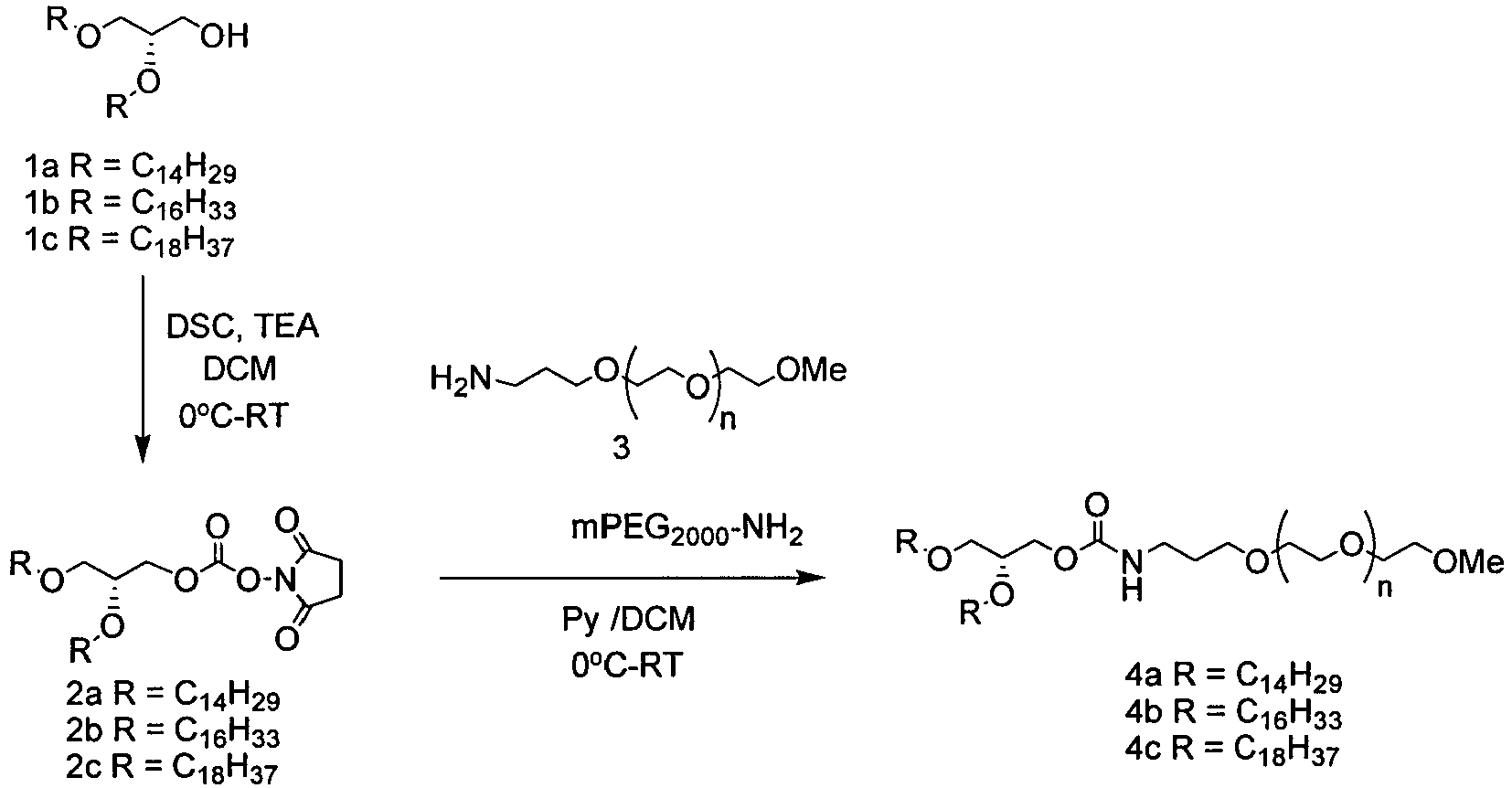
- Preparation of compound 4a (PEG-DMG): 1,2-Di-O-tetradecyl-sn-glyceride 1a (30 g, 61.80 mmol) and N,N'-succinimidylcarboante (DSC, 23.76 g, 1.5eq) were taken in dichloromethane (DCM, 500 mL) and stirred over an ice water mixture. Triethylamine (25.30 mL, 3eq) was added to stirring solution and subsequently the reaction mixture was allowed to stir overnight at ambient temperature. Progress of the reaction was monitored by TLC. The reaction mixture was diluted with DCM (400 mL) and the organic layer was washed with water (2X500 mL), aqueous NaHCO3 solution (500 mL) followed by standard work-up. Residue obtained was dried at ambient temperature under high vacuum overnight. After drying the crude carbonate 2a thus obtained was dissolved in dichloromethane (500 mL) and stirred over an ice bath. To the stirring solution mPEG2000-NH2 (3, 103.00 g, 47.20 mmol, purchased from NOF Corporation, Japan) and anhydrous pyridine (80 mL, excess) were added under argon. In some embodiments, the methoxy-(PEG)x-amine has an x= from 45-49, preferably 47-49, and more preferably 49. The reaction mixture was then allowed stir at ambient temperature overnight. Solvents and volatiles were removed under vacuum and the residue was dissolved in DCM (200 mL) and charged on a column of silica gel packed in ethyl acetate. The column was initially eluted with ethyl acetate and subsequently with gradient of 5-10 % methanol in dichloromethane to afford the desired PEG-Lipid 4a as a white solid (105.30g, 83%). 1H NMR (CDCl3, 400 MHz) δ = 5.20-5.12(m, 1H), 4.18-4.01(m, 2H), 3.80-3.70(m, 2H), 3.70-3.20(m, -O-CH2-CH2-O-, PEG-CH2), 2.10-2.01(m, 2H), 1.70-1.60 (m, 2H), 1.56-1.45(m, 4H), 1.31-1.15(m, 48H), 0.84(t, J= 6.5Hz, 6H). MS range found: 2660-2836.
- Preparation of 4b: 1,2-Di-O-hexadecyl-sn-glyceride 1b (1.00 g, 1.848 mmol) and DSC (0.710 g, 1.5eq) were taken together in dichloromethane (20 mL) and cooled down to 0°C in an ice water mixture. Triethylamine (1.00 mL, 3eq) was added to that and stirred overnight. The reaction was followed by TLC, diluted with DCM, washed with water (2 times), NaHCO3 solution and dried over sodium sulfate. Solvents were removed under reduced pressure and the residue 2b under high vacuum overnight. This compound was directly used for the next reaction without further purification. MPEG2000-NH2 3 (1.50g, 0.687 mmol, purchased from NOF Corporation, Japan) and compound from previous step 2b (0.702g, 1.5eq) were dissolved in dichloromethane (20 mL) under argon. The reaction was cooled to 0°C. Pyridine (1 mL, excess) was added to that and stirred overnight. The reaction was monitored by TLC. Solvents and volatiles were removed under vacuum and the residue was purified by chromatography (first Ethyl acetate then 5-10% MeOH/DCM as a gradient elution) to get the required compound 4b as white solid (1.46 g, 76 %). 1H NMR (CDCl3, 400 MHz) δ = 5.17(t, J= 5.5Hz, 1H), 4.13(dd, J= 4.00Hz, 11.00 Hz, 1H), 4.05(dd, J= 5.00Hz, 11.00 Hz, 1H), 3.82-3.75(m, 2H), 3.70-3.20(m, -O-CH2-CH2-O-, PEG-CH2), 2.05-1.90(m, 2H), 1.80-1.70 (m, 2H), 1.61-1.45(m, 6H), 1.35-1.17(m, 56H), 0.85(t, J= 6.5Hz, 6H). MS range found: 2716-2892.
- Preparation of 4c: 1,2-Di-O-octadecyl-sn-glyceride 1c (4.00 g, 6.70 mmol) and DSC (2.58 g, 1.5eq) were taken together in dichloromethane (60 mL) and cooled down to 0°C in an ice water mixture. Triethylamine (2.75 mL, 3eq) was added to that and stirred overnight. The reaction was followed by TLC, diluted with DCM, washed with water (2 times), NaHCO3 solution and dried over sodium sulfate. Solvents were removed under reduced pressure and the residue under high vacuum overnight. This compound was directly used for the next reaction with further purification. MPEG2000-NH2 3 (1.50g, 0.687 mmol, purchased from NOF Corporation, Japan) and compound from previous step 2c (0.760g, 1.5eq) were dissolved in dichloromethane (20 mL) under argon. The reaction was cooled to 0°C. Pyridine (1 mL, excess) was added to that and stirred overnight. The reaction was monitored by TLC. Solvents and volatiles were removed under vacuum and the residue was purified by chromatography (first Ethyl acetate then 5-10% MeOH/DCM as a gradient elution) to get the required compound 4 c as white solid (0.92 g, 48 %). 1H NMR (CDCl3, 400 MHz) δ = 5.22-5.15(m, 1H), 4.16(dd, J= 4.00Hz, 11.00 Hz, 1H), 4.06(dd, J= 5.00Hz, 11.00 Hz, 1H), 3.81-3.75(m, 2H), 3.70-3.20(m, -O-CH2-CH2-O-, PEG-CH2), 1.80-1.70 (m, 2H), 1.60-1.48(m, 4H), 1.31-1.15(m, 64H), 0.85(t, J= 6.5Hz, 6H). MS range found: 2774-2948.
- Lipids (cationic lipid of formula I, DSPC, cholesterol, DMG-PEG) are solubilized and mixed in ethanol according to the desired molar ratio. Liposomes are formed by an ethanol injection method where mixed lipids are added to sodium acetate buffer at pH 5.2. This results in the spontaneous formation of liposomes in 35 % ethanol. The liposomes are extruded through a 0.08 µm polycarbonate membrane at least 2 times. A stock siRNA solution was prepared in sodium acetate and 35% ethanol and was added to the liposome to load. The siRNA-liposome solution was incubated at 37°C for 30 min and, subsequently, diluted. Ethanol was removed and exchanged to PBS buffer by dialysis or tangential flow filtration.
- Individual and separate stock solutions are prepared - one containing lipid and the other siRNA. Lipid stock containing cationic lipid of formula I, DSPC, cholesterol and PEG lipid is prepared by solubilized in 90% ethanol. The remaining 10% is low pH citrate buffer. The concentration of the lipid stock is 4 mg/mL. The pH of this citrate buffer can range between pH 3-5, depending on the type of fusogenic lipid employed. The siRNA is also solubilized in citrate buffer at a concentration of 4 mg/mL. For small scale, 5 mL of each stock solution is prepared.
- Stock solutions are completely clear and lipids must be completely solubilized before combining with siRNA. Therefore stock solutions may be heated to completely solubilize the lipids. The siRNAs used in the process may be unmodified oligonucleotides or modified and may be conjugated with lipophilic moieties such as cholesterol.
- The individual stocks are combined by pumping each solution to a T-junction. A dual-head Watson-Marlow pump is used to simultaneously control the start and stop of the two streams. A 1.6 mm polypropylene tubing is further downsized to a 0.8 mm tubing in order to increase the linear flow rate. The polypropylene line (ID = 0.8 mm) are attached to either side of a T-junction. The polypropylene T has a linear edge of 1.6 mm for a resultant volume of 4.1 mm3. Each of the large ends (1.6 mm) of polypropylene line is placed into test tubes containing either solubilized lipid stock or solubilized siRNA. After the T-junction a single tubing is placed where the combined stream will emit. The tubing is then extending into a container with 2× volume of PBS. The PBS is rapidly stirring. The flow rate for the pump is at a setting of 300 rpm or 110 mL/min. Ethanol is removed and exchanged for PBS by dialysis. The lipid formulations are then concentrated using centrifugation or diafiltration to an appropriate working concentration.
-

- A clean, dry 200L glass reactor fitted with an argon inlet and thermowell was charged with 60 L of THF and 5.73 Kg (20.4 mol) of linoleic acid. The contents of the reactor were cooled below 0 °C using an acetone-dry ice bath. To this cold solution 13.8 L of Vitride (60% wt/vol) in toluene was added slowly maintaining the internal temperature of the reaction mixture below 0 °C (Note: Initial addition of vitride was exothermic and frothing was observed. The frothing ceased after 15 minutes of addition). The addition of vitride took 3 hr and 45 minutes. After completion of the addition, the reaction mixture was stirred at ambient temperature for 2 hr. An aliquot was taken and quenched with sat. Na2SO4 and the thus obtained crude product was analyzed by TLC for the presence of the starting acid. The TLC showed completion of the reaction and the reaction mixture was again cooled below 0 °C in about 45 minutes. A saturated solution of sodium sulfate (prepared by dissolving 1.1 Kg of sodium sulfate in 1.5 L of water) was slowly added to the reaction mixture over 45 min. After completion of the addition, 25 L of ethyl acetate was added over a period of 30 min with stirring. The obtained reaction mixture was filtered through a celite bed over a period of 45 min and the celite bed was washed with an additional 17 L of ethyl acetate to remove all product from the residue. The combined organics were concentrated under reduced pressure. The residue was dissolved in 15 L of ethyl acetate and the organic layer was washed with water (2 X 7 L) and dried over sodium sulfate (1.1 Kg). After filtration the organic layer was concentrated under reduced pressure and dried under high vacuum to obtain the product linoleyl alcohol as an oil. Crude yield = 5.5 Kg (theoretical yield = 5.43 Kg). This product was used without further purification in the next step.
- A clean, dry 200 L all glass reactor fitted with argon inlet and thermowell was charged with 45 L of DCM and 5.5 Kg of the crude product from
step 1. To this solution 11.5 L triethylamine was added followed by 0.252 Kg (2.0 mol) of DMAP. The solution was cooled to -10 °C using a dry-ice acetone mixture and to this cold reaction mass, a solution of mesyl chloride (3.2 L, 41.3 mol) in DCM (10 L) was added drop wise over a period of 3 hrs while maintaining the temperature below 0 °C. After completion of the addition, the reaction mixture was stirred at 0 °C for 1 h after which the TLC (5% EtOAc in DCM; PMA stain) of the reaction mixture showed complete disappearance of starting alcohol. To the reaction mixture, 17 L of ice-cold water was added and the layers were separated. The top aqueous layer was again washed with 10 L of DCM and the layers were separated. The combined organic layers were washed with 2 X 10 L of dilute hydrochloric acid (prepared by mixing 2 L of Con. HCl with 18 L of RO water), 2 X 7.5 L of water and 10 L of brine (prepared by dissolving 11 Kg of NaCl in 10 L of RO water). The organic layer was separated, dried over Na2SO4 (2.75 Kg) and filtered. The organic layer was evaporated under reduced pressure and vacuum dried to obtain the crude mesylate as a light yellow oil. Crude yield = 7.1 Kg (theoretical yield = 7.1 Kg). This material was used without further purification in the next step. 1H NMR (CDCl3, 400 MHz) δ = 5.42-5.21 (m, 4H), 4.20 (t, 2H), 3.06 (s, 3H), 2.79 (t, 2H), 2.19-2.00 (m, 4H), 1.90-1.70 (m, 2H), 1.06-1.18 (m, 18H), 0.88 (t, 3H). 13C NMR (CDCl3) δ = 130.76, 130.54, 128.6, 128.4, 70.67, 37.9, 32.05, 30.12, 29.87, 29.85, 29.68, 29.65, 29.53, 27.72, 27.71, 26.15, 25.94, 23.09, 14.60. MS. Molecular weight calculated for C19H36O3S, Cal. 344.53, Found 343.52 (M-H-). - A clean, dry 200 L all glass reactor fitted with argon inlet and thermowell was charged with 25 L of DMF and 7.1 Kg of the crude product from step 2. This mixture was cooled to -10°C with acetone-dry-ice mixture. To this stirred mixture, a solution of lithium bromide (2.7 Kg, 31.0 mol) in 25L of DMF was added over a period of 1.5 hrs while maintaining the reaction temperature below 0 °C. After completion of the addition, the reaction mixture was stirred at 45 °C for 18 - 20 h until TLC (10 % EtOAc in hexanes, PMA stain) of an aliquot showed complete disappearance of the starting mesylate. The reaction mixture was diluted with 70 L of water and extracted with 57 L of hexanes. The aqueous layer was further extracted with 2 X 10 L of hexanes and the combined organic layers (approximately 120 L) were washed again with 2 X 10 L of water and 1 X 10 L of brine (prepared by dissolving 14 Kg of sodium chloride in 10 L of water). The obtained organic layer (120 L) was dried over sodium sulfate (4 Kg) and concentrated under reduced pressure to obtain the crude product (6.5 Kg). The crude product was purified by column chromatography using 60-120 mesh silica gel using hexanes as eluent. Concentration of the pure product provided 5.5 Kg (81%, three steps) of the
bromide 4 as a colorless liquid. 1H NMR (CDCl3, 400 MHz) δ = 5.41-5.29 (m, 4H), 4.20 (d, 2H), 3.40 (t, J = 7 Hz, 2H), 2.77 (t, J = 6.6 Hz, 2H), 2.09-2.02 (m, 4H), 1.88-1.00 (m, 2H), 1.46-1.27 (m, 18H), 0.88 (t, J = 3.9 Hz, 3H). 13C NMR (CDCl3) δ = 130.41, 130.25, 128.26, 128.12, 34.17, 33.05, 31.75, 29.82, 29.57, 29.54, 29.39, 28.95, 28.38, 27.42, 27.40, 25.84, 22.79, 14.28. - A clean, dry 20 L all glass reactor fitted with argon inlet, reflux condenser and thermowell was degassed and purged with argon. The reactor was charged with 277 g (11.3 mol) of activated magnesium followed by 1.5 L of anhydrous ether. The reactor was again degassed three times and purged with argon. The bromide 4 (2.5 Kg, 7.6 mol) was dissolved in 5 L of anhydrous ether under argon and 1L of this solution was added to the reactor followed by 25 mL (0.35 mol) of dibromomethane. The contents of the reactor were heated to 40 °C using a water bath (effervescence was observed followed by reflux indicating the initiation of Grignard reagent formation). After the initiation of the reaction, the heating was removed from the reactor and the remaining 4L of the bromide was slowly added over a period of 2
hr 30 min maintaining a gentle reflux of the mixture. After completion of the addition, the reaction mixture was again heated to reflux (bath temperature 45 °C) for 1 hr after which an aliquot of the reaction mixture was quenched with water and analyzed by TLC (Hexanes, PMA stain) which showed complete consumption of starting bromide. The reaction mixture was cooled below 10 °C using an ice bath and a solution of ethyl formate (275 mL in 4 L of ether) in ether was added over a period of 2hr 30 min and after completion of the addition the reaction mixture was warmed to room temperature and stirred for 1 hr. The reaction mixture was cooled back to 10 °C and acetone (1.15 L) was added slowly to the mixture followed by the addition of 7 L of ice-cold water and a solution of 10% sulfuric acid (prepared by diluting 3.4 L of sulfuric acid with 34 L of ice-cold water). The product was extracted with 3 X 10 L of ether and the combined organic layers were washed with 10 L of brine and dried over sodium sulfate (2 Kg). Concentration of the organic layer over reduced pressure provided the crude product (2 Kg) as a mixture of required dilinoleyl alcohol along with minor amounts of O-formylated product. This crude product was redissoloved in THF (4L) and charged into the 20L glass reactor. To this a solution of NaOH (0.934 Kg dissolved in 8 L of ice-cold water) was added and the contents were heated at 65 °C for 18 h after which the TLC (10% ether in hexanes) showed complete conversion of the O-formylated product to the required dilinoleylmethanol. The reaction mixture was cooled and was extracted with ether (3 X 4 L) and the combined organic layers were washed with 5 L of brine and dried over sodium sulfate (4 Kg). Filtration followed by concentration of the organic layer provided the crude product. The thus obtained crude product was purified by column chromatography using 60-120 mesh silica gel using 4% ether in hexanes. Concentration of the pure product fractions provided the pure 6 (1.45 Kg, 80%) as a colorless liquid. NMR (400 MHz,CDCl3) δ 5.47-5.24 (m, 8H), 3.56 (dd, J = 6.8, 4.2, 1H), 2.85-2.66 (m, 4H), 2.12-1.91 (m, 9H), 1.50-1.17 (m, 46H), 0.98-0.76 (m, 6H). 13C NMR (101 MHz, CDCl3) δ 130.41, 130.37, 128.18, 128.15, 77.54, 77.22, 76.91, 72.25, 37.73, 31.75, 29.94, 29.89, 29.83, 29.73, 29.58, 29.53, 27.46, 27.43, 25.89, 25.86, 22.80, 14.30. - The dilinoleyl methanol 6 (144 g, 272 mmol) was dissolved in 1 L of dichloromethane and to it the hydrochloride salt of dimethylaminobutyric acid 7 (55 g, 328 mmol) was added followed by diisopropylethylamine (70 mL) and DMAP (4 g). After stirring for 5 min. at ambient temperature, EDCI (80 g, 417 mmol) was added and the reaction mixture was stirred at room temperature overnight after which the TLC (silica gel, 5% MeOH in CH2Cl2) analysis showed complete disappearance of the starting alcohol. The reaction mixture was diluted with CH2Cl2 (500 mL) and washed with saturated NaHCO3 (400 mL), water (400 mL) and brine (500 mL). The combined organic layers were dried over anhyd. Na2SO4 and solvents were removed in vacuo. The crude product (180 g) thus obtained was purified by Flash column chromatography [2.5 Kg silica gel, Using the following eluents i) column packed with 6L of 0.1% NEt3 in DCM; after loading ii) 4 L of 0.1% NEt3 in DCM; iii) 16L of 2% MeOH - 98% of 0.1% NEt3 in DCM; iv) 4L of 2.5% MeOH - 97.5% of 0.1% NEt3 in DCM; v) 12L of 3% MeOH - 97% of 0.1% NEt3 in DCM] to isolate the pure product 8 (MC3, 159 g, 91%) as a colorless oil. 1H NMR (400 MHz, CDCl3): δ 5.46-5.23 (m, 8H), 4.93-4.77 (m, 1H), 2.83-2.66 (m, 4H), 2.37-2.22 (m, 4H), 2.20 (s, 6H), 2.10-1.96 (m, 9H), 1.85-1.69 (m, 2H), 1.49 (d, J = 5.4, 4H), 1.39-1.15 (m, 39H), 0.95-0.75 (m, 6H). 13C NMR (101 MHz, CDCl3): δ 173.56, 130.38, 130.33, 128.17, 128.14, 77.54, 77.22, 76.90, 74.44, 59.17, 45.64, 34.36, 32.69, 31.73, 29.87, 29.76, 29.74, 29.70, 29.56, 29.50, 27.44, 27.41, 25.84, 25.55, 23.38, 22.78, 14.27. EI-MS (+ve): MW calc. for C43H79NO2 (M+ H)+: 642.6, found: 642.6.
- Cationic lipid containing particles were made using the preformed vesicle method. Cationic lipid, DSPC, cholesterol and PEG-lipid were solubilised in ethanol at a molar ratio of 40/10/40/10, respectively. The lipid mixture was added to an aqueous buffer (50mM citrate, pH 4) with mixing to a final ethanol and lipid concentration of 30% (vol/vol) and 6.1 mg/mL respectively and allowed to equilibrate at room temperature for 2 min before extrusion. The hydrated lipids were extruded through two stacked 80 nm pore-sized filters (Nuclepore) at 22°C using a Lipex Extruder (Northern Lipids, Vancouver, BC) until a vesicle diameter of 70-90 nm, as determined by Nicomp analysis, was obtained. This generally required 1-3 passes. For some cationic lipid mixtures which did not form small vesicles hydrating the lipid mixture with a lower pH buffer (50mM citrate, pH 3) to protonate the phosphate group on the DSPC headgroup helped form stable 70-90 nm vesicles.
- The FVII siRNA (solubilised in a 50mM citrate,
pH 4 aqueous solution containing 30% ethanol) was added to the vesicles, pre-equilibrated to 35°C, at a rate of ∼5mL/min with mixing. After a final target siRNA/lipid ratio of 0.06 (wt/wt) was achieved, the mixture was incubated for a further 30 min at 35°C to allow vesicle reorganization and encapsulation of the FVII siRNA. The ethanol was then removed and the external buffer replaced with PBS (155mM NaCl, 3mM Na2HPO4, 1mM KH2PO4, pH 7.5) by either dialysis or tangential flow diafiltration. The final encapsulated siRNA-to-lipid ratio was determined after removal of unencapsulated siRNA using size-exclusion spin columns or ion exchange spin columns. The dose response curve illustrating the % residual FVII again the dose (mg/kg) is illustrated infigure 9 . - The pKa of the cationic lipid of formula I was determined essentially as described (Eastman et al 1992 Biochemistry 31:4262-4268) using the fluorescent probe 2-(p-toluidino)-6-naphthalenesulfonic acid (TNS), which is non-fluorescent in water but becomes appreciably fluorescent when bound to membranes. Vesicles composed of cationic lipid/DSPC/CH/PEG-c-DOMG (40:10:40:10 mole ratio) were diluted to 0.1mM in buffers (130mM NaCl, 10mM CH3COONH4, 10mM MES, 10mM HEPES) of various pH's, ranging from 2 to 11. An aliquot of the TNS aqueous solution (1 µM final) was added to the diluted vesicles and after a 30 second equilibration period the fluorescent of the TNS-containing solution was measured at excitation and emission wavelengths of 321nm and 445nm, respectively. The pKa of the cationic lipid-containing vesicles was determined by plotting the measured fluorescence against the pH of the solutions and fitting the data to a Sigmodial curve using the commercial graphing program IgorPro. The pKa titration curve for the cationic lipid of formula I is shown in
figure 10 . -
- <110> CHEN, JIANXIN
ANSELL, STEVEN
AKINC, AKIN
DORKIN, JOSEPH ROBERT
QIN, XIAOJUN
CANTLEY, WILLIAM
MANOHARAN, MUTHIAH
RAJEEV, KALLANTHOTTATHIL G.
NARAYANANNAIR, JAYAPRAKASH K.
JAYARAMAN, MUTHUSAMY - <120> LIPID FORMULATION
- <130> A2038-718210
- <140>
12/813,448
<141> 2010-06-10 - <150>
61/244,834
<151> 2009-09-22 - <150>
61/185,800
<151> 2009-06-10 - <160> 79
- <170> PatentIn version 3.5
- <210> 1
<211> 21
<212> DNA
<213> Artificial Sequence - <220>
<223> Description of Artificial Sequence: Synthetic oligonucleotide - <220>
<223> Description of Combined DNA/RNA Molecule: Synthetic oligonucleotide - <400> 1
cuuacgcuga guacuucgat t 21 - <210> 2
<211> 21
<212> DNA
<213> Artificial Sequence - <220>
<223> Description of Artificial Sequence: Synthetic oligonucleotide - <220>
<223> Description of Combined DNA/RNA Molecule: Synthetic oligonucleotide - <400> 2
ucgaaguacu cagcguaagt t 21 - <210> 3
<211> 21
<212> DNA
<213> Artificial Sequence - <220>
<223> Description of Artificial Sequence: Synthetic oligonucleotide - <220>
<223> Description of Combined DNA/RNA Molecule: Synthetic oligonucleotide - <220>
<221> modified_base
<222> (1)..(3)
<223> 2'-O-Methyl nucleotide - <220>
<221> modified_base
<222> (5)..(5)
<223> 2'-O-Methyl nucleotide - <220>
<221> modified_base
<222> (7)..(8)
<223> 2'-O-Methyl nucleotide - <220>
<221> modified_base
<222> (12)..(12)
<223> 2'-O-Methyl nucleotide - <220>
<221> modified_base
<222> (14)..(17)
<223> 2'-O-Methyl nucleotide - <220>
<221> misc_feature
<222> (20)..(21)
<223> Phosphorothioate linkage - <400> 3
cuuacgcuga guacuucgat t 21 - <210> 4
<211> 21
<212> DNA
<213> Artificial Sequence - <220>
<223> Description of Artificial Sequence: Synthetic oligonucleotide - <220>
<223> Description of Combined DNA/RNA Molecule: Synthetic oligonucleotide - <220>
<221> modified_base
<222> (7)..(7)
<223> 2'-O-Methyl nucleotide - <220>
<221> modified_base
<222> (11)..(11)
<223> 2'-O-Methyl nucleotide - <220>
<221> modified_base
<222> (16)..(16)
<223> 2'-O-Methyl nucleotide - <220>
<221> misc_feature
<222> (20)..(21)
<223> Phosphorothioate linkage - <400> 4
ucgaaguacu cagcguaagt t 21 - <210> 5
<211> 21
<212> DNA
<213> Artificial Sequence - <220>
<223> Description of Artificial Sequence: Synthetic oligonucleotide - <220>
<223> Description of Combined DNA/RNA Molecule: Synthetic oligonucleotide - <400> 5
ggaucaucuc aagucuuact t 21 - <210> 6
<211> 21
<212> DNA
<213> Artificial Sequence - <220>
<223> Description of Artificial Sequence: Synthetic oligonucleotide - <220>
<223> Description of Combined DNA/RNA Molecule: Synthetic oligonucleotide - <400> 6
guaagacuug agaugaucct t 21 - <210> 7
<211> 21
<212> DNA
<213> Artificial Sequence - <220>
<223> Description of Artificial Sequence: Synthetic oligonucleotide - <220>
<223> Description of Combined DNA/RNA Molecule: Synthetic oligonucleotide - <220>
<221> modified_base
<222> (3)..(4)
<223> 2'-Fluoro nucleotide - <220>
<221> modified_base
<222> (6)..(9)
<223> 2'-Fluoro nucleotide - <220>
<221> modified_base
<222> (13)..(16)
<223> 2'-Fluoro nucleotide - <220>
<221> modified_base
<222> (18)..(18)
<223> 2'-Fluoro nucleotide - <220>
<221> modified_base
<222> (20)..(21)
<223> Phosphorothioate linkage - <400> 7
ggaucaucuc aagucuuact t 21 - <210> 8
<211> 21
<212> DNA
<213> Artificial Sequence - <220>
<223> Description of Artificial Sequence: Synthetic oligonucleotide - <220>
<223> Description of Combined DNA/RNA Molecule: Synthetic oligonucleotide - <220>
<221> modified_base
<222> (1)..(1)
<223> 2'-Fluoro nucleotide - <220>
<221> modified_base
<222> (6)..(8)
<223> 2'-Fluoro nucleotide - <220>
<221> modified_base
<222> (13)..(13)
<223> 2'-Fluoro nucleotide - <220>
<221> modified_base
<222> (16)..(18)
<223> 2'-Fluoro nucleotide - <220>
<221> modified_base
<222> (20) .. (21)
<223> Phosphorothioate linkage - <400> 8
guaagacuug agaugaucct t 21 - <210> 9
<211> 16
<212> DNA
<213> Artificial Sequence - <220>
<223> Description of Artificial Sequence: Synthetic oligonucleotide - <400> 9
taacgttgag gggcat 16 - <210> 10
<211> 20
<212> DNA
<213> Artificial Sequence - <220>
<223> Description of Artificial Sequence: Synthetic oligonucleotide - <400> 10
ttccatgacg ttcctgacgt 20 - <210> 11
<211> 19
<212> DNA
<213> Artificial Sequence - <220>
<223> Description of Artificial Sequence: Synthetic oligonucleotide - <220>
<221> modified_base
<222> (8)..(8)
<223> methylated-cytosine - <220>
<221> modified_base
<222> (17)..(17)
<223> methylated-cytosine - <400> 11
tccatgacgt tcctgacgt 19 - <210> 12
<211> 16
<212> DNA
<213> Artificial Sequence - <220>
<223> Description of Artificial Sequence: Synthetic oligonucleotide - <220>
<221> modified_base
<222> (4)..(4)
<223> methylated-cytosine - <400> 12
taacgttgag gggcat 16 - <210> 13
<211> 20
<212> DNA
<213> Artificial Sequence - <220>
<223> Description of Artificial Sequence: Synthetic oligonucleotide - <400> 13
tccatgacgt tcctgacgtt 20 - <210> 14
<211> 20
<212> DNA
<213> Artificial Sequence - <220>
<223> Description of Artificial Sequence: Synthetic oligonucleotide - <220>
<221> modified_base
<222> (8)..(8)
<223> methylated-cytosine - <220>
<221> modified_base
<222> (17)..(17)
<223> methylated-cytosine - <400> 14
tccatgacgt tcctgacgtt 20 - <210> 15
<211> 16
<212> DNA
<213> Artificial Sequence - <220>
<223> Description of Artificial Sequence: Synthetic oligonucleotide - <400> 15
taagcatacg gggtgt 16 - <210> 16
<211> 24
<212> DNA
<213> Artificial Sequence - <220>
<223> Description of Artificial Sequence: Synthetic oligonucleotide - <400> 16
gatgctgtgt cggggtctcc gggc 24 - <210> 17
<211> 24
<212> DNA
<213> Artificial Sequence - <220>
<223> Description of Artificial Sequence: Synthetic oligonucleotide - <400> 17
tcgtcgtttt gtcgttttgt cgtt 24 - <210> 18
<211> 24
<212> DNA
<213> Artificial Sequence - <220>
<223> Description of Artificial Sequence: Synthetic oligonucleotide - <220>
<221> modified_base
<222> (2)..(2)
<223> methylated-cytosine - <220>
<221> modified_base
<222> (5)..(5)
<223> methylated-cytosine - <220>
<221> modified_base
<222> (13)..(13)
<223> methylated-cytosine - <220>
<221> modified_base
<222> (21)..(21)
<223> methylated-cytosine - <400> 18
tcgtcgtttt gtcgttttgt cgtt 24 - <210> 19
<211> 20
<212> DNA
<213> Artificial Sequence - <220>
<223> Description of Artificial Sequence: Synthetic oligonucleotide - <400> 19
tccaggactt ctctcaggtt 20 - <210> 20
<211> 18
<212> DNA
<213> Artificial Sequence - <220>
<223> Description of Artificial Sequence: Synthetic oligonucleotide - <400> 20
tctcccagcg tgcgccat 18 - <210> 21
<211> 20
<212> DNA
<213> Artificial Sequence - <220>
<223> Description of Artificial Sequence: Synthetic oligonucleotide - <400> 21
tgcatccccc aggccaccat 20 - <210> 22
<211> 20
<212> DNA
<213> Artificial Sequence - <220>
<223> Description of Artificial Sequence: Synthetic oligonucleotide - <400> 22
gcccaagctg gcatccgtca 20 - <210> 23
<211> 20
<212> DNA
<213> Artificial Sequence - <220>
<223> Description of Artificial Sequence: Synthetic oligonucleotide - <400> 23
gcccaagctg gcatccgtca 20 - <210> 24
<211> 15
<212> DNA
<213> Artificial Sequence - <220>
<223> Description of Artificial Sequence: Synthetic oligonucleotide - <400> 24
ggtgctcact gcggc 15 - <210> 25
<211> 16
<212> DNA
<213> Artificial Sequence - <220>
<223> Description of Artificial Sequence: Synthetic oligonucleotide - <400> 25
aaccgttgag gggcat 16 - <210> 26
<211> 24
<212> DNA
<213> Artificial Sequence - <220>
<223> Description of Artificial Sequence: Synthetic oligonucleotide - <400> 26
tatgctgtgc cggggtcttc gggc 24 - <210> 27
<211> 18
<212> DNA
<213> Artificial Sequence - <220>
<223> Description of Artificial Sequence: Synthetic oligonucleotide - <400> 27
gtgccggggt cttcgggc 18 - <210> 28
<211> 18
<212> DNA
<213> Artificial Sequence - <220>
<223> Description of Artificial Sequence: Synthetic oligonucleotide - <400> 28
ggaccctcct ccggagcc 18 - <210> 29
<211> 18
<212> DNA
<213> Artificial Sequence - <220>
<223> Description of Artificial Sequence: Synthetic oligonucleotide - <400> 29
tcctccggag ccagactt 18 - <210> 30
<211> 15
<212> DNA
<213> Artificial Sequence - <220>
<223> Description of Artificial Sequence: Synthetic oligonucleotide - <400> 30
aacgttgagg ggcat 15 - <210> 31
<211> 15
<212> DNA
<213> Artificial Sequence - <220>
<223> Description of Artificial Sequence: Synthetic oligonucleotide - <400> 31
ccgtggtcat gctcc 15 - <210> 32
<211> 21
<212> DNA
<213> Artificial Sequence - <220>
<223> Description of Artificial Sequence: Synthetic oligonucleotide - <400> 32
cagcctggct caccgccttg g 21 - <210> 33
<211> 20
<212> DNA
<213> Artificial Sequence - <220>
<223> Description of Artificial Sequence: Synthetic oligonucleotide - <400> 33
cagccatggt tccccccaac 20 - <210> 34
<211> 20
<212> DNA
<213> Artificial Sequence - <220>
<223> Description of Artificial Sequence: Synthetic oligonucleotide - <400> 34
gttctcgctg gtgagtttca 20 - <210> 35
<211> 18
<212> DNA
<213> Artificial Sequence - <220>
<223> Description of Artificial Sequence: Synthetic oligonucleotide - <400> 35
tctcccagcg tgcgccat 18 - <210> 36
<211> 15
<212> DNA
<213> Artificial Sequence - <220>
<223> Description of Artificial Sequence: Synthetic oligonucleotide - <400> 36
gtgctccatt gatgc 15 - <210> 37
<211> 33
<212> RNA
<213> Artificial Sequence - <220>
<223> Description of Artificial Sequence: Synthetic oligonucleotide - <400> 37
gaguucugau gaggccgaaa ggccgaaagu cug 33 - <210> 38
<211> 15
<212> DNA
<213> Artificial Sequence - <220>
<223> Description of Artificial Sequence: Synthetic oligonucleotide - <400> 38
aacgttgagg ggcat 15 - <210> 39
<211> 16
<212> DNA
<213> Artificial Sequence - <220>
<223> Description of Artificial Sequence: Synthetic oligonucleotide - <400> 39
caacgttatg gggaga 16 - <210> 40
<211> 4
<212> PRT
<213> Artificial Sequence - <220>
<223> Description of Artificial Sequence: Synthetic peptide - <400> 40

- <210> 41
<211> 29
<212> PRT
<213> Artificial Sequence - <220>
<223> Description of Artificial Sequence: Synthetic peptide - <400> 41

- <210> 42
<211> 30
<212> PRT
<213> Artificial Sequence - <220>
<223> Description of Artificial Sequence: Synthetic polypeptide - <400> 42

- <210> 43
<211> 15
<212> PRT
<213> Artificial Sequence - <220>
<223> Description of Artificial Sequence: Synthetic peptide - <400> 43

- <210> 44
<211> 22
<212> PRT
<213> Influenza A virus - <400> 44

- <210> 45
<211> 23
<212> PRT
<213> Influenza A virus - <400> 45

- <210> 46
<211> 24
<212> PRT
<213> Influenza A virus - <400> 46

- <210> 47
<211> 22
<212> PRT
<213> Influenza A virus - <400> 47

- <210> 48
<211> 35
<212> PRT
<213> Artificial Sequence - <220>
<223> Description of Artificial Sequence: Synthetic polypeptide - <400> 48

- <210> 49
<211> 34
<212> PRT
<213> Artificial Sequence - <220>
<223> Description of Artificial Sequence: Synthetic polypeptide - <400> 49

- <210> 50
<211> 21
<212> PRT
<213> Influenza A virus - <220>
<221> MOD_RES
<222> (17)..(17)
<223> Norleucine - <400> 50

- <210> 51
<211> 20
<212> PRT
<213> Influenza A virus - <220>
<221> MOD_RES
<222> (17)..(17)
<223> Norleucine - <400> 51

- <210> 52
<211> 16
<212> PRT
<213> Drosophila sp. - <400> 52

- <210> 53
<211> 13
<212> PRT
<213> Human immunodeficiency virus - <400> 53

- <210> 54
<211> 27
<212> PRT
<213> Mus sp. - <400> 54

- <210> 55
<211> 18
<212> PRT
<213> Artificial Sequence - <220>
<223> Description of Artificial Sequence: Synthetic peptide - <400> 55

- <210> 56
<211> 26
<212> PRT
<213> Artificial Sequence - <220>
<223> Description of Artificial Sequence: Synthetic peptide - <400> 56

- <210> 57
<211> 18
<212> PRT
<213> Artificial Sequence - <220>
<223> Description of Artificial Sequence: Synthetic peptide - <400> 57

- <210> 58
<211> 9
<212> PRT
<213> Artificial Sequence - <220>
<223> Description of Artificial Sequence: Synthetic peptide - <400> 58

- <210> 59
<211> 10
<212> PRT
<213> Artificial Sequence - <220>
<223> Description of Artificial Sequence: Synthetic peptide - <400> 59

- <210> 60
<211> 37
<212> PRT
<213> Homo sapiens - <400> 60

- <210> 61
<211> 31
<212> PRT
<213> Ascaris suum - <400> 61

- <210> 62
<211> 30
<212> PRT
<213> Homo sapiens - <400> 62

- <210> 63
<211> 36
<212> PRT
<213> Homo sapiens - <400> 63

- <210> 64
<211> 12
<212> PRT
<213> Unknown - <220>
<223> Description of Unknown: Unknown bactenecin peptide - <400> 64

- <210> 65
<211> 42
<212> PRT
<213> Sus scrofa - <220>
<223> C-term amidated - <400> 65

- <210> 66
<211> 13
<212> PRT
<213> Unknown - <220>
<223> Description of Unknown: Unknown indolicidin peptide - <220>
<223> C-term amidated - <400> 66

- <210> 67
<211> 16
<212> PRT
<213> Artificial Sequence - <220>
<223> Description of Artificial Sequence: Synthetic peptide - <400> 67

- <210> 68
<211> 11
<212> PRT
<213> Artificial Sequence - <220>
<223> Description of Artificial Sequence: Synthetic peptide - <400> 68

- <210> 69
<211> 21
<212> DNA
<213> Artificial Sequence - <220>
<223> Description of Artificial Sequence: Synthetic oligonucleotide - <220>
<223> Description of Combined DNA/RNA Molecule: Synthetic oligonucleotide - <220>
<221> misc_feature
<222> (1)..(2)
<223> Phosphorothioate linkage - <220>
<221> modified_base
<222> (7)..(7)
<223> 2'-fluoro nucleotide - <220>
<221> modified_base
<222> (16)..(16)
<223> 2'-fluoro nucleotide - <220>
<221> misc_feature
<222> (20)..(21)
<223> Phosphorothioate linkage - <400> 69
ucgaaguacu cagcguaagt t 21 - <210> 70
<211> 21
<212> DNA
<213> Artificial Sequence - <220>
<223> Description of Artificial Sequence: Synthetic oligonucleotide - <220>
<223> Description of Combined DNA/RNA Molecule: Synthetic oligonucleotide - <220>
<221> misc_feature
<222> (1)..(2)
<223> Phosphorothioate linkage - <220>
<221> modified_base
<222> (3)..(3)
<223> 2'-fluoro nucleotide - <220>
<221> modified_base
<222> (12)..(12)
<223> 2'-fluoro nucleotide - <220>
<221> misc_feature
<222> (20) .. (21)
<223> Phosphorothioate linkage - <400> 70
cuuacgcuga guacuucgat t 21 - <210> 71
<211> 21
<212> DNA
<213> Artificial Sequence - <220>
<223> Description of Artificial Sequence: Synthetic oligonucleotide - <220>
<223> Description of Combined DNA/RNA Molecule: Synthetic oligonucleotide - <400> 71
ucgaaguacu cagcguaagt t 21 - <210> 72
<211> 21
<212> DNA
<213> Artificial Sequence - <220>
<223> Description of Artificial Sequence: Synthetic oligonucleotide - <220>
<223> Description of Combined DNA/RNA Molecule: Synthetic oligonucleotide - <220>
<221> misc_feature
<222> (1)..(2)
<223> Phosphorothioate linkage - <220>
<221> modified_base
<222> (3)..(3)
<223> 2'-fluoro nucleotide - <220>
<221> modified_base
<222> (12)..(12)
<223> 2'-fluoro nucleotide - <220>
<221> misc_feature
<222> (20) .. (21)
<223> Phosphorothioate linkage - <400> 72
cuuacgcuga guacuucgat t 21 - <210> 73
<211> 21
<212> DNA
<213> Artificial Sequence - <220>
<223> Description of Artificial Sequence: Synthetic oligonucleotide - <220>
<223> Description of Combined DNA/RNA Molecule: Synthetic oligonucleotide - <220>
<221> misc_feature
<222> (1)..(2)
<223> Phosphorothioate linkage - <220>
<221> modified_base
<222> (7)..(7)
<223> 2'-fluoro nucleotide - <220>
<221> modified_base
<222> (16)..(16)
<223> 2'-fluoro nucleotide - <220>
<221> misc_feature
<222> (20)..(21)
<223> Phosphorothioate linkage - <400> 73
ucgaaguacu cagcguaagt t 21 - <210> 74
<211> 21
<212> DNA
<213> Artificial Sequence - <220>
<223> Description of Artificial Sequence: Synthetic oligonucleotide - <220>
<223> Description of Combined DNA/RNA Molecule: Synthetic oligonucleotide - <400> 74
cuuacgcuga guacuucgat t 21 - <210> 75
<211> 21
<212> DNA
<213> Artificial Sequence - <220>
<223> Description of Artificial Sequence: Synthetic oligonucleotide - <220>
<223> Description of Combined DNA/RNA Molecule: Synthetic oligonucleotide - <400> 75
ucgaaguacu cagcguaagt t 21 - <210> 76
<211> 21
<212> DNA
<213> Artificial Sequence - <220>
<223> Description of Artificial Sequence: Synthetic oligonucleotide - <220>
<223> Description of Combined DNA/RNA Molecule: Synthetic oligonucleotide - <400> 76
ggaucaucuc aagucuuact t 21 - <210> 77
<211> 21
<212> DNA
<213> Artificial Sequence - <220>
<223> Description of Artificial Sequence: Synthetic oligonucleotide - <220>
<223> Description of Combined DNA/RNA Molecule: Synthetic oligonucleotide - <400> 77
guaagacuug agaugaucct t 21 - <210> 78
<211> 21
<212> DNA
<213> Artificial Sequence - <220>
<223> Description of Artificial Sequence: Synthetic oligonucleotide - <220>
<223> Description of Combined DNA/RNA Molecule: Synthetic oligonucleotide - <220>
<221> modified_base
<222> (4)..(5)
<223> 2'-fluoro nucleotide - <220>
<221> modified_base
<222> (7)..(10)
<223> 2'-fluoro nucleotide - <220>
<221> modified_base
<222> (14)..(17)
<223> 2'-fluoro nucleotide - <220>
<221> modified_base
<222> (19)..(19)
<223> 2'-fluoro nucleotide - <220>
<221> misc_feature
<222> (20)..(21)
<223> Phosphorothioate linkage - <400> 78
ggaucaucuc aagucuuact t 21 - <210> 79
<211> 21
<212> DNA
<213> Artificial Sequence - <220>
<223> Description of Artificial Sequence: Synthetic oligonucleotide - <220>
<223> Description of Combined DNA/RNA Molecule: Synthetic oligonucleotide - <220>
<221> modified_base
<222> (2)..(2)
<223> 2'-fluoro nucleotide - <220>
<221> modified_base
<222> (7)..(9)
<223> 2'-fluoro nucleotide - <220>
<221> modified_base
<222> (14)..(14)
<223> 2'-fluoro nucleotide - <220>
<221> modified_base
<222> (17)..(19)
<223> 2'-fluoro nucleotide - <220>
<221> misc_feature
<222> (20) .. (21)
<223> Phosphorothioate linkage - <400> 79
guaagacuug agaugaucct t 21
Claims (7)
- A cationic lipid of formula I:

- The cationic lipid of claim 1 for use in delivering a therapeutic agent to a cell.
- A lipid formulation comprising a cationic lipid of claim 1.
- The lipid formulation of claim 3, further comprising a therapeutic agent, wherein the therapeutic agent comprises a nucleic acid.
- The lipid formulation of claim 4, wherein the nucleic acid is selected from the group consisting of an siRNA, a microRNA, an antagomir, a microRNA inhibitor, an immune stimulatory nucleic acid or a U1 adaptor.
- The lipid formulation of claim 3, further comprising at least one apolipoprotein.
- The lipid formulation of claim 4, wherein the therapeutic agent is an antisense, siRNA or ribozyme.
Priority Applications (8)
| Application Number | Priority Date | Filing Date | Title |
|---|---|---|---|
| SI201031754T SI2440183T1 (en) | 2009-06-10 | 2010-06-10 | Improved lipid formulation |
| PL18174274T PL3431076T3 (en) | 2009-06-10 | 2010-06-10 | Improved lipid formulation |
| HRP20181221TT HRP20181221T1 (en) | 2009-06-10 | 2010-06-10 | IMPROVED LIPID PREPARATION |
| EP18174274.3A EP3431076B1 (en) | 2009-06-10 | 2010-06-10 | Improved lipid formulation |
| DK18174274.3T DK3431076T3 (en) | 2009-06-10 | 2010-06-10 | Improved lipid formulation |
| PL10786869T PL2440183T3 (en) | 2009-06-10 | 2010-06-10 | Improved lipid formulation |
| SM20180499T SMT201800499T1 (en) | 2009-06-10 | 2010-06-10 | Improved lipid formulation |
| CY20211101066T CY1124769T1 (en) | 2009-06-10 | 2021-12-06 | IMPROVED LIPID FORMULATION |
Applications Claiming Priority (3)
| Application Number | Priority Date | Filing Date | Title |
|---|---|---|---|
| US18580009P | 2009-06-10 | 2009-06-10 | |
| US24483409P | 2009-09-22 | 2009-09-22 | |
| PCT/US2010/038224 WO2010144740A1 (en) | 2009-06-10 | 2010-06-10 | Improved lipid formulation |
Related Child Applications (2)
| Application Number | Title | Priority Date | Filing Date |
|---|---|---|---|
| EP18174274.3A Division EP3431076B1 (en) | 2009-06-10 | 2010-06-10 | Improved lipid formulation |
| EP18174274.3A Division-Into EP3431076B1 (en) | 2009-06-10 | 2010-06-10 | Improved lipid formulation |
Publications (3)
| Publication Number | Publication Date |
|---|---|
| EP2440183A1 EP2440183A1 (en) | 2012-04-18 |
| EP2440183A4 EP2440183A4 (en) | 2013-02-27 |
| EP2440183B1 true EP2440183B1 (en) | 2018-07-18 |
Family
ID=43309230
Family Applications (2)
| Application Number | Title | Priority Date | Filing Date |
|---|---|---|---|
| EP18174274.3A Active EP3431076B1 (en) | 2009-06-10 | 2010-06-10 | Improved lipid formulation |
| EP10786869.7A Active EP2440183B1 (en) | 2009-06-10 | 2010-06-10 | Improved lipid formulation |
Family Applications Before (1)
| Application Number | Title | Priority Date | Filing Date |
|---|---|---|---|
| EP18174274.3A Active EP3431076B1 (en) | 2009-06-10 | 2010-06-10 | Improved lipid formulation |
Country Status (24)
| Country | Link |
|---|---|
| US (4) | US8158601B2 (en) |
| EP (2) | EP3431076B1 (en) |
| JP (4) | JP5819291B2 (en) |
| KR (7) | KR102066189B1 (en) |
| CN (2) | CN102625696B (en) |
| AU (4) | AU2010259984B2 (en) |
| CA (2) | CA2764609C (en) |
| CY (2) | CY1120641T1 (en) |
| DK (2) | DK2440183T3 (en) |
| EA (3) | EA028860B1 (en) |
| ES (2) | ES2901627T3 (en) |
| HR (2) | HRP20181221T1 (en) |
| HU (2) | HUE056773T2 (en) |
| IL (4) | IL216876A (en) |
| LT (2) | LT3431076T (en) |
| MX (4) | MX342785B (en) |
| NZ (3) | NZ596958A (en) |
| PL (2) | PL2440183T3 (en) |
| PT (2) | PT3431076T (en) |
| SG (3) | SG10201403054SA (en) |
| SI (2) | SI2440183T1 (en) |
| SM (2) | SMT201800499T1 (en) |
| TR (1) | TR201811076T4 (en) |
| WO (1) | WO2010144740A1 (en) |
Families Citing this family (903)
| Publication number | Priority date | Publication date | Assignee | Title |
|---|---|---|---|---|
| US9228186B2 (en) | 2002-11-14 | 2016-01-05 | Thermo Fisher Scientific Inc. | Methods and compositions for selecting siRNA of improved functionality |
| AU2005222902B2 (en) | 2004-03-12 | 2010-06-10 | Alnylam Pharmaceuticals, Inc. | iRNA agents targeting VEGF |
| ES2874149T3 (en) | 2006-05-11 | 2021-11-04 | Alnylam Pharmaceuticals Inc | Compositions and methods to inhibit the expression of the PCSK9 gene |
| US8598333B2 (en) * | 2006-05-26 | 2013-12-03 | Alnylam Pharmaceuticals, Inc. | SiRNA silencing of genes expressed in cancer |
| MX2010008394A (en) * | 2008-01-31 | 2010-11-12 | Alnylam Pharmaceuticals Inc | Optimized methods for delivery of dsrna targeting the pcsk9 gene. |
| SG188121A1 (en) | 2008-03-05 | 2013-03-28 | Alnylam Pharmaceuticals Inc | Compositions and methods for inhibiting expression of eg5 and vegf genes |
| AU2009238175C1 (en) | 2008-04-15 | 2023-11-30 | Arbutus Biopharma Corporation | Novel lipid formulations for nucleic acid delivery |
| CA2739170A1 (en) | 2008-09-25 | 2010-04-01 | Alnylam Pharmaceuticals, Inc. | Lipid formulated compositions and methods for inhibiting expression of serum amyloid a gene |
| EA036772B1 (en) | 2008-10-20 | 2020-12-18 | Элнилэм Фармасьютикалз, Инк. | Compositions and methods for inhibiting expression of transthyretin |
| HUE037082T2 (en) | 2008-11-10 | 2018-08-28 | Arbutus Biopharma Corp | New lipids and preparations for the delivery of therapeutic agents |
| EP2373382B1 (en) | 2008-12-10 | 2017-02-15 | Alnylam Pharmaceuticals, Inc. | Gnaq targeted dsrna compositions and methods for inhibiting expression |
| AU2010223967B2 (en) * | 2009-03-12 | 2015-07-30 | Alnylam Pharmaceuticals, Inc. | Lipid formulated compositions and methods for inhibiting expression of Eg5 and VEGF genes |
| JP5889783B2 (en) * | 2009-05-05 | 2016-03-22 | テクミラ ファーマシューティカルズ コーポレイションTekmira Pharmaceuticals Corporation | Methods for delivering oligonucleotides to immune cells |
| MX342785B (en) | 2009-06-10 | 2016-10-12 | Alnylam Pharmaceuticals Inc | IMPROVED LIPID FORMULATION. |
| WO2010147992A1 (en) * | 2009-06-15 | 2010-12-23 | Alnylam Pharmaceuticals, Inc. | Methods for increasing efficacy of lipid formulated sirna |
| NZ597504A (en) * | 2009-06-15 | 2013-10-25 | Alnylam Pharmaceuticals Inc | Lipid formulated dsrna targeting the pcsk9 gene |
| ES2613498T3 (en) | 2009-07-01 | 2017-05-24 | Protiva Biotherapeutics Inc. | New lipid formulations for the delivery of therapeutic agents to solid tumors |
| US9029338B2 (en) | 2009-08-14 | 2015-05-12 | Alnylam Pharmaceuticals, Inc. | Lipid formulated compositions and methods for inhibiting expression of a gene from the ebola virus |
| WO2011034798A1 (en) | 2009-09-15 | 2011-03-24 | Alnylam Pharmaceuticals, Inc. | Lipid formulated compositions and methods for inhibiting expression of eg5 and vegf genes |
| PH12012500565B1 (en) | 2009-09-22 | 2018-01-12 | Medicago Inc | Method of preparing plant-derived proteins |
| US9187746B2 (en) | 2009-09-22 | 2015-11-17 | Alnylam Pharmaceuticals, Inc. | Dual targeting siRNA agents |
| US9101643B2 (en) * | 2009-11-03 | 2015-08-11 | Alnylam Pharmaceuticals, Inc. | Lipid formulated compositions and methods for inhibiting expression of transthyretin (TTR) |
| HUE042177T2 (en) | 2009-12-01 | 2019-06-28 | Translate Bio Inc | Steroid derivative for the delivery of mrna in human genetic diseases |
| CA2784568A1 (en) * | 2009-12-18 | 2011-06-23 | The University Of British Columbia | Lipid particles for delivery of nucleic acids |
| WO2011088309A1 (en) | 2010-01-14 | 2011-07-21 | Regulus Therapeutics Inc. | Microrna compositions and methods |
| WO2011141705A1 (en) | 2010-05-12 | 2011-11-17 | Protiva Biotherapeutics, Inc. | Novel cationic lipids and methods of use thereof |
| WO2011141704A1 (en) | 2010-05-12 | 2011-11-17 | Protiva Biotherapeutics, Inc | Novel cyclic cationic lipids and methods of use |
| WO2012000104A1 (en) | 2010-06-30 | 2012-01-05 | Protiva Biotherapeutics, Inc. | Non-liposomal systems for nucleic acid delivery |
| HUE026646T2 (en) | 2010-07-06 | 2016-07-28 | Glaxosmithkline Biologicals Sa | Liposomes with lipids having an advantageous pka-value for rna delivery |
| HUE047796T2 (en) | 2010-07-06 | 2020-05-28 | Glaxosmithkline Biologicals Sa | Introduction of RNA to activate multiple immune pathways |
| PL2591114T3 (en) | 2010-07-06 | 2017-08-31 | Glaxosmithkline Biologicals Sa | Immunisation of large mammals with low doses of rna |
| WO2012016188A2 (en) * | 2010-07-30 | 2012-02-02 | Alnylam Pharmaceuticals, Inc. | Methods and compositions for delivery of active agents |
| WO2012019168A2 (en) | 2010-08-06 | 2012-02-09 | Moderna Therapeutics, Inc. | Engineered nucleic acids and methods of use thereof |
| WO2012024170A2 (en) | 2010-08-17 | 2012-02-23 | Merck Sharp & Dohme Corp. | RNA INTERFERENCE MEDIATED INHIBITION OF HEPATITIS B VIRUS (HBV) GENE EXPRESSION USING SHORT INTERFERING NUCLEIC ACID (siNA) |
| WO2012027467A1 (en) | 2010-08-26 | 2012-03-01 | Merck Sharp & Dohme Corp. | RNA INTERFERENCE MEDIATED INHIBITION OF PROLYL HYDROXYLASE DOMAIN 2 (PHD2) GENE EXPRESSION USING SHORT INTERFERING NUCLEIC ACID (siNA) |
| PT3970742T (en) | 2010-08-31 | 2022-06-27 | Glaxosmithkline Biologicals Sa | Pegylated liposomes for delivery of immunogen-encoding rna |
| US8466122B2 (en) | 2010-09-17 | 2013-06-18 | Protiva Biotherapeutics, Inc. | Trialkyl cationic lipids and methods of use thereof |
| ES2888231T3 (en) | 2010-09-20 | 2022-01-03 | Sirna Therapeutics Inc | Low molecular weight cationic lipids for oligonucleotide delivery |
| RU2013120302A (en) | 2010-10-01 | 2014-11-20 | Модерна Терапьютикс, Инк. | DESIGNED NUCLEIC ACIDS AND WAYS OF THEIR APPLICATION |
| JP2013544504A (en) | 2010-10-11 | 2013-12-19 | ノバルティス アーゲー | Antigen delivery platform |
| JP2013545727A (en) | 2010-10-21 | 2013-12-26 | メルク・シャープ・アンド・ドーム・コーポレーション | Novel low molecular weight cationic lipids for oligonucleotide delivery |
| WO2012058210A1 (en) | 2010-10-29 | 2012-05-03 | Merck Sharp & Dohme Corp. | RNA INTERFERENCE MEDIATED INHIBITION OF GENE EXPRESSION USING SHORT INTERFERING NUCLEIC ACIDS (siNA) |
| EP2635265B1 (en) | 2010-11-05 | 2018-04-04 | Sirna Therapeutics, Inc. | Novel low molecular weight cyclic amine containing cationic lipids for oligonucleotide delivery |
| WO2012075040A2 (en) | 2010-11-30 | 2012-06-07 | Shire Human Genetic Therapies, Inc. | mRNA FOR USE IN TREATMENT OF HUMAN GENETIC DISEASES |
| TWI620816B (en) | 2011-03-23 | 2018-04-11 | 苜蓿股份有限公司 | Plant derived protein recovery method |
| EP2691101A2 (en) | 2011-03-31 | 2014-02-05 | Moderna Therapeutics, Inc. | Delivery and formulation of engineered nucleic acids |
| US9687529B2 (en) * | 2011-05-05 | 2017-06-27 | Duke University | Method of controlling coagulation |
| AU2012260434A1 (en) * | 2011-05-23 | 2013-10-31 | Phylogica Limited | Method of determining, identifying or isolating cell-penetrating peptides |
| PL3586861T3 (en) | 2011-06-08 | 2022-05-23 | Translate Bio, Inc. | COMPOSITIONS OF LIPID nanoparticles and MRN DELIVERY METHODS |
| ES2923573T3 (en) | 2011-06-21 | 2022-09-28 | Alnylam Pharmaceuticals Inc | Angiopoietin-like protein 3 (ANGPTL3) RNAi compositions and methods of using the same |
| CN103649103A (en) * | 2011-06-21 | 2014-03-19 | 阿尔尼拉姆医药品有限公司 | Compositions and methods for inhibiting apolipoprotein C-III (APOC3) gene expression |
| WO2012177949A2 (en) | 2011-06-21 | 2012-12-27 | Alnylam Pharmaceuticals, Inc. | Compositions and methods for inhibition of expression of protein c (proc) genes |
| WO2013006838A1 (en) | 2011-07-06 | 2013-01-10 | Novartis Ag | Immunogenic combination compositions and uses thereof |
| EP3453761A1 (en) | 2011-08-29 | 2019-03-13 | Ionis Pharmaceuticals, Inc. | Oligomer-conjugate complexes and their use |
| US9464124B2 (en) | 2011-09-12 | 2016-10-11 | Moderna Therapeutics, Inc. | Engineered nucleic acids and methods of use thereof |
| RU2648950C2 (en) | 2011-10-03 | 2018-04-02 | Модерна Терапьютикс, Инк. | Modified nucleosides, nucleotides and nucleic acids and their application |
| HUE048622T2 (en) | 2011-11-18 | 2020-08-28 | Alnylam Pharmaceuticals Inc | Rnai agents, compositions and methods of use thereof for treating transthyretin (ttr) associated diseases |
| EP2788006B1 (en) | 2011-12-07 | 2026-01-07 | Alnylam Pharmaceuticals, Inc. | Biodegradable lipids for the delivery of active agents |
| EP2788316B1 (en) * | 2011-12-07 | 2019-04-24 | Alnylam Pharmaceuticals, Inc. | Branched alkyl and cycloalkyl terminated biodegradable lipids for the delivery of active agents |
| CN104114572A (en) | 2011-12-16 | 2014-10-22 | 现代治疗公司 | Modified nucleosides, nucleotides and nucleic acid compositions |
| US9035039B2 (en) | 2011-12-22 | 2015-05-19 | Protiva Biotherapeutics, Inc. | Compositions and methods for silencing SMAD4 |
| SG11201405157PA (en) * | 2012-02-24 | 2014-10-30 | Protiva Biotherapeutics Inc | Trialkyl cationic lipids and methods of use thereof |
| ES2762873T3 (en) | 2012-03-29 | 2020-05-26 | Translate Bio Inc | Ionizable Cationic Lipids |
| US9572897B2 (en) | 2012-04-02 | 2017-02-21 | Modernatx, Inc. | Modified polynucleotides for the production of cytoplasmic and cytoskeletal proteins |
| CA2868391A1 (en) | 2012-04-02 | 2013-10-10 | Stephane Bancel | Polynucleotides comprising n1-methyl-pseudouridine and methods for preparing the same |
| US10501513B2 (en) * | 2012-04-02 | 2019-12-10 | Modernatx, Inc. | Modified polynucleotides for the production of oncology-related proteins and peptides |
| AU2013243948A1 (en) * | 2012-04-02 | 2014-10-30 | Moderna Therapeutics, Inc. | Modified polynucleotides for the production of proteins associated with human disease |
| US9254311B2 (en) | 2012-04-02 | 2016-02-09 | Moderna Therapeutics, Inc. | Modified polynucleotides for the production of proteins |
| US9283287B2 (en) | 2012-04-02 | 2016-03-15 | Moderna Therapeutics, Inc. | Modified polynucleotides for the production of nuclear proteins |
| AU2013249548A1 (en) | 2012-04-19 | 2014-11-06 | Sirna Therapeutics, Inc. | Novel diester and triester based low molecular weight, biodegradable cationic lipids for oligonucleotide delivery |
| US9127274B2 (en) * | 2012-04-26 | 2015-09-08 | Alnylam Pharmaceuticals, Inc. | Serpinc1 iRNA compositions and methods of use thereof |
| EP3597741A1 (en) | 2012-04-27 | 2020-01-22 | Duke University | Genetic correction of mutated genes |
| WO2013170146A1 (en) | 2012-05-10 | 2013-11-14 | Uab Research Foundation | Methods and compositions for modulating mir-204 activity |
| US10245229B2 (en) | 2012-06-08 | 2019-04-02 | Translate Bio, Inc. | Pulmonary delivery of mRNA to non-lung target cells |
| EP3536787A1 (en) | 2012-06-08 | 2019-09-11 | Translate Bio, Inc. | Nuclease resistant polynucleotides and uses thereof |
| WO2014008334A1 (en) | 2012-07-06 | 2014-01-09 | Alnylam Pharmaceuticals, Inc. | Stable non-aggregating nucleic acid lipid particle formulations |
| US9512456B2 (en) | 2012-08-14 | 2016-12-06 | Modernatx, Inc. | Enzymes and polymerases for the synthesis of RNA |
| US20140120157A1 (en) | 2012-09-19 | 2014-05-01 | Georgetown University | Targeted liposomes |
| WO2014081507A1 (en) | 2012-11-26 | 2014-05-30 | Moderna Therapeutics, Inc. | Terminally modified rna |
| US10125369B2 (en) | 2012-12-05 | 2018-11-13 | Alnylam Pharmaceuticals, Inc. | PCSK9 iRNA compositions and methods of use thereof |
| US9687448B2 (en) * | 2012-12-07 | 2017-06-27 | Alnylam Pharmaceuticals, Inc. | Nucleic acid lipid particle formulations |
| US20140200261A1 (en) | 2013-01-17 | 2014-07-17 | Moderna Therapeutics, Inc. | Signal-sensor polynucleotides for the alteration of cellular phenotypes |
| US9820942B2 (en) * | 2013-03-06 | 2017-11-21 | Biomics Biotechnologies Co., Ltd. | Lipidosome preparation, preparation method and application thereof |
| EP2968391A1 (en) | 2013-03-13 | 2016-01-20 | Moderna Therapeutics, Inc. | Long-lived polynucleotide molecules |
| KR20210122917A (en) | 2013-03-14 | 2021-10-12 | 샤이어 휴먼 지네틱 테라피즈 인크. | Cftr mrna compositions and related methods and uses |
| EP2971010B1 (en) | 2013-03-14 | 2020-06-10 | ModernaTX, Inc. | Formulation and delivery of modified nucleoside, nucleotide, and nucleic acid compositions |
| PL3467108T3 (en) | 2013-03-14 | 2024-09-30 | Translate Bio, Inc. | Methods for purification of messenger rna |
| CA3216595A1 (en) | 2013-03-14 | 2014-10-02 | Kevin Fitzgerald | Complement component c5 irna compositions and methods of use thereof |
| DK2970456T3 (en) | 2013-03-14 | 2021-07-05 | Translate Bio Inc | METHODS AND COMPOSITIONS FOR DELIVERING MRNA-CODED ANTIBODIES |
| US8980864B2 (en) | 2013-03-15 | 2015-03-17 | Moderna Therapeutics, Inc. | Compositions and methods of altering cholesterol levels |
| WO2014152031A1 (en) | 2013-03-15 | 2014-09-25 | Moderna Therapeutics, Inc. | Ribonucleic acid purification |
| EP2968147A4 (en) * | 2013-03-15 | 2017-02-22 | The Penn State Research Foundation | Acid stable liposomal compositions |
| CA2906732C (en) * | 2013-03-15 | 2023-08-08 | The University Of British Columbia | Lipid nanoparticles for transfection and related methods |
| US10130649B2 (en) | 2013-03-15 | 2018-11-20 | Translate Bio, Inc. | Synergistic enhancement of the delivery of nucleic acids via blended formulations |
| WO2014144767A1 (en) | 2013-03-15 | 2014-09-18 | Moderna Therapeutics, Inc. | Ion exchange purification of mrna |
| US9828582B2 (en) | 2013-03-19 | 2017-11-28 | Duke University | Compositions and methods for the induction and tuning of gene expression |
| DK2991656T3 (en) | 2013-05-01 | 2020-03-23 | Ionis Pharmaceuticals Inc | COMPOSITIONS AND PROCEDURES FOR MODULATING APOLIPOPROTEIN C-III EXPRESSION |
| WO2014182661A2 (en) | 2013-05-06 | 2014-11-13 | Alnylam Pharmaceuticals, Inc | Dosages and methods for delivering lipid formulated nucleic acid molecules |
| TW201936624A (en) | 2013-05-22 | 2019-09-16 | 美商阿尼拉製藥公司 | Serpina1 iRNA compositions and methods of use thereof |
| KR102486617B1 (en) | 2013-05-22 | 2023-01-12 | 알닐람 파마슈티칼스 인코포레이티드 | Tmprss6 compositions and methods of use thereof |
| SMT202100691T1 (en) | 2013-07-11 | 2022-01-10 | Modernatx Inc | Compositions comprising synthetic polynucleotides encoding crispr related proteins and synthetic sgrnas and methods of use |
| WO2015011633A1 (en) | 2013-07-23 | 2015-01-29 | Protiva Biotherapeutics, Inc. | Compositions and methods for delivering messenger rna |
| US20160194625A1 (en) | 2013-09-03 | 2016-07-07 | Moderna Therapeutics, Inc. | Chimeric polynucleotides |
| US20160194368A1 (en) | 2013-09-03 | 2016-07-07 | Moderna Therapeutics, Inc. | Circular polynucleotides |
| US10195291B2 (en) * | 2013-09-24 | 2019-02-05 | Alnylam Pharmaceuticals, Inc. | Compositions and methods for the manufacture of lipid nanoparticles |
| US10023626B2 (en) | 2013-09-30 | 2018-07-17 | Modernatx, Inc. | Polynucleotides encoding immune modulating polypeptides |
| WO2015051169A2 (en) | 2013-10-02 | 2015-04-09 | Moderna Therapeutics, Inc. | Polynucleotide molecules and uses thereof |
| JP2016538829A (en) | 2013-10-03 | 2016-12-15 | モデルナ セラピューティクス インコーポレイテッドModerna Therapeutics,Inc. | Polynucleotide encoding low density lipoprotein receptor |
| AU2014340149B2 (en) | 2013-10-22 | 2020-12-24 | Shire Human Genetic Therapies, Inc. | CNS delivery of mRNA and uses thereof |
| ES2707966T3 (en) | 2013-10-22 | 2019-04-08 | Translate Bio Inc | MRNA therapy for the deficiency in argininosuccinate synthesis |
| MX2016005238A (en) | 2013-10-22 | 2016-08-12 | Shire Human Genetic Therapies | Lipid formulations for delivery of messenger rna. |
| EA034103B1 (en) | 2013-10-22 | 2019-12-27 | Транслейт Био, Инк. | METHOD FOR Phenylketonuria treatment with mRNA |
| US9593077B2 (en) | 2013-11-18 | 2017-03-14 | Arcturus Therapeutics, Inc. | Ionizable cationic lipid for RNA delivery |
| CA3236835A1 (en) | 2013-11-22 | 2015-05-28 | Mina Therapeutics Limited | C/ebp alpha short activating rna compositions and methods of use |
| SG10201804960RA (en) | 2013-12-12 | 2018-07-30 | Alnylam Pharmaceuticals Inc | Complement component irna compositions and methods of use thereof |
| US9873669B2 (en) | 2014-01-09 | 2018-01-23 | Eisai R&D Management Co., Ltd. | Cationic lipid |
| AU2015217301A1 (en) | 2014-02-11 | 2016-08-25 | Alnylam Pharmaceuticals, Inc. | Ketohexokinase (KHK) iRNA compositions and methods of use thereof |
| US10821175B2 (en) | 2014-02-25 | 2020-11-03 | Merck Sharp & Dohme Corp. | Lipid nanoparticle vaccine adjuvants and antigen delivery systems |
| SG10201912038TA (en) | 2014-04-23 | 2020-02-27 | Modernatx Inc | Nucleic acid vaccines |
| PT3134506T (en) | 2014-04-25 | 2019-10-31 | Translate Bio Inc | METHODS OF PURIFICATION OF MESSENGER RNA |
| DK3137476T3 (en) | 2014-04-28 | 2019-11-18 | Ionis Pharmaceuticals Inc | LINKER-MODIFIED OLIGOMER COMPOUNDS |
| EP3862362A3 (en) | 2014-05-01 | 2021-10-27 | Ionis Pharmaceuticals, Inc. | Conjugates of modified antisense oligonucleotides and their use for modulating pkk expression |
| CN110903337A (en) | 2014-05-01 | 2020-03-24 | Ionis制药公司 | Compositions and methods for modulating growth hormone receptor expression |
| SG11201608502TA (en) | 2014-05-01 | 2016-11-29 | Ionis Pharmaceuticals Inc | Compositions and methods for modulating complement factor b expression |
| PT3137605T (en) | 2014-05-01 | 2020-12-18 | Ionis Pharmaceuticals Inc | Compositions and methods for modulating angiopoietin-like 3 expression |
| WO2015173633A2 (en) | 2014-05-02 | 2015-11-19 | Cerenis Therapeutics Holding Sa | Hdl therapy markers |
| CA3215908A1 (en) | 2014-05-22 | 2015-11-26 | Alnylam Pharmaceuticals, Inc. | Angiotensinogen (agt) irna compositions and methods of use thereof |
| US10570169B2 (en) | 2014-05-22 | 2020-02-25 | Ionis Pharmaceuticals, Inc. | Conjugated antisense compounds and their use |
| JP6557722B2 (en) | 2014-05-30 | 2019-08-07 | シャイアー ヒューマン ジェネティック セラピーズ インコーポレイテッド | Biodegradable lipids for delivery of nucleic acids |
| WO2015188194A1 (en) * | 2014-06-06 | 2015-12-10 | Isis Pharmaceuticals, Inc. | Compositions and methods for enhanced intestinal absorption of conjugated oligomeric compounds |
| EP3160959B1 (en) | 2014-06-24 | 2023-08-30 | Translate Bio, Inc. | Stereochemically enriched compositions for delivery of nucleic acids |
| SMT202200502T1 (en) | 2014-06-25 | 2023-01-13 | Acuitas Therapeutics Inc | Novel lipids and lipid nanoparticle formulations for delivery of nucleic acids |
| BR112016030852A2 (en) | 2014-07-02 | 2018-01-16 | Shire Human Genetic Therapies | rna messenger encapsulation |
| EP3169693B1 (en) | 2014-07-16 | 2022-03-09 | ModernaTX, Inc. | Chimeric polynucleotides |
| WO2016014846A1 (en) | 2014-07-23 | 2016-01-28 | Moderna Therapeutics, Inc. | Modified polynucleotides for the production of intrabodies |
| DK3185957T3 (en) * | 2014-08-29 | 2022-08-29 | Alnylam Pharmaceuticals Inc | Patisiran for use in the treatment of transthyretin-mediated amyloidosis |
| BR112017004056A2 (en) | 2014-09-12 | 2017-12-05 | Biogen Ma Inc | compositions and methods for detecting smn protein in an individual and treating an individual |
| EP3191591A1 (en) | 2014-09-12 | 2017-07-19 | Alnylam Pharmaceuticals, Inc. | Polynucleotide agents targeting complement component c5 and methods of use thereof |
| TWI864340B (en) | 2014-10-10 | 2024-12-01 | 美商艾爾妮蘭製藥公司 | Compositions and methods for inhibition of hao1 (hydroxyacid oxidase 1 (glycolate oxidase)) gene expression |
| WO2016061487A1 (en) | 2014-10-17 | 2016-04-21 | Alnylam Pharmaceuticals, Inc. | Polynucleotide agents targeting aminolevulinic acid synthase-1 (alas1) and uses thereof |
| EP3209780A4 (en) | 2014-10-24 | 2018-09-19 | University of Maryland, Baltimore | Short non-coding protein regulatory rnas (sprrnas) and methods of use |
| EP3212794B1 (en) * | 2014-10-30 | 2021-04-07 | Genzyme Corporation | Polynucleotide agents targeting serpinc1 (at3) and methods of use thereof |
| TWI710633B (en) | 2014-11-10 | 2020-11-21 | 美商阿尼拉製藥公司 | HEPATITIS B VIRUS (HBV) iRNA COMPOSITIONS AND METHODS OF USE THEREOF |
| HK1244843A1 (en) | 2014-11-17 | 2018-08-17 | Alnylam Pharmaceuticals, Inc. | Apolipoprotein c3 (apoc3) irna compositions and methods of use thereof |
| WO2016090262A1 (en) | 2014-12-05 | 2016-06-09 | Shire Human Genetic Therapies, Inc. | Messenger rna therapy for treatment of articular disease |
| CA2970795A1 (en) * | 2014-12-18 | 2016-06-23 | Alnylam Pharmaceuticals, Inc. | Reversir compounds |
| EP3239132B1 (en) | 2014-12-26 | 2019-03-06 | Eisai R&D Management Co., Ltd. | Cationic lipid |
| US10676726B2 (en) | 2015-02-09 | 2020-06-09 | Duke University | Compositions and methods for epigenome editing |
| WO2016130806A2 (en) | 2015-02-13 | 2016-08-18 | Alnylam Pharmaceuticals, Inc. | Patatin-like phospholipase domain containing 3 (pnpla3) irna compositions and methods of use thereof |
| US10172924B2 (en) | 2015-03-19 | 2019-01-08 | Translate Bio, Inc. | MRNA therapy for pompe disease |
| WO2016164746A1 (en) | 2015-04-08 | 2016-10-13 | Alnylam Pharmaceuticals, Inc. | Compositions and methods for inhibiting expression of the lect2 gene |
| EA201792263A1 (en) | 2015-04-13 | 2018-08-31 | Элнилэм Фармасьютикалз, Инк. | COMPOSITIONS BASED ON iRNA AGAINST ANGIOPOETHIN-LIKE PROTEIN 3 (ANGPTL3) AND METHODS OF THEIR USE |
| WO2016176426A1 (en) | 2015-04-28 | 2016-11-03 | Duke University | Thrombus imaging aptamers and methods of using same |
| KR102827366B1 (en) | 2015-05-06 | 2025-07-03 | 알닐람 파마슈티칼스 인코포레이티드 | Factor XII (Hageman factor) (F12), kallikrein B, plasma (Fletcher factor) 1 (KLKB1) and kininogen 1 (KNG1) iRNA composition and method of using the same |
| EP4365291A3 (en) | 2015-06-12 | 2024-08-14 | Alnylam Pharmaceuticals, Inc. | Complement component c5 irna compositions and methods of use thereof |
| WO2016205323A1 (en) | 2015-06-18 | 2016-12-22 | Alnylam Pharmaceuticals, Inc. | Polynucleotde agents targeting hydroxyacid oxidase (glycolate oxidase, hao1) and methods of use thereof |
| WO2016209862A1 (en) | 2015-06-23 | 2016-12-29 | Alnylam Pharmaceuticals, Inc. | Glucokinase (gck) irna compositions and methods of use thereof |
| LT3313829T (en) | 2015-06-29 | 2024-08-12 | Acuitas Therapeutics Inc. | LIPIDS AND LIPID NANOPARTICLE COMPOSITIONS FOR NUCLEIC ACID DELIVERY |
| CA2991894A1 (en) | 2015-07-10 | 2017-01-19 | Ionis Pharmaceuticals, Inc. | Modulators of diacyglycerol acyltransferase 2 (dgat2) |
| US10494632B2 (en) | 2015-07-10 | 2019-12-03 | Alnylam Pharmaceuticals, Inc. | Insulin-like growth factor binding protein, acid labile subunit (IGFALS) compositions and methods of use thereof |
| EP3328439B1 (en) | 2015-07-31 | 2020-04-08 | Arcturus Therapeutics, Inc. | Multiligand agent for drug delivery |
| CN108138182B (en) | 2015-07-31 | 2022-08-19 | 阿尔尼拉姆医药品有限公司 | Transthyretin (TTR) iRNA compositions and methods of use thereof to treat or prevent TTR-associated diseases |
| WO2017031232A1 (en) | 2015-08-17 | 2017-02-23 | Modernatx, Inc. | Methods for preparing particles and related compositions |
| KR20250145703A (en) | 2015-09-02 | 2025-10-13 | 알닐람 파마슈티칼스 인코포레이티드 | PROGRAMMED CELL DEATH 1 LIGAND 1 (PD-L1) iRNA COMPOSITIONS AND METHODS OF USE THEREOF |
| EP3350328A1 (en) | 2015-09-14 | 2018-07-25 | Alnylam Pharmaceuticals, Inc. | Polynucleotide agents targeting patatin-like phospholipase domain containing 3 (pnpla3) and methods of use thereof |
| PL3350333T3 (en) | 2015-09-17 | 2022-03-07 | Modernatx, Inc. | Polynucleotides containing a stabilizing tail region |
| EP4286012A3 (en) | 2015-09-17 | 2024-05-29 | ModernaTX, Inc. | Compounds and compositions for intracellular delivery of therapeutic agents |
| JP6877414B2 (en) | 2015-09-24 | 2021-05-26 | アイオニス・ファーマシューティカルズ・インコーポレイテッドIonis Pharmaceuticals,Inc. | KRAS expression modulator |
| US10577388B2 (en) * | 2015-10-02 | 2020-03-03 | Roche Innovation Center Copenhagen A/S | Oligonucleotide conjugation process |
| AU2016336344A1 (en) | 2015-10-05 | 2018-04-19 | Modernatx, Inc. | Methods for therapeutic administration of messenger ribonucleic acid drugs |
| EP4089175A1 (en) | 2015-10-13 | 2022-11-16 | Duke University | Genome engineering with type i crispr systems in eukaryotic cells |
| CN114686548A (en) | 2015-10-14 | 2022-07-01 | 川斯勒佰尔公司 | Modification of RNA-associated enzymes for enhanced production |
| EP3364949A4 (en) | 2015-10-22 | 2019-07-31 | ModernaTX, Inc. | ANTICANCER VACCINES |
| TW201729835A (en) | 2015-10-22 | 2017-09-01 | 現代公司 | Respiratory virus vaccine |
| IL307179A (en) | 2015-10-28 | 2023-11-01 | Acuitas Therapeutics Inc | Novel lipids and lipid nanoparticle formulations for delivery of nucleic acids |
| AU2016349625B2 (en) | 2015-11-06 | 2022-07-07 | Ionis Pharmaceuticals, Inc. | Modulating apolipoprotein (a) expression |
| US20190046555A1 (en) | 2015-11-06 | 2019-02-14 | Ionis Pharmaceuticals, Inc. | Conjugated antisense compounds for use in therapy |
| EP3376859B1 (en) | 2015-11-18 | 2021-01-06 | Provivi, Inc. | Microorganisms for the production of insect pheromones and related compounds |
| EA201891317A3 (en) | 2015-11-30 | 2019-04-30 | Дьюк Юниверсити | THERAPEUTIC TARGETS FOR CORRECTION OF HUMAN DISTROPHIN GENE BY EDITING GENES AND METHODS OF THEIR APPLICATION |
| FI3386518T3 (en) | 2015-12-07 | 2025-09-25 | Genzyme Corp | METHODS AND COMPOSITIONS FOR TREATING SERPINC1 RELATED DISORDER |
| HRP20220652T1 (en) | 2015-12-10 | 2022-06-24 | Modernatx, Inc. | Compositions and methods for delivery of therapeutic agents |
| WO2017100542A1 (en) | 2015-12-10 | 2017-06-15 | Alnylam Pharmaceuticals, Inc. | Sterol regulatory element binding protein (srebp) chaperone (scap) irna compositions and methods of use thereof |
| HUE057877T2 (en) | 2015-12-22 | 2022-06-28 | Modernatx Inc | Compounds and preparations for the intracellular delivery of therapeutic agents |
| RS63135B1 (en) | 2015-12-23 | 2022-05-31 | Modernatx Inc | Methods of using ox40 ligand encoding polynucleotides |
| US20190241658A1 (en) | 2016-01-10 | 2019-08-08 | Modernatx, Inc. | Therapeutic mRNAs encoding anti CTLA-4 antibodies |
| EP3405579A1 (en) | 2016-01-22 | 2018-11-28 | Modernatx, Inc. | Messenger ribonucleic acids for the production of intracellular binding polypeptides and methods of use thereof |
| WO2017152149A1 (en) | 2016-03-03 | 2017-09-08 | University Of Massachusetts | Closed-ended linear duplex dna for non-viral gene transfer |
| KR102515329B1 (en) | 2016-03-07 | 2023-03-29 | 애로우헤드 파마슈티컬스 인코포레이티드 | Targeting ligands for therapeutic compounds |
| WO2017177169A1 (en) | 2016-04-08 | 2017-10-12 | Rana Therapeutics, Inc. | Multimeric coding nucleic acid and uses thereof |
| US20190167811A1 (en) | 2016-04-13 | 2019-06-06 | Modernatx, Inc. | Lipid compositions and their uses for intratumoral polynucleotide delivery |
| US20190127713A1 (en) | 2016-04-13 | 2019-05-02 | Duke University | Crispr/cas9-based repressors for silencing gene targets in vivo and methods of use |
| MA45295A (en) | 2016-04-19 | 2019-02-27 | Alnylam Pharmaceuticals Inc | HIGH DENSITY LIPOPROTEIN BINDING PROTEIN (HDLBP / VIGILINE) RNA COMPOSITION AND METHODS FOR USING THEM |
| EP3454835B1 (en) | 2016-05-09 | 2021-03-31 | Astrazeneca AB | Lipid nanoparticles comprising lipophilic anti-inflammatory agents and methods of use thereof |
| KR20230074598A (en) | 2016-05-18 | 2023-05-30 | 모더나티엑스, 인크. | Polynucleotides encoding relaxin |
| MA45036A (en) | 2016-05-18 | 2019-03-27 | Modernatx Inc | POLYNUCLEOTIDES CODING CITRINE FOR THE TREATMENT OF CITRULLINEMIA TYPE 2 |
| US20190298657A1 (en) | 2016-05-18 | 2019-10-03 | Modernatx, Inc. | Polynucleotides Encoding Acyl-CoA Dehydrogenase, Very Long-Chain for the Treatment of Very Long-Chain Acyl-CoA Dehydrogenase Deficiency |
| AU2017266932B2 (en) | 2016-05-18 | 2023-04-20 | Modernatx, Inc. | Polynucleotides encoding alpha-galactosidase A for the treatment of Fabry disease |
| KR102469450B1 (en) | 2016-05-18 | 2022-11-22 | 모더나티엑스, 인크. | Polynucleotides Encoding Interleukin-12 (IL12) and Uses Thereof |
| WO2017214133A2 (en) * | 2016-06-06 | 2017-12-14 | Provivi, Inc. | Semi-biosynthetic production of fatty alcohols and fatty aldehydes |
| EP3469083A1 (en) | 2016-06-10 | 2019-04-17 | Alnylam Pharmaceuticals, Inc. | COMPLEMENT COMPONENT C5 iRNA COMPOSITIONS AND METHODS OF USE THEREOF FOR TREATING PAROXYSMAL NOCTURNAL HEMOGLOBINURIA (PNH) |
| CA3027312A1 (en) | 2016-06-13 | 2017-12-21 | Translate Bio, Inc. | Messenger rna therapy for the treatment of ornithine transcarbamylase deficiency |
| SG11201808928YA (en) | 2016-06-24 | 2018-11-29 | Eisai R&D Man Co Ltd | Cationic lipid |
| CN109563511A (en) | 2016-06-30 | 2019-04-02 | 阿布特斯生物制药公司 | For delivering the composition and method of mRNA |
| ES2935658T3 (en) | 2016-07-15 | 2023-03-09 | Ionis Pharmaceuticals Inc | Compounds and methods for the modulation of SMN2 |
| WO2018017754A1 (en) | 2016-07-19 | 2018-01-25 | Duke University | Therapeutic applications of cpf1-based genome editing |
| GB201614120D0 (en) * | 2016-08-18 | 2016-10-05 | Univ Of Kwazulu-Natal | pH-responsive lipids |
| MX2019001920A (en) | 2016-08-19 | 2019-07-01 | Curevac Ag | Rna for cancer therapy. |
| WO2018041921A1 (en) | 2016-08-31 | 2018-03-08 | Curevac Ag | Mixing device for the production of a liquid nucleic acid composition |
| MX2018009853A (en) | 2016-09-02 | 2018-11-09 | Arrowhead Pharmaceuticals Inc | Targeting ligands. |
| KR102350647B1 (en) | 2016-09-02 | 2022-01-14 | 다이서나 파마수이티컬, 인크. | 4'-phosphate analogs and oligonucleotides comprising the same |
| BR112019004935A2 (en) | 2016-09-13 | 2019-06-04 | Allergan, Inc. | stabilized non-protein clostridial toxin compositions |
| EP3512526A4 (en) | 2016-09-16 | 2020-05-27 | Duke University | Von willebrand factor (vwf)-targeting agents and methods of using the same |
| WO2018064755A1 (en) | 2016-10-03 | 2018-04-12 | Precision Nanosystems Inc. | Compositions for transfecting resistant cell types |
| EP3522898A4 (en) | 2016-10-06 | 2020-05-27 | Ionis Pharmaceuticals, Inc. | Method of conjugating oligomeric compounds |
| SG11201903674YA (en) | 2016-10-26 | 2019-05-30 | Modernatx Inc | Messenger ribonucleic acids for enhancing immune responses and methods of use thereof |
| US12491261B2 (en) | 2016-10-26 | 2025-12-09 | Acuitas Therapeutics, Inc. | Lipid nanoparticle formulations |
| US11583504B2 (en) | 2016-11-08 | 2023-02-21 | Modernatx, Inc. | Stabilized formulations of lipid nanoparticles |
| TW202313978A (en) | 2016-11-23 | 2023-04-01 | 美商阿尼拉製藥公司 | Serpina1 irna compositions and methods of use thereof |
| EP3551230A1 (en) | 2016-12-08 | 2019-10-16 | CureVac AG | Rna for treatment or prophylaxis of a liver disease |
| WO2018104540A1 (en) | 2016-12-08 | 2018-06-14 | Curevac Ag | Rnas for wound healing |
| AU2017376950B2 (en) | 2016-12-16 | 2024-02-22 | Alnylam Pharmaceuticals, Inc. | Methods for treating or preventing TTR-associated diseases using transthyretin (TTR) iRNA compositions |
| US10383952B2 (en) | 2016-12-21 | 2019-08-20 | Arcturus Therapeutics, Inc. | Ionizable cationic lipid for RNA delivery |
| US10526284B2 (en) | 2016-12-21 | 2020-01-07 | Arcturus Therapeutics, Inc. | Ionizable cationic lipid for RNA delivery |
| WO2018115525A1 (en) | 2016-12-23 | 2018-06-28 | Curevac Ag | Lassa virus vaccine |
| EP3558356A2 (en) | 2016-12-23 | 2019-10-30 | CureVac AG | Mers coronavirus vaccine |
| EP3558355A2 (en) | 2016-12-23 | 2019-10-30 | CureVac AG | Henipavirus vaccine |
| JP2020514321A (en) | 2017-02-01 | 2020-05-21 | モデルナティーエックス, インコーポレイテッド | Immunomodulatory therapeutic mRNA composition encoding an activated oncogene variant peptide |
| WO2018146506A1 (en) * | 2017-02-10 | 2018-08-16 | Universitat Politècnica De València | Therapeutic derivatives |
| EA201991747A1 (en) | 2017-02-27 | 2020-06-04 | Транслейт Био, Инк. | NEW CODON-OPTIMIZED CFTR mRNA |
| SMT202300097T1 (en) | 2017-03-15 | 2023-05-12 | Modernatx Inc | Compound and compositions for intracellular delivery of therapeutic agents |
| WO2018170322A1 (en) | 2017-03-15 | 2018-09-20 | Modernatx, Inc. | Crystal forms of amino lipids |
| US11969506B2 (en) | 2017-03-15 | 2024-04-30 | Modernatx, Inc. | Lipid nanoparticle formulation |
| CA3050614A1 (en) | 2017-03-17 | 2018-09-20 | Curevac Ag | Rna vaccine and immune checkpoint inhibitors for combined anticancer therapy |
| JOP20190215A1 (en) | 2017-03-24 | 2019-09-19 | Ionis Pharmaceuticals Inc | Modulators of pcsk9 expression |
| AU2018240515B2 (en) | 2017-03-24 | 2024-07-25 | CureVac SE | Nucleic acids encoding CRISPR-associated proteins and uses thereof |
| WO2018187590A1 (en) | 2017-04-05 | 2018-10-11 | Modernatx, Inc. | Reduction or elimination of immune responses to non-intravenous, e.g., subcutaneously administered therapeutic proteins |
| WO2018191657A1 (en) | 2017-04-13 | 2018-10-18 | Acuitas Therapeutics, Inc. | Lipids for delivery of active agents |
| IL269927B2 (en) | 2017-04-18 | 2025-04-01 | Alnylam Pharmaceuticals Inc | Methods for the treatment of subjects having a hepatitis b virus (hbv) infection |
| WO2018200943A1 (en) | 2017-04-28 | 2018-11-01 | Acuitas Therapeutics, Inc. | Novel carbonyl lipids and lipid nanoparticle formulations for delivery of nucleic acids |
| MX2019013752A (en) | 2017-05-16 | 2020-07-20 | Translate Bio Inc | Treatment of cystic fibrosis by delivery of codon-optimized mrna encoding cftr. |
| MX382401B (en) | 2017-05-17 | 2025-03-13 | Provivi Inc | MICROORGANISMS FOR THE PRODUCTION OF INSECT PHEROMONES AND RELATED COMPOUNDS. |
| WO2018211038A1 (en) | 2017-05-17 | 2018-11-22 | Curevac Ag | Method for determining at least one quality parameter of an rna sample |
| WO2018213789A1 (en) | 2017-05-18 | 2018-11-22 | Modernatx, Inc. | Modified messenger rna comprising functional rna elements |
| JP7285220B2 (en) | 2017-05-18 | 2023-06-01 | モデルナティエックス インコーポレイテッド | Lipid nanoparticles comprising linked interleukin-12 (IL12) polypeptide-encoding polynucleotides |
| ES3039647T3 (en) | 2017-05-31 | 2025-10-23 | Arcturus Therapeutics Inc | Synthesis and structure of high potency rna therapeutics |
| WO2018222926A1 (en) | 2017-05-31 | 2018-12-06 | Ultragenyx Pharmaceutical Inc. | Therapeutics for glycogen storage disease type iii |
| EP3630200A4 (en) | 2017-05-31 | 2021-02-24 | Arcturus Therapeutics, Inc. | Therapeutics for phenylketonuria |
| CN110997624B (en) | 2017-06-06 | 2024-05-24 | 韦恩州立大学 | Methods and compositions relating to carnitine derived materials |
| CN109030429B (en) * | 2017-06-09 | 2022-06-21 | 南京大学 | Nano-amplification self-reference probe capable of carrying out in-situ imaging on microRNA21 in living cells |
| US12077501B2 (en) | 2017-06-14 | 2024-09-03 | Modernatx, Inc. | Compounds and compositions for intracellular delivery of agents |
| EP3638292A1 (en) | 2017-06-14 | 2020-04-22 | ModernaTX, Inc. | Polynucleotides encoding coagulation factor viii |
| US20200131498A1 (en) | 2017-06-14 | 2020-04-30 | Modernatx, Inc. | Polynucleotides encoding methylmalonyl-coa mutase |
| US11786607B2 (en) | 2017-06-15 | 2023-10-17 | Modernatx, Inc. | RNA formulations |
| EP3641834B1 (en) | 2017-06-19 | 2023-10-04 | Translate Bio, Inc. | Messenger rna therapy for the treatment of friedreich's ataxia |
| RU2020103379A (en) | 2017-07-04 | 2021-08-04 | Куревак Аг | NEW NUCLEIC ACID MOLECULES |
| AU2018301477A1 (en) | 2017-07-13 | 2020-02-27 | Alnylam Pharmaceuticals Inc. | Lactate dehydrogenase a (LDHA) iRNA compositions and methods of use thereof |
| CA3073020A1 (en) | 2017-08-16 | 2019-02-21 | Acuitas Therapeutics, Inc. | Lipids for use in lipid nanoparticle formulations |
| US11524932B2 (en) | 2017-08-17 | 2022-12-13 | Acuitas Therapeutics, Inc. | Lipids for use in lipid nanoparticle formulations |
| WO2019036028A1 (en) | 2017-08-17 | 2019-02-21 | Acuitas Therapeutics, Inc. | Lipids for use in lipid nanoparticle formulations |
| EP3668834B1 (en) | 2017-08-17 | 2024-10-02 | Acuitas Therapeutics, Inc. | Lipids for use in lipid nanoparticle formulations |
| MA50751A (en) | 2017-08-18 | 2020-06-24 | Modernatx Inc | EFFECTIVE RNA-BASED VACCINES |
| US11602557B2 (en) | 2017-08-22 | 2023-03-14 | Cure Vac SE | Bunyavirales vaccine |
| WO2019046809A1 (en) | 2017-08-31 | 2019-03-07 | Modernatx, Inc. | Methods of making lipid nanoparticles |
| WO2019048645A1 (en) | 2017-09-08 | 2019-03-14 | Mina Therapeutics Limited | Stabilized cebpa sarna compositions and methods of use |
| CA3075205A1 (en) | 2017-09-08 | 2019-03-14 | Mina Therapeutics Limited | Stabilized hnf4a sarna compositions and methods of use |
| KR20250046363A (en) | 2017-09-19 | 2025-04-02 | 알닐람 파마슈티칼스 인코포레이티드 | Compositions and methods for treating transthyretin (ttr) mediated amyloidosis |
| CN111630173A (en) | 2017-10-19 | 2020-09-04 | 库瑞瓦格股份公司 | Novel Artificial Nucleic Acid Molecules |
| AU2018360697A1 (en) | 2017-11-01 | 2020-05-14 | Alnylam Pharmaceuticals, Inc. | Complement component C3 iRNA compositions and methods of use thereof |
| EP3707271A1 (en) | 2017-11-08 | 2020-09-16 | CureVac AG | Rna sequence adaptation |
| WO2019094702A1 (en) | 2017-11-10 | 2019-05-16 | Cocoon Biotech Inc. | Ocular applications of silk-based products |
| US20200385719A1 (en) | 2017-11-16 | 2020-12-10 | Alnylam Pharmaceuticals, Inc. | Kisspeptin 1 (kiss1) irna compositions and methods of use thereof |
| WO2019100039A1 (en) | 2017-11-20 | 2019-05-23 | Alnylam Pharmaceuticals, Inc. | Serum amyloid p component (apcs) irna compositions and methods of use thereof |
| EP3714048B1 (en) | 2017-11-22 | 2025-04-09 | ModernaTX, Inc. | Polynucleotides encoding ornithine transcarbamylase for the treatment of urea cycle disorders |
| JP7423521B2 (en) | 2017-11-22 | 2024-01-29 | モダーナティエックス・インコーポレイテッド | Polynucleotide encoding phenylalanine hydroxylase for the treatment of phenylketonuria |
| WO2019104198A2 (en) * | 2017-11-22 | 2019-05-31 | Beckman Coulter, Inc. | Diluent preparation modules and units |
| US20220265856A1 (en) | 2017-11-22 | 2022-08-25 | Modernatx, Inc. | Polynucleotides encoding propionyl-coa carboxylase alpha and beta subunits for the treatment of propionic acidemia |
| EP3723796A1 (en) | 2017-12-13 | 2020-10-21 | CureVac AG | Flavivirus vaccine |
| JP2021508491A (en) | 2017-12-18 | 2021-03-11 | アルナイラム ファーマシューティカルズ, インコーポレイテッドAlnylam Pharmaceuticals, Inc. | High Mobility Group Box-1 (HMGB1) iRNA Composition and How to Use It |
| EP3727428A1 (en) | 2017-12-20 | 2020-10-28 | Translate Bio, Inc. | Improved composition and methods for treatment of ornithine transcarbamylase deficiency |
| JP7164547B2 (en) | 2017-12-27 | 2022-11-01 | エーザイ・アール・アンド・ディー・マネジメント株式会社 | cationic lipid |
| MA51523A (en) | 2018-01-05 | 2020-11-11 | Modernatx Inc | POLYNUCLEOTIDES CODING ANTI-BODY ANTI-CHIKUNGUNYA VIRUS |
| BR112020014425A2 (en) | 2018-01-15 | 2020-12-29 | Ionis Pharmaceuticals, Inc. | DNM2 EXPRESSION MODULATORS |
| WO2019144061A1 (en) | 2018-01-19 | 2019-07-25 | Duke University | Genome engineering with crispr-cas systems in eukaryotes |
| JP2021512090A (en) | 2018-01-30 | 2021-05-13 | モデルナティーエックス, インコーポレイテッド | Compositions and Methods for Delivering Drugs to Immune Cells |
| AU2019218987B2 (en) | 2018-02-12 | 2025-04-24 | Ionis Pharmaceuticals, Inc. | Modified compounds and uses thereof |
| JP7550648B2 (en) | 2018-03-19 | 2024-09-13 | クリスパー セラピューティクス アーゲー | Novel rna-programmable endonuclease system and uses thereof |
| WO2019193183A2 (en) | 2018-04-05 | 2019-10-10 | Curevac Ag | Novel yellow fever nucleic acid molecules for vaccination |
| AU2019251449A1 (en) * | 2018-04-09 | 2020-11-12 | Orgenesis Inc. | Bioxomes particles, redoxomes, method and composition |
| EP3773745A1 (en) | 2018-04-11 | 2021-02-17 | ModernaTX, Inc. | Messenger rna comprising functional rna elements |
| EP3775211B1 (en) | 2018-04-12 | 2023-04-05 | MiNA Therapeutics Limited | Sirt1-sarna compositions and methods of use |
| CA3091558A1 (en) | 2018-04-17 | 2019-10-24 | Curevac Ag | Novel rsv rna molecules and compositions for vaccination |
| JP7438135B2 (en) | 2018-05-09 | 2024-02-26 | アイオーニス ファーマシューティカルズ, インコーポレーテッド | Compounds and methods for reducing expression of FXI |
| CA3100050A1 (en) | 2018-05-11 | 2019-11-14 | Lupagen, Inc. | Systems and methods for closed loop, real-time modifications of patient cells |
| TWI851574B (en) | 2018-05-14 | 2024-08-11 | 美商阿尼拉製藥公司 | ANGIOTENSINOGEN (AGT) iRNA COMPOSITIONS AND METHODS OF USE THEREOF |
| WO2019226650A1 (en) | 2018-05-23 | 2019-11-28 | Modernatx, Inc. | Delivery of dna |
| CN112437767B (en) | 2018-05-24 | 2023-10-27 | 川斯勒佰尔公司 | thioester cationic lipids |
| CA3101454A1 (en) | 2018-05-30 | 2019-12-05 | Translate Bio, Inc. | Messenger rna vaccines and uses thereof |
| WO2019232095A1 (en) | 2018-05-30 | 2019-12-05 | Translate Bio, Inc. | Vitamin cationic lipids |
| JP7463006B2 (en) | 2018-05-30 | 2024-04-08 | トランスレイト バイオ, インコーポレイテッド | Cationic lipids containing steroidal moieties |
| CA3101484A1 (en) | 2018-05-30 | 2019-12-05 | Translate Bio, Inc. | Phosphoester cationic lipids |
| PL3805198T3 (en) * | 2018-06-08 | 2024-02-12 | Fujifilm Corporation | Compound, salt thereof and lipid particles |
| WO2020002525A1 (en) | 2018-06-27 | 2020-01-02 | Curevac Ag | Novel lassa virus rna molecules and compositions for vaccination |
| EP3813798A1 (en) | 2018-06-28 | 2021-05-05 | AstraZeneca AB | Exosome extracellular vesicles and methods of use |
| EP3823725A4 (en) | 2018-07-17 | 2023-05-10 | Aronora, Inc. | METHODS OF SAFELY REDUCING THROMBOPOIETIN |
| KR20210056331A (en) | 2018-07-23 | 2021-05-18 | 트랜슬레이트 바이오 인코포레이티드 | Dry powder formulation of messenger RNA |
| US20220184185A1 (en) | 2018-07-25 | 2022-06-16 | Modernatx, Inc. | Mrna based enzyme replacement therapy combined with a pharmacological chaperone for the treatment of lysosomal storage disorders |
| US20210292768A1 (en) | 2018-08-08 | 2021-09-23 | Arcturus Therapeutics, Inc. | Compositions and agents against nonalcoholic steatohepatitis |
| EP3833762A4 (en) | 2018-08-09 | 2022-09-28 | Verseau Therapeutics, Inc. | OLIGONUCLEOTIDE COMPOSITIONS FOR TARGETING CCR2 AND CSF1R AND THEIR USES |
| WO2020037102A1 (en) | 2018-08-15 | 2020-02-20 | University Of Florida Research Foundation, Inc. | Methods of sensitizing tumors to treatment with immune checkpoint inhibitors |
| CA3108544A1 (en) | 2018-08-24 | 2020-02-27 | Translate Bio, Inc. | Methods for purification of messenger rna |
| KR20210091120A (en) | 2018-08-29 | 2021-07-21 | 트랜슬레이트 바이오 인코포레이티드 | Improved Process for Making mRNA-Loaded Lipid Nanoparticles |
| WO2020047201A1 (en) | 2018-09-02 | 2020-03-05 | Modernatx, Inc. | Polynucleotides encoding very long-chain acyl-coa dehydrogenase for the treatment of very long-chain acyl-coa dehydrogenase deficiency |
| EP3849597A1 (en) | 2018-09-12 | 2021-07-21 | University of Florida Research Foundation, Inc. | Slow-cycling cell-rna based nanoparticle vaccine to treat cancer |
| US20220243182A1 (en) | 2018-09-13 | 2022-08-04 | Modernatx, Inc. | Polynucleotides encoding branched-chain alpha-ketoacid dehydrogenase complex e1-alpha, e1-beta, and e2 subunits for the treatment of maple syrup urine disease |
| WO2020056147A2 (en) | 2018-09-13 | 2020-03-19 | Modernatx, Inc. | Polynucleotides encoding glucose-6-phosphatase for the treatment of glycogen storage disease |
| US20230081530A1 (en) | 2018-09-14 | 2023-03-16 | Modernatx, Inc. | Methods and compositions for treating cancer using mrna therapeutics |
| EP3849617A1 (en) | 2018-09-14 | 2021-07-21 | Translate Bio, Inc. | Composition and methods for treatment of methylmalonic acidemia |
| WO2020056239A1 (en) | 2018-09-14 | 2020-03-19 | Modernatx, Inc. | Polynucleotides encoding uridine diphosphate glycosyltransferase 1 family, polypeptide a1 for the treatment of crigler-najjar syndrome |
| CA3105385A1 (en) | 2018-09-18 | 2020-03-26 | Alnylam Pharmaceuticals, Inc. | Ketohexokinase (khk) irna compositions and methods of use thereof |
| AU2019345067A1 (en) | 2018-09-19 | 2021-04-08 | Modernatx, Inc. | High-purity peg lipids and uses thereof |
| MA53650A (en) | 2018-09-19 | 2021-07-28 | Modernatx Inc | PEG LIPIDS AND THEIR USES |
| US12263248B2 (en) | 2018-09-19 | 2025-04-01 | Modernatx, Inc. | Compounds and compositions for intracellular delivery of therapeutic agents |
| TWI856973B (en) | 2018-09-19 | 2024-10-01 | 美商Ionis製藥公司 | Modulators of pnpla3 expression |
| CN113271926A (en) | 2018-09-20 | 2021-08-17 | 摩登纳特斯有限公司 | Preparation of lipid nanoparticles and methods of administration thereof |
| IL281615B2 (en) | 2018-09-21 | 2026-01-01 | Acuitas Therapeutics Inc | Systems and methods for manufacturing lipid nanoparticles and liposomes |
| EP3856233A1 (en) | 2018-09-27 | 2021-08-04 | Modernatx, Inc. | Polynucleotides encoding arginase 1 for the treatment of arginase deficiency |
| ES3046484T3 (en) * | 2018-10-01 | 2025-12-02 | Alnylam Pharmaceuticals Inc | Biodegradable lipids for the delivery of active agents |
| CN113166783B (en) | 2018-10-09 | 2024-10-11 | 不列颠哥伦比亚大学 | Compositions and systems comprising organic solvent-free and detergent-free transfection-active vesicles and methods related thereto |
| JP7543259B2 (en) | 2018-10-18 | 2024-09-02 | アクイタス セラピューティクス インコーポレイテッド | Lipids for lipid nanoparticle delivery of active agents |
| CA3112837A1 (en) | 2018-10-19 | 2020-04-23 | Translate Bio, Inc. | Pumpless encapsulation of messenger rna |
| US10913951B2 (en) | 2018-10-31 | 2021-02-09 | University of Pittsburgh—of the Commonwealth System of Higher Education | Silencing of HNF4A-P2 isoforms with siRNA to improve hepatocyte function in liver failure |
| WO2020097409A2 (en) | 2018-11-08 | 2020-05-14 | Modernatx, Inc. | Use of mrna encoding ox40l to treat cancer in human patients |
| EP3877444A1 (en) | 2018-11-09 | 2021-09-15 | Translate Bio, Inc. | Multi-peg lipid compounds |
| WO2020097511A2 (en) | 2018-11-09 | 2020-05-14 | Translate Bio, Inc. | Messenger rna therapy for treatment of ocular diseases |
| WO2020097379A2 (en) | 2018-11-09 | 2020-05-14 | Translate Bio, Inc. | Peg lipidoid compounds |
| MX2021005482A (en) | 2018-11-09 | 2021-09-08 | Translate Bio Inc | 2,5-dioxopiperazine lipids with intercalated ester, thioester, disulfide and anhydride moieities. |
| AU2019378763B2 (en) | 2018-11-12 | 2025-06-26 | Translate Bio, Inc. | Methods for inducing immune tolerance |
| MX2021005969A (en) | 2018-11-21 | 2021-09-14 | Translate Bio Inc | TREATMENT OF CYSTIC FIBROSIS BY DELIVERY OF NEBULIZED mRNA ENCODING CFTR. |
| WO2020106903A1 (en) | 2018-11-21 | 2020-05-28 | Translate Bio, Inc. | Cationic lipid compounds and compositions thereof for use in the delivery of messenger rna |
| CA3121191A1 (en) | 2018-11-28 | 2020-06-04 | Crispr Therapeutics Ag | Optimized mrna encoding cas9 for use in lnps |
| WO2020117706A1 (en) | 2018-12-03 | 2020-06-11 | Triplet Therapeutics, Inc. | Methods for the treatment of trinucleotide repeat expansion disorders associated with mlh3 activity |
| JP7445657B2 (en) | 2018-12-06 | 2024-03-07 | アークトゥラス・セラピューティクス・インコーポレイテッド | Compositions and methods for treating ornithine transcarbamylase deficiency |
| TW202039534A (en) | 2018-12-14 | 2020-11-01 | 美商美國禮來大藥廠 | Kras variant mrna molecules |
| US20220056455A1 (en) | 2018-12-20 | 2022-02-24 | Praxis Precision Medicines, Inc. | Compositions and methods for the treatment of kcnt1 related disorders |
| WO2020128816A2 (en) | 2018-12-20 | 2020-06-25 | Pfizer Inc. | Pharmaceutical compositions and methods comprising a combination of a benzoxazole transthyretin stabilizer and an additional therapeutic agent |
| CA3118034A1 (en) | 2018-12-21 | 2020-06-25 | Curevac Ag | Rna for malaria vaccines |
| EP3899024A4 (en) | 2018-12-21 | 2023-05-31 | Ionis Pharmaceuticals, Inc. | HSD17B13 EXPRESSION MODULATORS |
| JP2022516356A (en) | 2019-01-07 | 2022-02-25 | トランスレイト バイオ, インコーポレイテッド | Compositions and Methods for the Treatment of Primary Ciliary Dysfunction |
| MY202837A (en) | 2019-01-11 | 2024-05-24 | Acuitas Therapeutics Inc | Lipids for lipid nanoparticle delivery of active agents |
| JP7635131B2 (en) | 2019-01-31 | 2025-02-25 | モデルナティエックス インコーポレイテッド | Method for preparing lipid nanoparticles |
| MX2021009236A (en) | 2019-01-31 | 2021-11-12 | Modernatx Inc | Vortex mixers and associated methods, systems, and apparatuses thereof. |
| US20220133908A1 (en) | 2019-02-08 | 2022-05-05 | Curevac Ag | Coding rna administered into the suprachoroidal space in the treatment of ophthalmic diseases |
| EP3938379A4 (en) | 2019-03-15 | 2023-02-22 | ModernaTX, Inc. | HIV RNA VACCINE |
| WO2020205473A1 (en) | 2019-03-29 | 2020-10-08 | Decerna Pharmaceuticals, Inc. | Compositions and methods for the treatment of kras associated diseases or disorders |
| WO2020206231A1 (en) | 2019-04-05 | 2020-10-08 | Precision Biosciences, Inc. | Methods of preparing populations of genetically-modified immune cells |
| EP3953473A1 (en) | 2019-04-12 | 2022-02-16 | MiNA Therapeutics Limited | Sirt1-sarna compositions and methods of use |
| WO2020214946A1 (en) | 2019-04-18 | 2020-10-22 | Translate Bio, Inc. | Cystine cationic lipids |
| US11510939B1 (en) | 2019-04-19 | 2022-11-29 | Apellis Pharmaceuticals, Inc. | RNAs for complement inhibition |
| WO2020219427A1 (en) | 2019-04-22 | 2020-10-29 | Translate Bio, Inc. | Thioester cationic lipids |
| CN111849968A (en) | 2019-04-30 | 2020-10-30 | 中美瑞康核酸技术(南通)研究院有限公司 | Oligonucleotide molecule and application thereof in acute intermittent porphyria treatment |
| EP3962521A1 (en) | 2019-05-02 | 2022-03-09 | University of Florida Research Foundation, Inc. | Compositions for treatment of diffuse intrinsic pontine glioma |
| WO2020226960A1 (en) | 2019-05-03 | 2020-11-12 | Dicerna Pharmaceuticals, Inc. | Double-stranded nucleic acid inhibitor molecules with shortened sense strands |
| WO2020227085A1 (en) | 2019-05-03 | 2020-11-12 | Translate Bio, Inc. | Di-thioester cationic lipids |
| EP3965830A1 (en) | 2019-05-07 | 2022-03-16 | ModernaTX, Inc. | Differentially expressed immune cell micrornas for regulation of protein expression |
| AU2020268388A1 (en) | 2019-05-07 | 2021-12-02 | Modernatx, Inc. | Polynucleotides for disrupting immune cell activity and methods of use thereof |
| WO2020227615A1 (en) | 2019-05-08 | 2020-11-12 | Modernatx, Inc. | Polynucleotides encoding methylmalonyl-coa mutase for the treatment of methylmalonic acidemia |
| JP2022532078A (en) | 2019-05-08 | 2022-07-13 | アストラゼネカ アクチボラグ | Compositions for skin and wounds and methods of their use |
| WO2020237227A1 (en) | 2019-05-22 | 2020-11-26 | Massachusetts Institute Of Technology | Circular rna compositions and methods |
| US20220226244A1 (en) | 2019-05-31 | 2022-07-21 | Translate Bio, Inc. | Macrocyclic lipids |
| AU2020288624B2 (en) | 2019-06-04 | 2025-09-25 | Cocoon Biotech Inc. | Silk-based products, formulations, and methods of use |
| WO2020246581A1 (en) | 2019-06-07 | 2020-12-10 | 富士フイルム株式会社 | Lipid composition |
| US20220313813A1 (en) | 2019-06-18 | 2022-10-06 | Curevac Ag | Rotavirus mrna vaccine |
| US12503432B2 (en) | 2019-06-20 | 2025-12-23 | Global Life Sciences Solutions Canada Ulc | Ionizable lipids for nucleic acid delivery |
| WO2020257611A1 (en) | 2019-06-21 | 2020-12-24 | Translate Bio, Inc. | Cationic lipids comprising an hydroxy moiety |
| EP3986858A1 (en) | 2019-06-21 | 2022-04-27 | Translate Bio, Inc. | Tricine and citric acid lipids |
| EP3987027A1 (en) | 2019-06-24 | 2022-04-27 | ModernaTX, Inc. | Endonuclease-resistant messenger rna and uses thereof |
| WO2020263985A1 (en) | 2019-06-24 | 2020-12-30 | Modernatx, Inc. | Messenger rna comprising functional rna elements and uses thereof |
| US20230181483A1 (en) | 2019-07-08 | 2023-06-15 | Translate Bio, Inc. | Improved mrna-loaded lipid nanoparticles and processes of making the same |
| ES2982157T3 (en) | 2019-07-18 | 2024-10-14 | Institut Nat De La Sante Et De Larecherche Medicale Inserm | RAC2 mutant for use in ablation of hematopoiesis and in the treatment of hematopoietic malignancies |
| WO2021016075A1 (en) | 2019-07-19 | 2021-01-28 | Flagship Pioneering Innovations Vi, Llc | Recombinase compositions and methods of use |
| EP4003311A1 (en) | 2019-07-23 | 2022-06-01 | Translate Bio, Inc. | Stable compositions of mrna-loaded lipid nanoparticles and processes of making |
| US20220280639A1 (en) | 2019-07-31 | 2022-09-08 | Modernatx, Inc. | Compositions and methods for delivery of rna interference agents to immune cells |
| EP4007812A1 (en) | 2019-08-01 | 2022-06-08 | Alnylam Pharmaceuticals, Inc. | Serpin family f member 2 (serpinf2) irna compositions and methods of use thereof |
| WO2021022108A2 (en) | 2019-08-01 | 2021-02-04 | Alnylam Pharmaceuticals, Inc. | CARBOXYPEPTIDASE B2 (CPB2) iRNA COMPOSITIONS AND METHODS OF USE THEREOF |
| CA3150061A1 (en) | 2019-08-07 | 2021-02-11 | Modernatx, Inc. | Compositions and methods for enhanced delivery of agents |
| EP4013870A1 (en) | 2019-08-13 | 2022-06-22 | Alnylam Pharmaceuticals, Inc. | Small ribosomal protein subunit 25 (rps25) irna agent compositions and methods of use thereof |
| US20230097090A1 (en) | 2019-08-14 | 2023-03-30 | Acuitas Therapeutics, Inc. | Improved lipid nanoparticles for delivery of nucleic acids |
| EP4013880A1 (en) | 2019-08-14 | 2022-06-22 | CureVac AG | Rna combinations and compositions with decreased immunostimulatory properties |
| JP7813222B2 (en) | 2019-08-16 | 2026-02-12 | リジェネロン・ファーマシューティカルズ・インコーポレイテッド | High-concentration anti-C5 preparation |
| JP7700101B2 (en) | 2019-09-06 | 2025-06-30 | ジェネレーション バイオ カンパニー | Lipid nanoparticle compositions containing closed-ended DNA and cleavable lipids and methods of use thereof |
| BR112022004936A2 (en) | 2019-09-19 | 2022-06-14 | Modernatx Inc | Carbonate-containing lipid compounds and compositions for intracellular delivery of therapeutic agents |
| AU2020350759A1 (en) | 2019-09-19 | 2022-03-31 | Modernatx, Inc. | Branched tail lipid compounds and compositions for intracellular delivery of therapeutic agents |
| EP4031662A1 (en) | 2019-09-20 | 2022-07-27 | Translate Bio, Inc. | Mrna encoding engineered cftr |
| US20230212565A1 (en) | 2019-09-20 | 2023-07-06 | Ractigen Therapeutics | Nucleic acid molecule for treating thrombocytopenia and application thereof |
| CN114729376A (en) | 2019-09-23 | 2022-07-08 | 欧米茄治疗公司 | Compositions and methods for modulating hepatocyte nuclear factor 4 alpha (HNF4 alpha) gene expression |
| AU2020355000A1 (en) | 2019-09-23 | 2022-03-17 | Omega Therapeutics, Inc. | Compositions and methods for modulating apolipoprotein B (APOB) gene expression |
| EP4038189A1 (en) | 2019-10-04 | 2022-08-10 | Alnylam Pharmaceuticals, Inc. | Compositions and methods for silencing ugt1a1 gene expression |
| EP4045062A1 (en) | 2019-10-14 | 2022-08-24 | Astrazeneca AB | Modulators of pnpla3 expression |
| EP4045076A1 (en) | 2019-10-15 | 2022-08-24 | ModernaTX, Inc. | Mrnas encoding granulocyte-macrophage colony stimulating factor for treating parkinson's disease |
| WO2021076828A1 (en) | 2019-10-18 | 2021-04-22 | Alnylam Pharmaceuticals, Inc. | Solute carrier family member irna compositions and methods of use thereof |
| EP4048316A1 (en) | 2019-10-21 | 2022-08-31 | Translate Bio, Inc. | Compositions, methods and uses of messenger rna |
| TW202134435A (en) | 2019-10-22 | 2021-09-16 | 美商阿尼拉製藥公司 | Complement component c3 irna compositions and methods of use thereof |
| CN111205994B (en) * | 2019-10-23 | 2021-09-21 | 上海市第十人民医院 | Fusobacterium nucleatum subspecies animal strain and application thereof |
| CN110903998B (en) * | 2019-10-23 | 2021-09-21 | 上海市第十人民医院 | Intestinal tract separated fusobacterium nucleatum Wenzeri strain and application thereof |
| CN111004738B (en) * | 2019-10-23 | 2021-09-21 | 上海市第十人民医院 | Fusobacterium nucleatum subspecies pleomorphus isolate and application thereof |
| JP7798763B2 (en) | 2019-10-25 | 2026-01-14 | リジェネロン・ファーマシューティカルズ・インコーポレイテッド | Dosage regimens for treating or preventing C5-related disorders |
| CN119499394A (en) | 2019-11-01 | 2025-02-25 | 阿尔尼拉姆医药品有限公司 | Huntington (HTT) iRNA pharmaceutical composition and method of use thereof |
| KR20220115946A (en) | 2019-11-13 | 2022-08-19 | 알닐람 파마슈티칼스 인코포레이티드 | Methods and compositions for treating angiotensinogen (AGT) related disorders |
| EP4059505B1 (en) | 2019-11-15 | 2024-02-21 | FUJIFILM Corporation | Lipid composition |
| WO2021102373A1 (en) | 2019-11-22 | 2021-05-27 | Alnylam Pharmaceuticals, Inc. | Ataxin3 (atxn3) rnai agent compositions and methods of use thereof |
| WO2021117769A1 (en) * | 2019-12-10 | 2021-06-17 | 富士フイルム株式会社 | Pharmaceutical composition and treatment agent |
| JPWO2021117770A1 (en) * | 2019-12-10 | 2021-06-17 | ||
| EP4073251A1 (en) | 2019-12-13 | 2022-10-19 | Alnylam Pharmaceuticals, Inc. | Human chromosome 9 open reading frame 72 (c9orf72) irna agent compositions and methods of use thereof |
| TW202138559A (en) | 2019-12-16 | 2021-10-16 | 美商阿尼拉製藥公司 | Patatin-like phospholipase domain containing 3 (pnpla3) irna compositions and methods of use thereof |
| KR20220121246A (en) | 2019-12-20 | 2022-08-31 | 큐어백 아게 | Novel Lipid Nanoparticles for Nucleic Acid Delivery |
| US12053551B2 (en) | 2019-12-20 | 2024-08-06 | Translate Bio, Inc. | Process of preparing mRNA-loaded lipid nanoparticles |
| US20230051811A1 (en) | 2019-12-20 | 2023-02-16 | Translate Bio, Inc | Rectal delivery of messenger rna |
| CN110974954B (en) * | 2019-12-24 | 2021-03-16 | 珠海丽凡达生物技术有限公司 | Lipid nanoparticle for enhancing immune effect of nucleic acid vaccine and preparation method thereof |
| WO2021142245A1 (en) | 2020-01-10 | 2021-07-15 | Translate Bio, Inc. | Compounds, pharmaceutical compositions and methods for modulating expression of muc5b in lung cells and tissues |
| CA3167288A1 (en) | 2020-01-10 | 2021-07-15 | Modernatx, Inc. | Methods of making tolerogenic dendritic cells |
| BR112022013821A2 (en) | 2020-01-15 | 2022-09-13 | Dicerna Pharmaceuticals Inc | 4?-O-METHYLENE PHOSPHONATE NUCLEIC ACIDS AND THEIR ANALOGS |
| KR20230002300A (en) * | 2020-01-21 | 2023-01-05 | 이더알엔에이 이뮤노테라피스 엔브이 | lipid nanoparticles |
| WO2021154941A1 (en) | 2020-01-31 | 2021-08-05 | Alnylam Pharmaceuticals, Inc. | Complement component c5 irna compositions for use in the treatment of amyotrophic lateral sclerosis (als) |
| US20230285297A1 (en) | 2020-01-31 | 2023-09-14 | Modernatx, Inc. | Methods of preparing lipid nanoparticles |
| MX2022009460A (en) | 2020-02-04 | 2022-12-16 | Curevac Ag | Coronavirus vaccine. |
| MX2022009763A (en) | 2020-02-10 | 2022-09-09 | Alnylam Pharmaceuticals Inc | COMPOSITIONS AND METHODS TO SILENCE THE EXPRESSION OF VASCULAR ENDOTHELIAL GROWTH FACTOR A (VEGF-A). |
| KR20220143106A (en) | 2020-02-18 | 2022-10-24 | 알닐람 파마슈티칼스 인코포레이티드 | Apolipoprotein C3 (APOC3) iRNA composition and method of use thereof |
| JP7744354B2 (en) | 2020-02-25 | 2025-09-25 | トランスレイト バイオ, インコーポレイテッド | Improved method for preparing mRNA-loaded lipid nanoparticles |
| CR20220485A (en) | 2020-02-28 | 2022-11-10 | Ionis Pharmaceuticals Inc | Compounds and methods for modulating smn2 |
| JP7832114B2 (en) | 2020-03-03 | 2026-03-17 | アークトゥラス・セラピューティクス・インコーポレイテッド | Compositions and methods for the treatment of ornithine transcarbamylase deficiency |
| IL296024A (en) | 2020-03-04 | 2022-10-01 | Flagship Pioneering Innovations Vi Llc | Methods and compositions for genome modulation |
| KR20230011913A (en) * | 2020-03-04 | 2023-01-25 | 버브 테라퓨틱스, 인크. | Compositions and methods for targeted RNA delivery |
| WO2021178607A1 (en) | 2020-03-05 | 2021-09-10 | Alnylam Pharmaceuticals, Inc. | Complement component c3 irna compositions and methods of use thereof for treating or preventing complement component c3-associated diseases |
| BR112022017822A2 (en) | 2020-03-06 | 2022-11-08 | Alnylam Pharmaceuticals Inc | KETEXOCINASE (KHK) IRNA COMPOSITIONS AND METHODS OF USE THEREOF |
| WO2021183563A1 (en) | 2020-03-09 | 2021-09-16 | Arcturus Therapeutics, Inc. | Coronavirus vaccine compositions and methods |
| CN116096886A (en) | 2020-03-11 | 2023-05-09 | 欧米茄治疗公司 | Compositions and methods for modulating fork-box P3 (FOXP 3) gene expression |
| AU2021244559A1 (en) | 2020-03-24 | 2022-11-17 | Generation Bio Co. | Non-viral DNA vectors and uses thereof for expressing Gaucher therapeutics |
| MX2022011805A (en) | 2020-03-24 | 2023-01-11 | Generation Bio Co | Non-viral dna vectors and uses thereof for expressing factor ix therapeutics. |
| WO2021195307A1 (en) | 2020-03-26 | 2021-09-30 | Alnylam Pharmaceuticals, Inc. | Coronavirus irna compositions and methods of use thereof |
| CA3174187A1 (en) | 2020-04-01 | 2021-10-07 | University Of Florida Research Foundation, Incorporated | Multilamellar rna nanoparticle vaccine against sars-cov-2 |
| WO2021202902A1 (en) | 2020-04-01 | 2021-10-07 | Alnylam Pharmaceuticals, Inc. | ALPHA-2A ADRENERGIC RECEPTOR (ADRA2A) iRNA AGENT COMPOSITIONS AND METHODS OF USE THEREOF |
| EP4133078A1 (en) | 2020-04-06 | 2023-02-15 | Alnylam Pharmaceuticals, Inc. | Compositions and methods for silencing myoc expression |
| CA3179678A1 (en) | 2020-04-07 | 2021-10-14 | Alnylam Pharmaceuticals, Inc. | Compositions and methods for silencing scn9a expression |
| WO2021206922A1 (en) | 2020-04-07 | 2021-10-14 | Alnylam Pharmaceuticals, Inc. | Transmembrane serine protease 2 (tmprss2) irna compositions and methods of use thereof |
| EP4133076A1 (en) | 2020-04-07 | 2023-02-15 | Alnylam Pharmaceuticals, Inc. | Angiotensin-converting enzyme 2 (ace2) irna compositions and methods of use thereof |
| AU2021260934A1 (en) | 2020-04-21 | 2022-11-24 | Flagship Pioneering, Inc. | Bifunctional molecules and methods of using thereof |
| KR20230018377A (en) | 2020-04-27 | 2023-02-07 | 알닐람 파마슈티칼스 인코포레이티드 | Apolipoprotein E (APOE) IRNA preparation composition and method of use thereof |
| MX2022013606A (en) | 2020-04-30 | 2023-01-16 | Alnylam Pharmaceuticals Inc | COMPOSITIONS OF INTERFERENT RIBONUCLEIC ACID (ARNI) OF COMPLEMENT FACTOR B (CFB) AND METHODS OF USE THEREOF. |
| US12070509B2 (en) | 2020-05-01 | 2024-08-27 | Arcturus Therapeutics, Inc. | Nucleic acids and methods of treatment for cystic fibrosis |
| CA3177940A1 (en) | 2020-05-07 | 2021-11-11 | Anusha DIAS | Optimized nucleotide sequences encoding sars-cov-2 antigens |
| WO2021226463A1 (en) | 2020-05-07 | 2021-11-11 | Translate Bio, Inc. | Composition and methods for treatment of primary ciliary dyskinesia |
| US12605399B2 (en) | 2020-05-07 | 2026-04-21 | Translate Bio, Inc. | Compositions for CFTR MRNA therapy |
| JP2023526059A (en) | 2020-05-14 | 2023-06-20 | モダーナティエックス・インコーポレイテッド | LNP compositions comprising mRNA therapeutics and effector molecules |
| WO2021231697A1 (en) | 2020-05-14 | 2021-11-18 | Translate Bio, Inc. | Peg lipidoid compounds |
| WO2021231692A1 (en) | 2020-05-15 | 2021-11-18 | Korro Bio, Inc. | Methods and compositions for the adar-mediated editing of otoferlin (otof) |
| WO2021231680A1 (en) | 2020-05-15 | 2021-11-18 | Korro Bio, Inc. | Methods and compositions for the adar-mediated editing of methyl-cpg binding protein 2 (mecp2) |
| WO2021231901A1 (en) | 2020-05-15 | 2021-11-18 | Translate Bio, Inc. | Lipid nanoparticle formulations for mrna delivery |
| EP4150078A1 (en) | 2020-05-15 | 2023-03-22 | Korro Bio, Inc. | Methods and compositions for the adar-mediated editing of argininosuccinate lyase (asl) |
| EP4150089A1 (en) | 2020-05-15 | 2023-03-22 | Korro Bio, Inc. | Methods and compositions for the adar-mediated editing of retinoschisin 1 (rs1) |
| WO2021231685A1 (en) | 2020-05-15 | 2021-11-18 | Korro Bio, Inc. | Methods and compositions for the adar-mediated editing of transmembrane channel-like protein 1 (tmc1) |
| WO2021231675A1 (en) | 2020-05-15 | 2021-11-18 | Korro Bio, Inc. | Methods and compositions for the adar-mediated editing of argininosuccinate synthetase (ass1) |
| WO2021231679A1 (en) | 2020-05-15 | 2021-11-18 | Korro Bio, Inc. | Methods and compositions for the adar-mediated editing of gap junction protein beta 2 (gjb2) |
| WO2021231673A1 (en) | 2020-05-15 | 2021-11-18 | Korro Bio, Inc. | Methods and compositions for the adar-mediated editing of leucine rich repeat kinase 2 (lrrk2) |
| MX2022014459A (en) | 2020-05-18 | 2023-02-27 | Max Biology Co Ltd | Lipid-polymer compositions and methods of use. |
| CA3179420A1 (en) | 2020-05-20 | 2021-11-25 | Avak Kahvejian | Coronavirus antigen compositions and their uses |
| IL298363A (en) | 2020-05-20 | 2023-01-01 | Flagship Pioneering Innovations Vi Llc | Immunogenic compositions and uses thereof |
| EP4157319A1 (en) | 2020-05-28 | 2023-04-05 | Modernatx, Inc. | Use of mrnas encoding ox40l, il-23 and il-36gamma for treating cancer |
| MX2022015132A (en) | 2020-05-29 | 2023-03-08 | CureVac SE | Nucleic acid based combination vaccines. |
| CA3180101A1 (en) | 2020-05-29 | 2021-12-02 | Flagship Pioneering Innovations Vi, Llc | Trem compositions and methods relating thereto |
| CA3182026A1 (en) | 2020-05-29 | 2021-12-02 | Flagship Pioneering Innovations Vi, Llc. | Trem compositions and methods relating thereto |
| US20230235298A1 (en) | 2020-06-01 | 2023-07-27 | Modernatx, Inc. | Phenylalanine hydroxylase variants and uses thereof |
| US20230233475A1 (en) | 2020-06-01 | 2023-07-27 | Modernatx, Inc. | Lipid nanoparticles containing polynucleotides encoding glucose-6-phosphatase and uses thereof |
| AR122534A1 (en) | 2020-06-03 | 2022-09-21 | Triplet Therapeutics Inc | METHODS FOR THE TREATMENT OF NUCLEOTIDE REPEAT EXPANSION DISORDERS ASSOCIATED WITH MSH3 ACTIVITY |
| WO2021252557A1 (en) | 2020-06-09 | 2021-12-16 | Alnylam Pharmaceuticals, Inc. | Rnai compositions and methods of use thereof for delivery by inhalation |
| CN116075592A (en) | 2020-06-09 | 2023-05-05 | 阿尔尼拉姆医药品有限公司 | SIRNA compositions and methods for silencing GPAM (mitochondrial glycerol-3-phosphate acyltransferase 1) expression |
| TW202214856A (en) | 2020-06-18 | 2022-04-16 | 美商阿尼拉製藥公司 | Xanthine dehydrogenase (xdh) irna compositions and methods of use thereof |
| WO2025056938A1 (en) | 2023-09-11 | 2025-03-20 | BioNTech SE | Rna compositions for delivery of incretin agents |
| WO2021262909A2 (en) | 2020-06-23 | 2021-12-30 | Modernatx, Inc. | Lnp compositions comprising mrna therapeutics with extended half-life |
| WO2022006527A1 (en) | 2020-07-02 | 2022-01-06 | Maritime Therapeutics, Inc. | Compositions and methods for reverse gene therapy |
| CN116367854A (en) | 2020-07-08 | 2023-06-30 | 杨森科学爱尔兰无限公司 | RNA replicon vaccine against HBV |
| KR20230050336A (en) | 2020-07-10 | 2023-04-14 | 인스티튜트 내셔널 드 라 싼테 에 드 라 리셰르셰 메디칼르 (인 썸) | Methods and compositions for treating epilepsy |
| WO2022016070A1 (en) | 2020-07-16 | 2022-01-20 | Acuitas Therapeutics, Inc. | Cationic lipids for use in lipid nanoparticles |
| JP2023535381A (en) | 2020-07-17 | 2023-08-17 | グリーンライト バイオサイエンシーズ インコーポレーテッド | Nucleic acid therapeutic drug for genetic diseases |
| CN116234917A (en) | 2020-07-27 | 2023-06-06 | 安杰瑞姆生物科学公司 | DNA molecular composition and method for its preparation and use |
| WO2022023559A1 (en) | 2020-07-31 | 2022-02-03 | Curevac Ag | Nucleic acid encoded antibody mixtures |
| IL300283A (en) | 2020-08-04 | 2023-04-01 | Dicerna Pharmaceuticals Inc | Systemic delivery of oligonucleotides |
| KR20230167008A (en) | 2020-08-06 | 2023-12-07 | 모더나티엑스, 인크. | Method for producing lipid nanoparticles |
| US12178921B2 (en) | 2020-08-14 | 2024-12-31 | Arcturus Therapeutics, Inc. | Method of lyophilizing lipid nanoparticles |
| CA3170743A1 (en) | 2020-08-31 | 2022-03-03 | Susanne RAUCH | Multivalent nucleic acid based coronavirus vaccines |
| MX2023002439A (en) | 2020-09-03 | 2023-05-09 | Flagship Pioneering Innovations Vi Llc | Immunogenic compositions and uses thereof. |
| WO2022056413A1 (en) | 2020-09-13 | 2022-03-17 | Arcturus Therapeutics, Inc. | Lipid nanoparticles encapsulation of large rna |
| JP7518909B2 (en) | 2020-09-14 | 2024-07-18 | 富士フイルム株式会社 | Lipid Composition |
| MX2023003345A (en) | 2020-09-23 | 2023-07-24 | Translate Bio Inc | Tes-based cationic lipids. |
| CA3193347A1 (en) | 2020-09-23 | 2022-03-31 | Saswata KARMAKAR | Piperazine-based cationic lipids |
| EP4217489A1 (en) | 2020-09-24 | 2023-08-02 | Alnylam Pharmaceuticals, Inc. | Dipeptidyl peptidase 4 (dpp4) irna compositions and methods of use thereof |
| CN116615233A (en) * | 2020-09-25 | 2023-08-18 | Dnarx公司 | Systems and methods for expressing biomolecules in a subject |
| CA3194409A1 (en) | 2020-10-05 | 2022-04-14 | Sunil Shah | Cannabinoid-containing compositions and use for treating and preventing diseases |
| JP2023544413A (en) | 2020-10-05 | 2023-10-23 | アルナイラム ファーマシューティカルズ, インコーポレイテッド | G protein-coupled receptor 75 (GPR75) iRNA compositions and methods of use thereof |
| CN116546976A (en) | 2020-10-06 | 2023-08-04 | 翻译生物公司 | Improved Process and Formulation of Lipid Nanoparticles |
| WO2022076547A1 (en) | 2020-10-07 | 2022-04-14 | Precision Biosciences, Inc. | Lipid nanoparticle compositions |
| KR20230087536A (en) | 2020-10-12 | 2023-06-16 | 트랜슬레이트 바이오 인코포레이티드 | An improved process for preparing mRNA-loaded lipid nanoparticles |
| US20220133631A1 (en) | 2020-10-12 | 2022-05-05 | Translate Bio, Inc. | Process of preparing ice-based lipid nanoparticles |
| EP4232581A1 (en) | 2020-10-21 | 2023-08-30 | Alnylam Pharmaceuticals, Inc. | Methods and compositions for treating primary hyperoxaluria |
| EP4232582A1 (en) | 2020-10-23 | 2023-08-30 | Alnylam Pharmaceuticals, Inc. | Mucin 5b (muc5b) irna compositions and methods of use thereof |
| JP2023548587A (en) | 2020-11-09 | 2023-11-17 | トランスレイト バイオ, インコーポレイテッド | Improved compositions for codon-optimized mRNA delivery |
| KR20230107625A (en) | 2020-11-13 | 2023-07-17 | 알닐람 파마슈티칼스 인코포레이티드 | Coagulation factor V (F5) iRNA composition and method of use thereof |
| AU2021377895A1 (en) | 2020-11-13 | 2023-06-15 | Modernatx, Inc. | Polynucleotides encoding cystic fibrosis transmembrane conductance regulator for the treatment of cystic fibrosis |
| US20240041785A1 (en) * | 2020-11-16 | 2024-02-08 | BioNTech SE | Compositions and methods for stabilization of lipid nanoparticle mrna vaccines |
| EP4136092B1 (en) | 2020-11-18 | 2024-07-31 | Ionis Pharmaceuticals, Inc. | Compounds and methods for modulating angiotensinogen expression |
| JP2023550644A (en) | 2020-11-25 | 2023-12-04 | トランスレイト バイオ, インコーポレイテッド | Stable liquid lipid nanoparticle formulation |
| WO2022112855A1 (en) | 2020-11-27 | 2022-06-02 | Guangzhou Ribobio Co., Ltd | Lipid compound and the composition thereof |
| EP4025556A4 (en) * | 2020-11-27 | 2023-08-09 | Guangzhou Ribobio Co., Ltd | Lipid compound and the composition thereof |
| WO2022110099A1 (en) | 2020-11-30 | 2022-06-02 | Guangzhou Argorna Biopharmaceuticals Co., Ltd. | Coronavirus vaccines and uses thereof |
| WO2022119873A1 (en) | 2020-12-01 | 2022-06-09 | Alnylam Pharmaceuticals, Inc. | Methods and compositions for inhibition of hao1 (hydroxyacid oxidase 1 (glycolate oxidase)) gene expression |
| WO2022125490A1 (en) | 2020-12-08 | 2022-06-16 | Alnylam Pharmaceuticals, Inc. | Coagulation factor x (f10) irna compositions and methods of use thereof |
| GB2603454A (en) | 2020-12-09 | 2022-08-10 | Ucl Business Ltd | Novel therapeutics for the treatment of neurodegenerative disorders |
| WO2022140404A1 (en) * | 2020-12-22 | 2022-06-30 | Cornell University | Zwitterionic lipid nanoparticle compositions, and methods of use |
| WO2022135993A2 (en) | 2020-12-22 | 2022-06-30 | Curevac Ag | Pharmaceutical composition comprising lipid-based carriers encapsulating rna for multidose administration |
| WO2022137133A1 (en) | 2020-12-22 | 2022-06-30 | Curevac Ag | Rna vaccine against sars-cov-2 variants |
| IL303886A (en) | 2020-12-23 | 2023-08-01 | Flagship Pioneering Inc | Modified TREMS vehicles and their uses |
| US20240316090A1 (en) | 2020-12-28 | 2024-09-26 | Arcturus Therapeutics, Inc. | Transcription activator-like effector nucleases (talens) targeting hbv |
| EP4274896A1 (en) | 2021-01-05 | 2023-11-15 | Alnylam Pharmaceuticals, Inc. | Complement component 9 (c9) irna compositions and methods of use thereof |
| JP2024504614A (en) | 2021-01-14 | 2024-02-01 | トランスレイト バイオ, インコーポレイテッド | Methods and compositions for delivering mRNA-encoded antibodies |
| WO2022162027A2 (en) | 2021-01-27 | 2022-08-04 | Curevac Ag | Method of reducing the immunostimulatory properties of in vitro transcribed rna |
| US20240180954A1 (en) | 2021-02-04 | 2024-06-06 | Shionogi & Co., Ltd. | Cationic lipid |
| IL305021A (en) | 2021-02-08 | 2023-10-01 | Univ Texas | Unsaturated dendrimers compositions,related formulations, and methods of use thereof |
| JP2024506908A (en) | 2021-02-12 | 2024-02-15 | モデルナティエックス インコーポレイテッド | LNP compositions containing payloads for in vivo therapy |
| WO2022174000A2 (en) | 2021-02-12 | 2022-08-18 | Alnylam Pharmaceuticals, Inc. | Superoxide dismutase 1 (sod1) irna compositions and methods of use thereof for treating or preventing superoxide dismutase 1- (sod1-) associated neurodegenerative diseases |
| US11524023B2 (en) | 2021-02-19 | 2022-12-13 | Modernatx, Inc. | Lipid nanoparticle compositions and methods of formulating the same |
| CN117222739A (en) | 2021-02-25 | 2023-12-12 | 阿尔尼拉姆医药品有限公司 | Prion protein (PRNP) IRNA compositions and methods of use thereof |
| AU2022226409A1 (en) | 2021-02-26 | 2023-08-10 | Ethris Gmbh | Formulations for aerosol formation and aerosols for the delivery of nucleic acid |
| TW202302847A (en) | 2021-02-26 | 2023-01-16 | 美商艾拉倫製藥股份有限公司 | Ketohexokinase (khk) irna compositions and methods of use thereof |
| IL305442A (en) | 2021-03-04 | 2023-10-01 | Alnylam Pharmaceuticals Inc | Angiopoietin-like3 (angptl3) irna compositions and method of use thereof |
| WO2022192519A1 (en) | 2021-03-12 | 2022-09-15 | Alnylam Pharmaceuticals, Inc. | Glycogen synthase kinase 3 alpha (gsk3a) irna compositions and methods of use thereof |
| JP2024511463A (en) | 2021-03-22 | 2024-03-13 | リコード セラピューティクス,インク. | Compositions and methods for targeted delivery to cells |
| JP2024511437A (en) | 2021-03-23 | 2024-03-13 | リコード セラピューティクス,インク. | Polynucleotide compositions, related formulations, and methods of use thereof |
| WO2022204370A1 (en) | 2021-03-24 | 2022-09-29 | Modernatx, Inc. | Lipid nanoparticles and polynucleotides encoding ornithine transcarbamylase for the treatment of ornithine transcarbamylase deficiency |
| WO2022204369A1 (en) | 2021-03-24 | 2022-09-29 | Modernatx, Inc. | Polynucleotides encoding methylmalonyl-coa mutase for the treatment of methylmalonic acidemia |
| WO2022204371A1 (en) | 2021-03-24 | 2022-09-29 | Modernatx, Inc. | Lipid nanoparticles containing polynucleotides encoding glucose-6-phosphatase and uses thereof |
| US20240207444A1 (en) | 2021-03-24 | 2024-06-27 | Modernatx, Inc. | Lipid nanoparticles containing polynucleotides encoding phenylalanine hydroxylase and uses thereof |
| US20240216288A1 (en) | 2021-03-24 | 2024-07-04 | Modernatx, Inc. | Lipid nanoparticles containing polynucleotides encoding propionyl-coa carboxylase alpha and beta subunits and uses thereof |
| EP4313115A1 (en) | 2021-03-25 | 2024-02-07 | Translate Bio, Inc. | Optimized nucleotide sequences encoding the extracellular domain of human ace2 protein or a portion thereof |
| US20240181037A1 (en) | 2021-03-26 | 2024-06-06 | Glaxosmithkline Biologicals Sa | Immunogenic compositions |
| EP4314292A1 (en) | 2021-03-26 | 2024-02-07 | MiNA Therapeutics Limited | Tmem173 sarna compositions and methods of use |
| WO2022212231A2 (en) | 2021-03-29 | 2022-10-06 | Alnylam Pharmaceuticals, Inc. | Huntingtin (htt) irna agent compositions and methods of use thereof |
| JP2024512669A (en) | 2021-03-31 | 2024-03-19 | フラグシップ パイオニアリング イノベーションズ ブイ,インコーポレーテッド | Tanotransmission polypeptides and their use in the treatment of cancer |
| EP4312988A2 (en) | 2021-03-31 | 2024-02-07 | CureVac SE | Syringes containing pharmaceutical compositions comprising rna |
| JP2024512780A (en) | 2021-04-01 | 2024-03-19 | モデルナティエックス インコーポレイテッド | Method for identification and ratio determination of RNA species in multivalent RNA compositions |
| EP4314293A1 (en) | 2021-04-01 | 2024-02-07 | Alnylam Pharmaceuticals, Inc. | Proline dehydrogenase 2 (prodh2) irna compositions and methods of use thereof |
| TW202309002A (en) | 2021-04-15 | 2023-03-01 | 美商轉譯生技公司 | "good" buffer-based cationic lipids |
| US20250073351A1 (en) | 2021-04-19 | 2025-03-06 | Translate Bio, Inc. | Improved compositions for delivery of mrna |
| AU2022260111A1 (en) | 2021-04-20 | 2023-11-30 | Anjarium Biosciences Ag | Compositions of dna molecules encoding amylo-alpha-1, 6-glucosidase, 4-alpha-glucanotransferase, methods of making thereof, and methods of use thereof |
| EP4326227A1 (en) | 2021-04-23 | 2024-02-28 | ModernaTX, Inc. | Stabilized formulations |
| US20240238211A1 (en) | 2021-04-23 | 2024-07-18 | Modernatx, Inc. | Isoquinoline-stabilized lipid nanoparticle formulations |
| MX2023012586A (en) | 2021-04-26 | 2023-10-31 | Alnylam Pharmaceuticals Inc | COMPOSITIONS OF INTERFERENCE RIBONUCLEIC ACID (ARNI) OF SERINE 6, TRANSMEMBRANARY PROTEASE (TMPRSS6) AND THEIR METHODS OF USE. |
| EP4329884A1 (en) | 2021-04-27 | 2024-03-06 | Generation Bio Co. | Non-viral dna vectors expressing anti-coronavirus antibodies and uses thereof |
| CN117881786A (en) | 2021-04-27 | 2024-04-12 | 世代生物公司 | Non-viral DNA vector for expressing therapeutic antibodies and its use |
| WO2022232585A1 (en) | 2021-04-29 | 2022-11-03 | Modernatx, Inc. | Lyophilization methods for preparing lipid formulated therapeutics |
| JP2024519293A (en) | 2021-04-29 | 2024-05-10 | アルナイラム ファーマシューティカルズ, インコーポレイテッド | Signal Transducer and Activator of Transcription 6 (STAT6) iRNA Compositions and Methods of Use Thereof |
| CA3171589A1 (en) | 2021-05-03 | 2022-11-03 | Moritz THRAN | Improved nucleic acid sequence for cell type specific expression |
| JP2024517287A (en) | 2021-05-07 | 2024-04-19 | ユニバーシティ オブ フロリダ リサーチ ファンデーション インコーポレーティッド | CAR T-cell therapy method |
| WO2022240806A1 (en) | 2021-05-11 | 2022-11-17 | Modernatx, Inc. | Non-viral delivery of dna for prolonged polypeptide expression in vivo |
| WO2022245583A1 (en) | 2021-05-18 | 2022-11-24 | Alnylam Pharmaceuticals, Inc. | Sodium-glucose cotransporter-2 (sglt2) irna compositions and methods of use thereof |
| US20240269248A1 (en) | 2021-05-19 | 2024-08-15 | Modernatx, Inc. | Polynucleotides encoding methylmalonyl-coa mutase for the treatment of methylmalonic acidemia |
| EP4341405A1 (en) | 2021-05-20 | 2024-03-27 | Korro Bio, Inc. | Methods and compositions for adar-mediated editing |
| CN113546180A (en) * | 2021-05-25 | 2021-10-26 | 重庆医科大学 | A kind of gene delivery vector with myocardial targeting and preparation method thereof |
| EP4347554A4 (en) * | 2021-05-28 | 2025-10-22 | Nanovation Therapeutics Inc | MC3 LIPIDS AND THEIR USE IN THE PRODUCTION OF LIPIDNAParticles |
| WO2022256283A2 (en) | 2021-06-01 | 2022-12-08 | Korro Bio, Inc. | Methods for restoring protein function using adar |
| EP4347823A1 (en) | 2021-06-02 | 2024-04-10 | Alnylam Pharmaceuticals, Inc. | Patatin-like phospholipase domain containing 3 (pnpla3) irna compositions and methods of use thereof |
| CN117561334A (en) | 2021-06-04 | 2024-02-13 | 阿尔尼拉姆医药品有限公司 | Human chromosome 9 open reading frame 72 (C9ORF72) iRNA pharmaceutical composition and method of use thereof |
| EP4351541A2 (en) | 2021-06-08 | 2024-04-17 | Alnylam Pharmaceuticals, Inc. | Compositions and methods for treating or preventing stargardt's disease and/or retinal binding protein 4 (rbp4)-associated disorders |
| WO2022260772A1 (en) * | 2021-06-09 | 2022-12-15 | Carnegie Mellon University | Lipid nanoparticle formulations for gastrointestinal delivery |
| EP4355882A2 (en) | 2021-06-15 | 2024-04-24 | Modernatx, Inc. | Engineered polynucleotides for cell-type or microenvironment-specific expression |
| WO2022271776A1 (en) | 2021-06-22 | 2022-12-29 | Modernatx, Inc. | Polynucleotides encoding uridine diphosphate glycosyltransferase 1 family, polypeptide a1 for the treatment of crigler-najjar syndrome |
| EP4360624A4 (en) * | 2021-06-24 | 2025-06-25 | Therna Therapeutics | Lipid DNANOparticles and methods for producing the same |
| KR102516680B1 (en) * | 2021-06-24 | 2023-04-03 | 주식회사 테르나테라퓨틱스 | Lipid Nano-particles and Method of Preparing the Same |
| WO2023278410A1 (en) | 2021-06-29 | 2023-01-05 | Korro Bio, Inc. | Methods and compositions for adar-mediated editing |
| US20230194709A9 (en) | 2021-06-29 | 2023-06-22 | Seagate Technology Llc | Range information detection using coherent pulse sets with selected waveform characteristics |
| IL309296A (en) | 2021-06-30 | 2024-02-01 | Alnylam Pharmaceuticals Inc | Methods and compositions for treating an angiotensinogen- (agt-) associated disorder |
| JP2024527541A (en) | 2021-07-01 | 2024-07-25 | トランスレイト バイオ, インコーポレイテッド | Compositions for delivery of mRNA |
| AU2022301302A1 (en) | 2021-07-01 | 2024-01-25 | Indapta Therapeutics, Inc. | Engineered natural killer (nk) cells and related methods |
| EP4367242A2 (en) | 2021-07-07 | 2024-05-15 | Omega Therapeutics, Inc. | Compositions and methods for modulating secreted frizzled receptor protein 1 (sfrp1) gene expression |
| WO2023283403A2 (en) | 2021-07-09 | 2023-01-12 | Alnylam Pharmaceuticals, Inc. | Bis-rnai compounds for cns delivery |
| US20240316165A1 (en) | 2021-07-12 | 2024-09-26 | Modernatx, Inc. | Polynucleotides encoding propionyl-coa carboxylase alpha and beta subunits for the treatment of propionic acidemia |
| TW202421169A (en) | 2021-07-21 | 2024-06-01 | 美商艾拉倫製藥股份有限公司 | Metabolic disorder-associated target gene irna compositions and methods of use thereof |
| CA3226878A1 (en) | 2021-07-23 | 2023-01-26 | Alnylam Pharmaceuticals, Inc. | Beta-catenin (ctnnb1) irna compositions and methods of use thereof |
| WO2023009547A1 (en) | 2021-07-26 | 2023-02-02 | Flagship Pioneering Innovations Vi, Llc | Trem compositions and uses thereof |
| CN117716034A (en) | 2021-07-27 | 2024-03-15 | 斯坦德治疗有限公司 | Peptide tag and nucleic acid encoding the peptide tag |
| US20250090684A1 (en) | 2021-07-27 | 2025-03-20 | Modernatx, Inc. | Polynucleotides encoding glucose-6-phosphatase for the treatment of glycogen storage disease type 1a (gsd1a) |
| JP2024529437A (en) | 2021-07-29 | 2024-08-06 | アルナイラム ファーマシューティカルズ, インコーポレイテッド | 3-hydroxy-3-methylglutaric-coa reductase (hmgcr) iRNA compositions and methods of use thereof |
| EP4377459A2 (en) | 2021-07-30 | 2024-06-05 | Tune Therapeutics, Inc. | Compositions and methods for modulating expression of frataxin (fxn) |
| WO2023010135A1 (en) | 2021-07-30 | 2023-02-02 | Tune Therapeutics, Inc. | Compositions and methods for modulating expression of methyl-cpg binding protein 2 (mecp2) |
| CA3171750A1 (en) | 2021-07-30 | 2023-02-02 | Tim SONNTAG | Mrnas for treatment or prophylaxis of liver diseases |
| US20250092440A1 (en) | 2021-08-02 | 2025-03-20 | Modernatx, Inc. | Extraction-less reverse phase (rp) chromatography of mrna encapsulated in lipid nanoparticles for mrna purity assessment |
| JP2024530647A (en) | 2021-08-03 | 2024-08-23 | ヴァーヴ・セラピューティクス,インコーポレーテッド | Compositions and methods for targeted RNA delivery |
| CA3227852A1 (en) | 2021-08-03 | 2023-02-09 | Alnylam Pharmaceuticals, Inc. | Transthyretin (ttr) irna compositions and methods of use thereof |
| EP4381084A1 (en) | 2021-08-04 | 2024-06-12 | Modernatx, Inc. | Mrnas encoding chimeric metabolic reprogramming polypeptides and uses thereof |
| IL310295A (en) | 2021-08-04 | 2024-03-01 | Alnylam Pharmaceuticals Inc | iRNA COMPOSITIONS AND METHODS FOR SILENCING ANGIOTENSINOGEN (AGT) |
| WO2023014974A1 (en) | 2021-08-06 | 2023-02-09 | University Of Iowa Research Foundation | Double stranded mrna vaccines |
| US20250281418A1 (en) | 2021-08-11 | 2025-09-11 | Modernatx, Inc. | Lipid nanoparticle formulations and methods of synthesis thereof |
| WO2023019181A1 (en) | 2021-08-11 | 2023-02-16 | Modernatx, Inc. | Sars-cov-2 lipid nanoparticle vaccine formulations |
| KR20240045300A (en) | 2021-08-13 | 2024-04-05 | 알닐람 파마슈티칼스 인코포레이티드 | Factor XII (F12) iRNA compositions and methods of using the same |
| WO2023034837A2 (en) | 2021-08-31 | 2023-03-09 | Alnylam Pharmaceuticals, Inc. | Cell death-inducing dffa-like effector b (cideb) irna compositions and methods of use thereof |
| JP2024534915A (en) | 2021-09-03 | 2024-09-26 | グラクソスミスクライン バイオロジカルズ ソシエテ アノニム | Nucleotide base substitutions in self-amplifying messenger ribonucleic acid. |
| WO2023031392A2 (en) | 2021-09-03 | 2023-03-09 | CureVac SE | Novel lipid nanoparticles for delivery of nucleic acids comprising phosphatidylserine |
| MX2024002726A (en) | 2021-09-03 | 2024-03-20 | CureVac SE | Novel lipid nanoparticles for delivery of nucleic acids. |
| CN115772089B (en) * | 2021-09-07 | 2025-06-10 | 广州谷森制药有限公司 | Cationic lipid compounds |
| JP2024533311A (en) | 2021-09-08 | 2024-09-12 | フラッグシップ パイオニアリング イノベーションズ シックス,エルエルシー | Methods and compositions for regulating the genome |
| ES2994006T3 (en) | 2021-09-17 | 2025-01-16 | Flagship Pioneering Innovations Vi Llc | Compositions and methods for producing circular polyribonucleotides |
| JP2024535850A (en) | 2021-09-17 | 2024-10-02 | アルナイラム ファーマシューティカルズ, インコーポレイテッド | iRNA Compositions and Methods for Silencing Complement Component (C3) |
| AU2022345881A1 (en) | 2021-09-20 | 2024-03-21 | Alnylam Pharmaceuticals, Inc. | Inhibin subunit beta e (inhbe) modulator compositions and methods of use thereof |
| KR20240067943A (en) | 2021-09-24 | 2024-05-17 | 알닐람 파마슈티칼스 인코포레이티드 | Microtubule-Associated Protein Tau (MAPT) iRNA Preparation Composition and Method of Using Same |
| WO2023056401A1 (en) | 2021-10-01 | 2023-04-06 | Modernatx, Inc. | Rna formulations for high volume distribution, and methods of using the same for treating a disease or condition caused by or associated with human cytomegalovirus |
| MX2024004011A (en) | 2021-10-01 | 2024-07-01 | Adarx Pharmaceuticals Inc | Prekallikrein-modulating compositions and methods of use thereof. |
| US20250017867A1 (en) | 2021-10-01 | 2025-01-16 | Modernatx, Inc. | Polynucleotides encoding relaxin for the treatment of fibrosis and/or cardiovascular disease |
| WO2023064469A1 (en) | 2021-10-13 | 2023-04-20 | Modernatx, Inc. | Compositions of mrna-encoded il15 fusion proteins and methods of use thereof |
| MX2024004437A (en) | 2021-10-15 | 2024-07-01 | Alnylam Pharmaceuticals Inc | Extra-hepatic delivery irna compositions and methods of use thereof. |
| JP2024538144A (en) | 2021-10-18 | 2024-10-18 | フラッグシップ パイオニアリング イノベーションズ シックス,エルエルシー | Compositions and methods for purifying polyribonucleotides |
| WO2023069895A1 (en) | 2021-10-18 | 2023-04-27 | Modernatx, Inc. | Markerless dna production |
| WO2023070132A1 (en) * | 2021-10-22 | 2023-04-27 | Ohio State Innovation Foundation | Immunotherapies for the treatment of cancer |
| US20250352667A1 (en) | 2021-10-22 | 2025-11-20 | Korro Bio, Inc. | Methods and compositions for disrupting nrf2-keap1 protein interaction by adar mediated rna editing |
| EP4419064A4 (en) * | 2021-10-22 | 2025-08-27 | Ohio State Innovation Foundation | Compositions and methods for delivering active substances containing nucleic acids |
| CN118119627A (en) | 2021-10-26 | 2024-05-31 | 阿斯利康(瑞典)有限公司 | Novel lipids for delivery of nucleic acid segments |
| TW202333749A (en) | 2021-10-29 | 2023-09-01 | 美商艾拉倫製藥股份有限公司 | Complement factor b (cfb) irna compositions and methods of use thereof |
| WO2023073228A1 (en) | 2021-10-29 | 2023-05-04 | CureVac SE | Improved circular rna for expressing therapeutic proteins |
| WO2023076450A2 (en) | 2021-10-29 | 2023-05-04 | Alnylam Pharmaceuticals, Inc. | HUNTINGTIN (HTT) iRNA AGENT COMPOSITIONS AND METHODS OF USE THEREOF |
| WO2023077170A1 (en) | 2021-11-01 | 2023-05-04 | Modernatx, Inc. | Polynucleotides encoding integrin beta-6 and methods of use thereof |
| EP4430024A1 (en) | 2021-11-08 | 2024-09-18 | Orna Therapeutics, Inc. | Lipid nanoparticle compositions for delivering circular polynucleotides |
| JP2024545572A (en) | 2021-11-10 | 2024-12-10 | トランスレイト バイオ, インコーポレイテッド | Compositions and methods for the treatment of primary ciliary dyskinesia |
| KR102772764B1 (en) | 2021-11-10 | 2025-02-27 | 주식회사 에스엠엘바이오팜 | A pharmaceutical composition of lipid nano particle for delivering nucleic acid drug comprising trehalose derivitive and novel structural lipid compound |
| WO2023092060A1 (en) | 2021-11-18 | 2023-05-25 | Cornell University | Microrna-dependent mrna switches for tissue-specific mrna-based therapies |
| KR20240108475A (en) | 2021-11-18 | 2024-07-09 | 아스트라제네카 아베 | Novel lipids for delivery of nucleic acid segments |
| US20250295603A1 (en) * | 2021-11-22 | 2025-09-25 | Ohio State Innovation Foundation | Compositions and methods for the treatment of neurodegenerative disorders |
| EP4436984A1 (en) | 2021-11-24 | 2024-10-02 | Flagship Pioneering Innovations VI, LLC | Coronavirus immunogen compositions and their uses |
| AU2022397292A1 (en) | 2021-11-24 | 2024-05-30 | Flagship Pioneering Innovations Vi, Llc | Varicella-zoster virus immunogen compositions and their uses |
| MX2024006440A (en) | 2021-11-24 | 2024-08-19 | Flagship Pioneering Innovations Vi Llc | IMMUNOGENETIC COMPOSITIONS AND THEIR USES. |
| WO2023099884A1 (en) | 2021-12-01 | 2023-06-08 | Mina Therapeutics Limited | Pax6 sarna compositions and methods of use |
| EP4444345A2 (en) | 2021-12-08 | 2024-10-16 | ModernaTX, Inc. | Herpes simplex virus mrna vaccines |
| GB202117758D0 (en) | 2021-12-09 | 2022-01-26 | Ucl Business Ltd | Therapeutics for the treatment of neurodegenerative disorders |
| US20250067729A1 (en) | 2021-12-15 | 2025-02-27 | ModrnaTX, Inc. | Determination of encapsulation efficiency of lipid nanoparticles |
| US20250049728A1 (en) | 2021-12-16 | 2025-02-13 | Modernatx, Inc. | Processes for preparing lipid nanoparticles |
| CA3242402A1 (en) | 2021-12-16 | 2023-06-22 | Acuitas Therapeutics, Inc. | Lipids for use in lipid nanoparticle formulations |
| KR20240117149A (en) | 2021-12-22 | 2024-07-31 | 플래그쉽 파이어니어링 이노베이션스 브이아이, 엘엘씨 | Compositions and methods for purifying polyribonucleotides |
| MX2024007790A (en) | 2021-12-22 | 2024-09-06 | Camp4 Therapeutics Corp | MODULATION OF GENE TRANSCRIPTION USING ANTISENSE OLIGONUCLEOTIDES TARGETING REGULATORY RNAS. |
| MX2024007870A (en) | 2021-12-23 | 2024-08-15 | Flagship Pioneering Innovations Vi Llc | Circular polyribonucleotides encoding antifusogenic polypeptides. |
| WO2023133595A2 (en) | 2022-01-10 | 2023-07-13 | Sana Biotechnology, Inc. | Methods of ex vivo dosing and administration of lipid particles or viral vectors and related systems and uses |
| CN114957027B (en) | 2022-01-13 | 2023-05-19 | 北京悦康科创医药科技股份有限公司 | A kind of cationic lipid compound, its composition and application |
| JP2025504404A (en) | 2022-01-14 | 2025-02-12 | アンジャリウム バイオサイエンシズ エージー | Compositions of DNA molecules encoding factor VIII, methods of making same, and methods of use thereof - Patents.com |
| US20250084389A1 (en) | 2022-01-17 | 2025-03-13 | Institut National de la Santé et de la Recherche Médicale | Methods of inducing cell death of a population of solid tumor cells |
| WO2023141314A2 (en) | 2022-01-24 | 2023-07-27 | Alnylam Pharmaceuticals, Inc. | Heparin sulfate biosynthesis pathway enzyme irna agent compositions and methods of use thereof |
| WO2023144193A1 (en) | 2022-01-25 | 2023-08-03 | CureVac SE | Mrnas for treatment of hereditary tyrosinemia type i |
| CA3242744A1 (en) | 2022-01-27 | 2023-08-03 | The Trustees Of The University Of Pennsylvania | Pharmaceutical compositions for delivery of herpes simplex virus antigens and related methods |
| US20250099614A1 (en) | 2022-01-28 | 2025-03-27 | CureVac SE | Nucleic acid encoded transcription factor inhibitors |
| US20250144235A1 (en) | 2022-02-02 | 2025-05-08 | Sana Biotechnology, Inc. | Methods of repeat dosing and administration of lipid particles or viral vectors and related systems and uses |
| WO2023152365A1 (en) | 2022-02-14 | 2023-08-17 | INSERM (Institut National de la Santé et de la Recherche Médicale) | Use of the 15-lipoxygenase for the treatment of lymphedema |
| WO2023159197A1 (en) | 2022-02-18 | 2023-08-24 | Modernatx, Inc. | Mrnas encoding checkpoint cancer vaccines and uses thereof |
| WO2023161350A1 (en) | 2022-02-24 | 2023-08-31 | Io Biotech Aps | Nucleotide delivery of cancer therapy |
| WO2023170435A1 (en) | 2022-03-07 | 2023-09-14 | Mina Therapeutics Limited | Il10 sarna compositions and methods of use |
| WO2023177655A1 (en) | 2022-03-14 | 2023-09-21 | Generation Bio Co. | Heterologous prime boost vaccine compositions and methods of use |
| EP4691500A3 (en) | 2022-03-15 | 2026-04-01 | FUJIFILM Corporation | Lipid composition |
| TW202345835A (en) | 2022-03-16 | 2023-12-01 | 美商轉譯生技公司 | Asymmetric piperazine-based cationic lipids |
| WO2023177904A1 (en) | 2022-03-18 | 2023-09-21 | Modernatx, Inc. | Sterile filtration of lipid nanoparticles and filtration analysis thereof for biological applications |
| WO2023183909A2 (en) | 2022-03-25 | 2023-09-28 | Modernatx, Inc. | Polynucleotides encoding fanconi anemia, complementation group proteins for the treatment of fanconi anemia |
| WO2023193002A1 (en) | 2022-04-01 | 2023-10-05 | Modernatx, Inc. | Cross mixers for lipid nanoparticle production, and methods of operating the same |
| WO2023196399A1 (en) | 2022-04-06 | 2023-10-12 | Modernatx, Inc. | Lipid nanoparticles and polynucleotides encoding argininosuccinate lyase for the treatment of argininosuccinic aciduria |
| WO2023196988A1 (en) | 2022-04-07 | 2023-10-12 | Modernatx, Inc. | Methods of use of mrnas encoding il-12 |
| JP2025511756A (en) | 2022-04-08 | 2025-04-16 | フラッグシップ パイオニアリング イノベーションズ セブン,エルエルシー | Vaccines and Related Methods |
| CN121318878A (en) | 2022-04-13 | 2026-01-13 | 赛诺菲 | Cationic lipids based on "Good" buffer |
| US20250241917A1 (en) * | 2022-04-13 | 2025-07-31 | Oregon State University | Small molecule enhancers of antisense oligo activity |
| EP4508069A1 (en) | 2022-04-15 | 2025-02-19 | ModernaTX, Inc. | Ribosomal engagement potency assay |
| WO2023212696A1 (en) | 2022-04-29 | 2023-11-02 | Modernatx, Inc. | Lyophilized human cytomegalovirus vaccines |
| WO2023215498A2 (en) | 2022-05-05 | 2023-11-09 | Modernatx, Inc. | Compositions and methods for cd28 antagonism |
| US20250295687A1 (en) | 2022-05-09 | 2025-09-25 | Flagship Pioneering Innovations Vi, Llc | Trem compositions and methods of use for treating proliferative disorders |
| WO2023218420A1 (en) | 2022-05-13 | 2023-11-16 | Janssen Pharmaceuticals, Inc. | Mrna compositions for inducing latent hiv-1 reversal |
| US20250319036A1 (en) * | 2022-05-13 | 2025-10-16 | The Trustees Of The University Of Pennsylvania | Bisphosphonate lipids, lipid nanoparticle compositions comprising the same, and methods of use thereof for targeted delivery |
| JP2025516638A (en) | 2022-05-13 | 2025-05-30 | フラッグシップ パイオニアリング イノベーションズ セブン,エルエルシー | Double-stranded DNA compositions and related methods |
| WO2023227608A1 (en) | 2022-05-25 | 2023-11-30 | Glaxosmithkline Biologicals Sa | Nucleic acid based vaccine encoding an escherichia coli fimh antigenic polypeptide |
| EP4532713A1 (en) | 2022-05-27 | 2025-04-09 | Beam Therapeutics Inc. | Identification of nanoparticles for preferential tissue or cell targeting |
| EP4536197A1 (en) | 2022-06-07 | 2025-04-16 | Generation Bio Co. | Lipid nanoparticle compositions and uses thereof |
| EP4536831A2 (en) | 2022-06-10 | 2025-04-16 | Camp4 Therapeutics Corporation | Methods of modulating progranulin expression using antisense oligonucleotides targeting regulatory rnas |
| CN117263818A (en) * | 2022-06-14 | 2023-12-22 | 杭州高田生物医药有限公司 | Cationic lipid compound, and preparation method and application thereof |
| WO2023242817A2 (en) | 2022-06-18 | 2023-12-21 | Glaxosmithkline Biologicals Sa | Recombinant rna molecules comprising untranslated regions or segments encoding spike protein from the omicron strain of severe acute respiratory coronavirus-2 |
| US20250179492A1 (en) | 2022-06-22 | 2025-06-05 | Flagship Pioneering Innovations Vi, Llc | Compositions of modified trems and uses thereof |
| US12297285B2 (en) | 2022-06-24 | 2025-05-13 | Orna Therapeutics, Inc. | Circular RNA encoding chimeric antigen receptors targeting BCMA |
| IL317874A (en) | 2022-06-24 | 2025-02-01 | Tune Therapeutics Inc | Compositions, systems, and methods for reducing low-density lipoprotein through targeted gene repression |
| CN120051297A (en) | 2022-06-30 | 2025-05-27 | 因达普塔治疗公司 | Combination of engineered Natural Killer (NK) cells and antibody therapies and related methods |
| CA3261865A1 (en) | 2022-07-12 | 2024-01-18 | Tune Therapeutics, Inc. | Compositions, systems, and methods for targeted transcriptional activation |
| WO2024015890A1 (en) | 2022-07-13 | 2024-01-18 | Modernatx, Inc. | Norovirus mrna vaccines |
| CA3262690A1 (en) | 2022-07-25 | 2024-02-01 | Institut National de la Santé et de la Recherche Médicale | Use of apelin for the treatment of lymphedema |
| US20260035707A1 (en) | 2022-07-26 | 2026-02-05 | Modernatx, Inc. | Engineered polynucleotides for temporal control of expression |
| WO2024026482A1 (en) | 2022-07-29 | 2024-02-01 | Modernatx, Inc. | Lipid nanoparticle compositions comprising surface lipid derivatives and related uses |
| EP4561547A1 (en) | 2022-07-29 | 2025-06-04 | ModernaTX, Inc. | Lipid nanoparticle compositions comprising phospholipid derivatives and related uses |
| WO2024026475A1 (en) | 2022-07-29 | 2024-02-01 | Modernatx, Inc. | Compositions for delivery to hematopoietic stem and progenitor cells (hspcs) and related uses |
| EP4565694A1 (en) | 2022-08-01 | 2025-06-11 | ModernaTX, Inc. | Extraction-less reverse phase (rp) chromatography for mrna purity assessment |
| JP2025525778A (en) | 2022-08-01 | 2025-08-07 | フラッグシップ パイオニアリング イノベーションズ セブン,エルエルシー | Immunomodulatory proteins and related methods |
| EP4569112A1 (en) | 2022-08-12 | 2025-06-18 | Remix Therapeutics Inc. | Methods and compositions for modulating splicing at alternative splice sites |
| JP2025527531A (en) | 2022-08-18 | 2025-08-22 | アルナイラム ファーマシューティカルズ, インコーポレイテッド | Universal non-targeting SIRNA compositions and methods of use thereof |
| JP2025527567A (en) | 2022-08-19 | 2025-08-22 | チューン セラピューティクス インコーポレイテッド | Compositions, systems, and methods for modulation of hepatitis B virus by targeted gene silencing |
| WO2024040222A1 (en) | 2022-08-19 | 2024-02-22 | Generation Bio Co. | Cleavable closed-ended dna (cedna) and methods of use thereof |
| WO2024044147A1 (en) | 2022-08-23 | 2024-02-29 | Modernatx, Inc. | Methods for purification of ionizable lipids |
| EP4327829A1 (en) | 2022-08-26 | 2024-02-28 | Ethris GmbH | Stabilization of lipid or lipidoid nanoparticle suspensions |
| EP4577243A1 (en) | 2022-08-26 | 2025-07-02 | Ethris GmbH | Stable lipid or lipidoid nanoparticle suspensions |
| WO2024050483A1 (en) | 2022-08-31 | 2024-03-07 | Modernatx, Inc. | Variant strain-based coronavirus vaccines and uses thereof |
| WO2024047247A1 (en) | 2022-09-02 | 2024-03-07 | Institut National de la Santé et de la Recherche Médicale | Base editing approaches for the treatment of amyotrophic lateral sclerosis |
| CN120152962A (en) | 2022-09-06 | 2025-06-13 | 国立大学法人九州大学 | Lipid Nanoparticles |
| CN120554239A (en) | 2022-09-09 | 2025-08-29 | 厦门赛诺邦格生物科技股份有限公司 | A carbon core cationic lipid |
| JP2025532593A (en) | 2022-09-15 | 2025-10-01 | リジェネロン・ファーマシューティカルズ・インコーポレイテッド | 17B-hydroxysteroid dehydrogenase type 13 (HSD17B13) IRNA compositions and methods of use thereof |
| CN120239746A (en) | 2022-09-19 | 2025-07-01 | 图恩疗法股份有限公司 | Compositions, systems and methods for modulating T cell function |
| JP2025533541A (en) | 2022-09-23 | 2025-10-07 | ビオンテック・ソシエタス・エウロパエア | Compositions and related methods for delivery of liver stage antigens |
| WO2024063788A1 (en) | 2022-09-23 | 2024-03-28 | BioNTech SE | Compositions for delivery of malaria antigens and related methods |
| WO2024063789A1 (en) | 2022-09-23 | 2024-03-28 | BioNTech SE | Compositions for delivery of malaria antigens and related methods |
| EP4590331A1 (en) | 2022-09-23 | 2025-07-30 | BioNTech SE | Compositions for delivery of plasmodium csp antigens and related methods |
| CN119947747A (en) | 2022-09-26 | 2025-05-06 | 葛兰素史克生物有限公司 | Influenza virus vaccine |
| WO2024077191A1 (en) | 2022-10-05 | 2024-04-11 | Flagship Pioneering Innovations V, Inc. | Nucleic acid molecules encoding trif and additionalpolypeptides and their use in treating cancer |
| WO2024091918A2 (en) | 2022-10-25 | 2024-05-02 | Modernatx, Inc. | Methods of lipid nanoparticle production in cross-mixers |
| WO2024089638A1 (en) | 2022-10-28 | 2024-05-02 | Glaxosmithkline Biologicals Sa | Nucleic acid based vaccine |
| WO2024097639A1 (en) | 2022-10-31 | 2024-05-10 | Modernatx, Inc. | Hsa-binding antibodies and binding proteins and uses thereof |
| AU2023372397A1 (en) | 2022-10-31 | 2025-05-08 | Flagship Pioneering Innovations Vi, Llc | Compositions and methods for purifying polyribonucleotides |
| EP4612301A1 (en) | 2022-11-03 | 2025-09-10 | ModernaTX, Inc. | Chemical stability of mrna |
| EP4615465A1 (en) | 2022-11-08 | 2025-09-17 | Flagship Pioneering Innovations VI, LLC | Compositions and methods for producing circular polyribonucleotides |
| WO2024102762A1 (en) | 2022-11-08 | 2024-05-16 | Orna Therapeutics, Inc. | Lipids and lipid nanoparticle compositions for delivering polynucleotides |
| TW202425959A (en) | 2022-11-08 | 2024-07-01 | 美商歐納醫療公司 | Lipids and nanoparticle compositions for delivering polynucleotides |
| CN120390656A (en) | 2022-11-08 | 2025-07-29 | 欧纳医疗公司 | Circular RNA composition |
| CN120225500A (en) | 2022-11-18 | 2025-06-27 | 韩国生命工学研究院 | Lipid compounds and compositions for active substance delivery |
| EP4622630A1 (en) | 2022-11-21 | 2025-10-01 | Translate Bio, Inc. | Compositions of dry powder formulations of messenger rna and methods of use thereof |
| AU2023403208A1 (en) | 2022-12-01 | 2025-06-19 | Camp4 Therapeutics Corporation | Modulation of syngap1 gene transcription using antisense oligonucleotides targeting regulatory rnas |
| JP2025540076A (en) | 2022-12-01 | 2025-12-11 | ジェネレーション バイオ カンパニー | Lipid nanoparticles comprising nucleic acids, ionizable lipids, sterols, lipid-anchored polymers, and helper lipids, and uses thereof |
| KR20250131271A (en) | 2022-12-01 | 2025-09-02 | 제너레이션 바이오 컴퍼니 | Novel polyglycerol-conjugated lipid and lipid nanoparticle composition comprising the same |
| WO2024119103A1 (en) | 2022-12-01 | 2024-06-06 | Generation Bio Co. | Lipid nanoparticles comprising nucleic acids and lipid-anchored polymers |
| KR20250114116A (en) | 2022-12-01 | 2025-07-28 | 제너레이션 바이오 컴퍼니 | Stealth lipid nanoparticle compositions for cell targeting |
| WO2024118866A1 (en) | 2022-12-01 | 2024-06-06 | Modernatx, Inc. | Gpc3-specific antibodies, binding domains, and related proteins and uses thereof |
| EP4630057A1 (en) | 2022-12-08 | 2025-10-15 | Recode Therapeutics, Inc. | Lipid nanoparticle compositions and uses thereof |
| WO2024121378A1 (en) | 2022-12-09 | 2024-06-13 | Institut National de la Santé et de la Recherche Médicale | Novel human antiviral genes related to the eleos and lamassu prokaryotic systems |
| WO2024125597A1 (en) | 2022-12-14 | 2024-06-20 | Providence Therapeutics Holdings Inc. | Compositions and methods for infectious diseases |
| EP4385523A1 (en) | 2022-12-14 | 2024-06-19 | Beijing Jitai Pharmaceutical Technology Co., Ltd. | Lipid-based topical injection formulations |
| TW202430215A (en) | 2022-12-14 | 2024-08-01 | 美商旗艦先鋒創新有限責任(Vii)公司 | Compositions and methods for delivery of therapeutic agents to bone |
| EP4633673A1 (en) | 2022-12-15 | 2025-10-22 | Sanofi Pasteur Inc. | Mrna encoding influenza virus-like particle |
| AU2023398825A1 (en) | 2022-12-15 | 2025-06-26 | Orna Therapeutics, Inc. | Circular rna compositions and methods |
| WO2024130158A1 (en) | 2022-12-16 | 2024-06-20 | Modernatx, Inc. | Lipid nanoparticles and polynucleotides encoding extended serum half-life interleukin-22 for the treatment of metabolic disease |
| WO2024133160A1 (en) | 2022-12-19 | 2024-06-27 | Glaxosmithkline Biologicals Sa | Hepatitis b compositions |
| WO2024133515A1 (en) | 2022-12-20 | 2024-06-27 | Sanofi | Rhinovirus mrna vaccine |
| WO2024131810A1 (en) * | 2022-12-21 | 2024-06-27 | Suzhou Abogen Biosciences Co., Ltd. | Lipid nanoparticles comprising sterol-modified phospholipids |
| WO2024134199A1 (en) | 2022-12-22 | 2024-06-27 | Mina Therapeutics Limited | Chemically modified sarna compositions and methods of use |
| CN115975173B (en) * | 2022-12-27 | 2025-07-11 | 中国药科大学 | A polyethylene glycol-phospholipid lipogenic material connected by amide bonds and its preparation method and application |
| CN120435314A (en) | 2022-12-29 | 2025-08-05 | 波普瓦克斯私人有限公司 | Multi-target vaccines and therapeutics |
| WO2024141784A2 (en) | 2022-12-29 | 2024-07-04 | Popvax Private Limited | Broadly protective betacoronavirus vaccines and compositions |
| US20240252520A1 (en) | 2023-01-09 | 2024-08-01 | Beth Israel Deaconess Medical Center, Inc. | Therapeutic agents and their use for treating chronic wounds |
| WO2024151687A1 (en) | 2023-01-09 | 2024-07-18 | Flagship Pioneering Innovations V, Inc. | Genetic switches and their use in treating cancer |
| EP4648789A1 (en) | 2023-01-09 | 2025-11-19 | Institut National de la Santé et de la Recherche Médicale | Use of the recombinant fibrinogen-like domain of angiopoietin-like 4 for treating adverse post-ischemic cardiac remodeling in a patient who experienced a myocardial infarction |
| US20240226133A1 (en) * | 2023-01-09 | 2024-07-11 | Claudia Chimisso Dos Santos | Microrna-based particle for the treatment of dysregulated immune response |
| US20240238473A1 (en) | 2023-01-09 | 2024-07-18 | Beth Israel Deaconess Medical Center, Inc. | Recombinant nucleic acid molecules and their use in wound healing |
| EP4648793A1 (en) | 2023-01-11 | 2025-11-19 | ModernaTX, Inc. | Personalized cancer vaccines |
| WO2024153636A1 (en) | 2023-01-17 | 2024-07-25 | Institut National de la Santé et de la Recherche Médicale | Vasorin as a biomarker and biotarget in nephrology |
| JP2026504911A (en) | 2023-01-19 | 2026-02-10 | アルトス ラブス,インコーポレーテッド | Use of regenerative factors in organ transplantation |
| JP2026503627A (en) | 2023-01-27 | 2026-01-29 | アンスティチュ ナショナル ドゥ ラ サンテ エ ドゥ ラ ルシェルシュ メディカル | Use of amphiregulin (AREG) in methods for treating vascular hyperpermeability |
| EP4654996A1 (en) | 2023-01-27 | 2025-12-03 | BioNTech SE | Pharmaceutical compositions for delivery of herpes simplex virus glycoprotein c, glycoprotein d, and glycoprotein e antigens and related methods |
| WO2024163465A1 (en) | 2023-01-30 | 2024-08-08 | Modernatx, Inc. | Epstein-barr virus mrna vaccines |
| WO2024163678A2 (en) | 2023-02-01 | 2024-08-08 | Tune Therapeutics, Inc. | Fusion proteins and systems for targeted activation of frataxin (fxn) and related methods |
| WO2024163683A2 (en) | 2023-02-01 | 2024-08-08 | Tune Therapeutics, Inc. | Systems, compositions, and methods for modulating expression of methyl-cpg binding protein 2 (mecp2) and x-inactive specific transcript (xist) |
| CN120615016A (en) | 2023-02-02 | 2025-09-09 | 葛兰素史克生物有限公司 | Immunogenic composition |
| WO2024160936A1 (en) | 2023-02-03 | 2024-08-08 | Glaxosmithkline Biologicals Sa | Rna formulation |
| EP4662311A2 (en) | 2023-02-09 | 2025-12-17 | Alnylam Pharmaceuticals, Inc. | Reversir molecules and methods of use thereof |
| IL322468A (en) | 2023-02-13 | 2025-09-01 | Flagship Pioneering Innovations Vii Llc | Cleavable linker-containing ionizable lipids and lipid carriers for therapeutic compositions |
| GB202302092D0 (en) | 2023-02-14 | 2023-03-29 | Glaxosmithkline Biologicals Sa | Analytical method |
| JP2026507513A (en) | 2023-02-17 | 2026-03-04 | フラッグシップ パイオニアリング イノベーションズ セブン,エルエルシー | DNA compositions containing modified uracil |
| IL322378A (en) | 2023-02-17 | 2025-09-01 | Flagship Pioneering Innovations Vii Llc | Dna compositions comprising modified cytosine |
| WO2024178305A1 (en) | 2023-02-24 | 2024-08-29 | Modernatx, Inc. | Compositions of mrna-encoded il-15 fusion proteins and methods of use thereof for treating cancer |
| WO2024182301A2 (en) | 2023-02-27 | 2024-09-06 | Modernatx, Inc. | Lipid nanoparticles and polynucleotides encoding galactose-1-phosphate uridylyltransferase (galt) for the treatment of galactosemia |
| GB202303019D0 (en) | 2023-03-01 | 2023-04-12 | Glaxosmithkline Biologicals Sa | Method of lyophilisation |
| KR20250153298A (en) | 2023-03-08 | 2025-10-24 | 큐어백 에스이 | Novel lipid nanoparticle formulations for nucleic acid delivery |
| JP2026509266A (en) | 2023-03-10 | 2026-03-17 | モデルナティエックス インコーポレイテッド | Nucleic acid influenza vaccine and combined respiratory virus vaccine |
| EP4680276A1 (en) | 2023-03-15 | 2026-01-21 | Flagship Pioneering Innovations VI, LLC | Immunogenic compositions and uses thereof |
| WO2024192420A1 (en) | 2023-03-15 | 2024-09-19 | Flagship Pioneering Innovations Vi, Llc | Compositions comprising polyribonucleotides and uses thereof |
| WO2024197033A1 (en) | 2023-03-21 | 2024-09-26 | Modernatx, Inc. | Polynucleotides encoding relaxin for the treatment of heart failure |
| EP4683715A1 (en) | 2023-03-23 | 2026-01-28 | Institut National de la Santé et de la Recherche Médicale | Modulating the expression and/or activity of gas7 for modulating viral replication |
| WO2024206126A1 (en) | 2023-03-27 | 2024-10-03 | Modernatx, Inc. | Cd16-binding antibodies and uses thereof |
| WO2024206329A1 (en) | 2023-03-27 | 2024-10-03 | Modernatx, Inc. | Nucleic acid molecules encoding bi-specific secreted engagers and uses thereof |
| WO2024205657A2 (en) | 2023-03-29 | 2024-10-03 | Orna Therapeutics, Inc. | Lipids and lipid nanoparticle compositions for delivering polynucleotides |
| WO2024206835A1 (en) | 2023-03-30 | 2024-10-03 | Modernatx, Inc. | Circular mrna and production thereof |
| EP4688239A1 (en) | 2023-04-07 | 2026-02-11 | AstraZeneca AB | Fluidic mixer unit device for nanoparticle production |
| WO2024215721A1 (en) | 2023-04-10 | 2024-10-17 | Modernatx, Inc. | Lyme disease vaccines |
| WO2024216128A1 (en) | 2023-04-12 | 2024-10-17 | Flagship Pioneering Innovations Vi, Llc | Trems for use in correction of missense mutations |
| CN120957707A (en) | 2023-04-17 | 2025-11-14 | 赛诺菲巴斯德有限公司 | Resolvable dry powder formulations and their usage methods |
| AU2024259356A1 (en) * | 2023-04-19 | 2025-11-06 | Prime Medicine, Inc. | Lipid nanoparticle (lnp) delivery systems and formulations |
| WO2024220930A2 (en) | 2023-04-20 | 2024-10-24 | Adarx Pharmaceuticals, Inc. | Mapt-modulating compositions and methods of use thereof |
| WO2024223724A1 (en) | 2023-04-27 | 2024-10-31 | Glaxosmithkline Biologicals Sa | Influenza virus vaccines |
| EP4701658A1 (en) | 2023-04-27 | 2026-03-04 | GlaxoSmithKline Biologicals S.A. | Influenza virus vaccines |
| WO2024228044A1 (en) | 2023-05-03 | 2024-11-07 | BioNTech SE | Optimized csp variants and related methods |
| EP4704816A1 (en) | 2023-05-03 | 2026-03-11 | ModernaTX, Inc. | Polynucleotides encoding cystic fibrosis transmembrane conductance regulator for the treatment of cystic fibrosis |
| WO2024228150A1 (en) | 2023-05-03 | 2024-11-07 | BioNTech SE | Optimized csp variants and related methods |
| WO2024233308A2 (en) | 2023-05-05 | 2024-11-14 | Orna Therapeutics, Inc. | Circular rna compositions and methods |
| WO2024230934A1 (en) | 2023-05-11 | 2024-11-14 | CureVac SE | Therapeutic nucleic acid for the treatment of ophthalmic diseases |
| DE102023001946A1 (en) * | 2023-05-12 | 2024-11-14 | Friedrich-Schiller-Universität Jena, Körperschaft des öffentlichen Rechts | Nanoparticles for the transport of active substances with anionic groups, processes for their preparation and their use |
| CN121398851A (en) | 2023-05-12 | 2026-01-23 | 阿达尔克斯制药有限公司 | NMDA ligand conjugated compounds and uses thereof |
| WO2024243438A2 (en) | 2023-05-23 | 2024-11-28 | Omega Therapeutics, Inc. | Compositions and methods for reducing cxcl9, cxcl10, and cxcl11 gene expression |
| WO2024240962A1 (en) | 2023-05-25 | 2024-11-28 | Ethris Gmbh | Gm-csf-encoding nucleic acids, pharmaceutical compositions, methods and uses thereof |
| IL324720A (en) | 2023-05-26 | 2026-01-01 | Adarx Pharmaceuticals Inc | Sod1-modulating compositions and methods of use thereof |
| EP4724462A1 (en) | 2023-06-08 | 2026-04-15 | ModernaTX, Inc. | Stabilized flavivirus vaccines |
| EP4727914A1 (en) | 2023-06-14 | 2026-04-22 | ModernaTX, Inc. | Compounds and compositions for delivery of therapeutic agents |
| CN121712891A (en) | 2023-06-20 | 2026-03-20 | 阿达尔克斯制药有限公司 | LRRK2 conditioning composition and its usage |
| WO2024263826A1 (en) | 2023-06-22 | 2024-12-26 | Modernatx, Inc. | Sars-cov-2 t cell vaccines |
| AR133127A1 (en) | 2023-06-28 | 2025-08-27 | Sanofi Sa | IONIZABLE LIPIDS BASED ON DIANHYDROHEXITOL FOR THE DELIVERY OF NUCLEIC ACIDS |
| WO2025006684A1 (en) | 2023-06-28 | 2025-01-02 | Flagship Pioneering Innovations Vi, Llc | Circular polyribonucleotides encoding antifusogenic polypeptides |
| TW202517669A (en) | 2023-07-05 | 2025-05-01 | 日商武田藥品工業股份有限公司 | Viral vectors encoding recombinant fviii variants with increased expression for gene therapy of hemophilia a |
| WO2025011529A2 (en) | 2023-07-07 | 2025-01-16 | Shanghai Circode Biomed Co., Ltd. | Circular rna vaccines for seasonal flu and methods of uses |
| WO2025015338A1 (en) | 2023-07-13 | 2025-01-16 | Korro Bio, Inc. | Rna-editing oligonucleotides and uses thereof |
| AU2024287308A1 (en) | 2023-07-13 | 2025-12-18 | Korro Bio, Inc. | Rna-editing oligonucleotides and uses thereof |
| WO2025019352A2 (en) | 2023-07-14 | 2025-01-23 | Modernatx, Inc. | Mers-cov mrna vaccines |
| TW202517784A (en) | 2023-07-14 | 2025-05-01 | 大陸商云合智藥(蘇州)生物科技有限公司 | RNAi agent for inhibiting the expression of ketohexokinase and its application |
| CN121816193A (en) | 2023-07-21 | 2026-04-07 | 生物技术欧洲股份公司 | Compositions and related methods for delivering malaria parasite antigens |
| EP4497433A1 (en) | 2023-07-24 | 2025-01-29 | Ludwig-Maximilians-Universität München | Nano-in-micro encapsulated sirna dry powder and pharmaceutical product containing said dry powder |
| WO2025023311A1 (en) | 2023-07-25 | 2025-01-30 | 国立大学法人大阪大学 | Composition for use in vaccine |
| GB202311382D0 (en) | 2023-07-25 | 2023-09-06 | Glaxosmithkline Biologicals Sa | Lyophilised compostion |
| WO2025029700A1 (en) | 2023-07-28 | 2025-02-06 | Modernatx, Inc. | Vlp enteroviral vaccines |
| WO2025029840A1 (en) | 2023-07-31 | 2025-02-06 | Tune Therapeutics, Inc. | Compositions and methods for multiplexed activation and repression of t cell gene expression |
| CN121909284A (en) | 2023-07-31 | 2026-04-21 | 图恩疗法股份有限公司 | Compositions and methods for regulating IL-2 gene expression |
| WO2025030154A1 (en) | 2023-08-03 | 2025-02-06 | The Trustees Of The University Of Pennsylvania | Pharmaceutical compositions for delivery of herpes simplex virus glycoprotein b antigens and related methods |
| WO2025034612A1 (en) | 2023-08-04 | 2025-02-13 | Modernatx, Inc. | Varicella-zoster virus mrna vaccine |
| KR20260049597A (en) | 2023-08-04 | 2026-04-14 | 알닐람 파마슈티칼스 인코포레이티드 | Method and composition for treating CTNNB1-related diseases |
| WO2025038494A1 (en) | 2023-08-11 | 2025-02-20 | Tune Therapeutics, Inc. | Compositions, systems, and methods for lymphoid cell differentiation using targeted gene activation |
| WO2025036956A1 (en) | 2023-08-14 | 2025-02-20 | Ethris Gmbh | Non-systemic mrna administration |
| WO2025042786A1 (en) | 2023-08-18 | 2025-02-27 | Flagship Pioneering Innovations Vi, Llc | Compositions comprising circular polyribonucleotides and uses thereof |
| WO2025042806A2 (en) | 2023-08-21 | 2025-02-27 | Modernatx, Inc. | C-met binding antibodies, nucleic acids encoding same, and methods of use |
| WO2025040139A1 (en) | 2023-08-23 | 2025-02-27 | 云合智药(苏州)生物科技有限公司 | Rnai agent for inhibiting diacylglycerol-o-acyltransferase 2 expression, and application thereof |
| WO2025045767A1 (en) | 2023-08-25 | 2025-03-06 | Ethris Gmbh | Stabilized lipid and lipidoid nanoparticle formulations with specific surfactant properties for enhanced pharmaceutical applications |
| WO2025049690A1 (en) | 2023-08-29 | 2025-03-06 | Orna Therapeutics, Inc. | Circular polyethylene glycol lipids |
| CN121752588A (en) | 2023-08-29 | 2026-03-27 | 上海环码生物医药有限公司 | Cyclic RNAs encoding VEGF polypeptides, formulations and methods of use |
| EP4520345A1 (en) | 2023-09-06 | 2025-03-12 | Myneo Nv | Product |
| WO2025054383A1 (en) | 2023-09-06 | 2025-03-13 | Modernatx, Inc. | Chemical stability of mrna |
| WO2025052180A2 (en) | 2023-09-07 | 2025-03-13 | Axelyf ehf. | Lipids and lipid nanoparticles |
| WO2025054556A1 (en) | 2023-09-07 | 2025-03-13 | BioNTech SE | Rna compositions for delivery of mpox antigens and related methods |
| WO2025059073A1 (en) | 2023-09-11 | 2025-03-20 | Tune Therapeutics, Inc. | Epigenetic editing methods and systems for differentiating stem cells |
| CN121844046A (en) | 2023-09-11 | 2026-04-10 | C·米库尔卡 | RNA compositions for delivery of incretins |
| WO2025059290A1 (en) | 2023-09-14 | 2025-03-20 | Modernatx, Inc. | Polynucleotides encoding phenylalanine hydroxylase for the treatment of phenylketonuria |
| AU2024344058A1 (en) | 2023-09-18 | 2026-04-02 | Flagship Pioneering Innovations Vii, Llc | Ionizable lipidoid compositions and therapeutic uses thereof |
| WO2025061967A1 (en) | 2023-09-20 | 2025-03-27 | Sanofi | "good" buffer-based cationic lipids for nucleic acid delivery |
| WO2025064660A2 (en) | 2023-09-21 | 2025-03-27 | Alnylam Pharmaceuticals, Inc. | Activin a receptor type 1c (acvr1c) irna compositions and methods of use thereof |
| WO2025072699A1 (en) | 2023-09-27 | 2025-04-03 | Judo Bio, Inc. | Aminoglycosides for delivery of agents to the kidney |
| WO2025072713A1 (en) | 2023-09-27 | 2025-04-03 | Judo Bio, Inc. | Polymyxins for delivery of agents to the kidney |
| WO2025072482A1 (en) | 2023-09-27 | 2025-04-03 | Modernatx, Inc. | Immunoglobulin a protease polypeptides, polynucleotides, and uses thereof |
| WO2025072672A2 (en) | 2023-09-27 | 2025-04-03 | Judo Bio, Inc. | Slc6a19-targeting modulatory nucleic acid agents |
| WO2025072748A2 (en) | 2023-09-29 | 2025-04-03 | Insitro, Inc. | Compositions and methods for treating nonalcoholic fatty liver disease |
| WO2025076031A2 (en) | 2023-10-03 | 2025-04-10 | Alnylam Pharmaceuticals, Inc. | Peritoneal macrophages comprising a nanoparticle encapsulating a nucleic acid molecule and methods of use thereof |
| WO2025083211A1 (en) | 2023-10-20 | 2025-04-24 | Institut National de la Santé et de la Recherche Médicale | Use of factor h for the treatment of dementia |
| CN121909203A (en) | 2023-10-31 | 2026-04-21 | 科罗生物公司 | Oligonucleotides containing aminophosphodiester bonds |
| CN117210468B (en) | 2023-11-06 | 2024-02-20 | 北京悦康科创医药科技股份有限公司 | siRNA targeting the expression of PCSK9 gene and its application |
| WO2025101501A1 (en) | 2023-11-07 | 2025-05-15 | Orna Therapeutics, Inc. | Circular rna compositions |
| WO2025106670A1 (en) | 2023-11-14 | 2025-05-22 | Flagship Pioneering Innovations Vii, Llc | Ionizable lipidoid compositions and therapeutic uses thereof |
| GB202416789D0 (en) | 2023-11-15 | 2025-01-01 | BioNTech SE | SARS-COV-2 immunogenic compositions |
| WO2025106754A1 (en) | 2023-11-15 | 2025-05-22 | BioNTech SE | Coronavirus vaccine |
| WO2025111297A1 (en) | 2023-11-21 | 2025-05-30 | Modernatx, Inc. | Polynucleotides encoding cystic fibrosis transmembrane conductance regulator for the treatment of cystic fibrosis |
| US12364773B2 (en) | 2023-12-01 | 2025-07-22 | Recode Therapeutics, Inc. | Lipid nanoparticle compositions and uses thereof |
| US12553042B2 (en) | 2023-12-01 | 2026-02-17 | Recode Therapeutics, Inc. | Method for quantifying an amount of capped messenger RNA |
| WO2025117969A1 (en) | 2023-12-01 | 2025-06-05 | Orna Therapeutics, Inc. | Process for manufacturing lipid nanoparticles |
| WO2025128799A1 (en) | 2023-12-12 | 2025-06-19 | Korro Bio, Inc. | Double-stranded rna-editing oligonucleotides and uses thereof |
| WO2025132839A1 (en) | 2023-12-21 | 2025-06-26 | Glaxosmithkline Biologicals Sa | Influenza virus vaccines |
| WO2025137646A1 (en) | 2023-12-22 | 2025-06-26 | Recode Therapeutics, Inc. | Gene editing methods and compositions for treating cystic fibrosis |
| WO2025140551A1 (en) | 2023-12-29 | 2025-07-03 | Neuro3 Therapeutics, Inc. | COMPOSITIONS AND METHODS FOR TREATING NaV1.7 (SCN9A) -ASSOCIATED DISORDERS |
| WO2025149492A1 (en) | 2024-01-08 | 2025-07-17 | BioNTech SE | Rna encoding an immune inhibitory il-1 family member |
| WO2025160127A1 (en) | 2024-01-23 | 2025-07-31 | Modernatx, Inc. | Ionizable lipids and compositions thereof for delivery of therapeutic agents |
| WO2025160381A1 (en) | 2024-01-26 | 2025-07-31 | Modernatx, Inc. | Methods of preparing lipid nanoparticles |
| WO2025166202A1 (en) | 2024-01-31 | 2025-08-07 | Modernatx, Inc. | Lipid nanoparticle compositions comprising sialic acid derivatives and the uses thereof |
| WO2025166323A2 (en) | 2024-02-02 | 2025-08-07 | Editas Medicine, Inc. | Crispr-related methods and compositions targeting lipoprotein (a) expression |
| WO2025184429A1 (en) | 2024-02-28 | 2025-09-04 | Modernatx, Inc. | Bromodomain and extra-terminal domain (bet) epigenetic reader decoy |
| TW202603166A (en) | 2024-03-20 | 2026-01-16 | 美商維泰克斯製藥公司 | Mucin-5b (muc5b) targeted sirna and antisense oligonucleotides and methods of use thereof |
| WO2025196065A1 (en) | 2024-03-20 | 2025-09-25 | Sanofi | Novel homocysteine based lipids and their use for delivery of nucleic acids |
| WO2025202937A1 (en) | 2024-03-26 | 2025-10-02 | BioNTech SE | Cancer vaccines |
| GB202404607D0 (en) | 2024-03-29 | 2024-05-15 | Glaxosmithkline Biologicals Sa | RNA formulation |
| WO2025213139A1 (en) * | 2024-04-04 | 2025-10-09 | The General Hospital Corporation | Enpp1 gene therapy for the treatment of vascular disease |
| WO2025213131A1 (en) | 2024-04-05 | 2025-10-09 | BioNTech SE | Rna compositions for delivery of orthopox antigens and related methods |
| WO2025213138A1 (en) | 2024-04-05 | 2025-10-09 | Editas Medicine, Inc. | Crispr/rna-guided nuclease related methods and compositions for treating primary open angle glaucoma |
| WO2025215072A1 (en) | 2024-04-10 | 2025-10-16 | Institut National de la Santé et de la Recherche Médicale | Class i lanthipeptides with anti-viral function |
| CN118388360B (en) | 2024-04-17 | 2025-04-04 | 北京悦康科创医药科技股份有限公司 | Long-acting spleen-targeted cationic lipid compound containing benzene ring structure, composition containing same and use thereof |
| WO2025226656A1 (en) | 2024-04-23 | 2025-10-30 | Modernatx, Inc. | Hepatitis b virus mrna vaccines |
| WO2025226980A2 (en) | 2024-04-25 | 2025-10-30 | Insitro, Inc. | Compositions and methods for treating metabolic dysfunction-associated steatotic liver disease |
| WO2025229572A1 (en) | 2024-05-01 | 2025-11-06 | Glaxosmithkline Biologicals Sa | Epstein-barr virus antigen-encoding messenger ribonucleic acid and antigen protein vaccines |
| CN118240844B (en) | 2024-05-27 | 2024-12-13 | 北京悦康科创医药科技股份有限公司 | Herpes zoster mRNA vaccine and preparation method and application thereof |
| WO2025248096A1 (en) | 2024-05-31 | 2025-12-04 | Institut National de la Santé et de la Recherche Médicale | Antimicrobial peptides having liquid-liquid phase separation activities |
| WO2025250938A2 (en) | 2024-05-31 | 2025-12-04 | Modernatx, Inc. | Respiratory syncytial virus and metapneumovirus vaccines |
| WO2025255388A1 (en) | 2024-06-05 | 2025-12-11 | Camp4 Therapeutics Corporation | Modulation of syngap1 gene transcription using antisense oligonucleotides targeting regulatory rnas |
| WO2025255199A1 (en) | 2024-06-05 | 2025-12-11 | Modernatx, Inc. | Argininosuccinate synthase 1 and argininosuccinate lyase polypeptides and polynucleotides and uses thereof |
| WO2025259747A2 (en) | 2024-06-12 | 2025-12-18 | Alnylam Pharmaceuticals, Inc. | Dystrophy myotonic protein kinase (dmpk) irna compositions and methods of use thereof |
| WO2026006436A1 (en) | 2024-06-25 | 2026-01-02 | Korro Bio, Inc. | Methods and compositions for the adar-mediated editing of tar dna binding protein 43 kda (tdp43) |
| WO2026003582A2 (en) | 2024-06-27 | 2026-01-02 | Axelyf ehf. | Lipids and lipid nanoparticles |
| WO2026008743A1 (en) | 2024-07-02 | 2026-01-08 | Sanofi Pasteur Inc. | Water-soluble polyanionic polymer as adjuvant for carrier-formulated nucleic acid |
| CA3279332A1 (en) | 2024-07-08 | 2026-03-01 | Hangzhou Tianlong Pharmaceutical Co., Ltd. | DOUBLE-STRANDED RNAi AGENTS FOR TARGETING AND REGULATING HBV GENE EXPRESSION, AND A USE THEREOF |
| WO2026015647A1 (en) | 2024-07-09 | 2026-01-15 | Tune Therapeutics, Inc. | Compositions, systems, and methods for cell differentiation using targeted gene activation of dll4 and/or vcam1 |
| WO2026015882A1 (en) | 2024-07-12 | 2026-01-15 | BioNTech SE | Hsv antigen fragments and related methods |
| WO2026022584A1 (en) | 2024-07-22 | 2026-01-29 | Glaxosmithkline Biologicals Sa | Methods of delaying dementia |
| WO2026024954A2 (en) | 2024-07-24 | 2026-01-29 | Altos Labs, Inc. | Use of regeneration factors in organ transplantation |
| WO2026025031A1 (en) | 2024-07-26 | 2026-01-29 | Modernatx, Inc. | Mrna encoding mageb2 tcer molecule |
| WO2026027887A2 (en) | 2024-08-02 | 2026-02-05 | Mina Therapeutics Limited | Hbg1/2-sarna compositions and methods of use |
| WO2026033123A1 (en) | 2024-08-08 | 2026-02-12 | Sanofi Pasteur Inc. | Lipid nanoparticle formulations for mrna delivery |
| WO2026044017A2 (en) | 2024-08-21 | 2026-02-26 | Insitro, Inc. | Compositions and methods for treating nonalcoholic fatty liver disease |
| WO2026044055A1 (en) | 2024-08-23 | 2026-02-26 | Modernatx, Inc. | Muc16 binding molecules, nucleic acids encoding same, and methods of use |
| WO2026050243A1 (en) | 2024-08-26 | 2026-03-05 | Korro Bio, Inc. | Galnac conjugated oligonucleotides for rna editing |
| WO2026047603A1 (en) | 2024-08-28 | 2026-03-05 | BioNTech SE | Sars-cov-2 immunogenic compositions |
| WO2026055342A1 (en) | 2024-09-04 | 2026-03-12 | Arsenal Biosciences, Inc. | Synthetic pathway activators |
| WO2026055461A1 (en) | 2024-09-05 | 2026-03-12 | Aperture Therapeutics, Inc. | Antibody oligonucleotide conjugates comprising an antisense polynucleotide agent conjugated to a cd33 antibody and methods of use thereof |
| WO2026064512A1 (en) | 2024-09-18 | 2026-03-26 | Generation Bio Co. | Polyglycerol-conjugated lipids and lipid nanoparticle compositions comprising the same |
| WO2026064753A1 (en) | 2024-09-23 | 2026-03-26 | Tune Therapeutics, Inc. | Dna methyltransferase-like protein (dnmt3l) or dna methyltransferase 3a (dnmt3a) repressor systems for epigenetic editing |
| WO2026075820A1 (en) | 2024-10-03 | 2026-04-09 | Modernatx, Inc. | 4-1bb binding molecules, nucleic acids encoding same, and methods of use |
| WO2026080379A1 (en) | 2024-10-07 | 2026-04-16 | Modernatx, Inc. | Lyme disease mrna vaccines |
Family Cites Families (239)
| Publication number | Priority date | Publication date | Assignee | Title |
|---|---|---|---|---|
| US105A (en) | 1836-12-15 | knight | ||
| US5218A (en) | 1847-08-07 | Improvement in plows | ||
| US3687808A (en) | 1969-08-14 | 1972-08-29 | Univ Leland Stanford Junior | Synthetic polynucleotides |
| US3993754A (en) | 1974-10-09 | 1976-11-23 | The United States Of America As Represented By The United States Energy Research And Development Administration | Liposome-encapsulated actinomycin for cancer chemotherapy |
| US4086257A (en) | 1976-10-12 | 1978-04-25 | Sears Barry D | Phosphatidyl quaternary ammonium compounds |
| CH624011A5 (en) | 1977-08-05 | 1981-07-15 | Battelle Memorial Institute | |
| US4235871A (en) | 1978-02-24 | 1980-11-25 | Papahadjopoulos Demetrios P | Method of encapsulating biologically active materials in lipid vesicles |
| US4469863A (en) | 1980-11-12 | 1984-09-04 | Ts O Paul O P | Nonionic nucleic acid alkyl and aryl phosphonates and processes for manufacture and use thereof |
| US5023243A (en) | 1981-10-23 | 1991-06-11 | Molecular Biosystems, Inc. | Oligonucleotide therapeutic agent and method of making same |
| US4522803A (en) | 1983-02-04 | 1985-06-11 | The Liposome Company, Inc. | Stable plurilamellar vesicles, their preparation and use |
| US4476301A (en) | 1982-04-29 | 1984-10-09 | Centre National De La Recherche Scientifique | Oligonucleotides, a process for preparing the same and their application as mediators of the action of interferon |
| JPS5927900A (en) | 1982-08-09 | 1984-02-14 | Wakunaga Seiyaku Kk | Oligonucleotide derivative and its preparation |
| US4603044A (en) | 1983-01-06 | 1986-07-29 | Technology Unlimited, Inc. | Hepatocyte Directed Vesicle delivery system |
| FR2540122B1 (en) | 1983-01-27 | 1985-11-29 | Centre Nat Rech Scient | NOVEL COMPOUNDS COMPRISING A SEQUENCE OF OLIGONUCLEOTIDE LINKED TO AN INTERCALATION AGENT, THEIR SYNTHESIS PROCESS AND THEIR APPLICATION |
| US4605735A (en) | 1983-02-14 | 1986-08-12 | Wakunaga Seiyaku Kabushiki Kaisha | Oligonucleotide derivatives |
| US4948882A (en) | 1983-02-22 | 1990-08-14 | Syngene, Inc. | Single-stranded labelled oligonucleotides, reactive monomers and methods of synthesis |
| US4824941A (en) | 1983-03-10 | 1989-04-25 | Julian Gordon | Specific antibody to the native form of 2'5'-oligonucleotides, the method of preparation and the use as reagents in immunoassays or for binding 2'5'-oligonucleotides in biological systems |
| US4588578A (en) | 1983-08-08 | 1986-05-13 | The Liposome Company, Inc. | Lipid vesicles prepared in a monophase |
| US4587044A (en) | 1983-09-01 | 1986-05-06 | The Johns Hopkins University | Linkage of proteins to nucleic acids |
| US5118802A (en) | 1983-12-20 | 1992-06-02 | California Institute Of Technology | DNA-reporter conjugates linked via the 2' or 5'-primary amino group of the 5'-terminal nucleoside |
| US5118800A (en) | 1983-12-20 | 1992-06-02 | California Institute Of Technology | Oligonucleotides possessing a primary amino group in the terminal nucleotide |
| US5008050A (en) | 1984-06-20 | 1991-04-16 | The Liposome Company, Inc. | Extrusion technique for producing unilamellar vesicles |
| US5550111A (en) | 1984-07-11 | 1996-08-27 | Temple University-Of The Commonwealth System Of Higher Education | Dual action 2',5'-oligoadenylate antiviral derivatives and uses thereof |
| FR2567892B1 (en) | 1984-07-19 | 1989-02-17 | Centre Nat Rech Scient | NOVEL OLIGONUCLEOTIDES, THEIR PREPARATION PROCESS AND THEIR APPLICATIONS AS MEDIATORS IN DEVELOPING THE EFFECTS OF INTERFERONS |
| US5430136A (en) | 1984-10-16 | 1995-07-04 | Chiron Corporation | Oligonucleotides having selectably cleavable and/or abasic sites |
| US5367066A (en) | 1984-10-16 | 1994-11-22 | Chiron Corporation | Oligonucleotides with selectably cleavable and/or abasic sites |
| AU587989B2 (en) | 1984-10-16 | 1989-09-07 | Mitsubishi Chemical Corporation | DMA fragments, expression vectors, proteins, hosts, and process for production of the proteins |
| US5258506A (en) | 1984-10-16 | 1993-11-02 | Chiron Corporation | Photolabile reagents for incorporation into oligonucleotide chains |
| US4828979A (en) | 1984-11-08 | 1989-05-09 | Life Technologies, Inc. | Nucleotide analogs for nucleic acid labeling and detection |
| FR2575751B1 (en) | 1985-01-08 | 1987-04-03 | Pasteur Institut | NOVEL ADENOSINE DERIVATIVE NUCLEOSIDES, THEIR PREPARATION AND THEIR BIOLOGICAL APPLICATIONS |
| ATE89314T1 (en) | 1985-02-13 | 1993-05-15 | Scios Nova Inc | HUMAN METALLOTHIONEIN II PROMOTOR IN MAMMALIAN EXPRESSION SYSTEMS. |
| US5166315A (en) | 1989-12-20 | 1992-11-24 | Anti-Gene Development Group | Sequence-specific binding polymers for duplex nucleic acids |
| US5405938A (en) | 1989-12-20 | 1995-04-11 | Anti-Gene Development Group | Sequence-specific binding polymers for duplex nucleic acids |
| US5034506A (en) | 1985-03-15 | 1991-07-23 | Anti-Gene Development Group | Uncharged morpholino-based polymers having achiral intersubunit linkages |
| US5235033A (en) | 1985-03-15 | 1993-08-10 | Anti-Gene Development Group | Alpha-morpholino ribonucleoside derivatives and polymers thereof |
| JP3022967B2 (en) | 1985-03-15 | 2000-03-21 | アンチバイラルズ インコーポレイテッド | Stereoregular polynucleotide binding polymer |
| US5185444A (en) | 1985-03-15 | 1993-02-09 | Anti-Gene Deveopment Group | Uncharged morpolino-based polymers having phosphorous containing chiral intersubunit linkages |
| US4762779A (en) | 1985-06-13 | 1988-08-09 | Amgen Inc. | Compositions and methods for functionalizing nucleic acids |
| EP0239631A4 (en) | 1985-10-04 | 1989-01-12 | Biotech Res Partners Ltd | Recombinant apolipoproteins and methods. |
| US4737323A (en) | 1986-02-13 | 1988-04-12 | Liposome Technology, Inc. | Liposome extrusion method |
| US5317098A (en) | 1986-03-17 | 1994-05-31 | Hiroaki Shizuya | Non-radioisotope tagging of fragments |
| US5453566A (en) | 1986-03-28 | 1995-09-26 | Calgene, Inc. | Antisense regulation of gene expression in plant/cells |
| JPS638396A (en) | 1986-06-30 | 1988-01-14 | Wakunaga Pharmaceut Co Ltd | Poly-labeled oligonucleotide derivative |
| US4987071A (en) | 1986-12-03 | 1991-01-22 | University Patents, Inc. | RNA ribozyme polymerases, dephosphorylases, restriction endoribonucleases and methods |
| US5264423A (en) | 1987-03-25 | 1993-11-23 | The United States Of America As Represented By The Department Of Health And Human Services | Inhibitors for replication of retroviruses and for the expression of oncogene products |
| US5276019A (en) | 1987-03-25 | 1994-01-04 | The United States Of America As Represented By The Department Of Health And Human Services | Inhibitors for replication of retroviruses and for the expression of oncogene products |
| GB8712540D0 (en) | 1987-05-28 | 1987-07-01 | Ucb Sa | Expression of human proapolipoprotein a-i |
| US4904582A (en) | 1987-06-11 | 1990-02-27 | Synthetic Genetics | Novel amphiphilic nucleic acid conjugates |
| AU598946B2 (en) | 1987-06-24 | 1990-07-05 | Howard Florey Institute Of Experimental Physiology And Medicine | Nucleoside derivatives |
| US5585481A (en) | 1987-09-21 | 1996-12-17 | Gen-Probe Incorporated | Linking reagents for nucleotide probes |
| US4924624A (en) | 1987-10-22 | 1990-05-15 | Temple University-Of The Commonwealth System Of Higher Education | 2,',5'-phosphorothioate oligoadenylates and plant antiviral uses thereof |
| US5188897A (en) | 1987-10-22 | 1993-02-23 | Temple University Of The Commonwealth System Of Higher Education | Encapsulated 2',5'-phosphorothioate oligoadenylates |
| US5525465A (en) | 1987-10-28 | 1996-06-11 | Howard Florey Institute Of Experimental Physiology And Medicine | Oligonucleotide-polyamide conjugates and methods of production and applications of the same |
| DE3738460A1 (en) | 1987-11-12 | 1989-05-24 | Max Planck Gesellschaft | MODIFIED OLIGONUCLEOTIDS |
| US5082830A (en) | 1988-02-26 | 1992-01-21 | Enzo Biochem, Inc. | End labeled nucleotide probe |
| WO1989009221A1 (en) | 1988-03-25 | 1989-10-05 | University Of Virginia Alumni Patents Foundation | Oligonucleotide n-alkylphosphoramidates |
| US5278302A (en) | 1988-05-26 | 1994-01-11 | University Patents, Inc. | Polynucleotide phosphorodithioates |
| US5109124A (en) | 1988-06-01 | 1992-04-28 | Biogen, Inc. | Nucleic acid probe linked to a label having a terminal cysteine |
| US5216141A (en) | 1988-06-06 | 1993-06-01 | Benner Steven A | Oligonucleotide analogs containing sulfur linkages |
| US5175273A (en) | 1988-07-01 | 1992-12-29 | Genentech, Inc. | Nucleic acid intercalating agents |
| US5149782A (en) | 1988-08-19 | 1992-09-22 | Tanox Biosystems, Inc. | Molecular conjugates containing cell membrane-blending agents |
| US5262536A (en) | 1988-09-15 | 1993-11-16 | E. I. Du Pont De Nemours And Company | Reagents for the preparation of 5'-tagged oligonucleotides |
| CA1340323C (en) | 1988-09-20 | 1999-01-19 | Arnold E. Hampel | Rna catalyst for cleaving specific rna sequences |
| GB8822492D0 (en) | 1988-09-24 | 1988-10-26 | Considine J | Apparatus for removing tumours from hollow organs of body |
| US5512439A (en) | 1988-11-21 | 1996-04-30 | Dynal As | Oligonucleotide-linked magnetic particles and uses thereof |
| US4927637A (en) | 1989-01-17 | 1990-05-22 | Liposome Technology, Inc. | Liposome extrusion method |
| US4957773A (en) | 1989-02-13 | 1990-09-18 | Syracuse University | Deposition of boron-containing films from decaborane |
| US5599923A (en) | 1989-03-06 | 1997-02-04 | Board Of Regents, University Of Tx | Texaphyrin metal complexes having improved functionalization |
| US5457183A (en) | 1989-03-06 | 1995-10-10 | Board Of Regents, The University Of Texas System | Hydroxylated texaphyrins |
| US5391723A (en) | 1989-05-31 | 1995-02-21 | Neorx Corporation | Oligonucleotide conjugates |
| US5256775A (en) | 1989-06-05 | 1993-10-26 | Gilead Sciences, Inc. | Exonuclease-resistant oligonucleotides |
| US4958013A (en) | 1989-06-06 | 1990-09-18 | Northwestern University | Cholesteryl modified oligonucleotides |
| US5473039A (en) | 1989-08-18 | 1995-12-05 | The Scripps Research Institute | Polypeptide analogs of apolipoprotein E, diagnostic systems and methods using the analogs |
| US5177189A (en) | 1989-08-18 | 1993-01-05 | The Scripps Research Institute | Polypeptide analogs of Apolipoprotein E |
| US5168045A (en) | 1989-08-18 | 1992-12-01 | The Scripps Research Institute | Diagnostic systems and methods using polypeptide analogs of apolipoprotein e |
| US5182364A (en) | 1990-02-26 | 1993-01-26 | The Scripps Research Institute | Polypeptide analogs of apolipoprotein E |
| US5451463A (en) | 1989-08-28 | 1995-09-19 | Clontech Laboratories, Inc. | Non-nucleoside 1,3-diol reagents for labeling synthetic oligonucleotides |
| US5134066A (en) | 1989-08-29 | 1992-07-28 | Monsanto Company | Improved probes using nucleosides containing 3-dezauracil analogs |
| AU637800B2 (en) | 1989-08-31 | 1993-06-10 | City Of Hope | Chimeric dna-rna catalytic sequences |
| US5254469A (en) | 1989-09-12 | 1993-10-19 | Eastman Kodak Company | Oligonucleotide-enzyme conjugate that can be used as a probe in hybridization assays and polymerase chain reaction procedures |
| US5591722A (en) | 1989-09-15 | 1997-01-07 | Southern Research Institute | 2'-deoxy-4'-thioribonucleosides and their antiviral activity |
| US5286634A (en) | 1989-09-28 | 1994-02-15 | Stadler Joan K | Synergistic method for host cell transformation |
| US5013556A (en) | 1989-10-20 | 1991-05-07 | Liposome Technology, Inc. | Liposomes with enhanced circulation time |
| US5399676A (en) | 1989-10-23 | 1995-03-21 | Gilead Sciences | Oligonucleotides with inverted polarity |
| US5264564A (en) | 1989-10-24 | 1993-11-23 | Gilead Sciences | Oligonucleotide analogs with novel linkages |
| US5264562A (en) | 1989-10-24 | 1993-11-23 | Gilead Sciences, Inc. | Oligonucleotide analogs with novel linkages |
| ATE269870T1 (en) | 1989-10-24 | 2004-07-15 | Isis Pharmaceuticals Inc | 2'-MODIFIED OLIGONUCLEOTIDES |
| US5292873A (en) | 1989-11-29 | 1994-03-08 | The Research Foundation Of State University Of New York | Nucleic acids labeled with naphthoquinone probe |
| US5177198A (en) | 1989-11-30 | 1993-01-05 | University Of N.C. At Chapel Hill | Process for preparing oligoribonucleoside and oligodeoxyribonucleoside boranophosphates |
| US5130302A (en) | 1989-12-20 | 1992-07-14 | Boron Bilogicals, Inc. | Boronated nucleoside, nucleotide and oligonucleotide compounds, compositions and methods for using same |
| US5486603A (en) | 1990-01-08 | 1996-01-23 | Gilead Sciences, Inc. | Oligonucleotide having enhanced binding affinity |
| US5578718A (en) | 1990-01-11 | 1996-11-26 | Isis Pharmaceuticals, Inc. | Thiol-derivatized nucleosides |
| US5459255A (en) | 1990-01-11 | 1995-10-17 | Isis Pharmaceuticals, Inc. | N-2 substituted purines |
| US5646265A (en) | 1990-01-11 | 1997-07-08 | Isis Pharmceuticals, Inc. | Process for the preparation of 2'-O-alkyl purine phosphoramidites |
| US6153737A (en) | 1990-01-11 | 2000-11-28 | Isis Pharmaceuticals, Inc. | Derivatized oligonucleotides having improved uptake and other properties |
| US5587361A (en) | 1991-10-15 | 1996-12-24 | Isis Pharmaceuticals, Inc. | Oligonucleotides having phosphorothioate linkages of high chiral purity |
| US5681941A (en) | 1990-01-11 | 1997-10-28 | Isis Pharmaceuticals, Inc. | Substituted purines and oligonucleotide cross-linking |
| US5457191A (en) | 1990-01-11 | 1995-10-10 | Isis Pharmaceuticals, Inc. | 3-deazapurines |
| US5670633A (en) | 1990-01-11 | 1997-09-23 | Isis Pharmaceuticals, Inc. | Sugar modified oligonucleotides that detect and modulate gene expression |
| US5149797A (en) | 1990-02-15 | 1992-09-22 | The Worcester Foundation For Experimental Biology | Method of site-specific alteration of rna and production of encoded polypeptides |
| US5214136A (en) | 1990-02-20 | 1993-05-25 | Gilead Sciences, Inc. | Anthraquinone-derivatives oligonucleotides |
| AU7579991A (en) | 1990-02-20 | 1991-09-18 | Gilead Sciences, Inc. | Pseudonucleosides and pseudonucleotides and their polymers |
| US5321131A (en) | 1990-03-08 | 1994-06-14 | Hybridon, Inc. | Site-specific functionalization of oligodeoxynucleotides for non-radioactive labelling |
| US5470967A (en) | 1990-04-10 | 1995-11-28 | The Dupont Merck Pharmaceutical Company | Oligonucleotide analogs with sulfamate linkages |
| GB9009980D0 (en) | 1990-05-03 | 1990-06-27 | Amersham Int Plc | Phosphoramidite derivatives,their preparation and the use thereof in the incorporation of reporter groups on synthetic oligonucleotides |
| ES2116977T3 (en) | 1990-05-11 | 1998-08-01 | Microprobe Corp | SOLID SUPPORTS FOR NUCLEIC ACID HYBRIDIZATION TESTS AND METHODS TO IMMOBILIZE OLIGONUCLEOTIDES IN A COVALENT WAY. |
| US6365730B1 (en) | 1990-06-19 | 2002-04-02 | Gene Shears Pty. Limited | DNA-Armed ribozymes and minizymes |
| US5138045A (en) | 1990-07-27 | 1992-08-11 | Isis Pharmaceuticals | Polyamine conjugated oligonucleotides |
| US5608046A (en) | 1990-07-27 | 1997-03-04 | Isis Pharmaceuticals, Inc. | Conjugated 4'-desmethyl nucleoside analog compounds |
| US5602240A (en) | 1990-07-27 | 1997-02-11 | Ciba Geigy Ag. | Backbone modified oligonucleotide analogs |
| US5489677A (en) | 1990-07-27 | 1996-02-06 | Isis Pharmaceuticals, Inc. | Oligonucleoside linkages containing adjacent oxygen and nitrogen atoms |
| US5610289A (en) | 1990-07-27 | 1997-03-11 | Isis Pharmaceuticals, Inc. | Backbone modified oligonucleotide analogues |
| BR9106702A (en) | 1990-07-27 | 1993-06-08 | Isis Pharmaceuticals Inc | ANALOG OF OLIGONUCLEOTIDEOS AND PROCESSES TO MODULATE THE PRODUCTION OF A PROTEIN BY AN ORGANISM AND TO TREAT AN ORGANISM |
| US5623070A (en) | 1990-07-27 | 1997-04-22 | Isis Pharmaceuticals, Inc. | Heteroatomic oligonucleoside linkages |
| US5618704A (en) | 1990-07-27 | 1997-04-08 | Isis Pharmacueticals, Inc. | Backbone-modified oligonucleotide analogs and preparation thereof through radical coupling |
| US5378825A (en) | 1990-07-27 | 1995-01-03 | Isis Pharmaceuticals, Inc. | Backbone modified oligonucleotide analogs |
| US5386023A (en) | 1990-07-27 | 1995-01-31 | Isis Pharmaceuticals | Backbone modified oligonucleotide analogs and preparation thereof through reductive coupling |
| US5218105A (en) | 1990-07-27 | 1993-06-08 | Isis Pharmaceuticals | Polyamine conjugated oligonucleotides |
| US5688941A (en) | 1990-07-27 | 1997-11-18 | Isis Pharmaceuticals, Inc. | Methods of making conjugated 4' desmethyl nucleoside analog compounds |
| US5677437A (en) | 1990-07-27 | 1997-10-14 | Isis Pharmaceuticals, Inc. | Heteroatomic oligonucleoside linkages |
| US5223618A (en) | 1990-08-13 | 1993-06-29 | Isis Pharmaceuticals, Inc. | 4'-desmethyl nucleoside analog compounds |
| US5541307A (en) | 1990-07-27 | 1996-07-30 | Isis Pharmaceuticals, Inc. | Backbone modified oligonucleotide analogs and solid phase synthesis thereof |
| US5245022A (en) | 1990-08-03 | 1993-09-14 | Sterling Drug, Inc. | Exonuclease resistant terminally substituted oligonucleotides |
| ES2083593T3 (en) | 1990-08-03 | 1996-04-16 | Sterling Winthrop Inc | COMPOUNDS AND METHODS TO INHIBIT THE EXPRESSION OF GENES. |
| US5789573A (en) | 1990-08-14 | 1998-08-04 | Isis Pharmaceuticals, Inc. | Antisense inhibition of ICAM-1, E-selectin, and CMV IE1/IE2 |
| US5177196A (en) | 1990-08-16 | 1993-01-05 | Microprobe Corporation | Oligo (α-arabinofuranosyl nucleotides) and α-arabinofuranosyl precursors thereof |
| US5512667A (en) | 1990-08-28 | 1996-04-30 | Reed; Michael W. | Trifunctional intermediates for preparing 3'-tailed oligonucleotides |
| US5214134A (en) | 1990-09-12 | 1993-05-25 | Sterling Winthrop Inc. | Process of linking nucleosides with a siloxane bridge |
| US5561225A (en) | 1990-09-19 | 1996-10-01 | Southern Research Institute | Polynucleotide analogs containing sulfonate and sulfonamide internucleoside linkages |
| CA2092002A1 (en) | 1990-09-20 | 1992-03-21 | Mark Matteucci | Modified internucleoside linkages |
| US5432272A (en) | 1990-10-09 | 1995-07-11 | Benner; Steven A. | Method for incorporating into a DNA or RNA oligonucleotide using nucleotides bearing heterocyclic bases |
| JP3257675B2 (en) | 1990-10-12 | 2002-02-18 | マックス−プランク−ゲゼルシャフト ツール フェルデルング デル ビッセンシャフテン エー.ファウ. | Modified ribozyme |
| WO1992008728A1 (en) | 1990-11-08 | 1992-05-29 | Hybridon, Inc. | Incorporation of multiple reporter groups on synthetic oligonucleotides |
| US5714331A (en) | 1991-05-24 | 1998-02-03 | Buchardt, Deceased; Ole | Peptide nucleic acids having enhanced binding affinity, sequence specificity and solubility |
| US5719262A (en) | 1993-11-22 | 1998-02-17 | Buchardt, Deceased; Ole | Peptide nucleic acids having amino acid side chains |
| US5539082A (en) | 1993-04-26 | 1996-07-23 | Nielsen; Peter E. | Peptide nucleic acids |
| DE4216134A1 (en) | 1991-06-20 | 1992-12-24 | Europ Lab Molekularbiolog | SYNTHETIC CATALYTIC OLIGONUCLEOTIDE STRUCTURES |
| WO1993000443A1 (en) | 1991-06-26 | 1993-01-07 | Bio-Technology General Corp. | Purification of recombinant apolipoprotein e from bacteria |
| US5371241A (en) | 1991-07-19 | 1994-12-06 | Pharmacia P-L Biochemicals Inc. | Fluorescein labelled phosphoramidites |
| US5571799A (en) | 1991-08-12 | 1996-11-05 | Basco, Ltd. | (2'-5') oligoadenylate analogues useful as inhibitors of host-v5.-graft response |
| EP0538194B1 (en) | 1991-10-17 | 1997-06-04 | Novartis AG | Bicyclic nucleosides, oligonucleotides, their method of preparation and intermediates therein |
| US6335434B1 (en) | 1998-06-16 | 2002-01-01 | Isis Pharmaceuticals, Inc., | Nucleosidic and non-nucleosidic folate conjugates |
| US5594121A (en) | 1991-11-07 | 1997-01-14 | Gilead Sciences, Inc. | Enhanced triple-helix and double-helix formation with oligomers containing modified purines |
| US5484908A (en) | 1991-11-26 | 1996-01-16 | Gilead Sciences, Inc. | Oligonucleotides containing 5-propynyl pyrimidines |
| US5359044A (en) | 1991-12-13 | 1994-10-25 | Isis Pharmaceuticals | Cyclobutyl oligonucleotide surrogates |
| SE9103701D0 (en) | 1991-12-13 | 1991-12-13 | Kabi Pharmacia Ab | apolipoprotein |
| US5595726A (en) | 1992-01-21 | 1997-01-21 | Pharmacyclics, Inc. | Chromophore probe for detection of nucleic acid |
| US5565552A (en) | 1992-01-21 | 1996-10-15 | Pharmacyclics, Inc. | Method of expanded porphyrin-oligonucleotide conjugate synthesis |
| US5652094A (en) | 1992-01-31 | 1997-07-29 | University Of Montreal | Nucleozymes |
| FR2687679B1 (en) | 1992-02-05 | 1994-10-28 | Centre Nat Rech Scient | OLIGOTHIONUCLEOTIDES. |
| US5633360A (en) | 1992-04-14 | 1997-05-27 | Gilead Sciences, Inc. | Oligonucleotide analogs capable of passive cell membrane permeation |
| EP0642589A4 (en) | 1992-05-11 | 1997-05-21 | Ribozyme Pharm Inc | Method and reagent for inhibiting viral replication. |
| US5434257A (en) | 1992-06-01 | 1995-07-18 | Gilead Sciences, Inc. | Binding compentent oligomers containing unsaturated 3',5' and 2',5' linkages |
| US6372886B1 (en) | 1992-06-23 | 2002-04-16 | Arch Development Corp. | Expression and purification of kringle domains of human apolipoprotein (a) in E. coli |
| EP0577558A2 (en) | 1992-07-01 | 1994-01-05 | Ciba-Geigy Ag | Carbocyclic nucleosides having bicyclic rings, oligonucleotides therefrom, process for their preparation, their use and intermediates |
| US6172208B1 (en) | 1992-07-06 | 2001-01-09 | Genzyme Corporation | Oligonucleotides modified with conjugate groups |
| US5272250A (en) | 1992-07-10 | 1993-12-21 | Spielvogel Bernard F | Boronated phosphoramidate compounds |
| WO1994002595A1 (en) | 1992-07-17 | 1994-02-03 | Ribozyme Pharmaceuticals, Inc. | Method and reagent for treatment of animal diseases |
| SE9203753D0 (en) | 1992-12-11 | 1992-12-11 | Kabi Pharmacia Ab | EXPRESSION SYSTEM FOR PRODUCING APOLIPOPROTEIN AI-M |
| US5574142A (en) | 1992-12-15 | 1996-11-12 | Microprobe Corporation | Peptide linkers for improved oligonucleotide delivery |
| IL108367A0 (en) | 1993-01-27 | 1994-04-12 | Hektoen Inst For Medical Resea | Antisense polynzcleotide inhibition of human growth factor-sensitive cancer cells |
| US5476925A (en) | 1993-02-01 | 1995-12-19 | Northwestern University | Oligodeoxyribonucleotides including 3'-aminonucleoside-phosphoramidate linkages and terminal 3'-amino groups |
| GB9304620D0 (en) | 1993-03-06 | 1993-04-21 | Ciba Geigy Ag | Compounds |
| GB9304618D0 (en) | 1993-03-06 | 1993-04-21 | Ciba Geigy Ag | Chemical compounds |
| AU6449394A (en) | 1993-03-30 | 1994-10-24 | Sterling Winthrop Inc. | Acyclic nucleoside analogs and oligonucleotide sequences containing them |
| CA2159629A1 (en) | 1993-03-31 | 1994-10-13 | Sanofi | Oligonucleotides with amide linkages replacing phosphodiester linkages |
| DE4311944A1 (en) | 1993-04-10 | 1994-10-13 | Degussa | Coated sodium percarbonate particles, process for their preparation and detergent, cleaning and bleaching compositions containing them |
| US5532130A (en) | 1993-07-20 | 1996-07-02 | Dyad Pharmaceutical Corporation | Methods and compositions for sequence-specific hybridization of RNA by 2'-5' oligonucleotides |
| AU679566B2 (en) | 1993-09-03 | 1997-07-03 | Isis Pharmaceuticals, Inc. | Amine-derivatized nucleosides and oligonucleosides |
| US5502177A (en) | 1993-09-17 | 1996-03-26 | Gilead Sciences, Inc. | Pyrimidine derivatives for labeled binding partners |
| US5801154A (en) | 1993-10-18 | 1998-09-01 | Isis Pharmaceuticals, Inc. | Antisense oligonucleotide modulation of multidrug resistance-associated protein |
| US5457187A (en) | 1993-12-08 | 1995-10-10 | Board Of Regents University Of Nebraska | Oligonucleotides containing 5-fluorouracil |
| US5446137B1 (en) | 1993-12-09 | 1998-10-06 | Behringwerke Ag | Oligonucleotides containing 4'-substituted nucleotides |
| US5519134A (en) | 1994-01-11 | 1996-05-21 | Isis Pharmaceuticals, Inc. | Pyrrolidine-containing monomers and oligomers |
| US5591317A (en) | 1994-02-16 | 1997-01-07 | Pitts, Jr.; M. Michael | Electrostatic device for water treatment |
| US5631359A (en) | 1994-10-11 | 1997-05-20 | Ribozyme Pharmaceuticals, Inc. | Hairpin ribozymes |
| US5539083A (en) | 1994-02-23 | 1996-07-23 | Isis Pharmaceuticals, Inc. | Peptide nucleic acid combinatorial libraries and improved methods of synthesis |
| FI955320A7 (en) | 1994-03-07 | 1995-11-24 | Univ Michigan | Bioactive and/or targeted dendritic conjugates |
| US5596091A (en) | 1994-03-18 | 1997-01-21 | The Regents Of The University Of California | Antisense oligonucleotides comprising 5-aminoalkyl pyrimidine nucleotides |
| JP3754072B2 (en) | 1994-03-22 | 2006-03-08 | リサーチ・コーポレーション・テクノロジーズ・インコーポレーテッド | Antifeedant peptide |
| US5627053A (en) | 1994-03-29 | 1997-05-06 | Ribozyme Pharmaceuticals, Inc. | 2'deoxy-2'-alkylnucleotide containing nucleic acid |
| US5625050A (en) | 1994-03-31 | 1997-04-29 | Amgen Inc. | Modified oligonucleotides and intermediates useful in nucleic acid therapeutics |
| US5525711A (en) | 1994-05-18 | 1996-06-11 | The United States Of America As Represented By The Secretary Of The Department Of Health And Human Services | Pteridine nucleotide analogs as fluorescent DNA probes |
| US5534499A (en) | 1994-05-19 | 1996-07-09 | The University Of British Columbia | Lipophilic drug derivatives for use in liposomes |
| US5597696A (en) | 1994-07-18 | 1997-01-28 | Becton Dickinson And Company | Covalent cyanine dye oligonucleotide conjugates |
| US5580731A (en) | 1994-08-25 | 1996-12-03 | Chiron Corporation | N-4 modified pyrimidine deoxynucleotides and oligonucleotide probes synthesized therewith |
| US5597909A (en) | 1994-08-25 | 1997-01-28 | Chiron Corporation | Polynucleotide reagents containing modified deoxyribose moieties, and associated methods of synthesis and use |
| US5820873A (en) | 1994-09-30 | 1998-10-13 | The University Of British Columbia | Polyethylene glycol modified ceramide lipids and liposome uses thereof |
| US6027726A (en) | 1994-09-30 | 2000-02-22 | Inex Phamaceuticals Corp. | Glycosylated protein-liposome conjugates and methods for their preparation |
| US5885613A (en) | 1994-09-30 | 1999-03-23 | The University Of British Columbia | Bilayer stabilizing components and their use in forming programmable fusogenic liposomes |
| AU3889595A (en) | 1994-10-05 | 1996-05-02 | Amgen, Inc. | Method for inhibiting smooth muscle cell proliferation and oligonucleotides for use therein |
| US5783683A (en) | 1995-01-10 | 1998-07-21 | Genta Inc. | Antisense oligonucleotides which reduce expression of the FGFRI gene |
| SE9500778D0 (en) | 1995-03-03 | 1995-03-03 | Pharmacia Ab | Process for producing a protein |
| US5801155A (en) | 1995-04-03 | 1998-09-01 | Epoch Pharmaceuticals, Inc. | Covalently linked oligonucleotide minor grove binder conjugates |
| US5747470A (en) | 1995-06-07 | 1998-05-05 | Gen-Probe Incorporated | Method for inhibiting cellular proliferation using antisense oligonucleotides to gp130 mRNA |
| ATE285477T1 (en) | 1995-06-07 | 2005-01-15 | Inex Pharmaceutical Corp | PRODUCTION OF LIPID-NUCLIC ACID PARTICLES USING A HYDROPHOBIC LIPID-NUCLIC ACID COMPLEX INTERMEDIATE PRODUCT AND FOR USE IN GENE TRANSFER |
| US5672662A (en) | 1995-07-07 | 1997-09-30 | Shearwater Polymers, Inc. | Poly(ethylene glycol) and related polymers monosubstituted with propionic or butanoic acids and functional derivatives thereof for biotechnical applications |
| US5672685A (en) | 1995-10-04 | 1997-09-30 | Duke University | Source of apolipoprotein E and method of isolating apolipoprotein E |
| US6444806B1 (en) | 1996-04-30 | 2002-09-03 | Hisamitsu Pharmaceutical Co., Inc. | Conjugates and methods of forming conjugates of oligonucleotides and carbohydrates |
| US5739119A (en) | 1996-11-15 | 1998-04-14 | Galli; Rachel L. | Antisense oligonucleotides specific for the muscarinic type 2 acetylcholine receptor MRNA |
| US6406705B1 (en) | 1997-03-10 | 2002-06-18 | University Of Iowa Research Foundation | Use of nucleic acids containing unmethylated CpG dinucleotide as an adjuvant |
| CA2289702C (en) | 1997-05-14 | 2008-02-19 | Inex Pharmaceuticals Corp. | High efficiency encapsulation of charged therapeutic agents in lipid vesicles |
| US6046166A (en) | 1997-09-29 | 2000-04-04 | Jean-Louis Dasseux | Apolipoprotein A-I agonists and their use to treat dyslipidemic disorders |
| US6004925A (en) | 1997-09-29 | 1999-12-21 | J. L. Dasseux | Apolipoprotein A-I agonists and their use to treat dyslipidemic disorders |
| US6037323A (en) | 1997-09-29 | 2000-03-14 | Jean-Louis Dasseux | Apolipoprotein A-I agonists and their use to treat dyslipidemic disorders |
| US6320017B1 (en) | 1997-12-23 | 2001-11-20 | Inex Pharmaceuticals Corp. | Polyamide oligomers |
| US6300319B1 (en) | 1998-06-16 | 2001-10-09 | Isis Pharmaceuticals, Inc. | Targeted oligonucleotide conjugates |
| US6335437B1 (en) | 1998-09-07 | 2002-01-01 | Isis Pharmaceuticals, Inc. | Methods for the preparation of conjugated oligomers |
| WO2000029103A1 (en) | 1998-11-13 | 2000-05-25 | Optime Therapeutics, Inc. | Method and apparatus for liposome production |
| US6656498B1 (en) * | 1998-11-25 | 2003-12-02 | Vanderbilt University | Cationic liposomes for gene transfer |
| DE19956568A1 (en) | 1999-01-30 | 2000-08-17 | Roland Kreutzer | Method and medicament for inhibiting the expression of a given gene |
| US7390780B2 (en) | 1999-04-23 | 2008-06-24 | Alza Corporation | Gene delivery mediated by liposome-DNA complex with cleavable peg surface modification |
| CZ20021029A3 (en) | 1999-08-27 | 2002-08-14 | Inex Pharmaceuticals Corp. | Composition and use thereof for stimulation of cytokine stimulation and induction of immune response |
| US6395437B1 (en) | 1999-10-29 | 2002-05-28 | Advanced Micro Devices, Inc. | Junction profiling using a scanning voltage micrograph |
| WO2001057064A2 (en) * | 2000-02-07 | 2001-08-09 | Roche Diagnostics Corporation | Cationic amphiphiles for use in nucleic acid transfection |
| PT1309726E (en) | 2000-03-30 | 2010-03-08 | Whitehead Biomedical Inst | RNA INTERFERENCE-SPECIFIC RNA INTERFERENCE MEDIATORS |
| US6559279B1 (en) | 2000-09-08 | 2003-05-06 | Isis Pharmaceuticals, Inc. | Process for preparing peptide derivatized oligomeric compounds |
| US20040259247A1 (en) | 2000-12-01 | 2004-12-23 | Thomas Tuschl | Rna interference mediating small rna molecules |
| ATE398175T1 (en) | 2000-12-08 | 2008-07-15 | Coley Pharmaceuticals Gmbh | CPG-TYPE NUCLEIC ACIDS AND METHODS OF USE THEREOF |
| US20040009216A1 (en) * | 2002-04-05 | 2004-01-15 | Rodrigueza Wendi V. | Compositions and methods for dosing liposomes of certain sizes to treat or prevent disease |
| US8025587B2 (en) | 2008-05-16 | 2011-09-27 | Taylor Made Golf Company, Inc. | Golf club |
| US7745651B2 (en) * | 2004-06-07 | 2010-06-29 | Protiva Biotherapeutics, Inc. | Cationic lipids and methods of use |
| US9005654B2 (en) | 2005-07-27 | 2015-04-14 | Protiva Biotherapeutics, Inc. | Systems and methods for manufacturing liposomes |
| EP1986697B1 (en) | 2006-02-17 | 2016-06-29 | GE Healthcare Dharmacon, Inc. | Compositions and methods for inhibiting gene silencing by rna interference |
| WO2008036841A2 (en) | 2006-09-22 | 2008-03-27 | Dharmacon, Inc. | Tripartite oligonucleotide complexes and methods for gene silencing by rna interference |
| EP3192788A1 (en) | 2006-10-03 | 2017-07-19 | Arbutus Biopharma Corporation | Lipid containing formulations |
| WO2009086558A1 (en) | 2008-01-02 | 2009-07-09 | Tekmira Pharmaceuticals Corporation | Improved compositions and methods for the delivery of nucleic acids |
| WO2009132131A1 (en) * | 2008-04-22 | 2009-10-29 | Alnylam Pharmaceuticals, Inc. | Amino lipid based improved lipid formulation |
| CN104119242B (en) * | 2008-10-09 | 2017-07-07 | 泰米拉制药公司 | The amino lipids of improvement and the method for delivering nucleic acid |
| EA036772B1 (en) * | 2008-10-20 | 2020-12-18 | Элнилэм Фармасьютикалз, Инк. | Compositions and methods for inhibiting expression of transthyretin |
| HUE037082T2 (en) | 2008-11-10 | 2018-08-28 | Arbutus Biopharma Corp | New lipids and preparations for the delivery of therapeutic agents |
| CN102272145B (en) * | 2009-01-12 | 2014-07-30 | 通用电气健康护理生物科学股份公司 | Affinity chromatography matrix |
| JP5889783B2 (en) * | 2009-05-05 | 2016-03-22 | テクミラ ファーマシューティカルズ コーポレイションTekmira Pharmaceuticals Corporation | Methods for delivering oligonucleotides to immune cells |
| MX342785B (en) | 2009-06-10 | 2016-10-12 | Alnylam Pharmaceuticals Inc | IMPROVED LIPID FORMULATION. |
| DE102009039097B3 (en) | 2009-08-27 | 2010-11-25 | Siemens Aktiengesellschaft | Method for transmitting data in a sensor network, sensor nodes and central computer |
| WO2011141704A1 (en) * | 2010-05-12 | 2011-11-17 | Protiva Biotherapeutics, Inc | Novel cyclic cationic lipids and methods of use |
| WO2012005769A1 (en) | 2010-07-09 | 2012-01-12 | Telecommunication Systems, Inc. | Location privacy selector |
| US10867398B2 (en) | 2017-11-21 | 2020-12-15 | Reliance Core Consulting LLC | Methods, systems, apparatuses and devices for facilitating motion analysis in an environment |
| KR102318555B1 (en) | 2020-03-19 | 2021-10-29 | 한국과학기술연구원 | Inverted nano-cone structure for photonic device and the method for manufacturing the same |
-
2010
- 2010-06-10 MX MX2015003232A patent/MX342785B/en unknown
- 2010-06-10 LT LTEP18174274.3T patent/LT3431076T/en unknown
- 2010-06-10 SG SG10201403054SA patent/SG10201403054SA/en unknown
- 2010-06-10 SM SM20180499T patent/SMT201800499T1/en unknown
- 2010-06-10 EP EP18174274.3A patent/EP3431076B1/en active Active
- 2010-06-10 HU HUE18174274A patent/HUE056773T2/en unknown
- 2010-06-10 EP EP10786869.7A patent/EP2440183B1/en active Active
- 2010-06-10 EA EA201690312A patent/EA028860B1/en unknown
- 2010-06-10 KR KR1020197015933A patent/KR102066189B1/en active Active
- 2010-06-10 WO PCT/US2010/038224 patent/WO2010144740A1/en not_active Ceased
- 2010-06-10 DK DK10786869.7T patent/DK2440183T3/en active
- 2010-06-10 KR KR1020217001355A patent/KR102374518B1/en active Active
- 2010-06-10 KR KR1020207000445A patent/KR102205886B1/en active Active
- 2010-06-10 HU HUE10786869A patent/HUE038796T2/en unknown
- 2010-06-10 JP JP2012515160A patent/JP5819291B2/en active Active
- 2010-06-10 PL PL10786869T patent/PL2440183T3/en unknown
- 2010-06-10 EA EA201190306A patent/EA024960B1/en unknown
- 2010-06-10 SM SM20210696T patent/SMT202100696T1/en unknown
- 2010-06-10 CN CN201080026228.8A patent/CN102625696B/en active Active
- 2010-06-10 SI SI201031754T patent/SI2440183T1/en unknown
- 2010-06-10 TR TR2018/11076T patent/TR201811076T4/en unknown
- 2010-06-10 DK DK18174274.3T patent/DK3431076T3/en active
- 2010-06-10 CA CA2764609A patent/CA2764609C/en active Active
- 2010-06-10 KR KR1020177021633A patent/KR101987962B1/en active Active
- 2010-06-10 NZ NZ596958A patent/NZ596958A/en unknown
- 2010-06-10 HR HRP20181221TT patent/HRP20181221T1/en unknown
- 2010-06-10 ES ES18174274T patent/ES2901627T3/en active Active
- 2010-06-10 LT LTEP10786869.7T patent/LT2440183T/en unknown
- 2010-06-10 KR KR1020227007948A patent/KR20220038506A/en not_active Ceased
- 2010-06-10 MX MX2011013320A patent/MX2011013320A/en active IP Right Grant
- 2010-06-10 MX MX2016013324A patent/MX367665B/en unknown
- 2010-06-10 PL PL18174274T patent/PL3431076T3/en unknown
- 2010-06-10 NZ NZ712719A patent/NZ712719A/en unknown
- 2010-06-10 NZ NZ622843A patent/NZ622843A/en unknown
- 2010-06-10 PT PT18174274T patent/PT3431076T/en unknown
- 2010-06-10 SG SG2011091543A patent/SG176786A1/en unknown
- 2010-06-10 KR KR1020237021486A patent/KR20230098713A/en not_active Ceased
- 2010-06-10 US US12/813,448 patent/US8158601B2/en active Active
- 2010-06-10 SG SG10201912450XA patent/SG10201912450XA/en unknown
- 2010-06-10 CA CA3014827A patent/CA3014827A1/en active Pending
- 2010-06-10 AU AU2010259984A patent/AU2010259984B2/en active Active
- 2010-06-10 HR HRP20211619TT patent/HRP20211619T1/en unknown
- 2010-06-10 KR KR1020127000749A patent/KR101766408B1/en active Active
- 2010-06-10 PT PT10786869T patent/PT2440183T/en unknown
- 2010-06-10 ES ES10786869.7T patent/ES2689168T3/en active Active
- 2010-06-10 EA EA201791744A patent/EA201791744A3/en unknown
- 2010-06-10 SI SI201032093T patent/SI3431076T1/en unknown
- 2010-06-10 CN CN201510246787.4A patent/CN104873464B/en active Active
-
2011
- 2011-12-08 IL IL216876A patent/IL216876A/en active IP Right Grant
- 2011-12-09 MX MX2019010340A patent/MX2019010340A/en unknown
-
2012
- 2012-01-25 US US13/357,856 patent/US8802644B2/en active Active
-
2014
- 2014-06-30 US US14/319,996 patent/US9394234B2/en active Active
-
2015
- 2015-09-25 JP JP2015188187A patent/JP6132321B2/en active Active
-
2016
- 2016-04-06 IL IL244945A patent/IL244945B/en active IP Right Grant
- 2016-06-20 US US15/187,633 patent/US20170143631A1/en not_active Abandoned
-
2017
- 2017-04-12 JP JP2017078802A patent/JP6359719B2/en active Active
- 2017-04-24 AU AU2017202702A patent/AU2017202702B2/en active Active
-
2018
- 2018-06-19 JP JP2018115962A patent/JP6592144B2/en active Active
- 2018-08-17 CY CY181100865T patent/CY1120641T1/en unknown
-
2019
- 2019-07-11 AU AU2019204984A patent/AU2019204984B2/en active Active
-
2020
- 2020-05-21 IL IL274826A patent/IL274826A/en unknown
-
2021
- 2021-02-25 AU AU2021201228A patent/AU2021201228B2/en active Active
- 2021-12-06 CY CY20211101066T patent/CY1124769T1/en unknown
-
2022
- 2022-01-24 IL IL290077A patent/IL290077A/en unknown
Non-Patent Citations (1)
| Title |
|---|
| None * |
Also Published As
Similar Documents
| Publication | Publication Date | Title |
|---|---|---|
| AU2021201228B2 (en) | Improved lipid formulation | |
| HK1163506A (en) | Improved lipid formulation | |
| HK1163506B (en) | Improved lipid formulation | |
| HK1261710B (en) | Improved lipid formulation | |
| HK1261710A1 (en) | Improved lipid formulation | |
| EA046694B1 (en) | LIPID COMPOSITION BASED ON CATIONIC LIPID AND NUCLEIC ACID |
Legal Events
| Date | Code | Title | Description |
|---|---|---|---|
| PUAI | Public reference made under article 153(3) epc to a published international application that has entered the european phase |
Free format text: ORIGINAL CODE: 0009012 |
|
| 17P | Request for examination filed |
Effective date: 20111222 |
|
| AK | Designated contracting states |
Kind code of ref document: A1 Designated state(s): AL AT BE BG CH CY CZ DE DK EE ES FI FR GB GR HR HU IE IS IT LI LT LU LV MC MK MT NL NO PL PT RO SE SI SK SM TR |
|
| REG | Reference to a national code |
Ref country code: HK Ref legal event code: DE Ref document number: 1163506 Country of ref document: HK |
|
| DAX | Request for extension of the european patent (deleted) | ||
| A4 | Supplementary search report drawn up and despatched |
Effective date: 20130128 |
|
| RIC1 | Information provided on ipc code assigned before grant |
Ipc: A61K 9/127 20060101AFI20130122BHEP Ipc: C07C 211/00 20060101ALI20130122BHEP Ipc: A61K 31/20 20060101ALI20130122BHEP Ipc: A61K 48/00 20060101ALI20130122BHEP Ipc: C12N 5/00 20060101ALI20130122BHEP Ipc: A61K 47/48 20060101ALI20130122BHEP |
|
| 17Q | First examination report despatched |
Effective date: 20130920 |
|
| RAP1 | Party data changed (applicant data changed or rights of an application transferred) |
Owner name: TEKMIRA PHARMACEUTICALS CORPORATION |
|
| RAP1 | Party data changed (applicant data changed or rights of an application transferred) |
Owner name: ARBUTUS BIOPHARMA CORPORATION |
|
| STAA | Information on the status of an ep patent application or granted ep patent |
Free format text: STATUS: EXAMINATION IS IN PROGRESS |
|
| GRAP | Despatch of communication of intention to grant a patent |
Free format text: ORIGINAL CODE: EPIDOSNIGR1 |
|
| STAA | Information on the status of an ep patent application or granted ep patent |
Free format text: STATUS: GRANT OF PATENT IS INTENDED |
|
| RIC1 | Information provided on ipc code assigned before grant |
Ipc: A61K 47/14 20170101ALI20180118BHEP Ipc: A61K 31/221 20060101ALI20180118BHEP Ipc: C12N 15/113 20100101ALI20180118BHEP Ipc: A61K 9/127 20060101AFI20180118BHEP Ipc: C07C 229/12 20060101ALI20180118BHEP Ipc: A61K 48/00 20060101ALI20180118BHEP |
|
| INTG | Intention to grant announced |
Effective date: 20180213 |
|
| GRAS | Grant fee paid |
Free format text: ORIGINAL CODE: EPIDOSNIGR3 |
|
| GRAA | (expected) grant |
Free format text: ORIGINAL CODE: 0009210 |
|
| STAA | Information on the status of an ep patent application or granted ep patent |
Free format text: STATUS: THE PATENT HAS BEEN GRANTED |
|
| AK | Designated contracting states |
Kind code of ref document: B1 Designated state(s): AL AT BE BG CH CY CZ DE DK EE ES FI FR GB GR HR HU IE IS IT LI LT LU LV MC MK MT NL NO PL PT RO SE SI SK SM TR |
|
| REG | Reference to a national code |
Ref country code: GB Ref legal event code: FG4D |
|
| REG | Reference to a national code |
Ref country code: CH Ref legal event code: NV Representative=s name: BOHEST AG, CH Ref country code: CH Ref legal event code: EP |
|
| REG | Reference to a national code |
Ref country code: HR Ref legal event code: TUEP Ref document number: P20181221 Country of ref document: HR |
|
| REG | Reference to a national code |
Ref country code: IE Ref legal event code: FG4D |
|
| REG | Reference to a national code |
Ref country code: AT Ref legal event code: REF Ref document number: 1018608 Country of ref document: AT Kind code of ref document: T Effective date: 20180815 |
|
| REG | Reference to a national code |
Ref country code: DE Ref legal event code: R096 Ref document number: 602010052039 Country of ref document: DE |
|
| REG | Reference to a national code |
Ref country code: RO Ref legal event code: EPE |
|
| REG | Reference to a national code |
Ref country code: DK Ref legal event code: T3 Effective date: 20180926 |
|
| REG | Reference to a national code |
Ref country code: NL Ref legal event code: FP |
|
| REG | Reference to a national code |
Ref country code: HR Ref legal event code: T1PR Ref document number: P20181221 Country of ref document: HR |
|
| REG | Reference to a national code |
Ref country code: SE Ref legal event code: TRGR |
|
| REG | Reference to a national code |
Ref country code: PT Ref legal event code: SC4A Ref document number: 2440183 Country of ref document: PT Date of ref document: 20181030 Kind code of ref document: T Free format text: AVAILABILITY OF NATIONAL TRANSLATION Effective date: 20180928 |
|
| REG | Reference to a national code |
Ref country code: ES Ref legal event code: FG2A Ref document number: 2689168 Country of ref document: ES Kind code of ref document: T3 Effective date: 20181108 |
|
| REG | Reference to a national code |
Ref country code: NO Ref legal event code: T2 Effective date: 20180718 |
|
| REG | Reference to a national code |
Ref country code: EE Ref legal event code: FG4A Ref document number: E016007 Country of ref document: EE Effective date: 20180925 |
|
| REG | Reference to a national code |
Ref country code: HU Ref legal event code: AG4A Ref document number: E038796 Country of ref document: HU |
|
| REG | Reference to a national code |
Ref country code: SK Ref legal event code: T3 Ref document number: E 28566 Country of ref document: SK |
|
| REG | Reference to a national code |
Ref country code: GR Ref legal event code: EP Ref document number: 20180402213 Country of ref document: GR Effective date: 20190109 |
|
| REG | Reference to a national code |
Ref country code: DE Ref legal event code: R097 Ref document number: 602010052039 Country of ref document: DE |
|
| PLBE | No opposition filed within time limit |
Free format text: ORIGINAL CODE: 0009261 |
|
| STAA | Information on the status of an ep patent application or granted ep patent |
Free format text: STATUS: NO OPPOSITION FILED WITHIN TIME LIMIT |
|
| REG | Reference to a national code |
Ref country code: HR Ref legal event code: ODRP Ref document number: P20181221 Country of ref document: HR Payment date: 20190502 Year of fee payment: 10 |
|
| 26N | No opposition filed |
Effective date: 20190423 |
|
| REG | Reference to a national code |
Ref country code: HR Ref legal event code: ODRP Ref document number: P20181221 Country of ref document: HR Payment date: 20200520 Year of fee payment: 11 |
|
| REG | Reference to a national code |
Ref country code: AT Ref legal event code: UEP Ref document number: 1018608 Country of ref document: AT Kind code of ref document: T Effective date: 20180718 |
|
| REG | Reference to a national code |
Ref country code: HR Ref legal event code: ODRP Ref document number: P20181221 Country of ref document: HR Payment date: 20210610 Year of fee payment: 12 |
|
| REG | Reference to a national code |
Ref country code: HR Ref legal event code: ODRP Ref document number: P20181221 Country of ref document: HR Payment date: 20220610 Year of fee payment: 13 |
|
| REG | Reference to a national code |
Ref country code: HR Ref legal event code: ODRP Ref document number: P20181221 Country of ref document: HR Payment date: 20230526 Year of fee payment: 14 |
|
| P01 | Opt-out of the competence of the unified patent court (upc) registered |
Effective date: 20230522 |
|
| REG | Reference to a national code |
Ref country code: HR Ref legal event code: ODRP Ref document number: P20181221 Country of ref document: HR Payment date: 20240429 Year of fee payment: 15 |
|
| PGFP | Annual fee paid to national office [announced via postgrant information from national office to epo] |
Ref country code: NL Payment date: 20250425 Year of fee payment: 16 |
|
| REG | Reference to a national code |
Ref country code: HR Ref legal event code: ODRP Ref document number: P20181221 Country of ref document: HR Payment date: 20250428 Year of fee payment: 16 |
|
| PGFP | Annual fee paid to national office [announced via postgrant information from national office to epo] |
Ref country code: SM Payment date: 20250529 Year of fee payment: 16 |
|
| PGFP | Annual fee paid to national office [announced via postgrant information from national office to epo] |
Ref country code: MC Payment date: 20250602 Year of fee payment: 16 |
|
| PGFP | Annual fee paid to national office [announced via postgrant information from national office to epo] |
Ref country code: FI Payment date: 20250620 Year of fee payment: 16 |
|
| PGFP | Annual fee paid to national office [announced via postgrant information from national office to epo] |
Ref country code: PL Payment date: 20250414 Year of fee payment: 16 Ref country code: DE Payment date: 20250416 Year of fee payment: 16 |
|
| PGFP | Annual fee paid to national office [announced via postgrant information from national office to epo] |
Ref country code: GB Payment date: 20250417 Year of fee payment: 16 Ref country code: DK Payment date: 20250618 Year of fee payment: 16 |
|
| PGFP | Annual fee paid to national office [announced via postgrant information from national office to epo] |
Ref country code: LT Payment date: 20250424 Year of fee payment: 16 |
|
| PGFP | Annual fee paid to national office [announced via postgrant information from national office to epo] |
Ref country code: IS Payment date: 20250522 Year of fee payment: 16 Ref country code: NO Payment date: 20250610 Year of fee payment: 16 |
|
| PGFP | Annual fee paid to national office [announced via postgrant information from national office to epo] |
Ref country code: AL Payment date: 20250609 Year of fee payment: 16 Ref country code: LU Payment date: 20250530 Year of fee payment: 16 Ref country code: IT Payment date: 20250522 Year of fee payment: 16 Ref country code: BE Payment date: 20250516 Year of fee payment: 16 |
|
| PGFP | Annual fee paid to national office [announced via postgrant information from national office to epo] |
Ref country code: HR Payment date: 20250428 Year of fee payment: 16 |
|
| PGFP | Annual fee paid to national office [announced via postgrant information from national office to epo] |
Ref country code: LV Payment date: 20250423 Year of fee payment: 16 Ref country code: PT Payment date: 20250609 Year of fee payment: 16 |
|
| PGFP | Annual fee paid to national office [announced via postgrant information from national office to epo] |
Ref country code: FR Payment date: 20250422 Year of fee payment: 16 Ref country code: HU Payment date: 20250513 Year of fee payment: 16 Ref country code: EE Payment date: 20250501 Year of fee payment: 16 |
|
| PGFP | Annual fee paid to national office [announced via postgrant information from national office to epo] |
Ref country code: MT Payment date: 20250618 Year of fee payment: 16 Ref country code: GR Payment date: 20250516 Year of fee payment: 16 Ref country code: BG Payment date: 20250429 Year of fee payment: 16 |
|
| PGFP | Annual fee paid to national office [announced via postgrant information from national office to epo] |
Ref country code: AT Payment date: 20250528 Year of fee payment: 16 Ref country code: RO Payment date: 20250508 Year of fee payment: 16 |
|
| PGFP | Annual fee paid to national office [announced via postgrant information from national office to epo] |
Ref country code: TR Payment date: 20250610 Year of fee payment: 16 Ref country code: SK Payment date: 20250513 Year of fee payment: 16 |
|
| PGFP | Annual fee paid to national office [announced via postgrant information from national office to epo] |
Ref country code: CZ Payment date: 20250521 Year of fee payment: 16 |
|
| PGFP | Annual fee paid to national office [announced via postgrant information from national office to epo] |
Ref country code: IE Payment date: 20250423 Year of fee payment: 16 |
|
| PGFP | Annual fee paid to national office [announced via postgrant information from national office to epo] |
Ref country code: SE Payment date: 20250429 Year of fee payment: 16 Ref country code: SI Payment date: 20250424 Year of fee payment: 16 |
|
| PGFP | Annual fee paid to national office [announced via postgrant information from national office to epo] |
Ref country code: ES Payment date: 20250707 Year of fee payment: 16 |
|
| PGFP | Annual fee paid to national office [announced via postgrant information from national office to epo] |
Ref country code: CH Payment date: 20250701 Year of fee payment: 16 |
|
| PGFP | Annual fee paid to national office [announced via postgrant information from national office to epo] |
Ref country code: MK Payment date: 20250425 Year of fee payment: 16 |
|
| PGFP | Annual fee paid to national office [announced via postgrant information from national office to epo] |
Ref country code: CY Payment date: 20250416 Year of fee payment: 16 |