EP2788316B1 - Branched alkyl and cycloalkyl terminated biodegradable lipids for the delivery of active agents - Google Patents
Branched alkyl and cycloalkyl terminated biodegradable lipids for the delivery of active agents Download PDFInfo
- Publication number
- EP2788316B1 EP2788316B1 EP12815878.9A EP12815878A EP2788316B1 EP 2788316 B1 EP2788316 B1 EP 2788316B1 EP 12815878 A EP12815878 A EP 12815878A EP 2788316 B1 EP2788316 B1 EP 2788316B1
- Authority
- EP
- European Patent Office
- Prior art keywords
- lipid
- compound
- peg
- independently
- alkyl
- Prior art date
- Legal status (The legal status is an assumption and is not a legal conclusion. Google has not performed a legal analysis and makes no representation as to the accuracy of the status listed.)
- Active
Links
- OXOWTLDONRGYOT-UHFFFAOYSA-N CN(C)CCCC(O)=O Chemical compound CN(C)CCCC(O)=O OXOWTLDONRGYOT-UHFFFAOYSA-N 0.000 description 2
- AXNCTKALMGHHEX-UHFFFAOYSA-N CC(C)C1(C)OC(CCOC(CCCN(C)C)=O)CO1 Chemical compound CC(C)C1(C)OC(CCOC(CCCN(C)C)=O)CO1 AXNCTKALMGHHEX-UHFFFAOYSA-N 0.000 description 1
- BTICIHZYUPAJAV-CLFYSBASSA-N CC(C/C(/C)=N\OC)N(C)C Chemical compound CC(C/C(/C)=N\OC)N(C)C BTICIHZYUPAJAV-CLFYSBASSA-N 0.000 description 1
- GOLSFPMYASLXJC-UHFFFAOYSA-N CC(OCCN(C)C)=O Chemical compound CC(OCCN(C)C)=O GOLSFPMYASLXJC-UHFFFAOYSA-N 0.000 description 1
- ORARBYAEFARIRC-UHFFFAOYSA-M CN(C)C(CC1)CCC1=N[O-] Chemical compound CN(C)C(CC1)CCC1=N[O-] ORARBYAEFARIRC-UHFFFAOYSA-M 0.000 description 1
- MHYBOBHUIWPSRR-VURMDHGXSA-N CN(C)CCC/C=N\OC Chemical compound CN(C)CCC/C=N\OC MHYBOBHUIWPSRR-VURMDHGXSA-N 0.000 description 1
- JGZYBCNRWQUXDD-UHFFFAOYSA-N CN(C)CCCC(OC(CCCCCC(OC1CCCC1)=O)CCCCCC(OC1CCCC1)=O)=O Chemical compound CN(C)CCCC(OC(CCCCCC(OC1CCCC1)=O)CCCCCC(OC1CCCC1)=O)=O JGZYBCNRWQUXDD-UHFFFAOYSA-N 0.000 description 1
- RKTBLLJJSZOENZ-UHFFFAOYSA-N CN(C)CCCC(OC(CCCCCCCCC(OC1CCCC1)=O)CCCCCCCCC(OC1CCCC1)=O)=O Chemical compound CN(C)CCCC(OC(CCCCCCCCC(OC1CCCC1)=O)CCCCCCCCC(OC1CCCC1)=O)=O RKTBLLJJSZOENZ-UHFFFAOYSA-N 0.000 description 1
- KOYGYSIBKRCTHM-UHFFFAOYSA-N CN(C)CCCC(OC(CCCCCCCCC(OCCCC1CCCC1)=O)CCCCCCCCC(OCCCC1CCCC1)=O)=O Chemical compound CN(C)CCCC(OC(CCCCCCCCC(OCCCC1CCCC1)=O)CCCCCCCCC(OCCCC1CCCC1)=O)=O KOYGYSIBKRCTHM-UHFFFAOYSA-N 0.000 description 1
- OQZKPKOVUZPKKJ-UHFFFAOYSA-N CN(C)CCCC(OC(CCCCCCCCCO)CCCCCCCCCO)=O Chemical compound CN(C)CCCC(OC(CCCCCCCCCO)CCCCCCCCCO)=O OQZKPKOVUZPKKJ-UHFFFAOYSA-N 0.000 description 1
- JJTNDUWBRPSHIW-UHFFFAOYSA-N CN(C)CCCC(OC(CCCCCCCCCOC(C1CCCC1)=O)CCCCCCCCCOC(C1CCCC1)=O)=O Chemical compound CN(C)CCCC(OC(CCCCCCCCCOC(C1CCCC1)=O)CCCCCCCCCOC(C1CCCC1)=O)=O JJTNDUWBRPSHIW-UHFFFAOYSA-N 0.000 description 1
- PAOSSKFMSRCTTR-UHFFFAOYSA-N CN(C)CCCC(OC(CCCCCCCCCOC(C1CCCCC1)=O)CCCCCCCCCOC(C1CCCCC1)=O)=O Chemical compound CN(C)CCCC(OC(CCCCCCCCCOC(C1CCCCC1)=O)CCCCCCCCCOC(C1CCCCC1)=O)=O PAOSSKFMSRCTTR-UHFFFAOYSA-N 0.000 description 1
- VTRDHXILCTWVKP-UHFFFAOYSA-O CN(C)CCCC(OC(CCCCCCCCCOC(CCC1CCCC1)=O)CCCCCCCCC[OH+]C(CCC1CCCC1)=O)=O Chemical compound CN(C)CCCC(OC(CCCCCCCCCOC(CCC1CCCC1)=O)CCCCCCCCC[OH+]C(CCC1CCCC1)=O)=O VTRDHXILCTWVKP-UHFFFAOYSA-O 0.000 description 1
- FTPLTSFDJHEJGE-UHFFFAOYSA-N CN(C)CCCCN[P](OC)(=O)=[O]C Chemical compound CN(C)CCCCN[P](OC)(=O)=[O]C FTPLTSFDJHEJGE-UHFFFAOYSA-N 0.000 description 1
- NZNMSOFKMUBTKW-UHFFFAOYSA-N OC(C1CCCCC1)=O Chemical compound OC(C1CCCCC1)=O NZNMSOFKMUBTKW-UHFFFAOYSA-N 0.000 description 1
Classifications
-
- A—HUMAN NECESSITIES
- A61—MEDICAL OR VETERINARY SCIENCE; HYGIENE
- A61K—PREPARATIONS FOR MEDICAL, DENTAL OR TOILETRY PURPOSES
- A61K47/00—Medicinal preparations characterised by the non-active ingredients used, e.g. carriers or inert additives; Targeting or modifying agents chemically bound to the active ingredient
- A61K47/06—Organic compounds, e.g. natural or synthetic hydrocarbons, polyolefins, mineral oil, petrolatum or ozokerite
- A61K47/08—Organic compounds, e.g. natural or synthetic hydrocarbons, polyolefins, mineral oil, petrolatum or ozokerite containing oxygen, e.g. ethers, acetals, ketones, quinones, aldehydes, peroxides
- A61K47/14—Esters of carboxylic acids, e.g. fatty acid monoglycerides, medium-chain triglycerides, parabens or PEG fatty acid esters
-
- A—HUMAN NECESSITIES
- A61—MEDICAL OR VETERINARY SCIENCE; HYGIENE
- A61P—SPECIFIC THERAPEUTIC ACTIVITY OF CHEMICAL COMPOUNDS OR MEDICINAL PREPARATIONS
- A61P29/00—Non-central analgesic, antipyretic or antiinflammatory agents, e.g. antirheumatic agents; Non-steroidal antiinflammatory drugs [NSAID]
-
- A—HUMAN NECESSITIES
- A61—MEDICAL OR VETERINARY SCIENCE; HYGIENE
- A61P—SPECIFIC THERAPEUTIC ACTIVITY OF CHEMICAL COMPOUNDS OR MEDICINAL PREPARATIONS
- A61P37/00—Drugs for immunological or allergic disorders
- A61P37/02—Immunomodulators
- A61P37/04—Immunostimulants
-
- A—HUMAN NECESSITIES
- A61—MEDICAL OR VETERINARY SCIENCE; HYGIENE
- A61P—SPECIFIC THERAPEUTIC ACTIVITY OF CHEMICAL COMPOUNDS OR MEDICINAL PREPARATIONS
- A61P43/00—Drugs for specific purposes, not provided for in groups A61P1/00-A61P41/00
-
- C—CHEMISTRY; METALLURGY
- C07—ORGANIC CHEMISTRY
- C07C—ACYCLIC OR CARBOCYCLIC COMPOUNDS
- C07C217/00—Compounds containing amino and etherified hydroxy groups bound to the same carbon skeleton
- C07C217/02—Compounds containing amino and etherified hydroxy groups bound to the same carbon skeleton having etherified hydroxy groups and amino groups bound to acyclic carbon atoms of the same carbon skeleton
- C07C217/04—Compounds containing amino and etherified hydroxy groups bound to the same carbon skeleton having etherified hydroxy groups and amino groups bound to acyclic carbon atoms of the same carbon skeleton the carbon skeleton being acyclic and saturated
- C07C217/06—Compounds containing amino and etherified hydroxy groups bound to the same carbon skeleton having etherified hydroxy groups and amino groups bound to acyclic carbon atoms of the same carbon skeleton the carbon skeleton being acyclic and saturated having only one etherified hydroxy group and one amino group bound to the carbon skeleton, which is not further substituted
- C07C217/08—Compounds containing amino and etherified hydroxy groups bound to the same carbon skeleton having etherified hydroxy groups and amino groups bound to acyclic carbon atoms of the same carbon skeleton the carbon skeleton being acyclic and saturated having only one etherified hydroxy group and one amino group bound to the carbon skeleton, which is not further substituted the oxygen atom of the etherified hydroxy group being further bound to an acyclic carbon atom
-
- C—CHEMISTRY; METALLURGY
- C07—ORGANIC CHEMISTRY
- C07C—ACYCLIC OR CARBOCYCLIC COMPOUNDS
- C07C229/00—Compounds containing amino and carboxyl groups bound to the same carbon skeleton
- C07C229/02—Compounds containing amino and carboxyl groups bound to the same carbon skeleton having amino and carboxyl groups bound to acyclic carbon atoms of the same carbon skeleton
- C07C229/04—Compounds containing amino and carboxyl groups bound to the same carbon skeleton having amino and carboxyl groups bound to acyclic carbon atoms of the same carbon skeleton the carbon skeleton being acyclic and saturated
- C07C229/06—Compounds containing amino and carboxyl groups bound to the same carbon skeleton having amino and carboxyl groups bound to acyclic carbon atoms of the same carbon skeleton the carbon skeleton being acyclic and saturated having only one amino and one carboxyl group bound to the carbon skeleton
- C07C229/10—Compounds containing amino and carboxyl groups bound to the same carbon skeleton having amino and carboxyl groups bound to acyclic carbon atoms of the same carbon skeleton the carbon skeleton being acyclic and saturated having only one amino and one carboxyl group bound to the carbon skeleton the nitrogen atom of the amino group being further bound to acyclic carbon atoms or to carbon atoms of rings other than six-membered aromatic rings
- C07C229/12—Compounds containing amino and carboxyl groups bound to the same carbon skeleton having amino and carboxyl groups bound to acyclic carbon atoms of the same carbon skeleton the carbon skeleton being acyclic and saturated having only one amino and one carboxyl group bound to the carbon skeleton the nitrogen atom of the amino group being further bound to acyclic carbon atoms or to carbon atoms of rings other than six-membered aromatic rings to carbon atoms of acyclic carbon skeletons
-
- C—CHEMISTRY; METALLURGY
- C12—BIOCHEMISTRY; BEER; SPIRITS; WINE; VINEGAR; MICROBIOLOGY; ENZYMOLOGY; MUTATION OR GENETIC ENGINEERING
- C12N—MICROORGANISMS OR ENZYMES; COMPOSITIONS THEREOF; PROPAGATING, PRESERVING, OR MAINTAINING MICROORGANISMS; MUTATION OR GENETIC ENGINEERING; CULTURE MEDIA
- C12N15/00—Mutation or genetic engineering; DNA or RNA concerning genetic engineering, vectors, e.g. plasmids, or their isolation, preparation or purification; Use of hosts therefor
- C12N15/09—Recombinant DNA-technology
- C12N15/11—DNA or RNA fragments; Modified forms thereof; Non-coding nucleic acids having a biological activity
- C12N15/113—Non-coding nucleic acids modulating the expression of genes, e.g. antisense oligonucleotides; Antisense DNA or RNA; Triplex- forming oligonucleotides; Catalytic nucleic acids, e.g. ribozymes; Nucleic acids used in co-suppression or gene silencing
-
- C—CHEMISTRY; METALLURGY
- C07—ORGANIC CHEMISTRY
- C07C—ACYCLIC OR CARBOCYCLIC COMPOUNDS
- C07C2601/00—Systems containing only non-condensed rings
- C07C2601/06—Systems containing only non-condensed rings with a five-membered ring
- C07C2601/08—Systems containing only non-condensed rings with a five-membered ring the ring being saturated
-
- C—CHEMISTRY; METALLURGY
- C07—ORGANIC CHEMISTRY
- C07C—ACYCLIC OR CARBOCYCLIC COMPOUNDS
- C07C2601/00—Systems containing only non-condensed rings
- C07C2601/12—Systems containing only non-condensed rings with a six-membered ring
- C07C2601/14—The ring being saturated
-
- C—CHEMISTRY; METALLURGY
- C07—ORGANIC CHEMISTRY
- C07C—ACYCLIC OR CARBOCYCLIC COMPOUNDS
- C07C2602/00—Systems containing two condensed rings
- C07C2602/02—Systems containing two condensed rings the rings having only two atoms in common
- C07C2602/14—All rings being cycloaliphatic
- C07C2602/26—All rings being cycloaliphatic the ring system containing ten carbon atoms
- C07C2602/28—Hydrogenated naphthalenes
-
- C—CHEMISTRY; METALLURGY
- C12—BIOCHEMISTRY; BEER; SPIRITS; WINE; VINEGAR; MICROBIOLOGY; ENZYMOLOGY; MUTATION OR GENETIC ENGINEERING
- C12N—MICROORGANISMS OR ENZYMES; COMPOSITIONS THEREOF; PROPAGATING, PRESERVING, OR MAINTAINING MICROORGANISMS; MUTATION OR GENETIC ENGINEERING; CULTURE MEDIA
- C12N2320/00—Applications; Uses
- C12N2320/30—Special therapeutic applications
- C12N2320/32—Special delivery means, e.g. tissue-specific
Definitions
- the present invention relates to biodegradable lipids, lipid particles comprising the same, pharmaceutical compositions comprising said lipid particles, and therapeutic uses thereof.
- Therapeutic nucleic acids include, e.g., small interfering RNA (siRNA), micro RNA (miRNA), antisense oligonucleotides, ribozymes, plasmids, immune stimulating nucleic acids, antisense, antagomir, antimir, microRNA mimic, supermir, U1 adaptor, and aptamer.
- siRNA or miRNA these nucleic acids can down-regulate intracellular levels of specific proteins through a process termed RNA interference (RNAi).
- RNAi RNA interference
- the therapeutic applications of RNAi are extremely broad, since siRNA and miRNA constructs can be synthesized with any nucleotide sequence directed against a target protein. To date, siRNA constructs have shown the ability to specifically down-regulate target proteins in both in vitro and in vivo models. In addition, siRNA constructs are currently being evaluated in clinical studies.
- siRNA or miRNA constructs Two problems currently faced by siRNA or miRNA constructs are, first, their susceptibility to nuclease digestion in plasma and, second, their limited ability to gain access to the intracellular compartment where they can bind the protein RISC when administered systemically as the free siRNA or miRNA.
- Lipid nanoparticles formed from cationic lipids with other lipid components, such as cholesterol and PEG lipids, and oligonucleotides (such as siRNA and miRNA) have been used to facilitate the cellular uptake of the oligonucleotides.
- JP 9 278726 A describes a compound capable of forming a complex in combination with an expression vector, of transfecting said vector into a target cell, and of being a component of a liposome membrane.
- these lipid nanoparticles would provide high drug:lipid ratios, protect the nucleic acid from degradation and clearance in serum, be suitable for systemic delivery, and provide intracellular delivery of the nucleic acid.
- these lipid-nucleic acid particles should be well-tolerated and provide an adequate therapeutic index, such that patient treatment at an effective dose of the nucleic acid is not associated with significant toxicity and/or risk to the patient.
- the present invention relates to the following items:
- lipid particle that includes a neutral lipid, a lipid capable of reducing aggregation, a cationic lipid, and optionally a sterol.
- the lipid particle further includes an active agent (e.g., a therapeutic agent).
- an active agent e.g., a therapeutic agent.
- the cationic lipid is a compound of Formula I.
- the following disclosure represents various embodiments of compounds of Formula I.
- M 1 and M 2 are each -C(O)O-.
- R 1 and R 2 are each, individually, optionally substituted alkyl, cycloalkyl, cycloalkylalkyl, or heterocycle.
- R 1 is alkyl and R 2 is alkyl, cycloalkyl or cycloalkylalkyl.
- R 1 and R 2 are each, individually, alkyl (e.g., C 1 -C 4 alkyl, such as methyl, ethyl, or isopropyl).
- R 1 and R 2 are both methyl.
- R 1 and R 2 together with the nitrogen atom to which they are attached, form an optionally substituted heterocylic ring (e.g., N-methylpiperazinyl).
- one of R 1 and R 2 is (e.g., R 1 is one of the two aforementioned groups and R 2 is hydrogen).
- R' is hydrogen or alkyl. In another embodiment, R' is hydrogen or methyl. In one embodiment, R' is absent. In one embodiment, R' is absent or methyl.
- the compound also contains a negatively charged counter ion.
- the counterion can be any anion, such as an organic or inorganic anion. Suitable examples of anions include, but are not limited to, tosylate, methanesulfonate, acetate, citrate, malonate, tartarate, succinate, benzoate, ascorbate, ⁇ -ketoglutarate, ⁇ -glycerophosphate, halide (e.g., chloride), sulfate, nitrate, bicarbonate, and carbonate.
- the counterion is a halide (e.g., Cl).
- each R is, independently, -(CR 3 R 4 )-, wherein R 3 and R 4 are each, independently, H or alkyl (e.g., C 1 -C 4 alkyl).
- each R is, independently, -(CHR 4 )-, wherein each R 4 is, independently H or alkyl (e.g., C 1 -C 4 alkyl).
- each R is, independently, -CH 2 -, -C(CH 3 ) 2 - or -CH( i Pr)- (where i Pr is isopropyl).
- each R is -CH 2 -.
- R 5 is, in each case, hydrogen or methyl.
- R 5 can be, in each case, hydrogen.
- Q is -C(O)O-.
- n 1 to 4 (e.g., n is 2).
- n 1 to 4 (e.g., n is 2)
- R 1 , R 2 , R, a, and b are as defined with respect to formula (I).
- a is 3.
- n 1 to 4 (e.g., n is 2)
- R 1 , R 2 , R, a, and b are as defined with respect to formula (I).
- a is 0.
- the group can be:
- b is 0.
- a is 2, 3, or 4 and b is 0.
- a is 3 and b is 0.
- a is 3, b is 0, and Q is -C(O)O-.
- a suitable cholesterol moiety for the cationic lipids described herein (including compounds of formulas I and III) has the formula:
- a cationic lipid having a head group, one or more hydrophobic tails, and a linker between the head group and the one or more tails.
- the head group can include an amine; for example an amine having a desired pK a .
- the pK a can be influenced by the structure of the lipid, particularly the nature of head group; e.g., the presence, absence, and location of functional groups such as anionic functional groups, hydrogen bond donor functional groups, hydrogen bond acceptor groups, hydrophobic groups (e.g., aliphatic groups), hydrophilic groups (e.g., hydroxyl or methoxy), or aryl groups.
- the head group amine can be a cationic amine; a primary, secondary, or tertiary amine; the head group can include one amine group (monoamine), two amine groups (diamine), three amine groups (triamine), or a larger number of amine groups, as in an oligoamine or polyamine.
- the head group can include a functional group that is less strongly basic than an amine, such as, for example, an imidazole, a pyridine, or a guanidinium group.
- the head group can be zwitterionic. Other head groups are suitable as well.
- the one or more hydrophobic tails can include two hydrophobic chains, which may be the same or different.
- the tails can be aliphatic, for example, they can be composed of carbon and hydrogen, either saturated or unsaturated but without aromatic rings.
- the tails can be fatty acid tails. Some such groups include octanyl, nonanyl, decyl, lauryl, myristyl, palmityl, stearyl, ⁇ -linoleyl, stearidonyl, linoleyl, ⁇ -linolenyl, arachadonyl, and oleyl. Other hydrophobic tails are suitable as well.
- the linker can include, for example, a glyceride linker, an acyclic glyceride analog linker, or a cyclic linker (including a spiro linker, a bicyclic linker, and a polycyclic linker).
- the linker can include functional groups such as an ether, an ester, a phosphate, a phosphonate, a phosphorothioate, a sulfonate, a disulfide, an acetal, a ketal, an imine, a hydrazone, or an oxime.
- Other linkers and functional groups are suitable as well.
- the cationic lipid is a racemic mixture.
- the cationic lipid is enriched in one diastereomer, e.g. the cationic lipid has at least 95%, at least 90%, at least 80% or at least 70% diastereomeric excess.
- the cationic lipid is enriched in one enantiomer, e.g. the lipid has at least 95%, at least 90%, at least 80% or at least 70% enantiomer excess.
- the cationic lipid is chirally pure, e.g. is a single optical isomer.
- the cationic lipid is enriched for one optical isomer.
- the cationic lipid includes one or more biodegradable groups.
- the biodegradable group(s) include one or more bonds that may undergo bond breaking reactions in a biological environment, e.g., in an organism, organ, tissue, cell, or organelle.
- Functional groups that contain a biodegradable bond include, for example, esters, dithiols, and oximes.
- Biodegradation can be a factor that influences the clearance of the compound from the body when administered to a subject. Biodegredation can be measured in a cell based assay, where a formulation including a cationic lipid is exposed to cells, and samples are taken at various time points.
- the lipid fractions can be extracted from the cells and separated and analyzed by LC-MS. From the LC-MS data, rates of biodegradation (e.g., as t 1/2 values) can be measured.
- the compound includes an ester linkage in each aliphatic chain, which can undergo hydrolysis in a biological environment, for example, when exposed to, e.g., a lipase or an esterase.
- the structure of the compound influences the rate at which the compound undergoes biodegradation.
- a related compound such as would be expected to exhibit a different rate of biodegradation. Greater effects on that rate would be expected from changes in the structure of the compound at the site of hydrolysis.
- One modification that can influence the rate of hydrolysis, and thereby influence the rate of biodegradation and clearance from a subject's body, is to make the leaving group of the hydrolysis reaction have a primary, rather than secondary, alcohol.
- a cationic lipid of any of the embodiments described herein has an in vivo half life (t 1/2 ) (e.g., in the liver, spleen or plasma) of less than about 3 hours, such as less than about 2.5 hours, less than about 2 hours, less than about 1.5 hours, less than about 1 hour, less than about 0.5 hour or less than about 0.25 hours.
- t 1/2 in vivo half life
- a cationic lipid of any of the embodiments described herein containing a biodegradable group or groups has an in vivo half life (t 1/2 ) (e.g., in the liver, spleen or plasma) of less than about 10% (e.g., less than about 7.5%, less than about 5%, less than about 2.5%) of that for the same cationic lipid without the biodegrable group or groups.
- t 1/2 in vivo half life
- Some cationic lipids can be conveniently represented as a hydrophobic group combined with a headgroup.
- the compound can be thought of as a combination of a headgroup and a hydrophobic group as follows:
- n 0-5 (where n is 0-5) (where n is 0-5) (the carbon with an asterisk is the tertiary carbon of the cation lipid and is not part of the head group) (the carbon with an asterisk is the tertiary carbon of the cation lipid and is not part of the head group)
- R H, alkyl (e.g., methyl)
- R H, alkyl (e.g., methyl)
- R H, alkyl (e.g., methyl)
- X halogen (e.g., Cl)
- X halogen (e.g., Cl)
- X halogen (e.g., Cl)
- hydrophobic tail groups include those depicted in Table 2:
- the cationic lipid described herein is selected from the following compounds, and salts thereof (including pharmaceutically acceptable salts thereof):
- the cationic lipid described herein is selected from the following compound, and salts thereof (including pharmaceutically acceptable salts thereof):
- Cationic lipids include those having alternative fatty acid groups and other dialkylamino groups than those shown, including those in which the alkyl substituents are different (e.g., N-ethyl-N-methylamino-, and N-propyl-N-ethylamino-).
- the cationic lipids have at least one protonatable or deprotonatable group, such that the lipid is positively charged at a pH at or below physiological pH (e.g. pH 7.4), and neutral at a second pH, preferably at or above physiological pH.
- a pH at or below physiological pH e.g. pH 7.4
- a second pH preferably at or above physiological pH.
- Such lipids are also referred to as cationic lipids.
- the lipids can have more than one protonatable or deprotonatable group, or can be zwiterrionic.
- protonatable lipids i.e., cationic lipids
- the lipids can have a pK a of about 4 to about 7, e.g., from about 5 to about 7, such as from about 5.5 to about 6.8, when incorporated into lipid particles.
- Such lipids may be cationic at a lower pH formulation stage, while particles will be largely (though not completely) surface neutralized at physiological pH around pH 7.4.
- the lipids are charged lipids.
- charged lipid includes, but is not limited to, those lipids having one or two fatty acyl or fatty alkyl chains and a quaternary amino head group.
- the quaternary amine carries a permanent positive charge.
- the head group can optionally include an ionizable group, such as a primary, secondary, or tertiary amine that may be protonated at physiological pH.
- the presence of the quaternary amine can alter the pKa of the ionizable group relative to the pKa of the group in a structurally similar compound that lacks the quaternary amine (e.g., the quaternary amine is replaced by a tertiary amine).
- the cationic lipid can be a protonated salt of the amine cationic lipid.
- the term "free form" refers to the amine cationic lipids in non-salt form.
- the free form may be regenerated by treating the salt with a suitable dilute aqueous base solution such as dilute aqueous NaOH, potassium carbonate, ammonia and sodium bicarbonate.
- the pharmaceutically acceptable salts of the instant cationic lipids can be synthesized from the cationic lipids described herein which contain a basic or acidic moiety by conventional chemical methods.
- the salts of the basic cationic lipids are prepared either by ion exchange chromatography or by reacting the free base with stoichiometric amounts or with an excess of the desired salt-forming inorganic or organic acid in a suitable solvent or various combinations of solvents.
- the salts of the acidic compounds are formed by reactions with the appropriate inorganic or organic base.
- non-toxic salts of the cationic lipids described herein include non-toxic salts of the cationic lipids described herein as formed by reacting a basic instant cationic lipids with an inorganic or organic acid.
- non-toxic salts include those derived from inorganic acids such as hydrochloric, hydrobromic, sulfuric, sulfamic, phosphoric, nitric and the like, as well as salts prepared from organic acids such as acetic, propionic, succinic, glycolic, stearic, lactic, malic, tartaric, citric, ascorbic, pamoic, maleic, hydroxymaleic, phenylacetic, glutamic, benzoic, salicylic, sulfanilic, 2-acetoxy-benzoic, fumaric, toluenesulfonic, methanesulfonic, ethane disulfonic, oxalic, isethionic, and trifluoroacetic (TFA
- suitable “pharmaceutically acceptable salts” refers to salts prepared form pharmaceutically acceptable non-toxic bases including inorganic bases and organic bases.
- Salts derived from inorganic bases include aluminum, ammonium, calcium, copper, ferric, ferrous, lithium, magnesium, manganic salts, manganous, potassium, sodium, and zinc.
- the base is selected from ammonium, calcium, magnesium, potassium and sodium.
- Salts derived from pharmaceutically acceptable organic non-toxic bases include salts of primary, secondary and tertiary amines, substituted amines including naturally occurring substituted amines, cyclic amines and basic ion exchange resins, such as arginine, betaine caffeine, choline, N,N 1 -dibenzylethylenediamine, diethylamin, 2-diethylaminoethanol, 2-dimethylaminoethanol, ethanolamine, ethylenediamine, N-ethylmorpholine, N-ethylpiperidine, glucamine, glucosamine, histidine, hydrabamine, isopropylamine, lysine, methylglucamine, morpholine, piperazine, piperidine, polyamine resins, procaine, purines, theobromine, triethylamine, trimethylamine tripropylamine, and tromethamine.
- basic ion exchange resins such as arginine, betaine
- cationic lipids described herein may potentially be internal salts or zwitterions, since under physiological conditions a deprotonated acidic moiety in the compound, such as a carboxyl group, may be anionic, and this electronic charge might then be balanced off internally against the cationic charge of a protonated or alkylated basic moiety, such as a quaternary nitrogen atom.
- cationic lipids which carry a net positive charge at about physiological pH, in addition to those specifically described above, may also be included in the lipid particles and compositions described herein.
- cationic lipids include, but are not limited to N,N-dioleyl-N,N-dimethylammonium chloride (“DODAC”); N-(2,3-dioleyloxy)propyl-N,N-N-triethylammonium chloride (“DOTMA”); N,N-distearyl-N,N-dimethylammonium bromide (“DDAB”); N-(2,3-dioleoyloxy)propyl)-N,N,N-trimethylammonium chloride (“DOTAP”); 1,2-Dioleyloxy-3-trimethylaminopropane chloride salt (“DOTAP.Cl”); 3 ⁇ -(N-(N',N'-dimethylaminoethane)-carbamoyl)cholesterol
- cationic lipids can be used, such as, e.g., LIPOFECTIN (including DOTMA and DOPE, available from GIBCO/BRL), and LIPOFECTAMINE (comprising DOSPA and DOPE, available from GIBCO/BRL).
- LIPOFECTIN including DOTMA and DOPE, available from GIBCO/BRL
- LIPOFECTAMINE comprising DOSPA and DOPE, available from GIBCO/BRL
- the lipid particles and compositions described herein may also include one or more neutral lipids.
- Neutral lipids when present, can be any of a number of lipid species which exist either in an uncharged or neutral zwitterionic form at physiological pH.
- Such lipids include, for example, diacylphosphatidylcholine, diacylphosphatidylethanolamine, ceramide, sphingomyelin, dihydrosphingomyelin, cephalin, and cerebrosides.
- the neutral lipid component is a lipid having two acyl groups (e.g., diacylphosphatidylcholine and diacylphosphatidylethanolamine).
- the neutral lipid contains saturated fatty acids with carbon chain lengths in the range of C 10 to C 20 .
- the neutral lipid includes mono or diunsaturated fatty acids with carbon chain lengths in the range of C 10 to C 20 .
- Suitable neutral lipids include, but are not limited to, DSPC, DPPC, POPC, DOPE, DSPC, and SM.
- the lipid particles and compositosn described herein may also include one or more lipids capable of reducing aggregation.
- lipids that reduce aggregation of particles during formation include polyethylene glycol (PEG)-modified lipids (PEG lipids, such as PEG-DMG and PEG-DMA), monosialoganglioside Gm1, and polyamide oligomers ("PAO") such as (described in U.S. Patent No. 6,320,017 ).
- Suitable PEG lipids include, but are not limited to, PEG-modified phosphatidylethanolamine and phosphatidic acid, PEG-ceramide conjugates (e.g., PEG-CerC14 or PEG-CerC20) (such as those described in U.S. Patent No. 5,820,873 ), PEG-modified dialkylamines and PEG-modified 1,2-diacyloxypropan-3-amines, PEG-modified diacylglycerols and dialkylglycerols, mPEG (mw2000)-diastearoylphosphatidylethanolamine (PEG-DSPE).
- PEG-ceramide conjugates e.g., PEG-CerC14 or PEG-CerC20
- PEG-modified dialkylamines and PEG-modified 1,2-diacyloxypropan-3-amines PEG-modified diacylglycerols and dialkylglycerols
- the lipid particles and compositions may include a sterol, such as cholesterol.
- the present invent relates to lipid particles that include one or more of the cationic lipids described herein.
- the lipid particle includes one or more compounds of formula I-VII.
- Lipid particles include, but are not limited to, liposomes.
- a liposome is a structure having lipid-containing membranes enclosing an aqueous interior.
- nucleic acid-lipid particle e.g., a SNALP
- a SNALP nucleic acid-lipid particle
- a cationic lipid described herein e.g., a neutral lipid
- a PEG-lipid conjugate such as the lipids for reducing aggregation of lipid particles discussed herein
- nucleic acid e.g., an interfering RNA
- SNALPs are useful for systemic applications, as they can exhibit extended circulation lifetimes following intravenous (i.v.) injection, they can accumulate at distal sites (e.g., sites physically separated from the administration site), and they can mediate silencing of target gene expression at these distal sites.
- the nucleic acid may be complexed with a condensing agent and encapsulated within a SNALP as set forth in International Publication No. WO 00/03683 .
- the lipid particle may include a cationic lipid, a fusion-promoting lipid (e.g., DPPC), a neutral lipid, cholesterol, and a PEG-modified lipid.
- a fusion-promoting lipid e.g., DPPC
- the lipid particle includes the above lipid mixture in molar ratios of about 20-70% cationic lipid: 0.1-50% fusion promoting lipid: 5-45% neutral lipid: 20-55% cholesterol: 0.5-15% PEG-modified lipid.
- the cationic lipid is present in a mole percentage of about 20% and about 60%; the neutral lipid is present in a mole percentage of about 5% to about 25%; the sterol is present in a mole percentage of about 25% to about 55%; and the PEG lipid is PEG-DMA, PEG-DMG, or a combination thereof, and is present in a mole percentage of about 0.5% to about 15%.
- the molar lipid ratio with regard to mol% cationic lipid/DSPC/Chol/PEG-DMG or PEG-DMA) is approximately 40/10/40/10, 35/15/40/10 or 52/13/30/5.
- This mixture may be further combined with a fusion-promoting lipid in a molar ratio of 0.1-50%, 0.1-50%, 0.5-50%, 1-50%, 5%-45%, 10%-40%, or 15%-35%.
- the resulting lipid particles can have a total molar ratio of (mol% cationic lipid/DSPC/Chol/PEG-DMG or PEG-DMA/fusion-promoting peptide) 20/5/20/5/50.
- the neutral lipid, DSPC, in these compositions is replaced with POPC, DPPC, DOPE or SM.
- the lipid particles comprise a cationic lipid described herein, a neutral lipid, a sterol and a PEG-modified lipid.
- the lipid particles include from about 25% to about 75% on a molar basis of cationic lipid, e.g., from about 35 to about 65%, from about 45 to about 65%, about 60%, about 57.5%, about 57.1%, about 50% or about 40% on a molar basis.
- the lipid particles include from about 0% to about 15% on a molar basis of the neutral lipid, e.g., from about 3 to about 12%, from about 5 to about 10%, about 15%, about 10%, about 7.5%, about 7.1% or about 0% on a molar basis.
- the neutral lipid is DPPC.
- the neutral lipid is DSPC.
- the formulation includes from about 5% to about 50% on a molar basis of the sterol, e.g., about 15 to about 45%, about 20 to about 40%, about 48%, about 40%, about 38.5%, about 35%, about 34.4%, about 31.5% or about 31% on a molar basis.
- the sterol is cholesterol.
- the lipid particles described herein may further include one or more therapeutic agents.
- the lipid particles include a nucleic acid (e.g., an oligonucleotide), such as siRNA or miRNA.
- the lipid particles include from about 0.1% to about 20% on a molar basis of the PEG-modified lipid, e.g., about 0.5 to about 10%, about 0.5 to about 5%, about 10%, about 5%, about 3.5%, about 1.5%, about 0.5%, or about 0.3% on a molar basis.
- the PEG-modified lipid is PEG- DMG.
- the PEG-modified lipid is PEG-c-DMA.
- the lipid particles include 25-75% of cationic lipid, 0.5-15% of the neutral lipid, 5-50% of the sterol, and 0.5- 20% of the PEG-modified lipid on a molar basis.
- the lipid particles include 35-65% of cationic lipid, 3-12% of the neutral lipid, 15-45% of the sterol, and 0.5- 10% of the PEG-modified lipid on a molar basis. In one embodiment, the lipid particles include 45-65% of cationic lipid, 5-10% of the neutral lipid, 25-40% of the sterol, and 0.5- 5% of the PEG-modified lipid on a molar basis. In one embodiment, the PEG modified lipid comprises a PEG molecule of an average molecular weight of 2,000 Da. In one embodiment, the PEG modified lipid is PEG-distyryl glycerol (PEG-DSG).
- PEG-DSG PEG-distyryl glycerol
- the ratio of lipid:siRNA is at least about 0.5:1, at least about 1:1, at least about 2:1, at least about 3:1, at least about 4:1, at least about 5:1, at least about 6:1, at least about 7:1, at least about 11:1 or at least about 33:1.
- the ratio of lipid: siRNA ratio is between about 1:1 to about 35:1, about 3:1 to about 15:1, about 4:1 to about 15:1, or about 5:1 to about 13:1.
- the ratio of lipid:siRNA ratio is between about 0.5:1 to about 12:1.
- the lipid particles are nanoparticles.
- the lipid particles have a mean diameter size of from about 50 nm to about 300 nm, such as from about 50 nm to about 250 nm, for example, from about 50 nm to about 200 nm.
- a lipid particle containing a cationic lipid of any of the embodiments described herein has an in vivo half life (t 1/2 ) (e.g., in the liver, spleen or plasma) of less than about 3 hours, such as less than about 2.5 hours, less than about 2 hours, less than about 1.5 hours, less than about 1 hour, less than about 0.5 hour or less than about 0.25 hours.
- t 1/2 in vivo half life
- a lipid particle containing a cationic lipid of any of the embodiments described herein has an in vivo half life (t 1/2 ) (e.g., in the liver, spleen or plasma) of less than about 10 % (e.g., less than about 7.5%, less than about 5%, less than about 2.5%) of that for the same cationic lipid without the biodegrable group or groups.
- t 1/2 in vivo half life
- the lipid particles and compositions described herein can further include one or more antioxidants.
- the antioxidant stabilizes the lipid particle and prevents, decreases, and/or inhibits degradation of the cationic lipid and/or active agent present in the lipid particles.
- the antioxidant can be a hydrophilic antioxidant, a lipophilic antioxidant, a metal chelator, a primary antioxidant, a secondary antioxidant, salts thereof, and mixtures thereof.
- the antioxidant comprises a metal chelator such as EDTA or salts thereof, alone or in combination with one, two, three, four, five, six, seven, eight, or more additional antioxidants such as primary antioxidants, secondary antioxidants, or other metal chelators.
- the antioxidant comprises a metal chelator such as EDTA or salts thereof in a mixture with one or more primary antioxidants and/or secondary antioxidants.
- the antioxidant may comprise a mixture of EDTA or a salt thereof, a primary antioxidant such as a-tocopherol or a salt thereof, and a secondary antioxidant such as ascorbyl palmitate or a salt thereof.
- the antioxidant comprises at least about 100 mM citrate or a salt thereof. Examples of antioxidants include, but are not limited to, hydrophilic antioxidants, lipophilic antioxidants, and mixtures thereof.
- Non-limiting examples of hydrophilic antioxidants include chelating agents (e.g., metal chelators) such as ethylenediaminetetraacetic acid (EDTA), citrate, ethylene glycol tetraacetic acid (EGTA), 1,2-bis(o-aminophenoxy)ethane-N,N,N',N'-tetraacetic acid (BAPTA), diethylene triamine pentaacetic acid (DTPA), 2,3-dimercapto-l-propanesulfonic acid (DMPS), dimercaptosuccinic acid (DMSA), cc-lipoic acid, salicylaldehyde isonicotinoyl hydrazone (SIH), hexyl thioethylamine hydrochloride (HTA), desferrioxamine, salts thereof, and mixtures thereof.
- metal chelators e.g., metal chelators
- EDTA ethylenediaminetetraacetic acid
- Additional hydrophilic antioxidants include ascorbic acid, cysteine, glutathione, dihydrolipoic acid, 2- mercaptoethane sulfonic acid, 2-mercaptobenzimidazole sulfonic acid, 6-hydroxy-2,5,7,8-tetramethylchroman-2-carboxylic acid, sodium metabisulfite, salts thereof, and mixtures thereof.
- Non-limiting examples of lipophilic antioxidants include vitamin E isomers such as ⁇ -, ⁇ -, ⁇ -, and ⁇ -tocopherols and ⁇ -, ⁇ -, ⁇ -, and ⁇ -tocotrienols; polyphenols such as 2-tert-butyl-4-methyl phenol, 2-fert-butyl-5-methyl phenol, and 2-tert-butyl-6-methyl phenol; butylated hydroxyanisole (BHA) (e.g., 2-teri-butyl-4-hydroxyanisole and 3-tert-butyl-4-hydroxyanisole); butylhydroxytoluene (BHT); tert-butylhydroquinone (TBHQ); ascorbyl palmitate; rc-propyl gallate; salts thereof; and mixtures thereof.
- Suitable antioxidants and formulations containing such antioxidants are described in International Publication No. WO 2011/066651 .
- the lipid particles or compositions contain the antioxidant EDTA (or a salt thereof), the antioxidant citrate (or a salt thereof), or EDTA (or a salt thereof) in combination with one or more (e.g., a mixture of) primary and/or secondary antioxidants such as ⁇ -tocopherol (or a salt thereof) and/or ascorbyl palmitate (or a salt thereof).
- one or more e.g., a mixture of
- primary and/or secondary antioxidants such as ⁇ -tocopherol (or a salt thereof) and/or ascorbyl palmitate (or a salt thereof).
- the antioxidant is present in an amount sufficient to prevent, inhibit, or reduce the degradation of the cationic lipid present in the lipid particle.
- the antioxidant may be present at a concentration of at least about or about 0.1 mM, 0.5 mM, 1 mM, 10 mM, 100 mM, 500 mM, 1 M, 2 M, or 5M, or from about 0.1 mM to about 1 M, from about 0.1 mM to about 500 mM, from about 0.1 mM to about 250 mM, or from about 0.1 mM to about 100 mM.
- lipid particles and compositions described herein can further include an apolipoprotein.
- apolipoprotein or “lipoprotein” refers to apolipoproteins known to those of skill in the art and variants and fragments thereof and to apolipoprotein agonists, analogues or fragments thereof described below.
- the active agent is a nucleic acid, such as a siRNA.
- the active agent can be a nucleic acid encoded with a product of interest, including but not limited to, RNA, antisense oligonucleotide, an antagomir, a DNA, a plasmid, a ribosomal RNA (rRNA), a micro RNA (miRNA) (e.g., a miRNA which is single stranded and 17-25 nucleotides in length), transfer RNA (tRNA), a small interfering RNA (siRNA), small nuclear RNA (snRNA), antigens, fragments thereof, proteins, peptides, vaccines and small molecules or mixtures thereof.
- RNA antisense oligonucleotide
- an antagomir e.g., a DNA, a plasmid, a ribosomal RNA (rRNA), a micro RNA (miRNA) (e.g., a mi
- the nucleic acid is an oligonucleotide (e.g., 15-50 nucleotides in length (or 15-30 or 20-30 nucleotides in length)).
- An siRNA can have, for instance, a duplex region that is 16-30 nucleotides long.
- the nucleic acid is an immunostimulatory oligonucleotide, decoy oligonucleotide, supermir, miRNA mimic, or miRNA inhibitor.
- a supermir refers to a single stranded, double stranded or partially double stranded oligomer or polymer of ribonucleic acid (RNA) or deoxyribonucleic acid (DNA) or both or modifications thereof, which has a nucleotide sequence that is substantially identical to an miRNA and that is antisense with respect to its target.
- miRNA mimics represent a class of molecules that can be used to imitate the gene silencing ability of one or more miRNAs.
- miRNA mimic refers to synthetic non-coding RNAs (i.e. the miRNA is not obtained by purification from a source of the endogenous miRNA) that are capable of entering the RNAi pathway and regulating gene expression.
- the nucleic acid that is present in a lipid-nucleic acid particle can be in any form.
- the nucleic acid can, for example, be single-stranded DNA or RNA, or double-stranded DNA or RNA, or DNA-RNA hybrids.
- double-stranded RNA include siRNA.
- Single-stranded nucleic acids include, e.g., antisense oligonucleotides, ribozymes, microRNA, and triplex-forming oligonucleotides.
- the lipid particles described herein can also deliver nucleic acids which are conjugated to one or more ligands.
- the lipid particles may be formulated as a pharmaceutical composition, e.g., which further comprises a pharmaceutically acceptable diluent, excipient, or carrier, such as physiological saline or phosphate buffer.
- a pharmaceutically acceptable diluent, excipient, or carrier such as physiological saline or phosphate buffer.
- the resulting pharmaceutical preparations may be sterilized by conventional, well known sterilization techniques.
- the aqueous solutions can then be packaged for use or filtered under aseptic conditions and lyophilized, the lyophilized preparation being combined with a sterile aqueous solution prior to administration.
- the compositions may contain pharmaceutically acceptable auxiliary substances as required to approximate physiological conditions, such as pH adjusting and buffering agents, and tonicity adjusting agents, for example, sodium acetate, sodium lactate, sodium chloride, potassium chloride, and calcium chloride.
- the lipidic suspension may include lipid-protective agents which protect lipids against free-radical and lipid-peroxidative damages on storage. Lipophilic free-radical quenchers, such as ⁇ -tocopherol and water-soluble iron-specific chelators, such as ferrioxamine, are suitable.
- the concentration of lipid particle or lipid-nucleic acid particle in the pharmaceutical formulations can vary, for example, from less than about 0.01%, to at or at least about 0.05-5% to as much as 10 to 30% by weight.
- a solution of one or more lipids in one embodiment, a solution of one or more lipids (including a cationic lipid of any of the embodiments described herein) in an organic solution (e.g., ethanol) is prepared.
- a solution of one or more active (therapeutic) agents such as, for example an siRNA molecule or a 1:1 molar mixture of two siRNA molecules
- an aqueous buffered (e.g., citrate buffer) solution is prepared.
- the two solutions are mixed and diluted to form a colloidal suspension of siRNA lipid particles.
- the siRNA lipid particles have an average particle size of about 80-90 nm.
- the dispersion may be filtered through 0.45/2 micron filters, concentrated and diafiltered by tangential flow filtration.
- cationic lipid inlcudes those lipids having one or two fatty acid or fatty aliphatic chains and an amino acid containing head group that may be protonated to form a cationic lipid at physiological pH.
- a cationic lipid is referred to as an "amino acid conjugate cationic lipid.”
- a subject or patient in whom administration of the complex is an effective therapeutic regimen for a disease or disorder is preferably a human, but can be any animal, including a laboratory animal in the context of a clinical trial or screening or activity experiment.
- the methods, compounds and compositions described herein are particularly suited to administration to any animal, particularly a mammal, and including, but by no means limited to, humans, domestic animals, such as feline or canine subjects, farm animals, such as but not limited to bovine, equine, caprine, ovine, and porcine subjects, wild animals (whether in the wild or in a zoological garden), research animals, such as mice, rats, rabbits, goats, sheep, pigs, dogs, and cats, avian species, such as chickens, turkeys, and songbirds, i.e., for veterinary medical use.
- biodegradable group referes to a group that include one or more bonds that may undergo bond breaking reactions in a biological environment, e.g., in an organism, organ, tissue, cell, or organelle.
- the biodegradable group may be metabolizable by the body of a mammal, such as a human (e.g., by hydrolysis).
- Some groups that contain a biodegradable bond include, for example, but are not limited to esters, dithiols, and oximes.
- an "aliphatic” group is a non-aromatic group in which carbon atoms are linked into chains, and is either saturated or unsaturated.
- alkyl and alkylene refer to a straight or branched chain saturated hydrocarbon moiety.
- the alkyl group is a straight chain saturated hydrocarbon.
- the "alkyl” or “alkylene” group contains from 1 to 24 carbon atoms.
- Representative saturated straight chain alkyl groups include methyl, ethyl, n-propyl, n-butyl, n-pentyl, and n-hexyl.
- Representative saturated branched alkyl groups include isopropyl, sec -butyl, isobutyl, tert -butyl, and isopentyl.
- alkenyl refers to a straight or branched chain hydrocarbon moiety having one or more carbon-carbon double bonds. In one embodiment, the alkenyl group contains 1, 2, or 3 double bonds and is otherwise saturated. Unless otherwise specified, the "alkenyl” group contains from 2 to 24 carbon atoms. Alkenyl groups include both cis and trans isomers. Representative straight chain and branched alkenyl groups include ethylenyl, propylenyl, 1-butenyl, 2-butenyl, isobutylenyl, 1-pentenyl, 2-pentenyl, 3-methyl-1-butenyl, 2-methyl-2-butenyl, and 2,3-dimethyl-2-butenyl.
- alkynyl refers to a straight or branched chain hydrocarbon moiety having one or more carbon-carbon triple bonds. Unless otherwise specified, the "alkynyl” group contains from 2 to 24 carbon atoms. Representative straight chain and branched alkynyl groups include acetylenyl, propynyl, 1-butynyl, 2-butynyl, 1-pentynyl, 2-pentynyl, and 3-methyl-1-butynyl.
- acyl refers to a carbonyl group substituted with hydrogen, alkyl, partially saturated or fully saturated cycloalkyl, partially saturated or fully saturated heterocycle, aryl, or heteroaryl.
- acyl groups include groups such as (C 1 -C 20 )alkanoyl (e.g., formyl, acetyl, propionyl, butyryl, valeryl, caproyl, and t-butylacetyl), (C 3 -C 20 )cycloalkylcarbonyl (e.g., cyclopropylcarbonyl, cyclobutylcarbonyl, cyclopentylcarbonyl, and cyclohexylcarbonyl), heterocyclic carbonyl (e.g., pyrrolidinylcarbonyl, pyrrolid-2-one-5-carbonyl, piperidinylcarbonyl, piperazinylcarbonyl, and tetrahydrofur
- aryl refers to an aromatic monocyclic, bicyclic, or tricyclic hydrocarbon ring system. Unless otherwise specified, the "aryl” group contains from 6 to 14 carbon atoms. Examples of aryl moieties include, but are not limited to, phenyl, naphthyl, anthracenyl, and pyrenyl.
- cycloalkyl and cycloalkylene refer to a saturated monocyclic or bicyclic hydrocarbon moiety such as cyclopropyl, cyclobutyl, cyclopentyl, and cyclohexyl. Unless otherwise specified, the "cycloalkyl” or “cycloalkylene” group contains from 3 to 10 carbon atoms.
- cycloalkylalkyl refers to a cycloalkyl group bound to an alkyl group, where the alkyl group is bound to the rest of the molecule.
- heterocycle refers to a non-aromatic 5- to 8-membered monocyclic, or 7- to 12-membered bicyclic, or 11- to 14-membered tricyclic ring system which is either saturated or unsaturated, and which contains from 1 to 3 heteroatoms if monocyclic, 1-6 heteroatoms if bicyclic, or 1-9 heteroatoms if tricyclic, independently selected from nitrogen, oxygen and sulfur, and wherein the nitrogen and sulfur heteroatoms may be optionally oxidized, and the nitrogen heteroatom may be optionally quaternized.
- the heterocycle may be a cycloalkoxy group.
- heterocycle may be attached to the rest of the molecule via any heteroatom or carbon atom in the heterocycle.
- Heterocycles include, but are not limited to, morpholinyl, pyrrolidinonyl, pyrrolidinyl, piperidinyl, piperizynyl, hydantoinyl, valerolactamyl, oxiranyl, oxetanyl, tetrahydrofuranyl, tetrahydropyranyl, tetrahydropyridinyl, tetrahydroprimidinyl, tetrahydrothiophenyl, tetrahydrothiopyranyl, tetrahydropyrimidinyl, tetrahydrothiophenyl, and tetrahydrothiopyranyl.
- heteroaryl refers to an aromatic 5-8 membered monocyclic, 7-12 membered bicyclic, or 11-14 membered tricyclic ring system having 1-3 heteroatoms if monocyclic, 1-6 heteroatoms if bicyclic, or 1-9 heteroatoms if tricyclic, where the heteroatoms are selected from O, N, or S (e.g., carbon atoms and 1-3, 1-6, or 1-9 heteroatoms of N, O, or S if monocyclic, bicyclic, or tricyclic, respectively).
- the heteroaryl groups herein described may also contain fused rings that share a common carbon-carbon bond.
- substituted refers to the replacement of one or more hydrogen radicals in a given structure with the radical of a specified substituent including, but not limited to: halo, alkyl, alkenyl, alkynyl, aryl, heterocyclyl, thiol, alkylthio, oxo, thioxy, arylthio, alkylthioalkyl, arylthioalkyl, alkylsulfonyl, alkylsulfonylalkyl, arylsulfonylalkyl, alkoxy, aryloxy, aralkoxy, aminocarbonyl, alkylaminocarbonyl, arylaminocarbonyl, alkoxycarbonyl, aryloxycarbonyl, haloalkyl, amino, trifluoromethyl, cyano, nitro, alkylamino, arylamino, alkylaminoalkyl, arylamin
- halogen refers to fluoro, chloro, bromo and iodo.
- protecting groups are any group that reduces or eliminates unwanted reactivity of a functional group.
- a protecting group can be added to a functional group to mask its reactivity during certain reactions and then removed to reveal the original functional group.
- an "alcohol protecting group” is used.
- An “alcohol protecting group” is any group which decreases or eliminates unwanted reactivity of an alcohol functional group.
- Protecting groups can be added and removed using techniques well known in the art.
- the compounds may be prepared by at least one of the techniques described herein or known organic synthesis techniques.
- the resulting residue was taken up in water and ethyl acetate/hexanes (ca, 1:3). The two layers were separated. The aqueous phase was adjusted to pH 8 with HCl and sodium bicarbonate. The aqueous was then extracted with hexanes (3 X 50 mL). The combined extracts were dried over sodium sulfate and concentrated. The residue was purified by column chromatography on silica gel (0 to 6% methanol in dichloromethane). This gave the desired product as a colorless oil (2.70 g, 4.51 mmol, 92%).
- Dicyclohexylcarbodiimide (DCC, 851 mg, 4.12 mmol, 5.5 eq) was added to a solution of cyclohexanecarboxylic acid (479 mg, 3.74 mmol, 5 eq.), XD-013-17 - Intermediate 4 (321 mg, 0.75 mmol) and 4-dimethylaminopyridine (DMAP, 60 mg) and triethylamine (4.12 mmol, 0.57 mL) in dichloromethane (20 mL). After being stirred for 16 h, the mixture was concentrated and the residue was taken in hexanes and water. The white precipitate is filtered off. The colorless filtrate was washed twice with dilute sodium carbonate.
- Compound 2 (XD-013-20) was prepared in a similar manner to that described for XD-013-18 - Compound 1 (slightly yellow oil, 327 mg, 0.50 mmol, 66.7%).
- Compound 5 (XD-013-42) was prepared in a similar manner to that described for Compound 1 (XD-013-18) (a slightly yellow oil, 233 mg, 0.34 mmol, 88%).
- Compound 6 is prepared by the methods described herein.
- Compound 8 (XD-013-33) was prepared in a similar manner to that described for Compound 6 (XD-013-25) (a colorless oil, 295 mg, 0.41 mmol, 35% overall yield in 3 steps from XD-013-21 - Intermediate 6 ).
- Compound 10 (XD-013-58) was prepared in a similar manner to that described for Compound 6 (XD-013-25) (a slightly yellow oil, 205 mg, 0.29 mmol, 31% overall yield in 3 steps from XD-013-21 - Intermedate 6 ).
- Compound 12 (XD-013-63) was prepared in a similar manner to that described for Compound 6 (XD-013-25).
- Compound 12 was produced as a slightly yellow oil (197 mg, mmol, 29% overall yield in 3 steps from XD-013-21 - Intermediate 6).
- Compound 18 (XD-013-66) was prepared in a similar manner to that described for Compound 1 (XD-013-18) using appropriate starting materials.
- Compound 19 was produced as a slightly yellow oil (238 mg, 0.35 mmol, 89%).
- Compound 19 (XD-013-92) was prepared in a similar manner to that described for Compound 1 (XD-013-18). Compound 19 was produced as a colorless oil (208 mg, 0.29 mmol, 63%).
- Compound 20 (XD-013-81) was prepared in a similar manner to that described for Compound 6 (XD-013-25).
- Compound 20 was produced as a slightly yellow oil (381 mg, 0.52 mmol, 55% overall yield in 3 steps from XD-013-21 - Intermediate 6).
- Compound 21 (XD-016-16) was prepared as follows.
- Compound 22 was prepared as follows.
- the reaction mixture was cooled, diluted with water, acidified with dilute hydrochloric acid and extracted with methylene chloride. The organic fraction was washed with water and the solvent removed.
- the crude product was passed down a silica gel column (80 g) using methnol/methylene chloride as the eluent to recover unreacted starting materials.
- the residue containing the product was treated with acetic acid (10 mL) and concentrated hydrochloric acid (20 mL), and then refluxed overnight.
- the solution was cooled, diluted with water and filtered.
- the collected precipitate was recrystallized from acetone, yielding 13-oxo-pentacosane-1,25-dioic acid as a white powder (2.9 g).
- Example 2 FVII in vivo evaluation using the cationic lipid derived liposomes
- C57BL/6 mice (Charles River Labs, MA) receive either saline or siRNA in desired formulations via tail vein injection at a volume of 0.01 mL/g.
- animals are anesthesized by isofluorane inhalation and blood is collected into serum separator tubes by retro orbital bleed.
- Serum levels of Factor VII protein are determined in samples using a chromogenic assay (Coaset Factor VII, DiaPharma Group, OH or Biophen FVII, Aniara Corporation, OH) according to manufacturer protocols.
- a standard curve is generated using serum collected from saline treated animals.
- animals are sacrificed and livers are harvested and snap frozen in liquid nitrogen. Frozen liver tissue is ground into powder. Tissue lysates are prepared and liver mRNA levels of Factor VII and apoB are determined using a branched DNA assay (QuantiGene Assay, Panomics, CA).
- Example 3 Determination of Efficacy of Lipid Particle Formulations containing Various Cationic Lipids using an In Vivo Rodent Factor VII Silencing Model
- FVII Factor VII
- hepatocytes a prominent protein in the coagulation cascade
- FVII levels in plasma can be determined by a simple, plate-based colorimetric assay.
- FVII represents a convenient model for determining siRNA-mediated downregulation of hepatocyte-derived proteins, as well as monitoring plasma concentrations and tissue distribution of the nucleic acid lipid particles and siRNA, such as the siRNA shown in Table 19.
- cationic lipids described herein are used to formulate liposomes containing the AD-1661 duplex using an in-line mixing method, as described in International Publication No. WO 2010/088537 .
- Lipid particles are formulated using the following molar ratio: 50% Cationic lipid / 10% distearoylphosphatidylcholine (DSPC) / 38.5% Cholesterol / 1.5% PEG-DMG (1-(monomethoxy-polyethyleneglycol)-2,3-dimyristoylglycerol, with an average PEG molecular weight of 2000).
- C57BL/6 mice (Charles River Labs, MA) receive either saline or formulated siRNA via tail vein injection.
- serum samples are collected by retroorbital bleed.
- Serum levels of Factor VII protein are determined in samples using a chromogenic assay (Biophen FVII, Aniara Corporation, OH).
- a chromogenic assay Biophen FVII, Aniara Corporation, OH.
- liver mRNA levels of Factor VII animals are sacrificed and livers are harvested and snap frozen in liquid nitrogen. Tissue lysates are prepared from the frozen tissues and liver mRNA levels of Factor VII are quantified using a branched DNA assay (QuantiGene Assay, Panomics, CA).
- FVII activity is evaluated in FVII siRNA-treated animals at 48 hours after intravenous (bolus) injection in C57BL/6 mice.
- FVII is measured using a commercially available kit for determining protein levels in serum or tissue, following the manufacturer's instructions at a microplate scale.
- FVII reduction is determined against untreated control mice, and the results are expressed as % Residual FVII.
- Two dose levels (0.05 and 0.005 mg/kg FVII siRNA) are used in the screen of each novel liposome composition.
- Cationic lipid containing particles are made using the preformed vesicle method.
- Cationic lipid, DSPC, cholesterol and PEG-lipid are solubilized in ethanol at a molar ratio of 40/10/40/10, respectively.
- the lipid mixture is added to an aqueous buffer (50 mM citrate, pH 4) with mixing to a final ethanol and lipid concentration of 30% (vol/vol) and 6.1 mg/mL respectively and allowed to equilibrate at room temperature for 2 min before extrusion.
- the hydrated lipids are extruded through two stacked 80 nm pore-sized filters (Nuclepore) at 22°C using a Lipex Extruder (Northern Lipids, Vancouver, BC) until a vesicle diameter of 70-90 nm, as determined by Nicomp analysis, is obtained. This generally requires 1-3 passes. For some cationic lipid mixtures which do not form small vesicles hydrating the lipid mixture with a lower pH buffer (50mM citrate, pH 3) to protonate the phosphate group on the DSPC headgroup helps form stable 70-90 nm vesicles.
- a lower pH buffer 50mM citrate, pH 3
- the FVII siRNA (solubilised in a 50mM citrate, pH 4 aqueous solution containing 30% ethanol) is added to the vesicles, pre-equilibrated to 35°C, at a rate of ⁇ 5mL/min with mixing. After a final target siRNA/lipid ratio of 0.06 (wt/wt) is achieved, the mixture is incubated for a further 30 minutes at 35° C to allow vesicle re-organization and encapsulation of the FVII siRNA. The ethanol is then removed and the external buffer replaced with PBS (155mM NaCl, 3mM Na2HPO4, 1mM KH2PO4, pH 7.5) by either dialysis or tangential flow diafiltration. The final encapsulated siRNA-to-lipid ratio is determined after removal of unencapsulated siRNA using size-exclusion spin columns or ion exchange spin columns.
- Test formulations were prepared using the following in-line mixing method:
- Lipid stock containing lipid A, DSPC, cholesterol and PEG lipid is prepared by solubilized in 90% ethanol. The remaining 10% is low pH citrate buffer. The concentration of the lipid stock is 4 mg/mL. The pH of this citrate buffer can range between pH 3-5, depending on the type of fusogenic lipid employed.
- the siRNA is also solubilized in citrate buffer at a concentration of 4 mg/mL. For small scale, 5 mL of each stock solution is prepared.
- siRNAs used in the process may be unmodified oligonucleotides or modified and may be conjugated with lipophilic moieties such as cholesterol.
- the individual stocks are combined by pumping each solution to a T-junction.
- a dual-head Watson-Marlow pump is used to simultaneously control the start and stop of the two streams.
- a 1.6 mm polypropylene tubing is further downsized to a 0.8 mm tubing in order to increase the linear flow rate.
- the polypropylene T has a linear edge of 1.6 mm for a resultant volume of 4.1 mm .
- Each of the large ends (1.6 mm) of polypropylene line is placed into test tubes containing either solubilized lipid stock or solubilized siRNA. After the T-junction a single tubing is placed where the combined stream will emit.
- the tubing is then extending into a container with 2x volume of PBS.
- the PBS is rapidly stirring.
- the flow rate for the pump is at a setting of 300 rpm or 110 niL/min.
- Ethanol is removed and exchanged for PBS by dialysis.
- the lipid formulations are then concentrated using centrifugation or diafiltration to an appropriate working concentration.
- Test formulations are initially assessed for their FVII knockdown in female 7-9 week old, 15-25g, female C57B1/6 mice at 0.1, 0.3, 1.0 and 5.0 mg/kg with 3 mice per treatment group. All studies include animals receiving either phosphate-buffered saline (PBS, Control group) or a benchmark formulation. Formulations are diluted to the appropriate concentration in PBS immediately prior to testing. Mice are weighed and the appropriate dosing volumes calculated (10 ⁇ l/g body weight). Test and benchmark formulations as well as PBS (for Control animals) are administered intravenously via the lateral tail vein.
- PBS phosphate-buffered saline
- Plasma FVII levels are quantified and ED 50 s (dose resulting in a 50% reduction in plasma FVII levels compared to control animals) calculated using a standard curve generated from a pooled sample of serum from control animals.
- ED 50 s dose resulting in a 50% reduction in plasma FVII levels compared to control animals
- Cationic Lipid Compound ED 50 (Mouse FVII) (mg/kg) >0.30 0.032 0.010 0.005 >0.30 0.023 >0.30 0.12 >0.30 >0.30 >0.30 >0.30 >0.30 0.009 0.008 0.013 0.020 0.088
Landscapes
- Chemical & Material Sciences (AREA)
- Health & Medical Sciences (AREA)
- Organic Chemistry (AREA)
- Life Sciences & Earth Sciences (AREA)
- Engineering & Computer Science (AREA)
- General Health & Medical Sciences (AREA)
- Genetics & Genomics (AREA)
- Bioinformatics & Cheminformatics (AREA)
- General Chemical & Material Sciences (AREA)
- Animal Behavior & Ethology (AREA)
- Medicinal Chemistry (AREA)
- Public Health (AREA)
- Veterinary Medicine (AREA)
- Pharmacology & Pharmacy (AREA)
- Chemical Kinetics & Catalysis (AREA)
- Biomedical Technology (AREA)
- Immunology (AREA)
- Nuclear Medicine, Radiotherapy & Molecular Imaging (AREA)
- Zoology (AREA)
- General Engineering & Computer Science (AREA)
- Biotechnology (AREA)
- Wood Science & Technology (AREA)
- Molecular Biology (AREA)
- Plant Pathology (AREA)
- Biophysics (AREA)
- Physics & Mathematics (AREA)
- Microbiology (AREA)
- Epidemiology (AREA)
- Oil, Petroleum & Natural Gas (AREA)
- Biochemistry (AREA)
- Rheumatology (AREA)
- Pain & Pain Management (AREA)
- Pharmaceuticals Containing Other Organic And Inorganic Compounds (AREA)
- Organic Low-Molecular-Weight Compounds And Preparation Thereof (AREA)
- Medicinal Preparation (AREA)
- Medicines That Contain Protein Lipid Enzymes And Other Medicines (AREA)
Description
- The present invention relates to biodegradable lipids, lipid particles comprising the same, pharmaceutical compositions comprising said lipid particles, and therapeutic uses thereof.
- Therapeutic nucleic acids include, e.g., small interfering RNA (siRNA), micro RNA (miRNA), antisense oligonucleotides, ribozymes, plasmids, immune stimulating nucleic acids, antisense, antagomir, antimir, microRNA mimic, supermir, U1 adaptor, and aptamer. In the case of siRNA or miRNA, these nucleic acids can down-regulate intracellular levels of specific proteins through a process termed RNA interference (RNAi). The therapeutic applications of RNAi are extremely broad, since siRNA and miRNA constructs can be synthesized with any nucleotide sequence directed against a target protein. To date, siRNA constructs have shown the ability to specifically down-regulate target proteins in both in vitro and in vivo models. In addition, siRNA constructs are currently being evaluated in clinical studies.
- However, two problems currently faced by siRNA or miRNA constructs are, first, their susceptibility to nuclease digestion in plasma and, second, their limited ability to gain access to the intracellular compartment where they can bind the protein RISC when administered systemically as the free siRNA or miRNA. Lipid nanoparticles formed from cationic lipids with other lipid components, such as cholesterol and PEG lipids, and oligonucleotides (such as siRNA and miRNA) have been used to facilitate the cellular uptake of the oligonucleotides.
- In this context,
JP 9 278726 A - There remains a need for improved cationic lipids and lipid nanoparticles for the delivery of oligonucleotides. Preferably, these lipid nanoparticles would provide high drug:lipid ratios, protect the nucleic acid from degradation and clearance in serum, be suitable for systemic delivery, and provide intracellular delivery of the nucleic acid. In addition, these lipid-nucleic acid particles should be well-tolerated and provide an adequate therapeutic index, such that patient treatment at an effective dose of the nucleic acid is not associated with significant toxicity and/or risk to the patient.
- The present invention relates to the following items:
- 1. A compound of Formula (I):

- R' is absent, hydrogen, or alkyl (e.g., C1-C4 alkyl);
- with respect to R1 and R2,
- (i) R1 and R2 are each, independently, optionally substituted alkyl, alkenyl, alkynyl, cycloalkyl, cycloalkylalkyl, heterocycle, or R10;
- (ii) R1 and R2, together with the nitrogen atom to which they are attached, form an optionally substituted heterocylic ring; or
- (iii) one of R1 and R2 is optionally substituted alkyl, alkenyl, alkynyl, cycloalkyl, cycloalkylalkyl, or heterocycle, and the other forms a 4-10 member heterocyclic ring or heteroaryl (e.g., a 6-member ring) with (a) the adjacent nitrogen atom and (b) the (R)a group adjacent to the nitrogen atom;
- each occurrence of R is, independently, -(CH2)-;
- each occurrence of R10 is independently selected from PEG and polymers based on poly(oxazoline), poly(ethylene oxide), poly(vinyl alcohol), poly(glycerol), poly(N-vinylpyrrolidone), poly[N-(2-hydroxypropyl)-methacrylamide] and poly(amino acid)s, wherein (i) the PEG or polymer is linear or branched, (ii) the PEG or polymer is polymerized by n subunits, (iii) n is a number-averaged degree of polymerization between 10 and 200 units, and (iv) wherein the compound of formula (I) has at most two R10 groups;
- the dashed line to Q is absent;
- Q is -O- or -C(O)O-;
- X and Y are each, independently, -(CH2)c-;
- M1 and M2 are each, independently, -OC(O)- or -C(O)O-;
- a is 1, 2, 3, 4, 5 or 6;
- b is 0, 1, 2, or 3;
- each occurrence of c is, independently, 2-10; and
- Z1 and Z2 are each, independently, (i) C3-C10 cycloalkyl, (ii) C3-C10 cycloalkyl(C1-C6 alkyl), or (iii)

- 2. The compound of item 1, wherein R1 and R2 are each alkyl, preferably methyl.
- 3. The compound of item 1 or item 2, wherein a is 3 and b is 0.
- 4. The compound of any one of items 1 to 3, wherein Z1 and Z2 are each, independently, C3-C10 cycloalkyl, preferably cyclohexyl or decahydro-naphthalenyl, or wherein Z1 and Z2 are each, independently, represented by Formula II:

- 5. The compound of item 1, selected from:


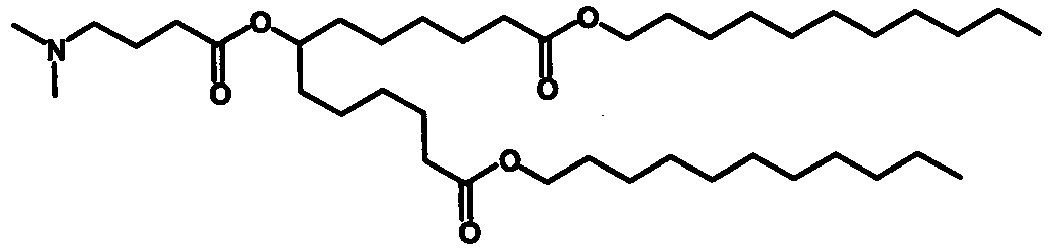


- 6. A lipid particle comprising a neutral lipid, a polyethylene glycol (PEG) lipid, and a compound of any of the preceding items, wherein the compound is in the form of a cationic lipid.
- 7. The lipid particle of item 6, wherein the neutral lipid is selected from distearoylphosphatidylcholine (DSPC), dipalmitoylphosphatidylcholine (DPPC), 1-palmitoyl-2-oleoyl-sn-phosphatidylcholine (POPC), 1,2-dioleoyl-sn-3-phosphoethanolamine (DOPE), or SM; and the lipid particle further comprises a sterol.
- 8. The lipid particle of any one of items 6 and 7, wherein the cationic lipid is present in a mole percentage of 20% to 60%; the neutral lipid is present in a mole percentage of 5% to 25%; the sterol is present in a mole percentage of 25% to 55%; and the PEG lipid is PEG-DMA, 1,2-dimyristoyl-sn-glycerol-methoxy polyethylene glycol (PEG-DMG), or a combination thereof, and is present in a mole percentage of 0.5% to 15%.
- 9. The lipid particle of any of items 6 to 8, further comprising an active agent, preferably wherein the active agent is a nucleic acid selected from a plasmid, an immunostimulatory oligonucleotide, an siRNA, an antisense oligonucleotide, a microRNA, an antagomir, an aptamer, and a ribozyme.
- 10. A pharmaceutical composition comprising a lipid particle of any one of items 6 to 9 and a pharmaceutically acceptable carrier.
- 11. A lipid particle of any one of items 6 to 9 for use in a method of modulating the expression of a target gene in a cell.
- 12. The pharmaceutical composition of item 10 for use in a method of treating a disease or disorder characterized by the overexpression of a polypeptide in a subject, wherein the active agent is a nucleic acid selected from the group consisting of an siRNA, a microRNA, and an antisense oligonucleotide, and wherein the siRNA, microRNA, or antisense oligonucleotide includes a polynucleotide that specifically binds to a polynucleotide that encodes the polypeptide, or a complement thereof.
- 13. The pharmaceutical composition of item 10 for use in a method of treating a disease or disorder characterized by underexpression of a polypeptide in a subject, wherein the active agent is a plasmid that encodes the polypeptide or a functional variant or fragment thereof.
- 14. The pharmaceutical composition of item 10 for use in a method of inducing an immune response in a subject, wherein the active agent is an immunostimulatory oligonucleotide.
- In one aspect, described herein is a lipid particle that includes a neutral lipid, a lipid capable of reducing aggregation, a cationic lipid, and optionally a sterol. In certain embodiments, the lipid particle further includes an active agent (e.g., a therapeutic agent). Various exemplary embodiments of these lipids, lipid particles and compositions comprising the same, and their use to deliver therapeutic agents and modulate gene and protein expression are described in further detail below.
- In one embodiment, the cationic lipid is a compound of Formula I. The following disclosure represents various embodiments of compounds of Formula I.
- Disclosed herein are also compounds (not part of the invention) wherein M1 and M2 are each, independently: -OC(O)-, -C(O)O-, -SC(O)-, -C(O)S-, -OC(S)-, -C(S)O-, -S-S-, -C(R5)=N-, -N=C(R5)-,-C(R5)=N-O-, -O-N=C(R5)-, -C(O)(NR5)-, -N(R5)C(O)-, -C(S)(NR5)-, -N(R5)C(O)-,-N(R5)C(O)N(R5)-, -OC(O)O-, -OSi(R5)2O-, -C(O)(CR3R4)C(O)O-, or -OC(O)(CR3R4)C(O)-.
- Disclosed herein are also compounds (not part of the invention) wherein M1 and M2 are each, independently: -OC(O)-, -C(O)-O-, -C(R5)=N-, -N=C(R5)-, -C(R5)=N-O-, -O-N=C(R5)-, -O-C(O)O-,-C(O)N(R5)-, -N(R5)C(O)-, -C(O)S-, -SC(O)-, -C(S)O-, -OC(S)-, -OSi(R5)2O-,-C(O)(CR3R4)C(O)O-, or -OC(O)(CR3R4)C(O)-.
- Disclosed herein are also compounds (not part of the invention) wherein M1 and M2 are each, independently: -C(O)-O-, -OC(O)-, -C(R5)=N-, -C(R5)=N-O-, -O-C(O)O-, -C(O)N(R5)-, -C(O)S-,-C(S)O-, -OSi(R5)2O-, -C(O)(CR3R4)C(O)O-, or -OC(O)(CR3R4)C(O)-.
- In another embodiment, M1 and M2 are each -C(O)O-.
- In one embodiment, R1 and R2 are each, individually, optionally substituted alkyl, cycloalkyl, cycloalkylalkyl, or heterocycle. In one embodiment, R1 is alkyl and R2 is alkyl, cycloalkyl or cycloalkylalkyl. In one embodiment, R1 and R2 are each, individually, alkyl (e.g., C1-C4 alkyl, such as methyl, ethyl, or isopropyl). In one embodiment, R1 and R2 are both methyl. In another embodiment, R1 and R2, together with the nitrogen atom to which they are attached, form an optionally substituted heterocylic ring (e.g., N-methylpiperazinyl). In another embodiment, one of R1 and R2 is

- In one embodiment, R' is hydrogen or alkyl. In another embodiment, R' is hydrogen or methyl. In one embodiment, R' is absent. In one embodiment, R' is absent or methyl.
- For cationic lipid compounds which contain an atom (e.g., a nitrogen atom) that carries a positive charge, the compound also contains a negatively charged counter ion. The counterion can be any anion, such as an organic or inorganic anion. Suitable examples of anions include, but are not limited to, tosylate, methanesulfonate, acetate, citrate, malonate, tartarate, succinate, benzoate, ascorbate, α-ketoglutarate, α-glycerophosphate, halide (e.g., chloride), sulfate, nitrate, bicarbonate, and carbonate. In one embodiment, the counterion is a halide (e.g., Cl).
- Disclosed herein are also compounds (not part of the invention) wherein each R is, independently, -(CR3R4)-, wherein R3 and R4 are each, independently, H or alkyl (e.g., C1-C4 alkyl). For example, in one embodiment each R is, independently, -(CHR4)-, wherein each R4 is, independently H or alkyl (e.g., C1-C4 alkyl). In another embodiment, each R is, independently, -CH2-, -C(CH3)2- or -CH(iPr)- (where iPr is isopropyl). In another embodiment, each R is -CH2-.
- Disclosed herein are compounds wherein R5 is, in each case, hydrogen or methyl. For example, R5 can be, in each case, hydrogen.
- Disclosed herein are also compounds wherein Q is absent, -C(O)O-, -OC(O)-, -C(O)N(R5)-, -N(R5)C(O)-, -S-S-, -OC(O)O-, -C(R5)=N-O-, -OC(O)N(R5)-, -N(R5)C(O)N(R5)-, -N(R5)C(O)O-, -C(O)S-, -C(S)O-or -C(R5)=N-O-C(O)-. In one embodiment, Q is -C(O)O-.
- Disclosed herein are also compounds (not part of the invention) wherein the dashed line to Q is absent, b is 0 and R'R1R2N-(R)a-Q- and the tertiary carbon adjacent to it (C*) form the following group:

- Disclosed herein are also compounds (not part of the invention) wherein the dashed line to Q is absent, b is 0 and R'R1R2N-(R)a-Q- and the tertiary carbon adjacent to it form the following group:

- Disclosed herein are also compounds (not part of the invention) wherein the dashed line to Q is absent, b is 0 and R'R1R2N-(R)a-Q- and the tertiary carbon adjacent to it form the following group:


- In one embodiment, b is 0. In another embodiment, a is 2, 3, or 4 and b is 0. For example, in one embodiment, a is 3 and b is 0. In another embodiment, a is 3, b is 0, and Q is -C(O)O-.
- Disclosed herein are also compounds (not part of the invention) wherein the biodegradable group present in the cationic lipid is selected from an ester (e.g., -C(O)O- or -OC(O)-), disulfide (-S-S-), oxime (e.g., -C(H)=N-O- or -O-N=C(H)-), -C(O)-O-, -OC(O)-, -C(R5)=N-, -N=C(R5)-, -C(R5)=N-O-, -O-N=C(R5)-, -O-C(O)O-, -C(O)N(R5), -N(R5)C(O)-, -C(S)(NR5)-, (NR5)C(S)-, -N(R5)C(O)N(R5)-, -C(O)S-, -SC(O)-,-C(S)O-, -OC(S)-, -OSi(R5)2O-, -C(O)(CR3R4)C(O)O-, or -OC(O)(CR3R4)C(O)-.
- A suitable cholesterol moiety for the cationic lipids described herein (including compounds of formulas I and III) has the formula:

- Disclosed herein is also a cationic lipid having a head group, one or more hydrophobic tails, and a linker between the head group and the one or more tails. The head group can include an amine; for example an amine having a desired pKa. The pKa can be influenced by the structure of the lipid, particularly the nature of head group; e.g., the presence, absence, and location of functional groups such as anionic functional groups, hydrogen bond donor functional groups, hydrogen bond acceptor groups, hydrophobic groups (e.g., aliphatic groups), hydrophilic groups (e.g., hydroxyl or methoxy), or aryl groups. The head group amine can be a cationic amine; a primary, secondary, or tertiary amine; the head group can include one amine group (monoamine), two amine groups (diamine), three amine groups (triamine), or a larger number of amine groups, as in an oligoamine or polyamine. The head group can include a functional group that is less strongly basic than an amine, such as, for example, an imidazole, a pyridine, or a guanidinium group. The head group can be zwitterionic. Other head groups are suitable as well.
- The one or more hydrophobic tails can include two hydrophobic chains, which may be the same or different. The tails can be aliphatic, for example, they can be composed of carbon and hydrogen, either saturated or unsaturated but without aromatic rings. The tails can be fatty acid tails. Some such groups include octanyl, nonanyl, decyl, lauryl, myristyl, palmityl, stearyl, α-linoleyl, stearidonyl, linoleyl, γ-linolenyl, arachadonyl, and oleyl. Other hydrophobic tails are suitable as well.
- The linker can include, for example, a glyceride linker, an acyclic glyceride analog linker, or a cyclic linker (including a spiro linker, a bicyclic linker, and a polycyclic linker). The linker can include functional groups such as an ether, an ester, a phosphate, a phosphonate, a phosphorothioate, a sulfonate, a disulfide, an acetal, a ketal, an imine, a hydrazone, or an oxime. Other linkers and functional groups are suitable as well.
- In one embodiment, the cationic lipid is a racemic mixture. In another embodiment, the cationic lipid is enriched in one diastereomer, e.g. the cationic lipid has at least 95%, at least 90%, at least 80% or at least 70% diastereomeric excess. In yet another embodiment, the cationic lipid is enriched in one enantiomer, e.g. the lipid has at least 95%, at least 90%, at least 80% or at least 70% enantiomer excess. In yet another embodiment, the cationic lipid is chirally pure, e.g. is a single optical isomer. In yet another embodiment, the cationic lipid is enriched for one optical isomer.
- The cationic lipid includes one or more biodegradable groups. The biodegradable group(s) include one or more bonds that may undergo bond breaking reactions in a biological environment, e.g., in an organism, organ, tissue, cell, or organelle. Functional groups that contain a biodegradable bond include, for example, esters, dithiols, and oximes. Biodegradation can be a factor that influences the clearance of the compound from the body when administered to a subject. Biodegredation can be measured in a cell based assay, where a formulation including a cationic lipid is exposed to cells, and samples are taken at various time points. The lipid fractions can be extracted from the cells and separated and analyzed by LC-MS. From the LC-MS data, rates of biodegradation (e.g., as t1/2 values) can be measured.
- For example, the compound


- For example, without wishing to be bound by theory, Compounds 1 and 2 shown above may be metabolized as shown in the scheme below:

- In one embodiment, a cationic lipid of any of the embodiments described herein has an in vivo half life (t1/2) (e.g., in the liver, spleen or plasma) of less than about 3 hours, such as less than about 2.5 hours, less than about 2 hours, less than about 1.5 hours, less than about 1 hour, less than about 0.5 hour or less than about 0.25 hours.
- In another embodiment, a cationic lipid of any of the embodiments described herein containing a biodegradable group or groups has an in vivo half life (t1/2) (e.g., in the liver, spleen or plasma) of less than about 10% (e.g., less than about 7.5%, less than about 5%, less than about 2.5%) of that for the same cationic lipid without the biodegrable group or groups.
- Some cationic lipids can be conveniently represented as a hydrophobic group combined with a headgroup. By way of example, the compound:


- Disclosed herein are also compounds (not part of the invention) containing a head group including those depicted in Table 1:
TABLE 1 


(where n is 0-5) 


(where n is 0-5) (the carbon with an asterisk is the tertiary carbon of the cation lipid and is not part of the head group) (the carbon with an asterisk is the tertiary carbon of the cation lipid and is not part of the head group) 


R = H, alkyl (e.g., methyl) R = H, alkyl (e.g., methyl) R = H, alkyl (e.g., methyl) X = halogen (e.g., Cl) X = halogen (e.g., Cl) X = halogen (e.g., Cl) 
- Some suitable hydrophobic tail groups include those depicted in Table 2:


- In another aspect, described herein is a method of preparing a compound of Formula I. Suitable exemplary synthetic methods are illustrated in Schemes 1 and 2 below. The variables in the schemes below are the same as those variables at the same position in Formula I above.
- The compounds described herein (for example, where M1 and/or M2 are -OC(O)-) may be prepared by Scheme 1 shown below.

- Another method of preparing the compounds described herein (for example, where M1 and/or M2 are -C(O)O-) is shown in Scheme 2 below.

- In one embodiment, the cationic lipid described herein is selected from the following compounds, and salts thereof (including pharmaceutically acceptable salts thereof):


- In another embodiment, the cationic lipid described herein is selected from the following compound, and salts thereof (including pharmaceutically acceptable salts thereof):


- Cationic lipids include those having alternative fatty acid groups and other dialkylamino groups than those shown, including those in which the alkyl substituents are different (e.g., N-ethyl-N-methylamino-, and N-propyl-N-ethylamino-).
- In certain embodiments, the cationic lipids have at least one protonatable or deprotonatable group, such that the lipid is positively charged at a pH at or below physiological pH (e.g. pH 7.4), and neutral at a second pH, preferably at or above physiological pH. Such lipids are also referred to as cationic lipids. It will, of course, be understood that the addition or removal of protons as a function of pH is an equilibrium process, and that the reference to a charged or a neutral lipid refers to the nature of the predominant species and does not require that all of the lipid be present in the charged or neutral form. The lipids can have more than one protonatable or deprotonatable group, or can be zwiterrionic.
- In certain embodiments, protonatable lipids (i.e., cationic lipids) have a pKa of the protonatable group in the range of about 4 to about 11. For example, the lipids can have a pKa of about 4 to about 7, e.g., from about 5 to about 7, such as from about 5.5 to about 6.8, when incorporated into lipid particles. Such lipids may be cationic at a lower pH formulation stage, while particles will be largely (though not completely) surface neutralized at physiological pH around pH 7.4.
- In particular embodiments, the lipids are charged lipids. As used herein, the term "charged lipid" includes, but is not limited to, those lipids having one or two fatty acyl or fatty alkyl chains and a quaternary amino head group. The quaternary amine carries a permanent positive charge. The head group can optionally include an ionizable group, such as a primary, secondary, or tertiary amine that may be protonated at physiological pH. The presence of the quaternary amine can alter the pKa of the ionizable group relative to the pKa of the group in a structurally similar compound that lacks the quaternary amine (e.g., the quaternary amine is replaced by a tertiary amine).
- Included in the instant disclosure is the free form of the cationic lipids described herein, as well as pharmaceutically acceptable salts and stereoisomers thereof. The cationic lipid can be a protonated salt of the amine cationic lipid. The term "free form" refers to the amine cationic lipids in non-salt form. The free form may be regenerated by treating the salt with a suitable dilute aqueous base solution such as dilute aqueous NaOH, potassium carbonate, ammonia and sodium bicarbonate.
- The pharmaceutically acceptable salts of the instant cationic lipids can be synthesized from the cationic lipids described herein which contain a basic or acidic moiety by conventional chemical methods. Generally, the salts of the basic cationic lipids are prepared either by ion exchange chromatography or by reacting the free base with stoichiometric amounts or with an excess of the desired salt-forming inorganic or organic acid in a suitable solvent or various combinations of solvents. Similarly, the salts of the acidic compounds are formed by reactions with the appropriate inorganic or organic base.
- Thus, pharmaceutically acceptable salts of the cationic lipids described herein include non-toxic salts of the cationic lipids described herein as formed by reacting a basic instant cationic lipids with an inorganic or organic acid. For example, non-toxic salts include those derived from inorganic acids such as hydrochloric, hydrobromic, sulfuric, sulfamic, phosphoric, nitric and the like, as well as salts prepared from organic acids such as acetic, propionic, succinic, glycolic, stearic, lactic, malic, tartaric, citric, ascorbic, pamoic, maleic, hydroxymaleic, phenylacetic, glutamic, benzoic, salicylic, sulfanilic, 2-acetoxy-benzoic, fumaric, toluenesulfonic, methanesulfonic, ethane disulfonic, oxalic, isethionic, and trifluoroacetic (TFA).
- When the cationic lipids described herein are acidic, suitable "pharmaceutically acceptable salts" refers to salts prepared form pharmaceutically acceptable non-toxic bases including inorganic bases and organic bases. Salts derived from inorganic bases include aluminum, ammonium, calcium, copper, ferric, ferrous, lithium, magnesium, manganic salts, manganous, potassium, sodium, and zinc. In one embodiment, the base is selected from ammonium, calcium, magnesium, potassium and sodium. Salts derived from pharmaceutically acceptable organic non-toxic bases include salts of primary, secondary and tertiary amines, substituted amines including naturally occurring substituted amines, cyclic amines and basic ion exchange resins, such as arginine, betaine caffeine, choline, N,N1-dibenzylethylenediamine, diethylamin, 2-diethylaminoethanol, 2-dimethylaminoethanol, ethanolamine, ethylenediamine, N-ethylmorpholine, N-ethylpiperidine, glucamine, glucosamine, histidine, hydrabamine, isopropylamine, lysine, methylglucamine, morpholine, piperazine, piperidine, polyamine resins, procaine, purines, theobromine, triethylamine, trimethylamine tripropylamine, and tromethamine.
- It will also be noted that the cationic lipids described herein may potentially be internal salts or zwitterions, since under physiological conditions a deprotonated acidic moiety in the compound, such as a carboxyl group, may be anionic, and this electronic charge might then be balanced off internally against the cationic charge of a protonated or alkylated basic moiety, such as a quaternary nitrogen atom.
- One or more additional cationic lipids, which carry a net positive charge at about physiological pH, in addition to those specifically described above, may also be included in the lipid particles and compositions described herein. Such cationic lipids include, but are not limited to N,N-dioleyl-N,N-dimethylammonium chloride ("DODAC"); N-(2,3-dioleyloxy)propyl-N,N-N-triethylammonium chloride ("DOTMA"); N,N-distearyl-N,N-dimethylammonium bromide ("DDAB"); N-(2,3-dioleoyloxy)propyl)-N,N,N-trimethylammonium chloride ("DOTAP"); 1,2-Dioleyloxy-3-trimethylaminopropane chloride salt ("DOTAP.Cl"); 3β-(N-(N',N'-dimethylaminoethane)-carbamoyl)cholesterol ("DC-Chol"), N-(1-(2,3-dioleyloxy)propyl)-N-2-(sperminecarboxamido)ethyl)-N,N-dimethylammonium trifluoracetate ("DOSPA"), dioctadecylamidoglycyl carboxyspermine ("DOGS"), 1,2-dileoyl-sn-3-phosphoethanolamine ("DOPE"), 1,2-dioleoyl-3-dimethylammonium propane ("DODAP"), N, N-dimethyl-2,3-dioleyloxy)propylamine ("DODMA"), and N-(1,2-dimyristyloxyprop-3-yl)-N,N-dimethyl-N-hydroxyethyl ammonium bromide ("DMRIE"). Additionally, a number of commercial preparations of cationic lipids can be used, such as, e.g., LIPOFECTIN (including DOTMA and DOPE, available from GIBCO/BRL), and LIPOFECTAMINE (comprising DOSPA and DOPE, available from GIBCO/BRL).
- The lipid particles and compositions described herein may also include one or more neutral lipids. Neutral lipids, when present, can be any of a number of lipid species which exist either in an uncharged or neutral zwitterionic form at physiological pH. Such lipids include, for example, diacylphosphatidylcholine, diacylphosphatidylethanolamine, ceramide, sphingomyelin, dihydrosphingomyelin, cephalin, and cerebrosides. In one embodiment, the neutral lipid component is a lipid having two acyl groups (e.g., diacylphosphatidylcholine and diacylphosphatidylethanolamine). In one embodiment, the neutral lipid contains saturated fatty acids with carbon chain lengths in the range of C10 to C20. In another embodiment, the neutral lipid includes mono or diunsaturated fatty acids with carbon chain lengths in the range of C10 to C20. Suitable neutral lipids include, but are not limited to, DSPC, DPPC, POPC, DOPE, DSPC, and SM.
- The lipid particles and compositosn described herein may also include one or more lipids capable of reducing aggregation. Examples of lipids that reduce aggregation of particles during formation include polyethylene glycol (PEG)-modified lipids (PEG lipids, such as PEG-DMG and PEG-DMA), monosialoganglioside Gm1, and polyamide oligomers ("PAO") such as (described in
U.S. Patent No. 6,320,017 ). Suitable PEG lipids include, but are not limited to, PEG-modified phosphatidylethanolamine and phosphatidic acid, PEG-ceramide conjugates (e.g., PEG-CerC14 or PEG-CerC20) (such as those described inU.S. Patent No. 5,820,873 ), PEG-modified dialkylamines and PEG-modified 1,2-diacyloxypropan-3-amines, PEG-modified diacylglycerols and dialkylglycerols, mPEG (mw2000)-diastearoylphosphatidylethanolamine (PEG-DSPE). - The lipid particles and compositions may include a sterol, such as cholesterol.
- In a further aspect, the present invent relates to lipid particles that include one or more of the cationic lipids described herein. In one embodiment, the lipid particle includes one or more compounds of formula I-VII.
- Lipid particles include, but are not limited to, liposomes. As used herein, a liposome is a structure having lipid-containing membranes enclosing an aqueous interior.
- Another embodiment is a nucleic acid-lipid particle (e.g., a SNALP) comprising a cationic lipid described herein, a non-cationic lipid (such as a neutral lipid), optionally a PEG-lipid conjugate (such as the lipids for reducing aggregation of lipid particles discussed herein), and a nucleic acid. As used herein, the term "SNALP" refers to a stable nucleic acid-lipid particle. A SNALP represents a particle made from lipids, wherein the nucleic acid (e.g., an interfering RNA) is encapsulated within the lipids. In certain instances, SNALPs are useful for systemic applications, as they can exhibit extended circulation lifetimes following intravenous (i.v.) injection, they can accumulate at distal sites (e.g., sites physically separated from the administration site), and they can mediate silencing of target gene expression at these distal sites. The nucleic acid may be complexed with a condensing agent and encapsulated within a SNALP as set forth in International Publication No.
WO 00/03683 - For example, the lipid particle may include a cationic lipid, a fusion-promoting lipid (e.g., DPPC), a neutral lipid, cholesterol, and a PEG-modified lipid. In one embodiment, the lipid particle includes the above lipid mixture in molar ratios of about 20-70% cationic lipid: 0.1-50% fusion promoting lipid: 5-45% neutral lipid: 20-55% cholesterol: 0.5-15% PEG-modified lipid.
- In another embodiment of the lipid particle, the cationic lipid is present in a mole percentage of about 20% and about 60%; the neutral lipid is present in a mole percentage of about 5% to about 25%; the sterol is present in a mole percentage of about 25% to about 55%; and the PEG lipid is PEG-DMA, PEG-DMG, or a combination thereof, and is present in a mole percentage of about 0.5% to about 15%.
- In particular embodiments, the molar lipid ratio, with regard to mol% cationic lipid/DSPC/Chol/PEG-DMG or PEG-DMA) is approximately 40/10/40/10, 35/15/40/10 or 52/13/30/5. This mixture may be further combined with a fusion-promoting lipid in a molar ratio of 0.1-50%, 0.1-50%, 0.5-50%, 1-50%, 5%-45%, 10%-40%, or 15%-35%. In other words, when a 40/10/40/10 mixture of lipid/DSPC/Chol/PEG-DMG or PEG-DMA is combined with a fusion-promoting peptide in a molar ratio of 50%, the resulting lipid particles can have a total molar ratio of (mol% cationic lipid/DSPC/Chol/PEG-DMG or PEG-DMA/fusion-promoting peptide) 20/5/20/5/50. In another embodiment, the neutral lipid, DSPC, in these compositions is replaced with POPC, DPPC, DOPE or SM.
- In one embodiment, the lipid particles comprise a cationic lipid described herein, a neutral lipid, a sterol and a PEG-modified lipid. In one embodiment, the lipid particles include from about 25% to about 75% on a molar basis of cationic lipid, e.g., from about 35 to about 65%, from about 45 to about 65%, about 60%, about 57.5%, about 57.1%, about 50% or about 40% on a molar basis. In one embodiment, the lipid particles include from about 0% to about 15% on a molar basis of the neutral lipid, e.g., from about 3 to about 12%, from about 5 to about 10%, about 15%, about 10%, about 7.5%, about 7.1% or about 0% on a molar basis. In one embodiment, the neutral lipid is DPPC. In one embodiment, the neutral lipid is DSPC. In one embodiment, the formulation includes from about 5% to about 50% on a molar basis of the sterol, e.g., about 15 to about 45%, about 20 to about 40%, about 48%, about 40%, about 38.5%, about 35%, about 34.4%, about 31.5% or about 31% on a molar basis. In one embodiment, the sterol is cholesterol.
- The lipid particles described herein may further include one or more therapeutic agents. In a preferred embodiment, the lipid particles include a nucleic acid (e.g., an oligonucleotide), such as siRNA or miRNA.
- In one embodiment, the lipid particles include from about 0.1% to about 20% on a molar basis of the PEG-modified lipid, e.g., about 0.5 to about 10%, about 0.5 to about 5%, about 10%, about 5%, about 3.5%, about 1.5%, about 0.5%, or about 0.3% on a molar basis. In one embodiment, the PEG-modified lipid is PEG- DMG. In one embodiment, the PEG-modified lipid is PEG-c-DMA. In one embodiment, the lipid particles include 25-75% of cationic lipid, 0.5-15% of the neutral lipid, 5-50% of the sterol, and 0.5- 20% of the PEG-modified lipid on a molar basis.
- In one embodiment, the lipid particles include 35-65% of cationic lipid, 3-12% of the neutral lipid, 15-45% of the sterol, and 0.5- 10% of the PEG-modified lipid on a molar basis. In one embodiment, the lipid particles include 45-65% of cationic lipid, 5-10% of the neutral lipid, 25-40% of the sterol, and 0.5- 5% of the PEG-modified lipid on a molar basis. In one embodiment, the PEG modified lipid comprises a PEG molecule of an average molecular weight of 2,000 Da. In one embodiment, the PEG modified lipid is PEG-distyryl glycerol (PEG-DSG).
- In one embodiment, the ratio of lipid:siRNA is at least about 0.5:1, at least about 1:1, at least about 2:1, at least about 3:1, at least about 4:1, at least about 5:1, at least about 6:1, at least about 7:1, at least about 11:1 or at least about 33:1. In one embodiment, the ratio of lipid: siRNA ratio is between about 1:1 to about 35:1, about 3:1 to about 15:1, about 4:1 to about 15:1, or about 5:1 to about 13:1. In one embodiment, the ratio of lipid:siRNA ratio is between about 0.5:1 to about 12:1.
- In one embodiment, the lipid particles are nanoparticles. In additional embodiments, the lipid particles have a mean diameter size of from about 50 nm to about 300 nm, such as from about 50 nm to about 250 nm, for example, from about 50 nm to about 200 nm.
- In one embodiment, a lipid particle containing a cationic lipid of any of the embodiments described herein has an in vivo half life (t1/2) (e.g., in the liver, spleen or plasma) of less than about 3 hours, such as less than about 2.5 hours, less than about 2 hours, less than about 1.5 hours, less than about 1 hour, less than about 0.5 hour or less than about 0.25 hours.
- In another embodiment, a lipid particle containing a cationic lipid of any of the embodiments described herein has an in vivo half life (t1/2) (e.g., in the liver, spleen or plasma) of less than about 10 % (e.g., less than about 7.5%, less than about 5%, less than about 2.5%) of that for the same cationic lipid without the biodegrable group or groups.
- The lipid particles and compositions described herein can further include one or more antioxidants. The antioxidant stabilizes the lipid particle and prevents, decreases, and/or inhibits degradation of the cationic lipid and/or active agent present in the lipid particles. The antioxidant can be a hydrophilic antioxidant, a lipophilic antioxidant, a metal chelator, a primary antioxidant, a secondary antioxidant, salts thereof, and mixtures thereof. In certain embodiments, the antioxidant comprises a metal chelator such as EDTA or salts thereof, alone or in combination with one, two, three, four, five, six, seven, eight, or more additional antioxidants such as primary antioxidants, secondary antioxidants, or other metal chelators. In one preferred embodiment, the antioxidant comprises a metal chelator such as EDTA or salts thereof in a mixture with one or more primary antioxidants and/or secondary antioxidants. For example, the antioxidant may comprise a mixture of EDTA or a salt thereof, a primary antioxidant such as a-tocopherol or a salt thereof, and a secondary antioxidant such as ascorbyl palmitate or a salt thereof. In one embodiment, the antioxidant comprises at least about 100 mM citrate or a salt thereof. Examples of antioxidants include, but are not limited to, hydrophilic antioxidants, lipophilic antioxidants, and mixtures thereof. Non-limiting examples of hydrophilic antioxidants include chelating agents (e.g., metal chelators) such as ethylenediaminetetraacetic acid (EDTA), citrate, ethylene glycol tetraacetic acid (EGTA), 1,2-bis(o-aminophenoxy)ethane-N,N,N',N'-tetraacetic acid (BAPTA), diethylene triamine pentaacetic acid (DTPA), 2,3-dimercapto-l-propanesulfonic acid (DMPS), dimercaptosuccinic acid (DMSA), cc-lipoic acid, salicylaldehyde isonicotinoyl hydrazone (SIH), hexyl thioethylamine hydrochloride (HTA), desferrioxamine, salts thereof, and mixtures thereof. Additional hydrophilic antioxidants include ascorbic acid, cysteine, glutathione, dihydrolipoic acid, 2- mercaptoethane sulfonic acid, 2-mercaptobenzimidazole sulfonic acid, 6-hydroxy-2,5,7,8-tetramethylchroman-2-carboxylic acid, sodium metabisulfite, salts thereof, and mixtures thereof. Non-limiting examples of lipophilic antioxidants include vitamin E isomers such as α-, β-, γ-, and δ-tocopherols and α-, β-, γ-, and δ-tocotrienols; polyphenols such as 2-tert-butyl-4-methyl phenol, 2-fert-butyl-5-methyl phenol, and 2-tert-butyl-6-methyl phenol; butylated hydroxyanisole (BHA) (e.g., 2-teri-butyl-4-hydroxyanisole and 3-tert-butyl-4-hydroxyanisole); butylhydroxytoluene (BHT); tert-butylhydroquinone (TBHQ); ascorbyl palmitate; rc-propyl gallate; salts thereof; and mixtures thereof. Suitable antioxidants and formulations containing such antioxidants are described in International Publication No.
WO 2011/066651 . - In another embodiment, the lipid particles or compositions contain the antioxidant EDTA (or a salt thereof), the antioxidant citrate (or a salt thereof), or EDTA (or a salt thereof) in combination with one or more (e.g., a mixture of) primary and/or secondary antioxidants such as α-tocopherol (or a salt thereof) and/or ascorbyl palmitate (or a salt thereof).
- In one embodiment, the antioxidant is present in an amount sufficient to prevent, inhibit, or reduce the degradation of the cationic lipid present in the lipid particle. For example, the antioxidant may be present at a concentration of at least about or about 0.1 mM, 0.5 mM, 1 mM, 10 mM, 100 mM, 500 mM, 1 M, 2 M, or 5M, or from about 0.1 mM to about 1 M, from about 0.1 mM to about 500 mM, from about 0.1 mM to about 250 mM, or from about 0.1 mM to about 100 mM.
- The lipid particles and compositions described herein can further include an apolipoprotein. As used herein, the term "apolipoprotein" or "lipoprotein" refers to apolipoproteins known to those of skill in the art and variants and fragments thereof and to apolipoprotein agonists, analogues or fragments thereof described below.
- In a preferred embodiment, the active agent is a nucleic acid, such as a siRNA. For example, the active agent can be a nucleic acid encoded with a product of interest, including but not limited to, RNA, antisense oligonucleotide, an antagomir, a DNA, a plasmid, a ribosomal RNA (rRNA), a micro RNA (miRNA) (e.g., a miRNA which is single stranded and 17-25 nucleotides in length), transfer RNA (tRNA), a small interfering RNA (siRNA), small nuclear RNA (snRNA), antigens, fragments thereof, proteins, peptides, vaccines and small molecules or mixtures thereof. In one more preferred embodiment, the nucleic acid is an oligonucleotide (e.g., 15-50 nucleotides in length (or 15-30 or 20-30 nucleotides in length)). An siRNA can have, for instance, a duplex region that is 16-30 nucleotides long. In another embodiment, the nucleic acid is an immunostimulatory oligonucleotide, decoy oligonucleotide, supermir, miRNA mimic, or miRNA inhibitor. A supermir refers to a single stranded, double stranded or partially double stranded oligomer or polymer of ribonucleic acid (RNA) or deoxyribonucleic acid (DNA) or both or modifications thereof, which has a nucleotide sequence that is substantially identical to an miRNA and that is antisense with respect to its target. miRNA mimics represent a class of molecules that can be used to imitate the gene silencing ability of one or more miRNAs. Thus, the term "microRNA mimic" refers to synthetic non-coding RNAs (i.e. the miRNA is not obtained by purification from a source of the endogenous miRNA) that are capable of entering the RNAi pathway and regulating gene expression.
- The nucleic acid that is present in a lipid-nucleic acid particle can be in any form. The nucleic acid can, for example, be single-stranded DNA or RNA, or double-stranded DNA or RNA, or DNA-RNA hybrids. Non-limiting examples of double-stranded RNA include siRNA. Single-stranded nucleic acids include, e.g., antisense oligonucleotides, ribozymes, microRNA, and triplex-forming oligonucleotides. The lipid particles described herein can also deliver nucleic acids which are conjugated to one or more ligands.
- The lipid particles, particularly when associated with a therapeutic agent, may be formulated as a pharmaceutical composition, e.g., which further comprises a pharmaceutically acceptable diluent, excipient, or carrier, such as physiological saline or phosphate buffer.
- The resulting pharmaceutical preparations may be sterilized by conventional, well known sterilization techniques. The aqueous solutions can then be packaged for use or filtered under aseptic conditions and lyophilized, the lyophilized preparation being combined with a sterile aqueous solution prior to administration. The compositions may contain pharmaceutically acceptable auxiliary substances as required to approximate physiological conditions, such as pH adjusting and buffering agents, and tonicity adjusting agents, for example, sodium acetate, sodium lactate, sodium chloride, potassium chloride, and calcium chloride. Additionally, the lipidic suspension may include lipid-protective agents which protect lipids against free-radical and lipid-peroxidative damages on storage. Lipophilic free-radical quenchers, such as α-tocopherol and water-soluble iron-specific chelators, such as ferrioxamine, are suitable.
- The concentration of lipid particle or lipid-nucleic acid particle in the pharmaceutical formulations can vary, for example, from less than about 0.01%, to at or at least about 0.05-5% to as much as 10 to 30% by weight.
- Methods of making cationic lipids, lipid particles containing them, and pharmaceutical compositions containing the cationic lipids and/or lipid particles are described in, for example, International Publication Nos.
WO 2010/054406 ,WO 2010/054401 ,WO 2010/054405 ,WO 2010/054384 ,WO 2010/042877 ,WO 2010/129709 ,WO 2009/086558 , andWO 2008/042973 , andU.S. Patent Publication Nos. 2004/0142025 ,2006/0051405 and2007/0042031 . - For example, in one embodiment, a solution of one or more lipids (including a cationic lipid of any of the embodiments described herein) in an organic solution (e.g., ethanol) is prepared. Similarly, a solution of one or more active (therapeutic) agents (such as, for example an siRNA molecule or a 1:1 molar mixture of two siRNA molecules) in an aqueous buffered (e.g., citrate buffer) solution is prepared. The two solutions are mixed and diluted to form a colloidal suspension of siRNA lipid particles. In one embodiment, the siRNA lipid particles have an average particle size of about 80-90 nm. In further embodiments, the dispersion may be filtered through 0.45/2 micron filters, concentrated and diafiltered by tangential flow filtration.
- As used herein, the term "cationic lipid" inlcudes those lipids having one or two fatty acid or fatty aliphatic chains and an amino acid containing head group that may be protonated to form a cationic lipid at physiological pH. In some embodiments, a cationic lipid is referred to as an "amino acid conjugate cationic lipid."
- A subject or patient in whom administration of the complex is an effective therapeutic regimen for a disease or disorder is preferably a human, but can be any animal, including a laboratory animal in the context of a clinical trial or screening or activity experiment. Thus, as can be readily appreciated by one of ordinary skill in the art, the methods, compounds and compositions described herein are particularly suited to administration to any animal, particularly a mammal, and including, but by no means limited to, humans, domestic animals, such as feline or canine subjects, farm animals, such as but not limited to bovine, equine, caprine, ovine, and porcine subjects, wild animals (whether in the wild or in a zoological garden), research animals, such as mice, rats, rabbits, goats, sheep, pigs, dogs, and cats, avian species, such as chickens, turkeys, and songbirds, i.e., for veterinary medical use.
- Many of the chemical groups recited in the generic formulas above are written in a particular order (for example, -OC(O)-). It is intended that the chemical group is to be incorporated into the generic formula in the order presented unless indicated otherwise. For example, a generic formula of the form -(R)i-(M1)k-(R)m- where M1 is -C(O)O- and k is 1 refers to -(R)i-C(O)O-(R)m- unless specified otherwise. It is to be understood that when a chemical group is written in a particular order, the reverse order is also contemplated unless otherwise specified. For example, in a generic formula -(R)i-(M1)k-(R)m- where M1 is defined as-C(O)NH- (i.e., -(R)i-C(O)-NH-(R)m-), the compound where M1 is -NHC(O)- (i.e., -(R)i-NHC(O)-(R)m-) is also contemplated unless otherwise specified.
- As used herein, the term "biodegradable group" referes to a group that include one or more bonds that may undergo bond breaking reactions in a biological environment, e.g., in an organism, organ, tissue, cell, or organelle. For example, the biodegradable group may be metabolizable by the body of a mammal, such as a human (e.g., by hydrolysis). Some groups that contain a biodegradable bond include, for example, but are not limited to esters, dithiols, and oximes. Non-limiting examples of biodegradable groups are -OC(O)-, -C(O)O-, -SC(O)-,-C(O)S-, -OC(S)-, -C(S)O-, -S-S-, -C(R5)=N-, -N=C(R5)-, -C(R5)=N-O-, -O-N=C(R5)-,-C(O)(NR5)-, -N(R5)C(O)-, -C(S)(NR5)-, -N(R5)C(O)-, -N(R5)C(O)N(R5)-, -OC(O)O-,-OSi(R5)2O-, -C(O)(CR3R4)C(O)O-, or -OC(O)(CR3R4)C(O)-.
- As used herein, an "aliphatic" group is a non-aromatic group in which carbon atoms are linked into chains, and is either saturated or unsaturated.
- The terms "alkyl" and "alkylene" refer to a straight or branched chain saturated hydrocarbon moiety. In one embodiment, the alkyl group is a straight chain saturated hydrocarbon. Unless otherwise specified, the "alkyl" or "alkylene" group contains from 1 to 24 carbon atoms. Representative saturated straight chain alkyl groups include methyl, ethyl, n-propyl, n-butyl, n-pentyl, and n-hexyl. Representative saturated branched alkyl groups include isopropyl, sec-butyl, isobutyl, tert-butyl, and isopentyl.
- The term "alkenyl" refers to a straight or branched chain hydrocarbon moiety having one or more carbon-carbon double bonds. In one embodiment, the alkenyl group contains 1, 2, or 3 double bonds and is otherwise saturated. Unless otherwise specified, the "alkenyl" group contains from 2 to 24 carbon atoms. Alkenyl groups include both cis and trans isomers. Representative straight chain and branched alkenyl groups include ethylenyl, propylenyl, 1-butenyl, 2-butenyl, isobutylenyl, 1-pentenyl, 2-pentenyl, 3-methyl-1-butenyl, 2-methyl-2-butenyl, and 2,3-dimethyl-2-butenyl.
- The term "alkynyl" refers to a straight or branched chain hydrocarbon moiety having one or more carbon-carbon triple bonds. Unless otherwise specified, the "alkynyl" group contains from 2 to 24 carbon atoms. Representative straight chain and branched alkynyl groups include acetylenyl, propynyl, 1-butynyl, 2-butynyl, 1-pentynyl, 2-pentynyl, and 3-methyl-1-butynyl.
- Unless otherwise specified, the term "acyl" refers to a carbonyl group substituted with hydrogen, alkyl, partially saturated or fully saturated cycloalkyl, partially saturated or fully saturated heterocycle, aryl, or heteroaryl. For example, acyl groups include groups such as (C1-C20)alkanoyl (e.g., formyl, acetyl, propionyl, butyryl, valeryl, caproyl, and t-butylacetyl), (C3-C20)cycloalkylcarbonyl (e.g., cyclopropylcarbonyl, cyclobutylcarbonyl, cyclopentylcarbonyl, and cyclohexylcarbonyl), heterocyclic carbonyl (e.g., pyrrolidinylcarbonyl, pyrrolid-2-one-5-carbonyl, piperidinylcarbonyl, piperazinylcarbonyl, and tetrahydrofuranylcarbonyl), aroyl (e.g., benzoyl) and heteroaroyl (e.g., thiophenyl-2-carbonyl, thiophenyl-3-carbonyl, furanyl-2-carbonyl, furanyl-3-carbonyl, 1H-pyrroyl-2-carbonyl, 1H-pyrroyl-3-carbonyl, and benzo[b]thiophenyl-2-carbonyl).
- The term "aryl" refers to an aromatic monocyclic, bicyclic, or tricyclic hydrocarbon ring system. Unless otherwise specified, the "aryl" group contains from 6 to 14 carbon atoms. Examples of aryl moieties include, but are not limited to, phenyl, naphthyl, anthracenyl, and pyrenyl.
- The terms "cycloalkyl" and "cycloalkylene" refer to a saturated monocyclic or bicyclic hydrocarbon moiety such as cyclopropyl, cyclobutyl, cyclopentyl, and cyclohexyl. Unless otherwise specified, the "cycloalkyl" or "cycloalkylene" group contains from 3 to 10 carbon atoms.
- The term "cycloalkylalkyl" refers to a cycloalkyl group bound to an alkyl group, where the alkyl group is bound to the rest of the molecule.
- The term "heterocycle" (or "heterocyclyl") refers to a non-aromatic 5- to 8-membered monocyclic, or 7- to 12-membered bicyclic, or 11- to 14-membered tricyclic ring system which is either saturated or unsaturated, and which contains from 1 to 3 heteroatoms if monocyclic, 1-6 heteroatoms if bicyclic, or 1-9 heteroatoms if tricyclic, independently selected from nitrogen, oxygen and sulfur, and wherein the nitrogen and sulfur heteroatoms may be optionally oxidized, and the nitrogen heteroatom may be optionally quaternized. For instance, the heterocycle may be a cycloalkoxy group. The heterocycle may be attached to the rest of the molecule via any heteroatom or carbon atom in the heterocycle. Heterocycles include, but are not limited to, morpholinyl, pyrrolidinonyl, pyrrolidinyl, piperidinyl, piperizynyl, hydantoinyl, valerolactamyl, oxiranyl, oxetanyl, tetrahydrofuranyl, tetrahydropyranyl, tetrahydropyridinyl, tetrahydroprimidinyl, tetrahydrothiophenyl, tetrahydrothiopyranyl, tetrahydropyrimidinyl, tetrahydrothiophenyl, and tetrahydrothiopyranyl.
- The term "heteroaryl" refers to an aromatic 5-8 membered monocyclic, 7-12 membered bicyclic, or 11-14 membered tricyclic ring system having 1-3 heteroatoms if monocyclic, 1-6 heteroatoms if bicyclic, or 1-9 heteroatoms if tricyclic, where the heteroatoms are selected from O, N, or S (e.g., carbon atoms and 1-3, 1-6, or 1-9 heteroatoms of N, O, or S if monocyclic, bicyclic, or tricyclic, respectively). The heteroaryl groups herein described may also contain fused rings that share a common carbon-carbon bond.
- The term "substituted", unless otherwise indicated, refers to the replacement of one or more hydrogen radicals in a given structure with the radical of a specified substituent including, but not limited to: halo, alkyl, alkenyl, alkynyl, aryl, heterocyclyl, thiol, alkylthio, oxo, thioxy, arylthio, alkylthioalkyl, arylthioalkyl, alkylsulfonyl, alkylsulfonylalkyl, arylsulfonylalkyl, alkoxy, aryloxy, aralkoxy, aminocarbonyl, alkylaminocarbonyl, arylaminocarbonyl, alkoxycarbonyl, aryloxycarbonyl, haloalkyl, amino, trifluoromethyl, cyano, nitro, alkylamino, arylamino, alkylaminoalkyl, arylaminoalkyl, aminoalkylamino, hydroxy, alkoxyalkyl, carboxyalkyl, alkoxycarbonylalkyl, aminocarbonylalkyl, acyl, aralkoxycarbonyl, carboxylic acid, sulfonic acid, sulfonyl, phosphonic acid, aryl, heteroaryl, heterocyclic, and an aliphatic group. It is understood that the substituent may be further substituted. Exemplary substituents include amino, alkylamino, dialkylamino, and cyclic amino compounds.
- The term "halogen" or "halo" refers to fluoro, chloro, bromo and iodo.
- The following abbreviations may be used in this application:
- DSPC: distearoylphosphatidylcholine; DPPC: 1,2-Dipalmitoyl-sn-glycero-3-phosphocholine;
- POPC: 1- palmitoyl-2-oleoyl-sn-phosphatidylcholine; DOPE: 1,2-dileoyl-sn-3-phosphoethanolamine; PEG-DMG generally refers to 1,2-dimyristoyl-sn-glycerol-methoxy polyethylene glycol (e.g., PEG 2000); TBDPSCl: tert-Butylchlorodiphenylsilane; DMAP: dimethylaminopyridine; NMO: N-methylmorpholin-N-oxide; LiHDMS: lithium bis(trimethylsilyl)amide; HMPA: hexamethylphosphoramide; EDC: 1-ethyl-3-(3-dimethylaminopropyl) carbodiimide; DIPEA: diisopropylethylamine; DCM: dichloromethane;
- TEA: triethylamine; TBAF: tetrabutylammonium fluoride
- Methods to prepare various organic groups and protective groups are known in the art and their use and modification is generally within the ability of one of skill in the art (see, for example, Green, T.W. et. al., Protective Groups in Organic Synthesis (1999); Stanley R. Sandler and Wolf Karo, Organic Functional Group Preparations (1989); Greg T. Hermanson, Bioconjugate Techniques (1996); and Leroy G. Wade, Compendium Of Organic Synthetic Methods (1980)). Briefly, protecting groups are any group that reduces or eliminates unwanted reactivity of a functional group. A protecting group can be added to a functional group to mask its reactivity during certain reactions and then removed to reveal the original functional group. In some embodiments an "alcohol protecting group" is used. An "alcohol protecting group" is any group which decreases or eliminates unwanted reactivity of an alcohol functional group. Protecting groups can be added and removed using techniques well known in the art.
- The compounds may be prepared by at least one of the techniques described herein or known organic synthesis techniques.
-

- To a solution of 9-bromononan-1-ol (5 g, 22.4 mmol) and 2,3-dihydro-2H-pyran (1.93 g, 23 mmol) in DCM (125 mL) was added PPTS (628 mg, 2.5 mmol, pyridinium p-toluenesulfonate). The mixture was stirred for three hours at RT and was then concentrated. The residue was taken up in hexanes and filtered. The filtrate was concentrated and purified by dry column chromatography (0 to 5% ethyl acetate in hexanes). This gave a colorless oil (6.75 g, 22.0 mmol, 98%).
-

- To magnesium (588 mg, 24.2 mmol)) and a small crystal of iodine in 10 mL of anhydrous ether was added 5 mL of a solution of Intermediate 1 (6.75g, 22 mmol) in 40 mL of anhy diethyl ether. The mixture was refluxed for 20 min and then the rest of Intermediate 1 solution was added. The mixture was continued to reflux overnight. The mixture was cooled to RT, followed by addition of ethyl formate (26 mmol, 2.1 mL, 1.93 g) dropwise in 10 min. More ether (30 mL) was added. The resulting mixture was stirred overnight at ambient temperature. The mixture was diluted with ether and saturated NH4Cl solution was added. The aqueous phase was extracted with ether. The combined organic extracts were washed with brine, dried with sodium sulfate. Concentration gave a light yellow oil that was quickly cleaned by column chromatography on silica gel (230-400 mesh) eluted with 30% ethyl acetate in hexanes. This gave the desired product (013-11B) as slightly yellow oil (6.95 g).
- The formate (013-11B, 6.96 g) and KOH (13 mmol, 808 mg in 13 mL of water) were stirred in EtOH (75 mL) at room temperature under nitrogen for 2h. Upon completion of the reaction, 15 drops of conc HCl was added to the reaction mixture and the solvent was evaporated. The residue was washed with hexanes (3 x 30 mL) and filtered. The filtrate was concentrated to give a slightly yellow oil (5.45 g). The oil was purified by column chromatography (0-15% ethyl acetate in hexanes). This gave the desired product as a white solid (013-11C - Intermediate 2, 2.86 g). 1H NMR (400 MHz, CDC13) δ: 4.58 (m, 2H), 3.91-3.85 (m, 2H), 3.75 (t, J=6.9 Hz, 1H), 3.72 (t, J=6.9 Hz, 1H), 3.59 (m, 1H), 3.53-3.48 (m, 2H), 3.40 (t, J=6.6 Hz, 1H), 3.37 (t, J=6.6 Hz, 1H), 1.88-1.79 (m, 2H), 1.76-1.69 (m, 2H), 1.63-1.50 (m, 8H estimated, due to overlap with water peak), 1.50-1.26 (m, 32H).
-

- Under an argon atmosphere, to a round-bottom flask charged with 013-11C - Intermediate 2 (2.40 g, 4.96 mmol), 4-dimethylaminobutyric acid hydrochloride (1.67 g, 10 mmol), 4-(dimethylamino)pyridine (300 mg) and triethylamine (1.67 mL, 12 mmol) in dichloromethane (80 mL) was added dicyclohexylcarbodiimide (DCC, 2.27 g, 11 mmol). Upon being stirred for 16-hour period at ambient temperature, the white precipitate is discarded by filtration. The filtrate was concentrated to dryness. The resulting residue was taken up in water and ethyl acetate/hexanes (ca, 1:3). The two layers were separated. The aqueous phase was adjusted to pH 8 with HCl and sodium bicarbonate. The aqueous was then extracted with hexanes (3 X 50 mL). The combined extracts were dried over sodium sulfate and concentrated. The residue was purified by column chromatography on silica gel (0 to 6% methanol in dichloromethane). This gave the desired product as a colorless oil (2.70 g, 4.51 mmol, 92%). 1H NMR (400 MHz, CDCl3) δ: 4.87 (quintet-like, J=6.2 Hz, 1H), 4.58 (m, 2H), 3.91-3.85 (m, 2H), 3.75 (t, J=6.9 Hz, 1H), 3.72 (t, J=6.9 Hz, 1H), 3.54-3.48 (m, 2H), 3.40 (t, J=6.6 Hz, 1H), 3.37 (t, J=6.6 Hz, 1H), 2.33 (t, J=7.5 Hz, 2H), 2.29 (t, J=7.5 Hz, 2H), 2.23 (s, 6H), 1.89-1.69 (m, 6H), 1.63-1.49 (m, 16H), 1.40-1.26 (m, 24H).
-

- To a flask containing XD-013-15 - Intermediate 3 (2.70 g, 4.51 mmol, in EtOH (80 mL) was added p-toluenesulfonic acid monohydrate (4.5 mmol, 855 mg), at room temperature and stirred for 24 h. After the reaction was quenched with dilute sodium bicarbonate solution (200 mL), the aqueous layer was extracted with diethyl ether (3 x 100 mL). The combined organic layers were washed with half saturated brine (100 mL), dried over sodium sulfate, filtered and concentrated. The residue was purified by column chromatography on silica gel (0 to 14% methanol in dichloromethane). This gave the desired product as a slightly yellow solid (1.604 g, 3.73 mmo, 83%).
-

- Dicyclohexylcarbodiimide (DCC, 851 mg, 4.12 mmol, 5.5 eq) was added to a solution of cyclohexanecarboxylic acid (479 mg, 3.74 mmol, 5 eq.), XD-013-17 - Intermediate 4 (321 mg, 0.75 mmol) and 4-dimethylaminopyridine (DMAP, 60 mg) and triethylamine (4.12 mmol, 0.57 mL) in dichloromethane (20 mL). After being stirred for 16 h, the mixture was concentrated and the residue was taken in hexanes and water. The white precipitate is filtered off. The colorless filtrate was washed twice with dilute sodium carbonate. The aqueous phase was extracted with hexanes once (70 mL). The combined organic phases were washed with brine (100 mL), dried over sodium sulfate, filtered and concentrated to dryness. The residue was purified by column chromatography on silica gel (0 to 5% methanol in DCM). This gave the desired product as a slightly yellow oil (264 mg, 0.41 mmol, 54%). 1H NMR (400 MHz, CDCl3) δ: 4.87 (quintet-like, J=6.2 Hz, 1H), 4.05 (t, J=6.7 Hz, 4H), 2.35-2.25 (m, 6H), 2.23 (s, 6H), 1.93-1.87 (m, 4H), 1.84-1.73 (m, 6H), 1.68-1.57 (m, 6H), 1.56-1.39 (m, 8H), 1.36-1.21 (m, 30H).
-

- Compound 2 (XD-013-20) was prepared in a similar manner to that described for XD-013-18 - Compound 1 (slightly yellow oil, 327 mg, 0.50 mmol, 66.7%). 1H NMR (400 MHz, CDCl3) δ: 4.87 (quintet-like, J=6.2 Hz, 1H), 4.06 (t, J=6.6 Hz, 4H), 2.42 (sixtet-like, J=7 Hz, 2H), 2.33 (t, J=7.6 Hz, 2H), 2.29 (t-like, J=7.4 Hz, 2H), 2.23 (s, 6H), 1.80 (quintet, J=7.4 Hz, 2H), 1.70-1.48 (m, 8H, estimated; overlapped with water peak), 1.48-1.20 (m, 36H), 1.14 (d, J=7 Hz, 6H), 0.90 (t, J=6.9 Hz, 6H).
-

- Compound 3 (XD-013-16) was prepared in a similar manner to that described for Compound 1 (XD-013-18) (a slightly yellow oil, 189 mg, 0.30 mmol, 78%). 1H NMR (400 MHz, CDCl3) δ: 4.87 (quintet-like, J=6.2 Hz, 1H), 4.06 (t, J=6.6 Hz, 4H), 2.72 (quintet, J=8 Hz, 2H), 2.33 (t, J=7.6 Hz, 2H), 2.29 (t-like, J=7.6 Hz, 2H), 2.23 (s, 6H), 1.93-1.48 (m, 26H), 1.36-1.25 (m, 24H).
-

- Compound 4 (XD-013-41) was prepared in a similar manner to that described for Compound 1 (XD-013-18) (a slightly yellow oil, 201 mg, 0.29 mmol, 75%). 1H NMR (400 MHz, CDCl3) δ: 4.87 (quintet-like, J=6.2 Hz, 1H), 4.08 (t, J=6.6 Hz, 4H), 2.35-2.24 (m, 6 H), 2.22 (s, 6H), 1.79 (quintet-like, J=7.4 Hz, 2H), 1.66-1.41 (m, 16H), 1.37-1.21 (m, 32H), 0.89 (2 triplets, 12H).
-

- Compound 5 (XD-013-42) was prepared in a similar manner to that described for Compound 1 (XD-013-18) (a slightly yellow oil, 233 mg, 0.34 mmol, 88%). 1H NMR (400 MHz, CDC13) δ: 4.87 (quintet-like, J=6.2 Hz, 1H), 4.06 (t, J=6.8 Hz, 4H), 2.35-2.26 (m, 8H), 2.27 (s, 6H), 1.83-1.72 (m, 8H), 1.67-1.48 (m, 20H), 1.37-1.24 (m, 24H), 1.15-1.06 (m, 4H).
-

-

- To an ice-salt-cooled solution of 10 g (45 mmol) of 8-bromooctanoic acid in 180 mL of ethanol is added slowly 9 mL of acetyl chloride (127 mmol) under Ar. The resulting mixture was stirred for 20 min before removing the cooling bath. The solution is allowed to stand overnight at room temperature (20 h). Solvent was removed under reduced pressure. The residual oil was dissolved in hexanes (200 mL) and washed with dilute sodium bicarbonate twice (2 x 70 mL). The aqueous phase was extracted with hexanes (100 mL). The combined organic solution was washed with brine (2 x 70 mL), dried over sodium sulfate, filtered and concentrated to give a corlorless oil (10.49 g, 41.8 mmol, 93%).
-

- To a solution of sodium ethoxide (1.422 g, 20.9 mmol) in EtOH (10 mL) was added diethyl acetonedicarboxylate (4.23 g, 3.800 mL, 20.9 mmole). The stirred solution was heated to the reflux temperature, and then ethyl 8-bromooctanoate (XD-013-19, 5.24 g, 20.9 mmol) was added slowly. Stirring and heating were continued for two hours. After another solution of sodium ethoxide (20.9 mmole in 10 mL of EtOH) was added at reflux temperature, another 20.9 mmole of ethyl 8-bromooctanoate was added dropwise. The mixture was heated and stirred for 16 hours after addition was complete. Most of the ethanol was removed under reduced pressure. To the residue were added water (70 mL) and ether (250 mL). Saturated NH4Cl solution was added to adjust to pH 7. The two layers were separated. The ethereal solution was washed again with dilute NH4Cl, brine. Concentration led to a brownish oil (11.44 g). The oil was hydrolyzed by boiling for 18 hours with a mixture of concentrated hydrochloric acid (21 mL) and glacial acetic acid (10.5 mL). The hydrolysis mixture was evaporated to dryness under reduced pressure, and the solid residue was washed with water and was crystallized from acetone. The product was dried well and was obtained as a pale solid (1.74 g).
-

- DCC (957 mg, 4.64 mmol) was added to a solution of cyclohexanol (696 mg, 6.96 mmol), Intermediate 6 (XD-013-21) (400 mg, 1.16 mmol) and 4-dimethylaminopyridine (DMAP, 366 mg, 3 mmol) in dichloromethane (20 mL). After being stirred for 16 h, the reaction mixture was filtered. The filtrate was concentrated. The residue was purified by column chromatography on silica gel (0 to 5% ethyl acetate in hexanes). This gave the desired product as a white solid (0.44 g, 0.87 mmol, 75%).
-

- A solution of Intermediate 8 (XD-013-23) in 10% methanol in dichloromethane (25 mL) was cooled to 5 °C, followed by addition of NaBH4 (1.74 mmol, 66 mg). After being stirred for 10 min, the cooling bath was removed and the reaction was stirred at RT for 30 min. Diluted with sodium bicarbonate solution (ca 30 mL) and dichloromethane (60 mL). The organic layer was separated and the aqueous layer was extracted with dichloromethane (3 x 30 mL). The combined organic layers were washed with brine, dried over sodium sulfate and concentrated. The residue was loaded on a column (40 mL of silica gel). The column was eluted with ethyl acetate in hexanes (4 to 15%). The desired product was obtained as a white solid (0.40 g, 0.78 mmol, 90%).
-

- Under an argon atmosphere, to a round-bottom flask charged with XD-013-24 - Intermediate 8 (400 mg, 0.78 mmol), 4-dimethylaminobutyric acid hydrochloride (261 mg, 1.56 mmol), 4-(dimethylamino)pyridine (60 mg) and triethylamine (261 uL) in dichloromethane (20 mL) was added dicyclohexylcarbodiimide (354 mg, 1.72 mmol). After the mixture is stirred for 16 hr at ambient temperature, the white precipitate is discarded by filtration. The filtrate was concentrated to dryness. The resulting residue was purified by column chromatography on silica gel (230-400 mesh, 40 mL) eluted with methanol in dichloromethane (0 to 5%). This gave the desired product as a colorless oil (330 mg, 0.53 mmol, 68%). 1H NMR (400 MHz, CDC13) δ: 4.87 (quintet-like, J=6.2 Hz, 1H), 4.76 (m, 2H), 2.35-2.25 (m, 8H), 2.22 (s, 6H), 1.87-1.56 (m, 14H), 1.55-1.22 (m, 36H).
-

- Compound 7 (XD-013-29) was prepared in a similar manner to that described for Compound 6 (XD-013-25) (a colorless oil, 421 mg, 0.71 mmol, 61% overall yield in 3 steps from XD-013-21 - Intermediate 6). 1H NMR (400 MHz, CDC13) δ: 5.19-5.14 (m, 2H), 4.86 (quintet-like, J=6.2 Hz, 1H), 2.38-2.23 (m, 14H), 1.91-1.79 (m, 6H), 177-1.55 (m, 16H), 1.55-1.46 (m, 4H), 1.35-1.22 (m, 20H).
-

- Compound 8 (XD-013-33) was prepared in a similar manner to that described for Compound 6 (XD-013-25) (a colorless oil, 295 mg, 0.41 mmol, 35% overall yield in 3 steps from XD-013-21 - Intermediate 6). 1H NMR (400 MHz, CDCl3) δ: 4.91-4.83 (m, 3H), 2.35-2.26 (m, 8H), 2.22 (s, 6H), 1.79 (quintet-like, J=7.4 Hz, 2H), 1.66-1.59 (m, 4H, overlap with water peak), 1.56-1.48 (m, 12H), 1.35-1.22 (m, 36H), 0.89 (t-like, J=6.8 Hz, 12H).
-

- Compound 9 (XD-013-45) was prepared in a similar manner to that described for Compound 6 (XD-013-25) (a slightly yellow oil, 309 mg, 0.45 mmol, 45% overall yield in 3 steps from XD-013-21 - Intermediate 6). 1H NMR (400 MHz, CDCl3) δ: 4.87 (quintet-like, J=6.2 Hz, 1H), 4.06 (t, J=6.8 Hz, 4H), 2.35-2.26 (m, 8H), 2.23 (s, 6H), 1.83-1.71 (m, 8H), 1.68-1.57 (m, 14H, overlap with water peak), 1.55-1.46 (m, 8H), 1.39- (m, 22H), 1.13-1.03 (4H).
-

- Compound 10 (XD-013-58) was prepared in a similar manner to that described for Compound 6 (XD-013-25) (a slightly yellow oil, 205 mg, 0.29 mmol, 31% overall yield in 3 steps from XD-013-21 - Intermedate 6). 1H NMR (400 MHz, CDCl3) δ: 4.86 (m, 1H), 4.09 (t, J=6.6 Hz, 4H), 2.35-2.27 (m, 8H), 2.22 (s, 6H), 1.79 (quintet-like, J=7.4 Hz, 2H), 1.68-1.56 (m, 8H), 1.50-1.41 (m, 4H), 1.38-1.22
(m, 24H), 1.11-1.06 (m, 2H), 0.95 (d, J=6.4 Hz, 6H), 0.90 (s, 18H). -

- Compound 11 (XD-013-60) was prepared in a similar manner to that described for Compound 6 (XD-013-25) (a slightly yellow, 175 mg, 0.25 mmol, 27% overall yield in 3 steps from XD-013-21 - Intermediate 6). 1H NMR (400 MHz, CDCl3) δ: 5.11-5.03 (m, 2H), 4.87 (m, 1H), 2.35-2.25 (m, 8H), 2.23 (s, 6H), 1.79 (quintet-like, J=7.4 Hz, 2H), 1.68-1.56 (m, 8H), 1.55-1.45 (m, 8H), 1.34-1.22 (m, 24H), 0.91 (d, 24H).
-

- Compound 12 (XD-013-63) was prepared in a similar manner to that described for Compound 6 (XD-013-25). Compound 12 was produced as a slightly yellow oil (197 mg, mmol, 29% overall yield in 3 steps from XD-013-21 - Intermediate 6). 1H NMR (400 MHz, CDC13) δ: 5.00-4.92 (m, 1H), 4.87 (m, 1H), 4.79-4.68 (m, 1H), 2.35-2.23 (m, 8H), 2.23 (s, 6H), 1.79 (quintet-like, J=7.4 Hz, 2H).
- A solution of ethyl 5-bromovalerate (25 g) and sodium iodide (90 g) in acetone (300 mL) was stirred at room temperature overnight. The reaction mixture was diluted with water (200 mL) and extracted with diethyl ether (200 mL). The organic fraction was washed with water, dried over anhydrous magnesium sulfate, filtered and the solvent removed, yielding ethyl 5-iodovalerate (32 g).
- Sodium ethoxide (3.6 g) was dissolved in absolute ethanol (30 mL). Diethylacetone dicarboxylate (12 g) was added and the solution heated to reflux. Ethyl 5-iodovalerate (16 g) was slowly added and the solution refluxed for an hour. A solution of sodium ethoxide (3.6 g) in ethanol (30 mL) was added, followed by ethyl 5-iodovalerate (16 g). The solution was refluxed overnight. The reaction mixture was cooled, diluted with water (200 mL) and extracted with diethyl ether (200 mL). The organic fraction was washed with water and the solvent removed. The residue was treated with acetic acid (30 mL) and concentrated hydrochloric acid (60 mL), and then refluxed overnight. The solution was cooled, diluted with water and extracted with dichloromethane. The solvent was removed and the residue recrystallized from acetone, yielding 7-oxo-tridecane-1,13-dioic acid as a white powder (5.9 g)
-

- Synthesis of 1,13-bis(nonan-5-yl) 7-oxotridecanedioate: A solution of 7-oxo-tridecane-1,13-dioic acid (1.01 g), 4-dimethylaminopyridine (1.43 g), N-(3-dimethylaminopropyl)-N-ethylcarbodiimide hydrochloride (2.1 g) and nonan-5-ol (1.96 g) in dichloromethane (20 mL) was stirred at room temperature overnight. The solution was washed with diluted hydrochloric acid, dried over anhydrous magnesium sulfate, filtered and the solvent removed. The residue was passed down a silica gel (20 g) column using dichloromethane as the eluent, yielding 2.85 g of product.
- Synthesis of 1,13-bis(nonan-5-yl) 7-hydroxytridecanedioate: A solution of 1,13-bis(nonan-5-yl) 7-oxotridecanedioate (2.85 g) in dichloromethane (20 mL) and methanol (1 mL) was treated with sodium borohydride (0.60 g). When the reaction was complete (as judged by TLC) the solution was diluted with water, acidified and extracted with dichloromethane. The organic fraction was dried over anhydrous magnesium sulfate, filtered and the solvent removed. The residue was passed down a silica gel (20 g) column using 0-3% methanol/dichloromethane as the eluent, yielding 1.26 g of product.
- Synthesis of 1,13-bis(nonan-5-yl) 7-{[4-(dimethylamino)butanoyl]oxy}tridecanedioate: A solution of 1,13-bis(nonan-5-yl) 7-hydroxytridecanedioate (1.26 g), 4-dimethylaminopyridine (0.98 g), N-(3-dimethylaminopropyl)-N-ethylcarbodiimide hydrochloride (0.78 g) and N,N-dimethylaminobutyric acid hydrochloride (1.22 g) in dichloromethane (20 mL) was stirred at room temperature overnight. The solution was washed with diluted hydrochloric acid followed by aqueous sodium bicarbonate. The organic phase was dried over anhydrous magnesium sulfate, filtered and the solvent removed. The residue was passed down a silica gel (20 g) column using 0-3% methanol/dichloromethane as the eluent, yielding 1.04 g of product. 1H NMR (CDCl3): δ4.87 (p; J=6.2Hz; 3H); 2.3 (m; 8H); 2.22 (bs; 6H); 1.78 (p; J=7.2Hz; 2H); 0.89 (t; J=6.8Hz; 12H).
-

- Synthesis of 1,13-dicyclohexyl 7-oxotridecanedioate: A solution of 7-oxo-tridecane-1,13-dioic acid (1.02 g), 4-dimethylaminopyridine (1.46 g), N-(3-dimethylaminopropyl)-N-ethylcarbodiimide hydrochloride (2.2 g) and cyclohexanol (2.40 g) in dichloromethane (20 mL) was stirred at room temperature overnight. The solution was washed with diluted hydrochloric acid, dried over anhydrous magnesium sulfate, filtered and the solvent removed. The residue was passed down a silica gel (20 g) column using dichloromethane as the eluent, yielding 1.52 g of product.
- Synthesis of 1,13-dicyclohexyl 7-hydroxytridecanedioate: A solution of 1,13-dicyclohexyl 7-oxotridecanedioate (1.52 g) in dichloromethane (20 mL) and methanol (1 mL) was treated with sodium borohydride (0.70 g). When the reaction was complete (as judged by TLC) the solution was diluted with water, acidified and extracted with dichloromethane. The organic fraction was dried over anhydrous magnesium sulfate, filtered and the solvent removed. The residue was passed down a silica gel (20 g) column using 0-3% methanol/dichloromethane as the eluent, yielding 1.41 g of product.
- Synthesis of 1,13-dicyclohexyl 7-{[4-(dimethylamino)butanoyl]oxy}tridecanedioate: A solution of 1,13-dicyclohexyl 7-hydroxytridecanedioate (1.41 g), 4-dimethylaminopyridine (1.45 g), N-(3-dimethylaminopropyl)-N-ethylcarbodiimide hydrochloride (0.91 g) and N,N-dimethylaminobutyric acid hydrochloride (1.67 g) in dichloromethane (20 mL) was stirred at room temperature overnight. The solution was washed with diluted hydrochloric acid followed by aqueous sodium bicarbonate. The organic phase was dried over anhydrous magnesium sulfate, filtered and the solvent removed. The residue was passed down a silica gel (20 g) column using 0-8% methanol/dichloromethane as the eluent, yielding 1.64 g of product. 1H NMR (CDCl3): δ4.86 (p; J=6.1Hz; 1H); 4.75 (m; 2H); 2.3 (m; 8H); 2.22 (s; 6H).
-

- Synthesis of 1,13-dicyclopentyl 7-oxotridecanedioate: A solution of 7-oxo-tridecane-1,13-dioic acid (0.99 g), 4-dimethylaminopyridine (1.47 g), N-(3-dimethylaminopropyl)-N-ethylcarbodiimide hydrochloride (2.32 g) and cyclopentanol (2.00 g) in dichloromethane (20 mL) was stirred at room temperature overnight. The solution was washed with diluted hydrochloric acid, dried over anhydrous magnesium sulfate, filtered and the solvent removed. The residue was passed down a silica gel (20 g) column using dichloromethane as the eluent, yielding 1.23 g of product.
- Synthesis of 1,13-dicyclopentyl 7-hydroxytridecanedioate: A solution of 1,13-dicyclopentyl 7-oxotridecanedioate (1.23 g) in dichloromethane (20 mL) and methanol (1 mL) was treated with sodium borohydride (0.6 g). When the reaction was complete (as judged by TLC) the solution was diluted with water, acidified and extracted with dichloromethane. The organic fraction was dried over anhydrous magnesium sulfate, filtered and the solvent removed. The residue was passed down a silica gel (20 g) column using 0-2% methanol/dichloromethane as the eluent, yielding 1.36 g of product.
- Synthesis of 1,13-dicyclopentyl 7-{[4-(dimethylamino)butanoyl]oxy}tridecanedioate: A solution of 1,13-dicyclopentyl 7-hydroxytridecanedioate (1.36 g), 4-dimethylaminopyridine (1.27 g), N-(3-dimethylaminopropyl)-N-ethylcarbodiimide hydrochloride (1.05 g) and N,N-dimethylaminobutyric acid hydrochloride (1.62 g) in dichloromethane (20 mL) was stirred at room temperature overnight. The solution was washed with diluted hydrochloric acid followed by aqueous sodium bicarbonate. The organic phase was dried over anhydrous magnesium sulfate, filtered and the solvent removed. The residue was passed down a silica gel (20 g) column using 0-8% methanol/dichloromethane as the eluent, yielding 1.57 g of product. 1H NMR (CDCl3): δ5.15 (m; 2H); 4.86 (p, J=6.2Hz, 1H); 2.3 (m, 8H); 2.22 (s; 6H).
-

- Synthesis of 1,13- diundecyl 7-oxotridecanedioate: A solution of 7-oxo-tridecane-1,13-dioic acid (0.59 g), 4-dimethylaminopyridine (0.75 g), N-(3-dimethylaminopropyl)-N-ethylcarbodiimide hydrochloride (1.20 g) and undecanol (1.17 g) in dichloromethane (20 mL) was stirred at room temperature overnight. The solution was washed with diluted hydrochloric acid, dried over anhydrous magnesium sulfate, filtered and the solvent removed. The residue was passed down a silica gel (20 g) column using dichloromethane as the eluent, yielding 1.03 g of product.
- Synthesis of 1,13- diundecyl 7-hydroxytridecanedioate:. A solution of 1,13- diundecyl 7-oxotridecanedioate (1.03 g) in dichloromethane (20 mL) and THF (20 mL) was treated with sodium borohydride (1 g). When the reaction was complete (as judged by TLC) the solution was diluted with water, acidified and extracted with dichloromethane. The organic fraction was dried over anhydrous magnesium sulfate, filtered and the solvent removed. The residue was passed down a silica gel (20 g) column using 0-2% methanol/dichloromethane as the eluent, yielding 0.88 g of product.
- Synthesis of 1,13-diundecyl 7-{[4-(dimethylamino)butanoyl]oxy}tridecanedioate: A solution of 1,13- diundecyl 7-hydroxytridecanedioate (0.88 g), 4-dimethylaminopyridine (0.68 g), N-(3-dimethylaminopropyl)-N-ethylcarbodiimide hydrochloride (0.54 g) and N,N-dimethylaminobutyric acid hydrochloride (0.82 g) in dichloromethane (20 mL) was stirred at room temperature overnight. The solution was washed with diluted hydrochloric acid followed by aqueous sodium bicarbonate. The organic phase was dried over anhydrous magnesium sulfate, filtered and the solvent removed. The residue was passed down a silica gel (20 g) column using 0-5% methanol/dichloromethane as the eluent, yielding 0.77 g of product. 1H NMR (CDCl3): δ4.87 (p; J=6.2Hz; 1H); 4.05 (t; J=6.7Hz; 4H); 2.3 (m; 8H); 2.22 (s; 6H); 1.79 (p; J=7.3Hz; 1H); 0.87 (t; J=6.8Hz; 6H)
-

- Synthesis of 1,13-bis(2E)-3,7,11,15-tetramethylhexadec-2-en-1-yl 7-oxotridecanedioate: A solution of 7-oxo-tridecane-1,13-dioic acid (0.51 g), 4-dimethylaminopyridine (0.76 g), N-(3-dimethylaminopropyl)-N-ethylcarbodiimide hydrochloride (0.60 g) and phytol (1.77 g) in dichloromethane (20 mL) was stirred at room temperature overnight. The solution was washed with diluted hydrochloric acid, dried over anhydrous magnesium sulfate, filtered and the solvent removed. The residue was passed down a silica gel (20 g) column using dichloromethane as the eluent, yielding 1.7 g of product.
- Synthesis of 1,13-bis(2E)-3,7,11,15-tetramethylhexadec-2-en-1-yl 7-hydroxytridecanedioate: A solution of 1,13-bis(2E)-3,7,11,15-tetramethylhexadec-2-en-1-yl 7-oxotridecanedioate (1.7 g) in methanol (5 mL) and THF (10 mL) was treated with sodium borohydride (1 g). When the reaction was complete (as judged by TLC) the solution was diluted with water, acidified and extracted with dichloromethane. The organic fraction was dried over anhydrous magnesium sulfate, filtered and the solvent removed. The residue was passed down a silica gel (20 g) column using 0-2% methanol/dichloromethane as the eluent, yielding 0.89 g of product.
- Synthesis of 1,13-bis(2E)-3,7,11,15-tetramethylhexadec-2-en-1-yl 7-{[4-dimethylamino)-butanoyl]oxy}tridecanedioate: A solution of 1,13-bis(2E)-3,7,11,15-tetramethylhexadec-2-en-1-yl 7-hydroxytridecanedioate (0.89 g), 4-dimethylaminopyridine (0.46 g), N-(3-dimethylaminopropyl)-N-ethylcarbodiimide hydrochloride (0.37 g) and N,N-dimethylaminobutyric acid hydrochloride (0.63g) in dichloromethane (20 mL) was stirred at room temperature overnight. The solution was washed with diluted hydrochloric acid followed by aqueous sodium bicarbonate. The organic phase was dried over anhydrous magnesium sulfate, filtered and the solvent removed. The residue was passed down a silica gel (20 g) column using 0-4% methanol/dichloromethane as the eluent, yielding 0.62 g of product. 1H NMR (CDCl3): δ4.87 (p, J=6.2Hz, 3H)
-

- Compound 18 (XD-013-66) was prepared in a similar manner to that described for Compound 1 (XD-013-18) using appropriate starting materials. Compound 19 was produced as a slightly yellow oil (238 mg, 0.35 mmol, 89%). 1H NMR (400 MHz, CDCl3) δ: 4.87 (quintet-like, J=6.2 Hz, 1H), 4.06 (t, J=6.8 Hz, 4H), 2.39-2.27 (m, 14H), 1.83 (quintet, J=7.4 Hz, 2H), 1.66-1.58 (m, 8H, estimated; overlapped with water peak), 1.54-1.48 (m, 4H), 1.37-1.22 (40H), 0.89 (t-like, J=6.8 Hz, 6H).
-

- Compound 19 (XD-013-92) was prepared in a similar manner to that described for Compound 1 (XD-013-18). Compound 19 was produced as a colorless oil (208 mg, 0.29 mmol, 63%). 1H NMR (400 MHz, CDCl3) δ: 4.87 (quintet-like, J=6.2 Hz, 1H), 4.08 (t, J=6.6 Hz, 4H), 2.38-2.32 (m, 4H), 2.27 (s, 6H), 2.30-2.22 (m, 2H), 1.82 (quintet-like, J=7.4 Hz, 2H), 1.66-1.41 (m, 16H), 1.37-1.21 (m, 36H), 0.92-0.86 (m, 12H).
-

- Compound 20 (XD-013-81) was prepared in a similar manner to that described for Compound 6 (XD-013-25). Compound 20 was produced as a slightly yellow oil (381 mg, 0.52 mmol, 55% overall yield in 3 steps from XD-013-21 - Intermediate 6). 1H NMR (400 MHz, CDCl3) δ: 4.91-4.83 (m, 3H), 2.35-2.26 (m, 8H), 2.22 (s, 6H), 1.79 (quintet-like, J=7.4 Hz, 2H), 1.66-1.59 (m, 4H), 1.56-1.47 (m, 12H), 1.35-1.22 (m, 40H), 0.91-0.86 (m, 12H).
-

- Compound 21 (XD-016-16) was prepared as follows.
- Synthesis of Intermediate 13 (016-11): To a solution of alcohol 016-93C (shown above) and 1-chloro-4-bromobutane (8mmol, 0.92 mL) in benzene (40 mL) was added NaH (130 mg) was added. Refluxed for 16 h. More NaH (40 mg) was added and refluxed for 16h. More NaH (90 mg) was added and refluxed for 3 days. Benzene was removed and the residue was taken in hexanes-EtOAc and washed with water, brine and dried over sodium sulfate. Concentration gave colorless oil (2 g). The residue was purified by column chromatography on silica gel (EtOAc in hexanes, 0 to 25%). This gave the desired product as colorless oil (0.28 g, 0.48 mmol, 24% based on chloride). The unreacted starting material was recovered in later fractions (0.63g, 1.30 mmol, 63%).
- Synthesis of Intermediate 14 (016-14): The above product, Intermediate 13 - 016-11 (0.28 g, 0.48 mmol), was dissolved in a solution of dimethylamine in THF (2M, 15 mL). To the solution was added trace of NaI and the mixture was heated at 68-72 C for 2 days. The mixture was cooled and concentrated under reduced pressure. The residue was taken up in hexanes-EtOAc (200 mL) and washed with water, brine, dried over sodium sulfate and concentrated. The residue was combined with the product from previous batch of the same reaction. This gave 0.41 g of the desired product in total.
- Synthesis of Intermediate 15 (016-15): To a solution of the THP-protected di-OH (0.41 g, 0.7 mmol, Intermediate 14 - 016-14), in EtOH (20 mL) was added p-toluenesulfonic acid hydrate (0.7 mmol, 133 mg) at room temperature and was heated at 70 to 55 C for 1.5 h. Concentrated and the residue was taken up in saturated sodium bicarbonate (50 mL) and water (50 mL), the mixture was extracted with diethyl ether (2 x 75 mL), and the combined organic layers were washed with brine (50 mL) and dried over sodium sulfate. Concentrated and the residue was washed with hexanes (2 x 1ml). This gave the desired product as a brownish solid (0.24 g). Synthesis of Compound 21 (016-16): Under an argon atmosphere, to a round-bottom flask charged with the alcohol, 016-15 (0.24 g, 0.58 mmol), 2-ethylhexanoic acid (500 mg, 3.46 mmol, 6 eq), 4-(dimethylamino)pyridine (200 mg) and triethylamine (0.487 mL, 3.5 mmol) in dichloromethane (15 mL) was added dicyclohexylcarbodiimide (774 mg, 3.75 mmol). After the mixture is stirred for 20 hr at ambient temperature, the mixture was concentrated. The residue was taken in hexanes/EtOAt (100 mL). The precipitate is discarded by filtration. The filtrate was washed with dilute solution of ammonium chloride and concentrated. The residue was purified by column chromatography on silica gel (methanol in DCM, 0 to 10%). This gave the desired product as slightly yellow oil (150 mg).
1H NMR (400 MHz, eDCl3) δ: 4.08 (t, J=6.8 Hz, 4H), 3.42 (t-like, 6.2 Hz, 2H), 3.18 (quintet-like, 5.5 Hz, 1H), 2.51-2.44 (m, 2H), 2.36 (s, 6H), 2.29-2.22 (m, 2H), 1.85 (br. Water, shift to low field might be due to interaction between amino group and water), 1.67-1.55 (m, 12H), 1.55-1.41 (m, 8H), 1.39-1.21 (m, 32H), 0.89 (2 sets of triplets, 12H). -

- Compound 22 was prepared as follows.
- Synthesis of Intermediate 16 (13-oxo-pentacosane-1,25-dioic acid (SMA-11-100)): Sodium ethoxide (1.56 g) was dissolved in absolute ethanol (30 mL). Diethylacetone dicarboxylate (4.5 g) was added and the solution heated to reflux. Ethyl 11-bromododecanoate (6.8 g) was slowly added and the solution refluxed for an hour. Sodium ethoxide (1.53 g) was added, followed by ethyl 11-bromododecanoate (18 g). The solution was refluxed overnight. The reaction mixture was cooled, diluted with water, acidified with dilute hydrochloric acid and extracted with methylene chloride. The organic fraction was washed with water and the solvent removed. The crude product was passed down a silica gel column (80 g) using methnol/methylene chloride as the eluent to recover unreacted starting materials. The residue containing the product was treated with acetic acid (10 mL) and concentrated hydrochloric acid (20 mL), and then refluxed overnight. The solution was cooled, diluted with water and filtered. The collected precipitate was recrystallized from acetone, yielding 13-oxo-pentacosane-1,25-dioic acid as a white powder (2.9 g).
- Synthesis of 1,25-bis(hexyl) 13-oxo-pentacosanedioate: A solution of Intermediate 16 (13-oxo-pentacosane-1,25-dioic acid) (1.00 g), 4-dimethylaminopyridine (1.12 g), N-(3-dimethylaminopropyl)-N-ethylcarbodiimide hydrochloride (0.99 g) and nonan-5-ol (1.40 g) in dichloromethane (20 mL) was stirred at room temperature overnight. The solution was washed with diluted hydrochloric acid, dried over anhydrous magnesium sulfate, filtered and the solvent removed. The residue was passed down a silica gel (20 g) column using dichloromethane as the eluent, yielding 0.82 g of product.
- Synthesis of 1,25-bis(hexyl) 13-hydroxy-pentacosanedioate: A solution of 1,25-bis(hexyl) 13-oxo-pentacosanedioate (0.82 g) in tetrahydrofuran (23 mL) and methanol (10 mL) was treated with sodium borohydride (0.63 g). The reaction was stirred for 15 minutes and then diluted with water, acidified and extracted with dichloromethane. The organic fraction was dried over anhydrous magnesium sulfate, filtered and the solvent removed. The residue was passed down a silica gel (20 g) column using dichloromethane as the eluent, yielding 0.59 g of product.
- Synthesis of 1,25-dihexyl 13-{[4-(dimethylamino)butanoyl]oxy}pentacosanedioate: A solution of 1,25-bis(hexyl) 13-hydroxy-pentacosanedioate (0.59 g), 4-dimethylaminopyridine (0.46 g), N-(3-dimethylaminopropyl)-N-ethylcarbodiimide hydrochloride (0.36 g) and N,N-dimethylaminobutyric acid hydrochloride (0.64 g) in dichloromethane (20 mL) was stirred at room temperature for one hour. The solution was washed with diluted hydrochloric acid followed by aqueous sodium bicarbonate. The organic phase was dried over anhydrous magnesium sulfate, filtered and the solvent removed. The residue was passed down a silica gel (20 g) column using 0-4% methanol/dichloromethane as the eluent, yielding 0.57 g of product. 1H NMR (CDCl3): δ4.87 (p; J=6.2Hz; 3H); 4.06 (t; J=6.7Hz; 4H); 2.25-2.36 (m; 8H); 2.3 (m; 8H); 2.22 (s; 6H); 1.79 (p; J=7.4Hz; 2H); 0.90 (t; J=6.8Hz; 6H).
-

- Synthesis of 1,25-bis(2,6-dimethylheptan-4-yl) 13-oxopentacosanedioate: A solution of Intermediate 16 (13-oxo-pentacosane-1,25-dioic acid) (1.01 g), 4-dimethylaminopyridine (0.86 g), N-(3-dimethylaminopropyl)-N-ethylcarbodiimide hydrochloride (0.95 g) and 2,6-dimethylheptan-4-ol (1.92 g) in dichloromethane (20 mL) was stirred at room temperature overnight. The solution was washed with diluted hydrochloric acid, dried over anhydrous magnesium sulfate, filtered and the solvent removed. The residue was passed down a silica gel (20 g) column using dichloromethane as the eluent, yielding 0.40 g of product.
- Synthesis of 1,25-bis(2,6-dimethylheptan-4-yl) 13-hydroxypentacosanedioate: A solution of 1,25-bis(2,6-dimethylheptan-4-yl) 13-oxopentacosanedioate (0.40 g) in tetrahydrofuran (10 mL) and methanol (10 mL) was treated with sodium borohydride . The reaction was stirred for 30 minutes and then diluted with water, acidified and extracted with dichloromethane. The organic fraction was dried over anhydrous magnesium sulfate, filtered and the solvent removed. The residue was passed down a silica gel (20 g) column using dichloromethane as the eluent, yielding 0.40 g of product.
- Synthesis of 1,25-bis(2,6-dimethylheptan-4-yl) 13-{[4-(dimethylamino)butanoyl]oxy}-pentacosanedioate: A solution of 1,25-bis(2,6-dimethylheptan-4-yl) 13-hydroxypentacosanedioate (0.49 g), 4-dimethylaminopyridine (0.45 g), N-(3-dimethylaminopropyl)-N-ethylcarbodiimide hydrochloride (0.28 g) and N,N-dimethylaminobutyric acid hydrochloride (0.32 g) in dichloromethane (20 mL) was stirred at room temperature for two hours. The solution was washed with diluted hydrochloric acid followed by aqueous sodium bicarbonate. The organic phase was dried over anhydrous magnesium sulfate, filtered and the solvent removed. The residue was passed down a silica gel (20 g) column using 0-8% methanol/dichloromethane as the eluent, yielding 0.48 g of product. 1H NMR (CDCl3): δ5.07 (m, J=4.3Hz; 2H); 4.87 (p; J=6.4Hz; 1H); 4.15 (t; J=6.4Hz; 8H); 2.32 (t; J=7.5Hz; 2H); 2.27 (q; J=7.6Hz; 6H); 2.22 (s; 6H); 1.79 (p; J=7.5Hz; 2H); 0.90 (d; J=6.6Hz; 24H).
- C57BL/6 mice (Charles River Labs, MA) receive either saline or siRNA in desired formulations via tail vein injection at a volume of 0.01 mL/g. At various time points post-administration, animals are anesthesized by isofluorane inhalation and blood is collected into serum separator tubes by retro orbital bleed. Serum levels of Factor VII protein are determined in samples using a chromogenic assay (Coaset Factor VII, DiaPharma Group, OH or Biophen FVII, Aniara Corporation, OH) according to manufacturer protocols. A standard curve is generated using serum collected from saline treated animals. In experiments where liver mRNA levels are assessed, at various time points post-administration, animals are sacrificed and livers are harvested and snap frozen in liquid nitrogen. Frozen liver tissue is ground into powder. Tissue lysates are prepared and liver mRNA levels of Factor VII and apoB are determined using a branched DNA assay (QuantiGene Assay, Panomics, CA).
- Factor VII (FVII), a prominent protein in the coagulation cascade, is synthesized in the liver (hepatocytes) and secreted into the plasma. FVII levels in plasma can be determined by a simple, plate-based colorimetric assay. As such, FVII represents a convenient model for determining siRNA-mediated downregulation of hepatocyte-derived proteins, as well as monitoring plasma concentrations and tissue distribution of the nucleic acid lipid particles and siRNA, such as the siRNA shown in Table 19.
TABLE 19 Duplex Sequence 5'-3' SEQ ID NO: Target AD-1661 GGAfUfCAfUfCfUfCAAGfUfCfUfUAfCdTsdT 1 FVII GfUAAGAfCfUfUGAGAfUGAfUfCfCdTsdT 2 Lower case is 2'OMe modification and Nf is a 2'F modified nucleobase, dT is deoxythymidine, s is phosphothioate - The cationic lipids described herein are used to formulate liposomes containing the AD-1661 duplex using an in-line mixing method, as described in International Publication No.
WO 2010/088537 . Lipid particles are formulated using the following molar ratio: 50% Cationic lipid / 10% distearoylphosphatidylcholine (DSPC) / 38.5% Cholesterol / 1.5% PEG-DMG (1-(monomethoxy-polyethyleneglycol)-2,3-dimyristoylglycerol, with an average PEG molecular weight of 2000). - C57BL/6 mice (Charles River Labs, MA) receive either saline or formulated siRNA via tail vein injection. At various time points after administration, serum samples are collected by retroorbital bleed. Serum levels of Factor VII protein are determined in samples using a chromogenic assay (Biophen FVII, Aniara Corporation, OH). To determine liver mRNA levels of Factor VII, animals are sacrificed and livers are harvested and snap frozen in liquid nitrogen. Tissue lysates are prepared from the frozen tissues and liver mRNA levels of Factor VII are quantified using a branched DNA assay (QuantiGene Assay, Panomics, CA).
- FVII activity is evaluated in FVII siRNA-treated animals at 48 hours after intravenous (bolus) injection in C57BL/6 mice. FVII is measured using a commercially available kit for determining protein levels in serum or tissue, following the manufacturer's instructions at a microplate scale. FVII reduction is determined against untreated control mice, and the results are expressed as % Residual FVII. Two dose levels (0.05 and 0.005 mg/kg FVII siRNA) are used in the screen of each novel liposome composition.
- Cationic lipid containing particles are made using the preformed vesicle method. Cationic lipid, DSPC, cholesterol and PEG-lipid are solubilized in ethanol at a molar ratio of 40/10/40/10, respectively. The lipid mixture is added to an aqueous buffer (50 mM citrate, pH 4) with mixing to a final ethanol and lipid concentration of 30% (vol/vol) and 6.1 mg/mL respectively and allowed to equilibrate at room temperature for 2 min before extrusion. The hydrated lipids are extruded through two stacked 80 nm pore-sized filters (Nuclepore) at 22°C using a Lipex Extruder (Northern Lipids, Vancouver, BC) until a vesicle diameter of 70-90 nm, as determined by Nicomp analysis, is obtained. This generally requires 1-3 passes. For some cationic lipid mixtures which do not form small vesicles hydrating the lipid mixture with a lower pH buffer (50mM citrate, pH 3) to protonate the phosphate group on the DSPC headgroup helps form stable 70-90 nm vesicles.
- The FVII siRNA (solubilised in a 50mM citrate, pH 4 aqueous solution containing 30% ethanol) is added to the vesicles, pre-equilibrated to 35°C, at a rate of ∼5mL/min with mixing. After a final target siRNA/lipid ratio of 0.06 (wt/wt) is achieved, the mixture is incubated for a further 30 minutes at 35° C to allow vesicle re-organization and encapsulation of the FVII siRNA. The ethanol is then removed and the external buffer replaced with PBS (155mM NaCl, 3mM Na2HPO4, 1mM KH2PO4, pH 7.5) by either dialysis or tangential flow diafiltration. The final encapsulated siRNA-to-lipid ratio is determined after removal of unencapsulated siRNA using size-exclusion spin columns or ion exchange spin columns.
- Test formulations were prepared using the following in-line mixing method:
- Individual and separate stock solutions are prepared - one containing lipid and the other siRNA. Lipid stock containing lipid A, DSPC, cholesterol and PEG lipid is prepared by solubilized in 90% ethanol. The remaining 10% is low pH citrate buffer. The concentration of the lipid stock is 4 mg/mL. The pH of this citrate buffer can range between pH 3-5, depending on the type of fusogenic lipid employed. The siRNA is also solubilized in citrate buffer at a concentration of 4 mg/mL. For small scale, 5 mL of each stock solution is prepared.
- Stock solutions are completely clear and lipids must be completely solubilized before combining with siRNA. Therefore stock solutions may be heated to completely solubilize the lipids. The siRNAs used in the process may be unmodified oligonucleotides or modified and may be conjugated with lipophilic moieties such as cholesterol.
- The individual stocks are combined by pumping each solution to a T-junction. A dual-head Watson-Marlow pump is used to simultaneously control the start and stop of the two streams. A 1.6 mm polypropylene tubing is further downsized to a 0.8 mm tubing in order to increase the linear flow rate. The polypropylene line (ID = 0.8 mm) are attached to either side of a T-junction. The polypropylene T has a linear edge of 1.6 mm for a resultant volume of 4.1 mm . Each of the large ends (1.6 mm) of polypropylene line is placed into test tubes containing either solubilized lipid stock or solubilized siRNA. After the T-junction a single tubing is placed where the combined stream will emit. The tubing is then extending into a container with 2x volume of PBS. The PBS is rapidly stirring. The flow rate for the pump is at a setting of 300 rpm or 110 niL/min. Ethanol is removed and exchanged for PBS by dialysis. The lipid formulations are then concentrated using centrifugation or diafiltration to an appropriate working concentration.
- Test formulations are initially assessed for their FVII knockdown in female 7-9 week old, 15-25g, female C57B1/6 mice at 0.1, 0.3, 1.0 and 5.0 mg/kg with 3 mice per treatment group. All studies include animals receiving either phosphate-buffered saline (PBS, Control group) or a benchmark formulation. Formulations are diluted to the appropriate concentration in PBS immediately prior to testing. Mice are weighed and the appropriate dosing volumes calculated (10 µl/g body weight). Test and benchmark formulations as well as PBS (for Control animals) are administered intravenously via the lateral tail vein. Animals are anesthetised 24 hours later with an intraperitoneal injection of Ketamine/Xylazine and 500-700 µl of blood is collected by cardiac puncture into serum separator tubes (BD Microtainer). Blood is centrifuged at 2,000 x g for 10 minutes at 15° C and serum is collected and stored at -70 ° C until analysis. Serum samples are thawed at 37° C for 30 minutes, diluted in PBS and aliquoted into 96-well assay plates. Factor VII levels are assessed using a chromogenic assay (Biophen FVII kit, Hyphen BioMed) according to manufacturer's instructions and absorbance is measured in a microplate reader equipped with a 405 nm wavelength filter. Plasma FVII levels are quantified and ED50s (dose resulting in a 50% reduction in plasma FVII levels compared to control animals) calculated using a standard curve generated from a pooled sample of serum from control animals. Those formulations of interest showing high levels of FVII knockdown (ED50 << 0.1 mg/kg are re-tested in independent studies at a lower dose range to confirm potency and establish ED50 levels.
- The following table shows ED50 values for some of the cationic lipids described herein:
Cationic Lipid Compound ED50 (Mouse FVII) (mg/kg) 
>0.30 
0.032 
0.010 
0.005 
>0.30 
0.023 
>0.30 
0.12 
>0.30 
>0.30 
>0.30 
>0.30 
0.009 
0.008 
0.013 
0.020 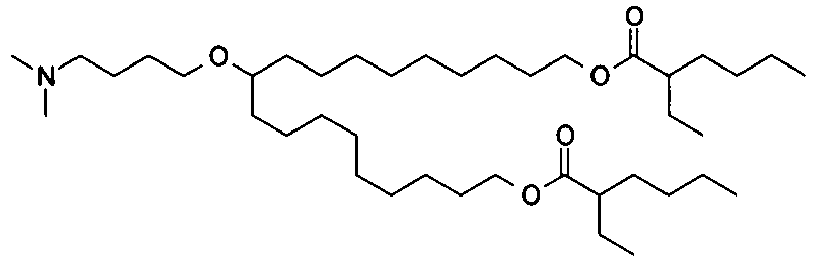
0.088 -
- <110> ALNYLAM PHARMACEUTICALS, INC.
- <120> BRANCHED ALKYL AND CYCLOALKYL TERMINATED BIODEGRADABLE LIPIDS FOR THE DELIVERY OF ACTIVE AGENTS
- <130> 135399.03401
- <140>
PCT/US12/68450
<141> 2012-12-07 - <150>
61/568,121
<151> 2011-12-07 - <160> 2
- <170> PatentIn version 3.5
- <210> 1
<211> 21
<212> DNA
<213> Artificial Sequence - <220>
<221> source
<223> /note="Description of Artificial Sequence: Synthetic oligonucleotide" - <220>
<221> source
<223> /note="Description of Combined DNA/RNA Molecule: Synthetic oligonucleotide" - <220>
<221> modified_base
<222> (3)..(4)
<223> 2'F modified nucleobase - <220>
<221> modified_base
<222> (6)..(9)
<223> 2'F modified nucleobase - <220>
<221> modified_base
<222> (13)..(16)
<223> 2'F modified nucleobase - <220>
<221> modified_base
<222> (18)..(18)
<223> 2'F modified nucleobase - <220>
<221> misc_feature
<222> (20)..(21)
<223> Phosphothioate linkage - <400> 1
ggaucaucuc aagucuuact t 21 - <210> 2
<211> 21
<212> DNA
<213> Artificial Sequence - <220>
<221> source
<223> /note="Description of Artificial Sequence: Synthetic oligonucleotide" - <220>
<221> source
<223> /note="Description of Combined DNA/RNA Molecule: Synthetic oligonucleotide" - <220>
<221> modified_base
<222> (1)..(1)
<223> 2'F modified nucleobase - <220>
<221> modified_base
<222> (6)..(8)
<223> 2'F modified nucleobase - <220>
<221> modified_base
<222> (13)..(13)
<223> 2'F modified nucleobase - <220>
<221> modified_base
<222> (16)..(18)
<223> 2'F modified nucleobase - <220>
<221> misc_feature
<222> (20)..(21)
<223> Phosphothioate linkage - <400> 2
guaagacuug agaugaucct t 21
Claims (14)
- A compound of Formula (I):
 R' is absent, hydrogen, or alkyl (e.g., C1-C4 alkyl);with respect to R1 and R2,(i) R1 and R2 are each, independently, optionally substituted alkyl, alkenyl, alkynyl, cycloalkyl, cycloalkylalkyl, heterocycle, or R10;(ii) R1 and R2, together with the nitrogen atom to which they are attached, form an optionally substituted heterocylic ring; or(iii) one of R1 and R2 is optionally substituted alkyl, alkenyl, alkynyl, cycloalkyl, cycloalkylalkyl, or heterocycle, and the other forms a 4-10 member heterocyclic ring or heteroaryl (e.g., a 6-member ring) with (a) the adjacent nitrogen atom and (b) the (R)a group adjacent to the nitrogen atom;each occurrence of R is, independently, -(CH2)-;each occurrence of R10 is independently selected from PEG and polymers based on poly(oxazoline), poly(ethylene oxide), poly(vinyl alcohol), poly(glycerol), poly(N-vinylpyrrolidone), poly[N-(2-hydroxypropyl)-methacrylamide] and poly(amino acid)s, wherein (i) the PEG or polymer is linear or branched, (ii) the PEG or polymer is polymerized by n subunits, (iii) n is a number-averaged degree of polymerization between 10 and 200 units, and (iv) wherein the compound of formula (I) has at most two R10 groups;the dashed line to Q is absent;Q is -O- or -C(O)O-;X and Y are each, independently, -(CH2)c-;M1 and M2 are each, independently, -OC(O)- or -C(O)O-;a is 1, 2, 3, 4, 5 or 6;b is 0, 1, 2, or 3;each occurrence of c is, independently, 2-10; andZ1 and Z2 are each, independently, (i) C3-C10 cycloalkyl, (ii) C3-C10 cycloalkyl(C1-C6 alkyl), or (iii)
- The compound of claim 1, wherein R1 and R2 are each alkyl, preferably methyl.
- The compound of claim 1 or claim 2, wherein a is 3 and b is 0.
- The compound of any one of claims 1 to 3, wherein Z1 and Z2 are each, independently, C3-C10 cycloalkyl, preferably cyclohexyl or decahydro-naphthalenyl, or wherein Z1 and Z2 are each, independently, represented by Formula II:

- A compound selected from:


- A lipid particle comprising a neutral lipid, a polyethylene glycol (PEG) lipid, and a compound of any of the preceding claims, wherein the compound is in the form of a cationic lipid.
- The lipid particle of claim 6, wherein the neutral lipid is selected from distearoylphosphatidylcholine (DSPC), dipalmitoylphosphatidylcholine (DPPC), 1-palmitoyl-2-oleoyl-sn-phosphatidylcholine (POPC), 1,2-dioleoyl-sn-3-phosphoethanolamine (DOPE), or SM; and the lipid particle further comprises a sterol.
- The lipid particle of any one of claims 6 and 7, wherein the cationic lipid is present in a mole percentage of 20% to 60%; the neutral lipid is present in a mole percentage of 5% to 25%; the sterol is present in a mole percentage of 25% to 55%; and the PEG lipid is PEG-DMA, 1,2-dimyristoyl-sn-glycerol-methoxy polyethylene glycol (PEG-DMG), or a combination thereof, and is present in a mole percentage of 0.5% to 15%.
- The lipid particle of any of claims 6 to 8, further comprising an active agent, preferably wherein the active agent is a nucleic acid selected from a plasmid, an immunostimulatory oligonucleotide, an siRNA, an antisense oligonucleotide, a microRNA, an antagomir, an aptamer, and a ribozyme.
- A pharmaceutical composition comprising a lipid particle of any one of claims 6 to 9 and a pharmaceutically acceptable carrier.
- A lipid particle of any one of claims 6 to 9 for use in a method of modulating the expression of a target gene in a cell.
- The pharmaceutical composition of claim 10 for use in a method of treating a disease or disorder characterized by the overexpression of a polypeptide in a subject, wherein the active agent is a nucleic acid selected from the group consisting of an siRNA, a microRNA, and an antisense oligonucleotide, and wherein the siRNA, microRNA, or antisense oligonucleotide includes a polynucleotide that specifically binds to a polynucleotide that encodes the polypeptide, or a complement thereof.
- The pharmaceutical composition of claim 10 for use in a method of treating a disease or disorder characterized by underexpression of a polypeptide in a subject, wherein the active agent is a plasmid that encodes the polypeptide or a functional variant or fragment thereof.
- The pharmaceutical composition of claim 10 for use in a method of inducing an immune response in a subject, wherein the active agent is an immunostimulatory oligonucleotide .
Applications Claiming Priority (2)
| Application Number | Priority Date | Filing Date | Title |
|---|---|---|---|
| US201161568121P | 2011-12-07 | 2011-12-07 | |
| PCT/US2012/068450 WO2013086322A1 (en) | 2011-12-07 | 2012-12-07 | Branched alkyl and cycloalkyl terminated biodegradable lipids for the delivery of active agents |
Publications (2)
| Publication Number | Publication Date |
|---|---|
| EP2788316A1 EP2788316A1 (en) | 2014-10-15 |
| EP2788316B1 true EP2788316B1 (en) | 2019-04-24 |
Family
ID=47559648
Family Applications (1)
| Application Number | Title | Priority Date | Filing Date |
|---|---|---|---|
| EP12815878.9A Active EP2788316B1 (en) | 2011-12-07 | 2012-12-07 | Branched alkyl and cycloalkyl terminated biodegradable lipids for the delivery of active agents |
Country Status (6)
| Country | Link |
|---|---|
| US (1) | US9463247B2 (en) |
| EP (1) | EP2788316B1 (en) |
| JP (4) | JP6305343B2 (en) |
| AU (1) | AU2012347605B2 (en) |
| CA (2) | CA2856737C (en) |
| WO (1) | WO2013086322A1 (en) |
Cited By (1)
| Publication number | Priority date | Publication date | Assignee | Title |
|---|---|---|---|---|
| EP4121018A4 (en) * | 2020-03-17 | 2024-07-03 | Genevant Sciences Gmbh | CATIONIC LIPIDS FOR THE DELIVERY OF LIPID NANOPARTICLES OF THERAPEUTIC AGENTS TO HEPATIC STELLAR CELLS |
Families Citing this family (288)
| Publication number | Priority date | Publication date | Assignee | Title |
|---|---|---|---|---|
| WO2012019168A2 (en) | 2010-08-06 | 2012-02-09 | Moderna Therapeutics, Inc. | Engineered nucleic acids and methods of use thereof |
| RU2013120302A (en) | 2010-10-01 | 2014-11-20 | Модерна Терапьютикс, Инк. | DESIGNED NUCLEIC ACIDS AND WAYS OF THEIR APPLICATION |
| EP2691101A2 (en) | 2011-03-31 | 2014-02-05 | Moderna Therapeutics, Inc. | Delivery and formulation of engineered nucleic acids |
| US9464124B2 (en) | 2011-09-12 | 2016-10-11 | Moderna Therapeutics, Inc. | Engineered nucleic acids and methods of use thereof |
| RU2648950C2 (en) | 2011-10-03 | 2018-04-02 | Модерна Терапьютикс, Инк. | Modified nucleosides, nucleotides and nucleic acids and their application |
| EP2788006B1 (en) | 2011-12-07 | 2026-01-07 | Alnylam Pharmaceuticals, Inc. | Biodegradable lipids for the delivery of active agents |
| EP2788316B1 (en) * | 2011-12-07 | 2019-04-24 | Alnylam Pharmaceuticals, Inc. | Branched alkyl and cycloalkyl terminated biodegradable lipids for the delivery of active agents |
| CN104114572A (en) | 2011-12-16 | 2014-10-22 | 现代治疗公司 | Modified nucleosides, nucleotides and nucleic acid compositions |
| US9283287B2 (en) | 2012-04-02 | 2016-03-15 | Moderna Therapeutics, Inc. | Modified polynucleotides for the production of nuclear proteins |
| US9254311B2 (en) | 2012-04-02 | 2016-02-09 | Moderna Therapeutics, Inc. | Modified polynucleotides for the production of proteins |
| AU2013243948A1 (en) | 2012-04-02 | 2014-10-30 | Moderna Therapeutics, Inc. | Modified polynucleotides for the production of proteins associated with human disease |
| US9572897B2 (en) | 2012-04-02 | 2017-02-21 | Modernatx, Inc. | Modified polynucleotides for the production of cytoplasmic and cytoskeletal proteins |
| AU2013249548A1 (en) * | 2012-04-19 | 2014-11-06 | Sirna Therapeutics, Inc. | Novel diester and triester based low molecular weight, biodegradable cationic lipids for oligonucleotide delivery |
| US9255154B2 (en) | 2012-05-08 | 2016-02-09 | Alderbio Holdings, Llc | Anti-PCSK9 antibodies and use thereof |
| WO2014081507A1 (en) | 2012-11-26 | 2014-05-30 | Moderna Therapeutics, Inc. | Terminally modified rna |
| EP2971010B1 (en) | 2013-03-14 | 2020-06-10 | ModernaTX, Inc. | Formulation and delivery of modified nucleoside, nucleotide, and nucleic acid compositions |
| US8980864B2 (en) | 2013-03-15 | 2015-03-17 | Moderna Therapeutics, Inc. | Compositions and methods of altering cholesterol levels |
| US20160194625A1 (en) | 2013-09-03 | 2016-07-07 | Moderna Therapeutics, Inc. | Chimeric polynucleotides |
| US20160194368A1 (en) | 2013-09-03 | 2016-07-07 | Moderna Therapeutics, Inc. | Circular polynucleotides |
| US10023626B2 (en) | 2013-09-30 | 2018-07-17 | Modernatx, Inc. | Polynucleotides encoding immune modulating polypeptides |
| JP2016538829A (en) | 2013-10-03 | 2016-12-15 | モデルナ セラピューティクス インコーポレイテッドModerna Therapeutics,Inc. | Polynucleotide encoding low density lipoprotein receptor |
| CA3236835A1 (en) | 2013-11-22 | 2015-05-28 | Mina Therapeutics Limited | C/ebp alpha short activating rna compositions and methods of use |
| SMT202200502T1 (en) | 2014-06-25 | 2023-01-13 | Acuitas Therapeutics Inc | Novel lipids and lipid nanoparticle formulations for delivery of nucleic acids |
| EP3169693B1 (en) | 2014-07-16 | 2022-03-09 | ModernaTX, Inc. | Chimeric polynucleotides |
| WO2016014846A1 (en) | 2014-07-23 | 2016-01-28 | Moderna Therapeutics, Inc. | Modified polynucleotides for the production of intrabodies |
| WO2016021683A1 (en) * | 2014-08-07 | 2016-02-11 | 武田薬品工業株式会社 | Cationic lipid |
| LT3313829T (en) | 2015-06-29 | 2024-08-12 | Acuitas Therapeutics Inc. | LIPIDS AND LIPID NANOPARTICLE COMPOSITIONS FOR NUCLEIC ACID DELIVERY |
| EP4286012A3 (en) | 2015-09-17 | 2024-05-29 | ModernaTX, Inc. | Compounds and compositions for intracellular delivery of therapeutic agents |
| IL307179A (en) | 2015-10-28 | 2023-11-01 | Acuitas Therapeutics Inc | Novel lipids and lipid nanoparticle formulations for delivery of nucleic acids |
| HRP20220652T1 (en) | 2015-12-10 | 2022-06-24 | Modernatx, Inc. | Compositions and methods for delivery of therapeutic agents |
| HUE057877T2 (en) | 2015-12-22 | 2022-06-28 | Modernatx Inc | Compounds and preparations for the intracellular delivery of therapeutic agents |
| EP3397613A1 (en) * | 2015-12-30 | 2018-11-07 | Acuitas Therapeutics Inc. | Lipids and lipid nanoparticle formulations for delivery of nucleic acids |
| ES3063077T3 (en) | 2016-10-26 | 2026-04-15 | Acuitas Therapeutics Inc | Lipid nanoparticle formulations |
| US12491261B2 (en) | 2016-10-26 | 2025-12-09 | Acuitas Therapeutics, Inc. | Lipid nanoparticle formulations |
| US11583504B2 (en) | 2016-11-08 | 2023-02-21 | Modernatx, Inc. | Stabilized formulations of lipid nanoparticles |
| SMT202300097T1 (en) | 2017-03-15 | 2023-05-12 | Modernatx Inc | Compound and compositions for intracellular delivery of therapeutic agents |
| WO2018170322A1 (en) | 2017-03-15 | 2018-09-20 | Modernatx, Inc. | Crystal forms of amino lipids |
| US11969506B2 (en) | 2017-03-15 | 2024-04-30 | Modernatx, Inc. | Lipid nanoparticle formulation |
| WO2019012336A2 (en) | 2017-03-17 | 2019-01-17 | Newcastle University | Adeno-associated virus vector delivery of a fragment of micro-dystrophin to treat muscular dystrophy |
| WO2018191719A1 (en) | 2017-04-13 | 2018-10-18 | Acuitas Therapeutics, Inc. | Lipid delivery of therapeutic agents to adipose tissue |
| WO2018191657A1 (en) | 2017-04-13 | 2018-10-18 | Acuitas Therapeutics, Inc. | Lipids for delivery of active agents |
| WO2018200943A1 (en) | 2017-04-28 | 2018-11-01 | Acuitas Therapeutics, Inc. | Novel carbonyl lipids and lipid nanoparticle formulations for delivery of nucleic acids |
| WO2018213789A1 (en) | 2017-05-18 | 2018-11-22 | Modernatx, Inc. | Modified messenger rna comprising functional rna elements |
| JP7285220B2 (en) | 2017-05-18 | 2023-06-01 | モデルナティエックス インコーポレイテッド | Lipid nanoparticles comprising linked interleukin-12 (IL12) polypeptide-encoding polynucleotides |
| EP3638292A1 (en) | 2017-06-14 | 2020-04-22 | ModernaTX, Inc. | Polynucleotides encoding coagulation factor viii |
| US12077501B2 (en) | 2017-06-14 | 2024-09-03 | Modernatx, Inc. | Compounds and compositions for intracellular delivery of agents |
| US11786607B2 (en) | 2017-06-15 | 2023-10-17 | Modernatx, Inc. | RNA formulations |
| CA3073020A1 (en) | 2017-08-16 | 2019-02-21 | Acuitas Therapeutics, Inc. | Lipids for use in lipid nanoparticle formulations |
| US11524932B2 (en) | 2017-08-17 | 2022-12-13 | Acuitas Therapeutics, Inc. | Lipids for use in lipid nanoparticle formulations |
| WO2019036028A1 (en) | 2017-08-17 | 2019-02-21 | Acuitas Therapeutics, Inc. | Lipids for use in lipid nanoparticle formulations |
| EP3668834B1 (en) | 2017-08-17 | 2024-10-02 | Acuitas Therapeutics, Inc. | Lipids for use in lipid nanoparticle formulations |
| WO2019046809A1 (en) | 2017-08-31 | 2019-03-07 | Modernatx, Inc. | Methods of making lipid nanoparticles |
| CA3075205A1 (en) | 2017-09-08 | 2019-03-14 | Mina Therapeutics Limited | Stabilized hnf4a sarna compositions and methods of use |
| WO2019048645A1 (en) | 2017-09-08 | 2019-03-14 | Mina Therapeutics Limited | Stabilized cebpa sarna compositions and methods of use |
| WO2019089828A1 (en) | 2017-10-31 | 2019-05-09 | Acuitas Therapeutics, Inc. | Lamellar lipid nanoparticles |
| JP7423521B2 (en) | 2017-11-22 | 2024-01-29 | モダーナティエックス・インコーポレイテッド | Polynucleotide encoding phenylalanine hydroxylase for the treatment of phenylketonuria |
| EP3714048B1 (en) | 2017-11-22 | 2025-04-09 | ModernaTX, Inc. | Polynucleotides encoding ornithine transcarbamylase for the treatment of urea cycle disorders |
| US20220265856A1 (en) | 2017-11-22 | 2022-08-25 | Modernatx, Inc. | Polynucleotides encoding propionyl-coa carboxylase alpha and beta subunits for the treatment of propionic acidemia |
| MA51523A (en) | 2018-01-05 | 2020-11-11 | Modernatx Inc | POLYNUCLEOTIDES CODING ANTI-BODY ANTI-CHIKUNGUNYA VIRUS |
| EP3775211B1 (en) | 2018-04-12 | 2023-04-05 | MiNA Therapeutics Limited | Sirt1-sarna compositions and methods of use |
| WO2019226650A1 (en) | 2018-05-23 | 2019-11-28 | Modernatx, Inc. | Delivery of dna |
| CN120393053A (en) | 2018-06-18 | 2025-08-01 | 全国儿童医院研究所 | Adeno-associated viral vector delivery of muscle-specific micro-dystrophin for the treatment of muscular dystrophy |
| US20220184185A1 (en) | 2018-07-25 | 2022-06-16 | Modernatx, Inc. | Mrna based enzyme replacement therapy combined with a pharmacological chaperone for the treatment of lysosomal storage disorders |
| DK3835287T3 (en) * | 2018-08-10 | 2025-01-02 | Takeda Pharmaceuticals Co | CATIONIC LIPID |
| JP7436990B2 (en) * | 2018-08-10 | 2024-02-22 | 国立大学法人京都大学 | Transfection method for cardiomyocytes using cationic lipids |
| JP6997862B2 (en) | 2018-08-21 | 2022-02-10 | 株式会社東芝 | Compositions and kits containing biodegradable compounds, lipid particles, lipid particles |
| WO2020047201A1 (en) | 2018-09-02 | 2020-03-05 | Modernatx, Inc. | Polynucleotides encoding very long-chain acyl-coa dehydrogenase for the treatment of very long-chain acyl-coa dehydrogenase deficiency |
| US20220243182A1 (en) | 2018-09-13 | 2022-08-04 | Modernatx, Inc. | Polynucleotides encoding branched-chain alpha-ketoacid dehydrogenase complex e1-alpha, e1-beta, and e2 subunits for the treatment of maple syrup urine disease |
| WO2020056147A2 (en) | 2018-09-13 | 2020-03-19 | Modernatx, Inc. | Polynucleotides encoding glucose-6-phosphatase for the treatment of glycogen storage disease |
| WO2020056239A1 (en) | 2018-09-14 | 2020-03-19 | Modernatx, Inc. | Polynucleotides encoding uridine diphosphate glycosyltransferase 1 family, polypeptide a1 for the treatment of crigler-najjar syndrome |
| AU2019345067A1 (en) | 2018-09-19 | 2021-04-08 | Modernatx, Inc. | High-purity peg lipids and uses thereof |
| MA53650A (en) | 2018-09-19 | 2021-07-28 | Modernatx Inc | PEG LIPIDS AND THEIR USES |
| US12263248B2 (en) | 2018-09-19 | 2025-04-01 | Modernatx, Inc. | Compounds and compositions for intracellular delivery of therapeutic agents |
| CN113271926A (en) | 2018-09-20 | 2021-08-17 | 摩登纳特斯有限公司 | Preparation of lipid nanoparticles and methods of administration thereof |
| IL281615B2 (en) | 2018-09-21 | 2026-01-01 | Acuitas Therapeutics Inc | Systems and methods for manufacturing lipid nanoparticles and liposomes |
| EP3856233A1 (en) | 2018-09-27 | 2021-08-04 | Modernatx, Inc. | Polynucleotides encoding arginase 1 for the treatment of arginase deficiency |
| ES3046484T3 (en) | 2018-10-01 | 2025-12-02 | Alnylam Pharmaceuticals Inc | Biodegradable lipids for the delivery of active agents |
| JP7543259B2 (en) | 2018-10-18 | 2024-09-02 | アクイタス セラピューティクス インコーポレイテッド | Lipids for lipid nanoparticle delivery of active agents |
| MY202837A (en) | 2019-01-11 | 2024-05-24 | Acuitas Therapeutics Inc | Lipids for lipid nanoparticle delivery of active agents |
| EP3953473A1 (en) | 2019-04-12 | 2022-02-16 | MiNA Therapeutics Limited | Sirt1-sarna compositions and methods of use |
| JP2022532078A (en) | 2019-05-08 | 2022-07-13 | アストラゼネカ アクチボラグ | Compositions for skin and wounds and methods of their use |
| WO2021016075A1 (en) | 2019-07-19 | 2021-01-28 | Flagship Pioneering Innovations Vi, Llc | Recombinase compositions and methods of use |
| US20230097090A1 (en) | 2019-08-14 | 2023-03-30 | Acuitas Therapeutics, Inc. | Improved lipid nanoparticles for delivery of nucleic acids |
| AU2020350759A1 (en) | 2019-09-19 | 2022-03-31 | Modernatx, Inc. | Branched tail lipid compounds and compositions for intracellular delivery of therapeutic agents |
| BR112022004936A2 (en) | 2019-09-19 | 2022-06-14 | Modernatx Inc | Carbonate-containing lipid compounds and compositions for intracellular delivery of therapeutic agents |
| AU2021244559A1 (en) | 2020-03-24 | 2022-11-17 | Generation Bio Co. | Non-viral DNA vectors and uses thereof for expressing Gaucher therapeutics |
| MX2022011805A (en) | 2020-03-24 | 2023-01-11 | Generation Bio Co | Non-viral dna vectors and uses thereof for expressing factor ix therapeutics. |
| WO2021198157A1 (en) | 2020-03-30 | 2021-10-07 | BioNTech SE | Rna compositions targeting claudin-18.2 |
| IL298363A (en) | 2020-05-20 | 2023-01-01 | Flagship Pioneering Innovations Vi Llc | Immunogenic compositions and uses thereof |
| CA3179420A1 (en) | 2020-05-20 | 2021-11-25 | Avak Kahvejian | Coronavirus antigen compositions and their uses |
| CA3182026A1 (en) | 2020-05-29 | 2021-12-02 | Flagship Pioneering Innovations Vi, Llc. | Trem compositions and methods relating thereto |
| CA3180101A1 (en) | 2020-05-29 | 2021-12-02 | Flagship Pioneering Innovations Vi, Llc | Trem compositions and methods relating thereto |
| US20230235298A1 (en) | 2020-06-01 | 2023-07-27 | Modernatx, Inc. | Phenylalanine hydroxylase variants and uses thereof |
| EP4164668A1 (en) | 2020-06-15 | 2023-04-19 | Research Institute at Nationwide Children's Hospital | Adeno-associated virus vector delivery for muscular dystrophies |
| WO2025056938A1 (en) | 2023-09-11 | 2025-03-20 | BioNTech SE | Rna compositions for delivery of incretin agents |
| WO2022016070A1 (en) | 2020-07-16 | 2022-01-20 | Acuitas Therapeutics, Inc. | Cationic lipids for use in lipid nanoparticles |
| CN116234917A (en) | 2020-07-27 | 2023-06-06 | 安杰瑞姆生物科学公司 | DNA molecular composition and method for its preparation and use |
| MX2023002439A (en) | 2020-09-03 | 2023-05-09 | Flagship Pioneering Innovations Vi Llc | Immunogenic compositions and uses thereof. |
| JPWO2022071582A1 (en) * | 2020-10-02 | 2022-04-07 | ||
| AU2021377895A1 (en) | 2020-11-13 | 2023-06-15 | Modernatx, Inc. | Polynucleotides encoding cystic fibrosis transmembrane conductance regulator for the treatment of cystic fibrosis |
| GB2603454A (en) | 2020-12-09 | 2022-08-10 | Ucl Business Ltd | Novel therapeutics for the treatment of neurodegenerative disorders |
| IL303886A (en) | 2020-12-23 | 2023-08-01 | Flagship Pioneering Inc | Modified TREMS vehicles and their uses |
| US11524023B2 (en) | 2021-02-19 | 2022-12-13 | Modernatx, Inc. | Lipid nanoparticle compositions and methods of formulating the same |
| US20240207444A1 (en) | 2021-03-24 | 2024-06-27 | Modernatx, Inc. | Lipid nanoparticles containing polynucleotides encoding phenylalanine hydroxylase and uses thereof |
| WO2022204371A1 (en) | 2021-03-24 | 2022-09-29 | Modernatx, Inc. | Lipid nanoparticles containing polynucleotides encoding glucose-6-phosphatase and uses thereof |
| WO2022204370A1 (en) | 2021-03-24 | 2022-09-29 | Modernatx, Inc. | Lipid nanoparticles and polynucleotides encoding ornithine transcarbamylase for the treatment of ornithine transcarbamylase deficiency |
| WO2022204369A1 (en) | 2021-03-24 | 2022-09-29 | Modernatx, Inc. | Polynucleotides encoding methylmalonyl-coa mutase for the treatment of methylmalonic acidemia |
| US20240216288A1 (en) | 2021-03-24 | 2024-07-04 | Modernatx, Inc. | Lipid nanoparticles containing polynucleotides encoding propionyl-coa carboxylase alpha and beta subunits and uses thereof |
| EP4314292A1 (en) | 2021-03-26 | 2024-02-07 | MiNA Therapeutics Limited | Tmem173 sarna compositions and methods of use |
| JP2024512669A (en) | 2021-03-31 | 2024-03-19 | フラグシップ パイオニアリング イノベーションズ ブイ,インコーポレーテッド | Tanotransmission polypeptides and their use in the treatment of cancer |
| WO2022215036A1 (en) | 2021-04-08 | 2022-10-13 | Vaxthera Sas | Coronavirus vaccine comprising a mosaic protein |
| AU2022260111A1 (en) | 2021-04-20 | 2023-11-30 | Anjarium Biosciences Ag | Compositions of dna molecules encoding amylo-alpha-1, 6-glucosidase, 4-alpha-glucanotransferase, methods of making thereof, and methods of use thereof |
| EP4329884A1 (en) | 2021-04-27 | 2024-03-06 | Generation Bio Co. | Non-viral dna vectors expressing anti-coronavirus antibodies and uses thereof |
| CN117881786A (en) | 2021-04-27 | 2024-04-12 | 世代生物公司 | Non-viral DNA vector for expressing therapeutic antibodies and its use |
| KR20240008872A (en) * | 2021-05-06 | 2024-01-19 | 아크투루스 쎄라퓨틱스, 인크. | Ionizable Cationic Lipids for RNA Delivery |
| EP4355882A2 (en) | 2021-06-15 | 2024-04-24 | Modernatx, Inc. | Engineered polynucleotides for cell-type or microenvironment-specific expression |
| WO2022271776A1 (en) | 2021-06-22 | 2022-12-29 | Modernatx, Inc. | Polynucleotides encoding uridine diphosphate glycosyltransferase 1 family, polypeptide a1 for the treatment of crigler-najjar syndrome |
| WO2023009547A1 (en) | 2021-07-26 | 2023-02-02 | Flagship Pioneering Innovations Vi, Llc | Trem compositions and uses thereof |
| WO2023023055A1 (en) | 2021-08-16 | 2023-02-23 | Renagade Therapeutics Management Inc. | Compositions and methods for optimizing tropism of delivery systems for rna |
| CN118317944A (en) | 2021-09-14 | 2024-07-09 | 雷纳嘉德医疗管理公司 | Acyclic lipids and methods of use thereof |
| TW202328067A (en) | 2021-09-14 | 2023-07-16 | 美商雷納嘉德醫療管理公司 | Cyclic lipids and methods of use thereof |
| ES2994006T3 (en) | 2021-09-17 | 2025-01-16 | Flagship Pioneering Innovations Vi Llc | Compositions and methods for producing circular polyribonucleotides |
| US20250017867A1 (en) | 2021-10-01 | 2025-01-16 | Modernatx, Inc. | Polynucleotides encoding relaxin for the treatment of fibrosis and/or cardiovascular disease |
| JP2024538144A (en) | 2021-10-18 | 2024-10-18 | フラッグシップ パイオニアリング イノベーションズ シックス,エルエルシー | Compositions and methods for purifying polyribonucleotides |
| WO2023067560A1 (en) * | 2021-10-22 | 2023-04-27 | Seqirus Inc. | Ionizable cationic compound |
| EP4426832A1 (en) | 2021-11-03 | 2024-09-11 | The J. David Gladstone Institutes, A Testamentary Trust Established under The Will of J. David Gladstone | Precise genome editing using retrons |
| EP4430024A1 (en) | 2021-11-08 | 2024-09-18 | Orna Therapeutics, Inc. | Lipid nanoparticle compositions for delivering circular polynucleotides |
| WO2023091490A1 (en) | 2021-11-16 | 2023-05-25 | Senda Biosciences, Inc. | Novel ionizable lipids and lipid nanoparticles and methods of using the same |
| WO2023091787A1 (en) | 2021-11-22 | 2023-05-25 | Senda Biosciences, Inc. | Novel ionizable lipids and lipid nanoparticles and methods of using the same |
| MX2024006440A (en) | 2021-11-24 | 2024-08-19 | Flagship Pioneering Innovations Vi Llc | IMMUNOGENETIC COMPOSITIONS AND THEIR USES. |
| EP4436984A1 (en) | 2021-11-24 | 2024-10-02 | Flagship Pioneering Innovations VI, LLC | Coronavirus immunogen compositions and their uses |
| AU2022397292A1 (en) | 2021-11-24 | 2024-05-30 | Flagship Pioneering Innovations Vi, Llc | Varicella-zoster virus immunogen compositions and their uses |
| WO2023099884A1 (en) | 2021-12-01 | 2023-06-08 | Mina Therapeutics Limited | Pax6 sarna compositions and methods of use |
| GB202117758D0 (en) | 2021-12-09 | 2022-01-26 | Ucl Business Ltd | Therapeutics for the treatment of neurodegenerative disorders |
| CA3242402A1 (en) | 2021-12-16 | 2023-06-22 | Acuitas Therapeutics, Inc. | Lipids for use in lipid nanoparticle formulations |
| JP2024546855A (en) | 2021-12-17 | 2024-12-26 | フラッグシップ パイオニアリング イノベーションズ シックス,エルエルシー | Method for enriching circular RNA under denaturing conditions |
| KR20240117149A (en) | 2021-12-22 | 2024-07-31 | 플래그쉽 파이어니어링 이노베이션스 브이아이, 엘엘씨 | Compositions and methods for purifying polyribonucleotides |
| WO2023122752A1 (en) | 2021-12-23 | 2023-06-29 | Renagade Therapeutics Management Inc. | Constrained lipids and methods of use thereof |
| MX2024007870A (en) | 2021-12-23 | 2024-08-15 | Flagship Pioneering Innovations Vi Llc | Circular polyribonucleotides encoding antifusogenic polypeptides. |
| JP2025504404A (en) | 2022-01-14 | 2025-02-12 | アンジャリウム バイオサイエンシズ エージー | Compositions of DNA molecules encoding factor VIII, methods of making same, and methods of use thereof - Patents.com |
| WO2023141602A2 (en) | 2022-01-21 | 2023-07-27 | Renagade Therapeutics Management Inc. | Engineered retrons and methods of use |
| CA3242744A1 (en) | 2022-01-27 | 2023-08-03 | The Trustees Of The University Of Pennsylvania | Pharmaceutical compositions for delivery of herpes simplex virus antigens and related methods |
| CA3243452A1 (en) * | 2022-02-02 | 2023-08-10 | Nanovation Therapeutics Inc. | Method for producing ionizable lipids or intermediates for the synthesis of such lipids |
| WO2023170435A1 (en) | 2022-03-07 | 2023-09-14 | Mina Therapeutics Limited | Il10 sarna compositions and methods of use |
| WO2023177655A1 (en) | 2022-03-14 | 2023-09-21 | Generation Bio Co. | Heterologous prime boost vaccine compositions and methods of use |
| WO2023183909A2 (en) | 2022-03-25 | 2023-09-28 | Modernatx, Inc. | Polynucleotides encoding fanconi anemia, complementation group proteins for the treatment of fanconi anemia |
| CN116354836A (en) * | 2022-03-25 | 2023-06-30 | 深圳市新合生物医疗科技有限公司 | Cationic lipid compound, preparation method and application thereof, and mRNA delivery system |
| EP4499607A1 (en) | 2022-03-25 | 2025-02-05 | Sail Biomedicines, Inc. | Novel ionizable lipids and lipid nanoparticles and methods of using the same |
| CA3255619A1 (en) | 2022-04-07 | 2023-10-12 | Renagade Therapeutics Management Inc. | Cyclic lipids and lipid nanoparticles (lnp) for the delivery of nucleic acids or peptides for use in vaccinating against infectious agents |
| JP2025511756A (en) | 2022-04-08 | 2025-04-16 | フラッグシップ パイオニアリング イノベーションズ セブン,エルエルシー | Vaccines and Related Methods |
| CN115887674B (en) * | 2022-04-29 | 2023-08-25 | 北京剂泰医药科技有限公司 | lipid nanoparticles |
| CN115850104B (en) * | 2022-04-29 | 2023-07-18 | 北京剂泰医药科技有限公司 | ionizable lipid compounds |
| EP4332087A1 (en) * | 2022-04-29 | 2024-03-06 | Beijing Jitai Pharmaceutical Technology Co., Ltd. | Lipid nanoparticles |
| CN116969851A (en) * | 2022-04-29 | 2023-10-31 | 北京剂泰医药科技有限公司 | Ionizable lipid compounds |
| US20250295687A1 (en) | 2022-05-09 | 2025-09-25 | Flagship Pioneering Innovations Vi, Llc | Trem compositions and methods of use for treating proliferative disorders |
| WO2023218431A1 (en) | 2022-05-13 | 2023-11-16 | BioNTech SE | Rna compositions targeting hiv |
| JP2025516638A (en) | 2022-05-13 | 2025-05-30 | フラッグシップ パイオニアリング イノベーションズ セブン,エルエルシー | Double-stranded DNA compositions and related methods |
| KR20250021330A (en) | 2022-05-25 | 2025-02-12 | 비온테크 에스이 | RNA compositions for delivering monkeypox antigens and related methods |
| US20250375534A1 (en) | 2022-05-30 | 2025-12-11 | BioNTech SE | Complexes for delivery of nucleic acids |
| EP4536197A1 (en) | 2022-06-07 | 2025-04-16 | Generation Bio Co. | Lipid nanoparticle compositions and uses thereof |
| CN117263818A (en) * | 2022-06-14 | 2023-12-22 | 杭州高田生物医药有限公司 | Cationic lipid compound, and preparation method and application thereof |
| CN117304023A (en) * | 2022-06-16 | 2023-12-29 | 海南普利制药股份有限公司 | Methods for preparing ionizable lipid intermediates for mRNA delivery |
| US20250179492A1 (en) | 2022-06-22 | 2025-06-05 | Flagship Pioneering Innovations Vi, Llc | Compositions of modified trems and uses thereof |
| CN114874106B (en) * | 2022-07-11 | 2023-04-14 | 中山大学附属第七医院(深圳) | Amino lipid and preparation method and application thereof |
| JP2025525569A (en) | 2022-07-18 | 2025-08-05 | レナゲード セラピューティクス マネージメント インコーポレイテッド | Gene editing components, systems, and methods of use |
| US20260035707A1 (en) | 2022-07-26 | 2026-02-05 | Modernatx, Inc. | Engineered polynucleotides for temporal control of expression |
| EP4562154A2 (en) | 2022-07-29 | 2025-06-04 | Massachusetts Institute of Technology | COMPOSITIONS AND METHODS FOR INHIBITING EXPRESSION OF THE SIGNAL REGULATORY PROTEIN ALPHA (SIRPalpha) GENE |
| JP2025525778A (en) | 2022-08-01 | 2025-08-07 | フラッグシップ パイオニアリング イノベーションズ セブン,エルエルシー | Immunomodulatory proteins and related methods |
| EP4569112A1 (en) | 2022-08-12 | 2025-06-18 | Remix Therapeutics Inc. | Methods and compositions for modulating splicing at alternative splice sites |
| WO2024040222A1 (en) | 2022-08-19 | 2024-02-22 | Generation Bio Co. | Cleavable closed-ended dna (cedna) and methods of use thereof |
| WO2024044723A1 (en) | 2022-08-25 | 2024-02-29 | Renagade Therapeutics Management Inc. | Engineered retrons and methods of use |
| AU2023334610A1 (en) | 2022-08-31 | 2025-03-13 | Sail Biomedicines, Inc. | Novel ionizable lipids and lipid nanoparticles and methods of using the same |
| WO2024063789A1 (en) | 2022-09-23 | 2024-03-28 | BioNTech SE | Compositions for delivery of malaria antigens and related methods |
| EP4590331A1 (en) | 2022-09-23 | 2025-07-30 | BioNTech SE | Compositions for delivery of plasmodium csp antigens and related methods |
| JP2025533541A (en) | 2022-09-23 | 2025-10-07 | ビオンテック・ソシエタス・エウロパエア | Compositions and related methods for delivery of liver stage antigens |
| WO2024063788A1 (en) | 2022-09-23 | 2024-03-28 | BioNTech SE | Compositions for delivery of malaria antigens and related methods |
| WO2024077191A1 (en) | 2022-10-05 | 2024-04-11 | Flagship Pioneering Innovations V, Inc. | Nucleic acid molecules encoding trif and additionalpolypeptides and their use in treating cancer |
| WO2024074211A1 (en) | 2022-10-06 | 2024-04-11 | BioNTech SE | Rna compositions targeting claudin-18.2 |
| CN120129702A (en) | 2022-10-06 | 2025-06-10 | 生物技术公司 | RNA composition targeting claudin-18.2 |
| AU2023372397A1 (en) | 2022-10-31 | 2025-05-08 | Flagship Pioneering Innovations Vi, Llc | Compositions and methods for purifying polyribonucleotides |
| TW202425959A (en) | 2022-11-08 | 2024-07-01 | 美商歐納醫療公司 | Lipids and nanoparticle compositions for delivering polynucleotides |
| WO2024102762A1 (en) | 2022-11-08 | 2024-05-16 | Orna Therapeutics, Inc. | Lipids and lipid nanoparticle compositions for delivering polynucleotides |
| EP4615465A1 (en) | 2022-11-08 | 2025-09-17 | Flagship Pioneering Innovations VI, LLC | Compositions and methods for producing circular polyribonucleotides |
| CN120390656A (en) | 2022-11-08 | 2025-07-29 | 欧纳医疗公司 | Circular RNA composition |
| KR20250114116A (en) | 2022-12-01 | 2025-07-28 | 제너레이션 바이오 컴퍼니 | Stealth lipid nanoparticle compositions for cell targeting |
| JP2025540076A (en) | 2022-12-01 | 2025-12-11 | ジェネレーション バイオ カンパニー | Lipid nanoparticles comprising nucleic acids, ionizable lipids, sterols, lipid-anchored polymers, and helper lipids, and uses thereof |
| WO2024119103A1 (en) | 2022-12-01 | 2024-06-06 | Generation Bio Co. | Lipid nanoparticles comprising nucleic acids and lipid-anchored polymers |
| KR20250131271A (en) | 2022-12-01 | 2025-09-02 | 제너레이션 바이오 컴퍼니 | Novel polyglycerol-conjugated lipid and lipid nanoparticle composition comprising the same |
| TW202430215A (en) | 2022-12-14 | 2024-08-01 | 美商旗艦先鋒創新有限責任(Vii)公司 | Compositions and methods for delivery of therapeutic agents to bone |
| WO2024125597A1 (en) | 2022-12-14 | 2024-06-20 | Providence Therapeutics Holdings Inc. | Compositions and methods for infectious diseases |
| CN117924106B (en) * | 2022-12-20 | 2025-06-03 | 北京剂泰医药科技有限公司 | Ionizable lipid compounds |
| WO2024134199A1 (en) | 2022-12-22 | 2024-06-27 | Mina Therapeutics Limited | Chemically modified sarna compositions and methods of use |
| WO2024141955A1 (en) | 2022-12-28 | 2024-07-04 | BioNTech SE | Rna compositions targeting hiv |
| US20240252520A1 (en) | 2023-01-09 | 2024-08-01 | Beth Israel Deaconess Medical Center, Inc. | Therapeutic agents and their use for treating chronic wounds |
| US20240238473A1 (en) | 2023-01-09 | 2024-07-18 | Beth Israel Deaconess Medical Center, Inc. | Recombinant nucleic acid molecules and their use in wound healing |
| WO2024151583A2 (en) | 2023-01-09 | 2024-07-18 | Flagship Pioneering Innovations Vii, Llc | Vaccines and related methods |
| WO2024151687A1 (en) | 2023-01-09 | 2024-07-18 | Flagship Pioneering Innovations V, Inc. | Genetic switches and their use in treating cancer |
| WO2024156291A1 (en) * | 2023-01-29 | 2024-08-02 | Geneditbio Limited | Cationic lipids and lipid nanoparticles |
| WO2024167885A1 (en) | 2023-02-06 | 2024-08-15 | Flagship Pioneering Innovations Vii, Llc | Immunomodulatory compositions and related methods |
| IL322542A (en) * | 2023-02-09 | 2025-10-01 | Seqirus Inc | Ionizable cationic compound |
| IL322468A (en) | 2023-02-13 | 2025-09-01 | Flagship Pioneering Innovations Vii Llc | Cleavable linker-containing ionizable lipids and lipid carriers for therapeutic compositions |
| JP2026507513A (en) | 2023-02-17 | 2026-03-04 | フラッグシップ パイオニアリング イノベーションズ セブン,エルエルシー | DNA compositions containing modified uracil |
| IL322378A (en) | 2023-02-17 | 2025-09-01 | Flagship Pioneering Innovations Vii Llc | Dna compositions comprising modified cytosine |
| WO2024192291A1 (en) | 2023-03-15 | 2024-09-19 | Renagade Therapeutics Management Inc. | Delivery of gene editing systems and methods of use thereof |
| WO2024192420A1 (en) | 2023-03-15 | 2024-09-19 | Flagship Pioneering Innovations Vi, Llc | Compositions comprising polyribonucleotides and uses thereof |
| EP4680276A1 (en) | 2023-03-15 | 2026-01-21 | Flagship Pioneering Innovations VI, LLC | Immunogenic compositions and uses thereof |
| EP4680595A2 (en) | 2023-03-15 | 2026-01-21 | Renagade Therapeutics Management Inc. | Lipid nanoparticles comprising coding rna molecules for use in gene editing and as vaccines and therapeutic agents |
| WO2024197033A1 (en) | 2023-03-21 | 2024-09-26 | Modernatx, Inc. | Polynucleotides encoding relaxin for the treatment of heart failure |
| WO2024205657A2 (en) | 2023-03-29 | 2024-10-03 | Orna Therapeutics, Inc. | Lipids and lipid nanoparticle compositions for delivering polynucleotides |
| WO2024216128A1 (en) | 2023-04-12 | 2024-10-17 | Flagship Pioneering Innovations Vi, Llc | Trems for use in correction of missense mutations |
| WO2024216191A1 (en) | 2023-04-12 | 2024-10-17 | Flagship Pioneering Innovations Vi, Llc | Modified trems, compositions, and related methods thereof |
| WO2024220746A2 (en) | 2023-04-21 | 2024-10-24 | Flagship Pioneering Innovations Vii, Llc | Rnai agents targeting fatty acid synthase and related methods |
| EP4704816A1 (en) | 2023-05-03 | 2026-03-11 | ModernaTX, Inc. | Polynucleotides encoding cystic fibrosis transmembrane conductance regulator for the treatment of cystic fibrosis |
| WO2024228044A1 (en) | 2023-05-03 | 2024-11-07 | BioNTech SE | Optimized csp variants and related methods |
| WO2024228150A1 (en) | 2023-05-03 | 2024-11-07 | BioNTech SE | Optimized csp variants and related methods |
| CN121399470A (en) | 2023-05-03 | 2026-01-23 | 马尼福尔德生物技术有限公司 | Methods and compositions for high throughput protein delivery, screening and detection |
| WO2024233308A2 (en) | 2023-05-05 | 2024-11-14 | Orna Therapeutics, Inc. | Circular rna compositions and methods |
| WO2024258829A1 (en) | 2023-06-12 | 2024-12-19 | Flagship Pioneering Innovations Vii, Llc | Sars-cov-2 vaccine compositions and related methods |
| WO2025006684A1 (en) | 2023-06-28 | 2025-01-02 | Flagship Pioneering Innovations Vi, Llc | Circular polyribonucleotides encoding antifusogenic polypeptides |
| WO2025007148A1 (en) | 2023-06-30 | 2025-01-02 | Orna Therapeutics, Inc. | Polymer lipid nanoparticle compositions for delivering circular polynucleotides |
| CN121816193A (en) | 2023-07-21 | 2026-04-07 | 生物技术欧洲股份公司 | Compositions and related methods for delivering malaria parasite antigens |
| WO2025024324A1 (en) | 2023-07-21 | 2025-01-30 | BioNTech SE | Compositions for delivery of plasmodium antigens and related methods |
| IL325898A (en) | 2023-07-24 | 2026-03-01 | BioNTech SE | Compositions for delivery of plasmodium antigens and related methods |
| AU2024299627A1 (en) | 2023-07-25 | 2026-01-22 | Flagship Pioneering Innovations Vii, Llc | Cas endonucleases and related methods |
| IL326176A (en) | 2023-08-01 | 2026-03-01 | BioNTech SE | Ionizable thiolipids and uses thereof |
| WO2025026545A1 (en) | 2023-08-01 | 2025-02-06 | BioNTech SE | Ionizable thioplipids and uses thereof |
| WO2025030154A1 (en) | 2023-08-03 | 2025-02-06 | The Trustees Of The University Of Pennsylvania | Pharmaceutical compositions for delivery of herpes simplex virus glycoprotein b antigens and related methods |
| CN121866336A (en) | 2023-08-03 | 2026-04-14 | 百欧恩泰欧洲股份公司 | HIV-targeting RNA compositions |
| WO2025027579A2 (en) | 2023-08-03 | 2025-02-06 | BioNTech SE | Rna compositions targeting hiv |
| CN121772938A (en) | 2023-08-03 | 2026-03-31 | 百欧恩泰欧洲股份公司 | Pharmaceutical compositions for delivery of herpes simplex virus antigens and related methods |
| CN117088820B (en) * | 2023-08-18 | 2025-11-28 | 苏州信使生物科技有限公司 | Novel cationic LNP delivery system and preparation method |
| WO2025042786A1 (en) | 2023-08-18 | 2025-02-27 | Flagship Pioneering Innovations Vi, Llc | Compositions comprising circular polyribonucleotides and uses thereof |
| WO2025049690A1 (en) | 2023-08-29 | 2025-03-06 | Orna Therapeutics, Inc. | Circular polyethylene glycol lipids |
| AU2024335327A1 (en) | 2023-09-01 | 2026-03-26 | Renagade Therapeutics Management Inc. | Gene editing systems, compositions, and methods for treatment of vexas syndrome |
| WO2025054236A2 (en) | 2023-09-06 | 2025-03-13 | Flagship Pioneering Innovations Vii, Llc | Sars-cov-2 vaccine compositions and related methods |
| WO2025052180A2 (en) | 2023-09-07 | 2025-03-13 | Axelyf ehf. | Lipids and lipid nanoparticles |
| WO2025054556A1 (en) | 2023-09-07 | 2025-03-13 | BioNTech SE | Rna compositions for delivery of mpox antigens and related methods |
| CN121844046A (en) | 2023-09-11 | 2026-04-10 | C·米库尔卡 | RNA compositions for delivery of incretins |
| AU2024344058A1 (en) | 2023-09-18 | 2026-04-02 | Flagship Pioneering Innovations Vii, Llc | Ionizable lipidoid compositions and therapeutic uses thereof |
| WO2025064850A1 (en) | 2023-09-22 | 2025-03-27 | BioNTech SE | Rna constructs with n-terminal degrons to enhance an immune response |
| WO2025072331A1 (en) | 2023-09-26 | 2025-04-03 | Flagship Pioneering Innovations Vii, Llc | Cas nucleases and related methods |
| WO2025072482A1 (en) | 2023-09-27 | 2025-04-03 | Modernatx, Inc. | Immunoglobulin a protease polypeptides, polynucleotides, and uses thereof |
| WO2025081042A1 (en) | 2023-10-12 | 2025-04-17 | Renagade Therapeutics Management Inc. | Nickase-retron template-based precision editing system and methods of use |
| WO2025096807A2 (en) | 2023-10-31 | 2025-05-08 | Flagship Pioneering Innovations Vii, Llc | Novel therapeutic dna forms |
| WO2025101501A1 (en) | 2023-11-07 | 2025-05-15 | Orna Therapeutics, Inc. | Circular rna compositions |
| WO2025106670A1 (en) | 2023-11-14 | 2025-05-22 | Flagship Pioneering Innovations Vii, Llc | Ionizable lipidoid compositions and therapeutic uses thereof |
| WO2025106754A1 (en) | 2023-11-15 | 2025-05-22 | BioNTech SE | Coronavirus vaccine |
| GB202416789D0 (en) | 2023-11-15 | 2025-01-01 | BioNTech SE | SARS-COV-2 immunogenic compositions |
| US20250161347A1 (en) | 2023-11-22 | 2025-05-22 | Flagship Pioneering Innovations Vii, Llc | Methods and compositions for treating non-alcoholic fatty liver disease |
| WO2025117877A2 (en) | 2023-12-01 | 2025-06-05 | Flagship Pioneering Innovations Vii, Llc | Cas nucleases and related methods |
| WO2025128871A2 (en) | 2023-12-13 | 2025-06-19 | Renagade Therapeutics Management Inc. | Lipid nanoparticles comprising coding rna molecules for use in gene editing and as vaccines and therapeutic agents |
| WO2025124711A1 (en) | 2023-12-13 | 2025-06-19 | BioNTech SE | Glycolipid compositions |
| WO2025133105A1 (en) | 2023-12-21 | 2025-06-26 | Biontech Delivery Technologies Gmbh | Compositions and methods |
| TW202525287A (en) | 2023-12-21 | 2025-07-01 | 德商拜恩技術運輸科技有限責任公司 | Ionizable lipids |
| WO2025134066A1 (en) | 2023-12-21 | 2025-06-26 | Biontech Delivery Technologies Gmbh | Ionizable lipids |
| WO2025144938A1 (en) | 2023-12-26 | 2025-07-03 | Emmune, Inc. | Systems for nucleic acid transfer |
| CN117820149B (en) * | 2023-12-29 | 2025-01-07 | 北京剂泰医药科技有限公司 | Ionizable lipid compounds |
| WO2025149492A1 (en) | 2024-01-08 | 2025-07-17 | BioNTech SE | Rna encoding an immune inhibitory il-1 family member |
| WO2025155753A2 (en) | 2024-01-17 | 2025-07-24 | Renagade Therapeutics Management Inc. | Improved gene editing system, guides, and methods |
| TW202545974A (en) | 2024-01-26 | 2025-12-01 | 美商旗艦先鋒創新有限責任(Vii)公司 | Immunoreceptor inhibitory proteins and related methods |
| WO2025166238A1 (en) | 2024-01-31 | 2025-08-07 | Orna Therapeutics, Inc. | Fast-shedding polyethylene glycol lipids |
| WO2025161942A1 (en) * | 2024-02-02 | 2025-08-07 | 仁景(苏州)生物科技有限公司 | Lipid compound and lipid nanoparticles for delivery |
| WO2025174765A1 (en) | 2024-02-12 | 2025-08-21 | Renagade Therapeutics Management Inc. | Lipid nanoparticles comprising coding rna molecules for use in gene editing and as vaccines and therapeutic agents |
| TW202543583A (en) | 2024-03-01 | 2025-11-16 | 加拿大商阿奎特斯醫療公司 | Materials and methods for encapsulating therapeutics in lipid nanoparticles |
| WO2025194019A1 (en) | 2024-03-14 | 2025-09-18 | Flagship Pioneering Innovations Vii, Llc | Methods for treating liver fibrosis and non-alcoholic fatty liver disease |
| WO2025202937A1 (en) | 2024-03-26 | 2025-10-02 | BioNTech SE | Cancer vaccines |
| WO2025213131A1 (en) | 2024-04-05 | 2025-10-09 | BioNTech SE | Rna compositions for delivery of orthopox antigens and related methods |
| WO2025217275A2 (en) | 2024-04-10 | 2025-10-16 | Flagship Pioneering Innovations Vii, Llc | Immune cell targeted compositions and related methods |
| WO2025240680A1 (en) | 2024-05-16 | 2025-11-20 | Flagship Pioneering Innovations Vii, Llc | Immunoreceptor inhibitory proteins and related methods |
| WO2025245188A2 (en) | 2024-05-21 | 2025-11-27 | Flagship Pioneering Innovations Vii, Llc | Methods of treating liver steatosis and non-alcoholic fatty liver disease |
| WO2025245111A1 (en) | 2024-05-22 | 2025-11-27 | Flagship Pioneering Innovations Vii, Llc | Immunoreceptor targeting proteins and related methods |
| WO2025255199A1 (en) | 2024-06-05 | 2025-12-11 | Modernatx, Inc. | Argininosuccinate synthase 1 and argininosuccinate lyase polypeptides and polynucleotides and uses thereof |
| WO2025262460A1 (en) | 2024-06-21 | 2025-12-26 | BioNTech SE | Lipid compositions for nucleic acid delivery |
| US20260000702A1 (en) | 2024-06-26 | 2026-01-01 | Flagship Pioneering Innovations Vii, Llc | Therapeutic circular dna forms |
| WO2026003582A2 (en) | 2024-06-27 | 2026-01-02 | Axelyf ehf. | Lipids and lipid nanoparticles |
| WO2026015882A1 (en) | 2024-07-12 | 2026-01-15 | BioNTech SE | Hsv antigen fragments and related methods |
| WO2026018213A1 (en) | 2024-07-18 | 2026-01-22 | Vaxthera Sas | A broadly protective mosaic vaccine against highly pathogenic avian influenza viruses |
| WO2026020171A2 (en) | 2024-07-19 | 2026-01-22 | Aera Therapeutics, Inc. | Chimeric antigen receptor constructs |
| WO2026027887A2 (en) | 2024-08-02 | 2026-02-05 | Mina Therapeutics Limited | Hbg1/2-sarna compositions and methods of use |
| WO2026047603A1 (en) | 2024-08-28 | 2026-03-05 | BioNTech SE | Sars-cov-2 immunogenic compositions |
| WO2026055547A1 (en) | 2024-09-06 | 2026-03-12 | Flagship Pioneering Innovations Vii, Llc | Dna compositions and related methods |
| WO2026055543A1 (en) | 2024-09-06 | 2026-03-12 | Flagship Pioneering Innovations Vii, Llc | Modified dna compositions and related methods |
| WO2026057625A1 (en) | 2024-09-11 | 2026-03-19 | BioNTech SE | Peptidoglycan hydrolases having a chap domain with engineered active site |
| WO2026057626A1 (en) | 2024-09-11 | 2026-03-19 | BioNTech SE | Peptidoglycan hydrolases having multiple enzymatically active domains |
| WO2026064313A1 (en) | 2024-09-17 | 2026-03-26 | Flagship Pioneering Innovations Vii, Llc | Rna compositions and related methods |
| WO2026064512A1 (en) | 2024-09-18 | 2026-03-26 | Generation Bio Co. | Polyglycerol-conjugated lipids and lipid nanoparticle compositions comprising the same |
| WO2026068864A1 (en) | 2024-09-30 | 2026-04-02 | BioNTech SE | Engineered ch1 and cl domains for the prevention of chain mispairing |
| CN120398766B (en) * | 2025-04-28 | 2026-04-10 | 苏州剂泰医药科技有限公司 | Cationic lipid compounds, lipid nanoparticles thereof, compositions thereof, methods of making and uses thereof |
Family Cites Families (23)
| Publication number | Priority date | Publication date | Assignee | Title |
|---|---|---|---|---|
| US5264618A (en) * | 1990-04-19 | 1993-11-23 | Vical, Inc. | Cationic lipids for intracellular delivery of biologically active molecules |
| JPH0478726A (en) | 1990-07-19 | 1992-03-12 | Kubota Corp | Lever restraint structure of gear shift operation part |
| US5820873A (en) | 1994-09-30 | 1998-10-13 | The University Of British Columbia | Polyethylene glycol modified ceramide lipids and liposome uses thereof |
| JPH09278726A (en) * | 1996-04-11 | 1997-10-28 | Takeshi Imanishi | New liposome |
| JP2000505159A (en) * | 1996-10-21 | 2000-04-25 | ザ、プロクター、エンド、ギャンブル、カンパニー | Mass use of fabric softener compositions to improve properties |
| US6320017B1 (en) | 1997-12-23 | 2001-11-20 | Inex Pharmaceuticals Corp. | Polyamide oligomers |
| WO2000003683A2 (en) | 1998-07-20 | 2000-01-27 | Inex Pharmaceuticals Corporation | Liposomal encapsulated nucleic acid-complexes |
| US7901708B2 (en) | 2002-06-28 | 2011-03-08 | Protiva Biotherapeutics, Inc. | Liposomal apparatus and manufacturing methods |
| WO2006007712A1 (en) | 2004-07-19 | 2006-01-26 | Protiva Biotherapeutics, Inc. | Methods comprising polyethylene glycol-lipid conjugates for delivery of therapeutic agents |
| US9005654B2 (en) | 2005-07-27 | 2015-04-14 | Protiva Biotherapeutics, Inc. | Systems and methods for manufacturing liposomes |
| EP3192788A1 (en) | 2006-10-03 | 2017-07-19 | Arbutus Biopharma Corporation | Lipid containing formulations |
| WO2009086558A1 (en) | 2008-01-02 | 2009-07-09 | Tekmira Pharmaceuticals Corporation | Improved compositions and methods for the delivery of nucleic acids |
| CN104119242B (en) | 2008-10-09 | 2017-07-07 | 泰米拉制药公司 | The amino lipids of improvement and the method for delivering nucleic acid |
| WO2010054384A1 (en) | 2008-11-10 | 2010-05-14 | Alnylam Pharmaceuticals, Inc. | Lipids and compositions for the delivery of therapeutics |
| HUE037082T2 (en) | 2008-11-10 | 2018-08-28 | Arbutus Biopharma Corp | New lipids and preparations for the delivery of therapeutic agents |
| EP3243504A1 (en) | 2009-01-29 | 2017-11-15 | Arbutus Biopharma Corporation | Improved lipid formulation |
| KR20180094137A (en) | 2009-05-05 | 2018-08-22 | 알닐람 파마슈티칼스 인코포레이티드 | Lipid compositions |
| MX342785B (en) * | 2009-06-10 | 2016-10-12 | Alnylam Pharmaceuticals Inc | IMPROVED LIPID FORMULATION. |
| EP2506879A4 (en) | 2009-12-01 | 2014-03-19 | Protiva Biotherapeutics Inc | Snalp formulations containing antioxidants |
| WO2011141705A1 (en) * | 2010-05-12 | 2011-11-17 | Protiva Biotherapeutics, Inc. | Novel cationic lipids and methods of use thereof |
| SG186085A1 (en) * | 2010-06-03 | 2013-01-30 | Alnylam Pharmaceuticals Inc | Biodegradable lipids for the delivery of active agents |
| EP2788006B1 (en) * | 2011-12-07 | 2026-01-07 | Alnylam Pharmaceuticals, Inc. | Biodegradable lipids for the delivery of active agents |
| EP2788316B1 (en) * | 2011-12-07 | 2019-04-24 | Alnylam Pharmaceuticals, Inc. | Branched alkyl and cycloalkyl terminated biodegradable lipids for the delivery of active agents |
-
2012
- 2012-12-07 EP EP12815878.9A patent/EP2788316B1/en active Active
- 2012-12-07 US US14/362,864 patent/US9463247B2/en active Active
- 2012-12-07 AU AU2012347605A patent/AU2012347605B2/en active Active
- 2012-12-07 CA CA2856737A patent/CA2856737C/en active Active
- 2012-12-07 WO PCT/US2012/068450 patent/WO2013086322A1/en not_active Ceased
- 2012-12-07 CA CA3170051A patent/CA3170051A1/en active Pending
- 2012-12-07 JP JP2014546118A patent/JP6305343B2/en active Active
-
2018
- 2018-03-06 JP JP2018039565A patent/JP2018087250A/en not_active Withdrawn
-
2022
- 2022-11-09 JP JP2022179733A patent/JP2023010780A/en active Pending
-
2024
- 2024-07-16 JP JP2024113359A patent/JP2024137970A/en active Pending
Non-Patent Citations (1)
| Title |
|---|
| None * |
Cited By (1)
| Publication number | Priority date | Publication date | Assignee | Title |
|---|---|---|---|---|
| EP4121018A4 (en) * | 2020-03-17 | 2024-07-03 | Genevant Sciences Gmbh | CATIONIC LIPIDS FOR THE DELIVERY OF LIPID NANOPARTICLES OF THERAPEUTIC AGENTS TO HEPATIC STELLAR CELLS |
Also Published As
| Publication number | Publication date |
|---|---|
| JP2015505838A (en) | 2015-02-26 |
| EP2788316A1 (en) | 2014-10-15 |
| US20150005363A1 (en) | 2015-01-01 |
| AU2012347605A1 (en) | 2014-07-10 |
| CA2856737A1 (en) | 2013-06-13 |
| JP2024137970A (en) | 2024-10-07 |
| JP2018087250A (en) | 2018-06-07 |
| AU2012347605B2 (en) | 2017-09-21 |
| CA3170051A1 (en) | 2013-06-13 |
| JP6305343B2 (en) | 2018-04-04 |
| CA2856737C (en) | 2023-09-26 |
| US9463247B2 (en) | 2016-10-11 |
| JP2023010780A (en) | 2023-01-20 |
| WO2013086322A1 (en) | 2013-06-13 |
Similar Documents
| Publication | Publication Date | Title |
|---|---|---|
| EP2788316B1 (en) | Branched alkyl and cycloalkyl terminated biodegradable lipids for the delivery of active agents | |
| US11400158B2 (en) | Biodegradable lipids for the delivery of active agents | |
| EP4218722B1 (en) | Biodegradable lipids for the delivery of active agents | |
| HK40097106B (en) | Biodegradable lipids for the delivery of active agents | |
| HK40097106A (en) | Biodegradable lipids for the delivery of active agents | |
| HK40058902B (en) | Biodegradable lipids for the delivery of active agents | |
| HK40073929A (en) | Biodegradable lipids for the delivery of active agents |
Legal Events
| Date | Code | Title | Description |
|---|---|---|---|
| PUAI | Public reference made under article 153(3) epc to a published international application that has entered the european phase |
Free format text: ORIGINAL CODE: 0009012 |
|
| 17P | Request for examination filed |
Effective date: 20140605 |
|
| AK | Designated contracting states |
Kind code of ref document: A1 Designated state(s): AL AT BE BG CH CY CZ DE DK EE ES FI FR GB GR HR HU IE IS IT LI LT LU LV MC MK MT NL NO PL PT RO RS SE SI SK SM TR |
|
| DAX | Request for extension of the european patent (deleted) | ||
| 17Q | First examination report despatched |
Effective date: 20160801 |
|
| STAA | Information on the status of an ep patent application or granted ep patent |
Free format text: STATUS: EXAMINATION IS IN PROGRESS |
|
| GRAP | Despatch of communication of intention to grant a patent |
Free format text: ORIGINAL CODE: EPIDOSNIGR1 |
|
| STAA | Information on the status of an ep patent application or granted ep patent |
Free format text: STATUS: GRANT OF PATENT IS INTENDED |
|
| INTG | Intention to grant announced |
Effective date: 20181029 |
|
| GRAS | Grant fee paid |
Free format text: ORIGINAL CODE: EPIDOSNIGR3 |
|
| GRAA | (expected) grant |
Free format text: ORIGINAL CODE: 0009210 |
|
| STAA | Information on the status of an ep patent application or granted ep patent |
Free format text: STATUS: THE PATENT HAS BEEN GRANTED |
|
| AK | Designated contracting states |
Kind code of ref document: B1 Designated state(s): AL AT BE BG CH CY CZ DE DK EE ES FI FR GB GR HR HU IE IS IT LI LT LU LV MC MK MT NL NO PL PT RO RS SE SI SK SM TR |
|
| REG | Reference to a national code |
Ref country code: GB Ref legal event code: FG4D |
|
| REG | Reference to a national code |
Ref country code: CH Ref legal event code: EP |
|
| REG | Reference to a national code |
Ref country code: AT Ref legal event code: REF Ref document number: 1123961 Country of ref document: AT Kind code of ref document: T Effective date: 20190515 Ref country code: IE Ref legal event code: FG4D |
|
| REG | Reference to a national code |
Ref country code: DE Ref legal event code: R096 Ref document number: 602012059407 Country of ref document: DE |
|
| REG | Reference to a national code |
Ref country code: NL Ref legal event code: MP Effective date: 20190424 |
|
| REG | Reference to a national code |
Ref country code: LT Ref legal event code: MG4D |
|
| PG25 | Lapsed in a contracting state [announced via postgrant information from national office to epo] |
Ref country code: NL Free format text: LAPSE BECAUSE OF FAILURE TO SUBMIT A TRANSLATION OF THE DESCRIPTION OR TO PAY THE FEE WITHIN THE PRESCRIBED TIME-LIMIT Effective date: 20190424 |
|
| PG25 | Lapsed in a contracting state [announced via postgrant information from national office to epo] |
Ref country code: LT Free format text: LAPSE BECAUSE OF FAILURE TO SUBMIT A TRANSLATION OF THE DESCRIPTION OR TO PAY THE FEE WITHIN THE PRESCRIBED TIME-LIMIT Effective date: 20190424 Ref country code: HR Free format text: LAPSE BECAUSE OF FAILURE TO SUBMIT A TRANSLATION OF THE DESCRIPTION OR TO PAY THE FEE WITHIN THE PRESCRIBED TIME-LIMIT Effective date: 20190424 Ref country code: PT Free format text: LAPSE BECAUSE OF FAILURE TO SUBMIT A TRANSLATION OF THE DESCRIPTION OR TO PAY THE FEE WITHIN THE PRESCRIBED TIME-LIMIT Effective date: 20190824 Ref country code: SE Free format text: LAPSE BECAUSE OF FAILURE TO SUBMIT A TRANSLATION OF THE DESCRIPTION OR TO PAY THE FEE WITHIN THE PRESCRIBED TIME-LIMIT Effective date: 20190424 Ref country code: NO Free format text: LAPSE BECAUSE OF FAILURE TO SUBMIT A TRANSLATION OF THE DESCRIPTION OR TO PAY THE FEE WITHIN THE PRESCRIBED TIME-LIMIT Effective date: 20190724 Ref country code: AL Free format text: LAPSE BECAUSE OF FAILURE TO SUBMIT A TRANSLATION OF THE DESCRIPTION OR TO PAY THE FEE WITHIN THE PRESCRIBED TIME-LIMIT Effective date: 20190424 Ref country code: FI Free format text: LAPSE BECAUSE OF FAILURE TO SUBMIT A TRANSLATION OF THE DESCRIPTION OR TO PAY THE FEE WITHIN THE PRESCRIBED TIME-LIMIT Effective date: 20190424 Ref country code: ES Free format text: LAPSE BECAUSE OF FAILURE TO SUBMIT A TRANSLATION OF THE DESCRIPTION OR TO PAY THE FEE WITHIN THE PRESCRIBED TIME-LIMIT Effective date: 20190424 |
|
| PG25 | Lapsed in a contracting state [announced via postgrant information from national office to epo] |
Ref country code: BG Free format text: LAPSE BECAUSE OF FAILURE TO SUBMIT A TRANSLATION OF THE DESCRIPTION OR TO PAY THE FEE WITHIN THE PRESCRIBED TIME-LIMIT Effective date: 20190724 Ref country code: LV Free format text: LAPSE BECAUSE OF FAILURE TO SUBMIT A TRANSLATION OF THE DESCRIPTION OR TO PAY THE FEE WITHIN THE PRESCRIBED TIME-LIMIT Effective date: 20190424 Ref country code: RS Free format text: LAPSE BECAUSE OF FAILURE TO SUBMIT A TRANSLATION OF THE DESCRIPTION OR TO PAY THE FEE WITHIN THE PRESCRIBED TIME-LIMIT Effective date: 20190424 Ref country code: PL Free format text: LAPSE BECAUSE OF FAILURE TO SUBMIT A TRANSLATION OF THE DESCRIPTION OR TO PAY THE FEE WITHIN THE PRESCRIBED TIME-LIMIT Effective date: 20190424 Ref country code: GR Free format text: LAPSE BECAUSE OF FAILURE TO SUBMIT A TRANSLATION OF THE DESCRIPTION OR TO PAY THE FEE WITHIN THE PRESCRIBED TIME-LIMIT Effective date: 20190725 |
|
| REG | Reference to a national code |
Ref country code: AT Ref legal event code: MK05 Ref document number: 1123961 Country of ref document: AT Kind code of ref document: T Effective date: 20190424 |
|
| PG25 | Lapsed in a contracting state [announced via postgrant information from national office to epo] |
Ref country code: IS Free format text: LAPSE BECAUSE OF FAILURE TO SUBMIT A TRANSLATION OF THE DESCRIPTION OR TO PAY THE FEE WITHIN THE PRESCRIBED TIME-LIMIT Effective date: 20190824 |
|
| REG | Reference to a national code |
Ref country code: DE Ref legal event code: R097 Ref document number: 602012059407 Country of ref document: DE |
|
| PG25 | Lapsed in a contracting state [announced via postgrant information from national office to epo] |
Ref country code: EE Free format text: LAPSE BECAUSE OF FAILURE TO SUBMIT A TRANSLATION OF THE DESCRIPTION OR TO PAY THE FEE WITHIN THE PRESCRIBED TIME-LIMIT Effective date: 20190424 Ref country code: SK Free format text: LAPSE BECAUSE OF FAILURE TO SUBMIT A TRANSLATION OF THE DESCRIPTION OR TO PAY THE FEE WITHIN THE PRESCRIBED TIME-LIMIT Effective date: 20190424 Ref country code: AT Free format text: LAPSE BECAUSE OF FAILURE TO SUBMIT A TRANSLATION OF THE DESCRIPTION OR TO PAY THE FEE WITHIN THE PRESCRIBED TIME-LIMIT Effective date: 20190424 Ref country code: DK Free format text: LAPSE BECAUSE OF FAILURE TO SUBMIT A TRANSLATION OF THE DESCRIPTION OR TO PAY THE FEE WITHIN THE PRESCRIBED TIME-LIMIT Effective date: 20190424 Ref country code: CZ Free format text: LAPSE BECAUSE OF FAILURE TO SUBMIT A TRANSLATION OF THE DESCRIPTION OR TO PAY THE FEE WITHIN THE PRESCRIBED TIME-LIMIT Effective date: 20190424 Ref country code: RO Free format text: LAPSE BECAUSE OF FAILURE TO SUBMIT A TRANSLATION OF THE DESCRIPTION OR TO PAY THE FEE WITHIN THE PRESCRIBED TIME-LIMIT Effective date: 20190424 |
|
| PG25 | Lapsed in a contracting state [announced via postgrant information from national office to epo] |
Ref country code: SM Free format text: LAPSE BECAUSE OF FAILURE TO SUBMIT A TRANSLATION OF THE DESCRIPTION OR TO PAY THE FEE WITHIN THE PRESCRIBED TIME-LIMIT Effective date: 20190424 Ref country code: IT Free format text: LAPSE BECAUSE OF FAILURE TO SUBMIT A TRANSLATION OF THE DESCRIPTION OR TO PAY THE FEE WITHIN THE PRESCRIBED TIME-LIMIT Effective date: 20190424 |
|
| PLBE | No opposition filed within time limit |
Free format text: ORIGINAL CODE: 0009261 |
|
| STAA | Information on the status of an ep patent application or granted ep patent |
Free format text: STATUS: NO OPPOSITION FILED WITHIN TIME LIMIT |
|
| PG25 | Lapsed in a contracting state [announced via postgrant information from national office to epo] |
Ref country code: TR Free format text: LAPSE BECAUSE OF FAILURE TO SUBMIT A TRANSLATION OF THE DESCRIPTION OR TO PAY THE FEE WITHIN THE PRESCRIBED TIME-LIMIT Effective date: 20190424 |
|
| 26N | No opposition filed |
Effective date: 20200127 |
|
| PG25 | Lapsed in a contracting state [announced via postgrant information from national office to epo] |
Ref country code: SI Free format text: LAPSE BECAUSE OF FAILURE TO SUBMIT A TRANSLATION OF THE DESCRIPTION OR TO PAY THE FEE WITHIN THE PRESCRIBED TIME-LIMIT Effective date: 20190424 |
|
| REG | Reference to a national code |
Ref country code: BE Ref legal event code: MM Effective date: 20191231 |
|
| PG25 | Lapsed in a contracting state [announced via postgrant information from national office to epo] |
Ref country code: MC Free format text: LAPSE BECAUSE OF FAILURE TO SUBMIT A TRANSLATION OF THE DESCRIPTION OR TO PAY THE FEE WITHIN THE PRESCRIBED TIME-LIMIT Effective date: 20190424 |
|
| PG25 | Lapsed in a contracting state [announced via postgrant information from national office to epo] |
Ref country code: LU Free format text: LAPSE BECAUSE OF NON-PAYMENT OF DUE FEES Effective date: 20191207 |
|
| PG25 | Lapsed in a contracting state [announced via postgrant information from national office to epo] |
Ref country code: BE Free format text: LAPSE BECAUSE OF NON-PAYMENT OF DUE FEES Effective date: 20191231 |
|
| PG25 | Lapsed in a contracting state [announced via postgrant information from national office to epo] |
Ref country code: CY Free format text: LAPSE BECAUSE OF FAILURE TO SUBMIT A TRANSLATION OF THE DESCRIPTION OR TO PAY THE FEE WITHIN THE PRESCRIBED TIME-LIMIT Effective date: 20190424 |
|
| PG25 | Lapsed in a contracting state [announced via postgrant information from national office to epo] |
Ref country code: HU Free format text: LAPSE BECAUSE OF FAILURE TO SUBMIT A TRANSLATION OF THE DESCRIPTION OR TO PAY THE FEE WITHIN THE PRESCRIBED TIME-LIMIT; INVALID AB INITIO Effective date: 20121207 Ref country code: MT Free format text: LAPSE BECAUSE OF FAILURE TO SUBMIT A TRANSLATION OF THE DESCRIPTION OR TO PAY THE FEE WITHIN THE PRESCRIBED TIME-LIMIT Effective date: 20190424 |
|
| PG25 | Lapsed in a contracting state [announced via postgrant information from national office to epo] |
Ref country code: MK Free format text: LAPSE BECAUSE OF FAILURE TO SUBMIT A TRANSLATION OF THE DESCRIPTION OR TO PAY THE FEE WITHIN THE PRESCRIBED TIME-LIMIT Effective date: 20190424 |
|
| PGFP | Annual fee paid to national office [announced via postgrant information from national office to epo] |
Ref country code: CH Payment date: 20250101 Year of fee payment: 13 |
|
| REG | Reference to a national code |
Ref country code: CH Ref legal event code: U11 Free format text: ST27 STATUS EVENT CODE: U-0-0-U10-U11 (AS PROVIDED BY THE NATIONAL OFFICE) Effective date: 20260101 |
|
| PGFP | Annual fee paid to national office [announced via postgrant information from national office to epo] |
Ref country code: DE Payment date: 20251104 Year of fee payment: 14 |
|
| PGFP | Annual fee paid to national office [announced via postgrant information from national office to epo] |
Ref country code: GB Payment date: 20251114 Year of fee payment: 14 |
|
| PGFP | Annual fee paid to national office [announced via postgrant information from national office to epo] |
Ref country code: FR Payment date: 20251117 Year of fee payment: 14 |
|
| PGFP | Annual fee paid to national office [announced via postgrant information from national office to epo] |
Ref country code: IE Payment date: 20251111 Year of fee payment: 14 |