EP1329672B1 - Energy collecting system and method of operating the same - Google Patents
Energy collecting system and method of operating the same Download PDFInfo
- Publication number
- EP1329672B1 EP1329672B1 EP02019222A EP02019222A EP1329672B1 EP 1329672 B1 EP1329672 B1 EP 1329672B1 EP 02019222 A EP02019222 A EP 02019222A EP 02019222 A EP02019222 A EP 02019222A EP 1329672 B1 EP1329672 B1 EP 1329672B1
- Authority
- EP
- European Patent Office
- Prior art keywords
- waterwheel
- power
- inverter
- water
- electric power
- Prior art date
- Legal status (The legal status is an assumption and is not a legal conclusion. Google has not performed a legal analysis and makes no representation as to the accuracy of the status listed.)
- Expired - Lifetime
Links
Images



Classifications
-
- F—MECHANICAL ENGINEERING; LIGHTING; HEATING; WEAPONS; BLASTING
- F24—HEATING; RANGES; VENTILATING
- F24F—AIR-CONDITIONING; AIR-HUMIDIFICATION; VENTILATION; USE OF AIR CURRENTS FOR SCREENING
- F24F5/00—Air-conditioning systems or apparatus not covered by F24F1/00 or F24F3/00, e.g. using solar heat or combined with household units such as an oven or water heater
- F24F5/0007—Air-conditioning systems or apparatus not covered by F24F1/00 or F24F3/00, e.g. using solar heat or combined with household units such as an oven or water heater cooling apparatus specially adapted for use in air-conditioning
- F24F5/0017—Air-conditioning systems or apparatus not covered by F24F1/00 or F24F3/00, e.g. using solar heat or combined with household units such as an oven or water heater cooling apparatus specially adapted for use in air-conditioning using cold storage bodies, e.g. ice
-
- Y—GENERAL TAGGING OF NEW TECHNOLOGICAL DEVELOPMENTS; GENERAL TAGGING OF CROSS-SECTIONAL TECHNOLOGIES SPANNING OVER SEVERAL SECTIONS OF THE IPC; TECHNICAL SUBJECTS COVERED BY FORMER USPC CROSS-REFERENCE ART COLLECTIONS [XRACs] AND DIGESTS
- Y02—TECHNOLOGIES OR APPLICATIONS FOR MITIGATION OR ADAPTATION AGAINST CLIMATE CHANGE
- Y02E—REDUCTION OF GREENHOUSE GAS [GHG] EMISSIONS, RELATED TO ENERGY GENERATION, TRANSMISSION OR DISTRIBUTION
- Y02E10/00—Energy generation through renewable energy sources
- Y02E10/20—Hydro energy
-
- Y—GENERAL TAGGING OF NEW TECHNOLOGICAL DEVELOPMENTS; GENERAL TAGGING OF CROSS-SECTIONAL TECHNOLOGIES SPANNING OVER SEVERAL SECTIONS OF THE IPC; TECHNICAL SUBJECTS COVERED BY FORMER USPC CROSS-REFERENCE ART COLLECTIONS [XRACs] AND DIGESTS
- Y02—TECHNOLOGIES OR APPLICATIONS FOR MITIGATION OR ADAPTATION AGAINST CLIMATE CHANGE
- Y02E—REDUCTION OF GREENHOUSE GAS [GHG] EMISSIONS, RELATED TO ENERGY GENERATION, TRANSMISSION OR DISTRIBUTION
- Y02E60/00—Enabling technologies; Technologies with a potential or indirect contribution to GHG emissions mitigation
- Y02E60/14—Thermal energy storage
-
- Y—GENERAL TAGGING OF NEW TECHNOLOGICAL DEVELOPMENTS; GENERAL TAGGING OF CROSS-SECTIONAL TECHNOLOGIES SPANNING OVER SEVERAL SECTIONS OF THE IPC; TECHNICAL SUBJECTS COVERED BY FORMER USPC CROSS-REFERENCE ART COLLECTIONS [XRACs] AND DIGESTS
- Y02—TECHNOLOGIES OR APPLICATIONS FOR MITIGATION OR ADAPTATION AGAINST CLIMATE CHANGE
- Y02E—REDUCTION OF GREENHOUSE GAS [GHG] EMISSIONS, RELATED TO ENERGY GENERATION, TRANSMISSION OR DISTRIBUTION
- Y02E60/00—Enabling technologies; Technologies with a potential or indirect contribution to GHG emissions mitigation
- Y02E60/16—Mechanical energy storage, e.g. flywheels or pressurised fluids
-
- Y—GENERAL TAGGING OF NEW TECHNOLOGICAL DEVELOPMENTS; GENERAL TAGGING OF CROSS-SECTIONAL TECHNOLOGIES SPANNING OVER SEVERAL SECTIONS OF THE IPC; TECHNICAL SUBJECTS COVERED BY FORMER USPC CROSS-REFERENCE ART COLLECTIONS [XRACs] AND DIGESTS
- Y02—TECHNOLOGIES OR APPLICATIONS FOR MITIGATION OR ADAPTATION AGAINST CLIMATE CHANGE
- Y02P—CLIMATE CHANGE MITIGATION TECHNOLOGIES IN THE PRODUCTION OR PROCESSING OF GOODS
- Y02P70/00—Climate change mitigation technologies in the production process for final industrial or consumer products
- Y02P70/50—Manufacturing or production processes characterised by the final manufactured product
Definitions
- the present invention relates to an energy collecting system in which energy is collected through generation of electric power by a waterwheel using water used by, for example, an air-conditioning load or the like in a building.
- an air-conditioning system of heat storage type in which a heat source is operated using inexpensive nighttime electric power to store generated heat in a heat storage.
- the stored heat is fed from the heat storage to the load, i.e., an air conditioner to achieve air-conditioning operation.
- Fig. 12 is a diagram showing a configuration of an example of the prior art, namely, an open-loop air-conditioning system of heat storage type.
- the configuration includes a water pump 1 which feeds water from a heat storage 16 to supply the water via a water supply pipe 4a to a heat source 4 and a both-end motor 2 of which one shaft end is directly coupled with the water pump using a shaft coupling to drive the water pump.
- the other shaft end is coupled with a waterwheel 12 via a clutch 12b.
- the waterwheel is disposed at a position at which potential energy of water discharged from the heat source can be completely collected.
- Numerals 18 and 19 indicate electric power sources
- numeral 5 is a two-way valve to adjust a quantity of heat generated by the heat source
- numeral 6a is a water supply pipe connecting the heat source to the waterwheel
- numeral 6 is an expansion tank associated with the water supply pipe.
- the tank 6 breaks a siphon to apply a head of the supplied water (potential energy thereof) to the waterwheel.
- a vacuum breaking valve may be disposed depending on cases.
- Numeral 12c indicates a water supply pipe to return the water from the waterwheel to the heat storage. That is, the water supplied to the heat source 4 by the water pump 1 is heated by the heat source and is then fed to the waterwheel 12.
- the waterwheel 12 is operated by the potential energy of the water to generate power and then imparts the power to the both-end motor 2.
- the load of the motor becomes lower than that of the water pump, the discrepancy therebetween corresponds to the power imparted from the waterwheel.
- the water from the waterwheel then returns to the heat storage.
- the secondary-side system S 2 is a load of an air conditioner or the like and supplies water from the heat storage 16 via a water supply pipe 7a to an air han (air handling unit) 8 and a fan coil 9 by a pump 7.
- the air han 8 includes an adjusting valve 8a to adjust a quantity of heat.
- the fan coil 9 also includes a similar adjusting valve 9a. The water of which heat is radiated is returned via the water supply pipe 7b to the heat storage 16.
- Fig. 13 shows an operating characteristic graph of a pump and a waterwheel in an example of the prior art.
- a total water pumping-up process of the pump, an effective head of the waterwheel, and power of the pump and the waterwheel are indicated along an ordinate.
- a water flow rate is indicated along an abscissa.
- a curve A is a curve of Q,H performance of the pump and a curve C is a curve of shaft power when the waterwheel is not operated.
- the total water pumping-up process is required to operate only the water pump to supply water at a flow rate of Q0 to the water supply system shown in Fig. 9.
- the operation point in this operation is point O4 on the curve A.
- Power consumed in this operation is L1 indicated by pump shaft power, and the operation point is point 01 on the curve C.
- a curve B indicates an effective head of the waterwheel (pressure head difference between the inlet and the outlet of the waterwheel). This means that when water flows at a flow rate of Q0, a pressure head difference (effective head) of H1 occurs between the inlet and the outlet of the waterwheel, and this potential energy is absorbed to generate power as below.
- a curve D is a power curve when the water pump and the waterwheel are operated. Power consumed in the operation is L2 indicated by pump shaft power and the operation point is point O2 on the curve D. That is, when the flow rate is Q0, power generated by the waterwheel is L3.
- the power collection ratio (L3/L1) is about 20% to about 30%.
- the conventional apparatus effectively uses potential energy of the pumped-up water passed through the heat source.
- JP-A-50-128801 (a power collection pumping machine) and JP-A-50-49701 (a power collection pumping machine) describes known examples of this apparatus.
- the prior art technique uses a clutch to directly couple a motor with a waterwheel and there is a problem of improvement of transfer efficiency of the clutch.
- the energy collected by the waterwheel is power and there is a problem that the power cannot be used in this case, in consideration of structure, for any other load in the building.
- JP-A-5-10245 (an electric power generator using waterwheel of paddle-wheel type) is a known example of waterwheel electric power generation using a waterwheel in a dam, a paddy field, or a watercourse.
- JP 63 297949 A discloses an energy collecting system in accordance with the preamble of claim 1.
- a pressure sensor may be disposed in the vicinity of the waterwheel to sense pressure at the position. When the water pressure becomes equal to or more than a predetermined value, an automatic valve disposed in the vicinity of the waterwheel is opened.
- an energy collecting system in a building wherein a water pump on a secondary-side system to supply water to a group of air-conditioning loads is driven by an inverter, a waterwheel is operated by potential energy of water used by the air-conditioning loads, an electric power generator is operated by torque generated by the waterwheel, power generated by the electric power generator is converted by a regenerative converter into direct-current (dc) power, and positive-side dc power P thereof and negative-side dc power N thereof are outputted to dc terminals P and N of an inverter for the water pump.
- dc direct-current
- the system of an embodiment is configured as above and operates as follows.
- the present invention is not limited to a system or a facility arranged in a building.
- Fig. 1 shows a configuration of a first embodiment of the present invention.
- the both-end motor is replaced with a general motor (a non-both-end motor), the water pump is separated from the waterwheel, an electric power generator is disposed in the waterwheel (or an integral type of these units is also available), and an inverter is connected to an output port of the electric power generator.
- a system collaboration unit 20 is disposed between a motor 2 to drive the water pump 1 and a power source 19.
- the system collaboration unit 20 is connected via a cable 21 to the motor 2.
- an output of the inverter is connected via a cable 14a to the motor 2.
- the system collaboration unit 20 When the waterwheel is not operating, the system collaboration unit 20 operates to supply power from a commercial power source 19 to the motor 2. When the waterwheel is operating and power generated by the electric power generator 13 is insufficient according to a load state of the water pump 1, the system collaboration unit 20 operates to supply power obtained by adding power from the commercial power source to the power generated by the electric power generator 13. When there remains unused power in the generated power, the unused power is returned from the inverter to the commercial power source via the system collaboration unit.
- the units or devices assigned with the same reference numerals are the same as those of Fig. 9, and hence description thereof will be avoided.
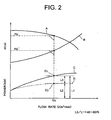
- Fig. 2 shows an operating characteristic of the pump and the waterwheel of the first embodiment of the present invention.
- the components assigned with the same reference numerals are the same as those of Fig. 10 and hence description thereof will be avoided.
- power L3 generated by a combination of "waterwheel-electric power generator-inverter” and power L2 from the commercial power source are used.
- an insufficient power of the power generated by the waterwheel is supplied from the commercial power source via the system collaboration unit.
- the power collection ratio (L3/L1) is about 40% to about 60% and is improved when compared with the power collection ratio of the prior art.
- Fig. 3 Description will be given of a second embodiment by referring to Fig. 3.
- the load of the electric power generator is changed from the motor to drive the primary cool/warm pump to the heat source.
- numeral 520 is a system collaboration unit disposed between the commercial power source 18 and a power source terminal of the heat source 4.
- An output from the inverter 14 is connected via a cable 14a to an electric path 521 of the system collaboration unit. That is, when the waterwheel is not operating, the system collaboration unit 520 operates to supply power from the commercial power source 18 to the heat source 4.
- the system collaboration unit 520 When the waterwheel is operating and if power generated by the electric power generator 13 is insufficient according to a load state of the heat source 4, the system collaboration unit 520 operates to supply power obtained by adding the power generated by the electric power generator 13 to the power from the commercial power source 18. If there remains unused power in the power generated by the power generator 13, the unused power is returned from the inverter via the system collaboration unit to the commercial power source.
- Fig. 4 Power generated by the waterwheel is supplied to a group of various loads such as lighting apparatuses in a building.
- numeral 30 indicates a group of various loads such as lighting apparatuses in a building and numeral 29 is a power system change-over unit.
- the change-over unit 29 is set to a c-a side, the group of loads is connected to the commercial power source.
- the change-over unit 29 is set to a c-b side, the group of loads is connected to the electric power generator side.
- the change-over unit 29 is set to a c-b side to supply power generated by the electric power generator 13.
- the change-over unit 29 is set to a c-a side to supply power from the commercial power source.
- a fourth embodiment will be described by referring to Fig. 5.
- the group of loads when the group of loads imposes a high load and the power generated by the electric power generator 13 is insufficient, the power from the electric power generator 13 is added to that from the commercial power source.
- the group of loads 30 can be powered from the electric power generator 13 and from the commercial power source 28.
- An inverter 14 is connected to the electric power generator 13
- a system collaboration unit 720 is connected between the commercial power source 28 and the group of loads 30, and a cable 14a connects an electric path connecting the system collaboration unit 720 to a power source terminal of the group of loads 30 to an output from the inverter.
- a bypass pipe 29a and a bypass valve 29 are arranged to bypass valves before and after the waterwheel 12 and a pressure gauge 31a and a pressure sensor 31 are disposed on the inlet side of the waterwheel and a pressure gauge 30a and a pressure sensor 30 are disposed on the outlet side of the waterwheel.
- the gate valves 26 and 27 are closed and the gate valve 29 is opened to return the water having passed the heat source to the heat storage via the water supply pipe 6a, the bypass pipe 29a, and the valve 29 in this sequence.
- the heat source can be operated also during maintenance of the waterwheel 12, the electric power generator 13, and units associated therewith.
- Fig. 7 shows the operations and control procedures in a flowchart. That is, to start operation, the inlet valve of the waterwheel is opened, the outlet valve thereof is closed, and the bypass valve thereof is closed in step 1. In step 2, the heat source is powered. The motor to drive the primary cool/warm water pump is powered in step 3. In step 4, an operation request signal is transmitted from the heat source side to the primary cool/warm water pump.
- step 5 the primary cool/warm water pump receives the operation request signal and operates the motor to drive the primary cool/warm water pump. The pump then sends an operation answer signal to the heat source.
- step 6 when a predetermined period of time lapses after the heat source receives the answer signal indicating the operation of the motor to drive the primary cool/warm water pump, the heat source starts its operation.
- step 7 when a predetermined period of time lapses after the heat source starts its operation, the waterwheel outlet valve is opened. As a result, the waterwheel starts its operation and the electric power generator also starts its operation.
- step 8 power generated by the electric power generator is supplied via the inverter to the primary cool/warm water pump.
- step 9 to stop the waterwheel. This stops the electric power generator.
- step 10 the system stops supplying the generated power and stops the inverter. The system then stops supplying power to the motor to drive the primary cool/warm water pump.
- step 10 a stop request signal is sent from the heat source side to the primary cool/warm water pump side and the heat source stops its operation.
- step 11 the motor to drive the primary cool/warm water pump receives the stop request signal and stops its operation.
- step 12 the motor returns a stop answer signal to the heat source.
- the system turns off power to the motor and power to the heat source.
- the motor to drive the primary cool/warm water pump is used as an example of the load of the electric power generator.
- the load may be a heat source or another load such as a lighting apparatus in a building.
- a seventh embodiment by referring to Fig. 8.
- the embodiment is implemented by further modifying the sixth embodiment to conduct an automatic and collaborative operation. Therefore, the gate valves 26, 27, and 29 of Fig. 6 are modified to automatic valves.
- the operations and control procedures are specified for the controller of the heat source, the motor to drive the primary cool/warm water pump, the electric power generator, the inverter, and the units as loads such that these constituent components automatically and mutually conduct operations in a collaborative way.
- Fig. 8 shows the operations and the control procedures in a flowchart.
- step 7 is added to Fig. 7 to open the waterwheel outlet and inlet valves when the waterwheel inlet pressure becomes equal to or more than a predetermined pressure to automatically operate the waterwheel 12, the electric power generator 13, and units associated therewith.
- step 9 is similarly added to Fig. 7 to close the waterwheel outlet and inlet valves to automatically the waterwheel 12, the electric power generator 13, and units associated therewith.
- the other operations are the same as those of Fig. 7 and hence description thereof will be avoided. Through the operation, the operation management becomes easier without any risk of erroneous operations.
- the open control condition of the waterwheel inlet and outlet valves during the operation includes that the heat source is operating and the inlet valve pressure is equal to or more than a predetermined pressure. When both conditions are satisfied, the open control is carried out. As a result, the operation is guaranteed and the overall system operates in a collaborative way.
- Fig. 9 shows a configuration of a specific embodiment of the present invention.
- the both-end motor 2 is replaced with a general motor 131 (a non-both-end motor) to separate the water pump 107 from the waterwheel 109 in the secondary-side system to supply water to air-conditioning loads.
- An electric power generator 134 is disposed in the waterwheel 109 (or an integral type of these units is also available).
- An inverter 135 (INV2) is connected to an output port of the electric power generator 134. Power generated by the power generator 134 is converted into a dc voltage by the inverter 135 including semiconductor devices such as a power transistor Tr and a flywheel diode D. The power is then smoothed by a capacitor C.
- the inverter 135 is well known, for example, is an inverter using pulse width modulation (PWM) control and hence detailed description thereof will be avoided.
- PWM pulse width modulation
- the positive side P and the negative side N of the dc voltage output from the inverter 135 are respectively connected to the positive side P and the negative side N of a dc intermediate circuit of an inverter 136 (INV1) to drive the motor 131.
- the inverter 136 is also well known and is, for example, an inverter using PWM control and hence detailed description thereof will be avoided.
- the motor 131 to drive the water pump 107 is driven by the inverter 136.
- the inverter 136 is used because when the air-conditioning load varies, an energy saving operation is conducted by accordingly lowering the rotary speed of the pump.
- the dc voltage terminals P and N of the inverter 135 are respectively connected to the dc voltage terminals P and N of the inverter 136 using cables 138 and 139, respectively.
- the power generated by the electric power generator 134 can be supplied using a direct current to the inverter 136 on the water pump side. Therefore, it is not required to convert the power into an alternating current, and a simple and inexpensive configuration can be implemented without requiring a system collaboration unit.
- Fig. 10 shows an electric system of Fig. 9.
- the constituent components assigned with the same reference numerals are the same as those shown in Fig. 1, and hence description thereof will be avoided.
- numeral 103 indicates a commercial power source
- numeral 132 is a wattmeter
- ELB indicates an electric leakage breaker.
- the water pump 107 and the motor 131 are driven by the inverter 136 using power only from the commercial power source 103. Water is supplied by the operation of the water pump 107 to each air-conditioning load 110.
- the waterwheel 109 and the electric power generator 134 start operation to supply dc power from the inverter 135 via the cables 138 and 139 to the dc voltage terminals P and N of the inverter 136.
- Fig. 11 shows a graph of an operating characteristic of the water pump 107 and the waterwheel 109 in the embodiment of the present invention.
- the water pump 107 is controlled by the inverter 136 to keep a terminal pressure at a fixed value (the rotary speed of the pump is controlled to keep the terminal pressure of the pipe at a fixed value such that a pump discharge pressure is on a pipe resistance curve E).
- the items assigned with the same reference numerals are the same as those of Fig. 5, and hence description thereof will be avoided.
- the shaft power is indicated by a curve I 2 and the operation points are respectively O 4 and O 4 '.
- the inverter 136 is operated by a frequency of N 2 , and the water pump 107 has performance on a curve G.
- the shaft power is indicated by a curve I 3 and the operation points are respectively O 6 and O 6 '.
- the operation is conducted on a curve L connecting the points O 1 , O 4 , and O 6 of the shaft power.
- the waterwheel generates torque using potential energy of the water, and power is generated by the electric power generator 134 corresponding to shaft power L3.
- power is generated in accordance with the variation in a similar way.
- the water pump 107, the waterwheel 109, and the electric power generator 134 are simultaneously operated, a curve L4 is obtained.
- the power supplied from the commercial power source 103 is reduced as much as there is power generated by the electric power generator 134.
- Point O 3 in the diagram indicates a point at which the waterwheel 109 is efficiently operated by a flow rate of Q 3 and the electric power generator 134 generates electric power.
- the power collection ratio (L3/L1) is about 40% to about 60% and is improved as compared with the collection ratio of the prior art.
- the power generated by the electric power generator 134 is converted by the inverter 135 into a direct current to be supplied to the terminals P and N of the inverter 136 to drive the water pump 107 in a building.
- the power can be supplied not only to the inverter 136, but may also be supplied to any inverter of another facility. Since the terminals P and N of the inverter 135 are connected to the terminals P and N of the inverter 136 using a cable, when the cable becomes long, wiring loss is increased. Both inverters may be collectively arranged in one control board. As a result, the wiring loss can be improved.
- the power generated by the electric power generator is supplied as dc power via an inverter to another inverter, the power is not converted into an alternating current. Therefore, a simple and inexpensive system can be constructed without requiring a system collaboration unit.
Landscapes
- Engineering & Computer Science (AREA)
- Life Sciences & Earth Sciences (AREA)
- Sustainable Development (AREA)
- Chemical & Material Sciences (AREA)
- Combustion & Propulsion (AREA)
- Mechanical Engineering (AREA)
- General Engineering & Computer Science (AREA)
- Control Of Eletrric Generators (AREA)
- Supply And Distribution Of Alternating Current (AREA)
- Other Liquid Machine Or Engine Such As Wave Power Use (AREA)
Description
- The present invention relates to an energy collecting system in which energy is collected through generation of electric power by a waterwheel using water used by, for example, an air-conditioning load or the like in a building.
- For example, as an air-conditioning system in a building, there has been widely employed an air-conditioning system of heat storage type in which a heat source is operated using inexpensive nighttime electric power to store generated heat in a heat storage. In the daytime in which air-conditioning load takes place, the stored heat is fed from the heat storage to the load, i.e., an air conditioner to achieve air-conditioning operation.
- Fig. 12 is a diagram showing a configuration of an example of the prior art, namely, an open-loop air-conditioning system of heat storage type. In a primary-side system S1, the configuration includes a
water pump 1 which feeds water from aheat storage 16 to supply the water via awater supply pipe 4a to aheat source 4 and a both-end motor 2 of which one shaft end is directly coupled with the water pump using a shaft coupling to drive the water pump. The other shaft end is coupled with awaterwheel 12 via aclutch 12b. The waterwheel is disposed at a position at which potential energy of water discharged from the heat source can be completely collected.Numerals numeral 5 is a two-way valve to adjust a quantity of heat generated by the heat source,numeral 6a is a water supply pipe connecting the heat source to the waterwheel, andnumeral 6 is an expansion tank associated with the water supply pipe. Thetank 6 breaks a siphon to apply a head of the supplied water (potential energy thereof) to the waterwheel. In place of the expansion tank, a vacuum breaking valve may be disposed depending on cases. Numeral 12c indicates a water supply pipe to return the water from the waterwheel to the heat storage. That is, the water supplied to theheat source 4 by thewater pump 1 is heated by the heat source and is then fed to thewaterwheel 12. Thewaterwheel 12 is operated by the potential energy of the water to generate power and then imparts the power to the both-end motor 2. The load of the motor becomes lower than that of the water pump, the discrepancy therebetween corresponds to the power imparted from the waterwheel. The water from the waterwheel then returns to the heat storage. - The secondary-side system S2 is a load of an air conditioner or the like and supplies water from the
heat storage 16 via awater supply pipe 7a to an air han (air handling unit) 8 and afan coil 9 by apump 7. Theair han 8 includes an adjustingvalve 8a to adjust a quantity of heat. Thefan coil 9 also includes a similar adjustingvalve 9a. The water of which heat is radiated is returned via thewater supply pipe 7b to theheat storage 16. - Fig. 13 shows an operating characteristic graph of a pump and a waterwheel in an example of the prior art. A total water pumping-up process of the pump, an effective head of the waterwheel, and power of the pump and the waterwheel are indicated along an ordinate. A water flow rate is indicated along an abscissa. A curve A is a curve of Q,H performance of the pump and a curve C is a curve of shaft power when the waterwheel is not operated. The total water pumping-up process is required to operate only the water pump to supply water at a flow rate of Q0 to the water supply system shown in Fig. 9. The operation point in this operation is point O4 on the curve A. Power consumed in this operation is L1 indicated by pump shaft power, and the operation point is
point 01 on the curve C. A curve B indicates an effective head of the waterwheel (pressure head difference between the inlet and the outlet of the waterwheel). This means that when water flows at a flow rate of Q0, a pressure head difference (effective head) of H1 occurs between the inlet and the outlet of the waterwheel, and this potential energy is absorbed to generate power as below. - A curve D is a power curve when the water pump and the waterwheel are operated. Power consumed in the operation is L2 indicated by pump shaft power and the operation point is point O2 on the curve D. That is, when the flow rate is Q0, power generated by the waterwheel is L3.
- In this case, the power collection ratio (L3/L1) is about 20% to about 30%.
- In this way, the conventional apparatus effectively uses potential energy of the pumped-up water passed through the heat source.
- For example, JP-A-50-128801 (a power collection pumping machine) and JP-A-50-49701 (a power collection pumping machine) describes known examples of this apparatus. However, the prior art technique uses a clutch to directly couple a motor with a waterwheel and there is a problem of improvement of transfer efficiency of the clutch. There exists another problem. That is, the energy collected by the waterwheel is power and there is a problem that the power cannot be used in this case, in consideration of structure, for any other load in the building. JP-A-5-10245 (an electric power generator using waterwheel of paddle-wheel type) is a known example of waterwheel electric power generation using a waterwheel in a dam, a paddy field, or a watercourse.
- JP 63 297949 A discloses an energy collecting system in accordance with the preamble of
claim 1. - It is an object of the present invention to collect unused energy in a building by waterwheel electric power generation to re-use the energy or return the unused energy to the commercial power source.
- This object is met by the system defined in
claim 1. -
- 1) Before operation, close a waterwheel inlet valve, a waterwheel outlet valve, and a waterwheel bypass valve. First, turn on power of the heat source and power of the motor to drive the primary cool/warm pump.
- 2) Next, transmit an operation request signal from the heat source side to the primary cool/warm pump.
- 3) The primary cool/warm pump receives the operation request signal transmitted from the heat source side to start its operation and supply water from the heat storage to the load side. Simultaneously, the pump transmits an operation answer signal to the heat source.
- 4) After the operation answer signal is received, when a predetermined period of time lapses enough to guarantee a water supply pressure, the heat source starts its operation.
- 5) When a predetermined period of time lapses after the heat source starts its operation, the waterwheel outlet and inlet valves are opened. In association therewith, the waterwheel starts its operation. The rotation speed of the waterwheel increases with a lapse of time and the electric power generator starts its operation.
- 6) Generated power is supplied via the inverter to a load, for example, the motor to drive the primary cool/warm pump. In another embodiment, the system collaboration unit is connected to a commercial power source and there is provided a unit to connect an output from the inverter to an electric path between the system collaboration unit and a load. In this case, when the load is in a low state and the generated power is excessive, unused power is fed back via the system collaboration unit to the power source.
- 7) The expansion tank or the vacuum breaking valve is disposed in an upper section of the water supply pipe and includes an atmospheric opening or a function similar to that of the atmospheric opening. The tank or the valve prevents expansion of water in the water supply pipe and breaks a vacuum state by exhausting air from the pipe or by sucking external air therein to help the supplied water fall onto the waterwheel.
- A pressure sensor may be disposed in the vicinity of the waterwheel to sense pressure at the position. When the water pressure becomes equal to or more than a predetermined value, an automatic valve disposed in the vicinity of the waterwheel is opened.
-
- 8) When a predetermined period of time lapses after the heat source starts its operation, close the waterwheel outlet valve and stop the waterwheel. Stop the electric power generator.
- 9) Stop supplying the generated power, stop the inverter, stop supplying power to the motor to drive the primary cool/warm pump.
- 10) Transmit a stop request signal from the heat source side to the primary cool/warm pump side.
- 11) Receive the stop request signal, stop the motor to drive the primary cool/warm pump, and return a stop answer signal to the heat source.
- 12) Interrupt the power to the motor to drive the primary cool/warm pump and interrupt the power to the heat source.
- According to an embodiment, there is provided an energy collecting system in a building, wherein a water pump on a secondary-side system to supply water to a group of air-conditioning loads is driven by an inverter, a waterwheel is operated by potential energy of water used by the air-conditioning loads, an electric power generator is operated by torque generated by the waterwheel, power generated by the electric power generator is converted by a regenerative converter into direct-current (dc) power, and positive-side dc power P thereof and negative-side dc power N thereof are outputted to dc terminals P and N of an inverter for the water pump.
- The system of an embodiment is configured as above and operates as follows.
- 1) Before operation, the waterwheel inlet and outlet valves and the waterwheel bypass valve are closed. First, the inverter to drive the water pump in the secondary-side system is activated to operate the water pump to supply water to air conditioners as air-conditioning loads. The inverter receives a sense signal from a pressure sensor disposed on the pump discharge side to conduct, for example, control operation to fix a terminal pressure.
- 2) The waterwheel starts its operation when the water having passed the respective air conditioners flows thereonto. The electric power generator starts its operation by torque generated by the waterwheel to generate electric power.
- 3) The inverter on the electric power generator side converts power (alternating current) generated by the electric power generator into dc power to supply the dc power to another inverter via a cable.
- The present invention is not limited to a system or a facility arranged in a building.
- Other objects, features and advantages of the invention will become apparent from the following description of the embodiments of the invention taken in conjunction with the accompanying drawings.
-
- Fig. 1 is a diagram showing a configuration of a first embodiment of the present invention,
- Fig. 2 is a graph showing an operating characteristic of a pump and a waterwheel of the first embodiment of the present invention,
- Fig. 3 is a diagram showing a configuration of a second embodiment of the present invention,
- Fig. 4 is a diagram showing a configuration of a third embodiment of the present invention,
- Fig. 5 is a diagram showing a configuration of a fourth embodiment of the present invention,
- Fig. 6 is a diagram showing a configuration of a fifth embodiment of the present invention,
- Fig. 7 is a flowchart of a sixth embodiment of the present invention,
- Fig. 8 is a flowchart of a seventh embodiment of the present invention,
- Fig. 9 is a diagram showing a configuration of an eighth embodiment of the present invention,
- Fig. 10 is a diagram showing an electric system of the eighth embodiment of the present invention,
- Fig. 11 is a graph showing a characteristic of the eighth embodiment of the present invention,
- Fig. 12 is a diagram showing a configuration of a system of the prior art, and
- Fig. 13 is a graph showing an operating characteristic of a pump and a waterwheel of the prior art.
- Next, description will be given of an embodiment of the present invention by referring to Figs. 1 to 11.
- Fig. 1 shows a configuration of a first embodiment of the present invention. In this diagram, when compared with Fig. 9 showing a prior art example, the both-end motor is replaced with a general motor (a non-both-end motor), the water pump is separated from the waterwheel, an electric power generator is disposed in the waterwheel (or an integral type of these units is also available), and an inverter is connected to an output port of the electric power generator. A
system collaboration unit 20 is disposed between amotor 2 to drive thewater pump 1 and apower source 19. Thesystem collaboration unit 20 is connected via acable 21 to themotor 2. Furthermore, an output of the inverter is connected via acable 14a to themotor 2. When the waterwheel is not operating, thesystem collaboration unit 20 operates to supply power from acommercial power source 19 to themotor 2. When the waterwheel is operating and power generated by theelectric power generator 13 is insufficient according to a load state of thewater pump 1, thesystem collaboration unit 20 operates to supply power obtained by adding power from the commercial power source to the power generated by theelectric power generator 13. When there remains unused power in the generated power, the unused power is returned from the inverter to the commercial power source via the system collaboration unit. The units or devices assigned with the same reference numerals are the same as those of Fig. 9, and hence description thereof will be avoided. - Fig. 2 shows an operating characteristic of the pump and the waterwheel of the first embodiment of the present invention. The components assigned with the same reference numerals are the same as those of Fig. 10 and hence description thereof will be avoided. In operation of the first embodiment of the present invention, to obtain the shaft power L1 for the water pump flow rate Q0, power L3 generated by a combination of "waterwheel-electric power generator-inverter" and power L2 from the commercial power source are used. In other words, an insufficient power of the power generated by the waterwheel is supplied from the commercial power source via the system collaboration unit. Naturally, when the opening of two-way valve is choked and the load on the water pump is reduced, the electric power to drive the motor becomes less than the power generated by the waterwheel depending on cases. In this case, unused electric power is returned from the inverter via the system collaboration unit to the power source side. In the present embodiment, the power collection ratio (L3/L1) is about 40% to about 60% and is improved when compared with the power collection ratio of the prior art.
- Description will be given of a second embodiment by referring to Fig. 3. In the embodiment, as compared with the first embodiment, the load of the electric power generator is changed from the motor to drive the primary cool/warm pump to the heat source. In Fig. 3, numeral 520 is a system collaboration unit disposed between the
commercial power source 18 and a power source terminal of theheat source 4. An output from theinverter 14 is connected via acable 14a to anelectric path 521 of the system collaboration unit. That is, when the waterwheel is not operating, thesystem collaboration unit 520 operates to supply power from thecommercial power source 18 to theheat source 4. When the waterwheel is operating and if power generated by theelectric power generator 13 is insufficient according to a load state of theheat source 4, thesystem collaboration unit 520 operates to supply power obtained by adding the power generated by theelectric power generator 13 to the power from thecommercial power source 18. If there remains unused power in the power generated by thepower generator 13, the unused power is returned from the inverter via the system collaboration unit to the commercial power source. - Description will be given of a third embodiment by referring to Fig. 4. In this embodiment, power generated by the waterwheel is supplied to a group of various loads such as lighting apparatuses in a building. In Fig. 4, numeral 30 indicates a group of various loads such as lighting apparatuses in a building and numeral 29 is a power system change-over unit. When the change-over
unit 29 is set to a c-a side, the group of loads is connected to the commercial power source. When the change-overunit 29 is set to a c-b side, the group of loads is connected to the electric power generator side. That is, when the waterwheel is operating and if the power generated by theelectric power generator 13 is sufficient according to a load state of the group ofloads 30, the change-overunit 29 is set to a c-b side to supply power generated by theelectric power generator 13. When the power generated by theelectric power generator 13 is insufficient, the change-overunit 29 is set to a c-a side to supply power from the commercial power source. - A fourth embodiment will be described by referring to Fig. 5. In this embodiment implemented by further modifying the third embodiment, when the group of loads imposes a high load and the power generated by the
electric power generator 13 is insufficient, the power from theelectric power generator 13 is added to that from the commercial power source. In Fig. 5, as compared with Fig. 6, the group ofloads 30 can be powered from theelectric power generator 13 and from thecommercial power source 28. Aninverter 14 is connected to theelectric power generator 13, asystem collaboration unit 720 is connected between thecommercial power source 28 and the group ofloads 30, and acable 14a connects an electric path connecting thesystem collaboration unit 720 to a power source terminal of the group ofloads 30 to an output from the inverter. - In the configuration, when the generated power is insufficient, there is supplied power obtained by adding the generated power to that from the commercial power source.
- Description will now be given of a fifth embodiment by referring to Fig. 6. In the embodiment, a
bypass pipe 29a and abypass valve 29 are arranged to bypass valves before and after thewaterwheel 12 and apressure gauge 31a and apressure sensor 31 are disposed on the inlet side of the waterwheel and apressure gauge 30a and apressure sensor 30 are disposed on the outlet side of the waterwheel. In this configuration, to maintain thewaterwheel 12, theelectric power generator 13, and units associated therewith, thegate valves gate valve 29 is opened to return the water having passed the heat source to the heat storage via thewater supply pipe 6a, thebypass pipe 29a, and thevalve 29 in this sequence. As a result, the heat source can be operated also during maintenance of thewaterwheel 12, theelectric power generator 13, and units associated therewith. - Description will be given of a sixth embodiment by referring to Fig. 7. In the embodiment, although not shown, the operations and control procedures are specified for the controller of the heat source, the motor to drive the primary cool/warm water pump, the electric power generator, the inverter, and the units as loads such that these constituent components collaboratively conduct operations. Fig. 7 shows the operations and control procedures in a flowchart. That is, to start operation, the inlet valve of the waterwheel is opened, the outlet valve thereof is closed, and the bypass valve thereof is closed in
step 1. Instep 2, the heat source is powered. The motor to drive the primary cool/warm water pump is powered instep 3. Instep 4, an operation request signal is transmitted from the heat source side to the primary cool/warm water pump. Instep 5, the primary cool/warm water pump receives the operation request signal and operates the motor to drive the primary cool/warm water pump. The pump then sends an operation answer signal to the heat source. Instep 6, when a predetermined period of time lapses after the heat source receives the answer signal indicating the operation of the motor to drive the primary cool/warm water pump, the heat source starts its operation. Instep 7, when a predetermined period of time lapses after the heat source starts its operation, the waterwheel outlet valve is opened. As a result, the waterwheel starts its operation and the electric power generator also starts its operation. Instep 8, power generated by the electric power generator is supplied via the inverter to the primary cool/warm water pump. Next, to stop operation, the waterwheel outlet valve is closed instep 9 to stop the waterwheel. This stops the electric power generator. - In
step 10, the system stops supplying the generated power and stops the inverter. The system then stops supplying power to the motor to drive the primary cool/warm water pump. Instep 10, a stop request signal is sent from the heat source side to the primary cool/warm water pump side and the heat source stops its operation. Instep 11, the motor to drive the primary cool/warm water pump receives the stop request signal and stops its operation. Instep 12, the motor returns a stop answer signal to the heat source. In addition, the system turns off power to the motor and power to the heat source. In the description of the embodiment, the motor to drive the primary cool/warm water pump is used as an example of the load of the electric power generator. However, the load may be a heat source or another load such as a lighting apparatus in a building. By specifying the operations and the control procedures as above, the respective constituent components can be operated in an appropriate collaborative fashion to achieve predetermined performance and functions without errors. - Description will now be given of a seventh embodiment by referring to Fig. 8. The embodiment is implemented by further modifying the sixth embodiment to conduct an automatic and collaborative operation. Therefore, the
gate valves - Fig. 8 shows the operations and the control procedures in a flowchart. To enable automatic operation,
step 7 is added to Fig. 7 to open the waterwheel outlet and inlet valves when the waterwheel inlet pressure becomes equal to or more than a predetermined pressure to automatically operate thewaterwheel 12, theelectric power generator 13, and units associated therewith. In a phase to stop operation,step 9 is similarly added to Fig. 7 to close the waterwheel outlet and inlet valves to automatically thewaterwheel 12, theelectric power generator 13, and units associated therewith. The other operations are the same as those of Fig. 7 and hence description thereof will be avoided. Through the operation, the operation management becomes easier without any risk of erroneous operations. - As a further improvement of the embodiment, the open control condition of the waterwheel inlet and outlet valves during the operation includes that the heat source is operating and the inlet valve pressure is equal to or more than a predetermined pressure. When both conditions are satisfied, the open control is carried out. As a result, the operation is guaranteed and the overall system operates in a collaborative way.
- Fig. 9 shows a configuration of a specific embodiment of the present invention. In this diagram, when compared with the prior art example, the both-
end motor 2 is replaced with a general motor 131 (a non-both-end motor) to separate thewater pump 107 from thewaterwheel 109 in the secondary-side system to supply water to air-conditioning loads. Anelectric power generator 134 is disposed in the waterwheel 109 (or an integral type of these units is also available). An inverter 135 (INV2) is connected to an output port of theelectric power generator 134. Power generated by thepower generator 134 is converted into a dc voltage by theinverter 135 including semiconductor devices such as a power transistor Tr and a flywheel diode D. The power is then smoothed by a capacitor C. For example, when the ac voltage generated by theelectric power generator 134 is 200 V, the voltage (dc voltage) between the P and N terminals of theinverter 135 is 280 V. Theinverter 135 is well known, for example, is an inverter using pulse width modulation (PWM) control and hence detailed description thereof will be avoided. The positive side P and the negative side N of the dc voltage output from theinverter 135 are respectively connected to the positive side P and the negative side N of a dc intermediate circuit of an inverter 136 (INV1) to drive themotor 131. Theinverter 136 is also well known and is, for example, an inverter using PWM control and hence detailed description thereof will be avoided. - In the system configured as above, when the air-conditioning load varies, the flow rate of water supplied to the
waterwheel 109 inevitably varies and the power generated by theelectric power generator 134 also varies. In this case, for example, each time the P-N voltage sensed between the terminals P and N as described above is lower than 280, if the operating frequency of the inverted 135 is lowered, a regenerative state takes place and the P-N voltage increases although not shown in the diagram. - The
motor 131 to drive thewater pump 107 is driven by theinverter 136. Theinverter 136 is used because when the air-conditioning load varies, an energy saving operation is conducted by accordingly lowering the rotary speed of the pump. The dc voltage terminals P and N of theinverter 135 are respectively connected to the dc voltage terminals P and N of theinverter 136 usingcables electric power generator 134 can be supplied using a direct current to theinverter 136 on the water pump side. Therefore, it is not required to convert the power into an alternating current, and a simple and inexpensive configuration can be implemented without requiring a system collaboration unit. - Fig. 10 shows an electric system of Fig. 9. The constituent components assigned with the same reference numerals are the same as those shown in Fig. 1, and hence description thereof will be avoided. In the diagram, numeral 103 indicates a commercial power source, numeral 132 is a wattmeter, and ELB indicates an electric leakage breaker. In an initial state of operation, since the
waterwheel 109 and theelectric power generator 134 are not operating, power is not supplied from the dc voltage terminals P and N of theinverter 135. Thewater pump 107 and themotor 131 are driven by theinverter 136 using power only from thecommercial power source 103. Water is supplied by the operation of thewater pump 107 to each air-conditioning load 110. When the water used by the load returns to thewaterwheel 109, thewaterwheel 109 and theelectric power generator 134 start operation to supply dc power from theinverter 135 via thecables inverter 136. - Fig. 11 shows a graph of an operating characteristic of the
water pump 107 and thewaterwheel 109 in the embodiment of the present invention. In this case, thewater pump 107 is controlled by theinverter 136 to keep a terminal pressure at a fixed value (the rotary speed of the pump is controlled to keep the terminal pressure of the pipe at a fixed value such that a pump discharge pressure is on a pipe resistance curve E). The items assigned with the same reference numerals are the same as those of Fig. 5, and hence description thereof will be avoided. In the embodiment of the present invention, to obtain shaft power L1 at a flow rate of Q0 by operating thewater pump 107 with a highest frequency of Nmax of theinverter 136, there is used power obtained by adding power L3 generated by a combination of thewaterwheel 109, theelectric power generator 134, and theinverter 135 to mechanical power (electric power) L2 from the commercial power source. In other words, power insufficient in the power generated by the waterwheel is supplied from thecommercial power source 103. Naturally, when the air-conditioning load is decreased and the load of thewater pump 107 is lowered and the flow rate becomes Q1, thewater pump 107 is operated with a frequency of N1 of theinverter 136 and has performance on the curve F. The shaft power is indicated by a curve I2 and the operation points are respectively O4 and O4'. When the flow rate becomes zero, theinverter 136 is operated by a frequency of N2, and thewater pump 107 has performance on a curve G. The shaft power is indicated by a curve I3 and the operation points are respectively O6 and O6'. When thewaterwheel 109 is not operated, the operation is conducted on a curve L connecting the points O1, O4, and O6 of the shaft power. In operation of thewaterwheel 109, when water flows onto thewaterwheel 109 at a flow rate of Q0, there appears a head H0 between the inlet and the outlet of the waterwheel. Therefore, the waterwheel generates torque using potential energy of the water, and power is generated by theelectric power generator 134 corresponding to shaft power L3. In subsequent operation, when the water flow rate varies, power is generated in accordance with the variation in a similar way. When thewater pump 107, thewaterwheel 109, and theelectric power generator 134 are simultaneously operated, a curve L4 is obtained. The power supplied from thecommercial power source 103 is reduced as much as there is power generated by theelectric power generator 134. Point O3 in the diagram indicates a point at which thewaterwheel 109 is efficiently operated by a flow rate of Q3 and theelectric power generator 134 generates electric power. - In the embodiment, the power collection ratio (L3/L1) is about 40% to about 60% and is improved as compared with the collection ratio of the prior art. In the embodiment, the power generated by the
electric power generator 134 is converted by theinverter 135 into a direct current to be supplied to the terminals P and N of theinverter 136 to drive thewater pump 107 in a building. However, if the load is driven by an inverter, the power can be supplied not only to theinverter 136, but may also be supplied to any inverter of another facility. Since the terminals P and N of theinverter 135 are connected to the terminals P and N of theinverter 136 using a cable, when the cable becomes long, wiring loss is increased. Both inverters may be collectively arranged in one control board. As a result, the wiring loss can be improved. - As above, when compared with the unused energy collecting apparatus of the prior art using a waterwheel, there is obtained effect of further improvement the collection ratio according to the present invention. Since the present invention can cope with various loads, unused energy of a building can be efficiently re-used.
- Since the power generated by the electric power generator is supplied as dc power via an inverter to another inverter, the power is not converted into an alternating current. Therefore, a simple and inexpensive system can be constructed without requiring a system collaboration unit.
- It should be further understood by those skilled in the art that although the foregoing description has been made on embodiments of the invention, the invention is not limited thereto and various changes and modifications may be made without departing from the scope of the invention as defined in the appended claims.
Claims (2)
- An energy collecting system, comprising:a heat storage (16);a heat source (4) for producing cool or warm water using water from the heat storage (16), the heat storage (16) storing water obtained from the heat source (4) ;a pump (1) for supplying the water from the heat storage (16) to the heat source (4);a motor (2) for driving the pump (1);a waterwheel (12) rotated by the water supplied from the heat source (4); andan electric power generator (13) driven by the waterwheel to generate electric power;characterised byan inverter (14) connected to an output port of the electric power generator (13);a system collaboration unit (20) disposed between the motor (2) and a commercial power source (19), for conducting a change-over operation between a system connecting the commercial power source (19) to the motor (2) and a system connecting the inverter (14) to the commercial power source (19); anda connecting line (14a) for connecting an electric path between the system collaboration unit (20) and the motor (2) to an output port of the inverter (14).
- The system of claim 1, further comprising:a water supply pipe (6a) for returning water from a discharge outlet of the heat source (4) to the heat storage (16); andan expansion tank (6) or a vacuum breaking valve disposed in a highest section of the water supply pipe (6a);wherein:said waterwheel (12) is disposed in a lowest section of the water supply pipe (6a) for collecting potential energy of the water discharged from the heat source (4);said inverter (14) is adapted to convert the voltage and the frequency of the electric power generated by the electric power generator (13) into a desired voltage and a desired frequency; andsaid connecting line (14a) is a cable connecting an output port of the inverter (14) to the electric path between the system collaboration unit (20) and the motor (2) or to an electric path between the system collaboration unit (20) and the heat source (4).
Applications Claiming Priority (4)
| Application Number | Priority Date | Filing Date | Title |
|---|---|---|---|
| JP2002008369 | 2002-01-17 | ||
| JP2002008369 | 2002-01-17 | ||
| JP2002087396 | 2002-03-27 | ||
| JP2002087396 | 2002-03-27 |
Publications (3)
| Publication Number | Publication Date |
|---|---|
| EP1329672A2 EP1329672A2 (en) | 2003-07-23 |
| EP1329672A3 EP1329672A3 (en) | 2003-09-10 |
| EP1329672B1 true EP1329672B1 (en) | 2006-10-11 |
Family
ID=26625551
Family Applications (1)
| Application Number | Title | Priority Date | Filing Date |
|---|---|---|---|
| EP02019222A Expired - Lifetime EP1329672B1 (en) | 2002-01-17 | 2002-08-27 | Energy collecting system and method of operating the same |
Country Status (6)
| Country | Link |
|---|---|
| US (3) | US6698223B2 (en) |
| EP (1) | EP1329672B1 (en) |
| JP (1) | JP4824097B2 (en) |
| DE (1) | DE60215293T2 (en) |
| DK (1) | DK1329672T3 (en) |
| TW (1) | TW587131B (en) |
Families Citing this family (9)
| Publication number | Priority date | Publication date | Assignee | Title |
|---|---|---|---|---|
| JP2004129314A (en) * | 2000-03-17 | 2004-04-22 | Soichi Sato | Cogeneration system equipped with capacitor device |
| EP1329672B1 (en) * | 2002-01-17 | 2006-10-11 | Hitachi, Ltd. | Energy collecting system and method of operating the same |
| JP4332357B2 (en) * | 2002-03-27 | 2009-09-16 | 株式会社日立産機システム | Operation method of energy recovery equipment |
| JP4069010B2 (en) * | 2003-05-14 | 2008-03-26 | 株式会社日立産機システム | Air conditioning equipment and energy recovery device mounting method |
| AT506679B1 (en) * | 2008-05-05 | 2010-04-15 | Guenter Hirr | PLANT FOR POWER HEAT COUPLING |
| KR101760547B1 (en) * | 2011-01-21 | 2017-07-21 | 가부시키가이샤 에바라 세이사꾸쇼 | Water supply apparatus |
| JP5839803B2 (en) * | 2011-01-24 | 2016-01-06 | 三菱重工業株式会社 | Bypass energy recovery device for fluid machinery |
| US10101043B2 (en) | 2013-07-26 | 2018-10-16 | Energy Design Technology & Solutions, Inc. | HVAC system and method of operation |
| CN104454304B (en) * | 2014-10-31 | 2017-01-11 | 清华大学 | Pumped storage power generation system and method based on steam and air pressurization |
Family Cites Families (23)
| Publication number | Priority date | Publication date | Assignee | Title |
|---|---|---|---|---|
| US3140986A (en) * | 1958-01-17 | 1964-07-14 | Walter A Hubbard | Method and apparatus for producing electrical power and distilling water by use of geothermal energy |
| JPS5536833B2 (en) | 1973-09-03 | 1980-09-24 | ||
| JPS5413601B2 (en) | 1974-03-29 | 1979-06-01 | ||
| JPS5130144A (en) * | 1974-09-06 | 1976-03-15 | Shinryo Air Cond | KUKICHOWASETSUBINIOKERU KAIHOSHIKIEKITAIJUNKANYOHONPUNODORYOKUKAISHUSOCHINOHOGOHOHO OYOBI SONOSOCHI |
| US4246753A (en) * | 1979-10-24 | 1981-01-27 | Benjamin Redmond | Energy salvaging system |
| US4352025A (en) * | 1980-11-17 | 1982-09-28 | Troyen Harry D | System for generation of electrical power |
| US4408127A (en) * | 1982-05-13 | 1983-10-04 | Santos Sr Astrogildo | Power generating apparatus |
| US4607169A (en) * | 1985-01-03 | 1986-08-19 | Donnelly Jr Joseph R | Artesian well generated power system |
| US4808837A (en) * | 1986-02-18 | 1989-02-28 | Honeywell Inc. | Submersible electrical power supply |
| JPS6377434A (en) * | 1986-09-19 | 1988-04-07 | 斎藤 建夫 | Method for calculating calibration value of tissue blood flow rate meter |
| US4918369A (en) * | 1986-12-01 | 1990-04-17 | Donald Solorow | Hydro-energy conversion system |
| JPS63297949A (en) * | 1987-05-28 | 1988-12-05 | Tokai Eng Kk | Recovering method for surplus energy in air conditioning equipment utilizing heat accumulating tank |
| US4965998A (en) * | 1989-02-21 | 1990-10-30 | Estigoy Filemon E | Mini hydro electric plant |
| JP2934675B2 (en) * | 1990-01-18 | 1999-08-16 | 本田技研工業株式会社 | Inverter type generator |
| JPH0591751A (en) * | 1991-06-06 | 1993-04-09 | Honda Motor Co Ltd | Portable AC power supply |
| JPH0510245A (en) | 1991-06-28 | 1993-01-19 | Mitsubishi Heavy Ind Ltd | Outer wheel drive type water-wheel power generator |
| JPH066170B2 (en) | 1991-08-28 | 1994-01-26 | 中島 博 | Pacemaker pacing leads |
| JPH05130144A (en) * | 1991-10-31 | 1993-05-25 | Fujitsu Ltd | Dynamic routing system |
| JPH05308799A (en) * | 1992-04-28 | 1993-11-19 | Shinko Electric Co Ltd | Constant frequency power supply |
| JPH118999A (en) * | 1997-06-16 | 1999-01-12 | Nishishiba Electric Co Ltd | Power supply |
| JP2000182790A (en) * | 1998-12-14 | 2000-06-30 | Sanyo Electric Works Ltd | Discharge lamp lighting control device |
| JP2000291525A (en) | 1999-04-05 | 2000-10-17 | Fuji Acetylene Kogyo Kk | Power generating system |
| EP1329672B1 (en) * | 2002-01-17 | 2006-10-11 | Hitachi, Ltd. | Energy collecting system and method of operating the same |
-
2002
- 2002-08-27 EP EP02019222A patent/EP1329672B1/en not_active Expired - Lifetime
- 2002-08-27 DE DE60215293T patent/DE60215293T2/en not_active Expired - Lifetime
- 2002-08-27 DK DK02019222T patent/DK1329672T3/en active
- 2002-08-28 TW TW091119593A patent/TW587131B/en not_active IP Right Cessation
- 2002-08-30 US US10/233,258 patent/US6698223B2/en not_active Expired - Lifetime
-
2004
- 2004-01-22 US US10/764,374 patent/US7174735B2/en not_active Expired - Fee Related
- 2004-04-08 US US10/822,102 patent/US7191610B2/en not_active Expired - Fee Related
-
2009
- 2009-05-07 JP JP2009112462A patent/JP4824097B2/en not_active Expired - Lifetime
Also Published As
| Publication number | Publication date |
|---|---|
| JP4824097B2 (en) | 2011-11-24 |
| DE60215293T2 (en) | 2007-05-24 |
| TW587131B (en) | 2004-05-11 |
| US6698223B2 (en) | 2004-03-02 |
| EP1329672A3 (en) | 2003-09-10 |
| US20040187497A1 (en) | 2004-09-30 |
| EP1329672A2 (en) | 2003-07-23 |
| DE60215293D1 (en) | 2006-11-23 |
| JP2009168037A (en) | 2009-07-30 |
| US7174735B2 (en) | 2007-02-13 |
| US20030131621A1 (en) | 2003-07-17 |
| US7191610B2 (en) | 2007-03-20 |
| US20040154325A1 (en) | 2004-08-12 |
| DK1329672T3 (en) | 2007-02-05 |
Similar Documents
| Publication | Publication Date | Title |
|---|---|---|
| US7081688B2 (en) | Energy recovery apparatus and method of operating energy recovering apparatus | |
| JP4824097B2 (en) | Energy recovery system and pump | |
| US6847129B2 (en) | Turbine generator starting method and turbine generation system | |
| US20030000236A1 (en) | Alternator/inverter refrigeration unit | |
| US7584626B2 (en) | Air-conditioning system for a vehicle, in particular an industrial vehicle, and vehicle equipped with said system | |
| US10632831B2 (en) | System and method for battery charging of a fuel cell plug-in hybrid vehicle having an electric compressor or turbocharger | |
| US12043984B2 (en) | Electric driven hydraulic power system | |
| CN104290740A (en) | Double-air-source system of electric vehicle and method and system for controlling same | |
| JP2003211950A (en) | Air conditioners for vehicles | |
| JPH11325546A (en) | Storage type air conditioner | |
| EP4039514B1 (en) | Transport conditioning system with electric power distribution assembly | |
| WO1995034946A1 (en) | Speed control and bootstrap technique for high voltage motor control | |
| JP2004003414A (en) | Energy recovery system and operating method thereof | |
| JPH11325545A (en) | Storage type air conditioning system | |
| JP3132266B2 (en) | Exhaust energy recovery device | |
| JPH11325540A (en) | Power storage device for air conditioner | |
| CN201248027Y (en) | Frequency-change air conditioner | |
| CN121139112A (en) | A cooling system for the engine of a mining dump truck | |
| JP2009106151A (en) | Energy recovery equipment | |
| JPH11325542A (en) | Storage type air conditioner | |
| CN110474583A (en) | One kind going straight up to pressure without isolation double-fed high-speed switched reluctance generator converter system | |
| JPH11325544A (en) | Storage type air conditioner |
Legal Events
| Date | Code | Title | Description |
|---|---|---|---|
| PUAI | Public reference made under article 153(3) epc to a published international application that has entered the european phase |
Free format text: ORIGINAL CODE: 0009012 |
|
| AK | Designated contracting states |
Designated state(s): AT BE BG CH CY CZ DE DK EE ES FI FR GB GR IE IT LI LU MC NL PT SE SK TR |
|
| AX | Request for extension of the european patent |
Extension state: AL LT LV MK RO SI |
|
| PUAL | Search report despatched |
Free format text: ORIGINAL CODE: 0009013 |
|
| AK | Designated contracting states |
Kind code of ref document: A3 Designated state(s): AT BE BG CH CY CZ DE DK EE ES FI FR GB GR IE IT LI LU MC NL PT SE SK TR |
|
| AX | Request for extension of the european patent |
Extension state: AL LT LV MK RO SI |
|
| 17P | Request for examination filed |
Effective date: 20040304 |
|
| AKX | Designation fees paid |
Designated state(s): DE DK FR GB IT |
|
| GRAP | Despatch of communication of intention to grant a patent |
Free format text: ORIGINAL CODE: EPIDOSNIGR1 |
|
| GRAS | Grant fee paid |
Free format text: ORIGINAL CODE: EPIDOSNIGR3 |
|
| GRAA | (expected) grant |
Free format text: ORIGINAL CODE: 0009210 |
|
| AK | Designated contracting states |
Kind code of ref document: B1 Designated state(s): DE DK FR GB IT |
|
| PG25 | Lapsed in a contracting state [announced via postgrant information from national office to epo] |
Ref country code: IT Free format text: LAPSE BECAUSE OF FAILURE TO SUBMIT A TRANSLATION OF THE DESCRIPTION OR TO PAY THE FEE WITHIN THE PRESCRIBED TIME-LIMIT;WARNING: LAPSES OF ITALIAN PATENTS WITH EFFECTIVE DATE BEFORE 2007 MAY HAVE OCCURRED AT ANY TIME BEFORE 2007. THE CORRECT EFFECTIVE DATE MAY BE DIFFERENT FROM THE ONE RECORDED. Effective date: 20061011 |
|
| REG | Reference to a national code |
Ref country code: GB Ref legal event code: FG4D |
|
| REF | Corresponds to: |
Ref document number: 60215293 Country of ref document: DE Date of ref document: 20061123 Kind code of ref document: P |
|
| REG | Reference to a national code |
Ref country code: DK Ref legal event code: T3 |
|
| EN | Fr: translation not filed | ||
| PLBE | No opposition filed within time limit |
Free format text: ORIGINAL CODE: 0009261 |
|
| STAA | Information on the status of an ep patent application or granted ep patent |
Free format text: STATUS: NO OPPOSITION FILED WITHIN TIME LIMIT |
|
| 26N | No opposition filed |
Effective date: 20070712 |
|
| GBPC | Gb: european patent ceased through non-payment of renewal fee |
Effective date: 20070827 |
|
| PG25 | Lapsed in a contracting state [announced via postgrant information from national office to epo] |
Ref country code: FR Free format text: LAPSE BECAUSE OF FAILURE TO SUBMIT A TRANSLATION OF THE DESCRIPTION OR TO PAY THE FEE WITHIN THE PRESCRIBED TIME-LIMIT Effective date: 20070601 |
|
| PG25 | Lapsed in a contracting state [announced via postgrant information from national office to epo] |
Ref country code: GB Free format text: LAPSE BECAUSE OF NON-PAYMENT OF DUE FEES Effective date: 20070827 Ref country code: FR Free format text: LAPSE BECAUSE OF FAILURE TO SUBMIT A TRANSLATION OF THE DESCRIPTION OR TO PAY THE FEE WITHIN THE PRESCRIBED TIME-LIMIT Effective date: 20061011 |
|
| PGFP | Annual fee paid to national office [announced via postgrant information from national office to epo] |
Ref country code: DK Payment date: 20110810 Year of fee payment: 10 |
|
| PGFP | Annual fee paid to national office [announced via postgrant information from national office to epo] |
Ref country code: DE Payment date: 20120822 Year of fee payment: 11 |
|
| REG | Reference to a national code |
Ref country code: DK Ref legal event code: EBP Effective date: 20130831 |
|
| PG25 | Lapsed in a contracting state [announced via postgrant information from national office to epo] |
Ref country code: DE Free format text: LAPSE BECAUSE OF NON-PAYMENT OF DUE FEES Effective date: 20140301 |
|
| REG | Reference to a national code |
Ref country code: DE Ref legal event code: R119 Ref document number: 60215293 Country of ref document: DE Effective date: 20140301 |
|
| PG25 | Lapsed in a contracting state [announced via postgrant information from national office to epo] |
Ref country code: DK Free format text: LAPSE BECAUSE OF NON-PAYMENT OF DUE FEES Effective date: 20130831 |