EP0546174B1 - Monozerstreute einfache und doppelte emulsionen und herstellungsverfahren - Google Patents
Monozerstreute einfache und doppelte emulsionen und herstellungsverfahren Download PDFInfo
- Publication number
- EP0546174B1 EP0546174B1 EP91911947A EP91911947A EP0546174B1 EP 0546174 B1 EP0546174 B1 EP 0546174B1 EP 91911947 A EP91911947 A EP 91911947A EP 91911947 A EP91911947 A EP 91911947A EP 0546174 B1 EP0546174 B1 EP 0546174B1
- Authority
- EP
- European Patent Office
- Prior art keywords
- emulsion
- particle size
- porous glass
- type
- glass membrane
- Prior art date
- Legal status (The legal status is an assumption and is not a legal conclusion. Google has not performed a legal analysis and makes no representation as to the accuracy of the status listed.)
- Expired - Lifetime
Links
- 239000000839 emulsion Substances 0.000 title claims abstract description 169
- 238000004519 manufacturing process Methods 0.000 title description 22
- 239000002245 particle Substances 0.000 claims abstract description 114
- 239000012528 membrane Substances 0.000 claims description 107
- 239000005373 porous glass Substances 0.000 claims description 95
- 239000007788 liquid Substances 0.000 claims description 78
- 239000011148 porous material Substances 0.000 claims description 60
- 238000000034 method Methods 0.000 claims description 32
- 238000009826 distribution Methods 0.000 claims description 21
- 239000004094 surface-active agent Substances 0.000 claims description 21
- 239000006185 dispersion Substances 0.000 claims description 12
- 238000004381 surface treatment Methods 0.000 claims description 10
- 230000002209 hydrophobic effect Effects 0.000 claims description 9
- 239000003093 cationic surfactant Substances 0.000 claims description 8
- 239000002736 nonionic surfactant Substances 0.000 claims description 8
- 239000003945 anionic surfactant Substances 0.000 claims description 7
- 239000002270 dispersing agent Substances 0.000 claims description 6
- 238000005259 measurement Methods 0.000 claims description 6
- 239000000693 micelle Substances 0.000 claims description 5
- 238000004062 sedimentation Methods 0.000 claims description 5
- 239000003381 stabilizer Substances 0.000 claims 1
- 230000001105 regulatory effect Effects 0.000 abstract 1
- 239000012071 phase Substances 0.000 description 54
- DBMJMQXJHONAFJ-UHFFFAOYSA-M Sodium laurylsulphate Chemical compound [Na+].CCCCCCCCCCCCOS([O-])(=O)=O DBMJMQXJHONAFJ-UHFFFAOYSA-M 0.000 description 11
- YXFVVABEGXRONW-UHFFFAOYSA-N Toluene Chemical compound CC1=CC=CC=C1 YXFVVABEGXRONW-UHFFFAOYSA-N 0.000 description 9
- 239000008346 aqueous phase Substances 0.000 description 9
- 238000004945 emulsification Methods 0.000 description 8
- 239000011521 glass Substances 0.000 description 8
- 239000000126 substance Substances 0.000 description 8
- 229920001213 Polysorbate 20 Polymers 0.000 description 5
- 230000001186 cumulative effect Effects 0.000 description 5
- 239000003350 kerosene Substances 0.000 description 5
- 235000010486 polyoxyethylene sorbitan monolaurate Nutrition 0.000 description 5
- XLYOFNOQVPJJNP-UHFFFAOYSA-N water Substances O XLYOFNOQVPJJNP-UHFFFAOYSA-N 0.000 description 5
- FAPWRFPIFSIZLT-UHFFFAOYSA-M Sodium chloride Chemical compound [Na+].[Cl-] FAPWRFPIFSIZLT-UHFFFAOYSA-M 0.000 description 4
- 239000007864 aqueous solution Substances 0.000 description 4
- GONOPSZTUGRENK-UHFFFAOYSA-N benzyl(trichloro)silane Chemical compound Cl[Si](Cl)(Cl)CC1=CC=CC=C1 GONOPSZTUGRENK-UHFFFAOYSA-N 0.000 description 4
- -1 ester salts Chemical class 0.000 description 4
- INJVFBCDVXYHGQ-UHFFFAOYSA-N n'-(3-triethoxysilylpropyl)ethane-1,2-diamine Chemical compound CCO[Si](OCC)(OCC)CCCNCCN INJVFBCDVXYHGQ-UHFFFAOYSA-N 0.000 description 4
- 230000003287 optical effect Effects 0.000 description 4
- 239000000256 polyoxyethylene sorbitan monolaurate Substances 0.000 description 3
- 241000894007 species Species 0.000 description 3
- ZORQXIQZAOLNGE-UHFFFAOYSA-N 1,1-difluorocyclohexane Chemical compound FC1(F)CCCCC1 ZORQXIQZAOLNGE-UHFFFAOYSA-N 0.000 description 2
- LZZYPRNAOMGNLH-UHFFFAOYSA-M Cetrimonium bromide Chemical compound [Br-].CCCCCCCCCCCCCCCC[N+](C)(C)C LZZYPRNAOMGNLH-UHFFFAOYSA-M 0.000 description 2
- 229920003171 Poly (ethylene oxide) Polymers 0.000 description 2
- 125000003277 amino group Chemical group 0.000 description 2
- 125000000129 anionic group Chemical group 0.000 description 2
- 230000015572 biosynthetic process Effects 0.000 description 2
- IJOOHPMOJXWVHK-UHFFFAOYSA-N chlorotrimethylsilane Chemical compound C[Si](C)(C)Cl IJOOHPMOJXWVHK-UHFFFAOYSA-N 0.000 description 2
- 235000014113 dietary fatty acids Nutrition 0.000 description 2
- GVGUFUZHNYFZLC-UHFFFAOYSA-N dodecyl benzenesulfonate;sodium Chemical compound [Na].CCCCCCCCCCCCOS(=O)(=O)C1=CC=CC=C1 GVGUFUZHNYFZLC-UHFFFAOYSA-N 0.000 description 2
- 230000000694 effects Effects 0.000 description 2
- 239000003995 emulsifying agent Substances 0.000 description 2
- 239000000194 fatty acid Substances 0.000 description 2
- 229930195729 fatty acid Natural products 0.000 description 2
- 238000011835 investigation Methods 0.000 description 2
- 239000000463 material Substances 0.000 description 2
- QSHDDOUJBYECFT-UHFFFAOYSA-N mercury Chemical compound [Hg] QSHDDOUJBYECFT-UHFFFAOYSA-N 0.000 description 2
- 229910052753 mercury Inorganic materials 0.000 description 2
- 239000004005 microsphere Substances 0.000 description 2
- 239000003921 oil Substances 0.000 description 2
- 230000035515 penetration Effects 0.000 description 2
- 150000003839 salts Chemical class 0.000 description 2
- 239000011780 sodium chloride Substances 0.000 description 2
- 239000000243 solution Substances 0.000 description 2
- 238000000638 solvent extraction Methods 0.000 description 2
- 239000001593 sorbitan monooleate Substances 0.000 description 2
- 235000011069 sorbitan monooleate Nutrition 0.000 description 2
- 229940035049 sorbitan monooleate Drugs 0.000 description 2
- 238000003756 stirring Methods 0.000 description 2
- 125000000020 sulfo group Chemical group O=S(=O)([*])O[H] 0.000 description 2
- 239000007762 w/o emulsion Substances 0.000 description 2
- 238000009736 wetting Methods 0.000 description 2
- JNYAEWCLZODPBN-JGWLITMVSA-N (2r,3r,4s)-2-[(1r)-1,2-dihydroxyethyl]oxolane-3,4-diol Chemical class OC[C@@H](O)[C@H]1OC[C@H](O)[C@H]1O JNYAEWCLZODPBN-JGWLITMVSA-N 0.000 description 1
- WYTZZXDRDKSJID-UHFFFAOYSA-N (3-aminopropyl)triethoxysilane Chemical compound CCO[Si](OCC)(OCC)CCCN WYTZZXDRDKSJID-UHFFFAOYSA-N 0.000 description 1
- IJGRMHOSHXDMSA-UHFFFAOYSA-N Atomic nitrogen Chemical compound N#N IJGRMHOSHXDMSA-UHFFFAOYSA-N 0.000 description 1
- KKCBUQHMOMHUOY-UHFFFAOYSA-N Na2O Inorganic materials [O-2].[Na+].[Na+] KKCBUQHMOMHUOY-UHFFFAOYSA-N 0.000 description 1
- 239000004372 Polyvinyl alcohol Substances 0.000 description 1
- 229910020175 SiOH Inorganic materials 0.000 description 1
- BCKXLBQYZLBQEK-KVVVOXFISA-M Sodium oleate Chemical compound [Na+].CCCCCCCC\C=C/CCCCCCCC([O-])=O BCKXLBQYZLBQEK-KVVVOXFISA-M 0.000 description 1
- 239000002253 acid Substances 0.000 description 1
- PNEYBMLMFCGWSK-UHFFFAOYSA-N aluminium oxide Inorganic materials [O-2].[O-2].[O-2].[Al+3].[Al+3] PNEYBMLMFCGWSK-UHFFFAOYSA-N 0.000 description 1
- 150000003863 ammonium salts Chemical class 0.000 description 1
- 239000010775 animal oil Substances 0.000 description 1
- ABHNFDUSOVXXOA-UHFFFAOYSA-N benzyl-chloro-dimethylsilane Chemical compound C[Si](C)(Cl)CC1=CC=CC=C1 ABHNFDUSOVXXOA-UHFFFAOYSA-N 0.000 description 1
- 150000001720 carbohydrates Chemical class 0.000 description 1
- 150000001734 carboxylic acid salts Chemical class 0.000 description 1
- 125000002091 cationic group Chemical group 0.000 description 1
- 239000000919 ceramic Substances 0.000 description 1
- 239000003153 chemical reaction reagent Substances 0.000 description 1
- 239000008199 coating composition Substances 0.000 description 1
- 239000000084 colloidal system Substances 0.000 description 1
- 238000010276 construction Methods 0.000 description 1
- 238000007796 conventional method Methods 0.000 description 1
- 229910052593 corundum Inorganic materials 0.000 description 1
- 239000002537 cosmetic Substances 0.000 description 1
- 239000008367 deionised water Substances 0.000 description 1
- 229910021641 deionized water Inorganic materials 0.000 description 1
- 229910001873 dinitrogen Inorganic materials 0.000 description 1
- BNIILDVGGAEEIG-UHFFFAOYSA-L disodium hydrogen phosphate Chemical compound [Na+].[Na+].OP([O-])([O-])=O BNIILDVGGAEEIG-UHFFFAOYSA-L 0.000 description 1
- TWFQJFPTTMIETC-UHFFFAOYSA-N dodecan-1-amine;hydron;chloride Chemical compound [Cl-].CCCCCCCCCCCC[NH3+] TWFQJFPTTMIETC-UHFFFAOYSA-N 0.000 description 1
- 229940079593 drug Drugs 0.000 description 1
- 239000003814 drug Substances 0.000 description 1
- 238000002474 experimental method Methods 0.000 description 1
- 238000001914 filtration Methods 0.000 description 1
- 235000013305 food Nutrition 0.000 description 1
- 150000002314 glycerols Chemical class 0.000 description 1
- 238000010438 heat treatment Methods 0.000 description 1
- 150000002430 hydrocarbons Chemical group 0.000 description 1
- 125000001165 hydrophobic group Chemical group 0.000 description 1
- 229910010272 inorganic material Inorganic materials 0.000 description 1
- 239000011147 inorganic material Substances 0.000 description 1
- 230000001678 irradiating effect Effects 0.000 description 1
- 239000004973 liquid crystal related substance Substances 0.000 description 1
- 239000007791 liquid phase Substances 0.000 description 1
- 229920002521 macromolecule Polymers 0.000 description 1
- 239000012982 microporous membrane Substances 0.000 description 1
- 238000002156 mixing Methods 0.000 description 1
- 239000000203 mixture Substances 0.000 description 1
- 238000002715 modification method Methods 0.000 description 1
- 229910000402 monopotassium phosphate Inorganic materials 0.000 description 1
- 235000019796 monopotassium phosphate Nutrition 0.000 description 1
- 239000007764 o/w emulsion Substances 0.000 description 1
- 235000019198 oils Nutrition 0.000 description 1
- 239000003960 organic solvent Substances 0.000 description 1
- 239000003208 petroleum Substances 0.000 description 1
- 238000005191 phase separation Methods 0.000 description 1
- PJNZPQUBCPKICU-UHFFFAOYSA-N phosphoric acid;potassium Chemical compound [K].OP(O)(O)=O PJNZPQUBCPKICU-UHFFFAOYSA-N 0.000 description 1
- 239000000049 pigment Substances 0.000 description 1
- 239000004033 plastic Substances 0.000 description 1
- 229920003023 plastic Polymers 0.000 description 1
- 229920000642 polymer Polymers 0.000 description 1
- 229920002451 polyvinyl alcohol Polymers 0.000 description 1
- 238000002360 preparation method Methods 0.000 description 1
- 238000012545 processing Methods 0.000 description 1
- 239000002994 raw material Substances 0.000 description 1
- 238000010992 reflux Methods 0.000 description 1
- 238000009877 rendering Methods 0.000 description 1
- WBHHMMIMDMUBKC-QJWNTBNXSA-M ricinoleate Chemical compound CCCCCC[C@@H](O)C\C=C/CCCCCCCC([O-])=O WBHHMMIMDMUBKC-QJWNTBNXSA-M 0.000 description 1
- 229940066675 ricinoleate Drugs 0.000 description 1
- 229920002050 silicone resin Polymers 0.000 description 1
- 239000011734 sodium Substances 0.000 description 1
- 229940080264 sodium dodecylbenzenesulfonate Drugs 0.000 description 1
- 239000007787 solid Substances 0.000 description 1
- 238000005063 solubilization Methods 0.000 description 1
- 230000007928 solubilization Effects 0.000 description 1
- 239000003549 soybean oil Substances 0.000 description 1
- 235000012424 soybean oil Nutrition 0.000 description 1
- 125000006850 spacer group Chemical group 0.000 description 1
- 230000006641 stabilisation Effects 0.000 description 1
- 238000011105 stabilization Methods 0.000 description 1
- 150000003460 sulfonic acids Chemical class 0.000 description 1
- 239000002344 surface layer Substances 0.000 description 1
- GINSRDSEEGBTJO-UHFFFAOYSA-N thietane 1-oxide Chemical compound O=S1CCC1 GINSRDSEEGBTJO-UHFFFAOYSA-N 0.000 description 1
- PYJJCSYBSYXGQQ-UHFFFAOYSA-N trichloro(octadecyl)silane Chemical compound CCCCCCCCCCCCCCCCCC[Si](Cl)(Cl)Cl PYJJCSYBSYXGQQ-UHFFFAOYSA-N 0.000 description 1
- FYZFRYWTMMVDLR-UHFFFAOYSA-M trimethyl(3-trimethoxysilylpropyl)azanium;chloride Chemical compound [Cl-].CO[Si](OC)(OC)CCC[N+](C)(C)C FYZFRYWTMMVDLR-UHFFFAOYSA-M 0.000 description 1
- 239000005051 trimethylchlorosilane Substances 0.000 description 1
- 235000015112 vegetable and seed oil Nutrition 0.000 description 1
- 239000008158 vegetable oil Substances 0.000 description 1
- 239000008307 w/o/w-emulsion Substances 0.000 description 1
- 229910001845 yogo sapphire Inorganic materials 0.000 description 1
Images



Classifications
-
- B—PERFORMING OPERATIONS; TRANSPORTING
- B01—PHYSICAL OR CHEMICAL PROCESSES OR APPARATUS IN GENERAL
- B01F—MIXING, e.g. DISSOLVING, EMULSIFYING OR DISPERSING
- B01F23/00—Mixing according to the phases to be mixed, e.g. dispersing or emulsifying
- B01F23/40—Mixing liquids with liquids; Emulsifying
- B01F23/41—Emulsifying
- B01F23/414—Emulsifying characterised by the internal structure of the emulsion
- B01F23/4144—Multiple emulsions, in particular double emulsions, e.g. water in oil in water; Three-phase emulsions
-
- B—PERFORMING OPERATIONS; TRANSPORTING
- B01—PHYSICAL OR CHEMICAL PROCESSES OR APPARATUS IN GENERAL
- B01F—MIXING, e.g. DISSOLVING, EMULSIFYING OR DISPERSING
- B01F23/00—Mixing according to the phases to be mixed, e.g. dispersing or emulsifying
- B01F23/40—Mixing liquids with liquids; Emulsifying
- B01F23/41—Emulsifying
- B01F23/4105—Methods of emulsifying
-
- B—PERFORMING OPERATIONS; TRANSPORTING
- B01—PHYSICAL OR CHEMICAL PROCESSES OR APPARATUS IN GENERAL
- B01F—MIXING, e.g. DISSOLVING, EMULSIFYING OR DISPERSING
- B01F25/00—Flow mixers; Mixers for falling materials, e.g. solid particles
- B01F25/30—Injector mixers
- B01F25/31—Injector mixers in conduits or tubes through which the main component flows
- B01F25/314—Injector mixers in conduits or tubes through which the main component flows wherein additional components are introduced at the circumference of the conduit
- B01F25/3142—Injector mixers in conduits or tubes through which the main component flows wherein additional components are introduced at the circumference of the conduit the conduit having a plurality of openings in the axial direction or in the circumferential direction
- B01F25/31421—Injector mixers in conduits or tubes through which the main component flows wherein additional components are introduced at the circumference of the conduit the conduit having a plurality of openings in the axial direction or in the circumferential direction the conduit being porous
-
- B—PERFORMING OPERATIONS; TRANSPORTING
- B01—PHYSICAL OR CHEMICAL PROCESSES OR APPARATUS IN GENERAL
- B01F—MIXING, e.g. DISSOLVING, EMULSIFYING OR DISPERSING
- B01F25/00—Flow mixers; Mixers for falling materials, e.g. solid particles
- B01F25/50—Circulation mixers, e.g. wherein at least part of the mixture is discharged from and reintroduced into a receptacle
- B01F25/53—Circulation mixers, e.g. wherein at least part of the mixture is discharged from and reintroduced into a receptacle in which the mixture is discharged from and reintroduced into a receptacle through a recirculation tube, into which an additional component is introduced
Definitions
- This invention relates to monodisperse single and double emulsions and a method of producing the same.
- % means “% by volume”, unless otherwise specified.
- emulsions are generally produced by adding an emulsifying agent, such as a surfactant, and a liquid to be dispersed to a continuous phase liquid and stirring or frictionally mixing the resulting mixture by some mechanical means, such as a stirrer, homogenizer or colloid mill, to thereby comminute the dispersed phase.
- an emulsifying agent such as a surfactant
- some mechanical means such as a stirrer, homogenizer or colloid mill
- emulsion particles dispersed phase particles in the emulsion prepared (hereinafter sometimes referred to as emulsion particles) are considerably ununiform in size, so that the emulsion is poor in stability.
- emulsion particles dispersed phase particles in the emulsion prepared
- surfactant when the dispersed phase concentration is high, a large amount of surfactant will be required for the improvement of emulsion stability.
- two methods are known for the production of double emulsions of the o/w/o or w/o/w type.
- One is the one-step emulsification method which utilizes phase inversion from w/o type emulsions to o/w type emulsions or from o/w type emulsions to w/o type emulsions and the other is the two-step emulsification method comprising dispersing with stirring a w/o or o/w type emulsion prepared in advance again in a continuous phase to obtain a w/o/w or o/w/o type emulsion.
- JP-A-2 214 537 discloses a method for preparing high-quality w/o emulsions by partitioning the two phases with a porous membrane. To prevent reaggregation of the aqueous component at the pore outlet, the membrane surface is irradiated with ultrasonic waves.
- JP-A-2 095 433 discloses the production of w/o and w/o/w emulsions by injecting a first phase into a second phase through membranes with micropores of uniform diameter.
- the present inventors have now completed a novel method of producing monodisperse single emulsions and double emulsions, which method can make emulsion particles more uniform in size. It has also been found that said method can give double emulsion particles in high yield and, in addition, can effectively prevent the loss of a substance or substances added from the internal phase as resulting from disruption of emulsion particles.
- the term "monodisperse emulsion" as used herein and in the claims means any emulsion showing a coefficient of particle size dispersion, ⁇ , of not more than 0.5, preferably not more than 0.3.
- the content, in the emulsions of the invention, of smaller particles having a size less than 50% of the mean particle size is only about 1% or less, hence said emulsions can be said to be substantially free of smaller particles having a size less than 50% of the mean particle size.
- critical pressure means a minimum pressure required for the introduction of a dispersed phase-forming liquid into a continuous phase-forming liquid through a porous glass membrane.
- FIG. 1 the illustrations (a), (b) and (c) schematically show the mechanism of emulsion particle formation by the method of the invention in relation to the critical pressure.
- the porous glass membrane 1 has a glass skeleton surface 2 more readily wettable with the continuous phase liquid 5 than with the dispersed phase-forming liquid 4. This wettability can be adjusted by physical surface treatment or chemical surface-modifying treatment, which is to be mentioned later herein. Under the circumstances shown in Fig.
- the dispersed phase-forming liquid is introduced into the continuous phase liquid by causing it to pass through pores of a porous glass membrane under pressure conditions such that ⁇ P > P c and the pressure is 1 to 10 times (preferably 1 to 5 times) the critical pressure.
- the pressure exerted on the dispersed phase-forming liquid is below 1 time the critical pressure, it is of course impossible to produce any emulsion.
- said pressure is more than 10 times the critical pressure, the porous glass will be easily wetted with the dispersed phase-forming liquid so that monodisperse emulsions can hardly be obtained stably.
- porous glass membrane to be used in the invention can be produced by utilizing the phenomenon of micro phase separation upon heat treatment of glass.
- porous glass membrane there may be mentioned CaO-B 2 O 3 -SiO 2 -Al 2 O 3 -based porous glass disclosed in Examined Japanese Patent Publication No. 62-25618, and CaO-B 2 O 3 -SiO 2 -Al 2 O 3 -Na 2 O-based porous glass and CaO-B 2 O 3 -SiO 2 -Al 2 O 3 -Na 2 O-MgO-based porous glass disclosed in Examined Japanese Patent Publication No. 63-66777 and U.S. Patent No. 4,657,875.
- porous glass species are characterized in that the pore size is controlled in a very narrow range and the pores are cylindrical in longitudinal section.
- porous glass membranes having such characteristics, emulsions containing emulsion particles with a specific controlled particle size range corresponding to the pore size can be produced.
- the thickness of the glass membrane is not critical but, considering its strength, the resistance in emulsion production and other factors, it is preferably about 0.4 to 2 mm.
- porous glass membrane can be designed to have pores uniform in size within the range of 1 nm to 10 ⁇ m
- the porous glass membrane to be used in the practice of the invention has a mean pore size within the range of 0.1 to 5 ⁇ m.
- the emulsion particles produced under the above-mentioned pressure conditions will have a mean particle size about 3.25 times the mean pore size.
- the pore outlet portion of the porous glass membrane which is to come into contact with the continuous phase-forming liquid, has a funnel-like shape so that the pore outlet diameter is twice the pore diameter, emulsion particles having a particle size about 7 to 8 times the mean pore size can be obtained by using such porous glass membrane and proceeding under the pressure conditions mentioned above.
- the emulsions produced by the method of the invention show strict correspondence between the pore size distribution in the porous glass membrane used and the particle size distribution of emulsion particles in said emulsions.
- a membrane with a sharp pore size distribution is used, emulsions with a sharp particle size distribution can be obtained whereas the use of a membrane with a broad pore size distribution results in emulsions with a broad particle size distribution.
- the porous glass membrane to be used in accordance with the invention is hydrophilic by nature owing to the polar groups (-SiOH, -OH, etc.) occurring on the pore surface and is negatively charged in water, though weakly.
- the porous glass membrane is surface-modified by various treatment methods. For example, introduction of an acid residue, such as a sulfo group, into the surface layer of the porous glass membrane can give a membrane having a stronger negative charge.
- sulfo group introduction there may be mentioned, for example, treatment with benzyltrichlorosilane and SO 3 , treatment with benzyldimethylchlorosilane and SO 3 , and treatment with 1,3-propanesulfone.
- an amino group or the like When an amino group or the like is introduced into the surface of the porous glass membrane, said membrane can be rendered positively charged.
- the method of amino group introduction there may be mentioned, among others, treatment of a hydrophilic porous glass membrane with 2-aminoethylaminopropyltriethoxysilane, ⁇ -aminopropyltriethoxysilane, N-(2-amino)-3-aminopropylmethyldimethoxysilane, N-trimethoxysilylpropyl-N,N,N-trimethylammonium chloride or the like.
- the surface of the porous glass membrane can be made hydrophobic by introducing a hydrocarbon group thereinto using various reagents or providing it with an organic coating composition. Unless the uniform porous structure of the porous glass membrane itself is damaged, any surface modification method may be employed without any particular limitation.
- the porous glass membrane is preferably used in a negatively charged state.
- the method of the present invention is carried out generally in the following manner.
- an anionic surfactant and/or a nonionic surfactant and/or a dispersing agent is dissolved in the aqueous continuous phase liquid.
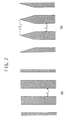
- Fig. 3 schematically illustrates the behavior of surfactant molecules relative to the pore surface of a hydrophilic porous glass membrane.
- a porous glass membrane having a negatively charged glass surface 7 is used and an anionic surfactant (8) is dissolved in the continuous phase liquid (aqueous phase), the glass surface 7 will not be wetted with the dispersed phase-forming liquid (oily phase) invading into the pores, whereby monodisperse o/w type single emulsions can be produced.
- a cationic surfactant 9 when a cationic surfactant 9 is dissolved in the continuous phase liquid (aqueous phase), as shown in Fig. 3 (b), the cationic surfactant 9 is electrostatically adsorbed on the negatively charged glass surface 7 and the hydrophobic group of the cationic surfactant 9 is oriented toward the liquid phase side. As a result, the glass surface exhibits hydrophobicity and is wetted with the dispersed phase-forming oily liquid, so that any monodisperse emulsion cannot be produced.
- the method of the invention makes it possible to produce monodisperse emulsions with the surfactant concentration being as low as about one thirtieth to one tenth the critical micelle concentration. This is because the surfactant is required only in small amounts for the stabilization of emulsion particles since the emulsion particles are uniform in size.
- anionic surfactant, nonionic surfactant and dispersing agent to be added to the aqueous continuous phase liquid are not limited to any particular species if they are soluble in the aqueous continuous phase liquid. As examples, the following may be mentioned.
- the porous glass membrane is rendered hydrophobic by surface treatment, and the same oil-soluble surfactant as mentioned above is dissolved in the continuous phase liquid (oily phase) in an amount of about 0.1 to 10% by weight, preferably about 0.5 to 2% by weight.
- the continuous phase-forming liquid is not particularly limited and may include, organic solvents, petroleum-derived oils, and animal and vegetable oils.
- a water-soluble substance may be added to the dispersed phase-forming liquid (aqueous phase).
- the water-soluble substance is not particularly limited and may include inorganic salts, organic salts, saccharides and macromolecular substances.
- the water-soluble substance is added in an amount within the range of 0.05% by weight based on the dispersed phase-forming liquid to saturation, preferably 0.5% on the same basis to saturation.
- double emulsions can be obtained by introducing under pressure a w/o type single emulsion prepared in advance into a continuous phase liquid (aqueous phase) through a hydrophilic porous glass membrane. It is important that the pore size of the porous glass membrane is at least equal to, preferably at least about 1.5 times, the maximum particle size that the single emulsion shows. If the pore size of the porous glass membrane is less than the maximum single emulsion particle size, filtration of single emulsion particles will occur through the porous glass membrane.
- the single emulsion particles adjusted to a particle concentration of about 1 to 70% pass through the membrane without meeting any resistance within the pores to form a double emulsion.
- the size of emulsion particles in said double emulsion can be controlled within the range of 0.3 to 40 ⁇ m, as in the case of single emulsions.
- an o/w type single emulsion prepared in advance is introduced under pressure into a continuous phase liquid (oily phase) through a porous glass membrane rendered hydrophobic by preliminary surface treatment.
- a continuous phase liquid oil (oily phase)
- a porous glass membrane rendered hydrophobic by preliminary surface treatment.
- FIG. 4 An apparatus for carrying out the method of the invention is shown by way of example in Fig. 4.
- the construction and operation of this apparatus may be summarized as follows.
- a cylindrical porous glass membrane 10 is fixed inside a module 11.
- a dispersed phase-forming liquid stored in a tank 12 is caused under pressure, namely by high pressure nitrogen gas from a cylinder 13, to fill a line 14, the outer side of the cylindrical porous glass membrane 10 in the module 11, and a line 16 fitted with a pressure gage 15.
- a valve 17 is then closed, so that a pressure below the critical pressure is applied to the dispersed phase-forming liquid.
- a continuous phase-forming liquid is circulated from a tank 18 containing the same through a pump 19, a line 20, the internal side of the cylindrical porous glass membrane 10 in the module 11, and a line 22 fitted with a pressure gage 21, to said tank.
- the pressure on the dispersed phase-forming liquid is then increased to a level of or above the critical pressure to thereby cause the dispersed phase-forming liquid to pass through the pores of the porous glass membrane 10 and form emulsion particles.
- the apparatus is continuingly operated until a desired dispersed phase concentration is attained. Monodisperse single emulsions are prepared in this way.
- the apparatus shown in Fig. 4 can be used also for the production of double emulsions.
- a w/o/w type emulsion prepared in advance is charged into the tank 12, while a continuous phase liquid (aqueous phase) is charged into the tank 18.
- a continuous phase liquid aqueous phase
- the same operation as mentioned above is performed to introduce the w/o type emulsion into the continuous phase liquid through the hydrophilic porous glass membrane 10 fixed inside the module 11, to give a w/o/w type emulsion.
- FIG. 5 An example of the module to be used in the practice of the invention is schematically shown in section in Fig. 5.
- a cylindrical porous glass membrane 27 alone is shown by appearance, not in section.
- This module is composed of a tightening cap 23, a housing 24, a spacer 25, an O ring 26 and the cylindrical porous glass membrane 27.
- a dispersed phase-forming liquid fed through an inlet 28 is introduced under pressure from the outside of the cylindrical porous glass membrane 27 into a continuous phase liquid flowing in the inside of said membrane.
- emulsion particles uniform in particle size can be obtained and, in addition, the particle size can be controlled as desired.
- the emulsions provided by the invention and comprising particles uniform in size contribute to markedly improve the performance characteristics of various materials produced by using said emulsions.
- the emulsions markedly improve the quality of solid particles obtained therefrom.
- the invention is very useful in the production of various materials which require emulsification treatment for their production, for example in the production of foods, medicines, cosmetics, pigments, functional plastic particles, functional inorganic material particles, raw materials for fine ceramics and so forth as well as in solvent extraction.
- Example 15 Using the same porous glass membrane as used in Example 1 having a pore size of 0.56 ⁇ m, the state of charging in water (zeta potential) was examined at various pH levels. The results are as shown in Fig. 15.
- the untreated hydrophilic porous glass membrane had a negative charge of -15 to -35 mV within the pH range of 2 to 8 [cf. curve (b)].
- hydrophilic porous glass membrane treated with 2-aminoethylaminopropyltriethoxysilane showed a positive charge of +20 to +55 mV [cf. curve (a)].
Landscapes
- Chemical & Material Sciences (AREA)
- Chemical Kinetics & Catalysis (AREA)
- Colloid Chemistry (AREA)
Claims (7)
- Monodisperse einfache Emulsion vom o/w-Typ, dadurch gekennzeichnet, daß(a) die mittlere Teilchengröße der Emulsionsteilchen im Bereich von 0,3 bis 40 µm liegt;(b) der Gehalt an kleineren Teilchen mit einer Größe von weniger als 50% der mittleren Teilchengröße 1% oder geringer ist;(c) die Emulsion gemäß einem in einem der Ansprüche 4 - 6 definierten Verfahren hergestellt ist; und(d) der Koeffizient der Teilchengrößenverteilung 0,3 oder geringer ist (wenn die Teilchengrößenmessung unter Verwendung einer Teilchengrößenverteilungs-Meßvorrichtung vom Zentrifugalsedimentationstyp durchgeführt wird) oder 0,55 bis 0,6 oder geringer (wenn die Teilchengrößenmessung unter Verwendung einer Größenverteilungs-Meßvorrichtung vom Laserdiffraktionstyp durchgeführt wird).
- Doppelte Emulsion vom w/o/w-Typ, dadurch gekennzeichnet, daß(a) die mittlere Teilchengröße der Emulsionsteilchen im Bereich von 0,3 bis 40 µm liegt;(b) die Teilchenkonzentration der inneren Phase auf ein im wesentlichen konstantes Niveau im Bereich von 1 bis 70% reguliert wird; und(c) die Emulsion hergestellt wird, indem unter Druck eine monodisperse einfache Emulsion vom w/o-Typ durch eine hydrophile poröse Glasmembran mit einer mittleren Porengröße im Bereich von 0,1 bis 5 µm und mit der Größe von nicht weniger als der maximalen Teilchengröße der einfachen Emulsion bei einem Druck von mehr als dem kritischen Druck bis zum 10-fachen in eine kontinuierliche Phasenflüssigkeit eingebracht wird.
- Doppelte Emulsion vom o/w/o-Typ, dadurch gekennzeichnet, daß(a) die mittlere Teilchengröße der Emulsionsteilchen im Bereich von 0,3 bis 40 µm liegt;(b) die Teilchenkonzentration der inneren Phase auf ein im wesentlichen konstantes Niveau im Bereich von 1 bis 70% reguliert wird; und(c) die Emulsion hergestellt wird, indem unter Druck eine wie in Anspruch 1 definierte einfache Emulsion vom o/w-Typ durch eine hydrophile poröse Glasmembran mit einer mittleren Porengröße im Bereich von 0,1 bis 5 µm und mit der Größe von nicht weniger als der maximalen Teilchengröße der einfachen Emulsion bei einem Druck von mehr als dem kritischen Druck bis zum 10-fachen in eine kontinuierliche Phasenflüssigkeit (ölige Phase) eingebracht wird.
- Verfahren zur Herstellung einer wie in Anspruch 1 definierten monodispersen einfachen Emulsion vom o/w-Typ, welches das Einbringen unter Druck einer dispergierten phasenbildenden öligen Flüssigkeit durch eine hydrophile poröse Glasmembran, welche durch eine Oberflächenbehandlung positiv geladen ist und eine mittlere Porengröße im Bereich von 0,1 bis 5 µm besitzt, bei einem Druck von mehr als dem kritischen Druck bis zum 10-fachen in eine wäßrige kontinuierliche Phasenflüssigkeit, welche ein kationisches Tensid in einer Konzentration von 1/30 bis 1/10 der kritischen Mizellenkonzentration enthält, umfaßt.
- Verfahren zur Herstellung einer wie in Anspruch 1 definierten monodispersen einfachen Emulsion vom o/w-Typ, welches das Einbringen unter Druck einer dispergierten phasenbildenden öligen Flüssigkeit durch eine hydrophile poröse Glasmembran, welche durch eine Oberflächenbehandlung negativ geladen ist und eine mittlere Porengröße im Bereich von 0,1 bis 5 µm besitzt, bei einem Druck von mehr als dem kritischen Druck bis zum 10-fachen in eine wäßrige kontinuierliche Phasenflüssigkeit, welche ein anionisches Tensid und/oder ein nichtionisches Tensid und/oder ein Dispersionsmittel in einer Konzentration von 1/30 bis 1/10 der kritischen Mizellenkonzentration enthält, umfaßt.
- Verfahren zur Herstellung einer wie in Anspruch 1 definierten monodispersen einfachen Emulsion vom o/w-Typ, welches das Einbringen unter Druck einer dispergierten phasenbildenden öligen Flüssigkeit, welche 0,1 bis 10 Gew.-% eines öllöslichen Tensids enthält, durch eine hydrophile poröse Glasmembran, welche durch eine Oberflächenbehandlung negativ geladen ist und eine mittlere Porengröße im Bereich von 0,1 bis 5 µm besitzt, bei einem Druck von mehr als dem kritischen Druck bis zum 10-fachen in eine wäßrige kontinuierliche Phasenflüssigkeit, welche ein anionisches Tensid und/oder ein nichtionisches Tensid und/oder ein Dispersionsstabilisierungsmittel in einer Konzentration von 1/30 bis 1/10 der kritischen Mizellenkonzentration enthält, umfaßt.
- Verfahren zur Herstellung einer monodispersen einfachen Emulsion vom w/o-Typ, welches das Einbringen unter Druck einer dispergierten phasenbildenden wäßrigen Flüssigkeit durch eine poröse Glasmembran, welche durch eine Oberflächenbehandlung hydrophob gemacht wurde und eine mittlere Porengröße im Bereich von 0,1 bis 5 µm besitzt, bei einem Druck von mehr als dem kritischen Druck bis zum 10-fachen in eine ölige kontinuierliche Phasenflüssigkeit, welche 0,1 bis 10 Gew.-% eines öllöslichen Tensids enthält, umfaßt.
Applications Claiming Priority (2)
| Application Number | Priority Date | Filing Date | Title |
|---|---|---|---|
| PCT/JP1991/000882 WO1993000156A1 (fr) | 1991-06-29 | 1991-06-29 | Emulsions monodispersees simples et doubles et procede de production |
| US07/906,282 US5326484A (en) | 1991-06-29 | 1992-06-29 | Monodisperse single and double emulsions and method of producing same |
Publications (3)
| Publication Number | Publication Date |
|---|---|
| EP0546174A1 EP0546174A1 (de) | 1993-06-16 |
| EP0546174A4 EP0546174A4 (en) | 1993-09-15 |
| EP0546174B1 true EP0546174B1 (de) | 1997-10-29 |
Family
ID=25422192
Family Applications (1)
| Application Number | Title | Priority Date | Filing Date |
|---|---|---|---|
| EP91911947A Expired - Lifetime EP0546174B1 (de) | 1991-06-29 | 1991-06-29 | Monozerstreute einfache und doppelte emulsionen und herstellungsverfahren |
Country Status (2)
| Country | Link |
|---|---|
| EP (1) | EP0546174B1 (de) |
| JP (1) | JP2733729B2 (de) |
Cited By (1)
| Publication number | Priority date | Publication date | Assignee | Title |
|---|---|---|---|---|
| RU2108852C1 (ru) * | 1995-10-23 | 1998-04-20 | Научно-производственное предприятие "Экоспектр" | Способ получения устойчивых высококонцентрированных эмульсий "вода в масле" |
Families Citing this family (41)
| Publication number | Priority date | Publication date | Assignee | Title |
|---|---|---|---|---|
| GB9414318D0 (en) * | 1994-07-15 | 1994-09-07 | Dowelanco Ltd | Preparation of aqueous emulsions |
| JP2975943B2 (ja) * | 1996-02-20 | 1999-11-10 | 農林水産省食品総合研究所長 | エマルションの製造方法及びエマルションの製造装置 |
| GB9606738D0 (en) * | 1996-03-29 | 1996-06-05 | Disperse Tech Ltd | Dispersion of immiscible phases |
| JP3081880B2 (ja) | 1998-03-30 | 2000-08-28 | 農林水産省食品総合研究所長 | マイクロスフィアの連続製造装置 |
| FR2784310B1 (fr) * | 1998-10-08 | 2000-11-10 | Oreal | Emulsion huile-dans-eau stable, son procede de fabrication et son utilisation dans les domaines cosmetique et dermatologique |
| FR2808703B1 (fr) * | 2000-05-09 | 2002-08-02 | Centre Nat Rech Scient | Procede de preparation d'une emulsion double monodisperse |
| JP3511238B2 (ja) | 2000-10-13 | 2004-03-29 | 独立行政法人食品総合研究所 | マイクロスフィアの製造方法および製造装置 |
| JP4659253B2 (ja) * | 2001-03-30 | 2011-03-30 | サンスター株式会社 | エマルション組成物の製造方法 |
| EP1412418A1 (de) * | 2001-08-03 | 2004-04-28 | Akzo Nobel N.V. | Verfahren zur herstellung von dispersionen |
| JP4038585B2 (ja) * | 2002-06-03 | 2008-01-30 | 宮崎県 | 固体脂マイクロカプセルおよびその製造方法 |
| DE10351644A1 (de) * | 2003-11-05 | 2005-06-09 | Bayer Technology Services Gmbh | Verfahren zur Herstellung von lagerstabilen multiplen Emulsionen |
| JP5079977B2 (ja) * | 2004-09-16 | 2012-11-21 | 大日本塗料株式会社 | 単分散粒子の製造方法 |
| JP4616602B2 (ja) * | 2004-09-16 | 2011-01-19 | 大日本塗料株式会社 | 単分散粒子の製造方法 |
| US7968287B2 (en) | 2004-10-08 | 2011-06-28 | Medical Research Council Harvard University | In vitro evolution in microfluidic systems |
| JP4580801B2 (ja) | 2005-03-29 | 2010-11-17 | 株式会社東芝 | 複合型微粒子の製造方法及び複合型微粒子の製造装置 |
| JP2007106975A (ja) * | 2005-10-11 | 2007-04-26 | Spg Trading Kk | Spg(シラス多孔質ガラス)エマルジョン燃料製造装置 |
| WO2007081385A2 (en) | 2006-01-11 | 2007-07-19 | Raindance Technologies, Inc. | Microfluidic devices and methods of use in the formation and control of nanoreactors |
| JP4713397B2 (ja) | 2006-01-18 | 2011-06-29 | 株式会社リコー | 微小流路構造体及び微小液滴生成システム |
| JP2007204382A (ja) * | 2006-01-31 | 2007-08-16 | Kyoto Univ | リポソームの製造方法 |
| EP2530167A1 (de) | 2006-05-11 | 2012-12-05 | Raindance Technologies, Inc. | Mikrofluidische Vorrichtungen |
| US9562837B2 (en) | 2006-05-11 | 2017-02-07 | Raindance Technologies, Inc. | Systems for handling microfludic droplets |
| WO2008062908A1 (en) | 2006-11-24 | 2008-05-29 | Canon Kabushiki Kaisha | Method for producing particles and particles |
| WO2008097559A2 (en) | 2007-02-06 | 2008-08-14 | Brandeis University | Manipulation of fluids and reactions in microfluidic systems |
| US8592221B2 (en) | 2007-04-19 | 2013-11-26 | Brandeis University | Manipulation of fluids, fluid components and reactions in microfluidic systems |
| EP3494964B1 (de) * | 2007-05-14 | 2021-04-07 | Konica Minolta Holdings, Inc. | Liposom und verfahren zur herstellung des liposoms |
| JP5103191B2 (ja) * | 2008-01-09 | 2012-12-19 | 日本たばこ産業株式会社 | 水中油型エマルジョンとその製造方法 |
| JP5091784B2 (ja) * | 2008-07-10 | 2012-12-05 | 積水化学工業株式会社 | エマルジョン製造装置、単分散微粒子製造装置並びにエマルジョンの製造方法、単分散微粒子の製造方法 |
| EP4047367A1 (de) | 2008-07-18 | 2022-08-24 | Bio-Rad Laboratories, Inc. | Verfahren zum nachweis von zielanalyten unter verwendung von tropfenbibliotheken |
| US12038438B2 (en) | 2008-07-18 | 2024-07-16 | Bio-Rad Laboratories, Inc. | Enzyme quantification |
| WO2010111231A1 (en) | 2009-03-23 | 2010-09-30 | Raindance Technologies, Inc. | Manipulation of microfluidic droplets |
| US20120225117A1 (en) * | 2009-11-20 | 2012-09-06 | Konica Minolta Holdings, Inc. | Process for production of w/o/w emulsion, process for production of liposome employing the process, and porous membrane for use in the processes |
| US9399797B2 (en) | 2010-02-12 | 2016-07-26 | Raindance Technologies, Inc. | Digital analyte analysis |
| EP4484577A3 (de) | 2010-02-12 | 2025-03-26 | Bio-Rad Laboratories, Inc. | Digitale analytanalyse |
| EP3412778A1 (de) | 2011-02-11 | 2018-12-12 | Raindance Technologies, Inc. | Verfahren zur bildung gemischter tröpfchen |
| WO2012112804A1 (en) | 2011-02-18 | 2012-08-23 | Raindance Technoligies, Inc. | Compositions and methods for molecular labeling |
| EP3216872B1 (de) | 2011-06-02 | 2020-04-01 | Bio-Rad Laboratories, Inc. | Enzymquantifizierung |
| US8658430B2 (en) | 2011-07-20 | 2014-02-25 | Raindance Technologies, Inc. | Manipulating droplet size |
| JP5415510B2 (ja) * | 2011-11-01 | 2014-02-12 | 日本たばこ産業株式会社 | 水中油型エマルジョンの製造方法 |
| US11901041B2 (en) | 2013-10-04 | 2024-02-13 | Bio-Rad Laboratories, Inc. | Digital analysis of nucleic acid modification |
| US9944977B2 (en) | 2013-12-12 | 2018-04-17 | Raindance Technologies, Inc. | Distinguishing rare variations in a nucleic acid sequence from a sample |
| US11052046B2 (en) * | 2017-09-26 | 2021-07-06 | Nanomi B.V. | Method for preparing micro-particles by double emulsion technique |
Family Cites Families (3)
| Publication number | Priority date | Publication date | Assignee | Title |
|---|---|---|---|---|
| JPH082416B2 (ja) * | 1988-09-29 | 1996-01-17 | 宮崎県 | エマルションの製造方法 |
| DE69132277T2 (de) * | 1990-04-11 | 2000-10-26 | Morinaga Milk Industry Co. Ltd., Tokio/Tokyo | Verfahren zur Herstellung einer Emulsion des Öl-in-Wasser-Typs |
| JP2555475B2 (ja) * | 1990-10-16 | 1996-11-20 | 工業技術院長 | 無機質微小球体の製造方法 |
-
1991
- 1991-06-29 EP EP91911947A patent/EP0546174B1/de not_active Expired - Lifetime
-
1992
- 1992-06-29 JP JP4211964A patent/JP2733729B2/ja not_active Expired - Fee Related
Cited By (1)
| Publication number | Priority date | Publication date | Assignee | Title |
|---|---|---|---|---|
| RU2108852C1 (ru) * | 1995-10-23 | 1998-04-20 | Научно-производственное предприятие "Экоспектр" | Способ получения устойчивых высококонцентрированных эмульсий "вода в масле" |
Also Published As
| Publication number | Publication date |
|---|---|
| JPH05220382A (ja) | 1993-08-31 |
| EP0546174A1 (de) | 1993-06-16 |
| EP0546174A4 (en) | 1993-09-15 |
| JP2733729B2 (ja) | 1998-03-30 |
Similar Documents
| Publication | Publication Date | Title |
|---|---|---|
| EP0546174B1 (de) | Monozerstreute einfache und doppelte emulsionen und herstellungsverfahren | |
| US5326484A (en) | Monodisperse single and double emulsions and method of producing same | |
| EP0481892B1 (de) | Verfahren zur Herstellung von feinkugeligen, gleichförmig grossen anorganischen Teilchen | |
| EP1727865B1 (de) | Partikelstabilisierte emulsionen | |
| Tadros | Industrial applications of dispersions | |
| Lindberg et al. | Preparation of silica particles utilizing the sol-gel and the emulsion-gel processes | |
| CA1273261A (en) | Preparation of emulsions | |
| Whitby et al. | Effect of oil soluble surfactant in emulsions stabilised by clay particles | |
| Sugiura et al. | Preparation characteristics of monodispersed water-in-oil emulsions using microchannel emulsification | |
| EP1789170B1 (de) | Rheologiesteuerung von pickering-emulsionen durch elektrolyte | |
| DE60304883T2 (de) | Verfahren und vorrichtung zur herstellung einer dispersion oder einer emulsion | |
| EP1560641B1 (de) | Verfahren zur herstellung von emulsionen | |
| US5071635A (en) | Method of preparing ceramic microspheres | |
| JP2004008837A (ja) | S/oサスペンション及びs/o/wエマルション並びにそれらの製造方法 | |
| Kobayashi et al. | Production of monodisperse water-in-oil emulsions consisting of highly uniform droplets using asymmetric straight-through microchannel arrays | |
| Schmitt et al. | Preparation of monodisperse particles and emulsions by controlled shear | |
| Lin | On the viscosity of emulsions | |
| DE102012014536B4 (de) | Sphärische, magnetisierbare Polyvinylalkohol-Mikropartikel, Verfahren für deren Herstellung sowie deren Verwendung | |
| Magdassi et al. | Chitin particles as O/W emulsion stabilizers | |
| Skodvin et al. | Dielectric spectroscopy on W/O emulsions under influence of shear forces | |
| KR102682604B1 (ko) | 계면활성제 혼합장치와 초음파를 이용한 고농도 초미세버블 생성장치 및 생성방법 | |
| Borkovec et al. | Stabilization of aqueous colloidal dispersions: electrostatic and steric forces | |
| Zhou et al. | Effect of surfactant-modified bulk micro-nanobubbles on quartz aggregation and particle-bubble attachment in flotation | |
| Kukizaki et al. | A comparative study of SPG membrane emulsification in the presence and absence of continuous-phase flow | |
| RU2087143C1 (ru) | Способ получения стабилизированной эмульгаторами эмульсии типа масло - вода |
Legal Events
| Date | Code | Title | Description |
|---|---|---|---|
| PUAI | Public reference made under article 153(3) epc to a published international application that has entered the european phase |
Free format text: ORIGINAL CODE: 0009012 |
|
| 17P | Request for examination filed |
Effective date: 19930215 |
|
| AK | Designated contracting states |
Kind code of ref document: A1 Designated state(s): DE FR GB NL |
|
| A4 | Supplementary search report drawn up and despatched |
Effective date: 19930727 |
|
| AK | Designated contracting states |
Kind code of ref document: A4 Designated state(s): DE FR GB NL |
|
| 17Q | First examination report despatched |
Effective date: 19940711 |
|
| GRAG | Despatch of communication of intention to grant |
Free format text: ORIGINAL CODE: EPIDOS AGRA |
|
| GRAH | Despatch of communication of intention to grant a patent |
Free format text: ORIGINAL CODE: EPIDOS IGRA |
|
| GRAH | Despatch of communication of intention to grant a patent |
Free format text: ORIGINAL CODE: EPIDOS IGRA |
|
| GRAA | (expected) grant |
Free format text: ORIGINAL CODE: 0009210 |
|
| AK | Designated contracting states |
Kind code of ref document: B1 Designated state(s): DE FR GB NL |
|
| REF | Corresponds to: |
Ref document number: 69128087 Country of ref document: DE Date of ref document: 19971204 |
|
| ET | Fr: translation filed | ||
| PLBE | No opposition filed within time limit |
Free format text: ORIGINAL CODE: 0009261 |
|
| STAA | Information on the status of an ep patent application or granted ep patent |
Free format text: STATUS: NO OPPOSITION FILED WITHIN TIME LIMIT |
|
| 26N | No opposition filed | ||
| REG | Reference to a national code |
Ref country code: GB Ref legal event code: IF02 |
|
| PGFP | Annual fee paid to national office [announced via postgrant information from national office to epo] |
Ref country code: FR Payment date: 20050609 Year of fee payment: 15 |
|
| PGFP | Annual fee paid to national office [announced via postgrant information from national office to epo] |
Ref country code: NL Payment date: 20050629 Year of fee payment: 15 Ref country code: GB Payment date: 20050629 Year of fee payment: 15 |
|
| PGFP | Annual fee paid to national office [announced via postgrant information from national office to epo] |
Ref country code: DE Payment date: 20050811 Year of fee payment: 15 |
|
| PG25 | Lapsed in a contracting state [announced via postgrant information from national office to epo] |
Ref country code: GB Free format text: LAPSE BECAUSE OF NON-PAYMENT OF DUE FEES Effective date: 20060629 |
|
| PG25 | Lapsed in a contracting state [announced via postgrant information from national office to epo] |
Ref country code: NL Free format text: LAPSE BECAUSE OF NON-PAYMENT OF DUE FEES Effective date: 20070101 |
|
| PG25 | Lapsed in a contracting state [announced via postgrant information from national office to epo] |
Ref country code: DE Free format text: LAPSE BECAUSE OF NON-PAYMENT OF DUE FEES Effective date: 20070103 |
|
| GBPC | Gb: european patent ceased through non-payment of renewal fee |
Effective date: 20060629 |
|
| NLV4 | Nl: lapsed or anulled due to non-payment of the annual fee |
Effective date: 20070101 |
|
| REG | Reference to a national code |
Ref country code: FR Ref legal event code: ST Effective date: 20070228 |
|
| PG25 | Lapsed in a contracting state [announced via postgrant information from national office to epo] |
Ref country code: FR Free format text: LAPSE BECAUSE OF NON-PAYMENT OF DUE FEES Effective date: 20060630 |