DE112019002827T5 - ORGANIC ELECTROLUMINESCENT JOINT AND THIS COMPREHENSIVE ORGANIC ELECTROLUMINESCENT DEVICE - Google Patents
ORGANIC ELECTROLUMINESCENT JOINT AND THIS COMPREHENSIVE ORGANIC ELECTROLUMINESCENT DEVICE Download PDFInfo
- Publication number
- DE112019002827T5 DE112019002827T5 DE112019002827.8T DE112019002827T DE112019002827T5 DE 112019002827 T5 DE112019002827 T5 DE 112019002827T5 DE 112019002827 T DE112019002827 T DE 112019002827T DE 112019002827 T5 DE112019002827 T5 DE 112019002827T5
- Authority
- DE
- Germany
- Prior art keywords
- substituted
- unsubstituted
- alkyl
- organic electroluminescent
- membered
- Prior art date
- Legal status (The legal status is an assumption and is not a legal conclusion. Google has not performed a legal analysis and makes no representation as to the accuracy of the status listed.)
- Pending
Links
- 0 *C1(*)C2=CCNC=C2c2ccccc12 Chemical compound *C1(*)C2=CCNC=C2c2ccccc12 0.000 description 31
- XKAUGDAMSDZOIX-UHFFFAOYSA-N C(C1)C2C=CC=CC2c2c1c1ccccc1[nH]2 Chemical compound C(C1)C2C=CC=CC2c2c1c1ccccc1[nH]2 XKAUGDAMSDZOIX-UHFFFAOYSA-N 0.000 description 1
- CKWRVTHNBWXQMF-MCZKDORBSA-N CCC[C@@H]([C@@H](C)C1=CC=CC1)/C=C\C(O)=C Chemical compound CCC[C@@H]([C@@H](C)C1=CC=CC1)/C=C\C(O)=C CKWRVTHNBWXQMF-MCZKDORBSA-N 0.000 description 1
Classifications
-
- C—CHEMISTRY; METALLURGY
- C09—DYES; PAINTS; POLISHES; NATURAL RESINS; ADHESIVES; COMPOSITIONS NOT OTHERWISE PROVIDED FOR; APPLICATIONS OF MATERIALS NOT OTHERWISE PROVIDED FOR
- C09K—MATERIALS FOR MISCELLANEOUS APPLICATIONS, NOT PROVIDED FOR ELSEWHERE
- C09K11/00—Luminescent materials, e.g. electroluminescent or chemiluminescent
- C09K11/06—Luminescent materials, e.g. electroluminescent or chemiluminescent containing organic luminescent materials
-
- C—CHEMISTRY; METALLURGY
- C07—ORGANIC CHEMISTRY
- C07D—HETEROCYCLIC COMPOUNDS
- C07D307/00—Heterocyclic compounds containing five-membered rings having one oxygen atom as the only ring hetero atom
- C07D307/77—Heterocyclic compounds containing five-membered rings having one oxygen atom as the only ring hetero atom ortho- or peri-condensed with carbocyclic rings or ring systems
- C07D307/91—Dibenzofurans; Hydrogenated dibenzofurans
-
- C—CHEMISTRY; METALLURGY
- C07—ORGANIC CHEMISTRY
- C07D—HETEROCYCLIC COMPOUNDS
- C07D307/00—Heterocyclic compounds containing five-membered rings having one oxygen atom as the only ring hetero atom
- C07D307/77—Heterocyclic compounds containing five-membered rings having one oxygen atom as the only ring hetero atom ortho- or peri-condensed with carbocyclic rings or ring systems
- C07D307/92—Naphthofurans; Hydrogenated naphthofurans
-
- C—CHEMISTRY; METALLURGY
- C07—ORGANIC CHEMISTRY
- C07D—HETEROCYCLIC COMPOUNDS
- C07D333/00—Heterocyclic compounds containing five-membered rings having one sulfur atom as the only ring hetero atom
- C07D333/50—Heterocyclic compounds containing five-membered rings having one sulfur atom as the only ring hetero atom condensed with carbocyclic rings or ring systems
- C07D333/76—Dibenzothiophenes
-
- C—CHEMISTRY; METALLURGY
- C07—ORGANIC CHEMISTRY
- C07D—HETEROCYCLIC COMPOUNDS
- C07D405/00—Heterocyclic compounds containing both one or more hetero rings having oxygen atoms as the only ring hetero atoms, and one or more rings having nitrogen as the only ring hetero atom
- C07D405/02—Heterocyclic compounds containing both one or more hetero rings having oxygen atoms as the only ring hetero atoms, and one or more rings having nitrogen as the only ring hetero atom containing two hetero rings
- C07D405/12—Heterocyclic compounds containing both one or more hetero rings having oxygen atoms as the only ring hetero atoms, and one or more rings having nitrogen as the only ring hetero atom containing two hetero rings linked by a chain containing hetero atoms as chain links
-
- C—CHEMISTRY; METALLURGY
- C07—ORGANIC CHEMISTRY
- C07D—HETEROCYCLIC COMPOUNDS
- C07D409/00—Heterocyclic compounds containing two or more hetero rings, at least one ring having sulfur atoms as the only ring hetero atoms
- C07D409/02—Heterocyclic compounds containing two or more hetero rings, at least one ring having sulfur atoms as the only ring hetero atoms containing two hetero rings
- C07D409/12—Heterocyclic compounds containing two or more hetero rings, at least one ring having sulfur atoms as the only ring hetero atoms containing two hetero rings linked by a chain containing hetero atoms as chain links
-
- H—ELECTRICITY
- H10—SEMICONDUCTOR DEVICES; ELECTRIC SOLID-STATE DEVICES NOT OTHERWISE PROVIDED FOR
- H10K—ORGANIC ELECTRIC SOLID-STATE DEVICES
- H10K50/00—Organic light-emitting devices
-
- H—ELECTRICITY
- H10—SEMICONDUCTOR DEVICES; ELECTRIC SOLID-STATE DEVICES NOT OTHERWISE PROVIDED FOR
- H10K—ORGANIC ELECTRIC SOLID-STATE DEVICES
- H10K85/00—Organic materials used in the body or electrodes of devices covered by this subclass
- H10K85/60—Organic compounds having low molecular weight
- H10K85/631—Amine compounds having at least two aryl rest on at least one amine-nitrogen atom, e.g. triphenylamine
- H10K85/636—Amine compounds having at least two aryl rest on at least one amine-nitrogen atom, e.g. triphenylamine comprising heteroaromatic hydrocarbons as substituents on the nitrogen atom
-
- H—ELECTRICITY
- H10—SEMICONDUCTOR DEVICES; ELECTRIC SOLID-STATE DEVICES NOT OTHERWISE PROVIDED FOR
- H10K—ORGANIC ELECTRIC SOLID-STATE DEVICES
- H10K85/00—Organic materials used in the body or electrodes of devices covered by this subclass
- H10K85/60—Organic compounds having low molecular weight
- H10K85/649—Aromatic compounds comprising a hetero atom
- H10K85/657—Polycyclic condensed heteroaromatic hydrocarbons
- H10K85/6572—Polycyclic condensed heteroaromatic hydrocarbons comprising only nitrogen in the heteroaromatic polycondensed ring system, e.g. phenanthroline or carbazole
-
- H—ELECTRICITY
- H10—SEMICONDUCTOR DEVICES; ELECTRIC SOLID-STATE DEVICES NOT OTHERWISE PROVIDED FOR
- H10K—ORGANIC ELECTRIC SOLID-STATE DEVICES
- H10K85/00—Organic materials used in the body or electrodes of devices covered by this subclass
- H10K85/60—Organic compounds having low molecular weight
- H10K85/649—Aromatic compounds comprising a hetero atom
- H10K85/657—Polycyclic condensed heteroaromatic hydrocarbons
- H10K85/6576—Polycyclic condensed heteroaromatic hydrocarbons comprising only sulfur in the heteroaromatic polycondensed ring system, e.g. benzothiophene
-
- C—CHEMISTRY; METALLURGY
- C09—DYES; PAINTS; POLISHES; NATURAL RESINS; ADHESIVES; COMPOSITIONS NOT OTHERWISE PROVIDED FOR; APPLICATIONS OF MATERIALS NOT OTHERWISE PROVIDED FOR
- C09K—MATERIALS FOR MISCELLANEOUS APPLICATIONS, NOT PROVIDED FOR ELSEWHERE
- C09K2211/00—Chemical nature of organic luminescent or tenebrescent compounds
- C09K2211/10—Non-macromolecular compounds
- C09K2211/1018—Heterocyclic compounds
- C09K2211/1022—Heterocyclic compounds bridged by heteroatoms, e.g. N, P, Si or B
-
- C—CHEMISTRY; METALLURGY
- C09—DYES; PAINTS; POLISHES; NATURAL RESINS; ADHESIVES; COMPOSITIONS NOT OTHERWISE PROVIDED FOR; APPLICATIONS OF MATERIALS NOT OTHERWISE PROVIDED FOR
- C09K—MATERIALS FOR MISCELLANEOUS APPLICATIONS, NOT PROVIDED FOR ELSEWHERE
- C09K2211/00—Chemical nature of organic luminescent or tenebrescent compounds
- C09K2211/10—Non-macromolecular compounds
- C09K2211/1018—Heterocyclic compounds
- C09K2211/1025—Heterocyclic compounds characterised by ligands
- C09K2211/1029—Heterocyclic compounds characterised by ligands containing one nitrogen atom as the heteroatom
-
- C—CHEMISTRY; METALLURGY
- C09—DYES; PAINTS; POLISHES; NATURAL RESINS; ADHESIVES; COMPOSITIONS NOT OTHERWISE PROVIDED FOR; APPLICATIONS OF MATERIALS NOT OTHERWISE PROVIDED FOR
- C09K—MATERIALS FOR MISCELLANEOUS APPLICATIONS, NOT PROVIDED FOR ELSEWHERE
- C09K2211/00—Chemical nature of organic luminescent or tenebrescent compounds
- C09K2211/10—Non-macromolecular compounds
- C09K2211/1018—Heterocyclic compounds
- C09K2211/1025—Heterocyclic compounds characterised by ligands
- C09K2211/1044—Heterocyclic compounds characterised by ligands containing two nitrogen atoms as heteroatoms
- C09K2211/1051—Heterocyclic compounds characterised by ligands containing two nitrogen atoms as heteroatoms with sulfur
-
- C—CHEMISTRY; METALLURGY
- C09—DYES; PAINTS; POLISHES; NATURAL RESINS; ADHESIVES; COMPOSITIONS NOT OTHERWISE PROVIDED FOR; APPLICATIONS OF MATERIALS NOT OTHERWISE PROVIDED FOR
- C09K—MATERIALS FOR MISCELLANEOUS APPLICATIONS, NOT PROVIDED FOR ELSEWHERE
- C09K2211/00—Chemical nature of organic luminescent or tenebrescent compounds
- C09K2211/10—Non-macromolecular compounds
- C09K2211/1018—Heterocyclic compounds
- C09K2211/1025—Heterocyclic compounds characterised by ligands
- C09K2211/1088—Heterocyclic compounds characterised by ligands containing oxygen as the only heteroatom
-
- C—CHEMISTRY; METALLURGY
- C09—DYES; PAINTS; POLISHES; NATURAL RESINS; ADHESIVES; COMPOSITIONS NOT OTHERWISE PROVIDED FOR; APPLICATIONS OF MATERIALS NOT OTHERWISE PROVIDED FOR
- C09K—MATERIALS FOR MISCELLANEOUS APPLICATIONS, NOT PROVIDED FOR ELSEWHERE
- C09K2211/00—Chemical nature of organic luminescent or tenebrescent compounds
- C09K2211/10—Non-macromolecular compounds
- C09K2211/1018—Heterocyclic compounds
- C09K2211/1025—Heterocyclic compounds characterised by ligands
- C09K2211/1092—Heterocyclic compounds characterised by ligands containing sulfur as the only heteroatom
-
- H—ELECTRICITY
- H10—SEMICONDUCTOR DEVICES; ELECTRIC SOLID-STATE DEVICES NOT OTHERWISE PROVIDED FOR
- H10K—ORGANIC ELECTRIC SOLID-STATE DEVICES
- H10K50/00—Organic light-emitting devices
- H10K50/10—OLEDs or polymer light-emitting diodes [PLED]
- H10K50/14—Carrier transporting layers
- H10K50/15—Hole transporting layers
- H10K50/156—Hole transporting layers comprising a multilayered structure
Landscapes
- Chemical & Material Sciences (AREA)
- Organic Chemistry (AREA)
- Engineering & Computer Science (AREA)
- Materials Engineering (AREA)
- Physics & Mathematics (AREA)
- Spectroscopy & Molecular Physics (AREA)
- Optics & Photonics (AREA)
- Electroluminescent Light Sources (AREA)
- Furan Compounds (AREA)
- Plural Heterocyclic Compounds (AREA)
Abstract
Die vorliegende Offenbarung betrifft eine organische elektrolumineszierende Verbindung, die durch Formel 1 wiedergegeben wird, und eine diese umfassende organische elektrolumineszierende Vorrichtung. Durch Einbeziehung der organischen elektrolumineszierenden Verbindung gemäß der vorliegenden Offenbarung kann eine organische elektrolumineszierende Vorrichtung mit geringer Treiberspannung und/oder hoher Lichtausbeute und langer Lebensdauer im Vergleich zu der herkömmlichen organischen elektrolumineszierenden Vorrichtung bereitgestellt werden.The present disclosure relates to an organic electroluminescent compound represented by Formula 1 and an organic electroluminescent device comprising the same. By incorporating the organic electroluminescent compound according to the present disclosure, an organic electroluminescent device with low driving voltage and / or high luminous efficiency and long life can be provided as compared with the conventional organic electroluminescent device.
Description
Technisches GebietTechnical area
Die vorliegende Offenbarung betrifft eine organische elektrolumineszierende Verbindung und eine diese umfassende organische elektrolumineszierende Vorrichtung.The present disclosure relates to an organic electroluminescent compound and an organic electroluminescent device comprising the same.
Stand der TechnikState of the art
Die grün emittierende kleinmolekulare organische elektrolumineszierende Vorrichtung mit TPD/Alq3-Doppelschicht, die aus einer lichtemittierenden Schicht und einer Ladungstransportschicht besteht, wurde zuerst von Tang, et al., von Eastman Kodak im Jahre 1987 entwickelt. Danach sind die Studien an einer organischen elektrolumineszierenden Vorrichtung schnell kommerzialisiert worden. Eine organische elektrolumineszierende Vorrichtung (OLED) wandelt durch Anwenden von Elektrizität auf ein organisches elektrolumineszierendes Material elektrische Energie in Licht um und umfasst gemeinhin eine Anode, eine Kathode und eine zwischen den beiden Elektroden ausgebildete organische Schicht. Eine organische elektrolumineszierende Vorrichtung hat eine mehrschichtige Struktur mit einer Lochtransportzone, einer lichtemittierenden Schicht und einer Elektronentransportzone usw. zur Verbesserung ihrer Effizienz und Stabilität.
Außerdem wurden die Studien an den neuen Verbindungen, die die Leistungsfähigkeit der organischen elektrolumineszierenden Vorrichtung verbessern können, aktiv durchgeführt, da die Leistungsfähigkeit einer organischen elektrolumineszierenden Vorrichtung größtenteils von der in jeder Zone oder Schicht davon enthaltenden Verbindung abhängt. Beispielsweise wurden Kupferphthalocyanin (CuPc), 4,4'-Bis[N-(1-naphthyl)-N-phenylamino]biphenyl (NPB), N,N'-Diphenyl-N,N'-bis(3-methylphenyl)-(1,1'-biphenyl)-4,4'-diamin (TPD), 4,4',4"-Tris(3-methylphenylphenylamino)triphenylamin (MTDATA) usw. als in einer Lochtransportzone in einer organischen elektrolumineszierenden Vorrichtung enthaltene Verbindung verwendet. Eine organische elektrolumineszierende Vorrichtung, in der diese Materialien verwendet werden, weist jedoch Probleme hinsichtlich der Verringerung der Lichtausbeute und der Lebensdauer auf. Dies liegt daran, dass beim Betreiben einer organischen elektrolumineszierenden Vorrichtung unter hohem Strom eine thermische Spannung zwischen einer Anode und einer Lochinjektionsschicht auftritt, wodurch die Lebensdauer der Vorrichtung erheblich verringert wird. Da das in der Lochtransportzone verwendete organische Material eine sehr hohe Lochmobilität aufweist, gab es ferner insofern Probleme, als die Loch-Elektronen-Ladungsbalance gestört und die Quantenausbeute (cd/A) herabgesetzt wird. Daher sind neue Verbindungen erforderlich, die die in einer Lochtransportzone verwendete herkömmliche Verbindung ersetzen können. Außerdem wurden die Untersuchungen an verschiedenen Materialien und Vorrichtungen zur Verbesserung der Lichtausbeute, der Treiberspannung und/oder der Lebensdauereigenschaften der organischen elektrolumineszierenden Vorrichtung durchgeführt.
Die
In addition, since the performance of an organic electroluminescent device largely depends on the compound contained in each zone or layer thereof, the studies on the new compounds which can improve the performance of the organic electroluminescent device have been actively carried out. For example, copper phthalocyanine (CuPc), 4,4'-bis [N- (1-naphthyl) -N-phenylamino] biphenyl (NPB), N, N'-diphenyl-N, N'-bis (3-methylphenyl) - (1,1'-biphenyl) -4,4'-diamine (TPD), 4,4 ', 4 "-Tris (3-methylphenylphenylamino) triphenylamine (MTDATA), etc. as a compound contained in a hole transport zone in an organic electroluminescent device However, an organic electroluminescent device using these materials has problems of lowering luminous efficiency and durability, because when an organic electroluminescent device is operated under high current, a thermal voltage is generated between an anode and a hole injection layer Furthermore, since the organic material used in the hole transport zone has a very high hole mobility, there have been problems in that the hole-electron charge balance is disturbed rt and the quantum yield (cd / A) is reduced. Therefore, new connections are required which can replace the conventional connection used in a hole transport zone. In addition, the investigations were carried out on various materials and devices for improving the luminous efficiency, the driving voltage and / or the service life properties of the organic electroluminescent device.
The
Offenbarung der ErfindungDisclosure of the invention
Technische AufgabeTechnical task
Die Aufgabe der vorliegenden Offenbarung ist die Bereitstellung einer organischen elektrolumineszierenden Verbindung zur Herstellung einer organischen elektrolumineszierenden Vorrichtung mit geringer Treiberspannung und/oder hoher Leuchtdichte und/oder langer Lebensdauer.The object of the present disclosure is to provide an organic electroluminescent compound for producing an organic electroluminescent device with a low drive voltage and / or high luminance and / or a long service life.
Lösung der AufgabeSolution of the task
Im Zuge der vorliegenden Erfindung wurde gefunden, dass die obige Aufgabe durch die durch die folgende Formel 1 wiedergegebene organische elektrolumineszierende Verbindung gelöst werden kann, die im Vergleich zu der in der 
Dabei gilt, dass in Formel 1
X für O oder S steht;
Ar1 bis Ar4 jeweils unabhängig für Wasserstoff, Deuterium, ein substituiertes oder unsubstituiertes (C1-C30)-Alkyl, ein substituiertes oder unsubstituiertes (C6-C30)-Aryl, ein substituiertes oder unsubstituiertes (3- bis 30-gliedriges) Heteroaryl, ein substituiertes oder unsubstituiertes Mono- oder Di-(C1-C30)-alkylamino, ein substituiertes oder unsubstituiertes Mono- oder Di-(C6-C30)-arylamino oder ein substituiertes oder unsubstituiertes (C1-C30)-Alkyl-(C6-C30)-arylamino stehen oder Ar1 und Ar2 und Ar3 und Ar4 miteinander zu einem Ring verknüpft sein können;
L1 und L2 jeweils unabhängig für eine Einfachbindung, ein substituiertes oder unsubstituiertes (C6-C30)-Arylen oder ein substituiertes oder unsubstituiertes (3- bis 30-gliedriges) Heteroarylen stehen;
R1 und R2 jeweils unabhängig für Wasserstoff, Deuterium, Halogen, Cyano, ein substituiertes oder unsubstituiertes (C1-C30)-Alkyl, ein substituiertes oder unsubstituiertes (C6-C30)-Aryl, ein substituiertes oder unsubstituiertes (3- bis 30-gliedriges) Heteroaryl, ein substituiertes oder unsubstituiertes (C3-C30)-Cycloalkyl, ein substituiertes oder unsubstituiertes (C1-C30)-Alkoxy, ein substituiertes oder unsubstituiertes Tri-(C1-C30)-alkylsilyl, ein substituiertes oder unsubstituiertes Di-(C1-C30)-alkyl-(C6-C30)-arylsilyl, ein substituiertes oder unsubstituiertes (C1-C30)-Alkyldi-(C6-C30)-arylsilyl, ein substituiertes oder unsubstituiertes Tri-(C6-C30)-arylsilyl oder ein substituiertes oder unsubstituiertes (C1-C30)-Alkyl-(C6-C30)-arylamino stehen;
a für eine ganze Zahl von 1 bis 4 steht, b für eine ganze Zahl von 1 bis 5 steht und dann, wenn a und b für 2 oder mehr stehen, jedes von R1 und jedes von R2 gleich oder verschieden sein kann; und
p und q jeweils unabhängig für 0 oder 1 stehen, mit der Maßgabe, dass die Summe von p und q gleich 1 oder 2 ist, und dann, wenn die Summe von p und q gleich 2 ist, L1 und L2 und Ar1 bis Ar4 gleich oder verschieden sein können.It applies that in Formula 1
X represents O or S;
Ar 1 to Ar 4 each independently represent hydrogen, deuterium, a substituted or unsubstituted (C1-C30) -alkyl, a substituted or unsubstituted (C6-C30) -aryl, a substituted or unsubstituted (3- to 30-membered) heteroaryl, a substituted or unsubstituted mono- or di- (C1-C30) -alkylamino, a substituted or unsubstituted mono- or di- (C6-C30) -arylamino or a substituted or unsubstituted (C1-C30) -alkyl- (C6-C30 ) -arylamino or Ar 1 and Ar 2 and Ar 3 and Ar 4 can be linked to one another to form a ring;
L 1 and L 2 each independently represent a single bond, a substituted or unsubstituted (C6-C30) arylene, or a substituted or unsubstituted (3- to 30-membered) heteroarylene;
R 1 and R 2 each independently represent hydrogen, deuterium, halogen, cyano, a substituted or unsubstituted (C1-C30) -alkyl, a substituted or unsubstituted (C6-C30) -aryl, a substituted or unsubstituted (3- to 30- membered) heteroaryl, a substituted or unsubstituted (C3-C30) -cycloalkyl, a substituted or unsubstituted (C1-C30) -alkoxy, a substituted or unsubstituted tri- (C1-C30) -alkylsilyl, a substituted or unsubstituted di- (C1 -C30) -alkyl- (C6-C30) -arylsilyl, a substituted or unsubstituted (C1-C30) -alkyldi (C6-C30) -arylsilyl, a substituted or unsubstituted tri- (C6-C30) -arylsilyl or a substituted one or unsubstituted (C1-C30) -alkyl- (C6-C30) -arylamino;
a is an integer from 1 to 4, b is an integer from 1 to 5 and when a and b are 2 or more, each of R 1 and each of R 2 may be the same or different; and
p and q each independently represent 0 or 1, provided that the sum of p and q is 1 or 2, and when the sum of p and q is 2, L 1 and L 2 and Ar 1 to Ar 4 can be the same or different.
Vorteilhafte Effekte der ErfindungAdvantageous Effects of the Invention
Die organische elektrolumineszierende Verbindung gemäß der vorliegenden Offenbarung kann eine organische elektrolumineszierende Vorrichtung mit geringer Treiberspannung, hoher Lichtausbeute und/oder langer Lebensdauer bereitstellen.The organic electroluminescent compound according to the present disclosure can provide an organic electroluminescent device with low driving voltage, high luminous efficiency, and / or long life.
Ausführungsform der ErfindungEmbodiment of the invention
Im Folgenden wird die vorliegende Offenbarung ausführlich beschrieben. Die folgende Beschreibung soll jedoch die Erfindung erläutern und den Schutzbereich der Erfindung in keiner Weise einschränken.The following describes the present disclosure in detail. However, the following description is intended to illustrate the invention and in no way limit the scope of the invention.
Ber Begriff „organische elektrolumineszierende Verbindung“ bedeutet in der vorliegenden Offenbarung eine Verbindung, die in einer organischen elektrolumineszierenden Vorrichtung verwendet werden kann und je nach Bedarf in einer beliebigen Materialschicht, aus der eine organische elektrolumineszierende Vorrichtung aufgebaut ist, enthalten sein kann.The term “organic electroluminescent compound” in the present disclosure means a compound that can be used in an organic electroluminescent device and, as required, can be contained in any material layer from which an organic electroluminescent device is constructed.
Der Begriff „organisches elektrolumineszierendes Material“ bedeutet in der vorliegenden Offenbarung ein Material, das in einer organischen elektrolumineszierenden Vorrichtung verwendet werden kann und mindestens eine Verbindung umfassen kann. Das organische elektrolumineszierende Material kann je nach Bedarf in einer beliebigen Schicht, aus der eine organische elektrolumineszierende Vorrichtung aufgebaut ist, enthalten sein. Beispielsweise kann es sich bei dem organischen elektrolumineszierenden Material um ein Lochinjektionsmaterial, ein Lochtransportmaterial, ein Lochhilfsmaterial, ein lichtemittierendes Hilfsmaterial, ein Elektronenblockiermaterial, ein lichtemittierendes Material, ein Elektronenpuffermaterial, ein Lochblockiermaterial, ein Elektronentransportmaterial oder ein Elektroneninjektionsmaterial usw. handeln.The term “organic electroluminescent material” in the present disclosure means a material which can be used in an organic electroluminescent device and which can comprise at least one compound. The organic electroluminescent material can depending on May be included in any layer that constitutes an organic electroluminescent device. For example, the organic electroluminescent material may be a hole injection material, a hole transport material, a hole auxiliary material, a light emitting auxiliary material, an electron blocking material, a light emitting material, an electron buffer material, a hole blocking material, an electron transport material or an electron injection material, etc.
Unter dem Begriff „eine Lochtransportzone“ ist eine Zone zu verstehen, in der sich Löcher zwischen der ersten Elektrode und der lichtemittierenden Schicht bewegen. Beispielsweise kann die Lochtransportzone eine Lochinjektionsschicht, eine Lochtransportschicht, eine Lochhilfsschicht, eine lichtemittierende Hilfsschicht und/oder eine Elektronenblockierschicht enthalten. Bei der Lochinjektionsschicht, der Lochtransportschicht, der Lochhilfsschicht, der lichtemittierenden Hilfsschicht und die Elektronenblockierschicht kann es sich jeweils um eine einzige Schicht oder mehrere Schichten, wobei zwei oder mehr Schichten gestapelt sind, handeln. Gemäß einer Ausführungsform enthält die Lochtransportzone eine erste Lochtransportschicht und eine zweite Lochtransportschicht. Die zweite Lochtransportschicht kann mindestens eine Schicht von mehreren Lochtransportschichten sein und enthält eine Lochhilfsschicht, eine lichtemittierende Hilfsschicht und/oder eine Elektronenblockierschicht. Ferner kann die Lochtransportschicht gemäß einer anderen Ausführungsform eine erste Lochtransportschicht und eine zweite Lochtransportschicht enthalten. Die erste Lochtransportschicht kann zwischen der ersten Elektrode und der lichtemittierenden Schicht angeordnet sein, und die zweite Lochtransportschicht kann zwischen der ersten Lochtransportschicht und der lichtemittierenden Schicht angeordnet sein. Die zweite Lochtransportschicht kann eine Rolle einer Lochtransportschicht, einer lichtemittierenden Hilfsschicht, einer Lochhilfsschicht und/oder einer Elektronenblockierschicht sein.The term “a hole transport zone” is to be understood as a zone in which holes move between the first electrode and the light-emitting layer. For example, the hole transport zone can contain a hole injection layer, a hole transport layer, an auxiliary hole layer, a light-emitting auxiliary layer and / or an electron blocking layer. The hole injection layer, the hole transport layer, the hole auxiliary layer, the light-emitting auxiliary layer and the electron blocking layer can each be a single layer or a plurality of layers, with two or more layers being stacked. According to one embodiment, the hole transport zone contains a first hole transport layer and a second hole transport layer. The second hole transport layer can be at least one layer of a plurality of hole transport layers and contains a hole auxiliary layer, a light-emitting auxiliary layer and / or an electron blocking layer. Furthermore, according to another embodiment, the hole transport layer can contain a first hole transport layer and a second hole transport layer. The first hole transport layer can be arranged between the first electrode and the light emitting layer, and the second hole transport layer can be arranged between the first hole transport layer and the light emitting layer. The second hole transport layer can be a role of a hole transport layer, an auxiliary light-emitting layer, an auxiliary hole layer and / or an electron blocking layer.
Die Lochtransportschicht kann zwischen der Anode (oder Lochinjektionsschicht) und einer lichtemittierenden Schicht angeordnet sein und dazu dienen, die von der Anode auf die lichtemittierende Schicht übertragenen Löcher glatt zu bewegen und die von der Kathode übertragenen Elektronen zu blockieren, so dass sie in der lichtemittierenden Schicht bleiben. Die lichtemittierende Hilfsschicht kann zwischen der Anode und der lichtemittierenden Schicht oder zwischen der Kathode und der lichtemittierenden Schicht angeordnet sein. Bei Anordnung der lichtemittierenden Hilfsschicht zwischen der Anode und der lichtemittierenden Schicht kann sie zur Förderung der Lochinjektion und/oder des Lochtransports oder zur Verhinderung des Überfließens von Elektroden verwendet werden. Bei Anordnung der lichtemittierenden Hilfsschicht zwischen der Kathode und der lichtemittierenden Schicht kann sie zur Förderung der Elektroneninjektion und/oder des Elektronentransports oder zur Verhinderung des Überfließens von Löchern verwendet werden. Außerdem kann die Lochhilfsschicht zwischen der Lochtransportschicht (oder Lochinjektionsschicht) und der lichtemittierenden Schicht angeordnet sein und die Lochtransportrate (oder die Lochinjektionsrate) fördern oder blockieren, wodurch die Ladungsbalance gesteuert werden kann.The hole transport layer can be arranged between the anode (or hole injection layer) and a light emitting layer and serve to move the holes transferred from the anode to the light emitting layer smoothly and to block the electrons transferred from the cathode so that they are in the light emitting layer stay. The light-emitting auxiliary layer can be arranged between the anode and the light-emitting layer or between the cathode and the light-emitting layer. When the auxiliary light-emitting layer is arranged between the anode and the light-emitting layer, it can be used to promote hole injection and / or hole transport or to prevent electrodes from overflowing. When the auxiliary light-emitting layer is arranged between the cathode and the light-emitting layer, it can be used to promote electron injection and / or electron transport or to prevent holes from overflowing. In addition, the hole auxiliary layer may be disposed between the hole transport layer (or hole injection layer) and the light emitting layer and promote or block the hole transport rate (or the hole injection rate), whereby the charge balance can be controlled.
Außerdem kann die Elektronenblockierschicht zwischen der Lochtransportschicht (oder Lochinjektionsschicht) und der lichtemittierenden Schicht angeordnet sein und die Exzitonen in der lichtemittierenden Schicht durch Blockieren des Überfließens von Elektronen aus der lichtemittierenden Schicht beschränken, um eine Lichtemissionsleckage zu verhindern. Wenn die organische elektrolumineszierende Vorrichtung zwei oder mehr Lochtransportschichten enthält, kann die ferner enthaltene Lochtransportschicht für eine lichtemittierende Hilfsschicht, eine Lochhilfsschicht, eine Elektronenblockierschicht usw. verwendet werden. Die lichtemittierende Hilfsschicht, die Lochhilfsschicht und/oder die Elektronenblockierschicht können einen Effekt der Verbesserung der Lichtausbeute und/oder Lebensdauer der organischen elektrolumineszierenden Vorrichtung haben.In addition, the electron blocking layer may be disposed between the hole transport layer (or hole injection layer) and the light emitting layer, and restrict the excitons in the light emitting layer by blocking the overflow of electrons from the light emitting layer to prevent light emission leakage. When the organic electroluminescent device includes two or more hole transport layers, the hole transport layer further included can be used for an auxiliary light emitting layer, a hole auxiliary layer, an electron blocking layer, and so on. The auxiliary light-emitting layer, the auxiliary hole layer and / or the electron blocking layer can have an effect of improving the luminous efficiency and / or the service life of the organic electroluminescent device.
„(C1-C30)-Alkyl“ bedeutet hier ein lineares oder verzweigtes Alkyl mit 1 bis 30 Kohlenstoffatomen, aus denen die Kette aufgebaut ist, wobei die Zahl von Kohlenstoffatomen vorzugsweise 1 bis 20 und weiter bevorzugt 1 bis 10 beträgt. Das obige Alkyl kann Methyl, Ethyl, n-Propyl, Isopropyl, n-Butyl, Isobutyl, tert-Butyl usw. einschließen. „(C2-C30)-Alkenyl“ ist ein lineares oder verzweigtes Alkyl mit 1 bis 30 Kohlenstoffatomen, aus denen die Kette aufgebaut ist, wobei die Zahl von Kohlenstoffatomen vorzugsweise 2 bis 20 und weiter bevorzugt 2 bis 10 beträgt, und schließt Vinyl, 1-Propenyl, 2-Propenyl, 1-Butenyl, 2-Butenyl, 3-Butenyl, 2-Methylbut-2-enyl usw. ein. „(C2-C30)-Alkinyl“ ist ein lineares oder verzweigtes Alkinyl mit 2 bis 30 Kohlenstoffatomen, aus denen die Kette aufgebaut ist, wobei die Zahl von Kohlenstoffatomen vorzugsweise 2 bis 20 und weiter bevorzugt 2 bis 10 beträgt, und schließt Ethinyl, 1-Propinyl, 2-Propinyl, 1-Butinyl, 2-Butinyl, 3-Butinyl, 1-Methylpent-2-inyl usw. ein. „(C3-C30)-Cycloalkyl“ ist ein mono- oder polycyclischer Kohlenwasserstoff mit 3 bis 30 Ringgerüst-Kohlenstoffatomen, wobei die Zahl von Kohlenstoffatomen vorzugsweise 3 bis 20 und weiter bevorzugt 3 bis 7 beträgt. Das obige Cycloalkyl kann Cyclopropyl, Cyclobutyl, Cyclopentyl, Cyclohexyl usw. einschließen. „(3- bis 7-gliedriges) Heterocycloalkyl“ ist ein Cycloalkyl mit 3 bis 7 Ringgerüstatomen, wobei die Zahl der Ringgerüstatome vorzugsweise 5 bis 7 beträgt, und schließt mindestens ein Heteroatom aus der Gruppe bestehend aus B, N, O, S, Si und P, vorzugsweise O, S und N, ein. Das obige Heterocycloalkyl kann Tetrahydrofuran, Pyrrolidin, Thiolan, Tetrahydropyran usw. einschließen. „(C6-C30)-Aryl(en)“ ist ein monocyclischer oder anellierter Ringrest, der sich von einem aromatischen Kohlenwasserstoff mit 6 bis 30 Ringgerüst-Kohlenstoffatomen ableitet, wobei die Zahl der Ringgerüst-Kohlenstoffatome vorzugsweise 6 bis 20, weiter bevorzugt 6 bis 15 beträgt, teilweise gesättigt sein kann und eine Spirostruktur umfassen kann. Beispiele für das Aryl sind im Einzelnen Phenyl, Biphenyl, Terphenyl, Quaterphenyl, Naphthyl, Binaphthyl, Phenylnaphthyl, Naphthylphenyl, Fluorenyl, Phenylfluorenyl, Dimethylfluorenyl, Diphenylfluorenyl, Benzofluorenyl, Diphenylbenzofluorenyl, Dibenzofluorenyl, Phenanthrenyl, Benzophenanthrenyl, Phenylphenanthrenyl, Anthracenyl, Benzanthracenyl, Indenyl, Triphenylenyl, Pyrenyl, Tetracenyl, Perylenyl, Chrysenyl, Benzochrysenyl, Naphthacenyl, Fluoranthenyl, Benzofluoranthenyl, Tolyl, Xylyl, Mesityl, Cumenyl, Spiro[fluoren-fluoren]yl, Spiro[fluoren-benzofluoren]yl, Azulenyl, usw. Spezieller kann es sich bei dem Aryl um o-Tolyl, m-Tolyl, p-Tolyl, 2,3-Xylyl, 3,4-Xylyl, 2,5-Xylyl, Mesityl, o-Cumenyl, m-Cumenyl, p-Cumenyl, p-t-Butylphenyl, p-(2-Phenylpropyl)phenyl, 4'-Methylbiphenyl, 4"-t-Butyl-p-terphenyl-4-yl, o-Biphenyl, m-Biphenyl, p-Biphenyl, o-Terphenyl, m-Terphenyl-4-yl, m-Terphenyl-3-yl, m-Terphenyl-2-yl, p-Terphenyl-4-yl, p-Terphenyl-3-yl, p-Terphenyl-2-yl, m-Quaterphenyl, 1-Naphthyl, 2-Naphthyl, 1-Fluorenyl, 2-Fluorenyl, 3-Fluorenyl, 4-Fluorenyl, 9-Fluorenyl, 9,9-Dimethyl-1-fluorenyl, 9,9-Dimethyl-2-fluorenyl, 9,9-Dimethyl-3-fluorenyl, 9,9-Dimethyl-4-fluorenyl, 9,9-Diphenyl-1-fluorenyl, 9,9-Diphenyl-2-fluorenyl, 9,9-Diphenyl-3-fluorenyl, 9,9-Diphenyl-4-fluorenyl, 1-Anthryl, 2-Anthryl, 9-Anthryl, 1-Phenanthryl, 2-Phenanthryl, 3-Phenanthryl, 4-Phenanthryl, 9-Phenanthryl, 1-Chrysenyl, 2-Chrysenyl, 3-Chrysenyl, 4-Chrysenyl, 5-Chrysenyl, 6-Chrysenyl, Benzo[c]phenanthryl, Benzo[g]chrysenyl, 1-Triphenylenyl, 2-Triphenylenyl, 3-Triphenylenyl, 4-Triphenylenyl, 3-Fluoranthenyl, 4-Fluoranthenyl, 8-Fluoranthenyl, 9-Fluoranthenyl, Benzofluoranthenyl usw. handeln.“(C1-C30) -alkyl” here means a linear or branched alkyl having 1 to 30 carbon atoms from which the chain is built up, the number of carbon atoms preferably being 1 to 20 and more preferably 1 to 10. The above alkyl may include methyl, ethyl, n-propyl, isopropyl, n-butyl, isobutyl, tert-butyl, and so on. “(C2-C30) -alkenyl” is a linear or branched alkyl with 1 to 30 carbon atoms from which the chain is built up, the number of carbon atoms preferably being 2 to 20 and more preferably 2 to 10, and includes vinyl, 1 -Propenyl, 2-propenyl, 1-butenyl, 2-butenyl, 3-butenyl, 2-methylbut-2-enyl, etc. “(C2-C30) -alkynyl” is a linear or branched alkynyl with 2 to 30 carbon atoms, from which the chain is built up, the number of carbon atoms preferably being 2 to 20 and more preferably 2 to 10, and includes ethynyl, 1 Propynyl, 2-propynyl, 1-butynyl, 2-butynyl, 3-butynyl, 1-methylpent-2-ynyl, etc. “(C3-C30) -cycloalkyl” is a mono- or polycyclic hydrocarbon with 3 to 30 ring skeleton carbon atoms, the number of carbon atoms preferably being 3 to 20 and more preferably 3 to 7. The above cycloalkyl may include cyclopropyl, cyclobutyl, cyclopentyl, cyclohexyl and so on. “(3- to 7-membered) heterocycloalkyl” is a cycloalkyl with 3 to 7 ring skeleton atoms, the number of ring skeleton atoms preferably being 5 to 7, and includes at least one heteroatom from the group consisting of B, N, O, S, Si and P, preferably O, S and N. The above heterocycloalkyl may include tetrahydrofuran, pyrrolidine, thiolane, tetrahydropyran, and so on. “(C6-C30) -aryl (en)” is a monocyclic or fused ring radical which is derived from an aromatic hydrocarbon with 6 to 30 ring skeleton carbon atoms, the number of ring skeleton carbon atoms preferably 6 to 20, more preferably 6 to 15, can be partially saturated and can comprise a spiro structure. Examples of the aryl are in detail phenyl, biphenyl, terphenyl, quaterphenyl, naphthyl, binaphthyl, phenylnaphthyl, naphthylphenyl, fluorenyl, phenylfluorenyl, dimethylfluorenyl, diphenylfluorenyl, benzofluorenyl, diphenylbenzofluorenyl, benzofluorenyl, benzohenylbenzofluorenyl, phenylbenzofluorenyl, phenylbenzofluorenyl, phenylbenzofluorenyl, phenylbenzofluorenyl, phenylbenzofluorenyl, phenylbenzofluorenyl, phenylbenzofluorenyl, phenyl-benzofluorenyl, phenylnaphthyl, binaphthyl, phenylnaphthyl, binaphthyl, phenyl-benzofluorenyl, phenyl-benzofluorenyl, , Pyrenyl, tetracenyl, perylenyl, chrysenyl, benzochrysenyl, naphthacenyl, fluoranthenyl, benzofluoranthenyl, tolyl, xylyl, mesityl, cumenyl, spiro [fluoren-fluorene] yl, spiro [fluoren-benzofluoren] yl, azulenyl, etc. the aryl around o-tolyl, m-tolyl, p-tolyl, 2,3-xylyl, 3,4-xylyl, 2,5-xylyl, mesityl, o-cumenyl, m-cumenyl, p-cumenyl, pt-butylphenyl , p- (2-phenylpropyl) phenyl, 4'-methylbiphenyl, 4 "-t-butyl-p-terphenyl-4-yl, o-biphenyl, m-biphenyl, p-biphenyl, o-terphenyl, m-terphenyl- 4-yl, m-terphenyl-3-yl, m-terphenyl-2-yl, p-terphenyl-4-yl, p-terphenyl-3-yl, p-terphenyl-2-yl, m-quaterphenyl, 1- Naphthyl, 2-naphthyl, 1-fluorenyl, 2-fluorenyl, 3-fluorenyl, 4-fluorenyl, 9-fluorenyl, 9,9-dimethyl-1-fluorenyl, 9,9-dimethyl-2-fluorenyl, 9,9-dimethyl- 3-fluorenyl, 9,9-dimethyl-4-fluorenyl, 9,9-diphenyl-1-fluorenyl, 9,9-diphenyl-2-fluorenyl, 9,9-diphenyl-3-fluorenyl, 9,9-diphenyl- 4-fluorenyl, 1-anthryl, 2-anthryl, 9-anthryl, 1-phenanthryl, 2-phenanthryl, 3-phenanthryl, 4-phenanthryl, 9-phenanthryl, 1-chrysenyl, 2-chrysenyl, 3-chrysenyl, 4- Chrysenyl, 5-chrysenyl, 6-chrysenyl, benzo [c] phenanthryl, benzo [g] chrysenyl, 1-triphenylenyl, 2-triphenylenyl, 3-triphenylenyl, 4-triphenylenyl, 3-fluoranthenyl, 4-fluoranthenyl, 8-fluoranthenyl, 9-fluoranthenyl, benzofluoranthenyl, etc. act.
„(3- bis 30-gliedriges) Heteroaryl(en)“ ist hier ein Aryl mit 3 bis 30 Ringgerüstatomen, wobei die Zahl der Ringgerüstatome vorzugsweise 5 bis 25 beträgt, und mindestens einem, vorzugsweise 1 bis 4, Heteroatomen aus der Gruppe bestehend aus B, N, O, S, Si, P und Ge. Das obige Heteroaryl kann ein monocyclischer Ring oder ein anellierter Ring, der mit mindestens einem Benzolring kondensiert ist, sein und teilweise gesättigt sein. Das obige Heteroatom kann mit mindestens einem Substituenten aus der Gruppe bestehend aus Wasserstoff, Deuterium, Halogen, Cyano, einem substituierten oder unsubstituierten (C1-C30)-Alkyl, einem substituierten oder unsubstituierten (C6-C30)-Aryl, einem substituierten oder unsubstituierten (5- bis 30-gliedrigen) Heteroaryl, einem substituierten oder unsubstituierten (C3-C30)-Cycloalkyl, einem substituierten oder unsubstituierten (C1-C30)-Alkoxy, einem substituierten oder unsubstituierten Tri-(C1-C30)-alkylsilyl, einem substituierten oder unsubstituierten Di-(C1-C30)-alkyl-(C6-C30)-arylsilyl, einem substituierten oder unsubstituierten (C1-C30)-Alkyldi-(C6-C30)-arylsilyl, einem substituierten oder unsubstituierten Tri-(C6-C30)-arylsilyl, einem substituierten oder unsubstituierten Mono- oder Di-(C1-C30)-alkylamino, einem substituierten oder unsubstituierten Mono- oder Di- (C6-C30)-arylamino und einem substituierten oder unsubstituierten (C1-C30)-Alkyl-(C6-C30)-arylamino verknüpft sein. Außerdem kann es sich bei dem obigen Heteroaryl um ein durch Verknüpfen mindestens einer Heteroaryl- oder Arylgruppe mit einer Heteroarylgruppe über eine oder mehrere Einfachbindungen gebildetes Heteroaryl handeln, und es kann eine Spirostruktur umfassen. Beispiele für das Heteroaryl können im Einzelnen ein Heteroaryl vom Typ monocyclischer Ring einschließlich Furyl, Thiophenyl, Pyrrolyl, Imidazolyl, Pyrazolyl, Thiazolyl, Thiadiazolyl, Isothiazolyl, Isoxazolyl, Oxazolyl, Oxadiazolyl, Triazinyl, Tetrazinyl, Triazolyl, Tetrazolyl, Furazanyl, Pyridyl, Pyrazinyl, Pyrimidinyl, Pyridazinyl, usw. und ein Heteroaryl vom Typ anellierter Ring einschließlich Benzofuranyl, Benzothiophenyl, Isobenzofuranyl, Dibenzofuranyl, Dibenzothiophenyl, Benzoimidazolyl, Benzothiazolyl, Benzoisothiazolyl, Benzoisoxazolyl, Benzoxazolyl, Imidazopyridinyl, Isoindolyl, Indolyl, Benzoindolyl, Indazolyl, Benzothiadiazolyl, Chinolyl, Isochinolyl, Cinnolinyl, Chinazolinyl, Chinoxalinyl, Carbazolyl, Azacarbazolyl, Benzocarbazolyl, Dibenzocarbazolyl, Phenoxazinyl, Phenanthridinyl, Benzodioxolyl, Indolizidinyl, Acrylidinyl, Silafluorenyl, Germafluorenyl usw. einschließen. Spezieller kann es sich bei dem Heteroaryl um 1-Pyrrolyl, 2-Pyrrolyl, 3-Pyrrolyl, 2-Pyridinyl, 3-Pyridinyl, 4-Pyridinyl, 2-Pyrimidinyl, 4-Pyrimidinyl, 5-Pyrimidinyl, 6-Pyrimidinyl, 1,2,3-Triazin-4-yl, 1,2,4-Triazin-3-yl, 1,3,5-Triazin-2-yl, 1-Imidazolyl, 2-Imidazolyl, 1-Pyrazolyl, 1-Indolizidinyl, 2-Indolizidinyl, 3-Indolizidinyl, 5-Indolizidinyl, 6-Indolizidinyl, 7-Indolizidinyl, 8-Indolizidinyl, 2-Imidazopyridinyl, 3-Imidazopyridinyl, 5-Imidazopyridinyl, 6-Imidazopyridinyl, 7-Imidazopyridinyl, 8-Imidazopyridinyl, 1-Indolyl, 2-Indolyl, 3-Indolyl, 4-Indolyl, 5-Indolyl, 6-Indolyl, 7-Indolyl, 1-Isoindolyl, 2-Isoindolyl, 3-Isoindolyl, 4-Isoindolyl, 5-Isoindolyl, 6-Isoindolyl, 7-Isoindolyl, 2-Furyl, 3-Furyl, 2-Benzofuranyl, 3-Benzofuranyl, 4-Benzofuranyl, 5-Benzofuranyl, 6-Benzofuranyl, 7-Benzofuranyl, 1-Isobenzofuranyl, 3-Isobenzofuranyl, 4-Isobenzofuranyl, 5-Isobenzofuranyl, 6-Isobenzofuranyl, 7-Isobenzofuranyl, 2-Chinolyl, 3-Chinolyl, 4-Chinolyl, 5-Chinolyl, 6-Chinolyl, 7-Chinolyl, 8-Chinolyl, 1-Isochinolyl, 3-Isochinolyl, 4-Isochinolyl, 5-Isochinolyl, 6-Isochinolyl, 7-Isochinolyl, 8-Isochinolyl, 2-Chinoxalinyl, 5-Chinoxalinyl, 6-Chinoxalinyl, 1-Ccarbazolyl, 2-Carbazolyl, 3-Carbazolyl, 4-Carbazolyl, 9-Carbazolyl, Azacarbazol-1-yl, Azacarbazol-2-yl, Azacarbazol-3-yl, Azacarbazol-4-yl, Azacarbazol-5-yl, Azacarbazol-6-yl, Azacarbazol-7-yl, Azacarbazol-8-yl, Azacarbazol-9-yl, 1-Phenanthridinyl, 2-Phenanthridinyl, 3-Phenanthridinyl, 4-Phenanthridinyl, 6-Phenanthridinyl, 7-Phenanthridinyl, 8-Phenanthridinyl, 9-Phenanthridinyl, 10-Phenanthridinyl, 1-Acrylidinyl, 2-Acrylidinyl, 3-Acrylidinyl, 4-Acrylidinyl, 9-Acrylidinyl, 2-Oxazolyl, 4-Oxazolyl, 5-Oxazolyl, 2-Oxadiazolyl, 5-Oxadiazolyl, 3-Furazanyl, 2-Thienyl, 3-Thienyl, 2-Methylpyrrol-1-yl, 2-Methylpyrrol-3-yl, 2-Methylpyrrol-4-yl, 2-Methylpyrrol-5-yl, 3-Methylpyrrol-1-yl, 3-Methylpyrrol-2-yl, 3-Methylpyrrol-4-yl, 3-Methylpyrrol-5-yl, 2-t-Butylpyrrol-4-yl, 3-(2-Phenylpropyl)pyrrol-1-yl, 2-Methyl-1-indolyl, 4-Methyl-1-indolyl, 2-Methyl-3-indolyl, 4-Methyl-3-indolyl, 2-t-Butyl-1-indolyl, 4-t-Butyl-1-indolyl, 2-t-Butyl-3-indolyl, 4-t-Butyl-3-indolyl, 1-Dibenzofuranyl, 2-Dibenzofuranyl, 3-Dibenzofuranyl, 4-Dibenzofuranyl, 1-Dibenzothiophenyl, 2-Dibenzothiophenyl, 3-Dibenzothiophenyl, 4-Dibenzothiophenyl, 1-Silafluorenyl, 2-Silafluorenyl, 3-Silafluorenyl, 4-Silafluorenyl, 1-Germafluorenyl, 2-Germafluorenyl, 3-Germafluorenyl und 4-Germafluorenyl usw. handeln. „Halogen“ schließt F, Cl, Br und I ein.“(3- to 30-membered) heteroaryl (en)” is an aryl with 3 to 30 ring skeleton atoms, the number of ring skeleton atoms preferably being 5 to 25, and at least one, preferably 1 to 4, heteroatoms from the group consisting of B, N, O, S, Si, P and Ge. The above heteroaryl may be a monocyclic ring or a fused ring condensed with at least one benzene ring and may be partially saturated. The above heteroatom can be substituted with at least one substituent from the group consisting of hydrogen, deuterium, halogen, cyano, a substituted or unsubstituted (C1-C30) -alkyl, a substituted or unsubstituted (C6-C30) -aryl, a substituted or unsubstituted ( 5- to 30-membered) heteroaryl, a substituted or unsubstituted (C3-C30) -cycloalkyl, a substituted or unsubstituted (C1-C30) -alkoxy, a substituted or unsubstituted tri- (C1-C30) -alkylsilyl, a substituted or unsubstituted di- (C1-C30) -alkyl- (C6-C30) -arylsilyl, a substituted or unsubstituted (C1-C30) -alkyldi (C6-C30) -arylsilyl, a substituted or unsubstituted tri- (C6-C30) -arylsilyl, a substituted or unsubstituted mono- or di- (C1-C30) -alkylamino, a substituted or unsubstituted mono- or di- (C6-C30) -arylamino and a substituted or unsubstituted (C1-C30) -alkyl- ( C6-C30) -arylamino be linked. In addition, the above heteroaryl can be a heteroaryl formed by linking at least one heteroaryl or aryl group to a heteroaryl group through one or more single bonds, and it can comprise a spiro structure. Examples of the heteroaryl may specifically be monocyclic ring type heteroaryl including furyl, thiophenyl, pyrrolyl, imidazolyl, pyrazolyl, thiazolyl, thiadiazolyl, isothiazolyl, isoxazolyl, oxazolyl, oxadiazolyl, triazinyl, tetrazinyl, pyrazolrazolyl, tetrazinyl, pyrazolrazyl, Pyrimidinyl, pyridazinyl, etc. and a heteroaryl of the fused ring type including benzofuranyl, benzothiophenyl, isobenzofuranyl, dibenzofuranyl, dibenzothiophenyl, benzoimidazolyl, benzothiazolyl, benzoisothiazolyl, benzooisoxazolyl, benzoisothiazolyl, benzooisoxazolyl, benzoindazolazol, benzooisoxazolyl, benzoindazolynazol, benzoisoxazolyl, benzoindazolazol, benzoisoxazolyl, benzoindazolazol, benzoisoxazolyl, benzoindazylindyrol, benzooisoxazolyl, benzoindazylindyrol, benzoisoxazolyl, benzoindazylindyrol, benzoisoxazolyl, benzoindazylindyrol, benzoisoxazolyl, benzoindazylin Cinnolinyl, quinazolinyl, quinoxalinyl, carbazolyl, azacarbazolyl, benzocarbazolyl, dibenzocarbazolyl, phenoxazinyl, phenanthridinyl, benzodioxolyl, indolizidinyl, acrylidinyl, silafluorenyl, germafluorenyl, etc. More specifically, the heteroaryl can be 1-pyrrolyl, 2-pyrrolyl, 3-pyrrolyl, 2-pyridinyl, 3-pyridinyl, 4-pyridinyl, 2-pyrimidinyl, 4-pyrimidinyl, 5-pyrimidinyl, 6-pyrimidinyl, 1, 2,3-triazin-4-yl, 1,2,4-triazin-3-yl, 1,3,5-triazin-2-yl, 1-imidazolyl, 2-imidazolyl, 1-pyrazolyl, 1-indolizidinyl, 2-indolizidinyl, 3-indolizidinyl, 5-indolizidinyl, 6-indolizidinyl, 7-indolizidinyl, 8-indolizidinyl, 2-imidazopyridinyl, 3-imidazopyridinyl, 5-imidazopyridinyl, 6-imidazopyridinyl, 7-imidazopyridinyl, 8-imidazopyridinyl, 7-imidazopyridinyl Indolyl, 2-indolyl, 3-indolyl, 4-indolyl, 5-indolyl, 6-indolyl, 7-indolyl, 1-isoindolyl, 2-isoindolyl, 3-isoindolyl, 4-isoindolyl, 5-isoindolyl, 6-isoindolyl, 7-isoindolyl, 2-furyl, 3-furyl, 2-benzofuranyl, 3-benzofuranyl, 4-benzofuranyl, 5-benzofuranyl, 6-benzofuranyl, 7-benzofuranyl, 1-isobenzofuranyl, 3-isobenzofuranyl, 4-isobenzofuranyl, 5- Isobenzofuranyl, 6-isobenzofuranyl, 7-isobenzofuranyl, 2-quinolyl, 3-quinolyl, 4-quinolyl, 5-quinolyl, 6-quinolyl, 7-quinolyl, 8-Ch inolyl, 1-isoquinolyl, 3-isoquinolyl, 4-isoquinolyl, 5-isoquinolyl, 6-isoquinolyl, 7-isoquinolyl, 8-isoquinolyl, 2-quinoxalinyl, 5-quinoxalinyl, 6-quinoxalinyl, 1-Ccarbazolyl, 2-carbazolyl, 3-carbazolyl, 4-carbazolyl, 9-carbazolyl, azacarbazol-1-yl, azacarbazol-2-yl, azacarbazol-3-yl, azacarbazol-4-yl, azacarbazol-5-yl, azacarbazol-6-yl, azacarbazol- 7-yl, azacarbazol-8-yl, azacarbazol-9-yl, 1-phenanthridinyl, 2-phenanthridinyl, 3-phenanthridinyl, 4-phenanthridinyl, 6-phenanthridinyl, 7-phenanthridinyl, 8-phenanthridinyl, 9-phenanthridinyl, 10- Phenanthridinyl, 1-acrylidinyl, 2- Acrylidinyl, 3-acrylidinyl, 4-acrylidinyl, 9-acrylidinyl, 2-oxazolyl, 4-oxazolyl, 5-oxazolyl, 2-oxadiazolyl, 5-oxadiazolyl, 3-furazanyl, 2-thienyl, 3-thienyl, 2-methylpyrrole- 1-yl, 2-methylpyrrol-3-yl, 2-methylpyrrol-4-yl, 2-methylpyrrol-5-yl, 3-methylpyrrol-1-yl, 3-methylpyrrol-2-yl, 3-methylpyrrol-4- yl, 3-methylpyrrol-5-yl, 2-t-butylpyrrol-4-yl, 3- (2-phenylpropyl) pyrrol-1-yl, 2-methyl-1-indolyl, 4-methyl-1-indolyl, 2 -Methyl-3-indolyl, 4-methyl-3-indolyl, 2-t-butyl-1-indolyl, 4-t-butyl-1-indolyl, 2-t-butyl-3-indolyl, 4-t-butyl -3-indolyl, 1-dibenzofuranyl, 2-dibenzofuranyl, 3-dibenzofuranyl, 4-dibenzofuranyl, 1-dibenzothiophenyl, 2-dibenzothiophenyl, 3-dibenzothiophenyl, 4-dibenzothiophenyl, 4-fluorenyl, 3-silafluorenyl, 2-silafluorenyl, 2-silafluorenyl, 2-silafluorenyl -Silafluorenyl, 1-Germafluorenyl, 2-Germafluorenyl, 3-Germafluorenyl and 4-Germafluorenyl, etc. are. "Halogen" includes F, Cl, Br, and I.
Hier sollen „ortho (o)“, „meta (m)“ und „para (p)“ die Substitutionsposition aller Substituenten bezeichnen. Bei einer ortho-Position handelt es sich um eine Verbindung mit Substituenten, die einander benachbart sind, z. B. an den Positionen 1 und 2 an Benzol. Bei einer meta-Position handelt es sich um die nächste Substitutionsposition der unmittelbar benachbarten Substitutionsposition, z. B. eine Verbindung mit Substituenten in den Positionen 1 und 3 an Benzol. Bei einer para-Position handelt es sich um die nächste Substitutionsposition der meta-Position, z. B. eine Verbindung mit Substituenten in den Positionen 1 und 4 an Benzol.Here “ortho (o)”, “meta (m)” and “para (p)” are intended to denote the substitution position of all substituents. An ortho position is a compound having substituents that are adjacent to one another, e.g. B. at positions 1 and 2 of benzene. A meta position is the next substitution position of the immediately adjacent substitution position, e.g. B. a compound having substituents in positions 1 and 3 on benzene. A para position is the next substitution position of the meta position, e.g. B. a compound with substituents in positions 1 and 4 on benzene.
Außerdem bedeutet „substituiert“ in dem Ausdruck „substituiert oder unsubstituiert“, dass ein Wasserstoffatom in einer bestimmten funktionellen Gruppe durch ein anderes Atom oder eine funktionelle Gruppe, d. h. einen Substituenten, ersetzt ist. Bei den Substituenten des substituierten (C1-C30)-Alkyls, des substituierten (C6-C30)-Aryl(en)s, des substituierten (3- bis 30-gliedrigen) Heteroaryl(en)s, des substituierten (C3-C30)-Cycloalkyls, des substituierten (C1-C30)-Alkoxys, des substituierten Tri-(C1-C30)-alkylsilyls, des substituierten Di-(C1-C30)-alkyl-(C6-C30)-arylsilyls, des substituierten (C1-C30)-Alkyldi-(C6-C30)-arylsilyls, des substituierten Tri-(C6-C30)-arylsilyls, des substituierten Mono- oder Di-(C1-C30)-alkylaminos, des substituierten Mono- oder Di-(C6-C30)-arylaminos und des substituierten (C1-C30)-alkyl-(C6-C30)-arylaminos handelt es sich jeweils unabhängig um mindestens einen aus der Gruppe bestehend aus Deuterium, Halogen, Cyano, Carboxyl, Nitro, Hydroxyl, (C1-C30)-Alkyl, Halogen-(C1-C30)-alkyl, (C2-C30)-Alkenyl, (C2-C30)-Alkinyl, (C1-C30)-Alkoxy, (C1-C30)-Alkylthio, (C3-C30)-Cycloalkyl, (C3-C30)-Cycloalkenyl, (3- bis 7-gliedrigem) Heterocycloalkyl, (C6-C30)-Aryloxy, (C6-C30)-Arylthio, mit (C6-C30)-Aryl substituiertem oder unsubstituiertem (3- bis 30-gliedrigem) Heteroaryl, mit (3- bis 30-gliedrigem) Heteroaryl substituiertem oder unsubstituiertem (C6-C30)-Aryl, Tri-(C1-C30)-alkylsilyl, Tri-(C6-C30)-arylsilyl, Di-(C1-C30)-alkyl-(C6-C30)-arylsilyl, (C1-C30)-Alkyldi-(C6-C30)-arylsilyl, Amino, Mono- oder Di-(C1-C30)-alkylamino, mit (C1-C30)-Alkyl substituiertem oder unsubstituiertem Mono- oder Di-(C6-C30)-arylamino, (C1-C30)-Alkyl-(C6-C30)-arylamino, (C1-C30)-Alkylcarbonyl, (C1-C30)-Alkoxycarbonyl, (C6-C30)-Arylcarbonyl, Di-(C6-C30)-arylboronyl, Di-(C1-C30)-alkylboronyl, (C1-C30)-Alkyl-(C6-C30)-arylboronyl, (C6-C30)-Aryl-(C1-C30)-alkyl und (C1-C30)-Alkyl-(C6-C30)-aryl. Gemäß einer Ausführungsform stehen die Substituenten jeweils unabhängig für (C1-C20)-Alkyl und/oder (C6-C25)-Aryl. Gemäß einer anderen Ausführungsform stehen die Substituenten jeweils unabhängig für (C1-C10)-Alkyl und/oder (C6-C18)-Aryl. Beispielsweise kann es sich bei den Substituenten jeweils unabhängig um Methyl, Phenyl, Naphthyl und/oder Biphenyl handeln.In addition, “substituted” in the term “substituted or unsubstituted” means that a hydrogen atom in a particular functional group has been replaced by another atom or a functional group, i. H. a substituent. For the substituents of the substituted (C1-C30) -alkyl, of the substituted (C6-C30) -aryl (s), of the substituted (3- to 30-membered) heteroaryl (s), of the substituted (C3-C30) -Cycloalkyl, the substituted (C1-C30) -alkoxy, the substituted tri- (C1-C30) -alkylsilyl, the substituted di- (C1-C30) -alkyl- (C6-C30) -arylsilyl, the substituted (C1- C30) -Alkyldi (C6-C30) -arylsilyl, the substituted tri- (C6-C30) -arylsilyl, the substituted mono- or di- (C1-C30) -alkylamino, the substituted mono- or di- (C6- C30) -arylaminos and the substituted (C1-C30) -alkyl- (C6-C30) -arylaminos are each independently at least one from the group consisting of deuterium, halogen, cyano, carboxyl, nitro, hydroxyl, (C1- C30) -alkyl, halo- (C1-C30) -alkyl, (C2-C30) -alkenyl, (C2-C30) -alkynyl, (C1-C30) -alkoxy, (C1-C30) -alkylthio, (C3- C30) -cycloalkyl, (C3-C30) -cycloalkenyl, (3- to 7-membered) heterocycloalkyl, (C6-C30) -aryloxy, (C6-C30) -arylthio, substituted with (C6-C30) -aryl substituted or unsubstituted (3 to 30-membered) heteroaryl, (3 to 30-membered) heteroaryl substituted or unsubstituted (C6-C30) -aryl, tri- (C1-C30) -alkylsilyl, tri- (C6-C30 ) -arylsilyl, di- (C1-C30) -alkyl- (C6-C30) -arylsilyl, (C1-C30) -alkyldi (C6-C30) -arylsilyl, amino, mono- or di- (C1-C30) -alkylamino, mono- or di- (C6-C30) -arylamino, (C1-C30) -alkyl- (C6-C30) -arylamino, (C1-C30) -alkylcarbonyl which is substituted or unsubstituted by (C1-C30) -alkyl , (C1-C30) -alkoxycarbonyl, (C6-C30) -arylcarbonyl, di- (C6-C30) -arylboronyl, di- (C1-C30) -alkylboronyl, (C1-C30) -alkyl- (C6-C30) -arylboronyl, (C6-C30) -aryl- (C1-C30) -alkyl and (C1-C30) -alkyl- (C6-C30) -aryl. According to one embodiment, the substituents each independently represent (C1-C20) -alkyl and / or (C6-C25) -aryl. According to another embodiment, the substituents each independently represent (C1-C10) -alkyl and / or (C6-C18) -aryl. For example, the substituents can each independently be methyl, phenyl, naphthyl and / or biphenyl.
„Ein durch Verknüpfung an einen benachbarten Substituenten gebildeter Ring“ bedeutet hier einen durch Verknüpfen oder Anellieren von zwei oder mehr benachbarten Substituenten gebildeten substituierten oder unsubstituierten (3- bis 30-gliedrigen) mono- oder polycyclischen, alicyclischen, aromatischen Ring oder eine Kombination davon und kann vorzugsweise ein substituierter oder unsubstituierter (3- bis 26-gliedriger) mono- oder polycyclischer, alicyclischer, aromatischer Ring oder eine Kombination davon sein. Außerdem kann der gebildete Ring mindestens ein Heteroatom aus der Gruppe bestehend aus B, N, O, S, Si und P, vorzugsweise N, O und S, enthalten.“A ring formed by linking to an adjacent substituent” means here a substituted or unsubstituted (3- to 30-membered) mono- or polycyclic, alicyclic, aromatic ring or a combination thereof and formed by linking or fusing two or more adjacent substituents can preferably be a substituted or unsubstituted (3 to 26-membered) mono- or polycyclic, alicyclic, aromatic ring or a combination thereof. In addition, the ring formed can contain at least one heteroatom from the group consisting of B, N, O, S, Si and P, preferably N, O and S.
In den Formeln der vorliegenden Offenbarung können Heteroaryl(en) und Heterocycloalkyl jeweils unabhängig mindestens ein Heteroatom aus der Gruppe bestehend aus B, N, O, S, Si, P und Ge enthalten. Ferner kann das obige Heteroatom mit mindestens einem Substituenten aus der Gruppe bestehend aus Wasserstoff, Deuterium, Halogen, Cyano, einem substituierten oder unsubstituierten (C1-C30)-Alkyl, einem substituierten oder unsubstituierten (C6-C30)-Aryl, einem substituierten oder unsubstituierten (3- bis 30-gliedrigen) Heteroaryl, einem substituierten oder unsubstituierten (C3-C30)-Cycloalkyl, einem substituierten oder unsubstituierten (C1-C30)-Alkoxy, einem substituierten oder unsubstituierten Tri-(C1-C30)-alkylsilyl, einem substituierten oder unsubstituierten Di-(C1-C30)-alkyl-(C6-C30)-arylsilyl, einem substituierten oder unsubstituierten (C1-C30)-Alkyldi-(C6-C30)-arylsilyl, einem substituierten oder unsubstituierten Tri-(C6-C30)-arylsilyl, einem substituierten oder unsubstituierten Mono- oder Di-(C1-C30)-alkylamino, einem substituierten oder unsubstituierten Mono- oder Di- (C6-C30)-arylamino und einem substituierten oder unsubstituierten (C1-C30)-Alkyl-(C6-C30)-arylamino verknüpft sein.In the formulas of the present disclosure, heteroaryl (en) and heterocycloalkyl can each independently contain at least one heteroatom selected from the group consisting of B, N, O, S, Si, P and Ge. Furthermore, the above heteroatom with at least one substituent from the group consisting of hydrogen, deuterium, halogen, cyano, a substituted or unsubstituted (C1-C30) -alkyl, a substituted or unsubstituted (C6-C30) -aryl, a substituted or unsubstituted (3- to 30-membered) heteroaryl, a substituted or unsubstituted (C3-C30) -cycloalkyl, a substituted or unsubstituted (C1-C30) -alkoxy, a substituted or unsubstituted tri- (C1-C30) -alkylsilyl, a substituted one or unsubstituted di- (C1-C30) -alkyl- (C6-C30) -arylsilyl, a substituted or unsubstituted (C1-C30) -alkyldi (C6-C30) -arylsilyl, a substituted or unsubstituted tri- (C6-C30) ) -arylsilyl, a substituted or unsubstituted mono- or di- (C1-C30) -alkylamino, a substituted or unsubstituted mono- or di- (C6-C30) -arylamino and a substituted or unsubstituted (C1-C30) -alkyl (C6-C30) -arylamino linked se in.
Die durch die Formel 1 wiedergegebene Verbindung kann durch eine der folgenden Formeln 2 bis 4 wiedergegeben werden.


In den Formeln 2 bis 4 sind X, Ar1 bis Ar4, L1, L2, R1, R2, a, b, p und q wie in Formel 1 definiert. Gemäß einer Ausführungsform kann die Summe von p und q gleich 1 sein.In the formulas 2 to 4, X, Ar 1 to Ar 4 , L 1 , L 2 , R 1 , R 2 , a, b, p and q are as defined in formula 1. According to one embodiment, the sum of p and q can be equal to 1.
In den Formeln 1 bis 4 steht X für O oder S.In formulas 1 to 4, X is O or S.
In den Formeln 1 bis 4 stehen Ar1, bis Ar4 jeweils unabhängig für Wasserstoff, Deuterium, ein substituiertes oder unsubstituiertes (C1-C30)-Alkyl, ein substituiertes oder unsubstituiertes (C6-C30)-Aryl, ein substituiertes oder unsubstituiertes (3- bis 30-gliedriges) Heteroaryl, ein substituiertes oder unsubstituiertes Mono- oder Di-(C1-C30)-alkylamino, ein substituiertes oder unsubstituiertes Mono- oder Di-(C6-C30)-arylamino oder ein substituiertes oder unsubstituiertes (C1-C30)-Alkyl-(C6-C30)-arylamino oder können Ar1 und Ar2 miteinander zu einem Ring verknüpft sein und können Ar3 und Ar4 miteinander zu einem Ring verknüpft sein. Gemäß einer Ausführungsform stehen Ar1 bis Ar4 jeweils unabhängig für Wasserstoff, Deuterium, ein substituiertes oder unsubstituiertes (C1-C20)-Alkyl, ein substituiertes oder unsubstituiertes (C6-C25)-Aryl, ein substituiertes oder unsubstituiertes (3- bis 25-gliedriges)Heteroaryl, ein substituiertes oder unsubstituiertes Mono- oder Di-(C1-C20)-alkylamino, ein substituiertes oder unsubstituiertes Mono- oder Di-(C6-C25)-arylamino oder ein substituiertes oder unsubstituiertes (C1-C20)-Alkyl-(C6-C25)-arylamino. Gemäß einer anderen Ausführungsform stehen Ar1 bis Ar4 jeweils unabhängig für ein substituiertes oder unsubstituiertes (C1-C10)-Alkyl, ein substituiertes oder unsubstituiertes (C6-C25)-Aryl oder ein substituiertes oder unsubstituiertes (5- bis 25-gliedriges)Heteroaryl. Beispielsweise kann es sich bei Ar1 bis Ar4 jeweils unabhängig um ein unsubstituiertes Phenyl, ein unsubstituiertes Naphthyl, ein unsubstituiertes Biphenyl, ein unsubstituiertes Phenanthrenyl, ein unsubstituiertes Naphthylphenyl, phenylsubstituiertes oder unsubstituiertes Dimethylfluorenyl, ein unsubstituiertes Diphenylfluorenyl, ein unsubstituiertes Terphenyl, Spirobifluorenyl, phenylsubstituiertes oder unsubstituiertes Dibenzothiophenyl, Dibenzofuranyl oder mindestens ein phenyl- und/oder mindestens ein biphenylsubstituiertes Carbazolyl handeln.In formulas 1 to 4, Ar 1 to Ar 4 each independently represent hydrogen, deuterium, a substituted or unsubstituted (C1-C30) -alkyl, a substituted or unsubstituted (C6-C30) -aryl, a substituted or unsubstituted (3 - Up to 30-membered) heteroaryl, a substituted or unsubstituted mono- or di- (C1-C30) -alkylamino, a substituted or unsubstituted mono- or di- (C6-C30) -arylamino or a substituted or unsubstituted (C1-C30) ) -Alkyl- (C6-C30) -arylamino or Ar 1 and Ar 2 can be linked to one another to form a ring and Ar 3 and Ar 4 can be linked to one another to form a ring. According to one embodiment, Ar 1 to Ar 4 each independently represent hydrogen, deuterium, a substituted or unsubstituted (C1-C20) -alkyl, a substituted or unsubstituted (C6-C25) -aryl, a substituted or unsubstituted (3- to 25- membered) heteroaryl, a substituted or unsubstituted mono- or di- (C1-C20) -alkylamino, a substituted or unsubstituted mono- or di- (C6-C25) -arylamino or a substituted or unsubstituted (C1-C20) -alkyl (C6-C25) arylamino. According to another embodiment, Ar 1 to Ar 4 each independently represent a substituted or unsubstituted (C1-C10) -alkyl, a substituted or unsubstituted (C6-C25) -aryl, or a substituted or unsubstituted (5- to 25-membered) heteroaryl . For example, Ar 1 to Ar 4 can each independently be an unsubstituted phenyl, an unsubstituted naphthyl, an unsubstituted biphenyl, an unsubstituted phenanthrenyl, an unsubstituted naphthylphenyl, phenyl-substituted or unsubstituted dimethylfluorenyl, unsubstituted, phenylfluorenyl, unsubstituted, phenyl-substituted phenylfluorenyl, unsubstituted, phenyl-substituted-phenylfluorenyl, unsubstituted, phenyl-substituted-phenylfluorenyl, unsubstituted, phenyl-substituted-phenylfluorenyl, unsubstituted, phenylfluorenyl-unsubstituted, unsubstituted, phenylfluorenyl, unsubstituted, phenylfluorenyl-unsubstituted, unsubstituted, phenylfluorenyl, unsubstituted, phenyl-substituted, phenylfluorenyl, unsubstituted, phenylfluorenyl-unsubstituted, phenyl-substituted-phenyl-fluorene-unsubstituted, non-substituted-phenyl-phenyl-substituted act unsubstituted dibenzothiophenyl, dibenzofuranyl or at least one phenyl- and / or at least one biphenyl-substituted carbazolyl.
Gemäß einer Ausführungsform können Ar1 und Ar2 oder Ar3 und Ar4 jeweils unabhängig aus der folgenden Gruppe ausgewählt sein. Beispielsweise kann dann, wenn Ar1 Phenyl ist, Ar2 eine der folgenden Verbindungen sein.


In den Formeln 1 bis 4 stehen L1 und L2 jeweils unabhängig für eine Einfachbindung, ein substituiertes oder unsubstituiertes (C6-C30)-Arylen oder ein substituiertes oder unsubstituiertes (3- bis 30-gliedriges) Heteroarylen; gemäß einer Ausführungsform stehen L1 und L2 jeweils unabhängig für eine Einfachbindung, ein substituiertes oder unsubstituiertes (C6-C25)-Arylen oder ein substituiertes oder unsubstituiertes (3- bis 25-gliedriges) Heteroarylen; gemäß einer anderen Ausführungsform stehen L1 und L2 jeweils unabhängig für eine Einfachbindung, ein unsubstituiertes (C6-C18)-Arylen, oder ein unsubstituiertes (3- bis 18-gliedriges) Heteroarylen. Beispielsweise können L1 und L2 jeweils unabhängig eine Einfachbindung, ein unsubstituiertes Phenylen oder ein unsubstituiertes Naphthylen sein.In formulas 1 to 4, L 1 and L 2 each independently represent a single bond, a substituted or unsubstituted (C6-C30) arylene, or a substituted or unsubstituted (3- to 30-membered) heteroarylene; According to one embodiment, L 1 and L 2 each independently represent a single bond substituted or unsubstituted (C6-C25) -arylene or a substituted or unsubstituted (3 to 25-membered) heteroarylene; According to another embodiment, L 1 and L 2 each independently represent a single bond, an unsubstituted (C6-C18) -arylene, or an unsubstituted (3 to 18-membered) heteroarylene. For example, L 1 and L 2 can each independently be a single bond, an unsubstituted phenylene, or an unsubstituted naphthylene.
In den Formeln 1 bis 4 stehen R1 und R2 jeweils unabhängig für Wasserstoff, Deuterium, Halogen, Cyano, ein substituiertes oder unsubstituiertes (C1-C30)-Alkyl, ein substituiertes oder unsubstituiertes (C6-C30)-Aryl, ein substituiertes oder unsubstituiertes (3- bis 30-gliedriges) Heteroaryl, ein substituiertes oder unsubstituiertes (C3-C30)-Cycloalkyl, ein substituiertes oder unsubstituiertes (C1-C30)-Alkoxy, ein substituiertes oder unsubstituiertes Tri-(C1-C30)-alkylsilyl, ein substituiertes oder unsubstituiertes Di-(C1-C30)-alkyl-(C6-C30)-arylsilyl, ein substituiertes oder unsubstituiertes (C1-C30)-Alkyldi-(C6-C30)-arylsilyl, ein substituiertes oder unsubstituiertes Tri-(C6-C30)-arylsilyl oder ein substituiertes oder unsubstituiertes (C1-C30)-Alkyl-(C6-C30)-arylamino; gemäß einer Ausführungsform stehen R1 und R2 jeweils unabhängig für Wasserstoff, Deuterium, Halogen, Cyano, ein substituiertes oder unsubstituiertes (C1-C20)-Alkyl, ein substituiertes oder unsubstituiertes (C6-C25)-Aryl oder ein substituiertes oder unsubstituiertes (3- bis 25-gliedriges) Heteroaryl; gemäß einer anderen Ausführungsform stehen R1 und R2 jeweils unabhängig für Wasserstoff, Deuterium, Halogen, Cyano, ein unsubstituiertes (C1-C10)-Alkyl, ein unsubstituiertes (C6-C25)-Aryl oder ein substituiertes oder unsubstituiertes (5- bis 25-gliedriges) Heteroaryl. Beispielsweise kann es sich bei R1 und R2 um Wasserstoff handeln.In formulas 1 to 4, R 1 and R 2 each independently represent hydrogen, deuterium, halogen, cyano, a substituted or unsubstituted (C1-C30) -alkyl, a substituted or unsubstituted (C6-C30) -aryl, a substituted or unsubstituted (3- to 30-membered) heteroaryl, a substituted or unsubstituted (C3-C30) -cycloalkyl, a substituted or unsubstituted (C1-C30) -alkoxy, a substituted or unsubstituted tri- (C1-C30) -alkylsilyl substituted or unsubstituted di- (C1-C30) -alkyl- (C6-C30) -arylsilyl, a substituted or unsubstituted (C1-C30) -alkyldi- (C6-C30) -arylsilyl, a substituted or unsubstituted tri- (C6- C30) -arylsilyl or a substituted or unsubstituted (C1-C30) -alkyl- (C6-C30) -arylamino; According to one embodiment, R 1 and R 2 each independently represent hydrogen, deuterium, halogen, cyano, a substituted or unsubstituted (C1-C20) -alkyl, a substituted or unsubstituted (C6-C25) -aryl or a substituted or unsubstituted (3rd - up to 25-membered) heteroaryl; According to another embodiment, R 1 and R 2 each independently represent hydrogen, deuterium, halogen, cyano, an unsubstituted (C1-C10) -alkyl, an unsubstituted (C6-C25) -aryl or a substituted or unsubstituted (5- to 25th -linked) heteroaryl. For example, R 1 and R 2 can be hydrogen.
In den Formeln 1 bis 4 steht a für eine ganze Zahl von 1 bis 4 und steht b für eine ganze Zahl von 1 bis 5, und dann, wenn a und b jeweils für 2 oder mehr stehen, kann jedes von R1 und jedes von R2 gleich oder verschieden sein; und gemäß einer Ausführungsform können a und b gleich 1 sein.In formulas 1 to 4, a represents an integer of 1 to 4 and b represents an integer of 1 to 5, and when a and b each represent 2 or more, each of R 1 and each of R 2 can be the same or different; and in one embodiment, a and b can equal 1.
In den Formeln 1 bis 4 stehen p und q jeweils unabhängig für 0 oder 1, mit der Maßgabe, dass die Summe von p und q gleich 1 oder 2 ist, und dann, wenn die Summe von p und q gleich 2 ist, kann jeder der Substituenten gleich oder verschieden sein; und gemäß einer Ausführungsform kann die Summe von p und q gleich 1 sein. Beispiel 2 ist dann, wenn p gleich 0 ist, q gleich 1, und dann, wenn p gleich 1 ist, q gleich 0.In formulas 1 to 4, p and q each independently represent 0 or 1, provided that the sum of p and q is 1 or 2, and when the sum of p and q is 2, each can the substituents can be identical or different; and according to one embodiment, the sum of p and q can be equal to one. Example 2, if p is 0, q is 1, and if p is 1, q is 0.
Die durch Formel 1 wiedergegebene Verbindung kann spezifischer durch die folgenden Verbindungen veranschaulicht werden, ist aber nicht darauf beschränkt.


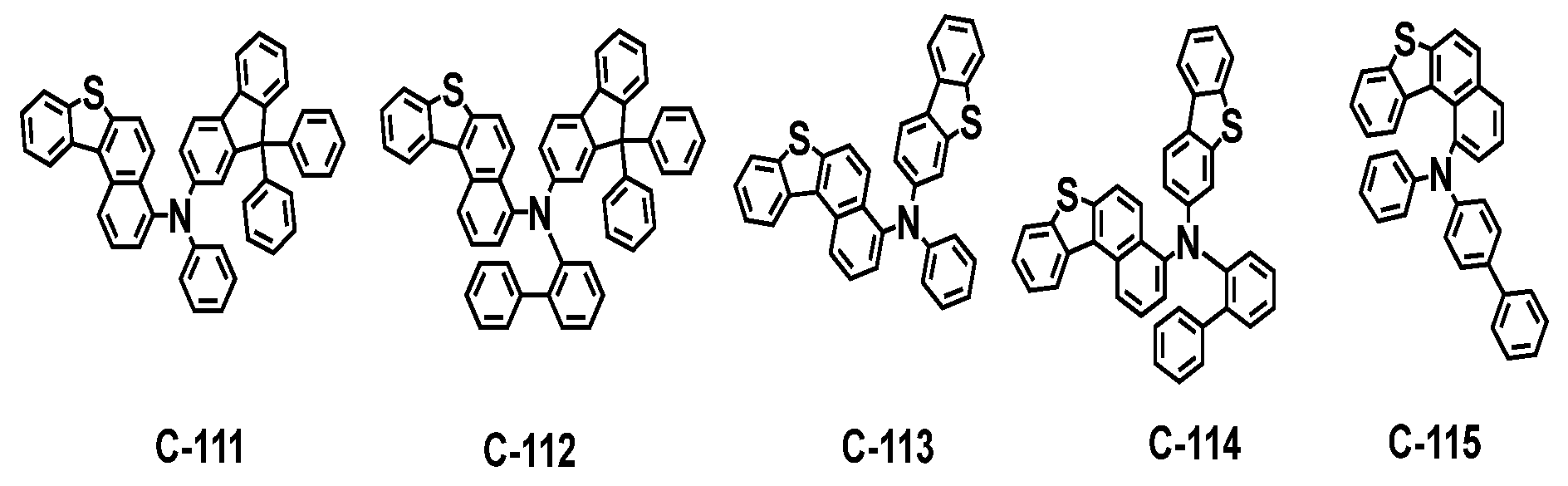


Die organische elektrolumineszierende Verbindung der vorliegenden Offenbarung kann nach einem dem Fachmann bekannten Syntheseverfahren hergestellt werden. Beispielsweise kann die organische elektrolumineszierende Verbindung der vorliegenden Offenbarung wie in den folgenden Reaktionsschemata 1 bis 3 synthetisiert werden, ist aber nicht darauf beschränkt.


In den Reaktionsschemata 1 bis 3 sind X, Ar1 bis Ar4, L1, L2, R1, R2, a, b, p und q wie in Formel 1 definiert.In Reaction Schemes 1 to 3, X, Ar 1 to Ar 4 , L 1 , L 2 , R 1 , R 2 , a, b, p and q are as defined in Formula 1.
Wie oben beschrieben, werden beispielhafte Synthesebeispiele der durch die Formeln 2 bis 4 wiedergegebenen Verbindungen gemäß einer Ausführungsform beschrieben, aber sie basieren auf einer Buchwald-Hartwig-Kreuzkupplungsreaktion, Wittig-Reaktion, Ullmann-Kupplungsreaktion, Suzuki-Kreuzkupplungsreaktion, N-Arylierungsreaktion, H-Montvermittelten Veretherungsreaktion, Miyaura-Borylierungsreaktion, intramolekularen säureinduzierten Cyclisierungsreaktion, Pd(II)-katalysierten oxidativen Cyclisierungsreaktion, Grignard-Reaktion, Heck-Reaktion, Cyclodehydratisierungsreaktion, SN1-Substitutionsreaktion, SN2-Substitutionsreaktion und phosphinvermittelten reduktiven Cyclisierungsreaktion usw. Für den Fachmann wird ersichtlich sein, dass die obige Reaktion selbst dann abläuft, wenn andere in den Formeln 2 bis 4 definierte Substituenten, die von den in den spezifischen Synthesebeispielen beschriebenen Substituenten verschieden sind, gebunden sind.As described above, exemplary synthesis examples of the compounds represented by Formulas 2 to 4 are described according to an embodiment, but they are based on Buchwald-Hartwig cross-coupling reaction, Wittig reaction, Ullmann coupling reaction, Suzuki cross-coupling reaction, N-arylation reaction, H- Mont-mediated etherification reaction, Miyaura borylation reaction, intramolecular acid-induced cyclization reaction, Pd (II) -catalyzed oxidative cyclization reaction, Grignard reaction, Heck reaction, cyclodehydration reaction, SN 1 substitution reaction, SN 2 substitution reaction, etc. For the person skilled in the art, reductive and phosphine-mediated cyclization reactions will be apparent be that the above reaction proceeds even if other substituents defined in formulas 2 to 4 other than those described in the specific synthesis examples are bonded.
Bei dem Dotierstoff, der in Kombination mit der Verbindung der vorliegenden Offenbarung verwendet werden kann, kann es sich um mindestens einen phosphoreszierenden oder fluoreszierenden Dotierstoff handeln, vorzugsweise einen phosphoreszierenden Dotierstoff. Der phosphoreszierende Dotierstoff unterliegt keinen besonderen Einschränkungen, aber es kann sich dabei um eine oder mehrere metallierte Komplexverbindungen eines oder mehrerer Metallatome, die aus Iridium (Ir), Osmium (Os), Kupfer (Cu) und Platin (Pt) ausgewählt sind, bevorzugt eine oder mehrere ortho-metallierte Komplexverbindungen eines oder mehrerer Metallatome, die aus Iridium (Ir), Osmium (Os), Kupfer (Cu) und Platin (Pt) ausgewählt sind, und noch weiter bevorzugt eine oder mehrere ortho-metallierte Iridium-Komplexverbindungen handeln.The dopant that can be used in combination with the compound of the present disclosure can be at least one phosphorescent or fluorescent dopant, preferably a phosphorescent dopant. The phosphorescent dopant is not subject to any particular restrictions, but it can be one or more metalated complex compounds of one or more metal atoms selected from iridium (Ir), osmium (Os), copper (Cu) and platinum (Pt), preferably one or more ortho-metalated complex compounds of one or more metal atoms selected from iridium (Ir), osmium (Os), copper (Cu) and platinum (Pt), and even more preferably one or more ortho-metalated iridium complex compounds.
Der Dotierstoff kann die durch eine der folgenden Formeln 101 bis 103 wiedergegebenen Verbindungen verwenden, ist aber nicht darauf beschränkt:


R101 bis R109 und R111 bis R123 jeweils unabhängig für Wasserstoff, Deuterium, Halogen, deuterium- oder halogensubstituiertes oder unsubstituiertes (C1-C30)-Alkyl, ein substituiertes oder unsubstituiertes (C3-C30)-Cycloalkyl, ein substituiertes oder unsubstituiertes (C6-C30)-Aryl, Cyano oder ein substituiertes oder unsubstituiertes (C1-C30)-Alkoxy stehen oder mit einem oder mehreren benachbarten Substituenten zu einem Ring verknüpft sein können; im Einzelnen R106 bis R109 mit einem oder mehreren benachbarten Substituenten zu einem Ring, z. B. einem alkylsubstituierten oder unsubstituierten Indenring, einem alkylsubstituierten oder unsubstituierten Benzothiophenring oder einem alkylsubstituierten oder unsubstituierten Benzofuranring verknüpft sein können; R120 bis R123 mit einem oder mehreren benachbarten Substituenten zu einem Ring verknüpft sein können, z. B. R120 und R121 miteinander zu einem alkyl-, aryl-, aralkyl- und/oder alkylarylsubstituierten oder unsubstituierten Benzolring oder mindestens einem alkylsubstituierten oder unsubstituierten Fluorenring, Dibenzofuranring oder Dibenzothiophenring verknüpft sein können;
R124 bis R127 jeweils unabhängig für Wasserstoff, Deuterium, Halogen, ein substituiertes oder unsubstituiertes (C1-C30)-Alkyl oder ein substituiertes oder unsubstituiertes (C6-C30)-Aryl stehen oder mit einem oder mehreren benachbarten Substituenten zu einem Ring, z. B. einem alkylsubstituierten oder unsubstituierten Indenring, einem alkylsubstituierten oder unsubstituierten Benzothiophenring oder einem alkylsubstituierten oder unsubstituierten Benzofuranring verknüpft sein können;
R201 bis R211 jeweils unabhängig für Wasserstoff, Deuterium, Halogen, deuterium- oder halogensubstituiertes oder unsubstituiertes (C1-C30)-Alkyl , ein substituiertes oder unsubstituiertes (C3-C30)-Cycloalkyl oder ein alkyl- oder deuteriumsubstituiertes oder unsubstituiertes (C6-C30)-Aryl stehen oder mit einem oder mehreren benachbarten Substituenten zu einem Ring, z. B. einem alkylsubstituierten oder unsubstituierten Indenring, einem alkylsubstituierten oder unsubstituierten Benzothiophenring oder einem alkylsubstituierten oder unsubstituierten Benzofuranring verknüpft sein können;
r jeweils unabhängig für eine ganze Zahl von 1 bis 3 steht; dann, wenn r gleich 2 oder mehr ist, jedes von R100 gleich oder verschieden sein kann; und
n für eine ganze Zahl von 1 bis 3 steht.The dopant may use the compounds represented by any of the following formulas 101 to 103, but is not limited thereto:
R 101 to R 109 and R 111 to R 123 each independently represent hydrogen, deuterium, halogen, deuterium- or halogen-substituted or unsubstituted (C1-C30) -alkyl, a substituted or unsubstituted (C3-C30) -cycloalkyl, a substituted or unsubstituted one (C6-C30) -aryl, cyano or a substituted or unsubstituted (C1-C30) -alkoxy or can be linked to one or more adjacent substituents to form a ring; in detail R 106 to R 109 with one or more adjacent substituents to form a ring, e.g. B. an alkyl-substituted or unsubstituted indene ring, an alkyl-substituted or unsubstituted benzothiophene ring or an alkyl-substituted or unsubstituted benzofuran ring can be linked; R 120 to R 123 can be linked to one or more adjacent substituents to form a ring, e.g. B. R 120 and R 121 can be linked to one another to form an alkyl, aryl, aralkyl and / or alkylaryl-substituted or unsubstituted benzene ring or at least one alkyl-substituted or unsubstituted fluorene ring, dibenzofuran ring or dibenzothiophene ring;
R 124 to R 127 each independently represent hydrogen, deuterium, halogen, a substituted or unsubstituted (C1-C30) -alkyl or a substituted or unsubstituted (C6-C30) -aryl, or with one or more adjacent substituents to form a ring, e.g. . B. an alkyl-substituted or unsubstituted indene ring, an alkyl-substituted or unsubstituted benzothiophene ring or an alkyl-substituted or unsubstituted benzofuran ring can be linked;
R 201 to R 211 each independently represent hydrogen, deuterium, halogen, deuterium or halogen-substituted or unsubstituted (C1-C30) -alkyl, a substituted or unsubstituted (C3-C30) -cycloalkyl or an alkyl- or deuterium-substituted or unsubstituted (C6- C30) -aryl or with one or more adjacent substituents to form a ring, e.g. B. an alkyl-substituted or unsubstituted indene ring, an alkyl-substituted or unsubstituted benzothiophene ring or an alkyl-substituted or unsubstituted benzofuran ring can be linked;
each r independently represents an integer from 1 to 3; when r is 2 or more, each of R 100 may be the same or different; and
n is an integer from 1 to 3.
Die spezifischen Beispiele für die Dotierstoffverbindung schließen die folgenden ein, sind aber nicht darauf beschränkt.


Die durch Formel 1 wiedergegebene Verbindung der vorliegenden Offenbarung kann in mindestens einer Schicht enthalten sein, z. B. mindestens einer Schicht, die aus einer Lochinjektionsschicht, einer Lochtransportschicht, einer Lochhilfsschicht, einer lichtemittierenden Hilfsschicht, einer Elektronentransportschicht, einer Elektronenpufferschicht, einer Elektroneninjektionsschicht, einer Zwischenschicht, einer Lochblockierschicht und einer Elektronenblockierschicht, die die organische elektrolumineszierende Vorrichtung bilden, ausgewählt ist. Außerdem kann die durch Formel 1 wiedergegebene Verbindung der vorliegenden Offenbarung in einer Lochtransportzone enthalten sein, vorzugsweise in einer zweiten Lochtransportschicht der Lochtransportzone, ist aber nicht darauf beschränkt.The compound of the present disclosure represented by Formula 1 may be contained in at least one layer, e.g. B. at least one layer selected from a hole injection layer, a hole transport layer, a hole auxiliary layer, an auxiliary light emitting layer, an electron transport layer, an electron buffer layer, an electron injection layer, an intermediate layer, a hole blocking layer and an electron blocking layer which constitute the organic electroluminescent device. In addition, the compound represented by Formula 1 of the present disclosure may be contained in a hole transport zone, preferably in a second hole transport layer of the hole transport zone, but is not limited thereto.
Das organische elektrolumineszierende Material, z. B. mindestens ein Material eines Lochinjektionsmaterials, eines Lochtransportmaterials, eines Lochhilfsmaterials, eines lichtemittierenden Hilfsmaterials, eines Elektronenblockiermaterials, eines lichtemittierenden Materials, eines Elektronenpuffermaterials, eines Lochblockiermaterials, eines Elektronentransportmaterials und eines Elektroneninjektionsmaterials, kann die durch obige Formel 1 wiedergegebene Verbindung umfassen. Bei den Materialien kann es sich um ein Lochtransportzonenmaterial handeln. Das Lochtransportzonenmaterial kann ausschließlich aus der durch Formel 1 wiedergegebenen organischen elektrolumineszierenden Verbindung bestehen oder ferner herkömmliche Materialien, die in dem organischen elektrolumineszierenden Material enthalten sind, umfassen.The organic electroluminescent material, e.g. B. at least one of a hole injection material, a hole transport material, a hole auxiliary material, an auxiliary light emitting material, an electron blocking material, a light emitting material, an electron buffer material, a hole blocking material, an electron transport material and an electron injection material, may comprise the compound represented by Formula 1 above. The materials can be a hole transport zone material. The hole transport zone material can consist exclusively of the organic electroluminescent compound represented by Formula 1 or further comprise conventional materials which are contained in the organic electroluminescent material.
Ein organisches elektrolumineszierendes Material gemäß einer Ausführungsform kann als lichtemittierendes Material für eine weiße organische lichtemittierende Vorrichtung verwendet werden. Die weiße organische lichtemittierende Vorrichtung ist in verschiedenen Strukturen vorgeschlagen worden, wie einer Methode mit paralleler Anordnung nebeneinander, einer Methode mit gestapelter Anordnung oder einer Methode mit Farbumwandlungsmaterial (Color Conversion Material, CCM) usw., gemäß der Anordnung von rotes (R), grünes (G), blaues (B) oder gelblich-grünes (YG) Licht emittierenden Einheiten. Außerdem kann das organische elektrolumineszierende Material gemäß einer Ausführungsform auch auf die organische elektrolumineszierende Vorrichtung, die einen Quantenpunkt (Quantum Dot, QD) umfasst, angewendet werden.An organic electroluminescent material according to an embodiment can be used as a light emitting material for a white organic light emitting device. The white organic light emitting device has been proposed in various structures such as a parallel arrangement method, a stacked arrangement method or a color conversion material (CCM) method, etc., according to the arrangement of red (R), green (G), blue (B) or yellowish-green (YG) light-emitting units. In addition, according to an embodiment, the organic electroluminescent material can also be applied to the organic electroluminescent device comprising a quantum dot (QD).
Die organische elektrolumineszierende Vorrichtung gemäß der vorliegenden Offenbarung enthält eine erste Elektrode, eine zweite Elektrode und mindestens eine organische Schicht, die zwischen der ersten Elektrode und der zweiten Elektrode angeordnet ist. Eine der ersten Elektrode und der zweiten Elektrode kann eine Anode sein, und die andere kann eine Kathode sein. Wobei die erste Elektrode und die zweite Elektrode jeweils als transmissives leitfähiges Material, transflektives leitfähiges Material oder reflektives leitendes Material ausgebildet sein können. Die organische elektrolumineszierende Vorrichtung kann gemäß den Arten des Materials, aus denen die erste Elektrode und die zweite Elektrode ausgebildet sind, vom Top-Emissions-Typ, Bottom-Emissions-Typ oder Typ mit beidseitiger Emission sein. Die organische Schicht kann mindestens eine lichtemittierende Schicht umfassen und kann ferner mindestens eine aus einer Lochinjektionsschicht, einer Lochtransportschicht, einer Lochhilfsschicht, einer lichtemittierenden Hilfsschicht, einer Elektronentransportschicht, einer Elektronenpufferschicht, eine Elektroneninjektionsschicht, einer Zwischenschicht, einer Lochblockierschicht und einer Elektronenblockierschicht ausgewählte Schicht umfassen.The organic electroluminescent device according to the present disclosure includes a first electrode, a second electrode, and at least one organic layer disposed between the first electrode and the second electrode. One of the first electrode and the second electrode can be an anode and the other can be a cathode. The first electrode and the second electrode can each be designed as a transmissive conductive material, transflective conductive material or reflective conductive material. The organic electroluminescent device may be of a top emission type, a bottom emission type, or a double emission type according to the types of the material from which the first electrode and the second electrode are formed. The organic layer may comprise at least one light emitting layer and may further comprise at least one selected from a hole injection layer, a hole transport layer, a hole auxiliary layer, an light emitting auxiliary layer, an electron transport layer, an electron buffer layer, an electron injection layer, an intermediate layer, a hole blocking layer and an electron blocking layer.
Die organische elektrolumineszierende Vorrichtung gemäß der vorliegenden Offenbarung Schicht kann die durch obige Formel 1 wiedergegebene organische elektrolumineszierende Verbindung umfassen und ferner herkömmliche Materialien, die in dem organischen lumineszierenden Material enthalten sind, umfassen. Die organische elektrolumineszierende Vorrichtung, die die durch obige Formel 1 wiedergegebene organische elektrolumineszierende Verbindung umfasst, kann eine hohe Lichtausbeute und/oder lange Lebensdauereigenschaften zeigen.The organic electroluminescent device according to the present disclosure layer may comprise the organic electroluminescent compound represented by the above formula 1 and further comprise conventional materials contained in the organic luminescent material. The organic electroluminescent device comprising the organic electroluminescent compound represented by the above formula 1 can exhibit high luminous efficiency and / or long life characteristics.
Außerdem kann die vorliegende Offenbarung durch Verwendung der durch die Formel 1 wiedergegebenen Verbindung eine Anzeigevorrichtung bereitstellen. Das heißt, dass es möglich ist, unter Verwendung der Verbindung der vorliegenden Offenbarung eine Anzeigevorrichtung oder eine Beleuchtungsvorrichtung herzustellen. Im Einzelnen kann die organische elektrolumineszierende Verbindung der vorliegenden Offenbarung zur Herstellung von Anzeigevorrichtungen wie Smartphones, Tablets, Notebooks, PCs, Fernsehern oder Anzeigevorrichtungen für Autos, oder Beleuchtungsvorrichtungen wie Außen- oder Innenbeleuchtung verwendet werden.In addition, the present disclosure can provide a display device by using the compound represented by Formula 1. That is, it is possible to manufacture a display device or a lighting device using the compound of the present disclosure. In particular, the organic electroluminescent compound of the present disclosure can be used to manufacture display devices such as smartphones, tablets, notebooks, PCs, televisions or display devices for cars, or lighting devices such as exterior or interior lighting.
Im Folgenden werden das Herstellungsverfahren einer Verbindung gemäß der vorliegenden Offenbarung und deren Eigenschaften unter Bezugnahme auf die repräsentativen Verbindungen der vorliegenden Offenbarung ausführlich dargelegt, um die vorliegende Offenbarung im Detail zu verstehen. Die vorliegende Offenbarung ist jedoch nicht auf die folgenden Beispiele beschränkt.In the following, the production method of a compound according to the present disclosure and the properties thereof are detailed with reference to the representative compounds of the present disclosure in order to understand the present disclosure in detail. However, the present disclosure is not limited to the following examples.
[Beispiel 1] Herstellung von Verbindung C-123[Example 1] Preparation of Compound C-123

Herstellung von Verbindung 1-1Preparation of compound 1-1
Verbindung A (37 g, 205,05 mmol), 2-Brom-6-chlorbenzaldehyd (30 g, 136,7 mmol), Tetrakis(triphenylphosphin)palladium (4,7 g, 4,1 mmol), Kaliumcarbonat (47,2 g, 341,75 mmol), 400 ml Tetrahydrofuran und 100 ml destilliertes Wasser wurden in ein Reaktionsgefäß gegeben und 4 Stunden bei 100 °C gerührt . Nach Abschluss der Reaktion wurde die Reaktionsmischung mit destilliertem Wasser gewaschen und mit Essigsäureethylester extrahiert. Nach Trocknen der extrahierten organischen Schicht mit Magnesiumsulfat wurde das Lösungsmittel am Rotationsverdampfer abgezogen. Danach wurde das verbliebene Produkt durch Säulenchromatographie gereinigt, was Verbindung 1-1 (35 g, Ausbeute : 94%) ergab.Compound A (37 g, 205.05 mmol), 2-bromo-6-chlorobenzaldehyde (30 g, 136.7 mmol), tetrakis (triphenylphosphine) palladium (4.7 g, 4.1 mmol), potassium carbonate (47, 2 g, 341.75 mmol), 400 ml of tetrahydrofuran and 100 ml of distilled water were placed in a reaction vessel and stirred at 100 ° C. for 4 hours. After the completion of the reaction, the reaction mixture was washed with distilled water and extracted with ethyl acetate. After drying the extracted organic layer with magnesium sulfate, the solvent was removed on a rotary evaporator. Thereafter, the remaining product was purified by column chromatography, to give Compound 1-1 (35 g, yield: 94%).
Herstellung von Verbindung 1-2Establishing connection 1-2
Verbindung 1-1 (35 g, 128,32 mmol) und (Methoxymethyl) triphenylphosphiniumchlorid (66 g, 192,48 mmol) wurden in 350 ml Tetrahydrofuran in ein Reaktionsgefäß gegeben; danach wurden 193 ml K alium-tert-butoxid (1 M) bei 0 °C zu der Mischung getropft.Nach Abschluss des Zutropfens wurde die Reaktionstemperatur langsam auf Raumtemperatur erhöht und die Mischung noch 2 Stunden gerührt. Nach Abschluss der Reaktion wurde die Reaktionsmischung mit Essigsäureethylester extrahiert und die extrahierte organische Schicht mit Magnesiumsulfat getrocknet. Danach wurde das Lösungsmittel am Rotationsverdampfer abgezogen und das verbliebene Produkt dann durch Säulenchromatographie gereinigt, was Verbindung 1-2 (31 g, Ausbeute: 80%) ergab.Compound 1-1 (35 g, 128.32 mmol) and (methoxymethyl) triphenylphosphinium chloride (66 g, 192.48 mmol) were placed in 350 ml of tetrahydrofuran in a reaction vessel; then 193 ml of potassium tert-butoxide (1 M) were added dropwise to the mixture at 0 ° C. After the end of the dropping, the reaction temperature was slowly increased to room temperature and the mixture was stirred for a further 2 hours. After the completion of the reaction, the reaction mixture was extracted with ethyl acetate, and the extracted organic layer was dried with magnesium sulfate. The solvent was then removed on a rotary evaporator and the remaining product was then purified by column chromatography, which gave compound 1-2 (31 g, yield: 80%).
Herstellung von Verbindung 1-3Establishing connection 1-3
Nach Lösen von Verbindung 1-2 (31 g, 103,06 mmol) in Chlorbenzol wurden 3,1 ml Eaton-Reagenz langsam in ein Reaktionsgefäß getropft. Nach Abschluss des Zutropfens wurde die Mischung noch 2 Stunden gerührt. Nach Abschluss der Reaktion wurde die Reaktionsmischung mit destilliertem Wasser gewaschen und mit Essigsäureethylester extrahiert. Nach Trocknen der extrahierten organischen Schicht mit Magnesiumsulfat wurde das Lösungsmittel am Rotationsverdampfer abgezogen. Danach wurde das verbliebene Produkt durch Säulenchromatographie gereinigt, was Verbindung 1-3 (24,4 g, Ausbeute: 88%) ergab.After compound 1-2 (31 g, 103.06 mmol) was dissolved in chlorobenzene, 3.1 ml of Eaton reagent was slowly added dropwise to a reaction vessel. After the completion of the dropping, the mixture was stirred for a further 2 hours. After the completion of the reaction, the reaction mixture was washed with distilled water and extracted with ethyl acetate. After drying the extracted organic layer with magnesium sulfate, the solvent was removed on a rotary evaporator. Thereafter, the remaining product was purified by column chromatography to give Compound 1-3 (24.4 g, yield: 88%).
Herstellung von Verbindung C-123Preparation of compound C-123
Verbindung 1-3 (3,5 g, 9,28 mmol), N,9-Diphenyl-9H-carbazol-2-amin (4,8 g, 14,33 mmol), Tris(dibenzylidenaceton)dipalladium(0) (0,6 g, 0,65 mmol), Tri-tert-butylphosphin (0,3 ml, 1,30 mmol), Natrium-tert-butoxid (1,9 g, 19,53 mmol) und 65 ml Toluol wurden in ein Reaktionsgefäß gegeben und 1 Stunde unter Rückfluss erhitzt. Danach wurde die Reaktionsmischung auf Raumtemperatur abgekühlt und der Feststoff abfiltriert und mit Essigsäureethylester gewaschen. Das Filtrat wurde unter vermindertem Druck destilliert und durch Säulenchromatographie gereinigt, was die Verbindung C-123 (6 g, Ausbeute: 81%) ergab.
[Beispiel 2] Herstellung von Verbindung C-124[Example 2] Preparation of Compound C-124

Verbindung 1-3 (3,0 g, 11,16 mmol), N-([1,1'-Biphenyl]-2-yl)-9-phenyl-9H-carbazol-2-amin (5,0 g, 12,28 mmol), Tris(dibenzylidenaceton)dipalladium(0) (0,5 g, 0,56 mmol), Tri-tert-butylphosphin (0,3 ml, 1,12 mmol), Natrium-tert-butoxid (1,6 g, 16,74 mmol) und 56 ml Toluol wurden in ein Reaktionsgefäß gegeben und 1 Stunde unter Rückfluss erhitzt. Danach wurde die Reaktionsmischung auf Raumtemperatur abgekühlt und der Feststoff abfiltriert und mit Essigsäureethylester gewaschen. Das Filtrat wurde unter vermindertem Druck destilliert und durch Säulenchromatographie gereinigt, was die Verbindung C-124 (2 g, Ausbeute: 28%) ergab.
[Beispiel 3] Herstellung von Verbindung C-125[Example 3] Preparation of Compound C-125

Verbindung 1-3 (3,5 g, 13,02 mmol), N-([1,1'-Biphenyl]-2-yl)-9,9-dimethyl-9H-fluoren-2-amin (5,2 g, 14,33 mmol), Tris(dibenzylidenaceton)dipalladium(0) (0,6 g, 0,65 mmol), Tri-tert-butylphosphin (0,3 ml, 1,30 mmol), Natrium-tert-butoxid (1,9 g, 19,53 mmol) und 65 ml Toluol wurden in ein Reaktionsgefäß gegeben und 1 Stunde unter Rückfluss erhitzt. Danach wurde die Reaktionsmischung auf Raumtemperatur abgekühlt und der Feststoff abfiltriert und mit Essigsäureethylester gewaschen. Das Filtrat wurde unter vermindertem Druck destilliert und durch Säulenchromatographie gereinigt, was die Verbindung C-125 (1,3 g, Ausbeute: 17%) ergab.
Im Folgenden werden die Eigenschaften einer organischen elektrolumineszierenden Vorrichtung, die die organische elektrolumineszierende Verbindung der vorliegenden Offenbarung umfasst, erklärt, um die vorliegende Offenbarung im Detail zu verstehen. Die folgende Beschreibung von Beispielen soll jedoch die Eigenschaften einer OLED gemäß der vorliegenden Offenbarung erklären, um die vorliegende Offenbarung im Detail zu verstehen, und die vorliegende Offenbarung soll die folgenden Beispiele in keiner Weise einschränken.In the following, the characteristics of an organic electroluminescent device comprising the organic electroluminescent compound of the present disclosure will be explained in order to understand the present disclosure in detail. However, the following description of examples is intended to explain the properties of an OLED according to the present disclosure in order to understand the present disclosure in detail, and the present disclosure is not intended to limit the following examples in any way.
[Vorrichtungsbeispiele 1 bis 3] Herstellung einer OLED, die die organische elektrolumineszierende Verbindung gemäß der vorliegenden Offenbarung enthält[Device Examples 1 to 3] Manufacture of an OLED containing the organic electroluminescent compound according to the present disclosure
Durch Verwendung der organischen elektrolumineszierenden Verbindung der vorliegenden Offenbarung wurde eine OLED hergestellt. Zunächst wurde eine transparente dünne Elektrodenschicht aus Indiumzinnoxid (ITO (10 Ω/sq) auf einem Glassubstrat für eine OLED (GEOMATEC CO., LTD., Japan) nacheinander einer Ultraschallwäsche mit Aceton und Isoproanol unterworfen und dann in Isopropanol aufbewahrt. Als Nächstes wurde das ITO-Substrat auf einem Substrathalter einer Vakuumdampfabscheidungapparatur befestigt. Verbindung HI-1 wurde in eine Zelle der Vakuumdampfabscheidungsapparatur eingebracht, wonach der Druck in der Kammer der Apparatur auf 10-6 Torr eingestellt wurde. Danach wurde ein elektrischer Strom an die Zelle angelegt, um das eingetragene Material zu verdampfen, wodurch eine erste Lochinjektionsschicht mit einer Dicke von 90 nm auf dem ITO-Substrat gebildet wurde. Dann wurde Verbindung HI-2 in einer anderen Zelle der Vakuumdampfabscheidungsapparatur eingebracht und ein elektrischer Strom an die Zelle angelegt, um das eingetragene Material zu verdampfen, wodurch eine zweite Lochinjektionsschicht mit einer Dicke von 5 nm auf der ersten Lochinjektionsschicht gebildet wurde. Als Nächstes wurde Verbindung HT-1 in eine andere Zelle der Vakuumdampfabscheidungsapparatur eingetragen. Danach wurde ein elektrischer Strom an die Zelle angelegt, um das eingetragene Material zu verdampfen, wodurch eine erste Lochtransportzone mit einer Dicke von 10 nm auf der zweiten Lochinjektionsschicht gebildet wurde. Dann wurde die Verbindung der folgenden Tabelle 1 (ein zweites Lochtransportmaterial) in eine andere Zelle der Vakuumdampfabscheidungsapparatur eingebracht und das eingebrachte Material wurde durch Anlegen eines elektrischen Stroms an die Zelle verdampft, wodurch eine zweite Lochtransportzone (eine Hilfsschicht) mit einer Dicke von 60 nm auf der ersten Lochtransportzone gebildet wurde. Nach der Bildung der Lochinjektionsschichten und der Lochtransportschichten wurde dann eine lichtemittierende Schicht wie folgt abgeschieden: Die Verbindung H-1 als Wirt wurde in eine Zelle der Vakuumdampfabscheidungsapparatur eingetragen, und Verbindung D-71 wurde als Dotierstoff in eine andere Zelle der Apparatur eingetragen. Der Dotierstoff wurde in einer Dotierungsmenge von 2 Gew.-%, bezogen auf das Gesamtgewicht des Wirts und des Dotierstoffs, abgeschieden, um eine lichtemittierende Schicht mit einer Dicke von 40 nm auf der Lochtransportzone zu bilden. Als Nächstes wurden die Verbindungen ET-1 und EI-1 in eine andere Zelle eingetragen, mit einer Rate von 1:1 verdampft und abgeschieden, um eine Elektronentransportschicht mit einer Dicke von 35 nm auf der lichtemittierenden Schicht zu bilden. Als Nächstes wurde Verbindung EI-1 als Elektroneninjektionsschicht mit einer Dicke von 2 nm auf der Elektronentransportschicht abgeschieden, wonach mit einer weiteren Vakuumdampfabscheidungsapparatur eine AI-Kathode mit einer Dicke von 1500 nm auf der Elektroneninjektionsschicht abgeschieden wurde, wodurch die OLED hergestellt wurde.An OLED was manufactured by using the organic electroluminescent compound of the present disclosure. First, a transparent thin electrode layer made of indium tin oxide (ITO (10 Ω / sq) on a glass substrate for an OLED (GEOMATEC CO., LTD., Japan) was successively subjected to ultrasonic washing with acetone and isopropanol and then stored in isopropanol ITO substrate mounted on a substrate holder of a vacuum vapor deposition apparatus, Compound HI-1 was placed in a cell of the vacuum vapor deposition apparatus, the pressure in the chamber of the apparatus was adjusted to 10 -6 Torr, and an electric current was applied to the cell to generate the deposited material, thereby forming a first hole injection layer with a thickness of 90 nm on the ITO substrate, then compound HI-2 was introduced into another cell of the vacuum vapor deposition apparatus and an electric current was applied to the cell to apply the deposited material evaporate, creating a second hole injection layer with a thickness of 5 nm was formed on the first hole injection layer. Next, Compound HT-1 was added to another cell of the vacuum vapor deposition apparatus. Thereafter, an electric current was applied to the cell in order to evaporate the introduced material, whereby a first hole transport zone with a thickness of 10 nm was formed on the second hole injection layer. Then, the compound of the following Table 1 (a second hole transport material) was introduced into another cell of the vacuum vapor deposition apparatus, and the introduced material was evaporated by applying an electric current to the cell, thereby forming a second hole transport zone (an auxiliary layer) with a thickness of 60 nm the first hole transport zone was formed. Then, after the formation of the hole injection layers and the hole transport layers, a light emitting layer was deposited as follows: Compound H-1 as a host was added to one cell of the vacuum vapor deposition apparatus, and Compound D-71 was added as a dopant to another cell of the apparatus. The dopant was deposited in a doping amount of 2% by weight based on the total weight of the host and the dopant to form a light-emitting layer with a thickness of 40 nm on the hole transport zone. Next, Compounds ET-1 and EI-1 were added to another cell, evaporated at a rate of 1: 1, and deposited to form an electron transport layer with a thickness of 35 nm on the light-emitting layer. Next, Compound EI-1 was deposited as an electron injection layer with a thickness of 2 nm on the electron transport layer, and then an Al cathode with a thickness of 1500 nm was deposited on the electron injection layer with another vacuum vapor deposition apparatus, thereby producing the OLED.
[Vergleichsbeispiele 1 und 2] Herstellung einer OLED unter Verwendung der Verbindung, die nicht der vorliegenden Offenbarung entspricht[Comparative Examples 1 and 2] Manufacture of an OLED using the compound not according to the present disclosure
OLEDs wurden auf die gleiche Weise wie in den Vorrichtungsbeispielen 1 bis 3 hergestellt, außer dass die Verbindung der folgenden Tabelle 1 in der zweiten Lochtransportschicht verwendet wurde.OLEDs were manufactured in the same manner as in Device Examples 1 to 3, except that the compound of Table 1 below was used in the second hole transport layer.
Die in den Vorrichtungsbeispielen 1 bis 3 und den Vergleichsbeispielen 1 und 2 verwendeten Verbindungen sind wie folgt gezeigt.


Die Ergebnisse der Treiberspannung, der Stromeffizienz und der CIE-Farbkoordinaten bei einer Leuchtdichte von 1000 nit für die wie oben beschrieben hergestellten OLEDs sind in der folgenden Tabelle 1 gezeigt.
Tabelle 1
Zusätzlich beträgt die Zeit zur Verringerung auf 98 % bei einem konstanten Strom auf der Basis einer Leuchtdichte von 5000 nit (Lebensdauer; T98) für Vorrichtungsbeispiel 2 und Vergleichsbeispiel 1 98 h bzw. 18 h.In addition, the time to decrease to 98% at a constant current based on a luminance of 5000 nit (lifetime; T98) for Device Example 2 and Comparative Example 1 are 98 hours and 18 hours, respectively.
In den obigen Vorrichtungsbeispielen und Vergleichsbeispielen wurde bestätigt, dass die organische elektrolumineszierende Vorrichtung, die die organische elektrolumineszierende Verbindung der vorliegenden Offenbarung umfasst, im Vergleich mit der organischen elektrolumineszierenden Vorrichtung, die die Verbindung der vorliegenden Offenbarung nicht umfasst, eine geringe Treiberspannung und/oder eine hohe Stromeffizienz aufweist. Gleichzeitig oder selektiv kann die organische elektrolumineszierende Vorrichtung, die die organische elektrolumineszierende Verbindung der vorliegenden Offenbarung umfasst, verbesserte Lebensdauereigenschaften aufweisen.In the above device examples and comparative examples, it was confirmed that the organic electroluminescent device comprising the organic electroluminescent compound of the present disclosure had a low driving voltage and / or a high one compared with the organic electroluminescent device not comprising the compound of the present disclosure Has electricity efficiency. Simultaneously or selectively, the organic electroluminescent device comprising the organic electroluminescent compound of the present disclosure can have improved durability properties.
ZITATE ENTHALTEN IN DER BESCHREIBUNGQUOTES INCLUDED IN THE DESCRIPTION
Diese Liste der vom Anmelder aufgeführten Dokumente wurde automatisiert erzeugt und ist ausschließlich zur besseren Information des Lesers aufgenommen. Die Liste ist nicht Bestandteil der deutschen Patent- bzw. Gebrauchsmusteranmeldung. Das DPMA übernimmt keinerlei Haftung für etwaige Fehler oder Auslassungen.This list of the documents listed by the applicant was generated automatically and is included solely for the better information of the reader. The list is not part of the German patent or utility model application. The DPMA assumes no liability for any errors or omissions.
Zitierte PatentliteraturPatent literature cited
- KR 20170096770 A [0002, 0004]KR 20170096770 A [0002, 0004]
Claims (8)


Applications Claiming Priority (5)
| Application Number | Priority Date | Filing Date | Title |
|---|---|---|---|
| KR10-2018-0077190 | 2018-07-03 | ||
| KR20180077190 | 2018-07-03 | ||
| KR10-2019-0078713 | 2019-07-01 | ||
| KR1020190078713A KR102836228B1 (en) | 2018-07-03 | 2019-07-01 | Organic electroluminescent compound and organic electroluminescent device comprising the same |
| PCT/KR2019/007999 WO2020009398A1 (en) | 2018-07-03 | 2019-07-02 | Organic electroluminescent compound and organic electroluminescent device comprising the same |
Publications (1)
| Publication Number | Publication Date |
|---|---|
| DE112019002827T5 true DE112019002827T5 (en) | 2021-03-04 |
Family
ID=69153081
Family Applications (1)
| Application Number | Title | Priority Date | Filing Date |
|---|---|---|---|
| DE112019002827.8T Pending DE112019002827T5 (en) | 2018-07-03 | 2019-07-02 | ORGANIC ELECTROLUMINESCENT JOINT AND THIS COMPREHENSIVE ORGANIC ELECTROLUMINESCENT DEVICE |
Country Status (4)
| Country | Link |
|---|---|
| JP (1) | JP7402831B2 (en) |
| KR (1) | KR102836228B1 (en) |
| CN (1) | CN112400007A (en) |
| DE (1) | DE112019002827T5 (en) |
Cited By (1)
| Publication number | Priority date | Publication date | Assignee | Title |
|---|---|---|---|---|
| US11696497B2 (en) | 2018-12-21 | 2023-07-04 | Lg Display Co., Ltd. | Organic light emitting device |
Families Citing this family (5)
| Publication number | Priority date | Publication date | Assignee | Title |
|---|---|---|---|---|
| CN116134030A (en) * | 2020-08-24 | 2023-05-16 | 株式会社Lg化学 | Novel compound and organic light-emitting device containing it |
| WO2022045743A1 (en) * | 2020-08-24 | 2022-03-03 | 주식회사 엘지화학 | Novel compound and organic light-emitting device using same |
| CN112430225B (en) * | 2020-10-30 | 2022-05-17 | 陕西莱特光电材料股份有限公司 | Nitrogen-containing compound, electronic component, and electronic device |
| CN116813582A (en) * | 2023-06-29 | 2023-09-29 | 阜阳欣奕华材料科技有限公司 | Naphtho heteroaryl compound, intermediate, organic electroluminescent device and display device |
| US20250098528A1 (en) | 2023-09-06 | 2025-03-20 | Dupont Specialty Materials Korea Ltd. | Organic electroluminescent compound and organic electroluminescent device |
Family Cites Families (9)
| Publication number | Priority date | Publication date | Assignee | Title |
|---|---|---|---|---|
| JP5398397B2 (en) | 2009-07-21 | 2014-01-29 | 出光興産株式会社 | Organic thin film solar cell material and organic thin film solar cell using the same |
| KR101923171B1 (en) * | 2015-05-27 | 2018-11-28 | 덕산네오룩스 주식회사 | Compound for organic electric element, organic electric element comprising the same and electronic device thereof |
| KR102630643B1 (en) * | 2015-05-27 | 2024-01-31 | 삼성디스플레이 주식회사 | Organic light-emitting device |
| KR101984244B1 (en) * | 2015-09-09 | 2019-05-30 | 삼성에스디아이 주식회사 | Organic compound and organic optoelectric device and display device |
| KR102111829B1 (en) | 2016-02-17 | 2020-05-15 | 주식회사 엘지화학 | Hetero-cyclic compound and organic light emitting device comprising the same |
| KR102211337B1 (en) * | 2016-05-19 | 2021-02-03 | 덕산네오룩스 주식회사 | Compound for organic electronic element, organic electronic element using the same, and an electronic device thereof |
| KR20180011980A (en) * | 2016-07-26 | 2018-02-05 | 에스에프씨 주식회사 | Novel heterocyclic compounds and organic light-emitting diode including the same |
| KR102038767B1 (en) | 2017-03-27 | 2019-10-30 | 주식회사 엘지화학 | Benzocarbazole-based compound and organic light emitting device comprising the same |
| KR102377225B1 (en) * | 2017-07-13 | 2022-03-22 | 에스에프씨주식회사 | organic light-emitting diode with high efficiency and long lifetime |
-
2019
- 2019-07-01 KR KR1020190078713A patent/KR102836228B1/en active Active
- 2019-07-02 DE DE112019002827.8T patent/DE112019002827T5/en active Pending
- 2019-07-02 JP JP2020573315A patent/JP7402831B2/en active Active
- 2019-07-02 CN CN201980045174.0A patent/CN112400007A/en active Pending
Cited By (1)
| Publication number | Priority date | Publication date | Assignee | Title |
|---|---|---|---|---|
| US11696497B2 (en) | 2018-12-21 | 2023-07-04 | Lg Display Co., Ltd. | Organic light emitting device |
Also Published As
| Publication number | Publication date |
|---|---|
| JP2021529774A (en) | 2021-11-04 |
| JP7402831B2 (en) | 2023-12-21 |
| KR102836228B1 (en) | 2025-07-22 |
| CN112400007A (en) | 2021-02-23 |
| KR20200004257A (en) | 2020-01-13 |
Similar Documents
| Publication | Publication Date | Title |
|---|---|---|
| DE102021127890A1 (en) | ORGANIC ELECTROLUMINESCENT COMPOUND, MULTIPLE HOST MATERIALS AND THIS COMPREHENSIVE ORGANIC ELECTROLUMINESCENT DEVICE | |
| DE102022102199A1 (en) | Organic electroluminescent compound, multiple host materials and organic electroluminescent device comprising them | |
| DE102020132697A1 (en) | ORGANIC ELECTROLUMINESCENT COMPOUND, MULTIPLE HOST MATERIALS, AND THIS COMPREHENSIVE ORGANIC ELECTROLUMINESCENT DEVICE | |
| DE102020127397A1 (en) | MULTIPLE HOST MATERIALS AND THIS COMPREHENSIVE ORGANIC ELECTROLUMINESCENT DEVICE | |
| DE102020133437A1 (en) | MULTIPLE HOST MATERIALS AND THIS COMPREHENSIVE ORGANIC ELECTROLUMINESCENT DEVICE | |
| DE102021100597A1 (en) | ORGANIC ELECTROLUMINESCENT COMPOUND, MULTIPLE HOST MATERIALS, AND THIS COMPREHENSIVE ORGANIC ELECTROLUMINESCENT DEVICE | |
| DE102021108423A1 (en) | ORGANIC ELECTROLUMINESCENT COMPOUND, MULTIPLE HOST MATERIALS, AND THIS COMPREHENSIVE ORGANIC ELECTROLUMINESCENT DEVICE | |
| DE112019002827T5 (en) | ORGANIC ELECTROLUMINESCENT JOINT AND THIS COMPREHENSIVE ORGANIC ELECTROLUMINESCENT DEVICE | |
| DE102020133439A1 (en) | MULTIPLE ORGANIC ELECTROLUMINESCENT MATERIALS AND THIS COMPREHENSIVE ORGANIC ELECTROLUMINESCENT DEVICE | |
| DE102021104327A1 (en) | ORGANIC ELECTROLUMINESCENT JOINT AND THIS COMPREHENSIVE ORGANIC ELECTROLUMINESCENT DEVICE | |
| DE112019003812T5 (en) | MULTIPLE HOST MATERIALS AND THIS COMPREHENSIVE ORGANIC ELECTROLUMINESCENT DEVICE | |
| DE102020128813A1 (en) | MULTIPLE HOST MATERIALS AND THIS COMPREHENSIVE ORGANIC ELECTROLUMINESCENT DEVICE | |
| DE112019004839T5 (en) | ORGANIC ELECTROLUMINESCENT JOINT AND THIS COMPREHENSIVE ORGANIC ELECTROLUMINESCENT DEVICE | |
| DE102021134637A1 (en) | ORGANIC ELECTROLUMINESCENT COMPOUND, MULTIPLE HOST MATERIALS AND THIS COMPREHENSIVE ORGANIC ELECTROLUMINESCENT DEVICE | |
| DE102020116834A1 (en) | ORGANIC ELECTROLUMINESCENT JOINT AND THIS COMPREHENSIVE ORGANIC ELECTROLUMINESCENT DEVICE | |
| DE102022114317A1 (en) | MULTIPLE HOST MATERIALS AND THIS COMPREHENSIVE ORGANIC ELECTROLUMINESCING DEVICE | |
| DE102021112340A1 (en) | MULTIPLE HOST MATERIALS AND THIS COMPREHENSIVE ORGANIC ELECTROLUMINESCENT DEVICE | |
| DE102020131740A1 (en) | MULTIPLE HOST MATERIALS AND THIS COMPREHENSIVE ORGANIC ELECTROLUMINESCENT DEVICE | |
| DE102021106151A1 (en) | MULTIPLE HOST MATERIALS AND THIS COMPREHENSIVE ORGANIC ELECTROLUMINESCENT DEVICE | |
| DE112019000238T5 (en) | ORGANIC ELECTROLUMINESCENT JOINT AND THIS COMPREHENSIVE ORGANIC ELECTROLUMINESCENT DEVICE | |
| DE102022113776A1 (en) | MULTIPLE HOST MATERIALS AND THIS COMPREHENSIVE ORGANIC ELECTROLUMINESCING DEVICE | |
| DE102023112182A1 (en) | MULTIPLE HOST MATERIALS AND THIS COMPREHENSIVE ORGANIC ELECTROLUMINESCENT DEVICE | |
| DE102020116836A1 (en) | ORGANIC ELECTROLUMINESCENT JOINT AND THIS COMPREHENSIVE ORGANIC ELECTROLUMINESCENT DEVICE | |
| DE112020001007T5 (en) | ORGANIC ELECTROLUMINESCENT JOINT AND THIS COMPREHENSIVE ORGANIC ELECTROLUMINESCENT DEVICE | |
| DE102021117725A1 (en) | ORGANIC ELECTROLUMINESCENT COMPOUND AND THIS COMPRISING ORGANIC ELECTROLUMINESCENT DEVICE |
Legal Events
| Date | Code | Title | Description |
|---|---|---|---|
| R082 | Change of representative |
Representative=s name: ABK PATENTANWAELTE, DE Representative=s name: ABITZ & PARTNER PATENTANWAELTE MBB, DE Representative=s name: PATENTANWAELTE JABBUSCH SIEKMANN & WASILJEFF, DE |
|
| R082 | Change of representative |
Representative=s name: ABK PATENTANWAELTE, DE Representative=s name: ABITZ & PARTNER PATENTANWAELTE MBB, DE |
|
| R081 | Change of applicant/patentee |
Owner name: DUPONT SPECIALTY MATERIALS KOREA LTD., CHEONAN, KR Free format text: FORMER OWNER: ROHM AND HAAS ELECTRONIC MATERIALS KOREA LTD., CHEONAN-SI, CHUNGCHEONGNAM-DO, KR |
|
| R082 | Change of representative |
Representative=s name: ABITZ & PARTNER PATENTANWAELTE MBB, DE |