DE102022113776A1 - MULTIPLE HOST MATERIALS AND THIS COMPREHENSIVE ORGANIC ELECTROLUMINESCING DEVICE - Google Patents
MULTIPLE HOST MATERIALS AND THIS COMPREHENSIVE ORGANIC ELECTROLUMINESCING DEVICE Download PDFInfo
- Publication number
- DE102022113776A1 DE102022113776A1 DE102022113776.7A DE102022113776A DE102022113776A1 DE 102022113776 A1 DE102022113776 A1 DE 102022113776A1 DE 102022113776 A DE102022113776 A DE 102022113776A DE 102022113776 A1 DE102022113776 A1 DE 102022113776A1
- Authority
- DE
- Germany
- Prior art keywords
- substituted
- unsubstituted
- membered
- alkyl
- independently
- Prior art date
- Legal status (The legal status is an assumption and is not a legal conclusion. Google has not performed a legal analysis and makes no representation as to the accuracy of the status listed.)
- Withdrawn
Links
Classifications
-
- H—ELECTRICITY
- H10—SEMICONDUCTOR DEVICES; ELECTRIC SOLID-STATE DEVICES NOT OTHERWISE PROVIDED FOR
- H10K—ORGANIC ELECTRIC SOLID-STATE DEVICES
- H10K50/00—Organic light-emitting devices
- H10K50/10—OLEDs or polymer light-emitting diodes [PLED]
- H10K50/11—OLEDs or polymer light-emitting diodes [PLED] characterised by the electroluminescent [EL] layers
-
- C—CHEMISTRY; METALLURGY
- C09—DYES; PAINTS; POLISHES; NATURAL RESINS; ADHESIVES; COMPOSITIONS NOT OTHERWISE PROVIDED FOR; APPLICATIONS OF MATERIALS NOT OTHERWISE PROVIDED FOR
- C09K—MATERIALS FOR MISCELLANEOUS APPLICATIONS, NOT PROVIDED FOR ELSEWHERE
- C09K11/00—Luminescent materials, e.g. electroluminescent or chemiluminescent
- C09K11/06—Luminescent materials, e.g. electroluminescent or chemiluminescent containing organic luminescent materials
-
- C—CHEMISTRY; METALLURGY
- C07—ORGANIC CHEMISTRY
- C07D—HETEROCYCLIC COMPOUNDS
- C07D209/00—Heterocyclic compounds containing five-membered rings, condensed with other rings, with one nitrogen atom as the only ring hetero atom
- C07D209/56—Ring systems containing three or more rings
- C07D209/80—[b, c]- or [b, d]-condensed
- C07D209/94—[b, c]- or [b, d]-condensed containing carbocyclic rings other than six-membered
-
- C—CHEMISTRY; METALLURGY
- C07—ORGANIC CHEMISTRY
- C07D—HETEROCYCLIC COMPOUNDS
- C07D403/00—Heterocyclic compounds containing two or more hetero rings, having nitrogen atoms as the only ring hetero atoms, not provided for by group C07D401/00
- C07D403/02—Heterocyclic compounds containing two or more hetero rings, having nitrogen atoms as the only ring hetero atoms, not provided for by group C07D401/00 containing two hetero rings
- C07D403/10—Heterocyclic compounds containing two or more hetero rings, having nitrogen atoms as the only ring hetero atoms, not provided for by group C07D401/00 containing two hetero rings linked by a carbon chain containing aromatic rings
-
- C—CHEMISTRY; METALLURGY
- C07—ORGANIC CHEMISTRY
- C07D—HETEROCYCLIC COMPOUNDS
- C07D405/00—Heterocyclic compounds containing both one or more hetero rings having oxygen atoms as the only ring hetero atoms, and one or more rings having nitrogen as the only ring hetero atom
- C07D405/02—Heterocyclic compounds containing both one or more hetero rings having oxygen atoms as the only ring hetero atoms, and one or more rings having nitrogen as the only ring hetero atom containing two hetero rings
- C07D405/10—Heterocyclic compounds containing both one or more hetero rings having oxygen atoms as the only ring hetero atoms, and one or more rings having nitrogen as the only ring hetero atom containing two hetero rings linked by a carbon chain containing aromatic rings
-
- C—CHEMISTRY; METALLURGY
- C07—ORGANIC CHEMISTRY
- C07D—HETEROCYCLIC COMPOUNDS
- C07D409/00—Heterocyclic compounds containing two or more hetero rings, at least one ring having sulfur atoms as the only ring hetero atoms
- C07D409/02—Heterocyclic compounds containing two or more hetero rings, at least one ring having sulfur atoms as the only ring hetero atoms containing two hetero rings
- C07D409/10—Heterocyclic compounds containing two or more hetero rings, at least one ring having sulfur atoms as the only ring hetero atoms containing two hetero rings linked by a carbon chain containing aromatic rings
-
- C—CHEMISTRY; METALLURGY
- C07—ORGANIC CHEMISTRY
- C07D—HETEROCYCLIC COMPOUNDS
- C07D487/00—Heterocyclic compounds containing nitrogen atoms as the only ring hetero atoms in the condensed system, not provided for by groups C07D451/00 - C07D477/00
- C07D487/02—Heterocyclic compounds containing nitrogen atoms as the only ring hetero atoms in the condensed system, not provided for by groups C07D451/00 - C07D477/00 in which the condensed system contains two hetero rings
- C07D487/04—Ortho-condensed systems
-
- H—ELECTRICITY
- H10—SEMICONDUCTOR DEVICES; ELECTRIC SOLID-STATE DEVICES NOT OTHERWISE PROVIDED FOR
- H10K—ORGANIC ELECTRIC SOLID-STATE DEVICES
- H10K85/00—Organic materials used in the body or electrodes of devices covered by this subclass
-
- H—ELECTRICITY
- H10—SEMICONDUCTOR DEVICES; ELECTRIC SOLID-STATE DEVICES NOT OTHERWISE PROVIDED FOR
- H10K—ORGANIC ELECTRIC SOLID-STATE DEVICES
- H10K85/00—Organic materials used in the body or electrodes of devices covered by this subclass
- H10K85/10—Organic polymers or oligomers
- H10K85/141—Organic polymers or oligomers comprising aliphatic or olefinic chains, e.g. poly N-vinylcarbazol, PVC or PTFE
-
- H—ELECTRICITY
- H10—SEMICONDUCTOR DEVICES; ELECTRIC SOLID-STATE DEVICES NOT OTHERWISE PROVIDED FOR
- H10K—ORGANIC ELECTRIC SOLID-STATE DEVICES
- H10K85/00—Organic materials used in the body or electrodes of devices covered by this subclass
- H10K85/60—Organic compounds having low molecular weight
- H10K85/615—Polycyclic condensed aromatic hydrocarbons, e.g. anthracene
- H10K85/623—Polycyclic condensed aromatic hydrocarbons, e.g. anthracene containing five rings, e.g. pentacene
-
- H—ELECTRICITY
- H10—SEMICONDUCTOR DEVICES; ELECTRIC SOLID-STATE DEVICES NOT OTHERWISE PROVIDED FOR
- H10K—ORGANIC ELECTRIC SOLID-STATE DEVICES
- H10K85/00—Organic materials used in the body or electrodes of devices covered by this subclass
- H10K85/60—Organic compounds having low molecular weight
- H10K85/631—Amine compounds having at least two aryl rest on at least one amine-nitrogen atom, e.g. triphenylamine
- H10K85/636—Amine compounds having at least two aryl rest on at least one amine-nitrogen atom, e.g. triphenylamine comprising heteroaromatic hydrocarbons as substituents on the nitrogen atom
-
- H—ELECTRICITY
- H10—SEMICONDUCTOR DEVICES; ELECTRIC SOLID-STATE DEVICES NOT OTHERWISE PROVIDED FOR
- H10K—ORGANIC ELECTRIC SOLID-STATE DEVICES
- H10K85/00—Organic materials used in the body or electrodes of devices covered by this subclass
- H10K85/60—Organic compounds having low molecular weight
- H10K85/649—Aromatic compounds comprising a hetero atom
- H10K85/657—Polycyclic condensed heteroaromatic hydrocarbons
- H10K85/6572—Polycyclic condensed heteroaromatic hydrocarbons comprising only nitrogen in the heteroaromatic polycondensed ring system, e.g. phenanthroline or carbazole
-
- H—ELECTRICITY
- H10—SEMICONDUCTOR DEVICES; ELECTRIC SOLID-STATE DEVICES NOT OTHERWISE PROVIDED FOR
- H10K—ORGANIC ELECTRIC SOLID-STATE DEVICES
- H10K85/00—Organic materials used in the body or electrodes of devices covered by this subclass
- H10K85/60—Organic compounds having low molecular weight
- H10K85/649—Aromatic compounds comprising a hetero atom
- H10K85/657—Polycyclic condensed heteroaromatic hydrocarbons
- H10K85/6574—Polycyclic condensed heteroaromatic hydrocarbons comprising only oxygen in the heteroaromatic polycondensed ring system, e.g. cumarine dyes
-
- H—ELECTRICITY
- H10—SEMICONDUCTOR DEVICES; ELECTRIC SOLID-STATE DEVICES NOT OTHERWISE PROVIDED FOR
- H10K—ORGANIC ELECTRIC SOLID-STATE DEVICES
- H10K85/00—Organic materials used in the body or electrodes of devices covered by this subclass
- H10K85/60—Organic compounds having low molecular weight
- H10K85/649—Aromatic compounds comprising a hetero atom
- H10K85/657—Polycyclic condensed heteroaromatic hydrocarbons
- H10K85/6576—Polycyclic condensed heteroaromatic hydrocarbons comprising only sulfur in the heteroaromatic polycondensed ring system, e.g. benzothiophene
-
- C—CHEMISTRY; METALLURGY
- C09—DYES; PAINTS; POLISHES; NATURAL RESINS; ADHESIVES; COMPOSITIONS NOT OTHERWISE PROVIDED FOR; APPLICATIONS OF MATERIALS NOT OTHERWISE PROVIDED FOR
- C09K—MATERIALS FOR MISCELLANEOUS APPLICATIONS, NOT PROVIDED FOR ELSEWHERE
- C09K2211/00—Chemical nature of organic luminescent or tenebrescent compounds
- C09K2211/10—Non-macromolecular compounds
- C09K2211/1003—Carbocyclic compounds
- C09K2211/1011—Condensed systems
-
- C—CHEMISTRY; METALLURGY
- C09—DYES; PAINTS; POLISHES; NATURAL RESINS; ADHESIVES; COMPOSITIONS NOT OTHERWISE PROVIDED FOR; APPLICATIONS OF MATERIALS NOT OTHERWISE PROVIDED FOR
- C09K—MATERIALS FOR MISCELLANEOUS APPLICATIONS, NOT PROVIDED FOR ELSEWHERE
- C09K2211/00—Chemical nature of organic luminescent or tenebrescent compounds
- C09K2211/10—Non-macromolecular compounds
- C09K2211/1003—Carbocyclic compounds
- C09K2211/1014—Carbocyclic compounds bridged by heteroatoms, e.g. N, P, Si or B
-
- C—CHEMISTRY; METALLURGY
- C09—DYES; PAINTS; POLISHES; NATURAL RESINS; ADHESIVES; COMPOSITIONS NOT OTHERWISE PROVIDED FOR; APPLICATIONS OF MATERIALS NOT OTHERWISE PROVIDED FOR
- C09K—MATERIALS FOR MISCELLANEOUS APPLICATIONS, NOT PROVIDED FOR ELSEWHERE
- C09K2211/00—Chemical nature of organic luminescent or tenebrescent compounds
- C09K2211/10—Non-macromolecular compounds
- C09K2211/1018—Heterocyclic compounds
- C09K2211/1022—Heterocyclic compounds bridged by heteroatoms, e.g. N, P, Si or B
-
- C—CHEMISTRY; METALLURGY
- C09—DYES; PAINTS; POLISHES; NATURAL RESINS; ADHESIVES; COMPOSITIONS NOT OTHERWISE PROVIDED FOR; APPLICATIONS OF MATERIALS NOT OTHERWISE PROVIDED FOR
- C09K—MATERIALS FOR MISCELLANEOUS APPLICATIONS, NOT PROVIDED FOR ELSEWHERE
- C09K2211/00—Chemical nature of organic luminescent or tenebrescent compounds
- C09K2211/10—Non-macromolecular compounds
- C09K2211/1018—Heterocyclic compounds
- C09K2211/1025—Heterocyclic compounds characterised by ligands
- C09K2211/1029—Heterocyclic compounds characterised by ligands containing one nitrogen atom as the heteroatom
-
- C—CHEMISTRY; METALLURGY
- C09—DYES; PAINTS; POLISHES; NATURAL RESINS; ADHESIVES; COMPOSITIONS NOT OTHERWISE PROVIDED FOR; APPLICATIONS OF MATERIALS NOT OTHERWISE PROVIDED FOR
- C09K—MATERIALS FOR MISCELLANEOUS APPLICATIONS, NOT PROVIDED FOR ELSEWHERE
- C09K2211/00—Chemical nature of organic luminescent or tenebrescent compounds
- C09K2211/10—Non-macromolecular compounds
- C09K2211/1018—Heterocyclic compounds
- C09K2211/1025—Heterocyclic compounds characterised by ligands
- C09K2211/1029—Heterocyclic compounds characterised by ligands containing one nitrogen atom as the heteroatom
- C09K2211/1033—Heterocyclic compounds characterised by ligands containing one nitrogen atom as the heteroatom with oxygen
-
- C—CHEMISTRY; METALLURGY
- C09—DYES; PAINTS; POLISHES; NATURAL RESINS; ADHESIVES; COMPOSITIONS NOT OTHERWISE PROVIDED FOR; APPLICATIONS OF MATERIALS NOT OTHERWISE PROVIDED FOR
- C09K—MATERIALS FOR MISCELLANEOUS APPLICATIONS, NOT PROVIDED FOR ELSEWHERE
- C09K2211/00—Chemical nature of organic luminescent or tenebrescent compounds
- C09K2211/10—Non-macromolecular compounds
- C09K2211/1018—Heterocyclic compounds
- C09K2211/1025—Heterocyclic compounds characterised by ligands
- C09K2211/1044—Heterocyclic compounds characterised by ligands containing two nitrogen atoms as heteroatoms
-
- C—CHEMISTRY; METALLURGY
- C09—DYES; PAINTS; POLISHES; NATURAL RESINS; ADHESIVES; COMPOSITIONS NOT OTHERWISE PROVIDED FOR; APPLICATIONS OF MATERIALS NOT OTHERWISE PROVIDED FOR
- C09K—MATERIALS FOR MISCELLANEOUS APPLICATIONS, NOT PROVIDED FOR ELSEWHERE
- C09K2211/00—Chemical nature of organic luminescent or tenebrescent compounds
- C09K2211/10—Non-macromolecular compounds
- C09K2211/1018—Heterocyclic compounds
- C09K2211/1025—Heterocyclic compounds characterised by ligands
- C09K2211/1059—Heterocyclic compounds characterised by ligands containing three nitrogen atoms as heteroatoms
-
- C—CHEMISTRY; METALLURGY
- C09—DYES; PAINTS; POLISHES; NATURAL RESINS; ADHESIVES; COMPOSITIONS NOT OTHERWISE PROVIDED FOR; APPLICATIONS OF MATERIALS NOT OTHERWISE PROVIDED FOR
- C09K—MATERIALS FOR MISCELLANEOUS APPLICATIONS, NOT PROVIDED FOR ELSEWHERE
- C09K2211/00—Chemical nature of organic luminescent or tenebrescent compounds
- C09K2211/10—Non-macromolecular compounds
- C09K2211/1018—Heterocyclic compounds
- C09K2211/1025—Heterocyclic compounds characterised by ligands
- C09K2211/1088—Heterocyclic compounds characterised by ligands containing oxygen as the only heteroatom
-
- C—CHEMISTRY; METALLURGY
- C09—DYES; PAINTS; POLISHES; NATURAL RESINS; ADHESIVES; COMPOSITIONS NOT OTHERWISE PROVIDED FOR; APPLICATIONS OF MATERIALS NOT OTHERWISE PROVIDED FOR
- C09K—MATERIALS FOR MISCELLANEOUS APPLICATIONS, NOT PROVIDED FOR ELSEWHERE
- C09K2211/00—Chemical nature of organic luminescent or tenebrescent compounds
- C09K2211/10—Non-macromolecular compounds
- C09K2211/1018—Heterocyclic compounds
- C09K2211/1025—Heterocyclic compounds characterised by ligands
- C09K2211/1092—Heterocyclic compounds characterised by ligands containing sulfur as the only heteroatom
-
- H—ELECTRICITY
- H10—SEMICONDUCTOR DEVICES; ELECTRIC SOLID-STATE DEVICES NOT OTHERWISE PROVIDED FOR
- H10K—ORGANIC ELECTRIC SOLID-STATE DEVICES
- H10K2101/00—Properties of the organic materials covered by group H10K85/00
- H10K2101/90—Multiple hosts in the emissive layer
Landscapes
- Chemical & Material Sciences (AREA)
- Organic Chemistry (AREA)
- Engineering & Computer Science (AREA)
- Materials Engineering (AREA)
- Physics & Mathematics (AREA)
- Spectroscopy & Molecular Physics (AREA)
- Optics & Photonics (AREA)
- Plural Heterocyclic Compounds (AREA)
- Electroluminescent Light Sources (AREA)
- Nitrogen Condensed Heterocyclic Rings (AREA)
Abstract
Die vorliegende Offenbarung betrifft mehrere Wirtsmaterialien und eine diese umfassende organische elektrolumineszierende Vorrichtung. Durch Einbeziehung der spezifischen Kombination von Verbindungen gemäß der vorliegenden Offenbarung als mehrere Wirtsmaterialien gemäß der vorliegenden Offenbarung kann eine organische elektrolumineszierende Vorrichtung mit verbesserten Treiberspannungs-, Lichtausbeute- und/oder Lebensdauereigenschaften im Vergleich zu herkömmlichen organischen elektrolumineszierenden Vorrichtungen bereitgestellt werden.The present disclosure relates to multiple host materials and an organic electroluminescent device comprising them. By including the specific combination of compounds according to the present disclosure as multiple host materials according to the present disclosure, an organic electroluminescent device having improved drive voltage, luminous efficiency, and/or lifetime characteristics compared to conventional organic electroluminescent devices can be provided.
Description
Technisches Gebiettechnical field
Die vorliegende Offenbarung betrifft mehrere Wirtsmaterialien und eine diese umfassende organische elektrolumineszierende Vorrichtung.The present disclosure relates to multiple host materials and an organic electroluminescent device comprising them.
Stand der TechnikState of the art
Eine kleinmolekulare grüne organische elektrolumineszierende Vorrichtung (OLED) wurde erstmals von Tang et al. von Eastman Kodak im Jahre 1987 durch Verwendung einer TPD/ALq3-Doppelschicht aus einer lichtemittierenden Schicht und einer Ladungstransportschicht entwickelt. Danach wurden organische elektrolumineszierende Vorrichtungen schnell weiterentwickelt und kommerzialisiert. Gegenwärtig kommen in organischen elektrolumineszierenden Vorrichtungen hauptsächlich phosphoreszierende Materialien mit hervorragender Lichtausbeute in Bildschirmausführung zur Anwendung. Bei zahlreichen Anwendungen wie Fernsehern und Beleuchtungen ist bei einer OLED die unzureichende Lebensdauer problematisch, und es ist nach wie vor eine OLED mit hoher Effizienz erforderlich. Im Allgemeinen ist die Lebensdauer einer OLED umso kürzer, je höher ihre Leuchtdichte ist. Daher ist für Langzeitanwendungen und hohe Auflösung der Anzeige eine OLED mit hoher Lichtausbeute und/oder langer Lebensdauer erforderlich.A small molecule green organic electroluminescent device (OLED) was first reported by Tang et al. by Eastman Kodak in 1987 by using a TPD/ALq3 bilayer of a light emitting layer and a charge transport layer. Thereafter, organic electroluminescent devices were rapidly developed and commercialized. At present, organic electroluminescent devices mainly use phosphorescent materials with excellent luminous efficiency in display type. In many applications such as televisions and lighting, an OLED has a problem of insufficient lifetime, and an OLED with high efficiency is still required. In general, the higher the luminance of an OLED, the shorter its lifespan. Therefore, for long-term applications and high resolution of the display, an OLED with a high luminous efficiency and/or a long service life is required.
Zur Verbesserung der Lichtausbeute, Treiberspannung und/oder Lebensdauer sind verschiedene Materialien oder Konzepte für eine organische Schicht einer OLED vorgeschlagen worden. Diese waren jedoch in der praktischen Anwendung nicht zufriedenstellend.Various materials or concepts for an organic layer of an OLED have been proposed to improve the luminous efficacy, drive voltage and/or lifetime. However, these have not been satisfactory in practical use.
Die koreanische Offenlegungsschrift Nr. 2020-0000329 offenbart mehrere Wirtsmaterialien, umfassend eine Verbindung, in der Heteroaryl mit einer Gruppierung auf Phenanthren-Basis verknüpft ist, und eine Verbindung, in der Heteroaryl mit einer Gruppierung auf Carbazol-Basis verknüpft ist. Die koreanische Offenlegungsschrift Nr.
Offenbarung der ErfindungDisclosure of Invention
Technische AufgabeTechnical task
Ziel der vorliegenden Offenbarung ist die Bereitstellung von verbesserten mehreren Wirtsmaterialien, mit denen eine organische elektrolumineszierende Vorrichtung mit verbesserter Treiberspannung, Lichtausbeute und/oder Lebensdauer bereitgestellt werden kann. Ein anderes Ziel der vorliegenden Offenbarung ist die Bereitstellung einer organischen elektrolumineszierenden Vorrichtung mit verbesserter Treiberspannung, Lichtausbeute und/oder Lebensdauer durch Einbeziehung der spezifischen Kombinationen der Verbindungen der vorliegenden Offenbarung.It is an object of the present disclosure to provide improved multiple host materials that can be used to provide an organic electroluminescent device with improved drive voltage, luminous efficiency, and/or lifetime. Another object of the present disclosure is to provide an organic electroluminescent device with improved driving voltage, luminous efficiency and/or lifetime by incorporating the specific combinations of the compounds of the present disclosure.
Lösung der Aufgabesolution of the task
Als Ergebnis intensiver Forschungsarbeiten zur Lösung der obigen technischen Aufgaben wurde im Zuge der vorliegenden Erfindung festgestellt, dass das obige Ziel durch mehrere Wirtsmaterialien, umfassend ein erstes Wirtsmaterial, umfassend die durch Formel 1 wiedergegebene Verbindung, und ein zweites Wirtsmaterial, umfassend die durch Formel 2 wiedergegebene Verbindung, erreicht werden kann.
Dabei gilt, dass in Formel 1

L für eine Einfachbindung, ein substituiertes oder unsubstituiertes (C1-C30)-Alkylen, ein substituiertes oder unsubstituiertes (C3-C30)-Cycloalkylen, ein substituiertes oder unsubstituiertes (C6-C30)-Arylen oder ein substituiertes oder unsubstituiertes (3- bis 30-gliedriges) Heteroarylen steht;
Ar für Deuterium, ein Halogen, ein Cyano, ein substituiertes oder unsubstituiertes (C1-C30)-Alkyl, ein substituiertes oder unsubstituiertes (C3-C30)-Cycloalkyl, ein substituiertes oder unsubstituiertes (C3-C30)-Cycloalkenyl, ein substituiertes oder unsubstituiertes (3- bis 7-gliedriges) Heterocycloalkyl, ein substituiertes oder unsubstituiertes (C6-C30)-Aryl, ein substituiertes oder unsubstituiertes (3- bis 30-gliedriges) Heteroaryl, -NR11R12 oder -SiR13R14R15 steht; und
R11 bis R15 jeweils unabhängig für ein substituiertes oder unsubstituiertes (C1-C30)-Alkyl, ein substituiertes oder unsubstituiertes (C6-C30)-Aryl oder ein substituiertes oder unsubstituiertes (3- bis 30-gliedriges) Heteroaryl stehen.
L is a single bond, a substituted or unsubstituted (C1-C30)-alkylene, a substituted or unsubstituted (C3-C30)-cycloalkylene, a substituted or unsubstituted (C6-C30)-arylene or a substituted or unsubstituted (3- to 30 -membered) heteroarylene;
Ar is deuterium, a halogen, a cyano, a substituted or unsubstituted (C1-C30)alkyl, a substituted or unsubstituted (C3-C30)cycloalkyl, a substituted or unsubstituted (C3-C30)cycloalkenyl, a substituted or unsubstituted (3- to 7-membered) heterocycloalkyl, a substituted or unsubstituted (C6-C30)-aryl, a substituted or unsubstituted (3- to 30-membered) heteroaryl, -NR 11 R 12 or -SiR 13 R 14 R 15 ; and
R 11 through R 15 are each independently substituted or unsubstituted (C1-C30)alkyl, substituted or unsubstituted (C6-C30)aryl, or substituted or unsubstituted (3-30 membered)heteroaryl.
Dabei gilt, dass in Formel 2
X' für O, S oder CR5R6 steht;
R1 bis R4 jeweils unabhängig voneinander für Wasserstoff, Deuterium, ein Cyano, ein substituiertes oder unsubstituiertes (C1-C30)-Alkyl, ein substituiertes oder unsubstituiertes (C3-C30)-Cycloalkyl, ein substituiertes oder unsubstituiertes (C3-C30)-Cycloalkenyl, ein substituiertes oder unsubstituiertes (3- bis 7-gliedriges) Heterocycloalkyl, ein substituiertes oder unsubstituiertes (C6-C30)-Aryl, ein substituiertes oder unsubstituiertes (3- bis 30-gliedriges) Heteroaryl, -L3-NR16R17 oder -SiR18R19R20 stehen oder mit einem oder mehreren benachbarten Substituenten zu einem oder mehreren Ringen verknüpft sein können;
wobei mindestens eines von R1 bis R4 für ein Cyano, ein substituiertes oder unsubstituiertes (C1-C30)-Alkyl, ein substituiertes oder unsubstituiertes (C3-C30)-Cycloalkyl, ein substituiertes oder unsubstituiertes (C3-C30)-Cycloalkenyl, ein substituiertes oder unsubstituiertes (3- bis 7-gliedriges) Heterocycloalkyl, ein substituiertes oder unsubstituiertes (C6-C30)-Aryl, ein substituiertes oder unsubstituiertes (3- bis 30-gliedriges) Heteroaryl, -L3-NR16R17 oder -SiR18R19R20 steht;
L3 für eine Einfachbindung, ein substituiertes oder unsubstituiertes (C6-C30)-Arylen oder ein substituiertes oder unsubstituiertes (3- bis 30-gliedriges) Heteroarylen steht;
R5 und R6 jeweils unabhängig für ein substituiertes oder unsubstituiertes (C1-C30)-Alkyl, ein substituiertes oder unsubstituiertes (C6-C30)-Aryl oder ein substituiertes oder unsubstituiertes (3- bis 30-gliedriges) Heteroaryl stehen oder R5 und R6 miteinander zu einem oder mehreren Ringen verknüpft sein können;
R16 bis R20 jeweils unabhängig für ein substituiertes oder unsubstituiertes (C1-C30)-Alkyl, ein substituiertes oder unsubstituiertes (C6-C30)-Aryl oder ein substituiertes oder unsubstituiertes (3- bis 30-gliedriges) Heteroaryl stehen; und
a' und d' jeweils unabhängig für eine ganze Zahl von 1 bis 4 stehen; b' und c' jeweils unabhängig für eine ganze Zahl mit einem Wert von 1 oder 2 stehen und dann, wenn jedes von a' bis d' für eine ganze Zahl mit einem Wert von 2 oder mehr steht, jedes von R1 bis jedes von R4 gleich oder verschieden sein können.It applies that in Formula 2
X' is O, S or CR 5 R 6 ;
R 1 to R 4 are each independently hydrogen, deuterium, a cyano, a substituted or unsubstituted (C1-C30)-alkyl, a substituted or unsubstituted (C3-C30)-cycloalkyl, a substituted or unsubstituted (C3-C30)- Cycloalkenyl, a substituted or unsubstituted (3- to 7-membered) heterocycloalkyl, a substituted or unsubstituted (C6-C30) aryl, a substituted or unsubstituted (3- to 30-membered) heteroaryl, -L 3 -NR 16 R 17 or -SiR 18 R 19 R 20 or may be linked to one or more rings with one or more adjacent substituents;
wherein at least one of R 1 to R 4 is a cyano, a substituted or unsubstituted (C1-C30) alkyl, a substituted or unsubstituted (C3-C30) cycloalkyl, a substituted or unsubstituted (C3-C30) cycloalkenyl substituted or unsubstituted (3- to 7-membered) heterocycloalkyl, substituted or unsubstituted (C6-C30) aryl, substituted or unsubstituted (3- to 30-membered) heteroaryl, -L 3 -NR 16 R 17 or -SiR 18 R 19 R 20 ;
L 3 represents a single bond, a substituted or unsubstituted (C6-C30) arylene or a substituted or unsubstituted (3- to 30-membered) heteroarylene;
R 5 and R 6 are each independently substituted or unsubstituted (C1-C30) alkyl, substituted or unsubstituted (C6-C30) aryl or substituted or unsubstituted (3- to 30-membered) heteroaryl, or R 5 and R 6 may be linked together to form one or more rings;
R 16 to R 20 are each independently substituted or unsubstituted (C1-C30) alkyl, substituted or unsubstituted (C6-C30) aryl, or substituted or unsubstituted (3-30 membered) heteroaryl; and
a' and d' are each independently an integer from 1 to 4; b' and c' each independently represent an integer having a value of 1 or 2, and when each of a' to d' represents an integer having a value of 2 or more, each of R 1 to each of R 4 may be the same or different.
Vorteilhafte Effekte der ErfindungAdvantageous Effects of the Invention
Durch Einbeziehung der spezifischen Kombination von Verbindungen gemäß der vorliegenden Offenbarung als mehrere Wirtsmaterialien wird die organische elektrolumineszierende Vorrichtung mit geringer Treiberspannung, hoher Lichtausbeute und/oder hervorragender Lebensdauer im Vergleich zu herkömmlichen organischen elektrolumineszierenden Vorrichtungen bereitgestellt, und es ist möglich, damit ein Anzeigesystem oder ein Beleuchtungssystem herzustellen.By incorporating the specific combination of compounds according to the present disclosure as multiple host materials, the organic electroluminescent device is provided with low drive voltage, high luminous efficiency and/or excellent lifetime compared to conventional organic electroluminescent devices, and it is possible to use it as a display system or a lighting system to manufacture.
Ausführungsform der Erfindungembodiment of the invention
Im Folgenden wird die vorliegende Offenbarung ausführlich beschrieben. Die folgende Beschreibung soll jedoch die vorliegende Offenbarung erläutern und den Schutzbereich der vorliegenden Offenbarung in keiner Weise einschränken.In the following, the present disclosure will be described in detail. However, the following description is intended to illustrate the present disclosure and is not intended to limit the scope of the present disclosure in any way.
Der Begriff „organische elektrolumineszierende Verbindung“ bezieht sich in der vorliegenden Offenbarung auf eine Verbindung, die in einer organischen elektrolumineszierenden Vorrichtung verwendet werden kann und je nach Bedarf in einer beliebigen Schicht, aus der eine organische elektrolumineszierende Vorrichtung aufgebaut ist, enthalten sein kann.The term “organic electroluminescent compound” in the present disclosure refers to a compound that can be used in an organic electroluminescent device and can be included in any layer constituting an organic electroluminescent device as needed.
Der Begriff „ein organisches elektrolumineszierendes Material“ bezieht sich in der vorliegenden Offenbarung auf ein Material, das in einer organischen elektrolumineszierenden Vorrichtung verwendet werden kann und mindestens eine Verbindung umfassen kann. Das organische elektrolumineszierende Material kann je nach Bedarf in einer beliebigen Schicht, aus der eine organische elektrolumineszierende Vorrichtung aufgebaut ist, enthalten sein. Beispielsweise kann es sich bei dem organischen elektrolumineszierenden Material um ein Lochinjektionsmaterial, ein Lochtransportmaterial, ein Lochhilfsmaterial, ein lichtemittierendes Hilfsmaterial, ein Elektronenblockiermaterial, ein lichtemittierendes Material (das ein Wirtsmaterial und ein Dotierstoffmaterial enthält), ein Elektronenpuffermaterial, ein Lochblockiermaterial, ein Elektronentransportmaterial, ein Elektroneninjektionsmaterial usw. handeln.The term "an organic electroluminescent material" in the present disclosure refers to a material that can be used in an organic electroluminescent device and can include at least one compound. The organic electroluminescent material may be contained in any layer constituting an organic electroluminescent device as needed. For example, the organic electroluminescent material may be a hole injecting material, a hole transporting material, a hole assisting material, an assisting light emitting material, an electron blocking material, a light emitting material (containing a host material and a dopant material), an electron buffer material, a hole blocking material, an electron transporting material, an electron injecting material act etc.
Der Begriff „mehrere Wirtsmaterialien“ bezieht sich in der vorliegenden Offenbarung auf ein Wirtsmaterial, das eine Kombination von mindestens zwei Verbindungen umfasst, die in einer beliebigen lichtemittierenden Schicht, aus der eine organische elektrolumineszierende Vorrichtung aufgebaut ist, enthalten sein kann. Er kann sowohl Materialien vor der Einbeziehung in eine organische elektrolumineszierende Vorrichtung (beispielsweise vor Dampfabscheidung) als auch ein Material nach der Einbeziehung in eine organische elektrolumineszierende Vorrichtung (beispielsweise nach Dampfabscheidung) bedeuten. Als eine Ausführungsform können die mehreren Wirtsmaterialien der vorliegenden Offenbarung eine Kombination von mindestens zwei Wirtsmaterialien sein und gegebenenfalls ferner ein oder mehrere herkömmliche Materialien, die in eine organische elektrolumineszierende Vorrichtung einbezogen werden, enthalten. Mindestens zwei Verbindungen, die in den mehreren Wirtsmaterialien der vorliegenden Offenbarung enthalten sind, können zusammen in einer lichtemittierenden Schicht enthalten sein oder jeweils in verschiedenen lichtemittierenden Schichten enthalten sein. Beispielsweise können mindestens zwei Wirtsmaterialien als Gemisch verdampft oder gemeinsam verdampft oder einzeln verdampft werden.The term "multiple host materials" in the present disclosure refers to a host material comprising a combination of at least two compounds that can be included in any light-emitting layer from which an organic electroluminescent device is constructed. It can mean both materials before incorporation into an organic electroluminescent device (e.g. before vapor deposition) and material after incorporation into an organic electroluminescent device (e.g. after vapor deposition). As one embodiment, the multiple host materials of the present disclosure may be a combination of at least two host materials, and optionally further include one or more conventional materials incorporated into an organic electroluminescent device. At least two compounds included in the multiple host materials of the present disclosure may be included together in one light-emitting layer or may be included in different light-emitting layers, respectively. For example, at least two host materials can be vaporized as a mixture, or co-vaporized, or vaporized individually.
Der Begriff „(C1-C30)-Alkyl“ oder „(C1-C30)-Alkylen" bedeutet hier ein lineares oder verzweigtes Alkyl mit 1 bis 30 Kohlenstoffatomen, aus denen die Kette aufgebaut ist, wobei die Zahl von Kohlenstoffatomen vorzugsweise 1 bis 10 und weiter bevorzugt 1 bis 6 beträgt. Das obige Alkyl kann Methyl, Ethyl, n-Propyl, Isopropyl, n-Butyl, Isobutyl, tert-Butyl, sec-Butyl usw. einschließen. Der Begriff „(C3-C30)-Cycloalkyl“ bedeutet einen mono- oder polycyclischen Kohlenwasserstoff mit 3 bis 30 Ringgerüst-Kohlenstoffatomen, wobei die Zahl von Kohlenstoffatomen vorzugsweise 3 bis 20 und weiter bevorzugt 3 bis 7 beträgt. Das obige Cycloalkyl kann Cyclopropyl, Cyclobutyl, Cyclopentyl, Cyclohexyl, Cyclopentylmethyl, Cyclohexylmethyl usw. einschließen. Der Begriff „(3- bis 7-gliedriges) Heterocycloalkyl“ bedeutet ein Cycloalkyl mit 3 bis 7 Ringgerüstatomen und mindestens einem Heteroatom aus der Gruppe bestehend aus B, N, O, S, Si und P und vorzugsweise aus der Gruppe bestehend aus O, S und N. Das obige Heterocycloalkyl kann Tetrahydrofuran, Pyrrolidin, Thiolan, Tetrahydropyran usw. einschließen. Der Begriff „(C6-C30)-Aryl“, „(C6-C30)-Arylen“ oder „(C6-C30)-Aren“ bedeutet einen monocyclischen oder anellierten Ringrest, der sich von einem aromatischen Kohlenwasserstoff mit 6 bis 30 Ringgerüst-Kohlenstoffatomen ableitet. Das obige Aryl kann teilweise gesättigt sein und kann eine Spirostruktur umfassen. Das obige Aryl kann Phenyl, Biphenyl, Terphenyl, Naphthyl, Binaphthyl, Phenylnaphthyl, Naphthylphenyl, Fluorenyl, Phenylfluorenyl, Diphenylfluorenyl, Benzofluorenyl, Dibenzofluorenyl, Phenanthrenyl, Phenylphenanthrenyl, Benzophenanthrenyl, Anthracenyl, Indenyl, Triphenylenyl, Pyrenyl, Tetracenyl, Perylenyl, Chrysenyl, Naphthacenyl, Fluoranthenyl, Spirobifluorenyl, Spiro[fluorenbenzofluoren]yl, Spiro[cyclopenten-fluoren]yl, Spiro[dihydroinden-fluoren]yl, Azulenyl, Tetramethyldihydrophenanthrenyl, usw. einschließen. Im Einzelnen kann das obige Aryl Phenyl, 1-Naphthyl, 2-Naphthyl, 1-Anthryl, 2-Anthryl, 9-Anthryl, Benzanthryl, 1-Phenanthryl, 2-Phenanthryl, 3-Phenanthryl, 4-Phenanthryl, 9-Phenanthryl, Naphthacenyl, Pyrenyl, 1-Chrysenyl, 2-Chrysenyl, 3-Chrysenyl, 4-Chrysenyl, 5-Chrysenyl, 6-Chrysenyl, Benzo[c]phenanthryl, Benzo[g]chrysenyl, 1-Triphenylenyl, 2-Triphenylenyl, 3-Triphenylenyl, 4-Triphenylenyl, 1-Fluorenyl, 2-Fluorenyl, 3-Fluorenyl, 4-Fluorenyl, 9-Fluorenyl, Benzo[a]fluorenyl, Benzo[b]fluorenyl, Benzo[c]fluorenyl, Dibenzofluorenyl, 2-Biphenylyl, 3-Biphenylyl, 4-Biphenylyl, o-Terphenyl, m-Terphenyl-4-yl, m-Terphenyl-3-yl, m-Terphenyl-2-yl, p-Terphenyl-4-yl, p-Terphenyl-3-yl, p-Terphenyl-2-yl, m-Quaterphenyl, 3-Fluoranthenyl, 4-Fluoranthenyl, 8-Fluoranthenyl, 9-Fluoranthenyl, Benzofluoranthenyl, o-Tolyl, m-Tolyl, p-Tolyl, 2,3-Xylyl, 3,4-Xylyl, 2,5-Xylyl, Mesityl, o-Cumenyl, m-Cumenyl, p-Cumenyl, p-tert-Butylphenyl, p-(2-Phenylpropyl)phenyl, 4'-Methylbiphenylyl, 4"-tert-Butyl-p-terphenyl-4-yl, 9,9-Dimethyl-1-fluorenyl, 9,9-Dimethyl-2-fluorenyl, 9,9-Dimethyl-3-fluorenyl, 9,9-Dimethyl-4-fluorenyl, 9,9-Diphenyl-1-fluorenyl, 9,9-Diphenyl-2-fluorenyl, 9,9-Diphenyl-3-fluorenyl, 9,9-Diphenyl-4-fluorenyl, 11,11-Dimethyl-1-benzo[a]fluorenyl, 11,11-Dimethyl-2-benzo[a]fluorenyl, 11,11-Dimethyl-3-benzo[a]fluorenyl, 11,11-Dimethyl-4-benzo[a]fluorenyl, 11,11-Dimethyl-5-benzo[a]fluorenyl, 11,11-Dimethyl-6-benzo[a]fluorenyl, 11,11-Dimethyl-7-benzo[a]fluorenyl, 11,11-Dimethyl-8-benzo[a]fluorenyl, 11,11-Dimethyl-9-benzo[a]fluorenyl, 11,11-Dimethyl-10-benzo[a]fluorenyl, 11,11-Dimethyl-1-benzo[b]fluorenyl, 11,11-Dimethyl-2-benzo[b]fluorenyl, 11,11-Dimethyl-3-benzo[b]fluorenyl, 11,11-Dimethyl-4-benzo[b]fluorenyl, 11,11-Dimethyl-5-benzo[b]fluorenyl, 11,11-Dimethyl-6-benzo[b]fluorenyl, 11,11-Dimethyl-7-benzo[b]fluorenyl, 11,11-Dimethyl-8-benzo[b]fluorenyl, 11,11-Dimethyl-9-benzo[b]fluorenyl, 11,11-Dimethyl-10-benzo[b]fluorenyl, 11,11-Dimethyl-1 -benzo[c]fluorenyl, 11,11-Dimethyl-2-benzo[c]fluorenyl, 11,11-Dimethyl-3-benzo[c]fluorenyl, 11,11-Dimethyl-4-benzo[c]fluorenyl, 11,11-Dimethyl-5-benzo[c]fluorenyl, 11,11-Dimethyl-6-benzo[c]fluorenyl, 11,11-Dimethyl-7-benzo[c]fluorenyl, 11,11-Dimethyl-8-benzo[c]fluorenyl, 11,11-Dimethyl-9-benzo[c]fluorenyl, 11,11-Dimethyl-10-benzo[c]fluorenyl, 11,11-Diphenyl-1-benzo[a]fluorenyl, 11,11-Diphenyl-2-benzo[a]fluorenyl, 11,11-Diphenyl-3-benzo[a]fluorenyl, 11,11-Diphenyl-4-benzo[a]fluorenyl, 11,11-Diphenyl-5-benzo[a]fluorenyl, 11,11-Diphenyl-6-benzo[a]fluorenyl, 11,11-Diphenyl-7-benzo[a]fluorenyl, 11,11-Diphenyl-8-benzo[a]fluorenyl, 11,11-Diphenyl-9-benzo[a]fluorenyl, 11,11-Diphenyl-10-benzo[a]fluorenyl, 11,11-Diphenyl-1-benzo[b]fluorenyl, 11,11-Diphenyl-2-benzo[b]fluorenyl, 11,11-Diphenyl-3-benzo[b]fluorenyl, 11,11-Diphenyl-4-benzo[b]fluorenyl, 11,11-Diphenyl-5-benzo[b]fluorenyl, 11,11-Diphenyl-6-benzo[b]fluorenyl, 11,11-Diphenyl-7-benzo[b]fluorenyl, 11,11-Diphenyl-8-benzo[b]fluorenyl, 11,11-Diphenyl-9-benzo[b]fluorenyl, 11,11-Diphenyl-10-benzo[b]fluorenyl, 11,11-Diphenyl-1 -benzo[c]fluorenyl, 11,11-Diphenyl-2-benzo[c]fluorenyl, 11,11-Diphenyl-3-benzo[c]fluorenyl, 11,11-Diphenyl-4-benzo[c]fluorenyl, 11,11-Diphenyl-5-benzo[c]fluorenyl, 11,11-Diphenyl-6-benzo[c]fluorenyl, 11,11-Diphenyl-7-benzo[c]fluorenyl, 11,11-Diphenyl-8-benzo[c]fluorenyl, 11,11-Diphenyl-9-benzo[c]fluorenyl, 11,11-Diphenyl-10-benzo[c]fluorenyl, 9,9,10,10-Tetramethyl-9,10-dihydro-l-phenanthrenyl, 9,9,10,10-Tetramethyl-9,10-dihydro-2-phenanthrenyl, 9,9,10,10-Tetramethyl-9,10-dihydro-3-phenanthrenyl, 9,9,10,10-Tetramethyl-9,10-dihydro-4-phenanthrenyl usw. einschließen.As used herein, the term "(C1-C30)-alkyl" or "(C1-C30)-alkylene" means a linear or branched alkyl having 1 to 30 carbon atoms making up the chain, the number of carbon atoms preferably being 1 to 10 and more preferably is 1 to 6. The above alkyl may include methyl, ethyl, n -propyl, isopropyl, n -butyl, isobutyl, tert -butyl, sec -butyl, etc. The term "(C3-C30)cycloalkyl" means a mono- or polycyclic hydrocarbon having 3 to 30 ring skeleton carbon atoms, the number of carbon atoms preferably being 3 to 20 and more preferably 3 to 7. The above cycloalkyl may include cyclopropyl, cyclobutyl, cyclopentyl, cyclohexyl, cyclopentylmethyl, cyclohexylmethyl and so on The term "(3- to 7-membered) heterocycloalkyl" means a cycloalkyl having 3 to 7 ring structure atoms and at least one heteroatom selected from the group consisting of B, N, O, S, Si and P and preferably from the group consisting of O , S and N. The ob Any heterocycloalkyl may include tetrahydrofuran, pyrrolidine, thiolane, tetrahydropyran, etc. The term "(C6-C30)aryl", "(C6-C30)arylene" or "(C6-C30)arene" means a monocyclic or fused ring radical derived from an aromatic hydrocarbon having 6 to 30 ring skeleton carbon atoms derived. The above aryl may be partially saturated and may include a spiro structure. The above aryl may be phenyl, biphenyl, terphenyl, naphthyl, binaphthyl, phenylnaphthyl, naphthylphenyl, fluorenyl, phenylfluorenyl, diphenylfluorenyl, benzofluorenyl, dibenzofluorenyl, phenanthrenyl, phenylphenanthrenyl, benzophenanthrenyl, anthracenyl, indenyl, triphenylenyl, pyrenyl, tetracenyl, perylenyl, chrysenyl, naphthacenyl, fluoranthenyl, spirobifluorenyl, spiro[fluo renbenzofluoren]yl, spiro[cyclopentenefluoren]yl, spiro[dihydroindenefluoren]yl, azulenyl, tetramethyldihydrophenanthrenyl, etc. Specifically, the above aryl can be phenyl, 1-naphthyl, 2-naphthyl, 1-anthryl, 2-anthryl, 9-anthryl, benzanthryl, 1-phenanthryl, 2-phenanthryl, 3-phenanthryl, 4-phenanthryl, 9-phenanthryl, Naphthacenyl, Pyrenyl, 1-Chrysenyl, 2-Chrysenyl, 3-Chrysenyl, 4-Chrysenyl, 5-Chrysenyl, 6-Chrysenyl, Benzo[c]phenanthryl, Benzo[g]chrysenyl, 1-Triphenylenyl, 2-Triphenylenyl, 3- triphenylenyl, 4-triphenylenyl, 1-fluorenyl, 2-fluorenyl, 3-fluorenyl, 4-fluorenyl, 9-fluorenyl, benzo[a]fluorenyl, benzo[b]fluorenyl, benzo[c]fluorenyl, dibenzofluorenyl, 2-biphenylyl, 3-biphenylyl, 4-biphenylyl, o-terphenyl, m-terphenyl-4-yl, m-terphenyl-3-yl, m-terphenyl-2-yl, p-terphenyl-4-yl, p-terphenyl-3- yl, p-terphenyl-2-yl, m-quaterphenyl, 3-fluoroanthenyl, 4-fluoroanthenyl, 8-fluoroanthenyl, 9-fluoroanthenyl, benzofluoranthenyl, o-tolyl, m-tolyl, p-tolyl, 2,3-xylyl, 3,4-xylyl, 2,5-xylyl, mesityl, o-cumenyl, m-cumenyl, p-cumenyl, p-tert-butylphenyl, p-(2-phenylpropyl)phenyl, 4'-methylbiphenylyl, 4"-tert -butyl-p-terphenyl-4-y l, 9,9-dimethyl-1-fluorenyl, 9,9-dimethyl-2-fluorenyl, 9,9-dimethyl-3-fluorenyl, 9,9-dimethyl-4-fluorenyl, 9,9-diphenyl-1- fluorenyl, 9,9-diphenyl-2-fluorenyl, 9,9-diphenyl-3-fluorenyl, 9,9-diphenyl-4-fluorenyl, 11,11-dimethyl-1-benzo[a]fluorenyl, 11,11- dimethyl-2-benzo[a]fluorenyl, 11,11-dimethyl-3-benzo[a]fluorenyl, 11,11-dimethyl-4-benzo[a]fluorenyl, 11,11-dimethyl-5-benzo[a] fluorenyl, 11,11-dimethyl-6-benzo[a]fluorenyl, 11,11-dimethyl-7-benzo[a]fluorenyl, 11,11-dimethyl-8-benzo[a]fluorenyl, 11,11-dimethyl- 9-benzo[a]fluorenyl, 11,11-dimethyl-10-benzo[a]fluorenyl, 11,11-dimethyl-1-benzo[b]fluorenyl, 11,11-dimethyl-2-benzo[b]fluorenyl, 11,11-dimethyl-3-benzo[b]fluorenyl, 11,11-dimethyl-4-benzo[b]fluorenyl, 11,11-dimethyl-5-benzo[b]fluorenyl, 11,11-dimethyl-6- benzo[b]fluorenyl, 11,11-dimethyl-7-benzo[b]fluorenyl, 11,11-dimethyl-8-benzo[b]fluorenyl, 11,11-dimethyl-9-benzo[b]fluorenyl, 11, 11-dimethyl-10-benzo[b]fluorenyl, 11,11-dimethyl-1-benzo[c]fluorenyl, 11,11-dimethyl-2-benzo[c]fluor enyl, 11,11-dimethyl-3-benzo[c]fluorenyl, 11,11-dimethyl-4-benzo[c]fluorenyl, 11,11-dimethyl-5-benzo[c]fluorenyl, 11,11-dimethyl- 6-benzo[c]fluorenyl, 11,11-dimethyl-7-benzo[c]fluorenyl, 11,11-dimethyl-8-benzo[c]fluorenyl, 11,11-dimethyl-9-benzo[c]fluorenyl, 11,11-dimethyl-10-benzo[c]fluorenyl, 11,11-diphenyl-1-benzo[a]fluorenyl, 11,11-diphenyl-2-benzo[a]fluorenyl, 11,11-diphenyl-3- benzo[a]fluorenyl, 11,11-diphenyl-4-benzo[a]fluorenyl, 11,11-diphenyl-5-benzo[a]fluorenyl, 11,11-diphenyl-6-benzo[a]fluorenyl, 11, 11-Diphenyl-7-benzo[a]fluorenyl, 11,11-Diphenyl-8-benzo[a]fluorenyl, 11,11-Diphenyl-9-benzo[a]fluorenyl, 11,11-Diphenyl-10-benzo[ a]fluorenyl, 11,11-diphenyl-1-benzo[b]fluorenyl, 11,11-diphenyl-2-benzo[b]fluorenyl, 11,11-diphenyl-3-benzo[b]fluorenyl, 11,11- diphenyl-4-benzo[b]fluorenyl, 11,11-diphenyl-5-benzo[b]fluorenyl, 11,11-diphenyl-6-benzo[b]fluorenyl, 11,11-diphenyl-7-benzo[b] fluorenyl, 11,11-diphenyl-8-benzo[b]fluorenyl, 11,11-diphenyl-9-benzo[b]fluorenyl, 11,11-diphenyl-10-be nzo[b]fluorenyl, 11,11-diphenyl-1-benzo[c]fluorenyl, 11,11-diphenyl-2-benzo[c]fluorenyl, 11,11-diphenyl-3-benzo[c]fluorenyl, 11, 11-diphenyl-4-benzo[c]fluorenyl, 11,11-diphenyl-5-benzo[c]fluorenyl, 11,11-diphenyl-6-benzo[c]fluorenyl, 11,11-diphenyl-7-benzo[ c]fluorenyl, 11,11-diphenyl-8-benzo[c]fluorenyl, 11,11-diphenyl-9-benzo[c]fluorenyl, 11,11-diphenyl-10-benzo[c]fluorenyl, 9.9, 10,10-Tetramethyl-9,10-dihydro-l-phenanthrenyl, 9,9,10,10-Tetramethyl-9,10-dihydro-2-phenanthrenyl, 9,9,10,10-Tetramethyl-9,10- dihydro-3-phenanthrenyl, 9,9,10,10-tetramethyl-9,10-dihydro-4-phenanthrenyl etc.
Der Begriff „(3- bis 30-gliedriges) Heteroaryl“, „(3- bis 30-gliedriges) Heteroarylen“ oder „(3- bis 30-gliedriges) Heteroaren“ soll ein Aryl bzw. ein Arylen mit 3 bis 30 Ringgerüstatomen und mindestens einem, vorzugsweise 1 bis 4, Heteroatomen aus der Gruppe bestehend aus B, N, O, S, Si und P bedeuten. Das obige Heteroaryl bzw. Heteroarylen kann ein monocyclischer Ring oder ein anellierter Ring, der mit mindestens einem Benzolring kondensiert ist, sein, teilweise gesättigt sein, ein durch Verknüpfen mindestens einer Heteroaryl- oder Arylgruppe mit einer Heteroarylgruppe über eine oder mehrere Einfachbindungen gebildetes Heteroaryl sein und eine Spirostruktur umfassen. Das obige Heteroaryl kann ein Heteroaryl vom Typ monocyclischer Ring wie Furyl, Thiophenyl, Pyrrolyl, Imidazolyl, Pyrazolyl, Thiazolyl, Thiadiazolyl, Isothiazolyl, Isoxazolyl, Oxazolyl, Oxadiazolyl, Triazinyl, Tetrazinyl, Triazolyl, Tetrazolyl, Furazanyl, Pyridyl, Pyrazinyl, Pyrimidinyl und Pyridazinyl und ein Heteroaryl vom Typ anellierter Ring wie Benzofuranyl, Benzothiophenyl, Isobenzofuranyl, Dibenzofuranyl, Dibenzothiophenyl, Dibenzoselenophenyl, Naphthobenzofuranyl, Naphthobenzothiophenyl, Benzofurochinolinyl, Benzofurochinazolinyl, Benzofuronaphthyridinyl, Benzofuropyrimidinyl, Naphthofuropyrimidinyl, Benzothienochinolinyl, Benzothienochinazolinyl, Naphthyridinyl, Benzothienonaphthyridinyl, Benzothienopyrimidinyl, Naphthothienopyrimidinyl, Pyrimidoindolyl, Benzopyrimidoindolyl, Benzofuropyrazinyl, Naphthofuropyrazinyl, Benzothienopyrazinyl, Naphthothienopyrazinyl, Pyrazinoindolyl, Benzopyrazinoindolyl, Benzimidazolyl, Benzothiazolyl, Benzoisothiazolyl, Benzoisoxazolyl, Benzoxazolyl, Isoindolyl, Indolyl, Indazolyl, Benzothiadiazolyl, Chinolyl, Isochinolyl, Cinnolinyl, Chinazolinyl, Benzochinazolinyl, Chinoxalinyl, Benzochinoxalinyl, Carbazolyl, Benzocarbazolyl, Dibenzocarbazolyl, Phenoxazinyl, Phenanthridinyl, Benzodioxolyl, Dihydroacridinyl, Benzotriazolphenazinyl, Imidazopyridyl, Chromenochinazolinyl, Thiochromenochinazolinyl, Dimethylbenzoperimidinyl, Indolocarbazolyl, Indenocarbazolyl usw. einschließen. Spezieller kann das obige Heteroaryl 1-Pyrrolyl, 2-Pyrrolyl, 3-Pyrrolyl, Pyrazinyl, 2-Pyridyl, 2-Pyrimidinyl, 4-Pyrimidinyl, 5-Pyrimidinyl, 6-Pyrimidinyl, 1,2,3-Triazin-4-yl, 1,2,4-Triazin-3-yl, 1,3,5-Triazin-2-yl, 1-Imidazolyl, 2-Imidazolyl, 1-Pyrazolyl, 1-Indolidinyl, 2-Indolidinyl, 3-Indolidinyl, 5-Indolidinyl, 6-Indolidinyl, 7-Indolidinyl, 8-Indolidinyl, 2-Imidazopyridyl, 3-Imidazopyridyl, 5-Imidazopyridyl, 6-Imidazopyridyl, 7-Imidazopyridyl, 8-Imidazopyridyl, 3-Pyridyl, 4-Pyridyl, 1-Indolyl, 2-Indolyl, 3-Indolyl, 4-Indolyl, 5-Indolyl, 6-Indolyl, 7-Indolyl, 1-Isoindolyl, 2-Isoindolyl, 3-Isoindolyl, 4-Isoindolyl, 5-Isoindolyl, 6-Isoindolyl, 7-Isoindolyl, 2-Furyl, 3-Furyl, 2-Benzofuranyl, 3-Benzofuranyl, 4-Benzofuranyl, 5-Benzofuranyl, 6-Benzofuranyl, 7-Benzofuranyl, 1-Isobenzofuranyl, 3-Isobenzofuranyl, 4-Isobenzofuranyl, 5-Isobenzofuranyl, 6-Isobenzofuranyl, 7-Isobenzofuranyl, 2-Chinolyl, 3-Chinolyl, 4-Chinolyl, 5-Chinolyl, 6-Chinolyl, 7-Chinolyl, 8-Chinolyl, 1-Isochinolyl, 3-Isochinolyl, 4-Isochinolyl, 5-Isochinolyl, 6-Isochinolyl, 7-Isochinolyl, 8-Isochinolyl, 2-Chinoxalinyl, 5-Chinoxalinyl, 6-Chinoxalinyl, 1-Carbazolyl, 2-Carbazolyl, 3-Carbazolyl, 4-Carbazolyl, 9-Carbazolyl, Azacarbazolyl-1-yl, Azacarbazolyl-2-yl, Azacarbazolyl-3-yl, Azacarbazolyl-4-yl, Azacarbazolyl-5-yl, Azacarbazolyl-6-yl, Azacarbazolyl-7-yl, Azacarbazolyl-8-yl, Azacarbazolyl-9-yl, 1-Phenanthridinyl, 2-Phenanthridinyl, 3-Phenanthridinyl, 4-Phenanthridinyl, 6-Phenanthridinyl, 7-Phenanthridinyl, 8-Phenanthridinyl, 9-Phenanthridinyl, 10-Phenanthridinyl, 1-Acridinyl, 2-Acridinyl, 3-Acridinyl, 4-Acridinyl, 9-Acridinyl, 2-Oxazolyl, 4-Oxazolyl, 5-Oxazolyl, 2-Oxadiazolyl, 5-Oxadiazolyl, 3-Furazanyl, 2-Thienyl, 3-Thienyl, 2-Methylpyrrol-1-yl, 2-Methylpyrrol-3-yl, 2-Methylpyrrol-4-yl, 2-Methylpyrrol-5-yl, 3-Methylpyrrol-1-yl, 3-Methylpyrrol-2-yl, 3-Methylpyrrol-4-yl, 3-Methylpyrrol-5-yl, 2-tert-Butylpyrrol-4-yl, 3-(2-Phenylpropyl)pyrrol-1-yl, 2-Methyl-1-indolyl, 4-Methyl-1-indolyl, 2-Methyl-3-indolyl, 4-Methyl-3-indolyl, 2-tert-Butyl-1-indolyl, 4-tert-Butyl-1-indolyl, 2-tert-Butyl-3-indolyl, 4-tert-Butyl-3-indolyl, 1-Dibenzofuranyl, 2-Dibenzofuranyl, 3-Dibenzofuranyl, 4-Dibenzofuranyl, 1-Dibenzothiophenyl, 2-Dibenzothiophenyl, 3-Dibenzothiophenyl, 4-Dibenzothiophenyl, 1-Naphtho-[1,2-b]-benzofuranyl, 2-Naphtho-[1,2-b]-benzofuranyl, 3-Naphtho-[1,2-b]-benzofuranyl, 4-Naphtho-[1,2-b]-benzofuranyl, 5-Naphtho-[1,2-b]-benzofuranyl, 6-Naphtho-[1,2-b]-benzofuranyl, 7-Naphtho-[1,2-b]-benzofuranyl, 8-Naphtho-[1,2-b]-benzofuranyl, 9-Naphtho-[1,2-b]-benzofuranyl, 10-Naphtho-[1,2-b]-benzofuranyl, 1-Naphtho-[2,3-b]-benzofuranyl, 2-Naphtho-[2,3-b]-benzofuranyl, 3-Naphtho-[2,3-b]-benzofuranyl, 4-Naphtho-[2,3-b]-benzofuranyl, 5-Naphtho-[2,3-b]-benzofuranyl, 6-Naphtho-[2,3-b]-benzofuranyl, 7-Naphtho-[2,3-b]-benzofuranyl, 8-Naphtho-[2,3-b]-benzofuranyl, 9-Naphtho-[2,3-b]-benzofuranyl, 10-Naphtho-[2,3-b]-benzofuranyl, 1-Naphtho-[2,1-b]-benzofuranyl, 2-Naphtho-[2,1-b]-benzofuranyl, 3-Naphtho-[2,1-b]-benzofuranyl, 4-Naphtho-[2,1-b]-benzofuranyl, 5-Naphtho-[2,1-b]-benzofuranyl, 6-Naphtho-[2,1-b]-benzofuranyl, 7-naphtho-[2,1-b]-benzofuranyl, 8-Naphtho-[2,1-b]-benzofuranyl, 9-Naphtho-[2,1-b]-benzofuranyl, 10-Naphtho-[2,1-b]-benzofuranyl, 1-Naphtho-[1,2-b]-benzothiophenyl, 2-Naphtho-[1,2-b]-benzothiophenyl, 3-Naphtho-[1,2-b]-benzothiophenyl, 4-Naphtho-[1,2-b]-benzothiophenyl, 5-Naphtho-[1,2-b]-benzothiophenyl, 6-Naphtho-[1,2-b]-benzothiophenyl, 7-Naphtho-[1,2-b]-benzothiophenyl, 8-Naphtho-[1,2-b]-benzothiophenyl, 9-Naphtho-[1,2-b]-benzothiophenyl, 10-Naphtho-[1,2-b]-benzothiophenyl, 1-Naphtho-[2,3-b]-benzothiophenyl, 2-Naphtho-[2,3-b]-benzothiophenyl, 3-Naphtho-[2,3-b]-benzothiophenyl, 4-Naphtho-[2,3-b]-benzothiophenyl, 5-Naphtho-[2,3-b]-benzothiophenyl, 1-Naphtho-[2,1-b]-benzothiophenyl, 2-Naphtho-[2,1-b]-benzothiophenyl, 3-Naphtho-[2,1-b]-benzothiophenyl, 4-Naphtho-[2,1-b]-benzothiophenyl, 5-Naphtho-[2,1-b]-benzothiophenyl, 6-Naphtho-[2,1-b]-benzothiophenyl, 7-Naphtho-[2,1-b]-benzothiophenyl, 8-Naphtho-[2,1-b]-benzothiophenyl, 9-Naphtho-[2,1-b]-benzothiophenyl, 10-Naphtho-[2,1-b]-benzothiophenyl, 2-Benzofuro[3,2-d]pyrimidinyl, 6-Benzofuro[3,2-d]pyrimidinyl, 7-Benzofuro[3,2-d]pyrimidinyl, 8-benzofuro[3,2-d]pyrimidinyl, 9-Benzofuro[3,2-d]pyrimidinyl, 2-benzothio[3,2-d]pyrimidinyl, 6-Benzothio[3,2-d]pyrimidinyl, 7-Benzothio[3,2-d]pyrimidinyl, 8-Benzothio[3,2-d]pyrimidinyl, 9-Benzothio[3,2-d]pyrimidinyl, 2-Benzofuro[3,2-d]pyrazinyl, 6-Benzofuro[3,2-d]pyrazinyl, 7-Benzofuro[3,2-d]pyrazinyl, 8-Benzofuro[3,2-d]pyrazinyl, 9-Benzofuro[3,2-d]pyrazinyl, 2-Benzothio[3,2-d]pyrazinyl, 6-Benzothio[3,2-d]pyrazinyl, 7-Benzothio[3,2-d]pyrazinyl, 8-Benzothio[3,2-d]pyrazinyl, 9-Benzothio[3,2-d]pyrazinyl, 1-Silafluorenyl, 2-Silafluorenyl, 3-Silafluorenyl, 4-Silafluorenyl, 1-Germafluorenyl, 2-Germafluorenyl, 3-Germafluorenyl, 4-Germafluorenyl, 1-Dibenzoselenophenyl, 2-Dibenzoselenophenyl, 3-Dibenzoselenophenyl, 4-Dibenzoselenophenyl usw. einschließen. Des Weiteren schließt „Halogen“ F, Cl, Br und I ein.The term "(3- to 30-membered)heteroaryl", "(3- to 30-membered)heteroarylene" or "(3- to 30-membered)heteroarene" shall mean an aryl or an arylene having 3 to 30 ring skeleton atoms and at least one, preferably 1 to 4, heteroatoms from the group consisting of B, N, O, S, Si and P mean. The above heteroaryl or heteroarylene may be a monocyclic ring or a fused ring fused to at least one benzene ring, be partially saturated, be a heteroaryl formed by linking at least one heteroaryl or aryl group to a heteroaryl group via one or more single bonds, and include a spiro structure. The above heteroaryl may be monocyclic ring type heteroaryl such as furyl, thiophenyl, pyrrolyl, imidazolyl, pyrazolyl, thiazolyl, thiadiazolyl, isothiazolyl, isoxazolyl, oxazolyl, oxadiazolyl, triazinyl, tetrazinyl, triazolyl, tetrazolyl, furazanyl, pyridyl, pyrazinyl, pyrimidinyl and pyridazinyl und ein Heteroaryl vom Typ anellierter Ring wie Benzofuranyl, Benzothiophenyl, Isobenzofuranyl, Dibenzofuranyl, Dibenzothiophenyl, Dibenzoselenophenyl, Naphthobenzofuranyl, Naphthobenzothiophenyl, Benzofurochinolinyl, Benzofurochinazolinyl, Benzofuronaphthyridinyl, Benzofuropyrimidinyl, Naphthofuropyrimidinyl, Benzothienochinolinyl, Benzothienochinazolinyl, Naphthyridinyl, Benzothienonaphthyridinyl, Benzothienopyrimidinyl, Naphthothienopyrimidinyl, Pyrimidoindolyl, Benzopyrimidoindolyl, Benzofuropyrazinyl, Naphthofuropyrazinyl, Benzothienopyrazinyl, Naphthothienopyrazinyl, Pyrazinoindolyl, Benzopyrazinoindolyl, Benzimidazolyl, Benzothiazolyl, Benzoisothiazolyl, Benzoisoxazolyl, Benzoxazo lyl, Isoindolyl, Indolyl, Indazolyl, Benzothiadiazolyl, Chinolyl, Isochinolyl, Cinnolinyl, Chinazolinyl, Benzochinazolinyl, Chinoxalinyl, Benzochinoxalinyl, Carbazolyl, Benzocarbazolyl, Dibenzocarbazolyl, Phenoxazinyl, Phenanthridinyl, Benzodioxolyl, Dihydroacridinyl, Benzotriazolphenazinyl, Imidazopyridyl, Chromenochinazolinyl, Thiochromenochinazolinyl, Dimethylbenzoperimidinyl, Indolocarbazolyl, include indenocarbazolyl, etc. More specifically, the above heteroaryl may be 1-pyrrolyl, 2-pyrrolyl, 3-pyrrolyl, pyrazinyl, 2-pyridyl, 2-pyrimidinyl, 4-pyrimidinyl, 5-pyrimidinyl, 6-pyrimidinyl, 1,2,3-triazin-4-yl , 1,2,4-triazin-3-yl, 1,3,5-triazin-2-yl, 1-imidazolyl, 2-imidazolyl, 1-pyrazolyl, 1-indolidinyl, 2-indolidinyl, 3-indolidinyl, 5 -indolidinyl, 6-indolidinyl, 7-indolidinyl, 8- Indolidinyl, 2-imidazopyridyl, 3-imidazopyridyl, 5-imidazopyridyl, 6-imidazopyridyl, 7-imidazopyridyl, 8-imidazopyridyl, 3-pyridyl, 4-pyridyl, 1-indolyl, 2-indolyl, 3-indolyl, 4-indolyl, 5-indolyl, 6-indolyl, 7-indolyl, 1-isoindolyl, 2-isoindolyl, 3-isoindolyl, 4-isoindolyl, 5-isoindolyl, 6-isoindolyl, 7-isoindolyl, 2-furyl, 3-furyl, 2- benzofuranyl, 3-benzofuranyl, 4-benzofuranyl, 5-benzofuranyl, 6-benzofuranyl, 7-benzofuranyl, 1-isobenzofuranyl, 3-isobenzofuranyl, 4-isobenzofuranyl, 5-isobenzofuranyl, 6-isobenzofuranyl, 7-isobenzofuranyl, 2-quinolyl, 3-quinolyl, 4-quinolyl, 5-quinolyl, 6-quinolyl, 7-quinolyl, 8-quinolyl, 1-isoquinolyl, 3-isoquinolyl, 4-isoquinolyl, 5-isoquinolyl, 6-isoquinolyl, 7-isoquinolyl, 8- Isoquinolyl, 2-Quinoxalinyl, 5-Quinoxalinyl, 6-Quinoxalinyl, 1-Carbazolyl, 2-Carbazolyl, 3-Carbazolyl, 4-Carbazolyl, 9-Carbazolyl, Azacarbazolyl-1-yl, Azacarbazolyl-2-yl, Azacarbazolyl-3- yl, azacarbazolyl-4-yl, azacarbazolyl-5-yl, azacarbazolyl-6-yl, azacarbazolyl-7-yl, azacarb azolyl-8-yl, azacarbazolyl-9-yl, 1-phenanthridinyl, 2-phenanthridinyl, 3-phenanthridinyl, 4-phenanthridinyl, 6-phenanthridinyl, 7-phenanthridinyl, 8-phenanthridinyl, 9-phenanthridinyl, 10-phenanthridinyl, 1- acridinyl, 2-acridinyl, 3-acridinyl, 4-acridinyl, 9-acridinyl, 2-oxazolyl, 4-oxazolyl, 5-oxazolyl, 2-oxadiazolyl, 5-oxadiazolyl, 3-furazanyl, 2-thienyl, 3-thienyl, 2-methylpyrrol-1-yl, 2-methylpyrrol-3-yl, 2-methylpyrrol-4-yl, 2-methylpyrrol-5-yl, 3-methylpyrrol-1-yl, 3-methylpyrrol-2-yl, 3- methylpyrrol-4-yl, 3-methylpyrrol-5-yl, 2-tert-butylpyrrol-4-yl, 3-(2-phenylpropyl)pyrrol-1-yl, 2-methyl-1-indolyl, 4-methyl-1 -indolyl, 2-methyl-3-indolyl, 4-methyl-3-indolyl, 2-tert-butyl-1-indolyl, 4-tert-butyl-1-indolyl, 2-tert-butyl-3-indolyl, 4 -tert-butyl-3-indolyl, 1-dibenzofuranyl, 2-dibenzofuranyl, 3-dibenzofuranyl, 4-dibenzofuranyl, 1-dibenzothiophenyl, 2-dibenzothiophenyl, 3-dibenzothiophenyl, 4-dibenzothiophenyl, 1-naphtho-[1,2- b]-benzofuranyl, 2-naphtho-[1,2-b]-benzofuranyl, 3-naphtho -[1,2-b]-benzofuranyl, 4-naphtho-[1,2-b]-benzofuranyl, 5-naphtho-[1,2-b]-benzofuranyl, 6-naphtho-[1,2-b] -benzofuranyl, 7-Naphtho-[1,2-b]-benzofuranyl, 8-Naphtho-[1,2-b]-benzofuranyl, 9-Naphtho-[1,2-b]-benzofuranyl, 10-Naphtho-[ 1,2-b]benzofuranyl, 1-naphtho[2,3-b]benzofuranyl, 2-naphtho[2,3-b]benzofuranyl, 3-naphtho[2,3-b]benzofuranyl , 4-Naphtho-[2,3-b]-benzofuranyl, 5-Naphtho-[2,3-b]-benzofuranyl, 6-Naphtho-[2,3-b]-benzofuranyl, 7-Naphtho-[2, 3-b]-benzofuranyl, 8-naphtho-[2,3-b]-benzofuranyl, 9-naphtho-[2,3-b]-benzofuranyl, 10-naphtho-[2,3-b]-benzofuranyl, 1 -Naphtho[2,1-b]benzofuranyl, 2-Naphtho[2,1-b]benzofuranyl, 3-Naphtho[2,1-b]benzofuranyl, 4-Naphtho[2,1- b]-benzofuranyl, 5-naphtho-[2,1-b]-benzofuranyl, 6-naphtho-[2,1-b]-benzofuranyl, 7-naphtho-[2,1-b]-benzofuranyl, 8-naphtho -[2,1-b]-benzofuranyl, 9-Naphtho-[2,1-b]-benzofuranyl, 10-Naphtho-[2,1-b]-benzofuranyl, 1-Naphtho-[1,2-b] -benzothiophenyl, 2-Naphtho[1,2-b]benzothiophenyl, 3-Naphtho[1,2-b]benzothiophenyl, 4-Nap htho-[1,2-b]-benzothiophenyl, 5-naphtho-[1,2-b]-benzothiophenyl, 6-naphtho-[1,2-b]-benzothiophenyl, 7-naphtho-[1,2-b]. ]-benzothiophenyl, 8-naphtho-[1,2-b]-benzothiophenyl, 9-naphtho-[1,2-b]-benzothiophenyl, 10-naphtho-[1,2-b]-benzothiophenyl, 1-naphtho- [2,3-b]-benzothiophenyl, 2-Naphtho-[2,3-b]-benzothiophenyl, 3-Naphtho-[2,3-b]-benzothiophenyl, 4-Naphtho-[2,3-b]- benzothiophenyl, 5-naphtho-[2,3-b]benzothiophenyl, 1-naphtho-[2,1-b]benzothiophenyl, 2-naphtho-[2,1-b]benzothiophenyl, 3-naphtho-[2 ,1-b]-benzothiophenyl, 4-naphtho-[2,1-b]-benzothiophenyl, 5-naphtho-[2,1-b]-benzothiophenyl, 6-naphtho-[2,1-b]-benzothiophenyl, 7-Naphtho[2,1-b]benzothiophenyl, 8-Naphtho[2,1-b]benzothiophenyl, 9-Naphtho[2,1-b]benzothiophenyl, 10-Naphtho[2,1]. -b]-benzothiophenyl, 2-benzofuro[3,2-d]pyrimidinyl, 6-benzofuro[3,2-d]pyrimidinyl, 7-benzofuro[3,2-d]pyrimidinyl, 8-benzofuro[3,2- d]pyrimidinyl, 9-benzofuro[3,2-d]pyrimidinyl, 2-benzothio[3,2-d]pyrimidinyl, 6-benzothio[3,2-d]pyrimidinyl, 7-benzothio[3,2- d]pyrimidinyl, 8-benzothio[3,2-d]pyrimidinyl, 9-benzothio[3,2-d]pyrimidinyl, 2-benzofuro[3,2-d]pyrazinyl, 6-benzofuro[3,2-d] pyrazinyl, 7-benzofuro[3,2-d]pyrazinyl, 8-benzofuro[3,2-d]pyrazinyl, 9-benzofuro[3,2-d]pyrazinyl, 2-benzothio[3,2-d]pyrazinyl, 6-Benzothio[3,2-d]pyrazinyl, 7-Benzothio[3,2-d]pyrazinyl, 8-Benzothio[3,2-d]pyrazinyl, 9-Benzothio[3,2-d]pyrazinyl, 1- silafluorenyl, 2-silafluorenyl, 3-silafluorenyl, 4-silafluorenyl, 1-germafluorenyl, 2-germafluorenyl, 3-germafluorenyl, 4-germafluorenyl, 1-dibenzoselenophenyl, 2-dibenzoselenophenyl, 3-dibenzoselenophenyl, 4-dibenzoselenophenyl, etc. Furthermore, "halogen" includes F, Cl, Br and I.
Außerdem sind „ortho (o-)“, „meta (m-)“ und „para (p-)“ Präfixe, die die relativen Positionen von Substituenten zueinander wiedergeben. Ortho zeigt an, dass zwei Substituenten einander benachbart sind, und beispielsweise wird dann, wenn zwei Substituenten in einem Benzolderivat die Positionen 1 und 2 besetzen, dies als eine ortho-Position bezeichnet. Meta zeigt an, dass zwei Substituenten in den Positionen 1 und 3 stehen, und beispielsweise wird dann, wenn zwei Substituenten in einem Benzolderivat die Positionen 1 und 3 besetzen, dies als meta-Position bezeichnet. Para zeigt an, dass zwei Substituenten in den Positionen 1 und 4 stehen, und beispielsweise wird dann, wenn zwei Substituenten in einem Benzolderivat die Positionen 1 und 4 besetzen, dies als para-Position bezeichnet.Also, "ortho (o-)", "meta (m-)", and "para (p-)" are prefixes that reflect the relative positions of substituents to one another. Ortho indicates that two substituents are adjacent to each other, and for example, when two substituents occupy the 1 and 2 positions in a benzene derivative, it is referred to as an ortho position. Meta indicates that two substituents are in the 1 and 3 positions, and for example, when two substituents occupy the 1 and 3 positions in a benzene derivative, it is referred to as the meta position. Para indicates that there are two substituents at the 1- and 4-positions, and for example, when two substituents occupy the 1- and 4-positions in a benzene derivative, it is referred to as the para-position.
Hier bedeutet „substituiert“ in dem Ausdruck „substituiert oder unsubstituiert“, dass ein Wasserstoffatom in einer bestimmten funktionellen Gruppe durch ein anderes Atom oder eine andere funktionelle Gruppe, d. h. einen Substituenten, ersetzt ist, und umfasst auch, dass das Wasserstoffatom durch eine durch eine Verknüpfung von zwei oder mehr Substituenten der obigen Substituenten gebildete Gruppe ersetzt ist. Beispielsweise kann es sich bei der „durch eine Verknüpfung von zwei oder mehr Substituenten gebildeten Gruppe“ um ein Pyridin-triazin handeln. Das heißt, Pyridin-triazin kann als ein Heteroarylsubstituent oder als Substituenten, in denen zwei Heteroarylsubstituenten verknüpft sind, interpretiert werden. Hierin handelt es sich bei dem Substituenten bzw. den Substituenten des substituierten Alkyls, des substituierten Alkylens, des substituierten Aryls, des substituierten Arylens, des substituierten Arens, des substituierten Heteroaryls, des substituierten Heteroarylens, des substituierten Heteroarens, des substituierten Cycloalkyls, des substituierten Cycloalkylens, des substituierten Cycloalkenyls, des substituierten Heterocycloalkyls, des substituierten Alkoxys, des substituierten Trialkylsilyls, des substituierten Dialkylarylsilyls, des substituierten Alkyldiarylsilyls, des substituierten Triarylsilyls, des substituierten Mono- oder Dialkylaminos, des substituierten Mono- oder Dialkenylaminos, des substituierten Mono- oder Diarylaminos, des substituierten Mono- oder Diheteroarylaminos, des substituierten Alkylalkenylaminos, des substituierten Alkylarylaminos, des substituierten Alkylheteroarylaminos, des substituierten Alkenylarylaminos, des substituierten Alkenylheteroarylaminos und des substituierten Arylheteroarylaminos jeweils unabhängig um mindestens einen aus der Gruppe bestehend aus Deuterium; einem Halogen; einem Cyano; einem Carboxyl; einem Nitro; einem Hydroxyl; einem (C1-C30)-Alkyl; einem Halogen-(C1-C30)-alkyl; einem (C2-C30)-Alkenyl; einem (C2-C30)-Alkinyl; einem (C1-C30)-Alkoxy; einem (C1-C30)-Alkylthio; einem (C3-C30)-Cycloalkyl; einem (C3-C30)-Cycloalkenyl; einem (3- bis 7-gliedrigen) Heterocycloalkyl; einem (C6-C30)-Aryloxy; einem (C6-C30)-Arylthio; einem (3- bis 50-gliedrigen) Heteroaryl, das unsubstituiert oder durch ein oder mehrere (C1-C30)-Alkyl, ein oder mehrere (C6-C30)-Aryl, ein oder mehrere (3- bis 50-gliedrige) Heteroaryl und/oder ein oder mehrere Di-(C6-C30)arylamino substituiert ist; einem (C6-C30)-Aryl, das unsubstituiert oder durch ein oder mehrere Deuterium, ein oder mehrere Cyano, ein oder mehrere (C1-C30)-Alkyl, ein oder mehrere (3- bis 50-gliedrige) Heteroaryl, ein oder mehrere Mono- oder Di-(C6-C30)-arylamino und/oder ein oder mehrere Tri-(C6-C30)-arylsilyl substituiert ist; einem Tri-(C1-C30)-alkylsilyl; einem Tri-(C6-C30)-arylsilyl; einem Di-(C1-C30)-alkyl-(C6-C30)-arylsilyl; einem (C1-C30)-Alkyldi-(C6-C30)-arylsilyl; einem Amino; einem Mono- oder Di-(C1-C30)-alkylamino; einem Mono- oder Di-(C2-C30)-alkenylamino; einem Mono- oder Di-(C6-C30)-arylamino; einem Mono- oder Di-(3- bis 30-gliedrigen)-heteroarylamino; einem (C1-C30)-Alkyl-(C2-C30)-alkenylamino; einem (C1-C30)-Alkyl-(C6-C30)-arylamino; einem (C1-C30)-Alkyl-(3- bis 30-gliedrigen)-heteroarylamino; einem (C2-C30)-Alkenyl-(C6-C30)-arylamino; einem (C2-C30)-Alkenyl-(3- bis 30-gliedrigen)-heteroarylamino; einem (C6-C30)-Aryl-(3- bis 30-gliedrigen)-heteroarylamino; einem (C1-C30)-Alkylcarbonyl; einem (C1-C30)-Alkoxycarbonyl; einem (C6-C30)-Arylcarbonyl; einem Di-(C6-C30)-arylboronyl; einem Di-(C1-C30)-alkylboronyl; einem (C1-C30)-Alkyl-(C6-C30)-arylboronyl; einem (C6-C30)-Aryl-(C1-C30)-alkyl und einem (C1-C30)-Alkyl-(C6-C30)-aryl. Gemäß einer Ausführungsform der vorliegenden Offenbarung handelt es sich bei dem Substituenten bzw. den Substituenten jeweils unabhängig um mindestens einen aus der Gruppe bestehend aus Deuterium; einem Cyano; einem (C1-C20)-Alkyl; einem (C6-C25)-Aryl, das unsubstituiert oder durch ein oder mehrere Deuterium, ein oder mehrere Cyano, ein oder mehrere (C1-C20)-Alkyl und/oder ein oder mehrere (5- bis 30-gliedrige) Heteroaryl substituiert ist; und einem (5- bis 30-gliedrigen) Heteroaryl, das unsubstituiert oder durch ein oder mehrere (C6-C25)-Aryl und/oder ein oder mehrere (5- bis 30-gliedrige) Heteroaryl substituiert ist. Gemäß einer weiteren Ausführungsform der vorliegenden Offenbarung handelt es sich bei dem Substituenten bzw. den Substituenten jeweils unabhängig um mindestens einen aus der Gruppe bestehend aus Deuterium; einem Cyano; einem (C1-C10)-Alkyl; einem (C6-C18)-Aryl, das unsubstituiert oder durch ein oder mehrere Deuterium, ein oder mehrere Cyano, ein oder mehrere (C1-C10)-Alkyl und/oder ein oder mehrere (5- bis 26-gliedrige) Heteroaryl substituiert ist; und einem (5- bis 26-gliedrigen) Heteroaryl, das unsubstituiert oder durch ein oder mehrere (C6-C18)-Aryl und/oder ein oder mehrere (5- bis 26-gliedrige) Heteroaryl substituiert ist. Beispielsweise kann es sich bei dem Substituenten bzw. den Substituenten um mindestens einen aus der Gruppe bestehend aus Deuterium; einem Cyano; einem Methyl; einem Phenyl, das unsubstituiert oder durch ein oder mehrere Deuterium, ein oder mehrere Cyano und/oder ein oder mehrere (26-gliedrige) Heteroaryl substituiert ist; einem Naphthyl; einem Biphenyl; einem Naphthylphenyl; einem Phenylnaphthyl; einem Phenanthrenyl; einem Dimethylfluorenyl; einem Dimethylbenzofluorenyl; einem Spirobifluorenyl; einem Terphenyl; einem Triphenylenyl; einem Pyridyl, das unsubstituiert oder durch ein oder mehrere Phenyl substituiert ist; einem Pyrimidinyl; einem Triazinyl, das durch ein oder mehrere Phenyl, ein oder mehrere Naphthyl, ein oder mehrere Biphenyl und/oder ein oder mehrere Pyrimidinyl substituiert ist; einem Dibenzofuranyl; einem Dibenzothiophenyl; einem Benzonaphthothiophenyl; einem Carbazolyl, das unsubstituiert oder durch ein oder mehrere Phenyl substituiert ist; einem Benzocarbazolyl, das unsubstituiert oder durch ein oder mehrere Phenyl substituiert ist; einem Dibenzocarbazolyl; einem (26-gliedrigen) Heteroaryl und einem Diphenylethylamino handeln.Here, "substituted" in the expression "substituted or unsubstituted" means that a hydrogen atom in a particular functional group is replaced by another atom or functional group, ie, a substituent, and also includes that the hydrogen atom is replaced by one by one group formed linking two or more substituents of the above substituents is replaced. For example, the “group formed by linking two or more substituents” can be a pyridine-triazine. That is, pyridine-triazine can be used as a heteroaryl substituent or as Substituents in which two heteroaryl substituents are linked are interpreted. Herein the substituent(s) are substituted alkyl, substituted alkylene, substituted aryl, substituted arylene, substituted arene, substituted heteroaryl, substituted heteroarylene, substituted heteroarene, substituted cycloalkyl, substituted cycloalkylene , substituted cycloalkenyl, substituted heterocycloalkyl, substituted alkoxy, substituted trialkylsilyl, substituted dialkylarylsilyl, substituted alkyldiarylsilyl, substituted triarylsilyl, substituted mono- or dialkylamino, substituted mono- or dialkenylamino, substituted mono- or diarylamino, substituted mono- or diheteroarylamino, substituted alkylalkenylamino, substituted alkylarylamino, substituted alkylheteroarylamino, substituted alkenylarylamino, substituted alkenylheteroarylamino and each of the substituted arylheteroarylamino is independently replaced by at least one of the group consisting of deuterium; a halogen; a cyano; a carboxyl; a nitro; a hydroxyl; a (C1-C30)alkyl; a halo(C1-C30)alkyl; a (C2-C30)alkenyl; a (C2-C30)alkynyl; a (C1-C30)alkoxy; a (C1-C30)alkylthio; a (C3-C30)cycloalkyl; a (C3-C30)cycloalkenyl; a (3- to 7-membered) heterocycloalkyl; a (C6-C30)aryloxy; a (C6-C30)arylthio; a (3- to 50-membered) heteroaryl which is unsubstituted or substituted by one or more (C1-C30)-alkyl, one or more (C6-C30)-aryl, one or more (3- to 50-membered) heteroaryl and /or one or more di-(C6-C30)arylamino is substituted; a (C6-C30)-aryl which is unsubstituted or substituted by one or more deuterium, one or more cyano, one or more (C1-C30)-alkyl, one or more (3- to 50-membered) heteroaryl, one or more mono- or di-(C6-C30)-arylamino and/or one or more tri-(C6-C30)-arylsilyl; a tri(C1-C30)alkylsilyl; a tri(C6-C30)arylsilyl; a di(C1-C30)alkyl(C6-C30)arylsilyl; a (C1-C30)alkyldi(C6-C30)arylsilyl; an amino; a mono- or di-(C1-C30)-alkylamino; a mono- or di-(C2-C30)alkenylamino; a mono- or di-(C6-C30)arylamino; a mono- or di-(3- to 30-membered)-heteroarylamino; a (C1-C30)alkyl-(C2-C30)alkenylamino; a (C1-C30)alkyl-(C6-C30)arylamino; a (C1-C30)alkyl(3- to 30-membered)heteroarylamino; a (C2-C30)alkenyl-(C6-C30)arylamino; a (C2-C30)alkenyl-(3- to 30-membered)heteroarylamino; a (C6-C30)-aryl-(3- to 30-membered)-heteroarylamino; a (C1-C30)alkylcarbonyl; a (C1-C30)alkoxycarbonyl; a (C6-C30)arylcarbonyl; a di(C6-C30)arylboronyl; a di(C1-C30)alkylboronyl; a (C1-C30)alkyl-(C6-C30)arylboronyl; a (C6-C30)aryl(C1-C30)alkyl and a (C1-C30)alkyl(C6-C30)aryl. According to one embodiment of the present disclosure, each substituent or substituents is, independently, at least one of the group consisting of deuterium; a cyano; a (C1-C20)alkyl; a (C6-C25)-aryl which is unsubstituted or substituted by one or more deuterium, one or more cyano, one or more (C1-C20)-alkyl and/or one or more (5- to 30-membered) heteroaryl ; and one (5- to 30-membered) heteroaryl which is unsubstituted or substituted by one or more (C6-C25)-aryl and/or one or more (5- to 30-membered) heteroaryl. According to another embodiment of the present disclosure, each substituent or substituents is, independently, at least one of the group consisting of deuterium; a cyano; a (C1-C10)alkyl; a (C6-C18)-aryl which is unsubstituted or substituted by one or more deuterium, one or more cyano, one or more (C1-C10)-alkyl and/or one or more (5- to 26-membered) heteroaryl ; and one (5- to 26-membered) heteroaryl which is unsubstituted or substituted by one or more (C6-C18)-aryl and/or one or more (5- to 26-membered) heteroaryl. For example, the substituent(s) can be at least one of the group consisting of deuterium; a cyano; a methyl; a phenyl which is unsubstituted or substituted by one or more deuterium, one or more cyano and/or one or more (26-membered) heteroaryl; a naphthyl; a biphenyl; a naphthylphenyl; a phenylnaphthyl; a phenanthrenyl; a dimethylfluorenyl; a dimethylbenzofluorenyl; a spirobifluorenyl; a terphenyl; a triphenylenyl; a pyridyl which is unsubstituted or substituted by one or more phenyl; a pyrimidinyl; a triazinyl substituted by one or more phenyl, one or more naphthyl, one or more biphenyl and/or one or more pyrimidinyl; a dibenzofuranyl; a dibenzothiophenyl; a benzonaphthothiophenyl; a carbazolyl which is unsubstituted or substituted by one or more phenyl; a benzocarbazolyl which is unsubstituted or substituted by one or more phenyl; a dibenzocarbazolyl; a (26-membered) heteroaryl and a diphenylethylamino.
Hier bedeutet ein durch eine Verknüpfung von benachbarten Substituenten gebildeter Ring, dass mindestens zwei benachbarte Substituenten miteinander zu einem substituierten oder unsubstituierten mono- oder polycyclischen (3- bis 30-gliedrigen) alicyclischen oder aromatischen Ring oder der Kombination davon verknüpft oder anelliert sind. Vorzugsweise kann es sich bei dem Ring um einen substituierten oder unsubstituierten, mono- oder polycyclischen, (3- bis 26-gliedrigen) alicyclischen oder aromatischen Ring oder die Kombination davon handeln. Weiter bevorzugt kann es sich bei dem Ring um einen mono- oder polycyclischen, (5- bis 25-gliedrigen) aromatischen Ring, der unsubstituiert oder durch ein oder mehrere (C1-C6)-Alkyl, ein oder mehrere (C6-C18)-Aryl und/oder ein oder mehrere (3- bis 20-gliedrige) Heteroaryl substituiert ist, handeln. Außerdem kann der gebildete Ring mindestens ein Heteroatom, das aus B, N, O, S, Si und P ausgewählt ist, vorzugsweise mindestens ein Heteroatom, das aus N, O und S ausgewählt ist, enthalten. Beispielsweise kann es sich bei dem Ring um einen Benzolring, einen Cyclopentanring, einen Indenring, einen Indanring, einen Fluorenring, einen Phenanthrenring, einen Indolring, einen Benzofuranring, einen Xanthenring usw. handeln, wobei der Ring durch mindestens ein Methyl substituiert sein kann.Here, a ring formed by linking adjacent substituents means that at least two adjacent substituents are linked or fused together to form a substituted or unsubstituted mono- or polycyclic (3- to 30-membered) alicyclic or aromatic ring or the combination thereof. Preferably, the ring can be a substituted or unsubstituted, mono- or polycyclic, (3- to 26-membered) alicyclic or aromatic ring, or the combination thereof. More preferably, the ring can be mono- or polycyclic (5- to 25-membered) aromatic ring which is unsubstituted or substituted by one or more (C1-C6)-alkyl, one or more (C6-C18)-aryl and/or one or more (3- to 20- membered) heteroaryl is substituted act. In addition, the ring formed may contain at least one heteroatom selected from B, N, O, S, Si and P, preferably at least one heteroatom selected from N, O and S. For example, the ring may be a benzene ring, cyclopentane ring, indene ring, indane ring, fluorene ring, phenanthrene ring, indole ring, benzofuran ring, xanthene ring, etc., which ring may be substituted with at least one methyl.
In der vorliegenden Offenbarung können Heteroaryl, Heteroarylen und Heterocycloalkyl jeweils unabhängig mindestens ein aus B, N, O, S, Si und P ausgewähltes Heteroatom enthalten. Außerdem kann das Heteroatom an mindestens eines aus der Gruppe bestehend aus Wasserstoff, Deuterium, einem Halogen, einem Cyano, einem substituierten oder unsubstituierten (C1-C30)-Alkyl, einem substituierten oder unsubstituierten (C6-C30)-Aryl, einem substituierten oder unsubstituierten (3- bis 30-gliedrigen) Heteroaryl, einem substituierten oder unsubstituierten (C3-C30)-Cycloalkyl, einem substituierten oder unsubstituierten (C1-C30)-Alkoxy, einem substituierten oder unsubstituierten Tri-(C1-C30)-alkylsilyl, einem substituierten oder unsubstituierten Di-(C1-C30)-alkyl-(C6-C30)-arylsilyl, einem substituierten oder unsubstituierten (C1-C30)-Alkyldi-(C6-C30)-arylsilyl, einem substituierten oder unsubstituierten Tri-(C6-C30)-arylsilyl, einem substituierten oder unsubstituierten Mono- oder Di-(C1-C30)-alkylamino, einem substituierten oder unsubstituierten Mono- oder Di-(C2-C30)-alkenylamino, einem substituierten oder unsubstituierten Mono- oder Di-(C6-C30)-arylamino, einem substituierten oder unsubstituierten Mono- oder Di-(3- bis 30-gliedrigen)heteroarylamino, einem substituierten oder unsubstituierten (C1-C30)-Alkyl-(C2-C30)-alkenylamino, einem substituierten oder unsubstituierten (C1-C30)-Alkyl-(C6-C30)-arylamino, einem substituierten oder unsubstituierten (C1-C30)-Alkyl-(3- bis 30-gliedrigen)heteroarylamino, einem substituierten oder unsubstituierten (C2-C30)-Alkenyl-(C6-C30)-arylamino, einem substituierten oder unsubstituierten (C2-C30)-Alkenyl(3- bis 30-gliedrigen)heteroarylamino und einem substituierten oder unsubstituierten (C6-C30)-Aryl-(3- bis 30-gliedrigen)heteroarylamino gebunden sein.In the present disclosure, heteroaryl, heteroarylene, and heterocycloalkyl can each independently contain at least one heteroatom selected from B, N, O, S, Si, and P. In addition, the heteroatom may be attached to at least one of the group consisting of hydrogen, deuterium, a halogen, a cyano, a substituted or unsubstituted (C1-C30) alkyl, a substituted or unsubstituted (C6-C30) aryl, a substituted or unsubstituted (3- to 30-membered) heteroaryl, a substituted or unsubstituted (C3-C30)cycloalkyl, a substituted or unsubstituted (C1-C30)alkoxy, a substituted or unsubstituted tri-(C1-C30)alkylsilyl, a substituted or unsubstituted di(C1-C30)alkyl(C6-C30)arylsilyl, substituted or unsubstituted (C1-C30)alkyldi(C6-C30)arylsilyl, substituted or unsubstituted tri(C6-C30). )-arylsilyl, a substituted or unsubstituted mono- or di-(C1-C30)-alkylamino, a substituted or unsubstituted mono- or di-(C2-C30)-alkenylamino, a substituted or unsubstituted mono- or di-(C6- C30) arylamino, a substituted one or unsubstituted mono- or di-(3- to 30-membered)heteroarylamino, a substituted or unsubstituted (C1-C30)alkyl-(C2-C30)alkenylamino, a substituted or unsubstituted (C1-C30)alkyl-( C6-C30) arylamino, a substituted or unsubstituted (C1-C30) alkyl (3- to 30-membered) heteroarylamino, a substituted or unsubstituted (C2-C30) alkenyl (C6-C30) arylamino, a substituted or unsubstituted (C2-C30) alkenyl(3- to 30-membered)heteroarylamino and substituted or unsubstituted (C6-C30)-aryl(3- to 30-membered)heteroarylamino.
Die mehreren Wirtsmaterialien der vorliegenden Offenbarung umfassen ein oder mehrere erste Wirtsmaterialien und ein oder mehrere zweite Wirtsmaterialien, wobei das erste Wirtsmaterial bzw. die ersten Wirtsmaterialien mindestens eine durch Formel 1 wiedergegebene Verbindung umfasst bzw. umfassen und das zweite Wirtsmaterial bzw. die zweiten Wirtsmaterialien mindestens eine durch Formel 2 wiedergegebene Verbindung umfasst bzw. umfassen. Gemäß einer Ausführungsform der vorliegenden Offenbarung ist die durch Formel 1 wiedergegebene Verbindung von der durch Formel 2 wiedergegebenen Verbindung verschieden.The plurality of host materials of the present disclosure include one or more first host materials and one or more second host materials, wherein the first host material or materials includes at least one compound represented by Formula 1 and the second host material or materials includes at least one compound represented by Formula 2. According to one embodiment of the present disclosure, the compound represented by Formula 1 is different from the compound represented by Formula 2.
In Formel 1 steht L für eine Einfachbindung, ein substituiertes oder unsubstituiertes (C1-C30)-Alkylen, ein substituiertes oder unsubstituiertes (C3-C30)-Cycloalkylen, ein substituiertes oder unsubstituiertes (C6-C30)-Arylen oder ein substituiertes oder unsubstituiertes (3- bis 30-gliedriges) Heteroarylen. Gemäß einer Ausführungsform der vorliegenden Offenbarung steht L für eine Einfachbindung, ein substituiertes oder unsubstituiertes (C6-C25)-Arylen oder ein substituiertes oder unsubstituiertes (5- bis 20-gliedriges) Heteroarylen. Gemäß einer anderen Ausführungsform der vorliegenden Offenbarung steht L für eine Einfachbindung; ein unsubstituiertes (C6-C18)-Arylen oder ein (5- bis 20-gliedriges) Heteroarylen, das unsubstituiert oder durch ein oder mehrere (C6-C18)-Arylen substituiert ist. Beispielsweise kann L eine Einfachbindung, ein Phenylen, ein Naphthylen, ein Biphenylen, ein Pyridylen, ein Pyrimidinylen, ein Triazinylen, ein Chinolinylen, ein Chinazolinylen, ein Chinoxalinylen, ein Naphthyridinylen, ein Carbazolylen, ein Dibenzofuranylen, ein Benzofuropyrimidinylen, ein Benzothienopyrimidinylen, ein Pyrimidoindolylen, ein Benzochinazolinylen, ein Benzochinoxalinylen, ein Phenylchinazolinylen, ein Phenylchinoxalinylen usw. sein.In formula 1, L represents a single bond, substituted or unsubstituted (C1-C30)alkylene, substituted or unsubstituted (C3-C30)cycloalkylene, substituted or unsubstituted (C6-C30)arylene, or substituted or unsubstituted ( 3- to 30-membered) heteroarylene. According to one embodiment of the present disclosure, L represents a single bond, a substituted or unsubstituted (C6-C25) arylene, or a substituted or unsubstituted (5- to 20-membered) heteroarylene. According to another embodiment of the present disclosure, L represents a single bond; an unsubstituted (C6-C18)-arylene or a (5- to 20-membered) heteroarylene which is unsubstituted or substituted by one or more (C6-C18)-arylene. For example, L can be a single bond, phenylene, naphthylene, biphenylene, pyridylene, pyrimidinylene, triazinylene, quinolinylene, quinazolinylene, quinoxalinylene, naphthyridinylene, carbazolylene, dibenzofuranylene, benzofuropyrimidinylene, benzothienopyrimidinylene, pyrimidoindolylene , a benzoquinazolinylene, a benzoquinoxalinylene, a phenylquinazolinylene, a phenylquinoxalinylene, and so on.
In Formel 1 steht Ar für Deuterium, ein Halogen, ein Cyano, ein substituiertes oder unsubstituiertes (C1-C30)-Alkyl, ein substituiertes oder unsubstituiertes (C3-C30)-Cycloalkyl, ein substituiertes oder unsubstituiertes (C3-C30)-Cycloalkenyl, ein substituiertes oder unsubstituiertes (3- bis 7-gliedriges) Heterocycloalkyl, ein substituiertes oder unsubstituiertes (C6-C30)-Aryl, ein substituiertes oder unsubstituiertes (3- bis 30-gliedriges) Heteroaryl, -NR11R12 oder -SiR13R14R15. Gemäß einer Ausführungsform der vorliegenden Offenbarung steht Ar für ein substituiertes oder unsubstituiertes (C6-C25)-Aryl, ein substituiertes oder unsubstituiertes (5- bis 20-gliedriges) Heteroaryl oder -NR11R12. Gemäß einer anderen Ausführungsform der vorliegenden Offenbarung steht Ar für ein (C6-C25)-Aryl, das unsubstituiert oder durch ein oder mehrere (C1-C6)-Alkyl substituiert ist; ein (5- bis 20-gliedriges) Heteroaryl, das unsubstituiert oder durch ein oder mehrere Deuterium, ein oder mehrere (C1-C6)-Alkyl, ein oder mehrere (C6-C18)-Aryl und/oder ein oder mehrere (5- bis 26-gliedrige) Heteroaryl substituiert ist; oder - NR11R12. Beispielsweise kann es sich bei Ar um mindestens eines von einem unsubstituierten Phenyl, einem Phenyl, das durch mindestens ein Deuterium substituiert ist, einem Phenyl, das durch ein oder mehrere (26-gliedrige) Heteroaryl substituiert ist, einem Naphthyl, einem Biphenyl, einem Fluorenyl, das durch ein oder mehrere Methyl substituiert ist, einem Benzofluorenyl, das durch ein oder mehrere Methyl substituiert ist, einem Spirobifluorenyl, einem Terphenyl, einem Triphenylenyl, einem Pyridyl, das unsubstituiert oder durch ein oder mehrere Phenyl substituiert ist, einem Pyrimidinyl, das durch ein oder mehrere Phenyl substituiert ist, einem substituierten Triazinyl, einem substituierten Chinoxalinyl, einem substituierten Chinazolinyl, einem Chinolyl, das durch ein oder mehrere Phenyl substituiert ist, einem Naphthyridinyl, das durch ein oder mehrere Phenyl substituiert ist, einem Benzochinazolinyl, das durch ein oder mehrere Phenyl substituiert ist, einem Benzochinoxalinyl, das durch ein oder mehrere Phenyl substituiert ist, einem Carbazolyl, das durch ein oder mehrere Phenyl substituiert ist, einem Dibenzofuranyl, das durch ein oder mehrere Phenyl substituiert ist, einem Dibenzothiophenyl, das durch ein oder mehrere Phenyl substituiert ist, einem Benzofuropyrimidinyl, das durch ein oder mehrere Phenyl substituiert ist, einem Benzothienopyrimidinyl, das durch ein oder mehrere Phenyl substituiert ist, einem Pyrimidoindolyl, das durch ein oder mehrere Phenyl substituiert ist, oder -NR11R12 handeln. Bei dem Substituenten bzw. den Substituenten des substituierten Triazinyls, substituierten Chinoxalinyls und substituierten Chinazolinyls handelt es sich jeweils unabhängig um mindestens einen von einem Phenyl, das unsubstituiert oder durch ein oder mehrere Deuterium und/oder ein oder mehrere (26-gliedrige) Heteroaryl substituiert ist, einem Naphthyl, einem Biphenyl, einem Terphenyl, einem Diphenylfluorenyl, einem Pyridyl, das durch ein oder mehrere Phenyl substituiert ist, einem Dibenzofuranyl und einem Dibenzothiophenyl.In formula 1 Ar is deuterium, a halogen, a cyano, a substituted or unsubstituted (C1-C30)-alkyl, a substituted or unsubstituted (C3-C30)-cycloalkyl, a substituted or unsubstituted (C3-C30)-cycloalkenyl, a substituted or unsubstituted (3- to 7-membered) heterocycloalkyl, a substituted or unsubstituted (C6-C30)-aryl, a substituted or unsubstituted (3- to 30-membered) heteroaryl, -NR 11 R 12 or -SiR 13 R 14R15 . According to one embodiment of the present disclosure, Ar represents a substituted or unsubstituted (C6-C25)-aryl, a substituted or unsubstituted (5- to 20-membered) heteroaryl or -NR 11 R 12 . According to another embodiment of the present disclosure Ar represents a (C6-C25)-aryl which is unsubstituted or substituted by one or more (C1-C6)-alkyl; a (5- to 20-membered) heteroaryl which is unsubstituted or substituted by one or more deuterium, one or more (C1-C6)-alkyl, one or more (C6-C18)-aryl and/or one or more (5- to 26-membered) heteroaryl; or - NR11R12 . For example, Ar can be at least one of an unsubstituted phenyl, a phenyl substituted with at least one deuterium, a Phenyl substituted by one or more (26-membered) heteroaryl, a naphthyl, a biphenyl, a fluorenyl substituted by one or more methyl, a benzofluorenyl substituted by one or more methyl, a spirobifluorenyl, a terphenyl, a triphenylenyl, a pyridyl unsubstituted or substituted by one or more phenyl, a pyrimidinyl substituted by one or more phenyl, a substituted triazinyl, a substituted quinoxalinyl, a substituted quinazolinyl, a quinolyl substituted by one or substituted by more than one phenyl, a naphthyridinyl substituted by one or more phenyl, a benzoquinazolinyl substituted by one or more phenyl, a benzoquinoxalinyl substituted by one or more phenyl, a carbazolyl substituted by one or more phenyl is substituted, a dibenzofuranyl substituted by one or more phenyl su a dibenzothiophenyl substituted by one or more phenyl, a benzofuropyrimidinyl substituted by one or more phenyl, a benzothienopyrimidinyl substituted by one or more phenyl, a pyrimidoindolyl substituted by one or more phenyl , or -NR 11 R 12 . The substituent(s) of the substituted triazinyl, substituted quinoxalinyl and substituted quinazolinyl are each independently at least one of a phenyl which is unsubstituted or substituted by one or more deuterium and/or one or more (26-membered) heteroaryl , a naphthyl, a biphenyl, a terphenyl, a diphenylfluorenyl, a pyridyl substituted by one or more phenyl, a dibenzofuranyl and a dibenzothiophenyl.
R11 bis R15 jeweils unabhängig für ein substituiertes oder unsubstituiertes (C1-C30)-Alkyl, ein substituiertes oder unsubstituiertes (C6-C30)-Aryl oder ein substituiertes oder unsubstituiertes (3- bis 30-gliedriges) Heteroaryl stehen. Gemäß einer Ausführungsform der vorliegenden Offenbarung stehen R11 bis R15 jeweils unabhängig für ein substituiertes oder unsubstituiertes (C6-C15)-Aryl oder ein substituiertes oder unsubstituiertes (5- bis 25-gliedriges) Heteroaryl. Gemäß einer anderen Ausführungsform der vorliegenden Offenbarung stehen R11 bis R15 jeweils unabhängig für ein (C6-C18)-Aryl, das unsubstituiert oder durch ein oder mehrere (C1-C6)-Alkyl substituiert ist, oder ein (5- bis 20-gliedriges) Heteroaryl, das unsubstituiert oder durch ein oder mehrere (C6-C18)-Aryl substituiert ist. Beispielsweise kann es sich bei R11 bis R15 jeweils unabhängig um ein Phenyl, ein Naphthyl, ein Biphenyl oder ein Dimethylfluorenyl usw. handeln.R 11 through R 15 are each independently substituted or unsubstituted (C1-C30)alkyl, substituted or unsubstituted (C6-C30)aryl, or substituted or unsubstituted (3-30 membered)heteroaryl. According to one embodiment of the present disclosure, R 11 through R 15 each independently represent a substituted or unsubstituted (C6-C15) aryl or a substituted or unsubstituted (5- to 25-membered) heteroaryl. According to another embodiment of the present disclosure, R 11 to R 15 each independently represent a (C6-C18)-aryl which is unsubstituted or substituted by one or more (C1-C6)-alkyl, or a (5- to 20- membered) heteroaryl which is unsubstituted or substituted by one or more (C6-C18)-aryl. For example, each of R 11 through R 15 independently can be phenyl, naphthyl, biphenyl, or dimethylfluorenyl, and the like.
In Formel 1 steht


In den Formeln 1-1 und 1-3 stehen X1 bis X37 jeweils unabhängig für -N= oder -C(Ra)=. Gemäß einer Ausführungsform der vorliegenden Offenbarung stehen X1 bis X37 jeweils unabhängig für -C(Ra)=.
Ra steht jeweils unabhängig für Wasserstoff, Deuterium, ein Halogen, ein Cyano, ein substituiertes oder unsubstituiertes (C1-C30)-Alkyl, ein substituiertes oder unsubstituiertes (C6-C30)-Aryl, ein substituiertes oder unsubstituiertes (3- bis 30-gliedriges) Heteroaryl, ein substituiertes oder unsubstituiertes (C3-C30)-Cycloalkyl, ein substituiertes oder unsubstituiertes (C1-C30)-Alkoxy, ein substituiertes oder unsubstituiertes Tri-(C1-C30)-alkylsilyl, ein substituiertes oder unsubstituiertes Di-(C1-C30)-alkyl-(C6-C30)-arylsilyl, ein substituiertes oder unsubstituiertes (C1-C30)-Alkyldi-(C6-C30)-arylsilyl, ein substituiertes oder unsubstituiertes Tri-(C6-C30)-arylsilyl, ein substituiertes oder unsubstituiertes Mono- oder Di-(C1-C30)-alkylamino, ein substituiertes oder unsubstituiertes Mono- oder Di-(C2-C30)-alkenylamino, ein substituiertes oder unsubstituiertes Mono- oder Di-(C6-C30)-arylamino, ein substituiertes oder unsubstituiertes Mono- oder Di-(3-bis 30-gliedriges)heteroarylamino, ein substituiertes oder unsubstituiertes (C1-C30)-Alkyl-(C2-C30)-alkenylamino, ein substituiertes oder unsubstituiertes (C1-C30)-Alkyl-(C6-C30)-arylamino, ein substituiertes oder unsubstituiertes (C1-C30)-Alkyl-(3- bis 30-gliedriges)heteroarylamino, ein substituiertes oder unsubstituiertes (C2-C30)-Alkenyl-(C6-C30)-arylamino, ein substituiertes oder unsubstituiertes (C2-C30)-Alkenyl-(3- bis 30-gliedriges)heteroarylamino oder ein substituiertes oder unsubstituiertes (C6-C30)-Aryl-(3- bis 30-gliedriges)heteroarylamino; oder die benachbarten Ra können miteinander zu einem oder mehreren Ringen verknüpft sein, wobei dann, wenn mehrere Ra vorliegen, Ra jeweils gleich oder voneinander verschieden sein können. Gemäß einer Ausführungsform der vorliegenden Offenbarung steht Ra jeweils unabhängig für Wasserstoff, ein substituiertes oder unsubstituiertes (C6-C25)-Aryl oder ein substituiertes oder unsubstituiertes (5- bis 25-gliedriges) Heteroaryl, oder können die benachbarten Ra miteinander zu einem oder mehreren substituierten oder unsubstituierten, mono- oder polycyclischen, (3-bis 30-gliedrigen) alicyclischen oder aromatischen Ringen oder der Kombination davon verknüpft sein. Gemäß einer Ausführungsform der vorliegenden Offenbarung steht Ra jeweils unabhängig für Wasserstoff, ein unsubstituiertes (C6-C18)-Aryl oder ein (5- bis 20-gliedriges) Heteroaryl, das unsubstituiert oder durch ein oder mehrere (C6-C18)-Aryl substituiert ist, oder können die benachbarten Ra miteinander zu einem oder mehreren substituierten oder unsubstituierten, mono- oder polycyclischen, (5- bis 20-gliedrigen) alicyclischen oder aromatischen Ringen oder der Kombination davon verknüpft sein. Beispielsweise kann es sich bei Ra jeweils unabhängig um Wasserstoff, ein Phenyl, Naphthyl oder Triazinyl, das durch ein oder mehrere Phenyl substituiert ist, handeln oder können benachbarte Ra miteinander zu einem oder mehreren Benzolringen, einem oder mehreren Benzofuranringen oder einem oder mehreren Indenringen, die mit einem oder mehreren Methyl substituiert sind, verknüpft sein.In Formulas 1-1 and 1-3, X 1 to X 37 each independently represents -N= or -C(R a )=. According to one embodiment of the present disclosure, X 1 through X 37 each independently represent -C(R a )=.
Each R a is independently hydrogen, deuterium, a halogen, a cyano, a substituted or unsubstituted (C1-C30) alkyl, a substituted or unsubstituted (C6-C30) aryl, a substituted or unsubstituted (3- to 30- membered) heteroaryl, a substituted or unsubstituted (C3-C30)cycloalkyl, a substituted or unsubstituted (C1-C30)alkoxy, a substituted or unsubstituted tri-(C1-C30)alkylsilyl, a substituted or unsubstituted di-(C1 -C30)alkyl(C6-C30)arylsilyl, a substituted or unsubstituted (C1-C30)alkyldi(C6-C30)arylsilyl, a substituted or unsubstituted tri(C6-C30)arylsilyl, a substituted or unsubstituted mono- or di(C1-C30)-alkylamino, substituted or unsubstituted mono- or di(C2-C30)-alkenylamino, substituted or unsubstituted mono- or di(C6-C30)-arylamino substituted or unsubstituted mono- or di-(3- to 30-membered)heteroarylamino, a substituted or unsubstituted (C1-C30)alkyl(C2-C30)alkenylamino, a substituted or unsubstituted (C1-C30)alkyl(C6-C30)arylamino, a substituted or unsubstituted (C1-C30)- Alkyl-(3- to 30-membered)heteroarylamino, a substituted or unsubstituted (C2-C30)-alkenyl-(C6-C30)-arylamino, a substituted or unsubstituted (C2-C30)-alkenyl-(3- to 30- membered)heteroarylamino or a substituted or unsubstituted (C6-C30)aryl-(3- to 30-membered)heteroarylamino; or the adjacent R a may be linked together to form one or more rings, where when there are multiple R a , each R a may be the same or different. According to one embodiment of the present disclosure, each R a is independently hydrogen, a substituted or unsubstituted (C6-C25) aryl, or a substituted or unsubstituted (5- to 25-membered) heteroaryl, or the adjacent R a can together form one or several substituted or unsubstituted, mono- or polycyclic, (3- to 30-membered) alicyclic or aromatic rings or the combination thereof. According to one embodiment of the present disclosure, each R a is independently hydrogen, an unsubstituted (C6-C18)-aryl or a (5- to 20-membered) heteroaryl which is unsubstituted or substituted by one or more (C6-C18)-aryl or the adjacent R a may be linked together to form one or more substituted or unsubstituted, mono- or polycyclic, (5- to 20-membered) alicyclic or aromatic rings, or the combination thereof. For example, each R a can independently be hydrogen, phenyl, naphthyl, or triazinyl substituted by one or more phenyl, or adjacent R a can combine to form one or more benzene rings, one or more benzofuran rings, or one or more indene rings , which are substituted with one or more methyl, be linked.
In Formel 1-3 steht Y1 für -N(L'1-(Ar'1)n)-, -O-, -S- oder -C(Rb)(Rc)-. L'1 steht für eine Einfachbindung, ein substituiertes oder unsubstituiertes (C1-C30)-Alkylen, ein substituiertes oder unsubstituiertes (C6-C30)-Arylen, ein substituiertes oder unsubstituiertes (3- bis 30-gliedriges) Heteroarylen oder ein substituiertes oder unsubstituiertes (C3-C30)-Cycloalkylen. Beispielsweise kann L'1 eine Einfachbindung sein.
Ar'1 steht für ein substituiertes oder unsubstituiertes (C6-C30)-Aryl, ein substituiertes oder unsubstituiertes (3- bis 30-gliedriges) Heteroaryl oder -N(Rd)(Re). Gemäß einer Ausführungsform der vorliegenden Offenbarung steht Ar'1 für ein substituiertes oder unsubstituiertes (C6-C25)-Aryl oder ein substituiertes oder unsubstituiertes (5- bis 25-gliedriges) Heteroaryl. Gemäß einer anderen Ausführungsform der vorliegenden Offenbarung steht Ar'1 für ein (C6-C18)-Aryl, das unsubstituiert oder durch ein oder mehrere Deuterium substituiert ist, oder ein unsubstituiertes (5- bis 20-gliedriges) Heteroaryl. Beispielsweise kann Ar'1 ein Phenyl, das unsubstituiert oder durch ein oder mehrere Deuterium substituiert ist, ein Biphenyl oder ein Pyridyl sein.
Rb bis Re stehen jeweils unabhängig für Wasserstoff, Deuterium, ein Halogen, ein Cyano, ein substituiertes oder unsubstituiertes (C1-C30)-Alkyl, ein substituiertes oder unsubstituiertes (C6-C30)-Aryl, ein substituiertes oder unsubstituiertes (3- bis 30-gliedriges) Heteroaryl oder ein substituiertes oder unsubstituiertes (C3-C30)-Cycloalkyl oder können mit einem oder mehreren benachbarten Substituenten zu einem oder mehreren Ringen verknüpft sein. Gemäß einer Ausführungsform der vorliegenden Offenbarung stehen Rb bis Re jeweils unabhängig für ein substituiertes oder unsubstituiertes (C1-C10)-Alkyl. Beispielsweise können Rb bis Re jeweils unabhängig ein Methyl sein.
n steht für eine ganze Zahl mit einem Wert von 1 oder 2, und wobei dann, wenn n für eine ganze Zahl mit einem Wert von 2 steht, jedes von Ar'1 gleich oder verschieden sein kann.In Formula 1-3, Y 1 is -N(L' 1 -(Ar' 1 ) n )-, -O-, -S- or -C(R b )(R c )-. L' 1 represents a single bond, substituted or unsubstituted (C1-C30)-alkylene, substituted or unsubstituted (C6-C30)-arylene, substituted or unsubstituted (3- to 30-membered) heteroarylene or substituted or unsubstituted (C3-C30)cycloalkylene. For example, L' 1 can be a single bond.
Ar' 1 represents a substituted or unsubstituted (C6-C30)-aryl, a substituted or unsubstituted (3- to 30-membered) heteroaryl or -N(R d )(R e ). According to one embodiment of the present disclosure, Ar' 1 represents a substituted or unsubstituted (C6-C25) aryl or a substituted or unsubstituted (5- to 25-membered) heteroaryl. According to another embodiment of the present disclosure, Ar' 1 represents a (C6-C18)-aryl which is unsubstituted or substituted by one or more deuteriums, or an unsubstituted (5- to 20-membered) heteroaryl. For example, Ar' 1 can be phenyl unsubstituted or substituted by one or more deuterium, biphenyl or pyridyl.
R b through R e each independently represent hydrogen, deuterium, a halogen, a cyano, a substituted or unsubstituted (C1-C30) alkyl, a substituted or unsubstituted (C6-C30) aryl, a substituted or unsubstituted (3- to 30-membered) heteroaryl or a substituted or unsubstituted (C3-C30)-cycloalkyl or can be linked with one or more adjacent substituents to form one or more rings. According to one embodiment of the present disclosure, R b through R e each independently represent a substituted or unsubstituted (C1-C10)alkyl. For example, R b through R e can each independently be a methyl.
n is an integer of 1 or 2, and when n is an integer of 2, each of Ar' 1 may be the same or different.
Formel 1-1 kann durch die folgende Formel 1-1-1 wiedergegeben werden: 
R31 bis R33 jeweils unabhängig wie Ra definiert sind; und
aa für eine ganze Zahl von 1 bis 5 steht, ab für eine ganze Zahl von 1 bis 4 steht, ac für eine ganze Zahl von 1 bis 3 steht und dann, wenn aa, ab und ac jeweils für eine ganze Zahl mit einem Wert von 2 oder mehr stehen, jedes von R31, jedes von R32 und jedes von R33 gleich oder verschieden sein können.Formula 1-1 can be represented by the following Formula 1-1-1:
R 31 to R 33 are each independently defined as R a ; and
aa is an integer from 1 to 5, ab is an integer from 1 to 4, ac is an integer from 1 to 3, and then when aa, ab and ac are each an integer having a value of 2 or more, each of R 31 , each of R 32 and each of R 33 may be the same or different.
Formel 1-2 kann durch die folgende Formel 1-2-1 wiedergegeben werden:
R41 bis R44 jeweils unabhängig wie Ra definiert sind; und
ba für eine ganze Zahl mit einem Wert von 1 oder 2 steht, bb und bc jeweils unabhängig für eine ganze Zahl von 1 bis 4 stehen, bd für eine ganze Zahl von 1 bis 3 steht und wobei dann, wenn ba, bb, bc und bd jeweils für eine ganze Zahl mit einem Wert von 2 oder mehr stehen, jedes von R41, jedes von R42, jedes von R43 und jedes von R44 gleich oder voneinander verschieden sein können.Formula 1-2 can be represented by the following Formula 1-2-1:
R 41 to R 44 are each independently defined as R a ; and
ba is an integer having a value of 1 or 2, bb and bc are each independently an integer of 1 to 4, bd is an integer of 1 to 3, and where when ba, bb, bc and bd respectively represent an integer of 2 or more, each of R 41 , each of R 42 , each of R 43 and each of R 44 may be the same as or different from each other.
Formel 1-3 kann durch die folgende Formel 1-3-1 wiedergegeben werden: 
R51 bis R54 jeweils unabhängig wie Ra definiert sind;
ca für eine ganze Zahl mit einem Wert von 1 oder 2 steht, cb und cd jeweils unabhängig für eine ganze Zahl von 1 bis 3 stehen, cc für eine ganze Zahl von 1 bis 4 steht und wobei dann, wenn ca, cb, cc und cd jeweils für eine ganze Zahl mit einem Wert von 2 oder mehr stehen, jedes von R51, jedes von R52, jedes von R53 und jedes von R54 gleich oder voneinander verschieden sein können; und
L'1 und Ar'1 wie in Formel 1-3 definiert sind.Formula 1-3 can be represented by the following Formula 1-3-1:
R 51 to R 54 are each independently defined as R a ;
ca represents an integer having a value of 1 or 2, cb and cd each independently represent an integer from 1 to 3, cc represents an integer from 1 to 4, and when ca, cb, cc and cd each represents an integer having a value of 2 or more, each of R 51 , each of R 52 , each of R 53 and each of R 54 may be the same as or different from each other; and
L' 1 and Ar' 1 are as defined in Formula 1-3.
In Formel 2 steht X' für O, S oder CR5R6.
R5 und R6 stehen jeweils unabhängig für ein substituiertes oder unsubstituiertes (C1-C30)-Alkyl, ein substituiertes oder unsubstituiertes (C6-C30)-Aryl oder ein substituiertes oder unsubstituiertes (3- bis 30-gliedriges) Heteroaryl, oder R5 und R6 können miteinander zu einem oder mehreren Ringen verknüpft sein. Gemäß einer Ausführungsform der vorliegenden Offenbarung stehen R5 und R6 jeweils unabhängig für ein substituiertes oder unsubstituiertes (C1-C10)-Alkyl. Gemäß einer anderen Ausführungsform der vorliegenden Offenbarung stehen R5 und R6 jeweils unabhängig für ein unsubstituiertes (C1-C6)-Alkyl. Beispielsweise können R5 und R6 jeweils unabhängig ein Methyl sein.In Formula 2, X' is O, S or CR 5 R 6 .
R 5 and R 6 each independently represent a substituted or unsubstituted (C1-C30) alkyl, a substituted or unsubstituted (C6-C30) aryl or a substituted or unsubstituted (3- to 30-membered) heteroaryl, or R 5 and R 6 may be linked together to form one or more rings. According to one embodiment of the present disclosure, R 5 and R 6 are each independently a substituted or unsubstituted (C1-C10)-alkyl. According to another embodiment of the present disclosure, R 5 and R 6 each independently represent an unsubstituted (C1-C6)-alkyl. For example, R 5 and R 6 can each independently be a methyl.
In Formel 2 stehen R1 bis R4 jeweils unabhängig voneinander für Wasserstoff, Deuterium, ein Cyano, ein substituiertes oder unsubstituiertes (C1-C30)-Alkyl, ein substituiertes oder unsubstituiertes (C3-C30)-Cycloalkyl, ein substituiertes oder unsubstituiertes (C3-C30)-Cycloalkenyl, ein substituiertes oder unsubstituiertes (3-bis 7-gliedriges) Heterocycloalkyl, ein substituiertes oder unsubstituiertes (C6-C30)-Aryl, ein substituiertes oder unsubstituiertes (3- bis 30-gliedriges) Heteroaryl, -L3-NR16R17 oder -SiR18R19R20 oder können mit einem oder mehreren benachbarten Substituenten zu einem oder mehreren Ringen verknüpft sein. Gemäß einer Ausführungsform der vorliegenden Offenbarung stehen R1 bis R4 jeweils unabhängig für Wasserstoff, Deuterium, ein substituiertes oder unsubstituiertes (C6-C25)-Aryl, ein substituiertes oder unsubstituiertes (5- bis 25-gliedriges) Heteroaryl oder -L3-NR16R17 oder können mit einem oder mehreren benachbarten Substituenten zu einem oder mehreren Ringen verknüpft sein. Gemäß einer anderen Ausführungsform der vorliegenden Offenbarung stehen R1 bis R4 jeweils unabhängig für Wasserstoff; Deuterium; ein (C6-C18)-Aryl, das unsubstituiert oder durch ein oder mehrere (3- bis 30-gliedrige) Heteroaryl substituiert ist; ein (5- bis 20-gliedriges) Heteroaryl, das unsubstituiert oder durch ein oder mehrere Cyano, ein oder mehrere (C6-C18)-Aryl und/oder ein oder mehrere (5- bis 20-gliedrige) Heteroaryl substituiert ist; oder -L3-NR16R17 oder können mit einem oder mehreren benachbarten Substituenten zu einem oder mehreren Ringen verknüpft sein.In Formula 2, R 1 through R 4 are each independently hydrogen, deuterium, a cyano, a substituted or unsubstituted (C1-C30) alkyl, a substituted or unsubstituted (C3-C30) cycloalkyl, a substituted or unsubstituted (C3 -C30)-cycloalkenyl, a substituted or unsubstituted (3- to 7-membered) heterocycloalkyl, a substituted or unsubstituted (C6-C30)-aryl, a substituted or unsubstituted (3- to 30-membered) heteroaryl, -L 3 - NR 16 R 17 or -SiR 18 R 19 R 20 or can be linked to one or more adjacent substituents to form one or more rings. According to one embodiment of the present disclosure, R 1 through R 4 each independently represent hydrogen, deuterium, a substituted or unsubstituted (C6-C25) aryl, a substituted or unsubstituted (5- to 25-membered) heteroaryl, or -L 3 -NR 16 R 17 or can be linked to one or more adjacent substituents to form one or more rings. According to another embodiment of the present disclosure, R 1 through R 4 are each independently hydrogen; Deuterium; a (C6-C18)-aryl which is unsubstituted or substituted by one or more (3- to 30-membered) heteroaryl; a (5- to 20-membered) heteroaryl which is unsubstituted or substituted by one or more cyano, one or more (C6-C18)-aryl and/or one or more (5- to 20-membered) heteroaryl; or -L 3 -NR 16 R 17 or may be linked to one or more rings with one or more adjacent substituents.
Hier steht mindestens eines von R1 bis R4 für ein Cyano, ein substituiertes oder unsubstituiertes (C1-C30)-Alkyl, ein substituiertes oder unsubstituiertes (C3-C30)-Cycloalkyl, ein substituiertes oder unsubstituiertes (C3-C30)-Cycloalkenyl, ein substituiertes oder unsubstituiertes (3- bis 7-gliedriges) Heterocycloalkyl, ein substituiertes oder unsubstituiertes (C6-C30)-Aryl, ein substituiertes oder unsubstituiertes (3- bis 30-gliedriges) Heteroaryl, -L3-NR16R17 oder -SiR18R19R20. Gemäß einer Ausführungsform der vorliegenden Offenbarung kann mindestens eines von R1 bis R4 für ein (C6-C30)-Aryl, das unsubstituiert oder durch ein oder mehrere (3- bis 30-gliedrige) Heteroaryl substituiert ist, ein substituiertes oder unsubstituiertes (3- bis 30-gliedriges) Heteroaryl oder -L3-NR16R17 stehen. Gemäß einer anderen Ausführungsform der vorliegenden Offenbarung kann mindestens eines von R1 bis R4 für ein (C6-C18)-Aryl, das unsubstituiert oder durch ein oder mehrere (5- bis 25-gliedrige) Heteroaryl substituiert ist, ein (5- bis 20-gliedriges) Heteroaryl, das unsubstituiert oder durch ein oder mehrere Cyano, ein oder mehrere (C6-C18)-Aryl und/oder ein oder mehrere (5- bis 20-gliedrige) Heteroaryl substituiert ist; oder -L3-NR16R17 stehen. Gemäß einer Ausführungsform der vorliegenden Offenbarung steht mindestens eines von R1 bis R4 für -L2-HAr oder - L3-NR16R17.Here at least one of R 1 to R 4 is cyano, substituted or unsubstituted (C1-C30)-alkyl, substituted or unsubstituted (C3-C30)-cycloalkyl, substituted or unsubstituted (C3-C30)-cycloalkenyl, a substituted or unsubstituted (3- to 7-membered) heterocycloalkyl, a substituted or unsubstituted (C6-C30)-aryl, a substituted or unsubstituted (3- to 30-membered) heteroaryl, -L 3 -NR 16 R 17 or - SiR18 R19 R20 . According to an embodiment of the present disclosure, at least one of R 1 to R 4 can represent a (C6-C30)-aryl which is unsubstituted or substituted by one or more (3- to 30-membered) heteroaryl, a substituted or unsubstituted (3- - up to 30- membered) heteroaryl or -L 3 -NR 16 R 17 . According to another embodiment of the present disclosure, at least one of R 1 to R 4 can be a (C6-C18)-aryl which is unsubstituted or substituted by one or more (5- to 25-membered) heteroaryl, a (5- to 20-membered) heteroaryl which is unsubstituted or substituted by one or more cyano, one or more (C6-C18)-aryl and/or one or more (5- to 20-membered) heteroaryl; or -L 3 -NR 16 R 17 . According to one embodiment of the present disclosure, at least one of R 1 through R 4 is -L 2 -HAr or -L 3 -NR 16 R 17 .
L2 und L3 stehen jeweils unabhängig für eine Einfachbindung, ein substituiertes oder unsubstituiertes (C6-C30)-Arylen oder ein substituiertes oder unsubstituiertes (3- bis 30-gliedriges) Heteroarylen. Gemäß einer Ausführungsform der vorliegenden Offenbarung stehen L2 und L3 jeweils unabhängig für eine Einfachbindung, ein substituiertes oder unsubstituiertes (C6-C25)-Arylen oder ein substituiertes oder unsubstituiertes (5- bis 25-gliedriges) Heteroarylen. Gemäß einer anderen Ausführungsform der vorliegenden Offenbarung stehen L2 und L3 jeweils unabhängig für eine Einfachbindung, ein unsubstituiertes (C6-C18)-Arylen oder ein unsubstituiertes (5- bis 20-gliedriges) Heteroarylen. Beispielsweise können L2 und L3 jeweils unabhängig für eine Einfachbindung, ein Phenylen, ein Naphthylen, ein Biphenylen oder ein Pyridylen stehen.L 2 and L 3 each independently represent a single bond, a substituted or unsubstituted (C6-C30) arylene, or a substituted or unsubstituted (3- to 30-membered) heteroarylene. According to one embodiment of the present disclosure, L 2 and L 3 each independently represent a single bond, a substituted or unsubstituted (C6-C25) arylene, or a substituted or unsubstituted (5- to 25-membered) heteroarylene. According to another embodiment of the present disclosure, L 2 and L 3 each independently represent a single bond, unsubstituted (C6-C18) arylene, or unsubstituted (5- to 20-membered) heteroarylene. For example, L 2 and L 3 can each independently represent a single bond, phenylene, naphthylene, biphenylene, or pyridylene.
HAr steht für ein substituiertes oder unsubstituiertes (3- bis 30-gliedriges) Heteroaryl mit mindestens einem von N, O und S. Gemäß einer Ausführungsform der vorliegenden Offenbarung steht HAr für ein (5- bis 25-gliedriges) Heteroaryl mit mindestens einem von N, O und S, das unsubstituiert oder durch ein oder mehrere (C6-C30)-Aryl substituiert ist. Gemäß einer anderen Ausführungsform der vorliegenden Offenbarung steht HAr für ein N-haltiges (5- bis 25-gliedriges) Heteroaryl, das durch ein oder mehrere (C6-C25)-Aryl substituiert ist. Beispielsweise kann es sich bei HAr um ein substituiertes Pyrimidinyl, ein substituiertes Triazinyl, ein Chinoxalinyl, das durch ein oder mehrere Naphthyl substituiert ist, ein Chinazolinyl, das durch ein oder mehrere Biphenyl substituiert ist, oder ein Benzofuropyrimidinyl, das durch ein oder mehrere Phenyl substituiert ist, handeln, wobei es sich bei dem Substituenten bzw. den Substituenten des substituierten Pyrimidinyls und des substituierten Triazinyls jeweils unabhängig um mindestens einen von einem Phenyl, einem Phenyl, das durch ein oder mehrere Cyano substituiert ist, einem Naphthyl, einem Biphenyl, einem Phenylnaphthyl, einem Naphthylphenyl, einem Phenanthrenyl, einem Terphenyl, einem Dimethylfluorenyl, einem Pyrimidinyl, einem Dibenzofuranyl und einem Dibenzothiophenyl handeln kann.HAr represents a substituted or unsubstituted (3- to 30-membered) heteroaryl having at least one of N, O and S. According to one embodiment of the present disclosure, HAr represents a (5- to 25-membered) heteroaryl having at least one of N , O and S which is unsubstituted or substituted by one or more (C6-C30)-aryl. According to another embodiment of the present disclosure, HAr represents an N-containing (5- to 25-membered) heteroaryl substituted by one or more (C6-C25)aryl. For example, HAr can be a substituted pyrimidinyl, a substituted triazinyl, a quinoxalinyl substituted by one or more naphthyl, a quinazolinyl substituted by one or more biphenyl, or a benzofuropyrimidinyl substituted by one or more phenyl wherein the substituent(s) of the substituted pyrimidinyl and the substituted triazinyl are each independently at least one of a phenyl, a phenyl substituted by one or more cyano, a naphthyl, a biphenyl, a phenylnaphthyl , a naphthylphenyl, a phenanthrenyl, a terphenyl, a dimethylfluorenyl, a pyrimidinyl, a dibenzofuranyl and a dibenzothiophenyl.
R16 bis R20 jeweils unabhängig für ein substituiertes oder unsubstituiertes (C1-C30)-Alkyl, ein substituiertes oder unsubstituiertes (C6-C30)-Aryl oder ein substituiertes oder unsubstituiertes (3- bis 30-gliedriges) Heteroaryl stehen. Gemäß einer Ausführungsform der vorliegenden Offenbarung stehen R16 bis R20 jeweils unabhängig für ein substituiertes oder unsubstituiertes (C6-C25)-Aryl oder ein substituiertes oder unsubstituiertes (5- bis 25-gliedriges) Heteroaryl. Gemäß einer anderen Ausführungsform der vorliegenden Offenbarung stehen R16 bis R20 jeweils unabhängig für ein (C6-C25)-Aryl, das unsubstituiert oder durch ein oder mehrere (C1-C6)-Alkyl substituiert ist, oder ein unsubstituiertes (5- bis 20-gliedriges) Heteroaryl. Beispielsweise kann es sich bei R16 bis R20 jeweils unabhängig um ein Phenyl, ein Naphthyl, ein Biphenyl, ein Dimethylfluorenyl, ein Diphenylfluorenyl, ein Spirobifluorenyl, ein Phenanthrenyl, ein Naphthylphenyl, ein Phenylnaphthyl, ein Terphenyl, ein Dibenzofuranyl oder ein Dibenzothiophenyl handeln.R 16 through R 20 are each independently substituted or unsubstituted (C1-C30)alkyl, substituted or unsubstituted (C6-C30)aryl, or substituted or unsubstituted (3-30 membered) heteroaryl. According to one embodiment of the present disclosure, R 16 through R 20 each independently represent a substituted or unsubstituted (C6-C25) aryl or a substituted or unsubstituted (5- to 25-membered) heteroaryl. According to another embodiment of the present disclosure, R 16 through R 20 each independently represent a (C6-C25)-aryl which is unsubstituted or substituted by one or more (C1-C6)-alkyl, or an unsubstituted (5- to 20- -membered) heteroaryl. For example, each of R 16 through R 20 independently can be phenyl, naphthyl, biphenyl, dimethylfluorenyl, diphenylfluorenyl, spirobifluorenyl, phenanthrenyl, naphthylphenyl, phenylnaphthyl, terphenyl, dibenzofuranyl, or dibenzothiophenyl.
In Formel 2 stehen a' und d' jeweils unabhängig für eine ganze Zahl von 1 bis 4 ; stehen b' und c' jeweils unabhängig für eine ganze Zahl mit einem Wert von 1 oder 2 und wobei dann, wenn jedes von a' bis d' für eine ganze Zahl mit einem Wert von 2 oder mehr steht, jedes von R1 bis jedes von R4 gleich oder verschieden sein können.In formula 2, a′ and d′ each independently represent an integer from 1 to 4; b' and c' each independently represent an integer having a value of 1 or 2, and when each of a' through d' represents an integer having a value of 2 or more, each of R is 1 through each of R 4 may be the same or different.
Die durch Formel 2 wiedergegebene Verbindung kann durch eine der folgenden Formeln 2-1 bis 2-4 wiedergegeben werden:


X', R1 bis R4 und a' bis d' wie in Formel 2 definiert sind;
L2 jeweils unabhängig für eine Einfachbindung, ein substituiertes oder unsubstituiertes (C6-C30)-Arylen oder ein substituiertes oder unsubstituiertes (3-bis 30-gliedriges) Heteroarylen steht;
Z1 bis Z3 jeweils unabhängig für N oder CH stehen, mit der Maßgabe, dass mindestens eines von Z1 bis Z3 für N steht;
Ar2 und Ar3 jeweils unabhängig für ein substituiertes oder unsubstituiertes (C6-C30)-Aryl oder ein substituiertes oder unsubstituiertes (3- bis 30-gliedriges) Heteroaryl stehen;
e' jeweils unabhängig für eine ganze Zahl von 1 bis 3 steht und wobei dann, wenn e' für eine ganze Zahl mit einem Wert von 2 oder mehr steht, jedes von R1 und jedes von R4 gleich oder voneinander verschieden sein kann.The compound represented by Formula 2 can be represented by any of the following Formulas 2-1 to 2-4:
X', R 1 to R 4 and a' to d' are as defined in Formula 2;
each L 2 is independently a single bond, a substituted or unsubstituted (C6-C30) arylene, or a substituted or unsubstituted (3-30 membered) heteroarylene;
Z 1 to Z 3 are each independently N or CH provided that at least one of Z 1 to Z 3 is N;
Ar 2 and Ar 3 are each independently a substituted or unsubstituted (C6-C30) aryl or a substituted or unsubstituted (3-30 membered) heteroaryl;
each e' independently represents an integer of 1 to 3, and when e' represents an integer of 2 or more, each of R 1 and each of R 4 may be the same or different.
Gemäß einer Ausführungsform der vorliegenden Offenbarung stehen mindestens zwei von Z1 bis Z3 für N. Gemäß einer anderen Ausführungsform der vorliegenden Offenbarung stehen alle von Z1 bis Z3 für N.According to one embodiment of the present disclosure, at least two of Z 1 through Z 3 are N. According to another embodiment of the present disclosure, all of Z 1 through Z 3 are N.
Gemäß einer Ausführungsform der vorliegenden Offenbarung stehen Ar2 und Ar3 jeweils unabhängig für ein substituiertes oder unsubstituiertes (C6-C25)-Aryl oder ein substituiertes oder unsubstituiertes (5- bis 25-gliedriges) Heteroaryl. Gemäß einer weiteren Ausführungsform der vorliegenden Offenbarung stehen Ar2 und Ar3 jeweils unabhängig für ein substituiertes oder unsubstituiertes (C6-C18)-Aryl, das unsubstituiert oder durch ein oder mehrere Cyano und/oder ein oder mehrere (C1-C6)-Alkyl substituiert ist, oder ein unsubstituiertes (5- bis 20-gliedriges) Heteroaryl. Beispielsweise können Ar2 bis Ar3 jeweils unabhängig für ein Phenyl, das durch ein oder mehrere Cyano substituiert ist, ein Naphthyl, ein Biphenyl, ein Phenylnaphthyl, ein Naphthylphenyl, ein Phenanthrenyl, ein Terphenyl, ein Dimethylfluorenyl, ein Pyrimidinyl, ein Dibenzofuranyl, oder ein Dibenzothiophenyl stehen.According to one embodiment of the present disclosure, Ar 2 and Ar 3 each independently represents a substituted or unsubstituted (C6-C25) aryl or a substituted or unsubstituted (5- to 25-membered) heteroaryl. According to another embodiment of the present disclosure, Ar 2 and Ar 3 each independently represents a substituted or unsubstituted (C6-C18) aryl which is unsubstituted or substituted by one or more cyano and/or one or more (C1-C6) alkyl is, or an unsubstituted (5- to 20-membered) heteroaryl. For example, Ar 2 through Ar 3 can each independently be a phenyl substituted by one or more cyano, a naphthyl, a biphenyl, a phenylnaphthyl, a naphthylphenyl, a phenanthrenyl, a terphenyl, a dimethylfluorenyl, a pyrimidinyl, a dibenzofuranyl, or a dibenzothiophenyl.
Die durch Formel 2 wiedergegebene Verbindung kann durch eine der folgenden Formeln 2-5 bis 2-8 wiedergegeben werden:


X', L3, R1 bis R4, R16, R17 und a' bis d' wie in Formel 2 definiert sind;
e' jeweils unabhängig für eine ganze Zahl von 1 bis 3 steht und wobei dann, wenn e' für eine ganze Zahl mit einem Wert von 2 oder mehr steht, jedes von R1 und jedes von R4 gleich oder voneinander verschieden sein kann.The compound represented by Formula 2 can be represented by any of the following Formulas 2-5 to 2-8:
X', L 3 , R 1 to R 4 , R 16 , R 17 and a' to d' are as defined in Formula 2;
each e' independently represents an integer of 1 to 3, and when e' represents an integer of 2 or more, each of R 1 and each of R 4 may be the same or different.
Die durch Formel 1 wiedergegebene Verbindung kann mindestens eine sein, die aus der Gruppe bestehend aus den folgenden Verbindungen ausgewählt ist, ist aber nicht darauf beschränkt. 


Die durch Formel 2 wiedergegebene Verbindung kann mindestens eine sein, die aus der Gruppe bestehend aus den folgenden Verbindungen ausgewählt ist, ist aber nicht darauf beschränkt.


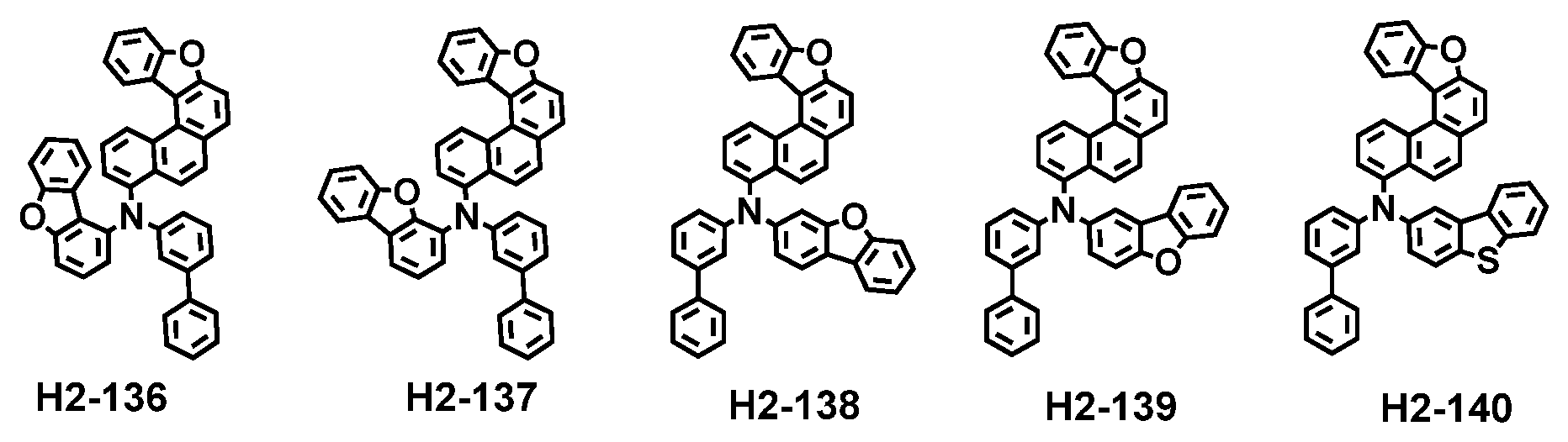


Die Kombination von mindestens einer der Verbindungen H1-1 bis H1-245 und mindestens einer der Verbindungen H2-1 bis H2-294 kann in einer organischen elektrolumineszierenden Vorrichtung verwendet werden.The combination of at least one of Compounds H1-1 to H1-245 and at least one of Compounds H2-1 to H2-294 can be used in an organic electroluminescent device.
Die durch Formel 1 und 2 wiedergegebene Verbindung gemäß der vorliegenden Offenbarung kann nach einem dem Fachmann bekannten Syntheseverfahren hergestellt werden. Beispielsweise kann die durch Formel 1 wiedergegebene Verbindung gemäß der vorliegenden Offenbarung durch Bezugnahme auf die koreanischen Offenlegungsschriften Nr. 2018-0099510 (veröffentlicht am 5. September 2018), 2018-0012709 (veröffentlicht am 6. Februar 2018) und 2020-0103524 (veröffentlicht am 2. September 2020) hergestellt werden und die durch Formel 2 wiedergegebene Verbindung gemäß der vorliegenden Offenbarung kann durch Bezugnahme auf die folgenden Reaktionsschemata 1 bis 4 und die koreanische Offenlegungsschrift Nr. 


In Reaktionsschema 4 sind die Substituenten wie in Formel 2 definiert.In Reaction Scheme 4, the substituents are as defined in Formula 2.
Wenngleich oben veranschaulichende Synthesebeispiele der durch die Formeln 1 und 2 wiedergegebenen Verbindung beschrieben wurden, ist es für den Fachmann leicht ersichtlich, dass sie alle auf einer Buchwald-Hartwig-Kreuzkupplungsreaktion, einer N-Arylierungsreaktion, einer H-Mont-vermittelten Veretherungsreaktion, einer Miyaura-Borylierungsreaktion, einer Suzuki-Kreuzkupplungsreaktion, einer intramolekularen säureinduzierten Cyclisierungsreaktion, einer Pd(II)-katalysierten oxidativen Cyclisierungsreaktion, einer Grignard-Reaktion, einer Heck-Reaktion, einer Cyclodehydratisierungsreaktion, einer SN1-Substitutionsreaktion, einer SN2-Substitutionsreaktion, einer Wittig-Reaktion, einer Negishi-Reaktion, Bromierung und einer phosphinvermittelten reduktiven Cyclisierung usw. basieren und die obigen Reaktionen selbst dann ablaufen, wenn Substituenten, die in den obigen Formeln 1 und 2 definiert, aber in den spezifischen Synthesebeispielen nicht angegeben sind, gebunden sind.Although illustrative synthesis examples of the compound represented by formulas 1 and 2 have been described above, it is readily apparent to those skilled in the art that they are all based on a Buchwald-Hartwig cross-coupling reaction, an N-arylation reaction, an H-Mont-mediated etherification reaction, a Miyaura borylation reaction, Suzuki cross-coupling reaction, intramolecular acid-induced cyclization reaction, Pd(II)-catalyzed oxidative cyclization reaction, Grignard reaction, Heck reaction, cyclodehydration reaction, SN 1 substitution reaction, SN 2 substitution reaction, Wittig reaction, a Negishi reaction, bromination and a phosphine-mediated reductive cyclization, etc., and the above reactions proceed even when substituents defined in the above formulas 1 and 2 but not shown in the specific synthesis examples are attached.
Die vorliegende Offenbarung stellt eine organische elektrolumineszierende Vorrichtung bereit, die eine Anode, eine Kathode und mindestens eine lichtemittierende Schicht zwischen der Anode und der Kathode umfasst, wobei mindestens eine lichtemittierende Schicht mehrere Wirtsmaterialien der vorliegenden Offenbarung umfasst. Das erste Wirtsmaterial und das zweite Wirtsmaterial können in einer lichtemittierenden Schicht enthalten sein oder jeweils in verschiedenen lichtemittierenden Schichten enthalten sein. Das Verhältnis der durch Formel 1 wiedergegebenen Verbindung und der durch Formel 2 wiedergegebenen Verbindung in den mehreren Wirtsmaterialien beträgt etwa 1:99 bis etwa 99:1, vorzugsweise etwa 10:90 bis etwa 90:10, weiter bevorzugt etwa 30:70 bis etwa 70:30. Außerdem können die durch Formel 1 wiedergegebene Verbindung und die durch Formel 2 wiedergegebene Verbindung kombiniert werden, indem man sie in dem gewünschten Verhältnis in einem Schüttler mischt, indem man sie in einem Glasrohr durch Hitze löst oder indem man sie in einem Lösungsmittel löst usw.The present disclosure provides an organic electroluminescent device comprising an anode, a cathode, and at least one light-emitting layer between the anode and the cathode, wherein at least one light-emitting layer comprises multiple host materials of the present disclosure. The first host material and the second host material may be contained in one light-emitting layer or contained in different light-emitting layers, respectively. The ratio of the compound represented by Formula 1 and the compound represented by Formula 2 in the multiple host materials is about 1:99 to about 99:1, preferably about 10:90 to about 90:10, more preferably about 30:70 to about 70 :30. In addition, the compound represented by Formula 1 and the compound represented by Formula 2 can be combined by mixing them in a desired ratio in a shaker, by dissolving them in a glass tube by heat, or by dissolving them in a solvent, etc.
Gemäß einer Ausführungsform der vorliegenden Offenbarung kann die Dotierungskonzentration der Dotierstoffverbindung, bezogen auf die Wirtsverbindung, in der lichtemittierenden Schicht weniger als etwa 20 Gew.-% betragen. Der in der organischen elektrolumineszierenden Vorrichtung der vorliegenden Offenbarung enthaltene Dotierstoff kann mindestens ein phosphoreszierender oder fluoreszierender Dotierstoff sein und ist vorzugsweise ein phosphoreszierender Dotierstoff. Das auf die organische elektrolumineszierende Vorrichtung der vorliegenden Offenbarung angewendete phosphoreszierende Dotierstoffmaterial unterliegt keinen besonderen Einschränkungen, aber es kann sich dabei um eine Komplexverbindung eines Metallatoms, das aus Iridium (Ir), Osmium (Os), Kupfer (Cu) und Platin (Pt) ausgewählt ist, und vorzugsweise ortho-metallierte Komplexverbindungen eines Metallatoms, das aus Iridium (Ir), Osmium (Os), Kupfer (Cu) und Platin (Pt) ausgewählt ist, und weiter bevorzugt ortho-metallierte Iridium-Komplexverbindungen handeln.According to an embodiment of the present disclosure, the dopant concentration of the dopant compound, based on the host compound, in the light-emitting layer can be less than about 20% by weight. The dopant contained in the organic electroluminescent device of the present disclosure may be at least one of phosphorescent and fluorescent dopants and is preferably a phosphorescent dopant. The phosphorescent dopant material applied to the organic electroluminescent device of the present disclosure is not particularly limited, but may be a complex compound of a metal atom selected from iridium (Ir), osmium (Os), copper (Cu) and platinum (Pt). and preferably ortho-metallated complexes of a metal atom selected from iridium (Ir), osmium (Os), copper (Cu) and platinum (Pt), and more preferably ortho-metallated iridium complexes.
Der in der organischen elektrolumineszierenden Vorrichtung der vorliegenden Offenbarung enthaltene Dotierstoff kann eine durch die folgende Formel 101 wiedergegebene Verbindung umfassen, ist aber nicht darauf beschränkt.
Dabei gilt, dass in Formel 101
L aus den folgenden Strukturen 1 bis 3 ausgewählt ist:
R100 bis R103 jeweils unabhängig für Wasserstoff, Deuterium, ein Halogen, ein unsubstituiertes oder durch ein oder mehrere Deuterium und/oder ein oder mehrere Halogene substituiertes (C1-C30)-Alkyl, ein substituiertes oder unsubstituiertes (C3-C30)-Cycloalkyl, ein substituiertes oder unsubstituiertes (C6-C30)-Aryl, ein Cyano, ein substituiertes oder unsubstituiertes (3- bis 30-gliedriges) Heteroaryl oder ein substituiertes oder unsubstituiertes (C1-C30)-Alkoxy stehen oder mit einem oder mehreren benachbarten Substituenten zu einem oder mehreren Ringen, z. B. einem substituierten oder unsubstituierten Chinolin, einem substituierten oder unsubstituierten Benzofuropyridin, einem substituierten oder unsubstituierten Benzothienopyridin, einem substituierten oder unsubstituierten Indenopyridin, einem substituierten oder unsubstituierten Benzofurochinolin, einem substituierten oder unsubstituierten Benzothienochinolin oder einem substituierten oder unsubstituierten Indenochinolin, zusammen mit Pyridin verknüpft sein können;
R104 bis R107 jeweils unabhängig für Wasserstoff, Deuterium, ein Halogen, ein unsubstituiertes oder durch ein oder mehrere Deuterium und/oder ein oder mehrere Halogene substituiertes (C1-C30)-Alkyl, ein substituiertes oder unsubstituiertes (C3-C30)-Cycloalkyl, ein substituiertes oder unsubstituiertes (C6-C30)-Aryl, ein substituiertes oder unsubstituiertes (3- bis 30-gliedriges) Heteroaryl, ein Cyano oder ein substituiertes oder unsubstituiertes (C1-C30)-Alkoxy stehen oder mit einem oder mehreren benachbarten Substituenten zu einem oder mehreren Ringen, z. B. einem substituierten oder unsubstituierten Naphthalin, einem substituierten oder unsubstituierten Fluoren, einem substituierten oder unsubstituierten Dibenzothiophen, einem substituierten oder unsubstituierten Dibenzofuran, einem substituierten oder unsubstituierten Indenopyridin, einem substituierten oder unsubstituierten Benzofuropyridin oder einem substituierten oder unsubstituierten Benzothienopyridin, zusammen mit Benzol verknüpft sein können;
R201 bis R220 jeweils unabhängig für Wasserstoff, Deuterium, ein Halogen, ein (C1-C30)-Alkyl, das unsubstituiert oder durch ein oder mehrere Deuterium und/oder ein oder mehrere Halogene substituiert ist, ein substituiertes oder unsubstituiertes (C3-C30)-Cycloalkyl oder ein substituiertes oder unsubstituiertes (C6-C30)-Aryl stehen oder mit einem oder mehreren benachbarten Substituenten zu einem oder mehreren substituierten oder unsubstituierten Ringen verknüpft sein können; und
s für eine ganze Zahl von 1 bis 3 steht.It applies that in Formula 101
L is selected from the following structures 1 to 3:
R 100 to R 103 each independently represent hydrogen, deuterium, a halogen, a (C1-C30)-alkyl unsubstituted or substituted by one or more deuterium and/or one or more halogens, a substituted or unsubstituted (C3-C30)-cycloalkyl , a substituted or unsubstituted (C6-C30)-aryl, a cyano, a substituted or unsubstituted (3- to 30-membered) heteroaryl or a substituted or unsubstituted (C1-C30)-alkoxy or with one or more adjacent substituents one or more rings, e.g. a substituted or unsubstituted quinoline, a substituted or unsubstituted benzofuropyridine, a substituted or unsubstituted benzothienopyridine, a substituted or unsubstituted indenopyridine, a substituted or unsubstituted benzofuroquinoline, a substituted or unsubstituted benzothienoquinoline, or a substituted or unsubstituted indenoquinoline, together with pyridine ;
R 104 to R 107 each independently represent hydrogen, deuterium, a halogen, a (C1-C30)-alkyl unsubstituted or substituted by one or more deuterium and/or one or more halogens, a substituted or unsubstituted (C3-C30)-cycloalkyl , a substituted or unsubstituted (C6-C30)-aryl, a substituted or unsubstituted (3- to 30-membered) heteroaryl, a cyano or a substituted or unsubstituted (C1-C30)-alkoxy or with one or more adjacent substituents one or more rings, e.g. a substituted or unsubstituted naphthalene, a substituted or unsubstituted fluorene, a substituted or unsubstituted dibenzothiophene, a substituted or unsubstituted dibenzofuran, a substituted or unsubstituted indenopyridine, a substituted or unsubstituted benzofuropyridine, or a substituted or unsubstituted benzothienopyridine, together with benzene ;
R 201 to R 220 are each independently hydrogen, deuterium, a halogen, a (C1-C30)-alkyl which is unsubstituted or substituted by one or more deuterium and/or one or more halogens, a substituted or unsubstituted (C3-C30 )-cycloalkyl or a substituted or unsubstituted (C6-C30)-aryl stand or may be linked with one or more adjacent substituents to form one or more substituted or unsubstituted rings; and
s is an integer from 1 to 3.
Die spezifischen Beispiele für die Dotierstoffverbindung sind wie folgt, sind aber nicht darauf beschränkt.


Eine organische elektrolumineszierende Vorrichtung gemäß der vorliegenden Offenbarung weist eine Anode, eine Kathode und mindestens eine organische Schicht zwischen der Anode und der Kathode auf. Die organische Schicht umfasst eine lichtemittierende Schicht und kann ferner mindestens eine aus der Gruppe bestehend aus einer Lochinjektionsschicht, einer Lochtransportschicht, einer Lochhilfsschicht, einer lichtemittierenden Hilfsschicht, einer Elektronentransportschicht, einer Elektronenpufferschicht, einer Elektroneninjektionsschicht, einer Zwischenschicht, einer Lochblockierschicht und einer Elektronenblockierschicht ausgewählte Schicht umfassen. Jede der Schichten kann ferner in Form von mehreren Schichten ausgeführt sein.An organic electroluminescent device according to the present disclosure includes an anode, a cathode, and at least one organic layer between the anode and the cathode. The organic layer comprises a light-emitting layer and may further comprise at least one layer selected from the group consisting of a hole-injecting layer, a hole-transporting layer, a hole-assisting layer, an auxiliary light-emitting layer, an electron-transporting layer, an electron-buffering layer, an electron-injecting layer, an intermediate layer, a hole-blocking layer and an electron-blocking layer . Each of the layers can also be embodied in the form of multiple layers.
Die Anode und die Kathode können jeweils mit einem transparenten leitfähigen Material oder einem transflektiven oder reflektiven leitfähigen Material ausgebildet sein. Die organische elektrolumineszierende Vorrichtung kann gemäß den Materialien, aus denen die Anode und die Kathode ausgebildet sind, vom Top-Emissions-Typ, Bottom-Emissions-Typ oder Typ mit beidseitiger Emission sein. Außerdem kann die Lochinjektionsschicht ferner mit einem p-Dotierstoff dotiert sein und die Elektroneninjektionsschicht kann ferner mit einem n-Dotierstoff dotiert sein.The anode and cathode may each be formed with a transparent conductive material, or a transflective or reflective conductive material. The organic electroluminescent device may be of top-emission type, bottom-emission type or both-side emission type according to the materials constituting the anode and the cathode. In addition, the hole injection layer may be further doped with a p-type impurity and the electron injection layer may be further doped with an n-type impurity.
Die organische Schicht kann ferner mindestens eine Verbindung aus der Gruppe bestehend aus Verbindungen auf Arylamin-Basis und Verbindungen auf Styrylarylamin-Basis umfassen.The organic layer may further comprise at least one compound selected from the group consisting of arylamine-based compounds and styrylarylamine-based compounds.
Ferner kann die organische Schicht in der organischen elektrolumineszierenden Vorrichtung der vorliegenden Offenbarung ferner mindestens ein Metall aus der Gruppe bestehend aus Metallen der Gruppe 1, Metallen der Gruppe 2, Übergangsmetallen der 4. Periode, Übergangsmetallen der 5. Periode, Lanthaniden und organischen Metallen von d-Übergangselementen des Periodensystems oder mindestens eine komplexe Verbindung, die das Metall umfasst, umfassen.Further, in the organic electroluminescent device of the present disclosure, the organic layer may further contain at least one metal selected from the group consisting of Group 1 metals, Group 2 metals, 4th period transition metals, 5th period transition metals, lanthanides and organic metals from d - transition elements of the periodic table or at least one complex compound comprising the metal.
Außerdem kann die organische elektrolumineszierende Vorrichtung der vorliegenden Offenbarung dadurch, dass sie neben der Verbindung der vorliegenden Offenbarung ferner mindestens eine lichtemittierende Schicht, die eine blaue, rote oder grüne elektrolumineszierende Verbindung, die in der Technik bekannt ist, umfasst, weißes Licht emittieren. Falls nötig, kann sie ferner eine gelbes oder orangefarbenes Licht emittierende Schicht umfassen.In addition, the organic electroluminescent device of the present disclosure can emit white light by further comprising, in addition to the compound of the present disclosure, at least one light-emitting layer comprising a blue, red, or green electroluminescent compound known in the art. If necessary, it may further comprise a yellow or orange light-emitting layer.
In der organischen elektrolumineszierenden Vorrichtung der vorliegenden Offenbarung kann vorzugsweise mindestens eine aus einer Chalcogenidschicht, einer Metallhalogenidschicht und einer Metalloxidschicht ausgewählte Schicht (im Folgenden „eine Oberflächenschicht“) auf einer oder mehreren Innenoberfläche(n) einer oder beider Elektroden angeordnet sein. Im Einzelnen wird eine Schicht aus Chalkogeniden (einschließlich Oxiden) von Silicium und Aluminium vorzugsweise auf eine Anodenoberfläche einer Schicht aus einem elektrolumineszierenden Medium angeordnet und eine Metallhalogenidschicht oder eine Metalloxidschicht wird vorzugsweise auf einer Kathodenoberfläche einer Schicht aus elektrolumineszierendem Medium angeordnet. Durch eine derartige Oberflächenschicht wird Betriebsstabilität für die organische elektrolumineszierende Vorrichtung bereitgestellt. Vorzugsweise schließt das Chalcogenid SiOx(1≤X≤2), AlOx(1≤X≤1,5), SiON, SiAlON usw. ein; schließt das Metallhalogenid LiF, MgF2, CaF2, ein Seltenerdmetallfluorid usw. ein und schließt das Metalloxid Cs2O, Li2O, MgO, SrO, BaO, CaO usw. ein.In the organic electroluminescent device of the present disclosure, at least one of a chalcogenide layer, a metal halide layer and a metal oxide may preferably be used layer selected layer (hereinafter "a surface layer") may be arranged on one or more inner surface(s) of one or both electrodes. Specifically, a layer of chalcogenides (including oxides) of silicon and aluminum is preferably disposed on an anode surface of an electroluminescent medium layer, and a metal halide layer or a metal oxide layer is preferably disposed on a cathode surface of an electroluminescent medium layer. Such a surface layer provides operational stability for the organic electroluminescent device. Preferably, the chalcogenide includes SiOx(1≦X≦2), AlOx(1≦X≦1.5), SiON, SiAlON, etc.; metal halide includes LiF, MgF 2 , CaF 2 , a rare earth metal fluoride, etc.; and metal oxide includes Cs 2 O, Li 2 O, MgO, SrO, BaO, CaO, etc.
Zwischen der Anode und der lichtemittierenden Schicht kann eine Lochinjektionsschicht, eine Lochtransportschicht, eine Elektronenblockierschicht oder eine Kombination davon verwendet werden. Die Lochinjektionsschicht kann zur Erniedrigung der Lochinjektionsbarriere (oder Lochinjektionsspannung) von der Anode zur Lochtransportschicht oder Elektronenblockierschicht mehrschichtig ausgebildet sein, wobei in jeder der mehreren Schichten zwei Verbindungen gleichzeitig verwendet werden können. Die Lochtransportschicht oder die Elektronenblockierschicht kann ebenfalls mehrschichtig ausgebildet sein.A hole injection layer, a hole transport layer, an electron blocking layer, or a combination thereof may be used between the anode and the light emitting layer. The hole injection layer may be multi-layered to lower the hole injection barrier (or hole injection voltage) from the anode to the hole transport layer or electron blocking layer, and two compounds may be used simultaneously in each of the multiple layers. The hole transport layer or the electron blocking layer can also be multilayered.
Zwischen der lichtemittierenden Schicht und der Kathode kann eine Elektronenpufferschicht, eine Lochblockierschicht, eine Elektronentransportschicht, eine Elektroneninjektionsschicht oder eine Kombination davon verwendet werden. Die Elektronenpufferschicht kann mehrschichtig ausgebildet sein, um die Elektroneninjektion zu steuern und die Grenzflächeneigenschaften zwischen der lichtemittierenden Schicht und der Elektroneninjektionsschicht zu verbessern, wobei in jeder der mehreren Schichten zwei Verbindungen gleichzeitig verwendet werden können. Die Lochblockierschicht oder die Elektronentransportschicht kann ebenfalls mehrschichtig ausgebildet sein, wobei in jeder der mehreren Schichten mehrere Verbindungen verwendet werden können.An electron buffer layer, a hole blocking layer, an electron transport layer, an electron injection layer, or a combination thereof may be used between the light-emitting layer and the cathode. The electron buffer layer may be multi-layered in order to control electron injection and improve the interface properties between the light-emitting layer and the electron-injecting layer, and two compounds can be used simultaneously in each of the multi-layers. The hole blocking layer or the electron transport layer may also be multi-layered, and multiple compounds may be used in each of the multiple layers.
Die lichtemittierende Hilfsschicht kann zwischen der Anode und der lichtemittierenden Schicht oder zwischen der Kathode und der lichtemittierenden Schicht angeordnet sein. Bei Anordnung der lichtemittierenden Hilfsschicht zwischen der Anode und der lichtemittierenden Schicht kann sie zur Förderung der Lochinjektion und/oder des Lochtransports oder zur Verhinderung des Überfließens von Elektronen verwendet werden. Bei Anordnung der lichtemittierenden Hilfsschicht zwischen der Kathode und der lichtemittierenden Schicht kann sie zur Förderung der Elektroneninjektion und/oder des Elektronentransports oder zur Verhinderung des Überfließens von Löchern verwendet werden. Außerdem kann die Lochhilfsschicht zwischen der Lochtransportschicht (oder Lochinjektionsschicht) und der lichtemittierenden Schicht angeordnet sein und die Lochtransportrate (oder Lochinjektionsrate) fördern oder blockieren, wodurch die Ladungsbalance gesteuert werden kann. Ferner kann die Elektronenblockierschicht zwischen der Lochtransportschicht (oder Lochinjektionsschicht) und der lichtemittierenden Schicht angeordnet sein und die Exzitonen in der lichtemittierenden Schicht durch Blockieren des Überfließens von Elektronen aus der lichtemittierenden Schicht beschränken, um eine Lichtemissionsleckage zu verhindern. Wenn eine organische elektrolumineszierende Vorrichtung zwei oder mehr Lochtransportschichten enthält, kann die Lochtransportschicht, die ferner enthalten ist, als Lochhilfsschicht oder Elektronenblockierschicht verwendet werden. Die lichtemittierende Hilfsschicht, die Lochhilfsschicht oder die Elektronenblockierschicht können die Effizienz und/oder die Lebensdauer der organischen elektrolumineszierenden Vorrichtung verbessern.The auxiliary light-emitting layer can be arranged between the anode and the light-emitting layer or between the cathode and the light-emitting layer. When the auxiliary light-emitting layer is arranged between the anode and the light-emitting layer, it can be used to promote hole injection and/or hole transport or to prevent electron overflow. When the auxiliary light-emitting layer is arranged between the cathode and the light-emitting layer, it can be used to promote electron injection and/or electron transport or to prevent overflow of holes. In addition, the hole-assisting layer can be disposed between the hole-transporting layer (or hole-injecting layer) and the light-emitting layer, and can promote or block the hole-transporting (or hole-injecting) rate, whereby the charge balance can be controlled. Further, the electron blocking layer may be disposed between the hole transporting layer (or hole injecting layer) and the light emitting layer and confine the excitons in the light emitting layer by blocking the overflow of electrons from the light emitting layer to prevent light emission leakage. When an organic electroluminescent device contains two or more hole transporting layers, the hole transporting layer further contained can be used as a hole assisting layer or an electron blocking layer. The light-emitting assist layer, the hole assist layer, or the electron blocking layer can improve the efficiency and/or the lifetime of the organic electroluminescent device.
Außerdem kann vorzugsweise in der organischen elektrolumineszierenden Vorrichtung der vorliegenden Offenbarung eine gemischte Region aus einer Elektronentransportverbindung und einem reduktiven Dotierstoff oder eine gemischte Region aus einer Lochtransportverbindungen und einem oxidativen Dotierstoff auf mindestens einer Oberfläche eines Paars von Elektroden angeordnet sein. In diesem Fall wird die Elektronentransportverbindung zu einem Anion reduziert, wodurch es leichter wird, Elektronen aus dem gemischten Bereich in das lichtemittierende Medium zu injizieren und zu transportieren. Des Weiteren wird die Lochtransportverbindung zu einem Kation oxidiert, wodurch es leichter wird, Löcher aus dem gemischten Bereich in das lichtemittierende Medium zu injizieren und zu transportieren. Vorzugsweise schließt der oxidative Dotierstoff verschiedene LewisSäure- und -Akzeptor-Verbindungen ein und schließt der reduktive Dotierstoff Alkalimetalle, Alkalimetallverbindungen, Erdalkalimetalle, Seltenerdmetalle und Mischungen davon ein. Die Schicht aus reduktivem Dotierstoff kann als ladungserzeugende Schicht eingesetzt werden, um eine organische elektrolumineszierende Vorrichtung herzustellen, die zwei oder mehr lichtemittierende Schichten aufweist und weißes Licht emittiert.Also, preferably in the organic electroluminescent device of the present disclosure, a mixed region of an electron transport compound and a reductive dopant or a mixed region of a hole transport compound and an oxidative dopant may be disposed on at least one surface of a pair of electrodes. In this case, the electron transport compound is reduced to an anion, making it easier to inject and transport electrons from the mixed region into the light-emitting medium. Furthermore, the hole-transporting compound is oxidized to a cation, making it easier to inject and transport holes from the mixed region into the light-emitting medium. Preferably, the oxidative dopant includes various Lewis acidic and acceptor compounds and the reductive dopant includes alkali metals, alkali metal compounds, alkaline earth metals, rare earth metals, and mixtures thereof. The reductive dopant layer can be used as a charge generation layer to produce an organic electroluminescent device that has two or more light-emitting layers and emits white light.
Die organische elektrolumineszierende Verbindung oder das organische elektrolumineszierende Material gemäß der vorliegenden Offenbarung kann als lichtemittierendes Material für eine weiße organische lichtemittierende Vorrichtung verwendet werden. Für die weiße organische lichtemittierende Vorrichtung sind verschiedene Strukturen vorgeschlagen worden, wie eine Seite-an-Seite-Struktur oder eine Stapelungsstruktur gemäß der Anordnung von rotes (R), grünes (G) oder gelbgrünes (YG) und blaues (B) Licht emittierenden Teilen oder eine Methode mit Farbumwandlungsmaterial (Color Conversion Material, CCM) usw. Das organische elektrolumineszierende Material gemäß der vorliegenden Offenbarung kann auch in einer organischen elektrolumineszierenden Vorrichtung mit einem Quantenpunkt (Quantum Dot, QD) angewendet werden.The organic electroluminescent compound or organic electroluminescent material according to the present disclosure can be used as a light-emitting material for a white organic light emitting device can be used. Various structures have been proposed for the white organic light-emitting device, such as a side-by-side structure or a stacking structure according to the arrangement of red (R), green (G), or yellow-green (YG) and blue (B) light-emitting parts or a color conversion material (CCM) method, etc. The organic electroluminescent material according to the present disclosure can also be applied in a quantum dot (QD) organic electroluminescent device.
Zur Bildung jeder Schicht der organischen elektrolumineszierenden Vorrichtung der vorliegenden Offenbarung können Trockenfilmbildungsverfahren wie Vakuumverdampfung, Sputtern, Plasma, lonenplattierungsverfahren usw. oder Nassfilmbildungsverfahren wie Tintenstrahldruck, Düsendruck, Spritzbeschichten, Aufschleudern, Tauchbeschichten, Fluten usw. verwendet werden. Bei Verwendung der ersten und zweiten Wirtsverbindungen der vorliegenden Offenbarung zur Bildung eines Films wird ein Coverdampfungsprozess oder ein Mischungsverdampfungsprozess durchgeführt.To form each layer of the organic electroluminescent device of the present disclosure, dry film formation methods such as vacuum evaporation, sputtering, plasma, ion plating methods, etc., or wet film formation methods such as ink jet printing, nozzle printing, spray coating, spin coating, dip coating, flow coating, etc. can be used. When using the first and second host compounds of the present disclosure to form a film, a co-evaporation process or a mixture evaporation process is performed.
Bei Verwendung eines Nassfilmbildungsverfahrens kann durch Lösen oder Diffundieren von jede Schicht bildenden Materialien in einem geeigneten Lösungsmittel wie Ethanol, Chloroform, Tetrahydrofuran, Dioxan usw. ein dünner Film gebildet werden. Bei dem Lösungsmittel kann es sich um ein beliebiges Lösungsmittel handeln, in dem die jede Schicht bildenden Materialien gelöst oder diffundiert werden können und bei dem es keine Probleme hinsichtlich der Filmbildungsfähigkeit gibt.Using a wet film formation method, a thin film can be formed by dissolving or diffusing materials constituting each layer in an appropriate solvent such as ethanol, chloroform, tetrahydrofuran, dioxane, etc. The solvent may be any solvent in which the materials constituting each layer can be dissolved or diffused and has no problem in film-formability.
Außerdem ist es möglich, durch Verwendung der organischen elektrolumineszierenden Vorrichtung der vorliegenden Offenbarung ein Anzeigesystem, beispielsweise ein Anzeigesystem für Smartphones, Tablets, Notebooks, PCs, Fernseher oder Autos, oder ein Beleuchtungssystem, beispielsweise ein Außen- oder Innenbeleuchtungssystem, herzustellen.In addition, it is possible to manufacture a display system such as a display system for smartphones, tablets, notebooks, PCs, TVs or cars, or a lighting system such as an outdoor or indoor lighting system by using the organic electroluminescent device of the present disclosure.
Im Folgenden werden das Herstellungsverfahren der Verbindungen gemäß der vorliegenden Offenbarung und deren Eigenschaften unter Bezugnahme auf die repräsentativen Verbindungen der vorliegenden Offenbarung ausführlich erklärt. Die vorliegende Offenbarung wird jedoch durch die folgenden Beispiele nicht beschränkt.In the following, the production process of the compounds according to the present disclosure and their properties are explained in detail with reference to the representative compounds of the present disclosure. However, the present disclosure is not limited by the following examples.
[Beispiel 1] Herstellung von Verbindung H1-1[Example 1] Preparation of Compound H1-1

Verbindung 5 (5 g, 17,16 mmol), 4-Brom-1,1':2',1"-terphenyl (5,3 g, 17,16 mmol), Pd2(dba)3 (0,8 g, 0,858 mmol), Sphos (0,7 g, 1,716 mmol), NaOt-Bu (5 g, 51,48 mmol) und 86 ml o-Xylol wurden in einen Kolben gegeben, gelöst und dann 2 Stunden unter Rückfluss gerührt. Nach Abschluss der Reaktion wurde die Mischung auf Raumtemperatur abgekühlt und der angefallene Feststoff unter vermindertem Druck abfiltriert. Der abfiltrierte Feststoff wurde in CHCl3 gelöst, mit MC/Hex extrahiert und dann durch Säulenchromatographie getrennt, was Verbindung H1-1 (2,4 g, Ausbeute: 26 %) ergab.Compound 5 (5g, 17.16mmol), 4-bromo-1,1':2',1"-terphenyl (5.3g, 17.16mmol), Pd 2 (dba) 3 (0.8 g, 0.858 mmol), Sphos (0.7 g, 1.716 mmol), NaOt-Bu (5 g, 51.48 mmol) and 86 ml of o-xylene were placed in a flask, dissolved and then stirred under reflux for 2 hours. After completion of the reaction, the mixture was cooled to room temperature, and the resulting solid was filtered off under reduced pressure.The filtered solid was dissolved in CHCl 3 , extracted with MC/Hex, and then separated by column chromatography to give Compound H1-1 (2.4 g, Yield: 26%).
1H-NMR (DMSO-d6) δ: 7,92 - 7,88 (m, 1H), 7,87 - 7,83 (m, 1H), 7,79 (d, J = 9,1 Hz, 1H), 7,74 (t, J = 8,3 Hz, 2H), 7,59 - 7,54 (m, 2H), 7,53 - 7,49 (m, 2H), 7,48 - 7,41 (m, 6H), 7,38 (d, J = 2,3 Hz, 1H), 7,36 (d, J = 2,1 Hz, 2H), 7,34 - 7,31 (m, 2H), 7,30 - 7,25 (m, 2H), 7,21 - 7,17 (m, 2H), 7,12 (dd, J = 8,1, 0,6 Hz, 1H) 1 H-NMR (DMSO-d 6 ) δ: 7.92 - 7.88 (m, 1H), 7.87 - 7.83 (m, 1H), 7.79 (d, J = 9.1 Hz , 1H), 7.74 (t, J = 8.3 Hz, 2H), 7.59 - 7.54 (m, 2H), 7.53 - 7.49 (m, 2H), 7.48 - 7.41 (m, 6H), 7.38 (d, J=2.3Hz, 1H), 7.36 (d, J=2.1Hz, 2H), 7.34 - 7.31 (m , 2H), 7.30 - 7.25 (m, 2H), 7.21 - 7.17 (m, 2H), 7.12 (dd, J = 8.1, 0.6 Hz, 1H)
[Beispiel 2] Herstellung von Verbindung H1-122[Example 2] Preparation of Compound H1-122

Verbindung 5 (5 g, 17,16 mmol), 1-(3-Bromphenyl)dibenzo[b,d]thiophen (7 g, 20,59 mmol), Cul (0,16 g, 0,858 mmol), Ethylendiamin (EDA) (1 g, 17,16 mmol), K3PO4 (9,1 g, 42,90 mmol) und 90 ml o-Xylol wurden in einen Kolben gegeben, gelöst und dann 2 Stunden unter Rückfluss gerührt. Nach Abschluss der Reaktion wurde die Mischung auf Raumtemperatur abgekühlt und der angefallene Feststoff unter vermindertem Druck abfiltriert. Der abfiltrierte Feststoff wurde in CHCl3 gelöst, mit MC/Hex extrahiert und dann durch Säulenchromatographie getrennt, was Verbindung H1-122 (2,2 g, Ausbeute: 22 %) ergab.Compound 5 (5g, 17.16mmol), 1-(3-bromophenyl)dibenzo[b,d]thiophene (7g, 20.59mmol), Cul (0.16g, 0.858mmol), ethylenediamine (EDA ) (1 g, 17.16 mmol), K 3 PO 4 (9.1 g, 42.90 mmol) and 90 ml of o-xylene were placed in a flask, dissolved and then stirred under reflux for 2 hours. After completion of the reaction, the mixture was cooled to room temperature, and the resulting solid was filtered off under reduced pressure. The filtered solid was dissolved in CHCl 3 , extracted with MC/Hex and then separated by column chromatography to give Compound H1-122 (2.2 g, yield: 22%).
1H-NMR (DMSO-d6) δ: 8,09 (dd, J = 8,0, 1,1 Hz, 1H), 8,04 (ddd, J = 8,0, 1,1, 0,7 Hz, 1H), 7,92 - 7,87 (m, 2H), 7,85 - 7,82 (m, 1H), 7,80 (ddd, J = 8,0, 2,1, 1,2 Hz, 1H), 7,78 - 7,71 (m, 3H), 7,68 - 7,63 (m, 2H), 7,60 - 7,52 (m, 3H), 7,48 - 7,38 (m, 5H), 7,36 - 7,24 (m, 4H) 1 H NMR (DMSO-d6) δ: 8.09 (dd, J=8.0, 1.1Hz, 1H), 8.04 (ddd, J=8.0, 1.1, 0.7 Hz, 1H), 7.92 - 7.87 (m, 2H), 7.85 - 7.82 (m, 1H), 7.80 (ddd, J = 8.0, 2.1, 1.2 Hz, 1H), 7.78 - 7.71 (m, 3H), 7.68 - 7.63 (m, 2H), 7.60 - 7.52 (m, 3H), 7.48 - 7, 38 (m, 5H), 7.36 - 7.24 (m, 4H)
[Beispiel 3] Herstellung von Verbindung H1-16[Example 3] Preparation of Compound H1-16

In einem Kolben wurden 70 ml Toluol zu Verbindung 5 (4,0 g, 14 mmol), 9-(3-Bromphenyl)-9H-carbazol (4,87 g, 15 mmol), Cul (1,307 g, 7 mmol), EDA (1,647 g, 27 mmol) und K3PO4 (5,83 g, 27 mmol) getropft, wonach die Mischung 4 Stunden bei 180 °C unter Rückfluss gerührt wurde. Nach Abschluss der Reaktion wurde die Mischung mit Essigsäureethylester extrahiert, mit Magnesiumsulfat getrocknet und dann durch Säulenchromatographie getrennt. Danach wurde der Rückstand mit Methanol versetzt und der erhaltene Feststoff unter vermindertem Druck abfiltriert, was Verbindung H1-16 (2,3 g, Ausbeute: 31,5 %) ergab.In a flask, 70 mL of toluene was added to compound 5 (4.0 g, 14 mmol), 9-(3-bromophenyl)-9H-carbazole (4.87 g, 15 mmol), Cul (1.307 g, 7 mmol), EDA (1.647 g, 27 mmol) and K 3 PO 4 (5.83 g, 27 mmol) were added dropwise and the mixture was stirred under reflux at 180°C for 4 hours. After completion of the reaction, the mixture was extracted with ethyl acetate, dried with magnesium sulfate, and then separated by column chromatography. At the end of this time, methanol was added to the residue, and the resulting solid was filtered off under reduced pressure to give Compound H1-16 (2.3 g, yield: 31.5%).
1H-NMR (600MHz, DMSO-d6, δ) 8,27 (d, J = 7,8 Hz, 2H), 8,01 (t, J = 8,0 Hz, 1H), 7,95 - 7,92 (m, 1H), 7,91 - 7,84 (m, 4H), 7,83 (d, J = 6,9 Hz, 1H), 7,81 - 7,77 (m, 2H), 7,66 (d, J = 8,9 Hz, 1H), 7,63 - 7,57 (m, 3H), 7,51 - 7,44 (m, 5H), 7,44 - 7,40 (m, 2H), 7,35 - 7,30 (m, 2H) 1 H NMR (600MHz, DMSO-d6, δ) 8.27 (d, J=7.8Hz, 2H), 8.01 (t, J=8.0Hz, 1H), 7.95-7 .92 (m, 1H), 7.91 - 7.84 (m, 4H), 7.83 (d, J = 6.9 Hz, 1H), 7.81 - 7.77 (m, 2H), 7.66 (d, J = 8.9Hz, 1H), 7.63 - 7.57 (m, 3H), 7.51 - 7.44 (m, 5H), 7.44 - 7.40 ( m, 2H), 7.35 - 7.30 (m, 2H)
[Beispiel 4] Herstellung von Verbindung H1-120[Example 4] Preparation of Compound H1-120


1) Synthese von Verbindung S21) Synthesis of compound S2
Verbindung S1 (36 g, 125,38 mmol), 3-Brom-2-chlornitrobenzol (27 g, 113,98 mmol), Tetrakis(triphenylphosphin)palladium (4 g, 3,42 mmol), Natriumcarbonat (30 g, 285,95 mmol), 570 ml Toluol, 140 ml Ethanol und 140 ml destilliertes Wasser wurden in ein Reaktionsgefäß gegeben und 5 Stunden bei 120 °C unter Rückfluss gerührt. Nach Abschluss der Reaktion wurde die Mischung auf Raumtemperatur abgekühlt und die organische Schicht mit Essigsäureethylester extrahiert. Die extrahierte organische Schicht wurde mit Magnesiumsulfat getrocknet und dann am Rotationsverdampfer vom Lösungsmittel befreit. Danach wurde der Rückstand durch Säulenchromatographie getrennt, was Verbindung S2 (30 g, Ausbeute: 66 %) ergab.Compound S1 (36 g, 125.38 mmol), 3-bromo-2-chloronitrobenzene (27 g, 113.98 mmol), tetrakis(triphenylphosphine)palladium (4 g, 3.42 mmol), sodium carbonate (30 g, 285 .95 mmol), 570 ml of toluene, 140 ml of ethanol and 140 ml of distilled water were placed in a reaction vessel and stirred under reflux at 120° C. for 5 hours. After completion of the reaction, the mixture was cooled to room temperature and the organic layer was extracted with ethyl acetate. The extracted organic layer was dried with magnesium sulfate and then freed from the solvent on a rotary evaporator. Thereafter, the residue was separated by column chromatography to give Compound S2 (30 g, yield: 66%).
2) Synthese von Verbindung S32) Synthesis of compound S3
Verbindung S2 (27 g, 68,20 mmol), Palladium(II)-acetat (1,5 g, 6,82 mmol), Tricyclohexylphosphoniumtetrafluorborat (5,0 g, 13,64 mmol), Caesiumcarbonat (66 g, 204,60 mmol) und 340 ml o-Xylol wurden in das Reaktionsgefäß gegeben und dann 2 Stunden unter Rückfluss erhitzt. Nach Abschluss der Reaktion wurde die Mischung mit destilliertem Wasser gewaschen und die organische Schicht mit Essigsäureethylester extrahiert. Die extrahierte organische Schicht wurde mit Magnesiumsulfat getrocknet und dann am Rotationsverdampfer vom Lösungsmittel befreit. Danach wurde der Rückstand durch Säulenchromatographie getrennt, was Verbindung S3 (24,8 g, Ausbeute: 100 %) ergab.Compound S2 (27g, 68.20mmol), palladium (II) acetate (1.5g, 6.82mmol), tricyclohexylphosphonium tetrafluoroborate (5.0g, 13.64mmol), cesium carbonate (66g, 204, 60 mmol) and 340 ml of o-xylene were added to the reaction vessel and then refluxed for 2 hours. After completion of the reaction, the mixture was washed with distilled water and the organic layer was extracted with ethyl acetate. The extracted organic layer was dried with magnesium sulfate and then freed from the solvent on a rotary evaporator. Thereafter, the residue was separated by column chromatography to give Compound S3 (24.8 g, Yield: 100%).
3) Synthese von Verbindung S43) Synthesis of compound S4
Verbindung S3 (24,8 g, 68,20 mmol), Triethylphosphit (176 ml, 0,4 M) und 341 ml 1,2-Dichlorbenzol (DCB) wurden in ein Reaktionsgefäß gegeben und dann 4 Stunden bei 200 °C gerührt. Nach Abschluss der Reaktion wurde die Mischung unter vermindertem Druck destilliert und das Triethylphosphit entfernt. Anschließend wurde das Ergebnis mit destilliertem Wasser gewaschen und die organische Schicht mit Essigsäureethylester extrahiert. Die extrahierte organische Schicht wurde mit Magnesiumsulfat getrocknet und dann am Rotationsverdampfer vom Lösungsmittel befreit. Danach wurde der Rückstand durch Säulenchromatographie getrennt, was Verbindung S4 (16,4 g, Ausbeute: 70 %) ergab.Compound S3 (24.8 g, 68.20 mmol), triethyl phosphite (176 mL, 0.4 M) and 341 mL of 1,2-dichlorobenzene (DCB) were placed in a reaction vessel and then stirred at 200°C for 4 hours. After completion of the reaction, the mixture was distilled under reduced pressure and triethyl phosphite was removed. Then, the resultant was washed with distilled water, and the organic layer was extracted with ethyl acetate. The extracted organic layer was dried with magnesium sulfate and then freed from the solvent on a rotary evaporator. Thereafter, the residue was separated by column chromatography to give Compound S4 (16.4 g, Yield: 70%).
4) Synthese von Verbindung H1-1204) Synthesis of compound H1-120
Verbindung S4 (5 g, 15,2 mmol), 4-Brom-N,N-diphenylanilin (5,4 g, 16,7 mmol), Pd2(dba)3 (0,7 g, 0,76 mmol), Sphos (0,6 g, 1,52 mmol), NaOtBu (2,9 g, 30,4 mmol) und 80 ml o-Xylol wurden in einen Kolben gegeben, gelöst und dann 4 Stunden unter Rückfluss gerührt. Nach Abschluss der Reaktion wurde die Mischung auf Raumtemperatur abgekühlt und bei Raumtemperatur gerührt. Anschließend wurde der durch Zugabe von MeOH gebildete Feststoff unter vermindertem Druck abfiltriert, mit MC/Hex extrahiert und durch Säulenchromatographie getrennt, was Verbindung H1-120 (4,0 g, Ausbeute: 46 %) ergab.
[Beispiel 5] Herstellung von Verbindung H1-121[Example 5] Preparation of Compound H1-121

Verbindung 6 (14,0 g, 31,4 mmol), N-Phenyl-[1,1'-biphenyl]-3-amin (7,78 g, 31,7 mmol), Pd2(dba)3 (1,44 g, 1,57 mmol), t-Bu3P (635 mg, 3,14 mmol) und t-BuONa (6,04 g, 62,8 mmol) und 160 ml Toluol wurden in einen Kolben gegeben, gelöst und dann 2 Stunden unter Rückfluss gerührt. Nach Abschluss der Reaktion wurde die Mischung auf Raumtemperatur abgekühlt und mit destilliertem Wasser und Essigsäureethylester extrahiert. Die organische Schicht wurde unter vermindertem Druck destilliert, mit MC/Hex extrahiert und durch Säulenchromatographie getrennt, was Verbindung H1-121 (14,6 g, Ausbeute: 76 %) ergab.
[Beispiel 6] Herstellung von Verbindung H1-119[Example 6] Preparation of Compound H1-119

Verbindung 5 (10 g, 34,3 mmol), 3-Bromdibenzo[b,d]furan (12,7 g, 51,45 mmol), Cul (3,3 g, 17,15 mmol), Ethylendiamin (EDA) (4,6 ml, 68,8 mmol), K3PO4 (21,8 g, 102,9 mmol) und 170 ml Toluol wurden in einen Kolben gegeben, gelöst und dann 12 Stunden unter Rückfluss gerührt. Nach Abschluss der Reaktion wurde die Mischung auf Raumtemperatur abgekühlt und bei Raumtemperatur gerührt. Anschließend wurde der durch Zugabe von MeOH gebildete Feststoff unter vermindertem Druck abfiltriert, mit MC/Hex extrahiert und durch Säulenchromatographie getrennt, was Verbindung H1-119 (8,3 g, Ausbeute: 53 %) ergab.
[Beispiel 7] Herstellung von Verbindung H1-12[Example 7] Preparation of Compound H1-12

1) Synthese von Verbindung 12-11) Synthesis of Compound 12-1
Verbindung 5 (10,0 g, 34,3 mmol), 1-Brom-4-iodbenzol (14,6 g, 51,5 mmol), Cul (3,28 g, 17,2 mmol), EDA (4,12 mL, 68,6 mmol), K3PO4 (14,6 g, 68,6 mmol) und 170 ml Toluol wurden in einen Kolben gegeben und 3 Stunden bei 145 °C unter Rückfluss erhitzt. Nach Abschluss der Reaktion wurde der Feststoff mit MC extrahiert und mit MgSO4 getrocknet und durch Säulenchromatographie getrennt. Anschließend wurde der Rückstand mit MeOH versetzt und der erhaltene Feststoff unter vermindertem Druck abfiltriert, was Verbindung H12-1 (9,0 g, Ausbeute: 59 %) ergab.Compound 5 (10.0 g, 34.3 mmol), 1-bromo-4-iodobenzene (14.6 g, 51.5 mmol), Cul (3.28 g, 17.2 mmol), EDA (4, 12 mL, 68.6 mmol), K 3 PO 4 (14.6 g, 68.6 mmol) and 170 mL of toluene were placed in a flask and refluxed at 145 °C for 3 hours. After completion of the reaction, the solid was extracted with MC and dried with MgSO 4 and separated by column chromatography. Then, MeOH was added to the residue and the resulting solid was filtered off under reduced pressure to give Compound H12-1 (9.0 g, Yield: 59%).
2) Synthese von Verbindung H1-122) Synthesis of compound H1-12
Verbindung 12-1 (5,0 g, 11 mmol), N-Phenyl-[1,1'-biphenyl]-4-amin (3,3 g, 13 mmol), Pd2(dba)3 (0,513 g, 0,56 mmol), SPhos (0,460 g, 1 mmol) und NaOt-Bu (2,691 g, 28 mmol) und 60 ml Toluol wurden in einen Kolben gegeben und dann eine halbe Stunde bei 100 °C unter Rückfluss gerührt. Nach Abschluss der Reaktion wurde der Feststoff mit MC extrahiert und mit MgSO4 getrocknet und dann durch Säulenchromatographie getrennt. Anschließend wurde der Rückstand mit MeOH versetzt und der erhaltene Feststoff unter vermindertem Druck abfiltriert, was Verbindung H1-12 (1,3 g, Ausbeute: 19 %) ergab.
[Beispiel 8] Herstellung von Verbindung H1-35[Example 8] Preparation of Compound H1-35

14H-7b,14-Diazadibenzo[3,4:5,6]azuleno[7,8,1-Ima]fluoren (5,0 g, 15,1 mmol), 2-Bromdibenzo[b,d]furan (4,1 g, 16,6 mmol), Pd2(dba)3 (0,691 g, 0,755 mmol), Sphos (0,620 g, 1,51 mmol), NaOtBu (3,63 g, 37,8 mmol) und 75 ml o-Xylol wurden in einen Kolben gegeben und gelöst, wonach die Mischung 6 Stunden unter Rückfluss gerührt wurde. Nach Abschluss der Reaktion wurde die Mischung auf Raumtemperatur abgekühlt und gerührt. Der durch Zugabe von MeOH gebildete Feststoff wurde unter vermindertem Druck abfiltriert, mit MC/Hex extrahiert und durch Säulenchromatographie getrennt, was Verbindung H1-35 (1,9 g, Ausbeute: 25 %) ergab.
[Beispiel 9] Herstellung von Verbindung H1-36[Example 9] Preparation of Compound H1-36

14H-7b,14-Diazadibenzo[3,4-5,6]azuleno[7,8,1-Ima]fluoren (5,0 g, 15,1 mmol), 3-Brom-N,N-diphenylanilin (5,4 g, 16,6 mmol), Pd2(dba)3 (0,693 g, 0,757 mmol), Sphos (0,621 g, 1,51 mmol), NaOt-Bu (3,64 g, 37,8 mmol) und 60 ml o-Xylol wurden in einen Kolben gegeben und gelöst, wonach die Mischung eine Stunde bei 190 °C unter Rückfluss gerührt wurde. Nach Abschluss der Reaktion wurde die Mischung auf Raumtemperatur abgekühlt und mit einem Siliciumdioxidfilter getrennt, was Verbindung H1-36 (6,3 g, Ausbeute: 72,6 %) ergab.
[Beispiel 10] Herstellung von Verbindung H1-14[Example 10] Preparation of Compound H1-14

Verbindung 1 (5 g, 15,13 mmol), Verbindung 2 (4 g, 15,13 mmol), Pd2(dba)3 (0,7 g, 0,756 mmol), NaOt-Bu (4,3 g, 45,40 mmol), S-phos (0,6 g, 1,513 mmol) und 75 ml o-Xylol wurden in einen Kolben gegeben und gelöst, wonach 1 Stunde und 20 Minuten unter Rückfluss gerührt wurde. Nach Abschluss der Reaktion wurde die Mischung auf Raumtemperatur abgekühlt und Methanol zugetropft. Danach wurde die Mischung filtriert, mit MC gelöst und durch Säulenchromatographie getrennt, was Verbindung H1-14 (3,1 g, Ausbeute: 36 %) ergab.
[Beispiel 11] Herstellung von Verbindung H2-9[Example 11] Preparation of Compound H2-9

Verbindung 2 (5,0 g, 12,7 mmol), Verbindung 3 (5,5 g, 15,3 mmol), K2CO3 (3,5 g, 25,4 mmol) und Pd(PPh3)4 (0,73 g, 0,63 mmol) wurden in einen Kolben gegeben, in 39 ml Toluol, 10 ml Ethanol und 13 ml Wasser gelöst und dann 6 Stunden bei 130 °C unter Rückfluss gerührt. Nach Abschluss der Reaktion wurde die organische Schicht mit Essigsäureethylester extrahiert, die Restfeuchtigkeit mit Magnesiumsulfat getrocknet und der Rückstand durch Säulenchromatographie getrennt, was Verbindung H2-9 (4,4 g, Ausbeute: 20 %) ergab.
[Beispiel 12] Herstellung von Verbindung H2-2[Example 12] Preparation of Compound H2-2

Verbindung 2 (5,0 g, 12,7 mmol), 2-Chlor-4-(naphthalin-2-yl)-6-phenyl-1,3,5-triazin (4,8 g, 15,2 mmol), K2CO3 (3,5 g, 25,4 mmol) und Pd(PPh3)4 (0,73 g, 0,63 mmol) wurden in einen Kolben gegeben, in 39 ml Toluol, 10 ml Ethanol und 13 ml Wasser gelöst und dann 6 Stunden bei 130 °C unter Rückfluss gerührt. Nach Abschluss der Reaktion wurde die organische Schicht mit Essigsäureethylester extrahiert, die Restfeuchtigkeit mit Magnesiumsulfat getrocknet und der Rückstand durch Säulenchromatographie getrennt, was Verbindung H2-2 (4,4 g, Ausbeute: 20 %) ergab.
[Beispiel 13] Herstellung von Verbindung H2-191[Example 13] Preparation of Compound H2-191

1) Synthese von Verbindung 41) Synthesis of compound 4
1-Brom-3-chlordibenzo[b,d]furan (39,2 g, 139,3 mmol), (2-Formylphenyl)boronsäure (52,2 g, 348,1 mmol), Tetrakis(triphenylphosphin)palladium(0) (16,1 g, 13,9 mmol), Cs2CO3 (136,1 g, 418 mmol), 840 ml Toluol, 160 ml Ethanol und 210 ml destilliertes Wasser wurden in ein Reaktionsgefäß gegeben, wonach die Mischung 5 Stunden bei 140 °C gerührt wurde. Nach Abschluss der Reaktion wurde die Mischung auf Raumtemperatur abgekühlt und die organische Schicht mit Essigsäureethylester extrahiert. Die extrahierte organische Schicht wurde mit Magnesiumsulfat getrocknet und dann am Rotationsverdampfer vom Lösungsmittel befreit. Danach wurde der Rückstand durch Säulenchromatographie getrennt, was Verbindung 4 (32,1 g, Ausbeute: 75 %) ergab.1-Bromo-3-chlorodibenzo[b,d]furan (39.2 g, 139.3 mmol), (2-formylphenyl)boronic acid (52.2 g, 348.1 mmol), tetrakis(triphenylphosphine)palladium(0 ) (16.1 g, 13.9 mmol), Cs 2 CO 3 (136.1 g, 418 mmol), 840 ml of toluene, 160 ml of ethanol and 210 ml of distilled water were placed in a reaction vessel, and the mixture was allowed to stir for 5 hours was stirred at 140 °C. After completion of the reaction, the mixture was cooled to room temperature and the organic layer was extracted with ethyl acetate. The extracted organic layer was dried with magnesium sulfate and then freed from the solvent on a rotary evaporator. Thereafter, the residue was separated by column chromatography to give Compound 4 (32.1 g, Yield: 75%).
2) Synthese von Verbindung 52) Synthesis of compound 5
Verbindung 4 (31,6 g, 103 mmol), (Methoxymethyl)triphenylphosphoniumchlorid (45,9 g, 133,9 mmol) und 515 ml Tetrahydrofuran wurden zugegeben, wonach die Reaktionsmischung 10 Minuten gerührt wurde. Anschließend wurde Kalium-tert-butoxid (1 M in THF, 150 ml) bei 0 °C langsam zugetropft. Die Temperatur wurde langsam erhöht, wonach die Mischung 3 Stunden bei Raumtemperatur gerührt wurde. Nach Abschluss der Reaktion durch Zugabe von destilliertem Wasser wurde die organische Schicht mit Essigsäureethylester extrahiert. Die extrahierte organische Schicht wurde mit Magnesiumsulfat getrocknet und dann am Rotationsverdampfer vom Lösungsmittel befreit. Danach wurde der Rückstand durch Säulenchromatographie getrennt, was Verbindung 5 (31,2 g, Ausbeute: 90 %) ergab.Compound 4 (31.6 g, 103 mmol), (methoxymethyl)triphenylphosphonium chloride (45.9 g, 133.9 mmol) and 515 ml of tetrahydrofuran were added and the reaction mixture was stirred for 10 minutes. Potassium tert-butoxide (1 M in THF, 150 ml) was then slowly added dropwise at 0°C. The temperature was slowly raised, after which the mixture was stirred at room temperature for 3 hours. After completing the reaction by adding distilled water, the organic layer was extracted with ethyl acetate. The extracted organic layer was dried with magnesium sulfate and then freed from the solvent on a rotary evaporator. Thereafter, the residue was separated by column chromatography to give Compound 5 (31.2 g, Yield: 90%).
3) Synthese von Verbindung 63) Synthesis of compound 6
Verbindung 5 (29,8 g, 89,0 mmol), 22,4 ml Bortrifluoridetherat und 890 ml Methylenchlorid (MC) wurden in ein Reaktionsgefäß gegeben, wonach die Mischung 3 Stunden gerührt wurde. Nach Abschluss der Reaktion wurde die organische Schicht mit Methylenchlorid (MC) zusammen mit Wasser extrahiert. Die extrahierte organische Schicht wurde mit Magnesiumsulfat getrocknet und dann am Rotationsverdampfer vom Lösungsmittel befreit. Danach wurde der Rückstand durch Säulenchromatographie getrennt, was Verbindung 6 (24,2 g, Ausbeute: 90 %) ergab.Compound 5 (29.8 g, 89.0 mmol), 22.4 mL of boron trifluoride etherate and 890 mL of methylene chloride (MC) were placed in a reaction vessel, and the mixture was stirred for 3 hours. After completion of the reaction, the organic layer was extracted with methylene chloride (MC) together with water. The extracted organic layer was dried with magnesium sulfate and then freed from the solvent on a rotary evaporator. Thereafter, the residue was separated by column chromatography to give Compound 6 (24.2 g, Yield: 90%).
4) Synthese von Verbindung 74) Synthesis of compound 7
Verbindung 6 (18,0 g, 59,5 mmol), Bis(pinacolato)dibor (19,7 g, 77,3 mmol), Tris(dibenzylidenaceton)dipalladium(0) (2,8 g, 2,9 mmol), 2-Dicyclohexylphosphino-2',6'-dimethoxybiphenyl (SPhos) (2,4 g, 5,9 mmol), Kaliumacetat (17,5 g, 178,5 mmol) und 300 ml 1,4-Dioxan wurden in ein Reaktionsgefäß gegeben und dann 6 Stunden bei 150 °C gerührt. Nach Abschluss der Reaktion wurde die Mischung auf Raumtemperatur abgekühlt und die organische Schicht mit Essigsäureethylester extrahiert. Die extrahierte organische Schicht wurde mit Magnesiumsulfat getrocknet und dann am Rotationsverdampfer vom Lösungsmittel befreit. Danach wurde der Rückstand durch Säulenchromatographie getrennt, was Verbindung 7 (1,84 g, Ausbeute: 78 %) ergab.Compound 6 (18.0 g, 59.5 mmol), bis(pinacolato)diboron (19.7 g, 77.3 mmol), tris(dibenzylideneacetone)dipalladium(0) (2.8 g, 2.9 mmol) In a Given reaction vessel and then stirred at 150 ° C for 6 hours. After completion of the reaction, the mixture was cooled to room temperature and the organic layer was extracted with ethyl acetate. The extracted organic layer was dried with magnesium sulfate and then freed from the solvent on a rotary evaporator. Thereafter, the residue was separated by column chromatography to give Compound 7 (1.84 g, Yield: 78%).
5) Synthese von Verbindung H2-1915) Synthesis of Compound H2-191
Verbindung 7 (4,0 g, 10,1 mmol), Verbindung 8 (3,9 g, 12,2 mmol), Tetrakis(triphenylphosphin)palladium(0) (0,6 g, 0,51 mmol), Kaliumcarbonat (2,8 g, 20,2 mmol), 30 ml Toluol, 7 ml Ethanol und 10 ml destilliertes Wasser wurden in ein Reaktionsgefäß gegeben, wonach die Mischung 6 Stunden bei 130 °C gerührt wurde. Nach Abschluss der Reaktion wurde Methanol zu der Mischung getropft und der erhaltene Feststoff abfiltriert und durch Säulenchromatographie gereinigt, was Verbindung H2-191 (4,5 g, Ausbeute: 81 %) ergab.
[Beispiel 14] Herstellung von Verbindung H2-192[Example 14] Preparation of Compound H2-192

Verbindung 7 (4,0 g, 18,1 mmol), 2-Chlor-4-(dibenzo[b,d]furan-1-yl)-6-phenyl-1,3,5-triazin (4,4 g, 12,2 mmol), Tetrakis(triphenylphosphin)palladium(0) (0,6 g, 0,5 mmol), Kaliumcarbonat (2,8 g, 20,2 mmol), 30 ml Toluol, 7 ml Ethanol und 10 ml destilliertes Wasser wurden in ein Reaktionsgefäß gegeben und dann 6 Stunden bei 130 °C gerührt. Nach Abschluss der Reaktion wurde Methanol zu der Mischung getropft und der erhaltene Feststoff abfiltriert. Der erhaltene Feststoff wurde durch Säulenchromatographie gereinigt, was Verbindung H2-192 (3,13 g, Ausbeute: 53 %) ergab.
[Beispiel 15] Herstellung von Verbindung H2-229[Example 15] Preparation of Compound H2-229

Verbindung 6 (4,0 g, 13,2 mmol), N-([1,1'-Biphenyl]-4-yl)dibenzo[b,d]furan-2-amin (4,4 g, 13,2 mmol), Pd(OAC)2 (0,15 g, 0,66 mmol), P(tert-Bu)3 (0,65 ml, 1,32 mmol), Natrium-tert-butoxid (2,5 g, 26,4 mmol) und 66 ml Xylol wurden in ein Reaktionsgefäß gegeben und 5 Stunden bei 165 °C gerührt. Nach Abschluss der Reaktion wurde die Mischung auf Raumtemperatur abgekühlt und die organische Schicht mit Essigsäureethylester extrahiert. Die extrahierte organische Schicht wurde mit Magnesiumsulfat getrocknet und dann am Rotationsverdampfer vom Lösungsmittel befreit. Danach wurde der Rückstand durch Säulenchromatographie getrennt, was Verbindung H2-229 (4,9 g, Ausbeute: 61 %) ergab.
[Beispiel 16] Herstellung von Verbindung H2-171[Example 16] Preparation of Compound H2-171

1) Synthese von Verbindung B1) Synthesis of compound B
Verbindung A (5,0 g, 10,3 mmol), (2-Formylphenyl)boronsäure (2,3 g, 15,5 mmol), Pd2(dba)3 (0,47 g, 0,52 mmol), 2-Dicyclohexylphosphino-2',6'-dimethoxybiphenyl (SPhos) (0,43 g, 1,03 mmol), K3PO4 (5,5 g, 25,8 mmol) und 52 ml Xylol wurden in ein Reaktionsgefäß gegeben und dann 6 Stunden bei 165 °C gerührt. Nach Abschluss der Reaktion wurde die Mischung auf Raumtemperatur abgekühlt und die organische Schicht mit Essigsäureethylester extrahiert. Die extrahierte organische Schicht wurde mit Magnesiumsulfat getrocknet und dann am Rotationsverdampfer vom Lösungsmittel befreit. Danach wurde der Rückstand durch Säulenchromatographie getrennt, was Verbindung B (4,55 g, Ausbeute: 80 %) ergab.Compound A (5.0 g, 10.3 mmol), (2-Formylphenyl)boronic acid (2.3 g, 15.5 mmol), Pd 2 (dba) 3 (0.47 g, 0.52 mmol), 2-Dicyclohexylphosphino-2',6'-dimethoxybiphenyl (SPhos) (0.43 g, 1.03 mmol), K 3 PO 4 (5.5 g, 25.8 mmol) and 52 mL of xylene were placed in a reaction vessel and then stirred at 165°C for 6 hours. After completion of the reaction, the mixture was cooled to room temperature and the organic layer was extracted with ethyl acetate. The extracted organic layer was dried with magnesium sulfate and then freed from the solvent on a rotary evaporator. Thereafter, the residue was separated by column chromatography to give Compound B (4.55 g, Yield: 80%).
2) Synthese von Verbindung C2) Synthesis of compound C
Verbindung B (4,55 g, 8,22 mmol), (Methoxymethyl)triphenylphosphoniumchlorid (3,66 g, 10,7 mmol) und 41 ml Tetrahydrofuran wurden in ein Reaktionsgefäß gegeben, wonach die Reaktionsmischung 10 Minuten gerührt wurde. Anschließend wurden 11 ml Kalium-tert-butoxid (1 M in THF) bei 0 °C langsam zugetropft. Die Temperatur wurde langsam erhöht, wonach die Mischung 3 Stunden bei Raumtemperatur gerührt wurde. Nach Abschluss der Reaktion durch Zugabe von destilliertem Wasser wurde die organische Schicht mit Essigsäureethylester extrahiert. Die extrahierte organische Schicht wurde mit Magnesiumsulfat getrocknet und dann am Rotationsverdampfer vom Lösungsmittel befreit. Danach wurde der Rückstand durch Säulenchromatographie getrennt, was Verbindung C (3,06 g, Ausbeute: 64 %) ergab.Compound B (4.55 g, 8.22 mmol), (methoxymethyl)triphenylphosphonium chloride (3.66 g, 10.7 mmol) and 41 ml of tetrahydrofuran were placed in a reaction vessel, and the reaction mixture was stirred for 10 minutes. Then 11 ml of potassium tert-butoxide (1M in THF) were slowly added dropwise at 0.degree. The temperature was slowly raised, after which the mixture was stirred at room temperature for 3 hours. After completing the reaction by adding distilled water, the organic layer was extracted with ethyl acetate. The extracted organic layer was dried with magnesium sulfate and then freed from the solvent on a rotary evaporator. Thereafter, the residue was separated by column chromatography to give Compound C (3.06 g, yield: 64%).
3) Synthese von Verbindung H2-1713) Synthesis of Compound H2-171
Verbindung C (2,3 g, 3,95 mmol), Eaton-Reagenz (0,23 ml) und Chlorbenzol (23 ml) wurden in ein Reaktionsgefäß gegeben und dann 2 Stunden am Rückfluss erhitzt. Nach Abschluss der Reaktion wurde die Mischung auf Raumtemperatur abgekühlt und die organische Schicht mit Methylenchlorid (MC) extrahiert. Die extrahierte organische Schicht wurde mit Magnesiumsulfat getrocknet und dann am Rotationsverdampfer vom Lösungsmittel befreit. Danach wurde der Rückstand durch Säulenchromatographie getrennt, was Verbindung H2-171 (1,93 g, Ausbeute: 89 %) ergab.
[Beispiel 17] Herstellung von Verbindung H2-242[Example 17] Preparation of Compound H2-242

1) Synthese von Verbindung 91) Synthesis of compound 9
4-Brom-9,9-dimethyl-9H-fluoren (50 g, 183 mmol), (5-Chlor-2-formylphenyl)boronsäure (40,5 g, 219 mmol), Tetrakis(triphenylphosphin)palladium(0) (10,6 g, 9,15 mmol), Kaliumcarbonat (63 g, 457 mmol), 690 ml Toluol, 180 ml Ethanol und 230 ml destilliertes Wasser wurden in ein Reaktionsgefäß gegeben, wonach die Mischung 5 Stunden bei 140 °C gerührt wurde. Nach Abschluss der Reaktion wurde die Mischung auf Raumtemperatur abgekühlt und die organische Schicht mit Essigsäureethylester extrahiert. Die extrahierte organische Schicht wurde mit Magnesiumsulfat getrocknet und dann am Rotationsverdampfer vom Lösungsmittel befreit. Danach wurde der Rückstand durch Säulenchromatographie getrennt, was Verbindung 9 (40,3 g, Ausbeute: 66 %) ergab.4-Bromo-9,9-dimethyl-9H-fluorene (50g, 183mmol), (5-Chloro-2-formylphenyl)boronic acid (40.5g, 219mmol), tetrakis(triphenylphosphine)palladium(0) ( 10.6 g, 9.15 mmol), potassium carbonate (63 g, 457 mmol), 690 ml of toluene, 180 ml of ethanol and 230 ml of distilled water were placed in a reaction vessel, and the mixture was stirred at 140°C for 5 hours. After completion of the reaction, the mixture was cooled to room temperature and the organic layer was extracted with ethyl acetate. The extracted organic layer was dried with magnesium sulfate and then freed from the solvent on a rotary evaporator. Thereafter, the residue was separated by column chromatography to give Compound 9 (40.3 g, yield: 66%).
2) Synthese von Verbindung 102) Synthesis of compound 10
Verbindung 9 (40,3 g, 121 mmol), (Methoxymethyl)triphenylphosphoniumchlorid (53,9 g, 157,4 mmol) und 600 ml Tetrahydrofuran wurden in ein Reaktionsgefäß gegeben, wonach die Reaktionsmischung 10 Minuten gerührt wurde. Anschließend wurden 162 ml Kalium-tert-butoxid (1 M in THF) bei 0 °C langsam zugetropft. Die Temperatur wurde langsam erhöht, wonach die Mischung 3 Stunden bei Raumtemperatur gerührt wurde. Nach Abschluss der Reaktion durch Zugabe von destilliertem Wasser zur Reaktionslösung wurde die organische Schicht mit Essigsäureethylester extrahiert. Die extrahierte organische Schicht wurde mit Magnesiumsulfat getrocknet und dann am Rotationsverdampfer vom Lösungsmittel befreit. Danach wurde der Rückstand durch Säulenchromatographie getrennt, was Verbindung 10 (39 g, Ausbeute: 89 %) ergab.Compound 9 (40.3 g, 121 mmol), (methoxymethyl)triphenylphosphonium chloride (53.9 g, 157.4 mmol) and 600 ml of tetrahydrofuran were placed in a reaction vessel, and the reaction mixture was stirred for 10 minutes. Then 162 ml of potassium tert-butoxide (1M in THF) were slowly added dropwise at 0.degree. The temperature was slowly raised, after which the mixture was stirred at room temperature for 3 hours. After completing the reaction by adding distilled water to the reaction solution, the organic layer was extracted with ethyl acetate. The extracted organic layer was dried with magnesium sulfate and then freed from the solvent on a rotary evaporator. Thereafter, the residue was separated by column chromatography to give Compound 10 (39 g, Yield: 89%).
3) Synthese von Verbindung 113) Synthesis of compound 11
Verbindung 10 (38 g, 105,3 mmol), 26,5 ml Bortrifluoridetherat und 1000 ml Methylenchlorid (MC) wurden in ein Reaktionsgefäß gegeben und dann 3 Stunden gerührt. Nach Abschluss der Reaktion wurde die organische Schicht mit Methylenchlorid (MC) zusammen mit Wasser extrahiert. Die extrahierte organische Schicht wurde mit Magnesiumsulfat getrocknet und dann am Rotationsverdampfer vom Lösungsmittel befreit. Danach wurde der Rückstand durch Säulenchromatographie getrennt, was Verbindung 11 (23,2 g, Ausbeute: 67 %) ergab.Compound 10 (38 g, 105.3 mmol), 26.5 mL of boron trifluoride etherate and 1000 mL of methylene chloride (MC) were placed in a reaction vessel and then stirred for 3 hours. After completion of the reaction, the organic layer was extracted with methylene chloride (MC) together with water. The extracted organic layer was dried with magnesium sulfate and then freed from the solvent on a rotary evaporator. Thereafter, the residue was separated by column chromatography to give Compound 11 (23.2 g, yield: 67%).
4) Synthese von Verbindung 124) Synthesis of compound 12
Verbindung 11 (19,1 g, 58,1 mmol), Bis(pinacolato)dibor (19,1 g, 75,5 mmol), Tris(dibenzylidenaceton)dipalladium(0) (2,7 g, 2,9 mmol), 2-Dicyclohexylphosphin-2',6'-dimethoxybiphenyl (SPhos) (2,4 g, 5,81 mmol), Kaliumacetat (17,1 g, 174,3 mmol) und 290 ml 1,4-Dioxan wurden in ein Reaktionsgefäß gegeben und dann 6 Stunden bei 150 °C gerührt. Nach Abschluss der Reaktion wurde die Mischung auf Raumtemperatur abgekühlt und die organische Schicht mit Essigsäureethylester extrahiert. Die extrahierte organische Schicht wurde mit Magnesiumsulfat getrocknet und dann am Rotationsverdampfer vom Lösungsmittel befreit. Danach wurde der Rückstand durch Säulenchromatographie getrennt, was Verbindung 12 (12,7 g, Ausbeute: 52 %) ergab.Compound 11 (19.1 g, 58.1 mmol), bis(pinacolato)diboron (19.1 g, 75.5 mmol), tris(dibenzylideneacetone)dipalladium(0) (2.7 g, 2.9 mmol) In a Given reaction vessel and then stirred at 150 ° C for 6 hours. After completion of the reaction, the mixture was cooled to room temperature and the organic layer was extracted with ethyl acetate. The extracted organic layer was dried with magnesium sulfate and then freed from the solvent on a rotary evaporator. Thereafter, the residue was separated by column chromatography to give Compound 12 (12.7 g, Yield: 52%).
5) Synthese von Verbindung H2-2425) Synthesis of compound H2-242
Verbindung 12 (4 g, 9,5 mmol), Verbindung 13 (4,1 g, 11,4 mmol), Tetrakis(triphenylphosphin)palladium(0) (0,55 g, 0,48 mmol), Kaliumcarbonat (2,6 g, 19,0 mmol), Toluol (30 ml), Ethanol (7 ml) und destilliertes Wasser (10 ml) wurden in ein Reaktionsgefäß gegeben, wonach die Mischung 6 Stunden bei 130 °C gerührt wurde. Nach Abschluss der Reaktion wurde Methanol zu der Mischung getropft und der erhaltene Feststoff abfiltriert. Der erhaltene Feststoff wurde durch Säulenchromatographie gereinigt, was Verbindung H2-242 (4,73 g, Ausbeute: 80 %) ergab.
[Beispiel 181 Herstellung von Verbindung H2-241[Example 181 Preparation of Compound H2-241

Verbindung 12 (5,0 g, 11,9 mmol), 2-Chlor-4-(naphthalin -2-yl)-6-phenyl-1,3,5-triazin (4,5 g, 14,3 mmol), Tetrakis(triphenylphosphin)palladium(0) (0,7 g, 0,6 mmol), Kaliumcarbonat (3,3 g, 23,8 mmol), 36 ml Toluol, 10 ml Ethanol und 12 ml destilliertes Wasser wurden in ein Reaktionsgefäß gegeben und dann 6 Stunden bei 130 °C gerührt. Nach Abschluss der Reaktion wurde Methanol zu der Mischung getropft und der erhaltene Feststoff abfiltriert. Der erhaltene Feststoff wurde durch Säulenchromatographie gereinigt, was Verbindung H2-241 (3,64 g, Ausbeute: 53 %) ergab.
[Beispiel 19] Herstellung von Verbindung H2-57[Example 19] Preparation of Compound H2-57

Verbindung 14 (5,0 g, 16,5 mmol), Verbindung 15 (5,7 g, 16,5 mmol), Pd(OAc)2 (0,19 g, 0,82 mmol), P(t-Bu)3 (0,82 ml, 1,65 mmol), NaOtBu (3,2 g, 33,0 mmol) und 83 ml o-Xylol wurden in einen Kolben gegeben und dann 2 Stunden unter Rückfluss gerührt. Nach Abschluss der Reaktion wurde die Mischung mit EA/H2O extrahiert und durch Säulenchromatographie getrennt, was Verbindung H2-57 (4,46 g, Ausbeute: 43 %) ergab.
[Beispiel 20] Herstellung von Verbindung H2-52[Example 20] Preparation of Compound H2-52

Verbindung 16 (4 g, 10,14 mmol), Verbindung 17 (4,3 g, 10,14 mmol), Pd(PPh3)4 (586 mg, 0,507 mmol), K2CO3 (2,8 g, 20,29 mmol), 50 ml Toluol, 12 ml EtOH und 13 ml H2O wurden in einen Kolben gegeben, gelöst und dann 6 Stunden bei 140 °C unter Rückfluss gerührt. Nach Abschluss der Reaktion wurde die Mischung auf Raumtemperatur abgekühlt und der angefallene Feststoff unter vermindertem Druck abfiltriert. Der erhaltene Feststoff wurde in CHCl3 gelöst, über ein SiO2-Filter filtriert und mit o-Xylol und o-Dichlorbenzol (o-DCB) umkristallisiert, was Verbindung H2-52 (5,8 g, Ausbeute: 65 %) ergab.
[Beispiel 211 Herstellung von Verbindung H2-166[Example 211 Preparation of Compound H2-166

Verbindung 11 (3,3 g, 10,04 mmol), Di([1,1'-biphenyl]-4-yl)amin (3,2 g, 10,04 mmol), Tris(dibenzylidenaceton)dipalladium(0) (0,5 g, 0,50 mmol), Tri-tert-butylphosphin (0,5 ml, 1,04 mmol), Natrium-tert-butoxid (1,5 g, 15,06 mmol) und 50 ml Toluol wurden in einen Kolben gegeben und dann 4 Stunden unter Rückfluss gerührt. Danach wurde die Reaktionsmischung auf Raumtemperatur abgekühlt und der Feststoff abfiltriert und mit Essigsäureethylester gewaschen. Das Filtrat wurde unter vermindertem Druck destilliert und durch Säulenchromatographie gereinigt, was Verbindung H2-166 (3,2 g, Ausbeute: 52 %) ergab.
[Beispiel 221 Herstellung von Verbindung H2-230[Example 221 Preparation of Compound H2-230

Verbindung 6 (2,14 g, 7,1 mmol), Verbindung 15 (2,5 g, 7,1 mmol), Pd(OAc)2 (0,08 g, 0,36 mmol), Tri-tert-butylphosphin (0,35 ml, 0,71 mmol), Natrium-tert-butoxid (1,4 g, 14,2 mmol) und 36 ml o-Xylol wurden in ein Reaktionsgefäß gegeben und dann 6 Stunden bei 165 °C gerührt. Nach Abschluss der Reaktion wurde die Mischung auf Raumtemperatur abgekühlt und die organische Schicht mit Essigsäureethylester extrahiert. Die extrahierte organische Schicht wurde mit Magnesiumsulfat getrocknet und dann am Rotationsverdampfer vom Lösungsmittel befreit. Danach wurde der Rückstand durch Säulenchromatographie getrennt, was Verbindung H2-230 (2,0 g, Ausbeute: 12 %) ergab.
Im Folgenden werden die Lichtausbeute- und Lebensdauereigenschaften der organischen elektrolumineszierenden Vorrichtung (OLED) gemäß der vorliegenden Offenbarung ausführlich erklärt. Die folgenden Beispiele veranschaulichen jedoch lediglich die Eigenschaften einer OLED gemäß der vorliegenden Offenbarung, aber die vorliegende Offenbarung ist nicht auf die folgenden Beispiele beschränkt.In the following, the luminous efficiency and lifetime characteristics of the organic electroluminescent device (OLED) according to the present disclosure are explained in detail. However, the following examples merely illustrate the characteristics of an OLED according to the present disclosure, but the present disclosure is not limited to the following examples.
Vorrichtungsbeispiele 1 bis 7: Herstellung von OLEDs durch Coverdampfung der ersten Wirtsverbindung und der zweiten Wirtsverbindung gemäß der vorliegenden OffenbarungDevice Examples 1 to 7: Fabrication of OLEDs by co-evaporation of the first host compound and the second host compound according to the present disclosure
Es wurden OLEDs gemäß der vorliegenden Offenbarung hergestellt. Eine transparente dünne Elektrodenschicht aus Indiumzinnoxid (ITO) (10 Ω/sq) auf einem Glassubstrat für eine OLED (GEOMATEC CO., LTD., Japan) wurde nacheinander einer Ultraschallwäsche mit Aceton und Isopropylalkohol unterworfen und dann nach Aufbewahrung in Isopropylalkohol verwendet. Das ITO-Substrat wurde dann auf einem Substrathalter einer Vakuumdampfabscheidungsapparatur angebracht. Die in Tabelle 2 gezeigte Verbindung HI-1 wurde in eine Zelle der Vakuumdampfabscheidungsapparatur eingetragen, und Verbindung HT-1 wurde in eine andere Zelle der Vakuumdampfabscheidungsapparatur eingetragen. Die beiden Materialien wurden mit verschiedenen Raten verdampft, und Verbindung HI-1 wurde in einer Dotierungsmenge von 3 Gew.-%, bezogen auf die Gesamtmenge von Verbindung HI-1 und Verbindung HT-1, abgeschieden, um eine Lochinjektionsschicht mit einer Dicke von 10 nm zu bilden. Als Nächstes wurde Verbindung HT-1 auf der Lochinjektionsschicht abgeschieden, um eine erste Lochtransportschicht mit einer Dicke von 80 nm zu bilden. Dann wurde Verbindung HT-2 in eine andere Zelle der Vakuumdampfabscheidungsapparatur eingebracht und durch Anlegen eines elektrischen Stroms an die Zelle verdampft, wodurch eine zweite Lochtransportschicht mit einer Dicke von 60 nm auf der ersten Lochtransportschicht gebildet wurde. Nach der Bildung der Lochinjektionsschicht und der Lochtransportschichten wurde eine lichtemittierende Schicht wie folgt darauf gebildet: Die erste Wirtsverbindung und die zweite Wirtsverbindung gemäß nachstehender Tabelle 1 wurden in zwei Zellen der Vakuumdampfabscheidungsapparatur als Wirte eingebracht, und Verbindung D-39 wurde als Dotierstoff in eine andere Zelle eingebracht. Die beiden Wirtsmaterialien wurden mit einer Rate von 1:1 verdampft, wobei gleichzeitig das Dotierstoffmaterial mit verschiedenen Raten verdampft wurde und der Dotierstoff in einer Dotierungsmenge von 3 Gew.-%, bezogen auf die Gesamtmenge der Wirte und des Dotierstoffs, abgeschieden wurde, um eine lichtemittierende Schicht mit einer Dicke von 40 nm auf der zweiten Lochtransportschicht zu bilden. Als Nächstes wurden Verbindung ET-1 und Verbindung EI-1 in einem Gewichtsverhältnis von 50:50 abgeschieden, um eine Elektronentransportschicht mit einer Dicke von 35 nm auf der lichtemittierenden Schicht zu bilden. Nach der Abscheidung von Verbindung EI-1 als Elektroneninjektionsschicht mit einer Dicke von 2 nm auf der Elektronentransportschicht wurde unter Verwendung einer weiteren Vakuumdampfabscheidungsapparatur eine Al-Kathode mit einer Dicke von 80 nm auf der Elektroneninjektionsschicht abgeschieden. So wurden OLEDs hergestellt. Alle für die Herstellung der OLEDs verwendeten Materialien wurden durch Vakuumsublimation bei 10-6 Torr gereinigt.OLEDs were fabricated in accordance with the present disclosure. An indium tin oxide (ITO) transparent electrode thin film (10 Ω/sq) on a glass substrate for an OLED (GEOMATEC CO., LTD., Japan) was subjected to ultrasonic washing with acetone and isopropyl alcohol successively and then used after storing in isopropyl alcohol. The ITO substrate was then mounted on a substrate holder of a vacuum vapor deposition apparatus. Compound HI-1 shown in Table 2 was placed in one cell of the vacuum vapor deposition apparatus, and Compound HT-1 was placed in another cell of the vacuum vapor deposition apparatus. The two materials were evaporated at different rates, and Compound HI-1 was deposited in a doping amount of 3% by weight based on the total amount of Compound HI-1 and Compound HT-1 to form a hole injection layer with a thickness of 10 to form nm. Next, compound HT-1 was deposited on the hole injection layer to form a first hole transport layer having a thickness of 80 nm. Then, Compound HT-2 was placed in another cell of the vacuum vapor deposition apparatus and evaporated by applying an electric current to the cell, thereby forming a second hole-transporting layer having a thickness of 60 nm on the first hole-transporting layer. After the formation of the hole injection layer and the hole transport layers, a light-emitting layer was formed thereon as follows: The first host compound and the second host compound shown in Table 1 below were introduced into two cells of the vacuum vapor deposition apparatus as hosts, and compound D-39 was introduced as a dopant into another cell brought in. The two host materials were evaporated at a rate of 1:1 while simultaneously evaporating the dopant material at different rates and depositing the dopant in a dopant amount of 3 wt to form a light-emitting layer having a thickness of 40 nm on the second hole-transport layer. Next, Compound ET-1 and Compound EI-1 were deposited in a weight ratio of 50:50 to form an electron transport layer having a thickness of 35 nm on the light-emitting layer. After depositing compound EI-1 as an electron injection layer with a thickness of 2 nm on the electron transport layer, an Al cathode was deposited with a thickness of 80 nm on the electron injection layer by using another vacuum vapor deposition apparatus. This is how OLEDs were made. All materials used for the production of the OLEDs were cleaned by vacuum sublimation at 10 -6 Torr.
Vergleichsbeispiele 1 bis 3: Herstellung von OLEDs, die Vergleichsverbindung als Wirt umfassenComparative Examples 1 to 3: Production of OLEDs comprising comparative compound as host
OLEDs wurden auf die gleiche Weise wie in den Vorrichtungsbeispielen 1 bis 7 hergestellt, außer dass die zweite Wirtsverbindung aus nachstehender Tabelle 1 alleine als Wirt der lichtemittierenden Schicht verwendet wurde.OLEDs were prepared in the same manner as in Device Examples 1 to 7, except that the second host compound from Table 1 below was used alone as the light-emitting layer host.
Die Treiberspannung, die Lichtausbeute und die Lichtemissionsfarbe bei einer Leuchtdichte von 1000 Nit und die Zeit bis zur Verringerung der Lichtintensität von 100 % auf 95 % bei einer Leuchtdichte von 10.000 Nit (Lebensdauer: T95) der in den Vorrichtungsbeispielen 1 bis 7 und den Vergleichsbeispielen 1 bis 3 hergestellten OLEDs sind in nachstehender Tabelle 1 angegeben. [Tabelle 1]
Aus obiger Tabelle 1 ist ersichtlich, dass die OLEDs, die die spezifischen Kombinationen der Verbindungen gemäß der vorliegenden Offenbarung als Wirtsmaterialien umfassen, eine geringe Treiberspannung und eine hohe Lichtausbeute zeigen und insbesondere die Lebensdauer im Vergleich zu den OLEDs, bei denen ein einziges Wirtsmaterial verwendet wurde (Vergleichsbeispiele 1 bis 3), verbessert ist.From Table 1 above, it can be seen that the OLEDs comprising the specific combinations of the compounds according to the present disclosure as host materials exhibit low driving voltage and high luminous efficacy and, in particular, lifetime compared to the OLEDs using a single host material (Comparative Examples 1 to 3) is improved.
Die in den Vorrichtungsbeispielen und den Vergleichsbeispielen verwendeten Verbindungen werden in der nachstehenden Tabelle 2 gezeigt. [Tabelle 2] 

ZITATE ENTHALTEN IN DER BESCHREIBUNGQUOTES INCLUDED IN DESCRIPTION
Diese Liste der vom Anmelder aufgeführten Dokumente wurde automatisiert erzeugt und ist ausschließlich zur besseren Information des Lesers aufgenommen. Die Liste ist nicht Bestandteil der deutschen Patent- bzw. Gebrauchsmusteranmeldung. Das DPMA übernimmt keinerlei Haftung für etwaige Fehler oder Auslassungen.This list of documents cited by the applicant was generated automatically and is included solely for the better information of the reader. The list is not part of the German patent or utility model application. The DPMA assumes no liability for any errors or omissions.
Zitierte PatentliteraturPatent Literature Cited
- KR 20170043439 [0004, 0044]KR 20170043439 [0004, 0044]
Claims (12)


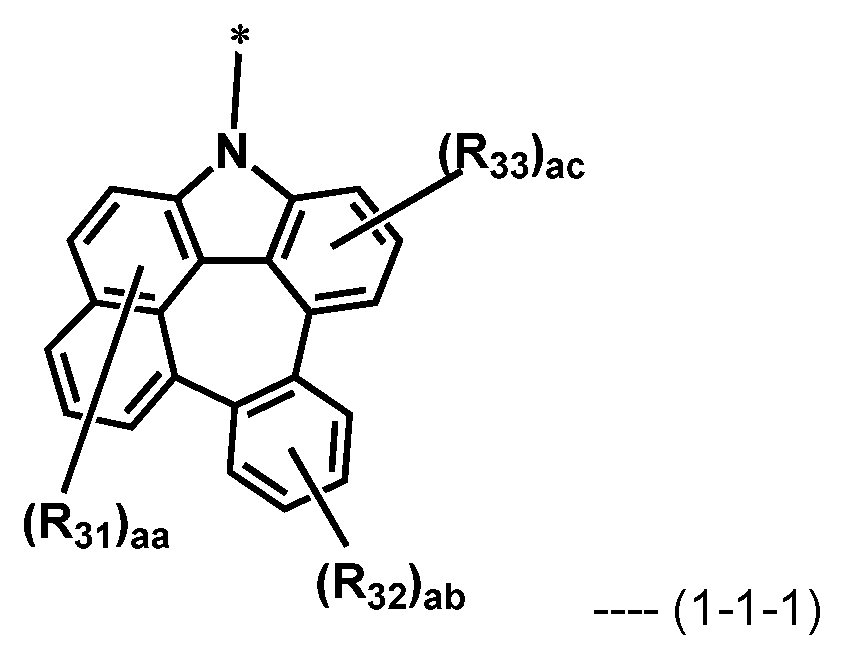


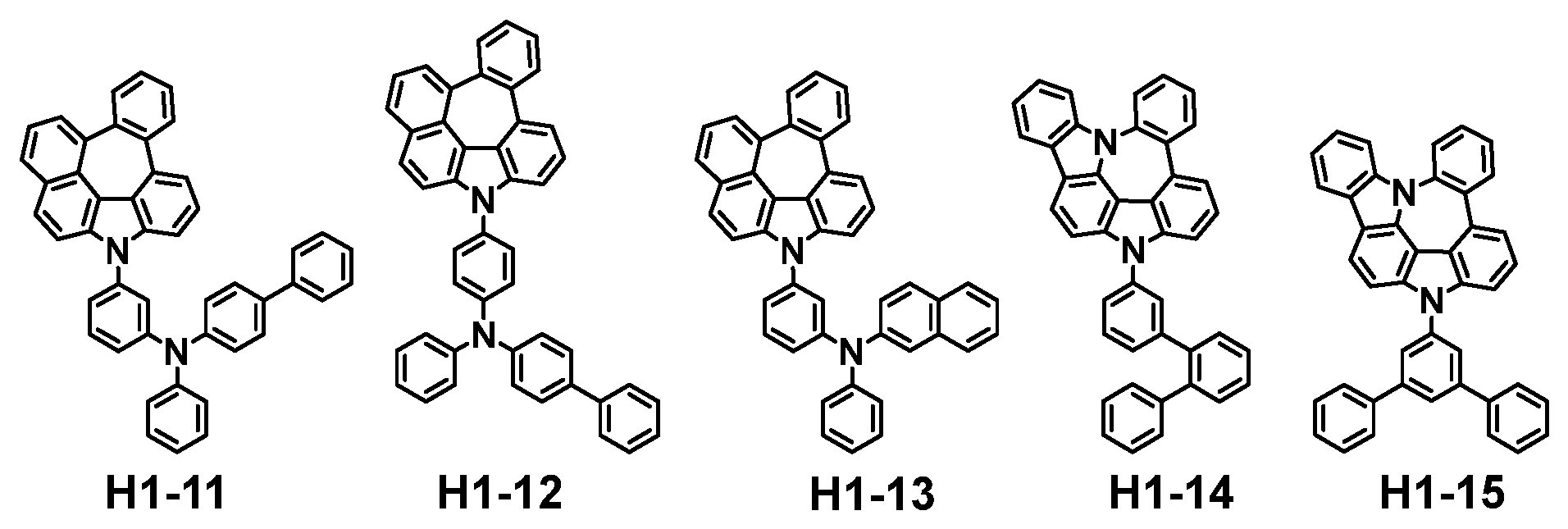


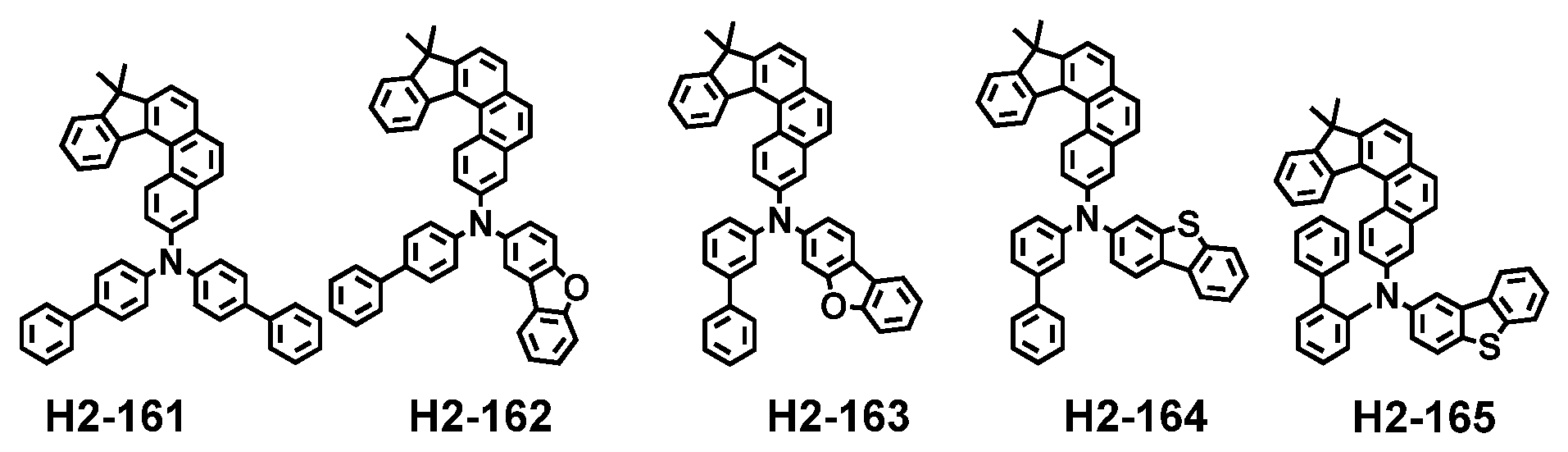


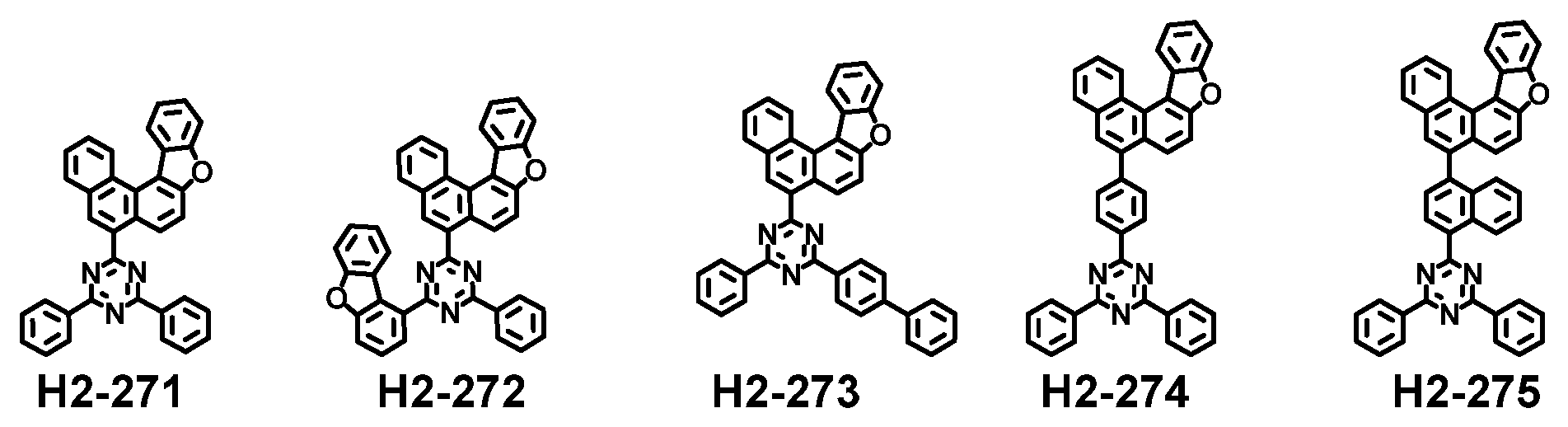


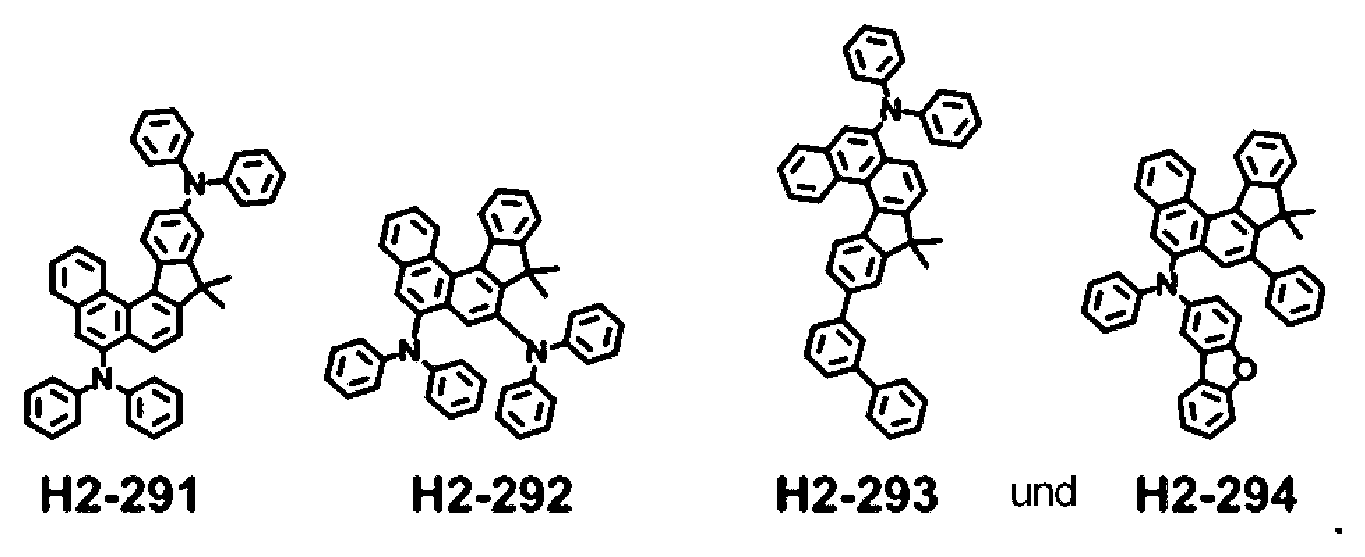
Applications Claiming Priority (4)
| Application Number | Priority Date | Filing Date | Title |
|---|---|---|---|
| KR20210072144 | 2021-06-03 | ||
| KR10-2021-0072144 | 2021-06-03 | ||
| KR10-2022-0043598 | 2022-04-07 | ||
| KR1020220043598A KR20220163858A (en) | 2021-06-03 | 2022-04-07 | A plurality of host materials and organic electroluminescent device comprising the same |
Publications (1)
| Publication Number | Publication Date |
|---|---|
| DE102022113776A1 true DE102022113776A1 (en) | 2022-12-08 |
Family
ID=84102319
Family Applications (1)
| Application Number | Title | Priority Date | Filing Date |
|---|---|---|---|
| DE102022113776.7A Withdrawn DE102022113776A1 (en) | 2021-06-03 | 2022-05-31 | MULTIPLE HOST MATERIALS AND THIS COMPREHENSIVE ORGANIC ELECTROLUMINESCING DEVICE |
Country Status (4)
| Country | Link |
|---|---|
| US (1) | US12588353B2 (en) |
| JP (1) | JP2022186640A (en) |
| CN (1) | CN115440907A (en) |
| DE (1) | DE102022113776A1 (en) |
Families Citing this family (4)
| Publication number | Priority date | Publication date | Assignee | Title |
|---|---|---|---|---|
| KR102929796B1 (en) * | 2020-02-25 | 2026-02-24 | 듀폰스페셜티머터리얼스코리아 유한회사 | Organic electroluminescent compound and organic electroluminescent device comprising the same |
| CN116751207A (en) * | 2023-06-21 | 2023-09-15 | 宁波卢米蓝新材料有限公司 | An organic electroluminescent compound and its application |
| CN117658994A (en) * | 2023-06-30 | 2024-03-08 | 宁波卢米蓝新材料有限公司 | An organic compound and its application |
| CN121064135A (en) * | 2024-06-04 | 2025-12-05 | 陕西莱特光电材料股份有限公司 | Aromatic amine compound, organic electroluminescent device and electronic device |
Citations (1)
| Publication number | Priority date | Publication date | Assignee | Title |
|---|---|---|---|---|
| KR20170043439A (en) | 2015-10-13 | 2017-04-21 | 롬엔드하스전자재료코리아유한회사 | Organic Electroluminescent Compounds and Organic Electroluminescent Devices Comprising the Same |
Family Cites Families (13)
| Publication number | Priority date | Publication date | Assignee | Title |
|---|---|---|---|---|
| JP5210187B2 (en) * | 2009-01-22 | 2013-06-12 | ユー・ディー・シー アイルランド リミテッド | Organic electroluminescence device |
| JP2010278354A (en) * | 2009-05-29 | 2010-12-09 | Fujifilm Corp | Organic electroluminescence device |
| JP2011044365A (en) * | 2009-08-21 | 2011-03-03 | Fujifilm Corp | Organic electroluminescent element |
| KR102435083B1 (en) | 2016-07-27 | 2022-08-24 | 롬엔드하스전자재료코리아유한회사 | Organic Electroluminescent Compound and Organic Electroluminescent Device Comprising the Same |
| KR20180024306A (en) * | 2016-08-29 | 2018-03-08 | 에스에프씨 주식회사 | Novel organic compounds and organic light-emitting diode therewith |
| TWI764984B (en) | 2017-02-28 | 2022-05-21 | 南韓商羅門哈斯電子材料韓國公司 | Organic electroluminescent compound and organic electroluminescent device comprising the same |
| KR102849046B1 (en) * | 2018-03-16 | 2025-08-22 | 듀폰스페셜티머터리얼스코리아 유한회사 | Composition material for organic electroluminescent device, plurality of host materials, and organic electroluminescent device comprising the same |
| KR102816740B1 (en) | 2018-06-22 | 2025-06-10 | 듀폰스페셜티머터리얼스코리아 유한회사 | A plurality of host materials and organic electroluminescent device comprising the same |
| WO2020022769A1 (en) * | 2018-07-25 | 2020-01-30 | Rohm And Haas Electronic Materials Korea Ltd. | A plurality of host materials and organic electroluminescent device comprising the same |
| WO2020027444A1 (en) * | 2018-07-31 | 2020-02-06 | Rohm And Haas Electronic Materials Korea Ltd. | A plurality of host materials and organic electroluminescent device comprising the same |
| WO2020091446A1 (en) * | 2018-10-31 | 2020-05-07 | Rohm And Haas Electronic Materials Korea Ltd. | Organic electroluminescent compound and organic electroluminescent device comprising the same |
| JP2022521417A (en) | 2019-02-25 | 2022-04-07 | ローム・アンド・ハース・エレクトロニック・マテリアルズ・コリア・リミテッド | Organic electroluminescent compounds and organic electroluminescent devices containing them |
| KR20210054737A (en) * | 2019-11-06 | 2021-05-14 | 롬엔드하스전자재료코리아유한회사 | A plurality of host materials and organic electroluminescent device comprising the same |
-
2022
- 2022-05-26 US US17/825,399 patent/US12588353B2/en active Active
- 2022-05-31 DE DE102022113776.7A patent/DE102022113776A1/en not_active Withdrawn
- 2022-05-31 CN CN202210611099.3A patent/CN115440907A/en active Pending
- 2022-05-31 JP JP2022088120A patent/JP2022186640A/en active Pending
Patent Citations (1)
| Publication number | Priority date | Publication date | Assignee | Title |
|---|---|---|---|---|
| KR20170043439A (en) | 2015-10-13 | 2017-04-21 | 롬엔드하스전자재료코리아유한회사 | Organic Electroluminescent Compounds and Organic Electroluminescent Devices Comprising the Same |
Also Published As
| Publication number | Publication date |
|---|---|
| CN115440907A (en) | 2022-12-06 |
| US12588353B2 (en) | 2026-03-24 |
| US20230006147A1 (en) | 2023-01-05 |
| JP2022186640A (en) | 2022-12-15 |
Similar Documents
| Publication | Publication Date | Title |
|---|---|---|
| DE102022102199A1 (en) | Organic electroluminescent compound, multiple host materials and organic electroluminescent device comprising them | |
| DE102020127397A1 (en) | MULTIPLE HOST MATERIALS AND THIS COMPREHENSIVE ORGANIC ELECTROLUMINESCENT DEVICE | |
| DE102021127890A1 (en) | ORGANIC ELECTROLUMINESCENT COMPOUND, MULTIPLE HOST MATERIALS AND THIS COMPREHENSIVE ORGANIC ELECTROLUMINESCENT DEVICE | |
| DE102020132697A1 (en) | ORGANIC ELECTROLUMINESCENT COMPOUND, MULTIPLE HOST MATERIALS, AND THIS COMPREHENSIVE ORGANIC ELECTROLUMINESCENT DEVICE | |
| DE102021121719A1 (en) | ORGANIC ELECTROLUMINESCENT COMPOUND, MULTIPLE HOST MATERIALS AND THIS COMPREHENSIVE ORGANIC ELECTROLUMINESCENT DEVICE | |
| DE102021117045A1 (en) | ORGANIC ELECTROLUMINESCENT COMPOUND, MULTIPLE HOST MATERIALS AND THIS COMPREHENSIVE ORGANIC ELECTROLUMINESCENT DEVICE | |
| DE102021100597A1 (en) | ORGANIC ELECTROLUMINESCENT COMPOUND, MULTIPLE HOST MATERIALS, AND THIS COMPREHENSIVE ORGANIC ELECTROLUMINESCENT DEVICE | |
| DE102021126733A1 (en) | ORGANIC ELECTROLUMINESCENT COMPOUND, MULTIPLE HOST MATERIALS AND THIS COMPREHENSIVE ORGANIC ELECTROLUMINESCENT DEVICE | |
| DE102021134637A1 (en) | ORGANIC ELECTROLUMINESCENT COMPOUND, MULTIPLE HOST MATERIALS AND THIS COMPREHENSIVE ORGANIC ELECTROLUMINESCENT DEVICE | |
| DE102020128813A1 (en) | MULTIPLE HOST MATERIALS AND THIS COMPREHENSIVE ORGANIC ELECTROLUMINESCENT DEVICE | |
| DE102021108423A1 (en) | ORGANIC ELECTROLUMINESCENT COMPOUND, MULTIPLE HOST MATERIALS, AND THIS COMPREHENSIVE ORGANIC ELECTROLUMINESCENT DEVICE | |
| DE102021104327A1 (en) | ORGANIC ELECTROLUMINESCENT JOINT AND THIS COMPREHENSIVE ORGANIC ELECTROLUMINESCENT DEVICE | |
| DE102022113776A1 (en) | MULTIPLE HOST MATERIALS AND THIS COMPREHENSIVE ORGANIC ELECTROLUMINESCING DEVICE | |
| DE102022113160A1 (en) | MULTIPLE HOST MATERIALS, ORGANIC ELECTROLUMINESCENT COMPOUND AND THIS COMPREHENSIVE ORGANIC ELECTROLUMINESCENT DEVICE | |
| DE102021120701A1 (en) | ORGANIC ELECTROLUMINESCENT COMPOUND, MULTIPLE HOST MATERIALS AND THIS COMPREHENSIVE ORGANIC ELECTROLUMINESCENT DEVICE | |
| DE102022114317A1 (en) | MULTIPLE HOST MATERIALS AND THIS COMPREHENSIVE ORGANIC ELECTROLUMINESCING DEVICE | |
| DE102020131740A1 (en) | MULTIPLE HOST MATERIALS AND THIS COMPREHENSIVE ORGANIC ELECTROLUMINESCENT DEVICE | |
| DE102021106151A1 (en) | MULTIPLE HOST MATERIALS AND THIS COMPREHENSIVE ORGANIC ELECTROLUMINESCENT DEVICE | |
| DE102021118107A1 (en) | ORGANIC ELECTROLUMINESCENT COMPOUND, MULTIPLE HOST MATERIALS AND THIS COMPREHENSIVE ORGANIC ELECTROLUMINESCENT DEVICE | |
| DE102023112182A1 (en) | MULTIPLE HOST MATERIALS AND THIS COMPREHENSIVE ORGANIC ELECTROLUMINESCENT DEVICE | |
| DE112019000238T5 (en) | ORGANIC ELECTROLUMINESCENT JOINT AND THIS COMPREHENSIVE ORGANIC ELECTROLUMINESCENT DEVICE | |
| DE102020116836A1 (en) | ORGANIC ELECTROLUMINESCENT JOINT AND THIS COMPREHENSIVE ORGANIC ELECTROLUMINESCENT DEVICE | |
| DE112020001007T5 (en) | ORGANIC ELECTROLUMINESCENT JOINT AND THIS COMPREHENSIVE ORGANIC ELECTROLUMINESCENT DEVICE | |
| DE102021117725A1 (en) | ORGANIC ELECTROLUMINESCENT COMPOUND AND THIS COMPRISING ORGANIC ELECTROLUMINESCENT DEVICE | |
| DE102021119077A1 (en) | ORGANIC ELECTROLUMINESCENT COMPOUND, MULTIPLE HOST MATERIALS AND THIS COMPREHENSIVE ORGANIC ELECTROLUMINESCENT DEVICE |
Legal Events
| Date | Code | Title | Description |
|---|---|---|---|
| R082 | Change of representative |
Representative=s name: ARTH, HANS LOTHAR, DIPL.-CHEM. DR.RER.NAT., DE |
|
| R119 | Application deemed withdrawn, or ip right lapsed, due to non-payment of renewal fee |