DE112007000426T5 - Metal complex, polymer compound and device containing it - Google Patents
Metal complex, polymer compound and device containing it Download PDFInfo
- Publication number
- DE112007000426T5 DE112007000426T5 DE112007000426T DE112007000426T DE112007000426T5 DE 112007000426 T5 DE112007000426 T5 DE 112007000426T5 DE 112007000426 T DE112007000426 T DE 112007000426T DE 112007000426 T DE112007000426 T DE 112007000426T DE 112007000426 T5 DE112007000426 T5 DE 112007000426T5
- Authority
- DE
- Germany
- Prior art keywords
- group
- ring
- metal complex
- bond
- following formula
- Prior art date
- Legal status (The legal status is an assumption and is not a legal conclusion. Google has not performed a legal analysis and makes no representation as to the accuracy of the status listed.)
- Withdrawn
Links
- 0 CC(c(c(*)c1*)c(*)c([C@](C2)C2*2)c1-c1c2c(*)c(*)c2c1CCCC2)=* Chemical compound CC(c(c(*)c1*)c(*)c([C@](C2)C2*2)c1-c1c2c(*)c(*)c2c1CCCC2)=* 0.000 description 8
- GYPOFOQUZZUVQL-UHFFFAOYSA-N Oc1cc2ccccc2cn1 Chemical compound Oc1cc2ccccc2cn1 GYPOFOQUZZUVQL-UHFFFAOYSA-N 0.000 description 1
Classifications
-
- C—CHEMISTRY; METALLURGY
- C07—ORGANIC CHEMISTRY
- C07F—ACYCLIC, CARBOCYCLIC OR HETEROCYCLIC COMPOUNDS CONTAINING ELEMENTS OTHER THAN CARBON, HYDROGEN, HALOGEN, OXYGEN, NITROGEN, SULFUR, SELENIUM OR TELLURIUM
- C07F15/00—Compounds containing elements of Groups 8, 9, 10 or 18 of the Periodic Table
-
- C—CHEMISTRY; METALLURGY
- C07—ORGANIC CHEMISTRY
- C07F—ACYCLIC, CARBOCYCLIC OR HETEROCYCLIC COMPOUNDS CONTAINING ELEMENTS OTHER THAN CARBON, HYDROGEN, HALOGEN, OXYGEN, NITROGEN, SULFUR, SELENIUM OR TELLURIUM
- C07F15/00—Compounds containing elements of Groups 8, 9, 10 or 18 of the Periodic Table
- C07F15/0006—Compounds containing elements of Groups 8, 9, 10 or 18 of the Periodic Table compounds of the platinum group
- C07F15/0033—Iridium compounds
-
- C—CHEMISTRY; METALLURGY
- C08—ORGANIC MACROMOLECULAR COMPOUNDS; THEIR PREPARATION OR CHEMICAL WORKING-UP; COMPOSITIONS BASED THEREON
- C08G—MACROMOLECULAR COMPOUNDS OBTAINED OTHERWISE THAN BY REACTIONS ONLY INVOLVING UNSATURATED CARBON-TO-CARBON BONDS
- C08G85/00—General processes for preparing compounds provided for in this subclass
-
- C—CHEMISTRY; METALLURGY
- C08—ORGANIC MACROMOLECULAR COMPOUNDS; THEIR PREPARATION OR CHEMICAL WORKING-UP; COMPOSITIONS BASED THEREON
- C08L—COMPOSITIONS OF MACROMOLECULAR COMPOUNDS
- C08L101/00—Compositions of unspecified macromolecular compounds
-
- C—CHEMISTRY; METALLURGY
- C08—ORGANIC MACROMOLECULAR COMPOUNDS; THEIR PREPARATION OR CHEMICAL WORKING-UP; COMPOSITIONS BASED THEREON
- C08L—COMPOSITIONS OF MACROMOLECULAR COMPOUNDS
- C08L65/00—Compositions of macromolecular compounds obtained by reactions forming a carbon-to-carbon link in the main chain; Compositions of derivatives of such polymers
-
- C—CHEMISTRY; METALLURGY
- C09—DYES; PAINTS; POLISHES; NATURAL RESINS; ADHESIVES; COMPOSITIONS NOT OTHERWISE PROVIDED FOR; APPLICATIONS OF MATERIALS NOT OTHERWISE PROVIDED FOR
- C09B—ORGANIC DYES OR CLOSELY-RELATED COMPOUNDS FOR PRODUCING DYES, e.g. PIGMENTS; MORDANTS; LAKES
- C09B57/00—Other synthetic dyes of known constitution
-
- C—CHEMISTRY; METALLURGY
- C09—DYES; PAINTS; POLISHES; NATURAL RESINS; ADHESIVES; COMPOSITIONS NOT OTHERWISE PROVIDED FOR; APPLICATIONS OF MATERIALS NOT OTHERWISE PROVIDED FOR
- C09B—ORGANIC DYES OR CLOSELY-RELATED COMPOUNDS FOR PRODUCING DYES, e.g. PIGMENTS; MORDANTS; LAKES
- C09B57/00—Other synthetic dyes of known constitution
- C09B57/007—Squaraine dyes
-
- C—CHEMISTRY; METALLURGY
- C09—DYES; PAINTS; POLISHES; NATURAL RESINS; ADHESIVES; COMPOSITIONS NOT OTHERWISE PROVIDED FOR; APPLICATIONS OF MATERIALS NOT OTHERWISE PROVIDED FOR
- C09B—ORGANIC DYES OR CLOSELY-RELATED COMPOUNDS FOR PRODUCING DYES, e.g. PIGMENTS; MORDANTS; LAKES
- C09B57/00—Other synthetic dyes of known constitution
- C09B57/10—Metal complexes of organic compounds not being dyes in uncomplexed form
-
- C—CHEMISTRY; METALLURGY
- C09—DYES; PAINTS; POLISHES; NATURAL RESINS; ADHESIVES; COMPOSITIONS NOT OTHERWISE PROVIDED FOR; APPLICATIONS OF MATERIALS NOT OTHERWISE PROVIDED FOR
- C09B—ORGANIC DYES OR CLOSELY-RELATED COMPOUNDS FOR PRODUCING DYES, e.g. PIGMENTS; MORDANTS; LAKES
- C09B69/00—Dyes not provided for by a single group of this subclass
- C09B69/008—Dyes containing a substituent, which contains a silicium atom
-
- C—CHEMISTRY; METALLURGY
- C09—DYES; PAINTS; POLISHES; NATURAL RESINS; ADHESIVES; COMPOSITIONS NOT OTHERWISE PROVIDED FOR; APPLICATIONS OF MATERIALS NOT OTHERWISE PROVIDED FOR
- C09K—MATERIALS FOR MISCELLANEOUS APPLICATIONS, NOT PROVIDED FOR ELSEWHERE
- C09K11/00—Luminescent materials, e.g. electroluminescent or chemiluminescent
- C09K11/06—Luminescent materials, e.g. electroluminescent or chemiluminescent containing organic luminescent materials
-
- H—ELECTRICITY
- H05—ELECTRIC TECHNIQUES NOT OTHERWISE PROVIDED FOR
- H05B—ELECTRIC HEATING; ELECTRIC LIGHT SOURCES NOT OTHERWISE PROVIDED FOR; CIRCUIT ARRANGEMENTS FOR ELECTRIC LIGHT SOURCES, IN GENERAL
- H05B33/00—Electroluminescent light sources
- H05B33/12—Light sources with substantially two-dimensional [2D] radiating surfaces
- H05B33/14—Light sources with substantially two-dimensional [2D] radiating surfaces characterised by the chemical or physical composition or the arrangement of the electroluminescent material, or by the simultaneous addition of the electroluminescent material in or onto the light source
-
- H—ELECTRICITY
- H10—SEMICONDUCTOR DEVICES; ELECTRIC SOLID-STATE DEVICES NOT OTHERWISE PROVIDED FOR
- H10K—ORGANIC ELECTRIC SOLID-STATE DEVICES
- H10K50/00—Organic light-emitting devices
-
- H—ELECTRICITY
- H10—SEMICONDUCTOR DEVICES; ELECTRIC SOLID-STATE DEVICES NOT OTHERWISE PROVIDED FOR
- H10K—ORGANIC ELECTRIC SOLID-STATE DEVICES
- H10K85/00—Organic materials used in the body or electrodes of devices covered by this subclass
- H10K85/30—Coordination compounds
- H10K85/341—Transition metal complexes, e.g. Ru(II)polypyridine complexes
- H10K85/342—Transition metal complexes, e.g. Ru(II)polypyridine complexes comprising iridium
-
- C—CHEMISTRY; METALLURGY
- C09—DYES; PAINTS; POLISHES; NATURAL RESINS; ADHESIVES; COMPOSITIONS NOT OTHERWISE PROVIDED FOR; APPLICATIONS OF MATERIALS NOT OTHERWISE PROVIDED FOR
- C09K—MATERIALS FOR MISCELLANEOUS APPLICATIONS, NOT PROVIDED FOR ELSEWHERE
- C09K2211/00—Chemical nature of organic luminescent or tenebrescent compounds
- C09K2211/10—Non-macromolecular compounds
- C09K2211/1003—Carbocyclic compounds
- C09K2211/1014—Carbocyclic compounds bridged by heteroatoms, e.g. N, P, Si or B
-
- C—CHEMISTRY; METALLURGY
- C09—DYES; PAINTS; POLISHES; NATURAL RESINS; ADHESIVES; COMPOSITIONS NOT OTHERWISE PROVIDED FOR; APPLICATIONS OF MATERIALS NOT OTHERWISE PROVIDED FOR
- C09K—MATERIALS FOR MISCELLANEOUS APPLICATIONS, NOT PROVIDED FOR ELSEWHERE
- C09K2211/00—Chemical nature of organic luminescent or tenebrescent compounds
- C09K2211/10—Non-macromolecular compounds
- C09K2211/1018—Heterocyclic compounds
- C09K2211/1025—Heterocyclic compounds characterised by ligands
- C09K2211/1029—Heterocyclic compounds characterised by ligands containing one nitrogen atom as the heteroatom
-
- C—CHEMISTRY; METALLURGY
- C09—DYES; PAINTS; POLISHES; NATURAL RESINS; ADHESIVES; COMPOSITIONS NOT OTHERWISE PROVIDED FOR; APPLICATIONS OF MATERIALS NOT OTHERWISE PROVIDED FOR
- C09K—MATERIALS FOR MISCELLANEOUS APPLICATIONS, NOT PROVIDED FOR ELSEWHERE
- C09K2211/00—Chemical nature of organic luminescent or tenebrescent compounds
- C09K2211/10—Non-macromolecular compounds
- C09K2211/1018—Heterocyclic compounds
- C09K2211/1025—Heterocyclic compounds characterised by ligands
- C09K2211/1044—Heterocyclic compounds characterised by ligands containing two nitrogen atoms as heteroatoms
-
- C—CHEMISTRY; METALLURGY
- C09—DYES; PAINTS; POLISHES; NATURAL RESINS; ADHESIVES; COMPOSITIONS NOT OTHERWISE PROVIDED FOR; APPLICATIONS OF MATERIALS NOT OTHERWISE PROVIDED FOR
- C09K—MATERIALS FOR MISCELLANEOUS APPLICATIONS, NOT PROVIDED FOR ELSEWHERE
- C09K2211/00—Chemical nature of organic luminescent or tenebrescent compounds
- C09K2211/10—Non-macromolecular compounds
- C09K2211/1018—Heterocyclic compounds
- C09K2211/1025—Heterocyclic compounds characterised by ligands
- C09K2211/1044—Heterocyclic compounds characterised by ligands containing two nitrogen atoms as heteroatoms
- C09K2211/1048—Heterocyclic compounds characterised by ligands containing two nitrogen atoms as heteroatoms with oxygen
-
- C—CHEMISTRY; METALLURGY
- C09—DYES; PAINTS; POLISHES; NATURAL RESINS; ADHESIVES; COMPOSITIONS NOT OTHERWISE PROVIDED FOR; APPLICATIONS OF MATERIALS NOT OTHERWISE PROVIDED FOR
- C09K—MATERIALS FOR MISCELLANEOUS APPLICATIONS, NOT PROVIDED FOR ELSEWHERE
- C09K2211/00—Chemical nature of organic luminescent or tenebrescent compounds
- C09K2211/10—Non-macromolecular compounds
- C09K2211/1018—Heterocyclic compounds
- C09K2211/1025—Heterocyclic compounds characterised by ligands
- C09K2211/1059—Heterocyclic compounds characterised by ligands containing three nitrogen atoms as heteroatoms
-
- C—CHEMISTRY; METALLURGY
- C09—DYES; PAINTS; POLISHES; NATURAL RESINS; ADHESIVES; COMPOSITIONS NOT OTHERWISE PROVIDED FOR; APPLICATIONS OF MATERIALS NOT OTHERWISE PROVIDED FOR
- C09K—MATERIALS FOR MISCELLANEOUS APPLICATIONS, NOT PROVIDED FOR ELSEWHERE
- C09K2211/00—Chemical nature of organic luminescent or tenebrescent compounds
- C09K2211/10—Non-macromolecular compounds
- C09K2211/1018—Heterocyclic compounds
- C09K2211/1025—Heterocyclic compounds characterised by ligands
- C09K2211/1092—Heterocyclic compounds characterised by ligands containing sulfur as the only heteroatom
-
- C—CHEMISTRY; METALLURGY
- C09—DYES; PAINTS; POLISHES; NATURAL RESINS; ADHESIVES; COMPOSITIONS NOT OTHERWISE PROVIDED FOR; APPLICATIONS OF MATERIALS NOT OTHERWISE PROVIDED FOR
- C09K—MATERIALS FOR MISCELLANEOUS APPLICATIONS, NOT PROVIDED FOR ELSEWHERE
- C09K2211/00—Chemical nature of organic luminescent or tenebrescent compounds
- C09K2211/10—Non-macromolecular compounds
- C09K2211/1018—Heterocyclic compounds
- C09K2211/1025—Heterocyclic compounds characterised by ligands
- C09K2211/1096—Heterocyclic compounds characterised by ligands containing other heteroatoms
-
- C—CHEMISTRY; METALLURGY
- C09—DYES; PAINTS; POLISHES; NATURAL RESINS; ADHESIVES; COMPOSITIONS NOT OTHERWISE PROVIDED FOR; APPLICATIONS OF MATERIALS NOT OTHERWISE PROVIDED FOR
- C09K—MATERIALS FOR MISCELLANEOUS APPLICATIONS, NOT PROVIDED FOR ELSEWHERE
- C09K2211/00—Chemical nature of organic luminescent or tenebrescent compounds
- C09K2211/18—Metal complexes
- C09K2211/185—Metal complexes of the platinum group, i.e. Os, Ir, Pt, Ru, Rh or Pd
-
- H—ELECTRICITY
- H10—SEMICONDUCTOR DEVICES; ELECTRIC SOLID-STATE DEVICES NOT OTHERWISE PROVIDED FOR
- H10K—ORGANIC ELECTRIC SOLID-STATE DEVICES
- H10K2101/00—Properties of the organic materials covered by group H10K85/00
- H10K2101/10—Triplet emission
-
- H—ELECTRICITY
- H10—SEMICONDUCTOR DEVICES; ELECTRIC SOLID-STATE DEVICES NOT OTHERWISE PROVIDED FOR
- H10K—ORGANIC ELECTRIC SOLID-STATE DEVICES
- H10K50/00—Organic light-emitting devices
- H10K50/10—OLEDs or polymer light-emitting diodes [PLED]
- H10K50/11—OLEDs or polymer light-emitting diodes [PLED] characterised by the electroluminescent [EL] layers
-
- Y—GENERAL TAGGING OF NEW TECHNOLOGICAL DEVELOPMENTS; GENERAL TAGGING OF CROSS-SECTIONAL TECHNOLOGIES SPANNING OVER SEVERAL SECTIONS OF THE IPC; TECHNICAL SUBJECTS COVERED BY FORMER USPC CROSS-REFERENCE ART COLLECTIONS [XRACs] AND DIGESTS
- Y02—TECHNOLOGIES OR APPLICATIONS FOR MITIGATION OR ADAPTATION AGAINST CLIMATE CHANGE
- Y02E—REDUCTION OF GREENHOUSE GAS [GHG] EMISSIONS, RELATED TO ENERGY GENERATION, TRANSMISSION OR DISTRIBUTION
- Y02E10/00—Energy generation through renewable energy sources
- Y02E10/50—Photovoltaic [PV] energy
- Y02E10/549—Organic PV cells
Landscapes
- Chemical & Material Sciences (AREA)
- Organic Chemistry (AREA)
- Health & Medical Sciences (AREA)
- Polymers & Plastics (AREA)
- Medicinal Chemistry (AREA)
- Chemical Kinetics & Catalysis (AREA)
- Materials Engineering (AREA)
- Engineering & Computer Science (AREA)
- Inorganic Chemistry (AREA)
- Crystallography & Structural Chemistry (AREA)
- Physics & Mathematics (AREA)
- Optics & Photonics (AREA)
- Electroluminescent Light Sources (AREA)
- Hybrid Cells (AREA)
Abstract
Metallkomplex
mit einer Struktur der folgenden allgemeinen Formel (1): 


Description
Technisches FachgebietTechnical field
Die vorliegende Erfindung betrifft einen Metallkomplex, eine Polymerverbindung, die einen Rest des vorstehend beschriebenen Metallkomplexes enthält, und eine sie enthaltende Vorrichtung.The The present invention relates to a metal complex, a polymer compound, containing a residue of the metal complex described above, and a device containing it.
Stand der TechnikState of the art
Von Metallkomplexen, die Lichtemission aus dem angeregten Triplettzustand als ein lichtemittierendes Material zeigen, das in einer lichtemittierenden Schicht einer Elektrolumineszenzvorrichtung zu verwenden ist, kann erwartet werden, dass sie höheren Wirkungsgrad der Lichtemission als fluoreszierende Materialien aufweisen, die Lichtemission aus dem angeregten Singulettzustand zeigen. Der Grund dafür ist, dass die durch die Rekombination von Trägern erzeugten Exzitonen theoretisch 25% Singulettexzitonen und verbleibende 75% Triplettexzitonen einschließen. Das heißt, die Obergrenze beträgt theoretisch 25% im Fall der Verwendung der Lichtemission aus dem angeregten Singulettzustand (d. h. Fluoreszenz), während der dreifache Wirkungsgrad im Fall der Verwendung von Lichtemission aus dem angeregten Triplettzustand (d. h. Phosphoreszenz) theoretisch erwartet werden kann. Ferner kann der 4fache Wirkungsgrad im Hinblick auf die relative Beziehung der Energie theoretisch erwartet werden, wenn ein Intersystemübergang von 25% des angeregten Singulettzustands zu dem angeregten Triplettzustand effizient auftritt.From Metal complexes, the light emission from the excited triplet state as a light-emitting material that is in a light-emitting Layer of an electroluminescent device is to use are expected to have higher light emission efficiency as fluorescent materials, the light emission from show the excited singlet state. The reason for this is that generated by the recombination of carriers Excitons theoretically 25% singlet excitons and remaining 75% Include triplet excitons. That is, the Upper limit is theoretically 25% in the case of use the light emission from the excited singlet state (i.e., fluorescence), while the triple efficiency in the case of use of light emission from the excited triplet state (i.e., phosphorescence) theoretically can be expected. Furthermore, the 4 times efficiency theoretically expected in terms of the relative relationship of energy when an intersystem transition of 25% of the excited singlet state to the excited triplet state occurs efficiently.
Im
Allgemeinen ist eine Lichtemission aus dem angeregten Triplettzustand
(d. h. Phosphoreszenz) bei Auftreten des Übergangs vom
angeregten Triplettzustand zu dem Singulettgrundzustand ein verbotener Übergang,
da er von einer Spinumkehrung begleitet ist. Jedoch ist von Metallkomplexen,
die ein Schwermetallatom enthalten, bekannt, dass sie Verbindungen
einschließen, die Lichtemission zeigen, da dieser verbotene Übergang
durch einen Effekt eines schweren Atoms erlaubt ist. Zum Beispiel
ist bezüglich Metallkomplexen, die Lichtemission aus dem
angeregten Triplettzustand zeigen, von einem orthometallierten Komplex,
der Iridium als ein zentrales Metall enthält (Ir(ppy)3: tris-ortho-metallierter Komplex von Iridium
(III) mit 2-Phenylpyridin) bekannt, dass er grüne Lichtemission
mit hohem Wirkungsgrad zeigt, und es wird auch über eine
Mehrschichtelektrolumineszenzvorrichtung berichtet, die durch Kombinieren
dieses mit einem Host mit niedrigem Molekulargewicht erhalten wird
(
Jedoch ist für die praktische Verwendung von Elektrolumineszenzvorrichtungen unter Verwendung eines Metallkomplexes und dgl. erforderlich, dass bei allen drei Primärfarben der Wirkungsgrad der Lichtemission hoch ist und die Stabilität ausgezeichnet ist.however is for the practical use of electroluminescent devices using a metal complex and the like. required that for all three primary colors, the light emission efficiency is high and the stability is excellent.
Folglich ist erwünscht, einen Metallkomplex, der ausgezeichneten Wirkungsgrad der Lichtemission und Stabilität zeigt, insbesondere in einem Bereich der roten Lichtemission oder Bereich der blauen Lichtemission zu entwickeln.consequently is desirable, a metal complex, the excellent Efficiency of light emission and stability shows, in particular in an area of red light emission or area of blue To develop light emission.
Offenbarung der ErfindungDisclosure of the invention
Eine Aufgabe der vorliegenden Erfindung ist, einen Metallkomplex bereitzustellen, der ausgezeichneten Wirkungsgrad der Lichtemission und Stabilität aufweist.A The object of the present invention is to provide a metal complex the excellent light emission efficiency and stability having.
Die in der vorliegenden Anmeldung genannten Erfinder haben umfassende Untersuchungen angestellt und resultierend festgestellt, dass, wenn ein Metallkomplex mit einer bestimmten Struktur und mit bestimmten quantenchemischen Eigenschaften verwendet wird, der Wirkungsgrad der Lichtemission und die Stabilität einer Elektrolumineszenzvorrichtung ausgezeichnet sind, was zur Vollendung der vorliegenden Erfindung führte.The in the present application mentioned inventors have comprehensive Investigations made and concluded that, if a metal complex with a specific structure and with certain quantum chemical properties is used, the efficiency the light emission and the stability of an electroluminescent device are excellent, leading to the completion of the present invention led.
Genauer
stellt die vorliegende Erfindung in einer ersten Ausführungsform
einen Metallkomplex mit einer Struktur der folgenden allgemeinen
Formel (1) bereit: 
Eine
Bindung der folgenden Formel: 


Der
Z2 Ring stellt eine cyclische Struktur dar,
die eine Bindung der folgenden Formel enthält: 


Die
vorliegende Erfindung stellt in einer zweiten Ausführungsform
einen Metallkomplex mit einer Struktur der folgenden allgemeinen
Formel (1) bereit: 
Eine
Bindung der folgenden Formel: 


Der
Z2 Ring stellt eine cyclische Struktur dar,
die eine Bindung der folgenden Formel enthält: 
der vorstehend
beschriebene Z1 Ring eine Struktur der folgenden
allgemeinen Formel (2) aufweist: 
the Z 1 ring described above has a structure of the following general formula (2):
Eine
Bindung der folgenden Formel: 


Der
Z11 Ring stellt eine cyclische Struktur
dar, die aus Einfachbindungen, außer der Bindung der folgenden
Formel: 

Eine
Bindung der folgenden Formel: 
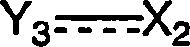


Der
Z21 Ring stellt eine cyclische Struktur
dar, die aus Einfachbindungen, außer der Bindung der folgenden
Formel: 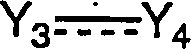
Die
vorliegende Erfindung stellt in einer dritten Ausführungsform
einen Metallkomplex mit einer Struktur der folgenden allgemeinen
Formel (5) bereit: 
Eine
Bindung der folgenden Formel: 


Der
Z2 Ring stellt eine cyclische Struktur dar,
die eine Bindung der folgenden Formel enthält: 
R501 bis R507 stellen jeweils unabhängig ein Wasserstoffatom, einen Alkylrest, Alkoxyrest, Alkylthiorest, Arylrest, Aryloxyrest, Arylthiorest, Arylalkylrest, Arylalkoxyrest, Arylalkylthiorest, Arylalkenylrest, Arylalkinylrest, eine Aminogruppe, substituierte Aminogruppe, Silylgruppe, substituierte Silylgruppe, Silyloxygruppe, substituierte Silyloxygruppe, einen einwertigen heterocyclischen Rest oder ein Halogenatom dar.).R 501 to R 507 each independently represent a hydrogen atom, an alkyl group, alkoxy group, alkylthio group, aryl group, aryloxy group, arylthio group, arylalkyl group, arylalkoxy group, arylalkylthio group, arylalkenyl group, arylalkynyl group, amino group, substituted amino group, silyl group, substituted silyl group, silyloxy group, substituted silyloxy group, a monovalent heterocyclic radical or a halogen atom.).
Die vorliegende Erfindung stellt in einer vierten Ausführungsform eine Polymerverbindung bereit, die in ihrem Molekül einen Rest des vorstehend beschriebenen Metallkomplexes umfasst.The The present invention provides in a fourth embodiment a polymer compound having a molecule in its molecule Residual of the metal complex described above.
Ausführungsweise der ErfindungEmbodiment of the invention
Die vorliegende Erfindung wird nachstehend im Einzelnen erklärt.The The present invention will be explained below in detail.
<Metallkomplex><Metal Complex>
Zuerst werden die Metallkomplexe der vorliegenden Erfindung (der folgende erste bis dritte Metallkomplex) beschrieben.First become the metal complexes of the present invention (the following first to third metal complex).
– Erster Metallkomplex –- First Metal Complex -
Der
erste Metallkomplex der vorliegenden Erfindung weist eine Struktur
der vorstehend beschriebenen allgemeinen Formel (1) auf und erfüllt
gleichzeitig
Bedingung A: der vorstehend beschriebene diedrische
Winkel (nachstehend in einigen Fällen als „diedrischer Winkel
in einem Liganden" bezeichnet) beträgt 9° bis
16° und
Bedingung B: der vorstehend beschriebene d-Orbitalparameter
beträgt 200 bis 600%/eV.The first metal complex of the present invention has a structure as described above general formula (1) and fulfilled simultaneously
Condition A: the above-described dihedral angle (hereinafter referred to as "the lower angle in a ligand" in some cases) is 9 ° to 16 ° and
Condition B: the d orbital parameter described above is 200 to 600% / eV.
Wenn der vorstehend beschriebene diedrische Winkel geringer als 9° ist, wird die Unterdrückung der Bewegung der Liganden in einigen Fällen nicht ausreichend, und wenn er über 16° beträgt, wird die Verdrehung der Liganden zu signifikant, wobei die Stabilität als ein mehrzähniger Ligand in einigen Fällen verloren geht. Dieser diedrische Winkel ist mit der Bewegung eines Liganden korreliert, folglich wird eine Wirkung auf die Stabilität eines Metallkomplexes ins Auge gefaßt, so beträgt er vorzugsweise 9° bis 14°, stärker bevorzugt 9° bis 12°, insbesondere bevorzugt 9° bis 11°.If the above-described dihedral angle is less than 9 °, will suppress the movement of ligands in some Inadequate, and if it is over 16 °, the twisting of the ligands becomes too significant, with stability as a multidentate ligand in some cases get lost. This diedrische angle is with the movement of a Ligand correlates, therefore, an effect on stability of a metal complex, so is preferably 9 ° to 14 °, more preferably 9 ° to 12 °, particularly preferably 9 ° to 11 °.
Wenn der vorstehend beschriebene d-Orbitalparameter geringer als 200%/eV ist, kann der Wirkungsgrad der Lichtemission durch einen geringen Beitrag des d-Orbitals des zentralen Metalls oder großen Energieunterschid (S1 – T1) geringer sein, und wenn er über 600%/eV beträgt, kann der Wirkungsgrad durch kleinen Energieunterschied (S1 – T1) geringer sein. Dieser d-Orbitalparameter beträgt vorzugsweise 200 bis 500%/eV, stärker bevorzugt 200 bis 400%/eV, insbesondere bevorzugt 200 bis 300%/eV, da angenommen wird, dass es ein Parameter ist, der mit dem Wirkungsgrad der Lichtemission eines Metallkomplexes korreliert.If the d orbital parameter described above is less than 200% / eV, the light emission efficiency may be lower by a small contribution of the d orbital of the central metal or large energy difference (S 1 -T 1 ), and if it exceeds 600%. / eV, the efficiency can be lower by small energy difference (S 1 - T 1 ). This d orbital parameter is preferably 200 to 500% / eV, more preferably 200 to 400% / eV, particularly preferably 200 to 300% / eV, because it is considered to be a parameter correlated with the light emission efficiency of a metal complex ,
In der vorliegenden Beschreibung bedeutet der „Ligand" einen Teil außer eines Metallatoms M, zum Beispiel in einer Struktur der vorstehend beschriebenen allgemeinen Formel (1) oder (5) (einschließlich auch Unterbegriffe, wie eine Struktur der allgemeinen Formel (4-1) oder allgemeinen Formel (4-2), später beschrieben, und dgl.). In der vorliegenden Beschreibung bedeutet der „diedrische Winkel" einen Winkel, der basierend auf einem Metallkomplex im Grundzustand berechnet wird. In der vorliegenden Beschreibung wird der diedrische Winkel basierend auf einer optimierten Struktur im Grundzustand eines Metallkomplexes berechnet, der durch wissenschaftliche Computerverfahren erhalten wird (d. h. eine Struktur, bei der die Herstellungsenergie des Metallkomplexes minimal ist). Insbesondere wird im Fall eines Metallkomplexes, der zwei oder mehrere der gleichen Liganden enthält, wie durch M(L)3 dargestellt (hier weist M die gleiche Bedeutung wie vorstehend beschrieben auf und L stellt einen Liganden dar), der diedrische Winkel als ein Mittelwert der diedrischen Winkel der Liganden definiert. Wenn zwei oder mehrere unterschiedliche Liganden enthalten sind, wie M(L)2(L2)1 (wobei M die vorstehend beschriebene Bedeutung aufweist, L und L2 zueinander verschiedene Liganden darstellen), ist erforderlich, dass einer der zueinander verschiedenen Liganden (zum Beispiel einer eines Werts des diedrischen Winkels des Liganden L und eines Werts des diedrischen Winkels des Liganden L2 in der vorstehend beschriebenen Formel) den vorstehend beschriebenen Bereich des diedrischen Winkels erfüllt. Wenn zwei oder mehrere der gleichen Liganden enthalten sind (zum Beispiel der Ligand L in der vorstehend beschriebenen Formel) ist der diedrische Winkel des gleichen Liganden (zum Beispiel der Ligand L in der vorstehend beschriebenen Formel) ein Mittelwert der diedrischen Winkel der Liganden. In der vorliegenden Beschreibung wird der d-Orbitalparameter mit einem wissenschaftlichen Computerverfahren berechnet.In the present specification, the "ligand" means a part except for a metal atom M, for example, in a structure of the above-described general formula (1) or (5) (including sub-terms such as a structure of the general formula (4-1) or In the present specification, the "dihedral angle" means an angle calculated based on a metal complex in the ground state. In the present specification, the dihedral angle is calculated based on an optimized ground state structure of a metal complex obtained by scientific computer methods (ie, a structure in which the production energy of the metal complex is minimum). In particular, in the case of a metal complex containing two or more of the same ligands as represented by M (L) 3 (here, M has the same meaning as described above and L represents a ligand), the dihedral angle as an average of defined the low angle of the ligands. When two or more different ligands are included, such as M (L) 2 (L 2 ) 1 (wherein M is as described above, L and L 2 are mutually different ligands), it is necessary that one of the mutually different ligands (for Example of a value of the dihedral angle of the ligand L and a value of the dihedral angle of the ligand L 2 in the above-described formula) satisfies the range of the dihedral angle described above. When two or more of the same ligands are included (for example, ligand L in the formula described above), the dihedral angle of the same ligand (for example, ligand L in the formula described above) is an average of the dihedral angles of the ligands. In the present specification, the d orbital parameter is calculated by a scientific computer method.
Als wissenschaftliche Computerverfahren, die zum Berechnen des vorstehend beschriebenen diedrischen Winkels und d-Orbitalparameters zu verwenden sind, sind ein Molekularorbitalverfahren, eine funktionelle Dichtetheorie und dgl. bekannt, die auf halbempirischen Verfahren und nicht empirischen Verfahren basieren. Zum Optimieren der Struktur eines Metallkomplexes können zum Beispiel ein Hartree-Fock(HF)-Verfahren oder die funktionelle Dichtetheorie verwendet werden.When Scientific computer methods for calculating the above described diedrischen angle and d orbital parameters are a molecular orbital method, a functional theory of density and the like, which are semi-empirical and non-empirical Based method. To optimize the structure of a metal complex For example, a Hartree-Fock (HF) method or the functional density theory can be used.
In
der vorliegenden Beschreibung wurde unter Anwenden einer funktionellen
Dichtetheorie des B3LYP Niveaus unter Verwendung des quantenchemischen
Berechnungsprogramms Gaussian03 die Struktur des Grundzustands eines
Metallkomplexes optimiert und der diedrische Winkel im Liganden
wurde berechnet, und gleichzeitig wurde eine Populationsanalyse
des Molekülorbitals eines Metallkomplexes in der optimierten Struktur
durchgeführt; so wurde der Anteil (%) der Summe der Quadrate
der Orbitalkoeffizienten des äußersten d-Orbitals
eines Metallatoms (d. h. zentrales Metallatom) M im höchsten
besetzten Molekülorbital (HOMO) des Metallkomplexes, der
in Bezug auf die Summe der Quadrate aller Atomorbitalkoeffizienten
besetzt ist, berechnet. Bei diesem Verfahren wurde LANL2DZ für
ein Metallatom (d. h. zentrales Metallatom) verwendet und 6-31 G*
wurde für die anderen Atome als dieses als Basisfunktion
verwendet. Die Populationsanalyse in einem Metallkomplex wurde wie
später beschrieben durchgeführt. Das heißt,
der Anteil ρd HOMO(%)
der Summe der Quadrate der Orbitalkoeffizienten des äußersten
d-Orbitals eines Metallatoms M in dem HOMO des Metallkomplexes,
das in Bezug auf die Summe der Quadrate aller Atomorbitalkoeffizienten
besetzt ist, wurde gemäß der folgenden Formel
berechnet:
In der Formel stellen id und n die Zahl der d-Orbitale bzw. die Zahl aller Atomorbitale dar, die in den vorstehend beschriebenen Berechnungsverfahren und der Basisfunktion in Erwägung gezogen werden. Cid HOMO und Cn HOMO stellen Atomorbitalkoeffizienten dar, die durch id bzw. n in HOMO dargestellt werden. Die niedrigste angeregte Singulettenergie S1 (eV), die niedrigste angeregte Triplettenergie T1 (eV) und die Energiedifferenz S1 – T1 (eV) davon werden unter Verwendung einer zeitabhängigen funktionellen Dichtetheorie des B3LYP Niveaus unter Verwendung der gleichen Basisfunktion wie vorstehend beschrieben nach Optimieren der Struktur berechnet.In the formula, id and n represent the number of d orbitals and the number of atomic orbitals, respectively, which are considered in the calculation methods and the basic function described above. C id HOMO and C n HOMO represent atomic orbital coefficients represented by id and n, respectively, in HOMO. The lowest excited singlet energy S 1 (eV), the lowest excited triplet energy T 1 (eV) and the energy difference S 1 - T 1 (eV) thereof are determined using a time-dependent functional density theory of the B3LYP level using the same basic function as described above Optimizing the structure is calculated.
Im Allgemeinen ist, da die Lichtemission aus dem angeregten Triplettzustand (d. h. Phosphoreszenz) bei Auftreten des Übergangs aus dem angeregten Triplettzustand in den Singulettgrundzustand ein verbotener Übergang ist, die Lebensdauer des angeregten Triplettzustands um mehrere Größenordnungen oder mehr länger, verglichen mit der üblichen Lebensdauer des Singulettzustands. Es ergibt sich ein Verbleiben für einen längeren Zeitraum im angeregten Zustand, der ein instabiler Zustand mit hoher Energie ist. Daher tritt ein Deaktivierungsverfahren über eine Reaktion mit einer umgebend vorhandenen Verbindung auf, und viele Metallkomplexe im angeregten Triplettzustand sind vorhanden, wobei ein gesättigter Zustand erhalten wird, was dabei zu einer Tendenz einer Erscheinung führt, die als sogenannte Triplett-Triplett-Annihilation bekannt ist, und ein Einfluß kann auch auf den Wirkungsgrad der Phosphoreszenzemission ausgeübt werden. Genauer ist für stabile Lichtemission mit hohem Wirkungsgrad ein Metallkomplex bevorzugt, der kurze Lebensdauer des angeregten Triplettzustands zeigt, wobei leicht eine Freisetzung des verbotenen Übergangs bewirkt wird.in the Generally, since the light emission is from the excited triplet state (i.e., phosphorescence) when the transition occurs the excited triplet state in the singlet ground state Prohibited transition is the life of the excited Triplet state by several orders of magnitude or longer, compared to the usual lifetime of the singlet state. It results in a stay for a longer period in the excited state, the one is unstable state with high energy. Therefore, a deactivation procedure occurs a reaction with a surrounding compound on, and many metal complexes in the excited triplet state are present, whereby a saturated state is obtained, which is leads to a tendency of a phenomenon called as Triplet triplet annihilation is known, and an influence can be also exerted on the efficiency of phosphorescence emission become. More accurate is for stable light emission with high Efficiency of a metal complex preferred, the short life of the excited triplet state, with a slight release the forbidden transition is effected.
Ein einen Metallkomplex bildender Ligand übt einen Einfluß auf die Farbe der Lichtemission, Intensität der Lichtemission, den Wirkungsgrad der Lichtemission und dgl. eines Metallkomplexes aus. Daher sind als Metallkomplex jene bevorzugt, die aus einem Liganden mit einer Struktur aufgebaut sind, die ein Energiedeaktivierungsverfahren im Liganden minimiert. Zum Minimieren eines Energiedeaktivierungsverfahrens ist bevorzugt, dass ein Ligand steifer gemacht wird, um die Bewegung des Liganden zu verringern, wobei die Haltbarkeit eines Metallkomplexes verbessert wird. Im vorstehend beschriebenen Hinblick sind als Metallkomplex jene bevorzugt, die eine Struktur aufweisen, die die Bewegung der cyclischen Strukturen unterdrückt, die einen Liganden bilden (insbesondere Z1 Ring und Z2 Ring), das heißt, jene mit einer Struktur, die hohe Energiebarriere gegen Bewegung zeigt. Ferner ist im Hinblick auf den Wirkungsgrad der Lichtemission und die Stabilität bevorzugt, ein Metallatom (d. h. zentrales Metallatom) zumindest teilweise durch einen Liganden abzuschirmen.A metal complex-forming ligand exerts an influence on the color of light emission, intensity of light emission, light emission efficiency and the like of a metal complex. Therefore, as the metal complex, those composed of a ligand having a structure that minimizes an energy deactivation process in the ligand are preferable. For minimizing an energy deactivation process, it is preferred that a ligand be made stiffer to reduce the movement of the ligand, thereby improving the durability of a metal complex. In the above-described view, as the metal complex, those having a structure suppressing the movement of the cyclic structures constituting a ligand (in particular, Z 1 ring and Z 2 ring) are preferable, that is, those having a high energy barrier structure Movement shows. Further, in view of the light emission efficiency and the stability, it is preferable to at least partially shield a metal atom (ie, central metal atom) by a ligand.
Das Metallatom M als ein zentrales Metall eines Metallkomplexes ist ein Übergangsmetallatom. Ein Übergangsmetallatom zeigt Spin-Bahn-Wechselwirkung und ist dazu in der Lage, einen Intersystemübergang zwischen dem Singulettzustand und dem Triplettzustand zu bewirken. Bevorzugt sind Metallatome, wie Ruthenium, Rhodium, Palladium, Osmium, Iridium und Platin, vorzugsweise Osmium, Iridium und Platin, weiter bevorzugt Iridium und Platin, insbesondere bevorzugt Iridium.The Metal atom M is a central metal of a metal complex a transition metal atom. A transition metal atom shows spin-orbit interaction and is capable of intersystem transition between to effect the singlet state and the triplet state. Prefers are metal atoms, such as ruthenium, rhodium, palladium, osmium, iridium and platinum, preferably osmium, iridium and platinum, more preferred Iridium and platinum, more preferably iridium.
Die durch den Ring Z1 in der vorstehend beschriebenen allgemeinen Formel (1) dargestellte „cyclische Struktur" bedeutet einen aromatischen Ring, einen nicht aromatischen Ring, eine Einheit, erhalten durch teilweises oder vollständiges Ersetzen der Wasserstoffatome in diesen Ringen oder dgl., und kann ein monocyclischer Ring oder kondensierter Ring sein. Insbesondere aufgeführt werden aromatische Kohlenwasserstoffringe, heteroaromatische Ringe und alicyclische Kohlenwasserstoffe, und Ringe, erhalten durch Kondensation einiger dieser Ringe, und Ringe, erhalten durch teilweises oder vollständiges Ersetzen der Wasserstoffatome in diesen Ringen und dgl., sind eingeschlossen, und bevorzugt sind jene, die eine Struktur der vorstehend beschriebenen allgemeinen Formel (2) enthalten.The "cyclic structure" represented by the ring Z 1 in the above-described general formula (1) means an aromatic ring, a non-aromatic ring, a unit obtained by partially or completely replacing the hydrogen atoms in these rings or the like, and In particular, aromatic hydrocarbon rings, heteroaromatic rings and alicyclic hydrocarbons, and rings obtained by condensation of some of these rings, and rings obtained by partially or completely replacing the hydrogen atoms in these rings and the like are included , and preferred are those containing a structure of the above-described general formula (2).
Als monocyclischer aromatischer Kohlenwasserstoffring wird zum Beispiel Benzol aufgeführt. Beispiele des kondensierten aromatischen Kohlenwasserstoffrings schließen Naphthalin, Anthracen, Phenanthren und dgl. ein. Beispiele des monocyclischen heteroaromatischen Rings schließen Pyridin, Pyrimidin, Pyridazin und dgl. ein, und Beispiele des kondensierten heteroaromatischen Rings schließen Chinoxalin, Phenanthrolin, Carbazol, Dibenzofuran, Dibenzothiophen, Dibenzosilol und dgl. ein. Beispiele des alicyclischen Kohlenwasserstoffrings schließen Cyclobutan, Cyclopentan, Cyclohexyl und dgl. ein. Als andere kondensierte Ringstrukturen werden Tetralin, Tetrahydroisochinolin und dgl. aufgeführt.When For example, monocyclic aromatic hydrocarbon ring is used Benzene listed. Examples of the condensed aromatic Hydrocarbon rings include naphthalene, anthracene, Phenanthrene and the like. Examples of monocyclic heteroaromatic Rings include pyridine, pyrimidine, pyridazine and the like. and examples of the fused heteroaromatic ring Quinoxaline, phenanthroline, carbazole, dibenzofuran, dibenzothiophene, Dibenzosilole and the like. Examples of the alicyclic hydrocarbon ring include cyclobutane, cyclopentane, cyclohexyl and the like. one. As other condensed ring structures are tetralin, tetrahydroisoquinoline and the like listed.
Der Ring Z1 in der vorstehend beschriebenen allgemeinen Formel (1) kann eine cyclische Struktur aufweisen, die C (Kohlenstoffatom) und X1 (Kohlenstoffatom oder Stickstoffatom) enthält, und obwohl Elemente, die diese cyclische Struktur bilden, nicht besonders beschränkt sind, ist ein Fall bevorzugt, der aus Elementen aufgebaut ist, ausgewählt aus der Gruppe, bestehend aus einem Kohlenstoffatom, Stickstoffatom, Sauerstoffatom, Schwefelatom, Phosphoratom und Siliciumatom, stärker bevorzugt ist ein Fall, der aus Elementen aufgebaut ist, ausgewählt aus der Gruppe, bestehend aus einem Kohlenstoffatom, Stickstoffatom, Sauerstoffatom und Schwefelatom, weiter bevorzugt ist ein Fall, der aus einem Kohlenstoffatom und Stickstoffatom aufgebaut ist. Die Zahl der Elemente, die die cyclische Struktur bilden, ist nicht besonders beschränkt, mit der Maßgabe, dass die cyclische Sturktur an das zentrale Metall M koordiniert werden kann, und vorzugsweise 5 oder mehr, stärker bevorzugt 6 oder mehr.The ring Z 1 in the above-described general formula (1) may have a cyclic structure containing C (carbon atom) and X 1 (carbon atom or nitrogen atom), and although elements constituting this cyclic structure are not particularly limited preferred is a case composed of elements selected from the group consisting of a carbon atom, nitrogen atom, oxygen atom, sulfur atom, phosphorus atom and silicon atom, more preferable is a case composed of elements selected from the group consisting of Carbon atom, nitrogen atom, oxygen atom and sulfur atom, more preferable is a case composed of a carbon atom and nitrogen atom. The number of elements constituting the cyclic structure is not particularly limited, provided that the cyclic structure can be coordinated to the central metal M, and preferably 5 or more, more preferably 6 or more.
Alle oder ein Teil der Wasserstoffatome in der cyclischen Struktur können jeweils unabhängig durch ein Halogenatom, einen Alkylrest, Alkoxyrest, Alkylthiorest, Arylrest, Aryloxyrest, Arylthiorest, Arylalkylrest, Arylalkoxyrest, Arylalkylthiorest, Acylrest, Acyloxyrest, eine Amidgruppe, Säureimidgruppe, einen Iminrest, eine substituierte Aminogruppe, substituierte Silylgruppe, substituierte Silyloxygruppe, substituierte Silylthiogruppe, substituierte Silylaminogruppe, einen einwertigen heterocyclischen Rest, Heteroaryloxyrest, Heteroarylthiorest, Arylalkenylrest, Arylethinylrest, eine substituierte Carboxylgruppe oder Cyanogruppe ersetzt werden.All or part of the hydrogen atoms in the cyclic structure each independently by a halogen atom, an alkyl radical, Alkoxy, alkylthio, aryl, aryloxy, arylthio, Arylalkyl, arylalkoxy, arylalkylthio, acyl, acyloxy, an amide group, acid imide group, an imine residue, a substituted amino group, substituted silyl group, substituted Silyloxy group, substituted silylthio group, substituted silylamino group, a monovalent heterocyclic radical, heteroaryloxy radical, heteroarylthio radical, Arylalkenyl radical, arylethynyl radical, a substituted carboxyl group or cyano group.
Die durch den Ring Z2 in der vorstehend beschriebenen allgemeinen Formel (1) dargestellte „cyclische Struktur" bedeutet einen aromatischen Ring, einen nicht aromatischen Ring, eine Einheit, erhalten durch teilweises oder vollständiges Ersetzen der Wasserstoffatome in diesen Ringen oder dgl., und kann ein monocyclischer Ring oder kondensierter Ring sein. Insbesondere aufgeführt werden aromatische Kohlenwasserstoffringe, heteroaromatische Ringe und alicyclische Kohlenwasserstoffe, und Ringe, erhalten durch Kondensation einiger dieser Ringe, und Ringe, erhalten durch teilweises oder vollständiges Ersetzen der Wasserstoffatome in diesen Ringen und dgl., sind eingeschlossen, und bevorzugt sind jene, die eine Struktur der vorstehend beschriebenen allgemeinen Formel (3) enthalten.The "cyclic structure" represented by the ring Z 2 in the above-described general formula (1) means an aromatic ring, a non-aromatic ring, a unit obtained by partially or completely replacing the hydrogen atoms in these rings or the like, and can In particular, aromatic hydrocarbon rings, heteroaromatic rings and alicyclic hydrocarbons, and rings obtained by condensation of some of these rings, and rings obtained by partially or completely replacing the hydrogen atoms in these rings and the like are included and preferred are those containing a structure of the above-described general formula (3).
Als bestimmte Beispiele der aromatischen Kohlenwasserstoffringe, heteroaromatischen Ringe, alicyclischen Kohlenwasserstoffe und dgl. werden die vorstehend beschriebenen Strukturen aufgeführt.When certain examples of the aromatic hydrocarbon rings, heteroaromatic Rings, alicyclic hydrocarbons and the like become the above listed structures listed.
Der Ring Z2 in der vorstehend beschriebenen allgemeinen Formel (1) kann eine cyclische Struktur aufweisen, die N (Stickstoffatom) und X2 (Kohlenstoffatom oder Stickstoffatom) enthält, und obwohl die diese cyclische Struktur bildenden Elemente nicht besonders beschränkt sind, ist ein Fall bevorzugt, der aus Elementen aufgebaut ist, ausgewählt aus der Gruppe, bestehend aus einem Kohlenstoffatom, Stickstoffatom, Sauerstoffatom, Schwefelatom, Phosphoratom und Siliciumatom, stärker bevorzugt ist ein Fall, der aus Elementen aufgebaut ist, ausgewählt aus der Gruppe, bestehend aus einem Kohlenstoffatom, Stickstoffatom, Sauerstoffatom und Schwefelatom, weiter bevorzugt ist ein Fall, aufgebaut aus einem Kohlenstoffatom und Stickstoffatom. Die Zahl der Elemente, die die cyclische Struktur bilden, ist nicht besonders beschränkt, mit der Maßgabe, dass die cyclische Struktur an das zentrale Metall M koordiniert werden kann, und vorzugsweise 5 oder mehr, stärker bevorzugt 6 oder mehr.The ring Z 2 in the above-described general formula (1) may have a cyclic structure containing N (nitrogen atom) and X 2 (carbon atom or nitrogen atom), and although the elements constituting these cyclic structure are not particularly limited, there is a case preferably composed of elements selected from the group consisting of a carbon atom, nitrogen atom, oxygen atom, sulfur atom, phosphorus atom and silicon atom, more preferred is a case composed of elements selected from the group consisting of a carbon atom, Nitrogen atom, oxygen atom and sulfur atom, more preferable is a case composed of a carbon atom and nitrogen atom. The number of elements constituting the cyclic structure is not particularly limited, provided that the cyclic structure can be coordinated to the central metal M, and preferably 5 or more, more preferably 6 or more.
Alle oder ein Teil der Wasserstoffatome in der cyclischen Struktur können jeweils unabhängig durch ein Halogenatom, einen Alkylrest, Alkoxyrest, Alkylthiorest, Arylrest, Aryloxyrest, Arylthiorest, Arylalkylrest, Arylalkoxyrest, Arylalkylthiorest, Acylrest, Acyloxyrest, eine Amidgruppe, Säureimidgruppe, einen Iminrest, eine substituierte Aminogruppe, substituierte Silylgruppe, substituierte Silyloxygruppe, substituierte Silylthiogruppe, substituierte Silylaminogruppe, einen einwertigen heterocyclischen Rest, Heteroaryloxyrest, Heteroarylthiorest, Arylalkenylrest, Arylethinylrest, eine substituierte Carboxylgruppe oder Cyanogruppe ersetzt werden.All or part of the hydrogen atoms in the cyclic structure each independently by a halogen atom, an alkyl radical, Alkoxy, alkylthio, aryl, aryloxy, arylthio, Arylalkyl, arylalkoxy, arylalkylthio, acyl, acyloxy, an amide group, acid imide group, an imine residue, a substituted amino group, substituted silyl group, substituted Silyloxy group, substituted silylthio group, substituted silylamino group, a monovalent heterocyclic radical, heteroaryloxy radical, heteroarylthio radical, Arylalkenyl radical, arylethynyl radical, a substituted carboxyl group or cyano group.
In bevorzugten Ausführungsformen der vorliegenden Erfindung weist der vorstehend beschriebene Z1 Ring eine Struktur der vorstehend beschriebenen allgemeinen Formel (2) auf oder weist der vorstehend beschriebene Z2 Ring eine Struktur der vorstehend beschriebenen allgemeinen Formel (3) auf oder weist der vorstehend beschriebene Z1 Ring eine Struktur der vorstehend beschriebenen allgemeinen Formel (2) auf und weist der vorstehend beschriebene Z2 Ring eine Struktur der vorstehend beschriebenen allgemeinen Formel (3) auf.In preferred embodiments of the present invention, the above-described Z 1 ring has a structure of the above-described general formula (2), or the Z 2 ring described above has a structure of the above-described general formula (3) or has the above-described Z 1 Ring has a structure of the above-described general formula (2), and the Z 2 ring described above has a structure of the above-described general formula (3).
Z10 in der vorstehend beschriebenen allgemeinen Formel (2) ist nicht besonders beschränkt, mit der Maßgabe, dass es eine cyclische Struktur aufweist, und üblicherweise ein 5-gliedriger Ring oder 6-gliedriger Ring. Die durch Z10 in der vorstehend beschriebenen allgemeinen Formel (2) dargestellte „cyclische Struktur" bedeutet einen unsubstituierten oder substituierten aromatischen Ring, einen unsubstituierten oder substituierten nicht aromatischen Ring oder dgl., und bedeutet insbesondere zum Beispiel einen unsubstituierten oder substituierten Benzolring, einen unsubstituierten oder substituierten Heteroring, einen unsubstituierten oder substituierten alicyclischen Kohlenwasserstoff, einen Ring, erhalten durch Kondensation einiger dieser Ringe oder dgl.Z 10 in the above-described general formula (2) is not particularly limited, provided that it has a cyclic structure, and usually a 5-membered ring or 6-membered ring. The "cyclic structure" represented by Z 10 in the above-described general formula (2) means an unsubstituted or substituted aromatic ring, an unsubstituted or substituted non-aromatic ring or the like, and particularly represents, for example, an unsubstituted or substituted benzene ring, an unsubstituted one or substituted hetero ring, an unsubstituted or substituted alicyclic hydrocarbon, a ring obtained by condensing some of these rings or the like.
Die
durch Z11 in der vorstehend beschriebenen
allgemeinen Formel (2) dargestellte „cyclische Struktur" bedeutet
eine Struktur, aufgebaut aus Einfachbindungen, außer einer
Bindung der folgenden Formel: 
In Bezug auf die cyclische Struktur, die durch Z11 dargestellt wird, ist, obwohl die Arten der Atome, die die cyclische Struktur bilden, nicht besonders beschränkt ist, mit der Maßgabe, dass Y1 und Y2 jeweils unabhängig ein Kohlenstoffatom oder Stickstoffatom darstellen und die vorstehend beschriebenen Bedingungen erfüllt sind, ein Fall bevorzugt, der aus Elementen aufgebaut ist, ausgewählt aus der Gruppe, bestehend aus einem Kohlenstoffatom, Stickstoffatom, Sauerstoffatom, Schwefelatom, Phosphoratom und Siliciumatom, stärker bevorzugt ist ein Fall, aufgebaut aus Elementen, ausgewählt aus der Gruppe, bestehend aus einem Kohlenstoffatom, Stickstoffatom, Sauerstoffatom und Schwefelatom, weiter bevorzugt ist ein Fall, aufgebaut aus einem Kohlenstoffatom und Stickstoffatom.With respect to the cyclic structure represented by Z 11 , although the types of the atoms constituting the cyclic structure are not particularly limited, provided that Y 1 and Y 2 each independently represent a carbon atom or nitrogen atom and the above-described conditions are satisfied, a case composed of elements selected from the group consisting of a carbon atom, nitrogen atom, oxygen atom, sulfur atom, phosphorus atom and silicon atom, more preferably a case composed of elements selected from the group consisting of a carbon atom, nitrogen atom, oxygen atom and sulfur atom, more preferable is a case composed of a carbon atom and nitrogen atom.
Als
Struktur der vorstehend beschriebenen allgemeinen Formel (2) werden
zum Beispiel 
und dgl. aufgeführt.As the structure of the above-described general formula (2), for example
and the like listed.
Z20 in der vorstehend beschriebenen allgemeinen Formel (3) ist nicht besonders beschränkt, mit der Maßgabe, dass es eine cyclische Struktur aufweist, und üblicherweise ein 5-gliedriger Ring oder 6-gliedriger Ring. Die durch Z20 in der vorstehend beschriebenen allgemeinen Formel (3) dargestellte „cyclische Struktur" bedeutet einen unsubstituierten oder substituierten aromatischen Ring, einen unsubstituierten oder substituierten nicht aromatischen Ring oder dgl., und bedeutet insbesondere zum Beispiel einen unsubstituierten oder substituierten Benzolring, einen unsubstituierten oder substituierten Heteroring, einen unsubstituierten oder substituierten alicyclischen Kohlenwasserstoff, einen Ring, erhalten durch Kondensation einiger dieser Ringe oder dgl.Z 20 in the above-described general formula (3) is not particularly limited, provided that it has a cyclic structure, and usually a 5-membered ring or 6-membered ring. The "cyclic structure" represented by Z 20 in the above-described general formula (3) means an unsubstituted or substituted aromatic ring, an unsubstituted or substituted non-aromatic ring or the like, and particularly represents, for example, an unsubstituted or substituted benzene ring, an unsubstituted one or substituted hetero ring, an unsubstituted or substituted alicyclic hydrocarbon, a ring obtained by condensing some of these rings or the like.
Die
durch Z21 in der vorstehend beschriebenen
allgemeinen Formel (3) dargestellte „cyclische Struktur"
bedeutet eine Struktur, aufgebaut aus Einfachbindungen, außer
einer Bindung der folgenden Formel: 
In Bezug auf die durch Z21 dargestellte cyclische Struktur ist, obwohl die Art der Atome, die die cyclische Struktur bilden, nicht besonders beschränkt ist, mit der Maßgabe, dass Y3 und Y4 jeweils unabhängig ein Kohlenstoffatom oder Stickstoffatom darstellen und die vorstehend beschriebenen Bedingungen erfüllt sind, ein Fall bevorzugt, der aus Elementen aufgebaut ist, ausgewählt aus einem Kohlenstoffatom, Stickstoffatom, Sauerstoffatom, Schwefelatom, Phosphoratom und Siliciumatom, stärker bevorzugt ist ein Fall, aufgebaut aus Elementen, ausgewählt aus einem Kohlenstoffatom, Stickstoffatom, Sauerstoffatom und Schwefelatom, weiter bevorzugt ist ein Fall, aufgebaut aus einem Kohlenstoffatom und Stickstoffatom.With respect to the cyclic structure represented by Z 21 , although the kind of the atoms constituting the cyclic structure is not particularly limited, provided that Y 3 and Y 4 each independently represent a carbon atom or nitrogen atom and those described above Conditions are satisfied, a case composed of elements selected from a carbon atom, nitrogen atom, oxygen atom, sulfur atom, phosphorus atom and silicon atom is more preferable, a case composed of elements selected from a carbon atom, nitrogen atom, oxygen atom and sulfur atom, more preferable is a case composed of a carbon atom and nitrogen atom.
Als
Struktur der vorstehend beschriebenen allgemeinen Formel (3) werden
zum Beispiel 
und
dgl. aufgeführt.As the structure of the above-described general formula (3), for example
and the like listed.
Als
Struktur der vorstehend beschriebenen allgemeinen Formel (1) sind
jene der folgenden allgemeinen Formel (4-1) und der folgenden allgemeinen
Formel (4-2): 
Zusätzlich
werden als Struktur der vorstehend beschriebenen allgemeinen Formel
(1) zum Beispiel jene der folgenden allgemeinen Formeln: 

und dgl. aufgeführt. Unter ihnen sind
jene der vorstehend beschriebenen allgemeinen Formel (4-1) oder
der vorstehend beschriebenen allgemeinen Formel (4-2) insbesondere
bevorzugt.In addition, as the structure of the above-described general formula (1), for example, those of the following general formulas:
and the like listed. Among them, those of the above-described general formula (4-1) or the above-described general formula (4-2) are particularly preferable.
Bestimmte
Beispiele des ersten Metallkomplexes der vorliegenden Erfindung
mit einer Struktur der vorstehend beschriebenen allgemeinen Formel
(1) schließen jene der folgenden allgemeinen Formeln: 

In den vorstehend beschriebenen Formeln ist n 3, wenn M Rhodium oder Iridium ist, und 2, wenn M Palladium oder Platin ist, um einen Metallkomplex elektrochemisch neutral zu machen.In The formulas described above is n 3, when M is rhodium or Iridium is, and 2, if M is palladium or platinum, is a metal complex to make electrochemically neutral.
Diese bestimmten Beispiele sind jene, die durch M(L)n dargestellt werden (wobei M die gleiche Bedeutung wie vorstehend beschrieben aufweist, L ein Ligand ist und n = 2 oder 3), und der erste Metallkomplex der vorliegenden Erfindung kann auch aus unterschiedlichen Liganden aufgebaut sein, wie durch M(L)m1(L2)m2, M(L)(L2)(L3) dargestellt (wobei M und L die gleiche Bedeutung wie vorstehend beschrieben aufweisen, L, L2 und L3 zueinander verschiedene Liganden sind und m1 und m2 unabhängig 1 oder 2, m1 + m2 = 2 oder 3 darstellen).These specific examples are those represented by M (L) n (wherein M has the same meaning as described above, L is a ligand and n = 2 or 3), and the first metal complex of the present invention may also be composed of different ligands be constructed as represented by M (L) m1 (L 2 ) m 2 , M (L) (L 2 ) (L 3 ) (wherein M and L have the same meaning as described above, L, L 2 and L 3 to each other different ligands are and m 1 and m 2 independently represent 1 or 2, m 1 + m 2 = 2 or 3).
Wenn
M(L) eine Struktur der vorstehend beschriebenen allgemeinen Formel
(1) aufweist, sind L2 und L3 nicht
besonders beschränkt. Mit der Maßgabe, dass die
Eigenschaft des erfindungsgemäßen Metallkomplexes
nicht beeinträchtigt ist, können L2 und
L3 jeder Ligand sein, und zum Beispiel die
folgenden einzähnigen Liganden, zweizähnigen Liganden
und dgl. werden aufgeführt. Beispiele des einzähnigen
Liganden schließen einen Alkinylrest, Aryloxyrest, eine
Aminogruppe, Silylgruppe, einen Acylrest, Alkenylrest, Alkylrest,
Alkoxyrest, Alkylthiorest, Arylthiorest, eine Enolatgruppe, Amidgruppe,
ein Wasserstoffatom, einen Alkylrest, Arylrest, Heteroringliganden,
eine Carboxylgruppe, Amidgruppe, Imidgruppe, einen Alkoxyrest, Alkylmercaptorest,
einen Carbonylliganden, Alkenliganden, Alkinliganden, Aminliganden,
Iminliganden, Nitrilliganden, Isonitrilliganden, Phosphinliganden,
Phosphinoxidliganden, Phosphitliganden, Etherliganden, Sulfonliganden,
Sulfoxidliganden, Sulfidliganden und dgl. ein. Jeder Ligand kann
mit einem Halogenatom, wie einem Fluoratom, Chloratom und dgl.,
substituiert sein. Der zweizähnige Ligand ist nicht besonders
beschränkt, und zum Beispiel werden die nachstehend gezeigten
Liganden veranschaulicht. 
Beispiele des Halogenatoms schließen ein Fluoratom, Chloratom, Bromatom, Iodatom und dgl. ein.Examples of the halogen atom include a fluorine atom, chlorine atom, bromine atom, Iodine atom and the like.
Der Alkylrest kann linear, verzweigt oder cyclisch sein. Die Kohlenstoffzahl davon beträgt üblicherweise etwa 1 bis 10, vorzugsweise 3 bis 10. Insbesondere werden eine Methylgruppe, Ethylgruppe, Propylgruppe, i-Propylgruppe, Butylgruppe, i-Butylgruppe, t-Butylgruppe, Pentylgruppe, Hexylgruppe, Cyclohexylgruppe, Heptylgruppe, Octylgruppe, 2-Ethylhexylgruppe, Nonylgruppe, Decylgruppe, 3,7-Dimethyloctylgruppe, Laurylgruppe, Trifluormethylgruppe, Pentafluorethylgruppe, Perfluorbutylgruppe, Perfluorhexylgruppe, Perfluoroctylgruppe und dgl. aufgeführt, und bevorzugt sind eine Pentylgruppe, Hexylgruppe, Octylgruppe, 2-Ethylhexylgruppe, Decylgruppe und 3,7-Dimethyloctylgruppe.Of the Alkyl radical may be linear, branched or cyclic. The carbon number of which is usually about 1 to 10, preferably 3 to 10. In particular, a methyl group, ethyl group, propyl group, i-propyl group, Butyl group, i-butyl group, t-butyl group, pentyl group, hexyl group, Cyclohexyl group, heptyl group, octyl group, 2-ethylhexyl group, Nonyl group, decyl group, 3,7-dimethyloctyl group, lauryl group, Trifluoromethyl group, pentafluoroethyl group, perfluorobutyl group, Perfluorohexyl group, perfluorooctyl group and the like listed, and preferred are a pentyl group, hexyl group, octyl group, 2-ethylhexyl group, decyl group and 3,7-dimethyloctyl group.
Der Alkoxyrest kann linear, verzweigt oder cyclisch sein. Die Kohlenstoffzahl davon beträgt üblicherweise etwa 1 bis 10, vorzugsweise 3 bis 10. Insbesondere werden eine Methoxygruppe, Ethoxygruppe, Propyloxygruppe, i-Propyloxygruppe, Butoxygruppe, i-Butoxygruppe, t-Butoxygruppe, Pentyloxygruppe, Hexyloxygruppe, Cyclohexyloxygruppe, Heptyloxygruppe, Octyloxygruppe, 2-Ethylhexyloxygruppe, Nonyloxygruppe, Decyloxygruppe, 3,7-Dimethyloctyloxygruppe, Lauryloxygruppe, Trifluormethoxygruppe, Pentafluorethoxygruppe, Perfluorbutoxygruppe, Perfluorhexylgruppe, Perfluoroctylgruppe, Methoxymethyloxygruppe, 2-Methoxyethyloxygruppe und dgl. aufgeführt, und bevorzugt sind eine Pentyloxygruppe, Hexyloxygruppe, Octyloxygruppe, 2-Ethylhexyloxygruppe, Decyloxygruppe und 3,7-Dimethyloctyloxygruppe.The alkoxy radical may be linear, branched or cyclic. The carbon number thereof is usually about 1 to 10, preferably 3 to 10. Particularly, methoxy group, ethoxy group, propyloxy group, i-propyloxy group, butoxy group, i-butoxy group, t-butoxy group, pentyloxy group, hexyloxy group, cyclohexyloxy group, heptyloxy group, octyloxy group, 2- Ethylhexyloxy group, nonyloxy group, A pentyloxy group, hexyloxy group, octyloxy group, 2-ethylhexyloxy group, decyloxy group, and dimethyloctyloxy.
Der Alkylthiorest kann linear, verzweigt oder cyclisch sein. Die Kohlenstoffzahl davon beträgt üblicherweise etwa 1 bis 10, vorzugsweise 3 bis 10. Insbesondere werden eine Methylthiogruppe, Ethylthiogruppe, Propylthiogruppe, i-Propylthiogruppe, Butylthiogruppe, i-Butylthiogruppe, t-Butylthiogruppe, Pentylthiogruppe, Hexylthiogruppe, Cyclohexylthiogruppe, Heptylthiogruppe, Octylthiogruppe, 2-Ethylhexylthiogruppe, Nonylthiogruppe, Decylthio gruppe, 3,7-Dimethyloctylthiogruppe, Laurylthiogruppe, Trifluormethylthiogruppe und dgl. aufgeführt, und bevorzugt sind eine Pentylthiogruppe, Hexylthiogruppe, Octylthiogruppe, 2-Ethylhexylthiogruppe, Decylthiogruppe und 3,7-Dimethyloctylthiogruppe.Of the Alkylthio may be linear, branched or cyclic. The carbon number of which is usually about 1 to 10, preferably 3 to 10. In particular, a methylthio group, ethylthio group, propylthio group, i-propylthio group, butylthio group, i-butylthio group, t-butylthio group, Pentylthio group, hexylthio group, cyclohexylthio group, heptylthio group, Octylthio group, 2-ethylhexylthio group, nonylthio group, decylthio group, 3,7-dimethyloctylthio group, laurylthio group, trifluoromethylthio group and the like, and preferred are a pentylthio group, Hexylthio group, octylthio group, 2-ethylhexylthio group, decylthio group and 3,7-dimethyloctylthio group.
Der Arylrest weist eine Kohlenstoffzahl von üblicherweise etwa 6 bis 60, vorzugsweise 7 bis 48, auf. Insbesondere werden eine Phenylgruppe, C1 bis C12-Alkoxyphenylreste („C1 bis C12-Alkoxy” bedeutet, dass der Alkoxyteil eine Kohlenstoffzahl von etwa 1 bis 12 aufweist, auch in den folgenden Beschreibungen anwendbar), C1 bis C12-Alkylphenylrest („C1 bis C12-Alkyl” bedeutet, dass der Alkylteil eine Kohlenstoffzahl von etwa 1 bis 12 aufweist, auch in den folgenden Beschreibungen anwendbar), 1-Naphthylgruppe, 2-Naphthylgruppe, 1-Anthracenylgruppe, 2-Anthracenylgruppe, 9-Anthracenylgruppe, Pentafluorphenylgruppe und dgl. veranschaulicht, und bevorzugt sind C1 bis C12-Alkoxyphenylreste und C1 bis C12-Alkylphenylreste. Hier ist der Arylrest ein atomarer Rest, erhalten durch Abspalten eines Wasserstoffatoms von einem aromatischen Kohlenwasserstoff. Hier schließt der aromatische Kohlenwasserstoff jene mit einem kondensierten Ring und jene ein, die unabhängig zwei oder mehrere Benzolringe oder kondensierte Ringe, direkt oder über einen Rest, wie Vinylen und dgl., verbunden aufweisen. Ferner weist der vorstehend beschriebene Arylrest gegebenenfalls einen Substituenten auf, und der Substituent schließt C1 bis C12-Alkoxyphenylreste, C1 bis C12-Alkylphenylreste und dgl. ein.The aryl radical has a carbon number of usually about 6 to 60, preferably 7 to 48 on. In particular, a phenyl group, C 1 to C 12 alkoxyphenyl radicals ("C 1 to C 12 alkoxy" means that the alkoxy part has a carbon number of about 1 to 12, also applicable in the following descriptions), C 1 to C 12 - Alkylphenyl ("C 1 to C 12 alkyl" means that the alkyl portion has a carbon number of about 1 to 12, also applicable in the following descriptions), 1-naphthyl group, 2-naphthyl group, 1-anthracenyl group, 2-anthracenyl group, 9 Anthracenyl group, pentafluorophenyl group and the like, and preferred are C 1 to C 12 alkoxyphenyl groups and C 1 to C 12 alkylphenyl groups. Here, the aryl group is an atomic group obtained by eliminating a hydrogen atom from an aromatic hydrocarbon. Here, the aromatic hydrocarbon includes those having a condensed ring and those having independently connected two or more benzene rings or condensed rings, directly or via a group such as vinyls and the like. Further, the aryl group described above optionally has a substituent, and the substituent includes C 1 to C 12 alkoxyphenyl, C 1 to C 12 alkylphenyl, and the like.
Bestimmte Beispiele des C1 bis C12-Alkoxyrests schließen Methoxy, Ethoxy, Propyloxy, Propyloxy, Butoxy, i-Butoxy, t-Butoxy, Pentyloxy, Hexyloxy, Cyclohexyloxy, Heptyloxy, Octyloxy, 2-Ethylhexyloxy, Nonyloxy, Decyloxy, 3,7-Dimethyloctyloxy, Lauryloxy und dgl. ein.Specific examples of the C 1 to C 12 alkoxy group include methoxy, ethoxy, propoxy, propoxy, butoxy, i-butoxy, t-butoxy, pentyloxy, hexyloxy, cyclohexyloxy, heptyloxy, octyloxy, 2-ethylhexyloxy, nonyloxy, decyloxy, 3,7 Dimethyloctyloxy, lauryloxy and the like.
Bestimmte Beispiele des C1 bis C12-Alkylphenylrests schließen eine Methylphenylgruppe, Ethylphenylgruppe, Dimethylphenylgruppe, Propylphenylgruppe, Mesitylgruppe, Methylethylphenylgruppe, i-Propylphenylgruppe, Butylphenylgruppe, i-Butylphenylgruppe, t-Butylphenylgruppe, Pentylphenylgruppe, Isoamylphenylgruppe, Hexylphenylgruppe, Heptylphenylgruppe, Octylphenylgruppe, Nonylphenylgruppe, Decylphenylgruppe, Dodecylphenylgruppe und dgl. ein.Specific examples of the C 1 to C 12 alkylphenyl group include methylphenyl group, ethylphenyl group, dimethylphenyl group, propylphenyl group, mesityl group, methylethylphenyl group, i-propylphenyl group, butylphenyl group, i-butylphenyl group, t-butylphenyl group, pentylphenyl group, isoamylphenyl group, hexylphenyl group, heptylphenyl group, octylphenyl group, nonylphenyl group, Decylphenyl group, dodecylphenyl group and the like.
Der Aryloxyrest weist eine Kohlenstoffzahl von üblicherweise etwa 6 bis 60, vorzugsweise 7 bis 48, auf. Insbesondere werden eine Phenoxygruppe, C1 bis C12-Alkoxyphenoxyreste, C1 bis C12-Alkylphenoxyreste, eine 1-Naphthyloxygruppe, 2-Naphthyloxygruppe, Pentafluorphenyloxygruppe und dgl. veranschaulicht, und bevorzugt sind C1 bis C12-Alkoxyphenoxyreste und C1 bis C12-Alkylphenoxyreste.The aryloxy group has a carbon number of usually about 6 to 60, preferably 7 to 48, on. In particular, a phenoxy group, C 1 to C 12 alkoxyphenoxy, C 1 to C 12 alkylphenoxy, 1-naphthyloxy, 2-naphthyloxy, pentafluorophenyloxy and the like are exemplified, and preferred are C 1 to C 12 alkoxyphenoxy and C 1 to C 12 alkylphenoxy radicals.
Bestimmte Beispiele des C1 bis C12-Alkoxyrests schließen Methoxy, Ethoxy, Propyloxy, i-Propyloxy, Butoxy, i-Butoxy, t-Butoxy, Pentyloxy, Hexyloxy, Cyclohexyloxy, Heptyloxy, Octyloxy, 2-Ethylhexyloxy, Nonyloxy, Decyloxy, 3,7-Dimethyloctyloxy, Lauryloxy und dgl. ein.Specific examples of the C 1 to C 12 alkoxy group include methoxy, ethoxy, propyloxy, i-propyloxy, butoxy, i-butoxy, t-butoxy, pentyloxy, hexyloxy, cyclohexyloxy, heptyloxy, octyloxy, 2-ethylhexyloxy, nonyloxy, decyloxy, 3 , 7-dimethyloctyloxy, lauryloxy and the like.
Bestimmte Beispiele des C1 bis C12-Alkylphenoxyrests schließen eine Methylphenoxygruppe, Ethylphenoxygruppe, Dimethylphenoxygruppe, Propylphenoxygruppe, 1,3,5-Trimethylphenoxygruppe, Methylethylphenoxygruppe, i-Propylphenoxygruppe, Butylphenoxygruppe, i-Butylphenoxygruppe, t-Butylphenoxygruppe, Pentylphenoxygruppe, Isoamylphenoxygruppe, Hexylphenoxygruppe, Heptylphenoxygruppe, Octylphenoxygruppe, Nonylphenoxygruppe, Decylphenoxygruppe, Dodecylphenoxygruppe und dgl. ein.Specific examples of the C 1 to C 12 alkylphenoxy group include methylphenoxy group, ethylphenoxy group, dimethylphenoxy group, propylphenoxy group, 1,3,5-trimethylphenoxy group, methylethylphenoxy group, i-propylphenoxy group, butylphenoxy group, i-butylphenoxy group, t-butylphenoxy group, pentylphenoxy group, isoamylphenoxy group, hexylphenoxy group, Heptylphenoxy group, octylphenoxy group, nonylphenoxy group, decylphenoxy group, dodecylphenoxy group and the like.
Der Arylthiorest weist eine Kohlenstoffzahl von üblicherweise etwa 6 bis 60, vorzugsweise 7 bis 48, auf. Insbesondere werden eine Phenylthiogruppe, C1 bis C12-Alkoxyphenylthioreste, C1 bis C12-Alkylphenylthioreste, eine 1-Naphthylthiogruppe, 2-Naphthylthiogruppe, Pentafluorphenylthiogruppe und dgl. veranschaulicht, und bevorzugt sind C1 bis C12-Alkoxyphenylthioreste und C1 bis C12-Alkylphenylthioreste.The arylthio group has a carbon number of usually about 6 to 60, preferably 7 to 48. In particular, a phenylthio group, C 1 to C 12 alkoxyphenylthio, C 1 to C 12 alkylphenylthio, 1-naphthylthio, 2-naphthylthio, pentafluorophenylthio and the like are exemplified, and preferred are C 1 to C 12 alkoxyphenylthio and C 1 to C 12 alkylphenylthio radicals.
Der Arylalkylrest weist eine Kohlenstoffzahl von üblicherweise etwa 7 bis 60, vorzugsweise 7 bis 48, auf. Insbesondere werden Phenyl-C1 bis C12-alkylreste, C1 bis C12-Alkoxyphenyl-C1 bis C12-alkylreste, C1 bis C12-Alkylphenyl-C1 bis C12-alkylreste, 1-Naphthyl-C1 bis C12-alkylreste, 2-Naphthyl-C1 bis C12-alkylreste und dgl. veranschaulicht, und bevorzugt sind C1 bis C12-Alkoxyphenyl-C1 bis C12-alkylreste und C1 bis C12-Alkylphenyl-C1 bis C12-alkylreste.The arylalkyl radical has a carbon number of usually about 7 to 60, preferably 7 to 48. In particular phenyl-C 1 to C 12 alkyl groups are C 1 to C 12 alkoxyphenyl-C 1 to C 12 alkyl groups, C 1 to C 12 alkylphenyl-C 1 to C 12 alkyl groups, 1-naphthyl-C 1 to C 12 -alkyl radicals, 2-naphthyl-C 1 to C 12 -alkyl radicals and the like. and preferred are C 1 to C 12 alkoxyphenyl C 1 to C 12 alkyl radicals and C 1 to C 12 alkylphenyl C 1 to C 12 alkyl radicals.
Der Arylalkoxyrest weist eine Kohlenstoffzahl von üblicherweise etwa 7 bis 60, vorzugsweise 7 bis 48, auf. Insbesondere werden Phenyl-C1 bis C12-alkoxyreste, wie eine Phenylmethoxygruppe, Phenylethoxygruppe, Phenylbutoxygruppe, Phenylpentyloxygruppe, Phenylhexyl oxygruppe, Phenylheptyloxygruppe, Phenyloctyloxygruppe und dgl., und C1 bis C12-Alkoxyphenyl-C1 bis C12-alkoxyreste, C1 bis C12-Alkylphenyl-C1 bis C12-alkoxyreste, 1-Naphthyl-C1 bis C12-alkoxyreste, 2-Naphthyl-C1 bis C12-alkoxyreste und dgl. veranschaulicht und bevorzugt sind C1 bis C12-Alkoxyphenyl-C1 bis C12-alkoxyreste und C1 bis C12-Alkylphenyl-C1 bis C12-alkoxyreste.The arylalkoxy group has a carbon number of usually about 7 to 60, preferably 7 to 48. In particular, phenyl-C 1 to C 12 alkoxy groups such as a phenylmethoxy group, phenylethoxy group, phenylbutoxy group, phenylpentyloxy group, phenylhexyl oxy group, phenylheptyloxy group, phenyloctyloxy group and the like, and C 1 to C 12 alkoxyphenyl C 1 to C 12 alkoxy groups, C 1 to C 12 alkylphenyl C 1 to C 12 alkoxy, 1-naphthyl-C 1 to C 12 alkoxy, 2-naphthyl-C 1 to C 12 alkoxy and the like. Illustrated and preferred are C 1 to C 12 Alkoxyphenyl C 1 to C 12 alkoxy radicals and C 1 to C 12 alkylphenyl C 1 to C 12 alkoxy radicals.
Der Arylalkylthiorest weist eine Kohlenstoffzahl von üblicherweise etwa 7 bis 60, vorzugsweise 7 bis 48, auf. Insbesondere werden Phenyl-C1 bis C12-alkylthioreste, C1 bis C12-Alkoxyphenyl-C1 bis C12-alkylthioreste, C1 bis C12-Alkylphenyl-C1 bis C12-alkylthioreste, 1-Naphthyl-C1 bis C12-alkylthioreste, 2-Naphthyl-C1 bis C12-alkylthioreste und dgl. veranschaulicht, und bevorzugt sind C1 bis C12-Alkoxyphenyl-C1 bis C12-alkylthioreste und C1 bis C12-Alkylphenyl-C1 bis C12-alkylthioreste.The arylalkylthio radical has a carbon number of usually about 7 to 60, preferably 7 to 48. In particular phenyl-C 1 to C 12 alkylthio groups are, C 1 to C 12 alkoxyphenyl-C 1 to C 12 alkylthio groups, C 1 to C 12 alkylphenyl-C 1 to C 12 alkylthio groups, 1-naphthyl-C 1 to C 12 alkylthio groups, 2-naphthyl-C 1 to C 12 alkylthio groups and the like. illustrated, and preferable are C 1 to C 12 alkoxyphenyl-C 1 to C 12 alkylthio groups and C 1 to C 12 alkylphenyl-C 1 to C 12 alkylthio radicals.
Der Acylrest weist eine Kohlenstoffzahl von üblicherweise etwa 2 bis 20, vorzugsweise 2 bis 18 auf. Insbesondere werden eine Acetylgruppe, Propionylgruppe, Butyrylgruppe, Isobutyrylgruppe, Pivaloylgruppe, Benzoylgruppe, Trifluoracetylgruppe, Pentafluorbenzoylgruppe und dgl. veranschaulicht.Of the Acyl radical usually has a carbon number of about 2 to 20, preferably 2 to 18. In particular, an acetyl group, Propionyl group, butyryl group, isobutyryl group, pivaloyl group, benzoyl group, Trifluoroacetyl group, pentafluorobenzoyl group and the like.
Der Acyloxyrest weist eine Kohlenstoffzahl von üblicherweise etwa 2 bis 20, vorzugsweise 2 bis 18 auf. Insbesondere werden eine Acetoxygruppe, Propionyloxygruppe, Butyryloxygruppe, Isobutyryloxygruppe, Pivaloyloxygruppe, Benzoyloxygruppe, Trifluoracetyloxygruppe, Pentafluorbenzoyloxygruppe und dgl. veranschaulicht.Of the Acyloxyrest has a carbon number of usually about 2 to 20, preferably 2 to 18 on. In particular, a Acetoxy group, propionyloxy group, butyryloxy group, isobutyryloxy group, Pivaloyloxy group, benzoyloxy group, trifluoroacetyloxy group, pentafluorobenzoyloxy group and the like. Illustrates.
Die Amidgruppe weist eine Kohlenstoffzahl von üblicherweise etwa 2 bis 20, vorzugsweise 2 bis 18 auf. Insbesondere werden eine Formamidgruppe, Acetamidgruppe, Propioamidgruppe, Butyramidgruppe, Benzamidgruppe, Trifluoracetamidgruppe, Pentafluorbenzamidgruppe, Diformamidgruppe, Diacetamidgruppe, Dipropioamidgruppe, Dibutyramidgruppe, Dibenzamidgruppe, Ditrifluoracetamidgruppe, Dipentafluorbenzamidgruppe und dgl. veranschaulicht.The Amide group has a carbon number of usually about 2 to 20, preferably 2 to 18 on. In particular, a Formamide group, acetamide group, propioamide group, butyramide group, benzamide group, Trifluoroacetamide group, pentafluorobenzamide group, formamide group, Diacetamide group, dipropioamide group, dibutyramide group, dibenzamide group, Ditrifluoroacetamide group, Dipentafluorbenzamidgruppe and the like. Illustrates.
Die
Säureimidgruppe bedeutet einen einwertigen Rest, erhalten
durch Abspalten eines Wasserstoffatoms, das an sein Stickstoffatom
gebunden ist, von einem Säureimid. Diese Säureimidgruppe
weist eine Kohlenstoffzahl von etwa 2 bis 60, vorzugsweise 2 bis
48 auf. Bestimmte Beispiele schließen Reste der folgenden Strukturformeln
und dgl. ein. 
Der
Iminrest bedeutet einen einwertigen Rest, erhalten durch Abspalten
eines Wasserstoffatoms von einer Iminverbindung (d. h. eine organische
Verbindung mit -N=C- im Molekül. Beispiele davon schließen
Aldimin, Ketimin und Verbindungen, erhalten durch Ersetzen eines
Wasserstoffatoms, das an ein Stickstoffatom im Molekül
gebunden ist, durch einen Alkylrest und dgl.) ein. Dieser Iminrest
weist üblicherweise eine Kohlenstoffzahl von etwa 2 bis
20, vorzugsweise 2 bis 18 auf. Bestimmte Beispiele schließen
Reste der folgenden Strukturformeln und dgl. ein. 
Die substituierte Aminogruppe ist eine Aminogruppe, die mit einem oder zwei Resten, ausgewählt aus Alkylresten, Arylresten, Arylalkylresten oder einwertigen heterocyclischen Resten, substituiert ist, und der Alkylrest, Arylrest, Arylalkylrest oder einwertige heterocyclische Rest weist gegebenenfalls einen Substituenten auf. Die Kohlenstoffzahl davon beträgt üblicherweise etwa 1 bis 60, vorzugsweise 2 bis 48, wobei die Kohlenstoffzahl des Substituenten nicht eingeschlossen ist. Bestimmte Beispiele davon schließen eine Methylaminogruppe, Dimethylaminogruppe, Ethylaminogruppe, Diethylaminogruppe, Propylaminogruppe, Dipropylaminogruppe, i-Propylaminogruppe, Diisopropylaminogruppe, Butylaminogruppe, i-Butylaminogruppe, t-Butylaminogruppe, Pentylaminogruppe, Hexylaminogruppe, Cyclohexylaminogruppe, Heptylaminogruppe, Octylaminogruppe, 2-Ethylhexylaminogruppe, Nonylaminogruppe, Decylaminogruppe, 3,7-Dimethyloctylaminogruppe, Laurylaminogruppe, Cyclopentylaminogruppe, Dicyclopentylaminogruppe, Cyclohexylaminogruppe, Dicyclohexylaminogruppe, Pyrrolidylgruppe, Piperidylgruppe, Ditrifluormethylaminogruppe, Phenylaminogruppe, Diphenylaminogruppe, C1 bis C12-Alkoxyphenylaminoreste, Di(C1 bis C12-Alkoxyphenyl)aminoreste, Di(C1 bis C12-alkylphenyl)aminoreste, eine 1-Naphthyl aminogruppe, 2-Naphthylaminogruppe, Pentafluorphenylaminogruppe, Pyridylaminogruppe, Pyridazinylaminogruppe, Pyrimidylaminogruppe, Pyrazylaminogruppe, Triazylaminogruppe, Phenyl-C1 bis C12-alkylaminoreste, C1 bis C12-Alkylphenyl-C1 bis C12-alkylaminoreste, C1 bis C12-Alkylphenyl-C1 bis C12-alkylaminoreste, Di(C1 bis C12-alkoxyphenyl-C1 bis C12-alkyl)aminoreste, Di(C1 bis C12-alkylphenyl-C1 bis C12-alkyl)aminoreste, 1-Naphthyl-C1 bis C12-alkylaminoreste, 2-Naphthyl-C1 bis C12-alkylaminoreste und dgl. ein.The substituted amino group is an amino group substituted with one or two groups selected from alkyl groups, aryl groups, arylalkyl groups or monovalent heterocyclic groups, and the alkyl group, aryl group, arylalkyl group or monovalent heterocyclic group optionally has a substituent. The carbon number thereof is usually about 1 to 60, preferably 2 to 48, excluding the carbon number of the substituent. Specific examples thereof include methylamino, dimethylamino, ethylamino, diethylamino, propylamino, dipropylamino, i -propylamino, diisopropylamino, butylamino, i-butylamino, t-butylamino, pentylamino, hexylamino, cyclohexylamino, heptylamino, octylamino, 2-ethylhexylamino, nonylamino, decylamino , 3,7-dimethyloctylamino, laurylamino, cyclopentylamino, dicyclopentylamino, cyclohexylamino, dicyclohexylamino, pyrrolidyl, piperidyl, ditrifluoromethylamino, phenylamino, diphenylamino, C 1 to C 12 alkoxyphenylamino, di (C 1 to C 12 alkoxyphenyl) amino, di (C 1 to C 12 alkylphenyl) amino radicals, a 1-naphthylamino group, 2-naphthylamino group, pentafluorophenylamino group, pyridylamino group, pyridazinylamino group, pyrimidylamino group, pyrazylamino group, triazylamino group, phenyl-C 1 to C 12 alkylamino radicals, C 1 to C 12 alkylphenyl C 1 to C 12 alkylamino radicals, C 1 to C 12 alkylphenyl C 1 to C 12 alkylamino radicals, di (C 1 to C 12 alkoxyphenyl C 1 to C 12 alkyl) amino radicals, di (C 1 to C 12 alkylphenyl C 1 to C 12 alkyl) amino radicals, 1-naphthyl C 1 to C 12 alkylamino radicals, 2-naphthyl C 1 to C 12 alkylamino radicals and the like . one.
Die substituierte Silylgruppe bedeutet eine Silylgruppe, erhalten durch Substitution mit einem, zwei oder drei Resten, ausgewählt aus Alkylresten, Arylresten, Arylalkylresten oder einwertigen heterocyclischen Resten, und die Kohlenstoffzahl davon beträgt üblicherweise etwa 1 bis 60, vorzugsweise 3 bis 48. Der Alkylrest, Arylrest, Arylalkylrest oder einwertige heterocyclische Rest weist gegebenenfalls einen Substituenten auf.The substituted silyl group means a silyl group obtained by Substitution with one, two or three residues selected from alkyl radicals, aryl radicals, arylalkyl radicals or monovalent heterocyclic radicals, and the carbon number thereof is usually about 1 to 60, preferably 3 to 48. The alkyl radical, aryl radical, arylalkyl radical or monovalent heterocyclic radical optionally has one Substituents on.
Bestimmte Beispiele schließen eine Trimethylsilylgruppe, Triethylsilylgruppe, Tripropylsilylgruppe, Tri-i-propylsilylgruppe, Dimethyl-i-propylsilylgruppe, Diethyl-i-propylsilylgruppe, t-Butyldimethylsilylgruppe, Pentyldimethylsilylgruppe, Hexyldimethylsilylgruppe, Heptyldimethylsilylgruppe, Octyldimethylsilylgruppe, 2-Ethylhexyldimethylsilylgruppe, Nonyldimethylsilylgruppe, Decyldimethylsilylgruppe, 3,7-Dimethyloctyldimethylsilylgruppe, Lauryldimethylsilylgruppe, Phenyl-C1 bis C12-alkylsilylreste, C1 bis C12-Alkoxyphenyl-C1 bis C12-alkylsilylreste, C1 bis C12-Alkylphenyl-C1 bis C12-alkylsilylreste, 1-Naphthyl-Ci bis C12-alkylsilylreste, 2-Naphthyl-C1 bis C12-alkylsilylreste, Phenyl-C1 bis C12-alkyldimethylsilylreste, eine Triphenylsilylgruppe, Tri-p-xylylsilylgruppe, Tribenzylsilylgruppe, Diphenylmethylsilylgruppe, t-Butyldiphenylsilylgruppe, Dimethylphenylsilylgruppe und dgl. ein.Specific examples include trimethylsilyl group, triethylsilyl group, tripropylsilyl group, tri-i-propylsilyl group, dimethyl-i-propylsilyl group, diethyl-i-propylsilyl group, t-butyldimethylsilyl group, pentyldimethylsilyl group, hexyldimethylsilyl group, heptyldimethylsilyl group, octyldimethylsilyl group, 2-ethylhexyldimethylsilyl group, nonyldimethylsilyl group, decyldimethylsilyl group, 3,7-dimethyloctyldimethylsilyl group, lauryldimethylsilyl group, phenyl-C 1 to C 12 -alkylsilyl radicals, C 1 to C 12 -alkoxyphenyl-C 1 to C 12 -alkylsilyl radicals, C 1 to C 12 -alkylphenyl C 1 to C 12 alkylsilyl groups, 1-naphthyl-C i to C 12 alkylsilyl groups, 2-naphthyl-C 1 to C 12 alkylsilyl groups, phenyl-C 1 to C 12 -alkyldimethylsilylreste, triphenylsilyl, tri-p-xylylsilylgruppe Tribenzylsilyl group, diphenylmethylsilyl group, t-butyldiphenylsilyl group, dimethylphenylsilyl group and the like.
Die substituierte Silyloxygruppe bedeutet eine Silyloxygruppe, substituiert mit einem, zwei oder drei Resten, ausgewählt aus Alkoxyresten, Aryloxyresten, Arylalkoxyresten oder einwertigen heterocyclischen Oxyresten, und die Kohlenstoffzahl davon beträgt üblicherweise etwa 1 bis 60, vorzugsweise 3 bis 48. Der Alkoxyrest, Aryloxyrest, Arylalkoxyrest oder einwertige heterocyclische Oxyrest weist gegebenenfalls einen Substituenten auf. Insbesondere werden eine Trimethylsilyloxygruppe, Triethylsilyloxygruppe, Tripropylsilyloxygruppe, Tri-i-propylsilyloxygruppe, Dimethyl-i-propylsilyloxygruppe, Diethyl-i-propylsilyloxygruppe, t-Butyldimethylsilyloxygruppe, Pentyldimethylsilyloxygruppe, Hexyldimethylsilyloxygruppe, Heptyldimethylsilyloxygruppe, Octyldimethylsilyloxygruppe, 2-Ethylhexyldimethylsilyloxy gruppe, Nonyldimethylsilyloxygruppe, Decyldimethylsilyloxygruppe, 3,7-Dimethyloctyldimethylsilyloxygruppe, Lauryldimethylsilyloxygruppe, Phenyl-C1 bis C12-alkylsilyloxyreste, C1 bis C12-Alkoxyphenyl-C1 bis C12-Alkylsilyloxyreste, C1 bis C12-Alkylphenyl-C1 bis C12-alkylsilyloxyreste, 1-Naphthyl-C1 bis C12-alkylsilyloxyreste, 2-Naphthyl-C1 bis C12-alkylsilyloxyreste, Phenyl-C1 bis C12-alkyldimethylsilyloxyreste, eine Triphenylsilyloxygruppe, Tri-p-xylylsilyloxygruppe, Tribenzylsilyloxygruppe, Diphenylmethylsilyloxygruppe, t-Butyldiphenylsilyloxygruppe, Dimethylphenylsilyloxygruppe und dgl. veranschaulicht.The substituted silyloxy group means a silyloxy group substituted with one, two or three groups selected from alkoxy groups, aryloxy groups, arylalkoxy groups or monovalent heterocyclicoxy groups, and the carbon number thereof is usually about 1 to 60, preferably 3 to 48. The alkoxy group, aryloxy group, arylalkoxy group or monovalent heterocyclic oxy group optionally has a substituent. Specifically, a trimethylsilyloxy group, triethylsilyloxy group, Tripropylsilyloxygruppe, tri-i-propylsilyloxy group, dimethyl-i-propylsilyloxy group, diethyl-i-propylsilyloxy group, t-butyldimethylsilyloxy group, Pentyldimethylsilyloxygruppe, Hexyldimethylsilyloxygruppe, Heptyldimethylsilyloxygruppe, Octyldimethylsilyloxygruppe, 2-Ethylhexyldimethylsilyloxy group, Nonyldimethylsilyloxygruppe, Decyldimethylsilyloxygruppe, 3, 7-dimethyloctyldimethylsilyloxy group, lauryldimethylsilyloxy group, phenyl-C 1 to C 12 -alkylsilyloxy radicals, C 1 to C 12 -alkoxyphenyl-C 1 to C 12 -alkylsilyloxy radicals, C 1 to C 12 -alkylphenyl-C 1 to C 12 -alkylsilyloxy radicals, Naphthyl-C 1 to C 12 alkylsilyloxy, 2-naphthyl-C 1 to C 12 alkylsilyloxy, phenyl C 1 to C 12 alkyldimethylsilyloxy, triphenylsilyloxy, tri-p-xylylsilyloxy, tribenzylsilyloxy, diphenylmethylsilyloxy, t-butyldiphenylsilyloxy, dimethylphenylsilyloxy and the like maybe.
Die substituierte Silylthiogruppe bedeutet eine Silylthiogruppe, substituiert mit einem, zwei oder drei Resten, ausgewählt aus Alkylthioresten, Arylthioresten, Arylalkylthioresten oder einwertigen heterocyclischen Thioresten, und die Kohlenstoffzahl davon beträgt üblicherweise etwa 1 bis 60, vorzugsweise 3 bis 48. Der Alkoxyrest, Arylthiorest, Arylalkylthiorest oder einwertige heterocyclische Thiorest weist gegebenenfalls einen Substituenten auf. Insbesondere werden eine Trimethylsilylthiogruppe, Triethylsilylthiogruppe, Tripropylsilylthiogruppe, Tri-i-propylsilylthiogruppe, Dimethyl-i-propylsilylthiogruppe, Diethyl-i-propylsilylthiogruppe, t-Butyldimethylsilylthiogruppe, Pentyldimethylsilylthiogruppe, Hexyldimethylsilylthiogruppe, Heptyldimethylsilylthiogruppe, Octyldimethylsilylthiogruppe, 2-Ethylhexyldimethylsilylthiogruppe, Nonyldimethylsilylthiogruppe, Decyldimethylsilylthiogruppe, 3,7-Dimethyloctyldimethylsilylthiogruppe, Lauryldimethylsilylthiogruppe, Phenyl-C1 bis C12-Alkylsilylthioreste, C1 bis C12-Alkoxyphenyl-C1 bis C12-alkylsilylthioreste, C1 bis C12-Alkylphenyl-C1 bis C12-alkylsilylthioreste, 1-Naphthyl-C1 bis C12-alkylsilylthioreste, 2-Naphthyl-C1 bis C12-alkylsilylthioreste, Phenyl-C1 bis C12-alkyldimethylsilylthioreste, eine Triphenylsilylthiogruppe, Tri-p-xylylsilylthiogruppe, Tribenzylsilylthiogruppe, Diphenylmethylsilylthiogruppe, t-Butyldiphenylsilylthiogruppe, Dimethylphenylsilylthiogruppe und dgl. veranschaulicht.The substituted silylthio group means a silylthio group substituted with one, two or three radicals selected from alkylthio radicals, arylthio radicals, arylalkylthio radicals or monovalent heterocyclic thioreses, and the carbon number thereof is usually about 1 to 60, preferably 3 to 48. The alkoxy radical, arylthio radical, arylalkylthio radical or monovalent heterocyclic thiores may have a substituent. Specifically, a Trimethylsilylthiogruppe, Triethylsilylthiogruppe, Tripropylsilylthiogruppe, tri-i-propylsilylthiogruppe, dimethyl-i-propylsilylthiogruppe, diethyl-i-propylsilylthiogruppe, t-Butyldimethylsilylthiogruppe, Pentyldimethylsilylthiogruppe, Hexyldimethylsilylthiogruppe, Heptyldimethylsilylthiogruppe, Octyldimethylsilylthiogruppe, 2-Ethylhexyldimethylsilylthiogruppe, Nonyldimethylsilylthiogruppe, Decyldimethylsilylthiogruppe, 3.7 -Dimethyloctyldimethylsilylthio group, lauryldimethylsilylthio group, phenyl-C 1 to C 12 alkylsilylthio, C 1 to C 12 alkoxyphenyl C 1 to C 12 alkylsilylthio, C 1 to C 12 alkylphenyl C 1 to C 12 alkylsilylthio, 1-naphthyl C 1 to C 12 alkylsilylthio, 2-naphthyl C 1 to C 12 alkylsilylthio, phenyl C 1 to C 12 alkyldimethylsilylthio, triphenylsilylthio, tri-p-xylylsilylthio, tribenzylsilylthio, diphenylmethylsilylthio, t-butyldiphenylsilylthio, dimethylphenylsilylthio group and the like. Illustrates.
Die substituierte Silylaminogruppe bedeutet eine Silylaminogruppe, substituiert mit einem, zwei oder drei Resten, ausgewählt aus Alkylaminoresten, Arylaminoresten, Arylalkylaminoresten oder einwertigen heterocyclischen Aminoresten, und die Kohlenstoffzahl davon beträgt üblicherweise etwa 1 bis 60, vorzugsweise 3 bis 48. Der Alkoxyrest, Arylaminorest, Arylalkylaminorest oder einwertige heterocyclische Aminorest weist gegebenenfalls einen Substituenten auf. Insbesondere werden eine Trimethylsilylaminogruppe, Triethylsilylaminogruppe, Tripropylsilylaminogruppe, Tri-i-propylsilylaminogruppe, Dimethyl-i-propylsilyl aminogruppe, Diethyl-i-propylsilylaminogruppe, t-Butyldimethylsilylaminogruppe, Pentyldimethylsilylaminogruppe, Hexyldimethylsilylaminogruppe, Heptyldimethylsilylaminogruppe, Octyldimethylsilylaminogruppe, 2-Ethylhexyldimethylsilylaminogruppe, Nonyldimethylsilylaminogruppe, Decyldimethylsilylaminogruppe, 3,7-Dimethyloctyldimethylsilylaminogruppe, Lauryldimethylsilylaminogruppe, Phenyl-C1 bis C12-alkylsilyloxyreste, C1 bis C12-Alkoxyphenyl-C1 bis C12-alkylsilylaminoreste, C1 bis C12-Alkylphenyl-C1 bis C12-alkylsilylaminoreste, 1-Naphthyl-C1 bis C12-alkylsilylaminoreste, 2-Naphthyl-C1 bis C12-alkylsilylaminoreste, Phenyl-C1 bis C12-alkyldimethylsilylaminoreste, ein Triphenylsilylaminorest, Tri-p-xylylsilylaminorest, Tribenzylsilylaminorest, Diphenylmethylsilylaminorest, t-Butyldiphenylsilylaminorest, Dimethylphenylsilylaminorest und dgl. veranschaulicht.The substituted silylamino group means a silylamino group substituted with one, two or three groups selected from alkylamino groups, arylamino groups, arylalkylamino groups or monovalent heterocyclic amino groups, and the carbon number thereof is usually about 1 to 60, preferably 3 to 48. The alkoxy group, arylamino group, arylalkylamino group or monovalent heterocyclic amino group optionally has a substituent. Specifically, a Trimethylsilylaminogruppe, Triethylsilylaminogruppe, Tripropylsilylaminogruppe, tri-i-propylsilylaminogruppe, dimethyl-i-propylsilyl amino group, diethyl-i-propylsilylaminogruppe, t-butyldimethylsilylamino, Pentyldimethylsilylaminogruppe, Hexyldimethylsilylaminogruppe, Heptyldimethylsilylaminogruppe, Octyldimethylsilylaminogruppe, 2-Ethylhexyldimethylsilylaminogruppe, Nonyldimethylsilylaminogruppe, Decyldimethylsilylaminogruppe, 3, 7-dimethyloctyldimethylsilylamino group, lauryldimethylsilylamino group, phenyl-C 1 to C 12 -alkylsilyloxy radicals, C 1 to C 12 -alkoxyphenyl C 1 to C 12 -alkylsilylamino radicals, C 1 to C 12 -alkylphenyl C 1 to C 12 -alkylsilylamino radicals, Naphthyl C 1 to C 12 alkylsilylamino radicals, 2-naphthyl C 1 to C 12 alkylsilylamino radicals, phenyl C 1 to C 12 alkyldimethylsilylamino radicals, a triphenylsilylamino radical, tri-p-xylylsilylamino radical, tribenzylsilylamino radical, diphenylmethylsilylamino radical, t-butyldiphenylsilylamino radical, dimethyl phenylsilylamino radical and the like.
Der einwertige heterocyclische Rest bedeutet einen atomaren Rest, der nach Abspalten eines Wasserstoffatoms von einer heterocyclischen Verbindung verbleibt, und die Kohlenstoffzahl davon beträgt üblicherweise etwa 4 bis 60, vorzugsweise 4 bis 20. Die Kohlenstoffzahl des heterocyclischen Rests schließt nicht die Kohlenstoffzahl eines Substituenten ein. Hier bedeutet die heterocyclische Verbindung eine organische Verbindung mit einer cyclischen Struktur, in der die den Ring bildenden Elemente nicht nur ein Kohlenstoffatom, sondern auch Heteroatome, wie Sauerstoff, Schwefel, Stickstoff, Phosphor, Bor und dgl. einschließen, die im Ring enthalten sind. Insbesondere werden eine Thienylgruppe, C1 bis C12-Alkylthienylreste, eine Pyrrolylgruppe, Furylgruppe, Pyridylgruppe, C1 bis C12-Alkylpyridylreste, eine Piperidylgruppe, Chinolylgruppe, Isochinolylgruppe und dgl. veranschaulicht, und bevorzugt sind eine Thienylgruppe, C1 bis C12-Alkylthienylreste, eine Pyridylgruppe und C1 bis C12-Alkylpyridylreste.The monovalent heterocyclic group means an atomic group remaining after eliminating a hydrogen atom from a heterocyclic compound, and the carbon number thereof is usually about 4 to 60, preferably 4 to 20. The carbon number of the heterocyclic group does not include the carbon number of a substituent. Here, the heterocyclic compound means an organic compound having a cyclic structure in which the ring-forming elements include not only a carbon atom but also heteroatoms such as oxygen, sulfur, nitrogen, phosphorus, boron and the like contained in the ring. In particular, a thienyl group, C 1 to C 12 alkylthienyl, pyrrolyl, furyl, pyridyl, C 1 to C 12 alkylpyridyl, piperidyl, quinolyl, isoquinolyl and the like are exemplified, and preferred are a thienyl group, C 1 to C 12 alkylthienyl, pyridyl and C 1 to C 12 alkylpyridyl.
Der Heteroaryloxyrest weist eine Kohlenstoffzahl von üblicherweise etwa 6 bis 60, vorzugsweise 7 bis 48 auf. Insbesondere werden eine Thienylgruppe, C1 bis C12-Alkoxythienylreste, C1 bis C12-Alkylthienylreste, eine Pyridyloxygruppe, Pyridyloxygruppe, Isochinolyloxygruppe und dgl. veranschaulicht, und bevorzugt sind C1 bis C12-Alkoxypyridylreste und C1 bis C12-Alkylpyridylreste.The heteroaryloxy group has a carbon number of usually about 6 to 60, preferably 7 to 48. In particular, a thienyl group, C 1 to C 12 alkoxythienyl, C 1 to C 12 alkylthienyl, pyridyloxy, pyridyloxy, isoquinolyloxy and the like are exemplified, and preferred are C 1 to C 12 alkoxypyridyl and C 1 to C 12 alkyl pyridyl ,
Bestimmte Beispiele des C1 bis C12-Alkoxyrests schließen Methoxy, Ethoxy, Propyloxy, i-Propyloxy, Butoxy, i-Butoxy, t-Butoxy, Pentyloxy, Hexyloxy, Cyclohexyloxy, Heptyloxy, Octyloxy, 2-Ethylhexyloxy, Nonyloxy, Decyloxy, 3,7-Dimethyloctyloxy, Lauryloxy und dgl. ein. Bestimmte Beispiele des C1 bis C12-Alkylpyridyloxyrests schließen eine Methylpyridyloxygruppe, Ethylpyridyloxygruppe, Dimethylpyridyloxygruppe, Propylpyridyloxygruppe, 1,3,5-Trimethylpyridyloxygruppe, Methylethylpyridyloxygruppe, i-Propylpyridyloxygruppe, Butylpyridyloxygruppe, i-Butylpyridyloxygruppe, t-Butylpyridyloxygruppe, Pentylpyridyloxygruppe, Isoamylpyridyloxygruppe, Hexylpyridyloxygruppe, Heptylpyridyloxygruppe, Octylpyridyloxygruppe, Nonylpyridyloxygruppe, Decylpyridyloxygruppe, Dodecylpyridyloxygruppe ein, und dgl. werden veranschaulicht.Specific examples of the C 1 to C 12 alkoxy group include methoxy, ethoxy, propyloxy, i-propyloxy, butoxy, i-butoxy, t-butoxy, pentyloxy, hexyloxy, cyclohexyloxy, heptyloxy, octyloxy, 2-ethylhexyloxy, nonyloxy, decyloxy, 3 , 7-dimethyloctyloxy, lauryloxy and the like. Specific examples of the C 1 to C 12 alkyl pyridyloxy group include methylpyridyloxy group, ethyl pyridyloxy group, dimethyl pyridyloxy group, propyl pyridyloxy group, 1,3,5-trimethyl pyridyloxy group, methylethyl pyridyloxy group, i-propyl pyridyloxy group, butyl pyridyloxy group, i-butyl pyridyloxy group, t-butyl pyridyloxy group, pentyl pyridyloxy group, isoamyl pyridyloxy group, hexyl pyridyloxy group, Heptylpyridyloxy group, octylpyridyloxy group, nonylpyridyloxy group, decylpyridyloxy group, dodecylpyridyloxy group and the like are exemplified.
Der Heteroarylthiorest weist eine Kohlenstoffzahl von üblicherweise etwa 6 bis 60, vorzugsweise 7 bis 48 auf. Insbesondere werden eine Pyridylthiogruppe, C1 bis C12-Alkoxypyridylthioreste, ein C1 bis C12-Alkylpyridylthiorest, eine Isochinolylthiogruppe und dgl. veranschaulicht, und bevorzugt sind C1 bis C12-Alkoxypyridylthioreste und C1 bis C12-Alkylpyridylthioreste.The heteroarylthio radical has a carbon number of usually about 6 to 60, preferably 7 to 48. In particular, a pyridylthio group, C 1 to C 12 alkoxypyridylthio radicals, a C 1 to C 12 alkylpyridylthio radical, an isoquinolylthio group and the like are exemplified, and preferred are C 1 to C 12 alkoxypyridylthio radicals and C 1 to C 12 alkylpyridylthio radicals.
Der Arylalkenylrest weist eine Kohlenstoffzahl von üblicherweise etwa 7 bis 60, vorzugsweise 7 bis 48 auf. Insbesondere werden Phenyl-C2 bis C12-alkenylreste („C2 bis C12-Alkenyl” bedeutet, dass der Alkenylteil eine Kohlenstoffzahl von 2 bis 12 aufweist, auch in den folgenden Beschreibungen anwendbar), C1 bis C12-Alkoxyphenyl-C2 bis C12-alkenylreste, C1 bis C12-Alkylphenyl-C2 bis C12-alkenylreste, 1-Naphthyl-C2 bis C12-alkenylreste, 2-Naphthyl-C2 bis C12-alkenylreste und dgl. veranschaulicht und bevorzugt sind C1 bis C12-Alkoxyphenyl-C2 bis C12-alkenylreste und C2 bis C12-Alkylphenyl-C1 bis C12-alkenylreste.The arylalkenyl radical has a carbon number of usually about 7 to 60, preferably 7 to 48. In particular, phenyl-C 2 to C 12 alkenyl radicals ("C 2 to C 12 alkenyl" means that the alkenyl moiety has a carbon number of 2 to 12, also applicable in the following descriptions), C 1 to C 12 alkoxyphenyl C 2 to C 12 alkenyl radicals, C 1 to C 12 alkylphenyl C 2 to C 12 alkenyl radicals, 1-naphthyl C 2 to C 12 alkenyl radicals, 2-naphthyl C 2 to C 12 alkenyl radicals and the like. Illustrated and preferred are C 1 to C 12 alkoxyphenyl C 2 to C 12 alkenyl radicals and C 2 to C 12 alkylphenyl C 1 to C 12 alkenyl radicals.
Der Arylalkinylrest weist eine Kohlenstoffzahl von üblicherweise etwa 7 bis 60, vorzugsweise 7 bis 48 auf. Insbesondere werden Phenyl-C2 bis C12-alkenylreste („C2 bis C12-Alkinyl” bedeutet, dass der Alkinylteil eine Kohlenstoffzahl von 2 bis 12 aufweist, auch in den folgenden Beschreibungen anwendbar), C1 bis C12-Alkoxyphenyl-C2 bis C12-alkinylreste, C1 bis C12-Alkylphenyl-C2 bis C12-alkinylreste, 1-Naphthyl-C2 bis C12-alkenylreste, 2-Naphthyl-C2 bis C12-alkinylreste und dgl. veranschaulicht, und bevorzugt sind C1 bis C12-Alkoxyphenyl-C2 bis C12-alkinylreste und C1 bis C12-Alkylphenyl-C2 bis C12-alkinylreste.The arylalkynyl radical has a carbon number of usually about 7 to 60, preferably 7 to 48. In particular, phenyl-C 2 to C 12 -alkenyl radicals ("C 2 to C 12 -alkynyl" means that the alkynyl moiety has a carbon number of 2 to 12, also applicable in the following descriptions), C 1 to C 12 -alkoxyphenyl- C 2 to C 12 alkynyl radicals, C 1 to C 12 alkylphenyl C 2 to C 12 alkynyl radicals, 1-naphthyl C 2 to C 12 alkenyl radicals, 2-naphthyl C 2 to C 12 alkynyl radicals and the like. and preferred are C 1 to C 12 alkoxyphenyl C 2 to C 12 alkynyl radicals and C 1 to C 12 alkylphenyl C 2 to C 12 alkynyl radicals.
Die substituierte Carboxylgruppe weist üblicherweise eine Kohlenstoffzahl von etwa 2 bis 60, vorzugsweise 2 bis 48 auf. Das bedeutet eine Carboxylgruppe, substituiert mit einem Alkylrest, Arylrest, Arylalkylrest oder einwertigen heterocyclischen Rest, und eine Methoxy carbonylgruppe, Ethoxycarbonylgruppe, Propoxycarbonylgruppe, i-Propoxycarbonylgruppe, Butoxycarbonylgruppe, i-Butoxycarbonylgruppe, t-Butoxycarbonylgruppe, Pentyloxycarbonylgruppe, Hexyloxycarbonylgruppe, Cyclohexyloxycarbonylgruppe, Heptyloxycarbonylgruppe, Octyloxycarbonylgruppe, 2-Ethylhexyloxycarbonylgruppe, Nonyloxycarbonylgruppe, Decyloxycarbonylgruppe, 3,7-Dimethyloctyloxycarbonylgrupppe, Dodecyloxycarbonylgruppe, Trifluormethoxycarbonylgruppe, Pentafluorethoxycarbonylgruppe, Perfluorbutoxycarbonylgruppe, Perfluorhexyloxycarbonylgruppe, Perfluoroctyloxycarbonylgruppe, Pyridyloxycarbonylgruppe, Naphthoxycarbonylgruppe, Pyridyloxycarbonylgruppe und dgl. werden aufgeführt. Der Alkylrest, Arylrest, Arylalkylrest oder einwertige heterocyclische Rest weist gegebenenfalls einen Substituenten auf. Die Kohlenstoffzahl der substituierten Carboxylgruppe schließt nicht die Kohlenstoffzahl des Substituenten ein.The substituted carboxyl group usually has a carbon number from about 2 to 60, preferably from 2 to 48. That means one Carboxyl group substituted with an alkyl group, aryl group, arylalkyl group or monovalent heterocyclic radical, and a methoxy carbonyl group, Ethoxycarbonyl group, propoxycarbonyl group, i-propoxycarbonyl group, Butoxycarbonyl group, i-butoxycarbonyl group, t-butoxycarbonyl group, Pentyloxycarbonyl group, hexyloxycarbonyl group, cyclohexyloxycarbonyl group, Heptyloxycarbonyl group, octyloxycarbonyl group, 2-ethylhexyloxycarbonyl group, Nonyloxycarbonyl group, decyloxycarbonyl group, 3,7-dimethyloctyloxycarbonyl group, Dodecyloxycarbonyl group, trifluoromethoxycarbonyl group, pentafluoroethoxycarbonyl group, Perfluorobutoxycarbonyl group, perfluorohexyloxycarbonyl group, perfluorooctyloxycarbonyl group, Pyridyloxycarbonyl group, naphthoxycarbonyl group, pyridyloxycarbonyl group and the like are listed. The alkyl radical, aryl radical, arylalkyl radical or monovalent heterocyclic radical optionally has one Substituents on. The carbon number of the substituted carboxyl group does not include the carbon number of the substituent.
– Zweiter Metallkomplex –- Second metal complex -
Der zweite Metallkomplex der vorliegenden Erfindung weist eine Struktur der vorstehend beschriebenen allgemeinen Formel (1) auf, wobei der vorstehend beschriebene Z1 Ring eine Struktur der vorstehend beschriebenen allgemeinen Formel (2) aufweist oder der vorstehend beschriebene Z2 Ring eine Struktur der vorstehend beschriebenen allgemeinen Formel (3) aufweist; in einer anderen Ausführungsform weist der vorstehend beschriebene Z1 Ring eine Struktur der vorstehend beschriebenen allgemeinen Formel (2) auf und der vorstehend beschriebene Z2 Ring weist eine Struktur der vorstehend beschriebenen allgemeinen Formel (3) auf. In dem zweiten Metallkomplex der vorliegenden Erfindung sind das Metallatom M, X1, X2, der Z1 Ring (einschließlich genauer Z10 Ring, Z11 Ring, Y1 und Y2), Z2 Ring (einschließlich genauer Z20 Ring, Z21 Ring, Y3 und Y4) und RA bis RF wie vorstehend erklärt und veranschaulicht.The second metal complex of the present invention has a structure of the above-described general formula (1), wherein the above-described Z 1 ring has a structure of the above-described general formula (2) or the above-described Z 2 ring has a structure of the general ones described above Having formula (3); In another embodiment, the above-described Z 1 ring has a structure of the above-described general formula (2), and the Z 2 ring described above has a structure of the above-described general formula (3). In the second metal complex of the present invention, the metal atom M, X 1 , X 2 , the Z 1 ring (including more precisely Z 10 ring, Z 11 ring, Y 1 and Y 2 ), Z 2 ring (including more precisely Z 20 ring, Z 21 ring, Y 3 and Y 4 ) and R A to R F as explained above and illustrated.
Obwohl der zweite Metallkomplex der vorliegenden Erfindung nicht besonders beschränkt ist, sind jene mit einer Struktur der vorstehend beschriebenen allgemeinen Formel (4-1) oder der vorstehend beschriebenen allgemeinen Formel (4-2) bevorzugt. Der Anteil (%) der Summe der Quadrate der Orbitalkoeffizienten des äußersten d-Orbitals des Metallatoms M im höchten besetzten Molekülorbital des Metallkomplexes, der in Bezug auf die Summe der Quadrate aller Atomorbitalkoeffizienten besetzt ist, beträgt vorzugsweise 33,3% oder mehr, stärker bevorzugt 33,3% oder mehr und 66,7% oder weniger, weiter bevorzugt 40% oder mehr und 66,7% oder weniger, insbesondere bevorzugt 50% oder mehr und 66,7% oder weniger.Even though the second metal complex of the present invention is not particularly are limited, those having a structure of the above described general formula (4-1) or those described above general formula (4-2) is preferred. The proportion (%) of the sum of Squares of orbital coefficients of the utmost d orbitals of the metal atom M in the highest occupied molecular orbital of the metal complex, which in relation to the sum of the squares of all Atomic orbital coefficient is occupied is preferably 33.3% or more, more preferably 33.3% or more and 66.7% or less, more preferably 40% or more and 66.7% or less, more preferably 50% or more and 66.7% or less.
Obwohl
bei dem zweiten Metallkomplex der vorliegenden Erfindung nicht erforderlich
ist, dass die vorstehend beschriebene Bedingung A (diedrischer Winkel)
und Bedingung B (d Orbitalparameter) erfüllt werden, ist
im Hinblick auf die Stabilität eines Liganden und den Wirkungsgrad
der Lichtemission eines Metallkomplexes bevorzugt, dass diese Bedingungen
erfüllt sind (in diesem Fall eingeschlossen im ersten Metallkomplex, vorstehend
beschrieben). Als bestimmte Beispiele des zweiten Metallkomplexes
der vorliegenden Erfindung werden die gleichen Beispiele, wie als
bestimmte Beispiele des ersten Metallkomplexes mit einer Struktur
der vorstehend beschriebenen allgemeinen Formel (1) aufgeführt
(jedoch ist nicht erforderlich, dass die vorstehend Beschriebene
Bedingung A und Bedingung B erfüllt werden), und dgl. aufgeführt.
Zusätzlich schließen Beispiele des Metallkomplexes 

Der zweite Metallkomplex der vorliegenden Erfindung kann der, der durch M(L)n dargestellt wird (wobei M, L und n die gleichen Bedeutungen wie vorstehend beschrieben aufweisen), aufgebaut aus dem gleichen Liganden, oder der, der durch M(L)m1(L2)m2, M(L)(L2)(L3) dargestellt wird (wobei M, L, L2, L3, m1 und m2 die gleichen Bedeutungen wie vorstehend beschrieben aufweisen), aufgebaut aus unterschiedlichen Liganden, und dgl., ähnlich zum vorstehend beschriebenen ersten Metallkomplex sein.The second metal complex of the present invention may be the one represented by M (L) n (wherein M, L and n have the same meanings as described above) composed of the same ligand, or the one represented by M (L) m 1 (L 2 ) m 2 , M (L) (L 2 ) (L 3 ) (wherein M, L, L 2 , L 3 , m 1 and m 2 have the same meanings as described above) composed of different ligands, and the like, be similar to the first metal complex described above.
– Dritter Metallkomplex –- Third Metal Complex -
Der dritte Metallkomplex der vorliegenden Erfindung weist eine Struktur der vorstehend beschriebenen allgemeinen Formel (5) auf. Obwohl bei dem dritten Metallkomplex der vorliegenden Erfindung nicht erforderlich ist, dass die vorstehend beschriebene Bedingung A (diedrischer Winkel) und Bedingung B (d Orbitalparameter) erfüllt werden, ist bevorzugt, dass diese Bedingungen im Hinblick auf die Stabilität eines Liganden und den Wirkungsgrad der Lichtemission eines Metallkomplexes erfüllt werden. Die bevorzugten Bereiche und Einzelheiten der Bedingung A und der Bedingung B sind wie vorstehend beschrieben.Of the Third metal complex of the present invention has a structure of the above-described general formula (5). Even though not required in the third metal complex of the present invention is that the above-described condition A (low angle) and condition B (d orbital parameters) are satisfied preferred that these conditions in terms of stability a ligand and the light emission efficiency of a metal complex be fulfilled. The preferred areas and details condition A and condition B are as described above.
Im dritten Metallkomplex der vorliegenden Erfindung sind das Metallatom M, X1, X2, Z1 Ring (einschließlich genauer Z10 Ring, Z11 Ring, Y1 und Y2), Z2 Ring (einschließlich genauer Z20 Ring, Z21 Ring, Y3 und Y4) und RA bis RD wie vorstehend erklärt und veranschaulicht.In the third metal complex of the present invention, the metal atom M, X 1 , X 2 , Z 1 ring (including more precisely Z 10 ring, Z 11 ring, Y 1 and Y 2 ), Z 2 ring (including more precisely Z 20 ring, Z 21 Ring, Y 3 and Y 4 ) and R A to R D as explained above and illustrated.
In der vorstehend beschriebenen allgemeinen Formel (5) stellt A eine verbindende Gruppe dar, die an ein Atom im Z1 Ring und an ein Atom im Z2 Ring bindet, und die verbindende Gruppe enthält 2 bis 6 Gruppen, ausgewählt aus Gruppen, dargestellt durch -C(R501)(R502)-, -N(R503)-, -P(R504)-, -P(=O)(R507)-, -Si(R505)(R506)- und -SO2-.In the above-described general formula (5), A represents a linking group bonding to an atom in the Z 1 ring and to an atom in the Z 2 ring, and the linking group contains 2 to 6 groups selected from groups represented by -C (R 501 ) (R 502 ) -, - N (R 503 ) -, -P (R 504 ) -, -P (= O) (R 507 ) -, -Si (R 505 ) (R 506 ) - and -SO 2 -.
Die
Zahl der vorstehend beschriebenen Reste, die eine verbindende Gruppe
bilden, beträgt üblicherweise 2 bis 6, vorzugsweise
2 bis 4, stärker bevorzugt 2. Als verbindende Gruppe werden
Reste der folgenden Formeln (5-A1) bis (5-A10) insbesondere veranschaulicht.
Alle oder ein Teil der Wasserstoffatome in der verbindenden Gruppe können durch ein Fluoratom ersetzt werden. In den Formeln sind R501 bis R507 wie vorstehend beschrieben.All or part of the hydrogen atoms in the linking group can be replaced by a fluorine atom. In the formulas, R 501 to R 507 are as described above.
Der Alkylrest, Alkoxyrest, Alkylthiorest, Arylrest, Aryloxyrest, Arylthiorest, Arylalkylrest, Arylalkoxyrest, Arylalkylthiorest, Arylalkenylrest, Arylalkinylrest, die Aminogruppe, substituierte Aminogruppe, Silylgruppe, substituierte Silylgruppe, Silyloxygruppe, substituierte Silyloxygruppe, der einwertige heterocyclische Rest und das Halogenatom, die durch die vorstehend beschriebenen R501 bis R507 dargestellt werden, sind die gleichen wie die vorstehend als der Substituent erklärten und veranschaulichten, der an der cyclischen Struktur (zum Beispiel Z1 Ring, Z2 Ring und dgl.) vorhanden sein kann, die in einem Liganden enthalten sein soll, der den erfindungsgemäßen Metallkomplex bildet.The alkyl group, alkoxy group, alkylthio group, aryl group, aryloxy group, arylthio group, arylalkyl group, arylalkoxy group, arylalkylthio group, arylalkenyl group, arylalkynyl group, amino group, substituted amino group, silyl group, substituted silyl group, silyloxy group, substituted silyloxy group, the monovalent heterocyclic group and the halogen atom represented by R 501 to R 507 described above are the same as those explained and exemplified above as the substituent which may be present on the cyclic structure (for example, Z 1 ring, Z 2 ring and the like) contained in a ligand should be included, which forms the metal complex according to the invention.
Beispiele
der Struktur der vorstehend beschriebenen allgemeinen Formel (5)
schließen Strukturen der folgenden allgemeinen Formeln: 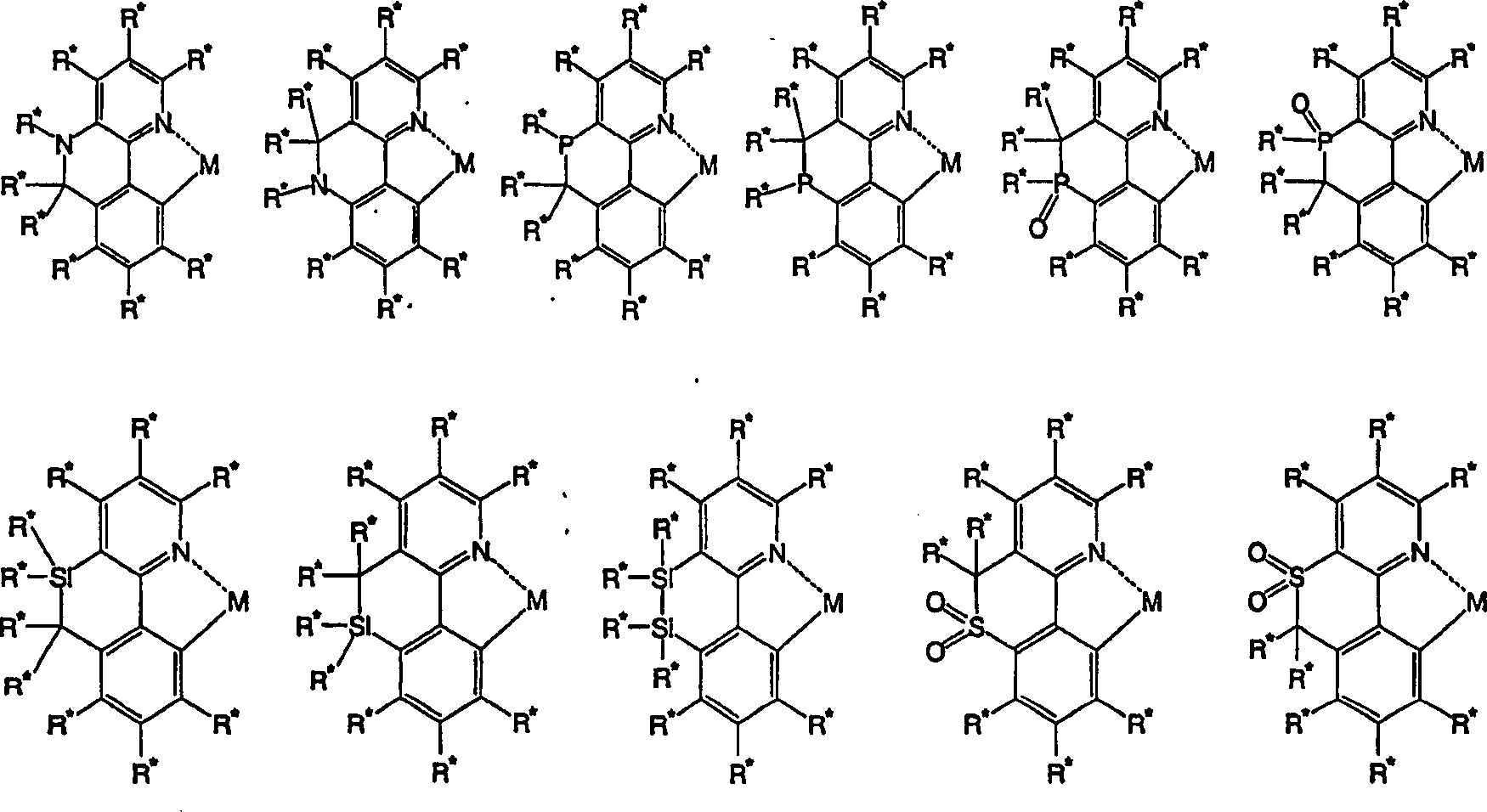
Bestimmte
Beispiele des dritten Metallkomplexes der vorliegenden Erfindung
mit einer Struktur der vorstehend beschriebenen allgemeinen Formel
(5) schließen jene mit einer Struktur der folgenden allgemeinen Formeln: 
Der Alkylrest, Alkoxyrest, Alkylthiorest, Arylrest, Aryloxyrest, Arylthiorest, Arylalkylrest, Arylalkoxyrest, Arylalkylthiorest, Arylalkenylrest, Arylalkinylrest, die Aminogruppe, substituierte Aminogruppe, Silylgruppe, substituierte Silylgruppe, Silyloxygruppe, substituierte Silyloxygruppe, der einwertige heterocyclische Rest und das Halogenatom, die durch vorstehend beschriebenes R dargestellt werden, sind die gleichen die wie vorstehend als Substituent erklärten und veranschaulichten, der an der cyclischen Struktur (zum Beispiel Z1 Ring, Z2 Ring und dgl.) aufzuweisen ist, die in einem Liganden enthalten sein sollen, der einen Metallkomplex der vorliegenden Erfindung bildet.The alkyl group, alkoxy group, alkylthio group, aryl group, aryloxy group, arylthio group, arylalkyl group, arylalkoxy group, arylalkylthio group, arylalkenyl group, arylalkynyl group, the amino group, substituted amino group, silyl group, substituted silyl group, silyloxy group, substituted silyloxy group, the monovalent heterocyclic group and the halogen atom represented by above R 1 and R 2 are the same as those exemplified and exemplified above as having substituents on the cyclic structure (for example, Z 1 ring, Z 2 ring and the like) to be contained in a ligand containing a metal complex of the present invention.
Der dritte Metallkomplex der vorliegenden Erfindung kann der durch M(L)n dargestellte (wobei M, L und n die gleichen Bedeutungen wie vorstehend beschrieben aufweisen), aufgebaut aus dem gleichen Liganden, oder der durch M(L)m1(L2)m2, M(L)(L2)(L3) dargestellte (wobei M, L, L2, L3, m1 und m2 die gleichen Bedeutungen wie vorstehend beschrieben aufweisen), aufgebaut aus unterschiedlichen Liganden, und dgl., wie bei dem vorstehend beschriebenen ersten Metallkomplex, sein.The third metal complex of the present invention may be that represented by M (L) n (wherein M, L and n have the same meanings as described above) composed of the same ligand, or represented by M (L) m 1 (L 2 ) m 2 , M (L) (L 2 ) (L 3 ) (wherein M, L, L 2 , L 3 , m 1 and m 2 have the same meanings as described above) composed of different ligands, and the like. as in the first metal complex described above.
– Verfahren zur Herstellung des Komplexes –- Process for the preparation of Complex -
Als Nächstes wird ein Verfahren zur Synthese eines erfindungsgemäßen Metallkomplexes erklärt.When Next will be a method for synthesizing a present invention Metal complex explained.
Der erfindungsgemäße Metallkomplex kann zum Beispiel mit dem folgenden Verfahren hergestellt werden. Genauer werden eine Verbindung mit einem Teil, der einen Z1 Ring enthält, und eine Verbindung mit einem Teil, der einen Z2 Ring enthält, durch zum Beispiel Suzuki-Kopplung, Grignard-Kopplung unter Verwendung eines Nickelkatalysators, Stille-Kopplung und dgl. umgesetzt, um eine Verbindung als einen Liganden zu synthetisieren, und dieser wird mit einem Salz des gewünschten Metalls in einer Lösung umgesetzt, um einen Komplex herzustellen, so kann der erfindungsgemäße Metallkomplex synthetisiert werden.The metal complex of the present invention can be produced, for example, by the following method. More specifically, a compound having a part containing a Z 1 ring and a compound having a part containing a Z 2 ring, for example, Suzuki coupling, Grignard coupling using a nickel catalyst, Stille coupling and the like. to synthesize a compound as a ligand, and this is reacted with a salt of the desired metal in a solution to produce a complex, the metal complex of the present invention can be synthesized.
Die
vorstehend beschriebene Synthese einer Verbindung als ein Ligand
kann insbesondere wie nachstehend beschrieben durchgeführt
werden: genauer werden eine Verbindung mit einem Teil, der einen
Z1 Ring enthält, und eine Verbindung
mit einem Teil, der einen Z2 Ring enthält,
falls erforderlich in einem organischen Lösungsmittel gelöst
und bei einer Temperatur des Schmelzpunkts oder höher und
des Siedepunkts oder niedriger des organischen Lösungsmittels
unter Verwendung von zum Beispiel einer Alkalie, eines geeigneten
Katalysators und dgl. umgesetzt. Zum Beispiel können Verfahren,
beschrieben in
Das organische Lösungsmittel, das für die vorstehend beschriebene Synthese einer Verbindung als Ligand verwendet wird, variiert mit den zu verwendenden Verbindungen und Umsetzungen, und im Allgemeinen werden zum Unterdrücken von Nebenreaktionen jene verwendet, die einer ausreichenden Deoxidationsbehandlung unterzogen wurden. Vorzugsweise geht die Reaktion in einer inerten Atmosphäre vonstatten. Ferner ist bevorzugt, dass das vorstehend beschriebene organische Lösungsmittel zuvor einer Entwässerungsbehandlung unterzogen wird. Jedoch ist das nicht der Fall, wenn eine Umsetzung in einem Zweiphasensystem mit Wasser durchgeführt wird, wie bei der Suzuki-Kopplungsreaktion.The organic solvent used for the above-described synthesis of a compound as a ligand varies with the compounds and reactions to be used, and in general, those which have been subjected to sufficient deoxidation treatment are used for suppressing side reactions. Preferably, the reaction proceeds in an inert atmosphere. Further, it is preferable that the above-described organic solvent is previously dehydrated subjected to treatment. However, this is not the case when reacting in a two-phase system with water, as in the Suzuki coupling reaction.
Zum Durchführen der Umsetzung bei der vorstehend beschriebenen Synthese einer Verbindung als ein Ligand werden eine Alkalie, ein geeigneter Katalysator und dgl. geeigneterweise zugegeben. Diese Alkalie und geeigneter Katalysator können abhängig von der zu verwendenden Umsetzung gewählt werden, und jene sind bevorzugt, die ausreichend in einem in der Umsetzung zu verwendenden Lösungsmittel gelöst werden. Als ein Verfahren des Mischens einer Alkalie und eines geeigneten Katalysators mit einem Substrat werden ein Verfahren, wobei eine Alkalie und ein geeigneter Katalysator langsam unter Rühren der Reaktionsflüssigkeit zugegeben werden (das heißt, Flüssigkeit, hergestellt durch Lösen oder Dispergieren eines Substrats in einem organischen Lösungsmittel) unter einer inerten Atmosphäre, wie Argon, Stickstoff und dgl., und ein Verfahren veranschaulicht, wobei umgekehrt die Reaktionsflüssigkeit langsam zu einer Alkalie und einem geeigneten Katalysator gegeben wird.To the Performing the reaction in the above-described Synthesis of a compound as a ligand will become an alkali suitable catalyst and the like. Suitably added. These Alkali and suitable catalyst can be dependent are chosen by the implementation to be used, and those are preferably enough to be used in one in the reaction Solvents are dissolved. As a procedure mixing an alkali and a suitable catalyst a substrate, a process wherein an alkali and a suitable catalyst slowly while stirring the reaction liquid be added (that is, liquid, prepared by dissolving or dispersing a substrate in one organic solvents) under an inert atmosphere, such as argon, nitrogen and the like, and illustrates a method conversely, the reaction liquid slowly to a Alkali and a suitable catalyst is added.
In der vorstehend beschriebenen Synthese einer Verbindung als ein Ligand ist die Reaktionstemperatur nicht besonders beschränkt und üblicherweise etwa –100 bis 350°C, vorzugsweise 0°C bis zum Siedepunkt des Lösungsmittels. Die Umsetzungsdauer ist nicht besonders beschränkt, und üblicherweise etwa 30 Minuten bis 30 Stunden.In the synthesis of a compound as a ligand described above the reaction temperature is not particularly limited and usually about -100 to 350 ° C, preferably 0 ° C to the boiling point of the solvent. The implementation time is not particularly limited, and usually about 30 minutes to 30 hours.
Bei der vorstehend beschriebenen Synthese einer Verbindung als ein Ligand variiert ein Verfahren zur Entfernung einer gewünschten Substanz (Verbindung als Ligand) aus dem Reaktionsgemisch und Reinigung davon nach Beenden der vorstehend beschriebenen Umsetzung, abhängig von der erhaltenen Verbindung als ein Ligand, und übliche Verfahren zur Reinigung organischer Verbindungen, wie zum Beispiel Umkristallisation, Sublimation, Chromatographie und dgl. werden verwendet.at the synthesis of a compound as a ligand described above A method for removing a desired one varies Substance (compound as ligand) from the reaction mixture and purification thereof after completion of the reaction described above from the obtained compound as a ligand, and usual ones Process for the purification of organic compounds, such as Recrystallization, sublimation, chromatography and the like used.
Als
ein Verfahren zur Herstellung eines Komplexes (d. h. ein Verfahren
zur Umsetzung einer Verbindung als ein Ligand mit einem Metallsalz
in einer Lösung) werden zum Beispiel im Fall eines Iridiumkomplexes Verfahren,
beschrieben in
Obwohl die Umsetzungstemperatur zur Herstellung eines Komplexes nicht besonders beschränkt ist, kann die Umsetzung üblicherweise bei dem Schmelzpunkt bis zu dem Siedepunkt eines Lösungsmittels, vorzugsweise –78°C bis zu dem Siedepunkt eines Lösungsmittels, durchgeführt werden. Die Umsetzungsdauer ist nicht besonders beschränkt und üblicherweise etwa 30 Minuten bis 30 Stunden. Wenn eine Mikrowellen-Umsetzungsvorrichtung bei dem Verfahren zur Herstellung eines Komplexes verwendet wird, kann die Umsetzung auch bei dem Siedepunkt eines Lösungsmittels oder höher durchgeführt werden, und die Umsetzungsdauer ist nicht besonders beschränkt, und etwa mehrere Minuten bis mehrere Stunden.Even though the reaction temperature for preparing a complex is not particularly is limited, the implementation can usually at the melting point up to the boiling point of a solvent, preferably from -78 ° C to the boiling point of a solvent, be performed. The implementation period is not special limited and usually about 30 minutes to 30 hours. When a microwave converting device in the Process for the preparation of a complex is used, the Implementation also at the boiling point of a solvent or higher, and the implementation period is not particularly limited, and about several minutes up to several hours.
Bei dem Syntheseverfahren bei der Umsetzung zur Herstellung eines Komplexes wird ein Lösungsmittel in einen Kolben eingebracht, eine Entlüftung wird unter Durchblasen mit einem Inertgas, wie Stickstoffgas, Argongas und dgl. unter Rühren des Lösungsmittels durchgeführt, dann werden ein Metallsalz und eine Verbindung als ein Ligand zugegeben. Die Temperatur wird auf eine Temperatur des Ligandenaustauschs unter einer Inertgasatmosphäre unter Rühren der so erhaltenen Lösung erhöht, und das Rühren wird unter thermischem Isolieren fortgesetzt. Der Endpunkt der Umsetzung kann durch Beenden der Abnahme der Ausgangssubstanzen oder Verschwinden der Ausgangssubstanz durch DSC-Überwachung oder Hochleistungs-Flüssigchromatographie bestimmt werden.at the synthesis method in the reaction for the preparation of a complex a solvent is introduced into a flask, a Venting is done by bubbling with an inert gas, such as Nitrogen gas, argon gas and the like with stirring of the solvent performed, then become a metal salt and a compound added as a ligand. The temperature is at a temperature ligand exchange under an inert gas atmosphere Stirring the solution thus obtained increases and stirring is continued with thermal isolation. The end point of the reaction can be stopped by stopping the decrease of the starting substances or disappearance of the starting substance by DSC monitoring or high performance liquid chromatography.
Ein Verfahren zum Entfernen einer gewünschten Substanz (Metallkomplex) aus dem Reaktionsgemisch, das mit der vorstehend beschriebenen Umsetzung und Reinigung davon erhalten wurde, variiert mit dem Metallkomplex, und übliche Verfahren zur Reinigung der Komplexe, wie zum Beispiel Umkristallisation, Sublimation, Chromatographie und dgl., werden verwendet. Insbesondere wird zum Beispiel 1 N wässrige Salzsäurelösung als ein schlechtes Lösungsmittel zu dem Reaktionsgemisch gegeben, um eine Abscheidung eines Metallkomplexes zu bewirken, dieser wird durch Filtration entfernt, und dieser Feststoff wird in einem organischen Lösungsmittel, wie Dichlormethan, Chloroform und dgl., gelöst. Diese Lösung wird filtriert, um unlösliche Substanzen zu entfernen, wieder konzentriert, durch Kieselgelsäulenchromatographie (Elution mit Dichlormethan) gereinigt, Fraktionslösungen einer gewünschten Substanz werden gesammelt, und zum Beispiel wird Methanol (schlechtes Lösungsmittel) in einer geeigneten Menge zugegeben, die Lösung wird konzentriert, um eine Abscheidung eines Metallkomplexes als eine gewünschte Substanz zu bewirken, und diese wird filtriert und getrocknet, wobei ein Metallkomplex erhalten wird.A method for removing a desired substance (metal complex) from the reaction mixture obtained by the above-described reaction and purification thereof varies with the metal complex, and usual methods for purifying the complexes such as recrystallization, sublimation, chromatography and the like. , are used. Specifically, for example, 1N hydrochloric acid aqueous solution as a poor solvent is added to the reaction mixture to cause precipitation of a metal complex, which is removed by filtration, and this solid is dissolved in an organic solvent such as dichloromethane, chloroform and the like. This solution is filtered to remove insoluble matters, concentrated again, purified by silica gel column chromatography (elution with dichloromethane), fraction solutions of a desired substance are collected, and, for example, methanol (poor solvent) is added in an appropriate amount, the solution is concentrated, to cause deposition of a metal complex as a desired substance, and it is filtered and dried to obtain a metal complex.
Die Identifizierung und Analyse einer Verbindung kann durch CHN Elementanalyse, NMR Analyse und MS Analyse durchgeführt werden.The Identifying and analyzing a compound can be done by CHN elemental analysis, NMR analysis and MS analysis are performed.
Zum
Beispiel kann ein erfindungsgemäßer Komplex der
folgenden Formel (A): 

<Polymerverbindung><Polymer Compound>
Ein Rest eines erfindungsgemäßen Metallkomplexes kann in ein Molekül eingemischt werden, wobei eine Polymerverbindung erhalten wird. Als vorstehend beschriebenes Molekül, in das ein Rest eines Metallkomplexes eingemischt ist, werden zum Beispiel polymere organische Verbindungen, die als später beschriebenes ladungstransportierendes Material zu verwenden sind, aufgeführt, und konjugierte organische Polymerverbindungen sind bevorzugt, da sich die Konjugation verteilt, wobei die Träger(Elektronen oder Loch)-beweglichkeit erhöht wird.One Rest of a metal complex of the invention can are mixed in a molecule, wherein a polymer compound is obtained. As the above-described molecule, in that a remainder of a metal complex is mixed in, for example polymeric organic compounds described later charge-transporting material to be used are listed, and conjugated organic polymer compounds are preferred the conjugation is distributed, the carriers (electrons or hole) mobility is increased.
Wenn ein erfindungsgemäßer Metallkomplex in eine organische Polymerverbindung eingebaut wird, schließen Beispiele der Polymerverbindungen mit einer Struktur einer polymeren organischen Verbindung und einem Rest eines Metallkomplexes im gleichen Molekül
- 1. Polymerverbindungen mit einem Rest eines Metallkomplexes in der Hauptkette einer organischen Polymerverbindung;
- 2. Polymerverbindungen mit einem Rest eines Metallkomplexes am Ende einer organischen Polymerverbindung;
- 3. Polymerverbindungen mit einem Rest eines Metallkomplexes an der Seitenkette einer organischen Polymerverbindung;
- 1. polymer compounds having a residue of a metal complex in the main chain of an organic polymer compound;
- 2. polymer compounds having a residue of a metal complex at the end of an organic polymer compound;
- 3. polymer compounds having a residue of a metal complex on the side chain of an organic polymer compound;
Beispiele der vorstehend beschriebenen Polymerverbindung schließen jene, die einen Rest eines Metallkomplexes mit einer Struktur der vorstehend beschriebenen allgemeinen Formel (1), der vorstehend beschriebenen allgemeinen Formel (5) oder dgl. enthalten, ein, die ein auf Polystyrol umgerechnetes Zahlenmittel des Molekulargewichts von 103 bis 108 aufweisen und einen Rest eines Metallkomplexes mit einer Struktur der vorstehend beschriebenen allgemeinen Formel (1), der vorstehend beschriebenen allgemeinen Formel (5) oder dgl. in der Seitenkette, Hauptkette oder am Ende oder an zwei oder mehreren davon aufweisen. In der vorliegenden Beschreibung ist „Rest eines Metallkomplexes" ein k-weniger Rest, erhalten durch Abspalten von k Wasserstoffatomen von dem vorstehend beschriebenen Metallkomplex. Hier ist k eine ganze Zahl von 1 bis 6.Examples of the polymer compound described above include those containing a residue of a metal complex having a structure of the above-described general formula (1), the above-described general formula (5) or the like, which is a polystyrene-reduced number average molecular weight of 10 3 to 10 8 and have a residue of a metal complex having a structure of the above-described general formula (1), the above-described general formula (5) or the like in the side chain, main chain or at the end or two or more thereof. In the present specification, "residue of a metal complex" is a k-less residue obtained by eliminating k hydrogen atoms from the metal complex described above, where k is an integer of 1 to 6.
Die
Polymerverbindung mit einem Rest eines Metallkomplexes in der Hauptkette
einer organischen Polymerverbindung wird zum Beispiel durch die
folgende Formel dargestellt: 
Die
Polymerverbindung mit einem Rest eines Metallkomplexes am Ende einer
organischen Polymerverbindung wird zum Beispiel durch die folgende
Formel dargestellt: 
Die
Polymerverbindung mit einem Rest eines Metallkomplexes in der Seitenkette
einer organischen Polymerverbindung wird zum Beispiel durch die
folgende Formel dargestellt:
In den vorstehend beschriebenen Formeln sind der Alkylrest, Arylrest, einwertige heterocyclische Rest und die Cyanogruppe, die durch R68 bis R79 dargestellt werden, und der Alkylrest, Alkoxyrest, Alkylthiorest, Arylrest, Aryloxyrest, Arylthiorest, Arylalkylrest, Arylalkoxyrest, Arylalkylthiorest, Arylalkenylrest, Arylalkinylrest, die Aminogruppe, substituierte Aminogruppe, Silylgruppe, substituierte Silylgruppe, das Halogenatom, der Acylrest, Acyloxyrest, Iminrest, die Amidgruppe, Säureimidgruppe, der einwertige heterocyclische Rest, die Carboxylgruppe, substituierte Carboxylgruppe und Cyanogruppe als der Substituent, der gegebenfalls an Ar vorhanden ist, die gleichen, wie die als Substituent erklärten und veranschaulichten, die an der cyclischen Struktur (zum Beispiel Z1 Ring, Z2 Ring und dgl.) vorhanden sein können, die in einem Liganden enthalten ist, der einen vorstehend beschriebenen Metallkomplex der vorliegenden Erfindung bildet.In the above-described formulas, the alkyl group, aryl group, monovalent heterocyclic group and cyano group represented by R 68 to R 79 and the alkyl group, alkoxy group, alkylthio group, aryl group, aryloxy group, arylthio group, arylalkyl group, arylalkoxy group, arylalkylthio group, arylalkenyl group, Arylalkynyl group, amino group, substituted amino group, silyl group, substituted silyl group, halogen atom, acyl group, acyloxy group, imine group, amide group, acidimide group, monovalent heterocyclic group, carboxyl group, substituted carboxyl group and cyano group as the substituent optionally present on Ar , the same as those explained and exemplified as substituents on the cyclic ones Structure (for example Z 1 ring, Z 2 ring and the like) may be present, which is contained in a ligand which forms a metal complex of the present invention described above.
In den vorstehend beschriebenen Formeln schließen Beispiele des zweiwertigen aromatischen Rests Phenylen, Pyridinylen, Pyrimidilen, Naphthylen oder einen Ring der folgenden allgemeinen Formel (6) und dgl. ein.In The above-described formulas include examples of the divalent aromatic radical phenylene, pyridinylene, pyrimidilen, Naphthylene or a ring of the following general formula (6) and the like.
In den vorstehend beschriebenen Formeln bedeutet der zweiwertige heterocyclische Rest einen atomaren Rest, der nach Abspalten von zwei Wasserstoffatomen von einer heterocyclischen Verbindung verbleibt, und die Kohlenstoffzahl davon beträgt üblicherweise etwa 4 bis 60, vorzugsweise 4 bis 20. Die Kohlenstoffzahl des heterocyclischen Rests schließt nicht die Kohlenstoffzahl eines Substituenten ein. Die heterocyclische Verbindung ist die gleiche wie für den vorstehend beschriebenen einwertigen heterocyclischen Rest erklärt und veranschaulicht.In The above-described formulas means the divalent heterocyclic Remaining an atomic residue, after cleavage of two hydrogen atoms from a heterocyclic compound, and the carbon number of which is usually about 4 to 60, preferably 4 to 20. The carbon number of the heterocyclic residue closes not the carbon number of a substituent. The heterocyclic Compound is the same as for the one described above monovalent heterocyclic radical is explained and illustrated.
Obwohl
die vorstehend beschriebene Polymerverbindung nicht besonders beschränkt
ist, mit der Maßgabe, dass sie in ihrem Molekül
einen Rest eines ersten Metallkomplexes, einen Rest einen zweiten
Metallkomplexes oder einen Rest eines dritten Metallkomplexes, die
vorstehend beschrieben sind, oder eine Kombination von zwei oder
mehr davon aufweist, sind jene bevorzugt, die die Ladungstransportierbarkeit,
Ladungseinspeisbarkeit und dgl. nicht signifikant beeinträchtigen,
und insbesondere sind konjugierte Polymere bevorzugt, die ausgezeichnete
Träger(Elektronen oder Loch)-transportierbarkeit aufweisen.
Vorzugsweise enthält das konjugierte Polymer einen zweiwertigen
aromatischen Rest, der gegebenenfalls einen Substituenten aufweist.
Dieser zweiwertige aromatische Rest ist vorzugsweise, zum Beispiel,
ein zweiwertiger heterocyclischer Rest, der gegebenenfalls einen
Substitutenten aufweist, ein zweiwertiger aromatischer Aminrest,
der gegebenenfalls einen Substituenten aufweist, oder ein Rest der
folgenden allgemeinen Formel (6): 
Der vorstehend beschriebene zweiwertige aromatische Rest ist ein atomarer Rest, erhalten durch Abspalten von zwei Wasserstoffatomen von einer aromatischen Verbindung, und schließt jene mit einem kondensierten Ring und jene mit unabhängig zwei oder mehreren Benzolringen oder kondensierten Ringen, direkt oder über einen Rest, wie Vinylen und dgl., verbunden, ein. Der aromatische Rest weist gegebenenfalls einen Substituenten auf.Of the The above-described divalent aromatic radical is an atomic one Residue obtained by splitting off two hydrogen atoms from one aromatic compound, and includes those with a condensed Ring and those with independently two or more benzene rings or condensed rings, directly or via a residue, like vinyls and the like, connected, one. The aromatic residue points optionally a substituent.
Der vorstehend beschriebene zweiwertige heterocyclische Rest bedeutet einen atomaren Rest, der nach Abspalten von zwei Wasserstoffatomen von einer heterocyclischen Verbindung verbleibt, und der Rest weist gegebenenfalls einen Substituenten auf. Die heterocyclische Verbindung bedeutet eine organische Verbindung mit cyclischer Struktur, in der den Ring bildende Elemente nicht nur ein Kohlenstoffatom, sondern auch mindestens ein Atom, ausgewählt aus einem Sauerstoffatom, Stickstoffatom, Siliciumatom, Germaniumatom, Zinnatom, Phosphoratom, Boratom, Schwefelatom, Selenatom und Telluratom, einschließen. Unter den zweiwertigen heterocyclischen Resten sind aromatische heterocyclische Reste bevorzugt. Ein Teil des zweiwertigen heterocyclischen Rests, außer der Substituenten, weist eine Kohlenstoffzahl von üblicherweise etwa 3 bis 60 auf. Die gesamte Kohlenstoffzahl des zweiwertigen heterocyclischen Rests, einschließlich der Substituenten, beträgt üblicherweise etwa 3 bis 100.The divalent heterocyclic group described above means an atomic group remaining after eliminating two hydrogen atoms from a heterocyclic compound, and the group optionally has a substituent. The heterocyclic compound means an organic compound having a cyclic structure in which the ring-forming elements are not only a carbon atom but also at least one atom selected from an oxygen atom, nitrogen atom, silicon atom, germanium atom, tin atom, phosphorus atom, boron atom, sulfur atom, selenium atom and tellurium atom , lock in. Among the bivalent heterocyclic radicals, aromatic heterocyclic radicals are preferred. A part of the divalent heterocyclic group other than the substituent has a carbon number of usually about 3 to 60. The total carbon number of the divalent heterocyclic group, including the substituents, is usually about 3 to 100.
Der zweiwertige aromatische Aminrest bedeutet einen atomaren Rest, der nach Abspalten von zwei Wasserstoffatomen von einem aromatischen Amin verbleibt. Der zweiwertige aromatische Aminrest weist eine Kohlenstoffzahl von üblicherweise etwa 5 bis 100, vorzugsweise 15 bis 60, auf. Die Kohlenstoffzahl des zweiwertigen aromatischen Aminrests schließt nicht die Kohlenstoffzahl der Substituenten ein.Of the divalent aromatic amine radical means an atomic radical which after splitting off two hydrogen atoms from an aromatic one Amine remains. The divalent aromatic amine radical has a carbon number from usually about 5 to 100, preferably 15 to 60, on. The carbon number of the divalent aromatic amine radical does not include the carbon number of the substituents.
Als
zweiwertiger aromatischer Aminrest werden Reste der folgenden allgemeinen
Formel (7) veranschaulicht. 
In der vorstehend beschriebenen allgemeinen Formel (7) ist der durch Ar6 bis Ar9 dargestellte Arylenrest ein atomarer Rest, erhalten durch Abspalten von zwei Wasserstoffatomen von einem aromatischen Kohlenwasserstoff und schließt jene mit einem kondensierten Ring und jene mit unabhängig zwei oder mehreren Benzolringen oder kondensierten Ringen, direkt oder über eine Gruppe, wie Vinylen und dgl. verbunden, ein. Der Arylenrest weist gegebenenfalls einen Substituenten auf. Ein Teil des Arylenrests, außer der Substituenten, weist eine Kohlenstoffzahl von üblicherweise etwa 6 bis 60, vorzugsweise 6 bis 20, auf. Die gesamte Kohlenstoffzahl des Arylenrests, einschließlich der Substituenten, beträgt üblicherweise etwa 6 bis 100.In the above-described general formula (7), the arylene group represented by Ar 6 to Ar 9 is an atomic group obtained by cleaving two hydrogen atoms of an aromatic hydrocarbon and includes those having a condensed ring and those having independently two or more benzene rings or condensed ones Wrestling, directly or through a group such as vinyls and the like. The arylene radical optionally has a substituent. A part of the arylene group other than the substituent has a carbon number of usually about 6 to 60, preferably 6 to 20. The total carbon number of the arylene group, including the substituents, is usually about 6 to 100.
In der vorstehend beschriebenen allgemeinen Formel (7) ist der zweiwertige heterocyclische Rest, der durch Ar6 bis Ar9 dargestellt wird, der gleiche wie der als zweiwertiger heterocyclischer Rest im Abschnitt des vorstehend beschriebenen zweiwertigen Rests erklärte und veranschaulichte.In the above-described general formula (7), the divalent heterocyclic group represented by Ar 6 to Ar 9 is the same as that explained and illustrated as the divalent heterocyclic group in the portion of the divalent group described above.
In der vorstehend beschriebenen allgemeinen Formel (7) sind der Arylrest und einwertige heterocyclische Rest, die durch Ar10 bis Ar12 dargestellt werden, die gleichen wie als Substituent erklärt und veranschaulicht, der an der cyclischen Struktur vorhanden sein kann (zum Beispiel Z1 Ring, Z2 Ring und dgl.), die in einem Liganden enthalten ist, der einen Metallkomplex der vorliegenden Erfindung bildet.In the above-described general formula (7), the aryl group and monovalent heterocyclic group represented by Ar 10 to Ar 12 are the same as explained and exemplified as a substituent which may be present on the cyclic structure (for example, Z 1 ring , Z 2 ring and the like) contained in a ligand forming a metal complex of the present invention.
Der Substituent, der gegebenenfalls im vorstehend beschriebenen zweiwertigen aromatischen Rest, vorstehend beschriebenen zweiwertigen heterocyclischen Rest, vorstehend beschriebenen zweiwertigen aromatischen Aminrest und Arylenrest, zweiwertigen heterocyclischen Rest, Arylrest und einwertigen heterocyclischen Rest in der vorstehend beschriebenen allgemeinen Formel (7) vorhanden ist, schließt einen Alkylrest, Alkoxyrest, Alkylthiorest, Arylrest, Aryloxyrest, Arylthiorest, Arylalkylrest, Arylalkoxyrest, Arylalkylthiorest, Arylalkenylrest, Arylalkinylrest, eine Aminogruppe, substituierte Aminogruppe, Silylgruppe, substituierte Silylgruppe, ein Halogenatom, einen Arylrest, Acyloxyrest, Iminrest, eine Amidgruppe, Säureimidgruppe, einen einwertigen heterocyclischen Rest, eine Carboxylgruppe, substituierte Carboxylgruppe, Cyanogruppe und Nitrogruppe ein. Diese Substituenten sind insbesondere die gleichen wie als Substituent erklärt und veranschaulicht, der an der cyclischen Struktur (zum Beispiel Z1 Ring, Z2 Ring und dgl.) vorhanden ist, die in einem Liganden vorhanden ist, der einen Metallkomplex der vorliegenden Erfindung bildet.The substituent optionally present in the above described divalent aromatic radical, divalent heterocyclic radical described above, aromatic divalent amine radical and arylene radical, divalent heterocyclic radical, aryl radical and monovalent heterocyclic radical in general formula (7) described above includes an alkyl radical , Alkoxy, alkylthio, aryl, aryloxy, arylthio, arylalkyl, arylalkoxy, arylalkylthio, arylalkenyl, arylalkynyl, amino, substituted amino, silyl, substituted silyl, halogen, aryl, acyloxy, imine, amide, acidimide, monohydric heterocyclic Radical, a carboxyl group, substituted carboxyl group, cyano group and nitro group. These substituents are specifically explained and exemplified as the substituent present on the cyclic structure (for example, Z 1 ring, Z 2 ring and the like) contained in a ligand constituting a metal complex of the present invention.
In der vorstehend beschriebenen allgemeinen Formel (6) sind der Alkylrest, Alkoxyrest, Alkylthiorest, Arylrest, Aryloxyrest, Arylthiorest, Arylalkylrest, Arylalkoxyrest, Arylalkylthiorest, Arylalkenylrest, Arylalkinylrest, die Aminogruppe, substituierte Aminogruppe, Silylgruppe, substituierte Silylgruppe, Silyloxygruppe, substituierte Silyloxygruppe, der einwertige heterocyclische Rest und das Halogenatom, die durch R6 bis R36 dargestellt werden, die gleichen, wie die als Substituent erklärten und veranschaulichten, der an der cyclischen Struktur (zum Beispiel Z1 Ring, Z2 Ring und dgl.) vorhanden sein kann, die in einem Liganden enthalten ist, der einen Metallkomplex der vorliegenden Erfindung bildet.In the above-described general formula (6), the alkyl group, alkoxy group, alkylthio group, aryl group, aryloxy group, arylthio group, arylalkyl group, arylalkoxy group, arylalkylthio group, arylalkenyl group, arylalkynyl group, amino group, substituted amino group, silyl group, substituted silyl group, silyloxy group, substituted silyloxy group, monovalent heterocyclic group and the halogen atom represented by R 6 to R 36 , the same as those explained and exemplified as the substituent which may be present on the cyclic structure (for example, Z 1 ring, Z 2 ring and the like) contained in a ligand containing a metal complex of the present invention forms.
Der
Rest der vorstehend beschriebenen Formel (6) schließt Reste
der folgenden allgemeinen Formel (6-1), der folgenden allgemeinen
Formel (6-2) oder der folgenden allgemeinen Formel (6-3): 

In den vorstehend beschriebenen Formeln stellt Y vorzugsweise -S-, -O- oder -C(R11)(R12)- im Hinblick auf den Erhalt hohen Wirkungsgrads der Lichtemission und weiter bevorzugt -S- oder -O- dar. Hier weisen R11, R12 die gleichen Bedeutungen wie vorstehend beschrieben auf.In the above-described formulas, Y preferably represents -S-, -O- or -C (R 11 ) (R 12 ) - in view of obtaining high light-emitting efficiency, and more preferably -S- or -O- R 11 , R 12 have the same meanings as described above.
Der aromatische Ring in den vorstehend beschriebenen allgemeinen Formeln (6-1) bis (6-5) schließt aromatische Kohlenwasserstoffringe, wie einen Benzolring, Naphthalinring, Anthracenring, Tetracenring, Pentacenring, Pyrenring, Phenanthrenring und dgl.; und heteroaromatische Ringe, wie einen Pyridinring, Bipyridinring, Phenanthrolinring, Chinolinring, Isochinolinring, Thiophenring, Furanring, Pyrrolring und dgl., ein.Of the aromatic ring in the above-described general formulas (6-1) to (6-5) includes aromatic hydrocarbon rings, such as a benzene ring, naphthalene ring, anthracene ring, tetracene ring, Pentacene ring, pyrene ring, phenanthrene ring and the like; and heteroaromatic Rings, such as a pyridine ring, bipyridine ring, phenanthroline ring, Quinoline ring, isoquinoline ring, thiophene ring, furan ring, pyrrole ring and the like, a.
Reste der vorstehend beschriebenen allgemeinen Formeln (6-1) bis (6-5) weisen vorzugsweise einen Rest auf, ausgewählt aus einem Alkylrest, Alkoxyrest, Alkylthiorest, Arylrest, Acyloxyrest, Arylthiorest, Arylalkylrest, Arylalkoxyrest, Arylalkylthiorest, Arylalkenylrest, Arylalkinylrest, einer Aminogruppe, substituierten Aminogruppe, Silylgruppe, substituierten Silylgruppe, einem Acyloxyrest, Iminrest, einer Amidgruppe, Säureimidgruppe, einem einwertigen heterocyclischen Rest, einer Carboxylgruppe oder substituierten Carboxylgruppe als Substituent.leftovers of the above-described general formulas (6-1) to (6-5) preferably have a radical selected from a Alkyl radical, alkoxy radical, alkylthio radical, aryl radical, acyloxy radical, arylthio radical, Arylalkyl, arylalkoxy, arylalkylthio, arylalkenyl, Arylalkynyl radical, an amino group, substituted amino group, Silyl group, substituted silyl group, an acyloxy radical, imine radical, an amide group, acid imide group, a monohydric heterocyclic Radical, a carboxyl group or substituted carboxyl group as Substituent.
<Zusammensetzung><Composition>
Der vorstehend beschriebene Metallkomplex und/oder die Polymerverbindung können zur Herstellung einer Zusammensetzung durch Kombinieren mit einem ladungstransportierenden Material und/oder einem lichtemittierenden Material verwendet werden. Genauer umfasst die erfindungsgemäße Zusammensetzung den vorstehend beschriebenen Metallkomplex und/oder eine Polymerverbindung und ein ladungstransportierendes Material und/oder lichtemittierendes Material.Of the above-described metal complex and / or the polymer compound can be used to make a composition by combining with a charge-transporting material and / or a light-emitting Material used. More specifically, the invention includes Composition of the metal complex described above and / or a polymer compound and a charge-transporting material and / or light-emitting material.
Die vorstehend beschriebenen ladungstransportierenden Materialien sind in lochtransportierende Materialien und elektronentransportierende Materialien klassifiziert, und insbesondere können organische Verbindungen (organische Verbindungen mit niedrigem Molekulargewicht und/oder polymere organische Verbindungen) verwendet werden.The charge transporting materials described above are in hole transporting Ma classify materials and electron transporting materials, and in particular, organic compounds (low molecular weight organic compounds and / or polymeric organic compounds) can be used.
Beispiele des lochtransportierenden Materials schließen Carbazol oder Derivate davon, Polysilan oder Derivate davon, Polysiloxanderivate mit einem aromatischen Amin in der Seitenkette oder Hauptkette, Pyrazolinderivate, Arylaminderivate, einschließlich Triphenyldiaminderivate und dgl., Stilbenderivate, Polyanilin oder Derivate davon, Polythiophen oder Derivate davon, Polypyrrol oder Derivate davon, Poly(p-phenylenvinylen) oder Derivate davon oder Poly(2,5-thienylenvinylen) oder Derivate davon, Poly(p-phenylen) oder Derivate davon und dgl. ein.Examples of the hole transporting material include carbazole or derivatives thereof, polysilane or derivatives thereof, polysiloxane derivatives with an aromatic amine in the side chain or main chain, Pyrazoline derivatives, arylamine derivatives, including triphenyldiamine derivatives and the like, stilbene derivatives, polyaniline or derivatives thereof, polythiophene or derivatives thereof, polypyrrole or derivatives thereof, poly (p-phenylenevinylene) or derivatives thereof or poly (2,5-thienylenevinylene) or derivatives thereof, poly (p-phenylene) or derivatives thereof and the like.
Das elektronentransportierende Material schließt Oxadiazolderivate, Anthrachinodimethan oder Derivate davon, Benzochinon oder Derivate davon, Naphthochinon oder Derivate davon, Anthrachinon oder Derivate davon, Tetracyanoanthrachinodimethan oder Derivate davon, Fluorenonderivate, Diphenyldicyanoethylen oder Derivate davon, Diphenochinonderivate oder Metallkomplexe von 8-Hydroxychinolin oder Derivaten davon, Polychinolin oder Derivate davon, Polychinoxalin oder Derivate davon, Polyfluoren oder Derivate davon ein.The electron-transporting material closes oxadiazole derivatives, Anthraquinodimethane or derivatives thereof, benzoquinone or derivatives thereof, naphthoquinone or derivatives thereof, anthraquinone or derivatives thereof, tetracyanoanthraquinodimethane or derivatives thereof, fluorenone derivatives, Diphenyldicyanoethylene or derivatives thereof, diphenoquinone derivatives or metal complexes of 8-hydroxyquinoline or derivatives thereof, Polyquinoline or derivatives thereof, polyquinoxaline or derivatives thereof, Polyfluorene or derivatives thereof.
Die
organische Verbindung mit niedrigem Molekulargewicht, die als ladungstransportierendes
Material zu verwenden ist, bedeutet eine Hostverbindung, die in
einer organischen EL Vorrichtung mit niedrigem Molekulargewicht
verwendet wird (d. h. einer Hostverbindung mit niedrigem Molekulargewicht),
eine Ladungseinspeisungs- und transportierende Verbindung oder dgl.,
und insbesondere werden zum Beispiel Verbindungen, beschrieben in
Die organische Verbindung mit niedrigem Molekulargewicht schließt insbesondere die folgenden Verbindungen ein.The organic compound of low molecular weight closes in particular the following compounds.


Beispiele
der organischen Polymerverbindung, die als ladungstransportierendes
Material zu verwenden ist, schließen nicht konjugierte
organische Polymerverbindungen und konjugierte organische Polymerverbindungen
ein, und bevorzugt im Hinblick auf den Ladungstransport sind konjugierte
organische Polymerverbindungen, da sich die Konjugation verteilt
und die Träger (Elektronen oder Loch)-beweglichkeit vorteilhaft hoch
ist. Beispiele der nicht konjugierten organischen Polymerverbindung
schließen Polyvinylcarbazol und dgl. ein. Beispiele der
konjugierten organischen Polymerverbindung schließen Polymere,
die einen aromatischen Ring in der Hauptkette enthalten ein, und
insbesondere werden zum Beispiel jene, die eine Phenylengruppe, die
gegebenenfalls einen Substituieten aufweist, Fluoren, das gegebenenfalls
einen Substituenten aufweist, Dibenzothiophen, das gegebenenfalls
einen Substituenten aufweist, Dibenzofuran, das gegebenenfalls einen Substituenten
aufweist, Dibenzosilol, das gegebenenfalls einen Substituenten aufweist,
und dgl. als eine sich wiederholende Einheit in der Hauptkette enthalten,
und Copolymere mit der sich wiederholenden Einheit und dgl. veranschaulicht.
Insbesondere werden organische Polymerverbindungen mit einem Benzolring,
der gegebenenfalls einen Substituenten aufweist, organische Polymerverbindungen
mit einer Struktur der folgenden allgemeinen Formel (6) und dgl.
aufgeführt. Ferner werden zum Beispiel organische Polymerverbindungen,
beschrieben in
Das „konjugierte
Polymer" ist ein Molekül, das mehrere Bindungen und Einfachbindungen
enthält, die wiederholt verbunden sind, wie zum Beispiel
in 
In den Formeln sind die durch Rx1 bis Rx6 dargestellten Reste insbesondere die gleichen wie die als der Substituent erklärten und veranschaulichten, der an der cyclischen Struktur (zum Beispiel Z1 Ring, Z2 Ring und dgl.) vorhanden sein kann, die in einem Liganden enthalten ist, der einen vorstehend beschriebenen Metallkomplex der vorliegenden Erfindung bildet.In the formulas, the groups represented by R x1 to R x6 are particularly the same as those explained and exemplified as the substituent which may be present on the cyclic structure (for example, Z 1 ring, Z 2 ring and the like) described in U.S. Pat a ligand forming a metal complex of the present invention described above.
Bestimmte
Beispiele der organischen Polymerverbindung schließen jene,
die den folgenden Rest (d. h. das folgende Beispiel, ausschließlich
Klammern) enthalten, und jene ein, die die folgende Struktur als
eine sich wiederholende Einheit enthalten. 
Es
ist bevorzugt, dass die Energie ESH (eV) der organischen Verbindung
mit niedrigem Molekulargewicht oder organischen Polymerverbindung
im Grundzustand, die Energie ETH (eV) der organischen Verbindung
mit niedrigem Molekulargewicht oder organischen Polymerverbindung
im niedrigsten angeregten Triplettzustand, die Energie ESMC (eV)
des Metallkomplexes im Grundzustand und die Energie ETMC (eV) des
Metallkomplexes im niedrigsten angeregten Triplettzustand eine Beziehung:
Die vorstehend beschriebene organische Polymerverbindung weist ein auf Polystyrol umgerechnetes Zahlenmittel des Molekulargewichts von 103 bis 108, vorzugsweise 104 bis 106, auf. Diese organische Polymerverbindung weist ein auf Polystyrol umgerechnetes Gewichtsmittel des Molekulargewichts von 103 bis 108, vorzugsweise 5 × 10⁴ bis 5 × 10⁶, auf.The above-described organic polymer compound has a polystyrene-reduced number average molecular weight of 10 3 to 10 8 , preferably 10 4 to 10 6 . This organic polymer compound has a polystyrene-reduced weight average molecular weight of 10 3 to 10 8 , preferably 5 × 10 4 to 5 × 10 6 .
Als vorstehend beschriebenes lichtemittierendes Material können bekannte Materialien verwendet werden. Als lichtemittierendes Material werden lichtemittierende Materialien mit niedrigem Molekulargewicht, wie zum Beispiel Naphthalinderivate, Anthracen oder Derivate davon, Perylen oder Derivate davon, färbende Substanzen vom Polymethin-, Xanthen-, Cumarin- und Cyanintyp und dgl., Metallkomplexe von 8-Hydroxychinolin oder Derivate davon, aromatische Amine, Tetraphenylcyclopentadien oder Derivate davon oder Tetraphenylbutadien oder Derivate davon und dgl. aufgeführt.When can be described above light-emitting material known materials are used. As a light-emitting material are light-emitting materials of low molecular weight, such as for example naphthalene derivatives, anthracene or derivatives thereof, Perylene or derivatives thereof, coloring substances of polymethine, Xanthene, coumarin and cyanine type and the like, metal complexes of 8-hydroxyquinoline or derivatives thereof, aromatic amines, tetraphenylcyclopentadiene or derivatives thereof or tetraphenylbutadiene or derivatives thereof and the like listed.
Die Vermischmenge des vorstehend beschriebenen Metallkomplexes in einer erfindungsgemäßen Zusammensetzung ist nicht besonders beschränkt, da sie abhängig von der Art einer zu kombinierenden organischen Verbindung und einer Eigenschaft, von der die Optimierung erwünscht ist, variiert, und, wenn die Menge einer organischen Verbindung (d. h. organischen Polymerverbindung und/oder organischen Verbindung mit niedrigem Molekulargewicht) mit 100 Gew.-Teilen angenommen wird, beträgt die Vermischmenge üblicherweise 0,01 bis 80 Gew.-Teile, vorzugsweise 0,1 bis 60 Gew.-Teile. Die vorstehend beschriebenen Metallkomplexe können einzeln oder in Kombination vermischt verwendet werden.The Blend amount of the metal complex described above in one Composition according to the invention is not particularly limited as it depends on the type of one organic compound to be combined and a property of which the optimization is desired varies, and if so the amount of an organic compound (i.e., organic polymer compound and / or low molecular weight organic compound) is assumed to be 100 parts by weight, the blending amount is usually 0.01 to 80 parts by weight, preferably 0.1 to 60 parts by weight. The The metal complexes described above can be used individually or mixed in combination.
<Flüssige Zusammensetzung><Liquid composition>
Der Metallkomplex, die Polymerverbindung und Zusammensetzung der vorliegenden Erfindung sind alle zur Herstellung von Vorrichtungen, wie einer photoelektrischen Vorrichtung, lichtemittierenden Vorrichtung und dgl., geeignet, und insbesondere ist bevorzugt, den Metallkomplex, die Polymerverbindung und Zusammensetzung mit einem Lösungsmittel oder Dispergiermedium zu mischen, wobei eine zu verwendende flüssige Zusammensetzung erhalten wird (zum Beispiel als eine Lösung in einem Druckverfahren oder dgl. verwendet). Hier bedeutet die „flüssige Zusammensetzung" eine Zusammensetzung, die bei Herstellung einer Vorrichtung flüssig ist, und typischerweise eine Zusammensetzung, die bei Normaldruck (d. h. 1 Atm.) und 25°C flüssig ist. Indem so eine flüssige Zusammensetzung erhalten wird, können eine Schichtstruktur, ein Film und dgl. leicht in Vorrichtungen, wie einer photoelektrischen Vorrichtung, lichtemittierenden Vorrichtung und dgl. gebildet werden. Genauer können eine Schichtstruktur, ein Film und dgl. nur durch Auftragen der vorstehend beschriebenen flüssigen Zusammensetzung und danach Trocknen dieser, um ein Lösungsmittel zu entfernen, gebildet werden.Of the Metal complex, the polymer compound and composition of the present invention Invention are all for the manufacture of devices, such as a photoelectric device, light emitting device and Like., Suitable, and in particular is preferred, the metal complex, the polymer compound and composition with a solvent or dispersing medium, wherein a liquid to be used Composition is obtained (for example as a solution used in a printing process or the like). Here means the "liquid Composition "A composition used in the preparation of a Device is liquid, and typically a composition, which are liquid at normal pressure (i.e., 1 atm.) and 25 ° C is. By thus obtaining a liquid composition, For example, a layer structure, a film, and the like can be easily inserted into Devices, such as a photoelectric device, light-emitting Device and the like. Are formed. Exactly one can Layer structure, a film and the like. Only by applying the above described liquid composition and then drying this to remove a solvent to be formed.
Das Filmbildungsverfahren aus einer flüssigen Zusammensetzung (nachstehend als „Filmbildung aus einer Lösung" bezeichnet) schließt Aufbringungsverfahren, wie ein Schleuderbeschichtungsverfahren, Gießverfahren, Mikrogravurbeschichtungsverfahren, Gravurbeschichtungsverfahren, Rakelbeschichtungsverfahren, Walzenbeschichtungsverfahren, Drahtrakelbeschichtungsverfahren, Tauchbeschichtungsverfahren, Sprühbeschichtungsverfahren, Siebdruckverfahren, Flexodruckverfahren, Offsetdruckverfahren, Tintenstrahldruckverfahren, Düsenbeschichtungsverfahren, Kapillarbeschichtungsverfahren, Spenderverfahren und dgl., ein.The Film forming process from a liquid composition (hereinafter referred to as "film formation from solution") includes application methods such as a spin coating method, Casting process, microgravure coating process, gravure coating process, Knife coating method, roll coating method, wire bar coating method, Dip coating method, spray coating method, Screen printing, flexographic printing, offset printing, ink jet printing, Die coating method, capillary coating method, Dispensing method and the like., A.
Die vorstehend beschriebene flüssige Zusammensetzung kann zusätzlich ein ladungstransportierendes Material, lichtemittierendes Material, einen Stabilisator, Zusätze zum Einstellen der Viskosität und/oder Oberflächenspannung, Zusätze, wie ein Antioxidationsmittel, und dgl. enthalten.The The above-described liquid composition may additionally a charge-transporting material, light-emitting material, a stabilizer, additives for adjusting the viscosity and / or surface tension, additives, such as a Antioxidants, and the like. Included.
Von allen festen Bestandteilen, die in der flüssigen Zusammensetzung enthalten sind, beträgt der Anteil eines Metallkomplexes der vorliegenden Erfindung und/oder einer Polymerverbindung der vorliegenden Erfindung üblicherweise 20 Gew.-% bis 100 Gew.-%, vorzugsweise 40 Gew.-% bis 100 Gew.-%.From all solid components that are in the liquid composition are included, the proportion of a metal complex the present invention and / or a polymer compound of present invention usually 20 wt .-% to 100 Wt .-%, preferably 40 wt .-% to 100 wt .-%.
Der Anteil eines Lösungsmittels oder Dispergiermediums in der vorstehend beschriebenen flüssigen Zusammensetzung beträgt üblicherweise 1 Gew.-% bis 99,9 Gew.-%, vorzugsweise 60 Gew.-% bis 99,9 Gew.-%, weiter bevorzugt 90 Gew.-% bis 99,8 Gew.-%, in Bezug auf das Gesamtgewicht der flüssigen Zusammensetzung.Of the Proportion of a solvent or dispersing medium in the The above-described liquid composition is usually From 1% by weight to 99.9% by weight, preferably from 60% by weight to 99.9% by weight, more preferably 90% to 99.8% by weight, based on the total weight the liquid composition.
Die Viskosität der vorstehend beschriebenen flüssigen Zusammensetzung variiert abhängig von dem Druckverfahren, und sie liegt vorzugsweise im Bereich von 0,5 bis 500 mPa·s bei 25°C, und im Fall einer flüssigen Zusammensetzung, die durch eine Entnahmevorrichtung, wie bei einem Tintenstrahldruckverfahren und dgl., geht, liegt die Viskosität vorzugsweise im Bereich von 0,5 bis 20 mPa·s bei 25°C, um ein Verstopfen bei der Entnahme und ein Krümmen beim Fliegen zu verhindern.The viscosity of the above-described liquid composition varies depending on the printing method, and is preferably in the range of 0.5 to 500 mPa · s at 25 ° C, and in the case of flüs It is preferable that the viscosity is in the range of 0.5 to 20 mPa · s at 25 ° C., in order to prevent clogging upon picking and warp when flying, by an extraction device such as an ink jet printing method and the like prevent.
Als Lösungsmittel und Dispergiermedium, die in der flüssigen Zusammensetzung zu verwenden sind, sind jene bevorzugt, die zum Lösen oder gleichförmigen Dispergieren eines Metallkomplexes und einer Polymerverbindung der vorliegenden Erfindung in der Lage sind. Beispiele des Lösungsmittels und Dispergiermittels schließen Lösungsmittel auf Chlorbasis, wie Chloroform, Dichlormethan, 1,2-Dichlorethan, 1,1,2-Trichlorethan, Chlorbenzol, o-Dichlorbenzol und dgl., Etherlösungsmittel, wie Tetrahydrofuran, Dioxan und dgl., aromatische Kohlenwasserstofflösungsmittel, wie Toluol, Xylol, Trimethylbenzol, Mesitylen und dgl., aliphatische Kohlenwasserstofflösungsmittel, wie Cyclohexan, Methylcyclohexan, n-Pentan, n-Hexan, n-Heptan, n-Octan, n-Nonan, n-Decan und dgl., Ketonlösungsmittel, wie Aceton, Methylethylketon, Cyclohexanon und dgl., Esterlösungsmittel, wie Ethylacetat, Butylacetat, Metylbenzoat, Ethylcellosolveacetat und dgl., mehrwertige Alkohole, wie Ethylenglycol, Ethylenglycolmonobutylether, Ethylenglycolmonoethylether, Ethylenglycolmonomethylether, Dimethoxyethan, Propylenglycol, Diethoxymethan, Triethylenglycolmonoethylether, Glycerin, 1,2-Hexandiol und dgl. und Derivate davon, Alkohollösungsmittel, wie Methanol, Ethanol, Propanol, Isopropanol, Cyclohexanol und dgl., Sulfoxidlösungsmittel, wie Dimethylsulfoxid und dgl., Amidlösungsmittel, wie N-Methyl-2-pyrrolidon, N,N-Dimethylformamid und dgl., usw. ein. Unter ihnen sind im Hinblick auf die Löslichkeit in einem Lösungsmittel, Gleichförmigkeit bei der Filmbildung, Viskositätseigenschaft und dgl. eines Metallkomplexes und einer erfindungsgemäßen Polymerverbindung aromatische Kohlenwasserstofflösungsmittel, aliphatische Kohlenwasserstofflösungsmittel, Esterlösungsmittel und Ketonlösungsmittel bevorzugt, und Toluol, Xylol, Ethylbenzol, Diethylbenzol, Trimethylbenzol, Mesitylen, n-Propylbenzol, i-Propylbenzol, n-Butylbenzol, i-Butylbenzol, s-Butylbenzol, Anisol, Ethoxybenzol, 1-Methylnaphthalin, Cyclohexan, Cyclohexanon, Cyclohexylbenzol, Bicyclohexyl, Cyclohexenylcyclohexanon, n-Heptylcyclohexan, n-Hexylcyclohexan, Methylbenzoat, 2-Propylcyclohexanon, 2-Heptanon, 3-Heptanon, 4-Heptanon, 2-Octanon, 2-Nonanon, 2-Decanon und Dicyclohexylketon sind bevorzugt und Xylol, Anisol, Mesitylen, Cyclohexylbenzol und Bicyclohexylmethylbenzoat sind insbesondere bevorzugt.When Solvent and dispersing medium used in the liquid Composition to be used, those are preferred to the Dissolving or uniformly dispersing a metal complex and a polymer compound of the present invention are. Examples of the solvent and dispersant close chlorine-based solvents, such as chloroform, Dichloromethane, 1,2-dichloroethane, 1,1,2-trichloroethane, chlorobenzene, o-dichlorobenzene and the like, ethereal solvents such as tetrahydrofuran, Dioxane and the like, aromatic hydrocarbon solvents, such as toluene, xylene, trimethylbenzene, mesitylene and the like, aliphatic hydrocarbon solvents, such as cyclohexane, methylcyclohexane, n-pentane, n-hexane, n-heptane, n-octane, n-nonane, n-decane and the like, ketone solvents, such as acetone, methyl ethyl ketone, Cyclohexanone and the like, ester solvents, such as ethyl acetate, Butyl acetate, Metylbenzoat, Ethylcellosolveacetat and the like., Molybdenum Alcohols, such as ethylene glycol, ethylene glycol monobutyl ether, ethylene glycol monoethyl ether, Ethylene glycol monomethyl ether, dimethoxyethane, propylene glycol, diethoxymethane, Triethylene glycol monoethyl ether, glycerin, 1,2-hexanediol and the like. and derivatives thereof, alcohol solvents, such as methanol, Ethanol, propanol, isopropanol, cyclohexanol and the like, sulfoxide solvents, such as dimethyl sulfoxide and the like, amide solvents such as N-methyl-2-pyrrolidone, N, N-dimethylformamide and the like, etc. Among them are in terms of on the solubility in a solvent, uniformity in film formation, viscosity property and the like Metal complex and a polymer compound according to the invention aromatic hydrocarbon solvents, aliphatic Hydrocarbon solvent, ester solvent and ketone solvents, and toluene, xylene, ethylbenzene, Diethylbenzene, trimethylbenzene, mesitylene, n-propylbenzene, i-propylbenzene, n-butylbenzene, i-butylbenzene, s-butylbenzene, anisole, ethoxybenzene, 1-methylnaphthalene, cyclohexane, cyclohexanone, cyclohexylbenzene, bicyclohexyl, Cyclohexenylcyclohexanone, n-heptylcyclohexane, n-hexylcyclohexane, Methyl benzoate, 2-propylcyclohexanone, 2-heptanone, 3-heptanone, 4-heptanone, 2-Octanone, 2-nonanone, 2-decanone and dicyclohexyl ketone are preferred and xylene, anisole, mesitylene, cyclohexylbenzene and bicyclohexylmethylbenzoate are particularly preferred.
Diese Lösungsmittel und Dispergiermedien können einzeln oder in Kombination von zwei oder mehreren verwendet werden. Von den vorstehend beschriebenen Lösungsmitteln und Dispergiermedien ist mindestens ein organisches Lösungsmittel, das eine Struktur aufweist, die mindestens einen Benzolring enthält und einen Schmelzpunkt von 0°C oder weniger und einen Siedepunkt von 100°C oder höher aufweist, insbesondere bevorzugt enthalten.These Solvents and dispersing media can be used individually or in combination of two or more. From the above-described solvents and dispersing media is at least one organic solvent that has a Having structure which contains at least one benzene ring and a melting point of 0 ° C or less and a boiling point of 100 ° C or higher, especially preferred contain.
Die Zahl der Lösungsmittel, die in der vorstehend beschriebenen flüssigen Zusammensetzung enthalten sein soll, beträgt vorzugsweise 2 oder mehr, stärker bevorzugt 2 bis 3, weiter bevorzugt 2, im Hinblick auf die Filmbildbarkeit, Eigenschaften der Vorrichtung und dgl.The Number of solvents used in the above liquid composition is to be included preferably 2 or more, more preferably 2 to 3, further preferably 2, in terms of film-formability, properties the device and the like.
Wenn zwei Lösungsmittel in der vorstehend beschriebenen flüssigen Zusammensetzung enthalten sind, kann eines von ihnen bei 25°C fest sein. Im Hinblick auf die Filmbildbarkeit ist bevorzugt, dass ein Lösungsmittel ein Lösungsmittel mit einem Siedepunkt von 180°C oder höher ist und ein anderes Lösungsmittel ein Lösungsmittel mit einem Siedepunkt von weniger als 180°C ist, und ist stärker bevorzugt, dass ein Lösungsmittel ein Lösungsmittel mit einem Siedepunkt von 200°C oder höher ist und ein anderes Lösungsmittel ein Lösungsmittel mit einem Siedepunkt von weniger als 180°C ist. Im Hinblick auf die Viskosität ist bevorzugt, dass ein Metallkomplex und eine Polymerverbindung der vorliegenden Erfindung in einer Menge von 0,2 Gew.-% oder mehr bei 60°C in beiden der zwei Lösungsmittel gelöst werden, und ist bevorzugt, dass ein Metallkomplex und eine Polymerverbindung der vorliegenden Erfindung in einer Menge von 0,2 Gew.-% oder mehr bei 25°C in einem der zwei Lösungsmittel gelöst werden.If two solvents in the liquid described above Composition can contain one of them at 25 ° C to be firm. With regard to the film-formability, it is preferred that a solvent is a solvent with a solvent Boiling point of 180 ° C or higher and another Solvent a solvent with a boiling point of less than 180 ° C, and is more preferred, that a solvent is a solvent with a Boiling point of 200 ° C or higher and another Solvent a solvent with a boiling point is less than 180 ° C. In terms of viscosity It is preferable that a metal complex and a polymer compound of the present invention in an amount of 0.2% by weight or more dissolved at 60 ° C in both of the two solvents and it is preferable that a metal complex and a polymer compound of the present invention in an amount of 0.2% by weight or more dissolved at 25 ° C in one of the two solvents become.
Wenn drei Lösungsmittel in der vorstehend beschriebenen flüssigen Zusammensetzung enthalten sind, können ein oder zwei Lösungsmittel bei 25°C fest sein. Im Hinblick auf die Filmbildbarkeit ist bevorzugt, dass mindestens eines der drei Lösungsmittel ein Lösungsmittel mit einem Siedepunkt von 180°C oder höher ist und mindestens ein Lösungsmittel ein Lösungsmittel mit einem Siedepunkt von weniger als 180°C ist, und ist stärker bevorzugt, dass mindestens eines der drei Lösungsmittel ein Lösungsmittel mit einem Siedepunkt von 200°C oder höher und 300°C oder weniger ist und mindestens ein Lösungsmittel ein Lösungsmittel mit einem Siedepunkt von weniger als 180°C ist. Im Hinblick auf die Viskosität ist bevorzugt, dass ein Metallkomplex und eine Polymerverbindung der vorliegenden Erfindung in einer Menge von 0,2 Gew.-% oder mehr bei 60°C in zwei der drei Lösungsmittel gelöst werden, und ist bevorzugt, dass ein Metallkomplex und eine Polymerverbindung der vorliegenden Erfindung in einer Menge von 0,2 Gew.-% oder mehr bei 25°C in einem der drei Lösungsmittel gelöst werden.If three solvents in the liquid described above Composition may contain one or two solvents be solid at 25 ° C. With regard to the filmability it is preferred that at least one of the three solvents a solvent with a boiling point of 180 ° C or higher and at least one solvent a solvent with a boiling point of less than 180 ° C, and is more preferable that at least one of the three solvents is a solvent with a boiling point of 200 ° C or higher and 300 ° C or less and at least one solvent a solvent with a boiling point of less than 180 ° C is. In terms of viscosity preferred that a metal complex and a polymer compound of the present invention in an amount of 0.2 wt .-% or more at 60 ° C. be solved in two of the three solvents, and it is preferable that a metal complex and a polymer compound of the present invention in an amount of 0.2% by weight or more dissolved at 25 ° C in one of the three solvents become.
Wenn zwei oder mehr Lösungsmittel in der vorstehend beschriebenen flüssigen Zusammensetzung enthalten sind, beträgt der Gehalt eines Lösungsmittels mit dem höchsten Siedepunkt vorzugsweise 40 bis 90 Gew.-%, stärker bevorzugt 50 bis 90 Gew.-%, weiter bevorzugt 65 bis 85 Gew.-%, bezogen auf das Gewicht aller Lösungsmittel in der flüssigen Zusammensetzung, im Hinblick auf die Viskosität und Filmbildbarkeit.If two or more solvents in the above-described liquid composition are included the content of a solvent with the highest boiling point preferably 40 to 90% by weight, more preferably 50 to 90 wt .-%, more preferably 65 to 85 wt .-%, based on the weight of all Solvent in the liquid composition, in terms of viscosity and film formability.
Als vorstehend beschriebene flüssige Zusammensetzung sind im Hinblick auf die Viskosität und Filmbildbarkeit eine flüssige Zusammensetzung, die Anisol und Bicyclohexyl enthält, eine flüssige Zusammensetzung, die Anisol und Cyclohexylbenzol enthält, eine flüssige Zusammensetzung, die Xylol und Bicyclohexyl enthält, eine flüssige Zusammensetzung, die Xylol und Cyclohexylbenzol enthält, und eine flüssige Zusammensetzung, die Mesitylen und Methylbenzoat enthält, bevorzugt.When The liquid compositions described above are in With regard to the viscosity and film formability a liquid Composition containing anisole and bicyclohexyl, a liquid composition, the anisole and cyclohexylbenzene contains, a liquid composition containing xylene and bicyclohexyl, a liquid composition, which contains xylene and cyclohexylbenzene, and a liquid Composition containing mesitylene and methyl benzoate, prefers.
Als lochtransportierendes Material und elektronentransportierendes Material unter Zusätzen, die in der vorstehend beschriebenen flüssigen Zusammensetzung enthalten sein können, werden die vorstehend beschriebenen Verbindungen als Beispiele davon aufgeführt. Das lichtemittierende Material ist das gleiche wie das vorstehend erklärte und veranschaulichte.When hole transporting material and electron transporting material with additives that in the liquid described above Composition may be included, the above compounds described as examples thereof. The light-emitting material is the same as the above explained and illustrated.
Als Stabilisator werden Phenolantioxidationsmittel, Antioxidationsmittel auf Phosphorbasis und dgl. aufgeführt.When Stabilizer are phenol antioxidants, antioxidants Phosphorus-based and the like listed.
Als Zusätze zum Einstellen der Viskosität und/oder Oberflächenspannung können ein Verdickungsmittel mit hohem Molekulargewicht zum Erhöhen der Viskosität, ein schlechtes Lösungsmittel, eine Verbindung mit niedrigem Molekulargewicht zum Verringern der Viskosität, ein grenzflächenaktives Mittel zum Verringern der Oberflächenspannung und dgl. geeignet kombiniert und verwendet werden.When Additives for adjusting the viscosity and / or Surface tension can be a thickener high molecular weight for increasing the viscosity, a bad solvent, a low compound Molecular weight for reducing the viscosity, a surface-active Means for reducing the surface tension and the like. suitable combined and used.
Als vorstehend beschriebenes Verdickungsmittel mit hohem Molekulargewicht können jene, die im gleichen Lösungsmittel wie für einen Metallkomplex und eine Polymerverbindung der vorliegenden Erfindung löslich sind, und die Lichtemission und den Ladungstransport nicht stören, möglich sein. Zum Beispiel können Polystyrol mit hohem Molekulargewicht, Polymethylmethacrylat mit hohem Molekulargewicht, erfindungsgemäße Polymerverbindungen mit höherem Molekulargewicht und dgl. verwendet werden. Als vorstehend beschriebenes Verdickungsmittel mit hohem Molekulargewicht sind jene mit einem auf Polystyrol umgerechneten Zahlenmittel des Molekulargewichts von 500000 oder mehr bevorzugt und jene mit 1000000 oder mehr sind stärker bevorzugt. Ein schlechtes Lösungsmittel kann auch als Verdickungsmittel verwendet werden. Genauer kann durch Zugabe einer kleinen Menge eines schlechten Lösungsmittels für feste Bestandteile in der flüssigen Zusammensetzung die Viskosität erhöht werden. Wenn auch die Stabilität bei der Aufbewahrung in Erwägung gezogen wird, beträgt die Menge eines schlechten Lösungsmittels vorzugsweise 50 Gew.-% oder weniger, weiter bevorzugt 30 Gew.-% oder weniger in Bezug auf die gesamte flüssige Zusammensetzung.When high molecular weight thickening agent described above can those in the same solvent as for a metal complex and a polymer compound of Soluble in the present invention, and the light emission and not disturb the charge transport, possible be. For example, high molecular weight polystyrene, High molecular weight polymethylmethacrylate, according to the invention Polymer compounds of higher molecular weight and the like. be used. As the above-described thickener high molecular weight ones are those with a polystyrene reduced number average of the molecular weight of 500,000 or more, and those having 1,000,000 or more are more preferable. A bad one Solvent can also be used as a thickener become. More precisely, by adding a small amount of a bad one Solvent for solid components in the liquid Composition, the viscosity can be increased. Although the stability in storage is considered is pulled, the amount of a bad solvent preferably 50% by weight or less, more preferably 30% by weight or less with respect to the entire liquid composition.
Als Antioxidationsmittel können jene, die im gleichen Lösungsmittel wie für einen Metallkomplex und eine Polymerverbindung der vorliegenden Erfindung löslich sind und die Lichtemission und den Ladungstransport nicht stören, möglich sein, und veranschaulicht werden Phenolantioxidationsmittel, Antioxidationsmittel auf Phosphorbasis und dgl. Unter Verwendung des Antioxidationsmittels kann die Aufbewahrungsstabilität der vorstehend beschriebenen flüssigen Zusammensetzung verbessert werden.When Antioxidants can be those that are in the same solvent as for a metal complex and a polymer compound Soluble the present invention and the light emission and not disturb the charge transport, possible and illustrate phenol antioxidants, antioxidants Phosphorus base and the like. Using the antioxidant can the storage stability of the above-described liquid composition can be improved.
Wenn ein Lösungsmittel als ein Bestandteil der flüssigen Zusammensetzung enthalten ist, beträgt der Unterschied zwischen dem Löslichkeitsparameter eines Lösungsmittels und dem Löslichkeitsparameter einer Polymerverbindung vorzugsweise 10 oder weniger, stärker bevorzugt 7 oder weniger, im Hinblick auf die Löslichkeit eines Metallkomplexes und einer Polymerverbindung der vorliegenden Erfindung in einem Lösungsmittel. Der Löslichkeitsparameter eines Lösungsmittels und der Löslichkeitsparameter eines erfindungsgemäßen Polymermaterials können mit einem Verfahren gemessen werden, das in „Solvent Handbook (Kodansha, 1976)" beschrieben ist.If a solvent as a component of the liquid Composition is included, the difference is between the solubility parameter of a solvent and the solubility parameter of a polymer compound, preferably 10 or less, more preferably 7 or less, in view on the solubility of a metal complex and a polymer compound of the present invention in a solvent. Of the Solubility parameter of a solvent and the solubility parameter of a polymer material according to the invention can be measured by a method described in "Solvent Handbook (Kodansha, 1976) "is described.
Ein Metallkomplex und/oder eine Polymerverbindung der vorliegenden Erfindung können einzeln oder in Kombination von zwei oder mehreren in der vorstehend beschriebenen flüssigen Zusammensetzung enthalten sein, und eine Verbindung mit hohem Molekulargewicht, die zu dem Metallkomplex und der Polymerverbindung der vorliegenden Erfindung verschieden ist, kann auch in einem Bereich enthalten sein, der die Eigenschaften der Vorrichtung und dgl. nicht beeinträchtigt.One Metal complex and / or a polymer compound of the present invention can be used individually or in combination of two or more in the above-described liquid composition be included, and a high molecular weight compound, to the metal complex and polymer compound of the present invention Invention is different, may also contain in one area be that does not affect the properties of the device and the like ..
<Vorrichtung><Device>
Als Nächstes wird die erfindungsgemäße Vorrichtung erklärt. Die erfindungsgemäße Vorrichtung ist dadurch gekennzeichnet, dass eine Schicht, die einen erfindungsgemäßen Metallkomplex und/oder eine erfindungsgemäße Polymerverbindung enthält (hier können der Metallkomplex und die Polymerverbindung wie sie sind vorhanden sind, in einer anderen Ausführungsform als die vorstehend beschriebene Zusammensetzung hergestellt werden, auch in den folgenden Beschreibungen anwendbar), zwischen Elektroden vorhanden ist, die aus einer Anode und einer Kathode bestehen, und kann als photoelektrische Vorrichtungen, wie zum Beispiel lichtemittierende Vorrichtungen, Schaltvorrichtungen (zum Beispiel in einem Display geeignet), photoelektrische Umwandlungsvorrichtungen (zum Beispiel für Solarbatterie geeignet) und dgl., verwendet werden. Wenn die Vorrichtung eine lichtemittierende Vorrichtung ist, ist bevorzugt, dass die Schicht, die einen erfindungsgemäßen Metallkomplex und/oder eine erfindungsgemäße Polymerverbindung enthält, eine lichtemittierende Schicht ist.Next, the device of the invention will be explained. The device according to the invention is characterized in that a layer containing a metal complex of the present invention and / or a polymer compound of the present invention (here, the metal complex and the polymer compound are present as prepared in an embodiment other than the above-described composition can also be used in the following descriptions ), between electrodes consisting of an anode and a cathode, and may be used as photoelectric devices such as light emitting devices, switching devices (for example, suitable in a display), photoelectric conversion devices (for example, for solar battery) and the like. , be used. When the device is a light-emitting device, it is preferable that the layer containing a metal complex of the present invention and / or a polymer compound of the present invention is a light-emitting layer.
– Lichtemittierende Vorrichtung –Light emitting device
Die lichtemittierende Vorrichtung der vorliegenden Erfindung schließt 1) eine lichtemittierende Vorrichtung mit einer elektronentransportierenden Schicht, zwischen einer Kathode und einer lichtemittierenden Schicht bereitgestellt, 2) eine lichtemittierende Vorrichtung mit einer lochtransportierenden Schicht, zwischen einer Anode und einer lichtemittierenden Schicht bereitgestellt, 3) eine lichtemittierende Vorrichtung mit einer elektronentransportierenden Schicht, zwischen einer Kathode und einer lichtemittierenden Schicht bereitgestellt, und einer lochtransportierenden Schicht, zwischen einer Anode und einer lichtemittierenden Schicht bereitgestellt, und dgl. ein. Die lichtemittierende Vorrichtung der vorliegenden Erfindung kann ferner eine ladungsblockierende Schicht aufweisen, und zum Beispiel kann eine lochblockierende Schicht zwischen einer lichtemittierenden Schicht und einer Kathode vorhanden sein.The light emitting device of the present invention includes 1) a light emitting device with an electron transporting Layer, between a cathode and a light-emitting layer provided, 2) a light-emitting device having a hole-transporting layer, between an anode and a light-emitting layer Layer provided, 3) a light-emitting device with an electron-transporting layer, between a cathode and a light emitting layer, and a hole transporting Layer, between an anode and a light-emitting layer provided, and the like. a. The light-emitting device The present invention may further include a charge blocking Layer, and for example, a hole-blocking layer between a light-emitting layer and a cathode be.
Die lichtemittierende Schicht ist eine Schicht mit der Funktion der Emission von Licht, die lochtransportierende Schicht ist eine Schicht mit der Funktion des Transports von Löchern, und die elektronentransportierende Schicht ist eine Schicht mit der Funktion des Transports von Elektronen. Die elektronentransportierende Schicht und die lochtransportierende Schicht werden zusammenfassend eine ladungstransportierende Schicht genannt. Die ladungs blockierende Schicht bedeutet eine Schicht mit der Funktion des Sperrens von Löchern oder Elektronen in einer lichtemittierenden Schicht und eine Schicht, die Elektronen transportiert und Löcher sperrt, wird eine lochblockierende Schicht genannt, und eine Schicht, die Löcher transportiert und Elektronen sperrt, wird eine elektronenblockierende Schicht genannt.The light emitting layer is a layer having the function of Emission of light, the hole-transporting layer is a layer with the function of transporting holes, and electron transporting Layer is a layer with the function of transporting electrons. The electron transporting layer and the hole transporting Layer, in summary, is a charge-transporting layer called. The charge-blocking layer means a layer with the function of blocking holes or electrons in a light emitting layer and a layer containing electrons transports and locks holes, becomes a hole-blocking Called a layer, and a layer that transports holes and blocking electrons, becomes an electron-blocking layer called.
Die lichtemittierende Vorrichtung der vorliegenden Erfindung schließt zusätzlich eine lichtemittierende Vorrichtung, die zwischen einer lichtemittierenden Schicht und mindestens einer vorstehend beschriebenen Elektrode eine Schicht aufweist, die eine elektrisch leitende Schicht, am Nächsten zur Elektrode bereitgestellt, enthält; eine lichtemittierende Vorrichtung, die zwischen einer lichtemittierenden Schicht und mindestens einer Elektrode eine Pufferschicht mit einer mittleren Dicke von 2 nm oder weniger, am Nächsten zur Elektrode bereitgestellt, aufweist; und dgl. ein.The light emitting device of the present invention includes In addition, a light emitting device between a light emitting layer and at least one above described electrode has a layer which is an electrical conductive layer provided next to the electrode; a light emitting device disposed between a light emitting Layer and at least one electrode, a buffer layer with a average thickness of 2 nm or less, closest to Electrode provided; and the like.
Insbesondere werden die folgenden Strukturen a) bis e) veranschaulicht.
- a) Anode/lichtemittierende Schicht/Kathode
- b) Anode/lochtransportierende Schicht/lichtemittierende Schicht/Kathode
- c) Anode/lichtemittierende Schicht/elektronentransportierende Schicht/Kathode
- d) Anode/lichtemittierende Schicht/lochblockierende Schicht/Kathode
- e) Anode/lochtransportierende Schicht/lichtemittierende Schicht/elektronentransportierende Schicht/Kathode
- a) anode / light emitting layer / cathode
- b) anode / hole transporting layer / light emitting layer / cathode
- c) anode / light emitting layer / electron transporting layer / cathode
- d) anode / light emitting layer / hole blocking layer / cathode
- e) anode / hole transporting layer / light emitting layer / electron transporting layer / cathode
Zwei oder mehrere lichtemittierende Schichten, zwei oder mehrere lochtransportierende Schichten und zwei oder mehrere elektronentransportierende Schichten können jeweils unabhängig verwendet werden.Two or more light-emitting layers, two or more hole-transporting Layers and two or more electron-transporting layers can each be used independently.
Die lichtemittierende Vorrichtung der vorliegenden Erfindung schließt auch Vorrichtungen ein, in denen ein erfindungsgemäßer Metallkomplex und/oder eine erfindungsgemäße Polymerverbindung in einer lochtransportierenden Schicht und/oder einer elektronentransportierenden Schicht enthalten ist.The light emitting device of the present invention includes Also devices in which an inventive Metal complex and / or a polymer compound according to the invention in a hole-transporting layer and / or an electron-transporting layer Layer is included.
Wenn ein erfindungsgemäßer Metallkomplex und/oder eine erfindungsgemäße Polymerverbindung in einer lochtransportierenden Schicht verwendet wird, ist bevorzugt, dass ein erfindungsgemäßer Metallkomplex und/oder eine erfindungsgemäße Polymerverbindung eine lochtransportierende Gruppe enthält, und als bestimmte Beispiele davon werden Copolymere mit einem aromatischen Amin, Copolymere mit Stilben und dgl. aufgeführt. Wenn ein erfindungsgemäßer Metallkomplex und/oder eine erfindungsgemäße Polymerverbindung in einer elektronentransportierenden Schicht verwendet wird, ist bevorzugt, dass ein erfindungsgemäßer Metallkomplex und/oder eine erfindungsgemäße Polymerverbindung eine elektronentransportierende Gruppe enthält, und als bestimmte Beispiele davon werden Copolymere mit Oxadiazol, Copolymere mit Triazol, Copolymere mit Chinolin, Copolymere mit Chinoxalin, Copolymere mit Benzothiadiazol und dgl. aufgeführt.When a metal complex of the present invention and / or a polymer compound of the present invention is used in a hole-transporting layer, it is preferable that a metal complex of the present invention and / or a polymer compound of the present invention contains a hole-transporting group, and be Examples of these include copolymers with an aromatic amine, copolymers with stilbene, and the like. When a metal complex of the present invention and / or a polymer compound of the present invention is used in an electron transporting layer, it is preferred that a metal complex of the present invention and / or a polymer compound of the present invention contains an electron transporting group, and as specific examples thereof are copolymers with oxadiazole, copolymers with triazole, copolymers with quinoline, copolymers with quinoxaline, copolymers with benzothiadiazole and the like.
Wenn die erfindungsgemäße lichtemittierende Vorrichtung eine lochtransportierende Schicht aufweist (üblicherweise enthält die lochtransportierende Schicht ein lochtransportierendes Material) werden als zu verwendendes lochtransportierendes Material polymere lochtransportierende Materialien, wie Polyvinylcarbazol oder Derivate davon, Polysilan oder Derivate davon, Polysiloxanderivate mit einem aromatischen Amin in der Seitenkette oder Hauptkette, Pyrazolinderivate, Arylaminderivate, Stilbenderivate, Triphenyldiaminderivate, Polyanilin oder Derivate davon, Polythiophen oder Derivate davon, Polypyrrol oder Derivate davon, Poly(p-phenylenvinylen) oder Derivate davon oder Poly(2,5-tienylenvinylen) oder Derivate davon und dgl. aufgeführt.If the light-emitting device according to the invention has a hole transporting layer (usually The hole transporting layer contains a hole transporting layer Material) are to be used as a hole-transporting material polymeric hole transporting materials, such as polyvinylcarbazole or Derivatives thereof, polysilane or derivatives thereof, polysiloxane derivatives with an aromatic amine in the side chain or main chain, Pyrazoline derivatives, arylamine derivatives, stilbene derivatives, triphenyldiamine derivatives, polyaniline or derivatives thereof, polythiophene or derivatives thereof, polypyrrole or derivatives thereof, poly (p-phenylenevinylene) or derivatives thereof or poly (2,5-tienylenevinylene) or derivatives thereof and the like.
Insbesondere
veranschaulicht als lochtransportierendes Material werden die in
Unter ihnen sind als lochtransportierendes Material, das in der lochtransportierenden Schicht verwendet wird, polymere lochtransportierende Materialien, wie Polyvinylcarbazol oder Derivate davon, Polysilan oder Derivate davon, Polysiloxanderivate mit einem aromatischen Aminrest in der Seitenkette oder Hauptkette, Polyanilin oder Derivate davon, Polythiophen oder Derivate davon, Poly(p-phenylenvinylen) oder Derivate davon oder Poly(2,5-thienylenvinylen) oder Derivate davon und dgl. bevorzugt, und weiter bevorzugt sind Polyvinylcarbazol oder Derivate davon, Polysilan oder Derivate davon und Polysiloxanderivate mit einem aromatischen Amin in der Seitenkette oder Hauptkette.Under They are as hole-transporting material that is in the hole-transporting Layer is used, polymeric hole transporting materials, such as polyvinylcarbazole or derivatives thereof, polysilane or derivatives thereof, polysiloxane derivatives having an aromatic amine group in the Side chain or main chain, polyaniline or derivatives thereof, polythiophene or derivatives thereof, poly (p-phenylenevinylene) or derivatives thereof or Poly (2,5-thienylenevinylene) or derivatives thereof and the like. Preferred, and more preferred are polyvinylcarbazole or derivatives thereof, Polysilane or derivatives thereof and polysiloxane derivatives having a aromatic amine in the side chain or main chain.
Beispiele des lochtransportierenden Materials mit niedrigem Molekulargewicht schließen Pyrazolinderivate, Arylaminderivate, Stilbenderivate und Triphenyldiaminderivate ein. Im Fall eines lochtransportierenden Materials mit niedrigem Molekulargewicht wird es vorzugsweise in einem Polymerbindemittel dispergiert.Examples the low molecular weight hole transporting material include pyrazoline derivatives, arylamine derivatives, stilbene derivatives and triphenyldiamine derivatives. In the case of a hole transporting material With low molecular weight, it is preferably in a polymer binder dispersed.
Als zu mischendes Polymerbindemittel sind jene bevorzugt, die den Ladungstransport nicht extrem stören, und jene, die keine intensive Absorption gegenüber sichtbarem Licht zeigen, werden geeigneterweise verwendet. Beispiele des Polymerbindemittels schließen Poly(N-vinylcarbazol), Polyanilin oder Derivate davon, Polythiophen oder Derivate davon, Poly(p-phenylenvinylen) oder Derivate davon, Poly(2,5-thienylenvinylen) oder Derivate davon, Polycarbonat, Polyacrylat, Polymethylacrylat, Polymethylmethacrylat, Polystyrol, Polyvinylchlorid, Polysiloxan und dgl. ein.When polymer binders to be mixed are those which promote charge transport not extremely disturbing, and those who do not have intense absorption to visible light are suitably used. Examples of the polymer binder include poly (N-vinylcarbazole), Polyaniline or derivatives thereof, polythiophene or derivatives thereof, Poly (p-phenylenevinylene) or derivatives thereof, poly (2,5-thienylenevinylene) or derivatives thereof, polycarbonate, polyacrylate, polymethylacrylate, Polymethyl methacrylate, polystyrene, polyvinyl chloride, polysiloxane and the like.
Polyvinylcarbazol oder Derivate davon werden zum Beispiel durch kationische Polymerisation oder Radikalpolymerisation aus Vinylmonomeren erhalten.polyvinylcarbazole or derivatives thereof are, for example, by cationic polymerization or radical polymerization from vinyl monomers.
Beispiele
des Polysilans oder der Derivate davon schließen Verbindungen,
beschrieben in
Da Polysiloxan oder Derivate davon geringe Lochtransportierbarkeit in der Siloxangerüststruktur aufweisen, werden jene mit einer Struktur des vorstehend beschriebenen lochtransportierenden Materials mit niedrigem Molekulargewicht in der Seitenkette oder Hauptkette geeigneterweise verwendet. Insbesondere werden jene mit einem lochtransportierbaren aromatischen Amin in der Seitenkette oder Hauptkette veranschaulicht.There Polysiloxane or derivatives thereof low hole transportability in the siloxane skeleton structure, those with a structure of hole transporting described above Low molecular weight material in the side chain or Main chain suitably used. In particular, those with a hole transportable aromatic amine in the side chain or main chain illustrated.
Obwohl das Verfahren zur Filmbildung einer lochtransportierenden Schicht nicht beschränkt ist, wird ein Verfahren zur Filmbildung aus einer gemischten Lösung mit einem Polymerbindemittel im Fall eines lochtransportierenden Materials mit niedrigem Molekulargewicht veranschaulicht. Im Fall eines polymeren lochtransportierenden Materials wird ein Verfahren zur Filmbildung aus einer Lösung veranschaulicht.Even though the method of film formation of a hole transporting layer is not limited, a method of film formation from a mixed solution with a polymer binder in the case of a low molecular weight hole transporting material. In the case of a polymeric hole transporting material becomes Illustrated method for film formation from solution.
Das zur Filmbildung aus einer Lösung zu verwendende Lösungsmittel ist nicht besonders beschränkt, mit der Maßgabe, dass es ein lochtransportierendes Material und ein Polymerbindemittel löst. Beispiele des Lösungsmittels schließen Lösungsmittel auf Chlorbasis, wie Chloroform, Dichlormethan, Dichlorethan und dgl., Etherlösungsmittel, wie Tetrahydrofuran und dgl., aromatische Kohlenwasserstofflösungsmittel, wie Toluol, Xylol und dgl., Ketonlösungsmittel, wie Aceton, Methylethylketon und dgl., und Esterlösungsmittel, wie Ethylacetat, Butylacetat, Ethylcellosolveacetat und dgl., ein.The solvent to be used for film formation from a solution is not particularly limited, provided that it dissolves a hole transporting material and a polymer binder. Examples of the solvent include chlorine-based solvents such as chloroform, dichloromethane, dichloroethane and the like. Ether solvents such as tetrahydrofuran and the like, aromatic hydrocarbon solvents such as toluene, xylene and the like, ketone solvents such as acetone, methyl ethyl ketone and the like, and ester solvents such as ethyl acetate, butyl acetate, ethyl cellosolve acetate and the like.
Als Filmbildungsverfahren aus einer Lösung können Aufbringungsverfahren aus einer Lösung, wie ein Schleuderbeschichtungsverfahren, Gießverfahren, Mikrogravurbeschichtungsverfahren, Gravurbeschichtungsverfahren, Rakelbeschichtungsverfahren, Walzenbeschichtungsverfahren, Drahtrakelbeschichtungsverfahren, Tauchbeschichtungsverfahren, Sprühbeschichtungsverfahren, Siebdruckverfahren, Flexodruckverfahren, Offsetdruckverfahren, Tintenstrahldruckverfahren, Düsenbeschichtungsverfahren, Kapillarbeschichtungsverfahren, Spenderverfahren und dgl., verwendet werden.When Film formation process from a solution can Method of applying a solution, such as a spin coating method, Casting process, microgravure coating process, gravure coating process, Knife coating method, roll coating method, wire bar coating method, Dip coating method, spray coating method, Screen printing, flexographic printing, offset printing, ink jet printing, Die coating method, capillary coating method, Donor method and the like., Can be used.
Die Dicke einer lochtransportierenden Schicht zeigt einen optimalen Wert, der abhängig vom zu verwendenden Material variiert, und kann vorteilhafterweise so gewählt werden, dass geeignete Werte der Betriebsspannung und des Wirkungsgrads der Lichtemission erhalten werden, und mindestens eine Dicke, die keine Bildung von Nadellöchern bewirkt, ist erforderlich, und wenn sie zu dick ist, nimmt die Betriebsspannung der Vorrichtung unerwünscht zu. Daher beträgt die Dicke der lochtransportierenden Schicht zum Beispiel 1 nm bis 1 μm, vorzugsweise 2 nm bis 500 nm, weiter bevorzugt 5 nm bis 200 nm.The Thickness of a hole-transporting layer shows an optimum Value that varies depending on the material to be used, and can be advantageously chosen to be suitable Values of the operating voltage and the efficiency of the light emission be obtained, and at least one thickness, no formation of Pinholes is required, and when they are too is thick, the operating voltage of the device is undesirable to. Therefore, the thickness of the hole transporting layer is for example 1 nm to 1 μm, preferably 2 nm to 500 nm, more preferably 5 nm to 200 nm.
Wenn die lichtemittierende Vorrichtung der vorliegenden Erfindung eine elektronentransportierende Schicht aufweist (üblicherweise enthält die elektronentransportierende Schicht ein elektronentransportierendes Material), können bekannte Materialien als das zu verwendende elektronentransportierende Material verwendet werden, und Beispiele schließen Oxadiazolderivate, Anthrachinodimethan oder Derivate davon, Benzochinon oder Derivate davon, Naphthochinon oder Derivate davon, Anthrachinon oder Derivate davon, Tetra cyanoanthrachinodimethan oder Derivate davon, Fluorenonderivate, Diphenyldicyanoethylen oder Derivate davon, Diphenochinonderivate oder Metallkomplexe von 8-Hydroxychinolin oder Derivaten davon, Polychinolin oder Derivate davon, Polychinoxalin oder Derivate davon, Polyfluoren oder Derivate davon und dgl. ein.If the light-emitting device of the present invention Has electron transporting layer (usually The electron-transporting layer contains an electron-transporting layer Material), known materials than the one to be used electron-transporting material are used, and examples include oxadiazole derivatives, anthraquinodimethane or derivatives thereof, benzoquinone or derivatives thereof, naphthoquinone or derivatives thereof, anthraquinone or derivatives thereof, tetra cyanoanthraquinodimethane or derivatives thereof, fluorenone derivatives, diphenyldicyanoethylene or Derivatives thereof, diphenoquinone derivatives or metal complexes of 8-hydroxyquinoline or derivatives thereof, polyquinoline or derivatives thereof, polyquinoxaline or derivatives thereof, polyfluorene or derivatives thereof and the like.
Bestimmte
Beispiele sind die in
Unter ihnen sind Oxadiazolderivate, Benzochinon oder Derivate davon, Anthrachinon oder Derivate davon oder Metallkomplexe von 8-Hydroxychinolin oder Derivaten davon, Polychinolin oder Derivate davon, Polychinoxalin oder Derivate davon und Polyfluoren oder Derivate davon bevorzugt, und weiter bevorzugt sind 2-(4-Biphenylyl)-5-(4-t-butylphenyl)-1,3,4-oxadiazol, Benzochinon, Anthrachinon, Tris(8-chinolinol)aluminium und Polychinolin.Under they are oxadiazole derivatives, benzoquinone or derivatives thereof, anthraquinone or derivatives thereof or metal complexes of 8-hydroxyquinoline or Derivatives thereof, polyquinoline or derivatives thereof, polyquinoxaline or derivatives thereof and polyfluorene or derivatives thereof, and more preferred are 2- (4-biphenylyl) -5- (4-t-butylphenyl) -1,3,4-oxadiazole, Benzoquinone, anthraquinone, tris (8-quinolinol) aluminum and polyquinoline.
Das Verfahren zur Filmbildung aus einer elektronentransportierenden Schicht ist nicht besonders beschränkt, und ein Vakuumabscheidungsverfahren aus einem Pulver oder ein Verfahren zur Filmbildung aus einer Lösung oder dem geschmolzenen Zustand wird im Fall eines elektronentransportierenden Materials mit niedrigem Molekulargewicht veranschaulicht, bzw. ein Verfahren zur Filmbildung aus einer Lösung oder dem geschmolzenen Zustand wird im Fall eines polymeren elektronentransportierenden Materials veranschaulicht. Bei der Filmbildung aus einer Lösung oder dem geschmolzenen Zustand kann das vorstehend beschriebene Polymerbindemittel damit zusammen verwendet werden.The Process for film formation from an electron-transporting Layer is not particularly limited, and a vacuum deposition method from a powder or a process for film formation from a solution or the molten state is in the case of an electron transporting Illustrates low molecular weight material, respectively Process for film formation from a solution or the molten Condition is in the case of a polymeric electron transporting Material illustrated. When film formation from a solution or the molten state may be the polymer binder described above to be used together.
Das zur Filmbildung aus einer Lösung zu verwendende Lösungsmittel ist nicht besonders beschränkt, mit der Maßgabe, dass es ein elektronentransportierendes Material und ein Polymerbindemittel löst. Beispiele des Lösungsmittels schließen Lösungsmittel auf Chlorbasis, wie Chloroform, Dichlormethan, Dichlorethan und dgl., Etherlösungsmittel, wie Tetrahydrofuran und dgl., aromatische Kohlenwasserstofflösungsmittel, wie Toluol, Xylol und dgl., Ketonlösungsmittel, wie Aceton, Methylethylketon und dgl., und Esterlösungsmittel, wie Ethylacetat, Butylacetat, Ethylcellosolveacetat und dgl., ein.The for solvent film formation from solution is not particularly limited, with the proviso that it is an electron-transporting material and a polymer binder solves. Close examples of the solvent Chlorine-based solvents, such as chloroform, dichloromethane, Dichloroethane and the like, ethereal solvents such as tetrahydrofuran and the like, aromatic hydrocarbon solvents, such as Toluene, xylene and the like, ketone solvents, such as acetone, Methyl ethyl ketone and the like, and ester solvents, such as ethyl acetate, Butyl acetate, ethyl cellosolve acetate and the like.
Als Filmbildungsverfahren aus einer Lösung oder dem geschmolzenen Zustand können Aufbringungsverfahren, wie ein Schleuderbeschichtungsverfahren, Gießverfahren, Mikro gravurbeschichtungsverfahren, Gravurbeschichtungsverfahren, Rakelbeschichtungsverfahren, Walzenbeschichtungsverfahren, Drahtrakelbeschichtungsverfahren, Tauchbeschichtungsverfahren, Sprühbeschichtungsverfahren, Siebdruckverfahren, Flexodruckverfahren, Offsetdruckverfahren, Tintenstrahldruckverfahren, Düsenbeschichtungsverfahren, Kapillarbeschichtungsverfahren, Spenderverfahren und dgl., verwendet werden.When Film forming process from a solution or the molten Condition may include application methods, such as a spin coating method, Casting process, micro gravure coating process, gravure coating process, Knife coating method, roll coating method, wire bar coating method, Dip coating method, spray coating method, Screen printing, flexographic printing, offset printing, ink jet printing, Die coating method, capillary coating method, Donor method and the like., Can be used.
Die Dicke einer elektronentransportierenden Schicht zeigt einen optimalen Wert, der abhängig vom zu verwendenden Material variiert, und kann vorteilhafterweise so gewählt werden, dass geeignete Werte der Betriebsspannung und des Wirkungsgrads der Lichtemission erhalten werden, und mindestens eine Dicke, die keine Bildung von Nadellöchern bewirkt, ist erforderlich, und wenn sie zu dick ist, nimmt die Betriebsspannung der Vorrichtung unerwünscht zu. Daher beträgt die Dicke der elektronentransportierenden Schicht zum Beispiel 1 nm bis 1 μm, vorzugsweise 2 nm bis 500 nm, weiter bevorzugt 5 nm bis 200 nm.The thickness of an electron-transporting layer exhibits an optimum value which varies depending on the material to be used, and can be advantageously chosen so that suitable values of Be driving voltage and the efficiency of the light emission are obtained, and at least a thickness that does not cause formation of pinholes is required, and if it is too thick, the operating voltage of the device undesirably increases. Therefore, the thickness of the electron-transporting layer is, for example, 1 nm to 1 μm, preferably 2 nm to 500 nm, more preferably 5 nm to 200 nm.
Ladungstransportierende Schichten, die am Nächsten zu einer Elektrode angebracht sind, die eine Funktion der Verbesserung des Wirkungsgrads der Ladungseinspeisung aus einer Elektrode aufweisen und die Wirkung der Verringerung der Betriebsspannung einer Vorrichtung aufweisen, werden im Allgemeinen insbesondere eine Ladungseinspeisungsschicht (d. h. allgemeiner Name für eine Locheinspeisungsschicht und eine Elektroneneinspeisungsschicht, auch in den folgenden Beschreibungen anwendbar) in einigen Fällen genannt.Charge transporting Layers attached closest to an electrode which are a function of improving the efficiency of charge injection have an electrode and the effect of reducing the Operating voltage of a device are generally in particular, a charge injection layer (i.e., more generally Name for a hole injection layer and an electron injection layer, also applicable in the following descriptions) in some cases called.
Ferner kann zur Verbesserung der engen Haftung mit einer Elektrode und zur Verbesserung der Ladungseinspeisung aus einer Elektrode die vorstehend beschriebene Ladungseinspeisungsschicht oder Isolationsschicht am Nächsten zu einer Elektrode angebracht werden, in einer anderen Ausführungsform kann zur Verbesserung der engen Haftung einer Grenzfläche und zum Verhindern des Mischens und dgl. eine dünne Pufferschicht in die Grenzfläche einer ladungstransportierenden Schicht und lichtemittierenden Schicht eingefügt werden.Further can improve the close adhesion with an electrode and to improve the charge injection from an electrode the above-described charge injection layer or insulation layer to be attached next to an electrode in one Another embodiment may improve the narrow Adhesion of an interface and prevention of mixing and the like. A thin buffer layer in the interface a charge-transporting layer and light-emitting layer be inserted.
Die Reihenfolge und Zahl der zu laminierenden Schichten und die Dicke jeder Schicht kann geeignet im Hinblick auf den Wirkungsgrad der Lichtemission und die Lebensdauer der Vorrichtung gewählt werden.The Order and number of layers to be laminated and the thickness each layer may be suitable in terms of the efficiency of Light emission and the life of the device selected become.
In der vorliegenden Erfindung schließt die lichtemittierende Vorrichtung mit einer bereitgestellten Ladungseinspeisungsschicht eine lichtemittierende Vorrichtung mit einer Ladungseinspeisungsschicht, am Nächsten zu einer Kathode angebracht, eine lichtemittierende Vorrichtung mit einer Ladungseinspeisungsschicht, am Nächsten zu einer Anode angebracht, und dgl. ein.In The present invention includes the light-emitting Device with a provided charge injection layer a light emitting device having a charge injection layer, closest to a cathode, a light-emitting one Device with a charge injection layer, nearest one attached to an anode, and the like. a.
Zum Beispiel werden die folgenden Strukturen f) bis q) insbesondere aufgeführt.
- f) Anode/Ladungseinspeisungsschicht/lichtemittierende Schicht/Kathode
- g) Anode/lichtemittierende Schicht/Ladungseinspeisungsschicht/Kathode
- h) Anode/Ladungseinspeisungsschicht/lichtemittierende Schicht/Ladungseinspeisungsschicht/Kathode
- i) Anode/Ladungseinspeisungsschicht/lochtransportierende Schicht/lichtemittierende Schicht/Kathode
- j) Anode/lochtransportierende Schicht/lichtemittierende Schicht/Ladungseinspeisungsschicht/Kathode
- k) Anode/Ladungseinspeisungsschicht/lochtransportierende Schicht/lichtemittierende Schicht/Ladungseinspeisungsschicht/Kathode
- l) Anode/Ladungseinspeisungsschicht/lichtemittierende Schicht/elektronentransportierende Schicht/Kathode
- m) Anode/lichtemittierende Schicht/elektronentransportierende Schicht/Ladungseinspeisungsschicht/Kathode
- n) Anode/Ladungseinspeisungsschicht/lichtemittierende Schicht/elektronentransportierende Schicht/Ladungseinspeisungsschicht/Kathode
- o) Anode/Ladungseinspeisungsschicht/lochtransportierende Schicht/lichtemittierende Schicht/elektronentransportierende Schicht/Kathode
- p) Anode/lochtransportierende Schicht/lichtemittierende Schicht/elektronentransportierende Schicht/Ladungseinspeisungsschicht/Kathode
- q) Anode/Ladungseinspeisungsschicht/lochtransportierende Schicht/lichtemittierende Schicht/elektronentransportierende Schicht/Ladungseinspeisungsschicht/Kathode
- f) anode / charge injection layer / light emitting layer / cathode
- g) anode / light emitting layer / charge injection layer / cathode
- h) anode / charge injection layer / light emitting layer / charge injection layer / cathode
- i) anode / charge injection layer / hole transporting layer / light emitting layer / cathode
- j) anode / hole transporting layer / light emitting layer / charge injection layer / cathode
- k) anode / charge injection layer / hole transporting layer / light emitting layer / charge injection layer / cathode
- l) anode / charge injection layer / light emitting layer / electron transporting layer / cathode
- m) anode / light emitting layer / electron transporting layer / charge injection layer / cathode
- n) anode / charge injection layer / light emitting layer / electron transporting layer / charge injection layer / cathode
- o) anode / charge injection layer / hole transporting layer / light emitting layer / electron transporting layer / cathode
- p) anode / hole transporting layer / light emitting layer / electron transporting layer / charge injection layer / cathode
- q) anode / charge injection layer / hole transporting layer / light emitting layer / electron transporting layer / charge injection layer / cathode
Bestimmte Beispiele der Ladungseinspeisungsschicht schließen eine Schicht, die ein elektrisch leitendes Polymer enthält, eine Schicht, die zwischen einer Anode und einer lochtransportierenden Schicht angebracht ist und ein Material mit einem Ionisationspotential eines Werts zwischen einem Anodenmaterial und einem in einer lochtransportierenden Schicht enthaltenen lochtransportierenden Material enthält, eine Schicht, die zwischen einer Anode und einer elektronentransportierenden Schicht angebracht ist, und ein Material mit Elektronenaffinität eines Werts zwischen einem Kathodenmaterial und einem in einer elektronentransportierenden Schicht enthaltenen elektronentransportierenden Material enthält, und dgl. ein.Certain Examples of the charge injection layer include one Layer containing an electrically conductive polymer, a layer between an anode and a hole transporting Layer is attached and a material with an ionization potential a value between an anode material and a hole transporting one Contains layer containing hole transporting material, a layer between an anode and an electron transporting Layer is attached, and a material with electron affinity a value between a cathode material and an electron transporting one Contains layer containing electron transporting material, and the like.
Wenn die vorstehend beschriebene Ladungseinspeisungsschicht eine Schicht ist, die ein elektrisch leitendes Polymer enthält, beträgt die elektrische Leitfähigkeit des elektrisch leitenden Polymers vorzugsweise 10–5 S/cm oder mehr und 103 S/cm oder weniger, und zum Verringern des Verluststroms zwischen Bildelementen der Lichtemission stärker bevorzugt 10–5 S/cm oder mehr und 102 S/cm oder weniger, weiter bevorzugt 10–5 S/cm oder mehr und 101 S/cm oder weniger.When the charge injection layer described above is a layer containing an electroconductive polymer, the electric conductivity of the electroconductive polymer is preferably 10 -5 S / cm or more and 10 3 S / cm or less, and for reducing the leakage current between pixels More preferably, light emission is 10 -5 S / cm or more and 10 2 S / cm or less, more preferably 10 -5 S / cm or more and 10 1 S / cm or less.
Üblicherweise wird zum Einstellen der elektrischen Leitfähigkeit des elektrisch leitenden Polymers auf 10–5 S/cm oder mehr und 103 S/cm oder weniger das elektrisch leitende Polymer mit einer geeigneten Menge an Ionen dotiert.Usually, to adjust the electrical conductivity of the electroconductive polymer to 10 -5 S / cm or more and 10 3 S / cm or less, the electroconductive polymer is doped with an appropriate amount of ions.
Bezüglich der Art der zu dotierenden Ionen wird ein Anion in einer Locheinspeisungsschicht verwendet und wird ein Kation in einer Elektroneneinspeisungsschicht verwendet. Beispiele des Anions schließen ein Polystyrolsulfonsäureion, Alkylbenzolsulfonsäureion, Camphersulfonsäureion und dgl. ein, und Beispiele des Kations schließen ein Lithiumion, Natriumion, Kaliumion, Tetrabutylammoniumion und dgl. ein.In terms of The type of ions to be doped becomes an anion in a hole feed layer used and becomes a cation in an electron feed layer used. Examples of the anion include polystyrenesulfonic acid ion, Alkylbenzenesulfonic acid ion, camphorsulfonic acid ion and the like, and examples of the cation include a lithium ion, Sodium ion, potassium ion, tetrabutylammonium ion and the like.
Die Dicke der Ladungseinspeisungsschicht beträgt, zum Beispiel, 1 nm bis 100 nm, vorzugsweise 2 nm bis 50 nm.The Thickness of the charge injection layer is, for example, 1 nm to 100 nm, preferably 2 nm to 50 nm.
Das in der Ladungseinspeisungsschicht verwendete Material kann abhängig von einer Beziehung mit dem Material einer Elektrode und einer benachbarten Schicht geeignet gewählt werden, und veranschaulicht werden Polyanilin und seine Derivate, Polythiophen und seine Derivate, Polypyrrol und seine Derivate, Polyphenylenvinylen und seine Derivate, Polythienylenvinylen und seine Derivate, Polychinolin und seine Derivate, Polychinoxalin und seine Derivate, elektrisch leitende Polymere, wie Polymere, die eine aromatische Aminstruktur in der Seitenkette oder Hauptkette enthalten, Metallphthalocyanin (Kupferphthalocyanin und dgl.), Kohlenstoff und dgl.The Material used in the charge injection layer may be dependent from a relationship with the material of an electrode and an adjacent one Layer can be chosen suitably, and be illustrated Polyaniline and its derivatives, polythiophene and its derivatives, Polypyrrole and its derivatives, polyphenylenevinylene and its derivatives, Polythienylenevinylene and its derivatives, polyquinoline and its Derivatives, polyquinoxaline and its derivatives, electrically conductive Polymers such as polymers having an aromatic amine structure in the Contain side chain or main chain, metal phthalocyanine (copper phthalocyanine and the like), carbon and the like.
Eine Isolationsschicht weist die Funktion der Vereinfachung der Ladungseinspeisung auf. Die Isolationsschicht weist eine mittlere Dicke von vorzugsweise 4 nm oder weniger, stärker bevorzugt 2 nm oder weniger, auf. Üblicherweise beträgt die Untergrenze der mittleren Dicke 0,5 nm. Als Material der vorstehend beschriebenen Isolationsschicht werden ein Metallfluorid, Metalloxid, organisches Isolationsmaterial und dgl. aufgeführt. Die lichtemittierende Vorrichtung mit einer bereitgestellten Isolationsschicht schließt eine lichtemittierende Vorrichtung mit einer Isolationsschicht am Nächsten zu einer Kathode angebracht und eine lichtemittierende Vorrichtung mit einer Isolationsschicht am Nächsten zu einer Anode angebracht ein.A Insulation layer has the function of simplifying the charge injection on. The insulating layer has an average thickness of preferably 4 nm or less, more preferably 2 nm or less, on. Usually, the lower limit of the average thickness 0.5 nm. As the material of the above Insulation layer are a metal fluoride, metal oxide, organic Insulating material and the like listed. The light-emitting Device with a provided insulation layer closes a light-emitting device with an insulating layer on Next attached to a cathode and a light-emitting Device with an insulation layer next to an anode attached.
Insbesondere werden die folgenden Strukturen r) bis ac) zum Beispiel aufgeführt.
- r) Anode/Isolationsschicht/lichtemittierende Schicht/Kathode
- s) Anode/lichtemittierende Schicht/Isolationsschicht/Kathode
- t) Anode/Isolationsschicht/lichtemittierende Schicht/Isolationsschicht/Kathode
- u) Anode/Isolationsschicht/lochtransportierende Schicht/lichtemittierende Schicht/Kathode
- v) Anode/lochtransportierende Schicht/lichtemittierende Schicht/Isolationsschicht/Kathode
- w) Anode/Isolationsschicht/lochtransportierende Schicht/lichtemittierende Schicht/Isolationsschicht/Kathode
- x) Anode/Isolationsschicht/lichtemittierende Schicht/elektronentransportierende Schicht/Kathode
- y) Anode/lichtemittierende Schicht/elektronentransportierende Schicht/Isolationsschicht/Kathode
- z) Anode/Isolationsschicht/lichtemittierende Schicht/elektronentransportierende Schicht/Isolationsschicht/Kathode
- aa) Anode/Isolationsschicht/lochtransportierende Schicht/lichtemittierende Schicht/elektronentransportierende Schicht/Kathode
- ab) Anode/lochtransportierende Schicht/lichtemittierende Schicht/elektronentransportierende Schicht/Isolationsschicht/Kathode
- ac) Anode/Isolationsschicht/lochtransportierende Schicht/lichtemittierende Schicht/elektronentransportierende Schicht/Isolationsschicht/Kathode
- r) anode / insulating layer / light emitting layer / cathode
- s) anode / light-emitting layer / insulation layer / cathode
- t) anode / insulating layer / light emitting layer / insulating layer / cathode
- u) anode / insulating layer / hole transporting layer / light emitting layer / cathode
- v) anode / hole transporting layer / light emitting layer / insulating layer / cathode
- w) anode / insulating layer / hole transporting layer / light emitting layer / insulating layer / cathode
- x) anode / insulating layer / light emitting layer / electron transporting layer / cathode
- y) anode / light emitting layer / electron transporting layer / insulating layer / cathode
- z) anode / insulating layer / light-emitting layer / electron-transporting layer / insulating layer / cathode
- aa) anode / insulating layer / hole transporting layer / light emitting layer / electron transporting layer / cathode
- ab) anode / hole transporting layer / light emitting layer / electron transporting layer / insulating layer / cathode
- ac) anode / insulating layer / hole transporting layer / light emitting layer / electron transporting layer / insulating layer / cathode
Das Substrat zum Bilden einer lichtemittierenden Vorrichtung der vorliegenden Erfindung kann vorteilhafterweise eines sein, das sich beim Bilden einer Elektrode und Bilden einer Schicht eines organischen Materials nicht ändert, und Beispiele davon schließen Glas, Kunststoff, Polymerfolie, Siliciumsubstrat und dgl. ein. Im Fall eines trüben Substrats ist bevorzugt, dass die gegenüberliegende Elektrode transparent oder halbtransparent ist.The A substrate for forming a light-emitting device of the present invention Advantageously, the invention can be one that forms when forming an electrode and forming a layer of an organic material does not change, and examples of it include glass, Plastic, polymer film, silicon substrate and the like. In the case a cloudy substrate is preferred that the opposite Electrode is transparent or semitransparent.
Üblicherweise ist mindestens eine einer Anode und einer Kathode, die in einer lichtemittierenden Vorrichtung der vorliegenden Erfindung enthalten ist, transparent oder halbtransparent. Vorzugsweise ist eine Kathode transparent oder halbtransparent.Usually is at least one of an anode and a cathode in one light-emitting device of the present invention is transparent or semitransparent. Preferably, a cathode transparent or semitransparent.
Als Material der Kathode werden ein elektrisch leitender Metalloxidfilm, halbtransparenter dünner Metallfilm und dgl. verwendet. Insbesondere werden Filme (NESA und dgl.), gebildet unter Verwendung eines elektrisch leitenden Glases, bestehend aus Indiumoxid, Zinkoxid, Zinnoxid und einem Verbundstoff davon: Indium·Zinn·Oxid (ITO), Indium·Zink·Oxid und dgl., Gold, Platin, Silber, Kupfer und dgl. verwendet, und ITO, Indium·Zink·Oxid, Zinnoxid sind bevorzugt. Als Herstellungsverfahren werden ein Vakuumabscheidungsverfahren, Sputterverfahren, Ionenplattierungsverfahren, Plattierungsverfahren und dgl. aufgeführt. Als Anode können organische transparente elektrisch leitende Filme, hergestellt aus Polyanilin oder seinem Derivat, Polythiophen oder seinem Derivat und dgl., verwendet werden.As the material of the cathode, an electrically conductive metal oxide film, semitransparent thin Me tallfilm and the like. Used. In particular, there are formed films (NESA and the like) formed by using an electroconductive glass composed of indium oxide, zinc oxide, tin oxide and a composite thereof: indium · tin · oxide (ITO), indium · zinc · oxide and the like, gold Platinum, silver, copper and the like, and ITO, indium · zinc oxide, tin oxide are preferable. As a production method, a vacuum deposition method, sputtering method, ion plating method, plating method and the like are listed. As the anode, organic transparent electroconductive films made of polyaniline or its derivative, polythiophene or its derivative and the like can be used.
Die Dicke einer Anode kann im Hinblick auf die Lichtdurchlässigkeit und elektrische Leitfähigkeit geeignet gewählt werden, und sie beträgt zum Beispiel 10 nm bis 10 μm, vorzugsweise 20 nm bis 1 μm, weiter bevorzugt 50 nm bis 500 nm.The Thickness of an anode may be in terms of light transmission and electrical conductivity chosen suitably be, for example, 10 nm to 10 microns, preferably 20 nm to 1 μm, more preferably 50 nm to 500 nm.
Um die Ladungseinspeisung zu vereinfachen, kann eine Schicht, hergestellt aus einem Phthalocyaninderivat, elektrisch leitenden Polymer, Kohlenstoff und dgl., oder eine Schicht mit einer mittleren Dicke von 2 nm oder weniger, hergestellt aus einem Metalloxid, Metallfluorid, organischen Isolationsmaterial und dgl., auf eine Anode aufgebracht werden.Around To simplify the charge injection, a layer can be made of a phthalocyanine derivative, electrically conductive polymer, carbon and the like, or a layer having an average thickness of 2 nm or less, made from a metal oxide, metal fluoride, organic Insulation material and the like., Are applied to an anode.
Als Material einer Kathode, die in einer lichtemittierenden Vorrichtung der vorliegenden Erfindung verwendet wird, sind Materialien mit kleiner Arbeitsfunktion bevorzugt. Zum Beispiel werden Metalle, wie Lithium, Natrium, Kalium, Rubidium, Cesium, Beryllium, Magnesium, Calcium, Strontium, Barium, Aluminium, Scandium, Vanadium, Zink, Yttrium, Indium, Cer, Samarium, Europium, Terbium, Ytterbium und dgl., Legierungen, hergestellt aus zwei oder mehr davon, oder Legierungen, hergestellt aus mindestens einem davon und mindestens einem von Gold, Silber, Platin, Kupfer, Mangan, Titan, Cobalt, Nickel, Wolfram und Zinn, Graphit oder Graphiteinlagerungsverbindungen und dgl. verwendet. Beispiele der Legierung schließen Magnesium-Silber-Legierung, Magnesium-Indium-Legierung, Magnesium-Aluminium-Legierung, Indium-Silber-Legierung, Lithium-Aluminium-Legierung, Lithium-Magnesium-Legierung, Lithium-Indium-Legierung, Calcium-Aluminium-Legierung und dgl. ein. Die Kathode kann laminierte Struktur annehmen, die zwei oder mehrere Schichten einschließt.When Material of a cathode used in a light-emitting device used in the present invention are materials with small work function preferred. For example, metals, such as lithium, sodium, potassium, rubidium, cesium, beryllium, magnesium, Calcium, strontium, barium, aluminum, scandium, vanadium, zinc, Yttrium, indium, cerium, samarium, europium, terbium, ytterbium and like, alloys made of two or more of them, or alloys, made from at least one of them and at least one of Gold, silver, platinum, copper, manganese, titanium, cobalt, nickel, tungsten and tin, graphite or graphite intercalation compounds and the like. used. Examples of the alloy include magnesium-silver alloy, Magnesium-indium-alloy, magnesium-aluminum-alloy, indium-silver-alloy, Lithium aluminum alloy, lithium magnesium alloy, lithium indium alloy, Calcium-aluminum alloy and the like. The cathode can be laminated Assume structure that includes two or more layers.
Die Dicke einer Kathode kann im Hinblick auf die elektrische Leitfähigkeit und Haltbarkeit geeignet gewählt werden und sie beträgt zum Beispiel 10 nm bis 10 μm, vorzugsweise 20 nm bis 1 μm, weiter bevorzugt 50 nm bis 500 nm.The Thickness of a cathode may be in terms of electrical conductivity and durability suitably chosen and is for example 10 nm to 10 μm, preferably 20 nm to 1 μm, more preferably 50 nm to 500 nm.
Als Kathodenherstellungsverfahren werden ein Vakuumabscheidungsverfahren, Sputterverfahren, Laminierungsverfahren des thermischen Pressbindens eines dünnen Metallfilms und dgl. verwendet. Eine Schicht, hergestellt aus einem elektrisch leitenden Polymer, oder eine Schicht mit einer mittleren Dicke von 2 nm oder weniger, hergestellt aus einem Metalloxid, Metallfluorid, organischen Isolationsmaterial und dgl., kann zwischen einer Kathode und einer Schicht eines organischen Materials angebracht werden, und nach Herstellen einer Kathode kann eine Schutzschicht zum Schützen der lichtemittierenden Vorrichtung angebracht werden. Zur stabilen Verwendung der lichtemittierenden Vorrichtung für einen langen Zeitraum ist bevorzugt, eine Schutzschicht und/oder Schutzabdeckung zum Schützen der Vorrichtung von außen anzubringen.When Cathode preparation methods are a vacuum deposition method, Sputtering method, lamination method of thermal press bonding a thin metal film and the like. Used. A layer, made of an electrically conductive polymer, or a layer having an average thickness of 2 nm or less, made of a metal oxide, metal fluoride, organic insulating material and the like, may be between a cathode and a layer of organic Material can be attached, and after making a cathode can a protective layer for protecting the light-emitting Device are attached. For stable use of the light-emitting Apparatus for a long period of time is preferred, a protective layer and / or protective cover for protecting the device from to install outside.
Als Schutzschicht können eine Polymerverbindung, Metalloxid, Metallfluorid, Metallborid und dgl. verwendet werden. Als Schutzabdeckung können eine Glasplatte und eine Kunststoffplatte mit einer Oberfläche, die einer Behandlung für geringe Wasserdurchlässigkeit unterzogen wurde, und dgl. verwendet werden, und ein Verfahren des Aufklebens der Abdeckung auf ein Substrat einer Vorrichtung mit einem wärmehärtenden Harz oder photohärtbaren Harz, um ein enges Abdichten zu erreichen, wird geeigneterweise verwendet. Wenn ein Abstand unter Verwendung eines Abstandsstücks gehalten wird, ist ein Verhindern einer Beschädigung einer Vorrichtung einfacher. Wenn ein inertes Gas, wie Stickstoff, Argon und dgl., in diesen Abstand gefüllt wird, kann eine Oxidation einer Kathode verhindert werden, ferner wird es durch Einbringen eines Trocknungsmittels, wie Bariumoxid und dgl., einfacher, eine Beschädigung der Vorrichtung durch in einem Herstellungsverfahren absorbierte Feuchtigkeit zu unterdrücken. Vorzugsweise wird eine Strategie unter diesen Verfahren verwendet.When Protective layer can be a polymer compound, metal oxide, Metal fluoride, metal boride and the like. Be used. As a protective cover Can a glass plate and a plastic plate with a Surface, a treatment for low water permeability and the like, and a method of Gluing the cover on a substrate of a device with a thermosetting resin or photohardenable Resin to achieve a tight seal becomes suitable used. If a distance using a spacer is a prevention of damage is a Device easier. If an inert gas, such as nitrogen, argon and the like., Is filled in this distance, oxidation can a cathode can be prevented, further it is by introducing a desiccant, such as barium oxide and the like, easier, a Damage to the device by in a manufacturing process to suppress absorbed moisture. Preferably a strategy is used under these procedures.
Die lichtemittierende Vorrichtung der vorliegenden Erfindung kann als eine Plattenlichtquelle, Display (zum Beispiel Segmentdisplay, Punktmatrixdisplay, Flüssigkristalldisplay und dgl.) und Hintergrundbeleuchtung davon und dgl. verwendet werden.The The light-emitting device of the present invention may be referred to as a plate light source, display (for example, segment display, dot matrix display, Liquid crystal display and the like) and backlight thereof and the like can be used.
Zum Erhalt von Lichtemission in der Form einer Platte unter Verwendung der lichtemittierenden Vorrichtung der vorliegenden Erfindung kann es vorteilhaft sein, eine Plattenanode und eine Plattenkathode so anzubringen, dass sie sich überlappen. Zum Erhalt von Lichtemission in der Form eines Musters gibt es ein Verfahren, wobei eine Maske mit einem Fenster in der Form eines Musters auf die Oberfläche der vorstehend beschriebenen emittierenden Plattenlichtquelle gelegt wird, ein Verfahren, wobei eine Schicht eines organischen Materials, in dem nicht lichtemittierende Teile mit extrem großer Dicke gebildet werden, wobei im Wesentlichen keine Lichtemission erhalten wird, ein Verfahren, wobei entweder eine Anode oder Kathode oder beide Elektroden in der Form des Musters gebildet werden. Durch Bilden eines Musters mit einem dieser Verfahren und Anbringen mehrerer Elektroden so, dass ein An/Aus unabhängig möglich ist, wird ein Display vom Segmenttyp erhalten, das Ziffern, Buchstaben, einfache Markierungen und dgl. anzeigen kann. Ferner kann es zum Bereitstellen einer Punktmatrixvorrichtung vorteilhaft sein, dass sowohl eine Anode als auch eine Kathode in der Form eines Streifens gebildet werden und so gelegt werden, dass sie sich kreuzen. Unter Verwendung eines Verfahrens, wobei mehrere polymere fluoreszierende Körper, die unterschiedliche Emissionsfarben zeigen, getrennt gestrichen werden, oder eines Verfahrens, wobei ein Farbfilter oder ein Umwandlungsfilter der Fluoreszenz verwendet wird, werden ein Teilfarbdisplay und Mehrfarbdisplay ermöglicht. Im Fall einer Punktmatrixvorrichtung ist ein passiver Betrieb möglich, und ein aktiver Betrieb kann auch in Kombination mit TFT und dgl. durchgeführt werden. Diese Displays können als ein Display eines Computers, Fernsehers, tragbaren Terminals, Mobiltelefons, einer Kraftfahrzeugnavigationsvorrichtung, eines Suchers einer Videokamera und dgl. verwendet werden.For obtaining light emission in the form of a plate using the light-emitting device of the present invention, it may be preferable to use a plate anode and a plate cathode so to make them overlap. In order to obtain light emission in the form of a pattern, there is a method wherein a mask having a window in the form of a pattern is laid on the surface of the above-described emitting plate light source, a method wherein a layer of an organic material in which non-light-emitting Parts with extremely large thickness are formed, wherein substantially no light emission is obtained, a method wherein either an anode or cathode or both electrodes are formed in the shape of the pattern. By forming a pattern with one of these methods and attaching a plurality of electrodes so that on / off is independently possible, a segment-type display capable of displaying numerals, letters, simple marks and the like is obtained. Further, to provide a dot matrix device, it may be advantageous for both an anode and a cathode to be formed in the form of a strip and laid so that they intersect. Using a method wherein a plurality of polymeric fluorescent bodies showing different emission colors are separately painted, or a method using a color filter or a fluorescence conversion filter, a partial color display and multi-color display are enabled. In the case of a dot matrix device, passive operation is possible, and active operation can also be performed in combination with TFT and the like. These displays may be used as a display of a computer, a television, a portable terminal, a cellular phone, a car navigation device, a viewfinder of a video camera and the like.
Ferner ist die vorstehend beschriebene lichtemittierende Plattenvorrichtung vom selbstemittierenden und dünnen Typ und kann geeigneterweise als eine Plattenlichtquelle zur Hintergrundbeleuchtung eines Flüssigkristalldisplays oder als eine Plattenlichtquelle zur Beleuchtung verwendet werden. Wenn ein biegsames Substrat verwendet wird, kann es auch als eine gekrümmte Lichtquelle oder ein Display verwendet werden.Further is the light emitting plate device described above self-emitting and thin type, and may suitably as a disk light source for backlighting a liquid crystal display or used as a plate light source for illumination. If a flexible substrate is used, it can also act as a curved light source or a display can be used.
– Photoelektrische Vorrichtung –- Photoelectric device -
Eine photoelektrische Vorrichtung wird als andere Ausführungsform der vorliegenden Erfindung veranschaulicht.A Photoelectric device is called another embodiment of the present invention.
Als photoelektrische Vorrichtung werden zum Beispiel photoelektrische Umwandlungsvorrichtungen aufgeführt, und veranschaulicht werden eine Vorrichtung, in der eine Schicht, die einen erfindungsgemäßen Metallkomplex und/oder eine erfindungsgemäße Polymerverbindung enthält, zwischen zwei Elektroden eingebracht ist, von denen mindestens eine transparent oder halbtransparent ist, eine Vorrichtung mit einer kammförmigen Elektrode, gebildet auf einer Schicht, die einen erfindungsgemäßen Metallkomplex und/oder eine erfindungsgemäße Polymerverbindung enthält, gebildet auf einem Substrat, und dgl. veranschaulicht. Zum Verbessern der Eigenschaften können Fulleren, Kohlenstoffnanoröhrchen und dgl. gemischt werden.When For example, photoelectric devices are photoelectric Conversion devices listed and illustrated be a device in which a layer containing a metal complex of the invention and / or a polymer compound according to the invention contains, is inserted between two electrodes of where at least one is transparent or semi-transparent, one Device with a comb-shaped electrode formed on a layer containing an inventive Metal complex and / or a polymer compound according to the invention contains, formed on a substrate, and the like. Illustrates. To improve the properties can be fullerene, carbon nanotubes and the like are mixed.
Als
Verfahren zur Herstellung einer photoelektrischen Umwandlungsvorrichtung
wird ein Verfahren, beschrieben im
Das Verfahren zum Bilden einer Schicht (dünner Film), die einen erfindungsgemäßen Metallkomplex und/oder eine erfindungsgemäße Polymerverbindung enthält, und das Verfahren des Mischens von Fulleren und Kohlenstoffnanoröhrchen sind nicht besonders beschränkt, und die für die lichtemittierende Vorrichtung veranschaulichten können geeigneterweise verwendet werden.The A method of forming a layer (thin film) comprising a Inventive metal complex and / or a contains polymer compound according to the invention, and the method of mixing fullerene and carbon nanotubes are not particularly limited, and those for the can illustrate light-emitting device be suitably used.
<Andere Anwendungen><Others applications>
Der erfindungsgemäße Metallkomplex und die erfindungsgemäße Polymerverbindung sind nicht nur zur Herstellung der Vorrichtungen wie vorstehend beschrieben geeignet, sondern können auch zum Beispiel als Halbleitermaterialien, wie organische Halbleitermaterialien und dgl., lichtemittierende Materialien, optische Materialien oder elektrisch leitende Materialien (zum Beispiel durch Dotieren aufgebracht) verwendet werden. Daher können Filme, wie lichtemittierende Filme, elektrisch leitende Filme, organische Halbleiterfilme und dgl. unter Verwendung des Metallkomplexes und der Polymerverbindung hergestellt werden.Of the Inventive metal complex and the invention Polymeric compounds are not only for the preparation of the devices as described above but may also for example, as semiconductor materials, such as organic semiconductor materials and the like, light-emitting materials, optical materials or electrically conductive materials (applied by doping, for example) be used. Therefore, films, such as light-emitting Films, electroconductive films, organic semiconductor films and Like. Using the metal complex and the polymer compound getting produced.
Der erfindungsgemäße Metallkomplex und die erfindungsgemäße Polymerverbindung können zum Bilden eines elektrisch leitenden dünnen Films und dünnen Halbleiterfilms und zur Herstellung einer Vorrichtung mit dem gleichen Verfahren wie das Verfahren zur Herstellung eines lichtemittierenden Films, der in einer lichtemittierenden Schicht der vorstehend beschriebenen lichtemittierenden Vorrichtung zu verwenden ist, verwendet werden. Im dünnen Halbleiterfilm beträgt eine der größeren von Elektronenbeweglichkeit oder Lochbeweglichkeit vorzugsweise 10–5 cm2/V/s oder mehr. Der organische Halbleiterfilm kann in organischen Solarbatterien, organischen Transistoren und dgl. verwendet werden.The metal complex according to the invention and the polymer compound according to the invention can be used for Forming an electroconductive thin film and semiconductor thin film, and fabricating a device by the same method as the method of producing a light emitting film to be used in a light emitting layer of the above-described light emitting device. In the thin semiconductor film, one of the larger of electron mobility or hole mobility is preferably 10 -5 cm 2 / V / sec or more. The organic semiconductor film can be used in organic solar batteries, organic transistors and the like.
Nachstehend werden Beispiele zur Veranschaulichung der vorliegenden Erfindung weiter im Einzelnen gezeigt, aber die Erfindung ist nicht auf sie beschränkt.below Examples are illustrative of the present invention shown in more detail, but the invention is not on them limited.
<Beispiel 1><example 1>
– Synthese
des Metallkomplexes (MC1) – 
Gemäß einem
Verfahren (vorstehend beschriebenes Schema), beschrieben in

In
einen Reaktionsbehälter wurden 1-Brom-5,6,7,8-tetrahydronaphthalin
(1-3) (1,48 g, 7,0 mmol), Tri-n-butyl(2-pyridyl)zinn (3,76 g, 10
mmol), Bis(triphenylphosphin)palladium(II)dichlorid (0,337 g, 0,48
mmol), Lithiumchlorid (1,70 g, 40 mmol) und Toluol (35 ml) eingewogen,
und das Gemisch wurde 6 Stunden unter einem Stickstoffstrom unter
Rückfluß erhitzt. Nach Luftkühlen wurde
zu der erhaltenen Reraktionslösung eine wässrige
gesättigte Kaliumfluoridlösung (20 ml) gegeben,
und das Gemisch wurde 30 Minuten bei Raumtemperatur gerührt.
Das erhaltene Reaktionsprodukt wurde filtriert, und das Filtrat
wurde mit einer 5 gew.-%igen wässrigen Natriumhydrogencarbonatlösung
(200 ml) gewaschen, dann wurde die organische Schicht über
Natriumsulfat getrocknet. Das Lösungsmittel wurde abdestilliert
und der Rückstand wurde durch Kieselgelsäulenchromatographie
(Hexan/Diethylether) gereinigt und das Lösungsmittel wurde
abdestilliert, wobei 2-(5,6,7,8-Tetrahydronaphthalin-1-yl)pyridin
(1-4) (1,06 g, 5,1 mmol) in Form eines schwachgelben Öls
erhalten wurde. Die Ausbeute betrug 73%.
LC-MS (positiv) m/z:
210 ([M+H]+)
1H
NMR (300 MHz, CDCl3)
δ 1,77
(m, 4H), δ 2,71 (m, 2H), δ 2,86 (m, 2H), δ 7,17
6 (m, 3H), δ 7,22 (m, 1H), δ 7,36 (m, 1H), δ 7,72
(m, 1H), δ 8,68 (m, 1H).To a reaction vessel was added 1-bromo-5,6,7,8-tetrahydronaphthalene (1-3) (1.48 g, 7.0 mmol), tri-n-butyl (2-pyridyl) tin (3.76 g , 10 mmol), bis (triphenylphosphine) palladium (II) dichloride (0.337 g, 0.48 mmol), lithium chloride (1.70 g, 40 mmol) and toluene (35 ml) were weighed out and the mixture was stirred for 6 hours Nitrogen stream heated to reflux. After air-cooling, an aqueous saturated potassium fluoride solution (20 ml) was added to the obtained reaction solution, and the mixture was stirred at room temperature for 30 minutes. The obtained reaction product was filtered, and the filtrate was washed with a 5 wt% sodium hydrogencarbonate aqueous solution (200 ml), then the organic layer was dried over sodium sulfate. The solvent was distilled off and the residue was purified by silica gel column chromatography (hexane / diethyl ether), and the solvent was distilled off to give 2- (5,6,7,8-tetrahydronaphthalen-1-yl) pyridine (1-4) (1.06 g, 5.1 mmol) in the form of a pale yellow oil. The yield was 73%.
LC-MS (positive) m / z: 210 ([M + H] + )
1 H NMR (300 MHz, CDCl 3 )
δ 1.77 (m, 4H), δ 2.71 (m, 2H), δ 2.86 (m, 2H), δ 7.17 6 (m, 3H), δ 7.22 (m, 1H) , δ 7.36 (m, 1H), δ 7.72 (m, 1H), δ 8.68 (m, 1H).
Unter einer Inertgasatmosphäre werden 2-(5,6,7,8-Tetrahydronaphthalin-1-yl)pyridin und eine Iridiumverbindung eingebracht und in einem organischen Lösungsmittel umgesetzt. Das erhaltene Reaktionsprodukt wird einer Nachbehandlung unterzogen, wobei ein Rohprodukt erhalten wird. Dieses Rohprodukt kann durch Säulenchromatographie gereinigt werden, wobei ein Metallkomplex (MC1) erhalten wird.Under an inert gas atmosphere are 2- (5,6,7,8-tetrahydronaphthalen-1-yl) pyridine and an iridium introduced compound and reacted in an organic solvent. The obtained reaction product is subjected to a post-treatment to obtain a crude product. This crude product can be purified by column chromatography to obtain a metal complex (MC1).

– Berechnung der Parameter –- Calculation of parameters -
Für den Metallkomplex (MC1) wurden der diedrische Winkel (*) in einem Liganden des Metallkomplexes (MC1) und der d-Orbitalparameter F (%/eV) davon mit dem folgenden Verfahren berechnet. Genauer wurde die Struktur durch eine funktionelle Näherung der Dichte des B3LYP Niveaus für den Metallkomplex (MC1) optimiert. In diesem Verfahren wurde LANL2DZ für das zentrale Metall Iridium vewendet, und 6-31 G* wurde für andere Atome als Basisfunktion verwendet. Basierend auf der optimierten Struktur wurde der diedrische Winkel (*) im Liganden berechnet, und danach wurden die niedrigste Singulettanregungsenergie S1 (eV) und die niedrigste Triplettanregungsenergie T1 (eV) durch eine zeitabhängige funkionelle Näherung der Dichte des B3LYP Niveaus unter Verwendung der gleichen Basisfunktion berechnet, und der Energieunterschied S1 – T1 (eV) davon wurde berechnet. Die Ergebnisse sind in Tabelle 1 gezeigt.For the metal complex (MC1), the dihedral angle (*) in a ligand of the metal complex (MC1) and the d orbital parameter F (% / eV) thereof were calculated by the following method. Specifically, the structure was optimized by a functional approximation of the density of the B3LYP level for the metal complex (MC1). In this procedure, LANL2DZ was used for the central metal iridium, and 6-31 G * was used for other atoms as the basis function. Based on the optimized structure, the dihedral angle (*) in the ligand was calculated, and then the lowest singlet excitation energy S 1 (eV) and the lowest triplet excitation energy T 1 (eV) were determined by a time-dependent functional approximation of the density of the B3LYP level using the same Base function calculated, and the energy difference S 1 - T 1 (eV) thereof was calculated. The results are shown in Table 1.
– Herstellung der EL Vorrichtung und Beurteilung der Eigenschaften –- manufacture of the EL device and assessment of properties -
Eine EL Vorrichtung unter Verwendung des Metallkomplexes (MC1) kann wie nachstehend beschrieben hergestellt werden. Zuerst wird eine Toluollösung A aus einem Gemisch hergestellt, das durch Mischen des Metallkomplexes (MC1) mit einer Gastverbindung, wie 4,4'-Bis(9-carbazolyl)biphenyl (CBP) und dgl. erhalten wurde. Inzwischen wird ein Film unter Verwendung einer Lösung von Poly(ethylendioxythiophen)/Polystyrolsulfonsäure auf einem Glassubstrat mit einem ITO Film gebildet und getrocknet. Als Nächstes wird die vorstehend beschriebene Toluollösung A aufgebracht, wobei ein dünner Film gebildet wird. Ferner wird dieser getrocknet, dann wird LiF als eine Kathodenpufferschicht, Calcium als eine Kathode, dann Aluminium im Vakuum aufgedampft, um eine EL-Vorrichtung herzustellen.A EL device using metal complex (MC1) can like be prepared below. First, a toluene solution A prepared from a mixture obtained by mixing the metal complex (MC1) with a guest compound such as 4,4'-bis (9-carbazolyl) biphenyl (CBP) and the like was obtained. Meanwhile, a movie is being used a solution of poly (ethylenedioxythiophene) / polystyrenesulfonic acid formed on a glass substrate with an ITO film and dried. Next, the above-described toluene solution A applied, wherein a thin film is formed. Further if this is dried, then LiF is used as a cathode buffer layer, Calcium as a cathode, then aluminum evaporated in vacuo, to make an EL device.
Durch Anlegen von Spannung an diese EL-Vorrichtung kann EL Lichtemission bestätigt werden. Eigenschaften, wie Leuchtdichte, Wirkungsgrad der Lichtemission und dgl., können durch Kombinieren eines Messgeräts der Leuchtdichte und eines Strom-Spannungs-Messgeräts gemessen werden.By Applying voltage to this EL device can EL light emission beeing confirmed. Properties, such as luminance, efficiency light emission and the like, can be achieved by combining a measuring device the luminance and a current-voltage meter become.
<Beispiel 2><example 2>
– Synthese des Metallkomplexes (MC2) –- Synthesis of the metal complex (MC2) -
Unter einer Inertgasatmosphäre werden in einen Reaktionsbehälter 1-Brom-5,6,7,8-tetrahydronaphthalin und Diethylether eingebracht und gekühlt. Eine Hexanlösung von n-Butyllithium wird zugetropft, und das Gemisch wird bei niedriger Temperatur gerührt. Dazu wird Trimethoxyboran gegeben, und das Gemisch wird weiter gerührt, dann wird Salzsäure zugegeben. Das Reaktionsprodukt wird mit einem organischen Lösungsmittel extrahiert und durch Säulenchromatographie gereinigt, dabei kann 5,6,7,8-Tetrahydronaphthalin-1-borsäure erhalten werden.Under an inert gas atmosphere are placed in a reaction vessel 1-bromo-5,6,7,8-tetrahydronaphthalene and diethyl ether introduced and cooled. A hexane solution of n-butyllithium is dropped, and the mixture is stirred at a low temperature. Trimethoxyborane is added and the mixture is stirred further, then hydrochloric acid is added. The reaction product is extracted with an organic solvent and through Purified by column chromatography, while 5,6,7,8-tetrahydronaphthalene-1-boric acid to be obtained.
Unter einer Inertgasatmosphäre werden in einen Reaktionsbehälter 3-Hydroxyisochinolin und Pyridin eingebracht und gekühlt. Trifluormethansulfonsäureanhydrid wird zugetropft, und das Gemisch wird unter allmählichem Erhöhen der Temperatur bis auf Raumtemperatur gerührt. Das Reaktionsprodukt wird einer Nachbehandlung unterzogen und durch Säulen chromatographie gereinigt, dabei kann 3-{(Trifluormethansulfonyl)oxy}isochinolin erhalten werden.Under an inert gas atmosphere are placed in a reaction vessel 3-hydroxyisoquinoline and pyridine introduced and cooled. Trifluoromethanesulfonic anhydride is added dropwise, and the mixture is added gradually increasing the Temperature stirred to room temperature. The reaction product is subjected to a post-treatment and by column chromatography purified, while 3 - {(trifluoromethanesulfonyl) oxy} isoquinoline to be obtained.
Unter einer Inertgasatmosphäre wird eine Kupplungsreaktion von 5,6,7,8-Tetrahydronaphthalin-1-borsäure und 3-{(Trifluormethansulfonyl)oxy}isochinolin durchgeführt, wobei ein Reaktionsprodukt erhalten wird. Dieses Reaktionsprodukt wird einer Nachbehandlung unterzogen und durch Säulenchromatographie gereinigt, dabei kann 3-(5,6,7,8-Tetrahydronaphthalin-1-yl)isochinolin erhalten werden.Under an inert gas atmosphere, a coupling reaction of 5,6,7,8-tetrahydronaphthalene-1-boric acid and 3 - {(trifluoromethanesulfonyl) oxy} isoquinoline is carried out to obtain a reaction product. This reaction product is subjected to an aftertreatment and purified by column chromatography, whereby 3- (5,6,7,8-tetrahydronaphthalen-1-yl) isoquinoline can be obtained.
Unter einer Inertgasatmosphäre werden 3-(5,6,7,8-Tetrahydronaphthalin-1-yl)isochinolin und eine Iridiumverbindung eingebracht, und in einem organischen Lösungsmittel umgesetzt. Das erhaltene Reaktionsprodukt wird einer Nachbehandlung unterzogen, wobei ein Rohprodukt erhalten wird. Dieses Rohprodukt kann durch Säulenchromatographie gereinigt werden, wobei ein Metallkomplex (MC2) erhalten wird.Under In an inert gas atmosphere, 3- (5,6,7,8-tetrahydronaphthalen-1-yl) isoquinoline and an iridium compound, and in an organic Solvent reacted. The obtained reaction product is subjected to a post-treatment to obtain a crude product becomes. This crude product can be purified by column chromatography to give a metal complex (MC2).

– Berechnung des Parameters –- Calculation of the parameter -
Gemäß dem gleichen Verfahren wie in Beispiel 1 wurden der diedrische Winkel (°) in einem Liganden des Metallkomplexes (MC2) und der d-Orbitalparameter F (%/eV) davon berechnet. Die Ergebnisse sind in Tabelle 1 gezeigt.According to the the same procedures as in Example 1 were the dihedral angle (°) in a ligand of the metal complex (MC2) and the d orbital parameter F (% / eV) calculated from this. The results are shown in Table 1.
– Herstellung der EL Vorrichtung und Beurteilung der Eigenschaften –- manufacture of the EL device and assessment of properties -
Eine EL Vorrichtung kann auf gleiche Weise wie in Beispiel 1 hergestellt werden, außer dass der Metallkomplex (MC2) statt des Metallkomplexes (MC1) in Beispiel 1 verwendet wird. Unter Anlegen von Spannung an diese EL Vorrichtung kann eine EL Lichtemission bestätigt werden. Eigenschaften, wie Leuchtdichte, Wirkungsgrad der Lichtemission und dgl., können durch Kombinieren eines Messgeräts der Leuchtdichte und eines Strom-Spannungs-Messgeräts gemessen werden.A EL device can be prepared in the same manner as in Example 1 except that the metal complex (MC2) instead of the metal complex (MC1) is used in Example 1. Apply voltage this EL device can confirm an EL light emission become. Properties, such as luminance, light emission efficiency and the like., Can by combining a measuring device the luminance and a current-voltage meter become.
<Beispiel 3><example 3>
– Synthese des Metallkomplexes MC3 –- Synthesis of the metal complex MC3 -
Gemäß dem gleichen Verfahren wie in Beispiel 2 wird 5,6,7,8-Tetrahydronaphthalin-1-borsäure synthetisiert.According to the same method as in Example 2 is 5,6,7,8-tetrahydronaphthalene-1-boric acid synthesized.
Unter einer Inertgasatmosphäre werden in einen Reaktionsbehälter 2-Chinolinol und Pyridin eingebracht und abgekühlt. Trifluormethansulfonsäureanhydrid wird zugetropft, und das Gemisch wird unter allmählichem Erhöhen der Temperatur bis auf Raumtemperatur gerührt. Das Reaktionsprodukt wird einer Nachbehandlung unterzogen und durch Säulenchromatographie gereinigt, dabei kann 2-{(Trifluormethansulfonyl)oxy}chinolin erhalten werden.Under an inert gas atmosphere are placed in a reaction vessel 2-quinolinol and pyridine introduced and cooled. trifluoromethanesulfonic anhydride is added dropwise, and the mixture becomes gradual Raise the temperature to room temperature. The reaction product is subjected to a post-treatment and by Purified by column chromatography, while 2 - {(trifluoromethanesulfonyl) oxy} quinoline to be obtained.
Unter einer Inertgasatmosphäre wird eine Kupplungsreaktion von 5,6,7,8-Tetrahydronaphthalin-1-borsäure und 2-{(Trifluormethansulfonyl)oxy}chinolin durchgeführt, wobei ein Reaktionsprodukt erhalten wird. Dieses Reaktionsprodukt wird einer Nachbehandlung unterzogen und durch Säulenchromatographie gereinigt, dabei kann 2-(5,6,7,8-Tetrahydronaphthalin-1-yl)chinolin erhalten werden.Under an inert gas atmosphere becomes a coupling reaction of 5,6,7,8-tetrahydronaphthalene-1-boric acid and 2 - {(trifluoromethanesulfonyl) oxy} quinoline carried out, whereby a reaction product is obtained. This reaction product is subjected to a post-treatment and purified by column chromatography, while 2- (5,6,7,8-tetrahydronaphthalen-1-yl) quinoline to be obtained.
Unter einer Inertgasatmosphäre werden 2-(5,6,7,8-Tetrahydronaphthalin-1-yl)chinolin und eine Iridiumverbindung eingebracht und in einem organischen Lösungsmittel umgesetzt. Das erhaltene Reaktionsprodukt wird einer Nachbehandlung unterzogen, wobei ein Rohprodukt erhalten wird. Dieses Rohprodukt kann durch Säulenchromatographie gereinigt werden, wobei ein Metallkomplex (MC2) erhalten wird.Under In an inert gas atmosphere, 2- (5,6,7,8-tetrahydronaphthalen-1-yl) quinoline and an iridium compound are introduced and in an organic Solvent reacted. The obtained reaction product is subjected to a post-treatment to obtain a crude product becomes. This crude product can be purified by column chromatography to give a metal complex (MC2).

– Berechnung des Parameters –- Calculation of the parameter -
Gemäß dem gleichen Verfahren wie in Beispiel 1 wurden der diedrische Winkel (°) in einem Liganden des Metallkomplexes (MC3) und der d-Orbitalparameter F (%/eV) davon berechnet. Die Ergebnisse sind in Tabelle 1 gezeigt.According to the the same procedures as in Example 1 were the dihedral angle (°) in a ligand of the metal complex (MC3) and the d orbital parameter F (% / eV) calculated from this. The results are shown in Table 1.
– Herstellung der EL Vorrichtung und Beurteilung der Eigenschaften –- manufacture of the EL device and assessment of properties -
Eine
EL Vorrichtung kann auf gleiche Weise wie in Beispiel 1 hergestellt
werden, außer dass der Metallkomplex (MC3) statt des Metallkomplexes
(MC1) in Beispiel 1 verwendet wird. Unter Anlegen von Spannung an
diese EL Vorrichtung kann eine EL Lichtemission bestätigt
werden. Eigenschaften, wie Leuchtdichte, Wirkungsgrad der Lichtemission
und dgl., können durch Kombinieren eines Messgeräts
der Leuchtdichte und eines Strom-Spannungs-Messgeräts gemessen
werden. Tabelle 1
<Vergleichsbeispiel 1><Comparative Example 1>
– Synthese des Metallkomplexes (MC4) –- Synthesis of the metal complex (MC4) -
Ein
Metallkomplex (MC4) wurde mit einem in

– Berechnung des Parameters –- Calculation of the parameter -
Gemäß dem gleichen Verfahren wie in Beispiel 1 wurden der diedrische Winkel (°) in einem Liganden des vorstehend beschriebenen Metallkomplexes (MC4) und der d-Orbitalparameter F (%/eV) davon berechnet. Die Ergebnisse sind in Tabelle 2 gezeigt.According to the the same procedures as in Example 1 were the dihedral angle (°) in a ligand of the metal complex described above (MC4) and the d-orbital parameter F (% / eV) thereof. The results are shown in Table 2.
Eine 10 gew.-%ige Chloroformlösung wurde aus einem Gemisch hergestellt, erhalten durch Mischen des vorstehend beschriebenen Metallkomplexes (MC4) und eines Polymethylmethacrylatharzes („Poly(methylmethacrylat), Typical MW = 120000", hergestellt von Aldrich, nachstehend als „PMMA" bezeichnet) in einem Gewichtsverhältnis von 2:98. Diese Lösung wurde auf ein Quarzsubstrat getropft und getrocknet, wobei ein PMMA Film, dotiert mit dem Metallkomplex (MC4) auf dem Quarzsubstrat gebildet wurde. Unter Verwendung des so erhaltenen Substrats wurde die Photolumineszenz gemessen, wobei eine Lichtemission mit Peaks bei 608 nm und 657 nm beobachtet wurde, und die Quantenausbeute der Photolumineszenz betrug 27%. Die Quantenausbeute der Photolumineszenz wurde bei einer Anregungswellenlänge von 350 nm unter Verwendung einer Vorrichtung zur Beurteilung der organischen EL Lichtemissionseigenschaft (hergestellt von OPTEL K. K., Handelsname: IES-150) gemessen.A 10 wt% chloroform solution was prepared from a mixture obtained by mixing the above-described metal complex (MC4) and a polymethyl methacrylate resin ("poly (methyl methacrylate), Typical MW = 120000" manufactured by Aldrich, hereinafter referred to as "PMMA" in egg nem weight ratio of 2:98. This solution was dropped on a quartz substrate and dried to form a PMMA film doped with the metal complex (MC4) on the quartz substrate. Using the substrate thus obtained, the photoluminescence was measured to observe light emission with peaks at 608 nm and 657 nm, and the photoluminescence quantum efficiency was 27%. The quantum efficiency of the photoluminescence was measured at an excitation wavelength of 350 nm using an organic EL light emission characteristic evaluation apparatus (manufactured by OPTEL KK, trade name: IES-150).
– Herstellung der EL Vorrichtung und Beurteilung der Eigenschaften –- manufacture of the EL device and assessment of properties -
Eine
EL Vorrichtung kann auf gleiche Weise wie in Beispiel 1 hergestellt
werden, außer dass der Metallkomplex (MC4) statt des Metallkomplexes
(MC1) in Beispiel 1 verwendet wird. Unter Anlegen von Spannung an
diese EL Vorrichtung kann eine EL Lichtemission bestätigt
werden. Eigenschaften, wie Leuchtdichte, Wirkungsgrad der Lichtemission
und dgl., können durch Kombinieren eines Messgeräts
der Leuchtdichte und eines Strom-Spannungs-Messgeräts gemessen
werden. Tabelle 2
<Beispiel 4><example 4>
– Synthese
des Metallkomplexes (MC5) – 
In einen Reaktionsbehälter wurden 2-(5,6,7,8-Tetrahydronaphthalin-1-yl)pyridin (1-4), erhalten in Beispiel 1 (523 mg, 2,50 mmol), Iridiumchlorid (IrCl3·3H2O) (401 mg, 1,14 mmol), 2-Ethoxyethanol (6 ml) und Wasser (2 ml) eingewogen, und unter einem Stickstoffstrom wurde das Gemisch bei 140°C 7 Stunden unter Rückfluß erhitzt. Nach Luftkühlen wurde das erhaltene Reaktionsprodukt durch Filtration abgetrennt und mit Wasser und Methanol gewaschen, wobei ein Ir-Dimer (A) in Form eines gelben Feststoffs (646 mg, 5,01 mmol) erhalten wurde. Die Ausbeute betrug 88%.Into a reaction vessel was added 2- (5,6,7,8-tetrahydronaphthalen-1-yl) pyridine (1-4) obtained in Example 1 (523 mg, 2.50 mmol), iridium chloride (IrCl 3 .3H 2 O (401mg, 1.14mmol), 2-ethoxyethanol (6mL) and water (2mL) were weighed and under a stream of nitrogen the mixture was refluxed at 140 ° C for 7 hours. After air-cooling, the obtained reaction product was separated by filtration and washed with water and methanol to obtain an Ir dimer (A) as a yellow solid (646 mg, 5.01 mmol). The yield was 88%.

In
einen Reaktionsbehälter wurden Ir-Dimer (A) (387 mg, 0,30
mmol), Acetylaceton (150 mg, 1,5 mmol), Natriumcarbonat (318 mg,
3,0 mmol) und 2-Ethoxyethanol (8 ml) eingewogen, und unter einem
Stickstoffstrom wurde das Gemisch bei Raumtemperatur 22 Stunden
gerührt. Nach Luftkühlen wurde das Reaktionsprodukt
durch Filtration abgetrennt und mit Methanol und Hexan gewaschen.
Der erhaltene orange Feststoff wurde in Dichlormethan gelöst
und über Natriumsulfat getrocknet. Das getrocknete Produkt
wurde durch Kieselgelsäulenchromatographie (Dichlormethan)
gereinigt und konzentriert, bis die Lösungsmenge etwa 2
ml erreichte. Aus der konzentrierten Flüssigkeit kristallisierte
orange Kristalle wurden durch Filtration abgetrennt und mit Hexan
und Diethylether gewaschen, wobei eine gelbe feste Verbindung (MC5)
(252 mg, 0,36 mmol) erhalten wurde. Die Ausbeute betrug 59%.
LC-MS
(positiv) m/z: 709 ([M+H]+)
1H NMR (300 MHz, CDCl3)
δ 1,75
(br, 14H), δ 2,62 (br, 4H), δ 3,16 (br, 4H), δ 5,16
(d, 1H), δ 5,98 (d, 2H), δ 6,39 (dd, 2H), δ 7,06
(m, 2H), δ 7,68 (m, 2H), δ 8,13 (d, 2H), δ 8,62
(d, 2H).Into a reaction vessel were weighed Ir dimer (A) (387 mg, 0.30 mmol), acetylacetone (150 mg, 1.5 mmol), sodium carbonate (318 mg, 3.0 mmol) and 2-ethoxyethanol (8 mL) and under nitrogen flow, the mixture was stirred at room temperature for 22 hours. After air-cooling, the reaction product was separated by filtration and washed with methanol and hexane. The resulting orange solid was dissolved in dichloromethane and dried over sodium sulfate. The dried product was purified by silica gel column chromatography (dichloromethane) and concentrated until the amount of solution reached about 2 ml. Orange crystals crystallized from the concentrated liquid were separated by filtration and washed with hexane and diethyl ether to give a yellow solid compound (MC5) (252 mg, 0.36 mmol). The yield was 59%.
LC-MS (positive) m / z: 709 ([M + H] + )
1 H NMR (300 MHz, CDCl 3 )
δ 1.75 (br, 14H), δ 2.62 (br, 4H), δ 3.16 (br, 4H), δ 5.16 (d, 1H), δ 5.98 (d, 2H), δ 6.39 (dd, 2H), δ 7.06 (m, 2H), δ 7.68 (m, 2H), δ 8.13 (d, 2H), δ 8.62 (d, 2H).
– Messung der Quantenausbeute der Photolumineszenz –- Measurement of the quantum yield the photoluminescence
Eine 10 gew.-%ige Chloroformlösung wurde aus einem Gemisch hergestellt, erhalten durch Mischen des vorstehend beschriebenen Metallkomplexes (MC5) und eines Polymethylmethacrylatharzes (hergestellt von Aldrich, nachstehend als „PMMA" bezeichnet) in einem Gewichtsverhältnis von 2:98. Diese Lösung wurde auf ein Quarzsubstrat getropft und getrocknet, wobei ein mit dem Metallkomplex (MC5) dotierter PMMA Film auf dem Quarzsubstrat gebildet wurde. Unter Verwendung des so erhaltenen Substrats wurde die Photolumineszenz gemessen, wobei eine Lichtemission mit einem Peak bei 562 nm beobachtet wurde, und die Quantenausbeute der Photolumineszenz betrug 67%. Die Quantenausbeute der Photolumineszenz wurde bei einer Anregungswellenlänge von 350 nm unter Verwendung einer Vorrichtung zur Beurteilung der Eigenschaft einer organischen EL Lichtemission (hergestellt von OPTEL K. K., Handelsname: IES-150) gemessen.A 10% by weight chloroform solution was prepared from a mixture obtained by mixing the metal complex described above (MC5) and a polymethylmethacrylate resin (manufactured by Aldrich, hereinafter referred to as "PMMA") in a weight ratio from 2:98. This solution was dropped on a quartz substrate and dried, wherein one doped with the metal complex (MC5) PMMA film was formed on the quartz substrate. Under use of the thus-obtained substrate, the photoluminescence was measured whereby a light emission was observed with a peak at 562 nm, and the quantum efficiency of photoluminescence was 67%. The quantum yield the photoluminescence became at an excitation wavelength of 350 nm using a device for evaluating the Property of an organic EL light emission (manufactured by OPTEL K.K., trade name: IES-150).
– Herstellung der EL Vorrichtung und Beurteilung der Eigenschaften –- manufacture of the EL device and assessment of properties -
Eine
0,8 gew.-%ige Chloroformlösung wurde aus einem Gemisch
hergestellt, erhalten durch Mischen einer Verbindung der folgenden
Formel: 
Als Nächstes wurde auf einem Glassubstrat, das einen ITO Film mit einer Dicke von 150 nm mit einem Sputterverfahren darauf gebildet aufweist, eine Lösung von Poly(ethylendioxythiophen)/Polystyrolsulfonsäure (Bayer Corp., Handelsname: Baytron P) schleuderbeschichtet, wobei ein Film mit einer Dicke von 50 nm gebildet wurde, und bei 200°C für 10 Minuten auf einer Heizplatte getrocknet. Dann wurde die wie vorstehend beschrieben hergestellte Chloroformlösung bei einer Umdrehung von 3500 Upm schleuderbeschichtet, wobei ein Film gebildet wurde. Weiter wurde dieser bei 130°C 1 Stunde unter einer Stickstoffgasatmosphäre getrocknet, dann wurde als eine Kathode Barium mit einer Dicke von etwa 5 nm aufgedampft, dann Aluminium mit einer Dicke von etwa 80 nm aufgedampft, um eine EL Vorrichtung herzustellen. Hier wurde nachdem der Grad des Vakuums 1 × 10⁻⁴ Pa oder weniger erreicht hatte, ein Aufdampfen eines Metalls gestartet.Next, a solution of poly (ethylenedioxythiophene) / polystyrenesulfonic acid (Bayer Corp., tradename: Baytron P) was spin-coated on a glass substrate having formed thereon a ITO film having a thickness of 150 nm by a sputtering method thereon, using a film having a Thickness of 50 nm was formed, and dried at 200 ° C for 10 minutes on a hot plate. Then, the chloroform solution prepared as described above was spin-coated at a revolution of 3500 rpm to form a film. Further, it was dried at 130 ° C for 1 hour under a nitrogen gas atmosphere, then, as a cathode, barium was vapor-deposited to a thickness of about 5 nm, then aluminum was vapor-deposited to a thickness of about 80 nm to prepare an EL device. Here, after the degree of vacuum reached 1 × 10 -4 Pa or less, vapor deposition of a metal was started.
Unter Anlegen von Spannung an die erhaltene EL Vorrichtung wurde eine EL Lichtemission mit einem Maximalpeak bei 550 nm beobachtet. Diese EL Vorrichtung zeigte eine Emissionsleuchtdichte von etwa 100 cd/m2 bei etwa 16 V und der maximale Wirkungsgrad der Lichtemission davon betrug 15 cd/A.Upon application of voltage to the obtained EL device, an EL light emission having a maximum peak at 550 nm was observed. This EL device had an emission luminance of about 100 cd / m 2 at about 16 V, and the maximum light emission efficiency thereof was 15 cd / A.
– Synthese der Polymerverbindung (P-1) –- Synthesis of the polymer compound (P-1) -
Unter einer inerten Atmosphäre wurden die folgende Verbindung (M-1) [hergestellt von Frontier Scientific] (0,392 g) und die folgende Verbindung (M-2) in 8,5 ml entwässertem Toluol gelöst, das zuvor mit Argon durchgeblasen worden war. Als Nächstes wurde die Reaktionsmasse bis auf 45°C erwärmt, und Palladiumacetat (0,4 mg) und Phosphorligand (7 mg) wurden zugegeben, das Gemisch wurde 5 Minuten gerührt, und 2,1 ml einer Base wurden zugegeben, und das Gemisch wurde 7 Stunden auf 100°C erwärmt. Zu der erhaltenen Lösung wurde 4-tert-Butylphenylborsäure (0,05 g) gegeben, und wieder wurde das Gemisch 2 Stunden auf 100°C erwärmt. Das Reaktionsgemisch wurde abgekühlt und Methanol (155 ml) wurde zugegossen, wobei 0,47 g der folgenden Polymerverbindung (P-1) erhalten wurden.Under an inert atmosphere became the following link (M-1) [manufactured by Frontier Scientific] (0.392 g) and the following Compound (M-2) dissolved in 8.5 ml of dehydrated toluene, which had previously been blown with argon. Next the reaction mass was heated to 45 ° C, and palladium acetate (0.4 mg) and phosphorous ligand (7 mg) were added the mixture was stirred for 5 minutes and 2.1 ml of a base were added and the mixture was heated to 100 ° C for 7 hours heated. To the obtained solution was 4-tert-butylphenylboronic acid (0.05 g), and again the mixture was heated to 100 ° C for 2 hours heated. The reaction mixture was cooled and methanol (155 ml) was poured in to give 0.47 g of the following Polymer compound (P-1) were obtained.
Das auf Polystyrol umgerechnete Zahlenmittel des Molekulargewichts und Gewichtsmittel des Molekulargewichts betrugen Mn = 1,1 × 10⁵ bzw. Mw = 2,5 × 10⁵ (in den folgenden Formeln ist n die Zahl der sich wiederholenden Einheiten, die diese Molekulargewichte erfüllen).The polystyrene reduced number average molecular weight and weight average molecular weight were Mn = 1.1 × 10 5 and Mw = 2.5 × 10 5, respectively (in the following formulas, n is the number of repeating units that satisfy these molecular weights).
Die
Polymerverbindung (P-1) wurde gemäß einem in der
nationalen

– Herstellung der EL Vorrichtung und Beurteilung der Eigenschaften 2 –- manufacture of the EL device and assessment of properties 2 -
Eine 0,4 gew.-%ige Chloroformlösung wurde aus einem Gemisch hergestellt, erhalten durch Mischen der vorstehend beschriebenen Polymerverbindung (P-1) und des Metallkomplexes (MC5) in einem Gewichtsverhältnis von 95:5, und diese wurde bei einer Umdrehung von 2500 Upm schleuderbeschichtet, wobei eine lichtemittierende Schicht gebildet wurde, und auf gleiche Weise wie vorstehend beschrieben wurde eine EL Vorrichtung hergestellt.A 0.4% by weight chloroform solution was made from a mixture prepared by mixing the above-described Polymer compound (P-1) and the metal complex (MC5) in a weight ratio of 95: 5, and this was spin-coated at a revolution of 2500 rpm, wherein a light-emitting layer was formed, and the same As described above, an EL device was manufactured.
Durch Anlegen von Spannung an die erhaltene EL Vorrichtung wurde eine EL Lichtemission mit einem maximalen Peak bei 550 nm beobachtet. Diese EL Vorrichtung zeigte eine Emissionsleuchtdichte von etwa 100 cd/m2 bei 19 V und der maximale Wirkungsgrad der Lichtemission davon betrug 3 cd/A.By applying voltage to the obtained EL device, an EL light emission having a maximum peak at 550 nm was observed. This EL device showed an emission luminance of about 100 cd / m 2 at 19 V and the maximum light emission efficiency thereof was 3 cd / A.
<Beispiel 5><example 5>
– Synthese
des Metallkomplexes (MC6) – 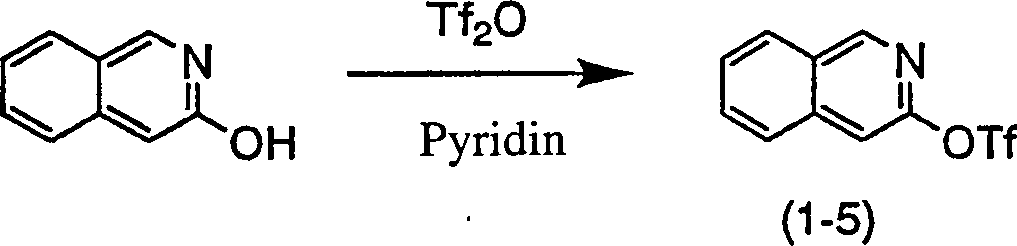
In
einen Reaktionsbehälter wurden 3-Hydroxyisochinolin (5,0
g, 34,4 mmol) und entwässertes Pyridin (15 ml) eingewogen,
und unter einem Stickstoffstrom wurde Trifluormethansulfonsäureanhydrid
unter Kühlen auf 0°C zugetropft. Das Gemisch wurde
bei 0°C 1 Stunde und bei Raumtemperatur 6 Stunden umgesetzt,
dann wurden Wasser (100 ml) und Diethylether (100 ml) zugegeben,
und das Gemisch wurde bei Raumtemperatur 1 Stunde gerührt.
Die organische Schicht wurde mit Wasser (50 ml), 5 gew.-%iger Salzsäure
(50 ml), Wasser (50 ml) und gesättigter Salzlösung
(50 ml) in dieser Reihenfolge gewaschen und über Natriumsulfat
getrocknet. Das Lösungsmittel wurde abdestilliert, und
der Rückstand wurde durch Kieselgelchromatographie gereinigt, wobei
eine Verbindung (1-5) (8,44 g, 30,4 mmol) erhalten wurde. Die Ausbeute
betrug 88%.
LC-MS (positiv) m/z: 278 ([M+H]+)
1H NMR (300 MHz, CDCl3)
δ 7,60
(s, 1H), δ 7,71 (m, 1H), δ 7,82 (m, 1H), δ 7,94
(d, J = 8,3 Hz, 1H), 8,09 (d, J = 8,3 Hz, 1H), 9,09 (s, 1H).Into a reaction vessel were weighed 3-hydroxyisoquinoline (5.0 g, 34.4 mmol) and dehydrated pyridine (15 ml), and under a nitrogen stream, trifluoromethanesulfonic anhydride was added dropwise with cooling to 0 ° C. The mixture was reacted at 0 ° C for 1 hour and at room temperature for 6 hours, then water (100 ml) and diethyl ether (100 ml) were added, and the mixture was stirred at room temperature for 1 hour. The organic layer was washed with water (50 ml), 5% by weight hydrochloric acid (50 ml), water (50 ml) and saturated brine (50 ml) in this order and dried over sodium sulfate. The solvent was distilled off and the residue was purified by silica gel chromatography to give a compound (1-5) (8.44 g, 30.4 mmol). The yield was 88%.
LC-MS (positive) m / z: 278 ([M + H] + )
1 H NMR (300 MHz, CDCl 3 )
δ 7.60 (s, 1H), δ 7.71 (m, 1H), δ 7.82 (m, 1H), δ 7.94 (d, J = 8.3 Hz, 1H), 8.09 (d, J = 8.3 Hz, 1H), 9.09 (s, 1H).

4-Brom-5,6,7,8-tetrahydro-1-naphthol
wurde mit einem in
Verbindung (1-6)Connection (1-6)
- 1H NMR (400 MHz, CDCl3)1H NMR (400 MHz, CDCl3)
- δ 0,21 (s, 6H), δ 1,00 (s, 9H), δ 1,75 (m, 4H), δ 2,66 (m, 4H), δ 6,50 (d, J = 8,6 Hz, 1H), 7,23 (d, J = 8,6 Hz, 1H).δ 0.21 (s, 6H), δ 1.00 (s, 9H), δ 1.75 (m, 4H), δ 2.66 (m, 4H), δ 6.50 (d, J = 8.6 Hz, 1H), 7.23 (d, J = 8.6 Hz, 1H).
In einen Reaktionsbehälter wurden 9-Borabicyclo[3,3,1]nonan (39,2 g, 322 mmol) und 1,4-Dioxan (1075 ml) unter einem Stickstoffstrom eingewogen und 1-Octen (36,1 g, 322 mmol) zugegeben, und das Gemisch wurde bei 80°C 1 Stunde gerührt. Cesiumfluorid (146,7 g, 966 mmol), [1,1'-Bis(diphenylphosphino)ferrocen]dichlorpalladium (II) (7,89 g, 9,66 mmol) und die Verbindung (1-6) (109,8 g, 322 mmol) wurden nacheinander zugegeben, und das Gemisch wurde 3 Stunden bei 80°C gerührt. Das Reaktionsgemisch wurde in Wasser (2,5 l) gegossen und mit Ethylacetat (1 l) dreimal extrahiert. Die organische Schicht wurde mit gesättigter Salzlösung (1 l) gewaschen, dann über Natriumsulfat getrocknet und unter vermindertem Druck konzentriert. Der Rückstand wurde durch Kieselgelchromatographie gereinigt, wobei eine Verbindung (1-7) (49,8 g) erhalten wurde.In a reaction vessel was 9-borabicyclo [3,3,1] nonane (39.2 g, 322 mmol) and 1,4-dioxane (1075 mL) under a stream of nitrogen weighed and 1-octene (36.1 g, 322 mmol) was added, and the mixture was stirred at 80 ° C for 1 hour. cesium fluoride (146.7 g, 966 mmol), [1,1'-bis (diphenylphosphino) ferrocene] dichloropalladium (II) (7.89 g, 9.66 mmol) and the compound (1-6) (109.8 g, 322 mmol) were added successively, and the mixture was allowed to stand for 3 hours stirred at 80 ° C. The reaction mixture was in water (2.5 L) and extracted with ethyl acetate (1 L) three times. The organic layer was saturated with saline (1 L), then dried over sodium sulfate and concentrated under reduced pressure. The residue became purified by silica gel chromatography, whereby a compound (1-7) (49.8 g).
Verbindung (1-7)Connection (1-7)
- 1H NMR (400 MHz, CDCl3) 1 H NMR (400 MHz, CDCl 3 )
- δ 0,22 (s, 6H), δ 0,88 (t, 3H), δ 1,00 (s, 9H), δ 1,28 (m, 10H), δ 1,52 (m, 2H), δ 1,78 (m, 4H), δ 2,48 (m, 2H), δ 2,65 (m, 4H), δ 6,55 (d, 1H), δ 6,82 (d, 1H).δ 0.22 (s, 6H), δ 0.88 (t, 3H), δ 1.00 (s, 9H), δ 1.28 (m, 10H), δ 1.52 (m, 2H), δ 1.78 (m, 4H), δ 2.48 (m, 2H), δ 2.65 (m, 4H), δ 6.55 (d, 1H), δ 6.82 (d, 1H).
In einen Reaktionsbehälter wurden die Verbindung (1-7) (49,8 g, 134 mmol) und N,N-Dimethylformamid/Wasser gemischtes Lösungsmittel (Volumenverhältnis beträgt 10/1, 150 ml) unter einem Stickstoffstrom eingewogen, und Cesiumcarbonat (21,8 g, 67 mmol) wurde zugegeben, und das Gemisch wurde bei 100°C 1,5 Stunden gerührt. Zu der Reaktionslösung wurde Wasser (450 ml) gegeben und mit Methyl-tert-butylether (300 ml) zweimal extrahiert. Die organische Schicht wurde mit gesättigter Salzlösung (200 ml) gewaschen, dann über Natriumsulfat getrocknet und unter vermindertem Druck konzentriert. Der Rückstand wurde durch Kieselgelchromatographie gereinigt, wobei eine Verbindung (1-8) (30,8 g) erhalten wurde.In a reaction vessel, compound (1-7) (49.8 g, 134 mmol) and N, N-dimethylformamide / water mixed solvent (Volume ratio is 10/1, 150 ml) under weighed in a stream of nitrogen, and cesium carbonate (21.8 g, 67 mmol) was added and the mixture became 1.5 at 100 ° C Hours stirred. To the reaction solution was added Water (450 ml) and with methyl tert-butyl ether (300 ml) extracted twice. The organic layer became saturated Brine (200 ml), then over sodium sulfate dried and concentrated under reduced pressure. The residue was purified by silica gel chromatography to give a compound (1-8) (30.8 g).
Verbindung (1-8)Connection (1-8)
- 1H NMR (400 MHz, CDCl3) 1 H NMR (400 MHz, CDCl 3 )
- 0,88 (t, 3H), δ 1,32 (m, 10H), δ 1,51 (m, 2H), δ 1,79 (m, 4H), δ 2,48 (m, 2H), δ 2,66 (m, 4H), δ 4,53 (d, 1H), δ 6,58 (d, 1H), δ 6,86 (d, 1H).0.88 (t, 3H), δ 1.32 (m, 10H), δ 1.51 (m, 2H), δ 1.79 (m, 4H), δ 2.48 (m, 2H), δ 2.66 (m, 4H), δ 4.53 (d, 1H), δ 6.58 (d, 1H), δ 6.86 (d, 1H).
In einen Reaktionsbehälter wurden die Verbindung (1-8) (61,2 g, 235 mmol) und Pyridin (120 ml) unter einem Stickstoffstrom eingewogen, und Trifluormethansulfonsäureanhydrid (73,6 g, 261 mmol) wurde unter Kühlen mit Eis zugetropft. Nach Zutropfen wurde das Gemisch bei Raumtemperatur 23 Stunden gerührt. Die Reaktionslösung wurde in Wasser (300 ml) gegossen und mit Methyl-tert-butylether (150 ml) zweimal extrahiert. Die organische Schicht wurde mit 1 N Salzsäure (100 ml) dreimal und mit gesättigter Salzlösung (200 ml) einmal gewaschen, dann über Natriumsulfat getrocknet und unter vermindertem Druck konzentriert. Der Rückstand wurde durch Kieselgelchromatographie gereinigt, wobei eine Verbindung (1-9) (80,7 g) erhalten wurde.In a reaction vessel, compound (1-8) (61.2 g, 235 mmol) and pyridine (120 ml) were weighed under a stream of nitrogen, and trifluoromethanesulfonic anhydride (73.6 g, 261 mmol) was added dropwise with ice cooling. After dropping was the mixture was stirred at room temperature for 23 hours. The reaction solution was poured into water (300 ml) and treated with methyl tert-butyl ether Extracted twice (150 ml). The organic layer was washed with 1 N hydrochloric acid (100 ml) three times and with saturated Brine (200 ml) washed once, then over Dried sodium sulfate and concentrated under reduced pressure. The residue was purified by silica gel chromatography, whereby a compound (1-9) (80.7 g) was obtained.
Verbindung (1-9)Connection (1-9)
- 1H NMR (400 MHz, CDCl3) 1 H NMR (400 MHz, CDCl 3 )
- δ 0,89 (t, 3H), δ 1,32 (m, 10H), δ 1,52 (m, 2H), δ 1,80 (m, 4H), δ 2,52 (m, 2H), δ 2,70 (m, 2H), δ 2,79 (m, 2H), δ 7,01 (m, 2H).δ 0.89 (t, 3H), δ 1.32 (m, 10H), δ 1.52 (m, 2H), δ 1.80 (m, 4H), δ 2.52 (m, 2H), δ 2.70 (m, 2H), δ 2.79 (m, 2H), δ 7.01 (m, 2H).
In einen Reaktionsbehälter wurden Kaliumacetat (61,5 g, 626 mmol), Bis(pinacolat)dibor (58,3 g, 230 mmol), 1,1'-Bis(diphenylphosphino)ferrocen (3,47 g, 6,26 mmol), [1,1'-Bis(diphenylphosphino)ferrocen]dichlorpalladium (II) (5,1 g, 6,26 mmol), Verbindung (1-9) (78,2 g, 209 mmol) und 1,4-Dioxan (1260 ml) unter einem Stickstoffstrom eingewogen, und das Gemisch wurde bei 80°C 24 Stunden gerührt. Die Reaktionslösung wurde mit Toluol (2 l) verdünnt und mit gesättigter Salzlösung (1 l) zweimal gewaschen, dann über Natriumsulfat getrocknet und unter vermindertem Druck konzentriert. Der Rückstand wurde durch Kieselgelchromatographie gereinigt, wobei eine Verbindung (1-10) (37,6 g) erhalten wurde.In A reaction vessel was potassium acetate (61.5 g, 626 mmol), bis (pinacolate) dibor (58.3 g, 230 mmol), 1,1'-bis (diphenylphosphino) ferrocene (3.47 g, 6.26 mmol), [1,1'-bis (diphenylphosphino) ferrocene] dichloropalladium (II) (5.1 g, 6.26 mmol), Compound (1-9) (78.2 g, 209 mmol) and Weighed 1,4-dioxane (1260 ml) under a stream of nitrogen, and the mixture was stirred at 80 ° C for 24 hours. The reaction solution was diluted with toluene (2 L) and washed twice with saturated saline (1 L), then dried over sodium sulfate and concentrated under reduced pressure Concentrated pressure. The residue was purified by silica gel chromatography, whereby a compound (1-10) (37.6 g) was obtained.
Verbindung (1-10)Connection (1-10)
- 1H NMR (400 MHz, CDCl3) 1 H NMR (400 MHz, CDCl 3 )
- δ 0,88 (t, 3H), δ 1,28 (m, 10H), δ 1'32 (s, 12H), δ 1,54 (m, 2H), δ 1,77 (m, 4H), δ 2,54 (m, 2H), δ 2,69 (m, 2H), δ 3,05 (m, 2H), δ 6,97 (d, 1H), δ 7,56 (d, 1H).δ 0.88 (t, 3H), δ 1.28 (m, 10H), δ 1 '32 (s, 12H), δ 1.54 (m, 2H), δ 1.77 (m, 4H), δ 2.54 (m, 2H), δ 2.69 (m, 2H), δ 3.05 (m, 2H), δ 6.97 (d, 1H), δ 7.56 (d, 1H).

In einen Reaktionsbehälter wurden die Verbindung (1-5) (2,77 g, 10 mmol), Verbindung (1-10) (3,94 g, 10 mmol), Natriumcarbonat (4,24 g, 40 mmol), N,N-Dimethylformamid (100 ml), Ethanol (10 ml) und Tetrakis(triphenylphosphin)palladium(0) (0,58 g, 0,5 mmol) unter einem Stickstoffstrom gegeben, und das Gemisch wurde bei 115°C 8 Stunden gerührt. Zu der Reaktionslösung wurden Wasser (400 ml) und Ethylacetat/Hexan gemischtes Lösungsmittel (Volumenverhältnis ist 1/1, 400 ml) gegeben und extrahiert. Die organische Schicht wurde mit Wasser (400 ml), 5 gew.-%iger wässriger Natriumcarbonatlösung (300 ml) und gesättigter Salzlösung (100 ml) gewaschen, dann über Natriumsulfat getrocknet und unter vermindertem Druck konzentriert. Der Rückstand wurde durch Kieselgelchromatographie gereinigt, wobei eine Verbindung (1-11) (1,42 g) erhalten wurde.In a reaction vessel was compound (1-5) (2.77 g, 10 mmol), Compound (1-10) (3.94 g, 10 mmol), sodium carbonate (4.24 g, 40 mmol), N, N-dimethylformamide (100 mL), ethanol (10 mL) and tetrakis (triphenylphosphine) palladium (0) (0.58 g, 0.5 mmol) a nitrogen stream and the mixture was at 115 ° C Stirred for 8 hours. To the reaction solution were Water (400 ml) and ethyl acetate / hexane mixed solvent (Volume ratio is 1/1, 400 ml) and extracted. The organic layer was washed with water (400 ml), 5% by weight aqueous Sodium carbonate solution (300 ml) and saturated Brine (100 ml), then over sodium sulfate dried and concentrated under reduced pressure. The residue was purified by silica gel chromatography to give a compound (1-11) (1.42 g).
Verbindung (1-11)Connection (1-11)
- LC-MS (positiv) m/z: 372 ([M+H]+)LC-MS (positive) m / z: 372 ([M + H] + )
- 1H NMR (300 MHz, CDCl3) 1 H NMR (300 MHz, CDCl 3 )
- δ 0,89 (t, 3H), δ 1,30 (br, 10H), δ 1,61 (m, 2H), δ 1,71 (m, 2H), δ 1,85 (m, 2H), δ 2,62 (m, 2H), δ 2,79 (m, 4H), δ 7,10 (d, 1H), δ 7,20 (d, 1H), δ 7,60 (m, 1H), δ 7,70 (m, 2H), δ 7,83 (d, 1H), δ 8,00 (d, 1H), δ 9,31 (s, 1H).δ 0.89 (t, 3H), δ 1.30 (br, 10H), δ 1.61 (m, 2H), δ 1.71 (m, 2H), δ 1.85 (m, 2H), δ 2.62 (m, 2H), δ 2.79 (m, 4H), δ 7.10 (d, 1H), δ 7.20 (d, 1H), δ 7.60 (m, 1H), δ 7.70 (m, 2H), δ 7.83 (d, 1H), δ 8.00 (d, 1H), δ 9.31 (s, 1H).

In einen Reaktionsbehälter wurden die Verbindung (1-11) (592 mg, 1,5 mmol), Iridiumchlorid-Trihydrat (241 mg, 0,68 mmol), 2-Ethoxyethanol (3 ml) und Wasser (1 ml) eingewogen, und unter einem Stickstoffstrom wurde das Gemisch 16 Stunden auf 140°C erwärmt. Nach Luftkühlen wurde das erhaltene Reaktionsprodukt durch Filtration abgetrennt und mit Wasser, Methanol und Hexan in dieser Reihenfolge gewaschen, wobei das Ir-Dimer (B) (475 mg, 0,25 mmol) in Form eines orangen Feststoffs erhalten wurde.In a reaction vessel was compound (1-11) (592 mg, 1.5 mmol), iridium chloride trihydrate (241 mg, 0.68 mmol), 2-ethoxyethanol Weighed (3 ml) and water (1 ml), and under a stream of nitrogen the mixture heated at 140 ° C for 16 hours. To Air cooling, the obtained reaction product by filtration separated and with water, methanol and hexane in this order washed with the Ir dimer (B) (475 mg, 0.25 mmol) in the form of a orange solid.
In einen Reaktionsbehälter wurden das Ir-Dimer (B) (388 mg, 0,20 mmol), Acetylaceton (100 mg, 1,0 mmol), Natriumcarbonat (212 mg, 2,0 mmol) und 2-Ethoxyethanol (6 ml) eingewogen, und unter einem Stickstoffstrom wurde das Gemisch 10 Stunden bei 100°C gerührt. Das Lösungsmittel wurde abdestilliert, der Rückstand wurde durch Kieselgelsäulenchromatographie gereinigt, und der ölige Rückstand wurde mit Hexan und Methanol gewaschen, wobei ein Metallkomplex (MC6) (133 mg, 0,13 mmol, Ausbeute: 32%) erhalten wurde.In a reaction vessel, the Ir dimer (B) (388 mg, 0.20 mmol), acetylacetone (100 mg, 1.0 mmol), sodium carbonate (212 20 mg, 2.0 mmol) and 2-ethoxyethanol (6 ml) were weighed out, and under a Nitrogen flow, the mixture was at 100 ° C for 10 hours touched. The solvent was distilled off, the residue was purified by silica gel column chromatography and the oily residue was washed with hexane and methanol, whereby a metal complex (MC6) (133 mg, 0.13 mmol, yield: 32%).

Metallkomplex (MC6)Metal complex (MC6)
- LC-MS (positiv) m/z: 1033 ([M+H]+)LC-MS (positive) m / z: 1033 ([M + H] + )
- 1H NMR (300 MHz, CDCl3) 1 H NMR (300 MHz, CDCl 3 )
- δ 0,85-1,27 (m, 30H), δ 1,73 (m, 4H), δ 1,79 (s, 6H), δ 1,84 (m, 4H), δ 2,10 (m, 4H), δ 2,51 (m, 4H), δ 3,29 (m, 4H), δ 5,18 (s, 1H), δ 5,74 (s, 2H), δ 7,51 (dd, 2H), δ 7,66 (dd, 2H), δ 7,84 (d, 2H), δ 7,92 (d, 2H), δ 8,38 (s, 2H), δ 9,35 (s, 2H).δ 0.85-1.27 (m, 30H), δ 1.73 (m, 4H), δ 1.79 (s, 6H), δ 1.84 (m, 4H), δ 2.10 (m, 4H), δ 2.51 (m, 4H), δ 3.29 (m, 4H), δ 5.18 (s, 1H), δ 5.74 (s, 2H), δ 7.51 (dd, 2H), δ 7.66 (dd, 2H), δ 7.84 (d, 2H), δ 7.92 (d, 2H), δ 8.38 (s, 2H), δ 9.35 (s, 2H).
– Messung der Quantenausbeute der Photolumineszenz –- Measurement of the quantum yield the photoluminescence
Die Photolumineszenz wurde auf die gleiche Weise wie in Beispiel 4 gemessen, außer dass der vorstehend beschriebene Metallkomplex (MC6) statt des Metallkomplexes (MC5) in Beispiel 4 verwendet wurde, wobei eine Lichtemission mit Peaks bei 575 nm, 615 nm beobachtet wurde, und die Quantenausbeute der Photolumineszenz betrug 46%.The Photoluminescence was measured in the same manner as in Example 4 except that the metal complex (MC6) described above instead of the metal complex (MC5) was used in Example 4, wherein a light emission with peaks at 575 nm, 615 nm was observed and the quantum efficiency of photoluminescence was 46%.
– Herstellung der EL Vorrichtung und Beurteilung der Eigenschaften –- manufacture of the EL device and assessment of properties -
Eine 0,8 gew.-%ige Chloroformlösung wurde aus einem Gemisch hergestellt, erhalten durch Mischen von in Beispiel 4 beschriebenem CBP und dem Metallkomplex (MC6) in einem Gewichtsverhältnis von 97,5:2,5.A 0.8% by weight chloroform solution was taken from a mixture prepared by mixing described in Example 4 CBP and the metal complex (MC6) in a weight ratio from 97.5: 2.5.
Als Nächstes wurde auf ein Glassubstrat, das einen ITO-Film mit einer Dicke von 150 nm mit einem Sputterverfahren darauf gebildet aufweist, eine Lösung von Poly(ethylendioxythiophen)/Polystyrolsulfonsäure (Bayer Corp., Handelsname: Baytron P) schleuderbeschichtet, wobei ein Film mit einer Dicke von 50 nm gebildet wurde, und bei 200°C 10 Minuten auf einer Heizplatte getrocknet. Dann wurde die wie vorstehend hergestellte Chloroformlösung bei einer Umdrehung von 3500 Upm schleuderbeschichtet, wobei ein Film gebildet wurde. Weiter wurde dieser bei 130°C 1 Stunde unter einer Stickstoffgasatmosphäre getrocknet, dann wurde als eine Kathode Barium mit einer Dicke von etwa 5 nm aufgedampft, dann Aluminium mit einer Dicke von etwa 80 nm aufgedampft, um eine EL Vorrichtung herzustellen. Hier wurde, nachdem der Grad des Vakuums 1 × 10⁻⁴ Pa oder weniger erreicht hatte, ein Aufdampfen eines Metalls begonnen.Next, a solution of poly (ethylenedioxythiophene) / polystyrenesulfonic acid (Bayer Corp., trade name: Baytron P) was spin-coated on a glass substrate having an ITO film with a thickness of 150 nm by sputtering thereon, using a film having a thickness of 50 nm, and dried at 200 ° C for 10 minutes on a hot plate. Then, the chloroform solution prepared above was spin-coated at a revolution of 3500 rpm to form a film. Further, it was dried at 130 ° C for 1 hour under a nitrogen gas atmosphere, then, as a cathode, barium was vapor-deposited to a thickness of about 5 nm, then aluminum was vapor-deposited to a thickness of about 80 nm to prepare an EL device. Here, after the degree of vacuum reached 1 × 10 -4 Pa or less, vapor deposition of a metal was started.
Durch Anlegen von Spannung an die erhaltene EL Vorrichtung wurde eine EL Lichtemission mit einem Maximalpeak bei 605 nm beobachtet. Diese EL Vorrichtung zeigte eine Emissionsleuchtdichte von etwa 100 cd/m2 bei etwa 18 V und der maximale Wirkungsgrad der Lichtemission davon betrug 6 cd/A.By applying voltage to the obtained EL device, an EL light emission having a maximum peak at 605 nm was observed. This EL device had an emission luminance of about 100 cd / m 2 at about 18 V, and the maximum light emission efficiency thereof was 6 cd / A.
<Beispiel 6> 
– Berechnung des Parameters –- Calculation of the parameter -
Gemäß dem gleichen Verfahren wie in Beispiel 1 wurden der diedrische Winkel (°) in einem Liganden des vorstehend beschriebenen Metallkomplexes (MC7) und der d-Orbitalparameter F (%/eV) davon berechnet. Als Ergebnis betrug der diedrische Winkel in einem Liganden 12 (°) und der d-Orbitalparameter F betrug 228,77 (%/eV).According to the the same procedures as in Example 1 were the dihedral angle (°) in a ligand of the metal complex described above (MC7) and the d orbital parameter F (% / eV) thereof. As a result the dihedral angle in a ligand was 12 (°) and the d-orbital parameter F was 228.77 (% / eV).
GEWERBLICHE ANWENDBARKEITINDUSTRIAL APPLICABILITY
Der erfindungsgemäße Metallkomplex weist extrem ausgezeichneten Wirkungsgrad der Lichtemission und Stabilität bei Anwenden, insbesondere in einem lichtemittierenden Material, das in einer lichtemittierenden Schicht einer Elektrolumineszenzvorrichtung zu verwenden ist, auf. Dieser Metallkomplex ist üblicherweise leuchtend. Diese ausgezeichneten Eigenschaften werden nicht nur im Emissionsbereich von rotem Licht und Emissionsbereich von blauem Licht, sondern auch im Emissionsbereich von grünem Licht erhalten. Daher ist dieser Metallkomplex insbesondere zur Herstellung von lichtemittierenden Vorrichtungen, wie einer Elektrolumineszenzvorrichtung und dgl., und Vorrichtungen, wie einer photoelektrischen Vorrichtung und dgl., geeignet.Of the The metal complex according to the invention has extremely excellent properties Efficiency of light emission and stability when applied, in particular in a light-emitting material which is in a light emitting layer of an electroluminescent device use is on. This metal complex is usually bright. These excellent properties are not just in the emission area of red light and emission range of blue light, but also obtained in the emission range of green light. Therefore this is Metal complex, in particular for the production of light-emitting Devices such as an electroluminescent device and the like and devices such as a photoelectric device and the like, suitable.
ZusammenfassungSummary
Ein
Metallkomplex mit einer Struktur der folgenden allgemeinen Formel
(1): 


ZITATE ENTHALTEN IN DER BESCHREIBUNGQUOTES INCLUDE IN THE DESCRIPTION
Diese Liste der vom Anmelder aufgeführten Dokumente wurde automatisiert erzeugt und ist ausschließlich zur besseren Information des Lesers aufgenommen. Die Liste ist nicht Bestandteil der deutschen Patent- bzw. Gebrauchsmusteranmeldung. Das DPMA übernimmt keinerlei Haftung für etwaige Fehler oder Auslassungen.This list The documents listed by the applicant have been automated generated and is solely for better information recorded by the reader. The list is not part of the German Patent or utility model application. The DPMA takes over no liability for any errors or omissions.
Zitierte PatentliteraturCited patent literature
- - JP 2004-244400 A [0144] - JP 2004-244400 A [0144]
- - JP 2004-277377 A [0144] - JP 2004-277377 A [0144]
- - JP 2003-231741 A [0146] JP 2003-231741 A [0146]
- - JP 2004-059899 A [0146] - JP 2004-059899 A [0146]
- - JP 2004-002654 A [0146] - JP 2004-002654 A [0146]
- - JP 2004-292546 A [0146] JP 2004-292546 A [0146]
- - US 5708130 [0146] US 5708130 [0146]
- - WO 9954385 [0146] WO 9954385 [0146]
- - WO 0046321 [0146] WO 0046321 [0146]
- - WO 02077060 [0146] WO 02077060 [0146]
- - JP 63-70257 A [0183, 0195] JP 63-70257 A [0183, 0195]
- - JP 63-175860 [0183, 0195] JP 63-175860 [0183, 0195]
- - JP 2-135359 [0183, 0195] - JP 2-135359 [0183, 0195]
- - JP 2-135361 [0183, 0195] - JP 2-135361 [0183, 0195]
- - JP 2-209988 [0183, 0195] - JP 2-209988 [0183, 0195]
- - JP 3-37992 [0183, 0195] - JP 3-37992 [0183, 0195]
- - JP 3-152187 [0183] - JP 3-152187 [0183]
- - GB 2300196 [0188] GB 2300196 [0188]
- - JP 3-152184 [0195] - JP 3-152184 [0195]
- - JP 3146296 [0228] - JP 3146296 [0228]
- - JP 2005-506439 [0263] - JP 2005-506439 [0263]
Zitierte Nicht-PatentliteraturCited non-patent literature
- - APPLIED PHYSICS LETTERS, Band 75, Nr. 1, S. 4 (1999) [0003] - APPLIED PHYSICS LETTERS, Vol. 75, No. 1, p. 4 (1999) [0003]
- - „Organic Reactions", Band 14, S. 270-490, John Wiley & Sons, Inc., 1965 [0106] "Organic Reactions", Vol. 14, pp. 270-490, John Wiley & Sons, Inc., 1965 [0106]
- - „Organic Syntheses", Collective Volume VI, S. 407-411, John Wiley & Sons, Inc., 1988 [0106] "Organic Syntheses", Collective Volume VI, pp. 407-411, John Wiley & Sons, Inc., 1988 [0106]
- - Chem. Rev., Band 95, S. 2457 (1995) [0106] Chem. Rev., Vol. 95, p. 2457 (1995) [0106]
- - J. Organomet. Chem., Band 576, S. 147 (1999) [0106] - J. Organomet. Chem., Vol. 576, p. 147 (1999) [0106]
- - J. Prakt. Chem., Band 336, S. 247 (1994) [0106] - J. Prakt. Chem., Vol. 336, p. 247 (1994) [0106]
- - Makromol. Chem., Macromol. Symp., Band 12, S. 229 (1987) [0106] - Macromol. Chem., Macromol. Symp., Vol. 12, p. 229 (1987) [0106]
- - Inorg. Chem. 1991, 30, 1685 [0111] - Inorg. Chem. 1991, 30, 1685 [0111]
- - Inorg. Chem. 2001, 40, 1704 [0111] - Inorg. Chem. 2001, 40, 1704 [0111]
- - Chem. Lett., 2003, 32, 252 [0111] - Chem. Lett., 2003, 32, 252 [0111]
- - Inorg. Chem., 1984, 23, 4249 [0111] - Inorg. Chem., 1984, 23, 4249 [0111]
- - Chem. Mater. 1999, 11, 3709 [0111] - Chem. Mater. 1999, 11, 3709 [0111]
- - Organometallics, 1999, 18, 1801 [0111] Organometallics, 1999, 18, 1801 [0111]
- - J. Org. Chem., 1987, 52, 73 [0111] J. Org. Chem., 1987, 52, 73 [0111]
- - „Organic EL Display" (Shizuo Tokito, Chihaya Adachi, Hideyuki Murata joint work, Ohmsha, Ltd.), S. 107, Monthly Display, Band 9, Nr. 9, 2003, S. 26-30 [0144] "Organic EL Display" (Shizuo Tokito, Chihaya Adachi, Hideyuki Murata joint work, Ohmsha, Ltd.), p. 107, Monthly Display, Vol. 9, No. 9, 2003, pp. 26-30 [0144]
- - „Organic EL Display" (Shizuo Tokito, Chihaya Adachi, Hideyuki Murata joint work, Ohmsha, Ltd.) S. 111, Monthly Display, Band 9, Nr. 9, 2002, S. 47-51 [0146] "Organic EL Display" (Shizuo Tokito, Chihaya Adachi, Hideyuki Murata joint work, Ohmsha, Ltd.) p. 111, Monthly Display, Vol. 9, No. 9, 2002, pp. 47-51 [0146]
- - „Yuki EL no hanashi" (hrsg. von Katsumi Yoshino, Nikkan Kogyo Shimbun Ltd.) S. 23 [0147] - "Yuki EL no hanashi" (Edited by Katsumi Yoshino, Nikkan Kogyo Shimbun Ltd.) p. 23 [0147]
- - Chem. Rev. Band 89, S. 1359 (1989) [0188] Chem. Rev. Vol. 89, p. 1359 (1989) [0188]
- - J. Org. Chem. 1989, 54, 850-857 [0233] - J. Org. Chem. 1989, 54, 850-857 [0233]
- - J. Am. Chem. Soc., 2003, 125, 12971-12979 [0251] - J. Am. Chem. Soc., 2003, 125, 12971-12979 [0251]
- - Can. J. Chem., 1989, 69, 2061 [0267] - Can. J. Chem., 1989, 69, 2061 [0267]
Claims (24)


Applications Claiming Priority (5)
| Application Number | Priority Date | Filing Date | Title |
|---|---|---|---|
| JP2006-044990 | 2006-02-22 | ||
| JP2006044990 | 2006-02-22 | ||
| JP2006-336653 | 2006-12-14 | ||
| JP2006336653 | 2006-12-14 | ||
| PCT/JP2007/053697 WO2007102350A1 (en) | 2006-02-22 | 2007-02-21 | Metal complex, polymeric compound, and element comprising these |
Publications (1)
| Publication Number | Publication Date |
|---|---|
| DE112007000426T5 true DE112007000426T5 (en) | 2009-01-02 |
Family
ID=38474788
Family Applications (1)
| Application Number | Title | Priority Date | Filing Date |
|---|---|---|---|
| DE112007000426T Withdrawn DE112007000426T5 (en) | 2006-02-22 | 2007-02-21 | Metal complex, polymer compound and device containing it |
Country Status (6)
| Country | Link |
|---|---|
| US (1) | US20090043064A1 (en) |
| JP (1) | JP2008169192A (en) |
| KR (1) | KR20080114749A (en) |
| DE (1) | DE112007000426T5 (en) |
| GB (3) | GB2478452B (en) |
| WO (1) | WO2007102350A1 (en) |
Families Citing this family (14)
| Publication number | Priority date | Publication date | Assignee | Title |
|---|---|---|---|---|
| JP3812730B2 (en) * | 2001-02-01 | 2006-08-23 | 富士写真フイルム株式会社 | Transition metal complex and light emitting device |
| KR100933229B1 (en) * | 2007-11-12 | 2009-12-22 | 다우어드밴스드디스플레이머티리얼 유한회사 | Novel red phosphorescent compound and organic light emitting device employing it as light emitting material |
| KR100933226B1 (en) * | 2007-11-20 | 2009-12-22 | 다우어드밴스드디스플레이머티리얼 유한회사 | Novel red phosphorescent compound and organic light emitting device employing it as light emitting material |
| KR100933225B1 (en) * | 2007-11-27 | 2009-12-22 | 다우어드밴스드디스플레이머티리얼 유한회사 | Novel Phosphorescent Compound and Organic Light Emitting Device Employing It as Light Emitting Material |
| JP5688930B2 (en) * | 2009-08-27 | 2015-03-25 | 住友化学株式会社 | Metal complex composition and complex polymer |
| JP5501864B2 (en) | 2010-03-10 | 2014-05-28 | 住友化学株式会社 | Thin film and compound used therefor |
| US20110240928A1 (en) * | 2010-03-31 | 2011-10-06 | MALAXIT Co. | Composites with high photoquenching factor of electroconduction based on polymer-metalorganic compounds |
| JP2014012672A (en) * | 2013-07-24 | 2014-01-23 | Mitsubishi Chemicals Corp | Organic metal complex composition, organic metal complex-containing composition, organic electroluminescent element, organic el display and organic el lighting |
| JP2015093938A (en) * | 2013-11-12 | 2015-05-18 | 三菱化学株式会社 | Composition for organic electroluminescent element, organic electroluminescent element, display device, and illumination device |
| KR102219155B1 (en) * | 2016-03-24 | 2021-02-23 | 후지필름 가부시키가이샤 | Active light sensitive or radiation sensitive composition, method for producing active light sensitive or radiation sensitive composition, pattern forming method, and electronic device producing method |
| US11469382B2 (en) * | 2017-07-12 | 2022-10-11 | Universal Display Corporation | Organic electroluminescent materials and devices |
| JP2018166102A (en) * | 2018-05-25 | 2018-10-25 | 三菱ケミカル株式会社 | Organic electroluminescent element composition, organic electroluminescent element, display device, and luminaire |
| JP6984674B2 (en) * | 2018-05-25 | 2021-12-22 | 三菱ケミカル株式会社 | Compositions for organic electroluminescent devices, organic electroluminescent devices, display devices and lighting devices |
| CN116496322A (en) * | 2022-01-27 | 2023-07-28 | 浙江光昊光电科技有限公司 | An organometallic complex containing free radical units, mixtures and compositions comprising the same, and applications thereof in electronic devices |
Citations (21)
| Publication number | Priority date | Publication date | Assignee | Title |
|---|---|---|---|---|
| JPS6370257A (en) | 1986-09-12 | 1988-03-30 | Fuji Xerox Co Ltd | Electric charge transfer material for electrophotography |
| JPS63175860A (en) | 1987-01-16 | 1988-07-20 | Fuji Xerox Co Ltd | Electrophotographic sensitive body |
| JPH02135361A (en) | 1988-11-16 | 1990-05-24 | Fuji Xerox Co Ltd | Electrophotographic sensitive body |
| JPH02135359A (en) | 1988-11-16 | 1990-05-24 | Fuji Xerox Co Ltd | Electrophotographic sensitive body |
| JPH02209988A (en) | 1989-02-10 | 1990-08-21 | Idemitsu Kosan Co Ltd | Thin-film electroluminescence element |
| JPH0337992A (en) | 1989-07-04 | 1991-02-19 | Idemitsu Kosan Co Ltd | Manufacture of organic electroluminescence element |
| JPH03146296A (en) | 1989-10-31 | 1991-06-21 | Nippon Steel Corp | Welding wire for high tensile steel |
| JPH03152187A (en) | 1989-11-09 | 1991-06-28 | Dainippon Ink & Chem Inc | Ferroelectric liquid crystal composition |
| JPH03152184A (en) | 1989-11-08 | 1991-06-28 | Nec Corp | El element of organic thin film |
| GB2300196A (en) | 1995-04-10 | 1996-10-30 | Sumitomo Chemical Co | Polysilanes |
| US5708130A (en) | 1995-07-28 | 1998-01-13 | The Dow Chemical Company | 2,7-aryl-9-substituted fluorenes and 9-substituted fluorene oligomers and polymers |
| WO1999054385A1 (en) | 1998-04-21 | 1999-10-28 | The Dow Chemical Company | Fluorene-containing polymers and electroluminescent devices therefrom |
| WO2000046321A1 (en) | 1999-02-04 | 2000-08-10 | The Dow Chemical Company | Fluorene copolymers and devices made therefrom |
| WO2002077060A1 (en) | 2001-03-24 | 2002-10-03 | Covion Organic Semiconductors Gmbh | Conjugated polymers containing spirobifluorene units and fluorene units, and the use thereof |
| JP2003231741A (en) | 2001-12-07 | 2003-08-19 | Sumitomo Chem Co Ltd | New polymer and polymer light emitting device using the same |
| JP2004002654A (en) | 2001-12-19 | 2004-01-08 | Sumitomo Chem Co Ltd | Copolymer, polymer composition and polymer light emitting device |
| JP2004059899A (en) | 2002-06-05 | 2004-02-26 | Sumitomo Chem Co Ltd | Polymer compound and polymer light emitting device using the same |
| JP2004244400A (en) | 2002-12-19 | 2004-09-02 | Chemiprokasei Kaisha Ltd | 4,4 "-di- (aryl) -3 ', 4', 5 ', 6'-tetraphenyl-p-terphenyl derivative, method for producing the same, host material comprising the same, and electroluminescent device using the same |
| JP2004277377A (en) | 2003-03-18 | 2004-10-07 | Junji Kido | Fluorene compound and organic electroluminescent device using the same |
| JP2004292546A (en) | 2003-03-26 | 2004-10-21 | Sumitomo Chem Co Ltd | Complex composition, polymer complex compound, and polymer light emitting device |
| JP2005506439A (en) | 2001-10-25 | 2005-03-03 | ケンブリッジ ディスプレイ テクノロジー リミテッド | Improvement of the Suzuki method for the polymerization of aromatic monomers. |
Family Cites Families (22)
| Publication number | Priority date | Publication date | Assignee | Title |
|---|---|---|---|---|
| JP3929690B2 (en) * | 1999-12-27 | 2007-06-13 | 富士フイルム株式会社 | Light emitting device material, light emitting device and novel iridium complex comprising orthometalated iridium complex |
| JP3929689B2 (en) * | 2000-03-28 | 2007-06-13 | 富士フイルム株式会社 | Highly efficient red light emitting device, light emitting device material comprising iridium complex and novel iridium complex |
| JP4154138B2 (en) * | 2000-09-26 | 2008-09-24 | キヤノン株式会社 | Light emitting element, display device and metal coordination compound |
| JP4307000B2 (en) * | 2001-03-08 | 2009-08-05 | キヤノン株式会社 | Metal coordination compound, electroluminescent element and display device |
| JP2002359079A (en) * | 2001-05-31 | 2002-12-13 | Canon Inc | Light emitting element and display device |
| JP2003007469A (en) * | 2001-06-25 | 2003-01-10 | Canon Inc | Light emitting element and display device |
| US6835469B2 (en) * | 2001-10-17 | 2004-12-28 | The University Of Southern California | Phosphorescent compounds and devices comprising the same |
| TWI277617B (en) * | 2002-03-26 | 2007-04-01 | Sumitomo Chemical Co | Metal complexes and organic electro luminescence elements |
| US7157154B2 (en) * | 2002-06-26 | 2007-01-02 | Sumitomo Chemical Company, Limited | Polymer and polymeric luminescent element comprising the same |
| JP4211433B2 (en) * | 2002-08-14 | 2009-01-21 | 三菱化学株式会社 | Organometallic complex, luminescent dye, organic electroluminescent device material, and organic electroluminescent device |
| TWI280973B (en) * | 2002-08-28 | 2007-05-11 | Sumitomo Chemical Co | Polymer compound and polymer light-emitting device using the same |
| KR20060027323A (en) * | 2003-06-09 | 2006-03-27 | 히다치 가세고교 가부시끼가이샤 | Metal coordination compounds, polymer compositions, and organic electroluminescent devices using them |
| US7955716B2 (en) * | 2003-06-09 | 2011-06-07 | Hitachi Chemical Co., Ltd. | Metal coordination compound, polymer composition, and organic electroluminescent device employing same |
| WO2005003095A1 (en) * | 2003-07-02 | 2005-01-13 | Idemitsu Kosan Co., Ltd. | Metal complex compound and organic electroluminescence device containing the same |
| JP4830272B2 (en) * | 2004-06-30 | 2011-12-07 | 住友化学株式会社 | Organic electroluminescence device |
| US20060008671A1 (en) * | 2004-07-07 | 2006-01-12 | Raymond Kwong | Electroluminescent efficiency |
| JP5009154B2 (en) * | 2004-07-07 | 2012-08-22 | ユニバーサル ディスプレイ コーポレイション | Stable and efficient electroluminescent material |
| US7985492B2 (en) * | 2004-08-07 | 2011-07-26 | Merck Patent Gmbh | Electroluminescent materials and devices |
| GB0419269D0 (en) * | 2004-08-31 | 2004-09-29 | Elam T Ltd | Electroluminescent materials and devices |
| WO2007029461A1 (en) * | 2005-09-02 | 2007-03-15 | Konica Minolta Holdings, Inc. | Organic electroluminescent device, method for manufacturing same, display comprising such organic electroluminescent device, and illuminating device |
| JP5661982B2 (en) * | 2005-09-14 | 2015-01-28 | 住友化学株式会社 | Polymer compound, light emitting material, and light emitting device |
| JP5262104B2 (en) * | 2006-12-27 | 2013-08-14 | 住友化学株式会社 | Metal complexes, polymer compounds, and devices containing them |
-
2007
- 2007-02-21 WO PCT/JP2007/053697 patent/WO2007102350A1/en not_active Ceased
- 2007-02-21 GB GB1108210A patent/GB2478452B/en not_active Expired - Fee Related
- 2007-02-21 JP JP2007040494A patent/JP2008169192A/en active Pending
- 2007-02-21 GB GB1108208A patent/GB2478450B/en not_active Expired - Fee Related
- 2007-02-21 GB GB0815325A patent/GB2449796B/en not_active Expired - Fee Related
- 2007-02-21 US US12/279,739 patent/US20090043064A1/en not_active Abandoned
- 2007-02-21 KR KR1020087022960A patent/KR20080114749A/en not_active Ceased
- 2007-02-21 DE DE112007000426T patent/DE112007000426T5/en not_active Withdrawn
Patent Citations (21)
| Publication number | Priority date | Publication date | Assignee | Title |
|---|---|---|---|---|
| JPS6370257A (en) | 1986-09-12 | 1988-03-30 | Fuji Xerox Co Ltd | Electric charge transfer material for electrophotography |
| JPS63175860A (en) | 1987-01-16 | 1988-07-20 | Fuji Xerox Co Ltd | Electrophotographic sensitive body |
| JPH02135361A (en) | 1988-11-16 | 1990-05-24 | Fuji Xerox Co Ltd | Electrophotographic sensitive body |
| JPH02135359A (en) | 1988-11-16 | 1990-05-24 | Fuji Xerox Co Ltd | Electrophotographic sensitive body |
| JPH02209988A (en) | 1989-02-10 | 1990-08-21 | Idemitsu Kosan Co Ltd | Thin-film electroluminescence element |
| JPH0337992A (en) | 1989-07-04 | 1991-02-19 | Idemitsu Kosan Co Ltd | Manufacture of organic electroluminescence element |
| JPH03146296A (en) | 1989-10-31 | 1991-06-21 | Nippon Steel Corp | Welding wire for high tensile steel |
| JPH03152184A (en) | 1989-11-08 | 1991-06-28 | Nec Corp | El element of organic thin film |
| JPH03152187A (en) | 1989-11-09 | 1991-06-28 | Dainippon Ink & Chem Inc | Ferroelectric liquid crystal composition |
| GB2300196A (en) | 1995-04-10 | 1996-10-30 | Sumitomo Chemical Co | Polysilanes |
| US5708130A (en) | 1995-07-28 | 1998-01-13 | The Dow Chemical Company | 2,7-aryl-9-substituted fluorenes and 9-substituted fluorene oligomers and polymers |
| WO1999054385A1 (en) | 1998-04-21 | 1999-10-28 | The Dow Chemical Company | Fluorene-containing polymers and electroluminescent devices therefrom |
| WO2000046321A1 (en) | 1999-02-04 | 2000-08-10 | The Dow Chemical Company | Fluorene copolymers and devices made therefrom |
| WO2002077060A1 (en) | 2001-03-24 | 2002-10-03 | Covion Organic Semiconductors Gmbh | Conjugated polymers containing spirobifluorene units and fluorene units, and the use thereof |
| JP2005506439A (en) | 2001-10-25 | 2005-03-03 | ケンブリッジ ディスプレイ テクノロジー リミテッド | Improvement of the Suzuki method for the polymerization of aromatic monomers. |
| JP2003231741A (en) | 2001-12-07 | 2003-08-19 | Sumitomo Chem Co Ltd | New polymer and polymer light emitting device using the same |
| JP2004002654A (en) | 2001-12-19 | 2004-01-08 | Sumitomo Chem Co Ltd | Copolymer, polymer composition and polymer light emitting device |
| JP2004059899A (en) | 2002-06-05 | 2004-02-26 | Sumitomo Chem Co Ltd | Polymer compound and polymer light emitting device using the same |
| JP2004244400A (en) | 2002-12-19 | 2004-09-02 | Chemiprokasei Kaisha Ltd | 4,4 "-di- (aryl) -3 ', 4', 5 ', 6'-tetraphenyl-p-terphenyl derivative, method for producing the same, host material comprising the same, and electroluminescent device using the same |
| JP2004277377A (en) | 2003-03-18 | 2004-10-07 | Junji Kido | Fluorene compound and organic electroluminescent device using the same |
| JP2004292546A (en) | 2003-03-26 | 2004-10-21 | Sumitomo Chem Co Ltd | Complex composition, polymer complex compound, and polymer light emitting device |
Non-Patent Citations (21)
| Title |
|---|
| "Organic EL Display" (Shizuo Tokito, Chihaya Adachi, Hideyuki Murata joint work, Ohmsha, Ltd.) S. 111, Monthly Display, Band 9, Nr. 9, 2002, S. 47-51 |
| "Organic EL Display" (Shizuo Tokito, Chihaya Adachi, Hideyuki Murata joint work, Ohmsha, Ltd.), S. 107, Monthly Display, Band 9, Nr. 9, 2003, S. 26-30 |
| "Organic Reactions", Band 14, S. 270-490, John Wiley & Sons, Inc., 1965 |
| "Organic Syntheses", Collective Volume VI, S. 407-411, John Wiley & Sons, Inc., 1988 |
| "Yuki EL no hanashi" (hrsg. von Katsumi Yoshino, Nikkan Kogyo Shimbun Ltd.) S. 23 |
| APPLIED PHYSICS LETTERS, Band 75, Nr. 1, S. 4 (1999) |
| Can. J. Chem., 1989, 69, 2061 |
| Chem. Lett., 2003, 32, 252 |
| Chem. Mater. 1999, 11, 3709 |
| Chem. Rev. Band 89, S. 1359 (1989) |
| Chem. Rev., Band 95, S. 2457 (1995) |
| Inorg. Chem. 1991, 30, 1685 |
| Inorg. Chem. 2001, 40, 1704 |
| Inorg. Chem., 1984, 23, 4249 |
| J. Am. Chem. Soc., 2003, 125, 12971-12979 |
| J. Org. Chem. 1989, 54, 850-857 |
| J. Org. Chem., 1987, 52, 73 |
| J. Organomet. Chem., Band 576, S. 147 (1999) |
| J. Prakt. Chem., Band 336, S. 247 (1994) |
| Makromol. Chem., Macromol. Symp., Band 12, S. 229 (1987) |
| Organometallics, 1999, 18, 1801 |
Also Published As
| Publication number | Publication date |
|---|---|
| GB2478450A (en) | 2011-09-07 |
| GB2449796B (en) | 2011-11-16 |
| US20090043064A1 (en) | 2009-02-12 |
| GB2449796A (en) | 2008-12-03 |
| GB201108208D0 (en) | 2011-06-29 |
| GB2478450B (en) | 2011-11-16 |
| GB2478452B (en) | 2011-11-16 |
| GB201108210D0 (en) | 2011-06-29 |
| GB2478452A (en) | 2011-09-07 |
| JP2008169192A (en) | 2008-07-24 |
| GB0815325D0 (en) | 2008-10-01 |
| WO2007102350A1 (en) | 2007-09-13 |
| KR20080114749A (en) | 2008-12-31 |
Similar Documents
| Publication | Publication Date | Title |
|---|---|---|
| DE112007000426T5 (en) | Metal complex, polymer compound and device containing it | |
| DE60225974T2 (en) | Polymeric fluorescent substance and polymer light-emitting device using this substance | |
| DE112005003117T5 (en) | Polymer material and device using the same | |
| DE112004001675T5 (en) | Dendrimer compound and organic luminescent element using the same | |
| DE10392453T5 (en) | Metal complex and organic electroluminescent device | |
| DE112006001016T5 (en) | Polymer compound and polymeric light-emitting device using them | |
| DE112006002668T5 (en) | Copolymer and polymeric light-emitting device using the same | |
| DE112004001856T5 (en) | Light emitting polymer material and light emitting polymeric device | |
| DE112005000266B4 (en) | Organic electroluminescent device | |
| JP2004059899A (en) | Polymer compound and polymer light emitting device using the same | |
| CN101128507B (en) | High molecular compound and components using the high molecular compound | |
| DE112006002998T5 (en) | Polymer compound and polymer-containing light-emitting device using the same | |
| DE112005002083T5 (en) | Light emitting polymer composition and polymeric light emitting device | |
| KR101294988B1 (en) | Polymeric material and element employing the same | |
| JP4635528B2 (en) | Luminescent material and light emitting device using the same | |
| DE112005003270T5 (en) | Polymer compound and polymer light emitting device using the same | |
| DE112006001680T5 (en) | Polymeric material and polymeric luminescent element | |
| DE112007000169T5 (en) | Polymer compound and polymer-based light-emitting device using the same | |
| KR20080046698A (en) | Metal complexes, light emitting materials and light emitting elements | |
| DE112004001667T5 (en) | Polymer complex compound and light emitting polymer component using the same | |
| DE112004000833T5 (en) | Composition and polymeric light-emitting device | |
| DE112006003090T5 (en) | Conjugated polymer compound and polymeric light-emitting device using them | |
| DE112006001679T5 (en) | Polymeric material and polymeric light-emitting device | |
| DE112006003570T5 (en) | block copolymer | |
| DE112006002147T5 (en) | Polymer compound and polymeric light-emitting device using these |
Legal Events
| Date | Code | Title | Description |
|---|---|---|---|
| R082 | Change of representative |
Representative=s name: VOSSIUS & PARTNER, DE Representative=s name: VOSSIUS & PARTNER, 81675 MUENCHEN, DE |
|
| R081 | Change of applicant/patentee |
Owner name: SUMITOMO CHEMICAL COMPANY, LTD., JP Free format text: FORMER OWNERS: SUMATION CO. LTD., TOKYO, JP; SUMITOMO CHEMICAL CO., LTD., TOKYO, JP Effective date: 20111107 Owner name: SUMITOMO CHEMICAL COMPANY, LTD., JP Free format text: FORMER OWNER: SUMATION CO. LTD., SUMITOMO CHEMICAL CO., LTD., , JP Effective date: 20111107 |
|
| R082 | Change of representative |
Representative=s name: VOSSIUS & PARTNER PATENTANWAELTE RECHTSANWAELT, DE Effective date: 20111107 Representative=s name: VOSSIUS & PARTNER, DE Effective date: 20111107 |
|
| R005 | Application deemed withdrawn due to failure to request examination |
Effective date: 20140222 |