DE102017205077B4 - Method and device for reducing a period of time for an adaptation of the eyes of a driver of a motor vehicle when changing the direction of view - Google Patents
Method and device for reducing a period of time for an adaptation of the eyes of a driver of a motor vehicle when changing the direction of view Download PDFInfo
- Publication number
- DE102017205077B4 DE102017205077B4 DE102017205077.2A DE102017205077A DE102017205077B4 DE 102017205077 B4 DE102017205077 B4 DE 102017205077B4 DE 102017205077 A DE102017205077 A DE 102017205077A DE 102017205077 B4 DE102017205077 B4 DE 102017205077B4
- Authority
- DE
- Germany
- Prior art keywords
- image sequence
- motor vehicle
- image
- driver
- screen
- Prior art date
- Legal status (The legal status is an assumption and is not a legal conclusion. Google has not performed a legal analysis and makes no representation as to the accuracy of the status listed.)
- Active
Links
Images



Classifications
-
- B—PERFORMING OPERATIONS; TRANSPORTING
- B60—VEHICLES IN GENERAL
- B60R—VEHICLES, VEHICLE FITTINGS, OR VEHICLE PARTS, NOT OTHERWISE PROVIDED FOR
- B60R1/00—Optical viewing arrangements; Real-time viewing arrangements for drivers or passengers using optical image capturing systems, e.g. cameras or video systems specially adapted for use in or on vehicles
- B60R1/20—Real-time viewing arrangements for drivers or passengers using optical image capturing systems, e.g. cameras or video systems specially adapted for use in or on vehicles
- B60R1/22—Real-time viewing arrangements for drivers or passengers using optical image capturing systems, e.g. cameras or video systems specially adapted for use in or on vehicles for viewing an area outside the vehicle, e.g. the exterior of the vehicle
- B60R1/23—Real-time viewing arrangements for drivers or passengers using optical image capturing systems, e.g. cameras or video systems specially adapted for use in or on vehicles for viewing an area outside the vehicle, e.g. the exterior of the vehicle with a predetermined field of view
- B60R1/24—Real-time viewing arrangements for drivers or passengers using optical image capturing systems, e.g. cameras or video systems specially adapted for use in or on vehicles for viewing an area outside the vehicle, e.g. the exterior of the vehicle with a predetermined field of view in front of the vehicle
-
- H—ELECTRICITY
- H04—ELECTRIC COMMUNICATION TECHNIQUE
- H04N—PICTORIAL COMMUNICATION, e.g. TELEVISION
- H04N7/00—Television systems
- H04N7/18—Closed-circuit television [CCTV] systems, i.e. systems in which the video signal is not broadcast
-
- B—PERFORMING OPERATIONS; TRANSPORTING
- B60—VEHICLES IN GENERAL
- B60K—ARRANGEMENT OR MOUNTING OF PROPULSION UNITS OR OF TRANSMISSIONS IN VEHICLES; ARRANGEMENT OR MOUNTING OF PLURAL DIVERSE PRIME-MOVERS IN VEHICLES; AUXILIARY DRIVES FOR VEHICLES; INSTRUMENTATION OR DASHBOARDS FOR VEHICLES; ARRANGEMENTS IN CONNECTION WITH COOLING, AIR INTAKE, GAS EXHAUST OR FUEL SUPPLY OF PROPULSION UNITS IN VEHICLES
- B60K35/00—Instruments specially adapted for vehicles; Arrangement of instruments in or on vehicles
- B60K35/20—Output arrangements, i.e. from vehicle to user, associated with vehicle functions or specially adapted therefor
- B60K35/21—Output arrangements, i.e. from vehicle to user, associated with vehicle functions or specially adapted therefor using visual output, e.g. blinking lights or matrix displays
- B60K35/22—Display screens
-
- B—PERFORMING OPERATIONS; TRANSPORTING
- B60—VEHICLES IN GENERAL
- B60K—ARRANGEMENT OR MOUNTING OF PROPULSION UNITS OR OF TRANSMISSIONS IN VEHICLES; ARRANGEMENT OR MOUNTING OF PLURAL DIVERSE PRIME-MOVERS IN VEHICLES; AUXILIARY DRIVES FOR VEHICLES; INSTRUMENTATION OR DASHBOARDS FOR VEHICLES; ARRANGEMENTS IN CONNECTION WITH COOLING, AIR INTAKE, GAS EXHAUST OR FUEL SUPPLY OF PROPULSION UNITS IN VEHICLES
- B60K35/00—Instruments specially adapted for vehicles; Arrangement of instruments in or on vehicles
- B60K35/20—Output arrangements, i.e. from vehicle to user, associated with vehicle functions or specially adapted therefor
- B60K35/28—Output arrangements, i.e. from vehicle to user, associated with vehicle functions or specially adapted therefor characterised by the type of the output information, e.g. video entertainment or vehicle dynamics information; characterised by the purpose of the output information, e.g. for attracting the attention of the driver
-
- B—PERFORMING OPERATIONS; TRANSPORTING
- B60—VEHICLES IN GENERAL
- B60K—ARRANGEMENT OR MOUNTING OF PROPULSION UNITS OR OF TRANSMISSIONS IN VEHICLES; ARRANGEMENT OR MOUNTING OF PLURAL DIVERSE PRIME-MOVERS IN VEHICLES; AUXILIARY DRIVES FOR VEHICLES; INSTRUMENTATION OR DASHBOARDS FOR VEHICLES; ARRANGEMENTS IN CONNECTION WITH COOLING, AIR INTAKE, GAS EXHAUST OR FUEL SUPPLY OF PROPULSION UNITS IN VEHICLES
- B60K35/00—Instruments specially adapted for vehicles; Arrangement of instruments in or on vehicles
- B60K35/65—Instruments specially adapted for specific vehicle types or users, e.g. for left- or right-hand drive
- B60K35/654—Instruments specially adapted for specific vehicle types or users, e.g. for left- or right-hand drive the user being the driver
-
- B—PERFORMING OPERATIONS; TRANSPORTING
- B60—VEHICLES IN GENERAL
- B60K—ARRANGEMENT OR MOUNTING OF PROPULSION UNITS OR OF TRANSMISSIONS IN VEHICLES; ARRANGEMENT OR MOUNTING OF PLURAL DIVERSE PRIME-MOVERS IN VEHICLES; AUXILIARY DRIVES FOR VEHICLES; INSTRUMENTATION OR DASHBOARDS FOR VEHICLES; ARRANGEMENTS IN CONNECTION WITH COOLING, AIR INTAKE, GAS EXHAUST OR FUEL SUPPLY OF PROPULSION UNITS IN VEHICLES
- B60K35/00—Instruments specially adapted for vehicles; Arrangement of instruments in or on vehicles
- B60K35/80—Arrangements for controlling instruments
- B60K35/81—Arrangements for controlling instruments for controlling displays
-
- G—PHYSICS
- G06—COMPUTING OR CALCULATING; COUNTING
- G06T—IMAGE DATA PROCESSING OR GENERATION, IN GENERAL
- G06T5/00—Image enhancement or restoration
- G06T5/50—Image enhancement or restoration using two or more images, e.g. averaging or subtraction
-
- G—PHYSICS
- G06—COMPUTING OR CALCULATING; COUNTING
- G06T—IMAGE DATA PROCESSING OR GENERATION, IN GENERAL
- G06T5/00—Image enhancement or restoration
- G06T5/70—Denoising; Smoothing
-
- G—PHYSICS
- G06—COMPUTING OR CALCULATING; COUNTING
- G06T—IMAGE DATA PROCESSING OR GENERATION, IN GENERAL
- G06T5/00—Image enhancement or restoration
- G06T5/73—Deblurring; Sharpening
-
- H—ELECTRICITY
- H04—ELECTRIC COMMUNICATION TECHNIQUE
- H04N—PICTORIAL COMMUNICATION, e.g. TELEVISION
- H04N5/00—Details of television systems
- H04N5/222—Studio circuitry; Studio devices; Studio equipment
- H04N5/262—Studio circuits, e.g. for mixing, switching-over, change of character of image, other special effects ; Cameras specially adapted for the electronic generation of special effects
-
- H—ELECTRICITY
- H04—ELECTRIC COMMUNICATION TECHNIQUE
- H04N—PICTORIAL COMMUNICATION, e.g. TELEVISION
- H04N5/00—Details of television systems
- H04N5/222—Studio circuitry; Studio devices; Studio equipment
- H04N5/262—Studio circuits, e.g. for mixing, switching-over, change of character of image, other special effects ; Cameras specially adapted for the electronic generation of special effects
- H04N5/272—Means for inserting a foreground image in a background image, i.e. inlay, outlay
-
- H—ELECTRICITY
- H04—ELECTRIC COMMUNICATION TECHNIQUE
- H04N—PICTORIAL COMMUNICATION, e.g. TELEVISION
- H04N7/00—Television systems
- H04N7/18—Closed-circuit television [CCTV] systems, i.e. systems in which the video signal is not broadcast
- H04N7/183—Closed-circuit television [CCTV] systems, i.e. systems in which the video signal is not broadcast for receiving images from a single remote source
-
- H—ELECTRICITY
- H04—ELECTRIC COMMUNICATION TECHNIQUE
- H04N—PICTORIAL COMMUNICATION, e.g. TELEVISION
- H04N9/00—Details of colour television systems
- H04N9/64—Circuits for processing colour signals
-
- H—ELECTRICITY
- H04—ELECTRIC COMMUNICATION TECHNIQUE
- H04N—PICTORIAL COMMUNICATION, e.g. TELEVISION
- H04N9/00—Details of colour television systems
- H04N9/64—Circuits for processing colour signals
- H04N9/643—Hue control means, e.g. flesh tone control
-
- B—PERFORMING OPERATIONS; TRANSPORTING
- B60—VEHICLES IN GENERAL
- B60K—ARRANGEMENT OR MOUNTING OF PROPULSION UNITS OR OF TRANSMISSIONS IN VEHICLES; ARRANGEMENT OR MOUNTING OF PLURAL DIVERSE PRIME-MOVERS IN VEHICLES; AUXILIARY DRIVES FOR VEHICLES; INSTRUMENTATION OR DASHBOARDS FOR VEHICLES; ARRANGEMENTS IN CONNECTION WITH COOLING, AIR INTAKE, GAS EXHAUST OR FUEL SUPPLY OF PROPULSION UNITS IN VEHICLES
- B60K35/00—Instruments specially adapted for vehicles; Arrangement of instruments in or on vehicles
- B60K35/60—Instruments characterised by their location or relative disposition in or on vehicles
-
- B—PERFORMING OPERATIONS; TRANSPORTING
- B60—VEHICLES IN GENERAL
- B60R—VEHICLES, VEHICLE FITTINGS, OR VEHICLE PARTS, NOT OTHERWISE PROVIDED FOR
- B60R2300/00—Details of viewing arrangements using cameras and displays, specially adapted for use in a vehicle
- B60R2300/20—Details of viewing arrangements using cameras and displays, specially adapted for use in a vehicle characterised by the type of display used
- B60R2300/207—Details of viewing arrangements using cameras and displays, specially adapted for use in a vehicle characterised by the type of display used using multi-purpose displays, e.g. camera image and navigation or video on same display
-
- B—PERFORMING OPERATIONS; TRANSPORTING
- B60—VEHICLES IN GENERAL
- B60R—VEHICLES, VEHICLE FITTINGS, OR VEHICLE PARTS, NOT OTHERWISE PROVIDED FOR
- B60R2300/00—Details of viewing arrangements using cameras and displays, specially adapted for use in a vehicle
- B60R2300/30—Details of viewing arrangements using cameras and displays, specially adapted for use in a vehicle characterised by the type of image processing
-
- B—PERFORMING OPERATIONS; TRANSPORTING
- B60—VEHICLES IN GENERAL
- B60R—VEHICLES, VEHICLE FITTINGS, OR VEHICLE PARTS, NOT OTHERWISE PROVIDED FOR
- B60R2300/00—Details of viewing arrangements using cameras and displays, specially adapted for use in a vehicle
- B60R2300/60—Details of viewing arrangements using cameras and displays, specially adapted for use in a vehicle characterised by monitoring and displaying vehicle exterior scenes from a transformed perspective
- B60R2300/602—Details of viewing arrangements using cameras and displays, specially adapted for use in a vehicle characterised by monitoring and displaying vehicle exterior scenes from a transformed perspective with an adjustable viewpoint
- B60R2300/605—Details of viewing arrangements using cameras and displays, specially adapted for use in a vehicle characterised by monitoring and displaying vehicle exterior scenes from a transformed perspective with an adjustable viewpoint the adjustment being automatic
-
- G—PHYSICS
- G06—COMPUTING OR CALCULATING; COUNTING
- G06T—IMAGE DATA PROCESSING OR GENERATION, IN GENERAL
- G06T2207/00—Indexing scheme for image analysis or image enhancement
- G06T2207/20—Special algorithmic details
- G06T2207/20212—Image combination
- G06T2207/20216—Image averaging
-
- G—PHYSICS
- G06—COMPUTING OR CALCULATING; COUNTING
- G06T—IMAGE DATA PROCESSING OR GENERATION, IN GENERAL
- G06T2207/00—Indexing scheme for image analysis or image enhancement
- G06T2207/30—Subject of image; Context of image processing
- G06T2207/30248—Vehicle exterior or interior
- G06T2207/30252—Vehicle exterior; Vicinity of vehicle
Landscapes
- Engineering & Computer Science (AREA)
- Multimedia (AREA)
- Mechanical Engineering (AREA)
- Signal Processing (AREA)
- Transportation (AREA)
- Chemical & Material Sciences (AREA)
- Combustion & Propulsion (AREA)
- Physics & Mathematics (AREA)
- General Physics & Mathematics (AREA)
- Theoretical Computer Science (AREA)
- Image Processing (AREA)
- Fittings On The Vehicle Exterior For Carrying Loads, And Devices For Holding Or Mounting Articles (AREA)
- Closed-Circuit Television Systems (AREA)
Abstract
Verfahren zum Reduzieren einer Zeitspanne für eine Adaption der Augen eines Fahrers eines Kraftfahrzeuges (1) bei einem Blickrichtungswechsel von einem vor dem Kraftfahrzeug (1) auftretenden Geschehen (4) zu einem in einem Fahrerraum (5) des Kraftfahrzeuges (1) angeordneten Bildschirm (3) sowie bei einem Wechsel in umgekehrter Richtung, umfassend die Verfahrensschritte:- Aufnehmen mindestens einer Bildsequenz (22) des vor dem Kraftfahrzeug (1) auftretenden Geschehens (4) mit Hilfe einer in einer Fahrtrichtung des Kraftfahrzeuges (1) angeordneten Kamera (2),- Bearbeiten der aufgenommenen Bildsequenz (22),- Darstellen der bearbeiteten Bildsequenz als Hintergrundbildsequenz (10) auf dem Bildschirm (3),- Darstellen eines von der Bildsequenz (22) unabhängigen Menüs (11) im Vordergrund auf dem Bildschirm (3), dadurch gekennzeichnet, dass das Bearbeiten ein Reduzieren des Schärfeeindrucks der einzelnen Bilder (20) der aufgenommenen Bildsequenz (22) beinhaltet.Method for reducing a period of time for an adaptation of the eyes of a driver of a motor vehicle (1) in the event of a change of viewing direction from an event (4) occurring in front of the motor vehicle (1) to a screen (3) arranged in a driver's compartment (5) of the motor vehicle (1) ) as well as in the case of a change in the opposite direction, comprising the process steps: recording at least one image sequence (22) of the events (4) occurring in front of the motor vehicle (1) with the aid of a camera (2) arranged in one direction of travel of the motor vehicle (1), - processing of the recorded image sequence (22), - presentation of the processed image sequence as a background image sequence (10) on the screen (3), - presentation of a menu (11) independent of the image sequence (22) in the foreground on the screen (3), thereby characterized in that the processing includes reducing the impression of sharpness of the individual images (20) of the recorded image sequence (22).
Description
Die vorliegende Erfindung betrifft ein Verfahren zum Reduzieren einer Zeitspanne für eine Adaption der Augen eines Fahrers eines Kraftfahrzeuges bei einem Blickrichtungswechsel von einem vor dem Kraftfahrzeug auftretenden Geschehen zu einem in einem Fahrerraum des Kraftfahrzeuges angeordneten Bildschirm und umgekehrt. Des Weiteren betrifft die Erfindung eine Vorrichtung zum Durchführen des Verfahrens und ein Kraftfahrzeug.The present invention relates to a method for reducing a time span for an adaptation of the eyes of a driver of a motor vehicle when changing the direction of vision from an event occurring in front of the motor vehicle to a screen arranged in a driver's compartment of the motor vehicle and vice versa. The invention also relates to a device for performing the method and a motor vehicle.
Die Handhabung eines Kraftfahrzeuges beherrschen viele Menschen auf der Welt sehr gut. Die Kontrollelemente eines Kraftfahrzeuges sind mittlerweile leicht und intuitiv zu bedienen und beziehen sich immer häufiger auf Informationstechnologien außerhalb des Kraftfahrzeuges. Durch das immer stärkere Eindringen der Informationstechnologie in das Kraftfahrzeug, rückt die primäre Aufgabe, nämlich das Fahren des Kraftfahrzeuges, immer stärker in den Hintergrund, während sich der Konzentrationsschwerpunkt des Fahrers auf andere Aktivitäten verlagert hat. Diese Verlagerung wird durch eine Vielzahl an Assistenzsystemen unterstützt und sogar verstärkt. Die Vielzahl der Assistenzsysteme in einem Kraftfahrzeug verleiten den Fahrer des Kraftfahrzeugs seine Aufmerksamkeit auf andere Informationsquellen in dem Kraftfahrzeug zu richten. Eine Hauptinformationsquelle ist das Fahrzeugdisplay in dem Fahrerraum des Kraftfahrzeuges. Obwohl der Bildschirm im Blickfeld des Fahrers liegt, zeigen Analysen in Japan und in Deutschland, dass die meisten Unfälle im Vorfeld des Kraftfahrzeuges geschehen. Eine der Ursachen wird in der visuellen Ablenkung gesehen. Dies ist insbesondere ein Ergebnis der menschlichen Wahrnehmung, die darauf beruht, dass die höchste Konzentration im Zentrum des Blickfeldes liegt. Bei dem Betrachten eines Bildschirmes in einem Kraftfahrzeug wird die größte Konzentration des Fahrers auf den Informationsgehalt des Bildschirmes gelenkt.Many people in the world are very good at handling a motor vehicle. The control elements of a motor vehicle are now easy and intuitive to use and are increasingly related to information technologies outside the motor vehicle. Due to the increasing penetration of information technology into the motor vehicle, the primary task, namely driving the motor vehicle, is moving more and more into the background, while the focus of the driver's concentration has shifted to other activities. This shift is supported and even reinforced by a large number of assistance systems. The large number of assistance systems in a motor vehicle induce the driver of the motor vehicle to direct his attention to other information sources in the motor vehicle. A main source of information is the vehicle display in the driver's compartment of the motor vehicle. Although the screen is in the driver's field of vision, analyzes in Japan and Germany show that most accidents happen in front of the vehicle. One of the causes is seen in the visual distraction. This is in particular a result of human perception, which is based on the fact that the highest concentration is in the center of the field of vision. When viewing a screen in a motor vehicle, the greatest concentration of the driver is directed to the information content of the screen.
Statische Interfacedesigns fordern die Konzentration eines Fahrers heraus, sich schnell an das statische Design auf der einen Seite und an die Geschehnisse vor dem Kraftfahrzeug auf der anderen Seite anzupassen. Insbesondere bei einer höheren Geschwindigkeit des Kraftfahrzeuges nimmt die Herausforderung für den Fahrer zu. Die Zeit, die ein Fahrer braucht, um sich, insbesondere nach dem Anpassen der Augen an den Bildschirm, an das Geschehnis vor dem Kraftfahrzeug anzupassen, kann bei der Beurteilung einer unvorhergesehenen Situation des Kraftfahrzeuges kritisch sein.Static interface designs challenge the driver's concentration to adapt quickly to the static design on the one hand and to what is happening in front of the motor vehicle on the other. The challenge for the driver increases particularly when the motor vehicle is traveling at a higher speed. The time that a driver needs to adapt to what is happening in front of the motor vehicle, in particular after adjusting his eyes to the screen, can be critical when assessing an unforeseen situation in the motor vehicle.
Die
Die
Die
Es ist Aufgabe der vorliegenden Erfindung, ein vorteilhaftes Verfahren zum Reduzieren einer Zeitspanne für eine Adaption der Augen eines Fahrers eines Kraftfahrzeuges bei einem Wechsel von einem vor dem Kraftfahrzeug auftretenden Geschehen zu einem in einem Fahrerraum des Kraftfahrzeuges angeordneten Bildschirm und umgekehrt zur Verfügung zu stellen. Eine weitere Aufgabe der vorliegenden Erfindung ist es, eine Vorrichtung zur Durchführung des Verfahrens und ein Kraftfahrzeug zur Verfügung zu stellen.The object of the present invention is to provide an advantageous method for reducing a time period for an adaptation of the eyes of a driver of a motor vehicle when changing from an event occurring in front of the motor vehicle to a screen arranged in a driver's compartment of the motor vehicle and vice versa. Another object of the present invention is to provide a device for carrying out the method and a motor vehicle.
Die erste Aufgabe wird durch ein Verfahren nach Anspruch 1 gelöst, die zweite Aufgabe durch eine Vorrichtung nach Anspruch 8 und die dritte Aufgabe durch ein Kraftfahrzeug nach Anspruch 10. Die abhängigen Ansprüche enthalten vorteilhafte Ausgestaltungen der vorliegenden Erfindung.The first object is achieved by a method according to claim 1, the second object by a device according to claim 8 and the third object by a motor vehicle according to
Erfindungsgemäß wird ein Verfahren zum Reduzieren einer Zeitspanne für eine Adaption der Augen eines Fahrers eines Kraftfahrzeuges bei einem Wechsel von einem vor dem Kraftfahrzeug auftretenden Geschehen zu einem in einem Fahrerraum des Kraftfahrzeuges angeordneten Bildschirm zur Verfügung gestellt. Insbesondere stellt das erfindungsgemäße Verfahren ein Reduzieren einer Zeitspanne für die Adaption der Augen des Fahrers in umgekehrter Richtung zur Verfügung. Dabei umfasst das Verfahren die Schritte Aufnehmen mindestens einer Bildsequenz, Bearbeiten der aufgenommenen Bildsequenz und Darstellen der bearbeiteten Bildsequenz. Die mindestens eine Bildsequenz, die mit Hilfe einer in einer Fahrtrichtung des Kraftfahrzeuges angeordneten Kamera aufgenommen wird, spiegelt das Geschehen vor dem Kraftfahrzeug wider. Die so aufgenommene Bildsequenz wird derart bearbeitet, dass der Schärfeeindruck der einzelnen Bilder der Bildsequenz reduziert wird. Diese bearbeitete Bildsequenz wird dann auf dem Bildschirm als Hintergrundbildsequenz dargestellt. Im Vordergrund ist ein Menü dargestellt, dass unabhängig von der Bildsequenz ist. Unter dem Begriff Schärfeeindruck ist dabei das subjektive Schärfeempfinden des Betrachters zu verstehen, nicht die objektive Schärfe der Bilder. Dieses wird durch verschiedene Faktoren beeinflusst. Neben der Bildauflösung spielen beim Schärfeeindruck u.a. der Kontrastumfang und die Anzahl der Helligkeitsabstufungen eine Rolle.According to the invention, a method is provided for reducing a time period for an adaptation of the eyes of a driver of a motor vehicle when changing from an event occurring in front of the motor vehicle to a screen arranged in a driver's compartment of the motor vehicle. In particular, the method according to the invention provides a reduction in a time span for the adaptation of the driver's eyes in the opposite direction. The method comprises the steps of recording at least one image sequence, processing the recorded image sequence and displaying the processed image sequence. The at least one image sequence, which is recorded with the aid of a camera arranged in a direction of travel of the motor vehicle, reflects what is happening in front of the motor vehicle. The image sequence recorded in this way is processed in such a way that the impression of sharpness of the individual images in the image sequence is reduced. This edited image sequence is then displayed on the screen as a background image sequence. A menu is shown in the foreground that is independent of the image sequence. The term sharpness impression refers to the viewer's subjective perception of sharpness understand not the objective sharpness of the images. This is influenced by various factors. In addition to the image resolution, the range of contrast and the number of brightness levels play a role in the impression of sharpness.
Der Hintergrund des Bildschirms wird der Umgebung angepasst, um dem Fahrer die Adaption seiner Augen beim Blickrichtungswechsel von dem Geschehen vor dem Kraftfahrzeug zu dem Bildschirm und hiernach wieder zurück, so gering wie möglich zu halten. Dabei soll die Darstellung jedoch nicht mit zu vielen Details angereichert sein, so dass der Fahrer von der Aufgabe an dem Bildschirm nicht mehr als nötig abgelenkt wird. Hierbei soll die Fahrersituation vermieden werden, dass der Fahrer bei dem Blick auf den Bildschirm denkt, das Kraftfahrzeug vollständig unter Kontrolle zu haben. Insbesondere bei einer Bedienung des Bildschirms sollte ein vermeintlicher Gedanke über die vollständige Kontrolle des Kraftfahrzeuges vermieden werden.The background of the screen is adapted to the surroundings in order to keep the adaptation of his eyes as low as possible for the driver when changing the direction of vision from what is happening in front of the motor vehicle to the screen and then back again. However, the display should not be enriched with too many details, so that the driver is no longer distracted from the task on the screen than is necessary. In this case, the driver situation is to be avoided in which the driver thinks, when looking at the screen, that he has the motor vehicle completely under control. In particular when operating the screen, an alleged thought about complete control of the motor vehicle should be avoided.
Gemäß einer Ausgestaltung des erfindungsgemäßen Verfahrens wird der Schärfeeindruck durch das Reduzieren der Auflösung und/oder das Reduzieren des Kontrastumfangs und/oder das Reduzieren der Anzahl der Helligkeitsabstufungen und/oder durch das Glätten des Bildes verringert. Das Reduzieren der Auflösung hat zur Folge, dass feine Details der Bildsequenz für den Fahrer nicht mehr wahrnehmbar dargestellt werden. Der Schärfeeindruck wird dadurch reduziert. Das Reduzieren des Kontrastumfangs führt zu einer Annäherung der Helligkeitswerte der hellsten und dunkelsten Tonwerte in dem Bild. Durch diese Annäherung in der Helligkeit verschwinden kleine Helligkeitsunterschiede in benachbarten, ähnliche Tonwerte aufweisenden Pixeln. Dies führt zu einem Verlust von Details und somit zu einem Verringern des Schärfeeindrucks. Der gleiche Effekt ergibt sich auch bei dem Reduzieren der Anzahl der Helligkeitsabstufungen. Je geringer die Anzahl der Helligkeitsabstufungen, desto mehr ähneln sich die einzelnen Tonwerte. Ein geringer Schärfeeindruck ist somit gegeben, wenn die Anzahl der Helligkeitsabstufungen verringert wird. Einzelne Tonwerte werden dadurch zueinander angepasst und führen zu einem Verlust von Details. Das Reduzieren des Kontrastumfangs und das Reduzieren der Anzahl der Helligkeitsabstufungen kann zum einen bei einem Graustufenbild, zum anderen bei einem Farbbild angewandt werden. Der Kontrastumfang wäre dann bei einem Farbbild die Farbsättigung, wohingegen die Anzahl der Helligkeitsabstufungen der Anzahl der Farbabstufungen entspricht. Dabei ist zu beachten, dass der jeweilige Tonwert einer Farbe zusammengesetzt ist aus mehreren Basisfarben. Der hellste und der dunkelste Tonwert einer Basisfarbe bilden den Kontrastumfang bzw. Farbsättigung der Basisfarbe. Die einzelnen Farbabstufungen in der Basisfarbe entsprechen den Helligkeitsabstufungen eines Graustufenbildes. Des Weiteren ist es möglich, das Reduzieren des Schärfeeindrucks durch Glätten des Bildes zu erreichen. Bei dem Glätten des Bildes werden die Tonwerte benachbarter Pixel aneinander angepasst. Das Bild wird dann sozusagen „verschwommen“ wahrgenommen. Das Glätten des Bildes reduziert somit den Schärfeeindruck.According to one embodiment of the method according to the invention, the impression of sharpness is reduced by reducing the resolution and / or reducing the contrast range and / or reducing the number of brightness levels and / or by smoothing the image. Reducing the resolution has the consequence that fine details of the image sequence are no longer perceptible to the driver. This reduces the impression of sharpness. Reducing the range of contrast leads to an approximation of the brightness values of the lightest and darkest tone values in the image. As a result of this approximation in brightness, small differences in brightness in neighboring pixels with similar tonal values disappear. This leads to a loss of details and thus to a reduction in the impression of sharpness. The same effect also results when the number of brightness levels is reduced. The lower the number of brightness levels, the more similar the individual tonal values are. A slight impression of sharpness is thus given if the number of brightness levels is reduced. Individual tonal values are thereby adjusted to one another and lead to a loss of details. Reducing the range of contrast and reducing the number of brightness levels can be used on the one hand for a grayscale image and on the other hand for a color image. The contrast range would then be the color saturation for a color image, whereas the number of brightness levels corresponds to the number of color levels. It should be noted that the respective tone value of a color is composed of several basic colors. The lightest and darkest tone value of a base color form the contrast range or color saturation of the base color. The individual color gradations in the basic color correspond to the brightness gradations of a grayscale image. It is also possible to reduce the impression of sharpness by smoothing the image. When the image is smoothed, the tonal values of neighboring pixels are adjusted to one another. The image is then perceived as “blurred”, so to speak. Smoothing the image thus reduces the impression of sharpness.
Für das Reduzieren des Schärfeeindrucks gibt es eine Vielzahl an Verfahren und Algorithmen. Die hier erwähnten Verfahren sind nur die am häufigsten verwendeten. Alternativ kann auch jedes andere Verfahren, das das Bild verfremdet und somit den Schärfeeindruck reduziert, verwendet werden. Als Beispiel sei hier die Verfremdung einer Fahrsituation durch Simulation von Kurzsichtigkeit erwähnt.There are a number of methods and algorithms for reducing the impression of sharpness. The procedures mentioned here are just the most commonly used. Alternatively, any other method that alienates the image and thus reduces the impression of sharpness can also be used. The alienation of a driving situation by simulating myopia should be mentioned here as an example.
Gemäß einer Ausgestaltung des erfindungsgemäßen Verfahrens umfasst das Bearbeiten der aufgenommenen Bildsequenz das Unterteilen der Bildsequenz in Zeitabschnitte, mitteln über die Bilder in den jeweiligen Zeitabschnitten und Erstellen einer aus den gemittelten Bildern bestehenden, gemittelten Bildsequenz. Die gemittelte Bildsequenz hat somit eine kleinere Bildwiederholungsrate als die der aufgenommenen Bildsequenz.According to one embodiment of the method according to the invention, processing the recorded image sequence comprises dividing the image sequence into time segments, averaging over the images in the respective time segments and creating an averaged image sequence consisting of the averaged images. The averaged image sequence thus has a lower image repetition rate than that of the recorded image sequence.
Gemäß einer Ausgestaltung des erfindungsgemäßen Verfahrens wird der Verfahrensschritt des Bearbeitens auf die einzelnen Bilder der gemittelten Bildsequenz angewendet. Es sind also zwei alternative Verfahrenswege möglich. Der erste Verfahrensweg ist das Mitteln der einzelnen Bilder einer Bildsequenz vor dem Reduzieren des Schärfeeindrucks. Der zweite Verfahrensweg ist das Mitteln der einzelnen Bilder einer Bildsequenz nach dem Reduzieren des Schärfeeindrucks.According to one embodiment of the method according to the invention, the processing step is applied to the individual images of the averaged image sequence. So there are two alternative ways of proceeding. The first method is to average the individual images in an image sequence before reducing the impression of sharpness. The second method is the averaging of the individual images in an image sequence after the impression of sharpness has been reduced.
Gemäß einer Ausgestaltung des erfindungsgemäßen Verfahrens erfolgt die Bearbeitung der Bildsequenz derart, dass in jedem Bild der Bildsequenz der mittlere Tonwert des Bildes ermittelt wird und das Bild in diesem Tonwert dargestellt wird. Der gemittelte Tonwert ist abhängig von dem Geschehen vor dem Kraftfahrzeug und spiegelt insbesondere größere Helligkeitsunterschiede wider. Insbesondere bei Nachtfahrten auf einer mit Laternen beleuchteten Straße beeinflussen die Helligkeitsunterschiede die Wahrnehmung des Fahrers des Kraftfahrzeuges.According to one embodiment of the method according to the invention, the image sequence is processed in such a way that the mean tone value of the image is determined in each image of the image sequence and the image is displayed in this tone value. The averaged tone value depends on what is happening in front of the motor vehicle and in particular reflects greater differences in brightness. In particular when driving at night on a street illuminated with lanterns, the differences in brightness influence the perception of the driver of the motor vehicle.
Die Häufigkeit, mit der die Bilder der mindestens einen Bildsequenz aufgenommen werden, ist von einer Aktualisierungsfrequenz abhängig. Die Werte der Aktualisierungsfrequenz variieren zwischen zwei Grenzwerten. Der untere Grenzwert ist so gewählt, dass die Bildsequenz als Standbild wahrgenommen wird. Die Aktualisierungsfrequenz ist somit so gering, dass eine Aktualisierung des Hintergrundbildes in der Zeitperiode, in der der Fahrer auf den Bildschirm sieht, kein Bildwechsel stattfindet. Der zweite, der obere Grenzwert ist so gewählt, dass die Bildsequenz als flimmerfreier Film wahrgenommen wird. Der obere Grenzwert entspricht somit einer Livedarstellung.The frequency with which the images of the at least one image sequence are recorded depends on an update frequency. The values of the update frequency vary between two limit values. The lower limit value is selected so that the image sequence is perceived as a still image. The update frequency is thus so low that an update of the background image does not take place in the time period in which the driver is looking at the screen. Of the second, the upper limit value is chosen so that the image sequence is perceived as a flicker-free film. The upper limit value thus corresponds to a live display.
Gemäß einer Ausgestaltung des erfindungsgemäßen Verfahrens ist die Aktualisierungsfrequenz von einer Geschwindigkeit des Kraftfahrzeuges abhängig. Je schneller das Kraftfahrzeug, desto höher könnte die Aktualisierungsfrequenz sein. Bei hoher Geschwindigkeit kann jedoch auch die Aktualisierungsfrequenz verringert werden, so dass der Fahrer bei der Sicht auf den Bildschirm durch eine hohe Aktualisierungsfrequenz nicht gestört wird. Des Weiteren besteht die Möglichkeit die Aktualisierungsfrequenz bei geringen Geschwindigkeiten zu erhöhen, so dass bei einer Gefahrensituation, beispielsweise in Nebenstraßen, schneller reagiert werden kann.According to one embodiment of the method according to the invention, the update frequency is dependent on a speed of the motor vehicle. The faster the motor vehicle, the higher the update frequency could be. At high speed, however, the update frequency can also be reduced so that the driver is not disturbed by a high update frequency when looking at the screen. Furthermore, there is the possibility of increasing the update frequency at low speeds so that it is possible to react more quickly in a dangerous situation, for example in side streets.
In einer vorteilhaften Ausgestaltung des erfindungsgemäßen Verfahrens kann die Darstellung der Hintergrundbildsequenz individuell eingestellt werden. Zum einen kann der Zeitversatz zwischen der Aufnahme eines Bildes der Bildsequenz und der Wiedergabe des Bildes der Bildsequenz variiert werden. Zum anderen kann die Verfremdung des einzelnen Bildes individuell eingestellt werden.In an advantageous embodiment of the method according to the invention, the display of the background image sequence can be set individually. On the one hand, the time offset between the recording of an image of the image sequence and the reproduction of the image of the image sequence can be varied. On the other hand, the alienation of the individual image can be set individually.
Zur Durchführung eines erfindungsgemäßen Verfahrens oder dessen weiteren Ausgestaltungen wird gemäß der Erfindung eine Vorrichtung zur Verfügung gestellt. Die Vorrichtung umfasst einen Bildschirm, eine Kamera und ein Bearbeitungsmodul. Der Bildschirm ist in einem Fahrerraum eines Kraftfahrzeuges angeordnet und dazu ausgebildet, eine bearbeitete Bildsequenz als Hintergrund und ein von dieser Bildsequenz unabhängiges Menü im Vordergrund darzustellen. Die Kamera ist in Fahrtrichtung des Kraftfahrzeuges angeordnet. Sie ist dazu ausgebildet, eine Bildsequenz von dem vor dem Kraftfahrzeug auftretenden Geschehen aufzunehmen. Das Bearbeitungsmodul ist dazu ausgebildet, die aufgenommene Bildsequenz zu bearbeiten. Dabei generiert das Bearbeitungsmodul aus der aufgenommenen Bildsequenz eine bearbeitete Bildsequenz, die einen geringeren Schärfeeindruck aufweist. Das Bearbeitungsmodul gibt die Bildsequenz mit reduziertem Schärfeeindruck als bearbeitete Bildsequenz an den Bildschirm aus, welcher die bearbeitete Bildsequenz darstellt.A device is provided according to the invention for carrying out a method according to the invention or its further refinements. The device comprises a screen, a camera and a processing module. The screen is arranged in a driver's compartment of a motor vehicle and is designed to display a processed image sequence as a background and a menu that is independent of this image sequence in the foreground. The camera is arranged in the direction of travel of the motor vehicle. It is designed to record an image sequence of what is happening in front of the motor vehicle. The processing module is designed to process the recorded image sequence. In this case, the processing module generates a processed image sequence from the recorded image sequence, which has a lower impression of sharpness. The processing module outputs the image sequence with a reduced impression of sharpness as a processed image sequence to the screen, which displays the processed image sequence.
Gemäß einer Ausgestaltung der erfindungsgemäßen Vorrichtung ist die Kamera in derart angeordnet, dass das Sichtfeld der Kamera dem Blickfeld des Fahrers entspricht. Damit hat der Fahrer bei dem Blick auf den Bildschirm die annährend gleiche Perspektive, wie bei der Sicht auf das Geschehen direkt vor dem Kraftfahrzeug durch die Windschutzscheibe.According to one embodiment of the device according to the invention, the camera is arranged in such a way that the field of view of the camera corresponds to the field of view of the driver. Thus, when looking at the screen, the driver has almost the same perspective as when looking at what is happening directly in front of the motor vehicle through the windshield.
Des Weiteren betrifft die Erfindung ein Kraftfahrzeug, das eine erfindungsgemäße Vorrichtung umfasst.The invention also relates to a motor vehicle which comprises a device according to the invention.
Weitere Merkmale, Eigenschaften und Vorteile der vorliegenden Erfindung ergeben sich aus dem nachfolgenden Ausführungsbeispiel unter Bezugnahme auf die beiliegenden Figuren.
-
1 zeigt ein Kraftfahrzeug mit einer in einer beispielhaften Position angeordneten Kamera. -
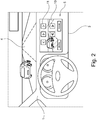
2 zeigt eine Darstellung aus der Sicht eines Fahrers mit einem Geschehen vor dem Kraftfahrzeug. Der Hintergrund auf dem Bildschirm spiegelt das Geschehen vor dem Kraftfahrzeug in bearbeiteter Form wider, wobei im Vordergrund ein unabhängiges Menü wiedergeben wird. -
3 zeigt eine aufgenommene Bildsequenz und die dazugehörige gemittelte Bildsequenz. -
4 zeigt eine schematische Darstellung für die Stärke einer Reduzierung des Schärfeeindrucks.
-
1 shows a motor vehicle with a camera arranged in an exemplary position. -
2 shows a representation from the perspective of a driver with an event in front of the motor vehicle. The background on the screen reflects what is happening in front of the motor vehicle in an edited form, with an independent menu being displayed in the foreground. -
3 shows a recorded image sequence and the associated averaged image sequence. -
4th shows a schematic representation of the strength of a reduction in the impression of sharpness.
Nachfolgend wird unter Bezugnahme auf die Figuren ein Ausführungsbeispiel für das erfindungsgemäße Verfahren zum Reduzieren einer Zeitspanne für eine Adaption der Augen eines Fahrers eines Kraftfahrzeuges
Das erfindungsgemäße Verfahren wird in einem Kraftfahrzeug
Die Sicht des Fahrers des Kraftfahrzeuges
Der Schärfeeindruck des Hintergrundbildes kann durch unterschiedliche Verfahren reduziert werden. Zum einen kann der Schärfeeindruck durch Verringern der Auflösung reduziert werden. Eine sogenannte „Verpixelung“ des Bildes führt zu einem Verlust von Details und damit zu einer Reduzierung des Schärfeindrucks. Zum anderen kann der Schärfeeindruck dadurch reduziert werden, dass der Kontrastumfang des Bildes reduziert wird. Die Tonwerte des Bildes werden derart geändert, dass der hellste Tonwert und der dunkelste Tonwert im Bild sich bzgl. ihres Helligkeitswertes angenähert haben. Details, die aus Pixeln mit ähnlichen Tonwerten aufgebaut sind, gehen dadurch verloren. Das Bild verliert an Detailreichtum und reduziert dadurch den Schärfeeindruck. Den gleichen Effekt hat das Reduzieren der Anzahl der Helligkeitsabstufungen. Bei dem Reduzieren der Helligkeitsabstufungen werden auch wieder Tonwerte angepasst, so dass Details mit ähnlichen Tonwerten auch hier wieder verloren gehen. Eine weitere Möglichkeit den Schärfeeindruck des Bildes zu reduzieren, ist das Glätten. Bei dem Glätten werden die Tonwerte von benachbarten Pixeln zueinander angepasst. Das Anpassen führt auch hier wiederum zu einem Detailverlust. Den Schärfeeindruck eines Bildes kann man ferner durch vielfältige Art und Weise reduzieren. Es gibt viele Algorithmen die den Schärfeeindruck reduzieren, wie zum Beispiel durch eine Darstellung von Kurzsichtigkeit. Alternativ sind daher viele Algorithmen anwendbar.The impression of sharpness of the background image can be reduced by different methods. On the one hand, the impression of sharpness can be reduced by reducing the resolution. A so-called "pixelation" of the image leads to a loss of details and thus to a reduction in the impression of sharpness. On the other hand, the impression of sharpness can be reduced by reducing the contrast range of the image. The tonal values of the image are changed in such a way that the lightest tonal value and the darkest tonal value in the image have approximated in terms of their brightness value. Details that are made up of pixels with similar tonal values are lost as a result. The picture loses its richness of detail and thus reduces the impression of sharpness. Reducing the number of brightness levels has the same effect. When reducing the brightness levels, tone values are also adjusted again, so that details with similar tone values are also lost here. Another possibility to reduce the impression of sharpness of the image is smoothing. During smoothing, the tonal values of neighboring pixels are adjusted to one another. Adjusting here again leads to a loss of detail. The impression of sharpness of an image can also be reduced in a variety of ways. There are many algorithms that reduce the impression of sharpness, for example by displaying myopia. As an alternative, many algorithms can therefore be used.
Das einzelne Hintergrundbild kann zum einen als Standbild wahrgenommen werden oder zum anderen als ein Bild eines flimmerfreien Films. Das einzelne Bild
Die von der Kamera
Das Reduzieren des Schärfeeindrucks des Hintergrundbildes kann einen derartigen Reduzierungsgrad aufweisen, dass selbst größere Details in dem Hintergrundbild nicht mehr zu erkennen sind. In einem extremen Fall ist der Schärfeeindruck des Bildes so stark reduziert, dass alle Pixel des Hintergrundbildes nur ein und denselben Tonwert aufweisen. Dieser Tonwert entspricht dem gemittelten Tonwert
Mit Hilfe eines Bearbeitungsmoduls
Die vorliegende Erfindung wurde anhand eines Ausführungsbeispiels zu Erläuterungszwecken detailliert beschrieben. Ein Fachmann erkennt jedoch, dass Abweichungen von dem Ausführungsbeispiel möglich sind. So kann zum Beispiel ein Algorithmus für die Reduzierung des Schärfeeindrucks verwendet werden, der auf einer Simulation einer nicht genannten Fehlsichtigkeit des Auges basiert. Neben dem räumlichen Glätten des Bildes aufgrund der Tonwerte eines einzelnen Bildes, kann alternativ oder zusätzlich ein zeitliches Glätten über mehrere Bilder vorgenommen werden. Die Erfindung soll daher nicht ausschließlich auf das beschriebene Ausführungsbeispiel beschränkt sein, sondern lediglich durch die beigefügten Ansprüche.The present invention has been described in detail using an exemplary embodiment for explanatory purposes. However, a person skilled in the art recognizes that deviations from the exemplary embodiment are possible. For example, an algorithm can be used to reduce the impression of sharpness that is based on a simulation of an undisclosed ametropia of the eye. In addition to the spatial smoothing of the image based on the tone values of an individual image, alternatively or additionally a temporal smoothing can be carried out over several images. The invention is therefore not intended to be restricted exclusively to the exemplary embodiment described, but rather only by the appended claims.
BezugszeichenlisteList of reference symbols
- 11
- KraftfahrzeugMotor vehicle
- 22
- Kameracamera
- 33rd
- Bildschirmscreen
- 44th
- Geschehen vor dem KraftfahrzeugHappened in front of the motor vehicle
- 55
- FahrerraumDriver's compartment
- 66th
- BearbeitungsmodulProcessing module
- 1010
- HintergrundbildsequenzBackground image sequence
- 1111
- Menümenu
- 2020th
- einzelnes Bild einer aufgenommenen Bildsequenzsingle image of a recorded image sequence
- 2121
- ZeitabschnittTime period
- 2222nd
- aufgenommene Bildsequenzrecorded image sequence
- 2323
- gemittelte Bildsequenzaveraged image sequence
- 2424
- einzelnes Bild einer gemittelten Bildsequenzsingle image of an averaged image sequence
- 3131
- einzelnes Bild einer bearbeiteten Bildsequenzsingle image of an edited image sequence
- 3232
- gemittelter Tonwertaveraged tonal value
Claims (10)
Priority Applications (3)
| Application Number | Priority Date | Filing Date | Title |
|---|---|---|---|
| DE102017205077.2A DE102017205077B4 (en) | 2017-03-27 | 2017-03-27 | Method and device for reducing a period of time for an adaptation of the eyes of a driver of a motor vehicle when changing the direction of view |
| CN201810238847.1A CN108668110B (en) | 2017-03-27 | 2018-03-22 | Method and vehicle device for reducing the duration of driver eye adaptation |
| US15/933,130 US10369928B2 (en) | 2017-03-27 | 2018-03-22 | Environment-dependent interface |
Applications Claiming Priority (1)
| Application Number | Priority Date | Filing Date | Title |
|---|---|---|---|
| DE102017205077.2A DE102017205077B4 (en) | 2017-03-27 | 2017-03-27 | Method and device for reducing a period of time for an adaptation of the eyes of a driver of a motor vehicle when changing the direction of view |
Publications (2)
| Publication Number | Publication Date |
|---|---|
| DE102017205077A1 DE102017205077A1 (en) | 2018-09-27 |
| DE102017205077B4 true DE102017205077B4 (en) | 2021-09-30 |
Family
ID=63449938
Family Applications (1)
| Application Number | Title | Priority Date | Filing Date |
|---|---|---|---|
| DE102017205077.2A Active DE102017205077B4 (en) | 2017-03-27 | 2017-03-27 | Method and device for reducing a period of time for an adaptation of the eyes of a driver of a motor vehicle when changing the direction of view |
Country Status (3)
| Country | Link |
|---|---|
| US (1) | US10369928B2 (en) |
| CN (1) | CN108668110B (en) |
| DE (1) | DE102017205077B4 (en) |
Families Citing this family (3)
| Publication number | Priority date | Publication date | Assignee | Title |
|---|---|---|---|---|
| US11430405B1 (en) * | 2021-04-15 | 2022-08-30 | Dell Products L.P. | Managing a display of an information handling system |
| JP2024053916A (en) * | 2022-10-04 | 2024-04-16 | カワサキモータース株式会社 | Display system for vehicles, vehicles and display method thereof |
| KR20240173462A (en) * | 2023-06-05 | 2024-12-12 | 현대모비스 주식회사 | Method and system for improving image quality of display device for vehicle |
Citations (4)
| Publication number | Priority date | Publication date | Assignee | Title |
|---|---|---|---|---|
| DE19921997A1 (en) | 1999-05-12 | 2000-11-16 | Volkswagen Ag | Control of dashboard display brightness in a vehicle by use of video cameras (with one pointing in the direction of travel) that provide a signal proportional to outside brightness that is used by a controller to adjust brightness |
| US20110057783A1 (en) | 2008-06-20 | 2011-03-10 | Panasonic Corporation | In-vehicle device for recording moving image data |
| EP2642250A2 (en) | 2012-03-23 | 2013-09-25 | Humax Co., Ltd. | Method for displaying background screen in navigation device |
| DE102014114329A1 (en) | 2014-10-02 | 2016-04-07 | Connaught Electronics Ltd. | Camera system for an electronic rearview mirror of a motor vehicle |
Family Cites Families (5)
| Publication number | Priority date | Publication date | Assignee | Title |
|---|---|---|---|---|
| EP2473871B1 (en) * | 2009-09-01 | 2015-03-11 | Magna Mirrors Of America, Inc. | Imaging and display system for vehicle |
| KR101019915B1 (en) * | 2010-03-05 | 2011-03-08 | 팅크웨어(주) | Method of providing image of server, navigation system, vehicle navigation and vehicle navigation |
| DE102010041961B4 (en) * | 2010-10-05 | 2022-08-04 | Bayerische Motoren Werke Aktiengesellschaft | Motor vehicle with a device for influencing the driver's viewing direction |
| KR101434899B1 (en) | 2012-03-23 | 2014-08-27 | 주식회사 제론헬스케어 | Daily life health information providing system and method of providing daily life health information |
| CN105554376A (en) * | 2015-12-03 | 2016-05-04 | 北京奇虎科技有限公司 | Vehicle intelligent camera device and shooting frame rate adjusting method thereof |
-
2017
- 2017-03-27 DE DE102017205077.2A patent/DE102017205077B4/en active Active
-
2018
- 2018-03-22 US US15/933,130 patent/US10369928B2/en active Active
- 2018-03-22 CN CN201810238847.1A patent/CN108668110B/en active Active
Patent Citations (5)
| Publication number | Priority date | Publication date | Assignee | Title |
|---|---|---|---|---|
| DE19921997A1 (en) | 1999-05-12 | 2000-11-16 | Volkswagen Ag | Control of dashboard display brightness in a vehicle by use of video cameras (with one pointing in the direction of travel) that provide a signal proportional to outside brightness that is used by a controller to adjust brightness |
| US20110057783A1 (en) | 2008-06-20 | 2011-03-10 | Panasonic Corporation | In-vehicle device for recording moving image data |
| EP2642250A2 (en) | 2012-03-23 | 2013-09-25 | Humax Co., Ltd. | Method for displaying background screen in navigation device |
| KR20130107697A (en) | 2012-03-23 | 2013-10-02 | (주)휴맥스 | Apparatus and method for displaying background screen of navigation device |
| DE102014114329A1 (en) | 2014-10-02 | 2016-04-07 | Connaught Electronics Ltd. | Camera system for an electronic rearview mirror of a motor vehicle |
Also Published As
| Publication number | Publication date |
|---|---|
| CN108668110B (en) | 2021-10-15 |
| CN108668110A (en) | 2018-10-16 |
| US20180272939A1 (en) | 2018-09-27 |
| DE102017205077A1 (en) | 2018-09-27 |
| US10369928B2 (en) | 2019-08-06 |
Similar Documents
| Publication | Publication Date | Title |
|---|---|---|
| DE102018004401B4 (en) | Method for correcting image data for a screen | |
| EP3959560B1 (en) | Method for controlling the brightness of an image projected by an image-generating device of a head-up display in a motor vehicle | |
| EP3947003B1 (en) | Method and apparatus for influencing an optical output of image data on an output device in a vehicle | |
| DE102015215180A1 (en) | View-dependent adjustment of the brightness of the display of a head-up display | |
| DE102009006261A1 (en) | Intelligent adjustment system for the readability of vehicle displays | |
| DE102019006339A1 (en) | Method and arrangement for enhancing the privacy effect of a screen | |
| DE102009054231A1 (en) | Head-up-display for information indication in motor vehicle, comprises indicating unit, which has display unit, in which lighting points are produced | |
| DE102017205077B4 (en) | Method and device for reducing a period of time for an adaptation of the eyes of a driver of a motor vehicle when changing the direction of view | |
| EP0867087A1 (en) | Video projection apparatus and method of displaying a video image composed of pixels of a defined size | |
| WO2021233995A1 (en) | Method and control device for operating, in a vehicle, a display device worn on the head of a user | |
| DE102019005193A1 (en) | Filters for a passenger display | |
| EP1372111A2 (en) | Infrared night vision device and display for automobile | |
| DE102019008744A1 (en) | Method for controlling the brightness of displays | |
| DE10016184C2 (en) | Device for displaying the surroundings of a vehicle | |
| DE102007018071A1 (en) | A method of displaying information in a vehicle having a changing display image and display means therefor | |
| DE102022113342A1 (en) | Selective head-up display for a vehicle with active visual guidance for the driver in the event of danger | |
| DE60010063T2 (en) | Method and device for video image processing to compensate for the false contour effect | |
| DE102012016865B4 (en) | Improved alpha blending of images from an automotive camera system | |
| DE102019123740A1 (en) | Aesthetic display unit for a vehicle | |
| EP3959098B1 (en) | Device and method for projecting image data onto a projection surface of a vehicle window | |
| DE102022001650A1 (en) | Screen layout | |
| DE102021126187A1 (en) | Display method and transparent display device, driver assistance system and means of transport for executing the display method | |
| DE102024116715B3 (en) | Displaying image content on a vehicle screen | |
| DE102018203322A1 (en) | Head-up display for a motor vehicle, motor vehicle and method for providing a display | |
| DE102024129590A1 (en) | Method with a gaze-tracking device, arrangement and vehicle |
Legal Events
| Date | Code | Title | Description |
|---|---|---|---|
| R012 | Request for examination validly filed | ||
| R082 | Change of representative |
Representative=s name: PATERIS THEOBALD ELBEL FISCHER, PATENTANWAELTE, DE |
|
| R016 | Response to examination communication | ||
| R082 | Change of representative |
Representative=s name: PATERIS THEOBALD ELBEL & PARTNER, PATENTANWAEL, DE Representative=s name: PATERIS THEOBALD ELBEL FISCHER, PATENTANWAELTE, DE |
|
| R016 | Response to examination communication | ||
| R018 | Grant decision by examination section/examining division | ||
| R020 | Patent grant now final |