CN114227680A - Robot and control method - Google Patents
Robot and control method Download PDFInfo
- Publication number
- CN114227680A CN114227680A CN202111558530.4A CN202111558530A CN114227680A CN 114227680 A CN114227680 A CN 114227680A CN 202111558530 A CN202111558530 A CN 202111558530A CN 114227680 A CN114227680 A CN 114227680A
- Authority
- CN
- China
- Prior art keywords
- robot
- item
- information
- prompt
- carrying device
- Prior art date
- Legal status (The legal status is an assumption and is not a legal conclusion. Google has not performed a legal analysis and makes no representation as to the accuracy of the status listed.)
- Granted
Links
Images



Classifications
-
- B—PERFORMING OPERATIONS; TRANSPORTING
- B25—HAND TOOLS; PORTABLE POWER-DRIVEN TOOLS; MANIPULATORS
- B25J—MANIPULATORS; CHAMBERS PROVIDED WITH MANIPULATION DEVICES
- B25J9/00—Program-controlled manipulators
- B25J9/16—Program controls
- B25J9/1656—Program controls characterised by programming, planning systems for manipulators
-
- B—PERFORMING OPERATIONS; TRANSPORTING
- B25—HAND TOOLS; PORTABLE POWER-DRIVEN TOOLS; MANIPULATORS
- B25J—MANIPULATORS; CHAMBERS PROVIDED WITH MANIPULATION DEVICES
- B25J11/00—Manipulators not otherwise provided for
- B25J11/008—Manipulators for service tasks
-
- B—PERFORMING OPERATIONS; TRANSPORTING
- B25—HAND TOOLS; PORTABLE POWER-DRIVEN TOOLS; MANIPULATORS
- B25J—MANIPULATORS; CHAMBERS PROVIDED WITH MANIPULATION DEVICES
- B25J5/00—Manipulators mounted on wheels or on carriages
- B25J5/007—Manipulators mounted on wheels or on carriages mounted on wheels
Landscapes
- Engineering & Computer Science (AREA)
- Robotics (AREA)
- Mechanical Engineering (AREA)
- Manipulator (AREA)
Abstract
本申请提供了一种机器人,包括头部,所述机器人还包括:承载装置,用于承载物品;设置在所述头部的顶部的用于获取任务信息的输入装置;处理装置,用于基于所述任务信息确定对应提示信息,还用于根据所述机器人的位置信息判断是否输出所述提示信息;用于输出所述提示信息的提示装置,所述提示装置包括显示单元,所述显示单元设置在所述头部朝向所述机器人前进方向的一侧。还提供一种控制方法。通过本申请提供的机器人及该机器人的控制方法,通过在送餐时的多种提醒方式,以及对被取餐的检测,使得不仅有效降低误取现象,更优化的提升了服务人员与客户的体验,同时通过智能检测承载装置上的物品自动匹配任务,提升了工作效率。

The application provides a robot including a head, and the robot further includes: a carrying device for carrying an item; an input device disposed on the top of the head for acquiring task information; a processing device for The task information determines corresponding prompt information, and is also used to judge whether to output the prompt information according to the position information of the robot; a prompt device for outputting the prompt information, the prompt device includes a display unit, and the display unit It is arranged on the side of the head facing the advancing direction of the robot. A control method is also provided. Through the robot and the control method of the robot provided by the present application, through various reminder methods during meal delivery and detection of the meal being taken, not only the phenomenon of mistaking is effectively reduced, but also the relationship between service personnel and customers is more optimally improved. At the same time, through the intelligent detection of the items on the carrying device, the tasks are automatically matched, which improves the work efficiency.
Description
技术领域technical field
本发明涉及智能机器人领域,特别是涉及一种机器人及控制方法。The invention relates to the field of intelligent robots, in particular to a robot and a control method.
背景技术Background technique
现有技术中,机器人开始应用于物品配送。特别是在餐饮行业,机器人在送餐过程中,当机器人达到目标餐桌时,需要服务人员或者客户自己根据小票信息,结合机器人承载的餐品自行判断机器人所承载的物品是否是对应餐桌。In the prior art, robots have begun to be used in the distribution of goods. Especially in the catering industry, when the robot reaches the target table during the meal delivery process, the service staff or the customer needs to judge whether the item carried by the robot is the corresponding table based on the receipt information and the food carried by the robot.
基于上述的存在的问题,就如何提高机器人的配送效率,以及避免顾客取错物品,成为完善送餐机器人设计的关键问题。Based on the above existing problems, how to improve the delivery efficiency of robots and avoid customers taking wrong items has become the key issue to improve the design of food delivery robots.
前面的叙述在于提供一般的背景信息,并不一定构成现有技术。The preceding statements are intended to provide general background information and may not constitute prior art.
发明内容SUMMARY OF THE INVENTION
针对上述问题,本申请提供了一种机器人及控制方法,使得能够有效提高机器人的送餐效率,以及降低顾客取错餐的概率。In view of the above problems, the present application provides a robot and a control method, which can effectively improve the meal delivery efficiency of the robot and reduce the probability of customers taking wrong meals.
为解决上述问题,本申请提供了一种机器人,包括头部,所述机器人还包括:In order to solve the above problems, the present application provides a robot including a head, and the robot further includes:
承载装置,用于承载物品;a carrying device for carrying an item;
设置在所述头部的顶部的用于获取任务信息的输入装置;an input device arranged on the top of the head for acquiring task information;
处理装置,用于基于所述任务信息确定对应提示信息,还用于根据所述机器人的位置信息判断是否输出所述提示信息;a processing device, configured to determine corresponding prompt information based on the task information, and to determine whether to output the prompt information according to the position information of the robot;
用于输出所述提示信息的提示装置,所述提示装置包括显示单元,所述显示单元设置在所述头部朝向所述机器人前进方向的一侧。A prompting device for outputting the prompting information, the prompting device includes a display unit, and the display unit is arranged on the side of the head facing the advancing direction of the robot.
可选地,所述机器人还包括:支撑架,所述承载装置设置于所述支撑架,以及,Optionally, the robot further includes: a support frame, the carrying device is disposed on the support frame, and,
设置在所述支撑架上的用于检测所述承载装置中物品的至少一传感器,所述传感器包括:压力传感器、距离传感器以及图像传感器中的至少一种。At least one sensor disposed on the support frame for detecting the articles in the carrying device includes at least one of a pressure sensor, a distance sensor and an image sensor.
可选地,所述承载装置包括:Optionally, the carrying device includes:
设置在两侧的凸部,用于防止物品移动掉落;The convex parts arranged on both sides are used to prevent items from moving and falling;
设置在前端的缺口,用于从所述缺口处取出物品。A notch is provided at the front end for taking out items from the notch.
可选地,所述提示装置还包括以下至少一种:Optionally, the prompting device further includes at least one of the following:
用于通过语音播报的方式进行提示的语音单元;A voice unit for prompting by means of voice broadcast;
信号灯单元,所述信号灯单元设置在所述承载装置上,和/或所述承载装置对应的支撑架上,用于通过闪烁、和/或亮灭、和/或颜色变化的方式输出提示信号。A signal light unit, the signal light unit is arranged on the carrying device and/or on the corresponding support frame of the carrying device, and is used for outputting a prompt signal by means of flashing, and/or on/off, and/or color change.
可选地,还包括:Optionally, also include:
设置在所述承载装置前端的阻挡件,用于通过打开或者关闭的方式输出提示信息;和/或,A blocking member arranged at the front end of the carrying device, used for outputting prompt information by opening or closing; and/or,
设置在所述承载装置上的驱动件,用于通过将所述承载装置推出的方式输出提示信息。A driving member arranged on the carrying device is used for outputting prompt information by pushing the carrying device out.
可选地,所述机器人还包括底部,以及,Optionally, the robot further includes a bottom, and,
设置在所述头部的防跌落装置,用于检测机器人行进前方地面是否存在断崖,以使所述处理装置根据所述断崖检测结果控制机器人的行进方向;和/或,an anti-fall device arranged on the head for detecting whether there is a cliff on the ground in front of the robot, so that the processing device controls the travel direction of the robot according to the cliff detection result; and/or,
设置在所述底部的碰撞检测装置,用于检测机器人是否发生碰撞,以使所述处理装置根据所述碰撞检测结果确定报警信号;和/或,a collision detection device arranged at the bottom for detecting whether the robot collides, so that the processing device determines an alarm signal according to the collision detection result; and/or,
设置在所述头部的头灯,用于输出对应于所述行进方向的信息提示,和/或,输出对应于所述报警信号的信息提示;和/或,a headlight provided on the head, for outputting an information prompt corresponding to the traveling direction, and/or outputting an information prompt corresponding to the alarm signal; and/or,
设置在所述底部的氛围灯。Set the ambient light at the bottom.
本申请还提供了一种控制方法,适用于如上所述的机器人,所述方法包括:The present application also provides a control method, which is applicable to the above-mentioned robot, and the method includes:
当检测到承载装置上放置物品时,判断是否存在对应于所述物品和/或所述承载装置的任务信息;When it is detected that an item is placed on the carrier, determine whether there is task information corresponding to the item and/or the carrier;
若否,则以预定方式输出提示信息,用以提醒输入对应于所述物品和/或所述承载装置的任务信息。If not, prompt information is output in a predetermined manner to prompt input of task information corresponding to the object and/or the carrying device.
可选地,所述方法还包括:Optionally, the method further includes:
当获取到任务信息时,判断是否存在对应所述任务信息的物品和/或承载物品的承载装置;When the task information is acquired, determine whether there is an item corresponding to the task information and/or a carrying device for carrying the item;
若否,则以预定方式输出提示信息,用以提醒放入对应的物品和/或将物品放置对应的承载装置。If not, prompt information is output in a predetermined manner to remind to put in the corresponding item and/or to place the item on the corresponding carrying device.
可选地,所述预定方式包括:Optionally, the predetermined manner includes:
通过语音播报的提醒方式;Reminder by voice broadcast;
通过文字和/或图案显示的提醒方式。Reminders displayed by text and/or graphics.
可选地,所述方法还包括:Optionally, the method further includes:
在检测到存在物品及对应的任务信息后,若在预设时间内未接收到新的物品和/或任务信息,则开始对所述物品和/或任务信息进行执行处理;和/或,After detecting the existence of the item and the corresponding task information, if no new item and/or task information is received within the preset time, start the execution processing of the item and/or task information; and/or,
在检测到存在物品及对应的任务信息后,根据接收到的执行操作对所述物品和/或任务信息进行执行处理。After detecting the existence of the item and the corresponding task information, perform execution processing on the item and/or the task information according to the received execution operation.
本申请还提供了一种控制方法,适用于如上所述的机器人,所述方法包括:The present application also provides a control method, which is applicable to the above-mentioned robot, and the method includes:
在所述机器人行进至对应于任务信息的目标位置时,输出第一提示信息用以提醒取出相应物品;When the robot travels to the target position corresponding to the task information, output the first prompt information to remind the corresponding item to be taken out;
若检测到取错物品,则输出第二提示信息用以提醒取错,和/或重新取出;或者,If the wrong item is detected, output a second prompt message to remind the wrong item, and/or take it out again; or,
在检测到所述相应物品被正确取走后,则执行下一个任务。After it is detected that the corresponding item is correctly taken away, the next task is executed.
可选地,所述输出第一提示信息的方式和/或输出第二提示信息的方式,包括以下至少一种:Optionally, the manner of outputting the first prompt information and/or the manner of outputting the second prompt information includes at least one of the following:
通过语音播报方式进行提示;Prompt by voice broadcast;
通过显示对应物品和/或所在承载装置的文字和/或图案的方式进行提示;Prompt by displaying the text and/or pattern of the corresponding item and/or the carrying device;
通过开启对应于所述物品所在承载装置的信号灯的方式进行提示。It is prompted by turning on the signal light corresponding to the carrying device where the article is located.
综上,通过本申请提供的机器人及该机器人的控制方法,通过在送餐时的多种提醒方式,以及对被取餐的检测,使得不仅有效降低误取现象,更优化的提升了服务人员与客户的体验,同时通过智能检测承载装置上的物品自动匹配任务,提升了工作效率。In conclusion, through the robot and the control method of the robot provided by this application, through various reminder methods during meal delivery, and detection of the meal being taken, not only the phenomenon of mistaking is effectively reduced, but also the service personnel are more optimally improved. At the same time, through intelligent detection of the items on the carrying device, the tasks are automatically matched, which improves the work efficiency.
附图说明Description of drawings
图1为本申请一实施例提供的机器人的框架示意图。FIG. 1 is a schematic diagram of a framework of a robot provided by an embodiment of the present application.
图2为本申请一实施例提供的机器人头部的头灯示意图。FIG. 2 is a schematic diagram of a headlight of a robot head according to an embodiment of the present application.
图3为本申请一实施例提供的机器人的控制方法的流程示意图。FIG. 3 is a schematic flowchart of a method for controlling a robot according to an embodiment of the present application.
图4为本申请又一实施例提供的机器人的控制方法的流程示意图。FIG. 4 is a schematic flowchart of a method for controlling a robot according to another embodiment of the present application.
图5为本申请另一实施例提供的机器人的控制方法的流程示意图。FIG. 5 is a schematic flowchart of a method for controlling a robot according to another embodiment of the present application.
具体实施方式Detailed ways
这里将详细地对示例性实施例进行说明,其示例表示在附图中。下面的描述涉及附图时,除非另有表示,不同附图中的相同数字表示相同或相似的要素。以下示例性实施例中所描述的实施方式并不代表与本申请相一致的所有实施方式。相反,它们仅是与如所附权利要求书中所详述的、本申请的一些方面相一致的装置和方法的例子。Exemplary embodiments will be described in detail herein, examples of which are illustrated in the accompanying drawings. Where the following description refers to the drawings, the same numerals in different drawings refer to the same or similar elements unless otherwise indicated. The implementations described in the illustrative examples below are not intended to represent all implementations consistent with this application. Rather, they are merely examples of apparatus and methods consistent with some aspects of the present application as recited in the appended claims.
需要说明的是,在本文中,术语“包括”、“包含”或者其任何其他变体意在涵盖非排他性的包含,从而使得包括一系列要素的过程、方法、物品或者装置不仅包括那些要素,而且还包括没有明确列出的其他要素,或者是还包括为这种过程、方法、物品或者装置所固有的要素。在没有更多限制的情况下,由语句“包括一个……”限定的要素,并不排除在包括该要素的过程、方法、物品或者装置中还存在另外的相同要素,此外,本申请不同实施例中具有同样命名的部件、特征、要素可能具有相同含义,也可能具有不同含义,其具体含义需以其在该具体实施例中的解释或者进一步结合该具体实施例中上下文进行确定。It should be noted that, herein, the terms "comprising", "comprising" or any other variation thereof are intended to encompass non-exclusive inclusion, such that a process, method, article or device comprising a series of elements includes not only those elements, It also includes other elements not expressly listed or inherent to such a process, method, article or apparatus. Without further limitation, an element defined by the phrase "comprises a..." does not preclude the presence of additional identical elements in the process, method, article, or device that includes the element, and further, different implementations of the present application Components, features and elements with the same names in the examples may have the same meaning or may have different meanings, and their specific meanings need to be determined by their explanations in this specific embodiment or further combined with the context in this specific embodiment.
应当理解,尽管在本文可能采用术语第一、第二、第三等来描述各种信息,但这些信息不应限于这些术语。这些术语仅用来将同一类型的信息彼此区分开。例如,在不脱离本文范围的情况下,第一信息也可以被称为第二信息,类似地,第二信息也可以被称为第一信息。取决于语境,如在此所使用的词语“如果”可以被解释成为“在……时”或“当……时”或“响应于确定”。再者,如同在本文中所使用的,单数形式“一”、“一个”和“该”旨在也包括复数形式,除非上下文中有相反的指示。应当进一步理解,术语“包含”、“包括”表明存在所述的特征、步骤、操作、元件、组件、项目、种类、和/或组,但不排除一个或多个其他特征、步骤、操作、元件、组件、项目、种类、和/或组的存在、出现或添加。本申请使用的术语“或”、“和/或”、“包括以下至少一个”等可被解释为包括性的,或意味着任一个或任何组合。例如,“包括以下至少一个:A、B、C”意味着“以下任一个:A;B;C;A和B;A和C;B和C;A和B和C”,再如,“A、B或C”或者“A、B和/或C”意味着“以下任一个:A;B;C;A和B;A和C;B和C;A和B和C”。仅当元件、功能、步骤或操作的组合在某些方式下内在地互相排斥时,才会出现该定义的例外。It should be understood that although the terms first, second, third, etc. may be used herein to describe various information, such information should not be limited by these terms. These terms are only used to distinguish the same type of information from each other. For example, first information may also be referred to as second information, and similarly, second information may also be referred to as first information, without departing from the scope of this document. Depending on the context, the word "if" as used herein can be interpreted as "at the time of" or "when" or "in response to determining." Also, as used herein, the singular forms "a," "an," and "the" are intended to include the plural forms as well, unless the context dictates otherwise. It should be further understood that the terms "comprising", "comprising" indicate the presence of stated features, steps, operations, elements, components, items, kinds, and/or groups, but do not exclude one or more other features, steps, operations, The existence, appearance or addition of elements, assemblies, items, categories, and/or groups. As used herein, the terms "or", "and/or", "including at least one of the following" and the like may be construed to be inclusive or to mean any one or any combination. For example, "comprising at least one of the following: A, B, C" means "any of the following: A; B; C; A and B; A and C; B and C; A and B and C", for example, " A, B or C" or "A, B and/or C" means "any of the following: A; B; C; A and B; A and C; B and C; A and B and C". Exceptions to this definition arise only when combinations of elements, functions, steps, or operations are inherently mutually exclusive in some way.
应该理解的是,虽然本申请实施例中的流程图中的各个步骤按照箭头的指示依次显示,但是这些步骤并不是必然按照箭头指示的顺序依次执行。除非本文中有明确的说明,这些步骤的执行并没有严格的顺序限制,其可以以其他的顺序执行。而且,图中的至少一部分步骤可以包括多个子步骤或者多个阶段,这些子步骤或者阶段并不必然是在同一时刻执行完成,而是可以在不同的时刻执行,其执行顺序也不必然是依次进行,而是可以与其他步骤或者其他步骤的子步骤或者阶段的至少一部分轮流或者交替地执行。It should be understood that, although the steps in the flowcharts in the embodiments of the present application are displayed in sequence according to the arrows, these steps are not necessarily executed in the sequence indicated by the arrows. Unless explicitly stated herein, the execution of these steps is not strictly limited to the order and may be performed in other orders. Moreover, at least a part of the steps in the figure may include multiple sub-steps or multiple stages. These sub-steps or stages are not necessarily executed at the same time, but may be executed at different times, and the execution order is not necessarily sequential. Instead, it may be performed in turn or alternately with other steps or at least a portion of sub-steps or stages of other steps.
取决于语境,如在此所使用的词语“如果”、“若”可以被解释成为“在……时”或“当……时”或“响应于确定”或“响应于检测”。类似地,取决于语境,短语“如果确定”或“如果检测(陈述的条件或事件)”可以被解释成为“当确定时”或“响应于确定”或“当检测(陈述的条件或事件)时”或“响应于检测(陈述的条件或事件)”。Depending on the context, the words "if", "if" as used herein may be interpreted as "at" or "when" or "in response to determining" or "in response to detecting". Similarly, the phrases "if determined" or "if detected (the stated condition or event)" can be interpreted as "when determined" or "in response to determining" or "when detected (the stated condition or event)," depending on the context )" or "in response to detection (a stated condition or event)".
需要说明的是,在本文中,采用了诸如S1、S2等步骤代号,其目的是为了更清楚简要地表述相应内容,不必然构成顺序上的实质性限制,本领域技术人员在具体实施时,可能会先执行S4后执行S3等,但这些均应在本申请的保护范围之内。It should be noted that, in this article, step codes such as S1 and S2 are used, the purpose of which is to express the corresponding content more clearly and briefly, and does not necessarily constitute a substantive restriction on the sequence. It may be possible to execute S4 first and then execute S3, etc., but these should all fall within the scope of protection of this application.
应当理解,此处所描述的具体实施例仅用以解释本申请,并不用于限定本申请。It should be understood that the specific embodiments described herein are only used to explain the present application, but not to limit the present application.
在后续的描述中,使用用于表示元件的诸如“模块”、“部件”或者“单元”的后缀仅为了有利于本申请的说明,其本身没有特定的意义。因此,“模块”、“部件”或者“单元”可以混合地使用。In the following description, suffixes such as "module", "component" or "unit" used to represent elements are used only to facilitate the description of the present application, and have no specific meaning per se. Thus, "module", "component" or "unit" may be used interchangeably.
现有技术中,特别是在餐饮行业,一般所用到的机器人都是单次送餐,即每次只能送一个目的就餐桌的菜,或者只能送一个菜,这样就使得,一方面机器人的功能不能充分发挥;另一方面浪费了购买机器人所使用的资金。当在送餐过程中,如果机器人一次承载多个目的就餐桌的菜时,例如80号就餐桌,100号就餐桌,就会存在当到达目标送餐点时(例如第100桌)时,需要服务人员或者客户自己根据小票信息,结合机器人承载的餐品自行判断是否是对应的餐饮。In the existing technology, especially in the catering industry, the robots generally used are single-time delivery, that is, only one dish can be delivered to the table at a time, or only one dish can be delivered. The functions of the robot cannot be fully utilized; on the other hand, the funds used to purchase the robot are wasted. During the meal delivery process, if the robot carries dishes for multiple purposes at one time, such as the 80th table and the 100th table, there will be a need when the target delivery point (such as the 100th table) is reached. The service staff or the customer can judge whether it is the corresponding meal based on the receipt information and the meal carried by the robot.
基于上述的存在的问题,就如何提高送餐效率以及避免顾客取错餐,成为完善送餐机器人设计的关键问题。Based on the above existing problems, how to improve the efficiency of meal delivery and avoid customers taking the wrong meal has become the key issue to improve the design of food delivery robots.
针对上述问题,本申请提供了一种机器人及控制方法,使得能够有效提高机器人的送餐效率,以及降低顾客取错餐的概率。以下结合实施例对本申请提出的任务分配方法进行详细说明。In view of the above problems, the present application provides a robot and a control method, which can effectively improve the meal delivery efficiency of the robot and reduce the probability of customers taking wrong meals. The task assignment method proposed in the present application will be described in detail below with reference to the embodiments.
如图1所示,为本申请实施例提供的机器人的框架示意图。该机器人包括:头部1,该机器人还包括:As shown in FIG. 1 , it is a schematic diagram of a framework of a robot provided by an embodiment of the present application. The robot includes: a head 1, the robot further includes:
承载装置4,用于承载物品;a carrying
设置在头部1的顶部的用于获取任务信息的输入装置2;an
处理装置(图未示出),用于基于所述任务信息确定对应提示信息,还用于根据所述机器人的位置信息判断是否输出所述提示信息;a processing device (not shown in the figure), configured to determine corresponding prompt information based on the task information, and to determine whether to output the prompt information according to the position information of the robot;
用于输出所述提示信息的提示装置3,所述提示装置3包括显示单元31,所述显示单元31设置在所述头部朝向所述机器人前进方向的一侧。A prompting
其中,处理装置可以根据需要安装在机器人的头部、底部或其他位置。输入装置可以是触摸显示屏等。Wherein, the processing device can be installed on the head, bottom or other positions of the robot as required. The input device may be a touch display screen or the like.
所述提示装置还包括以下至少一种:The prompting device also includes at least one of the following:
用于通过语音播报的方式进行提示的语音单元32;A
信号灯单元33,所述信号灯单元33设置在所述承载装置4上,和/或所述承载装置4对应的支撑架44上,用于通过闪烁、和/或亮灭、和/或颜色变化的方式输出提示信号。The
在本申请的一个实施例中,现有技术的智能机器人,特别是在餐饮行业,由于机器人在送餐过程中,需要服务员或者客户自己根据菜品进行判断,容易造成拿错的情况。由于一般的智能机器人通常都每次只能送一个菜,为了降低菜品的拿错概率,以及提高机器人的送餐效率,在本申请一种较优的实施方式中,通过在机器人中设置多个承载装置4,以提高机器人的运载量的方式提高送餐效率,例如3个承载装置:第一承载装置41、第二承载装置42、以及第三承载装置43,在本申请实施例中,机器人一次至少可以运载3个菜品。为了降低菜品的拿错概率,本申请实施例中,通过在机器人的头部1设置输入装置2,通过该输入装置2输入与承载装置4中承载的菜品对应的任务信息,机器人的处理装置执行该任务,控制机器人将对应的菜品送达任务指定的位置;在达到任务指定的位置之后,机器人的处理装置基于该任务信息确定对应的提示信息,并通过提示装置3发送该提示信息,以提示服务人员/客户自行拿取对应的菜品。在本申请一种较优的实施方式中,机器人可以通过设置的显示单元31输出该提示信息,例如:显示单元31如显示屏、屏幕等,通过以图片或者文字对该提示信息进行显示输出;通过将输入装置设置在头部的顶部,便于用户操作输入信息,同时将显示单元设置在头部朝向机器人前进方向的一侧,能够更好地面向用户,直观进行取餐提醒,整体上提升了交互效果和操作便捷性。举例来说,在机器人还有预设距离到达目的餐桌时,显示单元上开始显示任务信息对应的桌号以及菜品。预设距离可以是3m、5m等,便于用户提前观察到,等待取餐,提高配送效率。In an embodiment of the present application, the intelligent robot in the prior art, especially in the catering industry, is prone to mistaking because the robot needs to make judgments based on the dishes by the waiter or the customer during the meal delivery process. Since a general intelligent robot can usually only deliver one dish at a time, in order to reduce the probability of taking wrong dishes and improve the food delivery efficiency of the robot, in a preferred embodiment of the present application, the robot is configured with multiple The carrying
在本申请另一种较优的实施方式中,机器人通过设置的语音单元32,以语音播报的方式输出该提示信息,例如:通过语音单元32如喇叭等以语音播报的方式输出如“100号桌请取走第3层的麻婆豆腐”等类似的提示信息;在另一种情况下,由于客户没听清楚或者没注意,可能出现错拿了其他承载装置4的物品的情况,在该实施例中,当检测到物品离开承载装置4,检测该物品是否在匹配当前桌号对应的任务,若否,则可以通过语音播报的方式进行提醒客户拿错,例如“拿错请放回,请拿第3层的麻婆豆腐”,为了提高客户的舒适度,还可以设置比较萌系、可爱系的声音进行播报。In another preferred embodiment of the present application, the robot outputs the prompt information in the form of voice broadcast through the
在本申请另一种较优的实施方式中,如果饭店处理繁忙状态且嘈杂,在嘈杂的环境中通过视觉显示的方式可以增强提示效果,相比语音提醒会更为明显,且不显得突兀。在本实施方式中,机器人通过设置在承载装置4或者支撑架44上设置的信号灯单元33输出该提示信息,例如:通过信号灯的闪烁、亮灭、以及颜色的变化等方式,输出该提示信息。例如,可以通过点亮信号灯,通知客户取对应承载装置4的物品,也还可以通过闪烁的方式等,当发生取错时,被错取物品的承载装置所对应的信号灯单元可以红灯闪烁以进行提示。In another preferred embodiment of the present application, if the restaurant is busy and noisy, the prompt effect can be enhanced by visual display in a noisy environment, which is more obvious and less obtrusive than voice prompts. In this embodiment, the robot outputs the prompt information through the
在另一实施方式中,还可以以组合进行提示信息的输出。例如,在通过显示单元31进行显示的同时,还可以通过语音单元32进行播报,并闪烁对应的信号灯单元,提高用户正确取餐的概率。In another embodiment, prompt information can also be output in combination. For example, while displaying through the
在本申请另一种较优的实施方式中,所述机器人还包括:支撑架44,所述承载装置4设置于所述支撑架44,以及,In another preferred embodiment of the present application, the robot further includes: a
设置在所述支撑架44上的用于检测所述承载装置4中物品的至少一传感器,所述传感器包括:压力传感器、距离传感器以及图像传感器中的至少一种。At least one sensor disposed on the
在本申请的一个实施例中,为了检测承载装置4上是否放有菜品,针对每个承载装置4都设置有相应的传感器,通过传感器检测是否放有菜品。一种较优的实施方式中,在承载装置4与支撑架44之间设置压力传感器,通过物品对承载装置4产生的压力进行检测。在另一种较优的实施方式中还可以通过红外测距传感器、激光测距传感器等距离传感器检测;还可以通过图像传感器进行判断,例如通过在承载装置对应的上方设置摄像头,获取承载装置4上是否存在物品的同时,还可以进一步根据物品的图像从后台查找对应的名称,自动匹配对应的任务,节省服务人员操作机器人的过程,进一步提高效率。In an embodiment of the present application, in order to detect whether a dish is placed on the carrying
继续参见图1所示,在本申请实施例中,该承载装置4包括:Continuing to refer to FIG. 1 , in this embodiment of the present application, the carrying
设置在两侧的凸部411,用于防止物品移动掉落;The
设置在前端的缺口412,用于从所述缺口处取出物品。A
在本申请的一个实施例中,机器人在配送菜品时处于移动状态,为了防止承载装置4上的物品掉落,可以承载装置4的四周侧边分别设置凸部411,用于对物品进行阻挡;在一种较优的实施方式中,除了设置用于阻挡的凸部411外,还可以通过增加承载装置4面板的摩擦度,例如增加硅胶垫等,减小物品晃动。为了使服务人员或者客户拿取物品比较方便,在申请实施例中,对于承载装置4还设有缺口412,服务人员或者客户通过承载装置4上的缺口412处从下往上进行取餐,一种较优的实施方式中,每个承载装置4设置至少一个缺口412,所述缺口还可以进一步的设置在承载装置4前段的中间位置。In an embodiment of the present application, the robot is in a moving state when delivering dishes. In order to prevent the items on the
在本申请的一个实施例中,承载装置4还包括:In an embodiment of the present application, the carrying
设置在所述承载装置前端的阻挡件,用于通过打开或者关闭的方式输出提示信息;和/或,A blocking member arranged at the front end of the carrying device, used for outputting prompt information by opening or closing; and/or,
设置在所述承载装置上的驱动件,用于通过将所述承载装置推出的方式输出提示信息。A driving member arranged on the carrying device is used for outputting prompt information by pushing the carrying device out.
在本申请实施例中,一方面为了防止服务人员或者客户拿错物品;另一方面为了保证在送餐过程中,保证菜不收误触导致的污染等,可以在承载装置4前端位置设置阻挡件,例如挡板,当到达目标桌号时,可通过自动打开挡板的方式,提醒服务人员或者客户拿去对应的物品,在拿走物品之后关闭挡板,挡板可以是沿竖直方向伸缩设置的;在当前桌号不是对应的目标桌时,则对其他承载装置的挡板进行关闭,防止服务人员或者客户去拿;另一种实施例的情况下,还可以通过设置自驱动抽屉式的承载装置4放置物品,同样的,在到达目标桌时,驱动装置自动推出相应的承载装置4,防止服务人员或者客户拿错物品,同时也能起到防止菜品因误触而被污染。In the embodiment of the present application, on the one hand, in order to prevent the service personnel or customers from taking the wrong items; on the other hand, in order to ensure that during the meal delivery process, to ensure that the dishes do not receive contamination caused by accidental touches, etc., a blocking device can be set at the front end of the carrying
所述机器人还包括底部,以及,The robot also includes a bottom, and,
设置在所述头部的防跌落装置5,用于检测机器人行进前方地面是否存在断崖,以使所述处理装置根据所述断崖检测结果控制机器人的行进方向;和/或,The
设置在所述底部的碰撞检测装置6,用于检测机器人是否发生碰撞,以使所述处理装置根据所述碰撞检测结果确定报警信号;和/或,a
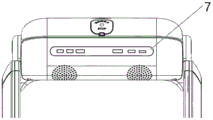
设置在所述头部的头灯7,用于输出对应于所述行进方向的信息提示,和/或,输出对应于所述报警信号的信息提示;和/或,The
设置在所述底部的氛围灯8。
在本申请的一个实施例中,为了对可能遇到的潜在风险进行及时的检测,通过在机器人的头部设置防跌落装置5,使用距离检测的方式,检测机器人在行进过程中的前方一定区域内是否存在沟壑或者高坎,例如通过测距的方式,检测机器人行进前方一米处地面的情况;还可以通过图像检测的方式,利用摄像头实时获取前方路况信息进行判断;当发现存在沟壑或者高坎时,由处理装置控制机器人调整行进方向对该风险进行规避;当机器人在调整行进方向,或者主动转弯时。In an embodiment of the present application, in order to detect potential risks that may be encountered in a timely manner, the
如图2所示,为本申请实施例提供的机器人头部的头灯示意图。通过设置在机器人头部的头灯7,例如通过流水转向灯光的效果,提示正在调整方向或者转弯。在本申请实施例中,在机器人发生碰撞时,为方便能够及时通知到服务人员进行维护,提醒用户避让,在机器人的底部设置有碰撞检测装置6,当检测到发生碰撞时,处理装置根据碰撞结果控制该头灯7发出报警信号,为了不引起客户恐慌,可以仅仅采用头灯7或者显示单元31进行报警提醒,而不采用语音报警提醒的方式。As shown in FIG. 2 , it is a schematic diagram of a headlight of a robot head according to an embodiment of the present application. Through the
在本申请的实施例中,为了丰富机器人的功能,在机器人中设置有不同的服务模式,例如生日祝福模式,哄小孩模式等,模式集成背景音乐、灯光多彩律动模式和液晶显示屏自定义显示祝福语功能,便于服务员使用该模式在顾客生日、求婚等特定场合下送上惊喜祝福,氛围灯可以根据背景音乐的旋律进行多彩律动。In the embodiment of the present application, in order to enrich the functions of the robot, different service modes are set in the robot, such as a birthday greeting mode, a coaxing child mode, etc. The blessing function is convenient for waiters to use this mode to send surprise blessings to customers on specific occasions such as birthdays and marriage proposals.
如图3所示,为本申请实施例提供的机器人的一种控制方法的流程示意图。本申请实施例提供的机器人的控制方法,适用于上述机器人,该方法包括:As shown in FIG. 3 , it is a schematic flowchart of a method for controlling a robot according to an embodiment of the present application. The control method of the robot provided by the embodiment of the present application is applicable to the above-mentioned robot, and the method includes:
S11、当检测到承载装置上放置物品;S11. When it is detected that an item is placed on the carrying device;
S12、判断是否存在对应于所述物品和/或所述承载装置的任务信息;S12, judging whether there is task information corresponding to the item and/or the carrying device;
S13、若否,则以预定方式输出提示信息,用以提醒输入对应于所述物品和/或所述承载装置的任务信息。S13. If not, output prompt information in a predetermined manner to prompt input of task information corresponding to the item and/or the carrying device.
本申请的一个实施例中,由于使用人员的使用习惯不同,例如,有的人员习惯先放置菜品,再输入对应的任务信息;有的人员则习惯先输入任务信息,等相关菜品准备好了之后,再放置到对应的承载装置中,为了兼顾不同的使用操作,机器人会同时检测承载装置上放置物品的情况和输入的任务信息。因此在本实施例中,在检测到承载装置放置有物品时,判断机器人中是否存在对应于该物品或者承载该物品的承载装置对应的任务信息,若不存在,则会提醒服务人员输入对应的任务信息;在本申请的一种较优的实施方式中,当通过压力传感器或者距离传感器检测到承载装置4上放置有物品时,则判断机器人是否已经存在对应于该承载装置的任务信息,若没有,则输出提示信息提醒服务人员输入对应的任务信息;在本申请的另一种较优的实施方式中,当通过图像传感器检测到承载装置4上放置有物品时,通过对物品图像的解析获取到物品信息,在根据物品信息查找机器人中是否已经存在对应于该物品的任务信息,若否,则输出提示信息以提醒服务人员输入对应的任务信息。在本申请实施例中,在输出提示信息时,具体提醒时可以采用语音播报的方式,也可以通过显示屏显示相关信息的方式,如对应的文字或者图案等。一种较佳的实施方式下,当检测到仅有物品后,则需要等待一个预定时长,例如1分钟,当到达1分钟后,再进行提醒。在检测到已有匹配的任务信息之后,还可以等待第二个预定时长,例如2分钟,当到达2分钟之后,则提示服务人员确认机器人进行执行任务。在另一个实施例下,在检测到存在对应的任务信息后,若在预设时间内,例如2分钟未接收到新的物品和/或任务信息,则开始对所述物品和/或任务信息进行执行处理,即自动开启执行已有任务。In one embodiment of the present application, due to the different usage habits of users, for example, some people are used to placing dishes first, and then inputting the corresponding task information; some people are used to inputting task information first, and wait until the relevant dishes are ready. , and then place it in the corresponding carrying device. In order to take into account different use operations, the robot will simultaneously detect the situation of the items placed on the carrying device and the input task information. Therefore, in this embodiment, when it is detected that an item is placed on the carrier device, it is determined whether there is task information corresponding to the item or the carrier device that carries the item in the robot, and if not, the service personnel will be reminded to input the corresponding task information; in a preferred embodiment of the present application, when the pressure sensor or the distance sensor detects that an item is placed on the carrying
如图4所示,为本申请一实施例提供的机器人的控制方法的流程示意图。本申请实施例提供的机器人的控制方法,适用于上述机器人,该方法包括:As shown in FIG. 4 , it is a schematic flowchart of a method for controlling a robot according to an embodiment of the present application. The control method of the robot provided by the embodiment of the present application is applicable to the above-mentioned robot, and the method includes:
S21、当检测到存在任务信息,S21. When it is detected that there is task information,
S22、判断是否存在对应所述任务信息的物品和/或承载物品的承载装置;S22, judging whether there is an item corresponding to the task information and/or a carrying device for carrying the item;
S23、若否,则以预定方式输出提示信息,用以提醒放入对应的物品和/或将物品放置对应的承载装置。S23. If not, output prompt information in a predetermined manner to remind to put in the corresponding item and/or place the item on the corresponding carrying device.
在本实施例中,在当检测到机器人存在任务信息输入的情况时,判断机器人中是否存在对应于该任务的物品或者判断机器人中对应于该任务的承载装置上是否存在物品,若不存在,则输出提示信息提醒提醒服务人员放入对应于该任务的物品信息,或者将物品放置在对应于该任务的承载装置上;在本申请的一种较优的实施方式中,当检测到机器人中存在任务信息时,通过图像传感器获取承载装置上的物品图像,通过对该物品图像的解析获取到物品信息,在根据该物品信息判断该物品是否与任务信息中的物品对应,若否,则输出提示信息以提醒服务人员放入对应的该任务的物品信息;在本申请的另一种较优的实施方式中,当检测到机器人中存在任务信息时,则通过压力传感器或者距离传感器检测对应于该任务的承载装置上是否放入物品,若否,则输出提示信息以提醒服务人员在对应该任务的承载装置上放入物品。在本申请实施例中,在输出提示信息时,在具体提醒时可以采用语音播报的方式,也可以通过显示屏显示相关信息的方式,如对应的文字或者图案等。一种较佳的实施方式下,当检测到仅有任务信息后,则需要等待一个预定时长,例如1分钟,当到达1分钟后,再进行提醒。在检测到已有匹配的物品之后,还可以等待第二个预定时长,例如2分钟,当到达2分钟之后,则提示服务人员确认机器人进行执行任务;在另一个实施例场景下,在检测到存在对应物品后,若在预设时间内,例如2分钟未接收到新的物品和/或任务信息,则开始对所述物品和/或任务信息进行执行处理,即自动开启执行已有任务。In this embodiment, when it is detected that the robot has task information input, it is determined whether there is an item corresponding to the task in the robot or whether there is an item in the robot that corresponds to the task. If there is no item, Then output the prompt information to remind the service personnel to put in the item information corresponding to the task, or place the item on the carrying device corresponding to the task; in a preferred embodiment of the present application, when a robot is detected When there is task information, the image sensor is used to obtain the image of the item on the carrying device, and the item information is obtained by analyzing the image of the item, and then according to the item information, it is judged whether the item corresponds to the item in the task information, and if not, output The prompt information is used to remind the service personnel to put in the item information corresponding to the task; in another preferred embodiment of the present application, when it is detected that there is task information in the robot, the pressure sensor or the distance sensor is used to detect the corresponding item information. Whether an item is placed on the carrying device of the task, if not, output a prompt message to remind the service personnel to put the item on the carrying device corresponding to the task. In the embodiment of the present application, when the prompt information is output, the specific prompt may be in the form of voice broadcast, or the mode of displaying relevant information, such as corresponding text or pattern, through the display screen. In a preferred embodiment, when only task information is detected, it is necessary to wait for a predetermined period of time, such as 1 minute, and a reminder will be given after 1 minute is reached. After detecting an existing matching item, you can also wait for a second predetermined period of time, such as 2 minutes, and after 2 minutes, the service personnel will be prompted to confirm that the robot will perform the task; in another embodiment scenario, after detecting After the corresponding item exists, if no new item and/or task information is received within a preset time, such as 2 minutes, the execution processing of the item and/or task information is started, that is, the execution of the existing task is automatically started.
如图5所示,为本申请一实施例提供的机器人的控制方法的流程示意图。本申请实施例提供的机器人的控制方法,适用于上述机器人,该方法包括:As shown in FIG. 5 , it is a schematic flowchart of a method for controlling a robot according to an embodiment of the present application. The control method of the robot provided by the embodiment of the present application is applicable to the above-mentioned robot, and the method includes:
S31、在所述机器人行进至对应于任务信息的目标位置时,输出第一提示信息用以提醒取出相应物品;S31, when the robot travels to the target position corresponding to the task information, output first prompt information to remind the corresponding item to be taken out;
S32、若检测到取错物品,则输出第二提示信息用以提醒取错,和/或重新取出;或者,S32. If the wrong item is detected, output a second prompt message to remind the wrong item, and/or take it out again; or,
S33、在检测到所述相应物品被正确取走后,则执行下一个任务。S33. After detecting that the corresponding item is correctly taken away, execute the next task.
在本申请的一个实施例中,当机器人抵达目标桌位置后,会通过语音播报的方式,例如“100桌请拿去3号承载装置43的物品”客户或者服务人员拿出相关物品,还可以通过显示屏显示相关文字或者图案的方式,或者通过信号灯的指示进行提醒,提醒方式如前述内容,此处不在进行赘述;当然在该承载装置为具有挡板或者时自驱动抽屉式的承载装置时,则通过打开所述物品所在承载装置前端的阻挡件的方式进行提示;或者通过将所述物品所在承载装置进行推出的方式进行提示。In an embodiment of the present application, when the robot reaches the target table, it will broadcast by voice, for example, "For 100 tables, please take the items of the No. 3
在本申请的另一个实施例的情况下,当该机器人的承载装置为开放式的承载装置,即没有挡板,也不是自驱动推送抽屉式的情况下,当客户或者服务人员拿出物品后,机器人需要进行检测被拿出物品是否对应当前桌号的任务,如果不对应,则需要通过提醒的方式,提醒客户或者服务人员拿错物品需要归还,同时提醒客户或者服务人员拿去正确的物品。在另一种情况下,如果机器人的承载装置时带有挡板或者自驱动抽屉式的,则在提醒客户或者服务人员拿去物品时,将不对应目标桌号的承载装置进行锁死,以降低误拿概率,同时减少不必要的菜品污染等风险。In the case of another embodiment of the present application, when the carrying device of the robot is an open carrying device, that is, there is no baffle, nor is it a self-driven push-drawer type, when the customer or service staff takes out the item , the robot needs to perform the task of detecting whether the item taken out corresponds to the current table number. If it does not, it needs to remind the customer or service staff that the wrong item needs to be returned, and at the same time remind the customer or service staff to take the correct item. . In another case, if the carrying device of the robot has a baffle plate or a self-driving drawer type, when reminding customers or service personnel to take the items, the carrying device that does not correspond to the target table number will be locked to prevent Reduce the probability of mistaking, and at the same time reduce the risk of unnecessary dish contamination.
本领域普通技术人员可以理解实现上述实施例控制方法的流程,是可以通过计算机程序来指令相关的硬件来完成,的计算机程序可存储于一非易失性计算机可读取存储介质中,该计算机程序在执行时,可包括如上述各方法的实施例的流程。其中,本申请所提供的各实施例中所使用的对存储器、存储、数据库或其它介质的任何引用,均可包括非易失性和/或易失性存储器。非易失性存储器可包括只读存储器(ROM)、可编程ROM(PROM)、电可编程ROM(EPROM)、电可擦除可编程ROM(EEPROM)或闪存。易失性存储器可包括随机存取存储器(RAM)或者外部高速缓冲存储器。作为说明而非局限,RAM以多种形式可得,诸如静态RAM(SRAM)、动态RAM(DRAM)、同步DRAM(SDRAM)、双数据率SDRAM(DDRSDRAM)、增强型SDRAM(ESDRAM)、同步链路(Synchlink)DRAM(SLDRAM)、存储器总线(Rambus)直接RAM(RDRAM)、直接存储器总线动态RAM(DRDRAM)、以及存储器总线动态RAM(RDRAM)等。Those of ordinary skill in the art can understand that the process of realizing the control method of the above embodiment can be completed by instructing the relevant hardware through a computer program, and the computer program can be stored in a non-volatile computer-readable storage medium. When the program is executed, it may include the flow of the embodiments of the above-mentioned methods. Wherein, any reference to memory, storage, database or other medium used in the various embodiments provided in this application may include non-volatile and/or volatile memory. Nonvolatile memory may include read only memory (ROM), programmable ROM (PROM), electrically programmable ROM (EPROM), electrically erasable programmable ROM (EEPROM), or flash memory. Volatile memory may include random access memory (RAM) or external cache memory. By way of illustration and not limitation, RAM is available in various forms such as static RAM (SRAM), dynamic RAM (DRAM), synchronous DRAM (SDRAM), double data rate SDRAM (DDRSDRAM), enhanced SDRAM (ESDRAM), synchronous chain Road (Synchlink) DRAM (SLDRAM), memory bus (Rambus) direct RAM (RDRAM), direct memory bus dynamic RAM (DRDRAM), and memory bus dynamic RAM (RDRAM), etc.
上述本申请实施例序号仅仅为了描述,不代表实施例的优劣。The above-mentioned serial numbers of the embodiments of the present application are only for description, and do not represent the advantages or disadvantages of the embodiments.
在本申请中,对于相同或相似的术语概念、技术方案和/或应用场景描述,一般只在第一次出现时进行详细描述,后面再重复出现时,为了简洁,一般未再重复阐述,在理解本申请技术方案等内容时,对于在后未详细描述的相同或相似的术语概念、技术方案和/或应用场景描述等,可以参考其之前的相关详细描述。In this application, descriptions of the same or similar term concepts, technical solutions and/or application scenarios are generally only described in detail when they appear for the first time. When understanding the technical solutions and other contents of the present application, for the same or similar term concepts, technical solutions and/or application scenario descriptions, etc. that are not described in detail later, reference may be made to the related detailed descriptions before them.
在本申请中,对各个实施例的描述都各有侧重,某个实施例中没有详述或记载的部分,可以参见其它实施例的相关描述。In this application, the description of each embodiment has its own emphasis. For parts that are not described or described in detail in a certain embodiment, reference may be made to the relevant descriptions of other embodiments.
本申请技术方案的各技术特征可以进行任意的组合,为使描述简洁,未对上述实施例中的各个技术特征所有可能的组合都进行描述,然而,只要这些技术特征的组合不存在矛盾,都应当认为是本申请记载的范围。The technical features of the technical solutions of the present application can be combined arbitrarily. In order to simplify the description, all possible combinations of the technical features in the above embodiments are not described. However, as long as there is no contradiction in the combination of these technical features, all It should be considered as the scope described in this application.
通过以上的实施方式的描述,本领域的技术人员可以清楚地了解到上述实施例方法可借助软件加必需的通用硬件平台的方式来实现,当然也可以通过硬件,但很多情况下前者是更佳的实施方式。基于这样的理解,本申请的技术方案本质上或者说对现有技术做出贡献的部分可以以软件产品的形式体现出来,该计算机软件产品存储在如上的一个存储介质(如ROM/RAM、磁碟、光盘)中,包括若干指令用以使得一台终端设备(可以是手机,计算机,服务器,被控终端,或者网络设备等)执行本申请每个实施例的方法。From the description of the above embodiments, those skilled in the art can clearly understand that the method of the above embodiment can be implemented by means of software plus a necessary general hardware platform, and of course can also be implemented by hardware, but in many cases the former is better implementation. Based on such understanding, the technical solutions of the present application can be embodied in the form of software products in essence or the parts that make contributions to the prior art, and the computer software products are stored in the above storage medium (such as ROM/RAM, magnetic CD, CD), including several instructions to make a terminal device (which may be a mobile phone, a computer, a server, a controlled terminal, or a network device, etc.) to execute the method of each embodiment of the present application.
以上仅为本申请的优选实施例,并非因此限制本申请的专利范围,凡是利用本申请说明书及附图内容所作的等效结构或等效流程变换,或直接或间接运用在其他相关的技术领域,均同理包括在本申请的专利保护范围内。The above are only the preferred embodiments of the present application, and are not intended to limit the patent scope of the present application. Any equivalent structure or equivalent process transformation made by using the contents of the description and drawings of the present application, or directly or indirectly applied in other related technical fields , are similarly included within the scope of patent protection of this application.
Claims (12)
Priority Applications (1)
| Application Number | Priority Date | Filing Date | Title |
|---|---|---|---|
| CN202111558530.4A CN114227680B (en) | 2021-12-20 | 2021-12-20 | A robot and a control method |
Applications Claiming Priority (1)
| Application Number | Priority Date | Filing Date | Title |
|---|---|---|---|
| CN202111558530.4A CN114227680B (en) | 2021-12-20 | 2021-12-20 | A robot and a control method |
Publications (2)
| Publication Number | Publication Date |
|---|---|
| CN114227680A true CN114227680A (en) | 2022-03-25 |
| CN114227680B CN114227680B (en) | 2024-09-24 |
Family
ID=80758761
Family Applications (1)
| Application Number | Title | Priority Date | Filing Date |
|---|---|---|---|
| CN202111558530.4A Active CN114227680B (en) | 2021-12-20 | 2021-12-20 | A robot and a control method |
Country Status (1)
| Country | Link |
|---|---|
| CN (1) | CN114227680B (en) |
Citations (6)
| Publication number | Priority date | Publication date | Assignee | Title |
|---|---|---|---|---|
| CN108582103A (en) * | 2018-05-02 | 2018-09-28 | 安徽机电职业技术学院 | A kind of Intelligent meal delivery robot |
| CN111727158A (en) * | 2017-11-03 | 2020-09-29 | 拉布拉多系统公司 | Indoor automated robotic system for object pick-and-place and transport |
| CN111775160A (en) * | 2020-06-12 | 2020-10-16 | 上海擎朗智能科技有限公司 | An autonomous distribution method, device, medium and robot for an article |
| CN112454375A (en) * | 2020-10-26 | 2021-03-09 | 智慧式有限公司 | Intelligent food delivery robot |
| US20210212455A1 (en) * | 2019-01-02 | 2021-07-15 | Lg Electronics Inc. | Serving module and robot having the same |
| CN113199506A (en) * | 2021-04-20 | 2021-08-03 | 深圳市普渡科技有限公司 | Tray device, robot control method, device, system, robot, and medium |
-
2021
- 2021-12-20 CN CN202111558530.4A patent/CN114227680B/en active Active
Patent Citations (6)
| Publication number | Priority date | Publication date | Assignee | Title |
|---|---|---|---|---|
| CN111727158A (en) * | 2017-11-03 | 2020-09-29 | 拉布拉多系统公司 | Indoor automated robotic system for object pick-and-place and transport |
| CN108582103A (en) * | 2018-05-02 | 2018-09-28 | 安徽机电职业技术学院 | A kind of Intelligent meal delivery robot |
| US20210212455A1 (en) * | 2019-01-02 | 2021-07-15 | Lg Electronics Inc. | Serving module and robot having the same |
| CN111775160A (en) * | 2020-06-12 | 2020-10-16 | 上海擎朗智能科技有限公司 | An autonomous distribution method, device, medium and robot for an article |
| CN112454375A (en) * | 2020-10-26 | 2021-03-09 | 智慧式有限公司 | Intelligent food delivery robot |
| CN113199506A (en) * | 2021-04-20 | 2021-08-03 | 深圳市普渡科技有限公司 | Tray device, robot control method, device, system, robot, and medium |
Non-Patent Citations (3)
| Title |
|---|
| 何民爱: "物流装备与运用", 29 February 2008, 南京:东南大学出版社, pages: 133 * |
| 李福刚: "商业营业员基础知识", 30 September 2020, 上海:复旦大学出版社, pages: 116 * |
| 谌涛, 等.: "产品设计", vol. 1, 30 September 2019, 杭州:中国美术学院出版社, pages: 84 - 85 * |
Also Published As
| Publication number | Publication date |
|---|---|
| CN114227680B (en) | 2024-09-24 |
Similar Documents
| Publication | Publication Date | Title |
|---|---|---|
| US12340413B2 (en) | Restocking hub with interchangeable buttons mapped to item identifiers | |
| JP6824561B2 (en) | Computer systems and methods for processing and managing product orders | |
| US9936347B1 (en) | Location based reminders | |
| US11544772B2 (en) | Intelligent item tracking and expedited item reordering by stakeholders | |
| US9767420B2 (en) | Virtual queue for a line at a retail store | |
| CN110235156B (en) | A food delivery data processing method and food delivery equipment | |
| US20150332242A1 (en) | Systems and methods for identifying transaction capabilities of cashier | |
| US10885496B2 (en) | Restocking hub with interchangeable buttons mapped to item identifiers | |
| US11151492B2 (en) | Multiple point of sale (POS) overall wait time optimization | |
| US20150200892A1 (en) | Systems and methods for automatically presenting reminders | |
| KR102357970B1 (en) | Delivery status management method and electronic apparatus performing the same | |
| CN111775160A (en) | An autonomous distribution method, device, medium and robot for an article | |
| CN106663299A (en) | Seat availability management system and seat availability management method | |
| CN115481949A (en) | Takeout distribution method, device and system and electronic equipment | |
| CN114227680A (en) | Robot and control method | |
| US8622285B2 (en) | Context based scanning and reading systems and methods | |
| US10146495B2 (en) | Inventory management system | |
| US10200333B1 (en) | Virtual bulletin board system | |
| WO2019048298A1 (en) | Human-computer interface comprising a token | |
| JP2008225751A (en) | Mobile terminal and article management method by mobile terminal | |
| CN118609279A (en) | A business processing method, device and equipment for cash register equipment | |
| CN115827132A (en) | Information display method, device, electronic device and storage medium | |
| KR20150110441A (en) | Smart Device Based Individual Delivery System | |
| CN106502550B (en) | Article memo reminding method and mobile terminal | |
| CN108960807A (en) | Shelf touch suggestion device and method |
Legal Events
| Date | Code | Title | Description |
|---|---|---|---|
| PB01 | Publication | ||
| PB01 | Publication | ||
| SE01 | Entry into force of request for substantive examination | ||
| SE01 | Entry into force of request for substantive examination | ||
| GR01 | Patent grant | ||
| GR01 | Patent grant | ||
| CP03 | Change of name, title or address | ||
| CP03 | Change of name, title or address |
Address after: 201206 11th floor, building 56, 1000 Jinhai Road, China (Shanghai) pilot Free Trade Zone, Pudong New Area, Shanghai Patentee after: KEENON Robotics Co.,Ltd. Country or region after: China Address before: 200120 Shanghai Pudong New Area Jinhai Road 1000 No. Building 56, 11th Floor Patentee before: SHANGHAI KEENLON INTELLIGENT TECHNOLOGY Co.,Ltd. Country or region before: China |