CN114124623B - A wireless communication channel estimation method and device - Google Patents
A wireless communication channel estimation method and device Download PDFInfo
- Publication number
- CN114124623B CN114124623B CN202111266956.2A CN202111266956A CN114124623B CN 114124623 B CN114124623 B CN 114124623B CN 202111266956 A CN202111266956 A CN 202111266956A CN 114124623 B CN114124623 B CN 114124623B
- Authority
- CN
- China
- Prior art keywords
- channel estimation
- matrix
- model
- dense network
- residual
- Prior art date
- Legal status (The legal status is an assumption and is not a legal conclusion. Google has not performed a legal analysis and makes no representation as to the accuracy of the status listed.)
- Active
Links
Images


Classifications
-
- H—ELECTRICITY
- H04—ELECTRIC COMMUNICATION TECHNIQUE
- H04L—TRANSMISSION OF DIGITAL INFORMATION, e.g. TELEGRAPHIC COMMUNICATION
- H04L25/00—Baseband systems
- H04L25/02—Details ; arrangements for supplying electrical power along data transmission lines
- H04L25/0202—Channel estimation
- H04L25/0224—Channel estimation using sounding signals
-
- H—ELECTRICITY
- H04—ELECTRIC COMMUNICATION TECHNIQUE
- H04L—TRANSMISSION OF DIGITAL INFORMATION, e.g. TELEGRAPHIC COMMUNICATION
- H04L25/00—Baseband systems
- H04L25/02—Details ; arrangements for supplying electrical power along data transmission lines
- H04L25/0202—Channel estimation
- H04L25/024—Channel estimation channel estimation algorithms
- H04L25/0254—Channel estimation channel estimation algorithms using neural network algorithms
-
- Y—GENERAL TAGGING OF NEW TECHNOLOGICAL DEVELOPMENTS; GENERAL TAGGING OF CROSS-SECTIONAL TECHNOLOGIES SPANNING OVER SEVERAL SECTIONS OF THE IPC; TECHNICAL SUBJECTS COVERED BY FORMER USPC CROSS-REFERENCE ART COLLECTIONS [XRACs] AND DIGESTS
- Y02—TECHNOLOGIES OR APPLICATIONS FOR MITIGATION OR ADAPTATION AGAINST CLIMATE CHANGE
- Y02D—CLIMATE CHANGE MITIGATION TECHNOLOGIES IN INFORMATION AND COMMUNICATION TECHNOLOGIES [ICT], I.E. INFORMATION AND COMMUNICATION TECHNOLOGIES AIMING AT THE REDUCTION OF THEIR OWN ENERGY USE
- Y02D30/00—Reducing energy consumption in communication networks
- Y02D30/70—Reducing energy consumption in communication networks in wireless communication networks
Landscapes
- Engineering & Computer Science (AREA)
- Power Engineering (AREA)
- Computer Networks & Wireless Communication (AREA)
- Signal Processing (AREA)
- Artificial Intelligence (AREA)
- Evolutionary Computation (AREA)
- Radio Transmission System (AREA)
Abstract
Description
技术领域Technical Field
本发明涉及无线通信技术领域,尤其涉及一种无线通信信道估计方法和装置。The present invention relates to the field of wireless communication technology, and in particular to a wireless communication channel estimation method and device.
背景技术Background Art
高度复杂的网络、高成本的硬件和日益增加的能源消耗已成为未来无线通信面临的关键问题,智能超表面(RIS)是一种亚波长尺寸的人工二维材料,通常由金属、介质和可调元件构成,可以等效表征为RLC电路。RIS旨在智能地重构收发机之间的无线传播环境,其中RIS的核心特征在于准无源,RIS利用对人工电磁材料物理特性的调控实现对电磁波的无源控制。如果需要单独估计RIS-UE和RIS-BS信道,通过传统的最小二乘法(LS)、MMSE,或基于压缩感知(CS)的信道估计方法,因为存在大量的反射单元,RIS-UE和RIS-BS信道是极高维的,并且RIS单元需要部分或完全接入到基带,因此单独估计RIS-UE和RIS-BS信道复杂度较高且硬件成本大。Highly complex networks, high-cost hardware and increasing energy consumption have become key issues facing future wireless communications. Smart metasurface (RIS) is a sub-wavelength artificial two-dimensional material, usually composed of metal, dielectric and adjustable elements, which can be equivalently characterized as an RLC circuit. RIS aims to intelligently reconstruct the wireless propagation environment between transceivers. The core feature of RIS is quasi-passivity. RIS uses the regulation of the physical properties of artificial electromagnetic materials to achieve passive control of electromagnetic waves. If it is necessary to estimate the RIS-UE and RIS-BS channels separately, through the traditional least squares (LS), MMSE, or compressed sensing (CS) based channel estimation method, because there are a large number of reflection units, the RIS-UE and RIS-BS channels are extremely high-dimensional, and the RIS units need to be partially or completely connected to the baseband. Therefore, the complexity of estimating the RIS-UE and RIS-BS channels separately is high and the hardware cost is high.
发明内容Summary of the invention
本发明提供一种无线通信信道估计方法和装置,解决现有方法复杂度高和硬件成本大的问题。The present invention provides a wireless communication channel estimation method and device, which solve the problems of high complexity and high hardware cost of the existing method.
为解决上述问题,本发明是这样实现的:To solve the above problems, the present invention is achieved as follows:
发明实施例提供一种无线通信信道估计方法,包含以下步骤:将用户端发送的导频信号,转化为二维图像得到信道矩阵;建立残差密集网络信道估计模型,初始化模型网络参数,将所述信道矩阵作为输入信号,噪声估计矩阵作为输出信号,进行模型训练,计算所述信道矩阵与噪声估计矩阵的差为信道估计矩阵,所述残差密集网络信道估计模型由RDN结构和CBAM结构级联组成;通过前向传递,根据所述残差密集网络信道估计模型计算信道损失函数;通过链式法则,根据随机梯度下降算法,对所述信道损失函数计算更新网络参数,用所述更新网络参数更新所述残差密集网络信道估计模型,直到信道估计矩阵的归一化均方误差满足收敛条件,记录当前的残差密集网络信道估计模型和模型网络参数。An embodiment of the invention provides a wireless communication channel estimation method, comprising the following steps: converting a pilot signal sent by a user terminal into a two-dimensional image to obtain a channel matrix; establishing a residual dense network channel estimation model, initializing model network parameters, taking the channel matrix as an input signal and a noise estimation matrix as an output signal, performing model training, and calculating the difference between the channel matrix and the noise estimation matrix as a channel estimation matrix, wherein the residual dense network channel estimation model is composed of a cascade of an RDN structure and a CBAM structure; calculating a channel loss function according to the residual dense network channel estimation model through forward transmission; calculating and updating network parameters for the channel loss function according to a stochastic gradient descent algorithm through the chain rule, and updating the residual dense network channel estimation model with the updated network parameters until the normalized mean square error of the channel estimation matrix meets the convergence condition, and recording the current residual dense network channel estimation model and model network parameters.
优选地,在所述残差密集网络信道估计模型中,包含NR个所述RDN结构和1个所述CBAM结构,NR为级联RDN结构的个数,6≤NR≤8。Preferably, in the residual dense network channel estimation model, NR said RDN structures and 1 said CBAM structure are included, NR is the number of cascaded RDN structures, and 6≤NR≤8 .
优选地,所述RDN结构的主体为B个Conv3×3残差连接层。Preferably, the main body of the RDN structure is B Conv3×3 residual connection layers.
优选地,所述CBAM结构由Conv7×7+Relu+Conv7×7构建。Preferably, the CBAM structure is constructed by Conv7×7+Relu+Conv7×7.
进一步地,所述收敛条件为所述信道估计矩阵的归一化均方误差在连续设定周期内波动范围小于等于设定阈值。Furthermore, the convergence condition is that the fluctuation range of the normalized mean square error of the channel estimation matrix within a continuous set period is less than or equal to a set threshold.
进一步地,所述导频信号为用户端发送,传输主路径被遮挡后,经反射传输到基站的信号。Furthermore, the pilot signal is a signal sent by the user end, which is transmitted to the base station through reflection after the main transmission path is blocked.
进一步地,每个用户端所有天线采用不同的导频序列,从而产生正交的导频矩阵。Furthermore, all antennas of each user end use different pilot sequences, thereby generating an orthogonal pilot matrix.
优选地,所述方法还包含:实时接收用户端发送的导频信号,转化为信道矩阵,代入所述残差密集网络信道估计模型,得到最终的信道估计矩阵。Preferably, the method further comprises: receiving a pilot signal sent by a user terminal in real time, converting the pilot signal into a channel matrix, substituting the pilot signal into the residual dense network channel estimation model, and obtaining a final channel estimation matrix.
优选地,所述设定阈值为0.1dB,所述设定周期大于等于4。Preferably, the set threshold is 0.1 dB, and the set period is greater than or equal to 4.
优选地,所述导频信号为用户端发送,传输主路径被遮挡后,经智能反射表面面板反射传输到基站的信号。Preferably, the pilot signal is sent by the user end, and after the main transmission path is blocked, the pilot signal is reflected by the smart reflective surface panel and transmitted to the base station.
本发明有益效果包括:本发明提出了无线通信信道估计方法,可用于实现毫米波信道的高效估计,相较于传统方法以更低的算法复杂度,得到了更优异的归一化均方误差(NMSE)性能。适用于RIS信道估计,尤其可用于对智能超表面的无线通信的毫米波大规模MIMO系统进行信道估计,可实现在一定信噪比下高性能和低复杂度的信道估计,工程应用能力强。The beneficial effects of the present invention include: the present invention proposes a wireless communication channel estimation method, which can be used to achieve efficient estimation of millimeter wave channels, and obtains better normalized mean square error (NMSE) performance with lower algorithm complexity than traditional methods. It is suitable for RIS channel estimation, especially for millimeter wave large-scale MIMO system of wireless communication of intelligent metasurface, and can achieve high-performance and low-complexity channel estimation under a certain signal-to-noise ratio, and has strong engineering application capability.
附图说明BRIEF DESCRIPTION OF THE DRAWINGS
此处所说明的附图用来提供对本发明的进一步理解,构成本发明的一部分,本发明的示意性实施例及其说明用于解释本发明,并不构成对本发明的不当限定。在附图中:The drawings described herein are used to provide a further understanding of the present invention and constitute a part of the present invention. The exemplary embodiments of the present invention and their descriptions are used to explain the present invention and do not constitute an improper limitation of the present invention. In the drawings:
图1为本发明方法流程实施例;FIG1 is a flow chart of an embodiment of the method of the present invention;
图2为一种残差密集网络信道估计模型实施例;FIG2 is an embodiment of a residual dense network channel estimation model;
图3为一种残差密集网络信道估计模型子结构实施例;FIG3 is an embodiment of a residual dense network channel estimation model substructure;
图4(a)为信道估计性能实施例的收敛速度对比图;FIG4( a ) is a graph comparing the convergence speeds of the channel estimation performance embodiments;
图4(b)为信道估计性能实施例的模型结构对比图;FIG4( b ) is a diagram comparing the model structures of the channel estimation performance embodiment;
图4(c)为信道估计性能实施例的RDN结构数量对比图。FIG4( c ) is a comparison chart of the number of RDN structures in the channel estimation performance embodiment.
具体实施方式DETAILED DESCRIPTION
为使本发明的目的、技术方案和优点更加清楚,下面将结合本发明具体实施例及相应的附图对本发明技术方案进行清楚、完整地描述。显然,所描述的实施例仅是本发明一部分实施例,而不是全部的实施例。基于本发明中的实施例,本领域普通技术人员在没有做出创造性劳动前提下所获得的所有其他实施例,都属于本发明保护的范围。In order to make the purpose, technical solution and advantages of the present invention clearer, the technical solution of the present invention will be clearly and completely described below in combination with the specific embodiments of the present invention and the corresponding drawings. Obviously, the described embodiments are only part of the embodiments of the present invention, not all of the embodiments. Based on the embodiments of the present invention, all other embodiments obtained by ordinary technicians in this field without creative work are within the scope of protection of the present invention.
预期未来十年通信网络容量千倍增长,无处不在的无线连接成为现实,但高度复杂的网络、高成本的硬件和日益增加的能源消耗成为未来无线通信面临的关键问题。在候选新技术中,智能超表面(RIS)以其独特的低成本、低能耗、可编程、易部署的特点脱颖而出。RIS是一种亚波长尺寸的人工二维材料,通常由金属、介质和可调元件构成,可以等效表征为RLC电路。调整电磁单元的物理性质,如容抗、阻抗或感抗,改变RIS的辐射特性,实现非常规的物理现象诸如非规则反射、负折射、吸波、聚焦以及极化转换,进而对电磁波进行动态调控。RIS旨在智能地重构收发机之间的无线传播环境,其中RIS的核心特征在于准无源,RIS利用对人工电磁材料物理特性的调控实现对电磁波的无源控制。其中,对物理特性的调控需要有源实现。RIS辅助大规模MIMO通过波束成形降低链路阻塞概率和系统能耗,并提高链路质量。而该优势的前提是RIS系统需要获得信道状态信息(CSI)。因此,RIS系统的低复杂度小误差信道估计是关键的技术。It is expected that the capacity of communication networks will increase a thousandfold in the next decade, and ubiquitous wireless connections will become a reality. However, highly complex networks, high-cost hardware and increasing energy consumption have become key issues facing future wireless communications. Among the candidate new technologies, intelligent metasurfaces (RIS) stand out with their unique low cost, low energy consumption, programmability and easy deployment. RIS is an artificial two-dimensional material of subwavelength size, usually composed of metal, dielectric and adjustable elements, and can be equivalently characterized as an RLC circuit. Adjusting the physical properties of electromagnetic units, such as capacitive reactance, impedance or inductive reactance, changes the radiation characteristics of RIS, realizes unconventional physical phenomena such as irregular reflection, negative refraction, wave absorption, focusing and polarization conversion, and then dynamically regulates electromagnetic waves. RIS aims to intelligently reconstruct the wireless propagation environment between transceivers. The core feature of RIS is quasi-passivity. RIS uses the regulation of the physical properties of artificial electromagnetic materials to achieve passive control of electromagnetic waves. Among them, the regulation of physical properties needs to be actively implemented. RIS-assisted massive MIMO reduces the link blocking probability and system energy consumption through beamforming, and improves link quality. The premise of this advantage is that the RIS system needs to obtain channel state information (CSI). Therefore, low-complexity and small-error channel estimation of the RIS system is a key technology.
由于部署、硬件和通信成本极低,纯无源RIS反射元件无疑更具吸引力。利用信道稀疏性,可以利用深度学习(DL)来预测最佳RIS相移矩阵,使得估计级联信道成为可能。在图像去噪领域,卷积神经网络(CNN)可以通过在无噪声图像中添加合成噪声来构建训练数据,利用残差网络结构和去冗余卷积神经网络获得估计信道。Purely passive RIS reflective elements are undoubtedly more attractive due to their extremely low deployment, hardware and communication costs. Taking advantage of channel sparsity, deep learning (DL) can be used to predict the optimal RIS phase shift matrix, making it possible to estimate the cascade channel. In the field of image denoising, convolutional neural networks (CNNs) can construct training data by adding synthetic noise to noise-free images, and obtain estimated channels using residual network structures and de-redundant convolutional neural networks.
本发明的创新点在于:第一、本发明利用级联毫米波信道的稀疏性,提出基于深度学习的方法进行信道估计;第二、在本发明深度学习模型中,采用残差密集网络(multipleresidual dense network,MRDN)模型,级联了残差密集网络(RDN)结构和卷积集中模块(CBAM)结构,可降低RIS硬件复杂度,且信道估计性能更好。The innovation of the present invention lies in: first, the present invention utilizes the sparsity of cascaded millimeter wave channels and proposes a deep learning-based method for channel estimation; second, in the deep learning model of the present invention, a multiple residual dense network (MRDN) model is adopted, and the residual dense network (RDN) structure and the convolutional concentrated module (CBAM) structure are cascaded, which can reduce the complexity of RIS hardware and achieve better channel estimation performance.
以下结合附图,详细说明本发明各实施例提供的技术方案。The technical solutions provided by various embodiments of the present invention are described in detail below in conjunction with the accompanying drawings.
图1为本发明方法流程实施例,可用于RIS无线通信的信道估计,作为本发明实施例,一种无线通信信道估计方法,具体包含以下步骤101~104:FIG. 1 is a flow chart of a method according to the present invention, which can be used for channel estimation of RIS wireless communication. As an embodiment of the present invention, a wireless communication channel estimation method specifically includes the
步骤101、接收用户端发送的导频信号,转化为二维图像得到信道矩阵。Step 101: Receive a pilot signal sent by a user terminal, and convert it into a two-dimensional image to obtain a channel matrix.
在步骤101中,基站(BS)接收用户端发送的导频信号,可以是直接接收,也可以是经无源器件反射后间接接收。In
优选地,用户端发送导频信号,传输主路径被遮挡后,即基站和用户端的终端(UE)之间未形成直接链路,经反射,基站接收到导频信号。Preferably, the user end sends a pilot signal, and after the main transmission path is blocked, that is, no direct link is formed between the base station and the user end terminal (UE), the base station receives the pilot signal after reflection.
进一步地,用户端发送导频信号,通过RIS面板的反射,使得基站接收到导频信号。需说明的是,基站接收的导频信号还可经其他无源器件反射,本发实施例是经RIS面板反射。Furthermore, the user terminal sends a pilot signal, which is reflected by the RIS panel so that the base station receives the pilot signal. It should be noted that the pilot signal received by the base station can also be reflected by other passive components, and the present embodiment is reflected by the RIS panel.
在步骤101中,对于基站、用户端和RIS反射面板,首先考虑时分双工(TDD)RIS辅助毫米波通信系统的上行链路,包含一个RIS面板、一个控制器、一个配备Nb天线的基站和K个用户设备(UE)配备Nu个毫米波天线的RIS辅助MIMO系统。其中,Nb为基站天线总数,K为通信系统用户总数,Nu为所有用户端的MIMO系统的天线总数。In
假设RIS面板配备N=NvNh个无源反射元件,其中Nh和Nv分别表示水平和垂直方向上RIS的单位单元数。定义

基站处接收的所述导频信号表示为:The pilot signal received at the base station is expressed as:

其中,y为基站处接收到的所述导频信号,

Ψk为第k个终端对应的RIS相移矩阵,表示在第k个时隙中由RIS面板引入到来自发射机的反射信号的相移,


Φk为第k个终端发送的导频矩阵,

优选地,所述导频序列为正交导频序列。即为了传输导频,所以UE的不同天线采用不同的导频序列。一个导频将只分配给一个UE,从而产生一个正交的导频序列矩阵。Preferably, the pilot sequence is an orthogonal pilot sequence. That is, in order to transmit the pilot, different antennas of the UE use different pilot sequences. One pilot will only be allocated to one UE, thereby generating an orthogonal pilot sequence matrix.
假设

其中,yk为基站处接收的第k个UE发送的导频信号。Wherein, yk is the pilot signal sent by the kth UE and received at the base station.
由于实际的毫米波信道通常具有有限数量的散射数量且预RIS面板中会出现视距传输,因此第k个UE到RIS面板的信道可用公式3计算,BS到RIS面板的信道可用公式4计算:Since the actual mmWave channel usually has a finite number of scattering and line-of-sight transmission occurs in the pre-RIS panel, the channel from the kth UE to the RIS panel can be calculated using Formula 3, and the channel from the BS to the RIS panel can be calculated using Formula 4:


其中,l表示多径序号,即第l条多径,Lt表示用户和RIS面板之间的信道的散射数量,Lr表示基站和RIS面板之间信道的散射数量,zl表示第l条多径依赖于距离的路径损耗和阴影。Where l represents the multipath number, i.e., the lth multipath, Lt represents the scattering amount of the channel between the user and the RIS panel, Lr represents the scattering amount of the channel between the base station and the RIS panel, and zl represents the path loss and shadowing of the lth multipath depending on the distance.
在公式3中,hr,u是UE到RIS面板的信道通用参数,是


其中,d为天线间距,λ为导频信号的波长,


在步骤101中,由于接收信号矩阵
将基站接收到的导频信号转化为二维图像得到信道矩阵的方式为:将接收到的导频信号


步骤102、建立残差密集网络信道估计模型和初始化模型网络参数,将所述信道矩阵作为输入信号,噪声估计矩阵作为输出信号,进行模型训练,计算所述信道矩阵与噪声估计矩阵的差为信道估计矩阵。Step 102: Establish a residual dense network channel estimation model and initialize the model network parameters, use the channel matrix as an input signal and the noise estimation matrix as an output signal, perform model training, and calculate the difference between the channel matrix and the noise estimation matrix as the channel estimation matrix.
在步骤102中,初始化的模型网络参数包含:NR个RDN结构的网络参数


在步骤102中,所述残差密集网络信道估计模型的输出信号为所述噪声估计矩阵,用所述信道矩阵减去噪声估计矩阵得到去噪信道估计矩阵
在步骤102中,所述残差密集网络信道估计模型由RDN结构和CBAM结构级联组成。In step 102, the residual dense network channel estimation model is composed of a cascade of an RDN structure and a CBAM structure.
优选地,在所述残差密集网络信道估计模型中,包含NR个所述RDN结构和1个所述CBAM结构,其中,NR为级联RDN结构的个数,NR受限于计算机硬件性能,可设6≤NR≤8。Preferably, in the residual dense network channel estimation model, NR said RDN structures and 1 said CBAM structure are included, wherein NR is the number of cascaded RDN structures, and NR is limited by computer hardware performance, and can be set to 6≤NR≤8 .
优选地,所述RDN结构的主体为B个Conv3×3残差连接层,其中,B为RDN结构中卷积层Conv的个数,Conv3×3表示卷积核大小为3×3。Preferably, the main body of the RDN structure is B Conv3×3 residual connection layers, where B is the number of convolutional layers Conv in the RDN structure, and Conv3×3 means that the convolution kernel size is 3×3.
优选地,所述CBAM结构由Conv7×7+Relu+Conv7×7构建,其中,Conv7×7卷积核大小为3×3,Relu为激活函数。Preferably, the CBAM structure is constructed by Conv7×7+Relu+Conv7×7, wherein the Conv7×7 convolution kernel size is 3×3 and Relu is the activation function.
步骤103、通过前向传递,根据所述残差密集网络信道估计模型计算信道损失函数。Step 103: Calculate the channel loss function according to the residual dense network channel estimation model through forward transmission.
在步骤103中,通过前向传递,根据信道损失函数得到当前循环的损失,计算去噪信道估计矩阵

所述信道损失函数为:The channel loss function is:

其中,


通过所述信道损失函数得到当前循环的损失为:

步骤104、通过链式法则,根据随机梯度下降算法(SGD),对所述信道损失函数计算更新网络参数,用所述更新网络参数更新所述残差密集网络信道估计模型,直到归一化均方误差满足收敛条件,记录当前的残差密集网络信道估计模型和模型网络参数。Step 104: Calculate and update the network parameters of the channel loss function according to the chain rule and the stochastic gradient descent algorithm (SGD), and use the updated network parameters to update the residual dense network channel estimation model until the normalized mean square error meets the convergence condition, and record the current residual dense network channel estimation model and model network parameters.
通过链式法则,根据随机梯度下降算法(SGD),将更新的网络参数
其中,Wnew为更新网络参数的集合,W为原始网络参数的集合,η表示学习效率。Wnew和W均包含如下网络参数:NR个RDN结构的网络参数
在步骤104中,若归一化均方误差满足收敛条件,则完成模型迭代,记录当前的残差密集网络信道估计模型和模型网络参数。所述归一化均方误差是指信道估计误差NMSE。In
优选地,所述收敛条件为所述归一化均方误差在连续设定周期内波动范围小于等于设定阈值。Preferably, the convergence condition is that the fluctuation range of the normalized mean square error within a continuous set period is less than or equal to a set threshold.
进一步地,所述设定阈值为0.1dB,所述设定周期大于等于4。Furthermore, the set threshold is 0.1 dB, and the set period is greater than or equal to 4.
例如,当系统的NMSE性能在连续5个循环内不变后,停止循环,并保存当前循环下的残差密集网络信道估计模型的网络参数。For example, when the NMSE performance of the system remains unchanged for 5 consecutive cycles, the cycle is stopped and the network parameters of the residual dense network channel estimation model in the current cycle are saved.
在步骤104中,通过残差密集网络信道估计模型的输出

在本发明实施例中,结合历史数据通过上述步骤101~104,进行模型训练,得到最终的残差密集网络信道估计模型。在由历史数据组成的训练样本中,信道矩阵、噪声估计矩阵和去噪信道估计矩阵均为已知矩阵。In the embodiment of the present invention, the model training is performed through the
进一步地,实时接收用户端发送的导频信号,转化为信道矩阵,代入所述残差密集网络信道估计模型,可得到最终的信道估计矩阵。Furthermore, the pilot signal sent by the user end is received in real time, converted into a channel matrix, and substituted into the residual dense network channel estimation model to obtain a final channel estimation matrix.
需要说明的是,实施例1所提供方法的各步骤的执行主体均可以是同一设备,或者,该方法也由不同设备作为执行主体。比如,步骤101和步骤102的执行主体可以为设备1,步骤103的执行主体可以为设备2;又比如,步骤101的执行主体可以为设备1,步骤102和步骤103的执行主体可以为设备2;等等。It should be noted that the execution subject of each step of the method provided in Example 1 can be the same device, or the method can be executed by different devices. For example, the execution subject of
本发明实施例提出的无线通信信道估计方法,结合了残差密集网络结构和卷积集中模块,可以估计级联毫米波稀疏信道的准确信息,与现有的基准方案相比,本实施例方法可以降低RIS硬件的复杂度。The wireless communication channel estimation method proposed in the embodiment of the present invention combines the residual dense network structure and the convolution concentration module, and can estimate the accurate information of the cascaded millimeter wave sparse channel. Compared with the existing benchmark solution, the method of this embodiment can reduce the complexity of RIS hardware.
图2为一种残差密集网络信道估计模型实施例,可用于建立本发明残差密集网络信道估计模型。FIG. 2 is an embodiment of a residual dense network channel estimation model, which can be used to establish the residual dense network channel estimation model of the present invention.
作为本发明实施例,在所述残差密集网络信道估计模型中,包含NR个所述RDN结构和1个所述CBAM结构。As an embodiment of the present invention, the residual dense network channel estimation model includes NR RDN structures and 1 CBAM structure.
所述残差密集网络信道估计模型的输入信号为信道矩阵Y。The input signal of the residual dense network channel estimation model is the channel matrix Y.
RDN本身是一个图像恢复网络,可以将其修改后用作残差密集网络信道估计模型的一个组件。RDN itself is an image restoration network, which can be modified to be used as a component of the residual dense network channel estimation model.
CBAM依靠7×7的卷积感受视野,可以在残差密集网络信道估计模型的尾部用作残差密集网络信道估计模型的一个组件,提高信道估计的性能。CBAM relies on the 7×7 convolution perception field of view and can be used as a component of the residual dense network channel estimation model at the tail of the residual dense network channel estimation model to improve the performance of channel estimation.
在本发明实施例中,所述残差密集网络信道估计模型由NR个所述RDN结构和1个所述CBAM结构级联而成,递推关系可表示为:In the embodiment of the present invention, the residual dense network channel estimation model is formed by cascading NR RDN structures and 1 CBAM structure, and the recursive relationship can be expressed as:

其中,F(x)为MRDN信道估计模型的输出信号,为所述噪声估计矩阵,表示所述残差密集网络信道估计模型的输出信号,x为MRDN的输入,M为所述RDN结构的输出信号,A(x)为所述CBAM结构的输出信号,

在公式8中,残差密集网络信道估计模型的输出信号由NR个RDN结构级联输出信号与CBAM结构级联输出信号得到。如图2所示,将信道矩阵Y减噪声估计矩阵,可得到去噪信道估计矩阵

图3为一种残差密集网络信道估计模型子结构实施例,可用于本发明残差密集网络信道估计模型的RDN结构和CBAM结构。FIG3 is an embodiment of a residual dense network channel estimation model substructure, which can be used for the RDN structure and CBAM structure of the residual dense network channel estimation model of the present invention.
如图3所示,RDN结构由B个Conv3×3+Relu级联而成,其中,B为RDN结构中卷积层的个数,Conv3×3表示卷积核大小为3×3,Relu为激活函数。As shown in Figure 3, the RDN structure is composed of B Conv3×3+Relu cascades, where B is the number of convolutional layers in the RDN structure, Conv3×3 means that the convolution kernel size is 3×3, and Relu is the activation function.
RDN结构的全局残差连接在解决去噪图像问题方面表现良好,RDN结构网络可以专注于学习噪声和真实信道矩阵之间的差异。The global residual connection of the RDN structure performs well in solving the denoising image problem, and the RDN structure network can focus on learning the difference between the noise and the true channel matrix.
RDN结构每层Conv3×3+Relu的输入信号为上一层Conv3×3+Relu的输出信号和所述信道矩阵。The input signal of each Conv3×3+Relu layer of the RDN structure is the output signal of the previous Conv3×3+Relu layer and the channel matrix.
第n层残差连接层的递推关系为:The recursive relationship of the nth residual connection layer is:


其中,n2为残差连接层序号,

RDN结构主体的递推关系为:The recursive relationship of the RDN structure body is:

其中,M为RDN结构的输出信号,x1,……,

如图3所示,所述CBAM结构的输入信号为RDN结构的输出信号,输出信号为所述噪声估计矩阵。As shown in FIG3 , the input signal of the CBAM structure is the output signal of the RDN structure, and the output signal is the noise estimation matrix.
如图3所示,所述CBAM结构由两个Conv7×7和一个Relu级联而成,其中,Relu为激活函数,Conv7×7表示卷积核大小为7×7。As shown in FIG3 , the CBAM structure is composed of two Conv7×7 and one Relu cascaded, where Relu is an activation function and Conv7×7 indicates that the convolution kernel size is 7×7.
在所述CBAM结构中,满足如下公式12~14:In the CBAM structure, the following formulas 12 to 14 are satisfied:

z0=max(0,z-1) (13)z 0 = max(0, z -1 ) (13)

其中,x为CBAM结构的输入信号,为二维矩阵,是所述RDN结构的输出,z1为CBAM结构的输出信号,为二维矩阵,是所述噪声估计矩阵,z0为CBAM结构中间层的输出信号,z-1为CBAM结构第一层输出信号。Among them, x is the input signal of the CBAM structure, is a two-dimensional matrix, is the output of the RDN structure, z1 is the output signal of the CBAM structure, is a two-dimensional matrix, is the noise estimation matrix, z0 is the output signal of the middle layer of the CBAM structure, and z -1 is the output signal of the first layer of the CBAM structure.
W-1,a,W1,a,b-1,a,b1,a分别为CBAM结构的第一权重矩阵,第二权重矩阵,第一偏置矩阵,第二偏置矩阵,构成了CBAM结构的参数Θa={W-1,a,W1,a,b-1,a,b1,a}。W -1,a ,W 1,a ,b -1,a ,b 1,a are respectively the first weight matrix, the second weight matrix, the first bias matrix and the second bias matrix of the CBAM structure, constituting the parameter Θ a ={W -1,a ,W 1,a ,b -1,a ,b 1,a } of the CBAM structure.
由公式12~14,所述CBAM结构的递推关系可以表示为:According to formulas 12 to 14, the recursive relationship of the CBAM structure can be expressed as:

其中,A(x)为所述CBAM结构的输出信号,A(x)=z1,c为卷积层映射,r为Relu激活函数,x为所述CBAM结构的输入信号,为二维矩阵,是NR个RDN级联网络的输出
图4(a)为信道估计性能实施例的收敛速度对比图,图4(a)为信道估计性能实施例的模型结构对比图,图4(a)为信道估计性能实施例的RDN结构数量对比图。FIG4(a) is a graph comparing convergence speeds of channel estimation performance embodiments, FIG4(a) is a graph comparing model structures of channel estimation performance embodiments, and FIG4(a) is a graph comparing the number of RDN structures of channel estimation performance embodiments.
本发明实施例对采用本发明方法的信道估计性能进行了仿真,并与传统的CBDNet和GAN-CBDNN信道估计模型进行了对比。The embodiment of the present invention simulates the channel estimation performance of the method of the present invention and compares it with the traditional CBDNet and GAN-CBDNN channel estimation models.
作为本发明实施例,一种仿真场景设置如下:典型智能超表面无线通信毫米波大规模MIMO系统,其中直射路径被遮挡。其中发射器UE和接收器BS均为多天线,令Nu和Nb分别表示发射器和接收器处的天线数量,N表示RIS的总单元数。As an embodiment of the present invention, a simulation scenario is set as follows: a typical intelligent metasurface wireless communication millimeter wave massive MIMO system, in which the direct path is blocked. The transmitter UE and the receiver BS are both multi-antenna, let Nu and Nb represent the number of antennas at the transmitter and receiver respectively, and N represents the total number of units of RIS.
按照下表1中参数进行仿真,步骤参照图1实施例中的步骤101~104。The simulation is performed according to the parameters in Table 1 below, and the steps refer to
表1 仿真参数表Table 1 Simulation parameters

上表1中训练集、验证集和测试集通过公式3,4,5和6获取。The training set, validation set, and test set in Table 1 above are obtained through formulas 3, 4, 5, and 6.
特征通道数变量表示卷积核种类,影响特征提取的准确性,在图2和图3中对应卷积输出的纵向维度。The variable of the number of feature channels indicates the type of convolution kernel and affects the accuracy of feature extraction. In Figures 2 and 3, it corresponds to the vertical dimension of the convolution output.
在本发明实施例中,基于CBDNet的信道估计器设计如下:In the embodiment of the present invention, the channel estimator based on CBDNet is designed as follows:
DNNE和DNND分别表示噪声水平估计子网和非盲去噪子网,ΘE和ΘD分别表示DNNE和DNND的网络参数。x01和z01是第k1个Conv层的输入和输出,为一个二维矩阵,则卷积层的数学推导为:DNN E and DNN D represent the noise level estimation subnet and the non-blind denoising subnet, respectively. Θ E and Θ D represent the network parameters of DNN E and DNN D , respectively. x 01 and z 01 are the input and output of the k 1th Conv layer, which is a two-dimensional matrix. The mathematical derivation of the convolution layer is:

其中,DNN权重矩阵和DNN偏置矩阵


在所述噪声水平估计子网中,输入层:由于接收信号矩阵


其中,运算符o表示函数组合,σ01表示空间不变AWGN的噪声水平,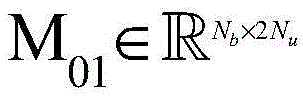

在所述非盲去噪子网中,输入层:DNND将Y和M01的集合作为输入来获得估计的信道矩阵。DNND由BD个残差块
DNND主体的递推关系为:The recursive relationship of the DNN D body is:

中间输出

输出层:通过反转组合,DNND的中间输出Hm生成的去噪信道估计矩阵
损失函数:在非对称学习中,可以估计噪声水平以改进损失函数,以提升DNND的有效性。损失函数表示为:Loss function: In asymmetric learning, the noise level can be estimated to improve the loss function to improve the effectiveness of DNN D. The loss function is expressed as:

其中σ01由公式17得到,
在本发明实施例中,基于GAN的信道估计模型如下:In an embodiment of the present invention, the channel estimation model based on GAN is as follows:
受生成对抗网络结构技术发展的推动,基于CBDNet作为生成器子网络,可以开发GAN-CBDNN用于去噪建模。GAN范式在CBDNet工作时通过训练和拟合生成采样器G,将GAN-CBDN网络的结果与信道进行比较,并纠正判断器D。Driven by the development of generative adversarial network structure technology, based on CBDNet as a generator subnetwork, GAN-CBDNN can be developed for denoising modeling. The GAN paradigm generates a sampler G by training and fitting when CBDNet works, compares the results of the GAN-CBDN network with the channel, and corrects the judge D.
训练判断器D的目的是将训练样本与生成器G生成的样本区分开来,生成器经过判断器的判断,减少样本被误分类的可能性。The purpose of training the judger D is to distinguish the training samples from the samples generated by the generator G. The generator is judged by the judger to reduce the possibility of misclassification of the samples.
生成器网络:为了验证GAN结构的有效性,我们使用CBDNet作为生成器网络。GAND由BG个残差块组成。Generator network: To verify the effectiveness of the GAN structure, we use CBDNet as the generator network. GAN D consists of B G residual blocks.

其中,


其中,σ02为空间不变AWGN的噪声水平,

判别器网络:训练过程将连续极小极大判断过程定义为:Discriminator network: The training process defines the continuous minimax judgment process as:

其中,D是将


图4(a)比较了三种不同的模型,包括MRDN、CBDNet和GAN-CBDN,本发明MRDN可以实现最佳的NMSE性能和最快的收敛。FIG4( a ) compares three different models, including MRDN, CBDNet, and GAN-CBDN. The MRDN of the present invention can achieve the best NMSE performance and the fastest convergence.
图4(a)的横坐标表示循环周期(时间),纵坐标表示NMSE性能(随网络参数的更新而逐步收敛),从图4(a)可以看出在相同NMSE取值情况下,MRDN模型的收敛速度最快,CBDnet模型的收敛速度最慢。The horizontal axis of Figure 4(a) represents the cycle period (time), and the vertical axis represents the NMSE performance (gradually converges with the update of network parameters). It can be seen from Figure 4(a) that under the same NMSE value, the MRDN model converges the fastest and the CBDnet model converges the slowest.
因为GAN-CBDN带来了判断网络的优势,所以表现出比CBDNet更好的性能。训练和离线操作的计算复杂度可以大大降低。此外,增强了信道估计器对不同场景的鲁棒性。MRDN的平均运行时间(以秒为单位)为0.0075,而CBDNet和GAN-CBDN分别为0.0094s和0.0098s,与CBDNet和GAN-CBDN相比,MRDN的训练和离线操作的计算复杂度可以降低。然而,对于几乎相同的计算复杂度,与CBDNet相比,GAN-CBDN可以实现更好的NMSE性能和快速收敛。但与MRDN相比,网络结构的改进并不显着。Because GAN-CBDN brings the advantages of the judgment network, it shows better performance than CBDNet. The computational complexity of training and offline operation can be greatly reduced. In addition, the robustness of the channel estimator to different scenarios is enhanced. The average running time (in seconds) of MRDN is 0.0075, while that of CBDNet and GAN-CBDN is 0.0094s and 0.0098s respectively. Compared with CBDNet and GAN-CBDN, the computational complexity of training and offline operation of MRDN can be reduced. However, for almost the same computational complexity, GAN-CBDN can achieve better NMSE performance and fast convergence compared with CBDNet. But the improvement of the network structure is not significant compared with MRDN.
图4(b)比较了基于MRDN的通道估计器在不同结构下的NMSE性能(例如,CBDNet,GAN-CBDNN,CV-DnCNN)和现有的传统信道估计方法(例如,ADMM,PAPRFAC)。每种方法的模拟结果平均超过300次迭代。Figure 4(b) compares the NMSE performance of MRDN-based channel estimators with different structures (e.g., CBDNet, GAN-CBDNN, CV-DnCNN) and existing traditional channel estimation methods (e.g., ADMM, PAPRFAC). The simulation results of each method are averaged over 300 iterations.
图4(b)的横坐标是信噪比,纵坐标是NMSE,可以看出在相同信噪比条件下MRDN的NMSE效果最好。In Figure 4(b), the horizontal axis is the signal-to-noise ratio, and the vertical axis is the NMSE. It can be seen that under the same signal-to-noise ratio conditions, MRDN has the best NMSE effect.
与GAN-CBDN和CBDNet相比,MRDN结构可以实现更好的NMSE性能,分别提高了5.63dB和4.51dB。与同样基于CNN的CV-DnCNN以及传统的ADMM和PAPRFAC相比,尽管在NMSE上的性能比较显着,但MRDN较低的复杂度使其能够更好地应用。Compared with GAN-CBDN and CBDNet, the MRDN structure can achieve better NMSE performance, which is improved by 5.63dB and 4.51dB respectively. Compared with CV-DnCNN, which is also based on CNN, and traditional ADMM and PAPRFAC, although the performance on NMSE is significant, the lower complexity of MRDN enables it to be better applied.
图4(c)比较了不同数量的特征和RDN的NMSE性能,横坐标是信噪比,纵坐标是NMSE。Figure 4(c) compares the NMSE performance of different numbers of features and RDN, where the horizontal axis is the signal-to-noise ratio and the vertical axis is the NMSE.
由于全局残差密集连接的RDN越多,感知领域越全面。在本发明实施例中,具有80个特征和6个密集连接的RDN结构的MRDN表现更好。因此,准确描述噪声的主要挑战是缺乏神经网络的观察维度和建模能力,例如特征和层。The more RDNs with global residual dense connections, the more comprehensive the perception field. In the embodiment of the present invention, the MRDN with 80 features and 6 densely connected RDN structures performs better. Therefore, the main challenge in accurately describing noise is the lack of observation dimensions and modeling capabilities of neural networks, such as features and layers.
综上所述,本发明实施例所述残差密集网络信道估计模型,利用RIS系统的级联信道的稀疏性,将信道矩阵转化为二维图像,通过所提出的多重残差密集网络(MRDN)可以得到估计信道。与上一代方法相比,MRDN可以在降低信道估计算法复杂度的同时,提高信道估计的性能。仿真结果表明,在与CBDNet和GAN-CBDN相同数量级的复杂度下,提出的MRDN估计器的性能和收敛性要优于CBDNet和GAN-CBDN。In summary, the residual dense network channel estimation model described in the embodiment of the present invention utilizes the sparsity of the cascaded channel of the RIS system to convert the channel matrix into a two-dimensional image, and the estimated channel can be obtained through the proposed multiple residual dense network (MRDN). Compared with the previous generation method, MRDN can improve the performance of channel estimation while reducing the complexity of the channel estimation algorithm. Simulation results show that at the same order of magnitude of complexity as CBDNet and GAN-CBDN, the performance and convergence of the proposed MRDN estimator are better than CBDNet and GAN-CBDN.
本领域内的技术人员应明白,本发明的实施例可提供为方法、系统、或计算机程序产品。因此,本发明可采用完全硬件实施例、完全软件实施例、或结合软件和硬件方面的实施例的形式。而且,本发明可采用在一个或多个其中包含有计算机可用程序代码的计算机可用存储介质(包括但不限于磁盘存储器、CD-ROM、光学存储器等)上实施的计算机程序产品的形式。Those skilled in the art will appreciate that embodiments of the present invention may be provided as methods, systems, or computer program products. Therefore, the present invention may take the form of a complete hardware embodiment, a complete software embodiment, or an embodiment combining software and hardware. Moreover, the present invention may take the form of a computer program product implemented on one or more computer-usable storage media (including but not limited to disk storage, CD-ROM, optical storage, etc.) containing computer-usable program code.
因此,本申请还提出一种计算机可读存储介质,其上存储有计算机程序,该程序被处理器执行时实现如本申请中任一实施例所述的方法。Therefore, the present application also proposes a computer-readable storage medium on which a computer program is stored. When the program is executed by a processor, the method described in any embodiment of the present application is implemented.
进一步地,本申请还提出一种电子设备,包括存储器,处理器及存储在存储器上并可在处理器运行的计算机程序,所述处理器执行所述计算机程序时实现如本申请任一实施例所述的方法。Furthermore, the present application also proposes an electronic device, comprising a memory, a processor, and a computer program stored in the memory and executable on the processor, wherein the processor implements the method described in any embodiment of the present application when executing the computer program.
本发明是参照根据本发明实施例的方法、设备(系统)、和计算机程序产品的流程图和/或方框图来描述的。应理解可由计算机程序指令实现流程图和/或方框图中的每一流程和/或方框、以及流程图和/或方框图中的流程和/或方框的结合。可提供这些计算机程序指令到通用计算机、专用计算机、嵌入式处理机或其他可编程数据处理设备的处理器以产生一个机器,使得通过计算机或其他可编程数据处理设备的处理器执行的指令产生用于实现在流程图一个流程或多个流程和/或方框图一个方框或多个方框中指定的功能的装置。The present invention is described with reference to the flowchart and/or block diagram of the method, device (system), and computer program product according to the embodiment of the present invention. It should be understood that each process and/or box in the flowchart and/or block diagram, as well as the combination of the process and/or box in the flowchart and/or block diagram can be implemented by computer program instructions. These computer program instructions can be provided to a processor of a general-purpose computer, a special-purpose computer, an embedded processor or other programmable data processing device to produce a machine, so that the instructions executed by the processor of the computer or other programmable data processing device produce a device for implementing the functions specified in one or more processes in the flowchart and/or one or more boxes in the block diagram.
这些计算机程序指令也可存储在能引导计算机或其他可编程数据处理设备以特定方式工作的计算机可读存储器中,使得存储在该计算机可读存储器中的指令产生包括指令装置的制造品,该指令装置实现在流程图一个流程或多个流程和/或方框图一个方框或多个方框中指定的功能。These computer program instructions may also be stored in a computer-readable memory that can direct a computer or other programmable data processing device to work in a specific manner, so that the instructions stored in the computer-readable memory produce a manufactured product including an instruction device that implements the functions specified in one or more processes in the flowchart and/or one or more boxes in the block diagram.
这些计算机程序指令也可装载到计算机或其他可编程数据处理设备上,使得在计算机或其他可编程设备上执行一系列操作步骤以产生计算机实现的处理,从而在计算机或其他可编程设备上执行的指令提供用于实现在流程图一个流程或多个流程和/或方框图一个方框或多个方框中指定的功能的步骤。These computer program instructions may also be loaded onto a computer or other programmable data processing device so that a series of operational steps are executed on the computer or other programmable device to produce a computer-implemented process, whereby the instructions executed on the computer or other programmable device provide steps for implementing the functions specified in one or more processes in the flowchart and/or one or more boxes in the block diagram.
在一个典型的配置中,计算设备包括一个或多个处理器(CPU)、输入/输出接口、网络接口和内存。In a typical configuration, a computing device includes one or more processors (CPU), input/output interfaces, network interfaces, and memory.
内存可能包括计算机可读介质中的非永久性存储器,随机存取存储器(RAM)和/或非易失性内存等形式,如只读存储器(ROM)或闪存(flash RAM)。内存是计算机可读介质的示例。The memory may include non-permanent storage in a computer-readable medium, random access memory (RAM) and/or non-volatile memory in the form of read-only memory (ROM) or flash RAM. The memory is an example of a computer-readable medium.
计算机可读介质包括永久性和非永久性、可移动和非可移动媒体可以由任何方法或技术来实现信息存储。信息可以是计算机可读指令、数据结构、程序的模块或其他数据。计算机的存储介质的例子包括,但不限于相变内存(PRAM)、静态随机存取存储器(SRAM)、动态随机存取存储器(DRAM)、其他类型的随机存取存储器(RAM)、只读存储器(ROM)、电可擦除可编程只读存储器(EEPROM)、快闪记忆体或其他内存技术、只读光盘只读存储器(CD-ROM)、数字多功能光盘(DVD)或其他光学存储、磁盒式磁带,磁带磁磁盘存储或其他磁性存储设备或任何其他非传输介质,可用于存储可以被计算设备访问的信息。按照本文中的界定,计算机可读介质不包括暂存电脑可读媒体(transitory media),如调制的数据信号和载波。Computer readable media include permanent and non-permanent, removable and non-removable media that can be implemented by any method or technology to store information. Information can be computer readable instructions, data structures, program modules or other data. Examples of computer storage media include, but are not limited to, phase change memory (PRAM), static random access memory (SRAM), dynamic random access memory (DRAM), other types of random access memory (RAM), read-only memory (ROM), electrically erasable programmable read-only memory (EEPROM), flash memory or other memory technology, compact disk read-only memory (CD-ROM), digital versatile disk (DVD) or other optical storage, magnetic cassettes, magnetic tape magnetic disk storage or other magnetic storage devices or any other non-transmission media that can be used to store information that can be accessed by a computing device. As defined herein, computer readable media does not include temporary computer readable media (transitory media), such as modulated data signals and carrier waves.
需要说明的是,术语“包括”、“包含”或者其任何其他变体意在涵盖非排他性的包含,从而使得包括一系列要素的过程、方法、商品或者设备不仅包括那些要素,而且还包括没有明确列出的其他要素,或者是还包括为这种过程、方法、商品或者设备所固有的要素。在没有更多限制的情况下,由语句“包括一个……”限定的要素,并不排除在包括所述要素的过程、方法、商品或者设备中还存在另外的相同要素。It should be noted that the terms "include", "comprises" or any other variations thereof are intended to cover non-exclusive inclusion, so that a process, method, commodity or device including a series of elements includes not only those elements, but also other elements not explicitly listed, or also includes elements inherent to such process, method, commodity or device. In the absence of further restrictions, the elements defined by the sentence "comprises a ..." do not exclude the existence of other identical elements in the process, method, commodity or device including the elements.
以上所述仅为本发明的实施例而已,并不用于限制本发明。对于本领域技术人员来说,本发明可以有各种更改和变化。凡在本发明的精神和原理之内所作的任何修改、等同替换、改进等,均应包含在本发明的权利要求范围之内。The above description is only an embodiment of the present invention and is not intended to limit the present invention. For those skilled in the art, the present invention may have various modifications and variations. Any modification, equivalent substitution, improvement, etc. made within the spirit and principle of the present invention should be included in the scope of the claims of the present invention.
Claims (10)


Priority Applications (1)
| Application Number | Priority Date | Filing Date | Title |
|---|---|---|---|
| CN202111266956.2A CN114124623B (en) | 2021-10-28 | 2021-10-28 | A wireless communication channel estimation method and device |
Applications Claiming Priority (1)
| Application Number | Priority Date | Filing Date | Title |
|---|---|---|---|
| CN202111266956.2A CN114124623B (en) | 2021-10-28 | 2021-10-28 | A wireless communication channel estimation method and device |
Publications (2)
| Publication Number | Publication Date |
|---|---|
| CN114124623A CN114124623A (en) | 2022-03-01 |
| CN114124623B true CN114124623B (en) | 2023-07-07 |
Family
ID=80377376
Family Applications (1)
| Application Number | Title | Priority Date | Filing Date |
|---|---|---|---|
| CN202111266956.2A Active CN114124623B (en) | 2021-10-28 | 2021-10-28 | A wireless communication channel estimation method and device |
Country Status (1)
| Country | Link |
|---|---|
| CN (1) | CN114124623B (en) |
Families Citing this family (10)
| Publication number | Priority date | Publication date | Assignee | Title |
|---|---|---|---|---|
| CN114567527B (en) * | 2022-03-10 | 2023-04-28 | 西华大学 | A Reconfigurable Smart Surface-Assisted Superposition Guided Fusion Learning Channel Estimation Method |
| CN115001551B (en) * | 2022-05-05 | 2024-03-22 | 东南大学 | Robust transceiving joint design method for intelligent super-surface auxiliary MIMO system |
| CN115499276B (en) * | 2022-09-15 | 2023-04-21 | 中国人民解放军战略支援部队航天工程大学 | Channel estimation method, system and product of intelligent reflector auxiliary communication system |
| CN115833974B (en) * | 2022-11-07 | 2025-05-23 | 山东大学 | Channel Estimation Method for RIS Communication System Based on Improved Residual Shrinkage Network |
| TWI846264B (en) * | 2023-01-10 | 2024-06-21 | 緯創資通股份有限公司 | Communication method based on quantum channel estimation and base station |
| CN116418635B (en) * | 2023-04-06 | 2025-09-19 | 中国电子科技集团公司第五十四研究所 | Deep learning-assisted large-scale MIMO channel estimation method |
| CN118869140A (en) * | 2023-04-27 | 2024-10-29 | 中兴通讯股份有限公司 | Signal detection method, signal transmission method, communication device and storage medium |
| CN116633732B (en) * | 2023-06-19 | 2024-06-21 | 中通服中睿科技有限公司 | A channel estimation method for intelligent reflector-assisted communication system based on deep residual learning |
| CN117454094B (en) * | 2023-12-21 | 2024-04-19 | 天津大学 | Blind denoising method for radar echo signals |
| CN119906609A (en) * | 2025-01-08 | 2025-04-29 | 天翼安全科技有限公司 | A method, device and electronic device for outputting channel evaluation results |
Citations (6)
| Publication number | Priority date | Publication date | Assignee | Title |
|---|---|---|---|---|
| CN108039905A (en) * | 2017-12-20 | 2018-05-15 | 中国信息通信研究院 | The system of selection of bidirectional relay system duplex mode and device based on decoding forwarding |
| CN110855585A (en) * | 2019-09-30 | 2020-02-28 | 北京交通大学 | A Channel Estimation Method for Millimeter-Wave Massive MIMO Systems |
| CN111865843A (en) * | 2020-05-27 | 2020-10-30 | 东南大学 | A Channel Estimation Method for Hybrid Message Passing in Massive MIMO-OFDM Systems |
| CN112968853A (en) * | 2021-01-29 | 2021-06-15 | 北京交通大学 | Multi-user access detection and channel estimation method for MMTC (multimedia messaging and control) system |
| WO2021121585A1 (en) * | 2019-12-18 | 2021-06-24 | Telefonaktiebolaget Lm Ericsson (Publ) | Methods for cascade federated learning for telecommunications network performance and related apparatus |
| CN113179232A (en) * | 2021-04-22 | 2021-07-27 | 南通大学 | Channel estimation method of passive intelligent reflecting surface based on deep learning |
Family Cites Families (1)
| Publication number | Priority date | Publication date | Assignee | Title |
|---|---|---|---|---|
| US9425882B2 (en) * | 2013-06-28 | 2016-08-23 | Magnolia Broadband Inc. | Wi-Fi radio distribution network stations and method of operating Wi-Fi RDN stations |
-
2021
- 2021-10-28 CN CN202111266956.2A patent/CN114124623B/en active Active
Patent Citations (6)
| Publication number | Priority date | Publication date | Assignee | Title |
|---|---|---|---|---|
| CN108039905A (en) * | 2017-12-20 | 2018-05-15 | 中国信息通信研究院 | The system of selection of bidirectional relay system duplex mode and device based on decoding forwarding |
| CN110855585A (en) * | 2019-09-30 | 2020-02-28 | 北京交通大学 | A Channel Estimation Method for Millimeter-Wave Massive MIMO Systems |
| WO2021121585A1 (en) * | 2019-12-18 | 2021-06-24 | Telefonaktiebolaget Lm Ericsson (Publ) | Methods for cascade federated learning for telecommunications network performance and related apparatus |
| CN111865843A (en) * | 2020-05-27 | 2020-10-30 | 东南大学 | A Channel Estimation Method for Hybrid Message Passing in Massive MIMO-OFDM Systems |
| CN112968853A (en) * | 2021-01-29 | 2021-06-15 | 北京交通大学 | Multi-user access detection and channel estimation method for MMTC (multimedia messaging and control) system |
| CN113179232A (en) * | 2021-04-22 | 2021-07-27 | 南通大学 | Channel estimation method of passive intelligent reflecting surface based on deep learning |
Non-Patent Citations (5)
| Title |
|---|
| Frequency selective millimeter‐wave channel estimation based on subspace enhancement algorithms;Majid Shakhsi Dastgahian;Mohammad Naseri Tehrani;International Journal of Communication Systems;第32卷(第18期);全文 * |
| Pengyue Li ; Jiandong Tian ; Yandong Tang ; Guolin Wang ; Chengdong Wu.Deep Retinex Network for Single Image Dehazing.IEEE Transactions on Image Processing.2020,第30卷全文. * |
| STC-OFDM系统中的信道估计算法;焦慧颖;安建平;;计算机工程(第06期);全文 * |
| 一种用于协作通信系统的频率同步算法;李蓝;崔苗;张广驰;;计算机工程与应用(03);全文 * |
| 基于AKAIKE信息论准则的无人机OFDM信道估计算法;何剑;王永生;张岳彤;电路与系统学报(第001期);全文 * |
Also Published As
| Publication number | Publication date |
|---|---|
| CN114124623A (en) | 2022-03-01 |
Similar Documents
| Publication | Publication Date | Title |
|---|---|---|
| CN114124623B (en) | A wireless communication channel estimation method and device | |
| CN111817768B (en) | Channel estimation method for intelligent reflecting surface wireless communication | |
| CN114900400A (en) | Joint sparse channel estimation method based on intelligent reflector assisted Internet of things | |
| CN114900219B (en) | Intelligent reflection surface-assisted information security transmission method and system | |
| CN104698430B (en) | It is a kind of for carrying the high-precision angle estimating method based on virtual antenna array | |
| Awan et al. | Detection for 5G-NOMA: An online adaptive machine learning approach | |
| CN114884775A (en) | Deep learning-based large-scale MIMO system channel estimation method | |
| CN113890798B (en) | Structured sparse estimation method and device for RIS cascade channel multi-user combination | |
| Feng et al. | mmWave RIS-assisted SIMO channel estimation based on global attention residual network | |
| US10579702B2 (en) | Systems and methods for signal processing using coordinate descent techniques for unit modulus least squares (UMLS) and unit-modulus quadratic program (UMQP) | |
| CN118984175B (en) | Multi-RIS assisted semi-blind joint channel estimation and symbol detection method and system | |
| CN113810096B (en) | Uplink transmission method and system for large-scale MIMO satellite mobile communication | |
| CN115856767B (en) | A Reconfigurable Smart Metasurface-Assisted Method for Wave Arrival Direction Estimation | |
| CN106130938B (en) | Multi-user joint channel estimation method for TDD large-scale MIMO system | |
| CN118677729B (en) | A channel estimation method, apparatus, electronic device, storage medium, and product. | |
| CN107181705A (en) | A kind of half-blind channel estimating method and system | |
| CN118869023A (en) | A space-time joint extrapolation method for 6G near-field non-stationary channels based on deep learning | |
| You et al. | Exploiting angular spread in channel estimation of millimeter wave MIMO system | |
| WO2024059969A1 (en) | Channel estimation method, apparatus and system | |
| Abdelmaksoud et al. | Enhanced Channel Estimation Performance-Based Intelligent Reflecting Surface Massive MIMO Systems | |
| CN119210539B (en) | A codebook-free near-field beamforming method, device, equipment, medium and product based on deep learning | |
| CN118890069B (en) | A RIS-assisted massive MIMO deep learning approach | |
| CN121261753B (en) | A method and apparatus for estimating angle of arrival based on FMx-RIS and eigenvalues | |
| CN119544001B (en) | Beam focusing optimization method based on dense connection expansion self-coding element learning | |
| CN105553899A (en) | Signal detection method and device based on approximate solution solving of linear equation group |
Legal Events
| Date | Code | Title | Description |
|---|---|---|---|
| PB01 | Publication | ||
| PB01 | Publication | ||
| SE01 | Entry into force of request for substantive examination | ||
| SE01 | Entry into force of request for substantive examination | ||
| GR01 | Patent grant | ||
| GR01 | Patent grant |