Disclosure of Invention
The invention aims to solve the technical defects that the existing radio frequency watermark scheme has insufficient safety and is easy to be acquired by an illegal attacker, and provides a high-reliability radio frequency hidden watermark signal authentication method and system.
In order to solve the technical problems, the technical scheme of the invention is as follows:
a high-reliability radio frequency hidden watermark signal authentication method comprises a transmitting end modulation process and a receiving end demodulation process,
the transmitter modulation process comprises the steps of:
a1: generating a digital summary of the carrier signal using a hash function;
a2: encrypting the digital abstract by using a lightweight encryption algorithm, and generating a watermark signal by using a secret key as a spread spectrum code to spread and encrypt the digital abstract;
a3: embedding a watermark signal into the carrier signal through modulation and differential constellation map shift and then sending;
the receiving end demodulation process comprises the following steps:
b1: after receiving the composite signal containing the watermark signal, demodulating a carrier signal and the watermark signal;
b2: demodulating and decrypting the recovered watermark signal to obtain a decrypted first digital abstract estimation;
b3: demodulating the restored carrier signal to obtain the estimation of the carrier signal bit, and performing hash operation to obtain a second digital abstract estimation;
b4: comparing the difference and the identity of the first digital abstract estimation and the second digital abstract estimation to judge the legality of the sending identity and the integrity of the sent information, and if the two abstract estimations are the same, the sent information is complete and is not tampered; otherwise, the sending end is considered to be illegal, and the received information is discarded.
Wherein, in the step A1, let bxRepresenting a user data bit sequence, also called a carrier bit sequence, i.e. a carrier signal, due to the need to carry watermark information; using a hash function on the carrier signal bxAnd carrying out Hash operation to generate a digital abstract of the carrier signal, wherein the digital abstract is specifically represented as follows:
bg=g(bx)
wherein g (·) represents a hash algorithm.
Wherein, in the step A2, b isgCarrying out primary light weight encryption; the specific process is as follows:
if p represents the encryption and decryption key, the length is 2l, fk(x) Representing a binary addition operation, the expression is
Where k, x represent a sequence of length x, i.e. k ═ k
1,k
2,...,k
n],x=[x
1,x
2,...,x
n],
Representing modulo two addition, the encryption process is represented as:
Encryption:be=Ep(bg)=fg(p)(bg)
wherein g (p) represents the output result of the hash operation on p; at this point, the encrypted digital abstract b is obtainede。
Wherein, in the step A2, the encrypted digital digest b is spread by using the key as the spreading codeeGenerating a watermark signal bwThe process specifically comprises the following steps:
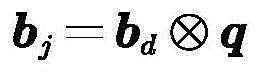
firstly, a unipolar binary bit sequence p, beConversion into bipolar binary sequences q, bdWherein the elements p, b in the sequencee∈{0,1},q,bdE { -1, +1 }; the process of sequence spreading is then expressed as:
wherein
Represents the kronecker product; then b is to
jConversion to unipolar binary bits b
wAnd obtaining the embedded watermark sequence.
Wherein, in the step A3, the carrier signal b
xAnd a watermark signal b with a carrier digest signal hidden
wAll adopt QPSK modulation to obtain a carrier symbol vector x and a watermark symbol vector w with the length of l, namely
After modulation, the carrier symbol vector x and the watermark symbolThe number vector W is repeated m times to construct modulation symbol matrices X and W, respectively, i.e. each column of X and W is X and W,
then, embedding the watermark symbol matrix into the carrier symbol matrix by using a differential constellation diagram shifting method, and making the information symbol matrix embedded with the watermark be S, so as to obtain:
wherein s is
r,c,x
r,c,w
r,cRespectively representing elements at the position of the r row and the c column of the matrix S, X and W;
alpha is the ratio of the watermark symbol energy to the total energy of the embedded watermark symbol, represents the embedding strength, and is generally appointed to be less than 0.5 in order to hide the watermark information and reduce the sharing of the watermark to the carrier energy;
and finally, after the information symbol S embedded with the watermark is subjected to inverse fast Fourier transform and added with a cyclic prefix, the sending end maps the information symbol S into a corresponding wireless frame and sends the information symbol S out.
In step B1, after the receiving end receives the composite signal containing the watermark signal, the cyclic prefix is removed first, and then fast fourier transform is performed to obtain an information symbol matrix Y; if the frequency domain response matrix of the wireless channel in the transmission process is H, the frequency domain response matrix is expressed as H ═ H by using a column vector1,h2,...,hm]Then Y is expressed as:
Y=H·S+N
wherein two matrixes participating in the operation are multiplied by bit, N represents a Gaussian white noise matrix attached to a signal after passing through a wireless channel,
the elements in the matrix obey a mean of 0 and a variance of 2 σ
2A complex Gaussian distribution of (i.e.
Then, the Y is subjected to frequency domain equalization to obtain the estimation of an S matrix
Assuming that an ideal channel estimate is obtained, then
Is shown as
Wherein/represents the matrix division by bit; then, a differential watermark extraction is performed, combining the repeatedly transmitted symbols, extracting an estimate of the carrier signal and the watermark signal, respectively denoted as
And
the process of differential watermark extraction and merging repeated symbols is represented as:
wherein
Representation matrix
The column vector of the i-th column,
k 1, 2.
Wherein, in the step B2, the recovered watermark signal is processed
Performing joint QPSK demodulation to obtain sumEstimation of secret summary information
Then, the first digital abstract estimation is obtained by decryption
The specific process is as follows:
joint QPSK demodulation: the key p is firstly subjected to single-polarity and double-polarity conversion, a unipolar binary bit sequence is converted into a bipolar binary sequence q, then the key p is subjected to serial-parallel conversion, two sequences are output and multiplied by the real part and the imaginary part of the recovered watermark signal respectively, and then summation is carried out, wherein the specific expression is as follows:
wherein, w
iRepresents the ith element in w; then making maximum likelihood judgment on the summation result, if the summation result is greater than 0, extracting one bit
Otherwise, if the result of the summation is less than 0, then
Joint QPSK demodulation
Then, it is decrypted to obtain the first digital abstract estimation
The process of decryption is represented as:
wherein f is
-1Represents the inverse operation of f; since f is a modulo two addition, the inverse of f
-1Only the ciphertext need be compared
Modulo two plus one sequence g (p), i.e.
Wherein, in the step B3, the recovered carrier signal is processed
Estimation of carrier information bits by QPSK demodulation
Then to
Performing a hash operation to obtain a second digital digest estimate
Wherein the carrier signal theoretical BER is derived as:
wherein, PxRepresenting the error probability of the carrier bit, gamma representing the signal-to-noise ratio SNR; and the theoretical BER of the watermark signal is:
wherein P iswRepresenting the error probability of the watermark bit.
The scheme also provides a high-reliability radio frequency hidden watermark signal authentication system which comprises a transmitting end and a receiving end; wherein:
the transmitting end performs the operations as described in step A1-step A3;
the receiving end performs the operations as described in step B1-step B4.
Compared with the prior art, the technical scheme of the invention has the beneficial effects that:
the invention provides a high-reliability radio frequency hidden watermark signal authentication method and system, summary information for authentication is generated through a Hash function, and then the authentication information is protected and covered by a lightweight encryption and spread spectrum method, so that the system not only can identify the legality of the source identity of a signal, but also can judge the integrity of received information, and a malicious attacker is difficult to obtain the authentication information in a watermark; the receiver performs combined QPSK demodulation on the watermark symbols, so that the error rate performance loss caused by multiple judgments is avoided; the watermark sequence is spread on the basis of the differential watermark, so that the reliability of the watermark is improved, and meanwhile, the interference to a carrier signal is not introduced.
Detailed Description
The drawings are for illustrative purposes only and are not to be construed as limiting the patent;
for the purpose of better illustrating the embodiments, certain features of the drawings may be omitted, enlarged or reduced, and do not represent the size of an actual product;
it will be understood by those skilled in the art that certain well-known structures in the drawings and descriptions thereof may be omitted.
The technical solution of the present invention is further described below with reference to the accompanying drawings and examples.
Example 1
As shown in FIG. 1, the present invention provides a high-reliability RF concealed watermark signal authentication method, which includes a transmitting end modulation process and a receiving end demodulation process,
the transmitter modulation process comprises the steps of:
a1: generating a digital summary of the carrier signal using a hash function;
a2: encrypting the digital abstract by using a lightweight encryption algorithm, and generating a watermark signal by using a secret key as a spread spectrum code to spread and encrypt the digital abstract;
a3: embedding a watermark signal into the carrier signal through modulation and differential constellation map shift and then sending;
the receiving end demodulation process comprises the following steps:
b1: after receiving the composite signal containing the watermark signal, demodulating a carrier signal and the watermark signal;
b2: demodulating and decrypting the recovered watermark signal to obtain a decrypted first digital abstract estimation;
b3: demodulating the restored carrier signal to obtain the estimation of the carrier signal bit, and performing hash operation to obtain a second digital abstract estimation;
b4: comparing the validity of the sending identity with the integrity of the sent information by the difference and identity pair of the first digital abstract estimation and the second digital abstract estimation, and if the two abstract estimations are the same, the sent information is complete and is not tampered; otherwise, the sending end is considered to be illegal, and the received information is discarded.
More specifically, as shown in fig. 2, the present invention further provides a high-reliability rf hidden watermark signal authentication system, which includes a transmitting end and a receiving end; wherein:
the transmitting end performs the operations as described in step A1-step A3;
the receiving end performs the operations as described in step B1-step B4.
In the specific implementation process, the summary information for authentication is generated through a hash function, and then the authentication information is protected and covered by a lightweight encryption and spread spectrum method, so that the system can not only identify the legality of the identity of a signal source, but also judge the integrity of received information, and a malicious attacker is difficult to obtain the authentication information in a watermark; the receiver performs combined QPSK demodulation on the watermark symbols, so that the error rate performance loss caused by multiple judgments is avoided; the watermark sequence is spread on the basis of the differential watermark, so that the reliability of the watermark is improved, and meanwhile, the interference to a carrier signal is not introduced.
Example 2
More specifically, on the basis of embodiment 1, the workflow and principle of the system are described from the transmitter and the receiver, respectively.
Transmitter section
Transmitter architecture as shown in fig. 2, bxRepresenting a sequence of user data bits, also called carrier bits, because watermark information is to be carried. The transmitting end inputs the carrier bit sequence into the Hash function to obtain the digital abstract b of the carrier informationhThen, the summary information is protected by light weight encryption, and then the encrypted information is covered by spread spectrum operation to obtain the watermark sequence b with the same length as the carrier bit sequencew. In the scheme bxGeneration of bwThe detailed description of the three-step process is as follows.
1. Hash operation
The hash function is a type of function that maps an input of an arbitrary length to a fixed length, and the output of the function is called a hash value or digest corresponding to the input. The encrypted hash function is used in the field of information security, and it is not feasible to generate a message with a given hash value unidirectionally, and a small change to input information will greatly affect the output result, and is commonly used for digital signature and information verification. Using a cryptographic hash function on the carrier bit bxAnd carrying out Hash operation to generate an abstract of the carrier information, so that the watermark not only has the function of authenticating identity, but also can identify whether the sent information is complete and is not changed. The process of generating the summary can be formulated as:
bg=g(bx)
wherein g (-) can select Message Digest 5(MD5), Secure Hash Algorithm (SHA), and other algorithms.
2. Lightweight encryption
Generating a digital summary bgThen, for bgAnd carrying out one-time light encryption. The encryption algorithm is an encryption algorithm of a symmetric key system. If p represents the encryption and decryption key, the length is 2l, fk(x) Representing a binary addition operation, the actual expression being
Where k, x represent a sequence of length n, i.e. k ═ k
1,k
2,...,k
n],x=[x
1,x
2,...,x
n],
Representing modulo two addition, the encryption process in the scheme can be represented as
Encryption:be=Ep(bg)=fg(p)(bg)
Where g (p) represents the output of the hash operation on p.
3. Sequence spread spectrum
After encrypting the generated digital digest, the encrypted information b is then subjected to sequence spreadingeFurther masking to generate a watermark sequence bw. If the unipolar binary bit sequence p, b is firste(elements p, b in the sequence)eE {0, 1}) into a bipolar binary sequence q, bd(q,bdE { -1, +1}) the process of sequence spreading can be formulated as
Wherein
Representing the kronecker product. Then b is to
jConversion to unipolar binary bits b
wAnd obtaining the embedded watermark sequence.
Through Hash operation, light weight encryption and orderColumn spreading three steps, possibly from the carrier bit information b
xObtains watermark sequence b with hidden carrier abstract information
w. In the scheme proposed herein, both the user information and the watermark information are modulated by QPSK to obtain a vector of carrier symbols x and a vector of watermark symbols w, the length of which is l, i.e.
After modulation, the carrier symbol vector X and the watermark symbol vector W are repeated m times, and modulation symbol matrices X and W are respectively constructed, namely X and W are respectively arranged in each column of X and W,
and then embedding the watermark symbol matrix into the carrier symbol matrix by using a differential constellation diagram shifting method. Let the information symbol matrix with embedded watermark be S, then obtain
Wherein S
r,c,x
r,c,w
r,cRespectively representing elements at the position of the r row and the c column of the matrix S, X and W;
alpha is the ratio of the watermark symbol energy to the total energy of the embedded watermark symbol, and represents the embedding strength, and usually, alpha is less than 0.5 in order to hide the watermark information and reduce the sharing of the watermark to the carrier energy.
Then, after Inverse Fast Fourier Transform (IFFT) and cyclic prefix addition, the information symbol S with the embedded watermark is mapped to a corresponding radio frame by a resource mapping module and sent.
Receiver part
As shown in fig. 2, after passing through a wireless channel, a transmission signal is received by a receiving end, and a cyclic prefix is removed, and then Fast Fourier Transform (FFT) is performed to obtain an information symbol matrix Y. If notThe frequency domain response matrix of the line channel is H, expressed as H ═ H with a column vector1,h2,...,hm]Then Y can be represented as
Y=H·S+N
Wherein two matrixes participating in the operation are multiplied by bit, N represents a Gaussian white noise matrix attached to a signal after passing through a wireless channel,
the elements in the matrix obey a mean of 0 and a variance of 2 σ
2A complex Gaussian distribution of (i.e.
Then, the Y is subjected to frequency domain equalization to obtain the estimation of an S matrix
Assuming that an ideal channel estimate is obtained, then
Can be expressed as
Where/represents a bitwise division of the matrix.
Then, a differential watermark extraction is performed, the symbols that are repeatedly transmitted are combined, and estimates of the carrier symbol and the watermark symbol are extracted, respectively denoted as
And
the process of differential watermark extraction and merging of repeated symbols can be expressed as
Wherein
Representation matrix
The column vector of the i-th column,
k 1, 2.
Then, the abstract estimation of the carrier information is obtained by two paths: one path is for the recovered watermark symbol
Estimation of cryptographic summary information by performing joint QPSK demodulation
Then, the first estimation of the abstract information is obtained by decryption
The process of joint QPSK demodulation is shown in fig. 3, where a key p is first subjected to unipolar and bipolar conversion, and then converted from a unipolar binary bit sequence to a bipolar binary sequence q, and then subjected to serial-parallel conversion to output two sequences, which are respectively multiplied by the real part and the imaginary part of the recovered watermark symbol, and summed. This process is formulated as follows
Wherein w
iRepresenting the ith element in w. Then making maximum likelihood judgment on the summation result, if the summation result is greater than 0, extracting one bit
Otherwise, if the result of the summation is less than 0, then
Joint QPSKDemodulated to obtain
Then, it is decrypted to obtain the estimation of the digital abstract
The process of decryption can be expressed as
Wherein f is
-1The inverse operation of f is shown. Since f is a modulo two addition, the inverse of f
-1Only the ciphertext need be compared
Modulo two and one sequence g (p), i.e.
The other path is for the recovered carrier symbol
Estimation of carrier information bits by QPSK demodulation
Then to
Performing a hash operation to obtain another estimate of the digest
Namely, it is
Final comparison
And
the method comprises the following steps of judging the legality of the sending identity and the integrity of the sent information: if the two are the same, the sending end is considered to be legal, the sending information is complete and is not tampered; otherwise, the sending terminal is considered to be illegal, and the received information is discarded.
The theoretical BER of the carrier signal can be deduced to
Wherein P isxRepresenting the error probability of the carrier bit and gamma representing the signal-to-noise ratio SNR. Whereas the theoretical BER of the watermark signal is:
wherein P iswRepresenting the error probability of the watermark bit.
Example 3
In order to more fully illustrate the beneficial effects of the present invention, the effectiveness and advancement of the present invention are further illustrated on the basis of the embodiments 1 and 2 by combining the simulation analysis and the results.
The high-reliability radio frequency hidden watermark signal authentication scheme provided by the invention is realized through simulation, and the theoretical performance of the reliability of the scheme is analyzed and verified. Simulations compare the performance results of the DCS scheme with the scheme herein and the ICS scheme under AWGN channel conditions. In a simulated implementation detail, a 16-point IFFT-FFT is performed for each OFDM frame, with 12 active subcarriers.
For each SNR value, at least 10 is simulated5One OFDM frame. In addition, when different radio frequency watermark schemes are compared, the watermark embedding strength alpha is uniformly set to be 0.2, and the repeated transmission time m is set to be 2.
As shown in fig. 4, fig. 4 shows the carrier signal BER performance results of the proposed scheme of the present invention and the ICS and DCS schemes under AWGN channel condition, from the simulated BER curve results, the carrier signal BER performance of the proposed scheme herein is better than that of the ICS scheme, is equal to that of the DCS scheme, and the simulation results under AWGN channel are consistent with theoretical analysis.
For the watermark signal part, as can be known from the theoretical BER expression of the watermark signal, the BER of the watermark signal is affected by the length 2l of the key p. Order to
The spreading ratio of the watermark sequence, that is, the code rate of the summary information in the watermark sequence is represented. Different values of eta are set in the simulation for experiment, and the influence of the values of eta on the BER performance of the watermark signal is shown.
Fig. 5 shows the results of BER performance of watermark signals for this scheme and ICS, DCS schemes, respectively, under AWGN channel conditions. For watermark BER curves of different schemes, the BER performance of the scheme is superior to that of an ICS scheme and a DCS scheme; for the BER curve in the scheme, the smaller the value of eta is, the better the watermark BER performance is, and the smaller the value of eta is
The BER performance is improved by 3dB, which is consistent with the BER performance expression analyzed by theory.
It should be understood that the above-described embodiments of the present invention are merely examples for clearly illustrating the present invention, and are not intended to limit the embodiments of the present invention. Other variations and modifications will be apparent to persons skilled in the art in light of the above description. And are neither required nor exhaustive of all embodiments. Any modification, equivalent replacement, and improvement made within the spirit and principle of the present invention should be included in the protection scope of the claims of the present invention.