CN110336657B - Optical OFDM dynamic key generation method based on channel characteristics - Google Patents

Optical OFDM dynamic key generation method based on channel characteristics Download PDF

Info

Publication number
CN110336657B
CN110336657B CN201910592164.0A CN201910592164A CN110336657B CN 110336657 B CN110336657 B CN 110336657B CN 201910592164 A CN201910592164 A CN 201910592164A CN 110336657 B CN110336657 B CN 110336657B
Authority
CN
China
Prior art keywords
sequence
key
random
channel characteristics
channel
Prior art date
Legal status (The legal status is an assumption and is not a legal conclusion. Google has not performed a legal analysis and makes no representation as to the accuracy of the status listed.)
Expired - Fee Related
Application number
CN201910592164.0A
Other languages
Chinese (zh)
Other versions
CN110336657A (en
Inventor
吴雅婷
李春华
张倩武
李正璇
孙彦赞
王涛
Current Assignee (The listed assignees may be inaccurate. Google has not performed a legal analysis and makes no representation or warranty as to the accuracy of the list.)
University of Shanghai for Science and Technology
Original Assignee
University of Shanghai for Science and Technology
Priority date (The priority date is an assumption and is not a legal conclusion. Google has not performed a legal analysis and makes no representation as to the accuracy of the date listed.)
Filing date
Publication date
Application filed by University of Shanghai for Science and Technology filed Critical University of Shanghai for Science and Technology
Priority to CN201910592164.0A priority Critical patent/CN110336657B/en
Publication of CN110336657A publication Critical patent/CN110336657A/en
Application granted granted Critical
Publication of CN110336657B publication Critical patent/CN110336657B/en
Expired - Fee Related legal-status Critical Current
Anticipated expiration legal-status Critical

Links

Images

Classifications

    • HELECTRICITY
    • H04ELECTRIC COMMUNICATION TECHNIQUE
    • H04BTRANSMISSION
    • H04B10/00Transmission systems employing electromagnetic waves other than radio-waves, e.g. infrared, visible or ultraviolet light, or employing corpuscular radiation, e.g. quantum communication
    • H04B10/70Photonic quantum communication
    • HELECTRICITY
    • H04ELECTRIC COMMUNICATION TECHNIQUE
    • H04LTRANSMISSION OF DIGITAL INFORMATION, e.g. TELEGRAPHIC COMMUNICATION
    • H04L9/00Cryptographic mechanisms or cryptographic arrangements for secret or secure communications; Network security protocols
    • H04L9/001Cryptographic mechanisms or cryptographic arrangements for secret or secure communications; Network security protocols using chaotic signals
    • HELECTRICITY
    • H04ELECTRIC COMMUNICATION TECHNIQUE
    • H04LTRANSMISSION OF DIGITAL INFORMATION, e.g. TELEGRAPHIC COMMUNICATION
    • H04L9/00Cryptographic mechanisms or cryptographic arrangements for secret or secure communications; Network security protocols
    • H04L9/08Key distribution or management, e.g. generation, sharing or updating, of cryptographic keys or passwords
    • H04L9/0861Generation of secret information including derivation or calculation of cryptographic keys or passwords
    • H04L9/0869Generation of secret information including derivation or calculation of cryptographic keys or passwords involving random numbers or seeds
    • HELECTRICITY
    • H04ELECTRIC COMMUNICATION TECHNIQUE
    • H04LTRANSMISSION OF DIGITAL INFORMATION, e.g. TELEGRAPHIC COMMUNICATION
    • H04L9/00Cryptographic mechanisms or cryptographic arrangements for secret or secure communications; Network security protocols
    • H04L9/08Key distribution or management, e.g. generation, sharing or updating, of cryptographic keys or passwords
    • H04L9/0891Revocation or update of secret information, e.g. encryption key update or rekeying

Landscapes

  • Engineering & Computer Science (AREA)
  • Computer Networks & Wireless Communication (AREA)
  • Signal Processing (AREA)
  • Computer Security & Cryptography (AREA)
  • Physics & Mathematics (AREA)
  • Optics & Photonics (AREA)
  • Electromagnetism (AREA)
  • Optical Communication System (AREA)

Abstract

本发明公开了基于信道特性的光OFDM动态密钥生成方法。本方法实现的步骤为:(1)通信双方分别生成一段随机探测信号,同时发送给对方;(2)通信双方接收到步骤一中的探测信号后各自估计信道特性;(3)通信双方各自取步骤二中所得到的各个子载波信道特性的相位值进行量化并生成一段二进制序列;(4)通信双方将上述本地生成的随机探测信号与对方发送过来的随机探测信号以及步骤三各自量化后的相位二进制序列依次进行异或得到最终所需的动态密钥。该方法有效利用了通信双方的信道特性以及本地私有的随机二进制信号动态地改变密钥,并有效地提高密钥的随机性,所获得密钥可以进行物理层加密相关操作,适用性强,保密能力突出。

Figure 201910592164

The invention discloses an optical OFDM dynamic key generation method based on channel characteristics. The steps implemented by the method are: (1) both parties in the communication generate a random probe signal and send it to the other party at the same time; (2) the two parties in the communication estimate the channel characteristics after receiving the probe signal in step 1; (3) the two parties in the communication take The phase values of the channel characteristics of each sub-carrier obtained in step 2 are quantized and a binary sequence is generated; (4) both parties in the communication quantify the above-mentioned locally generated random detection signal, the random detection signal sent by the other party, and the quantized signal in step 3. The phase binary sequence is XORed in turn to obtain the final required dynamic key. The method effectively utilizes the channel characteristics of both communication parties and the local private random binary signal to dynamically change the key, and effectively improves the randomness of the key. The obtained key can be used for physical layer encryption related operations, with strong applicability and confidentiality. Ability is outstanding.

Figure 201910592164

Description

Optical OFDM dynamic key generation method based on channel characteristics
Technical Field
The invention provides a channel characteristic-based optical OFDM dynamic key generation method, and provides a dynamic key generation scheme for optical OFDM physical layer encryption.
Background
With the development of high-speed data services such as IPTV, high-definition television, large-scale interactive network games, etc., the bandwidth requirement of the access network will increase sharply. In recent years, Orthogonal Frequency Division Multiplexing (OFDM) modulation has been introduced into optical fiber communication with advantages of strong dispersion resistance, high spectrum utilization rate, and the like. At the same time, it can be conveniently processed by Digital Signal Processing (DSP). In addition, the direct detection optical OFDM system (DD-OOFDM) has the advantages of simple structure, flexible dynamic bandwidth allocation, transparent heterogeneous services, good compatibility with the existing network, and the like, and thus has a great potential in the next generation optical access network. As the physical layer of optical access networks is susceptible to various attacks, the physical layer security issues become increasingly important as the capacity of users and networks increases dramatically. Previous approaches use encryption protocols to encrypt data frames, placing security issues at a higher level of the network, and thus building a security scheme based on an unsecured physical layer is risky.
Investigation of the existing documents shows that most of the existing optical OFDM physical layer encryption schemes use chaotic sequences to scramble OFDM symbol blocks in frequency domain and time domain. Document 1 Zhang L, Xin X, Liu B, et al, physical-enhanced secure in an OFDM-PON [ J ]. Optics Express,2012,20(3): 2255-. Document 2[ Sultan A, Yang X, Hajomer A A E, et al. dynamic QAM Mapping for Physical-Layer Security Using Digital channels [ J ]. IEEE Access,2018,6: 47199-. Although the research on optical OFDM physical layer encryption is more successful, the encryption schemes in the present stage all require that the two communicating parties exchange initial values of keys in advance, and once the initial values are determined, the initial values are not changed, and the whole keys are static, which reduces the security performance of the system.
Disclosure of Invention
Aiming at the defects in the prior art, the invention provides the optical OFDM dynamic key generation method based on the channel characteristics, the key changes along with the channel characteristics and the random detection signals in real time, and the safety of the optical OFDM system is effectively improved.
In order to achieve the purpose, the invention is realized by the following technical scheme:
an optical OFDM dynamic key generation method based on channel characteristics, wherein the generated key is the exclusive or result of local random signals, received detection signals and quantized channel phases, comprising the following steps:
step one, a sending end A generates a random binary sequence XtAnd sending to a receiving end B; in the coherence time, B generates a random binary sequence XrSending the signal to A;
step two, the sending end A estimates the carrying signal XrThe channel response of both communication parties is obtained according to the channel characteristics of the N subcarriers:
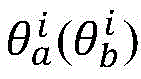
Figure BDA0002116406890000021
wherein
Figure BDA0002116406890000022
Indicating the channel response of the ith subcarrier of the sending end A; receiver B estimates the carrying signal XtThe channel response of both communication parties is obtained according to the channel characteristics of the N subcarriers:
Figure BDA0002116406890000023
wherein
Figure BDA0002116406890000024
Indicating the channel response of the ith subcarrier of the receiving terminal B;
step three, all the transmitting terminals A
Figure BDA0002116406890000025
Quantizing to obtain binary phase sequence Pa(ii) a In the same way, the receiving end B will all
Figure BDA0002116406890000026
Obtaining a binary phase sequence P after quantizationb
Step four, the sending end A obtains the phase quantization sequence PaAnd random binary sequence XrAnd a locally generated binary sequence XtGenerating a secret key K by performing an exclusive-or operationa(ii) a Similarly, the receiving end B will getOf the phase quantization sequence PbAnd random binary sequence XtAnd a locally generated binary sequence XrGenerating a secret key K by performing an exclusive-or operationb
And in the first step, the random binary sequence is loaded on a data subcarrier of the OFDM in a certain modulation mode to serve as a random detection signal, wherein the length of the random sequence is consistent with the number of bits of the key.
In the third step, the phase is divided into (0,2 pi)]Are equally divided into Q sub-intervals,
Figure BDA0002116406890000027
or
Figure BDA0002116406890000028
Falling into the corresponding subinterval and carrying out corresponding binary coding, and transmitting all the signals of the transmitting end A
Figure BDA0002116406890000029
After the encoding is finished, the two sequences are combined into a binary phase sequence P in sequencea(ii) a All of receiving end B
Figure BDA00021164068900000210
After the encoding is finished, the two sequences are combined into a binary phase sequence P in sequenceb. Assuming that the length of the key to be generated is M and the number of phases to be quantized is N, Q satisfies the formula:
Figure BDA00021164068900000211
wherein
Figure BDA00021164068900000212
Represents rounding up; quantized PaAnd PbThe top M values are truncated.
Compared with the prior art, the invention has the following advantages:
the optical OFDM dynamic key generation method based on the channel characteristics, provided by the invention, has the advantages that the generated key is no longer a static key, the initial value of the key does not need to be defined by two communication parties, and the capability of the safe communication of a physical layer is effectively improved. The dynamic key provided by the invention can be automatically updated in an irregular way, and the generated key is combined with other encryption technologies, so that the difficulty of correctly decrypting the communication content by an eavesdropper is further increased, and the confidentiality is further improved compared with the prior art. The dynamic key generated by the invention is only related to the channel characteristics and random signals between two communication parties, the final keys generated by the two communication parties under the technical scheme are consistent, and the obtained key can be used for updating the initial value and parameters of the chaotic system and can be used as the key of other data encryption algorithms. The method is suitable for the dynamic key generation of the optical OFDM system and other optical communication encryption systems.
Drawings
Fig. 1 is a schematic diagram of an optical OFDM dynamic key generation process according to the present invention.
Detailed Description
The embodiments of the present invention will be described in detail below with reference to the accompanying drawings: the present example is carried out on the premise of the technical solution of the present invention, and a detailed embodiment and operation process are given, but the scope of the present invention is not limited to the following examples.
In this embodiment, the two communication parties generate 128-bit key sequences respectively in an optical OFDM system, the modulation format adopts a 16QAM scheme, the number of subcarriers is 64, the number of effective data subcarriers is 28, and the whole dynamic key generation process is as shown in fig. 1, and the specific process is as follows:
step one, a sending end A generates a random binary sequence XtAnd sent to the receiving end B. In the coherence time, B generates a random binary sequence XrAnd sending the signal to A.
Binary sequence X as described in step onet、XrThe 128-bit random binary sequence is a 128-bit random binary sequence with the same length as the required key, and in order to prevent errors in the decoding process of the receiving end, the 128-bit random binary sequence can adopt some error correction coding techniques to check and correct errors, such as parity check in the simplest form. Xt、XrAnd respectively loading the serial-parallel conversion and 16QAM modulation onto respective subcarriers.
Step two, the sending end A estimates the carrying signal XrObtaining channel responses of both communication parties according to the channel characteristics of the N sub-carriers
Figure BDA0002116406890000031
Wherein
Figure BDA0002116406890000032
Indicating the channel response of the ith subcarrier of the transmitting end); receiver B estimates the carrying signal XtObtaining channel responses of both communication parties according to the channel characteristics of the N sub-carriers
Figure BDA0002116406890000033
Wherein
Figure BDA0002116406890000034
Indicating the channel response of the ith subcarrier at the receiving end).
Step three, all the transmitting terminals A
Figure BDA0002116406890000035
Quantizing to obtain binary phase sequence Pa(ii) a In the same way, the receiving end B will all
Figure BDA0002116406890000036
Obtaining a binary phase sequence P after quantizationb. Wherein the phase interval is (0,2 pi)]Are equally divided into Q sub-intervals,
Figure BDA0002116406890000037
falling into the corresponding subinterval and carrying out corresponding binary coding, and transmitting all the signals of the transmitting end A (receiving end B)
Figure BDA0002116406890000038
After the encoding is finished, the two sequences are combined into a binary phase sequence P in sequencea(Pb)。
Q satisfies the formula:
Figure BDA0002116406890000039
where M is the entire key length (M128) and N is requiredThe number of quantized phases (since 16QAM modulation is used, it is known that the number of required effective data subcarriers N is 32), and a Q value of 16, that is, (0,2 pi) is calculated]Are equally divided into 16 subintervals ((0, pi/8)],(π/8,π/4],…,(15π/8,2π]) The phase quantization binary sequence corresponding to each interval is (0000,0001.., 1111).
Step four, the sending end A obtains the phase quantization sequence PaAnd random binary sequence XrAnd a locally generated binary sequence XtGenerating a secret key K by performing an exclusive-or operationa. In the same way, the receiving end B obtains the phase quantization sequence PbAnd random binary sequence XtAnd a locally generated binary sequence XrGenerating a secret key K by performing an exclusive-or operationb
Figure BDA0002116406890000041
Figure BDA0002116406890000042
The resulting key sequences of the two legitimate parties are identical and the resulting key is related not only to the channel characteristics of the two parties, but also to the generated random binary sequence. The dynamic key characteristic of the method is characterized in that the channel characteristic changes along with the change of time, and the random sequence for the detection signal is also dynamically generated.
The generated legal key is only related to the channel and the random signal at the transmitting and receiving ends, and an eavesdropper cannot obtain the same communication channel as both the legal communication parties and cannot attack the device at the transmitting and receiving ends to obtain the random binary sequence at the legal transmitting and receiving ends, so that an attacker can hardly obtain the correct generated key, and the legal key can be changed at random time, and the encryption scheme is very safe and effective. Generated legal key KaAnd KbCan be used for updating the initial value and the parameter of the chaotic system and being used as the key of other data encryption algorithms.

Claims (4)

1.一种基于信道特性的光OFDM动态密钥生成方法,其中所生成的密钥是本地随机信号、发送端信号与量化后的信道相位的异或结果,其特征在于,包括步骤如下:1. an optical OFDM dynamic key generation method based on channel characteristics, wherein the generated key is the XOR result of a local random signal, a transmitter signal and a quantized channel phase, and is characterized in that, comprising steps as follows: 步骤一、发送端A生成随机二进制序列Xt并发送给接收端B;相干时间内,接收端B生成随机二进制序列Xr发送给发送端A;Step 1, the sending end A generates a random binary sequence X t and sends it to the receiving end B; within the coherence time, the receiving end B generates a random binary sequence X r and sends it to the sending end A; 步骤二、发送端A估计携带信号Xr的N个子载波的信道特性,得到通信双方的信道响应:
Figure FDA0003295180190000011
其中N表示子载波总数,j表示虚数单位,
Figure FDA0003295180190000012
表示发送端A的第i个子载波的信道相位,
Figure FDA0003295180190000013
表示发送端A第i个子载波的信道响应;接收端B估计携带信号Xt的N个子载波的信道特性,得到通信双方的信道响应:
Figure FDA0003295180190000014
Figure FDA0003295180190000015
其中N表示子载波总数,j表示虚数单位,
Figure FDA0003295180190000016
表示接收端B的第i个子载波的信道相位,
Figure FDA0003295180190000017
表示接收端B第i个子载波的信道响应;
Step 2: The transmitting end A estimates the channel characteristics of the N subcarriers carrying the signal X r , and obtains the channel responses of the two communicating parties:
Figure FDA0003295180190000011
where N is the total number of subcarriers, j is the imaginary unit,
Figure FDA0003295180190000012
represents the channel phase of the i-th subcarrier of the sender A,
Figure FDA0003295180190000013
Represents the channel response of the i-th subcarrier of the sender A; the receiver B estimates the channel characteristics of the N subcarriers carrying the signal X t , and obtains the channel responses of both parties:
Figure FDA0003295180190000014
Figure FDA0003295180190000015
where N is the total number of subcarriers, j is the imaginary unit,
Figure FDA0003295180190000016
represents the channel phase of the ith subcarrier of the receiver B,
Figure FDA0003295180190000017
Represents the channel response of the ith subcarrier of receiver B;
步骤三、将发送端A所有的
Figure FDA0003295180190000018
进行量化得到二进制相位序列Pa;同理,接收端B将所有的
Figure FDA0003295180190000019
量化后得到二进制相位序列Pb
Step 3. Send all the sender A
Figure FDA0003295180190000018
Perform quantization to obtain the binary phase sequence P a ; in the same way, the receiving end B converts all the
Figure FDA0003295180190000019
After quantization, a binary phase sequence P b is obtained;
步骤四、发送端A将得到的相位量化序列Pa与随机二进制序列Xr以及本地生成的二进制序列Xt进行异或运算生成密钥Ka;同理,接收端B将得到的相位量化序列Pb与随机二进制序列Xt以及本地生成的二进制序列Xr进行异或运算生成密钥KbStep 4, the phase quantization sequence P a obtained by the transmitting end A and the random binary sequence X r and the locally generated binary sequence X t are carried out XOR operation to generate the key Ka; Similarly, the receiving end B will obtain the phase quantization sequence The key K b is generated by performing XOR operation on P b with the random binary sequence X t and the locally generated binary sequence X r .
2.根据权利要求1所述的基于信道特性的光OFDM动态密钥生成方法,其特征在于:所述步骤一中随机二进制序列以一定的调制方式加载到一个OFDM的数据子载波上作为随机探测信号,其中随机序列长度同密钥位数一致。2. The optical OFDM dynamic key generation method based on channel characteristics according to claim 1, characterized in that: in the step 1, the random binary sequence is loaded onto an OFDM data subcarrier with a certain modulation mode as a random detection signal, where the length of the random sequence is the same as the number of bits in the key. 3.根据权利要求1所述的基于信道特性的光OFDM动态密钥生成方法,其特征在于:所述步骤三中是将相位区间(0,2π]均分成Q个子区间,
Figure FDA00032951801900000110
Figure FDA00032951801900000111
落到相应的子区间内并进行对应的二进制编码,将发送端A所有的
Figure FDA00032951801900000112
编码完成后按顺序合并为一个二进制相位序列Pa;将接收端B所有的
Figure FDA00032951801900000113
编码完成后按顺序合并为一个二进制相位序列Pb
3. The optical OFDM dynamic key generation method based on channel characteristics according to claim 1, is characterized in that: in the described step 3, the phase interval (0,2π] is divided into Q sub-intervals,
Figure FDA00032951801900000110
or
Figure FDA00032951801900000111
fall into the corresponding sub-interval and carry out the corresponding binary encoding, and send all the
Figure FDA00032951801900000112
After the coding is completed, they are sequentially combined into a binary phase sequence P a ;
Figure FDA00032951801900000113
After the coding is completed, they are sequentially combined into a binary phase sequence P b .
4.根据权利要求3所述的基于信道特性的光OFDM动态密钥生成方法,其特征在于:所述步骤三中假设所要生成的密钥长度为M,需要量化的相位个数为N,则Q满足公式:
Figure FDA00032951801900000114
Figure FDA00032951801900000115
其中
Figure FDA00032951801900000116
表示向上取整;量化后的Pa和Pb截取前M个值。
4. The optical OFDM dynamic key generation method based on channel characteristics according to claim 3, is characterized in that: in the step 3, it is assumed that the key length to be generated is M, and the number of phases to be quantized is N, then Q satisfies the formula:
Figure FDA00032951801900000114
Figure FDA00032951801900000115
in
Figure FDA00032951801900000116
Indicates rounded up; quantized P a and P b truncate the first M values.
CN201910592164.0A 2019-07-03 2019-07-03 Optical OFDM dynamic key generation method based on channel characteristics Expired - Fee Related CN110336657B (en)

Priority Applications (1)

Application Number Priority Date Filing Date Title
CN201910592164.0A CN110336657B (en) 2019-07-03 2019-07-03 Optical OFDM dynamic key generation method based on channel characteristics

Applications Claiming Priority (1)

Application Number Priority Date Filing Date Title
CN201910592164.0A CN110336657B (en) 2019-07-03 2019-07-03 Optical OFDM dynamic key generation method based on channel characteristics

Publications (2)

Publication Number Publication Date
CN110336657A CN110336657A (en) 2019-10-15
CN110336657B true CN110336657B (en) 2022-02-08

Family

ID=68143800

Family Applications (1)

Application Number Title Priority Date Filing Date
CN201910592164.0A Expired - Fee Related CN110336657B (en) 2019-07-03 2019-07-03 Optical OFDM dynamic key generation method based on channel characteristics

Country Status (1)

Country Link
CN (1) CN110336657B (en)

Families Citing this family (4)

* Cited by examiner, † Cited by third party
Publication number Priority date Publication date Assignee Title
CN111148099B (en) * 2020-01-02 2021-03-23 燕山大学 Side channel key generation method, device and communication system
CN112533199A (en) * 2020-11-25 2021-03-19 南京熊猫电子股份有限公司 OFDM channel physical key generation method and device based on USRP and computer equipment
CN113179513B (en) * 2021-04-16 2022-08-09 中国人民解放军国防科技大学 Wireless channel key generation method and device based on intelligent reflector phase assistance
CN113271201B (en) * 2021-05-27 2023-06-09 国网江苏省电力有限公司南京供电分公司 Dynamic AES physical layer data encryption method

Citations (11)

* Cited by examiner, † Cited by third party
Publication number Priority date Publication date Assignee Title
EP1463255A1 (en) * 2003-03-25 2004-09-29 Sony United Kingdom Limited Interleaver for mapping symbols on the carriers of an OFDM system
CN103167490A (en) * 2013-04-12 2013-06-19 中国人民解放军信息工程大学 Wireless key distribution method, device and system
CN103402200A (en) * 2013-07-11 2013-11-20 北京邮电大学 Secret key generation method based on wireless channel characteristics in frequency division duplex system
CN105721151A (en) * 2016-04-06 2016-06-29 北京瀚诺半导体科技有限公司 Information encryption method in OFDM communication system
CN106059758A (en) * 2016-07-08 2016-10-26 大连理工大学 Key generation method capable of ensuring security of wireless communication
CN106102049A (en) * 2016-06-06 2016-11-09 东南大学 A kind of safe transmission message approach utilizing the characteristic of channel
CN106209355A (en) * 2016-06-29 2016-12-07 北京理工大学 A kind of radio communication key generation method based on channel characteristics parameter
CN108366370A (en) * 2018-02-02 2018-08-03 东南大学 Quantify the information transferring method of privately owned asymmetric key based on radio channel characteristic
CN108718234A (en) * 2018-05-04 2018-10-30 南京邮电大学 Wirelessly communicate the key generation method based on adjustable angle phase protection band
CN108768443A (en) * 2018-05-30 2018-11-06 中国人民解放军战略支援部队信息工程大学 Spread spectrum parameter agile method based on random signal
CN109600222A (en) * 2019-01-28 2019-04-09 杭州电子科技大学 A kind of key generation method based on channel characteristics

Patent Citations (11)

* Cited by examiner, † Cited by third party
Publication number Priority date Publication date Assignee Title
EP1463255A1 (en) * 2003-03-25 2004-09-29 Sony United Kingdom Limited Interleaver for mapping symbols on the carriers of an OFDM system
CN103167490A (en) * 2013-04-12 2013-06-19 中国人民解放军信息工程大学 Wireless key distribution method, device and system
CN103402200A (en) * 2013-07-11 2013-11-20 北京邮电大学 Secret key generation method based on wireless channel characteristics in frequency division duplex system
CN105721151A (en) * 2016-04-06 2016-06-29 北京瀚诺半导体科技有限公司 Information encryption method in OFDM communication system
CN106102049A (en) * 2016-06-06 2016-11-09 东南大学 A kind of safe transmission message approach utilizing the characteristic of channel
CN106209355A (en) * 2016-06-29 2016-12-07 北京理工大学 A kind of radio communication key generation method based on channel characteristics parameter
CN106059758A (en) * 2016-07-08 2016-10-26 大连理工大学 Key generation method capable of ensuring security of wireless communication
CN108366370A (en) * 2018-02-02 2018-08-03 东南大学 Quantify the information transferring method of privately owned asymmetric key based on radio channel characteristic
CN108718234A (en) * 2018-05-04 2018-10-30 南京邮电大学 Wirelessly communicate the key generation method based on adjustable angle phase protection band
CN108768443A (en) * 2018-05-30 2018-11-06 中国人民解放军战略支援部队信息工程大学 Spread spectrum parameter agile method based on random signal
CN109600222A (en) * 2019-01-28 2019-04-09 杭州电子科技大学 A kind of key generation method based on channel characteristics

Non-Patent Citations (1)

* Cited by examiner, † Cited by third party
Title
Secret Key Generation Protocol for Optical OFDM Systems in Indoor VLC Networks;Yahya Mohammed Al-Moliki;《IEEE Photonics Journal》;20170209;全文 *

Also Published As

Publication number Publication date
CN110336657A (en) 2019-10-15

Similar Documents

Publication Publication Date Title
Zhang et al. Constellation shaping chaotic encryption scheme with controllable statistical distribution for OFDM-PON
Melki et al. An efficient OFDM-based encryption scheme using a dynamic key approach
CN108696867B (en) Lightweight group key distribution method based on wireless channel characteristics
CN110336657B (en) Optical OFDM dynamic key generation method based on channel characteristics
CN111566990A (en) Secure key agreement with untrusted devices
CN110086616B (en) Forward one-time pad secret communication method based on wireless channel
CN111492616A (en) Configurable device for lattice-based cryptography
US9379887B2 (en) Efficient cryptographic key stream generation using optimized S-box configurations
CN109743279B (en) A Joint Method Based on Polar Code Encryption and Peak-to-Average Ratio Suppression in OFDM Systems
CN119051839B (en) Information transmission high-safety joint modulation method based on multi-constellation index
CN111342957B (en) CO-OFDM key distribution method and device based on Y-00 protocol
CN110830396A (en) Physical layer key-based IMSI privacy protection method and device
Schmidbauer et al. Challenging channels: Encrypted covert channels within challenge-response authentication
CN116032454A (en) Physical layer encryption method and system based on dynamic constellation rotation
Lei et al. Integration of self-adaptive physical-layer key distribution and encryption in optical coherent communication
Noura et al. A physical encryption scheme for low-power wireless M2M devices: a dynamic key approach
CN116017423A (en) A USRP-based secure transmission method for wireless ad hoc networks
CN113259936B (en) High-reliability radio frequency hidden watermark signal authentication method and system
CN115883063B (en) A key generation method and device, storage medium, and computer equipment
CN116055136B (en) A multi-target authentication method based on secret sharing
Ayad et al. Secure Images Transmission Through OFDM System
CN117336715A (en) A physical layer secure communication method based on direct encryption of wireless channels
Li et al. Design of an energy-efficient multidimensional secure constellation for 5G communications
CN117314427A (en) Efficient hidden communication method and communication system based on blockchain remarks
CN116017451A (en) An IPv6 terminal identity authentication method using 5G NR physical layer information

Legal Events

Date Code Title Description
PB01 Publication
PB01 Publication
SE01 Entry into force of request for substantive examination
GR01 Patent grant
GR01 Patent grant
CF01 Termination of patent right due to non-payment of annual fee

Granted publication date: 20220208