CN113168004B - Calibration of mobile electronic devices connected to user-wearable headsets - Google Patents
Calibration of mobile electronic devices connected to user-wearable headsets Download PDFInfo
- Publication number
- CN113168004B CN113168004B CN201880099633.9A CN201880099633A CN113168004B CN 113168004 B CN113168004 B CN 113168004B CN 201880099633 A CN201880099633 A CN 201880099633A CN 113168004 B CN113168004 B CN 113168004B
- Authority
- CN
- China
- Prior art keywords
- camera
- pose
- mobile electronic
- electronic device
- display device
- Prior art date
- Legal status (The legal status is an assumption and is not a legal conclusion. Google has not performed a legal analysis and makes no representation as to the accuracy of the status listed.)
- Active
Links
Images


Classifications
-
- G—PHYSICS
- G06—COMPUTING OR CALCULATING; COUNTING
- G06T—IMAGE DATA PROCESSING OR GENERATION, IN GENERAL
- G06T7/00—Image analysis
- G06T7/80—Analysis of captured images to determine intrinsic or extrinsic camera parameters, i.e. camera calibration
- G06T7/85—Stereo camera calibration
-
- G—PHYSICS
- G02—OPTICS
- G02B—OPTICAL ELEMENTS, SYSTEMS OR APPARATUS
- G02B27/00—Optical systems or apparatus not provided for by any of the groups G02B1/00 - G02B26/00, G02B30/00
- G02B27/01—Head-up displays
- G02B27/017—Head mounted
-
- G—PHYSICS
- G02—OPTICS
- G02B—OPTICAL ELEMENTS, SYSTEMS OR APPARATUS
- G02B27/00—Optical systems or apparatus not provided for by any of the groups G02B1/00 - G02B26/00, G02B30/00
- G02B27/0025—Optical systems or apparatus not provided for by any of the groups G02B1/00 - G02B26/00, G02B30/00 for optical correction, e.g. distorsion, aberration
-
- G—PHYSICS
- G02—OPTICS
- G02B—OPTICAL ELEMENTS, SYSTEMS OR APPARATUS
- G02B27/00—Optical systems or apparatus not provided for by any of the groups G02B1/00 - G02B26/00, G02B30/00
- G02B27/0093—Optical systems or apparatus not provided for by any of the groups G02B1/00 - G02B26/00, G02B30/00 with means for monitoring data relating to the user, e.g. head-tracking, eye-tracking
-
- G—PHYSICS
- G06—COMPUTING OR CALCULATING; COUNTING
- G06T—IMAGE DATA PROCESSING OR GENERATION, IN GENERAL
- G06T7/00—Image analysis
- G06T7/70—Determining position or orientation of objects or cameras
-
- G—PHYSICS
- G02—OPTICS
- G02B—OPTICAL ELEMENTS, SYSTEMS OR APPARATUS
- G02B27/00—Optical systems or apparatus not provided for by any of the groups G02B1/00 - G02B26/00, G02B30/00
- G02B27/01—Head-up displays
- G02B27/0101—Head-up displays characterised by optical features
- G02B2027/0138—Head-up displays characterised by optical features comprising image capture systems, e.g. camera
-
- G—PHYSICS
- G06—COMPUTING OR CALCULATING; COUNTING
- G06T—IMAGE DATA PROCESSING OR GENERATION, IN GENERAL
- G06T2207/00—Indexing scheme for image analysis or image enhancement
- G06T2207/30—Subject of image; Context of image processing
- G06T2207/30244—Camera pose
Landscapes
- Physics & Mathematics (AREA)
- General Physics & Mathematics (AREA)
- Engineering & Computer Science (AREA)
- Optics & Photonics (AREA)
- Computer Vision & Pattern Recognition (AREA)
- Theoretical Computer Science (AREA)
- User Interface Of Digital Computer (AREA)
- Position Input By Displaying (AREA)
- Studio Devices (AREA)
- Image Analysis (AREA)
Abstract
Description
技术领域technical field
本公开涉及使用移动电子设备来显示信息以供佩戴者观看的头戴式显示器。The present disclosure relates to head-mounted displays that use mobile electronic devices to display information for viewing by a wearer.
背景技术Background technique
头戴式显示器(HMD)将成为社会用于人际交流、游戏和其他应用的未来设备生态系统的越来越多的部分。混合现实(MR)头戴式耳机是一种类型的HMD,其通过计算机生成的信息(例如,图形对象、文本、标记等)以可以使信息在用户看来就像它存在于真实世界中一样的方式来增强用户在真实世界中看到的内容。MR头戴式耳机可以使用户能够使用特殊的电子设备(例如跟踪用户的运动并可以向用户提供触觉反馈的触觉设备)以看似真实或物理的方式进行交互。Head-mounted displays (HMDs) will become an increasing part of society's future ecosystem of devices for human communication, gaming, and other applications. A mixed reality (MR) headset is a type of HMD that uses computer-generated information (e.g., graphical objects, text, markers, etc.) to make the information appear to the user as if it existed in the real world ways to enhance what users see in the real world. MR headsets can enable users to interact in a seemingly real or physical way using special electronics such as haptic devices that track the user's movements and can provide haptic feedback to the user.
基于智能电话或其他移动电子设备的MR耳机正变得越来越受欢迎,若干初创公司在2017年和2018年推出了新设备,分别称为Mira Prism、Holokit、Ghost AR和LenovoMirage AR。这些头戴式耳机相对便宜,并且可以与苹果、三星、谷歌和其他的智能电话一起使用。例如,针对Ghost和Holokit设备的开发人员可以利用分别称为ARCore和ARKit的谷歌和苹果的MR软件开发工具包(SDK)工具来执行对象识别和6自由度(DOF)定位。通过将前透镜从透视改变为非透视,Ghost设备还可用于虚拟现实(VR)中。在整个VR领域,谷歌Cardboard、谷歌Daydream和三星Gear VR是基于智能电话的VR头戴式耳机,它们的价格也很低,并且有很高的知名度。MR headsets based on smartphones or other mobile electronic devices are becoming increasingly popular, with several startups launching new devices in 2017 and 2018 called Mira Prism, Holokit, Ghost AR, and Lenovo Mirage AR, respectively. These headsets are relatively inexpensive and work with smartphones from Apple, Samsung, Google, and others. For example, developers targeting Ghost and Holokit devices can leverage Google’s and Apple’s MR software development kit (SDK) tools called ARCore and ARKit, respectively, to perform object recognition and 6 degrees of freedom (DOF) localization. The Ghost device can also be used in virtual reality (VR) by changing the front lens from see-through to non-see-through. Across the VR space, Google Cardboard, Google Daydream, and Samsung Gear VR are smartphone-based VR headsets that are also affordable and have high visibility.
MR头戴式耳机通常可以表征为两类:无镜头戴式耳机(例如,图1和图2中描绘的Mira Prism型头戴式耳机以及Holokit和Ghost头戴式耳机)和基于镜的头戴式耳机。对于无镜头戴式耳机,由移动电子设备120(例如,智能电话)的显示设备发出的光被投影到透镜110(例如,沿着路径200a)。透镜110是至少部分透明的(即,透视),以允许环境光穿过以供佩戴MR头戴式耳机的用户观看,同时还被配置为向后反射由显示设备发出的光的至少一部分以供用户观看。透镜110可以具有或可以不具有聚光或光分散效果(例如,放大来自真实世界特征的光)。在图1和图2中,透镜110将光朝着用户的眼睛反射(例如,沿着路径200b,主要凭借镜面反射),并且朝着设备120的相机122反射(例如,沿着路径200c,凭借漫射)。相反,对于基于镜的头戴式耳机,由移动电子设备120的显示设备发出的光被投影到镜,该镜将光朝着反射的透视透镜反射,以进行反射,该反射可以直接或间接地朝着用户的眼睛。MR headsets can generally be characterized into two categories: lensless headsets (e.g., Mira Prism-type headsets and Holokit and Ghost headsets depicted in Figures 1 and 2) and mirror-based headsets. earphones. For a lensless headset, light emitted by a display device of mobile electronic device 120 (eg, a smartphone) is projected onto lens 110 (eg, along
一些基于镜的头戴式耳机将移动电子设备120的后置相机配置为具有世界的视野,这是有益的,因为可以将后置相机配置为提供比前置相机更好质量的视频。例如,当前版本的ARCore或ARKit SDK仅可以使用后置相机有效运行,因为相对于前置相机它的成像质量更高。与无镜头戴式耳机相比,一些基于镜的头戴式耳机实现移动电子设备的更加灵活的定位,因为头戴式耳机的透视透镜与移动电子设备的显示设备之间的相对定位的限制。Some mirror-based headsets configure the rear camera of the mobile
MR系统可以通过使移动电子设备的显示设备朝着头戴式耳机透镜(无镜设计)或头戴式耳机镜(基于镜的设计)投影信息和其他虚拟内容来进行操作。处理来自相机的数字图片(例如,视频帧)以识别真实世界的特征(例如,跟踪标记或其他真实世界的对象),真实世界的特征可用于定位(例如,将真实世界和虚拟世界(即,MR头戴式耳机参考)坐标系相互关联)、特征识别和/或将视频流传输到远程观看者(例如,用于学习/教学MR应用,使远程专家能够观看由技术人员的MR头戴式耳机捕获的视频并提供响应性指导)。MR systems may operate by having the display device of the mobile electronic device project information and other virtual content towards the headset lens (mirrorless designs) or headset mirrors (mirror-based designs). Digital pictures (e.g., video frames) from the camera are processed to identify real-world features (e.g., tracking markers or other real-world objects), which can be used for localization (e.g., combining real-world and virtual worlds (i.e., MR headset reference) coordinate systems are correlated), feature recognition, and/or streaming video to a remote viewer (e.g., for learning/teaching MR applications, enabling a remote expert to view an MR headset Headphones capture video and provide responsive guidance).
这些低成本头戴式耳机的主要缺点之一是,当相对于头戴式耳机未最佳地放置移动电子设备(例如,位置和角度定向)时,由头戴式耳机渲染的三维(3D)虚拟内容的质量明显较低(例如,失真、模糊、对比度、真实世界中的位置)。参考图1,移动电子设备可以显示两个图像,其允许用户感知头戴式耳机透镜中的3D图像。如果两个显示的图像与透镜未正确对准,则用户将看到失真的图像。此外,如果要显示的虚拟内容的位置是根据由移动电子设备相机推断的真实世界位置限定的(例如,设备跟踪标记,并且虚拟内容将在最常见的AR应用之一的标记之上得到增强),或者如果移动电子设备未正确地放置在头戴式耳机中,则相机和头戴式耳机透镜(虚拟内容出现的地方)之间的转换将改变。这将对用户体验产生负面影响,因为虚拟内容将不再与真实世界的内容对准。One of the major disadvantages of these low-cost headsets is that three-dimensional (3D) The quality of the virtual content is significantly lower (e.g., distortion, blur, contrast, real-world location). Referring to FIG. 1, a mobile electronic device may display two images, which allow a user to perceive a 3D image in a headset lens. If the two displayed images are not properly aligned with the lenses, the user will see a distorted image. Also, if the location of the virtual content to be displayed is defined based on the real-world location inferred by the mobile electronic device camera (e.g. device tracking markers, and the virtual content will be augmented on top of markers in one of the most common AR applications) , or if the mobile electronic device is not properly positioned in the headset, the transition between the camera and the headset lens (where the virtual content appears) will change. This will have a negative impact on user experience as the virtual content will no longer be aligned with the real world content.
此外,如果在移动电子设备具有特定姿态时执行校准算法,则如果用户随后以与较早执行校准时不同的姿态替换移动电子设备,该校准将不再有效。此外,如果移动电子设备在使用期间相对于头戴式耳机滑动,则移动电子设备和头戴式耳机之间的相对姿态将改变。Furthermore, if a calibration algorithm is performed while the mobile electronic device is in a particular pose, that calibration will no longer be valid if the user subsequently replaces the mobile electronic device with a different pose than when the calibration was performed earlier. Furthermore, if the mobile electronic device slides relative to the headset during use, the relative posture between the mobile electronic device and the headset will change.
可以将移动电子设备次最优地放置在头戴式耳机中的原因是,移动电子设备具有许多不同的大小(长度、宽度和厚度),这使应该如何配置头戴式耳机以可释放地保持变化的移动电子设备变得复杂。因此,相当大的可变性可以导致相对于头戴式耳机,同一用户如何摆放移动电子设备以及不同用户如何摆放他们的移动电子设备。为了避免由于这种可变性而导致的性能下降,三星Gear VR头戴式耳机仅适用于三星品牌的设备(三星针对三星品牌的设备制造了设备特定的保持器附件),其限制了三星设备相对于头戴式耳机的摆放方式。The reason why mobile electronic devices can be placed sub-optimally in a headset is that mobile electronic devices come in many different sizes (length, width and thickness), which makes it difficult to configure how the headset should be Changing mobile electronic devices have become complex. Accordingly, considerable variability can result in how the same user positions the mobile electronic device and how different users position their mobile electronic device relative to the headset. To avoid performance degradation due to this variability, the Samsung Gear VR headset only works with Samsung-branded devices (Samsung makes a device-specific holder attachment for Samsung-branded devices), which limits the relative for the placement of the headset.
发明内容Contents of the invention
本文公开的一些实施例针对一种用于头戴式耳机的移动电子设备,该头戴式耳机包括被配置为相对于头戴式耳机以限定的姿态可释放地保持该移动电子设备的保持器。该移动电子设备包括相机、显示设备、处理器和存储器。相机被配置为输出数字图片,并且由保持器布置以观看头戴式耳机的一部分。显示设备由保持器布置以显示信息,以供佩戴头戴式耳机的用户观看。处理器可操作地连接到相机和显示设备。存储器存储由处理器执行以执行操作的程序代码。这些操作包括从存储器中检索至少表征相机相对于显示设备的姿态的校准参数。该操作处理来自相机的数字图片,以识别该数字图片内的光学可识别特征的姿态,该数字图片是在移动电子设备被保持器保持时捕获的。该操作基于数字图片内的光学可识别特征的所识别的姿态并且至少基于如由校准参数表征的相机相对于显示设备的姿态,来识别移动电子设备相对于保持器的姿态。该操作基于移动电子设备相对于保持器的所识别的姿态来控制在显示设备上何处渲染图形对象。Some embodiments disclosed herein are directed to a mobile electronic device for a headset including a holder configured to releasably hold the mobile electronic device in a defined posture relative to the headset . The mobile electronic device includes a camera, a display device, a processor and a memory. The camera is configured to output a digital picture and is arranged by the holder to view a portion of the headset. A display device is arranged by the holder to display information for viewing by a user wearing the headset. The processor is operatively connected to the camera and display device. The memory stores program codes executed by the processor to perform operations. These operations include retrieving from memory calibration parameters characterizing at least the pose of the camera relative to the display device. The operation processes a digital picture from the camera, captured while the mobile electronic device is held by the holder, to identify a pose of an optically identifiable feature within the digital picture. The operation identifies a pose of the mobile electronic device relative to the holder based on the recognized pose of the optically identifiable features within the digital picture and based at least on the pose of the camera relative to the display device as characterized by the calibration parameters. The operation controls where on the display device the graphical object is rendered based on the recognized gesture of the mobile electronic device relative to the holder.
这些和其他实施例可以提供的潜在优点是,移动电子设备可以优化其操作以补偿如何确定该设备相对于头戴式耳机的摆放。因此,例如,当将移动电子设备放置在头戴式耳机中且显示设备从优选位置横向偏移时,移动电子设备可以确定这种偏移并调整其操作以更优化地显示信息供佩戴头戴式耳机的用户观看。备选地或附加地,移动电子设备可以向用户提供关于应该如何调整移动电子设备的姿态的指导。A potential advantage that these and other embodiments may provide is that a mobile electronic device may optimize its operation to compensate for how the placement of the device relative to the headset is determined. So, for example, when a mobile electronic device is placed in a headset and the display device is offset laterally from the preferred position, the mobile electronic device can determine this offset and adjust its operation to more optimally display information for wearing on the headset. headset users to watch. Alternatively or additionally, the mobile electronic device may provide guidance to the user as to how the posture of the mobile electronic device should be adjusted.
本文公开的一些其他实施例针对由移动电子设备的处理器执行操作的对应方法。如上所述,移动电子设备包括用于与头戴式耳机一起使用的相机和显示设备,该头戴式耳机具有被配置为相对于头戴式耳机以限定的姿态可释放地保持移动电子设备的保持器。该方法包括检索校准参数,该校准参数至少表征相机相对于显示设备的姿态。该方法处理来自相机的数字图片,以识别该数字图片内的光学可识别特征的姿态,该数字图片是在移动电子设备被保持器保持时捕获的。该方法基于数字图片内的光学可识别特征的所识别的姿态并且至少基于如由校准参数表征的相机相对于显示设备的姿态,来识别移动电子设备相对于保持器的姿态。该方法基于移动电子设备相对于保持器的所识别的姿态来控制在显示设备上何处渲染图形对象。Some other embodiments disclosed herein are directed to corresponding methods performed by a processor of a mobile electronic device. As noted above, a mobile electronic device includes a camera and a display device for use with a headset having a device configured to releasably hold the mobile electronic device in a defined posture relative to the headset. retainer. The method includes retrieving calibration parameters characterizing at least a pose of the camera relative to the display device. The method processes a digital picture from a camera, captured while the mobile electronic device is held by the holder, to identify a pose of an optically identifiable feature within the digital picture. The method identifies a pose of the mobile electronic device relative to the holder based on the recognized pose of the optically identifiable features within the digital picture and based at least on the pose of the camera relative to the display device as characterized by the calibration parameters. The method controls where to render the graphical object on the display device based on the recognized gesture of the mobile electronic device relative to the holder.
在查看以下附图和详细描述之后,根据实施例的其他移动电子设备和对应方法对于本领域技术人员将是显而易见的,或将变得显而易见。所有这样的附加移动电子设备和方法都旨在包括在本说明书中并受到所附权利要求的保护。Other mobile electronic devices and corresponding methods according to the embodiments will be, or will become, apparent to those skilled in the art upon examination of the following figures and detailed description. All such additional mobile electronic devices and methods are intended to be included within this description and be protected by the appended claims.
附图说明Description of drawings
本公开的各个方面通过示例来说明,并且不受附图的限制。在附图中:Aspects of the present disclosure are illustrated by way of example and are not limited by the accompanying drawings. In the attached picture:
图1示出了包括MR头戴式耳机的MR系统,该MR头戴式耳机保持被配置为根据本公开的一些实施例操作的移动电子设备;Figure 1 illustrates an MR system including an MR headset holding a mobile electronic device configured to operate in accordance with some embodiments of the present disclosure;
图2示出了图1的MR系统的侧视图;Figure 2 shows a side view of the MR system of Figure 1;
图3示出了根据本公开的一些实施例的具有移动电子设备的VR系统的另一实施例,该移动电子设备具有向用户投影图像并且向相机部分地反射图像的显示设备;3 illustrates another embodiment of a VR system with a mobile electronic device having a display device that projects an image to a user and partially reflects the image to a camera, according to some embodiments of the present disclosure;
图4至图9是根据本公开的一些实施例的可以由移动电子设备执行的操作的流程图;4-9 are flowcharts of operations that may be performed by a mobile electronic device according to some embodiments of the present disclosure;
图10是被配置为根据本公开的一些其他实施例操作的移动电子设备的组件的框图;Figure 10 is a block diagram of components of a mobile electronic device configured to operate in accordance with some other embodiments of the present disclosure;
图11a示出了保持具有前置相机(FCam)和后置相机(BCam)的移动电子设备的头戴式耳机的后视图和头戴式耳机的侧视截面图;Figure 11a shows a rear view of a headset holding a mobile electronic device with a front camera (FCam) and a rear camera (BCam) and a side sectional view of the headset;
图11b示出了将移动电子设备的显示设备保持在相对于头戴式耳机的最佳位置的头戴式耳机的顶视截面图和前视截面图;Figure 11b shows a top sectional view and a front sectional view of a headset holding a display device of a mobile electronic device in an optimal position relative to the headset;
图11c示出了将移动电子设备保持在相对于头戴式耳机的次最佳横向移动的偏移(增量)位置的头戴式耳机的顶视截面图和前视截面图;以及Figure 11c shows a top and front cross-sectional view of the headset holding the mobile electronic device in an offset (incremental) position relative to sub-optimal lateral movement of the headset; and
图12示出了虚拟图像平面的各种视图,在该虚拟图像平面中,当用户佩戴头戴式耳机时,用户感知移动电子设备的显示设备被定位。12 shows various views of a virtual image plane in which a user perceives a display device of a mobile electronic device to be positioned when the user wears a headset.
具体实施方式detailed description
在下文中,将参考附图更全面地描述本发明构思,在附图中示出了本发明构思的实施例的示例。然而,本发明构思可以以许多不同形式来实现,并且不应当被解释为限于本文中所阐述的实施例。相反,提供这些实施例使得本公开将全面和完整,并且将各个本发明构思的范围充分传达给本领域技术人员。还应注意,这些实施例并不互相排斥。来自一个实施例的组成部分可以被默认假设为存在于/用于另一实施例中。Hereinafter, the inventive concept will be described more fully with reference to the accompanying drawings, in which examples of embodiments of the inventive concept are shown. However, the inventive concepts may be embodied in many different forms and should not be construed as limited to the embodiments set forth herein. Rather, these embodiments are provided so that this disclosure will be thorough and complete, and will fully convey the scope of the various inventive concepts to those skilled in the art. It should also be noted that these embodiments are not mutually exclusive. Components from one embodiment may be assumed to be present/used in another embodiment by default.
图1示出了包括MR头戴式耳机100的MR系统,该MR头戴式耳机100保持被配置为根据本公开的一些实施例进行操作的移动电子设备120。参照图1,MR头戴式耳机100包括透镜110,佩戴MR头戴式耳机的用户可以通过该透镜110观看真实世界特征,并且MR头戴式耳机100还包括保持器121,该保持器121被配置为将移动电子设备120可释放地保持在相对于透镜110的限定的定向上。FIG. 1 illustrates an MR system including an
移动电子设备120包括相机122、显示设备(图10中的1040)和处理器(图10中的1006)。相机122被配置为输出数字图片(例如,静止图片和/或视频),并且由保持器121布置以观看MR头戴式耳机100的透镜110的至少一部分。显示设备1040被布置为显示信息,该信息被投影在透镜110上以用于直接或间接地朝向用户的眼睛(即,当佩戴MR头戴式耳机100时)以及移动电子设备120的相机122反射。尽管未示出,但是头戴式耳机可以包括位于透镜110与用户的眼睛和/或相机122之间的中间镜,并且因此光可以直接或间接地朝向用户的眼睛和/或相机122反射。The mobile
移动电子设备120可以包括但不限于智能电话、掌上型计算机、平板计算机、游戏设备或其他计算设备。为了简洁起见,“移动电子设备”在本文中也被称为“移动设备”和“设备”。如将在下面进一步详细说明的,下面被描述为由移动电子设备120执行的各种操作可以附加地或备选地由通信地连接到移动电子设备120的另一电子设备执行。Mobile
图2示出了图1的MR系统的侧视图。参照图2,移动电子设备120的显示设备1040(图10)显示信息,该信息沿着路径200a被投影到透镜110上,以用于沿着朝向用户的眼睛的路径200b和沿着朝向相机122的路径200c向后反射。FIG. 2 shows a side view of the MR system of FIG. 1 . 2, display device 1040 (FIG. 10) of mobile
图3示出了根据一些实施例的可以使用的VR头戴式耳机300的另一种配置。参照图3,移动电子设备120的显示设备1040(图10)显示朝向透镜投影的信息(用户通过透镜观看显示设备1040)。来自显示设备1040的图像还可以由透镜和/或用户的眼睛反射回相机122(图10)。FIG. 3 illustrates another configuration of a
由谷歌Daydream VR已经实现的用于尝试确定移动电子设备120相对于MR头戴式耳机的姿态的一种方法是使用两个导电衬垫310(图3),它们被配置为与显示设备1040(图10)接触。然后,移动电子设备120可以基于衬垫310接触触敏显示设备的位置来测量衬垫310的位置,并由此确定移动电子设备120相对于头戴式耳机300的位置。此外,移动电子设备120可以测量相对于头戴式耳机300的滚动定向。然而,移动电子设备120将不能在其他定向上测量位移。该方法还要求将衬垫内置在头戴式耳机300中,从而使其制造起来更加复杂和昂贵,同时要求智能电话在运行MR应用时检测显示设备中的接触。此外,对衬垫310接触显示设备的要求减小了显示区域(在该显示区域中可以显示内容以供用户观看)。One approach that has been implemented by Google Daydream VR for attempting to determine the pose of the mobile
本公开的实施例旨在校准移动电子设备相对于头戴式耳机的姿态,使得可以渲染虚拟内容以允许佩戴头戴式耳机的用户进行更佳的观看。一个或多个较早的校准操作的结果可用于促进和改进当前的校准操作。Embodiments of the present disclosure aim to calibrate the pose of the mobile electronic device relative to the headset so that virtual content can be rendered to allow better viewing by a user wearing the headset. The results of one or more earlier calibration operations may be used to facilitate and improve current calibration operations.
如本文所使用的,术语“姿态”是指一个设备(例如,移动电子设备)相对于另一设备(例如,头戴式耳机)或相对于定义的坐标系的位置和/或旋转角度。因此,可以仅基于一个设备相对于另一设备或相对于定义的坐标系的多维位置,仅基于设备相对于另一设备或相对于定义的坐标系的多维旋转角度,或基于多维位置和多维旋转角度的组合来定义姿态。因此,术语“姿态”用于指位置、旋转角度或其组合。As used herein, the term "pose" refers to the position and/or rotation of a device (eg, a mobile electronic device) relative to another device (eg, a headset) or relative to a defined coordinate system. Thus, it may be based only on the multidimensional position of one device relative to another device or relative to a defined coordinate system, based solely on the multidimensional rotation angle of a device relative to another device or relative to a defined coordinate system, or based on both multidimensional position and multidimensional rotation A combination of angles to define the pose. Accordingly, the term "pose" is used to refer to position, angle of rotation, or a combination thereof.
图4是可以由移动电子设备执行以确定其相对于头戴式耳机的姿态的操作和方法的流程图。头戴式耳机包括保持器,该保持器被配置为相对于头戴式耳机以限定的姿态可释放地保持移动电子设备。该移动电子设备包括相机(例如,图10中的122)、显示设备(例如,图10中的1040)、可操作地连接到相机和显示设备的处理器(例如,图10中的1006)、以及存储由处理器执行以执行操作的程序代码(例如,图10中的1012)的存储器(例如,图10中的1010)。4 is a flowchart of operations and methods that may be performed by a mobile electronic device to determine its pose relative to a headset. The headset includes a holder configured to releasably hold the mobile electronic device in a defined posture relative to the headset. The mobile electronic device includes a camera (eg, 122 in FIG. 10 ), a display device (eg, 1040 in FIG. 10 ), a processor (eg, 1006 in FIG. 10 ) operably connected to the camera and display device, and a memory (eg, 1010 in FIG. 10 ) storing program code (eg, 1012 in FIG. 10 ) executed by the processor to perform operations.
参照图4,该操作从存储器中检索400校准参数,这些参数至少表征相机相对于显示设备的姿态。处理402来自相机的数字图片,以识别该数字图片内的光学可识别特征的姿态,该数字图片是在由保持器保持移动电子设备时被捕获的。基于数字图片内的光学可识别特征的所识别的姿态并且至少基于如由校准参数表征的相机相对于显示设备的姿态,相对于保持器识别404移动电子设备的姿态。所述操作基于移动电子设备相对于保持器的所识别的姿态来控制406在显示设备上何处渲染图形对象。Referring to FIG. 4 , the operation retrieves 400 calibration parameters from memory, the parameters characterizing at least the pose of the camera relative to the display device. A digital picture from the camera is processed 402 to identify a pose of an optically identifiable feature within the digital picture, the digital picture being captured while the mobile electronic device is held by the holder. A pose of the mobile electronic device is identified 404 relative to the holder based on the recognized pose of the optically identifiable features within the digital picture and based at least on the pose of the camera relative to the display device as characterized by the calibration parameters. The operations control 406 where to render the graphical object on the display device based on the recognized gesture of the mobile electronic device relative to the holder.
因此,移动电子设备使用相机来确定设备相对于头戴式耳机的姿态,并且然后使用相对姿态来改进如何在显示设备上渲染图形对象以供佩戴头戴式耳机的用户观看。Accordingly, the mobile electronic device uses the camera to determine the pose of the device relative to the headset, and then uses the relative pose to improve how graphical objects are rendered on the display device for viewing by a user wearing the headset.
触发头戴式耳机中的移动电子设备姿态的校准的条件Conditions triggering calibration of mobile electronic device pose in a headset
可以通过接收移动电子设备已经被插入到头戴式耳机的保持器中的通知来触发校准移动电子设备相对于头戴式耳机的相对姿态的操作。该操作可以使用移动电子设备的前置相机来响应式地捕获图像,检索所存储的针对移动电子设备和头戴式耳机的校准参数,并基于所捕获的图像和所检索的校准参数来确定新的校准参数。在一些实施例中,响应于校准通知被触发来执行校准操作。The operation of calibrating the relative pose of the mobile electronic device with respect to the headset may be triggered by receiving a notification that the mobile electronic device has been inserted into the holder of the headset. The operation may responsively capture an image using the mobile electronic device's front-facing camera, retrieve stored calibration parameters for the mobile electronic device and the headset, and determine a new calibration parameter based on the captured image and the retrieved calibration parameters. calibration parameters. In some embodiments, the calibration operation is performed in response to the calibration notification being triggered.
在一个实施例中,当新的MR或VR应用开始在移动电子设备上执行时触发校准通知,其中该应用被配置用于与头戴式耳机一起使用。在另一个实施例中,当用户通过例如选择由应用提供的用户可选标记来发起重新校准操作时,触发校准通知。In one embodiment, a calibration notification is triggered when a new MR or VR application is started executing on the mobile electronic device, where the application is configured for use with the headset. In another embodiment, the calibration notification is triggered when the user initiates a recalibration operation by, for example, selecting a user-selectable flag provided by the application.
在又一个实施例中,启动MR或VR应用显示图像或文本,其提示用户将移动电子设备插入到MR或VR头戴式耳机中。通过激活前置相机并重复检查以确定何时捕获头戴式耳机的内部,检测到随后成功的插入。例如,来自前置相机的数字图片可以被处理以识别头戴式耳机的光学可识别特征的姿态,例如衬垫310、透镜、眼睛开口和/或图3中的头戴式耳机300或图1和图2中的头戴式耳机100上的其他结构特征或标记。In yet another embodiment, launching the MR or VR application displays an image or text prompting the user to plug the mobile electronic device into the MR or VR headset. Subsequent successful insertion is detected by activating the front-facing camera and repeatedly checking to see when the inside of the headset is captured. For example, a digital picture from a front-facing camera can be processed to recognize the pose of optically identifiable features of the headset, such as
在另一个实施例中,角膜成像技术用于检测所显示的虚拟内容在用户的眼睛角膜上的反射。当图像质量(失真、在真实世界中的位置等)不再满足定义的质量规则时,将触发校准通知,该质量规则可以至少部分由用户指定。In another embodiment, corneal imaging technology is used to detect the reflection of displayed virtual content on the cornea of the user's eye. A calibration notification will be triggered when the image quality (distortion, position in the real world, etc.) no longer satisfies defined quality rules, which may be specified at least in part by the user.
在另一个实施例中,来自相机的数字图片可以被处理以跟踪用户的眼睛指向的位置。可以基于确定用户的眼睛指向偏离期望位置的中心,或者以满足用于触发校准的定义的规则的另一种方式指向来触发校准通知。In another embodiment, digital pictures from the camera may be processed to track where the user's eyes are pointing. The calibration notification may be triggered based on a determination that the user's eyes are pointing off-center from the desired location, or pointing in another manner to satisfy defined rules for triggering calibration.
使用前置相机识别光学可识别特征的姿态Pose recognition of optically identifiable features using a front-facing camera
在一些实施例中,光学可识别特征与头戴式耳机和/或佩戴头戴式耳机的用户眼睛的特征有关。来自移动电子设备120的前置相机的数字图片可以作为图4的操作的一部分被处理402,以识别在数字图片内的光学可识别特征的姿态,该数字图片是在由保持器保持移动电子设备时被捕获的。可以处理由前置相机捕获的数字图片,以识别用户的眼睛相对于相机的姿态。In some embodiments, the optically identifiable features relate to features of the headset and/or eyes of a user wearing the headset. A digital picture from the front camera of the mobile
例如,处理(图4中的402)来自相机的数字图片以识别在由保持器保持移动电子设备时捕获的数字图片内的光学可识别特征的姿态的操作可以包括:处理数字图片以识别由相机捕获的头戴式耳机的光学可识别特征的姿态。For example, processing (402 in FIG. 4 ) a digital picture from a camera to identify gestures of optically identifiable features within the digital picture captured while the mobile electronic device is held by the holder may include processing the digital picture to identify The pose of the optically identifiable features of the captured headset.
该操作还可以包括根据从存储器中检索(图4中的400)的校准参数,确定在先前校准过程期间由相机捕获的先前数字图片内的头戴式耳机的光学可识别特征的姿态。在当前的校准过程期间,执行处理(图4中的402)来自相机的数字图片以识别数字图片内的头戴式耳机的光学可识别特征的姿态的操作。识别(图4中的404)移动电子设备相对于保持器的姿态的操作可以基于在当前校准过程期间捕获的数字图片内的头戴式耳机的光学可识别特征的所识别的姿态与在先前的校准过程期间捕获的先前数字图片内的头戴式耳机的光学可识别特征的姿态的比较。The operations may also include determining a pose of an optically identifiable feature of the headset within a previous digital picture captured by the camera during a previous calibration process based on the calibration parameters retrieved from memory (400 in FIG. 4). During the current calibration process, an operation is performed to process (402 in FIG. 4 ) a digital picture from the camera to identify a pose of an optically identifiable feature of the headset within the digital picture. The operation of identifying (404 in FIG. 4 ) the pose of the mobile electronic device relative to the holder may be based on a comparison of the recognized pose of the optically identifiable features of the headset within the digital picture captured during the current calibration process with the previous Comparison of poses of optically identifiable features of the headset within previous digital pictures captured during the calibration process.
在一些其他实施例中,由移动电子设备识别的光学可识别特征是校准图案的特征,该校准图案被显示设备投影(例如,闪现)到头戴式耳机和/或用户的眼睛上并由此被反射以被相机捕获。作为确定移动电子设备相对于头戴式耳机的姿态的操作的一部分,处理校准图案的光学可识别特征。In some other embodiments, the optically identifiable feature recognized by the mobile electronic device is a feature of a calibration pattern that is projected (e.g., flashed) by the display device onto the headset and/or the user's eyes and thereby is reflected to be captured by the camera. Optically identifiable features of the calibration pattern are processed as part of determining the pose of the mobile electronic device relative to the headset.
例如,操作还可以包括:在显示设备上显示校准图案,以通过从头戴式耳机的表面和/或从用户的眼睛反射校准图案的一部分、使相机捕获数字图片内的校准图案的一部分。处理(图4的402)来自相机的数字图片以识别数字图片内的光学可识别特征的姿态的操作包括:处理数字图片以识别校准图案的一部分内的限定的特征的姿态。For example, the operations may also include displaying the calibration pattern on the display device to cause the camera to capture a portion of the calibration pattern within the digital picture by reflecting the portion of the calibration pattern from the surface of the headset and/or from the user's eyes. Processing (402 of FIG. 4 ) the digital picture from the camera to identify a pose of an optically identifiable feature within the digital picture includes processing the digital picture to identify a pose of the defined feature within a portion of the calibration pattern.
检索针对智能电话和头戴式耳机的已存储的校准参数Retrieve stored calibration parameters for smartphones and headsets
如上所述,从移动电子设备的存储器中检索的校准参数至少表征相机相对于显示设备的姿态。校准参数可以表征移动电子设备、前置相机、后置相机、显示设备、头戴式耳机、头戴式耳机的保持器、头戴式耳机的透镜和/或头戴式耳机的观看端口之间的其他先前确定或定义的关系(关系位置、姿态等)。备选地或附加地,校准参数可以表征相机、显示设备或移动电子设备和/或头戴式耳机的其他组件的操作。例如,校准参数可以包括以下任意一项或多项:As mentioned above, the calibration parameters retrieved from the memory of the mobile electronic device characterize at least the pose of the camera relative to the display device. Calibration parameters may characterize the interaction between the mobile electronic device, the front camera, the rear camera, the display device, the headset, the holder of the headset, the lens of the headset, and/or the viewing port of the headset. Other previously determined or defined relationships (relational position, pose, etc.) Alternatively or additionally, the calibration parameters may characterize the operation of the camera, display device or mobile electronic device and/or other components of the headset. For example, calibration parameters can include any one or more of the following:
1)光学可识别特征及其位置和/或光学可识别特征的集合及其相对姿态,基于在先前的校准过程期间使用移动电子设备时从前置相机捕获的数字图片;1) Optically identifiable features and their positions and/or sets of optically identifiable features and their relative poses, based on digital pictures captured from the front-facing camera while using the mobile electronic device during a previous calibration process;
2)在先前的校准过程期间从前置相机捕获的数字图片图像;2) A digital picture image captured from the front camera during the previous calibration process;
3)与相机和/或头戴式耳机的透镜相对应的失真参数(例如,桶形失真),其可以在先前的校准过程期间确定和/或定义;3) Distortion parameters (eg, barrel distortion) corresponding to the lens of the camera and/or headset, which may be determined and/or defined during a previous calibration process;
4)头戴式耳机参数,其表征在先前的校准过程期间确定的头戴式耳机和眼睛坐标之间的关系;以及4) headphone parameters characterizing the relationship between headphone and eye coordinates determined during a previous calibration process; and
5)离轴投影参数,其表征在先前的校准过程期间确定的用户眼睛中的一只或两只眼睛的眼睛坐标和显示坐标之间的投影。5) An off-axis projection parameter that characterizes the projection between the eye coordinates of one or both of the user's eyes and the display coordinates determined during the previous calibration process.
在一个实施例中,先前的校准过程可以作为离线或工厂校准过程来执行。在另一个实施例中,先前的校准过程可以作为在每个用户的基础上执行的一次性校准过程来执行,并且可以对应于针对单点主动对准方法(SPAAM)的操作,例如由M Tuceryan和N.Navab所公开的,用于AR的光学透视HMD校准的单点主动对准方法(SPAAM),IEEE 2000中第149-158页。In one embodiment, the previous calibration process may be performed as an offline or factory calibration process. In another embodiment, the previous calibration procedure may be performed as a one-time calibration procedure performed on a per-user basis and may correspond to operations for the Single Point Active Alignment Method (SPAAM), such as described by M Tuceryan and N. Navab, Single Point Active Alignment Method (SPAAM) for Optical See-Through HMD Calibration for AR, IEEE 2000, pp. 149-158.
在一些其他说明性实施例中,由移动电子设备进行的操作可以包括:根据从存储器中检索的校准参数,确定影响数字图片内的限定的特征的姿态的相机的失真参数。处理来自相机的数字图片以识别数字图片内的光学可识别特征的姿态的操作可以补偿相机的失真参数。In some other demonstrative embodiments, the operations performed by the mobile electronic device may include determining, based on calibration parameters retrieved from memory, distortion parameters of the camera that affect the pose of the defined feature within the digital picture. The operation of processing the digital picture from the camera to recognize the pose of the optically recognizable features within the digital picture can compensate for distortion parameters of the camera.
移动电子设备可以执行如下操作:根据从存储器中检索的校准参数来确定头戴式耳机到眼睛的参数,该头戴式耳机到眼睛的参数在至少二维空间中标识在先前的校准过程期间确定的头戴式耳机上的至少一个位置与用户的至少一只眼睛之间的距离。然后可以基于头戴式耳机到眼睛的参数来进一步执行控制在显示设备上何处渲染图形对象的操作。The mobile electronic device may be operable to determine a headphone-to-eye parameter based on calibration parameters retrieved from memory, the headphone-to-eye parameter identifying in at least two dimensions determined during a previous calibration process The distance between at least one location on the headset and at least one of the user's eyes. Controlling where to render the graphical objects on the display device can then be further performed based on the headset-to-eye parameters.
移动电子设备可以执行如下操作:根据从存储器中检索的校准参数来确定离轴投影参数,该参数在至少二维空间中标识在先前的校准过程操作期间确定的在显示设备上的至少一个位置与用户的至少一只眼睛之间的距离,然后可以基于离轴投影参数进一步执行对在显示设备上何处渲染图形对象的控制。The mobile electronic device may be operable to determine, based on calibration parameters retrieved from memory, off-axis projection parameters identifying in at least two dimensions the at least one location on the display device determined during a previous calibration process operation and the The distance between at least one of the user's eyes can then further exercise control over where to render graphical objects on the display device based on off-axis projection parameters.
基于所捕获的数字图片和先前存储的校准参数确定新的校准参数Determine new calibration parameters based on captured digital pictures and previously stored calibration parameters
现在在图11a、图11b和图11c的实施例的上下文中描述可以由移动电子设备执行的进一步的操作。图11a示出了保持具有前置相机(FCam)和后置相机(BCam)的移动电子设备的头戴式耳机的后视图和头戴式耳机的侧视截面图。图11b示出了将移动电子设备的显示设备保持在相对于头戴式耳机的最佳位置的头戴式耳机的顶视截面图和前视截面图。图11c示出了将移动电子设备保持在相对于头戴式耳机的次最佳横向移位的偏移(增量)位置的头戴式耳机的顶视截面图和前视截面图。如将在下面关于图11c进一步详细说明的,可以调整(例如,横向移位)通过在显示设备上显示生成的图像的前置相机的视野(FOV),使得左眼的视口变得较小,而右眼的视口变得较大。Further operations that may be performed by the mobile electronic device are now described in the context of the embodiments of Figures 11a, 11b and 11c. Figure 11a shows a rear view of a headset holding a mobile electronic device with a front camera (FCam) and a rear camera (BCam) and a side sectional view of the headset. Figure 11b shows a top and front sectional view of a headset holding a display device of a mobile electronic device in an optimal position relative to the headset. Figure 11c shows top and front cross-sectional views of a headset holding the mobile electronic device in an offset (incremental) position relative to a sub-optimal lateral displacement of the headset. As will be explained in further detail below with respect to FIG. 11c, the field of view (FOV) of the front camera by displaying the generated image on the display device can be adjusted (e.g., laterally shifted) so that the viewport of the left eye becomes smaller , and the viewport for the right eye becomes larger.
在图11a至图11c的上下文中,头戴式耳机是指头戴式耳机的固定部分。术语Eleft和Eright分别指左虚拟眼和右虚拟眼的位置和定向(例如姿态),其最佳地与真实用户的眼睛对准。BCam是后置相机的姿态,其可以仅与光学透视头戴式显示器(OST-HMD)相关。FCam是前置相机的姿态,并且“显示”是指移动电子设备的显示设备中心的物理位置。图11a至图11c示出了前置相机的示例FOV,其中可以看到,对于许多头戴式耳机和移动电子设备,眼睛开口之一将位于前置相机的FOV内部。前置相机可以观察由显示设备输出并由头戴式耳机的反射表面和/或用户的眼睛反射回前置相机的图像。因此,来自前置相机的数字图片可以包括显示设备的图像和/或头戴式耳机和/或用户的眼睛的光学可识别特征。In the context of Figures 11a to 11c, a headset refers to the fixed part of the headset. The terms E left and E right refer to the position and orientation (eg, pose) of the left and right virtual eyes, respectively, which are optimally aligned with the real user's eyes. BCam is the pose of the rear camera, which may only be relevant for optical see-through head-mounted displays (OST-HMD). FCam is the pose of the front camera, and "display" refers to the physical location of the center of the display device of the mobile electronic device. Figures 11a-11c show example FOVs for the front camera, where it can be seen that for many headsets and mobile electronic devices, one of the eye openings will be inside the FOV of the front camera. The front camera may observe images output by the display device and reflected back to the front camera by reflective surfaces of the headset and/or the user's eyes. Thus, the digital picture from the front camera may include an image of the display device and/or optically identifiable features of the headset and/or the user's eyes.
基于眼睛的定位是否可行,有调整视口和投影矩阵两个选项。两个选项可以被分别应用,因为它们针对不同的错误源,或者可以一起被应用以消除两个错误。Whether eye-based positioning is feasible, there are two options to adjust the viewport and projection matrix. Both options can be applied separately, since they target different error sources, or can be applied together to eliminate both errors.
用于识别移动电子设备相对于保持器的姿态的选项1:
以下针对选项1描述了各种示例操作,用于基于头戴式耳机的光学识别特征来确定移动电子设备相对于头戴式耳机的保持器的姿态。使用来自前置相机的数字图片,移动电子设备可以识别(提取)头戴式耳机的一个或多个光学可识别特征,并由此确定移动电子设备相对于头戴式耳机的姿态。头戴式耳机中的这种光学可识别特征的示例可以包括但不限于头戴式耳机的鼻开口、眼睛开口、内表面角和/或表面上的印刷标记。使用前置相机的定义/确定的固有相机参数和头戴式耳机的尺寸(可以从存储器中检索为校准参数),移动电子设备可操作以导出相机到头戴式耳机的变换


除了该调整之外,移动电子设备还可以考虑由屏幕和用户的眼睛之间的光学系统引起的非线性失真,例如图12中描绘的情况。图12示出了虚拟图像平面的各种视图,在该虚拟图像平面中,当用户佩戴头戴式耳机时,用户感知移动电子设备的显示设备被定位。参照图12,虚拟显示平面相对于眼睛被定位在距离d处。这种配置的投影通过离轴投影矩阵描述如下:In addition to this adjustment, the mobile electronic device may also account for nonlinear distortions caused by the optical system between the screen and the user's eyes, such as the situation depicted in FIG. 12 . 12 shows various views of a virtual image plane in which a user perceives a display device of a mobile electronic device to be positioned when the user wears a headset. Referring to Figure 12, the virtual display plane is positioned at a distance d relative to the eye. The projection of this configuration is described by the off-axis projection matrix as follows:
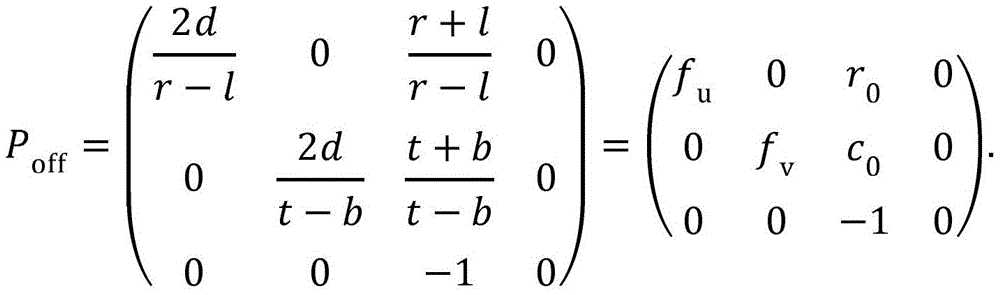
在离轴投影矩阵中,术语,,,指的是虚拟显示平面的边缘相对于投影中心在距离d处的角。因此,参数,,,,d描述了图像平面相对于眼睛的大小和位置。该投影矩阵的替代和最小参数化由fu,fv,r0,c0给出。鉴于来自校准过程的这种最小参数化,由于智能电话移位,可以将它们调整为改变的视口尺寸和位置。可以将距离d设置为任意值,并且给定,,,中的相对改变,可以计算调整后的投影矩阵。注意,左眼的投影矩阵保持固定,而右眼的投影矩阵保持固定。In off-axis projection matrices, the term ,,, refers to the angle of the edge of the virtual display plane at distance d with respect to the projection center. Thus, the parameters ,,,,d describe the size and position of the image plane relative to the eye. An alternative and minimal parameterization of this projection matrix is given by f u , f v , r 0 , c 0 . Given this minimal parameterization from the calibration process, they can be adjusted to changing viewport sizes and positions as the smartphone shifts. The distance d can be set to any value, and given the relative change in ,,, an adjusted projection matrix can be computed. Note that the projection matrix for the left eye remains fixed, while that for the right eye remains fixed.
在图5的流程图中示出了可以由移动电子设备执行的各种对应的操作。参照图5,基于数字图片内的光学可识别特征的所识别的姿态并且至少基于如由校准参数表征的相机相对于显示设备的姿态来识别移动电子设备相对于保持器的姿态的操作可以包括:生成500相机到头戴式耳机的变换,该变换将相机的姿态与数字图片内的头戴式耳机的光学可识别特征相关联。获得502相机到显示的变换,该变换将相机的姿态与显示设备的姿态相关联。基于相机到头戴式耳机的变换和相机到显示的变换,生成504显示到头戴式耳机的变换。可以基于显示到头戴式耳机的变换来执行如下操作:基于移动电子设备相对于保持器的所识别的姿态来控制506在显示设备上何处渲染图形对象。Various corresponding operations that may be performed by the mobile electronic device are shown in the flowchart of FIG. 5 . Referring to FIG. 5 , the operation of identifying a pose of the mobile electronic device relative to the holder based on the recognized pose of the optically identifiable features within the digital picture and based at least on the pose of the camera relative to the display device as characterized by the calibration parameters may include: A camera-to-headset transformation is generated 500 that associates the pose of the camera with optically identifiable features of the headset within the digital picture. A camera-to-display transformation is obtained 502 that relates the pose of the camera to the pose of the display device. Based on the camera-to-headset transformation and the camera-to-display transformation, a display-to-headset transformation is generated 504 . Based on the display-to-headset transformation, operations may be performed to control 506 where to render the graphical object on the display device based on the recognized gesture of the mobile electronic device relative to the holder.
可以由移动电子设备执行的另一操作包括:根据从存储器中检索的校准参数,确定影响数字图片内的头戴式耳机的光学可识别特征的姿态的相机的失真参数。可以执行生成相机到头戴式耳机的变换的操作以补偿相机的失真参数。Another operation that may be performed by the mobile electronic device includes determining, based on calibration parameters retrieved from memory, distortion parameters of the camera that affect a pose of an optically identifiable feature of the headset within the digital picture. An operation to generate a camera-to-headset transformation may be performed to compensate for the distortion parameters of the camera.
获得将相机的姿态与显示设备的姿态相关联的相机到显示的变换的操作可以包括:处理来自相机的数字图片或另一数字图片,以根据通过来自显示设备的图像被头戴式耳机的反射表面反射到相机而生成的反射图像,识别相机和显示设备之间相对于至少二维坐标系的距离。然后,移动电子设备可以基于相机和显示设备之间的距离来生成相机到显示的变换。Obtaining a camera-to-display transformation that correlates a pose of the camera with a pose of the display device may include processing the digital picture from the camera or another digital picture to reflect from the headset through the image from the display device. A reflected image generated by the surface reflecting off the camera identifies a distance between the camera and the display device relative to at least a two-dimensional coordinate system. The mobile electronic device can then generate a camera-to-display transition based on the distance between the camera and the display device.
基于相机和显示设备之间的距离来生成相机到显示的变换的操作可以包括:获得表征保持器与产生反射图像的头戴式耳机的反射表面之间的距离的数据。然后,基于表征保持器和头戴式耳机的反射表面之间的距离的数据,基于缩放在反射图像中识别的相机和显示设备之间的距离,移动电子设备可以生成相机到显示的变换。Generating the camera-to-display transformation based on the distance between the camera and the display device may include obtaining data characterizing the distance between the holder and the reflective surface of the headset generating the reflected image. Then, based on the data characterizing the distance between the holder and the reflective surface of the headset, the mobile electronic device can generate a camera-to-display transform based on scaling the distance between the camera and display device identified in the reflected image.
用于识别移动电子设备相对于保持器的姿态的选项2:Option 2 for identifying the pose of the mobile electronic device relative to the holder:
以下针对选项2描述了各种示例性操作,用于基于用户眼睛的所识别的姿态来确定移动电子设备相对于头戴式耳机的保持器的姿态。Various exemplary operations are described below for option 2 for determining the pose of the mobile electronic device relative to the holder of the headset based on the recognized pose of the user's eyes.
移动电子设备可以执行进一步的操作以针对用户的眼睛姿态相对于头戴式耳机的改变进行调整,例如图12所示,这可以是由于改变的头戴式耳机位置和/或佩戴头戴式耳机的不同用户造成的。虚拟图像平面的特征在于其投影可以独立于真实眼睛位置而是正确的(即,在眼睛移动的情况下,真实世界将显示与虚拟图像平面相同的移动)。由于虚拟眼睛位置E和实际眼睛位置


该移位应被应用于虚拟相机的位置和投影矩阵二者,使得虚拟图像平面的投影保持不变,类似于图12中所示的关系。例如,当
在图6的流程图中示出了可以由移动电子设备执行的各种对应的操作。参照图6,操作可以包括处理600来自相机的数字图片或另一数字图片以识别用户的眼睛的姿态,以及生成602将相机的姿态与用户眼睛的所识别的姿态相关联的相机到眼睛的变换。然后可以基于相机到眼睛的变换来进一步执行控制406(图4)在显示设备上何处渲染图形对象的操作。Various corresponding operations that may be performed by the mobile electronic device are shown in the flowchart of FIG. 6 . Referring to FIG. 6 , operations may include processing 600 a digital picture from the camera or another digital picture to identify a pose of the user's eyes, and generating 602 a camera-to-eye transformation that correlates the pose of the camera with the recognized pose of the user's eyes. . The operation of controlling 406 (FIG. 4) where to render the graphical object on the display device may then be further performed based on the camera-to-eye transformation.
在一个实施例中,当移动电子设备检测到其以不能实现期望的图像质量的位置和定向摆放在头戴式耳机中时,可以向用户显示消息,该消息指示移动电子设备应当由用户重新放置。可以基于先前的实施例在该步骤中计算要应用于移动电子设备的位移/旋转,并通过通知(例如,指示所建议的左/右/上/下/向左、向右旋转等移动直到实现设备的更佳放置的消息)向用户指示该位移/旋转。In one embodiment, when the mobile electronic device detects that it is placed in the headset in a position and orientation that does not achieve the desired image quality, a message may be displayed to the user indicating that the mobile electronic device should be replaced by the user. place. The displacement/rotation to be applied to the mobile electronic device can be calculated in this step based on the previous embodiment, and can be indicated by notification (for example, indicating the suggested movement left/right/up/down/left, right rotation, etc. until achieved A message for better placement of the device) indicates this displacement/rotation to the user.
在另一实施例中,移动电子设备可以向用户通知应该如何移动移动电子设备以获得头戴式耳机的改进操作。图7是根据一个实施例的可以由移动电子设备执行的操作的流程图。参照图7,操作可以包括:通过确定700移动电子设备将相对于保持器移动的方向和距离以使显示设备在保持器上的限定的位置的阈值距离内,来响应移动电子设备相对于保持器的所识别的姿态超过偏移阈值,并且然后在显示设备上显示702消息,该消息指示移动电子设备要移动的方向和距离。In another embodiment, the mobile electronic device may inform the user how the mobile electronic device should be moved to obtain improved operation of the headset. 7 is a flowchart of operations that may be performed by a mobile electronic device, according to one embodiment. Referring to FIG. 7 , operations may include responding to the movement of the mobile electronic device relative to the holder by determining 700 a direction and a distance that the mobile electronic device will move relative to the holder such that the display device is within a threshold distance of a defined location on the holder. The identified gesture exceeds the excursion threshold, and a message is then displayed 702 on the display device, the message indicating the direction and distance the mobile electronic device is to move.
在另一个实施例中,当用户移动该移动电子设备寻求获得将提供改进的操作的更佳姿态时,移动电子设备可以提供动态通知更新。例如,移动电子设备可以通过确定移动电子设备将相对于保持器移动的方向和/或角定向以使显示设备在保持器上的限定的位置的阈值距离内,来响应移动电子设备相对于保持器的所识别的姿态超过偏移阈值。移动电子设备可以在显示设备上显示消息,该消息指示该移动电子设备应该移动的方向和/或角定向。移动电子设备可以重复用于确定方向/角定向并显示用于指示移动电子设备应移动的方向的其他消息的操作,直到移动电子设备在保持器上的限定的位置/定向的阈值距离内为止。In another embodiment, a mobile electronic device may provide dynamic notification updates as the user moves the mobile electronic device for a better posture that will provide improved operation. For example, the mobile electronic device may respond to the movement of the mobile electronic device relative to the holder by determining a direction and/or angular orientation in which the mobile electronic device will move relative to the holder such that the display device is within a threshold distance of a defined location on the holder. The recognized pose exceeds the excursion threshold. The mobile electronic device can display a message on the display device indicating the direction and/or angular orientation in which the mobile electronic device should move. The mobile electronic device may repeat operations for determining a direction/angular orientation and displaying other messages indicating the direction the mobile electronic device should move until the mobile electronic device is within a threshold distance of the defined position/orientation on the holder.
可以基于工厂或用户测试或基于表征给定头戴式耳机的光学系统和结构的校准参数,先验地计算导致图像质量低于期望的移动电子设备的位置和定向的推断。Inferences about the position and orientation of the mobile electronic device that result in lower-than-desired image quality can be calculated a priori based on factory or user testing or based on calibration parameters characterizing the optical system and structure of a given headset.
在另一个实施例中,首先检查最突出的特征,并且仅在这些特征中超过预定义的检测偏移阈值时才执行进一步分析。在那种情况下,可以根据试图基于移动电子设备的当前姿态进行优化的过程来初始调整两只眼睛的视口的位置和大小。可以调整离轴投影矩阵以考虑改变的视口大小,并调整失真参数以考虑新的失真中心。In another embodiment, the most salient features are checked first, and further analysis is only performed if any of these features exceed a pre-defined detection excursion threshold. In that case, the position and size of the viewports for both eyes may be initially adjusted according to a process that attempts to optimize based on the current pose of the mobile electronic device. The off-axis projection matrix can be adjusted to account for the changed viewport size, and the distortion parameters adjusted to account for the new center of distortion.
在另一个实施例中,除了在先前的实施例中提到的调整之外,来自前置相机的图像可以用于估计用户的眼睛的位置。可以基于该估计的位置和在校准阶段(先验或工厂)期间计算的位置,相应地调整投影矩阵和失真参数。如果前置相机只能观察到一只眼睛的位置,则可以将观察到的和校准的眼睛位置之间的偏移视为头部偏移。因此,该偏移也可以应用于第二只眼睛。备选地,可以应用手动校准方案来补偿丢失的信息。In another embodiment, in addition to the adjustments mentioned in the previous embodiments, images from the front camera can be used to estimate the position of the user's eyes. Based on this estimated position and the position calculated during the calibration phase (either a priori or factory), the projection matrix and distortion parameters can be adjusted accordingly. If the front camera can only observe the position of one eye, the offset between the observed and calibrated eye position can be considered as a head offset. Therefore, this offset can also be applied to the second eye. Alternatively, a manual calibration scheme can be applied to compensate for missing information.
可以从存储器中检索的其他类型的校准参数:Other types of calibration parameters that can be retrieved from memory:
除了上面的描述,移动电子设备还可以从存储器中检索其他类型的校准参数,这些参数表征相机、显示设备、各种姿态变换等的各种不同特性。例如,校准参数可以表征前置相机和/或后置相机的操作参数和/或固有参数。校准参数可以表征后置相机对前置相机的相对姿态(变换

校准参数可以表征前置相机对显示设备的相对位置,变换
校准参数可以表征显示设备的特性,例如前置相机凹口和/或像素密度(例如像素/厘米比)。Calibration parameters may characterize characteristics of the display device, such as a front camera notch and/or pixel density (eg pixel/cm ratio).
在一个实施例中,这些参数中的全部或一些由移动电子设备软件开发工具包(SDK)或从预先构建的数据库中提供。In one embodiment, all or some of these parameters are provided by a mobile electronic device software development kit (SDK) or from a pre-built database.
在另一个实施例中,头戴式耳机用户通过对前置和后置相机执行经典的校准方法(例如,通过记录检测板的视频)来获得固有参数。In another embodiment, the headset user obtains the intrinsic parameters by performing a classical calibration method on the front and rear cameras (eg, by recording a video of the detection board).
在另一个实施例中,通过诸如SPAAM方法的手动用户校准步骤来估计后置相机的相对位置。校准步骤可以包括使用户将虚拟对象与其在不同位置的真实世界对应物(例如标记)对准。当对准已经发生时,用户与移动电子设备通信(例如,经由用户可选择的标记、点击器或感测到的手势)。这些点随后用于检索后置相机和移动电子设备(前置相机或显示设备)之间的变换。在一个实施例中,点数由头戴式耳机制造商预定义。在另一个实施例中,可以收集点,直到实现投影的收敛。在另一个实施例中,在收集点之后,更新投影,该投影可用于在虚拟世界中显示真实世界对象表示。当用户确定或移动电子设备确定所述对准满足定义的规则时,校准完成。In another embodiment, the relative position of the rear cameras is estimated by a manual user calibration step such as the SPAAM method. The step of calibrating may include having the user align the virtual object with its real-world counterpart (eg, a marker) at different locations. When alignment has occurred, the user communicates with the mobile electronic device (eg, via a user-selectable marker, clicker, or sensed gesture). These points are then used to retrieve the transformation between the rear camera and the mobile electronic device (front camera or display device). In one embodiment, the number of points is predefined by the headset manufacturer. In another embodiment, points may be collected until convergence of the projection is achieved. In another embodiment, after the points are collected, the projection is updated, which can be used to display real world object representations in the virtual world. Calibration is complete when the user determines or the mobile electronic device determines that the alignment satisfies defined rules.
在另一个实施例中,来自相机的数字图片用于检索变换


在另一个实施例中,使用来自先前描述的实施例的信息,并且使用显示的背景图像连同来自先前实施例的形状,可以估计屏幕的大小和/或像素密度(例如像素厘米比)。相同的数字图片还可以用于检测显示特性,例如屏幕形状(例如,具有带凹口的部分以容纳听筒、相机、麦克风等的屏幕)。In another embodiment, using information from the previously described embodiments, and using the displayed background image along with the shape from the previous embodiments, the size and/or pixel density (eg, pixel centimeter ratio) of the screen can be estimated. The same digital picture can also be used to detect display characteristics, such as screen shape (eg, screens with notched portions to accommodate earpieces, cameras, microphones, etc.).
根据一个实施例,在图8的流程图中示出了可以由移动电子设备执行的对应操作。参照图8,操作在显示设备上显示800校准图案,以通过从头戴式耳机的表面和/或从用户的眼睛反射校准图案的一部分,使相机捕获数字图片或另一数字图片内的校准图案的一部分。操作基于对校准图案的该部分内的特征的大小的确定来确定802显示设备的大小和/或显示设备的像素密度。然后,操作可以在存储器中的校准参数的数据结构中存储804对显示设备的大小和/或显示设备的像素密度的指示。According to one embodiment, corresponding operations that may be performed by a mobile electronic device are shown in the flowchart of FIG. 8 . Referring to FIG. 8 , the calibration pattern is operative to display 800 on the display device to cause the camera to capture the calibration pattern within a digital picture or another digital picture by reflecting a portion of the calibration pattern from the surface of the headset and/or from the user's eyes. a part of. The operation determines 802 a size of the display device and/or a pixel density of the display device based on the determination of the size of the features within the portion of the calibration pattern. The operation may then store 804 an indication of the size of the display device and/or the pixel density of the display device in a data structure of calibration parameters in memory.
图9是根据一个实施例的可以由移动电子设备执行的操作的流程图。参照图9,操作可以包括在显示设备上显示900图像。相机可以被操作以捕获由显示设备显示以及由头戴式耳机的表面和/或由用户的眼睛反射的图像的反射。操作可以基于对所反射的图像的形状的确定来确定902显示设备的形状,并且在存储器中的校准参数的数据结构中存储904对显示设备的形状的指示。9 is a flowchart of operations that may be performed by a mobile electronic device, according to one embodiment. Referring to FIG. 9 , operations may include displaying 900 an image on a display device. The camera may be operated to capture reflections of images displayed by the display device and reflected by the surface of the headset and/or by the user's eyes. Operations may determine 902 a shape of the display device based on the determination of the shape of the reflected image, and store 904 an indication of the shape of the display device in a data structure of calibration parameters in memory.
云实现cloud implementation
上面描述的由移动电子设备执行的一些或全部操作可以备选地由作为网络云计算资源的一部分的另一节点执行。例如,这些操作可以作为网络功能由网络运营商的云服务器或云资源(例如游戏或其他娱乐服务器、地图旅行路由服务器、电子商务服务器等)执行。Some or all of the operations described above to be performed by the mobile electronic device may alternatively be performed by another node that is part of the network's cloud computing resources. For example, these operations may be performed as network functions by a network operator's cloud server or cloud resources (such as game or other entertainment servers, map travel routing servers, e-commerce servers, etc.).
示例移动电子设备配置Example mobile electronic device configuration
图10是被配置为根据本公开的一些其他实施例操作的移动电子设备120的组件的框图。移动电子设备120可以包括相机(例如,前置相机122、后置相机1050和/或多个前/后置相机)、显示设备1040、至少一个处理器电路1006(处理器)和至少一个存储器1010(存储器)。移动电子设备120还可以包括无线网络接口电路1030、运动传感器和/或定向传感器1060和/或扬声器1070。传感器1060可以包括惯性测量单元,该惯性测量单元输出由处理器1006处理的信号以确定移动电子设备120的姿态和/或移动。无线网络接口电路1030可以被配置为通过无线(例如,Wi-Fi、蓝牙、蜂窝等)网络接口与另一电子设备通信。FIG. 10 is a block diagram of components of a mobile
处理器1006可操作地连接到这些各种组件。存储器1010存储由处理器1006执行以执行操作的程序代码1012。处理器1006可以包括可以并置或分布在一个或多个数据网络上的一个或多个数据处理电路,例如通用和/或专用处理器(例如微处理器和/或数字信号处理器)。处理器1006被配置为执行存储器1010(以下被描述为计算机可读介质)中的程序代码1012中的计算机程序指令,以执行用于本文针对移动电子设备公开的一个或多个实施例的操作和方法中的一些或全部。
另外的定义和实施例:Additional definitions and examples:
在对发明构思的各种实施例的以上描述中,要理解的是,本文使用的术语仅用于描述具体的实施例的目的,而不意图限制发明构思。除非另外定义,否则本文使用的所有术语(包括技术术语和科学术语)具有与本发明构思所属领域的普通技术人员通常所理解的意义相同的意义。将理解,诸如在通用词典中定义的术语等的术语应被解释为具有与它们在本说明书的上下文和相关技术中的意义相一致的意义,而不被解释为理想或过于正式的意义,除非本文有这样的明确定义。In the above description of various embodiments of the inventive concept, it is to be understood that the terminology used herein is for the purpose of describing particular embodiments only and is not intended to be limiting of the inventive concept. Unless otherwise defined, all terms (including technical terms and scientific terms) used herein have the same meaning as commonly understood by one of ordinary skill in the art to which this inventive concept belongs. It will be understood that terms such as those defined in commonly used dictionaries, etc., should be interpreted as having meanings consistent with their meanings in the context of this specification and related art, and not in ideal or overly formal meanings, unless This article has such a clear definition.
当元件被称作“连接到”、“耦合到”、“响应于”另一元件或其变型时,它可以直接连接到、耦合到或者响应于另一元件,或者可以存在中间元件。相反,当元件被称作“直接连接到”、“直接耦合到”、“直接响应于”另一元件或其变型时,不存在中间元件。贯穿全文,类似附图标记表示类似的元件。此外,本文使用的“耦合”、“连接”、“响应”或其变型可以包括无线耦合、连接或响应。如本文使用的,单数形式“一”,“一个”和“所述”意在还包括复数形式,除非上下文明确地给出相反的指示。为了简洁和/或清楚,可能没对公知的功能或结构进行详细描述。术语“和/或”包括关联列出的一个或多个项目的任意和所有组合。When an element is referred to as being "connected to," "coupled to," "responsive to" another element or variations thereof, it can be directly connected to, coupled to or responsive to the other element or intervening elements may be present. In contrast, when an element is referred to as being "directly connected to," "directly coupled to," "directly responsive to" another element or variations thereof, there are no intervening elements present. Throughout, like reference numerals indicate like elements. Additionally, "coupled," "connected," "responsive," or variations thereof as used herein may include wirelessly coupling, connected, or responsive. As used herein, the singular forms "a", "an" and "the" are intended to include the plural forms as well, unless the context clearly dictates otherwise. Well-known functions or constructions may not be described in detail for brevity and/or clarity. The term "and/or" includes any and all combinations of one or more of the associated listed items.
将理解,虽然本文中可以使用术语第一、第二、第三等来描述各元件/操作,但是这些元件/操作不应被这些术语限制。这些术语仅用于将一个元件/操作与另一个元件/操作相区分。因此,在一些实施例中的第一元件/操作可以在其他实施例中称作第二元件/操作,而不会脱离本发明构思的教导。贯穿说明书,相同的附图标记或相同的参考符号表示相同或类似的元件。It will be understood that although the terms first, second, third etc. may be used herein to describe various elements/operations, these elements/operations should not be limited by these terms. These terms are only used to distinguish one element/operation from another element/operation. Thus, a first element/operation in some embodiments could be termed a second element/operation in other embodiments without departing from the teachings of inventive concepts. Throughout the specification, the same reference numerals or the same reference signs denote the same or similar elements.
如本文使用的术语“包括(comprise、comprising、comprises、include、including、includes)”、“具有(have、has、having)”或其变型是开放式的,并且包括一个或多个所陈述的特征、整数、元件、步骤、组件、功能或其组合,但是不排除存在或添加一个或多个其它特征、整数、元件、步骤、组件、功能或其组合。此外,如本文的使用,常用缩写“例如(e.g.)”源于拉丁短语“exempli gratia”,其可以用于介绍或指定之前提到的项目的一个或多个一般示例,而不意在作为该项目的限制。常用缩写“即(i.e.)”源于拉丁短语“idest”,可以用于指定更广义的引述的具体项目。As used herein, the terms "comprise, comprising, comprises, include, including, includes", "have, has, having" or variations thereof are open-ended and include one or more of the stated features , integer, element, step, component, function or a combination thereof, but does not preclude the presence or addition of one or more other features, integers, elements, steps, components, functions or a combination thereof. Also, as used herein, the common abbreviation "e.g." is derived from the Latin phrase "exempli gratia," which may be used to introduce or designate one or more general examples of a previously mentioned item, and is not intended to be a limits. The commonly used abbreviation "ie (i.e.)" is derived from the Latin phrase "idest" and can be used to designate a specific item of quote in a broader sense.
本文参考计算机实现的方法、装置(系统和/或设备)和/或计算机程序产品的框图和/或流程图图示描述了示例实施例。应理解,可以通过由一个或多个计算机电路执行的计算机程序指令来实现框图和/或流程图图示的框以及框图和/或流程图图示中的框的组合。可以将这些计算机程序指令提供给通用计算机电路、专用计算机电路和/或其它可编程数据处理电路的处理器电路来产生机器,使得经由计算机和/或其它可编程数据处理装置的处理器执行的指令转换和控制晶体管、存储器位置中存储的值、以及这种电路内的其它硬件组件,以实现框图和/或流程图框中指定的功能/动作,并由此创建用于实现框图和/或流程图框中指定的功能/动作的装置(功能体)和/或结构。Example embodiments are described herein with reference to block diagrams and/or flowchart illustrations of computer-implemented methods, apparatus (systems and/or devices) and/or computer program products. It will be understood that blocks of the block diagrams and/or flowchart illustrations, and combinations of blocks in the block diagrams and/or flowchart illustrations, can be implemented by computer program instructions executed by one or more computer circuits. These computer program instructions may be provided to processor circuits of general-purpose computer circuits, special-purpose computer circuits, and/or other programmable data processing circuits to produce machines such that the instructions executed by the processors of computers and/or other programmable data processing devices Convert and control transistors, values stored in memory locations, and other hardware components within such circuits to implement the functions/actions specified in the block diagrams and/or flow diagram blocks, and thereby create a method for implementing the block diagrams and/or flow diagrams A device (functional body) and/or structure of a function/action specified in a frame.
这些计算机程序指令也可以存储在有形计算机可读介质中,所述有形计算机可读介质能够指导计算机或其它可编程数据处理装置按照具体的方式作用,使得在计算机可读介质中存储的指令产生制品,所述制品包括实现在所述框图和/或流程图的框中指定的功能/动作的指令。因此,发明构思的实施例可以在硬件和/或在诸如数字信号处理器之类的处理器上运行的软件(包括固件、贮存软件、微代码等)上实现,所述处理器可以统称为“电路”、“模块”或其变体。These computer program instructions may also be stored on a tangible computer-readable medium capable of instructing a computer or other programmable data processing apparatus to act in a specific manner such that the instructions stored on the computer-readable medium produce an article of manufacture , the article of manufacture includes instructions for implementing the functions/actions specified in the blocks of the block diagrams and/or flowcharts. Accordingly, embodiments of the inventive concept may be implemented in hardware and/or in software (including firmware, storage software, microcode, etc.) running on a processor, such as a digital signal processor, which may be collectively referred to as a " circuit", "module" or variations thereof.
还应注意,在一些备选实现中,在框中标记的功能/动作可以不以流程图中标记的顺序发生。例如,依赖于所涉及的功能/动作,连续示出的两个框实际上可以实质上同时执行,或者框有时候可以按照相反的顺序执行。此外,可以将流程图和/或框图的给定框的功能分成多个框和/或流程图和/或框图的两个或更多个框的功能可以至少部分地被集成。最后,在不脱离发明构思的范围的情况下,可以在所示出的框之间添加/插入其他框,和/或可以省略框/操作。此外,尽管一些图包括通信路径上的箭头以示出通信的主要方向,但是应理解,通信可以在与所描绘的箭头相反的方向上发生。It should also be noted that in some alternative implementations, the functions/acts noted in the blocks may occur out of the order noted in the flowcharts. For example, two blocks shown in succession may, in fact, be executed substantially concurrently or the blocks may sometimes be executed in the reverse order, depending upon the functionality/acts involved. Furthermore, the functionality of a given block of the flowchart and/or block diagrams may be split into multiple blocks and/or the functionality of two or more blocks of the flowchart and/or block diagrams may be at least partially integrated. Finally, other blocks may be added/inserted between the illustrated blocks and/or blocks/operations may be omitted without departing from the scope of the inventive concept. Furthermore, although some of the figures include arrows on communication paths to show the primary direction of communication, it should be understood that communication can occur in the opposite direction to the depicted arrows.
在基本上不脱离本发明构思原理的前提下,可以对实施例做出许多改变和修改。所有这些改变和修改旨在在本文中被包括在发明构思的范围内。因此,上述主题应理解为示例性的而非限制性的,并且所附实施例的示例旨在覆盖落入本发明构思的精神和范围之内的所有这些修改、改进和其他实施例。因此,在法律允许的最大范围内,本发明构思的范围应由所附实施例的示例及其等同物的最宽允许解释来确定,并且不应受限于或限制于之前的具体实施方式。Many changes and modifications can be made to the embodiments without departing substantially from the principles of the inventive concept. All such changes and modifications are intended to be included herein within the scope of the inventive concept. Accordingly, the foregoing subject matter is to be understood as illustrative rather than restrictive, and the examples of the accompanying embodiments are intended to cover all such modifications, improvements and other embodiments that fall within the spirit and scope of the inventive concept. Thus, to the maximum extent permitted by law, the scope of the inventive concept should be determined by the broadest permissible interpretation of the accompanying examples of embodiments and their equivalents, and should not be limited or restricted by the preceding detailed description.
Claims (33)
Applications Claiming Priority (1)
| Application Number | Priority Date | Filing Date | Title |
|---|---|---|---|
| PCT/EP2018/082087 WO2020104027A1 (en) | 2018-11-21 | 2018-11-21 | Calibration of mobile electronic devices connected to headsets wearable by users |
Publications (2)
| Publication Number | Publication Date |
|---|---|
| CN113168004A CN113168004A (en) | 2021-07-23 |
| CN113168004B true CN113168004B (en) | 2023-01-06 |
Family
ID=64500362
Family Applications (1)
| Application Number | Title | Priority Date | Filing Date |
|---|---|---|---|
| CN201880099633.9A Active CN113168004B (en) | 2018-11-21 | 2018-11-21 | Calibration of mobile electronic devices connected to user-wearable headsets |
Country Status (7)
| Country | Link |
|---|---|
| US (3) | US11321874B2 (en) |
| EP (1) | EP3884333B1 (en) |
| CN (1) | CN113168004B (en) |
| AR (1) | AR117131A1 (en) |
| ES (1) | ES2927281T3 (en) |
| MX (1) | MX2021005937A (en) |
| WO (1) | WO2020104027A1 (en) |
Families Citing this family (2)
| Publication number | Priority date | Publication date | Assignee | Title |
|---|---|---|---|---|
| US20240046577A1 (en) | 2022-08-05 | 2024-02-08 | Samsung Electronics Co., Ltd. | Video See-Through Augmented Reality |
| US12567216B2 (en) | 2023-05-19 | 2026-03-03 | International Business Machines Corporation | Augmented-reality-interface conflation identification |
Citations (4)
| Publication number | Priority date | Publication date | Assignee | Title |
|---|---|---|---|---|
| CN105573486A (en) * | 2014-05-30 | 2016-05-11 | 索尼电脑娱乐美国公司 | Head mounted device (HMD) system having interface with mobile computing device |
| CN107004279A (en) * | 2014-12-10 | 2017-08-01 | 微软技术许可有限责任公司 | Natural user interface camera calibrated |
| WO2017156486A1 (en) * | 2016-03-11 | 2017-09-14 | Oculus Vr, Llc | Corneal sphere tracking for generating an eye model |
| CN107533233A (en) * | 2015-03-05 | 2018-01-02 | 奇跃公司 | System and method for augmented reality |
Family Cites Families (8)
| Publication number | Priority date | Publication date | Assignee | Title |
|---|---|---|---|---|
| CN104902190A (en) * | 2015-06-24 | 2015-09-09 | 联想(北京)有限公司 | Control method, photographic device and electronic device |
| US10304446B2 (en) * | 2016-02-03 | 2019-05-28 | Disney Enterprises, Inc. | Self calibration for smartphone goggles |
| CN206990924U (en) * | 2016-03-06 | 2018-02-09 | 赵山山 | One kind suction mobile phone type VR glasses |
| CN105929543A (en) * | 2016-06-18 | 2016-09-07 | 深圳晨芯时代科技有限公司 | Virtual reality device, virtual reality glass box thereof and virtual reality plate |
| US10714121B2 (en) * | 2016-07-27 | 2020-07-14 | Vocollect, Inc. | Distinguishing user speech from background speech in speech-dense environments |
| KR102697559B1 (en) * | 2016-12-22 | 2024-08-23 | 삼성전자주식회사 | Display control method, storage medium and electronic device for displaying image |
| US10503247B2 (en) | 2017-05-09 | 2019-12-10 | Microsoft Technology Licensing, Llc | Calibration of stereo cameras and handheld object |
| US10732226B2 (en) * | 2017-05-26 | 2020-08-04 | Hand Held Products, Inc. | Methods for estimating a number of workflow cycles able to be completed from a remaining battery capacity |
-
2018
- 2018-11-21 MX MX2021005937A patent/MX2021005937A/en unknown
- 2018-11-21 CN CN201880099633.9A patent/CN113168004B/en active Active
- 2018-11-21 WO PCT/EP2018/082087 patent/WO2020104027A1/en not_active Ceased
- 2018-11-21 ES ES18810954T patent/ES2927281T3/en active Active
- 2018-11-21 EP EP18810954.0A patent/EP3884333B1/en active Active
- 2018-11-21 US US16/500,976 patent/US11321874B2/en active Active
-
2019
- 2019-11-20 AR ARP190103408A patent/AR117131A1/en active IP Right Grant
-
2022
- 2022-03-29 US US17/706,731 patent/US11854234B2/en active Active
-
2023
- 2023-10-31 US US18/498,483 patent/US12277734B2/en active Active
Patent Citations (4)
| Publication number | Priority date | Publication date | Assignee | Title |
|---|---|---|---|---|
| CN105573486A (en) * | 2014-05-30 | 2016-05-11 | 索尼电脑娱乐美国公司 | Head mounted device (HMD) system having interface with mobile computing device |
| CN107004279A (en) * | 2014-12-10 | 2017-08-01 | 微软技术许可有限责任公司 | Natural user interface camera calibrated |
| CN107533233A (en) * | 2015-03-05 | 2018-01-02 | 奇跃公司 | System and method for augmented reality |
| WO2017156486A1 (en) * | 2016-03-11 | 2017-09-14 | Oculus Vr, Llc | Corneal sphere tracking for generating an eye model |
Also Published As
| Publication number | Publication date |
|---|---|
| CN113168004A (en) | 2021-07-23 |
| EP3884333A1 (en) | 2021-09-29 |
| AR117131A1 (en) | 2021-07-14 |
| ES2927281T3 (en) | 2022-11-03 |
| WO2020104027A1 (en) | 2020-05-28 |
| BR112021009393A2 (en) | 2021-08-10 |
| US20220215586A1 (en) | 2022-07-07 |
| US20210335011A1 (en) | 2021-10-28 |
| MX2021005937A (en) | 2021-07-02 |
| US11854234B2 (en) | 2023-12-26 |
| EP3884333B1 (en) | 2022-08-10 |
| US12277734B2 (en) | 2025-04-15 |
| US11321874B2 (en) | 2022-05-03 |
| US20240062424A1 (en) | 2024-02-22 |
Similar Documents
| Publication | Publication Date | Title |
|---|---|---|
| CN111010560B (en) | Anti-distortion adjustment method, device and virtual reality system for head-mounted display device | |
| CN105872526B (en) | Binocular AR wears display device and its method for information display | |
| JP2020506745A (en) | System and method for projection of augmented reality ophthalmic surgical microscope | |
| KR101661991B1 (en) | Hmd device and method for supporting a 3d drawing with a mobility in the mixed space | |
| US10867408B1 (en) | Estimation of spatial relationships between sensors of a multi-sensor device | |
| CN110377148B (en) | Computer readable medium, method of training object detection algorithm and training device | |
| US12277734B2 (en) | Calibration of mobile electronic devices connected to headsets wearable by users | |
| CN110895433B (en) | Method and apparatus for user interaction in augmented reality | |
| US20230403386A1 (en) | Image display within a three-dimensional environment | |
| JP2018084954A (en) | Program, posture derivation method, posture derivation device | |
| KR101690646B1 (en) | Camera driving device and method for see-through displaying | |
| US12093451B2 (en) | Display calibration | |
| WO2020189450A1 (en) | Device provided with plurality of markers | |
| US20220206303A1 (en) | Portable electronic device for mixed reality headset | |
| US20220252884A1 (en) | Imaging system, display device, imaging device, and control method for imaging system | |
| BR112021009393B1 (en) | MOBILE ELECTRONIC DEVICE, METHOD FOR PERFORMING OPERATIONS THROUGH A PROCESSOR OF A MOBILE ELECTRONIC DEVICE, AND A NON-TRAINER COMPUTER READABLE MEDIUM | |
| US20240005536A1 (en) | Perspective Correction of User Input Objects | |
| US12111463B2 (en) | Head-mounted display apparatus and operating method thereof | |
| CN121166059A (en) | Adjusting display of images based on device location | |
| US20230308753A1 (en) | Camera system for focusing on and tracking objects | |
| JP2026054720A (en) | Information processing device, method for controlling the information processing device, and program | |
| CN117808993A (en) | Processor, information processing method and non-transitory storage medium |
Legal Events
| Date | Code | Title | Description |
|---|---|---|---|
| PB01 | Publication | ||
| PB01 | Publication | ||
| SE01 | Entry into force of request for substantive examination | ||
| SE01 | Entry into force of request for substantive examination | ||
| GR01 | Patent grant | ||
| GR01 | Patent grant |