Physical layer security-based hybrid precoding design method under millimeter wave large-scale MIMO-NOMA system
Technical Field
The invention relates to a hybrid precoding design method under a millimeter wave large-scale MIMO-NOMA system based on physical layer safety and a motor suitable for the method, and belongs to the field of ultrasonic motors.
Background
With the increasing data demand of mobile users in the future, the current cellular network (LTE) based on low frequency microwave communication will not be able to meet such huge data demand.
Disclosure of Invention
In order to solve the technical problems, the invention provides a hybrid precoding design method under a millimeter wave large-scale MIMO-NOMA system based on physical layer security, which is specifically realized by the following technical scheme:
the invention relates to a hybrid precoding design method under a millimeter wave large-scale MIMO-NOMA system based on physical layer security, which comprises the following steps:
s1: acquiring a signal of an mth user in a mth wave beam of a single cell;
s2: when the number of users can be larger than the number of RF chains, grouping the users, wherein each group of users receives data in a wave beam, calculating the channel gain of each user according to the channel state information, and performing normalization processing, and marking as | | hk||2Taking the user with the largest channel gain as the cluster head of the first group of beams, then calculating the channel correlation between other users and the user as the cluster head of the first group of beams, and performing normalization processing, and marking as | | rk||2;
Respectively to | | hk||2And rk||2Assigning different weight values alphakAnd 1-alphakObtaining a tap coefficient a using equation (1)k
ak=αk·||hk||2+(1-αk)·||rk||2 (1)
akRespectively serving as cluster heads of the rest beams according to the sequence from big to small;
s3: the redundant users respectively calculate the correlation with each cluster head user, and the cluster head with the maximum correlation is selected as the same group; after the generation, the analog precoding A and the digital precoding d can be generated according to the channel state information of the cluster headk(ii) a Wherein: k is the kth user assigned the mth position in the gth packet, denoted as g, m.
Further, in S1, the signal of the mth user in the gth beam of a single cell is obtained according to the following formula (2):
wherein: the channel vector is denoted as hg,mAnalog precoding denoted as A and digital precoding denoted as dg,mSignal division power is denoted as pg,mSignal is denoted as sg,mNoise is denoted vg,m。
Further, the hybrid precoding design method under the millimeter wave large-scale MIMO-NOMA system based on the physical layer security, the method for acquiring the maximum secure transmission rate and the maximum secure energy efficiency: the method comprises the following steps:
the method comprises the following steps: to formula
Wherein: constant λ, transmission rate R
kRate of transmission
Maximum safe transmission rate R
maxMaximum safe energy efficiency EE
maxSignal division power is denoted as p
k。
Step two: to R
kAnd
the non-convex terms in (1) are subjected to first-order Taylor series transformation to change the non-convex terms into a convex linear programming problem. Assigning an initial value of 0 to λ;
step three: CVX solving is carried out on the problem (5) to obtain an optimal solution, and then the optimal solution is brought into an original formula to carry out iterative computation until convergence;
step four: if the first inner-layer iteration λ is 0, then substituting the point of the optimal solution into equation (3) at this time can result in the maximum safe rate. The value of λ is then updated, as shown in equation (6):
step five: substituting the updated lambda value into (5) to judge whether convergence occurs, if convergence does not occur, returning to the second step to continue iteration until outer layer iteration converges to obtain the point of the optimal solution;
step six: and substituting the point of the optimal solution into the formula (4) to obtain the optimal solution with the maximum safe energy efficiency.
The invention has the advantages. Firstly, the method comprises the following steps: the user grouping is efficiently completed, and a good foundation is provided for subsequent analog precoding and digital precoding. And secondly, the iterative convergence of the solving method of the maximum safe rate and the maximum energy efficiency rate is fast, and the accuracy is high. The HP framework of the Base Station (BS) can obviously reduce the number of required RF chains under the conditions of not causing obvious performance loss and ensuring the maximum safe energy efficiency and speed, and can save the energy consumption of the base station to a great extent while ensuring the spectral efficiency of a millimeter wave large-scale MIMO system.
Drawings
The invention is further described below with reference to the following figures and examples:
FIG. 1 is a flow chart of a user grouping method of the present invention;
FIG. 2 is a flow chart of the present method of finding maximum safe energy efficiency and maximum safe rate;
FIG. 3 is a graph of the effect of maximum safe rate obtained using the present invention;
fig. 4 is a graph showing the effect of maximum safety energy efficiency obtained by using the present invention.
Detailed Description
The invention will be further described with reference to the accompanying drawings in which:
the invention is designed under a single cellUnder the millimeter wave massive MIMO-NOMA system of the uplink, the signal of the mth user in the g beam is shown as (1), and the channel vector is recorded as hkAnalog precoding denoted as A and digital precoding denoted as dkSignal division power is denoted as pkSignal is denoted as skNoise is denoted vk。
In the MIMO-NOMA system, the number of beams is the number of RF chains, and each beam can serve multiple users simultaneously. Thus, the number of users supported may be greater than the number of RF chains. When the number of users can be larger than the number of RF chains, we need to group users according to equation (1), where each group of users includes receiving data in one beam, and the specific grouping method is shown in fig. 1:
the method comprises the following steps: calculating the channel gain of each user according to the channel state information, and performing normalization processing, and marking as | | hk||2。
Step two: the user i in which the channel gain is the largest is taken as the cluster head of the first group of beams as shown in equation (2).
||hi||2=max||hk||2 (2)
Then, the channel correlation between other users and the user as the first group of beam cluster head is calculated and normalized, which is marked as | | rk||2As shown in equation (3).
Step three: respectively to | | hk||2And rk||2Assigning different weight values alphakAnd 1-alphakSubstituting equation (4) to obtain tap coefficient akAnd arranged from large to small.
ak=αk·||hk||2+(1-αk)·||rk||2 (4)
Step four: a iskAnd respectively serving as cluster heads of the rest beams according to the sequence from large to small.
Step five: the redundant users respectively calculate the relevance between the redundant users and each cluster head user, and the cluster head with the highest relevance is selected as the same group.
After grouping is completed, the analog precoding A and the digital precoding d can be generated according to the channel state information of the cluster headk。
According to the Shannon formula, we can obtain the transmission rate R of the user
kAnd transmission rate of eavesdropping user
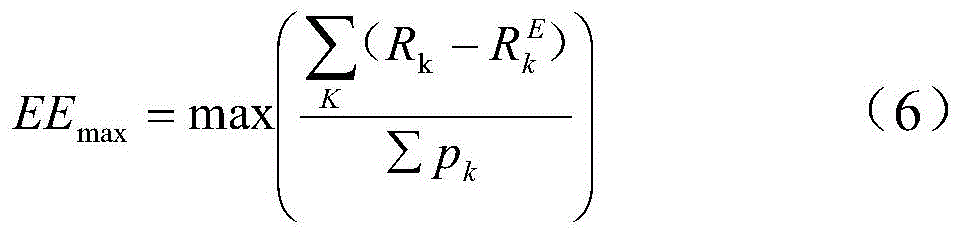
Wherein the maximum safe transmission rate and the maximum safe energy efficiency of the system are shown as (5) and (6).
Where we use the signal R of the mth user in the g-th beam, because the users have already made user groups
g,mIn place of R
k,
Instead of the former
Because the maximum safe transmission rate and the maximum energy efficiency are obtained by a formula and are non-convex, and the optimal solution cannot be directly obtained, the invention provides the following method when obtaining the maximum safe transmission rate and the maximum energy efficiency:
the method comprises the following steps: an equivalent transformation is applied to problem (6) to transform (9), and the resulting maximum values of problems (5) and (6) are the same, where λ is a constant.
Step two: to R
kAnd
the non-convex terms in (1) are subjected to first-order Taylor series transformation to change the non-convex terms into a convex linear programming problem. An initial value of 0 is assigned to λ.
Step three: and (5) carrying out CVX solution on the problem (9) to obtain an optimal solution, and then bringing the optimal solution into an original formula to carry out iterative computation until convergence.
Step four: if the first inner-layer iteration λ is 0, then substituting the point of the optimal solution into equation (3) at this time can result in the maximum safe rate. The value of λ is then updated, as shown in equation (10).
Step five: whether to converge is judged according to the formula (11)
If convergence enters the sixth step, if not, the iteration is continued.
Step six: and substituting the point of the optimal solution into the formula (6) to obtain the optimal solution with the maximum safe energy efficiency.
Finally, the above embodiments are only for illustrating the technical solutions of the present invention and not for limiting, although the present invention has been described in detail with reference to the preferred embodiments, it should be understood by those skilled in the art that modifications or equivalent substitutions may be made to the technical solutions of the present invention without departing from the spirit and scope of the technical solutions of the present invention, and all of them should be covered in the claims of the present invention.