CN110322841B - TFT pixel threshold voltage compensation circuit initialized by light emitting device - Google Patents

TFT pixel threshold voltage compensation circuit initialized by light emitting device Download PDF

Info

Publication number
CN110322841B
CN110322841B CN201910231607.3A CN201910231607A CN110322841B CN 110322841 B CN110322841 B CN 110322841B CN 201910231607 A CN201910231607 A CN 201910231607A CN 110322841 B CN110322841 B CN 110322841B
Authority
CN
China
Prior art keywords
transistor
voltage
light emitting
phase
emitting device
Prior art date
Legal status (The legal status is an assumption and is not a legal conclusion. Google has not performed a legal analysis and makes no representation as to the accuracy of the status listed.)
Active
Application number
CN201910231607.3A
Other languages
Chinese (zh)
Other versions
CN110322841A (en
Inventor
陆彤
M·J·布朗洛
T·M·斯米顿
Current Assignee (The listed assignees may be inaccurate. Google has not performed a legal analysis and makes no representation or warranty as to the accuracy of the list.)
Sharp Corp
Original Assignee
Sharp Corp
Priority date (The priority date is an assumption and is not a legal conclusion. Google has not performed a legal analysis and makes no representation as to the accuracy of the date listed.)
Filing date
Publication date
Application filed by Sharp Corp filed Critical Sharp Corp
Publication of CN110322841A publication Critical patent/CN110322841A/en
Application granted granted Critical
Publication of CN110322841B publication Critical patent/CN110322841B/en
Active legal-status Critical Current
Anticipated expiration legal-status Critical

Links

Images

Classifications

    • GPHYSICS
    • G09EDUCATION; CRYPTOGRAPHY; DISPLAY; ADVERTISING; SEALS
    • G09GARRANGEMENTS OR CIRCUITS FOR CONTROL OF INDICATING DEVICES USING STATIC MEANS TO PRESENT VARIABLE INFORMATION
    • G09G3/00Control arrangements or circuits, of interest only in connection with visual indicators other than cathode-ray tubes
    • G09G3/20Control arrangements or circuits, of interest only in connection with visual indicators other than cathode-ray tubes for presentation of an assembly of a number of characters, e.g. a page, by composing the assembly by combination of individual elements arranged in a matrix no fixed position being assigned to or needed to be assigned to the individual characters or partial characters
    • G09G3/22Control arrangements or circuits, of interest only in connection with visual indicators other than cathode-ray tubes for presentation of an assembly of a number of characters, e.g. a page, by composing the assembly by combination of individual elements arranged in a matrix no fixed position being assigned to or needed to be assigned to the individual characters or partial characters using controlled light sources
    • G09G3/30Control arrangements or circuits, of interest only in connection with visual indicators other than cathode-ray tubes for presentation of an assembly of a number of characters, e.g. a page, by composing the assembly by combination of individual elements arranged in a matrix no fixed position being assigned to or needed to be assigned to the individual characters or partial characters using controlled light sources using electroluminescent panels
    • G09G3/32Control arrangements or circuits, of interest only in connection with visual indicators other than cathode-ray tubes for presentation of an assembly of a number of characters, e.g. a page, by composing the assembly by combination of individual elements arranged in a matrix no fixed position being assigned to or needed to be assigned to the individual characters or partial characters using controlled light sources using electroluminescent panels semiconductive, e.g. using light-emitting diodes [LED]
    • G09G3/3208Control arrangements or circuits, of interest only in connection with visual indicators other than cathode-ray tubes for presentation of an assembly of a number of characters, e.g. a page, by composing the assembly by combination of individual elements arranged in a matrix no fixed position being assigned to or needed to be assigned to the individual characters or partial characters using controlled light sources using electroluminescent panels semiconductive, e.g. using light-emitting diodes [LED] organic, e.g. using organic light-emitting diodes [OLED]
    • G09G3/3225Control arrangements or circuits, of interest only in connection with visual indicators other than cathode-ray tubes for presentation of an assembly of a number of characters, e.g. a page, by composing the assembly by combination of individual elements arranged in a matrix no fixed position being assigned to or needed to be assigned to the individual characters or partial characters using controlled light sources using electroluminescent panels semiconductive, e.g. using light-emitting diodes [LED] organic, e.g. using organic light-emitting diodes [OLED] using an active matrix
    • G09G3/3233Control arrangements or circuits, of interest only in connection with visual indicators other than cathode-ray tubes for presentation of an assembly of a number of characters, e.g. a page, by composing the assembly by combination of individual elements arranged in a matrix no fixed position being assigned to or needed to be assigned to the individual characters or partial characters using controlled light sources using electroluminescent panels semiconductive, e.g. using light-emitting diodes [LED] organic, e.g. using organic light-emitting diodes [OLED] using an active matrix with pixel circuitry controlling the current through the light-emitting element
    • GPHYSICS
    • G09EDUCATION; CRYPTOGRAPHY; DISPLAY; ADVERTISING; SEALS
    • G09GARRANGEMENTS OR CIRCUITS FOR CONTROL OF INDICATING DEVICES USING STATIC MEANS TO PRESENT VARIABLE INFORMATION
    • G09G3/00Control arrangements or circuits, of interest only in connection with visual indicators other than cathode-ray tubes
    • G09G3/20Control arrangements or circuits, of interest only in connection with visual indicators other than cathode-ray tubes for presentation of an assembly of a number of characters, e.g. a page, by composing the assembly by combination of individual elements arranged in a matrix no fixed position being assigned to or needed to be assigned to the individual characters or partial characters
    • G09G3/22Control arrangements or circuits, of interest only in connection with visual indicators other than cathode-ray tubes for presentation of an assembly of a number of characters, e.g. a page, by composing the assembly by combination of individual elements arranged in a matrix no fixed position being assigned to or needed to be assigned to the individual characters or partial characters using controlled light sources
    • G09G3/30Control arrangements or circuits, of interest only in connection with visual indicators other than cathode-ray tubes for presentation of an assembly of a number of characters, e.g. a page, by composing the assembly by combination of individual elements arranged in a matrix no fixed position being assigned to or needed to be assigned to the individual characters or partial characters using controlled light sources using electroluminescent panels
    • G09G3/32Control arrangements or circuits, of interest only in connection with visual indicators other than cathode-ray tubes for presentation of an assembly of a number of characters, e.g. a page, by composing the assembly by combination of individual elements arranged in a matrix no fixed position being assigned to or needed to be assigned to the individual characters or partial characters using controlled light sources using electroluminescent panels semiconductive, e.g. using light-emitting diodes [LED]
    • GPHYSICS
    • G09EDUCATION; CRYPTOGRAPHY; DISPLAY; ADVERTISING; SEALS
    • G09GARRANGEMENTS OR CIRCUITS FOR CONTROL OF INDICATING DEVICES USING STATIC MEANS TO PRESENT VARIABLE INFORMATION
    • G09G3/00Control arrangements or circuits, of interest only in connection with visual indicators other than cathode-ray tubes
    • G09G3/20Control arrangements or circuits, of interest only in connection with visual indicators other than cathode-ray tubes for presentation of an assembly of a number of characters, e.g. a page, by composing the assembly by combination of individual elements arranged in a matrix no fixed position being assigned to or needed to be assigned to the individual characters or partial characters
    • G09G3/22Control arrangements or circuits, of interest only in connection with visual indicators other than cathode-ray tubes for presentation of an assembly of a number of characters, e.g. a page, by composing the assembly by combination of individual elements arranged in a matrix no fixed position being assigned to or needed to be assigned to the individual characters or partial characters using controlled light sources
    • G09G3/30Control arrangements or circuits, of interest only in connection with visual indicators other than cathode-ray tubes for presentation of an assembly of a number of characters, e.g. a page, by composing the assembly by combination of individual elements arranged in a matrix no fixed position being assigned to or needed to be assigned to the individual characters or partial characters using controlled light sources using electroluminescent panels
    • G09G3/32Control arrangements or circuits, of interest only in connection with visual indicators other than cathode-ray tubes for presentation of an assembly of a number of characters, e.g. a page, by composing the assembly by combination of individual elements arranged in a matrix no fixed position being assigned to or needed to be assigned to the individual characters or partial characters using controlled light sources using electroluminescent panels semiconductive, e.g. using light-emitting diodes [LED]
    • G09G3/3208Control arrangements or circuits, of interest only in connection with visual indicators other than cathode-ray tubes for presentation of an assembly of a number of characters, e.g. a page, by composing the assembly by combination of individual elements arranged in a matrix no fixed position being assigned to or needed to be assigned to the individual characters or partial characters using controlled light sources using electroluminescent panels semiconductive, e.g. using light-emitting diodes [LED] organic, e.g. using organic light-emitting diodes [OLED]
    • G09G3/3225Control arrangements or circuits, of interest only in connection with visual indicators other than cathode-ray tubes for presentation of an assembly of a number of characters, e.g. a page, by composing the assembly by combination of individual elements arranged in a matrix no fixed position being assigned to or needed to be assigned to the individual characters or partial characters using controlled light sources using electroluminescent panels semiconductive, e.g. using light-emitting diodes [LED] organic, e.g. using organic light-emitting diodes [OLED] using an active matrix
    • G09G3/3258Control arrangements or circuits, of interest only in connection with visual indicators other than cathode-ray tubes for presentation of an assembly of a number of characters, e.g. a page, by composing the assembly by combination of individual elements arranged in a matrix no fixed position being assigned to or needed to be assigned to the individual characters or partial characters using controlled light sources using electroluminescent panels semiconductive, e.g. using light-emitting diodes [LED] organic, e.g. using organic light-emitting diodes [OLED] using an active matrix with pixel circuitry controlling the voltage across the light-emitting element
    • GPHYSICS
    • G09EDUCATION; CRYPTOGRAPHY; DISPLAY; ADVERTISING; SEALS
    • G09GARRANGEMENTS OR CIRCUITS FOR CONTROL OF INDICATING DEVICES USING STATIC MEANS TO PRESENT VARIABLE INFORMATION
    • G09G3/00Control arrangements or circuits, of interest only in connection with visual indicators other than cathode-ray tubes
    • G09G3/20Control arrangements or circuits, of interest only in connection with visual indicators other than cathode-ray tubes for presentation of an assembly of a number of characters, e.g. a page, by composing the assembly by combination of individual elements arranged in a matrix no fixed position being assigned to or needed to be assigned to the individual characters or partial characters
    • G09G3/22Control arrangements or circuits, of interest only in connection with visual indicators other than cathode-ray tubes for presentation of an assembly of a number of characters, e.g. a page, by composing the assembly by combination of individual elements arranged in a matrix no fixed position being assigned to or needed to be assigned to the individual characters or partial characters using controlled light sources
    • G09G3/30Control arrangements or circuits, of interest only in connection with visual indicators other than cathode-ray tubes for presentation of an assembly of a number of characters, e.g. a page, by composing the assembly by combination of individual elements arranged in a matrix no fixed position being assigned to or needed to be assigned to the individual characters or partial characters using controlled light sources using electroluminescent panels
    • G09G3/32Control arrangements or circuits, of interest only in connection with visual indicators other than cathode-ray tubes for presentation of an assembly of a number of characters, e.g. a page, by composing the assembly by combination of individual elements arranged in a matrix no fixed position being assigned to or needed to be assigned to the individual characters or partial characters using controlled light sources using electroluminescent panels semiconductive, e.g. using light-emitting diodes [LED]
    • G09G3/3208Control arrangements or circuits, of interest only in connection with visual indicators other than cathode-ray tubes for presentation of an assembly of a number of characters, e.g. a page, by composing the assembly by combination of individual elements arranged in a matrix no fixed position being assigned to or needed to be assigned to the individual characters or partial characters using controlled light sources using electroluminescent panels semiconductive, e.g. using light-emitting diodes [LED] organic, e.g. using organic light-emitting diodes [OLED]
    • G09G3/3275Details of drivers for data electrodes
    • G09G3/3291Details of drivers for data electrodes in which the data driver supplies a variable data voltage for setting the current through, or the voltage across, the light-emitting elements
    • HELECTRICITY
    • H10SEMICONDUCTOR DEVICES; ELECTRIC SOLID-STATE DEVICES NOT OTHERWISE PROVIDED FOR
    • H10KORGANIC ELECTRIC SOLID-STATE DEVICES
    • H10K59/00Integrated devices, or assemblies of multiple devices, comprising at least one organic light-emitting element covered by group H10K50/00
    • H10K59/10OLED displays
    • H10K59/12Active-matrix OLED [AMOLED] displays
    • H10K59/121Active-matrix OLED [AMOLED] displays characterised by the geometry or disposition of pixel elements
    • H10K59/1213Active-matrix OLED [AMOLED] displays characterised by the geometry or disposition of pixel elements the pixel elements being TFTs
    • HELECTRICITY
    • H10SEMICONDUCTOR DEVICES; ELECTRIC SOLID-STATE DEVICES NOT OTHERWISE PROVIDED FOR
    • H10KORGANIC ELECTRIC SOLID-STATE DEVICES
    • H10K59/00Integrated devices, or assemblies of multiple devices, comprising at least one organic light-emitting element covered by group H10K50/00
    • H10K59/10OLED displays
    • H10K59/12Active-matrix OLED [AMOLED] displays
    • H10K59/121Active-matrix OLED [AMOLED] displays characterised by the geometry or disposition of pixel elements
    • H10K59/1216Active-matrix OLED [AMOLED] displays characterised by the geometry or disposition of pixel elements the pixel elements being capacitors
    • HELECTRICITY
    • H10SEMICONDUCTOR DEVICES; ELECTRIC SOLID-STATE DEVICES NOT OTHERWISE PROVIDED FOR
    • H10KORGANIC ELECTRIC SOLID-STATE DEVICES
    • H10K59/00Integrated devices, or assemblies of multiple devices, comprising at least one organic light-emitting element covered by group H10K50/00
    • H10K59/10OLED displays
    • H10K59/12Active-matrix OLED [AMOLED] displays
    • H10K59/123Connection of the pixel electrodes to the thin film transistors [TFT]
    • GPHYSICS
    • G09EDUCATION; CRYPTOGRAPHY; DISPLAY; ADVERTISING; SEALS
    • G09GARRANGEMENTS OR CIRCUITS FOR CONTROL OF INDICATING DEVICES USING STATIC MEANS TO PRESENT VARIABLE INFORMATION
    • G09G2300/00Aspects of the constitution of display devices
    • G09G2300/04Structural and physical details of display devices
    • G09G2300/0439Pixel structures
    • G09G2300/0465Improved aperture ratio, e.g. by size reduction of the pixel circuit, e.g. for improving the pixel density or the maximum displayable luminance or brightness
    • GPHYSICS
    • G09EDUCATION; CRYPTOGRAPHY; DISPLAY; ADVERTISING; SEALS
    • G09GARRANGEMENTS OR CIRCUITS FOR CONTROL OF INDICATING DEVICES USING STATIC MEANS TO PRESENT VARIABLE INFORMATION
    • G09G2300/00Aspects of the constitution of display devices
    • G09G2300/08Active matrix structure, i.e. with use of active elements, inclusive of non-linear two terminal elements, in the pixels together with light emitting or modulating elements
    • G09G2300/0809Several active elements per pixel in active matrix panels
    • G09G2300/0819Several active elements per pixel in active matrix panels used for counteracting undesired variations, e.g. feedback or autozeroing
    • GPHYSICS
    • G09EDUCATION; CRYPTOGRAPHY; DISPLAY; ADVERTISING; SEALS
    • G09GARRANGEMENTS OR CIRCUITS FOR CONTROL OF INDICATING DEVICES USING STATIC MEANS TO PRESENT VARIABLE INFORMATION
    • G09G2300/00Aspects of the constitution of display devices
    • G09G2300/08Active matrix structure, i.e. with use of active elements, inclusive of non-linear two terminal elements, in the pixels together with light emitting or modulating elements
    • G09G2300/0809Several active elements per pixel in active matrix panels
    • G09G2300/0842Several active elements per pixel in active matrix panels forming a memory circuit, e.g. a dynamic memory with one capacitor
    • GPHYSICS
    • G09EDUCATION; CRYPTOGRAPHY; DISPLAY; ADVERTISING; SEALS
    • G09GARRANGEMENTS OR CIRCUITS FOR CONTROL OF INDICATING DEVICES USING STATIC MEANS TO PRESENT VARIABLE INFORMATION
    • G09G2300/00Aspects of the constitution of display devices
    • G09G2300/08Active matrix structure, i.e. with use of active elements, inclusive of non-linear two terminal elements, in the pixels together with light emitting or modulating elements
    • G09G2300/0809Several active elements per pixel in active matrix panels
    • G09G2300/0842Several active elements per pixel in active matrix panels forming a memory circuit, e.g. a dynamic memory with one capacitor
    • G09G2300/0861Several active elements per pixel in active matrix panels forming a memory circuit, e.g. a dynamic memory with one capacitor with additional control of the display period without amending the charge stored in a pixel memory, e.g. by means of additional select electrodes
    • GPHYSICS
    • G09EDUCATION; CRYPTOGRAPHY; DISPLAY; ADVERTISING; SEALS
    • G09GARRANGEMENTS OR CIRCUITS FOR CONTROL OF INDICATING DEVICES USING STATIC MEANS TO PRESENT VARIABLE INFORMATION
    • G09G2300/00Aspects of the constitution of display devices
    • G09G2300/08Active matrix structure, i.e. with use of active elements, inclusive of non-linear two terminal elements, in the pixels together with light emitting or modulating elements
    • G09G2300/0809Several active elements per pixel in active matrix panels
    • G09G2300/0842Several active elements per pixel in active matrix panels forming a memory circuit, e.g. a dynamic memory with one capacitor
    • G09G2300/0861Several active elements per pixel in active matrix panels forming a memory circuit, e.g. a dynamic memory with one capacitor with additional control of the display period without amending the charge stored in a pixel memory, e.g. by means of additional select electrodes
    • G09G2300/0866Several active elements per pixel in active matrix panels forming a memory circuit, e.g. a dynamic memory with one capacitor with additional control of the display period without amending the charge stored in a pixel memory, e.g. by means of additional select electrodes by means of changes in the pixel supply voltage
    • GPHYSICS
    • G09EDUCATION; CRYPTOGRAPHY; DISPLAY; ADVERTISING; SEALS
    • G09GARRANGEMENTS OR CIRCUITS FOR CONTROL OF INDICATING DEVICES USING STATIC MEANS TO PRESENT VARIABLE INFORMATION
    • G09G2310/00Command of the display device
    • G09G2310/02Addressing, scanning or driving the display screen or processing steps related thereto
    • G09G2310/0243Details of the generation of driving signals
    • GPHYSICS
    • G09EDUCATION; CRYPTOGRAPHY; DISPLAY; ADVERTISING; SEALS
    • G09GARRANGEMENTS OR CIRCUITS FOR CONTROL OF INDICATING DEVICES USING STATIC MEANS TO PRESENT VARIABLE INFORMATION
    • G09G2310/00Command of the display device
    • G09G2310/02Addressing, scanning or driving the display screen or processing steps related thereto
    • G09G2310/0243Details of the generation of driving signals
    • G09G2310/0251Precharge or discharge of pixel before applying new pixel voltage
    • GPHYSICS
    • G09EDUCATION; CRYPTOGRAPHY; DISPLAY; ADVERTISING; SEALS
    • G09GARRANGEMENTS OR CIRCUITS FOR CONTROL OF INDICATING DEVICES USING STATIC MEANS TO PRESENT VARIABLE INFORMATION
    • G09G2310/00Command of the display device
    • G09G2310/06Details of flat display driving waveforms
    • GPHYSICS
    • G09EDUCATION; CRYPTOGRAPHY; DISPLAY; ADVERTISING; SEALS
    • G09GARRANGEMENTS OR CIRCUITS FOR CONTROL OF INDICATING DEVICES USING STATIC MEANS TO PRESENT VARIABLE INFORMATION
    • G09G2320/00Control of display operating conditions
    • G09G2320/02Improving the quality of display appearance
    • G09G2320/0233Improving the luminance or brightness uniformity across the screen
    • GPHYSICS
    • G09EDUCATION; CRYPTOGRAPHY; DISPLAY; ADVERTISING; SEALS
    • G09GARRANGEMENTS OR CIRCUITS FOR CONTROL OF INDICATING DEVICES USING STATIC MEANS TO PRESENT VARIABLE INFORMATION
    • G09G2320/00Control of display operating conditions
    • G09G2320/02Improving the quality of display appearance
    • G09G2320/0238Improving the black level
    • GPHYSICS
    • G09EDUCATION; CRYPTOGRAPHY; DISPLAY; ADVERTISING; SEALS
    • G09GARRANGEMENTS OR CIRCUITS FOR CONTROL OF INDICATING DEVICES USING STATIC MEANS TO PRESENT VARIABLE INFORMATION
    • G09G2320/00Control of display operating conditions
    • G09G2320/04Maintaining the quality of display appearance
    • G09G2320/043Preventing or counteracting the effects of ageing
    • GPHYSICS
    • G09EDUCATION; CRYPTOGRAPHY; DISPLAY; ADVERTISING; SEALS
    • G09GARRANGEMENTS OR CIRCUITS FOR CONTROL OF INDICATING DEVICES USING STATIC MEANS TO PRESENT VARIABLE INFORMATION
    • G09G2320/00Control of display operating conditions
    • G09G2320/04Maintaining the quality of display appearance
    • G09G2320/043Preventing or counteracting the effects of ageing
    • G09G2320/045Compensation of drifts in the characteristics of light emitting or modulating elements
    • GPHYSICS
    • G09EDUCATION; CRYPTOGRAPHY; DISPLAY; ADVERTISING; SEALS
    • G09GARRANGEMENTS OR CIRCUITS FOR CONTROL OF INDICATING DEVICES USING STATIC MEANS TO PRESENT VARIABLE INFORMATION
    • G09G2330/00Aspects of power supply; Aspects of display protection and defect management
    • G09G2330/02Details of power systems and of start or stop of display operation
    • G09G2330/021Power management, e.g. power saving

Landscapes

  • Engineering & Computer Science (AREA)
  • Physics & Mathematics (AREA)
  • Computer Hardware Design (AREA)
  • General Physics & Mathematics (AREA)
  • Theoretical Computer Science (AREA)
  • Microelectronics & Electronic Packaging (AREA)
  • Geometry (AREA)
  • Control Of El Displays (AREA)
  • Electroluminescent Light Sources (AREA)
  • Control Of Indicators Other Than Cathode Ray Tubes (AREA)

Abstract

显示装置用像素电路包括:驱动晶体管,根据施加到其栅极的电压来控制至发光器件的电流量;第二晶体管,连接到栅极和第二端子,当处于导通状态时,驱动晶体管变为二极管连接,使其栅极和第二端子经第二晶体管连接;发光器件,在第一节点连接到第二端子且在第二节点连接到第一电压源;第三晶体管,连接在初始化电压源和第一节点间,节点N1为第二端子、第一节点和第三晶体管的连接点;和至少一个电容器,具有连接到栅极的第一板和可连接到参考电压源的第二板。像素电路可在初始化阶段操作以初始化电路电压,在补偿阶段操作以补偿驱动晶体管特性变化,在编程阶段中操作以将灰度值编程到像素电路并在发光器件发出对应于灰度值的光的发光阶段中操作。

Figure 201910231607

The pixel circuit for a display device includes: a driving transistor that controls the amount of current to the light-emitting device according to a voltage applied to its gate; A diode is connected, so that its gate and the second terminal are connected through a second transistor; the light-emitting device is connected to the second terminal at the first node and is connected to the first voltage source at the second node; the third transistor is connected to the initialization voltage between the source and the first node, node N1 being the connection point of the second terminal, the first node and the third transistor; and at least one capacitor having a first plate connected to the gate and a second plate connectable to a reference voltage source . The pixel circuit may operate in an initialization phase to initialize the circuit voltage, in a compensation phase to compensate for drive transistor characteristic changes, and in a programming phase to program grayscale values to the pixel circuit and to emit light corresponding to the grayscale values in the light emitting device. Operates in the glow phase.

Figure 201910231607

Description

TFT pixel threshold voltage compensation circuit initialized by light emitting device
Technical Field
The present invention relates to the design and operation of electronic circuits for delivering current to elements in a display device, such as, for example, Organic Light Emitting Diodes (OLEDs) in pixels of an active matrix OLED (amoled) display device.
Background
An Organic Light Emitting Diode (OLED) generates light by recombination of electrons and holes, and emits light when a bias is applied between an anode and a cathode such that a current passes therebetween. The brightness of the light is related to the amount of current. If there is no current, no light is emitted, so OLED technology is a technology that can produce an absolute black color and, when used in display applications, achieve an almost "infinite" contrast between pixels.
Several techniques are taught in the prior art for pixel Thin Film Transistor (TFT) circuits to deliver current to a display device through a drive transistorSolution for components such as Organic Light Emitting Diodes (OLEDs). In one example, an input signal, such as a low "SCAN" signal, is used to switch transistors in the circuit to allow the data voltage VDAT to be stored in the storage capacitor during the programming phase. When the SCAN signal is high and VDAT is isolated from the circuit by the switching transistor being off, the VDAT voltage is held by the capacitor and this voltage is applied to the gate of the drive transistor. Having a threshold voltage V at the drive transistorTHThe amount of current to the OLED is related to the voltage on the gate of the drive transistor by:
Figure BDA0002006889010000011
(β is a constant relating to the characteristics of the driving transistor).
TFT device characteristics, especially TFT threshold voltage VTHMay change, for example, due to the manufacturing process or stress and aging of the TFT device during operation. The amount of current delivered by the drive TFT may vary greatly for the same VDAT voltage due to such threshold voltage variations. Thus, for a given VDAT value, a pixel in the display may not exhibit uniform brightness.
Therefore, conventionally, the OLED pixel circuit has a high tolerance range for variations in the threshold voltage and/or carrier mobility of the driving transistor by employing a circuit that compensates for the characteristic mismatch of the driving transistor. For example, one solution is described in US7414599(Chung et al, published 19/8/2008), which describes a circuit in which the drive TFT is configured as a diode-connected device during the programming period and the data voltage is applied to the source of the drive transistor.
However, with this circuit configuration, the anode of the OLED is not reset with respect to the programming phase. Instead, there will be a residual voltage at the OLED anode. When light emission starts and a light emission current flows through the OLED during the light emission phase, the OLED will take some time to refresh the data voltage at the anode. The first problem with this is that it may affect the true black state. For example, if the previous frame data voltage corresponds to a white gray level and the current frame data voltage corresponds to a black gray level, there will be some light emission due to the residual voltage at the beginning of the light emitting phase. The true black state will suffer. The second problem is memory effects from previous frame data. If the programming current is low, it may take a relatively long time to refresh the anode to the programmed value. During the refresh period, the light emission may vary due to previous residual data at the anode of the OLED, which means that the same programming data may have different light emissions, especially for relatively small light emitting currents, affected by the previous frame data.
Another solution is described in US8314788(Choi, published 11, 12 days 2012). In such a circuit, the diode-connected voltage of the drive transistor is pulled down by changing the voltage level on the top plate of the storage capacitor. There are significant disadvantages to this configuration and method. First, when the gate voltage of the drive transistor is pulled down, the diode-connected drive transistor is forward biased and there may be a large transient current to the OLED. This may create a high brightness light situation which will prevent the pixel from having a true black state. Second, the anode of the OLED and the gate voltage of the driving transistor will maintain the voltage from the previous frame. Without the initialization or reset scheme, the voltage of the previous frame may affect the programming voltage of the current frame. Thus, the current to the OLED during a frame may be affected by the state in the previous frame and the applied data.
Other solutions have proven insufficient to solve the above-mentioned problems. US7936322(Chung et al, 5/3/2011) describes a scheme for reducing the number of transistors to five by overlapping scan and emission control signals. However, this solution may cause leakage currents during the programming phase, which may affect the blackness in low current operation. US 8237637(Chung, published on 8/7/2012) describes a solution to improve blackness and eliminate memory effects on the anode of an OLED by adding more than one transistor between the initial voltage and the anode. However, this configuration increases the number of transistors in the circuit to 7, which reduces efficiency and is difficult to implement in high resolution applications requiring small geometries. US8314788(Choi, published on 11/12/2012) describes a solution to reduce the number of transistors by pulling down the gate voltage of the drive transistor to save the isolation transistor between the drive transistor and the OLED. However, with this configuration, there may be a high transient current during the programming phase. Since there is no initialization scheme, memory effects may affect true blackness. US 9337439(Kwon, published 5/10/2016) describes a solution to improve the blackness by using previous data, but the number of transistors is still high and the residual voltage at the anode of the OLED may still cause some light leakage with low light emission current. US 9489894B2(Yin et al) describes a scheme using ELVDD as an initial signal, which reduces the signal lines by one. However, this solution still has the same number of transistors as US7414599 and the same residual memory effect at the anode of the OLED.
Disclosure of Invention
The present invention relates to a pixel circuit capable of compensating for threshold voltage variations of a drive transistor with fewer transistors than in conventional configurations, and in addition, the circuit (1) reduces or eliminates possible memory effects associated with the state of an OLED device and the drive transistor in a previous frame; (2) the ability of the pixel to emit little or no light during the initialization phase is improved so that it has a true black state.
The pixel circuit for delivering the required current to the OLED has a drive transistor which sets the current supplied to the OLED during the light emission phase in dependence on the voltage at the gate of the drive transistor, wherein the gate voltage is stored on the energy storage capacitor. The pixel circuit is configured such that during an initialization phase an initialization voltage (INIT) is simultaneously applied at the gate of the drive transistor, at the first plate of the storage capacitor and at the first terminal (and preferably the anode) of the OLED.
In an exemplary embodiment, the value of the initialization voltage is set such that the difference between the initialization voltage and the voltage (ELVSS) at the second terminal (preferably the cathode) of the OLED is:
i) less than the threshold Voltage (VTH) of the OLEDOLED) This is the minimum forward bias voltage that produces a light emission discernible to the human eye when applied to the OLED during the initialization phase: INIT-ELVSS<VTHOLED
And is
ii) is larger than the reverse bias voltage over the OLED which may cause damage to the OLED. For example: INIT-ELVSS > -2V.
The initialization voltage may be in the following range:
-2V<INIT-ELVSS<VTHOLED
in an exemplary embodiment, the value of INIT-ELVSS is less than 0V, so that the OLED is reverse biased during the initialization phase. Advantageously, this enables the voltage range of the pixel circuit (i.e. the difference between the highest voltage in the pixel circuit and the lowest voltage in the pixel circuit) to be reduced whilst still providing effective compensation of the threshold voltage of the drive transistor. The shrinking range of pixel circuits allows the power consumption of the driver of the display to be reduced.
The drain of the drive transistor may be connected to the anode of the OLED such that during an initialization phase an initialization voltage (INIT) is simultaneously applied at the gate of the drive transistor, at one plate of the storage capacitor, at the anode of the OLED and at the drain of the drive transistor. During this initialization phase, memory effects related to the states of the OLED and the gate of the drive transistor in the previous frame are reduced or eliminated.
The pixel circuit may also be configured with one or more of the following features and modes of operation:
(1) during a subsequent threshold voltage compensation phase, a relatively high fixed voltage is applied at the source of the drive transistor, so that a voltage related to the threshold voltage of the drive transistor can be stored on the storage capacitor. Preferably, the voltage is set at a level that does not cause the OLED to emit light.
(2) During a subsequent data programming phase, a reference Voltage (VREF) is applied to the second plate of the storage capacitor, which pulls down the voltage at the gate of the drive transistor. The gate voltage of the drive transistor may be pulled down to near the initialization voltage. The data voltage may then be programmed to the storage capacitor by the diode-connected state of the drive transistor.
(3) VREF is set to raise the gate voltage of the drive transistor to a light emission voltage level that drives light emission from the OLED during the light emission phase.
(4) At the beginning of the light emission phase, a light emission second initialization phase is used to improve threshold compensation performance when the current delivered by the drive transistor during a subsequent light emission phase is low. During this phase, a second initialization voltage is applied to the anode of the OLED.
Embodiments of the present invention have advantages over conventional configurations. These advantages include, for example, the use of as few as five transistors and one storage capacitor, thereby providing a smaller circuit than conventional configurations. In addition, the pixel circuit configuration of the present disclosure improves true blackness by reverse biasing the OLED at a stage prior to the emission stage and improves the accuracy of threshold voltage compensation of the drive transistor, especially for low OLED currents.
One aspect of the present invention is a pixel circuit for a display device, which is operable in an initialization phase, a compensation phase, a programming phase, and a light emitting phase. In an exemplary embodiment, a pixel circuit includes: a driving transistor configured to control an amount of current to the light emitting device during a light emitting period according to a voltage applied to a gate of the driving transistor; a second transistor connected to a gate of the driving transistor, wherein the second transistor is in an on state during the initialization, compensation, and programming phases and is in an off state during the light emitting phase, and the driving transistor becomes diode-connected when the second transistor is in the on state such that the gate and the second terminal of the driving transistor are connected through the second transistor; a light emitting device connected to the second terminal of the driving transistor at a first node and connected to the first voltage source at a second node; a third transistor connected to a first node of the light emitting device, wherein a node N1 is a connection point of the second terminal of the driving transistor, the first node of the light emitting device, and the third transistor; and at least one capacitor having a first plate connected to the gate of the driving transistor and a second plate connectable to a reference voltage. The third transistor is in an on state during an initialization phase to connect the first initialization voltage to the node N1 and to the first plate of the capacitor through the second transistor to initialize a voltage across the light emitting device, and the third transistor is in an off state during a light emitting phase; and at least partially compensating for the threshold voltage of the drive transistor during the compensation phase when the reference voltage is applied to the second plate of the capacitor. The pixel circuit may also operate during a second initialization phase of light emission in which the third transistor is in an on state to connect the second initialization voltage to the node N1.
In an exemplary embodiment, the pixel circuit further includes a fourth transistor connected to the third terminal of the driving transistor, wherein the fourth transistor is in a turn-on state during the programming phase to apply a data voltage corresponding to a gray value of the light emitting device during the light emitting phase. The pixel circuit further includes a fifth transistor connected to the third terminal of the drive transistor, wherein during the emission phase the fifth transistor is in an on-state to connect the drive transistor to the second voltage source. The pixel circuit may further include a sixth transistor connected to the third terminal of the driving transistor, wherein during the compensation phase, the sixth transistor is in a conductive state to apply the fixed voltage to the third terminal of the driving transistor.
Another aspect of the present invention is a method of operating a pixel circuit for a display device, comprising the steps of: providing a pixel circuit according to any embodiment; and performs an initialization phase, a compensation phase, a programming phase, and a light emitting phase. During the initialization phase, memory effects from previous frames are reduced by performing the following steps: placing the fourth transistor in an off state and placing the fifth transistor in an off state to disconnect the second voltage source from the pixel circuit; placing the third transistor in an on state to apply a first initialization voltage to the first node of the light emitting device; placing the second transistor in a conducting state, wherein the drive transistor becomes diode connected through the second transistor; and placing the third transistor in an off state at the end of the initialization phase. During the compensation phase, the threshold voltage of the drive transistor is compensated at least in part by: placing the fourth transistor in a conducting state and applying a reference data voltage to the third terminal of the drive transistor, wherein the reference data voltage is set such that a voltage across the light emitting device is below a threshold voltage of the light emitting device. During the programming phase, the data voltage corresponding to the current gray value is applied by: applying a reference voltage of a second plate of the capacitor to a level for programming the entire data range; changing the data voltage source from a reference data voltage to a present data voltage corresponding to a required current passing through the light emitting device during a light emitting period; placing the fourth transistor in an off state after the current data voltage is applied; and placing the second transistor in a blocking state such that the drive transistor is no longer diode connected, wherein the present data voltage is stored by the storage capacitor. During the light emission phase, controlling the light emission by: adjusting a reference voltage applied to a second plate of the capacitor to change a gate voltage of the driving transistor to an operating voltage range, wherein the driving transistor controls an amount of current to the light emitting device; placing the fifth transistor in a conducting state to connect the second power source to the driving transistor; and controls the amount of current to the light emitting device according to the voltage applied to the gate of the driving transistor.
The operation method may include: after the programming phase and at the beginning of the light emitting phase, performing a light emitting second initialization phase to reset the voltage at the first node of the light emitting device by: placing the third transistor in an on state and applying a second initialization voltage to the first node of the light emitting device; and the state of the third transistor is changed from the on state to the off state before the light emitting period.
To the accomplishment of the foregoing and related ends, the invention, then, comprises the features hereinafter fully described and particularly pointed out in the claims. The following description and the annexed drawings set forth in detail certain illustrative embodiments of the invention. These embodiments are indicative, however, of but a few of the various ways in which the principles of the invention may be employed. Other objects, advantages and novel features of the invention will become apparent from the following detailed description of the invention when considered in conjunction with the drawings.
Drawings
Fig. 1 is a drawing depicting a first circuit configuration according to an embodiment of the invention.
Fig. 2 is a timing diagram associated with the circuit configuration of fig. 1.
Fig. 3 is a diagram depicting a second circuit configuration according to an embodiment of the invention.
Fig. 4 is a timing diagram associated with the circuit configuration of fig. 3.
Description of the reference numerals
10-first circuit configuration
20-second circuit configuration
T1-drive transistor
T2-T6-multiple switching transistors
Cst-storage capacitor
ColedInternal capacitance of the light-emitting device
ELVSS first power supply
VDD-second Power supply
VDAT-data voltage source
VREF-reference voltage source
INIT-initialization voltage source
VDAT INIT-initialization data voltage source
N1-first Circuit node
N2-second Circuit node
SCAN/EMI-control signal
1H-one horizontal period
Detailed Description
Embodiments of the present invention will now be described with reference to the drawings, wherein like reference numerals are used to refer to like elements throughout. It should be understood that the drawings are not necessarily drawn to scale.
Fig. 1 is a diagram depicting a first circuit configuration 10 according to an embodiment of the invention, and fig. 2 is a timing diagram associated with the circuit configuration of fig. 1. In this example, the circuit 10 is configured to include a plurality of p-type transistors T1-T5 and a single reservoirA TFT circuit of the energy storage capacitor Cst having a first plate connected to the gate electrode of the driving transistor T1. The circuit element drives a light emitting device such as, for example, an OLED. The light emitting device (OLED) has an associated internal capacitance, which is denoted C in the circuit diagramoled. In addition, although the embodiments are described primarily in connection with OLEDs as light emitting devices, similar principles may be used with display technologies employing other types of light emitting devices (including, for example, micro LEDs and quantum dot LEDs).
More specifically, FIG. 1 depicts a TFT circuit 10 configured with a plurality of p-MOS or p-type TFTs. T1 is a driving transistor as an analog TFT, and T2-T5 is a digital switching TFT. Cst is a capacitor, as described above, and ColedIs the internal capacitance (i.e., C) of the OLED deviceoledNot a separate component but inherent to the OLED). The OLED is connected to a first power source ELVSS as conventional.
The OLED and TFT circuitry 10, including transistors, capacitors, and connecting lines, may be fabricated using TFT fabrication processes that are conventional in the art. It should be understood that similar manufacturing processes may be employed to fabricate TFT circuits according to any of the embodiments.
For example, the TFT circuit 10 (and subsequent embodiments) may be provided on a substrate such as glass, plastic, or a metal substrate. Each TFT may include a gate electrode, a gate insulating layer, a semiconductor layer, a first electrode, and a second electrode. The semiconductor layer is disposed on the substrate. A gate insulating layer is disposed on the semiconductor layer, and a gate electrode may be disposed on the insulating layer. The first electrode and the second electrode may be disposed on the insulating layer and connected to the semiconductor layer using a via hole. The first and second electrodes may be generally referred to as "source electrodes" and "drain electrodes" of the TFT, respectively. The capacitor may comprise a first electrode, an insulating layer and a second electrode, whereby the insulating layer forms an insulating barrier between the first electrode and the second electrode. The wiring between components in the circuit, as well as the wiring used to introduce signals into the circuit (e.g., SCAN, EMI, VDATA, VREF) may include metal wires or doped semiconductor materials. For example, a metal line may be disposed between a substrate of the TFT and a gate electrode, and connected to the electrode using a via hole. The semiconductor layer may be deposited by chemical vapor deposition and the metal layer may be deposited by thermal evaporation techniques.
The OLED device may be disposed on the TFT circuit. The OLED device may include a first electrode (e.g., an anode of the OLED) connected to the transistors T1, T2, and T3 in this example, one or more layers for injecting or transporting charges (e.g., holes) to the light emitting layer, one or more layers for injecting or transporting charges (e.g., electrons) to the light emitting layer, and a second electrode (e.g., a cathode of the OLED) connected to a first power supply ELVSS in this example. The injection layer, transport layer and light emitting layer may be organic materials, the first and second electrodes may be metals, and all of these layers may be deposited by thermal evaporation techniques.
Referring to the TFT circuit 10 in conjunction with the timing diagram in fig. 2, the TFT circuit 10 operates to perform the following stages: (1) a first initialization phase, (2) a threshold voltage compensation phase (3) a data programming phase, and (4) a light emission phase for light emission, including an optional light emission second initialization phase. The period of time through which the data programming phase is completed is referred to in the art as the "horizontal time" or "1H" as shown in fig. 2 and subsequent timing diagrams. The short time 1H is a requirement for a display with a large number of pixels in a column, which is necessary for a high resolution display. Thus, in the example of fig. 1, 1H includes a first initialization phase, a threshold voltage compensation phase, and a data programming phase.
In this first embodiment, during the first initialization phase, the memory effect of the residual voltage from the previous frame is substantially eliminated. First, the EMI signal level is set to a high voltage value, turning off the transistor T5. Accordingly, the source of the driving transistor T1 is disconnected from the second power source VDD. In addition, the initialization voltage signal (INIT) changes from the high reference voltage level INIT _ H to the low reference voltage level INIT _ L. Preferably, INIT _ H is similar to the voltage at the anode of the OLED, which produces the lowest light emission of the OLED during the light emitting phase for typical operation of the display. Therefore, INIT _ L, which is lower than INIT _ H, has a value that can reverse bias the OLED, i.e., INIT _ L may be smaller than ELVSS. The value of INIT _ L should also be set so as not to cause significant degradation of the OLED.
Further, during the first initialization phase, the SCAN1 signal level changes from a high value to a low value, causing transistor T3 to turn on. Therefore, the low initialization voltage INIT _ L is applied at the node N1 at the anode of the OLED. The application of the initialization voltage INIT _ L operates to eliminate memory effects from the previous frame, since any residual voltage at the OLED anode from the previous frame will be reset to INIT _ L.
Further, during the first initialization phase, the SCAN2 signal level changes from a high voltage value to a low voltage value, causing transistor T2 to turn on. Therefore, the driving transistor T1 becomes "diode-connected" through the transistor T2. The diode connection refers to the driving transistor T1 operating in a state where its gate and second terminal (e.g., source or drain) are connected, so that current flows in one direction. When the driving transistor T1 is diode-connected in this manner, the gate and drain of the driving transistor are initialized to the INIT _ L voltage by the transistors T2 and T3. In this way, the initialization voltage INIT _ L is applied simultaneously at the gate of the drive transistor, at the first (top) plate of the storage capacitor, at the anode of the OLED and at the drain of the drive transistor. Thus, during this initialization phase, memory effects related to the state of the OLED and the gate of the drive transistor in the previous frame are reduced or eliminated.
The turn-on sequence of the transistors, specifically turn-on T3 followed by turn-on T2, is the preferred operating sequence to ensure that there is no light emission from the OLED. For example, if T2 turned on before T3, when the gate of the driving transistor T1 is connected to the anode of the OLED through the transistor T2, the residual voltage at the gate of the driving transistor T1 may generate light emission in a diode-connected state. As described above, in the case where the driving transistor T1 is diode-connected, the initialization voltage is also applied to the first (top) plate of the storage capacitor Cst.
Further, during the first initialization phase, the reference voltage VREF applied at the second (bottom) plate of the storage capacitor Cst becomes the intermediate reference level VREF _ M as part of the initialization. As generally used herein, the input reference voltage VREF may be set to three different valuesThe values, referred to herein as a first or high value, a second or intermediate value, and a third or low value, represent the relative voltages of VREF during different phases of use. At the beginning of the first initialization phase shown in fig. 2, the VREF signal level changes from a high value to a median value. The data voltage VDAT applied to the transistor T4 (currently in the off state) also rises to a fixed voltage level (denoted as VDAT)REF). In an exemplary embodiment, VDATREFIs set higher than the highest data voltage (denoted as VDAT) that can be applied during the subsequent data programming phaseHighest) Which is the data voltage value corresponding to the lowest gray value but low enough to ensure that the OLED is not turned on during the subsequent threshold voltage compensation phase.
Also, for effective threshold voltage compensation of the drive transistor T1, the applied VDAT voltage should be higher than VTH+VINIT_L+ΔV:
VDAT>|VTH|+VINIT_L+ΔV
More specifically, Δ V is a voltage sufficient to generate a high initial current to charge the storage capacitor for one horizontal time. The value of av will depend on the characteristics of the transistor. For example, for one of the low temperature polysilicon thin film transistor processes, Δ V will be greater than 3 volts.
These voltage relationships are as follows:
Figure BDA0002006889010000101
wherein, VTHIs the threshold voltage of the driving transistor T1, and VTHOLEDIs the threshold voltage of the OLED. As defined herein, the threshold voltage of an OLED is the maximum voltage difference between the anode and cathode of the OLED during any light emitting phase of the circuit where the output luminance of the OLED is less than 1.0% of the maximum luminance of the OLED, and preferably less than 0.1%.
At the end of the initialization phase, the SCAN1 signal level changes from a low voltage value to a high voltage value, causing transistor T3 to turn off. Therefore, the node N1 becomes floating.
Next, the TFT circuit 10 may be compensated at the threshold voltageOperates in phases during which any variation in the threshold voltage of the drive transistor T1 is compensated for. During such phase, the SCAN signal level changes from a high voltage value to a low voltage value, causing transistor T4 to turn on. Therefore, the data voltage VDATREFIs applied to the source of the driving transistor T1. From the initialization phase, the driving transistor T1 is still diode-connected through the transistor T2. Accordingly, the diode connection node N1 of the driving transistor T1 is pulled up until the voltage V between the gate and source of the driving transistorGSEqual to threshold voltage VTH. By doing so, at the end of the compensation phase, the voltage at node N1 is approximately equal to VDATREF+VTH
The TFT circuit 10 may then operate in a data programming phase during which the current data voltage is programmed to drive the OLED during a subsequent light emitting phase. During the programming phase, the data voltage VDAT is derived from the reference data voltage VDATREFTo a present data voltage value VDAT corresponding to the required OLED current in the subsequent light emitting phase, i.e. the required grey value of the pixel in the current frame. The reference voltage VREF at the second plate of the storage capacitor Cst goes down from the intermediate level to the low level VREF _ L, which drives the transistor VN2To:
VINIT_L≤VN2<VDATlowest+VTH
wherein VDATlowestIs the data voltage corresponding to the highest gray scale value of light emission from the OLED. This may prevent any light emission during the programming phase.
Thus, at the end of the programming phase, the voltage at node N1 is approximately equal to VDAT + VTH. Further, at the end of the programming phase, the SCAN signal level changes from a low voltage value to a high voltage value, causing the transistor T4 to turn off. Therefore, the source of the driving transistor T1 becomes floating. The SCAN2 signal level changes from a low voltage value to a high voltage value, causing transistor T2 to turn off. Therefore, the gate and drain of the driving transistor are disconnected, meaning that the driving transistor T1 is no longer diode-connected.
As mentioned above, for effective threshold voltage compensation of the driving transistor T1, the VDAT voltage should be:
VDAT>|VTH|+VINIT_L+ΔV
wherein Δ V > 3V. Furthermore, to ensure that no light is emitted during the compensation phase:
Figure BDA0002006889010000121
wherein VTHIs the threshold voltage of the driving transistor T1, and VTHOLEDIs the OLED threshold voltage as defined above. Typically, the current through the OLED is less than 100 pA. In general, to satisfy these two requirements, the VDAT range needs to be small, which is undesirable because it is difficult to control the gray level of light emission. The control of the pixel circuit described in this disclosure overcomes this limitation by splitting the threshold voltage compensation phase and the data programming phase into two distinct phases. In this way, the two requirements can be met in different phases, respectively, and an effective threshold voltage compensation and an optimally wide VDAT operating range are achieved.
Next, the TFT circuit 10 may operate in a light emission phase in which the OLED is capable of emitting light. At the beginning of this phase, a light emitting second initialization phase may be performed.
In a second initialization phase of light emission, the voltage across the OLED is initialized or reset in preparation for the remaining light emission phase. This phase further enhances the accuracy of the threshold voltage compensation of the drive transistor, especially for low light emission currents of the OLED.
At the end of the above data programming phase, the voltage at the drain of the drive transistor T1 is approximately equal to VDAT + VTH. Therefore, the voltage depends on the threshold voltage of the driving transistor T1. If the programming current, i.e. the current through which the drive transistor T1 will pass during the subsequent light-emitting phase, is low, it may take some time to regulate the voltage at the drain of the drive transistor T1 to the correct level and thus V across the drive transistor T1ds(voltage between drain and source) may be different for the same program data. VdsThe secondary effect of (2) may cause the OLED current to reach the correct level at the drain voltageThe levels are different before. The glow second initialization phase helps to alleviate this problem. In particular, this phase improves the threshold voltage compensation accuracy, especially in case the OLED current required in the subsequent light emission phase is low.
During this light emission second initialization phase, the initialization voltage INIT changes from the first low voltage value INIT _ L to the second high voltage value INIT _ H. The SCAN1 signal level changes from a high voltage value to a low voltage value, causing transistor T3 to turn on. Accordingly, the node N1 connecting the drain of the driving transistor T1 and the anode of the OLED is connected to INIT _ H. By reinitializing the node N1, the start voltage is the same level even if the threshold voltage of the driving transistor T1 varies. After reinitializing node N1, at the end of this phase, the SCAN1 signal level changes from low to high, causing transistor T3 to turn off.
Referring again to the light-up phase, VREF is boosted back to the high voltage level VREF _ H, which raises the gate voltage of driver transistor T1 to the desired operating voltage range:
VN2=VDAT+VTH+ΔVREF
wherein Δ VREF=VREF_H-VREF_L。
The operating range is a gate voltage range of the driving transistor with which the driving transistor can control the amount of current to the light emitting device from the lowest current to the highest current of the pixel circuit. For example, in some applications, the current ranges from 10pA to 100 nA.
The EMI signal level changes from high to low causing transistor T5 to turn on. Accordingly, the driving transistor T1 is connected to the second power supply VDD, and I is connected as described belowOLEDConduction of current to the OLED:
Figure BDA0002006889010000131
wherein
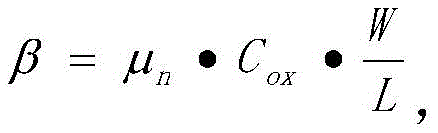
Figure BDA0002006889010000132
CoxTo drive a transistorCapacitance of the gate oxide;
w is the width of the channel of the drive transistor;
l is the length of the channel of the drive transistor (i.e., the distance between the source and drain);
μnto drive the carrier mobility of the transistor.
Thus, the current to the OLED is independent of the threshold voltage of the drive transistor T1, and thus the current I to the OLED deviceOLEDWithout being affected by variations in the threshold voltage of the drive transistor. In this way, variations in the threshold voltage of the drive transistor have been compensated for.
Fig. 3 is a diagram depicting a second circuit configuration 20 according to an embodiment of the invention, and fig. 4 is a timing diagram associated with the circuit configuration of fig. 3. In this example, similar to the previous embodiment, the circuit 20 is configured as a TFT circuit including a plurality of transistors, in this embodiment, the transistors are p-type transistors (T1-T6), and Cst is a capacitor. The circuit element drives a light emitting device such as, for example, an OLED. The light emitting device (OLED) has an associated internal capacitance, which is denoted C in the circuit diagramoled. T1 is a driving transistor as an analog TFT, T2-T6 is a digital switching TFT, and T6 is an additional transistor in this embodiment. ColedIs the internal capacitance (i.e., C) of the OLED deviceoledNot a separate component but inherent to the OLED). The OLED is also connected to a first power source ELVSS.
Compared to the previous embodiment, a fixed VDAT _ INIT voltage signal is added and applied through an additional sixth transistor T6 connected to the third terminal of the driving transistor T1. The application of VDAT _ INIT is controlled by the adjacent (e.g., previous) row SCAN signal SCAN (n-1) for threshold voltage compensation (i.e., "n" represents the current row, thus, "n-1" represents the previous row, thus SCAN (n-1) is the same signal as the SCAN (n) signal of the previous row n). Input VDAT provides a data voltage for each row. In this way, programming speed or accuracy can be improved. Specifically, as shown with reference to the timing diagram of FIG. 4, the horizontal time is significantly reduced by performing threshold voltage compensation using the signal input SCAN (n-1) from the previous row. This enhanced efficiency is a trade-off with the use of the additional sixth transistor T6 resulting in a larger circuit compared to the previous embodiment.
The pixel circuit 20 of this embodiment may also operate in a first initialization phase during which memory effects from the residual voltage of a previous frame are substantially eliminated. During this first initialization phase, the EMI (n) signal level (EMI signal of the current row) is set to a high voltage level, causing transistor T5 to turn off. Accordingly, the source of the driving transistor T1 is disconnected from the power supply VDD. The initialization voltage INIT is also changed from a high reference voltage level similar to the low light emission voltage INIT _ H at the anode of the OLED to a low reference voltage level INIT _ L that can reverse-bias the OLED as described above without degrading the performance of the OLED, compared to the previous embodiments.
Further, during the first initialization phase, the SCAN1(n) signal level (SCAN 1 signal for the current row) changes from a high voltage level to a low voltage level, causing the transistor T3 to turn on. Therefore, a low initialization voltage INIT _ L is applied at the anode of the OLED. Any residual voltage and memory effects from the previous frame will reset to INIT _ L. The SCAN2(n) signal level also changes from high to low, causing transistor T2 to turn on. Accordingly, the driving transistor T1 is diode-connected through the transistor T2, so that the gate and drain of the driving transistor T1 are also initialized to INIT _ L through T2 and T3. In the case where the driving transistor T1 is diode-connected, an initialization voltage is also applied to the first (top) plate of the storage capacitor Cst. Similar to the previous embodiment, T3 preferably turns on before T2.
Furthermore, during the first initialization phase, the reference voltage VREF at the second (bottom) plate of the storage capacitor Cst is reduced to an intermediate reference level VREF _ M as part of the initialization. At the end of the initialization phase, the SCAN1(N) signal level changes from low to high, causing transistor T3 to turn off, which floats node N1.
Next, the TFT circuit 20 may operate in a threshold voltage compensation phase during which any variation in the threshold voltage of the driving transistor T1 is compensated for. During such phase, the SCAN (n-1) signal level (SCAN signal from the previous row) changes from a high voltage level to a low voltage level, causing transistor T6 to turn on. Thus, it is possible to provideThe fixed voltage VDAT _ INIT is applied to the source of the driving transistor. The diode connection node of the driving transistor is pulled up to V of the driving transistor T1GS(gate-source voltage) equal to threshold voltage VTH. At the end of this phase, the voltage at node N1 is VDAT _ INIT + VTH. The voltage VDAT _ INIT is set higher than the highest data voltage range but low enough to ensure that the OLED does not conduct during threshold voltage compensation.
Similar to the previous description, for effective threshold voltage compensation of the drive transistor T1, the applied VDAT voltage should be higher than VTH+VINIT_L+ΔV:
VDAT>|VTH|+VINIT_L+ΔV
Therefore, the following relationship is satisfied:
Figure BDA0002006889010000151
at the end of this phase, the SCAN (n-1) signal level changes from low to high, causing transistor T6 to turn off.
The TFT circuit 20 may then operate in a data programming phase during which the data voltages are programmed to drive the OLEDs during a subsequent light emitting phase. During the programming phase, the data voltage changes from the previous row data VDAT (n-1) to the current row data VDAT (n). Scan (n) the signal level changes from a high voltage level to a low voltage level, causing transistor T4 to turn on. The data voltage vdat (n) is applied to the source of the driving transistor. The reference voltage VREF at the second (bottom) plate of the capacitor is lowered to a level VREF _ L, which drives the gate voltage V of transistor T1N2Pulling to:
VINIT_L≤VN2<VDATlowest+VTH
thus, at the end of this phase, the voltage at node N1 is VDAT (N) + VTH. In addition, the scan (n) signal level changes from low to high, causing transistor T4 to turn off. The source of the driving transistor T1 becomes floating. The SCAN2(n) signal level changes from low to high, causing the transistor T2 to turn off and drive the gate of the transistor T1The drain is turned off so that the driving transistor T1 is no longer diode-connected through the transistor T2 and the current data voltage is effectively stored by the storage capacitor Cst.
Next, the TFT circuit 20 may operate in a light emission phase in which the OLED is capable of emitting light. At the beginning of this phase, a light emitting second initialization phase may be performed. During the second initialization phase of light emission, the voltage across the OLED is initialized or reset in preparation for the remaining light emission phase. This stage, like the previous embodiment, improves the threshold voltage compensation accuracy, especially for low light emission currents. During this light emission second initialization phase, the initialization voltage INIT changes from the first low voltage level INIT _ L to the second high voltage level INIT _ H. The SCAN1(n) signal level changes from a high voltage level to a low voltage level and transistor T3 turns on. The node N1 connecting the drain of the driving transistor T1 and the anode of the OLED is connected to INIT _ H.
As described above, the drain voltage of the driving transistor T1 may be different at the end of the threshold voltage compensation phase. If the programming current for emitting light is low, it may take a long time for the drain voltage of the driving transistor T1 to recover. The voltage at the anode of the OLED may vary, and thus light emission may vary according to the threshold voltage of the driving transistor T1. By reinitializing the node N1, the start voltage is the same level even if the threshold voltage changes.
At the end of the second initialization phase of light emission, the SCAN1(n) signal level changes from low to high, causing transistor T3 to turn off. In addition, VREF is also raised to a high voltage level VREF _ H, raising the gate voltage of the driver transistor T1 device to the desired operating voltage range:
VN2=VDAT+VTH+ΔVREF
referring again to the emission phase, the emi (n) signal level changes from the high voltage level to the low voltage level, causing transistor T5 to turn on. Accordingly, the driving transistor T1 is connected to the second power source VDD and conducts current to the OLED as follows:
Figure BDA0002006889010000161
wherein
Figure BDA0002006889010000162
CoxA capacitor which is a gate oxide of the driving transistor;
w is the width of the channel of the drive transistor;
l is the length of the channel of the drive transistor (i.e., the distance between the source and drain);
μnto drive the carrier mobility of the transistor.
Thus, the current to the OLED is independent of the threshold voltage of the drive transistor T1, and thus the current I to the OLED deviceOLEDWithout being affected by variations in the threshold voltage of the drive transistor. In this way, variations in the threshold voltage of the drive transistor have been compensated for.
Although the embodiments described herein are circuits using p-type TFTs, those skilled in the art can also apply the present invention to circuits using n-type TFTs. Further, although the embodiments described herein include a light emitting device having an anode connected to a driving transistor, a cathode of the light emitting device may be connected to the driving transistor instead. For example, for a circuit using an n-type TFT and a cathode of a light emitting device connected to a driving transistor, the advantages of the described circuit configuration can be obtained.
The described pixel circuit has advantages over conventional configurations. This circuit configuration enables compensation for threshold voltage variations with fewer transistors than conventional configurations, and additionally eliminates possible memory effects of the OLED device and drive transistor associated with a previous frame. The described circuit configuration thus improves the ability of the pixel to emit very little or no light, and therefore has a true black state, and is within a wide range of data values. The pixel circuit configuration of the present disclosure further improves true blackness by reverse biasing the OLED during the phase prior to light emission, and in particular, by further employing the light emission second initialization phase, the accuracy of threshold voltage compensation of the drive circuit is improved, especially for low OLED currents. In addition, the voltage range of the pixel circuit (i.e. the difference between the highest voltage in the pixel circuit and the lowest voltage in the pixel circuit) is reduced while still providing an efficient compensation of the threshold voltage of the drive transistor. The reduced range of the pixel circuit results in lower power consumption of the driver of the display compared to conventional configurations.
These advantages may be achieved using as few as five transistors and one storage capacitor, thereby providing a smaller circuit than conventional configurations. By adding the sixth transistor in the second embodiment, although the circuit size is increased, the circuit size is still small as compared with the conventional configuration, and a significantly shortened horizontal time is realized.
Various embodiments have been described in connection with OLEDs as display light emitting devices. However, the circuit configuration is not limited to any particular display technology. For example, the circuit configuration may also be used for micro LED displays, quantum dot LED displays, or any other device that emits light in response to an applied electrical bias. For example, a micro LED is a semiconductor device that includes a p-type region, an n-type region, and a light emitting region (e.g., formed on a substrate and separated into individual chips). Micro LEDs may be based on group III nitride semiconductors. Quantum dot LEDs are, for example, devices comprising a hole transport layer, an electron transport layer, and a light emitting region, wherein the light emitting region comprises nanocrystalline quantum dots. The circuit configurations described herein may be used for any such display technology.
One aspect of the present invention is a pixel circuit for a display device, which performs compensation of a variation in characteristics of a driving transistor in a small configuration, and additionally removes a possible memory effect from a previous frame. In an exemplary embodiment, the pixel circuit includes a driving transistor configured to control an amount of current to the light emitting device according to a voltage applied to a gate of the driving transistor; a second transistor connected to the gate of the driving transistor and the second terminal of the driving transistor such that when the second transistor is in an on state, the driving transistor becomes diode-connected such that the gate and the second terminal of the driving transistor are connected through the second transistor; a light emitting device connected to the second terminal of the driving transistor at a first node and connected to the first voltage source at a second node; a third transistor connected between the initialization voltage source and a first node of the light emitting device, wherein a node N1 is a connection point of the second terminal of the driving transistor, the first node of the light emitting device, and the third transistor; and at least one capacitor having a first plate connected to the gate of the driving transistor and a second plate connectable to a reference voltage source. The pixel circuit may include one or more of the following features, either alone or in combination.
In an exemplary embodiment of the pixel circuit, the pixel circuit may be operated in an initialization stage, and during the initialization stage, the second and third transistors are in a turned-on state such that the first initialization voltage is connected to the first plate of the capacitor, the gate of the driving transistor, and the first node of the light emitting device.
In an exemplary embodiment of the pixel circuit, the first initialization voltage is lower than the first voltage source.
In an exemplary embodiment of the pixel circuit, the pixel circuit is operable in a compensation phase, and during the compensation phase, the reference data voltage is applied at the third terminal of the drive transistor, and the reference voltage applied at the second plate of the capacitor has a first voltage; and the pixel circuit may be operated in a programming phase, and during the programming phase, a data voltage corresponding to a gray scale value is applied at the third terminal of the driving transistor, and a reference data voltage applied to the second plate of the capacitor has a second voltage.
In an exemplary embodiment of the pixel circuit, the pixel circuit may further be operated during a light emitting second initialization phase in which the third transistor is in an on state to connect the second initialization voltage to the node N1.
In an exemplary embodiment of the pixel circuit, the pixel circuit further includes a fourth transistor connected to the third terminal of the driving transistor.
In an exemplary embodiment of the pixel circuit, the pixel circuit further comprises a fifth transistor connected to the third terminal of the drive transistor, wherein during the light emission phase the fifth transistor is in a conducting state to connect the drive transistor to the second transistor voltage source and the reference voltage has the third voltage.
In an exemplary embodiment of the pixel circuit, the pixel circuit further comprises a sixth transistor connected to the third terminal of the drive transistor, wherein during the compensation phase the sixth transistor is in a conducting state to apply the fixed voltage to the third terminal of the drive transistor.
In an exemplary embodiment of the pixel circuit, all the transistors are p-type transistors.
In an exemplary embodiment of the pixel circuit, the first node of the light emitting device is an anode and the second node of the light emitting device is a cathode.
In an exemplary embodiment of the pixel circuit, the light emitting device is one of an organic light emitting diode, a micro Light Emitting Diode (LED), or a quantum dot LED.
Another aspect of the present invention is a method of operating a pixel circuit for a display device, comprising the steps of: providing a pixel circuit according to any embodiment; and performs an initialization phase, a compensation phase, a programming phase, and a light emitting phase. During the initialization phase, memory effects from previous frames are reduced by performing the following steps: placing the fourth transistor in an off state and placing the fifth transistor in an off state to disconnect the second voltage source from the pixel circuit; placing the third transistor in an on state to apply a first initialization voltage to a first node of the light emitting device; setting a reference voltage to a first voltage; placing the second transistor in a conducting state, wherein the driving transistor becomes diode-connected through the second transistor such that the first initialization voltage is applied to the gate of the driving transistor and the first plate of the capacitor; and placing the third transistor in an off state at the end of the initialization phase. During the compensation phase, the threshold voltage of the drive transistor is compensated at least in part by: placing the fourth transistor in a conducting state and applying a reference data voltage to the third terminal of the driving transistor through the fourth transistor, wherein the reference data voltage is set such that a voltage across the light emitting device is lower than a threshold voltage of the light emitting device. During the programming phase, the data voltage corresponding to the current gray value is applied by: setting the reference voltage to a second voltage for programming the entire data range; and changing the data voltage source from the reference data voltage to a present data voltage corresponding to a required current through the light emitting device during the light emitting phase; placing the fourth transistor in an off state after the current data voltage is applied; and placing the second transistor in a blocking state such that the drive transistor is no longer diode connected, wherein the present data voltage is stored by the storage capacitor. The lighting phase comprises the following steps: setting the reference voltage to a third voltage to change a gate voltage of the driving transistor to an operating voltage range, wherein the driving transistor controls an amount of current to the light emitting device; placing the fifth transistor in a conducting state to connect the second power source to the driving transistor; and controls the amount of current to the light emitting device according to the voltage at the gate of the driving transistor. The method of operation may include one or more of the following features, either alone or in combination.
In an exemplary embodiment of the method of operating, the third transistor is placed in a conducting state before the second transistor is placed in a conducting state during the initialization phase.
In an exemplary embodiment of the method of operating, the first initialization voltage reverse biases the light emitting device.
In an exemplary embodiment of the operating method, the reference voltage applied to the second plate of the storage capacitor is a multi-level voltage that is different during the first initialization phase and the programming phase.
In an exemplary embodiment of the operation method, the reference data voltage is a data value corresponding to a lowest gray scale value of the light emitting device.
In an exemplary embodiment of the method of operation, the method of operation further comprises: after the programming phase and at the beginning of the light emitting phase, performing a light emitting second initialization phase to reset the voltage at the first node of the light emitting device by: placing the third transistor in an on state and applying a second initialization voltage to the first node of the light emitting device; and changes the state of the third transistor from an on state to an off state.
In an exemplary embodiment of the method of operation, the first initialization voltage is a lower voltage than the second initialization voltage,
in an exemplary embodiment of the operation method, the pixel circuit further includes a sixth transistor connected to the third terminal of the driving transistor, wherein during the compensation phase, the sixth transistor is in a conductive state to apply the fixed voltage to the third terminal of the driving transistor through the sixth transistor.
In an exemplary embodiment of the method of operating, the light emitting device is one of an organic light emitting diode, a micro Light Emitting Diode (LED), or a quantum dot LED.
Although the invention has been shown and described with respect to a certain embodiment or embodiments, it is obvious that equivalent alterations and modifications will occur to others skilled in the art upon the reading and understanding of this specification and the annexed drawings. In particular regard to the various functions performed by the above described elements (components, assemblies, devices, compositions, etc.), the terms (including a reference to a "means") used to describe such elements are intended to correspond, unless otherwise indicated, to any element which performs the specified function of the described element (i.e., that is functionally equivalent), even though not structurally equivalent to the disclosed structure which performs the function in the herein illustrated exemplary embodiment or embodiments of the invention. In addition, while a particular feature of the invention may have been described above with respect to only one or more of several illustrated embodiments, such feature may be combined with one or more other features of the other embodiments, as may be desired and advantageous for any given or particular application.
Industrial applicability
Embodiments of the present invention are applicable to many display devices to allow for high resolution display devices with effective threshold voltage compensation and true black performance. Examples of such devices include televisions, mobile phones, Personal Digital Assistants (PDAs), tablet and laptop computers, desktop monitors, digital cameras, and similar devices where high resolution displays are desired.

Claims (19)

1. A pixel circuit of a display device, comprising:
a driving transistor configured to control an amount of current to a light emitting device according to a voltage applied to a gate of the driving transistor;
a second transistor connected to the gate of the drive transistor and the second terminal of the drive transistor such that when the second transistor is in an on state, the drive transistor becomes diode-connected such that the gate and the second terminal of the drive transistor are connected through the second transistor;
a light emitting device connected to the second terminal of the driving transistor at a first node and connected to a first voltage source at a second node;
a third transistor connected between an initialization voltage source and a first node of the light emitting device, wherein a node N1 is a connection point of the second terminal of the driving transistor, the first node of the light emitting device, and the third transistor; and
at least one capacitor having a first plate connected to the gate of the drive transistor and a second plate connectable to a reference voltage source,
wherein the pixel circuit is operable in an initialization phase, and during the initialization phase, the second transistor and the third transistor are in an on state such that a first initialization voltage is connected to the first plate of the capacitor, the gate of the driving transistor, and the first node of the light emitting device.
2. The pixel circuit according to claim 1, wherein the first initialization voltage is lower than the first voltage source.
3. The pixel circuit according to any one of claims 1 to 2, wherein:
the pixel circuit is operable in a compensation phase and during the compensation phase a reference data voltage is applied at the third terminal of the drive transistor and a reference voltage applied at the second plate of the capacitor has a first voltage; and is
The pixel circuit may be operated in a programming phase, and during the programming phase, a data voltage corresponding to a gray scale value is applied at the third terminal of the driving transistor, and a reference voltage applied at the second plate of the capacitor has a second voltage.
4. The pixel circuit according to any of claims 1-2, wherein the pixel circuit is further operable during a light emission second initialization phase, wherein during the light emission second initialization phase the third transistor is in an on state to connect a second initialization voltage to the node N1.
5. A pixel circuit according to any one of claims 1-2, further comprising a fourth transistor connected to the third terminal of the drive transistor.
6. A pixel circuit according to claim 5, further comprising a fifth transistor connected to the third terminal of the drive transistor, wherein during a light emission phase the fifth transistor is in a conducting state to connect the drive transistor to a second voltage source, and the reference voltage has a third voltage.
7. A pixel circuit according to claim 6, further comprising a sixth transistor connected to the third terminal of the drive transistor, wherein during a compensation phase, the sixth transistor is in a conductive state to apply a fixed voltage to the third terminal of the drive transistor.
8. A pixel circuit according to any one of claims 1 to 2, wherein the transistors are all p-type transistors.
9. A pixel circuit according to any one of claims 1-2, wherein the first node of the light emitting device is an anode and the second node of the light emitting device is a cathode.
10. A pixel circuit according to any one of claims 1-2, wherein the light emitting device is one of an organic light emitting diode, a micro light emitting diode, or a quantum dot LED.
11. An operating method for a pixel circuit of a display device, the pixel circuit being operable in an initialization phase, a compensation phase, a programming phase and a light emitting phase; the operating method comprises the following steps:
providing a pixel circuit, the pixel circuit comprising:
a driving transistor configured to control an amount of current to a light emitting device during the light emitting period according to a voltage applied to a gate of the driving transistor;
a second transistor connected to the gate of the driving transistor, wherein the driving transistor is diode-connected between the gate and a second terminal of the driving transistor through the second transistor;
a light emitting device connected to the second terminal of the driving transistor at a first node and connected to a first voltage source at a second node;
a third transistor connected to the first node of the light emitting device,
a fourth transistor connected between the third terminal of the driving transistor and a data voltage source;
a fifth transistor connected between the third terminal of the drive transistor and a second voltage source; and
a capacitor having a first plate connected to the gate of the driving transistor and a second plate connectable to a reference voltage source;
in the initialization phase, memory effects of a previous frame are reduced by performing the following steps:
placing the fourth transistor in an off state and placing the fifth transistor in an off state to disconnect the second voltage source from the pixel circuit;
placing the third transistor in an on state to apply a first initialization voltage to a first node of the light emitting device;
setting the reference voltage to a first voltage;
placing the second transistor in a conductive state, wherein the drive transistor becomes diode-connected through the second transistor such that the first initialization voltage is applied to the gate of the drive transistor and the first plate of the capacitor; and
placing the third transistor in an off state at the end of the initialization phase;
during the compensation phase, at least partially compensating for a threshold voltage of the drive transistor by:
placing the fourth transistor in a conductive state and applying a reference data voltage to a third terminal of the driving transistor through the fourth transistor, wherein the reference data voltage is set such that a voltage across the light emitting device is lower than a threshold voltage of the light emitting device;
during the programming phase, applying a data voltage corresponding to a current gray value by:
setting the reference voltage to a second voltage for programming the entire data range; and
changing the data voltage source from the reference data voltage to a present data voltage corresponding to a required current through the light emitting device during the light emitting phase;
placing the fourth transistor in an off state after applying the current data voltage; and
placing the second transistor in an off state such that the drive transistor is no longer diode connected, wherein the present data voltage is stored by the capacitor;
and during the lighting phase, performing the steps of:
setting the reference voltage to a third voltage to change a gate voltage of the driving transistor to an operating voltage range, wherein the driving transistor controls an amount of current to the light emitting device;
placing the fifth transistor in a conducting state to connect a second power supply to the drive transistor; and
the amount of current to the light emitting device is controlled according to the gate voltage of the driving transistor.
12. The operating method of claim 11, wherein the third transistor is placed in a conductive state prior to placing the second transistor in a conductive state during the initialization phase.
13. The operating method according to any one of claims 11 to 12, wherein the first initialization voltage reverse biases the light emitting device.
14. The operating method according to claim 11 or 12, wherein the reference voltage applied to the second plate of the capacitor is a multi-level voltage that is different during the initialization phase and the programming phase.
15. The operating method according to claim 11 or 12, wherein the reference data voltage is a data value corresponding to a lowest gray scale value of the light emitting device.
16. The operating method according to claim 11 or 12, further comprising: after the programming phase and at the beginning of the light emitting phase, performing a light emitting second initialization phase to reset the voltage at the first node of the light emitting device by:
placing the third transistor in an on state and applying a second initialization voltage to a first node of the light emitting device; and
changing a state of the third transistor from an on state to an off state.
17. The operating method of claim 16, wherein the first initialization voltage is a voltage lower than the second initialization voltage.
18. A method of operation as claimed in claim 11 or 12, wherein the pixel circuit further comprises a sixth transistor connected to the third terminal of the drive transistor, wherein during the compensation phase the sixth transistor is in a conducting state to apply a fixed voltage to the third terminal of the drive transistor through the sixth transistor.
19. The method of operation of claim 11 or 12, wherein the light emitting device is one of an organic light emitting diode, a micro light emitting diode, or a quantum dot LED.
CN201910231607.3A 2018-03-27 2019-03-26 TFT pixel threshold voltage compensation circuit initialized by light emitting device Active CN110322841B (en)

Applications Claiming Priority (2)

Application Number Priority Date Filing Date Title
US15/936,519 2018-03-27
US15/936,519 US10504431B2 (en) 2018-03-27 2018-03-27 TFT pixel threshold voltage compensation circuit with light-emitting device initialization

Publications (2)

Publication Number Publication Date
CN110322841A CN110322841A (en) 2019-10-11
CN110322841B true CN110322841B (en) 2021-12-10

Family

ID=68053796

Family Applications (1)

Application Number Title Priority Date Filing Date
CN201910231607.3A Active CN110322841B (en) 2018-03-27 2019-03-26 TFT pixel threshold voltage compensation circuit initialized by light emitting device

Country Status (2)

Country Link
US (1) US10504431B2 (en)
CN (1) CN110322841B (en)

Families Citing this family (20)

* Cited by examiner, † Cited by third party
Publication number Priority date Publication date Assignee Title
CN110619851A (en) * 2019-09-24 2019-12-27 京东方科技集团股份有限公司 Pixel circuit, driving method and display device
CN110880299B (en) * 2019-11-08 2021-03-16 深圳市华星光电半导体显示技术有限公司 Picture display method and picture display device
US10885843B1 (en) * 2020-01-13 2021-01-05 Sharp Kabushiki Kaisha TFT pixel threshold voltage compensation circuit with a source follower
KR20210109709A (en) * 2020-02-27 2021-09-07 삼성디스플레이 주식회사 Display device
CN114120917B (en) 2020-08-28 2023-02-24 上海和辉光电股份有限公司 Display device and driving method thereof
US11189225B1 (en) * 2020-09-23 2021-11-30 Sharp Kabushiki Kaisha Pixel circuit with reduced sensitivity to threshold variations of the diode connecting switch
US11721286B2 (en) * 2020-11-27 2023-08-08 Chengdu Boe Optoelectronics Technology Co., Ltd. Pixel circuit and driving method thereof, display substrate and display device
US12236886B2 (en) * 2020-11-27 2025-02-25 Chengdu Boe Optoelectronics Technology Co., Ltd. Pixel circuit and driving method thereof, display substrate and display device
CN112365843B (en) * 2020-12-09 2022-02-08 武汉天马微电子有限公司 Pixel driving circuit and driving method thereof, display panel and device
US11170719B1 (en) * 2020-12-10 2021-11-09 Sharp Kabushiki Kaisha TFT pixel threshold voltage compensation circuit with a source follower
US20230013661A1 (en) * 2021-07-15 2023-01-19 Sharp Display Technology Corporation Pixel circuit with threshold voltage compensation
CN115762418B (en) * 2021-09-03 2025-09-19 乐金显示有限公司 Pixel circuit, pixel circuit driving method and display device comprising pixel circuit
CN113948038B (en) * 2021-10-29 2023-03-14 维信诺科技股份有限公司 Pixel circuit and driving method thereof
KR102872423B1 (en) * 2021-11-30 2025-10-17 엘지디스플레이 주식회사 Power supplier circuit and display device incluning the same
TWI797870B (en) * 2021-12-03 2023-04-01 友達光電股份有限公司 Driving circuit
CN114495799A (en) * 2022-03-04 2022-05-13 昆山国显光电有限公司 Pixel circuits and display panels
CN114822395B (en) 2022-05-07 2023-06-27 武汉华星光电半导体显示技术有限公司 Display panel
WO2024077536A1 (en) * 2022-10-13 2024-04-18 Boe Technology Group Co., Ltd. Pixel driving circuit, array substrate, and display apparatus
CN115602108B (en) * 2022-11-28 2023-03-24 惠科股份有限公司 Pixel driving circuit and display panel
CN117456930A (en) * 2023-10-20 2024-01-26 京东方科技集团股份有限公司 Pixel circuit, display device and driving method

Citations (7)

* Cited by examiner, † Cited by third party
Publication number Priority date Publication date Assignee Title
CN101621070A (en) * 2005-11-30 2010-01-06 精工爱普生株式会社 Light emitting device and an electronic apparatus
CN102903333A (en) * 2012-10-25 2013-01-30 昆山工研院新型平板显示技术中心有限公司 Pixel circuit of organic light emitting display
CN103700338A (en) * 2012-09-27 2014-04-02 乐金显示有限公司 Pixel circuit and method for driving thereof, and organic light emitting display device using the same
CN104050916A (en) * 2014-06-04 2014-09-17 上海天马有机发光显示技术有限公司 A pixel compensation circuit and method for an organic light emitting display
CN205920745U (en) * 2016-08-22 2017-02-01 京东方科技集团股份有限公司 Pixel circuit , display panel and display device
CN106910458A (en) * 2015-12-22 2017-06-30 乐金显示有限公司 Organic light-emitting display device and its driving method and its sub-pixel
EP3217385A1 (en) * 2014-11-06 2017-09-13 Boe Technology Group Co. Ltd. Pixel circuit, display substrate and display panel

Family Cites Families (7)

* Cited by examiner, † Cited by third party
Publication number Priority date Publication date Assignee Title
KR100560780B1 (en) 2003-07-07 2006-03-13 삼성에스디아이 주식회사 Pixel circuit of organic light emitting display device and driving method thereof
KR100812037B1 (en) 2006-12-19 2008-03-10 삼성에스디아이 주식회사 Organic light emitting display
KR100833753B1 (en) 2006-12-21 2008-05-30 삼성에스디아이 주식회사 Organic electroluminescent display and driving method thereof
KR101040816B1 (en) 2009-02-27 2011-06-13 삼성모바일디스플레이주식회사 Pixel and organic light emitting display device using same
KR20140096862A (en) 2013-01-29 2014-08-06 삼성디스플레이 주식회사 Pixel, organic light emitting diplay including the same, and method for driving the same
CN103500556B (en) 2013-10-09 2015-12-02 京东方科技集团股份有限公司 A kind of image element circuit and driving method, thin film transistor backplane
CN107591124B (en) * 2017-09-29 2019-10-01 上海天马微电子有限公司 Pixel compensation circuit, organic light emitting display panel and organic light emitting display device

Patent Citations (7)

* Cited by examiner, † Cited by third party
Publication number Priority date Publication date Assignee Title
CN101621070A (en) * 2005-11-30 2010-01-06 精工爱普生株式会社 Light emitting device and an electronic apparatus
CN103700338A (en) * 2012-09-27 2014-04-02 乐金显示有限公司 Pixel circuit and method for driving thereof, and organic light emitting display device using the same
CN102903333A (en) * 2012-10-25 2013-01-30 昆山工研院新型平板显示技术中心有限公司 Pixel circuit of organic light emitting display
CN104050916A (en) * 2014-06-04 2014-09-17 上海天马有机发光显示技术有限公司 A pixel compensation circuit and method for an organic light emitting display
EP3217385A1 (en) * 2014-11-06 2017-09-13 Boe Technology Group Co. Ltd. Pixel circuit, display substrate and display panel
CN106910458A (en) * 2015-12-22 2017-06-30 乐金显示有限公司 Organic light-emitting display device and its driving method and its sub-pixel
CN205920745U (en) * 2016-08-22 2017-02-01 京东方科技集团股份有限公司 Pixel circuit , display panel and display device

Also Published As

Publication number Publication date
US20190304361A1 (en) 2019-10-03
CN110322841A (en) 2019-10-11
US10504431B2 (en) 2019-12-10

Similar Documents

Publication Publication Date Title
CN110322841B (en) TFT pixel threshold voltage compensation circuit initialized by light emitting device
CN110364120B (en) TFT pixel threshold voltage compensation circuit for data voltage applied to light emitting device
CN111951726B (en) Pixel circuit and operation method thereof
US10714008B1 (en) TFT pixel threshold voltage compensation circuit
CN108877685B (en) OLED pixel driving circuit and OLED display device
US10818230B1 (en) TFT pixel threshold voltage compensation circuit with short data programming time
CN113112954B (en) TFT pixel threshold voltage compensation circuit with source follower
US11322087B1 (en) Pixel circuit with threshold voltage compensation
US11114030B1 (en) Fast data programming TFT pixel threshold voltage compensation circuit with improved compensation accuracy
KR101152120B1 (en) Display device and driving method thereof
US8368619B2 (en) Pixel circuit, active matrix organic light emitting diode display and driving method for pixel circuit
US10706782B2 (en) TFT pixel threshold voltage compensation circuit with short one horizontal time
US10650752B1 (en) TFT pixel threshold voltage compensation circuit with short one horizontal time
US11189225B1 (en) Pixel circuit with reduced sensitivity to threshold variations of the diode connecting switch
US20230013661A1 (en) Pixel circuit with threshold voltage compensation
US11069292B1 (en) TFT pixel threshold voltage compensation circuit using a variable capacitor
US11087685B1 (en) Fast data programming TFT pixel threshold voltage compensation circuit with two phase threshold compensation
CN117765880A (en) Pixel circuit, driving method, electroluminescent display panel and display device
WO2019174372A1 (en) Pixel compensation circuit, drive method, electroluminescent display panel, and display device
CN110299108B (en) TFT compensation circuit for display device using reference current
CN116935793A (en) Display panel, pixel circuit and compensation method thereof
US11315489B1 (en) Light emitting device driving circuit and related method
CN117501345B (en) Pixel circuit, display panel, driving method and display device
US11049454B1 (en) TFT pixel threshold voltage compensation circuit with data programming from drain of the drive TFT
CN115440166B (en) High current active matrix pixel architecture

Legal Events

Date Code Title Description
PB01 Publication
PB01 Publication
SE01 Entry into force of request for substantive examination
GR01 Patent grant
GR01 Patent grant