CN107922345B - Arylsulfonamide compounds as carbonic anhydrase inhibitors and their therapeutic uses - Google Patents
Arylsulfonamide compounds as carbonic anhydrase inhibitors and their therapeutic uses Download PDFInfo
- Publication number
- CN107922345B CN107922345B CN201680046227.7A CN201680046227A CN107922345B CN 107922345 B CN107922345 B CN 107922345B CN 201680046227 A CN201680046227 A CN 201680046227A CN 107922345 B CN107922345 B CN 107922345B
- Authority
- CN
- China
- Prior art keywords
- benzenesulfonamide
- oxoimidazolidin
- cancer
- amino
- compound
- Prior art date
- Legal status (The legal status is an assumption and is not a legal conclusion. Google has not performed a legal analysis and makes no representation as to the accuracy of the status listed.)
- Active
Links
Classifications
-
- C—CHEMISTRY; METALLURGY
- C07—ORGANIC CHEMISTRY
- C07D—HETEROCYCLIC COMPOUNDS
- C07D233/00—Heterocyclic compounds containing 1,3-diazole or hydrogenated 1,3-diazole rings, not condensed with other rings
- C07D233/04—Heterocyclic compounds containing 1,3-diazole or hydrogenated 1,3-diazole rings, not condensed with other rings having one double bond between ring members or between a ring member and a non-ring member
- C07D233/28—Heterocyclic compounds containing 1,3-diazole or hydrogenated 1,3-diazole rings, not condensed with other rings having one double bond between ring members or between a ring member and a non-ring member with hetero atoms or with carbon atoms having three bonds to hetero atoms with at the most one bond to halogen, e.g. ester or nitrile radicals, directly attached to ring carbon atoms
- C07D233/30—Oxygen or sulfur atoms
- C07D233/32—One oxygen atom
-
- A—HUMAN NECESSITIES
- A61—MEDICAL OR VETERINARY SCIENCE; HYGIENE
- A61K—PREPARATIONS FOR MEDICAL, DENTAL OR TOILETRY PURPOSES
- A61K31/00—Medicinal preparations containing organic active ingredients
- A61K31/16—Amides, e.g. hydroxamic acids
- A61K31/18—Sulfonamides
-
- A—HUMAN NECESSITIES
- A61—MEDICAL OR VETERINARY SCIENCE; HYGIENE
- A61K—PREPARATIONS FOR MEDICAL, DENTAL OR TOILETRY PURPOSES
- A61K31/00—Medicinal preparations containing organic active ingredients
- A61K31/33—Heterocyclic compounds
- A61K31/395—Heterocyclic compounds having nitrogen as a ring hetero atom, e.g. guanethidine or rifamycins
- A61K31/41—Heterocyclic compounds having nitrogen as a ring hetero atom, e.g. guanethidine or rifamycins having five-membered rings with two or more ring hetero atoms, at least one of which being nitrogen, e.g. tetrazole
- A61K31/4164—1,3-Diazoles
- A61K31/4166—1,3-Diazoles having oxo groups directly attached to the heterocyclic ring, e.g. phenytoin
-
- A—HUMAN NECESSITIES
- A61—MEDICAL OR VETERINARY SCIENCE; HYGIENE
- A61P—SPECIFIC THERAPEUTIC ACTIVITY OF CHEMICAL COMPOUNDS OR MEDICINAL PREPARATIONS
- A61P35/00—Antineoplastic agents
-
- A—HUMAN NECESSITIES
- A61—MEDICAL OR VETERINARY SCIENCE; HYGIENE
- A61P—SPECIFIC THERAPEUTIC ACTIVITY OF CHEMICAL COMPOUNDS OR MEDICINAL PREPARATIONS
- A61P35/00—Antineoplastic agents
- A61P35/04—Antineoplastic agents specific for metastasis
-
- C—CHEMISTRY; METALLURGY
- C07—ORGANIC CHEMISTRY
- C07D—HETEROCYCLIC COMPOUNDS
- C07D401/00—Heterocyclic compounds containing two or more hetero rings, having nitrogen atoms as the only ring hetero atoms, at least one ring being a six-membered ring with only one nitrogen atom
- C07D401/02—Heterocyclic compounds containing two or more hetero rings, having nitrogen atoms as the only ring hetero atoms, at least one ring being a six-membered ring with only one nitrogen atom containing two hetero rings
- C07D401/04—Heterocyclic compounds containing two or more hetero rings, having nitrogen atoms as the only ring hetero atoms, at least one ring being a six-membered ring with only one nitrogen atom containing two hetero rings directly linked by a ring-member-to-ring-member bond
-
- C—CHEMISTRY; METALLURGY
- C07—ORGANIC CHEMISTRY
- C07D—HETEROCYCLIC COMPOUNDS
- C07D403/00—Heterocyclic compounds containing two or more hetero rings, having nitrogen atoms as the only ring hetero atoms, not provided for by group C07D401/00
- C07D403/02—Heterocyclic compounds containing two or more hetero rings, having nitrogen atoms as the only ring hetero atoms, not provided for by group C07D401/00 containing two hetero rings
- C07D403/10—Heterocyclic compounds containing two or more hetero rings, having nitrogen atoms as the only ring hetero atoms, not provided for by group C07D401/00 containing two hetero rings linked by a carbon chain containing aromatic rings
-
- C—CHEMISTRY; METALLURGY
- C07—ORGANIC CHEMISTRY
- C07D—HETEROCYCLIC COMPOUNDS
- C07D413/00—Heterocyclic compounds containing two or more hetero rings, at least one ring having nitrogen and oxygen atoms as the only ring hetero atoms
- C07D413/02—Heterocyclic compounds containing two or more hetero rings, at least one ring having nitrogen and oxygen atoms as the only ring hetero atoms containing two hetero rings
- C07D413/10—Heterocyclic compounds containing two or more hetero rings, at least one ring having nitrogen and oxygen atoms as the only ring hetero atoms containing two hetero rings linked by a carbon chain containing aromatic rings
Landscapes
- Chemical & Material Sciences (AREA)
- Organic Chemistry (AREA)
- Health & Medical Sciences (AREA)
- Animal Behavior & Ethology (AREA)
- Veterinary Medicine (AREA)
- Public Health (AREA)
- Medicinal Chemistry (AREA)
- General Health & Medical Sciences (AREA)
- Pharmacology & Pharmacy (AREA)
- Life Sciences & Earth Sciences (AREA)
- General Chemical & Material Sciences (AREA)
- Nuclear Medicine, Radiotherapy & Molecular Imaging (AREA)
- Chemical Kinetics & Catalysis (AREA)
- Epidemiology (AREA)
- Oncology (AREA)
- Pharmaceuticals Containing Other Organic And Inorganic Compounds (AREA)
- Plural Heterocyclic Compounds (AREA)
- Medicines That Contain Protein Lipid Enzymes And Other Medicines (AREA)
- Acyclic And Carbocyclic Compounds In Medicinal Compositions (AREA)
- Organic Low-Molecular-Weight Compounds And Preparation Thereof (AREA)
Abstract
本文公开了具有以下结构的化合物,参见式(I),其用作碳酸酐酶IX(CAIX)和XII的抑制剂,并且特别地用于减少或消除转移。 Disclosed herein are compounds having the following structures, see formula (I), which are useful as inhibitors of carbonic anhydrase IX (CAIX) and XII, and in particular for reducing or eliminating metastases. 
Description
Background
Technical Field
The present disclosure relates generally to the field of inhibitors of Carbonic Anhydrase Ix (CAIX) and xii (CAXII), such as arylsulfonamide compounds, and the use of such compounds in the treatment and/or prevention of various human diseases, including those involving CAIX and CAXII, and in particular in the treatment of cancers involving hypoxia and metastasis, and in the depletion of cancer stem cells in mammals.
Description of the Related Art
Hypoxia is a biologically and clinically relevant feature of solid cancers, and its presence has important effects on tumor phenotype, cancer progression, metastasis, and is associated with poor prognosis in many types of solid tumors (Chaudary and Hill, Breast dis.2006-2007,26: 55-64; Milani and Harris, eur.j.cancer,2008,44(18): 2766-. Hypoxia is also associated with tumor resistance to conventional treatment with radiation therapy and chemotherapy. Hypoxic environments are known to promote epithelial to mesenchymal transition (EMT) of cancer cells, resulting in an increased propensity for metastasis. It also provides an ecological environment for Cancer Stem Cells (CSCs), a subset of cancer cells with tumor initiating properties, which include self-replicating ability and are resistant to current anti-cancer therapies (Scheel and Weinberg, semin. cancer biol.,2012,22(5-6): 396-403). Importantly, the inability to effectively eradicate these aggressive, treatment-resistant tumor cells leads to relapse and distant metastasis, a truly fatal aspect of cancer.
The ability of cancer cells to adapt to the inherently harsh conditions of hypoxia provides a selective advantage over normal cells, and supports the spread and spread of cancer cells (Sedlakova et al, front. physiol.,2014,4: 400). The adaptation of cancer cells to hypoxia involves activation of the HIF-1 α signaling cascade (Lendhal et al, nat. rev. genet.,2009,10(12):821-32), culminating in downstream regulation of several key cellular processes, including induction of the glycolytic switch (Sedlakova et al, front. physiol.,2014,4: 400; Gatenby and Gillies, nat. rev. cancer.,2008,8(1): 56-61; Neri and Supuran, nat. rev. drug discov.,2011,10(10):767-77), which leads to acidic metabolites, including lactate, protons, and carbon dioxide (CO), hi2) Increased production (Parks et al, J.cell Physiol.,2011,226(2): 299-308). To avoid long-term intracellular acidosis, the cellular functions important for cell survival are rapidly influenced by the presence of intracellular acidosis (Gatenby and Gillies, N)Cancer, 2004,4(11): 891-899; neri and supra, nat. Rev. drug Discov.,2011,10(10):767-77), a network of tumor cell activating proteins and buffer systems for maintaining pH homeostasis (Gatenby and Gillies, nat. Rev. cancer.,2004,4(11): 891-899; neri and Supuran, nat. Rev. drug Discov.,2011,10(10): 767-77; fang et al, semin. cancer biol.,2008,18(5): 330-7; gatenby and Gillies, nat. Rev. cancer,2008, 8(1): 56-61). Membrane-bound, outer surface carbonic anhydrases, especially tumor-associated CAIX and CAXII, are key components of this pH regulation system (Neri and supra, Nat. Rev. drug Discov.,2011,10(10): 767-77; supra, Nat. Rev. drug Discov.,2008,7(2): 168-81; McDonald et al, Oncostatt., 2012,3(1): 84-97).
CAIX is a cell surface HIF-1 α -inducible metalloenzyme, which catalyzes CO2To bicarbonate radical (HCO)3 -) And proton (H)+) Reversible hydration of (1) (Gatenby and Gillies, nat. Rev. cancer.,2008,8(1): 56-61). In hypoxic tumors, CAIX is able to maintain a pH that favors cancer cell survival and growth, and at the same time, participates in extracellular acidification, promoting tumor cell migration, invasion, and metastasis (Swietach et al, j.biol.chem.,2009,284(30): 20299-310; Supuran, nat.rev.drug discov.,2008,7(2): 168-81). Furthermore, suppression of CAIX or inhibition of its activity leads to depletion of cancer stem cells and inhibition of EMT. Thus, inhibition of CAIX activity interferes with pH regulation, reduces Cancer cell survival (especially Cancer stem cells) and attenuates invasion, ultimately inhibiting tumor growth and metastasis (Supuran, nat. rev. drug discov.,2008,7(2): 168-81; Lou et al, Cancer res.,2011,71(9): 3364-76). CAIX expression is highly restricted in human normal tissues, but overexpression in solid tumors is associated with poor prognosis in many cancers, including lung, colon, breast, cervical, bladder, pancreatic, ovarian, head and neck, and oral cancers. Furthermore, clinical studies have revealed a relationship between CAIX expression and metastatic disease (Lou et al, Cancer Res.,2011,71(9): 3364-76; Loncaster et al, Cancer Res.,2001,61(17): 6394-9; Kim et al, J.cancer Res.Clin.Oncol.,2006,132(5): 302-8; De Schutter et al, BMC Cancer,2005,5: 42; Liao et al, GynecOncol.,2010,116(3): 452-8; garcia et al, hum. Pathol, 2007,38(6): 830-41).
CAIX is an attractive target for anti-cancer therapy for several reasons. It is selectively expressed on the extracellular surface of tumor cells and shows highly restricted expression in normal tissues (supra, nat. rev. drug discov.,2008,7(2): 168-81). CAIX is a functional regulator of processes vital to tumor growth and metastasis, including pH regulation, survival and adhesion/migration. Furthermore, in vivo gene silencing of CAIX in preclinical tumor models has shown that CAIX is required for the growth of hypoxic tumors and their metastasis (Chiche et al, Cancer Res.,2009,69(1): 358-.
Like CAIX, CAXII is a membrane-bound external surface carbonic anhydrase that catalyzes the reversible hydration of carbon dioxide (Gatenby and Gillies, nat. Rev. cancer.,2004,4(11): 891-899; Wykoff et al, am. J. Pathol.,2001,158(3): 1011-9). Like CAIX, expression of CAXII is restricted in normal tissues but is expressed in many types of human cancers including pancreatic Cancer, colorectal Cancer, oral Cancer, brain Cancer, Lung Cancer, ovarian Cancer, breast Cancer and T-cell lymphoma (Watson et al, br.j. Cancer,2003,88(7): 1065-70; Wykoff et al, am.j. pathol.,2001,158(3): 1011-9; goddi et al, Cancer res.,2013,73(21): 6494-503; Ilie et al, lucancer, 2013,82(1): 16-23; tenby and gilles, nat. rev. Cancer.,2004,4(11):891 899). Notably, co-expression of CAIX and CAXII is evident in some types of cancer, indicating that there is some degree of redundancy between CAIX and CAXII in these cases (McIntyre et al, clin. In cancer types where both isoforms are expressed or where inhibition of CAIX may result in partial compensation by CAXII, simultaneous inhibition of both targets may be required.
SUMMARY
The present disclosure provides arylsulfonamide derivatives capable of inhibiting the activity of CAIX and CAXII. Also disclosed are methods of using such derivatives to inhibit the activity of CAIX and CAXII, and pharmaceutical compositions comprising such derivatives.
One embodiment provides a compound of formula (I):

wherein:
R1is alkyl, cycloalkyl, cycloalkylalkyl, haloalkyl, aryl, heterocyclyl, heteroaryl or alkoxy;
R2、R3、R4and R5Are the same or different and are independently hydrogen, alkyl, cycloalkyl, cycloalkylalkyl, amino, halogen or haloalkyl;
R6、R7、R8and R9Are the same or different and are independently hydrogen, alkyl, cycloalkyl, cycloalkylalkyl, amino, halogen or haloalkyl;
l is a bond or (C (R)10)2)p;
n is 1,2 or 3; and
p is 1 to 4;
each R is10Are the same or different and are independently hydrogen or alkyl;
stereoisomers, enantiomers or tautomers thereof, isotopically enriched derivatives thereof, pharmaceutically acceptable salts thereof, pharmaceutical compositions thereof or prodrugs thereof,
with the proviso that the compound of formula (I) is not 4- [3- [ cis-4- (aminomethyl) -4- (3-chlorophenyl) cyclohexyl ] -2-oxo-1-imidazolidinyl ] -benzenesulfonamide.
Other embodiments provide compounds of formula (I) wherein n is 1, and R2、R3、R4、R5Each is hydrogen, and the compound is represented by the structure of formula (Ia):

wherein R is1、R6、R7、R8、R9、R10L and p are as defined above.
Another embodiment provides a compound of formula (II):

wherein R is1、R2、R3、R4、R5、R6、R7、R8、R9、R10L, n and p are as defined above, with the proviso that the compound of formula (II) is not 4- [3- [ cis-4- (aminomethyl) -3- (3-chlorophenyl) cyclohexyl]-2-oxo-1-imidazolidinyl]A benzenesulfonamide.
Another embodiment provides a pharmaceutical composition comprising a compound of any one of formula (I), (Ia) or (II) and a pharmaceutically acceptable excipient.
Other embodiments provide methods for treating a CAIX-expressing solid tumor comprising administering to a subject in need thereof a therapeutically effective amount of a compound of formula (I), (Ia) or (II), or a pharmaceutical composition comprising the compound.
In more specific embodiments, the cancer may be, but is not limited to, astrocytoma/glioblastoma, bladder cancer, breast cancer, colorectal cancer, esophageal adenocarcinoma, gastrointestinal stromal tumors, gastric cancer, head and neck cancer, hepatocellular carcinoma, lung cancer, melanoma, ovarian cancer, pancreatic ductal adenocarcinoma, renal cell carcinoma, thyroid cancer, or endometrial cancer.
Detailed Description
Definition of
Certain chemical groups named herein are preceded by a shorthand notation designating the total number of carbon atoms found in the designated chemical group. E.g. C7-C12Alkyl describes an alkyl group as defined below having a total of 7 to 12 carbon atoms, and C4-C12Cycloalkyl radicalAlkyl describes a cycloalkylalkyl group as defined below having a total of 4 to 12 carbon atoms. The total number of carbons in the shorthand notation does not include carbons that may be present in substituents of the group.
Accordingly, as used in the specification and the appended claims, the following terms have the indicated meanings, unless indicated to the contrary:
"amino" means-NH2A group.
"cyano" refers to the group-CN.
"nitro" means-NO2A group.
"oxo" refers to an ═ O substituent.
"thio" means ═ S substituent.
"alkyl" means a straight or branched hydrocarbon chain radical group, when unsubstituted, consisting only of carbon and hydrogen atoms, free of unsaturation, having from one to twelve carbon atoms, preferably from one to eight carbon atoms, or from one to six carbon atoms, and which is attached to the rest of the molecule by a single bond, e.g., methyl, ethyl, n-propyl, 1-methylethyl (isopropyl), n-butyl, n-pentyl, 1-dimethylethyl (tert-butyl), and the like. Unless otherwise specifically stated in the specification, an alkyl group may be optionally substituted with one of the following groups: alkenyl, amino, halogen, haloalkenyl, cyano, nitro, aryl, cycloalkyl, heterocyclyl, heteroaryl, -OR14、-OC(O)R14、-N(R14)2、-C(O)R14、-C(O)OR14、-C(O)N(R14)2、-N(R14)C(O)OR16、-N(R14)C(O)R16、-N(R14)(S(O)tR16) (wherein t is 1 to 2), -S (O)tOR16(wherein t is 1 to 2), -S (O)tR16(wherein t is 0 to 2) and-S (O)tN(R14)2(wherein t is 1 to 2) wherein each R14Independently hydrogen, alkyl, haloalkyl, cycloalkyl, cycloalkylalkyl, aryl (optionally substituted with one or more halo groups), aralkyl, heterocyclyl, heterocyclylalkyl, heteroaryl, or heteroarylalkyl; andeach R is16Is alkyl, haloalkyl, cycloalkyl, cycloalkylalkyl, aryl, aralkyl, heterocyclyl, heterocyclylalkyl, heteroaryl, or heteroarylalkyl, and wherein each of the above substituents is unsubstituted, unless otherwise specified. Thus, "alkyl" includes both unsubstituted and substituted alkyl groups.
"alkenyl" means a straight or branched hydrocarbon chain radical group containing at least one double bond, when unsubstituted, consisting solely of carbon and hydrogen atoms, having two to twelve carbon atoms, preferably one to eight carbon atoms, and which is attached to the rest of the molecule by a single bond, e.g., vinyl, prop-1-enyl, but-1-enyl, pent-1, 4-dienyl, and the like. Unless otherwise specifically stated in the specification, an alkenyl group may be optionally substituted with one of the following groups: alkyl, amino, halogen, haloalkyl, haloalkenyl, cyano, nitro, aryl, aralkyl, cycloalkyl, cycloalkylalkyl, heterocyclyl, heterocyclylalkyl, heteroaryl, heteroarylalkyl, -OR14、-OC(O)R14、-N(R14)2、-C(O)R14、-C(O)OR14、-C(O)N(R14)2、-N(R14)C(O)OR16、-N(R14)C(O)R16、-N(R14)(S(O)tR16) (wherein t is 1 to 2), -S (O)tOR16(wherein t is 1 to 2), -S (O)tR16(wherein t is 0 to 2) and-S (O)tN(R14)2(wherein t is 1 to 2) wherein each R14Independently hydrogen, alkyl, haloalkyl, cycloalkyl, cycloalkylalkyl, aryl, aralkyl, heterocyclyl, heterocyclylalkyl, heteroaryl, or heteroarylalkyl; and each R16Is alkyl, haloalkyl, cycloalkyl, cycloalkylalkyl, aryl, aralkyl, heterocyclyl, heterocyclylalkyl, heteroaryl, or heteroarylalkyl, and wherein each of the above substituents is unsubstituted. Thus, "alkenyl" includes both unsubstituted and substituted alkenyl groups.
"alkylene" and "alkylene chain" refer to a straight or branched divalent hydrocarbon chain consisting only of carbon and hydrogen, free of unsaturation, linking the remainder of the molecule to a free radical group, having from one to twelve carbon atoms, preferably from one to eight carbons, e.g., methylene, ethylene, propylene, n-butylene, and the like. The alkylene chain may be connected to the remainder of the molecule by one carbon in the chain or by any two carbons in the chain and to a free radical group.
"alkoxy" means a group of the formula-ORaWherein R isaIs an alkyl group as defined above. The alkyl portion of the alkoxy group may be optionally substituted as defined above for the alkyl group. In particular, the alkyl portion of the alkoxy group may be further substituted with amino, halogen, haloalkyl, haloalkenyl, cyano, hydroxy, nitro or alkoxy.
"aryl" means an aromatic monocyclic or polycyclic hydrocarbon ring system when unsubstituted consisting only of hydrogen and carbon, and which contains from 6 to 19 carbon atoms, preferably from 6 to 10 carbon atoms, wherein the ring system may be partially saturated. Aryl groups include, but are not limited to, groups such as fluorenyl, phenyl, and naphthyl. Unless otherwise specifically stated in the specification, the term "aryl" or the prefix "ar-" (e.g., in "aralkyl") is intended to include aryl groups optionally substituted with one or more substituents selected from the group consisting of alkyl, alkenyl, amino, halo, haloalkyl, haloalkenyl, cyano, nitro, aryl, aralkyl, cycloalkyl, cycloalkylalkyl, heterocyclyl, heterocyclylalkyl, heteroaryl, heteroarylalkyl, -R15-OR14、R15-OC(O)-R14、-R15-N(R14)2、-R15-C(O)R14、-R15-C(O)OR14、-R15-C(O)N(R14)2、-R15-N(R14)C(O)OR16、-R15-N(R14)C(O)R16、R15-N(R14)(S(O)tR16) (wherein t is 1 to 2), -R15-S(O)tOR16(wherein t is 1 to 2), -R15-S(O)tR16(wherein t is 0 to 2) and-R15-S(O)tN(R14)2(wherein t is 1 to 2) wherein each R14Independently hydrogen, alkyl, haloalkyl, cycloalkyl, cycloalkylalkyl, aryl, aralkyl, heterocyclyl, heterocyclylalkyl, heteroaryl, or heteroarylalkyl; each R is15Independently a bond or a straight or branched alkylene or alkenylene chain; and each R16Is alkyl, haloalkyl, cycloalkyl, cycloalkylalkyl, aryl, aralkyl, heterocyclyl, heterocyclylalkyl, heteroaryl, or heteroarylalkyl, and wherein each of the above substituents is unsubstituted. Thus, "aryl" includes both unsubstituted and substituted aryl groups.
"aralkyl" means a group of the formula-RaRbWherein R isaIs an alkyl group as defined above and RbIs one or more aryl groups as defined above, such as benzyl, diphenylmethyl, and the like. The aryl portion of an aralkyl group may be optionally substituted as defined above for the aryl group. The alkyl portion of the aralkyl group may be optionally substituted as defined above for the alkyl group.
"aralkenyl" means a group of formula-RcRbWherein R iscIs an alkenyl group as defined above and RbIs one or more aryl groups as defined above, which may be optionally substituted as described above. The aryl moiety of the aralkenyl group may be optionally substituted as defined above for the aryl group. The alkenyl moiety of the aralkenyl group may be optionally substituted as defined above for the alkenyl group.
"cycloalkyl" refers to a stable nonaromatic, monocyclic or bicyclic hydrocarbon group consisting of only carbon and hydrogen atoms when unsubstituted, having three to fifteen carbon atoms, preferably three to twelve carbon atoms, which is saturated or unsaturated and is linked to the remainder of the molecule by a single bond, e.g., cyclopropyl, cyclobutyl, cyclopentyl, cyclohexyl, napthalene, and the like. Unless otherwise specifically stated in the specification, the term "cycloalkyl" is intended to include cycloalkyl groups optionally substituted with one or more substituents selected from alkyl, alkenyl, amino, halogen, haloalkyl, haloalkenyl, cyano, nitro, aryl, and the likeAlkyl, aralkyl, cycloalkyl, cycloalkylalkyl, heterocyclyl, heterocyclylalkyl, heteroaryl, heteroarylalkyl, -R15-OR14、-R15-OC(O)-R14、-R15-N(R14)2、-R15C(O)R14、-R15C(O)OR14、-R15-C(O)N(R14)2、-R15-N(R14)C(O)OR16、-R15-N(R14)C(O)R16、-R15-N(R14)(S(O)tR16) (wherein t is 1 to 2), -R15-S(O)tOR16(wherein t is 1 to 2), -R15-S(O)tR16(wherein t is 0 to 2) and-R15-S(O)tN(R14)2(wherein t is 1 to 2) wherein each R14Independently hydrogen, alkyl, haloalkyl, cycloalkyl, cycloalkylalkyl, aryl, aralkyl, heterocyclyl, heterocyclylalkyl, heteroaryl, or heteroarylalkyl; each R is15Independently a bond or a straight or branched alkylene or alkenylene chain; and each R16Is alkyl, haloalkyl, cycloalkyl, cycloalkylalkyl, aryl, aralkyl, heterocyclyl, heterocyclylalkyl, heteroaryl, or heteroarylalkyl, and wherein each of the above substituents is unsubstituted. Thus, "hydrocarbylalkyl" includes unsubstituted and substituted cyclic hydrocarbyl groups.
"Cyclohydrocarbylalkyl" means a compound of the formula-RaRdWherein R isaIs an alkyl group as defined above and RdIs a cyclic hydrocarbyl group as defined above. The cycloalkyl portion of the cycloalkyl group may be optionally substituted as defined above for the cycloalkyl group. The alkyl portion of the cycloalkyl group may be optionally substituted as defined above for the alkyl group.
"halogen" means bromine, chlorine, fluorine or iodine.
"haloalkyl" refers to an alkyl group as defined above substituted with one or more halo groups as defined above. One or more carbons of the alkyl group may be substituted with one or more halo groups. Examples of haloalkyl groups include, for example, trifluoromethyl, difluoromethyl, trichloromethyl, 2,2, 2-trifluoroethyl, 1-fluoromethyl-2-fluoroethyl, 3-bromo-2-fluoro-propyl, 1-bromomethyl-2-bromoethyl, and the like. The alkyl portion of the haloalkyl group may be optionally substituted as defined above for the alkyl group.
"heterocyclyl" refers to a stable 3-to 18-membered non-aromatic cyclic group that includes as ring atoms at least one carbon atom and one to five heteroatoms selected from nitrogen, oxygen, and sulfur. For purposes of this disclosure, a heterocyclyl group may be a monocyclic, bicyclic, tricyclic, or tetracyclic ring system, which may include fused or bridged ring systems; and the nitrogen, carbon or sulfur atoms in the heterocyclyl group may be optionally oxidized; and the nitrogen atoms may optionally be quaternized; and heterocyclyl groups may be partially or fully saturated. Examples of such heterocyclyl groups include, but are not limited to, dioxolanyl, decahydroisoquinolinyl, imidazolinyl, imidazolidinyl, isothiazolidinyl, isoxazolidinyl, morpholinyl, octahydroindolyl, octahydroisoindolyl, 2-oxopiperazinyl, 2-oxopiperidinyl, 2-oxopyrrolidinyl, oxazolidinyl, piperidinyl, piperazinyl, 4-piperidinonyl, pyrrolidinyl, pyrazolidinyl, thiazolidinyl, tetrahydrofuranyl, trithianyl, tetrahydropyranyl, thiomorpholinyl, thiamorpholinyl, 1-oxo-thiomorpholinyl, and 1, 1-dioxo-thiomorpholinyl. Unless otherwise specifically stated in the specification, the term "heterocyclyl" is intended to include heterocyclyl groups as defined above optionally substituted with one or more substituents selected from alkyl, alkenyl, amino, halogen, haloalkyl, haloalkenyl, cyano, oxo, thio, nitro, aryl, aralkyl, cycloalkyl, cycloalkylalkyl, heterocyclyl, heterocyclylalkyl, heteroaryl, heteroarylalkyl, -R15-OR14、-R15-OC(O)-R14、-R15-N(R14)2、-R15-C(O)R14、-R15-C(O)OR14、-R15-C(O)N(R14)2、-R15-N(R14)C(O)OR16、-R15-N(R14)C(O)R16、-R15-N(R14)(S(O)tR16) (wherein t is 1 to 2), -R15-S(O)tOR16(wherein t is 1 to 2), -R15-S(O)tR16(wherein t is 0 to 2) and-R15-S(O)tN(R14)2(wherein t is 1 to 2) wherein each R14Independently hydrogen, alkyl, alkenyl, haloalkyl, cycloalkyl, cycloalkylalkyl, aryl, aralkyl, heterocyclyl, heterocyclylalkyl, heteroaryl, or heteroarylalkyl; each R is15Independently a bond or a straight or branched alkylene or alkenylene chain; and each R16Is alkyl, alkenyl, haloalkyl, cycloalkyl, cycloalkylalkyl, aryl, aralkyl, heterocyclyl, heterocyclylalkyl, heteroaryl, or heteroarylalkyl, and wherein each of the above substituents is unsubstituted. The heterocyclic group as defined above may be monovalent or divalent. When a heterocyclyl is a substituent of another moiety, the heterocyclyl is monovalent, meaning that the heterocyclyl is attached to the other moiety through a single ring atom. Examples of monovalent heterocyclic groups can be found in the group of heterocyclylalkyl groups, where the heterocyclic group is a substituent of an alkyl group. When a heterocyclic group is a linking moiety, the heterocyclic group is a divalent group. Thus, "heterocyclyl" includes both unsubstituted and substituted heterocyclyl groups.
"Heterocyclylalkyl" means a compound of the formula-RaReWherein R isaIs an alkyl group as defined above and ReIs a heterocyclyl group as defined above, and if the heterocyclyl is a nitrogen-containing heterocyclyl, the heterocyclyl may be attached to an alkyl group at the nitrogen atom. The alkyl portion of the heterocyclylalkyl group may be optionally substituted as defined above for the alkyl group. The heterocyclyl portion of a heterocyclylalkyl group may be optionally substituted as defined above for heterocyclyl.
"heteroaryl" refers to a 5-to 18-membered aromatic ring group that includes as ring atoms at least one carbon atom and one to five heteroatoms selected from nitrogen, oxygen, and sulfur. For the purposes of this disclosure, a heteroaryl group can be a monocyclic, bicyclic, tricyclic, or tetracyclic ring system, which can include fused or bridged ring systems; and in heteroaryl groupsThe nitrogen, carbon or sulfur atom of (a) may optionally be oxidized; and the nitrogen atoms may optionally be quaternized. Examples include, but are not limited to, azepine, acridine, benzimidazolyl, benzothiazolyl, benzindolyl, benzothiadiazolyl, benzonaphthofuranyl, benzoxazolyl, benzodioxolyl, benzodioxinyl, benzopyranyl, benzopyranonyl, benzofuranyl, benzofuranonyl, benzothienyl (benzothienyl), benzotriazolyl, benzo [4,6 ] benzofuranyl]Imidazo [1,2-a ]]Pyridyl, carbazolyl, cinnolinyl, dibenzofuranyl, furanyl, furanonyl, isothiazolyl, imidazolyl, indolyl, indazolyl, isoindolyl, indolinyl, isoindolinyl, indolizinyl, isoxazolyl, naphthyridinyl, oxadiazolyl, 2-oxaazatrolyl, oxazolyl, oxiranyl, phenazinyl, phenothiazinyl, phenoxazinyl, phthalazinyl, pteridinyl, purinyl, pyrrolyl, pyrazolyl, pyridyl, pyrazinyl, pyrimidinyl, pyridazinyl, quinazolinyl, quinoxalinyl, quinolinyl, quinuclidinyl, isoquinolinyl, thiazolyl, thiadiazolyl, triazolyl, tetrazolyl, triazinyl, and thienyl. Unless otherwise specifically stated in the specification, the term "heteroaryl" is intended to include heteroaryl groups as defined above optionally substituted with one or more substituents selected from alkyl, alkenyl, amino, halogen, haloalkyl, haloalkenyl, cyano, oxo, thio, nitro, aryl, aralkyl, cycloalkyl, cycloalkylalkyl, heterocyclyl, heterocyclylalkyl, heteroaryl, heteroarylalkyl, -R15-OR14、-R15-OC(O)-R14、-R15-N(R14)2、-R15-C(O)R14、-R15-C(O)OR14、-R15-C(O)N(R14)2、-R15-N(R14)C(O)OR16、-R15-N(R14)C(O)R16、-R15-N(R14)(S(O)tR16) (wherein t is 1 to 2), -R15-S(O)tOR16(wherein t is 1 to 2), -R15-S(O)tR16(wherein t is 0 to 2) and-R15-S(O)tN(R14)2(wherein t is 1 to 2) wherein each R14Independently hydrogen, alkyl, alkenyl, haloalkyl, cycloalkyl, cycloalkylalkyl, aryl, aralkyl, heterocyclyl, heterocyclylalkyl, heteroaryl, or heteroarylalkyl; each R is15Independently a bond or a straight or branched alkylene or alkenylene chain; and each R16Is alkyl, alkenyl, haloalkyl, cycloalkyl, cycloalkylalkyl, aryl, aralkyl, heterocyclyl, heterocyclylalkyl, heteroaryl, or heteroarylalkyl, and wherein each of the above substituents is unsubstituted. Heteroaryl groups as defined above may be monovalent or divalent. When heteroaryl is a substituent of another moiety, heteroaryl is monovalent, which means that the heteroaryl is attached to the other moiety through a single ring atom. Examples of monovalent heteroaryl groups can be found in the group of heteroarylalkyl groups, where the alkyl group is substituted with a heteroaryl group. When heteroaryl is a linker, heteroaryl is a divalent group. Thus, "heteroaryl" includes both unsubstituted and substituted heteroaryl.
"Heteroarylalkyl" means a compound of the formula-RaRfWherein R isaIs an alkyl group as defined above and RfIs a heteroaryl group as defined above. The heteroaryl portion of the heteroarylalkyl group may be optionally substituted as defined above for the heteroaryl group. The alkyl portion of the heteroarylalkyl group may be optionally substituted as defined above for the alkyl group.
"prodrug" refers to a compound that can be converted under physiological conditions or by solvolysis to a biologically active compound of any of formula (I), (Ia) or (II). Thus, the term "prodrug" refers to a pharmaceutically acceptable metabolic precursor of a compound of any one of formula (I), (Ia) or (II); the metabolic precursor is also referred to as the "parent compound". Prodrugs may be inactive when administered to a subject in need thereof, but convert in vivo to the active compound, i.e., the parent compound. Prodrugs are generally rapidly converted in vivo to yield the parent compound, for example, by hydrolysis in blood. Prodrug compounds often offer the advantage of solubility, histocompatibility or delayed release in mammalian organisms (see Bundgard, h., Design of produgs (1985), pages 7-9, pages 21-24, Elsevier, Amsterdam).
The term "prodrug" is also meant to include any covalently bonded carriers that release the active compounds of the present disclosure in vivo upon administration of such prodrug to a mammalian subject. The functional groups present in the compounds of any of formulas (I), (Ia) or (II) may be modified in such a way as to prepare prodrugs of the compounds of the present disclosure, i.e., such that the modifications are cleaved, either in routine manipulation or in vivo, to the parent compound. Prodrugs include compounds of any of formulas (I), (Ia), or (II) wherein a hydroxy, amino, or sulfhydryl group is bonded to any group that, when the prodrug is administered to a mammalian subject, cleaves to recover the free hydroxy, free amino, or free sulfhydryl group, respectively. Examples of prodrugs include, but are not limited to, acetate, formate and benzoate and phosphate derivatives of alcohol or amine functional groups in compounds of any of formulas (I), (Ia) or (II).
"stabilizing compound" and "stable structure" are meant to denote a compound that is sufficiently stable to be isolated to a useful degree of purity from a reaction mixture and formulated into an effective therapeutic agent.
"mammal" or "mammalian subject" or "subject" includes humans and domestic animals, such as cats, dogs, pigs, cows, sheep, goats, horses, rabbits, and the like.
"optional" or "optionally" means that the subsequently described event may or may not occur, and that the description includes instances where said event or circumstance occurs and instances where it does not. For example, "optionally substituted aryl" means that the aryl group may or may not be substituted, and the description includes substituted aryl groups and aryl groups without substituents.
A "pharmaceutically acceptable carrier, diluent or excipient" includes, but is not limited to, any adjuvant, carrier, excipient, glidant, sweetener, diluent, preservative, dye/colorant, flavor enhancer, surfactant, wetting agent, dispersant, suspending agent, stabilizer, isotonic agent, solvent or emulsifier that has been approved by the U.S. food and drug administration as acceptable for use in humans or domestic animals.
"pharmaceutically acceptable acid addition salts" refers to those salts that retain the biological effects and properties of the free base, which are not biologically or otherwise undesirable, and which are formed from inorganic acids such as, but not limited to, hydrochloric acid, hydrobromic acid, sulfuric acid, nitric acid, phosphoric acid and the like, and organic acids such as, but not limited to, acetic acid, 2-dichloroacetic acid, adipic acid, alginic acid, ascorbic acid, aspartic acid, benzenesulfonic acid, benzoic acid, 4-acetamidobenzoic acid, camphoric acid, camphor-10-sulfonic acid, capric acid, hexanoic acid, octanoic acid, carbonic acid, cinnamic acid, citric acid, cyclamic acid, dodecylsulfuric acid, ethane-1, 2-disulfonic acid, ethanesulfonic acid, 2-hydroxyethanesulfonic acid, formic acid, fumaric acid, galactaric acid, gentisic acid, glucoheptonic acid, and the like, Gluconic acid, glucuronic acid, glutamic acid, glutaric acid, 2-oxo-glutaric acid, glycerophosphoric acid, glycolic acid, hippuric acid, isobutyric acid, lactic acid, lactobionic acid, lauric acid, maleic acid, malic acid, malonic acid, mandelic acid, methanesulfonic acid, mucic acid, naphthalene-1, 5-disulfonic acid, naphthalene-2-sulfonic acid, 1-hydroxy-2-naphthoic acid, nicotinic acid, oleic acid, orotic acid, oxalic acid, palmitic acid, pamoic acid, propionic acid, pyroglutamic acid, pyruvic acid, salicylic acid, 4-aminosalicylic acid, sebacic acid, stearic acid, succinic acid, tartaric acid, thiocyanic acid, p-toluenesulfonic acid, trifluoroacetic acid, undecylenic acid and the like.
"pharmaceutically acceptable base addition salts" refers to those salts that retain the biological effects and properties of the free acid and are not biologically or otherwise undesirable. These salts are prepared by addition of an inorganic or organic base to the free acid. Salts selected from inorganic bases include, but are not limited to, sodium, potassium, lithium, ammonium, calcium, magnesium, iron, zinc, copper, manganese, aluminum, and the like. Preferred inorganic salts are ammonium, sodium, potassium, calcium and magnesium salts. Salts selected from organic bases include, but are not limited to, salts of: primary, secondary and tertiary amines, substituted amines (including naturally occurring substituted amines), cyclic amines, and basic ion exchange resins such as ammonia, isopropylamine, trimethylamine, diethylamine, triethylamine, tripropylamine, diethanolamine, ethanolamine, dimethylethanolamine, 2-dimethylaminoethanol, 2-ethylaminoethanol, dicyclohexylamine, lysine, arginine, histidine, caffeine, procaine, hydrabamine, choline, betaine, phencyclylamine, benzathine, ethylenediamine, glucosamine, methylglucamine, theobromine, triethanolamine, tromethamine, purines, piperazine, piperidine, N-ethylpiperidine, polyamine resins, and the like. Particularly preferred organic bases are isopropylamine, diethylamine, ethanolamine, trimethylamine, dicyclohexylamine, choline, and caffeine.
Typically, crystallization yields solvates of the compounds of the present disclosure. As used herein, the term "solvate" refers to an aggregate comprising one or more molecules of a compound of the present disclosure and one or more solvent molecules. The solvent may be water, in which case the solvate may be a hydrate. Alternatively, the solvent may be an organic solvent. Thus, the compounds of the present disclosure may exist as hydrates, including monohydrate, dihydrate, hemihydrate, sesquihydrate, trihydrate, tetrahydrate, and the like, as well as the corresponding solvated forms. The compounds of the present disclosure may be true solvates, while in other cases, the compounds of the present disclosure may retain only extraneous water or be a mixture of water plus some extraneous solvent.
"pharmaceutical composition" refers to a formulation of a compound of the present disclosure with a vehicle generally accepted in the art for delivering biologically active compounds to a mammal (e.g., a human). Such media include all pharmaceutically acceptable carriers, diluents or excipients used in the compositions.
A "therapeutically effective amount" refers to an amount of a compound of the present disclosure that, when administered to a mammal (preferably a human), is sufficient to effectively treat a disease or condition in the mammal (preferably a human), as defined below. The amount of a compound of the present disclosure that constitutes a "therapeutically effective amount" will vary depending on the compound, the condition and its severity, and the age of the mammal to be treated, but can be routinely determined by one of ordinary skill in the art with his own knowledge and this disclosure.
As used herein, "treating" or "treatment" encompasses treating a disease or condition of interest in a mammal, preferably a human, having the disease or disorder of interest, and includes:
(i) preventing the disease or condition from occurring in a mammal, particularly when the mammal is predisposed to the disease but has not yet been diagnosed with the condition;
(ii) inhibiting, i.e., arresting the development of, the disease or condition; or
(iii) Alleviating, i.e., causing regression of, the disease or condition.
As used herein, the terms "disease" and "condition" may be used interchangeably or may be different in that a particular disease or condition may not have a known causative agent (such that the etiology has not yet been studied), and thus is not recognized as a disease but merely an undesirable condition or syndrome, where a clinician has identified a more or less specific series of symptoms.
The compounds of the present disclosure, or pharmaceutically acceptable salts thereof, may contain one or more asymmetric centers, and may thus give rise to enantiomers, diastereomers, and other stereoisomeric forms, which may be defined as (R) -or (S) -or (D) -or (L) -for amino acids, in terms of absolute stereochemistry. The present disclosure is meant to include all such possible isomers as well as racemic and optically pure forms thereof. Optically active (+) and (-), (R) -and (S) -or (D) -and (L) -isomers can be prepared using chiral synthons or chiral reagents, or resolved using conventional techniques such as HPLC using chiral columns. When the compounds described herein contain olefinic double bonds or other centers of geometric asymmetry, unless otherwise indicated, this means that the compounds include both E and Z geometric isomers. Likewise, all tautomeric forms are also intended to be included.
"stereoisomers" refers to compounds consisting of the same atoms bonded by the same bonds but having different three-dimensional structures, which are not interchangeable. The present disclosure contemplates various stereoisomers and mixtures thereof and includes "enantiomers," which refers to two stereoisomers whose molecules are mirror images that are not superimposable upon each other.
"tautomer" refers to the migration of a proton from one atom of a molecule to another atom of the same molecule. The present disclosure includes tautomers of any of the compounds.
An "isotopically enriched derivative" is a compound in which one or more atoms are replaced by an atom having the same atomic number, but an atomic mass or mass number different from the atomic mass or mass number usually found in nature. Examples of isotopes suitable for inclusion in compounds of the present disclosure include: isotopes of hydrogen, e.g.2H and3h; isotopes of carbon, e.g.11C、13C and14c; isotopes of chlorine, e.g.38Cl; isotopes of fluorine, e.g.18F; isotopes of iodine, e.g.123I and125i; isotopes of nitrogen, e.g.13N and15n; isotopes of oxygen, e.g.15O、17O and18o; isotopes of phosphorus, e.g.31P、32P and33p; and isotopes of sulfur, e.g.35And S. Heavier isotopes (e.g. deuterium, i.e. deuterium) are used due to greater metabolic stability, e.g. increased in vivo half-life or reduced dosage requirements2H) Substitution) may provide certain therapeutic advantages and, thus, may be preferred in some circumstances. Isotopically enriched compounds of the present disclosure can be prepared generally by conventional techniques known to those skilled in the art or by processes analogous to those described in the accompanying examples and preparations using appropriate isotopically enriched reagents in place of the non-isotopically enriched reagents previously employed.
The chemical nomenclature and structure schemes used herein employ and rely on the chemical nomenclature characteristics as used by Chemdraw version 12.0.2.1076 (available from Cambridge corp., Cambridge, MA).
For example, a compound of formula (I) as set forth above in the summary of the disclosure, wherein R is1Is 3, 4-difluorophenyl, R2、R3、R4、R5、R6、R7、R8And R9Each is hydrogen, L is a bond and n is 1, i.e., a compound of the formula:

herein designated as: 4- (3- (3, 4-difluorophenyl) -2-oxoimidazolidin-1-yl) benzenesulfonamide.
Embodiments of the present disclosure
Detailed description of the preferred embodiments
One embodiment provides a compound of formula (I):

wherein:
R1is alkyl, cycloalkyl, cycloalkylalkyl, haloalkyl, aryl, heterocyclyl, heteroaryl or alkoxy;
R2、R3、R4and R5Are the same or different and are independently selected from hydrogen, alkyl, cycloalkyl, cycloalkylalkyl, amino, halogen or haloalkyl;
R6、R7、R8and R9Are the same or different and are independently hydrogen, alkyl, cycloalkyl, cycloalkylalkyl, amino, halogen or haloalkyl;
l is a bond or (C (R)10)2)p;
n is 1,2 or 3; and
p is 1 to 4;
each R is10Are the same or different and are independently hydrogen or alkyl;
stereoisomers, enantiomers or tautomers thereof, isotopically enriched derivatives thereof, pharmaceutically acceptable salts thereof, pharmaceutical compositions thereof or prodrugs thereof,
with the proviso that the compound of formula (I) is not 4- [3- [ cis-4- (aminomethyl) -4- (3-chlorophenyl) cyclohexyl ] -2-oxo-1-imidazolidinyl ] -benzenesulfonamide.
Other embodiments provide compounds of formula (I) wherein n is 1, and R2、R3、R4、R5Each is hydrogen, and the compound is represented by the structure of formula (Ia):

wherein:
R1is alkyl, cycloalkyl, cycloalkylalkyl, haloalkyl, aryl, heterocyclyl, heteroaryl or alkoxy;
R6、R7、R8and R9Are the same or different and are independently hydrogen, alkyl, cycloalkyl, cycloalkylalkyl, amino, halogen or haloalkyl;
l is a bond or (C (R)10)2)p;
p is 1 to 4; and
each R is10Are the same or different and are independently hydrogen or alkyl;
stereoisomers, enantiomers or tautomers thereof, isotopically enriched derivatives thereof, pharmaceutically acceptable salts thereof, pharmaceutical compositions thereof or prodrugs thereof,
with the proviso that the compound of formula (I) is not 4- [3- [ cis-4- (aminomethyl) -4- (3-chlorophenyl) cyclohexyl ] -2-oxo-1-imidazolidinyl ] -benzenesulfonamide.
In various embodiments, R1Is aryl, including substituted aryl, and L is a bond or methylene (-CH)2-)。
In more specific embodiments, R1Is a substituted aryl group (e.g., phenyl) substituted with one or more substituents selected from the group consisting of halogen, alkyl, alkoxy, heterocyclyl, haloalkyl, cyano, and acetyl.
In a more specific embodiment, the compounds of formula (I) or (Ia) are as follows:
4- (3- (4-fluorophenyl) -2-oxoimidazolidin-1-yl) benzenesulfonamide;
4- (3- (2, 4-difluorophenyl) -2-oxoimidazolidin-1-yl) benzenesulfonamide;
4- (3- (4-fluorobenzyl) -2-oxoimidazolidin-1-yl) benzenesulfonamide;
4- (3- (2-fluoro-4- (4-methylpiperazin-1-yl) phenyl) -2-oxoimidazolidin-1-yl) benzenesulfonamide;
4- (2-oxo-3- (p-tolyl) imidazolidin-1-yl) benzenesulfonamide;
4- (3- (2-fluorophenyl) -2-oxoimidazolidin-1-yl) benzenesulfonamide;
4- (3- (3-fluorophenyl) -2-oxoimidazolidin-1-yl) benzenesulfonamide;
4- (3- (3, 5-dimethylphenyl) -2-oxoimidazolidin-1-yl) benzenesulfonamide;
4- (2-oxo-3- (3,4, 5-trimethoxyphenyl) imidazolidin-1-yl) benzenesulfonamide;
4- (3- (2-fluoro-4-morpholinophenyl) -2-oxoimidazolidin-1-yl) benzenesulfonamide;
4- (3- (4-bromo-2-fluorophenyl) -2-oxoimidazolidin-1-yl) benzenesulfonamide;
4- (3- (4-chloro-2-fluorophenyl) -2-oxoimidazolidin-1-yl) benzenesulfonamide;
4- (2-oxo-3- (4- (trifluoromethyl) phenyl) imidazolidin-1-yl) benzenesulfonamide;
4- (3- (4-chloro-3-fluorophenyl) -2-oxoimidazolidin-1-yl) benzenesulfonamide;
4- (3- (2-fluoro-4-methoxyphenyl) -2-oxoimidazolidin-1-yl) benzenesulfonamide;
4- (3- (2-fluoro-5- (trifluoromethyl) phenyl) -2-oxoimidazolidin-1-yl) benzenesulfonamide;
4- (3- (4- (2-methoxyethoxy) phenyl) -2-oxoimidazolidin-1-yl) benzenesulfonamide;
4- (3- (2-isopropylphenyl) -2-oxoimidazolidin-1-yl) benzenesulfonamide;
4- (3- (3, 5-difluorophenyl) -2-oxoimidazolidin-1-yl) benzenesulfonamide;
4- (3- (3-chloro-4-fluorophenyl) -2-oxoimidazolidin-1-yl) benzenesulfonamide;
4- (3- (3, 4-difluorophenyl) -2-oxoimidazolidin-1-yl) benzenesulfonamide;
4- (3- (2-chloro-5- (trifluoromethyl) phenyl) -2-oxoimidazolidin-1-yl) benzenesulfonamide;
4- (3- (4-butoxy-2-fluorophenyl) -2-oxoimidazolidin-1-yl) benzenesulfonamide;
4- (3- (4-butoxyphenyl) -2-oxoimidazolidin-1-yl) benzenesulfonamide;
4- (3- (4-cyanophenyl) -2-oxoimidazolidin-1-yl) benzenesulfonamide; or
4- (3- (4-acetylphenyl) -2-oxoimidazolidin-1-yl) benzenesulfonamide.
In other embodiments, R1Is cycloalkyl, including substituted cycloalkyl, and L is a bond or methylene (-CH)2-)。
In a more specific embodiment, the compounds of formula (I) or (Ia) are as follows:
4- (3-cyclopentyl-2-oxoimidazolidin-1-yl) benzenesulfonamide;
4- (3-cyclohexyl-2-oxoimidazolidin-1-yl) benzenesulfonamide; or
4- (3- (cyclopropylmethyl) -2-oxoimidazolidin-1-yl) benzenesulfonamide.
In other embodiments, R1Is heteroaryl, including substituted heteroaryl, and L is a bond or methylene (-CH)2-)。
In a more specific embodiment, the compound of formula (I) or (Ia) is:
4- (3- (5-fluoropyridin-2-yl) -2-oxoimidazolidin-1-yl) benzenesulfonamide.
Another embodiment provides a compound of formula (II):

wherein:
R1is alkyl, cycloalkyl, cycloalkylalkyl, haloalkyl, aryl, heterocyclic radical,Heteroaryl or alkoxy;
R2、R3、R4and R5Are the same or different and are independently selected from hydrogen, alkyl, cycloalkyl, cycloalkylalkyl, amino, halogen or haloalkyl;
R6、R7、R8and R9Are the same or different and are independently hydrogen, alkyl, cycloalkyl, cycloalkylalkyl, amino, halogen or haloalkyl;
l is a bond or (C (R)10)2)p;
n is 1,2 or 3; and
p is 1 to 4;
each R is10Are the same or different and are independently hydrogen or alkyl;
stereoisomers, enantiomers or tautomers thereof, isotopically enriched derivatives thereof, pharmaceutically acceptable salts thereof, pharmaceutical compositions thereof or prodrugs thereof,
with the proviso that the compound of formula (II) is not 4- [3- [ cis-4- (aminomethyl) -3- (3-chlorophenyl) cyclohexyl ] -2-oxo-1-imidazolidinyl ] -benzenesulfonamide.
Another embodiment provides a pharmaceutical composition comprising a compound of formula (I), (Ia) or (II) and a pharmaceutically acceptable excipient.
Another embodiment provides a method of inhibiting tumor growth, invasion and/or metastasis in a mammal, comprising administering to the mammal a pharmaceutical composition of a compound having any one of formula (I), (Ia) or (II).
Another embodiment provides a method of reducing the number or mass of breast cancer cells in a mammal, comprising administering to the mammal a pharmaceutical composition having a compound of any one of formulas (I), (Ia) or (II).
Another embodiment provides a method of depleting cancer stem cells in a mammalian cancer stem cell population, the method comprising contacting the mammalian cancer stem cell population with a compound of any one of formulas (I), (Ia), or (II).
Another embodiment provides a method of inducing cell death in a hypoxic cancer cell, the method comprising contacting a hypoxic cancer cell with a compound of any one of formula (I), (Ia) or (II).
According to various embodiments, the tumor or cancer cells that may be treated include tumor or cancer cells of breast cancer, lung cancer, pancreatic cancer, kidney cancer, prostate cancer, cervical cancer, colorectal cancer, or glioblastoma. Any cancer or tumor or cell population treated herein may express CAIX or CAXII above and beyond normal levels from non-cancerous tissues.
In particular, treating a mammal having a cancer or tumor with a pharmaceutical composition of the present disclosure includes reducing or eliminating metastasis.
In more specific embodiments, the cancer being treated includes, but is not limited to, astrocytoma/glioblastoma, bladder cancer, breast cancer, colorectal cancer, esophageal adenocarcinoma, gastrointestinal stromal tumors, gastric cancer, head and neck cancer, hepatocellular carcinoma, lung cancer, melanoma, ovarian cancer, pancreatic ductal adenocarcinoma, renal cell carcinoma, thyroid cancer, or endometrial cancer.
In other embodiments, the methods of treatment disclosed herein can include administering (simultaneously or sequentially) a chemotherapeutic agent or other anti-cancer agent.
Use and testing of the compounds of the present disclosure
The present disclosure relates to compounds, pharmaceutical compositions, and methods of using the compounds and pharmaceutical compositions for treating and/or preventing diseases and conditions mediated by the activity of CAIX or CAXII, alone or in any combination thereof, preferably for treating and/or preventing diseases and conditions associated with characterizing angiogenesis and/or cell proliferation and migration, particularly for treating and/or preventing diseases and conditions associated with cancer, and the like, by administering an effective amount of a compound of the present disclosure.
The compounds of the present disclosure modulate (preferably inhibit) the activity of human CAIX or CAXII, either alone or in any combination thereof.
The general value of a compound of the present disclosure in modulating (particularly inhibiting) the activity of CAIX or CAXII, either alone or in any combination thereof, can be determined using the assay described below in example 29.
The compounds of the present disclosure are inhibitors of CAIX or CAXII, alone or in any combination thereof, and are useful for treating diseases and conditions in humans and other organisms, including all of the following human diseases and conditions: caused by abnormal activity of CAIX or CAXII, alone or in any combination thereof, or may be reduced by modulating the activity of CAIX or CAXII, alone or in any combination thereof.
As defined herein, a disease or condition mediated by aberrant activity of CAIX or CAXII, alone or in any combination thereof, is defined as any disease or condition wherein increased activity of CAIX or CAXII, alone or in any combination thereof, and/or wherein inhibition of activity of CAIX or CAXII, alone or in any combination thereof, is demonstrated to result in an improvement in symptoms in the subject so treated. As defined herein, a disease or condition mediated by aberrant activity of CAIX or CAXII, alone or in any combination thereof, includes, but is not limited to, a disease or condition that is or is associated with cancer. For purposes of the present disclosure, diseases and conditions that are alleviated by modulating the activity of CAIX or CAXII, alone or in any combination thereof, include, but are not limited to, solid tumors including, but not limited to, breast tumor, kidney tumor, endometrial tumor, ovarian tumor, thyroid tumor, non-small cell lung cancer, melanoma, prostate cancer, sarcoma, gastric cancer, and uveal melanoma; endometriosis; vascular diseases/injuries including, but not limited to, restenosis, atherosclerosis and thrombosis, psoriasis; visual impairment due to macular degeneration; diabetic retinopathy and retinopathy of prematurity; renal diseases, including but not limited to glomerulonephritis, diabetic nephropathy and renal transplant rejection; rheumatoid arthritis; osteoarthritis, osteoporosis and cataracts.
In addition to the foregoing, the compounds of the present disclosure may be used to treat diseases and conditions affected by the following biological processes: invasion, migration, metastasis or drug resistance as exhibited in cancer; stem cell biology as demonstrated in cancer; invasion, migration, adhesion or angiogenesis as manifested in endometriosis; vascular remodeling as manifested in cardiovascular disease, hypertension, or vascular injury; bone homeostasis such as that exhibited in osteoporosis or osteoarthritis; for example, viral infections such as those exhibited in ebola virus infection; or differentiation as occurs in obesity.
The following animal models provide guidance to those skilled in the art in testing the compounds of the present disclosure for use in treating the indicated disease or condition.
The compounds of the present disclosure can be used to treat solid tumors or test their use in treating solid tumors by administering a therapeutically effective amount of the compound or testing the compound in xenografts in SCID mouse models using human cancer cell lines expressing CAIX or CAXII, or co-expressing any combination thereof, including but not limited to HT-29, PDAC, MDA-MB-231, SK-OV-3, OVCAR-8, DU145, H1299, ACHN, a498, and Caki-1, respectively.
The compounds of the present disclosure may be used to treat endometriosis or tested for use in treating endometriosis by administering a therapeutically effective amount of the compound to a subject in need thereof or testing the compound using a syngeneic mouse model of endometriosis (see Somigliana, E. et al, "endogenous metabolism to immune in electronic sites can be predicted by intracellular kinase-12 in a muscle model of endobiology", hum. repeat.1999, 14(12), 2944-. The compounds can also be tested for use in the treatment of endometriosis by using a rat model of endometriosis (see Lebovic, D.I. et al, "Peroxisome promoter-activated receptor-gamma indices regression of endothelial expansions in an a-rate model of endometriosis", Fertil. Steril.,2004,82 suppl. 3, 1008-) 1013).
Generally, a successful inhibitory therapeutic of the activity of CAIX or CAXII, alone or in any combination thereof, will meet some or all of the following criteria. The oral availability should be 20% or more than 20%, the efficacy of the animal model is less than about 20mg/Kg, 2mg/Kg, 1mg/Kg or 0.5mg/Kg, and the dose targeted to the human is 10mg/70Kg to 250mg/70Kg,although doses outside this range are acceptable. ("mg/Kg" means milligrams of compound per kilogram body weight of the subject to be administered). The desired dosage should preferably be no more than about once per day or twice per day or at mealtimes. The therapeutic index (or the ratio of toxic to therapeutic dose) should be greater than 10. IC (integrated circuit)50("inhibitory concentration-50%") is a measure of the amount of compound required to achieve 50% inhibition of kinase activity over a specified period of time in a kinase activity assay. Any method of measuring kinase activity of CAIX or CAXII (preferably human CAIX or CAXII) can be used to determine the activity of a compound useful in the methods of the present disclosure that inhibits the activity of CAIX or CAXII. Compounds of the present disclosure demonstrate IC in 15-60 min recombinant human assays50Preferably below 10. mu.M, below 5. mu.M, below 2.5. mu.M, below 1. mu.M, below 750nM, below 500nM, below 250nM, below 100nM, below 50nM and most preferably below 20 nM. The compounds of the present disclosure may exhibit reversible inhibition or irreversible inhibition and preferably do not inhibit other carbonic anhydrases.
The compounds of the present disclosure were tested for activity as CAIX or CAXII inhibitors using recombinant human CAIX or CAXII proteins using a flow down procedure known to those skilled in the art or as described in example 29. When tested in this assay, the compounds of the present disclosure have greater than 50% inhibitory activity at a 10 μ M concentration of the test compound, preferably greater than 60% inhibitory activity at a 10 μ M concentration of the test compound, more preferably greater than 70% inhibitory activity at a 10 μ M concentration of the test compound, and even more preferably greater than 80% inhibitory activity at a 10 μ M concentration of the test compound, and most preferably greater than 90% inhibitory activity at a 10 μ M concentration of the test compound, thereby indicating that the compounds of the present disclosure are effective inhibitors of the activity of CAIX and CAXII.
These results provide the basis for the analysis of the Structural Activity Relationship (SAR) between the test compound and the inhibitory activity of CAIX or CAXII. Certain groups tend to provide more effective inhibiting compounds. SAR analysis is one of the tools that one skilled in the art can use to identify preferred embodiments of the compounds of the present disclosure for use as therapeutic agents. Other methods of testing the compounds disclosed herein are also readily available to those skilled in the art. Thus, in addition, assays for the ability of compounds to inhibit CAIX or CAXII activity may be performed in vivo. In one such embodiment, this is accomplished by administering the chemical agent to an animal having a certain tumor xenograft model and then determining a change in tumor growth rate in the animal, thereby identifying a therapeutic agent useful for treating the tumor. In such embodiments, the animal may be a human, e.g., a human patient suffering from such a condition and in need of treatment for the condition.
In particular embodiments of such in vivo processes, the alteration of CAIX or CAXII activity in the animal is a decrease in activity, preferably wherein the CAIX or CAXII inhibitor does not substantially inhibit the biological activity of other carbonic anhydrases.
The compounds of the present disclosure may be used in combination with other therapeutic agents. Examples of alkylating agents that may be carried out in combination include, but are not limited to, fluorouracil (5-FU) alone or in further combination with folinic acid; other pyrimidine analogs such as UFT, capecitabine, gemcitabine and cytarabine, alkyl sulfonates such as busulfan (for the treatment of chronic myeloid leukemia), improsulfan and piposulfan; aziridines, e.g., bentepa, carboquone, meltutepa, and uretepa; ethyleneimine and methylmelamine such as altretamine, triethylenemelamine, triethylenephosphoramide, triethylenethiophosphoramide, and trimethylolmelamine; and nitrogen mustards such as oncoclonine (for treating chronic lymphocytic leukemia, primary macroglobulinemia and non-hodgkin's lymphoma), cyclophosphamide (for treating hodgkin's disease, multiple myeloma, neuroblastoma, breast cancer, ovarian cancer, lung cancer, wilms ' tumor and rhabdomyosarcoma), estramustine, ifosfamide, novembichin, pnuemostim and uracil mustard (for treating primary thrombocytosis, non-hodgkin's lymphoma, hodgkin's disease and ovarian cancer); and triazines such as dacarbazine (for the treatment of soft tissue sarcomas).
Examples of antimetabolite chemotherapeutic agents that may be performed in combination include, but are not limited to, folic acid analogs, such as, for example, methotrexate (for the treatment of acute lymphocytic leukemia, choriocarcinoma, mycosis, breast cancer, head and neck cancer, and osteogenic sarcoma), and pteropterin; and purine analogs, such as mercaptopurine and thioguanine, which find use in the treatment of acute myeloid leukemia, acute lymphocytic leukemia, and chronic myeloid leukemia. Examples of natural product-based chemotherapeutic agents that may be performed in combination include, but are not limited to, vinca alkaloids, e.g., vinblastine (for treatment of breast and testicular cancer), vincristine, and vindesine; epipodophyllotoxins, such as etoposide and teniposide, both for the treatment of testicular cancer and kaposi's sarcoma; antibiotic chemotherapeutic agents, such as daunomycin, doxorubicin, epirubicin, mitomycin (for the treatment of gastric, cervical, colon, breast, bladder and pancreatic cancer), dactinomycin, temozolomide, plicamycin, bleomycin (for the treatment of skin, esophageal and genitourinary tract cancers); and enzymatic chemotherapeutic agents, such as L-asparaginase.
Examples of other signaling inhibitors that may be performed in combination include, but are not limited to, gefitinib, erlotinib, sorafenib, herceptin, imatinib, dasatinib, sunitinib, nilotinib, lapatinib, pazopanib, vandetanib, vemurafenib, crizotinib, ruxotinib, axitinib, bosutinib, regorafenib, tofacitinib, cabozantinib, panatinib, darafenib, trametinib, and afatinib.
Other agents that may be used in combination with the compounds of the present disclosure include, but are not limited to COX-II inhibitors, such as, but not limited to, Vioxx, Celebrex (celecoxib), valdecoxib, parecoxib, rofecoxib; matrix metalloproteinase inhibitors such as, but not limited to, AG-3340, RO 32-3555 and RS 13-0830.
Pharmaceutical compositions and administration of the present disclosure
The present disclosure also relates to pharmaceutical compositions containing a compound of any one of formulae (I), (Ia) or (II) disclosed herein. In one embodiment, the present disclosure relates to compositions comprising a compound of any one of formula (I), (Ia) or (II) in a pharmaceutically acceptable carrier and in an effective amount to modulate the activity of CAIX or CAXII, alone or any combination thereof, or to treat diseases associated with angiogenesis and/or cell proliferation and migration, and in particular cancer and the like, when administered to an animal, preferably a mammal, most preferably a human patient. In embodiments of such compositions, prior to administration of the compound of the disclosure, the patient has a solid tumor expressing CAIX, and the compound of the disclosure is present in an amount effective to modulate or inhibit overexpression of CAIX.
The pharmaceutical compositions for use herein also contain a pharmaceutically acceptable carrier, including any suitable diluent or excipient, which includes any pharmaceutical agent that does not itself induce the production of antibodies harmful to the individual receiving the composition, and which can be administered without undue toxicity. Pharmaceutically acceptable carriers include, but are not limited to, liquids such as water, saline, glycerol, and ethanol, among others. A thorough discussion of pharmaceutically acceptable carriers, diluents and other excipients is shown in REMINGTON' S PHARMACEUTICAL compositions (Mack pub.co., n.j. current edition).
Those skilled in the art are also familiar with determining methods of administration (oral, intravenous, inhalation, subcutaneous, etc.), dosage forms, appropriate pharmaceutical excipients, and other substances relevant to delivering a compound to a subject in need thereof.
In an alternative application of the present disclosure, the compounds of the present disclosure may be used in vitro or in vivo studies as exemplary agents for comparative purposes to find other compounds that are also useful in treating or protecting against the various diseases disclosed herein.
Administration of a compound of the present disclosure, or a pharmaceutically acceptable salt thereof, in pure form or in an appropriate pharmaceutical composition may be carried out via any of the recognized modes of agent administration for similar uses. The pharmaceutical compositions of the present disclosure may be prepared by combining a compound of the present disclosure with a suitable pharmaceutically acceptable carrier, diluent or excipient, and may be formulated into preparations in solid, semi-solid, liquid or gaseous form, such as tablets, capsules, powders, granules, ointments, solutions, suppositories, injections, inhalants, gels, microspheres and aerosols. Typical routes of administration of such pharmaceutical compositions include, but are not limited to, oral, topical, transdermal, inhalation, parenteral, sublingual, buccal, rectal, vaginal and intranasal. The term parenteral as used herein includes subcutaneous injections, intravenous, intramuscular, intrasternal injection or infusion techniques. The pharmaceutical compositions of the present disclosure are formulated such that the active ingredients contained therein are bioavailable when the compositions are administered to a patient. The composition to be administered to a subject or patient takes the form of one or more dosage units, where for example a tablet may be a single dosage unit and a container of a compound of the present disclosure in aerosol form may contain a plurality of dosage units. The actual methods of making such dosage forms are known, or will be apparent, to those skilled in the art; see, for example, Remington, The Science and Practice of Pharmacy, 20 th edition (Philadelphia College of Pharmacy and Science, 2000). Regardless, the composition to be administered will contain a therapeutically effective amount of a compound of the present disclosure, or a pharmaceutically acceptable salt thereof, for treating a disease or condition of interest in accordance with the teachings of the present disclosure.
The pharmaceutical compositions of the present disclosure may be in solid or liquid form. In one aspect, the carrier is a particle, such that the composition is in the form of, for example, a tablet or powder. The carrier may be a liquid and the composition is, for example, an oral oil, an injectable liquid or an aerosol for administration, for example, by inhalation.
When intended for oral administration, the pharmaceutical composition is preferably in solid or liquid form, wherein semi-solid, semi-liquid, suspension and gel forms are included as solid or liquid within the forms contemplated herein.
As solid compositions for oral administration, the pharmaceutical compositions may be formulated into the form of powders, granules, compressed tablets, pills, capsules, chewing gums, wafers, and the like. Such solid compositions will typically contain one or more inert diluents or edible carriers. Furthermore, one or more of the following may be present: binders, such as carboxymethyl cellulose, ethyl cellulose, microcrystalline cellulose, gum tragacanth or gelatin; excipients, such as starch, lactose or dextrin; disintegrating agents, such as alginic acid, sodium alginate, Primogel, corn starch, and the like; lubricants, such as magnesium stearate or Sterotex; glidants, such as colloidal silicon dioxide; sweetening agents, such as sucrose or saccharin; a flavoring agent, such as peppermint, methyl salicylate, or orange flavoring; and a colorant.
When the pharmaceutical composition is in the form of a capsule, such as a gelatin capsule, it may contain, in addition to materials of the above type, a liquid carrier such as polyethylene glycol or an oil.
The pharmaceutical compositions may be in liquid form, such as elixirs, syrups, solutions, emulsions or suspensions. The liquid may be for oral administration or delivered by injection, as two examples. When intended for oral administration, preferred compositions contain, in addition to the compounds of the present invention, one or more of sweetening agents, preserving agents, dyes/colorants and taste enhancers. In compositions intended for administration by injection, one or more of surfactants, preservatives, wetting agents, dispersing agents, suspending agents, buffers, stabilizing agents, and isotonic agents may be included.
The liquid pharmaceutical compositions of the present disclosure, whether they be in solution, suspension or other similar form, may include one or more of the following adjuvants: sterile diluents such as water for injection, saline solution, preferably physiological saline, ringer's solution, isotonic sodium chloride, non-volatile oils such as synthetic monoglycerides or diglycerides, polyethylene glycols, glycerol, propylene glycol or other solvents which may be used as a solvent or suspending medium; antibacterial agents such as benzyl alcohol or methyl paraben; antioxidants, such as ascorbic acid or sodium bisulfite; chelating agents, such as ethylenediaminetetraacetic acid; buffers such as acetates, citrates or phosphates and agents for adjusting toxicity such as sodium chloride or dextrose. The parenteral formulations may be enclosed in ampoules, disposable syringes or multiple dose vials made of glass or plastic. Physiological saline is a preferred adjuvant. The injectable pharmaceutical composition is preferably sterile. A liquid pharmaceutical composition of the present disclosure intended for parenteral or oral administration should contain an amount of a compound of the present disclosure to obtain a suitable dosage form. Typically, the amount is at least 0.01% of the compound of the present disclosure in the composition. When intended for oral administration, the amount may vary to 0.1% to about 70% by weight of the composition. Preferred oral pharmaceutical compositions contain from about 4% to about 75% of a compound of the present disclosure. Preferred pharmaceutical compositions and formulations according to the present disclosure are prepared such that the parenteral dosage unit contains 0.01% to 10% by weight of the compound prior to dilution of the present disclosure.
The pharmaceutical compositions of the present disclosure may be intended for topical administration, in which case the carrier may suitably comprise a solution, emulsion, ointment or gel base. The matrix may for example comprise one or more of the following: petrolatum, lanolin, polyethylene glycols, beeswax, mineral oil, diluents such as water and alcohol, and emulsifiers and stabilizers. The thickening agent may be present in a pharmaceutical composition for topical administration. If intended for transdermal administration, the composition may include a transdermal patch or iontophoresis device. Topical formulations may contain concentrations of the compounds of the present disclosure from about 0.1% w/v to about 10% w/v (weight per unit volume). The pharmaceutical compositions of the present disclosure may be intended for rectal administration, for example in the form of suppositories, which melt in the rectum and release the drug. Compositions for rectal administration may contain an oleaginous base as a suitable non-irritating excipient. Such bases include, but are not limited to, lanolin, cocoa butter, and polyethylene glycols. The pharmaceutical compositions of the present disclosure may include a variety of materials that modify the physical form of the solid or liquid dosage unit. For example, the composition may comprise a material that forms a coating shell around the active ingredient. The material forming the coating shell is generally inert and may be selected from, for example, sugars, shellac, and other enteric coating agents. Alternatively, the active ingredient may be encapsulated in a gelatin capsule.
The solid or liquid form of the pharmaceutical composition of the present disclosure may comprise an agent that binds to the compound of the present disclosure and thereby facilitates delivery of the compound. Suitable agents that can function with this capability include monoclonal or polyclonal antibodies, proteins, or liposomes. The pharmaceutical compositions of the present disclosure may be comprised of dosage units that can be administered as an aerosol. The term aerosol is used to denote a variety of systems, from systems of colloidal nature to systems consisting of pressurized packaging. Delivery may be by liquefied or compressed gas or by a suitable pump system that disperses the active ingredient. Aerosols of the compounds of the present disclosure may be delivered in a single phase, biphasic, or triphasic system for delivery of the active ingredient. The delivery of the aerosol includes the necessary containers, activators, valves, sub-containers, etc., which may together form a kit. One skilled in the art can determine a preferred aerosol without undue experimentation. The pharmaceutical compositions of the present disclosure may be prepared by methods well known in the pharmaceutical arts. For example, a pharmaceutical composition intended for administration by injection may be prepared by combining a compound of the present disclosure with sterile distilled water so as to form a solution. Surfactants may be added to facilitate the formation of a homogeneous solution or suspension. Surfactants are compounds that non-covalently interact with the compounds of the present disclosure in order to facilitate dissolution or uniform suspension of the compounds in an aqueous delivery system.
The compounds of the present disclosure, or pharmaceutically acceptable salts thereof, are administered in a therapeutically effective amount, which varies according to various factors, including the activity of the particular compound employed; metabolic stability and length of action of the compound; the age, weight, general health, sex, and diet of the patient; mode and time of administration; the rate of excretion; a pharmaceutical composition; the severity of a particular disorder or condition; and the treatment to which the subject is subjected. Generally, a therapeutically effective daily dose is (for a 70kg mammal) from about 0.001mg/kg (i.e., 0.7mg) to about 100mg/kg (i.e., 7.0 gm); preferably, a therapeutically effective amount is (for a 70kg mammal) from about 0.01mg/kg (i.e., 7mg) to about 50mg/kg (i.e., 3.5 g); more preferably, the therapeutically effective amount is (for a 70kg mammal) from about 1mg/kg (i.e., 70mg) to about 25mg/kg (i.e., 1.75 g).
The compound of any one of formula (I), (Ia) or (II), or a pharmaceutically acceptable derivative thereof, may also be administered concurrently, previously or subsequently with one or more other therapeutic agents. Such combination therapies include administration of a single pharmaceutical dosage form formulation containing a compound of the present disclosure and one or more other active agents, as well as administration of a compound of the present disclosure and each active agent in its own separate pharmaceutical dosage form formulation. For example, the compounds of the present disclosure and other active agents may be administered to a patient together in a single oral dosage composition (e.g., a tablet or capsule), or each agent administered in separate oral dosage formulations. Where separate dosage form formulations are used, the compound of the present disclosure and one or more other active agents may be administered substantially simultaneously (i.e., simultaneously) or at respective staggered times (i.e., sequentially); combination therapy is understood to include all such regimens.
Isotopic enrichment of compounds
Isotopic enrichment is the process by which the relative abundance of isotopes of a given element is altered, thus producing one elemental form enriched in a particular isotope and depleted in other isotopic forms. Isotopic enrichment of drugs is used for the following applications: reduction or elimination of unwanted metabolites; increase the half-life of the parent drug; reducing the number of doses required to achieve the desired effect; reducing the amount of dosage required to achieve the desired effect; increasing the formation of active metabolites, if any are formed; and/or reducing the production of harmful metabolites in specific tissues and/or producing more potent drugs and/or safer drugs for use in combination therapy, whether or not the combination therapy is intended.
Substitution of an atom for one of its isotopes will result in a change in the reaction rate of the chemical reaction. This phenomenon is called kinetic isotope effect. For example, if a C-H bond breaks during the rate determining step of a chemical reaction (i.e., the step with the highest transition state energy), the substitution of deuterium for hydrogen will cause the reaction rate to decrease and the process will slow down. This phenomenon is known as the deuterium kinetic isotope effect (Foster et al, adv. drug Res.,1985,14, 1-36; Kushner et al, Can. J. Physiol. Pharmacol.,1999,77, 79-88).
The improvement of the metabolic, pharmacokinetic, pharmacodynamic and toxicity characteristics of drugs by isotopic enrichment (e.g. deuteration) has been demonstrated by the following examples: lijinsky et al, J.Nat.cancer Inst.,1982,69, 1127-1133; gately et al, J.Nucl.Med.,1986,27, 388-; gordon et al, Drug metab. Dispos.,1987,15, 589-594; mangold et al, Mutation Res.,1994,308, 33-42; zello et al, Metabolism,1994,43, 487-491; wade D., chem.biol.interact, 1999,117, 191-217.
Preparation of the Compounds of the disclosure
It is to be understood that in the following description, combinations of substituents and/or variants of the formulae described are permissible only if such contributions result in stable compounds.
It will also be appreciated by those skilled in the art that in the methods described below, the functional groups of the intermediate compounds may need to be protected by suitable protecting groups. Such functional groups include hydroxyl, amino, mercapto and carboxylic acid. Suitable protecting groups for the hydroxyl group include trialkylsilyl or diarylalkylsilyl groups (e.g., t-butyldimethylsilyl, t-butyldiphenylsilyl or trimethylsilyl), tetrahydropyranyl, benzyl, and the like. Suitable protecting groups for amino, amidino and guanidino groups include tert-butoxycarbonyl, benzyloxycarbonyl, and the like. Suitable protecting groups for the mercapto group include-C (O) -R "(where R" is alkyl, aryl or arylalkyl), p-methoxybenzyl, trityl, and the like. Suitable protecting groups for carboxylic acids include alkyl, aryl or arylalkyl esters.
Protecting groups may be added or removed according to standard techniques, which are well known to those skilled in the art and as described herein.
The use of protecting Groups is described in detail in Green, T.W. and P.G.M.Wutz, Protective Groups in Organic Synthesis (1999), 3 rd edition, Wiley. The protecting group may also be a polymer resin, such as Wang resin or 2-chlorotrityl-chloride resin.
It will also be understood by those skilled in the art that, although such protected derivatives of the compounds of the present disclosure may therefore not be pharmacologically active, they may be administered to a mammal and thereafter metabolized in vivo to form the compounds of the present disclosure which are pharmacologically active. Such derivatives may therefore be described as "prodrugs". All prodrugs of the compounds of the present disclosure are included within the scope of the present disclosure.
The following reaction schemes illustrate methods of preparing the compounds of the present disclosure. It is understood that the skilled person can prepare these compounds by analogous methods or by methods known to the skilled person. In general, starting components can be obtained from sources such as Sigma Aldrich, Lancaster Synthesis, Inc., Maybrid, Matrix Scientific, TCI, and Fluorochem USA, or synthesized according to sources known to those of skill in the art (see, e.g., Advanced Organic Chemistry: Reactions, Mechanisms, and Structure, 5 th edition, (Wiley, December 2000)) or prepared as described in this disclosure.
In general, compounds of formula (I) wherein L is a bond and R is a bond can be synthesized according to the general procedure as described in scheme 14And R5Is hydrogen and n is 1. X represents Cl or Br.
Reaction scheme 1

The starting materials for the above reaction schemes are commercially available or can be prepared according to methods known to those skilled in the art or by the methods disclosed herein. Generally, the compounds of the present disclosure are prepared according to the above reaction scheme, as follows:
the starting arylsulfonamide 101 is reacted with a halogenated acetyl halide 102 to produce compound 103. Treatment of compound 103 with amine 104 produces compound 105, which is reduced by a reducing agent, such as but not limited to borane, to produce diamine compound 106. By treatment with triphosgeneSuch diamine compounds are cyclized to give imidazolidinone compounds of the formula (I) of the present disclosure, wherein L is a bond, R4And R5Is hydrogen and n is 1.
Alternatively, compounds of formula (I) of the present disclosure, wherein L is a bond, R is a bond, can be synthesized according to the general procedure as described in reaction scheme 24And R5Is hydrogen and n is 1,.
Reaction scheme 2

The starting materials for the above reaction schemes are commercially available or can be prepared according to methods known to those skilled in the art or by the methods disclosed herein. Generally, the compounds of the present disclosure are prepared according to the above reaction scheme, as follows:
compound 103 is reduced with a reducing agent, such as but not limited to borane, to produce compound 201, which compound 201 is treated with amine 104 to produce diamine compound 202. Cyclizing this diamine compound by treatment with triphosgene to obtain the imidazolidinone compound of the present disclosure having the formula (I) wherein L is a bond and R is4And R5Is hydrogen and n is 1.
More specific details of the synthetic techniques for compounds of any one of formulas (I), (Ia) or (II) are provided herein. Unless otherwise provided, all reagents and reaction conditions employed in the synthesis are known to those skilled in the art and are available from common commercial sources.
Preparation example
Preparation example 1
Preparation of 2-bromo-N- (4-sulfamoylphenyl) acetamide

Sulfonamide (8.61g,50.0mmol) was suspended in acetone (20mL) and the suspension was cooled to 0 deg.C in an ice bath. Bromoacetyl bromide (4.14mL,47.5mmol) was added dropwise. After the white solid appeared, the reaction mixture was heated to 55 ℃ for 10 minutes with stirring. The mixture was cooled to ambient temperature and ice water was added, then stirred for a while and filtered. The collected solid was washed with more ice water and then suspended in ethanol (100 mL). The suspension was stirred at ambient temperature for 20 minutes and filtered. A white solid was collected and dried in vacuo to give the title compound in 42% yield (5.85 g).1H NMR(300MHz,DMSO-d6)δ10.72(s,1H),10.01(s,1H),7.90-7.80(m,4H),7.80-7.73(m,4H),7.28(br s,2H),4.09(s,2H),4.04(s,2H)。
Preparation example 2
Preparation of 2-chloro-N- (4-sulfamoylphenyl) acetamide

Sulfonamide (10.0g,58.1mmol) was suspended in acetone (30mL) and chloroacetyl chloride (4.49mL,55.3mmol) was added dropwise at ambient temperature. The reaction mixture was stirred at 95 ℃ for 1 hour and then cooled to ambient temperature. Ice water was added and the resulting mixture was stirred for a while and filtered. The collected solid was washed with ice water and recrystallized from ethanol. The solid was collected via filtration and dried in vacuo to give the title compound as a white solid (8.84g), and the filtrate was concentrated to give more product (3.42 g). The overall yield was 89%.1H NMR(300MHz,DMSO-d6):δ10.61(s,1H),7.81-7.71(m,4H),7.26(br s,2H),4.29(s,2H)。
Preparation example 3
Preparation of 2- ((3-fluorophenyl) amino) -N- (4-sulfamoylphenyl) acetamide

2-chloro-N- (4-sulfamoylphenyl) acetamide (108mg,0.434mmol), 3-fluoroaniline (0.25mL,2.57mmol) and potassium iodide (10mg) in 15mL tetrahydrofuranMixing the above materials. The mixture was stirred at 110 ℃ overnight, cooled to ambient temperature and concentrated. The residue was purified by column chromatography eluting with dichloromethane: methanol (100:1 to 100:3, then 10:1) to give the title compound as an off-white solid in 60% yield (83.6 mg).1H NMR(300MHz,DMSO-d6):δ10.37(s,1H),7.80-7.73(m,4H),7.47-7.41(m,1H),7.23(br s,2H),7.12-7.04(m,1H),6.87(br s,1H),6.61-6.55(m,1H),5.80(br s,1H),3.95(d,J=6.0Hz,2H)。
Preparation example 3.1
Preparation of 2- ((3, 5-dimethylphenyl) amino) -N- (4-sulfamoylphenyl) acetamide

Following the procedure as described in preparation 3, the change made was to use 3, 5-dimethylaniline instead of 3-fluoroaniline to react with 2-chloro-N- (4-sulfamoylphenyl) acetamide to obtain the title compound as a white solid in 70% yield.1H NMR(300MHz,DMSO-d6):δ10.24(s,1H),7.80-7.73(m,4H),7.23(br s,2H),6.24(s,1H),6.22(s,2H),5.78(br s,1H),3.86(br s,2H),2.13(s,6H)。
Preparation example 3.2
Preparation of N- (4-sulfamoylphenyl) -2- ((3,4, 5-trimethoxyphenyl) amino) -acetamide

Following the procedure as described in preparation 3, the change made was to use 3,4, 5-trimethoxyaniline instead of 3-fluoroaniline to react with 2-chloro-N- (4-sulfamoylphenyl) acetamide to obtain the title compound as a brown solid in 38% yield.1H NMR(400MHz,DMSO-d6):δ10.32(s,1H),7.76-7.70(m,4H),7.21(br s,2H),5.91(s,2H),5.79(t,J=6.4Hz,1H),3.86(d,J=6.4Hz,2H),3.66(s,6H),3.50(s,3H)。
Preparation example 3.3
Preparation of 2- (cyclopentylamino) -N- (4-sulfamoylphenyl) acetamide

Following the procedure as described in preparation example 3, the change was made to use cyclopentylamine instead of 3-fluoroaniline to react with 2-chloro-N- (4-sulfamoylphenyl) acetamide to obtain the title compound as a white solid in 84% yield.1H NMR(300MHz,DMSO-d6):δ7.79-7.71(m,4H),7.22(br s,2H),3.50(s,2H),3.21-3.11(m,1H),1.84-1.34(m,8H)。
Preparation example 3.4
Preparation of 2- (cyclohexylamino) -N- (4-sulfamoylphenyl) acetamide

Following the procedure as described in preparation example 3, the change was made to use cyclohexylamine instead of 3-fluoroaniline to react with 2-chloro-N- (4-sulfamoylphenyl) acetamide to obtain the title compound as a white solid in 71% yield.1H NMR(400MHz,DMSO-d6):δ7.77-7.71(m,4H),7.22(br s,2H),3.47(s,2H),2.58-2.52(m,1H),1.84-1.79(m,2H),1.70-1.62(m,2H),1.58-1.50(m,1H),1.23-1.00(m,5H)。
Preparation example 3.5
Preparation of 2- ((4-bromo-2-fluorophenyl) amino) -N- (4-sulfamoylphenyl) acetamide

Following the procedure as described in preparation example 3, the change was made to use 4-bromo-2-fluoroaniline instead of 3-fluoroaniline for reaction with 2-chloro-N- (3-sulfamoylphenyl) acetamide to obtain the title compound as a white solid in 80% yield.1H NMR(400MHz,DMSO-d6):δ10.32(s,1H),7.77-7.71(m,4H),7.32-7.28(m,1H),7.21(br s,2H),7.15-7.10(m,1H),6.57(t,J=8.8Hz,1H),5.97(br s,1H),3.96(s,2H)。
Preparation 3.6
Preparation of 2- ((4-chloro-2-fluorophenyl) amino) -N- (4-sulfamoylphenyl) acetamide

Following the procedure as described in preparation example 3, the change was made to use 4-chloro-2-fluoroaniline instead of 3-fluoroaniline for reaction with 2-chloro-N- (3-sulfamoylphenyl) acetamide to obtain the title compound as a white solid in 80% yield.1H NMR(400MHz,DMSO-d6):δ10.32(s,1H),7.76-7.70(m,4H),7.22-7.18(m,3H),7.03-6.99(m,1H),6.61(t,J=8.8Hz,1H),3.96(s,2H).
Preparation example 3.7
Preparation of N- (4-sulfamoylphenyl) -2- ((4- (trifluoromethyl) phenyl) amino) acetamide

Following the procedure as described in preparation example 3, the change was made to react with 2-chloro-N- (4-sulfamoylphenyl) acetamide using 4- (trifluoromethyl) aniline instead of 3-fluoroaniline, to obtain the title compound as a white solid in 47% yield.
Preparation example 3.8
Preparation of 2- ((4-fluorobenzyl) amino) -N- (4-sulfamoylphenyl) acetamide

Following the procedure as described in preparation example 3, the change was made to use 4-fluorobenzylamine instead of 3-fluoroaniline for reaction with 2-bromo-N- (4-sulfamoylphenyl) acetamide to obtain the title compound as a white solid in quantitative yield.1H NMR(400MHz,DMSO-d6):δ10.11(br s,1H),7.77-7.71(m,4H),7.51-7.45(m,2H),7.41-7.35(m,2H),7.28-7.18(m,4H),7.15-7.09(m,2H),4.00(s,2H),3.72(s,2H)。
Preparation example 3.9
Preparation of 2- ((cyclopropylmethyl) amino) -N- (4-sulfamoylphenyl) acetamide

Following the procedure as described in preparation example 3, the change was made to use cyclopropylmethylamine instead of 3-fluoroaniline to react with 2-bromo-N- (4-sulfamoylphenyl) acetamide to obtain the title compound as a white solid in 77% yield.1H NMR(400MHz,DMSO-d6):δ7.79-7.71(m,4H),7.20(br s,2H),3.31(s,2H),2.39(d,J=6.8Hz,1H),0.93-0.83(m,1H),0.40-0.35(m,2H),0.10-0.05(m,2H)。
Preparation example 3.10
Preparation of 2- ((2-isopropylphenyl) amino) -N- (4-sulfamoylphenyl) acetamide

Following the procedure as described in preparation 3, the change was made to react 2-bromo-N- (4-sulfamoylphenyl) acetamide using 2-isopropylaniline instead of 3-fluoroaniline to give the title compound as a white solid in 63% yield.1H NMR(400MHz,DMSO-d6):δ10.32(s,1H),7.77-7.72(m,4H),7.22(br s,2H),7.05(dd,J=7.6,1.6Hz,1H),7.00-6.94(m,1H),6.62-6.57(m,1H),6.40(dd,J=7.6,1.2Hz,1H),5.38(br s,1H),3.94(s,2H),3.06-2.98(m,1H),1.18(d,J=6.8Hz,6H)。
Preparation 3.11
Preparation of 2- ((2-chloro-5- (trifluoromethyl) phenyl) amino) -N- (4-sulfamoylphenyl) acetamide

Following the procedure as described in preparation 3, the change made was to use 2-chloro-5-trifluoromethylaniline instead of 3-fluoroaniline to react with 2-bromo-N- (4-sulfamoylphenyl) acetamide to obtain the title compound as a white solid in 30% yield.1H NMR(400MHz,DMSO-d6):δ10.45(s,1H),7.77-7.70(m,4H),7.49(dd,J=8.0,0.8Hz,1H),7.22(br s,2H),6.93-6.89(m,1H),6.84(d,J=2.0Hz,1H),6.14(t,J=6.0Hz,1H),4.13(d,J=6.0Hz,2H)。
Preparation 3.12
Preparation of 2- ((2-fluoro-5- (trifluoromethyl) phenyl) amino) -N- (4-sulfamoylphenyl) acetamide

Following the procedure as described in preparation 3, the change made was to use 2-fluoro-5-trifluoromethylaniline instead of 3-fluoroaniline to react with 2-bromo-N- (4-sulfamoylphenyl) acetamide to obtain the title compound as a white solid in 37% yield.1H NMR(400MHz,DMSO-d6):δ10.38(s,1H),7.76-7.70(m,4H),7.28-7.18(m,3H),6.94-6.88(m,2H),6.28-6.20(m,1H),4.06(d,J=6.0Hz,2H)。
Preparation 3.13
Preparation of 2- ((4- (2-methoxyethoxy) phenyl) amino) -N- (4-sulfamoylphenyl) acetamide

Following the procedure as described in preparation 3, the change made was to use 4- (2-methoxyethoxy) aniline instead of 3-fluoroaniline to react with 2-bromo-N- (4-sulfamoylphenyl) acetamide to obtain the title compound as a brown solid in 41% yield.
Preparation 3.14
Preparation of 2- ((4-butoxyphenyl) amino) -N- (4-sulfamoylphenyl) acetamide

Following the procedure as described in preparation example 3, the change was made to react with 2-bromo-N- (4-sulfamoylphenyl) acetamide using 4-butoxyaniline instead of 3-fluoroaniline, to give the title compound as a white solid in 86% yield.1H NMR(400MHz,DMSO-d6):δ10.21(s,1H),7.75-7.70(m,4H),7.20(br s,2H),6.73-6.68(m,2H),6.56-6.50(m,2H),3.83-3.77(m,4H),1.64-1.56(m,2H),1.42-1.32(m,2H),0.89(t,J=7.6Hz,3H)。
Preparation 3.15
Preparation of N- (4-sulfamoylphenyl) -2- (p-tolylamino) acetamide

Following the procedure as described in preparation 3, with the modification that p-toluidine was used instead of 3-fluoroaniline, reaction with 2-chloro-N- (4-sulfamoylphenyl) acetamide gave the title compound as a white solid in 35% yield.
Preparation 3.16
Preparation of 2- ((2-fluorophenyl) amino) -N- (4-sulfamoylphenyl) acetamide

Following the procedure as described in preparation example 3, the change was made to use 2-fluoroaniline instead of 3-fluoroaniline for reaction with 2-chloro-N- (4-sulfamoylphenyl) acetamide to obtain the title compound as a white solid in 26% yield.1H NMR(400MHz,DMSO-d6):δ10.34(s,1H),7.85-7.70(m,4H),7.23(br s,2H),7.10-6.90(m,2H),6.67-6.55(m,2H),5.75(t,J=6.3Hz,1H),3.97(d,J=6.3Hz,2H)。
Preparation 3.17
Preparation of 2- ((2, 4-difluorophenyl) amino) -N- (4-sulfamoylphenyl) acetamide

Following the procedure as described in preparation example 3, the change made was to react 2-chloro-N- (4-sulfamoylphenyl) acetamide using 2, 4-difluoroaniline instead of 3-fluoroaniline, to obtain the title compound as a white solid in 42% yield.1H NMR(400MHz,DMSO-d6):δ10.34(s,1H),7.85-7.70(m,4H),7.22(br s,2H),7.20-7.05(m,1H),6.60-6.90(m,2H),6.70-6.55(m,1H),5.70(m,1H),3.97(d,J=6.3Hz,2H)。
Preparation 3.18
Preparation of 2- ((4-fluorophenyl) amino) -N- (4-sulfamoylphenyl) acetamide

Following the procedure as described in preparation example 3, the change was made to use 4-fluoroaniline instead of 3-fluoroaniline for reaction with 2-chloro-N- (4-sulfamoylphenyl) acetamide to obtain the title compound as a white solid in 23% yield.
Preparation 3.19
Preparation of 2- ((3-chloro-4-fluorophenyl) amino) -N- (4-sulfamoylphenyl) acetamide

Following the procedure as described in preparation example 3, the change was made to use 3-chloro-4-fluoroaniline instead of 3-fluoroaniline for reaction with 2-bromo-N- (4-sulfamoylphenyl) acetamide to obtain the title compound as a white solid in 66% yield.1H NMR(400MHz,DMSO-d6):δ10.33(s,1H),7.77-7.73(m,4H),7.22(br s,2H),7.10(t,J=9.2Hz 1H),6.70(dd,J=6.4,3.2Hz,1H),6.58-6.50(m,1H),3.90(s,2H)。
Preparation example 3.20
Preparation of 2- ((3, 5-difluorophenyl) amino) -N- (4-sulfamoylphenyl) acetamide

Following the procedure as described in preparation example 3, the change was made to react with 2-bromo-N- (4-sulfamoylphenyl) acetamide using 3, 5-difluoroaniline instead of 3-fluoroaniline to obtain the title compound as a white solid in 67% yield.1H NMR(400MHz,DMSO-d6):δ10.39(s,1H),7.77-7.70(m,4H),7.27(br s,2H),6.30-6.15(m,4H),3.93(s,2H)。
Preparation example 3.21
Preparation of 2- ((3, 4-difluorophenyl) amino) -N- (4-sulfamoylphenyl) acetamide

Following the procedure as described in preparation example 3, the change was made to react 2-bromo-N- (4-sulfamoylphenyl) acetamide using 3, 4-difluoroaniline instead of 3-fluoroaniline to obtain the title compound as a brown solid in 96% yield.1H NMR(400MHz,DMSO-d6):δ10.32(s,1H),7.75-7.65(m,4H),7.30-7.05(m,3H),6.65-6.50(m,2H),6.45-6.30(m,1H),3.90(s,2H)。
Preparation 3.22
Preparation of 2- ((2-fluoro-4-methoxyphenyl) amino) -N- (4-sulfamoylphenyl) acetamide

Following the procedure as described in preparation 3, the change made was to use 2-fluoro-4-methoxyaniline instead of 3-fluoroaniline for reaction with 2-bromo-N- (4-sulfamoylphenyl) acetamide to obtain the title compound as a brown solid in 94% yield.1H NMR(400MHz,DMSO-d6):δ10.32(s,1H),7.73(br s,4H),7.21(br s,2H),6.77(dd,J=10.8,2.8Hz,1H),6.57(td,J=8.8,2.8Hz,1H),6.35(dd,J=8.8,3.2Hz,1H),5.18(br s,1H),3.90(s,2H),3.81(s,3H)。
Preparation 3.23
Preparation of 2- ((4-butoxy-2-fluorophenyl) amino) -N- (4-sulfamoylphenyl) acetamide

Following the procedure as described in preparation example 3, the change was made to use 4-butoxy-2-fluoroaniline instead of 3-fluoroaniline to react with 2-bromo-N- (4-sulfamoylphenyl) acetamide to obtain the title compound as a white solid in 73% yield.1H NMR(400MHz,DMSO-d6):δ10.36(s,1H),7.77-7.70(m,4H),7.22(br s,2H),6.78-6.72(m,1H),6.58-6.52(m,1H),6.38-6.32(m,1H),5.13(br s,1H),3.98(t,J=6.0Hz,2H),3.91(t,J=7.5Hz,2H),1.75-1.70(m,2H),1.49-1.43(m,2H),0.93(t,J=7.5Hz,3H)。
Preparation 3.24
Preparation of 2- ((4-chloro-3-fluorophenyl) amino) -N- (4-sulfamoylphenyl) acetamide

Following the procedure as described in preparation example 3, the change was made to use 4-chloro-3-fluoroaniline instead of 3-fluoroaniline for reaction with 2-bromo-N- (4-sulfamoylphenyl) acetamide to obtain the title compound as a white solid in 80% yield.1H NMR(400MHz,DMSO-d6):δ10.34(s,1H),7.80-7.65(m,4H),7.30-7.10(m,3H),6.54(dd,J=12.5,2.6Hz,1H),6.43(dd,J=8.8,2.6Hz,1H),3.94(s,2H)。
Preparation example 4
Preparation of 4- ((2-bromoethyl) amino) benzenesulfonamide

2-bromo-N- (4-sulfamoylphenyl) acetamide (1.82g,6.21mmol) was suspendedFloat in tetrahydrofuran (10mL) and borane dimethylsulfide complex (2M in tetrahydrofuran, 7.75mL,15.5mmol) is added slowly at ambient temperature. The mixture was refluxed for 1 hour and then cooled to ambient temperature. Methanol (10mL) was added at 0 ℃ and the resulting mixture was stirred at 0 ℃ for 10 minutes. Hydrogen chloride (gas) is bubbled into the mixture to change the pH<2. The mixture was then refluxed for 30 minutes and cooled to ambient temperature. The residue was treated with aqueous sodium hydroxide solution to pH>12, and extracted with ethyl acetate (3 × 80mL), over MgSO4And (5) drying. After filtration and removal of the solvent, the residue was treated with dichloromethane and filtered. The collected solid was dried in vacuo to give the title compound as an off-white solid in 67% yield (1.15 g).1H NMR(400MHz,DMSO-d6):δ7.52-7.47(m,2H),6.90(br s,2H),6.67-6.63(m,2H),6.60(t,J=6.0Hz,1H),3.58-3.47(m,4H)。
Preparation example 4.1
Preparation of 4- ((2- ((3-fluorophenyl) amino) ethyl) amino) benzenesulfonamide
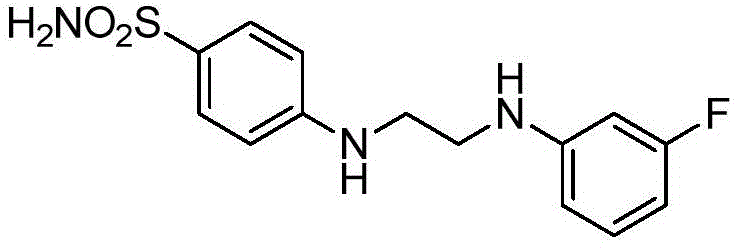
Following the procedure as described in preparation 4, the change was made to use 2- ((3-fluorophenyl) amino) -N- (4-sulfamoylphenyl) acetamide instead of 2-bromo-N- (4-sulfamoylphenyl) acetamide to react with borane dimethyl sulfide complex to obtain the title compound in quantitative yield as a brown liquid and was used in the next reaction without further purification.
Preparation example 4.2
Preparation of 4- ((2- ((3, 5-dimethylphenyl) amino) ethyl) amino) benzenesulfonamide

Following the procedure as described in preparation 4, a variation was made using 2- ((3, 5-dimethylphenyl) amino) -N- (4-sulfamoylphenyl) acetylThe amine was reacted with borane dimethylsulfide complex instead of 2-bromo-N- (4-sulfamoylphenyl) acetamide to give the title compound as a white solid in 56% yield.1H NMR(300MHz,DMSO-d6):7.51-7.46(m,2H),6.87(br s,2H),6.64-6.58(m,2H),6.37(t,J=5.6Hz,1H),6.22-6.17(m,3H),5.39(t,J=5.6Hz,1H),3.25-3.14(m,4H),2.12(s,6H)。
Preparation example 4.3
Preparation of 4- ((2- ((3,4, 5-trimethoxyphenyl) amino) ethyl) amino) benzenesulfonamide

Following the procedure as described in preparation 4, the change made was to use N- (4-sulfamoylphenyl) -2- ((3,4, 5-trimethoxyphenyl) amino) acetamide instead of 2-bromo-N- (4-sulfamoylphenyl) acetamide to react with borane dimethyl sulfide complex to obtain the title compound as a white solid in 74% yield.1H NMR(300MHz,DMSO-d6):δ7.52-7.45(m,2H),6.87(br s,2H),6.65-6.58(m,2H),6.38(t,J=6.0Hz,1H),5.84(s,2H),5.42(t,J=6.0Hz,1H),3.65(s,6H),3.49(s,3H),3.26-3.12(m,4H)。
Preparation example 4.4
Preparation of 4- ((2- (cyclopentylamino) ethyl) amino) benzenesulfonamide

Following the procedure as described in preparation 4, the change made was to use 2- (cyclopentylamino) -N- (4-sulfamoylphenyl) acetamide instead of 2-bromo-N- (4-sulfamoylphenyl) acetamide to react with borane dimethylsulfide complex to obtain the title compound as a white solid in 80% yield.1H NMR(400MHz,DMSO-d6):δ7.49-7.44(m,2H),6.86(br s,2H),6.61-6.56(m,2H),6.25(t,J=6.4Hz,1H),3.12-3.07(m,2H),3.00-2.93(m,1H),2.64(t,J=6.4Hz,2H),1.73-1.51(m,4H),1.50-1.37(m,2H),1.30-1.20(m,2H)。
Preparation example 4.5
Preparation of 4- ((2- (cyclohexylamino) ethyl) amino) benzenesulfonamide

Following the procedure as described in preparation 4, the change made was to use 2- (cyclohexylamino) -N- (4-sulfamoylphenyl) acetamide instead of 2-bromo-N- (4-sulfamoylphenyl) acetamide to react with borane dimethylsulfide complex to give the title compound as a white solid in 35% yield.1H NMR(400MHz,DMSO-d6):δ7.49-7.44(m,2H),6.86(br s,2H),6.61-6.56(m,2H),6.25(t,J=6.0Hz,1H),3.09(q,J=6.0Hz,2H),2.69(t,J=6.0Hz,2H),2.38-2.29(m,1H),1.82-1.72(m,2H),1.68-1.59(m,2H),1.56-1.47(m,1H),1.24-1.14(m,3H),1.03-0.95(m,2H)。
Preparation 4.6
Preparation of 4- ((2- ((4-bromo-2-fluorophenyl) amino) ethyl) amino) benzenesulfonamide

Following the procedure as described in preparation 4, the change was made to react the title compound with borane dimethyl sulfide complex using 2- ((4-bromo-2-fluorophenyl) amino) -N- (4-sulfamoylphenyl) acetamide instead of 2-bromo-N- (4-sulfamoylphenyl) acetamide to obtain 74% yield as a white solid.1H NMR(400MHz,DMSO-d6):δ7.51-7.46(m,2H),7.25(dd,J=11.2,2.4Hz,1H),7.14-7.09(m,1H),6.88(br s,2H),6.68(t,J=8.8Hz,1H),6.64-6.58(m,2H),6.44-6.38(m,1H),5.72-5.64(m,1H),3.27-3.20(m,4H)。
Preparation example 4.7
Preparation of 4- ((2- ((4-chloro-2-fluorophenyl) amino) ethyl) amino) benzenesulfonamide

Following the procedure as described in preparation 4, the change was made to react the title compound with borane dimethyl sulfide complex using 2- ((4-chloro-2-fluorophenyl) amino) -N- (4-sulfamoylphenyl) acetamide instead of 2-bromo-N- (4-sulfamoylphenyl) acetamide to obtain 41% yield as a white solid.
Preparation example 4.8
Preparation of 4- ((2- ((4- (trifluoromethyl) phenyl) amino) ethyl) amino) benzenesulfonamide

Following the procedure as described in preparation 4, the change made was to use N- (4-sulfamoylphenyl) -2- ((4- (trifluoromethyl) phenyl) amino) acetamide instead of 2-bromo-N- (4-sulfamoylphenyl) acetamide to react with borane dimethyl sulfide complex to obtain the title compound as a white solid in 67% yield.1H NMR(400MHz,DMSO-d6):δ7.51-7.47(m,2H),7.35(d,J=8.4Hz,2H),6.88(br s,2H),6.66(d,J=8.4Hz,2H),6.64-6.60(m,2H),6.44-6.38(m,1H),3.28-3.24(m,4H)。
Preparation example 4.9
Preparation of 4- ((2- ((4-fluorobenzyl) amino) ethyl) amino) benzenesulfonamide

Following the procedure as described in preparation 4, the change made was to use 2- ((4-fluorobenzyl) amino) -N- (4-sulfamoylphenyl) acetamide instead of 2-bromo-N- (4-sulfamoylphenyl) acetamide to react with borane dimethyl sulfide complex to give the title compound as a white solid in 45% yield.1H NMR(400MHz,DMSO-d6):δ7.49-7.44(m,2H),7.38-7.32(m,2H),7.13-7.07(m,2H),6.87(br s,2H),6.61-6.56(m,2H),6.27(t,J=6.0Hz,1H),3.69(s,2H),3.14(q,J=6.0Hz,2H),2.66(t,J=6.4Hz,2H)。
Preparation example 4.10
Preparation of 4- ((2- ((cyclopropylmethyl) amino) ethyl) amino) benzenesulfonamide

Following the procedure as described in preparation 4, the change made was to use 2- ((cyclopropylmethyl) amino) -N- (4-sulfamoylphenyl) acetamide instead of 2-bromo-N- (4-sulfamoylphenyl) acetamide to react with borane dimethyl sulfide complex to give the title compound as a white solid in 53% yield.1H NMR(400MHz,DMSO-d6):δ7.48-7.43(m,2H),6.86(br s,2H),6.62-6.57(m,2H),6.27(t,J=5.6Hz,1H),3.11(q,J=6.4Hz,2H),2.69(t,J=6.4Hz,2H),2.37(d,J=6.4Hz,2H),1.80(br s,1H),0.88-0.78(m,1H),0.39-0.34(m,2H),0.08-0.04(m,2H)。
Preparation 4.11
Preparation of 4- ((2- ((2-isopropylphenyl) amino) ethyl) amino) benzenesulfonamide

Following the procedure as described in preparation 4, the change was made to use 2- ((2-isopropylphenyl) amino) -N- (4-sulfamoylphenyl) acetamide instead of 2-bromo-N- (4-sulfamoylphenyl) acetamide to react with borane dimethyl sulfide complex to give the title compound as a brown syrup in 86% yield.
Preparation 4.12
Preparation of 4- ((2- ((2-chloro-5- (trifluoromethyl) phenyl) amino) ethyl) amino) benzenesulfonamide

Following the procedure as described in preparation 4, the change made was the use of 2- ((2-chloro-5- (trifluoromethyl) phenyl) amino) -N- (4-sulfamoylphenyl) acetamide instead of 2-bromo-N- (4-sulfamoylphenyl) acetamide) Acetamide was reacted with borane dimethyl sulfide complex to give the title compound as a white solid in 54% yield.1H NMR(400MHz,DMSO-d6):δ7.51-7.46(m,2H),7.44(dd,J=8.4,0.8Hz,1H),6.94(d,J=2.0Hz,1H),6.89(br s,2H),6.88-6.84(m,1H),6.66-6.61(m,2H),6.48(t,J=6.0Hz,1H),5.90(t,J=6.0Hz,1H),3.42-3.35(m,2H),3.30-3.24(m,2H)。
Preparation 4.13
Preparation of 4- ((2- ((2-fluoro-5- (trifluoromethyl) phenyl) amino) ethyl) amino) benzenesulfonamide

Following the procedure as described in preparation 4, the change made was to use 2- ((2-fluoro-5- (trifluoromethyl) phenyl) amino) -N- (4-sulfamoylphenyl) acetamide instead of 2-bromo-N- (4-sulfamoylphenyl) acetamide to react with borane dimethylsulfide complex to obtain the title compound as a white solid in 63% yield.1H NMR(400MHz,DMSO-d6):δ7.51-7.46(m,2H),7.21(dd,J=12.0,8.8Hz,1H),6.94(dd,J=8.0,2.0Hz,1H),6.92-6.82(m,3H),6.65-6.60(m,2H),6.46-6.41(m,1H),6.02-5.96(m,1H),3.36-3.28(m,4H)。
Preparation 4.14
Preparation of 4- ((2- ((4- (2-methoxyethoxy) phenyl) amino) ethyl) amino) benzenesulfonamide

Following the procedure as described in preparation 4, the change made was to react 2- ((4- (2-methoxyethoxy) phenyl) amino) -N- (4-sulfamoylphenyl) -acetamide instead of 2-bromo-N- (4-sulfamoylphenyl) acetamide with borane dimethylsulfide complex to give the title compound as a brown solid in 72% yield.1H NMR(400MHz,DMSO-d6):δ7.51-7.45(m,2H),6.87(br s,2H),6.73-6.68(m,2H),6.63-6.58(m,2H),6.54-6.48(m,2H),6.37(t,J=5.6Hz,1H),5.18(t,J=5.6Hz,1H),3.94-3.90(m,2H),3.58-3.55(m,2H),3.26(s,3H),3.24-3.20(m,2H),3.18-3.10(m,2H)。
Preparation 4.15
Preparation of 4- ((2- ((4-butoxyphenyl) amino) ethyl) amino) benzenesulfonamide

Following the procedure as described in preparation 4, the change made was to use 2- ((4-butoxyphenyl) amino) -N- (4-sulfamoylphenyl) acetamide instead of 2-bromo-N- (4-sulfamoylphenyl) acetamide to react with borane dimethyl sulfide complex to obtain the title compound as a white solid in 47% yield.1H NMR(400MHz,DMSO-d6):δ7.51-7.46(m,2H),6.88(br s,2H),6.71-6.66(m,2H),6.63-6.59(m,2H),6.53-6.48(m,2H),6.38(t,J=5.6Hz,1H),5.16(t,J=5.6Hz,1H),3.80(t,J=6.4Hz,2H),3.27-3.20(m,2H),3.18-3.10(m,2H),1.65-1.57(m,2H),1.43-1.33(m,2H),0.89(t,J=7.6Hz,3H)。
Preparation 4.16
Preparation of 4- ((2- (p-tolylamino) ethyl) amino) benzenesulfonamide

Following the procedure as described in preparation 4, the change was made to use N- (4-sulfamoylphenyl) -2- (p-tolylamino) acetamide instead of 2-bromo-N- (4-sulfamoylphenyl) acetamide to react with borane dimethylsulfide complex to give the title compound as a white solid in 36% yield.1H NMR(400MHz,DMSO-d6):δ7.52-7.49(m,2H),6.98-6.92(m,4H),6.68(br s,2H),6.52-6.48(m,2H),6.55-6.51(m,2H),6.40(t,J=5.2Hz,1H),5.37(t,J=5.2Hz,1H),3.30-3.10(m,4H),2.14(s,3H)。
Preparation 4.17
Preparation of 4- ((2- ((2-fluorophenyl) amino) ethyl) amino) benzenesulfonamide

Following the procedure as described in preparation 4, the change was made to use 2- ((2-fluorophenyl) amino) -N- (4-sulfamoylphenyl) acetamide instead of 2-bromo-N- (4-sulfamoylphenyl) acetamide to react with borane dimethyl sulfide complex to give the title compound as a white solid in 95% yield.1H NMR(400MHz,DMSO-d6):δ7.48(d,J=8.8Hz,2H),7.02-6.92(m,2H),6.88(br s,2H),6.73(m,1H),6.62(d,J=8.8Hz,2H),6.57-6.58(m,1H),6.43(t,J=5.2Hz,1H),5.42(br s,1H),3.30-3.22(m,4H)。
Preparation 4.18
Preparation of 4- ((2- ((2, 4-difluorophenyl) amino) ethyl) amino) benzenesulfonamide

Following the procedure as described in preparation 4, the change made was to use 2- ((2, 4-difluorophenyl) amino) -N- (4-sulfamoylphenyl) acetamide instead of 2-bromo-N- (4-sulfamoylphenyl) acetamide to react with borane dimethyl sulfide complex to obtain the title compound as a white solid in 91% yield.1H NMR(400MHz,DMSO-d6):δ7.53(d,J=8.7Hz,2H),7.15-7.05(m,1H),6.92(br s,2H),6.90-6.82(m,1H),6.81-6.70(m,1H),6.65(d,J=8.7Hz,2H),6.47(br s,1H),5.36(br s,1H),3.40-3.20(m,4H)。
Preparation 4.19
Preparation of 4- ((2- ((4-fluorophenyl) amino) ethyl) amino) benzenesulfonamide

Following the procedure as described in preparation 4, the changes made were the use of 2- ((4-fluorophenyl) amino) -N- (4-sulfamoylphenyl) acetamide instead of 2-bromo-N- (4-sulfamoylphenyl) acetamide with borane dimethylsulfideThe ether complex was reacted to give the title compound as a white solid in 75% yield.1H NMR(300MHz,DMSO-d6):δ7.51(d,J=8.8Hz,2H),7.00-6.81(m,4H),6.63(d,J=8.8Hz,2H),6.60-6.50(m,2H),6.45-6.35(m,1H),5.56(m,1H),3.45-3.10(m,4H)。
Preparation example 4.20
Preparation of 4- ((2- ((3-chloro-4-fluorophenyl) amino) ethyl) amino) benzenesulfonamide
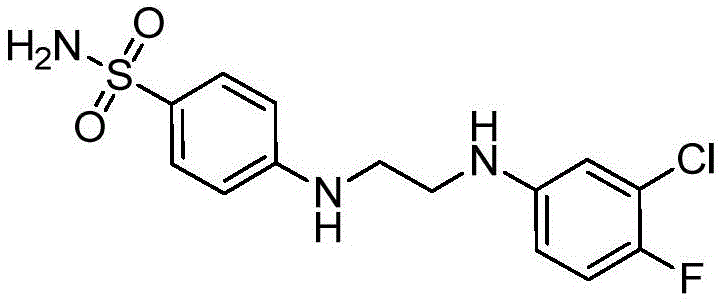
Following the procedure as described in preparation 4, the change was made to react the title compound with borane dimethyl sulfide complex using 2- ((3-chloro-4-fluorophenyl) amino) -N- (4-sulfamoylphenyl) acetamide instead of 2-bromo-N- (4-sulfamoylphenyl) acetamide to obtain 62% yield as a white solid.1H NMR(300MHz,DMSO-d6):δ7.49(d,J=8.8Hz,2H),7.11-7.06(m,1H),6.88(br s,2H),6.65(dd,J=6.0,2.8Hz,1H),6.61(d,J=8.8Hz,2H),6.58-6.48(m,1H),6.38(t,J=6.0Hz,1H),6.53(t,J=6.0Hz,1H),3.30-3.10(m,4H)。
Preparation example 4.21
Preparation of 4- ((2- ((3, 5-difluorophenyl) amino) ethyl) amino) benzenesulfonamide

Following the procedure as described in preparation 4, the change made was to react the title compound with borane dimethyl sulfide complex using 2- ((3, 5-difluorophenyl) amino) -N- (4-sulfamoylphenyl) acetamide instead of 2-bromo-N- (4-sulfamoylphenyl) acetamide to obtain 55% yield as a white solid.1H NMR(400MHz,DMSO-d6):δ7.49(d,J=8.8Hz,2H),6.89(br s,2H),6.61(d,J=8.8Hz,2H),6.40-6.30(m,2H),6.20(d,J=11.2Hz,2H),3.30-3.15(m,4H)。
Preparation 4.22
Preparation of 4- ((2- ((3, 4-difluorophenyl) amino) ethyl) amino) benzenesulfonamide

Following the procedure as described in preparation 4, the change was made to react the title compound with borane dimethyl sulfide complex using 2- ((3, 4-difluorophenyl) amino) -N- (4-sulfamoylphenyl) acetamide instead of 2-bromo-N- (4-sulfamoylphenyl) acetamide to obtain 84% yield as a white solid.1H NMR(400MHz,DMSO-d6):δ7.48(d,J=9.2Hz,2H),7.10-7.05(m,1H),6.88(br s,2H),6.61(d,J=9.2Hz,2H),6.68-6.48(m,1H),6.38-6.30(m,1H),3.30-3.10(m,4H).
Preparation 4.23
Preparation of 4- ((2- ((2-fluoro-4-methoxyphenyl) amino) ethyl) amino) benzenesulfonamide

Following the procedure as described in preparation 4, the change made was to react 2- ((2-fluoro-4-methoxyphenyl) amino) -N- (4-sulfamoylphenyl) -acetamide instead of 2-bromo-N- (4-sulfamoylphenyl) acetamide with borane dimethylsulfide complex to give the title compound as a white solid in 68% yield.1H NMR(400MHz,DMSO-d6):δ7.48(d,J=9.2Hz,2H),6.88(br s,2H),6.73(dd,J=10.4,2.8Hz,1H),6.61(d,J=9.2Hz,2H),6.56(td,J=8.8,2.8Hz,1H),6.52-6.52(m,1H),6.44(t,J=5.8Hz,1H),4.79(t,J=5.8Hz,1H),3.75(s,3H),3.45-3.15(m,4H)。
Preparation 4.24
Preparation of 4- ((2- ((4-butoxy-2-fluorophenyl) amino) ethyl) amino) benzenesulfonamide

Following the procedure as described in preparation 4, changes were madeThe title compound was obtained as a white solid in 80% yield using 2- ((4-butoxy-2-fluorophenyl) amino) -N- (4-sulfamoylphenyl) acetamide instead of 2-bromo-N- (4-sulfamoylphenyl) acetamide to react with borane dimethyl sulfide complex.1H NMR(400MHz,DMSO-d6):δ7.47(d,J=8.8Hz,2H),6.87(br s,2H),6.73(dd,J=10.8,2.8Hz,1H),6.61(d,J=8.8Hz,2H),6.57–6.40(m,3H),4.69(t,J=5.8Hz,1H),3.92(t,J=6.4Hz,2H),3.30-3.20(m,4H),1.69-1.61(m,2H),1.45-1.36(m,2H),1.03(t,J=7.2Hz,3H)。
Preparation example 4.25
Preparation of 4- ((2- ((4-chloro-3-fluorophenyl) amino) ethyl) amino) benzenesulfonamide

Following the procedure as described in preparation 4, the change was made to react 2- ((4-chloro-3-fluorophenyl) amino) -N- (4-sulfamoylphenyl) acetamide instead of 2-bromo-N- (4-sulfamoylphenyl) acetamide with borane dimethyl sulfide complex to give the title compound as a white solid in 59% yield.1H NMR(400MHz,DMSO-d6):δ7.48(d,J=8.8Hz,2H),7.16(t,J=8.8Hz,1H),6.88(br s,2H),6.61(d,J=8.8Hz,2H),6.51(dd,J=12.8,2.8Hz,1H),6.45–6.38(m,1H),6.37(t,J=8.8Hz,1H),6.17(t,J=8.8Hz,1H),3.15-3.30(m,4H)。
Preparation example 5
Preparation of 4- (2-methoxyethoxy) aniline

1- (2-methoxyethoxy) -4-nitrobenzene (1.02g,5.17mmol) and 10% palladium on carbon (150mg) were combined in methanol (30 mL). After degassing, a hydrogen balloon was applied to the mixture. The reaction mixture was stirred at ambient temperature for 2 hours and then filtered through celite. The filtrate was concentrated, and the residue was dried in vacuo to give the title compound (604mg) as a brown liquid in 70% yield, and used in the next reaction without further purification.
Preparation example 5.1
Preparation of 2, 4-difluoroaniline

Following the procedure as described in preparation 5, the title compound was obtained in 92% yield using 2, 4-difluoro-1-nitrobenzene instead of 1- (2-methoxyethoxy) -4-nitrobenzene.1H NMR(300MHz,CDCl3):δ6.95-6.65(m,3H),3.62(br s,2H)。
Preparation example 5.2
Preparation of 2-fluoro-4-methoxyaniline

Following the procedure as described in preparation 5, the title compound was obtained in 72% yield with the change that 2-fluoro-4-methoxy-1-nitrobenzene was used instead of 1- (2-methoxyethoxy) -4-nitrobenzene.1H NMR(300MHz,CDCl3):δ6.64-6.43(m,3H),3.83(s,3H),3.65(br s,2H)。
Preparation example 5.3
Preparation of 4-butoxy-2-fluoroaniline

Following the procedure as described in preparation 5, the title compound was obtained in 83% yield using 4-butoxy-2-fluoro-1-nitrobenzene instead of 1- (2-methoxyethoxy) -4-nitrobenzene.1H NMR(300MHz,CDCl3):δ6.64–6.45(m,3H),3.98(t,J=6.5Hz,2H),3.65(br s,2H),1.87-1.78(m,2H),1.56-1.45(m,2H),1.00(t,J=7.5Hz,3H)。
Preparation example 6
Preparation of 4- ((2- ((4-cyanophenyl) amino) ethyl) amino) benzenesulfonamide

4- ((2-bromoethyl) amino) benzenesulfonamide (200mg,0.716mmol), 4-cyanoaniline (216mg,1.83mmol), and KI (12mg) were mixed in dichloromethane (2.0mL) in an open tube and stirred at 120 ℃ for 10 min. The tube was then sealed and the mixture was stirred at 140 ℃ overnight, cooled to ambient temperature and concentrated. The residue was treated with dichloromethane and filtered. The resulting solid was heated in methanol and filtered. The solid obtained was heated in acetonitrile and filtered. The filtrate was concentrated, the residue was treated with dichloromethane and filtered. The solid was collected and dried in vacuo to give the title compound (70.4mg) as a light yellow solid in 31% yield.1H NMR(400MHz,DMSO-d6):δ7.51-7.47(m,2H),7.45-7.41(m,2H),6.88(br s,2H),6.75-6.70(m,1H),6.66-6.60(m,4H),6.42-6.38(m,1H),3.29-3.23(m,4H)。
Preparation example 6.1
Preparation of 4- ((2- ((4-acetylphenyl) amino) ethyl) amino) benzenesulfonamide

Following the procedure as described in preparation 6, the change made was to use 4-acetanilide instead of 4-cyanoaniline for reaction with 4- ((2-bromoethyl) amino) benzenesulfonamide to give the title compound as a yellow solid in 25% yield.1H NMR(400MHz,DMSO-d6):δ7.73-7.67(m,2H),7.52-7.47(m,2H),6.88(br s,2H),6.66-6.60(m,4H),6.44-6.39(m,1H),3.30-3.25(m,4H),2.37(s,3H)。
Preparation example 7
Preparation of 4-butoxy-2-fluoro-1-nitrobenzene

Butanol (1.56mL,17.09mmol) was added dropwise to a suspension of potassium tert-butoxide (3.47g,30.96mmol) in dichloromethane (30mL) at 0 ℃. The resulting mixture was stirred for 30 minutes, then 2, 4-difluoro-1-nitrobenzene (1.7mL,15.48mmol) was added dropwise at 0 ℃. The mixture was stirred at ambient temperature for 2 hours and the solvent was removed in vacuo. The residue was extracted 3 times with ethyl acetate. The organic layer was washed with brine, dried over sodium sulfate and filtered. The filtrate was evaporated in vacuo and the residue was purified by column chromatography eluting with hexane: ethyl acetate (9:1) to give the title compound in 66% yield (2.2 g).1H NMR(400MHz,CDCl3):δ7.91(dd,J=9.2,3.2Hz,1H),7.80(dd,J=10.4,2.4Hz,1H),6.68(td,J=8.8,2.4Hz,1H),4.08(t,J=6.4Hz,2H).1.90-1.77(m,2H),1.60-1.45(m,2H),0.99(t,J=7.5Hz,3H)。
Examples
Example 1
Synthesis of 4- (3- (3-fluorophenyl) -2-oxoimidazolidin-1-yl) benzenesulfonamide

To a solution of 4- ((2- ((3-fluorophenyl) amino) ethyl) amino) benzenesulfonamide (80mg,0.258mmol) in tetrahydrofuran (10mL) was added a solution of triphosgene (38mg,0.129mmol) in tetrahydrofuran (2.5 mL). The resulting mixture was stirred at ambient temperature for 1 hour and filtered. The filtrate was concentrated, and the residue was purified by column chromatography eluting with dichloromethane: methanol (100:1) to give a white solid (16mg), 19% yield.1H NMR(300MHz,DMSO-d6):δ7.84-7.80(m,4H),7.70-7.60(m,1H),7.43(m,1H),7.27(br s,2H),6.97-6.89(m,1H),4.04-4.00(m,4H)。
Example 2
Synthesis of 4- (3- (3, 5-dimethylphenyl) -2-oxoimidazolidin-1-yl) benzenesulfonamide

Following the procedure as described in example 1, the change was made to react the title compound with triphosgene using 4- ((2- ((3, 5-dimethylphenyl) amino) ethyl) amino) benzenesulfonamide instead of 4- ((2- ((3-fluorophenyl) amino) ethyl) amino) benzenesulfonamide to give the title compound as an off-white solid in 34% yield.1H NMR(300MHz,DMSO-d6):δ7.79-7.75(m,4H),7.24(m,2H),7.21(br s,2H),6.73-6.70(m,1H),4.02-3.88(m,4H),2.25(s,6H)。
Example 3
Synthesis of 4- (2-oxo-3- (3,4, 5-trimethoxyphenyl) imidazolidin-1-yl) benzenesulfonamide

Following the procedure as described in example 1, the change made was reaction of 4- ((2- ((3,4, 5-trimethoxyphenyl) amino) ethyl) amino) benzenesulfonamide instead of 4- ((2- ((3-fluorophenyl) amino) ethyl) amino) benzenesulfonamide with triphosgene to give the title compound as an off-white solid in 50% yield.1H NMR(400MHz,DMSO-d6):δ7.80-7.76(m,4H),7.23(br s,2H),6.95(s,2H),4.01-3.97(m,4H),3.77(s,6H),3.62(s,3H)。
Example 4
Synthesis of 4- (3-cyclopentyl-2-oxoimidazolidin-1-yl) benzenesulfonamide

Following the procedure as described in example 1, the change made was reaction with triphosgene using 4- ((2- (cyclopentylamino) ethyl) amino) benzenesulfonamide instead of 4- ((2- ((3-fluorophenyl) amino) ethyl) amino) benzenesulfonamide to give the title compound as a white solid in 50% yield.1H NMR(400MHz,DMSO-d6):δ7.74-7.68(m,4H),7.16(br s,2H),4.22-4.17(m,1H),3.83-3.77(m,2H),3.48-3.42(m,2H),1.80-1.48(m,8H)。
Example 5
Synthesis of 4- (3-cyclohexyl-2-oxoimidazolidin-1-yl) benzenesulfonamide

Following the procedure as described in example 1, the change was made to react the title compound with triphosgene using 4- ((2- (cyclohexylamino) ethyl) amino) benzenesulfonamide instead of 4- ((2- ((3-fluorophenyl) amino) ethyl) amino) benzenesulfonamide to give the title compound as a white solid in 35% yield.1H NMR(400MHz,DMSO-d6):δ7.73-7.66(m,4H),7.16(br s,2H),3.82-3.76(m,2H),3.60(tt,J=11.6,3.6Hz,1H),3.47-3.41(m,2H),1.78-1.71(m,2H),1.67-1.55(m,3H),1.46-1.36(m,2H),1.35-1.23(m,2H),1.13-1.00(m,1H)。
Example 6
Synthesis of 4- (3- (4-bromo-2-fluorophenyl) -2-oxoimidazolidin-1-yl) benzenesulfonamide

Following the procedure as described in example 1, the change was made to react 4- ((2- ((4-bromo-2-fluorophenyl) amino) ethyl) amino) benzenesulfonamide instead of 4- ((2- ((3-fluorophenyl) amino) ethyl) amino) benzenesulfonamide with triphosgene to give the title compound as an off-white solid in 77% yield.1H NMR(400MHz,DMSO-d6):δ7.80-7.73(m,4H),7.66(dd,J=6.8,2.4Hz,1H),7.53(t,J=8.8Hz,1H),7.48-7.44(m,1H),7.23(br s,2H),4.07-4.00(m,2H),3.97-3.91(m,2H)。
Example 7
Synthesis of 4- (3- (4-chloro-2-fluorophenyl) -2-oxoimidazolidin-1-yl) benzenesulfonamide

According to the following factsThe procedure described in example 1 was followed with a change to reacting 4- ((2- ((4-chloro-2-fluorophenyl) amino) ethyl) amino) benzenesulfonamide instead of 4- ((2- ((3-fluorophenyl) amino) ethyl) amino) benzenesulfonamide with triphosgene to give the title compound as an off-white solid in 65% yield.1H NMR(400MHz,DMSO-d6):δ7.80-7.74(m,4H),7.61-7.53(m,2H),7.37-7.33(m,1H),7.23(br s,2H),4.07-4.01(m,2H),3.97-3.91(m,2H)。
Example 8
Synthesis of 4- (2-oxo-3- (4- (trifluoromethyl) phenyl) imidazolidin-1-yl) benzenesulfonamide

Following the procedure as described in example 1, the change made was reaction with triphosgene using 4- ((2- ((4- (trifluoromethyl) phenyl) amino) ethyl) amino) benzenesulfonamide instead of 4- ((2- ((3-fluorophenyl) amino) ethyl) amino) benzenesulfonamide to give the title compound as a white solid in 65% yield.1H NMR(400MHz,DMSO-d6):δ7.84(d,J=8.8Hz,2H),7.81-7.79(m,4H),7.72(d,J=8.8Hz,2H),7.25(br s,2H),4.05-4.01(m,4H)。
Example 9
Synthesis of 4- (3- (4-fluorobenzyl) -2-oxoimidazolidin-1-yl) benzenesulfonamide

Following the procedure as described in example 1, the change was made to react the title compound with triphosgene using 4- ((2- ((4-fluorobenzyl) amino) ethyl) amino) benzenesulfonamide instead of 4- ((2- ((3-fluorophenyl) amino) ethyl) amino) benzenesulfonamide to give the title compound as a white solid in 40% yield.1H NMR(400MHz,DMSO-d6):δ7.76-7.70(m,4H),7.37-7.31(m,2H),7.20-7.13(m,4H),4.38(s,2H),3.86-3.80(m,2H),3.40-3.34(m,2H)。
Example 10
Synthesis of 4- (3- (cyclopropylmethyl) -2-oxoimidazolidin-1-yl) benzenesulfonamide

Following the procedure as described in example 1, the change was made to react the title compound with triphosgene using 4- ((2- ((cyclopropylmethyl) amino) ethyl) amino) benzenesulfonamide instead of 4- ((2- ((3-fluorophenyl) amino) ethyl) amino) benzenesulfonamide to give the title compound as a white solid in 51% yield.1H NMR(400MHz,DMSO-d6):δ7.74-7.68(m,4H),7.17(br s,2H),3.86-3.80(m,2H),3.60-3.54(m,2H),3.05(d,J=7.2Hz,2H),0.96-0.88(m,1H),0.49-0.43(m,2H),0.23-0.17(m,2H)。
Example 11
Synthesis of 4- (3- (2-isopropylphenyl) -2-oxoimidazolidin-1-yl) benzenesulfonamide

Following the procedure as described in example 1, the change was made to react the title compound with triphosgene using 4- ((2- ((2-isopropylphenyl) amino) ethyl) amino) benzenesulfonamide instead of 4- ((2- ((3-fluorophenyl) amino) ethyl) amino) benzenesulfonamide to give the title compound as a white solid in 43% yield.1H NMR(400MHz,DMSO-d6):δ7.78-7.73(m,4H),7.40(dd,J=8.0,1.2Hz,1H),7.35-7.28(m,2H),7.26-7.20(m,3H),4.06-4.00(m,2H),3.83-3.78(m,2H),3.13-3.03(m,1H),1.15(d,J=6.8Hz,6H)。
Example 12
Synthesis of 4- (3- (2-chloro-5- (trifluoromethyl) phenyl) -2-oxoimidazolidin-1-yl) benzenesulfonamide

Following the procedure as described in example 1, a change was made to use 4- ((2- ((2-chloro-5- (trifluoromethyl) phenyl) amino)) Ethyl) amino) benzenesulfonamide instead of 4- ((2- ((3-fluorophenyl) amino) ethyl) amino) benzenesulfonamide was reacted with triphosgene to give the title compound as a white solid in 80% yield.1H NMR(400MHz,DMSO-d6):δ8.00(d,J=2.0Hz,1H),7.85-7.70(m,6H),7.23(br s,2H),4.10-4.04(m,2H),3.99-3.93(m,2H)。
Example 13
Synthesis of 4- (3- (2-fluoro-5- (trifluoromethyl) phenyl) -2-oxoimidazolidin-1-yl) benzenesulfonamide

Following the procedure as described in example 1, the change was made to react 4- ((2- ((2-fluoro-5- (trifluoromethyl) phenyl) amino) ethyl) amino) benzenesulfonamide instead of 4- ((2- ((3-fluorophenyl) amino) ethyl) amino) benzenesulfonamide with triphosgene to give the title compound as a white solid in 62% yield.1H NMR(400MHz,DMSO-d6):δ8.02(dd,J=6.8,2.0Hz,1H),7.81-7.74(m,4H),7.71-7.66(m,1H),7.59-7.53(m,1H),7.24(br s,2H),4.09-3.99(m,4H)。
Example 14
Synthesis of 4- (3- (4- (2-methoxyethoxy) phenyl) -2-oxoimidazolidin-1-yl) benzenesulfonamide

Following the procedure as described in example 1, the change made was reaction with triphosgene using 4- ((2- ((4- (2-methoxyethoxy) phenyl) amino) ethyl) amino) benzenesulfonamide instead of 4- ((2- ((3-fluorophenyl) amino) ethyl) amino) benzenesulfonamide to give the title compound as a white solid in 45% yield.1H NMR(400MHz,DMSO-d6):δ7.78-7.75(m,4H),7.53-7.47(m,2H),7.21(br s,2H),6.97-6.92(m,2H),4.07-4.04(m,2H),4.00-3.91(m,4H),3.65-3.61(m,2H),3.29(s,3H)。
Example 15
Synthesis of 4- (3- (4-butoxyphenyl) -2-oxoimidazolidin-1-yl) benzenesulfonamide

Following the procedure as described in example 1, the change was made to react the title compound with triphosgene using 4- ((2- ((4-butoxyphenyl) amino) ethyl) amino) benzenesulfonamide instead of 4- ((2- ((3-fluorophenyl) amino) ethyl) amino) benzenesulfonamide to give the title compound as a white solid in 60% yield.1H NMR(400MHz,DMSO-d6):δ7.78-7.75(m,4H),7.51-7.47(m,2H),7.21(br s,2H),6.95-6.90(m,2H),3.96-3.90(m,6H),1.70-1.63(m,2H),1.46-1.37(m,2H),0.91(t,J=7.6Hz,3H)。
Example 16
Synthesis of 4- (3- (4-cyanophenyl) -2-oxoimidazolidin-1-yl) benzenesulfonamide

Following the procedure as described in example 1, with variations being made to react 4- ((2- ((4-cyanophenyl) amino) ethyl) amino) benzenesulfonamide instead of 4- ((2- ((3-fluorophenyl) amino) ethyl) amino) benzenesulfonamide with triphosgene, the title compound was obtained in 85% yield as a light yellow solid.1H NMR(400MHz,DMSO-d6):δ7.83-7.81(m,4H),7.80-7.78(m,4H),7.25(br s,2H),4.05-4.01(s,4H)。
Example 17
Synthesis of 4- (3- (4-acetylphenyl) -2-oxoimidazolidin-1-yl) benzenesulfonamide

Following the procedure as described in example 1, a variation was made using 4- ((2- ((4-acetylphenyl) amino) ethyl) amino) benzenesulfonamide instead of 4- ((2- ((3-fluorophenyl) amino) ethyl) amino) benzenesulfonamide with triphosgene backThe title compound was obtained as a yellow solid in 53% yield.1H NMR(400MHz,DMSO-d6):δ7.99-7.95(m,2H),7.81-7.79(m,4H),7.79-7.75(m,2H),7.25(br s,2H),4.06-4.01(m,4H),2.53(s,3H)。
Example 18
Synthesis of 4- (2-oxo-3- (p-tolyl) imidazolidin-1-yl) benzenesulfonamide

Following the procedure as described in example 1, with variations being made to react 4- ((2- (p-tolylamino) ethyl) amino) benzenesulfonamide instead of 4- ((2- ((3-fluorophenyl) amino) ethyl) amino) benzenesulfonamide with triphosgene, the title compound was obtained as a white solid in 46% yield.1H NMR(300MHz,DMSO-d6):δ7.82-7.76(m,4H),7.52(d,J=8.7Hz,2H),7.24(br s,2H),7.18(d,J=8.7Hz,2H),4.10–3.50(m,4H),2.28(s,3H).MS(ES-,m/z):330.3(M-1)。
Example 19
Synthesis of 4- (3- (2-fluorophenyl) -2-oxoimidazolidin-1-yl) benzenesulfonamide

Following the procedure as described in example 1, with variations using 4- ((2- ((2-fluorophenyl) amino) ethyl) amino) benzenesulfonamide instead of 4- ((2- ((3-fluorophenyl) amino) ethyl) amino) benzenesulfonamide to react with triphosgene, the title compound was obtained as a white solid in 53% yield.1H NMR(300MHz,DMSO-d6):δ7.86-7.76(m,4H),7.58(m,1H),7.35-7.28(m,2H),7.26-7.16(m,2H),4.10-4.00(m,2H),3.99-3.90(m,2H);MS(ES-,m/z):334.3(M-1)。
Example 20
Synthesis of 4- (3- (2, 4-difluorophenyl) -2-oxoimidazolidin-1-yl) benzenesulfonamide

Following the procedure as described in example 1, with variations being made to react 4- ((2- ((2, 4-difluorophenyl) amino) ethyl) amino) benzenesulfonamide instead of 4- ((2- ((3-fluorophenyl) amino) ethyl) amino) benzenesulfonamide with triphosgene, the title compound was obtained as a white solid in 19% yield.1H NMR(300MHz,DMSO-d6):δ7.78(d,J=9.6Hz,2H),7.74(d,J=9.6Hz,2H),7.58(td,J=8.8,6.4Hz,1H),7.38(m,1H),7.23(br s,2H),7.15(m,1H),4.05(m,2H),3.95(m,2H).MS(ES+,m/z):354.2(M+1)。
Example 21
Synthesis of 4- (3- (4-fluorophenyl) -2-oxoimidazolidin-1-yl) benzenesulfonamide

Following the procedure as described in example 1, with variations being made to replace 4- ((2- ((4-fluorophenyl) amino) ethyl) amino) benzenesulfonamide with triphosgene, the title compound was obtained as a white solid in 10% yield.1H NMR(300MHz,DMSO-d6):δ7.79-7.74(m,4H),7.64-7.59(m,2H),7.28-7.17(m,4H),4.10-3.90(m,4H).MS(ES-,m/z):334.3(M-1)。
Example 22
Synthesis of 4- (3- (3-chloro-4-fluorophenyl) -2-oxoimidazolidin-1-yl) benzenesulfonamide

Following the procedure as described in example 1, with variations being made to react 4- ((2- ((3-chloro-4-fluorophenyl) amino) ethyl) amino) benzenesulfonamide instead of 4- ((2- ((3-fluorophenyl) amino) ethyl) amino) benzenesulfonamide with triphosgene, the title compound was obtained as a white solid in 42% yield.1H NMR(300MHz,DMSO-d6):δ7.90(dd,J=6.4,2.8Hz,1H),7.82-7.72(m,4H),7.57-7.51(m,1H),7.41(t,J=8.8Hz,1H),7.24(br s,2H),4.03-3.86(m,4H).MS(ES-,m/z):368.2(M-1)。
Example 23
Synthesis of 4- (3- (3, 5-difluorophenyl) -2-oxoimidazolidin-1-yl) benzenesulfonamide

Following the procedure as described in example 1, with variations being made to react 4- ((2- ((3, 5-difluorophenyl) amino) ethyl) amino) benzenesulfonamide instead of 4- ((2- ((3-fluorophenyl) amino) ethyl) amino) benzenesulfonamide with triphosgene, the title compound was obtained as a white solid in 58% yield.1H NMR(400MHz,DMSO-d6):δ7.82-7.74(m,4H),7.39(dd,J=8.0,2.4Hz,2H),7.25(br s,2H),7.90(tt,J=4.8,2.4Hz,1H),4.08-3.95(m,4H).MS(ES-,m/z):352.3(M-1)。
Example 24
Synthesis of 4- (3- (3, 4-difluorophenyl) -2-oxoimidazolidin-1-yl) benzenesulfonamide

Following the procedure as described in example 1, with variations being made to react 4- ((2- ((3, 4-difluorophenyl) amino) ethyl) amino) benzenesulfonamide instead of 4- ((2- ((3-fluorophenyl) amino) ethyl) amino) benzenesulfonamide with triphosgene, the title compound was obtained as a white solid in 57% yield.1H NMR(400MHz,DMSO-d6):δ7.86-7.74(m,5H),7.50-7.32(m,2H),7.23(br s,2H),4.05-4.95(m,4H).MS(ES-,m/z):352.1(M-1)。
Example 25
Synthesis of 4- (3- (2-fluoro-4-methoxyphenyl) -2-oxoimidazolidin-1-yl) benzenesulfonamide
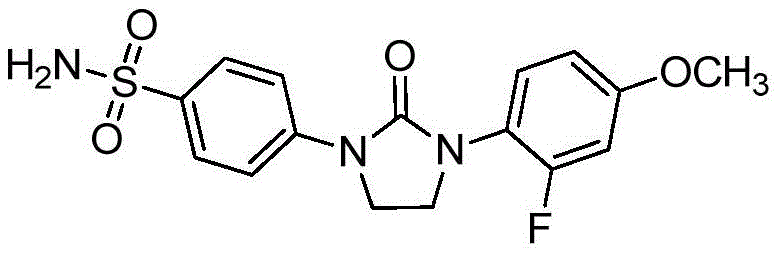
Following the procedure as described in example 1, with variations being made to react 4- ((2- ((2-fluoro-4-methoxyphenyl) amino) ethyl) amino) benzenesulfonamide instead of 4- ((2- ((3-fluorophenyl) amino) ethyl) amino) benzenesulfonamide with triphosgene, the title compound was obtained as a white solid in 27% yield.1H NMR(400MHz,DMSO-d6):δ7.80-7.70(m,4H),7.35(dd,J=8.8,2.4Hz,1H),7.20(br s,2H),7.03(dd,J=8.0,2.8Hz,1H),7.80(td,J=8.8,2.8Hz,1H),4.01-3.95(m,2H),4.85-3.75(m,5H).MS(ES-,m/z):364.2(M-1)。
Example 26
Synthesis of 4- (3- (4-butoxy-2-fluorophenyl) -2-oxoimidazolidin-1-yl) benzenesulfonamide

Following the procedure as described in example 1, with variations being made to react 4- ((2- ((4-butoxy-2-fluorophenyl) amino) ethyl) amino) benzenesulfonamide instead of 4- ((2- ((3-fluorophenyl) amino) ethyl) amino) benzenesulfonamide with triphosgene, the title compound was obtained as a white solid in 51% yield.1H NMR(400MHz,DMSO-d6):δ7.80-7.70(m,4H),7.33(dd,J=8.8,2.4Hz,1H),7.20(br s,2H),7.01(dd,J=8.0,2.8Hz,1H),6.77(td,J=8.8,2.8Hz,1H),4.05-3.90(m,4H),3.80-3.70(m,2H),1.68-1.62(m,2H),1.40-1.32(m,2H),0.84(t,J=7.5Hz,3H).MS(ES-,m/z):406.3(M-1)。
Example 27
Synthesis of 4- (3- (4-chloro-3-fluorophenyl) -2-oxoimidazolidin-1-yl) benzenesulfonamide

Following the procedure as described in example 1, with variations being made to replace 4- ((2- ((3-fluorophenyl) amino) ethyl) amino) benzenesulfonamide with triphosgene, 4- ((2- ((4-chloro-3-fluorophenyl) amino) ethyl) amino) benzenesulfonamide was reacted to obtain a white solidTitle compound as such, 54% yield.1H NMR(400MHz,DMSO-d6):δ7.82-7.74(m,4H),7.60-7.46(m,1H),7.46-7.36(m,1H),7.24(br s,2H),4.06-3.94(m,4H).MS(ES-,m/z):368.1(M-1)。
Example 28
The following compounds were prepared by a similar procedure as described in example 1:

biological examples
Example 29
Evaluation of Carbonic anhydrase inhibitory Activity
Application of Applied Photophysics off-stream device for the determination of CA-catalyzed CO2Hydration activity. CO catalysed at CA2After an initial rate of hydration reaction of 10 seconds to 100 seconds, phenol red (at 0.2mM) was used as an indicator, which acted at a maximum absorbance of 557nm, with 20mM Hepes (pH 7.4) and 20mM NaBF4(for maintaining a constant ionic strength). CO 22The concentration was varied from 1.7mM to 17mM for determination of kinetic parameters and inhibition constants. For each inhibitor, at least six traces of 5% to 10% of the start of the reaction were used to determine the initial velocity. The uncatalyzed rate was determined in the same manner and subtracted from the total observed rate. Stock solutions (10mM) of the inhibitor were prepared in distilled deionized water, after which dilution to 0.01nM was carried out with distilled deionized water. The inhibitor and enzyme solution were pre-incubated for 15 minutes at room temperature prior to the assay to allow formation of the E-I complex. Inhibition constants were obtained by the nonlinear least squares method using PRISM 3, whereas kinetic parameters of uninhibited enzymes were derived from Lineweaver-Burk plots and represent average values from at least three different assays.
The following table summarizes the inhibitory activity of the compounds of the present disclosure on CAIX and CAXII. "+" indicates Ki>100 mu M; "+ +" indicates 100nM<Ki<10 nM; and "+ + + + +" denotes Ki<10nM。

Example 30
Cell culture and hypoxic exposure
The acquisition, production and culture of luciferases expressing mouse breast Cancer cell lines 4T1, 66cl4 and 67NR and human breast Cancer cell lines MDA-231 and MDA-231LM2-4 have been previously described (Lou et al, (2008) Dev Dyn 237: 2755-. For culture in the absence of oxygen, cells were maintained at 37 ℃ in a humidified incubator at a sealed anaerobic workstation with N2Equilibrium 1% O2And 5% CO2In (1).
Example 31
Production of stable cells
Shrnmair vector targeting mouse CAIX and non-silencing sequences (Open Biosystems) was transfected into 90% confluent cells using lipofectamine technologies (invitrogen Life technologies) according to the manufacturer's instructions. Hygromycin was used to select transfected cells because puromycin was previously used. Stable shCAIX clones were obtained by limiting dilution cloning. To introduce (reintroduce) CAIX into cells, human CAIX was transfected into 4T1 cells following the same procedure and selected using bleomycin.
Example 32
Measurement of extracellular pH
At the appropriate density (1X 10 for 4T1 cells and their transfected derivatives)4Cells/cm22x 10 for 66cl4 cells4Cells/cm2For 67NR cells and transfected derivatives thereof, 1X 10⁴Cells/cm2) Cells were seeded in 60mm petri dishes and allowed to recover overnight. Then a standard volume of 3ml of fresh medium/petri dish was added and the cells were incubated in normoxic (air + 5% CO)2) Or hypoxia (1% O equilibrated with nitrogen gas2And 5% CO2) Incubate under conditions for 72 hours. Care was taken to ensure that cultures grown under normal oxygen and anaerobic conditions were in the same classSimilar cell numbers at similar confluency and at media harvest. The collected spent medium was maintained at 37 ℃ and pH was immediately measured using a digital pH meter. Cell counting was performed to ensure that the cell number of a given cell line was comparable in both environmental conditions. Cells were harvested on ice for qRT-PCR and Western blot analysis.
Example 33
Cell proliferation assay
Cell growth was measured using the MTT cell proliferation kit (Roche Applied Science) according to the manufacturer's instructions. Briefly, cells were plated at 5 × 10³Cells/cm2Was seeded in 96-well plates and allowed to recover overnight. The replicates were then incubated under normoxic and hypoxic conditions for 48 to 72 hours before performing the assay.
Example 34
3D matrigel invasion assay
The 3D "top" matrigel culture assay was performed as previously described (Lee et al, (2007) Nat Methods 4: 359-365). Briefly, MDA-231LM2-4 Luc + cells (1.5X 10)4Cells/cm2) Resuspended in 100 μ l/well growth medium containing 2x the final concentration of inhibitor and seeded into 8-well chamber slides precoated with matrigel. Cells were allowed to attach for 45 minutes and stirred edge-to-edge every 10 to 15 minutes to prevent cells from accumulating in the center of the wells. An additional 100 μ Ι/well of medium containing 10% matrigel was added to the cells and the cultures were incubated under hypoxic conditions for 4 days. Images were taken and cultures were fixed for TUNEL using the "Whole culture fixation" method outlined in Lee et al, (2007) Nat Methods 4: 359-365.
Example 35
Syngeneic in situ tumor and spontaneous metastasis
4T1 cells (1X 10)6) Or 67NR cells (2X 10)6) Implanted in situ in the fourth mammary fat pad of 7-to 9-week-old female BALB/c mice as described previously (Lou et al, (2011) Cancer Res 71: 3364-3376; lou et al, (2008) Dev Dyn 237: 2755-. Of this order of magnitudeThe number of cells injected is standard for the proliferation of these tumors and is much lower than the number used in other models of tumor growth (Erler, JT. Bennewith, KL. Icolau, M.Nature 440: 1222-1226). Using the modified ellipsoid equation (LxW)2) The primary tumor growth rate was calculated from caliper measurements. Tumor formation and metastatic progression were monitored and quantified using bioluminescence imaging as previously described (Ebos et al, (2009) Cancer Cell15: 232-.
All U.S. patents, U.S. patent application publications, U.S. patent publications, foreign patents, foreign patent applications and non-patent publications referred to in this specification and/or listed in the application data sheet, including U.S. provisional patent application No. 62/187,636 filed on 7/1/2015, are incorporated herein by reference in their entirety.
From the foregoing it will be appreciated that, although specific embodiments of the disclosure have been described herein for purposes of illustration, various modifications may be made without deviating from the spirit and scope of the disclosure. Accordingly, the disclosure is not limited except as by the appended claims.
Claims (16)
1. A compound represented by the structure of formula (Ia):

formula (Ia)
Wherein:
R1is a cycloalkyl group having 3 to 12 carbon atoms optionally substituted with one substituent or an aryl group having 6 to 10 carbon atoms optionally substituted with one or more substituents;
R6、R7、R8and R9Is hydrogen;
l is a bond or a methylene group,
wherein the substituents are selected from the group consisting of halogen, alkyl, alkoxy, heterocyclyl, haloalkyl, cyano, and acetyl, wherein each of the alkyl, alkoxy, and haloalkyl has from 1 to 8 carbon atoms, and wherein the heterocyclyl is a stable 3-to 18-membered non-aromatic ring group including as ring atoms at least one carbon atom and one to five heteroatoms selected from nitrogen, oxygen, and sulfur.
2. The compound of claim 1, wherein R1Is an aryl group having 6 to 10 carbon atoms substituted with one or more substituents.
3. The compound of claim 1 or 2, which is:
4- (3- (4-fluorophenyl) -2-oxoimidazolidin-1-yl) benzenesulfonamide;
4- (3- (2, 4-difluorophenyl) -2-oxoimidazolidin-1-yl) benzenesulfonamide;
4- (3- (4-fluorobenzyl) -2-oxoimidazolidin-1-yl) benzenesulfonamide;
4- (3- (2-fluoro-4- (4-methylpiperazin-1-yl) phenyl) -2-oxoimidazolidin-1-yl) benzenesulfonamide;
4- (2-oxo-3- (p-tolyl) imidazolidin-1-yl) benzenesulfonamide;
4- (3- (2-fluorophenyl) -2-oxoimidazolidin-1-yl) benzenesulfonamide;
4- (3- (3-fluorophenyl) -2-oxoimidazolidin-1-yl) benzenesulfonamide;
4- (3- (3, 5-dimethylphenyl) -2-oxoimidazolidin-1-yl) benzenesulfonamide;
4- (2-oxo-3- (3,4, 5-trimethoxyphenyl) imidazolidin-1-yl) benzenesulfonamide;
4- (3- (2-fluoro-4-morpholinophenyl) -2-oxoimidazolidin-1-yl) benzenesulfonamide;
4- (3- (4-bromo-2-fluorophenyl) -2-oxoimidazolidin-1-yl) benzenesulfonamide;
4- (3- (4-chloro-2-fluorophenyl) -2-oxoimidazolidin-1-yl) benzenesulfonamide;
4- (2-oxo-3- (4- (trifluoromethyl) phenyl) imidazolidin-1-yl) benzenesulfonamide;
4- (3- (4-chloro-3-fluorophenyl) -2-oxoimidazolidin-1-yl) benzenesulfonamide;
4- (3- (2-fluoro-4-methoxyphenyl) -2-oxoimidazolidin-1-yl) benzenesulfonamide;
4- (3- (2-fluoro-5- (trifluoromethyl) phenyl) -2-oxoimidazolidin-1-yl) benzenesulfonamide;
4- (3- (4- (2-methoxyethoxy) phenyl) -2-oxoimidazolidin-1-yl) benzenesulfonamide;
4- (3- (2-isopropylphenyl) -2-oxoimidazolidin-1-yl) benzenesulfonamide;
4- (3- (3, 5-difluorophenyl) -2-oxoimidazolidin-1-yl) benzenesulfonamide;
4- (3- (3-chloro-4-fluorophenyl) -2-oxoimidazolidin-1-yl) benzenesulfonamide;
4- (3- (3, 4-difluorophenyl) -2-oxoimidazolidin-1-yl) benzenesulfonamide;
4- (3- (2-chloro-5- (trifluoromethyl) phenyl) -2-oxoimidazolidin-1-yl) benzenesulfonamide;
4- (3- (4-butoxy-2-fluorophenyl) -2-oxoimidazolidin-1-yl) benzenesulfonamide;
4- (3- (4-butoxyphenyl) -2-oxoimidazolidin-1-yl) benzenesulfonamide;
4- (3- (4-cyanophenyl) -2-oxoimidazolidin-1-yl) benzenesulfonamide; or
4- (3- (4-acetylphenyl) -2-oxoimidazolidin-1-yl) benzenesulfonamide.
4. The compound of claim 1, wherein R1Is a cyclic hydrocarbon group having 3 to 12 carbon atoms.
5. The compound of claim 4, which is:
4- (3-cyclopentyl-2-oxoimidazolidin-1-yl) benzenesulfonamide;
4- (3-cyclohexyl-2-oxoimidazolidin-1-yl) benzenesulfonamide; or
4- (3- (cyclopropylmethyl) -2-oxoimidazolidin-1-yl) benzenesulfonamide.
6. The compound of claim 1 which is 4- (3- (5-fluoropyridin-2-yl) -2-oxoimidazolidin-1-yl) benzenesulfonamide.
7. A pharmaceutical composition comprising a compound of any one of claims 1 to 6 and a pharmaceutically acceptable excipient.
8. Use of a therapeutically effective amount of a compound of any one of claims 1 to 6 or a pharmaceutical composition of claim 7 in the manufacture of a medicament for inhibiting solid tumor growth, invasion and/or tumor metastasis in a mammal in need thereof.
9. Use of a therapeutically effective amount of a compound of any one of claims 1 to 6 or a pharmaceutical composition of claim 7 in the manufacture of a medicament for treating a mammal having a cancer, wherein the cancer is astrocytoma/glioblastoma, bladder cancer, breast cancer, colorectal cancer, esophageal adenocarcinoma, gastrointestinal stromal tumors, gastric cancer, head and neck cancer, hepatocellular carcinoma, lung cancer, melanoma, ovarian cancer, pancreatic ductal adenocarcinoma, renal cell carcinoma, thyroid cancer, or endometrial cancer.
10. The use of claim 9, wherein treating the mammal having cancer comprises reducing or eliminating metastasis.
11. The use of claim 9 or 10, further comprising administering an additional chemotherapeutic or other anti-cancer agent.
12. Use of a compound of any one of claims 1 to 6 or a pharmaceutical composition of claim 7 in the manufacture of a medicament for depleting cancer stem cells in a population of mammalian cancer stem cells.
13. Use of a compound of any one of claims 1 to 6 or a pharmaceutical composition of claim 7 in the manufacture of a medicament for inducing cell death in hypoxic cancer cells.
14. Use of a compound of any one of claims 1 to 6 and a pharmaceutical composition of claim 7 in the manufacture of a medicament for inhibiting tumor growth, invasion and/or metastasis in a mammal.
15. The use of claim 14, wherein the tumor growth, invasion and/or metastasis is a solid tumor or a liquid tumor.
16. Use of a compound of any one of claims 1 to 6 and a pharmaceutical composition of claim 7 for the manufacture of a medicament for the treatment of astrocytoma/glioblastoma, bladder cancer, breast cancer, colorectal cancer, esophageal adenocarcinoma, gastrointestinal stromal tumors, gastric cancer, head and neck cancer, hepatocellular cancer, lung cancer, melanoma, ovarian cancer, pancreatic ductal adenocarcinoma, renal cell carcinoma, thyroid cancer, or endometrial cancer.
Applications Claiming Priority (3)
| Application Number | Priority Date | Filing Date | Title |
|---|---|---|---|
| US201562187636P | 2015-07-01 | 2015-07-01 | |
| US62/187,636 | 2015-07-01 | ||
| PCT/US2016/040736 WO2017004543A1 (en) | 2015-07-01 | 2016-07-01 | Aryl sulfonamide compounds as carbonic anhydrase inhibitors and their therapeutic use |
Publications (2)
| Publication Number | Publication Date |
|---|---|
| CN107922345A CN107922345A (en) | 2018-04-17 |
| CN107922345B true CN107922345B (en) | 2021-03-23 |
Family
ID=56411955
Family Applications (1)
| Application Number | Title | Priority Date | Filing Date |
|---|---|---|---|
| CN201680046227.7A Active CN107922345B (en) | 2015-07-01 | 2016-07-01 | Arylsulfonamide compounds as carbonic anhydrase inhibitors and their therapeutic uses |
Country Status (11)
| Country | Link |
|---|---|
| US (1) | US10562859B2 (en) |
| EP (1) | EP3317255B1 (en) |
| JP (1) | JP6795525B2 (en) |
| KR (1) | KR102637759B1 (en) |
| CN (1) | CN107922345B (en) |
| AU (1) | AU2016287587B2 (en) |
| BR (1) | BR112018000065B1 (en) |
| CA (1) | CA2991168C (en) |
| IL (1) | IL256527B (en) |
| MX (1) | MX387267B (en) |
| WO (1) | WO2017004543A1 (en) |
Families Citing this family (5)
| Publication number | Priority date | Publication date | Assignee | Title |
|---|---|---|---|---|
| SMT202200455T1 (en) * | 2017-04-05 | 2023-01-13 | Harvard College | Macrocyclic compound and uses thereof |
| KR20210000564A (en) | 2019-06-25 | 2021-01-05 | 공주대학교 산학협력단 | Novel amantadine derivatives compound and use thereof |
| CN111233786B (en) * | 2020-02-04 | 2021-11-26 | 中国人民解放军军事科学院军事医学研究院 | Benzene sulfonamide compound containing five-membered heterocycle and preparation method and application thereof |
| JP7514036B2 (en) * | 2020-06-02 | 2024-07-10 | イェディテペ・ウニヴェルシテシ | 2-(3-(2-methyl-6-(p-tolyl)pyridin-3-yl)ureido)benzenesulfonamide and its derivatives as carbonic anhydrase IX inhibitors for the treatment of cancer - Patents.com |
| TR202014185A2 (en) * | 2020-09-08 | 2022-03-21 | Anadolu Ueniversitesi | SOME NEW 4-(2-((5-(SUBSTITUATEAMINO)-1,3,4-THIADIAZOL-2-YL)THIO)ACETYL)BENZENESULFONAMIDE DERIVATIVES AND A METHOD FOR THE SYNTHESIS OF THESE DERIVATIVES |
Citations (3)
| Publication number | Priority date | Publication date | Assignee | Title |
|---|---|---|---|---|
| WO2003013655A2 (en) * | 2001-08-10 | 2003-02-20 | Pharmacia Corporation | Carbonic anhydrase inhibitors |
| CN101610761A (en) * | 2006-12-22 | 2009-12-23 | 诺瓦提斯公司 | 1-Aminomethyl-L-phenyl-cyclohexane derivatives as DDP-IV inhibitors |
| WO2013023274A1 (en) * | 2011-08-16 | 2013-02-21 | Universite Laval | Substituted 2-imidazolidinones and 2-imidazolones and their use in the treatment of cancer |
Family Cites Families (1)
| Publication number | Priority date | Publication date | Assignee | Title |
|---|---|---|---|---|
| EP2590938B1 (en) | 2010-07-09 | 2017-06-07 | Welichem Biotech Inc. | Novel sulfonamide compounds for inhibition of metastatic tumor growth |
-
2016
- 2016-07-01 US US15/743,601 patent/US10562859B2/en active Active
- 2016-07-01 WO PCT/US2016/040736 patent/WO2017004543A1/en not_active Ceased
- 2016-07-01 CN CN201680046227.7A patent/CN107922345B/en active Active
- 2016-07-01 KR KR1020187003119A patent/KR102637759B1/en active Active
- 2016-07-01 AU AU2016287587A patent/AU2016287587B2/en active Active
- 2016-07-01 CA CA2991168A patent/CA2991168C/en active Active
- 2016-07-01 MX MX2018000175A patent/MX387267B/en unknown
- 2016-07-01 JP JP2017568244A patent/JP6795525B2/en active Active
- 2016-07-01 EP EP16738988.1A patent/EP3317255B1/en active Active
- 2016-07-01 BR BR112018000065-5A patent/BR112018000065B1/en active IP Right Grant
-
2017
- 2017-12-24 IL IL256527A patent/IL256527B/en active IP Right Grant
Patent Citations (3)
| Publication number | Priority date | Publication date | Assignee | Title |
|---|---|---|---|---|
| WO2003013655A2 (en) * | 2001-08-10 | 2003-02-20 | Pharmacia Corporation | Carbonic anhydrase inhibitors |
| CN101610761A (en) * | 2006-12-22 | 2009-12-23 | 诺瓦提斯公司 | 1-Aminomethyl-L-phenyl-cyclohexane derivatives as DDP-IV inhibitors |
| WO2013023274A1 (en) * | 2011-08-16 | 2013-02-21 | Universite Laval | Substituted 2-imidazolidinones and 2-imidazolones and their use in the treatment of cancer |
Non-Patent Citations (4)
| Title |
|---|
| 4-Amino-substituted Benzenesulfonamides as Inhibitors of Human Carbonic Anhydrases;Kestutis Rutkauskas et al.;《Molecules》;20141028;第19卷;第17356-17380页 * |
| Carbonic anhydrase inhibitors: Inhibition of the tumor-associated isozymes IX and XII with polyfluorinated aromatic/heterocyclic sulfonamides;Silvia Pastorekova et al.;《Journal of Enzyme Inhibition and Medicinal Chemistry》;20050630;第20卷(第3期);全文 * |
| Synthesis and carbonic anhydrase I, II, IX and XII inhibition studies of 4-N,N-disubstituted sulfanilamides incorporating 4,4,4-trifluoro-3-oxo-but-1-enyl, phenacylthiourea and imidazol-2(3H)-one/thione Moieties;Cenzo Congiu et al.;《Bioorganic & Medicinal Chemistry Letters》;20140221;第24卷;第1777页左栏第3段、Scheme 1,第1778页Table 1 * |
| Ureido-Substituted Benzenesulfonamides Potently Inhibit Carbonic Anhydrase IX and Show Antimetastatic Activity in a Model of Breast Cancer Metastasis;Fabio Pacchiano et al.;《Journal of Medicinal Chemistry》;20110301;第54卷;第1898页Table 1 * |
Also Published As
| Publication number | Publication date |
|---|---|
| WO2017004543A1 (en) | 2017-01-05 |
| MX2018000175A (en) | 2018-03-26 |
| IL256527B (en) | 2021-04-29 |
| CA2991168A1 (en) | 2017-01-05 |
| CN107922345A (en) | 2018-04-17 |
| JP2018519332A (en) | 2018-07-19 |
| IL256527A (en) | 2018-02-28 |
| US20180201584A1 (en) | 2018-07-19 |
| EP3317255A1 (en) | 2018-05-09 |
| US10562859B2 (en) | 2020-02-18 |
| KR20180023990A (en) | 2018-03-07 |
| MX387267B (en) | 2025-03-18 |
| BR112018000065A2 (en) | 2018-09-11 |
| HK1248228A1 (en) | 2018-10-12 |
| BR112018000065B1 (en) | 2023-11-07 |
| AU2016287587B2 (en) | 2020-04-30 |
| CA2991168C (en) | 2022-04-26 |
| EP3317255B1 (en) | 2021-09-01 |
| AU2016287587A1 (en) | 2018-01-25 |
| KR102637759B1 (en) | 2024-02-19 |
| JP6795525B2 (en) | 2020-12-02 |
Similar Documents
| Publication | Publication Date | Title |
|---|---|---|
| US12398141B2 (en) | JAK kinase inhibitor, preparation method for same, and applications thereof in field of medicine | |
| CN107922345B (en) | Arylsulfonamide compounds as carbonic anhydrase inhibitors and their therapeutic uses | |
| EP3322409A1 (en) | Substituted aza compounds as irak-4 inhibitors | |
| MX2010010619A (en) | Chemokine receptor modulators. | |
| JP2002516325A (en) | New substituted imidazole compounds | |
| AU2013209586A1 (en) | Substituted pyrimidine compounds and their use as SYK inhibitors | |
| JP2008531679A (en) | 1,2,4-Triazole derivatives and their use as oxytocin antagonists | |
| AU2011258389A1 (en) | Substituted-6-methylnicotinamides as mGluR5 positive allosteric modulators | |
| AU2014353006B2 (en) | Quinazoline derivatives as TAM family kinase inhibitors | |
| US20250041429A1 (en) | Compound having btk protein degradation activity, and medical uses thereof | |
| CA3201608A1 (en) | Boron containing pyrazole compounds, compositions comprising them, methods and uses thereof | |
| US20230399332A1 (en) | IMIDAZO[1,2-a]PYRAZINE OR PYRAZOLO[1,5-a]PYRIMIDINE DERIVATIVE AND USE THEREOF | |
| HK1248228B (en) | Aryl sulfonamide compounds as carbonic anhydrase inhibitors and their therapeutic use | |
| EP3233805A1 (en) | Methyl-1h-pyrazole alkylamine compounds having multimodal activity against pain | |
| KR20260029377A (en) | Imidazo[1,2-α]pyridine compounds for use in the treatment of cancer and inflammatory diseases and methods for preparing the compounds | |
| US9132130B2 (en) | Purine derivative and antitumor agent using same | |
| HK1228287A1 (en) | Quinazoline derivatives as tam family kinase inhibitors | |
| TW202313635A (en) | Macrocyclic compounds | |
| CA3160508A1 (en) | Substituted ((((6-benzylamino-5-fluoropyrimidin-4-yl)amino)methyl)-piperidin-1-yl)acetamide compounds active towards nuclear receptors | |
| HK1228287B (en) | Quinazoline derivatives as tam family kinase inhibitors | |
| HK1143587A (en) | Compounds with a combination of cannabinoid-cb1 antagonism and acetylcholinesterase inhibition |
Legal Events
| Date | Code | Title | Description |
|---|---|---|---|
| PB01 | Publication | ||
| PB01 | Publication | ||
| SE01 | Entry into force of request for substantive examination | ||
| SE01 | Entry into force of request for substantive examination | ||
| GR01 | Patent grant | ||
| GR01 | Patent grant |