CN102569896A - Lithium ion secondary battery and preparation method thereof - Google Patents
Lithium ion secondary battery and preparation method thereof Download PDFInfo
- Publication number
- CN102569896A CN102569896A CN201010601263XA CN201010601263A CN102569896A CN 102569896 A CN102569896 A CN 102569896A CN 201010601263X A CN201010601263X A CN 201010601263XA CN 201010601263 A CN201010601263 A CN 201010601263A CN 102569896 A CN102569896 A CN 102569896A
- Authority
- CN
- China
- Prior art keywords
- charging
- constant current
- battery
- ion secondary
- lithium
- Prior art date
- Legal status (The legal status is an assumption and is not a legal conclusion. Google has not performed a legal analysis and makes no representation as to the accuracy of the status listed.)
- Granted
Links
Classifications
-
- Y—GENERAL TAGGING OF NEW TECHNOLOGICAL DEVELOPMENTS; GENERAL TAGGING OF CROSS-SECTIONAL TECHNOLOGIES SPANNING OVER SEVERAL SECTIONS OF THE IPC; TECHNICAL SUBJECTS COVERED BY FORMER USPC CROSS-REFERENCE ART COLLECTIONS [XRACs] AND DIGESTS
- Y02—TECHNOLOGIES OR APPLICATIONS FOR MITIGATION OR ADAPTATION AGAINST CLIMATE CHANGE
- Y02E—REDUCTION OF GREENHOUSE GAS [GHG] EMISSIONS, RELATED TO ENERGY GENERATION, TRANSMISSION OR DISTRIBUTION
- Y02E60/00—Enabling technologies; Technologies with a potential or indirect contribution to GHG emissions mitigation
- Y02E60/10—Energy storage using batteries
-
- Y—GENERAL TAGGING OF NEW TECHNOLOGICAL DEVELOPMENTS; GENERAL TAGGING OF CROSS-SECTIONAL TECHNOLOGIES SPANNING OVER SEVERAL SECTIONS OF THE IPC; TECHNICAL SUBJECTS COVERED BY FORMER USPC CROSS-REFERENCE ART COLLECTIONS [XRACs] AND DIGESTS
- Y02—TECHNOLOGIES OR APPLICATIONS FOR MITIGATION OR ADAPTATION AGAINST CLIMATE CHANGE
- Y02P—CLIMATE CHANGE MITIGATION TECHNOLOGIES IN THE PRODUCTION OR PROCESSING OF GOODS
- Y02P70/00—Climate change mitigation technologies in the production process for final industrial or consumer products
- Y02P70/50—Manufacturing or production processes characterised by the final manufactured product
Landscapes
- Secondary Cells (AREA)
- Battery Electrode And Active Subsutance (AREA)
Abstract
本发明提供了一种锂离子二次电池的制备方法,该方法包括将电池极芯容纳在电池壳体中,并向电池壳体中注入非水电解液,然后将该注入非水电解液的电池壳体进行充电化成后密封,其中,所述非水电解液含有添加剂,所述添加剂为苯胺系单体和吡咯系单体中的一种或多种,所述充电化成包括一个或多个恒电流充电,该恒电流充电中的至少一个的充电电流为0.001-0.05C,该充电化成的截止电压为3.6-4.2V。本发明还提供了一种由本发明的方法制备的锂离子二次电池。根据本发明的方法制备的锂离子二次电池具有优异的大功率放电性能。并且,根据本发明的方法简便易行,易于实现规模化生产。The invention provides a method for preparing a lithium ion secondary battery. The method comprises accommodating a battery pole core in a battery casing, injecting a non-aqueous electrolytic solution into the battery casing, and then injecting the non-aqueous electrolytic solution The battery casing is sealed after charging and forming, wherein the non-aqueous electrolyte contains additives, and the additive is one or more of aniline monomers and pyrrole monomers, and the charging and forming includes one or more Constant current charging, the charging current of at least one of the constant current charging is 0.001-0.05C, and the cut-off voltage formed by the charging is 3.6-4.2V. The invention also provides a lithium ion secondary battery prepared by the method of the invention. The lithium ion secondary battery prepared by the method of the invention has excellent high-power discharge performance. Moreover, the method according to the invention is simple and easy to implement, and it is easy to realize large-scale production.
Description
技术领域 technical field
本发明涉及一种锂离子二次电池及其制备方法。The invention relates to a lithium ion secondary battery and a preparation method thereof.
背景技术 Background technique
锂离子二次电池具有电压高、无记忆效应、能量密度高及循环性能好等特点,因而得到广泛的应用。Lithium-ion secondary batteries have the characteristics of high voltage, no memory effect, high energy density and good cycle performance, so they are widely used.
一般来说,电池性能的优劣取决于电极材料。目前具有实际应用价值的锂离子二次电池的正极材料主要是各种过渡金属氧化物,这些材料均属于嵌入型电极材料,普遍存在电子导电性差,锂离子扩散速率低的问题,因而使得相应的锂离子电池的大功率放电能力差。从锂离子二次电池电极的制备方法来看:由于嵌入型电极材料的电子电导性差,为取得较为理想的电性能,在制备电极时一般需要加入一定量的导电剂(例如:碳黑、石墨)。另外,为了满足加工成型的需要,传统的电极制备过程还需要加入一定量的粘结剂(例如:聚偏氟乙烯和聚四氟乙烯)。这些粘结剂均属于绝缘性物质,因此需要更多的导电剂来满足电池放电的需求。但是,具有高比表面积的导电剂需要使用更多的粘结剂,以满足加工成型的需要。由于传统导电剂和粘结剂均不具备电化学活性,最终的结果是电化学活性物质在电极中的相对质量比较低,这在很大程度上影响了电极整体的实际比容量,同时电化学活性物质在电极中的含量以及分散情况还会影响电池的大功率放电性能。In general, the performance of a battery depends on the electrode material. At present, the positive electrode materials of lithium-ion secondary batteries with practical application value are mainly various transition metal oxides. Lithium-ion batteries have poor high-power discharge capabilities. From the perspective of the preparation method of lithium-ion secondary battery electrodes: due to the poor electronic conductivity of intercalated electrode materials, in order to obtain relatively ideal electrical properties, it is generally necessary to add a certain amount of conductive agent (for example: carbon black, graphite, etc.) when preparing electrodes. ). In addition, in order to meet the needs of processing and molding, a certain amount of binder (such as polyvinylidene fluoride and polytetrafluoroethylene) needs to be added in the traditional electrode preparation process. These binders are all insulating substances, so more conductive agents are needed to meet the needs of battery discharge. However, conductive agents with high specific surface area need to use more binders to meet the needs of processing and molding. Since the traditional conductive agent and binder are not electrochemically active, the final result is that the relative mass of the electrochemically active material in the electrode is relatively low, which largely affects the actual specific capacity of the electrode as a whole. The content and dispersion of the active material in the electrode will also affect the high-power discharge performance of the battery.
对于嵌入型电极材料电子导电性差,锂离子扩散速率低,导致电池的大功率放电性能不足的问题,人们主要采取以下技术措施:1、降低材料的粒径,制备亚微米或者纳米材料减少锂离子的扩散距离;2、表面包覆(如碳包覆,纳米金属或纳米金属氧化物包覆);3、元素掺杂(如LiFePO4的Li位、Fe位、P位、O位掺杂)。这些方法虽然可以在一定程度上可以提高电极材料的导电性能,但仍然存在很多死“锂”,锂离子二次电池的容量损失仍然存在,使得锂离子二次电池的大功率放电性能受到影响。For the poor electronic conductivity of embedded electrode materials and the low diffusion rate of lithium ions, which lead to insufficient high-power discharge performance of the battery, people mainly take the following technical measures: 1. Reduce the particle size of the material, and prepare submicron or nanometer materials to reduce lithium ions. 2. Surface coating (such as carbon coating, nano-metal or nano-metal oxide coating); 3. Element doping (such as Li-site, Fe-site, P-site, O-site doping of LiFePO 4 ) . Although these methods can improve the conductivity of electrode materials to a certain extent, there are still many dead "lithium", and the capacity loss of lithium-ion secondary batteries still exists, which affects the high-power discharge performance of lithium-ion secondary batteries.
发明内容 Contents of the invention
本发明的目的在于克服现有的锂离子二次电池中的电极材料的电子电导率差,导致电池的大功率放电性能不足的缺陷,提供一种制备锂离子二次电池的方法,由该方法制得的锂离子二次电池中的电极材料具有提高的电子电导率和大功率放电性能。The purpose of the present invention is to overcome the poor electronic conductivity of the electrode material in the existing lithium-ion secondary battery, which causes insufficient high-power discharge performance of the battery, and provides a method for preparing a lithium-ion secondary battery. The prepared electrode material in the lithium ion secondary battery has improved electronic conductivity and high-power discharge performance.
本发明的发明人在研究过程中发现,尽管通过向正极活性材料中添加导电聚合物能够在一定程度上提高锂离子二次电池正极材料的导电性能,但是仍然不能使电池具有令人满意的大功率放电性能。其原因可能是由于导电聚合物为有机聚合物,而正极活性材料一般为无机化合物,二者的相容性较差,因此在将导电聚合物与正极活性材料混合并制浆,以及将得到的浆料涂覆到正极集流体上进行干燥或压延的过程中,导电聚合物极易发生团聚,导致导电聚合物在正极活性材料中的分布极为不均匀,以致不能显著提高电池的大功率放电性能。而且,为了获得提高锂离子二次电池的电子电导率和大功率放电性能的效果,通常需要使用较大量的导电聚合物。The inventors of the present invention have found in the course of their research that although the conductive properties of the positive electrode material of lithium-ion secondary batteries can be improved to a certain extent by adding conductive polymers to the positive electrode active material, the battery still cannot have a satisfactory large Power discharge performance. The reason may be that the conductive polymer is an organic polymer, and the positive electrode active material is generally an inorganic compound, and the compatibility between the two is poor. Therefore, when the conductive polymer and the positive electrode active material are mixed and pulped, and the obtained In the process of coating the slurry on the positive electrode current collector for drying or calendering, the conductive polymer is very prone to agglomeration, resulting in extremely uneven distribution of the conductive polymer in the positive electrode active material, so that the high-power discharge performance of the battery cannot be significantly improved . Moreover, in order to obtain the effect of improving the electronic conductivity and high-power discharge performance of lithium-ion secondary batteries, it is generally necessary to use a relatively large amount of conductive polymer.
CN101145622A公开了一种用于锂离子电池的可逆过充保护电解液添加剂,所述添加剂为芳香化合物苯胺、二苯胺、三苯胺、吡咯、噻吩、苯硫醚和苯中的一种或多种。CN101145622A还公开了电解液中含有上述添加剂的锂离子二次电池的制备方法包括将电池以50mA(即,0.09C)的电流进行化成。然而,本发明的发明人在研究过程中发现,由CN1385918A公开的方法制备的锂离子二次电池的大功率放电性能并不令人满意。CN101145622A discloses a reversible overcharge protection electrolyte additive for lithium ion batteries, the additive is one or more of aromatic compounds aniline, diphenylamine, triphenylamine, pyrrole, thiophene, phenylene sulfide and benzene. CN101145622A also discloses a method for preparing a lithium-ion secondary battery containing the above-mentioned additives in the electrolyte, which includes forming the battery at a current of 50mA (ie, 0.09C). However, the inventors of the present invention found in the research process that the high-power discharge performance of the lithium-ion secondary battery prepared by the method disclosed in CN1385918A is not satisfactory.
本发明的发明人经过深入研究发现,将在电化学条件下能够形成导电聚合物的单体作为添加剂添加到锂离子二次电池的非水电解液中,将使用该非水电解液的锂离子二次电池用小电流进行充电化成,则能够提高锂离子二次电池的大功率放电性能。由此完成了本发明。The inventors of the present invention have found through in-depth research that the monomer capable of forming a conductive polymer under electrochemical conditions is added as an additive to the non-aqueous electrolyte of a lithium-ion secondary battery, and the lithium ions of the non-aqueous electrolyte will be used. The secondary battery is charged and formed with a small current, which can improve the high-power discharge performance of the lithium-ion secondary battery. The present invention has thus been accomplished.
本发明提供了一种锂离子二次电池的制备方法,该方法包括将电池极芯容纳在电池壳体中,并向电池壳体中注入非水电解液,然后将该注入非水电解液的电池壳体进行充电化成后密封,其中,所述非水电解液含有添加剂,所述添加剂为苯胺系单体和吡咯系单体中的一种或多种,所述充电化成包括一个或多个恒电流充电,该恒电流充电中的至少一个的充电电流为0.001-0.05C,该充电化成的截止电压为3.6-4.2V。The invention provides a method for preparing a lithium ion secondary battery. The method comprises accommodating a battery pole core in a battery casing, injecting a non-aqueous electrolytic solution into the battery casing, and then injecting the non-aqueous electrolytic solution The battery casing is sealed after charging and forming, wherein the non-aqueous electrolyte contains additives, and the additive is one or more of aniline monomers and pyrrole monomers, and the charging and forming includes one or more Constant current charging, the charging current of at least one of the constant current charging is 0.001-0.05C, and the cut-off voltage formed by the charging is 3.6-4.2V.
本发明还提供了一种由本发明的方法制备的锂离子二次电池。The invention also provides a lithium ion secondary battery prepared by the method of the invention.
根据本发明的方法制备的锂离子二次电池具有优异的大功率放电性能,其原因可能是:根据本发明的方法中,所述非水电解液含有能够在电化学条件下发生氧化偶联反应的添加剂,在充电化成包括一个或多个恒电流充电,且该恒电流充电中的至少一个的充电电流为0.001-0.05C时,溶解于非水电解液中的添加剂能够迁移到电池的正极表面以及位于正极集流体上的正极活性材料之间的空隙内,在充电电压达到所述添加剂的氧化电位时,所述添加剂发生原位氧化偶联反应,进而在锂离子二次电池的正极上形成导电聚合物网络,一方面通过将所述添加剂溶解在非水电解液中,在化成过程中,在正极上原位生成导电聚合物,还能够有效避免直接将导电聚合物与正极活性材料混合制浆以制备正极时极易发生的导电聚合物团聚的问题,并且由此形成的导电聚合物网络能够有效地提高电池正极活性材料的导电性,另一方面通过上述原位氧化偶联反应形成的导电聚合物还能够起到粘结剂的作用,增强电池正极的粘结强度。而且,根据本发明的方法,即使在非水电解液中添加很少量的添加剂,也可以获得提高锂离子二次电池的大功率放电性能的效果。The lithium ion secondary battery prepared according to the method of the present invention has excellent high-power discharge performance, and its reason may be that: according to the method of the present invention, the non-aqueous electrolyte contains Additives, when charging includes one or more constant current charging, and when the charging current of at least one of the constant current charging is 0.001-0.05C, the additive dissolved in the non-aqueous electrolyte can migrate to the surface of the positive electrode of the battery And in the gap between the positive electrode active materials on the positive electrode current collector, when the charging voltage reaches the oxidation potential of the additive, the additive undergoes an in-situ oxidation coupling reaction, and then forms on the positive electrode of the lithium ion secondary battery The conductive polymer network, on the one hand, by dissolving the additive in the non-aqueous electrolyte, the conductive polymer is generated in situ on the positive electrode during the chemical formation process, and it can also effectively avoid directly mixing the conductive polymer with the positive electrode active material. Slurry to prepare the problem of conductive polymer agglomeration that easily occurs when preparing the positive electrode, and the conductive polymer network formed thereby can effectively improve the conductivity of the positive electrode active material of the battery. On the other hand, the in-situ oxidation coupling reaction formed by The conductive polymer can also act as a binder to enhance the bond strength of the positive electrode of the battery. Moreover, according to the method of the present invention, even if a small amount of additives are added to the non-aqueous electrolyte, the effect of improving the high-power discharge performance of the lithium-ion secondary battery can be obtained.
而且,根据本发明的方法制备的锂离子二次电池还具有高的容量和循环性能。Moreover, the lithium ion secondary battery prepared according to the method of the present invention also has high capacity and cycle performance.
另外,根据本发明的方法简便易行,易于实现规模化生产。In addition, the method according to the invention is simple and easy to implement, and it is easy to realize large-scale production.
具体实施方式 Detailed ways
本发明提供了一种锂离子二次电池的制备方法,该方法包括将电池极芯容纳在电池壳体中,并向电池壳体中注入非水电解液,然后将该注入非水电解液的电池壳体进行充电化成后密封,其中,所述非水电解液含有添加剂,所述添加剂为苯胺系单体和吡咯系单体中的一种或多种,所述充电化成包括一个或多个恒电流充电,该恒电流充电中的至少一个的充电电流为0.001-0.05C,该充电化成的截止电压为3.6-4.2V。The invention provides a method for preparing a lithium ion secondary battery. The method comprises accommodating a battery pole core in a battery casing, injecting a non-aqueous electrolytic solution into the battery casing, and then injecting the non-aqueous electrolytic solution The battery casing is sealed after charging and forming, wherein the non-aqueous electrolyte contains additives, and the additive is one or more of aniline monomers and pyrrole monomers, and the charging and forming includes one or more Constant current charging, the charging current of at least one of the constant current charging is 0.001-0.05C, and the cut-off voltage formed by the charging is 3.6-4.2V.
根据本发明方法,所述非水电解液含有添加剂,所述添加剂为在电化学条件下能够发生氧化偶联反应从而形成导电聚合物的单体,例如:所述添加剂可以为苯胺系单体和吡咯系单体中的一种或多种。本发明中,所述添加剂的实例可以包括但不限于:苯胺、邻甲氧基苯胺、邻甲基苯胺、间甲基苯胺、邻乙基苯胺、邻氯苯胺、邻氟苯胺、N-甲基苯胺、N-乙基苯胺、N-苯基苯胺、联苯胺、2,5-二甲基苯胺、吡咯、1-苯基吡咯、3-乙酰吡咯、吡咯-3-甲酸(即,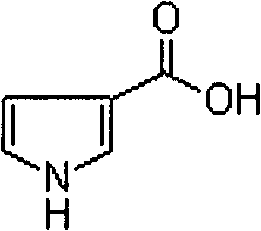


本发明中,所述非水电解液中的添加剂的含量可以根据预期的导电性能进行适当的选择。优选地,以所述非水电解液的总量为基准,所述添加剂的含量为0.01-10重量%。所述添加剂的含量为0.01重量%以上时,能够获得进一步提高锂离子二次电池的导电性能的效果;在所述添加剂的含量为不高于10重量%时,能够获得明显提高锂离子二次电池的导电性能的效果,同时还能够有效避免所述添加剂在电解液中聚合形成连接正负极的导电高分子,进而获得安全性能更高的电池。从进一步提高锂离子二次电池的导电性能的角度出发,以所述非水电解液的总量为基准,所述添加剂的含量优选为1-10重量%,更优选为3-10重量%,最优选为5-10重量%。In the present invention, the content of the additives in the non-aqueous electrolyte can be properly selected according to the expected conductivity. Preferably, based on the total amount of the non-aqueous electrolyte, the content of the additive is 0.01-10% by weight. When the content of the additive is more than 0.01% by weight, the effect of further improving the electrical conductivity of the lithium-ion secondary battery can be obtained; The effect of the electrical conductivity of the battery can also effectively prevent the additive from polymerizing in the electrolyte to form a conductive polymer connecting the positive and negative electrodes, thereby obtaining a battery with higher safety performance. From the perspective of further improving the conductivity of the lithium-ion secondary battery, based on the total amount of the non-aqueous electrolyte, the content of the additive is preferably 1-10% by weight, more preferably 3-10% by weight, Most preferred is 5-10% by weight.
本发明中,所述非水电解液除含有添加剂外,还含有电解质和有机溶剂。In the present invention, the non-aqueous electrolytic solution also contains electrolyte and organic solvent in addition to additives.
所述电解质可以为本领域常用的各种锂盐,例如:六氟磷酸锂(LiPF6)、高氯酸锂、四氟硼酸锂、六氟砷酸锂、卤化锂、氯铝酸锂和氟烃基磺酸锂。以所述非水电解液的总量为基准,所述电解质的含量可以为0.1-2mol/L,优选为0.5-1.5mol/L。The electrolyte can be various lithium salts commonly used in the art, for example: lithium hexafluorophosphate (LiPF 6 ), lithium perchlorate, lithium tetrafluoroborate, lithium hexafluoroarsenate, lithium halide, lithium chloroaluminate and fluoroalkyl sulfonic acid lithium. Based on the total amount of the non-aqueous electrolytic solution, the content of the electrolyte may be 0.1-2 mol/L, preferably 0.5-1.5 mol/L.
所述有机溶剂可以为本领域常用的各种非水有机溶剂。例如,所述有机溶剂可以为链状酸酯和环状酸酯混合溶液,所述链状酸酯可以为碳酸二甲酯(DMC)、碳酸二乙酯(DEC)、碳酸甲乙酯(EMC)、碳酸甲丙酯(MPC)、碳酸二丙酯(DPC)以及其它含氟、含硫或含不饱和键的链状有机酯类中的至少一种;所述环状酸酯可以为碳酸乙烯酯(EC)、碳酸丙烯酯(PC)、碳酸亚乙烯酯(VC)、γ-丁内酯(γ-BL)、磺内酯以及其它含氟、含硫或含不饱和键的环状有机酯类中的至少一种。The organic solvent can be various non-aqueous organic solvents commonly used in the art. For example, the organic solvent can be a mixed solution of chain acid ester and cyclic acid ester, and the chain acid ester can be dimethyl carbonate (DMC), diethyl carbonate (DEC), ethyl methyl carbonate (EMC ), methyl propyl carbonate (MPC), dipropyl carbonate (DPC) and other chain organic esters containing fluorine, sulfur or unsaturated bonds; the cyclic acid ester can be carbonic acid Vinyl ester (EC), propylene carbonate (PC), vinylene carbonate (VC), γ-butyrolactone (γ-BL), sultone and other cyclic compounds containing fluorine, sulfur or unsaturated bonds at least one of organic esters.
根据本发明的方法,所述非水电解液还可以含有助溶剂,所述助溶剂用于提高所述添加剂在所述非水电解液中的溶解性。所述助溶剂的种类可以根据所述添加剂的种类进行适当的选择。优选地,所述助溶剂可以为甲苯、硝基苯、二甲苯、四氯化碳和氯仿中的一种或多种。本发明中,所述助溶剂在所述非水电解液中的含量可以根据所述添加剂的种类以及所述添加剂的用量进行适当的选择。优选地,以所述非水电解液的总量为基准,所述助溶剂的含量为0.1-15重量%。According to the method of the present invention, the non-aqueous electrolytic solution may also contain a co-solvent, and the co-solvent is used to improve the solubility of the additive in the non-aqueous electrolytic solution. The kind of the co-solvent can be appropriately selected according to the kind of the additive. Preferably, the co-solvent may be one or more of toluene, nitrobenzene, xylene, carbon tetrachloride and chloroform. In the present invention, the content of the co-solvent in the non-aqueous electrolyte can be properly selected according to the type of the additive and the amount of the additive. Preferably, based on the total amount of the non-aqueous electrolyte, the content of the co-solvent is 0.1-15% by weight.
根据本发明,所述充电化成可以包括一个或多个恒电流充电,该恒电流充电中的至少一个的充电电流可以为0.001-0.05C。优选地,所述恒电流充电中的至少一个的充电电流为0.001-0.01C。进一步优选地,所述恒电流充电中的至少一个的充电电流为0.001-0.005C。According to the present invention, the charging formation may include one or more constant current charging, and the charging current of at least one of the constant current charging may be 0.001-0.05C. Preferably, the charging current of at least one of the constant current charging is 0.001-0.01C. Further preferably, the charging current of at least one of the constant current charging is 0.001-0.005C.
根据本发明的方法,所述充电化成的截止电压可以根据所使用的添加剂的种类进行适当的选择,以能够使所述添加剂发生氧化偶联反应为准。一般地,所述充电化成的截止电压可以为3.6-5V。优选地,所述充电化成的截止电压为3.6-4.2V。According to the method of the present invention, the cut-off voltage of the charging formation can be properly selected according to the type of the additive used, whichever can make the additive undergo oxidative coupling reaction. Generally, the cut-off voltage of the charging formation may be 3.6-5V. Preferably, the cut-off voltage of the charging formation is 3.6-4.2V.
根据本发明,所述充电化成优选包括多个恒电流充电。所述多个恒电流充电的方式优选为先后进行第一恒电流充电和第二恒电流充电。所述第一恒电流充电的充电电流可以为0.01-0.2C。所述第一恒电流充电的截止电压可以为所述添加剂的氧化电压。优选地,所述第一恒电流充电的截止电压为2.5-3.6V。所述第二恒电流充电的充电电流可以为0.001-0.05C,所述第二恒电流充电的截止电压可以为3.6-4.2V。According to the invention, said charge formation preferably comprises a plurality of galvanostatic charges. The manner of the multiple constant current charging is preferably to perform the first constant current charging and the second constant current charging successively. The charging current of the first constant current charging may be 0.01-0.2C. The cut-off voltage of the first constant current charging may be the oxidation voltage of the additive. Preferably, the cut-off voltage of the first constant current charging is 2.5-3.6V. The charging current of the second constant current charging may be 0.001-0.05C, and the cut-off voltage of the second constant current charging may be 3.6-4.2V.
由于所述非水电解液中的添加剂只有达到其氧化电压之后才发生氧化偶联反应,从而形成导电聚合物,因此在第一恒电流充电中采用比较大的电流进行恒电流充电至所述添加剂的氧化电压,然后再在第二恒电流充电中采用小电流进行恒电流充电,以使所述添加剂发生氧化偶联反应,能够在获得具有更为优异的大电流放电性能的同时,进一步缩短根据本发明的方法的充电化成时间,进而获得更高的生产效率。Since the additive in the non-aqueous electrolyte solution has an oxidative coupling reaction only after reaching its oxidation voltage, thereby forming a conductive polymer, a relatively large current is used in the first constant current charging to carry out constant current charging to the additive oxidation voltage, and then use a small current to carry out constant current charging in the second constant current charging, so that the additive can undergo oxidative coupling reaction, which can further shorten the charging time of the additive while obtaining better high current discharge performance. The charging and forming time of the method of the present invention leads to higher production efficiency.
在第二恒电流充电中,采用高于0.05C的电流对组装好的电池进行充电化成时,很难获得提高锂离子二次电池的导电性能的效果,其原因可能是:由于电流密度过大,非水电解液中的添加剂尚未迁移到正极的表面,在所述非水电解液中就发生氧化偶联反应,形成齐聚物或聚合物,上述齐聚物或聚合物很难附着在正极上,起到提高正极活性材料的导电性的作用。在所述充电化成的电流为低于0.001C时,则将延长充电化成的时间,致使生产效率不能满足规模化生产的需求。In the second constant current charging, when the assembled battery is charged and formed with a current higher than 0.05C, it is difficult to obtain the effect of improving the conductivity of the lithium-ion secondary battery. The reason may be: due to the excessive current density , the additives in the non-aqueous electrolyte have not yet migrated to the surface of the positive electrode, and an oxidative coupling reaction occurs in the non-aqueous electrolyte to form oligomers or polymers, which are difficult to attach to the positive electrode On the other hand, it plays a role in improving the conductivity of the positive electrode active material. When the charging and forming current is lower than 0.001C, the charging and forming time will be prolonged, so that the production efficiency cannot meet the requirements of large-scale production.
优选地,所述第一恒电流充电的充电电流为0.01-0.03C。Preferably, the charging current of the first constant current charging is 0.01-0.03C.
优选地,所述第二恒电流充电的充电电流为0.001-0.01C。在第二恒电流充电中采用0.001-0.01C的电流进行充电时,能够使得非水电解液中的添加剂更为平稳地在正极上进行聚合,而不会在非水电解液中发生聚合,从而能够进一步提高根据本发明的方法制备得锂离子的大电流放电性能。进一步优选地,所述第二恒电流充电的充电电流为0.001-0.005C。Preferably, the charging current of the second constant current charging is 0.001-0.01C. When charging with a current of 0.001-0.01C in the second constant current charging, the additive in the non-aqueous electrolyte can be polymerized on the positive electrode more smoothly without polymerization in the non-aqueous electrolyte, thereby The large-current discharge performance of lithium ions prepared according to the method of the invention can be further improved. Further preferably, the charging current of the second constant current charging is 0.001-0.005C.
本发明中,所述恒电流充电的时间(在包括多个恒电流充电时,为多个恒电流充电的总时间)可以为0.1-50小时。In the present invention, the time for constant current charging (when multiple constant current charges are included, the total time for multiple constant current charges) may be 0.1-50 hours.
根据本发明,所述充电化成还包括在所述恒电流充电完成之后,进行恒电压充电。所述恒电压充电的电压为所述恒电流充电的截止电压,在所述恒电流充电为多个恒电流充电时,为最后一个恒电流充电的截止电压。所述恒电压充电的时间可以为1分钟-3小时,优选为30分钟-3小时,更优选为1-3小时,进一步优选为1.5-2.5小时。According to the present invention, the charging formation further includes performing constant voltage charging after the constant current charging is completed. The voltage of the constant voltage charging is the cut-off voltage of the constant current charging, and when the constant current charging is a plurality of constant current charging, it is the cut-off voltage of the last constant current charging. The time for constant voltage charging may be 1 minute-3 hours, preferably 30 minutes-3 hours, more preferably 1-3 hours, even more preferably 1.5-2.5 hours.
根据本发明的方法所述充电化成可以在本领域常规的充电化成温度下进行。例如:所述充电化成温度可以为-40℃至100℃,优选为20-60℃。According to the method of the present invention, the charge formation can be carried out at the conventional charge formation temperature in the art. For example: the charge formation temperature may be -40°C to 100°C, preferably 20-60°C.
根据本发明的方法是通过将在电化学条件下能够通过氧化偶联反应形成导电聚合物的添加剂添加到非水电解液中,并将含有上述非水电解液的锂离子二次电池在电流为0.001-0.05C下充电,以进行化成来提高由本发明的方法制备的锂离子二次电池的导电性能的,因此本发明对于所述锂离子二次电池中极芯没有特别的限定,可以为本领域常用的极芯。According to the method of the present invention, the additive that can form conductive polymer by oxidation coupling reaction under electrochemical conditions is added in the non-aqueous electrolyte, and the lithium-ion secondary battery containing the above-mentioned non-aqueous electrolyte is charged at an electric current of Charge at 0.001-0.05C to improve the electrical conductivity of the lithium ion secondary battery prepared by the method of the present invention, so the present invention has no special limitation on the pole core in the lithium ion secondary battery, and can be based on Pole cores commonly used in the field.
一般地,所述极芯是由正极、负极以及位于所述正极和负极之间的隔膜构成的。Generally, the pole core is composed of a positive electrode, a negative electrode, and a separator between the positive electrode and the negative electrode.
根据本发明的方法,所述正极的制备方法可以采用本领域常用的各种方法,例如可以包括将正极活性物质、正极导电剂和正极粘合剂与溶剂混合,涂覆和/或填充在正极集电体上,干燥,压延或不压延,即可得到所述正极。According to the method of the present invention, the preparation method of the positive electrode can adopt various methods commonly used in the art, for example, it can include mixing the positive electrode active material, the positive electrode conductive agent and the positive electrode binder with the solvent, coating and/or filling the positive electrode On the current collector, drying, calendering or not calendering, the positive electrode can be obtained.
根据本发明,所述正极活性物质可以采用本领域公知的各种正极活性物质,例如LiCoO2、LiVPO4、LiCoAlO2、LiMnCoO2、LiCoxNiyMnzO2(x+y+z=1)、LiMn2O4、LiNiO2和LiFexM1-xPO4(M为Co、Ni、Mn,0.8≤x≤1)中的一种或多种。本发明中,所述正极活性物质还可以用碳包覆。本发明中,所述正极活性物质的用量可以为本领域的常规用量。According to the present invention, the positive electrode active material can be various positive electrode active materials known in the art, such as LiCoO 2 , LiVPO 4 , LiCoAlO 2 , LiMnCoO 2 , LiCo x Ni y Mnz O 2 (x+y+z=1 ), LiMn 2 O 4 , LiNiO 2 and LiFexM 1-xPO 4 (M is Co, Ni, Mn, 0.8≤x≤1), one or more. In the present invention, the positive electrode active material may also be coated with carbon. In the present invention, the amount of the positive electrode active material may be a conventional amount in the art.
所述正极导电剂没有特别限制,可以为本领域常规的正极导电剂,例如:碳黑、石墨、乙炔黑、碳纤维、碳纳米管、羰基镍粉、铜粉、铁粉、锌粉和铝粉中的一种或多种。本发明中,所述导电剂的用量可以为本领域的常规用量。The positive electrode conductive agent is not particularly limited, and can be a conventional positive electrode conductive agent in the art, such as: carbon black, graphite, acetylene black, carbon fiber, carbon nanotubes, carbonyl nickel powder, copper powder, iron powder, zinc powder and aluminum powder one or more of. In the present invention, the dosage of the conductive agent can be the conventional dosage in the field.
所述正极粘合剂可以为本领域常用的各种正极粘结剂,例如:聚偏二氟乙烯、聚四氟乙烯、(含氟)聚丙烯酸酯、(含氟)聚氨酯、(含氟)环氧树脂、丁苯橡胶、聚甲基纤维素、聚甲基纤维素钠、羟丙基甲基纤维素和聚丙烯醇中的一种或多种。The positive electrode binder can be various positive electrode binders commonly used in the art, for example: polyvinylidene fluoride, polytetrafluoroethylene, (fluorine-containing) polyacrylate, (fluorine-containing) polyurethane, (fluorine-containing) One or more of epoxy resin, styrene-butadiene rubber, polymethylcellulose, sodium polymethylcellulose, hydroxypropylmethylcellulose and polyacryl alcohol.
制备正极时所使用的溶剂可以为本领域常用的各种溶剂,例如可以为选自N-甲基吡咯烷酮(NMP)、二甲基甲酰胺(DMF)、二乙基甲酰胺(DEF)、二甲基亚砜(DMSO)、四氢呋喃(THF)以及水和醇系溶剂中的一种或多种。The solvent used when preparing the positive pole can be various solvents commonly used in the art, for example, it can be selected from N-methylpyrrolidone (NMP), dimethylformamide (DMF), diethylformamide (DEF), diethylformamide (DEF), One or more of methyl sulfoxide (DMSO), tetrahydrofuran (THF), water and alcoholic solvents.
所述正极集电体可以为本领域常用的各种正极集电体,例如:铝箔。The positive electrode current collector can be various positive electrode current collectors commonly used in this field, for example: aluminum foil.
根据本发明的制备方法,所述负极的制备方法可以为本领域的常规方法,例如可以包括:将负极活性物质、负极导电剂和负极粘合剂与溶剂混合,涂覆和/或填充在集电体上,干燥,压延或不压延,即可得到所述负极。According to the preparation method of the present invention, the preparation method of the negative electrode can be a conventional method in the art, for example, it can include: mixing the negative electrode active material, the negative electrode conductive agent and the negative electrode binder with the solvent, coating and/or filling the The negative electrode can be obtained by drying, calendering or not calendering.
所述负极活性物质没有特别限制,可以使用本领域常规的可嵌入并释出锂的负极活性物质,例如:天然石墨、天然改性石墨、人造石墨、石油焦、有机裂解碳、中间相碳微球、碳纤维、锡合金和硅合金中的一种或多种,优选人工石墨和天然改性石墨。The negative electrode active material is not particularly limited, and conventional negative electrode active materials that can intercalate and release lithium in the art can be used, such as: natural graphite, natural modified graphite, artificial graphite, petroleum coke, organic cracking carbon, mesophase carbon microparticles, etc. One or more of balls, carbon fibers, tin alloys and silicon alloys, preferably artificial graphite and natural modified graphite.
所述负极导电剂没有特别限制,可以为本领域常规的负极导电剂,例如:ketjen碳黑、乙炔黑、炉黑、碳纤维VGCF、导电碳黑和导电石墨中的一种或多种。The negative electrode conductive agent is not particularly limited, and can be a conventional negative electrode conductive agent in the field, for example: one or more of ketjen carbon black, acetylene black, furnace black, carbon fiber VGCF, conductive carbon black and conductive graphite.
所述负极粘合剂的种类和含量为本领域技术人员所公知,例如含氟树脂和/或聚烯烃化合物(如聚偏二氟乙烯(PVDF)、聚四氟乙烯(PTFE)、丁苯橡胶(SBR)中的一种或多种)。所述负极粘合剂采用纤维素基聚合物与橡胶胶乳的混合物,如纤维素基聚合物与丁苯橡胶(SBR)的混合物。所述纤维素基聚合物与丁苯橡胶的用量为本领域技术人员所公知。The type and content of the negative electrode binder are known to those skilled in the art, such as fluororesin and/or polyolefin compound (such as polyvinylidene fluoride (PVDF), polytetrafluoroethylene (PTFE), styrene-butadiene rubber (SBR) one or more). The negative electrode binder is a mixture of cellulose-based polymer and rubber latex, such as a mixture of cellulose-based polymer and styrene-butadiene rubber (SBR). The dosages of the cellulose-based polymer and styrene-butadiene rubber are known to those skilled in the art.
制备负极时所使用的溶剂可以选自N-甲基吡咯烷酮(NMP)、二甲基甲酰胺(DMF)、二乙基甲酰胺(DEF)、二甲基亚砜(DMSO)、四氢呋喃(THF)以及水和醇系溶剂中的一种或多种。溶剂的用量能够使所述糊状物具有粘性和流动性,能够涂覆到所述集电体上即可。The solvent used when preparing the negative pole can be selected from N-methylpyrrolidone (NMP), dimethylformamide (DMF), diethylformamide (DEF), dimethylsulfoxide (DMSO), tetrahydrofuran (THF) And one or more of water and alcoholic solvents. The amount of the solvent can make the paste have viscosity and fluidity, and can be coated on the current collector.
所述负极集电体可以为锂离子电池中常规的负极集电体,如冲压金属,金属箔,网状金属,泡沫状金属。The negative electrode collector can be a conventional negative electrode collector in lithium ion batteries, such as stamped metal, metal foil, mesh metal, and foam metal.
所述干燥和压延的方法和条件为本领域技术人员所公知,本文不再赘述。The methods and conditions of the drying and calendering are well known to those skilled in the art and will not be repeated herein.
所述隔膜可以为本领域常用的各种隔膜,例如聚丙烯膜。The separator can be various separators commonly used in the field, such as polypropylene film.
根据本发明的方法在进行充电化成之前,还可以包括将注入有非水电解液的电池壳体进行陈化,以使非水电解液充分浸润极芯中电极活性物质。本发明对于所述陈化的条件没有特别限定,可以为本领域的常规条件。例如,所述陈化的条件可以为:温度为40-50℃,优选为45℃;时间为20-30小时,优选为24小时。The method according to the present invention may also include aging the battery casing filled with the non-aqueous electrolyte before charging and forming, so that the non-aqueous electrolyte fully infiltrates the electrode active material in the pole core. The present invention has no special limitation on the aging conditions, which may be conventional conditions in the art. For example, the aging conditions may be as follows: the temperature is 40-50° C., preferably 45° C.; the time is 20-30 hours, preferably 24 hours.
本发明还提供了一种由本发明的方法制备的锂离子二次电池。由本发明的方法制备的锂离子二次电池具有高容量、倍率充放电性能好且电池的循环性能优异的特点。The invention also provides a lithium ion secondary battery prepared by the method of the invention. The lithium ion secondary battery prepared by the method of the invention has the characteristics of high capacity, good rate charge and discharge performance and excellent cycle performance of the battery.
以下结合实施例详细说明本发明。The present invention will be described in detail below in conjunction with the examples.
实施例1Example 1
本实施例用来说明根据本发明的锂离子二次电池及其制备方法。This example is used to illustrate the lithium ion secondary battery and its preparation method according to the present invention.
(1)正极的制备(1) Preparation of positive electrode
将9g PVDF粘结剂加入到170mL N-甲基吡咯烷酮(NMP)中,待全部溶解后,添加6g碳黑Super P导电剂(商购自上海汇普工业化学品有限公司)并分散均匀,然后将150g碳包覆的LiFePO4(碳含量2.32重量%,商购自天津市禹舜科技有限公司)粉末缓慢加入到上述混合溶液中,高速搅拌分散2小时,制得正极浆料。在厚度为16微米的铝箔上双面敷料,涂抹均匀。在140℃烘干,碾压,滚切成正极片,极片大小为471cm(长)×44cm(宽)×0.0138cm(厚),体密度为2.3g/cm3。9g of PVDF binder was added to 170mL of N-methylpyrrolidone (NMP), and after it was completely dissolved, 6g of carbon black Super P conductive agent (commercially purchased from Shanghai Huipu Industrial Chemicals Co., Ltd.) was added and dispersed evenly, and then 150 g of carbon-coated LiFePO 4 (carbon content 2.32% by weight, commercially available from Tianjin Yushun Technology Co., Ltd.) powder was slowly added to the above mixed solution, stirred and dispersed at high speed for 2 hours to prepare positive electrode slurry. Spread the dressing on both sides on aluminum foil with a thickness of 16 microns and spread evenly. Dry at 140°C, roll, roll and cut into positive electrode pieces. The size of the electrode piece is 471cm (length)×44cm (width)×0.0138cm (thickness), and the bulk density is 2.3g/cm 3 .
(2)负极的制备(2) Preparation of negative electrode
将人造石墨(商购自新乡远东电子科技有限公司)、碳黑Super P导电剂(商购自上海汇普工业化学品有限公司)、粘结剂SBR(商购自日本A&L株式会社)和羧甲基纤维素(CMC)(商购自上海长光企业发展有限公司)按照重量比100∶2∶6∶2在去离子水中均匀混合。在厚度为10微米的铜箔上双面敷料,涂抹均匀。在120℃下烘干,碾压,滚切成正极片,极片大小为491cm(长)×45cm(宽)×0.0086(厚),体密度为1.5g/cm3。Artificial graphite (commercially purchased from Xinxiang Far East Electronic Technology Co., Ltd.), carbon black Super P conductive agent (commercially purchased from Shanghai Huipu Industrial Chemicals Co., Ltd.), binder SBR (commercially purchased from Japan A&L Co., Ltd.) and carboxylate Methylcellulose (CMC) (commercially purchased from Shanghai Changguang Enterprise Development Co., Ltd.) was evenly mixed in deionized water at a weight ratio of 100:2:6:2. Apply double-sided dressing on copper foil with a thickness of 10 microns and spread evenly. Dry at 120°C, roll and cut into positive pole pieces, the size of which is 491cm (length) x 45cm (width) x 0.0086 (thickness), and the bulk density is 1.5g/cm 3 .
(3)电池的装配(3) Battery assembly
将上述的正、负极与聚丙烯膜(商购自日本Asahi公司)卷绕成一个方型锂离子电池的极芯,随后将LiPF6按1摩尔/升的浓度溶解在EC∶DEC∶DMC=1∶1∶0.5(重量比)的混合溶剂中,并向得到的混合溶液中添加吡咯,从而得到非水电解液,其中以非水电解液的总量为基准,吡咯的含量为5重量%。将得到的非水电解液以6.5g/Ah的量注入电池壳中。The above-mentioned positive and negative poles and polypropylene film (commercially purchased from Japan Asahi Company) were wound into a pole core of a square lithium-ion battery, and then LiPF was dissolved in EC at a concentration of 1 mol/liter: DEC: DMC= 1:1:0.5 (weight ratio) mixed solvent, and add pyrrole to the obtained mixed solution to obtain a non-aqueous electrolyte, wherein based on the total amount of the non-aqueous electrolyte, the content of pyrrole is 5% by weight . The obtained non-aqueous electrolytic solution was injected into the battery case in an amount of 6.5 g/Ah.
(4)化成(4) Formation
将电池在50℃的温度下放置24小时,以使非水电解液充分浸润极芯中的电极活性物质。随后,将电池放置在化成柜上,在25℃下,先以11mA(即,电流为0.02C)恒流充电至3.6V,继续以2.75mA的电流强度(即,电流为0.005C)充电,截止电压3.98V,恒压充电2小时,密封,制成标称容量为550毫安时的锂离子电池C1。The battery is placed at a temperature of 50° C. for 24 hours, so that the non-aqueous electrolyte solution can fully infiltrate the electrode active material in the pole core. Subsequently, the battery was placed on the formation cabinet, and at 25°C, it was first charged to 3.6V with a constant current of 11mA (ie, the current was 0.02C), and then continued to be charged at a current intensity of 2.75mA (ie, the current was 0.005C). Voltage 3.98V, constant voltage charging for 2 hours, sealed, and a lithium-ion battery C1 with a nominal capacity of 550 mAh was made.
对比例1Comparative example 1
采用与实施例1相同的方法制备锂离子二次电池,不同的是,不使用吡咯,制成标称容量为550毫安时的锂离子二次电池DC1。A lithium-ion secondary battery was prepared in the same manner as in Example 1, except that pyrrole was not used to produce a lithium-ion secondary battery DC1 with a nominal capacity of 550 mAh.
对比例2Comparative example 2
(1)正极的制备(1) Preparation of positive electrode
采用与实施例1相同的方法制备正极,不同的是,制备的正极浆液中含有0.36克聚吡咯(商购自Aldrich公司,数均分子量为35000)。The positive electrode was prepared by the same method as in Example 1, except that the prepared positive electrode slurry contained 0.36 g of polypyrrole (commercially purchased from Aldrich, with a number average molecular weight of 35,000).
(2)负极的制备(2) Preparation of negative electrode
采用与实施例1相同的方法制备负极。The negative electrode was prepared by the same method as in Example 1.
(3)电池的装配(3) Battery assembly
采用与实施例1相同的方法进行电池的装配,不同的是,非水电解液不含有吡咯。The battery was assembled in the same manner as in Example 1, except that the non-aqueous electrolyte did not contain pyrrole.
(4)化成(4) Formation
采用与实施例1相同的条件进行化成,制成标称容量为550毫安时的锂离子电池DC2。The chemical formation was carried out under the same conditions as in Example 1, and a lithium-ion battery DC2 with a nominal capacity of 550 mAh was produced.
对比例3Comparative example 3
采用与实施例1相同的方法制备锂离子二次电池,不同的是,化成的条件为:在25℃下,先以50mA(即,电流为0.09C)恒流充电至3.6V,继续以100mA的电流强度(即,电流为0.18C)过充电,过充程度为100%电池容量,密封,制成标称容量为550毫安时的锂离子电池DC3。Adopt the same method as Example 1 to prepare a lithium ion secondary battery, the difference is that the conditions of formation are: at 25°C, first charge to 3.6V with a constant current of 50mA (that is, the current is 0.09C), and continue to charge at 100mA The current intensity (that is, the current is 0.18C) is overcharged, and the overcharge degree is 100% of the battery capacity, and sealed to make a lithium-ion battery DC3 with a nominal capacity of 550 milliamperes.
实施例2Example 2
本实施例用来说明根据本发明的锂离子二次电池及其制备方法。This example is used to illustrate the lithium ion secondary battery and its preparation method according to the present invention.
采用与实施例1相同的方法制备锂离子二次电池,不同的是,化成的条件为:在25℃下,先以11mA(即,电流为0.02C)恒流充电至3.6V,继续以44mA的电流强度(即,电流为0.01C)充电,截止电压3.98V,恒压充电2小时,密封,制成标称容量为550毫安时的锂离子电池C2。The lithium-ion secondary battery was prepared in the same manner as in Example 1, except that the formation conditions were as follows: at 25°C, charge to 3.6V with a constant current of 11mA (that is, a current of 0.02C), and then continue to charge at 44mA The current intensity (that is, the current is 0.01C) charging, cut-off voltage 3.98V, constant voltage charging for 2 hours, sealed, made the lithium ion battery C2 with a nominal capacity of 550 mA.
实施例3Example 3
本实施例用来说明根据本发明的锂离子二次电池及其制备方法。This example is used to illustrate the lithium ion secondary battery and its preparation method according to the present invention.
采用与实施例1相同的方法制备锂离子二次电池,不同的是,化成的条件为:在25℃下,先以11mA(即,电流为0.02C)恒流充电至3.6V,继续以0.55mA的电流强度(即,电流为0.001C)充电,截止电压3.98V,恒压充电2小时,密封,制成标称容量为550毫安时的锂离子电池C3。The lithium-ion secondary battery was prepared in the same manner as in Example 1, except that the formation conditions were as follows: at 25°C, charge to 3.6V with a constant current of 11mA (that is, a current of 0.02C), and then continue to charge with a constant current of 0.55 The current intensity of mA (that is, the current is 0.001C) charging, cut-off voltage 3.98V, constant voltage charging for 2 hours, sealed, made the lithium ion battery C3 with a nominal capacity of 550 mA.
实施例4Example 4
本实施例用来说明根据本发明的锂离子二次电池及其制备方法。This example is used to illustrate the lithium ion secondary battery and its preparation method according to the present invention.
采用与实施例1相同的方法制备锂离子二次电池,不同的是,以非水电解液的总量为基准,吡咯的含量为10重量%。制成标称容量为550毫安时的锂离子二次电池C4。A lithium-ion secondary battery was prepared in the same manner as in Example 1, except that, based on the total amount of the non-aqueous electrolyte, the content of pyrrole was 10% by weight. A lithium-ion secondary battery C4 with a nominal capacity of 550 mAh was produced.
实施例5Example 5
本实施例用来说明根据本发明的锂离子二次电池及其制备方法。This example is used to illustrate the lithium ion secondary battery and its preparation method according to the present invention.
采用与实施例1相同的方法制备锂离子二次电池,不同的是,以非水电解液的总量为基准,吡咯的含量为0.01重量%。制成标称容量为550毫安时的锂离子二次电池C5。A lithium-ion secondary battery was prepared in the same manner as in Example 1, except that, based on the total amount of the non-aqueous electrolyte, the content of pyrrole was 0.01% by weight. A lithium-ion secondary battery C5 with a nominal capacity of 550 mAh was produced.
实施例6Example 6
本实施例用来说明根据本发明的锂离子二次电池及其制备方法。This example is used to illustrate the lithium ion secondary battery and its preparation method according to the present invention.
采用与实施例1相同的方法制备锂离子二次电池,不同的是,使用相同质量的苯胺代替吡咯,并向非水电解液中添加甲苯,以所述非水电解液的总量为基准,甲苯的用量为7重量%,化成时截止电压为4.1V,制成标称容量为550毫安时的锂离子二次电池C6。Adopt the same method as Example 1 to prepare a lithium ion secondary battery, the difference is that aniline of the same quality is used instead of pyrrole, and toluene is added to the non-aqueous electrolyte, based on the total amount of the non-aqueous electrolyte, The amount of toluene used was 7% by weight, and the cut-off voltage was 4.1V during formation, and a lithium-ion secondary battery C6 with a nominal capacity of 550 mAh was produced.
实施例7Example 7
本实施例用来说明根据本发明的锂离子二次电池及其制备方法。This example is used to illustrate the lithium ion secondary battery and its preparation method according to the present invention.
采用与实施例1相同的方法制备锂离子二次电池,不同的是,采用以下方法进行化成:将电池在50℃的温度下放置24小时,以使非水电解液充分浸润极芯中电极活性物质。随后,将电池放置在化成柜上,在25℃下,以2.75mA的电流强度(即,电流为0.005C)恒流充电至3.98V,接着以3.98V的电压恒压充电2小时,密封,制成标称容量为550毫安时的锂离子电池C7。The same method as in Example 1 was used to prepare a lithium-ion secondary battery, except that the following method was used for formation: the battery was placed at a temperature of 50° C. for 24 hours, so that the non-aqueous electrolyte fully infiltrated the electrode activity in the core. substance. Subsequently, the battery was placed on the formation cabinet, and charged to 3.98V at a current intensity of 2.75mA (that is, the current was 0.005C) at 25°C, and then charged at a constant voltage of 3.98V for 2 hours, sealed, and made Into a lithium-ion battery C7 with a nominal capacity of 550 mAh.
实验实施例1-7Experimental Examples 1-7
实验实施例1-7用于测定实施例1-7制备的锂离子二次电池的性能。Experimental Examples 1-7 are used to determine the performance of the lithium-ion secondary batteries prepared in Examples 1-7.
(1)倍率放电性能(1) Rate discharge performance
以0.2C的电流分别将上述实施例1-7制备的锂离子二次电池充电至3.6V,搁置10分钟后,分别以5C的电流放电至2.0V;采用同样的过程,以10C的电流放电至2.0V、以15C的电流放电至2.0V、以20C的电流放电至2.0V、以25C的电流放电至2.0V、以30C的电流放电至2.0V,并分别记录每只每次的放电容量。Charge the lithium-ion secondary batteries prepared in the above examples 1-7 to 3.6V with a current of 0.2C, and then discharge to 2.0V with a current of 5C after standing aside for 10 minutes; use the same process to discharge with a current of 10C Discharge to 2.0V, discharge to 2.0V with a current of 15C, discharge to 2.0V with a current of 20C, discharge to 2.0V with a current of 25C, discharge to 2.0V with a current of 30C, and record the discharge capacity of each .
然后分别计算各电流的放电容量与5C的电流放电容量的比值,以此评价电池的倍率放电性能,该比值越大,说明倍率放电性能越好。计算出的数值在表1中示出。Then calculate the ratio of the discharge capacity of each current to the current discharge capacity of 5C to evaluate the rate discharge performance of the battery. The larger the ratio, the better the rate discharge performance. The calculated values are shown in Table 1.
(2)电池容量的测定(2) Determination of battery capacity
以0.2C的恒定电流分别将上述实施例1-7制备的锂离子二次电池充电至3.6V,在电压升至3.6V后以恒定电压充电,截至电流为0.03C;然后以0.2C的恒定电流放电,截至电压为2.0V,测定电池的容量。测试结果在表2中示出。With a constant current of 0.2C, the lithium-ion secondary batteries prepared in the above-mentioned examples 1-7 were charged to 3.6V respectively, and charged with a constant voltage after the voltage rose to 3.6V, and the cut-off current was 0.03C; then with a constant current of 0.2C Current discharge, the cut-off voltage is 2.0V, and the capacity of the battery is measured. The test results are shown in Table 2.
(3)电池循环性能的测定(3) Determination of battery cycle performance
25℃条件下,以1C电流分别将上述实施例1-7制备的锂离子二次电池充电至3.6V,在电压升至3.6V后以恒定电压充电,截止电流为0.03C,搁置10分钟;再将电池以1C电流放电至2.0V,搁置10分钟。以首次充放电的容量为该电池的初始容量,记录循环后电池容量为初始容量80%时的循环次数。测试结果在表2中示出。Under the condition of 25°C, charge the lithium-ion secondary batteries prepared in the above examples 1-7 to 3.6V with a current of 1C, charge at a constant voltage after the voltage rises to 3.6V, set the cut-off current at 0.03C, and leave it for 10 minutes; Then discharge the battery to 2.0V with 1C current and leave it for 10 minutes. The initial capacity of the battery is the capacity of the first charge and discharge, and the number of cycles when the capacity of the battery after cycling is 80% of the initial capacity is recorded. The test results are shown in Table 2.
实验对比例1-3Experimental comparative example 1-3
采用与实验实施例1-7相同的方法测定对比例1-3制备的锂离子二次电池的倍率放电性能、电池容量和循环性能。其中,倍率放电性能的测试结果在表1中示出,电池容量和循环性能的测试结果在表2中示出。The rate discharge performance, battery capacity and cycle performance of the lithium-ion secondary batteries prepared in Comparative Examples 1-3 were determined by the same method as in Experimental Examples 1-7. Among them, the test results of rate discharge performance are shown in Table 1, and the test results of battery capacity and cycle performance are shown in Table 2.
表1Table 1
表2Table 2
表1的结果表明,由本发明的方法制备的锂离子二次电池具有优异的倍率放电性能,特别是大电流放电性能,说明根据本发明的锂离子二次电池具有良好的大功率放电性能。The results in Table 1 show that the lithium-ion secondary battery prepared by the method of the present invention has excellent rate discharge performance, especially high-current discharge performance, indicating that the lithium-ion secondary battery according to the present invention has good high-power discharge performance.
表2的结果表明,由本发明的方法制备锂离子二次电池具有高的容量和优异的循环性能。The results in Table 2 show that the lithium ion secondary battery prepared by the method of the present invention has high capacity and excellent cycle performance.
Claims (9)
Priority Applications (1)
| Application Number | Priority Date | Filing Date | Title |
|---|---|---|---|
| CN201010601263.XA CN102569896B (en) | 2010-12-10 | 2010-12-10 | Lithium ion secondary battery and preparation method thereof |
Applications Claiming Priority (1)
| Application Number | Priority Date | Filing Date | Title |
|---|---|---|---|
| CN201010601263.XA CN102569896B (en) | 2010-12-10 | 2010-12-10 | Lithium ion secondary battery and preparation method thereof |
Publications (2)
| Publication Number | Publication Date |
|---|---|
| CN102569896A true CN102569896A (en) | 2012-07-11 |
| CN102569896B CN102569896B (en) | 2015-01-14 |
Family
ID=46414752
Family Applications (1)
| Application Number | Title | Priority Date | Filing Date |
|---|---|---|---|
| CN201010601263.XA Active CN102569896B (en) | 2010-12-10 | 2010-12-10 | Lithium ion secondary battery and preparation method thereof |
Country Status (1)
| Country | Link |
|---|---|
| CN (1) | CN102569896B (en) |
Cited By (18)
| Publication number | Priority date | Publication date | Assignee | Title |
|---|---|---|---|---|
| CN102760908A (en) * | 2012-07-16 | 2012-10-31 | 宁波世捷新能源科技有限公司 | Quick formation method for lithium ion battery adapting to various cathode material systems |
| CN103928714A (en) * | 2014-04-30 | 2014-07-16 | 南京安普瑞斯有限公司 | Method for in-situ polymerization of conductive polyaniline in lithium ion battery pole group |
| CN104969401A (en) * | 2012-12-17 | 2015-10-07 | 赛昂能源有限公司 | Lithium-ion electrochemical battery, components thereof, and methods of making and using the same |
| WO2015149345A1 (en) * | 2014-04-04 | 2015-10-08 | Basf Corporation | Lithium-ion batteries and preparation method thereof |
| CN106532121A (en) * | 2016-12-23 | 2017-03-22 | 厦门大学 | Electrolyte additive for reducing charging overpotential of lithium-air battery and application of electrolyte additive |
| CN107887649A (en) * | 2017-10-19 | 2018-04-06 | 江西恒动新能源有限公司 | An a kind of two formation charging processes of power lithium-ion battery series connection |
| WO2018104951A1 (en) * | 2016-12-11 | 2018-06-14 | StoreDot Ltd. | In-battery polymerization of conducting polymers for high-rate-charging cathodes |
| CN109346763A (en) * | 2018-10-19 | 2019-02-15 | 惠州市豪鹏科技有限公司 | A kind of electrolyte and lithium ion battery |
| US10297827B2 (en) | 2004-01-06 | 2019-05-21 | Sion Power Corporation | Electrochemical cell, components thereof, and methods of making and using same |
| CN110190247A (en) * | 2018-02-23 | 2019-08-30 | 丰田自动车株式会社 | The manufacturing method of solid secondary battery system |
| US10593946B2 (en) | 2016-12-11 | 2020-03-17 | StoreDot Ltd. | LFP as initiator of in-battery polymerization of conducting polymers for high-rate-charging cathodes |
| CN111384457A (en) * | 2018-12-28 | 2020-07-07 | 安普瑞斯(南京)有限公司 | Formation method for improving first charge-discharge efficiency of lithium ion battery |
| CN111916837A (en) * | 2020-08-14 | 2020-11-10 | 苏州酷卡环保科技有限公司 | Formation method of nickel acid lithium battery |
| US10854921B2 (en) | 2011-09-07 | 2020-12-01 | Sion Power Corporation | Electrochemical cell including electrolyte having insoluble nitrogen-containing material and battery including the cell |
| CN112563571A (en) * | 2019-09-26 | 2021-03-26 | 宁德时代新能源科技股份有限公司 | Additive for battery, secondary battery, battery module, battery pack and device |
| US10985403B2 (en) | 2004-01-06 | 2021-04-20 | Sion Power Corporation | Electrolytes for lithium sulfur cells |
| US11705555B2 (en) | 2010-08-24 | 2023-07-18 | Sion Power Corporation | Electrolyte materials for use in electrochemical cells |
| CN119400951A (en) * | 2024-10-08 | 2025-02-07 | 万向一二三股份公司 | A high-safety electrolyte and lithium-ion battery |
Citations (5)
| Publication number | Priority date | Publication date | Assignee | Title |
|---|---|---|---|---|
| JPS6079677A (en) * | 1983-10-07 | 1985-05-07 | Nippon Telegr & Teleph Corp <Ntt> | Electrolyte for lithium secondary battery |
| JPS61161673A (en) * | 1985-01-08 | 1986-07-22 | Furukawa Electric Co Ltd:The | Secondary battery |
| CN101145622A (en) * | 2007-09-04 | 2008-03-19 | 武汉大学 | Lithium-ion battery reversible overcharge protection electrolyte additive and preparation method thereof |
| JP2008226606A (en) * | 2007-03-12 | 2008-09-25 | Denso Corp | Method for manufacturing lithium secondary battery |
| CN101901941A (en) * | 2009-05-27 | 2010-12-01 | 比亚迪股份有限公司 | A kind of formation method of titanium series negative electrode material lithium ion battery |
-
2010
- 2010-12-10 CN CN201010601263.XA patent/CN102569896B/en active Active
Patent Citations (5)
| Publication number | Priority date | Publication date | Assignee | Title |
|---|---|---|---|---|
| JPS6079677A (en) * | 1983-10-07 | 1985-05-07 | Nippon Telegr & Teleph Corp <Ntt> | Electrolyte for lithium secondary battery |
| JPS61161673A (en) * | 1985-01-08 | 1986-07-22 | Furukawa Electric Co Ltd:The | Secondary battery |
| JP2008226606A (en) * | 2007-03-12 | 2008-09-25 | Denso Corp | Method for manufacturing lithium secondary battery |
| CN101145622A (en) * | 2007-09-04 | 2008-03-19 | 武汉大学 | Lithium-ion battery reversible overcharge protection electrolyte additive and preparation method thereof |
| CN101901941A (en) * | 2009-05-27 | 2010-12-01 | 比亚迪股份有限公司 | A kind of formation method of titanium series negative electrode material lithium ion battery |
Cited By (28)
| Publication number | Priority date | Publication date | Assignee | Title |
|---|---|---|---|---|
| US10985403B2 (en) | 2004-01-06 | 2021-04-20 | Sion Power Corporation | Electrolytes for lithium sulfur cells |
| US10297827B2 (en) | 2004-01-06 | 2019-05-21 | Sion Power Corporation | Electrochemical cell, components thereof, and methods of making and using same |
| US11705555B2 (en) | 2010-08-24 | 2023-07-18 | Sion Power Corporation | Electrolyte materials for use in electrochemical cells |
| US10854921B2 (en) | 2011-09-07 | 2020-12-01 | Sion Power Corporation | Electrochemical cell including electrolyte having insoluble nitrogen-containing material and battery including the cell |
| CN102760908B (en) * | 2012-07-16 | 2014-11-05 | 宁波世捷新能源科技有限公司 | Quick formation method for lithium ion battery adapting to various cathode material systems |
| CN102760908A (en) * | 2012-07-16 | 2012-10-31 | 宁波世捷新能源科技有限公司 | Quick formation method for lithium ion battery adapting to various cathode material systems |
| CN104969401A (en) * | 2012-12-17 | 2015-10-07 | 赛昂能源有限公司 | Lithium-ion electrochemical battery, components thereof, and methods of making and using the same |
| US10468721B2 (en) | 2012-12-17 | 2019-11-05 | Sion Power Corporation | Lithium-ion electrochemical cell, components thereof, and methods of making and using same |
| US11502334B2 (en) | 2012-12-17 | 2022-11-15 | Sion Power Corporation | Lithium-ion electrochemical cell, components thereof, and methods of making and using same |
| US10050308B2 (en) | 2012-12-17 | 2018-08-14 | Sion Power Corporation | Lithium-ion electrochemical cell, components thereof, and methods of making and using same |
| WO2015149345A1 (en) * | 2014-04-04 | 2015-10-08 | Basf Corporation | Lithium-ion batteries and preparation method thereof |
| CN103928714B (en) * | 2014-04-30 | 2017-03-22 | 安普瑞斯(无锡)有限公司 | Method for in-situ polymerization of conductive polyaniline in lithium ion battery pole group |
| CN103928714A (en) * | 2014-04-30 | 2014-07-16 | 南京安普瑞斯有限公司 | Method for in-situ polymerization of conductive polyaniline in lithium ion battery pole group |
| WO2018104951A1 (en) * | 2016-12-11 | 2018-06-14 | StoreDot Ltd. | In-battery polymerization of conducting polymers for high-rate-charging cathodes |
| US10593946B2 (en) | 2016-12-11 | 2020-03-17 | StoreDot Ltd. | LFP as initiator of in-battery polymerization of conducting polymers for high-rate-charging cathodes |
| CN106532121B (en) * | 2016-12-23 | 2019-05-21 | 厦门大学 | It is a kind of reduce lithium-air battery charging overpotential electrolysis additive and its application |
| CN106532121A (en) * | 2016-12-23 | 2017-03-22 | 厦门大学 | Electrolyte additive for reducing charging overpotential of lithium-air battery and application of electrolyte additive |
| CN107887649A (en) * | 2017-10-19 | 2018-04-06 | 江西恒动新能源有限公司 | An a kind of two formation charging processes of power lithium-ion battery series connection |
| CN110190247B (en) * | 2018-02-23 | 2022-05-17 | 丰田自动车株式会社 | Manufacturing method of solid secondary battery system |
| CN110190247A (en) * | 2018-02-23 | 2019-08-30 | 丰田自动车株式会社 | The manufacturing method of solid secondary battery system |
| CN109346763B (en) * | 2018-10-19 | 2021-01-05 | 惠州市豪鹏科技有限公司 | Electrolyte and lithium ion battery |
| CN109346763A (en) * | 2018-10-19 | 2019-02-15 | 惠州市豪鹏科技有限公司 | A kind of electrolyte and lithium ion battery |
| CN111384457A (en) * | 2018-12-28 | 2020-07-07 | 安普瑞斯(南京)有限公司 | Formation method for improving first charge-discharge efficiency of lithium ion battery |
| CN112563571A (en) * | 2019-09-26 | 2021-03-26 | 宁德时代新能源科技股份有限公司 | Additive for battery, secondary battery, battery module, battery pack and device |
| WO2021057306A1 (en) * | 2019-09-26 | 2021-04-01 | 宁德时代新能源科技股份有限公司 | Additive for battery, secondary battery, battery module, battery pack, and apparatus |
| CN111916837A (en) * | 2020-08-14 | 2020-11-10 | 苏州酷卡环保科技有限公司 | Formation method of nickel acid lithium battery |
| CN111916837B (en) * | 2020-08-14 | 2021-11-30 | 江苏中奕和创智能科技有限公司 | Formation method of lithium-nickel-based composite compound battery |
| CN119400951A (en) * | 2024-10-08 | 2025-02-07 | 万向一二三股份公司 | A high-safety electrolyte and lithium-ion battery |
Also Published As
| Publication number | Publication date |
|---|---|
| CN102569896B (en) | 2015-01-14 |
Similar Documents
| Publication | Publication Date | Title |
|---|---|---|
| CN102569896B (en) | Lithium ion secondary battery and preparation method thereof | |
| CN106505249B (en) | Lithium ion battery electrolyte and lithium ion battery containing same | |
| CN102487141B (en) | Cathode material of lithium ion battery and battery | |
| CN101510622B (en) | Electrolyte for lithium ion secondary battery and battery containing the electrolyte | |
| CN102610862B (en) | Preparation method for lithium battery taking polypyrrole-coated magnesium borate as anode material | |
| CN103700820B (en) | A kind of lithium ion selenium battery with long service life | |
| CN103730688B (en) | Lithium ion battery and electrolyte thereof | |
| CN103570873B (en) | A kind of composition for gel polymer electrolyte, gel polymer electrolyte and electrochemical appliance | |
| CN105845984A (en) | Lithium ion battery electrolyte and lithium ion battery using same | |
| CN107331893B (en) | A high temperature lithium ion battery electrolyte and preparation method thereof, and high temperature lithium ion battery | |
| CN108808071A (en) | A kind of nickelic tertiary cathode material system battery electrolytic solution and lithium ion battery | |
| JP2019515444A (en) | Lithium ion battery using non-aqueous electrolyte | |
| CN105098244A (en) | Electrolyte and lithium ion battery comprising same | |
| CN103367791B (en) | A kind of new type lithium ion battery | |
| CN111525190A (en) | Electrolyte and Lithium Ion Batteries | |
| CN106785041A (en) | A kind of additive for lithium ion battery, electrolyte and anode sizing agent | |
| CN105009331A (en) | Negative electrode for lithium secondary battery, manufacturing method thereof, and lithium secondary battery comprising same | |
| CN119230930B (en) | A gel polymer electrolyte and its preparation method and application | |
| CN101651233A (en) | Lithium ion secondary battery and preparation method thereof | |
| CN101399337A (en) | Negative pole active material, preparing method thereof and negative pole and battery using the material | |
| CN103346347A (en) | High-voltage lithium ion battery | |
| CN109119599A (en) | Secondary battery and preparation method thereof | |
| CN109088059A (en) | A kind of lithium ion battery and preparation method thereof | |
| CN115347235B (en) | Sodium ion battery electrolyte and sodium ion battery with high multiplying power and stable circulation | |
| CN101154730A (en) | Lithium-ion battery positive electrode material and positive electrode and lithium-ion battery containing the material |
Legal Events
| Date | Code | Title | Description |
|---|---|---|---|
| C06 | Publication | ||
| PB01 | Publication | ||
| C10 | Entry into substantive examination | ||
| SE01 | Entry into force of request for substantive examination | ||
| C14 | Grant of patent or utility model | ||
| GR01 | Patent grant |