Photolithography Equipment Market by Type (EUV, DUV), Light Source (Mercury Lamps, Excimer Lasers, Fluorine Lasers, Laser-Produced Plasma), Wavelength, End User, and Geography - Global Forecast to 2035


Photolithography Equipment Market Market Summary
The Photolithography Equipment Market plays a critical role in the global semiconductor manufacturing ecosystem, serving as the backbone of integrated circuit fabrication. As of 2025, the market size is estimated at approximately USD 21 billion, driven by the rising demand for advanced chips across industries such as consumer electronics, automotive, telecommunications, and data centers. With the proliferation of artificial intelligence (AI), Internet of Things (IoT), and automation technologies, the need for high-precision lithography solutions has surged significantly. By 2036, the market is projected to reach around USD 42 billion, expanding at a CAGR of 6.5%–7.5% during the forecast period.
Growth in the market is being fueled by the rapid scaling of semiconductor nodes, increasing adoption of extreme ultraviolet (EUV) lithography, and rising investments in advanced chip fabrication facilities (fabs). Digital transformation initiatives, combined with the growing complexity of chip architectures, are pushing semiconductor manufacturers to adopt cutting-edge photolithography systems that offer higher resolution, accuracy, and throughput. Additionally, automation and AI-powered process optimization are enhancing production efficiency, reducing defects, and accelerating time-to-market for next-generation chips.
Key Market Trends & Insights
The global landscape of the Photolithography Equipment Market is evolving rapidly, influenced by technological advancements and regional investments.
North America continues to dominate the market due to strong semiconductor R&D capabilities and the presence of leading chip manufacturers. However, Asia Pacific is emerging as the fastest-growing region, supported by aggressive investments in semiconductor manufacturing in countries like China, Japan, and South Korea.
The extreme ultraviolet (EUV) lithography segment has emerged as the dominant technology due to its ability to support advanced nodes below 7nm. Meanwhile, deep ultraviolet (DUV) lithography continues to maintain a significant share for mature node applications.
AI and automation are reshaping the photolithography process by enabling predictive maintenance, real-time monitoring, and process optimization, reducing operational costs and improving yield rates.
The growing demand for advanced packaging, 3D ICs, and heterogeneous integration is creating new opportunities for photolithography equipment manufacturers.
Market Size & Forecast
- Base year market size (2025): USD 21 billion
- Forecast market size (2036): USD 42 billion
- CAGR (2025–2036): 6.5%–7.5%
- Growth is driven by increasing semiconductor demand, EUV adoption, and AI-enabled manufacturing processes
Photolithography Equipment Market Market Top 10 Key Takeaway
- The market is expected to double in size by 2036 due to strong semiconductor demand.
- EUV lithography is becoming the industry standard for advanced node manufacturing.
- Asia Pacific is the fastest-growing regional market driven by fab expansions.
- AI integration is improving efficiency and reducing production defects.
- Demand from automotive electronics and EVs is boosting market growth.
- Foundries are increasing capital expenditure to meet global chip demand.
- Advanced packaging technologies are expanding application scope.
- DUV lithography remains relevant for legacy semiconductor nodes.
- Government initiatives are accelerating domestic semiconductor production.
- Supply chain resilience is becoming a key focus area for manufacturers.
Product Insights
The Photolithography Equipment Market is primarily segmented into advanced lithography systems such as EUV lithography, DUV lithography, and mask aligners. Among these, EUV lithography systems dominate the high-end segment due to their ability to produce extremely fine patterns required for advanced semiconductor nodes. The dominance of EUV is attributed to its capability to deliver superior resolution, enabling chipmakers to manufacture smaller, faster, and more power-efficient integrated circuits.
Deep ultraviolet (DUV) lithography systems continue to hold a substantial share, especially in applications involving mature nodes and analog devices. These systems remain cost-effective and widely used in high-volume manufacturing processes.
Emerging product categories such as multi-patterning systems, advanced resist materials, and mask inspection systems are gaining traction. Additionally, integration of AI-driven control systems within photolithography equipment is enabling predictive analytics, improving process accuracy, and minimizing downtime. Automation is also playing a critical role in enhancing throughput and reducing human intervention in complex semiconductor fabrication processes.
Technology / Component Insights
Technological innovation is at the heart of the Photolithography Equipment Market. The transition from DUV to EUV lithography represents a major leap in semiconductor manufacturing capabilities. EUV systems use shorter wavelengths of light, enabling higher resolution and more precise patterning.
AI and machine learning algorithms are increasingly being integrated into photolithography systems to optimize exposure parameters, detect defects, and enhance yield. IoT-enabled sensors allow real-time monitoring of equipment performance, ensuring consistent quality and reducing maintenance costs.
Cloud-based analytics platforms are also being utilized to store and analyze large volumes of manufacturing data, enabling continuous process improvement. Automation technologies, including robotics and advanced control systems, are streamlining production workflows and improving operational efficiency.
Looking ahead, innovations such as high-NA EUV lithography, computational lithography, and hybrid patterning techniques are expected to further enhance the capabilities of photolithography equipment, supporting the development of next-generation semiconductor devices.
Application Insights
The primary application of photolithography equipment lies in semiconductor manufacturing, which accounts for the largest share of the market. The increasing demand for high-performance chips in applications such as smartphones, data centers, artificial intelligence, and autonomous vehicles is driving the adoption of advanced lithography solutions.
The consumer electronics segment remains a major contributor, driven by the continuous evolution of smartphones, wearable devices, and smart home technologies. The automotive sector is also emerging as a significant growth area, with the rise of electric vehicles (EVs), advanced driver-assistance systems (ADAS), and connected car technologies.
Future opportunities lie in emerging applications such as quantum computing, 5G infrastructure, and edge computing, which require advanced semiconductor technologies and high-precision photolithography processes.
Regional Insights
The Photolithography Equipment Market exhibits strong regional dynamics, with North America leading the market due to its advanced semiconductor ecosystem and significant investments in research and development. The presence of leading technology companies and government support for domestic chip production further strengthen the region’s position.
Europe is also a key market, driven by its focus on automotive electronics, industrial automation, and semiconductor innovation. Countries such as Germany and France are investing heavily in semiconductor manufacturing capabilities.
Asia Pacific is the fastest-growing region, fueled by large-scale semiconductor manufacturing activities in China, Japan, South Korea, and Taiwan. Government initiatives, favorable policies, and increasing demand for electronics are driving rapid market expansion in the region.
- North America leads due to strong R&D and semiconductor infrastructure
- Asia Pacific is the fastest-growing region with aggressive fab investments
- Europe shows steady growth driven by automotive and industrial demand
- Government policies are boosting domestic semiconductor production globally
- Rising electronics demand is supporting regional market expansion
Country-Specific Market Trends
In Asia Pacific, China is witnessing rapid growth with a CAGR of around 8%, supported by government-backed semiconductor initiatives and investments in domestic manufacturing. Japan continues to play a vital role with its expertise in semiconductor equipment and materials, growing at a steady CAGR of 6%.
In North America, the United States dominates the market with strong investments in advanced semiconductor technologies and a CAGR of approximately 6.5%. Canada and Mexico are also experiencing moderate growth due to increasing demand for electronics and automotive components.
In Europe, Germany leads the market with a CAGR of around 6%, driven by its strong automotive industry and industrial automation capabilities. France is also investing in semiconductor R&D and manufacturing, contributing to regional growth.
- China leads APAC growth due to government support and fab expansion
- Japan maintains steady growth with strong technology expertise
- United States dominates North America with advanced chip manufacturing
- Germany leads Europe driven by automotive electronics demand
- France is investing in semiconductor innovation and R&D
Key Photolithography Equipment Market Company Insights
The competitive landscape of the Photolithography Equipment Market is characterized by a few dominant players focusing on innovation, strategic partnerships, and technological advancements. Companies are heavily investing in R&D to develop next-generation lithography systems and maintain a competitive edge.
Leading players are integrating AI and automation into their equipment to enhance performance and efficiency. Strategic collaborations with semiconductor manufacturers are also common, enabling companies to co-develop customized solutions tailored to specific production requirements.
Major companies in the market include ASML Holding NV, Nikon Corporation, Canon Inc., Applied Materials Inc., and KLA Corporation. These companies are focusing on expanding their product portfolios, improving system capabilities, and strengthening their global presence.
- Companies are investing heavily in R&D for advanced lithography technologies
- AI integration is a key focus area for improving efficiency and yield
- Strategic partnerships are driving innovation and market expansion
- Product portfolio diversification is enhancing competitive positioning
- Global expansion strategies are strengthening market presence
Recent Developments
Recent developments in the Photolithography Equipment Market highlight the industry’s focus on innovation and collaboration. A leading manufacturer recently launched a high-NA EUV lithography system designed to support sub-3nm semiconductor nodes, significantly enhancing chip performance and efficiency.
Another notable development includes the integration of AI-driven process optimization tools into lithography equipment, enabling real-time monitoring and defect detection. Additionally, strategic partnerships between equipment manufacturers and semiconductor foundries are accelerating the adoption of advanced lithography technologies.
Market Segmentation
The Photolithography Equipment Market is segmented based on product, technology, application, and region. By product, the market includes EUV lithography systems, DUV lithography systems, and mask aligners. By technology, it encompasses advanced lithography techniques, AI-enabled systems, and automation solutions. In terms of application, the market is categorized into semiconductor manufacturing, consumer electronics, automotive, and others. Regionally, the market is divided into North America, Europe, Asia Pacific, and the Rest of the World.
- EUV lithography dominates advanced node applications
- Semiconductor manufacturing is the largest application segment
- AI-enabled systems are gaining traction across industries
- Asia Pacific leads in manufacturing and demand growth
- Diverse applications are expanding market opportunities
Conclusion
The Photolithography Equipment Market is poised for substantial growth through 2036, driven by the increasing complexity of semiconductor devices and the rising demand for advanced chips. AI, automation, and IoT technologies are transforming photolithography processes, enabling higher precision, efficiency, and scalability.
As industries continue to embrace digital transformation, the demand for high-performance semiconductors will remain strong, creating significant opportunities for photolithography equipment manufacturers. Companies that invest in innovation, strategic partnerships, and advanced technologies will be well-positioned to capitalize on the evolving market landscape.
FAQs
1. What is the current size of the Photolithography Equipment Market?
The market size is estimated at approximately USD 21 billion in 2025.
2. What is the expected growth rate of the market?
The market is expected to grow at a CAGR of 6.5%–7.5% from 2025 to 2036.
3. What are the key drivers of market growth?
Key drivers include increasing semiconductor demand, AI and IoT adoption, automation, and advancements in EUV lithography.
4. Which region leads the market?
North America currently leads the market due to strong semiconductor infrastructure and R&D investments.
5. Who are the key players in the market?
Major companies include ASML Holding NV, Nikon Corporation, Canon Inc., Applied Materials Inc., and KLA Corporation.
 Exclusive indicates content/data unique to MarketsandMarkets and not available with any competitors.
TABLE OF CONTENTS
1 INTRODUCTION (Page No. - 22)
1.1 STUDY OBJECTIVES
1.2 DEFINITION
1.2.1 INCLUSIONS AND EXCLUSIONS
1.3 STUDY SCOPE
1.3.1 MARKETS COVERED
FIGURE 1 PHOTOLITHOGRAPHY EQUIPMENT MARKET
1.3.2 GEOGRAPHIC SCOPE
1.3.3 YEARS CONSIDERED
1.4 CURRENCY
1.5 LIMITATIONS
1.6 STAKEHOLDERS
1.7 SUMMARY OF CHANGES
2 RESEARCH METHODOLOGY (Page No. - 26)
2.1 RESEARCH DATA
FIGURE 2 MARKET: RESEARCH DESIGN
2.1.1 SECONDARY AND PRIMARY RESEARCH
2.1.2 SECONDARY DATA
2.1.2.1 Secondary sources
2.1.3 PRIMARY DATA
2.1.3.1 Primary sources
2.1.3.2 Key industry insights
2.1.3.3 Breakdown of primaries
2.2 MARKET SIZE ESTIMATION
FIGURE 3 MARKET SIZE ESTIMATION METHODOLOGY
2.2.1 BOTTOM-UP APPROACH
FIGURE 4 BOTTOM-UP APPROACH: MARKET SIZE ESTIMATION METHODOLOGY
2.2.2 TOP-DOWN APPROACH
FIGURE 5 BOTTOM-UP APPROACH: MARKET SIZE ESTIMATION METHODOLOGY
2.3 MARKET BREAKDOWN AND DATA TRIANGULATION
FIGURE 6 DATA TRIANGULATION
2.4 RESEARCH ASSUMPTIONS
3 EXECUTIVE SUMMARY (Page No. - 36)
FIGURE 7 TOP 3 PLAYERS IN PHOTOLITHOGRAPHY EQUIPMENT INDUSTRY FROM 2017 TO 2025
FIGURE 8 EUV SEGMENT TO HOLD LARGE SHARE OF MARKET IN 2025
FIGURE 9 70 NM–1 NM SEGMENT TO ACCOUNT FOR LARGEST SHARE OF MARKET IN 2025
FIGURE 10 LASER-PRODUCED PLASMAS SEGMENT TO ACCOUNT FOR LARGEST SIZE OF MARKET IN 2025
FIGURE 11 MARKET IN APAC TO GROW AT HIGHEST CAGR FROM 2020 TO 2025
4 PREMIUM INSIGHTS (Page No. - 41)
4.1 ATTRACTIVE OPPORTUNITIES IN MARKET
FIGURE 12 INCREASED GLOBAL DEMAND FOR SEMICONDUCTOR CHIPS FOR USE IN CONSUMER ELECTRONICS FUELS GROWTH OF MARKET
4.2 MARKET, BY TYPE
FIGURE 13 EUV SEGMENT TO ACCOUNT FOR LARGE SHARE OF MARKET IN 2025
4.3 MARKET, BY WAVELENGTH
FIGURE 14 70 NM–1 NM SEGMENT TO ACCOUNT FOR LARGEST SIZE OF MARKET FROM 2017 TO 2025
4.4 MARKET, BY LIGHT SOURCE
FIGURE 15 LASER-PRODUCED PLASMAS SEGMENT TO ACCOUNT FOR LARGEST SIZE OF MARKET IN 2025
4.5 MARKET, BY END USER
FIGURE 16 FOUNDRIES SEGMENT TO ACCOUNT FOR LARGE SHARE OF MARKET IN 2020 AND 2025
4.6 MARKET, BY REGION
FIGURE 17 APAC TO HOLD LARGEST SIZE OF MARKET FROM 2020 TO 2025
5 MARKET OVERVIEW (Page No. - 44)
5.1 INTRODUCTION
5.2 MARKET DYNAMICS
FIGURE 18 PHOTOLITHOGRAPHY EQUIPMENT MARKET DYNAMICS
5.2.1 DRIVERS
5.2.1.1 Surged demand for semiconductor devices across several industries
FIGURE 19 GLOBAL SEMICONDUCTOR MARKET GROWTH FROM 2018 TO 2025
5.2.1.2 Advent of advanced technologies for semiconductor device manufacturing
5.2.1.3 Increased government support to companies operating in photolithography equipment market
FIGURE 20 IMPACT OF DRIVERS ON MARKET
5.2.2 RESTRAINTS
5.2.2.1 Functional defects in photolithography equipment and feature pattern complexity during manufacturing process
5.2.2.2 Lack of technical expertise to operate EUV photolithography equipment
5.2.2.3 High costs of photolithography equipment
TABLE 1 EUV PHOTOLITHOGRAPHY EQUIPMENT PRICING ANALYSIS, 2016–2025 (USD MILLION)
FIGURE 21 IMPACT OF RESTRAINTS ON MARKET
5.2.3 OPPORTUNITIES
5.2.3.1 Growth of advanced packaging market across the world
FIGURE 22 IMPACT OF OPPORTUNITIES ON PHOTOLITHOGRAPHY EQUIPMENT MARKET
5.2.4 CHALLENGES
5.2.4.1 Technical difficulties faced in fabrication of ICs
5.2.4.2 Limited reliability of exposure tools
5.2.4.3 Chances of mask contamination
FIGURE 23 IMPACT OF CHALLENGES ON MARKET
5.3 VALUE CHAIN ANALYSIS
FIGURE 24 MARKET: VALUE CHAIN ANALYSIS
5.4 PORTER FIVE FORCE ANALYSIS
TABLE 2 IMPACT OF PORTER’S FIVE FORCES ON MARKET, 2019–2025
5.5 PRICING ANALYSIS
FIGURE 25 PRICING ANALYSIS FOR EUV PHOTOLITHOGRAPHY EQUIPMENT, 2016–2025 (USD MILLION)
FIGURE 26 PRICING ANALYSIS FOR DUV PHOTOLITHOGRAPHY EQUIPMENT, 2016–2025 (USD MILLION)
5.6 TRADE ANALYSIS
TABLE 3 IMPORT DATA OF MACHINES AND APPARATUSES USED FOR MANUFACTURING SEMICONDUCTOR DEVICES OR ELECTRONIC INTEGRATED CIRCUITS, BY COUNTRY, 2015–2019 (USD MILLION)
TABLE 4 EXPORT DATA OF MACHINES AND APPARATUSES USED FOR MANUFACTURING SEMICONDUCTOR DEVICES OR ELECTRONIC INTEGRATED CIRCUITS, BY COUNTRY, 2015–2019 (USD MILLION)
5.7 ECOSYSTEM ANALYSIS
5.8 CASE STUDIES/USE CASES
5.8.1 VA-Q-TEC PARTNERED WITH ASML FOR RISK ASSESSMENT OF TEMPERATURE PROFILES ON ROUTES OF ASML
5.8.2 LAM RESEARCH UNVEILS TECHNOLOGY BREAKTHROUGH FOR EUV LITHOGRAPHY
5.8.3 TSMC PLACES ORDER FOR EUV SYSTEMS WITH ASML TO BOOST ITS CHIP PRODUCTION CAPACITY
5.8.4 SAMSUNG ELECTRONICS STARTED MASS PRODUCTION OF 7 NM AND 6 NM CHIPS
5.9 PATENT ANALYSIS
5.10 TECHNOLOGY ANALYSIS
TABLE 5 PHOTOLITHOGRAPHY TECHNOLOGIES
5.11 REGULATORY STANDARDS
5.11.1 RESTRICTION OF HAZARDOUS SUBSTANCES (ROHS) AND WASTE ELECTRICAL AND ELECTRONIC EQUIPMENT (WEEE)
5.11.2 REGISTRATION, EVALUATION, AUTHORIZATION, AND RESTRICTION OF CHEMICALS (REACH)
5.11.3 UN FRAMEWORKS TO ADDRESS GLOBAL ISSUES RELATED TO ENVIRONMENT
5.12 CODES AND STANDARDS
TABLE 6 MANDATORY CODES & STANDARDS IN SEMICONDUCTOR INDUSTRY
6 PHOTOLITHOGRAPHY EQUIPMENT MARKET, BY TYPE (Page No. - 64)
6.1 INTRODUCTION
FIGURE 27 MARKET, BY TYPE, 2020 & 2025
TABLE 7 MARKET, BY TYPE, 2015–2019 (USD MILLION)
TABLE 8 MARKET, BY TYPE, 2020–2025 (USD MILLION)
TABLE 9 MARKET, BY TYPE, 2015–2019 (UNITS)
TABLE 10 MARKET, BY TYPE, 2020–2025 (UNITS)
TABLE 11 PHOTOLITHOGRAPHY EQUIPMENT SHIPMENTS OF ASML, BY TYPE, 2015–2019 (UNITS)
FIGURE 28 SHIPMENTS OF EUV PHOTOLITHOGRAPHY EQUIPMENT OF ASML TO GROW AT HIGHEST CAGR FROM 2020 TO 2025
TABLE 12 PHOTOLITHOGRAPHY EQUIPMENT SHIPMENTS OF ASML, BY TYPE, 2020–2025 (UNITS)
TABLE 13 PHOTOLITHOGRAPHY EQUIPMENT SHIPMENTS OF CANON, BY TYPE, 2015–2019 (UNITS)
TABLE 14 PHOTOLITHOGRAPHY EQUIPMENT SHIPMENTS OF CANON, BY TYPE, 2020–2025 (UNITS)
TABLE 15 PHOTOLITHOGRAPHY EQUIPMENT SHIPMENTS OF NIKON, BY TYPE, 2015–2019 (UNITS)
TABLE 16 PHOTOLITHOGRAPHY EQUIPMENT SHIPMENTS OF NIKON, BY TYPE, 2020–2025 (UNITS)
6.2 EUV
6.2.1 INCREASED USE OF EUV PHOTOLITHOGRAPHY FOR MANUFACTURING COMPUTER CHIPS BEYOND CURRENT 193 NM-BASED OPTICAL LITHOGRAPHY
TABLE 17 EUV MARKET, BY WAVELENGTH, 2015–2019 (USD MILLION)
TABLE 18 EUV MARKET, BY WAVELENGTH, 2020–2025 (USD MILLION)
TABLE 19 EUV PHOTOLITHOGRAPHY EQUIPMENT MARKET, BY LIGHT SOURCE, 2015–2019 (USD MILLION)
TABLE 20 EUV MARKET, BY LIGHT SOURCE, 2020–2025 (USD MILLION)
6.3 DUV
TABLE 21 DUV MARKET, BY EQUIPMENT TYPE, 2015–2019 (USD MILLION)
TABLE 22 DUV MARKET, BY EQUIPMENT TYPE, 2020–2025 (USD MILLION)
TABLE 23 DUV MARKET, BY EQUIPMENT TYPE, 2015–2019 (UNITS)
FIGURE 29 I-LINE SEGMENT TO ACCOUNT FOR LARGEST SIZE OF DUV MARKET IN 2020
TABLE 24 DUV PHOTOLITHOGRAPHY EQUIPMENT MARKET, BY EQUIPMENT TYPE, 2020–2025 (UNITS)
6.3.1 I-LINE
6.3.1.1 Low-cost of i-line DUV photolithography equipment leads to their increased global adoption
TABLE 25 I-LINE DUV MARKET, BY WAVELENGTH, 2015–2019 (USD MILLION)
TABLE 26 I-LINE DUV MARKET, BY WAVELENGTH, 2020–2025 (USD MILLION)
TABLE 27 I-LINE DUV MARKET, BY LIGHT SOURCE, 2015–2019 (USD MILLION)
TABLE 28 I-LINE DUV PHOTOLITHOGRAPHY EQUIPMENT ANALYSIS MARKET, BY LIGHT SOURCE, 2020–2025 (USD MILLION)
6.3.2 KRF
6.3.2.1 Surged use of KrF lithography in high-resolution photolithography equipment
TABLE 29 KRF DUV MARKET, BY WAVELENGTH, 2015–2019 (USD MILLION)
TABLE 30 KRF DUV MARKET, BY WAVELENGTH, 2020–2025 (USD MILLION)
TABLE 31 KRF DUV MARKET, BY LIGHT SOURCE, 2015–2019 (USD MILLION)
FIGURE 30 EXCIMER LASERS SEGMENT OF KRF DUV PHOTOLITHOGRAPHY EQUIPMENT MARKET TO GROW AT SIGNIFICANT RATE FROM 2020 TO 2025
TABLE 32 KRF DUV MARKET, BY LIGHT SOURCE, 2020–2025 (USD MILLION)
6.3.3 ARF
6.3.3.1 Risen adoption of DUV ArFi photolithography by chip manufacturers to address requirements of 10 nm device nodes
TABLE 33 ARF DUV MARKET, BY WAVELENGTH, 2015–2019 (USD MILLION)
TABLE 34 ARF DUV MARKET, BY WAVELENGTH, 2020–2025 (USD MILLION)
TABLE 35 ARF DUV MARKET, BY LIGHT SOURCE, 2015–2019 (USD MILLION)
TABLE 36 ARF DUV MARKET, BY LIGHT SOURCE, 2020–2025 (USD MILLION)
6.3.4 ARFI
6.3.4.1 ArFi segment contributes significantly to growth of DUV photolithography equipment market globally
TABLE 37 ARFI DUV MARKET, BY WAVELENGTH, 2015–2019 (USD MILLION)
TABLE 38 ARFI DUV MARKET, BY WAVELENGTH, 2020–2025 (USD MILLION)
TABLE 39 ARFI DUV MARKET, BY LIGHT SOURCE, 2015–2019 (USD MILLION)
TABLE 40 ARFI DUV MARKET, BY LIGHT SOURCE, 2020–2025 (USD MILLION)
7 PHOTOLITHOGRAPHY EQUIPMENT MARKET, BY WAVELENGTH (Page No. - 81)
7.1 INTRODUCTION
FIGURE 31 MARKET, BY WAVELENGTH, 2020 & 2025
TABLE 41 MARKET, BY WAVELENGTH, 2015–2019 (USD MILLION)
TABLE 42 MARKET, BY WAVELENGTH, 2020–2025 (USD MILLION)
7.2 370 NM–270 NM
7.2.1 I-LINE PHOTOLITHOGRAPHY EQUIPMENT USE 370 NM–270 NM WAVELENGTH TO MANUFACTURE SEMICONDUCTOR DEVICES
TABLE 43 MARKET FOR 370 NM–270 NM WAVELENGTH, BY TYPE, 2015–2019 (USD MILLION)
TABLE 44 MARKET FOR 370 NM–270 NM WAVELENGTH, BY TYPE, 2020–2025 (USD MILLION)
7.3 270 NM–170 NM WAVELENGTH
7.3.1 INCREASED ADOPTION OF 270 NM–170 NM WAVELENGTH IN KRF AND ARF PHOTOLITHOGRAPHY
TABLE 45 MARKET FOR 270 NM–170 NM WAVELENGTH, BY TYPE, 2015–2019 (USD MILLION)
FIGURE 32 ARFI SEGMENT TO HOLD LARGEST SIZE OF PHOTOLITHOGRAPHY EQUIPMENT MARKET FOR 270 NM–170 NM WAVELENGTH FROM 2020 TO 2025
TABLE 46 MARKET FOR 270 NM–170 NM WAVELENGTH, BY TYPE, 2020–2025 (USD MILLION)
7.4 70 NM–1 NM WAVELENGTH
7.4.1 SURGED DEMAND FOR EUV PHOTOLITHOGRAPHY EQUIPMENT TO DRIVE GROWTH OF 70 NM–1 NM WAVELENGTH SEGMENT OF MARKET FROM 2020 TO 2025
TABLE 47 MARKET FOR 70 NM–1 NM WAVELENGTH, BY TYPE, 2015–2019 (USD MILLION)
TABLE 48 MARKET FOR 70 NM–1 NM WAVELENGTH, BY TYPE, 2020–2025 (USD MILLION)
8 PHOTOLITHOGRAPHY EQUIPMENT MARKET, BY LIGHT SOURCE (Page No. - 88)
8.1 INTRODUCTION
FIGURE 33 MARKET, BY LIGHT SOURCE, 2020 & 2025
TABLE 49 MARKET, BY LIGHT SOURCE, 2015–2019 (USD MILLION)
TABLE 50 MARKET, BY LIGHT SOURCE, 2020–2025 (USD MILLION)
8.2 MERCURY LAMPS
8.2.1 MERCURY LAMPS GENERATE DIFFERENT WAVELENGTHS SIMULTANEOUSLY
TABLE 51 MERCURY LAMP-BASED MARKET, BY TYPE, 2015–2019 (USD MILLION)
TABLE 52 MERCURY LAMP-BASED MARKET, BY TYPE, 2020–2025 (USD MILLION)
8.3 EXCIMER LASERS
8.3.1 INCREASED USE OF EXCIMER LASERS FOR MANUFACTURING SEMICONDUCTOR CHIPS AND MICRO STRUCTURING OF GLASS AND PLASTICS
TABLE 53 EXCIMER LASER-BASED MARKET, BY TYPE, 2015–2019 (USD MILLION)
FIGURE 34 ARFI SEGMENT TO HOLD LARGEST SIZE OF EXCIMER LASER-BASED PHOTOLITHOGRAPHY EQUIPMENT MARKET ANALYSIS FROM 2020 TO 2025
TABLE 54 EXCIMER LASER-BASED MARKET, BY TYPE, 2020–2025 (USD MILLION)
8.4 FLUORINE LASERS
8.4.1 SURGED USE OF FLUORINE LASERS AT 193 NM WAVELENGTH FOR ARF IMMERSION (ARFI)
TABLE 55 FLUORINE LASER-BASED MARKET, BY TYPE, 2015–2019 (USD MILLION)
TABLE 56 FLUORINE LASER-BASED MARKET, BY TYPE, 2020–2025 (USD MILLION)
8.5 LASER-PRODUCED PLASMAS
8.5.1 RISEN GLOBAL DEMAND FOR EUV PHOTOLITHOGRAPHY EQUIPMENT MARKET CONTROL OUTLOOK REVENUE FUELS GROWTH OF LASER-PRODUCED PLASMAS SEGMENT OF MARKET
TABLE 57 LASER-PRODUCED PLASMA-BASED MARKET, BY TYPE, 2015–2019 (USD MILLION)
TABLE 58 LASER-PRODUCED PLASMA-BASED PHOTOLITHOGRAPHY EQUIPMENT MARKET, BY TYPE, 2020–2025 (USD MILLION)
9 MARKET, BY END USER (Page No. - 95)
9.1 INTRODUCTION
FIGURE 35 FOUNDRIES SEGMENT TO LEAD MARKET FROM 2020 TO 2025
TABLE 59 MARKET, BY END USER, 2015–2019 (USD BILLION)
TABLE 60 MARKET, BY END USER, 2020–2025 (USD BILLION)
9.2 INTEGRATED DEVICE MANUFACTURERS
9.2.1 INCREASED SPENDING OF INTEGRATED DEVICE MANUFACTURERS FOR IN-HOUSE MANUFACTURING OF INTEGRATED CIRCUITS FUELS MARKET GROWTH
9.3 FOUNDRIES
9.3.1 LARGE-SCALE ADOPTION OF EUV PHOTOLITHOGRAPHY-BASED EQUIPMENT BY FOUNDRIES
10 GEOGRAPHIC ANALYSIS (Page No. - 100)
10.1 INTRODUCTION
FIGURE 36 GEOGRAPHIC SNAPSHOT OF PHOTOLITHOGRAPHY EQUIPMENT MARKET FROM 2020 TO 2025
TABLE 61 MARKET, BY REGION, 2015–2019 (USD MILLION)
TABLE 62 MARKET, BY REGION, 2020–2025 (USD MILLION)
10.2 NORTH AMERICA
FIGURE 37 SNAPSHOT OF MARKET IN NORTH AMERICA
TABLE 63 MARKET IN NORTH AMERICA, BY COUNTRY, 2015–2019 (USD MILLION)
TABLE 64 MARKET IN NORTH AMERICA, BY COUNTRY, 2020–2025 (USD MILLION)
10.2.1 US
10.2.1.1 US to be largest market for photolithography equipment in North America from 2020 to 2025
10.2.2 OTHERS
10.3 EUROPE
FIGURE 38 SNAPSHOT OF MARKET IN EUROPE
TABLE 65 MARKET IN EUROPE, BY COUNTRY, 2015–2019 (USD MILLION)
TABLE 66 MARKET IN EUROPE, BY COUNTRY, 2020–2025 (USD MILLION)
10.3.1 GERMANY
10.3.1.1 Germany projected to be largest electronics manufacturer in Europe from 2020 to 2025
10.3.2 ISRAEL
10.3.2.1 Intel invested USD 5.0 billion in expanding its Kiryat Gat production plant in Israel
10.3.3 FRANCE
10.3.3.1 Increased demand for semiconductor devices drive the growth of photolithography equipment market in France
10.3.4 ITALY
10.3.4.1 Growth of IoT market in Italy to fuel demand for semiconductors in-country
10.3.5 NETHERLANDS
10.3.5.1 Presence of ASML in Netherlands
10.4 APAC
TABLE 67 SEMICONDUCTOR COMPANIES IN APAC
FIGURE 39 SNAPSHOT OF PHOTOLITHOGRAPHY EQUIPMENT MARKET IN APAC
TABLE 68 MARKET IN APAC, BY COUNTRY, 2015–2019 (USD MILLION)
TABLE 69 MARKET IN APAC, BY COUNTRY, 2020–2025 (USD MILLION)
10.4.1 CHINA
10.4.1.1 Accelerated efforts in China to make its domestic semiconductors industry self-reliant
10.4.2 SOUTH KOREA
10.4.2.1 Increased number of patents related to photolithography filed by companies based in South Korea to boost market growth
10.4.3 JAPAN
10.4.3.1 Advancements in EUV testing to fuel market growth in Japan
10.4.4 TAIWAN
10.4.4.1 TSMC drives the growth of market in Taiwan
10.4.5 REST OF APAC
10.5 REST OF THE WORLD (ROW)
11 COMPETITIVE LANDSCAPE (Page No. - 114)
11.1 OVERVIEW
11.2 REVENUE ANALYSIS OF TOP 3 PLAYERS
FIGURE 40 ASML DOMINATED PHOTOLITHOGRAPHY EQUIPMENT MARKET FROM 2015 TO 2019
TABLE 70 NEW EQUIPMENT SALES OF ASML, 2000–2010 (UNITS)
TABLE 71 NEW EQUIPMENT SALES OF ASML, 2011–2019 (UNITS)
TABLE 72 NEW EQUIPMENT SALES OF ASML, 2020–2025 (UNITS)
TABLE 73 CUMULATIVE NEW EQUIPMENT SALES OF ASML, 2015–2019 (UNITS)
TABLE 74 CUMULATIVE NEW EQUIPMENT SALES OF ASML, 2020–2025 (UNITS)
TABLE 75 NEW EQUIPMENT SALES OF CANON, 2000–2010 (UNITS)
TABLE 76 NEW EQUIPMENT SALES OF CANON, 2011–2019 (UNITS)
TABLE 77 NEW EQUIPMENT SALES OF CANON, 2020–2025 (UNITS)
TABLE 78 CUMULATIVE NEW EQUIPMENT SALES OF CANON, 2015–2019 (UNITS)
TABLE 79 CUMULATIVE NEW EQUIPMENT SALES OF CANON, 2020–2025 (UNITS)
TABLE 80 NEW EQUIPMENT SALES OF NIKON, 2000–2010 (UNITS)
TABLE 81 NEW EQUIPMENT SALES OF NIKON, 2011–2019 (UNITS)
TABLE 82 NEW EQUIPMENT SALES OF NIKON, 2020–2025 (UNITS)
TABLE 83 CUMULATIVE NEW EQUIPMENT SALES OF NIKON, 2015–2019 (UNITS)
TABLE 84 CUMULATIVE NEW EQUIPMENT SALES OF NIKON, 2020–2025 (UNITS)
11.3 PHOTOLITHOGRAPHY EQUIPMENT MARKET CONTROL OUTLOOK REVENUE SHARE ANALYSIS, 2019
FIGURE 41 TOP 3 PLAYERS DOMINATED MARKET IN 2019
TABLE 85 LIST OF FABRICATION FACILITIES OF SAMSUNG
TABLE 86 LIST OF FABRICATION FACILITIES OF TSMC
TABLE 87 LIST OF FABRICATION FACILITIES OF GLOBAL FOUNDRIES
TABLE 88 LIST OF FABRICATION FACILITIES OF UMC
TABLE 89 LIST OF FABRICATION FACILITIES OF SMIC
TABLE 90 LITHOGRAPHY TECHNOLOGY ADOPTION BY MAJOR FOUNDRIES
11.4 COMPANY EVALUATION MATRIX
11.4.1 STAR
11.4.2 PERVASIVE
11.4.3 EMERGING LEADER
11.4.4 PARTICIPANT
FIGURE 42 PHOTOLITHOGRAPHY EQUIPMENT MARKET (GLOBAL) COMPANY EVALUATION QUADRANT, 2019
11.4.5 PRODUCT FOOTPRINT ANALYSIS OF TOP PLAYERS
TABLE 91 PRODUCT FOOTPRINT OF COMPANIES
TABLE 92 REGIONAL FOOTPRINT OF COMPANIES
11.5 COMPETITIVE SITUATIONS AND TRENDS
TABLE 93 MARKET: PRODUCT LAUNCHES AND DEVELOPMENTS
TABLE 94 MARKET: AGREEMENTS
12 COMPANY PROFILES (Page No. - 127)
12.1 KEY PLAYERS
(Business Overview, Products/Solutions/Services Offered, Recent Developments, and MnM View)*
12.1.1 ASML HOLDING N.V.
FIGURE 43 ASML HOLDING N.V.: COMPANY SNAPSHOT
12.1.2 NIKON CORPORATION
FIGURE 44 NIKON CORPORATION: COMPANY SNAPSHOT
12.1.3 CANON INC.
FIGURE 45 CANON, INC.: COMPANY SNAPSHOT
12.1.4 NUFLARE TECHNOLOGY INC.
FIGURE 46 NUFLARE TECHNOLOGY INC.: COMPANY SNAPSHOT
12.1.5 ONTO INNOVATION INC.
FIGURE 47 OTNO INNOVATION INC.: COMPANY SNAPSHOT
12.1.6 VEECO INSTRUMENTS INC.
FIGURE 48 VEECO INSTRUMENTS INC.: COMPANY SNAPSHOT
12.1.7 SUSS MICROTEC AG
FIGURE 49 SUSS MICROTEC AG: COMPANY SNAPSHOT
12.1.8 NEUTRONIX QUINTEL
12.1.9 EV GROUP
12.1.10 EULITHA AG
12.1.11 NIL TECHNOLOGY
* Business Overview, Products/Solutions/Services Offered, Recent Developments, and MnM View might not be captured in case of unlisted companies.
13 ADJACENT & RELATED MARKETS (Page No. - 152)
13.1 INTRODUCTION
13.2 LIMITATIONS
13.3 SEMICONDUCTOR MANUFACTURING EQUIPMENT MARKET
13.3.1 MARKET DEFINITION
13.3.2 MARKET OVERVIEW
13.4 SEMICONDUCTOR MANUFACTURING EQUIPMENT MARKET, BY PRODUCT TYPE
TABLE 95 SEMICONDUCTOR MANUFACTURING EQUIPMENT MARKET, BY PRODUCT, 2016–2019 (USD BILLION)
TABLE 96 SEMICONDUCTOR MANUFACTURING EQUIPMENT MARKET, BY PRODUCT, 2020–2025 (USD BILLION)
13.5 SEMICONDUCTOR MANUFACTURING EQUIPMENT MARKET, BY SUPPLY CHAIN PARTICIPANTS
TABLE 97 SEMICONDUCTOR MANUFACTURING EQUIPMENT MARKET, BY SUPPLY CHAIN PARTICIPANT, 2016-2019 (USD BILLION)
TABLE 98 SEMICONDUCTOR MANUFACTURING EQUIPMENT MARKET, BY SUPPLY CHAIN PARTICIPANT, 2020–2025 (USD BILLION)
13.6 SEMICONDUCTOR MANUFACTURING EQUIPMENT MARKET, BY REGION
TABLE 99 SEMICONDUCTOR MANUFACTURING EQUIPMENT MARKET, BY REGION, 2016–2019 (USD BILLION)
TABLE 100 SEMICONDUCTOR MANUFACTURING EQUIPMENT MARKET, BY REGION, 2020–2025 (USD BILLION)
14 APPENDIX (Page No. - 157)
14.1 INSIGHTS FROM INDUSTRY EXPERTS
14.2 DISCUSSION GUIDE
14.3 KNOWLEDGE STORE: MARKETSANDMARKETS’ SUBSCRIPTION PORTAL
14.4 AVAILABLE CUSTOMIZATION
14.5 RELATED REPORTS
14.6 AUTHOR DETAILS
The study involved four major activities in estimating the size for photolithography equipment market. Exhaustive secondary research was done to collect information on the market, peer market, and parent market. The next step was to validate these findings, assumptions, and sizing with industry experts across value chains through primary research. The bottom-up approach was employed to estimate the overall market size. After that, market breakdown and data triangulation were used to estimate the market size of segments and subsegments.
Secondary Research
Secondary sources referred to for this research study include corporate filings (such as annual reports, investor presentations, and financial statements); trade, business, and professional associations; white papers; certified publications; articles from recognized authors; directories; and databases. The secondary data have been collected and analyzed to arrive at the overall market size, which has been further validated through primary research.
Primary Research
Extensive primary research has been conducted after gaining knowledge about the photolithography equipment market scenario through secondary research. Several primary interviews have been conducted with experts from both demand and supply sides across 4 major regions, namely, North America, Europe, Asia Pacific (APAC), and Rest of the World (RoW). This primary data has been collected through questionnaires, emails, and telephonic interviews. Approximately 70% and 30% of primary interviews have been conducted from the demand and supply side, respectively. Primary data has been collected through questionnaires, emails, and telephonic interviews. In the canvassing of primaries, various departments within organizations, such as sales, operations, and administration, were covered to provide a holistic viewpoint in our report.
After interacting with industry experts, brief sessions were conducted with highly experienced independent consultants to reinforce the findings from our primaries. This, along with the in-house subject matter experts’ opinions, has led us to the findings as described in the remainder of this report.
Following is the breakdown of primary respondents

To know about the assumptions considered for the study, download the pdf brochure
Market Size Estimation
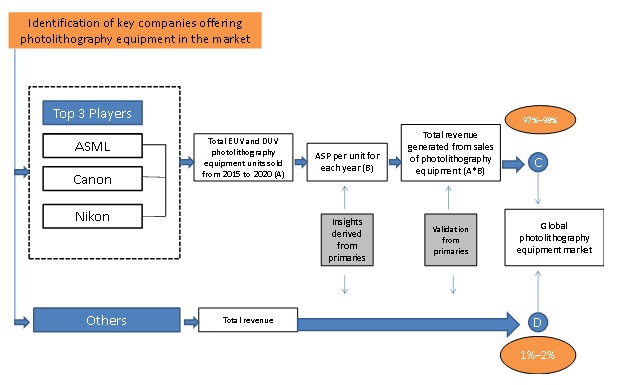
Top-down and bottom-up approaches have been used to estimate and validate the size of the photolithography equipment market and various dependent submarkets. The key players in the market have been identified through secondary research, and their market share in the respective regions has been determined through primary and secondary research.
In the top-down approach, the overall market size has been used to estimate the size of the individual markets (mentioned in the market segmentation) derived through percentage splits from secondary and primary research.
For the calculation of specific market segments, the most appropriate parent market size has been considered to implement the top-down approach. The bottom-up approach has also been implemented for the data extracted from the secondary research to validate the obtained market size of segments.
The bottom-up approach has been employed to arrive at the overall size of the photolithography equipment market, in terms of volume, and to determine the average selling price of photolithography equipment products. The multiplication of the number of unit shipments and the average selling price led to the estimation of the overall size of the photolithography equipment market.
Global Photolithography Equipment Market: Top-Down Market Estimation
To know about the assumptions considered for the study, Request for Free Sample Report
Data Triangulation
After arriving at the overall market size from the market size estimation process explained above, the total market has been split into several segments and subsegments. To complete the overall market engineering process and arrive at the exact statistics for all segments and subsegments, the market breakdown and data triangulation procedures have been employed wherever applicable. The data has been triangulated by studying various factors and trends from, both, demand and supply sides. In addition to this, the market size has been validated using both top-down and bottom-up approaches.
Report Objectives
- To define, describe, and forecast the photolithography equipment market based on type, wavelength, end user, and light source
- To forecast the market size for various segments with regard to 4 main regions, namely, North America, Europe, Asia Pacific (APAC), and the Rest of the World (RoW)
- To forecast the market size based on type in terms of volume
- To forecast the shipments of photolithography equipment by different companies from 2020 to 2025
- To provide detailed information regarding the key factors such as drivers, restraints, opportunities, and challenges influencing the growth of the market
- To provide detailed analysis of Porter's five forces, strategic benchmarking of the leading players, and evolution of the photolithography equipment market
- To strategically analyze micromarkets with respect to individual growth trends, prospects, and contributions to the overall market
- To analyze opportunities in the market for stakeholders by identifying high-growth segments of the photolithography equipment market
- To strategically profile the key players and comprehensively analyze their market share and core competencies, along with a detailed competitive landscape for the market leaders
- To study the complete value chain and allied industry segments, as well as perform a value chain analysis of the photolithography equipment landscape
- To track and analyze the competitive developments, such as joint ventures, mergers and acquisitions, new product developments, and research and development activities in the photolithography equipment market
Available Customizations:
With the given market data, MarketsandMarkets offers customizations according to the company’s specific needs. The following customization options are available for this report:
- Additional country-level analysis of photolithography equipment market

 Generating Response ...








Growth opportunities and latent adjacency in Photolithography Equipment Market