WO2025090812A1 - Methods of modulating cell proliferation - Google Patents
Methods of modulating cell proliferation Download PDFInfo
- Publication number
- WO2025090812A1 WO2025090812A1 PCT/US2024/052878 US2024052878W WO2025090812A1 WO 2025090812 A1 WO2025090812 A1 WO 2025090812A1 US 2024052878 W US2024052878 W US 2024052878W WO 2025090812 A1 WO2025090812 A1 WO 2025090812A1
- Authority
- WO
- WIPO (PCT)
- Prior art keywords
- alkyl
- carbocycle
- membered heterocycle
- optionally substituted
- alkynyl
- Prior art date
- Legal status (The legal status is an assumption and is not a legal conclusion. Google has not performed a legal analysis and makes no representation as to the accuracy of the status listed.)
- Pending
Links
Classifications
-
- A—HUMAN NECESSITIES
- A61—MEDICAL OR VETERINARY SCIENCE; HYGIENE
- A61P—SPECIFIC THERAPEUTIC ACTIVITY OF CHEMICAL COMPOUNDS OR MEDICINAL PREPARATIONS
- A61P35/00—Antineoplastic agents
-
- A—HUMAN NECESSITIES
- A61—MEDICAL OR VETERINARY SCIENCE; HYGIENE
- A61K—PREPARATIONS FOR MEDICAL, DENTAL OR TOILETRY PURPOSES
- A61K31/00—Medicinal preparations containing organic active ingredients
- A61K31/33—Heterocyclic compounds
- A61K31/395—Heterocyclic compounds having nitrogen as a ring hetero atom, e.g. guanethidine or rifamycins
- A61K31/495—Heterocyclic compounds having nitrogen as a ring hetero atom, e.g. guanethidine or rifamycins having six-membered rings with two or more nitrogen atoms as the only ring heteroatoms, e.g. piperazine or tetrazines
- A61K31/505—Pyrimidines; Hydrogenated pyrimidines, e.g. trimethoprim
- A61K31/517—Pyrimidines; Hydrogenated pyrimidines, e.g. trimethoprim ortho- or peri-condensed with carbocyclic ring systems, e.g. quinazoline, perimidine
-
- A—HUMAN NECESSITIES
- A61—MEDICAL OR VETERINARY SCIENCE; HYGIENE
- A61K—PREPARATIONS FOR MEDICAL, DENTAL OR TOILETRY PURPOSES
- A61K31/00—Medicinal preparations containing organic active ingredients
- A61K31/33—Heterocyclic compounds
- A61K31/395—Heterocyclic compounds having nitrogen as a ring hetero atom, e.g. guanethidine or rifamycins
- A61K31/495—Heterocyclic compounds having nitrogen as a ring hetero atom, e.g. guanethidine or rifamycins having six-membered rings with two or more nitrogen atoms as the only ring heteroatoms, e.g. piperazine or tetrazines
- A61K31/505—Pyrimidines; Hydrogenated pyrimidines, e.g. trimethoprim
- A61K31/519—Pyrimidines; Hydrogenated pyrimidines, e.g. trimethoprim ortho- or peri-condensed with heterocyclic rings
-
- A—HUMAN NECESSITIES
- A61—MEDICAL OR VETERINARY SCIENCE; HYGIENE
- A61K—PREPARATIONS FOR MEDICAL, DENTAL OR TOILETRY PURPOSES
- A61K45/00—Medicinal preparations containing active ingredients not provided for in groups A61K31/00 - A61K41/00
- A61K45/06—Mixtures of active ingredients without chemical characterisation, e.g. antiphlogistics and cardiaca
Definitions
- the ErbB family of receptor tyrosine kinases includes EGFR (HERl/ErbBl), EIER2 (ErbB2), EIER3 (ErbB3) and HER4 (ErbB4), each of which is a mediator of normal cell growth and development.
- EGFR HERl/ErbBl
- EIER2 ErbB2
- EIER3 ErbB3
- HER4 HER4
- phosphorylation of EGFR activates downstream signaling pathways — including the PI3K/AKT/mTOR, STAT, and RAS/MAPK pathways — that involve cell proliferation, angiogenesis, apoptosis, and metastasis.
- Overexpression of EGFR is frequently observed in a variety of tumors, including brain, breast, cervical, colorectal, esophageal, head and neck, kidney, lung, ovarian, and stomach cancers.
- EGFR mutations have been detected in over 40% of non-small cell lung cancer (NSCLC) cases in Asia and over 10% of NSCLC cases in North America and Europe, making them the most prevalent genetic alterations in NSCLC.
- the L858R point mutation and exon 19 deletions are often referred to as classical EGFR activating mutations and result in constitutive activation of EGFR and downstream signaling pathways, particularly in non- small cell lung cancer (NSCLC).
- NSCLC non-small cell lung cancer
- exon 20 mutations including T790M and exon 20 insertions, activate EGFR while affording the tumor resistance to first- and second-generation EGFR inhibitors targeting the classical EGFR mutations, such as gefitinib, erlotinib, and afatinib.
- Lung cancer is the leading cause of cancer-related death worldwide, due in part to these resistance mechanisms.
- an estimated 238,000 people will be diagnosed with lung and bronchus cancer and approximately 127,000 people will die from lung and bronchus cancer in the United States.
- SOS1 Son of Sevenless 1
- GEF guanine nucleotide exchange factor
- SOS1 has been implicated in cancer via its ability to activate RAS-family protein signaling.
- SOS1 interacts with the adaptor protein Grb2 and the resulting SOSl/Grb2 complex binds to activated/phosphorylated Receptor Tyrosine Kinases (e.g., EGFR, ErbB2, ErbB 3, ErbB4,TrkA, TrkB, TrkC, RET, c-MET, VEGFR 1 /2/3).
- activated/phosphorylated Receptor Tyrosine Kinases e.g., EGFR, ErbB2, ErbB 3, ErbB4,TrkA, TrkB, TrkC, RET, c-MET, VEGFR 1 /2/3.
- SOS1 is also recruited to other phosphorylated cell surface receptors such as the T cell Receptor (TCR), B cell Receptor (BCR) and monocyte colony-stimulating factor receptor.
- TCR T cell Receptor
- BCR B cell Receptor
- monocyte colony-stimulating factor receptor monocyte colony-stimulating factor receptor
- the present disclosure provides a method of treating a cancer comprising an EGFR exon 20 insertion mutation in a subject, the method comprising administering to the subject (a) a SOS1 inhibitor.
- the cancer is lung cancer, such as non-small cell lung cancer.
- the subject exhibits relapse of the cancer.
- the subject has previously been treated with chemotherapy, such as platinum-based chemotherapy.
- the subject has previously been treated with a tyrosine kinase inhibitor (TKI) against EGFR prior to administering (a).
- TKI tyrosine kinase inhibitor
- the subject has previously been treated with a non-exon 20 insertion EGFR TKI, such as a non-exon 20 insertion EGFR TKI selected from gefitinib, erlotinib, afatinib, lazertinib, osimertinib, dacomitinib, neratinib, cetuximab, panitumumab, lapatinib, necitumumab, clawdetanib, BLU-945, and zorifertinib.
- a non-exon 20 insertion EGFR TKI selected from gefitinib, erlotinib, afatinib, lazertinib, osimertinib, dacomitinib, neratinib, cetuximab, panitumumab, lapatinib, necitumumab, toartinib, vandetanib, BLU-945, and zori
- the subject has previously been treated with an EGFR exon 20 insertion TKI, such as an EGFR exon 20 insertion TKI selected from poziotinib, mobocertinib, amivantamab, zipalertinib, sunvozertinib, BAY-2927088, BLU-451, and STX-721.
- an EGFR exon 20 insertion TKI selected from poziotinib, mobocertinib, amivantamab, zipalertinib, sunvozertinib, BAY-2927088, BLU-451, and STX-721.
- the subject exhibits resistance or intolerance to the TKI.
- resistance to the TKI is characterized by one or more changes selected from (1) progression of the cancer, (2) EGFR gene mutation, (3) loss of EGFR T790M mutation, (4) EGFR gene amplification, S') MET amplification, (6) HER2 amplification, (7) RAS-MAPK pathway activation, (8) PI3K pathway activation, (9) cell-cycle gene alteration, (10) oncogenic fusion, (11) histologic transformation, and (12) phenotypic transformation.
- the present disclosure provides a method of reducing proliferation of cancer cells comprising an epidermal growth factor receptor (EGFR) exon 20 insertion, the method comprising administering to the cells (a) a SOS1 inhibitor.
- the present disclosure provides a method of downregulating SOS1 signaling output in a plurality of cancer cells, comprising: (i) assessing EGFR mutation status in a biological sample comprising nucleic acid from the subject; and (ii) administering an effective dose of (a) a SOS1 inhibitor if an EGFR exon 20 insertion is detected in the sample.
- the cancer cells are non-small cell lung cancer cells.
- the cancer cells have previously been treated with chemotherapy, such as platinum-based chemotherapy.
- the cancer cells have previously been treated with a tyrosine kinase inhibitor (TKI) against EGFR prior to administering (a).
- TKI tyrosine kinase inhibitor
- the cancer cells have previously been treated with a non-exon 20 insertion EGFR TKI, such as a non-exon 20 insertion EGFR TKI selected from gefitinib, erlotinib, afatinib, lazertinib, osimertinib, dacomitinib, neratinib, cetuximab, panitumumab, lapatinib, necitumumab, toartinib, vandetanib, BLU-945, and zorifertinib.
- the subject has previously been treated with an EGFR exon 20 insertion TKI, such as an EGFR exon 20 insertion TKI selected from poziotinib, mobocertinib, amivantamab, zipalertinib, sunvozertinib, BAY-2927088, BLU-451, and STX-721.
- an EGFR exon 20 insertion TKI selected from poziotinib, mobocertinib, amivantamab, zipalertinib, sunvozertinib, BAY-2927088, BLU-451, and STX-721.
- the cancer cells exhibit resistance or intolerance to the TKI.
- resistance to the TKI is characterized by one or more changes selected from (1) progression of the cancer, (2) EGFR gene mutation, (3) loss of EGFR T790M mutation, (4) EGFR gene amplification, (5) MET amplification, (6) HER2 amplification, (7) RAS-MAPK pathway activation, (8) PI3K pathway activation, (9) cell-cycle gene alteration, (10) oncogenic fusion, (11) histologic transformation, and (12) phenotypic transformation.
- a method of the present disclosure may further comprise administering (b) an additional agent or additional therapy.
- the additional agent is selected from an immunomodulatory agent, an anti -nausea agent, an antiemetic, a pain reliever, and a chemotherapeutic agent.
- the additional agent is selected from an immunomodulatory agent, a cytokine blockade agent, and a checkpoint immune blockade agent.
- the additional agent is selected from an anti-PD-L l antibody, an anti-CTLA-4 antibody, an anti- PD-1 antibody, an anti-LAG3 antibody, an anti-TIM3 antibody, and combinations thereof.
- the additional agent is a MET inhibitor.
- the additional agent is a small molecule EGFR exon 20 insertion tyrosine kinase inhibitor (TKI), such as an EGFR exon 20 insertion TKI selected from poziotinib, mobocertinib, zipalertinib, sunvozertinib, BAY-2927088, BLU-451, and STX-721.
- TKI small molecule EGFR exon 20 insertion tyrosine kinase inhibitor
- the additional therapy is selected from surgery, cell therapy, chemotherapy, and radiation.
- the synergistic value is ascertained by Bliss independence criterion in accordance with the formula: Y AB.O - YAB.P, wherein: YAB.O is observed percent growth inhibition of the cancer cells by the application of (a) and (b) comprising (a) at dose A and (b) at dose B: YAB.P is predicted percent growth inhibition of the cancer cells by the application of
- YAB.P YA + YB - Y ⁇ Yi ; : YA is observed percent growth inhibition of the cancer cells by (a) alone at dose A; YB is observed percent growth inhibition of the cancer cells by (b) alone at dose B: and YAYB is the product of YA and YB.
- the synergistic value is at least 0.4, such as at least 1 or at least 5.
- the administration of (a) and (b) reduces incidence of one or more adverse event associated with administration of (b) alone.
- the adverse event is selected from diarrhea, rash, nausea, stomatitis, vomiting, decreased appetite, paronychia, fatigue, dry skin, musculoskeletal pain, dyspnea, pyrexia, acute kidney injury, pleural effusion, and cardiac failure.
- one or both of (a) and (b) are administered at a sub-therapeutic dose but achieve a therapeutic effect at least comparable to administering (a) or
- (b) alone at its therapeutically effective amount. In some embodiments, (b) is administered at a dose less than about 25% the standard monotherapy dose. In some embodiments, (a) and (b) are administered in the same formulation. In some embodiments, (a) and (b) are administered in separate formulations.
- the SOS1 inhibitor may be a compound selected from BI-3406, MRTX0902, BAY 293, RMC-5845, and BI-1701963.
- the S0S1 inhibitor is a compound of Formula (1-1): or a pharmaceutically acceptable salt or solvate thereof, wherein: is selected from C5.7 carbocycle and 5- to 7-membered heterocycle, each of which is optionally substituted with one or more R 11 ; is absent or selected from C3.8 carbocycle and 3- to 8-membered heterocycle, each of which is optionally substituted with one or more R l la ;
- L 1 is selected from a bond, Ci-6 alkylene, and Ci-6 haloalkylene:
- L 2 is selected from C5.25 alkylene, C5.25 alkenylene, C5.25 alkynylene, 5- to 25-membered heteroalkylene, and 5- to 25-membered heteroalkenylene, each of which is optionally substituted with one or more R l lb , wherein L 2 is covalently bound to one of W 3 , W 4 , W 5 , W 6 , or Wk
- W 3 is selected from N(R 3b ), N, C(R 3 ), and C(O);
- W 4 is selected from N(R 4b ), N, C(R 4 ), and C(O);
- W 5 is selected from N(R 5b ), N, and C(R 5 );
- W 6 is selected from C(R 6 ) and C(O);
- W 7 is C(R 7 );
- R 1 is C1.3 alkyl optionally substituted with one or more R llc ;
- R 8 is selected from hydrogen, halogen, -CN, Ci-e alkyl, C2-6 alkenyl, C2-6 alkynyl, C3-10 carbocycle, 3- to 10- membered heterocycle, -OR 12 , -SR 12 , -N(R 12 )(R 13 ), -C(O)OR 12 , -OC(O)N(R 12 )(R 13 ), -N(R 14 )C(O)N(R 12 )(R 13 ), - N(R 14 )C(O)OR 15 , -N(R 14 )S(O) 2 R 15 , -C(O)R 15 , -S(O)R 15 , -OC(O)R 15 , -C(O)N(R 12 )(R 13 ), -C(O)C(O)N(R 12 )(R 13 ), - N(R 14 )C(O)R 15 , -S(O) 2
- R 3 , R 4 , R 5 , R 6 , and R 7 are each independently selected from a bond to L 2 , hydrogen, halogen, -CN, Ci-6 alkyl, C2-6 alkenyl, C2-6 alkynyl, C3-10 carbocycle, 3- to 10-membered heterocycle, -OR 12 , -SR 12 , -N(R 12 )(R 13 ), - C(O)OR 12 , -OC(O)N(R 12 )(R 13 ), -N(R 14 )C(O)N(R 12 )(R 13 ), -N(R 14 )C(O)OR 15 , -N(R 14 )S(O) 2 R 15 , -C(O)R 15 , -S(O)R 15 , - OC(O)R 15 , -C(O)N(R 12 )(R 13 ), -C(O)C(O)N(R 12 )(
- R 11 and R lla are each independently selected at each occurrence from halogen, -CN, Ci-6 alkyl, C2-6 alkenyl, C2-6 alkynyl, C3-10 carbocycle, 3- to 10-membered heterocycle, -OR 12 , -SR 12 , -N(R 12 )(R 13 ), -C(O)OR 12 , - OC(O)N(R 12 )(R 13 ), -N(R 14 )C(O)N(R 12 )(R 13 ), -N(R 14 )C(O)OR 15 , -N(R 14 )S(O) 2 R 15 , -C(O)R 15 , -S(O)R 15 , -OC(O)R 15 , - C(O)N(R 12 )(R 13 ), -C(O)C(O)N(R 12 )(R 13 ), -N(R 14 )C(O)R 15
- R llc is independently selected at each occurrence from halogen, -OR 12 , and -N(R 12 )(R 13 );
- R 12 is independently selected at each occurrence from hydrogen, Ci-6 alkyl, Ci-e haloalkyl, C2-6 alkenyl, C2-6 alkynyl, C3-10 carbocycle, and 3- to 10-membered heterocycle, wherein Ci-6 alkyl, C2-6 alkenyl, C2-6 alkynyl, C3-10 carbocycle, and 3- to 10-membered heterocycle are optionally substituted with one, two, or three R 20 ;
- R 13 is independently selected at each occurrence from hydrogen, Ci-6 alkyl, and Ci-6 haloalkyl; or R 12 and R 13 , together with the nitrogen atom to which they are attached, form a 3- to 10-membered heterocycle optionally substituted with one, two, or three R 20 ;
- R 14 is independently selected at each occurrence from hydrogen, Ci-6 alkyl, and Ci-6 haloalkyl;
- R 15 is independently selected at each occurrence from Ci-6 alkyl, C2-6 alkenyl, C2-6 alkynyl, C3-10 carbocycle, and 3- to 10-membered heterocycle, wherein Ci-6 alkyl, C2-6 alkenyl, C2-6 alkynyl, C3-10 carbocycle, and 3- to 10-membered heterocycle are optionally substituted with one, two, or three R 20 ;
- R 17 and R 17a are each independently selected at each occurrence from Ci-6 alkyl and C3.6 cycloalkyl, wherein Ci-6 alkyl and C3.6 cycloalkyl are optionally substituted with one, two or three R 20 ; or R 17 and R 17a , together with the phosphorous atom to which they are attached, form a 3- to 10-membered heterocycle;
- R 21 is independently selected at each occurrence from H, Ci-6 alkyl, Ci-6 haloalkyl, C2-6 alkenyl, C2-6 alkynyl, C3-10 carbocycle, and 3- to 10-membered heterocycle, wherein C3-10 carbocycle and 3- to 10-membered heterocycle are optionally substituted with one, two, or three groups independently selected from halogen and Ci-6 alkyl;
- R 22 is independently selected at each occurrence from H, Ci-6 alkyl, Ci-6 haloalkyl, C2-6 alkenyl, C2-6 alkynyl, C3-10 carbocycle, and 3- to 10-membered heterocycle, wherein C3-10 carbocycle and 3- to 10-membered heterocycle are optionally substituted with one, two, or three groups independently selected from halogen and Ci-6 alkyl;
- R 23 is independently selected at each occurrence from H and Ci-e alkyl
- R 24 is independently selected at each occurrence from H and Ci-e alkyl
- R 25 is independently selected at each occurrence from Ci-6 alkyl, C2-6 alkenyl, C2-6 alkynyl, C3-10 carbocycle, and 3- to 10-membered heterocycle, wherein Ci-6 alkyl, C3-10 carbocycle, and 3- to 10-membered heterocycle are optionally substituted with one, two, or three groups independently selected from halogen, Ci-e alkyl, Ci-6 haloalkyl, Ci-6 alkoxy, C3-10 carbocycle, and 3- to 10-membered heterocycle; and indicates a single or double bond such that all valences are satisfied.
- the present disclosure provides a kit for use in reducing proliferation of cancer cells comprising an epidermal growth factor receptor (EGFR) exon 20 insertion, the kit comprising: (1) a composition comprising a SOS1 inhibitor of Formula (1-1); (2) a composition comprising a small molecule EGFR exon 20 insertion TKI; and (3) instructions for using the composition(s) of (1) and (2).
- the SOS1 inhibitor and the EGFR exon 20 insertion TKI are formulated in a same unit dosage form.
- the SOS1 inhibitor and the EGFR exon 20 insertion TKI are formulated in different unit dosage forms.
- the present disclosure provides a pharmaceutical composition comprising (i) a SOS1 inhibitor of Formula (I- 1 ), or a pharmaceutically acceptable salt or solvate thereof, (ii) a small molecule EGFR exon 20 insertion TKI, and (iii) a pharmaceutically acceptable excipient.
- the present disclosure provides a method of treating cancer in a subject, comprising administering to the subject a pharmaceutical composition comprising (i) a SOS1 inhibitor of Formula (1-1), or a pharmaceutically acceptable salt or solvate thereof, (ii) a small molecule EGFR exon 20 insertion TKI, and (iii) a pharmaceutically acceptable excipient.
- FIG. 1 shows a degree of growth inhibition of Ba/F3-EGFR Exon 20 insertion (V769_D770insASV) transformed cells upon treatment with a SOS1 inhibitor of the present disclosure (e.g., Compound A, at various concentrations).
- a SOS1 inhibitor of the present disclosure e.g., Compound A, at various concentrations.
- the results demonstrate that the SOS1 inhibitor of the present disclosure is effective in inhibiting of EGFR_Ex20 insertion mutant cells in a dose dependent manner.
- FIG. 2A shows a degree of growth inhibition of Ba/F3-EGFR Exon 20 insertion (V769_D770insASV) transformed cells upon treatment with (i) a SOS1 inhibitor of the present disclosure (e.g., Compound A, at various concentrations) alone, (ii) mobocertinib alone, or (iii) a combination of (i) and (ii) at various concentrations.
- a SOS1 inhibitor of the present disclosure e.g., Compound A, at various concentrations
- FIG. 2B shows a degree of synergy across the combinations in FIG. 2A, as calculated using the BLISS independence model.
- FIG. 3A shows a degree of growth inhibition of Ba/F3-EGFR Exon 20 insertion (V769_D770insASV) transformed cells upon treatment with (i) a SOS1 inhibitor of the present disclosure (e.g., Compound A, at various concentrations) alone, (ii) afatinib alone, or (iii) a combination of (i) and (ii) at various concentrations.
- a SOS1 inhibitor of the present disclosure e.g., Compound A, at various concentrations
- FIG. 3B shows a degree of synergy across the combinations in FIG. 3A, as calculated using the BLISS independence model.
- FIG. 4A shows a degree of growth inhibition of Ba/F3-EGFR Exon 20 insertion (V769_D770insASV) transformed cells upon treatment with (i) a SOS1 inhibitor of the present disclosure (e.g., Compound A, at various concentrations) alone, (ii) lazertinib alone, or (iii) a combination of (i) and (ii) at various concentrations.
- a SOS1 inhibitor of the present disclosure e.g., Compound A, at various concentrations
- FIG. 4B shows a degree of synergy across the combinations in FIG. 4A, as calculated using the BLISS independence model.
- FIG. 5 shows results of a study in which mice bearing Ba/F3-EGFR Exon 20 insertion (V769_D770insASV) allograft tumors were treated with (i) a SOS1 inhibitor of the present disclosure (e.g., Compound A) alone, (ii) mobocertinib alone, or (iii) a combination of (i) and (ii).
- SOS1 inhibitor of the present disclosure e.g., Compound A
- mobocertinib alone
- iii a combination of (i) and (ii).
- the results demonstrate that the SOS1 inhibitor disclosed herein synergistically reduces tumor volume in combination with mobocertinib in the tumor model.
- FIG. 6 shows results of a study in which LU0387 mice (an NSCLC Patient Derived Xenograft (PDX) model exhibiting an EGFR-Exon 20 insertion mutation (D770_N771insNPH)) were treated with (i) a SOS1 inhibitor of the present disclosure (e.g., Compound A) alone, (ii) mobocertinib alone, or (iii) in combination of (i) and (ii).
- SOS1 inhibitor of the present disclosure e.g., Compound A
- mobocertinib alone
- iiii in combination of (i) and (ii).
- FIG. 7 shows results of a study in which mice bearing Ba/F3-EGFR Exon 20 insertion (V769_D770insASV) allograft tumors were treated with (i) a SOS1 inhibitor of the present disclosure (e.g., Compound A) alone, (ii) sunvozertinib alone, or (iii) a combination of (i) and (ii).
- SOS1 inhibitor of the present disclosure e.g., Compound A
- sunvozertinib alone
- the results demonstrate that the SOS1 inhibitor disclosed herein synergistically inhibits tumor growth in combination with sunvozertinib.
- C x.y or “C x -C y ” when used in conjunction with a chemical moiety, such as alkyl, alkenyl, or alkynyl, is meant to include groups that contain from x to y carbons in the chain.
- C x.y alkyl refers to substituted or unsubstituted saturated hydrocarbon groups, including straight-chain alkyl and branched- chain alkyl groups, that contain from x to y carbons in the chain.
- Alkyl refers to substituted or unsubstituted saturated hydrocarbon groups, including linear and branched alkyl groups.
- An alkyl group may contain from one to twelve carbon atoms (e.g., Cm alkyl), such as one to eight carbon atoms (Cns alkyl) or one to six carbon atoms (Ci-6 alkyl).
- alkyl groups include methyl, ethyl, n- propyl, isopropyl, n-butyl, isobutyl, sec-butyl, tert-butyl, pentyl, isopentyl, neopentyl, hexyl, septyl, octyl, nonyl, and decyl.
- An alkyl group is attached to the rest of the molecule by a single bond. Unless stated otherwise specifically in the specification, an alkyl group is optionally substituted by one or more substituents such as those substituents described herein.
- alkenyl refers to substituted or unsubstituted hydrocarbon groups, including linear and branched alkenyl groups, containing at least one double bond.
- An alkenyl group may contain from two to twelve carbon atoms (e.g., C2-12 alkenyl), such as two to eight carbon atoms (C2-8 alkenyl) or two to six carbon atoms (C2-6 alkenyl).
- Exemplary alkenyl groups include ethenyl (i.e., vinyl), prop-l -enyl, but-l-enyl, pent-l-enyl, penta- 1,4-dienyl, and the like.
- an alkenyl group is optionally substituted by one or more substituents such as those substituents described herein.
- Alkynyl refers to substituted or unsubstituted hydrocarbon groups, including linear and branched alkynyl groups, containing at least one triple bond.
- An alkynyl group may contain from two to twelve carbon atoms (e.g., C2- 12 alkynyl), such as two to eight carbon atoms (C2-8 alkynyl) or two to six carbon atoms (C2-6 alkynyl).
- Exemplary alkynyl groups include ethynyl, propynyl, butynyl, pentynyl, hexynyl, and the like. Unless stated otherwise specifically in the specification, an alkynyl group is optionally substituted by one or more substituents such as those substituents described herein.
- Alkylene or “alkylene chain” refers to substituted or unsubstituted divalent saturated hydrocarbon groups, including linear alkylene and branched alkylene groups, that contain from one to twelve carbon atoms (e.g., CM2 alkylene), such as one to eight carbon atoms (Cns alkylene) or one to six carbon atoms (Ci-6 alkylene).
- CM2 alkylene such as one to eight carbon atoms (Cns alkylene) or one to six carbon atoms (Ci-6 alkylene).
- Exemplary alkylene groups include methylene, ethylene, propylene, and n-butylene.
- alkenylene and alkynylene refer to alkylene groups, as defined above, which comprise one or more carbon-carbon double or triple bonds, respectively.
- alkylene, alkenylene or alkynylene chain can be through one carbon or any two carbons of the chain.
- an alkylene, alkenylene, or alkynylene group is optionally substituted by one or more substituents such as those substituents described herein.
- Heteroalkyl refers to substituted or unsubstituted alkyl, alkenyl and alkynyl groups, respectively, in which one or more, such as 1, 2 or 3, of the carbon atoms are replaced with a heteroatom, such as O, N, P, Si, S, or combinations thereof. Any nitrogen, phosphorus, and sulfur heteroatoms present in the chain may optionally be oxidized, and any nitrogen heteroatoms may optionally be quatemized. If given, a numerical range refers to the chain length in total. For example, a 3- to 8-membered heteroalkyl group has a chain length of 3 to 8 atoms.
- Connection to the rest of the molecule may be through either a heteroatom or a carbon in the heteroalkyl, heteroalkenyl, or heteroalkynyl chain.
- a heteroalkyl, hetero alkenyl, or heteroalkynyl group is optionally substituted by one or more substituents such as those substituents described herein.
- Hetero alkylene refers to substituted or unsubstituted alkylene, alkenylene and alkynylene groups, respectively, in which one or more, such as 1, 2 or 3, of the carbon atoms are replaced with a heteroatom, such as O, N, P, Si, S, or combinations thereof. Any nitrogen, phosphorus, and sulfur heteroatoms present in the chain may optionally be oxidized, and any nitrogen heteroatoms may optionally be quatemized. If given, a numerical range refers to the chain length in total. For example, a 3- to 8- membered hetero alkylene group has a chain length of 3 to 8 atoms.
- the points of attachment of the heteroalkylene, hetero alkenylene or heteroalkynylene chain to the rest of the molecule can be through either one heteroatom or one carbon, or any two heteroatoms, any two carbons, or any one heteroatom and any one carbon in the heteroalkylene, hetero alkenylene or heteroalkynylene chain.
- a heteroalkylene, heteroalkenylene, or heteroalkynylene group is optionally substituted by one or more substituents such as those substituents described herein.
- Carbocycle refers to a saturated, unsaturated or aromatic ring in which each atom of the ring is a carbon atom.
- Carbocycle may include C3-10 monocyclic rings, Ce-i2 bicyclic rings, Ce-i2 spirocyclic rings, and Ce-i2 bridged rings.
- Each ring of a bicyclic carbocycle may be selected from saturated, unsaturated, and aromatic rings.
- the carbocycle is a Ce-i2 aryl group, such as Ce-io aryl.
- the carbocycle is a Ce-i2 cycloalkyl group.
- the carbocycle is a Ce-i2 cycloalkenyl group.
- an aromatic ring e.g., phenyl
- a saturated or unsaturated ring e.g., cyclohexane, cyclopentane, or cyclohexene.
- Any combination of saturated, unsaturated and aromatic bicyclic rings, as valence permits, are included in the definition of carbocycle.
- Exemplary carbocycles include cyclopentyl, cyclohexyl, cyclohexenyl, adamantly, phenyl, indanyl, and naphthyl. Unless state otherwise specifically in the specification, a carbocycle is optionally substituted by one or more substituents such as those substituents described herein.
- Heterocycle refers to a saturated, unsaturated or aromatic ring comprising one or more heteroatoms, for example 1, 2 or 3 heteroatoms selected from O, S and N. Heterocycles include 3- to 10-membered monocyclic rings, 6- to 12-membered bicyclic rings, 6- to 12-membered spirocyclic rings, and 6- to 12-membered bridged rings. Each ring of a bicyclic heterocycle may be selected from saturated, unsaturated, and aromatic rings. The heterocycle may be attached to the rest of the molecule through any atom of the heterocycle, valence permitting, such as a carbon or nitrogen atom of the heterocycle.
- the heterocycle is a 5- to 10-membered heteroaryl group, such as 5- or 6-membered heteroaryl.
- the heterocycle is a 3- to 12-membered heterocycloalkyl group.
- a heterocycle e.g., pyridyl
- heterocycles include pyrrolidinyl, pyrrolyl, imidazolyl, pyrazolyl, triazolyl, piperidinyl, pyridinyl, pyrimidinyl, pyridazinyl, pyrazinyl, thiophenyl, oxazolyl, thiazolyl, morpholinyl, indazolyl, indolyl, and quinolinyl.
- a heterocycle is optionally substituted by one or more substituents such as those substituents described herein.
- Heteroaryl refers to a 5- to 12-membered aromatic ring that comprises at least one heteroatom, such as 1, 2 or 3 heteroatoms, selected from O, S and N.
- the heteroaryl ring may be selected from monocyclic or bicyclic — including fused, spirocyclic and bridged ring systems — wherein at least one of the rings in the ring system is aromatic.
- the heteroatom(s) in the heteroaryl may optionally be oxidized.
- One or more nitrogen atoms, if present, are optionally quatemized.
- the heteroaryl may be attached to the rest of the molecule through any atom of the heteroaryl, valence permitting, such as a carbon or nitrogen atom of the heteroaryl.
- heteroaryl groups include, but are not limited to, azepinyl, benzimidazolyl, benzisothiazolyl, benzisoxazolyl, benzofuranyl, benzothiazolyl, benzothiophenyl, benzoxazolyl, furanyl, imidazolyl, indazolyl, indolyl, isoquinolinyl, isothiazolyl, isoxazolyl, oxadiazolyl, oxazolyl, purinyl, pyrazinyl, pyrazolidinyl, pyrazolyl, pyridazinyl, pyridazolyl, pyridyl, pyrimidinyl, pyrrolyl, quinazolinyl, quinolinyl, quinoxalinyl, tetrahydroquinolinyl, thiadiazolyl, thiazolyl, and thienyl groups. Unless stated otherwise,
- a waved line “ ” drawn across a bond or a dashed bond are used interchangeably herein to denote
- R 7 if R 7 is 1- cyclopropyl- 1 -carbonitrile as in ON , then R 7 may be depicted as
- substituted refers to moieties having substituents replacing a hydrogen on one or more carbons or heteroatoms of the structure. It will be understood that “substitution” or “substituted with” includes the implicit proviso that such substitution is in accordance with permitted valence of the substituted atom and the substituent, and that the substitution results in a stable compound, e.g., which does not spontaneously undergo transformation such as by rearrangement, cyclization, elimination, etc. As used herein, the term “substituted” is contemplated to include all permissible substituents of organic compounds.
- the permissible substituents include acyclic and cyclic, branched and unbranched, carbocyclic and heterocyclic, aromatic and non-aromatic substituents of organic compounds.
- the permissible substituents can be one or more and the same or different for appropriate organic compounds.
- heteroatoms such as nitrogen may have any permissible substituents of organic compounds described herein which satisfy the valences of the heteroatoms.
- R 21 is independently selected at each occurrence from H, Ci-6 alkyl, Ci-6 haloalkyl, C2-6 alkenyl, C2-6 alkynyl, C3-10 carbocycle, and 3- to 10-membered heterocycle, wherein C3-10 carbocycle and 3- to 10-membered heterocycle are optionally substituted with one, two, or three groups independently selected from halogen and Ci-6 alkyl;
- R 22 is independently selected at each occurrence from H, Ci-6 alkyl, Ci-6 haloalkyl, C2-6 alkenyl, C2-6 alkynyl, C3-10 carbocycle, and 3- to 10-membered heterocycle, wherein C3-10 carbocycle and 3- to 10-membered heterocycle are optionally substituted with one, two, or three groups independently selected from halogen and Ci-6 alkyl;
- R 23 is independently selected at each occurrence from H and Ci-e alkyl
- R 24 is independently selected at each occurrence from H and Ci-e alkyl
- R 25 is independently selected at each occurrence from Ci-6 alkyl, C2-6 alkenyl, C2-6 alkynyl, C3-10 carbocycle, and 3- to 10-membered heterocycle, wherein Ci-6 alkyl, C3-10 carbocycle, and 3- to 10-membered heterocycle are optionally substituted with one, two, or three groups independently selected from halogen, Ci-e alkyl, Ci-e haloalkyl, Ci-6 alkoxy, C3-10 carbocycle, and 3- to 10-membered heterocycle.
- R 21 is independently selected at each occurrence from H, Ci-6 alkyl, Ci-6 haloalkyl, C2-6 alkenyl, C2-6 alkynyl, C3-10 carbocycle, and 3- to 10-membered heterocycle, wherein C3-10 carbocycle and 3- to 10-membered heterocycle are optionally substituted with one, two, or three groups independently selected from halogen and Ci-6 alkyl;
- R 22 is independently selected at each occurrence from H, Ci-6 alkyl, Ci-6 haloalkyl, C2-6 alkenyl, C2-6 alkynyl, C3-10 carbocycle, and 3- to 10-membered heterocycle, wherein C3-10 carbocycle and 3- to 10-membered heterocycle are optionally substituted with one, two, or three groups independently selected from halogen and Ci-6 alkyl;
- R 23 is independently selected at each occurrence from H and Ci-e alkyl
- R 24 is independently selected at each occurrence from H and Ci-e alkyl
- R 25 is independently selected at each occurrence from Ci-6 alkyl, C2-6 alkenyl, C2-6 alkynyl, C3-10 carbocycle, and 3- to 10-membered heterocycle, wherein Ci-6 alkyl, C3-10 carbocycle, and 3- to 10-membered heterocycle are optionally substituted with one, two, or three groups independently selected from halogen, Ci-e alkyl, Ci-e haloalkyl, Ci-6 alkoxy, C3-10 carbocycle, and 3- to 10-membered heterocycle.
- bivalent substituent groups are specified herein by their conventional chemical formulae, written from left to right, they are intended to encompass the isomer that would result from writing the structure from right to left, e.g., -CH2O- is also intended to encompass -OCH2-.
- Compounds of the present disclosure also include crystalline and amorphous forms of those compounds, pharmaceutically acceptable salts, and active metabolites having the same type of activity, including, for example, polymorphs, pseudopolymorphs, solvates, hydrates, unsolvated polymorphs (including anhydrates), conformational polymorphs, amorphous forms of the compounds, and mixtures thereof.
- the compounds described herein may exhibit their natural isotopic abundance, or one or more of the atoms may be artificially enriched in a particular isotope having the same atomic number, but an atomic mass or mass number different from the atomic mass or mass number predominantly found in nature. All isotopic variations of the compounds of the present disclosure, whether radioactive or not, are encompassed within the scope of the present disclosure.
- hydrogen has three naturally occurring isotopes, denoted ! H (protium), 2 H (deuterium), and 3 H (tritium). Protium is the most abundant isotope of hydrogen in nature.
- Enriching for deuterium may afford certain therapeutic advantages, such as increased in vivo half-life and/or exposure, or may provide a compound useful for investigating in vivo routes of drug elimination and metabolism.
- isotopes that may be incorporated into compounds of the present disclosure include, but are not limited to, 2 H, 3 H, 13 C, 14 C, 15 N, 18 0, 17 0, 35 S, 36 C1, and 18 F.
- Isotopically-enriched compounds may be prepared by conventional techniques well known to those skilled in the art.
- Certain compounds described herein contain one or more asymmetric centers and can thus give rise to enantiomers, diastereomers, and other stereoisomeric forms, the asymmetric centers of which can be defined, in terms of absolute stereochemistry, as (R)- or (S)-.
- the carbon atoms in order to optimize the therapeutic activity of the compounds of the disclosure, e.g., to treat cancer, it may be desirable that the carbon atoms have a particular configuration (e.g., (R,R), (S,S), (S,R), or (R,S)) or are enriched in a stereoisomeric form having such configuration.
- the compounds of the disclosure may be provided as racemic mixtures.
- the disclosure relates to racemic mixtures, pure stereoisomers (e.g., enantiomers and diastereomers), stereoisomer-enriched mixtures, and the like, unless otherwise indicated.
- pure stereoisomers e.g., enantiomers and diastereomers
- stereoisomers may be obtained by numerous methods that are known in the art, including preparation using chiral synthons or chiral reagents, resolution using chiral chromatography using a suitable chiral stationary phase or support, or by chemically converting them into diastereomers, separating the diastereoisomers by conventional means such as chromatography or recrystallization, then regenerating the original stereoisomer.
- pharmaceutically acceptable refers to a material that is not biologically or otherwise unacceptable when used in the subject compositions and methods.
- pharmaceutically acceptable carrier refers to a material — such as an adjuvant, excipient, glidant, sweetening agent, diluent, preservative, dye, colorant, flavor enhancer, surfactant, wetting agent, dispersing agent, suspending agent, stabilizer, isotonic agent, solvent or emulsifier — that can be incorporated into a composition and administered to a patient without causing unacceptable biological effects or interacting in an unacceptable manner with other components of the composition.
- Such pharmaceutically acceptable materials typically have met the required standards of toxicological and manufacturing testing, and include those materials identified as suitable inactive ingredients by the U.S. Food and Drug Administration.
- salts and “pharmaceutically acceptable salt” refer to a salt prepared from a base or an acid.
- Pharmaceutically acceptable salts are suitable for administration to a patient, such as a mammal (for example, salts having acceptable mammalian safety for a given dosage regime). Salts can be formed from inorganic bases, organic bases, inorganic acids and organic acids.
- a compound contains both a basic moiety, such as an amine, pyridine or imidazole, and an acidic moiety, such as a carboxylic acid or tetrazole, zwitterions may be formed and are included within the term “salt” as used herein.
- Preferred pharmaceutically acceptable salts of the compounds described herein are pharmaceutically acceptable acid addition salts and pharmaceutically acceptable base addition salts.
- “Pharmaceutically acceptable acid addition salt” refers to those salts which retain the biological effectiveness and properties of the free bases, which are not biologically or otherwise undesirable, and which are formed with inorganic acids such as hydrochloric acid, hydrobromic acid, sulfuric acid, nitric acid, phosphoric acid, hydroiodic acid, hydrofluoric acid, phosphorous acid, and the like.
- salts that are formed with organic acids such as aliphatic mono- and dicarboxy lie acids, phenyl-substituted alkanoic acids, hydroxy alkanoic acids, alkanedioic acids, aromatic acids, aliphatic and aromatic sulfonic acids, etc., and include, for example, acetic acid, trifluoroacetic acid, propionic acid, glycolic acid, pyruvic acid, oxalic acid, maleic acid, malonic acid, succinic acid, fumaric acid, tartaric acid, citric acid, benzoic acid, cinnamic acid, mandelic acid, methanesulfonic acid, ethanesulfonic acid, p-toluenesulfonic acid, salicylic acid, and the like.
- organic acids such as aliphatic mono- and dicarboxy lie acids, phenyl-substituted alkanoic acids, hydroxy alkanoic acids, alkanedio
- Exemplary salts thus include sulfates, pyrosulfates, bisulfates, sulfites, bisulfites, nitrates, phosphates, monohydrogenphosphates, dihydrogenphosphates, metaphosphates, pyrophosphates, chlorides, bromides, iodides, acetates, trifluoroacetates, propionates, caprylates, isobutyrates, oxalates, malonates, succinate suberates, sebacates, fumarates, maleates, mandelates, benzoates, chlorobenzoates, methylbenzoates, dinitrobenzoates, phthalates, benzenesulfonates, toluenesulfonates, phenylacetates, citrates, lactates, malates, tartrates, methanesulfonates, and the like.
- Acid addition salts of basic compounds are, in some embodiments, prepared by contacting the free base forms with a sufficient amount of the desired acid to produce the salt according to methods and techniques with which a skilled artisan is familiar.
- “Pharmaceutically acceptable base addition salt” refers to those salts that retain the biological effectiveness and properties of the free acids, which are not biologically or otherwise undesirable. These salts are prepared from addition of an inorganic base or an organic base to the free acid. Pharmaceutically acceptable base addition salts are, in some embodiments, formed with metals or amines, such as alkali and alkaline earth metals or organic amines. Salts derived from inorganic bases include, but are not limited to, sodium, potassium, lithium, ammonium, calcium, magnesium, iron, zinc, copper, manganese, aluminum salts and the like.
- Salts derived from organic bases include, but are not limited to, salts of primary, secondary, and tertiary amines, substituted amines including naturally occurring substituted amines, cyclic amines and basic ion exchange resins, for example, isopropylamine, trimethylamine, diethylamine, triethylamine, tripropylamine, ethanolamine, diethanolamine, 2-dimethylaminoethanol, 2-diethylaminoethanol, dicyclohexylamine, lysine, arginine, histidine, caffeine, procaine, N,N-dibenzylethylenediamine, chloroprocaine, hydrabamine, choline, betaine, ethylenediamine, ethylenedianiline, N-methylglucamine, glucosamine, methylglucamine, theobromine, purines, piperazine, piperidine, N-ethylpiperidine, poly amine resins and the like. See Berge et
- treating refers to an approach for obtaining beneficial or desired results with respect to a disease, disorder, or medical condition (such as cancer) in a subject, including but not limited to the following: (a) ameliorating the disease or medical condition, e.g., eliminating or causing regression of the disease or medical condition in a subject; (b) suppressing the disease or medical condition, e.g., slowing or arresting the development of the disease or medical condition in a subject; or (c) alleviating symptoms of the disease or medical condition in a subject.
- “treating cancer” would include preventing cancer from reoccurring, ameliorating cancer, suppressing cancer, and alleviating the symptoms of cancer.
- a therapeutic benefit is achieved with the eradication or amelioration of one or more of the physiological symptoms associated with the underlying disorder such that an improvement is observed in the subject, notwithstanding that the subject may still be afflicted with the underlying disorder.
- a prophylactic effect includes delaying or eliminating the appearance of a disease or condition, delaying or eliminating the onset of symptoms of a disease or condition, slowing, halting, or reversing the progression of a disease or condition, or any combination thereof.
- administer refers to the methods that may be used to enable delivery of a composition to the desired site of biological action. These methods include, but are not limited to parenteral administration (e.g., intravenous, subcutaneous, intraperitoneal, intramuscular, intravascular, intrathecal, intranasal, intravitreal, infusion and local injection), transmucosal injection, oral administration, administration as a suppository, and topical administration. Administration is by any route, including parenteral. Parenteral administration includes, e.g., intravenous, intramuscular, intra-arteriole, intradermal, subcutaneous, intraperitoneal, intraventricular, and intracranial.
- a therapeutically effective amount of a composition of the present disclosure for preventing or relieving one or more symptoms associated with a disease.
- the term “effective amount” or “therapeutically effective amount” or “therapeutically effective dose” refers to the amount of an agent that is sufficient to effect beneficial or desired results.
- the therapeutically effective amount may vary depending upon one or more of: the subject and disease condition being treated, the weight and age of the subject, the severity of the disease condition, the manner of administration and the like, which can readily be determined by one of ordinary skill in the art.
- an effective amount of an active agent may be administered in a single dose or in multiple doses.
- a component may be described herein as having at least an effective amount, or at least an amount effective, such as that associated with a particular goal or purpose, such as any described herein.
- the term “effective amount” also applies to a dose that will provide an image for detection by an appropriate imaging method.
- the specific dose may vary depending on one or more of: the particular agent chosen, the dosing regimen to be followed, whether it is administered in combination with other compounds, timing of administration, the tissue to be imaged, and the physical delivery system in which it is carried.
- sub-therapeutic amount refers to the amount of an agent that is less than the effective amount for that agent, but when combined with an effective or sub-therapeutic amount of a different agent can produce a desired result, due to, for example, synergy in the resulting efficacious effects and/or reduced side effects by the combination of (i) the sub- therapeutic amount of the agent and (ii) the different agent (e.g., one or more different agents).
- an agent can be approved for clinical use for a specified indication at a defined dose or range thereof (e.g., 150 milligrams per day (mg/d)) over the course of one or more administrations, and a sub-therapeutic amount of such agent can be lower than the approved dose or range thereof by at least about 0.1-fold, 0.2-fold, 0.5-fold, 1-fold, 2- fold, 5-fold, 10-fold, 20-fold, 50-fold, 100-fold, 200-fold, 500-fold, 1,000-fold, 2,000-fold, 5,000-fold, 10,000-fold, 20,000-fold, 50,000-fold, 100,000-fold, or more.
- a defined dose or range thereof e.g. 150 milligrams per day (mg/d)
- a sub-therapeutic amount of such agent can be lower than the approved dose or range thereof by at least about 0.1-fold, 0.2-fold, 0.5-fold, 1-fold, 2- fold, 5-fold, 10-fold, 20-fold, 50-fold, 100-fold, 200-fold,
- the sub-therapeutic amount of such agent can be lower than the approved dose or range thereof by at most about 100,000-fold, 50,000-fold, 20,000-fold, 10,000-fold, 5,000-fold, 2,000-fold, 1,000-fold, 500-fold, 200-fold, 100-fold, 50-fold, 20-fold, 10-fold, 5-fold, 2-fold, 1-fold, 0.5-fold, 0.2- fold, 0.1 -fold or less.
- a sub -therapeutic amount of an agent can be achieved by reducing the amount of the agent per dosage and/or by reducing the number of administrations (or cycles) of the agent to the subject.
- the term “synergistic” or “synergizing” effect refers to when a desired effect (e.g., one or more different effects) of a combination (or combination treatment) comprising two or more different therapeutic components (e.g., two or more different therapies, two or more therapeutic agents, etc.) is greater than (i) the effect of each therapeutic component alone and/or (ii) the sum of the effect of each therapeutic component alone when administered individually (e.g., the sum of individual effects).
- the synergistic effect can be at least about 1%, 2%, 3%, 4%, 5%, 6%, 7%, 8%, 9%, 10%, 15%, 20%, 30%, 40%, 50%, 60%, 70%, 80%, 90%, 100%, 110%, 120%, 150%, 200%, 300%, 400%, 500%, 600%, 700%, 800%, 900%, 1,000%, 5,000%, or more than (i) the effect of each therapeutic component alone and/or (ii) the sum of individual effects.
- the effect can be any measurable effect including but not limited to an enhancement of a therapeutic effect of an individual component within the combination or a reduction in a side effect of an individual component within the combination.
- the effect is a pharmacodynamic effect, such as phosphorylated ERK (p-ERK) and/or DUSP6 inhibition, optionally assessed in whole blood.
- a pharmacodynamic effect such as phosphorylated ERK (p-ERK) and/or DUSP6 inhibition, optionally assessed in whole blood.
- p-ERK phosphorylated ERK
- DUSP6 inhibition optionally assessed in whole blood.
- the two or more different therapeutic components of the combination treatment as disclosed herein can be administered concurrently or sequentially, as separate components or as a unit dosage.
- a synergistic effect of a combination comprising a first agent and a second agent can yield a desired therapeutic outcome (e.g., in treating cancer) that is comparable (e.g., substantially the same) or better than (i) the therapeutic outcome of each therapeutic component alone at the therapeutically effective amount and/or (ii) the sum of individual effects, where either or both of the first and the second agent are administered in a respective sub-therapeutic amount.
- a synergistic effect of a combination comprising a first agent and a second agent can yield a desired therapeutic outcome (e.g., reducing side effect of either one of the agent) that is comparable (e.g., substantially the same) or better than the therapeutic outcome of each therapeutic component alone.
- IC50 refers to the half maximal inhibitory amount (e.g., concentration) of an inhibitor in inhibiting a biological or biochemical effect.
- IC50 can be a quantitative measure that indicates how much of a particular inhibitor is needed to inhibit a given biological or biochemical effect (e.g., expression and/or activity level of a gene/protein of interest, growth, or growth rate of a cell, etc.) by substantially half (e.g., about 50%).
- determination of IC50 can be made by determining and constructing a dose-response curve and examining the effect of different concentrations of an inhibitor on reducing cell growth (e.g., inhibiting proliferation of cancer cells), and determining the concentration of the inhibitor at which 50% inhibition of cell growth is observed.
- the term “combination”, as applied to agents including inhibitors disclosed herein, refers to the use of two or more agents (e.g., a SOS1 inhibitor and at least another inhibitor against a different signaling molecule) in vitro, in vivo, or ex-vivo.
- the two or more agents in combination can be formulated in one single formulation, or in separate formulation(s).
- a combination treatment or therapy with two or more agents can be carried out conjunctively in any temporal order, administered simultaneously or separately.
- the term “conjunction” refers to a temporal aspect of the use of two or more agents (e.g., a SOS1 inhibitor and at least another inhibitor against a different signaling molecule) in vitro, in vivo, or ex-vivo.
- agents e.g., a SOS1 inhibitor and at least another inhibitor against a different signaling molecule
- one agent of a set of agents of interest can be administered prior to, subsequent to, or concurrently with the administration of a second agent of the set.
- Simultaneous administration can be effectuated by simultaneously administering multiple agents as separate agents, or as a unit dosage comprising the multiple agents.
- antagonists are used interchangeably, and they refer to a compound having the ability to inhibit a biological function (e.g., activity, expression, binding, protein-protein interaction) of a target protein (e.g., SOS1). Accordingly, the terms “antagonist” and “inhibitor” are defined in the context of the biological role of the target protein. While preferred antagonists herein specifically interact with (e.g., bind to) the target, compounds that inhibit a biological activity of the target protein by interacting with other members of the signal transduction pathway of which the target protein is a member are also specifically included within this definition.
- selective inhibition refers to the ability of a biologically active agent to preferentially reduce the target signaling activity as compared to off-target signaling activity, via direct or indirect interaction with the target.
- subject refers to an animal, such as a mammal, for example a human.
- the methods described herein can be useful in both human therapeutics and veterinary applications.
- the subject is a mammal, such as a human.
- mammal includes humans and both domestic animals such as laboratory animals and household pets (e.g., cats, dogs, swine, cattle, sheep, goats, horses, rabbits), and non-domestic animals such as wildlife and the like. Tissues, cells, and their progeny of a biological entity obtained in vivo or cultured in vitro are also encompassed.
- therapeutic agent refers to a molecule or compound that confers some beneficial effect upon administration to a subject.
- the beneficial effect includes enablement of diagnostic determinations; amelioration of a disease, symptom, disorder, or pathological condition; reducing or preventing the onset of a disease, symptom, disorder or condition; and generally counteracting a disease, symptom, disorder or pathological condition.
- polypeptide refers to polymers of amino acids of any length.
- the polymer may be linear or branched, it may comprise modified amino acids, and it may be interrupted by non-amino acids.
- the terms also encompass an amino acid polymer that has been modified; for example, disulfide bond formation, glycosylation, lipidation, acetylation, phosphorylation, or any other manipulation, such as conjugation with a labeling component.
- amino acid refers to either natural and/or unnatural or synthetic amino acids, including glycine and both the D or L optical isomers, and amino acid analogs and peptidomimetics.
- polynucleotide refers to a polymeric form of nucleotides of any length, either deoxyribonucleotides or ribonucleotides, or analogs thereof. Polynucleotides may have any three-dimensional structure, and may perform any function, known or unknown.
- polynucleotides coding or noncoding regions of a gene or gene fragment, loci (locus) defined from linkage analysis, exons, introns, messenger RNA (mRNA), transfer RNA, ribosomal RNA, short interfering RNA (siRNA), short-hairpin RNA (shRNA), micro-RNA (miRNA), ribozymes, cDNA, recombinant polynucleotides, branched polynucleotides, plasmids, vectors, isolated DNA of any sequence, isolated RNA of any sequence, nucleic acid probes, and primers.
- loci locus defined from linkage analysis, exons, introns, messenger RNA (mRNA), transfer RNA, ribosomal RNA, short interfering RNA (siRNA), short-hairpin RNA (shRNA), micro-RNA (miRNA), ribozymes, cDNA, recombinant polynucleotides, branched polyn
- a polynucleotide may comprise one or more modified nucleotides, such as methylated nucleotides and nucleotide analogs, such as peptide nucleic acid (PNA), morpholino and locked nucleic acid (LNA), glycol nucleic acid (GNA), threose nucleic acid (TNA), 2 ’-fluoro, 2’-OMe, and phosphorothiolated DNA. If present, modifications to the nucleotide structure may be imparted before or after assembly of the polymer. The sequence of nucleotides may be interrupted by non-nucleotide components. A polynucleotide may be further modified after polymerization, such as by conjugation with a labeling component or other conjugation target.
- modified nucleotides such as methylated nucleotides and nucleotide analogs, such as peptide nucleic acid (PNA), morpholino and locked nucleic acid (LNA), glycol nucleic
- nucleic acid agent refers to an inhibitory agent capable of downregulating (e.g., reducing or inhibiting) expression and/or activity of a target moiety (e.g., a protein or a gene encoding thereof).
- a nucleic acid agent may consist of a nucleic acid molecule.
- a nucleic acid agent may comprise a nucleic acid molecule.
- a nucleic acid agent may comprise a nucleic acid molecule and a non-nucleic acid molecule. The nucleic acid molecule and the non-nucleic acid molecule may be operatively coupled to each other to yield the inhibitory effect on the target moiety.
- the nucleic acid molecule and the non-nucleic acid molecule may be coupled (e.g., covalently and/or non-covalently) to each other.
- the nucleic acid molecule and the non-nucleic acid molecule can be linked to each other via a linker.
- the nucleic acid molecule can be configured to bind to the non-nucleic acid molecule.
- the non- nucleic acid molecule can be configured to bind to the nucleic acid molecule.
- Non-limiting examples of the non- nucleic acid molecule include a small molecule, a polypeptide (e.g., an enzyme), etc.
- the non-nucleic acid molecule is a nuclease, e.g., an endonuclease.
- expression refers to the process by which a polynucleotide is transcribed from a DNA template (such as into and mRNA or other RNA transcript) and/or the process by which a transcribed mRNA is subsequently translated into peptides, polypeptides, or proteins.
- Transcripts and encoded polypeptides may be collectively referred to as “gene product.” If the polynucleotide is derived from genomic DNA, expression may include splicing of the mRNA in a eukaryotic cell.
- an “antigen” is a moiety or molecule that contains an epitope, and, as such, also specifically binds to an antibody.
- An “antigen binding unit” may be whole or a fragment (or fragments) of a full-length antibody, a structural variant thereof, a functional variant thereof, or a combination thereof.
- a full-length antibody may be, for example, a monoclonal, recombinant, chimeric, deimmunized, humanized and human antibody.
- Examples of a fragment of a full-length antibody may include, but are not limited to, variable heavy (VH), variable light (VL), a heavy chain found in camelids, such as camels, llamas, and alpacas (VHH or VHH), a heavy chain found in sharks (V-NAR domain), a single domain antibody (sdAb, e.g., “nanobody”) that comprises a single antigen-binding domain, Fv, Fd, Fab, Fab', F(ab')2, and “r IgG“ (or half antibody).
- VH variable heavy
- VL variable light
- VHH or VHH a heavy chain found in camelids
- VHH or VHH a heavy chain found in sharks
- V-NAR domain a single domain antibody
- sdAb e.g., “nanobody” that comprises a single antigen-binding domain, Fv, Fd, Fab, Fab', F(ab')2, and “
- modified fragments of antibodies may include, but are not limited to scFv, di-scFv or bi(s)-scFv, scFv-Fc, scFv-zipper, scFab, Fab2, Fab3, diabodies, single chain diabodies, tandem diabodies (Tandab's), tandem di-scFv, tandem tri-scFv, minibodies (e.g., (VH-VL- CH3)2, (scFv-CH3)2, ((scFv)2-CH3+CH3), ((scFv)2-CH3) or (scFv-CH3-scFv)2), and multibodies (e.g., tnabodies or tetrabodies).
- minibodies e.g., (VH-VL- CH3)2, (scFv-CH3)2, ((scFv)2-CH3+CH3), ((scFv)2-CH3) or (scF
- antibody encompass any antigen binding units, including without limitation: monoclonal antibodies, human antibodies, humanized antibodies, camelised antibodies, chimeric antibodies, and any other epitope -binding fragments.
- diseased cell refers to the state of a cell, tissue, or organism that diverges from the normal or healthy state.
- a diseased cell may result from the influence of a pathogen, a toxic substance, irradiation, or cell internal deregulation (e.g., genetic mutation).
- a diseased cell is a cell that has been infected with a pathogenic virus.
- a diseased cell is a malignant cell or neoplastic cell that may constitute or give rise to cancer in a subject (e.g., a mammal such as a human subject).
- Prodrug is meant to indicate a compound that may be converted under physiological conditions or by solvolysis to a biologically active compound described herein (e.g., a compound of Formula (I)).
- a prodrug refers to a precursor of a biologically active compound that is pharmaceutically acceptable.
- a prodrug is inactive when administered to a subject but is converted in vivo to an active compound, for example, by hydrolysis.
- the prodrug compound often offers advantages of solubility, tissue compatibility or delayed release in a mammalian organism (see, e.g., Bundgard, H., Design of Prodrugs (1985), pp.
- prodrug is also meant to include any covalently bonded carriers, which release the active compound in vivo when such prodrug is administered to a mammalian subject.
- Prodrugs of an active compound are typically prepared by modifying functional groups present in the active compound in such a way that the modifications are cleaved, either in routine manipulation or in vivo, to the parent active compound.
- Prodrugs include compounds wherein a hydroxy, amino or mercapto group is bonded to any group that, when the prodrug of the active compound is administered to a mammalian subject, cleaves to form a free hydroxy, free amino or free mercapto group, respectively.
- Examples of prodrugs include, but are not limited to, acetate, formate and benzoate derivatives of a hydroxy functional group, or acetamide, formamide and benzamide derivatives of an amine functional group in the active compound, and the like.
- in vivo refers to an event that takes place in a subject’s body.
- ex vivo refers to an event that first takes place outside of the subject’s body for a subsequent in vivo application into a subject’s body.
- an ex vivo preparation may involve preparation of cells outside of a subject’s body for the purpose of introduction of the prepared cells into the same or a different subject’s body.
- in vitro refers to an event that takes place outside of a subject’s body.
- an in vitro assay encompasses any assay run outside of a subject’s body.
- In vitro assays encompass cell-based assays in which cells alive or dead are employed.
- In vitro assays also encompass a cell-free assay in which no intact cells are employed.
- the disclosure is also meant to encompass the in vivo metabolic products of the disclosed compounds. Such products may result from, for example, the oxidation, reduction, hydrolysis, amidation, esterification, and the like of the administered compound, primarily due to enzymatic processes. Accordingly, the disclosure includes compounds produced by a process comprising administering a compound disclosed herein to a mammal for a period of time sufficient to yield a metabolic product thereof. Such products are typically identified by administering a radiolabeled compound of the disclosure in a detectable dose to an animal, such as rat, mouse, guinea pig, monkey, or to a human, allowing sufficient time for metabolism to occur, and isolating its conversion products from the urine, blood or other biological samples.
- an animal such as rat, mouse, guinea pig, monkey, or to a human
- Ras refers to a protein in the Rat sarcoma (Ras) superfamily of small GTPases, such as in the Ras subfamily.
- the Ras superfamily includes, but is not limited to, the Ras subfamily, Rho subfamily, Rab subfamily, Rap subfamily, Arf subfamily, Ran subfamily, Rheb subfamily, RGK subfamily, Rit subfamily, Miro subfamily, and Unclassified subfamily.
- a Ras protein is selected from the group consisting of KRAS (K-Ras or K-ras or Kras), ERAS (or H-Ras), NRAS (or N-Ras), MRAS (or M-Ras), ERAS (or E-Ras), RRAS2 (or R-Ras2), RALA (or RalA), RALB (or RalB), RIT1, and any combination thereof, such as from KRAS, HRAS, NRAS, RALA, RALB, and any combination thereof.
- the SOS1 inhibitors and the pharmaceutical compositions thereof, as disclosed herein, are particularly useful in treating epidermal growth factor receptor (EGFR)-mediated diseases and the symptoms associated therewith.
- EGFR epidermal growth factor receptor
- Common EGFR mutations including variable deletions of at least three amino acid residues in exon 19 (exon 19 deletion), L858R point mutation in exon 21, and exon 20 insertion mutations (ex20ins), are activating mutations that result in constitutive activation of EGFR and downstream signaling pathways, particularly in nonsmall cell lung cancer (NSCLC).
- NSCLC nonsmall cell lung cancer
- Cancers harboring exon 19 deletions and L858R mutations are typically more sensitive to EGFR inhibitors, such as gefitinib and erlotinib, as compared to cancers in which no EGFR mutations are detected.
- EGFR inhibitors such as gefitinib and erlotinib
- insertions in exon 20 result in constitutive activation of EGFR, are associated with resistance to EGFR inhibitors, and correlate with a poor patient prognosis.
- the compositions and methods disclosed herein open a new avenue for remission or treatment free remission (TFR) for EGFR-mediated cancers, and in particular NSCLC in which an exon 20 insertion is detected.
- the present disclosure provides a method of reducing proliferation of cancer cells comprising an epidermal growth factor receptor (EGFR) exon 20 insertion, the method comprising administering to the cells (a) a SOS1 inhibitor.
- the present disclosure provides a method of downregulating SOS1 signaling output in a plurality of cancer cells, comprising: (i) assessing EGFR mutation status in a biological sample comprising nucleic acid from the subject; and (ii) administering an effective dose of (a) a SOS1 inhibitor if an EGFR exon 20 insertion is detected in the sample.
- the cancer cells are non-small cell lung cancer cells.
- the present disclosure provides a method of treating a disease or condition comprising an EGFR exon 20 insertion mutation or ameliorating the symptoms thereof in a subject in need thereof.
- the method may comprise administering to the subject (a) a SOS1 inhibitor.
- the disease or condition is a cancer comprising an EGFR exon 20 insertion.
- the cancer exhibits MET amplification.
- the present disclosure provides a method of treating a cancer comprising an EGFR exon 20 insertion mutation in a subject, the method comprising administering to the subject (a) a SOS1 inhibitor.
- the present disclosure provides a method of treating cancer in a subject, comprising administering to the subject a pharmaceutical composition comprising (i) a SOS1 inhibitor of Formula (I- 1 ), or a pharmaceutically acceptable salt or solvate thereof, (ii) a small molecule EGFR exon 20 insertion TKI, and (iii) a pharmaceutically acceptable excipient.
- the disease or condition comprising an EGFR exon 20 insertion mutation may be any disease or condition in which the EGFR signaling pathway contributes to the progression of the disease or condition.
- the disease or condition is characterized by aberrant activation of EGFR, optionally due to EGFR amplification, EGFR overexpression, overexpression of EGFR ligands, and/or occurrence of one or more EGFR mutation.
- EGFR-mediated diseases or conditions include, but are not limited to: cancer, such as lung adenocarcinoma, squamous cell lung carcinoma, non-small cell lung cancer, anal cancer, ovarian cancer, breast cancer, colorectal cancer, bladder cancer, esophageal cancer, glioblastoma, and head and neck carcinomas; inflammatory disease, such as psoriasis, eczema, atopic dermatitis, and atherosclerosis; and renal disease, such as renal fibrosis, chronic kidney disease, acute kidney injury, obstructive nephropathy, diabetic nephropathy, hypertensive nephropathy, and glomerulonephritis.
- cancer such as lung adenocarcinoma, squamous cell lung carcinoma, non-small cell lung cancer, anal cancer, ovarian cancer, breast cancer, colorectal cancer, bladder cancer, esophageal cancer, glioblastoma, and head
- the EGFR-mediated disease or condition is an EGFR-mediated cancer.
- the cancer is lung cancer, such as non-small cell lung cancer.
- the cancer is metastatic, such as metastatic NSCLC.
- the cancer is locally advanced, such as locally advanced NSCLC.
- the cancer comprises an EGFR exon 20 insertion.
- the cancer further comprises a second EGFR mutation, such as a mutation selected from L858R, T790M, C797S, and an exon 19 deletion.
- Determining whether a tumor or cancer comprises an EGFR mutation can be undertaken by assessing the nucleotide sequence encoding the protein, by assessing the amino acid sequence of the protein, or by assessing the characteristics of a putative protein.
- Exemplary nucleic acid assays include but are not limited to genotyping assays and sequencing methods. Sequencing methods can include next-generation sequencing, targeted sequencing, exome sequencing, whole genome sequencing, massively parallel sequencing, and the like. Several platforms for next generation sequencing are commercially available, including those marketed by Illumina and Pacific Biosciences.
- Additional nucleic acid assays include but not limited to in situ hybridization (e.g., FISH), polymerase chain reaction (PCR), quantitative PCR (qPCR), quantitative real-time PCR (qRT-PCR), and ligase chain reaction (LCR), all of which are applicable for detecting a genetic aberration in EGFR.
- FISH in situ hybridization
- PCR polymerase chain reaction
- qPCR quantitative PCR
- qRT-PCR quantitative real-time PCR
- LCR ligase chain reaction
- one or more nucleic acids can be employed to detect a genetic aberration resulting in formation of EGFR gene including but not limited to translation, as well as genetic mutations within the EGFR gene via point mutation, insertion, deletion, or frameshift.
- Additional methods for detecting a nucleotide sequence of a gene include, but are not limited to, polymerase chain reaction-restriction fragment length polymorphism (PCR-RFLP) assays, polymerase chain reaction-single strand conformation polymorphism (PCR-SSCP) assays, real-time PCR assays, PCR sequencing, mutant allele-specific PCR amplification (MASA) assays, direct sequencing, primer extension reactions, electrophoresis, oligonucleotide ligation assays, hybridization assays, TaqMan assays, SNP genotyping assays, high resolution melting assays, and microarray analyses.
- PCR-RFLP polymerase chain reaction-restriction fragment length polymorphism
- PCR-SSCP polymerase chain reaction-single strand conformation polymorphism
- MSA mutant allele-specific PCR amplification
- the EGFR mutation is identified using a direct sequencing method of specific regions in the gene. This technique can identify all possible mutations in the region sequenced. Methods for detecting a mutant EGFR protein include, but are not limited to, detection of a mutant protein using a binding agent (e.g., an antibody) specific for the mutant protein, protein electrophoresis and Western blotting, and direct peptide sequencing.
- the EGFR mutation is identified using a PCR-based or next-generation sequencing (NGS)-based diagnostic.
- NGS next-generation sequencing
- the presence of an EGFR mutation is determined in a tumor or plasma specimen using an FDA-approved test, such as the FoundationOne Liquid CDx (Foundation Medicine, Inc.), Guardant360 CDx (Guardant Health, Inc.), or Oncomine Dx Target Test (Life Technologies Corporation).
- FDA-approved test such as the FoundationOne Liquid CDx (Foundation Medicine, Inc.), Guardant360 CDx (Guardant Health, Inc.), or Oncomine Dx Target Test (Life Technologies Corporation).
- an EGFR-mediated disease or condition is one comprising a known EGFR activating mutation, such as an exon 20 insertion.
- a variety of techniques for protein analysis can also be applied for assessing the presence and/or overexpression of EGFR or mutants thereof, as well as expression of other proteins associated with EGFR TKI resistance.
- Suitable protein assays include, without limitation, immunohistochemistry (IHC), ELISA (enzyme linked immunosorbent assays), “sandwich” immunoassays, immunoradiometric assays, in situ immunoassays, western blot analysis, immunoprecipitation assays, immunofluore scent assays, flow cytometry, confocal microscopy, enzymatic assays, surface plasmon resonance, and PAGE-SDS.
- IHC immunohistochemistry
- ELISA enzyme linked immunosorbent assays
- “sandwich” immunoassays immunoradiometric assays
- immunoradiometric assays immunoradiometric assays
- in situ immunoassays western blot analysis
- immunoprecipitation assays immunofluore scent assays
- flow cytometry confocal microscopy
- enzymatic assays surface plasmon resonance
- PAGE-SDS protein assays
- Methods for determining whether a tumor or cancer comprises an EGFR mutation can use a variety of samples.
- the sample is taken from a subject having a tumor or cancer.
- the sample is a fresh tumor/cancer sample.
- the sample is a frozen tumor/cancer sample.
- the sample is a formalin-fixed paraffin-embedded sample.
- the sample is processed to a cell lysate.
- the sample is processed to DNA or RNA.
- the sample is a plasma sample.
- the sample comprises cell-free DNA (cfDNA).
- the method utilizes circulating cfDNA from plasma of peripheral whole blood collected from the subject.
- the presence of EGFR gene, mutations within the EGFR gene, or other genetic aberrations associated with resistance to an EGFR TKI can be determined using any biological sample comprising the target cells (e.g., cancer cells from a subject under investigation) or constituents thereof (e.g., constituents such as cfDNA from the tumor tissue or cancer cells).
- the biological sample may be a liquid biological sample or a solid biological sample from the subject under investigation or treatment.
- the biological sample may be a biopsy sample that is fixed, paraffin-embedded, fresh, or frozen.
- the biological sample may be obtained by any suitable means, including but not limited to blood draw, needle aspiration, fine needle aspiration, core needle biopsy, vacuum assisted biopsy, large core biopsy, incisional biopsy, excisional biopsy, punch biopsy, shave biopsy, skin biopsy, surgical specimen, and venipuncture.
- the biological sample can be obtained from, without limitation, blood or plasma, skin, heart, lung, kidney, bone marrow, breast, pancreas, liver, muscle, smooth muscle, bladder, gall bladder, colon, intestine, brain, prostate, esophagus, thyroid, serum, saliva, urine, gastric and digestive fluid, tears, stool, semen, vaginal fluid, interstitial fluids derived from tumorous tissue, ocular fluids, sweat, mucus, earwax, oil, glandular secretions, spinal fluid, hair, fingernails, plasma, nasal swab or nasopharyngeal wash, spinal fluid, cerebral spinal fluid, tissue, throat swab, biopsy, placental fluid, amniotic fluid, cord blood, emphatic fluids, cavity fluids, sputum, pus, microbiota, meconium, breast milk, and/or other excretions or body tissues of the subject.
- a biological sample comprises cell-free DNA (cfDNA) derived from a whole blood or plasma of the subject.
- a sample may be analyzed directly for its contents, or may be processed to purify one or more of its contents for analysis.
- the purified component of the biological sample is protein (e.g. total protein, cytoplasmic protein, or membrane protein).
- the purified component of the sample is a nucleic acid, such as DNA (e.g. genomic DNA, cDNA, ctDNA, or cfDNA) or RNA (e.g. total RNA, mRNA, or microRNA).
- EGFR exon 20 insertions include in-frame insertions within exon 20 of EGFR.
- an EGFR exon 20 insertion is found between residues E762 and C775.
- an EGFR exon 20 insertion is found after E762, A763, Y764, V765, M766, A767, S768, V769, D770, N771, P772, H773, V774, or C775.
- an EGFR exon 20 insertion is found after residue L747, A763, Y764, M766, A767 , V769, D770, P772, or H773.
- an EGFR exon 20 insertion is found after residue V769 or D770.
- an EGFR exon 20 insertion is selected from A763_Y764ins, Y764_V765ins, M766_A767ins, A767_V769dup, V769_D770ms, D770_N771ms, delD770ms, P772_H773ms, P772_V774ms, and H773_V774ins.
- an EGFR exon 20 insertion is selected from D770_N771ins and V769_D770ins.
- an EGFR exon 20 insertion is selected from delL747_P753insS, A763_Y764insFQEA, Y764_V765msHH, M766_A767insAI, M766_A767insASV, A767_V769dupASV, V769_D770insASV, D770_N771insGL, D770_N771msGT, D770_N771msNPG, D770_N771insSVD, delD770msGY, P772_H773msYNP, P772_V774msPHV, H773_V774msH, and H773_V774msNPH.
- an EGFR exon 20 insertion is selected from D770_N771insSVD and V769_D770insASV. In some embodiments, an EGFR exon 20 insertion consists of one to four amino acid residues, such as one, two, three or four amino acid residues. In some embodiments, a cancer comprising an EGFR exon 20 insertion is insensitive to treatment with gefitinib or erlotinib.
- a method described herein may further comprise administering (b) an additional agent or additional therapy.
- the additional agent is a small molecule EGFR exon 20 insertion tyrosine kinase inhibitor (TKI).
- the small molecule EGFR exon 20 insertion TKI is selected from poziotinib, mobocertinib, zipalertinib, sunvozertinib, BAY-2927088, BLU-451, and STX-721.
- the small molecule EGFR exon 20 insertion TKI is mobocertinib.
- the small molecule EGFR exon 20 insertion TKI is sunvozertinib.
- the additional agent is a small molecule EGFR TKI selected from gefitinib, erlotinib, afatinib, lazertinib, dacomitinib, neratinib, lapatinib, Feliartinib, vandetanib, BLU-945, and zorifertinib.
- the small molecule EGFR TKI is selected from afatinib and lazertinib.
- the administration of (a) and (b) synergistically reduces proliferation of the cancer cells with a synergistic value of at least 0. 1 as ascertained by Bliss independent criterion.
- Any method described herein that comprises administering (a) a S0S1 inhibitor and optionally (b) a small molecule EGFR exon 20 insertion TKI may further comprise administering (c) an additional agent or additional therapy.
- Suitable agents that can be administered in combination with (a) the S0S1 inhibitor and optionally (b) a small molecule EGFR exon 20 insertion TKI include other anti-cancer agents, anti-allergic agents, anti-nausea agents (or anti-emetics), pain relievers, cytoprotective agents, immunomodulatory agents, steroids, chemotherapeutic agents, and combinations thereof.
- the additional therapy is selected from surgery, cell therapy, chemotherapy, and radiation.
- a synergistic effect of a given combination can be characterized by a synergistic value as ascertained by an “excess over Bliss independence” or “BLISS” independence criterion.
- the Bliss independence criterion can be used to screen for candidate drug combinations.
- the criterion can compare the observed combination response with the predicted combination response, which predicted combination response is obtained based on the assumption that there is no effect from drug-drug interactions.
- the combination effect can be determined to be synergistic when the observed combination response is greater than the predicted combination response (e.g., greater by a threshold value).
- the Bliss independence criterion can utilize the following equation:
- Y AB.O is observed percent growth inhibition of the target cells by the combination comprising (a) at dose A and (b) at dose B: and
- Y AB.P is predicted percent growth inhibition of the target cells by the combination comprising (a) at dose A, and (b) at dose B, wherein:
- YA is observed percent growth inhibition of the target cells by (a) alone at dose A;
- YB is observed percent growth inhibition of the target cells by (b) alone at dose B: and YAYB is the product of YA and YB.
- the observed combined percent inhibition Y AB.O is compared with the predicted percentage growth inhibition Y AB.P in accordance with equation (1).
- the comparison can determine whether the combination treatment promotes a synergistic effect, an additive effect, or an antagonistic effect, as summarized in equation (3).
- YAB.O > YAB.P the combination treatment can be determined to be more efficacious than expected (e.g., a synergistic effect).
- the combination treatment can be determined to be worse than expected (e.g., an antagonistic effect).
- the combination treatment can be determined to be substantially the same as a simple addition of two separate drugs (e.g., independ !ent effects, or an additive effect). > Y AB,P Synergy
- the percent growth inhibition of the target cells can be provided based on a percentage scale (e.g., between about 0% to about 100%) or a fractional scale (e.g., between about 0 to 1).
- a 75% growth inhibition of the target cells can be expressed as 0.75 for purposes of analysis in accordance with the Bliss independence criterion.
- the fractional scale when used, the difference between the observed combined percent inhibition Y AB.O and the predicted percent growth inhibition YAB.P, in accordance with equation (1) (e.g., based on one or more in vitro experiments), can be determined to be additive (or antagonistic) when the difference is less than or equal to zero.
- Such difference can be determined to be synergistic when the difference is greater than zero.
- the synergistic effect can be divided into a plurality of sub-ranges, e.g., a first synergistic sub-range having the difference between about 0.05 and about 0.1 (e.g., mild synergy), a second synergistic sub-range having the difference between about 0.1 and about 0.2 (e.g., moderate synergy), and a third synergistic sub-range having the difference greater than or equal to 0.2 (e.g., robust synergy).
- the combination treatment comprising a plurality of agents (e.g., a SOS1 inhibitor disclosed or exemplified herein and a small molecule EGFR exon 20 insertion TKI), can be utilized to reduce growth or proliferation of target cells, such as NSCLC cells, in vitro or in vivo.
- a SOS1 inhibitor disclosed or exemplified herein and a small molecule EGFR exon 20 insertion TKI can be utilized to reduce growth or proliferation of target cells, such as NSCLC cells, in vitro or in vivo.
- the therapeutic efficacy of the combination treatment can be characterized by a synergistic value of above 0. 1 as ascertained by the Bliss independence criterion.
- the therapeutic efficacy of the combination treatment can be characterized by a synergistic value of at least about 0.1, 0.2, 0.3, 0.4, 0.5, 1, 1.5, 2, 2.5, 3, 3.5, 4, 4.5, 5, 5.5, 6, 6.5, 7, 7.5, 8, 9, 10, 11, 12, 13, 14, 15, or above as ascertained by the Bliss independence criterion.
- the therapeutic efficacy of the combination treatment can be characterized by a synergistic value of about 0. 1 to about 1, about 1.0 to about 5, about 5 to about 10, or about 10 to about 15.
- the synergistic value is at least 0.4, such as at least 1.
- the synergistic value is at least 5.
- the subject is a naive subject that has not been treated for the cancer.
- the naive subject has not been treated with a TKI against EGFR prior to administering (a) and (b).
- the subject has been treated with chemotherapy.
- the subject has received surgery to treat the cancer.
- the subject has not been treated with chemotherapy.
- the subject has not received surgery.
- a subject suitable for a treatment method of the present disclosure has previously been treated with one or more tyrosine kinase inhibitor (TKI) against EGFR prior to administering (a) and (b).
- TKI tyrosine kinase inhibitor
- the subject has previously been treated with a first-generation EGFR TKI (e.g., gefitinib), a second generation EGFR TKI (e.g., afatinib), or a third generation EGFR TKI (e.g., osimertinib).
- the subject has previously been treated with a non-exon 20 insertion EGFR TKI, such as gefitinib, erlotinib, afatinib, lazertinib, osimertinib, dacomitinib, neratinib, cetuximab, panitumumab, lapatinib, necitumumab, soloartinib, vandetanib, BLU-945, or zorifertinib.
- the subject has previously been treated with gefitinib, erlotinib, or afatinib.
- the subject has previously been treated with osimertinib.
- the subject has previously been treated with an EGFR exon 20 insertion TKI, such as poziotinib, mobocertinib, amivantamab, zipalertinib, sunvozertinib, BAY-2927088, BLU-451, or STX-721.
- an EGFR exon 20 insertion TKI such as poziotinib, mobocertinib, amivantamab, zipalertinib, sunvozertinib, BAY-2927088, BLU-451, or STX-721.
- the subject has previously been treated with an EGFR TKI selected from gefitinib, erlotinib, afatinib, lazertinib, osimertinib, dacomitinib, neratinib, cetuximab, panitumumab, lapatinib, necitumumab, soloartinib, vandetanib, BLU-945, zorifertinib, poziotinib, mobocertinib, amivantamab, zipalertinib, sunvozertinib, BAY- 2927088, BLU-451, and STX-721.
- an EGFR TKI selected from gefitinib, erlotinib, afatinib, lazertinib, osimertinib, dacomitinib, neratinib, cetuximab, panitumumab, lapatinib
- a subject suitable for a treatment method of the present disclosure has previously been treated with chemotherapy prior to administering (a) and (b). In some embodiments, the disease of the subject has progressed on or after chemotherapy. In some embodiments, a subject suitable for a treatment method of the present disclosure has previously been treated with platinum-based chemotherapy prior to administering (a) and (b). In some embodiments, the disease of the subject has progressed on or after platinumbased chemotherapy. In some embodiments, the subject has undergone tumor resection.
- Resistance to an EGFR TKI may be characterized by one or more changes selected from (1) progression of the cancer, (2) EGFR gene mutation including point mutation, insertion, deletion, and translocation, (3) loss of EGFR T790M mutation, (4) EGFR gene amplification, (5) MET amplification, (6) EIER2 amplification, (7) RAS-MAPK pathway activation, (8) PI3K pathway activation, (9) cell-cycle gene alteration, (10) oncogenic fusion, (11) histologic transformation, and (12) phenotypic transformation.
- resistance to an EGFR TKI is characterized by an exon 20 insertion resulting in a decrease in TKI binding affinity to EGFR.
- a subject resistant to an EGFR TKI comprises one or more mutation selected from L858R, T790M, C797S, an exon 19 deletion, and an exon 20 insertion.
- a subject resistant to an EGFR TKI comprises a double or triple EGFR mutant, including but not limited to T790M/C797S, L858R/T790M, dell9/T790M/C797S, and L858R/T790M/C797S.
- a subject suitable for a treatment method of the present disclosure exhibits intolerance to an EGFR TKI.
- EGFR TKIs are known to cause certain side effects, including diarrhea, rash, nausea, stomatitis, vomiting, decreased appetite, paronychia, fatigue, dry skin, musculoskeletal pain, dyspnea, pyrexia, acute kidney injury, pleural effusion, and/or cardiac failure, any or all of which may render the subject intolerant to EGFR TKI treatment.
- a subject resistant to treatment with an EGFR TKI may exhibit progression of the disease or condition, such as cancer (e.g., NSCLC), despite treatment with the EGFR TKI.
- An exemplary EGFR-mediated cancer is NSCLC, which typically manifests one or more symptoms which may include a cough, coughing up blood, chest pain or discomfort, trouble breathing, wheezing, hoarseness, loss of appetite, unexplained weight loss, fatigue, trouble swallowing, and swelling in the face and/or veins in the neck.
- Progression of NSCLC may be observed using one or more imaging methods, such as CT, PET, or MRI scans or a bronchoscopy.
- Progression may be established by a lack of reduction in any or some of the symptoms disclosed herein or known in the art that are associated with an EGFR-mediated cancer, such as NSCLC. In some embodiments, progression is established for a lack of reduction in one or more symptoms after, for example, 3, 4, 5, 6, 7, 8, 9, 10, 11, 12, or more months from the initial treatment of EGFR TKI.
- a subject suitable for a treatment method of the present disclosure suffers from a relapse of an EGFR-mediated cancer, such as lung cancer.
- the subject suffers from a relapse of NSCLC.
- a relapse can be established by a renewed onset of any of the symptoms associated with the cancer with which the subject has previously been diagnosed, or by the detection of the cancer via a suitable method, such as a CT scan, a PET scan, an MRI, a bronchoscopy, or a lung biopsy.
- a relapse may occur, e.g., 3, 5, 7, 8, 9, 10, 11, 12, 15, 18, 24, 25, 26, 27, 28, 29, 30, 36, or more months after the initial treatment with EGFR TKI.
- administrating a SOS1 inhibitor or a pharmaceutical composition comprising an effective amount of a SOS1 inhibitor typically involves contacting a cell with a SOS1 inhibitor disclosed herein.
- the SOS1 inhibitor can be a small molecule, a nucleic acid agent, or a polypeptide (e.g., an endonuclease).
- the contacting, as disclosed herein, can occur in vitro, ex vivo, or in vivo.
- the cell is contacted with (i) a SOS1 inhibitor disclosed herein and (ii) a small molecule EGFR exon 20 insertion TKI.
- Contacting with (i) and (ii) can take place conjunctively.
- a SOS1 inhibitor can be administered prior to, subsequent to, or concurrently with the administration of the small molecule EGFR exon 20 insertion TKI.
- the SOS1 inhibitor and the small molecule EGFR exon 20 insertion TKI can be in the same composition (e.g., as a formulation or as a unit dosage) or in different compositions (e.g., subjecting the cell to two different compositions at the same time).
- the SOS1 inhibitor and the small molecule EGFR exon 20 insertion TKI can be in the same composition (e.g., a single composition exhibiting different release profiles or in different compositions).
- a first contacting of the cell e.g., with the SOS1 inhibitor or the small molecule EGFR exon 20 insertion TKI
- a second contacting of the cell e.g., with the small molecule EGFR exon 20 insertion TKI or the SOS1 inhibitor
- the first contacting and the second contacting can be separated by at most about 1 month, 1 week, 24 hours, 20 hours, 16 hours, 12 hours, 11 hours, 10 hours, 9 hours, 8 hours, 7 hours, 6 hours, 5 hours, 4 hours, 3 hours, 2 hours, 60 minutes, or less.
- (a) and (b) may be administered in the same formulation. In some embodiments, (a) and (b) are administered in separate formulations.
- Suitable agents that can be administered in combination with a subject SOS1 inhibitor, alone or in combination with a small molecule EGFR exon 20 insertion TKI include but are not limited to EGFR TKIs disclosed herein, other anti-cancer agents, anti-allergic agents, anti-nausea agents (or anti-emetics), pain relievers, cytoprotective agents, immunomodulatory agents, steroids, chemotherapeutic agents, and combinations thereof.
- a MET inhibitor is administered in combination with a subject SOS1 inhibitor and a small molecule EGFR exon 20 insertion TKI.
- immunomodulatory agents include but are not limited to immuno stimulatory agents, checkpoint immune blockade agents (e.g., blockade agents or inhibitors of immune checkpoint genes, such as, for example, PD- 1, PD-L1, CTLA-4, IDO, TIM3, LAG3, TIGIT, BTLA, VISTA, ICOS, KIRs and CD39), radiation therapy agents, chemotherapy agents, and combinations thereof.
- the immunostimulatory agents are selected from the group consisting of IL- 12, an agonist costimulatory monoclonal antibody, and combinations thereof.
- the immuno stimulatory agent is IL- 12.
- the agonist costimulatory monoclonal antibody is selected from the group consisting of an anti -4- IBB antibody (e.g., urelumab, PF-05082566), an anti- 0X40 antibody (pogalizumab, tavolixizumab, PF-04518600), an anti-ICOS antibody (BMS986226, MEDI-570, GSK3359609, JTX-2011), and combinations thereof.
- the agonist costimulatory monoclonal antibody is an anti-4- IBB antibody.
- the checkpoint immune blockade agents are selected from the group consisting of anti-PD-Ll antibodies (atezolizumab, avelumab, durvalumab, BMS-936559), anti- CTLA-4 antibodies (e.g., tremelimumab, ipilimumab), anti-PD-1 antibodies (e.g., pembrolizumab, nivolumab), anti- LAG3 antibodies (e.g., C9B7W, 410C9), anti-B7-H3 antibodies (e.g., DS-5573a), anti-TIM3 antibodies (e.g., F38- 2E2), and combinations thereof.
- the checkpoint immune blockade agent is an anti-PD-L 1 antibody.
- chemotherapeutic agents include an anthracycline (e.g., doxorubicin (e.g., liposomal doxorubicin)), a vinca alkaloid (e.g., vinblastine, vincristine, vindesine, vinorelbine), an alkylating agent (e.g., cyclophosphamide, decarbazine, melphalan, ifosf amide, temozolomide), an immune cell antibody (e.g., alemtuzamab, gemtuzumab, rituximab, ofatumumab, tositumomab, brentuximab), an antimetabolite (including, e.g., folic acid antagonists, pyrimidine analogs, purine analogs and adenosine deaminase inhibitors (e.g., fludarabine)), a TNFR glucocorticoid
- chemotherapeutic agents contemplated for use in combination include busulfan (Myleran®), busulfan injection (Busulfex®), cladribine (Leustatin®), cyclophosphamide (Cytoxan® or Neosar®), cytarabine, cytosine arabinoside (Cytosar-U®), cytarabine liposome injection (DepoCyt®), daunorubicin hydrochloride (Cerubidine®), daunorubicin citrate liposome injection (DaunoXome®), dexamethasone, doxorubicin hydrochloride (Adriamycin®, Rubex®), etoposide (Vepesid®), fludarabine phosphate (Fludara®), hydroxyurea (Hydrea®), Idarubicin (Idamycin®), mitoxantrone (Novantrone®), Gemtuzumab Ozogamic
- a method described herein that comprises administering (a) a SOS 1 inhibitor and optionally (b) a small molecule EGFR exon 20 insertion TKI further comprises administering (c) an additional agent selected from (1) a SHP2 inhibitor (e.g., 6-(4-amino-4-methylpiperidin-l-yl)-3-(2,3-dichlorophenyl)pyrazin-2- amine, RMC-4630, ERAS-601, TNO155, JAB-3068, IACS-13909/BBP-398, SHP099, RMC-4550), (2) an inhibitor of wildtype or mutant RAS, such as wildtype KRAS, wildtype HRAS, wildtype NRAS, mutant KRAS, mutant ERAS, mutant NRAS, KRAS G12C, KRAS G12D, KRAS G12S, KRAS G12V, KRAS G13D, KRAS G13C, KRAS G13V, or KRAS Q61
- a SHP2 inhibitor
- a MET inhibitor for use in the present disclosure can be any MET inhibitor that is known in the art, and can include any entity that, upon administration to a subject, results in downregulation of MET in the subject.
- a suitable MET inhibitor can be selected from a variety of types of molecules.
- the MET inhibitor can be a biological or chemical compound, such as a simple or complex organic or inorganic molecule, peptide, peptido mimetic, protein (e.g., antibody), liposome, or a polynucleotide (e.g., small interfering RNA, short hairpin RNA, microRNA, antisense, aptamer, ribozyme, triple helix).
- a method disclosed herein utilizes a small molecule MET inhibitor.
- MET inhibitors for use in such combinations include one or more of foretinib, AMG-458, tivantinib, crizotinib, cabozantinib, tepotinib, capmatinib, and glesatinib.
- the MET inhibitor is selected from capmatinib, tepotinib, and cabozantinib.
- any treatment methods disclosed herein may involve administering a SOS1 inhibitor, alone or in combination with a small molecule EGFR exon 20 insertion TKI, in combination or in conjunction with an additional therapy.
- Applicable therapies for treating EGFR-mediated diseases include surgery, radiotherapy, cell therapy, chemotherapy, bone marrow transplant, and radiation.
- the subject combination therapy comprising a plurality of different therapeutic agents (e.g. a SOS1 inhibitor and a small molecule EGFR exon 20 insertion TKI) can synergistically achieve one or more desired therapeutic actions or outcomes, including, but not limited to, reduced progression of NSCLC.
- a SOS1 inhibitor and a small molecule EGFR exon 20 insertion TKI can synergistically achieve one or more desired therapeutic actions or outcomes, including, but not limited to, reduced progression of NSCLC.
- the subject therapy comprising a SOS1 inhibitor administered as a single agent can achieve one or more desired therapeutic action or outcomes, including, but not limited to, reduced progression of NSCLC.
- the reduced progression of cancer comprising an EGFR exon 20 insertion is evidenced by disease stabilization, disease regression, improved lung function, or improvement of one or more symptoms of the cancer, such as improvement in one or more symptoms selected from a cough, coughing up blood, chest pain or discomfort, trouble breathing, wheezing, hoarseness, loss of appetite, unexplained weight loss, fatigue, trouble swallowing, and swelling in the face and/or veins in the neck.
- a subject treated according to a method of the present disclosure may exhibit one or more desired therapeutic outcomes described herein, any of which may persist for at least 1 month, such as at least 2 months, at least 3 months, at least 4 months, at least 5 months, at least 6 months, at least 7 months, at least 8 months, at least 9 months, at least 10 months, at least 11 months, at least 12 months, at least 18 months, at least 24 months, at least 30 months, at least 36 months, or longer.
- a subject treated according to a method of the present disclosure may exhibit one or more of (i) disease stabilization, (ii) disease regression, (iii) improved lung function, and (iv) improvement of one or more symptoms of the cancer, any one or more of which may persist for at least 1 month, such as at least 2 months, at least 3 months, at least 4 months, at least 5 months, at least 6 months, at least 7 months, at least 8 months, at least 9 months, at least 10 months, at least 11 months, at least 12 months, at least 18 months, at least 24 months, at least 30 months, at least 36 months, or longer.
- the subject combination treatment disclosed herein can achieve such desired actions or outcomes, while synergistically providing one or more superior advantages including, but not limited to, (i) decreased amount (e.g., dosage regimen, number of doses, etc.) of one, more, or all of the therapeutic agents utilized in the combination therapy; (ii) avoiding, limiting, or reducing one or more undesirable side-effects associated with the use of any one of the plurality of different therapeutic agents when used in the therapeutically effective amount or clinically approved amount; and (iii) allowing for the use of small molecule EGFR exon 20 insertion TKI that would otherwise be intolerable to the subject.
- decreased amount e.g., dosage regimen, number of doses, etc.
- any of a range of undesirable sideeffects associated with the small molecule EGFR exon 20 insertion TKI may be reduced, including diarrhea, rash, nausea, stomatitis, vomiting, decreased appetite, paronychia, fatigue, dry skin, musculoskeletal pain, dyspnea, pyrexia, acute kidney injury, pleural effusion, and cardiac failure.
- diarrhea, rash, and/or nausea can be reduced.
- the combination treatment with a S0S1 inhibitor disclosed herein may allow administration of the small molecule EGFR exon 20 insertion TKI when it would otherwise not be tolerable to the subject.
- the combination treatment with a subject S0S1 inhibitor may allow a more frequent dosage regimen of the small molecule EGFR exon 20 insertion TKI that is otherwise too toxic or not tolerable to a subject in need of such treatment.
- the combination treatment as disclosed herein can utilize a small molecule EGFR exon 20 insertion TKI at a therapeutically sub-optimal dose when used alone, but in combination with a S0S1 inhibitor disclosed herein yields overall therapeutic efficacy (e.g., promoting one or more desired therapeutic outcomes and/or reducing undesirable side-effects).
- the combination therapy utilizes a dose of a small molecule EGFR exon 20 insertion TKI less than that approved or recommended for treating a human subject for a given indication (e.g., a sub-therapeutic dose).
- the sub-therapeutic dose is less than 95% of the approved dose of the small molecule EGFR exon 20 insertion TKI, such as less than 90%, less than 80%, less than 70%, less than 60%, less than 50%, less than 40%, less than 30%, less than 20%, or less than 10% of the approved dose of the small molecule EGFR exon 20 insertion TKI.
- a sub-therapeutic dose of the small molecule EGFR exon 20 insertion TKI may be 10% less than the recommended dose, such as less than 15%, less than 20%, less than 25%, less than 30%, less than 35%, less than 40%, less than 45%, less than 50%, less than 55%, less than 60%, less than 65%, less than 70%, or less than 75% of the recommended dose of the small molecule EGFR exon 20 insertion TKI.
- the small molecule EGFR exon 20 insertion TKI is administered at the approved dose for treating a human subject for a given indication.
- the SOS1 inhibitor may be administered at a dose of at least 5 mg daily, such as 5 mg, 10 mg, 20 mg, 30 mg, 40 mg, 50 mg, 60 mg, 70 mg, 80 mg, 90 mg, 100 mg, 120 mg, 140 mg, 160 mg, 180 mg, 200 mg, 220 mg, 240 mg, 260 mg, 280 mg, 300 mg, 320 mg, 340 mg, 360 mg, 380 mg, 400 mg, 420 mg, 440 mg, 460 mg, 480 mg, 500 mg, 550 mg, 600 mg, 650 mg, 700 mg, 750 mg, 800 mg, 850 mg, 900 mg, 950 mg, or 1000 mg daily in combination with the small molecule EGFR exon 20 insertion TKI.
- the S0S1 inhibitor is administered at a dose of 5 to 1000 mg, such as about 5 mg, about 10 mg, about 20 mg, about 30 mg, about 40 mg, about 50 mg, about 60 mg, about 70 mg, about 80 mg, about 90 mg, about 100 mg, about 120 mg, about 140 mg, about 160 mg, about 180 mg, about 200 mg, about 220 mg, about 240 mg, about 260 mg, about 280 mg, about 300 mg, about 320 mg, about 340 mg, about 360 mg, about 380 mg, about 400 mg, about 420 mg, about 440 mg, about 460 mg, about 480 mg, about 500 mg, about 550 mg, about 600 mg, about 650 mg, about 700 mg, about 750 mg, about 800 mg, about 850 mg, about 900 mg, about 950 mg, or about 1000 mg in combination with the small molecule EGFR exon 20 insertion TKI.
- the present disclosure provides a method of treating cancer in a subject in need thereof.
- the method may comprise administering a pharmaceutical composition that comprises an effective amount of a small molecule SOS1 inhibitor to the subject, wherein said SOS1 inhibitor inhibits growth of a NSCLC cell line comprising an EGFR exon 20 insertion with an IC50 less than about 500 nM, 400 nM, 300 nM, 200 nM, 100 nM, 50 nM, 40 nM, 30 nM, 20 nM, 10 nM, 5 nM or even less, as ascertained in a growth inhibition assay utilizing the NSCLC cell line.
- the SOS1 inhibitor inhibits an NSCLC cell line comprising an EGFR exon 20 insertion selected from the group consisting of Ba/F3-EGFR_Ex20_ASV insertion, Ba/F3-EGFR- V769_D770insASV, Ba/F3-EGFR_D770_N771insNPH, LU0387, and LU3075 with an IC50 less than about 500 nM, 400 nM, 300 nM, 200 nM, 100 nM, 50 nM, 40 nM, 30 nM, 20 nM, 10 nM, 5 nM or even less.
- the SOS1 inhibitor inhibits growth of an NSCLC cell line comprising an EGFR exon 20 insertion with an IC50 at least 10, 50, or 100 times less than that of BI3406 or that of MRTX0902. In some embodiments, the SOS1 inhibitor synergistically inhibits growth of an NSCLC cell line comprising an EGFR exon 20 insertion in combination with a small molecule EGFR exon 20 insertion TKI.
- the SOS1 inhibitor is characterized in that it synergistically inhibits growth of NSCLC cells comprising an EGFR exon 20 insertion in combination with a small molecule EGFR exon 20 insertion TKI to yield at least about 80% growth inhibition, when less than about 50 nM, 40 nM, 30 nM, 20 nM, 10 nM, 5 nM, 4 nM, 3 nM, 2 nM, or 1 nM of the SOS1 inhibitor is applied in combination with the small molecule EGFR exon 20 insertion TKI applied at its IC50 molarity, in an in vitro growth inhibition assay using NSCLC cells.
- the SOS1 inhibitor is characterized in that it synergistically increases percent of cell growth inhibition from about 10% to at least about 50%, when less than about 50 nM, 40 nM, 30 nM, 20 nM, 10 nM, 5 nM, 4 nM, 3 nM, 2 nM, or 1 nM of the SOS1 inhibitor is applied in combination with the small molecule EGFR exon 20 insertion TKI applied at its IC10 molarity, as ascertained in an in vitro growth inhibition assay using NSCLC cells comprising an EGFR exon 20 insertion.
- the SOS1 inhibitor is characterized in that it synergistically increases percent of cell growth inhibition from about 50% to at least about 80%, when less than about 50 nM, 40 nM, 30 nM, 20 nM, 10 nM, 5 nM, 4 nM, 3 nM, 2 nM, or 1 nM of the SOS1 inhibitor is applied in combination with the small molecule EGFR exon 20 insertion TKI applied at its IC50 molarity, in an in vitro growth inhibition assay using NSCLC cells comprising an EGFR exon 20 insertion.
- the present disclosure provides a method of reducing proliferation of a cell comprising an EGFR exon 20 insertion mutation.
- the method may comprise administering to the cell (a) a small molecule S0S1 inhibitor disclosed herein, and (b) a small molecule EGFR exon 20 insertion TKI described herein, wherein the administration of (a) and (b) synergistically inhibits growth of NSCLC cells comprising an EGFR exon 20 insertion as evidenced by achieving a comparable or higher degree of growth inhibition when either (1) less than 90% of the S0S1 inhibitor is administered as compared to the amount required for the S0S1 inhibitor when administered alone; or (2) less than 90% of the small molecule EGFR exon 20 insertion TKI is administered as compared to the amount required for the small molecule EGFR exon 20 insertion TKI when administered alone.
- the small molecule EGFR exon 20 insertion TKI is administered in less than about 80%, 70%, 60%, 50%, 40%, 30%,
- a small molecule EGFR exon 20 insertion TKI for use in the present disclosure can be any small molecule EGFR exon 20 insertion TKI that is known in the art.
- the term “small molecule” refers to a low molecular weight organic compound, such as a compound having a molecular weight of less than 1500 g/mol, less than 1250 g/mol, less than 1000 g/mol, or less than 750 g/mol.
- the EGFR exon 20 insertion TKI is selected from BAY-2927088, BLU-451, STX-721, Poziotinib (CAS Reg. No. 1092364-38-9) may also be referred to as l-(4-((4-
- Mobocertinib (CAS Reg. No. 1847461-43-1) may also be referred to as isopropyl 2-((5-acrylamido-4-((2- (dimethylamino)ethyl)(methyl)amino)-2-methoxyphenyl)amino)-4-(l-methyl-lH-indol-3-yl)pyrimidine-5- carboxylate.
- Zipalertinib (CAS Reg. No.
- Sunvozertinib (CAS Reg. No. 2370013-12-8) may also be referred to as (R)-N-(5-((4-((5-chloro-4-fluoro-2-(2-hydroxypropan-2-yl)phenyl)amino)pyrimidin-2- yl)amino)-2-(3-(dimethylamino)pyrrolidin-l-yl)-4-methoxyphenyl)acrylamide.
- BAY-2927088 is a reversible small molecule inhibitor that targets EGFR exon 20 insertion mutations, such as a compound described in WO 2019/081486, WO 2020/216781, WO 2020/216773, WO 2020/216774, WO 2021/198020, or WO 2022/101184, each of which is incorporated herein by reference in its entirety.
- BLU-451 is a small molecule covalent inhibitor that targets EGFR exon 20 insertion mutations, such as a compound described in WO 2021/062327, WO 2021/133809, WO 2022/094354, WO 2022/094355, WO 2022/212538, WO 2022/271630, WO 2022/271612, WO 2022/271749, WO 2022/271613, WO 2022/271846, or WO 2022/271801, each of which is incorporated herein by reference in its entirety.
- STX-721 is a small molecule inhibitor that targets EGFR exon 20 insertion mutations, such as a compound described in WO 2022/066734, WO 2022/072634, WO 2022/072632, WO 2022/072645, WO 2022/076831, WO 2022/094271, WO 2022/098992, WO 2022/197913, or WO 2023/173083, each of which is incorporated herein by reference in its entirety.
- a S0S1 inhibitor for use in the present disclosure can be any S0S1 inhibitor that is known in the art, and can include any entity that, upon administration to a subject, results in downregulation of S0S1 in the subject.
- a suitable S0S1 inhibitor can be selected from a variety of types of molecules.
- the S0S1 inhibitor can be a biological or chemical compound, such as a simple or complex organic or inorganic molecule, peptide, peptido mimetic, protein (e.g., antibody), liposome, or a polynucleotide (e.g., small interfering RNA, short hairpin RNA, microRNA, antisense, aptamer, ribozyme, triple helix).
- a method disclosed herein utilizes a small molecule S0S1 inhibitor.
- Many compounds are known to inhibit S0S1 (e.g., compounds of WO 2005/0971 19, which is incorporated herein by reference in its entirety).
- a small molecule S0S1 inhibitor may be conjugated to a degradation tag.
- a degradation tag may be configured to bind a degradation moiety having a capacity to degrade at least a portion of a target moiety that is bound by the degradation tag.
- the target moiety is S0S1 or a substrate of S0S1.
- a subject S0S1 inhibitor disrupts the interaction between S0S1 and KRAS at an IC50 of less than about 20 nM, 10 nM, 5 nM, 4 nM, 3 nM, 2 nM, 1 nM, 0.5 nM, 0.4 nM, 0.3 nM, 0.2 nM, 0.1 nM or even less, as ascertained utilizing the Ras-SOS interaction assay described in Example 3.
- the S0S1 inhibitor is at least 5-times more potent than BI-3406, MRTX0902, BAY 293, RMC-5845, or BI-1701963, such as at least 10-times, 20-times, 30-times, 40-times, 50-times, 60-times, 70-times, 80-times, 90-times, or 100- times more potent, as ascertained utilizing the Ras-SOS interaction assay described in Example 3.
- a subject S0S1 inhibitor inhibits growth of a cancer cell, such as an NSCLC cell line, with an IC50 less than about 500 nM, 400 nM, 300 nM, 200 nM, 100 nM, 50 nM, 40 nM, 30 nM, 20 nM, 10 nM, 5 nM or even less, as ascertained in a growth inhibition assay, optionally utilizing the NSCLC cell line.
- the S0S1 inhibitor inhibits a NSCLC cell line selected from the group consisting of Ba/F3-EGFR_Ex20_ASV insertion, Ba/F3-EGFR_L858R/T790M, PC9-EGFR Exl9 E746_A750 deletion, H1975-EGFR L858R/T790M, Ba/F3-EGFR- V769_D770msASV, Ba/F3-EGFR_D770_N771insNPH, Hl 993, LU0858, LU0387, LU3075, H3122, and H2228 with an IC50 less than about 500 nM, 400 nM, 300 nM, 200 nM, 100 nM, 50 nM, 40 nM, 30 nM, 20 nM, 10 nM, 5 nM or even less.
- a NSCLC cell line selected from the group consisting of Ba/F3-EGFR_Ex20_ASV insertion, Ba/F
- the S0S1 inhibitor inhibits growth of a NSCLC cell line with an IC50 at least 10, 50, 100, 200, 300, 500, or 1000 times less than that of RMC-5845, BI-1701963, some embodiments, the SOS1 inhibitor inhibits growth of a NSCLC cell line with an IC50 at least 10, 50, 100, 200, 300, 500, or 1000 times less than that of a SOS inhibitor described in
- the SOS1 inhibitor synergistically inhibits growth of a cancer cell, such as an NSCLC cell line, in combination with a small molecule EGFR exon 20 insertion TKI.
- the SOS1 inhibitor is characterized in it synergistically inhibits growth of NSCLC cells in combination with a small molecule EGFR exon 20 insertion TKI to yield at least about 80% growth inhibition when less than about 50 nM, 40 nM, 30 nM, 20 nM, 10 nM, 5 nM, 4 nM, 3 nM, 2 nM, or 1 nM of the SOS1 inhibitor is applied in combination with a small molecule EGFR exon 20 insertion TKI applied at its IC50 molarity, in an in vitro growth inhibition assay using NSCLC cells.
- the SOS1 inhibitor is characterized in that it synergistically increases percent of cell growth inhibition from about 10% to at least about 50%, when less than about 50 nM, 40 nM, 30 nM, 20 nM, 10 nM, 5 nM, 4 nM, 3 nM, 2 nM, or 1 nM of the SOS1 inhibitor is applied in combination with a small molecule EGFR exon 20 insertion TKI applied at its IC10 molarity, as ascertained in an in vitro growth inhibition assay using NSCLC cells.
- the SOS1 inhibitor is characterized in that it synergistically increases percent of cell growth inhibition from about 50% to at least about 80%, when less than about 50 nM, 40 nM, 30 nM, 20 nM, 10 nM, 5 nM, 4 nM, 3 nM, 2 nM, or 1 nM of the SOS1 inhibitor is applied in combination with a small molecule EGFR exon 20 insertion TKI applied at its IC50 molarity, in an in vitro growth inhibition assay using NSCLC cells.
- the compounds of Formula (I) disclosed herein including the compounds of Formula (I -A), (I-B), (1-1), (I-Bl), (I-B2), (I-C), (I-Cl), (I-C2), (I-C3), (I-D), (I-Dl), (I-D2), (I-E), (I-El), (II-B), (II-C), and (III)— or a pharmaceutically acceptable salt or solvate thereof, are SOS modulators and have a wide range of applications in therapeutics, diagnostics, and other biomedical research.
- the present disclosure provides a compound of Formula (I): or a pharmaceutically acceptable salt or solvate thereof, wherein: is selected from C5.7 carbocycle and 5- to 7-membered heterocycle, each of which is optionally substituted with one or more R 11 ; is absent or selected from C3.8 carbocycle and 3- to 8-membered heterocycle, each of which is optionally substituted with one or more R l la ;
- L 1 is selected from a bond, Ci-6 alkylene, and Ci-6 haloalkylene:
- L 2 is selected from C5.25 alkylene, C5.25 alkenylene, C5.25 alkynylene, 5- to 25-membered heteroalkylene, and 5- to 25-membered heteroalkenylene, each of which is optionally substituted with one or more R l lb , wherein L 2 is covalently bound to one of W 3 , W 4 , W 5 , W 6 , or W 7 ; or L 2 is -L 3 -D-L 4 -, wherein L 4 is covalently bound to one of
- L 3 is selected from CMO alkylene, C2-10 alkenylene, C2-10 alkynylene, 2- to 10-membered heteroalkylene, and 3- to 10-membered heteroalkenylene, each of which is optionally substituted with one or more R l lb ;
- D is absent or selected from C3-12 carbocycle and 3- to 12-membered heterocycle, each of which is optionally substituted with one or more R l ld ;
- L 4 is selected from CMO alkylene, C2-10 alkenylene, C2-10 alkynylene, 2- to 10-membered heteroalkylene, and 3- to 10-membered heteroalkenylene, each of which is optionally substituted with one or more R l lb ;
- W 2 is selected from N(R 2b ), N, C(R 2 ), C(R 2 )(R 2a ), and C(O);
- W 3 is selected from N(R 3b ), N, C(R 3 ), C(R 3 )(R 3a ), and C(O);
- W 4 is selected from N(R 4b ), N, C(R 4 ), C(R 4 )(R 4a ), and C(O);
- W 5 is selected from N(R 5b ), N, C(R 5 ), C(R 5 )(R 5a ), and C(O);
- W 6 is selected from N(R 6b ), N, C(R 6 ), C(R 6 )(R 6a ), and C(O);
- W 7 is selected from N(R 7b ), N, C(R 7 ), C(R 7 )(R 7a ), and C(O);
- W 8 is selected from N(R 8b ), N, C(R 8 ), C(R 8 )(R 8a ), and C(O);
- W 9 is selected from N, C(R 9 ), and C;
- W 10 is selected from N, C(R 10 ), and C;
- R 1 is C1.3 alkyl optionally substituted with one or more R llc ;
- R 2 , R 2a , R 3a , R 4a , R 5a , R 6a , R 7a , R 8 , and R 8a are each independently selected from hydrogen, halogen, -CN, Ci-6 alkyl, C2-6 alkenyl, C2-6 alkynyl, C3-10 carbocycle, 3- to 10-membered heterocycle, -OR 12 , -SR 12 , -N(R 12 )(R 13 ), - C(O)OR 12 , -OC(O)N(R 12 )(R 13 ), -N(R 14 )C(O)N(R 12 )(R 13 ), -N(R 14 )C(O)OR 15 , -N(R 14 )S(O) 2 R 15 , -C(O)R 15 , -S(O)R 15 , - OC(O)R 15 , -C(O)N(R 12 )(R 13 ), -
- R 3 , R 4 , R 5 , R 6 , and R 7 are each independently selected from a bond to L 2 , hydrogen, halogen, -CN, Ci-6 alkyl, C2-6 alkenyl, C2-6 alkynyl, C3-10 carbocycle, 3- to 10-membered heterocycle, -OR 12 , -SR 12 , -N(R 12 )(R 13 ), - C(O)OR 12 , -OC(O)N(R 12 )(R 13 ), -N(R 14 )C(O)N(R 12 )(R 13 ), -N(R 14 )C(O)OR 15 , -N(R 14 )S(O) 2 R 15 , -C(O)R 15 , -S(O)R 15 , - OC(O)R 15 , -C(O)N(R 12 )(R 13 ), -C(O)C(O)N(R 12 )(
- R 9 and R 10 are each independently selected from hydrogen, Ci-6 alkyl, C2-6 alkenyl, C2-6 alkynyl, C3-10 carbocycle, -CH2-(C3-IO carbocycle), 3- to 10-membered heterocycle, and -CH2-(3- to 10-membered heterocycle), wherein each Ci-6 alkyl, C2-6 alkenyl, C2-6 alkynyl, C3-10 carbocycle, -CH2-(C3-IO carbocycle), 3- to 10-membered heterocycle, and -CH2-(3- to 10-membered heterocycle) is independently optionally substituted with one, two, or three R 20 ;
- R 11 , R lla , and R lld are each independently selected at each occurrence from halogen, -CN, Ci-6 alkyl, C2-6 alkenyl, C2-6 alkynyl, C3-10 carbocycle, 3- to 10-membered heterocycle, -OR 12 , -SR 12 , -N(R 12 )(R 13 ), -C(O)OR 12 , - OC(O)N(R 12 )(R 13 ), -N(R 14 )C(O)N(R 12 )(R 13 ), -N(R 14 )C(O)OR 15 , -N(R 14 )S(O) 2 R 15 , -C(O)R 15 , -S(O)R 15 , -OC(O)R 15 , - C(O)N(R 12 )(R 13 ), -C(O)C(O)N(R 12 )(R 13 ), -N(R 14
- R llb is independently selected at each occurrence from halogen, oxo, -CN, Ci-6 alkyl, C2-6 alkenyl, C2-6 alkynyl, C3-10 carbocycle, 3- to 10-membered heterocycle, -OR 12 , -SR 12 , -N(R 12 )(R 13 ), -C(O)OR 12 , - OC(O)N(R 12 )(R 13 ), -N(R 14 )C(O)N(R 12 )(R 13 ), -N(R 14 )C(O)OR 15 , -N(R 14 )S(O) 2 R 15 , -C(O)R 15 , -S(O)R 15 , -OC(O)R 15 , - C(O)N(R 12 )(R 13 ), -C(O)C(O)N(R 12 )(R 13 ), -N(R 14 )C(O)R
- R llc is independently selected at each occurrence from halogen, -OR 12 , and -N(R 12 )(R 13 );
- R 12 is independently selected at each occurrence from hydrogen, Ci-6 alkyl, Ci-e haloalkyl, C2-6 alkenyl, C2-6 alkynyl, C3-10 carbocycle, and 3- to 10-membered heterocycle, wherein Ci-6 alkyl, C2-6 alkenyl, C2-6 alkynyl, C3-10 carbocycle, and 3- to 10-membered heterocycle are optionally substituted with one, two, or three R 20 ;
- R 13 is independently selected at each occurrence from hydrogen, Ci-6 alkyl, and Ci-6 haloalkyl; or R 12 and R 13 , together with the nitrogen atom to which they are attached, form a 3- to 10-membered heterocycle optionally substituted with one, two, or three R 20 ;
- R 14 is independently selected at each occurrence from hydrogen, Ci-6 alkyl, and Ci-6 haloalkyl;
- R 15 is independently selected at each occurrence from Ci-6 alkyl, C2-6 alkenyl, C2-6 alkynyl, C3-10 carbocycle, and 3- to 10-membered heterocycle, wherein Ci-6 alkyl, C2-6 alkenyl, C2-6 alkynyl, C3-10 carbocycle, and 3- to 10-membered heterocycle are optionally substituted with one, two, or three R 20 ;
- R 17 and R 17a are each independently selected at each occurrence from Ci-6 alkyl and C3.6 cycloalkyl, wherein Ci-6 alkyl and C3.6 cycloalkyl are optionally substituted with one, two or three R 20 ; or R 17 and R 17a , together with the phosphorous atom to which they are attached, form a 3- to 10-membered heterocycle;
- R 21 is independently selected at each occurrence from H, Ci-6 alkyl, Ci-6 haloalkyl, C2-6 alkenyl, C2-6 alkynyl, C3-10 carbocycle, and 3- to 10-membered heterocycle, wherein C3-10 carbocycle and 3- to 10-membered heterocycle are optionally substituted with one, two, or three groups independently selected from halogen and Ci-6 alkyl;
- R 22 is independently selected at each occurrence from H, Ci-6 alkyl, Ci-6 haloalkyl, C2-6 alkenyl, C2-6 alkynyl, C3-10 carbocycle, and 3- to 10-membered heterocycle, wherein C3-10 carbocycle and 3- to 10-membered heterocycle are optionally substituted with one, two, or three groups independently selected from halogen and Ci-6 alkyl;
- R 23 is independently selected at each occurrence from H and Ci-e alkyl
- R 24 is independently selected at each occurrence from H and Ci-e alkyl
- R 25 is independently selected at each occurrence from Ci-6 alkyl, C2-6 alkenyl, C2-6 alkynyl, C3-10 carbocycle, and 3- to 10-membered heterocycle, wherein Ci-6 alkyl, C3-10 carbocycle, and 3- to 10-membered heterocycle are optionally substituted with one, two, or three groups independently selected from halogen, Ci-e alkyl, Ci-e haloalkyl, Ci-6 alkoxy, C3-10 carbocycle, and 3- to 10-membered heterocycle; and indicates a single or double bond such that all valences are satisfied.
- the present disclosure provides a compound of Formula (I): or a pharmaceutically acceptable salt or solvate thereof, wherein: is selected from C5.7 carbocycle and 5- to 7-membered heterocycle, each of which is optionally substituted with one or more R 11 ; is absent or selected from C3.8 carbocycle and 3- to 8-membered heterocycle, each of which is optionally substituted with one or more R l la ;
- L 1 is selected from a bond, Ci-6 alkylene, and Ci-6 haloalkylene:
- L 2 is selected from C5.25 alkylene, C5.25 alkenylene, C5.25 alkynylene, 5- to 25-membered heteroalkylene, and 5- to 25-membered heteroalkenylene, each of which is optionally substituted with one or more R l lb , wherein L 2 is covalently bound to one of W 3 , W 4 , W 5 , W 6 , or W 7 ;
- W 2 is selected from N(R 2b ), N, C(R 2 ), C(R 2 )(R 2a ), and C(O);
- W 3 is selected from N(R 3b ), N, C(R 3 ), C(R 3 )(R 3a ), and C(O);
- W 4 is selected from N(R 4b ), N, C(R 4 ), C(R 4 )(R 4a ), and C(O);
- W 5 is selected from N(R 5b ), N, C(R 5 ), C(R 5 )(R 5a ), and C(O);
- W 6 is selected from N(R 6b ), N, C(R 6 ), C(R 6 )(R 6a ), and C(O);
- W 7 is selected from N(R 7b ), N, C(R 7 ), C(R 7 )(R 7a ), and C(O);
- W 8 is selected from N(R 8b ), N, C(R 8 ), C(R 8 )(R 8a ), and C(O);
- W 9 is selected from N, C(R 9 ), and C;
- W 10 is selected from N, C(R 10 ), and C;
- R 1 is Ci-3 alkyl optionally substituted with one or more R llc ;
- R 2 , R 2a , R 3a , R 4a , R 5a , R 6a , R 7a , R 8 , and R 8a are each independently selected from hydrogen, halogen, -CN, Ci-6 alkyl, C2-6 alkenyl, C2-6 alkynyl, C3-10 carbocycle, 3- to 10-membered heterocycle, -OR 12 , -SR 12 , -N(R 12 )(R 13 ), - C(O)OR 12 , -OC(O)N(R 12 )(R 13 ), -N(R 14 )C(O)N(R 12 )(R 13 ), -N(R 14 )C(O)OR 15 , -N(R 14 )S(O) 2 R 15 , -C(O)R 15 , -S(O)R 15 , - OC(O)R 15 , -C(O)N(R 12 )(R 13 ), -
- R 3 , R 4 , R 5 , R 6 , and R 7 are each independently selected from a bond to L 2 , hydrogen, halogen, -CN, Ci-6 alkyl, C2-6 alkenyl, C2-6 alkynyl, C3-10 carbocycle, 3- to 10-membered heterocycle, -OR 12 , -SR 12 , -N(R 12 )(R 13 ), - C(O)OR 12 , -OC(O)N(R 12 )(R 13 ), -N(R 14 )C(O)N(R 12 )(R 13 ), -N(R 14 )C(O)OR 15 , -N(R 14 )S(O) 2 R 15 , -C(O)R 15 , -S(O)R 15 , - OC(O)R 15 , -C(O)N(R 12 )(R 13 ), -C(O)C(O)N(R 12 )(
- R 3b , R 4b , R 5b , R 66 , and R 7b are each independently selected from a bond to L 2 , hydrogen, -CN, Ci-e alkyl, C2- e alkenyl, C2-6 alkynyl, C3-10 carbocycle, 3- to 10-membered heterocycle, -OR 12 , -SR 12 , -C(O)OR 12 , - OC(O)N(R 12 )(R 13 ), -C(O)R 15 , -S(O)R 15 , -OC(O)R 15 , -C(O)N(R 12 )(R 13 ), -C(O)C(O)N(R 12 )(R 13 ), -S(O) 2 R 15
- R 9 and R 10 are each independently selected from hydrogen, Ci-6 alkyl, C2-6 alkenyl, C2-6 alkynyl, C3-10 carbocycle, -CH2-(C3-IO carbocycle), 3- to 10-membered heterocycle, and -CH2-(3- to 10-membered heterocycle), wherein each Ci-6 alkyl, C2-6 alkenyl, C2-6 alkynyl, C3-10 carbocycle, -CH2-(C3-IO carbocycle), 3- to 10-membered heterocycle, and -CH2-(3- to 10-membered heterocycle) is independently optionally substituted with one, two, or three R 20 ;
- R 11 and R lla are each independently selected at each occurrence from halogen, -CN, Ci-6 alkyl, C2-6 alkenyl, C2-6 alkynyl, C3-10 carbocycle, 3- to 10-membered heterocycle, -OR 12 , -SR 12 , -N(R 12 )(R 13 ), -C(O)OR 12 , - OC(O)N(R 12 )(R 13 ), -N(R 14 )C(O)N(R 12 )(R 13 ), -N(R 14 )C(O)OR 15 , -N(R 14 )S(O) 2 R 15 , -C(O)R 15 , -S(O)R 15 , -OC(O)R 15 , - C(O)N(R 12 )(R 13 ), -C(O)C(O)N(R 12 )(R 13 ), -N(R 14 )C(O)R 15
- R llb is independently selected at each occurrence from halogen, oxo, -CN, Ci-6 alkyl, C2-6 alkenyl, C2-6 alkynyl, C3-10 carbocycle, 3- to 10-membered heterocycle, -OR 12 , -SR 12 , -N(R 12 )(R 13 ), -C(O)OR 12 , - OC(O)N(R 12 )(R 13 ), -N(R 14 )C(O)N(R 12 )(R 13 ), -N(R 14 )C(O)OR 15 , -N(R 14 )S(O) 2 R 15 , -C(O)R 15 , -S(O)R 15 , -OC(O)R 15 , - C(O)N(R 12 )(R 13 ), -C(O)C(O)N(R 12 )(R 13 ), -N(R 14 )C(O)R
- R llc is independently selected at each occurrence from halogen, -OR 12 , and -N(R 12 )(R 13 );
- R 12 is independently selected at each occurrence from hydrogen, Ci-6 alkyl, Ci-e haloalkyl, C2-6 alkenyl, C2-6 alkynyl, C3-10 carbocycle, and 3- to 10-membered heterocycle, wherein Ci-6 alkyl, C2-6 alkenyl, C2-6 alkynyl, C3-10 carbocycle, and 3- to 10-membered heterocycle are optionally substituted with one, two, or three R 20 ;
- R 13 is independently selected at each occurrence from hydrogen, Ci-6 alkyl, and Ci-6 haloalkyl; or R 12 and R 13 , together with the nitrogen atom to which they are attached, form a 3- to 10-membered heterocycle optionally substituted with one, two, or three R 20 ;
- R 14 is independently selected at each occurrence from hydrogen, Ci-6 alkyl, and Ci-6 haloalkyl;
- R 15 is independently selected at each occurrence from Ci-6 alkyl, C2-6 alkenyl, C2-6 alkynyl, C3-10 carbocycle, and 3- to 10-membered heterocycle, wherein Ci-6 alkyl, C2-6 alkenyl, C2-6 alkynyl, C3-10 carbocycle, and 3- to 10-membered heterocycle are optionally substituted with one, two, or three R 20 ;
- R 17 and R 17a are each independently selected at each occurrence from Ci-6 alkyl and C3.6 cycloalkyl, wherein Ci-6 alkyl and C3.6 cycloalkyl are optionally substituted with one, two or three R 20 ; or R 17 and R 17a , together with the phosphorous atom to which they are attached, form a 3- to 10-membered heterocycle;
- R 21 is independently selected at each occurrence from H, Ci-6 alkyl, Ci-6 haloalkyl, C 2 .e alkenyl, C 2 .e alkynyl, C3-10 carbocycle, and 3- to 10-membered heterocycle, wherein C3-10 carbocycle and 3- to 10-membered heterocycle are optionally substituted with one, two, or three groups independently selected from halogen and Ci. ealkyl;
- R 22 is independently selected at each occurrence from H, Ci-e alkyl, Ci-e haloalkyl, C 2 .e alkenyl, C 2 .e alkynyl, C3-10 carbocycle, and 3- to 10-membered heterocycle, wherein C3-10 carbocycle and 3- to 10-membered heterocycle are optionally substituted with one, two, or three groups independently selected from halogen and Ci. ealkyl;
- R 23 is independently selected at each occurrence from H and Ci-e alkyl
- R 24 is independently selected at each occurrence from H and Ci-e alkyl
- R 25 is independently selected at each occurrence from Ci-6 alkyl, C 2 .e alkenyl, C 2 .e alkynyl, C3-10 carbocycle, and 3- to 10-membered heterocycle, wherein Ci-6 alkyl, C3-10 carbocycle, and 3- to 10-membered heterocycle are optionally substituted with one, two, or three groups independently selected from halogen, Ci-e alkyl, Ci-e haloalkyl, Ci-6 alkoxy, C3-10 carbocycle, and 3- to 10-membered heterocycle; and indicates a single or double bond such that all valences are satisfied.
- the compound of Formula (I) is a compound of Formula (I -A): or a pharmaceutically acceptable salt or solvate thereof.
- the compound of Formula (I -A) is a compound selected from:
- the compound of Formula (I) is a compound of Formula (I-B), such as a compound of Formula (I-Bl) or (I-B2): or a pharmaceutically acceptable salt or solvate thereof.
- the compound of Formula (I-B) is a compound selected from:
- the compound of Formula (I) is a compound of Formula (I-C), such as a compound of Formula (I-Cl), (I-C2), or (I-C3): or a pharmaceutically acceptable salt or solvate thereof.
- the compound of Formula (I-C) is a compound selected from:
- the compound of Formula (I) is a compound of Formula (I-D), such as a compound of Formula (I-Dl) or (I-D2): or a pharmaceutically acceptable salt or solvate thereof.
- the compound of Formula (I-D) is a compound selected from:
- the compound of Formula (I) is a compound of Formula (I-E), such as a compound of Formula (I -El): or a pharmaceutically acceptable salt or solvate thereof.
- the compound of Formula (I-E) is a compound selected from:
- W 2 is N.
- W 3 is selected from N(R 3b ), N, C(R 3 ), and C(O), such as NCH3, N, CH, CCH3, and C(O).
- W 3 is selected from C(R 3 ) and C(O), such as CH, CCH3 and C(O).
- W 3 is CH.
- W 3 is CCH3.
- W 4 is selected from N(R 4b ), N, C(R 4 ), and C(O), such as N(R 4b ), N, C(R 4 ), and C(O), wherein R 4b and R 4 are each independently a bond to L 2 .
- W 4 is selected from N(R 4b ) and N, such as N(R 4b ), wherein R 4b is a bond to L 2 .
- W 4 is N.
- W 5 is selected from N(R 5b ), N, C(R 5 ), and C(O), such as N(R 5b ), NCH3, N, CH, C(R 5 ), and C(O), wherein R 5b and R 5 are each independently a bond to L 2 .
- W 5 is selected from N(R 5b ), N, and C(R 5 ), such as N(R 5b ), NCH3, N, CH, and C(R 5 ), wherein R 5b and R 5 are each independently a bond to L 2 .
- W 5 is selected from N(R 5b ) and C(R 5 ), such as N(R 5b ), NCH3, and CH, wherein R 5b is a bond to L 2 .
- W 5 is N(R 5b ).
- W 6 is selected from C(R 6 ) and C(O), such as COCH3, CH, C(R 6 ), and C(O), wherein R 6 is a bond to L 2 .
- W 6 is C(O).
- W 7 is C(R 7 ), such as W 7 is C(R 7 ) wherein R 7 is a bond to L 2 .
- W 7 is C(R 7 ), wherein R 7 is not hydrogen, such as R 7 is selected from C3-10 cycloalkyl, 3- to 10-membered heterocycloalkyl, and -OR 12 wherein C3-10 cycloalkyl and 3- to 10-membered heterocycloalkyl are optionally substituted with one, two, or three R 20 .
- W 8 is C(R 8 ), such as W 8 is CH.
- W 9 is C.
- W 10 is C. [141]
- W 2 is N;
- W 3 is N(R 3b );
- W 4 is C(O); and W 9 and W 10 are each C, such as W 2 is N; W 3 is NCI I 3 : W 4 is C(O); and W 9 and W 10 are each C.
- W 2 is N; W 3 is C(O); W 4 is N(R 4b ); and W 9 and W 10 are each C, such as W 2 is N; W 3 is C(0); W 4 is N(R 4b ), wherein R 4b is a bond to L 2 ; and W 9 and W 10 are each C.
- W 2 is N; W 3 is C(R 3 ); W 4 is N; and W 9 and W 10 are each C, such as W 2 is N; W 3 is CH or CCH 3 ; W 4 is N; and W 9 and W 10 are each C.
- W 5 is C(R 5 ); W 6 is C(R 6 ); W 7 is C(R 7 ); W 8 is C(R 8 ); and W 9 and W 10 are each C, such as W 5 is CH or C(R 5 ), wherein R 5 is a bond to L 2 ; W 6 is CH or C(R 6 ), wherein R 6 is a bond to L 2 ; W 7 is C(R 7 ); W 8 is CH; and W 9 and W 10 are each C.
- W 5 is N(R 5b ); W 6 is C(O); W 7 is C(R 7 ); W 8 is C(R 8 ); and W 9 and W 10 are each C, such as W 5 is NCH3 or N(R 5b ), wherein R 5b is a bond to L 2 ; W 6 is C(O); W 7 is C(R 7 ); W 8 is CH; and W 9 and W 10 are each C.
- W 5 is N; W 6 is C(R 6 ); W 7 is C(R 7 ); W 8 is C(R 8 ); and W 9 and W 10 are each C, such as W 5 is N; W 6 is COCH3, CH, or C(R 6 ), wherein R 6 is a bond to L 2 ; W 7 is C(R 7 ); W 8 is CH; and W 9 and W 10 are each C.
- W 2 is N; W 3 is selected from N(R 3b ), N, C(R 3 ), and C(O); W 4 is selected from N(R 4b ), N, C(R 4 ), and C(O); W 5 is selected from N(R 5b ), N, and C(R 5 ); W 6 is selected from C(R 6 ) and C(O); W 7 is C(R 7 ); W 8 is C(R 8 ); and W 9 and W 10 are each C, such as W 2 is N; W 3 is selected from NCH 3 , N, CH, CCH 3 , and C(O); W 4 is selected from N(R 4b ), N, C(R 4 ), and C(O), wherein R 4b and R 4 are each independently a bond to L 2 ; W 5 is selected from N(R 5b ), NCH3, N, CH, and
- W 2 is N; W 3 is selected from C(R 3 ) and C(O); W 4 is selected from N(R 4b ) and N; W 5 is selected from N(R 5b ) and C(R 5 ); W 6 is selected from C(R 6 ) and C(O); W 7 is C(R 7 ); W 8 is CH; and W 9 and W 10 are each C, such as W 2 is N; W 3 is selected from CH, CCH3, and C(O); W 4 is selected from N(R 4b ) and N, wherein R 4b is a bond to L 2 ; W 5 is selected from N(R 5b ), NCH3, CH, and C(R 5 ), wherein R 5b and R 5 are each independently a bond to L 2 ; W 6 is selected from COCH3, CH, C(R 6 ), and C(O), wherein R 6 is selected from COCH3, CH, C(R 6 ), and C(O), wherein R 6 is selected from COCH3, CH, C(R 6 ), and C(
- R 2 , R 2a , R 3a , R 4a , R 5a , R 6a , R 7a , R 8 , and R 8a are each independently selected from hydrogen, halogen, -CN, C1.3 alkyl, C1.3 haloalkyl, - OH, -NH2, -NHCH3, and -N(CH3)2-
- R 2 , R 2a , R 3a , R 4a , R 5a , R 6a , R 7a , R 8 , and R 8a are each independently selected from hydrogen and -CH3, such as hydrogen.
- R 3 , R 4 , R 5 , and R 6 are each independently selected from a bond to L 2 , hydrogen, halogen, -CN, Ci-6 alkyl, C3.6 carbocycle, 3- to 6- membered heterocycle, -OR 12 , -SR 12 , -N(R 12 )(R 13 ), -C(O)OR 12 , -C(O)R 15 , -S(O)R 15 , -OC(O)R 15 , -C(O)N(R 12 )(R 13 ), - N(R 14 )C(O)R 15 , -S(O)2R 15 , and -S(O)2N(R 12 )(R 13 ), wherein each Ci-6 alkyl, C3-6 carbocycle, and 3- to 6-membered heterocycle is
- R 3 , R 4 , R 5 , and R 6 are each independently selected from a bond to L 2 , hydrogen, halogen, -CN, C1.3 alkyl, C1.3 haloalkyl, -OH, -OCH3, -NH2, -NHCH3, - N(CI [3)2: and R 7 is selected from a bond to L 2 , Ci-6 alkyl, C3-10 carbocycle, 3- to 10-membered heterocycle, -OR 12 , - N(R 12 )(R 13 ), -C(O)R 15 , -C(O)N(R 12 )(R 13 ), -S(O) 2 R 15 , and -SO 2 N(R 12 )(R 13 ), wherein Ci.
- R 3 , R 4 , R 5 , and R 6 are each independently selected from a bond to L 2 , hydrogen, -CH3, and -OCI E: and R 7 is selected from a bond to L 2 , Ci-6 alkyl, C3-10 carbocycle, 3- to 10-membered heterocycle, -OR 12 , -N(R 12 )(R 13 ), -C(O)R 15 , - C(O)N(R 12 )(R 13 ), -S(O)2R 15 , and -SO2N(R 12 )(R 13 ), wherein Ci-6 alkyl, C3-10 carbocycle, and 3- to 10-membered heterocycle are optionally substituted with one, two, or three R 20 .
- R 2b and R 8b are each independently selected from hydrogen and C1.3 alkyl, such as hydrogen and -CH3.
- R 3b , R 4b , R 5b , R 6b , and R 7b are each independently selected from a bond to L 2 , hydrogen, and C1.3 alkyl, such as a bond to L 2 , hydrogen, and -CH3.
- R 3b , R 4b , R 5b , R 66 , and R 7b are each independently selected from a bond to L 2 and -CH3.
- R 3b , R 4b , R 5b , R 66 , and R 7b are each independently selected from a bond to L 2 .
- R 9 and R 10 are each hydrogen.
- any recitation of R 3 , R 4 , R 5 , R 6 , R 7 , R 3b , R 4b , R 5b , R 6b , and/or R 7b that includes “a bond to L 2 ” also may be considered to include “a bond to L 4 ”.
- R 1 is selected from C1.3 alkyl and C1.3 haloalkyl, such as -CH 3 , -CH 2 CH 3 , -CH(CH 3 ) 2 , -CH 2 F, -CHF 2 , -CF 3 , CH 2 CH 2 F, -CH 2 CHF 2 , and -CH 2 CF 3 .
- R 1 is selected from C1.3 alkyl, such as -CH3 and -CEECHa.
- R 1 is -CH3.
- R 1 is (S -CH3.
- R 3 is selected from hydrogen, halogen, -CN, Ci-e alkyl, C3.6 carbocycle, 3- to 6-membered heterocycle, -OR 12 , -SR 12 , -N(R 12 )(R 13 ), -C(O)OR 12 , -C(O)R 15 , -S(O)R 15 , -OC(O)R 15 , -C(O)N(R 12 )(R 13 ), -N(R 14 )C(O)R 15 , - S(O) 2 R 15 , and -S(O) 2 N(R 12 )(R 13 ), wherein each Ci-6 alkyl, C3.6 carbocycle, and 3- to 6-membered heterocycle, -OR 12 , -SR 12 , -N(R 12 )(R 13 ), -C(O)OR 12 , -C(O)R 15 , -S(O)R 15 , -OC(O)R 15
- R 3 is selected from hydrogen, halogen, -CN, C1.3 alkyl, C1.3 haloalkyl, -OH, -OCH3, -NH 2 , -NHCH3, -N(CH3) 2 .
- R 3 is selected from hydrogen, halogen, -CN, -OR 12 , and Ci-6 alkyl optionally substituted with one, two, or three R 20 .
- R 3 is Ci-6 alkyl optionally substituted with one, two, or three R 20 .
- R 3 is hydrogen or -CH3.
- R 3 is hydrogen.
- R 3 is -CH3.
- R 3b is selected from hydrogen and C1.3 alkyl, such as hydrogen and -CH3. In some embodiments, R 3b is -CH3. In some embodiments, R 3b is hydrogen.
- R 5 is selected from hydrogen, halogen, -CN, Ci-e alkyl, C3.6 carbocycle, 3- to 6-membered heterocycle, -OR 12 , -SR 12 , -N(R 12 )(R 13 ), -C(O)OR 12 , -C(O)R 15 , -S(O)R 15 , -OC(O)R 15 , -C(O)N(R 12 )(R 13 ), -N(R 14 )C(O)R 15 , -S(O) 2 R 15 , and - S(O) 2 N(R 12 )(R 13 ), wherein each Ci-e alkyl, C3.6 carbocycle, and 3- to 6-membered heterocycle is independently optionally substituted with one, two
- R 5 is selected from hydrogen, halogen, - CN, C1.3 alkyl, C1.3 haloalkyl, -OH, -OCH3, -NH 2 , -NHCH3, -N(CH3) 2 .
- R 5 is selected from hydrogen, -OR 12 , and Ci-6 alkyl optionally substituted with one, two, or three R 20 .
- R 5 is hydrogen or -CH3.
- R 5 is hydrogen.
- R 5 is -CH3.
- R 5b is selected from hydrogen and C1.3 alkyl, such as hydrogen and -CH3. In some embodiments, R 5b is selected from hydrogen and Ci-e alkyl optionally substituted with one, two, or three R 20 . In some embodiments, R 5b is -CH3. In some embodiments, R 5b is hydrogen. In some embodiments, R 5b is a bond to L 2 .
- R 6 is selected from hydrogen, halogen, -CN, Ci-6 alkyl, C3.6 carbocycle, 3- to 6-membered heterocycle, -OR 12 , -SR 12 , - N(R 12 )(R 13 ), -C(O)OR 12 , -C(O)R 15 , -S(O)R 15 , -OC(O)R 15 , -C(O)N(R 12 )(R 13 ), -N(R 14 )C(O)R 15 , -S(O) 2 R 15 , and - S(O) 2 N(R 12 )(R 13 ), wherein each Ci-e alkyl, C3.6 carbocycle, and 3- to 6-membered heterocycle is independently optionally substituted with one, two,
- R 6 is selected from hydrogen, halogen, - CN, Ci-3 alkyl, C1.3 haloalkyl, -OH, -OCH3, -NH2, -NHCH3, and -N(CH3)2-
- R 6 is selected from hydrogen, -OR 12 , and Ci-e alkyl optionally substituted with one, two, or three R 20 , and wherein R 12 is selected from Ci-e alkyl.
- R 6 is selected from hydrogen and -OCH3.
- R 6 is hydrogen.
- R 6 is -OCH3.
- R 7 is selected from Ci-6 alkyl, C3-10 carbocycle, 3- to 10-membered heterocycle, -OR 12 , -SR 12 , -N(R 12 )(R 13 ), -C(O)R 15 , -C(O)N(R 12 )(R 13 ), -N(R 14 )C(O)R 15 , -S(O) 2 R 15 , -S(O) 2 N(R 12 )(R 13 ), - CH 2 C(O)N(R 12 )(R 13 ), -CH 2 N(R 14 )C(O)R 15 , -CH 2 S(O) 2 R 15 , and
- R 7 is selected from Ci-e alkyl, C3-10 carbocycle, 3- to 10-membered heterocycle, -OR 12 , - N(R 12 )(R 13 ), -C(O)R 15 , -C(O)N(R 12 )(R 13 ), -S(O) 2 R 15 , and -SO 2 N(R 12 )(R 13 ), wherein Ci. 6 alkyl, C3-10 carbocycle, and 3- to 10-membered heterocycle are optionally substituted with one, two, or three R 20 .
- R 7 is selected from Ci-e alkyl, C3-10 cycloalkyl, 3- to 10-membered hetero cyclo alkyl, and -N(R 12 )(R 13 ), wherein Ci-6 alkyl, C3-10 cycloalkyl, and 3- to 10-membered heterocycloalkyl are optionally substituted with one, two, or three R 20 .
- R 7 is 3- to 10-membered heterocycloalkyl optionally substituted with one, two, or three R 20 , such as R 7 is 4- to 6-membered heterocycloalkyl optionally substituted with one, two, or three R 20 .
- R 7 is 3- to 10-membered heterocycloalkyl optionally substituted with one, two, or three R 20 , wherein the heterocycloalkyl comprises at least one O, N, or S, such as one O atom, one or two N atoms, or one S atom.
- R 7 is 3- to 6-membered heterocycloalkyl optionally substituted with one, two, or three R 20 , wherein the heterocycloalkyl comprises S(O) 2 .
- R 7 is C3-10 cycloalkyl optionally substituted with one, two, or three R 20 , such as R 7 is C3.6 cycloalkyl optionally substituted with one, two, or three R 20 .
- R 7 is C3.4 cycloalkyl optionally substituted with one R 20 , optionally wherein R 20 is -CN.
- R 7 is Ci-6 alkyl optionally substituted with one, two, or three R 20 , such as R 7 is Ci-6 alkyl substituted with one or two R 20 .
- R 7 is -N(R 12 )(R 13 ).
- R 7 is -OR 12 , such as -0(3- to 6-membered heterocycloalkyl).
- R 7 is substituted with at least one -CN. In some embodiments, R 7 is unsubstituted.
- R 7 is selected from C3-10 carbocycle and 3- to 10- membered heterocycle, each of which is optionally substituted with one, two, or three R 20 .
- R 7 is selected from C3-10 carbocycle and 3- to 10-membered heterocycle, each of which is optionally substituted with one, two, or three substituents selected from oxo, -CN, and Ci-6 alkyl.
- R 7 is 4- to 6-membered heterocycloalkyl substituted with one, two, or three substituents selected from oxo, -CN, and C1.3 alkyl.
- R 7 is C3.4 cycloalkyl substituted with one, two, or three substituents selected from oxo, -CN, and C1.3 alkyl.
- R 7 is selected from Ci-6 alkyl, C3-10 carbocycle, 3- to 10-membered heterocycle, -OR 12 , -SR 12 , -N(R 12 )(R 13 ), -C(O)R 15 , -C(O)N(R 12 )(R 13 ), -N(R 14 )C(O)R 15 , -S(O) 2 R 15 , -S(O)(NR 12 )R 15 , -S(O) 2 N(R 12 )(R 13 ), - CH 2 C(0)N(R 12 )(R 13 ), -CH 2 N(R 14 )C(O)R 15 ,
- R 7 is selected from Ci-6 alkyl, C3-10 carbocycle, 3- to 10-membered heterocycle, -OR 12 , -N(R 12 )(R 13 ), -C(O)R 15 , -C(O)N(R 12 )(R 13 ), -S(O) 2 R 15 , -S(O)(NR 12 )R 15 , and -SO 2 N(R 12 )(R 13 ), wherein Ci-6 alkyl, C3-10 carbocycle, and 3- to 10-membered heterocycle are optionally substituted with one, two, or three R 20 .
- R 7 is 3- to 6-membered heterocycloalkyl optionally substituted with one, two, or three R 20 , wherein the heterocycloalkyl comprises S(O)(NR 12 ).
- nl is an integer from 1 to 3: n2 is an integer from 0 to 2: n3 is an integer from 0 to 2; n4 is 0 or 1 ; and
- X is selected from -O-, -S(O 2 )-, -P(O)-, -CH 2 -, -CH(OH)-, -CH(OR 12 )-, -CH(R 20 )-, -C(R 20 ) 2 -, -NR 12 -, - CH(N(R 12 )(R 13 ))-, -CH(C(O)N(R 12 )(R 13 ))-, and -CH(S(O) 2 N(R 12 )(R 13 ))-, wherein R 12 , R 13 , and R 20 are as defined elsewhere herein, and optionally wherein two R 20 groups, or R 20 and R 12 , join together with the atom(s) to which they are attached to form a ring.
- R 7 is selected from
- R 7 is In some embodiments, R 7 is In some embodiments, R 7 is In some embodiments, R 7 is , In some embodiments, R 7 is . In some embodiments, R 7 is , . In some embodiments, R 7 is ,
- R 8 is selected from hydrogen, halogen, and Ci-6 alkyl optionally substituted with one, two, or three R 20 . In some embodiments, R 8 is hydrogen.
- (I-D), (I-Dl), (I-D2), (I-E), or (I-El), is selected from C3-10 carbocycle and 3- to 10-membered heterocycle, such as C5.7 carbocycle and 5- to 7-membered heterocycle, each of which is optionally substituted with one or more R 11 .
- R 11 is selected from phenyl, pyridyl, and thiophenyl, each of which is optionally substituted with one or more R 11 . In some embodiments, is selected from In some embodiments, R 11 , when present, is independently selected at each occurrence from fluorine and -CH3. In some embodiments, is
- L 1 is selected from Ci-6 alkylene and Ci-6 haloalkylene, such as C1.3 alkylene and C1.3 haloalkylene. In some embodiments, L 1 is selected from a bond and C1.3 haloalkylene. In some embodiments, L 1 is C1.3 haloalkylene, such as -CF2-, -CF2CH2-, or -CF2CH2CH2-.
- L 1 is C1.2 haloalkylene, such as -CF2- or -CF2CH2-. In some embodiments, L 1 is -CF2-. In some embodiments, L 1 is -CF2CH2-. In some embodiments, L 1 is -CF2CH2CH2-. In some embodiments, L 1 is a bond. In some embodiments, L 1 is selected from a bond, -O-, -NR 12 -, -S-, Ci-6 alkylene, Ci-6 haloalkylene, and 2- to 6-membered heteroalkylene, wherein Ci-6 alkylene, Ci-e haloalkylene, and 2- to 6-membered hetero alkylene are optionally substituted with one or more R llb .
- L 1 is selected from -O-, -NR 12 -, -S-, and 2- to 6-membered heteroalkylene, wherein 2- to 6-membered heteroalkylene is optionally substituted with one or more R llb .
- L 1 is Ci-e alkylene optionally substituted with one or more R l lb , such as one, two, or three R llb .
- L 1 is selected from a bond, -O-, -NR 12 -, -S-, C1.3 alkylene, C1.3 haloalkylene, and 2- to 3-membered heteroalkylene, wherein C1.3 alkylene, C1.3 haloalkylene, and 2- to 3-membered hetero alkylene are optionally substituted with one or more R llb .
- L 1 is selected from -O-, -NR 12 -, -S-, and 2- to 3-membered heteroalkylene, wherein 2- to 3-membered heteroalkylene is optionally substituted with one or more R llb .
- L 1 is C1.3 alkylene substituted with one or more R llb , such as one, two, or three R l lb .
- R lla In some embodiments, optionally substituted with one or more R l la . In some embodiments, is absent or selected from phenyl, azetidine, pyrrolidine, and piperidine, each of which is optionally substituted with one or more R l la . In some embodiments, is selected from phenyl, azetidine, pyrrolidine, and piperidine, each of which is optionally substituted with one or more R l la . In some embodiments, is selected from azetidine, pyrrolidine, and piperidine, each of which is optionally substituted with one or more -CH3. In some embodiments, pyrrolidine, optionally substituted with one or more R l la .
- R lla is independently selected at each occurrence from halogen, -CN, Ci-6 alkyl, C3.6 carbocycle, 3- to 6-membered heterocycle, -OR 12 , -N(R 12 )(R 13 ), -N(R 14 )S(O) 2 R 15 , -C(O)N(R 12 )(R 13 ), -N(R 14 )C(O)R 15 , -S(O) 2 R 15 , and - S(O) 2 N(R 12 )(R 13 ), wherein Ci-6 alkyl, C3.6 carbocycle, and 3- to 6-membered heterocycle are optionally substituted with one, two, or three R 20 .
- R l la is independently selected at each occurrence from halogen, Ci-6 alkyl, and Ci-e haloalkyl. In some embodiments, R l la is independently selected at each occurrence from Ci-6 alkyl. In some embodiments, R lla is -CH3.
- L 2 is selected from Cs. 2 5 alkylene, Cs. 2 5 alkenylene, Cs. 2 5 alkynylene, 5- to 25-membered heteroalkylene, and 5- to 25-membered heteroalkenylene, each of which is optionally substituted with one or more R l lb . In some embodiments, L 2 is selected from Cs.
- L 2 together with the atoms to which it is attached, forms a 16- to 36-membered macrocyclic ring, such as a 16- to 24-membered macrocyclic ring.
- L 2 is selected from Ce-is alkylene, Ce-is alkenylene, Ce-is alkynylene, 6- to 15-membered heteroalkylene, and 6- to 15-membered heteroalkenylene, each of which is optionally substituted with one or more R l lb .
- L 2 is selected from C5-10 alkylene, C5-10 alkenylene, 5- to 10-membered heteroalkylene, and 5- to 10-membered heteroalkenylene, each of which is optionally substituted with one or more R l lb .
- an alkenylene or hetero alkenylene of L 2 comprises one carbon-carbon double bond.
- a hetero alkylene or heteroalkenylene of L 2 comprises at least one oxygen or nitrogen atom. In some embodiments, a hetero alkylene or heteroalkenylene of L 2 comprises at least one basic nitrogen. In some embodiments, L 2 is selected from C5.9 alkylene, C5.9 alkenylene, and 5- to 9-membered heteroalkylene, each of which is optionally substituted with one or more R llb . In some embodiments, L 2 is selected from Ce-9 alkylene, Ce-9 alkenylene, and 6- to 9- membered heteroalkylene, each of which is optionally substituted with one or more R llb .
- L 2 is selected from C5.8 alkylene, C5.8 alkenylene, and 5- to 8-membered heteroalkylene, each of which is optionally substituted with one or more R l lb .
- L 2 is selected from Ce-s alkylene, Ce-s alkenylene, and 6- to 8-membered heteroalkylene, each of which is optionally substituted with one or more R l lb .
- L 2 is selected from Ce-s alkylene and Ce-s alkenylene, each of which is optionally substituted with one or more R l lb .
- L 2 is selected from Ce alkylene and Ce alkenylene, each of which is optionally substituted with one or more R llb . In some embodiments, L 2 is selected from C7 alkylene and C7 alkenylene, each of which is optionally substituted with one or more R l lb . In some embodiments, L 2 is selected from Cs alkylene and Cs alkenylene, each of which is optionally substituted with one or more R llb . In some embodiments, L 2 is - CH2CHCH(CH2)4-. In some embodiments, L 2 is 6- to 8-membered heteroalkylene, optionally substituted with one or more R llb .
- L 2 is 6-membered hetero alkylene, optionally substituted with one or more R l lb . In some embodiments, L 2 is 7-membered heteroalkylene, optionally substituted with one or more R l lb . In some embodiments, L 2 is 8-membered hetero alkylene, optionally substituted with one or more R l lb . In some embodiments, L 2 is 8-membered hetero alkylene, wherein the heteroalkylene comprises one oxygen atom. In some embodiments, L 2 is -(CH2)2-sO(CH2)o-5-, such as L 2 is -(CH2)2-sO(CH2)2-5-.
- L 2 is - (CH2)4O(CH2)3-.
- R l lb is independently selected at each occurrence from halogen, oxo, Ci-e alkyl, Ci-e haloalkyl, (C1-6 alkyl)-OH, and -OH.
- R llb is independently selected at each occurrence from -CH 3 , -F, -CN, and -OH.
- L 2 comprises -C(O)N(R 14 )- or -N(R 14 )C(O)-.
- L 2 comprises - 0-.
- L 2 is substituted with at least one -CH 3 , -CH2OH, -CH2F, -CHF2, or -CF 3 , or two substituents join to form cyclopropyl.
- L 2 is substituted with at least one -CH 3 , -F, -CN, or - OH.
- L 2 is unsubstituted.
- L 2 is -(C1.5 alkylene)-C(O)N(R 14 )-(Ci.
- L 2 is -(C1-2 alkylene)-C(O)N(R 14 )-(C 3 .4 alkylene)-, such as -(C1-2 alkylene)-C(O)N(CH 3 )-(C 3 .4 alkylene)- or -(C1-2 alkylene)-C(O)NH-(C 3 .4 alkylene)-, wherein C1-2 alkylene and C 3 .4 alkylene are each independently optionally substituted with one or more R llb .
- R l lb is independently selected at each occurrence from halogen, C1-6 alkyl, C1-6 haloalkyl, (C1-6 alkyl)-OH, and -OH.
- R llb is independently selected at each occurrence from -F, -CH 3 , -CH2F, -CHF2, -CF 3 , -CH2CH2F, -CH2CHF2, -CH2OH, and -OH.
- R l lb is independently selected at each occurrence from -CH 3 , -CH2OH, -CH2F, -CHF2, and -CF 3 , or two R l lb join to form C 3 .e cycloalkyl, such as cyclopropyl.
- R llb is independently selected at each occurrence from -CH 3 , -F, -CN, and -OH.
- L 2 is substituted with at least one -CH3, -F, -CN, or -OH.
- L 2 is selected from -C(R llb )(R l lb )-(C 3 -io alkylene)-C(R l lb )(R l lb )-, -CH(R l lb )-(C 3 -io alkylene)-C(R llb )(R l lb )-, -CH 2 -(C 3 -IO alkylene)-C(R l lb )(R l lb )-, -CH(R llb )-(C 3 .io alkylene)-CH(R llb )-, -CH 2 -(C 3 -IO alkylene)-CH(R llb )-, -C(R l lb )(R llb )-(C 3 .io alkenylene)-C(R llb )(R llb )(R llb
- L 2 is selected from -C(R llb )(R llb )- (C 3 .io alkylene)-C(R llb )(R l lb )-, -CH(R llb )-(C 3 .io alkylene)-C(R llb )(R l lb )-, -CH 2 -(C 3.10 alkylene)-C(R llb )(R l lb )-, - CH(R llb )-(C 3 .io alkylene)-CH(R l lb )-, and -CH 2 -(C 3 .IO alkylene)-CH(R llb )-.
- L 2 is selected from -C(R l lb )(R llb )-(C 3 .io alkenylene)-C(R llb )(R llb )-, -CH(R llb )-(C 3 .io alkenylene)-C(R llb )(R llb )-, -CH 2 -(C 3.10 alkenylene)-C(R llb )(R l lb )-, -CH(R llb )-(C 3 .io alkenylene)-CH(R llb )-, and -CH 2 -(C 3.10 alkenylene)-CH(R l lb )-.
- L 2 is selected from -C(R llb )(R l lb )-(3- to 10-membered heteroalkylene)-C(R l lb )(R llb )-, -CH(R l lb )-( 3- to 10-membered heteroalky lene)-C(R l lb )(R l lb )-, -CH 2 -(3- to 10-membered heteroalkylene)-C(R llb )(R llb )-, - CH(R llb )-( 3- to 10-membered heteroalky lene)-CH(R l lb )-, and -CH 2 -(3- to 10-membered heteroalky lene)-CH(R l lb )-.
- L 2 is selected from -C(R llb )(R l lb )-(3- to 10-membered heteroalkenylene)-C(R l lb )(R llb )-, - CH(R llb )-(3- to 10-membered heteroalkenylene)-C(R llb )(R l lb )-, -CH 2 -(3- to 10-membered heteroalkenylene)- C(R llb )(R llb )-, -CH(R l lb )-(3- to 10-membered heteroalkenylene)-CH(R llb )-, and -CH 2 -(3- to 10-membered heteroalkenylene)-CH(R llb )-.
- Any C 3 -10 alkylene, C 3 .io alkenylene, 3- to 10-membered heteroalkylene, or 3- to 10- membered heteroalkenylene in this paragraph may optionally be substituted with one or more R l lb .
- R l lb is independently selected at each occurrence from halogen, oxo, Ci-6 alkyl, Ci-6 haloalky 1, (Ci-6 alkyl)-OH, and -OH.
- R llb is independently selected at each occurrence from -F, -CH 3 , -CH 2 F, -CHF 2 , -CF 3 , -CH 2 CH 2 F, -CH 2 CHF 2 , -CH 2 OH, and -OH.
- L 2 is -L 3 -D-L 4 -, wherein L 3 is selected from Cnio alkylene, C 2 .io alkenylene, C 2 .io alkynylene, 2- to 10-membered heteroalkylene, and 3- to 10-membered heteroalkenylene, each of which is optionally substituted with one or more R l lb ; D is absent or selected from C 3 .i 2 carbocycle and 3- to 12- membered heterocycle, each of which is optionally substituted with one or more R lld ; and L 4 is selected from Cnio alkylene, C 2 .io alkenylene
- alkenylene and alkynylene groups comprise one or more carbon-carbon double or triple bonds, respectively (i.e., comprising two or more carbon atoms, for example as in C 2 .io alkenylene, C 2 .io alkynylene, C 2 .s alkenylene, C 2 .s alkynylene, Cs. 2 5 alkenylene, Cs. 2 5 alkynylene, Ce-is alkenylene, Ce-is alkynylene, C5-10 alkenylene, and C5-10 alkynylene).
- a hetero alkenylene group comprises one or more carbon-carbon double bond (i.e., comprising two or more carbon atoms and one or more heteroatom, for example as in 3- to 10-membered heteroalkenylene, 3- to 8-membered heteroalkenylene, 5- to 25-membered heteroalkenylene, 6- to 15-membered hetero alkenylene, and 5- to 10- membered heteroalkenylene.
- L 2 is -L 3 -D-L 4 -, wherein L 3 is selected from Ci-io alkylene, C2-10 alkenylene, C2-10 alkynylene, 2- to 10-membered heteroalkylene, and 3- to 10-membered heteroalkenylene, each of which is optionally substituted with one or more R l lb ; D is selected from C3-12 carbocycle and 3- to 12-membered heterocycle, each of which is optionally substituted with one or more R l ld ; and L 4 is absent.
- L 2 is -L 3 -D-L 4 -, wherein L 3 is selected from Ci-s alkylene, C2-8 alkenylene, 2- to 8-membered heteroalkylene, and 3- to 8-membered heteroalkenylene, each of which is optionally substituted with one or more R llb ; D is absent or selected from C3-10 carbocycle and 3- to 10-membered heterocycle, each of which is optionally substituted with one or more R lld ; and L 4 is selected from Ci-8 alkylene, C2-8 alkenylene, 2- to 8-membered heteroalkylene, and 3- to 8- membered heteroalkenylene, each of which is optionally substituted with one or more R llb .
- L 2 is -L 3 -D-L 4 -, wherein L 3 is selected from Ci-8 alkylene, C2-8 alkenylene, 2- to 8-membered heteroalkylene, and 3- to 8-membered heteroalkenylene, each of which is optionally substituted with one or more R llb ; D is selected from C3-10 carbocycle and 3- to 10-membered heterocycle, each of which is optionally substituted with one or more R lld ; and L 4 is selected from Ci-8 alkylene, C2-8 alkenylene, 2- to 8-membered hetero alkylene, and 3- to 8-membered heteroalkenylene, each of which is optionally substituted with one or more R l lb .
- R l lb is independently selected at each occurrence from halogen, oxo, Ci-6 alkyl, Ci-e haloalkyl, (Ci-e alkyl)-OH, and -OH. In some embodiments, R l lb is independently selected at each occurrence from -F, -CH3, -CH2F, -CHF2, -CF3, - CH2CH2F, -CH2CHF2, -CH2OH, and -OH.
- D is selected from phenyl and 5- to 8-membered heteroaryl, such as triazole and imidazole.
- D is unsubstituted.
- D is substituted with one or more R lld , such as one, two, or three R lld .
- L 2 is covalently bound to one of W 3 , W 4 , W 5 , W 6 , or W 7 ; or L 2 is -L 3 -D-L 4 -, wherein L 4 is covalently bound to one of W 3 , W 4 , W 5 , W 6 , or W 7 .
- L 2 may be covalently bound to W 3 — wherein R 3b or R 3 is a bond to L 2 — as depicted in Formula (I-A).
- L 2 is covalently bound to W 4 — wherein R 4b or R 4 is a bond to L 2 — as depicted in Formula (I-B).
- L 2 is covalently bound to W 5 — wherein R 5b or R 5 is a bond to L 2 — as depicted in Formula (I-C). In some embodiments, L 2 is covalently bound to W 6 — wherein R 6b or R 6 is a bond to L 2 — as depicted in Formula (I-D). In some embodiments, L 2 is covalently bound to W 7 — wherein R 7b or R 7 is a bond to L 2 — as depicted in Formula (I- E).
- R 21 is independently selected at each occurrence from H, Ci-6 alkyl, Ci-6 haloalkyl, C2-6 alkenyl, C2-6 alkynyl, C3-10 carbocycle, and 3- to 10-membered heterocycle, wherein C3-10 carbocycle and 3- to 10-membered heterocycle are optionally substituted with one, two, or three groups independently selected from halogen and Ci-6 alkyl;
- R 22 is independently selected at each occurrence from H, Ci-6 alkyl, Ci-6 haloalkyl, C2-6 alkenyl, C2-6 alkynyl, C3-10 carbocycle, and 3- to 10-membered heterocycle, wherein C3-10 carbocycle and 3- to 10-membered heterocycle are optionally substituted with one, two, or three groups independently selected from halogen and Ci-6 alkyl;
- R 23 is independently selected at each occurrence from H and Ci-e alkyl
- R 24 is independently selected at each occurrence from H and Ci-e alkyl
- R 25 is independently selected at each occurrence from Ci-6 alkyl, C2-6 alkenyl, C2-6 alkynyl, C3-10 carbocycle, and 3- to 10-membered heterocycle, wherein Ci-6 alkyl, C3-10 carbocycle, and 3- to 10-membered heterocycle are optionally substituted with one, two, or three groups independently selected from halogen, Ci-e alkyl, Ci-e haloalkyl, Ci-6 alkoxy, C3-10 carbocycle, and 3- to 10-membered heterocycle.
- R 5b is -CH3;
- R 7 is selected from Ci-6 alkyl, C3-10 carbocycle, 3- to 10-membered heterocycle, -N(R 12 )(R 13 ), -C(O)R 15 , -C(O)N(R 12 )(R 13 ), -S(O) 2 R 15 , and - SO 2 N(R 12 )(R 13 ), wherein Ci. 6 alkyl, C 3 .10 carbocycle, and 3- to 10-membered heterocycle are optionally substituted with one, two, or three R 20 ; and R 8 is hydrogen.
- R 5 is hydrogen;
- R 6 is selected from hydrogen and -OCH3;
- R 7 is selected from Ci-6 alkyl, C3-10 carbocycle, 3- to 10- membered heterocycle, -N(R 12 )(R 13 ), -C(O)R 15 , -C(O)N(R 12 )(R 13 ), -S(O) 2 R 15 , and -SO 2 N(R 12 )(R 13 ), wherein Ci. 6 alkyl, C3-10 carbocycle, and 3- to 10-membered heterocycle are optionally substituted with one, two, or three R 20 ; and R 8 is hydrogen.
- R 3 is hydrogen or -CH3;
- R 7 is selected from Ci-6 alkyl, C3-10 carbocycle, 3- to 10-membered heterocycle, -N(R 12 )(R 13 ), -C(O)R 15 , -C(O)N(R 12 )(R 13 ), -S(O) 2 R 15 , and - SC>2N(R 12 )(R 13 ), wherein Ci-6 alkyl, C3-10 carbocycle, and 3- to 10-membered heterocycle are optionally substituted with one, two, or three R 20 ; and R 8 is hydrogen.
- R 3b is - CH3;
- R 7 is selected from Ci-6 alkyl, C3-10 carbocycle, 3- to 10-membered heterocycle, -N(R 12 )(R 13 ), -C(O)R 15 , - C(O)N(R 12 )(R 13 ), -S(O)2R 15 , and -SO2N(R 12 )(R 13 ), wherein Ci-6 alkyl, C3-10 carbocycle, and 3- to 10-membered heterocycle are optionally substituted with one, two, or three R 20 ; and R 8 is hydrogen.
- R 3 is hydrogen or -CH3;
- R 6 is selected from hydrogen and -OCH3;
- R 7 is selected from Ci-6 alkyl, C3-10 carbocycle, 3- to 10-membered heterocycle, -N(R 12 )(R 13 ), -C(O)R 15 , -C(O)N(R 12 )(R 13 ), -S(O)2R 15 , and -SC>2N(R 12 )(R 13 ), wherein Ci-6 alkyl, C3.io carbocycle, and 3- to 10-membered heterocycle are optionally substituted with one, two, or three R 20 ; and R 8 is hydrogen.
- R 1 is -CH3; is selected from phenyl and 5- to 7-membered heteroaryl, each of which is optionally substituted with one or more R 11 ;
- L 1 is selected from a bond and C1.3 haloalkylene; is selected from absent, phenyl, and 4- to 8-membered heterocycle, wherein the phenyl and
- R 1 is -CH3;
- L 1 is C1-2 haloalkylene; ;
- L 2 is 6- to 8-membered heteroalkylene, optionally substituted with one or more R l lb .
- R 1 is -
- R 1 is -CI F: is Ci-2 haloalkylene; ; and L 2 is Ce-s alkenylene, optionally substituted with one or more R llb .
- R 1 is -CI E: is Ci-2 haloalkylene; , optionally substituted with one or more R l la ; and L 2 is -(C1.2 alkylene)-C(O)N(CH3)-(C3-4 alkylene)- or -
- R l la when present, is -CI E: and R llb , when present, is selected from halogen, -CN, oxo, C1.3 alkyl, C1.3 haloalkyl, (C1.3 alkyl)-OH, and -OH. heteroalkylene, each of which is optionally substituted with one or more R llb .
- R 1 is -CI I;,: s selected from Ce-s alkylene and Ce-s alkenylene, each of which is optionally substituted with one or more R l lb .
- L 2 is -(C1.2 alkylene)-C(O)N(CH3)-(C3-4 alkylene)- or -(C1.2 alkylene)-C(O)NH-(C3-4 alkylene)-, wherein C1.2 alkylene and C3.4 alkylene are each independently optionally substituted with one or more R llb .
- R l lb when present, is selected from halogen, -CN, oxo, C1.3 alkyl, C1.3 haloalkyl, (C1.3 alkyl)-
- a compound of Formula (I) is a compound of the formula: , wherein R 50 is hydrogen or R 11 and R 51 is hydrogen or halogen.
- a compound of Formula (I) is a compound of the formula:
- a compound of Formula (I-A) is a compound of the formula: wherein R 50 is hydrogen or fluoro.
- a compound of Formula (I-B) is a compound of the formula:
- a compound of Formula (I-C) is a compound of the formula:
- a compound of Formula (I-D) is a compound of the formula: , wherein R 50 is hydrogen or fluoro. In some embodiments, a compound of Formula (I-D) is a compound of the formula: , wherein R 50 is hydrogen or fluoro. In some embodiments, a compound of Formula (I-D) is a compound of the formula: , wherein R 50 is hydrogen or fluoro. In some embodiments, a compound of Formula (I-D) is a compound of the formula: , wherein R 50 is hydrogen or fluoro. In some embodiments, a compound of Formula (I-D) is a compound of the formula: , wherein R 50 is hydrogen or fluoro. In some embodiments, a compound of Formula (I-D) is a compound of the formula: , wherein R 50 is hydrogen or fluoro. In some embodiments, a compound of Formula (I-D) is a compound of the formula: , wherein R 50 is hydrogen or fluoro. In some embodiments, a
- (I-E) is a compound of the formula: , wherein R 50 is hydrogen or fluoro.
- L 1 is C1.3 haloalkylene, such as Ci-2 haloalkylene or C1.2 fluoroalkylene.
- L 2 is selected from Ce-s alkylene, Ce-s alkenylene, and 6- to 8-membered heteroalkylene, each of which is optionally substituted with one or more R llb .
- L 2 is selected from Ce-s alkylene and Ce-s alkenylene, each of which is optionally substituted with one or more R llb .
- L 2 is -(C1-2 alkylene)-C(O)N(CH3)-(C3-4 alkylene)- or -(C1-2 alkylene)- C(O)NH-(C3-4 alkylene)-, wherein C1-2 alkylene and C3.4 alkylene are each independently optionally substituted with one or more R l lb .
- R l lb when present, is selected from halogen, -CN, C1-3 alkyl, C1-3 haloalkyl, (C1-3 alkyl)-OH, and -OH.
- R 50 is hydrogen. In some embodiments, R 50 is fluoro.
- the present disclosure provides a compound of Formula (I-Cl): or a pharmaceutically acceptable salt or solvate thereof, wherein: azetidine, pyrrolidine, and piperidine, each of which is optionally substituted with one or more -C 1 1 3 :
- L 1 is Ci-3 haloalkylene
- L 2 is selected from C5-10 alkylene, C5-10 alkenylene, 5- to 10-membered heteroalkylene, and 5- to 10- membered heteroalkenylene, each of which is optionally substituted with one or more R llb ;
- R 1 is -CH 3 ;
- R 8 is hydrogen
- R 11 is selected from fluorine and -CH 3 ;
- R llb is selected from halogen, oxo, Ci-6 alkyl, Ci-6 haloalkyl, (Ci-6 alkyl)-OH, and -OH.
- the present disclosure provides a compound of Formula (I-Cl): or a pharmaceutically acceptable salt or solvate thereof, wherein: azetidine, pyrrolidine, and piperidine;
- L 1 is selected from -CF 2 -, -CF 2 CH 2 -, and -CF 2 CH 2 CH 2 -;
- L 2 is selected from C5-10 alkylene, C5-10 alkenylene, 5- to 10-membered heteroalkylene, and 5- to 10- membered heteroalkenylene;
- R 1 is -CH 3 ;
- R 8 is hydrogen
- the present disclosure provides a compound of Formula (I-Cl): or a pharmaceutically acceptable salt or solvate thereof, wherein: one or more -CH 3 ;
- L 1 is Ci. 3 haloalkylene
- L 2 is C 5 .10 alkenylene optionally substituted with one or more R l lb ;
- R 1 is -CH 3 ;
- R 11 is selected from fluorine and -CH 3 ;
- R llb is selected from halogen, oxo, Ci-6 alkyl, Ci-6 haloalkyl, (Ci-6 alkyl)-OH, and -OH.
- the present disclosure provides a compound of Formula (I-Cl):
- L 1 is C1.3 haloalkylene
- L 2 is selected from 5- to 10-membered hetero alkylene optionally substituted with one or more R l lb ;
- R 1 is -CH 3 ;
- R 8 is hydrogen
- R 11 is selected from fluorine and -CH3;
- R llb is selected from halogen, oxo, Ci-6 alkyl, Ci-6 haloalkyl, (Ci-6 alkyl)-OH, and -OH.
- the present disclosure provides a compound of Formula (I): or a pharmaceutically acceptable salt or solvate thereof, wherein: is selected from phenyl and 5- to 7-membered heteroaryl, each of which is optionally substituted with one or more R 11 ; is absent or selected from phenyl and 4- to 8-membered heterocycle, each of which is optionally substituted with one or more R l la ;
- L 1 is selected from a bond and C1.3 haloalkylene
- L 2 is selected from C5-10 alkylene, C5-10 alkenylene, 5- to 10-membered heteroalkylene, and 5- to 10- membered heteroalkenylene, each of which is optionally substituted with one or more R llb , wherein L 2 is covalently bound to one of W 3 , W 4 , W 5 , W 6 , or W 7 ; or L 2 is -L 3 -D-L 4 -, wherein L 4 is covalently bound to one of W 3 , W 4 , W 5 , W 6 , or W 7 ;
- L 3 is selected from Ci-s alkylene, C2-8 alkenylene, 2- to 8-membered heteroalkylene, and 3- to 8-membered heteroalkenylene, each of which is optionally substituted with one or more R l lb ;
- D is selected from C3-10 carbocycle and 3- to 10-membered heterocycle, each of which is optionally substituted with one or more R l ld ;
- L 4 is selected from Ci-8 alkylene, C2-8 alkenylene, 2- to 8-membered heteroalkylene, and 3- to 8-membered heteroalkenylene, each of which is optionally substituted with one or more R l lb
- W 3 is selected from N(R 3b ), N, C(R 3 ), and C(O);
- W 4 is selected from N(R 4b ), N, C(R 4 ), and C(O);
- W 5 is selected from N(R 5b ), N, and C(R 5 );
- W 6 is selected from C(R 6 ) and C(O);
- W 7 is C(R 7 );
- W 8 is C(R 8 );
- W 9 and W 10 are each C
- R 1 is -CH 3 ;
- R 2 , R 2a , R 3a , R 4a , R 5a , R 6a , R 7a , R 8 , and R 8a are each independently selected from hydrogen and -CI Iv
- R 3 , R 4 , R 5 , and R 6 are each independently selected from a bond to L 2 , hydrogen, halogen, -CN, C1.3 alkyl, C1.3 haloalkyl, -OH, -OCH 3 , -NH 2 , -NHCH3, -N(CH 3 ) 2 ;
- R 7 is selected from a bond to L 2 , Ci-e alkyl, C3-10 carbocycle, 3- to 10-membered heterocycle, -OR 12 , - N(R 12 )(R 13 ), -C(O)R 15 , -C(O)N(R 12 )(R 13 ), -S(O) 2 R 15 , and -SO 2 N(R 12 )(R 13 ), wherein Ci. 6 alkyl, C3-10 carbocycle, and 3- to 10-membered heterocycle are optionally substituted with one, two, or three R 20 ;
- R 3b , R 4b , and R 5b are each independently selected from a bond to L 2 , hydrogen, and C1.3 alkyl;
- R 11 , R lla , and R lld are each independently selected at each occurrence from halogen, -CN, Ci-6 alkyl, C2-6 alkenyl, C2-6 alkynyl, C3-10 carbocycle, 3- to 10-membered heterocycle, -OR 12 , -SR 12 , -N(R 12 )(R 13 ), -C(O)OR 12 , - OC(O)N(R 12 )(R 13 ), -N(R 14 )C(O)N(R 12 )(R 13 ), -N(R 14 )C(O)OR 15 , -N(R 14 )S(O) 2 R 15 , -C(O)R 15 , -S(O)R 15 , -OC(O)R 15 , - C(O)N(R 12 )(R 13 ), -C(O)C(O)N(R 12 )(R 13 ), -N(R 14
- R llb is independently selected at each occurrence from halogen, oxo, -CN, Ci-6 alkyl, C2-6 alkenyl, C2-6 alkynyl, C3-10 carbocycle, 3- to 10-membered heterocycle, -OR 12 , -SR 12 , -N(R 12 )(R 13 ), -C(O)OR 12 , - OC(O)N(R 12 )(R 13 ), -N(R 14 )C(O)N(R 12 )(R 13 ), -N(R 14 )C(O)OR 15 , -N(R 14 )S(O) 2 R 15 , -C(O)R 15 , -S(O)R 15 , -OC(O)R 15 , - C(O)N(R 12 )(R 13 ), -C(O)C(O)N(R 12 )(R 13 ), -N(R 14 )C(O)R
- R 12 is independently selected at each occurrence from hydrogen, Ci-6 alkyl, Ci-e haloalkyl, C 2 .e alkenyl, C 2 .e alkynyl, carbocycle, and 3- to 10-membered heterocycle, wherein alkyl, C 2 .e alkenyl, C 2 .e alkynyl, carbocycle, and 3- to 10-membered heterocycle are optionally substituted with one, two, or three R 20 ;
- R 13 is independently selected at each occurrence from hydrogen, Ci-6 alkyl, and Ci-6 haloalkyl; or R 12 and R 13 , together with the nitrogen atom to which they are attached, form a 3- to 10-membered heterocycle optionally substituted with one, two, or three R 20 ;
- R 14 is independently selected at each occurrence from hydrogen, Ci-6 alkyl, and Ci-6 haloalkyl;
- R 15 is independently selected at each occurrence from Ci-6 alkyl, C 2 .e alkenyl, C 2 .e alkynyl, carbocycle, and 3- to 10-membered heterocycle, wherein Ci-6 alkyl, C 2 .e alkenyl, C 2 .e alkynyl, carbocycle, and 3- to 10-membered heterocycle are optionally substituted with one, two, or three R 20 ;
- R 17 and R 17a are each independently selected at each occurrence from Ci-6 alkyl and C3.6 cycloalkyl, wherein Ci-6 alkyl and C3.6 cycloalkyl are optionally substituted with one, two or three R 20 ; or R 17 and R 17a , together with the phosphorous atom to which they are attached, form a 3- to 10-membered heterocycle;
- R 21 is independently selected at each occurrence from H, Ci-6 alkyl, Ci-6 haloalkyl, C 2 .e alkenyl, C 2 .e alkynyl, C3-10 carbocycle, and 3- to 10-membered heterocycle, wherein C3-10 carbocycle and 3- to 10-membered heterocycle are optionally substituted with one, two, or three groups independently selected from halogen and Ci-6 alkyl;
- R 22 is independently selected at each occurrence from H, Ci-6 alkyl, Ci-6 haloalkyl, C 2 .e alkenyl, C 2 .e alkynyl, C3-10 carbocycle, and 3- to 10-membered heterocycle, wherein C3-10 carbocycle and 3- to 10-membered heterocycle are optionally substituted with one, two, or three groups independently selected from halogen and Ci-6 alkyl;
- R 23 is independently selected at each occurrence from H and Ci-e alkyl
- R 24 is independently selected at each occurrence from H and Ci-e alkyl
- R 25 is independently selected at each occurrence from Ci-6 alkyl, C 2 .e alkenyl, C 2 .e alkynyl, carbocycle, and 3- to 10-membered heterocycle, wherein Ci-6 alkyl, carbocycle, and 3- to 10-membered heterocycle are optionally substituted with one, two, or three groups independently selected from halogen, Ci-e alkyl, Ci-e haloalkyl, Ci-6 alkoxy, C3-10 carbocycle, and 3- to 10-membered heterocycle; and indicates a single or double bond such that all valences are satisfied.
- the present disclosure provides a compound of Formula (III): or a pharmaceutically acceptable salt or solvate thereof, wherein: is selected from 3- to 8-membered heterocycle, optionally substituted with one or more R l la ;
- L 1 is selected from a bond, Ci-6 alkylene, and Ci-6 haloalkylene:
- L 2 is selected from C5.25 alkylene, C5.25 alkenylene, C5.25 alkynylene, 5- to 25-membered heteroalkylene, and 5- to 25-membered heteroalkenylene, each of which is optionally substituted with one or more R l lb , wherein L 2 is covalently bound to one of W 3 , W 4 , W 5 , W 6 , or Wk or L 2 is -L 3 -D-L 4 -, wherein L 4 is covalently bound to one of W 3 , W 4 , W 5 , W 6 , or W 7 ;
- L 3 is selected from Ci-io alkylene, C2-10 alkenylene, C2-10 alkynylene, 2- to 10-membered heteroalkylene, and 3- to 10-membered heteroalkenylene, each of which is optionally substituted with one or more R l lb ;
- D is absent or selected from C3-12 carbocycle and 3- to 12-membered heterocycle, each of which is optionally substituted with one or more R l ld ;
- L 4 is selected from CHO alkylene, C2-10 alkenylene, C2-10 alkynylene, 2- to 10-membered heteroalkylene, and 3- to 10-membered heteroalkenylene, each of which is optionally substituted with one or more R l lb ;
- W 3 is selected from N(R 3b ) and N and W 4 is selected from C(R 4 ) and C(O); or W 3 is selected from C(R 3 ) and C(O), and W 4 is selected from N(R 4b ) and N;
- W 5 is selected from N(R 5b ), N, and C(R 5 );
- W 6 is selected from N, C(R 6 ), and C(O);
- W 7 is selected from N, C(R 7 ), and C(O);
- R 50 is hydrogen or halogen
- R 3 , R 4 , R 5 , R 6 , and R 7 are each independently selected from a bond to L 2 , hydrogen, halogen, -CN, Ci-6 alkyl, C2-6 alkenyl, C2-6 alkynyl, C3-10 carbocycle, 3- to 10-membered heterocycle, -OR 12 , -SR 12 , -N(R 12 )(R 13 ), - C(O)OR 12 , -OC(O)N(R 12 )(R 13 ), -N(R 14 )C(O)N(R 12 )(R 13 ), -N(R 14 )C(O)OR 15 , -N(R 14 )S(O) 2 R 15 , -C(O)R 15 , -S(O)R 15 , - OC(O)R 15 , -C(O)N(R 12 )(R 13 ), -C(O)C(O)N(R 12 )(
- R lla and R l ld are each independently selected at each occurrence from halogen, -CN, Ci-6 alkyl, C 2 .e alkenyl, C 2 .e alkynyl, C3-10 carbocycle, 3- to 10-membered heterocycle, -OR 12 , -SR 12 , -N(R 12 )(R 13 ), -C(O)OR 12 , - OC(O)N(R 12 )(R 13 ), -N(R 14 )C(O)N(R 12 )(R 13 ), -N(R 14 )C(O)OR 15 , -N(R 14 )S(O) 2 R 15 , -C(O)R 15 , -S(O)R 15 , -OC(O)R 15 , - C(O)N(R 12 )(R 13 ), -C(O)C(O)N(R 12 )(R 13 ), -N(R 14
- R llb is independently selected at each occurrence from halogen, oxo, -CN, Ci-6 alkyl, C 2 .e alkenyl, C 2 .e alkynyl, C3-10 carbocycle, 3- to 10-membered heterocycle, -OR 12 , -SR 12 , -N(R 12 )(R 13 ), -C(O)OR 12 , - OC(O)N(R 12 )(R 13 ), -N(R 14 )C(O)N(R 12 )(R 13 ), -N(R 14 )C(O)OR 15 , -N(R 14 )S(O) 2 R 15 , -C(O)R 15 , -S(O)R 15 , -OC(O)R 15 , - C(O)N(R 12 )(R 13 ), -C(O)C(O)N(R 12 )(R 13 ), -N(R 14 )C
- R 12 is independently selected at each occurrence from hydrogen, Ci-6 alkyl, Ci-e haloalkyl, C 2 .e alkenyl, C 2 .e alkynyl, C3-10 carbocycle, and 3- to 10-membered heterocycle, wherein Ci-6 alkyl, C 2 .e alkenyl, C 2 .e alkynyl, C3-10 carbocycle, and 3- to 10-membered heterocycle are optionally substituted with one, two, or three R 20 ;
- R 13 is independently selected at each occurrence from hydrogen, Ci-6 alkyl, and Ci-6 haloalkyl; or R 12 and R 13 , together with the nitrogen atom to which they are attached, form a 3- to 10-membered heterocycle optionally substituted with one, two, or three R 20 ;
- R 14 is independently selected at each occurrence from hydrogen, Ci-6 alkyl, and Ci-6 haloalkyl;
- R 15 is independently selected at each occurrence from Ci-6 alkyl, C 2 .e alkenyl, C 2 .e alkynyl, C3-10 carbocycle, and 3- to 10-membered heterocycle, wherein Ci-6 alkyl, C 2 .e alkenyl, C 2 .e alkynyl, C3-10 carbocycle, and 3- to 10-membered heterocycle are optionally substituted with one, two, or three R 20 ;
- R 17 and R 17a are each independently selected at each occurrence from Ci-6 alkyl and C3.6 cycloalkyl, wherein Ci-6 alkyl and C3.6 cycloalkyl are optionally substituted with one, two or three R 20 ; or R 17 and R 17a , together with the phosphorous atom to which they are attached, form a 3- to 10-membered heterocycle;
- R 21 is independently selected at each occurrence from H, Ci-6 alkyl, Ci-6 haloalkyl, C 2 .e alkenyl, C 2 .e alkynyl, C3-10 carbocycle, and 3- to 10-membered heterocycle, wherein C3-10 carbocycle and 3- to 10-membered heterocycle are optionally substituted with one, two, or three groups independently selected from halogen and Ci-6 alkyl;
- R 22 is independently selected at each occurrence from H, Ci-6 alkyl, Ci-6 haloalkyl, C2-6 alkenyl, C2-6 alkynyl, C3-10 carbocycle, and 3- to 10-membered heterocycle, wherein C3-10 carbocycle and 3- to 10-membered heterocycle are optionally substituted with one, two, or three groups independently selected from halogen and Ci-6 alkyl;
- R 23 is independently selected at each occurrence from H and Ci-e alkyl
- R 24 is independently selected at each occurrence from H and Ci-e alkyl
- R 25 is independently selected at each occurrence from Ci-6 alkyl, C2-6 alkenyl, C2-6 alkynyl, C3-10 carbocycle, and 3- to 10-membered heterocycle, wherein Ci-6 alkyl, C3-10 carbocycle, and 3- to 10-membered heterocycle are optionally substituted with one, two, or three groups independently selected from halogen, Ci-e alkyl, Ci-e haloalkyl, Ci-6 alkoxy, C3-10 carbocycle, and 3- to 10-membered heterocycle; and indicates a single or double bond such that all valences are satisfied.
- the present disclosure provides a compound of Formula (III): or a pharmaceutically acceptable salt or solvate thereof, wherein: is selected from 3- to 8-membered heterocycle, optionally substituted with one or more R l la ;
- L 1 is selected from a bond, Ci-6 alkylene, and Ci-6 haloalkylene;
- L 2 is selected from C5.25 alkylene, C5.25 alkenylene, C5.25 alkynylene, 5- to 25-membered heteroalkylene, and 5- to 25-membered heteroalkenylene, each of which is optionally substituted with one or more R l lb , wherein L 2 is covalently bound to one of W 3 , W 4 , W 5 , W 6 , or W 7 ;
- W 3 is selected from N(R 3b ) and N and W 4 is selected from C(R 4 ) and C(O); or W 3 is selected from C(R 3 ) and C(O), and W 4 is selected from N(R 4b ) and N;
- W 5 is selected from N(R 5b ), N, and C(R 5 );
- W 6 is selected from N, C(R 6 ), and C(O);
- W 7 is selected from N, C(R 7 ), and C(O);
- R 50 is hydrogen or halogen
- R 3 , R 4 , R 5 , R 6 , and R 7 are each independently selected from a bond to L 2 , hydrogen, halogen, -CN, Ci-6 alkyl, C2-6 alkenyl, C2-6 alkynyl, C3-10 carbocycle, 3- to 10-membered heterocycle, -OR 12 , -SR 12 , -N(R 12 )(R 13 ), - C(O)OR 12 , -OC(O)N(R 12 )(R 13 ), -N(R 14 )C(O)N(R 12 )(R 13 ), -N(R 14 )C(O)OR 15 , -N(R 14 )S(O) 2 R 15 , -C(O)R 15 , -S(O)R 15 , - OC(O)R 15 , -C(O)N(R 12 )(R 13 ), -C(O)C(O)N(R 12 )(
- R lla is independently selected at each occurrence from halogen, -CN, Ci-6 alkyl, C 2 .e alkenyl, C 2 .e alkynyl, C3-10 carbocycle, 3- to 10-membered heterocycle, -OR 12 , -SR 12 , -N(R 12 )(R 13 ), -C(O)OR 12 , -OC(O)N(R 12 )(R 13 ), - N(R 14 )C(O)N(R 12 )(R 13 ), -N(R 14 )C(O)OR 15 , -N(R 14 )S(O) 2 R 15 , -C(O)R 15 , -S(O)R 15 , -OC(O)R 15 , -C(O)N(R 12 )(R 13 ), - C(O)C(O)N(R 12 )(R 13 ), -N(R 14 )C(O)R 15
- R llb is independently selected at each occurrence from halogen, oxo, -CN, Ci-6 alkyl, C 2 .e alkenyl, C 2 .e alkynyl, carbocycle, 3- to 10-membered heterocycle, -OR 12 , -SR 12 , -N(R 12 )(R 13 ), -C(O)OR 12 , - OC(O)N(R 12 )(R 13 ), -N(R 14 )C(O)N(R 12 )(R 13 ), -N(R 14 )C(O)OR 15 , -N(R 14 )S(O) 2 R 15 , -C(O)R 15 , -S(O)R 15 , -OC(O)R 15 , - C(O)N(R 12 )(R 13 ), -C(O)C(O)N(R 12 )(R 13 ), -N(R 14 )C(O)
- R 12 is independently selected at each occurrence from hydrogen, Ci-6 alkyl, Ci-e haloalkyl, C 2 .e alkenyl, C 2 .e alkynyl, carbocycle, and 3- to 10-membered heterocycle, wherein Ci-6 alkyl, C 2 .e alkenyl, C 2 .e alkynyl, carbocycle, and 3- to 10-membered heterocycle are optionally substituted with one, two, or three R 20 ;
- R 13 is independently selected at each occurrence from hydrogen, Ci-6 alkyl, and Ci-6 haloalkyl; or R 12 and R 13 , together with the nitrogen atom to which they are attached, form a 3- to 10-membered heterocycle optionally substituted with one, two, or three R 20 ;
- R 14 is independently selected at each occurrence from hydrogen, Ci-6 alkyl, and Ci-6 haloalkyl;
- R 15 is independently selected at each occurrence from Ci-6 alkyl, C 2 .e alkenyl, C 2 .e alkynyl, carbocycle, and 3- to 10-membered heterocycle, wherein Ci-6 alkyl, C 2 .e alkenyl, C 2 .e alkynyl, carbocycle, and 3- to 10-membered heterocycle are optionally substituted with one, two, or three R 20 ;
- R 17 and R 17a are each independently selected at each occurrence from Ci-6 alkyl and C3.6 cycloalkyl, wherein Ci-6 alkyl and C3.6 cycloalkyl are optionally substituted with one, two or three R 20 ; or R 17 and R 17a , together with the phosphorous atom to which they are attached, form a 3- to 10-membered heterocycle;
- R 21 is independently selected at each occurrence from H, Ci-6 alkyl, Ci-6 haloalkyl, C2-6 alkenyl, C2-6 alkynyl, C3-10 carbocycle, and 3- to 10-membered heterocycle, wherein C3-10 carbocycle and 3- to 10-membered heterocycle are optionally substituted with one, two, or three groups independently selected from halogen and Ci-6 alkyl;
- R 22 is independently selected at each occurrence from H, Ci-6 alkyl, Ci-6 haloalkyl, C2-6 alkenyl, C2-6 alkynyl, C3-10 carbocycle, and 3- to 10-membered heterocycle, wherein C3-10 carbocycle and 3- to 10-membered heterocycle are optionally substituted with one, two, or three groups independently selected from halogen and Ci-6 alkyl;
- R 23 is independently selected at each occurrence from H and Ci-e alkyl
- R 24 is independently selected at each occurrence from H and Ci-e alkyl
- R 25 is independently selected at each occurrence from Ci-6 alkyl, C2-6 alkenyl, C2-6 alkynyl, C3-10 carbocycle, and 3- to 10-membered heterocycle, wherein Ci-6 alkyl, C3-10 carbocycle, and 3- to 10-membered heterocycle are optionally substituted with one, two, or three groups independently selected from halogen, Ci-e alkyl, Ci-e haloalkyl, Ci-6 alkoxy, C3-10 carbocycle, and 3- to 10-membered heterocycle; and indicates a single or double bond such that all valences are satisfied.
- a compound of Formula (III) is a compound of the formula:
- a compound of Formula (III) is a compound of the formula:
- a compound of Formula (III) is selected from azetidine, pyrrolidine, and piperidine, each of which is optionally substituted with one or more R lla .
- R l la is optionally substituted with one or more R l la .
- L 1 is C1.3 haloalkylene.
- L 2 is selected from C5-10 alkylene, C5-10 alkenylene, 5- to 10-membered heteroalkylene, and 5- to 10-membered heteroalkenylene, each of which is optionally substituted with one or more R l lb , wherein L 2 is covalently bound to one of W 3 , W 4 , W 5 , W 6 , or W 7 ; or L 2 is -L 3 -D-L 4 -, wherein L 4 is covalently bound to one of W 3 , W 4 , W 5 , W 6 , or W 7 ;
- L 3 is selected from Ci-8 alkylene, C2-8 alkenylene, 2- to 8-membered heteroalkylene, and 3- to 8-membered heteroalkenylene, each of which is optionally substituted with one or more R l lb ;
- D is selected from C3-10 carbocycle and 3- to 10-membered heterocycle, each of which is optionally substituted with one or more R lld ;
- L 4 is selected from Ci-8 alkylene, C2-8 alkenylene, 2- to 8-membered hetero alkylene, and 3- to 8-membered heteroalkenylene, each of which is optionally substituted with one or more R llb .
- the present disclosure provides a compound of the formula:
- L 2 is selected from C5-10 alkylene, C5-10 alkenylene, 5- to 10-membered heteroalkylene, and 5- to 10- membered heteroalkenylene, each of which is optionally substituted with one or more R llb , wherein L 2 is covalently bound to one of W 3 , W 4 , W 5 , W 6 , or W ⁇ or L 2 is -L 3 -D-L 4 -, wherein L 4 is covalently bound to one of W 3 , W 4 , W 5 , W 6 , or W ⁇
- L 3 is selected from Ci-s alkylene, C2-8 alkenylene, 2- to 8-membered heteroalkylene, and 3- to 8-membered heteroalkenylene, each of which is optionally substituted with one or more R l lb ;
- D is selected from C3-10 carbocycle and 3- to 10-membered heterocycle, each of which is optionally substituted with one or more R l ld ;
- L 4 is selected from Ci-8 alkylene, C2-8 alkenylene, 2- to 8-membered heteroalkylene, and 3- to 8-membered heteroalkenylene, each of which is optionally substituted with one or more R l lb ;
- W 2 is selected from N(R 2b ), N, C(R 2 ), C(R 2 )(R 2a ), and C(O);
- W 3 is selected from N(R 3b ), N, C(R 3 ), C(R 3 )(R 3a ), and C(O);
- W 4 is selected from N(R 4b ), N, C(R 4 ), C(R 4 )(R 4a ), and C(O);
- W 5 is selected from N(R 5b ), N, C(R 5 ), C(R 5 )(R 5a ), and C(O);
- W 6 is selected from N(R 6b ), N, C(R 6 ), C(R 6 )(R 6a ), and C(O);
- W 7 is selected from N(R 7b ), N, C(R 7 ), C(R 7 )(R 7a ), and C(O);
- W 8 is selected from N(R 8b ), N, C(R 8 ), C(R 8 )(R 8a ), and C(O);
- W 9 is selected from N, C(R 9 ), and C;
- W 10 is selected from N, C(R 10 ), and C;
- R 2 , R 2a , R 3a , R 4a , R 5a , R 6a , R 7a , R 8 , and R 8a are each independently selected from hydrogen, halogen, -CN, Ci-6 alkyl, C2-6 alkenyl, C2-6 alkynyl, C3-10 carbocycle, 3- to 10-membered heterocycle, -OR 12 , -SR 12 , -N(R 12 )(R 13 ), - C(O)OR 12 , -OC(O)N(R 12 )(R 13 ), -N(R 14 )C(O)N(R 12 )(R 13 ), -N(R 14 )C(O)OR 15 , -N(R 14 )S(O) 2 R 15 , -C(O)R 15 , -S(O)R 15 , - OC(O)R 15 , -C(O)N(R 12 )(R 13 ), -
- R 3 , R 4 , R 5 , R 6 , and R 7 are each independently selected from a bond to L 2 , hydrogen, halogen, -CN, Ci-6 alkyl, C2-6 alkenyl, C2-6 alkynyl, C3-10 carbocycle, 3- to 10-membered heterocycle, -OR 12 , -SR 12 , -N(R 12 )(R 13 ), - C(O)OR 12 , -OC(O)N(R 12 )(R 13 ), -N(R 14 )C(O)N(R 12 )(R 13 ), -N(R 14 )C(O)OR 15 , -N(R 14 )S(O) 2 R 15 , -C(O)R 15 , -S(O)R 15 , - OC(O)R 15 , -C(O)N(R 12 )(R 13 ), -C(O)C(O)N(R 12 )(
- R 9 and R 10 are each independently selected from hydrogen, Ci-6 alkyl, C2-6 alkenyl, C2-6 alkynyl, C3-10 carbocycle, -CH2-(C3-IO carbocycle), 3- to 10-membered heterocycle, and -CH2-(3- to 10-membered heterocycle), wherein each Ci-6 alkyl, C2-6 alkenyl, C2-6 alkynyl, C3-10 carbocycle, -CH2-(C3-IO carbocycle), 3- to 10-membered heterocycle, and -CH2-(3- to 10-membered heterocycle) is independently optionally substituted with one, two, or three R 20 ;
- R lld is independently selected at each occurrence from halogen, -CN, Ci-e alkyl, C2-6 alkenyl, C2-6 alkynyl, C3-10 carbocycle, 3- to 10-membered heterocycle, -OR 12 , -SR 12 , -N(R 12 )(R 13 ), -C(O)OR 12 , -OC(O)N(R 12 )(R 13 ), - N(R 14 )C(O)N(R 12 )(R 13 ), -N(R 14 )C(O)OR 15 , -N(R 14 )S(O) 2 R 15 , -C(O)R 15 , -S(O)R 15 , -OC(O)R 15 , -C(O)N(R 12 )(R 13 ), - C(O)C(O)N(R 12 )(R 13 ), -N(R 14 )C(O)R 15 , -
- R llb is independently selected at each occurrence from halogen, oxo, -CN, Ci-6 alkyl, C2-6 alkenyl, C2-6 alkynyl, C3-10 carbocycle, 3- to 10-membered heterocycle, -OR 12 , -SR 12 , -N(R 12 )(R 13 ), -C(O)OR 12 , - OC(O)N(R 12 )(R 13 ), -N(R 14 )C(O)N(R 12 )(R 13 ), -N(R 14 )C(O)OR 15 , -N(R 14 )S(O) 2 R 15 , -C(O)R 15 , -S(O)R 15 , -OC(O)R 15 , - C(O)N(R 12 )(R 13 ), -C(O)C(O)N(R 12 )(R 13 ), -N(R 14 )C(O)R
- R 13 is independently selected at each occurrence from hydrogen, Ci-6 alkyl, and Ci-6 haloalkyl; or R 12 and R 13 , together with the nitrogen atom to which they are attached, form a 3- to 10-membered heterocycle optionally substituted with one, two, or three R 20 ;
- R 14 is independently selected at each occurrence from hydrogen, Ci-6 alkyl, and Ci-6 haloalkyl;
- R 15 is independently selected at each occurrence from Ci-6 alkyl, C2-6 alkenyl, C2-6 alkynyl, C3-10 carbocycle, and 3- to 10-membered heterocycle, wherein Ci-6 alkyl, C2-6 alkenyl, C2-6 alkynyl, C3-10 carbocycle, and 3- to 10-membered heterocycle are optionally substituted with one, two, or three R 20 ;
- R 17 and R 17a are each independently selected at each occurrence from Ci-6 alkyl and C3.6 cycloalkyl, wherein Ci-6 alkyl and C3.6 cycloalkyl are optionally substituted with one, two or three R 20 ; or R 17 and R 17a , together with the phosphorous atom to which they are attached, form a 3- to 10-membered heterocycle;
- R 21 is independently selected at each occurrence from H, Ci-6 alkyl, Ci-6 haloalkyl, C2-6 alkenyl, C2-6 alkynyl, C3-10 carbocycle, and 3- to 10-membered heterocycle, wherein C3-10 carbocycle and 3- to 10-membered heterocycle are optionally substituted with one, two, or three groups independently selected from halogen and Ci-6 alkyl;
- R 22 is independently selected at each occurrence from H, Ci-6 alkyl, Ci-6 haloalkyl, C2-6 alkenyl, C2-6 alkynyl, C3-10 carbocycle, and 3- to 10-membered heterocycle, wherein C3-10 carbocycle and 3- to 10-membered heterocycle are optionally substituted with one, two, or three groups independently selected from halogen and Ci-6 alkyl;
- R 23 is independently selected at each occurrence from H and Ci-e alkyl
- R 24 is independently selected at each occurrence from H and Ci-e alkyl
- R 25 is independently selected at each occurrence from Ci-6 alkyl, C2-6 alkenyl, C2-6 alkynyl, C3-10 carbocycle, and 3- to 10-membered heterocycle, wherein Ci-e alkyl, C3-10 carbocycle, and 3- to 10-membered heterocycle are optionally substituted with one, two, or three groups independently selected from halogen, Ci-6 alkyl, Ci-6 haloalkyl, Ci-6 alkoxy, C3-10 carbocycle, and 3- to 10-membered heterocycle; and indicates a single or double bond such that all valences are satisfied.
- the present disclosure provides a compound of Formula (II -B) or (II-C): or a pharmaceutically acceptable salt or solvate thereof, wherein: is absent or 4- to 8-membered heterocycle optionally substituted with one or more R lla ;
- L 1 is C1.3 haloalkylene
- L 2 is selected from C5-10 alkylene, C5-10 alkenylene, 5- to 10-membered heteroalkylene, and 5- to 10- membered heteroalkenylene, each of which is optionally substituted with one or more R llb ; or L 2 is -L 3 -D-L 4 -;
- L 3 is selected from Ci-8 alkylene, C2-8 alkenylene, 2- to 8-membered heteroalkylene, and 3- to 8-membered heteroalkenylene, each of which is optionally substituted with one or more R l lb ;
- D is selected from C3-10 carbocycle and 3- to 10-membered heterocycle, each of which is optionally substituted with one or more R l ld ;
- L 4 is selected from Ci-s alkylene, C2-8 alkenylene, 2- to 8-membered heteroalkylene, and 3- to 8-membered heteroalkenylene, each of which is optionally substituted with one or more R l lb ;
- R 3 and R 8 are each independently selected from hydrogen and -CI I;,:
- R 7 is selected from C3.8 carbocycle and 3- to 8-membered heterocycle, each of which is optionally substituted with one, two, or three R 20 ;
- R 5b is selected from hydrogen and C1.3 alkyl
- R 50 is selected from hydrogen and halogen
- R lla and R l ld are each independently selected at each occurrence from halogen, -CN, Ci-6 alkyl, C2-6 alkenyl, C2-6 alkynyl, C3-10 carbocycle, 3- to 10-membered heterocycle, -OR 12 , -SR 12 , -N(R 12 )(R 13 ), -C(O)OR 12 , - OC(O)N(R 12 )(R 13 ), -N(R 14 )C(O)N(R 12 )(R 13 ), -N(R 14 )C(O)OR 15 , -N(R 14 )S(O) 2 R 15 , -C(O)R 15 , -S(O)R 15 , -OC(O)R 15 , - C(O)N(R 12 )(R 13 ), -C(O)C(O)N(R 12 )(R 13 ), -N(R 14 )C(
- R llb is independently selected at each occurrence from halogen, oxo, -CN, Ci-6 alkyl, C2-6 alkenyl, C2-6 alkynyl, C3-10 carbocycle, 3- to 10-membered heterocycle, -OR 12 , -SR 12 , -N(R 12 )(R 13 ), -C(O)OR 12 , - OC(O)N(R 12 )(R 13 ), -N(R 14 )C(O)N(R 12 )(R 13 ), -N(R 14 )C(O)OR 15 , -N(R 14 )S(O) 2 R 15 , -C(O)R 15 , -S(O)R 15 , -OC(O)R 15 , - C(O)N(R 12 )(R 13 ), -C(O)C(O)N(R 12 )(R 13 ), -N(R 14 )C(O)R
- R 12 is independently selected at each occurrence from hydrogen, Ci-6 alkyl, Ci-e haloalkyl, C2-6 alkenyl, C2-6 alkynyl, C3-10 carbocycle, and 3- to 10-membered heterocycle, wherein Ci-6 alkyl, C2-6 alkenyl, C2-6 alkynyl, C3-10 carbocycle, and 3- to 10-membered heterocycle are optionally substituted with one, two, or three R 20 ;
- R 13 is independently selected at each occurrence from hydrogen, Ci-6 alkyl, and Ci-6 haloalkyl; or R 12 and R 13 , together with the nitrogen atom to which they are attached, form a 3- to 10-membered heterocycle optionally substituted with one, two, or three R 20 ;
- R 14 is independently selected at each occurrence from hydrogen, Ci-6 alkyl, and Ci-6 haloalkyl;
- R 15 is independently selected at each occurrence from Ci-6 alkyl, C2-6 alkenyl, C2-6 alkynyl, C3-10 carbocycle, and 3- to 10-membered heterocycle, wherein Ci-6 alkyl, C2-6 alkenyl, C2-6 alkynyl, C3-10 carbocycle, and 3- to 10-membered heterocycle are optionally substituted with one, two, or three R 20 ;
- R 17 and R 17a are each independently selected at each occurrence from Ci-6 alkyl and C3.6 cycloalkyl, wherein Ci-6 alkyl and C3.6 cycloalkyl are optionally substituted with one, two or three R 20 ; or R 17 and R 17a , together with the phosphorous atom to which they are attached, form a 3- to 10-membered heterocycle;
- R 21 is independently selected at each occurrence from hydrogen, Ci-6 alkyl, Ci-e haloalkyl, C2-6 alkenyl, C2-6 alkynyl, C3-10 carbocycle, and 3- to 10-membered heterocycle, wherein C3-10 carbocycle and 3- to 10-membered heterocycle are optionally substituted with one, two, or three groups independently selected from halogen and Ci-6 alkyl;
- R 22 is independently selected at each occurrence from hydrogen, Ci-6 alkyl, Ci-e haloalkyl, C2-6 alkenyl, C2-6 alkynyl, C3-10 carbocycle, and 3- to 10-membered heterocycle, wherein C3-10 carbocycle and 3- to 10-membered heterocycle are optionally substituted with one, two, or three groups independently selected from halogen and Ci-6 alkyl;
- R 23 is independently selected at each occurrence from hydrogen and Ci-6 alkyl
- R 24 is independently selected at each occurrence from hydrogen and Ci-6 alkyl
- R 25 is independently selected at each occurrence from Ci-6 alkyl, C2-6 alkenyl, C2-6 alkynyl, C3-10 carbocycle, and 3- to 10-membered heterocycle, wherein Ci-6 alkyl, C3-10 carbocycle, and 3- to 10-membered heterocycle are optionally substituted with one, two, or three groups independently selected from halogen, Ci-e alkyl, Ci-e haloalkyl, Ci-6 alkoxy, C3-10 carbocycle, and 3- to 10-membered heterocycle.
- the present disclosure provides a compound of Formula (II-B) or (II-C): or a pharmaceutically acceptable salt or solvate thereof, wherein: is absent or 4- to 8-membered heterocycle optionally substituted with one or more R lla ;
- L 1 is Ci-3 haloalkylene
- L 2 is selected from C5-10 alkylene, C5-10 alkenylene, 5- to 10-membered heteroalkylene, and 5- to 10- membered heteroalkenylene, each of which is optionally substituted with one or more R llb ;
- R 3 , R 5b , and R 8 are each independently selected from hydrogen and -CI I;,:
- R 7 is selected from C3.8 carbocycle and 3- to 8-membered heterocycle, each of which is optionally substituted with one, two, or three R 20 ;
- R 50 is selected from hydrogen and halogen
- R lla is independently selected at each occurrence from halogen, C1.3 alkyl, and C1.3 haloalkyl;
- R llb is independently selected at each occurrence from halogen, oxo, -CN, C1.3 alkyl, and -OH;
- R 20 is independently selected at each occurrence from halogen, oxo, -CN, and Ci-6 alkyl.
- the present disclosure provides a compound of Formula (II-C): or a pharmaceutically acceptable salt or solvate thereof, wherein: is absent or 4- to 8-membered heterocycle optionally substituted with one or more R lla ;
- L 1 is C1.3 haloalkylene
- L 2 is selected from C5-10 alkylene, C5-10 alkenylene, 5- to 10-membered heteroalkylene, and 5- to 10- membered heteroalkenylene, each of which is optionally substituted with one or more R llb ;
- R 3 is hydrogen
- R 8 is selected from hydrogen and -CH3;
- R 7 is selected from
- R 50 is selected from hydrogen and halogen
- R lla is independently selected at each occurrence from halogen, C1.3 alkyl, and C1.3 haloalkyl;
- the present disclosure provides a compound of Formula (II-C):
- L 1 is Ci-3 haloalkylene
- L 2 is selected from C5-10 alkylene, C5-10 alkenylene, 5- to 10-membered heteroalkylene, and 5- to 10- membered heteroalkenylene, each of which is optionally substituted with one or more R llb ;
- R 3 is selected from hydrogen and -CH3;
- R 50 is selected from hydrogen and halogen
- R lla is independently selected at each occurrence from halogen, C1.3 alkyl, and C1.3 haloalkyl;
- R llb is independently selected at each occurrence from halogen, oxo, -CN, C1.3 alkyl, and -OH.
- the present disclosure provides a compound of Formula (II-C): or a pharmaceutically acceptable salt or solvate thereof, wherein: is 4- to 6-membered heterocycle;
- L 1 is C1.3 haloalkylene
- L 2 is selected from C5-10 alkylene, C5-10 alkenylene, and 5- to 10-membered heteroalkylene
- R 3 is selected from hydrogen and -CH3;
- R 8 is hydrogen
- R 7 is selected from
- R 50 is selected from hydrogen and halogen.
- the present disclosure provides a compound of Formula (II-C): or a pharmaceutically acceptable salt or solvate thereof, wherein:
- L 1 is -CF2CH2-
- L 2 is 5- to 10-membered hetero alkylene, wherein the hetero alkylene comprises one oxygen atom;
- R 3 is selected from hydrogen and -CH3;
- R 8 is hydrogen
- R 50 is selected from hydrogen and halogen.
- the present disclosure provides a compound of Formula (II-C): or a pharmaceutically acceptable salt or solvate thereof, wherein:
- L 1 is -CF 2 -;
- L 2 is selected from C5-10 alkenylene
- R 3 is selected from hydrogen and -CH3;
- R 8 is hydrogen
- R 50 is selected from hydrogen and halogen.
- a compound of Formula (II -B) is a compound of the formula: hydrogen and fluoro.
- R 5b is -CH3; R 8 is hydrogen; and R 50 is hydrogen.
- R 5b is -CH3; R 8 is hydrogen; and R 50 is fluoro.
- R 7 is selected from hydrogen; R 50 is selected from hydrogen and fluoro; and R 7 is O .
- R 5b is -CH3; R 8 is hydrogen; R 50 is selected from hydrogen and fluoro; and R 7 is .
- R 5b is -CH3; R 8 is hydrogen; R 50 is selected from hydrogen and fluoro; and R 7 is ⁇ '
- a compound of Formula (II-C) is a compound of the formula: some embodiments, a compound of Formula (II-C) is a compound of the formula:
- R 3 is selected from hydrogen and -CH3; R 8 is hydrogen; and R 50 is selected from hydrogen and fluoro. In some embodiments, R 3 is selected from hydrogen and - CH3; R 8 is hydrogen; and R 50 is hydrogen. In some embodiments, R 3 is selected from hydrogen and -CH3; R 8 is hydrogen; and R 50 is fluoro. In some embodiments, R 3 is hydrogen; R 8 is hydrogen; and R 50 is hydrogen. In some embodiments, R 3 is hydrogen; R 8 is hydrogen; and R 50 is fluoro. In some embodiments, R 3 is -CH3; R 8 is hydrogen; and R 50 is hydrogen. In some embodiments, R 3 is -CH3; R 8 is hydrogen; and R 50 is hydrogen. In some embodiments, R 3 is -CH3; R 8 is hydrogen; and R 50 is fluoro. In some embodiments, R 7 is selected from In some embodiments, R 3 is selected from hydrogen and -
- R 8 is hydrogen; R 50 is hydrogen; and R 7 is selected from In some embodiments, R 3 is selected from hydrogen and -CI C: R 8 is hydrogen; R 50 is fluoro; and R 7 is selected from In some embodiments, R 3 is hydrogen; R 8 is hydrogen; R 50 is selected from hydrogen and fluoro; and R 7 is selected from In some embodiments, R 3 is hydrogen;
- R 8 is hydrogen; R 50 is hydrogen; and R 7 is selected from .
- R 3 is hydrogen; R 8 is hydrogen; R 50 is fluoro; and R 7 is selected from ; and d from
- R 3 is selected from hydrogen and -CH3; R 8 is hydrogen; R 50 is selected from hydrogen and fluoro; and R 7 is NC .
- R 3 is selected from .0 hydrogen and -CH3; R 8 is hydrogen; R 50 is selected from hydrogen and fluoro; and R 7 is O .
- R 3 is selected from hydrogen and -CI E: R 8 is hydrogen; R 50 is selected from hydrogen and fluoro; and
- Embodiments disclosed herein that refer to a compound of Formula (I), (I-A), (I-B), (I-Bl), (I-B2), (I-C), (I-Cl), (I-C2), (I-C3), (I-D), (I-Dl), (I-D2), (I-E), and/or (I-El) are also intended to apply to a compound of Formula (1-1), (II-B), (II-C), and (III) unless the context of the embodiment clearly dictates otherwise (e.g., the embodiment refers solely to a variable not present in the compound of Formula (1-1), (II-B), (II-C), or (III), such as R 1 ).
- a compound of Formula (I) is a compound of the formula: salt or solvate thereof.
- the present disclosure provides a compound of Formula (1-1): or a pharmaceutically acceptable salt or solvate thereof, wherein: is selected from C5.7 carbocycle and 5- to 7-membered heterocycle, each of which is optionally substituted with one or more R 11 ; is absent or selected from C3.8 carbocycle and 3- to 8-membered heterocycle, each of which is optionally substituted with one or more R l la ;
- L 1 is selected from a bond, Ci-6 alkylene, and Ci-6 haloalkylene:
- L 2 is selected from C5.25 alkylene, C5.25 alkenylene, C5.25 alkynylene, 5- to 25-membered heteroalkylene, and 5- to 25-membered heteroalkenylene, each of which is optionally substituted with one or more R l lb , wherein L 2 is covalently bound to one of W 3 , W 4 , W 5 , W 6 , or W 7 ;
- W 3 is selected from N(R 3b ), N, C(R 3 ), and C(O);
- W 4 is selected from N(R 4b ), N, C(R 4 ), and C(O);
- W 5 is selected from N(R 5b ), N, and C(R 5 );
- W 6 is selected from C(R 6 ) and C(O);
- W 7 is C(R 7 );
- R 1 is C1.3 alkyl optionally substituted with one or more R llc ;
- R 8 is selected from hydrogen, halogen, -CN, Ci-e alkyl, C2-6 alkenyl, C2-6 alkynyl, C3-10 carbocycle, 3- to 10- membered heterocycle, -OR 12 , -SR 12 , -N(R 12 )(R 13 ), -C(O)OR 12 , -OC(O)N(R 12 )(R 13 ), -N(R 14 )C(O)N(R 12 )(R 13 ), - N(R 14 )C(O)OR 15 , -N(R 14 )S(O) 2 R 15 , -C(O)R 15 , -S(O)R 15 , -OC(O)R 15 , -C(O)N(R 12 )(R 13 ), -C(O)C(O)N(R 12 )(R 13 ), - N(R 14 )C(O)R 15 , -S(O) 2
- R 3 , R 4 , R 5 , R 6 , and R 7 are each independently selected from a bond to L 2 , hydrogen, halogen, -CN, Ci-6 alkyl, C 2 -6 alkenyl, C 2 .e alkynyl, C3-10 carbocycle, 3- to 10-membered heterocycle, -OR 12 , -SR 12 , -N(R 12 )(R 13 ), - C(O)OR 12 , -OC(O)N(R 12 )(R 13 ), -N(R 14 )C(O)N(R 12 )(R 13 ), -N(R 14 )C(O)OR 15 , -N(R 14 )S(O) 2 R 15 , -C(O)R 15 , -S(O)R 15 , - OC(O)R 15 , -C(O)N(R 12 )(R 13 ), -C(O)C(O)N(R 12
- R 11 and R lla are each independently selected at each occurrence from halogen, -CN, Ci-6 alkyl, C 2 .e alkenyl, C 2 -6 alkynyl, C3-10 carbocycle, 3- to 10-membered heterocycle, -OR 12 , -SR 12 , -N(R 12 )(R 13 ), -C(O)OR 12 , - OC(O)N(R 12 )(R 13 ), -N(R 14 )C(O)N(R 12 )(R 13 ), -N(R 14 )C(O)OR 15 , -N(R 14 )S(O) 2 R 15 , -C(O)R 15 , -S(O)R 15 , -OC(O)R 15 , - C(O)N(R 12 )(R 13 ), -C(O)C(O)N(R 12 )(R 13 ), -N(R 14 )C(O
- R llb is independently selected at each occurrence from halogen, oxo, -CN, Ci-6 alkyl, C 2 .e alkenyl, C 2 .e alkynyl, C3-10 carbocycle, 3- to 10-membered heterocycle, -OR 12 , -SR 12 , -N(R 12 )(R 13 ), -C(O)OR 12 , - OC(O)N(R 12 )(R 13 ), -N(R 14 )C(O)N(R 12 )(R 13 ), -N(R 14 )C(O)OR 15 , -N(R 14 )S(O) 2 R 15 , -C(O)R 15 , -S(O)R 15 , -OC(O)R 15 , - C(O)N(R 12 )(R 13 ), -C(O)C(O)N(R 12 )(R 13 ), -N(R 14 )C
- R llc is independently selected at each occurrence from halogen, -OR 12 , and -N(R 12 )(R 13 );
- R 12 is independently selected at each occurrence from hydrogen, Ci-6 alkyl, Ci-e haloalkyl, C 2 .e alkenyl, C 2 .e alkynyl, C3-10 carbocycle, and 3- to 10-membered heterocycle, wherein Ci-6 alkyl, C 2 .e alkenyl, C 2 .e alkynyl, C3-10 carbocycle, and 3- to 10-membered heterocycle are optionally substituted with one, two, or three R 20 ;
- R 14 is independently selected at each occurrence from hydrogen, Ci-6 alkyl, and Ci-6 haloalkyl;
- R 15 is independently selected at each occurrence from Ci-6 alkyl, C 2 .e alkenyl, C 2 .e alkynyl, C3-10 carbocycle, and 3- to 10-membered heterocycle, wherein Ci-6 alkyl, C 2 .e alkenyl, C 2 .e alkynyl, C3-10 carbocycle, and 3- to 10-membered heterocycle are optionally substituted with one, two, or three R 20 ; R 17 and R 17a are each independently selected at each occurrence from Ci-6 alkyl and C3.6 cycloalkyl, wherein Ci-6 alkyl and C3.6 cycloalkyl are optionally substituted with one, two or three R 20 ; or R 17 and R 17a , together with the phosphorous atom to which they are attached, form a 3- to 10-membered heterocycle;
- R 21 is independently selected at each occurrence from H, Ci-6 alkyl, Ci-6 haloalkyl, C2-6 alkenyl, C2-6 alkynyl, C3-10 carbocycle, and 3- to 10-membered heterocycle, wherein C3-10 carbocycle and 3- to 10-membered heterocycle are optionally substituted with one, two, or three groups independently selected from halogen and Ci-6 alkyl;
- R 22 is independently selected at each occurrence from H, Ci-6 alkyl, Ci-6 haloalkyl, C2-6 alkenyl, C2-6 alkynyl, C3-10 carbocycle, and 3- to 10-membered heterocycle, wherein C3-10 carbocycle and 3- to 10-membered heterocycle are optionally substituted with one, two, or three groups independently selected from halogen and Ci-6 alkyl;
- R 23 is independently selected at each occurrence from H and Ci-e alkyl
- R 24 is independently selected at each occurrence from H and Ci-e alkyl
- R 25 is independently selected at each occurrence from Ci-6 alkyl, C2-6 alkenyl, C2-6 alkynyl, C3-10 carbocycle, and 3- to 10-membered heterocycle, wherein Ci-6 alkyl, C3-10 carbocycle, and 3- to 10-membered heterocycle are optionally substituted with one, two, or three groups independently selected from halogen, Ci-e alkyl, Ci-e haloalkyl, Ci-6 alkoxy, C3-10 carbocycle, and 3- to 10-membered heterocycle; and indicates a single or double bond such that all valences are satisfied.
- the compound of Formula (1-1) is a compound of Formula (I-Bl) or (I-B2): or a pharmaceutically acceptable salt or solvate thereof.
- the compound of Formula (1-1) is a compound of Formula (I-Cl), (I-C2), or (I-C3):
- R 1 is - CH3.
- R 3 is selected from hydrogen, -CN, -OR 12 , and -CH3.
- R 6 is selected from hydrogen, -OR 12 , and Ci-6 alkyl optionally substituted with one, two, or three R 20 , and wherein R 12 is selected from Ci-6 alkyl.
- R 8 is hydrogen.
- R 7 is selected from Ci-e alkyl, C3-10 cycloalkyl, 3- to 10-membered hetero cyclo alkyl, and -N(R 12 )(R 13 ), wherein Ci-6 alkyl, C3-10 cycloalkyl, and 3- to 10-membered heterocycloalkyl are optionally substituted with one, two, or three R 20 .
- a compound of Formula (1-1), (I-Bl), (I-B2), (I-Cl), (I-C2), or (I-C3) is selected from phenyl and 5- to 7-membered heteroaryl, each of which is optionally substituted with one or more
- R 11 is selected from ,
- R 11 is independently selected from fluorine and -CH3.
- L 1 is C1.3 haloalkylene. In some embodiments, L 1 is selected from -CF2-, -CF2CH2-, and -CF2CH2CH2-.
- (I-B 1), (I-B2), (I-Cl), (I-C2), or (I-C3) is selected from absent, phenyl, and 4- to 8-membered heterocycle, wherein the phenyl and 4- to 8-membered heterocycle are optionally substituted with one or more R lla .
- L 2 is selected from Ce-is alkylene, Ce-is alkenylene, Ce-is alkynylene, 6- to 15-membered heteroalkylene, and 6- to 15- membered heteroalkenylene, each of which is optionally substituted with one or more R llb .
- L 2 is selected from C5-10 alkylene, C5-10 alkenylene, 5- to 10-membered heteroalkylene, and 5- to 10-membered heteroalkenylene, each of which is optionally substituted with one or more R l lb .
- the alkenylene and heteroalkenylene contain one carbon-carbon double bond.
- the hetero alkylene and hetero alkenylene comprise at least one oxygen or nitrogen atom.
- R 5 is hydrogen; R 5b is -CH3; R 6 is selected from hydrogen and -OCH3; R 7 is selected from Ci-6 alkyl, C3-10 carbocycle, 3- to 10-membered heterocycle, -N(R 12 )(R 13 ), -C(O)R 15 , -C(O)N(R 12 )(R 13 ), -S(O) 2 R 15 , and -SO 2 N(R 12 )(R 13 ), wherein Ci. 6 alkyl, C3-10 carbocycle, and 3- to 10-membered heterocycle are optionally substituted with one, two, or three R 20 ; and R 8 is hydrogen.
- R 3 is hydrogen or -CH3;
- R 3b is -CH3;
- R 6 is selected from hydrogen and -OCH3;
- R 7 is selected from Ci-6 alkyl, C3-10 carbocycle, 3- to 10- membered heterocycle, -N(R 12 )(R 13 ), -C(O)R 15 , -C(O)N(R 12 )(R 13 ), -S(O) 2 R 15 , and -SO 2 N(R 12 )(R 13 ), wherein Ci. 6 alkyl, C3-10 carbocycle, and 3- to 10-membered heterocycle are optionally substituted with one, two, or three R 20 ; and R 8 is hydrogen.
- Small molecule SOS1 inhibitors suitable for use in the subject methods include compounds of Formula (I); Formula (I-A); Formula (I-B); Formula (1-1), encompassing Compound A; Formula (I-B 1 ); Formula (I-B2); Formula (I-C); Formula (I-C 1); Formula (I-C2); Formula (I-C3); Formula (I-D); Formula (I-Dl); Formula (I-D2); Formula (I-E); Formula (I-El); Formula (II-B); Formula (II-C); and Formula (III).
- Exemplary small molecule S0S1 inhibitors include, but are not limited to, compounds selected from Table 1 (including Compound A), or a salt or solvate thereof.
- a compound disclosed herein such as a compound of Formula (I), (I-A), (I-B), (1-1), (I-Bl), (I-B2), (I-C), (I-Cl), (I-C2), (I-C3), (I-D), (I-Dl), (I-D2), (I-E), (I-El), (II-B), (II-C), or (III), is provided as a substantially pure stereoisomer.
- the stereoisomer is provided in at least 80% enantiomeric excess, such as at least 85%, at least 90%, at least 95%, at least 96%, at least 97%, at least 98%, at least 99%, or at least 99.9% enantiomeric excess.
- the compounds described herein exist as their pharmaceutically acceptable salts.
- the methods disclosed herein include methods of treating diseases by administering such pharmaceutically acceptable salts.
- the methods disclosed herein include methods of treating diseases by administering such pharmaceutically acceptable salts as pharmaceutical compositions.
- the compounds described herein possess acidic or basic groups and therefore react with any of a number of inorganic or organic bases or inorganic or organic acids to form a pharmaceutically acceptable salt.
- such salts are prepared in situ during the final isolation and purification of the compounds described herein, or by separately reacting a purified compound in its free form with a suitable acid or base, and isolating the salt thus formed.
- the compounds described herein exist as solvates.
- methods of treating diseases by administering such solvates are methods of treating diseases by administering such solvates.
- methods of treating diseases by administering such solvates as pharmaceutical compositions are further described herein.
- Solvates contain either stoichiometric or non-stoichiometric amounts of a solvent, and, in some embodiments, are formed during the process of crystallization with pharmaceutically acceptable solvents such as water, ethanol, and the like. Hydrates are formed when the solvent is water, or alcoholates are formed when the solvent is alcohol. Solvates of the compounds described herein are conveniently prepared or formed during the processes described herein. By way of example only, hydrates of the compounds described herein are conveniently prepared by recrystallization from an aqueous/organic solvent mixture, using organic solvents including, but not limited to, dioxane, tetrahydrofuran, or MeOH.
- the compounds provided herein exist in unsolvated as well as solvated forms. In general, the solvated forms are considered equivalent to the unsolvated forms for the purposes of the compounds and methods provided herein.
- reaction times and conditions are intended to be approximate, e.g., taking place at about atmospheric pressure within a temperature range of about -10 °C to about 110 °C over a period of about 1 to about 24 hours; reactions left to run overnight average a period of about 16 hours.
- a compound of Formula le may be prepared according to Scheme 1.
- heteroaryl amine lb can be formed from chloride la via a nucleophilic aromatic substitution reaction.
- Substitution of the lactam can proceed under basic conditions to give diene 1c, which can undergo a cross metathesis reaction — such as Grubbs cross metathesis reaction — to form macrocycle Id.
- Id may be subjected to one or more subsequent reactions, such as a hydrogenation reaction, to provide a compound of Formula le.
- a compound of Formula 2e may be prepared according to Scheme 2.
- heteroaryl amine 2b can be formed from chloride 2a via a nucleophilic aromatic substitution reaction.
- Substitution of the lactam can proceed under basic conditions to give diene 2c, which can undergo a cross metathesis reaction — such as Grubbs cross metathesis reaction — to form macrocycle 2d.
- 2d may be subjected to one or more subsequent reactions, such as a hydrogenation reaction, to provide a compound of Formula 2e.
- a compound of Formula 3e may be prepared according to Scheme 3.
- heteroaryl amine 3b can be formed from chloride 3a via a substitution reaction.
- Substitution of the lactam can give protected amine 3c.
- Hydrolysis of the ester can form carboxylic acid 3d, which can undergo deprotection and peptide coupling reactions to afford macrocycle of Formula 3e.
- a compound of Formula 4e may be prepared according to Scheme 4.
- heteroaryl amine 4b can be formed from chloride 4a via a substitution reaction.
- Substitution of the lactam can give protected amine 4c.
- Hydrolysis of the ester can form carboxylic acid 4d, which can undergo deprotection and peptide coupling reactions to afford a macrocycle of Formula 4e.
- a compound of Formula 5g may be prepared according to Scheme 5.
- heteroaryl amine 3c can be formed by coupling chloride 5a with amine 5b. Oxidation of the alcohol can give aldehyde 5d, which can be followed with substitution of the phenol to give 5e. Removal of the amine protecting group can afford 5f, which can undergo a reductive amination to form a macrocycle of Formula 5g.
- a compound of Formula 6f may be prepared according to Scheme 6.
- heteroaryl amine 6c can be formed by coupling chloride la with amine 6b.
- Substitution of the phenol to olefin 6d can be followed by installation of a second olefin to give diene 6e.
- a cross metathesis reaction — such as Grubbs cross metathesis reaction — can be followed by hydrogenation of the resulting double bond to provide a macrocycle of Formula 6f.
- a compound of Formula 7e may be prepared according to Scheme 7.
- heteroaryl amine 7b can be formed by coupling chloride 7a with amine 5b. Substitution of the phenol can give 7c. Ester hydrolysis and deprotection of the amine can give 7d, which can be cyclized to form a macrocycle of Formula 7e via a peptide coupling reaction.
- a compound of Formula 8g may be prepared according to Scheme 8.
- substitution of lactam 8a with a suitable bromo dioxolane (8b) can give acetal 8c.
- Nucleophilic aromatic substitution with amine 8d can provide heteroaryl amine 8e, which can be treated with a suitable acid, such as HC1, to remove the Boc protecting group and reveal the aldehyde.
- cyclization of 8f can proceed via reductive amination conditions to give a macrocycle of Formula 8g.
- a SOS1 inhibitor of the present disclosure is a compound described in U.S. Pat. No.
- a SOS1 inhibitor of the present disclosure is a compound described in U.S. Pat. No. 11,912,708, which is incorporated herein by reference in its entirety.
- a compound of the present disclosure for example, a compound of a formula given in Table 1, was synthesized according to one of the general routes outlined in Schemes 1-8 or by methods generally known in the art.
- exemplary compounds may include, but are not limited to, a compound selected from Table 1, or a salt or solvate thereof.
- the compounds of the present disclosure exhibit one or more functional characteristics described herein.
- a subject compound is capable of reducing Ras signaling output.
- a subject compound is capable of disrupting a Ras-SOS interaction, including disrupting interaction or binding between a mutant Kras (e.g., Kras G12C) and SOS1 , or between a wildtype Kras and SOS1, thereby reducing Ras signaling output.
- a subject compound binds specifically to a SOS protein, including SOS1.
- the IC50 of a subject compound (including those shown in Table 1) for a SOS protein is less than about 5 pM, less than about 1 pM, less than about 50 nM, less than about 10 nM, less than about 1 nM, less than about 0.5 nM, less than about 100 pM, or less than about 50 pM, as measured in an in vitro assay known in the art or exemplified herein.
- a reduction in Ras signaling output can be evidenced by one or more members of the following: (i) an increase in steady state level of GDP -bound Ras protein; (ii) a reduction in steady state level of GTP-bound Ras protein; (iii) a reduction of phosphorylated AKTs473, (iv) a reduction of phosphorylated ERKT202/y204, (v) a reduction of phosphorylated S6S235/236, (vi) reduction (e.g., inhibition) of cell growth of Ras-driven tumor cells (e.g., those derived from a tumor cell line disclosed herein), and (vii) an interference or disruption of the interaction or binding between a SOS protein (e.g., SOS1) with a Ras protein such as a wildtype or a mutant Ras.
- the reduction in Ras signaling output can be evidenced by two, three, four, five, six, or all of (i)-(vii) above.
- kits for use in reducing proliferation of cancer cells comprising an EGFR mutation, such as an EGFR exon 20 insertion.
- the kit comprises: (1) a composition comprising a SOS1 inhibitor of Formula (I), (I-A), (I-B), (1-1), (I-Bl), (I-B2), (I-C), (I-Cl), (I-C2), (I-C3), (I-D), (I- Dl), (I-D2), (I-E), (I-El), (II-B), (II-C), or (III); (2) a composition comprising a small molecule EGFR exon 20 insertion TKI; and (3) instructions for using the composition(s) of (1) and (2).
- a composition comprising a SOS1 inhibitor of Formula (I), (I-A), (I-B), (1-1), (I-Bl), (I-B2), (I-C), (I-Cl), (I-C2), (I-C3), (I-D), (I
- the small molecule SOS1 inhibitor is a compound described in Table 1, or a pharmaceutically acceptable salt or solvate thereof.
- instructions for contacting the cells in vitro, ex vivo, or in vivo are provided.
- the SOS1 inhibitor and the small molecule EGFR exon 20 insertion TKI are formulated in the same unit dosage form.
- the S0S1 inhibitor and the small molecule EGFR exon 20 insertion TKI are formulated in different unit dosage forms.
- the kit can comprise a multi-day supply, including instructions directing the multi-day administration.
- compositions and methods of administration are provided.
- the present disclosure provides a pharmaceutical composition
- a pharmaceutical composition comprising a compound described herein, or a pharmaceutically acceptable salt or solvate thereof, and a pharmaceutically acceptable excipient.
- a compound of Formula (I), (I-A), (I-B), (1-1), (I-Bl), (I-B2), (I-C), (I-Cl), (I-C2), (I-C3), (I-D), (I-Dl), (I- D2), (I-E), (I-El), (II-B), (II-C), or (III), or a pharmaceutically acceptable salt or solvate thereof, may be administered to a subject in a biologically compatible form suitable for administration to treat or prevent a disease, disorder or condition.
- a compound described herein may be administered in any pharmacological form including a therapeutically effective amount of a compound of Formula (I), (I-A), (I-B), (1-1), (I-B 1), (I-B2), (I-C), (I-C 1), (I- C2), (I-C3), (I-D), (I-Dl), (I-D2), (I-E), (I-El), (II-B), (II-C), or (III), or a pharmaceutically acceptable salt or solvate thereof, alone or in combination with a pharmaceutically acceptable carrier.
- the present disclosure provides a pharmaceutical composition
- a pharmaceutical composition comprising a pharmaceutically acceptable excipient and a compound of Formula (I), (I-A), (I-B), (1-1), (I-Bl), (I-B2), (I-C), (I-Cl), (I-C2), (I-C3), (I-D), (I-Dl), (I-D2), (I-E), (I-El), (II-B), (II-C), or (III), or a pharmaceutically acceptable salt or solvate thereof.
- a pharmaceutically acceptable excipient comprising a pharmaceutically acceptable excipient and a compound of Formula (I), (I-A), (I-B), (1-1), (I-Bl), (I-B2), (I-C), (I-Cl), (I-C2), (I-C3), (I-D), (I-Dl), (I-D2), (I-E), (I-El), (II-B), (II-C), or
- a compound described herein is administered as a pure chemical.
- a compound described herein is combined with a pharmaceutically suitable or acceptable carrier (also referred to herein as a pharmaceutically suitable (or acceptable) excipient, physiologically suitable (or acceptable) excipient, or physiologically suitable (or acceptable) carrier) selected on the basis of a chosen route of administration and standard pharmaceutical practice as described, for example, in Remington: The Science and Practice of Pharmacy (Gennaro, 21st Ed. Mack Pub. Co., Easton, PA (2005)).
- composition comprising at least one compound described herein, or a pharmaceutically acceptable salt, together with one or more pharmaceutically acceptable excipients.
- excipient(s) or carrier(s)
- carrier(s) is acceptable or suitable if the excipient is compatible with the other ingredients of the composition and not deleterious to the recipient of the composition.
- the compounds described herein may be administered either alone or in combination with pharmaceutically acceptable carriers, excipients or diluents, in a pharmaceutical composition.
- Administration of the compounds and compositions described herein can be effected by any method that enables delivery of the compounds to the site of action.
- enteral routes including oral, gastric or duodenal feeding tube, rectal suppository and rectal enema
- parenteral routes injection or infusion, including intraarterial, intracardiac, intradermal, intraduodenal, intramedullary, intramuscular, intraosseous, intraperitoneal, intrathecal, intravascular, intravenous, intravitreal, epidural and subcutaneous), inhalational, transdermal, transmucosal, sublingual, buccal and topical (including epicutaneous, dermal, enema, eye drops, ear drops, intranasal, vaginal) administration, although the most suitable route may depend upon, for example, the condition and disorder of the recipient.
- a compound described herein can be administered locally to the area in need of treatment, by for example, local infusion during surgery, topical application such as creams or ointments, injection, catheter, or implant.
- the administration can also be by direct injection at the site of a diseased tissue or organ.
- a compound described herein is administered orally.
- a pharmaceutical composition suitable for oral administration may be presented as a discrete unit such as a capsule, cachet or tablet, each containing a predetermined amount of the active ingredient; as a powder or granules; as a solution or a suspension in an aqueous liquid or a non-aqueous liquid; or as an oil-in-water liquid emulsion or a water-in-oil liquid emulsion.
- the active ingredient is presented as a bolus, electuary or paste.
- compositions which can be used orally include tablets, push-fit capsules made of gelatin, as well as soft, sealed capsules made of gelatin and a plasticizer, such as glycerol or sorbitol. Tablets may be made by compression or molding, optionally with one or more accessory ingredients. Compressed tablets may be prepared by compressing in a suitable machine the active ingredient in a free -flowing form such as a powder or granules, optionally mixed with binders, inert diluents, or lubricating, surface active or dispersing agents. Molded tablets may be made by molding in a suitable machine a mixture of the powdered compound moistened with an inert liquid diluent.
- the tablets are coated or scored and are formulated so as to provide slow or controlled release of the active ingredient therein. All formulations for oral administration should be in dosages suitable for such administration.
- the push-fit capsules can contain the active ingredients in admixture with filler such as lactose, binders such as starches, and/or lubricants such as talc or magnesium stearate and, optionally, stabilizers.
- the active compounds may be dissolved or suspended in suitable liquids, such as fatty oils, liquid paraffin, or liquid polyethylene glycols. In some embodiments, stabilizers are added. Dragee cores are provided with suitable coatings.
- concentrated sugar solutions may be used, which may optionally contain gum arabic, talc, polyvinyl pyrrolidone, carbopol gel, polyethylene glycol, and/or titanium dioxide, lacquer solutions, and suitable organic solvents or solvent mixtures.
- Dyestuffs or pigments may be added to the tablets or Dragee coatings for identification or to characterize different combinations of active compound doses.
- a pharmaceutical composition is formulated for parenteral administration by injection, e.g., by bolus injection or continuous infusion.
- Formulations for injection may be presented in unit dosage form, e.g., in ampoules or in multi-dose containers, with an added preservative.
- the compositions may take such forms as suspensions, solutions or emulsions in oily or aqueous vehicles, and may contain formulatory agents such as suspending, stabilizing and/or dispersing agents.
- compositions may be presented in unit-dose or multi-dose containers, for example sealed ampoules and vials, and may be stored in powder form or in a freeze-dried (lyophilized) condition requiring only the addition of the sterile liquid carrier, for example, saline or sterile pyrogen- free water, immediately prior to use.
- sterile liquid carrier for example, saline or sterile pyrogen- free water
- Extemporaneous injection solutions and suspensions may be prepared from sterile powders, granules and tablets of the kind previously described.
- compositions for parenteral administration include aqueous and non-aqueous (oily) sterile injection solutions of the active compounds which may contain antioxidants, buffers, bacteriostats and solutes which render the formulation isotonic with the blood of the intended recipient; and aqueous and non-aqueous sterile suspensions which may include suspending agents and thickening agents.
- Suitable lipophilic solvents or vehicles include fatty oils such as sesame oil, or synthetic fatty acid esters, such as ethyl oleate or triglycerides, or liposomes.
- Aqueous injection suspensions may contain substances which increase the viscosity of the suspension, such as sodium carboxymethyl cellulose, sorbitol, or dextran.
- the suspension may also contain suitable stabilizers or agents which increase the solubility of the compounds to allow for the preparation of highly concentrated solutions.
- Pharmaceutical compositions may also be formulated as a depot preparation. Such long-acting formulations may be administered by implantation (for example subcutaneously or intramuscularly) or by intramuscular injection.
- the compounds may be formulated with suitable polymeric or hydrophobic materials (for example, as an emulsion in an acceptable oil) or ion exchange resins, or as sparingly soluble derivatives, for example, as a sparingly soluble salt.
- a SOS construct or a variant thereof is His-tagged. E. coli cultures are induced in a fermenter, harvested, and lysed in lysis buffer, for example, in 25 mM Tris HC1 7.5, 500 mM NaCl, 20 mM Imidazol, Complete EDTA- free (Roche)).
- the centrifuged lysate (50,000 x g, 45 min, 40) is incubated with 30 mL Ni-NTA (Macherey -Nagel; #745400.100) in a spinner flask (16 h, 40) and subsequently transferred to a chromatography column connected to a chromatography system, e.g., an Akta chromatography system.
- a chromatography system e.g., an Akta chromatography system.
- the column is rinsed with wash buffer, e.g., in 25 mM Tris HC1 7.5, 500 mM NaCl, 20 mM Imidazol and the bound protein is eluted with a linear gradient (0-100%) of elution buffer (25 mM Tris HC1 7.5, 500 mM NaCl, 300 mM Imidazol).
- wash buffer e.g., in 25 mM Tris HC1 7.5, 500 mM NaCl, 20 mM Imidazol
- the main fractions of the elution peak (monitored by OD280) containing homogenous HislO-hSOS is pooled.
- any compound of the present disclosure to reduce a Ras protein signaling output by, e.g., interfering or disrupting interaction (or binding) between SOS1 and a Ras protein can be assessed in vitro.
- the equilibrium interaction of human SOS1 (hSOSl) with human wildtype Kras or K-Ras mutant e.g., hK-Ras G12C mutant, or hK-Ras G12C
- K-Ras mutant e.g., hK-Ras G12C mutant, or hK-Ras G12C
- Detection of such interaction is achieved by measuring homogenous time-resolved fluorescence resonance energy transfer (HTRF) from (i) a fluorescence resonance energy transfer (FRET) donor (e.g., antiGST-Europium) that is bound to GST-tagged K-Ras G12C to (ii) a FRET acceptor (e.g., anti-6His-XL665) bound to a His-tagged hSOSl .
- FRET fluorescence resonance energy transfer
- the assay buffer can contain 5 mM HEPES pH 7.4, 150 mM NaCl, 10 mM EDTA, 1 mM DTT, 0.05% BSA, 0.0025% (v/v) Igepal and 100 mM KF.
- a Ras working solution is prepared in assay buffer containing typically 10 nM of the protein construct (e.g., GST-tagged hK-Ras G12C) and 2 nM of the FRET donor (e.g., antiGST-Eu(K) from Cisbio, France).
- a SOS1 working solution is prepared in assay buffer containing typically 10 nM of the protein construct (e.g., His-hSOSl) and 10 nM of the FRET acceptor (e.g., anti-6His-XL665 from Cisbio, France).
- An inhibitor control solution is prepared in assay buffer containing 10 nM of the FRET acceptor without the SOS1 protein.
- a fixed reaction mixture with or without test compound is transferred into a 384-well plate. Ras working solution is added to all wells of the test plate. SOS1 working solution is added to all wells except for those that are subsequently filled with the inhibitor control solution. After approximately 60 min incubation, the fluorescence is measured with a MIOOOPro plate reader (Tecan) using HTRF detection (excitation 337 nm, emission 1 : 620nm, emission 2: 665nm). Compounds are tested in duplicate at different concentrations (for example, 10 pM, 2.5 pM, 0.63 pM, 0.16 pM, 0.04 pM, 0.01 pM test compound). The ratiometric data (i.e., emission 2 divided by emission 1) is used to calculate IC50 values against SOS1 using GraphPad Prism (GraphPad software).
- MIA PaCa-2 ATCC CRL-1420
- NCI-H1792 ATCC CRL-5895
- This cellular assay can also be used to discern selective inhibition of subject compounds against certain types of Kras mutants, e.g., more potent inhibition against Kras G12D relative to Kras G12C mutant, by using MIA PaCa-2 (G12C driven tumor cell line) as a comparison.
- Cell culture medium (comprising, for example, MIA PaCa-2 cells) is prepared with DMEM/Ham's F12 (e.g., with stable Glutamine, 10% FCS, and 2.5% Horse Serum).
- NCI-H1792 culture medium is prepared with RPMI 1640 (e.g., with stable Glutamine) and 10% FCS.
- a CellTiter-Glo (CTG) luminescent based assay (Promega) is used to assess growth of the cells, as a measurement of the ability of the compounds herein to inhibit Ras signaling in the cells.
- the cells (e.g., 800-1200 per well) are seeded in their respective culture medium in standard tissue culture -treated ultra-low attachment surface 96-well format plates (Coming Costar #3474).
- a dilution series e.g., a 9 point 3-fold dilution series
- the compounds herein e.g., approximately 125 pl, final volume per well.
- Cell viability can be monitored (e.g., approximately 5 days later) according to the manufacturer’s recommended instructions, where the CellTiter-Glo reagent is added (e.g., approximately 65 pL), vigorously mixed, covered, and placed on a plate shaker (e.g., approximately for 20 min) to ensure sufficient cell lysis prior to assessment of luminescent signal.
- the IC50 values are determined using the four-parameter fit. The resulting IC50 value is a measurement of the ability of the compounds herein to reduce cell growth of Ras-driven cells as representative tumor cells.
- Example 5 Inhibition of cell proliferation using SOS1 inhibitors alone and in combination with small molecule EGFR exon 20 insertion TKIs
- EGFR mutant cell lines are available commercially, including Ba/F3-EGFR_Ex20_ASV insertion cells. These exemplary cells can be maintained in a humidified incubator at 37 °C with 5% CO2 and grown in RPMI 1640 with 10% FBS (Gibco) and 50 IU mL' 1 penicillin/streptomycin (Gibco). For comparison of antigrowth activity, a CellTiter-Glo (CTG) luminescent based assay (Promega) is used. Cells (-300-1,200 per well) are seeded (using the same media) in standard tissue culture-treated 384-well format plates.
- CCG CellTiter-Glo
- FIG. 1 shows that a SOS1 inhibitor of the present disclosure (Compound A) is effective in inhibiting EGFR_Ex20ins mutant cells in a dose dependent manner.
- FIG. 2A and FIG. 2B show that a SOS1 inhibitor of the present disclosure (Compound A) in combination with mobocertinib synergistically inhibits cell growth of EGFR exon 20 insertion cells.
- FIG. 3 A and FIG. 3B show that a SOS1 inhibitor of the present disclosure (Compound A) in combination with afatinib synergistically inhibits cell growth of EGFR exon 20 insertion cells.
- FIG. 4A and FIG. 4B show that a SOS1 inhibitor of the present disclosure (Compound A) in combination with lazertinib synergistically inhibits cell growth of EGFR exon 20 insertion cells.
- Example 6 Inhibition of tumor growth in EGFR exon 20 insertion animal model
- mice are maintained under specific pathogen-free conditions, and food and water are provided ad libitum.
- BALB/c nude (NCr) mice are implanted with respective tumor fragments (2-3 mm in diameter) on the flank.
- Nr nude
- 1 x 10 6 cells are harvested on the day of use and injected in growth-factor-reduced Matrigel/PBS (50% final concentration in 100 pL).
- One flank is inoculated subcutaneously per mouse. Mice are monitored daily, weighed twice weekly, and caliper measurements begin when tumors become visible. Animals are randomly assigned to treatment groups by an algorithm that assigns animals to groups to achieve best case distributions of mean tumor size with lowest possible standard deviation.
- Tumor volume is calculated by measuring two perpendicular diameters using the following formula: (L x w 2 ) / 2, in which L and w refer to the length and width of the tumor diameter, respectively.
- L and w refer to the length and width of the tumor diameter, respectively.
- mice are randomized and treated with vehicle or indicated compounds using the reported schedule. Results are expressed as mean and standard deviation of the mean. No apparent toxicity or body weight loss was observed.
- FIG. 5 and FIG. 6 show that a SOS1 inhibitor of the present disclosure (Compound A) synergistically inhibits tumor growth in combination with mobocertinib in EGFR exon 20 insertion lung cancer.
- FIG. 7 shows that a S0S1 inhibitor of the present disclosure (Compound A) synergistically inhibits tumor growth in combination with sunvozertinib in EGFR exon 20 insertion lung cancer.
Landscapes
- Health & Medical Sciences (AREA)
- Animal Behavior & Ethology (AREA)
- Public Health (AREA)
- Pharmacology & Pharmacy (AREA)
- Veterinary Medicine (AREA)
- Life Sciences & Earth Sciences (AREA)
- Chemical & Material Sciences (AREA)
- General Health & Medical Sciences (AREA)
- Medicinal Chemistry (AREA)
- Epidemiology (AREA)
- Chemical Kinetics & Catalysis (AREA)
- General Chemical & Material Sciences (AREA)
- Nuclear Medicine, Radiotherapy & Molecular Imaging (AREA)
- Organic Chemistry (AREA)
- Pharmaceuticals Containing Other Organic And Inorganic Compounds (AREA)
Abstract
The present disclosure provides compounds and pharmaceutically acceptable salt thereof, and methods of using the same. The compounds and methods have a range of utilities as therapeutics, diagnostics, and research tools. In particular, the subject compositions and methods are useful for reducing signaling output of oncogenic proteins when used in combination with one or more other therapeutic agents.
Description
METHODS OF MODULATING CELL PROLIFERATION
CROSS-REFERENCE
[001] This application claims the benefit of U.S. Provisional Application No. 63/593,226, filed October 25, 2023 and U.S. Provisional Application No. 63/572,120, filed March 29, 2024, each incorporated herein by reference in its entirety.
SEQUENCE LISTING
[002] The instant application contains a Sequence Listing which has been submitted electronically in XML format and is hereby incorporated by reference in its entirety. Said XML copy, created on October 22, 2024, is named 56690_777_601_SL.xml and is 4,097 bytes in size.
BACKGROUND
[003] The ErbB family of receptor tyrosine kinases includes EGFR (HERl/ErbBl), EIER2 (ErbB2), EIER3 (ErbB3) and HER4 (ErbB4), each of which is a mediator of normal cell growth and development. In particular, phosphorylation of EGFR activates downstream signaling pathways — including the PI3K/AKT/mTOR, STAT, and RAS/MAPK pathways — that involve cell proliferation, angiogenesis, apoptosis, and metastasis. Overexpression of EGFR is frequently observed in a variety of tumors, including brain, breast, cervical, colorectal, esophageal, head and neck, kidney, lung, ovarian, and stomach cancers.
[004] EGFR mutations have been detected in over 40% of non-small cell lung cancer (NSCLC) cases in Asia and over 10% of NSCLC cases in North America and Europe, making them the most prevalent genetic alterations in NSCLC. The L858R point mutation and exon 19 deletions are often referred to as classical EGFR activating mutations and result in constitutive activation of EGFR and downstream signaling pathways, particularly in non- small cell lung cancer (NSCLC). These mutants have a greater affinity for ATP-competitive EGFR inhibitors, which, combined with the increased reliance of the tumor cells on EGFR signaling, creates a large therapeutic window for EGFR inhibition, making it an effective treatment for NSCLC patients with classical EGFR mutations. However, certain exon 20 mutations, including T790M and exon 20 insertions, activate EGFR while affording the tumor resistance to first- and second-generation EGFR inhibitors targeting the classical EGFR mutations, such as gefitinib, erlotinib, and afatinib. Lung cancer is the leading cause of cancer-related death worldwide, due in part to these resistance mechanisms. In 2023, an estimated 238,000 people will be diagnosed with lung and bronchus cancer and approximately 127,000 people will die from lung and bronchus cancer in the United States.
[005] Son of Sevenless 1 (SOS1), a homolog of SOS2 in mammalian cells, acts as a guanine nucleotide exchange factor (GEF) that promotes release of inactive GDP from RAS-family proteins to enable GTP binding. SOS1 has been implicated in cancer via its ability to activate RAS-family protein signaling. SOS1 interacts with the adaptor protein Grb2 and the resulting SOSl/Grb2 complex binds to activated/phosphorylated Receptor Tyrosine Kinases (e.g., EGFR, ErbB2, ErbB 3, ErbB4,TrkA, TrkB, TrkC, RET, c-MET, VEGFR 1 /2/3). SOS1 is also recruited to other phosphorylated cell surface receptors such as the T cell Receptor (TCR), B cell Receptor (BCR) and monocyte colony-stimulating factor receptor. This localization of SOS1 to the plasma membrane, proximal to RAS-family proteins, enables SOS1 to promote RAS-family protein activation. SOS 1 -activation of RAS-family proteins can also be mediated by the interaction of SOSl/Grb2 with the BCR-ABL oncoprotein commonly found in chronic myelogenous leukemia.
SUMMARY
[006] There exists a considerable need for identifying relevant monotherapy as well as combination therapy to address the long-felt need for gaining sustained therapeutic benefit against EGFR-mediated diseases, including various types of cancer. The present invention addresses these needs and provides related advantages as well.
[007] In certain aspects, the present disclosure provides a method of treating a cancer comprising an EGFR exon 20 insertion mutation in a subject, the method comprising administering to the subject (a) a SOS1 inhibitor. In some embodiments, the cancer is lung cancer, such as non-small cell lung cancer. In some embodiments, the subject exhibits relapse of the cancer. In some embodiments, the subject has previously been treated with chemotherapy, such as platinum-based chemotherapy. In some embodiments, the subject has previously been treated with a tyrosine kinase inhibitor (TKI) against EGFR prior to administering (a). In some embodiments, the subject has previously been treated with a non-exon 20 insertion EGFR TKI, such as a non-exon 20 insertion EGFR TKI selected from gefitinib, erlotinib, afatinib, lazertinib, osimertinib, dacomitinib, neratinib, cetuximab, panitumumab, lapatinib, necitumumab, nazartinib, vandetanib, BLU-945, and zorifertinib. In some embodiments, the subject has previously been treated with an EGFR exon 20 insertion TKI, such as an EGFR exon 20 insertion TKI selected from poziotinib, mobocertinib, amivantamab, zipalertinib, sunvozertinib, BAY-2927088, BLU-451, and STX-721. In some embodiments, the subject exhibits resistance or intolerance to the TKI. In some embodiments, resistance to the TKI is characterized by one or more changes selected from (1) progression of the cancer, (2) EGFR gene mutation, (3) loss of EGFR T790M mutation, (4) EGFR gene amplification, S') MET amplification, (6) HER2 amplification, (7) RAS-MAPK pathway activation, (8) PI3K pathway activation, (9) cell-cycle gene alteration, (10) oncogenic fusion, (11) histologic transformation, and (12) phenotypic transformation.
[008] In certain aspects, the present disclosure provides a method of reducing proliferation of cancer cells comprising an epidermal growth factor receptor (EGFR) exon 20 insertion, the method comprising administering to the cells (a) a SOS1 inhibitor. In certain aspects, the present disclosure provides a method of downregulating SOS1 signaling output in a plurality of cancer cells, comprising: (i) assessing EGFR mutation status in a biological sample comprising nucleic acid from the subject; and (ii) administering an effective dose of (a) a SOS1 inhibitor if an EGFR exon 20 insertion is detected in the sample. In some embodiments, the cancer cells are non-small cell lung cancer cells. In some embodiments, the cancer cells have previously been treated with chemotherapy, such as platinum-based chemotherapy. In some embodiments, the cancer cells have previously been treated with a tyrosine kinase inhibitor (TKI) against EGFR prior to administering (a). In some embodiments, the cancer cells have previously been treated with a non-exon 20 insertion EGFR TKI, such as a non-exon 20 insertion EGFR TKI selected from gefitinib, erlotinib, afatinib, lazertinib, osimertinib, dacomitinib, neratinib, cetuximab, panitumumab, lapatinib, necitumumab, nazartinib, vandetanib, BLU-945, and zorifertinib. In some embodiments, the subject has previously been treated with an EGFR exon 20 insertion TKI, such as an EGFR exon 20 insertion TKI selected from poziotinib, mobocertinib, amivantamab, zipalertinib, sunvozertinib, BAY-2927088, BLU-451, and STX-721. In some embodiments, the cancer cells exhibit resistance or intolerance to the TKI. In some embodiments, resistance to the TKI is characterized by one or more changes selected from (1) progression of the cancer, (2) EGFR gene mutation, (3) loss of EGFR T790M mutation, (4) EGFR gene amplification, (5) MET amplification, (6) HER2 amplification, (7) RAS-MAPK pathway activation, (8) PI3K pathway activation, (9) cell-cycle gene alteration, (10) oncogenic fusion, (11) histologic transformation, and (12) phenotypic transformation.
[009] A method of the present disclosure may further comprise administering (b) an additional agent or additional therapy. In some embodiments, the additional agent is selected from an immunomodulatory agent, an anti -nausea
agent, an antiemetic, a pain reliever, and a chemotherapeutic agent. In some embodiments, the additional agent is selected from an immunomodulatory agent, a cytokine blockade agent, and a checkpoint immune blockade agent. In some embodiments, the additional agent is selected from an anti-PD-L l antibody, an anti-CTLA-4 antibody, an anti- PD-1 antibody, an anti-LAG3 antibody, an anti-TIM3 antibody, and combinations thereof. In some embodiments, the additional agent is a MET inhibitor. In some embodiments, the additional agent is a small molecule EGFR exon 20 insertion tyrosine kinase inhibitor (TKI), such as an EGFR exon 20 insertion TKI selected from poziotinib, mobocertinib, zipalertinib, sunvozertinib, BAY-2927088, BLU-451, and STX-721. In some embodiments, the additional therapy is selected from surgery, cell therapy, chemotherapy, and radiation.
[010] In some embodiments, the administration of (a) and (b) synergistically reduces proliferation of the cancer cells with a synergistic value of at least 0.1 as ascertained by Bliss independence criterion. In some embodiments, the synergistic value is ascertained by Bliss independence criterion in accordance with the formula: Y AB.O - YAB.P, wherein: YAB.O is observed percent growth inhibition of the cancer cells by the application of (a) and (b) comprising (a) at dose A and (b) at dose B: YAB.P is predicted percent growth inhibition of the cancer cells by the application of
(a) and (b) comprising (a) at dose A and (b) at dose B, wherein YAB.P = YA + YB - Y \Yi;: YA is observed percent growth inhibition of the cancer cells by (a) alone at dose A; YB is observed percent growth inhibition of the cancer cells by (b) alone at dose B: and YAYB is the product of YA and YB. In some embodiments, the synergistic value is at least 0.4, such as at least 1 or at least 5.
[OH] In some embodiments, the administration of (a) and (b) reduces incidence of one or more adverse event associated with administration of (b) alone. In some embodiments, the adverse event is selected from diarrhea, rash, nausea, stomatitis, vomiting, decreased appetite, paronychia, fatigue, dry skin, musculoskeletal pain, dyspnea, pyrexia, acute kidney injury, pleural effusion, and cardiac failure. In some embodiments, one or both of (a) and (b) are administered at a sub-therapeutic dose but achieve a therapeutic effect at least comparable to administering (a) or
(b) alone at its therapeutically effective amount. In some embodiments, (b) is administered at a dose less than about 25% the standard monotherapy dose. In some embodiments, (a) and (b) are administered in the same formulation. In some embodiments, (a) and (b) are administered in separate formulations.
[012] In practicing any of the subject methods, the SOS1 inhibitor may be a compound selected from BI-3406, MRTX0902, BAY 293, RMC-5845, and BI-1701963. In some embodiments, the S0S1 inhibitor is a compound of Formula (1-1):
 or a pharmaceutically acceptable salt or solvate thereof, wherein:
 is selected from C5.7 carbocycle and 5- to 7-membered heterocycle, each of which is optionally
substituted with one or more R11;
is selected from C5.7 carbocycle and 5- to 7-membered heterocycle, each of which is optionally
substituted with one or more R11;
 is absent or selected from C3.8 carbocycle and 3- to 8-membered heterocycle, each of which is optionally substituted with one or more Rl la;
L1 is selected from a bond, Ci-6 alkylene, and Ci-6 haloalkylene:
L2 is selected from C5.25 alkylene, C5.25 alkenylene, C5.25 alkynylene, 5- to 25-membered heteroalkylene, and 5- to 25-membered heteroalkenylene, each of which is optionally substituted with one or more Rl lb, wherein L2 is covalently bound to one of W3, W4, W5, W6, or Wk
W3 is selected from N(R3b), N, C(R3), and C(O);
W4 is selected from N(R4b), N, C(R4), and C(O);
W5 is selected from N(R5b), N, and C(R5);
W6 is selected from C(R6) and C(O);
W7 is C(R7);
R1 is C1.3 alkyl optionally substituted with one or more Rllc;
R8 is selected from hydrogen, halogen, -CN, Ci-e alkyl, C2-6 alkenyl, C2-6 alkynyl, C3-10 carbocycle, 3- to 10- membered heterocycle, -OR12, -SR12, -N(R12)(R13), -C(O)OR12, -OC(O)N(R12)(R13), -N(R14)C(O)N(R12)(R13), - N(R14)C(O)OR15, -N(R14)S(O)2R15, -C(O)R15, -S(O)R15, -OC(O)R15, -C(O)N(R12)(R13), -C(O)C(O)N(R12)(R13), - N(R14)C(O)R15, -S(O)2R15, -S(O)2N(R12)(R13), -S(=O)(=NH)N(R12)(R13), -CH2C(O)N(R12)(R13), - CH2N(R14)C(O)R15, -CH2S(O)2R15, and -CH2S(O)2N(R12)(R13), wherein each Ci.6 alkyl, C2.6 alkenyl, C2.6 alkynyl, C3-10 carbocycle, and 3- to 10-membered heterocycle is independently optionally substituted with one, two, or three R20;
R3, R4, R5, R6, and R7 are each independently selected from a bond to L2, hydrogen, halogen, -CN, Ci-6 alkyl, C2-6 alkenyl, C2-6 alkynyl, C3-10 carbocycle, 3- to 10-membered heterocycle, -OR12, -SR12, -N(R12)(R13), - C(O)OR12, -OC(O)N(R12)(R13), -N(R14)C(O)N(R12)(R13), -N(R14)C(O)OR15, -N(R14)S(O)2R15, -C(O)R15, -S(O)R15, - OC(O)R15, -C(O)N(R12)(R13), -C(O)C(O)N(R12)(R13), -N(R14)C(O)R15, -S(O)2R15, -S(O)2N(R12)(R13), - S(=O)(=NH)N(R12)(R13), -CH2C(O)N(R12)(R13), -CH2N(R14)C(O)R15, -CH2S(O)2R15, and -CH2S(O)2N(R12)(R13), wherein each Ci-6 alkyl, C2-6 alkenyl, C2-6 alkynyl, C3-10 carbocycle, and 3- to 10-membered heterocycle is independently optionally substituted with one, two, or three R20;
R3b, R4b, and R5b are each independently selected from a bond to L2, hydrogen, -CN, Ci-6 alkyl, C2-6 alkenyl, C2-6 alkynyl, C3-10 carbocycle, 3- to 10-membered heterocycle, -OR12, -SR12, -C(O)OR12, - OC(O)N(R12)(R13), -C(O)R15, -S(O)R15, -OC(O)R15, -C(O)N(R12)(R13), -C(O)C(O)N(R12)(R13), -S(O)2R15, - S(O)2N(R12)(R13), -S(=O)(=NH)N(R12)(R13), -CH2C(O)N(R12)(R13), -CH2N(R14)C(O)R15, -CH2S(O)2R15, and - CH2S(O)2N(R12)(R13), wherein each Ci-6 alkyl, C2-6 alkenyl, C2-6 alkynyl, C3-10 carbocycle and 3- to 10-membered heterocycle is independently optionally substituted with one, two, or three R20;
R11 and Rlla are each independently selected at each occurrence from halogen, -CN, Ci-6 alkyl, C2-6 alkenyl, C2-6 alkynyl, C3-10 carbocycle, 3- to 10-membered heterocycle, -OR12, -SR12, -N(R12)(R13), -C(O)OR12, - OC(O)N(R12)(R13), -N(R14)C(O)N(R12)(R13), -N(R14)C(O)OR15, -N(R14)S(O)2R15, -C(O)R15, -S(O)R15, -OC(O)R15, - C(O)N(R12)(R13), -C(O)C(O)N(R12)(R13), -N(R14)C(O)R15, -S(O)2R15, -S(O)2N(R12)(R13), -S(=O)(=NH)N(R12)(R13), -CH2C(O)N(R12)(R13), -CH2N(R14)C(O)R15, -CH2S(O)2R15, -CH2S(O)2N(R12)(R13), -CH2N(R12)S(O)2(R13), and - P(O)(R17)(R17a), wherein Ci-6 alkyl, C2-6 alkenyl, C2-6 alkynyl, C3.10 carbocycle, and 3- to 10-membered heterocycle are optionally substituted with one, two, or three R20;
Rllb is independently selected at each occurrence from halogen, oxo, -CN, Ci-6 alkyl, C2-6 alkenyl, C2-6 alkynyl, C3-10 carbocycle, 3- to 10-membered heterocycle, -OR12, -SR12, -N(R12)(R13), -C(O)OR12, - OC(O)N(R12)(R13), -N(R14)C(O)N(R12)(R13), -N(R14)C(O)OR15, -N(R14)S(O)2R15, -C(O)R15, -S(O)R15, -OC(O)R15, - C(O)N(R12)(R13), -C(O)C(O)N(R12)(R13), -N(R14)C(O)R15, -S(O)2R15, -S(O)2N(R12)(R13), -S(=O)(=NH)N(R12)(R13), -CH2C(O)N(R12)(R13), -CH2N(R14)C(O)R15, -CH2S(O)2R15, -CH2S(O)2N(R12)(R13), -CH2N(R12)S(O)2(R13), and - P(O)(R17)(R17a), wherein Ci-6 alkyl, C2-6 alkenyl, C2-6 alkynyl, C3-10 carbocycle, and 3- to 10-membered heterocycle are optionally substituted with one, two, or three R20;
Rllc is independently selected at each occurrence from halogen, -OR12, and -N(R12)(R13);
R12 is independently selected at each occurrence from hydrogen, Ci-6 alkyl, Ci-e haloalkyl, C2-6 alkenyl, C2-6 alkynyl, C3-10 carbocycle, and 3- to 10-membered heterocycle, wherein Ci-6 alkyl, C2-6 alkenyl, C2-6 alkynyl, C3-10 carbocycle, and 3- to 10-membered heterocycle are optionally substituted with one, two, or three R20;
R13 is independently selected at each occurrence from hydrogen, Ci-6 alkyl, and Ci-6 haloalkyl; or R12 and R13, together with the nitrogen atom to which they are attached, form a 3- to 10-membered heterocycle optionally substituted with one, two, or three R20;
R14 is independently selected at each occurrence from hydrogen, Ci-6 alkyl, and Ci-6 haloalkyl;
R15 is independently selected at each occurrence from Ci-6 alkyl, C2-6 alkenyl, C2-6 alkynyl, C3-10 carbocycle, and 3- to 10-membered heterocycle, wherein Ci-6 alkyl, C2-6 alkenyl, C2-6 alkynyl, C3-10 carbocycle, and 3- to 10-membered heterocycle are optionally substituted with one, two, or three R20;
R17 and R17a are each independently selected at each occurrence from Ci-6 alkyl and C3.6 cycloalkyl, wherein Ci-6 alkyl and C3.6 cycloalkyl are optionally substituted with one, two or three R20; or R17 and R17a, together with the phosphorous atom to which they are attached, form a 3- to 10-membered heterocycle;
R20 is independently selected at each occurrence from halogen, oxo, =NH, -CN, Ci-6 alkyl, C2-6 alkenyl, C2- e alkynyl, C3-10 carbocycle, -CH2-(C3-IO carbocycle), 3- to 10-membered heterocycle, -CH2-(3- to 10-membered heterocycle), -OR21, -SR21, -N(R22)(R23), -C(O)OR22, -C(O)N(R22)(R23), -C(O)C(O)N(R22)(R23), -OC(O)N(R22)(R23), -N(R24)C(O)N(R22)(R23), -N(R24)C(O)OR25, -N(R24)C(O)R25, -N(R24)S(O)2R25, -C(O)R25, -S(O)2R25, - S(O)2N(R22)(R23), -OCH2C(O)OR22, and -OC(O)R25, wherein Ci-e alkyl, C2-6 alkenyl, C2-6 alkynyl, C3-10 carbocycle, -CH2-(C3-IO carbocycle), 3- to 10-membered heterocycle, and -CH2-(3- to 10-membered heterocycle) are optionally substituted with one, two, or three groups independently selected from halogen, oxo, =NH, -CN, Ci-6 alkyl, Ci-6 haloalkyl, Ci.6 alkoxy, Ci.6 haloalkoxy, -OR21, -SR21, -N(R22)(R23), -C(O)OR22, -C(O)N(R22)(R23), - C(O)C(O)N(R22)(R23), -OC(O)N(R22)(R23), -N(R24)C(O)N(R22)(R23), -N(R24)C(O)OR25, -N(R24)C(O)R25, - N(R24)S(O)2R25, -C(O)R25, -S(O)2R25, -S(O)2N(R22)(R23), and -OC(O)R25;
R21 is independently selected at each occurrence from H, Ci-6 alkyl, Ci-6 haloalkyl, C2-6 alkenyl, C2-6 alkynyl, C3-10 carbocycle, and 3- to 10-membered heterocycle, wherein C3-10 carbocycle and 3- to 10-membered heterocycle are optionally substituted with one, two, or three groups independently selected from halogen and Ci-6 alkyl;
R22 is independently selected at each occurrence from H, Ci-6 alkyl, Ci-6 haloalkyl, C2-6 alkenyl, C2-6 alkynyl, C3-10 carbocycle, and 3- to 10-membered heterocycle, wherein C3-10 carbocycle and 3- to 10-membered heterocycle are optionally substituted with one, two, or three groups independently selected from halogen and Ci-6 alkyl;
R23 is independently selected at each occurrence from H and Ci-e alkyl;
R24 is independently selected at each occurrence from H and Ci-e alkyl;
R25 is independently selected at each occurrence from Ci-6 alkyl, C2-6 alkenyl, C2-6 alkynyl, C3-10 carbocycle, and 3- to 10-membered heterocycle, wherein Ci-6 alkyl, C3-10 carbocycle, and 3- to 10-membered heterocycle are optionally substituted with one, two, or three groups independently selected from halogen, Ci-e alkyl, Ci-6 haloalkyl, Ci-6 alkoxy, C3-10 carbocycle, and 3- to 10-membered heterocycle; and indicates a single or double bond such that all valences are satisfied.
[013] In certain aspects, the present disclosure provides a kit for use in reducing proliferation of cancer cells comprising an epidermal growth factor receptor (EGFR) exon 20 insertion, the kit comprising: (1) a composition comprising a SOS1 inhibitor of Formula (1-1); (2) a composition comprising a small molecule EGFR exon 20 insertion TKI; and (3) instructions for using the composition(s) of (1) and (2). In some embodiments, the SOS1 inhibitor and the EGFR exon 20 insertion TKI are formulated in a same unit dosage form. In some embodiments, the SOS1 inhibitor and the EGFR exon 20 insertion TKI are formulated in different unit dosage forms. In certain aspects, the present disclosure provides a pharmaceutical composition comprising (i) a SOS1 inhibitor of Formula (I- 1 ), or a pharmaceutically acceptable salt or solvate thereof, (ii) a small molecule EGFR exon 20 insertion TKI, and (iii) a pharmaceutically acceptable excipient. In certain aspects, the present disclosure provides a method of treating cancer in a subject, comprising administering to the subject a pharmaceutical composition comprising (i) a SOS1 inhibitor of Formula (1-1), or a pharmaceutically acceptable salt or solvate thereof, (ii) a small molecule EGFR exon 20 insertion TKI, and (iii) a pharmaceutically acceptable excipient.
INCORPORATION BY REFERENCE
[014] All publications, patents, and patent applications mentioned in this specification are herein incorporated by reference to the same extent as if each individual publication, patent, or patent application was specifically and individually indicated to be incorporated by reference.
BRIEF DESCRIPTION OF DRAWINGS
[015] The novel features of the invention are set forth with particularity in the appended claims. A better understanding of the features and advantages of the present invention will be obtained by reference to the following detailed description that sets forth illustrative embodiments, in which the principles of the invention are utilized, and the accompanying drawings (also “Figure” and “FIG.” herein), of which:
[016] FIG. 1 shows a degree of growth inhibition of Ba/F3-EGFR Exon 20 insertion (V769_D770insASV) transformed cells upon treatment with a SOS1 inhibitor of the present disclosure (e.g., Compound A, at various concentrations). The results demonstrate that the SOS1 inhibitor of the present disclosure is effective in inhibiting of EGFR_Ex20 insertion mutant cells in a dose dependent manner.
[017] FIG. 2A shows a degree of growth inhibition of Ba/F3-EGFR Exon 20 insertion (V769_D770insASV) transformed cells upon treatment with (i) a SOS1 inhibitor of the present disclosure (e.g., Compound A, at various concentrations) alone, (ii) mobocertinib alone, or (iii) a combination of (i) and (ii) at various concentrations.
[018] FIG. 2B shows a degree of synergy across the combinations in FIG. 2A, as calculated using the BLISS independence model.
[019] FIG. 3A shows a degree of growth inhibition of Ba/F3-EGFR Exon 20 insertion (V769_D770insASV) transformed cells upon treatment with (i) a SOS1 inhibitor of the present disclosure (e.g., Compound A, at various concentrations) alone, (ii) afatinib alone, or (iii) a combination of (i) and (ii) at various concentrations.
[020] FIG. 3B shows a degree of synergy across the combinations in FIG. 3A, as calculated using the BLISS independence model.
[021] FIG. 4A shows a degree of growth inhibition of Ba/F3-EGFR Exon 20 insertion (V769_D770insASV) transformed cells upon treatment with (i) a SOS1 inhibitor of the present disclosure (e.g., Compound A, at various concentrations) alone, (ii) lazertinib alone, or (iii) a combination of (i) and (ii) at various concentrations.
[022] FIG. 4B shows a degree of synergy across the combinations in FIG. 4A, as calculated using the BLISS independence model.
[023] FIG. 5 shows results of a study in which mice bearing Ba/F3-EGFR Exon 20 insertion (V769_D770insASV) allograft tumors were treated with (i) a SOS1 inhibitor of the present disclosure (e.g., Compound A) alone, (ii) mobocertinib alone, or (iii) a combination of (i) and (ii). The results demonstrate that the SOS1 inhibitor disclosed herein synergistically reduces tumor volume in combination with mobocertinib in the tumor model.
[024] FIG. 6 shows results of a study in which LU0387 mice (an NSCLC Patient Derived Xenograft (PDX) model exhibiting an EGFR-Exon 20 insertion mutation (D770_N771insNPH)) were treated with (i) a SOS1 inhibitor of the present disclosure (e.g., Compound A) alone, (ii) mobocertinib alone, or (iii) in combination of (i) and (ii). These results demonstrate that the SOS1 inhibitor of the present disclosure synergistically reduces tumor volume in combination with mobocertinib in EGFR-Exon 20 insertion tumors.
[025] FIG. 7 shows results of a study in which mice bearing Ba/F3-EGFR Exon 20 insertion (V769_D770insASV) allograft tumors were treated with (i) a SOS1 inhibitor of the present disclosure (e.g., Compound A) alone, (ii) sunvozertinib alone, or (iii) a combination of (i) and (ii). The results demonstrate that the SOS1 inhibitor disclosed herein synergistically inhibits tumor growth in combination with sunvozertinib.
DETAILED DESCRIPTION
[026] The practice of some embodiments disclosed herein employ, unless otherwise indicated, conventional techniques of immunology, biochemistry, chemistry, molecular biology, microbiology, cell biology, genomics and recombinant DNA, which are within the skill of the art. See for example Sambrook and Green, Molecular Cloning: A Laboratory Manual, 4th Edition (2012); the series Current Protocols in Molecular Biology (F. M. Ausubel, et al. eds.); the series Methods In Enzymology (Academic Press, Inc.); PCR 2: A Practical Approach (M. J. MacPherson, B.D. Hames and G.R. Taylor eds. (1995)); Antibodies, A Laboratory Manual (Harlow and Lane, eds. (1988)); and Culture of Animal Cells: A Manual of Basic Technique and Specialized Applications, 6th Edition (R.I. Freshney, ed. (2010)).
[027] Unless defined otherwise, all technical and scientific terms used herein have the same meaning as is commonly understood by one of skill in the art to which this disclosure belongs. In the event that there are a plurality of definitions for terms herein, those in this section prevail. All patents, patent applications, publications and published nucleotide and amino acid sequences (e.g., sequences available in GenBank or other databases) referred to herein are incorporated by reference. Chemical structures are named herein according to IUPAC conventions as implemented in ChemDraw® software (Perkin Elmer, Inc., Cambridge, MA). The section headings used herein are for organizational purposes only and are not to be construed as limiting the subject matter described. As used in the specification and claims, the singular forms “a”, “an” and “the” include plural references unless the context clearly dictates otherwise.
[028] “About” as used herein when referring to a measurable value such as an amount, a duration, and the like, is meant to encompass variations of ± 10% of a stated number or value.
[029] The term “Cx.y” or “Cx-Cy” when used in conjunction with a chemical moiety, such as alkyl, alkenyl, or alkynyl, is meant to include groups that contain from x to y carbons in the chain. For example, the term “Cx.y alkyl”
refers to substituted or unsubstituted saturated hydrocarbon groups, including straight-chain alkyl and branched- chain alkyl groups, that contain from x to y carbons in the chain.
[030] “Alkyl” refers to substituted or unsubstituted saturated hydrocarbon groups, including linear and branched alkyl groups. An alkyl group may contain from one to twelve carbon atoms (e.g., Cm alkyl), such as one to eight carbon atoms (Cns alkyl) or one to six carbon atoms (Ci-6 alkyl). Exemplary alkyl groups include methyl, ethyl, n- propyl, isopropyl, n-butyl, isobutyl, sec-butyl, tert-butyl, pentyl, isopentyl, neopentyl, hexyl, septyl, octyl, nonyl, and decyl. An alkyl group is attached to the rest of the molecule by a single bond. Unless stated otherwise specifically in the specification, an alkyl group is optionally substituted by one or more substituents such as those substituents described herein.
[031] “Haloalky 1” refers to an alkyl group that is substituted by one or more halogens. Exemplary haloalkyl groups include trifluoromethyl, difluoromethyl, tri chloromethyl, 2,2,2-trifluoroethyl, 1 ,2-difluoroethyl, 3-bromo-2- fluoropropyl, and 1 ,2-dibromoethyl.
[032] “Alkenyl” refers to substituted or unsubstituted hydrocarbon groups, including linear and branched alkenyl groups, containing at least one double bond. An alkenyl group may contain from two to twelve carbon atoms (e.g., C2-12 alkenyl), such as two to eight carbon atoms (C2-8 alkenyl) or two to six carbon atoms (C2-6 alkenyl). Exemplary alkenyl groups include ethenyl (i.e., vinyl), prop-l -enyl, but-l-enyl, pent-l-enyl, penta- 1,4-dienyl, and the like. Unless stated otherwise specifically in the specification, an alkenyl group is optionally substituted by one or more substituents such as those substituents described herein.
[033] “Alkynyl” refers to substituted or unsubstituted hydrocarbon groups, including linear and branched alkynyl groups, containing at least one triple bond. An alkynyl group may contain from two to twelve carbon atoms (e.g., C2- 12 alkynyl), such as two to eight carbon atoms (C2-8 alkynyl) or two to six carbon atoms (C2-6 alkynyl). Exemplary alkynyl groups include ethynyl, propynyl, butynyl, pentynyl, hexynyl, and the like. Unless stated otherwise specifically in the specification, an alkynyl group is optionally substituted by one or more substituents such as those substituents described herein.
[034] “Alkylene” or “alkylene chain” refers to substituted or unsubstituted divalent saturated hydrocarbon groups, including linear alkylene and branched alkylene groups, that contain from one to twelve carbon atoms (e.g., CM2 alkylene), such as one to eight carbon atoms (Cns alkylene) or one to six carbon atoms (Ci-6 alkylene). Exemplary alkylene groups include methylene, ethylene, propylene, and n-butylene. Similarly, “alkenylene” and “alkynylene” refer to alkylene groups, as defined above, which comprise one or more carbon-carbon double or triple bonds, respectively. The points of attachment of the alkylene, alkenylene or alkynylene chain to the rest of the molecule can be through one carbon or any two carbons of the chain. Unless stated otherwise specifically in the specification, an alkylene, alkenylene, or alkynylene group is optionally substituted by one or more substituents such as those substituents described herein.
[035] “Heteroalkyl”, “heteroalkenyl” and “heteroalkynyl” refer to substituted or unsubstituted alkyl, alkenyl and alkynyl groups, respectively, in which one or more, such as 1, 2 or 3, of the carbon atoms are replaced with a heteroatom, such as O, N, P, Si, S, or combinations thereof. Any nitrogen, phosphorus, and sulfur heteroatoms present in the chain may optionally be oxidized, and any nitrogen heteroatoms may optionally be quatemized. If given, a numerical range refers to the chain length in total. For example, a 3- to 8-membered heteroalkyl group has a chain length of 3 to 8 atoms. Connection to the rest of the molecule may be through either a heteroatom or a carbon in the heteroalkyl, heteroalkenyl, or heteroalkynyl chain. Unless stated otherwise specifically in the specification, a heteroalkyl, hetero alkenyl, or heteroalkynyl group is optionally substituted by one or more substituents such as those
substituents described herein.
[036] “Hetero alkylene”, “hetero alkenylene” and “heteroalkynylene” refer to substituted or unsubstituted alkylene, alkenylene and alkynylene groups, respectively, in which one or more, such as 1, 2 or 3, of the carbon atoms are replaced with a heteroatom, such as O, N, P, Si, S, or combinations thereof. Any nitrogen, phosphorus, and sulfur heteroatoms present in the chain may optionally be oxidized, and any nitrogen heteroatoms may optionally be quatemized. If given, a numerical range refers to the chain length in total. For example, a 3- to 8- membered hetero alkylene group has a chain length of 3 to 8 atoms. The points of attachment of the heteroalkylene, hetero alkenylene or heteroalkynylene chain to the rest of the molecule can be through either one heteroatom or one carbon, or any two heteroatoms, any two carbons, or any one heteroatom and any one carbon in the heteroalkylene, hetero alkenylene or heteroalkynylene chain. Unless stated otherwise specifically in the specification, a heteroalkylene, heteroalkenylene, or heteroalkynylene group is optionally substituted by one or more substituents such as those substituents described herein.
[037] “Carbocycle” refers to a saturated, unsaturated or aromatic ring in which each atom of the ring is a carbon atom. Carbocycle may include C3-10 monocyclic rings, Ce-i2 bicyclic rings, Ce-i2 spirocyclic rings, and Ce-i2 bridged rings. Each ring of a bicyclic carbocycle may be selected from saturated, unsaturated, and aromatic rings. In some embodiments, the carbocycle is a Ce-i2 aryl group, such as Ce-io aryl. In some embodiments, the carbocycle is a Ce-i2 cycloalkyl group. In some embodiments, the carbocycle is a Ce-i2 cycloalkenyl group. In an exemplary embodiment, an aromatic ring, e.g., phenyl, may be fused to a saturated or unsaturated ring, e.g., cyclohexane, cyclopentane, or cyclohexene. Any combination of saturated, unsaturated and aromatic bicyclic rings, as valence permits, are included in the definition of carbocycle. Exemplary carbocycles include cyclopentyl, cyclohexyl, cyclohexenyl, adamantly, phenyl, indanyl, and naphthyl. Unless state otherwise specifically in the specification, a carbocycle is optionally substituted by one or more substituents such as those substituents described herein.
[038] “Heterocycle” refers to a saturated, unsaturated or aromatic ring comprising one or more heteroatoms, for example 1, 2 or 3 heteroatoms selected from O, S and N. Heterocycles include 3- to 10-membered monocyclic rings, 6- to 12-membered bicyclic rings, 6- to 12-membered spirocyclic rings, and 6- to 12-membered bridged rings. Each ring of a bicyclic heterocycle may be selected from saturated, unsaturated, and aromatic rings. The heterocycle may be attached to the rest of the molecule through any atom of the heterocycle, valence permitting, such as a carbon or nitrogen atom of the heterocycle. In some embodiments, the heterocycle is a 5- to 10-membered heteroaryl group, such as 5- or 6-membered heteroaryl. In some embodiments, the heterocycle is a 3- to 12-membered heterocycloalkyl group. In an exemplary embodiment, a heterocycle, e.g., pyridyl, may be fused to a saturated or unsaturated ring, e.g., cyclohexane, cyclopentane, or cyclohexene. Exemplary heterocycles include pyrrolidinyl, pyrrolyl, imidazolyl, pyrazolyl, triazolyl, piperidinyl, pyridinyl, pyrimidinyl, pyridazinyl, pyrazinyl, thiophenyl, oxazolyl, thiazolyl, morpholinyl, indazolyl, indolyl, and quinolinyl. Unless stated otherwise specifically in the specification, a heterocycle is optionally substituted by one or more substituents such as those substituents described herein.
[039] “Heteroaryl” refers to a 5- to 12-membered aromatic ring that comprises at least one heteroatom, such as 1, 2 or 3 heteroatoms, selected from O, S and N. As used herein, the heteroaryl ring may be selected from monocyclic or bicyclic — including fused, spirocyclic and bridged ring systems — wherein at least one of the rings in the ring system is aromatic. The heteroatom(s) in the heteroaryl may optionally be oxidized. One or more nitrogen atoms, if present, are optionally quatemized. The heteroaryl may be attached to the rest of the molecule through any atom of the heteroaryl, valence permitting, such as a carbon or nitrogen atom of the heteroaryl. Examples of heteroaryl
groups include, but are not limited to, azepinyl, benzimidazolyl, benzisothiazolyl, benzisoxazolyl, benzofuranyl, benzothiazolyl, benzothiophenyl, benzoxazolyl, furanyl, imidazolyl, indazolyl, indolyl, isoquinolinyl, isothiazolyl, isoxazolyl, oxadiazolyl, oxazolyl, purinyl, pyrazinyl, pyrazolidinyl, pyrazolyl, pyridazinyl, pyridazolyl, pyridyl, pyrimidinyl, pyrrolyl, quinazolinyl, quinolinyl, quinoxalinyl, tetrahydroquinolinyl, thiadiazolyl, thiazolyl, and thienyl groups. Unless stated otherwise specifically in the specification, a heteroaryl is optionally substituted by one or more substituents such as those substituents described herein.
[040] Unless stated otherwise, hydrogen atoms are implied in structures depicted herein as necessary to satisfy the valence requirement.
[041] A waved line “ ” drawn across a bond or a dashed bond are used interchangeably herein to denote
N I
 N where a bond disconnection or attachment occurs. For example, in the structure R7 , if R7 is 1-
 cyclopropyl- 1 -carbonitrile as in ON , then R7 may be depicted as

[042] The term “substituted” refers to moieties having substituents replacing a hydrogen on one or more carbons or heteroatoms of the structure. It will be understood that “substitution” or “substituted with” includes the implicit proviso that such substitution is in accordance with permitted valence of the substituted atom and the substituent, and that the substitution results in a stable compound, e.g., which does not spontaneously undergo transformation such as by rearrangement, cyclization, elimination, etc. As used herein, the term “substituted” is contemplated to include all permissible substituents of organic compounds. In a broad aspect, the permissible substituents include acyclic and cyclic, branched and unbranched, carbocyclic and heterocyclic, aromatic and non-aromatic substituents of organic compounds. The permissible substituents can be one or more and the same or different for appropriate organic compounds. For purposes of this disclosure, heteroatoms such as nitrogen may have any permissible substituents of organic compounds described herein which satisfy the valences of the heteroatoms.
[043] A compound disclosed herein, such as a compound of Formula (I), is optionally substituted by one or more, such as 1, 2 or 3 substituents selected from: halogen, oxo, =NH, -CN, Ci-e alkyl, C2-6 alkenyl, C2-6 alkynyl, C3-10 carbocycle, -CH2-(C3-IO carbocycle), 3- to 10-membered heterocycle, -CH2-(3- to 10-membered heterocycle), -OR21, -SR21, -N(R22)(R23), -C(O)OR22, - C(O)N(R22)(R23), -C(O)C(O)N(R22)(R23), -OC(O)N(R22)(R23), -N(R24)C(O)N(R22)(R23), -N(R24)C(O)OR25, - N(R24)C(O)R25, -N(R24)S(O)2R25, -C(O)R25, -S(O)2R25, -S(O)2N(R22)(R23), -OCH2C(O)OR22, and -OC(O)R25, wherein Ci-6 alkyl, C2-6 alkenyl, C2-6 alkynyl, C3-10 carbocycle, -CH2-(C3-IO carbocycle), 3- to 10-membered heterocycle, and -CH2-(3- to 10-membered heterocycle) are optionally substituted with one, two, or three groups independently selected from halogen, oxo, =NH, -CN, Ci-6 alkyl, Ci-6 haloalkyl, Ci-6 alkoxy, Ci-6 haloalkoxy, -OR21, -SR21, -N(R22)(R23), -C(O)OR22, -C(O)N(R22)(R23), -C(O)C(O)N(R22)(R23), -OC(O)N(R22)(R23), - N(R24)C(O)N(R22)(R23), -N(R24)C(O)OR25, -N(R24)C(O)R25, -N(R24)S(O)2R25, -C(O)R25, -S(O)2R25, - S(O)2N(R22)(R23), and -OC(O)R25;
R21 is independently selected at each occurrence from H, Ci-6 alkyl, Ci-6 haloalkyl, C2-6 alkenyl, C2-6 alkynyl, C3-10 carbocycle, and 3- to 10-membered heterocycle, wherein C3-10 carbocycle and 3- to 10-membered heterocycle are optionally substituted with one, two, or three groups independently selected from halogen and Ci-6 alkyl;
R22 is independently selected at each occurrence from H, Ci-6 alkyl, Ci-6 haloalkyl, C2-6 alkenyl, C2-6 alkynyl, C3-10 carbocycle, and 3- to 10-membered heterocycle, wherein C3-10 carbocycle and 3- to 10-membered
heterocycle are optionally substituted with one, two, or three groups independently selected from halogen and Ci-6 alkyl;
R23 is independently selected at each occurrence from H and Ci-e alkyl;
R24 is independently selected at each occurrence from H and Ci-e alkyl; and
R25 is independently selected at each occurrence from Ci-6 alkyl, C2-6 alkenyl, C2-6 alkynyl, C3-10 carbocycle, and 3- to 10-membered heterocycle, wherein Ci-6 alkyl, C3-10 carbocycle, and 3- to 10-membered heterocycle are optionally substituted with one, two, or three groups independently selected from halogen, Ci-e alkyl, Ci-e haloalkyl, Ci-6 alkoxy, C3-10 carbocycle, and 3- to 10-membered heterocycle.
[044] In some embodiments, a compound disclosed herein, such as a compound of Formula (I), is optionally substituted by one or more, such as 1, 2 or 3 substituents selected from: halogen, oxo, =NH, -CN, Ci-e alkyl, C2-6 alkenyl, C2-6 alkynyl, C3-10 carbocycle, -CH2-(C3-IO carbocycle), 3- to 10-membered heterocycle, -CH2-(3- to 10-membered heterocycle), -OR21, -SR21, -N(R22)(R23), -C(O)OR22, - C(O)N(R22)(R23), -C(O)C(O)N(R22)(R23), -OC(O)N(R22)(R23), -N(R24)C(O)N(R22)(R23), -N(R24)C(O)OR25, - N(R24)C(O)R25, -N(R24)S(O)2R25, -C(O)R25, -S(O)2R25, -S(O)2N(R22)(R23), -OCH2C(O)OR22, and -OC(O)R25, wherein Ci-6 alkyl, C2-6 alkenyl, C2-6 alkynyl, C3-10 carbocycle, -CH2-(C3-IO carbocycle), 3- to 10-membered heterocycle, and -CH2-(3- to 10-membered heterocycle) are optionally substituted with one, two, or three groups independently selected from halogen, oxo, =NH, -CN, Ci-6 alkyl, Ci-6 haloalkyl, Ci-6 alkoxy, Ci-6 haloalkoxy, -OR21, -SR21, and -N(R22)(R23);
R21 is independently selected at each occurrence from H, Ci-6 alkyl, Ci-6 haloalkyl, C2-6 alkenyl, C2-6 alkynyl, C3-10 carbocycle, and 3- to 10-membered heterocycle, wherein C3-10 carbocycle and 3- to 10-membered heterocycle are optionally substituted with one, two, or three groups independently selected from halogen and Ci-6 alkyl;
R22 is independently selected at each occurrence from H, Ci-6 alkyl, Ci-6 haloalkyl, C2-6 alkenyl, C2-6 alkynyl, C3-10 carbocycle, and 3- to 10-membered heterocycle, wherein C3-10 carbocycle and 3- to 10-membered heterocycle are optionally substituted with one, two, or three groups independently selected from halogen and Ci-6 alkyl;
R23 is independently selected at each occurrence from H and Ci-e alkyl;
R24 is independently selected at each occurrence from H and Ci-e alkyl; and
R25 is independently selected at each occurrence from Ci-6 alkyl, C2-6 alkenyl, C2-6 alkynyl, C3-10 carbocycle, and 3- to 10-membered heterocycle, wherein Ci-6 alkyl, C3-10 carbocycle, and 3- to 10-membered heterocycle are optionally substituted with one, two, or three groups independently selected from halogen, Ci-e alkyl, Ci-e haloalkyl, Ci-6 alkoxy, C3-10 carbocycle, and 3- to 10-membered heterocycle.
[045] In some embodiments, a compound disclosed herein, such as a compound of Formula (I), is optionally substituted by one or more, such as 1, 2 or 3 substituents selected from halogen, oxo, =NH, -CN, -NO2, Ci-e alkyl, C2-6 alkenyl, C2-6 alkynyl, C3-10 carbocycle, -CH2-(C3-IO carbocycle), 3- to 10-membered heterocycle, -CH2-(3- to 10- membered heterocycle), -OH, -OCH3, -OCH2CH3, -NH2, -NHCH3, and -NHCH2CH3, wherein Ci.6 alkyl, C2.6 alkenyl, C2-6 alkynyl, C3-10 carbocycle, -CH2-(C3-IO carbocycle), 3- to 10-membered heterocycle, and -CH2-(3- to 10- membered heterocycle) are optionally substituted with one, two, or three groups independently selected from halogen, oxo, =NH, -CN, -NO2, -CH3, -CH2CH3, -CH(CH3)2, -C(CH3)3, -OH, -OCH3, -OCH2CH3, -NH2, -NHCH3, and -NHCH2CH3.
[046] It will be understood by those skilled in the art that substituents can themselves be substituted, if
appropriate. Unless specifically stated as “unsubstituted”, references to chemical moieties herein are understood to include substituted variants. For example, reference to a “heteroaryl” group or moiety implicitly includes both substituted and unsubstituted variants.
[047] Where bivalent substituent groups are specified herein by their conventional chemical formulae, written from left to right, they are intended to encompass the isomer that would result from writing the structure from right to left, e.g., -CH2O- is also intended to encompass -OCH2-.
[048] “Optional” or “optionally” means that the subsequently described event or circumstances may or may not occur, and that the description includes instances where the event or circumstance occurs and instances in which it does not. For example, an “optionally substituted” group may be either unsubstituted or substituted.
[049] Compounds of the present disclosure also include crystalline and amorphous forms of those compounds, pharmaceutically acceptable salts, and active metabolites having the same type of activity, including, for example, polymorphs, pseudopolymorphs, solvates, hydrates, unsolvated polymorphs (including anhydrates), conformational polymorphs, amorphous forms of the compounds, and mixtures thereof.
[050] The compounds described herein may exhibit their natural isotopic abundance, or one or more of the atoms may be artificially enriched in a particular isotope having the same atomic number, but an atomic mass or mass number different from the atomic mass or mass number predominantly found in nature. All isotopic variations of the compounds of the present disclosure, whether radioactive or not, are encompassed within the scope of the present disclosure. For example, hydrogen has three naturally occurring isotopes, denoted !H (protium), 2H (deuterium), and 3H (tritium). Protium is the most abundant isotope of hydrogen in nature. Enriching for deuterium may afford certain therapeutic advantages, such as increased in vivo half-life and/or exposure, or may provide a compound useful for investigating in vivo routes of drug elimination and metabolism. Examples of isotopes that may be incorporated into compounds of the present disclosure include, but are not limited to, 2H, 3H, 13C, 14C, 15N, 180, 170, 35S, 36C1, and 18F. Of particular interest are compound of Formula (I) enriched in tritium or carbon- 14, which can be used, for example, in tissue distribution studies; compounds of the disclosure enriched in deuterium — especially at a site of metabolism — resulting, for example, in compounds having greater metabolic stability; and compounds of Formula (I) enriched in a positron emitting isotope, such as nC, 18F, 15O and 13N, which can be used, for example, in Positron Emission Topography (PET) studies. Isotopically-enriched compounds may be prepared by conventional techniques well known to those skilled in the art.
[051] As used herein, the phrase “of the formula”, “having the formula” or “having the structure” is not intended to be limiting and is used in the same way that the term “comprising” is commonly used. For example, if one structure is depicted, it is understood that all stereoisomer and tautomer forms are encompassed, unless stated otherwise.
[052] Certain compounds described herein contain one or more asymmetric centers and can thus give rise to enantiomers, diastereomers, and other stereoisomeric forms, the asymmetric centers of which can be defined, in terms of absolute stereochemistry, as (R)- or (S)-. In some embodiments, in order to optimize the therapeutic activity of the compounds of the disclosure, e.g., to treat cancer, it may be desirable that the carbon atoms have a particular configuration (e.g., (R,R), (S,S), (S,R), or (R,S)) or are enriched in a stereoisomeric form having such configuration. The compounds of the disclosure may be provided as racemic mixtures. Accordingly, the disclosure relates to racemic mixtures, pure stereoisomers (e.g., enantiomers and diastereomers), stereoisomer-enriched mixtures, and the like, unless otherwise indicated. When a chemical structure is depicted herein without any stereochemistry, it is understood that all possible stereoisomers are encompassed by such structure. Similarly, when a particular
stereoisomer is shown or named herein, it will be understood by those skilled in the art that minor amounts of other stereoisomers may be present in the compositions of the disclosure unless otherwise indicated, provided that the utility of the composition as a whole is not eliminated by the presence of such other isomers. Individual stereoisomers may be obtained by numerous methods that are known in the art, including preparation using chiral synthons or chiral reagents, resolution using chiral chromatography using a suitable chiral stationary phase or support, or by chemically converting them into diastereomers, separating the diastereoisomers by conventional means such as chromatography or recrystallization, then regenerating the original stereoisomer.
[053] Additionally, where applicable, all cis-trans or E/Z isomers (geometric isomers), tautomeric forms and topoisomeric forms of the compounds described herein are included with the scope of the disclosure unless otherwise specified.
[054] The term “pharmaceutically acceptable” refers to a material that is not biologically or otherwise unacceptable when used in the subject compositions and methods. For example, the term “pharmaceutically acceptable carrier” refers to a material — such as an adjuvant, excipient, glidant, sweetening agent, diluent, preservative, dye, colorant, flavor enhancer, surfactant, wetting agent, dispersing agent, suspending agent, stabilizer, isotonic agent, solvent or emulsifier — that can be incorporated into a composition and administered to a patient without causing unacceptable biological effects or interacting in an unacceptable manner with other components of the composition. Such pharmaceutically acceptable materials typically have met the required standards of toxicological and manufacturing testing, and include those materials identified as suitable inactive ingredients by the U.S. Food and Drug Administration.
[055] The terms “salt” and “pharmaceutically acceptable salt” refer to a salt prepared from a base or an acid. Pharmaceutically acceptable salts are suitable for administration to a patient, such as a mammal (for example, salts having acceptable mammalian safety for a given dosage regime). Salts can be formed from inorganic bases, organic bases, inorganic acids and organic acids. In addition, when a compound contains both a basic moiety, such as an amine, pyridine or imidazole, and an acidic moiety, such as a carboxylic acid or tetrazole, zwitterions may be formed and are included within the term “salt” as used herein. Preferred pharmaceutically acceptable salts of the compounds described herein are pharmaceutically acceptable acid addition salts and pharmaceutically acceptable base addition salts.
[056] “Pharmaceutically acceptable acid addition salt” refers to those salts which retain the biological effectiveness and properties of the free bases, which are not biologically or otherwise undesirable, and which are formed with inorganic acids such as hydrochloric acid, hydrobromic acid, sulfuric acid, nitric acid, phosphoric acid, hydroiodic acid, hydrofluoric acid, phosphorous acid, and the like. Also included are salts that are formed with organic acids such as aliphatic mono- and dicarboxy lie acids, phenyl-substituted alkanoic acids, hydroxy alkanoic acids, alkanedioic acids, aromatic acids, aliphatic and aromatic sulfonic acids, etc., and include, for example, acetic acid, trifluoroacetic acid, propionic acid, glycolic acid, pyruvic acid, oxalic acid, maleic acid, malonic acid, succinic acid, fumaric acid, tartaric acid, citric acid, benzoic acid, cinnamic acid, mandelic acid, methanesulfonic acid, ethanesulfonic acid, p-toluenesulfonic acid, salicylic acid, and the like. Exemplary salts thus include sulfates, pyrosulfates, bisulfates, sulfites, bisulfites, nitrates, phosphates, monohydrogenphosphates, dihydrogenphosphates, metaphosphates, pyrophosphates, chlorides, bromides, iodides, acetates, trifluoroacetates, propionates, caprylates, isobutyrates, oxalates, malonates, succinate suberates, sebacates, fumarates, maleates, mandelates, benzoates, chlorobenzoates, methylbenzoates, dinitrobenzoates, phthalates, benzenesulfonates, toluenesulfonates, phenylacetates, citrates, lactates, malates, tartrates, methanesulfonates, and the like. Also contemplated are salts of
amino acids, such as arginates, gluconates, and galacturonates (see, for example, Berge S.M. et al., "Pharmaceutical Salts," Journal of Pharmaceutical Science, 66: 1-19 (1997)). Acid addition salts of basic compounds are, in some embodiments, prepared by contacting the free base forms with a sufficient amount of the desired acid to produce the salt according to methods and techniques with which a skilled artisan is familiar.
[057] “Pharmaceutically acceptable base addition salt” refers to those salts that retain the biological effectiveness and properties of the free acids, which are not biologically or otherwise undesirable. These salts are prepared from addition of an inorganic base or an organic base to the free acid. Pharmaceutically acceptable base addition salts are, in some embodiments, formed with metals or amines, such as alkali and alkaline earth metals or organic amines. Salts derived from inorganic bases include, but are not limited to, sodium, potassium, lithium, ammonium, calcium, magnesium, iron, zinc, copper, manganese, aluminum salts and the like. Salts derived from organic bases include, but are not limited to, salts of primary, secondary, and tertiary amines, substituted amines including naturally occurring substituted amines, cyclic amines and basic ion exchange resins, for example, isopropylamine, trimethylamine, diethylamine, triethylamine, tripropylamine, ethanolamine, diethanolamine, 2-dimethylaminoethanol, 2-diethylaminoethanol, dicyclohexylamine, lysine, arginine, histidine, caffeine, procaine, N,N-dibenzylethylenediamine, chloroprocaine, hydrabamine, choline, betaine, ethylenediamine, ethylenedianiline, N-methylglucamine, glucosamine, methylglucamine, theobromine, purines, piperazine, piperidine, N-ethylpiperidine, poly amine resins and the like. See Berge et al., supra.
[058] As used herein, “treating” or “treatment” refers to an approach for obtaining beneficial or desired results with respect to a disease, disorder, or medical condition (such as cancer) in a subject, including but not limited to the following: (a) ameliorating the disease or medical condition, e.g., eliminating or causing regression of the disease or medical condition in a subject; (b) suppressing the disease or medical condition, e.g., slowing or arresting the development of the disease or medical condition in a subject; or (c) alleviating symptoms of the disease or medical condition in a subject. For example, “treating cancer” would include preventing cancer from reoccurring, ameliorating cancer, suppressing cancer, and alleviating the symptoms of cancer. Also, a therapeutic benefit is achieved with the eradication or amelioration of one or more of the physiological symptoms associated with the underlying disorder such that an improvement is observed in the subject, notwithstanding that the subject may still be afflicted with the underlying disorder.
[059] A “therapeutic effect”, as that term is used herein, encompasses a therapeutic benefit and/or prophylactic benefit as described above. A prophylactic effect includes delaying or eliminating the appearance of a disease or condition, delaying or eliminating the onset of symptoms of a disease or condition, slowing, halting, or reversing the progression of a disease or condition, or any combination thereof.
[060] The terms “administer”, “administering”, “administration”, and derivatives thereof refer to the methods that may be used to enable delivery of a composition to the desired site of biological action. These methods include, but are not limited to parenteral administration (e.g., intravenous, subcutaneous, intraperitoneal, intramuscular, intravascular, intrathecal, intranasal, intravitreal, infusion and local injection), transmucosal injection, oral administration, administration as a suppository, and topical administration. Administration is by any route, including parenteral. Parenteral administration includes, e.g., intravenous, intramuscular, intra-arteriole, intradermal, subcutaneous, intraperitoneal, intraventricular, and intracranial. Other modes of delivery include, but are not limited to, the use of liposomal formulations, intravenous infusion, transplantation, etc. One skilled in the art will know of additional methods for administering a therapeutically effective amount of a composition of the present disclosure for preventing or relieving one or more symptoms associated with a disease.
[061] The term “effective amount” or “therapeutically effective amount” or “therapeutically effective dose” refers to the amount of an agent that is sufficient to effect beneficial or desired results. The therapeutically effective amount may vary depending upon one or more of: the subject and disease condition being treated, the weight and age of the subject, the severity of the disease condition, the manner of administration and the like, which can readily be determined by one of ordinary skill in the art. An effective amount of an active agent may be administered in a single dose or in multiple doses. A component may be described herein as having at least an effective amount, or at least an amount effective, such as that associated with a particular goal or purpose, such as any described herein. The term “effective amount” also applies to a dose that will provide an image for detection by an appropriate imaging method. The specific dose may vary depending on one or more of: the particular agent chosen, the dosing regimen to be followed, whether it is administered in combination with other compounds, timing of administration, the tissue to be imaged, and the physical delivery system in which it is carried.
[062] The terms “sub-therapeutic amount”, “sub-effective amount”, and “sub-therapeutic dose” are used interchangeably and refer to the amount of an agent that is less than the effective amount for that agent, but when combined with an effective or sub-therapeutic amount of a different agent can produce a desired result, due to, for example, synergy in the resulting efficacious effects and/or reduced side effects by the combination of (i) the sub- therapeutic amount of the agent and (ii) the different agent (e.g., one or more different agents). For example, an agent can be approved for clinical use for a specified indication at a defined dose or range thereof (e.g., 150 milligrams per day (mg/d)) over the course of one or more administrations, and a sub-therapeutic amount of such agent can be lower than the approved dose or range thereof by at least about 0.1-fold, 0.2-fold, 0.5-fold, 1-fold, 2- fold, 5-fold, 10-fold, 20-fold, 50-fold, 100-fold, 200-fold, 500-fold, 1,000-fold, 2,000-fold, 5,000-fold, 10,000-fold, 20,000-fold, 50,000-fold, 100,000-fold, or more. The sub-therapeutic amount of such agent can be lower than the approved dose or range thereof by at most about 100,000-fold, 50,000-fold, 20,000-fold, 10,000-fold, 5,000-fold, 2,000-fold, 1,000-fold, 500-fold, 200-fold, 100-fold, 50-fold, 20-fold, 10-fold, 5-fold, 2-fold, 1-fold, 0.5-fold, 0.2- fold, 0.1 -fold or less. A sub -therapeutic amount of an agent can be achieved by reducing the amount of the agent per dosage and/or by reducing the number of administrations (or cycles) of the agent to the subject.
[063] The term “synergistic” or “synergizing” effect refers to when a desired effect (e.g., one or more different effects) of a combination (or combination treatment) comprising two or more different therapeutic components (e.g., two or more different therapies, two or more therapeutic agents, etc.) is greater than (i) the effect of each therapeutic component alone and/or (ii) the sum of the effect of each therapeutic component alone when administered individually (e.g., the sum of individual effects). The synergistic effect can be at least about 1%, 2%, 3%, 4%, 5%, 6%, 7%, 8%, 9%, 10%, 15%, 20%, 30%, 40%, 50%, 60%, 70%, 80%, 90%, 100%, 110%, 120%, 150%, 200%, 300%, 400%, 500%, 600%, 700%, 800%, 900%, 1,000%, 5,000%, or more than (i) the effect of each therapeutic component alone and/or (ii) the sum of individual effects. The effect can be any measurable effect including but not limited to an enhancement of a therapeutic effect of an individual component within the combination or a reduction in a side effect of an individual component within the combination. In some embodiments, the effect is a pharmacodynamic effect, such as phosphorylated ERK (p-ERK) and/or DUSP6 inhibition, optionally assessed in whole blood. To yield the synergistic effect, the two or more different therapeutic components of the combination treatment as disclosed herein can be administered concurrently or sequentially, as separate components or as a unit dosage. For example, a synergistic effect of a combination comprising a first agent and a second agent can yield a desired therapeutic outcome (e.g., in treating cancer) that is comparable (e.g., substantially the same) or better than (i) the therapeutic outcome of each therapeutic component alone at the therapeutically effective amount and/or (ii)
the sum of individual effects, where either or both of the first and the second agent are administered in a respective sub-therapeutic amount. In another example, a synergistic effect of a combination comprising a first agent and a second agent can yield a desired therapeutic outcome (e.g., reducing side effect of either one of the agent) that is comparable (e.g., substantially the same) or better than the therapeutic outcome of each therapeutic component alone.
[064] The term “IC50” refers to the half maximal inhibitory amount (e.g., concentration) of an inhibitor in inhibiting a biological or biochemical effect. IC50 can be a quantitative measure that indicates how much of a particular inhibitor is needed to inhibit a given biological or biochemical effect (e.g., expression and/or activity level of a gene/protein of interest, growth, or growth rate of a cell, etc.) by substantially half (e.g., about 50%). For example, determination of IC50 can be made by determining and constructing a dose-response curve and examining the effect of different concentrations of an inhibitor on reducing cell growth (e.g., inhibiting proliferation of cancer cells), and determining the concentration of the inhibitor at which 50% inhibition of cell growth is observed.
[065] The term “combination”, as applied to agents including inhibitors disclosed herein, refers to the use of two or more agents (e.g., a SOS1 inhibitor and at least another inhibitor against a different signaling molecule) in vitro, in vivo, or ex-vivo. The two or more agents in combination can be formulated in one single formulation, or in separate formulation(s). A combination treatment or therapy with two or more agents can be carried out conjunctively in any temporal order, administered simultaneously or separately.
[066] The term “conjunction” refers to a temporal aspect of the use of two or more agents (e.g., a SOS1 inhibitor and at least another inhibitor against a different signaling molecule) in vitro, in vivo, or ex-vivo. For example, one agent of a set of agents of interest can be administered prior to, subsequent to, or concurrently with the administration of a second agent of the set. Simultaneous administration can be effectuated by simultaneously administering multiple agents as separate agents, or as a unit dosage comprising the multiple agents.
[067] The terms “antagonist” and “inhibitor” are used interchangeably, and they refer to a compound having the ability to inhibit a biological function (e.g., activity, expression, binding, protein-protein interaction) of a target protein (e.g., SOS1). Accordingly, the terms “antagonist” and “inhibitor” are defined in the context of the biological role of the target protein. While preferred antagonists herein specifically interact with (e.g., bind to) the target, compounds that inhibit a biological activity of the target protein by interacting with other members of the signal transduction pathway of which the target protein is a member are also specifically included within this definition.
[068] The term “selective inhibition” or “selectively inhibit” refers to the ability of a biologically active agent to preferentially reduce the target signaling activity as compared to off-target signaling activity, via direct or indirect interaction with the target.
[069] The terms “subject”, “individual”, and “patient” are used interchangeably herein to refer to an animal, such as a mammal, for example a human. The methods described herein can be useful in both human therapeutics and veterinary applications. In some embodiments, the subject is a mammal, such as a human. “Mammal” includes humans and both domestic animals such as laboratory animals and household pets (e.g., cats, dogs, swine, cattle, sheep, goats, horses, rabbits), and non-domestic animals such as wildlife and the like. Tissues, cells, and their progeny of a biological entity obtained in vivo or cultured in vitro are also encompassed.
[070] The terms “therapeutic agent”, “therapeutic capable agent” or “treatment agent” are used interchangeably and refer to a molecule or compound that confers some beneficial effect upon administration to a subject. The beneficial effect includes enablement of diagnostic determinations; amelioration of a disease, symptom, disorder, or pathological condition; reducing or preventing the onset of a disease, symptom, disorder or condition; and generally
counteracting a disease, symptom, disorder or pathological condition.
[071] The terms “polypeptide”, “peptide” and “protein” are used interchangeably herein to refer to polymers of amino acids of any length. The polymer may be linear or branched, it may comprise modified amino acids, and it may be interrupted by non-amino acids. The terms also encompass an amino acid polymer that has been modified; for example, disulfide bond formation, glycosylation, lipidation, acetylation, phosphorylation, or any other manipulation, such as conjugation with a labeling component. As used herein the term “amino acid” refers to either natural and/or unnatural or synthetic amino acids, including glycine and both the D or L optical isomers, and amino acid analogs and peptidomimetics.
[072] The terms “polynucleotide”, “nucleotide”, “nucleotide sequence”, “nucleic acid” and “oligonucleotide” are used interchangeably. They refer to a polymeric form of nucleotides of any length, either deoxyribonucleotides or ribonucleotides, or analogs thereof. Polynucleotides may have any three-dimensional structure, and may perform any function, known or unknown. The following are non-limiting examples of polynucleotides: coding or noncoding regions of a gene or gene fragment, loci (locus) defined from linkage analysis, exons, introns, messenger RNA (mRNA), transfer RNA, ribosomal RNA, short interfering RNA (siRNA), short-hairpin RNA (shRNA), micro-RNA (miRNA), ribozymes, cDNA, recombinant polynucleotides, branched polynucleotides, plasmids, vectors, isolated DNA of any sequence, isolated RNA of any sequence, nucleic acid probes, and primers. A polynucleotide may comprise one or more modified nucleotides, such as methylated nucleotides and nucleotide analogs, such as peptide nucleic acid (PNA), morpholino and locked nucleic acid (LNA), glycol nucleic acid (GNA), threose nucleic acid (TNA), 2 ’-fluoro, 2’-OMe, and phosphorothiolated DNA. If present, modifications to the nucleotide structure may be imparted before or after assembly of the polymer. The sequence of nucleotides may be interrupted by non-nucleotide components. A polynucleotide may be further modified after polymerization, such as by conjugation with a labeling component or other conjugation target.
[073] The term “nucleic acid agent” refers to an inhibitory agent capable of downregulating (e.g., reducing or inhibiting) expression and/or activity of a target moiety (e.g., a protein or a gene encoding thereof). In some embodiments, a nucleic acid agent may consist of a nucleic acid molecule. In some embodiments, a nucleic acid agent may comprise a nucleic acid molecule. In some embodiments, a nucleic acid agent may comprise a nucleic acid molecule and a non-nucleic acid molecule. The nucleic acid molecule and the non-nucleic acid molecule may be operatively coupled to each other to yield the inhibitory effect on the target moiety. The nucleic acid molecule and the non-nucleic acid molecule may be coupled (e.g., covalently and/or non-covalently) to each other. In some cases, the nucleic acid molecule and the non-nucleic acid molecule can be linked to each other via a linker. In some cases, the nucleic acid molecule can be configured to bind to the non-nucleic acid molecule. In some cases, the non- nucleic acid molecule can be configured to bind to the nucleic acid molecule. Non-limiting examples of the non- nucleic acid molecule include a small molecule, a polypeptide (e.g., an enzyme), etc. In some cases, the non-nucleic acid molecule is a nuclease, e.g., an endonuclease.
[074] As used herein, “expression” refers to the process by which a polynucleotide is transcribed from a DNA template (such as into and mRNA or other RNA transcript) and/or the process by which a transcribed mRNA is subsequently translated into peptides, polypeptides, or proteins. Transcripts and encoded polypeptides may be collectively referred to as “gene product.” If the polynucleotide is derived from genomic DNA, expression may include splicing of the mRNA in a eukaryotic cell.
[075] An “antigen” is a moiety or molecule that contains an epitope, and, as such, also specifically binds to an antibody. An “antigen binding unit” may be whole or a fragment (or fragments) of a full-length antibody, a
structural variant thereof, a functional variant thereof, or a combination thereof. A full-length antibody may be, for example, a monoclonal, recombinant, chimeric, deimmunized, humanized and human antibody. Examples of a fragment of a full-length antibody may include, but are not limited to, variable heavy (VH), variable light (VL), a heavy chain found in camelids, such as camels, llamas, and alpacas (VHH or VHH), a heavy chain found in sharks (V-NAR domain), a single domain antibody (sdAb, e.g., “nanobody”) that comprises a single antigen-binding domain, Fv, Fd, Fab, Fab', F(ab')2, and “r IgG“ (or half antibody). Examples of modified fragments of antibodies may include, but are not limited to scFv, di-scFv or bi(s)-scFv, scFv-Fc, scFv-zipper, scFab, Fab2, Fab3, diabodies, single chain diabodies, tandem diabodies (Tandab's), tandem di-scFv, tandem tri-scFv, minibodies (e.g., (VH-VL- CH3)2, (scFv-CH3)2, ((scFv)2-CH3+CH3), ((scFv)2-CH3) or (scFv-CH3-scFv)2), and multibodies (e.g., tnabodies or tetrabodies).
[076] The term “antibody” and “antibodies” encompass any antigen binding units, including without limitation: monoclonal antibodies, human antibodies, humanized antibodies, camelised antibodies, chimeric antibodies, and any other epitope -binding fragments.
[077] The term “diseased cell” refers to the state of a cell, tissue, or organism that diverges from the normal or healthy state. A diseased cell may result from the influence of a pathogen, a toxic substance, irradiation, or cell internal deregulation (e.g., genetic mutation). In an example, a diseased cell is a cell that has been infected with a pathogenic virus. In an example, a diseased cell is a malignant cell or neoplastic cell that may constitute or give rise to cancer in a subject (e.g., a mammal such as a human subject).
[078] “Prodrug” is meant to indicate a compound that may be converted under physiological conditions or by solvolysis to a biologically active compound described herein (e.g., a compound of Formula (I)). Thus, the term “prodrug” refers to a precursor of a biologically active compound that is pharmaceutically acceptable. In some aspects, a prodrug is inactive when administered to a subject but is converted in vivo to an active compound, for example, by hydrolysis. The prodrug compound often offers advantages of solubility, tissue compatibility or delayed release in a mammalian organism (see, e.g., Bundgard, H., Design of Prodrugs (1985), pp. 7-9, 21-24 (Elsevier, Amsterdam); Higuchi, T., et al., “Pro-drugs as Novel Delivery Systems,” (1987) A.C.S. Symposium Series, Vol. 14; and Bioreversible Carriers in Drug Design, ed. Edward B. Roche, American Pharmaceutical Association and Pergamon Press each of which is incorporated in full by reference herein). The term “prodrug” is also meant to include any covalently bonded carriers, which release the active compound in vivo when such prodrug is administered to a mammalian subject. Prodrugs of an active compound, as described herein, are typically prepared by modifying functional groups present in the active compound in such a way that the modifications are cleaved, either in routine manipulation or in vivo, to the parent active compound. Prodrugs include compounds wherein a hydroxy, amino or mercapto group is bonded to any group that, when the prodrug of the active compound is administered to a mammalian subject, cleaves to form a free hydroxy, free amino or free mercapto group, respectively. Examples of prodrugs include, but are not limited to, acetate, formate and benzoate derivatives of a hydroxy functional group, or acetamide, formamide and benzamide derivatives of an amine functional group in the active compound, and the like.
[079] The term “in vivo” refers to an event that takes place in a subject’s body. The term “ex vivo” refers to an event that first takes place outside of the subject’s body for a subsequent in vivo application into a subject’s body. For example, an ex vivo preparation may involve preparation of cells outside of a subject’s body for the purpose of introduction of the prepared cells into the same or a different subject’s body. The term “in vitro” refers to an event that takes place outside of a subject’s body. For example, an in vitro assay encompasses any assay run outside of a
subject’s body. In vitro assays encompass cell-based assays in which cells alive or dead are employed. In vitro assays also encompass a cell-free assay in which no intact cells are employed.
[080] The disclosure is also meant to encompass the in vivo metabolic products of the disclosed compounds. Such products may result from, for example, the oxidation, reduction, hydrolysis, amidation, esterification, and the like of the administered compound, primarily due to enzymatic processes. Accordingly, the disclosure includes compounds produced by a process comprising administering a compound disclosed herein to a mammal for a period of time sufficient to yield a metabolic product thereof. Such products are typically identified by administering a radiolabeled compound of the disclosure in a detectable dose to an animal, such as rat, mouse, guinea pig, monkey, or to a human, allowing sufficient time for metabolism to occur, and isolating its conversion products from the urine, blood or other biological samples.
[081] The term “Ras” or “RAS” refers to a protein in the Rat sarcoma (Ras) superfamily of small GTPases, such as in the Ras subfamily. The Ras superfamily includes, but is not limited to, the Ras subfamily, Rho subfamily, Rab subfamily, Rap subfamily, Arf subfamily, Ran subfamily, Rheb subfamily, RGK subfamily, Rit subfamily, Miro subfamily, and Unclassified subfamily. In some embodiments, a Ras protein is selected from the group consisting of KRAS (K-Ras or K-ras or Kras), ERAS (or H-Ras), NRAS (or N-Ras), MRAS (or M-Ras), ERAS (or E-Ras), RRAS2 (or R-Ras2), RALA (or RalA), RALB (or RalB), RIT1, and any combination thereof, such as from KRAS, HRAS, NRAS, RALA, RALB, and any combination thereof.
Methods
[082] The SOS1 inhibitors and the pharmaceutical compositions thereof, as disclosed herein, are particularly useful in treating epidermal growth factor receptor (EGFR)-mediated diseases and the symptoms associated therewith. Common EGFR mutations, including variable deletions of at least three amino acid residues in exon 19 (exon 19 deletion), L858R point mutation in exon 21, and exon 20 insertion mutations (ex20ins), are activating mutations that result in constitutive activation of EGFR and downstream signaling pathways, particularly in nonsmall cell lung cancer (NSCLC). Cancers harboring exon 19 deletions and L858R mutations are typically more sensitive to EGFR inhibitors, such as gefitinib and erlotinib, as compared to cancers in which no EGFR mutations are detected. However, insertions in exon 20 result in constitutive activation of EGFR, are associated with resistance to EGFR inhibitors, and correlate with a poor patient prognosis. The compositions and methods disclosed herein open a new avenue for remission or treatment free remission (TFR) for EGFR-mediated cancers, and in particular NSCLC in which an exon 20 insertion is detected.
[083] In one aspect, the present disclosure provides a method of reducing proliferation of cancer cells comprising an epidermal growth factor receptor (EGFR) exon 20 insertion, the method comprising administering to the cells (a) a SOS1 inhibitor. In another aspect, the present disclosure provides a method of downregulating SOS1 signaling output in a plurality of cancer cells, comprising: (i) assessing EGFR mutation status in a biological sample comprising nucleic acid from the subject; and (ii) administering an effective dose of (a) a SOS1 inhibitor if an EGFR exon 20 insertion is detected in the sample. In some embodiments, the cancer cells are non-small cell lung cancer cells.
[084] In another aspect, the present disclosure provides a method of treating a disease or condition comprising an EGFR exon 20 insertion mutation or ameliorating the symptoms thereof in a subject in need thereof. The method may comprise administering to the subject (a) a SOS1 inhibitor. In some embodiments, the disease or condition is a cancer comprising an EGFR exon 20 insertion. In some embodiments, the cancer exhibits MET amplification. In certain aspects, the present disclosure provides a method of treating a cancer comprising an EGFR exon 20 insertion
mutation in a subject, the method comprising administering to the subject (a) a SOS1 inhibitor. In certain aspects, the present disclosure provides a method of treating cancer in a subject, comprising administering to the subject a pharmaceutical composition comprising (i) a SOS1 inhibitor of Formula (I- 1 ), or a pharmaceutically acceptable salt or solvate thereof, (ii) a small molecule EGFR exon 20 insertion TKI, and (iii) a pharmaceutically acceptable excipient.
[085] The disease or condition comprising an EGFR exon 20 insertion mutation may be any disease or condition in which the EGFR signaling pathway contributes to the progression of the disease or condition. In some embodiments, the disease or condition is characterized by aberrant activation of EGFR, optionally due to EGFR amplification, EGFR overexpression, overexpression of EGFR ligands, and/or occurrence of one or more EGFR mutation. EGFR-mediated diseases or conditions include, but are not limited to: cancer, such as lung adenocarcinoma, squamous cell lung carcinoma, non-small cell lung cancer, anal cancer, ovarian cancer, breast cancer, colorectal cancer, bladder cancer, esophageal cancer, glioblastoma, and head and neck carcinomas; inflammatory disease, such as psoriasis, eczema, atopic dermatitis, and atherosclerosis; and renal disease, such as renal fibrosis, chronic kidney disease, acute kidney injury, obstructive nephropathy, diabetic nephropathy, hypertensive nephropathy, and glomerulonephritis. In some embodiments, the EGFR-mediated disease or condition is an EGFR-mediated cancer. In some embodiments, the cancer is lung cancer, such as non-small cell lung cancer. In some embodiments, the cancer is metastatic, such as metastatic NSCLC. In some embodiments, the cancer is locally advanced, such as locally advanced NSCLC. In some embodiments, the cancer comprises an EGFR exon 20 insertion. In some embodiments, the cancer further comprises a second EGFR mutation, such as a mutation selected from L858R, T790M, C797S, and an exon 19 deletion.
[086] Determining whether a tumor or cancer comprises an EGFR mutation can be undertaken by assessing the nucleotide sequence encoding the protein, by assessing the amino acid sequence of the protein, or by assessing the characteristics of a putative protein. Exemplary nucleic acid assays include but are not limited to genotyping assays and sequencing methods. Sequencing methods can include next-generation sequencing, targeted sequencing, exome sequencing, whole genome sequencing, massively parallel sequencing, and the like. Several platforms for next generation sequencing are commercially available, including those marketed by Illumina and Pacific Biosciences. Additional nucleic acid assays include but not limited to in situ hybridization (e.g., FISH), polymerase chain reaction (PCR), quantitative PCR (qPCR), quantitative real-time PCR (qRT-PCR), and ligase chain reaction (LCR), all of which are applicable for detecting a genetic aberration in EGFR. Where desired, one or more nucleic acids can be employed to detect a genetic aberration resulting in formation of EGFR gene including but not limited to translation, as well as genetic mutations within the EGFR gene via point mutation, insertion, deletion, or frameshift. [087] Additional methods for detecting a nucleotide sequence of a gene include, but are not limited to, polymerase chain reaction-restriction fragment length polymorphism (PCR-RFLP) assays, polymerase chain reaction-single strand conformation polymorphism (PCR-SSCP) assays, real-time PCR assays, PCR sequencing, mutant allele-specific PCR amplification (MASA) assays, direct sequencing, primer extension reactions, electrophoresis, oligonucleotide ligation assays, hybridization assays, TaqMan assays, SNP genotyping assays, high resolution melting assays, and microarray analyses. In some embodiments, the EGFR mutation is identified using a direct sequencing method of specific regions in the gene. This technique can identify all possible mutations in the region sequenced. Methods for detecting a mutant EGFR protein include, but are not limited to, detection of a mutant protein using a binding agent (e.g., an antibody) specific for the mutant protein, protein electrophoresis and Western blotting, and direct peptide sequencing. In some embodiments, the EGFR mutation is identified using a
PCR-based or next-generation sequencing (NGS)-based diagnostic. In some embodiments, the EGFR mutation is identified using a PCR-based diagnostic. In some embodiments, the EGFR mutation is identified using a NGS-based diagnostic.
[088] In some embodiments, the presence of an EGFR mutation, such as an exon 20 insertion mutation, is determined in a tumor or plasma specimen using an FDA-approved test, such as the FoundationOne Liquid CDx (Foundation Medicine, Inc.), Guardant360 CDx (Guardant Health, Inc.), or Oncomine Dx Target Test (Life Technologies Corporation).
[089] Methods for determining whether a disease or condition is mediated by or exhibits dependence on a polypeptide such as EGFR are known to those of skill in the art. These methods include, but are not limited to, cell proliferation assays, transcriptomic assays, such as RNA seq or hybridization assays, and protein detection assays, such as immunoassays. In some embodiments, an EGFR-mediated disease or condition is one comprising a known EGFR activating mutation, such as an exon 20 insertion. A variety of techniques for protein analysis can also be applied for assessing the presence and/or overexpression of EGFR or mutants thereof, as well as expression of other proteins associated with EGFR TKI resistance. Suitable protein assays include, without limitation, immunohistochemistry (IHC), ELISA (enzyme linked immunosorbent assays), “sandwich” immunoassays, immunoradiometric assays, in situ immunoassays, western blot analysis, immunoprecipitation assays, immunofluore scent assays, flow cytometry, confocal microscopy, enzymatic assays, surface plasmon resonance, and PAGE-SDS. One or more of these protein assays utilize antibodies or fragments thereof that exhibit specific binding to EGFR polypeptides. A large number of anti-EGFR antibodies are available, including those provided by Thermofisher and Abeam. Commercially available antibodies can also be used in immunoassays to ascertain a decrease in EGFR TKI binding affinity to EGFR as a result of a genetic mutation in the EGFR gene.
[090] Methods for determining whether a tumor or cancer comprises an EGFR mutation can use a variety of samples. In some embodiments, the sample is taken from a subject having a tumor or cancer. In some embodiments, the sample is a fresh tumor/cancer sample. In some embodiments, the sample is a frozen tumor/cancer sample. In some embodiments, the sample is a formalin-fixed paraffin-embedded sample. In some embodiments, the sample is processed to a cell lysate. In some embodiments, the sample is processed to DNA or RNA. In some embodiments, the sample is a plasma sample. In some embodiments, the sample comprises cell-free DNA (cfDNA). In some embodiments, the method utilizes circulating cfDNA from plasma of peripheral whole blood collected from the subject.
[091] In practicing a subject method, the presence of EGFR gene, mutations within the EGFR gene, or other genetic aberrations associated with resistance to an EGFR TKI, can be determined using any biological sample comprising the target cells (e.g., cancer cells from a subject under investigation) or constituents thereof (e.g., constituents such as cfDNA from the tumor tissue or cancer cells). The biological sample may be a liquid biological sample or a solid biological sample from the subject under investigation or treatment. The biological sample may be a biopsy sample that is fixed, paraffin-embedded, fresh, or frozen. The biological sample may be obtained by any suitable means, including but not limited to blood draw, needle aspiration, fine needle aspiration, core needle biopsy, vacuum assisted biopsy, large core biopsy, incisional biopsy, excisional biopsy, punch biopsy, shave biopsy, skin biopsy, surgical specimen, and venipuncture.
[092] Depending on the tumor tissue or cancer cells to be treated, the biological sample can be obtained from, without limitation, blood or plasma, skin, heart, lung, kidney, bone marrow, breast, pancreas, liver, muscle, smooth muscle, bladder, gall bladder, colon, intestine, brain, prostate, esophagus, thyroid, serum, saliva, urine, gastric and
digestive fluid, tears, stool, semen, vaginal fluid, interstitial fluids derived from tumorous tissue, ocular fluids, sweat, mucus, earwax, oil, glandular secretions, spinal fluid, hair, fingernails, plasma, nasal swab or nasopharyngeal wash, spinal fluid, cerebral spinal fluid, tissue, throat swab, biopsy, placental fluid, amniotic fluid, cord blood, emphatic fluids, cavity fluids, sputum, pus, microbiota, meconium, breast milk, and/or other excretions or body tissues of the subject.
[093] In some embodiments, a biological sample comprises cell-free DNA (cfDNA) derived from a whole blood or plasma of the subject. A sample may be analyzed directly for its contents, or may be processed to purify one or more of its contents for analysis. In some embodiments, the purified component of the biological sample is protein (e.g. total protein, cytoplasmic protein, or membrane protein). In some embodiments, the purified component of the sample is a nucleic acid, such as DNA (e.g. genomic DNA, cDNA, ctDNA, or cfDNA) or RNA (e.g. total RNA, mRNA, or microRNA).
[094] EGFR exon 20 insertions include in-frame insertions within exon 20 of EGFR. In some embodiments, an EGFR exon 20 insertion is found between residues E762 and C775. In some embodiments, an EGFR exon 20 insertion is found after E762, A763, Y764, V765, M766, A767, S768, V769, D770, N771, P772, H773, V774, or C775. In some embodiments, an EGFR exon 20 insertion is found after residue L747, A763, Y764, M766, A767 , V769, D770, P772, or H773. In some embodiments, an EGFR exon 20 insertion is found after residue V769 or D770. In some embodiments, an EGFR exon 20 insertion is selected from A763_Y764ins, Y764_V765ins, M766_A767ins, A767_V769dup, V769_D770ms, D770_N771ms, delD770ms, P772_H773ms, P772_V774ms, and H773_V774ins. In some embodiments, an EGFR exon 20 insertion is selected from D770_N771ins and V769_D770ins. In some embodiments, an EGFR exon 20 insertion is selected from delL747_P753insS, A763_Y764insFQEA, Y764_V765msHH, M766_A767insAI, M766_A767insASV, A767_V769dupASV, V769_D770insASV, D770_N771insGL, D770_N771msGT, D770_N771msNPG, D770_N771insSVD, delD770msGY, P772_H773msYNP, P772_V774msPHV, H773_V774msH, and H773_V774msNPH. In some embodiments, an EGFR exon 20 insertion is selected from D770_N771insSVD and V769_D770insASV. In some embodiments, an EGFR exon 20 insertion consists of one to four amino acid residues, such as one, two, three or four amino acid residues. In some embodiments, a cancer comprising an EGFR exon 20 insertion is insensitive to treatment with gefitinib or erlotinib.
[095] A method described herein may further comprise administering (b) an additional agent or additional therapy. In some embodiments, the additional agent is a small molecule EGFR exon 20 insertion tyrosine kinase inhibitor (TKI). In some embodiments, the small molecule EGFR exon 20 insertion TKI is selected from poziotinib, mobocertinib, zipalertinib, sunvozertinib, BAY-2927088, BLU-451, and STX-721. In some embodiments, the small molecule EGFR exon 20 insertion TKI is mobocertinib. In some embodiments, the small molecule EGFR exon 20 insertion TKI is sunvozertinib. In some embodiments, the additional agent is a small molecule EGFR TKI selected from gefitinib, erlotinib, afatinib, lazertinib, dacomitinib, neratinib, lapatinib, nazartinib, vandetanib, BLU-945, and zorifertinib. In some embodiments, the small molecule EGFR TKI is selected from afatinib and lazertinib. In some embodiments, the administration of (a) and (b) synergistically reduces proliferation of the cancer cells with a synergistic value of at least 0. 1 as ascertained by Bliss independent criterion.
[096] Any method described herein that comprises administering (a) a S0S1 inhibitor and optionally (b) a small molecule EGFR exon 20 insertion TKI may further comprise administering (c) an additional agent or additional therapy. Suitable agents that can be administered in combination with (a) the S0S1 inhibitor and optionally (b) a small molecule EGFR exon 20 insertion TKI include other anti-cancer agents, anti-allergic agents, anti-nausea
agents (or anti-emetics), pain relievers, cytoprotective agents, immunomodulatory agents, steroids, chemotherapeutic agents, and combinations thereof. In some embodiments, the additional therapy is selected from surgery, cell therapy, chemotherapy, and radiation.
[097] A synergistic effect of a given combination can be characterized by a synergistic value as ascertained by an “excess over Bliss independence” or “BLISS” independence criterion. The Bliss independence criterion can be used to screen for candidate drug combinations. The criterion can compare the observed combination response with the predicted combination response, which predicted combination response is obtained based on the assumption that there is no effect from drug-drug interactions. The combination effect can be determined to be synergistic when the observed combination response is greater than the predicted combination response (e.g., greater by a threshold value). To determine a synergistic value of a combination treatment comprising inhibitor (a) (e.g., a S0S1 inhibitor) and inhibitor (b) (e.g., a small molecule EGFR exon 20 insertion TKI) for inducing growth inhibition of target cells (e.g., NSCLC cells), the Bliss independence criterion can utilize the following equation:
YAB.O -YAB.P (1) wherein:
Y AB.O is observed percent growth inhibition of the target cells by the combination comprising (a) at dose A and (b) at dose B: and
Y AB.P is predicted percent growth inhibition of the target cells by the combination comprising (a) at dose A, and (b) at dose B, wherein:
YAB.P = YA + YB - YAYB (2) wherein further:
YA is observed percent growth inhibition of the target cells by (a) alone at dose A;
YB is observed percent growth inhibition of the target cells by (b) alone at dose B: and YAYB is the product of YA and YB.
The observed combined percent inhibition Y AB.O is compared with the predicted percentage growth inhibition Y AB.P in accordance with equation (1). The comparison can determine whether the combination treatment promotes a synergistic effect, an additive effect, or an antagonistic effect, as summarized in equation (3). When YAB.O > YAB.P, the combination treatment can be determined to be more efficacious than expected (e.g., a synergistic effect).
When YAB.O < YAB.P, the combination treatment can be determined to be worse than expected (e.g., an antagonistic effect). When YAB.O = YAB.P, the combination treatment can be determined to be substantially the same as a simple addition of two separate drugs (e.g., independ !ent effects, or an additive effect). > YAB,P Synergy
= YAB P Independent (3)
< YAB P Antagonism
[098] When using the Bliss independence criterion, the percent growth inhibition of the target cells can be provided based on a percentage scale (e.g., between about 0% to about 100%) or a fractional scale (e.g., between about 0 to 1). For example, a 75% growth inhibition of the target cells can be expressed as 0.75 for purposes of analysis in accordance with the Bliss independence criterion. For example, when the fractional scale is used, the difference between the observed combined percent inhibition Y AB.O and the predicted percent growth inhibition YAB.P, in accordance with equation (1) (e.g., based on one or more in vitro experiments), can be determined to be additive (or antagonistic) when the difference is less than or equal to zero. Such difference can be determined to be synergistic when the difference is greater than zero. Here, the synergistic effect can be divided into a plurality of sub-ranges, e.g., a first synergistic sub-range having the difference between about 0.05 and about 0.1 (e.g., mild
synergy), a second synergistic sub-range having the difference between about 0.1 and about 0.2 (e.g., moderate synergy), and a third synergistic sub-range having the difference greater than or equal to 0.2 (e.g., robust synergy). [099] In some embodiments, the combination treatment comprising a plurality of agents (e.g., a SOS1 inhibitor disclosed or exemplified herein and a small molecule EGFR exon 20 insertion TKI), can be utilized to reduce growth or proliferation of target cells, such as NSCLC cells, in vitro or in vivo. The therapeutic efficacy of the combination treatment can be characterized by a synergistic value of above 0. 1 as ascertained by the Bliss independence criterion. The therapeutic efficacy of the combination treatment can be characterized by a synergistic value of at least about 0.1, 0.2, 0.3, 0.4, 0.5, 1, 1.5, 2, 2.5, 3, 3.5, 4, 4.5, 5, 5.5, 6, 6.5, 7, 7.5, 8, 9, 10, 11, 12, 13, 14, 15, or above as ascertained by the Bliss independence criterion. The therapeutic efficacy of the combination treatment can be characterized by a synergistic value of about 0. 1 to about 1, about 1.0 to about 5, about 5 to about 10, or about 10 to about 15. In some embodiments, the synergistic value is at least 0.4, such as at least 1. In some embodiments, the synergistic value is at least 5.
[100] In some embodiments, the subject is a naive subject that has not been treated for the cancer. In some embodiments, the naive subject has not been treated with a TKI against EGFR prior to administering (a) and (b). In some embodiments, the subject has been treated with chemotherapy. In some embodiments, the subject has received surgery to treat the cancer. In some embodiments, the subject has not been treated with chemotherapy. In some embodiments, the subject has not received surgery.
[101] In some embodiments, a subject suitable for a treatment method of the present disclosure has previously been treated with one or more tyrosine kinase inhibitor (TKI) against EGFR prior to administering (a) and (b). In some embodiments, the subject has previously been treated with a first-generation EGFR TKI (e.g., gefitinib), a second generation EGFR TKI (e.g., afatinib), or a third generation EGFR TKI (e.g., osimertinib). In some embodiments, the subject has previously been treated with a non-exon 20 insertion EGFR TKI, such as gefitinib, erlotinib, afatinib, lazertinib, osimertinib, dacomitinib, neratinib, cetuximab, panitumumab, lapatinib, necitumumab, nazartinib, vandetanib, BLU-945, or zorifertinib. In some embodiments, the subject has previously been treated with gefitinib, erlotinib, or afatinib. In some embodiments, the subject has previously been treated with osimertinib. In some embodiments, the subject has previously been treated with an EGFR exon 20 insertion TKI, such as poziotinib, mobocertinib, amivantamab, zipalertinib, sunvozertinib, BAY-2927088, BLU-451, or STX-721. In some embodiments, the subject has previously been treated with an EGFR TKI selected from gefitinib, erlotinib, afatinib, lazertinib, osimertinib, dacomitinib, neratinib, cetuximab, panitumumab, lapatinib, necitumumab, nazartinib, vandetanib, BLU-945, zorifertinib, poziotinib, mobocertinib, amivantamab, zipalertinib, sunvozertinib, BAY- 2927088, BLU-451, and STX-721. In some embodiments, a subject suitable for a treatment method of the present disclosure has previously been treated with chemotherapy prior to administering (a) and (b). In some embodiments, the disease of the subject has progressed on or after chemotherapy. In some embodiments, a subject suitable for a treatment method of the present disclosure has previously been treated with platinum-based chemotherapy prior to administering (a) and (b). In some embodiments, the disease of the subject has progressed on or after platinumbased chemotherapy. In some embodiments, the subject has undergone tumor resection.
[102] Despite the remarkable progress via the advent of several generations of EGFR TKIs, drug resistance and/or intolerance to the earlier generations of TKIs severely limit treatment options to subjects who exhibit resistance or intolerance to one or more EGFR TKI, or relapse following treatment with one or more EGFR TKI. Resistance to an EGFR TKI may be characterized by one or more changes selected from (1) progression of the cancer, (2) EGFR gene mutation including point mutation, insertion, deletion, and translocation, (3) loss of EGFR
T790M mutation, (4) EGFR gene amplification, (5) MET amplification, (6) EIER2 amplification, (7) RAS-MAPK pathway activation, (8) PI3K pathway activation, (9) cell-cycle gene alteration, (10) oncogenic fusion, (11) histologic transformation, and (12) phenotypic transformation. In some embodiments, resistance to an EGFR TKI is characterized by an exon 20 insertion resulting in a decrease in TKI binding affinity to EGFR. In some embodiments, a subject resistant to an EGFR TKI comprises one or more mutation selected from L858R, T790M, C797S, an exon 19 deletion, and an exon 20 insertion. In some embodiments, a subject resistant to an EGFR TKI comprises a double or triple EGFR mutant, including but not limited to T790M/C797S, L858R/T790M, dell9/T790M/C797S, and L858R/T790M/C797S.
[103] In some embodiments, a subject suitable for a treatment method of the present disclosure exhibits intolerance to an EGFR TKI. EGFR TKIs are known to cause certain side effects, including diarrhea, rash, nausea, stomatitis, vomiting, decreased appetite, paronychia, fatigue, dry skin, musculoskeletal pain, dyspnea, pyrexia, acute kidney injury, pleural effusion, and/or cardiac failure, any or all of which may render the subject intolerant to EGFR TKI treatment.
[104] A subject resistant to treatment with an EGFR TKI may exhibit progression of the disease or condition, such as cancer (e.g., NSCLC), despite treatment with the EGFR TKI. An exemplary EGFR-mediated cancer is NSCLC, which typically manifests one or more symptoms which may include a cough, coughing up blood, chest pain or discomfort, trouble breathing, wheezing, hoarseness, loss of appetite, unexplained weight loss, fatigue, trouble swallowing, and swelling in the face and/or veins in the neck. Progression of NSCLC may be observed using one or more imaging methods, such as CT, PET, or MRI scans or a bronchoscopy.
[105] Progression may be established by a lack of reduction in any or some of the symptoms disclosed herein or known in the art that are associated with an EGFR-mediated cancer, such as NSCLC. In some embodiments, progression is established for a lack of reduction in one or more symptoms after, for example, 3, 4, 5, 6, 7, 8, 9, 10, 11, 12, or more months from the initial treatment of EGFR TKI.
[106] In some embodiments, a subject suitable for a treatment method of the present disclosure suffers from a relapse of an EGFR-mediated cancer, such as lung cancer. In some embodiments, the subject suffers from a relapse of NSCLC. A relapse can be established by a renewed onset of any of the symptoms associated with the cancer with which the subject has previously been diagnosed, or by the detection of the cancer via a suitable method, such as a CT scan, a PET scan, an MRI, a bronchoscopy, or a lung biopsy. A relapse may occur, e.g., 3, 5, 7, 8, 9, 10, 11, 12, 15, 18, 24, 25, 26, 27, 28, 29, 30, 36, or more months after the initial treatment with EGFR TKI.
[107] In practicing a subject method disclosed herein, administrating a SOS1 inhibitor or a pharmaceutical composition comprising an effective amount of a SOS1 inhibitor typically involves contacting a cell with a SOS1 inhibitor disclosed herein. The SOS1 inhibitor can be a small molecule, a nucleic acid agent, or a polypeptide (e.g., an endonuclease). The contacting, as disclosed herein, can occur in vitro, ex vivo, or in vivo.
[108] In some embodiments, the cell is contacted with (i) a SOS1 inhibitor disclosed herein and (ii) a small molecule EGFR exon 20 insertion TKI. Contacting with (i) and (ii) can take place conjunctively. For example, a SOS1 inhibitor can be administered prior to, subsequent to, or concurrently with the administration of the small molecule EGFR exon 20 insertion TKI. For simultaneous contacting, the SOS1 inhibitor and the small molecule EGFR exon 20 insertion TKI can be in the same composition (e.g., as a formulation or as a unit dosage) or in different compositions (e.g., subjecting the cell to two different compositions at the same time). For sequential contacting, the SOS1 inhibitor and the small molecule EGFR exon 20 insertion TKI can be in the same composition (e.g., a single composition exhibiting different release profiles or in different compositions). For sequential
contacting, a first contacting of the cell (e.g., with the SOS1 inhibitor or the small molecule EGFR exon 20 insertion TKI) and a second contacting of the cell (e.g., with the small molecule EGFR exon 20 insertion TKI or the SOS1 inhibitor) can be separated by at least about 10 minutes, 20 minutes, 30 minutes, 40 minutes, 50 minutes, 60 minutes, 2 hours, 3 hours, 4 hours, 5 hours, 6 hours, 7 hours, 8 hours, 12 hours, 16 hours, 24 hours, 1 day, 3 days, 5 days, 1 week, 2 weeks, 3 weeks, 1 month, 2 months, or longer. The first contacting and the second contacting can be separated by at most about 1 month, 1 week, 24 hours, 20 hours, 16 hours, 12 hours, 11 hours, 10 hours, 9 hours, 8 hours, 7 hours, 6 hours, 5 hours, 4 hours, 3 hours, 2 hours, 60 minutes, or less. In practicing any of the subject methods, (a) and (b) may be administered in the same formulation. In some embodiments, (a) and (b) are administered in separate formulations.
[109] Suitable agents that can be administered in combination with a subject SOS1 inhibitor, alone or in combination with a small molecule EGFR exon 20 insertion TKI, include but are not limited to EGFR TKIs disclosed herein, other anti-cancer agents, anti-allergic agents, anti-nausea agents (or anti-emetics), pain relievers, cytoprotective agents, immunomodulatory agents, steroids, chemotherapeutic agents, and combinations thereof. In some embodiments, a MET inhibitor is administered in combination with a subject SOS1 inhibitor and a small molecule EGFR exon 20 insertion TKI.
[110] Exemplary immunomodulatory agents include but are not limited to immuno stimulatory agents, checkpoint immune blockade agents (e.g., blockade agents or inhibitors of immune checkpoint genes, such as, for example, PD- 1, PD-L1, CTLA-4, IDO, TIM3, LAG3, TIGIT, BTLA, VISTA, ICOS, KIRs and CD39), radiation therapy agents, chemotherapy agents, and combinations thereof. In some embodiments, the immunostimulatory agents are selected from the group consisting of IL- 12, an agonist costimulatory monoclonal antibody, and combinations thereof. In one embodiment, the immuno stimulatory agent is IL- 12. In some embodiments, the agonist costimulatory monoclonal antibody is selected from the group consisting of an anti -4- IBB antibody (e.g., urelumab, PF-05082566), an anti- 0X40 antibody (pogalizumab, tavolixizumab, PF-04518600), an anti-ICOS antibody (BMS986226, MEDI-570, GSK3359609, JTX-2011), and combinations thereof. In one embodiment, the agonist costimulatory monoclonal antibody is an anti-4- IBB antibody. In some embodiments, the checkpoint immune blockade agents are selected from the group consisting of anti-PD-Ll antibodies (atezolizumab, avelumab, durvalumab, BMS-936559), anti- CTLA-4 antibodies (e.g., tremelimumab, ipilimumab), anti-PD-1 antibodies (e.g., pembrolizumab, nivolumab), anti- LAG3 antibodies (e.g., C9B7W, 410C9), anti-B7-H3 antibodies (e.g., DS-5573a), anti-TIM3 antibodies (e.g., F38- 2E2), and combinations thereof. In one embodiment, the checkpoint immune blockade agent is an anti-PD-L 1 antibody.
[111] Exemplary chemotherapeutic agents include an anthracycline (e.g., doxorubicin (e.g., liposomal doxorubicin)), a vinca alkaloid (e.g., vinblastine, vincristine, vindesine, vinorelbine), an alkylating agent (e.g., cyclophosphamide, decarbazine, melphalan, ifosf amide, temozolomide), an immune cell antibody (e.g., alemtuzamab, gemtuzumab, rituximab, ofatumumab, tositumomab, brentuximab), an antimetabolite (including, e.g., folic acid antagonists, pyrimidine analogs, purine analogs and adenosine deaminase inhibitors (e.g., fludarabine)), a TNFR glucocorticoid induced TNFR related protein (GITR) agonist, a proteasome inhibitor (e.g., aclacinomycin A, gliotoxin or bortezomib), an immunomodulator such as thalidomide or a thalidomide derivative (e.g., lenalidomide). Additional chemotherapeutic agents contemplated for use in combination include busulfan (Myleran®), busulfan injection (Busulfex®), cladribine (Leustatin®), cyclophosphamide (Cytoxan® or Neosar®), cytarabine, cytosine arabinoside (Cytosar-U®), cytarabine liposome injection (DepoCyt®), daunorubicin hydrochloride (Cerubidine®), daunorubicin citrate liposome injection (DaunoXome®), dexamethasone, doxorubicin hydrochloride (Adriamycin®,
Rubex®), etoposide (Vepesid®), fludarabine phosphate (Fludara®), hydroxyurea (Hydrea®), Idarubicin (Idamycin®), mitoxantrone (Novantrone®), Gemtuzumab Ozogamicin (Mylotarg®), anastrozole (Arimidex®), bicalutamide (Casodex®), bleomycin sulfate (Blenoxane®), busulfan injection (Busulfex®), capecitabine (Xeloda®), N4-pentoxycarbonyl-5-deoxy-5-fluorocytidine, carboplatin (Paraplatin®), carmustine (BiCNU®), chlorambucil (Leukeran®), cisplatin (Platinol®), dacarbazine (DTIC-Dome®), dactinomycin (Actinomycin D, Cosmegan), dexamethasone, docetaxel (Taxotere®), 5-fluorouracil (Adrucil®, Efudex®), flutamide (Eulexin®), tezacitibine, Gemcitabine (difluorodeoxy citidine), ifosfamide (IFEX®), irinotecan (Camptosar®), L-asparaginase (EL SPAR®), leucovorin calcium, melphalan (Alkeran®), 6-mercaptopurine (Purinethol®), methotrexate (Folex®), mitoxantrone (Novantrone®), mylotarg, paclitaxel (Taxol®), phoenix (Yttrium90/MX-DTPA), pentostatin, polifeprosan 20 with carmustine implant (Gliadel®), tamoxifen citrate (Nolvadex®), teniposide (Vumon®), 6- thioguanine, thiotepa, tirapazamine (Tirazone®), topotecan hydrochloride for injection (Hy camptin®), vinblastine (Velban®), vincristine (Oncovin®), and vinorelbine (Navelbine®).
[112] In some embodiments, a method described herein that comprises administering (a) a SOS 1 inhibitor and optionally (b) a small molecule EGFR exon 20 insertion TKI further comprises administering (c) an additional agent selected from (1) a SHP2 inhibitor (e.g., 6-(4-amino-4-methylpiperidin-l-yl)-3-(2,3-dichlorophenyl)pyrazin-2- amine, RMC-4630, ERAS-601, TNO155, JAB-3068, IACS-13909/BBP-398, SHP099, RMC-4550), (2) an inhibitor of wildtype or mutant RAS, such as wildtype KRAS, wildtype HRAS, wildtype NRAS, mutant KRAS, mutant ERAS, mutant NRAS, KRAS G12C, KRAS G12D, KRAS G12S, KRAS G12V, KRAS G13D, KRAS G13C, KRAS G13V, or KRAS Q61H (e.g., LY3537982, JAB-21822, BBO-8520, D-1553, BI-1823911, RMC-9805, MRTX1133, MRTX849, AMG510, GDC-6036, AZD4625, JDQ443, RMC-6291, RMC-6236, BI-2493, MK-1084, RMC-8839, SHR1127, JAB-21822, GFH925, IBI351, BPI-421286, JMKX1899, HBI-2438, D3S-001, GFH375, VS-7375, RMC-7977, RMC-5127, FMC-376), and (3) a MET inhibitor (e.g., foretimb, AMG-458, tivantimb, crizotinib, cabozantinib, tepotinib, capmatinib, savolitinib, glesatinib).
[113] A MET inhibitor for use in the present disclosure can be any MET inhibitor that is known in the art, and can include any entity that, upon administration to a subject, results in downregulation of MET in the subject. For example, a suitable MET inhibitor can be selected from a variety of types of molecules. In particular, the MET inhibitor can be a biological or chemical compound, such as a simple or complex organic or inorganic molecule, peptide, peptido mimetic, protein (e.g., antibody), liposome, or a polynucleotide (e.g., small interfering RNA, short hairpin RNA, microRNA, antisense, aptamer, ribozyme, triple helix). In some embodiments, a method disclosed herein utilizes a small molecule MET inhibitor. Exemplary MET inhibitors for use in such combinations include one or more of foretinib, AMG-458, tivantinib, crizotinib, cabozantinib, tepotinib, capmatinib, and glesatinib. In some embodiments, the MET inhibitor is selected from capmatinib, tepotinib, and cabozantinib.
[114] The practice of any treatment methods disclosed herein may involve administering a SOS1 inhibitor, alone or in combination with a small molecule EGFR exon 20 insertion TKI, in combination or in conjunction with an additional therapy. Applicable therapies for treating EGFR-mediated diseases (including NSCLC) include surgery, radiotherapy, cell therapy, chemotherapy, bone marrow transplant, and radiation.
[115] The subject combination therapy comprising a plurality of different therapeutic agents (e.g. a SOS1 inhibitor and a small molecule EGFR exon 20 insertion TKI) can synergistically achieve one or more desired therapeutic actions or outcomes, including, but not limited to, reduced progression of NSCLC. The subject therapy comprising a SOS1 inhibitor administered as a single agent can achieve one or more desired therapeutic action or outcomes, including, but not limited to, reduced progression of NSCLC. In some embodiments, the reduced
progression of cancer comprising an EGFR exon 20 insertion is evidenced by disease stabilization, disease regression, improved lung function, or improvement of one or more symptoms of the cancer, such as improvement in one or more symptoms selected from a cough, coughing up blood, chest pain or discomfort, trouble breathing, wheezing, hoarseness, loss of appetite, unexplained weight loss, fatigue, trouble swallowing, and swelling in the face and/or veins in the neck. A subject treated according to a method of the present disclosure may exhibit one or more desired therapeutic outcomes described herein, any of which may persist for at least 1 month, such as at least 2 months, at least 3 months, at least 4 months, at least 5 months, at least 6 months, at least 7 months, at least 8 months, at least 9 months, at least 10 months, at least 11 months, at least 12 months, at least 18 months, at least 24 months, at least 30 months, at least 36 months, or longer. For example, a subject treated according to a method of the present disclosure may exhibit one or more of (i) disease stabilization, (ii) disease regression, (iii) improved lung function, and (iv) improvement of one or more symptoms of the cancer, any one or more of which may persist for at least 1 month, such as at least 2 months, at least 3 months, at least 4 months, at least 5 months, at least 6 months, at least 7 months, at least 8 months, at least 9 months, at least 10 months, at least 11 months, at least 12 months, at least 18 months, at least 24 months, at least 30 months, at least 36 months, or longer.
[116] The subject combination treatment disclosed herein can achieve such desired actions or outcomes, while synergistically providing one or more superior advantages including, but not limited to, (i) decreased amount (e.g., dosage regimen, number of doses, etc.) of one, more, or all of the therapeutic agents utilized in the combination therapy; (ii) avoiding, limiting, or reducing one or more undesirable side-effects associated with the use of any one of the plurality of different therapeutic agents when used in the therapeutically effective amount or clinically approved amount; and (iii) allowing for the use of small molecule EGFR exon 20 insertion TKI that would otherwise be intolerable to the subject.
[117] Through the administration of a combination therapy disclosed herein, any of a range of undesirable sideeffects associated with the small molecule EGFR exon 20 insertion TKI may be reduced, including diarrhea, rash, nausea, stomatitis, vomiting, decreased appetite, paronychia, fatigue, dry skin, musculoskeletal pain, dyspnea, pyrexia, acute kidney injury, pleural effusion, and cardiac failure. In some embodiments, diarrhea, rash, and/or nausea can be reduced. The combination treatment with a S0S1 inhibitor disclosed herein may allow administration of the small molecule EGFR exon 20 insertion TKI when it would otherwise not be tolerable to the subject. The combination treatment with a subject S0S1 inhibitor may allow a more frequent dosage regimen of the small molecule EGFR exon 20 insertion TKI that is otherwise too toxic or not tolerable to a subject in need of such treatment.
[118] The combination treatment as disclosed herein can utilize a small molecule EGFR exon 20 insertion TKI at a therapeutically sub-optimal dose when used alone, but in combination with a S0S1 inhibitor disclosed herein yields overall therapeutic efficacy (e.g., promoting one or more desired therapeutic outcomes and/or reducing undesirable side-effects). In some embodiments, the combination therapy utilizes a dose of a small molecule EGFR exon 20 insertion TKI less than that approved or recommended for treating a human subject for a given indication (e.g., a sub-therapeutic dose). In some embodiments, the sub-therapeutic dose is less than 95% of the approved dose of the small molecule EGFR exon 20 insertion TKI, such as less than 90%, less than 80%, less than 70%, less than 60%, less than 50%, less than 40%, less than 30%, less than 20%, or less than 10% of the approved dose of the small molecule EGFR exon 20 insertion TKI. For example, a sub-therapeutic dose of the small molecule EGFR exon 20 insertion TKI may be 10% less than the recommended dose, such as less than 15%, less than 20%, less than 25%, less than 30%, less than 35%, less than 40%, less than 45%, less than 50%, less than 55%, less than 60%, less than
65%, less than 70%, or less than 75% of the recommended dose of the small molecule EGFR exon 20 insertion TKI. In some embodiments, the small molecule EGFR exon 20 insertion TKI is administered at the approved dose for treating a human subject for a given indication.
[119] In practicing any of the subject methods, the SOS1 inhibitor may be administered at a dose of at least 5 mg daily, such as 5 mg, 10 mg, 20 mg, 30 mg, 40 mg, 50 mg, 60 mg, 70 mg, 80 mg, 90 mg, 100 mg, 120 mg, 140 mg, 160 mg, 180 mg, 200 mg, 220 mg, 240 mg, 260 mg, 280 mg, 300 mg, 320 mg, 340 mg, 360 mg, 380 mg, 400 mg, 420 mg, 440 mg, 460 mg, 480 mg, 500 mg, 550 mg, 600 mg, 650 mg, 700 mg, 750 mg, 800 mg, 850 mg, 900 mg, 950 mg, or 1000 mg daily in combination with the small molecule EGFR exon 20 insertion TKI. In some embodiments, the S0S1 inhibitor is administered at a dose of 5 to 1000 mg, such as about 5 mg, about 10 mg, about 20 mg, about 30 mg, about 40 mg, about 50 mg, about 60 mg, about 70 mg, about 80 mg, about 90 mg, about 100 mg, about 120 mg, about 140 mg, about 160 mg, about 180 mg, about 200 mg, about 220 mg, about 240 mg, about 260 mg, about 280 mg, about 300 mg, about 320 mg, about 340 mg, about 360 mg, about 380 mg, about 400 mg, about 420 mg, about 440 mg, about 460 mg, about 480 mg, about 500 mg, about 550 mg, about 600 mg, about 650 mg, about 700 mg, about 750 mg, about 800 mg, about 850 mg, about 900 mg, about 950 mg, or about 1000 mg in combination with the small molecule EGFR exon 20 insertion TKI.
[120] In certain aspects, the present disclosure provides a method of treating cancer in a subject in need thereof. The method may comprise administering a pharmaceutical composition that comprises an effective amount of a small molecule SOS1 inhibitor to the subject, wherein said SOS1 inhibitor inhibits growth of a NSCLC cell line comprising an EGFR exon 20 insertion with an IC50 less than about 500 nM, 400 nM, 300 nM, 200 nM, 100 nM, 50 nM, 40 nM, 30 nM, 20 nM, 10 nM, 5 nM or even less, as ascertained in a growth inhibition assay utilizing the NSCLC cell line. In some embodiments, the SOS1 inhibitor inhibits an NSCLC cell line comprising an EGFR exon 20 insertion selected from the group consisting of Ba/F3-EGFR_Ex20_ASV insertion, Ba/F3-EGFR- V769_D770insASV, Ba/F3-EGFR_D770_N771insNPH, LU0387, and LU3075 with an IC50 less than about 500 nM, 400 nM, 300 nM, 200 nM, 100 nM, 50 nM, 40 nM, 30 nM, 20 nM, 10 nM, 5 nM or even less. In some embodiments, the SOS1 inhibitor inhibits growth of an NSCLC cell line comprising an EGFR exon 20 insertion with an IC50 at least 10, 50, or 100 times less than that of BI3406 or that of MRTX0902. In some embodiments, the SOS1 inhibitor synergistically inhibits growth of an NSCLC cell line comprising an EGFR exon 20 insertion in combination with a small molecule EGFR exon 20 insertion TKI. In some embodiments, the SOS1 inhibitor is characterized in that it synergistically inhibits growth of NSCLC cells comprising an EGFR exon 20 insertion in combination with a small molecule EGFR exon 20 insertion TKI to yield at least about 80% growth inhibition, when less than about 50 nM, 40 nM, 30 nM, 20 nM, 10 nM, 5 nM, 4 nM, 3 nM, 2 nM, or 1 nM of the SOS1 inhibitor is applied in combination with the small molecule EGFR exon 20 insertion TKI applied at its IC50 molarity, in an in vitro growth inhibition assay using NSCLC cells. In some embodiments, the SOS1 inhibitor is characterized in that it synergistically increases percent of cell growth inhibition from about 10% to at least about 50%, when less than about 50 nM, 40 nM, 30 nM, 20 nM, 10 nM, 5 nM, 4 nM, 3 nM, 2 nM, or 1 nM of the SOS1 inhibitor is applied in combination with the small molecule EGFR exon 20 insertion TKI applied at its IC10 molarity, as ascertained in an in vitro growth inhibition assay using NSCLC cells comprising an EGFR exon 20 insertion. In some embodiments, the SOS1 inhibitor is characterized in that it synergistically increases percent of cell growth inhibition from about 50% to at least about 80%, when less than about 50 nM, 40 nM, 30 nM, 20 nM, 10 nM, 5 nM, 4 nM, 3 nM, 2 nM, or 1 nM of the SOS1 inhibitor is applied in combination with the small molecule EGFR exon 20 insertion TKI applied at its IC50 molarity, in an in vitro growth inhibition assay using NSCLC cells comprising an EGFR exon 20
insertion.
[121] In yet another aspect, the present disclosure provides a method of reducing proliferation of a cell comprising an EGFR exon 20 insertion mutation. The method may comprise administering to the cell (a) a small molecule S0S1 inhibitor disclosed herein, and (b) a small molecule EGFR exon 20 insertion TKI described herein, wherein the administration of (a) and (b) synergistically inhibits growth of NSCLC cells comprising an EGFR exon 20 insertion as evidenced by achieving a comparable or higher degree of growth inhibition when either (1) less than 90% of the S0S1 inhibitor is administered as compared to the amount required for the S0S1 inhibitor when administered alone; or (2) less than 90% of the small molecule EGFR exon 20 insertion TKI is administered as compared to the amount required for the small molecule EGFR exon 20 insertion TKI when administered alone. In some embodiments, the small molecule EGFR exon 20 insertion TKI is administered in less than about 80%, 70%, 60%, 50%, 40%, 30%, 25%, 20%, 15%, or 10% of the amount required to achieve a comparable or higher degree of growth inhibition.
Compounds
[122] A small molecule EGFR exon 20 insertion TKI for use in the present disclosure can be any small molecule EGFR exon 20 insertion TKI that is known in the art. As used herein, the term “small molecule” refers to a low molecular weight organic compound, such as a compound having a molecular weight of less than 1500 g/mol, less than 1250 g/mol, less than 1000 g/mol, or less than 750 g/mol. In some embodiments, the EGFR exon 20 insertion TKI is selected from BAY-2927088, BLU-451, STX-721,

 Poziotinib (CAS Reg. No. 1092364-38-9) may also be referred to as l-(4-((4-
((3 ,4-dichloro-2-fhiorophenyl)amino)-7 -methoxy quinazolin-6-yl)oxy)piperidin-l-yl)prop-2-en-l -one. Mobocertinib (CAS Reg. No. 1847461-43-1) may also be referred to as isopropyl 2-((5-acrylamido-4-((2- (dimethylamino)ethyl)(methyl)amino)-2-methoxyphenyl)amino)-4-(l-methyl-lH-indol-3-yl)pyrimidine-5- carboxylate. Zipalertinib (CAS Reg. No. 1661854-97-2) may also be referred to as (S)-N-(4-amino-6-methyl-5- (quinolin-3-yl)-8,9-dihydropyrimido[5,4-b]indolizin-8-yl)acrylamide. Sunvozertinib (CAS Reg. No. 2370013-12-8) may also be referred to as (R)-N-(5-((4-((5-chloro-4-fluoro-2-(2-hydroxypropan-2-yl)phenyl)amino)pyrimidin-2- yl)amino)-2-(3-(dimethylamino)pyrrolidin-l-yl)-4-methoxyphenyl)acrylamide. BAY-2927088 is a reversible small molecule inhibitor that targets EGFR exon 20 insertion mutations, such as a compound described in WO 2019/081486, WO 2020/216781, WO 2020/216773, WO 2020/216774, WO 2021/198020, or WO 2022/101184, each of which is incorporated herein by reference in its entirety. BLU-451 is a small molecule covalent inhibitor that
targets EGFR exon 20 insertion mutations, such as a compound described in WO 2021/062327, WO 2021/133809, WO 2022/094354, WO 2022/094355, WO 2022/212538, WO 2022/271630, WO 2022/271612, WO 2022/271749, WO 2022/271613, WO 2022/271846, or WO 2022/271801, each of which is incorporated herein by reference in its entirety. STX-721 is a small molecule inhibitor that targets EGFR exon 20 insertion mutations, such as a compound described in WO 2022/066734, WO 2022/072634, WO 2022/072632, WO 2022/072645, WO 2022/076831, WO 2022/094271, WO 2022/098992, WO 2022/197913, or WO 2023/173083, each of which is incorporated herein by reference in its entirety.
[123] A S0S1 inhibitor for use in the present disclosure can be any S0S1 inhibitor that is known in the art, and can include any entity that, upon administration to a subject, results in downregulation of S0S1 in the subject. For example, a suitable S0S1 inhibitor can be selected from a variety of types of molecules. In particular, the S0S1 inhibitor can be a biological or chemical compound, such as a simple or complex organic or inorganic molecule, peptide, peptido mimetic, protein (e.g., antibody), liposome, or a polynucleotide (e.g., small interfering RNA, short hairpin RNA, microRNA, antisense, aptamer, ribozyme, triple helix). In some embodiments, a method disclosed herein utilizes a small molecule S0S1 inhibitor. Many compounds are known to inhibit S0S1 (e.g., compounds of WO 2005/0971 19, which is incorporated herein by reference in its entirety).
[124] In some embodiments, a small molecule S0S1 inhibitor may be conjugated to a degradation tag. A degradation tag may be configured to bind a degradation moiety having a capacity to degrade at least a portion of a target moiety that is bound by the degradation tag. In some embodiments, the target moiety is S0S1 or a substrate of S0S1.
[125] In some embodiments, a subject S0S1 inhibitor disrupts the interaction between S0S1 and KRAS at an IC50 of less than about 20 nM, 10 nM, 5 nM, 4 nM, 3 nM, 2 nM, 1 nM, 0.5 nM, 0.4 nM, 0.3 nM, 0.2 nM, 0.1 nM or even less, as ascertained utilizing the Ras-SOS interaction assay described in Example 3. In some embodiments, the S0S1 inhibitor is at least 5-times more potent than BI-3406, MRTX0902, BAY 293, RMC-5845, or BI-1701963, such as at least 10-times, 20-times, 30-times, 40-times, 50-times, 60-times, 70-times, 80-times, 90-times, or 100- times more potent, as ascertained utilizing the Ras-SOS interaction assay described in Example 3. In some embodiments, a subject S0S1 inhibitor inhibits growth of a cancer cell, such as an NSCLC cell line, with an IC50 less than about 500 nM, 400 nM, 300 nM, 200 nM, 100 nM, 50 nM, 40 nM, 30 nM, 20 nM, 10 nM, 5 nM or even less, as ascertained in a growth inhibition assay, optionally utilizing the NSCLC cell line. In some embodiments, the S0S1 inhibitor inhibits a NSCLC cell line selected from the group consisting of Ba/F3-EGFR_Ex20_ASV insertion, Ba/F3-EGFR_L858R/T790M, PC9-EGFR Exl9 E746_A750 deletion, H1975-EGFR L858R/T790M, Ba/F3-EGFR- V769_D770msASV, Ba/F3-EGFR_D770_N771insNPH, Hl 993, LU0858, LU0387, LU3075, H3122, and H2228 with an IC50 less than about 500 nM, 400 nM, 300 nM, 200 nM, 100 nM, 50 nM, 40 nM, 30 nM, 20 nM, 10 nM, 5 nM or even less. In some embodiments, the S0S1 inhibitor inhibits growth of a NSCLC cell line with an IC50 at least 10, 50, 100, 200, 300, 500, or 1000 times less than that of RMC-5845, BI-1701963,
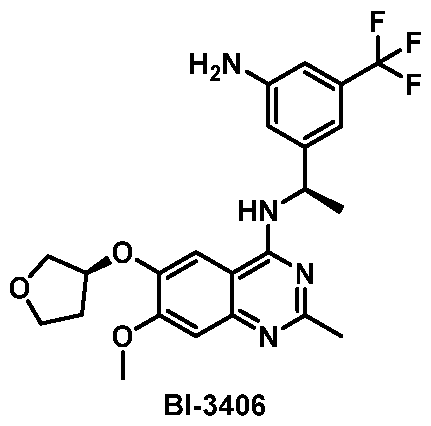
 some embodiments, the SOS1 inhibitor inhibits growth of a NSCLC cell line with an IC50 at least 10, 50, 100, 200, 300, 500, or 1000 times less than that of a SOS inhibitor described in
W02021092115, WO2018172250, WO2019201848, WO2019122129, WO2018115380, WO2021127429, W02020180768, or W02020180770, each of which is herein incorporated by reference in its entirety for all purposes. In some embodiments, the SOS1 inhibitor synergistically inhibits growth of a cancer cell, such as an NSCLC cell line, in combination with a small molecule EGFR exon 20 insertion TKI.
[126] In some embodiments, the SOS1 inhibitor is characterized in it synergistically inhibits growth of NSCLC cells in combination with a small molecule EGFR exon 20 insertion TKI to yield at least about 80% growth inhibition when less than about 50 nM, 40 nM, 30 nM, 20 nM, 10 nM, 5 nM, 4 nM, 3 nM, 2 nM, or 1 nM of the SOS1 inhibitor is applied in combination with a small molecule EGFR exon 20 insertion TKI applied at its IC50 molarity, in an in vitro growth inhibition assay using NSCLC cells. In some embodiments, the SOS1 inhibitor is characterized in that it synergistically increases percent of cell growth inhibition from about 10% to at least about 50%, when less than about 50 nM, 40 nM, 30 nM, 20 nM, 10 nM, 5 nM, 4 nM, 3 nM, 2 nM, or 1 nM of the SOS1 inhibitor is applied in combination with a small molecule EGFR exon 20 insertion TKI applied at its IC10 molarity, as ascertained in an in vitro growth inhibition assay using NSCLC cells. In some embodiments, the SOS1 inhibitor is characterized in that it synergistically increases percent of cell growth inhibition from about 50% to at least about 80%, when less than about 50 nM, 40 nM, 30 nM, 20 nM, 10 nM, 5 nM, 4 nM, 3 nM, 2 nM, or 1 nM of the SOS1 inhibitor is applied in combination with a small molecule EGFR exon 20 insertion TKI applied at its IC50 molarity, in an in vitro growth inhibition assay using NSCLC cells.
[127] The compounds of Formula (I) disclosed herein — including the compounds of Formula (I -A), (I-B), (1-1), (I-Bl), (I-B2), (I-C), (I-Cl), (I-C2), (I-C3), (I-D), (I-Dl), (I-D2), (I-E), (I-El), (II-B), (II-C), and (III)— or a pharmaceutically acceptable salt or solvate thereof, are SOS modulators and have a wide range of applications in therapeutics, diagnostics, and other biomedical research.
[128] In certain aspects, the present disclosure provides a compound of Formula (I):
 or a pharmaceutically acceptable salt or solvate thereof, wherein:
 is selected from C5.7 carbocycle and 5- to 7-membered heterocycle, each of which is optionally substituted with one or more R11;
 is absent or selected from C3.8 carbocycle and 3- to 8-membered heterocycle, each of which is optionally substituted with one or more Rl la;
L1 is selected from a bond, Ci-6 alkylene, and Ci-6 haloalkylene:
L2 is selected from C5.25 alkylene, C5.25 alkenylene, C5.25 alkynylene, 5- to 25-membered heteroalkylene, and 5- to 25-membered heteroalkenylene, each of which is optionally substituted with one or more Rl lb, wherein L2 is covalently bound to one of W3, W4, W5, W6, or W7; or L2 is -L3-D-L4-, wherein L4 is covalently bound to one of
W3, W4, W5, W6, or W7;
L3 is selected from CMO alkylene, C2-10 alkenylene, C2-10 alkynylene, 2- to 10-membered heteroalkylene, and 3- to 10-membered heteroalkenylene, each of which is optionally substituted with one or more Rl lb;
D is absent or selected from C3-12 carbocycle and 3- to 12-membered heterocycle, each of which is optionally substituted with one or more Rl ld;
L4 is selected from CMO alkylene, C2-10 alkenylene, C2-10 alkynylene, 2- to 10-membered heteroalkylene, and 3- to 10-membered heteroalkenylene, each of which is optionally substituted with one or more Rl lb;
W2 is selected from N(R2b), N, C(R2), C(R2)(R2a), and C(O);
W3 is selected from N(R3b), N, C(R3), C(R3)(R3a), and C(O);
W4 is selected from N(R4b), N, C(R4), C(R4)(R4a), and C(O);
W5 is selected from N(R5b), N, C(R5), C(R5)(R5a), and C(O);
W6 is selected from N(R6b), N, C(R6), C(R6)(R6a), and C(O);
W7 is selected from N(R7b), N, C(R7), C(R7)(R7a), and C(O);
W8 is selected from N(R8b), N, C(R8), C(R8)(R8a), and C(O);
W9 is selected from N, C(R9), and C;
W10 is selected from N, C(R10), and C;
R1 is C1.3 alkyl optionally substituted with one or more Rllc;
R2, R2a, R3a, R4a, R5a, R6a, R7a, R8, and R8a are each independently selected from hydrogen, halogen, -CN, Ci-6 alkyl, C2-6 alkenyl, C2-6 alkynyl, C3-10 carbocycle, 3- to 10-membered heterocycle, -OR12, -SR12, -N(R12)(R13), - C(O)OR12, -OC(O)N(R12)(R13), -N(R14)C(O)N(R12)(R13), -N(R14)C(O)OR15, -N(R14)S(O)2R15, -C(O)R15, -S(O)R15, - OC(O)R15, -C(O)N(R12)(R13), -C(O)C(O)N(R12)(R13), -N(R14)C(O)R15, -S(O)2R15, -S(O)2N(R12)(R13), - S(=O)(=NH)N(R12)(R13), -CH2C(O)N(R12)(R13), -CH2N(R14)C(O)R15, -CH2S(O)2R15, and -CH2S(O)2N(R12)(R13), wherein each Ci-6 alkyl, C2-6 alkenyl, C2-6 alkynyl, C3-10 carbocycle, and 3- to 10-membered heterocycle is independently optionally substituted with one, two, or three R20;
R3, R4, R5, R6, and R7 are each independently selected from a bond to L2, hydrogen, halogen, -CN, Ci-6 alkyl, C2-6 alkenyl, C2-6 alkynyl, C3-10 carbocycle, 3- to 10-membered heterocycle, -OR12, -SR12, -N(R12)(R13), - C(O)OR12, -OC(O)N(R12)(R13), -N(R14)C(O)N(R12)(R13), -N(R14)C(O)OR15, -N(R14)S(O)2R15, -C(O)R15, -S(O)R15, - OC(O)R15, -C(O)N(R12)(R13), -C(O)C(O)N(R12)(R13), -N(R14)C(O)R15, -S(O)2R15, -S(O)2N(R12)(R13), - S(=O)(=NH)N(R12)(R13), -CH2C(O)N(R12)(R13), -CH2N(R14)C(O)R15, -CH2S(O)2R15, and -CH2S(O)2N(R12)(R13), wherein each Ci-6 alkyl, C2-6 alkenyl, C2-6 alkynyl, C3-10 carbocycle, and 3- to 10-membered heterocycle is
independently optionally substituted with one, two, or three R20;
R2b and R8b are each independently selected from hydrogen, -CN, Ci-e alkyl, C2-6 alkenyl, C2-6 alkynyl, C3-10 carbocycle, 3- to 10-membered heterocycle, -OR12, -SR12, -C(O)OR12, -OC(O)N(R12)(R13), -C(O)R15, -S(O)R15, - OC(O)R15, -C(O)N(R12)(R13), -C(O)C(O)N(R12)(R13), -S(O)2R15, -S(O)2N(R12)(R13), -S(=O)(=NH)N(R12)(R13), - CH2C(O)N(R12)(R13), -CH2N(R14)C(O)R15, -CH2S(O)2R15, and -CH2S(O)2N(R12)(R13), wherein each Ci.6 alkyl, C2.6 alkenyl, C2-6 alkynyl, C3-10 carbocycle and 3- to 10-membered heterocycle is independently optionally substituted with one, two, or three R20;
R3b, R4b, R5b, R613, and R7b are each independently selected from a bond to L2, hydrogen, -CN, Ci-e alkyl, C2- e alkenyl, C2-6 alkynyl, C3-10 carbocycle, 3- to 10-membered heterocycle, -OR12, -SR12, -C(O)OR12, - OC(O)N(R12)(R13), -C(O)R15, -S(O)R15, -OC(O)R15, -C(O)N(R12)(R13), -C(O)C(O)N(R12)(R13), -S(O)2R15, - S(O)2N(R12)(R13), -S(=O)(=NH)N(R12)(R13), -CH2C(O)N(R12)(R13), -CH2N(R14)C(O)R15, -CH2S(O)2R15, and - CH2S(O)2N(R12)(R13), wherein each Ci-6 alkyl, C2-6 alkenyl, C2-6 alkynyl, C3-10 carbocycle and 3- to 10-membered heterocycle is independently optionally substituted with one, two, or three R20;
R9 and R10 are each independently selected from hydrogen, Ci-6 alkyl, C2-6 alkenyl, C2-6 alkynyl, C3-10 carbocycle, -CH2-(C3-IO carbocycle), 3- to 10-membered heterocycle, and -CH2-(3- to 10-membered heterocycle), wherein each Ci-6 alkyl, C2-6 alkenyl, C2-6 alkynyl, C3-10 carbocycle, -CH2-(C3-IO carbocycle), 3- to 10-membered heterocycle, and -CH2-(3- to 10-membered heterocycle) is independently optionally substituted with one, two, or three R20;
R11, Rlla, and Rlld are each independently selected at each occurrence from halogen, -CN, Ci-6 alkyl, C2-6 alkenyl, C2-6 alkynyl, C3-10 carbocycle, 3- to 10-membered heterocycle, -OR12, -SR12, -N(R12)(R13), -C(O)OR12, - OC(O)N(R12)(R13), -N(R14)C(O)N(R12)(R13), -N(R14)C(O)OR15, -N(R14)S(O)2R15, -C(O)R15, -S(O)R15, -OC(O)R15, - C(O)N(R12)(R13), -C(O)C(O)N(R12)(R13), -N(R14)C(O)R15, -S(O)2R15, -S(O)2N(R12)(R13), -S(=O)(=NH)N(R12)(R13), -CH2C(O)N(R12)(R13), -CH2N(R14)C(O)R15, -CH2S(O)2R15, -CH2S(O)2N(R12)(R13), -CH2N(R12)S(O)2(R13), and - P(O)(R17)(R17a), wherein Ci-6 alkyl, C2-6 alkenyl, C2-6 alkynyl, C3.10 carbocycle, and 3- to 10-membered heterocycle are optionally substituted with one, two, or three R20;
Rllb is independently selected at each occurrence from halogen, oxo, -CN, Ci-6 alkyl, C2-6 alkenyl, C2-6 alkynyl, C3-10 carbocycle, 3- to 10-membered heterocycle, -OR12, -SR12, -N(R12)(R13), -C(O)OR12, - OC(O)N(R12)(R13), -N(R14)C(O)N(R12)(R13), -N(R14)C(O)OR15, -N(R14)S(O)2R15, -C(O)R15, -S(O)R15, -OC(O)R15, - C(O)N(R12)(R13), -C(O)C(O)N(R12)(R13), -N(R14)C(O)R15, -S(O)2R15, -S(O)2N(R12)(R13), -S(=O)(=NH)N(R12)(R13), -CH2C(O)N(R12)(R13), -CH2N(R14)C(O)R15, -CH2S(O)2R15, -CH2S(O)2N(R12)(R13), -CH2N(R12)S(O)2(R13), and - P(O)(R17)(R17a), wherein Ci-6 alkyl, C2-6 alkenyl, C2-6 alkynyl, C3.10 carbocycle, and 3- to 10-membered heterocycle are optionally substituted with one, two, or three R20;
Rllc is independently selected at each occurrence from halogen, -OR12, and -N(R12)(R13);
R12 is independently selected at each occurrence from hydrogen, Ci-6 alkyl, Ci-e haloalkyl, C2-6 alkenyl, C2-6 alkynyl, C3-10 carbocycle, and 3- to 10-membered heterocycle, wherein Ci-6 alkyl, C2-6 alkenyl, C2-6 alkynyl, C3-10 carbocycle, and 3- to 10-membered heterocycle are optionally substituted with one, two, or three R20;
R13 is independently selected at each occurrence from hydrogen, Ci-6 alkyl, and Ci-6 haloalkyl; or R12 and R13, together with the nitrogen atom to which they are attached, form a 3- to 10-membered heterocycle optionally substituted with one, two, or three R20;
R14 is independently selected at each occurrence from hydrogen, Ci-6 alkyl, and Ci-6 haloalkyl;
R15 is independently selected at each occurrence from Ci-6 alkyl, C2-6 alkenyl, C2-6 alkynyl, C3-10
carbocycle, and 3- to 10-membered heterocycle, wherein Ci-6 alkyl, C2-6 alkenyl, C2-6 alkynyl, C3-10 carbocycle, and 3- to 10-membered heterocycle are optionally substituted with one, two, or three R20;
R17 and R17a are each independently selected at each occurrence from Ci-6 alkyl and C3.6 cycloalkyl, wherein Ci-6 alkyl and C3.6 cycloalkyl are optionally substituted with one, two or three R20; or R17 and R17a, together with the phosphorous atom to which they are attached, form a 3- to 10-membered heterocycle;
R20 is independently selected at each occurrence from halogen, oxo, =NH, -CN, Ci-6 alkyl, C2-6 alkenyl, C2- e alkynyl, C3-10 carbocycle, -CH2-(C3-IO carbocycle), 3- to 10-membered heterocycle, -CH2-(3- to 10-membered heterocycle), -OR21, -SR21, -N(R22)(R23), -C(O)OR22, -C(O)N(R22)(R23), -C(O)C(O)N(R22)(R23), -OC(O)N(R22)(R23), -N(R24)C(O)N(R22)(R23), -N(R24)C(O)OR25, -N(R24)C(O)R25, -N(R24)S(O)2R25, -C(O)R25, -S(O)2R25, - S(O)2N(R22)(R23), -OCH2C(O)OR22, and -OC(O)R25, wherein Ci-e alkyl, C2-6 alkenyl, C2-6 alkynyl, C3-10 carbocycle, -CH2-(C3-IO carbocycle), 3- to 10-membered heterocycle, and -CH2-(3- to 10-membered heterocycle) are optionally substituted with one, two, or three groups independently selected from halogen, oxo, =NH, -CN, Ci-6 alkyl, Ci-6 haloalkyl, Ci.6 alkoxy, Ci.6 haloalkoxy, -OR21, -SR21, -N(R22)(R23), -C(O)OR22, -C(O)N(R22)(R23), - C(O)C(O)N(R22)(R23), -OC(O)N(R22)(R23), -N(R24)C(O)N(R22)(R23), -N(R24)C(O)OR25, -N(R24)C(O)R25, - N(R24)S(O)2R25, -C(O)R25, -S(O)2R25, -S(O)2N(R22)(R23), and -OC(O)R25;
R21 is independently selected at each occurrence from H, Ci-6 alkyl, Ci-6 haloalkyl, C2-6 alkenyl, C2-6 alkynyl, C3-10 carbocycle, and 3- to 10-membered heterocycle, wherein C3-10 carbocycle and 3- to 10-membered heterocycle are optionally substituted with one, two, or three groups independently selected from halogen and Ci-6 alkyl;
R22 is independently selected at each occurrence from H, Ci-6 alkyl, Ci-6 haloalkyl, C2-6 alkenyl, C2-6 alkynyl, C3-10 carbocycle, and 3- to 10-membered heterocycle, wherein C3-10 carbocycle and 3- to 10-membered heterocycle are optionally substituted with one, two, or three groups independently selected from halogen and Ci-6 alkyl;
R23 is independently selected at each occurrence from H and Ci-e alkyl;
R24 is independently selected at each occurrence from H and Ci-e alkyl;
R25 is independently selected at each occurrence from Ci-6 alkyl, C2-6 alkenyl, C2-6 alkynyl, C3-10 carbocycle, and 3- to 10-membered heterocycle, wherein Ci-6 alkyl, C3-10 carbocycle, and 3- to 10-membered heterocycle are optionally substituted with one, two, or three groups independently selected from halogen, Ci-e alkyl, Ci-e haloalkyl, Ci-6 alkoxy, C3-10 carbocycle, and 3- to 10-membered heterocycle; and indicates a single or double bond such that all valences are satisfied.
[129] In certain aspects, the present disclosure provides a compound of Formula (I):
 or a pharmaceutically acceptable salt or solvate thereof, wherein:
 is selected from C5.7 carbocycle and 5- to 7-membered heterocycle, each of which is optionally substituted with one or more R11;
 is absent or selected from C3.8 carbocycle and 3- to 8-membered heterocycle, each of which is optionally substituted with one or more Rl la;
L1 is selected from a bond, Ci-6 alkylene, and Ci-6 haloalkylene:
L2 is selected from C5.25 alkylene, C5.25 alkenylene, C5.25 alkynylene, 5- to 25-membered heteroalkylene, and 5- to 25-membered heteroalkenylene, each of which is optionally substituted with one or more Rl lb, wherein L2 is covalently bound to one of W3, W4, W5, W6, or W7;
W2 is selected from N(R2b), N, C(R2), C(R2)(R2a), and C(O);
W3 is selected from N(R3b), N, C(R3), C(R3)(R3a), and C(O);
W4 is selected from N(R4b), N, C(R4), C(R4)(R4a), and C(O);
W5 is selected from N(R5b), N, C(R5), C(R5)(R5a), and C(O);
W6 is selected from N(R6b), N, C(R6), C(R6)(R6a), and C(O);
W7 is selected from N(R7b), N, C(R7), C(R7)(R7a), and C(O);
W8 is selected from N(R8b), N, C(R8), C(R8)(R8a), and C(O);
W9 is selected from N, C(R9), and C;
W10 is selected from N, C(R10), and C;
R1 is Ci-3 alkyl optionally substituted with one or more Rllc;
R2, R2a, R3a, R4a, R5a, R6a, R7a, R8, and R8a are each independently selected from hydrogen, halogen, -CN, Ci-6 alkyl, C2-6 alkenyl, C2-6 alkynyl, C3-10 carbocycle, 3- to 10-membered heterocycle, -OR12, -SR12, -N(R12)(R13), - C(O)OR12, -OC(O)N(R12)(R13), -N(R14)C(O)N(R12)(R13), -N(R14)C(O)OR15, -N(R14)S(O)2R15, -C(O)R15, -S(O)R15, - OC(O)R15, -C(O)N(R12)(R13), -C(O)C(O)N(R12)(R13), -N(R14)C(O)R15, -S(O)2R15, -S(O)2N(R12)(R13), - S(=O)(=NH)N(R12)(R13), -CH2C(O)N(R12)(R13), -CH2N(R14)C(O)R15, -CH2S(O)2R15, and -CH2S(O)2N(R12)(R13), wherein each Ci-6 alkyl, C2-6 alkenyl, C2-6 alkynyl, C3-10 carbocycle, and 3- to 10-membered heterocycle is independently optionally substituted with one, two, or three R20;
R3, R4, R5, R6, and R7 are each independently selected from a bond to L2, hydrogen, halogen, -CN, Ci-6 alkyl, C2-6 alkenyl, C2-6 alkynyl, C3-10 carbocycle, 3- to 10-membered heterocycle, -OR12, -SR12, -N(R12)(R13), - C(O)OR12, -OC(O)N(R12)(R13), -N(R14)C(O)N(R12)(R13), -N(R14)C(O)OR15, -N(R14)S(O)2R15, -C(O)R15, -S(O)R15, - OC(O)R15, -C(O)N(R12)(R13), -C(O)C(O)N(R12)(R13), -N(R14)C(O)R15, -S(O)2R15, -S(O)2N(R12)(R13), - S(=O)(=NH)N(R12)(R13), -CH2C(O)N(R12)(R13), -CH2N(R14)C(O)R15, -CH2S(O)2R15, and -CH2S(O)2N(R12)(R13), wherein each Ci-6 alkyl, C2-6 alkenyl, C2-6 alkynyl, C3-10 carbocycle, and 3- to 10-membered heterocycle is independently optionally substituted with one, two, or three R20;
R2b and R8b are each independently selected from hydrogen, -CN, Ci-e alkyl, C2-6 alkenyl, C2-6 alkynyl, C3-10 carbocycle, 3- to 10-membered heterocycle, -OR12, -SR12, -C(O)OR12, -OC(O)N(R12)(R13), -C(O)R15, -S(O)R15, - OC(O)R15, -C(O)N(R12)(R13), -C(O)C(O)N(R12)(R13), -S(O)2R15, -S(O)2N(R12)(R13), -S(=O)(=NH)N(R12)(R13), - CH2C(O)N(R12)(R13), -CH2N(R14)C(O)R15, -CH2S(O)2R15, and -CH2S(O)2N(R12)(R13), wherein each Ci.6 alkyl, C2.6 alkenyl, C2-6 alkynyl, C3-10 carbocycle and 3- to 10-membered heterocycle is independently optionally substituted with one, two, or three R20;
R3b, R4b, R5b, R66, and R7b are each independently selected from a bond to L2, hydrogen, -CN, Ci-e alkyl, C2- e alkenyl, C2-6 alkynyl, C3-10 carbocycle, 3- to 10-membered heterocycle, -OR12, -SR12, -C(O)OR12, - OC(O)N(R12)(R13), -C(O)R15, -S(O)R15, -OC(O)R15, -C(O)N(R12)(R13), -C(O)C(O)N(R12)(R13), -S(O)2R15, - S(O)2N(R12)(R13), -S(=O)(=NH)N(R12)(R13), -CH2C(O)N(R12)(R13), -CH2N(R14)C(O)R15, -CH2S(O)2R15, and - CH2S(O)2N(R12)(R13), wherein each Ci-6 alkyl, C2-6 alkenyl, C2-6 alkynyl, C3-10 carbocycle and 3- to 10-membered heterocycle is independently optionally substituted with one, two, or three R20;
R9 and R10 are each independently selected from hydrogen, Ci-6 alkyl, C2-6 alkenyl, C2-6 alkynyl, C3-10 carbocycle, -CH2-(C3-IO carbocycle), 3- to 10-membered heterocycle, and -CH2-(3- to 10-membered heterocycle), wherein each Ci-6 alkyl, C2-6 alkenyl, C2-6 alkynyl, C3-10 carbocycle, -CH2-(C3-IO carbocycle), 3- to 10-membered heterocycle, and -CH2-(3- to 10-membered heterocycle) is independently optionally substituted with one, two, or three R20;
R11 and Rlla are each independently selected at each occurrence from halogen, -CN, Ci-6 alkyl, C2-6 alkenyl, C2-6 alkynyl, C3-10 carbocycle, 3- to 10-membered heterocycle, -OR12, -SR12, -N(R12)(R13), -C(O)OR12, - OC(O)N(R12)(R13), -N(R14)C(O)N(R12)(R13), -N(R14)C(O)OR15, -N(R14)S(O)2R15, -C(O)R15, -S(O)R15, -OC(O)R15, - C(O)N(R12)(R13), -C(O)C(O)N(R12)(R13), -N(R14)C(O)R15, -S(O)2R15, -S(O)2N(R12)(R13), -S(=O)(=NH)N(R12)(R13), -CH2C(O)N(R12)(R13), -CH2N(R14)C(O)R15, -CH2S(O)2R15, -CH2S(O)2N(R12)(R13), -CH2N(R12)S(O)2(R13), and - P(O)(R17)(R17a), wherein Ci-6 alkyl, C2-6 alkenyl, C2-6 alkynyl, C3.10 carbocycle, and 3- to 10-membered heterocycle are optionally substituted with one, two, or three R20;
Rllb is independently selected at each occurrence from halogen, oxo, -CN, Ci-6 alkyl, C2-6 alkenyl, C2-6 alkynyl, C3-10 carbocycle, 3- to 10-membered heterocycle, -OR12, -SR12, -N(R12)(R13), -C(O)OR12, - OC(O)N(R12)(R13), -N(R14)C(O)N(R12)(R13), -N(R14)C(O)OR15, -N(R14)S(O)2R15, -C(O)R15, -S(O)R15, -OC(O)R15, - C(O)N(R12)(R13), -C(O)C(O)N(R12)(R13), -N(R14)C(O)R15, -S(O)2R15, -S(O)2N(R12)(R13), -S(=O)(=NH)N(R12)(R13), -CH2C(O)N(R12)(R13), -CH2N(R14)C(O)R15, -CH2S(O)2R15, -CH2S(O)2N(R12)(R13), -CH2N(R12)S(O)2(R13), and - P(O)(R17)(R17a), wherein Ci-6 alkyl, C2-6 alkenyl, C2-6 alkynyl, C3.10 carbocycle, and 3- to 10-membered heterocycle are optionally substituted with one, two, or three R20;
Rllc is independently selected at each occurrence from halogen, -OR12, and -N(R12)(R13);
R12 is independently selected at each occurrence from hydrogen, Ci-6 alkyl, Ci-e haloalkyl, C2-6 alkenyl, C2-6 alkynyl, C3-10 carbocycle, and 3- to 10-membered heterocycle, wherein Ci-6 alkyl, C2-6 alkenyl, C2-6 alkynyl, C3-10 carbocycle, and 3- to 10-membered heterocycle are optionally substituted with one, two, or three R20;
R13 is independently selected at each occurrence from hydrogen, Ci-6 alkyl, and Ci-6 haloalkyl; or R12 and R13, together with the nitrogen atom to which they are attached, form a 3- to 10-membered heterocycle optionally substituted with one, two, or three R20;
R14 is independently selected at each occurrence from hydrogen, Ci-6 alkyl, and Ci-6 haloalkyl;
R15 is independently selected at each occurrence from Ci-6 alkyl, C2-6 alkenyl, C2-6 alkynyl, C3-10 carbocycle, and 3- to 10-membered heterocycle, wherein Ci-6 alkyl, C2-6 alkenyl, C2-6 alkynyl, C3-10 carbocycle, and 3- to 10-membered heterocycle are optionally substituted with one, two, or three R20;
R17 and R17a are each independently selected at each occurrence from Ci-6 alkyl and C3.6 cycloalkyl, wherein Ci-6 alkyl and C3.6 cycloalkyl are optionally substituted with one, two or three R20; or R17 and R17a, together with the phosphorous atom to which they are attached, form a 3- to 10-membered heterocycle;
R20 is independently selected at each occurrence from halogen, oxo, =NH, -CN, Ci-6 alkyl, C2-6 alkenyl, C2- e alkynyl, C3-10 carbocycle, -CH2-(C3-IO carbocycle), 3- to 10-membered heterocycle, -CH2-(3- to 10-membered
heterocycle), -OR21, -SR21, -N(R22)(R23), -C(O)OR22, -C(O)N(R22)(R23), -C(O)C(O)N(R22)(R23), -OC(O)N(R22)(R23), -N(R24)C(O)N(R22)(R23), -N(R24)C(O)OR25, -N(R24)C(O)R25, -N(R24)S(O)2R25, -C(O)R25, -S(O)2R25, -
S(O)2N(R22)(R23), -OCH2C(O)OR22, and -OC(O)R25, wherein Ci-e alkyl, C2.e alkenyl, C2.e alkynyl, C3-10 carbocycle, -CH2-(C3-IO carbocycle), 3- to 10-membered heterocycle, and -CH2-(3- to 10-membered heterocycle) are optionally substituted with one, two, or three groups independently selected from halogen, oxo, =NH, -CN, Ci-6 alkyl, Ci-6 haloalkyl, Ci.6 alkoxy, Ci.6 haloalkoxy, -OR21, -SR21, -N(R22)(R23), -C(O)OR22, -C(O)N(R22)(R23), - C(O)C(O)N(R22)(R23), -OC(O)N(R22)(R23), -N(R24)C(O)N(R22)(R23), -N(R24)C(O)OR25, -N(R24)C(O)R25, - N(R24)S(O)2R25, -C(O)R25, -S(O)2R25, -S(O)2N(R22)(R23), and -OC(O)R25;
R21 is independently selected at each occurrence from H, Ci-6 alkyl, Ci-6 haloalkyl, C2.e alkenyl, C2.e alkynyl, C3-10 carbocycle, and 3- to 10-membered heterocycle, wherein C3-10 carbocycle and 3- to 10-membered heterocycle are optionally substituted with one, two, or three groups independently selected from halogen and Ci. ealkyl;
R22 is independently selected at each occurrence from H, Ci-e alkyl, Ci-e haloalkyl, C2.e alkenyl, C2.e alkynyl, C3-10 carbocycle, and 3- to 10-membered heterocycle, wherein C3-10 carbocycle and 3- to 10-membered heterocycle are optionally substituted with one, two, or three groups independently selected from halogen and Ci. ealkyl;
R23 is independently selected at each occurrence from H and Ci-e alkyl;
R24 is independently selected at each occurrence from H and Ci-e alkyl;
R25 is independently selected at each occurrence from Ci-6 alkyl, C2.e alkenyl, C2.e alkynyl, C3-10 carbocycle, and 3- to 10-membered heterocycle, wherein Ci-6 alkyl, C3-10 carbocycle, and 3- to 10-membered heterocycle are optionally substituted with one, two, or three groups independently selected from halogen, Ci-e alkyl, Ci-e haloalkyl, Ci-6 alkoxy, C3-10 carbocycle, and 3- to 10-membered heterocycle; and indicates a single or double bond such that all valences are satisfied.
[130] In some embodiments, the compound of Formula (I) is a compound of Formula (I -A):
 or a pharmaceutically acceptable salt or solvate thereof.
[131] In some embodiments, the compound of Formula (I -A) is a compound selected from:


[132] In some embodiments, the compound of Formula (I) is a compound of Formula (I-B), such as a compound of Formula (I-Bl) or (I-B2):
 or a pharmaceutically acceptable salt or solvate thereof.
[133] In some embodiments, the compound of Formula (I-B) is a compound selected from:

[134] In some embodiments, the compound of Formula (I) is a compound of Formula (I-C), such as a compound of Formula (I-Cl), (I-C2), or (I-C3):
 or a pharmaceutically acceptable salt or solvate thereof.
[135] In some embodiments, the compound of Formula (I-C) is a compound selected from:

[136] In some embodiments, the compound of Formula (I) is a compound of Formula (I-D), such as a compound of Formula (I-Dl) or (I-D2):
 or a pharmaceutically acceptable salt or solvate thereof.
[137] In some embodiments, the compound of Formula (I-D) is a compound selected from:

[138] In some embodiments, the compound of Formula (I) is a compound of Formula (I-E), such as a compound of Formula (I -El):
 or a pharmaceutically acceptable salt or solvate thereof.
[139] In some embodiments, the compound of Formula (I-E) is a compound selected from:


[140] In some embodiments, for a compound of Formula (I), (I-A), (I-B), (I-C), (I-D), or (I-E), W2 is N. In some embodiments, W3 is selected from N(R3b), N, C(R3), and C(O), such as NCH3, N, CH, CCH3, and C(O). In some embodiments, W3 is selected from C(R3) and C(O), such as CH, CCH3 and C(O). In some embodiments, W3 is CH. In some embodiments, W3 is CCH3. In some embodiments, W4 is selected from N(R4b), N, C(R4), and C(O), such as N(R4b), N, C(R4), and C(O), wherein R4b and R4 are each independently a bond to L2. In some embodiments, W4 is selected from N(R4b) and N, such as N(R4b), wherein R4b is a bond to L2. In some embodiments, W4 is N. In some embodiments, W5 is selected from N(R5b), N, C(R5), and C(O), such as N(R5b), NCH3, N, CH, C(R5), and C(O), wherein R5b and R5 are each independently a bond to L2. In some embodiments, W5 is selected from N(R5b), N, and C(R5), such as N(R5b), NCH3, N, CH, and C(R5), wherein R5b and R5 are each independently a bond to L2. In some embodiments, W5 is selected from N(R5b) and C(R5), such as N(R5b), NCH3, and CH, wherein R5b is a bond to L2. In some embodiments, W5 is N(R5b). In some embodiments, W6 is selected from C(R6) and C(O), such as COCH3, CH, C(R6), and C(O), wherein R6 is a bond to L2. In some embodiments, W6 is C(O). In some embodiments, W7 is C(R7), such as W7 is C(R7) wherein R7 is a bond to L2. In some embodiments, W7 is C(R7), wherein R7 is not hydrogen, such as R7 is selected from C3-10 cycloalkyl, 3- to 10-membered heterocycloalkyl, and -OR12 wherein C3-10 cycloalkyl and 3- to 10-membered heterocycloalkyl are optionally substituted with one, two, or three R20. In some embodiments, W8 is C(R8), such as W8 is CH. In some embodiments, W9 is C. In some embodiments, W10 is C. [141] In some embodiments, for a compound of Formula (I), (I-A), (I-C), (I-D), or (I-E), W2 is N; W3 is N(R3b);
W4 is C(O); and W9 and W10 are each C, such as W2 is N; W3 is NCI I3: W4 is C(O); and W9 and W10 are each C. In some embodiments, for a compound of Formula (I), (I-B), (I-C), (I-D), or (I-E),W2 is N; W3 is C(O); W4 is N(R4b);
and W9 and W10 are each C, such as W2 is N; W3 is C(0); W4 is N(R4b), wherein R4b is a bond to L2; and W9 and W10 are each C. In some embodiments, for a compound of Formula (I), (I -A), (I-C), (I-D), or (I-E), W2 is N; W3 is C(R3); W4 is N; and W9 and W10 are each C, such as W2 is N; W3 is CH or CCH3; W4 is N; and W9 and W10 are each C. In some embodiments, for a compound of Formula (I), (I-A), (I-B), (I-C), (I-D), or (I-E), W5 is C(R5); W6 is C(R6); W7 is C(R7); W8 is C(R8); and W9 and W10 are each C, such as W5 is CH or C(R5), wherein R5 is a bond to L2; W6 is CH or C(R6), wherein R6 is a bond to L2; W7 is C(R7); W8 is CH; and W9 and W10 are each C. In some embodiments, for a compound of Formula (I), (I-A), (I-B), (I-C), or (I-E), W5 is N(R5b); W6 is C(O); W7 is C(R7); W8 is C(R8); and W9 and W10 are each C, such as W5 is NCH3 or N(R5b), wherein R5b is a bond to L2; W6 is C(O); W7 is C(R7); W8 is CH; and W9 and W10 are each C. In some embodiments, for a compound of Formula (I), (I-A), (I-B), (I-D), or (I-E), W5 is N; W6 is C(R6); W7 is C(R7); W8 is C(R8); and W9 and W10 are each C, such as W5 is N; W6 is COCH3, CH, or C(R6), wherein R6 is a bond to L2; W7 is C(R7); W8 is CH; and W9 and W10 are each C. In some embodiments, for a compound of Formula (I), (I-A), (I-B), (I-C), (I-D), or (I-E), W2 is N; W3 is selected from N(R3b), N, C(R3), and C(O); W4 is selected from N(R4b), N, C(R4), and C(O); W5 is selected from N(R5b), N, and C(R5); W6 is selected from C(R6) and C(O); W7 is C(R7); W8 is C(R8); and W9 and W10 are each C, such as W2 is N; W3 is selected from NCH3, N, CH, CCH3, and C(O); W4 is selected from N(R4b), N, C(R4), and C(O), wherein R4b and R4 are each independently a bond to L2; W5 is selected from N(R5b), NCH3, N, CH, and C(R5), wherein R5b and R5 are each independently a bond to L2; W6 is selected from COCH3, CH, C(R6), and C(O), wherein R6 is a bond to L2; W7 is C(R7); W8 is CH; and W9 and W10 are each C. In some embodiments, for a compound of Formula (I), (I- A), (I-B), (I-C), (I-D), or (I-E), W2 is N; W3 is selected from C(R3) and C(O); W4 is selected from N(R4b) and N; W5 is selected from N(R5b) and C(R5); W6 is selected from C(R6) and C(O); W7 is C(R7); W8 is CH; and W9 and W10 are each C, such as W2 is N; W3 is selected from CH, CCH3, and C(O); W4 is selected from N(R4b) and N, wherein R4b is a bond to L2; W5 is selected from N(R5b), NCH3, CH, and C(R5), wherein R5b and R5 are each independently a bond to L2; W6 is selected from COCH3, CH, C(R6), and C(O), wherein R6 is a bond to L2; W7 is C(R7); W8 is CH; and W9 and W10 are each C.
[142] In some embodiments, for a compound of Formula
 selected from


[143] In some embodiments, for a compound of Formula (I), (I-A), (I-B), (I-C), (I-D), or (I-E), R2, R2a, R3a, R4a, R5a, R6a, R7a, R8, and R8a are each independently selected from hydrogen, halogen, -CN, C1.3 alkyl, C1.3 haloalkyl, - OH, -NH2, -NHCH3, and -N(CH3)2- In some embodiments, R2, R2a, R3a, R4a, R5a, R6a, R7a, R8, and R8a are each independently selected from hydrogen and -CH3, such as hydrogen.
[144] In some embodiments, for a compound of Formula (I), (I-A), (I-B), (I-C), (I-D), or (I-E), R3, R4, R5, and R6 are each independently selected from a bond to L2, hydrogen, halogen, -CN, Ci-6 alkyl, C3.6 carbocycle, 3- to 6- membered heterocycle, -OR12, -SR12, -N(R12)(R13), -C(O)OR12, -C(O)R15, -S(O)R15, -OC(O)R15, -C(O)N(R12)(R13), - N(R14)C(O)R15, -S(O)2R15, and -S(O)2N(R12)(R13), wherein each Ci-6 alkyl, C3-6 carbocycle, and 3- to 6-membered heterocycle is independently optionally substituted with one, two, or three R20; and R7 is selected from a bond to L2, C1.6 alkyl, C3-10 carbocycle, 3- to 10-membered heterocycle, -OR12, -N(R12)(R13), -C(O)R15, -C(O)N(R12)(R13), - S(O)2R15, and -SO2N(R12)(R13), wherein Ci-6 alkyl, C3-10 carbocycle, and 3- to 10-membered heterocycle are optionally substituted with one, two, or three R20. In some embodiments, R3, R4, R5, and R6 are each independently selected from a bond to L2, hydrogen, halogen, -CN, C1.3 alkyl, C1.3 haloalkyl, -OH, -OCH3, -NH2, -NHCH3, - N(CI [3)2: and R7 is selected from a bond to L2, Ci-6 alkyl, C3-10 carbocycle, 3- to 10-membered heterocycle, -OR12, - N(R12)(R13), -C(O)R15, -C(O)N(R12)(R13), -S(O)2R15, and -SO2N(R12)(R13), wherein Ci.6 alkyl, C3-10 carbocycle, and 3- to 10-membered heterocycle are optionally substituted with one, two, or three R20. In some embodiments, R3, R4, R5, and R6 are each independently selected from a bond to L2, hydrogen, -CH3, and -OCI E: and R7 is selected from a bond to L2, Ci-6 alkyl, C3-10 carbocycle, 3- to 10-membered heterocycle, -OR12, -N(R12)(R13), -C(O)R15, - C(O)N(R12)(R13), -S(O)2R15, and -SO2N(R12)(R13), wherein Ci-6 alkyl, C3-10 carbocycle, and 3- to 10-membered heterocycle are optionally substituted with one, two, or three R20.
[145] In some embodiments, for a compound of Formula (I), (I-A), (I-B), (I-C), (I-D), or (I-E), R2b and R8b are each independently selected from hydrogen and C1.3 alkyl, such as hydrogen and -CH3. In some embodiments, R3b, R4b, R5b, R6b, and R7b are each independently selected from a bond to L2, hydrogen, and C1.3 alkyl, such as a bond to
L2, hydrogen, and -CH3. In some embodiments, R3b, R4b, R5b, R66, and R7b are each independently selected from a bond to L2 and -CH3. In some embodiments, R3b, R4b, R5b, R66, and R7b are each independently selected from a bond to L2. In some embodiments, R9 and R10 are each hydrogen.
[146] For a compound of Formula (I) wherein L2 is -L3-D-L4-, it is understood that the selection of “a bond to L2” for one of R3, R4, R5, R6, K F31'. R4b, R5b, R6b, or R7b inherently includes a bond to -L3-D-L4-, specifically to L4. For the avoidance of doubt, any recitation of R3, R4, R5, R6, R7, R3b, R4b, R5b, R6b, and/or R7b that includes “a bond to L2” also may be considered to include “a bond to L4”.
[147] In some embodiments, for a compound of Formula (I), (I-A), (I-B), (I-Bl), (I-B2), (I-C), (I-Cl), (I-C2), (I- C3), (I-D), (I-Dl), (I-D2), (I-E), or (I-El), R1 is selected from C1.3 alkyl and C1.3 haloalkyl, such as -CH3, -CH2CH3, -CH(CH3)2, -CH2F, -CHF2, -CF3, CH2CH2F, -CH2CHF2, and -CH2CF3. In some embodiments, R1 is selected from C1.3 alkyl, such as -CH3 and -CEECHa. In some embodiments, R1 is -CH3. In some embodiments, R1
 In some embodiments, R1 is (S -CH3.
[148] In some embodiments, for a compound of Formula (I), (I-B), (I-C), (I-Cl), (I-C3), (I-D), (I-Dl), (I-D2), (I- E), or (I-El), R3 is selected from hydrogen, halogen, -CN, Ci-e alkyl, C3.6 carbocycle, 3- to 6-membered heterocycle, -OR12, -SR12, -N(R12)(R13), -C(O)OR12, -C(O)R15, -S(O)R15, -OC(O)R15, -C(O)N(R12)(R13), -N(R14)C(O)R15, - S(O)2R15, and -S(O)2N(R12)(R13), wherein each Ci-6 alkyl, C3.6 carbocycle, and 3- to 6-membered heterocycle is independently optionally substituted with one, two, or three R20. In some embodiments, R3 is selected from hydrogen, halogen, -CN, C1.3 alkyl, C1.3 haloalkyl, -OH, -OCH3, -NH2, -NHCH3, -N(CH3)2. In some embodiments, R3 is selected from hydrogen, halogen, -CN, -OR12, and Ci-6 alkyl optionally substituted with one, two, or three R20. In some embodiments, R3 is Ci-6 alkyl optionally substituted with one, two, or three R20. In some embodiments, R3 is hydrogen or -CH3. In some embodiments, R3 is hydrogen. In some embodiments, R3 is -CH3.
[149] In some embodiments, for a compound of Formula (I), (I-B), (I-C), (I-C2), (I-D), or (I-E), R3b is selected from hydrogen and C1.3 alkyl, such as hydrogen and -CH3. In some embodiments, R3b is -CH3. In some embodiments, R3b is hydrogen.
[150] In some embodiments, for a compound of Formula (I), (I-A), (I-B), (I-B2), (I-D), (I-D2), (I-E), or (I-El), R5 is selected from hydrogen, halogen, -CN, Ci-e alkyl, C3.6 carbocycle, 3- to 6-membered heterocycle, -OR12, -SR12, -N(R12)(R13), -C(O)OR12, -C(O)R15, -S(O)R15, -OC(O)R15, -C(O)N(R12)(R13), -N(R14)C(O)R15, -S(O)2R15, and - S(O)2N(R12)(R13), wherein each Ci-e alkyl, C3.6 carbocycle, and 3- to 6-membered heterocycle is independently optionally substituted with one, two, or three R20. In some embodiments, R5 is selected from hydrogen, halogen, - CN, C1.3 alkyl, C1.3 haloalkyl, -OH, -OCH3, -NH2, -NHCH3, -N(CH3)2. In some embodiments, R5 is selected from hydrogen, -OR12, and Ci-6 alkyl optionally substituted with one, two, or three R20. In some embodiments, R5 is hydrogen or -CH3. In some embodiments, R5 is hydrogen. In some embodiments, R5 is -CH3.
[151] In some embodiments, for a compound of Formula (I), (I-A), (I-B), (I-Bl), (I-D), or (I-E), R5b is selected from hydrogen and C1.3 alkyl, such as hydrogen and -CH3. In some embodiments, R5b is selected from hydrogen and Ci-e alkyl optionally substituted with one, two, or three R20. In some embodiments, R5b is -CH3. In some embodiments, R5b is hydrogen. In some embodiments, R5b is a bond to L2.
[152] In some embodiments, for a compound of Formula (I), (I-A), (I-B), (I-B2), (I-C), (I-C3), (I-E), or (I-El), R6 is selected from hydrogen, halogen, -CN, Ci-6 alkyl, C3.6 carbocycle, 3- to 6-membered heterocycle, -OR12, -SR12, - N(R12)(R13), -C(O)OR12, -C(O)R15, -S(O)R15, -OC(O)R15, -C(O)N(R12)(R13), -N(R14)C(O)R15, -S(O)2R15, and - S(O)2N(R12)(R13), wherein each Ci-e alkyl, C3.6 carbocycle, and 3- to 6-membered heterocycle is independently optionally substituted with one, two, or three R20. In some embodiments, R6 is selected from hydrogen, halogen, -
CN, Ci-3 alkyl, C1.3 haloalkyl, -OH, -OCH3, -NH2, -NHCH3, and -N(CH3)2- In some embodiments, R6 is selected from hydrogen, -OR12, and Ci-e alkyl optionally substituted with one, two, or three R20, and wherein R12 is selected from Ci-e alkyl. In some embodiments, R6 is selected from hydrogen and -OCH3. In some embodiments, R6 is hydrogen. In some embodiments, R6 is -OCH3.
[153] In some embodiments, for a compound of Formula (I), (I-A), (I-B), (I-Bl), (I-B2), (I-C), (I-Cl), (I-C2), (I- C3), (I-D), (I-Dl), or (I-D2), R7 is selected from Ci-6 alkyl, C3-10 carbocycle, 3- to 10-membered heterocycle, -OR12, -SR12, -N(R12)(R13), -C(O)R15, -C(O)N(R12)(R13), -N(R14)C(O)R15, -S(O)2R15, -S(O)2N(R12)(R13), - CH2C(O)N(R12)(R13), -CH2N(R14)C(O)R15, -CH2S(O)2R15, and -CH2S(O)2N(R12)(R13), wherein each Ci.6 alkyl, C3-10 carbocycle, and 3- to 10-membered heterocycle is independently optionally substituted with one, two, or three R20. In some embodiments, R7 is selected from Ci-e alkyl, C3-10 carbocycle, 3- to 10-membered heterocycle, -OR12, - N(R12)(R13), -C(O)R15, -C(O)N(R12)(R13), -S(O)2R15, and -SO2N(R12)(R13), wherein Ci.6 alkyl, C3-10 carbocycle, and 3- to 10-membered heterocycle are optionally substituted with one, two, or three R20. In some embodiments, R7 is selected from Ci-e alkyl, C3-10 cycloalkyl, 3- to 10-membered hetero cyclo alkyl, and -N(R12)(R13), wherein Ci-6 alkyl, C3-10 cycloalkyl, and 3- to 10-membered heterocycloalkyl are optionally substituted with one, two, or three R20. In some embodiments, R7 is 3- to 10-membered heterocycloalkyl optionally substituted with one, two, or three R20, such as R7 is 4- to 6-membered heterocycloalkyl optionally substituted with one, two, or three R20. In some embodiments, R7 is 3- to 10-membered heterocycloalkyl optionally substituted with one, two, or three R20, wherein the heterocycloalkyl comprises at least one O, N, or S, such as one O atom, one or two N atoms, or one S atom. In some embodiments, R7 is 3- to 6-membered heterocycloalkyl optionally substituted with one, two, or three R20, wherein the heterocycloalkyl comprises S(O)2. In some embodiments, R7 is C3-10 cycloalkyl optionally substituted with one, two, or three R20, such as R7 is C3.6 cycloalkyl optionally substituted with one, two, or three R20. In some embodiments, R7 is C3.4 cycloalkyl optionally substituted with one R20, optionally wherein R20 is -CN. In some embodiments, R7 is Ci-6 alkyl optionally substituted with one, two, or three R20, such as R7 is Ci-6 alkyl substituted with one or two R20. In some embodiments, R7 is -N(R12)(R13). In some embodiments, R7 is -OR12, such as -0(3- to 6-membered heterocycloalkyl). In some embodiments, R7 is substituted with at least one -CN. In some embodiments, R7 is unsubstituted. In some embodiments, R7 is selected from C3-10 carbocycle and 3- to 10- membered heterocycle, each of which is optionally substituted with one, two, or three R20. In some embodiments, R7 is selected from C3-10 carbocycle and 3- to 10-membered heterocycle, each of which is optionally substituted with one, two, or three substituents selected from oxo, -CN, and Ci-6 alkyl. In some embodiments, R7 is 4- to 6-membered heterocycloalkyl substituted with one, two, or three substituents selected from oxo, -CN, and C1.3 alkyl. In some embodiments, R7 is C3.4 cycloalkyl substituted with one, two, or three substituents selected from oxo, -CN, and C1.3 alkyl.
[154] In some embodiments, for a compound of Formula (I), (I-A), (I-B), (I-Bl), (I-B2), (I-C), (I-Cl), (I-C2), (I- C3), (I-D), (I-Dl), or (I-D2), R7 is selected from Ci-6 alkyl, C3-10 carbocycle, 3- to 10-membered heterocycle, -OR12, -SR12, -N(R12)(R13), -C(O)R15, -C(O)N(R12)(R13), -N(R14)C(O)R15, -S(O)2R15, -S(O)(NR12)R15, -S(O)2N(R12)(R13), - CH2C(0)N(R12)(R13), -CH2N(R14)C(O)R15, -CH2S(O)2R15, -CH2S(O)(NR12)R15, and -CH2S(O)2N(R12)(R13), wherein each Ci-e alkyl, C3-10 carbocycle, and 3- to 10-membered heterocycle is independently optionally substituted with one, two, or three R20. In some embodiments, R7 is selected from Ci-6 alkyl, C3-10 carbocycle, 3- to 10-membered heterocycle, -OR12, -N(R12)(R13), -C(O)R15, -C(O)N(R12)(R13), -S(O)2R15, -S(O)(NR12)R15, and -SO2N(R12)(R13), wherein Ci-6 alkyl, C3-10 carbocycle, and 3- to 10-membered heterocycle are optionally substituted with one, two, or three R20. In some embodiments, R7 is 3- to 6-membered heterocycloalkyl optionally substituted with one, two, or
three R20, wherein the heterocycloalkyl comprises S(O)(NR12).
[155] In some embodiments, for a compound of Formula (I), (I-A), (I-B), (I-Bl), (I-B2), (I-C), (I-Cl), (I-C2), (I-
 , wherein: nl is an integer from 1 to 3: n2 is an integer from 0 to 2: n3 is an integer from 0 to 2; n4 is 0 or 1 ; and
X is selected from -O-, -S(O2)-, -P(O)-, -CH2-, -CH(OH)-, -CH(OR12)-, -CH(R20)-, -C(R20)2-, -NR12-, - CH(N(R12)(R13))-, -CH(C(O)N(R12)(R13))-, and -CH(S(O)2N(R12)(R13))-, wherein R12, R13, and R20 are as defined elsewhere herein, and optionally wherein two R20 groups, or R20 and R12, join together with the atom(s) to which they are attached to form a ring.


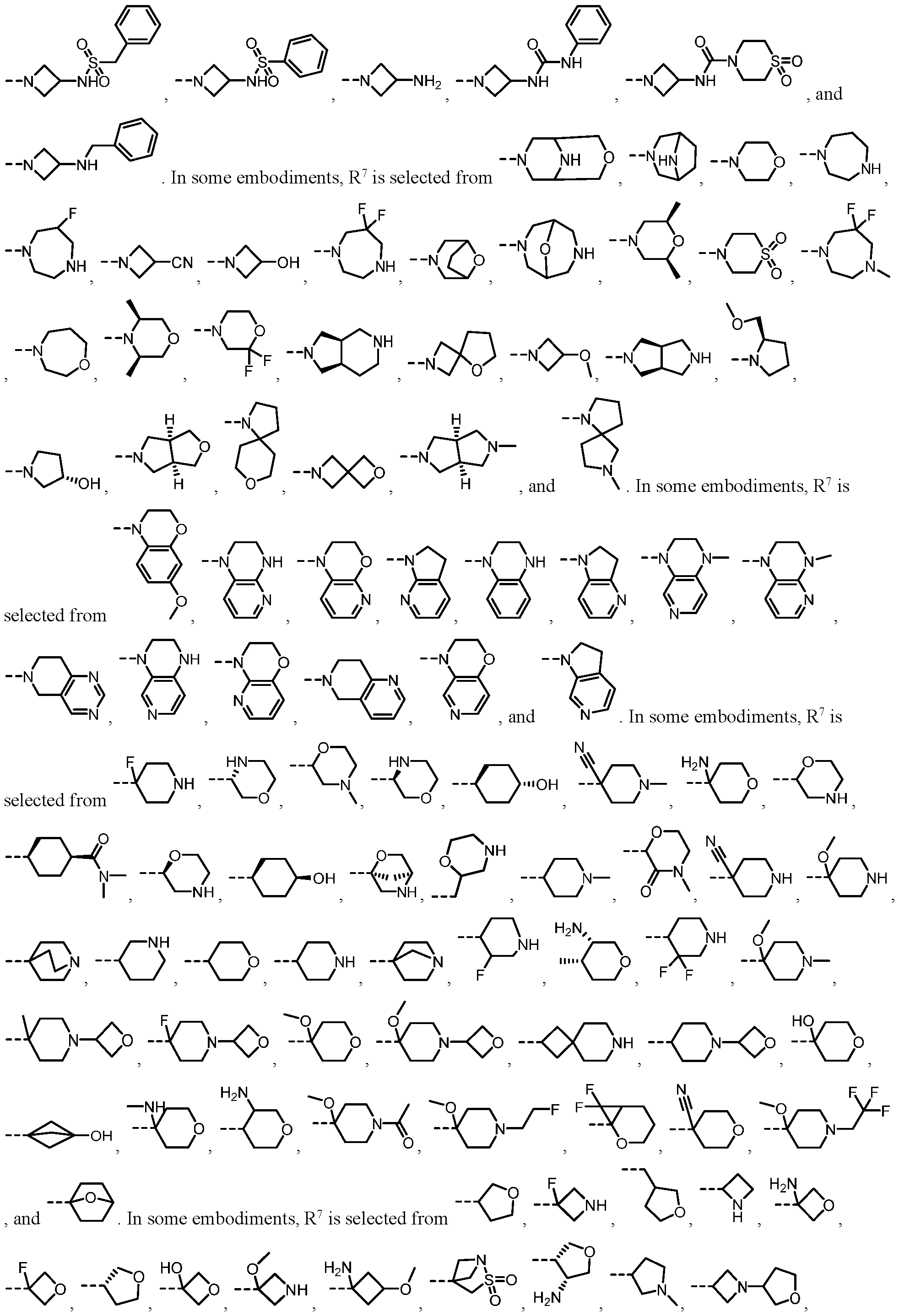


[157] In some embodiments, for a compound of Formula (I), (I-A), (I-B), (I-Bl), (I-B2), (I-C), (I-Cl), (I-C2), (I- C3), (I-D), (I-Dl), (I-D2), (I-E), or (I-El), R8 is selected from hydrogen, halogen, and Ci-6 alkyl optionally substituted with one, two, or three R20. In some embodiments, R8 is hydrogen.
[158] In some embodiments, for a compound of Formula (I), (I-A), (I-B), (I-Bl), (I-B2), (I-C), (I-Cl), (I-C2), (I-
C3), (I-D), (I-Dl), (I-D2), (I-E), or (I-El),
 is selected from C3-10 carbocycle and 3- to 10-membered heterocycle, such as C5.7 carbocycle and 5- to 7-membered heterocycle, each of which is optionally substituted with one or more R11. In some embodiments,
 is selected from C5.7 cycloalkyl, 5- to 7-membered heterocycloalkyl, 5- to 7-membered heteroaryl, and phenyl, each of which is optionally substituted with one or more
R11. In some embodiments,
 is selected from phenyl, pyridyl, and thiophenyl, each of which is optionally substituted with one or more R11. In some embodiments,
 is selected from

 In some embodiments, R11, when present, is independently selected at each occurrence from fluorine and -CH3. In some embodiments,
 is
is

[159] In some embodiments, for a compound of Formula (I), (I-A), (I-B), (I-Bl), (I-B2), (I-C), (I-Cl), (I-C2), (I- C3), (I-D), (I-Dl), (I-D2), (I-E), or (I-El), L1 is selected from Ci-6 alkylene and Ci-6 haloalkylene, such as C1.3 alkylene and C1.3 haloalkylene. In some embodiments, L1 is selected from a bond and C1.3 haloalkylene. In some embodiments, L1 is C1.3 haloalkylene, such as -CF2-, -CF2CH2-, or -CF2CH2CH2-. In some embodiments, L1 is C1.2 haloalkylene, such as -CF2- or -CF2CH2-. In some embodiments, L1 is -CF2-. In some embodiments, L1 is -CF2CH2-. In some embodiments, L1 is -CF2CH2CH2-. In some embodiments, L1 is a bond. In some embodiments, L1 is selected from a bond, -O-, -NR12-, -S-, Ci-6 alkylene, Ci-6 haloalkylene, and 2- to 6-membered heteroalkylene, wherein Ci-6 alkylene, Ci-e haloalkylene, and 2- to 6-membered hetero alkylene are optionally substituted with one or more Rllb. In some embodiments, L1 is selected from -O-, -NR12-, -S-, and 2- to 6-membered heteroalkylene, wherein 2- to 6-membered heteroalkylene is optionally substituted with one or more Rllb. In some embodiments, L1 is Ci-e alkylene optionally substituted with one or more Rl lb, such as one, two, or three Rllb. In some embodiments, L1 is selected from a bond, -O-, -NR12-, -S-, C1.3 alkylene, C1.3 haloalkylene, and 2- to 3-membered heteroalkylene, wherein C1.3 alkylene, C1.3 haloalkylene, and 2- to 3-membered hetero alkylene are optionally substituted with one or more Rllb. In some embodiments, L1 is selected from -O-, -NR12-, -S-, and 2- to 3-membered heteroalkylene, wherein 2- to 3-membered heteroalkylene is optionally substituted with one or more Rllb. In some embodiments, L1 is C1.3 alkylene substituted with one or more Rllb, such as one, two, or three Rl lb.
[160] In some embodiments, for a compound of Formula (I), (I-A), (I-B), (I-Bl), (I-B2), (I-C), (I-Cl), (I-C2), (I-
C3), (I-D), (I-Dl), (I-D2), (I-E), or (I-El),
 is absent or selected from C4.8 carbocycle and 4- to 8-membered heterocycle, each of which is optionally substituted with one or more Rl la. In some embodiments,
 or selected from phenyl and 4- to 8-membered heterocycle, each of which is optionally substituted with one or more
Rlla. In some embodiments,
 optionally substituted with one or more Rl la. In some embodiments,
 is absent or selected from phenyl, azetidine, pyrrolidine, and piperidine, each of which is optionally substituted with one or more Rl la. In some embodiments,
 is selected from phenyl, azetidine, pyrrolidine, and piperidine, each of which is optionally substituted with one or more Rl la. In some embodiments,
 is selected from azetidine, pyrrolidine, and
piperidine, each of which is optionally substituted with one or more -CH3. In some embodiments,
is selected from azetidine, pyrrolidine, and
piperidine, each of which is optionally substituted with one or more -CH3. In some embodiments,

 pyrrolidine, optionally substituted with one or more Rl la. In some embodiments,
 is piperidine, optionally substituted with one or more Rl la. In some embodiments,
 more Rlla. In some embodiments,
 In some embodiments,
 is unsubstituted. In some embodiments,
 is substituted with one or more Rl la, such as one, two or three Rl la. In some embodiments,
Rlla is independently selected at each occurrence from halogen, -CN, Ci-6 alkyl, C3.6 carbocycle, 3- to 6-membered heterocycle, -OR12, -N(R12)(R13), -N(R14)S(O)2R15, -C(O)N(R12)(R13), -N(R14)C(O)R15, -S(O)2R15, and - S(O)2N(R12)(R13), wherein Ci-6 alkyl, C3.6 carbocycle, and 3- to 6-membered heterocycle are optionally substituted with one, two, or three R20. In some embodiments, Rl la is independently selected at each occurrence from halogen, Ci-6 alkyl, and Ci-e haloalkyl. In some embodiments, Rl la is independently selected at each occurrence from Ci-6 alkyl. In some embodiments, Rlla is -CH3.
[161] In some embodiments, for a compound of Formula (I), (I-A), (I-B), (I-Bl), (I-B2), (I-C), (I-Cl), (I-C2), (I- C3), (I-D), (I-Dl), (I-D2), (I-E), or (I-El), L2 is selected from Cs.25 alkylene, Cs.25 alkenylene, Cs.25 alkynylene, 5- to 25-membered heteroalkylene, and 5- to 25-membered heteroalkenylene, each of which is optionally substituted with one or more Rl lb. In some embodiments, L2 is selected from Cs.25 alkylene, Cs.25 alkenylene, 5- to 25-membered heteroalkylene, and 5- to 25-membered heteroalkenylene, each of which is optionally substituted with one or more Rllb. In some embodiments, L2, together with the atoms to which it is attached, forms a 16- to 36-membered macrocyclic ring, such as a 16- to 24-membered macrocyclic ring. In some embodiments, L2 is selected from Ce-is alkylene, Ce-is alkenylene, Ce-is alkynylene, 6- to 15-membered heteroalkylene, and 6- to 15-membered heteroalkenylene, each of which is optionally substituted with one or more Rl lb. In some embodiments, L2 is selected from C5-10 alkylene, C5-10 alkenylene, 5- to 10-membered heteroalkylene, and 5- to 10-membered heteroalkenylene, each of which is optionally substituted with one or more Rl lb. In some embodiments, an alkenylene or hetero alkenylene of L2 comprises one carbon-carbon double bond. In some embodiments, a
hetero alkylene or heteroalkenylene of L2 comprises at least one oxygen or nitrogen atom. In some embodiments, a hetero alkylene or heteroalkenylene of L2 comprises at least one basic nitrogen. In some embodiments, L2 is selected from C5.9 alkylene, C5.9 alkenylene, and 5- to 9-membered heteroalkylene, each of which is optionally substituted with one or more Rllb. In some embodiments, L2 is selected from Ce-9 alkylene, Ce-9 alkenylene, and 6- to 9- membered heteroalkylene, each of which is optionally substituted with one or more Rllb. In some embodiments, L2 is selected from C5.8 alkylene, C5.8 alkenylene, and 5- to 8-membered heteroalkylene, each of which is optionally substituted with one or more Rl lb. In some embodiments, L2 is selected from Ce-s alkylene, Ce-s alkenylene, and 6- to 8-membered heteroalkylene, each of which is optionally substituted with one or more Rl lb. In some embodiments, L2 is selected from Ce-s alkylene and Ce-s alkenylene, each of which is optionally substituted with one or more Rl lb. In some embodiments, L2 is selected from Ce alkylene and Ce alkenylene, each of which is optionally substituted with one or more Rllb. In some embodiments, L2 is selected from C7 alkylene and C7 alkenylene, each of which is optionally substituted with one or more Rl lb. In some embodiments, L2 is selected from Cs alkylene and Cs alkenylene, each of which is optionally substituted with one or more Rllb. In some embodiments, L2 is - CH2CHCH(CH2)4-. In some embodiments, L2 is 6- to 8-membered heteroalkylene, optionally substituted with one or more Rllb. In some embodiments, L2 is 6-membered hetero alkylene, optionally substituted with one or more Rl lb. In some embodiments, L2 is 7-membered heteroalkylene, optionally substituted with one or more Rl lb. In some embodiments, L2 is 8-membered hetero alkylene, optionally substituted with one or more Rl lb. In some embodiments, L2 is 8-membered hetero alkylene, wherein the heteroalkylene comprises one oxygen atom. In some embodiments, L2 is -(CH2)2-sO(CH2)o-5-, such as L2 is -(CH2)2-sO(CH2)2-5-. In some embodiments, L2 is - (CH2)4O(CH2)3-. In some embodiments, Rl lb is independently selected at each occurrence from halogen, oxo, Ci-e alkyl, Ci-e haloalkyl, (C1-6 alkyl)-OH, and -OH. In some embodiments, Rllb is independently selected at each occurrence from -F, =0, -CH3, -CH2F, -CHF2, -CF3, -CH2CH2F, -CH2CHF2, -CH20H, and -OH. In some embodiments, Rl lb is independently selected at each occurrence from -CH3, -CH2OH, -CH2F, -CHF2, and -CF3, or two Rl lb join to form =0 or C3.e cycloalkyl, such as cyclopropyl. In some embodiments, Rl lb is independently selected at each occurrence from -CH3, -CH2OH, -CH2F, -CHF2, and -CF3, or two Rllb join to form C3.e cycloalkyl, such as cyclopropyl. In some embodiments, Rllb is independently selected at each occurrence from -CH3, -F, -CN, and -OH. In some embodiments, L2 comprises -C(O)N(R14)- or -N(R14)C(O)-. In some embodiments, L2 comprises - 0-. In some embodiments, L2 is substituted with at least one -CH3, -CH2OH, -CH2F, -CHF2, or -CF3, or two substituents join to form cyclopropyl. In some embodiments, L2 is substituted with at least one -CH3, -F, -CN, or - OH. In some embodiments, L2 is unsubstituted.
[162] In some embodiments, for a compound of Formula (I), (I-A), (I-B), (I-Bl), (I-B2), (I-C), (I-Cl), (I-C2), (I- C3), (I-D), (I-Dl), (I-D2), (I-E), or (I-El), L2 is -(C1.5 alkylene)-C(O)N(R14)-(Ci.5 alkylene)-, such as -(C1.5 alkylene)-C(O)N(CH3)-(Ci-5 alkylene)- or -(C1.5 alkylene)-C(0)NH-(Ci-5 alkylene)-, wherein C1.5 alkylene is optionally substituted with one or more Rl lb. In some embodiments, L2 is -(C1-2 alkylene)-C(O)N(R14)-(C3.4 alkylene)-, such as -(C1-2 alkylene)-C(O)N(CH3)-(C3.4 alkylene)- or -(C1-2 alkylene)-C(O)NH-(C3.4 alkylene)-, wherein C1-2 alkylene and C3.4 alkylene are each independently optionally substituted with one or more Rllb. In some embodiments, Rl lb is independently selected at each occurrence from halogen, C1-6 alkyl, C1-6 haloalkyl, (C1-6 alkyl)-OH, and -OH. In some embodiments, Rllb is independently selected at each occurrence from -F, -CH3, -CH2F, -CHF2, -CF3, -CH2CH2F, -CH2CHF2, -CH2OH, and -OH. In some embodiments, Rl lb is independently selected at each occurrence from -CH3, -CH2OH, -CH2F, -CHF2, and -CF3, or two Rl lb join to form C3.e cycloalkyl, such as cyclopropyl. In some embodiments, Rllb is independently selected at each occurrence from -CH3, -F, -CN, and -OH.
In some embodiments, L2 is substituted with at least one -CH3, -F, -CN, or -OH.
[163] In some embodiments, L2 is selected from -C(Rllb)(Rl lb)-(C3-io alkylene)-C(Rl lb)(Rl lb)-, -CH(Rl lb)-(C3-io alkylene)-C(Rllb)(Rl lb)-, -CH2-(C3-IO alkylene)-C(Rl lb)(Rl lb)-, -CH(Rllb)-(C3.io alkylene)-CH(Rllb)-, -CH2-(C3-IO alkylene)-CH(Rllb)-, -C(Rl lb)(Rllb)-(C3.io alkenylene)-C(Rllb)(Rllb)-, -CH(Rllb)-(C3.io alkenylene)-C(Rl lb)(Rllb)-, - CH2-(C3.IO alkenylene)-C(Rl lb)(Rl lb)-, -CH(Rllb)-(C3.io alkenylene)-CH(Rl lb)-, -CH2-(C3.10 alkenylene)-CH(Rl lb)-, - C(Rllb)(Rllb)-(3- to 10-membered heteroalkylene)-C(Rl lb)(Rl lb)-, -CH(Rllb)-( 3- to 10-membered hetero alkylene) - C(Rllb)(Rllb)-, -CH2-(3- to 10-membered heteroalkylene)-C(Rllb)(Rl lb)-, -CH(Rllb)-( 3- to 10-membered heteroalky lene)-CH(Rllb)-, -CH2-(3- to 10-membered heteroalkylene)-CH(Rllb)-, -C(Rl lb)(Rllb)-(3- to 10-membered heteroalkenylene)-C(Rl lb)(Rllb)-, -CH(Rl lb)-(3- to 10-membered heteroalkenylene)-C(Rllb)(Rllb)-, -CH2-(3- to 10- membered heteroalkenylene)-C(Rllb)(Rllb)-, -CH(Rl lb)-(3- to 10-membered heteroalkenylene)-CH(Rllb)-, and - CH2-(3- to 10-membered heteroalkenylene)-CH(Rl lb)-. In some embodiments, L2 is selected from -C(Rllb)(Rllb)- (C3.io alkylene)-C(Rllb)(Rl lb)-, -CH(Rllb)-(C3.io alkylene)-C(Rllb)(Rl lb)-, -CH2-(C3.10 alkylene)-C(Rllb)(Rl lb)-, - CH(Rllb)-(C3.io alkylene)-CH(Rl lb)-, and -CH2-(C3.IO alkylene)-CH(Rllb)-. In some embodiments, L2 is selected from -C(Rl lb)(Rllb)-(C3.io alkenylene)-C(Rllb)(Rllb)-, -CH(Rllb)-(C3.io alkenylene)-C(Rllb)(Rllb)-, -CH2-(C3.10 alkenylene)-C(Rllb)(Rl lb)-, -CH(Rllb)-(C3.io alkenylene)-CH(Rllb)-, and -CH2-(C3.10 alkenylene)-CH(Rl lb)-. In some embodiments, L2 is selected from -C(Rllb)(Rl lb)-(3- to 10-membered heteroalkylene)-C(Rl lb)(Rllb)-, -CH(Rl lb)-( 3- to 10-membered heteroalky lene)-C(Rl lb)(Rl lb)-, -CH2-(3- to 10-membered heteroalkylene)-C(Rllb)(Rllb)-, - CH(Rllb)-( 3- to 10-membered heteroalky lene)-CH(Rl lb)-, and -CH2-(3- to 10-membered heteroalky lene)-CH(Rl lb)-. In some embodiments, L2 is selected from -C(Rllb)(Rl lb)-(3- to 10-membered heteroalkenylene)-C(Rl lb)(Rllb)-, - CH(Rllb)-(3- to 10-membered heteroalkenylene)-C(Rllb)(Rl lb)-, -CH2-(3- to 10-membered heteroalkenylene)- C(Rllb)(Rllb)-, -CH(Rl lb)-(3- to 10-membered heteroalkenylene)-CH(Rllb)-, and -CH2-(3- to 10-membered heteroalkenylene)-CH(Rllb)-. Any C3 -10 alkylene, C3.io alkenylene, 3- to 10-membered heteroalkylene, or 3- to 10- membered heteroalkenylene in this paragraph may optionally be substituted with one or more Rl lb. In some embodiments, Rl lb is independently selected at each occurrence from halogen, oxo, Ci-6 alkyl, Ci-6 haloalky 1, (Ci-6 alkyl)-OH, and -OH. In some embodiments, Rllb is independently selected at each occurrence from -F, -CH3, -CH2F, -CHF2, -CF3, -CH2CH2F, -CH2CHF2, -CH2OH, and -OH. In some embodiments, Rl lb is independently selected at each occurrence from -CH3, -CH2OH, -CH2F, -CHF2, and -CF3, or two Rl lb join to form =0 or C3.6 cycloalkyl, such as cyclopropyl.
[164] In some embodiments, for a compound of Formula (I), (I-A), (I-B), (I-Bl), (I-B2), (I-C), (I-Cl), (I-C2), (I- C3), (I-D), (I-Dl), (I-D2), (I-E), or (I-El), L2 is -L3-D-L4-, wherein L3 is selected from Cnio alkylene, C2.io alkenylene, C2.io alkynylene, 2- to 10-membered heteroalkylene, and 3- to 10-membered heteroalkenylene, each of which is optionally substituted with one or more Rl lb; D is absent or selected from C3.i2 carbocycle and 3- to 12- membered heterocycle, each of which is optionally substituted with one or more Rlld; and L4 is selected from Cnio alkylene, C2.io alkenylene, C2.io alkynylene, 2- to 10-membered heteroalkylene, and 3- to 10-membered heteroalkenylene, each of which is optionally substituted with one or more Rl lb. As noted above, alkenylene and alkynylene groups comprise one or more carbon-carbon double or triple bonds, respectively (i.e., comprising two or more carbon atoms, for example as in C2.io alkenylene, C2.io alkynylene, C2.s alkenylene, C2.s alkynylene, Cs.25 alkenylene, Cs.25 alkynylene, Ce-is alkenylene, Ce-is alkynylene, C5-10 alkenylene, and C5-10 alkynylene). Similarly, a hetero alkenylene group comprises one or more carbon-carbon double bond (i.e., comprising two or more carbon atoms and one or more heteroatom, for example as in 3- to 10-membered heteroalkenylene, 3- to 8-membered heteroalkenylene, 5- to 25-membered heteroalkenylene, 6- to 15-membered hetero alkenylene, and 5- to 10-
membered heteroalkenylene. In some embodiments, L2 is -L3-D-L4-, wherein L3 is selected from Ci-io alkylene, C2-10 alkenylene, C2-10 alkynylene, 2- to 10-membered heteroalkylene, and 3- to 10-membered heteroalkenylene, each of which is optionally substituted with one or more Rl lb; D is selected from C3-12 carbocycle and 3- to 12-membered heterocycle, each of which is optionally substituted with one or more Rl ld; and L4 is absent. In some embodiments, L2 is -L3-D-L4-, wherein L3 is selected from Ci-s alkylene, C2-8 alkenylene, 2- to 8-membered heteroalkylene, and 3- to 8-membered heteroalkenylene, each of which is optionally substituted with one or more Rllb; D is absent or selected from C3-10 carbocycle and 3- to 10-membered heterocycle, each of which is optionally substituted with one or more Rlld; and L4 is selected from Ci-8 alkylene, C2-8 alkenylene, 2- to 8-membered heteroalkylene, and 3- to 8- membered heteroalkenylene, each of which is optionally substituted with one or more Rllb. In some embodiments, L2 is -L3-D-L4-, wherein L3 is selected from Ci-8 alkylene, C2-8 alkenylene, 2- to 8-membered heteroalkylene, and 3- to 8-membered heteroalkenylene, each of which is optionally substituted with one or more Rllb; D is selected from C3-10 carbocycle and 3- to 10-membered heterocycle, each of which is optionally substituted with one or more Rlld; and L4 is selected from Ci-8 alkylene, C2-8 alkenylene, 2- to 8-membered hetero alkylene, and 3- to 8-membered heteroalkenylene, each of which is optionally substituted with one or more Rl lb. In some embodiments, Rl lb is independently selected at each occurrence from halogen, oxo, Ci-6 alkyl, Ci-e haloalkyl, (Ci-e alkyl)-OH, and -OH. In some embodiments, Rl lb is independently selected at each occurrence from -F, -CH3, -CH2F, -CHF2, -CF3, - CH2CH2F, -CH2CHF2, -CH2OH, and -OH. In some embodiments, Rl lb is independently selected at each occurrence from -CH3, -CH2OH, -CH2F, -CHF2, and -CF3, or two Rl lb join to form =0 or C3.6 cycloalkyl, such as cyclopropyl. In some embodiments, D is selected from phenyl and 5- to 8-membered heteroaryl, such as triazole and imidazole. In some embodiments, D is unsubstituted. In some embodiments, D is substituted with one or more Rlld, such as one, two, or three Rlld.
[165] In some embodiments, for a compound of Formula (I), L2 is covalently bound to one of W3, W4, W5, W6, or W7; or L2 is -L3-D-L4-, wherein L4 is covalently bound to one of W3, W4, W5, W6, or W7. For example, L2 may be covalently bound to W3 — wherein R3b or R3 is a bond to L2 — as depicted in Formula (I-A). In some embodiments, L2 is covalently bound to W4 — wherein R4b or R4 is a bond to L2 — as depicted in Formula (I-B). In some embodiments, L2 is covalently bound to W5 — wherein R5b or R5 is a bond to L2 — as depicted in Formula (I-C). In some embodiments, L2 is covalently bound to W6 — wherein R6b or R6 is a bond to L2 — as depicted in Formula (I-D). In some embodiments, L2 is covalently bound to W7 — wherein R7b or R7 is a bond to L2 — as depicted in Formula (I- E).
[166] In some embodiments, for a compound of Formula (I), (I-A), (I-B), (1-1), (I-Bl), (I-B2), (I-C), (I-Cl), (I- C2), (I-C3), (I-D), (I-Dl), (I-D2), (I-E), or (I-El):
R20 is independently selected at each occurrence from halogen, oxo, =NH, -CN, Ci-6 alkyl, C2-6 alkenyl, C2- e alkynyl, C3-10 carbocycle, -CH2-(C3-IO carbocycle), 3- to 10-membered heterocycle, -CH2-(3- to 10-membered heterocycle), -OR21, -SR21, -N(R22)(R23), -C(O)OR22, -C(O)N(R22)(R23), -C(O)C(O)N(R22)(R23), -OC(O)N(R22)(R23), -N(R24)C(O)N(R22)(R23), -N(R24)C(O)OR25, -N(R24)C(O)R25, -N(R24)S(O)2R25, -C(O)R25, -S(O)2R25, - S(O)2N(R22)(R23), -OCH2C(O)OR22, and -OC(O)R25, wherein Ci-e alkyl, C2-6 alkenyl, C2-6 alkynyl, C3-10 carbocycle, -CH2-(C3-IO carbocycle), 3- to 10-membered heterocycle, and -CH2-(3- to 10-membered heterocycle) are optionally substituted with one, two, or three groups independently selected from halogen, oxo, =NH, -CN, Ci-6 alkyl, Ci-6 haloalkyl, Ci-e alkoxy, Ci-6 haloalkoxy, -OR21, -SR21, and -N(R22)(R23);
R21 is independently selected at each occurrence from H, Ci-6 alkyl, Ci-6 haloalkyl, C2-6 alkenyl, C2-6 alkynyl, C3-10 carbocycle, and 3- to 10-membered heterocycle, wherein C3-10 carbocycle and 3- to 10-membered
heterocycle are optionally substituted with one, two, or three groups independently selected from halogen and Ci-6 alkyl;
R22 is independently selected at each occurrence from H, Ci-6 alkyl, Ci-6 haloalkyl, C2-6 alkenyl, C2-6 alkynyl, C3-10 carbocycle, and 3- to 10-membered heterocycle, wherein C3-10 carbocycle and 3- to 10-membered heterocycle are optionally substituted with one, two, or three groups independently selected from halogen and Ci-6 alkyl;
R23 is independently selected at each occurrence from H and Ci-e alkyl;
R24 is independently selected at each occurrence from H and Ci-e alkyl; and
R25 is independently selected at each occurrence from Ci-6 alkyl, C2-6 alkenyl, C2-6 alkynyl, C3-10 carbocycle, and 3- to 10-membered heterocycle, wherein Ci-6 alkyl, C3-10 carbocycle, and 3- to 10-membered heterocycle are optionally substituted with one, two, or three groups independently selected from halogen, Ci-e alkyl, Ci-e haloalkyl, Ci-6 alkoxy, C3-10 carbocycle, and 3- to 10-membered heterocycle.
[167] In some embodiments, for a compound of Formula (I), (I-A), (I-B), (1-1), (I-Bl), (I-B2), (I-C), (I-Cl), (I- C2), (I-C3), (I-D), (I-Dl), (I-D2), (I-E), or (I-El), R20 is independently selected at each occurrence from halogen, oxo, =NR22, -CN, Ci-e alkyl, C2-6 alkenyl, C2-6 alkynyl, C3.10 carbocycle, -CH2-(C3-IO carbocycle), 3- to 10-membered heterocycle, -CH2-(3- to 10-membered heterocycle), -OR21, -SR21, -N(R22)(R23), -C(O)OR22, -C(O)N(R22)(R23), - C(O)C(O)N(R22)(R23), -OC(O)N(R22)(R23), -N(R24)C(O)N(R22)(R23), -N(R24)C(O)OR25, -N(R24)C(O)R25, - N(R24)S(O)2R25, -C(O)R25, -S(O)2R25, -S(O)(NR22)R25, -S(O)2N(R22)(R23), -OCH2C(O)OR22, and -OC(O)R25, wherein Ci-6 alkyl, C2-6 alkenyl, C2-6 alkynyl, C3-10 carbocycle, -CH2-(C3-IO carbocycle), 3- to 10-membered heterocycle, and -CH2-(3- to 10-membered heterocycle) are optionally substituted with one, two, or three groups independently selected from halogen, oxo, =NR22, -CN, Ci-e alkyl, Ci-6 haloalkyl, Ci-6 alkoxy, Ci-6 haloalkoxy, - OR21, -SR21, and -N(R22)(R23).
[168] In some embodiments, for a compound of Formula (I), (I-A), (I-B), (1-1), (I-Bl), (I-B2), (I-C), (I-Cl), (I- C2), (I-C3), (I-D), (I-Dl), (I-D2), (I-E), or (I-El), R20 is independently selected at each occurrence from halogen, oxo, =NH, -CN, -NO2, Ci-e alkyl, C2-6 alkenyl, C2-6 alkynyl, C3-10 carbocycle, -CH2-(C3-IO carbocycle), 3- to 10- membered heterocycle, -CH2-(3- to 10-membered heterocycle), -OH, -OCH3, -OCH2CH3, -NH2, -NHCH3, and - NHCH2CH3, wherein Ci-6 alkyl, C2-6 alkenyl, C2-6 alkynyl, C3-10 carbocycle, -CH2-(C3-IO carbocycle), 3- to 10- membered heterocycle, and -CH2-(3- to 10-membered heterocycle) are optionally substituted with one, two, or three groups independently selected from halogen, oxo, =NH, -CN, -NO2, -CH3, -CH2CH3, -CH(CH3)2, -C(CH3)3, -OH, - OCH3, -OCH2CH3, -NH2, -NHCH3, and -NHCH2CH3.
[169] In some embodiments, for a compound of Formula (I-Bl), R5b is -CH3; R7 is selected from Ci-6 alkyl, C3-10 carbocycle, 3- to 10-membered heterocycle, -N(R12)(R13), -C(O)R15, -C(O)N(R12)(R13), -S(O)2R15, and - SO2N(R12)(R13), wherein Ci.6 alkyl, C3.10 carbocycle, and 3- to 10-membered heterocycle are optionally substituted with one, two, or three R20; and R8 is hydrogen. In some embodiments, for a compound of Formula (I-B2), R5 is hydrogen; R6 is selected from hydrogen and -OCH3; R7 is selected from Ci-6 alkyl, C3-10 carbocycle, 3- to 10- membered heterocycle, -N(R12)(R13), -C(O)R15, -C(O)N(R12)(R13), -S(O)2R15, and -SO2N(R12)(R13), wherein Ci.6 alkyl, C3-10 carbocycle, and 3- to 10-membered heterocycle are optionally substituted with one, two, or three R20; and R8 is hydrogen.
[170] In some embodiments, for a compound of Formula (I-Cl), R3 is hydrogen or -CH3; R7 is selected from Ci-6 alkyl, C3-10 carbocycle, 3- to 10-membered heterocycle, -N(R12)(R13), -C(O)R15, -C(O)N(R12)(R13), -S(O)2R15, and - SC>2N(R12)(R13), wherein Ci-6 alkyl, C3-10 carbocycle, and 3- to 10-membered heterocycle are optionally substituted
with one, two, or three R20; and R8 is hydrogen. In some embodiments, for a compound of Formula (I-C2), R3b is - CH3; R7 is selected from Ci-6 alkyl, C3-10 carbocycle, 3- to 10-membered heterocycle, -N(R12)(R13), -C(O)R15, - C(O)N(R12)(R13), -S(O)2R15, and -SO2N(R12)(R13), wherein Ci-6 alkyl, C3-10 carbocycle, and 3- to 10-membered heterocycle are optionally substituted with one, two, or three R20; and R8 is hydrogen. In some embodiments, for a compound of Formula (I-C3), R3 is hydrogen or -CH3; R6 is selected from hydrogen and -OCH3; R7 is selected from Ci-6 alkyl, C3-10 carbocycle, 3- to 10-membered heterocycle, -N(R12)(R13), -C(O)R15, -C(O)N(R12)(R13), -S(O)2R15, and -SC>2N(R12)(R13), wherein Ci-6 alkyl, C3.io carbocycle, and 3- to 10-membered heterocycle are optionally substituted with one, two, or three R20; and R8 is hydrogen.
[171] In some embodiments, for a compound of Formula (I), (I-A), (I-B), (I-Bl), (I-B2), (I-C), (I-Cl), (I-C2), (I-
C3), (I-D), (I-Dl), (I-D2), (I-E), or (I-El): R1 is -CH3;
 is selected from phenyl and 5- to 7-membered heteroaryl, each of which is optionally substituted with one or more R11; L1 is selected from a bond and C1.3 haloalkylene;
 is selected from absent, phenyl, and 4- to 8-membered heterocycle, wherein the phenyl and
4- to 8-membered heterocycle are optionally substituted with one or more Rlla; and L2 is selected from C5-10 alkylene, C5-10 alkenylene, 5- to 10-membered heteroalkylene, and 5- to 10-membered hetero alkenylene, each of which is optionally substituted with one or more Rl lb. In some embodiments, R11, when present, is fluorine; Rlla, when present, is -CH3; and Rl lb, when present, is selected from halogen, oxo, C1-6 alkyl, C1-6 haloalky 1, (C1-6 alkyl)- OH, and -OH.
 , alkylene, Ce-s alkenylene, and 6- to 8-membered heteroalkylene, each of which is optionally substituted with one or more Rllb. In some embodiments, R1 is -CH3;
 L1 is C1-2 haloalkylene;
 ; and
; and
L2 is 6- to 8-membered heteroalkylene, optionally substituted with one or more Rl lb. In some embodiments, R1 is -
CH3;
 is selected ffrom
 is C1-2 haloalky lene;
 , optionally substituted with one or more Rl la; and L2 is selected from Ce-s alkylene and Ce-s alkenylene, each of which is optionally substituted with one or more Rl lb. In some embodiments, R1 is -CI F:
 is Ci-2 haloalkylene;
 ; and L2 is Ce-s alkenylene, optionally substituted with one or more Rllb. In
some embodiments, R1 is -CI E:
; and L2 is Ce-s alkenylene, optionally substituted with one or more Rllb. In
some embodiments, R1 is -CI E:
 is Ci-2 haloalkylene;

 , optionally substituted with one or more Rl la; and L2 is -(C1.2 alkylene)-C(O)N(CH3)-(C3-4 alkylene)- or -
(Ci-2 alkylene)-C(O)NH-(C3-4 alkylene)-, wherein C1.2 alkylene and C3.4 alkylene are each independently optionally substituted with one or more Rl lb. In some embodiments, Rl la, when present, is -CI E: and Rllb, when present, is selected from halogen, -CN, oxo, C1.3 alkyl, C1.3 haloalkyl, (C1.3 alkyl)-OH, and -OH.
 heteroalkylene, each of which is optionally substituted with one or more Rllb. In some embodiments, R1 is -CI I;,:
 s selected from Ce-s alkylene and Ce-s alkenylene, each of which is optionally substituted with one or more Rl lb. In some embodiments,

 and L2 is -(C1.2 alkylene)-C(O)N(CH3)-(C3-4 alkylene)- or -(C1.2 alkylene)-C(O)NH-(C3-4 alkylene)-, wherein C1.2 alkylene and C3.4 alkylene are each independently optionally substituted with one or more Rllb. In some embodiments, Rl lb, when present, is selected from halogen, -CN, oxo, C1.3 alkyl, C1.3 haloalkyl, (C1.3 alkyl)-
OH, and -OH.
[174] In some embodiments, a compound of Formula (I) is a compound of the formula:

 , wherein R50 is hydrogen or R11 and R51 is hydrogen or halogen.
[175] In some embodiments, a compound of Formula (I) is a compound of the formula:

In some embodiments, a compound of Formula (I-A) is a compound of the formula:

 wherein R50 is hydrogen or fluoro.
In some embodiments, a compound of Formula (I-B) is a compound of the formula:

In some embodiments, a compound of Formula (I-C) is a compound of the formula:


(I-E) is a compound of the formula:

 , wherein R50 is hydrogen or fluoro. In some embodiments, L1 is C1.3 haloalkylene, such as Ci-2 haloalkylene or C1.2 fluoroalkylene. In some embodiments, L2 is selected from Ce-s alkylene, Ce-s alkenylene, and 6- to 8-membered heteroalkylene, each of which is optionally substituted with one or more Rllb. In some embodiments, L2 is selected from Ce-s alkylene and Ce-s alkenylene, each of which is optionally substituted with one or more Rllb. In some embodiments, L2 is -(C1-2 alkylene)-C(O)N(CH3)-(C3-4 alkylene)- or -(C1-2 alkylene)- C(O)NH-(C3-4 alkylene)-, wherein C1-2 alkylene and C3.4 alkylene are each independently optionally substituted with one or more Rl lb. In some embodiments, Rl lb, when present, is selected from halogen, -CN, C1-3 alkyl, C1-3 haloalkyl, (C1-3 alkyl)-OH, and -OH. In some embodiments, R50 is hydrogen. In some embodiments, R50 is fluoro. [176] In certain aspects, the present disclosure provides a compound of Formula (I-Cl):
 or a pharmaceutically acceptable salt or solvate thereof, wherein:

 azetidine, pyrrolidine, and piperidine, each of which is optionally substituted with one or more -C 1 13:
L1 is Ci-3 haloalkylene;
L2 is selected from C5-10 alkylene, C5-10 alkenylene, 5- to 10-membered heteroalkylene, and 5- to 10- membered heteroalkenylene, each of which is optionally substituted with one or more Rllb;
R1 is -CH3;

R8 is hydrogen;
R11 is selected from fluorine and -CH3; and
Rllb is selected from halogen, oxo, Ci-6 alkyl, Ci-6 haloalkyl, (Ci-6 alkyl)-OH, and -OH.
[177] In certain aspects, the present disclosure provides a compound of Formula (I-Cl):
 or a pharmaceutically acceptable salt or solvate thereof, wherein:

 azetidine, pyrrolidine, and piperidine;
L1 is selected from -CF2-, -CF2CH2-, and -CF2CH2CH2-;
L2 is selected from C5-10 alkylene, C5-10 alkenylene, 5- to 10-membered heteroalkylene, and 5- to 10- membered heteroalkenylene;
R1 is -CH3;

R8 is hydrogen.
[178] In certain aspects, the present disclosure provides a compound of Formula (I-Cl):
 or a pharmaceutically acceptable salt or solvate thereof, wherein:
 one or more -CH3;
L1 is Ci.3 haloalkylene;
L2 is C5.10 alkenylene optionally substituted with one or more Rl lb;
R1 is -CH3;

R8 is hydrogen;
R11 is selected from fluorine and -CH3; and
Rllb is selected from halogen, oxo, Ci-6 alkyl, Ci-6 haloalkyl, (Ci-6 alkyl)-OH, and -OH.
[179] In certain aspects, the present disclosure provides a compound of Formula (I-Cl):


L1 is C1.3 haloalkylene;
L2 is selected from 5- to 10-membered hetero alkylene optionally substituted with one or more Rl lb;
R1 is -CH3;

R8 is hydrogen;
R11 is selected from fluorine and -CH3; and
Rllb is selected from halogen, oxo, Ci-6 alkyl, Ci-6 haloalkyl, (Ci-6 alkyl)-OH, and -OH.
[180] In certain aspects, the present disclosure provides a compound of Formula (I):
 or a pharmaceutically acceptable salt or solvate thereof, wherein:
 is selected from phenyl and 5- to 7-membered heteroaryl, each of which is optionally substituted with one or more R11 ;
 is absent or selected from phenyl and 4- to 8-membered heterocycle, each of which is optionally substituted with one or more Rl la;
L1 is selected from a bond and C1.3 haloalkylene;
L2 is selected from C5-10 alkylene, C5-10 alkenylene, 5- to 10-membered heteroalkylene, and 5- to 10- membered heteroalkenylene, each of which is optionally substituted with one or more Rllb, wherein L2 is covalently bound to one of W3, W4, W5, W6, or W7; or L2 is -L3-D-L4-, wherein L4 is covalently bound to one of W3, W4, W5, W6, or W7;
L3 is selected from Ci-s alkylene, C2-8 alkenylene, 2- to 8-membered heteroalkylene, and 3- to 8-membered heteroalkenylene, each of which is optionally substituted with one or more Rl lb;
D is selected from C3-10 carbocycle and 3- to 10-membered heterocycle, each of which is optionally substituted with one or more Rl ld;
L4 is selected from Ci-8 alkylene, C2-8 alkenylene, 2- to 8-membered heteroalkylene, and 3- to 8-membered heteroalkenylene, each of which is optionally substituted with one or more Rl lb
W2 is N;
W3 is selected from N(R3b), N, C(R3), and C(O);
W4 is selected from N(R4b), N, C(R4), and C(O);
W5 is selected from N(R5b), N, and C(R5);
W6 is selected from C(R6) and C(O);
W7 is C(R7);
W8 is C(R8);
W9 and W10 are each C;
R1 is -CH3;
R2, R2a, R3a, R4a, R5a, R6a, R7a, R8, and R8a are each independently selected from hydrogen and -CI Iv
R3, R4, R5, and R6 are each independently selected from a bond to L2, hydrogen, halogen, -CN, C1.3 alkyl, C1.3 haloalkyl, -OH, -OCH3, -NH2, -NHCH3, -N(CH3)2;
R7 is selected from a bond to L2, Ci-e alkyl, C3-10 carbocycle, 3- to 10-membered heterocycle, -OR12, - N(R12)(R13), -C(O)R15, -C(O)N(R12)(R13), -S(O)2R15, and -SO2N(R12)(R13), wherein Ci.6 alkyl, C3-10 carbocycle, and 3- to 10-membered heterocycle are optionally substituted with one, two, or three R20;
R3b, R4b, and R5b are each independently selected from a bond to L2, hydrogen, and C1.3 alkyl;
R11, Rlla, and Rlld are each independently selected at each occurrence from halogen, -CN, Ci-6 alkyl, C2-6 alkenyl, C2-6 alkynyl, C3-10 carbocycle, 3- to 10-membered heterocycle, -OR12, -SR12, -N(R12)(R13), -C(O)OR12, - OC(O)N(R12)(R13), -N(R14)C(O)N(R12)(R13), -N(R14)C(O)OR15, -N(R14)S(O)2R15, -C(O)R15, -S(O)R15, -OC(O)R15, - C(O)N(R12)(R13), -C(O)C(O)N(R12)(R13), -N(R14)C(O)R15, -S(O)2R15, -S(O)2N(R12)(R13), -S(=O)(=NH)N(R12)(R13), -CH2C(O)N(R12)(R13), -CH2N(R14)C(O)R15, -CH2S(O)2R15, -CH2S(O)2N(R12)(R13), -CH2N(R12)S(O)2(R13), and - P(O)(R17)(R17a), wherein Ci-6 alkyl, C2-6 alkenyl, C2-6 alkynyl, C3-10 carbocycle, and 3- to 10-membered heterocycle are optionally substituted with one, two, or three R20;
Rllb is independently selected at each occurrence from halogen, oxo, -CN, Ci-6 alkyl, C2-6 alkenyl, C2-6 alkynyl, C3-10 carbocycle, 3- to 10-membered heterocycle, -OR12, -SR12, -N(R12)(R13), -C(O)OR12, - OC(O)N(R12)(R13), -N(R14)C(O)N(R12)(R13), -N(R14)C(O)OR15, -N(R14)S(O)2R15, -C(O)R15, -S(O)R15, -OC(O)R15, - C(O)N(R12)(R13), -C(O)C(O)N(R12)(R13), -N(R14)C(O)R15, -S(O)2R15, -S(O)2N(R12)(R13), -S(=O)(=NH)N(R12)(R13),
-CH2C(O)N(R12)(R13), -CH2N(R14)C(O)R15, -CH2S(O)2R15, -CH2S(O)2N(R12)(R13), -CH2N(R12)S(O)2(R13), and - P(O)(R17)(R17a), wherein Ci-6 alkyl, C2.e alkenyl, C2.e alkynyl, C3.10 carbocycle, and 3- to 10-membered heterocycle are optionally substituted with one, two, or three R20;
R12 is independently selected at each occurrence from hydrogen, Ci-6 alkyl, Ci-e haloalkyl, C2.e alkenyl, C2.e alkynyl, carbocycle, and 3- to 10-membered heterocycle, wherein
 alkyl, C2.e alkenyl, C2.e alkynyl,
 carbocycle, and 3- to 10-membered heterocycle are optionally substituted with one, two, or three R20;
R13 is independently selected at each occurrence from hydrogen, Ci-6 alkyl, and Ci-6 haloalkyl; or R12 and R13, together with the nitrogen atom to which they are attached, form a 3- to 10-membered heterocycle optionally substituted with one, two, or three R20;
R14 is independently selected at each occurrence from hydrogen, Ci-6 alkyl, and Ci-6 haloalkyl;
R15 is independently selected at each occurrence from Ci-6 alkyl, C2.e alkenyl, C2.e alkynyl,
 carbocycle, and 3- to 10-membered heterocycle, wherein Ci-6 alkyl, C2.e alkenyl, C2.e alkynyl,
 carbocycle, and 3- to 10-membered heterocycle are optionally substituted with one, two, or three R20;
R17 and R17a are each independently selected at each occurrence from Ci-6 alkyl and C3.6 cycloalkyl, wherein Ci-6 alkyl and C3.6 cycloalkyl are optionally substituted with one, two or three R20; or R17 and R17a, together with the phosphorous atom to which they are attached, form a 3- to 10-membered heterocycle;
R20 is independently selected at each occurrence from halogen, oxo, =NH, -CN, Ci-6 alkyl, C2.e alkenyl, C2. alkynyl, carbocycle, -CH2-(C3-IO carbocycle), 3- to 10-membered heterocycle, -CH2-(3- to 10-membered heterocycle), -OR21, -SR21, -N(R22)(R23), -C(O)OR22, -C(O)N(R22)(R23), -C(O)C(O)N(R22)(R23), -OC(O)N(R22)(R23), -N(R24)C(O)N(R22)(R23), -N(R24)C(O)OR25, -N(R24)C(O)R25, -N(R24)S(O)2R25, -C(O)R25, -S(O)2R25, - S(O)2N(R22)(R23), -OCH2C(O)OR22, and -OC(O)R25, wherein Ci-e alkyl, C2.e alkenyl, C2.e alkynyl, C3-10 carbocycle, -CH2-(C3-IO carbocycle), 3- to 10-membered heterocycle, and -CH2-(3- to 10-membered heterocycle) are optionally substituted with one, two, or three groups independently selected from halogen, oxo, =NH, -CN, Ci-6 alkyl, Ci-6 haloalkyl, Ci.6 alkoxy, Ci.6 haloalkoxy, -OR21, -SR21, -N(R22)(R23), -C(O)OR22, -C(O)N(R22)(R23), - C(O)C(O)N(R22)(R23), -OC(O)N(R22)(R23), -N(R24)C(O)N(R22)(R23), -N(R24)C(O)OR25, -N(R24)C(O)R25, - N(R24)S(O)2R25, -C(O)R25, -S(O)2R25, -S(O)2N(R22)(R23), and -OC(O)R25;
R21 is independently selected at each occurrence from H, Ci-6 alkyl, Ci-6 haloalkyl, C2.e alkenyl, C2.e alkynyl, C3-10 carbocycle, and 3- to 10-membered heterocycle, wherein C3-10 carbocycle and 3- to 10-membered heterocycle are optionally substituted with one, two, or three groups independently selected from halogen and Ci-6 alkyl;
R22 is independently selected at each occurrence from H, Ci-6 alkyl, Ci-6 haloalkyl, C2.e alkenyl, C2.e alkynyl, C3-10 carbocycle, and 3- to 10-membered heterocycle, wherein C3-10 carbocycle and 3- to 10-membered heterocycle are optionally substituted with one, two, or three groups independently selected from halogen and Ci-6 alkyl;
R23 is independently selected at each occurrence from H and Ci-e alkyl;
R24 is independently selected at each occurrence from H and Ci-e alkyl;
R25 is independently selected at each occurrence from Ci-6 alkyl, C2.e alkenyl, C2.e alkynyl,
 carbocycle, and 3- to 10-membered heterocycle, wherein Ci-6 alkyl,
 carbocycle, and 3- to 10-membered heterocycle are optionally substituted with one, two, or three groups independently selected from halogen, Ci-e alkyl, Ci-e haloalkyl, Ci-6 alkoxy, C3-10 carbocycle, and 3- to 10-membered heterocycle; and indicates a single or double bond such that all valences are satisfied.
[181] In certain aspects, the present disclosure provides a compound of Formula (III):
carbocycle, and 3- to 10-membered heterocycle are optionally substituted with one, two, or three groups independently selected from halogen, Ci-e alkyl, Ci-e haloalkyl, Ci-6 alkoxy, C3-10 carbocycle, and 3- to 10-membered heterocycle; and indicates a single or double bond such that all valences are satisfied.
[181] In certain aspects, the present disclosure provides a compound of Formula (III):
 or a pharmaceutically acceptable salt or solvate thereof, wherein:
 is selected from 3- to 8-membered heterocycle, optionally substituted with one or more Rl la;
L1 is selected from a bond, Ci-6 alkylene, and Ci-6 haloalkylene:
L2 is selected from C5.25 alkylene, C5.25 alkenylene, C5.25 alkynylene, 5- to 25-membered heteroalkylene, and 5- to 25-membered heteroalkenylene, each of which is optionally substituted with one or more Rl lb, wherein L2 is covalently bound to one of W3, W4, W5, W6, or Wk or L2 is -L3-D-L4-, wherein L4 is covalently bound to one of W3, W4, W5, W6, or W7;
L3 is selected from Ci-io alkylene, C2-10 alkenylene, C2-10 alkynylene, 2- to 10-membered heteroalkylene, and 3- to 10-membered heteroalkenylene, each of which is optionally substituted with one or more Rl lb;
D is absent or selected from C3-12 carbocycle and 3- to 12-membered heterocycle, each of which is optionally substituted with one or more Rl ld;
L4 is selected from CHO alkylene, C2-10 alkenylene, C2-10 alkynylene, 2- to 10-membered heteroalkylene, and 3- to 10-membered heteroalkenylene, each of which is optionally substituted with one or more Rl lb;
W3 is selected from N(R3b) and N and W4 is selected from C(R4) and C(O); or W3 is selected from C(R3) and C(O), and W4 is selected from N(R4b) and N;
W5 is selected from N(R5b), N, and C(R5);
W6 is selected from N, C(R6), and C(O);
W7 is selected from N, C(R7), and C(O);
R50 is hydrogen or halogen;
R3, R4, R5, R6, and R7 are each independently selected from a bond to L2, hydrogen, halogen, -CN, Ci-6 alkyl, C2-6 alkenyl, C2-6 alkynyl, C3-10 carbocycle, 3- to 10-membered heterocycle, -OR12, -SR12, -N(R12)(R13), - C(O)OR12, -OC(O)N(R12)(R13), -N(R14)C(O)N(R12)(R13), -N(R14)C(O)OR15, -N(R14)S(O)2R15, -C(O)R15, -S(O)R15, - OC(O)R15, -C(O)N(R12)(R13), -C(O)C(O)N(R12)(R13), -N(R14)C(O)R15, -S(O)2R15, -S(O)2N(R12)(R13), - S(=O)(=NH)N(R12)(R13), -CH2C(O)N(R12)(R13), -CH2N(R14)C(O)R15, -CH2S(O)2R15, and -CH2S(O)2N(R12)(R13), wherein each Ci-6 alkyl, C2-6 alkenyl, C2-6 alkynyl, C3-10 carbocycle, and 3- to 10-membered heterocycle is independently optionally substituted with one, two, or three R20;
R3b, R4b, and R5b are each independently selected from a bond to L2, hydrogen, -CN, Ci-6 alkyl, C2-6 alkenyl, C2-6 alkynyl, C3-10 carbocycle, 3- to 10-membered heterocycle, -OR12, -SR12, -C(O)OR12, - OC(O)N(R12)(R13), -C(O)R15, -S(O)R15, -OC(O)R15, -C(O)N(R12)(R13), -C(O)C(O)N(R12)(R13), -S(O)2R15, -
S(O)2N(R12)(R13), -S(=O)(=NH)N(R12)(R13), -CH2C(O)N(R12)(R13), -CH2N(R14)C(O)R15, -CH2S(O)2R15, and - CH2S(O)2N(R12)(R13), wherein each Ci-6 alkyl, C2.e alkenyl, C2.e alkynyl, C3.10 carbocycle and 3- to 10-membered heterocycle is independently optionally substituted with one, two, or three R20;
Rlla and Rl ld are each independently selected at each occurrence from halogen, -CN, Ci-6 alkyl, C2.e alkenyl, C2.e alkynyl, C3-10 carbocycle, 3- to 10-membered heterocycle, -OR12, -SR12, -N(R12)(R13), -C(O)OR12, - OC(O)N(R12)(R13), -N(R14)C(O)N(R12)(R13), -N(R14)C(O)OR15, -N(R14)S(O)2R15, -C(O)R15, -S(O)R15, -OC(O)R15, - C(O)N(R12)(R13), -C(O)C(O)N(R12)(R13), -N(R14)C(O)R15, -S(O)2R15, -S(O)2N(R12)(R13), -S(=O)(=NH)N(R12)(R13), -CH2C(O)N(R12)(R13), -CH2N(R14)C(O)R15, -CH2S(O)2R15, -CH2S(O)2N(R12)(R13), -CH2N(R12)S(O)2(R13), and - P(O)(R17)(R17a), wherein Ci-6 alkyl, C2.e alkenyl, C2.e alkynyl, C3.10 carbocycle, and 3- to 10-membered heterocycle are optionally substituted with one, two, or three R20;
Rllb is independently selected at each occurrence from halogen, oxo, -CN, Ci-6 alkyl, C2.e alkenyl, C2.e alkynyl, C3-10 carbocycle, 3- to 10-membered heterocycle, -OR12, -SR12, -N(R12)(R13), -C(O)OR12, - OC(O)N(R12)(R13), -N(R14)C(O)N(R12)(R13), -N(R14)C(O)OR15, -N(R14)S(O)2R15, -C(O)R15, -S(O)R15, -OC(O)R15, - C(O)N(R12)(R13), -C(O)C(O)N(R12)(R13), -N(R14)C(O)R15, -S(O)2R15, -S(O)2N(R12)(R13), -S(=O)(=NH)N(R12)(R13), -CH2C(O)N(R12)(R13), -CH2N(R14)C(O)R15, -CH2S(O)2R15, -CH2S(O)2N(R12)(R13), -CH2N(R12)S(O)2(R13), and - P(O)(R17)(R17a), wherein Ci-6 alkyl, C2.e alkenyl, C2.e alkynyl, C3.10 carbocycle, and 3- to 10-membered heterocycle are optionally substituted with one, two, or three R20;
R12 is independently selected at each occurrence from hydrogen, Ci-6 alkyl, Ci-e haloalkyl, C2.e alkenyl, C2.e alkynyl, C3-10 carbocycle, and 3- to 10-membered heterocycle, wherein Ci-6 alkyl, C2.e alkenyl, C2.e alkynyl, C3-10 carbocycle, and 3- to 10-membered heterocycle are optionally substituted with one, two, or three R20;
R13 is independently selected at each occurrence from hydrogen, Ci-6 alkyl, and Ci-6 haloalkyl; or R12 and R13, together with the nitrogen atom to which they are attached, form a 3- to 10-membered heterocycle optionally substituted with one, two, or three R20;
R14 is independently selected at each occurrence from hydrogen, Ci-6 alkyl, and Ci-6 haloalkyl;
R15 is independently selected at each occurrence from Ci-6 alkyl, C2.e alkenyl, C2.e alkynyl, C3-10 carbocycle, and 3- to 10-membered heterocycle, wherein Ci-6 alkyl, C2.e alkenyl, C2.e alkynyl, C3-10 carbocycle, and 3- to 10-membered heterocycle are optionally substituted with one, two, or three R20;
R17 and R17a are each independently selected at each occurrence from Ci-6 alkyl and C3.6 cycloalkyl, wherein Ci-6 alkyl and C3.6 cycloalkyl are optionally substituted with one, two or three R20; or R17 and R17a, together with the phosphorous atom to which they are attached, form a 3- to 10-membered heterocycle;
R20 is independently selected at each occurrence from halogen, oxo, =NH, -CN, Ci-6 alkyl, C2.e alkenyl, C2. e alkynyl, C3-10 carbocycle, -CH2-(C3-IO carbocycle), 3- to 10-membered heterocycle, -CH2-(3- to 10-membered heterocycle), -OR21, -SR21, -N(R22)(R23), -C(O)OR22, -C(O)N(R22)(R23), -C(O)C(O)N(R22)(R23), -OC(O)N(R22)(R23), -N(R24)C(O)N(R22)(R23), -N(R24)C(O)OR25, -N(R24)C(O)R25, -N(R24)S(O)2R25, -C(O)R25, -S(O)2R25, - S(O)2N(R22)(R23), -OCH2C(O)OR22, and -OC(O)R25, wherein Ci-e alkyl, C2.e alkenyl, C2.e alkynyl, C3-10 carbocycle, -CH2-(C3-IO carbocycle), 3- to 10-membered heterocycle, and -CH2-(3- to 10-membered heterocycle) are optionally substituted with one, two, or three groups independently selected from halogen, oxo, =NH, -CN, Ci-6 alkyl, Ci-6 haloalkyl, Ci.6 alkoxy, Ci.6 haloalkoxy, -OR21, -SR21, -N(R22)(R23), -C(O)OR22, -C(O)N(R22)(R23), - C(O)C(O)N(R22)(R23), -OC(O)N(R22)(R23), -N(R24)C(O)N(R22)(R23), -N(R24)C(O)OR25, -N(R24)C(O)R25, - N(R24)S(O)2R25, -C(O)R25, -S(O)2R25, -S(O)2N(R22)(R23), and -OC(O)R25;
R21 is independently selected at each occurrence from H, Ci-6 alkyl, Ci-6 haloalkyl, C2.e alkenyl, C2.e
alkynyl, C3-10 carbocycle, and 3- to 10-membered heterocycle, wherein C3-10 carbocycle and 3- to 10-membered heterocycle are optionally substituted with one, two, or three groups independently selected from halogen and Ci-6 alkyl;
R22 is independently selected at each occurrence from H, Ci-6 alkyl, Ci-6 haloalkyl, C2-6 alkenyl, C2-6 alkynyl, C3-10 carbocycle, and 3- to 10-membered heterocycle, wherein C3-10 carbocycle and 3- to 10-membered heterocycle are optionally substituted with one, two, or three groups independently selected from halogen and Ci-6 alkyl;
R23 is independently selected at each occurrence from H and Ci-e alkyl;
R24 is independently selected at each occurrence from H and Ci-e alkyl;
R25 is independently selected at each occurrence from Ci-6 alkyl, C2-6 alkenyl, C2-6 alkynyl, C3-10 carbocycle, and 3- to 10-membered heterocycle, wherein Ci-6 alkyl, C3-10 carbocycle, and 3- to 10-membered heterocycle are optionally substituted with one, two, or three groups independently selected from halogen, Ci-e alkyl, Ci-e haloalkyl, Ci-6 alkoxy, C3-10 carbocycle, and 3- to 10-membered heterocycle; and indicates a single or double bond such that all valences are satisfied.
[182] In certain aspects, the present disclosure provides a compound of Formula (III):
 or a pharmaceutically acceptable salt or solvate thereof, wherein:
 is selected from 3- to 8-membered heterocycle, optionally substituted with one or more Rl la;
L1 is selected from a bond, Ci-6 alkylene, and Ci-6 haloalkylene;
L2 is selected from C5.25 alkylene, C5.25 alkenylene, C5.25 alkynylene, 5- to 25-membered heteroalkylene, and 5- to 25-membered heteroalkenylene, each of which is optionally substituted with one or more Rl lb, wherein L2 is covalently bound to one of W3, W4, W5, W6, or W7;
W3 is selected from N(R3b) and N and W4 is selected from C(R4) and C(O); or W3 is selected from C(R3) and C(O), and W4 is selected from N(R4b) and N;
W5 is selected from N(R5b), N, and C(R5);
W6 is selected from N, C(R6), and C(O);
W7 is selected from N, C(R7), and C(O);
R50 is hydrogen or halogen;
R3, R4, R5, R6, and R7 are each independently selected from a bond to L2, hydrogen, halogen, -CN, Ci-6 alkyl, C2-6 alkenyl, C2-6 alkynyl, C3-10 carbocycle, 3- to 10-membered heterocycle, -OR12, -SR12, -N(R12)(R13), - C(O)OR12, -OC(O)N(R12)(R13), -N(R14)C(O)N(R12)(R13), -N(R14)C(O)OR15, -N(R14)S(O)2R15, -C(O)R15, -S(O)R15, -
OC(O)R15, -C(O)N(R12)(R13), -C(O)C(O)N(R12)(R13), -N(R14)C(O)R15, -S(O)2R15, -S(O)2N(R12)(R13), - S(=O)(=NH)N(R12)(R13), -CH2C(O)N(R12)(R13), -CH2N(R14)C(O)R15, -CH2S(O)2R15, and -CH2S(O)2N(R12)(R13), wherein each Ci-6 alkyl, C2.e alkenyl, C2.e alkynyl, C3-10 carbocycle, and 3- to 10-membered heterocycle is independently optionally substituted with one, two, or three R20;
R3b, R4b, and R5b are each independently selected from a bond to L2, hydrogen, -CN, Ci-6 alkyl, C2.e alkenyl, C2.e alkynyl,
 carbocycle, 3- to 10-membered heterocycle, -OR12, -SR12, -C(O)OR12, - OC(O)N(R12)(R13), -C(O)R15, -S(O)R15, -OC(O)R15, -C(O)N(R12)(R13), -C(O)C(O)N(R12)(R13), -S(O)2R15, - S(O)2N(R12)(R13), -S(=O)(=NH)N(R12)(R13), -CH2C(O)N(R12)(R13), -CH2N(R14)C(O)R15, -CH2S(O)2R15, and - CH2S(O)2N(R12)(R13), wherein each Ci-6 alkyl, C2.e alkenyl, C2.e alkynyl, C3.10 carbocycle and 3- to 10-membered heterocycle is independently optionally substituted with one, two, or three R20;
Rlla is independently selected at each occurrence from halogen, -CN, Ci-6 alkyl, C2.e alkenyl, C2.e alkynyl, C3-10 carbocycle, 3- to 10-membered heterocycle, -OR12, -SR12, -N(R12)(R13), -C(O)OR12, -OC(O)N(R12)(R13), - N(R14)C(O)N(R12)(R13), -N(R14)C(O)OR15, -N(R14)S(O)2R15, -C(O)R15, -S(O)R15, -OC(O)R15, -C(O)N(R12)(R13), - C(O)C(O)N(R12)(R13), -N(R14)C(O)R15, -S(O)2R15, -S(O)2N(R12)(R13), -S(=O)(=NH)N(R12)(R13), - CH2C(O)N(R12)(R13), -CH2N(R14)C(O)R15, -CH2S(O)2R15, -CH2S(O)2N(R12)(R13), -CH2N(R12)S(O)2(R13), and - P(O)(R17)(R17a), wherein Ci-6 alkyl, C2.e alkenyl, C2.e alkynyl, C3.10 carbocycle, and 3- to 10-membered heterocycle are optionally substituted with one, two, or three R20;
Rllb is independently selected at each occurrence from halogen, oxo, -CN, Ci-6 alkyl, C2.e alkenyl, C2.e alkynyl, carbocycle, 3- to 10-membered heterocycle, -OR12, -SR12, -N(R12)(R13), -C(O)OR12, - OC(O)N(R12)(R13), -N(R14)C(O)N(R12)(R13), -N(R14)C(O)OR15, -N(R14)S(O)2R15, -C(O)R15, -S(O)R15, -OC(O)R15, - C(O)N(R12)(R13), -C(O)C(O)N(R12)(R13), -N(R14)C(O)R15, -S(O)2R15, -S(O)2N(R12)(R13), -S(=O)(=NH)N(R12)(R13), -CH2C(O)N(R12)(R13), -CH2N(R14)C(O)R15, -CH2S(O)2R15, -CH2S(O)2N(R12)(R13), -CH2N(R12)S(O)2(R13), and - P(O)(R17)(R17a), wherein Ci-6 alkyl, C2.e alkenyl, C2.e alkynyl, C3.10 carbocycle, and 3- to 10-membered heterocycle are optionally substituted with one, two, or three R20;
R12 is independently selected at each occurrence from hydrogen, Ci-6 alkyl, Ci-e haloalkyl, C2.e alkenyl, C2.e alkynyl, carbocycle, and 3- to 10-membered heterocycle, wherein Ci-6 alkyl, C2.e alkenyl, C2.e alkynyl,
 carbocycle, and 3- to 10-membered heterocycle are optionally substituted with one, two, or three R20;
R13 is independently selected at each occurrence from hydrogen, Ci-6 alkyl, and Ci-6 haloalkyl; or R12 and R13, together with the nitrogen atom to which they are attached, form a 3- to 10-membered heterocycle optionally substituted with one, two, or three R20;
R14 is independently selected at each occurrence from hydrogen, Ci-6 alkyl, and Ci-6 haloalkyl;
R15 is independently selected at each occurrence from Ci-6 alkyl, C2.e alkenyl, C2.e alkynyl,
 carbocycle, and 3- to 10-membered heterocycle, wherein Ci-6 alkyl, C2.e alkenyl, C2.e alkynyl,
 carbocycle, and 3- to 10-membered heterocycle are optionally substituted with one, two, or three R20;
R17 and R17a are each independently selected at each occurrence from Ci-6 alkyl and C3.6 cycloalkyl, wherein Ci-6 alkyl and C3.6 cycloalkyl are optionally substituted with one, two or three R20; or R17 and R17a, together with the phosphorous atom to which they are attached, form a 3- to 10-membered heterocycle;
R20 is independently selected at each occurrence from halogen, oxo, =NH, -CN, Ci-6 alkyl, C2.e alkenyl, C2. alkynyl, carbocycle, -CH2-(C3-IO carbocycle), 3- to 10-membered heterocycle, -CH2-(3- to 10-membered heterocycle), -OR21, -SR21, -N(R22)(R23), -C(O)OR22, -C(O)N(R22)(R23), -C(O)C(O)N(R22)(R23), -OC(O)N(R22)(R23), -N(R24)C(O)N(R22)(R23), -N(R24)C(O)OR25, -N(R24)C(O)R25, -N(R24)S(O)2R25, -C(O)R25, -S(O)2R25, -
S(O)2N(R22)(R23), -OCH2C(O)OR22, and -OC(O)R25, wherein Ci-e alkyl, C’2-6 alkenyl, C2-6 alkynyl, C3-10 carbocycle, -CH2-(C3-IO carbocycle), 3- to 10-membered heterocycle, and -CH2-(3- to 10-membered heterocycle) are optionally substituted with one, two, or three groups independently selected from halogen, oxo, =NH, -CN, Ci-6 alkyl, Ci-6 haloalkyl, Ci.6 alkoxy, Ci.6 haloalkoxy, -OR21, -SR21, -N(R22)(R23), -C(O)OR22, -C(O)N(R22)(R23), - C(O)C(O)N(R22)(R23), -OC(O)N(R22)(R23), -N(R24)C(O)N(R22)(R23), -N(R24)C(O)OR25, -N(R24)C(O)R25, - N(R24)S(O)2R25, -C(O)R25, -S(O)2R25, -S(O)2N(R22)(R23), and -OC(O)R25;
R21 is independently selected at each occurrence from H, Ci-6 alkyl, Ci-6 haloalkyl, C2-6 alkenyl, C2-6 alkynyl, C3-10 carbocycle, and 3- to 10-membered heterocycle, wherein C3-10 carbocycle and 3- to 10-membered heterocycle are optionally substituted with one, two, or three groups independently selected from halogen and Ci-6 alkyl;
R22 is independently selected at each occurrence from H, Ci-6 alkyl, Ci-6 haloalkyl, C2-6 alkenyl, C2-6 alkynyl, C3-10 carbocycle, and 3- to 10-membered heterocycle, wherein C3-10 carbocycle and 3- to 10-membered heterocycle are optionally substituted with one, two, or three groups independently selected from halogen and Ci-6 alkyl;
R23 is independently selected at each occurrence from H and Ci-e alkyl;
R24 is independently selected at each occurrence from H and Ci-e alkyl;
R25 is independently selected at each occurrence from Ci-6 alkyl, C2-6 alkenyl, C2-6 alkynyl, C3-10 carbocycle, and 3- to 10-membered heterocycle, wherein Ci-6 alkyl, C3-10 carbocycle, and 3- to 10-membered heterocycle are optionally substituted with one, two, or three groups independently selected from halogen, Ci-e alkyl, Ci-e haloalkyl, Ci-6 alkoxy, C3-10 carbocycle, and 3- to 10-membered heterocycle; and indicates a single or double bond such that all valences are satisfied.
[183] In some embodiments, a compound of Formula (III) is a compound of the formula:

[184] In some embodiments, a compound of Formula (III) is a compound of the formula:

[185] In some embodiments, for a compound of Formula (III),
 is selected from azetidine, pyrrolidine, and piperidine, each of which is optionally substituted with one or more Rlla. In some embodiments,

 , each of which is optionally substituted with one or more Rl la.
 optionally substituted with one or more Rl la. In some embodiments, L1 is C1.3 haloalkylene. In some embodiments, L2 is selected from C5-10 alkylene, C5-10 alkenylene, 5- to 10-membered heteroalkylene, and 5- to 10-membered heteroalkenylene, each of which is optionally substituted with one or more Rl lb, wherein L2 is covalently bound to one of W3, W4, W5, W6, or W7; or L2 is -L3-D-L4-, wherein L4 is covalently bound to one of W3, W4, W5, W6, or W7;
L3 is selected from Ci-8 alkylene, C2-8 alkenylene, 2- to 8-membered heteroalkylene, and 3- to 8-membered heteroalkenylene, each of which is optionally substituted with one or more Rl lb; D is selected from C3-10 carbocycle and 3- to 10-membered heterocycle, each of which is optionally substituted with one or more Rlld; and L4 is selected from Ci-8 alkylene, C2-8 alkenylene, 2- to 8-membered hetero alkylene, and 3- to 8-membered heteroalkenylene, each of which is optionally substituted with one or more Rllb.
[186] In certain aspects, the present disclosure provides a compound of the formula:

L2 is selected from C5-10 alkylene, C5-10 alkenylene, 5- to 10-membered heteroalkylene, and 5- to 10- membered heteroalkenylene, each of which is optionally substituted with one or more Rllb, wherein L2 is covalently bound to one of W3, W4, W5, W6, or W\ or L2 is -L3-D-L4-, wherein L4 is covalently bound to one of W3, W4, W5, W6, or W\
L3 is selected from Ci-s alkylene, C2-8 alkenylene, 2- to 8-membered heteroalkylene, and 3- to 8-membered heteroalkenylene, each of which is optionally substituted with one or more Rl lb;
D is selected from C3-10 carbocycle and 3- to 10-membered heterocycle, each of which is optionally substituted with one or more Rl ld;
L4 is selected from Ci-8 alkylene, C2-8 alkenylene, 2- to 8-membered heteroalkylene, and 3- to 8-membered heteroalkenylene, each of which is optionally substituted with one or more Rl lb;
W2 is selected from N(R2b), N, C(R2), C(R2)(R2a), and C(O);
W3 is selected from N(R3b), N, C(R3), C(R3)(R3a), and C(O);
W4 is selected from N(R4b), N, C(R4), C(R4)(R4a), and C(O);
W5 is selected from N(R5b), N, C(R5), C(R5)(R5a), and C(O);
W6 is selected from N(R6b), N, C(R6), C(R6)(R6a), and C(O);
W7 is selected from N(R7b), N, C(R7), C(R7)(R7a), and C(O);
W8 is selected from N(R8b), N, C(R8), C(R8)(R8a), and C(O);
W9 is selected from N, C(R9), and C;
W10 is selected from N, C(R10), and C;
R2, R2a, R3a, R4a, R5a, R6a, R7a, R8, and R8a are each independently selected from hydrogen, halogen, -CN, Ci-6 alkyl, C2-6 alkenyl, C2-6 alkynyl, C3-10 carbocycle, 3- to 10-membered heterocycle, -OR12, -SR12, -N(R12)(R13), - C(O)OR12, -OC(O)N(R12)(R13), -N(R14)C(O)N(R12)(R13), -N(R14)C(O)OR15, -N(R14)S(O)2R15, -C(O)R15, -S(O)R15, - OC(O)R15, -C(O)N(R12)(R13), -C(O)C(O)N(R12)(R13), -N(R14)C(O)R15, -S(O)2R15, -S(O)2N(R12)(R13), - S(=O)(=NH)N(R12)(R13), -CH2C(O)N(R12)(R13), -CH2N(R14)C(O)R15, -CH2S(O)2R15, and -CH2S(O)2N(R12)(R13), wherein each Ci-6 alkyl, C2-6 alkenyl, C2-6 alkynyl, C3-10 carbocycle, and 3- to 10-membered heterocycle is independently optionally substituted with one, two, or three R20;
R3, R4, R5, R6, and R7 are each independently selected from a bond to L2, hydrogen, halogen, -CN, Ci-6 alkyl, C2-6 alkenyl, C2-6 alkynyl, C3-10 carbocycle, 3- to 10-membered heterocycle, -OR12, -SR12, -N(R12)(R13), - C(O)OR12, -OC(O)N(R12)(R13), -N(R14)C(O)N(R12)(R13), -N(R14)C(O)OR15, -N(R14)S(O)2R15, -C(O)R15, -S(O)R15, - OC(O)R15, -C(O)N(R12)(R13), -C(O)C(O)N(R12)(R13), -N(R14)C(O)R15, -S(O)2R15, -S(O)2N(R12)(R13), - S(=O)(=NH)N(R12)(R13), -CH2C(O)N(R12)(R13), -CH2N(R14)C(O)R15, -CH2S(O)2R15, and -CH2S(O)2N(R12)(R13),
wherein each Ci-6 alkyl, C2-6 alkenyl, C2-6 alkynyl, C3-10 carbocycle, and 3- to 10-membered heterocycle is independently optionally substituted with one, two, or three R20;
R2b and R8b are each independently selected from hydrogen, -CN, Ci-e alkyl, C2-6 alkenyl, C2-6 alkynyl, C3-10 carbocycle, 3- to 10-membered heterocycle, -OR12, -SR12, -C(O)OR12, -OC(O)N(R12)(R13), -C(O)R15, -S(O)R15, - OC(O)R15, -C(O)N(R12)(R13), -C(O)C(O)N(R12)(R13), -S(O)2R15, -S(O)2N(R12)(R13), -S(=O)(=NH)N(R12)(R13), - CH2C(O)N(R12)(R13), -CH2N(R14)C(O)R15, -CH2S(O)2R15, and -CH2S(O)2N(R12)(R13), wherein each Ci.6 alkyl, C2.6 alkenyl, C2-6 alkynyl, C3-10 carbocycle and 3- to 10-membered heterocycle is independently optionally substituted with one, two, or three R20;
R3b, R4b, R5b, R613, and R7b are each independently selected from a bond to L2, hydrogen, -CN, Ci-e alkyl, C2- e alkenyl, C2-6 alkynyl, C3-10 carbocycle, 3- to 10-membered heterocycle, -OR12, -SR12, -C(O)OR12, - OC(O)N(R12)(R13), -C(O)R15, -S(O)R15, -OC(O)R15, -C(O)N(R12)(R13), -C(O)C(O)N(R12)(R13), -S(O)2R15, - S(O)2N(R12)(R13), -S(=O)(=NH)N(R12)(R13), -CH2C(O)N(R12)(R13), -CH2N(R14)C(O)R15, -CH2S(O)2R15, and - CH2S(O)2N(R12)(R13), wherein each Ci-6 alkyl, C2-6 alkenyl, C2-6 alkynyl, C3-10 carbocycle and 3- to 10-membered heterocycle is independently optionally substituted with one, two, or three R20;
R9 and R10 are each independently selected from hydrogen, Ci-6 alkyl, C2-6 alkenyl, C2-6 alkynyl, C3-10 carbocycle, -CH2-(C3-IO carbocycle), 3- to 10-membered heterocycle, and -CH2-(3- to 10-membered heterocycle), wherein each Ci-6 alkyl, C2-6 alkenyl, C2-6 alkynyl, C3-10 carbocycle, -CH2-(C3-IO carbocycle), 3- to 10-membered heterocycle, and -CH2-(3- to 10-membered heterocycle) is independently optionally substituted with one, two, or three R20;
Rlld is independently selected at each occurrence from halogen, -CN, Ci-e alkyl, C2-6 alkenyl, C2-6 alkynyl, C3-10 carbocycle, 3- to 10-membered heterocycle, -OR12, -SR12, -N(R12)(R13), -C(O)OR12, -OC(O)N(R12)(R13), - N(R14)C(O)N(R12)(R13), -N(R14)C(O)OR15, -N(R14)S(O)2R15, -C(O)R15, -S(O)R15, -OC(O)R15, -C(O)N(R12)(R13), - C(O)C(O)N(R12)(R13), -N(R14)C(O)R15, -S(O)2R15, -S(O)2N(R12)(R13), -S(=O)(=NH)N(R12)(R13), - CH2C(O)N(R12)(R13), -CH2N(R14)C(O)R15, -CH2S(O)2R15, -CH2S(O)2N(R12)(R13), -CH2N(R12)S(O)2(R13), and - P(O)(R17)(R17a), wherein Ci-6 alkyl, C2-6 alkenyl, C2-6 alkynyl, C3.10 carbocycle, and 3- to 10-membered heterocycle are optionally substituted with one, two, or three R20;
Rllb is independently selected at each occurrence from halogen, oxo, -CN, Ci-6 alkyl, C2-6 alkenyl, C2-6 alkynyl, C3-10 carbocycle, 3- to 10-membered heterocycle, -OR12, -SR12, -N(R12)(R13), -C(O)OR12, - OC(O)N(R12)(R13), -N(R14)C(O)N(R12)(R13), -N(R14)C(O)OR15, -N(R14)S(O)2R15, -C(O)R15, -S(O)R15, -OC(O)R15, - C(O)N(R12)(R13), -C(O)C(O)N(R12)(R13), -N(R14)C(O)R15, -S(O)2R15, -S(O)2N(R12)(R13), -S(=O)(=NH)N(R12)(R13), -CH2C(O)N(R12)(R13), -CH2N(R14)C(O)R15, -CH2S(O)2R15, -CH2S(O)2N(R12)(R13), -CH2N(R12)S(O)2(R13), and - P(O)(R17)(R17a), wherein Ci-6 alkyl, C2-6 alkenyl, C2-6 alkynyl, C3.10 carbocycle, and 3- to 10-membered heterocycle are optionally substituted with one, two, or three R20;
R12 is independently selected at each occurrence from hydrogen, Ci-6 alkyl, Ci-e haloalkyl, C2-6 alkenyl, C2-6 alkynyl, C3-10 carbocycle, and 3- to 10-membered heterocycle, wherein Ci-6 alkyl, C2-6 alkenyl, C2-6 alkynyl, C3-10 carbocycle, and 3- to 10-membered heterocycle are optionally substituted with one, two, or three R20;
R13 is independently selected at each occurrence from hydrogen, Ci-6 alkyl, and Ci-6 haloalkyl; or R12 and R13, together with the nitrogen atom to which they are attached, form a 3- to 10-membered heterocycle optionally substituted with one, two, or three R20;
R14 is independently selected at each occurrence from hydrogen, Ci-6 alkyl, and Ci-6 haloalkyl;
R15 is independently selected at each occurrence from Ci-6 alkyl, C2-6 alkenyl, C2-6 alkynyl, C3-10
carbocycle, and 3- to 10-membered heterocycle, wherein Ci-6 alkyl, C2-6 alkenyl, C2-6 alkynyl, C3-10 carbocycle, and 3- to 10-membered heterocycle are optionally substituted with one, two, or three R20;
R17 and R17a are each independently selected at each occurrence from Ci-6 alkyl and C3.6 cycloalkyl, wherein Ci-6 alkyl and C3.6 cycloalkyl are optionally substituted with one, two or three R20; or R17 and R17a, together with the phosphorous atom to which they are attached, form a 3- to 10-membered heterocycle;
R20 is independently selected at each occurrence from halogen, oxo, =NH, -CN, Ci-6 alkyl, C2-6 alkenyl, C2- e alkynyl, C3-10 carbocycle, -CH2-(C3-IO carbocycle), 3- to 10-membered heterocycle, -CH2-(3- to 10-membered heterocycle), -OR21, -SR21, -N(R22)(R23), -C(O)OR22, -C(O)N(R22)(R23), -C(O)C(O)N(R22)(R23), -OC(O)N(R22)(R23), -N(R24)C(O)N(R22)(R23), -N(R24)C(O)OR25, -N(R24)C(O)R25, -N(R24)S(O)2R25, -C(O)R25, -S(O)2R25, - S(O)2N(R22)(R23), -OCH2C(O)OR22, and -OC(O)R25, wherein Ci-e alkyl, C2-6 alkenyl, C2-6 alkynyl, C3-10 carbocycle, -CH2-(C3-IO carbocycle), 3- to 10-membered heterocycle, and -CH2-(3- to 10-membered heterocycle) are optionally substituted with one, two, or three groups independently selected from halogen, oxo, =NH, -CN, Ci-6 alkyl, Ci-6 haloalkyl, Ci.6 alkoxy, Ci.6 haloalkoxy, -OR21, -SR21, -N(R22)(R23), -C(O)OR22, -C(O)N(R22)(R23), - C(O)C(O)N(R22)(R23), -OC(O)N(R22)(R23), -N(R24)C(O)N(R22)(R23), -N(R24)C(O)OR25, -N(R24)C(O)R25, - N(R24)S(O)2R25, -C(O)R25, -S(O)2R25, -S(O)2N(R22)(R23), and -OC(O)R25;
R21 is independently selected at each occurrence from H, Ci-6 alkyl, Ci-6 haloalkyl, C2-6 alkenyl, C2-6 alkynyl, C3-10 carbocycle, and 3- to 10-membered heterocycle, wherein C3-10 carbocycle and 3- to 10-membered heterocycle are optionally substituted with one, two, or three groups independently selected from halogen and Ci-6 alkyl;
R22 is independently selected at each occurrence from H, Ci-6 alkyl, Ci-6 haloalkyl, C2-6 alkenyl, C2-6 alkynyl, C3-10 carbocycle, and 3- to 10-membered heterocycle, wherein C3-10 carbocycle and 3- to 10-membered heterocycle are optionally substituted with one, two, or three groups independently selected from halogen and Ci-6 alkyl;
R23 is independently selected at each occurrence from H and Ci-e alkyl;
R24 is independently selected at each occurrence from H and Ci-e alkyl;
R25 is independently selected at each occurrence from Ci-6 alkyl, C2-6 alkenyl, C2-6 alkynyl, C3-10 carbocycle, and 3- to 10-membered heterocycle, wherein Ci-e alkyl, C3-10 carbocycle, and 3- to 10-membered heterocycle are optionally substituted with one, two, or three groups independently selected from halogen, Ci-6 alkyl, Ci-6 haloalkyl, Ci-6 alkoxy, C3-10 carbocycle, and 3- to 10-membered heterocycle; and indicates a single or double bond such that all valences are satisfied.
[187] In certain aspects, the present disclosure provides a compound of Formula (II -B) or (II-C):
 or a pharmaceutically acceptable salt or solvate thereof, wherein:
 is absent or 4- to 8-membered heterocycle optionally substituted with one or more Rlla;
L1 is C1.3 haloalkylene;
L2 is selected from C5-10 alkylene, C5-10 alkenylene, 5- to 10-membered heteroalkylene, and 5- to 10- membered heteroalkenylene, each of which is optionally substituted with one or more Rllb; or L2 is -L3-D-L4-;
L3 is selected from Ci-8 alkylene, C2-8 alkenylene, 2- to 8-membered heteroalkylene, and 3- to 8-membered heteroalkenylene, each of which is optionally substituted with one or more Rl lb;
D is selected from C3-10 carbocycle and 3- to 10-membered heterocycle, each of which is optionally substituted with one or more Rl ld;
L4 is selected from Ci-s alkylene, C2-8 alkenylene, 2- to 8-membered heteroalkylene, and 3- to 8-membered heteroalkenylene, each of which is optionally substituted with one or more Rl lb;
R3 and R8 are each independently selected from hydrogen and -CI I;,:
R7 is selected from C3.8 carbocycle and 3- to 8-membered heterocycle, each of which is optionally substituted with one, two, or three R20;
R5b is selected from hydrogen and C1.3 alkyl;
R50 is selected from hydrogen and halogen;
Rlla and Rl ld are each independently selected at each occurrence from halogen, -CN, Ci-6 alkyl, C2-6 alkenyl, C2-6 alkynyl, C3-10 carbocycle, 3- to 10-membered heterocycle, -OR12, -SR12, -N(R12)(R13), -C(O)OR12, - OC(O)N(R12)(R13), -N(R14)C(O)N(R12)(R13), -N(R14)C(O)OR15, -N(R14)S(O)2R15, -C(O)R15, -S(O)R15, -OC(O)R15, - C(O)N(R12)(R13), -C(O)C(O)N(R12)(R13), -N(R14)C(O)R15, -S(O)2R15, -S(O)2N(R12)(R13), -S(=O)(=NH)N(R12)(R13), -CH2C(O)N(R12)(R13), -CH2N(R14)C(O)R15, -CH2S(O)2R15, -CH2S(O)2N(R12)(R13), -CH2N(R12)S(O)2(R13), and - P(O)(R17)(R17a), wherein Ci-6 alkyl, C2-6 alkenyl, C2-6 alkynyl, C3.10 carbocycle, and 3- to 10-membered heterocycle are optionally substituted with one, two, or three R20;
Rllb is independently selected at each occurrence from halogen, oxo, -CN, Ci-6 alkyl, C2-6 alkenyl, C2-6 alkynyl, C3-10 carbocycle, 3- to 10-membered heterocycle, -OR12, -SR12, -N(R12)(R13), -C(O)OR12, - OC(O)N(R12)(R13), -N(R14)C(O)N(R12)(R13), -N(R14)C(O)OR15, -N(R14)S(O)2R15, -C(O)R15, -S(O)R15, -OC(O)R15, - C(O)N(R12)(R13), -C(O)C(O)N(R12)(R13), -N(R14)C(O)R15, -S(O)2R15, -S(O)2N(R12)(R13), -S(=O)(=NH)N(R12)(R13), -CH2C(O)N(R12)(R13), -CH2N(R14)C(O)R15, -CH2S(O)2R15, -CH2S(O)2N(R12)(R13), -CH2N(R12)S(O)2(R13), and - P(O)(R17)(R17a), wherein Ci-6 alkyl, C2-6 alkenyl, C2-6 alkynyl, C3.10 carbocycle, and 3- to 10-membered heterocycle are optionally substituted with one, two, or three R20;
R12 is independently selected at each occurrence from hydrogen, Ci-6 alkyl, Ci-e haloalkyl, C2-6 alkenyl, C2-6 alkynyl, C3-10 carbocycle, and 3- to 10-membered heterocycle, wherein Ci-6 alkyl, C2-6 alkenyl, C2-6 alkynyl, C3-10 carbocycle, and 3- to 10-membered heterocycle are optionally substituted with one, two, or three R20;
R13 is independently selected at each occurrence from hydrogen, Ci-6 alkyl, and Ci-6 haloalkyl; or R12 and R13, together with the nitrogen atom to which they are attached, form a 3- to 10-membered heterocycle optionally substituted with one, two, or three R20;
R14 is independently selected at each occurrence from hydrogen, Ci-6 alkyl, and Ci-6 haloalkyl;
R15 is independently selected at each occurrence from Ci-6 alkyl, C2-6 alkenyl, C2-6 alkynyl, C3-10 carbocycle, and 3- to 10-membered heterocycle, wherein Ci-6 alkyl, C2-6 alkenyl, C2-6 alkynyl, C3-10 carbocycle, and 3- to 10-membered heterocycle are optionally substituted with one, two, or three R20;
R17 and R17a are each independently selected at each occurrence from Ci-6 alkyl and C3.6 cycloalkyl, wherein Ci-6 alkyl and C3.6 cycloalkyl are optionally substituted with one, two or three R20; or R17 and R17a, together with the phosphorous atom to which they are attached, form a 3- to 10-membered heterocycle;
R20 is independently selected at each occurrence from halogen, oxo, =NH, -CN, Ci-6 alkyl, C2-6 alkenyl, C2- e alkynyl, C3-10 carbocycle, -CH2-(C3-IO carbocycle), 3- to 10-membered heterocycle, -CH2-(3- to 10-membered heterocycle), -OR21, -SR21, -N(R22)(R23), -C(O)OR22, -C(O)N(R22)(R23), -C(O)C(O)N(R22)(R23), -OC(O)N(R22)(R23), -N(R24)C(O)N(R22)(R23), -N(R24)C(O)OR25, -N(R24)C(O)R25, -N(R24)S(O)2R25, -C(O)R25, -S(O)2R25, - S(O)2N(R22)(R23), -OCH2C(O)OR22, and -OC(O)R25, wherein Ci-e alkyl, C2-6 alkenyl, C2-6 alkynyl, C3-10 carbocycle, -CH2-(C3-IO carbocycle), 3- to 10-membered heterocycle, and -CH2-(3- to 10-membered heterocycle) are optionally substituted with one, two, or three groups independently selected from halogen, oxo, =NH, -CN, Ci-6 alkyl, Ci-6 haloalkyl, Ci.6 alkoxy, Ci.6 haloalkoxy, -OR21, -SR21, -N(R22)(R23), -C(O)OR22, -C(O)N(R22)(R23), - C(O)C(O)N(R22)(R23), -OC(O)N(R22)(R23), -N(R24)C(O)N(R22)(R23), -N(R24)C(O)OR25, -N(R24)C(O)R25, - N(R24)S(O)2R25, -C(O)R25, -S(O)2R25, -S(O)2N(R22)(R23), and -OC(O)R25;
R21 is independently selected at each occurrence from hydrogen, Ci-6 alkyl, Ci-e haloalkyl, C2-6 alkenyl, C2-6 alkynyl, C3-10 carbocycle, and 3- to 10-membered heterocycle, wherein C3-10 carbocycle and 3- to 10-membered heterocycle are optionally substituted with one, two, or three groups independently selected from halogen and Ci-6 alkyl;
R22 is independently selected at each occurrence from hydrogen, Ci-6 alkyl, Ci-e haloalkyl, C2-6 alkenyl, C2-6 alkynyl, C3-10 carbocycle, and 3- to 10-membered heterocycle, wherein C3-10 carbocycle and 3- to 10-membered heterocycle are optionally substituted with one, two, or three groups independently selected from halogen and Ci-6 alkyl;
R23 is independently selected at each occurrence from hydrogen and Ci-6 alkyl;
R24 is independently selected at each occurrence from hydrogen and Ci-6 alkyl; and
R25 is independently selected at each occurrence from Ci-6 alkyl, C2-6 alkenyl, C2-6 alkynyl, C3-10 carbocycle, and 3- to 10-membered heterocycle, wherein Ci-6 alkyl, C3-10 carbocycle, and 3- to 10-membered heterocycle are optionally substituted with one, two, or three groups independently selected from halogen, Ci-e alkyl, Ci-e haloalkyl, Ci-6 alkoxy, C3-10 carbocycle, and 3- to 10-membered heterocycle.
[188] In some embodiments, the present disclosure provides a compound of Formula (II-B) or (II-C):
 or a pharmaceutically acceptable salt or solvate thereof, wherein:
 is absent or 4- to 8-membered heterocycle optionally substituted with one or more Rlla;
L1 is Ci-3 haloalkylene;
L2 is selected from C5-10 alkylene, C5-10 alkenylene, 5- to 10-membered heteroalkylene, and 5- to 10- membered heteroalkenylene, each of which is optionally substituted with one or more Rllb;
R3, R5b, and R8 are each independently selected from hydrogen and -CI I;,:
R7 is selected from C3.8 carbocycle and 3- to 8-membered heterocycle, each of which is optionally substituted with one, two, or three R20;
R50 is selected from hydrogen and halogen;
Rlla is independently selected at each occurrence from halogen, C1.3 alkyl, and C1.3 haloalkyl;
Rllb is independently selected at each occurrence from halogen, oxo, -CN, C1.3 alkyl, and -OH; and
R20 is independently selected at each occurrence from halogen, oxo, -CN, and Ci-6 alkyl.
[189] In some embodiments, the present disclosure provides a compound of Formula (II-C):
 or a pharmaceutically acceptable salt or solvate thereof, wherein:
 is absent or 4- to 8-membered heterocycle optionally substituted with one or more Rlla;
L1 is C1.3 haloalkylene;
L2 is selected from C5-10 alkylene, C5-10 alkenylene, 5- to 10-membered heteroalkylene, and 5- to 10- membered heteroalkenylene, each of which is optionally substituted with one or more Rllb;
R3 is hydrogen;
R8 is selected from hydrogen and -CH3;
R7 is selected from

R50 is selected from hydrogen and halogen;
Rlla is independently selected at each occurrence from halogen, C1.3 alkyl, and C1.3 haloalkyl;
Rllb is independently selected at each occurrence from halogen, oxo, -CN, C1.3 alkyl, and -OH; and R20 is independently selected at each occurrence from halogen, oxo, -CN, and Ci-6 alkyl.
[190] In some embodiments, the present disclosure provides a compound of Formula (II-C):


L1 is Ci-3 haloalkylene;
L2 is selected from C5-10 alkylene, C5-10 alkenylene, 5- to 10-membered heteroalkylene, and 5- to 10- membered heteroalkenylene, each of which is optionally substituted with one or more Rllb;
R3 is selected from hydrogen and -CH3;

R50 is selected from hydrogen and halogen;
Rlla is independently selected at each occurrence from halogen, C1.3 alkyl, and C1.3 haloalkyl; and
Rllb is independently selected at each occurrence from halogen, oxo, -CN, C1.3 alkyl, and -OH.
[191] In some embodiments, the present disclosure provides a compound of Formula (II-C):
 or a pharmaceutically acceptable salt or solvate thereof, wherein:
 is 4- to 6-membered heterocycle;
L1 is C1.3 haloalkylene;
L2 is selected from C5-10 alkylene, C5-10 alkenylene, and 5- to 10-membered heteroalkylene;
R3 is selected from hydrogen and -CH3;
R8 is hydrogen;
R7 is selected from

R50 is selected from hydrogen and halogen.
[192] In some embodiments, the present disclosure provides a compound of Formula (II-C):
 or a pharmaceutically acceptable salt or solvate thereof, wherein:

L1 is -CF2CH2-;
L2 is 5- to 10-membered hetero alkylene, wherein the hetero alkylene comprises one oxygen atom;
R3 is selected from hydrogen and -CH3;
R8 is hydrogen;

R50 is selected from hydrogen and halogen.
[193] In some embodiments, the present disclosure provides a compound of Formula (II-C):
 or a pharmaceutically acceptable salt or solvate thereof, wherein:

L1 is -CF2-;
L2 is selected from C5-10 alkenylene;
R3 is selected from hydrogen and -CH3;
R8 is hydrogen;

R50 is selected from hydrogen and halogen.
[194] In some embodiments, a compound of Formula (II -B) is a compound of the formula:
 hydrogen and fluoro. In some embodiments, R5b is -CH3; R8 is hydrogen; and R50 is hydrogen. In some embodiments, R5b is -CH3; R8 is hydrogen; and R50 is fluoro. In some embodiments, R7 is selected from

 hydrogen; R50 is selected from hydrogen and fluoro; and R7 is
 O . In some embodiments, R5b is -CH3; R8 is hydrogen; R50 is selected from hydrogen and fluoro; and R7 is . In some embodiments, R5b is -CH3; R8 is hydrogen; R50 is selected from hydrogen and fluoro; and R7 is <■'
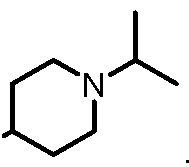
[195] In some embodiments, a compound of Formula (II-C) is a compound of the formula:

 some embodiments, a compound of Formula (II-C) is a compound of the formula:


CH3; R8 is hydrogen; R50 is hydrogen; and R7 is selected from
 In some embodiments, R3 is selected from hydrogen and -CI C: R8 is hydrogen; R50 is fluoro; and R7 is selected from
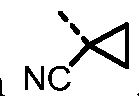
 In some embodiments, R3 is hydrogen; R8 is hydrogen; R50 is selected from hydrogen and fluoro; and R7 is selected from
 In some embodiments, R3 is hydrogen;
R8 is hydrogen; R50 is hydrogen; and R7 is selected from
 . In some embodiments, R3 is hydrogen; R8 is hydrogen; R50 is fluoro; and R7 is selected from
 ; and
; and
 d from
 In some embodiments, R3 is selected from hydrogen and -CH3; R8 is hydrogen; R50 is selected from hydrogen and fluoro; and R7 is NC . In some embodiments, R3 is selected from
.0 hydrogen and -CH3; R8 is hydrogen; R50 is selected from hydrogen and fluoro; and R7 is
In some embodiments, R3 is selected from hydrogen and -CH3; R8 is hydrogen; R50 is selected from hydrogen and fluoro; and R7 is NC . In some embodiments, R3 is selected from
.0 hydrogen and -CH3; R8 is hydrogen; R50 is selected from hydrogen and fluoro; and R7 is
 O . In some embodiments, R3 is selected from hydrogen and -CI E: R8 is hydrogen; R50 is selected from hydrogen and fluoro; and

[196] Embodiments disclosed herein that refer to a compound of Formula (I), (I-A), (I-B), (I-Bl), (I-B2), (I-C), (I-Cl), (I-C2), (I-C3), (I-D), (I-Dl), (I-D2), (I-E), and/or (I-El) are also intended to apply to a compound of Formula (1-1), (II-B), (II-C), and (III) unless the context of the embodiment clearly dictates otherwise (e.g., the embodiment refers solely to a variable not present in the compound of Formula (1-1), (II-B), (II-C), or (III), such as R1).
[197] In some embodiments, a compound of Formula (I) is a compound of the formula:

 salt or solvate thereof.
[198] In certain aspects, the present disclosure provides a compound of Formula (1-1):
 or a pharmaceutically acceptable salt or solvate thereof, wherein:
 is selected from C5.7 carbocycle and 5- to 7-membered heterocycle, each of which is optionally substituted with one or more R11;
 is absent or selected from C3.8 carbocycle and 3- to 8-membered heterocycle, each of which is optionally substituted with one or more Rl la;
L1 is selected from a bond, Ci-6 alkylene, and Ci-6 haloalkylene:
L2 is selected from C5.25 alkylene, C5.25 alkenylene, C5.25 alkynylene, 5- to 25-membered heteroalkylene, and 5- to 25-membered heteroalkenylene, each of which is optionally substituted with one or more Rl lb, wherein L2 is covalently bound to one of W3, W4, W5, W6, or W7;
W3 is selected from N(R3b), N, C(R3), and C(O);
W4 is selected from N(R4b), N, C(R4), and C(O);
W5 is selected from N(R5b), N, and C(R5);
W6 is selected from C(R6) and C(O);
W7 is C(R7);
R1 is C1.3 alkyl optionally substituted with one or more Rllc;
R8 is selected from hydrogen, halogen, -CN, Ci-e alkyl, C2-6 alkenyl, C2-6 alkynyl, C3-10 carbocycle, 3- to 10- membered heterocycle, -OR12, -SR12, -N(R12)(R13), -C(O)OR12, -OC(O)N(R12)(R13), -N(R14)C(O)N(R12)(R13), - N(R14)C(O)OR15, -N(R14)S(O)2R15, -C(O)R15, -S(O)R15, -OC(O)R15, -C(O)N(R12)(R13), -C(O)C(O)N(R12)(R13), - N(R14)C(O)R15, -S(O)2R15, -S(O)2N(R12)(R13), -S(=O)(=NH)N(R12)(R13), -CH2C(O)N(R12)(R13), -
CH2N(R14)C(O)R15, -CH2S(O)2R15, and -CH2S(O)2N(R12)(R13), wherein each Ci.6 alkyl, C2.6 alkenyl, C2.6 alkynyl, C3-10 carbocycle, and 3- to 10-membered heterocycle is independently optionally substituted with one, two, or three R20;
R3, R4, R5, R6, and R7 are each independently selected from a bond to L2, hydrogen, halogen, -CN, Ci-6 alkyl, C2-6 alkenyl, C2.e alkynyl, C3-10 carbocycle, 3- to 10-membered heterocycle, -OR12, -SR12, -N(R12)(R13), - C(O)OR12, -OC(O)N(R12)(R13), -N(R14)C(O)N(R12)(R13), -N(R14)C(O)OR15, -N(R14)S(O)2R15, -C(O)R15, -S(O)R15, - OC(O)R15, -C(O)N(R12)(R13), -C(O)C(O)N(R12)(R13), -N(R14)C(O)R15, -S(O)2R15, -S(O)2N(R12)(R13), - S(=O)(=NH)N(R12)(R13), -CH2C(O)N(R12)(R13), -CH2N(R14)C(O)R15, -CH2S(O)2R15, and -CH2S(O)2N(R12)(R13), wherein each Ci-6 alkyl, C2.e alkenyl, C2.e alkynyl, C3-10 carbocycle, and 3- to 10-membered heterocycle is independently optionally substituted with one, two, or three R20;
R3b, R4b, and R5b are each independently selected from a bond to L2, hydrogen, -CN, Ci-6 alkyl, C2.e alkenyl, C2.e alkynyl, C3-10 carbocycle, 3- to 10-membered heterocycle, -OR12, -SR12, -C(O)OR12, - OC(O)N(R12)(R13), -C(O)R15, -S(O)R15, -OC(O)R15, -C(O)N(R12)(R13), -C(O)C(O)N(R12)(R13), -S(O)2R15, - S(O)2N(R12)(R13), -S(=O)(=NH)N(R12)(R13), -CH2C(O)N(R12)(R13), -CH2N(R14)C(O)R15, -CH2S(O)2R15, and - CH2S(O)2N(R12)(R13), wherein each Ci-6 alkyl, C2.e alkenyl, C2.e alkynyl, C3.10 carbocycle and 3- to 10-membered heterocycle is independently optionally substituted with one, two, or three R20;
R11 and Rlla are each independently selected at each occurrence from halogen, -CN, Ci-6 alkyl, C2.e alkenyl, C2-6 alkynyl, C3-10 carbocycle, 3- to 10-membered heterocycle, -OR12, -SR12, -N(R12)(R13), -C(O)OR12, - OC(O)N(R12)(R13), -N(R14)C(O)N(R12)(R13), -N(R14)C(O)OR15, -N(R14)S(O)2R15, -C(O)R15, -S(O)R15, -OC(O)R15, - C(O)N(R12)(R13), -C(O)C(O)N(R12)(R13), -N(R14)C(O)R15, -S(O)2R15, -S(O)2N(R12)(R13), -S(=O)(=NH)N(R12)(R13), -CH2C(O)N(R12)(R13), -CH2N(R14)C(O)R15, -CH2S(O)2R15, -CH2S(O)2N(R12)(R13), -CH2N(R12)S(O)2(R13), and - P(O)(R17)(R17a), wherein Ci-6 alkyl, C2.e alkenyl, C2.e alkynyl, C3.10 carbocycle, and 3- to 10-membered heterocycle are optionally substituted with one, two, or three R20;
Rllb is independently selected at each occurrence from halogen, oxo, -CN, Ci-6 alkyl, C2.e alkenyl, C2.e alkynyl, C3-10 carbocycle, 3- to 10-membered heterocycle, -OR12, -SR12, -N(R12)(R13), -C(O)OR12, - OC(O)N(R12)(R13), -N(R14)C(O)N(R12)(R13), -N(R14)C(O)OR15, -N(R14)S(O)2R15, -C(O)R15, -S(O)R15, -OC(O)R15, - C(O)N(R12)(R13), -C(O)C(O)N(R12)(R13), -N(R14)C(O)R15, -S(O)2R15, -S(O)2N(R12)(R13), -S(=O)(=NH)N(R12)(R13), -CH2C(O)N(R12)(R13), -CH2N(R14)C(O)R15, -CH2S(O)2R15, -CH2S(O)2N(R12)(R13), -CH2N(R12)S(O)2(R13), and - P(O)(R17)(R17a), wherein Ci-6 alkyl, C2.e alkenyl, C2.e alkynyl, C3-10 carbocycle, and 3- to 10-membered heterocycle are optionally substituted with one, two, or three R20;
Rllc is independently selected at each occurrence from halogen, -OR12, and -N(R12)(R13);
R12 is independently selected at each occurrence from hydrogen, Ci-6 alkyl, Ci-e haloalkyl, C2.e alkenyl, C2.e alkynyl, C3-10 carbocycle, and 3- to 10-membered heterocycle, wherein Ci-6 alkyl, C2.e alkenyl, C2.e alkynyl, C3-10 carbocycle, and 3- to 10-membered heterocycle are optionally substituted with one, two, or three R20;
R13 is independently selected at each occurrence from hydrogen, Ci-6 alkyl, and Ci-6 haloalkyl; or R12 and R13, together with the nitrogen atom to which they are attached, form a 3- to 10-membered heterocycle optionally substituted with one, two, or three R20;
R14 is independently selected at each occurrence from hydrogen, Ci-6 alkyl, and Ci-6 haloalkyl;
R15 is independently selected at each occurrence from Ci-6 alkyl, C2.e alkenyl, C2.e alkynyl, C3-10 carbocycle, and 3- to 10-membered heterocycle, wherein Ci-6 alkyl, C2.e alkenyl, C2.e alkynyl, C3-10 carbocycle, and 3- to 10-membered heterocycle are optionally substituted with one, two, or three R20;
R17 and R17a are each independently selected at each occurrence from Ci-6 alkyl and C3.6 cycloalkyl, wherein Ci-6 alkyl and C3.6 cycloalkyl are optionally substituted with one, two or three R20; or R17 and R17a, together with the phosphorous atom to which they are attached, form a 3- to 10-membered heterocycle;
R20 is independently selected at each occurrence from halogen, oxo, =NH, -CN, Ci-6 alkyl, C2-6 alkenyl, C2- e alkynyl, C3-10 carbocycle, -CH2-(C3-IO carbocycle), 3- to 10-membered heterocycle, -CH2-(3- to 10-membered heterocycle), -OR21, -SR21, -N(R22)(R23), -C(O)OR22, -C(O)N(R22)(R23), -C(O)C(O)N(R22)(R23), -OC(O)N(R22)(R23), -N(R24)C(O)N(R22)(R23), -N(R24)C(O)OR25, -N(R24)C(O)R25, -N(R24)S(O)2R25, -C(O)R25, -S(O)2R25, - S(O)2N(R22)(R23), -OCH2C(O)OR22, and -OC(O)R25, wherein Ci-e alkyl, C2-6 alkenyl, C2-6 alkynyl, C3-10 carbocycle, -CH2-(C3-IO carbocycle), 3- to 10-membered heterocycle, and -CH2-(3- to 10-membered heterocycle) are optionally substituted with one, two, or three groups independently selected from halogen, oxo, =NH, -CN, Ci-6 alkyl, Ci-6 haloalkyl, Ci.6 alkoxy, Ci.6 haloalkoxy, -OR21, -SR21, -N(R22)(R23), -C(O)OR22, -C(O)N(R22)(R23), - C(O)C(O)N(R22)(R23), -OC(O)N(R22)(R23), -N(R24)C(O)N(R22)(R23), -N(R24)C(O)OR25, -N(R24)C(O)R25, - N(R24)S(O)2R25, -C(O)R25, -S(O)2R25, -S(O)2N(R22)(R23), and -OC(O)R25;
R21 is independently selected at each occurrence from H, Ci-6 alkyl, Ci-6 haloalkyl, C2-6 alkenyl, C2-6 alkynyl, C3-10 carbocycle, and 3- to 10-membered heterocycle, wherein C3-10 carbocycle and 3- to 10-membered heterocycle are optionally substituted with one, two, or three groups independently selected from halogen and Ci-6 alkyl;
R22 is independently selected at each occurrence from H, Ci-6 alkyl, Ci-6 haloalkyl, C2-6 alkenyl, C2-6 alkynyl, C3-10 carbocycle, and 3- to 10-membered heterocycle, wherein C3-10 carbocycle and 3- to 10-membered heterocycle are optionally substituted with one, two, or three groups independently selected from halogen and Ci-6 alkyl;
R23 is independently selected at each occurrence from H and Ci-e alkyl;
R24 is independently selected at each occurrence from H and Ci-e alkyl;
R25 is independently selected at each occurrence from Ci-6 alkyl, C2-6 alkenyl, C2-6 alkynyl, C3-10 carbocycle, and 3- to 10-membered heterocycle, wherein Ci-6 alkyl, C3-10 carbocycle, and 3- to 10-membered heterocycle are optionally substituted with one, two, or three groups independently selected from halogen, Ci-e alkyl, Ci-e haloalkyl, Ci-6 alkoxy, C3-10 carbocycle, and 3- to 10-membered heterocycle; and indicates a single or double bond such that all valences are satisfied.
[199] In some embodiments, the compound of Formula (1-1) is a compound of Formula (I-Bl) or (I-B2):
 or a pharmaceutically acceptable salt or solvate thereof.
[200] In some embodiments, the compound of Formula (1-1) is a compound of Formula (I-Cl), (I-C2), or (I-C3):

C3), or a pharmaceutically acceptable salt or solvate thereof.
[201] In some embodiments, for a compound of Formula (1-1), (I-Bl), (I-B2), (I-Cl), (I-C2), or (I-C3), R1 is - CH3. In some embodiments, for a compound of Formula (I- 1), (I-Cl), or (I-C3), R3 is selected from hydrogen, -CN, -OR12, and -CH3. In some embodiments, for a compound of Formula (1-1), (I-B2), or (I-C3), R6 is selected from hydrogen, -OR12, and Ci-6 alkyl optionally substituted with one, two, or three R20, and wherein R12 is selected from Ci-6 alkyl. In some embodiments, for a compound of Formula (1-1), (I-B 1), (I-B2), (I-Cl), (I-C2), or (I-C3), R8 is hydrogen.
[202] In some embodiments, for a compound of Formula (1-1), (I-B 1), (I-B2), (I-Cl), (I-C2), or (I-C3), R7 is selected from Ci-e alkyl, C3-10 cycloalkyl, 3- to 10-membered hetero cyclo alkyl, and -N(R12)(R13), wherein Ci-6 alkyl, C3-10 cycloalkyl, and 3- to 10-membered heterocycloalkyl are optionally substituted with one, two, or three R20. In

[203] In some embodiments, for a compound of Formula (1-1), (I-Bl), (I-B2), (I-Cl), (I-C2), or (I-C3),
 is selected from phenyl and 5- to 7-membered heteroaryl, each of which is optionally substituted with one or more
R11. In some embodiments,
 is selected from
 ,
,
In some embodiments, R11 is independently selected from fluorine and -CH3.
[204] In some embodiments, for a compound of Formula (1-1), (I-Bl), (I-B2), (I-Cl), (I-C2), or (I-C3), L1 is C1.3 haloalkylene. In some embodiments, L1 is selected from -CF2-, -CF2CH2-, and -CF2CH2CH2-.
[205] In some embodiments, for a compound of Formula (1-1), (I-B 1), (I-B2), (I-Cl), (I-C2), or (I-C3),
 is selected from absent, phenyl, and 4- to 8-membered heterocycle, wherein the phenyl and 4- to 8-membered heterocycle are optionally substituted with one or more Rlla. In some embodiments,
 is selected from azetidine, pyrrolidine, and piperidine, each of which is optionally substituted with one or more -CH3.
[206] In some embodiments, for a compound of Formula (1-1), (I-B 1), (I-B2), (I-C 1), (I-C2), or (I-C3), L2 is selected from Ce-is alkylene, Ce-is alkenylene, Ce-is alkynylene, 6- to 15-membered heteroalkylene, and 6- to 15- membered heteroalkenylene, each of which is optionally substituted with one or more Rllb. In some embodiments, L2 is selected from C5-10 alkylene, C5-10 alkenylene, 5- to 10-membered heteroalkylene, and 5- to 10-membered heteroalkenylene, each of which is optionally substituted with one or more Rl lb. In some embodiments, the alkenylene and heteroalkenylene contain one carbon-carbon double bond. In some embodiments, the hetero alkylene and hetero alkenylene comprise at least one oxygen or nitrogen atom.
[207] In some embodiments, for a compound of Formula (1-1), (I-B 1), or (I-B2), R5 is hydrogen; R5b is -CH3; R6 is selected from hydrogen and -OCH3; R7 is selected from Ci-6 alkyl, C3-10 carbocycle, 3- to 10-membered heterocycle, -N(R12)(R13), -C(O)R15, -C(O)N(R12)(R13), -S(O)2R15, and -SO2N(R12)(R13), wherein Ci.6 alkyl, C3-10 carbocycle, and 3- to 10-membered heterocycle are optionally substituted with one, two, or three R20; and R8 is hydrogen.
[208] In some embodiments, for a compound of Formula (1-1), (I-C 1), (I-C2), or (I-C3), R3 is hydrogen or -CH3; R3b is -CH3; R6 is selected from hydrogen and -OCH3; R7 is selected from Ci-6 alkyl, C3-10 carbocycle, 3- to 10- membered heterocycle, -N(R12)(R13), -C(O)R15, -C(O)N(R12)(R13), -S(O)2R15, and -SO2N(R12)(R13), wherein Ci.6 alkyl, C3-10 carbocycle, and 3- to 10-membered heterocycle are optionally substituted with one, two, or three R20; and R8 is hydrogen.
[209] Small molecule SOS1 inhibitors suitable for use in the subject methods — including the synergistic inhibition of proliferation of cancer cells comprising an EGFR exon 20 insertion in combination with an EGFR exon 20 insertion tyrosine kinase inhibitor (TKI) — include compounds of Formula (I); Formula (I-A); Formula (I-B); Formula (1-1), encompassing Compound A; Formula (I-B 1 ); Formula (I-B2); Formula (I-C); Formula (I-C 1); Formula (I-C2); Formula (I-C3); Formula (I-D); Formula (I-Dl); Formula (I-D2); Formula (I-E); Formula (I-El); Formula (II-B); Formula (II-C); and Formula (III). Exemplary small molecule S0S1 inhibitors include, but are not limited to, compounds selected from Table 1 (including Compound A), or a salt or solvate thereof.
[210] In some embodiments, a compound disclosed herein, such as a compound of Formula (I), (I-A), (I-B), (1-1), (I-Bl), (I-B2), (I-C), (I-Cl), (I-C2), (I-C3), (I-D), (I-Dl), (I-D2), (I-E), (I-El), (II-B), (II-C), or (III), is provided as a substantially pure stereoisomer. In some embodiments, the stereoisomer is provided in at least 80% enantiomeric excess, such as at least 85%, at least 90%, at least 95%, at least 96%, at least 97%, at least 98%, at least 99%, or at least 99.9% enantiomeric excess.
[211] In some embodiments, the compounds described herein exist as their pharmaceutically acceptable salts. In some embodiments, the methods disclosed herein include methods of treating diseases by administering such pharmaceutically acceptable salts. In some embodiments, the methods disclosed herein include methods of treating diseases by administering such pharmaceutically acceptable salts as pharmaceutical compositions.
[212] In some embodiments, the compounds described herein possess acidic or basic groups and therefore react
with any of a number of inorganic or organic bases or inorganic or organic acids to form a pharmaceutically acceptable salt. In some embodiments, such salts are prepared in situ during the final isolation and purification of the compounds described herein, or by separately reacting a purified compound in its free form with a suitable acid or base, and isolating the salt thus formed.
[213] In some embodiments, the compounds described herein exist as solvates. In some embodiments are methods of treating diseases by administering such solvates. Further described herein are methods of treating diseases by administering such solvates as pharmaceutical compositions.
[214] Solvates contain either stoichiometric or non-stoichiometric amounts of a solvent, and, in some embodiments, are formed during the process of crystallization with pharmaceutically acceptable solvents such as water, ethanol, and the like. Hydrates are formed when the solvent is water, or alcoholates are formed when the solvent is alcohol. Solvates of the compounds described herein are conveniently prepared or formed during the processes described herein. By way of example only, hydrates of the compounds described herein are conveniently prepared by recrystallization from an aqueous/organic solvent mixture, using organic solvents including, but not limited to, dioxane, tetrahydrofuran, or MeOH. In addition, the compounds provided herein exist in unsolvated as well as solvated forms. In general, the solvated forms are considered equivalent to the unsolvated forms for the purposes of the compounds and methods provided herein.
[215] The chemical entities described herein can be synthesized according to one or more illustrative schemes herein and/or techniques known in the art. Materials used herein are either commercially available or prepared by synthetic methods generally known in the art. These schemes are not limited to the compounds listed in the examples or by any particular substituents, which are employed for illustrative purposes. Although various steps are described and depicted in Schemes 1-8, the steps in some cases may be performed in a different order than the order shown in Schemes 1-8. Various modifications to these synthetic reaction schemes may be made and will be suggested to one skilled in the art having referred to the present disclosure. Numberings or R groups in each scheme typically have the same meanings as those defined elsewhere herein unless otherwise indicated.
[216] Unless specified to the contrary, the reactions described herein take place at atmospheric pressure, generally within a temperature range from -10 °C to 200 °C. Further, except as otherwise specified, reaction times and conditions are intended to be approximate, e.g., taking place at about atmospheric pressure within a temperature range of about -10 °C to about 110 °C over a period of about 1 to about 24 hours; reactions left to run overnight average a period of about 16 hours.
[217] In general, compounds of the disclosure may be prepared by the following reaction schemes:
Scheme 1

[218] In some embodiments, a compound of Formula le may be prepared according to Scheme 1. For example,
heteroaryl amine lb can be formed from chloride la via a nucleophilic aromatic substitution reaction. Substitution of the lactam can proceed under basic conditions to give diene 1c, which can undergo a cross metathesis reaction — such as Grubbs cross metathesis reaction — to form macrocycle Id. Optionally, Id may be subjected to one or more subsequent reactions, such as a hydrogenation reaction, to provide a compound of Formula le.
Scheme 2

[219] Similarly, in some embodiments, a compound of Formula 2e may be prepared according to Scheme 2. For example, heteroaryl amine 2b can be formed from chloride 2a via a nucleophilic aromatic substitution reaction. Substitution of the lactam can proceed under basic conditions to give diene 2c, which can undergo a cross metathesis reaction — such as Grubbs cross metathesis reaction — to form macrocycle 2d. Optionally, 2d may be subjected to one or more subsequent reactions, such as a hydrogenation reaction, to provide a compound of Formula 2e.
Scheme 3

[220] In some embodiments, a compound of Formula 3e may be prepared according to Scheme 3. For example, heteroaryl amine 3b can be formed from chloride 3a via a substitution reaction. Substitution of the lactam can give protected amine 3c. Hydrolysis of the ester can form carboxylic acid 3d, which can undergo deprotection and peptide coupling reactions to afford macrocycle of Formula 3e.
Scheme 4
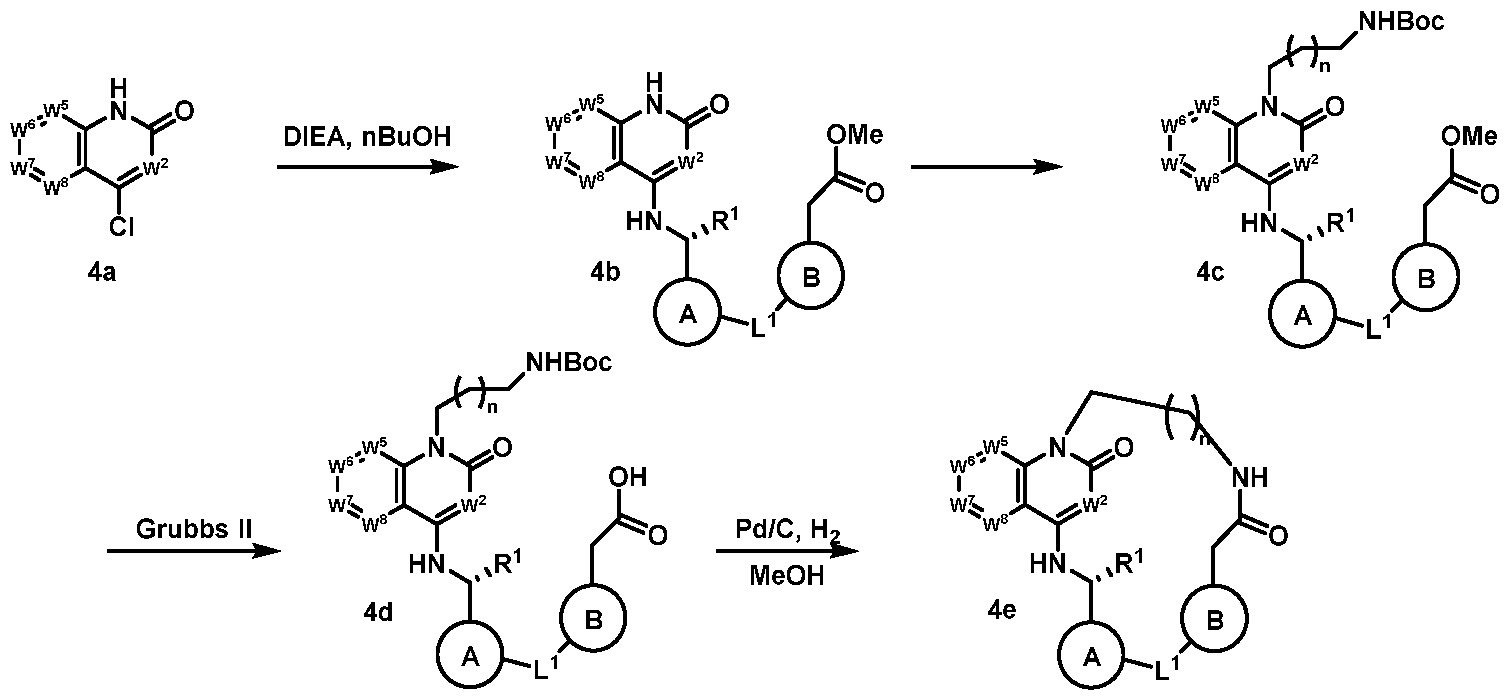
[221] Similarly, in some embodiments, a compound of Formula 4e may be prepared according to Scheme 4. For example, heteroaryl amine 4b can be formed from chloride 4a via a substitution reaction. Substitution of the lactam can give protected amine 4c. Hydrolysis of the ester can form carboxylic acid 4d, which can undergo deprotection and peptide coupling reactions to afford a macrocycle of Formula 4e.
Scheme 5

[222] In some embodiments, a compound of Formula 5g may be prepared according to Scheme 5. For example, heteroaryl amine 3c can be formed by coupling chloride 5a with amine 5b. Oxidation of the alcohol can give aldehyde 5d, which can be followed with substitution of the phenol to give 5e. Removal of the amine protecting group can afford 5f, which can undergo a reductive amination to form a macrocycle of Formula 5g.
Scheme 6

[223] In some embodiments, a compound of Formula 6f may be prepared according to Scheme 6. For example,
heteroaryl amine 6c can be formed by coupling chloride la with amine 6b. Substitution of the phenol to olefin 6d can be followed by installation of a second olefin to give diene 6e. A cross metathesis reaction — such as Grubbs cross metathesis reaction — can be followed by hydrogenation of the resulting double bond to provide a macrocycle of Formula 6f.
Scheme 7

[224] In some embodiments, a compound of Formula 7e may be prepared according to Scheme 7. For example, heteroaryl amine 7b can be formed by coupling chloride 7a with amine 5b. Substitution of the phenol can give 7c. Ester hydrolysis and deprotection of the amine can give 7d, which can be cyclized to form a macrocycle of Formula 7e via a peptide coupling reaction.
Scheme 8

[225] In some embodiments, a compound of Formula 8g may be prepared according to Scheme 8. For example, substitution of lactam 8a with a suitable bromo dioxolane (8b) can give acetal 8c. Nucleophilic aromatic substitution with amine 8d can provide heteroaryl amine 8e, which can be treated with a suitable acid, such as HC1, to remove the Boc protecting group and reveal the aldehyde. Finally, cyclization of 8f can proceed via reductive amination conditions to give a macrocycle of Formula 8g.
[226] Synthetic procedures for certain compounds may be found in PCT/US2022/018584, U.S. Pat. No.
11,648,254, PCT/US2023/065963, and U.S. App. No. 18/328,109, each of which is incorporated by reference in its entirety, including any compounds, formulas, recitations of compound variables, and synthetic methods disclosed therein. In some embodiments, a SOS1 inhibitor of the present disclosure is a compound described in U.S. Pat. No.
11,648,254, which is incorporated herein by reference in its entirety. In some embodiments, a SOS1 inhibitor of the present disclosure is a compound described in U.S. Pat. No. 11,912,708, which is incorporated herein by reference
in its entirety.
[227] In some embodiments, a compound of the present disclosure, for example, a compound of a formula given in Table 1, was synthesized according to one of the general routes outlined in Schemes 1-8 or by methods generally known in the art. In some embodiments, exemplary compounds may include, but are not limited to, a compound selected from Table 1, or a salt or solvate thereof.
Table 1
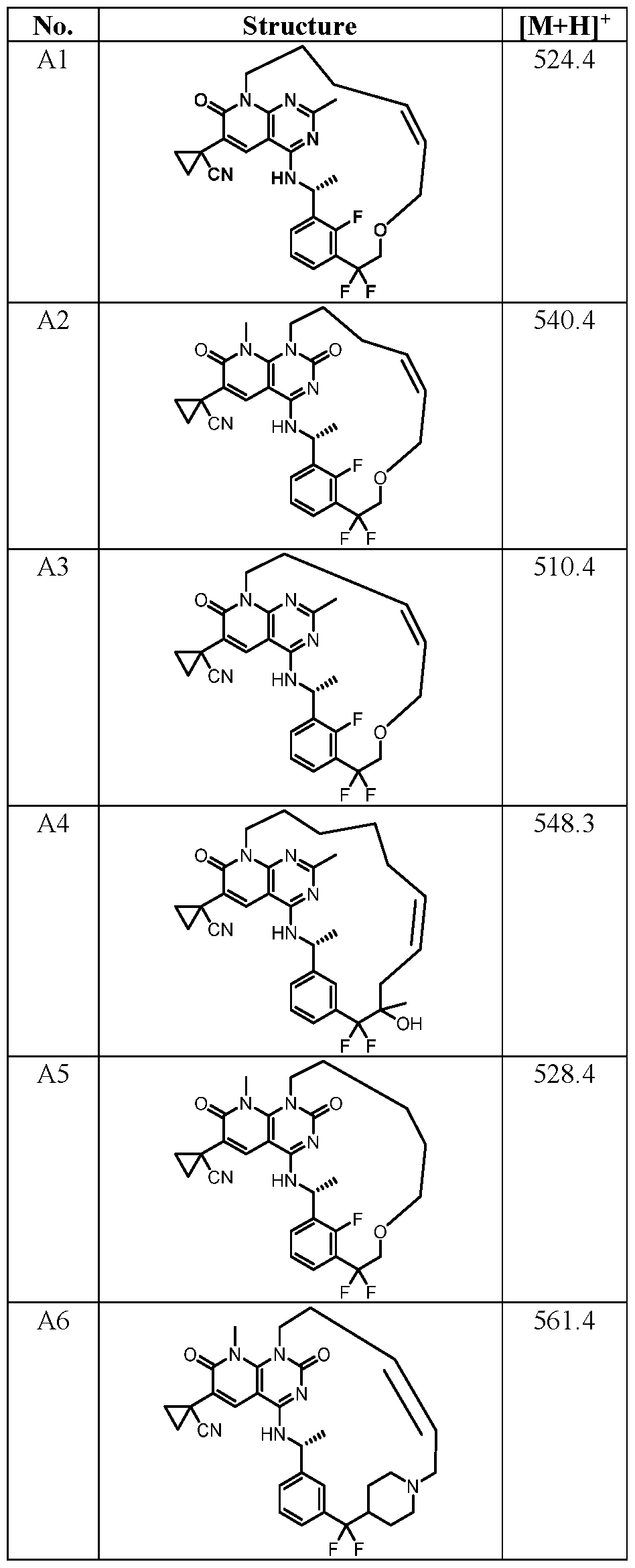


[228] In some embodiments, the compounds of the present disclosure exhibit one or more functional characteristics described herein. For example, a subject compound is capable of reducing Ras signaling output. In some instances, a subject compound is capable of disrupting a Ras-SOS interaction, including disrupting interaction or binding between a mutant Kras (e.g., Kras G12C) and SOS1 , or between a wildtype Kras and SOS1, thereby reducing Ras signaling output. In some embodiments, a subject compound binds specifically to a SOS protein, including SOS1. In some embodiments, the IC50 of a subject compound (including those shown in Table 1) for a SOS protein is less than about 5 pM, less than about 1 pM, less than about 50 nM, less than about 10 nM, less than about 1 nM, less than about 0.5 nM, less than about 100 pM, or less than about 50 pM, as measured in an in vitro assay known in the art or exemplified herein.
[229] A reduction in Ras signaling output can be evidenced by one or more members of the following: (i) an increase in steady state level of GDP -bound Ras protein; (ii) a reduction in steady state level of GTP-bound Ras protein; (iii) a reduction of phosphorylated AKTs473, (iv) a reduction of phosphorylated ERKT202/y204, (v) a reduction of phosphorylated S6S235/236, (vi) reduction (e.g., inhibition) of cell growth of Ras-driven tumor cells (e.g., those derived from a tumor cell line disclosed herein), and (vii) an interference or disruption of the interaction or binding between a SOS protein (e.g., SOS1) with a Ras protein such as a wildtype or a mutant Ras. In some cases, the reduction in Ras signaling output can be evidenced by two, three, four, five, six, or all of (i)-(vii) above.
[230] It shall be understood that different aspects of the invention can be appreciated individually, collectively, or in combination with each other. Various aspects of the invention described herein may be applied to any of the particular applications disclosed herein. The compositions of matter including compounds of any formulae disclosed herein in the compounds section of the present disclosure may be utilized in the methods section including methods of use and production disclosed herein, or vice versa.
Kits
[231] Another aspect of the present disclosure provides a kit for use in reducing proliferation of cancer cells comprising an EGFR mutation, such as an EGFR exon 20 insertion. Typically, the kit comprises: (1) a composition comprising a SOS1 inhibitor of Formula (I), (I-A), (I-B), (1-1), (I-Bl), (I-B2), (I-C), (I-Cl), (I-C2), (I-C3), (I-D), (I- Dl), (I-D2), (I-E), (I-El), (II-B), (II-C), or (III); (2) a composition comprising a small molecule EGFR exon 20 insertion TKI; and (3) instructions for using the composition(s) of (1) and (2). In some embodiments, the small molecule SOS1 inhibitor is a compound described in Table 1, or a pharmaceutically acceptable salt or solvate
thereof. In some embodiments, instructions for contacting the cells in vitro, ex vivo, or in vivo are provided. In some embodiments, the SOS1 inhibitor and the small molecule EGFR exon 20 insertion TKI are formulated in the same unit dosage form. In some embodiments, the S0S1 inhibitor and the small molecule EGFR exon 20 insertion TKI are formulated in different unit dosage forms. In some embodiments, the kit can comprise a multi-day supply, including instructions directing the multi-day administration.
Pharmaceutical compositions and methods of administration
[232] In certain aspects, the present disclosure provides a pharmaceutical composition comprising a compound described herein, or a pharmaceutically acceptable salt or solvate thereof, and a pharmaceutically acceptable excipient.
[233] A compound of Formula (I), (I-A), (I-B), (1-1), (I-Bl), (I-B2), (I-C), (I-Cl), (I-C2), (I-C3), (I-D), (I-Dl), (I- D2), (I-E), (I-El), (II-B), (II-C), or (III), or a pharmaceutically acceptable salt or solvate thereof, may be administered to a subject in a biologically compatible form suitable for administration to treat or prevent a disease, disorder or condition. A compound described herein may be administered in any pharmacological form including a therapeutically effective amount of a compound of Formula (I), (I-A), (I-B), (1-1), (I-B 1), (I-B2), (I-C), (I-C 1), (I- C2), (I-C3), (I-D), (I-Dl), (I-D2), (I-E), (I-El), (II-B), (II-C), or (III), or a pharmaceutically acceptable salt or solvate thereof, alone or in combination with a pharmaceutically acceptable carrier. In some embodiments, the present disclosure provides a pharmaceutical composition comprising a pharmaceutically acceptable excipient and a compound of Formula (I), (I-A), (I-B), (1-1), (I-Bl), (I-B2), (I-C), (I-Cl), (I-C2), (I-C3), (I-D), (I-Dl), (I-D2), (I-E), (I-El), (II-B), (II-C), or (III), or a pharmaceutically acceptable salt or solvate thereof.
[234] In some embodiments, a compound described herein is administered as a pure chemical. In some embodiments, a compound described herein is combined with a pharmaceutically suitable or acceptable carrier (also referred to herein as a pharmaceutically suitable (or acceptable) excipient, physiologically suitable (or acceptable) excipient, or physiologically suitable (or acceptable) carrier) selected on the basis of a chosen route of administration and standard pharmaceutical practice as described, for example, in Remington: The Science and Practice of Pharmacy (Gennaro, 21st Ed. Mack Pub. Co., Easton, PA (2005)).
[235] Accordingly, provided herein is a pharmaceutical composition comprising at least one compound described herein, or a pharmaceutically acceptable salt, together with one or more pharmaceutically acceptable excipients. The excipient(s) (or carrier(s)) is acceptable or suitable if the excipient is compatible with the other ingredients of the composition and not deleterious to the recipient of the composition.
[236] In practicing any of the subject methods, the compounds described herein may be administered either alone or in combination with pharmaceutically acceptable carriers, excipients or diluents, in a pharmaceutical composition. Administration of the compounds and compositions described herein can be effected by any method that enables delivery of the compounds to the site of action. These methods include, though are not limited to delivery via enteral routes (including oral, gastric or duodenal feeding tube, rectal suppository and rectal enema), parenteral routes (injection or infusion, including intraarterial, intracardiac, intradermal, intraduodenal, intramedullary, intramuscular, intraosseous, intraperitoneal, intrathecal, intravascular, intravenous, intravitreal, epidural and subcutaneous), inhalational, transdermal, transmucosal, sublingual, buccal and topical (including epicutaneous, dermal, enema, eye drops, ear drops, intranasal, vaginal) administration, although the most suitable route may depend upon, for example, the condition and disorder of the recipient. By way of example only, a compound described herein can be administered locally to the area in need of treatment, by for example, local infusion during surgery, topical application such as creams or ointments, injection, catheter, or implant. The
administration can also be by direct injection at the site of a diseased tissue or organ. In some embodiments, a compound described herein is administered orally.
[237] In practicing any of the subject methods, a pharmaceutical composition suitable for oral administration may be presented as a discrete unit such as a capsule, cachet or tablet, each containing a predetermined amount of the active ingredient; as a powder or granules; as a solution or a suspension in an aqueous liquid or a non-aqueous liquid; or as an oil-in-water liquid emulsion or a water-in-oil liquid emulsion. In some embodiments, the active ingredient is presented as a bolus, electuary or paste.
[238] Pharmaceutical compositions which can be used orally include tablets, push-fit capsules made of gelatin, as well as soft, sealed capsules made of gelatin and a plasticizer, such as glycerol or sorbitol. Tablets may be made by compression or molding, optionally with one or more accessory ingredients. Compressed tablets may be prepared by compressing in a suitable machine the active ingredient in a free -flowing form such as a powder or granules, optionally mixed with binders, inert diluents, or lubricating, surface active or dispersing agents. Molded tablets may be made by molding in a suitable machine a mixture of the powdered compound moistened with an inert liquid diluent. In some embodiments, the tablets are coated or scored and are formulated so as to provide slow or controlled release of the active ingredient therein. All formulations for oral administration should be in dosages suitable for such administration. The push-fit capsules can contain the active ingredients in admixture with filler such as lactose, binders such as starches, and/or lubricants such as talc or magnesium stearate and, optionally, stabilizers. In soft capsules, the active compounds may be dissolved or suspended in suitable liquids, such as fatty oils, liquid paraffin, or liquid polyethylene glycols. In some embodiments, stabilizers are added. Dragee cores are provided with suitable coatings. For this purpose, concentrated sugar solutions may be used, which may optionally contain gum arabic, talc, polyvinyl pyrrolidone, carbopol gel, polyethylene glycol, and/or titanium dioxide, lacquer solutions, and suitable organic solvents or solvent mixtures. Dyestuffs or pigments may be added to the tablets or Dragee coatings for identification or to characterize different combinations of active compound doses.
[239] In some embodiments, a pharmaceutical composition is formulated for parenteral administration by injection, e.g., by bolus injection or continuous infusion. Formulations for injection may be presented in unit dosage form, e.g., in ampoules or in multi-dose containers, with an added preservative. The compositions may take such forms as suspensions, solutions or emulsions in oily or aqueous vehicles, and may contain formulatory agents such as suspending, stabilizing and/or dispersing agents. The compositions may be presented in unit-dose or multi-dose containers, for example sealed ampoules and vials, and may be stored in powder form or in a freeze-dried (lyophilized) condition requiring only the addition of the sterile liquid carrier, for example, saline or sterile pyrogen- free water, immediately prior to use. Extemporaneous injection solutions and suspensions may be prepared from sterile powders, granules and tablets of the kind previously described.
[240] Pharmaceutical compositions for parenteral administration include aqueous and non-aqueous (oily) sterile injection solutions of the active compounds which may contain antioxidants, buffers, bacteriostats and solutes which render the formulation isotonic with the blood of the intended recipient; and aqueous and non-aqueous sterile suspensions which may include suspending agents and thickening agents. Suitable lipophilic solvents or vehicles include fatty oils such as sesame oil, or synthetic fatty acid esters, such as ethyl oleate or triglycerides, or liposomes. Aqueous injection suspensions may contain substances which increase the viscosity of the suspension, such as sodium carboxymethyl cellulose, sorbitol, or dextran. Optionally, the suspension may also contain suitable stabilizers or agents which increase the solubility of the compounds to allow for the preparation of highly concentrated solutions.
[241] Pharmaceutical compositions may also be formulated as a depot preparation. Such long-acting formulations may be administered by implantation (for example subcutaneously or intramuscularly) or by intramuscular injection. Thus, for example, the compounds may be formulated with suitable polymeric or hydrophobic materials (for example, as an emulsion in an acceptable oil) or ion exchange resins, or as sparingly soluble derivatives, for example, as a sparingly soluble salt.
EXAMPLES
[242] The following examples are provided for illustrative purposes only and not to limit the scope of the claims provided herein.
[243] Example 1: Sequences
[244] Human K-Ras4b (SEQ ID NO. 1 ) :
1 MTEYKL VVVG AGGVGKSALT IQLIQNHFVD EYDPTIEDSY RKQ WIDGET
51 CLLDILDTAG QEEYSAMRDQ YMRTGEGFLC VFAINNTKSF EDIHHYREQI
101 KRVKDSEDVP MVLVGNKCDL PSRTVDTKQA QDLARSYGIP FIETSAKTRQ
151 GVDDAFYTLV REIRKHKEKM SKDGKKKKKK SKTKCVIM
[245] Human SOS1 (SEQ ID NO. 2):
1 MQAQQLPYEF FSEENAPKWR GLLVPALKKV QGQVHPTLES NDDALQYVEE
51 LILQLLNMLC QAQPRSASDV EERVQKSFPH PIDKWAIADA QSAIEKRKRR
101 NPLSLPVEKI HPLLKEVLGY KIDHQVSVYI VAVLEYISAD ILKLVGNYVR
151 NIRHYEITKQ DIKVAMCADK VLMDMFHQDV EDINILSLTD EEPSTSGEQT
201 YYDLVKAFMA EIRQYIRELN LIIKVFREPF VSNSKLFSAN DVENIFSRIV
251 DIHELSVKLL GHIEDTVEMT DEGSPHPLVG SCFEDLAEEL AFDPYESYAR
301 DILRPGFHDR FLSQLSKPGA ALYLQSIGEG FKEAVQYVLP RLLLAPVYHC 351 LHYFELLKQL EEKSEDQEDK ECLKQAITAL LNVQSGMEKI CSKSLAKRRL 401 SESACRFYSQ QMKGKQLAIK KMNEIQKNID GWEGKDIGQC CNEFIMEGTL 451 TRVGAKHERH IFLFDGLMIC CKSNHGQPRL PGASNAEYRL KEKFFMRKVQ 501 INDKDDTNEY KHAFEIILKD ENSVIFSAKS AEEKNNWMAA LISLQYRSTL 551 ERMLDVTMLQ EEKEEQMRLP SADVYRFAEP DSEENIIFEE NMQPKAGIPI 601 IKAGTVIKLI ERLTYHMYAD PNFVRTFLTT YRSFCKPQEL LSLIIERFEI 651 PEPEPTEADR IAIENGDQPL SAELKRFRKE YIQPVQLRVL NVCRHWVEHH 701 FYDFERDAYL LQRMEEFIGT VRGKAMKKWV ESITKIIQRK KIARDNGPGH 751 NITFQSSPPT VEWHISRPGH IETFDLLTLH PIEIARQLTL LESDLYRAVQ 801 PSELVGSVWT KEDKEINSPN LLKMIRHTTN LTLWFEKCIV ETENLEERVA
851 WSRIIEILQ VFQELNNFNG VLEWSAMNS SPVYRLDHTF EQIPSRQKKI
901 LEEAHELSED HYKKYLAKLR SINPPCVPFF GIYLTNILKT EEGNPEVLKR
951 HGKELINFSK RRKVAEITGE IQQYQNQPYC LRVESDIKRF FENLNPMGNS
1001 MEKEFTDYLF NKSLEIEPRN PKPLPRFPKK YS YPLKSPGV RPSNPRPGTM
1051 RHPTPLQQEP RKISYSRIPE SETESTASAP NSPRTPLTPP PASGASSTTD
1101 VCSVFDSDHS SPFHSSNDTV FIQVTLPHGP RSASVSSISL TKGTDEVPVP
1151 PPVPPRRRPE SAPAESSPSK IMSKHLDSPP AIPPRQPTSK AYSPRYSISD 1201 RTSISDPPES PPLLPPREPV RTPDVFSSSP LHLQPPPLGK KSDHGNAFFP 1251 NSPSPFTPPP PQTPSPHGTR RHLPSPPLTQ EVDLHSIAGP PVPPRQSTSQ
1301 HIPKLPPKTY KREHTHPSMH RDGPPLLENA HSS
[246] Example 2: SOS purification
[247] A SOS construct or a variant thereof is His-tagged. E. coli cultures are induced in a fermenter, harvested, and lysed in lysis buffer, for example, in 25 mM Tris HC1 7.5, 500 mM NaCl, 20 mM Imidazol, Complete EDTA- free (Roche)). For immobilized metal ion affinity chromatography (IMAC), the centrifuged lysate (50,000 x g, 45 min, 40) is incubated with 30 mL Ni-NTA (Macherey -Nagel; #745400.100) in a spinner flask (16 h, 40) and subsequently transferred to a chromatography column connected to a chromatography system, e.g., an Akta chromatography system. The column is rinsed with wash buffer, e.g., in 25 mM Tris HC1 7.5, 500 mM NaCl, 20 mM Imidazol and the bound protein is eluted with a linear gradient (0-100%) of elution buffer (25 mM Tris HC1 7.5, 500 mM NaCl, 300 mM Imidazol). The main fractions of the elution peak (monitored by OD280) containing homogenous HislO-hSOS is pooled.
[248] Example 3: Ras-SOS interaction assay
[249] The ability of any compound of the present disclosure to reduce a Ras protein signaling output by, e.g., interfering or disrupting interaction (or binding) between SOS1 and a Ras protein can be assessed in vitro. For example, the equilibrium interaction of human SOS1 (hSOSl) with human wildtype Kras or K-Ras mutant (e.g., hK-Ras G12C mutant, or hK-Ras G12C) can be assessed as a proxy or an indication for a subject compound’s ability to inhibit SOS. Detection of such interaction is achieved by measuring homogenous time-resolved fluorescence resonance energy transfer (HTRF) from (i) a fluorescence resonance energy transfer (FRET) donor (e.g., antiGST-Europium) that is bound to GST-tagged K-Ras G12C to (ii) a FRET acceptor (e.g., anti-6His-XL665) bound to a His-tagged hSOSl .
[250] The assay buffer can contain 5 mM HEPES pH 7.4, 150 mM NaCl, 10 mM EDTA, 1 mM DTT, 0.05% BSA, 0.0025% (v/v) Igepal and 100 mM KF. A Ras working solution is prepared in assay buffer containing typically 10 nM of the protein construct (e.g., GST-tagged hK-Ras G12C) and 2 nM of the FRET donor (e.g., antiGST-Eu(K) from Cisbio, France). A SOS1 working solution is prepared in assay buffer containing typically 10 nM of the protein construct (e.g., His-hSOSl) and 10 nM of the FRET acceptor (e.g., anti-6His-XL665 from Cisbio, France). An inhibitor control solution is prepared in assay buffer containing 10 nM of the FRET acceptor without the SOS1 protein.
[251] A fixed reaction mixture with or without test compound is transferred into a 384-well plate. Ras working solution is added to all wells of the test plate. SOS1 working solution is added to all wells except for those that are subsequently filled with the inhibitor control solution. After approximately 60 min incubation, the fluorescence is measured with a MIOOOPro plate reader (Tecan) using HTRF detection (excitation 337 nm, emission 1 : 620nm, emission 2: 665nm). Compounds are tested in duplicate at different concentrations (for example, 10 pM, 2.5 pM, 0.63 pM, 0.16 pM, 0.04 pM, 0.01 pM test compound). The ratiometric data (i.e., emission 2 divided by emission 1) is used to calculate IC50 values against SOS1 using GraphPad Prism (GraphPad software).
[252] Example 4: Ras-SOS cellular growth inhibition assay
[253] The ability of any compound of the present disclosure to inhibit SOS 1 -mediated signaling and hence Ras protein signaling can be demonstrated by inhibiting growth of a given Kras mutant cell line.
[254] Growth of cells with K-Ras G12C mutation: MIA PaCa-2 (ATCC CRL-1420) and NCI-H1792 (ATCC CRL-5895) cell lines comprise a G12C mutation and can be used to assess Ras cellular signaling in vitro, e.g., in response to a subject compound of the present disclosure. This cellular assay can also be used to discern selective inhibition of subject compounds against certain types of Kras mutants, e.g., more potent inhibition against Kras
G12D relative to Kras G12C mutant, by using MIA PaCa-2 (G12C driven tumor cell line) as a comparison. Cell culture medium (comprising, for example, MIA PaCa-2 cells) is prepared with DMEM/Ham's F12 (e.g., with stable Glutamine, 10% FCS, and 2.5% Horse Serum). NCI-H1792 culture medium is prepared with RPMI 1640 (e.g., with stable Glutamine) and 10% FCS. A CellTiter-Glo (CTG) luminescent based assay (Promega) is used to assess growth of the cells, as a measurement of the ability of the compounds herein to inhibit Ras signaling in the cells. The cells (e.g., 800-1200 per well) are seeded in their respective culture medium in standard tissue culture -treated ultra-low attachment surface 96-well format plates (Coming Costar #3474). The day after plating, cells are treated with a dilution series (e.g., a 9 point 3-fold dilution series) of the compounds herein (e.g., approximately 125 pl, final volume per well). Cell viability can be monitored (e.g., approximately 5 days later) according to the manufacturer’s recommended instructions, where the CellTiter-Glo reagent is added (e.g., approximately 65 pL), vigorously mixed, covered, and placed on a plate shaker (e.g., approximately for 20 min) to ensure sufficient cell lysis prior to assessment of luminescent signal. The IC50 values are determined using the four-parameter fit. The resulting IC50 value is a measurement of the ability of the compounds herein to reduce cell growth of Ras-driven cells as representative tumor cells.
[255] Example 5: Inhibition of cell proliferation using SOS1 inhibitors alone and in combination with small molecule EGFR exon 20 insertion TKIs
[256] A variety of EGFR mutant cell lines are available commercially, including Ba/F3-EGFR_Ex20_ASV insertion cells. These exemplary cells can be maintained in a humidified incubator at 37 °C with 5% CO2 and grown in RPMI 1640 with 10% FBS (Gibco) and 50 IU mL'1 penicillin/streptomycin (Gibco). For comparison of antigrowth activity, a CellTiter-Glo (CTG) luminescent based assay (Promega) is used. Cells (-300-1,200 per well) are seeded (using the same media) in standard tissue culture-treated 384-well format plates. The day after plating, cells are treated with a 9 point, 3-fold dilution series of indicated compounds (40 pl , final volume per well) and growth inhibition is monitored -72 hours later (for BaF/3 EGFR mutant lines) or 5 days later for other cell lines according to the manufacturer’s recommended instructions, where 20 pl, of CellTiter-Glo reagent is added, vigorously mixed, covered, and placed on a plate shaker for 20 min to ensure complete cell lysis prior to assessment of luminescent signal. Growth inhibition of cells treated with a SOS 1 inhibitor of the present disclosure in combination with a small molecule EGFR exon 20 insertion TKI are monitored as stated above. FIG. 1 shows that a SOS1 inhibitor of the present disclosure (Compound A) is effective in inhibiting EGFR_Ex20ins mutant cells in a dose dependent manner. FIG. 2A and FIG. 2B show that a SOS1 inhibitor of the present disclosure (Compound A) in combination with mobocertinib synergistically inhibits cell growth of EGFR exon 20 insertion cells. FIG. 3 A and FIG. 3B show that a SOS1 inhibitor of the present disclosure (Compound A) in combination with afatinib synergistically inhibits cell growth of EGFR exon 20 insertion cells. FIG. 4A and FIG. 4B show that a SOS1 inhibitor of the present disclosure (Compound A) in combination with lazertinib synergistically inhibits cell growth of EGFR exon 20 insertion cells.
[257] Example 6: Inhibition of tumor growth in EGFR exon 20 insertion animal model
[258] Mice are maintained under specific pathogen-free conditions, and food and water are provided ad libitum. For PDX models, BALB/c nude (NCr) mice are implanted with respective tumor fragments (2-3 mm in diameter) on the flank. To inoculate Ba/F3 EGFR mutant cell lines, 1 x 10⁶ cells are harvested on the day of use and injected in growth-factor-reduced Matrigel/PBS (50% final concentration in 100 pL). One flank is inoculated subcutaneously per mouse. Mice are monitored daily, weighed twice weekly, and caliper measurements begin when tumors become visible. Animals are randomly assigned to treatment groups by an algorithm that assigns animals to groups to achieve best case distributions of mean tumor size with lowest possible standard deviation. Tumor volume is
calculated by measuring two perpendicular diameters using the following formula: (L x w 2) / 2, in which L and w refer to the length and width of the tumor diameter, respectively. When tumors reach an average size of 100-200 mm3, mice are randomized and treated with vehicle or indicated compounds using the reported schedule. Results are expressed as mean and standard deviation of the mean. No apparent toxicity or body weight loss was observed. FIG. 5 and FIG. 6 show that a SOS1 inhibitor of the present disclosure (Compound A) synergistically inhibits tumor growth in combination with mobocertinib in EGFR exon 20 insertion lung cancer. FIG. 7 shows that a S0S1 inhibitor of the present disclosure (Compound A) synergistically inhibits tumor growth in combination with sunvozertinib in EGFR exon 20 insertion lung cancer.
Claims
1. A method of treating a cancer comprising an EGFR exon 20 insertion mutation in a subject, the method comprising administering to the subject (a) a SOS1 inhibitor.
2. The method of claim 1, wherein the cancer is lung cancer.
3. The method of claim 2, wherein the lung cancer is a non-small cell lung cancer.
4. The method of any one of the preceding claims, wherein the subject exhibits relapse of the cancer.
5. The method of any one of the preceding claims, wherein the subject has previously been treated with chemotherapy.
6. The method of any one of the preceding claims, wherein the subject has previously been treated with platinum-based chemotherapy.
7. The method of any one of the preceding claims, wherein the subject has previously been treated with a tyrosine kinase inhibitor (TKI) against EGFR prior to administering (a).
8. The method of claim 7, wherein the subject has previously been treated with a non-exon 20 insertion EGFR TKI.
9. The method of claim 8, wherein the non-exon 20 insertion EGFR TKI is selected from gefitinib, erlotinib, afatinib, lazertinib, osimertinib, dacomitinib, neratinib, cetuximab, panitumumab, lapatinib, necitumumab, nazartinib, vandetanib, BLU-945, and zorifertinib.
10. The method of claim 7, wherein the subject has previously been treated with an EGFR exon 20 insertion TKI.
11. The method of claim 10, wherein the EGFR exon 20 insertion TKI is selected from poziotinib, mobocertinib, amivantamab, zipalertinib, sunvozertinib, BAY-2927088, BLU-451, and STX-721.
12. The method of any one of claims 7 to 11, wherein the subject exhibits resistance or intolerance to the TKI.
13. The method of claim 12, wherein resistance to the TKI is characterized by one or more changes selected from (1) progression of the cancer, (2) EGFR gene mutation, (3) loss of EGFR T790M mutation, (4) EGFR gene amplification, (5) MET amplification, (6) HER2 amplification, (7) RAS-MAPK pathway activation, (8) PI3K pathway activation, (9) cell-cycle gene alteration, (10) oncogenic fusion, (11) histologic transformation, and (12) phenotypic transformation.
14. A method of reducing proliferation of cancer cells comprising an epidermal growth factor receptor (EGFR) exon 20 insertion, the method comprising administering to the cells (a) a SO SI inhibitor.
15. A method of downregulating SOS1 signaling output in a plurality of cancer cells, comprising:
(i) assessing EGFR mutation status in a biological sample comprising nucleic acid from the subject; and
(ii) administering an effective dose of (a) a SOS1 inhibitor if an EGFR exon 20 insertion is detected in the sample.
16. The method of claim 14 or 15, wherein the cancer cells are non-small cell lung cancer cells.
17. The method of any one of claims 14 to 16, wherein the cancer cells have previously been treated with chemotherapy.
18. The method of any one of claims 14 to 17, wherein the cancer cells have previously been treated with platinum-based chemotherapy.
19. The method of any one of claims 14 to 18, wherein the cancer cells have previously been treated with a tyrosine kinase inhibitor (TKI) against EGFR prior to administering (a).
20. The method of claim 19, wherein the cancer cells have previously been treated with a non-exon 20 insertion EGFR TKI.
21. The method of claim 20, wherein the non-exon 20 insertion EGFR TKI is selected from gefitinib, erlotinib, afatinib, lazertinib, osimertinib, dacomitinib, neratinib, cetuximab, panitumumab, lapatinib, necitumumab, nazartinib, vandetanib, BLU-945, and zorifertinib.
22. The method of claim 19, wherein the subject has previously been treated with an EGFR exon 20 insertion TKI.
23. The method of claim 22, wherein the EGFR exon 20 insertion TKI is selected from poziotinib, mobocertinib, amivantamab, zipalertinib, sunvozertinib, BAY-2927088, BLU-451, and STX-721.
24. The method of any one of claims 14 to 23, wherein the cancer cells exhibit resistance or intolerance to the TKI.
25. The method of claim 24, wherein resistance to the TKI is characterized by one or more changes selected from (1) progression of the cancer, (2) EGFR gene mutation, (3) loss of EGFR T790M mutation, (4) EGFR gene amplification, (5) MET amplification, (6) HER2 amplification, (7) RAS-MAPK pathway activation, (8) PI3K pathway activation, (9) cell-cycle gene alteration, (10) oncogenic fusion, (11) histologic transformation, and (12) phenotypic transformation.
26. The method of any one of the preceding claims, further comprising administering (b) an additional agent or additional therapy.
27. The method of claim 26, wherein the additional agent is selected from an immunomodulatory agent, an anti-nausea agent, an antiemetic, a pain reliever, and a chemotherapeutic agent.
28. The method of claim 26, wherein the additional agent is selected from an immunomodulatory agent, a cytokine blockade agent, and a checkpoint immune blockade agent.
29. The method of claim 26, wherein the additional agent is selected from an anti-PD-L 1 antibody, an anti-
CTLA-4 antibody, an anti-PD-1 antibody, an anti-LAG3 antibody, an anti-TIM3 antibody, and combinations thereof.
30. The method of claim 26, wherein the additional agent is a MET inhibitor.
31. The method of claim 26, wherein the additional agent is a small molecule EGFR exon 20 insertion tyrosine kinase inhibitor (TKI).
32. The method of claim 31 , wherein the EGFR exon 20 insertion TKI is selected from poziotinib, mobocertinib, zipalertinib, sunvozertinib, BAY-2927088, BLU-451, and STX-721.
33. The method of claim 26, wherein the additional therapy is selected from surgery, cell therapy, chemotherapy, and radiation.
34. The method of any one of claims 26 to 33, wherein the administration of (a) and (b) synergistically reduces proliferation of the cancer cells with a synergistic value of at least 0.1 as ascertained by Bliss independence criterion.
35. The method of claim 34, wherein the synergistic value is ascertained by Bliss independence criterion in accordance with the formula:
YAB.O - YAB.P wherein:
Y AB.O is observed percent growth inhibition of the cancer cells by the application of (a) and (b) comprising (a) at dose A and (b) at dose B:
Y AB.P is predicted percent growth inhibition of the cancer cells by the application of (a) and (b) comprising
(a) at dose A and (b) at dose B, wherein YAB.P = YA + YB - Y \Yi;:
YA is observed percent growth inhibition of the cancer cells by (a) alone at dose A;
YB is observed percent growth inhibition of the cancer cells by (b) alone at dose B: and YAYB is the product of YA and YB.
36. The method of claim 34 or 35, wherein the synergistic value is at least 0.4.
37. The method of claim 34 or 35, wherein the synergistic value is at least 1.
38. The method of claim 34 or 35, wherein the synergistic value is at least 5.
39. The method of any one of claims 26 to 38, wherein the administration of (a) and (b) reduces incidence of one or more adverse event associated with administration of (b) alone.
40. The method of claim 39, wherein the adverse event is selected from diarrhea, rash, nausea, stomatitis, vomiting, decreased appetite, paronychia, fatigue, dry skin, musculoskeletal pain, dyspnea, pyrexia, acute kidney injury, pleural effusion, and cardiac failure.
41. The method of any one of claims 26 to 40, wherein one or both of (a) and (b) are administered at a sub- therapeutic dose but achieve a therapeutic effect at least comparable to administering (a) or (b) alone at its
therapeutically effective amount.
42. The method of any one of claims 26 to 41, wherein (b) is administered at a dose less than about 25% the standard monotherapy dose.
43. The method of any one of claims 26 to 42, wherein (a) and (b) are administered in the same formulation.
44. The method of any one of claims 26 to 42, wherein (a) and (b) are administered in separate formulations.
45. The method of any one of claims 1 to 44, wherein the SOS1 inhibitor is a compound of Formula (1-1):
 or a pharmaceutically acceptable salt or solvate thereof, wherein:
 is selected from C5.7 carbocycle and 5- to 7-membered heterocycle, each of which is optionally substituted with one or more R11;
 is absent or selected from C3.8 carbocycle and 3- to 8-membered heterocycle, each of which is optionally substituted with one or more Rl la;
L1 is selected from a bond, Ci-6 alkylene, and Ci-6 haloalkylene:
L2 is selected from C5.25 alkylene, C5.25 alkenylene, C5.25 alkynylene, 5- to 25-membered heteroalkylene, and 5- to 25-membered heteroalkenylene, each of which is optionally substituted with one or more Rl lb, wherein L2 is covalently bound to one of W3, W4, W5, W6, or W7;
W3 is selected from N(R3b), N, C(R3), and C(O);
W4 is selected from N(R4b), N, C(R4), and C(O);
W5 is selected from N(R5b), N, and C(R5);
W6 is selected from C(R6) and C(O);
W7 is C(R7);
R1 is C1.3 alkyl optionally substituted with one or more Rllc;
R8 is selected from hydrogen, halogen, -CN, Ci-e alkyl, C2-6 alkenyl, C2-6 alkynyl, C3-10 carbocycle, 3- to 10- membered heterocycle, -OR12, -SR12, -N(R12)(R13), -C(O)OR12, -OC(O)N(R12)(R13), -N(R14)C(O)N(R12)(R13), - N(R14)C(O)OR15, -N(R14)S(O)2R15, -C(O)R15, -S(O)R15, -OC(O)R15, -C(O)N(R12)(R13), -C(O)C(O)N(R12)(R13), - N(R14)C(O)R15, -S(O)2R15, -S(O)2N(R12)(R13), -S(=O)(=NH)N(R12)(R13), -CH2C(O)N(R12)(R13), - CH2N(R14)C(O)R15, -CH2S(O)2R15, and -CH2S(O)2N(R12)(R13), wherein each Ci.6 alkyl, C2.6 alkenyl, C2.6 alkynyl,
C3-10 carbocycle, and 3- to 10-membered heterocycle is independently optionally substituted with one, two, or three R20;
R3, R4, R5, R6, and R7 are each independently selected from a bond to L2, hydrogen, halogen, -CN, Ci-6 alkyl, C2-6 alkenyl, C2-6 alkynyl, C3-10 carbocycle, 3- to 10-membered heterocycle, -OR12, -SR12, -N(R12)(R13), - C(O)OR12, -OC(O)N(R12)(R13), -N(R14)C(O)N(R12)(R13), -N(R14)C(O)OR15, -N(R14)S(O)2R15, -C(O)R15, -S(O)R15, - OC(O)R15, -C(O)N(R12)(R13), -C(O)C(O)N(R12)(R13), -N(R14)C(O)R15, -S(O)2R15, -S(O)2N(R12)(R13), - S(=O)(=NH)N(R12)(R13), -CH2C(O)N(R12)(R13), -CH2N(R14)C(O)R15, -CH2S(O)2R15, and -CH2S(O)2N(R12)(R13), wherein each Ci-6 alkyl, C2-6 alkenyl, C2-6 alkynyl, C3-10 carbocycle, and 3- to 10-membered heterocycle is independently optionally substituted with one, two, or three R20;
R3b, R4b, and R5b are each independently selected from a bond to L2, hydrogen, -CN, Ci-6 alkyl, C2-6 alkenyl, C2-6 alkynyl, C3-10 carbocycle, 3- to 10-membered heterocycle, -OR12, -SR12, -C(O)OR12, - OC(O)N(R12)(R13), -C(O)R15, -S(O)R15, -OC(O)R15, -C(O)N(R12)(R13), -C(O)C(O)N(R12)(R13), -S(O)2R15, - S(O)2N(R12)(R13), -S(=O)(=NH)N(R12)(R13), -CH2C(O)N(R12)(R13), -CH2N(R14)C(O)R15, -CH2S(O)2R15, and - CH2S(O)2N(R12)(R13), wherein each Ci-6 alkyl, C2-6 alkenyl, C2-6 alkynyl, C3-10 carbocycle and 3- to 10-membered heterocycle is independently optionally substituted with one, two, or three R20;
R11 and Rlla are each independently selected at each occurrence from halogen, -CN, Ci-6 alkyl, C2-6 alkenyl, C2-6 alkynyl, C3-10 carbocycle, 3- to 10-membered heterocycle, -OR12, -SR12, -N(R12)(R13), -C(O)OR12, - OC(O)N(R12)(R13), -N(R14)C(O)N(R12)(R13), -N(R14)C(O)OR15, -N(R14)S(O)2R15, -C(O)R15, -S(O)R15, -OC(O)R15, - C(O)N(R12)(R13), -C(O)C(O)N(R12)(R13), -N(R14)C(O)R15, -S(O)2R15, -S(O)2N(R12)(R13), -S(=O)(=NH)N(R12)(R13), -CH2C(O)N(R12)(R13), -CH2N(R14)C(O)R15, -CH2S(O)2R15, -CH2S(O)2N(R12)(R13), -CH2N(R12)S(O)2(R13), and - P(O)(R17)(R17a), wherein Ci-6 alkyl, C2-6 alkenyl, C2-6 alkynyl, C3-10 carbocycle, and 3- to 10-membered heterocycle are optionally substituted with one, two, or three R20;
Rllb is independently selected at each occurrence from halogen, oxo, -CN, Ci-6 alkyl, C2-6 alkenyl, C2-6 alkynyl, C3-10 carbocycle, 3- to 10-membered heterocycle, -OR12, -SR12, -N(R12)(R13), -C(O)OR12, - OC(O)N(R12)(R13), -N(R14)C(O)N(R12)(R13), -N(R14)C(O)OR15, -N(R14)S(O)2R15, -C(O)R15, -S(O)R15, -OC(O)R15, - C(O)N(R12)(R13), -C(O)C(O)N(R12)(R13), -N(R14)C(O)R15, -S(O)2R15, -S(O)2N(R12)(R13), -S(=O)(=NH)N(R12)(R13), -CH2C(O)N(R12)(R13), -CH2N(R14)C(O)R15, -CH2S(O)2R15, -CH2S(O)2N(R12)(R13), -CH2N(R12)S(O)2(R13), and - P(O)(R17)(R17a), wherein Ci-6 alkyl, C2-6 alkenyl, C2-6 alkynyl, C3-10 carbocycle, and 3- to 10-membered heterocycle are optionally substituted with one, two, or three R20;
Rllc is independently selected at each occurrence from halogen, -OR12, and -N(R12)(R13);
R12 is independently selected at each occurrence from hydrogen, Ci-6 alkyl, Ci-e haloalkyl, C2-6 alkenyl, C2-6 alkynyl, C3-10 carbocycle, and 3- to 10-membered heterocycle, wherein Ci-6 alkyl, C2-6 alkenyl, C2-6 alkynyl, C3-10 carbocycle, and 3- to 10-membered heterocycle are optionally substituted with one, two, or three R20;
R13 is independently selected at each occurrence from hydrogen, Ci-6 alkyl, and Ci-6 haloalkyl; or R12 and R13, together with the nitrogen atom to which they are attached, form a 3- to 10-membered heterocycle optionally substituted with one, two, or three R20;
R14 is independently selected at each occurrence from hydrogen, Ci-6 alkyl, and Ci-6 haloalkyl;
R15 is independently selected at each occurrence from Ci-6 alkyl, C2-6 alkenyl, C2-6 alkynyl, C3-10 carbocycle, and 3- to 10-membered heterocycle, wherein Ci-6 alkyl, C2-6 alkenyl, C2-6 alkynyl, C3-10 carbocycle, and 3- to 10-membered heterocycle are optionally substituted with one, two, or three R20;
R17 and R17a are each independently selected at each occurrence from Ci-6 alkyl and C3.6 cycloalkyl,
wherein Ci-6 alkyl and C3.6 cycloalkyl are optionally substituted with one, two or three R20; or R17 and R17a, together with the phosphorous atom to which they are attached, form a 3- to 10-membered heterocycle;
R20 is independently selected at each occurrence from halogen, oxo, =NH, -CN, Ci-6 alkyl, C2-6 alkenyl, C2- e alkynyl, C3-10 carbocycle, -CH2-(C3-IO carbocycle), 3- to 10-membered heterocycle, -CH2-(3- to 10-membered heterocycle), -OR21, -SR21, -N(R22)(R23), -C(O)OR22, -C(O)N(R22)(R23), -C(O)C(O)N(R22)(R23), -OC(O)N(R22)(R23), -N(R24)C(O)N(R22)(R23), -N(R24)C(O)OR25, -N(R24)C(O)R25, -N(R24)S(O)2R25, -C(O)R25, -S(O)2R25, - S(O)2N(R22)(R23), -OCH2C(O)OR22, and -OC(O)R25, wherein Ci-e alkyl, C2-6 alkenyl, C2-6 alkynyl, C3-10 carbocycle, -CH2-(C3-IO carbocycle), 3- to 10-membered heterocycle, and -CH2-(3- to 10-membered heterocycle) are optionally substituted with one, two, or three groups independently selected from halogen, oxo, =NH, -CN, Ci-6 alkyl, Ci-6 haloalkyl, Ci.6 alkoxy, Ci.6 haloalkoxy, -OR21, -SR21, -N(R22)(R23), -C(O)OR22, -C(O)N(R22)(R23), - C(O)C(O)N(R22)(R23), -OC(O)N(R22)(R23), -N(R24)C(O)N(R22)(R23), -N(R24)C(O)OR25, -N(R24)C(O)R25, - N(R24)S(O)2R25, -C(O)R25, -S(O)2R25, -S(O)2N(R22)(R23), and -OC(O)R25;
R21 is independently selected at each occurrence from H, Ci-6 alkyl, Ci-6 haloalkyl, C2-6 alkenyl, C2-6 alkynyl, C3-10 carbocycle, and 3- to 10-membered heterocycle, wherein C3-10 carbocycle and 3- to 10-membered heterocycle are optionally substituted with one, two, or three groups independently selected from halogen and Ci-6 alkyl;
R22 is independently selected at each occurrence from H, Ci-6 alkyl, Ci-6 haloalkyl, C2-6 alkenyl, C2-6 alkynyl, C3-10 carbocycle, and 3- to 10-membered heterocycle, wherein C3-10 carbocycle and 3- to 10-membered heterocycle are optionally substituted with one, two, or three groups independently selected from halogen and Ci-6 alkyl;
R23 is independently selected at each occurrence from H and Ci-e alkyl;
R24 is independently selected at each occurrence from H and Ci-e alkyl;
R25 is independently selected at each occurrence from Ci-6 alkyl, C2-6 alkenyl, C2-6 alkynyl,
 carbocycle, and 3- to 10-membered heterocycle, wherein Ci-6 alkyl,
 carbocycle, and 3- to 10-membered heterocycle are optionally substituted with one, two, or three groups independently selected from halogen, Ci-e alkyl, Ci-e haloalkyl, Ci-6 alkoxy, C3-10 carbocycle, and 3- to 10-membered heterocycle; and indicates a single or double bond such that all valences are satisfied.
46. The method of any one of claims 1 to 44, wherein the SOS1 inhibitor is selected from BI-3406, MRTX0902, BAY 293, RMC-5845, and BI-1701963.
47. A kit for use in reducing proliferation of cancer cells comprising an epidermal growth factor receptor (EGFR) exon 20 insertion, the kit comprising:
(1) a composition comprising a SOS1 inhibitor of Formula (1-1);
(2) a composition comprising a small molecule EGFR exon 20 insertion TKI; and
(3) instructions for using the composition(s) of (1) and (2).
48. The kit of claim 47, wherein the SOS1 inhibitor and the EGFR exon 20 insertion TKI are formulated in a same unit dosage form.
49. The kit of claim 47, wherein the SOS1 inhibitor and the EGFR exon 20 insertion TKI are formulated in different unit dosage forms.
50. A pharmaceutical composition comprising (i) a SOS1 inhibitor of Formula (I- 1), or a pharmaceutically acceptable salt or solvate thereof, (ii) a small molecule EGFR exon 20 insertion TKI, and (iii) a pharmaceutically acceptable excipient.
51. A method of treating cancer in a subject, comprising administering to the subject a pharmaceutical composition comprising (i) a SOS1 inhibitor of Formula (1-1), or a pharmaceutically acceptable salt or solvate thereof, (ii) a small molecule EGFR exon 20 insertion TKI, and (iii) a pharmaceutically acceptable excipient.
Applications Claiming Priority (4)
| Application Number | Priority Date | Filing Date | Title |
|---|---|---|---|
| US202363593226P | 2023-10-25 | 2023-10-25 | |
| US63/593,226 | 2023-10-25 | ||
| US202463572120P | 2024-03-29 | 2024-03-29 | |
| US63/572,120 | 2024-03-29 |
Publications (1)
| Publication Number | Publication Date |
|---|---|
| WO2025090812A1 true WO2025090812A1 (en) | 2025-05-01 |
Family
ID=95516396
Family Applications (1)
| Application Number | Title | Priority Date | Filing Date |
|---|---|---|---|
| PCT/US2024/052878 Pending WO2025090812A1 (en) | 2023-10-25 | 2024-10-24 | Methods of modulating cell proliferation |
Country Status (1)
| Country | Link |
|---|---|
| WO (1) | WO2025090812A1 (en) |
Cited By (1)
| Publication number | Priority date | Publication date | Assignee | Title |
|---|---|---|---|---|
| WO2025250276A1 (en) * | 2024-05-28 | 2025-12-04 | Taiho Pharmaceutical Co., Ltd. | Methods for treatment of non-small cell lung cancers |
Citations (4)
| Publication number | Priority date | Publication date | Assignee | Title |
|---|---|---|---|---|
| WO2018115380A1 (en) * | 2016-12-22 | 2018-06-28 | Boehringer Ingelheim International Gmbh | Novel benzylamino substituted quinazolines and derivatives as sos1 inhibitors |
| WO2020259513A1 (en) * | 2019-06-24 | 2020-12-30 | Guangdong Newopp Biopharmaceuticals Co., Ltd. | Heterocyclic compounds as inhibitors of kras g12c |
| WO2022060583A1 (en) * | 2020-09-03 | 2022-03-24 | Revolution Medicines, Inc. | Use of sos1 inhibitors to treat malignancies with shp2 mutations |
| WO2023205701A1 (en) * | 2022-04-20 | 2023-10-26 | Kumquat Biosciences Inc. | Macrocyclic heterocycles and uses thereof |
-
2024
- 2024-10-24 WO PCT/US2024/052878 patent/WO2025090812A1/en active Pending
Patent Citations (4)
| Publication number | Priority date | Publication date | Assignee | Title |
|---|---|---|---|---|
| WO2018115380A1 (en) * | 2016-12-22 | 2018-06-28 | Boehringer Ingelheim International Gmbh | Novel benzylamino substituted quinazolines and derivatives as sos1 inhibitors |
| WO2020259513A1 (en) * | 2019-06-24 | 2020-12-30 | Guangdong Newopp Biopharmaceuticals Co., Ltd. | Heterocyclic compounds as inhibitors of kras g12c |
| WO2022060583A1 (en) * | 2020-09-03 | 2022-03-24 | Revolution Medicines, Inc. | Use of sos1 inhibitors to treat malignancies with shp2 mutations |
| WO2023205701A1 (en) * | 2022-04-20 | 2023-10-26 | Kumquat Biosciences Inc. | Macrocyclic heterocycles and uses thereof |
Non-Patent Citations (2)
| Title |
|---|
| KOGA TAKAMASA, SOH JUNICHI, HAMADA AKIRA, MIYANO YUKI, FUJINO TOSHIO, OBATA KEIKO, OHARA SHUTA, NISHINO MASAYA, CHIBA MASATO, SHIM: "Clinical Relevance of Patient-Derived Organoid of Surgically Resected Lung Cancer as an In Vitro Model for Biomarker and Drug Testing", JTO CLINICAL AND RESEARCH REPORTS, vol. 4, no. 9, 1 September 2023 (2023-09-01), pages 1 - 11, XP093308241, ISSN: 2666-3643, DOI: 10.1016/j.jtocrr.2023.100554 * |
| THEARD PATRICIA L, SHEFFELS ERIN, SEALOVER NANCY E, LINKE AMANDA J, PRATICO DAVID J, KORTUM ROBERT L: "Marked synergy by vertical inhibition of EGFR signaling in NSCLC spheroids shows SOS1 is a therapeutic target in EGFR-mutated cancer", ELIFE, vol. 9, 1 January 2020 (2020-01-01), GB , pages 1 - 29, XP093308244, ISSN: 2050-084X, DOI: 10.7554/eLife.58204 * |
Cited By (1)
| Publication number | Priority date | Publication date | Assignee | Title |
|---|---|---|---|---|
| WO2025250276A1 (en) * | 2024-05-28 | 2025-12-04 | Taiho Pharmaceutical Co., Ltd. | Methods for treatment of non-small cell lung cancers |
Similar Documents
| Publication | Publication Date | Title |
|---|---|---|
| AU2024341370A1 (en) | Sos1 inhibitors for use in the treatment of philadelphia chromosome positive blood cancers | |
| US10766881B2 (en) | 2-aryl- and 2-heteroaryl-substituted 2-pyridazin-3(2H)-one compounds as inhibitors of FGFR tyrosine kinases | |
| US20240270736A1 (en) | Macrocyclic heterocycles and uses thereof | |
| DK2834243T3 (en) | Pyrazole [1,5-a] pyrimidine-based compounds, compositions comprising them and methods for their use | |
| EP2892532B1 (en) | Inhibitors of met, vegfr and ret for use in the treatment of lung adenocarcinoma | |
| US8197818B2 (en) | EML4-ALK fusion gene | |
| WO2025059366A1 (en) | Ras inhibitors | |
| TWI615400B (en) | 5'-substituted nucleoside compounds | |
| JP6752715B2 (en) | combination | |
| JP2022050493A (en) | Inhibitor of Mutant Rad3-Related Protein Kinase (ATR) in Ataxia-telangiectasia for use in methods of treating cancer | |
| EP4326256A1 (en) | Treatment of cancer with a raf inhibitor | |
| WO2025101776A1 (en) | Heterocycles and uses thereof | |
| US20240374605A1 (en) | Methods of treating cancer | |
| TW202136252A (en) | Compounds and uses thereof | |
| JP2024102094A (en) | Compositions and methods for treating cancer | |
| CN117357650A (en) | Pharmaceutical compositions containing SOS1 inhibitors | |
| JP2025503970A (en) | Compounds and Methods of Use | |
| US20230172935A1 (en) | Methods of monitoring kras mutations | |
| WO2025090812A1 (en) | Methods of modulating cell proliferation | |
| WO2024220891A1 (en) | Compounds and uses thereof | |
| WO2025090810A1 (en) | Use of sos1 inhibitors and amivantamab to treat cancer | |
| WO2025090808A1 (en) | Combinations of sos-1 inhibitors with osimertinib and/or met inhibitors to treat cancer | |
| AU2024369088A1 (en) | Combinations of sos-1 inhibitors with osimertinib and/or met inhibitors to treat cancer | |
| WO2025072117A1 (en) | Heteroaromatic macrocyclic ether compounds and isotopologues thereof | |
| CN118043053A (en) | Methods of treating cancer |
Legal Events
| Date | Code | Title | Description |
|---|---|---|---|
| 121 | Ep: the epo has been informed by wipo that ep was designated in this application |
Ref document number: 24883362 Country of ref document: EP Kind code of ref document: A1 |