WO2025085732A1 - Humanized dnm2 mouse model generation, characterization and methods of use - Google Patents
Humanized dnm2 mouse model generation, characterization and methods of use Download PDFInfo
- Publication number
- WO2025085732A1 WO2025085732A1 PCT/US2024/051950 US2024051950W WO2025085732A1 WO 2025085732 A1 WO2025085732 A1 WO 2025085732A1 US 2024051950 W US2024051950 W US 2024051950W WO 2025085732 A1 WO2025085732 A1 WO 2025085732A1
- Authority
- WO
- WIPO (PCT)
- Prior art keywords
- hdnm2
- gene
- residue
- nucleic acid
- fragment
- Prior art date
- Legal status (The legal status is an assumption and is not a legal conclusion. Google has not performed a legal analysis and makes no representation as to the accuracy of the status listed.)
- Pending
Links
Classifications
-
- A—HUMAN NECESSITIES
- A01—AGRICULTURE; FORESTRY; ANIMAL HUSBANDRY; HUNTING; TRAPPING; FISHING
- A01K—ANIMAL HUSBANDRY; AVICULTURE; APICULTURE; PISCICULTURE; FISHING; REARING OR BREEDING ANIMALS, NOT OTHERWISE PROVIDED FOR; NEW BREEDS OF ANIMALS
- A01K67/00—Rearing or breeding animals, not otherwise provided for; New or modified breeds of animals
- A01K67/027—New or modified breeds of vertebrates
- A01K67/0275—Genetically modified vertebrates, e.g. transgenic
- A01K67/0278—Knock-in vertebrates, e.g. humanised vertebrates
-
- C—CHEMISTRY; METALLURGY
- C07—ORGANIC CHEMISTRY
- C07K—PEPTIDES
- C07K14/00—Peptides having more than 20 amino acids; Gastrins; Somatostatins; Melanotropins; Derivatives thereof
- C07K14/435—Peptides having more than 20 amino acids; Gastrins; Somatostatins; Melanotropins; Derivatives thereof from animals; from humans
- C07K14/46—Peptides having more than 20 amino acids; Gastrins; Somatostatins; Melanotropins; Derivatives thereof from animals; from humans from vertebrates
- C07K14/47—Peptides having more than 20 amino acids; Gastrins; Somatostatins; Melanotropins; Derivatives thereof from animals; from humans from vertebrates from mammals
- C07K14/4701—Peptides having more than 20 amino acids; Gastrins; Somatostatins; Melanotropins; Derivatives thereof from animals; from humans from vertebrates from mammals not used
- C07K14/4707—Muscular dystrophy
-
- C—CHEMISTRY; METALLURGY
- C12—BIOCHEMISTRY; BEER; SPIRITS; WINE; VINEGAR; MICROBIOLOGY; ENZYMOLOGY; MUTATION OR GENETIC ENGINEERING
- C12N—MICROORGANISMS OR ENZYMES; COMPOSITIONS THEREOF; PROPAGATING, PRESERVING, OR MAINTAINING MICROORGANISMS; MUTATION OR GENETIC ENGINEERING; CULTURE MEDIA
- C12N15/00—Mutation or genetic engineering; DNA or RNA concerning genetic engineering, vectors, e.g. plasmids, or their isolation, preparation or purification; Use of hosts therefor
- C12N15/09—Recombinant DNA-technology
- C12N15/63—Introduction of foreign genetic material using vectors; Vectors; Use of hosts therefor; Regulation of expression
- C12N15/79—Vectors or expression systems specially adapted for eukaryotic hosts
- C12N15/85—Vectors or expression systems specially adapted for eukaryotic hosts for animal cells
- C12N15/8509—Vectors or expression systems specially adapted for eukaryotic hosts for animal cells for producing genetically modified animals, e.g. transgenic
-
- C—CHEMISTRY; METALLURGY
- C12—BIOCHEMISTRY; BEER; SPIRITS; WINE; VINEGAR; MICROBIOLOGY; ENZYMOLOGY; MUTATION OR GENETIC ENGINEERING
- C12N—MICROORGANISMS OR ENZYMES; COMPOSITIONS THEREOF; PROPAGATING, PRESERVING, OR MAINTAINING MICROORGANISMS; MUTATION OR GENETIC ENGINEERING; CULTURE MEDIA
- C12N9/00—Enzymes; Proenzymes; Compositions thereof; Processes for preparing, activating, inhibiting, separating or purifying enzymes
- C12N9/14—Hydrolases (3)
-
- C—CHEMISTRY; METALLURGY
- C12—BIOCHEMISTRY; BEER; SPIRITS; WINE; VINEGAR; MICROBIOLOGY; ENZYMOLOGY; MUTATION OR GENETIC ENGINEERING
- C12Y—ENZYMES
- C12Y306/00—Hydrolases acting on acid anhydrides (3.6)
- C12Y306/05—Hydrolases acting on acid anhydrides (3.6) acting on GTP; involved in cellular and subcellular movement (3.6.5)
- C12Y306/05005—Dynamin GTPase (3.6.5.5)
-
- A—HUMAN NECESSITIES
- A01—AGRICULTURE; FORESTRY; ANIMAL HUSBANDRY; HUNTING; TRAPPING; FISHING
- A01K—ANIMAL HUSBANDRY; AVICULTURE; APICULTURE; PISCICULTURE; FISHING; REARING OR BREEDING ANIMALS, NOT OTHERWISE PROVIDED FOR; NEW BREEDS OF ANIMALS
- A01K2207/00—Modified animals
- A01K2207/15—Humanized animals
-
- A—HUMAN NECESSITIES
- A01—AGRICULTURE; FORESTRY; ANIMAL HUSBANDRY; HUNTING; TRAPPING; FISHING
- A01K—ANIMAL HUSBANDRY; AVICULTURE; APICULTURE; PISCICULTURE; FISHING; REARING OR BREEDING ANIMALS, NOT OTHERWISE PROVIDED FOR; NEW BREEDS OF ANIMALS
- A01K2217/00—Genetically modified animals
- A01K2217/07—Animals genetically altered by homologous recombination
- A01K2217/072—Animals genetically altered by homologous recombination maintaining or altering function, i.e. knock in
-
- A—HUMAN NECESSITIES
- A01—AGRICULTURE; FORESTRY; ANIMAL HUSBANDRY; HUNTING; TRAPPING; FISHING
- A01K—ANIMAL HUSBANDRY; AVICULTURE; APICULTURE; PISCICULTURE; FISHING; REARING OR BREEDING ANIMALS, NOT OTHERWISE PROVIDED FOR; NEW BREEDS OF ANIMALS
- A01K2227/00—Animals characterised by species
- A01K2227/10—Mammal
- A01K2227/105—Murine
-
- A—HUMAN NECESSITIES
- A01—AGRICULTURE; FORESTRY; ANIMAL HUSBANDRY; HUNTING; TRAPPING; FISHING
- A01K—ANIMAL HUSBANDRY; AVICULTURE; APICULTURE; PISCICULTURE; FISHING; REARING OR BREEDING ANIMALS, NOT OTHERWISE PROVIDED FOR; NEW BREEDS OF ANIMALS
- A01K2267/00—Animals characterised by purpose
- A01K2267/03—Animal model, e.g. for test or diseases
- A01K2267/0306—Animal model for genetic diseases
-
- C—CHEMISTRY; METALLURGY
- C12—BIOCHEMISTRY; BEER; SPIRITS; WINE; VINEGAR; MICROBIOLOGY; ENZYMOLOGY; MUTATION OR GENETIC ENGINEERING
- C12N—MICROORGANISMS OR ENZYMES; COMPOSITIONS THEREOF; PROPAGATING, PRESERVING, OR MAINTAINING MICROORGANISMS; MUTATION OR GENETIC ENGINEERING; CULTURE MEDIA
- C12N2800/00—Nucleic acids vectors
- C12N2800/20—Pseudochromosomes, minichrosomosomes
- C12N2800/204—Pseudochromosomes, minichrosomosomes of bacterial origin, e.g. BAC
-
- C—CHEMISTRY; METALLURGY
- C12—BIOCHEMISTRY; BEER; SPIRITS; WINE; VINEGAR; MICROBIOLOGY; ENZYMOLOGY; MUTATION OR GENETIC ENGINEERING
- C12N—MICROORGANISMS OR ENZYMES; COMPOSITIONS THEREOF; PROPAGATING, PRESERVING, OR MAINTAINING MICROORGANISMS; MUTATION OR GENETIC ENGINEERING; CULTURE MEDIA
- C12N2800/00—Nucleic acids vectors
- C12N2800/90—Vectors containing a transposable element
Definitions
- the present disclosure pertains to the medical field including inherited genetic disorders and diseases, more specifically to the generation and methods of use of non-human animal models for the investigation of the etiology of, and for the investigation of therapy for, inherited genetic disorders and diseases.
- Dynamin 2 belongs to the dynamin family of large GTPases that mediate membrane fission during multiple cellular processes including clathrin-dependent and - independent endocytosis, intracellular membrane trafficking, and organelle division/fusion (Antonny B, et al. Membrane fission by dynamin: what we know and what we need to know. EMBO J. 2016;35(21):2270-84). Membrane trafficking events are essential for development and homeostasis.
- membrane trafficking plays a role in formation and/or maintenance of triads, essential skeletal muscle substructures formed by the apposition of transverse tubules (T- tubules) and flanking terminal cisternae (enlarged areas of the sarcoplasmic reticulum or SR).
- T- tubules transverse tubules
- flanking terminal cisternae enlarged areas of the sarcoplasmic reticulum or SR.
- the triad, the neuromuscular junction, and the sarcomere are substructures utilized by the skeletal muscle for force production and regulation (Dowling JJ, et al., Triadopathies: an emerging class of skeletal muscle diseases. Neurotherapeutics. 2014 Oct;l l(4):773-85).
- DNM2 interacts tightly with actin and microtubule networks and may also have a role in centrosome function (Durieux AC, et al., A centronuclear myopathy-dynamin 2 mutation impairs skeletal muscle structure and function in mice, Human Molecular Genetics, Volume 19, Issue 24, 15 December 2010, Pages 4820-4836).
- DNM1 dynamin 1
- DNM3 dynamin 3
- DNM2 is ubiquitously expressed (Cao H, et al., Differential distribution of dynamin isoforms in mammalian cells. Mol Biol Cell. 1998;9(9):2595- 609).
- DNM2 is associated with neuromuscular diseases: centronuclear myopathy (CNM, CNM1, autosomal dominant, X-linked, and autosomal recessive), Charcot-Marie-Tooth neuropathy (CMT, dominant intermediate (B) and axonal type (2M)), and Lethal congenital contracture syndrome 5.
- CCM centronuclear myopathy
- CNM1 autosomal dominant, X-linked, and autosomal recessive
- CMT Charcot-Marie-Tooth neuropathy
- B dominant intermediate
- 2M axonal type
- Neuromuscular disease phenotypes have been associated with DNM2 hyperactivity.
- overexpression of wild-type DNM2 in mice (Cowling BS, et al., Increased expression of wild-type or a centronuclear myopathy mutant of dynamin 2 in skeletal muscle of adult mice leads to structural defects and muscle weakness.
- Am J Pathol. 2011; 178(5):2224— 35) or deletion of a micro RNA that negatively regulates DNM2 levels (Liu N, et al., Mice lacking microRNA 133a develop dynamin 2-dependent centronuclear myopathy. J Clin Invest. 2011; 121(8):3258— 68), result in a CNM-like phenotype.
- DNM2 protein expression is significantly elevated in the Mtml KO mouse (Cowling BS, et al., Reducing dynamin 2 expression rescues X-linked centronuclear myopathy. J Clin Invest. 2014; 124(3): 1350-63) (recessive mutations in MTM1 encoding myotubularin are associated with X-linked CNM), and genetically reducing DNM2 levels in mice homozygous for Bini rescues the embryonic lethality of complete loss of Bini (Binl ⁇ / ⁇ ) (Cowling BS, et al., Amphiphysin (BINI) negatively regulates dynamin 2 for normal muscle maturation. J Clin Invest.
- DNM2 autosomal recessive mutations in BINI are associated with autosomal recessive CNM.
- DNM2 also acts as a modifier for a number of genes associated with neuromuscular diseases.
- DNM2 being a key player in neuromuscular diseases such as CNM and CMT
- DNM2 modulation as therapeutic target for human diseases
- mDNM2 mouse DNM2
- CCM1 autosomal dominant centronuclear myopathy
- transgenic non-human animal models comprising a nucleotide sequence of a human Dynamin 2 (hDNM2) gene, or fragment thereof.
- the nucleotide sequence of the hDNM2 gene, or fragment thereof comprises a nucleic acid sequence which is at least 70%, at least 80%, at least 85%, at least 90%, at least 91%, at least 92%, at least 93%, at least 94%, at least 95%, at least 96%, at least 97%, at least 98%, or at least 99% identical to SEQ ID NO: 1.
- the nucleotide sequence of the hDNM2 gene, or fragment thereof comprises a nucleic acid sequence 100% identical to SEQ ID NO: 1.
- the hDNM2 gene, or fragment thereof is a wild type hDNM2 gene.
- the hDNM2 gene, or fragment thereof is a mutant hDNM2 gene.
- the mutant hDNM2 gene, or fragment thereof is associated with a neuromuscular disease.
- the neuromuscular disease is autosomal dominant centronuclear myopathy, autosomal recessive centronuclear myopathy, X-linked centronuclear myopathy, dominant intermediate Charcot-Marie-Tooth neuropathy, axonal type Charcot-Marie-Tooth neuropathy, or Lethal congenital contracture syndrome 5.
- the mutant hDNM2 gene encodes a mutant hDNM2 protein comprising a K or a Q at residue 368, a Q or a W at residue 369, a W at residue 465, a C or a H at residue 522, a G at residue 523, a K at residue 560, a D or a T at residue 618, an L or a W at residue 619, a P at residue 621, a H or a R at residue 627, a K at residue 650, a V at residue 379, or an E at residue 562; or lacking residue 625, residues 555-557, or residue 562; or any combination thereof; and wherein a reference wild type hDNM2 protein comprises an E at residue 368, an R at residue 369, an R at residue 465, an R at residue 522, an R at residue 523, an E at residue 560, an A at residue 618, an S at residue 619, an L at residue 621, a
- the nucleotide sequence of the hDNM2 gene, or fragment thereof is inserted in a single locus of the genome of the transgenic non-human animal model. In some aspects, the nucleotide sequence of the hDNM2 gene, or fragment thereof, is inserted in multiple loci of the genome of the transgenic non-human animal model.
- the genome of the transgenic non-human animal model comprises a single copy of the nucleotide sequence of the hDNM2 gene, or fragment thereof. In some aspects, the genome of the transgenic non-human animal model comprises multiple copies of the nucleotide sequence of the hDNM2 gene, or fragment thereof.
- the nucleotide sequence of the hDNM2 gene, or fragment thereof is operably linked to a promoter.
- the promoter is a CMV early enhancer/chicken P actin (CBA) promoter, a CAG promoter, a CMV, an EFla, an EFla with a CMV enhancer, a CMV promoter with a CMV enhancer (CMVe/p), or a CMV promoter with a SV40 intron.
- the promoter is a hDNM2 promoter.
- the non-human animal model is a mouse.
- the mouse is a C57BL/6 mouse.
- recombinant nucleic acid molecules comprising a nucleotide sequence of a human Dynamin 2 (hDNM2) gene, or fragment thereof, for use in the generation of non-human animal models.
- the promoter is a CMV early enhancer/chicken P actin (CBA) promoter, a CAG promoter, a CMV, an EFla, an EFla with a CMV enhancer, a CMV promoter with a CMV enhancer (CMVe/p), or a CMV promoter with a SV40 intron.
- the promoter is a hDNM2 promoter.
- the recombinant nucleic acid molecules further comprise a polyadenylation signal operably linked to the hDNM2 gene, or fragment thereof.
- the polyadenylation signal is an bGHpA, a hGHpA, a SV40pA, a hGHpA, or a synthetic pA, polyadenylation signal. In some aspects, the polyadenylation signal is a hDNM2 polyadenylation signal.
- the human Dynamin 2 (hI)NM2) gene, or fragment thereof is comprised between the pair of inverted terminal repeats.
- the promoter is comprised between the pair of inverted terminal repeats.
- the polyadenylation signal is comprised between the pair of inverted terminal repeats.
- the nucleotide sequence of the hDNM2 gene, or fragment thereof comprises a nucleic acid sequence which is at least 70%, at least 80%, at least 85%, at least 90%, at least 91%, at least 92%, at least 93%, at least 94%, at least 95%, at least 96%, at least 97%, at least 98%, or at least 99% identical to SEQ ID NO: 1.
- the nucleotide sequence of the hDNM2 gene, or fragment thereof comprises a nucleic acid sequence 100% identical to SEQ ID NO: 1.
- the hDNM2 gene, or fragment thereof is a wild type hDNM2 gene.
- the hDNM2 gene, or fragment thereof is a mutant hDNM2 gene.
- the mutant hDNM2 gene, or fragment thereof is associated with a neuromuscular disease.
- the neuromuscular disease is autosomal dominant centronuclear myopathy, autosomal recessive centronuclear myopathy, X-linked centronuclear myopathy, dominant intermediate Charcot-Marie-Tooth neuropathy, axonal type Charcot-Marie-Tooth neuropathy, or Lethal congenital contracture syndrome 5.
- the mutant hDNM2 gene encodes a mutant hDNM2 protein comprising a K or a Q at residue 368, a Q or a W at residue 369, a W at residue 465, a C or a H at residue 522, a G at residue 523, a K at residue 560, a D or a T at residue 618, an L or a W at residue 619, a P at residue 621, a H or a R at residue 627, a K at residue 650, a V at residue 379, or an E at residue 562; or lacking residue 625, residues 555-557, or residue 562; or any combination thereof; and wherein a reference wild type hDNM2 protein comprises an E at residue 368, an R at residue 369, an R at residue 465, an R at residue 522, an R at residue 523, an E at residue 560, an A at residue 618, an S at residue 619, an L at residue 621, a
- the recombinant nucleic acid molecules comprise a nucleic acid sequence which is at least 70%, at least 80%, at least 85%, at least 90%, at least 91%, at least 92%, at least 93%, at least 94%, at least 95%, at least 96%, at least 97%, at least 98%, at least 99% identical to SEQ ID NO: 2 or 3.
- the recombinant nucleic acid molecules comprise a nucleic acid sequence 100% identical to SEQ ID NO: 2 or 3.
- kits for generating a transgenic mouse comprising delivering to a cell the recombinant nucleic acid molecules disclosed herein.
- the cell is a mouse embryonic stem cell or a one-cell mouse embryo.
- the methods further comprise delivering to the cell a transposase.
- the transposase is a PiggyBAC transposase.
- the delivered recombinant nucleic acid molecule is integrated in the genome of the cell. In some aspects, the delivered recombinant nucleic acid molecule is integrated in a single locus in the genome of the cell. In some aspects, the delivered recombinant nucleic acid molecule is integrated in multiple loci in the genome of the cell.
- a single copy of the delivered recombinant nucleic acid molecule is integrated in the genome of the cell. In some aspects, multiple copies of the delivered recombinant nucleic acid molecule is integrated in the genome of the cell.
- hDNM2 expression modulating agent comprising (a) obtaining a first testing sample from the non-human animal models disclosed herein, (b) administering the hDNM2 expression modulating agent modulating agent to the transgenic non-human animal model, (c) obtaining a second testing sample from the non-human animal model, (d) and assaying the first and the second testing sample for the presence and/or amount of (i) hDNM2 mRNA transcribed from the nucleotide sequence of the hDNM2 gene, or fragment thereof, and/or (ii) hDNM2 protein translated from the hDNM2 mRNA transcribed from the nucleotide sequence of the hDNM2 gene, or fragment thereof.
- the hDNM2 expression modulating agent is a small molecule. In some aspects, the hDNM2 expression modulating agent is an antisense oligonucleotide. In some aspects, the hDNM2 expression modulating agent is administered to the transgenic non-human animal models. In some aspects, the hDNM2 expression modulating agent is administered to cells, tissues, or organs derived from the transgenic non-human animal models.
- the amount of (i) hDNM2 mRNA transcribed from the nucleotide sequence of the hDNM2 gene, or fragment thereof, and/or of (ii) hDNM2 protein translated from the hDNM2 mRNA transcribed from the nucleotide sequence of the hDNM2 gene, or fragment thereof is the same in the first and in the second testing sample.
- the amount of (i) hDNM2 mRNA transcribed from the nucleotide sequence of the hDNM2 gene, or fragment thereof, and/or of (ii) hDNM2 protein translated from the hDNM2 mRNA transcribed from the nucleotide sequence of the hDNM2 gene, or fragment thereof in the second testing sample is reduced compared to the amount of (i) hDNM2 mRNA transcribed from the nucleotide sequence of the hDNM2 gene, or fragment thereof, and/or of (ii) hDNM2 protein translated from the hDNM2 mRNA transcribed from the nucleotide sequence of the hDNM2 gene in the first testing sample.
- the amount of (i) hDNM2 mRNA transcribed from the nucleotide sequence of the hDNM2 gene, or fragment thereof, and/or of (ii) hDNM2 protein translated from the hDNM2 mRNA transcribed from the nucleotide sequence of the hDNM2 gene, or fragment thereof in the second testing sample is increased compared to the amount of (i) hDNM2 mRNA transcribed from the nucleotide sequence of the hDNM2 gene, or fragment thereof, and/or (ii) hDNM2 protein translated from the hDNM2 mRNA transcribed from the nucleotide sequence of the hDNM2 gene in the first testing sample.
- the methods comprise extracting the mRNA from the first and the second testing sample. In some aspects, the methods comprise retrotranscribing the extracted mRNA into cDNA. In some aspects, the methods comprise amplifying the cDNA by a PCR comprising a pair of primers comprising a nucleotide sequence at least 70%, at least 80%, at least 85%, at least 90%, at least 91%, at least 92%, at least 93%, at least 94%, at least 95%, at least 96%, at least 97%, at least 98%, at least 99%, or 100% identical to SEQ ID NO: 48-75.
- FIGs. 2A-F show the results of an analysis of the RP11-20N24 BAC vector upon a recombination experiment as schematized in FIG. 1A-B.
- FIG. 2A shows a gel electrophoresis of a restriction enzyme digestion analysis of the RP11-20N24 BAC clone after the recombination experiment schematized in FIG. 1 A-B.
- FIG. 2B-D show the reference ladder markers used for determining the size of the restriction enzyme-digested fragments (FIG. 2B 1 kb marker, FIG. 2C High Range (HR) marker, FIG. 2D pulsed-field gel electrophoresis (PFG) marker).
- FIG. 2A shows a gel electrophoresis of a restriction enzyme digestion analysis of the RP11-20N24 BAC clone after the recombination experiment schematized in FIG. 1 A-B.
- FIG. 2B-D show the reference ladder markers used for determining the size of the restriction enzyme-digested
- FIG. 3A-O shows a gel electrophoresis of a (PCR) genotyping analysis of F0 C57BL/6N animals obtained via transgenesis with the recombinant RP11-20N24 BAC vector schematized in FIG. IB.
- FIG. 3A-N show a PCR analysis of samples obtained from different animal.
- FIG. 30 shows the reference ladder marker used for determining the size of the PCR amplicons.
- FIG. 4A-B shows melting curve analysis of a qPCR (SYBR green PCR reaction) assay to determine the relative genomic copy number of DNM2 in F3 knockin animals generated breeding hDMN2 knockin animals with WT (C57BL/6N) animals. mTert is used as reference locus.
- FIG. 5A-C shows an RT-qPCR analysis of DNM2 RNA expression in quadriceps, gastrocnemius, and biceps.
- FIG. 5A-B show melting curve analysis of the RT-qPCR experiment. mGadph is used as reference locus.
- FIG. 5C shows DNM2 RNA expression levels in quadriceps, gastrocnemius, and biceps, relative to mGadph.
- FIG. 6A-B show an RT-qPCR analysis of DNM2 RNA expression in quadriceps (FIG. 6A) and diaphragm (FIG. 6B) of DNM2 in knockin animals upon treatment with 30 or 100 mg/kg of DNM2 -targeting PPMO, or with control saline as indicated.
- the term "about” refers to a value that is within an acceptable error range for the particular value as determined by one of ordinary skill in the art, which will depend in part on how the value is measured or determined, i.e., the limitations of the measurement system. For example, “about” can mean within 1 or more than 1 standard deviation per the practice in the art. Alternatively, “about” can mean a range of up to 10% or 20% (i.e., ⁇ 10% or ⁇ 20%). For example, about 3 mg can include any number between 2.7 mg and 3.3 mg (for 10%) or between 2.4 mg and 3.6 mg (for 20%). Furthermore, particularly with respect to biological systems or processes, the terms can mean up to an order of magnitude or up to 5-fold of a value. When particular values are provided in the application and claims, unless otherwise stated, the meaning of "about” should be assumed to be within an acceptable error range for that particular value.
- the term "at least" prior to a value or series of values is understood to include the values adjacent to the term “at least,” and all subsequent values (numbers, integers, or fractions) that could logically be included, as clear from context.
- the number of nucleotides in a nucleic acid molecule must be an integer.
- "at least 18 nucleotides of a 21- nucleotide nucleic acid molecule” means that 18, 19, 20, or 21 nucleotides have the indicated property.
- At least is present before a series of numbers or a range, it is understood that “at least” can modify each of the numbers in the series or range.
- “At least” is also not limited to integers (e.g., "at least 5%” includes 5.0%, 5.1%, 5.18% without consideration of the number of significant figures).
- no more than or “less than” is understood as the value adjacent to the phrase and logical lower values (numbers, integers, or fractions), as logical from context, to zero.
- “no more than” is present before a series of values or a range, it is understood that “no more than” can modify each of the value in the series or range.
- any concentration range, percentage range, ratio range or integer range is to be understood to include the value of any integer within the recited range and, when appropriate, fractions thereof (such as one-tenth and one-hundredth of an integer), unless otherwise indicated.
- derived from refers to a component that is isolated from or made using a specified molecule or organism, or information (e.g., amino acid or nucleic acid sequence) from the specified molecule or organism.
- test sample refers to a whole non-human animal model or any portion derived therefrom (e.g., an organ, a tissue, a cell, or any combination thereof).
- Nucleic acid “polynucleotide,” and “oligonucleotide,” are used interchangeably in the present application. These terms refer only to the primary structure of the molecule. Thus, these terms include double- and single-stranded DNA, as well as double- and single-stranded RNA (e.g., messenger RNA (mRNA), plasmid DNA (pDNA), or complementary DNA (cDNA)).
- mRNA messenger RNA
- pDNA plasmid DNA
- cDNA complementary DNA
- nucleic acid polynucleotide
- oligonucleotide as used herein, are defined as it is generally understood by the person skilled in the art as a molecule comprising two or more covalently linked nucleosides. Such covalently bound nucleosides can also be referred to as nucleic acid molecules or oligomers.
- Polynucleotides can be made recombinantly, enzymatically, or synthetically, e.g., by solid-phase chemical synthesis followed by purification.
- nucleic acid or polynucleotide When referring to a sequence of the polynucleotide or nucleic acid, reference is made to the sequence or order of nucleobase moieties, or modifications thereof, of the covalently linked nucleotides or nucleosides.
- isolated nucleic acid or polynucleotide is intended a nucleic acid molecule, DNA or RNA, which has been removed from its native environment.
- An isolated polynucleotide includes recombinant polynucleotides maintained in heterologous host cells or purified (partially or substantially) polynucleotides in solution.
- Isolated RNA molecules include in vivo or in vitro RNA transcripts of polynucleotides.
- Isolated polynucleotides or nucleic acids further include such molecules produced synthetically.
- polynucleotides or a nucleic acid can be or can include a regulatory element such as a promoter, ribosome binding site, or a transcription terminator (e.g., polyadenylation signal).
- Nucleic acids may be comprised in a vector.
- the term “specifically hybridizes” refers to the ability of a molecule (e.g., an antisense oligomer, such as an ASO) to hybridize to one nucleic acid sequence (e.g., to a nucleic acid sequence comprised in an mRNA) with greater affinity than it hybridizes to another nucleic acid sequence.
- a molecule e.g., an antisense oligomer, such as an ASO
- An antisense oligonucleotide can specifically hybridizes to more than one target sequence.
- modulate refers to a change of amount or quality of an entity (e.g., an mRNA or a protein) or to a change of amount or quality of a function or activity (e.g., an enzymatic activity of a protein) when compared to the amount or quality of the entity or of the function or activity prior to modulation.
- modulation includes the change, either an increase (stimulation or induction) or a decrease (inhibition or reduction), in gene expression.
- modulation of expression can include perturbing splice site selection of pre-mRNA processing, resulting in a change in the amount of a particular splicevariant present compared to conditions that were not perturbed.
- nucleotide refers to monomeric units of nucleic acid polymers (e.g., deoxyribonucleic acid (DNA) and ribonucleic acid (RNA)). Naturally occurring nucleotides are composed of three subunit molecules: a nucleobase, a five-carbon sugar (ribose or deoxyribose), and a phosphate group consisting of one to three phosphates.
- nucleobases also known as “nitrogenous bases” or “bases” refers to biological compounds that form nucleosides, which, in turn, are components of nucleotides.
- nucleoside comprise a nucleobase and a five-carbon sugar. Nucleotides, nucleosides, nucleobases, sugar moieties, and phosphate groups may be naturally occurring or modified.
- naturally occurring nucleotides includes deoxyribonucleotides and ribonucleotides.
- modified nucleotides includes nucleotides with modified or substituted sugar groups, modified nucleobases, modified phosphate groups, and/or having modified backbones.
- a nucleobase may be any naturally occurring, such as adenine, guanine, cytosine, thymine and uracil, or any synthetic or modified nucleobase that is capable of hydrogen bonding with a nucleobase present on a target pre-mRNA.
- modified nucleobases include, hypoxanthine, xanthine, 7-methylguanine, 5,6-dihydrouracil, 5-methylcytosine, and 5- hydroxymethoylcytosine.
- backbone refers to the connection between monomers of a nucleic acid.
- the backbone comprises a 3 '-5 ' phosphodiester linkage connecting sugar moieties of the oligomer.
- the backbone structure may include, for example, phosphorothioate, phosphorodithioate, phosphoroselenoate, phosphorodiselenoate, phosphoroanilothioate, phosphoraniladate, phosphoramidate, and the like. See e.g., LaPlanche et al. Nucleic Acids Res. 14:9081 (1986); Stec et al. J. Am. Chem.
- a backbone structure may not contain phosphorous but rather peptide bonds, for example in a peptide nucleic acid (PNA), or linking groups including carbamate, amides, and linear and cyclic hydrocarbon groups.
- PNA peptide nucleic acid
- a backbone modification can be a phosphothioate linkage, or a phosphoramidate linkage.
- a sugar moiety may comprise ribose or deoxyribose, as present in naturally occurring nucleotides, or a modified sugar moiety or sugar analog, including a morpholine ring.
- Non-limiting examples of modified sugar moieties include 2' substitutions such as 2'-O-methyl (2'- O-Me), 2'-O-methoxy ethyl (2 'MOE), 2'-O-aminoethyl, 2'F; N3' ⁇ P5' phosphoramidate, 2'dimethylaminooxyethoxy, 2'dimethylaminoethoxyethoxy, 2'-guanidinidium, 2'-O-guanidinium ethyl, carbamate modified sugars, and bicyclic modified sugars.
- a sugar moiety modification may permit an extra bridge bond, such as in a locked nucleic acid (LNA).
- a sugar analog may contain a morpholine ring, such as phosphorodiamidate morpholino (PMO), or peptide-conjugated PMO (PPMO).
- a sugar moiety may comprise a ribofuransyl or 2'deoxyribofuransyl modification.
- a sugar moiety may comprise 2 '4 '-constrained 2'0-methyloxyethyl (cMOE) modifications.
- a sugar moiety may comprise cEt 2', 4' constrained 2'-0 ethyl BNA modifications.
- a sugar moiety may comprise tricycloDNA (tcDNA) modifications.
- a sugar moiety may comprise ethylene nucleic acid (ENA) modifications.
- a sugar moiety may comprise MCE modifications.
- vector includes any vectors known to the skilled person including plasmid vectors, cosmid vectors, phage vectors such as lambda phage, viral vectors such as retroviral, adenoviral or baculoviral vectors, or artificial chromosome vectors such as bacterial artificial chromosomes (BAC), yeast artificial chromosomes (YAC), or Pl artificial chromosomes (PAC). Said vectors include expression as well as cloning vectors.
- Expression vectors generally contain a desired coding sequence and appropriate DNA sequences necessary for the expression of the operably linked coding sequence in a particular host organism (e.g., bacteria, yeast, plant, insect, or mammal) or in in vitro expression systems.
- Cloning vectors are generally used to engineer and amplify a certain desired DNA fragment and may comprise specific functional sequences needed for insertion and/or expression of the desired DNA fragments.
- a "vector" can be any vehicle for the cloning of and/or transfer of a nucleic acid into a host cell, such as a plasmid, phage, transposon, cosmid, chromosome, artificial chromosome, virus, virion, a BAC, etc.
- vector includes both viral and nonviral vehicles for introducing the nucleic acid into a cell in vitro, ex vivo or in vivo.
- insertion of a polynucleotide into a suitable vector can be accomplished by ligating the appropriate polynucleotide fragments into a chosen vector that may or not have complementary cohesive termini.
- insertion of a polynucleotide into a suitable vector can be accomplished by homologous recombination.
- Vectors can be engineered to encode selectable markers or reporters that provide for the selection or identification of cells that have incorporated the vector. Expression of selectable markers or reporters allows identification and/or selection of host cells that incorporate and express other coding regions contained on the vector.
- selectable marker genes described in the literature include: genes providing resistance to neomycin, ampicillin, streptomycin, gentamycin, kanamycin, hygromycin, bialaphos herbicide, sulfonamide, and the like; and genes that are used as phenotypic markers, i.e., anthocyanin regulatory genes, isopentanyl transferase gene, and the like.
- reporter described in the literature include: luciferase (Luc), green fluorescent protein (GFP), chloramphenicol acetyltransferase (CAT), P-galactosidase (LacZ), P-glucuronidase (Gus), and the like. Selectable markers can also be considered to be reporters.
- RNA relates to a nucleic acid molecule which includes ribonucleotide residues. In some aspects, the RNA contains all or a majority of ribonucleotide residues.
- ribonucleotide refers to a nucleotide with a hydroxyl group at the 2'- position of a b-D-ribofuranosyl group.
- RNA encompasses without limitation, double stranded RNA, single stranded RNA, isolated RNA such as partially purified RNA, essentially pure RNA, synthetic RNA, recombinantly produced RNA, as well as modified RNA that differs from naturally occurring RNA by the addition, deletion, substitution and/or alteration of one or more nucleotides. Such alterations may refer to addition of non- nucleotide material to internal RNA nucleotides or to the end(s) of RNA. It is also contemplated herein that nucleotides in RNA may be non-standard nucleotides, such as chemically synthesized nucleotides or deoxynucleotides.
- RNA refers to a single stranded RNA that encodes the amino acid sequence of one or more peptide (e.g., oligopeptide, or polypeptide) or protein.
- mRNA includes in vitro transcribed RNA (IVT RNA) or synthetic RNA.
- An mRNA molecule may also contain a 5' untranslated region (5'-UTR), and/or a 3' untranslated region (3'-UTR).
- the RNA is produced by in vitro transcription or chemical synthesis.
- the mRNA is produced by in vitro transcription using a DNA template, where DNA refers to a nucleic acid that contains deoxyribonucleotides.
- expression refers to a process by which a gene produces a biochemical, for example, a polypeptide.
- the process includes any manifestation of the functional presence of the gene within the cell including, without limitation, gene knock-in, as well as both transient expression and stable expression. It may include, without limitation, transcription of the gene into messenger RNA (mRNA), and the translation of such mRNA into polypeptide(s).
- mRNA messenger RNA
- a gene product can be either a nucleic acid, e.g., a messenger RNA, or a non-coding RNA, produced by transcription of a gene, or a peptide (e.g., a polypeptide) which is translated from an mRNA transcript.
- Gene products described herein further include nucleic acids with post transcriptional modifications, e.g., mRNAs which are processed, for example, by capping, splicing, and/or polyadenylation, or peptides with post translational modifications, e.g., methylation, glycosylation, the addition of lipids, association with other protein subunits, proteolytic cleavage, and the like.
- nucleic acids with post transcriptional modifications e.g., mRNAs which are processed, for example, by capping, splicing, and/or polyadenylation, or peptides with post translational modifications, e.g., methylation, glycosylation, the addition of lipids, association with other protein subunits, proteolytic cleavage, and the like.
- polypeptide is intended to encompass a singular “polypeptide” as well as plural “polypeptides,” and refers to a molecule composed of monomers (amino acids) linearly linked by amide bonds (also known as peptide bonds).
- polypeptide refers to any chain or chains of two or more amino acids, and does not refer to a specific length of the product.
- polypeptides dipeptides, tripeptides, oligopeptides, "protein,” “amino acid chain,” or any other term used to refer to a chain or chains of two or more amino acids, are included within the definition of "polypeptide,” and the term “polypeptide” can be used instead of, or interchangeably with any of these terms.
- polypeptide is also intended to refer to the products of post-expression modifications of the polypeptide, including without limitation glycosylation, acetylation, phosphorylation, amidation, derivatization by known protecting/blocking groups, proteolytic cleavage, or modification by non-naturally occurring amino acids.
- a polypeptide can be derived from a natural biological source or produced by recombinant technology, but is not necessarily translated from a designated nucleic acid sequence. It can be generated in any manner, including by chemical synthesis.
- a polypeptide as disclosed herein can be of a size of about 3 or more, 5 or more, 10 or more, 20 or more, 25 or more, 50 or more, 75 or more, 100 or more, 200 or more, 500 or more, 1,000 or more, or 2,000 or more amino acids.
- Polypeptides can have a defined three-dimensional structure, although they do not necessarily have such structure. Polypeptides with a defined three- dimensional structure are referred to as folded, and polypeptides which do not possess a defined three-dimensional structure, but rather can adopt a large number of different conformations, and are referred to as unfolded.
- coding sequence or a sequence “encoding” refers to a nucleic acid sequence comprised in a nucleic acid molecule that is transcribed (in the case of DNA) or translated (in the case of mRNA) into polypeptide, in vitro or in vivo, when operably linked to an appropriate regulatory sequence, such as a promoter.
- a "coding sequences” can also refer to a nucleic acid sequence comprised in a nucleic acid molecule that is transcribed into an RNA molecule that does not encode a polypeptide, for example a DNA sequence encoding a rRNA or a tRNA.
- the boundaries of the coding sequence are determined by a start codon at the 5' (amino) terminus and a translation stop codon at the 3' (carboxy) terminus.
- a "stop codon" e.g., TAG, TGA, or TAA
- a coding sequence can include, but is not limited to, cDNA from prokaryotic or eukaryotic mRNA, genomic DNA sequences from prokaryotic or eukaryotic DNA, and synthetic DNA sequences.
- a transcription termination sequence will usually be located 3' to the coding sequence.
- the term "exon” refers to coding sections of a DNA molecule, or of an RNA molecule which is transcribed from a DNA molecule that are translated into protein. Exons can be separated by intervening sections of DNA that do not code for proteins, known as “introns”. Therefore, the term “intron”, as used herein, refers to a segment of nucleic acid that is transcribed and is present in the “pre-mRNA” but excised by the splicing machinery and therefore not present in the mature mRNA transcript. Following transcription, new, immature strands of messenger RNA, called “pre-mRNA", may contain both introns and exons.
- pre-mRNA molecules go through a modification process in the nucleus called splicing during which the noncoding introns are cut out and only the coding exons remain in the "mature mRNA 1 .
- Splicing produces a mature messenger RNA molecule that is then translated into a protein.
- first exon refers to a coding sequence or sequence of nucleic acid that encodes a polypeptide or polypeptide region and the term “second exon” refers to a different second coding sequence or sequence of nucleic acid that encodes a second polypeptide region.
- the splicing machinery operates to remove the intervening intron and join the two exons in the mature mRNA.
- polyadenylation signal refers to a nucleic acid sequence present in the RNA transcript that allows for the transcript, when in the presence of the enzyme polyadenyl transferase, to be polyadenylated.
- promoter refers to a minimal sequence sufficient to direct transcription.
- a promoter is intended as a DNA region which binds RNA polymerase and directs the enzyme to transcribe an operably linked DNA sequence.
- a DNA sequence is operably linked to a promoter if the promoter is capable of effecting transcription of that DNA sequence.
- Promoters for use in the invention include viral, mammalian and yeast promoters that provide for high levels of expression, e.g., the CMV early enhancer/chicken P actin (CAG) promoter, or the mammalian cytomegalovirus or CMV promoter.
- CAG CMV early enhancer/chicken P actin
- regulatory sequence refers to a nucleic acid sequence capable of regulating the expression of a gene operably linked to said regulatory sequence
- regulatory sequences are enhancers (a DNA sequence that increases the level of transcription of an operably linked gene), and silencers enhancers (a DNA sequence that decreases the level of transcription of an operably linked gene).
- splicing refers to the process by which introns are removed from primary transcripts (pre-mRNA) and exons are joined to form the mature mRNA. Introns are removed by the pre-mRNA by cleavage at conserved sequences called "splice sites", or “splicing sites”. These sites are located at the 5' and 3' ends of introns.
- operatively linked means, with reference to two or more nucleic acid sequences, that the nucleic acid sequences are arranged in such a way that one of the to two or more nucleic acid sequences can mediate a function that is exerted upon at least one of the other two or more nucleic acid sequences.
- a regulatory nucleic acid sequence e.g., a promoter, an enhancer, or a silencer
- a coding nucleic acid sequence that is the regulatory nucleic acid sequence (e.g., a promoter, an enhancer, or a silencer) is in the correct location and orientation in relation to the coding nucleic acid sequence to control expression of the coding nucleic acid sequence (e.g., via control of RNA polymerase initiation).
- a regulatory nucleic acid sequence e.g., a promoter, an enhancer, or a silencer
- the coding region is "under transcriptional control" of the regulatory nucleic acid sequence (e.g., a promoter, an enhancer, or a silencer).
- operably linked means that a nucleic acid sequence and a regulatory sequence(s) are arranged in such a way as to permit gene expression when the appropriate molecules (e.g., transcriptional activator proteins) are bound to the regulatory sequence(s).
- operably inserted means that a nucleic acid sequence of interest is positioned adjacent a regulatory nucleic acid sequence which directs transcription and translation of the nucleic acid sequence of interest (i.e., facilitates the production of, e.g., a polypeptide encoded by a DNA of interest).
- nucleic acid sequences e.g., coding sequences, regulatory elements (e.g., promoters, enhancers, silencers, termination sequences), linkers (e.g., spacers, internal ribosome entry sites, cleavage sites)) derived from a variety of sources, inserting nucleic acid sequences from a variety of sources in appropriate vectors (e.g., delivery vectors, expression vectors, integrating vectors), modifying or altering nucleotide sequences (e.g., by mutagenesis, insertion of modified nucleotides, 5'-capping, polyadenylation), synthesizing artificial nucleotide sequence.
- nucleic acid sequences e.g., coding sequences, regulatory elements (e.g., promoters, enhancers, silencers, termination sequences), linkers (e.g., spacers, internal ribosome entry sites, cleavage sites)
- appropriate vectors e.g., delivery vector
- the term “recombinant”, refers to any nucleic acid (e.g., DNA, or RNA), peptide (e.g., oligopeptide, polypeptide, or protein), cell, or organism, which is made by combining (with respect to e.g., DNA, or RNA), is encoded from (with respect to e.g., oligopeptide, polypeptide, or protein), or comprises (with respect to e.g., a cell or an organism) genetic material in new genetic combinations.
- "recombinant DNA” molecules can be DNA molecules derived from one organism and inserted in a host organism to produce new genetic combinations.
- "recombinant RNA" molecule e.g., recombinant mRNA molecules
- transgene refers to the genetic material (e.g., gene) which has been or is about to be artificially inserted into the genome of an animal.
- the source from which the transgene is derived can be any source, for example, the transgene can derive from any living organism, for example an animal, or the transgene can be artificially synthesized by any of the techniques described in the literature, and the transgene can be manipulated or modified via any of the variety of techniques described in the literature which can be used to manipulate nucleic acid sequences outside of an organism.
- a transgene can be isolated from the genome of an organism, manipulated outside of the organism to introduce a desired mutation, and then introduced into the genome of another organism.
- the coding region of the transgene can be operably linked to a promoter or to one or more regulatory sequences, which is capable of directing/modulating the expression of the transgene in the transgenic organism.
- the transgene can be present as an extrachromosomal element in a cell of the transgenic organism, or can be stably integrated into the genome of a cell of the transgenic organism.
- a transgene comprised in the genome of a germ cell of a transgenic organism can be transmitted to the offspring of the transgenic organism.
- a transgene comprised in the genome of a somatic cell of a transgenic organism cannot be transmitted to the offspring of the transgenic organism.
- a transgene can either integrate randomly, or in a specific genetic locus of the transgenic organism's genome.
- the term "genetic locus" refers to the physical site or location within a genome of a specific DNA sequence, for example a gene.
- a non-human organism e.g., prokaryotic or eukaryotic organism
- which comprises a transgene e.g., one or more transgenes
- a transgene e.g., one or more transgenes
- a "transgenic organism” refers to any organism who has been genetically modified.
- a transgenic organism is an organism whose genome has been genetically modified to comprise one or more transgenes, and/or to eliminate or inactivate (totally or partially) one or more specific genes.
- a transgenic organisms whose genome has been genetically modified to comprise a transgene e.g., at a specific genetic locus, "targeted mutant," or at a random location in the genome
- a knock-in organism e.g., knock-in mouse
- a transgenic organisms whose genome has been genetically modified to achieve complete loss or inactivation of a gene is also referred to as knock-out organisms, or null-organism (e.g., knock-out mouse, or null-mouse).
- a transgenic organisms whose genome has been genetically modified to achieve partial loss or partial inactivation of a gene is also referred to as knock-down organisms (e.g., knock-down mouse).
- transgenic organism also encompasses "conditional transgenic organisms", where the genetic alteration can occur upon satisfaction of certain conditions, such as, exposure of the animal to a substance that promotes the genetic alteration, introduction of an enzyme that promotes the genetic alteration (e.g., Cre in the Cre-lox system), or other conditions that direct the genetic alteration at any time post-fertilization, or post-natally.
- a "transgenic organism” can, for example, be a non-human animal, for example a non-human mammal, such as a mouse.
- a transgenic organism can be also generated by replication of a parental transgenic organism, for example, by breeding parental transgenic organisms carrying one or more transgenes in their germ line cells genome, lacking (totally or partially) one or more genes in their germ line cells genome, or having one or more (totally or partially) inactivated genes in their germ line cells genome.
- An organism can be genetically manipulated to obtain a transgenic organism by any of the techniques described in the literature.
- an organism such as a mouse
- An organism can be genetically manipulated, for example, by a number of genome editing technologies, including zinc-finger nucleases (ZFNs), transcription activator-like effector nucleases (TALENs), or the RNA-guided CRISPR-Cas nuclease system.
- ZFNs zinc-finger nucleases
- TALENs transcription activator-like effector nucleases
- RNA-guided CRISPR-Cas nuclease system including zinc-finger nucleases (ZFNs), transcription activator-like effector nucleases (TALENs), or the RNA-guided CRISPR-Cas nuclease system.
- ZFNs and TALENs use a strategy of tethering endonuclease catalytic domains to modular DNA-binding proteins for inducing targeted DNA double-stranded breaks (DSBs) at specific genomic loci.
- the CRISPR-Cas nuclease system is based on the use of the Cas9 nuclease which is guided by small RNAs through Watson-Crick base pairing to the target DNA.
- genetic mobile elements such as transposons and retro-transposons can be harnessed for genetically manipulating an organism.
- a genetic mobile element is a DNA segment, which is able to change its relative position within the genome of a cell.
- Transposons are capable of moving within the genome without the use of an RNA intermediate (i.e., transposons are capable of moving within the genome in the form of DNA).
- Retrotransposons are capable of moving within the genome by using an RNA intermediate.
- Genetic mobile elements are also capable of efficiently (retro)transpose between vectors and chromosomes.
- genetic mobile elements e.g., transposons and retro-transposons
- a genetic mobile element can be inserted into a vector (e.g., a delivery vector, such as a plasmid or a BAC), recombinantly modified to comprise a desired nucleic acid sequence, and then introduced into a target organism to achieve integration of the desired nucleic acid sequence into the genome of a target organism.
- the PiggyBac (PB) transposon is a movable genetic element that efficiently transposes between vectors and chromosomes through a "cut-and-paste" mechanism.
- the PB transposase recognizes transposon-specific inverted terminal repeats (ITRs) sequences located on both ends of the transposon vector and eight efficiently moves the contents from its original positions and efficiently integrates them into (TTAA) chromosomal sites.
- ITRs inverted terminal repeats
- a desired nucleic acid sequence can be recombinalty inserted between PB ITRs to achieve integration of the desired nucleic acid sequence into the genome of a target organism.
- PiggyBac vector systems for genetically manipulating organisms are known in the published literature and are commercially available. Some of such PiggyBac vector systems comprise a dual vector system, wherein a transposon plasmid, contains two terminal repeats (TRs) bracketing the region to be transposed, and a helper plasmid (e.g., PBase plasmid) encodes the transposase.
- TRs terminal repeats
- PBase plasmid encodes the transposase.
- BAC bacterial artificial chromosome
- YAC yeast artificial chromosome
- BAC transgenes are generated by nonspecific integration into the target genome; therefore a variable number of copies can be inserted into an unknown locus in the genome of the target organism.
- BAC transgenes direct gene expression at physiological levels with the same developmental timing and expression patterns as endogenous genes in transgenic animal models.
- BAC DNA is directly microinjected of into the pronucleus of fertilized mouse eggs.
- mutation refers to any change in a nucleotide or amino acid sequence with respect to a reference nucleotide or amino acid sequence, generally with respect to a wild type nucleotide or amino acid sequence. It is to be understood that the term “wild type” refers to a phenotype, genotype, nucleotide or amino acid sequence, which predominates in a population of organisms or strain of organisms. A mutation can indicate the substitution of one or more bases in a nucleotide sequence with one or more different bases ), or the substitution of one or more amino acids in an amino acid sequence.
- a mutation can also indicate the deletion or the insertion of one or more bases in a nucleotide sequence, or the deletion or the insertion of one or more amino acids in an amino acid sequence.
- a mutation in a nucleotide sequence may or may not result in a mutation in the amino acid sequence encoded by the nucleotide sequence.
- a mutation in a nucleotide or amino acid sequence may or may not result in any phenotypical changes, and may or may not be pathogenic.
- a mutation can be present in any percentage of a given population of organisms. For example, a mutation can be present in less or more than 1% of a give population of organisms.
- a nucleotide or amino acid sequence comprising a mutation is herein also referred to as a "mutant" nucleotide or amino acid sequence. Mutations can result from errors in DNA replication during cell division, exposure to mutagens, viral infection, or can be artificially introduced in a gene by any of the different techniques described in the literature (e.g., homologous recombination, or site directed mutagenesis). Germline mutations can be transmitted on to the offspring, while somatic mutations cannot.
- the term "cell” or “cells” refers not only to the particular subject cell, but also to the progeny or to the potential progeny of such cell(s).
- the scope of the term as used herein also encompasses the progeny that may or may not in fact be identical to the parent cell because certain modifications may occur in succeeding generations due to either mutation or environmental influences.
- administration refers to the administration of a composition or substance to a subject or system. Administration to an animal subject (e.g., to a human) can be by any appropriate route. "Administering” refers to the physical introduction of a composition or substance, which may comprising a therapeutic agent, to a subject, using any of the various methods and delivery systems known to those skilled in the art. Examples of routes of administration include intravenous, intramuscular, subcutaneous, intraperitoneal, spinal or other parenteral routes of administration, for example by injection or infusion.
- parenteral administration means modes of administration other than enteral and topical administration, usually by injection, and includes, without limitation, intravenous, intramuscular, intraarterial, intrathecal, intralymphatic, intralesional, intracapsular, intraorbital, intracardiac, intradermal, intraperitoneal, transtracheal, subcutaneous, subcuticular, intraarticular, subcapsular, subarachnoid, intraspinal, epidural and intrasternal injection and infusion, as well as in vivo electroporation. Administration can also be via a non-parenteral route, for example, orally.
- non-parenteral routes include a topical, epidermal or mucosal route of administration, for example, intranasally, vaginally, rectally, aborally, sublingually or topically.
- Administering can also be performed, for example, once, a plurality of times, and/or over one or more extended periods.
- the terms “treat,” “treated,” and “treating” mean both therapeutic and prophylactic treatment or preventative measures wherein the object is to reverse, alleviate, ameliorate, lessen, inhibit, slow down progression, development, severity or recurrence of an undesired symptom, complication, condition, biochemical indicia of a disorder, or disease, or obtain beneficial or desired clinical results.
- Beneficial or desired clinical results include, but are not limited to, alleviation of symptoms; diminishment of the extent of a condition, disorder, or disease; stabilized (i.e., not worsening) state of condition, disorder, or disease; delay in onset or slowing of condition, disorder, or disease progression; amelioration of the condition, disorder, or disease state or remission (whether partial or total), whether detectable or undetectable; an amelioration of at least one measurable physical parameter, not necessarily discernible by the patient; or enhancement or improvement of condition, disorder, or disease.
- treatment includes eliciting a clinically significant response without excessive levels of side effects.
- treatment includes prolonging survival as compared to expected survival if not receiving treatment.
- the term “amelioration” or “ameliorating” refers to a lessening of severity of at least one indicator of a condition or disease.
- the term “preventing” or “prevention” refers to delaying or forestalling the onset, development or progression of a condition or disease for a period of time, including weeks, months, or years.
- the term “prophylactic” e.g., “prophylactic agent”, “prophylactic treatment”, “prophylactically effective amount”
- nucleic acid sequences e.g., a polynucleotide comprising a promoter operably linked to a nucleic acid encoding an immunomodulatory protein (e.g., a cytokine or subunit thereof) or functional fragment thereof as disclosed herein
- Gene therapy also includes administration of antisense oligonucleotides (ASOs).
- ASOs antisense oligonucleotides
- antisense oligonucleotides refers to short, synthetic, antisense, modified nucleic acids that base-pair with a pre-mRNA or mRNA and interfere with the splicing, translation, and/or stability of the pre-mRNA or mRNA.
- exogenous molecule or “exogenous sequence” is understood to be molecule or sequence not normally occurring in the cell, tissue and/or individual. Both acquired and congenital diseases are amenable to gene therapy.
- the term "subject” refers to any organism to which a composition or a substance (e.g., a nucleotide molecule) can be administered, e.g., for experimental, diagnostic, prophylactic, and/or therapeutic purposes. Typical subjects include any animal (e.g., mammals such as mice, rats, rabbits, non-human primates, and humans). A subject can seek or be in need of treatment, require treatment, be receiving treatment, be receiving treatment in the future, or be a human or animal who is under care by a trained professional for a particular disease or condition. [0093] Unless defined otherwise, all technical and scientific terms used herein have the same meaning as commonly understood by one of ordinary skill in the art to which this disclosure is related.
- the invention provides a method for generating a non-human animal model comprising one or more copies of a human Dynamin 2 (hI)NM2) gene, by introducing into the non-human animal model's genome a nucleic acid sequence of a hDNM2 gene, or a fragment thereof.
- the non-human animal model comprising the hDNM2 gene is herein also referred to as hDNM2 non-human animal model.
- the hDNM2 gene, or fragment thereof is comprised in a transgene. In some embodiments, the hDNM2 gene, or fragment thereof is comprised in a BAC transgene. In some embodiments, the nucleic acid sequence of the hDNM2 gene, or a fragment thereof is comprised in a transgene comprised in the non-human animal model's genome.
- the hDNM2 non-human animal model is a transgenic non- human animal model comprising a transgene comprising a human Dynamin 2 gene (hDNM2).
- the hDNM2 gene is a wild type hDNM2 gene, or fragment thereof. In some embodiments, the hDNM2 gene is a mutant hDNM2 gene, or fragment thereof. In some embodiments, the mutant hDNM2 gene, or fragment thereof is associated with a neuromuscular disease.
- neuromuscular disease is centronuclear myopathy (CNM, CNM1, autosomal dominant, X-linked, and autosomal recessive), Charcot-Marie-Tooth neuropathy (CMT, dominant intermediate (B) and axonal type (2M)), and Lethal congenital contracture syndrome 5.
- CCM centronuclear myopathy
- CMT Charcot-Marie-Tooth neuropathy
- B dominant intermediate
- 2M axonal type
- the hDNM2 gene, or fragment thereof comprises a nucleotide sequence which is at least 70%, at least 80%, at least 85%, at least 90%, at least 91%, at least 92%, at least 93%, at least 94%, at least 95%, at least 96%, at least 97%, at least 98%, at least 99%, or 100% identical to SEQ ID NO: 1, 2, or 3.
- the hDNM2 gene, or fragment thereof comprises one or more mutations as compared to a wild type hDNM2 gene (i.e., is a mutant hDNM2 gene, or fragment thereof).
- the mutant hDNM2 gene, or fragment thereof encodes a mutant hDNM2 protein, or fragment thereof, comprising one or more mutations as compared to a wild type hDNM2 protein.
- the wild type hDNM2 protein comprises an E at residue 368, an R at residue 369, an R at residue 465, an R at residue 522, an R at residue 523, an E at residue 560, an A at residue 618, an S at residue 619, an L at residue 621, a P at residue 627, an E at residue 650, an F at residue 379, a K at residue 562, a G at residue 358, a G at residue 537, an L at residue 570, or any combination thereof.
- the mutant hDNM2 protein comprises a K or a Q at residue 368, a Q or a W at residue 369, a W at residue 465, a C or a H at residue 522, a G at residue 523, a K at residue 560, a D or a T at residue 618, an L or a W at residue 619, a P at residue 621, a H or a R at residue 627, a K at residue 650, a V at residue 379, an E at residue 562, or any combination thereof.
- the mutant hDNM2 protein lacks residue 625, residues 555-557, residue 562, or any combination thereof.
- the wild type hDNM2 protein comprises an amino acid sequence at least 70%, at least 80%, at least 85%, at least 90%, at least 91%, at least 92%, at least 93%, at least 94%, at least 95%, at least 96%, at least 97%, at least 98%, at least 99%, or 100% identical to an amino acid sequence of P50570.
- the wild type hDNM2 protein comprises an amino acid sequence consisting of P50570.
- VAR_068370 VAR_039041, VAR_039042, VAR_039043, VAR_068371, VAR_039044,
- AR_068372 VAR_068373, VAR_062576, VAR_070163, VAR_031966, VAR_031967, VAR_070164, VAR_068425, VAR_062574, VAR_062575, or any combination thereof.
- the mutant hDNM2 protein comprises an amino acid sequence consisting of VAR_031962, VAR_068365, VAR_031963, VAR_031964, VAR_031965, VAR_068366, VAR_068367, VAR_068368, VAR_068369, VAR_068370, VAR_039041, VAR_039042, VAR_039043, VAR_068371, VAR_039044, AR_068372, VAR_068373, VAR_062576, VAR_070163, VAR_031966, VAR_031967, VAR_070164, VAR_068425, VAR_062574, VAR_062575, or any combination thereof.
- the hDNM2 gene, or fragment thereof is comprised in an extrachromosomal element in the cells of the hDNM2 non-human animal model. In some embodiments, the hDNM2 gene, or fragment thereof, is stably integrated in a genome of the hDNM2 non-human animal model. In some embodiments, the hDNM2 gene, or fragment thereof, is stably integrated into the nuclear genome of the hDNM2 non-human animal model. In some embodiments, the hDNM2 gene, or fragment thereof, is stably integrated into one chromosome of the hDNM2 non-human animal model.
- the hDNM2 gene, or fragment thereof is stably integrated into more than one chromosome of the hDNM2 non-human animal model. In some embodiments, the hDNM2 gene, or fragment thereof, is stably integrated into an autosome, or into a sex chromosome of the hDNM2 non-human animal model. In some embodiments, the hDNM2 gene, or fragment thereof, is stably integrated into one homologous chromosome of a chromosome pair in the genome of the hDNM2 non-human animal model. In some embodiments, the hDNM2 gene, or fragment thereof, is stably integrated into both homologous chromosomes of a chromosome pair in the genome of the hDNM2 non-human animal model.
- the hDNM2 gene, or fragment thereof is randomly integrated into the hDNM2 non-human animal model genome. In some embodiments hDNM2 gene, or fragment thereof, is integrated into a specific locus of the hDNM2 gene non-human animal model genome. In some embodiments, the hDNM2 gene, or fragment thereof, is integrated into a single genetic locus of the hDNM2 non-human animal model genome. In some embodiments, the hDNM2 gene, or fragment thereof, is integrated into more than one genetic locus of the hDNM2 non-human animal model genome.
- the hDNM2 gene, or fragment thereof, integrated into the genome of the hDNM2 non-human animal model disrupts the expression of an (e.g., one or more) endogenous gene.
- the hDNM2 gene, or fragment thereof, integrated into the genome of the hDNM2 non-human animal model does not disrupt the expression of an (e.g., one or more) endogenous gene.
- the hDNM2 gene, or fragment thereof is integrated into the endogenous mDNM2 genetic locus of the hDNM2 non-human animal model genome.
- the hDNM2, or fragment thereof, integrated into the endogenous mDNM2 genetic locus of the hDNM2 non-human animal model genome disrupts the expression of the endogenous mDNM2 gene.
- the hDNM2 gene, or fragment thereof, integrated into the endogenous mDNM2 genetic locus of the hDNM2 non-human animal model genome does not disrupt the expression of the endogenous mDNM2 gene.
- a genomic locus can be a genomic safe harbors (GSHs) locus.
- GSHs genomic safe harbors
- the term genomic safe harbors (GSHs) locus refers to a site in the genome able to accommodate the integration of new genetic material in a manner that ensures that the newly inserted genetic elements: (i) function predictably and (ii) do not cause alterations of the host genome posing a risk to the host cell or organism.
- GSHs loci are Rosa26 locus, Polr2a locus, MYH9 locus, and Hippl 1 intergenic region.
- the genome of the non-human animal model (e.g., the genome of a mouse model) comprises at least one copy of an mDNM2 gene endogenous to the non-human animal model (i.e., at least one copy of an mDNM2 gene endogenous to the non-human animal model is present in the genome of the non-human animal model).
- the genome of the non-human animal model (e.g., the genome of a mouse model) comprises all the copies (e.g., two copies) of an mDNM2 gene endogenous to the non-human animal model (i.e., all copies of an mDNM2 gene endogenous to the non-human animal model are present in the genome of the non-human animal model).
- the genome of the non-human animal model (e.g., the genome of a mouse model) lacks at least one of the copies of an mDNM2 gene endogenous to the non-human animal model (i.e., at least one copy of an mDNM2 gene endogenous to the non-human animal model is absent from the genome of the non-human animal model).
- the genome of the non-human animal model (e.g., the genome of a mouse model) lacks all copies (e.g., two copies) of the mDNM2 gene endogenous to the non-human animal model (i.e., all copies of the mDNM2 gene endogenous to the non-human animal model are absent from the genome of the non-human animal model).
- the hDNM2 gene, or fragment thereof is comprised in the genome of a somatic cell of the hDNM2 non-human animal model. In some embodiments, the hDNM2 gene, or fragment thereof, is comprised in the genome of a germ cell of the hDNM2 non- human animal model. In some embodiments hDNM2 gene, or fragment thereof, is comprised in the genome of a somatic and a germ cell of the hDNM2 non-human animal model. In some embodiments, the hDNM2 gene, or fragment thereof, is not transmitted on to the offspring of the hDNM2 non-human animal model. In some embodiments, the hDNM2 gene, or fragment thereof, is transmitted on to the offspring of the hDNM2 non-human animal model.
- the non-human animal model is vertebrate, such as a mammal.
- the present embodiments are not limited to any one species of animal, but provides for any appropriate non-human species.
- the animal is a non- human mammals, e.g., cow, pig, goat, horse, rodent (such as, rat, mouse, or hamster), etc.
- rodent such as, rat, mouse, or hamster
- the animal is a rodent, e.g., rat, mouse, hamster, etc.
- the animal is a mouse.
- transgenic mice can be produced.
- Mouse strains that can be used for generating transgenic mice include, but are not limited to, CD-I® Nude mice, CD-I mice, NU/NU mice, BALB/C Nude mice, BALB/C mice, NIH-III mice, SCIDTM mice, outbred SCIDTM mice, SCIDTM Beige mice, C3H mice, C57BL/6 mice, DBA/2 mice, FVB mice, CB17 mice, 129 mice, SJL mice, B6C3F1 mice, BDF1 mice, CDF1 mice, CB6F1 mice, CF-1 mice, Swiss Webster mice, SKH1 mice, PGP mice, and B6SJL mice, various substrains (e.g., J or N substrain) within each mouse strain can also be used.
- various substrains e.g., J or N substrain
- mice derived from any breeding can be used.
- in-breeding refers to the mating of closely related individuals or of individuals having closely similar genetic constitutions.
- inter-cross-breeding refers to breeding from parents of different varieties or species.
- cross-breeding refers to the mating of purebred parents of two different breeds, varieties, or populations, often with the intention to create offspring that share the traits of both parent lineages.
- back-cross-breeding refers to mating the crossbred offspring of a two-way cross back to one of the parent breeds.
- the non-human animal model is C57BL/6 mouse.
- chimeras or “chimeric animals” are generated, in which only a subset of cells have the altered genome (e.g., a genome comprising a transgene).
- Chimeras are primarily used for breeding to generate transgenic animals with germline transmission, i.e., transgenic animals with an exogenous nucleic acid sequence stably integrated in the genome of germ cells. Animals having a germline heterozygous alteration are produced by breeding of chimeras. Male and female heterozygotes with germline transmission are then bred to produce homozygous transgenic animals.
- Transgenic animals can also be bred with animals of different genetic backgrounds (e.g., xenograft animal model, various disease animal models, or transgenic animals with different transgenes) to produce transgenic animals with the particular genetic backgrounds.
- the transgenic animals are chimeric transgenic animals.
- the transgenic animals are heterozygous transgenic animals.
- the transgenic animals are homozygous transgenic animals.
- the transgenic animals are homozygous or heterozygous transgenic animals with particular genetic backgrounds (e.g., xenograft animal model, various disease animal models, or transgenic animals with different transgenes).
- the hDNM2 non-human animal model is a transgenic mouse (transgenic hDNM2 mouse). In some embodiments, the hDNM2 non-human animal model is a transgenic mouse comprising a hDNM2 transgene. In some embodiments, the hDNM2 non-human animal model is a transgenic mouse comprising a hDNM2 BAC transgene. In some embodiments, the transgenic mouse is a C57BL/6 mouse.
- hDNM2 gene, or fragment thereof is expressed in a similar expression pattern in the transgenic hDNM2 mouse as mouse mDNM2 gene is expressed in mice. In some embodiments, the hDNM2 gene, or fragment thereof, is expressed in a similar expression pattern in the transgenic hDNM2 mouse as hDNM2 gene is expressed in humans. In some embodiments, hDNM2 gene, or fragment thereof, is expressed in a different expression pattern in the transgenic hDNM2 mouse as mouse mDNM2 gene is expressed in mice. In some embodiments, the hDNM2 gene, or fragment thereof, is expressed in a different expression pattern in the transgenic hDNM2 mouse as hDNM2 gene is expressed in humans.
- the level of expression of hDNM2 gene, or fragment thereof, in the transgenic hDNM2 mouse is similar to the level of expression of mouse mDNM2 gene in mice. In some embodiments, the level of expression of hDNM2 gene, or fragment thereof, in the transgenic hDNM2 mouse is similar to the level of expression of hDNM2 gene in humans. In some embodiments, the level of expression of hDNM2 gene, or fragment thereof, in the transgenic hDNM2 mouse is different from the level of expression of mouse mDNM2 gene in mice. In some embodiments, the level of expression of hDNM2 gene, or fragment thereof, in the transgenic hDNM2 mouse is different from the level of expression of hDNM2 gene in humans.
- the levels of hDNM2 gene, or fragment thereof, expression are directly or indirectly determined by the copy number of hDNM2 gene, or fragment thereof, the genomic site where the hDNM2 gene, or fragment thereof, is integrated, and/or the promoter and/or regulatory regions operably linked to the hDNM2 gene, or fragment thereof.
- hDNM2 gene or fragment thereof
- mDNM2 gene or fragment thereof
- HM immunohistochemical staining
- the levels of expression of hDNM2 gene (or fragment thereof) or of mDNM2 gene (or fragment thereof) (e.g., in transgenic hDNM2 mice), as well levels of expression of hDNM2 gene (or fragment thereof) in isolated human cells can be measured by methods described in the literature, including but not limited to, Northern blot, Western blot, RT-PCR, or quantitative RT- PCR.
- the expression levels of various housekeeping genes e.g., Hprt, GADPH, P-actin, ubiquitin, or hsp 90
- Relative gene expression levels normalized based on the expression levels of housekeeping genes from the same samples can be compared.
- the hDNM2 gene, or fragment thereof is expressed in the cells of the hDNM2 non-human animal model.
- the hDNM2 gene, or fragment thereof is transcribed into pre-mRNA in the cells of the hDNM2 non-human animal model.
- the pre-mRNA is processed into mature mRNA in the cells of the hDNM2 non-human animal model.
- the mature mRNA is translated into a polypeptide in the cells of the hDNM2 non-human animal model.
- the hDNM2 gene, or fragment thereof, comprised in the genome of the hDNM2 non-human animal model is a wild type hDNM2 gene or fragment thereof.
- the hDNM2 gene, or fragment thereof, comprised in the genome of the hDNM2 non-human animal model is a mutant hDNM2 gene, or fragment thereof.
- the mutant hDNM2 gene, or fragment thereof is associated with a neuromuscular disease.
- neuromuscular disease is centronuclear myopathy (CNM, CNM1, autosomal dominant, X-linked, and autosomal recessive), Charcot-Marie-Tooth neuropathy (CMT, dominant intermediate (B) and axonal type (2M)), and Lethal congenital contracture syndrome 5.
- CCM centronuclear myopathy
- CMT Charcot-Marie-Tooth neuropathy
- B dominant intermediate
- 2M axonal type
- the hDNM2 gene, or fragment thereof, comprised in the genome of the hDNM2 non-human animal model comprises a nucleotide sequence which is at least 70%, at least 80%, at least 85%, at least 90%, at least 91%, at least 92%, at least 93%, at least 94%, at least 95%, at least 96%, at least 97%, at least 98%, at least 99%, or 100% identical to SEQ ID NO: 1, 2, or 3.
- the hDNM2 gene, or fragment thereof, comprised in the genome of the hDNM2 non-human animal model comprises one or more mutations as compared to a wild type hDNM2 gene (i.e., is a mutant hDNM2 gene, or fragment thereof).
- the mutant hDNM2 gene, or fragment thereof, comprised in the genome of the hDNM2 non-human animal model encodes a mutant hDNM2 protein, or fragment thereof, comprising one or more mutations as compared to a wild type hDNM2 protein.
- the wild type hDNM2 protein comprises an E at residue 368, an R at residue 369, an R at residue 465, an R at residue 522, an R at residue 523, an E at residue 560, an A at residue 618, an S at residue 619, an L at residue 621, a P at residue 627, an E at residue 650, an F at residue 379, a K at residue 562, a G at residue 358, a G at residue 537, an L at residue 570, or any combination thereof.
- the mutant hDNM2 protein comprises a K or a Q at residue 368, a Q or a W at residue 369, a W at residue 465, a C or a H at residue 522, a G at residue 523, a K at residue 560, a D or a T at residue 618, an L or a W at residue 619, a P at residue 621, a H or a R at residue 627, a K at residue 650, a V at residue 379, an E at residue 562, or any combination thereof.
- the mutant hDNM2 protein lacks residue 625, residues 555-557, residue 562, or any combination thereof.
- the wild type hDNM2 protein comprises an amino acid sequence at least 70%, at least 80%, at least 85%, at least 90%, at least 91%, at least 92%, at least 93%, at least 94%, at least 95%, at least 96%, at least 97%, at least 98%, at least 99%, or 100% identical to an amino acid sequence of P50570.
- the wild type hDNM2 protein comprises an amino acid sequence consisting of P50570.
- the mutant hDNM2 protein comprises an amino acid sequence at least 70%, at least 80%, at least 85%, at least 90%, at least 91%, at least 92%, at least 93%, at least 94%, at least 95%, at least 96%, at least 97%, at least 98%, at least 99%, or 100% identical to an amino acid sequence of VAR_031962, VAR_068365, VAR_031963, VAR_031964, VAR_031965, VAR_068366, VAR_068367, VAR_068368, VAR_068369, VAR_068370,
- the mutant hDNM2 protein comprises an amino acid sequence consisting of VAR 031962, VAR_068365, VAR_031963, VAR_031964, VAR_031965, VAR_068366, VAR_068367, VAR_068368, VAR_068369, VAR_068370, VAR_039041, VAR_039042, VAR_039043,
- the polypeptide encoded by the mutant hDNM2 gene, or fragment thereof, comprised in the genome of the hDNM2 non-human animal model has reduced stability and/or activity compared to the polypeptide encoded by a wild type hDNM2 gene. In some embodiments, the polypeptide encoded by the mutant hDNM2 gene, or fragment thereof, comprised in the genome of the hDNM2 non-human animal model, has no DNM2 activity.
- the hDNM2 non-human animal model of the disclosure are produced by introducing a hDNM2 gene, or a fragment thereof, into the germline of the non-human animal (e.g., mouse).
- the transgenic animals are transgenic mice, produced by introducing a hDNM2 gene, or a fragment thereof into the germline of the mice.
- the hDNM2 gene, or fragment thereof is derived from a wild type hDNM2 gene (i.e., comprises a nucleotide sequence of a wild type hDNM2 gene). In some embodiments, the hDNM2 gene, or fragment thereof, is derived from a mutant hDNM2 gene (i.e., comprises a nucleotide sequence of a mutant hDNM2 gene).
- the hDNM2 gene, or fragment thereof is derived from a wild type hDNM2 gene (i.e., wt- hDNM2 gene), and a mutation is introduced into the v -hDNM2 gene by any one of the techniques described in the literature.
- the mutation can be introduced into the wild type hDNM2 gene, or fragment thereof, by site-directed mutagenesis (SDM), or by homologous recombination (HR).
- SDM site-directed mutagenesis
- HR homologous recombination
- the desired mutation can be introduced into the wt- hDNM2 nucleotide sequence, or fragment thereof, as to obtain the hDNM2 mutant at any time, before, simultaneously, or after the introduction of the transgene into the non-human animal model.
- the hDNM2 mutant is associated with a neuromuscular disease.
- the neuromuscular disease is centronuclear myopathy (CNM, CNM1, autosomal dominant, X-linked, and autosomal recessive), Charcot-Marie-Tooth neuropathy (CMT, dominant intermediate (B) and axonal type (2M)), and Lethal congenital contracture syndrome 5.
- the mutant hDNM2 gene, or fragment thereof encodes a mutant hDNM2 protein, or fragment thereof.
- the wild type hDNM2 protein comprises an E at residue 368, an R at residue 369, an R at residue 465, an R at residue 522, an R at residue 523, an E at residue 560, an A at residue 618, an S at residue 619, an L at residue 621, a P at residue 627, an E at residue 650, an F at residue 379, a K at residue 562, a G at residue 358, a G at residue 537, an L at residue 570, or any combination thereof.
- the neuromuscular disease is centronuclear myopathy (CNM, CNM1, autosomal dominant, X-linked, and autosomal recessive), Charcot-Marie-Tooth neuropathy (CMT, dominant intermediate (B) and axonal type (2M)), and Lethal congenital contracture syndrome 5.
- CCM centronuclear myopathy
- CMT Charcot-Marie-Tooth neuropathy
- B dominant intermediate
- 2M axonal type
- the non-human animal, or the human harbors a mutant hDNM2 gene encoding a mutant hDNM2 protein comprising an amino acid sequence at least 70%, at least 80%, at least 85%, at least 90%, at least 91%, at least 92%, at least 93%, at least 94%, at least 95%, at least 96%, at least 97%, at least 98%, at least 99%, or 100% identical to VAR_031962, VAR_068365, VAR_031963, VAR_031964, VAR_031965, VAR_068366, VAR_068367, VAR_068368, VAR_068369, VAR_068370, VAR_039041, VAR_039042, VAR_039043,
- the hDNM2 gene (wild type or mutant), or fragment thereof, may comprise or be derived from genomic DNA, complementary DNA (cDNA), hybrid sequences, synthetic sequences, or semi -synthetic sequences.
- the hDNM2 gene (wild type or mutant), or fragment thereof, can be derived from a genomic library.
- genomic library refers to a collection of the total genomic DNA from a single organism. The DNA is stored in a population of identical vectors, each containing a different insert of DNA.
- the vectors of a genomic library can be any type of vectors, non-limiting examples of vectors, which can be used in a genomic library are: plasmids, phage lamba, cosmids, bacteriophage Pl vectors, Pl artificial chromosomes, bacterial artificial chromosomes (BAC), yeast artificial chromosomes (YAC), and the like.
- a genomic library can be screened to select the vector comprising the nucleic acid of interest, by any of the methods described in the literature.
- the hDNM2 gene (wild type or mutant), or fragment thereof is derived from a BAC genomic library.
- the hDNM2 gene (wild type or mutant), or fragment thereof is derived from a BAC genomic library.
- the hDNM2 gene, or fragment thereof is derived from Roswell Park (RPCL 11) BAC clone library.
- the hDNM2 gene is derived from BAC clone RP11- 20N24.
- Any nucleotide sequence, which is desired to be operatively linked to the hDNM2 gene, or fragment thereof, can be operatively linked to the hDNM2 gene, or fragment thereof, by any one of the techniques described in the literature. Any nucleotide sequence, which is desired to be operatively linked to the hDNM2 gene, or fragment thereof, can be operatively linked to a wt- hDNM2 gene or to a mutant hDNM2 gene.
- Any nucleotide sequence, which is desired to be operatively linked to the hDNM2 gene, or fragment thereof, can be operatively linked to the wt- hDNM2 gene and a mutation, as to obtain a hDNM2 gene mutant, may be subsequently introduced into the -hDNM2 gene, or fragment thereof, operatively linked to any sequence.
- a mutation can be introduced, at any time, before, simultaneously, or after the introduction of the hDNM2 transgene, or fragment thereof, into the non-human animal model.
- the hDNM2 gene, or fragment thereof can be cloned (or sub-cloned, if comprised in a vector, for example in a genomic library vector), into any vector comprising any sequence which is desired to be operably linked to the hDNM2 gene, or fragment thereof.
- the hDNM2 gene, or fragment thereof may be cloned (or sub-cloned) in a vector comprising a specific promoter, a specific regulatory element (e.g., an enhancer), a specific polyadenylation signal, and/or any other specific nucleic acid sequence, which is desired to be operably linked to the hDNM2 gene, or fragment thereof.
- the hDNM2 gene, or fragment thereof comprises a nucleic acid sequence which is at least 70%, at least 80%, at least 85%, at least 90%, at least 91%, at least 92%, at least 93%, at least 94%, at least 95%, at least 96%, at least 97%, at least 98%, at least 99%, or 100% identical to SEQ ID NO: 1, 2, or 3.
- the hDNM2 gene, or fragment thereof is operably linked to a promoter, and/or regulatory regions (e.g., in a recombinant nucleic acid molecule).
- the hDNM2 gene is operably linked to an endogenous promoter, and/or regulatory regions, or to an exogenous promoter and/or regulatory regions.
- the promoter and/or regulatory regions are homologous (e.g., mouse promoter and/or regulatory regions for a transgenic mouse).
- the promoter is homologous (e.g., mouse promoter for a transgenic mouse).
- the regulatory regions are homologous (e.g., mouse regulatory regions for a transgenic mouse).
- the promoter and the regulatory regions are homologous (e.g., mouse promoter and/or regulatory regions for a transgenic mouse).
- the promoter and/or regulatory regions are heterologous (e.g., non-mouse eukaryotic (e.g. human), bacterial, or viral promoter and/or regulatory regions in a transgenic mouse).
- the promoter is heterologous (e.g., non-mouse eukaryotic (e.g. human), bacterial, or viral promoter in a transgenic mouse).
- the regulatory regions are heterologous (e.g., non-mouse eukaryotic (e.g. human), bacterial, or viral regulatory regions in a transgenic mouse).
- the promoter and the regulatory regions are heterologous (e.g., non-mouse eukaryotic (e.g. human), bacterial, or viral promoter and/or regulatory regions in a transgenic mouse).
- the promoter is a heterologous human promoter.
- the heterologous human promoter is a hDNM2 human promoter.
- the regulatory regions are heterologous human regulatory regions.
- the heterologous human regulatory regions are a hDNM2 human regulatory regions.
- heterologous promoters which can be used in the present invention are: CMV early enhancer/chicken P actin (CBA) promoter, CAG promoter, CMV, EFla, EFla with a CMV enhancer, a CMV promoter with a CMV enhancer (CMVe/p), a CMV promoter with a SV40 intron, and the like.
- CBA CMV early enhancer/chicken P actin
- the hDNM2 gene, or fragment thereof, comprised in the genome of the hDNM2 non-human animal model can be operatively linked to any promoter and/or regulatory region present in the genome of the hDNM2 non-human animal model at the site of integration of the hDNM2 gene, or fragment thereof, in the genome of the hDNM2 non-human animal model.
- the hDNM2 gene, or fragment thereof, comprised in the genome of the hDNM2 non-human animal model can also be operatively linked to any promoter and/or regulatory region capable of regulating a genomic sequence comprised in the site of integration of the hDNM2 gene, or fragment thereof, in the genome of the hDNM2 non-human animal model.
- Promoters can be constitutive or inducible (e.g., induced or repressed). Promoters can also be tissue-specific, or stage-specific promoters which designate the expression of the hDNM2 gene, or fragment thereof, to specific tissues or to certain stages of development.
- the hDNM2 gene, or fragment thereof is operably linked to a heterologous promoter.
- the heterologous promoter is hDNM2 promoter.
- the heterologous hDNM2 promoter is comprised in the same BAC vector as the hDNM2 gene, or fragment thereof (e.g., RP11-20N24 BAC vector).
- Regulatory regions may be used to regulate (e.g., increase or decrease) the expression level of hDNM2 gene, or fragment thereof, or to designate the expression of the hDNM2 gene, or fragment thereof, to specific tissues or to certain stages of development.
- the regulatory region increases expression of the hDNM2 gene, or fragment thereof.
- the regulatory region decreases expression of the hDNM2 gene, or fragment thereof.
- the regulatory region increases or decreases the expression of the hDNM2 gene, or fragment thereof, in specific tissues or to certain stages of development.
- the hDNM2 gene, or fragment thereof is operably linked to a heterologous regulatory region(s).
- the heterologous regulatory region(s) is a hDNM2 regulatory region(s).
- the heterologous hDNM2 regulatory region(s) is comprised in the same BAC vector as the hDNM2 gene, or fragment thereof (e.g., RP11-20N24 BAC vector).
- the hDNM2 gene, or fragment thereof is operably linked to a polyadenylation signal (e.g., in RP11-20N24 BAC vector).
- the polyadenylation signal sequence can be selected from any of a variety of poly adenylation signal sequences described in the literature (e.g., bGHpA, a hGHpA, a SV40pA, a hGHpA, or a synthetic pA).
- the polyadenylation signal is a heterologous polyadenylation signal.
- the polyadenylation signal sequence is a hDNM2 polyadenylation signal.
- the hDNM2 gene, or fragment thereof is comprised in a vector comprising a hDNM2 promoter and an hDNM2 polyadenylation signal.
- the hDNM2 gene, or fragment thereof is comprised in a BAC vector.
- the BAC vector is a BAC vector derived from Roswell Park (RPCI-11) BAC clone library.
- the BAC vector is RP11-20N24.
- the BAC vector is an engineered (i.e., modified) BAC vector.
- a vector e.g., a BAC vector
- a vector derived from library e.g., a BAC clone library
- a vector derived from library e.g., a BAC clone library
- PCR polymerase chain reaction
- restriction enzymes e.g., restriction enzymes, in vitro ligation, mutagenesis, site-directed mutagenesis, homologous recombination, and the like.
- a vector e.g., a BAC vector
- a nucleotide sequence comprised in a vector can be removed from the vector (e.g., a BAC vector), for example, by digestion with restriction enzymes and subsequent ligation of the remaining portion of the vector (e.g., a BAC vector).
- a nucleotide sequence can be added to the vector (e.g., a BAC vector).
- a nucleic acid molecule comprising a sequence of interest can be added to the vector (e.g., a BAC vector) by digestion with restriction enzymes and subsequent ligation of the vector (e.g., a BAC vector) to the nucleic acid molecule comprising the nucleotide sequence of interest.
- homologous recombination can be used to remove nucleotide sequences from a vector (e.g., a BAC vector) or to add nucleotide sequences to a vector (e.g., a BAC vector).
- a vector e.g., a BAC vector
- homologous recombination is a type of genetic recombination in which nucleotide sequences are exchanged between two nucleic acid molecules comprising a similar or identical nucleotide sequence.
- a first nucleic acid molecule comprising a nucleotide sequence of
- Seql-6 indicate any random nucleotide sequences that are not homologous to one another (i.e., for example, Seql comprises a nucleotide sequence that is different from Seq2, from Seq 3, from Seq 4, from Seq 5, and from Seq6; Seq 2 comprises a nucleotide sequence that is different from Seql, from Seq3, from Seq4, from Seq 5, and from Seq6; etc.), and wherein Homl-2 indicate a region of homology between the first and the second nucleic acid molecule, can recombine via homologous recombination to produce a third nucleic acid molecule comprising a nucleotide sequence of
- a second vector e.g., a plasmid
- the second vector can be designed, for example, to comprise a desired nucleotide sequence, to be inserted into the first vector (e.g., a BAC vector), between two nucleotide sequences that are homologous to two nucleotide sequences comprised in the first vector (e.g., a BAC vector) (i.e., homology arms).
- Such second vector (e.g., a plasmid) is capable of homologous recombination with the first vector (e.g., a BAC vector), and the homologous recombination results in the insertion of the desired nucleotide sequence into the first vector (e.g., a BAC vector).
- the first vector e.g., a BAC vector
- the homologous recombination between the first vector (e.g., a BAC vector) and the second vector e.g., a plasmid
- Vectors can be modified, for example, to remove undesired sequences and to add desired sequences at a same time, e.g., via homologous recombination between the first vector (e.g., a BAC vector) and the second vector (e.g., a plasmid).
- a selectable marker can be useful to insert into the first vector (e.g., a BAC vector) for selecting cells comprising the first vector (e.g., a BAC vector), at the same time a first vector (e.g., a BAC vector) may comprise an undesired nucleotide sequence that is useful to remove.
- the vector (e.g., a BAC vector) of the disclosure is modified, e.g., via homologous recombination with a suitable second vector (e.g., a plasmid), to add to the vector (e.g., a BAC vector) a nucleotide sequence encoding a selectable marker.
- the selectable marker is an antibiotic resistance conferring gene.
- antibiotic resistance conferring genes described in the literature include: genes providing resistance to neomycin, ampicillin, streptomycin, gentamycin, kanamycin, hygromycin, bialaphos herbicide, sulfonamide, and the like.
- the antibiotic resistance conferring gene is a gene providing resistance to ampicillin.
- the vector (e.g., a BAC vector) of the disclosure is modified, e.g., via homologous recombination with a suitable second vector (e.g., a plasmid), to remove undesired sequences.
- the undesired sequence is an undesired selectable marker, or a nucleic acid sequence that allows undesired genetic recombination.
- a vector (e.g., a BAC vector) of the disclosure can comprise a metabolic selectable marker, such as a SacB, which encodes for a gene giving sensitivity to sucrose and/or a LoxP site, which allows recombination via the Cre-LoxP system.
- a vector (e.g., a BAC vector) of the disclosure can comprise one or both the SacB gene and the LoxP site, and one or both the SacB gene and the LoxP site can be removed from the vector (e.g., a BAC vector) of the disclosure via homologous recombination.
- the vector (e.g., a BAC vector) of the disclosure is modified, e.g., via homologous recombination with a suitable second vector (e.g., a plasmid), to add a nucleotide sequence that allows genetic recombination via a desired genetic recombination system.
- a vector (e.g., a BAC vector) of the disclosure can be modified, e.g., via homologous recombination to add a nucleotide sequence that allows genetic recombination via a transposase system, such as a PiggyBAC transposase system.
- a first vector (e.g., a BAC vector) can be modified, e.g., via homologous recombination with a suitable second vector (e.g., a plasmid), to add one or more inverted terminal repeats (ITRs) that are recognized by a transposase system, such as a PiggyBAC transposase system.
- ITRs inverted terminal repeats
- the addition of the ITRs allows to use the first vector (e.g., a BAC vector) with a transposase system, such as a PiggyBAC transposase system.
- the transposase system such as a PiggyBAC transposase system will mediate the insertion of the sequence interposed between the ITRs into the genome of the non-human animal model, whereas any nucleotide sequence comprised in the first vector (e.g., a BAC vector) but not interposed between the ITRs will not be inserted into the genome of the non-human animal model.
- a nucleotide sequence encoding a desired selectable marker can be comprised in the first vector (e.g., a BAC vector) but not interposed between the ITRs.
- This strategy allows to use the desired selectable marker to distinguish recombinant from non-recombinant first vectors (e.g., a BAC vector) without introducing the selectable marker into the genome of the non-human animal model upon transposase-mediated integration of the first vector (e.g., a BAC vector) (or portion thereof) into the genome of the non-human animal model.
- first vector e.g., a BAC vector
- the second vector is a lambda red system vector.
- the lambda red system is known in the published literature and is commercially available.
- the lambda red system is derived from the lambda red bacteriophage and its use as a genetic engineering tool.
- the BAC vector is a RP11-20N24 vector and the second vector is a lambda red system vector.
- the vector is a BAC vector.
- a BAC vector comprising a SacB gene and a LoxP site is modified via homologous recombination with a second vector comprising a gene conferring resistance to ampicillin and two ITRs.
- the homologous recombination between the BAC vector and the second vector results in the removal of the SacB gene and of the LoxP site from the BAC vector, and in the addition of the gene conferring resistance to ampicillin and of the two ITRs to the BAC vector.
- V1-GOI-3TTR-ARG-5TTR-V2 wherein:
- VI is a first portion of the BAC vector
- GOI is a gene of interest (e.g., DNM2);
- 3'ITR is the 3' inverted terminal repeat
- ARG is an antibiotic resistance conferring gene
- 5'ITR is the 5' inverted terminal repeat
- V2 is a second portion of the BAC vector.
- transposase system mediates the insertion of the region interposed between the 5' and the 3' ITRs into the non-human animal model genome, while the antibiotic resistance conferring gene is not inserted into the non-human animal model genome.
- the BAC clone is RP11-20N24. In some embodiments, the GOI is hDNM2. In some embodiments, the ARG is ampicillin resistance conferring gene. In some embodiments, the ITRs are recognized by a PiggyBAC transposase system. In a preferred embodiment, the BAC clone is RP11-20N24, the GOI is hDNM2, the ARG is ampicillin resistance conferring gene, and the ITRs are recognized by a PiggyBAC transposase system. In an even more preferred embodiment, the PiggyBAC transposase system is a PBase plasmid encoding a transposase PiggyBAC transposase.
- restriction enzyme can be used to produce fragments of known size, or specific primers can be used to produce amplicons of known size.
- Non-limiting examples of primers that can be useful to evaluate the success of genetic recombination in certain embodiments of this invention are shown in Table 1. It is to be understood that a person of ordinary skill in the art would understand which restriction enzymes and/or which primers to use to evaluate the success of genetic recombination in any given vector, and that the primers shown in Table 1 are provided only as a way of example.
- the hDNM2 gene, or fragment thereof is comprised in a vector comprising a nucleotide sequence which is at least 70%, at least 80%, at least 85%, at least 90%, at least 91%, at least 92%, at least 93%, at least 94%, at least 95%, at least 96%, at least 97%, at least 98%, at least 99%, or 100% identical to SEQ ID NO: 1, 2 or 3.
- the hDNM2 gene, or fragment thereof, optionally operably linked to a promoter, and/or to a regulatory element, and/or to a polyadenylation signal, and/or comprised in a vector is used for producing transgenic animals by any one of the techniques described in the literature.
- the hDNM2 gene, or fragment thereof, optionally operably linked to a hDNM2 promoter, and/or to a hDNM2 regulatory element, and/or to a hDNM2 polyadenylation signal, and/or comprised in a vector is used for producing transgenic animals by any one of the techniques described in the literature.
- the hDNM2 gene, or fragment thereof, optionally operably linked to a promoter, and/or to a regulatory element, and/or to a polyadenylation signal, and/or comprised in a BAC vector is used for producing transgenic animals by any one of the techniques described in the literature.
- the hDNM2 gene, or fragment thereof, optionally operably linked to a hDNM2 promoter, and/or to a hDNM2 regulatory element, and/or to a hDNM2 polyadenylation signal, and/or comprised in a BAC vector is used for producing transgenic animals by any one of the techniques described in the literature.
- the hDNM2 gene, or fragment thereof, optionally operably linked to a hDNM2 promoter, and/or to a hDNM2 regulatory element, and/or to a hDNM2 polyadenylation signal, and/or comprised in a RP11-20N24 BAC vector is used for producing transgenic animals by any one of the techniques described in the literature.
- the hDNM2 gene, or fragment thereof, operably linked to a hDNM2 promoter, to a hDNM2 regulatory element, to a hDNM2 polyadenylation signal, and comprised in a RP11-20N24 BAC vector comprising a nucleotide sequence at least at least 70%, at least 80%, at least 85%, at least 90%, at least 91%, at least 92%, at least 93%, at least 94%, at least 95%, at least 96%, at least 97%, at least 98%, at least 99%, or 100% identical to SEQ ID NO: 1, 2, or 3, is used for producing transgenic animals by any one of the techniques described in the literature.
- the RP11-20N24 BAC vector comprises nucleotide sequence 100% identical to SEQ ID NO: 1, 2, or 3. In an even more preferred embodiment, the RP11-20N24 BAC vector consists of a nucleotide sequence of SEQ ID NO: 2, or 3.
- the genome of the hDNM2 non-human animal model (e.g., the genome of a mouse model) comprises a hDNM2 gene, or a fragment thereof, operably linked to an endogenous homologous (e.g., mouse promoter, polyadenylation signal, or regulatory region (e.g., and enhancer) for a transgenic mouse) promoter, polyadenylation signal, regulatory region (e.g., and enhancer), or a combination thereof.
- an endogenous homologous e.g., mouse promoter, polyadenylation signal, or regulatory region (e.g., and enhancer) for a transgenic mouse
- the genome of the hDNM2 non-human animal model (e.g., the genome of a mouse model) comprises a hDNM2 gene, or a fragment thereof, operably linked to a heterologous (e.g., non-mouse eukaryotic (e.g. human), bacterial, or viral promoter and/or regulatory regions in a transgenic mouse) promoter, polyadenylation signal, or regulatory region (e.g., and enhancer).
- a heterologous promoter, polyadenylation signal, or regulatory region is a human promoter, polyadenylation signal, or regulatory region (e.g., and enhancer).
- the human promoter, polyadenylation signal, or regulatory region is a hDNM2 human promoter, polyadenylation signal, or regulatory region (e.g., and enhancer).
- the promoter is a hDNM2 human promoter.
- the polyadenylation signal is a hDNM2 human polyadenylation signal.
- the regulatory region is a hDNM2 human regulatory region (e.g., and enhancer).
- transgenic animals include, but are not limited to, pronuclear injection (Gordon, Proc. Nat. Acad. Sci. USA 1980, 77:7380-7384; U.S. Pat. No. 4,873,191), electroporation (Lo, Mol. Cell. Biol. 1983, 3: 1803-1814), homologous recombination (Thompson et al., Cell 1989, 56:313-321; Hanks et al., Science 1995, 269: 679-682), retrovirus gene transfer into germ lines (Van der Putten et al., Proc. Nat. Acad. Sci.
- genome editing techniques including zinc-finger nucleases (ZFNs), transcription activator-like effector nucleases (TALENs) and the RNA-guided CRISPR-Cas nuclease system, transposase and retrotransposase (e.g., PiggyBAC) systems, can be used to produce the transgenic animals of the disclosure.
- ZFNs zinc-finger nucleases
- TALENs transcription activator-like effector nucleases
- RNA-guided CRISPR-Cas nuclease system e.g., PiggyBAC
- transposase system is used to produce the transgenic animals of the disclosure.
- a PiggyBAC transposase system is used to produce the transgenic animals of the disclosure.
- a PiggyBAC transposase system is used to produce the transgenic animals of the disclosure in combination with a BAC vector disclosed herein.
- a PiggyBAC transposase system is used to produce the transgenic animals of the disclosure in combination with a BAC vector comprising a nucleotide sequence at least at least 70%, at least 80%, at least 85%, at least 90%, at least 91%, at least 92%, at least 93%, at least 94%, at least 95%, at least 96%, at least 97%, at least 98%, at least 99%, or 100% identical to SEQ ID NO: 1, 2, or 3.
- the PiggyBAC transposase system is a PBase plasmid encoding a PiggyBAC transposase.
- a PBase plasmid encoding a PiggyBAC transposase is used in combination with a BAC vector comprising a nucleotide sequence at least at least 70%, at least 80%, at least 85%, at least 90%, at least 91%, at least 92%, at least 93%, at least 94%, at least 95%, at least 96%, at least 97%, at least 98%, at least 99%, or 100% identical to SEQ ID NO: 1, 2, or 3, to produce the transgenic animals of the disclosure.
- a PBase plasmid encoding a PiggyBAC transposase is used in combination with a BAC vector comprising a nucleotide sequence of SEQ ID NO: 1, 2, or 3, to produce the transgenic animals of the disclosure.
- a PBase plasmid encoding a PiggyBAC transposase is used in combination with a BAC vector consisting of a nucleotide sequence of SEQ ID NO: 2 or 3, to produce the transgenic animals of the disclosure.
- transposase e.g., PiggyBAC transposase
- PiggyBAC transposase genome editing procedure is used in combination with transfection of ES cells to generate transgenic mice.
- PiggyBAC transposase genome editing procedure is used in combination with pronuclear injection to generate transgenic mice.
- pronuclear injection is performed on one-cell stage zygotes obtained by mating C57BL/6N males (Charles River, China) with superovulated C57BL/6N females (Charles River, China).
- the injected embryos can be cultured in any suitable medium and subsequently transferred into the oviduct of pseudopregnant females at any stage.
- the injected embryos are cultured in KSOM medium overnight, and the injected embryos which develop to the two-cell stage are transferred into the oviduct of pseudopregnant females.
- Transgenic animals can be screened for the presence and/or expression of any exogenous nucleotide sequence (e.g., a transgene), by any suitable methods described in the literature.
- screening is accomplished by in situ hybridization, Southern blot or Northern blot analysis, using an oligonucleotide probe that is complementary to at least a portion of the DNA or RNA of the exogenous nucleotide sequence (e.g., a transgene).
- screening is accomplished by Western blot analysis using an antibody specific binding to the protein encoded by the exogenous nucleotide sequence (e.g., a transgene).
- a whole transgenic animal, and/or cells, tissues, organs derived from the transgenic animal are tested for the presence and expression of the exogenous nucleotide sequence (e.g., a transgene) using in situ hybridization, PCR, Southern, Northern, or Western blot analysis.
- DNA is prepared from a tissue (e.g., tail, ear, muscle) of the transgenic animal (e.g., transgenic mouse) and analyzed by Southern blot analysis or PCR for the exogenous nucleotide sequence (e.g., a transgene).
- animals can be screened for the presence of the exogenous nucleotide sequence (e.g., a transgene) by PCR amplification.
- animals are screened for the presence of the exogenous nucleotide sequence (e.g., a transgene) by PCR amplification using primers comprising a nucleic acid sequence which is at least 70%, at least 80%, at least 85%, at least 90%, at least 91%, at least 92%, at least 93%, at least 94%, at least 95%, at least 96%, at least 97%, at least 98%, at least 99%, or 100% identical to SEQ ID NOs: 48-75.
- primers comprising a nucleic acid sequence which is at least 70%, at least 80%, at least 85%, at least 90%, at least 91%, at least 92%, at least 93%, at least 94%, at least 95%, at least 96%, at least 97%, at least 98%, at least 99%, or 100% identical to SEQ ID NOs
- the sequence of an exogenous nucleotide sequence can be verified by sequencing (e.g., Sanger sequencing).
- sequencing e.g., Sanger sequencing
- PCR amplicons derived from DNA (e.g., genomic DNA, or cDNA) derived from the transgenic animal can be sequenced by any one of the techniques described in the literature (e.g., Sanger sequencing).
- specific primers can be used to sequence the PCR amplicons derived from DNA (e.g., genomic DNA, or cDNA) derived from the transgenic animal.
- the primers used to sequence the PCR amplicons derived from DNA comprise a nucleic acid sequence which is at least 70%, at least 80%, at least 85%, at least 90%, at least 91%, at least 92%, at least 93%, at least 94%, at least 95%, at least 96%, at least 97%, at least 98%, at least 99%, or 100% identical to SEQ ID NOs: 48-75.
- Founder animals can be bred, inbred, outbred, or crossbred to produce colonies of the desired transgenic animals.
- Non-limiting examples of such breeding strategies include: outbreeding of founder animals with more than one integration sites to establish separate lines; inbreeding of separate lines to produce compound transgenic that express the transgene at higher levels because of the additive effect of each transgene; crossing of heterozygous transgenic mice to increase expression of the transgene and/or to produce mice homozygous for a given integration site; crossing of separate homozygous lines to produce compound heterozygous or homozygous lines; breeding animals to different inbred genetic backgrounds to study effects of modifying alleles on expression of the transgene and the physiological effects of expression of the transgene.
- a hDNM2 gene, or fragment thereof is inserted into the nonhuman animal model genome.
- the hDNM2 gene, or fragment thereof is a wild type hDNM2 gene.
- the hDNM2 gene, or fragment thereof is a mutant hDNM2 gene.
- the mutant hDNM2 gene is associated with a neuromuscular diseases.
- the neuromuscular diseases is centronuclear myopathy (CNM, CNM1, autosomal dominant, X-linked, and autosomal recessive), Charcot-Marie-Tooth neuropathy (CMT, dominant intermediate (B) and axonal type (2M)), and Lethal congenital contracture syndrome 5.
- CCM centronuclear myopathy
- CMT Charcot-Marie-Tooth neuropathy
- B dominant intermediate
- 2M axonal type
- Lethal congenital contracture syndrome 5 is axonal type.
- the wild type hDNM2 gene encodes an amino acid sequence at least 70%, at least 80%, at least 85%, at least 90%, at least 91%, at least 92%, at least 93%, at least 94%, at least 95%, at least 96%, at least 97%, at least 98%, at least 99%, or 100% identical to an amino acid sequence of P50570.
- the mutant hDNM2 gene encodes an amino acid sequence at least 70%, at least 80%, at least 85%, at least 90%, at least 91%, at least 92%, at least 93%, at least 94%, at least 95%, at least 96%, at least 97%, at least 98%, at least 99%, or 100% identical to an amino acid sequence of VAR_031962, VAR_068365, VAR_031963, VAR_031964, VAR_031965, VAR_068366, VAR_068367, VAR_068368,
- VAR_039044 AR_068372, VAR_068373, VAR_062576, VAR_070163, VAR_031966, VAR_031967, VAR_070164, VAR_068425, VAR_062574, VAR_062575, or any combination thereof.
- a mutation is introduced into a wild type hDNM2 gene by any one of the techniques described in the literature. In some embodiments, the mutation is introduced into a wild type hDNM2 gene before the introduction of the transgene into the nonhuman animal model. In some embodiments, the mutation is introduced into a wild type hDNM2 gene at the same time (i.e., simultaneously) of the introduction of the transgene into the non-human animal model. In some embodiments, the mutation is introduced into a wild type hDNM2 gene after the introduction of the transgene into the non-human animal model.
- transgenic organisms results in the insertion of a single copy of a transgene into the transgenic organism, whereas other methods of generating transgenic organisms (genome editing procedures) results in the insertion of multiple copies of a transgene into the transgenic organism. Additionally, certain methods of generating transgenic organisms (genome editing procedures) results in the insertion of a transgene into a single locus of the transgenic organism genome, whereas other methods of generating transgenic organisms (genome editing procedures) results in the insertion of a transgene in multiple loci of the transgenic organism genome.
- transgenic organism editing procedures results in the insertion of a transgene into a specific locus (or loci) of the transgenic organism genome, whereas other methods of generating transgenic organisms (genome editing procedures) results in the insertion of a transgene into random locus (or loci) of the transgenic organism genome.
- the number of copies of a transgene inserted into the genome of a transgenic organism can be determined by any one of the techniques described in the public literature.
- the number of copies of a transgene inserted into the genome of a transgenic organism can be determined by qPCR via comparison with a reference gene.
- the genomic DNA can be extracted from the cells of the transgenic organism by any one of the techniques described in the public literature and assayed via qPCR.
- a comparison between the amplicon derived from the transgene and the amplicon derived from a known reference gene is indicative of the number of copies of the transgene inserted into the genome of a transgenic organism.
- the number of copies of the hDNM2 inserted in the genome of the hDNM2 non-human animal model (e.g., a mouse) of the disclosure is determined by qPRC. In a preferred embodiment, the number of copies of the hDNM2 inserted in the genome of the hDNM2 non-human animal model (e.g., a mouse) of the disclosure is determined by qPRC via comparison with the mTert reference gene.
- the number of copies of the hDNM2 inserted in the genome of the hDNM2 non-human animal model (e.g., a mouse) of the disclosure is determined by qPRC via comparison with the mTert reference gene using primers comprising a nucleotide sequence which is at least 70%, at least 80%, at least 85%, at least 90%, at least 91%, at least 92%, at least 93%, at least 94%, at least 95%, at least 96%, at least 97%, at least 98%, at least 99%, or 100% identical to any one of SEQ ID NO: 4-7.
- Non-limiting examples of primers that can be used in a qPCR assay for determining the number of copies of the hDNM2 inserted in the genome of the hDNM2 non-human animal model (e.g., a mouse) of the disclosure are shown in Table 3.
- a mouse model produced according to the methods disclosed herein, comprising at least one copy of a hDNM2 gene inserted into its genome are herein also referred to as humanized hDNM2 non-human animal models. Where such animal do not comprise any copy of the endogenous mDNM2 gene, those animals are herein also referred to as fully humanized hDNM2 non-human animal models.
- the hDNM2 non-human animal models of the disclosure can be used for a variety of studies.
- hDNM2 modulating agents e.g., antisense oligomers, antisense oligonucleotides, or small molecules
- hDNM2 modulating agents e.g., antisense oligomers, antisense oligonucleotides, or small molecules
- modulate e.g., decrease
- hDNM2 expression in subjects suffering from a disease, disorder, condition, or syndrome that may benefit from a modified (e.g., decreased) expression of hDNM2.
- Such subjects may suffer from a neuromuscular diseases, such as, for example, centronuclear myopathy (CNM, CNM1, autosomal dominant, X-linked, and autosomal recessive), Charcot-Marie-Tooth neuropathy (CMT, dominant intermediate (B) and axonal type (2M)), and Lethal congenital contracture syndrome 5.
- CCM centronuclear myopathy
- CMT Charcot-Marie-Tooth neuropathy
- B dominant intermediate
- 2M axonal type
- Lethal congenital contracture syndrome 5 Lethal congenital contracture syndrome 5.
- the subject's genome may comprise one or more wild type copies of a hDNM2 gene and/or one or more copies of a mutant hDNM2 gene.
- the wild type hDNM2 gene comprises a nucleotide sequence at least 70%, at least 80%, at least 85%, at least 90%, at least 91%, at least 92%, at least 93%, at least 94%, at least 95%, at least 96%, at least 97%, at least 98%, at least 99%, or 100% identical to a nucleotide sequence of SEQ ID NO: 1.
- the wild type hDNM2 gene encodes an amino acid sequence at least 70%, at least 80%, at least 85%, at least 90%, at least 91%, at least 92%, at least 93%, at least 94%, at least 95%, at least 96%, at least 97%, at least 98%, at least 99%, or 100% identical to P50570.
- the mutant hDNM2 gene encodes an amino acid sequence at least 70%, at least 80%, at least 85%, at least 90%, at least 91%, at least 92%, at least 93%, at least 94%, at least 95%, at least 96%, at least 97%, at least 98%, at least 99%, or 100% identical to VAR_031962, VAR_068365, VAR_031963, VAR_031964, VAR_031965, VAR_068366, VAR_068367, VAR_068368, VAR_068369, VAR_068370, VAR_039041, VAR_039042, VAR_039043, VAR_068371, VAR_039044, AR_068372, VAR_068373, VAR_062576, VAR_070163, VAR_031966, VAR_031967, VAR_070164, VAR_068425, VAR_062574, or VAR_06
- hDNM2 non-human animal models of the disclosure or cells, tissues, organs, or portions, derived therefrom, can be used to test the efficacy of hDNM2 expression modulating agents.
- the hDNM2 expression modulating agent may interact with or bind to a protein that regulates hDNM2 expression in the cell, wherein hDNM2 is a wild type or a mutant hDNM2. In some embodiments, the hDNM2 expression modulating agent may interact with or bind to a nucleic acid molecule that regulates hDNM2 expression in the cell, wherein hDNM2 is a wild type or a mutant hDNM2. In some embodiments, the hDNM2 expression modulating agent may interact with or bind to genomic sequence that regulates hDNM2 expression in the cell, wherein hDNM2 is a wild type or a mutant hDNM2.
- the hDNM2 expression modulating agent may interact with or bind to a wild type or mutant hDNM2 genomic sequence. In some embodiments, the hDNM2 expression modulating agent may interact with or bind to a wild type or mutant hDNM2 gene. In some embodiments, the hDNM2 expression modulating agent may interact with or bind to a wild type or mutant hDNM2 pre-mRNA. In some embodiments, the hDNM2 expression modulating agent may interact with or bind to a wild type or mutant hDNM2 mRNA.
- the splice modulating agent may be an antisense oligomer (e.g., an antisense oligonucleotide) binding to a targeted portion of a nucleic acid molecule. In some embodiments the splice modulating agent may be an antisense oligomer (e.g., an antisense oligonucleotide) binding to a targeted portion of a gene. In some embodiments the splice modulating agent may be an antisense oligomer (e.g., an antisense oligonucleotide) binding to a targeted portion of a pre-mRNA.
- an antisense oligomer e.g., an antisense oligonucleotide binding to a targeted portion of a nucleic acid molecule.
- the splice modulating agent may be an antisense oligomer (e.g., an antisense oligonucleotide) binding to a targeted portion of a gene.
- the splice modulating agent may be an antisense oligomer (e.g., an antisense oligonucleotide) binding to a targeted portion of a mRNA. In some embodiments the splice modulating agent may be an antisense oligomer (e.g., an antisense oligonucleotide) binding to a targeted portion of a wild type or mutant hDNM2 gene. In some embodiments the splice modulating agent may be an antisense oligomer (e.g., an antisense oligonucleotide) binding to a targeted portion of a wild type or mutant hDNM2 pre-mRNA.
- an antisense oligomer e.g., an antisense oligonucleotide binding to a targeted portion of a mRNA.
- the splice modulating agent may be an antisense oligomer (e.g., an antisense oligonucleotide) binding to a targeted portion of a wild type or mutant hDNM2 mRNA.
- the ASO may have exact sequence complementary to the target sequence or near complementarity (i.e., sufficient complementarity to bind the target). ASOs are designed so that they bind (hybridize) to a target nucleic acid (e.g., a targeted portion of a pre-mRNA or mRNA transcript) under physiological conditions.
- ASO oligomers
- a site other than the intended (targeted) nucleic acid sequence they hybridize to a limited number of sequences that are not a target nucleic acid (to a few sites other than a target nucleic acid).
- Design of an ASO can take into consideration the occurrence of the nucleic acid sequence of the targeted portion of the pre- mRNA or mRNA transcript or a sufficiently similar nucleic acid sequence in other locations in the genome or cellular pre-mRNA, or mRNA, or transcriptome, such that the likelihood the ASO will bind other sites and cause "off-target” effects is limited. Any antisense oligomers described in the literature, can be used to practice the methods described herein.
- ASOs “specifically hybridize”, or are “specific” to a target nucleic acid or a targeted portion of a pre-mRNA or mRNA.
- Oligomers such as oligonucleotides, are "complementary" to one another when hybridization occurs in an antiparallel configuration between two single-stranded polynucleotides.
- a double-stranded polynucleotide can be “complementary” to another polynucleotide, if hybridization can occur between one of the strands of the first polynucleotide and the second.
- Complementarity (the degree to which one polynucleotide is complementary with another) is quantifiable in terms of the proportion (e.g., the percentage) of bases in opposing strands that are expected to form hydrogen bonds with each other, according to generally accepted base-pairing rules.
- ASO antisense oligomer
- ASOs can comprise at least 70%, at least 75%, at least 80%, at least 85%, at least 90%, at least 95%, at least 96%, at least 97%, at least 98%, or at least 99% sequence complementarity to a target region within the target nucleic acid sequence to which they are targeted.
- an ASO in which 18 of 20 nucleotides of the oligomeric compound are complementary to a target region, and would therefore specifically hybridize would represent 90 percent complementarity.
- the remaining noncomplementary nucleotides may be clustered together or interspersed with complementary nucleotides and need not be contiguous to each other or to complementary nucleotides.
- Percent complementarity of an ASO with a region of a target nucleic acid can be determined routinely using BLAST programs (basic local alignment search tools) and PowerBLAST programs (Altschul et al., J. Mol. Biol., 1990, 215, 403-410; Zhang and Madden, Genome Res., 1997, 7, 649-656).
- An ASO need not hybridize to all nucleotides in a target sequence and the nucleotides to which it does hybridize may be contiguous or contiguous or noncontiguous.
- ASOs may hybridize over one or more segments of a pre-mRNA or mRNA transcript, such that intervening or adjacent segments are not involved in the hybridization event (e.g., a loop structure or hairpin structure may be formed).
- an ASO hybridizes to noncontiguous nucleotides in a target pre-mRNA or mRNA transcript.
- an ASO can hybridize to nucleotides in a pre-mRNA or mRNA transcript that are separated by one or more nucleotide(s) to which the ASO does not hybridize.
- the ASOs described herein may comprise nucleotides that are complementary to nucleotides present in a target portion of a pre-mRNA or mRNA.
- the term ASO embodies oligonucleotides and any other oligomeric molecule that comprises nucleotides capable of hybridizing to a complementary nucleotides on a target pre-mRNA or mRNA but does not comprise a sugar moiety, such as a peptide nucleic acid (PNA).
- PNA peptide nucleic acid
- the ASOs may comprise naturally- occurring nucleotides, nucleotide analogs, modified nucleotides, or any combination thereof. In some embodiments, all of the nucleotides of the ASO are naturally occurring nucleotides.
- all of the nucleotides of the ASO are modified nucleotides. In some embodiments, some of the nucleotides of the ASO are naturally occurring nucleotides and some of the nucleotides of the ASO are modified nucleotides. Chemical modifications of ASOs or components of ASOs that are compatible with the methods and compositions described herein will be evident to one of skill in the art.
- the nucleobase of an ASO may be any naturally occurring, or any synthetic or modified nucleobase.
- the ASOs described herein also comprise a backbone structure that connects the components of an oligomer.
- the backbone structure may comprise 3 '-5' phosphodiester linkages connecting the sugar moieties of the oligomer.
- the backbone structure of the ASOs described herein may include (but are not limited to) phosphorothioate, phosphorodithioate, phosphoroselenoate, phosphorodiselenoate, phosphoroanilothioate, phosphoraniladate, phosphoramidate, and the like.
- the backbone structure of the ASO does not contain phosphorous but rather contains peptide bonds, for example in a peptide nucleic acid (PNA), or linking groups including carbamate, amides, and linear and cyclic hydrocarbon groups.
- the backbone modification is a phosphothioate linkage.
- the backbone modification is a phosphoramidate linkage.
- Any of the ASOs described herein may contain a sugar moiety that comprises ribose or deoxyribose, as present in naturally occurring nucleotides, or a modified sugar moiety or sugar analog.
- each monomer of the ASO is modified in the same way. Such modifications that are present on each of the monomer components of an ASO are referred to as “uniform modifications.”
- a combination of different modifications may be desired, for example, an ASO may comprise a combination of phosphorodiamidate linkages and sugar moieties comprising morpholine rings (morpholinos). Combinations of different modifications to an ASO are referred to as “mixed modifications” or “mixed chemistries.”
- the ASO comprises one or more backbone modification. In some embodiments, the ASO comprises one or more sugar moiety modification.
- the ASO comprises one or more backbone modification and one or more sugar moiety modification. In some embodiments, the ASO comprises 2'MOE modifications and a phosphorothioate backbone. In some embodiments, the ASO comprises a phosphorodiamidate morpholino (PMO), or a peptide-conjugated PMO (PPMO). In some embodiments, the ASO comprises a peptide nucleic acid (PNA). Any of the ASOs or any component of an ASO (e.g., a nucleobase, sugar moiety) described herein may be modified in order to achieve desired properties or activities of the ASO or reduce undesired properties or activities of the ASO.
- PMO phosphorodiamidate morpholino
- PPMO peptide-conjugated PMO
- PNA peptide nucleic acid
- an ASO or one or more component of any ASO may be modified to enhance binding affinity to a target sequence on a pre-mRNA or mRNA transcript; reduce binding to any non-target sequence; reduce degradation by cellular nucleases (i.e., RNase H); improve uptake of the ASO into a cell and/or into the nucleus of a cell; alter the pharmacokinetics or pharmacodynamics of the ASO; and modulate the half-life of the ASO.
- RNase H cellular nucleases
- the ASOs are comprised of 2'-O-(2-methoxyethyl) (MOE) phosphorothioate-modified nucleotides.
- MOE 2'-O-(2-methoxyethyl)
- ASOs comprised of such nucleotides are especially well- suited to the methods disclosed herein; oligomers having such modifications have been shown to have significantly enhanced resistance to nuclease degradation and increased bioavailability, making them suitable, for example, for oral delivery in some embodiments described herein. See e.g., Geary et al., J Pharmacol Exp Ther. 2001; 296(3):890-7; Geary et al., J Pharmacol Exp Ther. 2001; 296(3):898-904.
- ASOs may be obtained from a commercial source.
- ASOs may be obtained from a commercial source.
- the left-hand end of single-stranded nucleic acid (e.g., pre-mRNA transcript, oligonucleotide, ASO, etc.) sequences is the 5' end and the left-hand direction of single or double-stranded nucleic acid sequences is referred to as the 5' direction.
- the right-hand end or direction of a nucleic acid sequence is the 3' end or direction.
- nucleotides that are upstream of a reference point in a nucleic acid may be designated by a negative number, while nucleotides that are downstream of a reference point may be designated by a positive number.
- a reference point e.g., an exon-exon junction in mRNA
- a nucleotide that is directly adjacent and upstream of the reference point is designated "minus one,” e.g., "-1”
- a nucleotide that is directly adjacent and downstream of the reference point is designated “plus one,” e.g., "+1.”
- the ASOs may be of any length suitable for specific binding. In some embodiments, the ASOs consist of 8 to 50 nucleotides.
- the ASO may be 8, 9, 10, 11, 12, 13, 14, 15, 16, 17, 18, 19, 20, 21, 22, 23, 24, 25, 26, 27, 28, 29, 30, 31, 32, 33, 34, 35, 40, 45, or 50 nucleotides in length. In some embodiments, the ASOs consist of more than 50 nucleotides.
- the ASO is from 8 to 50 nucleotides, 8 to 40 nucleotides, 8 to 35 nucleotides, 8 to 30 nucleotides, 8 to 25 nucleotides, 8 to 20 nucleotides, 8 to 15 nucleotides, 9 to 50 nucleotides, 9 to 40 nucleotides, 9 to 35 nucleotides, 9 to 30 nucleotides, 9 to 25 nucleotides, 9 to 20 nucleotides, 9 to 15 nucleotides, 10 to 50 nucleotides, 10 to 40 nucleotides, 10 to 35 nucleotides, 10 to 30 nucleotides, 10 to 25 nucleotides, 10 to 20 nucleotides, 10 to 15 nucleotides, 11 to 50 nucleotides,
- 11 to 40 nucleotides 11 to 35 nucleotides, 11 to 30 nucleotides, 11 to 25 nucleotides, 11 to 20 nucleotides, 11 to 15 nucleotides, 12 to 50 nucleotides, 12 to 40 nucleotides, 12 to 35 nucleotides,
- the ASOs are 18 nucleotides in length. In some embodiments, the ASOs are 15 nucleotides in length. In some embodiments, the ASOs are 25 nucleotides in length. In some embodiments, the ASOs are 25 nucleotides in length. In some embodiments, the ASOs are 25 nucleotides in length. In some embodiments, the ASOs are 25 nucleotides
- two or more ASOs with different chemistries but complementary to the same targeted portion of the pre-mRNA or mRNA are used. In some embodiments, two or more ASOs that are complementary to different targeted portions of the pre- mRNA or mRNA are used.
- the antisense oligonucleotides of the invention are chemically linked to one or more moieties or conjugates, e.g., a targeting moiety or other conjugate that enhances the activity or cellular uptake of the oligonucleotide.
- moieties include, but are not limited to, a peptide, a lipid moiety, e.g., as a cholesterol moiety, a cholesteryl moiety, an aliphatic chain, e.g., dodecandiol or undecyl residues, a polyamine or a polyethylene glycol chain, or adamantane acetic acid.
- the antisense oligonucleotide is conjugated with a moiety including, but not limited to, an abasic nucleotide, a polyether, a polyamine, a polyamide, a peptides, a carbohydrate, e.g., N-acetylgalactosamine (GalNAc), N — Ac-Glucosamine (GluNAc), or mannose (e.g., mannose-6-phosphate), a lipid, or a polyhydrocarbon compound.
- a moiety including, but not limited to, an abasic nucleotide, a polyether, a polyamine, a polyamide, a peptides, a carbohydrate, e.g., N-acetylgalactosamine (GalNAc), N — Ac-Glucosamine (GluNAc), or mannose (e.g., mannose-6-phosphate), a lipid, or a polyhydrocarbon compound.
- Conjugates can be linked to one or more of any nucleotides comprising the antisense oligonucleotide at any of several positions on the sugar, base or phosphate group, as understood in the art and described in the literature, e.g., using a linker.
- Linkers can include a bivalent or trivalent branched linker.
- the conjugate is attached to the 3' end of the antisense oligonucleotide.
- the nucleic acid to be targeted by an ASO is a pre-mRNA or mRNA expressed in a cell, such as a eukaryotic cell.
- the nucleic acid to be targeted by an ASO is a wild type or mutant hDNM2 pre-mRNA or mRNA expressed in a cell, such as a eukaryotic cell.
- the term "cell" may refer to a population of cells.
- the cell is in a subject.
- the cell is in vivo.
- the cell is isolated from a subject.
- the cell is ex vivo.
- the cell is in vitro (e.g., in cell culture). In some embodiments, the cell is a condition or disease-relevant cell or a cell line.
- the therapeutic agent can be a small molecule.
- a small molecule can be a molecule of less than 900 Daltons.
- the mRNA is extracted from the cells, the tissues, or the organs derived from the hDNM2 non-human animal model prior to administering the hDNM2 expression modulating agent, and after administering the hDNM2 expression modulating agent.
- the mRNA can be extracted from the cells, the tissues, or the organs derived from the hDNM2 non-human animal model, or from a whole hDNM2 non-human animal model (e.g., an embryo derived from the hDNM2 non-human animal model) by any means described in the literature.
- the mRNA can be extracted by organic extraction, such as phenol-Guanidine Isothiocyanate (GITC)-based solutions, silica-membrane based spin column technology, and paramagnetic particle technology.
- GITC phenol-Guanidine Isothiocyanate
- the mRNA is retrotranscribed into cDNA.
- the mRNA can be retrotranscribed into cDNA by any means described in the literature.
- any reverse transcriptases can be used, such as those comprised in commercially available kits.
- the cDNA is processed by PCR (e.g., RT-qPCR).
- specific pairs of primers can be used to perform PCR (e.g., qPCR) reactions by which the presence and/or the amount of a product (i.e., expression levels) can be detected and/or measured.
- the amount of a product can be measured by comparison with the product transcribed from a reference gene.
- the expression level of the hDNM2 gene (wild type or mutant) inserted in the genome of the hDNM2 non-human animal model (e.g., a mouse) of the disclosure is determined by RT-qPRC via comparison with the mGapdh reference gene.
- the expression level of the hDNM2 gene (wild type or mutant) inserted in the genome of the hDNM2 non-human animal model (e.g., a mouse) of the disclosure is determined by RT-qPRC via comparison with the mGapdh reference gene using primers comprising a nucleotide sequence which is at least 70%, at least 80%, at least 85%, at least 90%, at least 91%, at least 92%, at least 93%, at least 94%, at least 95%, at least 96%, at least 97%, at least 98%, at least 99%, or 100% identical any one of SEQ ID NO: 8- 11.
- Non-limiting examples of primers that can be used for measuring the expression level of the hDNM2 gene inserted in the genome of the hDNM2 non-human animal model are shown in Table 4. Table 4. Exemplary primers for measuring the expression level of the hDNM2 gene inserted in the genome of the hDNM2 non-human animal model
- the proteins products translated from a mRNA transcribed from the (wild type or mutant) hDNM2 transgene inserted into the genome of the hDNM2 non- human animal model are extracted from the cells, the tissues, or the organs derived from the hDNM2 non-human animal model, or from the whole hDNM2 non-human animal model (e.g., an embryo of the hDNM2 non-human animal model) prior to administering the hDNM2 expression modulating agent, and after administering the hDNM2 expression modulating agent.
- the protein products can be extracted from the cells, the tissues, or the organs derived from the hDNM2 non- human animal model, or from the whole hDNM2 non-human animal model (e.g., an embryo of the hDNM2 non-human animal model), by any one of means described in the published literature. Methods of detecting and analyzing protein products are also known in the published literature. For example, the protein content extracted from a cell, tissue, or organ, can be assayed by Western blot, if a suitable antibody capable of recognizing a specific protein product is available. A number of antibodies capable of recognizing a protein product of a (wild type or mutant) hDNM2 gene (i.e., a hDNM2 protein encoded by a hDNM2 gene) are known and commercially available.
- a hDNM2 expression modulating agent alters hDNM2 expression. In some embodiments, a hDNM2 expression modulating agent does not alter hDNM2 expression. In some embodiments, a hDNM2 expression modulating agent decreases hDNM2 expression. In some embodiments, a hDNM2 expression modulating agent increases hDNM2 expression.
- a hDNM2 expression modulating agent alters the amount of functional hDNM2 (i.e., a protein having hDNM2 activity), or of the hDNM2 RNA which is translated into hDNM2 functional protein. In some embodiments, a hDNM2 expression modulating agent does not alter the amount of functional hDNM2 (i.e., a protein having hDNM2 activity), or of the hDNM2 RNA which is translated into hDNM2 functional protein.
- a hDNM2 expression modulating agent decreases the amount of functional hDNM2 (i.e., a protein having hDNM2 activity), or of the hDNM2 RNA which is translated into hDNM2 functional protein. In some embodiments, a hDNM2 expression modulating agent increases the amount of functional hDNM2 (i.e., a protein having hDNM2 activity), or of the hDNM2 RNA which is translated into hDNM2 functional protein.
- the total amount of functional hDNM2 protein i.e., a protein having hDNM2 activity
- the hDNM2 RNA which is translated into hDNM2 functional protein produced in the cell contacted with the hDNM2 expression modulating agent is increased about 1.1 to about 10-fold, about 1.5 to about 10-fold, about 2 to about 10-fold, about 3 to about 10-fold, about 4 to about 10-fold, about 1.1 to about 5-fold, about 1.1 to about 6-fold, about 1.1 to about 7-fold, about 1.1 to about 8-fold, about 1.1 to about 9-fold, about 2 to about 5-fold, about 2 to about 6-fold, about 2 to about 7-fold, about 2 to about 8-fold, about 2 to about 9-fold, about 3 to about 6-fold, about 3 to about 7-fold, about 3 to about 8-fold, about 3 to about 9-fold, about 4 to about 7-fold, about 4 to about 8-fold, about 4 to about 9-fold, at least about 1.1-
- the total amount of functional hDNM2 protein i.e., a protein having hDNM2 activity
- the hDNM2 RNA which is translated into hDNM2 functional protein produced in the cell contacted with the hDNM2 expression modulating agent is increased about 1.1 to about 10-fold, about 1.5 to about 10-fold, about 2 to about 10-fold, about 3 to about 10-fold, about 4 to about 10-fold, about 1.1 to about 5-fold, about 1.1 to about 6-fold, about 1.1 to about 7-fold, about 1.1 to about 8-fold, about 1.1 to about 9-fold, about 2 to about 5-fold, about 2 to about 6-fold, about 2 to about 7-fold, about 2 to about 8-fold, about 2 to about 9-fold, about 3 to about 6-fold, about 3 to about 7-fold, about 3 to about 8-fold, about 3 to about 9-fold, about 4 to about 7-fold, about 4 to about 8-fold, about 4 to about 9-fold, at least about 1.1-
- the total amount of functional hDNM2 protein i.e., a protein having hDNM2 activity
- the hDNM2 RNA which is translated into hDNM2 functional protein produced in the cell contacted with the hDNM2 expression modulating agent is decreased about 1.1 to about 10-fold, about 1.5 to about 10-fold, about 2 to about 10-fold, about 3 to about 10-fold, about 4 to about 10-fold, about 1.1 to about 5-fold, about 1.1 to about 6-fold, about 1.1 to about 7-fold, about 1.1 to about 8-fold, about 1.1 to about 9-fold, about 2 to about 5-fold, about 2 to about 6-fold, about 2 to about 7-fold, about 2 to about 8-fold, about 2 to about 9-fold, about 3 to about 6-fold, about 3 to about 7-fold, about 3 to about 8-fold, about 3 to about 9-fold, about 4 to about 7-fold, about 4 to about 8-fold, about 4 to about 9-fold, at least about 1.1-
- the total amount of functional hDNM2 protein i.e., a protein having hDNM2 activity
- the hDNM2 RNA which is translated into hDNM2 functional protein produced in the cell contacted with the hDNM2 expression modulating agent is decreased about 1.1 to about 10-fold, about 1.5 to about 10-fold, about 2 to about 10-fold, about 3 to about 10-fold, about 4 to about 10-fold, about 1.1 to about 5-fold, about 1.1 to about 6-fold, about 1.1 to about 7-fold, about 1.1 to about 8-fold, about 1.1 to about 9-fold, about 2 to about 5-fold, about 2 to about 6-fold, about 2 to about 7-fold, about 2 to about 8-fold, about 2 to about 9-fold, about 3 to about 6-fold, about 3 to about 7-fold, about 3 to about 8-fold, about 3 to about 9-fold, about 4 to about 7-fold, about 4 to about 8-fold, about 4 to about 9-fold, at least about 1.1-
- the hDNM2 expression modulating agent may be delivered to the hDNM2 nonhuman animal models of the present invention, or cells, tissues, organs, or portions, derived therefrom, by any means described in the literature.
- the hDNM2 expression modulating agent may be administered to the hDNM2 non-human animal model through any suitable route.
- Cells, tissues, organs, or portions can be derived from the hDNM2 non-human animal model by any means described in the literature.
- Cells, tissues, organs, or portions, derived from the hDNM2 non-human animal model may be maintained and/or expanded in culture by any means described in the literature (see, for example, Parker ( 1961), Paul ( 1961), White ( 1963), and Merchant et.
- the hDNM2 expression modulating agent may be administered (e.g., delivered) to the cells, the tissues, the organs, or the portions derived from the hDNM2 non- human animal model by any means described in the literature.
- the hDNM2 non-human animal model was generated by inserting human hDNM2 gene into the genome of C57BL/6 mice using PiggyBAC genome engineering system.
- a B AC clone containing hDNM2 was selected (BAC clone RP11-20N24, obtained from CHORI), and engineered to remove the SacB gene and the LoxP site, and to introduce a gene conferring resistance to ampicillin and two ITRs, via homologous recombination with a lambda red system.
- the ITRs were inserted in the BAC clone in an orientation such that the whole BAC vector sequence, except the gene conferring resistance to ampicillin, was inserted into the mouse genome, as shown in Fig. 1 A.
- One-cell stage zygotes were obtained by mating C57BL/6N males (Charles River, China) with C57BL/6N females (Charles River, China) superovulated by injection of pregnant mare serum gonadotropin and human chorionic gonadotropin.
- the PBase plasmid (4 ng/pL, 50 pL) and transgenic BAC vector (4 ng/pL, 50 pL) were co-injected into the cytoplasm of pronuclear stage embryos. After an overnight culture in KSOM medium, the two-cell stage embryos were transferred to the oviduct of ICR pseudopregnant females (Charles River, China).
- Knock-in mice were genotyped using primers consisting of SEQ ID NO: 48-75 and the following conditions:
- Genotyping of F0 animals TaKaRa MiniBEST Universal Genomic DNA Extraction kit was used to extract genomic DNA from mouse tissues as follows: 180 pL of Buffer GL, 20 pL of Proteinase K (Merck, Cat. No. MK539480) and 10 pL of RNase A per tail piece (2- 5 mm) were combined in a microcentrifuge tube and incubated 56 °C overnight. The sample was cleared by centrifugation at 12,000 rpm for 2 minutes to remove impurities and added to 200 pL Buffer GB and 200 pL absolute ethyl alcohol with sufficient mixing. The sample was applied to the spin and centrifuged at 12,000 rpm for 2 min.
- the flow-through was discarded and 500 pL Buffer WA was added to the spin column and centrifuged at 12,000 rpm for 1 min. Flow-through was discarded. 700 pL Buffer WB was added to the spin column and centrifuged at 12,000 rpm for 1 min. Flow-though was discarded. Wash step was repeated IX.
- the spin column was placed in a collection tube and centrifuge at 12,000 rpm for 2 min.
- the spin Column was placed in a new 1.5 ml tube. 50-200 pL sterilized water or elution buffer was added to the center of the column membrane and incubated room temperature for 5 min. To elute DNA, spin column was centrifuged at 12,000 rpm for 2 min.
- PCR genotyping was performed to identify transgene-positive pups (Fig. 3A-O), which were then back-crossed with WT C57BL/6N mice to generate Fl and F2 mice.
- PiggyBac Helper plasmid-F CTGGACGAGCAGAACGTGATCG (SEQ ID NO: 77)
- PiggyBac Helper plasmid-R CGAAGAAGGCGTAGATCTCGTCCTC (SEQ ID NO: 78) Annealing Temp: 60 °C
- Example 2 determination of the genomic copy number of the human DNM2 gene in the hDNM2 mouse model
- hDMN2 knockin animals were bred with WT (C57BL/6N) animals to generate F3 knockin animals.
- Genomic DNA was extracted using the Simgen Animal Tissue DNA kit (Cat. 3101050).
- qPCR was performed to determine the relative genomic copy number of DNM2 in each sample using the following SYBR green PCR reaction.
- the relative quantity of human hDNM2 was calculated for each sample and normalized to mTert.
- a melting curve was produced for both hDNM2 and mTert (Fig. 4 A-B).
- hDNM2 expression in various tissues was explored using RT-qPCR (Fig. 5C).
- RNA was extracted from fresh flash-frozen tissues from 3 animals using the TAINGEN total RNA extraction kit.
- Reverse Transcription was carried out using the Takara Primescript RT reagent kit with gDNA eraser.
- a melting curve was produced for both hDNM2 and mGapdh (Fig. 5 A-B).
- Example 4 modulation of hDNM2 expression in the hDNM2 mouse model
- hDNM2 animals were injected with a single IV dose of PPMO 1 (SEQ ID NO: 76) as indicated (30 mg/kg, 100 mg/kg). Seven days later animals were sacrificed and quadriceps and diaphragm muscles were flash frozen. Frozen tissues were trimmed and mechanically homogenized with a metal bead beater system (SPEX). RNA was extracted from the homogenates (Quick RNA-96 Kit, Zymo) and reverse transcribed with MaximaTM H Minus cDNA Synthesis Master Mix (Thermo Scientific, Ml 662).
- SPEX metal bead beater system
- ⁇ DMN2 expression was measured by qPCR using PrimeTimeTM Gene Expression Master Mix (IDT, 1055772) and IDT hydrolysis probes DNM2 Hs.PT.58.40700381, FAM; ACTB Mm. PT.39a.22214843. g, HEX. Fast cycling conditions were applied according to manufacturer’s instructions. qPCR reaction components and conditions were as follows:
- PPMO were capable of modulating DNM2 expression (Fig. 6A-B).
Landscapes
- Health & Medical Sciences (AREA)
- Life Sciences & Earth Sciences (AREA)
- Chemical & Material Sciences (AREA)
- Genetics & Genomics (AREA)
- Organic Chemistry (AREA)
- Engineering & Computer Science (AREA)
- Zoology (AREA)
- General Health & Medical Sciences (AREA)
- Bioinformatics & Cheminformatics (AREA)
- Wood Science & Technology (AREA)
- Biotechnology (AREA)
- Biochemistry (AREA)
- General Engineering & Computer Science (AREA)
- Biomedical Technology (AREA)
- Molecular Biology (AREA)
- Microbiology (AREA)
- Medicinal Chemistry (AREA)
- Environmental Sciences (AREA)
- Veterinary Medicine (AREA)
- Biophysics (AREA)
- Proteomics, Peptides & Aminoacids (AREA)
- Gastroenterology & Hepatology (AREA)
- Physics & Mathematics (AREA)
- Plant Pathology (AREA)
- Animal Behavior & Ethology (AREA)
- Animal Husbandry (AREA)
- Biodiversity & Conservation Biology (AREA)
- Toxicology (AREA)
- Micro-Organisms Or Cultivation Processes Thereof (AREA)
Abstract
Disclosed herein are transgenic hDNM2 non-human animal models, methods of making, and methods of using the same. Disclosed herein are also nucleic acid molecules useful for making the hDNM2 non-human animal models.
Description
HUMANIZED DNM2 MOUSE MODEL GENERATION, CHARACTERIZATION AND METHODS OF USE
RELATED INFORMATION
[0001] The contents of any patents, patent applications, and references cited throughout this specification are hereby incorporated by reference in their entireties.
CROSS REFERENCE TO RELATED APPLICATIONS
[0002] This application claims priority under 35 U.S.C. § 119(e) to U.S. Provisional Application No. 63/591,321, filed October 18, 2023, the disclosure of which is incorporated herein by reference in its entirety.
CROSS REFERENCE TO RELATED APPLICATIONS
[0003] The instant application contains a Sequence Listing which has been submitted electronically in XML format and is hereby incorporated by reference in its entirety. Said XML copy, created on October 15, 2024, is named 4140_070PC01_SequenceListing_ST26.xml and is 527,990 bytes in size.
FIELD OF DISCLOSURE
[0004] The present disclosure pertains to the medical field including inherited genetic disorders and diseases, more specifically to the generation and methods of use of non-human animal models for the investigation of the etiology of, and for the investigation of therapy for, inherited genetic disorders and diseases.
BACKGROUND
[0005] Dynamin 2 (DNM2) belongs to the dynamin family of large GTPases that mediate membrane fission during multiple cellular processes including clathrin-dependent and - independent endocytosis, intracellular membrane trafficking, and organelle division/fusion (Antonny B, et al. Membrane fission by dynamin: what we know and what we need to know.
EMBO J. 2016;35(21):2270-84). Membrane trafficking events are essential for development and homeostasis. For example, membrane trafficking plays a role in formation and/or maintenance of triads, essential skeletal muscle substructures formed by the apposition of transverse tubules (T- tubules) and flanking terminal cisternae (enlarged areas of the sarcoplasmic reticulum or SR). The triad, the neuromuscular junction, and the sarcomere, are substructures utilized by the skeletal muscle for force production and regulation (Dowling JJ, et al., Triadopathies: an emerging class of skeletal muscle diseases. Neurotherapeutics. 2014 Oct;l l(4):773-85). Additionally, DNM2 interacts tightly with actin and microtubule networks and may also have a role in centrosome function (Durieux AC, et al., A centronuclear myopathy-dynamin 2 mutation impairs skeletal muscle structure and function in mice, Human Molecular Genetics, Volume 19, Issue 24, 15 December 2010, Pages 4820-4836).
[0006] While DNM1 (dynamin 1) is expressed in neuronal cells, and DNM3 (dynamin 3) is localized in the brain, heart, testis, and lungs, DNM2 is ubiquitously expressed (Cao H, et al., Differential distribution of dynamin isoforms in mammalian cells. Mol Biol Cell. 1998;9(9):2595- 609).
[0007] DNM2 is associated with neuromuscular diseases: centronuclear myopathy (CNM, CNM1, autosomal dominant, X-linked, and autosomal recessive), Charcot-Marie-Tooth neuropathy (CMT, dominant intermediate (B) and axonal type (2M)), and Lethal congenital contracture syndrome 5.
[0008] Neuromuscular disease phenotypes have been associated with DNM2 hyperactivity. For example, overexpression of wild-type DNM2 in mice (Cowling BS, et al., Increased expression of wild-type or a centronuclear myopathy mutant of dynamin 2 in skeletal muscle of adult mice leads to structural defects and muscle weakness. Am J Pathol. 2011; 178(5):2224— 35), or deletion of a micro RNA that negatively regulates DNM2 levels (Liu N, et al., Mice lacking microRNA 133a develop dynamin 2-dependent centronuclear myopathy. J Clin Invest. 2011; 121(8):3258— 68), result in a CNM-like phenotype. Additionally, DNM2 protein expression is significantly elevated in the Mtml KO mouse (Cowling BS, et al., Reducing dynamin 2 expression rescues X-linked centronuclear myopathy. J Clin Invest. 2014; 124(3): 1350-63) (recessive mutations in MTM1 encoding myotubularin are associated with X-linked CNM), and genetically reducing DNM2 levels in mice homozygous for Bini rescues the embryonic lethality of complete loss of Bini (Binl~/~) (Cowling BS, et al., Amphiphysin (BINI) negatively regulates dynamin 2 for normal muscle maturation. J Clin Invest. 2017;127(12):4477-87) (autosomal
recessive mutations in BINI are associated with autosomal recessive CNM). Thus, not only altered expression and/or activity of DNM2 is associated with neuromuscular disease phenotypes, but DNM2 also acts as a modifier for a number of genes associated with neuromuscular diseases.
[0009] Despite DNM2 being a key player in neuromuscular diseases such as CNM and CMT, and despite the potential of DNM2 modulation as therapeutic target for human diseases, currently no mouse models exists harboring a DNM2 human gene. For example, a mouse model harboring a mouse DNM2 (mDNM2) gene comprising the R465W substitution, a mutation associated with autosomal dominant centronuclear myopathy (CNM1) in six families (Bitoun, M., et al., Mutations in dynamin 2 cause dominant centronuclear myopathy. Nat Genet 37, 1207-1209 (2005).) was generated (Durieux AC, et al., A centronuclear myopathy-dynamin 2 mutation impairs skeletal muscle structure and function in mice, Human Molecular Genetics, Volume 19, Issue 24, 15 December 2010, Pages 4820-4836). But, this model has several limitations, such as lethality in homozygosity, severe phenotype of the heterozygous, and it harbors a mouse DNM2 gene, thus it is sub-optimal for testing agents for DNM2 modulation for treating human subjects.
[0010] There is a strong need for a non-human animal model harboring the human DNM2 gene, suitable for testing agents for DNM2 modulation, including agents for use in human subjects.
BRIEF SUMMARY
[0011] In some aspects, provide herein are transgenic non-human animal models, comprising a nucleotide sequence of a human Dynamin 2 (hDNM2) gene, or fragment thereof.
[0012] In some aspects, the nucleotide sequence of the hDNM2 gene, or fragment thereof, comprises a nucleic acid sequence which is at least 70%, at least 80%, at least 85%, at least 90%, at least 91%, at least 92%, at least 93%, at least 94%, at least 95%, at least 96%, at least 97%, at least 98%, or at least 99% identical to SEQ ID NO: 1. In some aspects, the nucleotide sequence of the hDNM2 gene, or fragment thereof, comprises a nucleic acid sequence 100% identical to SEQ ID NO: 1.
[0013] In some aspects, the hDNM2 gene, or fragment thereof, is a wild type hDNM2 gene.
[0014] In some aspects, the hDNM2 gene, or fragment thereof, is a mutant hDNM2 gene.
In some aspects, the mutant hDNM2 gene, or fragment thereof, is associated with a neuromuscular disease. In some aspects, the neuromuscular disease is autosomal dominant centronuclear myopathy, autosomal recessive centronuclear myopathy, X-linked centronuclear myopathy, dominant intermediate Charcot-Marie-Tooth neuropathy, axonal type Charcot-Marie-Tooth
neuropathy, or Lethal congenital contracture syndrome 5. In some aspects, the mutant hDNM2 gene encodes a mutant hDNM2 protein comprising a K or a Q at residue 368, a Q or a W at residue 369, a W at residue 465, a C or a H at residue 522, a G at residue 523, a K at residue 560, a D or a T at residue 618, an L or a W at residue 619, a P at residue 621, a H or a R at residue 627, a K at residue 650, a V at residue 379, or an E at residue 562; or lacking residue 625, residues 555-557, or residue 562; or any combination thereof; and wherein a reference wild type hDNM2 protein comprises an E at residue 368, an R at residue 369, an R at residue 465, an R at residue 522, an R at residue 523, an E at residue 560, an A at residue 618, an S at residue 619, an L at residue 621, a P at residue 627, an E at residue 650, an F at residue 379, a K at residue 562, a G at residue 358, a G at residue 537, and an L at residue 570.
[0015] In some aspects, the nucleotide sequence of the hDNM2 gene, or fragment thereof, is inserted in a single locus of the genome of the transgenic non-human animal model. In some aspects, the nucleotide sequence of the hDNM2 gene, or fragment thereof, is inserted in multiple loci of the genome of the transgenic non-human animal model.
[0016] In some aspects, the genome of the transgenic non-human animal model comprises a single copy of the nucleotide sequence of the hDNM2 gene, or fragment thereof. In some aspects, the genome of the transgenic non-human animal model comprises multiple copies of the nucleotide sequence of the hDNM2 gene, or fragment thereof.
[0017] In some aspects, the nucleotide sequence of the hDNM2 gene, or fragment thereof, is operably linked to a promoter. In some aspects, the promoter is a CMV early enhancer/chicken P actin (CBA) promoter, a CAG promoter, a CMV, an EFla, an EFla with a CMV enhancer, a CMV promoter with a CMV enhancer (CMVe/p), or a CMV promoter with a SV40 intron. In some aspects, the promoter is a hDNM2 promoter.
[0018] In some aspects, the nucleotide sequence of the hDNM2 gene, or fragment thereof, is operably linked to a polyadenylation signal. In some aspects, the polyadenylation signal is an bGHpA, a hGHpA, a SV40pA, a hGHpA, or a synthetic pA, polyadenylation signal. In some aspects, the polyadenylation signal is an hDNM2 polyadenylation signal.
[0019] In some aspects, the transgenic non-human animal models are generated by a PiggyBAC trasnposase system.
[0020] In some aspects, the non-human animal model is a mouse. In some aspects, the mouse is a C57BL/6 mouse.
[0021] In some aspects, provided herein are recombinant nucleic acid molecules, comprising a nucleotide sequence of a human Dynamin 2 (hDNM2) gene, or fragment thereof, for use in the generation of non-human animal models.
[0022] In some aspects, the recombinant nucleic acid molecules further comprise a pair of inverted terminal repeats (ITRs). In some aspects, the recombinant nucleic acid molecules further comprise an antibiotic resistance conferring gene. In some aspects, the antibiotic resistance conferring gene is an ampicillin resistance conferring gene. In some aspects, the recombinant nucleic acid molecules further comprise a promoter operably linked to the hDNM2 gene, or fragment thereof. In some aspects, the promoter is a CMV early enhancer/chicken P actin (CBA) promoter, a CAG promoter, a CMV, an EFla, an EFla with a CMV enhancer, a CMV promoter with a CMV enhancer (CMVe/p), or a CMV promoter with a SV40 intron. In some aspects, the promoter is a hDNM2 promoter. In some aspects, the recombinant nucleic acid molecules further comprise a polyadenylation signal operably linked to the hDNM2 gene, or fragment thereof. In some aspects, the polyadenylation signal is an bGHpA, a hGHpA, a SV40pA, a hGHpA, or a synthetic pA, polyadenylation signal. In some aspects, the polyadenylation signal is a hDNM2 polyadenylation signal.
[0023] In some aspects, the human Dynamin 2 (hI)NM2) gene, or fragment thereof is comprised between the pair of inverted terminal repeats. In some aspects, the promoter is comprised between the pair of inverted terminal repeats. In some aspects, the polyadenylation signal is comprised between the pair of inverted terminal repeats.
[0024] In some aspects, the nucleotide sequence of the hDNM2 gene, or fragment thereof, comprises a nucleic acid sequence which is at least 70%, at least 80%, at least 85%, at least 90%, at least 91%, at least 92%, at least 93%, at least 94%, at least 95%, at least 96%, at least 97%, at least 98%, or at least 99% identical to SEQ ID NO: 1. In some aspects, the nucleotide sequence of the hDNM2 gene, or fragment thereof, comprises a nucleic acid sequence 100% identical to SEQ ID NO: 1.
[0025] In some aspects, the hDNM2 gene, or fragment thereof, is a wild type hDNM2 gene.
[0026] In some aspects, the hDNM2 gene, or fragment thereof, is a mutant hDNM2 gene.
In some aspects, the mutant hDNM2 gene, or fragment thereof, is associated with a neuromuscular disease. In some aspects, the neuromuscular disease is autosomal dominant centronuclear myopathy, autosomal recessive centronuclear myopathy, X-linked centronuclear myopathy, dominant intermediate Charcot-Marie-Tooth neuropathy, axonal type Charcot-Marie-Tooth
neuropathy, or Lethal congenital contracture syndrome 5. In some aspects, the mutant hDNM2 gene encodes a mutant hDNM2 protein comprising a K or a Q at residue 368, a Q or a W at residue 369, a W at residue 465, a C or a H at residue 522, a G at residue 523, a K at residue 560, a D or a T at residue 618, an L or a W at residue 619, a P at residue 621, a H or a R at residue 627, a K at residue 650, a V at residue 379, or an E at residue 562; or lacking residue 625, residues 555-557, or residue 562; or any combination thereof; and wherein a reference wild type hDNM2 protein comprises an E at residue 368, an R at residue 369, an R at residue 465, an R at residue 522, an R at residue 523, an E at residue 560, an A at residue 618, an S at residue 619, an L at residue 621, a P at residue 627, an E at residue 650, an F at residue 379, a K at residue 562, a G at residue 358, a G at residue 537, and an L at residue 570.
[0027] In some aspects, the recombinant nucleic acid molecules comprise a nucleic acid sequence which is at least 70%, at least 80%, at least 85%, at least 90%, at least 91%, at least 92%, at least 93%, at least 94%, at least 95%, at least 96%, at least 97%, at least 98%, at least 99% identical to SEQ ID NO: 2 or 3. In some aspects, the recombinant nucleic acid molecules comprise a nucleic acid sequence 100% identical to SEQ ID NO: 2 or 3.
[0028] In some aspects, provided herein are methods of generating a transgenic mouse, comprising delivering to a cell the recombinant nucleic acid molecules disclosed herein.
[0029] In some aspects, the cell is a mouse embryonic stem cell or a one-cell mouse embryo. In some aspects, the methods further comprise delivering to the cell a transposase. In some aspects, the transposase is a PiggyBAC transposase.
[0030] In some aspects, the delivered recombinant nucleic acid molecule is integrated in the genome of the cell. In some aspects, the delivered recombinant nucleic acid molecule is integrated in a single locus in the genome of the cell. In some aspects, the delivered recombinant nucleic acid molecule is integrated in multiple loci in the genome of the cell.
[0031] In some aspects, a single copy of the delivered recombinant nucleic acid molecule is integrated in the genome of the cell. In some aspects, multiple copies of the delivered recombinant nucleic acid molecule is integrated in the genome of the cell.
[0032] In some aspects, provided herein are methods of testing a hDNM2 expression modulating agent comprising (a) obtaining a first testing sample from the non-human animal models disclosed herein, (b) administering the hDNM2 expression modulating agent modulating agent to the transgenic non-human animal model, (c) obtaining a second testing sample from the non-human animal model, (d) and assaying the first and the second testing sample for the presence
and/or amount of (i) hDNM2 mRNA transcribed from the nucleotide sequence of the hDNM2 gene, or fragment thereof, and/or (ii) hDNM2 protein translated from the hDNM2 mRNA transcribed from the nucleotide sequence of the hDNM2 gene, or fragment thereof.
[0033] In some aspects, the hDNM2 expression modulating agent is a small molecule. In some aspects, the hDNM2 expression modulating agent is an antisense oligonucleotide. In some aspects, the hDNM2 expression modulating agent is administered to the transgenic non-human animal models. In some aspects, the hDNM2 expression modulating agent is administered to cells, tissues, or organs derived from the transgenic non-human animal models.
[0034] In some aspects, the amount of (i) hDNM2 mRNA transcribed from the nucleotide sequence of the hDNM2 gene, or fragment thereof, and/or of (ii) hDNM2 protein translated from the hDNM2 mRNA transcribed from the nucleotide sequence of the hDNM2 gene, or fragment thereof is the same in the first and in the second testing sample.
[0035] In some aspects, the amount of (i) hDNM2 mRNA transcribed from the nucleotide sequence of the hDNM2 gene, or fragment thereof, and/or of (ii) hDNM2 protein translated from the hDNM2 mRNA transcribed from the nucleotide sequence of the hDNM2 gene, or fragment thereof in the second testing sample is reduced compared to the amount of (i) hDNM2 mRNA transcribed from the nucleotide sequence of the hDNM2 gene, or fragment thereof, and/or of (ii) hDNM2 protein translated from the hDNM2 mRNA transcribed from the nucleotide sequence of the hDNM2 gene in the first testing sample.
[0036] In some aspects, the amount of (i) hDNM2 mRNA transcribed from the nucleotide sequence of the hDNM2 gene, or fragment thereof, and/or of (ii) hDNM2 protein translated from the hDNM2 mRNA transcribed from the nucleotide sequence of the hDNM2 gene, or fragment thereof in the second testing sample is increased compared to the amount of (i) hDNM2 mRNA transcribed from the nucleotide sequence of the hDNM2 gene, or fragment thereof, and/or (ii) hDNM2 protein translated from the hDNM2 mRNA transcribed from the nucleotide sequence of the hDNM2 gene in the first testing sample.
[0037] In some aspects, the methods comprise extracting the mRNA from the first and the second testing sample. In some aspects, the methods comprise retrotranscribing the extracted mRNA into cDNA. In some aspects, the methods comprise amplifying the cDNA by a PCR comprising a pair of primers comprising a nucleotide sequence at least 70%, at least 80%, at least 85%, at least 90%, at least 91%, at least 92%, at least 93%, at least 94%, at least 95%, at least 96%, at least 97%, at least 98%, at least 99%, or 100% identical to SEQ ID NO: 48-75.
[0038] In some aspects, the methods comprise extracting the protein content from the cells, the tissues, or the organs derived from the first and the second testing sample. In some aspects, the methods comprise analyzing the protein content by a Western blot assay. In some aspects, the Western blot assay comprises an anti- hDNM2 antibody.
BRIEF DESCRIPTION OF DRAWINGS
[0039] FIG. 1A-C shows a schematic representation of the BAC clone RP11-20N24 (Children’s Hospital Oakland Research Institute, CHORI) (FIG. 1A-B), of the recombination strategy for introducing a PiggyBac ITR-flanked ampicillin selection cassette into the BAC vector backbone while removing SacB and loxP sites (FIG. 1A), and of the BAC clone RP11-20N24 localization on the genome (FIG. 1C).
[0040] FIGs. 2A-F show the results of an analysis of the RP11-20N24 BAC vector upon a recombination experiment as schematized in FIG. 1A-B. FIG. 2A shows a gel electrophoresis of a restriction enzyme digestion analysis of the RP11-20N24 BAC clone after the recombination experiment schematized in FIG. 1 A-B. FIG. 2B-D show the reference ladder markers used for determining the size of the restriction enzyme-digested fragments (FIG. 2B 1 kb marker, FIG. 2C High Range (HR) marker, FIG. 2D pulsed-field gel electrophoresis (PFG) marker). FIG. 2D shows a gel electrophoresis of a PCR for amplification of the recombinant RP11-20N24 BAC vector after the recombination experiment schematized in FIG. 1 A-B. FIG. 2E shows the reference ladder marker used for determining the size of the PCR amplicons (DNA Marker III).
[0041] FIG. 3A-O shows a gel electrophoresis of a (PCR) genotyping analysis of F0 C57BL/6N animals obtained via transgenesis with the recombinant RP11-20N24 BAC vector schematized in FIG. IB. FIG. 3A-N show a PCR analysis of samples obtained from different animal. FIG. 30 shows the reference ladder marker used for determining the size of the PCR amplicons.
[0042] FIG. 4A-B shows melting curve analysis of a qPCR (SYBR green PCR reaction) assay to determine the relative genomic copy number of DNM2 in F3 knockin animals generated breeding hDMN2 knockin animals with WT (C57BL/6N) animals. mTert is used as reference locus.
[0043] FIG. 5A-C shows an RT-qPCR analysis of DNM2 RNA expression in quadriceps, gastrocnemius, and biceps. FIG. 5A-B show melting curve analysis of the RT-qPCR experiment.
mGadph is used as reference locus. FIG. 5C shows DNM2 RNA expression levels in quadriceps, gastrocnemius, and biceps, relative to mGadph.
[0044] FIG. 6A-B show an RT-qPCR analysis of DNM2 RNA expression in quadriceps (FIG. 6A) and diaphragm (FIG. 6B) of DNM2 in knockin animals upon treatment with 30 or 100 mg/kg of DNM2 -targeting PPMO, or with control saline as indicated.
DETAILED DESCRIPTION OF THE DISCLOSURE
1. Definitions
[0045] In order that the present disclosure can be more readily understood, certain terms are first defined. As used in this application, except as otherwise expressly provided herein, each of the following terms shall have the meaning set forth below. Additional definitions are set forth throughout the application.
[0046] It is to be noted that, as used herein, the indefinite articles "a" or "an" should be understood to refer to "one or more" of any recited or enumerated component; for example, "a nucleic acid sequence," is understood to represent one or more nucleic acid sequences, unless stated otherwise. As such, the terms "a" (or "an"), "one or more," and "at least one" can be used interchangeably herein. The use of the alternative (e.g., "or") should be understood to mean either one, both, or any combination thereof of the alternatives.
[0047] Furthermore, "and/or", where used herein, is to be taken as specific disclosure of each of the two specified features or components with or without the other. Thus, the term "and/or" as used in a phrase such as "A and/or B" herein is intended to include "A and B," "A or B," "A" (alone), and "B" (alone). Likewise, the term "and/or" as used in a phrase such as "A, B, and/or C" is intended to encompass each of the following aspects: A, B, and C; A, B, or C; A or C; A or B; B or C; A and C; A and B; B and C; A (alone); B (alone); and C (alone).
[0048] It is understood that wherever aspects are described herein with the language "comprising," otherwise analogous aspects described in terms of "consisting of' and/or "consisting essentially of' are also provided.
[0049] The term "about" refers to a value that is within an acceptable error range for the particular value as determined by one of ordinary skill in the art, which will depend in part on how the value is measured or determined, i.e., the limitations of the measurement system. For example, "about" can mean within 1 or more than 1 standard deviation per the practice in the art. Alternatively, "about" can mean a range of up to 10% or 20% (i.e., ±10% or ±20%). For example,
about 3 mg can include any number between 2.7 mg and 3.3 mg (for 10%) or between 2.4 mg and 3.6 mg (for 20%). Furthermore, particularly with respect to biological systems or processes, the terms can mean up to an order of magnitude or up to 5-fold of a value. When particular values are provided in the application and claims, unless otherwise stated, the meaning of "about" should be assumed to be within an acceptable error range for that particular value.
[0050] The term "at least" prior to a value or series of values is understood to include the values adjacent to the term "at least," and all subsequent values (numbers, integers, or fractions) that could logically be included, as clear from context. For example, the number of nucleotides in a nucleic acid molecule must be an integer. For example, "at least 18 nucleotides of a 21- nucleotide nucleic acid molecule" means that 18, 19, 20, or 21 nucleotides have the indicated property. When at least is present before a series of numbers or a range, it is understood that "at least" can modify each of the numbers in the series or range. "At least" is also not limited to integers (e.g., "at least 5%" includes 5.0%, 5.1%, 5.18% without consideration of the number of significant figures).
[0051] As used herein, "no more than" or "less than" is understood as the value adjacent to the phrase and logical lower values (numbers, integers, or fractions), as logical from context, to zero. When "no more than" is present before a series of values or a range, it is understood that "no more than" can modify each of the value in the series or range.
[0052] As described herein, any concentration range, percentage range, ratio range or integer range is to be understood to include the value of any integer within the recited range and, when appropriate, fractions thereof (such as one-tenth and one-hundredth of an integer), unless otherwise indicated.
[0053] The term "derived from," as used herein, refers to a component that is isolated from or made using a specified molecule or organism, or information (e.g., amino acid or nucleic acid sequence) from the specified molecule or organism.
[0054] As used herein, the term "testing sample" refers to a whole non-human animal model or any portion derived therefrom (e.g., an organ, a tissue, a cell, or any combination thereof). [0055] "Nucleic acid," "polynucleotide," and "oligonucleotide," are used interchangeably in the present application. These terms refer only to the primary structure of the molecule. Thus, these terms include double- and single-stranded DNA, as well as double- and single-stranded RNA (e.g., messenger RNA (mRNA), plasmid DNA (pDNA), or complementary DNA (cDNA)). The terms "nucleic acid," "polynucleotide," and "oligonucleotide," as used herein, are defined as it is generally understood by the person skilled in the art as a molecule comprising two or more
covalently linked nucleosides. Such covalently bound nucleosides can also be referred to as nucleic acid molecules or oligomers. Polynucleotides can be made recombinantly, enzymatically, or synthetically, e.g., by solid-phase chemical synthesis followed by purification. When referring to a sequence of the polynucleotide or nucleic acid, reference is made to the sequence or order of nucleobase moieties, or modifications thereof, of the covalently linked nucleotides or nucleosides. By "isolated" nucleic acid or polynucleotide is intended a nucleic acid molecule, DNA or RNA, which has been removed from its native environment. An isolated polynucleotide includes recombinant polynucleotides maintained in heterologous host cells or purified (partially or substantially) polynucleotides in solution. Isolated RNA molecules include in vivo or in vitro RNA transcripts of polynucleotides. Isolated polynucleotides or nucleic acids further include such molecules produced synthetically. In addition, polynucleotides or a nucleic acid can be or can include a regulatory element such as a promoter, ribosome binding site, or a transcription terminator (e.g., polyadenylation signal). Nucleic acids may be comprised in a vector.
[0056] As used herein, the terms "ASO," and "antisense oligomer" are used interchangeably and refer to a polynucleotide comprising nucleotides that hybridizes to a target nucleic acid molecule (e.g., a pre-mRNA or mRNA) sequence by Watson-Crick or non- Watson- Crick base pairing (wobble base pairing (G-U), Hoogsteen base pairing).
[0057] As used herein, the term "specifically hybridizes" refers to the ability of a molecule (e.g., an antisense oligomer, such as an ASO) to hybridize to one nucleic acid sequence (e.g., to a nucleic acid sequence comprised in an mRNA) with greater affinity than it hybridizes to another nucleic acid sequence. An antisense oligonucleotide can specifically hybridizes to more than one target sequence.
[0058] As used herein, the term "modulate," or "modulation" refers to a change of amount or quality of an entity (e.g., an mRNA or a protein) or to a change of amount or quality of a function or activity (e.g., an enzymatic activity of a protein) when compared to the amount or quality of the entity or of the function or activity prior to modulation. For example, modulation includes the change, either an increase (stimulation or induction) or a decrease (inhibition or reduction), in gene expression. As further example, modulation of expression can include perturbing splice site selection of pre-mRNA processing, resulting in a change in the amount of a particular splicevariant present compared to conditions that were not perturbed.
[0059] As used herein, the term "nucleotide" refers to monomeric units of nucleic acid polymers (e.g., deoxyribonucleic acid (DNA) and ribonucleic acid (RNA)). Naturally occurring
nucleotides are composed of three subunit molecules: a nucleobase, a five-carbon sugar (ribose or deoxyribose), and a phosphate group consisting of one to three phosphates. As used herein, the term "nucleobases", also known as "nitrogenous bases" or "bases", refers to biological compounds that form nucleosides, which, in turn, are components of nucleotides. Naturally occurring "nucleoside" comprise a nucleobase and a five-carbon sugar. Nucleotides, nucleosides, nucleobases, sugar moieties, and phosphate groups may be naturally occurring or modified. The term "naturally occurring nucleotides" includes deoxyribonucleotides and ribonucleotides. The term "modified nucleotides" includes nucleotides with modified or substituted sugar groups, modified nucleobases, modified phosphate groups, and/or having modified backbones.
[0060] A nucleobase may be any naturally occurring, such as adenine, guanine, cytosine, thymine and uracil, or any synthetic or modified nucleobase that is capable of hydrogen bonding with a nucleobase present on a target pre-mRNA. Non-limiting examples of modified nucleobases include, hypoxanthine, xanthine, 7-methylguanine, 5,6-dihydrouracil, 5-methylcytosine, and 5- hydroxymethoylcytosine.
[0061] As used herein, the term "backbone," and "backbone structure", refer to the connection between monomers of a nucleic acid. In naturally occurring oligonucleotides, the backbone comprises a 3 '-5 ' phosphodiester linkage connecting sugar moieties of the oligomer. The backbone structure may include, for example, phosphorothioate, phosphorodithioate, phosphoroselenoate, phosphorodiselenoate, phosphoroanilothioate, phosphoraniladate, phosphoramidate, and the like. See e.g., LaPlanche et al. Nucleic Acids Res. 14:9081 (1986); Stec et al. J. Am. Chem. Soc. 106:6077 (1984), Stein et al. Nucleic Acids Res. 16:3209 (1988), Zon et al. Anti Cancer Drug Design 6:539 (1991); Zon et al. Oligonucleotides and Analogues: A Practical Approach, pp. 87-108 (F. Eckstein, Ed., Oxford University Press, Oxford England (1991)); Stec et al. U.S. Pat. No. 5,151,510; Uhlmann and Peyman Chemical Reviews 90:543 (1990). A backbone structure may not contain phosphorous but rather peptide bonds, for example in a peptide nucleic acid (PNA), or linking groups including carbamate, amides, and linear and cyclic hydrocarbon groups. A backbone modification can be a phosphothioate linkage, or a phosphoramidate linkage. [0062] A sugar moiety may comprise ribose or deoxyribose, as present in naturally occurring nucleotides, or a modified sugar moiety or sugar analog, including a morpholine ring. Non-limiting examples of modified sugar moieties include 2' substitutions such as 2'-O-methyl (2'- O-Me), 2'-O-methoxy ethyl (2 'MOE), 2'-O-aminoethyl, 2'F; N3'^P5' phosphoramidate, 2'dimethylaminooxyethoxy, 2'dimethylaminoethoxyethoxy, 2'-guanidinidium, 2'-O-guanidinium
ethyl, carbamate modified sugars, and bicyclic modified sugars. A sugar moiety modification may permit an extra bridge bond, such as in a locked nucleic acid (LNA). A sugar analog may contain a morpholine ring, such as phosphorodiamidate morpholino (PMO), or peptide-conjugated PMO (PPMO). A sugar moiety may comprise a ribofuransyl or 2'deoxyribofuransyl modification. A sugar moiety may comprise 2 '4 '-constrained 2'0-methyloxyethyl (cMOE) modifications. A sugar moiety may comprise cEt 2', 4' constrained 2'-0 ethyl BNA modifications. A sugar moiety may comprise tricycloDNA (tcDNA) modifications. A sugar moiety may comprise ethylene nucleic acid (ENA) modifications. A sugar moiety may comprise MCE modifications. Modifications are described in the literature, e.g., by Jarver, et al., 2014, "A Chemical View of Oligonucleotides for Exon Skipping and Related Drug Applications," Nucleic Acid Therapeutics 24(1): 37-47, incorporated by reference for this purpose herein.
[0063] The term "vector" as used herein includes any vectors known to the skilled person including plasmid vectors, cosmid vectors, phage vectors such as lambda phage, viral vectors such as retroviral, adenoviral or baculoviral vectors, or artificial chromosome vectors such as bacterial artificial chromosomes (BAC), yeast artificial chromosomes (YAC), or Pl artificial chromosomes (PAC). Said vectors include expression as well as cloning vectors. Expression vectors generally contain a desired coding sequence and appropriate DNA sequences necessary for the expression of the operably linked coding sequence in a particular host organism (e.g., bacteria, yeast, plant, insect, or mammal) or in in vitro expression systems. Cloning vectors are generally used to engineer and amplify a certain desired DNA fragment and may comprise specific functional sequences needed for insertion and/or expression of the desired DNA fragments. A "vector" can be any vehicle for the cloning of and/or transfer of a nucleic acid into a host cell, such as a plasmid, phage, transposon, cosmid, chromosome, artificial chromosome, virus, virion, a BAC, etc. The term "vector" includes both viral and nonviral vehicles for introducing the nucleic acid into a cell in vitro, ex vivo or in vivo. In some aspects, insertion of a polynucleotide into a suitable vector can be accomplished by ligating the appropriate polynucleotide fragments into a chosen vector that may or not have complementary cohesive termini. Alternatively, insertion of a polynucleotide into a suitable vector can be accomplished by homologous recombination. Vectors can be engineered to encode selectable markers or reporters that provide for the selection or identification of cells that have incorporated the vector. Expression of selectable markers or reporters allows identification and/or selection of host cells that incorporate and express other coding regions contained on the vector. Examples of selectable marker genes described in the literature include:
genes providing resistance to neomycin, ampicillin, streptomycin, gentamycin, kanamycin, hygromycin, bialaphos herbicide, sulfonamide, and the like; and genes that are used as phenotypic markers, i.e., anthocyanin regulatory genes, isopentanyl transferase gene, and the like. Examples of reporters described in the literature include: luciferase (Luc), green fluorescent protein (GFP), chloramphenicol acetyltransferase (CAT), P-galactosidase (LacZ), P-glucuronidase (Gus), and the like. Selectable markers can also be considered to be reporters.
[0064] As used herein, the term "RNA" relates to a nucleic acid molecule which includes ribonucleotide residues. In some aspects, the RNA contains all or a majority of ribonucleotide residues. As used herein, "ribonucleotide" refers to a nucleotide with a hydroxyl group at the 2'- position of a b-D-ribofuranosyl group. RNA encompasses without limitation, double stranded RNA, single stranded RNA, isolated RNA such as partially purified RNA, essentially pure RNA, synthetic RNA, recombinantly produced RNA, as well as modified RNA that differs from naturally occurring RNA by the addition, deletion, substitution and/or alteration of one or more nucleotides. Such alterations may refer to addition of non- nucleotide material to internal RNA nucleotides or to the end(s) of RNA. It is also contemplated herein that nucleotides in RNA may be non-standard nucleotides, such as chemically synthesized nucleotides or deoxynucleotides. For the present disclosure, these altered RNAs are considered analogs of naturally-occurring RNA. The term "mRNA," as used herein, refers to a single stranded RNA that encodes the amino acid sequence of one or more peptide (e.g., oligopeptide, or polypeptide) or protein. The term "mRNA," as used herein includes in vitro transcribed RNA (IVT RNA) or synthetic RNA. An mRNA molecule may also contain a 5' untranslated region (5'-UTR), and/or a 3' untranslated region (3'-UTR). In some aspects, the RNA is produced by in vitro transcription or chemical synthesis. In other aspects, the mRNA is produced by in vitro transcription using a DNA template, where DNA refers to a nucleic acid that contains deoxyribonucleotides.
[0065] The term "expression" as used herein refers to a process by which a gene produces a biochemical, for example, a polypeptide. The process includes any manifestation of the functional presence of the gene within the cell including, without limitation, gene knock-in, as well as both transient expression and stable expression. It may include, without limitation, transcription of the gene into messenger RNA (mRNA), and the translation of such mRNA into polypeptide(s). Expression of a gene produces a "gene product." As used herein, a gene product can be either a nucleic acid, e.g., a messenger RNA, or a non-coding RNA, produced by transcription of a gene, or a peptide (e.g., a polypeptide) which is translated from an mRNA transcript. Gene products
described herein further include nucleic acids with post transcriptional modifications, e.g., mRNAs which are processed, for example, by capping, splicing, and/or polyadenylation, or peptides with post translational modifications, e.g., methylation, glycosylation, the addition of lipids, association with other protein subunits, proteolytic cleavage, and the like.
[0066] As used herein, the term "polypeptide" is intended to encompass a singular "polypeptide" as well as plural "polypeptides," and refers to a molecule composed of monomers (amino acids) linearly linked by amide bonds (also known as peptide bonds). The term "polypeptide" refers to any chain or chains of two or more amino acids, and does not refer to a specific length of the product. Thus, peptides, dipeptides, tripeptides, oligopeptides, "protein," "amino acid chain," or any other term used to refer to a chain or chains of two or more amino acids, are included within the definition of "polypeptide," and the term "polypeptide" can be used instead of, or interchangeably with any of these terms. The term "polypeptide" is also intended to refer to the products of post-expression modifications of the polypeptide, including without limitation glycosylation, acetylation, phosphorylation, amidation, derivatization by known protecting/blocking groups, proteolytic cleavage, or modification by non-naturally occurring amino acids. A polypeptide can be derived from a natural biological source or produced by recombinant technology, but is not necessarily translated from a designated nucleic acid sequence. It can be generated in any manner, including by chemical synthesis.
[0067] A polypeptide as disclosed herein can be of a size of about 3 or more, 5 or more, 10 or more, 20 or more, 25 or more, 50 or more, 75 or more, 100 or more, 200 or more, 500 or more, 1,000 or more, or 2,000 or more amino acids. Polypeptides can have a defined three-dimensional structure, although they do not necessarily have such structure. Polypeptides with a defined three- dimensional structure are referred to as folded, and polypeptides which do not possess a defined three-dimensional structure, but rather can adopt a large number of different conformations, and are referred to as unfolded.
[0068] As used herein, the term "coding sequence" or a sequence "encoding" refers to a nucleic acid sequence comprised in a nucleic acid molecule that is transcribed (in the case of DNA) or translated (in the case of mRNA) into polypeptide, in vitro or in vivo, when operably linked to an appropriate regulatory sequence, such as a promoter. Additionally, a "coding sequences" can also refer to a nucleic acid sequence comprised in a nucleic acid molecule that is transcribed into an RNA molecule that does not encode a polypeptide, for example a DNA sequence encoding a rRNA or a tRNA. The boundaries of the coding sequence are determined by a start codon at the 5'
(amino) terminus and a translation stop codon at the 3' (carboxy) terminus. Although a "stop codon" (e.g., TAG, TGA, or TAA) is not translated into an amino acid, it can be considered to be part of a coding region, but any flanking sequences, for example promoters, ribosome binding sites, transcriptional terminators, introns, and the like, are not part of a coding region. A coding sequence can include, but is not limited to, cDNA from prokaryotic or eukaryotic mRNA, genomic DNA sequences from prokaryotic or eukaryotic DNA, and synthetic DNA sequences. A transcription termination sequence will usually be located 3' to the coding sequence.
[0069] As used herein, the term "exon" refers to coding sections of a DNA molecule, or of an RNA molecule which is transcribed from a DNA molecule that are translated into protein. Exons can be separated by intervening sections of DNA that do not code for proteins, known as "introns". Therefore, the term "intron", as used herein, refers to a segment of nucleic acid that is transcribed and is present in the "pre-mRNA" but excised by the splicing machinery and therefore not present in the mature mRNA transcript. Following transcription, new, immature strands of messenger RNA, called "pre-mRNA", may contain both introns and exons. These pre-mRNA molecules go through a modification process in the nucleus called splicing during which the noncoding introns are cut out and only the coding exons remain in the "mature mRNA1. Splicing produces a mature messenger RNA molecule that is then translated into a protein. The term "first exon" refers to a coding sequence or sequence of nucleic acid that encodes a polypeptide or polypeptide region and the term "second exon" refers to a different second coding sequence or sequence of nucleic acid that encodes a second polypeptide region. Where the two exons are separated by an intervening intron in the pre-mRNA, the splicing machinery operates to remove the intervening intron and join the two exons in the mature mRNA.
[0070] The term "polyadenylation signal" refers to a nucleic acid sequence present in the RNA transcript that allows for the transcript, when in the presence of the enzyme polyadenyl transferase, to be polyadenylated.
[0071] The term "promoter" refers to a minimal sequence sufficient to direct transcription. A promoter is intended as a DNA region which binds RNA polymerase and directs the enzyme to transcribe an operably linked DNA sequence. A DNA sequence is operably linked to a promoter if the promoter is capable of effecting transcription of that DNA sequence. Promoters for use in the invention include viral, mammalian and yeast promoters that provide for high levels of expression, e.g., the CMV early enhancer/chicken P actin (CAG) promoter, or the mammalian cytomegalovirus or CMV promoter. The term "constitutive" promoter refers to a nucleotide
sequence that, when operably linked to a polynucleotide encoding or specifying a gene product, results in the production of a gene product in the cell under most or all physiological conditions of the cell. The term "inducible" promoter means that when operably linked to a polynucleotide encoding a specified gene product, it basically results in the production of a gene in the cell only when the inducer corresponding to the promoter is present in the cell. As used herein, the term "regulatory sequence" refers to a nucleic acid sequence capable of regulating the expression of a gene operably linked to said regulatory sequence, non-limiting examples of regulatory sequences are enhancers (a DNA sequence that increases the level of transcription of an operably linked gene), and silencers enhancers (a DNA sequence that decreases the level of transcription of an operably linked gene).
[0072] As used herein the term "splicing" refers to the process by which introns are removed from primary transcripts (pre-mRNA) and exons are joined to form the mature mRNA. Introns are removed by the pre-mRNA by cleavage at conserved sequences called "splice sites", or "splicing sites". These sites are located at the 5' and 3' ends of introns.
[0073] As used herein, the terms "operatively linked," "operatively inserted," "operatively positioned," "under control" means, with reference to two or more nucleic acid sequences, that the nucleic acid sequences are arranged in such a way that one of the to two or more nucleic acid sequences can mediate a function that is exerted upon at least one of the other two or more nucleic acid sequences. For example, a regulatory nucleic acid sequence (e.g., a promoter, an enhancer, or a silencer) can be "operatively linked," to a coding nucleic acid sequence, that is the regulatory nucleic acid sequence (e.g., a promoter, an enhancer, or a silencer) is in the correct location and orientation in relation to the coding nucleic acid sequence to control expression of the coding nucleic acid sequence (e.g., via control of RNA polymerase initiation). Wherein a regulatory nucleic acid sequence (e.g., a promoter, an enhancer, or a silencer) is "operatively linked," to a coding region, the coding region is "under transcriptional control" of the regulatory nucleic acid sequence (e.g., a promoter, an enhancer, or a silencer).
[0074] The term "operably linked" means that a nucleic acid sequence and a regulatory sequence(s) are arranged in such a way as to permit gene expression when the appropriate molecules (e.g., transcriptional activator proteins) are bound to the regulatory sequence(s). The term "operably inserted" means that a nucleic acid sequence of interest is positioned adjacent a regulatory nucleic acid sequence which directs transcription and translation of the nucleic acid
sequence of interest (i.e., facilitates the production of, e.g., a polypeptide encoded by a DNA of interest).
[0075] As used herein, the term "recombinant DNA/RNA technology" refers to the manipulation of nucleic acid sequences outside of an organism. This technology comprises, but is not limited to, combining nucleic acid sequences (e.g., coding sequences, regulatory elements (e.g., promoters, enhancers, silencers, termination sequences), linkers (e.g., spacers, internal ribosome entry sites, cleavage sites)) derived from a variety of sources, inserting nucleic acid sequences from a variety of sources in appropriate vectors (e.g., delivery vectors, expression vectors, integrating vectors), modifying or altering nucleotide sequences (e.g., by mutagenesis, insertion of modified nucleotides, 5'-capping, polyadenylation), synthesizing artificial nucleotide sequence. A variety of techniques described in the literature (e.g., molecular cloning, polymerase chain reaction (PCR), digestion with restriction enzymes, in vitro ligation, mutagenesis, site-directed mutagenesis, prokaryotic and eukaryotic cell transformation or transduction, in vitro DNA/RNA synthesis, in vitro RNA-5'-capping, in vitro RNA-polyadenylation, complementary DNA (cDNA) synthesis, nucleic acid isolation, and the like) can be used to manipulate nucleic acid sequences outside an organism (see for example Green & Sambrook Molecular Cloning: A Laboratory Manual, volumes 1-3, 4th edition).
[0076] As used herein, the term "recombinant", refers to any nucleic acid (e.g., DNA, or RNA), peptide (e.g., oligopeptide, polypeptide, or protein), cell, or organism, which is made by combining (with respect to e.g., DNA, or RNA), is encoded from (with respect to e.g., oligopeptide, polypeptide, or protein), or comprises (with respect to e.g., a cell or an organism) genetic material in new genetic combinations. For example, "recombinant DNA" molecules can be DNA molecules derived from one organism and inserted in a host organism to produce new genetic combinations. For example, "recombinant RNA" molecule (e.g., recombinant mRNA molecules) are RNA molecules derived from one organism and inserted in a host organism to produce the expression of a desired genetic product in the host organism.
[0077] As used herein, the term "transgene" or "Tg" refers to the genetic material (e.g., gene) which has been or is about to be artificially inserted into the genome of an animal. The source from which the transgene is derived can be any source, for example, the transgene can derive from any living organism, for example an animal, or the transgene can be artificially synthesized by any of the techniques described in the literature, and the transgene can be manipulated or modified via any of the variety of techniques described in the literature which can be used to manipulate nucleic
acid sequences outside of an organism. For example, a transgene can be isolated from the genome of an organism, manipulated outside of the organism to introduce a desired mutation, and then introduced into the genome of another organism. The coding region of the transgene can be operably linked to a promoter or to one or more regulatory sequences, which is capable of directing/modulating the expression of the transgene in the transgenic organism. The transgene can be present as an extrachromosomal element in a cell of the transgenic organism, or can be stably integrated into the genome of a cell of the transgenic organism. A transgene comprised in the genome of a germ cell of a transgenic organism can be transmitted to the offspring of the transgenic organism. A transgene comprised in the genome of a somatic cell of a transgenic organism cannot be transmitted to the offspring of the transgenic organism. A transgene can either integrate randomly, or in a specific genetic locus of the transgenic organism's genome. As used herein, the term "genetic locus", refers to the physical site or location within a genome of a specific DNA sequence, for example a gene.
[0078] A non-human organism (e.g., prokaryotic or eukaryotic organism), which comprises a transgene (e.g., one or more transgenes), is defined as a non-human "transgenic organism".
[0079] A "transgenic organism" (e.g., a mouse), as used herein, refers to any organism who has been genetically modified. For example, a transgenic organism is an organism whose genome has been genetically modified to comprise one or more transgenes, and/or to eliminate or inactivate (totally or partially) one or more specific genes. A transgenic organisms whose genome has been genetically modified to comprise a transgene (e.g., at a specific genetic locus, "targeted mutant," or at a random location in the genome), is also referred to as a knock-in organism (e.g., knock-in mouse). A transgenic organisms whose genome has been genetically modified to achieve complete loss or inactivation of a gene is also referred to as knock-out organisms, or null-organism (e.g., knock-out mouse, or null-mouse). A transgenic organisms whose genome has been genetically modified to achieve partial loss or partial inactivation of a gene is also referred to as knock-down organisms (e.g., knock-down mouse).
[0080] The term "transgenic organism" also encompasses "conditional transgenic organisms", where the genetic alteration can occur upon satisfaction of certain conditions, such as, exposure of the animal to a substance that promotes the genetic alteration, introduction of an enzyme that promotes the genetic alteration (e.g., Cre in the Cre-lox system), or other conditions that direct the genetic alteration at any time post-fertilization, or post-natally. A "transgenic
organism", can, for example, be a non-human animal, for example a non-human mammal, such as a mouse.
[0081] A transgenic organism can be also generated by replication of a parental transgenic organism, for example, by breeding parental transgenic organisms carrying one or more transgenes in their germ line cells genome, lacking (totally or partially) one or more genes in their germ line cells genome, or having one or more (totally or partially) inactivated genes in their germ line cells genome.
[0082] An organism can be genetically manipulated to obtain a transgenic organism by any of the techniques described in the literature. For example, an organism, such as a mouse, can be genetically manipulated, by retroviral infection of mouse embryos, by microinjection of foreign DNA into one-cell mouse embryos, or by genetic manipulation of mouse embryonic stem cells. An organism can be genetically manipulated, for example, by a number of genome editing technologies, including zinc-finger nucleases (ZFNs), transcription activator-like effector nucleases (TALENs), or the RNA-guided CRISPR-Cas nuclease system. ZFNs and TALENs use a strategy of tethering endonuclease catalytic domains to modular DNA-binding proteins for inducing targeted DNA double-stranded breaks (DSBs) at specific genomic loci. The CRISPR-Cas nuclease system is based on the use of the Cas9 nuclease which is guided by small RNAs through Watson-Crick base pairing to the target DNA.
[0083] Additionally, genetic mobile elements such as transposons and retro-transposons can be harnessed for genetically manipulating an organism. A genetic mobile element is a DNA segment, which is able to change its relative position within the genome of a cell. Transposons are capable of moving within the genome without the use of an RNA intermediate (i.e., transposons are capable of moving within the genome in the form of DNA). Retrotransposons are capable of moving within the genome by using an RNA intermediate. Genetic mobile elements are also capable of efficiently (retro)transpose between vectors and chromosomes. Thus, genetic mobile elements (e.g., transposons and retro-transposons) can be genetically manipulated to comprise (almost) any desired nucleotide sequence so that the desired nucleotide sequence can be inserted into the genome of a target organism by means of the transposition or retro-transposition mechanism used by the genetic mobile element. For example, a genetic mobile element can be inserted into a vector (e.g., a delivery vector, such as a plasmid or a BAC), recombinantly modified to comprise a desired nucleic acid sequence, and then introduced into a target organism to achieve integration of the desired nucleic acid sequence into the genome of a target organism.
[0084] For example, the PiggyBac (PB) transposon is a movable genetic element that efficiently transposes between vectors and chromosomes through a "cut-and-paste" mechanism. During transposition, the PB transposase recognizes transposon-specific inverted terminal repeats (ITRs) sequences located on both ends of the transposon vector and eight efficiently moves the contents from its original positions and efficiently integrates them into (TTAA) chromosomal sites. A desired nucleic acid sequence can be recombinalty inserted between PB ITRs to achieve integration of the desired nucleic acid sequence into the genome of a target organism. PiggyBac vector systems for genetically manipulating organisms are known in the published literature and are commercially available. Some of such PiggyBac vector systems comprise a dual vector system, wherein a transposon plasmid, contains two terminal repeats (TRs) bracketing the region to be transposed, and a helper plasmid (e.g., PBase plasmid) encodes the transposase.
[0085] Additionally, bacterial artificial chromosome (BAC) and yeast artificial chromosome (YAC) technologies make the generation of large transgenes feasible, for example a BAC can contain the entire sequence of a human gene, such as one that’s associated with a particular genetic disease. BAC transgenes are generated by nonspecific integration into the target genome; therefore a variable number of copies can be inserted into an unknown locus in the genome of the target organism. BAC transgenes direct gene expression at physiological levels with the same developmental timing and expression patterns as endogenous genes in transgenic animal models. To generate BAC transgenic mice BAC DNA is directly microinjected of into the pronucleus of fertilized mouse eggs.
[0086] As used herein, the term "mutation", refers to any change in a nucleotide or amino acid sequence with respect to a reference nucleotide or amino acid sequence, generally with respect to a wild type nucleotide or amino acid sequence. It is to be understood that the term "wild type" refers to a phenotype, genotype, nucleotide or amino acid sequence, which predominates in a population of organisms or strain of organisms. A mutation can indicate the substitution of one or more bases in a nucleotide sequence with one or more different bases ), or the substitution of one or more amino acids in an amino acid sequence. A mutation can also indicate the deletion or the insertion of one or more bases in a nucleotide sequence, or the deletion or the insertion of one or more amino acids in an amino acid sequence. A mutation in a nucleotide sequence may or may not result in a mutation in the amino acid sequence encoded by the nucleotide sequence. A mutation in a nucleotide or amino acid sequence may or may not result in any phenotypical changes, and may or may not be pathogenic. Additionally, a mutation can be present in any percentage of a given
population of organisms. For example, a mutation can be present in less or more than 1% of a give population of organisms. A nucleotide or amino acid sequence comprising a mutation is herein also referred to as a "mutant" nucleotide or amino acid sequence. Mutations can result from errors in DNA replication during cell division, exposure to mutagens, viral infection, or can be artificially introduced in a gene by any of the different techniques described in the literature (e.g., homologous recombination, or site directed mutagenesis). Germline mutations can be transmitted on to the offspring, while somatic mutations cannot.
[0087] As used herein, the term "cell" or "cells" refers not only to the particular subject cell, but also to the progeny or to the potential progeny of such cell(s). The scope of the term as used herein also encompasses the progeny that may or may not in fact be identical to the parent cell because certain modifications may occur in succeeding generations due to either mutation or environmental influences.
[0088] As used herein, the term "administration" refers to the administration of a composition or substance to a subject or system. Administration to an animal subject (e.g., to a human) can be by any appropriate route. "Administering" refers to the physical introduction of a composition or substance, which may comprising a therapeutic agent, to a subject, using any of the various methods and delivery systems known to those skilled in the art. Examples of routes of administration include intravenous, intramuscular, subcutaneous, intraperitoneal, spinal or other parenteral routes of administration, for example by injection or infusion. The phrase "parenteral administration" as used herein means modes of administration other than enteral and topical administration, usually by injection, and includes, without limitation, intravenous, intramuscular, intraarterial, intrathecal, intralymphatic, intralesional, intracapsular, intraorbital, intracardiac, intradermal, intraperitoneal, transtracheal, subcutaneous, subcuticular, intraarticular, subcapsular, subarachnoid, intraspinal, epidural and intrasternal injection and infusion, as well as in vivo electroporation. Administration can also be via a non-parenteral route, for example, orally. Other non-parenteral routes include a topical, epidermal or mucosal route of administration, for example, intranasally, vaginally, rectally, aborally, sublingually or topically. Administering can also be performed, for example, once, a plurality of times, and/or over one or more extended periods.
[0089] As used herein, the terms "treat," "treated," and "treating" mean both therapeutic and prophylactic treatment or preventative measures wherein the object is to reverse, alleviate, ameliorate, lessen, inhibit, slow down progression, development, severity or recurrence of an undesired symptom, complication, condition, biochemical indicia of a disorder, or disease, or
obtain beneficial or desired clinical results. Beneficial or desired clinical results include, but are not limited to, alleviation of symptoms; diminishment of the extent of a condition, disorder, or disease; stabilized (i.e., not worsening) state of condition, disorder, or disease; delay in onset or slowing of condition, disorder, or disease progression; amelioration of the condition, disorder, or disease state or remission (whether partial or total), whether detectable or undetectable; an amelioration of at least one measurable physical parameter, not necessarily discernible by the patient; or enhancement or improvement of condition, disorder, or disease. In some aspects, treatment includes eliciting a clinically significant response without excessive levels of side effects. In some aspects, treatment includes prolonging survival as compared to expected survival if not receiving treatment. As used herein, the term "amelioration" or "ameliorating" refers to a lessening of severity of at least one indicator of a condition or disease. As used herein, the term "preventing" or "prevention" refers to delaying or forestalling the onset, development or progression of a condition or disease for a period of time, including weeks, months, or years. As used herein, the term "prophylactic" (e.g., "prophylactic agent", "prophylactic treatment", "prophylactically effective amount"), refers to any complete or partial prevention of a disease or symptom thereof and/or can be therapeutic in terms of a partial or complete cure for a disease and/or adverse effect and/or symptom attributable to the disease.
[0090] As used herein, the term "gene therapy" is the administration of nucleic acid sequences (e.g., a polynucleotide comprising a promoter operably linked to a nucleic acid encoding an immunomodulatory protein (e.g., a cytokine or subunit thereof) or functional fragment thereof as disclosed herein) into an individual's cells and/or tissues to treat, reduce the symptoms of, or reduce the likelihood of a disease. Gene therapy also includes administration of antisense oligonucleotides (ASOs). As used herein, the term "antisense oligonucleotides", refers to short, synthetic, antisense, modified nucleic acids that base-pair with a pre-mRNA or mRNA and interfere with the splicing, translation, and/or stability of the pre-mRNA or mRNA.
[0091] An "exogenous molecule" or "exogenous sequence" is understood to be molecule or sequence not normally occurring in the cell, tissue and/or individual. Both acquired and congenital diseases are amenable to gene therapy.
[0092] As used herein, the term "subject" refers to any organism to which a composition or a substance (e.g., a nucleotide molecule) can be administered, e.g., for experimental, diagnostic, prophylactic, and/or therapeutic purposes. Typical subjects include any animal (e.g., mammals such as mice, rats, rabbits, non-human primates, and humans). A subject can seek or be in need of
treatment, require treatment, be receiving treatment, be receiving treatment in the future, or be a human or animal who is under care by a trained professional for a particular disease or condition. [0093] Unless defined otherwise, all technical and scientific terms used herein have the same meaning as commonly understood by one of ordinary skill in the art to which this disclosure is related. For example, the Concise Dictionary of Biomedicine and Molecular Biology, Juo, Pei- Show, 2nd ed., 2002, CRC Press; The Dictionary of Cell and Molecular Biology, 5th ed., 2013, Academic Press; and the Oxford Dictionary of Biochemistry and Molecular Biology, 2006, Oxford University Press, provide one of skill with a general dictionary of many of the terms used in this disclosure.
[0094] Units, prefixes, and symbols are denoted in their Systeme International de Unites (SI) accepted form. Numeric ranges are inclusive of the numbers defining the range. The headings provided herein are not limitations of the various aspects of the disclosure, which can be had by reference to the specification as a whole. Accordingly, the terms defined immediately below are more fully defined by reference to the specification in its entirety.
[0095] Various aspects of the invention are described in further detail in the following subsections.
2. Genetically engineered, hDNM2 non-human animal models
[0096] The invention provides a method for generating a non-human animal model comprising one or more copies of a human Dynamin 2 (hI)NM2) gene, by introducing into the non-human animal model's genome a nucleic acid sequence of a hDNM2 gene, or a fragment thereof. The non-human animal model comprising the hDNM2 gene is herein also referred to as hDNM2 non-human animal model.
[0097] In some embodiments, the hDNM2 gene, or fragment thereof is comprised in a transgene. In some embodiments, the hDNM2 gene, or fragment thereof is comprised in a BAC transgene. In some embodiments, the nucleic acid sequence of the hDNM2 gene, or a fragment thereof is comprised in a transgene comprised in the non-human animal model's genome.
[0098] In some embodiments, the hDNM2 non-human animal model, is a transgenic non- human animal model comprising a transgene comprising a human Dynamin 2 gene (hDNM2).
[0099] In some embodiments, the hDNM2 gene is a wild type hDNM2 gene, or fragment thereof. In some embodiments, the hDNM2 gene is a mutant hDNM2 gene, or fragment thereof. In some embodiments, the mutant hDNM2 gene, or fragment thereof is associated with a neuromuscular disease. In some embodiments, neuromuscular disease is centronuclear myopathy
(CNM, CNM1, autosomal dominant, X-linked, and autosomal recessive), Charcot-Marie-Tooth neuropathy (CMT, dominant intermediate (B) and axonal type (2M)), and Lethal congenital contracture syndrome 5.
[0100] In some embodiments the hDNM2 gene, or fragment thereof, comprises a nucleotide sequence which is at least 70%, at least 80%, at least 85%, at least 90%, at least 91%, at least 92%, at least 93%, at least 94%, at least 95%, at least 96%, at least 97%, at least 98%, at least 99%, or 100% identical to SEQ ID NO: 1, 2, or 3.
[0101] In some embodiments, the hDNM2 gene, or fragment thereof, comprises one or more mutations as compared to a wild type hDNM2 gene (i.e., is a mutant hDNM2 gene, or fragment thereof). In some embodiments, the mutant hDNM2 gene, or fragment thereof, encodes a mutant hDNM2 protein, or fragment thereof, comprising one or more mutations as compared to a wild type hDNM2 protein. In some embodiments, the wild type hDNM2 protein, comprises an E at residue 368, an R at residue 369, an R at residue 465, an R at residue 522, an R at residue 523, an E at residue 560, an A at residue 618, an S at residue 619, an L at residue 621, a P at residue 627, an E at residue 650, an F at residue 379, a K at residue 562, a G at residue 358, a G at residue 537, an L at residue 570, or any combination thereof. In some embodiments, the mutant hDNM2 protein, comprises a K or a Q at residue 368, a Q or a W at residue 369, a W at residue 465, a C or a H at residue 522, a G at residue 523, a K at residue 560, a D or a T at residue 618, an L or a W at residue 619, a P at residue 621, a H or a R at residue 627, a K at residue 650, a V at residue 379, an E at residue 562, or any combination thereof. In some embodiments, the mutant hDNM2 protein, lacks residue 625, residues 555-557, residue 562, or any combination thereof. In some embodiments, the wild type hDNM2 protein comprises an amino acid sequence at least 70%, at least 80%, at least 85%, at least 90%, at least 91%, at least 92%, at least 93%, at least 94%, at least 95%, at least 96%, at least 97%, at least 98%, at least 99%, or 100% identical to an amino acid sequence of P50570. In some embodiments, the wild type hDNM2 protein comprises an amino acid sequence consisting of P50570. In some embodiments, the mutant hDNM2 protein comprises an amino acid sequence at least 70%, at least 80%, at least 85%, at least 90%, at least 91%, at least 92%, at least 93%, at least 94%, at least 95%, at least 96%, at least 97%, at least 98%, at least 99%, or 100% identical to an amino acid sequence of VAR_031962, VAR_068365, VAR_031963, VAR_031964, VAR_031965, VAR_068366, VAR_068367, VAR_068368, VAR_068369,
VAR_068370, VAR_039041, VAR_039042, VAR_039043, VAR_068371, VAR_039044,
AR_068372, VAR_068373, VAR_062576, VAR_070163, VAR_031966, VAR_031967,
VAR_070164, VAR_068425, VAR_062574, VAR_062575, or any combination thereof. In some embodiments, the mutant hDNM2 protein comprises an amino acid sequence consisting of VAR_031962, VAR_068365, VAR_031963, VAR_031964, VAR_031965, VAR_068366, VAR_068367, VAR_068368, VAR_068369, VAR_068370, VAR_039041, VAR_039042, VAR_039043, VAR_068371, VAR_039044, AR_068372, VAR_068373, VAR_062576, VAR_070163, VAR_031966, VAR_031967, VAR_070164, VAR_068425, VAR_062574, VAR_062575, or any combination thereof.
[0102] In some embodiments, the genome of the hDNM2 non-human animal model comprises a single copy of the hDNM2 gene, or fragment thereof. In some embodiments, the genome of the hDNM2 non-human animal model comprises more than one copy of the hDNM2 gene, or fragment thereof. In some embodiments, the genome of the hDNM2 non-human animal model comprises about 1, about 2, about 3, about 4, about 5, about 6, about 7, about 8, about 9, about 10, about 11, about 12, about 13, about 14, about 15, about 16, about 17, about 18, about 19, about 20, about 25, about 30 or more copies of the hDNM2 gene, or fragment thereof. In some embodiments, the hDNM2 gene, or fragment thereof, is comprised in an extrachromosomal element in the cells of the hDNM2 non-human animal model. In some embodiments, the hDNM2 gene, or fragment thereof, is stably integrated in a genome of the hDNM2 non-human animal model. In some embodiments, the hDNM2 gene, or fragment thereof, is stably integrated into the nuclear genome of the hDNM2 non-human animal model. In some embodiments, the hDNM2 gene, or fragment thereof, is stably integrated into one chromosome of the hDNM2 non-human animal model. In some embodiments, the hDNM2 gene, or fragment thereof, is stably integrated into more than one chromosome of the hDNM2 non-human animal model. In some embodiments, the hDNM2 gene, or fragment thereof, is stably integrated into an autosome, or into a sex chromosome of the hDNM2 non-human animal model. In some embodiments, the hDNM2 gene, or fragment thereof, is stably integrated into one homologous chromosome of a chromosome pair in the genome of the hDNM2 non-human animal model. In some embodiments, the hDNM2 gene, or fragment thereof, is stably integrated into both homologous chromosomes of a chromosome pair in the genome of the hDNM2 non-human animal model.
[0103] In some embodiments, the hDNM2 gene, or fragment thereof, is randomly integrated into the hDNM2 non-human animal model genome. In some embodiments hDNM2 gene, or fragment thereof, is integrated into a specific locus of the hDNM2 gene non-human animal model genome. In some embodiments, the hDNM2 gene, or fragment thereof, is integrated into a
single genetic locus of the hDNM2 non-human animal model genome. In some embodiments, the hDNM2 gene, or fragment thereof, is integrated into more than one genetic locus of the hDNM2 non-human animal model genome.
[0104] In some embodiments, the hDNM2 gene, or fragment thereof, integrated into the genome of the hDNM2 non-human animal model (e.g., at one or more loci) disrupts the expression of an (e.g., one or more) endogenous gene. In some embodiments, the hDNM2 gene, or fragment thereof, integrated into the genome of the hDNM2 non-human animal model (e.g., at one or more loci) does not disrupt the expression of an (e.g., one or more) endogenous gene. In some embodiments, the hDNM2 gene, or fragment thereof, integrated into the genome of the hDNM2 non-human animal model (e.g., at one or more loci) disrupts the expression of an (e.g., one or more) endogenous murine DNM2 gene (mDNM2 gene. In some embodiments, the hDNM2 gene, or fragment thereof, integrated into the genome of the hDNM2 non-human animal model (e.g., at one or more loci) does not disrupt the expression of an (e.g., one or more) endogenous mDNM2 gene.
[0105] In some embodiments, the hDNM2 gene, or fragment thereof, is integrated into the endogenous mDNM2 genetic locus of the hDNM2 non-human animal model genome. In some embodiments, the hDNM2, or fragment thereof, integrated into the endogenous mDNM2 genetic locus of the hDNM2 non-human animal model genome disrupts the expression of the endogenous mDNM2 gene. In some embodiments, the hDNM2 gene, or fragment thereof, integrated into the endogenous mDNM2 genetic locus of the hDNM2 non-human animal model genome does not disrupt the expression of the endogenous mDNM2 gene.
[0106] A genomic locus can be a genomic safe harbors (GSHs) locus. As used herein, the term genomic safe harbors (GSHs) locus refers to a site in the genome able to accommodate the integration of new genetic material in a manner that ensures that the newly inserted genetic elements: (i) function predictably and (ii) do not cause alterations of the host genome posing a risk to the host cell or organism. Non-limiting example of GSHs loci are Rosa26 locus, Polr2a locus, MYH9 locus, and Hippl 1 intergenic region.
[0107] In some embodiments, the genome of the non-human animal model (e.g., the genome of a mouse model) comprises at least one copy of an mDNM2 gene endogenous to the non-human animal model (i.e., at least one copy of an mDNM2 gene endogenous to the non-human animal model is present in the genome of the non-human animal model). In some embodiments, the genome of the non-human animal model (e.g., the genome of a mouse model) comprises all the
copies (e.g., two copies) of an mDNM2 gene endogenous to the non-human animal model (i.e., all copies of an mDNM2 gene endogenous to the non-human animal model are present in the genome of the non-human animal model). In some embodiments, the genome of the non-human animal model (e.g., the genome of a mouse model) lacks at least one of the copies of an mDNM2 gene endogenous to the non-human animal model (i.e., at least one copy of an mDNM2 gene endogenous to the non-human animal model is absent from the genome of the non-human animal model). In some embodiments, the genome of the non-human animal model (e.g., the genome of a mouse model) lacks all copies (e.g., two copies) of the mDNM2 gene endogenous to the non-human animal model (i.e., all copies of the mDNM2 gene endogenous to the non-human animal model are absent from the genome of the non-human animal model).
[0108] In some embodiments, the hDNM2 gene, or fragment thereof, is comprised in the genome of a somatic cell of the hDNM2 non-human animal model. In some embodiments, the hDNM2 gene, or fragment thereof, is comprised in the genome of a germ cell of the hDNM2 non- human animal model. In some embodiments hDNM2 gene, or fragment thereof, is comprised in the genome of a somatic and a germ cell of the hDNM2 non-human animal model. In some embodiments, the hDNM2 gene, or fragment thereof, is not transmitted on to the offspring of the hDNM2 non-human animal model. In some embodiments, the hDNM2 gene, or fragment thereof, is transmitted on to the offspring of the hDNM2 non-human animal model.
[0109] In some embodiments, the non-human animal model is vertebrate, such as a mammal. The present embodiments are not limited to any one species of animal, but provides for any appropriate non-human species. For example, in certain embodiments, the animal is a non- human mammals, e.g., cow, pig, goat, horse, rodent (such as, rat, mouse, or hamster), etc. In some embodiments, the animal is a rodent, e.g., rat, mouse, hamster, etc. In specific embodiments, the animal is a mouse. For example, as described and exemplified herein, transgenic mice can be produced. Mouse strains that can be used for generating transgenic mice include, but are not limited to, CD-I® Nude mice, CD-I mice, NU/NU mice, BALB/C Nude mice, BALB/C mice, NIH-III mice, SCID™ mice, outbred SCID™ mice, SCID™ Beige mice, C3H mice, C57BL/6 mice, DBA/2 mice, FVB mice, CB17 mice, 129 mice, SJL mice, B6C3F1 mice, BDF1 mice, CDF1 mice, CB6F1 mice, CF-1 mice, Swiss Webster mice, SKH1 mice, PGP mice, and B6SJL mice, various substrains (e.g., J or N substrain) within each mouse strain can also be used. Additionally, mice derived from any breeding (e.g., in-breeding, inter-cross-breeding, cross-breeding, or back-crossbreeding) of any mouse strain can be used. As used herein, the term "inbreeding" refers to the
mating of closely related individuals or of individuals having closely similar genetic constitutions. As used herein, the term "inter-cross-breeding" refers to breeding from parents of different varieties or species. As used herein, the term "cross-breeding" refers to the mating of purebred parents of two different breeds, varieties, or populations, often with the intention to create offspring that share the traits of both parent lineages. As used herein, the term "back-cross-breeding" refers to mating the crossbred offspring of a two-way cross back to one of the parent breeds. In some embodiments, the non-human animal model is C57BL/6 mouse.
[0110] During the initial construction of non-human transgenic animals (i.e., non-human animal models), "chimeras" or "chimeric animals" are generated, in which only a subset of cells have the altered genome (e.g., a genome comprising a transgene). Chimeras are primarily used for breeding to generate transgenic animals with germline transmission, i.e., transgenic animals with an exogenous nucleic acid sequence stably integrated in the genome of germ cells. Animals having a germline heterozygous alteration are produced by breeding of chimeras. Male and female heterozygotes with germline transmission are then bred to produce homozygous transgenic animals. Transgenic animals can also be bred with animals of different genetic backgrounds (e.g., xenograft animal model, various disease animal models, or transgenic animals with different transgenes) to produce transgenic animals with the particular genetic backgrounds. Thus, in some embodiments, the transgenic animals are chimeric transgenic animals. In certain embodiments, the transgenic animals are heterozygous transgenic animals. In other embodiments, the transgenic animals are homozygous transgenic animals. In yet other embodiments, the transgenic animals are homozygous or heterozygous transgenic animals with particular genetic backgrounds (e.g., xenograft animal model, various disease animal models, or transgenic animals with different transgenes).
[OHl] In some embodiments, the hDNM2 non-human animal model is a transgenic mouse (transgenic hDNM2 mouse). In some embodiments, the hDNM2 non-human animal model is a transgenic mouse comprising a hDNM2 transgene. In some embodiments, the hDNM2 non-human animal model is a transgenic mouse comprising a hDNM2 BAC transgene. In some embodiments, the transgenic mouse is a C57BL/6 mouse.
[0112] In some embodiments, hDNM2 gene, or fragment thereof, is expressed in a similar expression pattern in the transgenic hDNM2 mouse as mouse mDNM2 gene is expressed in mice. In some embodiments, the hDNM2 gene, or fragment thereof, is expressed in a similar expression pattern in the transgenic hDNM2 mouse as hDNM2 gene is expressed in humans. In some
embodiments, hDNM2 gene, or fragment thereof, is expressed in a different expression pattern in the transgenic hDNM2 mouse as mouse mDNM2 gene is expressed in mice. In some embodiments, the hDNM2 gene, or fragment thereof, is expressed in a different expression pattern in the transgenic hDNM2 mouse as hDNM2 gene is expressed in humans.
[0113] In some embodiments, the level of expression of hDNM2 gene, or fragment thereof, in the transgenic hDNM2 mouse is similar to the level of expression of mouse mDNM2 gene in mice. In some embodiments, the level of expression of hDNM2 gene, or fragment thereof, in the transgenic hDNM2 mouse is similar to the level of expression of hDNM2 gene in humans. In some embodiments, the level of expression of hDNM2 gene, or fragment thereof, in the transgenic hDNM2 mouse is different from the level of expression of mouse mDNM2 gene in mice. In some embodiments, the level of expression of hDNM2 gene, or fragment thereof, in the transgenic hDNM2 mouse is different from the level of expression of hDNM2 gene in humans.
[0114] In some embodiments, the levels of hDNM2 gene, or fragment thereof, expression are directly or indirectly determined by the copy number of hDNM2 gene, or fragment thereof, the genomic site where the hDNM2 gene, or fragment thereof, is integrated, and/or the promoter and/or regulatory regions operably linked to the hDNM2 gene, or fragment thereof.
[0115] The patterns of expression of hDNM2 gene (or fragment thereof), or of mDNM2 gene (or fragment thereof) (e.g., in transgenic hDNM2 mice), as well patterns of expression of hDNM2 (or fragment thereof) in isolated human cells, can be assayed by methods described in the literature, including but not limited to, in situ hybridization, or immunohistochemical staining (HM), etc. The levels of expression of hDNM2 gene (or fragment thereof) or of mDNM2 gene (or fragment thereof) (e.g., in transgenic hDNM2 mice), as well levels of expression of hDNM2 gene (or fragment thereof) in isolated human cells, can be measured by methods described in the literature, including but not limited to, Northern blot, Western blot, RT-PCR, or quantitative RT- PCR. The expression levels of various housekeeping genes (e.g., Hprt, GADPH, P-actin, ubiquitin, or hsp 90) can be measured using similar methods. Relative gene expression levels normalized based on the expression levels of housekeeping genes from the same samples can be compared.
[0116] In some embodiments, the hDNM2 gene, or fragment thereof, is expressed in the cells of the hDNM2 non-human animal model. In some embodiments, the hDNM2 gene, or fragment thereof, is transcribed into pre-mRNA in the cells of the hDNM2 non-human animal model. In some embodiments, the pre-mRNA is processed into mature mRNA in the cells of the
hDNM2 non-human animal model. In some embodiments, the mature mRNA is translated into a polypeptide in the cells of the hDNM2 non-human animal model.
[0117] In some embodiments, the hDNM2 gene, or fragment thereof, comprised in the genome of the hDNM2 non-human animal model is a wild type hDNM2 gene or fragment thereof. In some embodiments, the hDNM2 gene, or fragment thereof, comprised in the genome of the hDNM2 non-human animal model is a mutant hDNM2 gene, or fragment thereof. In some embodiments, the mutant hDNM2 gene, or fragment thereof, is associated with a neuromuscular disease. In some embodiments, neuromuscular disease is centronuclear myopathy (CNM, CNM1, autosomal dominant, X-linked, and autosomal recessive), Charcot-Marie-Tooth neuropathy (CMT, dominant intermediate (B) and axonal type (2M)), and Lethal congenital contracture syndrome 5.
[0118] In some embodiments the hDNM2 gene, or fragment thereof, comprised in the genome of the hDNM2 non-human animal model, comprises a nucleotide sequence which is at least 70%, at least 80%, at least 85%, at least 90%, at least 91%, at least 92%, at least 93%, at least 94%, at least 95%, at least 96%, at least 97%, at least 98%, at least 99%, or 100% identical to SEQ ID NO: 1, 2, or 3.
[0119] In some embodiments, the hDNM2 gene, or fragment thereof, comprised in the genome of the hDNM2 non-human animal model, comprises one or more mutations as compared to a wild type hDNM2 gene (i.e., is a mutant hDNM2 gene, or fragment thereof). In some embodiments, the mutant hDNM2 gene, or fragment thereof, comprised in the genome of the hDNM2 non-human animal model, encodes a mutant hDNM2 protein, or fragment thereof, comprising one or more mutations as compared to a wild type hDNM2 protein. In some embodiments, the wild type hDNM2 protein, comprises an E at residue 368, an R at residue 369, an R at residue 465, an R at residue 522, an R at residue 523, an E at residue 560, an A at residue 618, an S at residue 619, an L at residue 621, a P at residue 627, an E at residue 650, an F at residue 379, a K at residue 562, a G at residue 358, a G at residue 537, an L at residue 570, or any combination thereof. In some embodiments, the mutant hDNM2 protein, comprises a K or a Q at residue 368, a Q or a W at residue 369, a W at residue 465, a C or a H at residue 522, a G at residue 523, a K at residue 560, a D or a T at residue 618, an L or a W at residue 619, a P at residue 621, a H or a R at residue 627, a K at residue 650, a V at residue 379, an E at residue 562, or any combination thereof. In some embodiments, the mutant hDNM2 protein, lacks residue 625, residues 555-557, residue 562, or any combination thereof. In some embodiments, the wild type
hDNM2 protein comprises an amino acid sequence at least 70%, at least 80%, at least 85%, at least 90%, at least 91%, at least 92%, at least 93%, at least 94%, at least 95%, at least 96%, at least 97%, at least 98%, at least 99%, or 100% identical to an amino acid sequence of P50570. In some embodiments, the wild type hDNM2 protein comprises an amino acid sequence consisting of P50570. In some embodiments, the mutant hDNM2 protein comprises an amino acid sequence at least 70%, at least 80%, at least 85%, at least 90%, at least 91%, at least 92%, at least 93%, at least 94%, at least 95%, at least 96%, at least 97%, at least 98%, at least 99%, or 100% identical to an amino acid sequence of VAR_031962, VAR_068365, VAR_031963, VAR_031964, VAR_031965, VAR_068366, VAR_068367, VAR_068368, VAR_068369, VAR_068370,
VAR_039041, VAR_039042, VAR_039043, VAR_068371, VAR_039044, AR_068372, VAR_068373, VAR_062576, VAR_070163, VAR_031966, VAR_031967, VAR_070164, VAR_068425, VAR_062574, VAR_062575, or any combination thereof. In some embodiments, the mutant hDNM2 protein comprises an amino acid sequence consisting of VAR 031962, VAR_068365, VAR_031963, VAR_031964, VAR_031965, VAR_068366, VAR_068367, VAR_068368, VAR_068369, VAR_068370, VAR_039041, VAR_039042, VAR_039043,
VAR_068371, VAR_039044, AR_068372, VAR_068373, VAR_062576, VAR_070163, VAR_031966, VAR_031967, VAR_070164, VAR_068425, VAR_062574, VAR_062575, or any combination thereof.
[0120] In some embodiments the polypeptide encoded by the mutant hDNM2 gene, or fragment thereof, comprised in the genome of the hDNM2 non-human animal model, has reduced stability and/or activity compared to the polypeptide encoded by a wild type hDNM2 gene. In some embodiments, the polypeptide encoded by the mutant hDNM2 gene, or fragment thereof, comprised in the genome of the hDNM2 non-human animal model, has no DNM2 activity.
3. Generation of genetically engineered, hDNM2 non-human animal models
[0121] In certain embodiments, the hDNM2 non-human animal model of the disclosure are produced by introducing a hDNM2 gene, or a fragment thereof, into the germline of the non-human animal (e.g., mouse). In some embodiments, the transgenic animals are transgenic mice, produced by introducing a hDNM2 gene, or a fragment thereof into the germline of the mice.
[0122] In some embodiments, the hDNM2 gene, or fragment thereof, is derived from a wild type hDNM2 gene (i.e., comprises a nucleotide sequence of a wild type hDNM2 gene). In some embodiments, the hDNM2 gene, or fragment thereof, is derived from a mutant hDNM2 gene (i.e., comprises a nucleotide sequence of a mutant hDNM2 gene). In some embodiments, the hDNM2
gene, or fragment thereof, is derived from a wild type hDNM2 gene (i.e., wt- hDNM2 gene), and a mutation is introduced into the v -hDNM2 gene by any one of the techniques described in the literature. For example, the mutation can be introduced into the wild type hDNM2 gene, or fragment thereof, by site-directed mutagenesis (SDM), or by homologous recombination (HR). The desired mutation can be introduced into the wt- hDNM2 nucleotide sequence, or fragment thereof, as to obtain the hDNM2 mutant at any time, before, simultaneously, or after the introduction of the transgene into the non-human animal model.
[0123] In some embodiments, the hDNM2 mutant is associated with a neuromuscular disease. In some embodiments, the neuromuscular disease is centronuclear myopathy (CNM, CNM1, autosomal dominant, X-linked, and autosomal recessive), Charcot-Marie-Tooth neuropathy (CMT, dominant intermediate (B) and axonal type (2M)), and Lethal congenital contracture syndrome 5.
[0124] In some embodiments the hDNM2 gene, or fragment thereof, comprises a nucleotide sequence which is at least 70%, at least 80%, at least 85%, at least 90%, at least 91%, at least 92%, at least 93%, at least 94%, at least 95%, at least 96%, at least 97%, at least 98%, at least 99%, or 100% identical to SEQ ID NO: 1, 2, or 3.
[0125] In some embodiments, the mutant hDNM2 gene, or fragment thereof, encodes a mutant hDNM2 protein, or fragment thereof. In some embodiments, the wild type hDNM2 protein, comprises an E at residue 368, an R at residue 369, an R at residue 465, an R at residue 522, an R at residue 523, an E at residue 560, an A at residue 618, an S at residue 619, an L at residue 621, a P at residue 627, an E at residue 650, an F at residue 379, a K at residue 562, a G at residue 358, a G at residue 537, an L at residue 570, or any combination thereof. In some embodiments, the mutant hDNM2 protein, comprises a K or a Q at residue 368, a Q or a W at residue 369, a W at residue 465, a C or a H at residue 522, a G at residue 523, a K at residue 560, a D or a T at residue 618, an L or a W at residue 619, a P at residue 621, a H or a R at residue 627, a K at residue 650, a V at residue 379, an E at residue 562, or any combination thereof. In some embodiments, the mutant hDNM2 protein, lacks residue 625, residues 555-557, residue 562, or any combination thereof. In some embodiments, the wild type hDNM2 protein comprises an amino acid sequence at least 70%, at least 80%, at least 85%, at least 90%, at least 91%, at least 92%, at least 93%, at least 94%, at least 95%, at least 96%, at least 97%, at least 98%, at least 99%, or 100% identical to an amino acid sequence of P50570. In some embodiments, the wild type hDNM2 protein comprises an amino acid sequence consisting of P50570. In some embodiments, the mutant
hDNM2 protein comprises an amino acid sequence at least 70%, at least 80%, at least 85%, at least 90%, at least 91%, at least 92%, at least 93%, at least 94%, at least 95%, at least 96%, at least 97%, at least 98%, at least 99%, or 100% identical to an amino acid sequence of VAR_031962, VAR_068365, VAR_031963, VAR_031964, VAR_031965, VAR_068366, VAR_068367, VAR_068368, VAR_068369, VAR_068370, VAR_039041, VAR_039042, VAR_039043,
VAR_068371, VAR_039044, AR_068372, VAR_068373, VAR_062576, VAR_070163, VAR_031966, VAR_031967, VAR_070164, VAR_068425, VAR_062574, VAR_062575, or any combination thereof. In some embodiments, the mutant hDNM2 protein comprises an amino acid sequence consisting of VAR_031962, VAR_068365, VAR_031963, VAR_031964, VAR_031965, VAR_068366, VAR_068367, VAR_068368, VAR_068369, VAR_068370, VAR_039041, VAR_039042, VAR_039043, VAR_068371, VAR_039044, AR_068372, VAR_068373, VAR_062576, VAR_070163, VAR_031966, VAR_031967, VAR_070164, VAR_068425, VAR_062574, VAR_062575, or any combination thereof.
[0126] The hDNM2 gene (wild type or mutant), or fragment thereof, may be of natural or artificial origin. In some embodiments, the hDNM2 gene (wild type or mutant), or fragment thereof, is artificially synthesized by any of the techniques described in the literature. In some embodiments, the hDNM2 gene (wild type or mutant), or fragment thereof, is derived from a nonhuman animal, examples of non-human animals which can be used in the present embodiments are not limited to any one species of animal, but provides for any appropriate non-human species. For example, in certain embodiments, the animal is a non-human mammals, e.g., cow, pig, goat, horse, rodent (such as, rat, mouse, or hamster), etc. In some embodiments, the hDNM2 gene (wild type or mutant), or fragment thereof, is derived from a human. In some embodiments, the hDNM2 gene (wild type or mutant), or fragment thereof, is derived from an organ derived from a non-human animal, or from a human. In some embodiments, the hDNM2 gene (wild type or mutant), or fragment thereof, is derived from a tissue derived from a non-human animal, or from a human. In some embodiments, the hDNM2 gene (wild type or mutant), is derived from a cell derived from a non-human animal, or from a human. In some embodiments, the non-human animal, or the human, harbor a wild type hDNM2 gene. In some embodiments, the wild type hDNM2 gene encodes an amino acid sequence at least 70%, at least 80%, at least 85%, at least 90%, at least 91%, at least 92%, at least 93%, at least 94%, at least 95%, at least 96%, at least 97%, at least 98%, at least 99%, or 100% identical to an amino acid sequence of P50570. In some embodiments, the non-human animal, or the human, do not harbor a mutation in the hDNM2 locus. In some embodiments, the
non-human animal, or the human, harbors a mutation in the hDNM2 locus. In some embodiments, the non-human animal, or the human, harbors a mutation associated with a neuromuscular disease. In some embodiments, the neuromuscular disease is centronuclear myopathy (CNM, CNM1, autosomal dominant, X-linked, and autosomal recessive), Charcot-Marie-Tooth neuropathy (CMT, dominant intermediate (B) and axonal type (2M)), and Lethal congenital contracture syndrome 5. In some embodiments, the non-human animal, or the human, harbors a mutant hDNM2 gene encoding a mutant hDNM2 protein comprising an amino acid sequence at least 70%, at least 80%, at least 85%, at least 90%, at least 91%, at least 92%, at least 93%, at least 94%, at least 95%, at least 96%, at least 97%, at least 98%, at least 99%, or 100% identical to VAR_031962, VAR_068365, VAR_031963, VAR_031964, VAR_031965, VAR_068366, VAR_068367, VAR_068368, VAR_068369, VAR_068370, VAR_039041, VAR_039042, VAR_039043,
VAR_068371, VAR_039044, AR_068372, VAR_068373, VAR_062576, VAR_070163, VAR_031966, VAR_031967, VAR_070164, VAR_068425, VAR_062574, VAR_062575, or any combination thereof.
[0127] In some embodiments, the hDNM2 gene (wild type or mutant), or fragment thereof, may comprise or be derived from genomic DNA, complementary DNA (cDNA), hybrid sequences, synthetic sequences, or semi -synthetic sequences.
[0128] In some embodiments, the hDNM2 gene (wild type or mutant), or fragment thereof, can be derived from a genomic library. As used herein, the term "genomic library" refers to a collection of the total genomic DNA from a single organism. The DNA is stored in a population of identical vectors, each containing a different insert of DNA. The vectors of a genomic library can be any type of vectors, non-limiting examples of vectors, which can be used in a genomic library are: plasmids, phage lamba, cosmids, bacteriophage Pl vectors, Pl artificial chromosomes, bacterial artificial chromosomes (BAC), yeast artificial chromosomes (YAC), and the like. A genomic library can be screened to select the vector comprising the nucleic acid of interest, by any of the methods described in the literature. In some embodiments, the hDNM2 gene (wild type or mutant), or fragment thereof, is derived from a BAC genomic library. In some embodiments, the hDNM2 gene (wild type or mutant), or fragment thereof, is derived from a BAC genomic library. In some embodiments, the hDNM2 gene, or fragment thereof, is derived from Roswell Park (RPCL 11) BAC clone library. In some embodiments, the hDNM2 gene is derived from BAC clone RP11- 20N24.
[0129] Any nucleotide sequence, which is desired to be operatively linked to the hDNM2 gene, or fragment thereof, can be operatively linked to the hDNM2 gene, or fragment thereof, by any one of the techniques described in the literature. Any nucleotide sequence, which is desired to be operatively linked to the hDNM2 gene, or fragment thereof, can be operatively linked to a wt- hDNM2 gene or to a mutant hDNM2 gene. Any nucleotide sequence, which is desired to be operatively linked to the hDNM2 gene, or fragment thereof, can be operatively linked to the wt- hDNM2 gene and a mutation, as to obtain a hDNM2 gene mutant, may be subsequently introduced into the -hDNM2 gene, or fragment thereof, operatively linked to any sequence. A mutation can be introduced, at any time, before, simultaneously, or after the introduction of the hDNM2 transgene, or fragment thereof, into the non-human animal model.
[0130] In some embodiments, the hDNM2 gene, or fragment thereof, can be cloned (or sub-cloned, if comprised in a vector, for example in a genomic library vector), into any vector comprising any sequence which is desired to be operably linked to the hDNM2 gene, or fragment thereof. For example, the hDNM2 gene, or fragment thereof, may be cloned (or sub-cloned) in a vector comprising a specific promoter, a specific regulatory element (e.g., an enhancer), a specific polyadenylation signal, and/or any other specific nucleic acid sequence, which is desired to be operably linked to the hDNM2 gene, or fragment thereof.
[0131] In some embodiments, the hDNM2 gene, or fragment thereof, comprises a nucleic acid sequence which is at least 70%, at least 80%, at least 85%, at least 90%, at least 91%, at least 92%, at least 93%, at least 94%, at least 95%, at least 96%, at least 97%, at least 98%, at least 99%, or 100% identical to SEQ ID NO: 1, 2, or 3.
[0132] Molecular cloning techniques are described in the literature (See, e.g., Sambrook, Fritsch and Maniatis, Molecular Cloning: Cold Spring Harbor Laboratory Press (1989).
[0133] In some embodiments, the hDNM2 gene, or fragment thereof, is operably linked to a promoter, and/or regulatory regions (e.g., in a recombinant nucleic acid molecule). In some embodiments, the hDNM2 gene is operably linked to an endogenous promoter, and/or regulatory regions, or to an exogenous promoter and/or regulatory regions. In some embodiments the promoter and/or regulatory regions are homologous (e.g., mouse promoter and/or regulatory regions for a transgenic mouse). In some embodiments, the promoter is homologous (e.g., mouse promoter for a transgenic mouse). In some embodiments, the regulatory regions are homologous (e.g., mouse regulatory regions for a transgenic mouse). In some embodiments, the promoter and the regulatory regions are homologous (e.g., mouse promoter and/or regulatory regions for a
transgenic mouse). In some embodiments, the promoter and/or regulatory regions are heterologous (e.g., non-mouse eukaryotic (e.g. human), bacterial, or viral promoter and/or regulatory regions in a transgenic mouse). In some embodiments, the promoter is heterologous (e.g., non-mouse eukaryotic (e.g. human), bacterial, or viral promoter in a transgenic mouse). In some embodiments, the regulatory regions are heterologous (e.g., non-mouse eukaryotic (e.g. human), bacterial, or viral regulatory regions in a transgenic mouse). In some embodiments, the promoter and the regulatory regions are heterologous (e.g., non-mouse eukaryotic (e.g. human), bacterial, or viral promoter and/or regulatory regions in a transgenic mouse). In some embodiments, the promoter is a heterologous human promoter. In some embodiments, the heterologous human promoter is a hDNM2 human promoter. In some embodiments, the regulatory regions are heterologous human regulatory regions. In some embodiments, the heterologous human regulatory regions are a hDNM2 human regulatory regions.
[0134] In some embodiments, the heterologous human promoter is comprised in the same vector as the hDNM2 gene. In some embodiments, the heterologous human promoter is comprised in the same BAC vector as the hDNM2 gene. In some embodiments, the heterologous human promoter is comprised in a Roswell Park (RPCI-11) BAC vector. In some embodiments, the heterologous human promoter is comprised BAC clone RP11-20N24. In some embodiments, the heterologous human regulatory regions are comprised in the same vector as the hDNM2 gene. In some embodiments, the human heterologous regulatory regions are comprised in the same BAC vector as the hDNM2 gene. In some embodiments, the human heterologous regulatory regions are comprised in a Roswell Park (RPCI-11) BAC vector. In some embodiments, the human heterologous human regulatory regions are comprised BAC clone RP11-20N24.
[0135] Additional, non-limiting examples of heterologous promoters which can be used in the present invention are: CMV early enhancer/chicken P actin (CBA) promoter, CAG promoter, CMV, EFla, EFla with a CMV enhancer, a CMV promoter with a CMV enhancer (CMVe/p), a CMV promoter with a SV40 intron, and the like.
[0136] Additionally, the hDNM2 gene, or fragment thereof, comprised in the genome of the hDNM2 non-human animal model, can be operatively linked to any promoter and/or regulatory region present in the genome of the hDNM2 non-human animal model at the site of integration of the hDNM2 gene, or fragment thereof, in the genome of the hDNM2 non-human animal model. The hDNM2 gene, or fragment thereof, comprised in the genome of the hDNM2 non-human animal model, can also be operatively linked to any promoter and/or regulatory region capable of
regulating a genomic sequence comprised in the site of integration of the hDNM2 gene, or fragment thereof, in the genome of the hDNM2 non-human animal model. Thus, both proximal and distal promoters and regulatory elements present in the genome of the hDNM2 non-human animal model can regulate the expression of the hDNM2 gene, or fragment thereof, integrated in the genome of the hDNM2 non-human animal model, so long as those proximal and distal promoters and regulatory elements are capable of regulating a genomic sequence comprised in the site of integration of the hDNM2 gene, or fragment thereof, in the genome of the hDNM2 non-human animal model. It is to be understood that proximal and distal are used herein as indicators of the reciprocal distance of two or more nucleotide sequences in the genome, as it is understood by a person of ordinary skill in the art.
[0137] Promoters can be constitutive or inducible (e.g., induced or repressed). Promoters can also be tissue-specific, or stage-specific promoters which designate the expression of the hDNM2 gene, or fragment thereof, to specific tissues or to certain stages of development. In a preferred embodiment, the hDNM2 gene, or fragment thereof, is operably linked to a heterologous promoter. In a more preferred embodiment, the heterologous promoter is hDNM2 promoter. In an even more preferred embodiment, the heterologous hDNM2 promoter is comprised in the same BAC vector as the hDNM2 gene, or fragment thereof (e.g., RP11-20N24 BAC vector).
[0138] Regulatory regions may be used to regulate (e.g., increase or decrease) the expression level of hDNM2 gene, or fragment thereof, or to designate the expression of the hDNM2 gene, or fragment thereof, to specific tissues or to certain stages of development. In some embodiments, the regulatory region increases expression of the hDNM2 gene, or fragment thereof. In some embodiments, the regulatory region decreases expression of the hDNM2 gene, or fragment thereof. In some embodiments, the regulatory region increases or decreases the expression of the hDNM2 gene, or fragment thereof, in specific tissues or to certain stages of development. In a preferred embodiment, the hDNM2 gene, or fragment thereof, is operably linked to a heterologous regulatory region(s). In a more preferred embodiment, the heterologous regulatory region(s) is a hDNM2 regulatory region(s). In an even more preferred embodiment, the heterologous hDNM2 regulatory region(s) is comprised in the same BAC vector as the hDNM2 gene, or fragment thereof (e.g., RP11-20N24 BAC vector).
[0139] In some embodiments, the hDNM2 gene, or fragment thereof, is operably linked to a polyadenylation signal (e.g., in RP11-20N24 BAC vector). The polyadenylation signal sequence can be selected from any of a variety of poly adenylation signal sequences described in the literature
(e.g., bGHpA, a hGHpA, a SV40pA, a hGHpA, or a synthetic pA). In some embodiments, the polyadenylation signal is a heterologous polyadenylation signal. In a more preferred embodiment, the polyadenylation signal sequence is a hDNM2 polyadenylation signal.
[0140] In a preferred embodiment, the hDNM2 gene, or fragment thereof, is comprised in a vector comprising a hDNM2 promoter and an hDNM2 polyadenylation signal. In an even more preferred embodiment, the hDNM2 gene, or fragment thereof, is comprised in a BAC vector. In a preferred embodiment, the BAC vector is a BAC vector derived from Roswell Park (RPCI-11) BAC clone library. In an even more preferred embodiment, the BAC vector is RP11-20N24.
[0141] In some embodiments, the BAC vector is an engineered (i.e., modified) BAC vector.
[0142] A vector (e.g., a BAC vector), for example a vector derived from library (e.g., a BAC clone library) can be engineered by a variety of techniques described in the literature (e.g., molecular cloning, polymerase chain reaction (PCR), digestion with restriction enzymes, in vitro ligation, mutagenesis, site-directed mutagenesis, homologous recombination, and the like). For example, a vector (e.g., a BAC vector) can be engineered to add or remove any nucleotide sequence. A nucleotide sequence comprised in a vector (e.g., a BAC vector) can be removed from the vector (e.g., a BAC vector), for example, by digestion with restriction enzymes and subsequent ligation of the remaining portion of the vector (e.g., a BAC vector). Similarly, a nucleotide sequence can be added to the vector (e.g., a BAC vector). For example, a nucleic acid molecule comprising a sequence of interest can be added to the vector (e.g., a BAC vector) by digestion with restriction enzymes and subsequent ligation of the vector (e.g., a BAC vector) to the nucleic acid molecule comprising the nucleotide sequence of interest.
[0143] Alternatively, homologous recombination can be used to remove nucleotide sequences from a vector (e.g., a BAC vector) or to add nucleotide sequences to a vector (e.g., a BAC vector). Homologous recombination is a type of genetic recombination in which nucleotide sequences are exchanged between two nucleic acid molecules comprising a similar or identical nucleotide sequence.
[0144] For example, a first nucleic acid molecule comprising a nucleotide sequence of
S eq 1 -Hom 1 - S eq2-Hom2- S eq3 and a second nucleic acid molecule comprising a nucleotide sequence of Seq4-Homl-Seq5-Hom2-Seq6,
wherein Seql-6 indicate any random nucleotide sequences that are not homologous to one another (i.e., for example, Seql comprises a nucleotide sequence that is different from Seq2, from Seq 3, from Seq 4, from Seq 5, and from Seq6; Seq 2 comprises a nucleotide sequence that is different from Seql, from Seq3, from Seq4, from Seq 5, and from Seq6; etc.), and wherein Homl-2 indicate a region of homology between the first and the second nucleic acid molecule, can recombine via homologous recombination to produce a third nucleic acid molecule comprising a nucleotide sequence of
Seql -Hom 1 - S eq5 -Hom2- S eq3 and a fourth nucleic acid molecule comprising a nucleotide sequence of Seq4-Homl-Seq2-Hom2-Seq6.
[0145] The region of homology between the first and the second nucleic acid molecule are herein referred to also as "homology arms".
[0146] Given a first vector (e.g., a BAC vector), a second vector (e.g., a plasmid) can be designed to be capable of homologous recombination with the first vector (e.g., a BAC vector). The second vector (e.g., a plasmid) can be designed, for example, to comprise a desired nucleotide sequence, to be inserted into the first vector (e.g., a BAC vector), between two nucleotide sequences that are homologous to two nucleotide sequences comprised in the first vector (e.g., a BAC vector) (i.e., homology arms). Such second vector (e.g., a plasmid) is capable of homologous recombination with the first vector (e.g., a BAC vector), and the homologous recombination results in the insertion of the desired nucleotide sequence into the first vector (e.g., a BAC vector). Where the first vector (e.g., a BAC vector) comprises a nucleotide sequence interposed between the two homology arms, the homologous recombination between the first vector (e.g., a BAC vector) and the second vector (e.g., a plasmid) also results in the removal of such interposed nucleotide sequence from the first vector (e.g., a BAC vector).
[0147] Vectors can be modified, for example, to remove undesired sequences and to add desired sequences at a same time, e.g., via homologous recombination between the first vector (e.g., a BAC vector) and the second vector (e.g., a plasmid). For example, a selectable marker can be useful to insert into the first vector (e.g., a BAC vector) for selecting cells comprising the first vector (e.g., a BAC vector), at the same time a first vector (e.g., a BAC vector) may comprise an undesired nucleotide sequence that is useful to remove.
[0148] In some embodiments, the vector (e.g., a BAC vector) of the disclosure is modified, e.g., via homologous recombination with a suitable second vector (e.g., a plasmid), to add to the
vector (e.g., a BAC vector) a nucleotide sequence encoding a selectable marker. In some embodiments, the selectable marker is an antibiotic resistance conferring gene. Non-limiting examples of antibiotic resistance conferring genes described in the literature include: genes providing resistance to neomycin, ampicillin, streptomycin, gentamycin, kanamycin, hygromycin, bialaphos herbicide, sulfonamide, and the like. In some embodiments the antibiotic resistance conferring gene is a gene providing resistance to ampicillin.
[0149] In some embodiments, the vector (e.g., a BAC vector) of the disclosure is modified, e.g., via homologous recombination with a suitable second vector (e.g., a plasmid), to remove undesired sequences. In some embodiments, the undesired sequence is an undesired selectable marker, or a nucleic acid sequence that allows undesired genetic recombination. For example, a vector (e.g., a BAC vector) of the disclosure can comprise a metabolic selectable marker, such as a SacB, which encodes for a gene giving sensitivity to sucrose and/or a LoxP site, which allows recombination via the Cre-LoxP system. A vector (e.g., a BAC vector) of the disclosure can comprise one or both the SacB gene and the LoxP site, and one or both the SacB gene and the LoxP site can be removed from the vector (e.g., a BAC vector) of the disclosure via homologous recombination.
[0150] In some embodiments, the vector (e.g., a BAC vector) of the disclosure is modified, e.g., via homologous recombination with a suitable second vector (e.g., a plasmid), to add a nucleotide sequence that allows genetic recombination via a desired genetic recombination system. For example, a vector (e.g., a BAC vector) of the disclosure can be modified, e.g., via homologous recombination to add a nucleotide sequence that allows genetic recombination via a transposase system, such as a PiggyBAC transposase system. A first vector (e.g., a BAC vector) can be modified, e.g., via homologous recombination with a suitable second vector (e.g., a plasmid), to add one or more inverted terminal repeats (ITRs) that are recognized by a transposase system, such as a PiggyBAC transposase system. The addition of the ITRs allows to use the first vector (e.g., a BAC vector) with a transposase system, such as a PiggyBAC transposase system. The transposase system, such as a PiggyBAC transposase system will mediate the insertion of the sequence interposed between the ITRs into the genome of the non-human animal model, whereas any nucleotide sequence comprised in the first vector (e.g., a BAC vector) but not interposed between the ITRs will not be inserted into the genome of the non-human animal model. For example, a nucleotide sequence encoding a desired selectable marker can be comprised in the first vector (e.g., a BAC vector) but not interposed between the ITRs. This strategy allows to use the desired
selectable marker to distinguish recombinant from non-recombinant first vectors (e.g., a BAC vector) without introducing the selectable marker into the genome of the non-human animal model upon transposase-mediated integration of the first vector (e.g., a BAC vector) (or portion thereof) into the genome of the non-human animal model.
[0151] In some embodiments, the second vector is a lambda red system vector. The lambda red system is known in the published literature and is commercially available. The lambda red system is derived from the lambda red bacteriophage and its use as a genetic engineering tool. In an even more preferred embodiment, the BAC vector is a RP11-20N24 vector and the second vector is a lambda red system vector.
[0152] In a preferred embodiment, the vector is a BAC vector. In a preferred embodiment, a BAC vector comprising a SacB gene and a LoxP site is modified via homologous recombination with a second vector comprising a gene conferring resistance to ampicillin and two ITRs. The homologous recombination between the BAC vector and the second vector results in the removal of the SacB gene and of the LoxP site from the BAC vector, and in the addition of the gene conferring resistance to ampicillin and of the two ITRs to the BAC vector.
[0153] In a preferred embodiment, the recombinant BAC vector comprises a nucleotide sequence of formula:
V1-GOI-3TTR-ARG-5TTR-V2 wherein:
VI is a first portion of the BAC vector;
GOI is a gene of interest (e.g., DNM2);
3'ITR is the 3' inverted terminal repeat;
ARG is an antibiotic resistance conferring gene;
5'ITR is the 5' inverted terminal repeat; and
V2 is a second portion of the BAC vector.
[0154] When such a BAC vector is placed in contact with a non-human animal model genome in the presence of a suitable transposase system, the transposase system mediates the insertion of the region interposed between the 5' and the 3' ITRs into the non-human animal model genome, while the antibiotic resistance conferring gene is not inserted into the non-human animal model genome.
[0155] In some embodiments, the BAC clone is RP11-20N24. In some embodiments, the GOI is hDNM2. In some embodiments, the ARG is ampicillin resistance conferring gene. In some
embodiments, the ITRs are recognized by a PiggyBAC transposase system. In a preferred embodiment, the BAC clone is RP11-20N24, the GOI is hDNM2, the ARG is ampicillin resistance conferring gene, and the ITRs are recognized by a PiggyBAC transposase system. In an even more preferred embodiment, the PiggyBAC transposase system is a PBase plasmid encoding a transposase PiggyBAC transposase.
[0156] It is to be understood that the above is given as a way of example. A person of ordinary skill in the art would understand which (if any) sequences are useful to be removed from a BAC vector, and which (if any) sequences are useful to be added to a BAC vector, and would easily be able to identify a suitable technology to produce the desired modification into the BAC vector. A person of ordinary skill in the art would also understand that the vector need not be a BAC vector, and that all the above can be applied to any vector, such as a plasmid, a cosmid, a YAC, and the like.
[0157] Several techniques are known in the published literature to evaluate the success of genetic recombination. For example, restriction enzyme can be used to produce fragments of known size, or specific primers can be used to produce amplicons of known size. Non-limiting examples of primers that can be useful to evaluate the success of genetic recombination in certain embodiments of this invention are shown in Table 1. It is to be understood that a person of ordinary skill in the art would understand which restriction enzymes and/or which primers to use to evaluate the success of genetic recombination in any given vector, and that the primers shown in Table 1 are provided only as a way of example.
Table 1. Exemplary recombination evaluation assay primers


[0158] In a preferred embodiment, the hDNM2 gene, or fragment thereof, is comprised in a vector comprising a nucleotide sequence which is at least 70%, at least 80%, at least 85%, at least 90%, at least 91%, at least 92%, at least 93%, at least 94%, at least 95%, at least 96%, at least 97%, at least 98%, at least 99%, or 100% identical to SEQ ID NO: 1, 2 or 3.
[0159] In some embodiments, the hDNM2 gene, or fragment thereof, optionally operably linked to a promoter, and/or to a regulatory element, and/or to a polyadenylation signal, and/or comprised in a vector, is used for producing transgenic animals by any one of the techniques described in the literature. In some embodiments, the hDNM2 gene, or fragment thereof, optionally operably linked to a hDNM2 promoter, and/or to a hDNM2 regulatory element, and/or to a hDNM2 polyadenylation signal, and/or comprised in a vector, is used for producing transgenic animals by any one of the techniques described in the literature. In some embodiments, the hDNM2 gene, or fragment thereof, optionally operably linked to a promoter, and/or to a regulatory element, and/or to a polyadenylation signal, and/or comprised in a BAC vector, is used for producing transgenic animals by any one of the techniques described in the literature. In some embodiments, the hDNM2 gene, or fragment thereof, optionally operably linked to a hDNM2 promoter, and/or to a hDNM2
regulatory element, and/or to a hDNM2 polyadenylation signal, and/or comprised in a BAC vector, is used for producing transgenic animals by any one of the techniques described in the literature. In some embodiments, the hDNM2 gene, or fragment thereof, optionally operably linked to a hDNM2 promoter, and/or to a hDNM2 regulatory element, and/or to a hDNM2 polyadenylation signal, and/or comprised in a RP11-20N24 BAC vector, is used for producing transgenic animals by any one of the techniques described in the literature. In a preferred embodiment, the hDNM2 gene, or fragment thereof, operably linked to a hDNM2 promoter, and/or to a hDNM2 regulatory element, and/or to a hDNM2 polyadenylation signal, and/or comprised in a RP11-20N24 BAC vector comprising a nucleotide sequence at least at least 70%, at least 80%, at least 85%, at least 90%, at least 91%, at least 92%, at least 93%, at least 94%, at least 95%, at least 96%, at least 97%, at least 98%, at least 99%, or 100% identical to SEQ ID NO: 1, 2, or 3, is used for producing transgenic animals by any one of the techniques described in the literature. In an even more preferred embodiment, the hDNM2 gene, or fragment thereof, operably linked to a hDNM2 promoter, to a hDNM2 regulatory element, to a hDNM2 polyadenylation signal, and comprised in a RP11-20N24 BAC vector comprising a nucleotide sequence at least at least 70%, at least 80%, at least 85%, at least 90%, at least 91%, at least 92%, at least 93%, at least 94%, at least 95%, at least 96%, at least 97%, at least 98%, at least 99%, or 100% identical to SEQ ID NO: 1, 2, or 3, is used for producing transgenic animals by any one of the techniques described in the literature. In a preferred embodiment, the RP11-20N24 BAC vector comprises nucleotide sequence 100% identical to SEQ ID NO: 1, 2, or 3. In an even more preferred embodiment, the RP11-20N24 BAC vector consists of a nucleotide sequence of SEQ ID NO: 2, or 3.
[0160] In some embodiments, the genome of the hDNM2 non-human animal model (e.g., the genome of a mouse model) comprises a hDNM2 gene, or a fragment thereof, operably linked to an endogenous homologous (e.g., mouse promoter, polyadenylation signal, or regulatory region (e.g., and enhancer) for a transgenic mouse) promoter, polyadenylation signal, regulatory region (e.g., and enhancer), or a combination thereof.
[0161] In some embodiments, the genome of the hDNM2 non-human animal model (e.g., the genome of a mouse model) comprises a hDNM2 gene, or a fragment thereof, operably linked to a heterologous (e.g., non-mouse eukaryotic (e.g. human), bacterial, or viral promoter and/or regulatory regions in a transgenic mouse) promoter, polyadenylation signal, or regulatory region (e.g., and enhancer).
[0162] In some embodiments, the heterologous promoter, polyadenylation signal, or regulatory region (e.g., and enhancer) is a human promoter, polyadenylation signal, or regulatory region (e.g., and enhancer). In some embodiments, the human promoter, polyadenylation signal, or regulatory region (e.g., and enhancer) is a hDNM2 human promoter, polyadenylation signal, or regulatory region (e.g., and enhancer). In some embodiments, the promoter is a hDNM2 human promoter. In some embodiments, the polyadenylation signal is a hDNM2 human polyadenylation signal. In some embodiments, the regulatory region (e.g., and enhancer) is a hDNM2 human regulatory region (e.g., and enhancer).
[0163] Techniques for producing transgenic animals are described in the literature. See., e.g., Houdebine, Transgenic animals — Generation and Use (Harwood Academic, 1997); Hogan et al., Manipulating the Mouse Embryo: A Laboratory Manual Cold Spring Harbor Laboratory, 2d ed., (Cold Spring Harbor Laboratory, 1994); Krimpenfort et al., Bio/Technology 1991, 9:844; Palmiter et al., Cell 1985, 41 :343; Hammer et al., Nature 1985, 315:680; U.S. Pat. Nos. 5,602,299; 5,175,384; 6,066,778 and 6,037,521, which are incorporated herein in their entirety. Technologies used in generating transgenic animals include, but are not limited to, pronuclear injection (Gordon, Proc. Nat. Acad. Sci. USA 1980, 77:7380-7384; U.S. Pat. No. 4,873,191), electroporation (Lo, Mol. Cell. Biol. 1983, 3: 1803-1814), homologous recombination (Thompson et al., Cell 1989, 56:313-321; Hanks et al., Science 1995, 269: 679-682), retrovirus gene transfer into germ lines (Van der Putten et al., Proc. Nat. Acad. Sci. USA 1985, 82:6148-6152), and sperm-mediated gene transfer (Lavitrano et al., Cell 1989, 57:717-723). In some embodiments, genome editing techniques, including zinc-finger nucleases (ZFNs), transcription activator-like effector nucleases (TALENs) and the RNA-guided CRISPR-Cas nuclease system, transposase and retrotransposase (e.g., PiggyBAC) systems, can be used to produce the transgenic animals of the disclosure. In a preferred embodiment, a transposase system is used to produce the transgenic animals of the disclosure. In an even more preferred embodiment, a PiggyBAC transposase system is used to produce the transgenic animals of the disclosure. In some embodiments, a PiggyBAC transposase system is used to produce the transgenic animals of the disclosure in combination with a BAC vector disclosed herein. In some embodiments, a PiggyBAC transposase system is used to produce the transgenic animals of the disclosure in combination with a BAC vector comprising a nucleotide sequence at least at least 70%, at least 80%, at least 85%, at least 90%, at least 91%, at least 92%, at least 93%, at least 94%, at least 95%, at least 96%, at least 97%, at least 98%, at least 99%, or 100% identical to SEQ ID NO: 1, 2, or 3. In some embodiments, the PiggyBAC transposase system
is a PBase plasmid encoding a PiggyBAC transposase. In some embodiments, a PBase plasmid encoding a PiggyBAC transposase is used in combination with a BAC vector comprising a nucleotide sequence at least at least 70%, at least 80%, at least 85%, at least 90%, at least 91%, at least 92%, at least 93%, at least 94%, at least 95%, at least 96%, at least 97%, at least 98%, at least 99%, or 100% identical to SEQ ID NO: 1, 2, or 3, to produce the transgenic animals of the disclosure. In a preferred embodiment, a PBase plasmid encoding a PiggyBAC transposase is used in combination with a BAC vector comprising a nucleotide sequence of SEQ ID NO: 1, 2, or 3, to produce the transgenic animals of the disclosure. In an even more preferred embodiment, a PBase plasmid encoding a PiggyBAC transposase is used in combination with a BAC vector consisting of a nucleotide sequence of SEQ ID NO: 2 or 3, to produce the transgenic animals of the disclosure. [0164] In some embodiments, about 1 ng/pL, about 5 ng/pL, about 10 ng/pL, about 15 ng/pL, about 20 ng/pL, about 25 ng/pL, about 30 ng/pL, about 35 ng/pL, about 40 ng/pL, about 45 ng/pL, about 50 ng/pL, about 55 ng/pL, about 60 ng/pL, about 65 ng/pL, about 70 ng/pL, about 75 ng/pL, about 80 ng/pL, about 85 ng/pL, about 90 ng/pL, about 95 ng/pL, about 100 ng/pL, of transposase (e.g., PiggyBAC transposase) is delivered to the cell.
[0165] In some embodiments, about 1 ng/pL, about 5 ng/pL, about 10 ng/pL, about 15 ng/pL, about 20 ng/pL, about 25 ng/pL, about 30 ng/pL, about 35 ng/pL, about 40 ng/pL, about 45 ng/pL, about 50 ng/pL, about 55 ng/pL, about 60 ng/pL, about 65 ng/pL, about 70 ng/pL, about 75 ng/pL, about 80 ng/pL, about 85 ng/pL, about 90 ng/pL, about 95 ng/pL, about 100 ng/pL, of PBase plasmid encoding PiggyBAC transposase is delivered to the cell.
[0166] In some embodiments, about 1 ng/pL, about 5 ng/pL, about 10 ng/pL, about 15 ng/pL, about 20 ng/pL, about 25 ng/pL, about 30 ng/pL, about 35 ng/pL, about 40 ng/pL, about 45 ng/pL, about 50 ng/pL, about 55 ng/pL, about 60 ng/pL, about 65 ng/pL, about 70 ng/pL, about 75 ng/pL, about 80 ng/pL, about 85 ng/pL, about 90 ng/pL, about 95 ng/pL, about 100 ng/pL, of a vector comprising a hDNM2 gene is delivered to the cell.
[0167] In some embodiments, about 1 ng/pL, about 5 ng/pL, about 10 ng/pL, about 15 ng/pL, about 20 ng/pL, about 25 ng/pL, about 30 ng/pL, about 35 ng/pL, about 40 ng/pL, about 45 ng/pL, about 50 ng/pL, about 55 ng/pL, about 60 ng/pL, about 65 ng/pL, about 70 ng/pL, about 75 ng/pL, about 80 ng/pL, about 85 ng/pL, about 90 ng/pL, about 95 ng/pL, about 100 ng/pL, of a vector comprising a hDNM2 gene flanked by two ITRs recognized by a transposase is delivered to the cell.
[0168] In some embodiments, about 1 ng/pL, about 5 ng/pL, about 10 ng/pL, about 15 ng/pL, about 20 ng/pL, about 25 ng/pL, about 30 ng/pL, about 35 ng/pL, about 40 ng/pL, about 45 ng/pL, about 50 ng/pL, about 55 ng/pL, about 60 ng/pL, about 65 ng/pL, about 70 ng/pL, about 75 ng/pL, about 80 ng/pL, about 85 ng/pL, about 90 ng/pL, about 95 ng/pL, about 100 ng/pL, of a vector comprising a hDNM2 gene flanked by two ITRs recognized by a PiggyBAC transposase is delivered to the cell.
[0169] In some embodiments, about 1 ng/pL, about 5 ng/pL, about 10 ng/pL, about 15 ng/pL, about 20 ng/pL, about 25 ng/pL, about 30 ng/pL, about 35 ng/pL, about 40 ng/pL, about 45 ng/pL, about 50 ng/pL, about 55 ng/pL, about 60 ng/pL, about 65 ng/pL, about 70 ng/pL, about 75 ng/pL, about 80 ng/pL, about 85 ng/pL, about 90 ng/pL, about 95 ng/pL, about 100 ng/pL, of a vector comprising a hDNM2 gene flanked by two ITRs recognized by a PiggyBAC transposase encoded by a PBase plasmid is delivered to the cell.
[0170] In some embodiments, about 1 ng/pL, about 5 ng/pL, about 10 ng/pL, about 15 ng/pL, about 20 ng/pL, about 25 ng/pL, about 30 ng/pL, about 35 ng/pL, about 40 ng/pL, about 45 ng/pL, about 50 ng/pL, about 55 ng/pL, about 60 ng/pL, about 65 ng/pL, about 70 ng/pL, about 75 ng/pL, about 80 ng/pL, about 85 ng/pL, about 90 ng/pL, about 95 ng/pL, about 100 ng/pL, of a BAC vector comprising a hDNM2 gene flanked by two ITRs recognized by a PiggyBAC transposase encoded by a PBase plasmid is delivered to the cell.
[0171] In some embodiments, about 1 ng/pL, about 5 ng/pL, about 10 ng/pL, about 15 ng/pL, about 20 ng/pL, about 25 ng/pL, about 30 ng/pL, about 35 ng/pL, about 40 ng/pL, about 45 ng/pL, about 50 ng/pL, about 55 ng/pL, about 60 ng/pL, about 65 ng/pL, about 70 ng/pL, about 75 ng/pL, about 80 ng/pL, about 85 ng/pL, about 90 ng/pL, about 95 ng/pL, about 100 ng/pL, of a RP11-20N24 BAC vector comprising a hDNM2 gene flanked by two ITRs recognized by a PiggyBAC transposase encoded by a PBase plasmid is delivered to the cell.
[0172] In a preferred embodiment, about 1 ng/pL, about 5 ng/pL, about 10 ng/pL, about 15 ng/pL, about 20 ng/pL, about 25 ng/pL, about 30 ng/pL, about 35 ng/pL, about 40 ng/pL, about 45 ng/pL, about 50 ng/pL, about 55 ng/pL, about 60 ng/pL, about 65 ng/pL, about 70 ng/pL, about 75 ng/pL, about 80 ng/pL, about 85 ng/pL, about 90 ng/pL, about 95 ng/pL, about 100 ng/pL, of a RP11-20N24 BAC vector comprising a hDNM2 gene flanked by two ITRs recognized by a PiggyBAC transposase encoded by a PBase plasmid and about 1 ng/pL, about 5 ng/pL, about 10 ng/pL, about 15 ng/pL, about 20 ng/pL, about 25 ng/pL, about 30 ng/pL, about 35 ng/pL, about
40 ng/|iL, about 45 ng/|iL, about 50 ng/|iL, about 55 ng/|iL, about 60 ng/|iL, about 65 ng/|iL, about 70 ng/|iL, about 75 ng/|iL, about 80 ng/|iL, about 85 ng/|iL, about 90 ng/|iL, about 95 ng/|iL, about 100 ng/pL, of a PBase plasmid encoding the PiggyBAC transposase is delivered to the cell.
[0173] In some embodiments, PiggyBAC transposase genome editing procedure is used in combination with transfection of ES cells to generate transgenic mice. In a preferred embodiment, PiggyBAC transposase genome editing procedure is used in combination with pronuclear injection to generate transgenic mice. In an even more preferred embodiment, pronuclear injection is performed on one-cell stage zygotes obtained by mating C57BL/6N males (Charles River, China) with superovulated C57BL/6N females (Charles River, China).
[0174] In some embodiments, the injected embryos can be cultured in any suitable medium and subsequently transferred into the oviduct of pseudopregnant females at any stage. In a preferred embodiment, the injected embryos are cultured in KSOM medium overnight, and the injected embryos which develop to the two-cell stage are transferred into the oviduct of pseudopregnant females.
[0175] Transgenic animals can be screened for the presence and/or expression of any exogenous nucleotide sequence (e.g., a transgene), by any suitable methods described in the literature. In some embodiments, screening is accomplished by in situ hybridization, Southern blot or Northern blot analysis, using an oligonucleotide probe that is complementary to at least a portion of the DNA or RNA of the exogenous nucleotide sequence (e.g., a transgene). In other embodiments, screening is accomplished by Western blot analysis using an antibody specific binding to the protein encoded by the exogenous nucleotide sequence (e.g., a transgene). In some embodiments, a whole transgenic animal, and/or cells, tissues, organs derived from the transgenic animal are tested for the presence and expression of the exogenous nucleotide sequence (e.g., a transgene) using in situ hybridization, PCR, Southern, Northern, or Western blot analysis. In some embodiments, DNA is prepared from a tissue (e.g., tail, ear, muscle) of the transgenic animal (e.g., transgenic mouse) and analyzed by Southern blot analysis or PCR for the exogenous nucleotide sequence (e.g., a transgene). In a preferred embodiment, animals can be screened for the presence of the exogenous nucleotide sequence (e.g., a transgene) by PCR amplification. In an even more preferred embodiment, animals are screened for the presence of the exogenous nucleotide sequence (e.g., a transgene) by PCR amplification using primers comprising a nucleic acid sequence which is at least 70%, at least 80%, at least 85%, at least 90%, at least 91%, at least 92%, at least 93%, at least 94%, at least 95%, at least 96%, at least 97%, at least 98%, at least 99%, or 100% identical
to SEQ ID NOs: 48-75. Non-limiting examples of primer that can be useful for screening a nonhuman animal model of the disclosure for the presence of an exogenous nucleotide sequence (e.g., a hDNM2 transgene) are shown in Table 2.
Table 2. Exemplary primers for screening a non-human animal model for the presence of, e.g., a hDNM2 transgene


[0176] In some embodiments, the sequence of an exogenous nucleotide sequence (e.g., a hDNM2 transgene) can be verified by sequencing (e.g., Sanger sequencing). In some embodiments, PCR amplicons derived from DNA (e.g., genomic DNA, or cDNA) derived from the transgenic animal can be sequenced by any one of the techniques described in the literature (e.g., Sanger sequencing). In some embodiments, specific primers can be used to sequence the PCR amplicons derived from DNA (e.g., genomic DNA, or cDNA) derived from the transgenic animal. In some embodiments, the primers used to sequence the PCR amplicons derived from DNA (e.g., genomic DNA, or cDNA) derived from the transgenic animal comprise a nucleic acid sequence which is at least 70%, at least 80%, at least 85%, at least 90%, at least 91%, at least 92%, at least 93%, at least 94%, at least 95%, at least 96%, at least 97%, at least 98%, at least 99%, or 100% identical to SEQ ID NOs: 48-75.
[0177] Founder animals can be bred, inbred, outbred, or crossbred to produce colonies of the desired transgenic animals. Non-limiting examples of such breeding strategies include: outbreeding of founder animals with more than one integration sites to establish separate lines; inbreeding of separate lines to produce compound transgenic that express the transgene at higher levels because of the additive effect of each transgene; crossing of heterozygous transgenic mice
to increase expression of the transgene and/or to produce mice homozygous for a given integration site; crossing of separate homozygous lines to produce compound heterozygous or homozygous lines; breeding animals to different inbred genetic backgrounds to study effects of modifying alleles on expression of the transgene and the physiological effects of expression of the transgene. [0178] In some embodiments, a hDNM2 gene, or fragment thereof, is inserted into the nonhuman animal model genome. In some embodiments, the hDNM2 gene, or fragment thereof, is a wild type hDNM2 gene. In some embodiments, the hDNM2 gene, or fragment thereof, is a mutant hDNM2 gene. In some embodiments, the mutant hDNM2 gene is associated with a neuromuscular diseases. In some embodiments, the neuromuscular diseases is centronuclear myopathy (CNM, CNM1, autosomal dominant, X-linked, and autosomal recessive), Charcot-Marie-Tooth neuropathy (CMT, dominant intermediate (B) and axonal type (2M)), and Lethal congenital contracture syndrome 5. In some embodiments, the wild type hDNM2 gene encodes an amino acid sequence at least 70%, at least 80%, at least 85%, at least 90%, at least 91%, at least 92%, at least 93%, at least 94%, at least 95%, at least 96%, at least 97%, at least 98%, at least 99%, or 100% identical to an amino acid sequence of P50570. In some embodiments, the mutant hDNM2 gene encodes an amino acid sequence at least 70%, at least 80%, at least 85%, at least 90%, at least 91%, at least 92%, at least 93%, at least 94%, at least 95%, at least 96%, at least 97%, at least 98%, at least 99%, or 100% identical to an amino acid sequence of VAR_031962, VAR_068365, VAR_031963, VAR_031964, VAR_031965, VAR_068366, VAR_068367, VAR_068368,
VAR_068369, VAR_068370, VAR_039041, VAR_039042, VAR_039043, VAR_068371,
VAR_039044, AR_068372, VAR_068373, VAR_062576, VAR_070163, VAR_031966, VAR_031967, VAR_070164, VAR_068425, VAR_062574, VAR_062575, or any combination thereof.
[0179] In some embodiments, a mutation is introduced into a wild type hDNM2 gene by any one of the techniques described in the literature. In some embodiments, the mutation is introduced into a wild type hDNM2 gene before the introduction of the transgene into the nonhuman animal model. In some embodiments, the mutation is introduced into a wild type hDNM2 gene at the same time (i.e., simultaneously) of the introduction of the transgene into the non-human animal model. In some embodiments, the mutation is introduced into a wild type hDNM2 gene after the introduction of the transgene into the non-human animal model.
[0180] Certain methods of generating transgenic organisms (genome editing procedures) results in the insertion of a single copy of a transgene into the transgenic organism, whereas other
methods of generating transgenic organisms (genome editing procedures) results in the insertion of multiple copies of a transgene into the transgenic organism. Additionally, certain methods of generating transgenic organisms (genome editing procedures) results in the insertion of a transgene into a single locus of the transgenic organism genome, whereas other methods of generating transgenic organisms (genome editing procedures) results in the insertion of a transgene in multiple loci of the transgenic organism genome. Certain methods of generating transgenic organisms (genome editing procedures) results in the insertion of a transgene into a specific locus (or loci) of the transgenic organism genome, whereas other methods of generating transgenic organisms (genome editing procedures) results in the insertion of a transgene into random locus (or loci) of the transgenic organism genome.
[0181] The number of copies of a transgene inserted into the genome of a transgenic organism can be determined by any one of the techniques described in the public literature. For example, the number of copies of a transgene inserted into the genome of a transgenic organism can be determined by qPCR via comparison with a reference gene. The genomic DNA can be extracted from the cells of the transgenic organism by any one of the techniques described in the public literature and assayed via qPCR. A comparison between the amplicon derived from the transgene and the amplicon derived from a known reference gene is indicative of the number of copies of the transgene inserted into the genome of a transgenic organism. In some embodiments, the number of copies of the hDNM2 inserted in the genome of the hDNM2 non-human animal model (e.g., a mouse) of the disclosure is determined by qPRC. In a preferred embodiment, the number of copies of the hDNM2 inserted in the genome of the hDNM2 non-human animal model (e.g., a mouse) of the disclosure is determined by qPRC via comparison with the mTert reference gene. In an even more preferred embodiment, the number of copies of the hDNM2 inserted in the genome of the hDNM2 non-human animal model (e.g., a mouse) of the disclosure is determined by qPRC via comparison with the mTert reference gene using primers comprising a nucleotide sequence which is at least 70%, at least 80%, at least 85%, at least 90%, at least 91%, at least 92%, at least 93%, at least 94%, at least 95%, at least 96%, at least 97%, at least 98%, at least 99%, or 100% identical to any one of SEQ ID NO: 4-7. Non-limiting examples of primers that can be used in a qPCR assay for determining the number of copies of the hDNM2 inserted in the genome of the hDNM2 non-human animal model (e.g., a mouse) of the disclosure are shown in Table 3.
Table 3. Exemplary primers for qPCR assay for determining the number of copies of the hDNM2 inserted in the genome of the hDNM2 non-human animal model

[0182] In some embodiments, a mouse model, produced according to the methods disclosed herein, comprising at least one copy of a hDNM2 gene inserted into its genome are herein also referred to as humanized hDNM2 non-human animal models. Where such animal do not comprise any copy of the endogenous mDNM2 gene, those animals are herein also referred to as fully humanized hDNM2 non-human animal models.
4. Methods of use hDNM2 non-human animal models
[0183] The hDNM2 non-human animal models of the disclosure can be used for a variety of studies.
[0184] There is a need in the art for hDNM2 modulating agents (e.g., antisense oligomers, antisense oligonucleotides, or small molecules) to modulate (e.g., decrease) hDNM2 expression in subjects suffering from a disease, disorder, condition, or syndrome that may benefit from a modified (e.g., decreased) expression of hDNM2. For example, such subjects may suffer from a neuromuscular diseases, such as, for example, centronuclear myopathy (CNM, CNM1, autosomal dominant, X-linked, and autosomal recessive), Charcot-Marie-Tooth neuropathy (CMT, dominant intermediate (B) and axonal type (2M)), and Lethal congenital contracture syndrome 5. The subject's genome may comprise one or more wild type copies of a hDNM2 gene and/or one or more copies of a mutant hDNM2 gene. In some embodiments, the wild type hDNM2 gene comprises a nucleotide sequence at least 70%, at least 80%, at least 85%, at least 90%, at least 91%, at least 92%, at least 93%, at least 94%, at least 95%, at least 96%, at least 97%, at least 98%, at least 99%, or 100% identical to a nucleotide sequence of SEQ ID NO: 1. In some embodiments, the wild type hDNM2 gene encodes an amino acid sequence at least 70%, at least 80%, at least 85%, at least 90%, at least 91%, at least 92%, at least 93%, at least 94%, at least 95%, at least 96%, at least 97%, at least 98%, at least 99%, or 100% identical to P50570. In some embodiments, the mutant hDNM2 gene encodes an amino acid sequence at least 70%, at least 80%, at least 85%, at least 90%, at least 91%, at least 92%, at least 93%, at least 94%, at least 95%, at least 96%, at least 97%, at least 98%, at least 99%, or 100% identical to VAR_031962, VAR_068365, VAR_031963, VAR_031964, VAR_031965, VAR_068366, VAR_068367, VAR_068368, VAR_068369, VAR_068370,
VAR_039041, VAR_039042, VAR_039043, VAR_068371, VAR_039044, AR_068372, VAR_068373, VAR_062576, VAR_070163, VAR_031966, VAR_031967, VAR_070164, VAR_068425, VAR_062574, or VAR_062575.
[0185] The hDNM2 non-human animal models of the disclosure, or cells, tissues, organs, or portions, derived therefrom, can be used to test the efficacy of hDNM2 expression modulating agents.
[0186] In some embodiments, the hDNM2 expression modulating agent may interact with or bind to a protein that regulates hDNM2 expression in the cell, wherein hDNM2 is a wild type or a mutant hDNM2. In some embodiments, the hDNM2 expression modulating agent may interact with or bind to a nucleic acid molecule that regulates hDNM2 expression in the cell, wherein hDNM2 is a wild type or a mutant hDNM2. In some embodiments, the hDNM2 expression modulating agent may interact with or bind to genomic sequence that regulates hDNM2 expression in the cell, wherein hDNM2 is a wild type or a mutant hDNM2. In some embodiments, the hDNM2 expression modulating agent may interact with or bind to a wild type or mutant hDNM2 genomic sequence. In some embodiments, the hDNM2 expression modulating agent may interact with or bind to a wild type or mutant hDNM2 gene. In some embodiments, the hDNM2 expression modulating agent may interact with or bind to a wild type or mutant hDNM2 pre-mRNA. In some embodiments, the hDNM2 expression modulating agent may interact with or bind to a wild type or mutant hDNM2 mRNA.
[0187] In some embodiments the splice modulating agent may be an antisense oligomer (e.g., an antisense oligonucleotide) binding to a targeted portion of a nucleic acid molecule. In some embodiments the splice modulating agent may be an antisense oligomer (e.g., an antisense oligonucleotide) binding to a targeted portion of a gene. In some embodiments the splice modulating agent may be an antisense oligomer (e.g., an antisense oligonucleotide) binding to a targeted portion of a pre-mRNA. In some embodiments the splice modulating agent may be an antisense oligomer (e.g., an antisense oligonucleotide) binding to a targeted portion of a mRNA. In some embodiments the splice modulating agent may be an antisense oligomer (e.g., an antisense oligonucleotide) binding to a targeted portion of a wild type or mutant hDNM2 gene. In some embodiments the splice modulating agent may be an antisense oligomer (e.g., an antisense oligonucleotide) binding to a targeted portion of a wild type or mutant hDNM2 pre-mRNA. In some embodiments the splice modulating agent may be an antisense oligomer (e.g., an antisense oligonucleotide) binding to a targeted portion of a wild type or mutant hDNM2 mRNA.
[0188] The ASO may have exact sequence complementary to the target sequence or near complementarity (i.e., sufficient complementarity to bind the target). ASOs are designed so that they bind (hybridize) to a target nucleic acid (e.g., a targeted portion of a pre-mRNA or mRNA transcript) under physiological conditions. Typically, if they hybridize to a site other than the intended (targeted) nucleic acid sequence, they hybridize to a limited number of sequences that are not a target nucleic acid (to a few sites other than a target nucleic acid). Design of an ASO can take into consideration the occurrence of the nucleic acid sequence of the targeted portion of the pre- mRNA or mRNA transcript or a sufficiently similar nucleic acid sequence in other locations in the genome or cellular pre-mRNA, or mRNA, or transcriptome, such that the likelihood the ASO will bind other sites and cause "off-target" effects is limited. Any antisense oligomers described in the literature, can be used to practice the methods described herein.
[0189] In some embodiments, ASOs "specifically hybridize", or are "specific" to a target nucleic acid or a targeted portion of a pre-mRNA or mRNA.
[0190] Oligomers, such as oligonucleotides, are "complementary" to one another when hybridization occurs in an antiparallel configuration between two single-stranded polynucleotides. A double-stranded polynucleotide can be "complementary" to another polynucleotide, if hybridization can occur between one of the strands of the first polynucleotide and the second. Complementarity (the degree to which one polynucleotide is complementary with another) is quantifiable in terms of the proportion (e.g., the percentage) of bases in opposing strands that are expected to form hydrogen bonds with each other, according to generally accepted base-pairing rules. The sequence of an antisense oligomer (ASO) need not be 100% complementary to that of its target nucleic acid to hybridize. In certain embodiments, ASOs can comprise at least 70%, at least 75%, at least 80%, at least 85%, at least 90%, at least 95%, at least 96%, at least 97%, at least 98%, or at least 99% sequence complementarity to a target region within the target nucleic acid sequence to which they are targeted. For example, an ASO in which 18 of 20 nucleotides of the oligomeric compound are complementary to a target region, and would therefore specifically hybridize, would represent 90 percent complementarity. In this example, the remaining noncomplementary nucleotides may be clustered together or interspersed with complementary nucleotides and need not be contiguous to each other or to complementary nucleotides. Percent complementarity of an ASO with a region of a target nucleic acid can be determined routinely using BLAST programs (basic local alignment search tools) and PowerBLAST programs (Altschul et al., J. Mol. Biol., 1990, 215, 403-410; Zhang and Madden, Genome Res., 1997, 7, 649-656).
[0191] An ASO need not hybridize to all nucleotides in a target sequence and the nucleotides to which it does hybridize may be contiguous or contiguous or noncontiguous. ASOs may hybridize over one or more segments of a pre-mRNA or mRNA transcript, such that intervening or adjacent segments are not involved in the hybridization event (e.g., a loop structure or hairpin structure may be formed). In certain embodiments, an ASO hybridizes to noncontiguous nucleotides in a target pre-mRNA or mRNA transcript. For example, an ASO can hybridize to nucleotides in a pre-mRNA or mRNA transcript that are separated by one or more nucleotide(s) to which the ASO does not hybridize.
[0192] The ASOs described herein may comprise nucleotides that are complementary to nucleotides present in a target portion of a pre-mRNA or mRNA. The term ASO embodies oligonucleotides and any other oligomeric molecule that comprises nucleotides capable of hybridizing to a complementary nucleotides on a target pre-mRNA or mRNA but does not comprise a sugar moiety, such as a peptide nucleic acid (PNA). The ASOs may comprise naturally- occurring nucleotides, nucleotide analogs, modified nucleotides, or any combination thereof. In some embodiments, all of the nucleotides of the ASO are naturally occurring nucleotides. In some embodiments, all of the nucleotides of the ASO are modified nucleotides. In some embodiments, some of the nucleotides of the ASO are naturally occurring nucleotides and some of the nucleotides of the ASO are modified nucleotides. Chemical modifications of ASOs or components of ASOs that are compatible with the methods and compositions described herein will be evident to one of skill in the art.
[0193] The nucleobase of an ASO may be any naturally occurring, or any synthetic or modified nucleobase.
[0194] The ASOs described herein also comprise a backbone structure that connects the components of an oligomer. The backbone structure may comprise 3 '-5' phosphodiester linkages connecting the sugar moieties of the oligomer. The backbone structure of the ASOs described herein may include (but are not limited to) phosphorothioate, phosphorodithioate, phosphoroselenoate, phosphorodiselenoate, phosphoroanilothioate, phosphoraniladate, phosphoramidate, and the like. In some embodiments, the backbone structure of the ASO does not contain phosphorous but rather contains peptide bonds, for example in a peptide nucleic acid (PNA), or linking groups including carbamate, amides, and linear and cyclic hydrocarbon groups. In some embodiments, the backbone modification is a phosphothioate linkage. In some embodiments, the backbone modification is a phosphoramidate linkage.
[0195] Any of the ASOs described herein may contain a sugar moiety that comprises ribose or deoxyribose, as present in naturally occurring nucleotides, or a modified sugar moiety or sugar analog.
[0196] In some embodiments, each monomer of the ASO is modified in the same way. Such modifications that are present on each of the monomer components of an ASO are referred to as "uniform modifications." In some embodiments, a combination of different modifications may be desired, for example, an ASO may comprise a combination of phosphorodiamidate linkages and sugar moieties comprising morpholine rings (morpholinos). Combinations of different modifications to an ASO are referred to as "mixed modifications" or "mixed chemistries." [0197] In some embodiments, the ASO comprises one or more backbone modification. In some embodiments, the ASO comprises one or more sugar moiety modification. In some embodiments, the ASO comprises one or more backbone modification and one or more sugar moiety modification. In some embodiments, the ASO comprises 2'MOE modifications and a phosphorothioate backbone. In some embodiments, the ASO comprises a phosphorodiamidate morpholino (PMO), or a peptide-conjugated PMO (PPMO). In some embodiments, the ASO comprises a peptide nucleic acid (PNA). Any of the ASOs or any component of an ASO (e.g., a nucleobase, sugar moiety) described herein may be modified in order to achieve desired properties or activities of the ASO or reduce undesired properties or activities of the ASO. For example, an ASO or one or more component of any ASO may be modified to enhance binding affinity to a target sequence on a pre-mRNA or mRNA transcript; reduce binding to any non-target sequence; reduce degradation by cellular nucleases (i.e., RNase H); improve uptake of the ASO into a cell and/or into the nucleus of a cell; alter the pharmacokinetics or pharmacodynamics of the ASO; and modulate the half-life of the ASO.
[0198] In some embodiments, the ASOs are comprised of 2'-O-(2-methoxyethyl) (MOE) phosphorothioate-modified nucleotides. ASOs comprised of such nucleotides are especially well- suited to the methods disclosed herein; oligomers having such modifications have been shown to have significantly enhanced resistance to nuclease degradation and increased bioavailability, making them suitable, for example, for oral delivery in some embodiments described herein. See e.g., Geary et al., J Pharmacol Exp Ther. 2001; 296(3):890-7; Geary et al., J Pharmacol Exp Ther. 2001; 296(3):898-904.
[0199] Methods of synthesizing ASOs will be known to one of skill in the art. Alternatively or in addition, ASOs may be obtained from a commercial source.
[0200] Unless specified otherwise, the left-hand end of single-stranded nucleic acid (e.g., pre-mRNA transcript, oligonucleotide, ASO, etc.) sequences is the 5' end and the left-hand direction of single or double-stranded nucleic acid sequences is referred to as the 5' direction. Similarly, the right-hand end or direction of a nucleic acid sequence (single or double stranded) is the 3' end or direction. Generally, a region or sequence that is 5' to a reference point in a nucleic acid is referred to as "upstream," and a region or sequence that is 3' to a reference point in a nucleic acid is referred to as "downstream." Generally, the 5' direction or end of an mRNA is where the initiation or start codon is located, while the 3' end or direction is where the termination codon is located. In some aspects, nucleotides that are upstream of a reference point in a nucleic acid may be designated by a negative number, while nucleotides that are downstream of a reference point may be designated by a positive number. For example, a reference point (e.g., an exon-exon junction in mRNA) may be designated as the "zero" site, and a nucleotide that is directly adjacent and upstream of the reference point is designated "minus one," e.g., "-1," while a nucleotide that is directly adjacent and downstream of the reference point is designated "plus one," e.g., "+1." [0201] The ASOs may be of any length suitable for specific binding. In some embodiments, the ASOs consist of 8 to 50 nucleotides. For example, the ASO may be 8, 9, 10, 11, 12, 13, 14, 15, 16, 17, 18, 19, 20, 21, 22, 23, 24, 25, 26, 27, 28, 29, 30, 31, 32, 33, 34, 35, 40, 45, or 50 nucleotides in length. In some embodiments, the ASOs consist of more than 50 nucleotides. In some embodiments, the ASO is from 8 to 50 nucleotides, 8 to 40 nucleotides, 8 to 35 nucleotides, 8 to 30 nucleotides, 8 to 25 nucleotides, 8 to 20 nucleotides, 8 to 15 nucleotides, 9 to 50 nucleotides, 9 to 40 nucleotides, 9 to 35 nucleotides, 9 to 30 nucleotides, 9 to 25 nucleotides, 9 to 20 nucleotides, 9 to 15 nucleotides, 10 to 50 nucleotides, 10 to 40 nucleotides, 10 to 35 nucleotides, 10 to 30 nucleotides, 10 to 25 nucleotides, 10 to 20 nucleotides, 10 to 15 nucleotides, 11 to 50 nucleotides,
11 to 40 nucleotides, 11 to 35 nucleotides, 11 to 30 nucleotides, 11 to 25 nucleotides, 11 to 20 nucleotides, 11 to 15 nucleotides, 12 to 50 nucleotides, 12 to 40 nucleotides, 12 to 35 nucleotides,
12 to 30 nucleotides, 12 to 25 nucleotides, 12 to 20 nucleotides, 12 to 15 nucleotides, 13 to 50 nucleotides, 13 to 40 nucleotides, 13 to 35 nucleotides, 13 to 30 nucleotides, 13 to 25 nucleotides,
13 to 20 nucleotides, 14 to 50 nucleotides, 14 to 40 nucleotides, 14 to 35 nucleotides, 14 to 30 nucleotides, 14 to 25 nucleotides, 14 to 20 nucleotides, 15 to 50 nucleotides, 15 to 40 nucleotides, 15 to 35 nucleotides, 15 to 30 nucleotides, 15 to 25 nucleotides, 15 to 20 nucleotides, 20 to 50 nucleotides, 20 to 40 nucleotides, 20 to 35 nucleotides, 20 to 30 nucleotides, 20 to 25 nucleotides, 25 to 50 nucleotides, 25 to 40 nucleotides, 25 to 35 nucleotides, or 25 to 30 nucleotides in length.
In some embodiments, the ASOs are 18 nucleotides in length. In some embodiments, the ASOs are 15 nucleotides in length. In some embodiments, the ASOs are 25 nucleotides in length.
[0202] In some embodiments, two or more ASOs with different chemistries but complementary to the same targeted portion of the pre-mRNA or mRNA are used. In some embodiments, two or more ASOs that are complementary to different targeted portions of the pre- mRNA or mRNA are used.
[0203] In some embodiments, the antisense oligonucleotides of the invention are chemically linked to one or more moieties or conjugates, e.g., a targeting moiety or other conjugate that enhances the activity or cellular uptake of the oligonucleotide. Such moieties include, but are not limited to, a peptide, a lipid moiety, e.g., as a cholesterol moiety, a cholesteryl moiety, an aliphatic chain, e.g., dodecandiol or undecyl residues, a polyamine or a polyethylene glycol chain, or adamantane acetic acid. Oligonucleotides comprising lipophilic moieties, and preparation methods have been described in the literature. In embodiments, the antisense oligonucleotide is conjugated with a moiety including, but not limited to, an abasic nucleotide, a polyether, a polyamine, a polyamide, a peptides, a carbohydrate, e.g., N-acetylgalactosamine (GalNAc), N — Ac-Glucosamine (GluNAc), or mannose (e.g., mannose-6-phosphate), a lipid, or a polyhydrocarbon compound. Conjugates can be linked to one or more of any nucleotides comprising the antisense oligonucleotide at any of several positions on the sugar, base or phosphate group, as understood in the art and described in the literature, e.g., using a linker. Linkers can include a bivalent or trivalent branched linker. In embodiments, the conjugate is attached to the 3' end of the antisense oligonucleotide. Methods of preparing oligonucleotide conjugates are described, e.g., in U.S. Pat. No. 8,450,467, "Carbohydrate conjugates as delivery agents for oligonucleotides," incorporated by reference herein.
[0204] In some embodiments, the nucleic acid to be targeted by an ASO is a pre-mRNA or mRNA expressed in a cell, such as a eukaryotic cell. In some embodiments, the nucleic acid to be targeted by an ASO is a wild type or mutant hDNM2 pre-mRNA or mRNA expressed in a cell, such as a eukaryotic cell. In some embodiments, the term "cell" may refer to a population of cells. In some embodiments, the cell is in a subject. In some embodiments, the cell is in vivo. In some embodiments, the cell is isolated from a subject. In some embodiments, the cell is ex vivo. In some embodiments, the cell is in vitro (e.g., in cell culture). In some embodiments, the cell is a condition or disease-relevant cell or a cell line.
[0205] In some embodiments, the therapeutic agent can be a small molecule. For example, a small molecule can be a molecule of less than 900 Daltons.
[0206] In some embodiments, the mRNA is extracted from the cells, the tissues, or the organs derived from the hDNM2 non-human animal model prior to administering the hDNM2 expression modulating agent, and after administering the hDNM2 expression modulating agent. The mRNA can be extracted from the cells, the tissues, or the organs derived from the hDNM2 non-human animal model, or from a whole hDNM2 non-human animal model (e.g., an embryo derived from the hDNM2 non-human animal model) by any means described in the literature. For example, the mRNA can be extracted by organic extraction, such as phenol-Guanidine Isothiocyanate (GITC)-based solutions, silica-membrane based spin column technology, and paramagnetic particle technology.
[0207] In some embodiments, the mRNA is retrotranscribed into cDNA. The mRNA can be retrotranscribed into cDNA by any means described in the literature. For example, any reverse transcriptases can be used, such as those comprised in commercially available kits.
[0208] In some embodiments, the cDNA is processed by PCR (e.g., RT-qPCR). In some embodiments, specific pairs of primers can be used to perform PCR (e.g., qPCR) reactions by which the presence and/or the amount of a product (i.e., expression levels) can be detected and/or measured. In some embodiments, the amount of a product can be measured by comparison with the product transcribed from a reference gene. In a preferred embodiment, the expression level of the hDNM2 gene (wild type or mutant) inserted in the genome of the hDNM2 non-human animal model (e.g., a mouse) of the disclosure is determined by RT-qPRC via comparison with the mGapdh reference gene. In an even more preferred embodiment, the expression level of the hDNM2 gene (wild type or mutant) inserted in the genome of the hDNM2 non-human animal model (e.g., a mouse) of the disclosure is determined by RT-qPRC via comparison with the mGapdh reference gene using primers comprising a nucleotide sequence which is at least 70%, at least 80%, at least 85%, at least 90%, at least 91%, at least 92%, at least 93%, at least 94%, at least 95%, at least 96%, at least 97%, at least 98%, at least 99%, or 100% identical any one of SEQ ID NO: 8- 11.
[0209] Non-limiting examples of primers that can be used for measuring the expression level of the hDNM2 gene inserted in the genome of the hDNM2 non-human animal model are shown in Table 4.
Table 4. Exemplary primers for measuring the expression level of the hDNM2 gene inserted in the genome of the hDNM2 non-human animal model

[0210] In some embodiments, the proteins products translated from a mRNA transcribed from the (wild type or mutant) hDNM2 transgene inserted into the genome of the hDNM2 non- human animal model are extracted from the cells, the tissues, or the organs derived from the hDNM2 non-human animal model, or from the whole hDNM2 non-human animal model (e.g., an embryo of the hDNM2 non-human animal model) prior to administering the hDNM2 expression modulating agent, and after administering the hDNM2 expression modulating agent. The protein products can be extracted from the cells, the tissues, or the organs derived from the hDNM2 non- human animal model, or from the whole hDNM2 non-human animal model (e.g., an embryo of the hDNM2 non-human animal model), by any one of means described in the published literature. Methods of detecting and analyzing protein products are also known in the published literature. For example, the protein content extracted from a cell, tissue, or organ, can be assayed by Western blot, if a suitable antibody capable of recognizing a specific protein product is available. A number of antibodies capable of recognizing a protein product of a (wild type or mutant) hDNM2 gene (i.e., a hDNM2 protein encoded by a hDNM2 gene) are known and commercially available.
[0211] In some embodiments, a hDNM2 expression modulating agent alters hDNM2 expression. In some embodiments, a hDNM2 expression modulating agent does not alter hDNM2 expression. In some embodiments, a hDNM2 expression modulating agent decreases hDNM2 expression. In some embodiments, a hDNM2 expression modulating agent increases hDNM2 expression.
[0212] In some embodiments, a hDNM2 expression modulating agent alters the amount of functional hDNM2 (i.e., a protein having hDNM2 activity), or of the hDNM2 RNA which is translated into hDNM2 functional protein. In some embodiments, a hDNM2 expression modulating agent does not alter the amount of functional hDNM2 (i.e., a protein having hDNM2 activity), or of the hDNM2 RNA which is translated into hDNM2 functional protein. In some embodiments, a hDNM2 expression modulating agent decreases the amount of functional hDNM2 (i.e., a protein having hDNM2 activity), or of the hDNM2 RNA which is translated into hDNM2 functional
protein. In some embodiments, a hDNM2 expression modulating agent increases the amount of functional hDNM2 (i.e., a protein having hDNM2 activity), or of the hDNM2 RNA which is translated into hDNM2 functional protein.
[0213] In some embodiments, the total amount of functional hDNM2 protein (i.e., a protein having hDNM2 activity), or of the hDNM2 RNA which is translated into hDNM2 functional protein produced in the cell contacted with the hDNM2 expression modulating agent is increased about 1.1 to about 10-fold, about 1.5 to about 10-fold, about 2 to about 10-fold, about 3 to about 10-fold, about 4 to about 10-fold, about 1.1 to about 5-fold, about 1.1 to about 6-fold, about 1.1 to about 7-fold, about 1.1 to about 8-fold, about 1.1 to about 9-fold, about 2 to about 5-fold, about 2 to about 6-fold, about 2 to about 7-fold, about 2 to about 8-fold, about 2 to about 9-fold, about 3 to about 6-fold, about 3 to about 7-fold, about 3 to about 8-fold, about 3 to about 9-fold, about 4 to about 7-fold, about 4 to about 8-fold, about 4 to about 9-fold, at least about 1.1-fold, at least about 1.5-fold, at least about 2-fold, at least about 2.5-fold, at least about 3-fold, at least about 3.5-fold, at least about 4-fold, at least about 5-fold, or at least about 10-fold, compared to the total amount of hDNM2 functional protein (i.e., a protein having hDNM2 activity), or of the hDNM2 RNA which is translated into hDNM2 functional protein, produced in a control cell which is not contacted with the hDNM2 expression modulating agent.
[0214] In some embodiments, the total amount of functional hDNM2 protein (i.e., a protein having hDNM2 activity), or of the hDNM2 RNA which is translated into hDNM2 functional protein produced in the cell contacted with the hDNM2 expression modulating agent is increased about 1.1 to about 10-fold, about 1.5 to about 10-fold, about 2 to about 10-fold, about 3 to about 10-fold, about 4 to about 10-fold, about 1.1 to about 5-fold, about 1.1 to about 6-fold, about 1.1 to about 7-fold, about 1.1 to about 8-fold, about 1.1 to about 9-fold, about 2 to about 5-fold, about 2 to about 6-fold, about 2 to about 7-fold, about 2 to about 8-fold, about 2 to about 9-fold, about 3 to about 6-fold, about 3 to about 7-fold, about 3 to about 8-fold, about 3 to about 9-fold, about 4 to about 7-fold, about 4 to about 8-fold, about 4 to about 9-fold, at least about 1.1-fold, at least about 1.5-fold, at least about 2-fold, at least about 2.5-fold, at least about 3-fold, at least about 3.5-fold, at least about 4-fold, at least about 5-fold, or at least about 10-fold, compared to the total amount of hDNM2 functional protein (i.e., a protein having hDNM2 activity), or of the hDNM2 RNA which is translated into hDNM2 functional protein, produced in a control cell which is contacted with a control expression modulating agent that does not target hDNM2.
[0215] In some embodiments, the total amount of functional hDNM2 protein (i.e., a protein having hDNM2 activity), or of the hDNM2 RNA which is translated into hDNM2 functional protein produced in the cell contacted with the hDNM2 expression modulating agent is decreased about 1.1 to about 10-fold, about 1.5 to about 10-fold, about 2 to about 10-fold, about 3 to about 10-fold, about 4 to about 10-fold, about 1.1 to about 5-fold, about 1.1 to about 6-fold, about 1.1 to about 7-fold, about 1.1 to about 8-fold, about 1.1 to about 9-fold, about 2 to about 5-fold, about 2 to about 6-fold, about 2 to about 7-fold, about 2 to about 8-fold, about 2 to about 9-fold, about 3 to about 6-fold, about 3 to about 7-fold, about 3 to about 8-fold, about 3 to about 9-fold, about 4 to about 7-fold, about 4 to about 8-fold, about 4 to about 9-fold, at least about 1.1-fold, at least about 1.5-fold, at least about 2-fold, at least about 2.5-fold, at least about 3-fold, at least about 3.5-fold, at least about 4-fold, at least about 5-fold, or at least about 10-fold, compared to the total amount of hDNM2 functional protein (i.e., a protein having hDNM2 activity), or of the hDNM2 RNA which is translated into hDNM2 functional protein, produced in a control cell which is not contacted with the hDNM2 expression modulating agent.
[0216] In some embodiments, the total amount of functional hDNM2 protein (i.e., a protein having hDNM2 activity), or of the hDNM2 RNA which is translated into hDNM2 functional protein produced in the cell contacted with the hDNM2 expression modulating agent is decreased about 1.1 to about 10-fold, about 1.5 to about 10-fold, about 2 to about 10-fold, about 3 to about 10-fold, about 4 to about 10-fold, about 1.1 to about 5-fold, about 1.1 to about 6-fold, about 1.1 to about 7-fold, about 1.1 to about 8-fold, about 1.1 to about 9-fold, about 2 to about 5-fold, about 2 to about 6-fold, about 2 to about 7-fold, about 2 to about 8-fold, about 2 to about 9-fold, about 3 to about 6-fold, about 3 to about 7-fold, about 3 to about 8-fold, about 3 to about 9-fold, about 4 to about 7-fold, about 4 to about 8-fold, about 4 to about 9-fold, at least about 1.1-fold, at least about 1.5-fold, at least about 2-fold, at least about 2.5-fold, at least about 3-fold, at least about 3.5-fold, at least about 4-fold, at least about 5-fold, or at least about 10-fold, compared to the total amount of hDNM2 functional protein (i.e., a protein having hDNM2 activity), or of the hDNM2 RNA which is translated into hDNM2 functional protein, produced in a control cell which is contacted with a control expression modulating agent that does not target hDNM2.
[0217] The hDNM2 expression modulating agent may be delivered to the hDNM2 nonhuman animal models of the present invention, or cells, tissues, organs, or portions, derived therefrom, by any means described in the literature. For example, the hDNM2 expression modulating agent may be administered to the hDNM2 non-human animal model through any
suitable route. Cells, tissues, organs, or portions, can be derived from the hDNM2 non-human animal model by any means described in the literature. Cells, tissues, organs, or portions, derived from the hDNM2 non-human animal model, may be maintained and/or expanded in culture by any means described in the literature (see, for example, Parker ( 1961), Paul ( 1961), White ( 1963), and Merchant et. al. ( 1964), White ( 1957) and Stevenson ( 1962), Stewart and Kirk ( 1954), Waymouth ( 1954, 1960, 1965), Hanks ( 1955), Biggers et al. ( 1957), Geyer ( 1958), Morgan ( 1958), Swim ( 1959), Paul ( 1960), Levintow and Eagle ( 1961), Murray and Kopech, (1953), Murray and Kopech, (1965, 1966), Wolff ( 1952), Fell ( 1953, 1954, 1955, 1958, 1964), Gaillard ( 1942, 1948, 1953), Borghese ( 1958), Kahn ( 1958), Lasnitzki ( 1958, 1965), Trowell (1959, 1961b), and Grobstein ( 1962). The hDNM2 expression modulating agent may be administered (e.g., delivered) to the cells, the tissues, the organs, or the portions derived from the hDNM2 non- human animal model by any means described in the literature.
Table 5. Additional Sequence Table


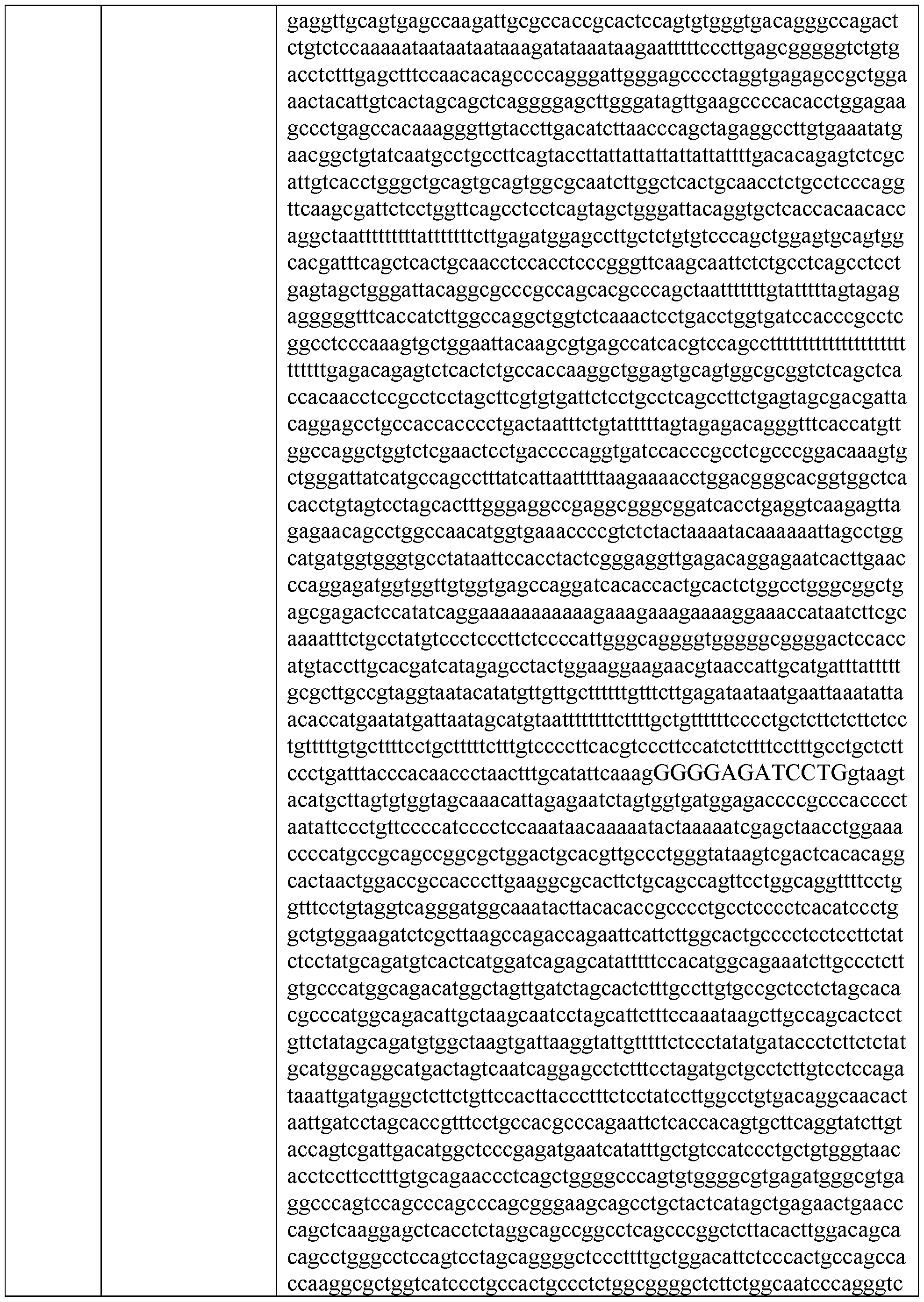


 - Ill -


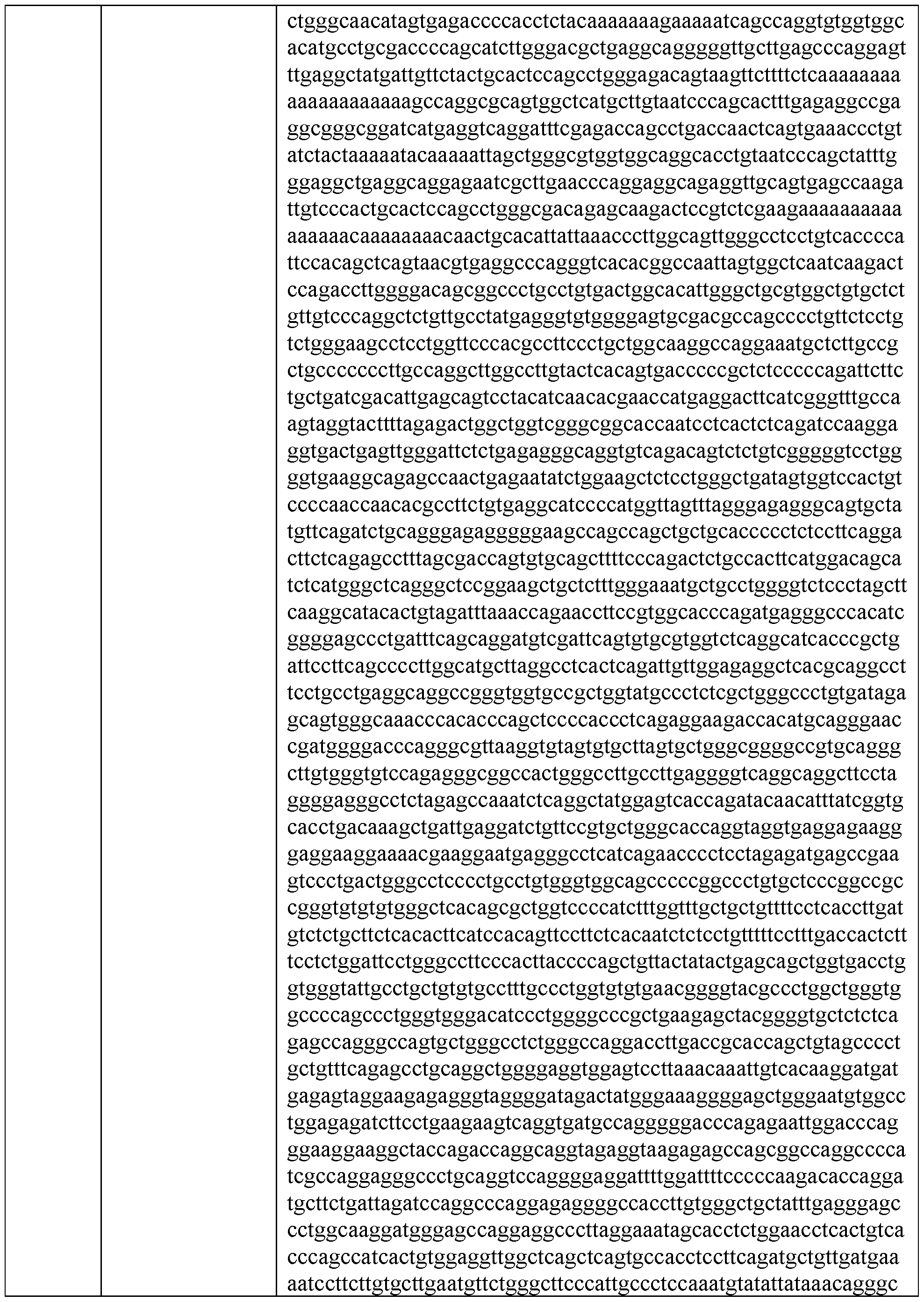


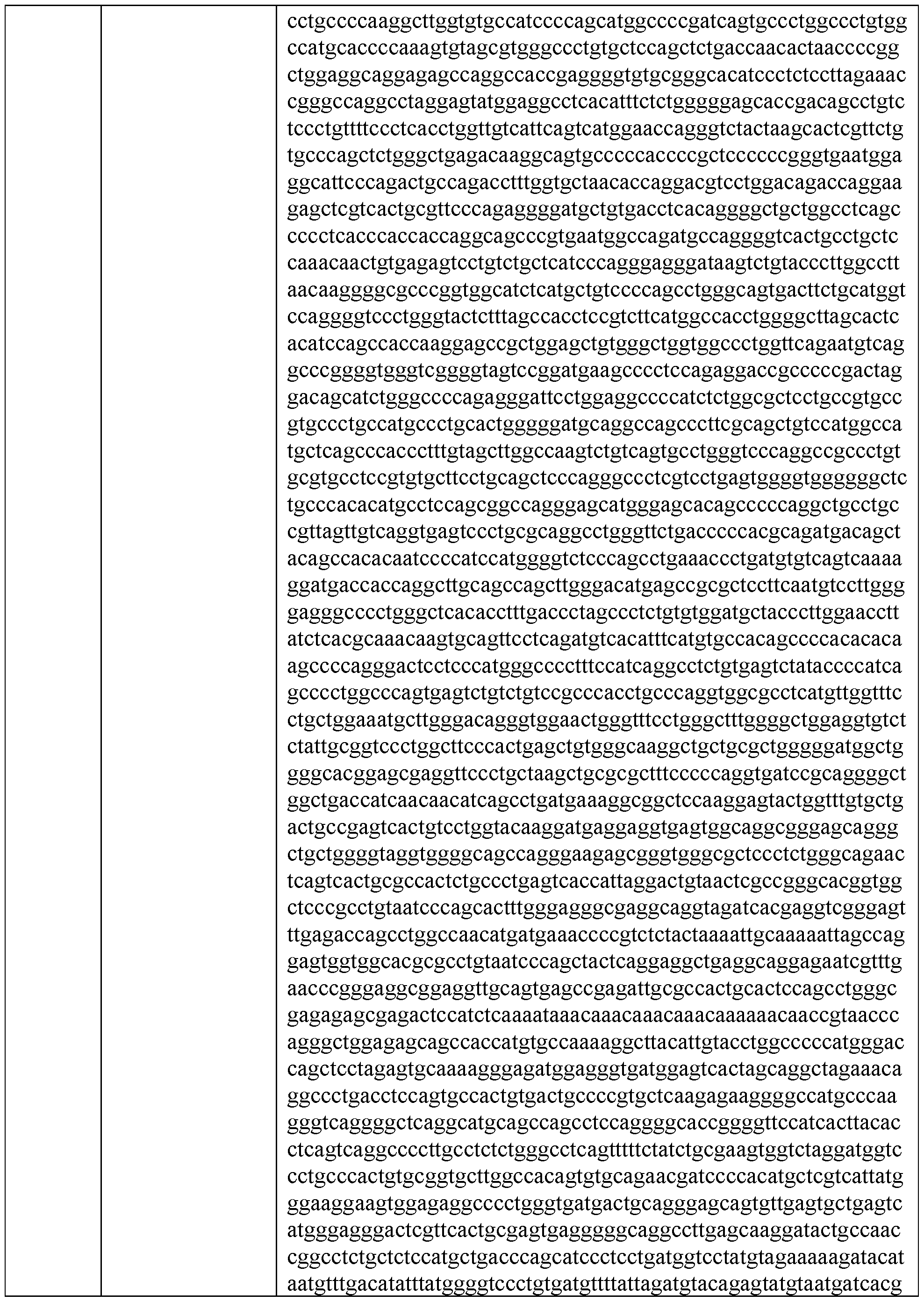


 Example 1: generation of hDNM2 non-human animal model
[0218] The hDNM2 non-human animal model was generated by inserting human hDNM2 gene into the genome of C57BL/6 mice using PiggyBAC genome engineering system. First, a B AC clone containing hDNM2 was selected (BAC clone RP11-20N24, obtained from CHORI), and engineered to remove the SacB gene and the LoxP site, and to introduce a gene conferring resistance to ampicillin and two ITRs, via homologous recombination with a lambda red system. The ITRs were inserted in the BAC clone in an orientation such that the whole BAC vector sequence, except the gene conferring resistance to ampicillin, was inserted into the mouse genome, as shown in Fig. 1 A.
[0219] Restriction enzyme digestions, were performed to verify the correct insertion of the gene conferring resistance to ampicillin and of the two ITRs into the BAC vector (Fig. 2A-D). Correct insertion of the gene conferring resistance to ampicillin and of the two ITRs into the BAC vector was further verified by PCR (Fig. 2 E-F). The PCR assay was performed using the primers consisting of SEQ ID NO: 12-47 and the following conditions.
PCR Mixture (primer concentration: 10 pM ): ddH2O 40 pl
Product primer F 4 pl (table 1)
Product primer R 4 pl (table 1)
P515 enzyme: 50 pl
Template: 400 ng plasmid
Total: 100 pl
 [0220] One-cell stage zygotes were obtained by mating C57BL/6N males (Charles River, China) with C57BL/6N females (Charles River, China) superovulated by injection of pregnant mare serum gonadotropin and human chorionic gonadotropin. The PBase plasmid (4 ng/pL, 50 pL) and transgenic BAC vector (4 ng/pL, 50 pL) were co-injected into the cytoplasm of pronuclear stage embryos. After an overnight culture in KSOM medium, the two-cell stage embryos were transferred to the oviduct of ICR pseudopregnant females (Charles River, China).
[0221] Knock-in mice were genotyped using primers consisting of SEQ ID NO: 48-75 and the following conditions:
PCR Mixture (primer concentration: 10 pM ): ddH2O 9.0 pl
Product primer F 1.0 pl (Tables 2 and 3)
Product primer R 1.0 pl (Tables 2 and 3)
Premix Taq 12.5 pl
DNA 1.5 pl
Total 25 pl

[0222] Genotyping of F0 animals: TaKaRa MiniBEST Universal Genomic DNA Extraction kit was used to extract genomic DNA from mouse tissues as follows: 180 pL of Buffer GL, 20 pL of Proteinase K (Merck, Cat. No. MK539480) and 10 pL of RNase A per tail piece (2- 5 mm) were combined in a microcentrifuge tube and incubated 56 °C overnight. The sample was cleared by centrifugation at 12,000 rpm for 2 minutes to remove impurities and added to 200 pL Buffer GB and 200 pL absolute ethyl alcohol with sufficient mixing. The sample was applied to the spin and centrifuged at 12,000 rpm for 2 min. The flow-through was discarded and 500 pL
Buffer WA was added to the spin column and centrifuged at 12,000 rpm for 1 min. Flow-through was discarded. 700 pL Buffer WB was added to the spin column and centrifuged at 12,000 rpm for 1 min. Flow-though was discarded. Wash step was repeated IX. The spin column was placed in a collection tube and centrifuge at 12,000 rpm for 2 min. The spin Column was placed in a new 1.5 ml tube. 50-200 pL sterilized water or elution buffer was added to the center of the column membrane and incubated room temperature for 5 min. To elute DNA, spin column was centrifuged at 12,000 rpm for 2 min.
[0223] PCR genotyping was performed to identify transgene-positive pups (Fig. 3A-O), which were then back-crossed with WT C57BL/6N mice to generate Fl and F2 mice.
[0224] For PiggyBac transgenic mice, all positive pups were confirmed by PCR to not contain any integration of the helper plasmid.
Primers used in the PCR to test for helper plasmid integration:
PiggyBac Helper plasmid-F: CTGGACGAGCAGAACGTGATCG (SEQ ID NO: 77) PiggyBac Helper plasmid-R: CGAAGAAGGCGTAGATCTCGTCCTC (SEQ ID NO: 78) Annealing Temp: 60 °C
Expected PCR product size: 352 bp.
Example 2: determination of the genomic copy number of the human DNM2 gene in the hDNM2 mouse model
[0225] Copy number and transcription of Fl and F2 mice were confirmed via qPCR and RT-qPCR. F3 and F4 generations were generated from selected F2 mice, and pups were confirmed by PCR.
[0226] hDMN2 knockin animals were bred with WT (C57BL/6N) animals to generate F3 knockin animals. Genomic DNA was extracted using the Simgen Animal Tissue DNA kit (Cat. 3101050). qPCR was performed to determine the relative genomic copy number of DNM2 in each sample using the following SYBR green PCR reaction. The relative quantity of human hDNM2 was calculated for each sample and normalized to mTert. A melting curve was produced for both hDNM2 and mTert (Fig. 4 A-B).
[0227] qPCR was performed using primers consisting of SEQ ID NO: 4-7 and the following conditions: water 7.2 pL
SYBR Premix Ex Taq 10 pL
Forward primer (10 pmol/pL) 0.4 pL
Reverse Primer (10 pmol/pL) 0.4 pL
Template (DNA) 2 pL

[0228] The qPCR on F3 animals showed insertion of hDNM2 into the genome (Table 6).
Table 6


Example 3: hDNM2 expression analysis hDNM2 mouse model
[0229] hDNM2 expression in various tissues was explored using RT-qPCR (Fig. 5C). RNA was extracted from fresh flash-frozen tissues from 3 animals using the TAINGEN total RNA extraction kit. Reverse Transcription was carried out using the Takara Primescript RT reagent kit with gDNA eraser. A melting curve was produced for both hDNM2 and mGapdh (Fig. 5 A-B).
[0230] qPCR was carried out using primers consisting of SEQ ID NO: 8-11 and the following conditions: water 7.2 pL
SYBR Premix Ex Taq 10 pL
Forward primer (10 pmol/pL) 0.4 pL
Reverse Primer (10 pmol/pL) 0.4 pL
Template (DNA) 2 pL

Example 4: modulation of hDNM2 expression in the hDNM2 mouse model
[0231] hDNM2 animals were injected with a single IV dose of PPMO 1 (SEQ ID NO: 76) as indicated (30 mg/kg, 100 mg/kg). Seven days later animals were sacrificed and quadriceps and diaphragm muscles were flash frozen. Frozen tissues were trimmed and mechanically homogenized with a metal bead beater system (SPEX). RNA was extracted from the homogenates
(Quick RNA-96 Kit, Zymo) and reverse transcribed with Maxima™ H Minus cDNA Synthesis Master Mix (Thermo Scientific, Ml 662). \\DMN2 expression was measured by qPCR using PrimeTime™ Gene Expression Master Mix (IDT, 1055772) and IDT hydrolysis probes DNM2 Hs.PT.58.40700381, FAM; ACTB Mm. PT.39a.22214843. g, HEX. Fast cycling conditions were applied according to manufacturer’s instructions. qPCR reaction components and conditions were as follows:
[0232] PPMO were capable of modulating DNM2 expression


[0233] PPMO were capable of modulating DNM2 expression (Fig. 6A-B).
Claims
1. A transgenic non-human animal model, comprising a nucleotide sequence of a human Dynamin 2 (hI)NM2) gene, or fragment thereof.
2. The transgenic non-human animal model of claim 1, wherein the nucleotide sequence of the hDNM2 gene, or fragment thereof, comprises a nucleic acid sequence which is at least 70%, at least 80%, at least 85%, at least 90%, at least 91%, at least 92%, at least 93%, at least 94%, at least 95%, at least 96%, at least 97%, at least 98%, or at least 99% identical to SEQ ID NO: 1.
3. The transgenic non-human animal model of claim 1 or 2, wherein the nucleotide sequence of the hDNM2 gene, or fragment thereof, comprises a nucleic acid sequence 100% identical to SEQ ID NO: 1.
4. The transgenic non-human animal model of any one of claims 1-3, wherein the hDNM2 gene, or fragment thereof, is a wild type hDNM2 gene.
5. The transgenic non-human animal model of claim 1 or 2, wherein the hDNM2 gene, or fragment thereof, is a mutant hDNM2 gene.
6. The transgenic non-human animal model of claim 5, wherein the mutant hDNM2 gene, or fragment thereof, is associated with a neuromuscular disease.
7. The transgenic non-human animal model of claim 6, wherein the neuromuscular disease is autosomal dominant centronuclear myopathy, autosomal recessive centronuclear myopathy, X-linked centronuclear myopathy, dominant intermediate Charcot-Marie- Tooth neuropathy, axonal type Charcot-Marie-Tooth neuropathy, or Lethal congenital contracture syndrome 5.
8. The transgenic non-human animal model of any one of claims 5-7, wherein the mutant hDNM2 gene encodes a mutant hDNM2 protein comprising a K or a Q at residue 368, a Q or a W at residue 369, a W at residue 465, a C or a H at residue 522, a G at residue 523, a K at residue 560, a D or a T at residue 618, an L or a W at residue 619, a P at residue 621, a H or a R at residue 627, a K at residue 650, a V at residue 379, or an E at residue 562; or lacking residue 625, residues 555-557, or residue 562; or any combination thereof; and
wherein a reference wild type hDNM2 protein comprises an E at residue 368, an R at residue 369, an R at residue 465, an R at residue 522, an R at residue 523, an E at residue 560, an A at residue 618, an S at residue 619, an L at residue 621, a P at residue 627, an E at residue 650, an F at residue 379, a K at residue 562, a G at residue 358, a G at residue 537, and an L at residue 570.
9. The transgenic non-human animal model of any one of claims 1-8, wherein the nucleotide sequence of the hDNM2 gene, or fragment thereof, is inserted in a single locus of the genome of the transgenic non-human animal model.
10. The transgenic non-human animal model of any one of claims 1-8, wherein the nucleotide sequence of the hDNM2 gene, or fragment thereof, is inserted in multiple loci of the genome of the transgenic non-human animal model.
11. The transgenic non-human animal model of any one of claims 1-10, wherein the genome of the transgenic non-human animal model comprises a single copy of the nucleotide sequence of the hDNM2 gene, or fragment thereof.
12. The transgenic non-human animal model of any one of claims 1-10, wherein the genome of the transgenic non-human animal model comprises multiple copies of the nucleotide sequence of the hDNM2 gene, or fragment thereof.
13. The transgenic non-human animal model of any one of claims 1-12, wherein the nucleotide sequence of the hDNM2 gene, or fragment thereof, is operably linked to a promoter.
14. The transgenic non-human animal model of claim 13, wherein the promoter is a CMV early enhancer/chicken P actin (CBA) promoter, a CAG promoter, a CMV, an EFla, an EFla with a CMV enhancer, a CMV promoter with a CMV enhancer (CMVe/p), or a CMV promoter with a SV40 intron.
15. The transgenic non-human animal model of claim 13, wherein the promoter is a hDNM2 promoter.
16. The transgenic non-human animal model of any one of claims 1-15, wherein the nucleotide sequence of the hDNM2 gene, or fragment thereof, is operably linked to a poly adenylation signal.
17. The transgenic non-human animal model of claim 16, wherein the polyadenylation signal is an bGHpA, a hGHpA, a SV40pA, a hGHpA, or a synthetic pA, polyadenylation signal.
18. The transgenic non-human animal model of claim 16, wherein the polyadenylation signal is an hDNM2 polyadenylation signal.
19. The transgenic non-human animal model of any one of claims 1-18, wherein the transgenic non-human animal model is generated by a PiggyBAC trasnposase system.
20. The transgenic non-human animal model of any one of claims 1-19, wherein the non- human animal model is a mouse.
21. The transgenic non-human animal model of claim 20, wherein the mouse is a C57BL/6 mouse.
22. A recombinant nucleic acid molecule, comprising a nucleotide sequence of a human Dynamin 2 (hI)NM2) gene, or fragment thereof, for use in the generation of a non-human animal model.
23. The recombinant nucleic acid molecule of claim 22, wherein the recombinant nucleic acid molecule further comprises a pair of inverted terminal repeats (ITRs).
24. The recombinant nucleic acid molecule of claim 23, wherein the recombinant nucleic acid molecule further comprises an antibiotic resistance conferring gene.
25. The recombinant nucleic acid molecule of claim 24, wherein the antibiotic resistance conferring gene is an ampicillin resistance conferring gene.
26. The recombinant nucleic acid molecule of any one of claims 23-25, wherein the recombinant nucleic acid molecule further comprises a promoter operably linked to the hDNM2 gene, or fragment thereof.
27. The recombinant nucleic acid molecule of claim 26, wherein the promoter is a CMV early enhancer/chicken P actin (CBA) promoter, a CAG promoter, a CMV, an EFla, an EFla with a CMV enhancer, a CMV promoter with a CMV enhancer (CMVe/p), or a CMV promoter with a SV40 intron.
28. The recombinant nucleic acid molecule of claim 26, wherein the promoter is a hDNM2 promoter.
29. The recombinant nucleic acid molecule of any one of claims 23-27, wherein the recombinant nucleic acid molecule further comprises a polyadenylation signal operably linked to the hDNM2 gene, or fragment thereof.
30. The recombinant nucleic acid molecule of claim 29, wherein the polyadenylation signal is an bGHpA, a hGHpA, a SV40pA, a hGHpA, or a synthetic pA, polyadenylation signal.
31. The recombinant nucleic acid molecule of claim 29, wherein the polyadenylation signal is a hDNM2 polyadenylation signal.
32. The recombinant nucleic acid molecule of any one of claims 23-30, wherein the human Dynamin 2 (hDNM2') gene, or fragment thereof is comprised between the pair of inverted terminal repeats.
33. The recombinant nucleic acid molecule of any one of claims 26-31, wherein the promoter is comprised between the pair of inverted terminal repeats.
34. The recombinant nucleic acid molecule of any one of claims 29-31, wherein the polyadenylation signal is comprised between the pair of inverted terminal repeats.
35. The recombinant nucleic acid molecule of any one of claims 22-34, wherein the nucleotide sequence of the hDNM2 gene, or fragment thereof, comprises a nucleic acid sequence which is at least 70%, at least 80%, at least 85%, at least 90%, at least 91%, at least 92%, at least 93%, at least 94%, at least 95%, at least 96%, at least 97%, at least 98%, or at least 99% identical to SEQ ID NO: 1.
36. The recombinant nucleic acid molecule of claim 35, wherein the nucleotide sequence of the hDNM2 gene, or fragment thereof, comprises a nucleic acid sequence 100% identical to SEQ ID NO: 1.
37. The recombinant nucleic acid molecule of any one of claims 22-36, wherein the hDNM2 gene, or fragment thereof, is a wild type hDNM2 gene.
38. The recombinant nucleic acid molecule of any one of claims 22-35, wherein the hDNM2 gene, or fragment thereof, is a mutant hDNM2 gene.
39. The recombinant nucleic acid molecule of claim 38, wherein the mutant hDNM2 gene, or fragment thereof, is associated with a neuromuscular disease.
40. The recombinant nucleic acid molecule of claim 39, wherein the neuromuscular disease is autosomal dominant centronuclear myopathy, autosomal recessive centronuclear myopathy, X-linked centronuclear myopathy, dominant intermediate Charcot-Marie- Tooth neuropathy, axonal type Charcot-Marie-Tooth neuropathy, or Lethal congenital contracture syndrome 5.
41. The recombinant nucleic acid molecule of any one of claims 38-40, wherein the mutant hDNM2 gene encodes a mutant hDNM2 protein comprising a K or a Q at residue 368, a Q or a W at residue 369, a W at residue 465, a C or a H at residue 522, a G at residue 523, a K at residue 560, a D or a T at residue 618, an L or a W at residue 619, a P at residue 621, a H or a R at residue 627, a K at residue 650, a V at residue 379, or an E at residue 562; or lacking residue 625, residues 555-557, or residue 562; or any combination thereof; and wherein a reference wild type hDNM2 protein comprises an E at residue 368, an R at residue 369, an R at residue 465, an R at residue 522, an R at residue 523, an E at residue 560, an A at residue 618, an S at residue 619, an L at residue 621, a P at residue 627, an E at residue 650, an F at residue 379, a K at residue 562, a G at residue 358, a G at residue 537, and an L at residue 570.
42. The recombinant nucleic acid molecule of any one of claims 22-41, wherein the recombinant nucleic acid molecule comprises a nucleic acid sequence which is at least 70%, at least 80%, at least 85%, at least 90%, at least 91%, at least 92%, at least 93%, at least 94%, at least 95%, at least 96%, at least 97%, at least 98%, at least 99% identical to SEQ ID NO: 2 or 3.
43. The recombinant nucleic acid molecule of any one of claims 22-37, wherein the recombinant nucleic acid molecule comprises a nucleic acid sequence 100% identical to SEQ ID NO: 2 or 3.
44. A method of generating a transgenic mouse, comprising delivering to a cell the recombinant nucleic acid molecule of any one of claims 24-43.
45. The method of claim 44, wherein the cell is a mouse embryonic stem cell or a one-cell mouse embryo.
46. The method of any one of claims 44 or 45, further comprising delivering to the cell a transposase.
47. The method of claim 4463, wherein the transposase is a PiggyBAC transposase.
48. The method of any one of claims 44-47, wherein the delivered recombinant nucleic acid molecule is integrated in the genome of the cell.
49. The method of claim 48, wherein the delivered recombinant nucleic acid molecule is integrated in a single locus in the genome of the cell.
50. The method of claim 48, wherein the delivered recombinant nucleic acid molecule is integrated in multiple loci in the genome of the cell.
51. The method of any one of claims 44-50, wherein a single copy of the delivered recombinant nucleic acid molecule is integrated in the genome of the cell.
52. The method of any one of claims 44-50, wherein multiple copies of the delivered recombinant nucleic acid molecule is integrated in the genome of the cell.
53. A method of testing a hDNM2 expression modulating agent comprising (a) obtaining a first testing sample from the non-human animal model of any one of claims 1-21, (b) administering the hDNM2 expression modulating agent modulating agent to the transgenic non-human animal model, (c) obtaining a second testing sample from the non-human animal model, (d) and assaying the first and the second testing sample for the presence and/or amount of (i) hDNM2 mRNA transcribed from the nucleotide sequence of the hDNM2 gene, or fragment thereof, and/or (ii) hDNM2 protein translated from the hDNM2 mRNA transcribed from the nucleotide sequence of the hDNM2 gene, or fragment thereof.
54. The method of claim 53, wherein the hDNM2 expression modulating agent is a small molecule.
55. The method of claim 54, wherein the hDNM2 expression modulating agent is an antisense oligonucleotide.
56. The method of any one of claims 53-55, wherein the hDNM2 expression modulating agent is administered to the transgenic non-human animal model.
57. The method of any one of claims 53-55, wherein the hDNM2 expression modulating agent is administered to cells, tissues, or organs derived from the transgenic non-human animal model.
58. The method of any one of claims 53-57, wherein amount of (i) hDNM2 mRNA transcribed from the nucleotide sequence of the hDNM2 gene, or fragment thereof, and/or of (ii) hDNM2 protein translated from the hDNM2 mRNA transcribed from the nucleotide sequence of the hDNM2 gene, or fragment thereof is the same in the first and in the second testing sample.
59. The method of any one of claims 53-57, wherein amount of (i) hDNM2 mRNA transcribed from the nucleotide sequence of the hDNM2 gene, or fragment thereof, and/or of (ii) hDNM2 protein translated from the hDNM2 mRNA transcribed from the nucleotide sequence of the hDNM2 gene, or fragment thereof in the second testing sample is reduced compared to the amount of (i) hDNM2 mRNA transcribed from the nucleotide sequence of the hDNM2 gene, or fragment thereof, and/or of (ii) hDNM2 protein translated from the hDNM2 mRNA transcribed from the nucleotide sequence of the hDNM2 gene in the first testing sample.
60. The method of any one of claims 53-57, wherein amount of (i) hDNM2 mRNA transcribed from the nucleotide sequence of the hDNM2 gene, or fragment thereof, and/or of (ii) hDNM2 protein translated from the hDNM2 mRNA transcribed from the nucleotide sequence of the hDNM2 gene, or fragment thereof in the second testing sample is increased compared to the amount of (i) hDNM2 mRNA transcribed from the nucleotide sequence of the hDNM2 gene, or fragment thereof, and/or (ii) hDNM2 protein translated from the hDNM2 mRNA transcribed from the nucleotide sequence of the hDNM2 gene in the first testing sample.
61. The method of any one of claims 53-60, comprising extracting the mRNA from the first and the second testing sample.
62. The method of claim 61, comprising retrotranscribing the extracted mRNA into cDNA.
63. The method of claim 62, wherein the cDNA is amplified by a PCR comprising a pair of primers comprising a nucleotide sequence at least 70%, at least 80%, at least 85%, at least 90%, at least 91%, at least 92%, at least 93%, at least 94%, at least 95%, at least 96%, at least 97%, at least 98%, at least 99%, or 100% identical to SEQ ID NO: 48-75.
64. The method of any one of claims 53-63 comprising extracting the protein content from the cells, the tissues, or the organs derived from the first and the second testing sample.
65. The method of claim 64, wherein the protein content is analyzed by a Western blot assay.
66. The method of claim 65, wherein the Western blot assay comprises an anti- hDNM2 antibody.
Applications Claiming Priority (2)
| Application Number | Priority Date | Filing Date | Title |
|---|---|---|---|
| US202363591321P | 2023-10-18 | 2023-10-18 | |
| US63/591,321 | 2023-10-18 |
Publications (1)
| Publication Number | Publication Date |
|---|---|
| WO2025085732A1 true WO2025085732A1 (en) | 2025-04-24 |
Family
ID=93378029
Family Applications (1)
| Application Number | Title | Priority Date | Filing Date |
|---|---|---|---|
| PCT/US2024/051950 Pending WO2025085732A1 (en) | 2023-10-18 | 2024-10-18 | Humanized dnm2 mouse model generation, characterization and methods of use |
Country Status (1)
| Country | Link |
|---|---|
| WO (1) | WO2025085732A1 (en) |
Citations (13)
| Publication number | Priority date | Publication date | Assignee | Title |
|---|---|---|---|---|
| US4873191A (en) | 1981-06-12 | 1989-10-10 | Ohio University | Genetic transformation of zygotes |
| US5151510A (en) | 1990-04-20 | 1992-09-29 | Applied Biosystems, Inc. | Method of synethesizing sulfurized oligonucleotide analogs |
| US5175384A (en) | 1988-12-05 | 1992-12-29 | Genpharm International | Transgenic mice depleted in mature t-cells and methods for making transgenic mice |
| US5602299A (en) | 1992-09-23 | 1997-02-11 | Mount Sinai School Of Medicine Of The City University Of New York | Transgenic animal models for neurodegenerative disease |
| US6037521A (en) | 1993-11-12 | 2000-03-14 | Hoechst Japan Limited | Transgenic mouse expressing an β-Amyloid transgene |
| US6066778A (en) | 1996-11-06 | 2000-05-23 | The Regents Of The University Of Michigan | Transgenic mice expressing APC resistant factor V |
| US8450467B2 (en) | 2007-12-04 | 2013-05-28 | Alnylam Pharmaceuticals, Inc. | Carbohydrate conjugates as delivery agents for oligonucleotides |
| CN105671079A (en) * | 2016-02-26 | 2016-06-15 | 华南农业大学 | Mouse with human nerve growth factor transgenes as well as preparation method and application of mouse |
| WO2018100010A1 (en) * | 2016-11-29 | 2018-06-07 | Association Institut De Myologie | Allele-specific silencing therapy for dynamin 2-related diseases |
| US20190241896A1 (en) * | 2018-01-15 | 2019-08-08 | Ionis Pharmaceuticals, Inc. | Modulators of dnm2 expression |
| US20210095291A1 (en) * | 2017-04-10 | 2021-04-01 | Genethon | Antisense targeting dynamin 2 and use for the treatment of centronuclear myopathies and neuropathies |
| JP2021083379A (en) * | 2019-11-28 | 2021-06-03 | 国立研究開発法人産業技術総合研究所 | Genetically modified nematode manifesting dynamin mutant |
| CN115820729A (en) * | 2022-09-26 | 2023-03-21 | 东北大学 | Construction method and application of conditional overexpression human CD44s transgenic mouse animal model |
-
2024
- 2024-10-18 WO PCT/US2024/051950 patent/WO2025085732A1/en active Pending
Patent Citations (13)
| Publication number | Priority date | Publication date | Assignee | Title |
|---|---|---|---|---|
| US4873191A (en) | 1981-06-12 | 1989-10-10 | Ohio University | Genetic transformation of zygotes |
| US5175384A (en) | 1988-12-05 | 1992-12-29 | Genpharm International | Transgenic mice depleted in mature t-cells and methods for making transgenic mice |
| US5151510A (en) | 1990-04-20 | 1992-09-29 | Applied Biosystems, Inc. | Method of synethesizing sulfurized oligonucleotide analogs |
| US5602299A (en) | 1992-09-23 | 1997-02-11 | Mount Sinai School Of Medicine Of The City University Of New York | Transgenic animal models for neurodegenerative disease |
| US6037521A (en) | 1993-11-12 | 2000-03-14 | Hoechst Japan Limited | Transgenic mouse expressing an β-Amyloid transgene |
| US6066778A (en) | 1996-11-06 | 2000-05-23 | The Regents Of The University Of Michigan | Transgenic mice expressing APC resistant factor V |
| US8450467B2 (en) | 2007-12-04 | 2013-05-28 | Alnylam Pharmaceuticals, Inc. | Carbohydrate conjugates as delivery agents for oligonucleotides |
| CN105671079A (en) * | 2016-02-26 | 2016-06-15 | 华南农业大学 | Mouse with human nerve growth factor transgenes as well as preparation method and application of mouse |
| WO2018100010A1 (en) * | 2016-11-29 | 2018-06-07 | Association Institut De Myologie | Allele-specific silencing therapy for dynamin 2-related diseases |
| US20210095291A1 (en) * | 2017-04-10 | 2021-04-01 | Genethon | Antisense targeting dynamin 2 and use for the treatment of centronuclear myopathies and neuropathies |
| US20190241896A1 (en) * | 2018-01-15 | 2019-08-08 | Ionis Pharmaceuticals, Inc. | Modulators of dnm2 expression |
| JP2021083379A (en) * | 2019-11-28 | 2021-06-03 | 国立研究開発法人産業技術総合研究所 | Genetically modified nematode manifesting dynamin mutant |
| CN115820729A (en) * | 2022-09-26 | 2023-03-21 | 东北大学 | Construction method and application of conditional overexpression human CD44s transgenic mouse animal model |
Non-Patent Citations (39)
| Title |
|---|
| "Concise Dictionary of Biomedicine and Molecular Biology", 2002, CRC PRESS |
| "Mouse Genetics : Methods and Protocols : Methods and Protocols", vol. 1194, 2014, SPRINGER NEW YORK, New York, NY, ISBN: 978-1-4939-1215-5, ISSN: 1064-3745, article DING SHENG ET AL: "Chapter 9: Generation of Genetically Engineered Mice by the piggyBac Transposon System : Methods and Protocols", pages: 171 - 185, XP093246404, DOI: 10.1007/978-1-4939-1215-5_9 * |
| "Oxford Dictionary of Biochemistry and Molecular Biology", 2006, OXFORD UNIVERSITY PRESS |
| "The Dictionary of Cell and Molecular Biology", 2013, ACADEMIC PRESS |
| A.-C. DURIEUX ET AL: "A centronuclear myopathy-dynamin 2 mutation impairs skeletal muscle structure and function in mice", HUMAN MOLECULAR GENETICS, vol. 19, no. 24, 21 September 2010 (2010-09-21), pages 4820 - 4836, XP055105957, ISSN: 0964-6906, DOI: 10.1093/hmg/ddq413 * |
| ALTSCHUL ET AL., J. MOL. BIOL., vol. 215, 1990, pages 403 - 410 |
| ANTONNY B: "Membrane fission by dynamin: what we know and what we need to know.", EMBO J, vol. 35, no. 21, 2016, pages 2270 - 84 |
| BELLEN HUGO J.: "Bloomington Drosophila Stock Center: Indiana University Bloomington", 5 May 2023 (2023-05-05), XP093245391, Retrieved from the Internet <URL:https://bdsc.indiana.edu/Home/Search?presearch=97481> * |
| BITOUN, M. ET AL.: "Mutations in dynamin 2 cause dominant centronuclear myopathy", NAT GENET, vol. 37, 2005, pages 1207 - 1209, XP055372629, DOI: 10.1038/ng1657 |
| CAO H ET AL.: "Differential distribution of dynamin isoforms in mammalian cells", MOL BIOL CELL, vol. 9, no. 9, 1998, pages 2595 - 609 |
| CHIN YU-HAN ET AL: "Dynamin-2 mutations associated with centronuclear myopathy are hypermorphic and lead to T-tubule fragmentation", HUMAN MOLECULAR GENETICS, vol. 24, no. 19, 21 July 2015 (2015-07-21), GB, pages 5542 - 5554, XP093243572, ISSN: 0964-6906, DOI: 10.1093/hmg/ddv285 * |
| COWLING BS ET AL.: "Amphiphysin (BIN1) negatively regulates dynamin 2 for normal muscle maturation", J CLIN INVEST, vol. 127, no. 12, 2017, pages 4477 - 87 |
| COWLING BS ET AL.: "Increased expression of wild-type or a centronuclear myopathy mutant of dynamin 2 in skeletal muscle of adult mice leads to structural defects and muscle weakness", AM J PATHOL, vol. 178, no. 5, 2011, pages 2224 - 35, XP055105960, DOI: 10.1016/j.ajpath.2011.01.054 |
| COWLING BS ET AL.: "Reducing dynamin 2 expression rescues X-linked centronuclear myopathy", J CLIN INVEST, vol. 124, no. 3, 2014, pages 1350 - 63, XP055105947, DOI: 10.1172/JCI71206 |
| DOWLING JJ ET AL.: "Triadopathies: an emerging class of skeletal muscle diseases", NEUROTHERAPEUTICS, vol. 11, no. 4, October 2014 (2014-10-01), pages 773 - 85 |
| DURIEUX AC ET AL.: "A centronuclear myopathy-dynamin 2 mutation impairs skeletal muscle structure and function in mice", HUMAN MOLECULAR GENETICS, vol. 19, 15 December 2010 (2010-12-15), pages 4820 - 4836, XP055105957, DOI: 10.1093/hmg/ddq413 |
| FONGY ANAÏS ET AL: "Nuclear defects in skeletal muscle from a Dynamin 2-linked centronuclear myopathy mouse model | Scientific Reports", 7 February 2019 (2019-02-07), XP093247297, Retrieved from the Internet <URL:https://www.nature.com/articles/s41598-018-38184-0> * |
| GEARY ET AL., J PHARMACOL EXP THER, vol. 296, no. 3, 2001, pages 890 - 7 |
| GEARY ET AL., J PHARMACOL EXP THER., vol. 296, no. 3, 2001, pages 898 - 904 |
| GORDON, PROC. NAT. ACAD. SCI. USA, vol. 77, 1980, pages 7380 - 7384 |
| GREENSAMBROOK, MOLECULAR CLONING: A LABORATORY MANUAL |
| HAMMER ET AL., NATURE, vol. 315, 1985, pages 680 |
| HANKS ET AL., SCIENCE, vol. 269, 1995, pages 679 - 682 |
| HOGAN ET AL.: "Manipulating the Mouse Embryo: A Laboratory Manual Cold Spring Harbor Laboratory", 1994, COLD SPRING HARBOR LABORATORY |
| JARVER ET AL.: "A Chemical View of Oligonucleotides for Exon Skipping and Related Drug Applications", NUCLEIC ACID THERAPEUTICS, vol. 24, no. 1, 2014, pages 37 - 47, XP055138449, DOI: 10.1089/nat.2013.0454 |
| KRIMPENFORT ET AL., BIO/TECHNOLOGY, vol. 9, 1991, pages 844 - 108 |
| LAPLANCHE ET AL., NUCLEIC ACIDS RES., vol. 14, 1986, pages 9081 |
| LAVITRANO ET AL., CELL, vol. 57, 1989, pages 717 - 723 |
| LIU N ET AL.: "Mice lacking microRNA 133a develop dynamin 2-dependent centronuclear myopathy", J CLIN INVEST, vol. 121, no. 8, 2011, pages 3258 - 68, XP055105967, DOI: 10.1172/JCI46267 |
| LO, MOL. CELL. BIOL., vol. 3, 1983, pages 1803 - 1814 |
| PALMITER ET AL., CELL, vol. 41, 1985, pages 343 |
| SANDOVAL-VILLEGAS NICOLÁS ET AL: "Contemporary Transposon Tools: A Review and Guide through Mechanisms and Applications of Sleeping Beauty, piggyBac and Tol2 for Genome Engineering", INTERNATIONAL JOURNAL OF MOLECULAR SCIENCES, vol. 22, no. 10, 11 May 2021 (2021-05-11), pages 5084, XP093012630, Retrieved from the Internet <URL:https://www.ncbi.nlm.nih.gov/pmc/articles/PMC8151067/pdf/ijms-22-05084.pdf> DOI: 10.3390/ijms22105084 * |
| STEC ET AL., J. AM. CHEM. SOC., vol. 106, 1984, pages 6077 |
| STEIN ET AL., NUCLEIC ACIDS RES., vol. 16, 1988, pages 3209 |
| TROCHET DELPHINE ET AL: "Benefits of therapy by dynamin-2-mutant-specific silencing are maintained with time in a mouse model of dominant centronuclear myopathy", MOLECULAR THERAPY-NUCLEIC ACIDS, vol. 27, 8 March 2022 (2022-03-08), US, pages 1179 - 1190, XP093010351, ISSN: 2162-2531, Retrieved from the Internet <URL:https://www.sciencedirect.com/science/article/pii/S2162253122000373/pdfft?md5=daac1b43dfc65f4d97845e1f87ddc4e6&pid=1-s2.0-S2162253122000373-main.pdf> DOI: 10.1016/j.omtn.2022.02.009 * |
| UHLMANNPEYMAN, CHEMICAL REVIEWS, vol. 90, 1990, pages 543 |
| VAN DER PUTTEN ET AL., PROC. NAT. ACAD. SCI. USA, vol. 82, 1985, pages 6148 - 6152 |
| ZHANGMADDEN, GENOME RES., vol. 7, 1997, pages 649 - 656 |
| ZON ET AL., ANTI CANCER DRUG DESIGN, vol. 6, 1991, pages 539 |
Similar Documents
| Publication | Publication Date | Title |
|---|---|---|
| US20220256822A1 (en) | Genetic modification non-human organism, egg cells, fertilized eggs, and method for modifying target genes | |
| JP5320546B2 (en) | Tol1 element transposase and DNA introduction system using the same | |
| Maga et al. | Increased efficiency of transgenic livestock production | |
| US20080182331A1 (en) | Procedure for specific replacement of a copy of a gene present in the recipient genome by the integration of a gene different from that where the integration is made | |
| US20040171824A1 (en) | A Lac operator-repressor system | |
| CN111793647B (en) | Construction method and application of CD226 gene humanized non-human animal | |
| JP2023544987A (en) | Prime editing-based gene editing composition with improved editing efficiency and its uses | |
| CN101175858A (en) | In vitro method for producing oocytes or eggs with targeted genomic modifications | |
| CN118632622A (en) | Mutant myocilin disease model and its use | |
| CN108866100A (en) | A kind of efficient gene editing method | |
| US6929909B2 (en) | Gene targeting vectors comprising conditional positive selection markers | |
| CN114480497A (en) | Construction and application of an ep400 gene knockout zebrafish heart failure model | |
| JP4364474B2 (en) | Functional transposons in mammals | |
| WO2025085732A1 (en) | Humanized dnm2 mouse model generation, characterization and methods of use | |
| CN115843746B (en) | USH2A gene humanized mouse model and establishment method and application thereof | |
| CN112501206B (en) | Construction method and application of PSMA (PSMA) gene humanized non-human animal | |
| CN101532018B (en) | Producing method of transgenic mouse containing anthropogenic proto-oncogene c-Ha-ras and application thereof | |
| CN117384956A (en) | A non-human animal with humanized ANGPTL3 gene and its construction method and application | |
| CN114045290B (en) | Construction method and application of keratin gene modified mouse animal model | |
| WO2025193807A1 (en) | Humanized umod mouse model generation, characterization and methods of use | |
| DePrimo et al. | Use of Human Placental Alkaline Phosphatase Transgenes to Detect Somatic Mutation in Micein Situ | |
| EP4593591A1 (en) | Pompe disease mouse model generation, characterization and methods of use | |
| CN115279184A (en) | Rodent models of B4GALT 1-mediated function | |
| JPH03504560A (en) | Transgenic animals for testing multidrug resistance | |
| CN117660527B (en) | A method for constructing an ABCA7-Floxp mouse model and its application |
Legal Events
| Date | Code | Title | Description |
|---|---|---|---|
| 121 | Ep: the epo has been informed by wipo that ep was designated in this application |
Ref document number: 24801420 Country of ref document: EP Kind code of ref document: A1 |