WO2025072623A1 - Compositions and methods for targeting immune cells - Google Patents
Compositions and methods for targeting immune cells Download PDFInfo
- Publication number
- WO2025072623A1 WO2025072623A1 PCT/US2024/048794 US2024048794W WO2025072623A1 WO 2025072623 A1 WO2025072623 A1 WO 2025072623A1 US 2024048794 W US2024048794 W US 2024048794W WO 2025072623 A1 WO2025072623 A1 WO 2025072623A1
- Authority
- WO
- WIPO (PCT)
- Prior art keywords
- antibody
- cell
- lipid
- another embodiment
- agent
- Prior art date
- Legal status (The legal status is an assumption and is not a legal conclusion. Google has not performed a legal analysis and makes no representation as to the accuracy of the status listed.)
- Pending
Links
Classifications
-
- C—CHEMISTRY; METALLURGY
- C12—BIOCHEMISTRY; BEER; SPIRITS; WINE; VINEGAR; MICROBIOLOGY; ENZYMOLOGY; MUTATION OR GENETIC ENGINEERING
- C12N—MICROORGANISMS OR ENZYMES; COMPOSITIONS THEREOF; PROPAGATING, PRESERVING, OR MAINTAINING MICROORGANISMS; MUTATION OR GENETIC ENGINEERING; CULTURE MEDIA
- C12N15/00—Mutation or genetic engineering; DNA or RNA concerning genetic engineering, vectors, e.g. plasmids, or their isolation, preparation or purification; Use of hosts therefor
- C12N15/09—Recombinant DNA-technology
- C12N15/87—Introduction of foreign genetic material using processes not otherwise provided for, e.g. co-transformation
- C12N15/88—Introduction of foreign genetic material using processes not otherwise provided for, e.g. co-transformation using microencapsulation, e.g. using amphiphile liposome vesicle
-
- A—HUMAN NECESSITIES
- A61—MEDICAL OR VETERINARY SCIENCE; HYGIENE
- A61K—PREPARATIONS FOR MEDICAL, DENTAL OR TOILETRY PURPOSES
- A61K39/00—Medicinal preparations containing antigens or antibodies
- A61K39/0005—Vertebrate antigens
-
- A—HUMAN NECESSITIES
- A61—MEDICAL OR VETERINARY SCIENCE; HYGIENE
- A61K—PREPARATIONS FOR MEDICAL, DENTAL OR TOILETRY PURPOSES
- A61K40/00—Cellular immunotherapy
- A61K40/10—Cellular immunotherapy characterised by the cell type used
- A61K40/15—Natural-killer [NK] cells; Natural-killer T [NKT] cells
-
- A—HUMAN NECESSITIES
- A61—MEDICAL OR VETERINARY SCIENCE; HYGIENE
- A61K—PREPARATIONS FOR MEDICAL, DENTAL OR TOILETRY PURPOSES
- A61K40/00—Cellular immunotherapy
- A61K40/10—Cellular immunotherapy characterised by the cell type used
- A61K40/17—Monocytes; Macrophages
-
- A—HUMAN NECESSITIES
- A61—MEDICAL OR VETERINARY SCIENCE; HYGIENE
- A61K—PREPARATIONS FOR MEDICAL, DENTAL OR TOILETRY PURPOSES
- A61K40/00—Cellular immunotherapy
- A61K40/10—Cellular immunotherapy characterised by the cell type used
- A61K40/19—Dendritic cells
-
- A—HUMAN NECESSITIES
- A61—MEDICAL OR VETERINARY SCIENCE; HYGIENE
- A61K—PREPARATIONS FOR MEDICAL, DENTAL OR TOILETRY PURPOSES
- A61K47/00—Medicinal preparations characterised by the non-active ingredients used, e.g. carriers or inert additives; Targeting or modifying agents chemically bound to the active ingredient
- A61K47/50—Medicinal preparations characterised by the non-active ingredients used, e.g. carriers or inert additives; Targeting or modifying agents chemically bound to the active ingredient the non-active ingredient being chemically bound to the active ingredient, e.g. polymer-drug conjugates
- A61K47/51—Medicinal preparations characterised by the non-active ingredients used, e.g. carriers or inert additives; Targeting or modifying agents chemically bound to the active ingredient the non-active ingredient being chemically bound to the active ingredient, e.g. polymer-drug conjugates the non-active ingredient being a modifying agent
- A61K47/68—Medicinal preparations characterised by the non-active ingredients used, e.g. carriers or inert additives; Targeting or modifying agents chemically bound to the active ingredient the non-active ingredient being chemically bound to the active ingredient, e.g. polymer-drug conjugates the non-active ingredient being a modifying agent the modifying agent being an antibody, an immunoglobulin or a fragment thereof, e.g. an Fc-fragment
- A61K47/6835—Medicinal preparations characterised by the non-active ingredients used, e.g. carriers or inert additives; Targeting or modifying agents chemically bound to the active ingredient the non-active ingredient being chemically bound to the active ingredient, e.g. polymer-drug conjugates the non-active ingredient being a modifying agent the modifying agent being an antibody, an immunoglobulin or a fragment thereof, e.g. an Fc-fragment the modifying agent being an antibody or an immunoglobulin bearing at least one antigen-binding site
- A61K47/6843—Medicinal preparations characterised by the non-active ingredients used, e.g. carriers or inert additives; Targeting or modifying agents chemically bound to the active ingredient the non-active ingredient being chemically bound to the active ingredient, e.g. polymer-drug conjugates the non-active ingredient being a modifying agent the modifying agent being an antibody, an immunoglobulin or a fragment thereof, e.g. an Fc-fragment the modifying agent being an antibody or an immunoglobulin bearing at least one antigen-binding site the antibody targeting a material from animals or humans
-
- A—HUMAN NECESSITIES
- A61—MEDICAL OR VETERINARY SCIENCE; HYGIENE
- A61K—PREPARATIONS FOR MEDICAL, DENTAL OR TOILETRY PURPOSES
- A61K47/00—Medicinal preparations characterised by the non-active ingredients used, e.g. carriers or inert additives; Targeting or modifying agents chemically bound to the active ingredient
- A61K47/50—Medicinal preparations characterised by the non-active ingredients used, e.g. carriers or inert additives; Targeting or modifying agents chemically bound to the active ingredient the non-active ingredient being chemically bound to the active ingredient, e.g. polymer-drug conjugates
- A61K47/69—Medicinal preparations characterised by the non-active ingredients used, e.g. carriers or inert additives; Targeting or modifying agents chemically bound to the active ingredient the non-active ingredient being chemically bound to the active ingredient, e.g. polymer-drug conjugates the conjugate being characterised by physical or galenical forms, e.g. emulsion, particle, inclusion complex, stent or kit
- A61K47/6921—Medicinal preparations characterised by the non-active ingredients used, e.g. carriers or inert additives; Targeting or modifying agents chemically bound to the active ingredient the non-active ingredient being chemically bound to the active ingredient, e.g. polymer-drug conjugates the conjugate being characterised by physical or galenical forms, e.g. emulsion, particle, inclusion complex, stent or kit the form being a particulate, a powder, an adsorbate, a bead or a sphere
- A61K47/6927—Medicinal preparations characterised by the non-active ingredients used, e.g. carriers or inert additives; Targeting or modifying agents chemically bound to the active ingredient the non-active ingredient being chemically bound to the active ingredient, e.g. polymer-drug conjugates the conjugate being characterised by physical or galenical forms, e.g. emulsion, particle, inclusion complex, stent or kit the form being a particulate, a powder, an adsorbate, a bead or a sphere the form being a solid microparticle having no hollow or gas-filled cores
- A61K47/6929—Medicinal preparations characterised by the non-active ingredients used, e.g. carriers or inert additives; Targeting or modifying agents chemically bound to the active ingredient the non-active ingredient being chemically bound to the active ingredient, e.g. polymer-drug conjugates the conjugate being characterised by physical or galenical forms, e.g. emulsion, particle, inclusion complex, stent or kit the form being a particulate, a powder, an adsorbate, a bead or a sphere the form being a solid microparticle having no hollow or gas-filled cores the form being a nanoparticle, e.g. an immuno-nanoparticle
-
- C—CHEMISTRY; METALLURGY
- C07—ORGANIC CHEMISTRY
- C07K—PEPTIDES
- C07K16/00—Immunoglobulins [IG], e.g. monoclonal or polyclonal antibodies
- C07K16/18—Immunoglobulins [IG], e.g. monoclonal or polyclonal antibodies against material from animals or humans
- C07K16/28—Immunoglobulins [IG], e.g. monoclonal or polyclonal antibodies against material from animals or humans against receptors, cell surface antigens or cell surface determinants
- C07K16/2803—Immunoglobulins [IG], e.g. monoclonal or polyclonal antibodies against material from animals or humans against receptors, cell surface antigens or cell surface determinants against the immunoglobulin superfamily
-
- C—CHEMISTRY; METALLURGY
- C07—ORGANIC CHEMISTRY
- C07K—PEPTIDES
- C07K16/00—Immunoglobulins [IG], e.g. monoclonal or polyclonal antibodies
- C07K16/18—Immunoglobulins [IG], e.g. monoclonal or polyclonal antibodies against material from animals or humans
- C07K16/28—Immunoglobulins [IG], e.g. monoclonal or polyclonal antibodies against material from animals or humans against receptors, cell surface antigens or cell surface determinants
- C07K16/2839—Immunoglobulins [IG], e.g. monoclonal or polyclonal antibodies against material from animals or humans against receptors, cell surface antigens or cell surface determinants against the integrin superfamily
- C07K16/2845—Immunoglobulins [IG], e.g. monoclonal or polyclonal antibodies against material from animals or humans against receptors, cell surface antigens or cell surface determinants against the integrin superfamily against integrin beta2-subunit-containing molecules, e.g. CD11, CD18
-
- C—CHEMISTRY; METALLURGY
- C07—ORGANIC CHEMISTRY
- C07K—PEPTIDES
- C07K16/00—Immunoglobulins [IG], e.g. monoclonal or polyclonal antibodies
- C07K16/18—Immunoglobulins [IG], e.g. monoclonal or polyclonal antibodies against material from animals or humans
- C07K16/28—Immunoglobulins [IG], e.g. monoclonal or polyclonal antibodies against material from animals or humans against receptors, cell surface antigens or cell surface determinants
- C07K16/2851—Immunoglobulins [IG], e.g. monoclonal or polyclonal antibodies against material from animals or humans against receptors, cell surface antigens or cell surface determinants against the lectin superfamily, e.g. CD23, CD72
-
- C—CHEMISTRY; METALLURGY
- C07—ORGANIC CHEMISTRY
- C07K—PEPTIDES
- C07K16/00—Immunoglobulins [IG], e.g. monoclonal or polyclonal antibodies
- C07K16/18—Immunoglobulins [IG], e.g. monoclonal or polyclonal antibodies against material from animals or humans
- C07K16/28—Immunoglobulins [IG], e.g. monoclonal or polyclonal antibodies against material from animals or humans against receptors, cell surface antigens or cell surface determinants
- C07K16/2881—Immunoglobulins [IG], e.g. monoclonal or polyclonal antibodies against material from animals or humans against receptors, cell surface antigens or cell surface determinants against CD71
-
- C—CHEMISTRY; METALLURGY
- C07—ORGANIC CHEMISTRY
- C07K—PEPTIDES
- C07K16/00—Immunoglobulins [IG], e.g. monoclonal or polyclonal antibodies
- C07K16/18—Immunoglobulins [IG], e.g. monoclonal or polyclonal antibodies against material from animals or humans
- C07K16/28—Immunoglobulins [IG], e.g. monoclonal or polyclonal antibodies against material from animals or humans against receptors, cell surface antigens or cell surface determinants
- C07K16/2887—Immunoglobulins [IG], e.g. monoclonal or polyclonal antibodies against material from animals or humans against receptors, cell surface antigens or cell surface determinants against CD20
-
- C—CHEMISTRY; METALLURGY
- C07—ORGANIC CHEMISTRY
- C07K—PEPTIDES
- C07K16/00—Immunoglobulins [IG], e.g. monoclonal or polyclonal antibodies
- C07K16/18—Immunoglobulins [IG], e.g. monoclonal or polyclonal antibodies against material from animals or humans
- C07K16/28—Immunoglobulins [IG], e.g. monoclonal or polyclonal antibodies against material from animals or humans against receptors, cell surface antigens or cell surface determinants
- C07K16/289—Immunoglobulins [IG], e.g. monoclonal or polyclonal antibodies against material from animals or humans against receptors, cell surface antigens or cell surface determinants against CD45
-
- C—CHEMISTRY; METALLURGY
- C07—ORGANIC CHEMISTRY
- C07K—PEPTIDES
- C07K16/00—Immunoglobulins [IG], e.g. monoclonal or polyclonal antibodies
- C07K16/18—Immunoglobulins [IG], e.g. monoclonal or polyclonal antibodies against material from animals or humans
- C07K16/28—Immunoglobulins [IG], e.g. monoclonal or polyclonal antibodies against material from animals or humans against receptors, cell surface antigens or cell surface determinants
- C07K16/2896—Immunoglobulins [IG], e.g. monoclonal or polyclonal antibodies against material from animals or humans against receptors, cell surface antigens or cell surface determinants against molecules with a "CD"-designation, not provided for elsewhere
-
- C—CHEMISTRY; METALLURGY
- C12—BIOCHEMISTRY; BEER; SPIRITS; WINE; VINEGAR; MICROBIOLOGY; ENZYMOLOGY; MUTATION OR GENETIC ENGINEERING
- C12N—MICROORGANISMS OR ENZYMES; COMPOSITIONS THEREOF; PROPAGATING, PRESERVING, OR MAINTAINING MICROORGANISMS; MUTATION OR GENETIC ENGINEERING; CULTURE MEDIA
- C12N15/00—Mutation or genetic engineering; DNA or RNA concerning genetic engineering, vectors, e.g. plasmids, or their isolation, preparation or purification; Use of hosts therefor
- C12N15/09—Recombinant DNA-technology
- C12N15/63—Introduction of foreign genetic material using vectors; Vectors; Use of hosts therefor; Regulation of expression
- C12N15/79—Vectors or expression systems specially adapted for eukaryotic hosts
- C12N15/85—Vectors or expression systems specially adapted for eukaryotic hosts for animal cells
-
- A—HUMAN NECESSITIES
- A61—MEDICAL OR VETERINARY SCIENCE; HYGIENE
- A61K—PREPARATIONS FOR MEDICAL, DENTAL OR TOILETRY PURPOSES
- A61K39/00—Medicinal preparations containing antigens or antibodies
- A61K2039/505—Medicinal preparations containing antigens or antibodies comprising antibodies
-
- A—HUMAN NECESSITIES
- A61—MEDICAL OR VETERINARY SCIENCE; HYGIENE
- A61K—PREPARATIONS FOR MEDICAL, DENTAL OR TOILETRY PURPOSES
- A61K39/00—Medicinal preparations containing antigens or antibodies
- A61K2039/51—Medicinal preparations containing antigens or antibodies comprising whole cells, viruses or DNA/RNA
- A61K2039/53—DNA (RNA) vaccination
-
- A—HUMAN NECESSITIES
- A61—MEDICAL OR VETERINARY SCIENCE; HYGIENE
- A61K—PREPARATIONS FOR MEDICAL, DENTAL OR TOILETRY PURPOSES
- A61K39/00—Medicinal preparations containing antigens or antibodies
- A61K2039/54—Medicinal preparations containing antigens or antibodies characterised by the route of administration
-
- A—HUMAN NECESSITIES
- A61—MEDICAL OR VETERINARY SCIENCE; HYGIENE
- A61K—PREPARATIONS FOR MEDICAL, DENTAL OR TOILETRY PURPOSES
- A61K39/00—Medicinal preparations containing antigens or antibodies
- A61K2039/555—Medicinal preparations containing antigens or antibodies characterised by a specific combination antigen/adjuvant
- A61K2039/55511—Organic adjuvants
- A61K2039/55555—Liposomes; Vesicles, e.g. nanoparticles; Spheres, e.g. nanospheres; Polymers
-
- A—HUMAN NECESSITIES
- A61—MEDICAL OR VETERINARY SCIENCE; HYGIENE
- A61K—PREPARATIONS FOR MEDICAL, DENTAL OR TOILETRY PURPOSES
- A61K9/00—Medicinal preparations characterised by special physical form
- A61K9/0012—Galenical forms characterised by the site of application
- A61K9/0019—Injectable compositions; Intramuscular, intravenous, arterial, subcutaneous administration; Compositions to be administered through the skin in an invasive manner
-
- C—CHEMISTRY; METALLURGY
- C12—BIOCHEMISTRY; BEER; SPIRITS; WINE; VINEGAR; MICROBIOLOGY; ENZYMOLOGY; MUTATION OR GENETIC ENGINEERING
- C12N—MICROORGANISMS OR ENZYMES; COMPOSITIONS THEREOF; PROPAGATING, PRESERVING, OR MAINTAINING MICROORGANISMS; MUTATION OR GENETIC ENGINEERING; CULTURE MEDIA
- C12N2810/00—Vectors comprising a targeting moiety
- C12N2810/50—Vectors comprising as targeting moiety peptide derived from defined protein
- C12N2810/80—Vectors comprising as targeting moiety peptide derived from defined protein from vertebrates
- C12N2810/85—Vectors comprising as targeting moiety peptide derived from defined protein from vertebrates mammalian
- C12N2810/859—Vectors comprising as targeting moiety peptide derived from defined protein from vertebrates mammalian from immunoglobulins
Definitions
- immunotherapeutics Modulation of immune cells through activation, inhibition, or modification to alter their properties has become a popular and high-demand class of therapy, called immunotherapeutics.
- This invention satisfies this unmet need.
- the invention relates to composition comprising at least one delivery vehicle conjugated to a targeting domain wherein the targeting domain specifically binds to at least one molecule on the surface of at least one target immune cell, and wherein the at least one delivery vehicle comprises at least one agent.
- the at least one delivery vehicle comprises a lipid nanoparticle (LNP).
- the at least one agent is encapsulated in the LNP.
- the at least one target immune cell is selected at least one natural killer (NK) cell, at least one macrophage, at least one B cell, or at least one dendritic cell.
- the at least one antigen expressed by the at least one NK cell is CD45, CD56, or CD71. In one embodiment, the at least one antigen expressed by the at least one macrophage is F4/80, CD 19, or CD 169. In one embodiment, the at least one antigen expressed by the at least one B cell is CD 19, CD20, or CD22. In one embodiment, the at least one antigen expressed by the at least one dendritic cell is CD205 or CD11.
- the at least one agent comprises at least one nucleic acid.
- the at least one nucleic acid comprises at least one messenger RNA (mRNA).
- the at least one mRNA encodes at least one peptide, polypeptide, or protein.
- the targeting domain is a nucleic acid molecule, a peptide, an antibody or antibody fragment, or a small molecule. In one embodiment, the targeting domain comprises an antibody, or antigen binding fragment thereof.
- the antibody, or antigen binding fragment thereof is an anti-CD45 antibody, a CD45 binding antibody fragment, an anti-CD56 antibody, a CD56 binding antibody fragment, an anti-CD71 antibody, a CD71 binding antibody fragment, an anti F4/80 antibody, a F4/80 binding antibody fragment, anti-CD14 antibody, a CD 14 binding antibody fragment, an anti-CD169 antibody, a CD 169 binding antibody fragment, an anti-CD19 antibody, a CD 19 binding antibody fragment, an anti- CD20 antibody, a CD20 binding antibody fragment, an anti-CD22 antibody, a CD22 binding antibody fragment, an anti-CD205 antibody, a CD205 binding antibody fragment, an anti-CDl 1 antibody, or a CD11 binding antibody fragment.
- the at least one agent is delivered to the at least one target immune cell.
- the at least one agent comprises a nucleic acid molecule encoding at least one chimeric antigen receptor (CAR).
- the at least one agent is a therapeutic agent for the treatment of a disease or disorder.
- the disease or disorder is cancer, an infectious disease, or an immunological disorder.
- the invention relates to a method of treating or preventing a disease or disorder in a subject in need thereof, the method comprising administering to the subject a composition of the present invention.
- the disease or disorder is cancer, an infectious disease, or an immunological disorder.
- Figure 1 depicts representative data demonstrating uptake of luciferase mRNA by human natural killer (NK) cells targeted by lipid nanoparticles (LNPs) comprising luciferase mRNA and conjugated to NK cell binding antibodies which bind to hCD45, hCD56, or hCD71 on the surface of NK cells; tLNPs vs.
- NK human natural killer
- LNPs lipid nanoparticles
- NK cells y-axis: luciferase activity; x-axis: negative control unmodified LNPs (1), hCD45-LNP (2), hCD56-LNP (3), hCD71-B3-LNP (4), and hCD71-OKT9-LNP (5) administered at low (0.1 pg), medium (1.0 pg), and high (3.0 pg) dose to 50,000 cells per condition.
- Figure 2 depicts representative data demonstrating uptake of luciferase mRNA by murine macrophages targeted by LNPs conjugated to antibodies which bind to F4/80 on the surface of macrophage cells and comprising luciferase mRNA (F4/F80 tLNP); Luc Activity in F4/F80+ cells from F4/F80 tLNP vs unmodified LNPs.
- Y-axis luciferase units
- x-axis negative control unmodified luciferase LNPs (left three bars) and F4/80 luciferase LNPs (right three bars).
- Figure 3 depicts representative data demonstrating uptake of eGFP mRNA by B cells targeted by LNPs conjugated to antibodies which bind to CD 19 on the surface of human B cells and comprising eGFP mRNA (hCD19-eGFP mRNA-LNPs); Raji-Luc2 CD 19+ B-cells.
- hCD19-eGFP mRNA-LNPs showed efficient and specific in vitro delivery on CD19+ Raji-Luc2 cells.
- IgG-eGFP targeted mRNA-LNPs or untreated CD19+ Raji-Luc2 cells were used as negative control.
- Figure 4 depicts representative data demonstrating general gating strategy for flow cytometry analysis of CD19+ Raji-Luc2 cells targeted by hCD19-eGFP mRNA- LNPs.
- Figure 5 depicts representative flow cytometry data demonstrating the quantitation of eGFP expression in CD 19+ Raji-Luc2 cells targeted by hCD19-eGFP mRNA-LNPs.
- Figure 6 depicts representative flow cytometry data demonstrating hCD19 and hCD20 expression of CD19+ Raji-Luc2 cells targeted by hCD19-eGFP mRNA- LNPs.
- Figure 7 depicts representative data demonstrating general gating strategy for flow cytometry based on CD3-CD45R+ ( Figure 7 A) and flow cytometry analysis of in vivo isolated CD19+, CD19+CD20+, and CD19+CD22+ cell populations ( Figure 7B).
- Figure 8 depicts representative data demonstrating in vivo uptake of ZsGreenl mRNA by mature splenic B cells targeted by LNPs conjugated to antibodies which bind to CD19 on the surface of murine B cells and comprising ZsGreenl mRNA (anti-mCD19 tLNP), in C57B1/6 mice. Negative control LNPs were conjugated to IgG (anti-IgG tLNP). CD3- CD45R+, CD3- CD45R+ CD19+, CD3- CD45R+ CD19+ CD20+, and CD3- CD45R+ CD 19+ CD22+ cell populations were analyzed for ZsGreen expression.
- Figure 9 depicts a representative schematic depicting the experimental procedure for the in vivo LNP targeting of dendritic cells (DCs) in mice bearing a ZsGreenl reporter construct.
- the ZsGreenl reporter construct comprises a ZsGreenl construct separated from a PCAG promoter by a stop codon flanked on each side by a LoxP site. Exposure of the construct to Cre recombinase enzyme resulted in excision of the stop codon and expression of ZsGreenl.
- LNPs were conjugated to antibodies that bind to CD205 or CD11 on the surface of DCs and engineered to comprise Cre recombinase mRNA.
- Figure 10 depicts representative data demonstrating in vivo uptake of Cre recombinase mRNA by DCs (MHCII+ CD11+) targeted by LNPs conjugated to antibodies that bind to CD205 or CD11 on the surface of DCs and comprising Cre recombinase mRNA; Dendritic cells (MHCII+ CD11+) in spleen.
- LNPs conjugated to IgG and comprising Cre recombinase mRNA control IgG mRNA-LNP
- non-treated cells were used as negative control.
- DC-targeted mRNA-LNP platform induces potent and specific genetic editing using a Cre/loxP reporter system in vivo.
- the invention is based, in part, on the discovery that conjugating a targeting antibody, that specifically binds to a target cell, to the surface of a delivery vehicle, such as a lipid nanoparticle (LNP), comprising at least one agent, effects the delivery of the at least one agent to the target cell.
- a delivery vehicle such as a lipid nanoparticle (LNP)
- conjugating a natural killer (NK) cell-binding antibody to the surface of an LNP comprising at least one agent effects targeting of the LNP to NK cells and delivery of the at least one agent to the NK cell.
- conjugating a macrophage cell-binding antibody to the surface of an LNP comprising at least one agent effects targeting of the LNP to macrophages and delivery of the at least one agent to the macrophages.
- the present invention relates to compositions comprising at least one delivery vehicle conjugated to at least one cell targeting domain, wherein the at least one delivery vehicle comprises at least one agent, wherein the at least one cell targeting domain binds to at least one antigen on the surface of at least one target cell, wherein the at least one antigen comprises CD45, CD56, and/or CD71, wherein the at least one target cell comprises at least one NK cell, wherein the at least one agent is delivered to the at least one NK cell, and wherein the at least one agent comprises mRNA.
- the at least one delivery vehicle comprises an LNP.
- the present invention relates to compositions comprising at least one delivery vehicle conjugated to at least one cell targeting domain, wherein the at least one delivery vehicle comprises at least one agent, wherein the at least one cell targeting domain binds to at least one antigen on the surface of at least one target cell, wherein the at least one antigen comprises F4/80, CD 19, and/or CD 169, wherein the at least one target cell comprises at least one macrophage, wherein the at least one agent is delivered to the at least one macrophage, and wherein the at least one agent comprises mRNA.
- the at least one delivery vehicle comprises an LNP.
- the present invention relates to compositions comprising at least one delivery vehicle conjugated to at least one cell targeting domain, wherein the at least one delivery vehicle comprises at least one agent, wherein the at least one cell targeting domain binds to at least one antigen on the surface of at least one target cell, wherein the at least one antigen comprises CD19, CD20, and/or CD22, wherein the at least one target cell comprises at least one B cell, wherein the at least one agent is delivered to the at least one B cell, and wherein the at least one agent comprises mRNA.
- the at least one delivery vehicle comprises an LNP.
- the present invention relates to compositions comprising at least one delivery vehicle conjugated to at least one cell targeting domain, wherein the at least one delivery vehicle comprises at least one agent, wherein the at least one cell targeting domain binds to at least one antigen on the surface of at least one target cell, wherein the at least one antigen comprises CD205 and/or CD11, wherein the at least one target cell comprises at least one dendritic cell, wherein the at least one agent is delivered to the at least one dendritic cell, and wherein the at least one agent comprises mRNA.
- the at least one delivery vehicle comprises an LNP.
- the at least one cell targeting domain comprises an antibody, wherein the antibody is an anti-CD45 antibody, an anti-CD56 antibody, an anti- CD71 antibody, an anti F4/80 antibody, and anti-CD14 antibody, an anti-CD169 antibody, an anti-CD19 antibody, an anti-CD20 antibody, an anti-CD22 antibody, an anti-CD205 antibody, or an anti-CDl 1 antibody.
- the at least one delivery vehicle is taken up via endocytosis by the at least one target cell.
- the at least one agent is released from the at least one delivery vehicle inside the at least one target cell.
- the at least one agent modifies the at least one target cell, e.g., by mRNA-based, vector-based, or genome editing-based expression of one or more synthetic surface receptors which are specific for at least one cancer cell or at least one pathogen.
- the present invention relates in part to methods of treating diseases or disorders in subjects in need thereof, the method comprising the administration of a composition comprising at least one delivery vehicle conjugated to at least one cell targeting domain, wherein the at least one delivery vehicle comprises at least one agent, wherein the at least one cell targeting domain binds to at least one antigen on the surface of at least one target cell in the subject, and wherein the at least one agent is delivered to the at least one target cell in the subject.
- the at least one agent comprises mRNA.
- the present disclosure provides compositions and methods for treating or preventing diseases and disorders (e.g., cancer, infection, etc.) in a subject by using an immunotherapy approach that involves genetically programming a subject’s immune cells in vivo, ex vivo or in vitro to target and destroy at least one cancer cell or at least one pathogen, thereby treating or preventing the disease (e.g., cancer, etc.).
- diseases and disorders e.g., cancer, infection, etc.
- Exemplary diseases and disorders that can be treated using the methods and compositions of the invention include, but are not limited to, cancers, infectious diseases, and immunological disorders. Definitions
- an element means one element or more than one element.
- antibody refers to an immunoglobulin molecule, which specifically binds with an antigen or epitope.
- Antibodies can be intact immunoglobulins derived from natural sources or from recombinant sources and can be immunoreactive portions of intact immunoglobulins. Antibodies are typically tetramers of immunoglobulin molecules.
- the antibodies in the present invention may exist in a variety of forms including, for example, polyclonal antibodies, monoclonal antibodies, Fv, Fab and F(ab)2, as well as single chain antibodies and humanized antibodies (Harlow et al., 1999, In: Using Antibodies: A Laboratory Manual, Cold Spring Harbor Laboratory Press, NY; Harlow et al., 1989, In: Antibodies: A Laboratory Manual, Cold Spring Harbor, New York; Houston et al., 1988, Proc. Natl. Acad. Sci. USA 85:5879-5883; Bird et al., 1988, Science 242:423-426).
- antibody fragment refers to a portion of an intact antibody and refers to the antigenic determining variable regions of an intact antibody.
- antibody fragments include, but are not limited to, Fab, Fab', F(ab')2, and Fv fragments, linear antibodies, scFv antibodies, and multispecific antibodies formed from antibody fragments.
- antibody heavy chain refers to the larger of the two types of polypeptide chains present in all antibody molecules in their naturally occurring conformations.
- antibody light chain refers to the smaller of the two types of polypeptide chains present in all antibody molecules in their naturally occurring conformations, k and 1 light chains refer to the two major antibody light chain isotypes.
- a “disease” is a state of health of an animal wherein the animal cannot maintain homeostasis, and wherein if the disease is not ameliorated then the animal’s health continues to deteriorate.
- a “disorder” in an animal is a state of health in which the animal is able to maintain homeostasis, but in which the animal’s state of health is less favorable than it would be in the absence of the disorder. Left untreated, a disorder does not necessarily cause a further decrease in the animal’s state of health.
- Encoding refers to the inherent property of specific sequences of nucleotides in a polynucleotide, such as a gene, a cDNA, or an mRNA, to serve as templates for synthesis of other polymers and macromolecules in biological processes having either a defined sequence of nucleotides (i.e., rRNA, tRNA and mRNA) or a defined sequence of amino acids and the biological properties resulting therefrom.
- a gene encodes a protein if transcription and translation of mRNA corresponding to that gene produces the protein in a cell or other biological system.
- Both the coding strand the nucleotide sequence of which is identical to the mRNA sequence and is usually provided in sequence listings, and the non-coding strand, used as the template for transcription of a gene or cDNA, can be referred to as encoding the protein or other product of that gene or cDNA.
- “Expression vector” refers to a vector comprising a recombinant polynucleotide comprising expression control sequences operatively linked to a nucleotide sequence to be expressed.
- An expression vector comprises sufficient cis-acting elements for expression; other elements for expression can be supplied by the host cell or in an in vitro expression system.
- Expression vectors include all those known in the art, such as cosmids, plasmids (e.g., naked or contained in liposomes) RNA, and viruses (e.g., lentiviruses, retroviruses, adenoviruses, and adeno-associated viruses) that incorporate the recombinant polynucleotide.
- “Homologous” refers to the sequence similarity or sequence identity between two polypeptides or between two nucleic acid molecules. When a position in both of the two compared sequences is occupied by the same base or amino acid monomer subunit, e.g., if a position in each of two DNA molecules is occupied by adenine, then the molecules are homologous at that position.
- the percent of homology between two sequences is a function of the number of matching or homologous positions shared by the two sequences divided by the number of positions compared X 100. For example, if 6 of 10 of the positions in two sequences are matched or homologous then the two sequences are 60% homologous.
- the DNA sequences ATTGCC and TATGGC share 50% homology. Generally, a comparison is made when two sequences are aligned to give maximum homology.
- isolated means altered or removed from the natural state.
- a nucleic acid or a peptide naturally present in a living animal is not “isolated,” but the same nucleic acid or peptide partially or completely separated from the coexisting materials of its natural state is “isolated.”
- An isolated nucleic acid or protein can exist in substantially purified form, or can exist in a non-native environment such as, for example, a host cell.
- nucleosides nucleobase bound to ribose or deoxyribose sugar via N-glycosidic linkage
- A refers to adenosine
- C refers to cytidine
- G refers to guanosine
- T refers to thymidine
- U refers to uridine.
- nucleotide sequence encoding an amino acid sequence includes all nucleotide sequences that are degenerate versions of each other and that encode the same amino acid sequence.
- the phrase nucleotide sequence that encodes a protein or an RNA may also include introns to the extent that the nucleotide sequence encoding the protein may in some version contain an intron(s).
- moduleating mediating a detectable increase or decrease in the level of a response in a subject compared with the level of a response in the subject in the absence of a treatment or compound, and/or compared with the level of a response in an otherwise identical but untreated subject.
- the term encompasses perturbing and/or affecting a native signal or response thereby mediating a beneficial therapeutic response in a subject, preferably, a human.
- nucleotide sequence encoding an amino acid sequence includes all nucleotide sequences that are degenerate versions of each other and that encode the same amino acid sequence. Nucleotide sequences that encode proteins and RNA may include introns. In addition, the nucleotide sequence may contain modified nucleosides that are capable of being translation by translational machinery in a cell. For example, in some aspects, the nucleotide sequence comprises an mRNA where some or all of the uridines have been replaced with pseudouridine, 1 -methyl pseudouridine, or another modified nucleoside.
- operably linked refers to functional linkage between a regulatory sequence and a heterologous nucleic acid sequence resulting in expression of the latter.
- a first nucleic acid sequence is operably linked with a second nucleic acid sequence when the first nucleic acid sequence is placed in a functional relationship with the second nucleic acid sequence.
- a promoter is operably linked to a coding sequence if the promoter affects the transcription or expression of the coding sequence.
- operably linked DNA or RNA sequences are contiguous and, where necessary to join two protein coding regions, in the same reading frame.
- patient refers to any animal, or cells thereof whether in vitro or in situ, amenable to the methods described herein.
- the patient, subject or individual is a human.
- nucleotide as used herein is defined as a chain of nucleotides.
- nucleic acids are polymers of nucleotides.
- nucleic acids and polynucleotides as used herein are interchangeable.
- nucleic acids are polynucleotides, which can be hydrolyzed into the monomeric “nucleotides.” The monomeric nucleotides can be hydrolyzed into nucleosides.
- polynucleotides include, but are not limited to, all nucleic acid sequences which are obtained by any means available in the art, including, without limitation, recombinant means, i.e., the cloning of nucleic acid sequences from a recombinant library or a cell genome, using ordinary cloning technology and PCRTM, and the like, and by synthetic means.
- recombinant means i.e., the cloning of nucleic acid sequences from a recombinant library or a cell genome, using ordinary cloning technology and PCRTM, and the like, and by synthetic means.
- the polynucleotide or nucleic acid of the invention is a “nucleoside-modified nucleic acid,” which refers to a nucleic acid comprising at least one modified nucleoside.
- a “modified nucleoside” refers to a nucleoside with a modification. For example, over one hundred different nucleoside modifications have been identified in RNA (Rozenski, et al., 1999, The RNA Modification Database: 1999 update. Nucl Acids Res 27: 196-197).
- “pseudouridine” refers, in another embodiment, to mlacp3Y (l-methyl-3-(3-amino-3-carboxypropyl) pseudouridine.
- the term refers to mlY (1-methylpseudouridine).
- the term refers to Ym (2'-O-methylpseudouridine.
- the term refers to m5D (5-methyldihydrouridine).
- the term refers to m3Y (3- methylpseudouridine).
- the term refers to a pseudouridine moiety that is not further modified.
- the term refers to a monophosphate, diphosphate, or triphosphate of any of the above pseudouridines.
- the term refers to any other pseudouridine known in the art.
- the terms “peptide,” “polypeptide,” and “protein” are used interchangeably, and refer to a compound comprised of amino acid residues covalently linked by peptide bonds.
- a protein or peptide must contain at least two amino acids, and no limitation is placed on the maximum number of amino acids that can comprise a protein’s or peptide’s sequence.
- Polypeptides include any peptide or protein comprising two or more amino acids joined to each other by peptide bonds.
- polypeptides include, for example, biologically active fragments, substantially homologous polypeptides, oligopeptides, homodimers, heterodimers, variants of polypeptides, modified polypeptides, derivatives, analogs, fusion proteins, among others.
- the polypeptides include natural peptides, recombinant peptides, synthetic peptides, or a combination thereof.
- promoter as used herein is defined as a DNA sequence recognized by the synthetic machinery of the cell, or introduced synthetic machinery, required to initiate the specific transcription of a polynucleotide sequence.
- the promoter that is recognized by bacteriophage RNA polymerase and is used to generate the mRNA by in vitro transcription.
- an antibody By the term “specifically binds,” as used herein with respect to an affinity ligand, in particular, an antibody, is meant an antibody which recognizes a specific antigen, but does not substantially recognize or bind other molecules in a sample.
- an antibody that specifically binds to an antigen from one species may also bind to that antigen from one or more other species. But, such cross-species reactivity does not itself alter the classification of an antibody as specific.
- an antibody that specifically binds to an antigen may also bind to different allelic forms of the antigen. However, such cross reactivity does not itself alter the classification of an antibody as specific.
- the terms “specific binding” or “specifically binding,” can be used in reference to the interaction of an antibody, a protein, or a peptide with a second chemical species, to mean that the interaction is dependent upon the presence of a particular structure (e g., an antigenic determinant or epitope) on the chemical species; for example, an antibody recognizes and binds to a specific protein structure rather than to proteins generally. If an antibody is specific for epitope “A”, the presence of a molecule containing epitope A (or free, unlabeled A), in a reaction containing labeled “A” and the antibody, will reduce the amount of labeled A bound to the antibody.
- terapéutica as used herein means a treatment and/or prophylaxis.
- a therapeutic effect is obtained by suppression, diminution, remission, or eradication of at least one sign or symptom of a disease or disorder.
- therapeutically effective amount refers to the amount of the subject compound that will elicit the biological or medical response of a tissue, system, or subject that is being sought by the researcher, veterinarian, medical doctor or other clinician.
- therapeutically effective amount includes that amount of a compound that, when administered, is sufficient to prevent development of, or alleviate to some extent, one or more of the signs or symptoms of the disorder or disease being treated.
- the therapeutically effective amount will vary depending on the compound, the disease and its severity and the age, weight, etc., of the subject to be treated.
- transfected or “transformed” or “transduced” as used herein refers to a process by which exogenous nucleic acid is transferred or introduced into the host cell.
- a “transfected” or “transformed” or “transduced” cell is one which has been transfected, transformed or transduced with exogenous nucleic acid.
- the cell includes the primary subject cell and its progeny.
- under transcriptional control or “operatively linked” as used herein means that the promoter is in the correct location and orientation in relation to a polynucleotide to control the initiation of transcription by RNA polymerase and expression of the polynucleotide.
- a “vector” is a composition of matter which comprises an isolated nucleic acid and which can be used to deliver the isolated nucleic acid to the interior of a cell.
- vectors are known in the art including, but not limited to, linear polynucleotides, polynucleotides associated with ionic or amphiphilic compounds, plasmids, and viruses.
- the term “vector” includes an autonomously replicating plasmid or a virus.
- the term should also be construed to include non-plasmid and non- viral compounds which facilitate transfer of nucleic acid into cells, such as, for example, polylysine compounds, liposomes, and the like.
- examples of viral vectors include, but are not limited to, adenoviral vectors, adeno-associated virus vectors, retroviral vectors, and the like.
- Alkyl refers to a straight or branched hydrocarbon chain radical consisting solely of carbon and hydrogen atoms, which is saturated or unsaturated (i.e., contains one or more double and/or triple bonds), having from one to twenty-four carbon atoms (C1-C24 alkyl), one to twelve carbon atoms (Cl -Cl 2 alkyl), one to eight carbon atoms (C1-C8 alkyl) or one to six carbon atoms (C1-C6 alkyl) and which is attached to the rest of the molecule by a single bond, e.g., methyl, ethyl, n propyl, 1 -methylethyl (iso propyl), n butyl, n pentyl, 1, 1 dimethylethyl (t butyl), 3 methylhexyl, 2 methylhexyl, ethenyl, prop 1 enyl, but-l-enyl, pent-l-en
- Alkylene or “alkylene chain” refers to a straight or branched divalent hydrocarbon chain linking the rest of the molecule to a radical group, consisting solely of carbon and hydrogen, which is saturated or unsaturated (i.e., contains one or more double (alkenylene) and/or triple bonds (alkynylene)), and having, for example, from one to twenty -four carbon atoms (C1-C24 alkylene), one to fifteen carbon atoms (Cl -Cl 5 alkylene), one to twelve carbon atoms (Cl -Cl 2 alkylene), one to eight carbon atoms (Cl- C8 alkylene), one to six carbon atoms (C1-C6 alkylene), two to four carbon atoms (C2- C4 alkylene), one to two carbon atoms (C1-C2 alkylene), e.g., methylene, ethylene, propylene, n butylene, ethenylene, propenylene, eth
- the alkylene chain is attached to the rest of the molecule through a single or double bond and to the radical group through a single or double bond.
- the points of attachment of the alkylene chain to the rest of the molecule and to the radical group can be through one carbon or any two carbons within the chain. Unless stated otherwise specifically in the specification, an alkylene chain may be optionally substituted.
- Cycloalkyl or “carbocyclic ring” refers to a stable non aromatic monocyclic or polycyclic hydrocarbon radical consisting solely of carbon and hydrogen atoms, which may include fused or bridged ring systems, having from three to fifteen carbon atoms, preferably having from three to ten carbon atoms, and which is saturated or unsaturated and attached to the rest of the molecule by a single bond.
- Monocyclic radicals include, for example, cyclopropyl, cyclobutyl, cyclopentyl, cyclohexyl, cycloheptyl, and cyclooctyl.
- Polycyclic radicals include, for example, adamantyl, norbomyl, decalinyl, 7,7 dimethyl bicyclo[2.2.1]heptanyl, and the like. Unless specifically stated otherwise, a cycloalkyl group is optionally substituted.
- Cycloalkylene is a divalent cycloalkyl group. Unless otherwise stated specifically in the specification, a cycloalkylene group may be optionally substituted.
- Heterocyclyl or “heterocyclic ring” refers to a stable 3 to 18 membered non aromatic ring radical which consists of two to twelve carbon atoms and from one to six heteroatoms is nitrogen, oxygen or sulfur.
- the heterocyclyl radical may be a monocyclic, bicyclic, tricyclic or tetracyclic ring system, which may include fused or bridged ring systems; and the nitrogen, carbon or sulfur atoms in the heterocyclyl radical may be optionally oxidized; the nitrogen atom may be optionally quaternized; and the heterocyclyl radical may be partially or fully saturated.
- heterocyclyl radicals include, but are not limited to, dioxolanyl, thienyl[l,3]dithianyl, decahydroisoquinolyl, imidazolinyl, imidazolidinyl, isothiazolidinyl, isoxazolidinyl, morpholinyl, octahydroindolyl, octahydroisoindolyl, 2 oxopip erazinyl, 2 oxopiperidinyl, 2 oxopyrrolidinyl, oxazolidinyl, piperidinyl, piperazinyl, 4 piperidonyl, pyrrolidinyl, pyrazolidinyl, quinuclidinyl, thiazolidinyl, tetrahydrofuryl, trithianyl, tetrahydropyranyl, thiomorpholinyl, thiamorpholinyl, 1
- a halogen atom such as F, Cl, Br, and I
- the substituent is a C1-C12 alkyl group. In other embodiments, the substituent is a cycloalkyl group. In other embodiments, the substituent is a halo group, such as fluoro. In other embodiments, the substituent is a oxo group. In other embodiments, the substituent is a hydroxyl group. In other embodiments, the substituent is an alkoxy group. In other embodiments, the substituent is a carboxyl group. In other embodiments, the substituent is an amine group.
- Optional or “optionally substituted” means that the subsequently described event of circumstances may or may not occur, and that the description includes instances where said event or circumstance occurs and instances in which it does not.
- optionally substituted alkyl means that the alkyl radical may or may not be substituted and that the description includes both substituted alkyl radicals and alkyl radicals having no substitution.
- the term “genome editing vector” refers to a nucleic acid molecule which encodes the components of a genome editing system, such as, but not limited to, a CRISPR/Cas9 protein, a base editor, or a prime editor, and any associated required components, such as an appropriate guide RNA (gRNA). See Kantor et al., “CRISPR-Cas9 DNA Base-Editing and Prime Editing,” Int J Mol Sci, 2020; 21; p. 6240, the contents of which are incorporated by reference.
- gRNA guide RNA
- ranges throughout this disclosure, various aspects of the invention can be presented in a range format. It should be understood that the description in range format is merely for convenience and brevity and should not be construed as an inflexible limitation on the scope of the invention. Accordingly, the description of a range should be considered to have specifically disclosed all the possible subranges as well as individual numerical values within that range. For example, description of a range such as from 1 to 6 should be considered to have specifically disclosed subranges such as from 1 to 3, from 1 to 4, from 1 to 5, from 2 to 4, from 2 to 6, from 3 to 6 etc., as well as individual numbers within that range, for example, 1 , 2, 2.7, 3, 4, 5, 5.3, and 6. This applies regardless of the breadth of the range.
- the present invention relates to compositions comprising at least one delivery vehicle conjugated to at least one cell targeting domain, wherein the at least one delivery vehicle comprises at least one agent, wherein the at least one cell targeting domain binds to at least one antigen on the surface of at least one target cell, and wherein the at least one agent is delivered to the at least one target cell.
- the at least one delivery vehicle comprises an LNP.
- the at least one agent comprises messenger RNA (mRNA).
- the present invention relates to compositions comprising at least one delivery vehicle conjugated to at least one cell targeting domain, wherein the at least one delivery vehicle comprises at least one agent, wherein the at least one cell targeting domain binds to at least one antigen on the surface of at least one target cell, wherein the at least one antigen comprises CD45, CD56, and/or CD71, wherein the at least one target cell comprises at least one NK cell, wherein the at least one agent is delivered to the at least one NK cell, and wherein the at least one agent comprises mRNA.
- the at least one delivery vehicle comprises an LNP.
- the present invention relates to compositions comprising at least one delivery vehicle conjugated to at least one cell targeting domain, wherein the at least one delivery vehicle comprises at least one agent, wherein the at least one cell targeting domain binds to at least one antigen on the surface of at least one target cell, wherein the at least one antigen comprises F4/80, CD 19, and/or CD 169, wherein the at least one target cell comprises at least one macrophage, wherein the at least one agent is delivered to the at least one macrophage, and wherein the at least one agent comprises mRNA.
- the at least one delivery vehicle comprises an LNP.
- the present invention relates to compositions comprising at least one delivery vehicle conjugated to at least one cell targeting domain, wherein the at least one delivery vehicle comprises at least one agent, wherein the at least one cell targeting domain binds to at least one antigen on the surface of at least one target cell, wherein the at least one antigen comprises CD19, CD20, and/or CD22, wherein the at least one target cell comprises at least one B cell, wherein the at least one agent is delivered to the at least one B cell, and wherein the at least one agent comprises mRNA.
- the at least one delivery vehicle comprises an LNP.
- the present invention relates to compositions comprising at least one delivery vehicle conjugated to at least one cell targeting domain, wherein the at least one delivery vehicle comprises at least one agent, wherein the at least one cell targeting domain binds to at least one antigen on the surface of at least one target cell, wherein the at least one antigen comprises CD205 and/or CD11, wherein the at least one target cell comprises at least one dendritic cell, wherein the at least one agent is delivered to the at least one dendritic cell, and wherein the at least one agent comprises mRNA.
- the at least one delivery vehicle comprises an LNP.
- the at least one cell targeting domain comprises an antibody, wherein the antibody is an anti-CD45 antibody, an anti-CD56 antibody, an anti- CD71 antibody, an anti F4/80 antibody, and anti-CD14 antibody, an anti-CD169 antibody, an anti-CD19 antibody, an anti-CD20 antibody, an anti-CD22 antibody, an anti-CD205 antibody, or an anti-CDl l antibody.
- the at least one delivery vehicle is taken up via endocytosis by the at least one target cell.
- the at least one agent is released from the at least one delivery vehicle inside the at least one target cell.
- the at least one agent modifies the at least one target cell, e.g., by mRNA-based, vector-based, or genome editing-based expression of one or more synthetic surface receptors which are specific for at least one cancer cell or at least one pathogen.
- the present invention relates in part to methods of treating diseases or disorders in subjects in need thereof, the method comprising the administration of a composition comprising at least one delivery vehicle conjugated to at least one cell targeting domain, wherein the at least one delivery vehicle comprises at least one agent, wherein the at least one cell targeting domain binds to at least one antigen on the surface of at least one target cell in the subject, and wherein the at least one agent is delivered to the at least one target cell in the subject.
- the at least one agent comprises mRNA.
- the present disclosure provides compositions and methods for treating or preventing diseases and disorders (e.g., cancer, infection, etc.) in a subject by using an immunotherapy approach that involves genetically programming a subject’s immune cells in vivo, ex vivo or in vitro to target and destroy at least one cancer cell or at least one pathogen, thereby treating or preventing the disease (e.g., cancer, etc.).
- diseases and disorders e.g., cancer, infection, etc.
- Exemplary diseases and disorders that can be treated using the methods and compositions of the invention include, but are not limited to, cancers, infectious diseases, and immunological disorders.
- the at least one delivery vehicle comprises lipids or a derivative thereof. In various embodiments, the at least one delivery vehicle comprises a nanoparticle (LNP).
- LNP nanoparticle
- the LNP the LNP comprises at least one cell targeting domain, wherein the at least one cell targeting domain binds to at least one antigen on the surface of at least one target cell.
- the at least one cell targeting domain is a ligand which directs the LNP the LNP to a receptor found on a cell surface.
- the LNP the LNP comprises one or more internalization domains.
- the LNP the LNP comprises one or more domains which bind to a cell to induce the internalization of the LNP.
- the one or more internalization domains bind to a receptor found on a cell surface to induce receptor-mediated uptake of the at least one LNP.
- the LNP is capable of binding a biomolecule in vivo, where the at least one LNP-bound biomolecule can then be recognized by a cell-surface receptor to induce internalization.
- the LNP binds systemic ApoE, which leads to the uptake of the LNP and associated agents.
- Lipids are fatty substances which may be naturally occurring or synthetic lipids.
- lipids include the fatty droplets that naturally occur in the cytoplasm as well as the class of compounds which contain long-chain aliphatic hydrocarbons and their derivatives, such as fatty acids, alcohols, amines, amino alcohols, aldehydes, and polymers (e.g. PEGylated lipids).
- Lipids suitable for use can be obtained from commercial sources.
- DMPC dimyristyl phosphatidylcholine
- DCP dicetyl phosphate
- Choi cholesterol
- DMPG dimyristyl phosphatidylglycerol
- Stock solutions of lipids in chloroform or chloroform/methanol can be stored at about -20°C. Chloroform is used as the only solvent since it is more readily evaporated than methanol.
- the LNP comprises one or more cationic lipids, and one or more stabilizing lipids.
- Stabilizing lipids include neutral lipids and pegylated lipids.
- the LNP comprises a cationic lipid.
- cationic lipid refers to a lipid that is cationic or becomes cationic (protonated) as the pH is lowered below the pK of the ionizable group of the lipid, but is progressively more neutral at higher pH values. At pH values below the pK, the lipid is then able to associate with negatively charged nucleic acids.
- the cationic lipid comprises a zwitterionic lipid that assumes a positive charge on pH decrease.
- the cationic lipid comprises any of a number of lipid species which carry a net positive charge at a selective pH, such as physiological pH.
- lipids include, but are not limited to, N,N-dioleyl-N,N-dimethylammonium chloride (DODAC); N-(2,3-dioleyloxy)propyl)-N,N,N-trimethylammonium chloride (DOTMA); N,N-distearyl-N,N-dimethylammonium bromide (DDAB); N-(2,3- dioleoyloxy)propyl)-N,N,N-trimethylammonium chloride (DOTAP); 3-(N — (N',N'- dimethylaminoethane)-carbamoyl)cholesterol (DC-Chol), N-(l-(2,3-dioleoyloxy)propyl)- N-2-(sperminecarboxamido)ethyl)-N
- cationic lipids are available which can be used in the present invention. These include, for example, LIPOFECTIN® (commercially available cationic liposomes comprising DOTMA and l,2-dioleoyl-sn-3- phosphoethanolamine (DOPE), from GIBCO/BRL, Grand Island, N.Y.);
- LIPOFECT AMINE® commercially available cationic liposomes comprising N-(l-(2,3- dioleyloxy)propyl)-N-(2-(sperminecarboxamido)ethyl)-N,N-dimethylammonium trifluoroacetate (DOSPA) and (DOPE), from GIBCO/BRL); and TRANSFECTAM® (commercially available cationic lipids comprising dioctadecylamidoglycyl carboxyspermine (DOGS) in ethanol from Promega Corp., Madison, Wis.).
- DOSPA dioctadecylamidoglycyl carboxyspermine
- DOGS dioctadecylamidoglycyl carboxyspermine
- lipids are cationic and have a positive charge at below physiological pH: DODAP, DODMA, DMDMA, l,2-dilinoleyloxy-N,N-dimethylaminopropane (DLinDMA), 1 ,2-dilinolenyloxy-N,N-dimethylaminopropane (DLenDMA).
- the cationic lipid is an amino lipid.
- Suitable amino lipids useful in the invention include those described in WO 2012/016184, incorporated herein by reference in its entirety.
- Representative amino lipids include, but are not limited to, 1,2-dilinoley oxy-3 -(dimethylamino)acetoxypropane (DLin-DAC), 1,2-dilinoley oxy-3 - morpholinopropane (DLin-MA), l,2-dilinoleoyl-3-dimethylaminopropane (DLinDAP), l,2-dilinoleylthio-3 -dimethylaminopropane (DLin-S-DMA), l-linoleoyl-2-linoleyloxy-3- dimethylaminopropane (DLin-2-DMAP), l,2-dilinoleyloxy-3 -trimethylaminopropane chloride salt (DLin-TMA.Cl), l,
- Suitable amino lipids include those having the formula:
- Ri and R2 are either the same or different and independently optionally substituted C10-C24 alkyl, optionally substituted C10-C24 alkenyl, optionally substituted Cio-C24 alkynyl, or optionally substituted Cio-C24acyl;
- R3 and R4 are either the same or different and independently optionally substituted Ci-Ce alkyl, optionally substituted C2-C6 alkenyl, or optionally substituted C2- Ce alkynyl or R3 and R4 may join to form an optionally substituted heterocyclic ring of 4 to 6 carbon atoms and 1 or 2 heteroatoms chosen from nitrogen and oxygen;
- R5 is either absent or present and when present is hydrogen or Ci-Ce alkyl; m, n, and p are either the same or different and independently either 0 or 1 with the proviso that m, n, and p are not simultaneously 0; q is 0, I, 2, 3, or 4; and Y and Z are either the same or different and independently O, S, or NH.
- Ri and R2 are each linoleyl, and the amino lipid is a dilinoleyl amino lipid. In one embodiment, the amino lipid is a dilinoleyl amino lipid.
- a representative useful dilinoleyl amino lipid has the formula:
- n 0, 1, 2, 3, or 4.
- R la and R lb are, at each occurrence, independently either (a) H or C1-C12 alkyl, or (b) R la is H or C1-C12 alkyl, and R lb together with the carbon atom to which it is bound is taken together with an adjacent R lb and the carbon atom to which it is bound to form a carbon-carbon double bond;
- R 2a and R 2b are, at each occurrence, independently either (a) H or C1-C12 alkyl, or (b) R 2a is H or Ci-C 12 alkyl, and R 2b together with the carbon atom to which it is bound is taken together with an adjacent R 2b and the carbon atom to which it is bound to form a carbon-carbon double bond;
- R 3a and R 3b are, at each occurrence, independently either (a) H or C1-C12 alkyl, or (b) R 3a is H or Ci-C 12 alkyl, and R 3b together with the carbon atom to which it is bound is taken together with an adjacent R 3b and the carbon atom to which it is bound to form a carbon-carbon double bond;
- R 4a and R 4b are, at each occurrence, independently either (a) H or C1-C12 alkyl, or (b) R 4a is H or Ci-C 12 alkyl, and R 4b together with the carbon atom to which it is bound is taken together with an adjacent R 4b and the carbon atom to which it is bound to form a carbon-carbon double bond;
- R 3 and R 6 are each independently methyl or cycloalkyl
- R 7 is, at each occurrence, independently H or C1-C12 alkyl; R 8 and R 9 are each independently C1-C12 alkyl; or R 8 and R 9 , together with the nitrogen atom to which they are attached, form a 5, 6 or 7-membered heterocyclic ring comprising one nitrogen atom; a and d are each independently an integer from 0 to 24; b and c are each independently an integer from 1 to 24; and e is 1 or 2.
- R la and R lb are not isopropyl when a is 6 or n-butyl when a is 8.
- R la and R lb are not isopropyl when a is 6 or n-butyl when a is 8.
- R 8 and R 9 are each independently unsubstituted C1-C12 alkyl; or R 8 and R 9 , together with the nitrogen atom to which they are attached, form a 5, 6 or 7-membered heterocyclic ring comprising one nitrogen atom;
- one of L 1 or L 2 is a carboncarbon double bond. In other embodiments, both L 1 and L 2 are a carbon-carbon double bond.
- “carbon-carbon” double bond refers to one of the following structures: wherein R a and R b are, at each occurrence, independently H or a substituent. For example, in some embodiments R a and R b are, at each occurrence, independently H, Ci- C12 alkyl or cycloalkyl, for example H or C1-C12 alkyl.
- the lipid compounds of Formula (I) have the following structure (la):
- lipid compounds of Formula (I) have the following structure (lb):
- a, b, c and d are each independently an integer from 2 to 12 or an integer from 4 to 12. In other embodiments, a, b, c and d are each independently an integer from 8 to 12 or 5 to 9. In some certain embodiments, a is 0. In some embodiments, a is 1. In other embodiments, a is 2. In more embodiments, a is 3. In yet other embodiments, a is 4. In some embodiments, a is 5. In other embodiments, a is 6. In more embodiments, a is 7. In yet other embodiments, a is 8. In some embodiments, a is 9. In other embodiments, a is 10. In more embodiments, a is 11. In yet other embodiments, a is 12. In some embodiments, a is 13. In other embodiments, a is 14. In more embodiments, a is 15. In yet other embodiments, a is 16.
- b is 1. In other embodiments, b is 2. In more embodiments, b is 3. In yet other embodiments, b is 4. In some embodiments, b is 5. In other embodiments, b is 6. In more embodiments, b is 7. In yet other embodiments, b is 8. In some embodiments, b is 9. In other embodiments, b is 10. In more embodiments, b is 11. In yet other embodiments, b is 12. In some embodiments, b is 13. In other embodiments, b is 14. In more embodiments, b is 15. In yet other embodiments, b is 16.
- c is 1. In other embodiments, c is 2. In more embodiments, c is 3. In yet other embodiments, c is 4. In some embodiments, c is 5. In other embodiments, c is 6. In more embodiments, c is 7. In yet other embodiments, c is 8. In some embodiments, c is 9. In other embodiments, c is 10. In more embodiments, c is 11. In yet other embodiments, c is 12. In some embodiments, c is 13. In other embodiments, c is 14. In more embodiments, c is 15. In yet other embodiments, c is 16. In some certain other embodiments of Formula (I), d is 0. In some embodiments, d is 1. In other embodiments, d is 2.
- a and d are the same. In some other embodiments, b and c are the same. In some other specific embodiments, a and d are the same and b and c are the same.
- the sum of a and b and the sum of c and d in Formula (I) are factors which may be varied to obtain a lipid of Formula (I) having the desired properties.
- a and b are chosen such that their sum is an integer ranging from 14 to 24.
- c and d are chosen such that their sum is an integer ranging from 14 to 24.
- the sum of a and b and the sum of c and d are the same.
- the sum of a and b and the sum of c and d are both the same integer which may range from 14 to 24.
- a. b, c and d are selected such the sum of a and b and the sum of c and d is 12 or greater.
- e is 1. In other embodiments, e is 2.
- the substituents at R la , R 2a , R 3a and R 4a of Formula (I) are not particularly limited. In certain embodiments R la , R 2a , R 3a and R 4a are H at each occurrence. In certain other embodiments at least one of R l a , R 2a , R 3a and R 4a is C1-C12 alkyl. In certain other embodiments at least one of R la , R 2a , R 3a and R 4a is Ci-Cs alkyl. In certain other embodiments at least one of R la , R 2a , R 3a and R 4a is Ci-Ce alkyl.
- the Ci-Cs alkyl is methyl, ethyl, n-propyl, iso-propyl, n-butyl, iso-butyl, tert-butyl, n-hexyl or n-octyl.
- R la , R lb , R 4a and R 4b are C1-C12 alkyl at each occurrence.
- R lb , R 2b , R 3b and R 4b are H or R lb , R 2b , R 3b and R 4b are H at each occurrence.
- R lb together with the carbon atom to which it is bound is taken together with an adjacent R lb and the carbon atom to which it is bound to form a carbon-carbon double bond.
- R 4b together with the carbon atom to which it is bound is taken together with an adjacent R 4b and the carbon atom to which it is bound to form a carbon-carbon double bond.
- R 5 and R 6 of Formula (I) are not particularly limited in the foregoing embodiments.
- one or both of R 5 or R 6 is methyl.
- one or both of R 5 or R 6 is cycloalkyl for example cyclohexyl.
- the cycloalkyl may be substituted or not substituted.
- the cycloalkyl is substituted with C1-C12 alkyl, for example tert-butyl.
- R 7 are not particularly limited in the foregoing embodiments of Formula (I). In certain embodiments at least one R 7 is H. In some other embodiments, R 7 is H at each occurrence. In certain other embodiments R 7 is C1-C12 alkyl.
- one of R 8 or R 9 is methyl. In other embodiments, both R 8 and R 9 are methyl.
- R 8 and R 9 together with the nitrogen atom to which they are attached, form a 5, 6 or 7-membered heterocyclic ring.
- R 8 and R 9 together with the nitrogen atom to which they are attached, form a 5-membered heterocyclic ring, for example a pyrrolidinyl ring.
- exemplary lipid of Formula (I) can include
- the LNP comprises a lipid of Formula (I), at least one agent, and one or more excipients selected from neutral lipids, steroids and pegylated lipids.
- the lipid of Formula (I) is compound 1-5. In some embodiments the lipid of Formula (I) is compound 1-6.
- the cationic lipid component of the LNPs has the structure of Formula (II): or a pharmaceutically acceptable salt, tautomer, prodrug or stereoisomer thereof, wherein:
- G 3 is Ci-Ce alkylene
- R a is H or C1-C12 alkyl
- R la and R lb are, at each occurrence, independently either: (a) H or C1-C12 alkyl; or (b) R la is H or Ci-C 12 alkyl, and R lb together with the carbon atom to which it is bound is taken together with an adjacent R lb and the carbon atom to which it is bound to form a carbon-carbon double bond;
- R 2a and R 2b are, at each occurrence, independently either: (a) H or C1-C12 alkyl; or (b) R 2a is H or Ci-C 12 alkyl, and R 2b together with the carbon atom to which it is bound is taken together with an adjacent R 2b and the carbon atom to which it is bound to form a carbon-carbon double bond;
- R 3a and R 3b are, at each occurrence, independently either: (a) H or C1-C12 alkyl; or (b) R 3a is H or C1-C12 alkyl, and R 3b together with the carbon atom to which it is bound is taken together with an adjacent R 3b and the carbon atom to which it is bound to form a carbon-carbon double bond;
- R 4a and R 4b are, at each occurrence, independently either: (a) H or C1-C12 alkyl; or (b) R 4a is H or C1-C12 alkyl, and R 4b together with the carbon atom to which it is bound is taken together with an adjacent R 4b and the carbon atom to which it is bound to form a carbon-carbon double bond;
- R 3 and R 6 are each independently H or methyl
- R 7 is C4-C20 alkyl
- R 8 and R 9 are each independently C1-C12 alkyl; or R 8 and R 9 , together with the nitrogen atom to which they are attached, form a 5, 6 or 7-membered heterocyclic ring; a, b, c and d are each independently an integer from 1 to 24; and x is 0, 1 or 2.
- L 1 and L 2 are each independently
- the lipid compound has structure (IIA). In other embodiments, the lipid compound has structure (IIB).
- one of L 1 or L 2 is a direct bond.
- a “direct bond” means the group (e.g., L 1 or L 2 ) is absent.
- each of L 1 and L 2 is a direct bond.
- R la is H or C1-C12 alkyl
- R lb together with the carbon atom to which it is bound is taken together with an adjacent R lb and the carbon atom to which it is bound to form a carbon-carbon double bond.
- R 4a is H or C1-C12 alkyl
- R 4b together with the carbon atom to which it is bound is taken together with an adjacent R 4b and the carbon atom to which it is bound to form a carbon-carbon double bond.
- R 2a is H or C1-C12 alkyl
- R 2b together with the carbon atom to which it is bound is taken together with an adjacent R 2b and the carbon atom to which it is bound to form a carbon-carbon double bond.
- R 3a is H or C1-C12 alkyl
- R 3b together with the carbon atom to which it is bound is taken together with an adjacent R 3b and the carbon atom to which it is bound to form a carbon-carbon double bond.
- the lipid compound has one of the following structures (IIC) or (IID): wherein e, f, g and h are each independently an integer from 1 to 12.
- the lipid compound has structure (IIC). In other embodiments, the lipid compound has structure (IID).
- structures (IIC) or (IID) are each independently an integer from 4 to 10.
- a, b, c and d are each independently an integer from 2 to 12 or an integer from 4 to 12. In other embodiments, a, b, c and d are each independently an integer from 8 to 12 or 5 to 9. In some certain embodiments, a is 0. In some embodiments, a is 1. In other embodiments, a is 2. In more embodiments, a is 3. In yet other embodiments, a is 4. In some embodiments, a is 5. In other embodiments, a is 6. In more embodiments, a is 7. In yet other embodiments, a is 8. In some embodiments, a is 9. In other embodiments, a is 10. In more embodiments, a is 11. In yet other embodiments, a is 12. In some embodiments, a is 13. In other embodiments, a is 14. In more embodiments, a is 15. In yet other embodiments, a is 16.
- b is 1. In other embodiments, b is 2. In more embodiments, b is 3. In yet other embodiments, b is 4. In some embodiments, b is 5. In other embodiments, b is 6. In more embodiments, b is 7. In yet other embodiments, b is 8. In some embodiments, b is 9. In other embodiments, b is 10. In more embodiments, b is 11. In yet other embodiments, b is 12. In some embodiments, b is 13. In other embodiments, b is 14. In more embodiments, b is 15. In yet other embodiments, b is 16.
- c is 1. In other embodiments, c is 2. In more embodiments, c is 3. In yet other embodiments, c is 4. In some embodiments, c is 5. In other embodiments, c is 6. In more embodiments, c is 7. In yet other embodiments, c is 8. In some embodiments, c is 9. In other embodiments, c is 10. In more embodiments, c is 11. In yet other embodiments, c is 12. In some embodiments, c is 13. In other embodiments, c is 14. In more embodiments, c is 15. In yet other embodiments, c is 16.
- d is 0. In some embodiments, d is 1. In other embodiments, d is 2. In more embodiments, d is 3. In yet other embodiments, d is 4. In some embodiments, d is 5. In other embodiments, d is 6. In more embodiments, d is 7. In yet other embodiments, d is 8. In some embodiments, d is 9. In other embodiments, d is 10. In more embodiments, d is 11. In yet other embodiments, d is 12. In some embodiments, d is 13. In other embodiments, d is 14. In more embodiments, d is 15. In yet other embodiments, d is 16.
- e is 1. In other embodiments, e is 2. In more embodiments, e is 3. In yet other embodiments, e is 4. In some embodiments, e is 5. In other embodiments, e is 6. In more embodiments, e is 7. In yet other embodiments, e is 8. In some embodiments, e is 9. In other embodiments, e is 10. In more embodiments, e is 11. In yet other embodiments, e is 12.
- f is 1. In other embodiments, f is 2. In more embodiments, f is 3. In yet other embodiments, f is 4. In some embodiments, f is 5. In other embodiments, f is 6. In more embodiments, f is 7. In yet other embodiments, f is 8. In some embodiments, f is 9. In other embodiments, f is 10. In more embodiments, f is 11. In yet other embodiments, f is 12.
- g is 1. In other embodiments, g is 2. In more embodiments, g is 3. In yet other embodiments, g is 4. In some embodiments, g is 5. In other embodiments, g is 6. In more embodiments, g is 7. In yet other embodiments, g is 8. In some embodiments, g is 9. In other embodiments, g is 10. In more embodiments, g is 11. In yet other embodiments, g is 12.
- h is 1. In other embodiments, e is 2. In more embodiments, h is 3. In yet other embodiments, h is 4. In some embodiments, e is 5. In other embodiments, h is 6. In more embodiments, h is 7. In yet other embodiments, h is 8. In some embodiments, h is 9. In other embodiments, h is 10. In more embodiments, h is 11. In yet other embodiments, h is 12.
- a and d are the same. In some other embodiments, b and c are the same. In some other specific embodiments and a and d are the same and b and c are the same.
- the sum of a and b and the sum of c and d of Formula (II) are factors which may be varied to obtain a lipid having the desired properties.
- a and b are chosen such that their sum is an integer ranging from 14 to 24.
- c and d are chosen such that their sum is an integer ranging from 14 to 24.
- the sum of a and b and the sum of c and d are the same.
- the sum of a and b and the sum of c and d are both the same integer which may range from 14 to 24.
- a. b, c and d are selected such that the sum of a and b and the sum of c and d is 12 or greater.
- R la , R 2a , R 3a and R 4a of Formula (II) are not particularly limited.
- at least one of R la , R 2a , R 3a and R 4a is H.
- R la , R 2a , R 3a and R 4a are H at each occurrence.
- at least one of R la , R 2a , R 3a and R 4a is C1-C12 alkyl.
- at least one of R la , R 2a , R 3a and R 4a is Ci-Cs alkyl.
- at least one of R la , R 2a , R 3a and R 4a is C1-C6 alkyl.
- the Ci-Cs alkyl is methyl, ethyl, n-propyl, iso-propyl, n-butyl, iso-butyl, tert-butyl, n-hexyl or n-octyl.
- R la , R lb , R 4a and R 4b are C1-C12 alkyl at each occurrence.
- At least one of R lb , R 2b , R 3b and R 4b is H or R lb , R 2b , R 3b and R 4b are H at each occurrence.
- R lb together with the carbon atom to which it is bound is taken together with an adjacent R lb and the carbon atom to which it is bound to form a carbon-carbon double bond.
- R 4b together with the carbon atom to which it is bound is taken together with an adjacent R 4b and the carbon atom to which it is bound to form a carbon-carbon double bond.
- R 5 and R 6 of Formula (II) are not particularly limited in the foregoing embodiments.
- one of R 5 or R 6 is methyl.
- each of R 3 or R 6 is methyl.
- R b is branched C1-C15 alkyl.
- R b has one of the following structures:
- one of R 8 or R 9 is methyl. In other embodiments, both R 8 and R 9 are methyl.
- R 8 and R 9 together with the nitrogen atom to which they are attached, form a 5, 6 or 7-membered heterocyclic ring.
- R 8 and R 9 together with the nitrogen atom to which they are attached, form a 5-membered heterocyclic ring, for example a pyrrolidinyl ring.
- R 8 and R 9 together with the nitrogen atom to which they are attached, form a 6-membered heterocyclic ring, for example a piperazinyl ring.
- G 3 is C2-C4 alkylene, for example C3 alkylene.
- the lipid compound has one of the following structures:
- the LNP comprises a lipid of Formula (II), at least one agent, and one or more excipient selected from neutral lipids, steroids and pegylated lipids.
- the lipid of Formula (II) is compound II-9.
- the lipid of Formula (II) is compound II- 10.
- the lipid of Formula (II) is compound IT- 1 1 .
- the lipid of Formula (II) is compound 11-12.
- the lipid of Formula (II) is compound 11-32.
- G 1 and G 2 are each independently unsubstituted C1-C12 alkylene or C1-C12 alkenylene;
- G 3 is C1-C24 alkylene, C1-C24 alkenylene, C3-C8 cycloalkylene, C3-C8 cycloalkenylene;
- R a is H or C1-C12 alkyl
- R 1 and R 2 are each independently C6-C24 alkyl or C6-C24 alkenyl
- R 4 is C1-C12 alkyl
- R 3 is H or Ci-Ce alkyl; and x is 0, 1 or 2.
- the lipid has one of the following structures (IIIA) or (IIIB): wherein:
- A is a 3 to 8-membered cycloalkyl or cycloalkylene ring
- R 6 is, at each occurrence, independently H, OH or C1-C24 alkyl; n is an integer ranging from 1 to 15.
- the lipid has structure (IIIA), and in other embodiments, the lipid has structure (IIIB).
- the lipid has one of the following structures wherein y and z are each independently integers ranging from 1 to 12.
- the lipid has one of the following str
- the lipid has one of the following structures (IIIG), (IIIH), (IIII), or (IIIJ):
- n is an integer ranging from 2 to 12, for example from 2 to 8 or from 2 to 4.
- n is 3, 4, 5 or 6.
- n is 3.
- n is
- n is 5. In some embodiments, n is 6.
- y and z are each independently an integer ranging from 2 to 10.
- y and z are each independently an integer ranging from 4 to 9 or from 4 to 6.
- R 6 is H. In other of the foregoing embodiments, R 6 is C1-C24 alkyl. In other embodiments, R 6 is OH.
- G 3 is unsubstituted. In other embodiments, G3 is substituted. In various different embodiments, G 3 is linear C1-C24 alkylene or linear C1-C24 alkenylene.
- R 1 or R 2 is C6-C24 alkenyl.
- R 1 and R 2 each, independently have the following structure: wherein:
- R 7a and R 7b are, at each occurrence, independently H or C1-C12 alkyl; and a is an integer from 2 to 12, wherein R 7a , R 7b and a are each selected such that R 1 and R 2 each independently comprise from 6 to 20 carbon atoms.
- a is an integer ranging from 5 to 9 or from 8 to 12.
- At least one occurrence of R 7a is H.
- R 7a is H at each occurrence.
- at least one occurrence of R 7b is Ci-Cs alkyl.
- Ci-Cs alkyl is methyl, ethyl, n-propyl, isopropyl, n-butyl, iso-butyl, tert-butyl, n-hexyl or n-octyl.
- R 1 or R 2 has one of
- R 3 is OH
- the cationic lipid of Formula (III) has
- the LNP comprises a lipid of Formula (III), at least one agent, and one or more excipient selected from neutral lipids, steroids and pegylated lipids.
- the lipid of Formula (III) is compound III-3.
- the lipid of Formula (III) is compound III-7.
- the cationic lipid is present in the LNP in an amount from about 30 to about 95 mole percent. In one embodiment, the cationic lipid is present in the LNP in an amount from about 30 to about 70 mole percent. In one embodiment, the cationic lipid is present in the LNP in an amount from about 40 to about 60 mole percent. In one embodiment, the cationic lipid is present in the LNP in an amount of about 50 mole percent. In one embodiment, the LNP comprises only cationic lipids.
- the LNP comprises one or more additional lipids which stabilize the formation of particles during their formation.
- Suitable stabilizing lipids include neutral lipids and anionic lipids.
- neutral lipid refers to any one of a number of lipid species that exist in either an uncharged or neutral zwitterionic form at physiological pH.
- Representative neutral lipids include diacylphosphatidylcholines, diacylphosphatidylethanolamines, ceramides, sphingomyelins, dihydro sphingomyelins, cephalins, and cerebrosides.
- Exemplary neutral lipids include, for example, distearoylphosphatidylcholine (DSPC), dioleoylphosphatidylcholine (DOPC), dipalmitoylphosphatidylcholine (DPPC), dioleoylphosphatidylglycerol (DOPG), dipalmitoylphosphatidylglycerol (DPPG), dioleoyl-phosphatidylethanolamine (DOPE), palmitoyloleoylphosphatidylcholine (POPC), palmitoylol eoyl-phosphatidylethanolamine (POPE) and dioleoyl-phosphatidylethanolamine 4-(N-maleimidomethyl)-cyclohexane-l- carboxylate (DOPE-mal), dipalmitoyl phosphatidyl ethanolamine (DPPE), dimyristoylphosphoethanolamine (DMPE), distearoyl-phosphatidylethanolamine (DSPE),
- the LNP comprises a neutral lipid selected from DSPC, DPPC, DMPC, DOPC, POPC, DOPE and SM.
- the molar ratio of the cationic lipid (e.g., lipid of Formula (I)) to the neutral lipid ranges from about 2:1 to about 8: 1.
- the LNP further comprises a steroid or steroid analogue.
- a “steroid” is a compound comprising the following carbon skeleton:
- the steroid or steroid analogue is cholesterol.
- the molar ratio of the cationic lipid (e.g., lipid of Formula (I)) to cholesterol ranges from about 2: 1 to 1 : 1.
- anionic lipid refers to any lipid that is negatively charged at physiological pH. These lipids include phosphatidylglycerol, cardiolipin, diacylphosphatidylserine, diacylphosphatidic acid, N- dodecanoylphosphatidylethanolamines, N-succinylphosphatidylethanolamines, N- glutarylphosphatidylethanolamines, lysylphosphatidylglycerols, palmitoyloleyolphosphatidylglycerol (POPG), and other anionic modifying groups joined to neutral lipids.
- phosphatidylglycerol cardiolipin
- diacylphosphatidylserine diacylphosphatidic acid
- N- dodecanoylphosphatidylethanolamines N-succinylphosphatidylethanolamines
- N- glutarylphosphatidylethanolamines N- glutarylphosphatidylethanolamines
- the LNP comprises glycolipids (e.g., monosialoganglioside GMi). In certain embodiments, the LNP comprises a sterol, such as cholesterol.
- the LNP comprises a polymer conjugated lipid.
- polymer conjugated lipid refers to a molecule comprising both a lipid portion and a polymer portion.
- An example of a polymer conjugated lipid is a pegylated lipid.
- pegylated lipid refers to a molecule comprising both a lipid portion and a polyethylene glycol portion. Pegylated lipids are known in the art and include l-(monomethoxy-polyethyleneglycol)-2,3-dimyristoylglycerol (PEG-s- DMG) and the like.
- the LNP comprises an additional, stabilizing - lipid which is a polyethylene glycol-lipid (pegylated lipid).
- Suitable polyethylene glycollipids include PEG-modified phosphatidylethanolamine, PEG-modified phosphatidic acid, PEG-modified ceramides (e.g., PEG-CerC14 or PEG-CerC20), PEG-modified dialkylamines, PEG-modified diacylglycerols, PEG-modified dialkylglycerols.
- Representative polyethylene glycol-lipids include PEG-c-DOMG, PEG-c-DMA, and PEG-s-DMG.
- the polyethylene glycol-lipid is N-[(methoxy poly(ethylene glycol)2ooo)carbamyl]-l,2-dimyristyloxlpropyl-3-amine (PEG-c-DMA). In one embodiment, the polyethylene glycol-lipid is PEG-c-DOMG).
- the LNPs comprise a pegylated diacylglycerol (PEG-DAG) such as l-(monomethoxy-polyethyleneglycol)-2,3-dimyristoylglycerol (PEG-DMG), a pegylated phosphatidylethanoloamine (PEG-PE), a PEG succinate diacylglycerol (PEG-S-DAG) such as 4-O-(2’,3’-di(tetradecanoyloxy)propyl-l-O-(ro- methoxy(polyethoxy)ethyl)butanedioate (PEG-S-DMG), a pegylated ceramide (PEG- cer), or a PEG dialkoxypropylcarbamate such as o-methoxy(polyethoxy)ethyl-N-(2,3- di(tetradecanoxy)propyl)carbamate or 2,
- the LNP comprises a pegylated lipid having the following structure (IV): or a pharmaceutically acceptable salt, tautomer or stereoisomer thereof, wherein: R 10 and R 11 are each independently a straight or branched, saturated or unsaturated alkyl chain containing from 10 to 30 carbon atoms, wherein the alkyl chain is optionally interrupted by one or more ester bonds; and z has mean value ranging from 30 to 60.
- R 10 and R 11 are not both n-octadecyl when z is 42.
- R 10 and R 11 are each independently a straight or branched, saturated or unsaturated alkyl chain containing from 10 to 18 carbon atoms.
- R 10 and R 11 are each independently a straight or branched, saturated or unsaturated alkyl chain containing from 12 to 16 carbon atoms.
- R 10 and R 11 are each independently a straight or branched, saturated or unsaturated alkyl chain containing 12 carbon atoms.
- R 10 and R 11 are each independently a straight or branched, saturated or unsaturated alkyl chain containing 14 carbon atoms. In other embodiments, R 10 and R 11 are each independently a straight or branched, saturated or unsaturated alkyl chain containing 16 carbon atoms. In still more embodiments, R 10 and R 11 are each independently a straight or branched, saturated or unsaturated alkyl chain containing 18 carbon atoms. In still other embodiments, R 10 is a straight or branched, saturated or unsaturated alkyl chain containing 12 carbon atoms and R 11 is a straight or branched, saturated or unsaturated alkyl chain containing 14 carbon atoms.
- z spans a range that is selected such that the PEG portion of (II) has an average molecular weight of about 400 to about 6000 g/mol. In some embodiments, the average z is about 45.
- the pegylated lipid has one of the following structures: wherein n is an integer selected such that the average molecular weight of the pegylated lipid is about 2500 g/mol.
- the additional lipid is present in the LNP in an amount from about 1 to about 10 mole percent. In one embodiment, the additional lipid is present in the LNP in an amount from about 1 to about 5 mole percent. In one embodiment, the additional lipid is present in the LNP in about 1 mole percent or about 1.5 mole percent.
- the LNP comprises a lipid of Formula (I), a nucleoside-modified RNA, a neutral lipid, a steroid and a pegylated lipid.
- the lipid of Formula (I) is compound 1-6.
- the neutral lipid is DSPC.
- the steroid is cholesterol.
- the pegylated lipid is compound IVa.
- Embodiments of the lipid of Formula (I) can be prepared according to General Reaction Scheme 1 (“Method A”), wherein R is a saturated or unsaturated C1-C24 alkyl or saturated or unsaturated cycloalkyl, m is 0 or 1 and n is an integer from 1 to 24.
- Method A General Reaction Scheme 1
- compounds of structure A-l can be purchased from commercial sources or prepared according to methods familiar to one of ordinary skill in the art.
- a mixture of A-l, A-2 and DMAP is treated with DCC to give the bromide A-3.
- a mixture of the bromide A-3, a base (e.g., N,N-diisopropylethylamine) and the N,N-dimethyldiamine A-4 is heated at a temperature and time sufficient to produce A- 5 after any necessarily workup and or purification step.
- a base e.g., N,N-diisopropylethylamine
- N,N-dimethyldiamine A-4 is heated at a temperature and time sufficient to produce A- 5 after any necessarily workup and or purification step.
- GENERAL REACTION SCHEME 2 Other embodiments of the compound of Formula (I) (e.g., compound B-5) can be prepared according to General Reaction Scheme 2 (“Method B”), wherein R is a saturated or unsaturated C1-C24 alkyl or saturated or unsaturated cycloalkyl, m is 0 or 1 and n is an integer from 1 to 24.
- Method B General Reaction Scheme 2
- compounds of structure B-l can be purchased from commercial sources or prepared according to methods familiar to one of ordinary skill in the art.
- a solution of B-l (1 equivalent) is treated with acid chloride B-2 (1 equivalent) and a base (e.g., triethylamine).
- the crude product is treated with an oxidizing agent (e.g., pyridinum chlorochromate) and intermediate product B-3 is recovered.
- an oxidizing agent e.g., pyridinum chlorochromate
- a solution of crude B-3, an acid e.g., acetic acid
- N,N-dimethylaminoamine B-4 is then treated with a reducing agent (e.g., sodium triacetoxyborohydride) to obtain B-5 after any necessary work up and/or purification.
- a reducing agent e.g., sodium triacetoxyborohydride
- starting materials A-l and B-l are depicted above as including only saturated methylene carbons, starting materials which include carbon-carbon double bonds may also be employed for preparation of compounds which include carbon-carbon double bonds.
- lipid of Formula (I) e g., compound C-7 or C9
- Method C General Reaction Scheme 3
- R is a saturated or unsaturated C1-C24 alkyl or saturated or unsaturated cycloalkyl
- m is 0 or 1
- n is an integer from 1 to 24.
- compounds of structure C-1 can be purchased from commercial sources or prepared according to methods familiar to one of ordinary skill in the art.
- Embodiments of the compound of Formula (II) can be prepared according to General Reaction Scheme 4 (“Method D”), wherein R la , R lb , R 2a , R 2h , R 3a , R 3h , R 4a , R 4h , R 5 , R 6 , R 8 , R 9 , L 1 , L 2 , G 1 , G 2 , G 3 , a, b, c and d are as defined herein, and R 7 represents R 7 or a C3-C19 alkyl.
- Method D General Reaction Scheme 4
- D-l and D-2 can be purchased from commercial sources or prepared according to methods familiar to one of ordinary skill in the art.
- a solution of D-l and D-2 is treated with a reducing agent (e.g., sodium triacetoxyborohydride) to obtain D-3 after any necessary work up.
- a solution of D-3 and a base e.g. trimethylamine, DMAP
- acyl chloride D-4 or carboxylic acid and DCC
- D-5 can be reduced with LiAlH4 D-6 to give D-7 after any necessary work up and/or purification.
- Embodiments of the lipid of Formula (II) can be prepared according to General Reaction Scheme 5 (“Method E”), wherein R la , R lb , R 2a , R 2b , R 3a , R 3b , R 4a , R 4b , R 5 , R 6 , R 7 , R 8 , R 9 , L 1 , L 2 , G 3 , a, b, c and d are as defined herein.
- General Reaction Scheme 2 compounds of structure E-l and E-2 can be purchased from commercial sources or prepared according to methods familiar to one of ordinary skill in the art.
- E-3 A mixture of E-l (in excess), E-2 and a base (e.g., potassium carbonate) is heated to obtain E-3 after any necessary work up.
- a solution of E-3 and a base e.g. trimethylamine, DMAP
- acyl chloride E-4 or carboxylic acid and DCC
- General Reaction Scheme 6 provides an exemplary method (Method F) for preparation of Lipids of Formula (III).
- G 1 , G 3 , R 1 and R 3 in General Reaction Scheme 6 are as defined herein for Formula (III), and Gl’ refers to a one-carbon shorter homologue of Gl.
- Compounds of structure F-l are purchased or prepared according to methods known in the art. Reaction of F-l with diol F-2 under appropriate condensation conditions (e.g., DCC) yields ester/alcohol F-3, which can then be oxidized (e.g., PCC) to aldehyde F-4. Reaction of F-4 with amine F-5 under reductive amination conditions yields a lipid of Formula (III).
- lipids of Formula (III) are available to those of ordinary skill in the art.
- other lipids of Formula (III) wherein L 1 and L 2 are other than ester can be prepared according to analogous methods using the appropriate starting material.
- General Reaction Scheme 6 depicts preparation of a lipids of Formula (III), wherein G 1 and G 2 are the same; however, this is not a required aspect of the invention and modifications to the above reaction scheme are possible to yield compounds wherein G 1 and G 2 are different.
- Suitable protecting groups include hydroxy, amino, mercapto and carboxylic acid.
- Suitable protecting groups for hydroxy include trialkylsilyl or diarylalkylsilyl (for example, /-butyldimethylsilyl, /-butyldiphenyl silyl or trimethyl silyl), tetrahydropyranyl, benzyl, and the like.
- Suitable protecting groups for amino, amidino and guanidino include Lbutoxycarbonyl, benzyloxycarbonyl, and the like.
- Suitable protecting groups for mercapto include -C(O)-R" (where R" is alkyl, aryl or arylalkyl), /2-methoxybenzyl, trityl and the like.
- Suitable protecting groups for carboxylic acid include alkyl, aryl or arylalkyl esters.
- Protecting groups may be added or removed in accordance with standard techniques, which are known to one skilled in the art and as described herein. The use of protecting groups is described in detail in Green, T.W. and P.G.M. Wutz, Protective Groups in Organic Synthesis (1999), 3rd Ed., Wiley.
- the protecting group may also be a polymer resin such as a Wang resin, Rink resin or a 2-chlorotrityl-chloride resin.
- lipid nanoparticle refers to a particle having at least one dimension on the order of nanometers (e.g., l-1000nm) which includes one or more lipids.
- the LNP comprises at least one agent that is either organized within inverse lipid micelles and encased within a lipid monolayer envelope or intercalated between adjacent lipid bilayers (e.g. lipid bilayer-agent-lipid bilayer).
- the morphology of the LNP is distinct from that of a traditional liposome, characterized by a lipid bilayer surrounding an aqueous core, as the LNP possesses an electron-dense core, where the cationic/ionizable lipids are organized into inverted micelles around the encapsulated agent (e.g. mRNA molecules)(Cullis and Hope, 2017; Guevara et al., 2019b).
- the LNP includes a lipid of Formula (I), (II) or (III).
- the LNP is included in a formulation comprising at least one agent as described herein.
- the LNP comprises a cationic lipid (e.g., a lipid of Formula (I), (II) or (III)) and one or more excipients selected from neutral lipids, charged lipids, steroids and lipid-anchored polyethylene glycol (e.g., a pegylated lipid such as a pegylated lipid of structure (IV), such as compound IVa).
- a cationic lipid e.g., a lipid of Formula (I), (II) or (III)
- excipients selected from neutral lipids, charged lipids, steroids and lipid-anchored polyethylene glycol (e.g., a pegylated lipid such as a pegylated lipid of structure (IV), such as compound IVa).
- the at least one agent is encapsulated in the lipid portion of the LNP or an aqueous space enveloped by some or all of the lipid portion of the at least one LNP, thereby protecting it from enzymatic degradation or other undesirable effects induced by the mechanisms of the host organism or cells e.g., an adverse immune response.
- the LNP has a mean diameter from about 30 nm to about 150 nm, from about 40 nm to about 150 nm, from about 50 nm to about 150 nm, from about 60 nm to about 130 nm, from about 70 nm to about 110 nm, from about 70 nm to about 100 nm, from about 80 nm to about 100 nm, from about 90 nm to about 100 nm, from about 70 to about 90 nm, from about 80 nm to about 90 nm, from about 70 nm to about 80 nm, or about 30 nm, 35 nm, 40 nm, 45 nm, 50 nm, 55 nm, 60 nm, 65 nm, 70 nm, 75 nm, 80 nm, 85 nm, 90 nm, 95 nm, 100 nm, 105 nm, 110 nm, 115 nm, 120 nm, 125
- the LNP has a mean diameter of about 83 nm. In one embodiment, the LNP has a mean diameter of about 102 nm. In one embodiment, the LNP has a mean diameter of about 103 nm. In some embodiments, the LNP is substantially non-toxic. In certain embodiments, the at least one agent, when present in the at least one LNP, is resistant in aqueous solution to degradation by intra- or intercellular enzymes
- the LNP may comprise any lipid capable of forming a particle to which the at least one agent is attached, or in which the at least one agent is encapsulated or complexed.
- lipid refers to a group of organic compounds that are derivatives of fatty acids (e.g., esters) and are generally characterized by being insoluble in water but soluble in many organic solvents. Exemplary lipids are shown elsewhere herein.
- the LNP comprises one or more cationic lipids, and one or more stabilizing lipids.
- Stabilizing lipids include neutral lipids, anionic lipids and pegylated lipids.
- the LNP comprises a cationic lipid.
- cationic or ionizable lipid refers to a lipid that is cationic or becomes cationic (protonated) as the pH is lowered below the pKa of the ionizable group of the lipid, but is progressively more neutral at higher pH values. At pH values below the pKa, the lipid is then able to associate with negatively charged nucleic acids.
- the cationic lipid comprises a zwitterionic lipid that assumes a positive charge on pH decrease.
- the LNP comprises a cationic or ionizable lipids, stabilizing lipids, sterol, and a lipid-anchored polyethylene glycol (i.e PEGylated lipids).
- the LNP comprises an ionic lipid of Formula (I), at least one agent, and one or more excipients selected from neutral lipids, steroids and pegylated lipids.
- the lipid of Formula (I) is compound 1-5. In some embodiments the lipid of Formula (I) is compound 1-6.
- the LNP comprises an ionic lipid of Formula (II), at least one agent, and one or more excipient selected from neutral lipids, steroids and pegylated lipids.
- the lipid of Formula (II) is compound II-9.
- the lipid of Formula (II) is compound II- 10.
- the lipid of Formula (II) is compound II- 11.
- the lipid of Formula (II) is compound 11-12.
- the lipid of Formula (II) is compound II- 32.
- the LNP comprises an ionic lipid of Formula (III), at least one agent, and one or more excipient selected from neutral lipids, steroids and pegylated lipids.
- the lipid of Formula (III) is compound III-3.
- the lipid of Formula (III) is compound III-7.
- the cationic lipid is present in the LNP in an amount from about 30 to about 95 mole percent. In one embodiment, the cationic lipid is present in the LNP in an amount from about 30 to about 70 mole percent. In one embodiment, the cationic lipid is present in the LNP in an amount from about 40 to about 60 mole percent. In one embodiment, the cationic lipid is present in the LNP in an amount of about 50 mole percent. In one embodiment, the LNP comprises only cationic lipids.
- the LNP comprises one or more stabilizing lipids (e.g. neutral or anionic lipids) which help to encapsulate the at least one agent and stabilize the formation of particles during their formation.
- stabilizing lipids e.g. neutral or anionic lipids
- the at least one delivery vehicle is a colloidal dispersion system, such as macromolecule complexes, nanocapsules, microspheres, beads, and lipid-based systems including oil-in-water emulsions, micelles, mixed micelles, liposomes, and lipid nanoparticles.
- exemplary colloidal systems for use as delivery vehicles in vitro and in vivo include liposomes (e.g., an artificial membrane vesicle) and lipid nanoparticles.
- the at least one agent may be associated with a lipid.
- the at least one agent associated with a lipid may be encapsulated in the aqueous interior of a liposome, interspersed within the lipid bilayer of a liposome, attached to a liposome via a linking molecule that is associated with both the liposome and the oligonucleotide, entrapped in a liposome, complexed with a liposome, dispersed in a solution containing a lipid, mixed with a lipid, combined with a lipid, contained as a suspension in a lipid, complexed with a lipid, contained or complexed with a micelle, or otherwise associated with a lipid.
- Lipid, lipid/nucleic acid or lipid/expression vector associated compositions are not limited to any particular structure in solution. For example, they may be present in a bilayer structure, as micelles, or with a “collapsed” structure. They may also simply be interspersed in a solution, possibly forming aggregates that are not uniform in size or shape.
- delivery of the at least one agent comprises any suitable delivery method, including exemplary delivery methods described elsewhere herein.
- delivery of the at least one agent to a subject comprises mixing the at least one agent with a transfection reagent prior to the step of contacting.
- a method of the present invention further comprises administering the at least one agent together with the transfection reagent.
- the transfection reagent is a cationic lipid reagent.
- the transfection reagent is a lipid-based transfection reagent.
- the transfection reagent is a protein-based transfection reagent.
- the transfection reagent is a polyethyleneimine based transfection reagent.
- the transfection reagent is calcium phosphate.
- the transfection reagent is Lipofectin®, Lipofectamine®, or TransIT®.
- the transfection reagent is any other transfection reagent known in the art.
- lipid components undergo self-rearrangement before the formation of closed structures and entrap water and dissolved solutes between the lipid bilayers (Ghosh et al., 1991 Glycobiology 5: 505- 10).
- compositions that have different structures in solution than the normal vesicular structure are also encompassed.
- the lipids may assume a micellar structure or merely exist as nonuniform aggregates of lipid molecules.
- the at least one agent associated with a lipid may be encapsulated in the aqueous interior of a liposome, interspersed within the lipid bilayer of a liposome, attached to a liposome via a linking molecule that is associated with both the liposome and the oligonucleotide, entrapped in a liposome, complexed with a liposome, dispersed in a solution containing a lipid, mixed with a lipid, combined with a lipid, contained as a suspension in a lipid, contained or complexed with a micelle, or otherwise associated with a lipid.
- Lipid, lipid/nucleic acid or lipid/expression vector associated compositions are not limited to any particular structure in solution. For example, they may be present in a bilayer structure, as micelles, or with a “collapsed” structure. They may also simply be interspersed in a solution, possibly forming aggregates that are not uniform in size or shape.
- the transfection reagent forms a liposome.
- Liposomes in another embodiment, increase intracellular stability, increase uptake efficiency and improve biological activity.
- liposomes are hollow spherical vesicles composed of lipids arranged in a similar fashion as those lipids which make up the cell membrane.
- the liposomes comprise an internal aqueous space for entrapping water-soluble compounds.
- liposomes can deliver the at least one agent to cells in an active form.
- the present invention relates to compositions having at least one delivery vehicle conjugated to at least one cell targeting domain, wherein the at least one delivery vehicle comprises at least one agent, wherein the at least one cell targeting domain binds to at least one antigen on the surface of at least one target cell, and wherein the at least one agent is delivered to the at least one target cell.
- the at least one delivery vehicle comprises an LNP.
- the at least one cell targeting domain comprises an antibody.
- the at least one cell targeting domain comprises an antibody, wherein the antibody is an anti-CD45 antibody, an anti-CD56 antibody, an anti- CD71 antibody, an anti F4/80 antibody, and anti-CD14 antibody, an anti-CD169 antibody, an anti-CD19 antibody, an anti-CD20 antibody, an anti-CD22 antibody, an anti-CD205 antibody, or an anti-CDl 1 antibody.
- the at least one cell targeting domain comprises any suitable binding agent which is capable of specifically binding to at least one antigen on the surface of at least one target cell.
- the at least one cell targeting domain may be naturally occurring or engineered.
- the at least one cell targeting domain may include, but are not limited to, proteins, peptides, antibodies or antibody fragments, immunoglobulins or immunoglobulin fragments, small molecules, aptamers, vitamins, nucleic acid molecules, and the like.
- any particular targeting domain may be (a) coupled to a delivery vehicle (either covalently or non-covalently) and (b) is capable of causing or facilitating the localization or targeting of the delivery vehicle to a target cell or tissue by the binding or otherwise interaction between the targeting domain on the delivery vehicle and a target cell ligand on a target cell or tissue.
- the at least one antigen comprises endogenous ligands occurring on the surface of a cell or in the extracellular space outside of a cell, such as carbohydrates, lipids, polysaccharides, proteins, glycoproteins, glycolipids, peptides, cell membrane components (e.g., cholesterol) or the like.
- the endogenous ligands on the at least one target cell are specific for the target cell, i.e., are expressed and/or are contained only on the target cell, or at least, are minimally present in cells that are not the target cells.
- the endogenous ligand on the at least one target cell comprises a disease- associated protein, e.g., a cancer cell protein cell surface protein that are not typically expressed in healthy cells.
- the at least one antigen on the at least one target cell can be an engineered or otherwise non-naturally occurring ligand, e.g., a genetically modified target cell that expresses a non-naturally occurring surface cell protein.
- Suitable targeting ligands can be selected so that the unique properties of the target cell are utilized, thus allowing the composition to differentiate between target and non -target cells.
- a target cell of interest e.g., a lymphocyte, such as a T-cell
- selective delivery means that delivery vehicles are localized by binding covalently or non- covalently to a target cell (e.g., a particular T-cell subpopulation) through the binding interaction between the at least one cell targeting domain of the at least one delivery vehicle and the at least one antigen on the surface of the at least one target cell (e.g., a natural killer (NK) cell, a macrophage, a B cell, a dendritic cell (DC), a particular T-cell subpopulation, etc.), but wherein the at least one delivery vehicle does not bind, or binds minimally, to cells that do not express the at least one antigen (i.e., such cells may be referred to as “non-target cells”).
- NK natural killer
- DC dendritic cell
- binding of the at least one delivery vehicle to non-target cells ranges between undetected to less than 1%, or less than 2%, or less than 3%, or less than 4%, or less than 5%, or less than 6%, or less than 7%, or less than 8%, or less than 9%, or less than 10% increased binding relative to a negative control (which can be a cell type known not to bind to the delivery vehicle).
- the at least one delivery vehicle of the present disclosure may be localized or targeted to a particular type of cell (e.g., e.g., a natural killer (NK) cell, a macrophage, a B cell, a dendritic cell (DC), a particular T-cell subpopulation, a particular type of immune cell, etc.) by utilizing at least one cell targeting domain which is conjugated to the at least one delivery vehicle.
- a particular type of cell e.g., e.g., a natural killer (NK) cell, a macrophage, a B cell, a dendritic cell (DC), a particular T-cell subpopulation, a particular type of immune cell, etc.
- the at least one cell targeting domain is conjugated such that the at least one cell targeting domain is presented or otherwise exposed on the outer surface of the at least one delivery vehicle such that the at least one cell targeting domain may bind to at least one antigen on the surface of at least one target cell, wherein the at least one antigen may comprise a cognate binding domain or ligand on the surface of the at least one target cell (e.g., a particular CD antigen on an immune cell, a particular CD antigen on a T cell, such as CD3, CD4, CD5, or CD8 etc.), thereby promoting or facilitating the binding of the at least one delivery vehicle to the at least one target cell (such as, an immune cell, a CD3+ T cell, a CD4+ T cell, a CD5+ T cell, or a CD8+ T cell etc.), where it would then become internalized (e.g., through active internalization, such as endocytosis, etc.) with the concomitant release of the at least one agent (e.g.,
- the at least one antigen comprises any molecule or cell surface associated factor that distinguished the at least one target cell from other cells.
- leukocytes comprise cell surface antigens known as CD antigens which are characteristic of different types of leukocytes and help define various subpopulations of leukocytes.
- the cluster of differentiation is a nomenclature system conceived to identify and classify antigens found on the cell surface of leukocytes. Initially, surface antigens were named after the monoclonal antibodies that bound to them. As there were often multiple monoclonal antibodies raised against each antigen in different labs, the need arose to adopt a consistent nomenclature. The current system was adopted in 1982 through the 1st International Workshop and Conference on Human Leukocyte Differentiation Antigens (HLDA). The Human Cell Differentiation Molecules organization continues to hold HLDA conferences to maintain and develop the list of known CD markers.
- HLDA Human Leukocyte Differentiation Antigens
- CD1 a or CD Id molecules that are recognized by just one monoclonal antibody
- CDw e.g., CDw50
- Lower class letters are also added after the assigned number to indicate larger molecules that share a common chain, for example CD1 a or CD Id.
- CD molecules do not belong in any particular class, with their functions ranging widely from cell surface receptors to adhesion molecules.
- the CD molecule naming convention has now been expanded to cover different species (e.g., mouse, etc.) as well as other cell types.
- human CD antigens are numbered up to CD371.
- the presence or absence of a specific antigen from the surface of a particular cell population is denoted with “+” or respectively. Varying cellular expression levels are also marked as hi or low, for example central memory T-cells are CD62Lhi whereas effector memory T-cells are CD62Llow. Monitoring the expression profiles of different CD antigens has permitted the identification, isolation and phenotyping of cell types according to their function in various immune processes.
- antibody refers to a polypeptide of the immunoglobulin family that is capable of binding a corresponding antigen non-covalently, reversibly, and in a specific manner (e.g., a CD3, CD4, CD5, or CD8 antigen).
- a naturally occurring IgG antibody is a tetramer comprising at least two heavy (H) chains and two light (L) chains inter-connected by disulfide bonds.
- Each heavy chain is comprised of a heavy chain variable region (abbreviated herein as VH) and a heavy chain constant region.
- the heavy chain constant region is comprised of three domains, CHI, CH2 and CH3.
- Each light chain is comprised of a light chain variable region (abbreviated herein as VL) and a light chain constant region.
- the light chain constant region is comprised of one domain, CL.
- the VH and VL regions can be further subdivided into regions of hypervariability, termed complementarity determining regions (CDR), interspersed with regions that are more conserved, termed framework regions (FR).
- CDR complementarity determining regions
- FR framework regions
- Each VH and VL is composed of three CDRs and four FRs arranged from amino-terminus to carboxyterminus in the following order: FR1, CDR1, FR2, CDR2, FR3, CDR3, and FR4.
- the variable regions of the heavy and light chains contain a binding domain that interacts with an antigen.
- the constant regions of the antibodies may mediate the binding of the immunoglobulin to host tissues or factors, including various cells of the immune system (e.g., effector cells, etc.) and the first component (Clq) of the classical complement system.
- Antibodies of the present disclosure include, but are not limited to, monoclonal antibodies, human antibodies, humanized antibodies, camelid antibodies, chimeric antibodies, and anti -idiotypic (anti-Id) antibodies (including, e.g., anti-Id antibodies to antibodies of the present disclosure).
- the antibodies can be of any isotype/class (e.g., IgG, IgE, IgM, IgD, IgA and IgY), or subclass (e.g., IgGl, IgG2, IgG3, IgG4, IgAl and IgA2).
- CDRs complementarity-determining domains
- VHCDR1 complementarity-determining domains
- HCDR1 complementary-determining regions
- the CDRs are structurally complementary to the epitope of the target protein and are thus directly responsible for the binding specificity.
- the positions of the CDRs and framework regions can be determined using various well-known definitions in the art, e.g., Kabat, Chothia, and AbM (see, e.g., Johnson et al., Nucleic Acids Res., 29:205-206 (2001); Chothia and Lesk, J. Mol. Biol., 196:901-917 (1987); Chothia et al., Nature, 342:877-883 (1989); Chothia et al., J. Mol. Biol., 227:799-817 (1992); Al-Lazikani et al., J. Mol. Biol., 273:927-748 (1997)).
- antigen combining sites are also described in the following: Ruiz et al., Nucleic Acids Res., 28:219-221 (2000); and Lefranc, M. P., Nucleic Acids Res., 29:207- 209 (2001); MacCallum et al., J. Mol. Biol., 262:732-745 (1996); and Martin et al., Proc. Natl. Acad. Sci. USA, 86:9268-9272 (1989); Martin et al., Methods Enzymol., 203: 121- 153 (1991); and Rees et al., In Sternberg M. J. E.
- the CDRs correspond to the amino acid residues that are part of a Kabat CDR, a Chothia CDR, or both.
- the CDRs correspond to amino acid residues 26-35 (HC CDR1), 50-65 (HC CDR2), and 95-102 (HC CDR3) in a VH, e.g., a mammalian VH, e.g., a human VH; and amino acid residues 24-34 (LC CDR1), 50-56 (LC CDR2), and 89-97 (LC CDR3) in a VL, e.g., a mammalian VL, e.g., a human VL.
- variable domains of both the light (VL) and heavy (VH) chain portions determine antigen recognition and specificity.
- the constant domains of the light chain (CL) and the heavy chain (CHI, CH2 or CH3) confer important biological properties such as secretion, transplacental mobility, Fc receptor binding, complement binding, and the like.
- the numbering of the constant region domains increases as they become more distal from the antigen binding site or amino-terminus of the antibody.
- the N-terminus is a variable region and at the C- terminus is a constant region; the CH3 and CL domains actually comprise the carboxyterminal domains of the heavy and light chain, respectively.
- antigen binding fragment refers to one or more portions of an antibody that retain the ability to specifically interact with (e.g., by binding, steric hindrance, stabilizing/destabilizing, spatial distribution) an epitope of an antigen (such as, for example, a CD3, CD4, CD5, or CD8 antigen of a leukocyte).
- an antigen such as, for example, a CD3, CD4, CD5, or CD8 antigen of a leukocyte.
- binding fragments include, but are not limited to, single-chain Fvs (scFv), disulfide-linked Fvs (sdFv), Fab fragments, F(ab') fragments, a monovalent fragment consisting of the VL, VH, CL and CHI domains; a F(ab)2 fragment, a bivalent fragment comprising two Fab fragments linked by a disulfide bridge at the hinge region; a Fd fragment consisting of the VH and CHI domains; a Fv fragment consisting of the VL and VH domains of a single arm of an antibody; a dAb fragment (Ward et al., Nature 341 :544-546, 1989), which consists of a VH domain; and an isolated complementarity determining region (CDR), or other epitope-binding fragments of an antibody.
- scFv single-chain Fvs
- sdFv disulfide-linked Fvs
- Fab fragments F(ab
- the two domains of the Fv fragment, VL and VH are coded for by separate genes, they can be joined, using recombinant methods, by a synthetic linker that enables them to be made as a single protein chain in which the VL and VH regions pair to form monovalent molecules (known as single chain Fv (“scFv”); see, e.g., Bird et al., Science 242:423-426, 1988; and Huston et al., Proc. Natl. Acad. Sci. 85:5879-5883, 1988).
- single chain Fv single chain Fv
- Such single chain antibodies are also intended to be encompassed within the term “antigen-binding fragment.”
- Antigen binding fragments can also be incorporated into single domain antibodies, maxibodies, minibodies, nanobodies, intrabodies, diabodies, triabodies, tetrabodies, v-NAR and bis-scFv (see, e.g., Hollinger and Hudson, Nature Biotechnology 23: 1126-1136, 2005).
- Antigen binding fragments can be grafted into scaffolds based on polypeptides such as fibronectin type III (Fn3) (see U.S. Pat. No. 6,703,199, which describes fibronectin polypeptide monobodies).
- Fn3 fibronectin type III
- the antibodies and antigen binding fragments herein can be a variety of structures, including, but not limited to bispecific antibodies, minibodies, domain antibodies, synthetic antibodies, antibody mimetics, chimeric antibodies, antibody fusions (sometimes referred to as “antibody conjugates”), and fragments of each, respectively.
- Specific antibody fragments include, but are not limited to, (i) the Fab fragment consisting of VL, VH, CL and CHI domains, (ii) the Fd fragment consisting of the VH and CHI domains, (iii) the Fv fragment consisting of the VL and VH domains of a single antibody; (iv) the dAb fragment, which consists of a single variable region, (v) isolated CDR regions, (vi) F(ab')2 fragments, a bivalent fragment comprising two linked Fab fragments (vii) single chain Fv molecules (scFv), wherein a VH domain and a VL domain are linked by a peptide linker which allows the two domains to associate to form an antigen binding site (viii) bispecific single chain Fv dimers and (ix) “diabodies” or “triabodies”, multivalent or multispecific fragments constructed by gene fusion.
- the antibody fragments may be modified.
- the molecules may be stabilized by the incorporation of disulfide bridges linking the VH and VL domains.
- disulfide bridges linking the VH and VL domains.
- Antigen binding fragments can be incorporated into single chain molecules comprising a pair of tandem Fv segments (VH-CHl-VH-CHl) which, together with complementary light chain polypeptides, form a pair of antigen binding regions (Zapata et al., Protein Eng. 8:1057-1062, 1995; and U.S. Pat. No. 5,641,870).
- monoclonal antibody refers to polypeptides, including antibodies and antigen binding fragments that have substantially identical amino acid sequence or are derived from the same genetic source. This term also includes preparations of antibody molecules of single molecular composition. A monoclonal antibody composition displays a single binding specificity and affinity for a particular epitope.
- a “human antibody” includes antibodies having variable regions in which both the framework and CDR regions are derived from sequences of human origin. Furthermore, if the antibody contains a constant region, the constant region also is derived from such human sequences, e.g., human germline sequences, or mutated versions of human germline sequences or antibody containing consensus framework sequences derived from human framework sequences analysis, for example, as described in Knappik et al., J. Mol. Biol. 296:57-86, 2000).
- the antibody is a chimeric antibody or antigenbinding fragment thereof.
- a chimeric antibody is an antibody comprising amino acid sequences from different genetic sources.
- the chimeric antibody comprises amino acid sequences from a mouse and amino acid sequences from a human.
- a chimeric antibody comprises a variable domain derived from a mouse and constant domains derived from a human.
- the antibody is a humanized antibody or antigenbinding fragment thereof.
- humanized antibody as used herein is meant an antibody comprising a human framework region (FR) and one or more complementarity determining regions (CDRs) from a non-human (usually mouse or rat) antibody.
- the non-human antibody providing the CDRs is called the “donor” and the human immunoglobulin providing the framework is called the “acceptor”.
- Humanization relies principally on the grafting of donor CDRs onto acceptor (human) VL and VH frameworks (Winter U.S. Pat. No. 5,225,539, incorporated entirely by reference).
- the humanized antibody optimally also will comprise at least a portion of an immunoglobulin constant region, typically that of a human immunoglobulin, and thus will typically comprise a human Fc region.
- selection-based methods may be employed to humanize and/or affinity mature antibody variable regions, that is, to increase the affinity of the variable region for its target antigen.
- Other humanization methods may involve the grafting of only parts of the CDRs, including but not limited to methods described in U.S. Ser. No. 09/810,502; Tan et al., 2002, J. Immunol. 169: 1119-1125; De Pascalis et al., 2002, J. Immunol. 169:3076-3084, incorporated entirely by reference.
- Structure-based methods may be employed for humanization and affinity maturation, for example as described in U.S. Ser. No. 10/153,159 and related applications, all incorporated entirely by reference.
- the antibody is a human engineered antibody.
- a human engineered antibody refers to an antibody derived from a non-human source, such as mouse, in which one or more substitutions have been made to improve a desired characteristic of the antibody, such as to increase stability or reduce immunogenicity when the antibody is administered to a subject.
- the substitutions are made at low-risk positions (e.g. exposed to solvent but not contributing to antigen binding or antibody structure, etc.). Such substitutions mitigate the risk that a subject will generate an immune response against the antibody following its administration, without affecting the ability of the antibody to bind to a desired epitope or antigen (see, e.g,. Studnicka et al. Protein Eng. 1994. 7(6):805 814).
- the antibody is a single chain antibody or antigenbinding fragment.
- a single chain antibody, or single chain variable fragment is a protein or polypeptide comprising a VH domain and a VL domain joined together, such as by a synthetic linker, to form a single protein or polypeptide (see, e.g., Bird et al., Science. 242:423-426, 1988; and Huston et al., Proc. Natl. Acad. Sci. 85:5879-5883, 1988).
- the antibody is an antibody fragment or antigenbinding fragment.
- An antibody fragment is protein or polypeptide derived from an antibody.
- An antigen-binding fragment is a protein or polypeptide derived from an antibody that is capable of binding to the same epitope or antigen as the antibody from which it was derived.
- the antibody has reduced glycosylation, no glycosylation, or is hypofucosylated.
- Glycosylation refers to the covalent attachment of sugar, monosaccharide, disaccharide, oligosaccharide, polysaccharide, or glycan moieties to a molecule, such as a polypeptide or protein. These sugar or glycan moieties are generally attached to an antibody in a post-translational matter, prior to secretion by a B cell.
- An antibody with reduced glycosylation has fewer of these attached sugar or glycan moieties than the number that are typically attached to an antibody with a substantially identical amino acid sequence, such as when the antibody is produced by a B cell in vitro or in vivo in a mouse or human.
- An antibody with no glycosylation has no attached sugar or glycan moieties.
- An antibody that is hypofucosylated has fewer fucosyl residues than the number that are typically attached to an antibody with a substantially identical amino acid sequence, such as when the antibody is produced by a B cell in vitro or in vivo in a mouse or human.
- the antibodies and antigen binding fragments discussed herein may be modified in a manner that reduces immunogenicity.
- Modifications to reduce immunogenicity may include modifications that reduce binding of processed peptides derived from the parent sequence to MHC proteins.
- amino acid modifications would be engineered such that there are no or a minimal number of immune epitopes that are predicted to bind, with high affinity, to any prevalent MHC alleles.
- Several methods of identifying MHC -binding epitopes in protein sequences are known in the art and may be used to score epitopes in an antibody of the present invention. See, for example, U.S. Ser. No. 09/903,378, U.S. Ser. No. 10/754,296, U.S. Ser. No. 11/249,692, and references cited therein, all expressly incorporated by reference.
- the at least one cell targeting domain of the invention binds to at least one antigen on the surface of at least one target cell, wherein the at least one cell targeting domain comprises an antibody or antibody fragment.
- the antibody comprises polyclonal antibodies, monoclonal antibodies, Fab and single chain Fv (scFv) fragments thereof, bispecific antibodies, heteroconjugates, human and humanized antibodies.
- the antibodies may be intact monoclonal or polyclonal antibodies, and immunologically active fragments (e.g., a Fab or (Fab)2 fragment), an antibody heavy chain, an antibody light chain, humanized antibodies, a genetically engineered single chain Fv molecule (Ladner et al, U.S. Pat. No.
- a chimeric antibody for example, an antibody which contains the binding specificity of a murine antibody, but in which the remaining portions are of human origin.
- Antibodies including monoclonal and polyclonal antibodies, fragments and chimeras, may be prepared using methods known to those skilled in the art.
- Such antibodies may be produced in a variety of ways, including hybridoma cultures, recombinant expression in bacteria or mammalian cell cultures, and recombinant expression in transgenic animals.
- the choice of manufacturing methodology depends on several factors including the antibody structure desired, the importance of carbohydrate moieties on the antibodies, ease of culturing and purification, and cost.
- Many different antibody structures may be generated using standard expression technology, including full-length antibodies, antibody fragments, such as Fab and Fv fragments, as well as chimeric antibodies comprising components from different species.
- Antibody fragments of small size, such as Fab and Fv fragments, having no effector functions and limited pharmokinetic activity may be generated in a bacterial expression system. Single chain Fv fragments show low immunogenicity.
- the invention relates to compositions having at least one delivery vehicle conjugated to at least one cell targeting domain, wherein the at least one delivery comprises at least one agent, wherein the at least one cell targeting domain binds to at least one antigen on the surface of at least one target cell, and wherein the at least one agent is delivered to the at least one target cell.
- the at least one delivery vehicle comprises an LNP.
- Exemplary methods of conjugation can include, but are not limited to, covalent bonds, electrostatic interactions, and hydrophobic (“van der Waals”) interactions.
- the conjugation is a reversible conjugation, such that the delivery vehicle can be disassociated from the targeting domain upon exposure to certain conditions or chemical agents.
- the conjugation is an irreversible conjugation, such that under normal conditions the delivery vehicle does not dissociate from the targeting domain.
- the conjugation comprises a covalent bond between an activated polymer conjugated lipid and the targeting domain.
- activated polymer conjugated lipid refers to a molecule comprising a lipid portion and a polymer portion that has been activated via functionalization of a polymer conjugated lipid with a first coupling group.
- the activated polymer conjugated lipid comprises a first coupling group capable of reacting with a second coupling group.
- the activated polymer conjugated lipid is an activated pegylated lipid.
- the first coupling group is bound to the lipid portion of the pegylated lipid.
- the first coupling group is bound to the polyethylene glycol portion of the pegylated lipid.
- the second functional group is covalently attached to the targeting domain.
- the first coupling group and second coupling group can be any functional groups known to those of skill in the art to together form a covalent bond, for example under mild reaction conditions or physiological conditions.
- the first coupling group or second coupling group are maleimides, N-hydroxysuccinimide (NHS) esters, carbodiimides, hydrazide, pentafluorophenyl (PFP) esters, phosphines, hydroxymethyl phosphines, psoralen, imidoesters, pyridyl disulfide, isocyanates, vinyl sulfones, alpha-haloacetyls, aryl azides, acyl azides, alkyl azides, diazirines, benzophenone, epoxides, carbonates, anhydrides, sulfonyl chlorides, cyclooctyne, aldehydes, or sulfhydryl groups.
- the first coupling group or second coupling group are free amines (-NH2), free sulfhydryl groups (-SH), free hydroxide groups (-OH), carboxylates, hydrazides, or alkoxyamines.
- the first coupling group is a functional group that is reactive toward sulfhydryl groups, such as maleimide, pyridyl disulfide, or a haloacetyl. In one embodiment, the first coupling group is a maleimide.
- the second coupling group is a sulfhydryl group.
- the sulfhydryl group can be installed on the targeting domain using any method known to those of skill in the art.
- the sulfhydryl group is present on a free cysteine residue.
- the sulfhydryl group is revealed via reduction of a disulfide on the targeting domain, such as through reaction with 2-mercaptoethylamine.
- the sulfhydryl group is installed via a chemical reaction, such as the reaction between a free amine and 2-iminothilane or N-succinimidyl S-acetylthioacetate (SATA).
- the polymer conjugated lipid and targeting domain are functionalized with groups used in “click” chemistry.
- Bioorthogonal “click” chemistry comprises the reaction between a functional group with a 1,3-dipole, such as an azide, a nitrile oxide, a nitrone, an isocyanide, and the link, with an alkene or an alkyne dipolarophiles.
- Exemplary dipolarophiles include any strained cycloalkenes and cycloalkynes known to those of skill in the art, including, but not limited to, cyclooctynes, dibenzocyclooctynes, monofluorinated cyclcooctynes, difluorinated cyclooctynes, and biarylazacyclooctynone.
- the at least one cell targeting domain can be conjugated to the surface of the at least one delivery vehicle during or after preparation. In some embodiments, the at least one cell targeting domain is conjugated to the surface of the at least one delivery vehicle after the at least one delivery vehicle has been prepared. In other embodiments, the at least one cell targeting domain is conjugated to a component (e.g., a lipid, etc.) of an unassembled delivery vehicle before the at least one delivery vehicle has been prepared. Such conjugation means may be carried out by any known means in the art, including any suitable conjugation chemistry already well known in the art and discussed herein.
- the at least one delivery vehicle or compositions comprising the at least one delivery vehicle may further include one or more additional agents that enhance the localization of the delivery vehicles to a target cell.
- additional agents may include other peptides, aptamers, oligonucleotides, vitamins or other molecules that facilitate the localization of a delivery vehicle to a target cell, but which are not necessarily directly coupled to the delivery vehicle.
- the present invention relates to compositions having at least one delivery vehicle conjugated to at least one cell targeting domain, wherein the at least one delivery vehicle comprises at least one agent, wherein the cell targeting domain binds to at least one antigen on the surface of at least one target cell, and wherein the at least one agent is delivered to the at least one target cell.
- the at least one delivery vehicle comprises an LNP.
- the at least one target cell comprises an immune cell. In some embodiments, the at least one cell comprises a hematopoietic cell. In some embodiments, the at least one target cell comprises at least one natural killer (NK) cell, at least one macrophage, at least one T cell, at least one B cell, or at least one dendritic cell.
- NK natural killer
- NK cells that can be targeted using the compositions of the invention comprise CD56+ CD3- NK cells. In some embodiments, NK cells that can be targeted using the compositions of the invention comprise CD56 bright or CD56 dim cells. In certain embodiments, such natural killer cells comprise natural killer cells that are CD16-. In certain embodiments, such natural killer cells comprise natural killer cells that are CD94+. In certain embodiments, such natural killer cells comprise natural killer cells that are CD94+ or CD16+. In certain embodiments, such natural killer cells comprise natural killer cells that are CD94- or CD16-. In certain embodiments, such natural killer cells comprise natural killer cells that are CD94+ and CD16+. In certain embodiments, such natural killer cells comprise natural killer cells that are CD94- and CD16-. In some embodiments, NK cells that can be targeted using the compositions of the invention comprise CD45+, CD56+, and/or CD71+ NK cells.
- the macrophages that can be targeted using the compositions of the invention comprise adipose tissue macrophages, monocytes, Kupffer cells, sinus histiocytes, alveolar macrophages, tissue macrophages, microglia, Hofbauer cells, intraglomerular mesangial cells, osteoclasts, Langerhans cells, epithelioid cells, red pulp macrophages, peritoneal macrophages, and/or perivascular macrophages.
- macrophages that can be targeted using the compositions of the invention comprise F4/80+, CD14+, and/or CD169+ macrophages.
- the B cells that can be targeted using the compositions of the invention comprise plasmablasts, plasma cells, lymphoplasmacytoid cells, memory B cells, B-2 cells, follicular B cells, marginal-zone B cells, B-l cells, and/or regulator B (Breg) cells.
- the B cells that can be targeted using the compositions of the invention comprise CD19+, CD20+ and/or CD22+ B cells.
- the dendritic cells that can be targeted using the compositions of the invention comprise conventional dendritic cells (also known as myeloid dendritic cells), and/or plasmacytoid dendritic cells. In some embodiments, the dendritic cells that can be targeted using the compositions of the invention comprise CD205+ and/or CD11+ dendritic cells.
- the T cells of the invention are immunostimulatory cells, i.e., cells that mediate an immune response.
- exemplary T cells that are immunostimulatory include, but are not limited to, T helper cells (CD4+), cytotoxic T cells (also referred to as cytotoxic T lymphocytes, CTL; CD8+ T cells), and memory T cells, including central memory T cells (TCM), stem memory T cells (TSCM), stem-celllike memory T cells (or stem-like memory T cells), and effector memory T cells, for example, TEM cells and TEMRA (CD45RA+) cells, effector T cells, Thl cells, Th2 cells, Th9 cells, Thl7 cells, Th22 cells, Tfh (follicular helper) cells, natural killer T cells, mucosal associated invariant T cells (MAIT), and y8 T cells.
- T helper cells CD4+
- cytotoxic T cells also referred to as cytotoxic T lymphocytes, CTL; CD8+ T cells
- memory T cells
- One of ordinary skill in the art will be able to identify at least one appropriate cell surface antigens on any cell type of interest such that the at least one delivery vehicle conjugated to at least one cell targeting domain becomes localized to any cell type of interest due to specific and selective interaction between the at least one cell targeting domain and the at least one appropriate cell surface antigens on any cell type of interest that will allow the targeting of the at least one delivery vehicle of the present invention to any cell of interest.
- Delivery vehicle agents
- the at least one delivery vehicle is taken up via endocytosis by the at least one target cell.
- the at least one agent is released from the at least one delivery vehicle inside the at least one target cell.
- the at least one agent modifies the at least one target cell resulting in at least one modified target cell.
- the at least one modified target cell has distinct biological properties from the at least one target cell prior to modification, wherein the distinct biological properties comprise without limitation, distinct gene expression (including distinct RNA and protein expression), distinct cellular localization patterns in vitro and in vivo, distinct morphology, distinct motility, distinct cellular lifespan, and/or distinct cell division frequency.
- the at least one agent comprises at least one nucleoside-modified mRNA molecule, at least one in vitro transcribed (IVT) mRNA, at least one expression vector, at least one chimeric antigen receptor (CAR), at least one RNA interference (RNAi) component (siRNA, antisense polynucleotide, shRNA, miRNA),s components of a CRISPR-Cas9 system, at least one isolated polypeptide, at least one antibody functional fragment, at least one imaging agent, at least one small molecule, or at least one other agent.
- IVTT in vitro transcribed
- CAR chimeric antigen receptor
- RNAi RNA interference
- shRNA shRNA
- miRNA RNA interference
- the at least one agent comprises at least one nucleoside- modified nucleic acid, wherein the at least one nucleoside-modified nucleic acid comprises at least one nucleoside-modified RNA, wherein the at least one nucleoside- modified RNA comprises as least one nucleoside-modified mRNA molecule.
- the nucleoside-modified mRNA encodes a peptide, a polypeptide and/or protein.
- the composition comprises at least one nucleoside-modified RNA.
- Nucleoside-modified mRNA have particular advantages over non-modified mRNA, including for example, increased stability, low or absent innate immunogenicity, and enhanced translation.
- Nucleoside-modified mRNA useful in the present invention is further described in U.S. Patent Nos. 8,278,036, 8,691,966, and 8,835,108, each of which is incorporated by reference herein in its entirety.
- nucleoside-modified mRNA does not activate any pathophysiologic pathways, translates very efficiently and almost immediately following delivery, and serve as templates for continuous protein production in vivo lasting for several days (Kariko et al., 2008, Mol Ther 16: 1833-1840; Kariko et al., 2012, Mol Ther 20:948-953).
- the amount of mRNA required to exert a physiological effect is small and that makes it applicable for human therapy.
- expressing a protein by delivering the encoding mRNA has many benefits over methods that use protein, plasmid DNA or viral vectors.
- the coding sequence of the desired protein is the only substance delivered to cells, thus avoiding all the side effects associated with plasmid backbones, viral genes, and viral proteins.
- the mRNA does not carry the risk of being incorporated into the genome and protein production starts immediately after mRNA delivery.
- the at least one nucleoside-modified RNA comprises the naturally occurring modified-nucleoside pseudouridine.
- inclusion of pseudouridine makes the at least one mRNA more stable, non- immunogenic, and highly translatable (Kariko et al., 2008, Mol Ther 16: 1833-1840; Anderson et al., 2010, Nucleic Acids Res 38:5884-5892; Anderson et al., 2011, Nucleic Acids Research 39:9329-9338; Kariko et al., 2011, Nucleic Acids Research 39:el42; Kariko et al., 2012, Mol Ther 20:948-953; Kariko et al., 2005, Immunity 23:165-175).
- RNA containing pseudouridines suppress their innate immunogenicity (Kariko et al., 2005, Immunity 23: 165-175).
- protein-encoding, in vitro-tran scribed RNA containing pseudouridine can be translated more efficiently than RNA containing no or other modified nucleosides (Kariko et al., 2008, Mol Ther 16: 1833-1840).
- the at least one nucleoside-modified nucleic acid molecule is purified using non-HPLC methods.
- the nucleoside- modified nucleic acid molecule is purified using chromatography methods, including but not limited to HPLC and fast protein liquid chromatography (FPLC).
- FPLC fast protein liquid chromatography
- An exemplary FPLC-based purification procedure is described in Weissman et al., 2013, Methods Mol Biol, 969: 43-54. Exemplary purification procedures are also described in U.S. Patent Application Publication No. US2016/0032316, which is hereby incorporated by reference in its entirety.
- the at least one nucleoside-modified RNA of the invention is IVT RNA, as described elsewhere herein.
- the at least one nucleoside-modified RNA is synthesized by T7 phage RNA polymerase.
- the at least one nucleoside-modified mRNA is synthesized by SP6 phage RNA polymerase.
- the at least one nucleoside-modified RNA is synthesized by T3 phage RNA polymerase.
- the at least one nucleoside-modified RNA of the invention comprises at least one modified nucleoside.
- the at least one modified nucleoside is rn’acp 3 *? (l-methyl-3-(3-amino-3-carboxypropyl) pseudouridine.
- the at least one modified nucleoside is m'T (1- methylpseudouridine).
- the at least one modified nucleoside is Tm (2'-O-methylpseudouridine.
- the at least one modified nucleoside is m 5 D (5-methyldihydrouridine).
- the at least one modified nucleoside is m 3v P (3 -methylpseudouridine). In another embodiment, the at least one modified nucleoside is a pseudouridine moiety that is not further modified. In another embodiment, the at least one modified nucleoside is a monophosphate, diphosphate, or triphosphate of any of the above pseudouridines. In another embodiment, the at least one modified nucleoside is any other pseudouridine-like nucleoside known in the art.
- the at least one nucleoside that is modified in the at least one nucleoside-modified RNA the present invention is uridine (U).
- the at least one modified nucleoside is cytidine (C).
- the at least one modified nucleoside is adenosine (A).
- the at least one modified nucleoside is guanosine (G).
- the at least one modified nucleoside of the present invention is m 5 C (5-methylcytidine). In another embodiment, the at least one modified nucleoside is m 5 U (5-methyluridine). In another embodiment, the at least one modified nucleoside is m 6 A (N 6 -methyladenosine). In another embodiment, the at least one modified nucleoside is s 2 U (2 -thiouridine). In another embodiment, the at least one modified nucleoside is T (pseudouridine). In another embodiment, the at least one modified nucleoside is Um (2'-O-methyluridine).
- the at least one modified nucleoside is m x A (1- methyladenosine); m 2 A (2-methyladenosine); Am (2'-O-methyladenosine); ms 2 m 6 A (2- methylthio-N 6 -methyladenosine); i 6 A (N 6 -isopentenyladenosine); ms 2 i6A (2-methylthio- N 6 isopentenyladenosine); io 6 A (N 6 -(cis-hydroxyisopentenyl)adenosine); ms 2 io 6 A (2- methylthio-N 6 -(cis-hydroxyisopentenyl) adenosine); g 6 A (N 6 - glycinylcarbamoyladenosine); t 6 A (N 6 -threonylcarbamoyladenosine); ms 2 t 6 A (2- methylthio-
- the at least one nucleoside-modified RNA of the present invention comprises a combination of 2 or more of the above modifications. In another embodiment, the nucleoside-modified RNA comprises a combination of 3 or more of the above modifications. In another embodiment, the nucleoside-modified RNA comprises a combination of more than 3 of the above modifications.
- the residues in the at least one nucleoside-modified mRNA of the present invention are modified (e.g. either by the presence of pseudouridine or a modified nucleoside base).
- 0.1% of the residues are modified.
- the fraction of modified residues is 0.2%.
- the fraction is 0.3%.
- the fraction is 0.4%.
- the fraction is 0.5%.
- the fraction is 0.6%.
- the fraction is 0.8%.
- the fraction is 1%.
- the fraction is 1.5%.
- the fraction is 2%.
- the fraction is 2.5%.
- the fraction is 3%.
- the fraction is 4%. In another embodiment, the fraction is 5%. In another embodiment, the fraction is 6%. In another embodiment, the fraction is 8%. In another embodiment, the fraction is 10%. In another embodiment, the fraction is 12%. In another embodiment, the fraction is 14%. In another embodiment, the fraction is 16%. In another embodiment, the fraction is 18%. In another embodiment, the fraction is 20%. In another embodiment, the fraction is 25%. In another embodiment, the fraction is 30%. In another embodiment, the fraction is 35%. In another embodiment, the fraction is 40%. In another embodiment, the fraction is 45%. In another embodiment, the fraction is 50%. In another embodiment, the fraction is 60%. In another embodiment, the fraction is 70%. In another embodiment, the fraction is 80%. In another embodiment, the fraction is 90%.
- the fraction is 100%. In another embodiment, the fraction is less than 5%. In another embodiment, the fraction is less than 3%. In another embodiment, the fraction is less than 1%. In another embodiment, the fraction is less than 2%. In another embodiment, the fraction is less than 4%. In another embodiment, the fraction is less than 6%. In another embodiment, the fraction is less than 8%. In another embodiment, the fraction is less than 10%. In another embodiment, the fraction is less than 12%. In another embodiment, the fraction is less than 15%. In another embodiment, the fraction is less than 20%. In another embodiment, the fraction is less than 30%. In another embodiment, the fraction is less than 40%. In another embodiment, the fraction is less than 50%. In another embodiment, the fraction is less than 60%. In another embodiment, the fraction is less than 70%.
- the at least one agent comprises a purified preparation of at least one single-stranded nucleoside modified RNA.
- the purified preparation of at least one single-stranded nucleoside modified RNA is substantially free of double stranded RNA (dsRNA).
- the purified preparation is at least 90%, or at least 91%, or at least 92%, or at least 93 % or at least 94%, or at least 95%, or at least 96%, or at least 97%, or at least 98%, or at least 99%, or at least 99.5%, or at least 99.9% single stranded nucleoside modified RNA, relative to all other nucleic acid molecules (DNA, dsRNA, etc ).
- 0.1% of the residues of a given nucleoside are modified.
- the fraction of the given nucleotide that is modified is 0.2%.
- the fraction is 0.3%.
- the fraction is 0.4%.
- the fraction is 0.5%.
- the fraction is 0.6%.
- the fraction is 0.8%.
- the fraction is 1%.
- the fraction is 1.5%.
- the fraction is 2%.
- the fraction is 2.5%.
- the fraction is 3%.
- the fraction is 4%.
- the fraction is 5%.
- the fraction is 6%. In another embodiment, the fraction is 8%. In another embodiment, the fraction is 10%. In another embodiment, the fraction is 12%. In another embodiment, the fraction is 14%. In another embodiment, the fraction is 16%. In another embodiment, the fraction is 18%. In another embodiment, the fraction is 20%. In another embodiment, the fraction is 25%. In another embodiment, the fraction is 30%. In another embodiment, the fraction is 35%. In another embodiment, the fraction is 40%. In another embodiment, the fraction is 45%. In another embodiment, the fraction is 50%. In another embodiment, the fraction is 60%. In another embodiment, the fraction is 70%. In another embodiment, the fraction is 80%. In another embodiment, the fraction is 90%. In another embodiment, the fraction is 100%.
- the fraction of the given nucleotide that is modified is less than 8%. In another embodiment, the fraction is less than 10%. In another embodiment, the fraction is less than 5%. In another embodiment, the fraction is less than 3%. In another embodiment, the fraction is less than 1%. In another embodiment, the fraction is less than 2%. In another embodiment, the fraction is less than 4%. In another embodiment, the fraction is less than 6%. In another embodiment, the fraction is less than 12%. In another embodiment, the fraction is less than 15%. In another embodiment, the fraction is less than 20%. In another embodiment, the fraction is less than 30%. In another embodiment, the fraction is less than 40%. In another embodiment, the fraction is less than 50%. In another embodiment, the fraction is less than 60%. In another embodiment, the fraction is less than 70%.
- the at least one nucleoside-modified RNA of the present invention is translated in the at least one target cell more efficiently than an unmodified RNA molecule with the same sequence.
- translation is enhanced by a factor of 2-fold relative to its unmodified counterpart.
- translation is enhanced by a 3-fold factor.
- translation is enhanced by a 5-fold factor.
- translation is enhanced by a 7-fold factor.
- translation is enhanced by a 10-fold factor.
- translation is enhanced by a 15-fold factor.
- translation is enhanced by a 20-fold factor.
- translation is enhanced by a 50-fold factor.
- translation is enhanced by a 100- fold factor.
- translation is enhanced by a 200-fold factor. In another embodiment, translation is enhanced by a 500-fold factor. In another embodiment, translation is enhanced by a 1000-fold factor. In another embodiment, translation is enhanced by a 2000-fold factor. In another embodiment, the factor is 10- 1000-fold. In another embodiment, the factor is 10-100-fold. In another embodiment, the factor is 10-200-fold. In another embodiment, the factor is 10-300-fold. In another embodiment, the factor is 10-500-fold. In another embodiment, the factor is 20-1000- fold. In another embodiment, the factor is 30-1000-fold. In another embodiment, the factor is 50-1000-fold. In another embodiment, the factor is 100-1000-fold. In another embodiment, the factor is 200-1000-fold. In another embodiment, translation is enhanced by any other significant amount or range of amounts.
- the at least one nucleoside-modified RNA of the present invention exhibits significantly less innate immunogenicity than an unmodified in vitro-synthesized RNA molecule of the same sequence.
- the at least one modified RNA molecule exhibits an innate immune response that is 2-fold less than its unmodified counterpart.
- innate immunogenicity is reduced by a 3-fold factor.
- innate immunogenicity is reduced by a 4-fold factor.
- innate immunogenicity is reduced by a 5-fold factor.
- innate immunogenicity is reduced by a 6-fold factor.
- innate immunogenicity is reduced by a 7-fold factor.
- innate immunogenicity is reduced by a 8-fold factor. In another embodiment, innate immunogenicity is reduced by a 9-fold factor. In another embodiment, innate immunogenicity is reduced by a 10-fold factor. In another embodiment, innate immunogenicity is reduced by a 15-fold factor. In another embodiment, innate immunogenicity is reduced by a 20-fold factor. In another embodiment, innate immunogenicity is reduced by a 50-fold factor. In another embodiment, innate immunogenicity is reduced by a 100-fold factor. In another embodiment, innate immunogenicity is reduced by a 200-fold factor. In another embodiment, innate immunogenicity is reduced by a 500-fold factor. In another embodiment, innate immunogenicity is reduced by a 1000-fold factor. In another embodiment, innate immunogenicity is reduced by a 2000-fold factor. In another embodiment, innate immunogenicity is reduced by another fold difference.
- “exhibits significantly less innate immunogenicity” refers to a detectable decrease in innate immunogenicity.
- the term refers to a fold decrease in innate immunogenicity (e.g., 1 of the fold decreases enumerated above).
- the term refers to a decrease such that an effective amount of the nucleoside-modified RNA can be administered without triggering a detectable innate immune response.
- the term refers to a decrease such that the nucleoside-modified RNA can be repeatedly administered without eliciting an innate immune response sufficient to detectably reduce production of the protein encoded by the modified RNA.
- the decrease is such that the nucleoside-modified RNA can be repeatedly administered without eliciting an innate immune response sufficient to eliminate detectable production of the protein encoded by the modified RNA.
- the at least one agent of the invention comprises at least one in vitro transcribed (IVT) RNA, wherein the at least one IVT RNA is messenger RNA (mRNA).
- the at least one in vitro transcribed (IVT) RNA encodes at least one peptide, polypeptide and/or protein.
- the DNA to be used for PCR contains an open reading frame.
- the DNA can be from a naturally occurring DNA sequence from the genome of an organism.
- the DNA is a full-length gene of interest of a portion of a gene.
- the gene can include some or all of the 5' and/or 3' untranslated regions (UTRs).
- the gene can include exons and introns.
- the DNA to be used for PCR is a human gene.
- the DNA to be used for PCR is a human gene including the 5' and 3' UTRs.
- the DNA to be used for PCR is a gene from a pathogenic or commensal organism, including bacteria, viruses, parasites, and fungi.
- the DNA to be used for PCR is from a pathogenic or commensal organism, including bacteria, viruses, parasites, and fungi, including the 5' and 3' UTRs.
- the DNA can alternatively be an artificial DNA sequence that is not normally expressed in a naturally occurring organism.
- An exemplary artificial DNA sequence is one that contains portions of genes that are ligated together to form an open reading frame that encodes a fusion protein.
- the portions of DNA that are ligated together can be from a single organism or from more than one organism.
- Genes that can be used as sources of DNA for PCR include genes that encode polypeptides that induce or enhance an adaptive immune response in an organism.
- Exemplary genes are genes which are useful for a short-term treatment, or where there are safety concerns regarding dosage or the expressed gene.
- a plasmid is used to generate a template for in vitro transcription of mRNA.
- the mRNA has 5' and 3' UTRs.
- the 5' UTR is between zero and 3000 nucleotides in length.
- the length of 5' and 3' UTR sequences to be added to the coding region can be altered by different methods, including, but not limited to, designing primers for PCR that anneal to different regions of the UTRs. Using this approach, one of ordinary skill in the art can modify the 5' and 3' UTR lengths required to achieve optimal translation of the transcribed mRNA.
- the 5' and 3' UTRs can be the naturally occurring, endogenous 5' and 3' UTRs for the gene of interest.
- UTR sequences that are not endogenous to the gene of interest can be added by incorporating the UTR sequences into the forward and reverse primers or by any other modifications of the template.
- the use of UTR sequences that are not endogenous to the gene of interest can be useful for modifying the stability and/or translation efficiency of the mRNA. For example, it is known that AU- rich elements in 3' UTR sequences can decrease the stability of mRNA. Therefore, 3' UTRs can be selected or designed to increase the stability of the transcribed mRNA based on properties of UTRs that are well known in the art.
- the 5' UTR can contain the Kozak sequence of the endogenous gene.
- a consensus Kozak sequence can be redesigned by adding the 5' UTR sequence.
- Kozak sequences can increase the efficiency of translation of some mRNA transcripts, but does not appear to be required for all mRNAs to enable efficient translation. The requirement for Kozak sequences for many RNAs is known in the art.
- the 5' UTR can be derived from an mRNA virus whose mRNA genome is stable in cells.
- various nucleotide analogues can be used in the 3' or 5' UTR to impede exonuclease degradation of the mRNA.
- a promoter of transcription should be attached to the DNA template upstream of the sequence to be transcribed.
- the RNA polymerase promoter becomes incorporated into the PCR product upstream of the open reading frame that is to be transcribed.
- the promoter is a T7 RNA polymerase promoter, as described elsewhere herein.
- Other useful promoters include, but are not limited to, T3 and SP6 RNA polymerase promoters. Consensus nucleotide sequences for T7, T3 and SP6 promoters are known in the art.
- the mRNA has both a cap on the 5' end and a 3' poly(A) tail which determine ribosome binding, initiation of translation and stability mRNA in the cell.
- RNA polymerase produces a long concatameric product which is not suitable for expression in eukaryotic cells.
- the transcription of plasmid DNA linearized at the end of the 3' UTR results in normal sized RNA which is effective in eukaryotic transfection when it is polyadenylated after transcription.
- phage T7 RNA polymerase can extend the 3' end of the transcript beyond the last base of the template (Schenbom and Mierendorf, Nuc Acids Res., 13:6223-36 (1985); Nacheva and Berzal-Herranz, Eur. J. Biochem., 270: 1485-65 (2003).
- polyA/T sequence integrated into plasmid DNA can cause plasmid instability, which can be ameliorated through the use of recombination incompetent bacterial cells for plasmid propagation.
- Poly(A) tails of mRNAs can be further extended following in vitro transcription with the use of a poly(A) polymerase, such as E. coli polyA polymerase (E- PAP) or yeast polyA polymerase.
- E- PAP E. coli polyA polymerase
- yeast polyA polymerase E. coli polyA polymerase
- increasing the length of a poly(A) tail from 100 nucleotides to between 300 and 400 nucleotides results in about a two-fold increase in the translation efficiency of the mRNA.
- the attachment of different chemical groups to the 3' end can increase mRNA stability. Such attachment can contain modified/artificial nucleotides, aptamers and other compounds.
- ATP analogs can be incorporated into the poly(A) tail using poly(A) polymerase. ATP analogs can further increase the stability of the mRNA.
- 5' caps also provide stability to mRNA molecules.
- mRNAs produced by the methods include a 5' cap-1 structure.
- Such cap-1 structure can be generated using Vaccinia capping enzyme and 2’ -O-m ethyltransferase enzymes (CellScript, Madison, WI).
- 5' cap is provided using techniques known in the art and described herein (Cougot, et al., Trends in Biochem. Sci., 29:436- 444 (2001); Stepinski, et al., RNA, 7: 1468-95 (2001); Elango, et al., Biochim. Biophys. Res. Commun, 330:958-966 (2005)).
- the at least one agent comprises at least one expression vector.
- the at least one expression vector comprises at least one promoter/regulatory sequence upstream of at least one coding sequence wherein the at least one promoter/regulatory sequence directs the expression of the at least one coding sequence, wherein the coding sequence encodes at least one mRNA molecule.
- the at least one expression vector comprises at least one promoter/regulatory sequence upstream of at least one coding sequence wherein the at least one promoter/regulatory sequence directs the expression of the at least one coding sequence, wherein the coding sequence encodes at least one mRNA molecule, wherein the at least one mRNA molecule encodes at least one peptide, at least one polypeptide, and/or at least one protein.
- the promoter/regulatory sequence comprises an enhancer.
- the invention encompasses expression vectors and methods for the introduction of exogenous nucleic acid into at least one target cell with concomitant expression of the exogenous nucleic acid in the at least one target cell such as those described, for example, in Sambrook et al. (2012, Molecular Cloning: A Laboratory Manual, Cold Spring Harbor Laboratory, New York), and in Ausubel et al. (1997, Current Protocols in Molecular Biology, John Wiley & Sons, New York) and as described elsewhere herein.
- the promoter may be one naturally associated with a gene or polynucleotide sequence, as may be obtained by isolating the 5’ non-coding sequences located upstream of the coding segment and/or exon. Such a promoter can be referred to as “endogenous.”
- the enhancer may be one naturally associated with a polynucleotide sequence, located either downstream or upstream of that sequence.
- certain advantages will be gained by positioning the coding polynucleotide segment under the control of a recombinant or heterologous promoter, which refers to a promoter that is not normally associated with a polynucleotide sequence in its natural environment.
- a recombinant or heterologous enhancer refers also to an enhancer not normally associated with a polynucleotide sequence in its natural environment.
- Such promoters or enhancers may include promoters or enhancers of other genes, and promoters or enhancers isolated from any other prokaryotic, viral, or eukaryotic cell, and promoters or enhancers not “naturally occurring,” i.e., containing different elements of different transcriptional regulatory regions, and/or mutations that alter expression.
- sequences may be produced using recombinant cloning and/or nucleic acid amplification technology, including PCRTM, in connection with the compositions disclosed herein (U.S. Patent 4,683,202, U.S. Patent 5,928,906).
- control sequences that direct transcription and/or expression of sequences within non-nuclear organelles such as mitochondria, chloroplasts, and the like, can be employed as well.
- promoter and/or enhancer that effectively directs the expression of the DNA segment in the at least one target cell.
- Those of skill in the art of molecular biology generally know how to use promoters, enhancers, and cell type combinations for protein expression, for example, see Sambrook et al. (2012).
- the promoters employed may be constitutive, tissue-specific, inducible, and/or useful under the appropriate conditions to direct high-level expression of the introduced DNA segment, such as is advantageous in the large-scale production of recombinant proteins and/or peptides.
- the promoter may be heterologous or endogenous.
- the at least one agent comprises an mRNA molecule encoding a CAR.
- the mRNA molecule encoding a CAR is translated into CAR protein in the at least one target cell.
- the CAR protein is localized to the surface of the at least one target cell.
- the CAR comprises an antigen binding domain which is specific for at least one marker of at least one cancer cell or at least one pathogen.
- the at least one modified target cell facilitates the destruction of the at least one cancer cell or at least one pathogen (e.g., by phagocytosis, T cell-mediated cytotoxicity, etc.), thereby treating or preventing a disease or disorder (e.g., cancer, etc.) in the subject.
- chimeric antigen receptor refers to an artificial cell receptor that is engineered to be expressed on an immune effector cell, such as an NK cell, a macrophage, a B cell, or a dendritic cell, and specifically bind an antigen on at least one cancer cell or at least one pathogen.
- CARs may be used as a therapy with adoptive cell transfer. Generally, immune cells of interest, are removed from a patient and modified so that they express the receptors specific to a particular form of antigen. In some embodiments, the CARs have specificity to at least one cancer cell or at least one pathogen.
- CARs may also comprise an intracellular activation domain, a transmembrane domain and an extracellular domain comprising an antigen binding region that specifically binds to at least one cancer cell or at least one pathogen.
- the CARs contemplated herein comprise an extracellular domain, a transmembrane domain, and an intracellular domain.
- the extracellular domain comprises a target-specific binding element otherwise referred to as an antigen binding domain.
- the extracellular domain also comprises a hinge domain.
- the intracellular domain or otherwise the cytoplasmic domain comprises, a costimulatory signaling region and a zeta chain portion.
- the costimulatory signaling region refers to a portion of the CAR comprising the intracellular domain of a costimulatory molecule.
- Costimulatory molecules are cell surface molecules other than antigens receptors or their ligands that are required for an efficient response of lymphocytes to antigen.
- spacer domain generally means any oligo- or polypeptide that functions to link the transmembrane domain to, either the extracellular domain or, the cytoplasmic domain in the polypeptide chain.
- a spacer domain may comprise up to 5 amino acids, or 10 amino acids, or 20 amino acids, or 30 amino acids, or 40 amino acids, or 50 amino acids, or 60 amino acids, or 70 amino acids, or 80 amino acids, or 90 amino acids, or 100 amino acids, or 110 amino acids, or 120 amino acids, or 130 amino acids, or 140 amino acids, or 150 amino acids, or 160 amino acids, or 170 amino acids, or 180 amino acids, or 190 amino acids, or 200 amino acids, or 210 amino acids, or 220 amino acids, or 230 amino acids, or 240 amino acids, or 250 amino acids, or 260 amino acids, or 270 amino acids, or 280 amino acids, or 290 amino acids, or 300 amino acids.
- the extracellular domain, transmembrane domain, and intracellular domain can be derived from any desired source of such domains.
- the antigen binding domain may be obtained from any of the wide variety of extracellular domains or secreted proteins associated with ligand binding and/or signal transduction.
- the antigen binding domain may consist of an Ig heavy chain which may in turn be covalently associated with Ig light chain by virtue of the presence of CHI and hinge regions, or may become covalently associated with other Ig heavy /light chain complexes by virtue of the presence of hinge, CH2 and CH3 domains.
- the heavy /light chain complex that becomes joined to the chimeric construct may constitute an antibody with a specificity distinct from the antibody specificity of the chimeric construct.
- the entire chain may be used or a truncated chain may be used, where all or a part of the CHI, CH2, or CH3 domains may be removed or all or part of the hinge region may be removed.
- the CAR antigen binding domain may be humanized or comprise a fully human sequence.
- a CAR of the disclosure can be designed to comprise a transmembrane domain that is fused to the extracellular domain of the CAR.
- the transmembrane domain that naturally is associated with one of the domains in the CAR is used.
- the transmembrane domain can be selected or modified by amino acid substitution to avoid binding of such domains to the transmembrane domains of the same or different surface membrane proteins to minimize interactions with other members of the receptor complex.
- the transmembrane domain may be derived either from a natural or from a synthetic source. Where the source is natural, the domain may be derived from any membrane-bound or transmembrane protein.
- Transmembrane regions of particular use in this invention may be derived from (i.e., comprise at least the transmembrane region(s) of) the alpha, beta or zeta chain of the T-cell receptor, CD28, CD3 epsilon, CD45, CD4, CD5, CD8, CD9, CD16, CD22, CD33, CD37, CD64, CD80, CD86, CD134, CD137, CD 154.
- the transmembrane domain may be synthetic, in which case it will comprise predominantly hydrophobic residues such as leucine and valine.
- a triplet of phenylalanine, tryptophan and valine can be found at each end of a synthetic transmembrane domain.
- a short oligo- or polypeptide linker for example, but not limited to between 2 and 10 amino acids in length, may form the linkage between the transmembrane domain and the cytoplasmic signaling domain of the CAR.
- the linker comprises a glycine-serine doublet.
- the cytoplasmic domain or otherwise the intracellular domain of a CAR may be responsible for activation of at least one of the normal effector functions of the immune cell in which the CAR is expressed.
- effector function refers to a specialized function of a cell. Effector function of a T cell, for example, may be cytolytic activity or helper activity, including the secretion of cytokines.
- intracellular signaling domain refers to the portion of a protein which transduces the effector function signal and directs the cell to perform a specialized function. While usually the entire intracellular domain can be employed, in many cases it is not necessary to use the entire chain.
- intracellular domain is thus meant to include any truncated portion of the intracellular domain sufficient to transduce the effector function signal.
- intracellular domains for use in the CARs of the disclosure include the cytoplasmic sequences of the T cell receptor (TCR) and co-receptors that act in concert to initiate signal transduction following antigen receptor engagement, as well as any derivative or variant of these sequences and any synthetic sequence that has the same functional capability.
- TCR T cell receptor
- T cell activation can be said to be mediated by two classes of intracellular signaling sequences: those that initiate antigen-dependent primary activation through the TCR (primary cytoplasmic signaling sequences) and those that act in an antigenindependent manner to provide a secondary or co-stimulatory signal (secondary cytoplasmic signaling sequences).
- Primary intracellular signaling sequences regulate primary activation of the TCR complex either in a stimulatory way, or in an inhibitory way.
- Primary intracellular signaling sequences that act in a stimulatory manner may contain signaling motifs which are known as immunoreceptor tyrosine-based activation motifs or IT AMs.
- IT AMs containing primary intracellular signaling sequences that are of particular use in the invention include those derived from TCR zeta, FcR gamma, FcR beta, CD3 gamma, CD3 delta, CD3 epsilon, CD5, CD22, CD79a, CD79b, and CD66d.
- the intracellular signaling molecule in the CAR of the invention comprises an intracellular signaling sequence derived from CD3 zeta.
- the intracellular domain of the CAR can be designed to comprise the CD3-zeta signaling domain by itself or combined with any other desired cytoplasmic domain(s) useful in the context of the CAR of the invention.
- the intracellular domain of the CAR can comprise a CD3 zeta chain portion and a costimulatory signaling region.
- the costimulatory signaling region refers to a portion of the CAR comprising the intracellular domain of a costimulatory molecule.
- a costimulatory molecule is a cell surface molecule other than an antigen receptor or their ligands that is required for an efficient response of lymphocytes to an antigen.
- Examples of such molecules include CD2, CD27, CD28, 4-1BB (CD137), 0x40, CD30, CD40, PD- 1, ICOS, lymphocyte function-associated antigen-1 (LFA-1), CD2, CD7, LIGHT, NKG2C, B7-H3, and a ligand that specifically binds with CD83, and the like.
- the intracellular signaling sequences within the intracellular domain of the CAR of the invention may be linked to each other in a random or specified order.
- a short oligo- or polypeptide linker for example, between 2 and 10 amino acids in length may form the linkage.
- a glycine-serine doublet provides a suitable linker in some embodiments.
- the intracellular domain is designed to comprise the signaling domain of CD3-zeta and the signaling domain of CD28. In yet another embodiment, the intracellular domain is designed to comprise the signaling domain of CD3-zeta and the signaling domain of 4- IBB.
- the CAR can be a “first generation,” “second generation,” “third generation,” “fourth generation” or “fifth generation” CAR (see, for example, Sadelain et al., Cancer Discov. 3(4):388-398 (2013); Jensen et al., Immunol. Rev. 257:127-133 (2014); Sharpe et al., Dis. Model Meeh. 8(4):337-350 (2015); Brentjens et al., Clin. Cancer Res. 13:5426-5435 (2007); Gade et al., Cancer Res. 65:9080-9088 (2005); Maher et al., Nat. Biotechnol.
- “First generation” CARs for use in the invention comprise an antigen binding domain, for example, a single-chain variable fragment (scFv), fused to a transmembrane domain, which is fused to a cytoplasmic/intracellular domain of the T cell receptor chain.
- scFv single-chain variable fragment
- First generation CARs typically have the intracellular domain from the CD3( ⁇ -chain, which is the primary transmitter of signals from endogenous T cell receptors (TCRs). “First generation” CARs can provide de novo antigen recognition and cause activation of both CD4+ and CD8+ T cells through their CD3( ⁇ chain signaling domain in a single fusion molecule, independent of HLA-mediated antigen presentation.
- “Second-generation” CARs for use in the invention comprise an antigen binding domain, for example, a single-chain variable fragment (scFv), fused to an intracellular signaling domain capable of activating T cells and a co-stimulatory domain designed to augment T cell potency and persistence (Sadelain et al., Cancer Discov. 3:388-398 (2013)).
- CAR design can therefore combine antigen recognition with signal transduction, two functions that are physiologically borne by two separate complexes, the TCR heterodimer and the CD3 complex.
- “Second generation” CARs include an intracellular domain from various co-stimulatory molecules, for example, CD28, 4- IBB, ICOS, 0X40, and the like, in the cytoplasmic tail of the CAR to provide additional signals to the cell.
- “Second generation” CARs provide both co-stimulation, for example, by CD28 or 4-1BB domains, and activation, for example, by a CD3( ⁇ signaling domain.
- Preclinical studies have indicated that “Second Generation” CARs can improve the antitumor activity of T cells.
- robust efficacy of “Second Generation” CAR modified T cells was demonstrated in clinical trials targeting the CD 19 molecule in patients with chronic lymphoblastic leukemia (CLL) and acute lymphoblastic leukemia (ALL) (Davila et al., Oncoimmunol. 1(9): 1577-1583 (2012)).
- “Third generation” CARs provide multiple co-stimulation, for example, by comprising both CD28 and 4-1BB domains, and activation, for example, by comprising a CD3c activation domain.
- “Fourth generation” CARs provide co-stimulation, for example, by CD28 or 4-1BB domains, and activation, for example, by a CD3 ⁇ signaling domain in addition to a constitutive or inducible chemokine component. “Fifth generation” CARs provide co-stimulation, for example, by CD28 or 4-1BB domains, and activation, for example, by a CD3( ⁇ signaling domain, a constitutive or inducible chemokine component, and an intracellular domain of a cytokine receptor, for example, IL-2Rp.
- the CAR can be included in a multivalent CAR system, for example, a DualCAR or “TandemCAR” system.
- Multivalent CAR systems include systems or cells comprising multiple CARs and systems or cells comprising bivalent/bispecific CARs targeting more than one antigen.
- the CARs generally comprise an antigen binding domain, a transmembrane domain and an intracellular domain, as described above.
- the antigen-binding domain is an scFv.
- the antigen binding domain of the CAR molecule is a targeting domain, wherein the targeting domain directs the cell expressing the CAR to at least one cancer cell or at least one pathogen
- the targeting domain comprises an antibody, antibody fragment, or peptide that specifically binds to an antigen (e.g., a self-antigen or a foreign antigen) thereby directing the cell expressing the CAR to at least one cancer cell or at least one pathogen, wherein the at least one cancer cell or at least one pathogen expresses the antigen.
- the antigen binding domain of the CAR molecule of the invention can be generated to be reactive to any desirable antigen of interest, or fragment thereof, including, but not limited to a tumor antigen, a foreign antigen (e.g, a bacterial antigen, a viral antigen, etc.) or a self-antigen, on the surface of the at least one cancer cell or at least one pathogen.
- a tumor antigen e.g., a tumor antigen, e.g, a bacterial antigen, a viral antigen, etc.
- the antigen on the surface of the at least one cancer cell is a tumor antigen.
- Tumor antigens are proteins that are produced by tumor cells that elicit an immune response.
- the selection of the antigen binding domain of the Wl-doniain containing fusion molecule of the invention will depend on the particular type of cancer to be treated.
- Tumor antigens are well known in the art and include, for example, a glioma-associated antigen, carcinoembryonic antigen (CEA), -human chorionic gonadotropin, alphafetoprotein (AFP), lectin-reactive AFP, thyroglobulin, RAGE-1, MN- CA IX, human telomerase reverse transcriptase, RU1, RU2 (AS), intestinal carboxyl esterase, mut hsp70-2, M-CSF, prostase, prostate-specific antigen (PSA), PAP, NY-ESO- 1, LAGE-la, p53, prostein, PSMA, Her2/neu, survivin and telomerase, prostatecarcinoma tumor antigen- 1
- CSPG4 chondroitin sulfate proteoglycan 4
- MCSP melanoma-associated chondroitin sulfate proteoglycan
- HMW-MAA high-molecular- weight melanoma-associated antigen
- NG2 neuron-glial antigen 2
- the tumor antigen comprises one or more antigenic cancer epitopes associated with a malignant tumor.
- Malignant tumors express a number of proteins that can serve as target antigens for an immune attack. These molecules include but are not limited to tissue-specific antigens such as MART-1, tyrosinase and GP 100 in melanoma and prostatic acid phosphatase (PAP) and prostate-specific antigen (PSA) in prostate cancer.
- Other target molecules belong to the group of transformation- related molecules such as the oncogene HER-2/Neu/ErbB-2.
- Yet another group of target antigens are onco-fetal antigens such as carcinoembryonic antigen (CEA).
- B cell lymphoma the tumor-specific idiotype immunoglobulin constitutes a truly tumor-specific immunoglobulin antigen that is unique to the individual tumor.
- B cell differentiation antigens such as CD 19, CD20 and CD37 are other candidates for target antigens in B cell lymphoma.
- Some of these antigens (CEA, HER-2, CD 19, CD20, idiotype) have been used as targets for passive immunotherapy with monoclonal antibodies with limited success.
- the type of tumor antigen referred to in the invention may also be a tumor-specific antigen (TSA) or a tumor-associated antigen (TAA).
- TSA tumor-specific antigen
- TAA associated antigen is not unique to a tumor cell and instead is also expressed on a normal cell under conditions that fail to induce a state of immunologic tolerance to the antigen.
- the expression of the antigen on the tumor may occur under conditions that enable the immune system to respond to the antigen.
- TAAs may be antigens that are expressed on normal cells during fetal development when the immune system is immature and unable to respond or they may be antigens that are normally present at extremely low levels on normal cells but which are expressed at much higher levels on tumor cells.
- TSA or TAA antigens include the following: differentiation antigens such as MART-l/MelanA (MART-I), gplOO (Pmel 17), tyrosinase, TRP-1, TRP-2 and tumor-specific multilineage antigens such as MAGE-1, MAGE-3, BAGE, GAGE-1, GAGE-2, p 15; overexpressed embryonic antigens such as CEA; overexpressed oncogenes and mutated tumor-suppressor genes such as p53, Ras, HER-2/neu; unique tumor antigens resulting from chromosomal translocations; such as BCR-ABL, E2A-PRL, H4-RET, IGH-IGK, MYL-RAR; and viral antigens, such as the Epstein Barr virus antigens EBVA and the human papillomavirus (HPV) antigens E6 and E7.
- differentiation antigens such as MART-l/MelanA (MART-I
- the antigen on the surface of the at least one pathogen comprises a foreign antigen wherein the foreign antigen comprises a viral antigen, a bacterial antigen, a fungal antigen, a parasitic antigen or fragment thereof, or variant thereof.
- the Cas peptide is any Cas peptide known in the art to function effectively in a genome editing CRISPR-Cas system (e.g., Cas3, Cas5, Cas9, etc.).
- the components of a CRISPR-Cas system comprise a guide gRNA molecule and a Cas peptide.
- a CRISPR-Cas system is designed to incorporate an exogenous nucleic acid into the genome of the at least one target cell.
- the components of a CRISPR-Cas system further comprise single stranded (ssDNA) or double stranded DNA (dsDNA), wherein the ssDNA or dsDNA comprises the exogenous nucleic acid to be incorporated into the genome of the at least one target cell.
- incorporation comprises without limitation, homologous recombination mediated incorporation of the exogenous nucleic acid.
- the exogenous nucleic acid encodes at least one mRNA, and wherein the at least one mRNA encodes at least one peptide, polypeptide and/or protein.
- the exogenous nucleic acid comprises a dsDNA molecule, wherein the dsDNA molecule comprises a promoter, gene body and any regulatory DNA element required for the expression of the at least one gene of interest in the at least one target cell.
- the exogenous nucleic acid incorporated into the genome of the at least one target cell restores normal function to the at least one target cell, wherein the incorporated exogenous nucleic acid supplements the at least one target cell with a functional gene and/or genomic region.
- a CRISPR-Cas system is designed to mutate any genomic region of choice in the at least one target cell of the present invention, wherein the mutation comprises a deletion of one or more nucleotides in the genome of the at least one target cell, and wherein the mutation alters the level of expression of at least one gene of interest in the at least one target cell, wherein the alteration comprises an increase or a decrease in level of expression of the at least one gene of interest, wherein the increase or decrease in level of expression comprises an increase or decrease in expression of mRNA and/or protein encoded by the at least one gene of interest.
- the at least one agent comprises at least one antibody functional fragment, wherein the at least one antibody functional fragment comprises an antibody fragment, immunologically active fragments (e.g., a Fab or (Fab)2 fragment), an antibody heavy chain, an antibody light chain, a genetically engineered single chain FV molecule (Ladner et al, U.S. Pat. No. 4,946,778), or a chimeric antibody, for example, an antibody which contains the binding specificity of a murine antibody, but in which the remaining portions are of human origin.
- Antibodies including fragments and chimeras may be prepared using methods known to those skilled in the art.
- the at least one antibody functional fragment is a Fab, F(ab2)', F(ab)2', or scFV.
- the at least one agent comprises a recombinant nucleic acid sequence encoding the at least one antibody functional fragment. In one embodiment, the at least one agent comprises an mRNA molecule encoding the at least one antibody functional fragment. In one embodiment, the at least one agent comprises a recombinant nucleic acid sequence encoding the at least one antibody functional fragment, wherein the at least one antibody functional fragment is a Fab, F(ab2)', F(ab)2', or scFV.
- the at least one agent comprises an mRNA molecule encoding the at least one antibody functional fragment, wherein the at least one antibody functional fragment is a Fab, F(ab2)', F(ab)2', or scFV.
- Antibodies can be prepared using intact polypeptides or fragments containing an immunizing antigen of interest.
- the polypeptide or oligopeptide used to immunize an animal may be obtained from the translation of RNA or synthesized chemically and can be conjugated to a carrier protein, if desired.
- Suitable carriers that may be chemically coupled to peptides include bovine serum albumin and thyroglobulin, keyhole limpet hemocyanin. The coupled polypeptide may then be used to immunize the animal (e.g., a mouse, a rat, or a rabbit).
- RNA interference is a phenomenon in which the introduction of double-stranded RNA (dsRNA) into a diverse range of organisms and cell types causes degradation of the complementary mRNA.
- dsRNA double-stranded RNA
- siRNAs short 21-25 nucleotide small interfering RNAs, or siRNAs, by a ribonuclease known as Dicer.
- the siRNAs subsequently assemble with protein components into an RNA- induced silencing complex (RISC), unwinding in the process.
- RISC RNA- induced silencing complex
- Activated RISC then binds to complementary transcript by base pairing interactions between the siRNA antisense strand and the mRNA.
- RNA Interference Nuts & Bolts of RNAi Technology, DNA Press, Eagleville, PA (2003); and Gregory J. Hannon, Ed., RNAi A Guide to Gene Silencing, Cold Spring Harbor Laboratory Press, Cold Spring Harbor, NY (2003). Soutschek et al.
- siRNAs that aids in intravenous systemic delivery.
- Optimizing siRNAs involves consideration of overall G/C content, C/T content at the termini, Tm and the nucleotide content of the 3’ overhang. See, for instance, Schwartz et al., 2003, Cell, 115: 199-208 and Khvorova et al., 2003, Cell 115:209-216. Therefore, the present invention also includes methods of decreasing levels of PTPN22 using RNAi technology.
- the at least one agent comprises at least one siRNA, wherein the at least one siRNA decreases the level of expression of a target gene in the at least one target cell.
- the siRNA polynucleotide will have certain characteristics that can be modified to improve the siRNA as a therapeutic compound. Therefore, the at least one siRNA polynucleotide may be further designed to resist degradation by modifying it to include phosphorothioate, or other linkages, methylphosphonate, sulfone, sulfate, ketyl, phosphorodithioate, phosphoramidate, phosphate esters, and the like (see, e.g., Agrawal et al., 1987, Tetrahedron Lett.
- Any polynucleotide may be further modified to increase its stability in vivo. Possible modifications include, but are not limited to, the addition of flanking sequences at the 5' and/or 3' ends; the use of phosphorothioate or 2' O-methyl rather than phosphodiester linkages in the backbone; and/or the inclusion of nontraditional bases such as inosine, queuosine, and wybutosine and the like, as well as acetyl- methyl-, thio- and other modified forms of adenine, cytidine, guanine, thymine, and uridine.
- the at least one agent comprises at least one antisense polynucleotide.
- the at least one antisense polynucleotide decreases the level of expression of a target gene in the at least one target cell.
- Short Hairpin RNA shRNA
- the at least one agent comprises at least one short hairpin RNA (shRNA).
- shRNA short hairpin RNA
- the at least one shRNA decreases the level of expression of a target gene in the at least one target cell.
- shRNA molecules are well known in the art and are directed against the mRNA of a target, thereby decreasing the expression of the target. miRNA
- the at least one agent comprises at least one micro RNA (miRNA) or at least one mimic of a miRNA. In one embodiment, the at least one miRNA or at least one mimic of a miRNA decreases the level of expression of a target gene in the at least one target cell.
- miRNA micro RNA
- MiRNAs are small non-coding RNA molecules that are capable of causing post-transcriptional silencing of specific genes in cells by the inhibition of translation or through degradation of the targeted mRNA.
- a miRNA can be completely complementary or can have a region of non-compl ementarity with a target nucleic acid, consequently resulting in a "bulge" at the region of non-complementarity.
- a miRNA can inhibit gene expression by repressing translation, such as when the miRNA is not completely complementary to the target nucleic acid, or by causing target RNA degradation, which is believed to occur only when the miRNA binds its target with perfect complementarity.
- the disclosure also can include double- stranded precursors of miRNA.
- the at least one agent comprises at least one imaging agent.
- Imaging agents are materials that allow the at least one delivery vehicle to be visualized after exposure to a cell or tissue. Visualization includes imaging for the naked eye, as well as imaging that requires detecting with instruments or detecting information not normally visible to the eye, and includes imaging that requires detecting of photons, sound or other energy quanta. Examples include stains, vital dyes, fluorescent markers, radioactive markers, enzymes or plasmid constructs encoding markers or enzymes. Many materials and methods for imaging and targeting that may be used in the delivery vehicle are provided in the Handbook of Targeted delivery of Imaging Agents, Torchilin, ed. (1995) CRC Press, Boca Raton, Fla.
- Imaging based on molecular imaging typically involves detecting biological processes or biological molecules at a tissue, cell, or molecular level.
- Molecular imaging can be used to assess specific targets for gene therapies, cell-based therapies, and to visualize pathological conditions as a diagnostic or research tool.
- Imaging agents that are able to be delivered intracellularly are particularly useful because such agents can be used to assess intracellular activities or conditions. Imaging agents must reach their targets to be effective; thus, in some embodiments, an efficient uptake by cells is desirable. A rapid uptake may also be desirable to avoid the RES, see review in Allport and Weissleder, Experimental Hematology 1237-1246 (2001).
- imaging agents should provide high signal to noise ratios so that they may be detected in small quantities, whether directly, or by effective amplification techniques that increase the signal associated with a particular target.
- Amplification strategies are reviewed in Allport and Weissleder, Experimental Hematology 1237-1246 (2001), and include, for example, avidin-biotin binding systems, trapping of converted ligands, probes that change physical behavior after being bound by a target, and taking advantage of relaxation rates.
- imaging technologies include magnetic resonance imaging, radionuclide imaging, computed tomography, ultrasound, and optical imaging.
- imaging agents include, for example, fluorescent molecules, labeled antibodies, labeled avidimbiotin binding agents, colloidal metals (e.g., gold, silver), reporter enzymes (e.g., horseradish peroxidase), superparamagnetic transferrin, second reporter systems (e.g., tyrosinase), and paramagnetic chelates.
- the at least one imaging agent comprises a magnetic resonance imaging contrast agent.
- magnetic resonance imaging contrast agents include, but are not limited to, 1, 4,7,10-tetraazacy cl ododecane- N,N',N"N'"-tetracetic acid (DOTA), diethylenetriaminepentaacetic (DTP A), 1,4,7,10- tetraazacyclododecane-N,N', N'',N'"-tetraethylphosphorus (DOTEP), 1,4,7,10- tetraazacyclododecane-N,N',N"-triacetic acid (DOTA) and derivatives thereof (see U.S. Pat. Nos.
- the at least one imaging agent is an X-Ray contrast agent.
- X-ray contrast agents already known in the art include a number of halogenated derivatives, especially iodinated derivatives, of 5- amino-isophthalic acid.
- the at least one agent comprises at least one small molecule.
- the at least one small molecule may be obtained using standard methods known to the skilled artisan. Such methods include chemical organic synthesis or biological means. Biological means include purification from a biological source, recombinant synthesis and in vitro translation systems, using methods well known in the art.
- the at least one small molecule comprises an organic molecule, inorganic molecule, biomolecule, synthetic molecule, and the like.
- Combinatorial libraries of molecularly diverse chemical compounds potentially useful in treating a variety of diseases and conditions are well known in the art, as are method of making the libraries.
- the method may use a variety of techniques well-known to the skilled artisan including solid phase synthesis, solution methods, parallel synthesis of single compounds, synthesis of chemical mixtures, rigid core structures, flexible linear sequences, deconvolution strategies, tagging techniques, and generating unbiased molecular landscapes for lead discovery vs. biased structures for lead development.
- the agent is synthesized and/or identified using combinatorial techniques.
- an activated core molecule is condensed with a number of building blocks, resulting in a combinatorial library of covalently linked, core-building block ensembles.
- the shape and rigidity of the core determines the orientation of the building blocks in shape space.
- the libraries can be biased by changing the core, linkage, or building blocks to target a characterized biological structure (“focused libraries”) or synthesized with less structural bias using flexible cores.
- the agent is synthesized via small library synthesis.
- tautomeric forms may be present for any of the agents described herein, each and every tautomeric form is intended to be included in the present invention, even though only one or some of the tautomeric forms may be explicitly depicted. For example, when a 2-hydroxypyridyl moiety is depicted, the corresponding 2- pyridone tautomer is also intended.
- the invention also includes any or all of the stereochemical forms, including any enantiomeric or diastereomeric forms of the agents described.
- the recitation of the structure or name herein is intended to embrace all possible stereoisomers of agents depicted. All forms of the agents are also embraced by the invention, such as crystalline or non-crystalline forms of the agent.
- Compositions comprising an agent of the invention are also intended, such as a composition of substantially pure agent, including a specific stereochemical form thereof, or a composition comprising mixtures of agents of the invention in any ratio, including two or more stereochemical forms, such as in a racemic or non-racemic mixture.
- the invention also includes any or all active analog or derivative, such as a prodrug, of any agent described herein.
- the agent is a prodrug.
- the small molecules described herein are candidates for derivatization.
- the analogs of the small molecules described herein that have modulated potency, selectivity, and solubility are included herein and provide useful leads for drug discovery and drug development.
- new analogs are designed considering issues of drug delivery, metabolism, novelty, and safety.
- the at least one small molecule described herein are derivatives or analogs of known agents, as is well known in the art of combinatorial and medicinal chemistry.
- the analogs or derivatives can be prepared by adding and/or substituting functional groups at various locations.
- the small molecules described herein can be converted into derivatives/analogs using well known chemical synthesis procedures. For example, all of the hydrogen atoms or substituents can be selectively modified to generate new analogs.
- the linking atoms or groups can be modified into longer or shorter linkers with carbon backbones or hetero atoms.
- the ring groups can be changed so as to have a different number of atoms in the ring and/or to include hetero atoms.
- aromatics can be converted to cyclic rings, and vice versa.
- the rings may be from 5-7 atoms, and may be carbocyclic or heterocyclic.
- an analog is meant to refer to a chemical compound or molecule made from a parent compound or molecule by one or more chemical reactions.
- an analog can be a structure having a structure similar to that of the small molecule agents described herein or can be based on a scaffold of a small molecule agents described herein, but differing from it in respect to certain components or structural makeup, which may have a similar or opposite action metabolically.
- An analog or derivative of any of a small molecule inhibitor in accordance with the present invention can be used to treat a disease or disorder.
- the at least one small molecule described herein can independently be derivatized, or analogs prepared therefrom, by modifying hydrogen groups independently from each other into other substituents. That is, each atom on each molecule can be independently modified with respect to the other atoms on the same molecule. Any traditional modification for producing a derivative/analog can be used.
- the atoms and substituents can be independently comprised of hydrogen, an alkyl, aliphatic, straight chain aliphatic, aliphatic having a chain hetero atom, branched aliphatic, substituted aliphatic, cyclic aliphatic, heterocyclic aliphatic having one or more hetero atoms, aromatic, heteroaromatic, polyaromatic, polyamino acids, peptides, polypeptides, combinations thereof, halogens, halo- substituted aliphatics, and the like.
- any ring group on a compound can be derivatized to increase and/or decrease ring size as well as change the backbone atoms to carbon atoms or hetero atoms.
- the at least one agent is at least one therapeutic agent, at least one imaging agent, at least one diagnostic agent, at least one contrast agent, at least one labeling agent, at least one detection agent, or at least one disinfectant.
- the at least one agent comprises substances with biological activities which are not typically considered to be active ingredients, such as fragrances, sweeteners, flavorings and flavor enhancer agents, pH adjusting agents, effervescent agents, emollients, bulking agents, soluble organic salts, permeabilizing agents, antioxidants, colorants or coloring agents, and the like.
- the at least one delivery vehicle comprises at least one therapeutic agent.
- the present invention is not limited to any particular therapeutic agent, but rather encompasses any suitable therapeutic agent that can be included within the delivery vehicle.
- the at least one therapeutic agent comprises antiviral agents, anti-bacterial agents, anti-oxidant agents, thrombolytic agents, chemotherapeutic agents, anti-inflammatory agents, immunogenic agents, antiseptics, anesthetics, analgesics, pharmaceutical agents, small molecules, peptides, nucleic acids, and the like.
- the present invention relates in part to methods of treating diseases or disorders in subjects in need thereof, the method comprising the administration of a composition comprising at least one delivery vehicle conjugated to at least one cell targeting domain, wherein the at least one delivery vehicle comprises at least one agent, wherein the at least one cell targeting domain binds to at least one antigen on the surface of at least one target cell in the subject, and wherein the at least one agent is delivered to the at least one target cell in the subject.
- the at least one delivery vehicle comprises an LNP.
- the at least one agent is mRNA.
- cancers that can be treated or prevented by the disclosed methods: acute lymphoblastic leukemia, acute myeloid leukemia, adrenocortical carcinoma, appendix cancer, basal cell carcinoma, bile duct cancer, bladder cancer, bone cancer, brain and spinal cord tumors, brain stem glioma, brain tumor, breast cancer, bronchial tumors, burkitt lymphoma, carcinoid tumor, central nervous system atypical teratoid/rhabdoid tumor, central nervous system embryonal tumors, central nervous system lymphoma, cerebellar astrocytoma, cerebral astrocytoma/malignant glioma, cerebral astrocytotna/malignant glioma, cervical cancer, childhood visual pathway tumor, chordoma, chronic lymphocytic leukemia, chronic myelogenous leukemia, chronic myeloproliferative disorders, colon cancer, colorectal cancer, craniopharyngioma, cutaneous
- the present invention features methods for treating or preventing autoimmune diseases, including, but not limited to, rheumatoid arthritis/seronegative arthropathies, osteoarthritis, inflammatory bowel disease, systemic lupus erythematosis, iridoeyelitis/uveitistoptic neuritis, idiopathic pulmonary fibrosis, systemic vasculitis/Wegener's gramilornatosis, sarcoidosis, including, but not limited to, rheumatoid arthritis/seronegative arthropathies, osteoarthritis, inflammatory bowel disease, systemic lupus erythematosis, iridoeyelitis/uveitistoptic neuritis, idiopathic pulmonary fibrosis, systemic vasculitis/Wegener's gramilornatosis, sarcoidosis, myocarditis, postmyocardial infarction syndrome, postperi
- the present invention features methods for treating or preventing an infection or an infectious disease. In one embodiment, the present invention features methods for treating or preventing a bacterial infection or a disease or disorder associated therewith.
- the bacterium can be from any one of the following phyla: Acidobacteria, Actinobacteria, Aquificae, Bacteroidetes, Caldiserica, Chlamydiae, Chlorobi, Chloroflexi, Chrysiogenetes, Cyanobacteria, Deferribacteres, Deinococcus- Thermus, Dictyoglomi, Elusimicrobia, Fibrobacteres, Firmicutes, Fusobacteria, Gemmatimonadetes, Lentisphaerae, Nitrospira, Planctomycetes, Proteobacteria, Spirochaetes, Synergistetes, Teneri cutes, Therm odesulfobacteria, Therm otogae, and Ver
- the bacterium can be a gram-positive bacterium or a gram-negative bacterium.
- the bacterium can be an aerobic bacterium or an anerobic bacterium.
- the bacterium can be an autotrophic bacterium or a heterotrophic bacterium.
- the bacterium can be a mesophile, a neutrophile, an extremophile, an acidophile, an alkaliphile, a thermophile, a psychrophile, a halophile, or an osmophile.
- the bacterium can be an anthrax bacterium, an antibiotic resistant bacterium, a disease-causing bacterium, a food poisoning bacterium, an infectious bacterium, Salmonella bacterium, Staphylococcus bacterium, Streptococcus bacterium, or tetanus bacterium.
- the bacterium can be a mycobacteria, Clostridium tetani, Yersinia pestis, Bacillus anthracis, methicillin-resistant Staphylococcus aureus (MRSA), or Clostridium difficile.
- the present invention features methods for treating or preventing a viral infection or a disease or disorder associated therewith.
- the virus is from one of the following families: Adenoviridae, Arenaviridae, Bunyaviridae, Caliciviridae, Coronaviridae (including SARS and SARS- CoV-2), Filoviridae, Hepadnaviridae, Herpesviridae, Orthomyxoviridae, Papovaviridae, Paramyxoviridae, Parvoviridae, Picornaviridae, Poxviridae, Reoviridae, Retroviridae, Rhabdoviridae, or Togaviridae.
- the viral antigen can be from human immunodeficiency virus (HIV), Chikungunya virus (CHIKV), dengue fever virus, papilloma viruses, for example, human papillomoa virus (HPV), polio virus, hepatitis viruses, for example, hepatitis A virus (HAV), hepatitis B virus (HBV), hepatitis C virus (HCV), hepatitis D virus (HDV), and hepatitis E virus (HEV), smallpox virus (Variola major and minor), vaccinia virus, influenza virus, rhinoviruses, equine encephalitis viruses, rubella virus, yellow fever virus, Norwalk virus, hepatitis A virus, human T-cell leukemia virus (HTLV-I), hairy cell leukemia virus (HTLV-II), California encephalitis virus, Hanta virus (hemorrhagic fever), rabies virus, Ebola fever virus, Marburg virus, measles
- the present invention features methods for treating or preventing a parasitic infection or a disease or disorder associated therewith.
- the parasite is a protozoa, helminth, or ectoparasite.
- the helminth i.e., worm
- the ectoparasite can be lice, fleas, ticks, and mites.
- the parasite can be Acanthamoeba, Anisakis, Ascaris lumbricoides, Botfly, Balantidium coli, Bedbug, Cestoda (tapeworm), Chiggers, Cochliomyia hominivorax, Entamoeba histolytica, Fasciola hepatica, Giardia lamblia, Hookworm, Leishmania, Linguatula serrata, Liver fluke, Loa loa, Paragonimus - lung fluke, Pinworm, Plasmodium falciparum, Schistosoma, Strongyloides stercoralis, Mite, Tapeworm, Toxoplasma gondii, Trypanosoma, Whipworm, or Wuchereria bancrofti.
- the present invention features methods for treating or preventing a fungal infection or a disease or disorder associated therewith.
- the fungus is Aspergillus species, Blastomyces dermatitidis, Candida yeasts (e.g., Candida albicans), Coccidioides, Cryptococcus neoformans, Cryptococcus gattii, dermatophyte, Fusarium species, Histoplasma capsulatum, Mucoromycotina, Pneumocystis jirovecii, Sporothrix schenckii, Exserohilum, or Cladosporium.
- the invention is not limited to treatment of diseases or disorders that are already established.
- the disease or disorder need not have manifested to the point of detriment to the subject; indeed, the disease or disorder need not be detected in a subject before treatment is administered. That is, significant signs or symptoms of diseases or disorders do not have to occur before the present invention may provide benefit. Therefore, the present invention includes a method for preventing diseases or disorders, in that a composition, as discussed previously elsewhere herein, can be administered to a subject prior to the onset of diseases or disorders, thereby preventing diseases or disorders.
- a disease or disorder encompasses administering to a subject a composition as a preventative measure against the development of, or progression of, a disease or disorder.
- methods of modulating the level or activity of a gene, or gene product encompass a wide plethora of techniques for modulating not only the level and activity of polypeptide gene products, but also for modulating expression of a nucleic acid, including either transcription, translation, or both.
- compositions of the invention can be administered singly or in any combination. Further, the compositions of the invention can be administered singly or in any combination in a temporal sense, in that they may be administered concurrently, or before, and/or after each other.
- compositions of the invention can be used to prevent or to treat a disease or disorder, and that a composition can be used alone or in any combination with another composition to affect a therapeutic result.
- any of the compositions of the invention described herein can be administered alone or in combination with other modulators of other molecules associated with diseases or disorders.
- compositions of the invention can be by any route, including but not limited to intravenous, intranodal, intradermal, transdermal, subcutaneous, intramuscular, inhalation (e.g., via an aerosol, etc.), buccal (e.g., sub-lingual, etc.), topical (i.e., both skin and mucosal surfaces, including airway surfaces, etc.), intrathecal, intraarticular, intraplural, intracerebral, intra-arterial, intraperitoneal, oral, intralymphatic, intranasal, rectal or vaginal administration, by perfusion through a regional catheter, or by direct intralesional injection.
- compositions of the invention are administered by intravenous push or intravenous infusion given over defined period (e.g., 0.5 to 2 hours).
- the compositions of the invention can be delivered by peristaltic means or in the form of a depot, although the most suitable route in any given case will depend, as is well known in the art, on such factors as the species, age, gender and overall condition of the subject, the nature and severity of the condition being treated and/or on the nature of the particular composition (i.e., dosage, formulation) that is being administered.
- the route of administration is via bolus or continuous infusion over a period of time, once or twice a week.
- the route of administration is by subcutaneous injection given in one or more sites (e.g. thigh, waist, buttocks, arm), optionally once or twice weekly.
- the compositions, and/or methods of the invention are administered on an outpatient basis.
- the invention includes a method comprising administering a combination of compositions described herein.
- the method has an additive effect, wherein the overall effect of the administering a combination of compositions is approximately equal to the sum of the effects of administering each individual inhibitor.
- the method has a synergistic effect, wherein the overall effect of administering a combination of compositions is greater than the sum of the effects of administering each individual composition.
- the method comprises administering a combination of composition in any suitable ratio.
- the method comprises administering two individual compositions at a 1 : 1 ratio.
- the method is not limited to any particular ratio. Rather any ratio that is shown to be effective is encompassed.
- compositions e.g., comprising one or more delivery vehicles
- formulations of the pharmaceutical compositions may be prepared by any method known or hereafter developed in the art of pharmacology.
- preparatory methods include the step of bringing the active ingredient (e.g., one or more delivery vehicles) into association with a carrier or one or more other accessory ingredients, and then, if necessary or desirable, shaping or packaging the product into a desired single- or multidose unit.
- compositions are principally directed to pharmaceutical compositions which are suitable for ethical administration to humans, it will be understood by the skilled artisan that such compositions are generally suitable for administration to animals of all sorts. Modification of pharmaceutical compositions suitable for administration to humans in order to render the compositions suitable for administration to various animals is well understood, and the ordinarily skilled veterinary pharmacologist can design and perform such modification with merely ordinary, if any, experimentation. Subjects to which administration of the pharmaceutical compositions of the invention is contemplated include, but are not limited to, humans and other primates, mammals including commercially relevant mammals such as non-human primates, cattle, pigs, horses, sheep, cats, and dogs.
- compositions that are useful in the methods of the invention may be prepared, packaged, or sold in formulations suitable for ophthalmic, oral, rectal, vaginal, parenteral, topical, pulmonary, intranasal, buccal, intravenous, intracerebroventricular, intradermal, intramuscular, or another route of administration.
- Other contemplated formulations include projected nanoparticles, liposomal preparations, resealed erythrocytes containing the active ingredient, and immunogenic-based formulations.
- a pharmaceutical composition of the invention may be prepared, packaged, or sold in bulk, as a single unit dose, or as a plurality of single unit doses.
- a “unit dose” is discrete amount of the pharmaceutical composition comprising a predetermined amount of the active ingredient.
- the amount of the active ingredient is generally equal to the dosage of the active ingredient which would be administered to a subject or a convenient fraction of such a dosage such as, for example, one-half or one-third of such a dosage.
- compositions of the invention will vary, depending upon the identity, size, and condition of the subject treated and further depending upon the route by which the composition is to be administered.
- the composition may comprise between 0.1% and 100% (w/w) active ingredient.
- composition of the invention may further comprise one or more additional pharmaceutically active agents.
- Controlled- or sustained-release formulations of a pharmaceutical composition of the invention may be made using conventional technology.
- parenteral administration of a pharmaceutical composition includes any route of administration characterized by physical breaching of a tissue of a subject and administration of the pharmaceutical composition through the breach in the tissue.
- Parenteral administration thus includes, but is not limited to, administration of a pharmaceutical composition by injection of the composition, by application of the composition through a surgical incision, by application of the composition through a tissue-penetrating non-surgical wound, and the like.
- parenteral administration is contemplated to include, but is not limited to, intraocular, intravitreal, subcutaneous, intraperitoneal, intramuscular, intradermal, intrasternal injection, intratumoral, intravenous, intracerebroventricular and kidney dialytic infusion techniques.
- Formulations of a pharmaceutical composition suitable for parenteral administration comprise the active ingredient combined with a pharmaceutically acceptable carrier, such as sterile water or sterile isotonic saline. Such formulations may be prepared, packaged, or sold in a form suitable for bolus administration or for continuous administration. Injectable formulations may be prepared, packaged, or sold in unit dosage form, such as in ampules or in multi-dose containers containing a preservative. Formulations for parenteral administration include, but are not limited to, suspensions, solutions, emulsions in oily or aqueous vehicles, pastes, and implantable sustained-release or biodegradable formulations. Such formulations may further comprise one or more additional ingredients including, but not limited to, suspending, stabilizing, or dispersing agents.
- the active ingredient is provided in dry (i.e., powder or granular) form for reconstitution with a suitable vehicle (e.g., sterile pyrogen-free water) prior to parenteral administration of the reconstituted composition.
- a suitable vehicle e.g., sterile pyrogen-free water
- compositions may be prepared, packaged, or sold in the form of a sterile injectable aqueous or oily suspension or solution.
- This suspension or solution may be formulated according to the known art, and may comprise, in addition to the active ingredient, additional ingredients such as the dispersing agents, wetting agents, or suspending agents described herein.
- Such sterile injectable formulations may be prepared using a non-toxic parenterally-acceptable diluent or solvent, such as water or 1,3-butane diol, for example.
- Other acceptable diluents and solvents include, but are not limited to, Ringer's solution, isotonic sodium chloride solution, and fixed oils such as synthetic mono- or di-glycerides.
- compositions for sustained release or implantation may comprise pharmaceutically acceptable polymeric or hydrophobic materials such as an emulsion, an ion exchange resin, a sparingly soluble polymer, or a sparingly soluble salt.
- the targeted delivery vehicles may be administered to a subject such that the delivery vehicle contacts the targeted cell in vivo.
- the cell may be contacted with the delivery vehicles ex vivo and then transferred back to a subject in need with adoptive cell transfer.
- cells are removed from a patient and modified ex vivo by contacting them with the herein disclosed delivery vehicles.
- Such powders comprise particles wherein at least 98% of the particles by weight have a diameter greater than 0.5 nanometers and at least 95% of the particles by number have a diameter less than 7 nanometers. At least 95% of the particles by weight have a diameter greater than 1 nanometer and at least 90% of the particles by number have a diameter less than 6 nanometers.
- Dry powder compositions include a solid fine powder diluent such as sugar and are conveniently provided in a unit dose form.
- Low boiling propellants generally include liquid propellants having a boiling point of below 65°F at atmospheric pressure. Generally the propellant may constitute 50 to 99.9% (w/w) of the composition, and the active ingredient may constitute 0.1 to 20% (w/w) of the composition.
- the propellant may further comprise additional ingredients such as a liquid non-ionic or solid anionic surfactant or a solid diluent (having a particle size of the same order as particles comprising the active ingredient).
- Formulations of a pharmaceutical composition suitable for parenteral administration comprise the active ingredient combined with a pharmaceutically acceptable carrier, such as sterile water or sterile isotonic saline. Such formulations may be prepared, packaged, or sold in a form suitable for bolus administration or for continuous administration. Injectable formulations may be prepared, packaged, or sold in unit dosage form, such as in ampules or in multi-dose containers containing a preservative. Formulations for parenteral administration include, but are not limited to, suspensions, solutions, emulsions in oily or aqueous vehicles, pastes, and implantable sustained-release or biodegradable formulations. Such formulations may further comprise one or more additional ingredients including, but not limited to, suspending, stabilizing, or dispersing agents.
- the active ingredient is provided in dry (i.e., powder or granular) form for reconstitution with a suitable vehicle (e.g., sterile pyrogen-free water) prior to parenteral administration of the reconstituted composition.
- a suitable vehicle e.g., sterile pyrogen-free water
- compositions may be prepared, packaged, or sold in the form of a sterile injectable aqueous or oily suspension or solution.
- This suspension or solution may be formulated according to the known art, and may comprise, in addition to the active ingredient, additional ingredients such as the dispersing agents, wetting agents, or suspending agents described herein.
- Such sterile injectable formulations may be prepared using a non-toxic parenterally-acceptable diluent or solvent, such as water or 1,3-butane diol, for example.
- Other acceptable diluents and solvents include, but are not limited to, Ringer’s solution, isotonic sodium chloride solution, and fixed oils such as synthetic mono- or di-glycerides.
- compositions for sustained release or implantation may comprise pharmaceutically acceptable polymeric or hydrophobic materials such as an emulsion, an ion exchange resin, a sparingly soluble polymer, or a sparingly soluble salt.
- additional ingredients include, but are not limited to, one or more of the following: excipients; surface active agents; dispersing agents; inert diluents; granulating and disintegrating agents; binding agents; lubricating agents; sweetening agents; flavoring agents; coloring agents; preservatives; physiologically degradable compositions such as gelatin; aqueous vehicles and solvents; oily vehicles and solvents; suspending agents; dispersing or wetting agents; emulsifying agents, demulcents; buffers; salts; thickening agents; fdlers; emulsifying agents; antioxidants; antibiotics; antifungal agents; stabilizing agents; and pharmaceutically acceptable polymeric or hydrophobic materials.
- compositions of the invention are known in the art and described, for example in Remington's Pharmaceutical Sciences (1985, Genaro, ed., Mack Publishing Co., Easton, PA), which is incorporated herein by reference.
- Example 1 Compositions and methods to target LNPs to NK cells
- Human NK cells targeting was accomplished by conjugating LNPs comprising luciferase mRNA to antibodies which bind to hCD45, hCD56, or hCD71 on the surface of NK cells.
- LNPs comprising luciferase mRNA and conjugated to antibodies that bind to CD45, CD56, or CD71, on the surface of NK cells were incubated with human NK cells, and luciferase activity was measured in the cell lysates after 24 h ( Figure 1).
- Unmodified LNPs comprising luciferase mRNA were used as negative control. O.lug (low), l.Oug (medium), or 3.0ug (high) of LNPs, were incubated with 50,000 cells per condition.
- NK cells were targeted by luc mRNA-LNPs conjugated to NK cell binding antibodies as evidenced by increase luciferase activity compared to unmodified LNPs ( Figure 1).
- Example 2 Compositions and methods to target LNPs to macrophages
- Murine macrophage targeting was accomplished by conjugating LNPs comprising luciferase mRNA to murine macrophage-binding antibodies that bind to CD14, CD169, or F4/80, and others, on the surface of macrophage cells ( Figure 2). Unmodified LNPs comprising luciferase mRNA were used as negative control. Unmodified LNPs (negative control) or LNPs conjugated to F4/F80 antibodies at O.lug, l.Oug, or 3.0ug were incubated with macrophages.
- F4/80-targeted nucleoside-modified mRNA-LNPs showed efficient and specific in vitro delivery on murine macrophages as evidenced by increased luminescence compared to unmodified negative control LNPs ( Figure 2).
- Macrophage-targeted mRNA-LNP conjugated to F4/F80 antibodies performed better than unmodified mRNA-LNP, which is believed to be taken up by phagocytes very well ( Figure 2).
- This platform is used for in vivo chimeric antigen receptor (CAR) macrophage development and related applications.
- CAR chimeric antigen receptor
- This invention allows specific delivery of mRNA to macrophages.
- a principal clinical use provides a novel cell-specific immunotherapeutic approach with a variety of applications including but not limited to in vivo CAR macrophage applications.
- Comprehensive evaluation of various targeting moieties and mRNA cargoes is performed in mice. Next, experiments are performed in large animals and non-human primates. Therapeutic efficacy applications in disease animal models are additionally performed.
- Example 3 Compositions and methods to target LNPs to B cells
- IxlO 6 cells/2 mL were transfected with either 0, lug, or 5ug eGFP mRNA-LNPs for 24 hours and stained with Live/Dead Aqua and antihuman CD 19 (hCD19) and CD20 (hCD20) antibodies.
- IgG-eGFP targeted mRNA-LNPs or untreated CD19+ Raji-Luc2 cells were used as negative control.
- the hCD19 targeting LNPs downregulated hCD19 surface expression.
- eGFP was measured directly from gated live single cells (Figure 3 through Figure 6).
- B cell targeting was accomplished by attaching B cell binding hCD19 antibodies to the surface of the LNPs comprising eGFP mRNA as evidenced by increase in percentage of eGFP+ cell population ( Figure 3 through Figure 5).
- B cell binding hCD19 antibodies to the surface of the LNPs comprising eGFP mRNA as evidenced by increase in percentage of eGFP+ cell population ( Figure 3 through Figure 5).
- LNPs comprising ZsGreenl mRNA conjugated to antibodies that bind to murine CD 19 (mCD19) on the surface of B cells.
- LNPs conjugated to antibodies that bind murine IgG and comprising ZsGreenl mRNA were used as negative control.
- 10 ug of anti-Murine IgG and antiMurine CD 19 (mCD19) ZsGreenl mRNA-LNPs were injected intra-venously (retro- orbital injection) into ⁇ 25g C57BL/6 mice. Mice spleens were harvested ⁇ 16 hours post treatment. Single cell suspensions were prepared and stained with Live Dead, CD3, CD45R, CD 19, CD20, and CD22 antibodies and analyzed by flow cytometry.
- B cell gating strategy was based on CD3-CD45R+ populations. Subsequent analysis was performed on CD19+, CD19+CD20+, and CD19+CD22+ cell populations ( Figure 7 and Figure 8). In vivo targeting of B cells was successfully accomplished as evidenced by increased ZsGreenl expression in CD19+, CD19+CD20+, and CD19+CD22+ cell populations from mice injected with LNPs conjugated to antibodies that bind to mCD19 compared to mice injected with negative control LNPs ( Figure 8).
- Example 4 Compositions and methods to target LNPs to dendritic cells
- DC targeting was accomplished by conjugating LNPs comprising Cre recombinase mRNA to antibodies that bind to CD205 or CD11 on the surface of DCs 1 (MHCII+ CD11+) ( Figure 9 and Figure 10).
- LNPs conjugated to antibodies that bind to CD205 or CD11 on the surface of DCs and comprising Cre recombinase mRNA were intra-venously introduced into mice bearing a ZsGreenl reporter construct comprising a ZsGreenl construct separated from a PCAG promoter by a stop codon flanked on both sides by LoxP sites.
- LNPs conjugated to IgG and comprising Cre recombinase mRNA were used as negative control.
- the dendritic cell-targeted mRNA-LNP platform induced potent and specific genetic editing using a Cre/loxP reporter system in vivo ( Figure 9 and Figure 10).
- a significant increase in the number of ZsGreenl -expressing cells was observed with dendritic-cell targeted/Cre mRNA-LNP treatments (lOpg mRNA per mouse) when compared to IgG-mRNA-LNP counterparts ( Figure 10).
- DCs are the principal, if not key antigen present cells (APCs) involved in primary T cell immune responses, the first step of vaccination involved the delivery of candidate antigen to DCs.
- a principal clinical use provides a novel cell-specific immunotherapeutic approach with a variety of applications including but not limited to expressing antibodies or cytokines for modulating immune cell function, monoclonal antibodies for redirecting immune function, and boosting immune response to an mRNA vaccine.
- Comprehensive evaluation of various targeting moieties and mRNA cargoes is performed in mice. Next, experiments are performed in large animals and non-human primates.
Landscapes
- Health & Medical Sciences (AREA)
- Chemical & Material Sciences (AREA)
- Life Sciences & Earth Sciences (AREA)
- Immunology (AREA)
- Organic Chemistry (AREA)
- General Health & Medical Sciences (AREA)
- Genetics & Genomics (AREA)
- Medicinal Chemistry (AREA)
- Molecular Biology (AREA)
- Biochemistry (AREA)
- Biophysics (AREA)
- Engineering & Computer Science (AREA)
- Proteomics, Peptides & Aminoacids (AREA)
- Bioinformatics & Cheminformatics (AREA)
- Public Health (AREA)
- Animal Behavior & Ethology (AREA)
- Epidemiology (AREA)
- Veterinary Medicine (AREA)
- Zoology (AREA)
- Biomedical Technology (AREA)
- Wood Science & Technology (AREA)
- General Engineering & Computer Science (AREA)
- Biotechnology (AREA)
- Pharmacology & Pharmacy (AREA)
- Microbiology (AREA)
- Physics & Mathematics (AREA)
- Plant Pathology (AREA)
- Nanotechnology (AREA)
- Mycology (AREA)
- Medicines That Contain Protein Lipid Enzymes And Other Medicines (AREA)
- Pharmaceuticals Containing Other Organic And Inorganic Compounds (AREA)
Abstract
The present invention relates to methods and compositions comprising a delivery vehicle conjugated to a cell targeting domain, wherein the delivery vehicle comprises at least one agent, and wherein the targeting domain specifically binds to the surface of a target immune cell and releases the at least one agent into the target immune cell. The invention also relates to methods for treating or preventing diseases and disorders, including cancers, infectious diseases, and immunological disorders, using the described compositions.
Description
Attorney Docket No. 046483-6272-00WO
TITLE OF THE INVENTION
COMPOSITIONS AND METHODS FOR TARGETING IMMUNE CELLS
CROSS-REFERENCE TO RELATED APPLICATIONS
This application claims priority to U.S. Provisional Patent Application No. 63/586,057, filed September 28, 2023, which is hereby incorporated herein by reference in its entirety.
STATEMENT REGARDING FEDERALLY SPONSORED RESEARCH OR DEVELOPMENT
This invention was made with government support under AI045008 awarded by the National Institutes of Health. The government has certain rights in the invention.
BACKGROUND OF THE INVENTION
Modulation of immune cells through activation, inhibition, or modification to alter their properties has become a popular and high-demand class of therapy, called immunotherapeutics. Today’s immunotherapeutics largely rely on biological proteinbased agents, which are expensive and challenging to manufacture or require ex vivo modification of immune cells. A key obstacle in the development of mRNA-based immunotherapeutics is efficient in vivo delivery. Thus, there is a need in the art for improved compositions and methods for efficient in vivo delivery of mRNA-based immunotherapeutics. This invention satisfies this unmet need.
SUMMARY OF THE INVENTION
In one embodiment, the invention relates to composition comprising at least one delivery vehicle conjugated to a targeting domain wherein the targeting domain specifically binds to at least one molecule on the surface of at least one target immune cell, and wherein the at least one delivery vehicle comprises at least one agent.
In one embodiment, the at least one delivery vehicle comprises a lipid nanoparticle (LNP). In one embodiment, the at least one agent is encapsulated in the LNP. In one embodiment, the at least one target immune cell is selected at least one natural killer (NK) cell, at least one macrophage, at least one B cell, or at least one dendritic cell.
In one embodiment, the at least one antigen expressed by the at least one NK cell is CD45, CD56, or CD71. In one embodiment, the at least one antigen expressed by the at least one macrophage is F4/80, CD 19, or CD 169. In one embodiment, the at least one antigen expressed by the at least one B cell is CD 19, CD20, or CD22. In one embodiment, the at least one antigen expressed by the at least one dendritic cell is CD205 or CD11.
In one embodiment, the at least one agent comprises at least one nucleic acid. In one embodiment, the at least one nucleic acid comprises at least one messenger RNA (mRNA). In one embodiment, the at least one mRNA encodes at least one peptide, polypeptide, or protein.
In one embodiment, the targeting domain is a nucleic acid molecule, a peptide, an antibody or antibody fragment, or a small molecule. In one embodiment, the targeting domain comprises an antibody, or antigen binding fragment thereof.
In one embodiment, the antibody, or antigen binding fragment thereof, is an anti-CD45 antibody, a CD45 binding antibody fragment, an anti-CD56 antibody, a CD56 binding antibody fragment, an anti-CD71 antibody, a CD71 binding antibody fragment, an anti F4/80 antibody, a F4/80 binding antibody fragment, anti-CD14 antibody, a CD 14 binding antibody fragment, an anti-CD169 antibody, a CD 169 binding antibody fragment, an anti-CD19 antibody, a CD 19 binding antibody fragment, an anti- CD20 antibody, a CD20 binding antibody fragment, an anti-CD22 antibody, a CD22 binding antibody fragment, an anti-CD205 antibody, a CD205 binding antibody fragment, an anti-CDl 1 antibody, or a CD11 binding antibody fragment.
In one embodiment, the at least one agent is delivered to the at least one target immune cell. In one embodiment, the at least one agent comprises a nucleic acid molecule encoding at least one chimeric antigen receptor (CAR). In one embodiment, the at least one agent is a therapeutic agent for the treatment of a disease or disorder. In one
embodiment, the disease or disorder is cancer, an infectious disease, or an immunological disorder.
In one embodiment, the invention relates to a method of treating or preventing a disease or disorder in a subject in need thereof, the method comprising administering to the subject a composition of the present invention. In one embodiment, the disease or disorder is cancer, an infectious disease, or an immunological disorder.
BRIEF DESCRIPTION OF THE DRAWINGS
The following detailed description of embodiments of the invention will be better understood when read in conjunction with the appended drawings. It should be understood that the invention is not limited to the precise arrangements and instrumentalities of the embodiments shown in the drawings.
Figure 1 depicts representative data demonstrating uptake of luciferase mRNA by human natural killer (NK) cells targeted by lipid nanoparticles (LNPs) comprising luciferase mRNA and conjugated to NK cell binding antibodies which bind to hCD45, hCD56, or hCD71 on the surface of NK cells; tLNPs vs. NK cells, y-axis: luciferase activity; x-axis: negative control unmodified LNPs (1), hCD45-LNP (2), hCD56-LNP (3), hCD71-B3-LNP (4), and hCD71-OKT9-LNP (5) administered at low (0.1 pg), medium (1.0 pg), and high (3.0 pg) dose to 50,000 cells per condition.
Figure 2 depicts representative data demonstrating uptake of luciferase mRNA by murine macrophages targeted by LNPs conjugated to antibodies which bind to F4/80 on the surface of macrophage cells and comprising luciferase mRNA (F4/F80 tLNP); Luc Activity in F4/F80+ cells from F4/F80 tLNP vs unmodified LNPs. Y-axis: luciferase units; x-axis: negative control unmodified luciferase LNPs (left three bars) and F4/80 luciferase LNPs (right three bars).
Figure 3 depicts representative data demonstrating uptake of eGFP mRNA by B cells targeted by LNPs conjugated to antibodies which bind to CD 19 on the surface of human B cells and comprising eGFP mRNA (hCD19-eGFP mRNA-LNPs); Raji-Luc2 CD 19+ B-cells. hCD19-eGFP mRNA-LNPs showed efficient and specific in vitro delivery on CD19+ Raji-Luc2 cells. IgG-eGFP targeted mRNA-LNPs or untreated CD19+ Raji-Luc2 cells were used as negative control.
Figure 4 depicts representative data demonstrating general gating strategy for flow cytometry analysis of CD19+ Raji-Luc2 cells targeted by hCD19-eGFP mRNA- LNPs.
Figure 5 depicts representative flow cytometry data demonstrating the quantitation of eGFP expression in CD 19+ Raji-Luc2 cells targeted by hCD19-eGFP mRNA-LNPs.
Figure 6 depicts representative flow cytometry data demonstrating hCD19 and hCD20 expression of CD19+ Raji-Luc2 cells targeted by hCD19-eGFP mRNA- LNPs.
Figure 7, comprising Figure 7A and Figure 7B, depicts representative data demonstrating general gating strategy for flow cytometry based on CD3-CD45R+ (Figure 7 A) and flow cytometry analysis of in vivo isolated CD19+, CD19+CD20+, and CD19+CD22+ cell populations (Figure 7B).
Figure 8 depicts representative data demonstrating in vivo uptake of ZsGreenl mRNA by mature splenic B cells targeted by LNPs conjugated to antibodies which bind to CD19 on the surface of murine B cells and comprising ZsGreenl mRNA (anti-mCD19 tLNP), in C57B1/6 mice. Negative control LNPs were conjugated to IgG (anti-IgG tLNP). CD3- CD45R+, CD3- CD45R+ CD19+, CD3- CD45R+ CD19+ CD20+, and CD3- CD45R+ CD 19+ CD22+ cell populations were analyzed for ZsGreen expression.
Figure 9 depicts a representative schematic depicting the experimental procedure for the in vivo LNP targeting of dendritic cells (DCs) in mice bearing a ZsGreenl reporter construct. The ZsGreenl reporter construct comprises a ZsGreenl construct separated from a PCAG promoter by a stop codon flanked on each side by a LoxP site. Exposure of the construct to Cre recombinase enzyme resulted in excision of the stop codon and expression of ZsGreenl. LNPs were conjugated to antibodies that bind to CD205 or CD11 on the surface of DCs and engineered to comprise Cre recombinase mRNA.
Figure 10 depicts representative data demonstrating in vivo uptake of Cre recombinase mRNA by DCs (MHCII+ CD11+) targeted by LNPs conjugated to antibodies that bind to CD205 or CD11 on the surface of DCs and comprising Cre
recombinase mRNA; Dendritic cells (MHCII+ CD11+) in spleen. LNPs conjugated to IgG and comprising Cre recombinase mRNA (control IgG mRNA-LNP) and non-treated cells were used as negative control. DC-targeted mRNA-LNP platform induces potent and specific genetic editing using a Cre/loxP reporter system in vivo.
DETAILED DESCRIPTION
The invention is based, in part, on the discovery that conjugating a targeting antibody, that specifically binds to a target cell, to the surface of a delivery vehicle, such as a lipid nanoparticle (LNP), comprising at least one agent, effects the delivery of the at least one agent to the target cell. Thus, in one embodiment, conjugating a natural killer (NK) cell-binding antibody to the surface of an LNP comprising at least one agent effects targeting of the LNP to NK cells and delivery of the at least one agent to the NK cell. In another embodiment, conjugating a macrophage cell-binding antibody to the surface of an LNP comprising at least one agent effects targeting of the LNP to macrophages and delivery of the at least one agent to the macrophages. In another embodiment, conjugating a T cell-binding antibody to the surface of an LNP comprising at least one agent effects targeting of the LNP to T cells and delivery of the at least one agent to the T cells. In another embodiment, conjugating a B cell-binding antibody to the surface of an LNP comprising at least one agent effects targeting of the LNP to B cells and delivery of the at least one agent to the B cells. In another embodiment, conjugating a dendritic cell-binding antibody to the surface of an LNP comprising at least one agent effects targeting of the LNP to dendritic cells and delivery of the at least one agent to the dendritic cells. Accordingly, in some embodiments, the present invention provides compositions and methods for targeting of at least one immune cell and delivery of at least one agent into the at least one targeted immune cell, in vivo, ex vivo, and in vitro.
In one embodiment, the present invention relates to compositions comprising at least one delivery vehicle conjugated to at least one cell targeting domain, wherein the at least one delivery vehicle comprises at least one agent, wherein the at least one cell targeting domain binds to at least one antigen on the surface of at least one target cell, and wherein the at least one agent is delivered to the at least one target cell. In some
embodiments, the at least one delivery vehicle comprises an LNP. In one embodiment, the at least one agent comprises messenger RNA (mRNA).
In one embodiment, the present invention relates to compositions comprising at least one delivery vehicle conjugated to at least one cell targeting domain, wherein the at least one delivery vehicle comprises at least one agent, wherein the at least one cell targeting domain binds to at least one antigen on the surface of at least one target cell, wherein the at least one antigen comprises CD45, CD56, and/or CD71, wherein the at least one target cell comprises at least one NK cell, wherein the at least one agent is delivered to the at least one NK cell, and wherein the at least one agent comprises mRNA. In some embodiments, the at least one delivery vehicle comprises an LNP.
In one embodiment, the present invention relates to compositions comprising at least one delivery vehicle conjugated to at least one cell targeting domain, wherein the at least one delivery vehicle comprises at least one agent, wherein the at least one cell targeting domain binds to at least one antigen on the surface of at least one target cell, wherein the at least one antigen comprises F4/80, CD 19, and/or CD 169, wherein the at least one target cell comprises at least one macrophage, wherein the at least one agent is delivered to the at least one macrophage, and wherein the at least one agent comprises mRNA. In some embodiments, the at least one delivery vehicle comprises an LNP.
In one embodiment, the present invention relates to compositions comprising at least one delivery vehicle conjugated to at least one cell targeting domain, wherein the at least one delivery vehicle comprises at least one agent, wherein the at least one cell targeting domain binds to at least one antigen on the surface of at least one target cell, wherein the at least one antigen comprises CD19, CD20, and/or CD22, wherein the at least one target cell comprises at least one B cell, wherein the at least one agent is delivered to the at least one B cell, and wherein the at least one agent comprises mRNA. In some embodiments, the at least one delivery vehicle comprises an LNP.
In one embodiment, the present invention relates to compositions comprising at least one delivery vehicle conjugated to at least one cell targeting domain, wherein the at least one delivery vehicle comprises at least one agent, wherein the at least one cell targeting domain binds to at least one antigen on the surface of at least one target cell, wherein the at least one antigen comprises CD205 and/or CD11, wherein the at least
one target cell comprises at least one dendritic cell, wherein the at least one agent is delivered to the at least one dendritic cell, and wherein the at least one agent comprises mRNA. In some embodiments, the at least one delivery vehicle comprises an LNP.
In one embodiment, the at least one cell targeting domain comprises an antibody, wherein the antibody is an anti-CD45 antibody, an anti-CD56 antibody, an anti- CD71 antibody, an anti F4/80 antibody, and anti-CD14 antibody, an anti-CD169 antibody, an anti-CD19 antibody, an anti-CD20 antibody, an anti-CD22 antibody, an anti-CD205 antibody, or an anti-CDl 1 antibody.
In some embodiments, the at least one delivery vehicle is taken up via endocytosis by the at least one target cell. In some embodiments, the at least one agent is released from the at least one delivery vehicle inside the at least one target cell. In some embodiments, once released, the at least one agent modifies the at least one target cell, e.g., by mRNA-based, vector-based, or genome editing-based expression of one or more synthetic surface receptors which are specific for at least one cancer cell or at least one pathogen.
The present invention relates in part to methods of treating diseases or disorders in subjects in need thereof, the method comprising the administration of a composition comprising at least one delivery vehicle conjugated to at least one cell targeting domain, wherein the at least one delivery vehicle comprises at least one agent, wherein the at least one cell targeting domain binds to at least one antigen on the surface of at least one target cell in the subject, and wherein the at least one agent is delivered to the at least one target cell in the subject. In one embodiment, the at least one agent comprises mRNA.
In one embodiment, the present disclosure provides compositions and methods for treating or preventing diseases and disorders (e.g., cancer, infection, etc.) in a subject by using an immunotherapy approach that involves genetically programming a subject’s immune cells in vivo, ex vivo or in vitro to target and destroy at least one cancer cell or at least one pathogen, thereby treating or preventing the disease (e.g., cancer, etc.). Exemplary diseases and disorders that can be treated using the methods and compositions of the invention include, but are not limited to, cancers, infectious diseases, and immunological disorders.
Definitions
Unless defined otherwise, all technical and scientific terms used herein have the same meaning as commonly understood by one of ordinary skill in the art to which this invention belongs.
As used herein, each of the following terms has the meaning associated with it in this section.
The articles “a” and “an” are used herein to refer to one or to more than one (i.e., to at least one) of the grammatical object of the article. By way of example, “an element” means one element or more than one element.
“About” as used herein when referring to a measurable value such as an amount, a temporal duration, and the like, is meant to encompass variations of ±20%, ±10%, ±5%, ±1%, or ±0.1% from the specified value, as such variations are appropriate to perform the disclosed methods.
The term “antibody,” as used herein, refers to an immunoglobulin molecule, which specifically binds with an antigen or epitope. Antibodies can be intact immunoglobulins derived from natural sources or from recombinant sources and can be immunoreactive portions of intact immunoglobulins. Antibodies are typically tetramers of immunoglobulin molecules. The antibodies in the present invention may exist in a variety of forms including, for example, polyclonal antibodies, monoclonal antibodies, Fv, Fab and F(ab)2, as well as single chain antibodies and humanized antibodies (Harlow et al., 1999, In: Using Antibodies: A Laboratory Manual, Cold Spring Harbor Laboratory Press, NY; Harlow et al., 1989, In: Antibodies: A Laboratory Manual, Cold Spring Harbor, New York; Houston et al., 1988, Proc. Natl. Acad. Sci. USA 85:5879-5883; Bird et al., 1988, Science 242:423-426).
The term “antibody fragment” refers to a portion of an intact antibody and refers to the antigenic determining variable regions of an intact antibody. Examples of antibody fragments include, but are not limited to, Fab, Fab', F(ab')2, and Fv fragments, linear antibodies, scFv antibodies, and multispecific antibodies formed from antibody fragments.
An “antibody heavy chain,” as used herein, refers to the larger of the two types of polypeptide chains present in all antibody molecules in their naturally occurring conformations.
An “antibody light chain,” as used herein, refers to the smaller of the two types of polypeptide chains present in all antibody molecules in their naturally occurring conformations, k and 1 light chains refer to the two major antibody light chain isotypes.
By the term “synthetic antibody” as used herein, is meant an antibody, which is generated using recombinant DNA technology, such as, for example, an antibody expressed by a bacteriophage. The term should also be construed to mean an antibody which has been generated by the synthesis of a DNA molecule encoding the antibody and which DNA molecule expresses an antibody protein, or an amino acid sequence specifying the antibody, wherein the DNA or amino acid sequence has been obtained using synthetic DNA or amino acid sequence technology which is available and well known in the art. The term should also be construed to mean an antibody, which has been generated by the synthesis of an RNA molecule encoding the antibody. The RNA molecule expresses an antibody protein, or an amino acid sequence specifying the antibody, wherein the RNA has been obtained by transcribing DNA (synthetic or cloned) or other technology, which is available and well known in the art.
A “disease” is a state of health of an animal wherein the animal cannot maintain homeostasis, and wherein if the disease is not ameliorated then the animal’s health continues to deteriorate. In contrast, a “disorder” in an animal is a state of health in which the animal is able to maintain homeostasis, but in which the animal’s state of health is less favorable than it would be in the absence of the disorder. Left untreated, a disorder does not necessarily cause a further decrease in the animal’s state of health.
An “effective amount” as used herein, means an amount which provides a therapeutic or prophylactic benefit.
“Encoding” refers to the inherent property of specific sequences of nucleotides in a polynucleotide, such as a gene, a cDNA, or an mRNA, to serve as templates for synthesis of other polymers and macromolecules in biological processes having either a defined sequence of nucleotides (i.e., rRNA, tRNA and mRNA) or a defined sequence of amino acids and the biological properties resulting therefrom. Thus,
a gene encodes a protein if transcription and translation of mRNA corresponding to that gene produces the protein in a cell or other biological system. Both the coding strand, the nucleotide sequence of which is identical to the mRNA sequence and is usually provided in sequence listings, and the non-coding strand, used as the template for transcription of a gene or cDNA, can be referred to as encoding the protein or other product of that gene or cDNA.
“Expression vector” refers to a vector comprising a recombinant polynucleotide comprising expression control sequences operatively linked to a nucleotide sequence to be expressed. An expression vector comprises sufficient cis-acting elements for expression; other elements for expression can be supplied by the host cell or in an in vitro expression system. Expression vectors include all those known in the art, such as cosmids, plasmids (e.g., naked or contained in liposomes) RNA, and viruses (e.g., lentiviruses, retroviruses, adenoviruses, and adeno-associated viruses) that incorporate the recombinant polynucleotide.
“Homologous” refers to the sequence similarity or sequence identity between two polypeptides or between two nucleic acid molecules. When a position in both of the two compared sequences is occupied by the same base or amino acid monomer subunit, e.g., if a position in each of two DNA molecules is occupied by adenine, then the molecules are homologous at that position. The percent of homology between two sequences is a function of the number of matching or homologous positions shared by the two sequences divided by the number of positions compared X 100. For example, if 6 of 10 of the positions in two sequences are matched or homologous then the two sequences are 60% homologous. By way of example, the DNA sequences ATTGCC and TATGGC share 50% homology. Generally, a comparison is made when two sequences are aligned to give maximum homology.
“Isolated” means altered or removed from the natural state. For example, a nucleic acid or a peptide naturally present in a living animal is not “isolated,” but the same nucleic acid or peptide partially or completely separated from the coexisting materials of its natural state is “isolated.” An isolated nucleic acid or protein can exist in substantially purified form, or can exist in a non-native environment such as, for example, a host cell.
In the context of the present invention, the following abbreviations for the commonly occurring nucleosides (nucleobase bound to ribose or deoxyribose sugar via N-glycosidic linkage) are used. “A” refers to adenosine, “C” refers to cytidine, “G” refers to guanosine, “T” refers to thymidine, and “U” refers to uridine.
Unless otherwise specified, a “nucleotide sequence encoding an amino acid sequence” includes all nucleotide sequences that are degenerate versions of each other and that encode the same amino acid sequence. The phrase nucleotide sequence that encodes a protein or an RNA may also include introns to the extent that the nucleotide sequence encoding the protein may in some version contain an intron(s).
By the term “modulating,” as used herein, is meant mediating a detectable increase or decrease in the level of a response in a subject compared with the level of a response in the subject in the absence of a treatment or compound, and/or compared with the level of a response in an otherwise identical but untreated subject. The term encompasses perturbing and/or affecting a native signal or response thereby mediating a beneficial therapeutic response in a subject, preferably, a human.
Unless otherwise specified, a “nucleotide sequence encoding an amino acid sequence” includes all nucleotide sequences that are degenerate versions of each other and that encode the same amino acid sequence. Nucleotide sequences that encode proteins and RNA may include introns. In addition, the nucleotide sequence may contain modified nucleosides that are capable of being translation by translational machinery in a cell. For example, in some aspects, the nucleotide sequence comprises an mRNA where some or all of the uridines have been replaced with pseudouridine, 1 -methyl pseudouridine, or another modified nucleoside.
The term “operably linked” refers to functional linkage between a regulatory sequence and a heterologous nucleic acid sequence resulting in expression of the latter. For example, a first nucleic acid sequence is operably linked with a second nucleic acid sequence when the first nucleic acid sequence is placed in a functional relationship with the second nucleic acid sequence. For instance, a promoter is operably linked to a coding sequence if the promoter affects the transcription or expression of the coding sequence. Generally, operably linked DNA or RNA sequences are contiguous and, where necessary to join two protein coding regions, in the same reading frame.
The terms “patient,” “subject,” “individual,” and the like are used interchangeably herein, and refer to any animal, or cells thereof whether in vitro or in situ, amenable to the methods described herein. In certain non-limiting embodiments, the patient, subject or individual is a human.
The term “polynucleotide” as used herein is defined as a chain of nucleotides. Furthermore, nucleic acids are polymers of nucleotides. Thus, nucleic acids and polynucleotides as used herein are interchangeable. One skilled in the art has the general knowledge that nucleic acids are polynucleotides, which can be hydrolyzed into the monomeric “nucleotides.” The monomeric nucleotides can be hydrolyzed into nucleosides. As used herein polynucleotides include, but are not limited to, all nucleic acid sequences which are obtained by any means available in the art, including, without limitation, recombinant means, i.e., the cloning of nucleic acid sequences from a recombinant library or a cell genome, using ordinary cloning technology and PCR™, and the like, and by synthetic means.
In certain instances, the polynucleotide or nucleic acid of the invention is a “nucleoside-modified nucleic acid,” which refers to a nucleic acid comprising at least one modified nucleoside. A “modified nucleoside” refers to a nucleoside with a modification. For example, over one hundred different nucleoside modifications have been identified in RNA (Rozenski, et al., 1999, The RNA Modification Database: 1999 update. Nucl Acids Res 27: 196-197).
In certain embodiments, “pseudouridine” refers, in another embodiment, to mlacp3Y (l-methyl-3-(3-amino-3-carboxypropyl) pseudouridine. In another embodiment, the term refers to mlY (1-methylpseudouridine). In another embodiment, the term refers to Ym (2'-O-methylpseudouridine. In another embodiment, the term refers to m5D (5-methyldihydrouridine). In another embodiment, the term refers to m3Y (3- methylpseudouridine). In another embodiment, the term refers to a pseudouridine moiety that is not further modified. In another embodiment, the term refers to a monophosphate, diphosphate, or triphosphate of any of the above pseudouridines. In another embodiment, the term refers to any other pseudouridine known in the art. Each possibility represents a separate embodiment of the present invention.
As used herein, the terms “peptide,” “polypeptide,” and “protein” are used interchangeably, and refer to a compound comprised of amino acid residues covalently linked by peptide bonds. A protein or peptide must contain at least two amino acids, and no limitation is placed on the maximum number of amino acids that can comprise a protein’s or peptide’s sequence. Polypeptides include any peptide or protein comprising two or more amino acids joined to each other by peptide bonds. As used herein, the term refers to both short chains, which also commonly are referred to in the art as peptides, oligopeptides and oligomers, for example, and to longer chains, which generally are referred to in the art as proteins, of which there are many types. “Polypeptides” include, for example, biologically active fragments, substantially homologous polypeptides, oligopeptides, homodimers, heterodimers, variants of polypeptides, modified polypeptides, derivatives, analogs, fusion proteins, among others. The polypeptides include natural peptides, recombinant peptides, synthetic peptides, or a combination thereof.
The term “promoter” as used herein is defined as a DNA sequence recognized by the synthetic machinery of the cell, or introduced synthetic machinery, required to initiate the specific transcription of a polynucleotide sequence. For example, the promoter that is recognized by bacteriophage RNA polymerase and is used to generate the mRNA by in vitro transcription.
By the term “specifically binds,” as used herein with respect to an affinity ligand, in particular, an antibody, is meant an antibody which recognizes a specific antigen, but does not substantially recognize or bind other molecules in a sample. For example, an antibody that specifically binds to an antigen from one species may also bind to that antigen from one or more other species. But, such cross-species reactivity does not itself alter the classification of an antibody as specific. In another example, an antibody that specifically binds to an antigen may also bind to different allelic forms of the antigen. However, such cross reactivity does not itself alter the classification of an antibody as specific. In some instances, the terms “specific binding” or “specifically binding,” can be used in reference to the interaction of an antibody, a protein, or a peptide with a second chemical species, to mean that the interaction is dependent upon the presence of a particular structure (e g., an antigenic determinant or epitope) on the
chemical species; for example, an antibody recognizes and binds to a specific protein structure rather than to proteins generally. If an antibody is specific for epitope “A”, the presence of a molecule containing epitope A (or free, unlabeled A), in a reaction containing labeled “A” and the antibody, will reduce the amount of labeled A bound to the antibody.
The term “therapeutic” as used herein means a treatment and/or prophylaxis. A therapeutic effect is obtained by suppression, diminution, remission, or eradication of at least one sign or symptom of a disease or disorder.
The term “therapeutically effective amount” refers to the amount of the subject compound that will elicit the biological or medical response of a tissue, system, or subject that is being sought by the researcher, veterinarian, medical doctor or other clinician. The term “therapeutically effective amount” includes that amount of a compound that, when administered, is sufficient to prevent development of, or alleviate to some extent, one or more of the signs or symptoms of the disorder or disease being treated. The therapeutically effective amount will vary depending on the compound, the disease and its severity and the age, weight, etc., of the subject to be treated.
To “treat” a disease as the term is used herein, means to reduce the frequency or severity of at least one sign or symptom of a disease or disorder experienced by a subject.
The term “transfected” or “transformed” or “transduced” as used herein refers to a process by which exogenous nucleic acid is transferred or introduced into the host cell. A “transfected” or “transformed” or “transduced” cell is one which has been transfected, transformed or transduced with exogenous nucleic acid. The cell includes the primary subject cell and its progeny.
The phrase “under transcriptional control” or “operatively linked” as used herein means that the promoter is in the correct location and orientation in relation to a polynucleotide to control the initiation of transcription by RNA polymerase and expression of the polynucleotide.
A “vector” is a composition of matter which comprises an isolated nucleic acid and which can be used to deliver the isolated nucleic acid to the interior of a cell. Numerous vectors are known in the art including, but not limited to, linear
polynucleotides, polynucleotides associated with ionic or amphiphilic compounds, plasmids, and viruses. Thus, the term “vector” includes an autonomously replicating plasmid or a virus. The term should also be construed to include non-plasmid and non- viral compounds which facilitate transfer of nucleic acid into cells, such as, for example, polylysine compounds, liposomes, and the like. Examples of viral vectors include, but are not limited to, adenoviral vectors, adeno-associated virus vectors, retroviral vectors, and the like.
“Alkyl” refers to a straight or branched hydrocarbon chain radical consisting solely of carbon and hydrogen atoms, which is saturated or unsaturated (i.e., contains one or more double and/or triple bonds), having from one to twenty-four carbon atoms (C1-C24 alkyl), one to twelve carbon atoms (Cl -Cl 2 alkyl), one to eight carbon atoms (C1-C8 alkyl) or one to six carbon atoms (C1-C6 alkyl) and which is attached to the rest of the molecule by a single bond, e.g., methyl, ethyl, n propyl, 1 -methylethyl (iso propyl), n butyl, n pentyl, 1, 1 dimethylethyl (t butyl), 3 methylhexyl, 2 methylhexyl, ethenyl, prop 1 enyl, but-l-enyl, pent-l-enyl, penta- 1,4-dienyl, ethynyl, propynyl, butynyl, pentynyl, hexynyl, and the like. Unless specifically stated otherwise, an alkyl group is optionally substituted.
“Alkylene” or “alkylene chain” refers to a straight or branched divalent hydrocarbon chain linking the rest of the molecule to a radical group, consisting solely of carbon and hydrogen, which is saturated or unsaturated (i.e., contains one or more double (alkenylene) and/or triple bonds (alkynylene)), and having, for example, from one to twenty -four carbon atoms (C1-C24 alkylene), one to fifteen carbon atoms (Cl -Cl 5 alkylene), one to twelve carbon atoms (Cl -Cl 2 alkylene), one to eight carbon atoms (Cl- C8 alkylene), one to six carbon atoms (C1-C6 alkylene), two to four carbon atoms (C2- C4 alkylene), one to two carbon atoms (C1-C2 alkylene), e.g., methylene, ethylene, propylene, n butylene, ethenylene, propenylene, n butenylene, propynylene, n butynylene, and the like. The alkylene chain is attached to the rest of the molecule through a single or double bond and to the radical group through a single or double bond. The points of attachment of the alkylene chain to the rest of the molecule and to the radical group can be through one carbon or any two carbons within the chain. Unless
stated otherwise specifically in the specification, an alkylene chain may be optionally substituted.
“Cycloalkyl” or “carbocyclic ring” refers to a stable non aromatic monocyclic or polycyclic hydrocarbon radical consisting solely of carbon and hydrogen atoms, which may include fused or bridged ring systems, having from three to fifteen carbon atoms, preferably having from three to ten carbon atoms, and which is saturated or unsaturated and attached to the rest of the molecule by a single bond. Monocyclic radicals include, for example, cyclopropyl, cyclobutyl, cyclopentyl, cyclohexyl, cycloheptyl, and cyclooctyl. Polycyclic radicals include, for example, adamantyl, norbomyl, decalinyl, 7,7 dimethyl bicyclo[2.2.1]heptanyl, and the like. Unless specifically stated otherwise, a cycloalkyl group is optionally substituted.
“Cycloalkylene” is a divalent cycloalkyl group. Unless otherwise stated specifically in the specification, a cycloalkylene group may be optionally substituted.
“Heterocyclyl” or “heterocyclic ring” refers to a stable 3 to 18 membered non aromatic ring radical which consists of two to twelve carbon atoms and from one to six heteroatoms is nitrogen, oxygen or sulfur. Unless stated otherwise specifically in the specification, the heterocyclyl radical may be a monocyclic, bicyclic, tricyclic or tetracyclic ring system, which may include fused or bridged ring systems; and the nitrogen, carbon or sulfur atoms in the heterocyclyl radical may be optionally oxidized; the nitrogen atom may be optionally quaternized; and the heterocyclyl radical may be partially or fully saturated. Examples of such heterocyclyl radicals include, but are not limited to, dioxolanyl, thienyl[l,3]dithianyl, decahydroisoquinolyl, imidazolinyl, imidazolidinyl, isothiazolidinyl, isoxazolidinyl, morpholinyl, octahydroindolyl, octahydroisoindolyl, 2 oxopip erazinyl, 2 oxopiperidinyl, 2 oxopyrrolidinyl, oxazolidinyl, piperidinyl, piperazinyl, 4 piperidonyl, pyrrolidinyl, pyrazolidinyl, quinuclidinyl, thiazolidinyl, tetrahydrofuryl, trithianyl, tetrahydropyranyl, thiomorpholinyl, thiamorpholinyl, 1 oxo thiomorpholinyl, and 1,1 di oxo thiomorpholinyl. Unless specifically stated otherwise, a heterocyclyl group may be optionally substituted.
The term “substituted” used herein means any of the above groups (e.g., alkyl, cycloalkyl or heterocyclyl) wherein at least one hydrogen atom is replaced by a bond to a non-hydrogen atoms such as, but not limited to: a halogen atom such as F, Cl,
Br, and I; oxo groups (=0); hydroxyl groups (-0H); alkoxy groups ( ORa, where Ra is C1-C12 alkyl or cycloalkyl); carboxyl groups ( OC(=O)Ra or -C(=0)0Ra, where Ra is H, Cl -Cl 2 alkyl or cycloalkyl); amine groups ( NRaRb, where Ra and Rb are each independently H, Cl -Cl 2 alkyl or cycloalkyl); Cl -Cl 2 alkyl groups; and cycloalkyl groups. In some embodiments the substituent is a C1-C12 alkyl group. In other embodiments, the substituent is a cycloalkyl group. In other embodiments, the substituent is a halo group, such as fluoro. In other embodiments, the substituent is a oxo group. In other embodiments, the substituent is a hydroxyl group. In other embodiments, the substituent is an alkoxy group. In other embodiments, the substituent is a carboxyl group. In other embodiments, the substituent is an amine group.
“Optional” or “optionally” (e.g., optionally substituted) means that the subsequently described event of circumstances may or may not occur, and that the description includes instances where said event or circumstance occurs and instances in which it does not. For example, “optionally substituted alkyl” means that the alkyl radical may or may not be substituted and that the description includes both substituted alkyl radicals and alkyl radicals having no substitution.
As used herein, the term “genome editing vector” refers to a nucleic acid molecule which encodes the components of a genome editing system, such as, but not limited to, a CRISPR/Cas9 protein, a base editor, or a prime editor, and any associated required components, such as an appropriate guide RNA (gRNA). See Kantor et al., “CRISPR-Cas9 DNA Base-Editing and Prime Editing,” Int J Mol Sci, 2020; 21; p. 6240, the contents of which are incorporated by reference.
Ranges: throughout this disclosure, various aspects of the invention can be presented in a range format. It should be understood that the description in range format is merely for convenience and brevity and should not be construed as an inflexible limitation on the scope of the invention. Accordingly, the description of a range should be considered to have specifically disclosed all the possible subranges as well as individual numerical values within that range. For example, description of a range such as from 1 to 6 should be considered to have specifically disclosed subranges such as from 1 to 3, from 1 to 4, from 1 to 5, from 2 to 4, from 2 to 6, from 3 to 6 etc., as well as individual
numbers within that range, for example, 1 , 2, 2.7, 3, 4, 5, 5.3, and 6. This applies regardless of the breadth of the range.
Description
In one embodiment, the present invention relates to compositions comprising at least one delivery vehicle conjugated to at least one cell targeting domain, wherein the at least one delivery vehicle comprises at least one agent, wherein the at least one cell targeting domain binds to at least one antigen on the surface of at least one target cell, and wherein the at least one agent is delivered to the at least one target cell. In some embodiments, the at least one delivery vehicle comprises an LNP. In one embodiment, the at least one agent comprises messenger RNA (mRNA).
In one embodiment, the present invention relates to compositions comprising at least one delivery vehicle conjugated to at least one cell targeting domain, wherein the at least one delivery vehicle comprises at least one agent, wherein the at least one cell targeting domain binds to at least one antigen on the surface of at least one target cell, wherein the at least one antigen comprises CD45, CD56, and/or CD71, wherein the at least one target cell comprises at least one NK cell, wherein the at least one agent is delivered to the at least one NK cell, and wherein the at least one agent comprises mRNA. In some embodiments, the at least one delivery vehicle comprises an LNP.
In one embodiment, the present invention relates to compositions comprising at least one delivery vehicle conjugated to at least one cell targeting domain, wherein the at least one delivery vehicle comprises at least one agent, wherein the at least one cell targeting domain binds to at least one antigen on the surface of at least one target cell, wherein the at least one antigen comprises F4/80, CD 19, and/or CD 169, wherein the at least one target cell comprises at least one macrophage, wherein the at least one agent is delivered to the at least one macrophage, and wherein the at least one agent comprises mRNA. In some embodiments, the at least one delivery vehicle comprises an LNP.
In one embodiment, the present invention relates to compositions comprising at least one delivery vehicle conjugated to at least one cell targeting domain, wherein the at least one delivery vehicle comprises at least one agent, wherein the at least one cell targeting domain binds to at least one antigen on the surface of at least one target
cell, wherein the at least one antigen comprises CD19, CD20, and/or CD22, wherein the at least one target cell comprises at least one B cell, wherein the at least one agent is delivered to the at least one B cell, and wherein the at least one agent comprises mRNA. In some embodiments, the at least one delivery vehicle comprises an LNP.
In one embodiment, the present invention relates to compositions comprising at least one delivery vehicle conjugated to at least one cell targeting domain, wherein the at least one delivery vehicle comprises at least one agent, wherein the at least one cell targeting domain binds to at least one antigen on the surface of at least one target cell, wherein the at least one antigen comprises CD205 and/or CD11, wherein the at least one target cell comprises at least one dendritic cell, wherein the at least one agent is delivered to the at least one dendritic cell, and wherein the at least one agent comprises mRNA. In some embodiments, the at least one delivery vehicle comprises an LNP.
In one embodiment, the at least one cell targeting domain comprises an antibody, wherein the antibody is an anti-CD45 antibody, an anti-CD56 antibody, an anti- CD71 antibody, an anti F4/80 antibody, and anti-CD14 antibody, an anti-CD169 antibody, an anti-CD19 antibody, an anti-CD20 antibody, an anti-CD22 antibody, an anti-CD205 antibody, or an anti-CDl l antibody.
In some embodiments, the at least one delivery vehicle is taken up via endocytosis by the at least one target cell. In some embodiments, the at least one agent is released from the at least one delivery vehicle inside the at least one target cell. In some embodiments, once released, the at least one agent modifies the at least one target cell, e.g., by mRNA-based, vector-based, or genome editing-based expression of one or more synthetic surface receptors which are specific for at least one cancer cell or at least one pathogen.
The present invention relates in part to methods of treating diseases or disorders in subjects in need thereof, the method comprising the administration of a composition comprising at least one delivery vehicle conjugated to at least one cell targeting domain, wherein the at least one delivery vehicle comprises at least one agent, wherein the at least one cell targeting domain binds to at least one antigen on the surface of at least one target cell in the subject, and wherein the at least one agent is delivered to
the at least one target cell in the subject. In one embodiment, the at least one agent comprises mRNA.
In one embodiment, the present disclosure provides compositions and methods for treating or preventing diseases and disorders (e.g., cancer, infection, etc.) in a subject by using an immunotherapy approach that involves genetically programming a subject’s immune cells in vivo, ex vivo or in vitro to target and destroy at least one cancer cell or at least one pathogen, thereby treating or preventing the disease (e.g., cancer, etc.). Exemplary diseases and disorders that can be treated using the methods and compositions of the invention include, but are not limited to, cancers, infectious diseases, and immunological disorders.
Delivery Vehicle
In one embodiment, the present invention relates to compositions having at least one delivery vehicle conjugated to at least one cell targeting domain, wherein the at least one cell targeting, wherein the at least one delivery comprises at least one agent, wherein the at least one cell targeting domain binds to at least one antigen on the surface of at least one target cell, and wherein the at least one agent is delivered to the at least one target cell.
In various embodiments, the at least one delivery vehicle comprises lipids or a derivative thereof. In various embodiments, the at least one delivery vehicle comprises a nanoparticle (LNP).
In certain embodiments, the LNP the LNP comprises at least one cell targeting domain, wherein the at least one cell targeting domain binds to at least one antigen on the surface of at least one target cell. For example, in one embodiment, the at least one cell targeting domain is a ligand which directs the LNP the LNP to a receptor found on a cell surface.
In certain embodiments, the LNP the LNP comprises one or more internalization domains. For example, in one embodiment, the LNP the LNP comprises one or more domains which bind to a cell to induce the internalization of the LNP. For example, in one embodiment, the one or more internalization domains bind to a receptor found on a cell surface to induce receptor-mediated uptake of the at least one LNP. In
certain embodiments, the LNP is capable of binding a biomolecule in vivo, where the at least one LNP-bound biomolecule can then be recognized by a cell-surface receptor to induce internalization. For example, in one embodiment, the LNP binds systemic ApoE, which leads to the uptake of the LNP and associated agents.
Lipids are fatty substances which may be naturally occurring or synthetic lipids. For example, lipids include the fatty droplets that naturally occur in the cytoplasm as well as the class of compounds which contain long-chain aliphatic hydrocarbons and their derivatives, such as fatty acids, alcohols, amines, amino alcohols, aldehydes, and polymers (e.g. PEGylated lipids).
Lipids suitable for use can be obtained from commercial sources. For example, dimyristyl phosphatidylcholine (“DMPC”) can be obtained from Sigma, St. Louis, MO; dicetyl phosphate (“DCP”) can be obtained from K & K Laboratories (Plainview, NY); cholesterol (“Choi”) can be obtained from Calbiochem-Behring; dimyristyl phosphatidylglycerol (“DMPG”) and other lipids may be obtained from Avanti Polar Lipids, Inc. (Birmingham, AL). Stock solutions of lipids in chloroform or chloroform/methanol can be stored at about -20°C. Chloroform is used as the only solvent since it is more readily evaporated than methanol.
In one embodiment, the LNP comprises one or more cationic lipids, and one or more stabilizing lipids. Stabilizing lipids include neutral lipids and pegylated lipids.
In one embodiment, the LNP comprises a cationic lipid. As used herein, the term “cationic lipid” refers to a lipid that is cationic or becomes cationic (protonated) as the pH is lowered below the pK of the ionizable group of the lipid, but is progressively more neutral at higher pH values. At pH values below the pK, the lipid is then able to associate with negatively charged nucleic acids. In certain embodiments, the cationic lipid comprises a zwitterionic lipid that assumes a positive charge on pH decrease.
In certain embodiments, the cationic lipid comprises any of a number of lipid species which carry a net positive charge at a selective pH, such as physiological pH. Such lipids include, but are not limited to, N,N-dioleyl-N,N-dimethylammonium chloride (DODAC); N-(2,3-dioleyloxy)propyl)-N,N,N-trimethylammonium chloride (DOTMA); N,N-distearyl-N,N-dimethylammonium bromide (DDAB); N-(2,3-
dioleoyloxy)propyl)-N,N,N-trimethylammonium chloride (DOTAP); 3-(N — (N',N'- dimethylaminoethane)-carbamoyl)cholesterol (DC-Chol), N-(l-(2,3-dioleoyloxy)propyl)- N-2-(sperminecarboxamido)ethyl)-N,N-dimethylammonium trifluoracetate (DOSPA), dioctadecylamidoglycyl carboxyspermine (DOGS), l,2-dioleoyl-3-dimethylammonium propane (DODAP), N,N-dimethyl-2,3-dioleoyloxy)propylamine (DODMA), and N-(l,2- dimyristyloxyprop-3-yl)-N,N-dimethyl-N-hydroxyethyl ammonium bromide (DMRIE). Additionally, a number of commercial preparations of cationic lipids are available which can be used in the present invention. These include, for example, LIPOFECTIN® (commercially available cationic liposomes comprising DOTMA and l,2-dioleoyl-sn-3- phosphoethanolamine (DOPE), from GIBCO/BRL, Grand Island, N.Y.);
LIPOFECT AMINE® (commercially available cationic liposomes comprising N-(l-(2,3- dioleyloxy)propyl)-N-(2-(sperminecarboxamido)ethyl)-N,N-dimethylammonium trifluoroacetate (DOSPA) and (DOPE), from GIBCO/BRL); and TRANSFECTAM® (commercially available cationic lipids comprising dioctadecylamidoglycyl carboxyspermine (DOGS) in ethanol from Promega Corp., Madison, Wis.). The following lipids are cationic and have a positive charge at below physiological pH: DODAP, DODMA, DMDMA, l,2-dilinoleyloxy-N,N-dimethylaminopropane (DLinDMA), 1 ,2-dilinolenyloxy-N,N-dimethylaminopropane (DLenDMA).
In one embodiment, the cationic lipid is an amino lipid. Suitable amino lipids useful in the invention include those described in WO 2012/016184, incorporated herein by reference in its entirety. Representative amino lipids include, but are not limited to, 1,2-dilinoley oxy-3 -(dimethylamino)acetoxypropane (DLin-DAC), 1,2-dilinoley oxy-3 - morpholinopropane (DLin-MA), l,2-dilinoleoyl-3-dimethylaminopropane (DLinDAP), l,2-dilinoleylthio-3 -dimethylaminopropane (DLin-S-DMA), l-linoleoyl-2-linoleyloxy-3- dimethylaminopropane (DLin-2-DMAP), l,2-dilinoleyloxy-3 -trimethylaminopropane chloride salt (DLin-TMA.Cl), l,2-dilinoleoyl-3 -trimethylaminopropane chloride salt (DLin-TAP.Cl), l,2-dilinoleyloxy-3-(N-methylpiperazino)propane (DLin-MPZ), 3-(N,N- dilinoleylamino)-l,2-propanediol (DLinAP), 3-(N,N-dioleylamino)-l,2-propanediol (DOAP), l,2-dilinoleyloxo-3-(2-N,N-dimethylamino)ethoxypropane (DLin-EG-DMA), and 2,2-dilinoleyl-4-dimethylaminomethyl-[l,3]-dioxolane (DLin-K-DMA).
Suitable amino lipids include those having the formula:

R3 and R4 are either the same or different and independently optionally substituted Ci-Ce alkyl, optionally substituted C2-C6 alkenyl, or optionally substituted C2- Ce alkynyl or R3 and R4 may join to form an optionally substituted heterocyclic ring of 4 to 6 carbon atoms and 1 or 2 heteroatoms chosen from nitrogen and oxygen;
R5 is either absent or present and when present is hydrogen or Ci-Ce alkyl; m, n, and p are either the same or different and independently either 0 or 1 with the proviso that m, n, and p are not simultaneously 0; q is 0, I, 2, 3, or 4; and Y and Z are either the same or different and independently O, S, or NH.
In one embodiment, Ri and R2 are each linoleyl, and the amino lipid is a dilinoleyl amino lipid. In one embodiment, the amino lipid is a dilinoleyl amino lipid.
A representative useful dilinoleyl amino lipid has the formula:

DLiu-K-DMA wherein n is 0, 1, 2, 3, or 4.
In one embodiment, the cationic lipid is a DLin-K-DMA. In one embodiment, the cationic lipid is DLin-KC2-DMA (DLin-K-DMA above, wherein n is 2).
In one embodiment, the cationic lipid component of the LNPs has the structure of Formula (I):
 or a pharmaceutically acceptable salt, tautomer, prodrug or stereoisomer thereof, wherein:!? and L2 are each independently -O(C=O)-, -(C=O)O- or a carbon-carbon double bond;
Rla and Rlb are, at each occurrence, independently either (a) H or C1-C12 alkyl, or (b) Rla is H or C1-C12 alkyl, and Rlb together with the carbon atom to which it is bound is taken together with an adjacent Rlb and the carbon atom to which it is bound to form a carbon-carbon double bond;
R2a and R2b are, at each occurrence, independently either (a) H or C1-C12 alkyl, or (b) R2a is H or Ci-C 12 alkyl, and R2b together with the carbon atom to which it is bound is taken together with an adjacent R2b and the carbon atom to which it is bound to form a carbon-carbon double bond;
R3a and R3b are, at each occurrence, independently either (a) H or C1-C12 alkyl, or (b) R3a is H or Ci-C 12 alkyl, and R3b together with the carbon atom to which it is bound is taken together with an adjacent R3b and the carbon atom to which it is bound to form a carbon-carbon double bond;
R4a and R4b are, at each occurrence, independently either (a) H or C1-C12 alkyl, or (b) R4a is H or Ci-C 12 alkyl, and R4b together with the carbon atom to which it is bound is taken together with an adjacent R4b and the carbon atom to which it is bound to form a carbon-carbon double bond;
R3 and R6 are each independently methyl or cycloalkyl;
R7 is, at each occurrence, independently H or C1-C12 alkyl;
R8 and R9 are each independently C1-C12 alkyl; or R8 and R9, together with the nitrogen atom to which they are attached, form a 5, 6 or 7-membered heterocyclic ring comprising one nitrogen atom; a and d are each independently an integer from 0 to 24; b and c are each independently an integer from 1 to 24; and e is 1 or 2.
In certain embodiments of Formula (I), at least one of Rla, R2a, R3a or R4a is Ci- C12 alkyl, or at least one of L1 or L2 is -O(C=O)- or -(C=O)O-. In other embodiments, Rla and Rlb are not isopropyl when a is 6 or n-butyl when a is 8.
In still further embodiments of Formula (I), at least one of Rla, R2a, R3a or R4a is C1-C12 alkyl, or at least one of L1 or L2 is -O(C=O)- or -(C=O)O-; and
Rla and Rlb are not isopropyl when a is 6 or n-butyl when a is 8.
In other embodiments of Formula (I), R8 and R9 are each independently unsubstituted C1-C12 alkyl; or R8 and R9, together with the nitrogen atom to which they are attached, form a 5, 6 or 7-membered heterocyclic ring comprising one nitrogen atom;
In certain embodiments of Formula (I), any one of L1 or L2 may be -O(C=O)- or a carbon-carbon double bond. L1 and L2 may each be -O(C=O)- or may each be a carboncarbon double bond.
In some embodiments of Formula (I), one of L1 or L2 is -O(C=O)-. In other embodiments, both L1 and L2 are -O(C=O)-.
In some embodiments of Formula (I), one of L1 or L2 is -(C=O)O-. In other embodiments, both L’ and L2 are -(C=O)O-
In some other embodiments of Formula (I), one of L1 or L2 is a carboncarbon double bond. In other embodiments, both L1 and L2 are a carbon-carbon double bond.
In still other embodiments of Formula (I), one of L1 or L2 is -O(C=O)- and the other of L1 or L2 is -(C=O)O-. In more embodiments, one of L1 or L2 is -O(C=O)- and the other of L1 or L2 is a carbon-carbon double bond. In yet more embodiments, one of L1 or L2 is -(C=O)O- and the other of L1 or L2 is a carbon-carbon double bond.
It is understood that “carbon-carbon” double bond, as used throughout the specification, refers to one of the following structures:
 wherein Ra and Rb are, at each occurrence, independently H or a substituent. For example, in some embodiments Ra and Rb are, at each occurrence, independently H, Ci- C12 alkyl or cycloalkyl, for example H or C1-C12 alkyl.
In other embodiments, the lipid compounds of Formula (I) have the following structure (la):

In other embodiments, the lipid compounds of Formula (I) have the following structure (lb):

In yet other embodiments, the lipid compounds of Formula (I) have the following structure (Ic):

In certain embodiments of the lipid compound of Formula (I), a, b, c and d are each independently an integer from 2 to 12 or an integer from 4 to 12. In other embodiments, a, b, c and d are each independently an integer from 8 to 12 or 5 to 9. In some certain embodiments, a is 0. In some embodiments, a is 1. In other embodiments, a is 2. In more embodiments, a is 3. In yet other embodiments, a is 4. In some embodiments, a is 5. In other embodiments, a is 6. In more embodiments, a is 7. In yet other embodiments, a is 8. In some embodiments, a is 9. In other embodiments, a is 10. In more embodiments, a is 11. In yet other embodiments, a is 12. In some embodiments, a is 13. In other embodiments, a is 14. In more embodiments, a is 15. In yet other embodiments, a is 16.
In some other embodiments of Formula (I), b is 1. In other embodiments, b is 2. In more embodiments, b is 3. In yet other embodiments, b is 4. In some embodiments, b is 5. In other embodiments, b is 6. In more embodiments, b is 7. In yet other embodiments, b is 8. In some embodiments, b is 9. In other embodiments, b is 10. In more embodiments, b is 11. In yet other embodiments, b is 12. In some embodiments, b is 13. In other embodiments, b is 14. In more embodiments, b is 15. In yet other embodiments, b is 16.
In some more embodiments of Formula (I), c is 1. In other embodiments, c is 2. In more embodiments, c is 3. In yet other embodiments, c is 4. In some embodiments, c is 5. In other embodiments, c is 6. In more embodiments, c is 7. In yet other embodiments, c is 8. In some embodiments, c is 9. In other embodiments, c is 10. In more embodiments, c is 11. In yet other embodiments, c is 12. In some embodiments, c is 13. In other embodiments, c is 14. In more embodiments, c is 15. In yet other embodiments, c is 16.
In some certain other embodiments of Formula (I), d is 0. In some embodiments, d is 1. In other embodiments, d is 2. In more embodiments, d is 3. In yet other embodiments, d is 4. In some embodiments, d is 5. In other embodiments, d is 6. In more embodiments, d is 7. In yet other embodiments, d is 8. In some embodiments, d is 9. In other embodiments, d is 10. In more embodiments, d is 11. In yet other embodiments, d is 12. In some embodiments, d is 13. In other embodiments, d is 14. In more embodiments, d is 15. In yet other embodiments, d is 16.
In some other various embodiments of Formula (I), a and d are the same. In some other embodiments, b and c are the same. In some other specific embodiments, a and d are the same and b and c are the same.
The sum of a and b and the sum of c and d in Formula (I) are factors which may be varied to obtain a lipid of Formula (I) having the desired properties. In one embodiment, a and b are chosen such that their sum is an integer ranging from 14 to 24. In other embodiments, c and d are chosen such that their sum is an integer ranging from 14 to 24. In further embodiment, the sum of a and b and the sum of c and d are the same. For example, in some embodiments the sum of a and b and the sum of c and d are both the same integer which may range from 14 to 24. In still more embodiments, a. b, c and d are selected such the sum of a and b and the sum of c and d is 12 or greater.
In some embodiments of Formula (I), e is 1. In other embodiments, e is 2. The substituents at Rla, R2a, R3a and R4a of Formula (I) are not particularly limited. In certain embodiments Rla, R2a, R3a and R4a are H at each occurrence. In certain other embodiments at least one of Rl a, R2a, R3a and R4a is C1-C12 alkyl. In certain other embodiments at least one of Rla, R2a, R3a and R4a is Ci-Cs alkyl. In certain other embodiments at least one of Rla, R2a, R3a and R4a is Ci-Ce alkyl. In some of the foregoing embodiments, the Ci-Cs alkyl is methyl, ethyl, n-propyl, iso-propyl, n-butyl, iso-butyl, tert-butyl, n-hexyl or n-octyl.
In certain embodiments of Formula (I), Rla, Rlb, R4a and R4b are C1-C12 alkyl at each occurrence.
In further embodiments of Formula (I), at least one of Rlb, R2b, R3b and R4b is H or Rlb, R2b, R3b and R4b are H at each occurrence.
In certain embodiments of Formula (I), Rlb together with the carbon atom to which it is bound is taken together with an adjacent Rlb and the carbon atom to which it is bound to form a carbon-carbon double bond. In other embodiments of the foregoing R4b together with the carbon atom to which it is bound is taken together with an adjacent R4b and the carbon atom to which it is bound to form a carbon-carbon double bond.
The substituents at R5 and R6 of Formula (I) are not particularly limited in the foregoing embodiments. In certain embodiments one or both of R5 or R6 is methyl. In certain other embodiments one or both of R5 or R6 is cycloalkyl for example cyclohexyl. In these embodiments the cycloalkyl may be substituted or not substituted. In certain other embodiments the cycloalkyl is substituted with C1-C12 alkyl, for example tert-butyl.
The substituents at R7 are not particularly limited in the foregoing embodiments of Formula (I). In certain embodiments at least one R7 is H. In some other embodiments, R7 is H at each occurrence. In certain other embodiments R7 is C1-C12 alkyl.
In certain other of the foregoing embodiments of Formula (I), one of R8 or R9 is methyl. In other embodiments, both R8 and R9 are methyl.
In some different embodiments of Formula (I), R8 and R9, together with the nitrogen atom to which they are attached, form a 5, 6 or 7-membered heterocyclic ring. In some embodiments of the foregoing, R8 and R9, together with the nitrogen atom to which they are attached, form a 5-membered heterocyclic ring, for example a pyrrolidinyl ring.
In various different embodiments, exemplary lipid of Formula (I) can include


In some embodiments, the LNP comprises a lipid of Formula (I), at least one agent, and one or more excipients selected from neutral lipids, steroids and pegylated lipids. In some embodiments the lipid of Formula (I) is compound 1-5. In some embodiments the lipid of Formula (I) is compound 1-6.
In some other embodiments, the cationic lipid component of the LNPs has the structure of Formula (II):
 or a pharmaceutically acceptable salt, tautomer, prodrug or stereoisomer thereof, wherein:
L1 and L2 are each independently -O(C=O)-, -(C=O)O-, -C(=O)-, -O-,
-S(O)X-, -S-S-, -C(=O)S-, -SC(=O)-, -NRaC(=O)-, -C(=O)NRa-, -NRaC(=O)NRa, -OC(=O)NRa-, -NRaC(=O)O-, or a direct bond; G1 is C1-C2 alkylene, -(C=O)- , -O(C=O)-, -SC(=O)-, -NRaC(=O)- or a direct bond;
G2 is -C(=O)- , -(C=O)O-, -C(=O)S-, -C(=O)NRa or a direct bond;
G3 is Ci-Ce alkylene;
Ra is H or C1-C12 alkyl;
Rla and Rlb are, at each occurrence, independently either: (a) H or C1-C12 alkyl; or (b) Rla is H or Ci-C 12 alkyl, and Rlb together with the carbon atom to which it is bound is taken together with an adjacent Rlb and the carbon atom to which it is bound to form a carbon-carbon double bond;
R2a and R2b are, at each occurrence, independently either: (a) H or C1-C12 alkyl; or (b) R2a is H or Ci-C 12 alkyl, and R2b together with the carbon atom to which it is bound is taken together with an adjacent R2b and the carbon atom to which it is bound to form a carbon-carbon double bond;
R3a and R3b are, at each occurrence, independently either: (a) H or C1-C12 alkyl; or (b) R3a is H or C1-C12 alkyl, and R3b together with the carbon atom to which it is bound is taken together with an adjacent R3b and the carbon atom to which it is bound to form a carbon-carbon double bond;
R4a and R4b are, at each occurrence, independently either: (a) H or C1-C12 alkyl; or (b) R4a is H or C1-C12 alkyl, and R4b together with the carbon atom to which it is bound is taken together with an adjacent R4b and the carbon atom to which it is bound to form a carbon-carbon double bond;
R3 and R6 are each independently H or methyl;
R7 is C4-C20 alkyl;
R8 and R9 are each independently C1-C12 alkyl; or R8 and R9, together with the nitrogen atom to which they are attached, form a 5, 6 or 7-membered heterocyclic ring; a, b, c and d are each independently an integer from 1 to 24; and x is 0, 1 or 2.
In some embodiments of Formula (II), L1 and L2 are each independently
-O(C=O)-, -(C=O)O- or a direct bond. In other embodiments, G1 and G2 are each independently -(C=O)- or a direct bond. In some different embodiments, L1 and L2 are each independently -O(C=O)-, -(C=O)O- or a direct bond; and G1 and G2 are each independently -(C=O)- or a direct bond.
In some different embodiments of Formula (II), L1 and L2 are each independently -C(=O)-, -O-, -S(O)X-, -S-S-, -C(=O)S-, -SC(=O)-, -NRa-, -NRaC(=O)-, -C(=O)NRa-, -NRaC(=O)NRa, -OC(=O)NRa-, -NRaC(=O)O-, -NRaS(O)xNRa-,
-NRaS(O)x- or -S(O)xNRa-.
In other of the foregoing embodiments of Formula (II), the lipid compound h

(IIA) (IIB)
In some embodiments of Formula (II), the lipid compound has structure (IIA). In other embodiments, the lipid compound has structure (IIB).
In any of the foregoing embodiments of Formula (II), one of L1 or L2 is -O(C=O)-. For example, in some embodiments each of L1 and L2 are -O(C=O)-.
In some different embodiments of Formula (II), one of L1 or L2 is -(C=O)O-. For example, in some embodiments each of L1 and L2 is -(C=O)O-.
In different embodiments of Formula (II), one of L1 or L2 is a direct bond. As used herein, a “direct bond” means the group (e.g., L1 or L2) is absent. For example, in some embodiments each of L1 and L2 is a direct bond.
In other different embodiments of Formula (II), for at least one occurrence of Rla and Rlb, Rla is H or C1-C12 alkyl, and Rlb together with the carbon atom to which it is bound is taken together with an adjacent Rlb and the carbon atom to which it is bound to form a carbon-carbon double bond.
In still other different embodiments of Formula (II), for at least one occurrence of R4a and R4b, R4a is H or C1-C12 alkyl, and R4b together with the carbon atom to which it is bound is taken together with an adjacent R4b and the carbon atom to which it is bound to form a carbon-carbon double bond.
In more embodiments of Formula (II), for at least one occurrence of R2a and R2b, R2a is H or C1-C12 alkyl, and R2b together with the carbon atom to which it is
bound is taken together with an adjacent R2b and the carbon atom to which it is bound to form a carbon-carbon double bond.
In other different embodiments of Formula (II), for at least one occurrence of R3a and R3b, R3a is H or C1-C12 alkyl, and R3b together with the carbon atom to which it is bound is taken together with an adjacent R3b and the carbon atom to which it is bound to form a carbon-carbon double bond.
In various other embodiments of Formula (II), the lipid compound has one of the following structures (IIC) or (IID):
 wherein e, f, g and h are each independently an integer from 1 to 12.
In some embodiments of Formula (II), the lipid compound has structure (IIC). In other embodiments, the lipid compound has structure (IID).
In various embodiments of structures (IIC) or (IID), e, f, g and h are each independently an integer from 4 to 10.
In certain embodiments of Formula (II), a, b, c and d are each independently an integer from 2 to 12 or an integer from 4 to 12. In other embodiments, a, b, c and d are each independently an integer from 8 to 12 or 5 to 9. In some certain
embodiments, a is 0. In some embodiments, a is 1. In other embodiments, a is 2. In more embodiments, a is 3. In yet other embodiments, a is 4. In some embodiments, a is 5. In other embodiments, a is 6. In more embodiments, a is 7. In yet other embodiments, a is 8. In some embodiments, a is 9. In other embodiments, a is 10. In more embodiments, a is 11. In yet other embodiments, a is 12. In some embodiments, a is 13. In other embodiments, a is 14. In more embodiments, a is 15. In yet other embodiments, a is 16.
In some embodiments of Formula (II), b is 1. In other embodiments, b is 2. In more embodiments, b is 3. In yet other embodiments, b is 4. In some embodiments, b is 5. In other embodiments, b is 6. In more embodiments, b is 7. In yet other embodiments, b is 8. In some embodiments, b is 9. In other embodiments, b is 10. In more embodiments, b is 11. In yet other embodiments, b is 12. In some embodiments, b is 13. In other embodiments, b is 14. In more embodiments, b is 15. In yet other embodiments, b is 16.
In some embodiments of Formula (II), c is 1. In other embodiments, c is 2. In more embodiments, c is 3. In yet other embodiments, c is 4. In some embodiments, c is 5. In other embodiments, c is 6. In more embodiments, c is 7. In yet other embodiments, c is 8. In some embodiments, c is 9. In other embodiments, c is 10. In more embodiments, c is 11. In yet other embodiments, c is 12. In some embodiments, c is 13. In other embodiments, c is 14. In more embodiments, c is 15. In yet other embodiments, c is 16.
In some certain embodiments of Formula (II), d is 0. In some embodiments, d is 1. In other embodiments, d is 2. In more embodiments, d is 3. In yet other embodiments, d is 4. In some embodiments, d is 5. In other embodiments, d is 6. In more embodiments, d is 7. In yet other embodiments, d is 8. In some embodiments, d is 9. In other embodiments, d is 10. In more embodiments, d is 11. In yet other embodiments, d is 12. In some embodiments, d is 13. In other embodiments, d is 14. In more embodiments, d is 15. In yet other embodiments, d is 16.
In some embodiments of Formula (II), e is 1. In other embodiments, e is 2. In more embodiments, e is 3. In yet other embodiments, e is 4. In some embodiments, e is 5. In other embodiments, e is 6. In more embodiments, e is 7. In yet other embodiments, e
is 8. In some embodiments, e is 9. In other embodiments, e is 10. In more embodiments, e is 11. In yet other embodiments, e is 12.
In some embodiments of Formula (II), f is 1. In other embodiments, f is 2. In more embodiments, f is 3. In yet other embodiments, f is 4. In some embodiments, f is 5. In other embodiments, f is 6. In more embodiments, f is 7. In yet other embodiments, f is 8. In some embodiments, f is 9. In other embodiments, f is 10. In more embodiments, f is 11. In yet other embodiments, f is 12.
In some embodiments of Formula (II), g is 1. In other embodiments, g is 2. In more embodiments, g is 3. In yet other embodiments, g is 4. In some embodiments, g is 5. In other embodiments, g is 6. In more embodiments, g is 7. In yet other embodiments, g is 8. In some embodiments, g is 9. In other embodiments, g is 10. In more embodiments, g is 11. In yet other embodiments, g is 12.
In some embodiments of Formula (II), h is 1. In other embodiments, e is 2. In more embodiments, h is 3. In yet other embodiments, h is 4. In some embodiments, e is 5. In other embodiments, h is 6. In more embodiments, h is 7. In yet other embodiments, h is 8. In some embodiments, h is 9. In other embodiments, h is 10. In more embodiments, h is 11. In yet other embodiments, h is 12.
In some other various embodiments of Formula (II), a and d are the same. In some other embodiments, b and c are the same. In some other specific embodiments and a and d are the same and b and c are the same.
The sum of a and b and the sum of c and d of Formula (II) are factors which may be varied to obtain a lipid having the desired properties. In one embodiment, a and b are chosen such that their sum is an integer ranging from 14 to 24. In other embodiments, c and d are chosen such that their sum is an integer ranging from 14 to 24. In further embodiment, the sum of a and b and the sum of c and d are the same. For example, in some embodiments the sum of a and b and the sum of c and d are both the same integer which may range from 14 to 24. In still more embodiments, a. b, c and d are selected such that the sum of a and b and the sum of c and d is 12 or greater.
The substituents at Rla, R2a, R3a and R4a of Formula (II) are not particularly limited. In some embodiments, at least one of Rla, R2a, R3a and R4a is H. In
certain embodiments Rla, R2a, R3a and R4a are H at each occurrence. In certain other embodiments at least one of Rla, R2a, R3a and R4a is C1-C12 alkyl. In certain other embodiments at least one of Rla, R2a, R3a and R4a is Ci-Cs alkyl. In certain other embodiments at least one of Rla, R2a, R3a and R4a is C1-C6 alkyl. In some of the foregoing embodiments, the Ci-Cs alkyl is methyl, ethyl, n-propyl, iso-propyl, n-butyl, iso-butyl, tert-butyl, n-hexyl or n-octyl.
In certain embodiments of Formula (II), Rla, Rlb, R4a and R4b are C1-C12 alkyl at each occurrence.
In further embodiments of Formula (II), at least one of Rlb, R2b, R3b and R4b is H or Rlb, R2b, R3b and R4b are H at each occurrence.
In certain embodiments of Formula (II), Rlb together with the carbon atom to which it is bound is taken together with an adjacent Rlb and the carbon atom to which it is bound to form a carbon-carbon double bond. In other embodiments of the foregoing R4b together with the carbon atom to which it is bound is taken together with an adjacent R4b and the carbon atom to which it is bound to form a carbon-carbon double bond.
The substituents at R5 and R6 of Formula (II) are not particularly limited in the foregoing embodiments. In certain embodiments one of R5 or R6 is methyl. In other embodiments each of R3 or R6 is methyl.
The substituents at R7 of Formula (II) are not particularly limited in the foregoing embodiments. In certain embodiments R7 is C6-C16 alkyl. In some other embodiments, R7 is C6-C9 alkyl. In some of these embodiments, R7 is substituted with -(C=O)ORb, -O(C=O)Rb, -C(=O)Rb, -ORb, -S(O)xRb, -S-SRb, -C(=O)SRb, -SC(=O)Rb, -NRaRb, -NRaC(=O)Rb, -C(=O)NRaRb, -NRaC(=O)NRaRb, -OC(=O)NRaRb, -NRaC(=O)ORb, -NRaS(O)xNRaRb, -NRaS(O)xRb or -S(O)xNRaRb, wherein: Ra is H or C1-C12 alkyl; Rb is C1-C15 alkyl; and x is 0, 1 or 2. For example, in some embodiments R7 is substituted with -(C=O)ORb or -O(C=O)Rb.
In various of the foregoing embodiments of Formula (II), Rb is branched C1-C15 alkyl. For example, in some embodiments Rb has one of the following structures:

In certain other of the foregoing embodiments of Formula (II), one of R8 or R9 is methyl. In other embodiments, both R8 and R9 are methyl.
In some different embodiments of Formula (II), R8 and R9, together with the nitrogen atom to which they are attached, form a 5, 6 or 7-membered heterocyclic ring. In some embodiments of the foregoing, R8 and R9, together with the nitrogen atom to which they are attached, form a 5-membered heterocyclic ring, for example a pyrrolidinyl ring. In some different embodiments of the foregoing, R8 and R9, together with the nitrogen atom to which they are attached, form a 6-membered heterocyclic ring, for example a piperazinyl ring.
In still other embodiments of the foregoing lipids of Formula (II), G3 is C2-C4 alkylene, for example C3 alkylene. In various different embodiments, the lipid compound has one of the following structures:


In some embodiments, the LNP comprises a lipid of Formula (II), at least one agent, and one or more excipient selected from neutral lipids, steroids and pegylated lipids. In some embodiments, the lipid of Formula (II) is compound II-9. In some embodiments, the lipid of Formula (II) is compound II- 10. In some embodiments, the
lipid of Formula (II) is compound IT- 1 1 . In some embodiments, the lipid of Formula (II) is compound 11-12. In some embodiments, the lipid of Formula (II) is compound 11-32.
In some other embodiments, the cationic lipid component of the LNP has the structure of Formula (III):
 or a pharmaceutically acceptable salt, tautomer, prodrug or stereoisomer thereof, wherein: one of L1 or L2 is -O(C=O)-, -(C=O)O-, -C(=O)-, -O-, -S(O)X-, -S-S-,
-C(=O)S-, SC(=O)-, -NRaC(=O)-, -C(=O)NRa-, NRaC(=O)NRa-, -OC(=O)NRa- or
-NRaC(=O)O-, and the other of L1 or L2 is -O(C=O)-, -(C=O)O-, -C(=O)-, -O-, -
S(O)X-,
-S-S-, -C(=O)S-, SC(=O)-, -NRaC(=O)-, -C(=O)NRa-, ,NRaC(=O)NRa-, - OC(=O)NRa- or -NRaC(=O)O- or a direct bond;
G1 and G2 are each independently unsubstituted C1-C12 alkylene or C1-C12 alkenylene;
G3 is C1-C24 alkylene, C1-C24 alkenylene, C3-C8 cycloalkylene, C3-C8 cycloalkenylene;
Ra is H or C1-C12 alkyl;
R1 and R2 are each independently C6-C24 alkyl or C6-C24 alkenyl;
R3 is H, OR5, CN, -C(=O)OR4, -OC(=O)R4 or NR5C(=O)R4;
R4 is C1-C12 alkyl;
R3 is H or Ci-Ce alkyl; and x is 0, 1 or 2.
In some of the foregoing embodiments of Formula (III), the lipid has one of the following structures (IIIA) or (IIIB):
 wherein:
A is a 3 to 8-membered cycloalkyl or cycloalkylene ring;
R6 is, at each occurrence, independently H, OH or C1-C24 alkyl; n is an integer ranging from 1 to 15.
In some of the foregoing embodiments of Formula (III), the lipid has structure (IIIA), and in other embodiments, the lipid has structure (IIIB).
In other embodiments of Formula (III), the lipid has one of the following structures
 wherein y and z are each independently integers ranging from 1 to 12.
In any of the foregoing embodiments of Formula (III), one of L1 or L2 is -O(C=O)-. For example, in some embodiments each of L1 and L2 are -O(C=O)-. In some different embodiments of any of the foregoing, L1 and L2 are each independently -(C=O)O- or -O(C=O)-. For example, in some embodiments each of L1 and L2 is -(C=O)O-.
In some different embodiments of Formula (III), the lipid has one of the following str

(IIIE) (IIIF)
In some of the foregoing embodiments of Formula (III), the lipid has one of the following structures (IIIG), (IIIH), (IIII), or (IIIJ):

In some of the foregoing embodiments of Formula (III), n is an integer ranging from 2 to 12, for example from 2 to 8 or from 2 to 4. For example, in some embodiments, n is 3, 4, 5 or 6. In some embodiments, n is 3. In some embodiments, n is
4. In some embodiments, n is 5. In some embodiments, n is 6.
In some other of the foregoing embodiments of Formula (III), y and z are each independently an integer ranging from 2 to 10. For example, in some embodiments, y and z are each independently an integer ranging from 4 to 9 or from 4 to 6.
In some of the foregoing embodiments of Formula (III), R6 is H. In other of the foregoing embodiments, R6 is C1-C24 alkyl. In other embodiments, R6 is OH.
In some embodiments of Formula (III), G3 is unsubstituted. In other embodiments, G3 is substituted. In various different embodiments, G3 is linear C1-C24 alkylene or linear C1-C24 alkenylene.
In some other foregoing embodiments of Formula (III), R1 or R2, or both, is C6-C24 alkenyl. For example, in some embodiments, R1 and R2 each, independently have the following structure:
 wherein:
R7a and R7b are, at each occurrence, independently H or C1-C12 alkyl; and a is an integer from 2 to 12, wherein R7a, R7b and a are each selected such that R1 and R2 each independently comprise from 6 to 20 carbon atoms. For example, in some embodiments a is an integer ranging from 5 to 9 or from 8 to 12.
In some of the foregoing embodiments of Formula (III), at least one occurrence of R7a is H. For example, in some embodiments, R7a is H at each occurrence. In other different embodiments of the foregoing, at least one occurrence of R7b is Ci-Cs alkyl. For example, in some embodiments, Ci-Cs alkyl is methyl, ethyl, n-propyl, isopropyl, n-butyl, iso-butyl, tert-butyl, n-hexyl or n-octyl.
In different embodiments of Formula (III), R1 or R2, or both, has one of

In some of the foregoing embodiments of Formula (III), R3 is OH,
CN, -C(=O)OR4, -OC(=O)R4 or NHC(=O)R4. In some embodiments, R4 is methyl or ethyl.
In various different embodiments, the cationic lipid of Formula (III) has


In some embodiments, the LNP comprises a lipid of Formula (III), at least one agent, and one or more excipient selected from neutral lipids, steroids and pegylated lipids. In some embodiments, the lipid of Formula (III) is compound III-3. In some embodiments, the lipid of Formula (III) is compound III-7.
In certain embodiments, the cationic lipid is present in the LNP in an amount from about 30 to about 95 mole percent. In one embodiment, the cationic lipid is present in the LNP in an amount from about 30 to about 70 mole percent. In one embodiment, the cationic lipid is present in the LNP in an amount from about 40 to about 60 mole percent. In one embodiment, the cationic lipid is present in the LNP in an
amount of about 50 mole percent. In one embodiment, the LNP comprises only cationic lipids.
In certain embodiments, the LNP comprises one or more additional lipids which stabilize the formation of particles during their formation.
Suitable stabilizing lipids include neutral lipids and anionic lipids.
The term “neutral lipid” refers to any one of a number of lipid species that exist in either an uncharged or neutral zwitterionic form at physiological pH. Representative neutral lipids include diacylphosphatidylcholines, diacylphosphatidylethanolamines, ceramides, sphingomyelins, dihydro sphingomyelins, cephalins, and cerebrosides.
Exemplary neutral lipids include, for example, distearoylphosphatidylcholine (DSPC), dioleoylphosphatidylcholine (DOPC), dipalmitoylphosphatidylcholine (DPPC), dioleoylphosphatidylglycerol (DOPG), dipalmitoylphosphatidylglycerol (DPPG), dioleoyl-phosphatidylethanolamine (DOPE), palmitoyloleoylphosphatidylcholine (POPC), palmitoylol eoyl-phosphatidylethanolamine (POPE) and dioleoyl-phosphatidylethanolamine 4-(N-maleimidomethyl)-cyclohexane-l- carboxylate (DOPE-mal), dipalmitoyl phosphatidyl ethanolamine (DPPE), dimyristoylphosphoethanolamine (DMPE), distearoyl-phosphatidylethanolamine (DSPE), 16-0-monom ethyl PE, 16-O-dimethyl PE, 18-1-trans PE, l-stearioyl-2-oleoyl- phosphatidy ethanol amine (SOPE), and l,2-dielaidoyl-sn-glycero-3-phophoethanolamine (transDOPE). In one embodiment, the neutral lipid is l,2-distearoyl-sn-glycero-3- phosphocholine (DSPC).
In some embodiments, the LNP comprises a neutral lipid selected from DSPC, DPPC, DMPC, DOPC, POPC, DOPE and SM. In various embodiments, the molar ratio of the cationic lipid (e.g., lipid of Formula (I)) to the neutral lipid ranges from about 2:1 to about 8: 1.
In various embodiments, the LNP further comprises a steroid or steroid analogue. A “steroid” is a compound comprising the following carbon skeleton:

In certain embodiments, the steroid or steroid analogue is cholesterol. In some of these embodiments, the molar ratio of the cationic lipid (e.g., lipid of Formula (I)) to cholesterol ranges from about 2: 1 to 1 : 1.
The term “anionic lipid” refers to any lipid that is negatively charged at physiological pH. These lipids include phosphatidylglycerol, cardiolipin, diacylphosphatidylserine, diacylphosphatidic acid, N- dodecanoylphosphatidylethanolamines, N-succinylphosphatidylethanolamines, N- glutarylphosphatidylethanolamines, lysylphosphatidylglycerols, palmitoyloleyolphosphatidylglycerol (POPG), and other anionic modifying groups joined to neutral lipids.
In certain embodiments, the LNP comprises glycolipids (e.g., monosialoganglioside GMi). In certain embodiments, the LNP comprises a sterol, such as cholesterol.
In some embodiments, the LNP comprises a polymer conjugated lipid. The term “polymer conjugated lipid” refers to a molecule comprising both a lipid portion and a polymer portion. An example of a polymer conjugated lipid is a pegylated lipid. The term “pegylated lipid” refers to a molecule comprising both a lipid portion and a polyethylene glycol portion. Pegylated lipids are known in the art and include l-(monomethoxy-polyethyleneglycol)-2,3-dimyristoylglycerol (PEG-s- DMG) and the like.
In certain embodiments, the LNP comprises an additional, stabilizing - lipid which is a polyethylene glycol-lipid (pegylated lipid). Suitable polyethylene glycollipids include PEG-modified phosphatidylethanolamine, PEG-modified phosphatidic acid, PEG-modified ceramides (e.g., PEG-CerC14 or PEG-CerC20), PEG-modified dialkylamines, PEG-modified diacylglycerols, PEG-modified dialkylglycerols. Representative polyethylene glycol-lipids include PEG-c-DOMG, PEG-c-DMA, and PEG-s-DMG. In one embodiment, the polyethylene glycol-lipid is N-[(methoxy
poly(ethylene glycol)2ooo)carbamyl]-l,2-dimyristyloxlpropyl-3-amine (PEG-c-DMA). In one embodiment, the polyethylene glycol-lipid is PEG-c-DOMG). In other embodiments, the LNPs comprise a pegylated diacylglycerol (PEG-DAG) such as l-(monomethoxy-polyethyleneglycol)-2,3-dimyristoylglycerol (PEG-DMG), a pegylated phosphatidylethanoloamine (PEG-PE), a PEG succinate diacylglycerol (PEG-S-DAG) such as 4-O-(2’,3’-di(tetradecanoyloxy)propyl-l-O-(ro- methoxy(polyethoxy)ethyl)butanedioate (PEG-S-DMG), a pegylated ceramide (PEG- cer), or a PEG dialkoxypropylcarbamate such as o-methoxy(polyethoxy)ethyl-N-(2,3- di(tetradecanoxy)propyl)carbamate or 2,3-di(tetradecanoxy)propyl-N-(a>- methoxy(polyethoxy)ethyl)carbamate. In various embodiments, the molar ratio of the cationic lipid to the pegylated lipid ranges from about 100:1 to about 25: 1.
In some embodiments, the LNP comprises a pegylated lipid having the following structure (IV):
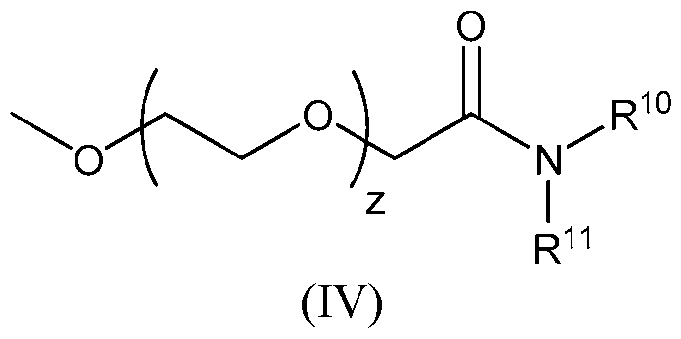 or a pharmaceutically acceptable salt, tautomer or stereoisomer thereof, wherein: R10 and R11 are each independently a straight or branched, saturated or unsaturated alkyl chain containing from 10 to 30 carbon atoms, wherein the alkyl chain is optionally interrupted by one or more ester bonds; and z has mean value ranging from 30 to 60.
In some of the foregoing embodiments of the pegylated lipid (IV), R10 and R11 are not both n-octadecyl when z is 42. In some other embodiments, R10 and R11 are each independently a straight or branched, saturated or unsaturated alkyl chain containing from 10 to 18 carbon atoms. In some embodiments, R10 and R11 are each independently a straight or branched, saturated or unsaturated alkyl chain containing from 12 to 16 carbon atoms. In some embodiments, R10 and R11 are each independently a straight or branched, saturated or unsaturated alkyl chain containing 12 carbon atoms. In some embodiments,
R10 and R11 are each independently a straight or branched, saturated or unsaturated alkyl chain containing 14 carbon atoms. In other embodiments, R10 and R11 are each independently a straight or branched, saturated or unsaturated alkyl chain containing 16 carbon atoms. In still more embodiments, R10 and R11 are each independently a straight or branched, saturated or unsaturated alkyl chain containing 18 carbon atoms. In still other embodiments, R10 is a straight or branched, saturated or unsaturated alkyl chain containing 12 carbon atoms and R11 is a straight or branched, saturated or unsaturated alkyl chain containing 14 carbon atoms.
In various embodiments, z spans a range that is selected such that the PEG portion of (II) has an average molecular weight of about 400 to about 6000 g/mol. In some embodiments, the average z is about 45.
In other embodiments, the pegylated lipid has one of the following structures:
 wherein n is an integer selected such that the average molecular weight of the pegylated lipid is about 2500 g/mol.
In certain embodiments, the additional lipid is present in the LNP in an amount from about 1 to about 10 mole percent. In one embodiment, the additional lipid is present in the LNP in an amount from about 1 to about 5 mole percent. In one embodiment, the additional lipid is present in the LNP in about 1 mole percent or about 1.5 mole percent.
In some embodiments, the LNP comprises a lipid of Formula (I), a nucleoside-modified RNA, a neutral lipid, a steroid and a pegylated lipid. In some embodiments the lipid of Formula (I) is compound 1-6. In different embodiments, the neutral lipid is DSPC. In other embodiments, the steroid is cholesterol. In still different embodiments, the pegylated lipid is compound IVa.
Other exemplary LNPs and their manufacture are described in the art, for example in U.S. Patent Application Publication No. US20120276209, Semple et al., 2010, Nat Biotechnol., 28(2): 172-176; Akinc et al., 2010, Mol Ther., 18(7): 1357-1364; Basha et al., 2011, Mol Ther, 19(12): 2186-2200; Leung et al., 2012, J Phys Chem C Nanomater Interfaces, 116(34): 18440-18450; Lee et al., 2012, Int J Cancer., 131(5): E781-90; Belliveau et al., 2012, Mol Ther nucleic Acids, 1 : e37; Jayaraman et al., 2012, Angew Chem Int Ed Engl., 51(34): 8529-8533; Mui et al., 2013, Mol Ther Nucleic Acids. 2, el39; Maier et al., 2013, Mol Ther., 21(8): 1570-1578; and Tam et al., 2013, Nanomedicine, 9(5): 665-74, each of which are incorporated by reference in their entirety.
The following Reaction Schemes illustrate methods to make lipids of Formula (I), (II) or (III).
GENERAL REACTION SCHEME 1

Embodiments of the lipid of Formula (I) (e.g., compound A-5) can be prepared according to General Reaction Scheme 1 (“Method A”), wherein R is a saturated or unsaturated C1-C24 alkyl or saturated or unsaturated cycloalkyl, m is 0 or 1 and n is an integer from 1 to 24. Referring to General Reaction Scheme 1, compounds of structure A-l can be purchased from commercial sources or prepared according to methods familiar to one of ordinary skill in the art. A mixture of A-l, A-2 and DMAP is treated with DCC to give the bromide A-3. A mixture of the bromide A-3, a base (e.g.,
N,N-diisopropylethylamine) and the N,N-dimethyldiamine A-4 is heated at a temperature and time sufficient to produce A- 5 after any necessarily workup and or purification step.
GENERAL REACTION SCHEME 2
 Other embodiments of the compound of Formula (I) (e.g., compound B-5) can be prepared according to General Reaction Scheme 2 (“Method B”), wherein R is a saturated or unsaturated C1-C24 alkyl or saturated or unsaturated cycloalkyl, m is 0 or 1 and n is an integer from 1 to 24. As shown in General Reaction Scheme 2, compounds of structure B-l can be purchased from commercial sources or prepared according to methods familiar to one of ordinary skill in the art. A solution of B-l (1 equivalent) is treated with acid chloride B-2 (1 equivalent) and a base (e.g., triethylamine). The crude product is treated with an oxidizing agent (e.g., pyridinum chlorochromate) and intermediate product B-3 is recovered. A solution of crude B-3, an acid (e g., acetic acid), and N,N-dimethylaminoamine B-4 is then treated with a reducing agent (e.g., sodium triacetoxyborohydride) to obtain B-5 after any necessary work up and/or purification.
It should be noted that although starting materials A-l and B-l are depicted above as including only saturated methylene carbons, starting materials which include carbon-carbon double bonds may also be employed for preparation of compounds which include carbon-carbon double bonds.
GENERAL REACTION SCHEME 3

Different embodiments of the lipid of Formula (I) (e g., compound C-7 or C9) can be prepared according to General Reaction Scheme 3 (“Method C”), wherein R is a saturated or unsaturated C1-C24 alkyl or saturated or unsaturated cycloalkyl, m is 0 or 1 and n is an integer from 1 to 24. Referring to General Reaction Scheme 3, compounds of structure C-1 can be purchased from commercial sources or prepared according to methods familiar to one of ordinary skill in the art.
GENERAL REACTION SCHEME 4

D-7
Embodiments of the compound of Formula (II) (e.g., compounds D-5 and D-7) can be prepared according to General Reaction Scheme 4 (“Method D”), wherein Rla, Rlb, R2a, R2h, R3a, R3h, R4a, R4h, R5, R6, R8, R9, L1, L2, G1, G2, G3, a, b, c and d are as defined herein, and R7 represents R7 or a C3-C19 alkyl. Referring to General Reaction Scheme 1, compounds of structure D-l and D-2 can be purchased from commercial sources or prepared according to methods familiar to one of ordinary skill in the art. A solution of D-l and D-2 is treated with a reducing agent (e.g., sodium triacetoxyborohydride) to obtain D-3 after any necessary work up. A solution of D-3 and a base (e.g. trimethylamine, DMAP) is treated with acyl chloride D-4 (or carboxylic acid and DCC) to obtain D-5 after any necessary work up and/or purification. D-5 can be reduced with LiAlH4 D-6 to give D-7 after any necessary work up and/or purification.
GENERAL REACTION SCHEME 5

Embodiments of the lipid of Formula (II) (e.g., compound E-5) can be prepared according to General Reaction Scheme 5 (“Method E”), wherein Rla, Rlb, R2a, R2b, R3a, R3b, R4a, R4b, R5, R6, R7, R8, R9, L1, L2, G3, a, b, c and d are as defined herein. Referring to General Reaction Scheme 2, compounds of structure E-l and E-2 can be purchased from commercial sources or prepared according to methods familiar to one of ordinary skill in the art. A mixture of E-l (in excess), E-2 and a base (e.g., potassium carbonate) is heated to obtain E-3 after any necessary work up. A solution of E-3 and a base (e.g. trimethylamine, DMAP) is treated with acyl chloride E-4 (or carboxylic acid and DCC) to obtain E-5 after any necessary work up and/or purification.
GENERAL REACTION SCHEME 6

General Reaction Scheme 6 provides an exemplary method (Method F) for preparation of Lipids of Formula (III). G1, G3, R1 and R3 in General Reaction Scheme 6 are as defined herein for Formula (III), and Gl’ refers to a one-carbon shorter homologue of Gl. Compounds of structure F-l are purchased or prepared according to methods known in the art. Reaction of F-l with diol F-2 under appropriate condensation conditions (e.g., DCC) yields ester/alcohol F-3, which can then be oxidized (e.g., PCC) to aldehyde F-4. Reaction of F-4 with amine F-5 under reductive amination conditions yields a lipid of Formula (III).
It should be noted that various alternative strategies for preparation of lipids of Formula (III) are available to those of ordinary skill in the art. For example, other lipids of Formula (III) wherein L1 and L2 are other than ester can be prepared according to analogous methods using the appropriate starting material. Further, General Reaction Scheme 6 depicts preparation of a lipids of Formula (III), wherein G1 and G2 are the same; however, this is not a required aspect of the invention and modifications to the above reaction scheme are possible to yield compounds wherein G1 and G2 are different.
It will be appreciated by those skilled in the art that in the process described herein the functional groups of intermediate compounds may need to be protected by suitable protecting groups. Such functional groups include hydroxy, amino, mercapto and carboxylic acid. Suitable protecting groups for hydroxy include trialkylsilyl or diarylalkylsilyl (for example, /-butyldimethylsilyl, /-butyldiphenyl silyl or trimethyl silyl), tetrahydropyranyl, benzyl, and the like. Suitable protecting groups for amino, amidino and guanidino include Lbutoxycarbonyl, benzyloxycarbonyl, and the
like. Suitable protecting groups for mercapto include -C(O)-R" (where R" is alkyl, aryl or arylalkyl), /2-methoxybenzyl, trityl and the like. Suitable protecting groups for carboxylic acid include alkyl, aryl or arylalkyl esters. Protecting groups may be added or removed in accordance with standard techniques, which are known to one skilled in the art and as described herein. The use of protecting groups is described in detail in Green, T.W. and P.G.M. Wutz, Protective Groups in Organic Synthesis (1999), 3rd Ed., Wiley. As one of skill in the art would appreciate, the protecting group may also be a polymer resin such as a Wang resin, Rink resin or a 2-chlorotrityl-chloride resin.
The term “lipid nanoparticle” refers to a particle having at least one dimension on the order of nanometers (e.g., l-1000nm) which includes one or more lipids. In some embodiments, the LNP comprises at least one agent that is either organized within inverse lipid micelles and encased within a lipid monolayer envelope or intercalated between adjacent lipid bilayers (e.g. lipid bilayer-agent-lipid bilayer). In some embodiments, the morphology of the LNP is distinct from that of a traditional liposome, characterized by a lipid bilayer surrounding an aqueous core, as the LNP possesses an electron-dense core, where the cationic/ionizable lipids are organized into inverted micelles around the encapsulated agent (e.g. mRNA molecules)(Cullis and Hope, 2017; Guevara et al., 2019b). In various embodiments, the LNP includes a lipid of Formula (I), (II) or (III). In some embodiments, the LNP is included in a formulation comprising at least one agent as described herein. In some embodiments, the LNP comprises a cationic lipid (e.g., a lipid of Formula (I), (II) or (III)) and one or more excipients selected from neutral lipids, charged lipids, steroids and lipid-anchored polyethylene glycol (e.g., a pegylated lipid such as a pegylated lipid of structure (IV), such as compound IVa). In some embodiments, the at least one agent is encapsulated in the lipid portion of the LNP or an aqueous space enveloped by some or all of the lipid portion of the at least one LNP, thereby protecting it from enzymatic degradation or other undesirable effects induced by the mechanisms of the host organism or cells e.g., an adverse immune response.
In various embodiments, the LNP has a mean diameter from about 30 nm to about 150 nm, from about 40 nm to about 150 nm, from about 50 nm to about 150 nm,
from about 60 nm to about 130 nm, from about 70 nm to about 110 nm, from about 70 nm to about 100 nm, from about 80 nm to about 100 nm, from about 90 nm to about 100 nm, from about 70 to about 90 nm, from about 80 nm to about 90 nm, from about 70 nm to about 80 nm, or about 30 nm, 35 nm, 40 nm, 45 nm, 50 nm, 55 nm, 60 nm, 65 nm, 70 nm, 75 nm, 80 nm, 85 nm, 90 nm, 95 nm, 100 nm, 105 nm, 110 nm, 115 nm, 120 nm, 125 nm, 130 nm, 135 nm, 140 nm, 145 nm, or 150 nm. In one embodiment, the LNP has a mean diameter of about 83 nm. In one embodiment, the LNP has a mean diameter of about 102 nm. In one embodiment, the LNP has a mean diameter of about 103 nm. In some embodiments, the LNP is substantially non-toxic. In certain embodiments, the at least one agent, when present in the at least one LNP, is resistant in aqueous solution to degradation by intra- or intercellular enzymes
The LNP may comprise any lipid capable of forming a particle to which the at least one agent is attached, or in which the at least one agent is encapsulated or complexed. The term “lipid” refers to a group of organic compounds that are derivatives of fatty acids (e.g., esters) and are generally characterized by being insoluble in water but soluble in many organic solvents. Exemplary lipids are shown elsewhere herein.
In one embodiment, the LNP comprises one or more cationic lipids, and one or more stabilizing lipids. Stabilizing lipids include neutral lipids, anionic lipids and pegylated lipids.
In one embodiment, the LNP comprises a cationic lipid. As used herein, the term “cationic or ionizable lipid” refers to a lipid that is cationic or becomes cationic (protonated) as the pH is lowered below the pKa of the ionizable group of the lipid, but is progressively more neutral at higher pH values. At pH values below the pKa, the lipid is then able to associate with negatively charged nucleic acids. In certain embodiments, the cationic lipid comprises a zwitterionic lipid that assumes a positive charge on pH decrease.
In various embodiments, the LNP comprises a cationic or ionizable lipids, stabilizing lipids, sterol, and a lipid-anchored polyethylene glycol (i.e PEGylated lipids).
In some embodiments, the LNP comprises an ionic lipid of Formula (I), at least one agent, and one or more excipients selected from neutral lipids, steroids and
pegylated lipids. In some embodiments the lipid of Formula (I) is compound 1-5. In some embodiments the lipid of Formula (I) is compound 1-6.
In some embodiments, the LNP comprises an ionic lipid of Formula (II), at least one agent, and one or more excipient selected from neutral lipids, steroids and pegylated lipids. In some embodiments, the lipid of Formula (II) is compound II-9. In some embodiments, the lipid of Formula (II) is compound II- 10. In some embodiments, the lipid of Formula (II) is compound II- 11. In some embodiments, the lipid of Formula (II) is compound 11-12. In some embodiments, the lipid of Formula (II) is compound II- 32.
In some embodiments, the LNP comprises an ionic lipid of Formula (III), at least one agent, and one or more excipient selected from neutral lipids, steroids and pegylated lipids. In some embodiments, the lipid of Formula (III) is compound III-3. In some embodiments, the lipid of Formula (III) is compound III-7.
In certain embodiments, the cationic lipid is present in the LNP in an amount from about 30 to about 95 mole percent. In one embodiment, the cationic lipid is present in the LNP in an amount from about 30 to about 70 mole percent. In one embodiment, the cationic lipid is present in the LNP in an amount from about 40 to about 60 mole percent. In one embodiment, the cationic lipid is present in the LNP in an amount of about 50 mole percent. In one embodiment, the LNP comprises only cationic lipids.
In certain embodiments, the LNP comprises one or more stabilizing lipids (e.g. neutral or anionic lipids) which help to encapsulate the at least one agent and stabilize the formation of particles during their formation.
Any suitable format of the at least one delivery vehicle is contemplated. In some embodiments, the at least one delivery vehicle is a colloidal dispersion system, such as macromolecule complexes, nanocapsules, microspheres, beads, and lipid-based systems including oil-in-water emulsions, micelles, mixed micelles, liposomes, and lipid nanoparticles. Exemplary colloidal systems for use as delivery vehicles in vitro and in vivo include liposomes (e.g., an artificial membrane vesicle) and lipid nanoparticles.
The use of lipid formulations, as described above, is contemplated for the introduction of the at least one agent into the host cell (in vitro, ex vivo, or in vivo). In
another aspect, the at least one agent may be associated with a lipid. The at least one agent associated with a lipid may be encapsulated in the aqueous interior of a liposome, interspersed within the lipid bilayer of a liposome, attached to a liposome via a linking molecule that is associated with both the liposome and the oligonucleotide, entrapped in a liposome, complexed with a liposome, dispersed in a solution containing a lipid, mixed with a lipid, combined with a lipid, contained as a suspension in a lipid, complexed with a lipid, contained or complexed with a micelle, or otherwise associated with a lipid. Lipid, lipid/nucleic acid or lipid/expression vector associated compositions are not limited to any particular structure in solution. For example, they may be present in a bilayer structure, as micelles, or with a “collapsed” structure. They may also simply be interspersed in a solution, possibly forming aggregates that are not uniform in size or shape.
In one embodiment, delivery of the at least one agent comprises any suitable delivery method, including exemplary delivery methods described elsewhere herein. In certain embodiments, delivery of the at least one agent to a subject comprises mixing the at least one agent with a transfection reagent prior to the step of contacting. In another embodiment, a method of the present invention further comprises administering the at least one agent together with the transfection reagent. In another embodiment, the transfection reagent is a cationic lipid reagent.
In another embodiment, the transfection reagent is a lipid-based transfection reagent. In another embodiment, the transfection reagent is a protein-based transfection reagent. In another embodiment, the transfection reagent is a polyethyleneimine based transfection reagent. In another embodiment, the transfection reagent is calcium phosphate. In another embodiment, the transfection reagent is Lipofectin®, Lipofectamine®, or TransIT®. In another embodiment, the transfection reagent is any other transfection reagent known in the art.
In some embodiments, delivery of the at least one agent comprises liposomes. “Liposome” is a generic term encompassing a variety of single and multilamellar lipid vehicles formed by the generation of enclosed lipid bilayers or aggregates. Liposomes can be characterized as having vesicular structures with a phospholipid bilayer membrane and an inner aqueous medium. Multilamellar liposomes
have multiple lipid layers separated by aqueous medium. They form spontaneously when phospholipids are suspended in an excess of aqueous solution. The lipid components undergo self-rearrangement before the formation of closed structures and entrap water and dissolved solutes between the lipid bilayers (Ghosh et al., 1991 Glycobiology 5: 505- 10). However, compositions that have different structures in solution than the normal vesicular structure are also encompassed. For example, the lipids may assume a micellar structure or merely exist as nonuniform aggregates of lipid molecules.
In one embodiment, the at least one agent associated with a lipid may be encapsulated in the aqueous interior of a liposome, interspersed within the lipid bilayer of a liposome, attached to a liposome via a linking molecule that is associated with both the liposome and the oligonucleotide, entrapped in a liposome, complexed with a liposome, dispersed in a solution containing a lipid, mixed with a lipid, combined with a lipid, contained as a suspension in a lipid, contained or complexed with a micelle, or otherwise associated with a lipid. Lipid, lipid/nucleic acid or lipid/expression vector associated compositions are not limited to any particular structure in solution. For example, they may be present in a bilayer structure, as micelles, or with a “collapsed” structure. They may also simply be interspersed in a solution, possibly forming aggregates that are not uniform in size or shape.
In another embodiment, the transfection reagent forms a liposome. Liposomes, in another embodiment, increase intracellular stability, increase uptake efficiency and improve biological activity. In another embodiment, liposomes are hollow spherical vesicles composed of lipids arranged in a similar fashion as those lipids which make up the cell membrane. In some embodiments, the liposomes comprise an internal aqueous space for entrapping water-soluble compounds. In another embodiment, liposomes can deliver the at least one agent to cells in an active form.
Cell Targeting Domains
In one embodiment, the present invention relates to compositions having at least one delivery vehicle conjugated to at least one cell targeting domain, wherein the at least one delivery vehicle comprises at least one agent, wherein the at least one cell targeting domain binds to at least one antigen on the surface of at least one target cell,
and wherein the at least one agent is delivered to the at least one target cell. In some embodiments, the at least one delivery vehicle comprises an LNP.
In one embodiment, the at least one cell targeting domain comprises an antibody. In some embodiments, the at least one cell targeting domain comprises an antibody, wherein the antibody is an anti-CD45 antibody, an anti-CD56 antibody, an anti- CD71 antibody, an anti F4/80 antibody, and anti-CD14 antibody, an anti-CD169 antibody, an anti-CD19 antibody, an anti-CD20 antibody, an anti-CD22 antibody, an anti-CD205 antibody, or an anti-CDl 1 antibody.
In some embodiments, the at least one cell targeting domain comprises any suitable binding agent which is capable of specifically binding to at least one antigen on the surface of at least one target cell. The at least one cell targeting domain may be naturally occurring or engineered. The at least one cell targeting domain may include, but are not limited to, proteins, peptides, antibodies or antibody fragments, immunoglobulins or immunoglobulin fragments, small molecules, aptamers, vitamins, nucleic acid molecules, and the like. No limit is meant to be placed on the at least one targeting domain contemplated herein so long as any particular targeting domain may be (a) coupled to a delivery vehicle (either covalently or non-covalently) and (b) is capable of causing or facilitating the localization or targeting of the delivery vehicle to a target cell or tissue by the binding or otherwise interaction between the targeting domain on the delivery vehicle and a target cell ligand on a target cell or tissue.
In some embodiments, the at least one antigen comprises endogenous ligands occurring on the surface of a cell or in the extracellular space outside of a cell, such as carbohydrates, lipids, polysaccharides, proteins, glycoproteins, glycolipids, peptides, cell membrane components (e.g., cholesterol) or the like. In certain embodiments, the endogenous ligands on the at least one target cell are specific for the target cell, i.e., are expressed and/or are contained only on the target cell, or at least, are minimally present in cells that are not the target cells. For example, in some embodiments, the endogenous ligand on the at least one target cell comprises a disease- associated protein, e.g., a cancer cell protein cell surface protein that are not typically expressed in healthy cells. In other embodiments, the at least one antigen on the at least one target cell can be an engineered or otherwise non-naturally occurring ligand, e.g., a
genetically modified target cell that expresses a non-naturally occurring surface cell protein. Suitable targeting ligands can be selected so that the unique properties of the target cell are utilized, thus allowing the composition to differentiate between target and non -target cells.
This aspect may be referred to as “selective delivery” of a delivery vehicle to a target cell of interest (e.g., a lymphocyte, such as a T-cell). The term “selective delivery” means that delivery vehicles are localized by binding covalently or non- covalently to a target cell (e.g., a particular T-cell subpopulation) through the binding interaction between the at least one cell targeting domain of the at least one delivery vehicle and the at least one antigen on the surface of the at least one target cell (e.g., a natural killer (NK) cell, a macrophage, a B cell, a dendritic cell (DC), a particular T-cell subpopulation, etc.), but wherein the at least one delivery vehicle does not bind, or binds minimally, to cells that do not express the at least one antigen (i.e., such cells may be referred to as “non-target cells”). By “bind minimally,” it is meant that binding of the at least one delivery vehicle to non-target cells ranges between undetected to less than 1%, or less than 2%, or less than 3%, or less than 4%, or less than 5%, or less than 6%, or less than 7%, or less than 8%, or less than 9%, or less than 10% increased binding relative to a negative control (which can be a cell type known not to bind to the delivery vehicle).
Thus, the at least one delivery vehicle of the present disclosure may be localized or targeted to a particular type of cell (e.g., e.g., a natural killer (NK) cell, a macrophage, a B cell, a dendritic cell (DC), a particular T-cell subpopulation, a particular type of immune cell, etc.) by utilizing at least one cell targeting domain which is conjugated to the at least one delivery vehicle. In some embodiments, the at least one cell targeting domain is conjugated such that the at least one cell targeting domain is presented or otherwise exposed on the outer surface of the at least one delivery vehicle such that the at least one cell targeting domain may bind to at least one antigen on the surface of at least one target cell, wherein the at least one antigen may comprise a cognate binding domain or ligand on the surface of the at least one target cell (e.g., a particular CD antigen on an immune cell, a particular CD antigen on a T cell, such as CD3, CD4, CD5, or CD8 etc.), thereby promoting or facilitating the binding of the at least one delivery vehicle to the at least one target cell (such as, an immune cell, a CD3+
T cell, a CD4+ T cell, a CD5+ T cell, or a CD8+ T cell etc.), where it would then become internalized (e.g., through active internalization, such as endocytosis, etc.) with the concomitant release of the at least one agent (e.g., mRNA, etc.) carried by the at least one delivery vehicle once inside the at least one target cell.
One of ordinary skill in the art will be able to identify appropriate antigens on each of these target cells that may be utilized as a means to localize the at least one delivery vehicle described herein by conjugating an appropriately matching cell targeting domain on the at least one delivery vehicle, e.g., an antibody, peptide, protein, oligonucleotide, small molecule, vitamin, or aptamer which is conjugated (covalently or non-covalently to the delivery vehicle) such that the at least one delivery vehicle becomes localized to the at least one target cell due to specific and selective interaction between the at least one cell targeting domain and the at least one antigen on the surface of at least one target cell. In some embodiments, the at least one antigen comprises any molecule or cell surface associated factor that distinguished the at least one target cell from other cells.
One of ordinary skill in the art will appreciate that leukocytes comprise cell surface antigens known as CD antigens which are characteristic of different types of leukocytes and help define various subpopulations of leukocytes.
The cluster of differentiation (CD) is a nomenclature system conceived to identify and classify antigens found on the cell surface of leukocytes. Initially, surface antigens were named after the monoclonal antibodies that bound to them. As there were often multiple monoclonal antibodies raised against each antigen in different labs, the need arose to adopt a consistent nomenclature. The current system was adopted in 1982 through the 1st International Workshop and Conference on Human Leukocyte Differentiation Antigens (HLDA). The Human Cell Differentiation Molecules organization continues to hold HLDA conferences to maintain and develop the list of known CD markers.
Under this naming system, antigens that are well characterized are assigned an arbitrary number (e.g., CD1, CD2, CD3, CD4, CD5, CD8 etc.) whereas molecules that are recognized by just one monoclonal antibody are given the provisional designation “CDw” e.g., CDw50. Lower class letters are also added after the assigned
number to indicate larger molecules that share a common chain, for example CD1 a or CD Id. Physiologically, CD molecules do not belong in any particular class, with their functions ranging widely from cell surface receptors to adhesion molecules. Although initially used just for human leukocytes, the CD molecule naming convention has now been expanded to cover different species (e.g., mouse, etc.) as well as other cell types. As of April 2016, human CD antigens are numbered up to CD371.
The presence or absence of a specific antigen from the surface of a particular cell population is denoted with “+” or respectively. Varying cellular expression levels are also marked as hi or low, for example central memory T-cells are CD62Lhi whereas effector memory T-cells are CD62Llow. Monitoring the expression profiles of different CD antigens has permitted the identification, isolation and phenotyping of cell types according to their function in various immune processes.
As used herein, “antibody” refers to a polypeptide of the immunoglobulin family that is capable of binding a corresponding antigen non-covalently, reversibly, and in a specific manner (e.g., a CD3, CD4, CD5, or CD8 antigen). For example, a naturally occurring IgG antibody is a tetramer comprising at least two heavy (H) chains and two light (L) chains inter-connected by disulfide bonds. Each heavy chain is comprised of a heavy chain variable region (abbreviated herein as VH) and a heavy chain constant region. The heavy chain constant region is comprised of three domains, CHI, CH2 and CH3. Each light chain is comprised of a light chain variable region (abbreviated herein as VL) and a light chain constant region. The light chain constant region is comprised of one domain, CL. The VH and VL regions can be further subdivided into regions of hypervariability, termed complementarity determining regions (CDR), interspersed with regions that are more conserved, termed framework regions (FR). Each VH and VL is composed of three CDRs and four FRs arranged from amino-terminus to carboxyterminus in the following order: FR1, CDR1, FR2, CDR2, FR3, CDR3, and FR4. The variable regions of the heavy and light chains contain a binding domain that interacts with an antigen. The constant regions of the antibodies may mediate the binding of the immunoglobulin to host tissues or factors, including various cells of the immune system (e.g., effector cells, etc.) and the first component (Clq) of the classical complement system.
Antibodies of the present disclosure include, but are not limited to, monoclonal antibodies, human antibodies, humanized antibodies, camelid antibodies, chimeric antibodies, and anti -idiotypic (anti-Id) antibodies (including, e.g., anti-Id antibodies to antibodies of the present disclosure). The antibodies can be of any isotype/class (e.g., IgG, IgE, IgM, IgD, IgA and IgY), or subclass (e.g., IgGl, IgG2, IgG3, IgG4, IgAl and IgA2).
As used herein, “complementarity-determining domains” or “complementary-determining regions” (“CDRs”) interchangeably refer to the hypervariable regions of VL and VH. The CDRs are the target protein-binding site of the antibody chains that harbors specificity for such target protein. There are three CDRs (CDR1-3, numbered sequentially from the N-terminus) in each human VL or VH, constituting about 15-20% of the variable domains. CDRs can be referred to by their region and order. For example, “VHCDR1” or “HCDR1” both refer to the first CDR of the heavy chain variable region. The CDRs are structurally complementary to the epitope of the target protein and are thus directly responsible for the binding specificity. The remaining stretches of the VL or VH, the so-called framework regions, exhibit less variation in amino acid sequence (Kuby, Immunology, 4th ed., Chapter 4. W.H. Freeman & Co., New York, 2000).
The positions of the CDRs and framework regions can be determined using various well-known definitions in the art, e.g., Kabat, Chothia, and AbM (see, e.g., Johnson et al., Nucleic Acids Res., 29:205-206 (2001); Chothia and Lesk, J. Mol. Biol., 196:901-917 (1987); Chothia et al., Nature, 342:877-883 (1989); Chothia et al., J. Mol. Biol., 227:799-817 (1992); Al-Lazikani et al., J. Mol. Biol., 273:927-748 (1997)). Definitions of antigen combining sites are also described in the following: Ruiz et al., Nucleic Acids Res., 28:219-221 (2000); and Lefranc, M. P., Nucleic Acids Res., 29:207- 209 (2001); MacCallum et al., J. Mol. Biol., 262:732-745 (1996); and Martin et al., Proc. Natl. Acad. Sci. USA, 86:9268-9272 (1989); Martin et al., Methods Enzymol., 203: 121- 153 (1991); and Rees et al., In Sternberg M. J. E. (ed.), Protein Structure Prediction, Oxford University Press, Oxford, 141-172 (1996).). In a combined Kabat and Chothia numbering scheme, in some embodiments, the CDRs correspond to the amino acid residues that are part of a Kabat CDR, a Chothia CDR, or both. For instance, in some
embodiments, the CDRs correspond to amino acid residues 26-35 (HC CDR1), 50-65 (HC CDR2), and 95-102 (HC CDR3) in a VH, e.g., a mammalian VH, e.g., a human VH; and amino acid residues 24-34 (LC CDR1), 50-56 (LC CDR2), and 89-97 (LC CDR3) in a VL, e.g., a mammalian VL, e.g., a human VL.
Both the light and heavy chains are divided into regions of structural and functional homology. The terms “constant” and “variable” are used functionally. In this regard, it will be appreciated that the variable domains of both the light (VL) and heavy (VH) chain portions determine antigen recognition and specificity. Conversely, the constant domains of the light chain (CL) and the heavy chain (CHI, CH2 or CH3) confer important biological properties such as secretion, transplacental mobility, Fc receptor binding, complement binding, and the like. By convention, the numbering of the constant region domains increases as they become more distal from the antigen binding site or amino-terminus of the antibody. The N-terminus is a variable region and at the C- terminus is a constant region; the CH3 and CL domains actually comprise the carboxyterminal domains of the heavy and light chain, respectively.
As used herein, “antigen binding fragment” refers to one or more portions of an antibody that retain the ability to specifically interact with (e.g., by binding, steric hindrance, stabilizing/destabilizing, spatial distribution) an epitope of an antigen (such as, for example, a CD3, CD4, CD5, or CD8 antigen of a leukocyte). Examples of binding fragments include, but are not limited to, single-chain Fvs (scFv), disulfide-linked Fvs (sdFv), Fab fragments, F(ab') fragments, a monovalent fragment consisting of the VL, VH, CL and CHI domains; a F(ab)2 fragment, a bivalent fragment comprising two Fab fragments linked by a disulfide bridge at the hinge region; a Fd fragment consisting of the VH and CHI domains; a Fv fragment consisting of the VL and VH domains of a single arm of an antibody; a dAb fragment (Ward et al., Nature 341 :544-546, 1989), which consists of a VH domain; and an isolated complementarity determining region (CDR), or other epitope-binding fragments of an antibody.
Furthermore, although the two domains of the Fv fragment, VL and VH, are coded for by separate genes, they can be joined, using recombinant methods, by a synthetic linker that enables them to be made as a single protein chain in which the VL and VH regions pair to form monovalent molecules (known as single chain Fv (“scFv”);
see, e.g., Bird et al., Science 242:423-426, 1988; and Huston et al., Proc. Natl. Acad. Sci. 85:5879-5883, 1988). Such single chain antibodies are also intended to be encompassed within the term “antigen-binding fragment.” These antigen binding fragments are obtained using conventional techniques known to those of skill in the art, and the fragments are screened for utility in the same manner as are intact antibodies.
Antigen binding fragments can also be incorporated into single domain antibodies, maxibodies, minibodies, nanobodies, intrabodies, diabodies, triabodies, tetrabodies, v-NAR and bis-scFv (see, e.g., Hollinger and Hudson, Nature Biotechnology 23: 1126-1136, 2005). Antigen binding fragments can be grafted into scaffolds based on polypeptides such as fibronectin type III (Fn3) (see U.S. Pat. No. 6,703,199, which describes fibronectin polypeptide monobodies). Accordingly, the antibodies and antigen binding fragments herein (e.g., anti-CD5 antigen binding fragments, etc,) can be a variety of structures, including, but not limited to bispecific antibodies, minibodies, domain antibodies, synthetic antibodies, antibody mimetics, chimeric antibodies, antibody fusions (sometimes referred to as “antibody conjugates”), and fragments of each, respectively. Specific antibody fragments (or antigen binding fragments) include, but are not limited to, (i) the Fab fragment consisting of VL, VH, CL and CHI domains, (ii) the Fd fragment consisting of the VH and CHI domains, (iii) the Fv fragment consisting of the VL and VH domains of a single antibody; (iv) the dAb fragment, which consists of a single variable region, (v) isolated CDR regions, (vi) F(ab')2 fragments, a bivalent fragment comprising two linked Fab fragments (vii) single chain Fv molecules (scFv), wherein a VH domain and a VL domain are linked by a peptide linker which allows the two domains to associate to form an antigen binding site (viii) bispecific single chain Fv dimers and (ix) “diabodies” or “triabodies”, multivalent or multispecific fragments constructed by gene fusion. The antibody fragments may be modified. For example, the molecules may be stabilized by the incorporation of disulfide bridges linking the VH and VL domains. Examples of antibody formats and architectures are described in Carter, 2006, Nature Reviews Immunology 6:343-357 and references cited therein, all expressly incorporated by reference.
Antigen binding fragments can be incorporated into single chain molecules comprising a pair of tandem Fv segments (VH-CHl-VH-CHl) which, together
with complementary light chain polypeptides, form a pair of antigen binding regions (Zapata et al., Protein Eng. 8:1057-1062, 1995; and U.S. Pat. No. 5,641,870).
As used herein, “monoclonal antibody” refers to polypeptides, including antibodies and antigen binding fragments that have substantially identical amino acid sequence or are derived from the same genetic source. This term also includes preparations of antibody molecules of single molecular composition. A monoclonal antibody composition displays a single binding specificity and affinity for a particular epitope.
As used herein, a “human antibody” includes antibodies having variable regions in which both the framework and CDR regions are derived from sequences of human origin. Furthermore, if the antibody contains a constant region, the constant region also is derived from such human sequences, e.g., human germline sequences, or mutated versions of human germline sequences or antibody containing consensus framework sequences derived from human framework sequences analysis, for example, as described in Knappik et al., J. Mol. Biol. 296:57-86, 2000).
In some embodiments, the antibody is a chimeric antibody or antigenbinding fragment thereof. A chimeric antibody is an antibody comprising amino acid sequences from different genetic sources. In some embodiments, the chimeric antibody comprises amino acid sequences from a mouse and amino acid sequences from a human. In some embodiments a chimeric antibody comprises a variable domain derived from a mouse and constant domains derived from a human.
In some embodiments, the antibody is a humanized antibody or antigenbinding fragment thereof. By “humanized” antibody as used herein is meant an antibody comprising a human framework region (FR) and one or more complementarity determining regions (CDRs) from a non-human (usually mouse or rat) antibody. The non-human antibody providing the CDRs is called the “donor” and the human immunoglobulin providing the framework is called the “acceptor”. Humanization relies principally on the grafting of donor CDRs onto acceptor (human) VL and VH frameworks (Winter U.S. Pat. No. 5,225,539, incorporated entirely by reference). This strategy is referred to as “CDR grafting.” “Backmutation” of selected acceptor framework residues to the corresponding donor residues is often required to regain
affinity that is lost in the initial grafted construct (U.S. Pat. No. 5,693,762, incorporated entirely by reference). The humanized antibody optimally also will comprise at least a portion of an immunoglobulin constant region, typically that of a human immunoglobulin, and thus will typically comprise a human Fc region. A variety of techniques and methods for humanizing and reshaping non-human antibodies are well known in the art (See Tsurushita & Vasquez, 2004, Humanization of Monoclonal Antibodies, Molecular Biology of B Cells, 533-545, Elsevier Science (USA), and references cited therein, all incorporated entirely by reference). Humanization or other methods of reducing the immunogenicity of nonhuman antibody variable regions may include resurfacing methods, as described for example in Roguska et al., 1994, Proc. Natl. Acad. Sci. USA 91 :969-973, incorporated entirely by reference. In one embodiment, selection-based methods may be employed to humanize and/or affinity mature antibody variable regions, that is, to increase the affinity of the variable region for its target antigen. Other humanization methods may involve the grafting of only parts of the CDRs, including but not limited to methods described in U.S. Ser. No. 09/810,502; Tan et al., 2002, J. Immunol. 169: 1119-1125; De Pascalis et al., 2002, J. Immunol. 169:3076-3084, incorporated entirely by reference. Structure-based methods may be employed for humanization and affinity maturation, for example as described in U.S. Ser. No. 10/153,159 and related applications, all incorporated entirely by reference.
In some embodiments, the antibody is a human engineered antibody. A human engineered antibody refers to an antibody derived from a non-human source, such as mouse, in which one or more substitutions have been made to improve a desired characteristic of the antibody, such as to increase stability or reduce immunogenicity when the antibody is administered to a subject. In some embodiments, the substitutions are made at low-risk positions (e.g. exposed to solvent but not contributing to antigen binding or antibody structure, etc.). Such substitutions mitigate the risk that a subject will generate an immune response against the antibody following its administration, without affecting the ability of the antibody to bind to a desired epitope or antigen (see, e.g,. Studnicka et al. Protein Eng. 1994. 7(6):805 814).
In some embodiments, the antibody is a single chain antibody or antigenbinding fragment. A single chain antibody, or single chain variable fragment (scFV) is a
protein or polypeptide comprising a VH domain and a VL domain joined together, such as by a synthetic linker, to form a single protein or polypeptide (see, e.g., Bird et al., Science. 242:423-426, 1988; and Huston et al., Proc. Natl. Acad. Sci. 85:5879-5883, 1988).
In some embodiments, the antibody is an antibody fragment or antigenbinding fragment. An antibody fragment is protein or polypeptide derived from an antibody. An antigen-binding fragment is a protein or polypeptide derived from an antibody that is capable of binding to the same epitope or antigen as the antibody from which it was derived.
In some embodiments, the antibody has reduced glycosylation, no glycosylation, or is hypofucosylated. Glycosylation refers to the covalent attachment of sugar, monosaccharide, disaccharide, oligosaccharide, polysaccharide, or glycan moieties to a molecule, such as a polypeptide or protein. These sugar or glycan moieties are generally attached to an antibody in a post-translational matter, prior to secretion by a B cell. An antibody with reduced glycosylation has fewer of these attached sugar or glycan moieties than the number that are typically attached to an antibody with a substantially identical amino acid sequence, such as when the antibody is produced by a B cell in vitro or in vivo in a mouse or human. An antibody with no glycosylation has no attached sugar or glycan moieties. An antibody that is hypofucosylated has fewer fucosyl residues than the number that are typically attached to an antibody with a substantially identical amino acid sequence, such as when the antibody is produced by a B cell in vitro or in vivo in a mouse or human.
In still other embodiments, the antibodies and antigen binding fragments discussed herein may be modified in a manner that reduces immunogenicity. Modifications to reduce immunogenicity may include modifications that reduce binding of processed peptides derived from the parent sequence to MHC proteins. For example, amino acid modifications would be engineered such that there are no or a minimal number of immune epitopes that are predicted to bind, with high affinity, to any prevalent MHC alleles. Several methods of identifying MHC -binding epitopes in protein sequences are known in the art and may be used to score epitopes in an antibody of the present
invention. See, for example, U.S. Ser. No. 09/903,378, U.S. Ser. No. 10/754,296, U.S. Ser. No. 11/249,692, and references cited therein, all expressly incorporated by reference.
In one embodiment, the at least one cell targeting domain of the invention binds to at least one antigen on the surface of at least one target cell, wherein the at least one cell targeting domain comprises an antibody or antibody fragment. In certain embodiments, the antibody comprises polyclonal antibodies, monoclonal antibodies, Fab and single chain Fv (scFv) fragments thereof, bispecific antibodies, heteroconjugates, human and humanized antibodies. The antibodies may be intact monoclonal or polyclonal antibodies, and immunologically active fragments (e.g., a Fab or (Fab)2 fragment), an antibody heavy chain, an antibody light chain, humanized antibodies, a genetically engineered single chain Fv molecule (Ladner et al, U.S. Pat. No. 4,946,778), or a chimeric antibody, for example, an antibody which contains the binding specificity of a murine antibody, but in which the remaining portions are of human origin. Antibodies including monoclonal and polyclonal antibodies, fragments and chimeras, may be prepared using methods known to those skilled in the art.
Such antibodies may be produced in a variety of ways, including hybridoma cultures, recombinant expression in bacteria or mammalian cell cultures, and recombinant expression in transgenic animals. The choice of manufacturing methodology depends on several factors including the antibody structure desired, the importance of carbohydrate moieties on the antibodies, ease of culturing and purification, and cost. Many different antibody structures may be generated using standard expression technology, including full-length antibodies, antibody fragments, such as Fab and Fv fragments, as well as chimeric antibodies comprising components from different species. Antibody fragments of small size, such as Fab and Fv fragments, having no effector functions and limited pharmokinetic activity may be generated in a bacterial expression system. Single chain Fv fragments show low immunogenicity.
Conjugation
In one embodiment, the invention relates to compositions having at least one delivery vehicle conjugated to at least one cell targeting domain, wherein the at least one delivery comprises at least one agent, wherein the at least one cell targeting domain
binds to at least one antigen on the surface of at least one target cell, and wherein the at least one agent is delivered to the at least one target cell. In some embodiments, the at least one delivery vehicle comprises an LNP.
Exemplary methods of conjugation can include, but are not limited to, covalent bonds, electrostatic interactions, and hydrophobic (“van der Waals”) interactions. In one embodiment, the conjugation is a reversible conjugation, such that the delivery vehicle can be disassociated from the targeting domain upon exposure to certain conditions or chemical agents. In another embodiment, the conjugation is an irreversible conjugation, such that under normal conditions the delivery vehicle does not dissociate from the targeting domain.
In some embodiments, the conjugation comprises a covalent bond between an activated polymer conjugated lipid and the targeting domain. The term “activated polymer conjugated lipid” refers to a molecule comprising a lipid portion and a polymer portion that has been activated via functionalization of a polymer conjugated lipid with a first coupling group. In one embodiment, the activated polymer conjugated lipid comprises a first coupling group capable of reacting with a second coupling group. In one embodiment, the activated polymer conjugated lipid is an activated pegylated lipid. In one embodiment, the first coupling group is bound to the lipid portion of the pegylated lipid. In another embodiment, the first coupling group is bound to the polyethylene glycol portion of the pegylated lipid. In one embodiment, the second functional group is covalently attached to the targeting domain.
The first coupling group and second coupling group can be any functional groups known to those of skill in the art to together form a covalent bond, for example under mild reaction conditions or physiological conditions. In some embodiments, the first coupling group or second coupling group are maleimides, N-hydroxysuccinimide (NHS) esters, carbodiimides, hydrazide, pentafluorophenyl (PFP) esters, phosphines, hydroxymethyl phosphines, psoralen, imidoesters, pyridyl disulfide, isocyanates, vinyl sulfones, alpha-haloacetyls, aryl azides, acyl azides, alkyl azides, diazirines, benzophenone, epoxides, carbonates, anhydrides, sulfonyl chlorides, cyclooctyne, aldehydes, or sulfhydryl groups. In some embodiments, the first coupling group or second coupling group are free amines (-NH2), free sulfhydryl groups (-SH), free
hydroxide groups (-OH), carboxylates, hydrazides, or alkoxyamines. In some embodiments, the first coupling group is a functional group that is reactive toward sulfhydryl groups, such as maleimide, pyridyl disulfide, or a haloacetyl. In one embodiment, the first coupling group is a maleimide.
In one embodiment, the second coupling group is a sulfhydryl group. The sulfhydryl group can be installed on the targeting domain using any method known to those of skill in the art. In one embodiment, the sulfhydryl group is present on a free cysteine residue. In one embodiment, the sulfhydryl group is revealed via reduction of a disulfide on the targeting domain, such as through reaction with 2-mercaptoethylamine. In one embodiment, the sulfhydryl group is installed via a chemical reaction, such as the reaction between a free amine and 2-iminothilane or N-succinimidyl S-acetylthioacetate (SATA).
In some embodiments, the polymer conjugated lipid and targeting domain are functionalized with groups used in “click” chemistry. Bioorthogonal “click” chemistry comprises the reaction between a functional group with a 1,3-dipole, such as an azide, a nitrile oxide, a nitrone, an isocyanide, and the link, with an alkene or an alkyne dipolarophiles. Exemplary dipolarophiles include any strained cycloalkenes and cycloalkynes known to those of skill in the art, including, but not limited to, cyclooctynes, dibenzocyclooctynes, monofluorinated cyclcooctynes, difluorinated cyclooctynes, and biarylazacyclooctynone.
It will be appreciated that the at least one cell targeting domain can be conjugated to the surface of the at least one delivery vehicle during or after preparation. In some embodiments, the at least one cell targeting domain is conjugated to the surface of the at least one delivery vehicle after the at least one delivery vehicle has been prepared. In other embodiments, the at least one cell targeting domain is conjugated to a component (e.g., a lipid, etc.) of an unassembled delivery vehicle before the at least one delivery vehicle has been prepared. Such conjugation means may be carried out by any known means in the art, including any suitable conjugation chemistry already well known in the art and discussed herein.
In some other embodiments, the at least one delivery vehicle or compositions comprising the at least one delivery vehicle may further include one or
more additional agents that enhance the localization of the delivery vehicles to a target cell. Such additional agents may include other peptides, aptamers, oligonucleotides, vitamins or other molecules that facilitate the localization of a delivery vehicle to a target cell, but which are not necessarily directly coupled to the delivery vehicle.
Target Cells
In one embodiment, the present invention relates to compositions having at least one delivery vehicle conjugated to at least one cell targeting domain, wherein the at least one delivery vehicle comprises at least one agent, wherein the cell targeting domain binds to at least one antigen on the surface of at least one target cell, and wherein the at least one agent is delivered to the at least one target cell. In some embodiments, the at least one delivery vehicle comprises an LNP.
In some embodiments, the at least one target cell comprises an immune cell. In some embodiments, the at least one cell comprises a hematopoietic cell. In some embodiments, the at least one target cell comprises at least one natural killer (NK) cell, at least one macrophage, at least one T cell, at least one B cell, or at least one dendritic cell.
In some embodiments, NK cells that can be targeted using the compositions of the invention comprise CD56+ CD3- NK cells. In some embodiments, NK cells that can be targeted using the compositions of the invention comprise CD56bright or CD56dim cells. In certain embodiments, such natural killer cells comprise natural killer cells that are CD16-. In certain embodiments, such natural killer cells comprise natural killer cells that are CD94+. In certain embodiments, such natural killer cells comprise natural killer cells that are CD94+ or CD16+. In certain embodiments, such natural killer cells comprise natural killer cells that are CD94- or CD16-. In certain embodiments, such natural killer cells comprise natural killer cells that are CD94+ and CD16+. In certain embodiments, such natural killer cells comprise natural killer cells that are CD94- and CD16-. In some embodiments, NK cells that can be targeted using the compositions of the invention comprise CD45+, CD56+, and/or CD71+ NK cells.
In some embodiments, the macrophages that can be targeted using the compositions of the invention comprise adipose tissue macrophages, monocytes, Kupffer cells, sinus histiocytes, alveolar macrophages, tissue macrophages, microglia, Hofbauer
cells, intraglomerular mesangial cells, osteoclasts, Langerhans cells, epithelioid cells, red pulp macrophages, peritoneal macrophages, and/or perivascular macrophages. In some embodiments, macrophages that can be targeted using the compositions of the invention comprise F4/80+, CD14+, and/or CD169+ macrophages.
In some embodiments, the B cells that can be targeted using the compositions of the invention comprise plasmablasts, plasma cells, lymphoplasmacytoid cells, memory B cells, B-2 cells, follicular B cells, marginal-zone B cells, B-l cells, and/or regulator B (Breg) cells. In some embodiments, the B cells that can be targeted using the compositions of the invention comprise CD19+, CD20+ and/or CD22+ B cells.
In some embodiments, the dendritic cells that can be targeted using the compositions of the invention comprise conventional dendritic cells (also known as myeloid dendritic cells), and/or plasmacytoid dendritic cells. In some embodiments, the dendritic cells that can be targeted using the compositions of the invention comprise CD205+ and/or CD11+ dendritic cells.
In one embodiment, the T cells of the invention are immunostimulatory cells, i.e., cells that mediate an immune response. Exemplary T cells that are immunostimulatory include, but are not limited to, T helper cells (CD4+), cytotoxic T cells (also referred to as cytotoxic T lymphocytes, CTL; CD8+ T cells), and memory T cells, including central memory T cells (TCM), stem memory T cells (TSCM), stem-celllike memory T cells (or stem-like memory T cells), and effector memory T cells, for example, TEM cells and TEMRA (CD45RA+) cells, effector T cells, Thl cells, Th2 cells, Th9 cells, Thl7 cells, Th22 cells, Tfh (follicular helper) cells, natural killer T cells, mucosal associated invariant T cells (MAIT), and y8 T cells.
One of ordinary skill in the art will be able to identify at least one appropriate cell surface antigens on any cell type of interest such that the at least one delivery vehicle conjugated to at least one cell targeting domain becomes localized to any cell type of interest due to specific and selective interaction between the at least one cell targeting domain and the at least one appropriate cell surface antigens on any cell type of interest that will allow the targeting of the at least one delivery vehicle of the present invention to any cell of interest.
Delivery vehicle agents
In one embodiment, the present invention relates to compositions comprising at least one delivery vehicle conjugated to at least one cell targeting domain, wherein the at least one delivery vehicle comprises at least one agent, wherein the at least one cell targeting domain binds to at least one antigen on the surface of at least one target cell, and wherein the at least one agent is delivered to the at least one target cell. In one embodiment, the at least one delivery vehicle comprises an LNP. In one embodiment the at least one agent is mRNA.
In some embodiments, the at least one delivery vehicle is taken up via endocytosis by the at least one target cell. In some embodiments, the at least one agent is released from the at least one delivery vehicle inside the at least one target cell. In some embodiments, once released, the at least one agent modifies the at least one target cell resulting in at least one modified target cell. In embodiments, the at least one modified target cell has distinct biological properties from the at least one target cell prior to modification, wherein the distinct biological properties comprise without limitation, distinct gene expression (including distinct RNA and protein expression), distinct cellular localization patterns in vitro and in vivo, distinct morphology, distinct motility, distinct cellular lifespan, and/or distinct cell division frequency.
In some embodiments, the at least one agent comprises at least one nucleoside-modified mRNA molecule, at least one in vitro transcribed (IVT) mRNA, at least one expression vector, at least one chimeric antigen receptor (CAR), at least one RNA interference (RNAi) component (siRNA, antisense polynucleotide, shRNA, miRNA),s components of a CRISPR-Cas9 system, at least one isolated polypeptide, at least one antibody functional fragment, at least one imaging agent, at least one small molecule, or at least one other agent.
Nucleoside-modified RNA
In one aspect, the at least one agent comprises at least one nucleoside- modified nucleic acid, wherein the at least one nucleoside-modified nucleic acid comprises at least one nucleoside-modified RNA, wherein the at least one nucleoside- modified RNA comprises as least one nucleoside-modified mRNA molecule. In one
embodiment, the nucleoside-modified mRNA encodes a peptide, a polypeptide and/or protein.
For example, in one embodiment, the composition comprises at least one nucleoside-modified RNA. Nucleoside-modified mRNA have particular advantages over non-modified mRNA, including for example, increased stability, low or absent innate immunogenicity, and enhanced translation. Nucleoside-modified mRNA useful in the present invention is further described in U.S. Patent Nos. 8,278,036, 8,691,966, and 8,835,108, each of which is incorporated by reference herein in its entirety. In certain embodiments, nucleoside-modified mRNA does not activate any pathophysiologic pathways, translates very efficiently and almost immediately following delivery, and serve as templates for continuous protein production in vivo lasting for several days (Kariko et al., 2008, Mol Ther 16: 1833-1840; Kariko et al., 2012, Mol Ther 20:948-953). The amount of mRNA required to exert a physiological effect is small and that makes it applicable for human therapy.
In certain instances, expressing a protein by delivering the encoding mRNA has many benefits over methods that use protein, plasmid DNA or viral vectors. For example, when expressing a protein by delivering the encoding mRNA, the coding sequence of the desired protein is the only substance delivered to cells, thus avoiding all the side effects associated with plasmid backbones, viral genes, and viral proteins. More importantly, unlike DNA- and viral-based vectors, the mRNA does not carry the risk of being incorporated into the genome and protein production starts immediately after mRNA delivery.
In certain embodiments, the at least one nucleoside-modified RNA comprises the naturally occurring modified-nucleoside pseudouridine. In certain embodiments, inclusion of pseudouridine makes the at least one mRNA more stable, non- immunogenic, and highly translatable (Kariko et al., 2008, Mol Ther 16: 1833-1840; Anderson et al., 2010, Nucleic Acids Res 38:5884-5892; Anderson et al., 2011, Nucleic Acids Research 39:9329-9338; Kariko et al., 2011, Nucleic Acids Research 39:el42; Kariko et al., 2012, Mol Ther 20:948-953; Kariko et al., 2005, Immunity 23:165-175).
It has been demonstrated that the presence of modified nucleosides, including pseudouridines in RNA suppress their innate immunogenicity (Kariko et al.,
2005, Immunity 23: 165-175). Further, protein-encoding, in vitro-tran scribed RNA containing pseudouridine can be translated more efficiently than RNA containing no or other modified nucleosides (Kariko et al., 2008, Mol Ther 16: 1833-1840). Subsequently, it is shown that the presence of pseudouridine improves the stability of RNA (Anderson et al., 2011, Nucleic Acids Research 39:9329-9338) and abates both activation of PKR and inhibition of translation (Anderson et al., 2010, Nucleic Acids Res 38:5884-5892). Similar effects as described for pseudouridine have also been observed for RNA containing 1 -methyl-pseudouridine.
In some embodiments, the at least one nucleoside-modified nucleic acid molecule is a purified nucleoside-modified nucleic acid molecule. For example, in some embodiments, the composition is purified to remove double-stranded contaminants. In some instances, a preparative HPLC purification procedure is used to obtain pseudouridine-containing RNA that has superior translational potential and no innate immunogenicity (Kariko et al., 2011, Nucleic Acids Research 39:el42). Administering HPLC-purified, pseudourine-containing RNA coding for erythropoietin into mice and macaques resulted in a significant increase of serum EPO levels (Kariko et al., 2012, Mol Ther 20:948-953), thus confirming that pseudouridine-containing mRNA is suitable for in vivo protein therapy.
In some embodiments, the at least one nucleoside-modified nucleic acid molecule is purified using non-HPLC methods. In some instances, the nucleoside- modified nucleic acid molecule is purified using chromatography methods, including but not limited to HPLC and fast protein liquid chromatography (FPLC). An exemplary FPLC-based purification procedure is described in Weissman et al., 2013, Methods Mol Biol, 969: 43-54. Exemplary purification procedures are also described in U.S. Patent Application Publication No. US2016/0032316, which is hereby incorporated by reference in its entirety.
In one embodiment, the at least one nucleoside-modified RNA of the invention is IVT RNA, as described elsewhere herein. For example, in certain embodiments, the at least one nucleoside-modified RNA is synthesized by T7 phage RNA polymerase. In another embodiment, the at least one nucleoside-modified mRNA is
synthesized by SP6 phage RNA polymerase. In another embodiment, the at least one nucleoside-modified RNA is synthesized by T3 phage RNA polymerase.
In one embodiment, the at least one nucleoside-modified RNA of the invention comprises at least one modified nucleoside. In one embodiment, the at least one modified nucleoside is rn’acp3*? (l-methyl-3-(3-amino-3-carboxypropyl) pseudouridine. In another embodiment, the at least one modified nucleoside is m'T (1- methylpseudouridine). In another embodiment, the at least one modified nucleoside is Tm (2'-O-methylpseudouridine. In another embodiment, the at least one modified nucleoside is m5D (5-methyldihydrouridine). In another embodiment, the at least one modified nucleoside is m3vP (3 -methylpseudouridine). In another embodiment, the at least one modified nucleoside is a pseudouridine moiety that is not further modified. In another embodiment, the at least one modified nucleoside is a monophosphate, diphosphate, or triphosphate of any of the above pseudouridines. In another embodiment, the at least one modified nucleoside is any other pseudouridine-like nucleoside known in the art.
In another embodiment, the at least one nucleoside that is modified in the at least one nucleoside-modified RNA the present invention is uridine (U). In another embodiment, the at least one modified nucleoside is cytidine (C). In another embodiment, the at least one modified nucleoside is adenosine (A). In another embodiment, the at least one modified nucleoside is guanosine (G).
In another embodiment, the at least one modified nucleoside of the present invention is m5C (5-methylcytidine). In another embodiment, the at least one modified nucleoside is m5U (5-methyluridine). In another embodiment, the at least one modified nucleoside is m6A (N6-methyladenosine). In another embodiment, the at least one modified nucleoside is s2U (2 -thiouridine). In another embodiment, the at least one modified nucleoside is T (pseudouridine). In another embodiment, the at least one modified nucleoside is Um (2'-O-methyluridine).
In other embodiments, the at least one modified nucleoside is mxA (1- methyladenosine); m2A (2-methyladenosine); Am (2'-O-methyladenosine); ms2m6A (2- methylthio-N6-methyladenosine); i6A (N6-isopentenyladenosine); ms2i6A (2-methylthio- N6isopentenyladenosine); io6A (N6-(cis-hydroxyisopentenyl)adenosine); ms2io6A (2- methylthio-N6-(cis-hydroxyisopentenyl) adenosine); g6A (N6-
glycinylcarbamoyladenosine); t6A (N6 -threonylcarbamoyladenosine); ms2t6A (2- methylthio-N6-threonyl carbamoyladenosine); m6t6A (N6-methyl-N6- threonylcarbamoyladenosine); hn6A(N6-hydroxynorvalylcarbamoyladenosine); ms2hn6A (2-methylthio-N6 -hydroxynorvalyl carbamoyladenosine); Ar(p) (2'-O-ribosyladenosine (phosphate)); I (inosine); m1! (1 -methylinosine); m^m (l,2'-O-dimethylinosine); m3C (3- methylcytidine); Cm (2'-O-methylcytidine); s2C (2-thiocytidine); ac4C (N4- acetylcytidine); PC (5-formylcytidine); nPCm (5,2'-O-dimethylcytidine); ac4Cm (N4- acetyl-2'-O-methylcytidine); k2C (lysidine); m'G (1 -methylguanosine); m2G (N2- methylguanosine); m7G (7-methylguanosine); Gm (2'-O-methylguanosine); m22G (N2,N2- dimethylguanosine); m2Gm (N2,2'-O-dimethylguanosine); nAGm (N2,N2,2'-O- trimethylguanosine); Gr(p) (2'-O-ribosylguanosine (phosphate)); yW (wybutosine); 02yW (peroxywybutosine); OHyW (hydroxywybutosine); OHyW* (undermodified hydroxywybutosine); imG (wyosine); mimG (methylwyosine); Q (queuosine); oQ (epoxyqueuosine); galQ (galactosyl-queuosine); manQ (mannosyl-queuosine); preQo (7- cyano-7-deazaguanosine); preQi (7-aminomethyl-7-deazaguanosine); G+ (archaeosine); D (dihydrouridine); m5Um (5,2'-O-dimethyluridine); s4U (4-thiouridine); m5s2U (5- methyl-2-thiouridine); s2Um (2-thio-2'-O-methyluridine); acp3U (3-(3-amino-3- carboxypropyl)uridine); ho5U (5-hydroxyuridine); mo5U (5-methoxyuridine); cmo5U (uridine 5-oxyacetic acid); mcmo5U (uridine 5-oxyacetic acid methyl ester); chm5U (5- (carboxyhydroxymethyl)uridine)); mchm5U (5-(carboxyhydroxymethyl)uridine methyl ester); mcm5U (5-methoxycarbonylmethyluridine); mcm5Um (5- methoxycarbonylmethyl-2'-O-methyluridine); mcm5s2U (5-methoxycarbonylmethyl-2- thiouridine); nm5s2U (5-aminomethyl-2-thiouridine); mnm’U (5- methylaminomethyluridine); mnm5s2U (5-methylaminomethyl-2 -thiouridine); mnm5se2U (5-methylaminomethyl-2-selenouridine); ncm5U (5-carbamoylmethyluridine); ncm5Um (5-carbamoylmethyl-2'-O-methyluridine); cmnm5U (5- carboxymethylaminomethyluridine); cmnnPUm (5-carboxymethylaminomethyl-2'-O- methyluridine); cmnm5s2U (5-carboxymethylaminomethyl-2-thiouridine); m62A (N6,N6- dimethyladenosine); Im (2'-O-methylinosine); m4C (N4-methylcytidine); m4Cm (N4,2'-O- dimethylcytidine); hm5C (5-hydroxymethylcytidine); m3U (3 -methyluridine); cm5U (5- carboxymethyluridine); m6Am (N6,2'-O-dimethyladenosine); mSAm (N6,N6,O-2'-
trimethyl adenosine); m2,7G (N2,7-dimethylguanosine); m2,2’7G (N2,N2,7- trimethylguanosine); m3Um (3,2'-O-dimethyluridine); nvD (5-methyldihydrouridine); f^Cm (5-formyl-2'-O-methylcytidine); m'Gm (l,2'-O-dimethylguanosine); irdAm (1,2'- O-dimethyladenosine); rm5U (5-taurinomethyluridine); rm5s2U (5-taurinomethyl-2- thiouridine)); imG-14 (4-demethylwyosine); imG2 (isowyosine); or ac6A (N6- acetyladenosine).
In another embodiment, the at least one nucleoside-modified RNA of the present invention comprises a combination of 2 or more of the above modifications. In another embodiment, the nucleoside-modified RNA comprises a combination of 3 or more of the above modifications. In another embodiment, the nucleoside-modified RNA comprises a combination of more than 3 of the above modifications.
In another embodiment, between 0.1% and 100% of the residues in the at least one nucleoside-modified mRNA of the present invention are modified (e.g. either by the presence of pseudouridine or a modified nucleoside base). In another embodiment, 0.1% of the residues are modified. In another embodiment, the fraction of modified residues is 0.2%. In another embodiment, the fraction is 0.3%. In another embodiment, the fraction is 0.4%. In another embodiment, the fraction is 0.5%. In another embodiment, the fraction is 0.6%. In another embodiment, the fraction is 0.8%. In another embodiment, the fraction is 1%. In another embodiment, the fraction is 1.5%. In another embodiment, the fraction is 2%. In another embodiment, the fraction is 2.5%. In another embodiment, the fraction is 3%. In another embodiment, the fraction is 4%. In another embodiment, the fraction is 5%. In another embodiment, the fraction is 6%. In another embodiment, the fraction is 8%. In another embodiment, the fraction is 10%. In another embodiment, the fraction is 12%. In another embodiment, the fraction is 14%. In another embodiment, the fraction is 16%. In another embodiment, the fraction is 18%. In another embodiment, the fraction is 20%. In another embodiment, the fraction is 25%. In another embodiment, the fraction is 30%. In another embodiment, the fraction is 35%. In another embodiment, the fraction is 40%. In another embodiment, the fraction is 45%. In another embodiment, the fraction is 50%. In another embodiment, the fraction is 60%. In another embodiment, the fraction is 70%. In another embodiment, the fraction is 80%. In another embodiment, the fraction is 90%. In another embodiment, the fraction is 100%.
In another embodiment, the fraction is less than 5%. In another embodiment, the fraction is less than 3%. In another embodiment, the fraction is less than 1%. In another embodiment, the fraction is less than 2%. In another embodiment, the fraction is less than 4%. In another embodiment, the fraction is less than 6%. In another embodiment, the fraction is less than 8%. In another embodiment, the fraction is less than 10%. In another embodiment, the fraction is less than 12%. In another embodiment, the fraction is less than 15%. In another embodiment, the fraction is less than 20%. In another embodiment, the fraction is less than 30%. In another embodiment, the fraction is less than 40%. In another embodiment, the fraction is less than 50%. In another embodiment, the fraction is less than 60%. In another embodiment, the fraction is less than 70%.
In some embodiments, the at least one agent comprises a purified preparation of at least one single-stranded nucleoside modified RNA. For example, in some embodiments, the purified preparation of at least one single-stranded nucleoside modified RNA is substantially free of double stranded RNA (dsRNA). In some embodiments, the purified preparation is at least 90%, or at least 91%, or at least 92%, or at least 93 % or at least 94%, or at least 95%, or at least 96%, or at least 97%, or at least 98%, or at least 99%, or at least 99.5%, or at least 99.9% single stranded nucleoside modified RNA, relative to all other nucleic acid molecules (DNA, dsRNA, etc ).
In another embodiment, 0.1% of the residues of a given nucleoside (i.e., uridine, cytidine, guanosine, or adenosine) are modified. In another embodiment, the fraction of the given nucleotide that is modified is 0.2%. In another embodiment, the fraction is 0.3%. In another embodiment, the fraction is 0.4%. In another embodiment, the fraction is 0.5%. In another embodiment, the fraction is 0.6%. In another embodiment, the fraction is 0.8%. In another embodiment, the fraction is 1%. In another embodiment, the fraction is 1.5%. In another embodiment, the fraction is 2%. In another embodiment, the fraction is 2.5%. In another embodiment, the fraction is 3%. In another embodiment, the fraction is 4%. In another embodiment, the fraction is 5%. In another embodiment, the fraction is 6%. In another embodiment, the fraction is 8%. In another embodiment, the fraction is 10%. In another embodiment, the fraction is 12%. In another embodiment, the fraction is 14%. In another embodiment, the fraction is 16%. In another
embodiment, the fraction is 18%. In another embodiment, the fraction is 20%. In another embodiment, the fraction is 25%. In another embodiment, the fraction is 30%. In another embodiment, the fraction is 35%. In another embodiment, the fraction is 40%. In another embodiment, the fraction is 45%. In another embodiment, the fraction is 50%. In another embodiment, the fraction is 60%. In another embodiment, the fraction is 70%. In another embodiment, the fraction is 80%. In another embodiment, the fraction is 90%. In another embodiment, the fraction is 100%.
In another embodiment, the fraction of the given nucleotide that is modified is less than 8%. In another embodiment, the fraction is less than 10%. In another embodiment, the fraction is less than 5%. In another embodiment, the fraction is less than 3%. In another embodiment, the fraction is less than 1%. In another embodiment, the fraction is less than 2%. In another embodiment, the fraction is less than 4%. In another embodiment, the fraction is less than 6%. In another embodiment, the fraction is less than 12%. In another embodiment, the fraction is less than 15%. In another embodiment, the fraction is less than 20%. In another embodiment, the fraction is less than 30%. In another embodiment, the fraction is less than 40%. In another embodiment, the fraction is less than 50%. In another embodiment, the fraction is less than 60%. In another embodiment, the fraction is less than 70%.
In another embodiment, the at least one nucleoside-modified RNA of the present invention is translated in the at least one target cell more efficiently than an unmodified RNA molecule with the same sequence. In another embodiment, translation is enhanced by a factor of 2-fold relative to its unmodified counterpart. In another embodiment, translation is enhanced by a 3-fold factor. In another embodiment, translation is enhanced by a 5-fold factor. In another embodiment, translation is enhanced by a 7-fold factor. In another embodiment, translation is enhanced by a 10-fold factor. In another embodiment, translation is enhanced by a 15-fold factor. In another embodiment, translation is enhanced by a 20-fold factor. In another embodiment, translation is enhanced by a 50-fold factor. In another embodiment, translation is enhanced by a 100- fold factor. In another embodiment, translation is enhanced by a 200-fold factor. In another embodiment, translation is enhanced by a 500-fold factor. In another embodiment, translation is enhanced by a 1000-fold factor. In another embodiment,
translation is enhanced by a 2000-fold factor. In another embodiment, the factor is 10- 1000-fold. In another embodiment, the factor is 10-100-fold. In another embodiment, the factor is 10-200-fold. In another embodiment, the factor is 10-300-fold. In another embodiment, the factor is 10-500-fold. In another embodiment, the factor is 20-1000- fold. In another embodiment, the factor is 30-1000-fold. In another embodiment, the factor is 50-1000-fold. In another embodiment, the factor is 100-1000-fold. In another embodiment, the factor is 200-1000-fold. In another embodiment, translation is enhanced by any other significant amount or range of amounts.
In another embodiment, the at least one nucleoside-modified RNA of the present invention exhibits significantly less innate immunogenicity than an unmodified in vitro-synthesized RNA molecule of the same sequence. In another embodiment, the at least one modified RNA molecule exhibits an innate immune response that is 2-fold less than its unmodified counterpart. In another embodiment, innate immunogenicity is reduced by a 3-fold factor. In another embodiment, innate immunogenicity is reduced by a 4-fold factor. In another embodiment, innate immunogenicity is reduced by a 5-fold factor. In another embodiment, innate immunogenicity is reduced by a 6-fold factor. In another embodiment, innate immunogenicity is reduced by a 7-fold factor. In another embodiment, innate immunogenicity is reduced by a 8-fold factor. In another embodiment, innate immunogenicity is reduced by a 9-fold factor. In another embodiment, innate immunogenicity is reduced by a 10-fold factor. In another embodiment, innate immunogenicity is reduced by a 15-fold factor. In another embodiment, innate immunogenicity is reduced by a 20-fold factor. In another embodiment, innate immunogenicity is reduced by a 50-fold factor. In another embodiment, innate immunogenicity is reduced by a 100-fold factor. In another embodiment, innate immunogenicity is reduced by a 200-fold factor. In another embodiment, innate immunogenicity is reduced by a 500-fold factor. In another embodiment, innate immunogenicity is reduced by a 1000-fold factor. In another embodiment, innate immunogenicity is reduced by a 2000-fold factor. In another embodiment, innate immunogenicity is reduced by another fold difference.
In another embodiment, “exhibits significantly less innate immunogenicity” refers to a detectable decrease in innate immunogenicity. In another
embodiment, the term refers to a fold decrease in innate immunogenicity (e.g., 1 of the fold decreases enumerated above). In another embodiment, the term refers to a decrease such that an effective amount of the nucleoside-modified RNA can be administered without triggering a detectable innate immune response. In another embodiment, the term refers to a decrease such that the nucleoside-modified RNA can be repeatedly administered without eliciting an innate immune response sufficient to detectably reduce production of the protein encoded by the modified RNA. In another embodiment, the decrease is such that the nucleoside-modified RNA can be repeatedly administered without eliciting an innate immune response sufficient to eliminate detectable production of the protein encoded by the modified RNA.
In vitro transcribed mRNA
In one embodiment, the at least one agent of the invention comprises at least one in vitro transcribed (IVT) RNA, wherein the at least one IVT RNA is messenger RNA (mRNA). In one embodiment, the at least one in vitro transcribed (IVT) RNA encodes at least one peptide, polypeptide and/or protein.
In one embodiment, the at least one mRNA is produced by in vitro transcription using a plasmid DNA template generated synthetically. DNA of interest from any source can be directly converted by PCR into a template for in vitro mRNA synthesis using appropriate primers and RNA polymerase. The source of the DNA can be, for example, genomic DNA, plasmid DNA, phage DNA, cDNA, synthetic DNA sequence or any other appropriate source of DNA. In one embodiment, the desired template for in vitro transcription is a therapeutic protein, as described elsewhere herein.
In one embodiment, the DNA to be used for PCR contains an open reading frame. The DNA can be from a naturally occurring DNA sequence from the genome of an organism. In one embodiment, the DNA is a full-length gene of interest of a portion of a gene. The gene can include some or all of the 5' and/or 3' untranslated regions (UTRs). The gene can include exons and introns. In one embodiment, the DNA to be used for PCR is a human gene. In another embodiment, the DNA to be used for PCR is a human gene including the 5' and 3' UTRs. In another embodiment, the DNA to be used for PCR is a gene from a pathogenic or commensal organism, including bacteria, viruses,
parasites, and fungi. In another embodiment, the DNA to be used for PCR is from a pathogenic or commensal organism, including bacteria, viruses, parasites, and fungi, including the 5' and 3' UTRs. The DNA can alternatively be an artificial DNA sequence that is not normally expressed in a naturally occurring organism. An exemplary artificial DNA sequence is one that contains portions of genes that are ligated together to form an open reading frame that encodes a fusion protein. The portions of DNA that are ligated together can be from a single organism or from more than one organism.
Genes that can be used as sources of DNA for PCR include genes that encode polypeptides that induce or enhance an adaptive immune response in an organism. Exemplary genes are genes which are useful for a short-term treatment, or where there are safety concerns regarding dosage or the expressed gene.
In various embodiments, a plasmid is used to generate a template for in vitro transcription of mRNA.
Chemical structures with the ability to promote stability and/or translation efficiency may also be used. In some embodiments, the mRNA has 5' and 3' UTRs. In one embodiment, the 5' UTR is between zero and 3000 nucleotides in length. The length of 5' and 3' UTR sequences to be added to the coding region can be altered by different methods, including, but not limited to, designing primers for PCR that anneal to different regions of the UTRs. Using this approach, one of ordinary skill in the art can modify the 5' and 3' UTR lengths required to achieve optimal translation of the transcribed mRNA.
The 5' and 3' UTRs can be the naturally occurring, endogenous 5' and 3' UTRs for the gene of interest. Alternatively, UTR sequences that are not endogenous to the gene of interest can be added by incorporating the UTR sequences into the forward and reverse primers or by any other modifications of the template. The use of UTR sequences that are not endogenous to the gene of interest can be useful for modifying the stability and/or translation efficiency of the mRNA. For example, it is known that AU- rich elements in 3' UTR sequences can decrease the stability of mRNA. Therefore, 3' UTRs can be selected or designed to increase the stability of the transcribed mRNA based on properties of UTRs that are well known in the art.
In one embodiment, the 5' UTR can contain the Kozak sequence of the endogenous gene. Alternatively, when a 5' UTR that is not endogenous to the gene of
interest is being added by PCR as described above, a consensus Kozak sequence can be redesigned by adding the 5' UTR sequence. Kozak sequences can increase the efficiency of translation of some mRNA transcripts, but does not appear to be required for all mRNAs to enable efficient translation. The requirement for Kozak sequences for many RNAs is known in the art. In other embodiments the 5' UTR can be derived from an mRNA virus whose mRNA genome is stable in cells. In other embodiments various nucleotide analogues can be used in the 3' or 5' UTR to impede exonuclease degradation of the mRNA.
To enable synthesis of mRNA from a DNA template without the need for gene cloning, a promoter of transcription should be attached to the DNA template upstream of the sequence to be transcribed. When a sequence that functions as a promoter for an mRNA polymerase is added to the 5' end of the forward primer, the RNA polymerase promoter becomes incorporated into the PCR product upstream of the open reading frame that is to be transcribed. In one exemplary embodiment, the promoter is a T7 RNA polymerase promoter, as described elsewhere herein. Other useful promoters include, but are not limited to, T3 and SP6 RNA polymerase promoters. Consensus nucleotide sequences for T7, T3 and SP6 promoters are known in the art.
In an exemplary embodiment, the mRNA has both a cap on the 5' end and a 3' poly(A) tail which determine ribosome binding, initiation of translation and stability mRNA in the cell. On a circular DNA template, for instance, plasmid DNA, RNA polymerase produces a long concatameric product which is not suitable for expression in eukaryotic cells. The transcription of plasmid DNA linearized at the end of the 3' UTR results in normal sized RNA which is effective in eukaryotic transfection when it is polyadenylated after transcription.
On a linear DNA template, phage T7 RNA polymerase can extend the 3' end of the transcript beyond the last base of the template (Schenbom and Mierendorf, Nuc Acids Res., 13:6223-36 (1985); Nacheva and Berzal-Herranz, Eur. J. Biochem., 270: 1485-65 (2003).
The conventional method of integration of polyA/T stretches into a DNA template is molecular cloning. However, polyA/T sequence integrated into plasmid DNA
can cause plasmid instability, which can be ameliorated through the use of recombination incompetent bacterial cells for plasmid propagation.
Poly(A) tails of mRNAs can be further extended following in vitro transcription with the use of a poly(A) polymerase, such as E. coli polyA polymerase (E- PAP) or yeast polyA polymerase. In one embodiment, increasing the length of a poly(A) tail from 100 nucleotides to between 300 and 400 nucleotides results in about a two-fold increase in the translation efficiency of the mRNA. Additionally, the attachment of different chemical groups to the 3' end can increase mRNA stability. Such attachment can contain modified/artificial nucleotides, aptamers and other compounds. For example, ATP analogs can be incorporated into the poly(A) tail using poly(A) polymerase. ATP analogs can further increase the stability of the mRNA.
5' caps also provide stability to mRNA molecules. In an exemplary embodiment, mRNAs produced by the methods include a 5' cap-1 structure. Such cap-1 structure can be generated using Vaccinia capping enzyme and 2’ -O-m ethyltransferase enzymes (CellScript, Madison, WI). Alternatively, 5' cap is provided using techniques known in the art and described herein (Cougot, et al., Trends in Biochem. Sci., 29:436- 444 (2001); Stepinski, et al., RNA, 7: 1468-95 (2001); Elango, et al., Biochim. Biophys. Res. Commun, 330:958-966 (2005)).
Expression Vectors
In one embodiment, the at least one agent comprises at least one expression vector. In one embodiment, the at least one expression vector comprises at least one promoter/regulatory sequence upstream of at least one coding sequence wherein the at least one promoter/regulatory sequence directs the expression of the at least one coding sequence, wherein the coding sequence encodes at least one mRNA molecule.
In one embodiment, the at least one expression vector comprises at least one promoter/regulatory sequence upstream of at least one coding sequence wherein the at least one promoter/regulatory sequence directs the expression of the at least one coding sequence, wherein the coding sequence encodes at least one mRNA molecule, wherein the at least one mRNA molecule encodes at least one peptide, at least one polypeptide, and/or at least one protein. In one embodiment, the promoter/regulatory sequence
comprises an enhancer. Thus, the invention encompasses expression vectors and methods for the introduction of exogenous nucleic acid into at least one target cell with concomitant expression of the exogenous nucleic acid in the at least one target cell such as those described, for example, in Sambrook et al. (2012, Molecular Cloning: A Laboratory Manual, Cold Spring Harbor Laboratory, New York), and in Ausubel et al. (1997, Current Protocols in Molecular Biology, John Wiley & Sons, New York) and as described elsewhere herein.
In one embodiment, the promoter may be one naturally associated with a gene or polynucleotide sequence, as may be obtained by isolating the 5’ non-coding sequences located upstream of the coding segment and/or exon. Such a promoter can be referred to as “endogenous.” Similarly, the enhancer may be one naturally associated with a polynucleotide sequence, located either downstream or upstream of that sequence. Alternatively, certain advantages will be gained by positioning the coding polynucleotide segment under the control of a recombinant or heterologous promoter, which refers to a promoter that is not normally associated with a polynucleotide sequence in its natural environment. A recombinant or heterologous enhancer refers also to an enhancer not normally associated with a polynucleotide sequence in its natural environment. Such promoters or enhancers may include promoters or enhancers of other genes, and promoters or enhancers isolated from any other prokaryotic, viral, or eukaryotic cell, and promoters or enhancers not “naturally occurring,” i.e., containing different elements of different transcriptional regulatory regions, and/or mutations that alter expression. In addition to producing nucleic acid sequences of promoters and enhancers synthetically, sequences may be produced using recombinant cloning and/or nucleic acid amplification technology, including PCR™, in connection with the compositions disclosed herein (U.S. Patent 4,683,202, U.S. Patent 5,928,906). Furthermore, it is contemplated the control sequences that direct transcription and/or expression of sequences within non-nuclear organelles such as mitochondria, chloroplasts, and the like, can be employed as well.
A skilled artisan will appreciate the importance of employing a promoter and/or enhancer that effectively directs the expression of the DNA segment in the at least one target cell. Those of skill in the art of molecular biology generally know how to use promoters, enhancers, and cell type combinations for protein expression, for example, see
Sambrook et al. (2012). The promoters employed may be constitutive, tissue-specific, inducible, and/or useful under the appropriate conditions to direct high-level expression of the introduced DNA segment, such as is advantageous in the large-scale production of recombinant proteins and/or peptides. The promoter may be heterologous or endogenous.
Chimeric Antigen Receptors (CARs)
In one embodiment, the at least one agent comprises an mRNA molecule encoding a CAR. In one embodiment, the mRNA molecule encoding a CAR is translated into CAR protein in the at least one target cell. In one embodiment, the CAR protein is localized to the surface of the at least one target cell.
In one embodiment, the CAR comprises an antigen binding domain which is specific for at least one marker of at least one cancer cell or at least one pathogen. In some embodiments, once bound to the at least one cancer cell or at least one pathogen, the at least one modified target cell facilitates the destruction of the at least one cancer cell or at least one pathogen (e.g., by phagocytosis, T cell-mediated cytotoxicity, etc.), thereby treating or preventing a disease or disorder (e.g., cancer, etc.) in the subject.
The term “chimeric antigen receptor” or “CAR,” as used herein, refers to an artificial cell receptor that is engineered to be expressed on an immune effector cell, such as an NK cell, a macrophage, a B cell, or a dendritic cell, and specifically bind an antigen on at least one cancer cell or at least one pathogen. CARs may be used as a therapy with adoptive cell transfer. Generally, immune cells of interest, are removed from a patient and modified so that they express the receptors specific to a particular form of antigen. In some embodiments, the CARs have specificity to at least one cancer cell or at least one pathogen. CARs may also comprise an intracellular activation domain, a transmembrane domain and an extracellular domain comprising an antigen binding region that specifically binds to at least one cancer cell or at least one pathogen.
In various embodiments, the CARs contemplated herein comprise an extracellular domain, a transmembrane domain, and an intracellular domain. The extracellular domain comprises a target-specific binding element otherwise referred to as an antigen binding domain. In some embodiments, the extracellular domain also comprises a hinge domain. In certain embodiments, the intracellular domain or otherwise
the cytoplasmic domain comprises, a costimulatory signaling region and a zeta chain portion. The costimulatory signaling region refers to a portion of the CAR comprising the intracellular domain of a costimulatory molecule. Costimulatory molecules are cell surface molecules other than antigens receptors or their ligands that are required for an efficient response of lymphocytes to antigen.
Between the extracellular domain and the transmembrane domain of the CAR, or between the cytoplasmic domain and the transmembrane domain of the CAR, there may be incorporated a spacer domain. As used herein, the term "spacer domain" generally means any oligo- or polypeptide that functions to link the transmembrane domain to, either the extracellular domain or, the cytoplasmic domain in the polypeptide chain. A spacer domain may comprise up to 5 amino acids, or 10 amino acids, or 20 amino acids, or 30 amino acids, or 40 amino acids, or 50 amino acids, or 60 amino acids, or 70 amino acids, or 80 amino acids, or 90 amino acids, or 100 amino acids, or 110 amino acids, or 120 amino acids, or 130 amino acids, or 140 amino acids, or 150 amino acids, or 160 amino acids, or 170 amino acids, or 180 amino acids, or 190 amino acids, or 200 amino acids, or 210 amino acids, or 220 amino acids, or 230 amino acids, or 240 amino acids, or 250 amino acids, or 260 amino acids, or 270 amino acids, or 280 amino acids, or 290 amino acids, or 300 amino acids.
The extracellular domain, transmembrane domain, and intracellular domain can be derived from any desired source of such domains.
CAR antigen binding domain
The antigen binding domain may be obtained from any of the wide variety of extracellular domains or secreted proteins associated with ligand binding and/or signal transduction. In one embodiment, the antigen binding domain may consist of an Ig heavy chain which may in turn be covalently associated with Ig light chain by virtue of the presence of CHI and hinge regions, or may become covalently associated with other Ig heavy /light chain complexes by virtue of the presence of hinge, CH2 and CH3 domains. In the latter case, the heavy /light chain complex that becomes joined to the chimeric construct may constitute an antibody with a specificity distinct from the antibody specificity of the chimeric construct. Depending on the function of the antibody, the
desired structure and the signal transduction, the entire chain may be used or a truncated chain may be used, where all or a part of the CHI, CH2, or CH3 domains may be removed or all or part of the hinge region may be removed.
In various embodiments, the CAR antigen binding domain may be humanized or comprise a fully human sequence.
CAR transmembrane domain
With respect to the transmembrane domain, a CAR of the disclosure can be designed to comprise a transmembrane domain that is fused to the extracellular domain of the CAR. In one embodiment, the transmembrane domain that naturally is associated with one of the domains in the CAR is used. In some instances, the transmembrane domain can be selected or modified by amino acid substitution to avoid binding of such domains to the transmembrane domains of the same or different surface membrane proteins to minimize interactions with other members of the receptor complex.
The transmembrane domain may be derived either from a natural or from a synthetic source. Where the source is natural, the domain may be derived from any membrane-bound or transmembrane protein. Transmembrane regions of particular use in this invention may be derived from (i.e., comprise at least the transmembrane region(s) of) the alpha, beta or zeta chain of the T-cell receptor, CD28, CD3 epsilon, CD45, CD4, CD5, CD8, CD9, CD16, CD22, CD33, CD37, CD64, CD80, CD86, CD134, CD137, CD 154. Alternatively, the transmembrane domain may be synthetic, in which case it will comprise predominantly hydrophobic residues such as leucine and valine. In one embodiment, a triplet of phenylalanine, tryptophan and valine can be found at each end of a synthetic transmembrane domain. Optionally, a short oligo- or polypeptide linker, for example, but not limited to between 2 and 10 amino acids in length, may form the linkage between the transmembrane domain and the cytoplasmic signaling domain of the CAR. In another embodiment, the linker comprises a glycine-serine doublet.
CAR intracellular domain
In various embodiments, the cytoplasmic domain or otherwise the intracellular domain of a CAR may be responsible for activation of at least one of the
normal effector functions of the immune cell in which the CAR is expressed. The term "effector function" refers to a specialized function of a cell. Effector function of a T cell, for example, may be cytolytic activity or helper activity, including the secretion of cytokines. The term "intracellular signaling domain" refers to the portion of a protein which transduces the effector function signal and directs the cell to perform a specialized function. While usually the entire intracellular domain can be employed, in many cases it is not necessary to use the entire chain. To the extent that a truncated portion of the intracellular domain is used, such truncated portion may be used in place of the intact chain as long as it transduces the effector function signal. The term intracellular domain is thus meant to include any truncated portion of the intracellular domain sufficient to transduce the effector function signal.
Examples of intracellular domains for use in the CARs of the disclosure include the cytoplasmic sequences of the T cell receptor (TCR) and co-receptors that act in concert to initiate signal transduction following antigen receptor engagement, as well as any derivative or variant of these sequences and any synthetic sequence that has the same functional capability.
It is known that signals generated through the TCR alone are insufficient for full activation of the T cell and that a secondary or co-stimulatory signal is also required. Thus, T cell activation can be said to be mediated by two classes of intracellular signaling sequences: those that initiate antigen-dependent primary activation through the TCR (primary cytoplasmic signaling sequences) and those that act in an antigenindependent manner to provide a secondary or co-stimulatory signal (secondary cytoplasmic signaling sequences).
Primary intracellular signaling sequences regulate primary activation of the TCR complex either in a stimulatory way, or in an inhibitory way. Primary intracellular signaling sequences that act in a stimulatory manner may contain signaling motifs which are known as immunoreceptor tyrosine-based activation motifs or IT AMs.
Examples of IT AMs containing primary intracellular signaling sequences that are of particular use in the invention include those derived from TCR zeta, FcR gamma, FcR beta, CD3 gamma, CD3 delta, CD3 epsilon, CD5, CD22, CD79a, CD79b,
and CD66d. In one embodiment, the intracellular signaling molecule in the CAR of the invention comprises an intracellular signaling sequence derived from CD3 zeta.
In another embodiment, the intracellular domain of the CAR can be designed to comprise the CD3-zeta signaling domain by itself or combined with any other desired cytoplasmic domain(s) useful in the context of the CAR of the invention. For example, the intracellular domain of the CAR can comprise a CD3 zeta chain portion and a costimulatory signaling region. The costimulatory signaling region refers to a portion of the CAR comprising the intracellular domain of a costimulatory molecule. A costimulatory molecule is a cell surface molecule other than an antigen receptor or their ligands that is required for an efficient response of lymphocytes to an antigen. Examples of such molecules include CD2, CD27, CD28, 4-1BB (CD137), 0x40, CD30, CD40, PD- 1, ICOS, lymphocyte function-associated antigen-1 (LFA-1), CD2, CD7, LIGHT, NKG2C, B7-H3, and a ligand that specifically binds with CD83, and the like.
The intracellular signaling sequences within the intracellular domain of the CAR of the invention may be linked to each other in a random or specified order. Optionally, a short oligo- or polypeptide linker, for example, between 2 and 10 amino acids in length may form the linkage. A glycine-serine doublet provides a suitable linker in some embodiments.
In one embodiment, the intracellular domain is designed to comprise the signaling domain of CD3-zeta and the signaling domain of CD28. In yet another embodiment, the intracellular domain is designed to comprise the signaling domain of CD3-zeta and the signaling domain of 4- IBB.
In various embodiments, the CAR can be a “first generation,” “second generation,” “third generation,” “fourth generation” or “fifth generation” CAR (see, for example, Sadelain et al., Cancer Discov. 3(4):388-398 (2013); Jensen et al., Immunol. Rev. 257:127-133 (2014); Sharpe et al., Dis. Model Meeh. 8(4):337-350 (2015); Brentjens et al., Clin. Cancer Res. 13:5426-5435 (2007); Gade et al., Cancer Res. 65:9080-9088 (2005); Maher et al., Nat. Biotechnol. 20:70-75 (2002); Kershaw et al., J. Immunol. 173:2143-2150 (2004); Sadelain et al., Curr. Opin. Immunol. (2009); Hollyman et al., J. Immunother. 32: 169-180 (2009)), each of which are incorporated by reference in its entirety).
“First generation” CARs for use in the invention comprise an antigen binding domain, for example, a single-chain variable fragment (scFv), fused to a transmembrane domain, which is fused to a cytoplasmic/intracellular domain of the T cell receptor chain. “First generation” CARs typically have the intracellular domain from the CD3(^-chain, which is the primary transmitter of signals from endogenous T cell receptors (TCRs). “First generation” CARs can provide de novo antigen recognition and cause activation of both CD4+ and CD8+ T cells through their CD3(^ chain signaling domain in a single fusion molecule, independent of HLA-mediated antigen presentation.
“Second-generation” CARs for use in the invention comprise an antigen binding domain, for example, a single-chain variable fragment (scFv), fused to an intracellular signaling domain capable of activating T cells and a co-stimulatory domain designed to augment T cell potency and persistence (Sadelain et al., Cancer Discov. 3:388-398 (2013)). CAR design can therefore combine antigen recognition with signal transduction, two functions that are physiologically borne by two separate complexes, the TCR heterodimer and the CD3 complex. “Second generation” CARs include an intracellular domain from various co-stimulatory molecules, for example, CD28, 4- IBB, ICOS, 0X40, and the like, in the cytoplasmic tail of the CAR to provide additional signals to the cell.
“Second generation” CARs provide both co-stimulation, for example, by CD28 or 4-1BB domains, and activation, for example, by a CD3(^ signaling domain. Preclinical studies have indicated that “Second Generation” CARs can improve the antitumor activity of T cells. For example, robust efficacy of “Second Generation” CAR modified T cells was demonstrated in clinical trials targeting the CD 19 molecule in patients with chronic lymphoblastic leukemia (CLL) and acute lymphoblastic leukemia (ALL) (Davila et al., Oncoimmunol. 1(9): 1577-1583 (2012)).
“Third generation” CARs provide multiple co-stimulation, for example, by comprising both CD28 and 4-1BB domains, and activation, for example, by comprising a CD3c activation domain.
“Fourth generation” CARs provide co-stimulation, for example, by CD28 or 4-1BB domains, and activation, for example, by a CD3^ signaling domain in addition to a constitutive or inducible chemokine component.
“Fifth generation” CARs provide co-stimulation, for example, by CD28 or 4-1BB domains, and activation, for example, by a CD3(^ signaling domain, a constitutive or inducible chemokine component, and an intracellular domain of a cytokine receptor, for example, IL-2Rp.
In various embodiments, the CAR can be included in a multivalent CAR system, for example, a DualCAR or “TandemCAR” system. Multivalent CAR systems include systems or cells comprising multiple CARs and systems or cells comprising bivalent/bispecific CARs targeting more than one antigen.
In the embodiments disclosed herein, the CARs generally comprise an antigen binding domain, a transmembrane domain and an intracellular domain, as described above. In a particular non-limiting embodiment, the antigen-binding domain is an scFv.
In one embodiment, the antigen binding domain of the CAR molecule is a targeting domain, wherein the targeting domain directs the cell expressing the CAR to at least one cancer cell or at least one pathogen For example, in one embodiment, the targeting domain comprises an antibody, antibody fragment, or peptide that specifically binds to an antigen (e.g., a self-antigen or a foreign antigen) thereby directing the cell expressing the CAR to at least one cancer cell or at least one pathogen, wherein the at least one cancer cell or at least one pathogen expresses the antigen.
In one embodiment, the antigen binding domain of the CAR molecule of the invention can be generated to be reactive to any desirable antigen of interest, or fragment thereof, including, but not limited to a tumor antigen, a foreign antigen (e.g, a bacterial antigen, a viral antigen, etc.) or a self-antigen, on the surface of the at least one cancer cell or at least one pathogen. In some embodiments, the antigen on the surface of the at least one cancer cell is a tumor antigen.
Tumor antigens are proteins that are produced by tumor cells that elicit an immune response. The selection of the antigen binding domain of the Wl-doniain containing fusion molecule of the invention will depend on the particular type of cancer to be treated. Tumor antigens are well known in the art and include, for example, a glioma-associated antigen, carcinoembryonic antigen (CEA), -human chorionic gonadotropin, alphafetoprotein (AFP), lectin-reactive AFP, thyroglobulin, RAGE-1, MN-
CA IX, human telomerase reverse transcriptase, RU1, RU2 (AS), intestinal carboxyl esterase, mut hsp70-2, M-CSF, prostase, prostate-specific antigen (PSA), PAP, NY-ESO- 1, LAGE-la, p53, prostein, PSMA, Her2/neu, survivin and telomerase, prostatecarcinoma tumor antigen- 1 (PCTA-1), MAGE, ELF2M, neutrophil elastase, ephrinB2, CD22, insulin growth factor (IGF)-I, IGF-II, IGF -I receptor and mesothelin. Another exemplary tumor antigen is chondroitin sulfate proteoglycan 4 (CSPG4) (also referred to as melanoma-associated chondroitin sulfate proteoglycan (MCSP), high-molecular- weight melanoma-associated antigen (HMW-MAA), or neuron-glial antigen 2 (NG2)).
In one embodiment, the tumor antigen comprises one or more antigenic cancer epitopes associated with a malignant tumor. Malignant tumors express a number of proteins that can serve as target antigens for an immune attack. These molecules include but are not limited to tissue-specific antigens such as MART-1, tyrosinase and GP 100 in melanoma and prostatic acid phosphatase (PAP) and prostate-specific antigen (PSA) in prostate cancer. Other target molecules belong to the group of transformation- related molecules such as the oncogene HER-2/Neu/ErbB-2. Yet another group of target antigens are onco-fetal antigens such as carcinoembryonic antigen (CEA). In B cell lymphoma the tumor-specific idiotype immunoglobulin constitutes a truly tumor-specific immunoglobulin antigen that is unique to the individual tumor. B cell differentiation antigens such as CD 19, CD20 and CD37 are other candidates for target antigens in B cell lymphoma. Some of these antigens (CEA, HER-2, CD 19, CD20, idiotype) have been used as targets for passive immunotherapy with monoclonal antibodies with limited success.
The type of tumor antigen referred to in the invention may also be a tumor-specific antigen (TSA) or a tumor-associated antigen (TAA). A TSA is unique to tumor cells and does not occur on other cells in the body. A TAA associated antigen is not unique to a tumor cell and instead is also expressed on a normal cell under conditions that fail to induce a state of immunologic tolerance to the antigen. The expression of the antigen on the tumor may occur under conditions that enable the immune system to respond to the antigen. TAAs may be antigens that are expressed on normal cells during fetal development when the immune system is immature and unable to respond or they
may be antigens that are normally present at extremely low levels on normal cells but which are expressed at much higher levels on tumor cells.
Non-limiting examples of TSA or TAA antigens include the following: differentiation antigens such as MART-l/MelanA (MART-I), gplOO (Pmel 17), tyrosinase, TRP-1, TRP-2 and tumor-specific multilineage antigens such as MAGE-1, MAGE-3, BAGE, GAGE-1, GAGE-2, p 15; overexpressed embryonic antigens such as CEA; overexpressed oncogenes and mutated tumor-suppressor genes such as p53, Ras, HER-2/neu; unique tumor antigens resulting from chromosomal translocations; such as BCR-ABL, E2A-PRL, H4-RET, IGH-IGK, MYL-RAR; and viral antigens, such as the Epstein Barr virus antigens EBVA and the human papillomavirus (HPV) antigens E6 and E7. Other large, protein-based antigens include TSP- 180, MAGE-4, MAGE-5, MAGE-6, RAGE, NY-ESO, pl85erbB2, pl80erbB-3, c-met, nm-23Hl, PSA, TAG-72, CA 19-9, CA 72-4, CAM 17.1, NuMa, K-ras, beta-Catenin, CDK4, Mum-1, p 15, p 16, 43-9F, 5T4, 791Tgp72, alpha-fetoprotein, beta-HCG, BCA225, BTAA, CA 125, CA 15-3\CA 27.29 BCAA, CA 195, CA 242, CA-50, CAM43, CD68\P1, CO-029, FGF-5, G250, Ga733\EpCAM, HTgp-175, M344, MA-50, MG7-Ag, M0V18, NB/70K, NY-CO-1, RCAS1, SDCCAG16, TA-90\Mac-2 binding protein\cyclophilin C-associated protein, TAAL6, TAG72, TLP, and TPS.
In some embodiments, the antigen on the surface of the at least one pathogen comprises a foreign antigen wherein the foreign antigen comprises a viral antigen, a bacterial antigen, a fungal antigen, a parasitic antigen or fragment thereof, or variant thereof.
CRISPR-Cas system
In one embodiment, the at least one agent comprises components of a CRISPR-Cas system. In one embodiment, the components of a CRISPR-Cas system comprise a guide RNA (gRNA) molecule, wherein the gRNA is designed to bind to a genomic region of choice in the at least one target cell based on the nucleotide sequence of the gRNA, and an mRNA molecule, wherein the mRNA molecule encodes a CRISPR- associated (Cas) peptide, and wherein the gRNA and Cas peptide form a complex to induce mutations within the genomic region of choice. In one embodiment, the Cas
peptide is any Cas peptide known in the art to function effectively in a genome editing CRISPR-Cas system (e.g., Cas3, Cas5, Cas9, etc.). In one embodiment, the components of a CRISPR-Cas system comprise a guide gRNA molecule and a Cas peptide.
In one embodiment, a CRISPR-Cas system is designed to incorporate an exogenous nucleic acid into the genome of the at least one target cell. In one embodiment, the components of a CRISPR-Cas system further comprise single stranded (ssDNA) or double stranded DNA (dsDNA), wherein the ssDNA or dsDNA comprises the exogenous nucleic acid to be incorporated into the genome of the at least one target cell. In one embodiment, such incorporation comprises without limitation, homologous recombination mediated incorporation of the exogenous nucleic acid. In one embodiment, the exogenous nucleic acid encodes at least one mRNA, and wherein the at least one mRNA encodes at least one peptide, polypeptide and/or protein. In one embodiment, the exogenous nucleic acid comprises a dsDNA molecule, wherein the dsDNA molecule comprises a promoter, gene body and any regulatory DNA element required for the expression of the at least one gene of interest in the at least one target cell.
In one embodiment, the exogenous nucleic acid incorporated into the genome of the at least one target cell restores normal function to the at least one target cell, wherein the incorporated exogenous nucleic acid supplements the at least one target cell with a functional gene and/or genomic region.
In an embodiment, a CRISPR-Cas system is designed to mutate any genomic region of choice in the at least one target cell of the present invention, wherein the mutation comprises a deletion of one or more nucleotides in the genome of the at least one target cell, and wherein the mutation alters the level of expression of at least one gene of interest in the at least one target cell, wherein the alteration comprises an increase or a decrease in level of expression of the at least one gene of interest, wherein the increase or decrease in level of expression comprises an increase or decrease in expression of mRNA and/or protein encoded by the at least one gene of interest.
Polypeptides
In one embodiment, the at least one agent comprises at least one isolated peptide. In one embodiment, the at least one isolated peptide modulates a target in the at
least one target cell. For example, in one embodiment, the at least one isolated peptide of the invention inhibits or activates a target directly by binding to the target thereby modulating the normal functional activity of the target. In one embodiment, the at least one isolated peptide of the invention modulates the target by competing with endogenous proteins. In one embodiment, the at least one isolated peptide of the invention modulates the activity of the target by acting as a transdominant negative mutant.
Antibodies
In one embodiment, the at least one agent comprises at least one antibody functional fragment, wherein the at least one antibody functional fragment comprises an antibody fragment, immunologically active fragments (e.g., a Fab or (Fab)2 fragment), an antibody heavy chain, an antibody light chain, a genetically engineered single chain FV molecule (Ladner et al, U.S. Pat. No. 4,946,778), or a chimeric antibody, for example, an antibody which contains the binding specificity of a murine antibody, but in which the remaining portions are of human origin. Antibodies including fragments and chimeras, may be prepared using methods known to those skilled in the art. In one embodiment the at least one antibody functional fragment is a Fab, F(ab2)', F(ab)2', or scFV.
In one embodiment, the at least one agent comprises a recombinant nucleic acid sequence encoding the at least one antibody functional fragment. In one embodiment, the at least one agent comprises an mRNA molecule encoding the at least one antibody functional fragment. In one embodiment, the at least one agent comprises a recombinant nucleic acid sequence encoding the at least one antibody functional fragment, wherein the at least one antibody functional fragment is a Fab, F(ab2)', F(ab)2', or scFV. In one embodiment, the at least one agent comprises an mRNA molecule encoding the at least one antibody functional fragment, wherein the at least one antibody functional fragment is a Fab, F(ab2)', F(ab)2', or scFV.
Antibodies can be prepared using intact polypeptides or fragments containing an immunizing antigen of interest. The polypeptide or oligopeptide used to immunize an animal may be obtained from the translation of RNA or synthesized chemically and can be conjugated to a carrier protein, if desired. Suitable carriers that may be chemically coupled to peptides include bovine serum albumin and thyroglobulin,
keyhole limpet hemocyanin. The coupled polypeptide may then be used to immunize the animal (e.g., a mouse, a rat, or a rabbit).
RNA interference
RNA interference (RNAi) is a phenomenon in which the introduction of double-stranded RNA (dsRNA) into a diverse range of organisms and cell types causes degradation of the complementary mRNA. In the cell, long dsRNAs are cleaved into short 21-25 nucleotide small interfering RNAs, or siRNAs, by a ribonuclease known as Dicer. The siRNAs subsequently assemble with protein components into an RNA- induced silencing complex (RISC), unwinding in the process. Activated RISC then binds to complementary transcript by base pairing interactions between the siRNA antisense strand and the mRNA. The bound mRNA is cleaved and sequence specific degradation of mRNA results in gene silencing. See, for example, U.S. Patent No. 6,506,559; Fire et al., 1998, Nature 391(19):306-311; Timmons et al., 1998, Nature 395:854; Montgomery et al., 1998, TIG 14 (7):255-258; David R. Engelke, Ed., RNA Interference (RNAi) Nuts & Bolts of RNAi Technology, DNA Press, Eagleville, PA (2003); and Gregory J. Hannon, Ed., RNAi A Guide to Gene Silencing, Cold Spring Harbor Laboratory Press, Cold Spring Harbor, NY (2003). Soutschek et al. (2004, Nature 432: 173-178) describe a chemical modification to siRNAs that aids in intravenous systemic delivery. Optimizing siRNAs involves consideration of overall G/C content, C/T content at the termini, Tm and the nucleotide content of the 3’ overhang. See, for instance, Schwartz et al., 2003, Cell, 115: 199-208 and Khvorova et al., 2003, Cell 115:209-216. Therefore, the present invention also includes methods of decreasing levels of PTPN22 using RNAi technology. siRNA
In one embodiment, the at least one agent comprises at least one siRNA, wherein the at least one siRNA decreases the level of expression of a target gene in the at least one target cell.
Following the generation of the at least one siRNA polynucleotide, a skilled artisan will understand that the siRNA polynucleotide will have certain characteristics that can be modified to improve the siRNA as a therapeutic compound.
Therefore, the at least one siRNA polynucleotide may be further designed to resist degradation by modifying it to include phosphorothioate, or other linkages, methylphosphonate, sulfone, sulfate, ketyl, phosphorodithioate, phosphoramidate, phosphate esters, and the like (see, e.g., Agrawal et al., 1987, Tetrahedron Lett. 28:3539- 3542; Stec et al., 1985 Tetrahedron Lett. 26:2191-2194; Moody et al., 1989 Nucleic Acids Res. 12:4769-4782; Eckstein, 1989 Trends Biol. Sci. 14:97-100; Stein, In: Oligodeoxynucleotides. Antisense Inhibitors of Gene Expression, Cohen, ed., Macmillan Press, London, pp. 97-117 (1989)).
Any polynucleotide may be further modified to increase its stability in vivo. Possible modifications include, but are not limited to, the addition of flanking sequences at the 5' and/or 3' ends; the use of phosphorothioate or 2' O-methyl rather than phosphodiester linkages in the backbone; and/or the inclusion of nontraditional bases such as inosine, queuosine, and wybutosine and the like, as well as acetyl- methyl-, thio- and other modified forms of adenine, cytidine, guanine, thymine, and uridine.
Antisense Polynucleotide
In one embodiment, the at least one agent comprises at least one antisense polynucleotide. In some embodiments, the at least one antisense polynucleotide decreases the level of expression of a target gene in the at least one target cell. The incorporation of a desired polynucleotide into a vector and the choice of vectors are well-known in the art as described in, for example, Sambrook et al. (2012), and in Ausubel et al. (1997), and elsewhere herein.
Antisense molecules and their use for inhibiting gene expression are well known in the art (see, e.g., Cohen, 1989, In: Oligodeoxyribonucleotides, Antisense Inhibitors of Gene Expression, CRC Press). Antisense nucleic acids are DNA or RNA molecules that are complementary, as that term is defined elsewhere herein, to at least a portion of a specific mRNA molecule (Weintraub, 1990, Scientific American 262:40). In the cell, antisense nucleic acids hybridize to the corresponding mRNA, forming a doublestranded molecule thereby inhibiting the translation of genes.
The use of antisense methods to inhibit the translation of genes is known in the art, and is described, for example, in Marcus-Sakura (1988, Anal. Biochem. 172:289).
Short Hairpin RNA (shRNA)
In one embodiment, the at least one agent comprises at least one short hairpin RNA (shRNA). In one embodiment, the at least one shRNA decreases the level of expression of a target gene in the at least one target cell. shRNA molecules are well known in the art and are directed against the mRNA of a target, thereby decreasing the expression of the target. miRNA
In one embodiment, the at least one agent comprises at least one micro RNA (miRNA) or at least one mimic of a miRNA. In one embodiment, the at least one miRNA or at least one mimic of a miRNA decreases the level of expression of a target gene in the at least one target cell.
MiRNAs are small non-coding RNA molecules that are capable of causing post-transcriptional silencing of specific genes in cells by the inhibition of translation or through degradation of the targeted mRNA. A miRNA can be completely complementary or can have a region of non-compl ementarity with a target nucleic acid, consequently resulting in a "bulge" at the region of non-complementarity. A miRNA can inhibit gene expression by repressing translation, such as when the miRNA is not completely complementary to the target nucleic acid, or by causing target RNA degradation, which is believed to occur only when the miRNA binds its target with perfect complementarity. The disclosure also can include double- stranded precursors of miRNA. A miRNA or pri- miRNA can be 18- 100 nucleotides in length, or from 18-80 nucleotides in length. Mature miRNAs can have a length of 19-30 nucleotides, or 21-25 nucleotides, particularly 21, 22, 23, 24, or 25 nucleotides. MiRNA precursors typically have a length of about 70-100 nucleotides and have a hairpin conformation. miRNAs are generated in vivo from pre- miRNAs by the enzymes Dicer and Drosha, which specifically process long pre-miRNA into functional miRNA. The hairpin or mature microRNAs, or pri-microRNA agents
featured in the disclosure can be synthesized in vivo by a cell-based system or in vitro by chemical synthesis.
Imaging Agents
In one embodiment, the at least one agent comprises at least one imaging agent. Imaging agents are materials that allow the at least one delivery vehicle to be visualized after exposure to a cell or tissue. Visualization includes imaging for the naked eye, as well as imaging that requires detecting with instruments or detecting information not normally visible to the eye, and includes imaging that requires detecting of photons, sound or other energy quanta. Examples include stains, vital dyes, fluorescent markers, radioactive markers, enzymes or plasmid constructs encoding markers or enzymes. Many materials and methods for imaging and targeting that may be used in the delivery vehicle are provided in the Handbook of Targeted delivery of Imaging Agents, Torchilin, ed. (1995) CRC Press, Boca Raton, Fla.
Visualization based on molecular imaging typically involves detecting biological processes or biological molecules at a tissue, cell, or molecular level. Molecular imaging can be used to assess specific targets for gene therapies, cell-based therapies, and to visualize pathological conditions as a diagnostic or research tool. Imaging agents that are able to be delivered intracellularly are particularly useful because such agents can be used to assess intracellular activities or conditions. Imaging agents must reach their targets to be effective; thus, in some embodiments, an efficient uptake by cells is desirable. A rapid uptake may also be desirable to avoid the RES, see review in Allport and Weissleder, Experimental Hematology 1237-1246 (2001).
Further, imaging agents should provide high signal to noise ratios so that they may be detected in small quantities, whether directly, or by effective amplification techniques that increase the signal associated with a particular target. Amplification strategies are reviewed in Allport and Weissleder, Experimental Hematology 1237-1246 (2001), and include, for example, avidin-biotin binding systems, trapping of converted ligands, probes that change physical behavior after being bound by a target, and taking advantage of relaxation rates. Examples of imaging technologies include magnetic
resonance imaging, radionuclide imaging, computed tomography, ultrasound, and optical imaging.
Many imaging techniques and strategies are known, e.g., see review in Allport and Weissleder, Experimental Hematology 1237-1246 (2001); such strategies may be adapted to use with delivery vehicles. Suitable imaging agents include, for example, fluorescent molecules, labeled antibodies, labeled avidimbiotin binding agents, colloidal metals (e.g., gold, silver), reporter enzymes (e.g., horseradish peroxidase), superparamagnetic transferrin, second reporter systems (e.g., tyrosinase), and paramagnetic chelates.
In some embodiments, the at least one imaging agent comprises a magnetic resonance imaging contrast agent. Examples of magnetic resonance imaging contrast agents include, but are not limited to, 1, 4,7,10-tetraazacy cl ododecane- N,N',N"N'"-tetracetic acid (DOTA), diethylenetriaminepentaacetic (DTP A), 1,4,7,10- tetraazacyclododecane-N,N', N'',N'"-tetraethylphosphorus (DOTEP), 1,4,7,10- tetraazacyclododecane-N,N',N"-triacetic acid (DOTA) and derivatives thereof (see U.S. Pat. Nos. 5,188,816, 5,219,553, and 5,358,704). In some embodiments, the at least one imaging agent is an X-Ray contrast agent. X-ray contrast agents already known in the art include a number of halogenated derivatives, especially iodinated derivatives, of 5- amino-isophthalic acid.
Small molecules
In various embodiments, the at least one agent comprises at least one small molecule. When the at least one agent comprises at least one small molecule, the at least one small molecule may be obtained using standard methods known to the skilled artisan. Such methods include chemical organic synthesis or biological means. Biological means include purification from a biological source, recombinant synthesis and in vitro translation systems, using methods well known in the art. In one embodiment, the at least one small molecule comprises an organic molecule, inorganic molecule, biomolecule, synthetic molecule, and the like.
Combinatorial libraries of molecularly diverse chemical compounds potentially useful in treating a variety of diseases and conditions are well known in the
art, as are method of making the libraries. The method may use a variety of techniques well-known to the skilled artisan including solid phase synthesis, solution methods, parallel synthesis of single compounds, synthesis of chemical mixtures, rigid core structures, flexible linear sequences, deconvolution strategies, tagging techniques, and generating unbiased molecular landscapes for lead discovery vs. biased structures for lead development. In some embodiments of the invention, the agent is synthesized and/or identified using combinatorial techniques.
In a general method for small library synthesis, an activated core molecule is condensed with a number of building blocks, resulting in a combinatorial library of covalently linked, core-building block ensembles. The shape and rigidity of the core determines the orientation of the building blocks in shape space. The libraries can be biased by changing the core, linkage, or building blocks to target a characterized biological structure (“focused libraries”) or synthesized with less structural bias using flexible cores. In some embodiments of the invention, the agent is synthesized via small library synthesis.
The at least one small molecule described herein may be present as salts even if salts are not depicted, and it is understood that the invention embraces all salts and solvates of the agents depicted here, as well as the non-salt and non-solvate form of the agents, as is well understood by the skilled artisan. In some embodiments, the salts of the agents of the invention are pharmaceutically acceptable salts.
Where tautomeric forms may be present for any of the agents described herein, each and every tautomeric form is intended to be included in the present invention, even though only one or some of the tautomeric forms may be explicitly depicted. For example, when a 2-hydroxypyridyl moiety is depicted, the corresponding 2- pyridone tautomer is also intended.
The invention also includes any or all of the stereochemical forms, including any enantiomeric or diastereomeric forms of the agents described. The recitation of the structure or name herein is intended to embrace all possible stereoisomers of agents depicted. All forms of the agents are also embraced by the invention, such as crystalline or non-crystalline forms of the agent. Compositions comprising an agent of the invention are also intended, such as a composition of
substantially pure agent, including a specific stereochemical form thereof, or a composition comprising mixtures of agents of the invention in any ratio, including two or more stereochemical forms, such as in a racemic or non-racemic mixture.
The invention also includes any or all active analog or derivative, such as a prodrug, of any agent described herein. In one embodiment, the agent is a prodrug. In one embodiment, the small molecules described herein are candidates for derivatization. As such, in certain instances, the analogs of the small molecules described herein that have modulated potency, selectivity, and solubility are included herein and provide useful leads for drug discovery and drug development. Thus, in certain instances, during optimization new analogs are designed considering issues of drug delivery, metabolism, novelty, and safety.
In some instances, the at least one small molecule described herein are derivatives or analogs of known agents, as is well known in the art of combinatorial and medicinal chemistry. The analogs or derivatives can be prepared by adding and/or substituting functional groups at various locations. As such, the small molecules described herein can be converted into derivatives/analogs using well known chemical synthesis procedures. For example, all of the hydrogen atoms or substituents can be selectively modified to generate new analogs. Also, the linking atoms or groups can be modified into longer or shorter linkers with carbon backbones or hetero atoms. Also, the ring groups can be changed so as to have a different number of atoms in the ring and/or to include hetero atoms. Moreover, aromatics can be converted to cyclic rings, and vice versa. For example, the rings may be from 5-7 atoms, and may be carbocyclic or heterocyclic.
As used herein, the term “analog,” “analogue,” or “derivative” is meant to refer to a chemical compound or molecule made from a parent compound or molecule by one or more chemical reactions. As such, an analog can be a structure having a structure similar to that of the small molecule agents described herein or can be based on a scaffold of a small molecule agents described herein, but differing from it in respect to certain components or structural makeup, which may have a similar or opposite action metabolically. An analog or derivative of any of a small molecule inhibitor in accordance with the present invention can be used to treat a disease or disorder.
In one embodiment, the at least one small molecule described herein can independently be derivatized, or analogs prepared therefrom, by modifying hydrogen groups independently from each other into other substituents. That is, each atom on each molecule can be independently modified with respect to the other atoms on the same molecule. Any traditional modification for producing a derivative/analog can be used. For example, the atoms and substituents can be independently comprised of hydrogen, an alkyl, aliphatic, straight chain aliphatic, aliphatic having a chain hetero atom, branched aliphatic, substituted aliphatic, cyclic aliphatic, heterocyclic aliphatic having one or more hetero atoms, aromatic, heteroaromatic, polyaromatic, polyamino acids, peptides, polypeptides, combinations thereof, halogens, halo- substituted aliphatics, and the like. Additionally, any ring group on a compound can be derivatized to increase and/or decrease ring size as well as change the backbone atoms to carbon atoms or hetero atoms.
Other agents
In some embodiments, the at least one agent is at least one therapeutic agent, at least one imaging agent, at least one diagnostic agent, at least one contrast agent, at least one labeling agent, at least one detection agent, or at least one disinfectant. In some embodiments, the at least one agent comprises substances with biological activities which are not typically considered to be active ingredients, such as fragrances, sweeteners, flavorings and flavor enhancer agents, pH adjusting agents, effervescent agents, emollients, bulking agents, soluble organic salts, permeabilizing agents, antioxidants, colorants or coloring agents, and the like.
In one embodiment, the at least one delivery vehicle comprises at least one therapeutic agent. The present invention is not limited to any particular therapeutic agent, but rather encompasses any suitable therapeutic agent that can be included within the delivery vehicle. In some embodiments, the at least one therapeutic agent comprises antiviral agents, anti-bacterial agents, anti-oxidant agents, thrombolytic agents, chemotherapeutic agents, anti-inflammatory agents, immunogenic agents, antiseptics, anesthetics, analgesics, pharmaceutical agents, small molecules, peptides, nucleic acids, and the like.
Therapeutic Methods
The present invention relates in part to methods of treating diseases or disorders in subjects in need thereof, the method comprising the administration of a composition comprising at least one delivery vehicle conjugated to at least one cell targeting domain, wherein the at least one delivery vehicle comprises at least one agent, wherein the at least one cell targeting domain binds to at least one antigen on the surface of at least one target cell in the subject, and wherein the at least one agent is delivered to the at least one target cell in the subject. In one embodiment, the at least one delivery vehicle comprises an LNP. In one embodiment, the at least one agent is mRNA.
In one embodiment, the present disclosure provides compositions and methods for treating or preventing disease (e.g., cancer, infection, etc.) in a subject by using an immunotherapy approach that involves genetically programming a subject’s immune cells in vivo to target and destroy at least one cancer cell or at least one pathogen, thereby treating or preventing the disease (e.g., cancer, infection, etc.). Exemplary diseases and disorders that can be treated using the methods and compositions of the invention include, but are not limited to, cancers, infectious diseases, and immunological disorders.
The following are non-limiting examples of cancers that can be treated or prevented by the disclosed methods: acute lymphoblastic leukemia, acute myeloid leukemia, adrenocortical carcinoma, appendix cancer, basal cell carcinoma, bile duct cancer, bladder cancer, bone cancer, brain and spinal cord tumors, brain stem glioma, brain tumor, breast cancer, bronchial tumors, burkitt lymphoma, carcinoid tumor, central nervous system atypical teratoid/rhabdoid tumor, central nervous system embryonal tumors, central nervous system lymphoma, cerebellar astrocytoma, cerebral astrocytoma/malignant glioma, cerebral astrocytotna/malignant glioma, cervical cancer, childhood visual pathway tumor, chordoma, chronic lymphocytic leukemia, chronic myelogenous leukemia, chronic myeloproliferative disorders, colon cancer, colorectal cancer, craniopharyngioma, cutaneous cancer, cutaneous T-cell lymphoma, endometrial cancer, ependymoblastoma, ependymoma, esophageal cancer, Ewing family of tumors, extracranial cancer, extragonadal germ cell tumor, extrahepatic bile duct cancer, extrahepatic cancer, eye cancer, fungoides, gallbladder cancer, gastric (stomach) cancer,
gastrointestinal cancer, gastrointestinal carcinoid tumor, gastrointestinal stromal tumor (gist), germ cell tumor, gestational cancer, gestational trophoblastic tumor, glioblastoma, glioma, hairy cell leukemia, head and neck cancer, hepatocellular (liver) cancer, histiocytosis, Hodgkin lymphoma, hypopharyngeal cancer, hypothalamic and visual pathway glioma, hypothalamic tumor, intraocular (eye) cancer, intraocular melanoma, islet cell tumors, Kaposi sarcoma, kidney (renal cell) cancer, Langerhans cell cancer, langerhans cell histiocytosis, laryngeal cancer, leukemia, lip and oral cavity cancer, liver cancer, lung cancer, lymphoma, macroglobulinemia, malignant fibrous histiocvtoma of bone and osteosarcoma, medulloblastoma, medulloepithelioma, melanoma, merkel cell carcinoma, mesothelioma, metastatic squamous neck cancer with occult primary, mouth cancer, multiple endocrine neoplasia syndrome, multiple myeloma, mycosis, myelodysplastic syndromes, myelodysplastic/myeloproliferative diseases, myelogenous leukemia, myeloid leukemia, myeloma, myeloproliferative disorders, nasal cavity and paranasal sinus cancer, nasopharyngeal cancer, neuroblastoma, non-hodgkin lymphoma, non-small cell lung cancer, oral cancer, oral cavity cancer, oropharyngeal cancer, osteosarcoma and malignant fibrous histiocytoma, osteosarcoma and malignant fibrous histiocytoma of bone, ovarian, ovarian cancer, ovarian epithelial cancer, ovarian germ cell tumor, ovarian low malignant potential tumor, pancreatic cancer, papillomatosis, paraganglioma, parathyroid cancer, penile cancer, pharyngeal cancer, pheochromocytoma, pineal parenchymal tumors of intermediate differentiation, pineoblastoma and supratentorial primitive neuroectodermal tumors, pituitary tumor, plasma cell neoplasm, plasma cell neoplasm/multiple myeloma, pleuropulmonary blastoma, primary central nervous system cancer, primary central nervous system lymphoma, prostate cancer, rectal cancer, renal cell (kidney) cancer, renal pelvis and ureter cancer, respiratory tract carcinoma involving the nut gene on chromosome 15, retinoblastoma, rhabdomyosarcoma, salivary gland cancer, sarcoma, sezary syndrome, skin cancer (melanoma), skin cancer (nonmelanoma), skin carcinoma, small cell lung cancer, small intestine cancer, soft tissue cancer, soft tissue sarcoma, squamous cell carcinoma, squamous neck cancer , stomach (gastric) cancer, supratentorial primitive neuroectodermal tumors, supratentorial primitive neuroectodermal tumors and pineoblastoma, T-cell lymphoma, testicular cancer, throat cancer, thymoma and thymic
carcinoma, thyroid cancer, transitional cell cancer, transitional cell cancer of the renal pelvis and ureter, trophoblastic tumor, urethral cancer, uterine cancer, uterine sarcoma, vaginal cancer, visual pathway and hypothalamic glioma, vulvar cancer, Waldenstrom macroglobulinemia, and Wilms tumor.
In some embodiments, the present invention features methods for treating or preventing autoimmune diseases, including, but not limited to, rheumatoid arthritis/seronegative arthropathies, osteoarthritis, inflammatory bowel disease, systemic lupus erythematosis, iridoeyelitis/uveitistoptic neuritis, idiopathic pulmonary fibrosis, systemic vasculitis/Wegener's gramilornatosis, sarcoidosis, including, but not limited to, rheumatoid arthritis/seronegative arthropathies, osteoarthritis, inflammatory bowel disease, systemic lupus erythematosis, iridoeyelitis/uveitistoptic neuritis, idiopathic pulmonary fibrosis, systemic vasculitis/Wegener's gramilornatosis, sarcoidosis, myocarditis, postmyocardial infarction syndrome, postpericardiotomy syndrome, subacute bacterial endocarditis (SBE), anti-glomerular basement membrane nephritis, interstitial cystitis, lupus nephritis, autoimmune hepatitis, primary biliary cholangitis(PBC), primary sclerosing cholangitis, anti synthetase syndrome, alopecia areata, autoimmune angioedema, autoimmune progesterone dermatitis, autoimmune urticaria, bullous pemphigoid, cicatricial pemphigoid, dermatitis herpetiformis, discoid lupus erythematosus, epidermolysis bullosa acquisita, erythema nodosum, gestational pemphigoid, hidradenitis suppurativa, lichen planus, lichen sclerosus, linear IgA disease (LAD), morphea, pemphigus vulgaris, pityriasis lichenoides et varioliformis acuta, Mucha-Habermann disease, psoriasis, systemic scleroderma, vitiligo, Addison's disease, autoimmune poly endocrine syndrome (APS) type 1, autoimmune poly endocrine syndrome (APS) type 2, autoimmune poly endocrine syndrome (APS) type 3, autoimmune pancreatitis (AIP), diabetes mellitus type 1, autoimmune thyroiditis, Ord's thyroiditis, Graves1 disease, autoimmune oophoritis, endometriosis, autoimmune orchitis, Sjogren's syndrome, autoimmune enteropathy, Coeliac disease, Crohn's disease, microscopic colitis, ulcerative colitis, antiphospholipid syndrome(APS, APLS), aplastic anemia, autoimmune hemolytic anemia, autoimmune lymphoproliferative syndrome, autoimmune neutropenia, autoimmune thrombocytopenic purpura, cold agglutinin disease, essential mixed cryoglobulinemia, Evans syndrome, pernicious anemia, pure red
cell aplasia, thrombocytopenia, adiposis dolorosa, adult-onset Still's disease, ankylosing spondylitis, CREST syndrome, drug-induced lupus, enthesitis-related arthritis, eosinophilic fasciitis Felty syndrome, IgG4-related diseasejuvenile arthritis, Lyme disease (chronic), mixed connective tissue disease (MCTD), palindromic rheumatism, Parry Romberg syndrome, Parsonage-Turner syndrome, psoriatic arthritis, reactive arthritis, relapsing polychondritis, retroperitoneal fibrosis, rheumatic fever, Schnitzler syndrome, undifferentiated connective tissue disease (UCTD), dermatomyositis, fibromyalgia, inclusion body myositis, myositis, myasthenia gravis, neuromyotonia, paraneoplastic cerebellar degeneration, polymyositis, acute disseminated encephalomyelitis (ADEM), acute motor axonal neuropathy, anti-N-methyl-D-aspartate (Anti-NMDA) receptor encephalitis, balo concentric sclerosis, Bickerstaffs encephalitis, chronic inflammatory demyelinating polyneuropathy, Guillain-Barre syndrome, Hashimoto's encephalopathy, idiopathic inflammatory demyelinating diseases, Lambert- Eaton myasthenic syndrome, multiple sclerosis, pattern II, Oshtoran Syndrome, pediatric autoimmune neuropsychiatric disorder associated with streptococcus (PANDAS), progressive inflammatory neuropathy, restless leg syndrome, stiff person syndrome, sydenham chorea, transverse myelitis, autoimmune retinopathy, autoimmune uveitis, Cogan syndrome, Graves ophthalmopathy, intermediate uveitis, ligneous conjunctivitis, Mooren's ulcer, neuromyelitis optica, opsoclonus myoclonus syndrome, optic neuritis, scleritis, Susac's syndrome, sympathetic ophthalmia, Tolosa-Hunt syndrome, autoimmune inner ear disease(AIED), Meniere's disease, Bchpe s disease, eosinophilic granulomatosis with polyangiitis (EGPA), giant cell arteritis, granulomatosis with polyangiitis (GPA), IgA vasculitis (IgAV), Kawasaki's disease, leukocytoclastic vasculitis, lupus vasculitis, rheumatoid vasculitis, microscopic polyangiitis (MPA), polyarteritis nodosa (PAN), polymyalgia rheumatic, urticarial vasculitis, vasculitis, and primary immune deficiency.
In some embodiments, the present invention features methods for treating or preventing an infection or an infectious disease. In one embodiment, the present invention features methods for treating or preventing a bacterial infection or a disease or disorder associated therewith. The bacterium can be from any one of the following phyla: Acidobacteria, Actinobacteria, Aquificae, Bacteroidetes, Caldiserica, Chlamydiae,
Chlorobi, Chloroflexi, Chrysiogenetes, Cyanobacteria, Deferribacteres, Deinococcus- Thermus, Dictyoglomi, Elusimicrobia, Fibrobacteres, Firmicutes, Fusobacteria, Gemmatimonadetes, Lentisphaerae, Nitrospira, Planctomycetes, Proteobacteria, Spirochaetes, Synergistetes, Teneri cutes, Therm odesulfobacteria, Therm otogae, and Verrucomicrobia.
The bacterium can be a gram-positive bacterium or a gram-negative bacterium. The bacterium can be an aerobic bacterium or an anerobic bacterium. The bacterium can be an autotrophic bacterium or a heterotrophic bacterium. The bacterium can be a mesophile, a neutrophile, an extremophile, an acidophile, an alkaliphile, a thermophile, a psychrophile, a halophile, or an osmophile.
The bacterium can be an anthrax bacterium, an antibiotic resistant bacterium, a disease-causing bacterium, a food poisoning bacterium, an infectious bacterium, Salmonella bacterium, Staphylococcus bacterium, Streptococcus bacterium, or tetanus bacterium. The bacterium can be a mycobacteria, Clostridium tetani, Yersinia pestis, Bacillus anthracis, methicillin-resistant Staphylococcus aureus (MRSA), or Clostridium difficile.
In one embodiment, the present invention features methods for treating or preventing a viral infection or a disease or disorder associated therewith. In some embodiments, the virus is from one of the following families: Adenoviridae, Arenaviridae, Bunyaviridae, Caliciviridae, Coronaviridae (including SARS and SARS- CoV-2), Filoviridae, Hepadnaviridae, Herpesviridae, Orthomyxoviridae, Papovaviridae, Paramyxoviridae, Parvoviridae, Picornaviridae, Poxviridae, Reoviridae, Retroviridae, Rhabdoviridae, or Togaviridae. The viral antigen can be from human immunodeficiency virus (HIV), Chikungunya virus (CHIKV), dengue fever virus, papilloma viruses, for example, human papillomoa virus (HPV), polio virus, hepatitis viruses, for example, hepatitis A virus (HAV), hepatitis B virus (HBV), hepatitis C virus (HCV), hepatitis D virus (HDV), and hepatitis E virus (HEV), smallpox virus (Variola major and minor), vaccinia virus, influenza virus, rhinoviruses, equine encephalitis viruses, rubella virus, yellow fever virus, Norwalk virus, hepatitis A virus, human T-cell leukemia virus (HTLV-I), hairy cell leukemia virus (HTLV-II), California encephalitis virus, Hanta virus (hemorrhagic fever), rabies virus, Ebola fever virus, Marburg virus, measles virus,
mumps virus, respiratory syncytial virus (RSV), herpes simplex 1 (oral herpes), herpes simplex 2 (genital herpes), herpes zoster (varicella-zoster, a.k.a., chickenpox), cytomegalovirus (CMV), for example human CMV, Epstein-Barr virus (EBV), flavivirus, foot and mouth disease virus, lassa virus, arenavirus, or a cancer causing virus.
In one embodiment, the present invention features methods for treating or preventing a parasitic infection or a disease or disorder associated therewith. In some embodiments, the parasite is a protozoa, helminth, or ectoparasite. The helminth (i.e., worm) can be a flatworm (e.g., flukes and tapeworms), a thorny -headed worm, or a round worm (e.g., pinworms). The ectoparasite can be lice, fleas, ticks, and mites.
The parasite can be any parasite causing any one of the following diseases: Acanthamoeba keratitis, Amoebiasis, Ascariasis, Babesiosis, Balantidiasis, Baylisascariasis, Chagas disease, Clonorchiasis, Cochliomyia, Cryptosporidiosis, Diphyllobothriasis, Dracunculiasis, Echinococcosis, Elephantiasis, Enterobiasis, Fascioliasis, Fasciolopsiasis, Filariasis, Giardiasis, Gnathostomiasis, Hymenolepiasis, Isosporiasis, Katayama fever, Leishmaniasis, Lyme disease, Malaria, Metagonimiasis, Myiasis, Onchocerciasis, Pediculosis, Scabies, Schistosomiasis, Sleeping sickness, Strongyloidiasis, Taeniasis, Toxocariasis, Toxoplasmosis, Trichinosis, and Trichuriasis.
The parasite can be Acanthamoeba, Anisakis, Ascaris lumbricoides, Botfly, Balantidium coli, Bedbug, Cestoda (tapeworm), Chiggers, Cochliomyia hominivorax, Entamoeba histolytica, Fasciola hepatica, Giardia lamblia, Hookworm, Leishmania, Linguatula serrata, Liver fluke, Loa loa, Paragonimus - lung fluke, Pinworm, Plasmodium falciparum, Schistosoma, Strongyloides stercoralis, Mite, Tapeworm, Toxoplasma gondii, Trypanosoma, Whipworm, or Wuchereria bancrofti.
In one embodiment, the present invention features methods for treating or preventing a fungal infection or a disease or disorder associated therewith. In some embodiments, the fungus is Aspergillus species, Blastomyces dermatitidis, Candida yeasts (e.g., Candida albicans), Coccidioides, Cryptococcus neoformans, Cryptococcus gattii, dermatophyte, Fusarium species, Histoplasma capsulatum, Mucoromycotina, Pneumocystis jirovecii, Sporothrix schenckii, Exserohilum, or Cladosporium.
It will be appreciated by one of skill in the art, when armed with the present disclosure including the methods detailed herein, that the invention is not limited
to treatment of diseases or disorders that are already established. Particularly, the disease or disorder need not have manifested to the point of detriment to the subject; indeed, the disease or disorder need not be detected in a subject before treatment is administered. That is, significant signs or symptoms of diseases or disorders do not have to occur before the present invention may provide benefit. Therefore, the present invention includes a method for preventing diseases or disorders, in that a composition, as discussed previously elsewhere herein, can be administered to a subject prior to the onset of diseases or disorders, thereby preventing diseases or disorders.
One of skill in the art, when armed with the disclosure herein, would appreciate that the prevention of a disease or disorder, encompasses administering to a subject a composition as a preventative measure against the development of, or progression of, a disease or disorder. As more fully discussed elsewhere herein, methods of modulating the level or activity of a gene, or gene product, encompass a wide plethora of techniques for modulating not only the level and activity of polypeptide gene products, but also for modulating expression of a nucleic acid, including either transcription, translation, or both.
To practice the methods of the invention; the skilled artisan would understand, based on the disclosure provided herein, how to formulate and administer the appropriate composition to a subject. The present invention is not limited to any particular method of administration or treatment regimen.
One of skill in the art will appreciate that the compositions of the invention can be administered singly or in any combination. Further, the compositions of the invention can be administered singly or in any combination in a temporal sense, in that they may be administered concurrently, or before, and/or after each other. One of ordinary skill in the art will appreciate, based on the disclosure provided herein, that the compositions of the invention can be used to prevent or to treat a disease or disorder, and that a composition can be used alone or in any combination with another composition to affect a therapeutic result. In various embodiments, any of the compositions of the invention described herein can be administered alone or in combination with other modulators of other molecules associated with diseases or disorders.
Administration of the compositions of the invention to a human patient can be by any route, including but not limited to intravenous, intranodal, intradermal, transdermal, subcutaneous, intramuscular, inhalation (e.g., via an aerosol, etc.), buccal (e.g., sub-lingual, etc.), topical (i.e., both skin and mucosal surfaces, including airway surfaces, etc.), intrathecal, intraarticular, intraplural, intracerebral, intra-arterial, intraperitoneal, oral, intralymphatic, intranasal, rectal or vaginal administration, by perfusion through a regional catheter, or by direct intralesional injection. In one embodiment, the compositions of the invention are administered by intravenous push or intravenous infusion given over defined period (e.g., 0.5 to 2 hours). The compositions of the invention can be delivered by peristaltic means or in the form of a depot, although the most suitable route in any given case will depend, as is well known in the art, on such factors as the species, age, gender and overall condition of the subject, the nature and severity of the condition being treated and/or on the nature of the particular composition (i.e., dosage, formulation) that is being administered. In particular embodiments, the route of administration is via bolus or continuous infusion over a period of time, once or twice a week. In other particular embodiments, the route of administration is by subcutaneous injection given in one or more sites (e.g. thigh, waist, buttocks, arm), optionally once or twice weekly. In one embodiment, the compositions, and/or methods of the invention are administered on an outpatient basis.
In one embodiment, the invention includes a method comprising administering a combination of compositions described herein. In certain embodiments, the method has an additive effect, wherein the overall effect of the administering a combination of compositions is approximately equal to the sum of the effects of administering each individual inhibitor. In other embodiments, the method has a synergistic effect, wherein the overall effect of administering a combination of compositions is greater than the sum of the effects of administering each individual composition.
The method comprises administering a combination of composition in any suitable ratio. For example, in one embodiment, the method comprises administering two individual compositions at a 1 : 1 ratio. However, the method is not limited to any particular ratio. Rather any ratio that is shown to be effective is encompassed.
Pharmaceutical Compositions
The formulations of the pharmaceutical compositions (e.g., comprising one or more delivery vehicles) described herein may be prepared by any method known or hereafter developed in the art of pharmacology. In general, such preparatory methods include the step of bringing the active ingredient (e.g., one or more delivery vehicles) into association with a carrier or one or more other accessory ingredients, and then, if necessary or desirable, shaping or packaging the product into a desired single- or multidose unit.
Although the description of pharmaceutical compositions provided herein are principally directed to pharmaceutical compositions which are suitable for ethical administration to humans, it will be understood by the skilled artisan that such compositions are generally suitable for administration to animals of all sorts. Modification of pharmaceutical compositions suitable for administration to humans in order to render the compositions suitable for administration to various animals is well understood, and the ordinarily skilled veterinary pharmacologist can design and perform such modification with merely ordinary, if any, experimentation. Subjects to which administration of the pharmaceutical compositions of the invention is contemplated include, but are not limited to, humans and other primates, mammals including commercially relevant mammals such as non-human primates, cattle, pigs, horses, sheep, cats, and dogs.
Pharmaceutical compositions (e.g., comprising one or more delivery vehicles) that are useful in the methods of the invention may be prepared, packaged, or sold in formulations suitable for ophthalmic, oral, rectal, vaginal, parenteral, topical, pulmonary, intranasal, buccal, intravenous, intracerebroventricular, intradermal, intramuscular, or another route of administration. Other contemplated formulations include projected nanoparticles, liposomal preparations, resealed erythrocytes containing the active ingredient, and immunogenic-based formulations.
A pharmaceutical composition of the invention may be prepared, packaged, or sold in bulk, as a single unit dose, or as a plurality of single unit doses. As used herein, a “unit dose” is discrete amount of the pharmaceutical composition
comprising a predetermined amount of the active ingredient. The amount of the active ingredient is generally equal to the dosage of the active ingredient which would be administered to a subject or a convenient fraction of such a dosage such as, for example, one-half or one-third of such a dosage.
The relative amounts of the active ingredient, the pharmaceutically acceptable carrier, and any additional ingredients in a pharmaceutical composition of the invention will vary, depending upon the identity, size, and condition of the subject treated and further depending upon the route by which the composition is to be administered. By way of example, the composition may comprise between 0.1% and 100% (w/w) active ingredient.
In addition to the active ingredient, a pharmaceutical composition of the invention may further comprise one or more additional pharmaceutically active agents.
Controlled- or sustained-release formulations of a pharmaceutical composition of the invention may be made using conventional technology.
As used herein, “parenteral administration” of a pharmaceutical composition includes any route of administration characterized by physical breaching of a tissue of a subject and administration of the pharmaceutical composition through the breach in the tissue. Parenteral administration thus includes, but is not limited to, administration of a pharmaceutical composition by injection of the composition, by application of the composition through a surgical incision, by application of the composition through a tissue-penetrating non-surgical wound, and the like. In particular, parenteral administration is contemplated to include, but is not limited to, intraocular, intravitreal, subcutaneous, intraperitoneal, intramuscular, intradermal, intrasternal injection, intratumoral, intravenous, intracerebroventricular and kidney dialytic infusion techniques.
Formulations of a pharmaceutical composition suitable for parenteral administration comprise the active ingredient combined with a pharmaceutically acceptable carrier, such as sterile water or sterile isotonic saline. Such formulations may be prepared, packaged, or sold in a form suitable for bolus administration or for continuous administration. Injectable formulations may be prepared, packaged, or sold in unit dosage form, such as in ampules or in multi-dose containers containing a
preservative. Formulations for parenteral administration include, but are not limited to, suspensions, solutions, emulsions in oily or aqueous vehicles, pastes, and implantable sustained-release or biodegradable formulations. Such formulations may further comprise one or more additional ingredients including, but not limited to, suspending, stabilizing, or dispersing agents. In one embodiment of a formulation for parenteral administration, the active ingredient is provided in dry (i.e., powder or granular) form for reconstitution with a suitable vehicle (e.g., sterile pyrogen-free water) prior to parenteral administration of the reconstituted composition.
The pharmaceutical compositions may be prepared, packaged, or sold in the form of a sterile injectable aqueous or oily suspension or solution. This suspension or solution may be formulated according to the known art, and may comprise, in addition to the active ingredient, additional ingredients such as the dispersing agents, wetting agents, or suspending agents described herein. Such sterile injectable formulations may be prepared using a non-toxic parenterally-acceptable diluent or solvent, such as water or 1,3-butane diol, for example. Other acceptable diluents and solvents include, but are not limited to, Ringer's solution, isotonic sodium chloride solution, and fixed oils such as synthetic mono- or di-glycerides. Other parentally-administrable formulations which are useful include those which comprise the active ingredient in microcrystalline form, in a liposomal preparation, or as a component of a biodegradable polymer systems. Compositions for sustained release or implantation may comprise pharmaceutically acceptable polymeric or hydrophobic materials such as an emulsion, an ion exchange resin, a sparingly soluble polymer, or a sparingly soluble salt.
In various embodiments, the targeted delivery vehicles may be administered to a subject such that the delivery vehicle contacts the targeted cell in vivo. In other embodiments, the cell may be contacted with the delivery vehicles ex vivo and then transferred back to a subject in need with adoptive cell transfer. In this embodiment, cells are removed from a patient and modified ex vivo by contacting them with the herein disclosed delivery vehicles.
A pharmaceutical composition of the invention may be prepared, packaged, or sold in a formulation suitable for pulmonary administration via the buccal cavity. Such a formulation may comprise dry particles which comprise the active
ingredient and which have a diameter in the range from about 0.5 to about 7 nanometers, and from about 1 to about 6 nanometers. Such compositions are conveniently in the form of dry powders for administration using a device comprising a dry powder reservoir to which a stream of propellant may be directed to disperse the powder or using a self-propelling solvent/powder-dispensing container such as a device comprising the active ingredient dissolved or suspended in a low-boiling propellant in a sealed container. Such powders comprise particles wherein at least 98% of the particles by weight have a diameter greater than 0.5 nanometers and at least 95% of the particles by number have a diameter less than 7 nanometers. At least 95% of the particles by weight have a diameter greater than 1 nanometer and at least 90% of the particles by number have a diameter less than 6 nanometers. Dry powder compositions include a solid fine powder diluent such as sugar and are conveniently provided in a unit dose form.
Low boiling propellants generally include liquid propellants having a boiling point of below 65°F at atmospheric pressure. Generally the propellant may constitute 50 to 99.9% (w/w) of the composition, and the active ingredient may constitute 0.1 to 20% (w/w) of the composition. The propellant may further comprise additional ingredients such as a liquid non-ionic or solid anionic surfactant or a solid diluent (having a particle size of the same order as particles comprising the active ingredient).
Formulations of a pharmaceutical composition suitable for parenteral administration comprise the active ingredient combined with a pharmaceutically acceptable carrier, such as sterile water or sterile isotonic saline. Such formulations may be prepared, packaged, or sold in a form suitable for bolus administration or for continuous administration. Injectable formulations may be prepared, packaged, or sold in unit dosage form, such as in ampules or in multi-dose containers containing a preservative. Formulations for parenteral administration include, but are not limited to, suspensions, solutions, emulsions in oily or aqueous vehicles, pastes, and implantable sustained-release or biodegradable formulations. Such formulations may further comprise one or more additional ingredients including, but not limited to, suspending, stabilizing, or dispersing agents. In one embodiment of a formulation for parenteral administration, the active ingredient is provided in dry (i.e., powder or granular) form for reconstitution
with a suitable vehicle (e.g., sterile pyrogen-free water) prior to parenteral administration of the reconstituted composition.
The pharmaceutical compositions may be prepared, packaged, or sold in the form of a sterile injectable aqueous or oily suspension or solution. This suspension or solution may be formulated according to the known art, and may comprise, in addition to the active ingredient, additional ingredients such as the dispersing agents, wetting agents, or suspending agents described herein. Such sterile injectable formulations may be prepared using a non-toxic parenterally-acceptable diluent or solvent, such as water or 1,3-butane diol, for example. Other acceptable diluents and solvents include, but are not limited to, Ringer’s solution, isotonic sodium chloride solution, and fixed oils such as synthetic mono- or di-glycerides. Other parentally-administrable formulations that are useful include those that comprise the active ingredient in microcrystalline form, in a liposomal preparation, or as a component of a biodegradable polymer system. Compositions for sustained release or implantation may comprise pharmaceutically acceptable polymeric or hydrophobic materials such as an emulsion, an ion exchange resin, a sparingly soluble polymer, or a sparingly soluble salt.
As used herein, “additional ingredients” include, but are not limited to, one or more of the following: excipients; surface active agents; dispersing agents; inert diluents; granulating and disintegrating agents; binding agents; lubricating agents; sweetening agents; flavoring agents; coloring agents; preservatives; physiologically degradable compositions such as gelatin; aqueous vehicles and solvents; oily vehicles and solvents; suspending agents; dispersing or wetting agents; emulsifying agents, demulcents; buffers; salts; thickening agents; fdlers; emulsifying agents; antioxidants; antibiotics; antifungal agents; stabilizing agents; and pharmaceutically acceptable polymeric or hydrophobic materials. Other “additional ingredients” which may be included in the pharmaceutical compositions of the invention are known in the art and described, for example in Remington's Pharmaceutical Sciences (1985, Genaro, ed., Mack Publishing Co., Easton, PA), which is incorporated herein by reference.
EXPERIMENTAL EXAMPLES
The invention is further described in detail by reference to the following experimental examples. These examples are provided for purposes of illustration only, and are not intended to be limiting unless otherwise specified. Thus, the invention should in no way be construed as being limited to the following examples, but rather, should be construed to encompass any and all variations which become evident as a result of the teaching provided herein.
Without further description, it is believed that one of ordinary skill in the art can, using the preceding description and the following illustrative examples, make and utilize the present invention and practice the claimed methods. The following working examples therefore are not to be construed as limiting in any way the remainder of the disclosure.
Example 1 : Compositions and methods to target LNPs to NK cells
Human NK cells targeting was accomplished by conjugating LNPs comprising luciferase mRNA to antibodies which bind to hCD45, hCD56, or hCD71 on the surface of NK cells. LNPs comprising luciferase mRNA and conjugated to antibodies that bind to CD45, CD56, or CD71, on the surface of NK cells, were incubated with human NK cells, and luciferase activity was measured in the cell lysates after 24 h (Figure 1). Unmodified LNPs comprising luciferase mRNA were used as negative control. O.lug (low), l.Oug (medium), or 3.0ug (high) of LNPs, were incubated with 50,000 cells per condition. NK cells were targeted by luc mRNA-LNPs conjugated to NK cell binding antibodies as evidenced by increase luciferase activity compared to unmodified LNPs (Figure 1).
Example 2: Compositions and methods to target LNPs to macrophages
Murine macrophage targeting was accomplished by conjugating LNPs comprising luciferase mRNA to murine macrophage-binding antibodies that bind to CD14, CD169, or F4/80, and others, on the surface of macrophage cells (Figure 2). Unmodified LNPs comprising luciferase mRNA were used as negative control. Unmodified LNPs (negative control) or LNPs conjugated to F4/F80 antibodies at O.lug, l.Oug, or 3.0ug were incubated with macrophages. F4/80-targeted nucleoside-modified
mRNA-LNPs showed efficient and specific in vitro delivery on murine macrophages as evidenced by increased luminescence compared to unmodified negative control LNPs (Figure 2). Macrophage-targeted mRNA-LNP conjugated to F4/F80 antibodies performed better than unmodified mRNA-LNP, which is believed to be taken up by phagocytes very well (Figure 2). This platform is used for in vivo chimeric antigen receptor (CAR) macrophage development and related applications.
This invention allows specific delivery of mRNA to macrophages. A principal clinical use provides a novel cell-specific immunotherapeutic approach with a variety of applications including but not limited to in vivo CAR macrophage applications. Comprehensive evaluation of various targeting moieties and mRNA cargoes is performed in mice. Next, experiments are performed in large animals and non-human primates. Therapeutic efficacy applications in disease animal models are additionally performed.
Example 3: Compositions and methods to target LNPs to B cells
Targeting of B cells by LNPs in vitro
In vitro targeting of human B cells was accomplished by conjugating LNPs comprising eGFP mRNA to antibodies that bind to human CD 19 (hCD19) or CD20 (hCD20) on the surface of B cells. Human Raji-Luc2 B lymphocyte cells were purchased from the ATCC (American Type Culture Collection). Raji-Luc2 cells were thawed and cultured in RPMI 1640 + Glutamax (10% FBS+8 ug Blasticidin/mL) for three days prior to mRNA-LNP addition. IxlO6 cells/2 mL were transfected with either 0, lug, or 5ug eGFP mRNA-LNPs for 24 hours and stained with Live/Dead Aqua and antihuman CD 19 (hCD19) and CD20 (hCD20) antibodies. IgG-eGFP targeted mRNA-LNPs or untreated CD19+ Raji-Luc2 cells were used as negative control. The hCD19 targeting LNPs downregulated hCD19 surface expression. eGFP was measured directly from gated live single cells (Figure 3 through Figure 6). B cell targeting was accomplished by attaching B cell binding hCD19 antibodies to the surface of the LNPs comprising eGFP mRNA as evidenced by increase in percentage of eGFP+ cell population (Figure 3 through Figure 5).
Targeting of B cells by l \Ps in vivo
In vivo targeting of B cells was accomplished by conjugating LNPs comprising ZsGreenl mRNA to antibodies that bind to murine CD 19 (mCD19) on the surface of B cells. LNPs conjugated to antibodies that bind murine IgG and comprising ZsGreenl mRNA were used as negative control. 10 ug of anti-Murine IgG and antiMurine CD 19 (mCD19) ZsGreenl mRNA-LNPs were injected intra-venously (retro- orbital injection) into ~25g C57BL/6 mice. Mice spleens were harvested ~16 hours post treatment. Single cell suspensions were prepared and stained with Live Dead, CD3, CD45R, CD 19, CD20, and CD22 antibodies and analyzed by flow cytometry. B cell gating strategy was based on CD3-CD45R+ populations. Subsequent analysis was performed on CD19+, CD19+CD20+, and CD19+CD22+ cell populations (Figure 7 and Figure 8). In vivo targeting of B cells was successfully accomplished as evidenced by increased ZsGreenl expression in CD19+, CD19+CD20+, and CD19+CD22+ cell populations from mice injected with LNPs conjugated to antibodies that bind to mCD19 compared to mice injected with negative control LNPs (Figure 8).
Example 4: Compositions and methods to target LNPs to dendritic cells
In vivo dendritic cell (DC) targeting was accomplished by conjugating LNPs comprising Cre recombinase mRNA to antibodies that bind to CD205 or CD11 on the surface of DCs 1 (MHCII+ CD11+) (Figure 9 and Figure 10). LNPs conjugated to antibodies that bind to CD205 or CD11 on the surface of DCs and comprising Cre recombinase mRNA were intra-venously introduced into mice bearing a ZsGreenl reporter construct comprising a ZsGreenl construct separated from a PCAG promoter by a stop codon flanked on both sides by LoxP sites. LNPs conjugated to IgG and comprising Cre recombinase mRNA were used as negative control. The dendritic cell-targeted mRNA-LNP platform induced potent and specific genetic editing using a Cre/loxP reporter system in vivo (Figure 9 and Figure 10). A significant increase in the number of ZsGreenl -expressing cells was observed with dendritic-cell targeted/Cre mRNA-LNP treatments (lOpg mRNA per mouse) when compared to IgG-mRNA-LNP counterparts (Figure 10). As DCs are the principal, if not key antigen present cells (APCs) involved in
primary T cell immune responses, the first step of vaccination involved the delivery of candidate antigen to DCs.
A principal clinical use provides a novel cell-specific immunotherapeutic approach with a variety of applications including but not limited to expressing antibodies or cytokines for modulating immune cell function, monoclonal antibodies for redirecting immune function, and boosting immune response to an mRNA vaccine. Comprehensive evaluation of various targeting moieties and mRNA cargoes is performed in mice. Next, experiments are performed in large animals and non-human primates.
The disclosures of each and every patent, patent application, and publication cited herein are hereby incorporated herein by reference in their entirety. While this invention has been disclosed with reference to specific embodiments, it is apparent that other embodiments and variations of this invention may be devised by others skilled in the art without departing from the true spirit and scope of the invention. The appended claims are intended to be construed to include all such embodiments and equivalent variations.
Claims
1. A composition comprising at least one delivery vehicle conjugated to a targeting domain wherein the targeting domain specifically binds to at least one molecule on the surface of at least one target immune cell, and wherein the at least one delivery vehicle comprises at least one agent.
2. The composition of claim 1, wherein the at least one delivery vehicle comprises a lipid nanoparticle (LNP).
3. The composition of claim 2, wherein the at least one agent is encapsulated in the LNP.
4. The composition of claim 1, wherein the at least one target immune cell is selected from the group consisting of: a. at least one natural killer (NK) cell, b. at least one macrophage, c. at least one B cell, and d. at least one dendritic cell.
5. The composition of claim 4, wherein the at least one antigen expressed by the at least one NK cell is selected from the group consisting of CD45, CD56, and CD71.
6. The composition of claim 4, wherein the at least one antigen expressed by the at least one macrophage is selected from the group consisting of F4/80, CD 19, and CD 169.
7. The composition of claim 4, wherein the at least one antigen expressed by the at least one B cell is selected from the group consisting of CD19, CD20, and CD22.
8. The composition of claim 4, wherein the at least one antigen expressed by the at least one dendritic cell is selected from the group consisting of CD205 and CD11.
9. The composition of claim 1, wherein the at least one agent comprises at least one nucleic acid.
10. The composition of claim 10, wherein the at least one nucleic acid comprises at least one messenger RNA (mRNA).
11. The composition of claim 10, wherein the at least one mRNA encodes at least one peptide, polypeptide, or protein.
12. The composition of claim 1, wherein the targeting domain is selected from the group consisting of a nucleic acid molecule, a peptide, an antibody or antibody fragment, and a small molecule.
13. The composition of claim 12, wherein the targeting domain comprises an antibody, or antigen binding fragment thereof.
14. The composition of claim 13, wherein the antibody, or antigen binding fragment thereof, is selected from the group consisting of an anti-CD45 antibody, a CD45 binding antibody fragment, an anti-CD56 antibody, a CD56 binding antibody fragment, an anti-CD71 antibody, a CD71 binding antibody fragment, an anti F4/80 antibody, a F4/80 binding antibody fragment, anti-CD14 antibody, a CD 14 binding antibody fragment, an anti-CD169 antibody, a CD 169 binding antibody fragment, an anti-CD19 antibody, a CD 19 binding antibody fragment, an anti-CD20 antibody, a CD20
binding antibody fragment, an anti-CD22 antibody, a CD22 binding antibody fragment, an anti-CD205 antibody, a CD205 binding antibody fragment, an anti-CDl l antibody, and a CD11 binding antibody fragment.
15. The composition of claim 1, wherein the at least one agent is delivered to the at least one target immune cell.
16. The composition of claim 1, wherein the at least one agent comprises a nucleic acid molecule encoding at least one chimeric antigen receptor (CAR).
17. The composition of claim 1, wherein the at least one agent is a therapeutic agent for the treatment of a disease or disorder.
18. The composition of claim 17, wherein the disease or disorder is selected from the group consisting of cancer, an infectious disease, and an immunological disorder.
19. A method of treating or preventing a disease or disorder in a subject in need thereof, the method comprising administering to the subject the composition of any one of claims 1 to 18.
20. The method of claim 19, wherein the disease or disorder is selected from the group consisting of cancer, an infectious disease, and an immunological disorder.
Applications Claiming Priority (2)
| Application Number | Priority Date | Filing Date | Title |
|---|---|---|---|
| US202363586057P | 2023-09-28 | 2023-09-28 | |
| US63/586,057 | 2023-09-28 |
Publications (1)
| Publication Number | Publication Date |
|---|---|
| WO2025072623A1 true WO2025072623A1 (en) | 2025-04-03 |
Family
ID=95202132
Family Applications (1)
| Application Number | Title | Priority Date | Filing Date |
|---|---|---|---|
| PCT/US2024/048794 Pending WO2025072623A1 (en) | 2023-09-28 | 2024-09-27 | Compositions and methods for targeting immune cells |
Country Status (1)
| Country | Link |
|---|---|
| WO (1) | WO2025072623A1 (en) |
Citations (4)
| Publication number | Priority date | Publication date | Assignee | Title |
|---|---|---|---|---|
| US20210017247A1 (en) * | 2017-07-03 | 2021-01-21 | Torque Therapeutics, Inc. | Fusion Molecules Targeting Immune Regulatory Cells and Uses Thereof |
| US20210052646A1 (en) * | 2017-12-27 | 2021-02-25 | Takeda Pharmaceutical Company Limited | Nucleic-acid containing lipid nano-particle and use thereof |
| WO2022081699A1 (en) * | 2020-10-13 | 2022-04-21 | The Trustees Of The University Of Pennsylvania | In vivo targeting of t cells for mrna therapeutics |
| US20220378700A1 (en) * | 2019-10-18 | 2022-12-01 | The Trustees Of The University Of Pennsylvania | Lipid Nanoparticles and Formulations Thereof for CAR mRNA Delivery |
-
2024
- 2024-09-27 WO PCT/US2024/048794 patent/WO2025072623A1/en active Pending
Patent Citations (4)
| Publication number | Priority date | Publication date | Assignee | Title |
|---|---|---|---|---|
| US20210017247A1 (en) * | 2017-07-03 | 2021-01-21 | Torque Therapeutics, Inc. | Fusion Molecules Targeting Immune Regulatory Cells and Uses Thereof |
| US20210052646A1 (en) * | 2017-12-27 | 2021-02-25 | Takeda Pharmaceutical Company Limited | Nucleic-acid containing lipid nano-particle and use thereof |
| US20220378700A1 (en) * | 2019-10-18 | 2022-12-01 | The Trustees Of The University Of Pennsylvania | Lipid Nanoparticles and Formulations Thereof for CAR mRNA Delivery |
| WO2022081699A1 (en) * | 2020-10-13 | 2022-04-21 | The Trustees Of The University Of Pennsylvania | In vivo targeting of t cells for mrna therapeutics |
Similar Documents
| Publication | Publication Date | Title |
|---|---|---|
| US20230312713A1 (en) | In vivo targeting of T cells for mRNA therapeutics | |
| US20230203538A1 (en) | In vivo targeting of Fibrosis by anti-CD5-targeted FAP-CAR T mRNA-LNP | |
| US20230233706A1 (en) | In vivo targeting of CD4+-T cells for mRNA therapeutics | |
| US20200085944A1 (en) | Rna vaccine and immune checkpoint inhibitors for combined anticancer therapy | |
| US20250345284A1 (en) | Lipid nanoparticle (lnp) compositions and methods of use thereof | |
| US20240408031A1 (en) | Compositions and methods for t cell targeted delivery of therapeutic agents | |
| US20240226310A1 (en) | Lipid Nanoparticle Therapeutics that Evade the Immune Response | |
| IL320704A (en) | Self-assembling lipid nanoparticles for targeted delivery of therapeutic agents | |
| WO2025072623A1 (en) | Compositions and methods for targeting immune cells | |
| EP4605527A2 (en) | Targeted lnp-mrna with minimal off-target expression and methods of use thereof | |
| WO2025080672A1 (en) | Immune cell targeted delivery vehicles and methods of use thereof | |
| WO2025129106A1 (en) | Immunoevasive targeting molecules for efficient targeted delivery | |
| WO2025264930A1 (en) | Compositions and methods for immune cell trafficking modulation | |
| WO2025059112A1 (en) | Compositions and methods for t cell targeted extrahepatic delivery of therapeutic agents | |
| WO2025201659A1 (en) | Combination therapy comprising therapeutic rna cancer vaccines and anti-ctla4 antibodies for cancer treatment | |
| CN118338907A (en) | Lipid nanoparticle (LNP) compositions and methods of using the same |
Legal Events
| Date | Code | Title | Description |
|---|---|---|---|
| 121 | Ep: the epo has been informed by wipo that ep was designated in this application |
Ref document number: 24873646 Country of ref document: EP Kind code of ref document: A1 |