WO2025042981A2 - Pharmaceutical compositions comprising a pkc inhibitor - Google Patents
Pharmaceutical compositions comprising a pkc inhibitor Download PDFInfo
- Publication number
- WO2025042981A2 WO2025042981A2 PCT/US2024/043216 US2024043216W WO2025042981A2 WO 2025042981 A2 WO2025042981 A2 WO 2025042981A2 US 2024043216 W US2024043216 W US 2024043216W WO 2025042981 A2 WO2025042981 A2 WO 2025042981A2
- Authority
- WO
- WIPO (PCT)
- Prior art keywords
- pharmaceutical composition
- compound
- pharmaceutically acceptable
- acceptable salt
- crospovidone
- Prior art date
- Legal status (The legal status is an assumption and is not a legal conclusion. Google has not performed a legal analysis and makes no representation as to the accuracy of the status listed.)
- Pending
Links
Classifications
-
- A—HUMAN NECESSITIES
- A61—MEDICAL OR VETERINARY SCIENCE; HYGIENE
- A61K—PREPARATIONS FOR MEDICAL, DENTAL OR TOILETRY PURPOSES
- A61K31/00—Medicinal preparations containing organic active ingredients
- A61K31/33—Heterocyclic compounds
- A61K31/395—Heterocyclic compounds having nitrogen as a ring hetero atom, e.g. guanethidine or rifamycins
- A61K31/495—Heterocyclic compounds having nitrogen as a ring hetero atom, e.g. guanethidine or rifamycins having six-membered rings with two or more nitrogen atoms as the only ring heteroatoms, e.g. piperazine or tetrazines
- A61K31/505—Pyrimidines; Hydrogenated pyrimidines, e.g. trimethoprim
- A61K31/506—Pyrimidines; Hydrogenated pyrimidines, e.g. trimethoprim not condensed and containing further heterocyclic rings
-
- A—HUMAN NECESSITIES
- A61—MEDICAL OR VETERINARY SCIENCE; HYGIENE
- A61K—PREPARATIONS FOR MEDICAL, DENTAL OR TOILETRY PURPOSES
- A61K9/00—Medicinal preparations characterised by special physical form
- A61K9/20—Pills, tablets, discs, rods
- A61K9/2004—Excipients; Inactive ingredients
- A61K9/2022—Organic macromolecular compounds
- A61K9/2027—Organic macromolecular compounds obtained by reactions only involving carbon-to-carbon unsaturated bonds, e.g. polyvinyl pyrrolidone, poly(meth)acrylates
-
- A—HUMAN NECESSITIES
- A61—MEDICAL OR VETERINARY SCIENCE; HYGIENE
- A61K—PREPARATIONS FOR MEDICAL, DENTAL OR TOILETRY PURPOSES
- A61K9/00—Medicinal preparations characterised by special physical form
- A61K9/20—Pills, tablets, discs, rods
- A61K9/2004—Excipients; Inactive ingredients
- A61K9/2022—Organic macromolecular compounds
- A61K9/205—Polysaccharides, e.g. alginate, gums; Cyclodextrin
- A61K9/2054—Cellulose; Cellulose derivatives, e.g. hydroxypropyl methylcellulose
Definitions
- Uveal melanoma is the most common primary intraocular malignant tumor in adults. UM is a type of eye cancer in the uvea of the eye and is traditionally classed as originating in the iris, choroid, and ciliary body, but can also be divided into class I (low metastatic risk) and class II (high metastatic risk). Because there are no lymphatic channels to the uveal tract, metastasis occurs through local extension and/or blood-borne dissemination. The most common site of metastasis for uveal melanoma is the liver; the liver is the first site of metastasis for 80%-90% of ocular melanoma patients. Other common sites of metastasis include the lung, bones, and just beneath the skin (subcutaneous). Approximately 50 percent of patients will develop metastases within 15 years after treatment of the primary tumor, and the liver will be involved 90% of the time.
- PCT/IB2015/055951 discloses a number of potent and selective PKC inhibitors including 3-amino-N-(3-(4-amino-4- methylpiperidin-1-yl)pyridin-2-yl)-6-(3-(trifluoromethyl)pyridin-2-yl)pyrazine-2-carboxamide. This compound is useful in the treatment of certain cancers, including uveal melanoma.
- compositions comprising 3-amino-N- (3-(4-amino-4-methylpiperidin-1-yl)pyridin-2-yl)-6-(3-(trifluoromethyl)pyridin-2-yl)pyrazine-2- carboxamide.
- compositions comprising a superdisintegrant, a binder, a lubricant, a filler, and Compound 1 , or a pharmaceutically acceptable salt thereof.
- a method of treating cancer in a subject in need thereof comprising administering to the subject a therapeutically effective amount of the pharmaceutical composition of the present disclosure.
- the cancer is uveal melanoma.
- the cancer is a solid tumor.
- the cancer harbors GNAQ mutations.
- cancer harbors GNA11 mutations.
- Figure 1 shows an XRPD diffractogram of a crystalline form of Compound 1.
- Figure 2 shows a DSC thermogram of a crystalline form of Compound 1.
- Figure 3 shows a manufacturing process for tablets comprising Compound 1.
- composition comprising a PKC inhibitor, or a pharmaceutically acceptable salt thereof.
- This composition is useful for the treatment of cancer, for example, uveal melanoma, including metastatic uveal melanoma.
- the articles “a” and “an” refer to one or to more than one (i.e., to at least one) of the grammatical object of the article.
- an element means one element or more than one element.
- use of the term “including” as well as other forms, such as “include,” “includes,” and “included,” is not limiting.
- the term “about” can include ⁇ 1%, ⁇ 2%, ⁇ 3%, ⁇ 4%, ⁇ 5%, ⁇ 6%, ⁇ 7%, ⁇ 8%, ⁇ 9%, or ⁇ 10%, of the numerical value(s) being modified.
- the phrase “about ‘x’ to ‘y’” includes “about ‘x’ to about ‘y’”.
- treating refers to inhibiting a disease; for example, inhibiting a disease, condition, or disorder in an individual who is experiencing or displaying the pathology or symptomology of the disease, condition, or disorder (/.e., arresting further development of the pathology and/or symptomology) or ameliorating the disease; for example, ameliorating a disease, condition, or disorder in an individual who is experiencing or displaying the pathology or symptomology of the disease, condition, or disorder (/.e., reversing the pathology and/or symptomology) such as decreasing the severity of the disease.
- prevent means no disorder or disease development if none had occurred, or no further disorder or disease development if there had already been development of the disorder or disease. Also considered is the ability of one to prevent some or all of the symptoms associated with the disorder or disease.
- the term “patient,” “individual,” or “subject” refers to a human or a non-human mammal.
- Non-human mammals include, for example, livestock and pets, such as ovine, bovine, porcine, canine, feline and marine mammals.
- the patient, subject, or individual is human.
- the terms “effective amount,” “pharmaceutically effective amount,” and “therapeutically effective amount” refer to a nontoxic but sufficient amount of an agent to provide the desired biological result. That result may be reduction or alleviation of the signs, symptoms, or causes of a disease, or any other desired alteration of a biological system. An appropriate therapeutic amount in any individual case may be determined by one of ordinary skill in the art using routine experimentation.
- the agent is administered to a subject, either alone or as part of a pharmaceutical composition and either in a single dose or as part of a series of doses.
- the term “pharmaceutically acceptable” refers to a material, such as a carrier or diluent, which does not abrogate the biological activity or properties of the compound, and is relatively non-toxic, i.e. , the material may be administered to an individual without causing undesirable biological effects or interacting in a deleterious manner with any of the components of the composition in which it is contained.
- the term “pharmaceutically acceptable salt” refers to derivatives of the disclosed compounds wherein a parent compound is modified by converting an existing acid or base moiety to its salt form.
- pharmaceutically acceptable salts include, but are not limited to, mineral or organic acid salts of basic residues such as amines; alkali or organic salts of acidic residues such as carboxylic acids; and the like.
- the pharmaceutically acceptable salts described herein include the conventional non-toxic salts of the parent compound formed, for example, from non-toxic inorganic or organic acids.
- the pharmaceutically acceptable salts discussed herein can be synthesized from the parent compound which contains a basic or acidic moiety by conventional chemical methods.
- composition refers to a mixture of at least one compound or a pharmaceutically acceptable salt thereof, and one or more pharmaceutically acceptable carriers.
- the pharmaceutical composition facilitates administration of the composition to a patient or subject. Multiple techniques of administering a compound exist in the art including, but not limited to, intravenous, oral, aerosol, parenteral, ophthalmic, pulmonary, and topical administration.
- the term “pharmaceutically acceptable carrier” means a pharmaceutically acceptable material, composition or carrier, such as a liquid or solid filler, stabilizer, dispersing agent, suspending agent, diluent, excipient, thickening agent, solvent or encapsulating material, involved in carrying or transporting a compound useful to the patient such that it may perform its intended function.
- a pharmaceutically acceptable material, composition or carrier such as a liquid or solid filler, stabilizer, dispersing agent, suspending agent, diluent, excipient, thickening agent, solvent or encapsulating material, involved in carrying or transporting a compound useful to the patient such that it may perform its intended function.
- Such constructs are carried or transported from one organ, or portion of the body, to another organ, or portion of the body.
- Each carrier must be “acceptable” in the sense of being compatible with the other ingredients of the formulation, including the compound disclosed herein, and not injurious to the patient.
- materials that may serve as pharmaceutically acceptable carriers include: sugars, such as lactose, glucose and sucrose; starches, such as corn starch and potato starch; cellulose, and its derivatives, such as sodium carboxymethyl cellulose, ethyl cellulose and cellulose acetate; powdered tragacanth; malt; gelatin; talc; excipients, such as cocoa butter and suppository waxes; oils, such as peanut oil, cottonseed oil, safflower oil, sesame oil, olive oil, corn oil and soybean oil; glycols, such as propylene glycol; polyols, such as glycerin, sorbitol, mannitol and polyethylene glycol; esters, such as ethyl oleate and ethyl laurate; agar; buffering agents, such as magnesium hydroxide and aluminum hydroxide; surface active agents; alginic acid; pyrogen-free water; isotonic saline
- “pharmaceutically acceptable carrier” also includes any and all coatings, antibacterial and antifungal agents, and absorption delaying agents, and the like that are compatible with the activity of a compound disclosed herein, and are physiologically acceptable to the patient. Supplementary active compounds may also be incorporated into the compositions.
- the “pharmaceutically acceptable carrier” may further include a pharmaceutically acceptable salt of the compound(s) disclosed herein.
- Other additional ingredients that may be included in the pharmaceutical compositions are known in the art and described, for example, in Remington’s Pharmaceutical Sciences (Genaro, Ed., Mack Publishing Co., 1985, Easton, PA), which is incorporated herein by reference.
- the term “superdisintegrant” refers to substances that facilitate disintegration and decrease the disintegration time.
- Non limiting examples include crosslinked polyvinyl pyrrolidone (crospovidone), xantham gum, chitin, gellan gum, sodium starch glycolate, croscarmellose sodium, and microcrystalline cellulose.
- the superdisintegrant is crospovidone.
- binder refers to chemical compounds that have an adhesive property to promote cohesiveness. Binders are typically polymeric materials that are included into pharmaceutical compositions to allow for an increase in surviving bond formation when exposed to high forces resulting in compacts with adequate mechanical strength, e.g., in a tablet. Non limiting examples include hydroxypropylcellulose, methylcellulose [MC], povidone [PVP], starch, gelatin, resins, and hydroxypropyl cellulose. In an embodiment, the binder is hydroxypropyl cellulose of super low viscosity.
- lubricant is used herein to refer to an additive that reduces friction to prevent cracking or breakage of a tablet.
- Non limiting examples include magnesium stearate, calcium stearate, stearic acid, talc, sodium stearyl fumarate, carrageenan, glyceryl behenate, and sodium lauryl sulfate.
- the lubricant is magnesium stearate.
- filler refers to an inactive substance used to make an active pharmaceutical ingredient, such as Compound 1 , easier to measure.
- Non limiting examples include microcrystalline cellulose, lactose, mannitol, pre-gelatinized starch, titanium dioxide, glycerin, and dextrin.
- the filler is microcrystalline cellulose.
- friability of a tablet refers to the tendency of a tablet to lose component particles due to abrasion, friction, or mechanical shock.
- a pharmaceutical composition comprising: a superdisintegrant; a binder; a lubricant; a filler; and Compound 1 : or a pharmaceutically acceptable salt thereof.
- the pharmaceutical composition comprises about 1 - 5 % w/w superdisintegrant. In another embodiment, the pharmaceutical composition comprises about 3 - 7 % w/w binder. In yet another embodiment, the pharmaceutical composition comprises about 0.25 - 3 % w/w lubricant. In yet another embodiment, the pharmaceutical composition comprises about 0.05 - 3 % w/w lubricant. In still another embodiment, the pharmaceutical composition comprises about 15 - 35 % w/w filler. In an embodiment, the pharmaceutical composition comprises about 45 - 85 % w/w of Compound 1, or a pharmaceutically acceptable salt thereof.
- the pharmaceutical composition comprises: about 2 - 4 % w/w superdisintegrant; about 4 - 6 % w/w binder; about 20 - 30 % w/w filler; about 0.5 - 3 % w/w lubricant; and about 50 - 80 % w/w of Compound 1, or a pharmaceutically acceptable salt thereof.
- the pharmaceutical composition comprises: about 2 - 4 % w/w superdisintegrant; about 4 - 6 % w/w binder; about 20 - 30 % w/w filler; about 0.25 - 2 % w/w lubricant; and about 50 - 80 % w/w of Compound 1, or a pharmaceutically acceptable salt thereof.
- the pharmaceutical composition comprises:
- the pharmaceutical composition comprises: about 3 % w/w superdisintegrant; about 5 % w/w binder; about 24 % w/w filler; about 1 % w/w lubricant; and about 67 % w/w of Compound 1 , or a pharmaceutically acceptable salt thereof.
- the pharmaceutical composition comprises:
- the pharmaceutical composition comprises: about 3 % w/w superdisintegrant; about 5 % w/w binder; about 25 % w/w filler; about 0.50 % w/w lubricant; and about 67 % w/w of Compound 1 , or a pharmaceutically acceptable salt thereof.
- the pharmaceutical composition comprises: about 3 % w/w superdisintegrant; about 5 % w/w binder; about 24.33 % w/w filler; about 1 % w/w lubricant; and about 66.67 % w/w of Compound 1, or a pharmaceutically acceptable salt thereof.
- the pharmaceutical composition comprises: about 3 % w/w superdisintegrant; about 5 % w/w binder; about 24.83 % w/w filler; about 0.50 % w/w lubricant; and about 66.67 % w/w of Compound 1, or a pharmaceutically acceptable salt thereof.
- the pharmaceutical composition comprises:
- the pharmaceutical composition comprises:
- the pharmaceutical composition comprises:
- the superdisintegrant is crospovidone.
- the binder is hydroxypropyl cellulose.
- the lubricant is magnesium stearate.
- the filler is microcrystalline cellulose.
- the pharmaceutical composition comprises crospovidone; hydroxypropyl cellulose; microcrystalline cellulose; magnesium stearate; and
- the pharmaceutical composition comprises crospovidone; hydroxypropyl cellulose; microcrystalline cellulose; magnesium stearate; and
- the pharmaceutical composition comprises about 2 - 4 % w/w crospovidone; about 4 - 6 % w/w hydroxypropyl cellulose; about 20 - 30 % w/w microcrystalline cellulose; about 0.5 - 3 % w/w magnesium stearate; and about 50 - 80 % w/w of Compound 1, or a pharmaceutically acceptable salt thereof.
- the pharmaceutical composition comprises
- the pharmaceutical composition comprises about 3 % w/w crospovidone; about 5 % w/w hydroxypropyl cellulose; about 24 % w/w microcrystalline cellulose; about 1 % w/w magnesium stearate; and about 67 % w/w of Compound 1 , or a pharmaceutically acceptable salt thereof.
- the pharmaceutical composition comprises
- the pharmaceutical composition comprises about 3 % w/w crospovidone; about 5 % w/w hydroxypropyl cellulose; about 24.33 % w/w microcrystalline cellulose; about 1 % w/w magnesium stearate; and about 66.67 % w/w of Compound 1, or a pharmaceutically acceptable salt thereof.
- the pharmaceutical composition comprises
- the pharmaceutical composition comprises about 3 % w/w crospovidone; about 5 % w/w hydroxypropyl cellulose super low viscosity; about 24 % w/w microcrystalline cellulose; about 1 % w/w magnesium stearate; and about 67 % w/w of Compound 1 , or a pharmaceutically acceptable salt thereof.
- the pharmaceutical composition comprises: about 3 % w/w crospovidone; about 5 % w/w hydroxypropyl cellulose super low viscosity; about 25 % w/w microcrystalline cellulose; about 0.50 % w/w magnesium stearate; and about 67 % w/w of Compound 1 , or a pharmaceutically acceptable salt thereof.
- the pharmaceutical composition comprises
- the pharmaceutical composition comprises: about 3 % w/w crospovidone; about 5 % w/w hydroxypropyl cellulose super low viscosity; about 24.83 % w/w microcrystalline cellulose; about 0.50 % w/w magnesium stearate; and about 66.67 % w/w of Compound 1, or a pharmaceutically acceptable salt thereof.
- the pharmaceutical composition comprises:
- the pharmaceutical composition comprises: about 3 % w/w crospovidone; about 5 % w/w hydroxypropyl cellulose; about 24.83 % w/w microcrystalline cellulose; about 0.50 % w/w magnesium stearate; and about 66.67 % w/w of Compound 1, or a pharmaceutically acceptable salt thereof.
- the pharmaceutical composition comprises:
- the pharmaceutical composition comprises: about 3 % w/w crospovidone; about 5 % w/w hydroxypropyl cellulose; about 24.83 % w/w microcrystalline cellulose; about 0.50 % w/w magnesium stearate; and
- the pharmaceutical composition comprises:
- the pharmaceutical composition comprises: about 3 % w/w crospovidone; about 5 % w/w hydroxypropyl cellulose super low viscosity; about 24.83 % w/w microcrystalline cellulose; about 0.50 % w/w magnesium stearate; and about 66.67 % w/w of Compound 1.
- the pharmaceutical composition comprises:
- the pharmaceutical composition comprises about 3 % w/w crospovidone; about 5 % w/w hydroxypropyl cellulose super low viscosity; about 24.33 % w/w microcrystalline cellulose; about 1 % w/w magnesium stearate; and about 66.67 % w/w of Compound 1, or a pharmaceutically acceptable salt thereof.
- the pharmaceutical composition comprises
- the pharmaceutical composition comprises Compound 1.
- the pharmaceutical composition is in tablet form.
- the tablet is an immediate release form.
- the tablets are coated with a film.
- the film is Opadry® Yellow.
- the pharmaceutical composition comprising Compound 1 or a pharmaceutically acceptable salt thereof is a capsule form.
- the capsule is a hard gelatin capsule.
- the capsule is an immediate release form.
- the pharmaceutical composition comprising Compound 1 or a pharmaceutically acceptable salt thereof is a capsule form, wherein the capsule comprises gelatin.
- the pharmaceutical composition comprising Compound 1 or a pharmaceutically acceptable salt thereof is a capsule form, wherein the capsule comprises titanium dioxide (E171).
- the pharmaceutical composition comprises Compound 1 or a pharmaceutically acceptable salt thereof, is a capsule form, wherein the capsule comprises gelatin and titanium dioxide (E171).
- the capsule is a hard gelatin capsule having size 0 capsule shell comprising gelatin and titanium oxide. In an embodiment, the capsule is a hard gelatin capsule having size 1 capsule shell comprising gelatin and titanium oxide. In an embodiment, the capsule is a hard gelatin capsule having size 2 capsule shell comprising gelatin and titanium oxide.
- the pharmaceutical composition comprises about 25 mg to 400 mg free base equivalent of Compound 1. In another embodiment, the pharmaceutical composition comprises 25 mg free base equivalent of Compound 1. In another embodiment, the pharmaceutical composition comprises 100 mg free base equivalent of Compound 1. In yet another embodiment, the pharmaceutical composition comprises 200 mg free base equivalent of Compound 1. In still another embodiment, the pharmaceutical composition comprises 300 mg free base equivalent of Compound 1.
- a Compound 1, 100 mg IR (immediate release) Tablet is a round shaped coated tablet.
- the Compound 1, 300 mg IR Tablet is a yellow colored, oval shaped coated tablet.
- a Compound 1 , 100 mg IR Tablet has debossing on one side.
- a Compound 1, 300 mg IR Tablet has debossing on one side.
- a Compound 1 , 100 mg IR Tablet is coated with Opadry® Yellow (20A120007).
- a Compound 1, 300 mg IR Tablet is coated with Opadry® Yellow (20A120007).
- the pharmaceutical composition is administered orally, i.e. , it is formulated for oral administration to a subject.
- the pharmaceutical composition comprises 1-5%, 2-4%, or 3% w/w of a coating, such as Opadry® Yellow. In an embodiment, the w/w is outside the total percentage of the non-coating components of the pharmaceutical composition.
- the pharmaceutical composition comprises Compound 1 in crystalline form.
- the crystalline forms described herein are identifiable on the basis of characteristic peaks in an X-ray powder diffraction (XRPD) analysis.
- X-ray powder diffraction is a scientific technique using X-ray, neutron, or electron diffraction on powder, microcrystalline, or other solid materials for structural characterization of solid materials.
- a description of the methods used to obtain certain XRPD diffractograms in connection with the crystalline forms provided herein can be found in the Examples below.
- the X-ray powder diffraction data provided herein is obtained by a method utilizing Cu, k-Alpha 1 radiation.
- a crystalline form of 3-amino-N-[3-(4-amino-4- methylpiperidin-1-yl)pyridin-2-yl]-6-[3-(trifluoromethyl)pyridin-2-yl]pyrazine-2-carboxamide (Compound 1), wherein the crystalline form is characterized by an XRPD diffractogram having peaks expressed in degrees-2-theta at angles ( ⁇ 0.2 degrees) of 8.3, 15.0, and 16.6.
- the crystalline form of Compound 1 is characterized by an XRPD diffractogram having peaks expressed in degrees-2-theta at angles ( ⁇ 0.2 degrees) of 8.3, 15.0, 16.6, and 25.0.
- the crystalline form of Compound 1 is characterized by an XRPD diffractogram having peaks expressed in degrees-2-theta at angles ( ⁇ 0.2 degrees) of 8.3, 15.0, 16.6, 25.0, and 23.1.
- the crystalline form of Compound 1 is characterized by an XRPD diffractogram having peaks expressed in degrees-2-theta at angles ( ⁇ 0.2 degrees) of 8.3, 15.0, 16.6, and 11.8.
- the crystalline form of Compound 1 is characterized by an XRPD diffractogram having peaks expressed in degrees-2-theta at angles ( ⁇ 0.2 degrees) of 8.3, 15.0, 16.6, 25.0, 23.1, 11.8, and 22.4.
- the crystalline form of Compound 1 is characterized by an XRPD diffractogram having peaks expressed in degrees-2-theta at angles ( ⁇ 0.2 degrees) of 8.3, 15.0, 16.6, 25.0, 23.1, 11.8, 22.4, and 23.7.
- the crystalline form of Compound 1 is characterized by an XRPD diffractogram having peaks expressed in degrees-2-theta at angles ( ⁇ 0.2 degrees) of 8.3, 15.0, 16.6, 25.0, 23.1, 11.8, 22.4, 23.7, and 24.8.
- the crystalline form of Compound 1 is characterized by an XRPD diffractogram having peaks expressed in degrees-2-theta at angles ( ⁇ 0.2 degrees) of 8.3, 15.0, 16.6, 25.0, 23.1, 11.8, 22.4, and 23.7.
- the crystalline form of Compound 1 is characterized by an XRPD diffractogram comprising at least three or at least four peaks expressed in degrees-2-theta at angles ( ⁇ 0.2 degrees) of 8.3, 15.0, 16.6, 25.0, 23.1, 11.8, 22.4, and 23.7.
- the crystalline form of Compound 1 is characterized by an XRPD diffractogram depicted in Figure 1.
- the crystalline form of Compound 1 is characterized by an XRPD diffractogram having peaks expressed in degrees-2-theta at angles listed in Table 19. Table 19.
- the crystalline form of Compound 1 has a DSC thermogram characterized by an endotherm with an onset temperature of about 245.5 °C.
- provided herein is a method of treating cancer in a subject in need thereof comprising administering to the subject a therapeutically effective amount of the pharmaceutical composition of the present disclosure.
- the cancer is melanoma. In an embodiment, the cancer is uveal melanoma. In another embodiment, the cancer is a solid tumor. In another embodiment, the cancer is metastatic uveal melanoma. In an embodiment, the cancer is cutaneous melanoma. In an embodiment, the cancer is mucosal melanoma. In another embodiment, the subject has an intraocular tumor. In another embodiment, the intraocular tumor is malignant. In another embodiment, the intraocular tumor is not malignant. In yet another embodiment, the cancer harbors GNAQ mutations. In still another embodiment, the cancer harbors GNA11 mutations.
- the uveal melanoma is a solid tumor harboring GNAQ or GNA11 mutations.
- the patient has an additional non-ocular tumor.
- the non-ocular tumor is metastatic.
- the cancer is selected from the group consisting of melanoma, uveal melanoma, lymphoma, diffuse large B-cell lymphoma (DLBCL), ibrutinib resistant cancers, papillary cancer, thyroid cancer, ovarian cancer, colon cancer, pancreatic cancer, non-small cell lung cancer (NSCLC), hematological cancers, chronic myelogenous leukemia (CML), acute lymphoblastic leukemia (ALL), and acute myeloid leukemia.
- melanoma melanoma
- uveal melanoma lymphoma
- DLBCL diffuse large B-cell lymphoma
- ibrutinib resistant cancers papillary cancer
- thyroid cancer ovarian cancer
- colon cancer pancreatic cancer
- NSCLC non-small cell lung cancer
- hematological cancers chronic myelogenous leukemia (CML), acute lymphoblastic leukemia (ALL), and acute myeloid leukemia.
- a method for treating uveal melanoma including uveal melanoma harboring GNAQ or GNA11 mutations, in a subject in need thereof comprising administering to said subject a therapeutically effective amount of a pharmaceutical composition of the present disclosure to reduce or prevent tumor growth in the subject.
- lymphoma including diffuse large B-cell lymphoma (DLBCL)
- DLBCL diffuse large B-cell lymphoma
- Exemplary lengths of time associated with the course of the treatment methods is about five years, about 4 years, about 3 years, about 2 years, about 1 years, about 11 months, about 10 months, about 9 months, about 8 months, about 7 months, about 6 months, about 5 months, about 4 months, about 3 months, about 2 months, or about 1 month.
- Exemplary lengths of time associated with the course of the treatment methods is about five years and so on; or any days, weeks, months, or years in between; for example, a treatment cycle can include 5 months and additional weeks and/or days, or one year and additional months, weeks, and/or days, and the like.
- Compound 1, or a pharmaceutically acceptable salt thereof is administered continuously (i.e. , a continuous treatment until termination).
- the UM to be treated can include one or more of a number of mutations, including a substitution mutation, an insertion mutation, and/or a deletion in GNAQ or GNA11 mutation.
- the GNAQ or GNA11 mutation is a gain of function mutation.
- the GNAQ or GNA11 mutation activates the PKC signaling pathway.
- the GNAQ or GNA11 mutation can be the substitution of glutamine in codon 209 (Q209) and/or a substitution of arginine in codon 183 (R183).
- the GNAQ or GNA11 mutation can be a substitution other than glutamine in codon 209 (Q209), other than a substitution of arginine in codon 183 (R183), or other than both.
- the GNAQ mutation is one of Q209P, Q209L, Q209H, Q209K, or Q209Y, or the GNA11 mutation is one of Q209P, Q209L, Q209K or Q209H.
- the GNAQ mutation can be R183Q, or the GNA11 mutation can be R183C or R183H.
- the GNAQ or GNA11 mutation is at one or more of R256, L279, R166, A168, R210, R213, R166, A231, A342, D333, G171, R147, R73, T47, E191 , E221, R149, T175, T379, T85, A86, E163, D195, E319, E191 , E280, E49, P293, R300, R338, R60, D155, D205, D321, I226, R37, or V240.
- the UM can comprise one or more of a Q209P, Q209L, Q209H, Q209K, Q209Y, or R183Q mutation in GNAQ, or the UM can comprise one or more of a Q209P, Q209L, Q209H, or Q209K mutation in GNA11. Additional examples of mutations in GNAQ or GNA11 are described in WO 2020/146355, which is incorporated by reference herewith in its entirety.
- Exemplary lengths of time associated with the course of the treatment methods disclosed herein include: about one week; about two weeks; about three weeks; about four weeks; about five weeks; about six weeks; about seven weeks; about eight weeks; about nine weeks; about ten weeks; about eleven weeks; about twelve weeks; about thirteen weeks; about fourteen weeks; about fifteen weeks; about sixteen weeks; about seventeen weeks; about eighteen weeks; about nineteen weeks; about twenty weeks; about twenty-one weeks; about twenty-two weeks; about twenty-three weeks; about twenty four weeks; about 4 months; about seven months; about eight months; about nine months; about ten months; about eleven months; about twelve months; about thirteen months; about fourteen months; about fifteen months; about sixteen months; about seventeen months; about eighteen months; about nineteen months; about twenty months; about twenty one months; about twenty-two months; about twenty-three months; about twenty-four months; about thirty months; about three years; about four years and about five years and so on; or any days, weeks, months, or years in between; for example a treatment cycle can include 5
- the method involves the administration of a therapeutically effective amount of a compound provided herein, or a pharmaceutically acceptable salt thereof, to a subject (including, but not limited to a human or animal) in need of treatment (including a subject identified as in need).
- Actual dosage levels of the active ingredients in the pharmaceutical compositions may be varied so as to obtain an amount of the active ingredient that is effective to achieve the desired therapeutic response for a particular patient, composition, and mode of administration, without being toxic to the patient.
- the selected dosage level will depend upon a variety of factors including the activity of the particular compound employed, the time of administration, the rate of excretion of the compound, the duration of the treatment, other drugs, compounds or materials used in combination with the compound, the age, sex, weight, condition, general health and prior medical history of the patient being treated, and like factors well, known in the medical arts.
- a medical doctor e.g., physician or veterinarian, having ordinary skill in the art may readily determine and prescribe the effective amount of the pharmaceutical composition required.
- physician or veterinarian could begin administration of the pharmaceutical composition to dose the disclosed compound at levels lower than that required in order to achieve the desired therapeutic effect and gradually increase the dosage until the desired effect is achieved.
- Dosage unit form refers to physically discrete units suited as unitary dosages for the patients to be treated; each unit containing a predetermined quantity of the disclosed compound calculated to produce the desired therapeutic effect in association with the required pharmaceutical vehicle.
- the dosage unit forms are dictated by and directly dependent on (a) the unique characteristics of the disclosed compound and the particular therapeutic effect to be achieved, and (b) the limitations inherent in the art of compounding/formulating such a disclosed compound for the treatment of pain, a depressive disorder, or drug addiction in a patient.
- the compounds provided herein are formulated using one or more pharmaceutically acceptable excipients or carriers.
- the pharmaceutical compositions provided herein comprise a therapeutically effective amount of a disclosed compound and a pharmaceutically acceptable carrier.
- the optimum ratios, individual and combined dosages, and concentrations of the drug compounds that yield efficacy without toxicity are based on the kinetics of the active ingredients’ availability to target sites, and are determined using methods known to those of skill in the art.
- a method of treating cancer in a subject in need thereof comprising administering to the subject the pharmaceutical composition disclosed herein at a dose of about 50 mg BID to about 400 mg BID of Compound 1 (measured as free base) for at least 1 week, 2 weeks, 3 weeks, 4 weeks, 8 weeks, 12 weeks, 16 weeks, 20 weeks, 24 weeks, 28 weeks, 32 weeks, 36 weeks, 40 weeks, 44 weeks, 48 weeks, or 52 weeks.
- the pharmaceutical composition is administered at a dose of about 100 mg BID, about 200 mg BID, or about 300 mg BID of Compound 1 (measured as free base) for at least 1 week, 2 weeks, 3 weeks, 4 weeks, 8 weeks, 12 weeks, 16 weeks, 20 weeks, 24 weeks, 28 weeks, 32 weeks, 36 weeks, 40 weeks, 44 weeks, 48 weeks, or 52 weeks.
- Routes of administration of any of the compositions discussed herein include oral, nasal, rectal, intravaginal, parenteral, buccal, sublingual or topical.
- the compounds may be formulated for administration by any suitable route, such as for oral or parenteral, for example, transdermal, transmucosal (e.g., sublingual, lingual, (trans)buccal, (trans)urethral, vaginal (e.g., trans- and perivaginally), (intra)nasal and (trans) rectal), intravesical, intrapulmonary, intraduodenal, intragastrical, intrathecal, subcutaneous, intramuscular, intradermal, intra-arterial, intravenous, intrabronchial, inhalation, and topical administration.
- the preferred route of administration is oral.
- compositions and dosage forms include, for example, tablets, capsules, caplets, pills, gel caps, troches, dispersions, suspensions, solutions, syrups, granules, beads, transdermal patches, gels, powders, pellets, magmas, lozenges, creams, pastes, plasters, lotions, discs, suppositories, liquid sprays for nasal or oral administration, dry powder or aerosolized formulations for inhalation, compositions and formulations for intravesical administration and the like. It should be understood that the formulations and compositions are not limited to the particular formulations and compositions that are described herein.
- compositions intended for oral use may be prepared according to any method known in the art and such compositions may contain one or more agents selected from the group consisting of inert, non-toxic pharmaceutically excipients that are suitable for the manufacture of tablets.
- excipients include, for example an inert diluent such as lactose; granulating and disintegrating agents such as cornstarch; binding agents such as starch; and lubricating agents such as magnesium stearate.
- the tablets may be uncoated or they may be coated by known techniques for elegance or to delay the release of the active ingredients.
- Formulations for oral use may also be presented as hard gelatin capsules wherein the active ingredient is mixed with an inert diluent.
- the disclosed compounds may be formulated for injection or infusion, for example, intravenous, intramuscular or subcutaneous injection or infusion, or for administration in a bolus dose or continuous infusion.
- Suspensions, solutions or emulsions in an oily or aqueous vehicle, optionally containing other formulatory agents such as suspending, stabilizing or dispersing agents may be used.
- the present disclosure provides a kit for treating uveal melanoma, comprising a pharmaceutical composition of the present disclosure.
- the kit further comprises packaging and instructions.
- the uveal melanoma is metastatic uveal melanoma.
- the metastatic uveal melanoma is a solid tumor harboring GNAQ or GNA11 mutations.
- the kit comprises a pharmaceutical product comprising a pharmaceutical composition of the present disclosure.
- kits are provided.
- the kit includes a sealed container approved for the storage of pharmaceutical compositions, the container containing one of the above-described pharmaceutical compositions.
- the sealed container minimizes the contact of air with the ingredients, e.g. an airless bottle.
- the sealed container is a sealed tube.
- An instruction for the use of the composition and the information about the composition are to be included in the kit.
- kits provided herein comprise prescribing information, for example, to a patient or health care provider, or as a label in a packaged pharmaceutical formulation.
- Prescribing information may include for example efficacy, dosage and administration, contraindication and adverse reaction information pertaining to the pharmaceutical formulation.
- a kit provided herein can be designed for conditions necessary to properly maintain the components housed therein (e.g., refrigeration or freezing).
- a kit can contain a label or packaging insert including identifying information for the components therein and instructions for their use (e.g., dosing parameters, clinical pharmacology of the active ingredient(s), including mechanism(s) of action, pharmacokinetics and pharmacodynamics, adverse effects, contraindications, etc.).
- Each component of the kit can be enclosed within an individual container, and all of the various containers can be within a single package.
- Labels or inserts can include manufacturer information such as lot numbers and expiration dates.
- the label or packaging insert can be, e.g., integrated into the physical structure housing the components, contained separately within the physical structure, or affixed to a component of the kit (e.g., an ampule, syringe or vial).
- composition comprises about 45 - 85 % w/w of Compound 1, or a pharmaceutically acceptable salt thereof.
- Embodiment 7A is the pharmaceutical composition of any one of embodiments 1 to 7, comprising: about 2 - 4 % w/w superdisintegrant; about 4 - 6 % w/w binder; about 20 - 30 % w/w filler; about 0.5 - 3 % w/w lubricant; and about 50 - 80 % w/w of Compound 1, or a pharmaceutically acceptable salt thereof.
- Embodiment 9 is the pharmaceutical composition of any one of embodiments 1 to 7, comprising:
- Embodiment 10 is the pharmaceutical composition of any one of embodiments 1 to 4.
- Embodiment 11 is the pharmaceutical composition of any one of embodiments 1 to 4.
- Embodiment 12 is the pharmaceutical composition of any one of embodiments 1 to 10, comprising: about 3 % w/w superdisintegrant; about 5 % w/w binder; about 25 % w/w filler; about 0.50 % w/w lubricant; and about 67 % w/w of Compound 1 , or a pharmaceutically acceptable salt thereof. .
- Embodiment 13 is the pharmaceutical composition of any one of embodiments 1 to, comprising: about 3 % w/w superdisintegrant; about 5 % w/w binder; about 24.33 % w/w filler; about 1 % w/w lubricant; and about 66.67 % w/w of Compound 1, or a pharmaceutically acceptable salt thereof. .
- Embodiment 14 is the pharmaceutical composition of any one of embodiments 1 to, comprising: about 3 % w/w superdisintegrant; about 5 % w/w binder; about 24.83 % w/w filler; about 0.50 % w/w lubricant; and about 66.67 % w/w of Compound 1, or a pharmaceutically acceptable salt thereof.
- Embodiment 15 is the pharmaceutical composition of any one of embodiments 1 to, and 13, comprising:
- Embodiment 1 ⁇ 6 is the pharmaceutical composition of any one of embodiments 1 10, 12, and 14, comprising:
- Embodiment 17 is the pharmaceutical composition of any one of embodiments 1 to 16, wherein the superdisintegrant is crospovidone.
- Embodiment 18 is the pharmaceutical composition of any one of embodiments 1 to 17, wherein the binder is hydroxypropyl cellulose.
- Embodiment 19 is the pharmaceutical composition of embodiment 18, wherein the hydroxypropyl cellulose is hydroxypropyl cellulose of super low viscosity.
- Embodiment 20 is the pharmaceutical composition of any one of embodiments 1 to
- the filler is microcrystalline cellulose.
- Embodiment 21 is the pharmaceutical composition of any one of embodiments 1 to
- the lubricant is magnesium stearate.
- Embodiment 22 is the pharmaceutical composition of any one of embodiments 1 to 10 and 17 to 21, comprising: about 2 - 4 % w/w crospovidone; about 4 - 6 % w/w hydroxypropyl cellulose super low viscosity; about 20 - 30 % w/w microcrystalline cellulose; about 0.5 - 3 % w/w magnesium stearate; and about 50 - 80 % w/w of Compound 1, or a pharmaceutically acceptable salt thereof.
- Embodiment 23 is the pharmaceutical composition of any one of embodiments 1 to 10 and 17 to 22, comprising: about 2 - 4 % w/w crospovidone; about 4 - 6 % w/w hydroxypropyl cellulose super low viscosity; about 20 - 30 % w/w microcrystalline cellulose; about 0.25 - 2 % w/w magnesium stearate; and about 50 - 80 % w/w of Compound 1, or a pharmaceutically acceptable salt thereof.
- Embodiment 24 is the pharmaceutical composition of any one of embodiments 1 to 10 and 17 to 23, comprising: about 3 % w/w crospovidone; about 5 % w/w hydroxypropyl cellulose super low viscosity; about 24 % w/w microcrystalline cellulose; about 1 % w/w magnesium stearate; and about 67 % w/w of Compound 1 , or a pharmaceutically acceptable salt thereof.
- Embodiment 25 is the pharmaceutical composition of any one of embodiments 1 to 10 and 17 to 24, comprising:
- Embodiment 26 is the pharmaceutical composition of any one of embodiments 1 to 10, and 17 to 23, comprising: about 3 % w/w crospovidone; about 5 % w/w hydroxypropyl cellulose super low viscosity; about 24.33 % w/w microcrystalline cellulose; about 1 % w/w magnesium stearate; and about 66.67 % w/w of Compound 1, or a pharmaceutically acceptable salt thereof.
- Embodiment 27 is the pharmaceutical composition of any one of embodiments 1 to 10, and 17 to 23, and 26, comprising:
- Embodiment 28 is the pharmaceutical composition of any one of embodiments 1 to 10 ,12, and 17 to 23, comprising: about 3 % w/w crospovidone; about 5 % w/w hydroxypropyl cellulose super low viscosity; about 25 % w/w microcrystalline cellulose; about 0.50 % w/w magnesium stearate; and about 67 % w/w of Compound 1 , or a pharmaceutically acceptable salt thereof.
- Embodiment 29 is the pharmaceutical composition of any one of embodiments 1 to 10, 12, 17 to 23, and 28 comprising: 3 % w/w crospovidone;
- Embodiment 30 is the pharmaceutical composition of any one of embodiments 1 to 10, 14, 17 to 23, and 28 comprising: about 3 % w/w crospovidone; about 5 % w/w hydroxypropyl cellulose super low viscosity; about 24.83 % w/w microcrystalline cellulose; about 0.50 % w/w magnesium stearate; and about 66.67 % w/w of Compound 1, or a pharmaceutically acceptable salt thereof.
- Embodiment 32 is the pharmaceutical composition of any one of embodiments 1 to
- composition comprises Compound 1.
- Embodiment 35 is the pharmaceutical composition of embodiment 34, wherein the tablet is an immediate release form.
- Embodiment 36 is the pharmaceutical composition of Embodiment 34 or 35, wherein the tablet is coated with a film.
- 37 is the pharmaceutical composition of Embodiment 36, wherein the film is Opadry® Yellow.
- Embodiment 38 is the pharmaceutical composition of Embodiment 36, wherein the film is Opadry® AM B.
- Embodiment 39 the pharmaceutical composition of any one of Embodiments 1 to
- Embodiment 40 the pharmaceutical composition of any one of Embodiments 1 to
- Embodiment 41 is the pharmaceutical composition of any one of Embodiments 1 to 39, wherein the friability of the tablet is 0.5% w/w.
- Embodiment 42 is the pharmaceutical composition of any one of Embodiments 1 to 39, wherein the friability of the tablet is less than or equal to 1.0 % w/w.
- Embodiment 43 is the pharmaceutical composition of any one of Embodiments 1 to 42, wherein the dissolution of the tablet is greater than 80% at 15 minutes.
- Embodiment 44 is the pharmaceutical composition of any one of Embodiments 1 to 43, wherein the dissolution of the tablet is greater than 85% at 15 minutes.
- Embodiment 45 is the pharmaceutical composition of any one of Embodiments 1 to 44, wherein the dissolution of the tablet is greater than 90% at 15 minutes.
- Embodiment 46 is the pharmaceutical composition of any one of Embodiments 1 to 45, wherein the dissolution of the tablet is greater than 95% at 15 minutes.
- Embodiment 47 is the pharmaceutical composition of any one of embodiments 1 to
- composition comprises about 25 mg to 400 mg free base equivalent of Compound 1.
- Embodiment 48 is the pharmaceutical composition of any one of embodiments 1 to
- Embodiment 49 is the pharmaceutical composition of any one of embodiments 1 to 47, wherein the pharmaceutical composition comprises 200 mg free base equivalent of Compound 1.
- Embodiment 50 is the pharmaceutical composition of any one of embodiments 1 to 47, wherein the pharmaceutical composition comprises 300 mg free base equivalent of Compound 1.
- Embodiment 51 is the pharmaceutical composition of any one of embodiments 1 to
- Embodiment 52 is the pharmaceutical composition of any one of embodiments 1 to
- Embodiment 53 is the pharmaceutical composition of any one of embodiments 1 to
- Embodiment 54 is the pharmaceutical composition of any one of embodiments 1 to
- Embodiment 55 is the pharmaceutical composition of any one of embodiments 1 to
- Embodiment 56 is the pharmaceutical composition of any one of embodiments 1 to 51, wherein the Compound 1 is in a crystalline form characterized by an XRPD diffractogram comprising at least three or at least four peaks expressed in degrees-2-theta at angles ( ⁇ 0.2 degrees) selected from the group consisting of about 8.3, 15.0, 16.6, 25.0, 23.1 , 11.8, 22.4, and 23.7.
- 57 is the pharmaceutical composition of any one of embodiments 1 to
- Embodiment 58 is the pharmaceutical composition of any one of embodiments 1 to
- Embodiment 59 is a method of treating cancer in a subject in need thereof comprising administering to the subject a therapeutically effective amount of the pharmaceutical composition of any one of embodiments 1 to 58.
- Embodiment 60 is the method of embodiment 59, wherein the cancer is uveal melanoma.
- Embodiment 61 is the method of embodiment 59 or 60, wherein the cancer is a solid tumor.
- Embodiment 62 is the method of any one of embodiments 59 to 61 , wherein the cancer is metastatic uveal melanoma.
- Embodiment 63 is the method of any one of embodiments 59 to 62, wherein the subject has an intraocular tumor.
- Embodiment 64 is the method of embodiment 63, wherein the intraocular tumor is not malignant.
- Embodiment 65 is the method of embodiment 63, wherein the intraocular tumor is malignant.
- Embodiment 66 is the method of embodiment 59, wherein the cancer is cutaneous melanoma.
- Embodiment 67 is the method of embodiment 59, wherein the cancer is mucosal melanoma.
- 68 is the method of any one of embodiments 59 to 67, wherein the cancer harbors GNAQ mutations.
- Embodiment 69 is the method of any one of embodiments 59 to 68, wherein the cancer harbors GNA11 mutations.
- Embodiment 70 is the method of any one of embodiments 1 to 69, wherein the pharmaceutical composition is administered at a dose of about 50 mg BID to about 400 mg BID of Compound 1 (measured as free base) for at least 1 week, 2 weeks, 3 weeks, 4 weeks, 8 weeks, 12 weeks, 16 weeks, 20 weeks, 24 weeks, 28 weeks, 32 weeks, 36 weeks, 40 weeks, 44 weeks, 48 weeks, or 52 weeks.
- Embodiment 72 is the pharmaceutical composition of any one of embodiments 1 to 58 for use in a therapy.
- Embodiment 73 is the pharmaceutical composition of any one of embodiments 1 to 58 for use in treating cancer.
- Embodiment 74 is the use according to embodiment 73, wherein the cancer is melanoma.
- Embodiment 75 is the use according to embodiment 73, wherein the cancer is uveal melanoma.
- Embodiment 76 is the use according to embodiment 73, wherein the cancer is metastatic uveal melanoma.
- Embodiment 77 is the use according to embodiment 73, wherein the cancer is cutaneous melanoma.
- Embodiment 78 is the use according to embodiment 73, wherein the cancer is mucosal melanoma.
- reaction conditions including but not limited to reaction times, reaction size/volume, and experimental reagents, such as solvents, catalysts, pressures, atmospheric conditions, e.g., nitrogen atmosphere, and reducing/oxidizing agents, with art-recognized alternatives and using no more than routine experimentation, are within the scope of the present application.
- compositions disclosed herein are further illustrated by the following examples, which should not be construed as further limiting.
- the practice of the present disclosure will employ, unless otherwise indicated, conventional techniques of organic synthesis and pharmaceutical formulations, which are within the skill of the art.
- the Compound 1 crystal form was determined using a Bruker D8 advance X-Ray Diffractometer or equivalent.
- the pharmaceutical composition comprising Compound 1 is an Immediate Release (IR) tablet for oral administration containing Compound 1 provided for in two dosage strengths, 100 mg and 300 mg, referred to herein as: • Compound 1, 100 mg I R Tablets
- the Compound 1, 100 mg I R Tablets are yellow colored, round shaped uncoated tablets and the Compound 1 , 300 mg IR Tablets are yellow colored, oval shaped uncoated tablets.
- Compound 1, 100 mg I R Tablets are round shaped coated tablets.
- Compound 1, 300 mg IR Tablets the tablets are yellow colored, oval shaped coated tablets.
- Compound 1, 100 mg IR Tablets have debossing on one side.
- Compound 1, 300 mg IR Tablets have debossing on one side.
- Compound 1, 100 mg IR Tablets are coated with Opadry® Yellow (20A120007).
- Compound 1 , 300 mg IR Tablets are coated with Opadry® Yellow (20A120007).
- the Compound 1 crystalline form is used in the compositions described below.
- the quantitative compositions of the Compound 1 IR Tablets are according to Table 1A.
- Compound 1, 100 mg IR Tablets and Compound 1, 300 mg IR Tablets are dose proportional.
- HPC EXF Hydroxypropyl Methyl Cellulose low viscosity grade
- HPC-SL Hydroxypropyl cellulose super low viscosity
- Drying and Sizing Wet granules were charged into Tray Dryer with an inlet temperature of 60°C for 30 minutes. Semi-dried granules were milled through comil FZB-150 using 1.2 mm screen. Semi-dried granules were dried further until the desired LCD was attained. Drying parameters are listed in Table 4.
- Blending Microcrystalline Cellulose PH102 and Croscarmellose Sodium were co-sifted through a 30 mesh sieve and blended with dried granules for 10 minutes at 15 rpm using 1 L bin.
- Lubrication Magnesium stearate was sifted through a 60 mesh sieve, added to the above blend and mixed for 03 minutes at 15 rpm.
- Table 4 Powder flow characteristics and sieve analysis details of initial feasibility batch, CCNa and HPC EXF Compression: The lubricated blend was compressed into tablets to a target weight of 450 mg using 15.6x7.4 mm oval shaped punches.
- Table 5 Compression parameter of Compound 1 tablets 300 mg, initial feasibility batch, CCNa and HPC EXF
- Croscarmellose sodium was discontinued, and further formulation development work focused on the evaluation of Crospovidone and Sodium starch glycolate as suitable disintegrants.
- Granulation Compound 1 , Hydroxypropyl cellulose (EXF), Sodium lauryl sulfate (SLS), and Crospovidone (Polyplasdone XL) I Sodium starch glycolate Type A (Explotab) were co-sifted through a 20 mesh screen. Sifted materials were loaded into a 200 mL Turbula and dry mixing was performed for 15 minutes. As the batch size was low, wet granulation was performed manually with an adequate quantity of water to produce desired granules.
- Microcrystalline Cellulose PH102 and Crospovidone (Polyplasdone XL) I Sodium starch glycolate Type A (Explotab) were co-sifted through a 30 mesh screen. Sifted materials were loaded along with sized granules into the 0.2 L Turbula bin and blended for 10 minutes at 46 rpm.
- Lubrication Magnesium stearate was sifted through a 60 mesh sieve, added to the above blend and mixed for 05 minutes at 46 rpm.
- Compression The lubricated blend was compressed into tablets to a target weight of 450 mg using 16x6.5 mm, capsule shaped punches.
- Table 7 Compression parameter of Compound 1 tablets 300 mg, disintegrant type selection, Crospovidone vs SSG
- Table 8 Disintegration time of batch with Crospovidone and batch with SSG during the storage period
- Crospovidone Granulation and compression parameters were found to be satisfactory.
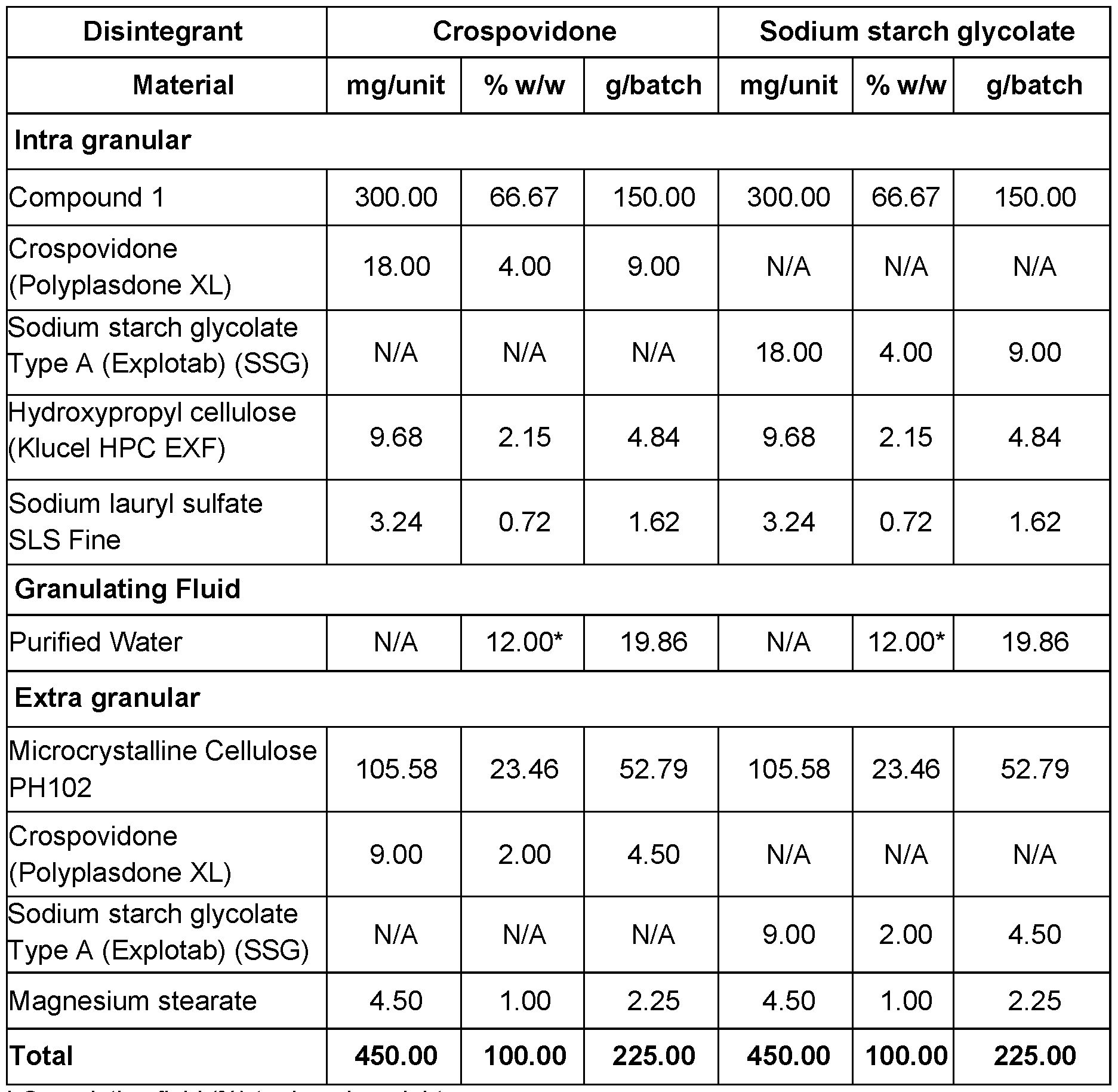
- Sodium starch glycolate Granulation and compression parameters were found to be satisfactory. Rapid disintegration was observed. Drug release in pH 6.8 phosphate buffer was similar compared to drug release in 0.01 M HCI. Both disintegrants exhibited satisfactory disintegration efficiency compared to croscarmellose sodium prototypes. No change in disintegration was observed upon storage for tablets containing Crospovidone or SSG. Disintegrant Level Optimization Studies, Crospovidone vs Sodium starch glycolate (SSG) In order to optimize the level of super-disintegrant in the Compound 1 Tablets, batches with 2% intra granular and 2% extra granular disintegrant were produced.
- Table 10 Manufacturing formula of Compound 1 Tablets 300 mg (disintegrant level optimization, Crospovidone vs SSG)
- Granulating fluid (%) to dry-mix weight Manufacturing Procedure, Disintegrant Level Optimization Batches, Crospovidone vs SSG Granulation: Compound 1 , Hydroxypropyl cellulose (EXF), Sodium lauryl sulfate (SLS), and Crospovidone (Polyplasdone XL) I Sodium starch glycolate Type A (Explotab) were co-sifted through a 20 mesh screen. Sifted materials were loaded into 1 L RMG bowl and dry mixing was performed for 5 minutes. Purified water was added into the mixture by using peristaltic pump at a fixed speed and granulation was performed with the below listed parameters in Table 11.
- Drying and Sizing Wet granules were charged into a Tray Dryer with an inlet temperature of 60°C for 15 minutes. Semi-dried granules were milled through Comil FZB-150 using 1.2 mm screen. Semi-dried granules were dried further until the LCD reached less than 0.5% w/w at 105°C. Drying parameters are listed in Table 11.
- Table 11 Wet granulation parameters of disintegrant level optimization batches, Crospovidone vs SSG
- Microcrystalline Cellulose PH102 and Crospovidone (Polyplasdone XL) I Sodium starch glycolate Type A (Explotab) (SSG) were co-sifted through a 30 mesh screen. Sifted materials were loaded along with sized granules into the 0.2 L Turbula bin and blended for 10 minutes at 46 rpm.
- Lubrication Magnesium stearate was sifted through a 60 mesh sieve, added to the above blend and mixed for 03 minutes at 46 rpm.
- Prototypes of disintegrant level optimizations resulted in a satisfactory granulation and tablet properties.
- No significant difference in drug release was observed between 2% and 4% intra-granular disintegrant for SSG prototypes.
- Improved drug release profile was observed for 4% intra- granular Crospovidone prototypes than the 2% intra-granular Crospovidone batches in pH 6.8 phosphate buffer.
- drug release profiles were similar for both 2% and 4% intra- granular disintegrant prototypes in 0.01 M HCI (pH 2.0).
- HPC-SL Hydroxypropyl Cellulose SL
- Table 13 Manufacturing formula of Compound 1 Tablets 300 mg, HPC-SL as a binder and fine grade Compound 1 (2% vs 3% Crospovidone) * Granulating fluid (%) to dry-mix weight
- Granulation Compound 1 , Microcrystalline Cellulose PH102, Crospovidone (Polyplasdone XL) and Hydroxypropyl Cellulose SL were co-sifted through a 30 mesh screen. Sifted materials were loaded into a 4 L RMG bowl and dry mixing was performed for 10 minutes. Drying and Sizing: Wet granules were charged into a Tray Dryer with an inlet temperature of 60°C for 20 minutes. Semi-dried granules were milled through a comil 193 using 1.143 mm screen. Semi-dried granules were dried further until the LCD reached less than 2.0% w/w at 105°C.
- Table 14 Wet granulation parameters of feasibility batch with HPC-SL as a binder and ine grade Compound 1 (2% vs 3% Crospovidone)
- Lubrication Magnesium stearate was sifted through a 60 mesh sieve and loaded along with sized granules into the 0.2 L Turbula bin and blended for 03 minutes at 46 rpm.
- the lubricated granules were compressed into tablets with different hardness level to a target weight of 450 mg using 14x6.5 mm, oval shaped punches.
- Dry mixing Compound 1 , Microcrystalline Cellulose PH102, Crospovidone (Polyplasdone XL) and Hydroxypropyl Cellulose SL were co-sifted through a 30 mesh screen. Sifted materials were loaded into a 6 L RMG bowl and dry mixing was performed for 10 minutes. Purified water was added into the mixture by using a peristaltic pump at a fixed speed, and granulation was performed.
- Lubrication Magnesium stearate were sifted through a 60 mesh sieve and loaded along with sized granules into the 5 L bin blender and blended for 03 minutes at 15 rpm.
- Tablets The lubricated granules were compressed into tablets with different hardness level to a target tablet weight of 150 mg using 7 mm, round shaped punches. Description of compressed tablets: Yellow colored, round shaped uncoated tablets, plain on both sides.
- Tablets The lubricated granules were compressed into tablets with different hardness level to a target tablet weight of 450 mg using 14x6.5 mm, oval shaped punches. Description of compressed tablets: Yellow colored, oval shaped uncoated tablets, GP letter on one side, plain on the other side. Table 16: Dissolution profile of Compound 1 Tablets 100 mg and 300 mg
- Table 17 Dissolution profile of Compound 1 Tablets 100 mg and 300 mg, 062G comil screen batch
- Compound 1 particle size A smaller Compound 1 particle size resulted in satisfactory granulation and compression properties in comparison with a large Compound 1 particle size. Granulation and compression were reproducible using a smaller Compound 1 particle size.
- Disintegrant Feasibility batches with Croscarmellose sodium and Sodium starch glycolate resulted in a significant increase in disintegration time upon storage at ambient conditions. Tablets composed of crospovidone did not show any change in disintegration time upon storage at ambient conditions and at accelerated conditions for up to six months. Therefore, crospovidone was selected as the binder of choice for the production of Compound 1 IR Tablets. The optimum level of crospovidone appears to be at least 3%. A 3% disintegrant level was identified to use in the production of Compound 1 IR Tablets.
- Binder Several binders were studied. Feasibility studies included prototypes composed of HPC EXF, povidone, HPMC E5 and HPC-SL. Tablets composed of povidone had good dissolution properties but high friability values. Tablets composed of HPMC E5 had good tablet hardness and friability but variable dissolution values at different hardness values. Tablets composed of HPC-SL had optimum hardness and friability values and dissolution values were fairly consistent. A study of the impact of compression force and Compound 1 particle size on tablet dissolution profiles showed that formulations composed of HPC-SL and 3% crospovidone have a sufficiently broad processing window to enable production at large scale.
- Granulation Fluid level A granulation fluid level of approx. 25% w/w and using a small particle size Compound 1 resulted in a satisfactory granulation and compression properties. In an embodiment, the granulation fluid level is 20-30% w/w .
- Target DT -Less than 8 minutes (Limit: ⁇ 15 minutes)
- Target DT Less than 8 minutes (Limit: ⁇ 15 minutes)
- the quantitative compositions of the Compound 1 IR Tablets are according to Table 18.
- Table 18 Unit formula for Compound 1 Tablets 100 mg and 300 mg
- compositions in Table 18A show improved tablet properties such as reducing the sensitivity of the tablet properties, for example, hardness and disintegration and thus dissolution due to over lubrication.
- the quantitative compositions of the Compound 1 IR Tablets are according to Table 18A.
- Table 18A Unit formula for Compound 1 Tablets 100 mg and 300 mg
- the quantitative compositions of the Compound 1 IR Tablets are according to Table 18B.
- Table 18B Unit formula for Compound 1 Tablets 100 mg and 300 mg with Coating
- Compound 1 Microcrystalline Cellulose PH102, Crospovidone (Polyplasdone XL) and Hydroxypropyl Cellulose SL were co-sifted through a 30 mesh screen.
- Purified water was added into the mixture by using peristaltic pump with a target addition time of ⁇ 8 minutes with slow Impeller and chopper speeds.
- Friability NMT 0.5% w/w for compression set up; NMT 1.0% w/w for in-process test.
- LISP/NF is the quality reference for hydroxypropyl cellulose, microcrystalline cellulose, crospovidone, and magnesium stearate.
- USP refers to the United States Pharmacopeia.
- NF refers to National Formulary.
- Ph. Eur. is the quality reference for hydroxypropyl cellulose, microcrystalline cellulose, crospovidone, and magnesium stearate.
- Ph. Eur.” refers to the European Pharmacopoeia.
- the temperature of the solution in R2 was adjusted to 45°C, then cooled to 35°C over 1 h and then 3-amino-N-(3-(4-amino-4-methylpiperidin-1-yl)pyridin-2-yl)-6-(3-(trifluoromethyl)pyridin- 2-yl)pyrazine-2-carboxamide (Compound 1, 1.1 g) seed crystals were added to R2.
- the resulting slurry in R2 was stirred at 35°C for 5 h, before adding water (1680 g) over 8 h at 35°C.
- the contents of R2 was cooled to 5°C over 5 h, and then stirred at 5°C for 3 h.
Landscapes
- Health & Medical Sciences (AREA)
- Chemical & Material Sciences (AREA)
- Medicinal Chemistry (AREA)
- Pharmacology & Pharmacy (AREA)
- Epidemiology (AREA)
- Life Sciences & Earth Sciences (AREA)
- Animal Behavior & Ethology (AREA)
- General Health & Medical Sciences (AREA)
- Public Health (AREA)
- Veterinary Medicine (AREA)
- Pharmaceuticals Containing Other Organic And Inorganic Compounds (AREA)
- Medicines That Contain Protein Lipid Enzymes And Other Medicines (AREA)
Abstract
Description




Claims

Priority Applications (3)
| Application Number | Priority Date | Filing Date | Title |
|---|---|---|---|
| CN202480057502.XA CN121889149A (en) | 2023-08-21 | 2024-08-21 | Pharmaceutical compositions containing PKC inhibitors |
| IL326645A IL326645A (en) | 2023-08-21 | 2024-08-21 | Pharmaceutical compositions comprising a pkc inhibitor |
| AU2024327543A AU2024327543A1 (en) | 2023-08-21 | 2024-08-21 | Pharmaceutical compositions comprising a pkc inhibitor |
Applications Claiming Priority (2)
| Application Number | Priority Date | Filing Date | Title |
|---|---|---|---|
| US202363520857P | 2023-08-21 | 2023-08-21 | |
| US63/520,857 | 2023-08-21 |
Publications (2)
| Publication Number | Publication Date |
|---|---|
| WO2025042981A2 true WO2025042981A2 (en) | 2025-02-27 |
| WO2025042981A3 WO2025042981A3 (en) | 2025-04-24 |
Family
ID=94732761
Family Applications (1)
| Application Number | Title | Priority Date | Filing Date |
|---|---|---|---|
| PCT/US2024/043216 Pending WO2025042981A2 (en) | 2023-08-21 | 2024-08-21 | Pharmaceutical compositions comprising a pkc inhibitor |
Country Status (4)
| Country | Link |
|---|---|
| CN (1) | CN121889149A (en) |
| AU (1) | AU2024327543A1 (en) |
| IL (1) | IL326645A (en) |
| WO (1) | WO2025042981A2 (en) |
Family Cites Families (3)
| Publication number | Priority date | Publication date | Assignee | Title |
|---|---|---|---|---|
| JO3589B1 (en) * | 2014-08-06 | 2020-07-05 | Novartis Ag | Protein kinase c inhibitors and methods of their use |
| AU2021213811A1 (en) * | 2020-01-29 | 2022-07-28 | Foghorn Therapeutics Inc. | Compounds and uses thereof |
| US12383555B2 (en) * | 2020-05-20 | 2025-08-12 | Foghorn Therapeutics Inc. | Methods of treating cancers |
-
2024
- 2024-08-21 IL IL326645A patent/IL326645A/en unknown
- 2024-08-21 AU AU2024327543A patent/AU2024327543A1/en active Pending
- 2024-08-21 WO PCT/US2024/043216 patent/WO2025042981A2/en active Pending
- 2024-08-21 CN CN202480057502.XA patent/CN121889149A/en active Pending
Also Published As
| Publication number | Publication date |
|---|---|
| IL326645A (en) | 2026-04-01 |
| WO2025042981A3 (en) | 2025-04-24 |
| CN121889149A (en) | 2026-04-17 |
| AU2024327543A1 (en) | 2026-03-12 |
Similar Documents
| Publication | Publication Date | Title |
|---|---|---|
| US20250109136A1 (en) | Dosage form compositions comprising an inhibitor of bruton's tyrosine kinase | |
| EP2579858B1 (en) | Ivabradine-containing pharmaceutical composition | |
| MXPA04010496A (en) | High drug load tablet. | |
| WO2004054574A1 (en) | Solid drug for oral use | |
| KR20140129164A (en) | Combinations of histone deacetylase inhibitor and pazopanib and uses thereof | |
| EP4221704B1 (en) | Pharmaceutical formulations for treating diseases mediated by kdm1a | |
| US20240082222A1 (en) | 4-chloro-n-[2-[(4-chlorophenyl)methyl]-3-oxo-1,2,4-thiadiazol-5-yl]benzamide for use in medicine | |
| EP3354283B1 (en) | Pharmaceutical capsule composition comprising silodosin | |
| CN112584834B (en) | Quinoline derivatives for the treatment of extranodal NK/T cell lymphoma | |
| AU2024327543A1 (en) | Pharmaceutical compositions comprising a pkc inhibitor | |
| KR20260057455A (en) | Pharmaceutical composition containing a PKC inhibitor | |
| US11701362B2 (en) | Compositions and methods of use of cis-4-[2-{[(3S,4R)-3-fluorooxan-4-yl]amino}-8-(2,4,6-trichloroanilino)-9H-purin-9-yl]-1- methylcyclohexane-1-carboxamide | |
| TWI901422B (en) | A pharmaceutical composition of pyrimidine derivatives | |
| EP4168011B1 (en) | Oral formulations and uses thereof | |
| EP4255398B1 (en) | Orally-administered preparation containing solifenacin and tamsulosin | |
| CN108721241A (en) | A kind of solid composite and preparation method thereof including Valsartan and Amlodipine | |
| EA040951B1 (en) | DOSAGE FORMS CIS-4-[2-{[(3S,4R)-3-FLUOROXAN-4-YL]AMINO}-8-(2,4,6-TRICHLORORANINO)-9H-PURINE-9-YL]-1 -METHYLCYCLOHEXANE-1-CARBOXAMIDE AND THEIR USE IN A METHOD FOR CANCER TREATMENT |
Legal Events
| Date | Code | Title | Description |
|---|---|---|---|
| 121 | Ep: the epo has been informed by wipo that ep was designated in this application |
Ref document number: 24857235 Country of ref document: EP Kind code of ref document: A2 |
|
| WWE | Wipo information: entry into national phase |
Ref document number: 326645 Country of ref document: IL |
|
| WWE | Wipo information: entry into national phase |
Ref document number: AU2024327543 Country of ref document: AU Ref document number: 830419 Country of ref document: NZ |
|
| WWP | Wipo information: published in national office |
Ref document number: 830419 Country of ref document: NZ |
|
| WWP | Wipo information: published in national office |
Ref document number: 326645 Country of ref document: IL |
|
| REG | Reference to national code |
Ref country code: BR Ref legal event code: B01A Ref document number: 112026004009 Country of ref document: BR |
|
| WWE | Wipo information: entry into national phase |
Ref document number: 1020267007480 Country of ref document: KR |
|
| ENP | Entry into the national phase |
Ref document number: 2024327543 Country of ref document: AU Date of ref document: 20240821 Kind code of ref document: A |
|
| WWE | Wipo information: entry into national phase |
Ref document number: 2024857235 Country of ref document: EP |
|
| NENP | Non-entry into the national phase |
Ref country code: DE |
|
| WWE | Wipo information: entry into national phase |
Ref document number: 11202601037S Country of ref document: SG |
|
| WWP | Wipo information: published in national office |
Ref document number: 11202601037S Country of ref document: SG |
|
| 121 | Ep: the epo has been informed by wipo that ep was designated in this application |
Ref document number: 24857235 Country of ref document: EP Kind code of ref document: A2 |