WO2025026753A2 - Methods of removing hydroxyl and/or carboxyl containing compounds - Google Patents
Methods of removing hydroxyl and/or carboxyl containing compounds Download PDFInfo
- Publication number
- WO2025026753A2 WO2025026753A2 PCT/EP2024/070385 EP2024070385W WO2025026753A2 WO 2025026753 A2 WO2025026753 A2 WO 2025026753A2 EP 2024070385 W EP2024070385 W EP 2024070385W WO 2025026753 A2 WO2025026753 A2 WO 2025026753A2
- Authority
- WO
- WIPO (PCT)
- Prior art keywords
- polycarbonate
- hydroxyl
- solution
- containing compounds
- solvent
- Prior art date
- Legal status (The legal status is an assumption and is not a legal conclusion. Google has not performed a legal analysis and makes no representation as to the accuracy of the status listed.)
- Pending
Links
Classifications
-
- C—CHEMISTRY; METALLURGY
- C08—ORGANIC MACROMOLECULAR COMPOUNDS; THEIR PREPARATION OR CHEMICAL WORKING-UP; COMPOSITIONS BASED THEREON
- C08J—WORKING-UP; GENERAL PROCESSES OF COMPOUNDING; AFTER-TREATMENT NOT COVERED BY SUBCLASSES C08B, C08C, C08F, C08G or C08H
- C08J11/00—Recovery or working-up of waste materials
- C08J11/04—Recovery or working-up of waste materials of polymers
- C08J11/06—Recovery or working-up of waste materials of polymers without chemical reactions
-
- C—CHEMISTRY; METALLURGY
- C08—ORGANIC MACROMOLECULAR COMPOUNDS; THEIR PREPARATION OR CHEMICAL WORKING-UP; COMPOSITIONS BASED THEREON
- C08J—WORKING-UP; GENERAL PROCESSES OF COMPOUNDING; AFTER-TREATMENT NOT COVERED BY SUBCLASSES C08B, C08C, C08F, C08G or C08H
- C08J2369/00—Characterised by the use of polycarbonates; Derivatives of polycarbonates
-
- Y—GENERAL TAGGING OF NEW TECHNOLOGICAL DEVELOPMENTS; GENERAL TAGGING OF CROSS-SECTIONAL TECHNOLOGIES SPANNING OVER SEVERAL SECTIONS OF THE IPC; TECHNICAL SUBJECTS COVERED BY FORMER USPC CROSS-REFERENCE ART COLLECTIONS [XRACs] AND DIGESTS
- Y02—TECHNOLOGIES OR APPLICATIONS FOR MITIGATION OR ADAPTATION AGAINST CLIMATE CHANGE
- Y02W—CLIMATE CHANGE MITIGATION TECHNOLOGIES RELATED TO WASTEWATER TREATMENT OR WASTE MANAGEMENT
- Y02W30/00—Technologies for solid waste management
- Y02W30/50—Reuse, recycling or recovery technologies
- Y02W30/62—Plastics recycling; Rubber recycling
Definitions
- Polycarbonate and copolymers containing carbonate units are utilized in a variety of molded structures.
- Polycarbonates and copolymers containing carbonate units form molded structures that are rigid.
- the molded structures may be used for a variety of uses, including cases for electronics, automobile parts, medical devices, home appliances, loud-speakers, home furnishings and the like.
- these products are disposed of due to being damaged or replaced by newer products.
- the polycarbonate used with these products has degraded such that it is no longer re-useable in new products with the same quality as virgin polycarbonate.
- the disposed products often contain other derivatives of polycarbonate that could have an undesired impact on polycarbonate recovery.
- the disclosure provides a method including contacting a separation medium and a polycarbonate solution comprising one or more polycarbonate polymers, one or more hydroxyl and/or carboxyl containing compounds, and a polycarbonate solvent to separate the one or more hydroxyl and/or carboxyl containing compounds from the polycarbonate solution, wherein the separation medium is essentially immiscible with the polycarbonate solution.
- the method includes separating the polycarbonate solution and the separation medium containing the one or more hydroxyl and/or carboxyl containing compounds.
- the separation medium may have a pH above 7. After separation of the polycarbonate solution and the separation medium, the polycarbonate solution may be essentially free of the one or more hydroxyl and/or carboxyl containing compounds.
- the one or more hydroxyl and/or carboxyl containing compounds may include a bisphenol compound or residue thereof.
- the one or more hydroxyl and/or carboxyl containing compounds may have a molecular weight of about 1000 grams per mole or less.
- the separation medium may include water, and the polycarbonate solvent may include an organic solvent that is essentially immiscible with the water.
- the water may include a buffer in a concentration sufficient to maintain the pH of the solution.
- the polycarbonate solvent may include a polar aprotic solvent.
- the polycarbonate solvent may include methylene chloride, chloroform, tetrahydrofuran (THF), 2-methyl tetrahydrofuran, N-methyl-2- pyrrolidone, dimethylformamide, 1 ,4-dioxane, methyl ethyl ketone, ethyl acetate: ethanol (3:1 , binary solvent), dimethyl sulfoxide, or any combination thereof.
- the method may further include applying agitation to the polycarbonate solution and/or separation medium to form a dispersion of the polycarbonate solution and the separation medium and after phase separation of the dispersion, separating the polycarbonate solution and separation medium such that the polycarbonate solution is essentially free of the one or more hydroxyl and/or carboxyl containing compounds.
- the separation medium may include an adsorption medium configured to bind with the hydroxyl and/or carboxyl containing compounds.
- the adsorption medium may include a fixed or fluidized bed so that the polycarbonate solution traverses the adsorption medium and adsorbs the one or more hydroxyl and/or carboxyl containing compounds onto the adsorption medium.
- the adsorption medium may include one or more of activated carbon, basic aluminum oxide, basic ion exchange resins, chitosan, molecularly imprinted polymers, silica gel, zeolites modified with cationic surfactants, or any combination thereof.
- the step of contacting the separation medium and the polycarbonate solution may include passing the polycarbonate solution through an inlet of the adsorption medium towards an outlet so that the one or more hydroxyl and/or carboxyl containing compounds are extracted along the inside of the separation medium as the polycarbonate solution moves between the inlet and outlet; and once the adsorption medium is saturated with the one or more hydroxyl and/or carboxyl containing compounds, separating the one or more hydroxyl and/or carboxyl containing compounds from the adsorption medium by contacting the adsorption medium with a flushing solution.
- a method including contacting one or more remediation compounds and a polycarbonate solution comprising a polycarbonate solvent, one or more polycarbonate polymers, and one or more hydroxyl and/or carboxyl containing compounds to form one or more modified compounds comprising a residue of the one or more hydroxyl and/or carboxyl containing compounds connected with a residue of the one or more remediation compounds.
- the one or more remediation compounds may include one or more compounds containing one or more functional groups comprising an isocyanate, an anhydride, an epoxide, an oxazoline, a carbonate, a chlorosilane, an acyl chloride, a phosphoryl chloride, or any combination thereof.
- the remediation compound may include two or more of the recited functional groups.
- the one or more modified compounds may be essentially free of hydroxyl or carboxyl groups. At least some of the one or more modified compounds may comprise at least one functional group configured to react with a hydroxyl and/or carboxyl group of the polycarbonate polymer.
- the at least one functional group of the one or more modified compounds may comprise one or more of isocyanate, an anhydride, an epoxide, an oxazoline, a carbonate, a chlorosilane, an acyl chloride, a phosphoryl chloride, or any combination thereof.
- Contacting the one or more polycarbonate polymer and the one or more modified compound within the polycarbonate solution may form one or more modified polycarbonate polymers.
- the one or more modified polycarbonate polymers may be essentially free of hydroxyl and/or carboxyl groups.
- the one or more modified polycarbonate polymers may comprise hydroxyl and/or carboxyl groups in a mole percent of about 50 ppm or less, based on the total molar mass of the modified polycarbonate polymer. At least some of the one or more polycarbonate polymers may comprise a hydroxyl and/or carboxyl content of about great than 0 to about 3 weight percent, based on the total weight of each of the polycarbonate polymers.
- the modified polycarbonate polymers may have a number or weight average molecular weight that is larger than a number or weight average molecular weight of the one or more polycarbonate polymers before modification.
- the method disclosed herein provide for techniques to minimize or eliminate effects from the presence of hydroxy containing compounds, such as bisphenol-A and derivatives thereof, in polycarbonate compositions that are dissolved in a solution.
- hydroxy containing compounds such as bisphenol-A and derivatives thereof
- the present techniques provide for pathways to separate the hydroxyl and/or carboxyl containing compounds from the solution or make the hydroxyl and/or carboxyl containing compounds inert in solution so additional modification, purification, or adjustment to polycarbonate compounds is performable in the solution without undesirable impact from the hydroxyl and/or carboxyl containing compounds.
- the present techniques are useable to remove hydroxyl and/or carboxyl containing compounds that have relatively small molecular weights from the recycled polycarbonate, without negatively impacting or adjusting the recycled polycarbonate which may also have hydroxyl groups, so the recycled polycarbonate can be controllably adjusted and repaired to have property levels that are comparable to virgin polycarbonate.
- the present techniques may be advantageous to remove the hydroxyl and/or carboxyl containing compounds at different stages of polycarbonate modification or repair so that during separation of the polycarbonate from the polycarbonate solvent the hydroxyl and/or carboxyl containing compounds is not inadvertently separated with the polycarbonate.
- FIG. 1 illustrates a process to extract hydroxyl and/or carboxyl containing compounds from a polycarbonate solution.
- FIG. 2 illustrates a process to remove hydroxyl and/or carboxyl containing compounds from a polycarbonate solution.
- FIG. 3 illustrates a reaction scheme to make hydroxyl and/or carboxyl containing compounds in the polycarbonate solution inert.
- the present disclosure provides for multiple techniques to remove hydroxyl and/or carboxyl containing compounds, such as bisphenol-A and derivatives thereof, or make the same inert in solution.
- the present polycarbonate solutions comprise polycarbonate that includes some hydroxyl groups and additional hydroxyl and/or carboxyl containing compounds that have a molecular weight under a certain number, such as 1000 g/mol.
- the present techniques provide an advantage of mitigating or eliminating effects from the presence of the hydroxyl and/or carboxyl containing compounds in the polycarbonate solution while the polycarbonates containing hydroxyl groups remain in solution so that the polycarbonate polymers and oligomers are useable to form repaired or adjusted polycarbonate polymers in solution.
- a separation medium may be contacted with the polycarbonate solution to remove the hydroxyl and/or carboxyl containing compounds from the polycarbonate solution. Subsequently, the separation medium may be separated from the polycarbonate solution so that the polycarbonate solution is essentially free of hydroxyl and/or carboxyl containing compounds.
- the separation may include an adsorption medium that binds and pulls the hydroxyl and/or carboxyl containing compounds out of solution, and the adsorption medium can then be physically separated from the polycarbonate solution and washed or the like.
- the separation medium may include another solvent with a different solubility parameter for hydroxyl and/or carboxyl containing compounds and polycarbonate polymers and oligomers may be mixed with the polycarbonate solution to extract the hydroxyl and/or carboxyl containing compounds , and the other solvent may be separated from the polycarbonate solution by known separation techniques.
- the hydroxyl and/or carboxyl containing compounds are removable from the polycarbonate solution before separating the polycarbonate solvent and the polycarbonate polymers or oligomers.
- the term repaired refers to adjusting the molecular weight or other properties of the waste polycarbonate to an adjusted polycarbonate with a different molecular weight, different properties (i.e., flame retardancy, viscosity, etc.), or with a reduced number of phenolic and/or carbonates end groups.
- a polycarbonate solution includes at least polycarbonate solvent and at least one polycarbonate compound.
- Waste polycarbonate refers to polycarbonate located in waste feedstocks and may be synonymous with recycled polycarbonate.
- Adjusted polycarbonate refers to polycarbonate recovered from waste feedstocks and contacted with one or more functional groups as described herein such that different properties or molecular weights are achieved in the adjusted polycarbonates compared to the waste polycarbonate.
- Virgin polycarbonate refers to polycarbonate made by one or more techniques that react one or more diols and carbonic acids to form polycarbonate. Miscible means two or more compounds form a solution when contacted.
- the compounds may be completely miscible at any molar ratio, but in many instances the compounds are miscible below the solubility limit of one of the compounds in the other compound with each compound typically being a liquid solvent at ambient conditions ( ⁇ 20 °C and ⁇ 1 atmosphere of pressure), but in some instances one or more of the compounds (e.g., solvents) may be a solid at room temperature that is dissolved in a liquid solvent at room temperature.
- Immiscible means two or more compounds phase separate at a molar ratio that is greater than the saturation point of one of the compounds with the molar ratio.
- Soluble means that a solid compound is dissolvable in a solvent or solution of solvents at or below the saturation point for example a salt dissolved in a solution of solvents.
- Waste feedstocks include at least some waste polycarbonate.
- Waste feedstocks include waste polycarbonate and at least one other waste non-polycarbonate compound, such as a metal compound.
- Waste feedstocks contain from about 10 weight percent to less than 100 weight percent waste polycarbonate.
- Non-polycarbonate compounds include one or more of metals, non-polycarbonate polymers, battery electrolytes, small organic compounds, oligomeric compounds, or any combination thereof.
- Non-polycarbonate compounds may include one or more compounds commonly mixed or blended with polycarbonate, including non-polycarbonate containing polymer, (such as styrenics, polystyrene, styrene acrylonitrile, acrylonitrile butadiene, butadiene elastomers, high impact polystyrene, polymethylmethacrylate), flame retardants, UV stabilizers, fillers, antioxidants, other additives, other polymers, or any other non-polycarbonate compound.
- non-polycarbonate containing polymer such as styrenics, polystyrene, styrene acrylonitrile, acrylonitrile butadiene, butadiene elastomers, high impact polystyrene, polymethylmethacrylate
- flame retardants such as styrenics, polystyrene, styrene acrylonitrile, acrylonitrile butadiene,
- waste feedstocks may include any non-polycarbonate material in any waste containing polycarbonates, such as cases for electronics, plastic waste, toys, packages, conveyors, trays, automobile parts, medical devices, home appliances, loud-speakers, home furnishings, any other electronic device including non-polycarbonate polymers, metals, printed circuit boards, batteries, magnets, or any combination thereof.
- a portion of the non-polycarbonate compounds in the waste feedstock may be removed through one or more pretreatment steps before contacting the waste feedstock and a polycarbonate solvent so some of the non- polycarbonate compounds are not undesirably dissolved in the polycarbonate solvent.
- Hydrocarbyl refers to a group containing one or more carbon atom backbones and hydrogen atoms, which may optionally contain one or more heteroatoms. Where the hydrocarbyl group contains heteroatoms, the heteroatoms may form one or more functional groups well known to one skilled in the art. Hydrocarbyl groups may contain cycloaliphatic, aliphatic, aromatic or any combination of such segments. The aliphatic segments can be straight or branched. The aliphatic and cycloaliphatic segments may include one or more double and/or triple bonds.
- hydrocarbyl groups are alkyl, alkenyl, alkynyl, aryl, cycloalkyl, cycloalkenyl, alkaryl and aralkyl groups. Cycloaliphatic groups may contain both cyclic portions and noncyclic portions.
- Hydrocarbylene means a hydrocarbyl group or any of the described subsets having more than one valence, such as alkylene, alkenylene, alkynylene, arylene, cycloalkylene, cycloalkenylene, alkarylene and aralkylene.
- Valence means a covalent bond between a hydrocarbyl or hydrocarbylene group and another group such as a carbonyl, oxygen, nitrogen or sulfur containing group or atom, or the referenced base compound.
- percent by weight or parts by weight refer to, or are based on, the weight of the compositions unless otherwise specified.
- Tg is the temperature or temperature range at which a polymeric material shows an abrupt change in its physical properties, including, for example, mechanical strength. Tg can be determined by differential scanning calorimetry (DSC).
- Post-industrial as used herein refers to a source of a material that originates during the manufacture of a good or product.
- Post-consumer refers to a source of material that originates after the end consumer has used the material in a consumer good or product.
- Hydroxyl and/or carboxyl containing compounds as used herein means a compound including at least one hydroxyl or carboxyl group bound to a carbon atom and having a molecular weight of about 500 g/mol or less, about 2000 g/mol or less, or about 3000 g/mol or less.
- the hydroxyl and/or carboxyl containing compounds may be a residue of polycarbonate and have a molecular weight as described herein.
- Polycarbonate oligomers, as described herein may be distinguished from hydroxyl and/or carboxyl containing compounds by having a number or weight average molecular weight of 1000 g/mol or more, 3000 g/mol or more, or 5000 g/mol or more.
- the hydroxyl and/or carboxyl containing compounds may include more than one repeating unit or derivative thereof that is a residue of polycarbonate.
- a repeating unit of the hydroxyl containing monomer may be those repeating units described in relation to polycarbonates discussed herein that is terminated by at least one hydroxyl or carboxyl group.
- the polycarbonate solution may be essentially free of hydroxyl and/or carboxyl containing compounds.
- essentially free of hydroxyl and/or carboxyl containing compounds may be about 150 ppm or less of the hydroxyl and/or carboxyl compounds, about 100 ppm or less, or about 50 ppm or less.
- Essentially free of hydroxyl and/or carboxyl containing compounds may be about 25 ppm or less, 10 ppm or less, or an amount that is not detectable using conventionally known methods.
- Hydroxyl and/or carboxyl containing compounds may be reduced in the recovery solutions and/or polymeric compositions described herein by a weight percent using separation techniques to remove hydroxyl and/or carboxyl groups or containing compounds described herein. Hydroxyl and/or carboxyl containing compounds may be reduced by about 10 percent or more, about 30 percent or more, or about 50 percent or more. Hydroxyl and/or carboxyl containing compounds may be reduced by about 70 percent or more, about 90 percent or more, or about 95 percent or more.
- Hydroxyl and/or carboxyl containing compounds may be determined by any technique known to the skilled artisan.
- free phenolic species including bisphenol-a, phenol, and tertbutylphenol
- HPLC HPLC equipped with a standard C18 column and fluorescence detector with excitation wavelength of 310 nm and emission monitoring at 275 nm.
- Quantification may be completed by making use of external standards of BPA and phenol.
- the sample preparation may include dissolving 1 g of the PC sample in 5 mL dichloromethane, followed by the addition of 20 mL acetonitrile under continuous shaking. 2 mL of the supernatant that is filtered over a 0.45 pm syringe filter before it is analyzed using HPLC.
- Polycarbonate as used herein means a polymer containing carbonate units.
- Such polymers may be homopolymers consisting essentially of carbonate monomer units or copolymers containing one or more other monomer units (co-monomer units) and carbonate units.
- Such copolymers may be block copolymers containing two or more blocks of different monomer units or may be random copolymers with the different monomer units randomly located along the polymer backbone.
- the other monomer units may comprise any monomer units that do not negatively impact the inherent properties of polycarbonates, for instance heat resistance, impact resistance, moldability, flexural modulus, bending strength, haze and transparency, where required for the intended use.
- exemplary comonomer units are ester units, polysiloxane units, and the like.
- the amount of carbonate monomer units in copolycarbonates is selected such that the resulting polymer retains the desirable properties of polycarbonates, as disclosed herein.
- the copolycarbonates may contain greater than 50 mole percent carbonate monomer units, about 75 mole percent or greater carbonate monomer units, about 80 mole percent or greater carbonate monomer units or about 85 mole percent or greater carbonate monomer units.
- the copolycarbonates may contain about 99 mole percent or less carbonate monomer units, about 97 mole percent or less carbonate monomer units or about 95 mole percent or less carbonate monomer units.
- the copoly-carbonates may contain about 1 mole percent or greater co-monomer monomer units, about 3 mole percent or greater co-monomer monomer units or about 5 mole percent or greater co-monomer monomer units.
- the copolycarbonates may contain less than 50 mole percent co-monomer monomer units, about 25 mole percent or less co-monomer monomer units, about 20 mole percent or less co-monomer monomer units or about 15 mole percent or less co-monomer monomer units.
- the polycarbonate units may contain aromatic units in the backbone of the polymer.
- polycarbonates are affected, for example, by the reaction of diphenols with carbonic acid halides, preferably phosgene, and/or with aromatic dicarboxylic acid dihalides, preferably benzenedicarboxylic acid dihalides, by the phase boundary method, optionally with the use of chain terminators, e.g., monophenols, and optionally with the use of trifunctional branching agents or branching agents with a functionality higher than three, for example triphenols or tetraphenols.
- diphenols with carbonic acid halides, preferably phosgene, and/or with aromatic dicarboxylic acid dihalides, preferably benzenedicarboxylic acid dihalides
- chain terminators e.g., monophenols
- trifunctional branching agents or branching agents with a functionality higher than three for example triphenols or tetraphenols.
- Diphenols useful to produce the aromatic polycarbonates and/or aromatic polyester carbonates may correspond to formula I wherein A denotes a single bond, a C 1-5 alkylene, a C 2-5 alkylidene, a C 5-6 cycloalkylidene, -O-, -SO-, -CO-, -S-, -SO2-, or a C 6-12 arylene, on to which other aromatic rings, which optionally contain hetero atoms, can be condensed, or a radical of formula II or III:
- B in each case is independently hydrogen, a C 1-12 alkyl, preferably methyl, or a halogen, preferably chlorine and/or bromine; x in each case is mutually independently 0, 1 , or 2; p is 0 or 1 ;
- R c and R d are mutually independent of each other and are individually selectable for each X 1 and are hydrogen or a C 1-6 alkyl, preferably hydrogen, methyl or ethyl; X 1 denotes carbon; and m denotes an integer from 4 to 7, preferably 4 or 5, with the proviso that R c and R d simultaneously denote an alkyl on at least one X 1 atom.
- Exemplary diphenols are hydroquinone, resorcinol, dihydroxybiphenyls, bis (hydroxyphenyl)-C 1.5 alkanes, bis(hydroxyphenyl)-C 5-6 cycloalkanes, bis(hydroxyl-phenyl) ethers, bis(hydroxyphenyl)sulfoxides, bis(hydroxyphenyl)ketones, bis(hydroxyl-phenyl) sulfones and 4,4”-bis(hydroxyphenyl)diisopropylbenzenes, as well as derivatives thereof which have brominated and/or chlorinated nuclei.
- Diphenols which are particularly preferred are 4,4'- dihydroxybiphenyl, bisphenol A, 2,4-bis(4-hydroxyphenyl)-2-methyl-butane, 1 ,1 -bis (4- hydroxyphenyl)-cyclohexane, 1 ,1-bis(4-hydroxyphenyl)-3,3,5-trimethyl-cyclohexane, 4,4- dihydroxydiphenyl sulfide and 4,4-dihydroxydiphenyl sulfone, as well as di- and tetra-brominated or chlorinated derivatives thereof, such as 2,2-bis(3-chloro-4-hydroxy-phenyl)propane, 2,2-bis- (3,5-dichloro-4-hydroxyphenyl)propane or 2,2-bis(3,5-dibromo-4-hydroxyphenyl)propane.
- 2, 2- bis-(4-hydroxyphenyl) propane (bisphenol A) is particularly preferred.
- the diphenols can be used individually or as arbitrary mixtures.
- the diphenols are known in the literature or can be obtained by methods known in the literature.
- exemplary polycarbonates include copolycarbonates of bisphenol A with up to 15 mole percent, with respect to the molar sums of the diphenols, of other diphenols which are disclosed, such as 2 ,2-bis(3,5- dibromo-4-hydroxyphenyl)-propane.
- Functional groups may include one or more chain extenders, chain terminators, branching agents, or a combination of both. Functional groups may be added to the polycarbonate solution one at one time, individually over one or more periods of time, or in series to branch and/or chain extend and subsequently chain terminate and achieve desirable molecular weights and associated properties.
- the one or more functional compounds may be added to the polycarbonate solution in an amount sufficient to reduce the amount of hydroxyl groups to the desired level, chain extend and/or branch the polycarbonates.
- the one or more functional compounds may be added to the polycarbonate solution in an amount of about 0.01 weight percent or more, 0.1 weight percent or more, or about 0.5 weight percent or more, based on the total weight of the waste polycarbonate in the polycarbonate solution.
- the one or more functional compounds may be added to the polycarbonate solution in an amount of about 10 weight percent or less, 5 weight percent or less, or about 1 weight percent or less, based on the total weight of the waste polycarbonate in the polycarbonate solution.
- the chain terminator may be configured to react with at least one free hydroxyl and/or carboxyl group of one or more waste and/or adjusted polycarbonates to chain terminate, nonpolycarbonate compounds to remove free hydroxyl and/or carboxyl groups, or both.
- the chain terminators described herein may be configured to bind with one or more hydroxyl or carboxyl groups in the polycarbonate solution so that the free hydroxyl and/or carboxyl groups do not cleave one or more polycarbonate polymers.
- the chain terminators may include one or more groups that are reactable with the one or more hydroxyl or carboxyl groups in a condensation reaction.
- the chain terminators may be used to chain terminate the one or more waste and/or adjusted polycarbonates.
- the chain terminators may be used to bind with one or more nonpolycarbonate compounds so that free hydroxyl and/or carboxyl groups are removed from the polycarbonate solution and/or to prevent the polycarbonate chains from being cleaved by undesired interactions by the hydroxyl and/or carboxyl groups.
- the chain terminator may be any compound that reacts with the hydroxyl and or carboxyl groups which do not negatively impact the usefulness of the resulting polycarbonates.
- Exemplary chain terminators may include one or more isocyanates, amines, esters, epoxides, anhydrides, carboxylic acids, or any combination thereof.
- Chain terminators may include one or more phenolic compounds.
- Phenolic compounds may include phenol, p-chlorophenol, p-tert-butylphenol, 4-(1 ,3-dimethyl-butyl)-phenol and 2,4,6-tribromophenol; long chain alkyl phenols, such as monoalkylphenols or dialkylphenols which contain a total of 8 to 20 carbon atoms in their alkyl substituents, exemplary are 3,5-di-tert- butyl-phenol, p-iso-octylphenol, p-tert-octylphenol, p-dodecylphenol, 2-(3,5-dimethylheptyl)- phenol and 4-(3,5-dimethylheptyl)-phenol.
- Branching agents used in this disclosure may be any compound capable of separately reacting with three or more carboxyl and/or hydroxyl groups on the same or separate polycarbonate compounds.
- the branching agents may have a functionality of three or more, four or more, five or more, or six or more. The functionality is a measure of the ability to bind with individual hydroxyl and/or carboxyl groups.
- the branching agents may react with three or more, four or more, five or more, or a plurality of hydroxyl and/or carboxyl groups.
- the polycarbonates can be branched, for example by the incorporation of about 0.05 to about 2.0 mole percent, with respect to the sum of the branching agents used, of trifunctional compounds or of compounds with a functionality higher than three, for example those which contain three or more phenolic groups.
- Branched polycarbonates useful for the compositions disclosed can be prepared by known techniques, for example several methods are disclosed in USP 3,028,365; 4,529,791 ; and 4,677,162; which are hereby incorporated by reference in their entirety.
- Exemplary branching agents include tri- or multi-functional carboxylic acid chlorides, such as trimesic acid trichloride, cyanuric acid trichloride, 3,3'-,4,4'-benzophenone tetracarboxylic acid tetra chloride, 1 , 4,5,8- naphthalene-tetracarboxylic acid tetrachloride or pyromellitic acid tetra chloride, in amounts of about 0.01 to about 1.0 mole percent (with respect to the dicarboxylic acid dichlorides used) or tri- or multi-functional phenols such as phloroglucinol, 4,6-dimethyl-2,4,6-tris(4-hydroxyphenyl)-2- heptene, 4,4-dimethyl-2,4,6-tris (4-hydroxy phenyl) heptane, 1 ,3,5-tris(4-hydroxyphenyl)- benzene, 1 ,1 ,1-tri
- the chain extenders may include any compound having sufficient functional groups to bind two separate polycarbonate chains together.
- the chain extenders may be configured to react with two separate carboxyl and/or hydroxyl groups so that polycarbonate is chain extend or to remove free carboxyl and/or hydroxyl groups in the polycarbonate solution.
- the chain extenders may comprise at least two functional groups sufficient to separately react with two different polycarbonate chains and/or free hydroxyl and/or carboxyl groups.
- the chain extenders may be used to bind with one or more non-polycarbonate compounds so that free hydroxyl and/or carboxyl groups are removed from the polycarbonate solution and/or to prevent the polycarbonate chains from being cleaved by undesired interactions by the hydroxyl and/or carboxyl groups.
- a combination of chain extenders may be used to bind polycarbonates having different end groups. Examples of chain extenders may include two or more functions groups including isocyanates, amines, esters, epoxides, anhydrides, carboxylic acids, or any combination thereof.
- the polycarbonate solvent functions to dissolve solid polycarbonate from a waste or other feedstock.
- the polycarbonate solvent may dissolve one or more waste polycarbonates and hydroxyl and/or carboxyl containing compounds from the waste or other feedstocks without dissolving one or more other non-polycarbonate polymers and other materials that negatively impact the use of the recovered polycarbonates present in the waste stream.
- Polycarbonate solvents may have a boiling point sufficient to be heated to a temperature that will not break the chains of the polycarbonate.
- the polycarbonate solvent may have a boiling point of about 25 °C or more, 40 about °C or more, or about 60 °C or more.
- the polycarbonate solvent may have a boiling point of about 160 °C or less, about 120 °C or less, or about 80 °C or less.
- the polycarbonate solvent may be any solvent that preferentially dissolves polycarbonates with respect to other polymers and materials present in the waste stream that could negatively impact the use of the recovered polymers.
- the polycarbonate solvent may be a polar aprotic solvent.
- the polycarbonate solvent may comprise at least one halogen atom.
- the polycarbonate solvent may be free of one or more reactable protons.
- the polycarbonate solvent may be free of one or more carboxyl and/or hydroxyl groups.
- the polycarbonate solvent may not be capable of reacting with one or more carboxyl and/or hydroxyl groups.
- the polycarbonate solvent may be essentially immiscible with a polar protic solvent, such as water, so that the polycarbonate solvent can be used in a devolatilization process to recover the polycarbonate solvent and, separately, the adjusted polycarbonate in a solid form.
- a polar protic solvent such as water
- the polycarbonate solvent may comprise one or more of trichloromethane, dichloromethane, chlorobenzene, dichlorobenzene, tetrahydrofuran, 2-methyl tetrahydrofuran, N-methyl-2-pyrrolidone, dimethylformamide, 1 ,4-dioxane, methyl ethyl ketone, ethyl acetate:ethanol (3:1 , binary solvent), dimethyl sulfoxide, or any combination thereof.
- the polycarbonate solvent may contain or be mixed with an amount of water dissolved within or mixed within in a solvent system.
- the solvent system may include two solvents present in concentrations that are miscible.
- the solvent system may include two or more solvents that are present in amounts such that part of the solvent system includes some water dissolved in the one or more polycarbonate solvents and some water that is phase separated from the polycarbonate solvents. Miscible amounts of two solvents may be impacted or changed based on temperature or pressure applied to the recovery solution.
- the solvent system may include polycarbonate and water in an amount that is miscible, such as about 0.6 weight percent or less, about 0.4 weight percent or less, about 0.2 weight percent or less, or about 0.1 weight percent, based on the total weight of the solvent system or recovery solution.
- the water may be present in the solvent system in an amount that is in excess of a miscible amount of water in the polycarbonate solvent.
- water may react within the polycarbonate solvent and excess water may dissolve into the polycarbonate solvent as the reaction occurs.
- One or more separation steps may be used to remove undesirable amounts of water or essentially all (e.g., until the solvent system has 0.1 or less, 0.01 or less, or 0.001 or less water in the solvent system) of the water.
- Water can be removed from the solvent system before or after dissolution of the reactive polycarbonates.
- the solvent system may include one or more other polar protic solvents configured to adjust the miscibility of components in the recovery solution or to participate in one or more reactions, such as during formation of the siloxane modified polycarbonates or reactive siloxane compounds.
- other polar protic solvents may include methanol, ethanol, n- or iso-propanol, n- or tert-butanol, acetic acid, ammonia, formic acid, or any combination thereof.
- the pretreatment solvent may function to remove one or more non-polycarbonate compounds in the waste feedstock.
- the pretreatment solvent may be immiscible with the waste polycarbonate, the polycarbonate solvent, or both.
- the pretreatment solvent may be configured to capture one or more non-polycarbonate compounds that are polymers so that the polymers are not inadvertently dissolved in the polycarbonate solvent.
- the pretreatment solvent may be utilized to dissolve one or more non-polycarbonate compounds that are recyclable or reusable independent of the waste polycarbonate.
- the pretreatment solvent may be separatable from the waste feedstock via a drying step.
- Pretreatment solvents may include a polar protic or aprotic solvent or a combination of both. Examples of the pretreatment solvent may include alcohols, ketones, aldehydes, acetonitrile, aliphatic hydrocarbons, benzene, toluene, ethylbenzene, water, or any combination thereof.
- the polycarbonate solvent and the separation medium may be contacted using any technique or a combination of techniques such that hydroxyl and/or carboxyl containing compounds are removed from the polycarbonate solution.
- the separation medium may include any compound configured to separate the hydroxyl and/or carboxyl containing compounds from the polycarbonate solution without negatively impacting or separating the polycarbonate polymers and/or oligomers.
- the separation medium may be an extraction solvent configured to selectively dissolve hydroxyl and/or carboxyl containing compounds and not dissolve the polycarbonate polymers or oligomers that are dissolved in the polycarbonate solution.
- the separation medium may be an adsorption medium configured to bind with the hydroxyl and/or carboxyl containing compounds and separate the hydroxyl and/or carboxyl containing compounds from the polycarbonate solution.
- Using the separation medium may be advantageous to remove the hydroxyl and/or carboxyl containing compounds from the polycarbonate solution so that no or very little undesirable residues remain in the solution after utilizing the separation medium. With little or no remaining hydroxyl and/or carboxyl containing compounds or residues thereof in the polycarbonate solution, the polycarbonate polymers or oligomers are utilizable for further separation or repair in downstream processes within the polycarbonate solution without undesirable presence of or interactions with hydroxyl and/or carboxyl containing compounds.
- the separation medium may utilize an extraction-like technique where an extraction solvent is contacted with the polycarbonate solution (containing the polycarbonate solvent) and used to separate the hydroxyl and/or carboxyl containing compounds.
- an extraction solvent is chosen that has a higher solubility with the hydroxyl and/or carboxyl containing compounds and little or no solubility with the polycarbonate polymers or oligomers
- the extraction solvent separates most or essentially all of the hydroxyl and/or carboxyl containing compounds without having undesirably interactions with the polycarbonate polymers and/or oligomers.
- the extraction solvent may function to dissolve and remove the hydroxyl and/or carboxyl containing compounds from the polycarbonate solution without dissolving the polycarbonate polymers and/or oligomers that are dissolved in the polycarbonate solvent.
- the extraction solvent is essentially immiscible with the polycarbonate solvent and configured to dissolve the hydroxyl and/or carboxyl containing compounds .
- the extraction solvent may be any solvent configured to dissolve the hydroxyl and/or carboxyl containing compounds and is essentially immiscible with the polycarbonate polymers and/or oligomers.
- the extraction solvent may be a polar protic solvent that is immiscible with the polycarbonate solvent, polymers, and/or oligomers.
- the extraction solvent may be different or a different combination of solvents than the polycarbonate solvent.
- the extraction solvent is water.
- the extraction solvent may have a basic pH that improves the solubility with the hydroxyl and/or carboxyl containing compounds and reduce the solubility with the polycarbonate polymers and/or oligomers.
- the extraction solvent may include a buffer configured to adjust or maintain the pH of the solution when contacted with the polycarbonate solution.
- the buffer may be present in any amount sufficient to adjust or maintain the pH of the solution.
- the buffer may be present in an amount sufficient to adjust or maintain the pH of the extraction solvent at a level that is basic.
- the pH of the extraction solvent with buffer may be about 7 or more, about 7.5 or more, or about 8 or more.
- the pH may be about 8.5 or more, about 9 or more, or about 10 or more.
- the buffer may be present in an amount of about 0.01 mol/L to about 2 mol/L.
- the separation medium may be an adsorption medium that is configured to bind with one or more groups on the hydroxyl and/or carboxyl containing compounds , such as carboxyl and/or hydroxyl groups, and remove the hydroxyl and/or carboxyl containing compounds from the solution.
- Application of an adsorption medium to the polycarbonate solution may be advantageous to remove the hydroxyl and/or carboxyl containing compounds from solution without undesirably introducing derivatives or trace amounts of other compounds that may negatively impact processing or resultant properties of the downstream polycarbonate polymers and/or oligomers.
- the adsorption medium may be any compound or structure capable of binding with the hydroxyl and/or carboxyl containing compounds and remove the hydroxyl and/or carboxyl containing compounds from solution.
- the adsorption medium may be chosen to have a higher affinity to the hydroxyl and/or carboxyl containing compounds and a lower, minimal, or no affinity to the polycarbonate polymers and/or oligomers.
- the adsorption medium may be essentially immiscible with the polycarbonate solution.
- the adsorption medium may include any material which is capable of preferentially binding the hydroxyl and/ or carboxyl containing compounds
- exemplary adsorption media include one or more of activated carbon, basic aluminum oxide, basic ion exchange resins, chitosan, molecularly imprinted polymers, silica gel, zeolites modified with cationic surfactants, neutral aluminum oxide, or any combination thereof.
- Chitosan may include one or more functional groups as described herein that are configured to react with free hydroxyl and/or carboxyl groups.
- Chitosan may include one or more of repeating units of D- glucosamine and/or N-acetyl-D-glucosamine, or residues thereof in a polymer that is linear.
- Molecularly imprinted polymers may include polymers configured to adsorb carboxyl and/or carboxyl containing compounds, for example, bisphenol-A.
- the adsorption medium may be contacted with the polycarbonate solution through any means or technique sufficient to remove or extract the hydroxyl and/or carboxyl containing compounds from the polycarbonate solution.
- the adsorption medium may include structures that are fixed within a housing and the polycarbonate solution may be passed through or traverse over the adsorption medium.
- the adsorption medium may have a structure of a plate or cylinder that the polycarbonate solution is passed or traversed over or through such that high surface area contact is achieved to remove hydroxyl and/or carboxyl containing compounds more efficiently.
- the adsorption medium may be free floating structures or compounds dispersed within the polycarbonate solution such that the polycarbonate solution can be contacted with the adsorption medium to remove or extract hydroxyl and/or carboxyl containing compounds and subsequently removed through known separation techniques to separates solid-liquid mixtures.
- the adsorption medium may be contacted with the polycarbonate solution and agitation may be applied to the mixture such that surface area contact between the polycarbonate solution and adsorption medium is improved and the hydroxyl and/or carboxyl containing compounds is more efficiently removed or extracted.
- the adsorption medium may include one or more of a fluidized bed, a fixed bed, or any combination thereof. After the adsorption medium has bound with a desirable amount of hydroxyl and/or carboxyl containing compounds, the adsorption medium may be separated from the polycarbonate solution and washed to remove the hydroxyl and/or carboxyl containing compounds.
- the same separation medium or a different separation medium may be applied to the polycarbonate solution again to remove additional hydroxyl and/or carboxyl containing compounds.
- the adsorption medium may be washed and then applied again to the same polycarbonate solution to remove additional hydroxyl and/or carboxyl containing compounds.
- One separation medium may be advantageous to remove a majority of the hydroxyl and/or carboxyl containing compounds and another separation medium may be useful to remove trace amounts of hydroxyl and/or carboxyl containing compounds or residues another separation medium (i.e. , the extraction solvent) left behind in the polycarbonate solution.
- a remediation compound may be contacted with the polycarbonate solution to form a modified compound.
- the remediation compound may be configured to chemically bind with the hydroxyl and/or carboxyl containing compounds such that the modified compound is inert or phase separates (e.g., precipitates) from the polycarbonate solution.
- Inert as used herein relative to the modified compound means that the modified compound lacks free hydroxyl and/or carboxyl groups.
- the modified compound may additionally contact the polycarbonate polymers and/or oligomers and form adjusted polycarbonate polymers and/or oligomers.
- the remediation compound may include any compound that comprises groups reactable with a carboxyl or hydroxyl group of a hydroxyl and/or carboxyl containing compounds to form the modified compound.
- the remediation compound may have one or more, two or more, three or more, four or more, or a plurality of groups react-able with the hydroxyl and/or carboxyl containing compounds such that more than one hydroxyl and/or carboxyl containing compounds are react-able with a single remediation compound to form a single modified compound.
- the groups react-able with the hydroxyl and/or carboxyl containing compounds of the remediation compound may include one or more isocyanates, anhydrides, epoxides, glycols, ethers, oxazolines, carbonates, chlorosilanes, sulfonyl fluorides, acyl chlorides, phosphoryl chlorides, or any combination thereof.
- the modified compound may be inert within the polycarbonate solution such that the polycarbonate solution is free or essentially free of hydroxyl and/or carboxyl containing compounds.
- the modified compound may include one or more groups that demonstrate formation of a non-native bond. Non-native bonds are bonds formed from application of the remediation compound to the hydroxyl and/or carboxyl containing compounds and are not resultant from typical processes of forming virgin polycarbonate.
- the modified compound may include one or more isocyanates, anhydrides, epoxides, oxazolines, carbonates, chlorosilanes, sulfonyl fluorides, acyl chlorides, phosphoryl chlorides, or any combination thereof.
- remediation compounds that may form isocyanates in the modified compound may include poly[(phenyl isocyanate)-co-formaldehyde], methylene diphenyl diisocyanate, toluene diisocyanate, isophorone diisocyanate, hexamethylene diisocyanate, or any combination thereof.
- remediation compounds that may form anhydrides in the modified compound include : pyromellitic dianhydride, 4,4'-(4,4'-isopropylidenediphenoxy)bis(phthalic anhydride), poly(styrene maleic anhydride), poly(ethylene-graft-maleic anhydride), or any combination thereof.
- remediation compounds that may form epoxides in the modified compound may include 4,4'-methylenebis(A/,A/-diglycidylaniline), tris(2,3-epoxypropyl) isocyanurate, 1 ,6- Hexanediol diglycidyl ether, polyethylene glycol diglycidyl ether, or any combination thereof.
- remediation compounds that may form oxazolines in the modified compound may inlcude 2, 2’-bis(2-oxazoline).
- remediation compounds that may form carbonates in the modified compound include diphenyl carbonate, methyl carbonate, bis(methyl salicyl) carbonate, or any combination thereof.
- remediation compounds that may form chlorosilanes in the modified compound may include terf-butyldimethylchlorosilane, trimethylchlorosilane, or any combination thereof.
- remediation compounds that may form sulfonyl fluorides in the modified compound may include ethanesulfonyl fluoride, ethenesulfonyl fluoride, or any combination thereof.
- remediation compounds that may form acyl chloride in the modified compound may include propionyl chloride, acetyl chloride, hydrocinnamoyl chloride, valeroyl chloride, adipyl chloride, sebacoyl chloride, succinyl chloride, or combinations thereof.
- the modified compound may have a different solubility in the polycarbonate solution than the hydroxyl and/or carboxyl containing compounds .
- the modified compound may phase separate during or upon formation such that the amount of hydroxyl and/or carboxyl containing compounds are reduced or eliminated in the polycarbonate solution.
- the modified compound may be separated by additionally contacting another solvent with the polycarbonate solvent that either extracts the modified compound or crashes the modified compound from polycarbonate solution, which may be removed by techniques known to separate immiscible liquid-liquid or solid-liquid mixtures.
- the modified compound may include one or more groups that are reactable with one or more of the polycarbonate polymers or oligomers within the polycarbonate solution.
- the modified compound may include one or more, two or more, three or more, four or more, five or more, or a plurality of the functional groups so that the modified compound may be useable to further modify the polycarbonate polymers or oligomers within the polycarbonate solution. Modification of the polycarbonate polymers or oligomers using the modified compounds may achieve desirable end-capping, chain extending, branching, cross-linking, copolymerization, or any combination thereof on the polycarbonate polymers or oligomers.
- Groups included on the modified compound that may be react-able with the polycarbonate polymers or oligomers, such as with free hydroxyl and/or carboxyl groups on the polymers or oligomers, include one or more isocyanates, anhydrides, epoxides, oxazolines, carbonates, chlorosilanes, sulfonyl fluorides, acyl chlorides, phosphoryl chlorides, or any combination thereof.
- Agitation of the polycarbonate solution, polycarbonate solvent, and/or extraction solvent may be performed by any technique sufficient to move molecules in a solution. Agitation may be performed by applying a force to polycarbonate solution, polycarbonate solvent, and/or extraction solvent or housing holding the liquids such that molecules in different phases are moved into contact with each other. Additionally, combinations of agitation may be used both to the polycarbonate solvent and the extraction solvent or container holding the polycarbonate solution such that separation medium and/or remediation compounds are moved within the polycarbonate solvent. Examples of agitation may include cavitating, swirling, shaking, rocking, spinning, stirring, or any combination thereof.
- the separation medium or remediation compound may be contacted with the polycarbonate solution for any period of time or with any agitation techniques sufficient to remove or make inert essentially all of the hydroxyl and/or carboxyl containing compounds within the solution.
- the separation medium and/or remediation compound may be contacted with the polycarbonate solution, agitated, and allowed to rest for a period of the time.
- the separation medium or remediation compound and polycarbonate solution may be contacted for about 30 minutes or more, about 2 hours or more, or about 8 hours or more.
- the separation medium or remediation compound and polycarbonate solution may be contacted for about 24 hours or less, about 18 hours or less, or about 12 hours or less.
- the separation medium may be removed from the polycarbonate solution by any technique sufficient to separate two components in different phases.
- Components in different phases may be essentially immiscible (at ambient temperature) liquid-liquid mixtures, liquid-solid mixtures, and/or gaseous-liquid mixtures.
- the separation medium may be decanted, extracted, distilled, devolatilized, centrifuged, filtered, or any combination thereof from the polycarbonate solution.
- the polycarbonate solution may be contacted with the separation medium in a solid form by passing the polycarbonate solution over the separation medium and moving the liquid polycarbonate solution away from the separation medium.
- the polycarbonate solvent and the waste feedstock may be contacted in a sealed housing that is configured to contain fluids and gases so that the waste feedstock may be mixed with fluids and gases to achieve desirable dissolution levels of waste feedstock.
- the waste feedstock may be moved into a sealed housing through an access point and moved into contact with polycarbonate solvent such that minimal or no polycarbonate solvent is lost through the access point as the waste feedstock is moved into and out of the sealed housing.
- the sealed housing includes an airlock chamber that is configured to receive the waste feedstock a first access point, seal the first access point, and open a second access point to move the waste feedstock into contact with the polycarbonate solvent. Additional access points may be included to remove treated waste feedstock, waste polycarbonate, polycarbonate solution, functional compounds, scavengers or absorption or adsorption materials, and/or to add virgin or recycled polycarbonate solvent.
- the housing may be equipped with any instrument sufficient to apply heating and/or cooling to control the physical state of the polycarbonate solvent and improve dissolution of the waste polycarbonate in the polycarbonate solvent. Instruments that apply heating and/or cooling though any means sufficient to adjust the temperature of the polycarbonate solvent may be useable.
- the housing may be equipped with one or more, two or more, three or more, or a plurality of heating and/or cooling instruments to manipulate the temperatures of the polycarbonate solvent.
- the instruments for heating and cooling may be in the same section or may be positioned in separate locations and/or sections so that the state of the polycarbonate solvent is controlled and/or the polycarbonate solvent is prevented from escaping the housing.
- the waste feedstock may be removed from the polycarbonate solution once a desirable concentration of waste polycarbonate is achieved in the polycarbonate solution.
- the waste feedstock may be removed by any means sufficient to separate a solid from a liquid.
- the waste feedstock may be raised out of the liquid polycarbonate solution by an appropriate container.
- the waste feedstock may be raised out of the polycarbonate solution, subsequently washed by a vapor phase polycarbonate solvent, and removed from the housing containing the polycarbonate solution.
- the waste polycarbonate may have any desirable concentration in the polycarbonate solvent such that the waste polycarbonate can be repaired by one or more functional compounds in subsequent steps.
- the waste polycarbonate may have a concentration in the polycarbonate solvent that is equal to or less than a saturation level at or just below the boiling point of the polycarbonate solvent.
- the waste polycarbonate may have a concentration in the polycarbonate solvent of about 1 weight percent or more, about 5 weight percent or more or about 10 weight percent or more.
- the waste polycarbonate may have a concentration in the polycarbonate solvent of about 50 weight percent or less, about 30 weight percent or less, or about 20 weight percent or less.
- the polycarbonate solvent and the waste feedstock may be contacted for any period of time sufficient to dissolve the waste polycarbonate from the waste feedstock to a target concentration of polycarbonate waste in the polycarbonate solvent.
- the amount of time sufficient to dissolve the waste polycarbonate into the polycarbonate solvent at a desired concentration or to saturation may be dependent on the agitation and/or temperatures applied to the waste feedstocks and/or polycarbonate solvent.
- the polycarbonate solvent and the waste feedstock may be contact for a period of 10 min or more, about 60 min or more, or about 90 min or more.
- the polycarbonate solvent and the waste feedstock may be contact for a period of 6h or less, about 4h or less, or about 3h or less. More than one batch of waste feedstock may be contacted with and removed from the polycarbonate solvent until a desired concentration of waste polycarbonate is achieved in the polycarbonate solution.
- the recovery solution is contacted with one or more functional compounds to adjust the waste polycarbonate and form the adjusted polycarbonate.
- the application of the functional groups may occur before, during, or after application of the one or more separation or remediation compounds.
- the one or more functional compounds may chain terminate, chain extend, or branch the waste polycarbonate such the adjusted polycarbonate has increased molecular weight and/or properties and reduced hydroxyl and/or carboxyl compounds present in the polycarbonate solution.
- the one or more functional compounds may increase the number and/or weight average molecular weight of the waste polycarbonate.
- the weight and/or number average molecular weight may increase by a percentage relative to the number and/or weight average molecular weight of the waste polycarbonate before addition of the one or more functional compounds.
- the percentage increase may be about 5 percent or more, 20 percent or more, or about 40 percent or more.
- the percentage increase may be about 100 percent or less, about 75 percent or less, or about 50 percent or less.
- the adjusted polycarbonate may have a number and/or weight average molecular weight that is larger than a number and/or weight average molecular weight of the waste polycarbonate.
- the weight average molecular weight of the adjusted polycarbonate may be about 10 kg/mol or larger, about 30 kg/mol or larger, or about 50 kg/mol or larger relative to the waste polycarbonate.
- the weight average molecular weight of the adjusted polycarbonate may be about 70 kg/mol or larger, about 90 kg or larger, or about 100 kg/mol or larger relative to the waste polycarbonate.
- the number average molecular weight of the adjusted polycarbonate may be about 3 kg/mol or larger, about 10 kg/mol or larger, or about 20 kg/mol or larger relative to the waste polycarbonate.
- the number average molecular weight of the adjusted polycarbonate may be about 30 kg/mol or larger, about 40 kg/mol or larger, or about 50 kg/mol or larger relative to the waste polycarbonate.
- the molecular weight in this disclosure is determined by gel permeation chromatography using narrow polystyrene standards (£> ⁇ 1.2) and a broad range polycarbonate standard (£> > 1.5).
- the adjusted polycarbonate may have a melt flow rate sufficient to be used in downstream processes with similar quality as virgin polycarbonate.
- the melt flow rate may be similar or substantially the same as virgin polycarbonate.
- the melt flow rate of the adjusted polycarbonate may be greater or less than the melt flow rate of the waste polycarbonate due to having an adjusted molecular weight from addition of the one or more functional compounds.
- the melt flow rate of the adjusted polycarbonate may be about 1 g/10 min or more, about 5 g/10min or more, or about 20 g/10min or more.
- the melt flow rate of the adjusted polycarbonate may be about 80 g/10 min or less, about 60 g/10min or less, or about 40 g/10min or less.
- the melt flow rate is determined by measuring the grams passing through a standard die (2.095 x 8 mm) for 10 minutes (g/10 min) as determined at 300°C under a load of 1.2 kg according to the ISO 1133 standard.
- the hydroxyl and/or carboxyl groups may be present in a sufficiently low amount to reduce or avoid chain cleavage in the polycarbonates.
- the functional, separation, or remediation compounds may remove or react with hydroxyl and/or carboxyl groups in the solution such that the polycarbonate solution is free or essentially free (e.g., 0.1 , 0.01 , or 0.01 weight percent or less present) of hydroxyl and/or carboxyl groups.
- the amount of carboxyl and/or hydroxyl groups may be measured within the polycarbonate solution by techniques known in the art, such as those discussed in Mork, C.O.
- the polycarbonate solution may be subjected to a step of recovering and/or separating the polycarbonate solvent, the polycarbonate polymers and/or oligomers that are not adjusted, and/or adjusted polycarbonates. Each of the components may be removed in a simultaneous fashion or separately in series.
- the polycarbonate solution may be subjected to a process step that separates the polycarbonate solvent and the adjusted polycarbonate at the same time so that the adjusted polycarbonate can be used in downstream processes and the polycarbonate solvent is reusable to recover additional waste polycarbonate through a recycle pathway.
- the polycarbonate solution may be subjected to any techniques sufficient to separate two components in a liquid state.
- the polycarbonate solution may be subjected to one or more of devolatilization, centrifugation, filtration, distillation, or any combination thereof to separate the adjusted polycarbonate and the polycarbonate solvent. Compounds that remain after removing the polycarbonate solvent and adjusted polycarbonate may be disposed of or subjected to further separation steps to recover desirable compounds and recycle them.
- a non-solvent may be contacted with the with polycarbonate solution to precipitate the adjusted polycarbonate from the polycarbonate solvent in a form that is free or essentially free of impurities or that may be subjected to further separation techniques.
- Non-solvents may include one or more compounds that are immiscible with polycarbonate solvent, such as water, aliphatic hydrocarbons, alcohols, acetonitrile, acetone, or any combination thereof.
- the recovered adjusted polycarbonate may be subjected to one or more further treatment steps to remove undesirable compounds.
- the adjusted polycarbonate may be subjected to one or more steps to remove volatile compounds, such as residual solvent or moisture.
- the adjusted polycarbonate may be subjected to one or more steps to remove additives that remain in the waste feedstock so that the user can control the amount and/or combination of additives in the final polycarbonate composition, the adjusted polycarbonate may be subjected to drying, absorption, adsorption, filtration, scavenging, or any combination thereof.
- the adjusted polycarbonate may be contacted with one or more compounds desirable to make a downstream product or composition.
- the adjusted polycarbonate may be mixed or blended with one or more other polymers or virgin polycarbonate to achieve desirable properties.
- Other polymers may include polystyrene, styrene acrylonitrile, acrylonitrile butadiene, styrene, high impact polystyrene, polymethylmethacrylate, polyolefins or any combination thereof.
- the adjusted polycarbonate may be mixed with one or more additives sufficient to achieve desirable properties.
- the additives may include one or more of fillers, flame retardants, pigments, UV stabilizers, antioxidants, mold release agents, dyes, or any combination thereof.
- the waste feedstock Before contacting the waste feedstock and the one or more polycarbonate solvents, the waste feedstock may be subjected to one or more pretreatment steps to separate one or more non-polycarbonate compounds from the waste feedstock to recover desired compounds and/or to avoid undesirable reactions in the recovery feedstock.
- the waste feedstock may be subjected to any pretreatment step configured to remove one or more non-polycarbonate compounds or to prepare the waste feedstock for more efficient extraction of waste polycarbonate.
- the waste feedstock may be structurally altered to expose surface area of the components in the waste feedstock and/or prepare the waste feedstock for downstream processing steps, which may be conducted by shredding, grinding, pressing, dismantling, sorting, or any combination thereof.
- the waste feedstock may be treated to remove one or more non-polycarbonate compounds, such as inorganic compounds, non-polycarbonate polymers (e.g., polystyrene, styrene acrylonitrile resin, acrylonitrile butadiene styrene, high impact polystyrene, polymethylmethacrylate, other polymers commonly blended with polycarbonate, etc.), small organic molecules, or any combination thereof.
- the waste feedstock in the pretreatment step may be subjected to melting, magnetic field, density separation, freezing, agglomeration, washing, chemical removal of adhesives, selective dissolution of other polymers, drying, heating, cooling, or any combination thereof.
- the above steps may be completed in the same chamber or in a series of chambers. Contacting the polycarbonate solvent and the waste feedstock may be conducted in a first chamber; contacting the recovery solution and one or more functional compounds may be conducted in a second chamber and recovering and/or separating the polycarbonate solvent and adjusted polycarbonate may be conducted in a third chamber. Performing the above steps in a series of chambers may mitigate side reactions while functional compounds are added or to more closely control separation steps. All of the steps may be conducted in the same chamber in a one pot style that recovers, adjusts/repairs, and removes polycarbonates in one location. One or more pathways may separate the chambers and move the recovery solution, waste feedstock, polycarbonate solvent, adjusted polycarbonate, or a combination thereof from chamber to chamber as appropriate.
- the disclosed compositions of adjusted polycarbonates may be used to prepare structures comprising or containing them utilizing any known processes, such as extrusion, molding, thermoforming, and the like.
- the disclosed compositions of adjusted polycarbonates may be molded using procedure known in the art.
- the polycarbonate compositions may be molded into useful shaped articles by a variety of means such as injection molding, overmolding, extrusion, rotational molding, blow molding and thermoforming to form various molded articles.
- Such articles may include thin-walled articles for consumer goods like cellphones, MP3 players, computers, laptops, cameras, video recorders, electronic tablets, hand receivers, kitchen appliances, electrical housings, etc., e.g.
- a smart meter housing and the like; electrical connectors, and components of lighting fixtures, ornaments, home appliances, roofs, greenhouses, sun rooms, swimming pool enclosures, Light Emitting Diodes (LEDs) and light panels, extruded film and sheet articles; electrical parts, such as relays; and telecommunications parts such as parts for base station terminals.
- the present disclosure further contemplates additional fabrication operations on said articles, such as, but not limited to, molding, in-mold decoration, baking in a paint oven, lamination, and/or thermoforming.
- the compositions disclosed are heated to temperatures at which the composition flows, which may be above the glass transition temperatures of the polycarbonates in the composition.
- the glass transition temperature is determined using differential scanning calorimetry.
- Such temperatures may be greater than 155 °C, above 200 °C or greater, 250 °C or greater. Such temperatures may be 400 °C or less or 300 °C or less.
- the mold may be heated to facilitate processing such as to 60 °C or greater, 80 °C or greater or 100 °C or greater.
- FIG. 2 illustrates a process to remove hydroxyl and/or carboxyl containing compounds from a polycarbonate solution.
- the polycarbonate solution is a liquid mixture of waste polycarbonate dissolved in dichloromethane and is passed through a cylindrical column of an adsorption medium that is configured to bind with bisphenol-A (“BPA”).
- BPA bisphenol-A
- the bisphenol-A molecules bind with the cylindrical column until a saturation point and removed from the polycarbonate solution.
- another solution may be used to wash the saturated column so that the column can be used again.
- FIG. 3 illustrates a reaction scheme to make hydroxyl and/or carboxyl containing compounds in the polycarbonate solution inert.
- a bisphenol-A is contacted with an acyl halide to form a modified compound that is inert - meaning that it is free of hydroxyl or carboxyl groups.
- the bisphenol-A is contacted with a multifunctional isocyanate that is configured to bind with the bisphenol-A to form the modified compound.
- the multifunctional isocyanate or the resultant modified compound is then react-able with one or more polycarbonate polymers and/or oligomers to form an adjusted polycarbonate that is free of terminal hydroxyl and/or carboxyl groups.
- Embodiment 1 A method, comprising: a. contacting a separation medium and a polycarbonate solution comprising one or more polycarbonate polymers, one or more hydroxyl and/or carboxyl containing compounds, and a polycarbonate solvent to separate the one or more hydroxyl and/or carboxyl containing compounds from the polycarbonate solution, wherein the separation medium is essentially immiscible with the polycarbonate solution; and b. separating the polycarbonate solution and the separation medium containing the one or more hydroxyl and/or carboxyl containing compounds.
- Embodiment 2 The method of embodiment 1 , wherein the separation medium has a pH of above 7.
- Embodiment 3 The method of embodiments 1 or 2, wherein after separation of the polycarbonate solution and the separation medium, the polycarbonate solution is essentially free of the one or more hydroxyl and/or carboxyl containing compounds.
- Embodiment 4 The method of any one of the previous embodiments, wherein the one or more hydroxyl and/or carboxyl containing compounds comprises a bisphenol compound or residue thereof
- Embodiment 5 The method of any one of the previous embodiments, wherein the one or more hydroxyl and/or carboxyl containing compounds has a molecular weight of about 1000 grams per mole or less.
- Embodiment 6 The method of any one of the previous embodiments, wherein the separation medium comprises water, and wherein the polycarbonate solvent comprises an organic solvent that is essentially immiscible with the water.
- Embodiment 7 The method of embodiment 5, wherein the water has a pH of above 7.
- Embodiment 8 The method of embodiments 5 or 6, wherein the water comprises a buffer in a concentration sufficient to maintain the pH of the solution.
- Embodiment 9 The method of any one of embodiments 5 to 7, wherein the buffer is present in the water at a concentration of about 0.1 mol/L to about 2 mol/L.
- Embodiment 10 The method of any one of the previous embodiments, wherein the polycarbonate solvent comprises a polar aprotic solvent.
- Embodiment 11 The method of any one of the previous embodiments, wherein the polycarbonate solvent comprises methylene chloride, chloroform, tetra hydrofuran (THF), 2- methyl tetrahydrofuran, N-methyl-2-pyrrolidone, , dimethylformamide, 1 ,4-dioxane, methyl ethyl ketone, ethyl acetate:ethanol (3:1 , binary solvent), dimethyl sulfoxide, or any combination thereof.
- Embodiment 12 The method of any one of the preceding embodiments, further comprising: a.
- Embodiment 13 The method of any one of embodiments 1 to 4, wherein the separation medium comprises an adsorption medium configured to bind with the hydroxyl and/or carboxyl containing compounds .
- Embodiment 14 The method of embodiment 12, wherein the adsorption medium comprises a fixed or fluidized bed so that the polycarbonate solution traverses the adsorption medium and extracts the one or more hydroxyl and/or carboxyl containing compounds onto the adsorption medium.
- Embodiment 15 The method of embodiments 12 or 13, wherein the adsorption medium comprises one or more of activated carbon, basic aluminum oxide, basic ion exchange resins, chitosan, molecularly imprinted polymers, silica gel, zeolites modified with cationic surfactants, or any combination thereof.
- the adsorption medium comprises one or more of activated carbon, basic aluminum oxide, basic ion exchange resins, chitosan, molecularly imprinted polymers, silica gel, zeolites modified with cationic surfactants, or any combination thereof.
- Embodiment 16 The method of any one of embodiments 12 to 14, wherein the step of contacting the separation medium and the polycarbonate solution comprises: a. passing the polycarbonate solution through an inlet of the adsorption medium towards an outlet so that the one or more hydroxyl and/or carboxyl containing compounds are extracted along the inside of the separation medium as the polycarbonate solution moves between the inlet and outlet; and b. once the adsorption medium is saturated with the one or more hydroxyl and/or carboxyl containing compounds, separating the one or more hydroxyl and/or carboxyl containing compounds from the adsorption medium by contacting the adsorption medium with a flushing solution.
- Embodiment 17 A method, comprising: a. contacting one or more remediation compounds and a polycarbonate solution comprising a polycarbonate solvent, one or more polycarbonate polymers, and one or more hydroxyl and/or carboxyl containing compounds to form one or more modified compounds comprising a residue of the one or more hydroxyl and/or carboxyl containing compounds connected with a residue of the one or more remediation compounds.
- Embodiment 18 The method of embodiment 16, wherein the one or more remediation compounds comprises one or more functional groups comprising an isocyanate, an anhydride, an epoxide, an oxazoline, a carbonate, a chlorosilane, an acyl chloride, a phosphoryl chloride, or any combination thereof.
- Embodiment 19 The method of embodiment 17, wherein the remediation compound comprises two or more functional groups.
- Embodiment 20 The method of any one of embodiments 16-19, wherein the one or more modified compounds is essentially free of hydroxyl or carboxyl groups.
- Embodiment 21 The method of any one of embodiments 16-19, wherein at least some of the one or more modified compounds comprise at least one functional group configured to react with a hydroxyl and/or carboxyl group of the polycarbonate polymer.
- Embodiment 22 The method of embodiment 19, wherein the at least one functional group of the one or more modified compounds comprise one or more of isocyanate, an anhydride, an epoxide, an oxazoline, a carbonate, a chlorosilane, an acyl chloride, a phosphoryl chloride, or any combination thereof.
- Embodiment 23 The method of embodiments 21 or 22, further comprising: a. contacting the one or more polycarbonate polymer and the one or more modified compound within the polycarbonate solution to form one or more modified polycarbonate polymers.
- Embodiment 24 The method of embodiment 23, wherein the one or more modified polycarbonate polymers are essentially free of hydroxyl and/or carboxyl groups.
- Embodiment 25 The method of embodiment 24, wherein the one or more modified polycarbonate polymers comprises hydroxyl and/or carboxyl groups in a mole percent of about 50 ppm or less, based on the total molar mass of the modified polycarbonate polymer.
- Embodiment 26 The method of embodiments 23 or 24, wherein at least some of the one or more polycarbonate polymers comprise a hydroxyl and/or carboxyl content of about great than 0 to about 3 weight percent, based on the total weight of each of the polycarbonate polymers.
- Embodiment 27 The method of any one of embodiments 23-25, wherein the modified polycarbonate polymers have a number or weight average molecular weight that is larger than a number or weight average molecular weight of the one or more polycarbonate polymers before modification.
- Phenolic species in the below examples is determined by those techniques described in related to hydroxyl and/or carboxyl containing compounds described herein and is measured and represented by ppm, unless otherwise stated.
- FIG. 1 illustrates the extraction process to separate hydroxyl and/or carboxyl containing compounds from a polycarbonate solution.
- PC Polycarbonate
- a 15 wt% PC solution is prepared by dissolving these greenhouse sheets in dichloromethane, without any prior treatment. Upon complete dissolution, it is filtered through a 100 micron mesh filter cloth to remove insoluble contaminants (e.g., soil particles). The solution was then contacted with a 0.1 M aqueous NaOH solution for respectively 1 hour, 4 hours, and 68 hours after which the dichloromethane layer was separated. The solvent is evaporated to obtain the polycarbonate.
- Example 3 PC recovered from discarded, post-consumer greenhouse sheets, which were exposed to weathering elements from more than 10 years during its lifecycle, contain a significant amount of BPA compared to virgin PC.
- a 15 wt% PC solution is prepared by dissolving these greenhouse sheets in dichloromethane, without any prior treatment. Upon complete dissolution, the PC solution is coarse filtered to remove large insoluble contaminants (e.g., soil particles), followed by filtration over celite to remove microscopic particles. Some of the sample is then passed over different adsorption media (see table).
- Comparative example 1 demonstrates that polycarbonate recycled through a dissolution-based recycling method from waste A contains a high amount of free phenolic species.
- Example 1 shows that these phenolic groups are removable by contacting the solution with a coupling reagent.
- comparative example 2 from waste B also has a high phenolic OH content, which is removable contacting the solution with another coupling reagent in example 2.
- Comparative example 1 [0071] PC-containing waste A is solubilized in dichloromethane to obtain a 15 wt% solution. The insoluble parts are removed by coarse filtration with a 100 pm mesh filter cloth. After the removal of the solvent and drying of the recycled PC, the amount of free phenolic species is determined (Table 1).
- PC-containing waste A is solubilized in dichloromethane to obtain a 15 wt% solution similar to comparative example 3. Subsequently methylene diphenyl diisocyanate (0.33 wt%) is added together with (75 ppm) triazabicyclodecene. The solution is stirred for 6 hours. Afterwards the solution is filtered using coarse filtration with a 100 pm mesh filter cloth and the solvent is evaporated. The free phenolic species were determined (Table 1) after drying the recycled PC.
- PC-containing waste B is solubilized in dichloromethane to obtain a 15 wt% solution.
- the insoluble parts are removed by coarse filtration with a 100 pm mesh filter cloth. After the removal of the solvent and drying of the recycled PC, the amount of free phenolic species is determined (Table 2).
- PC-containing waste B is solubilized in dichloromethane to obtain a 15 wt% solution similar to comparative example 2.
- the solution is stirred for 6 hours. Afterwards the solution is filtered using coarse filtration with a 100 pm mesh filter cloth and the solvent is evaporated. The free phenolic species are determined (Table 2) after drying the recycled PC.
- PC-containing waste C was solubilized in dichloromethane to obtain a 15 wt% solution.
- the insoluble parts were removed by coarse filtration with a 100 pm mesh filter cloth, followed by microfiltration with a 0.6 pm filter cartridge. After the removal of the solvent and drying of the recycled PC, the amount of free phenolic species was determined (Table 3).
- PC-containing waste C is solubilized in dichloromethane and filtered in a similar way as described in comparative example 3. Then, 1 ,2-bis(chlorodimethylsilyl)ethane (0.28 wt%) is added together with triethylamine (0.27 wt%). After stirring the solution is stirred for 12 hours, the organic fraction is washed with a dilute hydrochloric acid solution 0.1 M) and water. The organic fraction was isolated, and the solvent is evaporated to obtain the polycarbonate. After drying, the free phenolic species are determined (Table 3).
- PC-containing waste C is solubilized in dichloromethane and filtered in a similar way as described in comparative example 3. Then, 1 ,3-Dichloro-1 ,1 ,3,3-tetramethyldisiloxane (0.27 wt%) is added together with triethylamine (0.27 wt%). After stirring the solution is stirred for 12 hours, the organic fraction is washed with a dilute hydrochloric acid solution 0.1 M) and water. The organic fraction is isolated, and the solvent is evaporated to obtain the polycarbonate. After drying, the free phenolic species are determined (Table 3).
Landscapes
- Chemical & Material Sciences (AREA)
- Life Sciences & Earth Sciences (AREA)
- Sustainable Development (AREA)
- Health & Medical Sciences (AREA)
- Chemical Kinetics & Catalysis (AREA)
- Medicinal Chemistry (AREA)
- Polymers & Plastics (AREA)
- Organic Chemistry (AREA)
- Manufacture Of Porous Articles, And Recovery And Treatment Of Waste Products (AREA)
- Separation, Recovery Or Treatment Of Waste Materials Containing Plastics (AREA)
- Polyesters Or Polycarbonates (AREA)
Abstract
A method including contacting a separation medium and a polycarbonate solution comprising one or more polycarbonate polymers, one or more hydroxyl and/or carboxyl containing compounds, and a polycarbonate solvent to separate the one or more hydroxyl and/or carboxyl containing compounds from the polycarbonate solution, wherein the separation medium is essentially immiscible with the polycarbonate solution. The method includes separating the polycarbonate solution and the separation medium containing the one or more hydroxyl and/or carboxyl containing compounds. A method including contacting one or more remediation compounds and a polycarbonate solution comprising a polycarbonate solvent, one or more polycarbonate polymers, and one or more hydroxyl and/or carboxyl containing compounds to form one or more modified compounds comprising a residue of the one or more hydroxyl and/or carboxyl containing compounds connected with a residue of the one or more remediation compounds.
Description
METHODS OF REMOVING HYDROXYL AND/OR CARBOXYL CONTAINING COMPOUNDS
FIELD
[0001] Disclosed are methods of removing hydroxyl and/or carboxyl containing compounds from feedstocks of recycled polymers.
BACKGROUND
[0002] Polycarbonate and copolymers containing carbonate units are utilized in a variety of molded structures. Polycarbonates and copolymers containing carbonate units form molded structures that are rigid. The molded structures may be used for a variety of uses, including cases for electronics, automobile parts, medical devices, home appliances, loud-speakers, home furnishings and the like. After extend use, these products are disposed of due to being damaged or replaced by newer products. In some instances, the polycarbonate used with these products has degraded such that it is no longer re-useable in new products with the same quality as virgin polycarbonate. Additionally, the disposed products often contain other derivatives of polycarbonate that could have an undesired impact on polycarbonate recovery.
[0003] Accordingly, what is needed are techniques to improve the properties and/or compositional make up of the recycle streams so that the polycarbonates therein are in a useable form.
SUMMARY
[0004] The disclosure provides a method including contacting a separation medium and a polycarbonate solution comprising one or more polycarbonate polymers, one or more hydroxyl and/or carboxyl containing compounds, and a polycarbonate solvent to separate the one or more hydroxyl and/or carboxyl containing compounds from the polycarbonate solution, wherein the separation medium is essentially immiscible with the polycarbonate solution. The method includes separating the polycarbonate solution and the separation medium containing the one or more hydroxyl and/or carboxyl containing compounds.
[0005] The separation medium may have a pH above 7. After separation of the polycarbonate solution and the separation medium, the polycarbonate solution may be essentially free of the
one or more hydroxyl and/or carboxyl containing compounds. The one or more hydroxyl and/or carboxyl containing compounds may include a bisphenol compound or residue thereof. The one or more hydroxyl and/or carboxyl containing compounds may have a molecular weight of about 1000 grams per mole or less. The separation medium may include water, and the polycarbonate solvent may include an organic solvent that is essentially immiscible with the water. The water may include a buffer in a concentration sufficient to maintain the pH of the solution. The polycarbonate solvent may include a polar aprotic solvent. The polycarbonate solvent may include methylene chloride, chloroform, tetrahydrofuran (THF), 2-methyl tetrahydrofuran, N-methyl-2- pyrrolidone, dimethylformamide, 1 ,4-dioxane, methyl ethyl ketone, ethyl acetate: ethanol (3:1 , binary solvent), dimethyl sulfoxide, or any combination thereof. The method may further include applying agitation to the polycarbonate solution and/or separation medium to form a dispersion of the polycarbonate solution and the separation medium and after phase separation of the dispersion, separating the polycarbonate solution and separation medium such that the polycarbonate solution is essentially free of the one or more hydroxyl and/or carboxyl containing compounds. The separation medium may include an adsorption medium configured to bind with the hydroxyl and/or carboxyl containing compounds. The adsorption medium may include a fixed or fluidized bed so that the polycarbonate solution traverses the adsorption medium and adsorbs the one or more hydroxyl and/or carboxyl containing compounds onto the adsorption medium. The adsorption medium may include one or more of activated carbon, basic aluminum oxide, basic ion exchange resins, chitosan, molecularly imprinted polymers, silica gel, zeolites modified with cationic surfactants, or any combination thereof. The step of contacting the separation medium and the polycarbonate solution may include passing the polycarbonate solution through an inlet of the adsorption medium towards an outlet so that the one or more hydroxyl and/or carboxyl containing compounds are extracted along the inside of the separation medium as the polycarbonate solution moves between the inlet and outlet; and once the adsorption medium is saturated with the one or more hydroxyl and/or carboxyl containing compounds, separating the one or more hydroxyl and/or carboxyl containing compounds from the adsorption medium by contacting the adsorption medium with a flushing solution.
[0006] Disclosed herein is a method including contacting one or more remediation compounds and a polycarbonate solution comprising a polycarbonate solvent, one or more polycarbonate polymers, and one or more hydroxyl and/or carboxyl containing compounds to form one or more modified compounds comprising a residue of the one or more hydroxyl and/or
carboxyl containing compounds connected with a residue of the one or more remediation compounds.
[0007] The one or more remediation compounds may include one or more compounds containing one or more functional groups comprising an isocyanate, an anhydride, an epoxide, an oxazoline, a carbonate, a chlorosilane, an acyl chloride, a phosphoryl chloride, or any combination thereof. The remediation compound may include two or more of the recited functional groups. The one or more modified compounds may be essentially free of hydroxyl or carboxyl groups. At least some of the one or more modified compounds may comprise at least one functional group configured to react with a hydroxyl and/or carboxyl group of the polycarbonate polymer. The at least one functional group of the one or more modified compounds may comprise one or more of isocyanate, an anhydride, an epoxide, an oxazoline, a carbonate, a chlorosilane, an acyl chloride, a phosphoryl chloride, or any combination thereof. Contacting the one or more polycarbonate polymer and the one or more modified compound within the polycarbonate solution may form one or more modified polycarbonate polymers. The one or more modified polycarbonate polymers may be essentially free of hydroxyl and/or carboxyl groups. The one or more modified polycarbonate polymers may comprise hydroxyl and/or carboxyl groups in a mole percent of about 50 ppm or less, based on the total molar mass of the modified polycarbonate polymer. At least some of the one or more polycarbonate polymers may comprise a hydroxyl and/or carboxyl content of about great than 0 to about 3 weight percent, based on the total weight of each of the polycarbonate polymers. The modified polycarbonate polymers may have a number or weight average molecular weight that is larger than a number or weight average molecular weight of the one or more polycarbonate polymers before modification.
[0008] The method disclosed herein provide for techniques to minimize or eliminate effects from the presence of hydroxy containing compounds, such as bisphenol-A and derivatives thereof, in polycarbonate compositions that are dissolved in a solution. Particularly, where polycarbonate is dissolved in a solvent that is capable of dissolving alkyl and/or aryl compounds having one or more hydroxyl groups, the present techniques provide for pathways to separate the hydroxyl and/or carboxyl containing compounds from the solution or make the hydroxyl and/or carboxyl containing compounds inert in solution so additional modification, purification, or adjustment to polycarbonate compounds is performable in the solution without undesirable impact from the hydroxyl and/or carboxyl containing compounds. In situations where polycarbonate is being recycled and has some level of degradation in the composition, the present techniques are
useable to remove hydroxyl and/or carboxyl containing compounds that have relatively small molecular weights from the recycled polycarbonate, without negatively impacting or adjusting the recycled polycarbonate which may also have hydroxyl groups, so the recycled polycarbonate can be controllably adjusted and repaired to have property levels that are comparable to virgin polycarbonate. The present techniques may be advantageous to remove the hydroxyl and/or carboxyl containing compounds at different stages of polycarbonate modification or repair so that during separation of the polycarbonate from the polycarbonate solvent the hydroxyl and/or carboxyl containing compounds is not inadvertently separated with the polycarbonate.
BRIEF DESCRIPTION OF THE DRAWINGS
[0009] FIG. 1 illustrates a process to extract hydroxyl and/or carboxyl containing compounds from a polycarbonate solution.
[0010] FIG. 2 illustrates a process to remove hydroxyl and/or carboxyl containing compounds from a polycarbonate solution.
[0011] FIG. 3 illustrates a reaction scheme to make hydroxyl and/or carboxyl containing compounds in the polycarbonate solution inert.
DETAILED DESCRIPTION
[0012] While the disclosure has been described in connection with certain embodiments, it is to be understood that the disclosure is not to be limited to the disclosed embodiments and is intended to cover various modifications and equivalent arrangements included within the scope of the appended claims, which scope is to be accorded the broadest interpretation to encompass all such modifications and equivalent structures as is permitted under the law.
[0013] The present disclosure provides for multiple techniques to remove hydroxyl and/or carboxyl containing compounds, such as bisphenol-A and derivatives thereof, or make the same inert in solution. In some examples, the present polycarbonate solutions comprise polycarbonate that includes some hydroxyl groups and additional hydroxyl and/or carboxyl containing compounds that have a molecular weight under a certain number, such as 1000 g/mol. The present techniques provide an advantage of mitigating or eliminating effects from the presence of the hydroxyl and/or carboxyl containing compounds in the polycarbonate solution while the
polycarbonates containing hydroxyl groups remain in solution so that the polycarbonate polymers and oligomers are useable to form repaired or adjusted polycarbonate polymers in solution.
[0014] In some techniques, a separation medium may be contacted with the polycarbonate solution to remove the hydroxyl and/or carboxyl containing compounds from the polycarbonate solution. Subsequently, the separation medium may be separated from the polycarbonate solution so that the polycarbonate solution is essentially free of hydroxyl and/or carboxyl containing compounds. For example, the separation may include an adsorption medium that binds and pulls the hydroxyl and/or carboxyl containing compounds out of solution, and the adsorption medium can then be physically separated from the polycarbonate solution and washed or the like. In another example, the separation medium may include another solvent with a different solubility parameter for hydroxyl and/or carboxyl containing compounds and polycarbonate polymers and oligomers may be mixed with the polycarbonate solution to extract the hydroxyl and/or carboxyl containing compounds , and the other solvent may be separated from the polycarbonate solution by known separation techniques. The hydroxyl and/or carboxyl containing compounds are removable from the polycarbonate solution before separating the polycarbonate solvent and the polycarbonate polymers or oligomers.
[0015] One or more remediation compounds may be contacted with the with the polycarbonate solution to bind with the hydroxyl and/or carboxyl containing compounds to form a modified compound. The modified compound is the remediation compound and the hydroxyl and/or carboxyl containing compounds bound together and is free of hydroxyl and/or carboxyl groups such that the modified compound does not negatively impact modification of the polycarbonate polymers or oligomers during subsequent repairing of the polymers or oligomers. The modified compound may then be removed from the polycarbonate solution, left in the polycarbonate solution as the polycarbonate polymers or oligomers are removed from the polycarbonate solution, or may be used to further modify the polycarbonate polymers or oligomers to achieve desired properties.
[0016] The term repaired refers to adjusting the molecular weight or other properties of the waste polycarbonate to an adjusted polycarbonate with a different molecular weight, different properties (i.e., flame retardancy, viscosity, etc.), or with a reduced number of phenolic and/or carbonates end groups. A polycarbonate solution includes at least polycarbonate solvent and at least one polycarbonate compound. Waste polycarbonate refers to polycarbonate located in waste feedstocks and may be synonymous with recycled polycarbonate. Adjusted
polycarbonate refers to polycarbonate recovered from waste feedstocks and contacted with one or more functional groups as described herein such that different properties or molecular weights are achieved in the adjusted polycarbonates compared to the waste polycarbonate. Virgin polycarbonate refers to polycarbonate made by one or more techniques that react one or more diols and carbonic acids to form polycarbonate. Miscible means two or more compounds form a solution when contacted. The compounds may be completely miscible at any molar ratio, but in many instances the compounds are miscible below the solubility limit of one of the compounds in the other compound with each compound typically being a liquid solvent at ambient conditions (~20 °C and ~1 atmosphere of pressure), but in some instances one or more of the compounds (e.g., solvents) may be a solid at room temperature that is dissolved in a liquid solvent at room temperature. Immiscible means two or more compounds phase separate at a molar ratio that is greater than the saturation point of one of the compounds with the molar ratio. Soluble means that a solid compound is dissolvable in a solvent or solution of solvents at or below the saturation point for example a salt dissolved in a solution of solvents.
[0017] Waste feedstocks include at least some waste polycarbonate. Waste feedstocks include waste polycarbonate and at least one other waste non-polycarbonate compound, such as a metal compound. Waste feedstocks contain from about 10 weight percent to less than 100 weight percent waste polycarbonate. Non-polycarbonate compounds include one or more of metals, non-polycarbonate polymers, battery electrolytes, small organic compounds, oligomeric compounds, or any combination thereof. Non-polycarbonate compounds may include one or more compounds commonly mixed or blended with polycarbonate, including non-polycarbonate containing polymer, (such as styrenics, polystyrene, styrene acrylonitrile, acrylonitrile butadiene, butadiene elastomers, high impact polystyrene, polymethylmethacrylate), flame retardants, UV stabilizers, fillers, antioxidants, other additives, other polymers, or any other non-polycarbonate compound. Examples of waste feedstocks may include any non-polycarbonate material in any waste containing polycarbonates, such as cases for electronics, plastic waste, toys, packages, conveyors, trays, automobile parts, medical devices, home appliances, loud-speakers, home furnishings, any other electronic device including non-polycarbonate polymers, metals, printed circuit boards, batteries, magnets, or any combination thereof. A portion of the non-polycarbonate compounds in the waste feedstock may be removed through one or more pretreatment steps before contacting the waste feedstock and a polycarbonate solvent so some of the non- polycarbonate compounds are not undesirably dissolved in the polycarbonate solvent.
[0018] One or more as used herein means that at least one, or more than one, of the recited components may be used as disclosed. Hydrocarbyl as used herein refers to a group containing one or more carbon atom backbones and hydrogen atoms, which may optionally contain one or more heteroatoms. Where the hydrocarbyl group contains heteroatoms, the heteroatoms may form one or more functional groups well known to one skilled in the art. Hydrocarbyl groups may contain cycloaliphatic, aliphatic, aromatic or any combination of such segments. The aliphatic segments can be straight or branched. The aliphatic and cycloaliphatic segments may include one or more double and/or triple bonds. Included hydrocarbyl groups are alkyl, alkenyl, alkynyl, aryl, cycloalkyl, cycloalkenyl, alkaryl and aralkyl groups. Cycloaliphatic groups may contain both cyclic portions and noncyclic portions. Hydrocarbylene means a hydrocarbyl group or any of the described subsets having more than one valence, such as alkylene, alkenylene, alkynylene, arylene, cycloalkylene, cycloalkenylene, alkarylene and aralkylene. Valence as used herein means a covalent bond between a hydrocarbyl or hydrocarbylene group and another group such as a carbonyl, oxygen, nitrogen or sulfur containing group or atom, or the referenced base compound. As used herein percent by weight or parts by weight refer to, or are based on, the weight of the compositions unless otherwise specified. Tg is the temperature or temperature range at which a polymeric material shows an abrupt change in its physical properties, including, for example, mechanical strength. Tg can be determined by differential scanning calorimetry (DSC). Post-industrial as used herein refers to a source of a material that originates during the manufacture of a good or product. Post-consumer as used herein refers to a source of material that originates after the end consumer has used the material in a consumer good or product.
[0019] Hydroxyl and/or carboxyl containing compounds as used herein means a compound including at least one hydroxyl or carboxyl group bound to a carbon atom and having a molecular weight of about 500 g/mol or less, about 2000 g/mol or less, or about 3000 g/mol or less. The hydroxyl and/or carboxyl containing compounds may be a residue of polycarbonate and have a molecular weight as described herein. Polycarbonate oligomers, as described herein, may be distinguished from hydroxyl and/or carboxyl containing compounds by having a number or weight average molecular weight of 1000 g/mol or more, 3000 g/mol or more, or 5000 g/mol or more. The hydroxyl and/or carboxyl containing compounds may include more than one repeating unit or derivative thereof that is a residue of polycarbonate. A repeating unit of the hydroxyl containing monomer may be those repeating units described in relation to polycarbonates discussed herein that is terminated by at least one hydroxyl or carboxyl group. After contacting the separation
medium or remediation compound with the polycarbonate solution, the polycarbonate solution may be essentially free of hydroxyl and/or carboxyl containing compounds. For example, essentially free of hydroxyl and/or carboxyl containing compounds may be about 150 ppm or less of the hydroxyl and/or carboxyl compounds, about 100 ppm or less, or about 50 ppm or less. Essentially free of hydroxyl and/or carboxyl containing compounds may be about 25 ppm or less, 10 ppm or less, or an amount that is not detectable using conventionally known methods. Hydroxyl and/or carboxyl containing compounds may be reduced in the recovery solutions and/or polymeric compositions described herein by a weight percent using separation techniques to remove hydroxyl and/or carboxyl groups or containing compounds described herein. Hydroxyl and/or carboxyl containing compounds may be reduced by about 10 percent or more, about 30 percent or more, or about 50 percent or more. Hydroxyl and/or carboxyl containing compounds may be reduced by about 70 percent or more, about 90 percent or more, or about 95 percent or more. Hydroxyl and/or carboxyl containing compounds may be determined by any technique known to the skilled artisan. As an example, free phenolic species (including bisphenol-a, phenol, and tertbutylphenol) may be detected using a HPLC equipped with a standard C18 column and fluorescence detector with excitation wavelength of 310 nm and emission monitoring at 275 nm. Quantification may be completed by making use of external standards of BPA and phenol. The sample preparation may include dissolving 1 g of the PC sample in 5 mL dichloromethane, followed by the addition of 20 mL acetonitrile under continuous shaking. 2 mL of the supernatant that is filtered over a 0.45 pm syringe filter before it is analyzed using HPLC.
[0020] Polycarbonate as used herein means a polymer containing carbonate units. Such polymers may be homopolymers consisting essentially of carbonate monomer units or copolymers containing one or more other monomer units (co-monomer units) and carbonate units. Such copolymers may be block copolymers containing two or more blocks of different monomer units or may be random copolymers with the different monomer units randomly located along the polymer backbone. The other monomer units may comprise any monomer units that do not negatively impact the inherent properties of polycarbonates, for instance heat resistance, impact resistance, moldability, flexural modulus, bending strength, haze and transparency, where required for the intended use. Among exemplary comonomer units are ester units, polysiloxane units, and the like. The amount of carbonate monomer units in copolycarbonates is selected such that the resulting polymer retains the desirable properties of polycarbonates, as disclosed herein. The copolycarbonates may contain greater than 50 mole percent carbonate monomer units, about
75 mole percent or greater carbonate monomer units, about 80 mole percent or greater carbonate monomer units or about 85 mole percent or greater carbonate monomer units. The copolycarbonates may contain about 99 mole percent or less carbonate monomer units, about 97 mole percent or less carbonate monomer units or about 95 mole percent or less carbonate monomer units. The copoly-carbonates may contain about 1 mole percent or greater co-monomer monomer units, about 3 mole percent or greater co-monomer monomer units or about 5 mole percent or greater co-monomer monomer units. The copolycarbonates may contain less than 50 mole percent co-monomer monomer units, about 25 mole percent or less co-monomer monomer units, about 20 mole percent or less co-monomer monomer units or about 15 mole percent or less co-monomer monomer units. The polycarbonate units may contain aromatic units in the backbone of the polymer.
[0021] The production of polycarbonates is affected, for example, by the reaction of diphenols with carbonic acid halides, preferably phosgene, and/or with aromatic dicarboxylic acid dihalides, preferably benzenedicarboxylic acid dihalides, by the phase boundary method, optionally with the use of chain terminators, e.g., monophenols, and optionally with the use of trifunctional branching agents or branching agents with a functionality higher than three, for example triphenols or tetraphenols. Diphenols useful to produce the aromatic polycarbonates and/or aromatic polyester carbonates may correspond to formula I
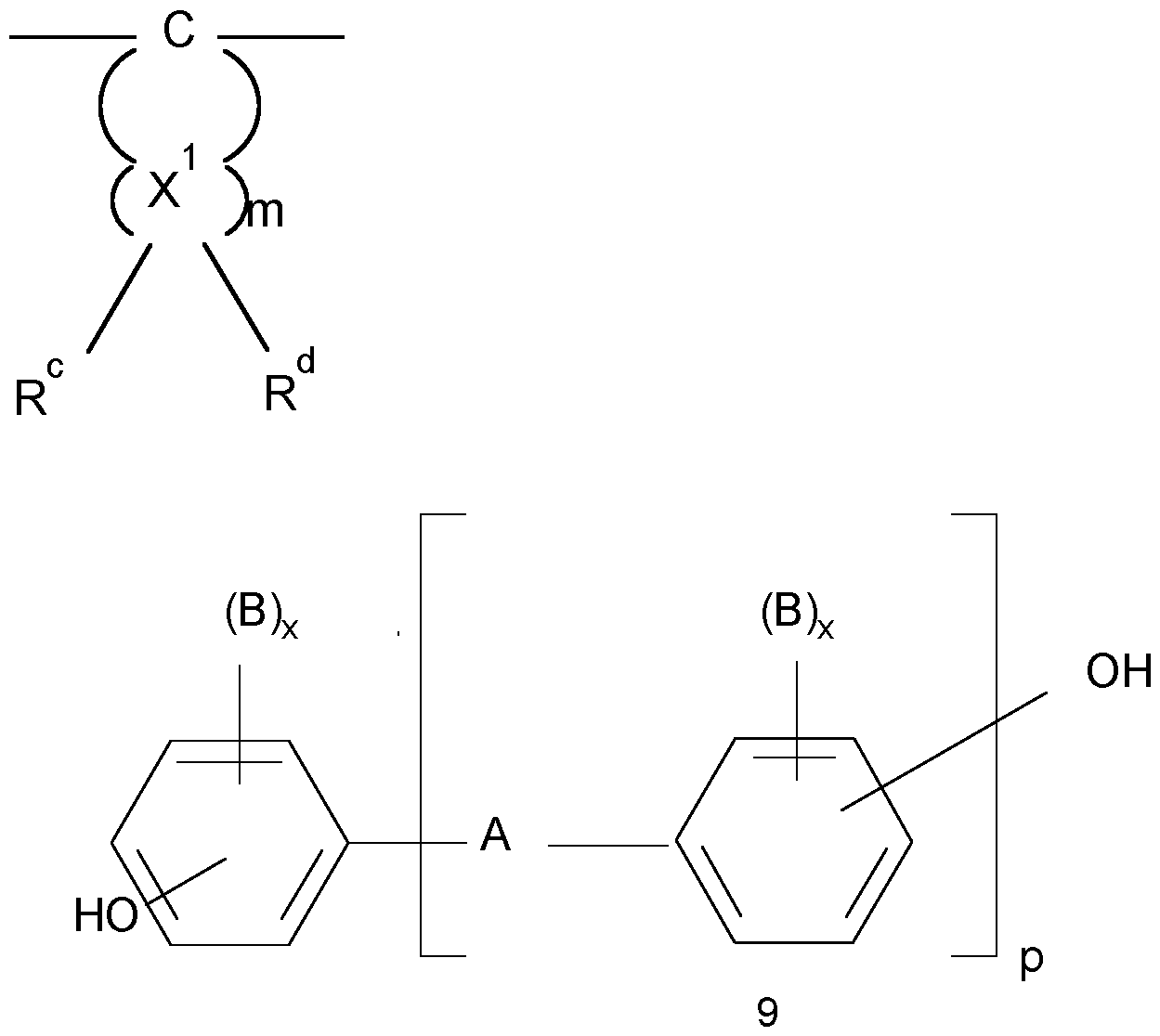 wherein A denotes a single bond, a C 1-5 alkylene, a C 2-5 alkylidene, a C 5-6 cycloalkylidene, -O-, -SO-, -CO-, -S-, -SO2-, or a C 6-12 arylene, on to which other aromatic rings, which optionally contain hetero atoms, can be condensed, or a radical of formula II or III:
II
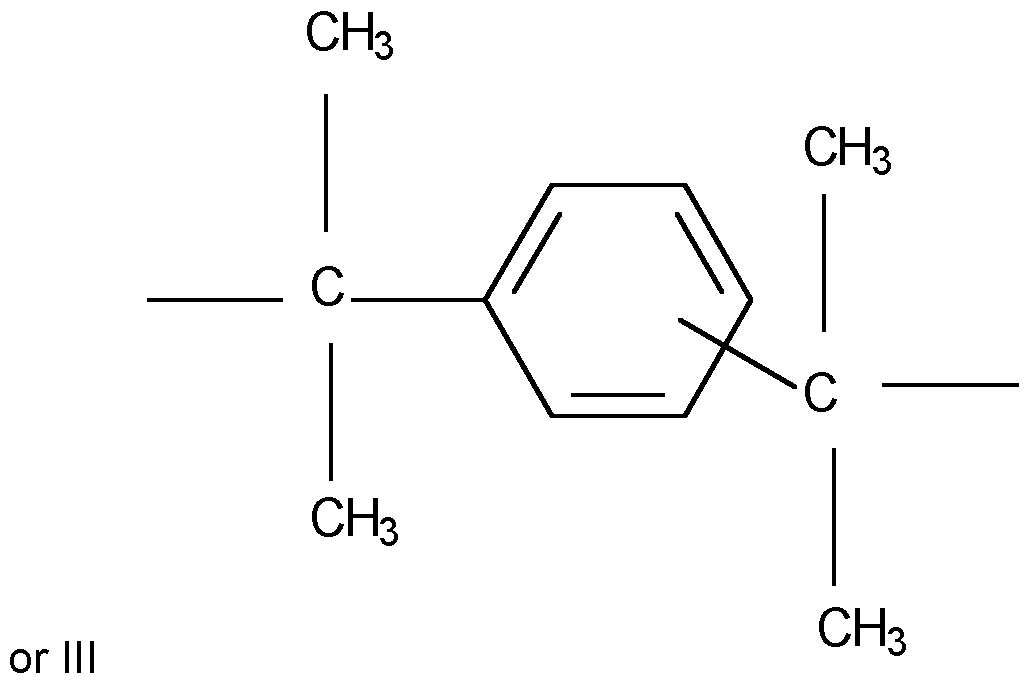 wherein B in each case is independently hydrogen, a C 1-12 alkyl, preferably methyl, or a halogen, preferably chlorine and/or bromine; x in each case is mutually independently 0, 1 , or 2; p is 0 or 1 ;
Rc and Rd are mutually independent of each other and are individually selectable for each X1 and are hydrogen or a C 1-6 alkyl, preferably hydrogen, methyl or ethyl; X1 denotes carbon; and m denotes an integer from 4 to 7, preferably 4 or 5, with the proviso that Rc and Rd simultaneously denote an alkyl on at least one X1 atom.
[0022] Exemplary diphenols are hydroquinone, resorcinol, dihydroxybiphenyls, bis (hydroxyphenyl)-C 1.5 alkanes, bis(hydroxyphenyl)-C 5-6 cycloalkanes, bis(hydroxyl-phenyl) ethers, bis(hydroxyphenyl)sulfoxides, bis(hydroxyphenyl)ketones, bis(hydroxyl-phenyl) sulfones and 4,4”-bis(hydroxyphenyl)diisopropylbenzenes, as well as derivatives thereof which have brominated and/or chlorinated nuclei. Diphenols which are particularly preferred are 4,4'- dihydroxybiphenyl, bisphenol A, 2,4-bis(4-hydroxyphenyl)-2-methyl-butane, 1 ,1 -bis (4- hydroxyphenyl)-cyclohexane, 1 ,1-bis(4-hydroxyphenyl)-3,3,5-trimethyl-cyclohexane, 4,4- dihydroxydiphenyl sulfide and 4,4-dihydroxydiphenyl sulfone, as well as di- and tetra-brominated or chlorinated derivatives thereof, such as 2,2-bis(3-chloro-4-hydroxy-phenyl)propane, 2,2-bis- (3,5-dichloro-4-hydroxyphenyl)propane or 2,2-bis(3,5-dibromo-4-hydroxyphenyl)propane. 2, 2-
bis-(4-hydroxyphenyl) propane (bisphenol A) is particularly preferred. The diphenols can be used individually or as arbitrary mixtures. The diphenols are known in the literature or can be obtained by methods known in the literature. Apart from bisphenol A homopolycarbonates, exemplary polycarbonates include copolycarbonates of bisphenol A with up to 15 mole percent, with respect to the molar sums of the diphenols, of other diphenols which are disclosed, such as 2 ,2-bis(3,5- dibromo-4-hydroxyphenyl)-propane.
[0023] To cap, branch, or chain extend the polycarbonates used in the present disclosure, one or more functional groups are used. Functional groups may include one or more chain extenders, chain terminators, branching agents, or a combination of both. Functional groups may be added to the polycarbonate solution one at one time, individually over one or more periods of time, or in series to branch and/or chain extend and subsequently chain terminate and achieve desirable molecular weights and associated properties. The one or more functional compounds may be added to the polycarbonate solution in an amount sufficient to reduce the amount of hydroxyl groups to the desired level, chain extend and/or branch the polycarbonates. The one or more functional compounds may be added to the polycarbonate solution in an amount of about 0.01 weight percent or more, 0.1 weight percent or more, or about 0.5 weight percent or more, based on the total weight of the waste polycarbonate in the polycarbonate solution. The one or more functional compounds may be added to the polycarbonate solution in an amount of about 10 weight percent or less, 5 weight percent or less, or about 1 weight percent or less, based on the total weight of the waste polycarbonate in the polycarbonate solution.
[0024] The chain terminator may be configured to react with at least one free hydroxyl and/or carboxyl group of one or more waste and/or adjusted polycarbonates to chain terminate, nonpolycarbonate compounds to remove free hydroxyl and/or carboxyl groups, or both. The chain terminators described herein may be configured to bind with one or more hydroxyl or carboxyl groups in the polycarbonate solution so that the free hydroxyl and/or carboxyl groups do not cleave one or more polycarbonate polymers. The chain terminators may include one or more groups that are reactable with the one or more hydroxyl or carboxyl groups in a condensation reaction. The chain terminators may be used to chain terminate the one or more waste and/or adjusted polycarbonates. The chain terminators may be used to bind with one or more nonpolycarbonate compounds so that free hydroxyl and/or carboxyl groups are removed from the polycarbonate solution and/or to prevent the polycarbonate chains from being cleaved by undesired interactions by the hydroxyl and/or carboxyl groups. The chain terminator may be any
compound that reacts with the hydroxyl and or carboxyl groups which do not negatively impact the usefulness of the resulting polycarbonates. Exemplary chain terminators may include one or more isocyanates, amines, esters, epoxides, anhydrides, carboxylic acids, or any combination thereof.
[0025] Chain terminators may include one or more phenolic compounds. Phenolic compounds may include phenol, p-chlorophenol, p-tert-butylphenol, 4-(1 ,3-dimethyl-butyl)-phenol and 2,4,6-tribromophenol; long chain alkyl phenols, such as monoalkylphenols or dialkylphenols which contain a total of 8 to 20 carbon atoms in their alkyl substituents, exemplary are 3,5-di-tert- butyl-phenol, p-iso-octylphenol, p-tert-octylphenol, p-dodecylphenol, 2-(3,5-dimethylheptyl)- phenol and 4-(3,5-dimethylheptyl)-phenol.
[0026] Branching agents used in this disclosure may be any compound capable of separately reacting with three or more carboxyl and/or hydroxyl groups on the same or separate polycarbonate compounds. The branching agents may have a functionality of three or more, four or more, five or more, or six or more. The functionality is a measure of the ability to bind with individual hydroxyl and/or carboxyl groups. The branching agents may react with three or more, four or more, five or more, or a plurality of hydroxyl and/or carboxyl groups. The polycarbonates can be branched, for example by the incorporation of about 0.05 to about 2.0 mole percent, with respect to the sum of the branching agents used, of trifunctional compounds or of compounds with a functionality higher than three, for example those which contain three or more phenolic groups. Branched polycarbonates useful for the compositions disclosed can be prepared by known techniques, for example several methods are disclosed in USP 3,028,365; 4,529,791 ; and 4,677,162; which are hereby incorporated by reference in their entirety. Exemplary branching agents include tri- or multi-functional carboxylic acid chlorides, such as trimesic acid trichloride, cyanuric acid trichloride, 3,3'-,4,4'-benzophenone tetracarboxylic acid tetra chloride, 1 , 4,5,8- naphthalene-tetracarboxylic acid tetrachloride or pyromellitic acid tetra chloride, in amounts of about 0.01 to about 1.0 mole percent (with respect to the dicarboxylic acid dichlorides used) or tri- or multi-functional phenols such as phloroglucinol, 4,6-dimethyl-2,4,6-tris(4-hydroxyphenyl)-2- heptene, 4,4-dimethyl-2,4,6-tris (4-hydroxy phenyl) heptane, 1 ,3,5-tris(4-hydroxyphenyl)- benzene, 1 ,1 ,1-tris(4-hydroxy phenyl)ethane, tris(4-hydroxyphenyl)-phenyl-methane, 2,2-bis[4,4- bis(4-hydroxyphenyl) cyclohexyl]propane, 2,4-bis[1-(4-hydroxyphenyl)-1-methyl-ethyl]phenol, tetrakis(4-hydroxy phenyl)-methane, 2,6-bis(2-hydroxy-5-methyl-benzyl)-4-methyl-phenol, 2-(4- hydroxyphenyl) -2-(2,4-dihydroxyphenyl)propane, or tetrakis(4-[1-(4-hydroxyphenyl)-1-
methylethyl]-phen-oxy)-methane in amounts of about 0.01 to about 1 .0 mole percent with respect to the diphenols used. Phenolic branching agents can be placed in the reaction vessel with the diphenols. Acid chloride branching agents can be introduced together with the acid chlorides.
[0027] The chain extenders may include any compound having sufficient functional groups to bind two separate polycarbonate chains together. The chain extenders may be configured to react with two separate carboxyl and/or hydroxyl groups so that polycarbonate is chain extend or to remove free carboxyl and/or hydroxyl groups in the polycarbonate solution. The chain extenders may comprise at least two functional groups sufficient to separately react with two different polycarbonate chains and/or free hydroxyl and/or carboxyl groups. The chain extenders may be used to bind with one or more non-polycarbonate compounds so that free hydroxyl and/or carboxyl groups are removed from the polycarbonate solution and/or to prevent the polycarbonate chains from being cleaved by undesired interactions by the hydroxyl and/or carboxyl groups. A combination of chain extenders may be used to bind polycarbonates having different end groups. Examples of chain extenders may include two or more functions groups including isocyanates, amines, esters, epoxides, anhydrides, carboxylic acids, or any combination thereof.
[0028] The polycarbonate solvent functions to dissolve solid polycarbonate from a waste or other feedstock. The polycarbonate solvent may dissolve one or more waste polycarbonates and hydroxyl and/or carboxyl containing compounds from the waste or other feedstocks without dissolving one or more other non-polycarbonate polymers and other materials that negatively impact the use of the recovered polycarbonates present in the waste stream. Polycarbonate solvents may have a boiling point sufficient to be heated to a temperature that will not break the chains of the polycarbonate. The polycarbonate solvent may have a boiling point of about 25 °C or more, 40 about °C or more, or about 60 °C or more. The polycarbonate solvent may have a boiling point of about 160 °C or less, about 120 °C or less, or about 80 °C or less. The polycarbonate solvent may be any solvent that preferentially dissolves polycarbonates with respect to other polymers and materials present in the waste stream that could negatively impact the use of the recovered polymers. The polycarbonate solvent may be a polar aprotic solvent. The polycarbonate solvent may comprise at least one halogen atom. The polycarbonate solvent may be free of one or more reactable protons. The polycarbonate solvent may be free of one or more carboxyl and/or hydroxyl groups. The polycarbonate solvent may not be capable of reacting with one or more carboxyl and/or hydroxyl groups. The polycarbonate solvent may be essentially immiscible with a polar protic solvent, such as water, so that the polycarbonate solvent can be
used in a devolatilization process to recover the polycarbonate solvent and, separately, the adjusted polycarbonate in a solid form. The polycarbonate solvent may comprise one or more of trichloromethane, dichloromethane, chlorobenzene, dichlorobenzene, tetrahydrofuran, 2-methyl tetrahydrofuran, N-methyl-2-pyrrolidone, dimethylformamide, 1 ,4-dioxane, methyl ethyl ketone, ethyl acetate:ethanol (3:1 , binary solvent), dimethyl sulfoxide, or any combination thereof.
[0029] The polycarbonate solvent may contain or be mixed with an amount of water dissolved within or mixed within in a solvent system. The solvent system may include two solvents present in concentrations that are miscible. The solvent system may include two or more solvents that are present in amounts such that part of the solvent system includes some water dissolved in the one or more polycarbonate solvents and some water that is phase separated from the polycarbonate solvents. Miscible amounts of two solvents may be impacted or changed based on temperature or pressure applied to the recovery solution. The solvent system may include polycarbonate and water in an amount that is miscible, such as about 0.6 weight percent or less, about 0.4 weight percent or less, about 0.2 weight percent or less, or about 0.1 weight percent, based on the total weight of the solvent system or recovery solution. In some examples, the water may be present in the solvent system in an amount that is in excess of a miscible amount of water in the polycarbonate solvent. Where water is involved in one or more reactions described herein, such as with precursor siloxane compounds that form reactive siloxane compounds, water may react within the polycarbonate solvent and excess water may dissolve into the polycarbonate solvent as the reaction occurs. One or more separation steps may be used to remove undesirable amounts of water or essentially all (e.g., until the solvent system has 0.1 or less, 0.01 or less, or 0.001 or less water in the solvent system) of the water. Water can be removed from the solvent system before or after dissolution of the reactive polycarbonates. Instead of water, the solvent system may include one or more other polar protic solvents configured to adjust the miscibility of components in the recovery solution or to participate in one or more reactions, such as during formation of the siloxane modified polycarbonates or reactive siloxane compounds. Examples of other polar protic solvents may include methanol, ethanol, n- or iso-propanol, n- or tert-butanol, acetic acid, ammonia, formic acid, or any combination thereof.
[0030] The pretreatment solvent may function to remove one or more non-polycarbonate compounds in the waste feedstock. The pretreatment solvent may be immiscible with the waste polycarbonate, the polycarbonate solvent, or both. The pretreatment solvent may be configured to capture one or more non-polycarbonate compounds that are polymers so that the polymers are
not inadvertently dissolved in the polycarbonate solvent. In some examples, the pretreatment solvent may be utilized to dissolve one or more non-polycarbonate compounds that are recyclable or reusable independent of the waste polycarbonate. The pretreatment solvent may be separatable from the waste feedstock via a drying step. Pretreatment solvents may include a polar protic or aprotic solvent or a combination of both. Examples of the pretreatment solvent may include alcohols, ketones, aldehydes, acetonitrile, aliphatic hydrocarbons, benzene, toluene, ethylbenzene, water, or any combination thereof.
[0031] The polycarbonate solvent and the separation medium may be contacted using any technique or a combination of techniques such that hydroxyl and/or carboxyl containing compounds are removed from the polycarbonate solution. The separation medium may include any compound configured to separate the hydroxyl and/or carboxyl containing compounds from the polycarbonate solution without negatively impacting or separating the polycarbonate polymers and/or oligomers. The separation medium may be an extraction solvent configured to selectively dissolve hydroxyl and/or carboxyl containing compounds and not dissolve the polycarbonate polymers or oligomers that are dissolved in the polycarbonate solution. The separation medium may be an adsorption medium configured to bind with the hydroxyl and/or carboxyl containing compounds and separate the hydroxyl and/or carboxyl containing compounds from the polycarbonate solution. Using the separation medium may be advantageous to remove the hydroxyl and/or carboxyl containing compounds from the polycarbonate solution so that no or very little undesirable residues remain in the solution after utilizing the separation medium. With little or no remaining hydroxyl and/or carboxyl containing compounds or residues thereof in the polycarbonate solution, the polycarbonate polymers or oligomers are utilizable for further separation or repair in downstream processes within the polycarbonate solution without undesirable presence of or interactions with hydroxyl and/or carboxyl containing compounds.
[0032] The separation medium may utilize an extraction-like technique where an extraction solvent is contacted with the polycarbonate solution (containing the polycarbonate solvent) and used to separate the hydroxyl and/or carboxyl containing compounds. When an extraction solvent is chosen that has a higher solubility with the hydroxyl and/or carboxyl containing compounds and little or no solubility with the polycarbonate polymers or oligomers, the extraction solvent separates most or essentially all of the hydroxyl and/or carboxyl containing compounds without having undesirably interactions with the polycarbonate polymers and/or oligomers.
[0033] The extraction solvent may function to dissolve and remove the hydroxyl and/or carboxyl containing compounds from the polycarbonate solution without dissolving the polycarbonate polymers and/or oligomers that are dissolved in the polycarbonate solvent. In other words, the extraction solvent is essentially immiscible with the polycarbonate solvent and configured to dissolve the hydroxyl and/or carboxyl containing compounds . The extraction solvent may be any solvent configured to dissolve the hydroxyl and/or carboxyl containing compounds and is essentially immiscible with the polycarbonate polymers and/or oligomers. For example, the extraction solvent may be a polar protic solvent that is immiscible with the polycarbonate solvent, polymers, and/or oligomers. The extraction solvent may be different or a different combination of solvents than the polycarbonate solvent. In some examples, the extraction solvent is water.
[0034] The extraction solvent may have a basic pH that improves the solubility with the hydroxyl and/or carboxyl containing compounds and reduce the solubility with the polycarbonate polymers and/or oligomers. The extraction solvent may include a buffer configured to adjust or maintain the pH of the solution when contacted with the polycarbonate solution. The buffer may be present in any amount sufficient to adjust or maintain the pH of the solution. The buffer may be present in an amount sufficient to adjust or maintain the pH of the extraction solvent at a level that is basic. For examples, the pH of the extraction solvent with buffer may be about 7 or more, about 7.5 or more, or about 8 or more. The pH may be about 8.5 or more, about 9 or more, or about 10 or more. For example, the buffer may be present in an amount of about 0.01 mol/L to about 2 mol/L.
[0035] The separation medium may be an adsorption medium that is configured to bind with one or more groups on the hydroxyl and/or carboxyl containing compounds , such as carboxyl and/or hydroxyl groups, and remove the hydroxyl and/or carboxyl containing compounds from the solution. Application of an adsorption medium to the polycarbonate solution may be advantageous to remove the hydroxyl and/or carboxyl containing compounds from solution without undesirably introducing derivatives or trace amounts of other compounds that may negatively impact processing or resultant properties of the downstream polycarbonate polymers and/or oligomers.
[0036] The adsorption medium may be any compound or structure capable of binding with the hydroxyl and/or carboxyl containing compounds and remove the hydroxyl and/or carboxyl containing compounds from solution. The adsorption medium may be chosen to have a higher affinity to the hydroxyl and/or carboxyl containing compounds and a lower, minimal, or no affinity to the polycarbonate polymers and/or oligomers. The adsorption medium may be essentially
immiscible with the polycarbonate solution. The adsorption medium may include any material which is capable of preferentially binding the hydroxyl and/ or carboxyl containing compounds, exemplary adsorption media include one or more of activated carbon, basic aluminum oxide, basic ion exchange resins, chitosan, molecularly imprinted polymers, silica gel, zeolites modified with cationic surfactants, neutral aluminum oxide, or any combination thereof. Chitosan may include one or more functional groups as described herein that are configured to react with free hydroxyl and/or carboxyl groups. Chitosan may include one or more of repeating units of D- glucosamine and/or N-acetyl-D-glucosamine, or residues thereof in a polymer that is linear. Molecularly imprinted polymers may include polymers configured to adsorb carboxyl and/or carboxyl containing compounds, for example, bisphenol-A.
[0037] The adsorption medium may be contacted with the polycarbonate solution through any means or technique sufficient to remove or extract the hydroxyl and/or carboxyl containing compounds from the polycarbonate solution. The adsorption medium may include structures that are fixed within a housing and the polycarbonate solution may be passed through or traverse over the adsorption medium. The adsorption medium may have a structure of a plate or cylinder that the polycarbonate solution is passed or traversed over or through such that high surface area contact is achieved to remove hydroxyl and/or carboxyl containing compounds more efficiently. The adsorption medium may be free floating structures or compounds dispersed within the polycarbonate solution such that the polycarbonate solution can be contacted with the adsorption medium to remove or extract hydroxyl and/or carboxyl containing compounds and subsequently removed through known separation techniques to separates solid-liquid mixtures. The adsorption medium may be contacted with the polycarbonate solution and agitation may be applied to the mixture such that surface area contact between the polycarbonate solution and adsorption medium is improved and the hydroxyl and/or carboxyl containing compounds is more efficiently removed or extracted. The adsorption medium may include one or more of a fluidized bed, a fixed bed, or any combination thereof. After the adsorption medium has bound with a desirable amount of hydroxyl and/or carboxyl containing compounds, the adsorption medium may be separated from the polycarbonate solution and washed to remove the hydroxyl and/or carboxyl containing compounds.
[0038] After removing any one of the separation mediums, the same separation medium or a different separation medium may be applied to the polycarbonate solution again to remove additional hydroxyl and/or carboxyl containing compounds. The adsorption medium may be
washed and then applied again to the same polycarbonate solution to remove additional hydroxyl and/or carboxyl containing compounds. One separation medium may be advantageous to remove a majority of the hydroxyl and/or carboxyl containing compounds and another separation medium may be useful to remove trace amounts of hydroxyl and/or carboxyl containing compounds or residues another separation medium (i.e. , the extraction solvent) left behind in the polycarbonate solution.
[0039] To make the hydroxyl and/or carboxyl containing compounds precipitate or inert within the polycarbonate solution or bind with the polycarbonate polymers or oligomers, a remediation compound may be contacted with the polycarbonate solution to form a modified compound. The remediation compound may be configured to chemically bind with the hydroxyl and/or carboxyl containing compounds such that the modified compound is inert or phase separates (e.g., precipitates) from the polycarbonate solution. Inert as used herein relative to the modified compound means that the modified compound lacks free hydroxyl and/or carboxyl groups. After forming the modified compound, the modified compound may additionally contact the polycarbonate polymers and/or oligomers and form adjusted polycarbonate polymers and/or oligomers.
[0040] The remediation compound may include any compound that comprises groups reactable with a carboxyl or hydroxyl group of a hydroxyl and/or carboxyl containing compounds to form the modified compound. The remediation compound may have one or more, two or more, three or more, four or more, or a plurality of groups react-able with the hydroxyl and/or carboxyl containing compounds such that more than one hydroxyl and/or carboxyl containing compounds are react-able with a single remediation compound to form a single modified compound. The groups react-able with the hydroxyl and/or carboxyl containing compounds of the remediation compound may include one or more isocyanates, anhydrides, epoxides, glycols, ethers, oxazolines, carbonates, chlorosilanes, sulfonyl fluorides, acyl chlorides, phosphoryl chlorides, or any combination thereof.
[0041] After contacting the remediation compound and the hydroxyl and/or carboxyl containing compounds , the modified compound may be inert within the polycarbonate solution such that the polycarbonate solution is free or essentially free of hydroxyl and/or carboxyl containing compounds. After formation of the modified compound, the modified compound may include one or more groups that demonstrate formation of a non-native bond. Non-native bonds are bonds formed from application of the remediation compound to the hydroxyl and/or carboxyl
containing compounds and are not resultant from typical processes of forming virgin polycarbonate. Where the remediation compound and hydroxyl and/or carboxyl containing compounds forms a non-native bonds in the modified compound, the modified compound may include one or more isocyanates, anhydrides, epoxides, oxazolines, carbonates, chlorosilanes, sulfonyl fluorides, acyl chlorides, phosphoryl chlorides, or any combination thereof. Examples of remediation compounds that may form isocyanates in the modified compound may include poly[(phenyl isocyanate)-co-formaldehyde], methylene diphenyl diisocyanate, toluene diisocyanate, isophorone diisocyanate, hexamethylene diisocyanate, or any combination thereof. Examples of remediation compounds that may form anhydrides in the modified compound include : pyromellitic dianhydride, 4,4'-(4,4'-isopropylidenediphenoxy)bis(phthalic anhydride), poly(styrene maleic anhydride), poly(ethylene-graft-maleic anhydride), or any combination thereof. Examples of remediation compounds that may form epoxides in the modified compound may include 4,4'-methylenebis(A/,A/-diglycidylaniline), tris(2,3-epoxypropyl) isocyanurate, 1 ,6- Hexanediol diglycidyl ether, polyethylene glycol diglycidyl ether, or any combination thereof. Examples of remediation compounds that may form oxazolines in the modified compound may inlcude 2, 2’-bis(2-oxazoline). Examples of remediation compounds that may form carbonates in the modified compound include diphenyl carbonate, methyl carbonate, bis(methyl salicyl) carbonate, or any combination thereof. Examples of remediation compounds that may form chlorosilanes in the modified compound may include terf-butyldimethylchlorosilane, trimethylchlorosilane, or any combination thereof. Examples of remediation compounds that may form sulfonyl fluorides in the modified compound may include ethanesulfonyl fluoride, ethenesulfonyl fluoride, or any combination thereof. Examples of remediation compounds that may form acyl chloride in the modified compound may include propionyl chloride, acetyl chloride, hydrocinnamoyl chloride, valeroyl chloride, adipyl chloride, sebacoyl chloride, succinyl chloride, or combinations thereof.
[0042] After contacting the remediation compound and the hydroxyl and/or carboxyl containing compound, the modified compound may have a different solubility in the polycarbonate solution than the hydroxyl and/or carboxyl containing compounds . The modified compound may phase separate during or upon formation such that the amount of hydroxyl and/or carboxyl containing compounds are reduced or eliminated in the polycarbonate solution. The modified compound may be separated by additionally contacting another solvent with the polycarbonate solvent that either extracts the modified compound or crashes the modified compound from
polycarbonate solution, which may be removed by techniques known to separate immiscible liquid-liquid or solid-liquid mixtures.
[0043] After contacting the remediation compound and the hydroxyl and/or carboxyl containing compounds , the modified compound may include one or more groups that are reactable with one or more of the polycarbonate polymers or oligomers within the polycarbonate solution. The modified compound may include one or more, two or more, three or more, four or more, five or more, or a plurality of the functional groups so that the modified compound may be useable to further modify the polycarbonate polymers or oligomers within the polycarbonate solution. Modification of the polycarbonate polymers or oligomers using the modified compounds may achieve desirable end-capping, chain extending, branching, cross-linking, copolymerization, or any combination thereof on the polycarbonate polymers or oligomers. Groups included on the modified compound that may be react-able with the polycarbonate polymers or oligomers, such as with free hydroxyl and/or carboxyl groups on the polymers or oligomers, include one or more isocyanates, anhydrides, epoxides, oxazolines, carbonates, chlorosilanes, sulfonyl fluorides, acyl chlorides, phosphoryl chlorides, or any combination thereof.
[0044] When the separation medium or the remediation compound is used, agitation may be applied to disperse localized hydroxyl and/or carboxyl containing compounds so that the separation medium or remediation compound may more easily contact the hydroxyl and/or carboxyl containing compounds and reduce the time utilized to fully remove or make inert the hydroxyl and/or carboxyl containing compounds. The agitation may be applied for any period of time or with any force sufficient to move hydroxyl and/or carboxyl containing compounds within the polycarbonate solvent and into contact with the remediation compound or separation medium. The agitation may be applied at any location around and/or within the polycarbonate solvent to achieve desired mixing and subsequent concentration levels and/or saturation of the hydroxyl and/or carboxyl containing compounds or derivatives thereof within the polycarbonate solution and/or separation medium.
[0045] Agitation of the polycarbonate solution, polycarbonate solvent, and/or extraction solvent may be performed by any technique sufficient to move molecules in a solution. Agitation may be performed by applying a force to polycarbonate solution, polycarbonate solvent, and/or extraction solvent or housing holding the liquids such that molecules in different phases are moved into contact with each other. Additionally, combinations of agitation may be used both to the polycarbonate solvent and the extraction solvent or container holding the polycarbonate
solution such that separation medium and/or remediation compounds are moved within the polycarbonate solvent. Examples of agitation may include cavitating, swirling, shaking, rocking, spinning, stirring, or any combination thereof.
[0046] The application of heat may be utilized and may function to raise the temperature of the polycarbonate solvent to a temperature sufficient to improve dissolution or binding of the hydroxyl and/or carboxyl containing compounds. The heat may be applied such that the polycarbonate solvent reached a boiling temperature or below. The heat may be applied up to a boiling temperature of the polycarbonate solvent and without cleaving one or more polycarbonate chains. The heat may be applied to the polycarbonate solvent in a temperature of about 30 °C or more, about 40 °C or more, or about 50 °C or more. The heat may be applied to the polycarbonate solvent in a temperature of about 160 °C or less, about 120 °C or less, or about 80 °C or less.
[0047] The separation medium or remediation compound may be contacted with the polycarbonate solution for any period of time or with any agitation techniques sufficient to remove or make inert essentially all of the hydroxyl and/or carboxyl containing compounds within the solution. For example, the separation medium and/or remediation compound may be contacted with the polycarbonate solution, agitated, and allowed to rest for a period of the time. The separation medium or remediation compound and polycarbonate solution may be contacted for about 30 minutes or more, about 2 hours or more, or about 8 hours or more. The separation medium or remediation compound and polycarbonate solution may be contacted for about 24 hours or less, about 18 hours or less, or about 12 hours or less.
[0048] The separation medium may be removed from the polycarbonate solution by any technique sufficient to separate two components in different phases. Components in different phases may be essentially immiscible (at ambient temperature) liquid-liquid mixtures, liquid-solid mixtures, and/or gaseous-liquid mixtures. For example, the separation medium may be decanted, extracted, distilled, devolatilized, centrifuged, filtered, or any combination thereof from the polycarbonate solution. In some examples, the polycarbonate solution may be contacted with the separation medium in a solid form by passing the polycarbonate solution over the separation medium and moving the liquid polycarbonate solution away from the separation medium.
[0049] Before contacting the separation medium or the remediation compound with the polycarbonate solution, the polycarbonate solvent and a waste feedstock may be contacted to dissolve the one or more polycarbonate polymers and/or hydroxyl and/or carboxyl containing compounds. In some examples, the waste feedstock is a mix of waste polycarbonate, other
polymers, various additives, and/or hydroxyl and/or carboxyl containing compounds. The waste feedstock and polycarbonate solvent may be contacted in any housing sufficient to contain fluids (e.g., liquids and/or gases). The polycarbonate solvent and the waste feedstock may be contacted in a sealed housing that is configured to contain fluids and gases so that the waste feedstock may be mixed with fluids and gases to achieve desirable dissolution levels of waste feedstock. The waste feedstock may be moved into a sealed housing through an access point and moved into contact with polycarbonate solvent such that minimal or no polycarbonate solvent is lost through the access point as the waste feedstock is moved into and out of the sealed housing. In some examples, the sealed housing includes an airlock chamber that is configured to receive the waste feedstock a first access point, seal the first access point, and open a second access point to move the waste feedstock into contact with the polycarbonate solvent. Additional access points may be included to remove treated waste feedstock, waste polycarbonate, polycarbonate solution, functional compounds, scavengers or absorption or adsorption materials, and/or to add virgin or recycled polycarbonate solvent.
[0050] The housing may be equipped with any instrument sufficient to apply heating and/or cooling to control the physical state of the polycarbonate solvent and improve dissolution of the waste polycarbonate in the polycarbonate solvent. Instruments that apply heating and/or cooling though any means sufficient to adjust the temperature of the polycarbonate solvent may be useable. The housing may be equipped with one or more, two or more, three or more, or a plurality of heating and/or cooling instruments to manipulate the temperatures of the polycarbonate solvent. The instruments for heating and cooling may be in the same section or may be positioned in separate locations and/or sections so that the state of the polycarbonate solvent is controlled and/or the polycarbonate solvent is prevented from escaping the housing. Agitation may be applied to polycarbonate solvent in a liquid state and separately in a gaseous state. Any type of agitation may be supplied which enhances the dissolution of polycarbonate into the polycarbonate solvent. In some examples, the housing may be equipped with multiple instruments configured to apply agitation in a single state. The housing may be equipped with a sonication device (i.e. , for applying ultrasonic waves) and a stirring device so that two or more techniques can be used to improve agitation and, subsequently, dissolution of the waste polycarbonate into the polycarbonate solvent is improved. Examples of agitators may include sonicators, impellers, magnetic stirrers, vortexers, rockers, shakers, or any combination thereof. These devices may
additionally be implemented in the same or different housings while implementing the remediation or separation compounds.
[0051] After contacting the polycarbonate solvent and the waste feedstock to form the polycarbonate solution, the waste feedstock may be removed from the polycarbonate solution once a desirable concentration of waste polycarbonate is achieved in the polycarbonate solution. The waste feedstock may be removed by any means sufficient to separate a solid from a liquid. The waste feedstock may be raised out of the liquid polycarbonate solution by an appropriate container. In some examples, the waste feedstock may be raised out of the polycarbonate solution, subsequently washed by a vapor phase polycarbonate solvent, and removed from the housing containing the polycarbonate solution. The waste polycarbonate may have any desirable concentration in the polycarbonate solvent such that the waste polycarbonate can be repaired by one or more functional compounds in subsequent steps. The waste polycarbonate may have a concentration in the polycarbonate solvent that is equal to or less than a saturation level at or just below the boiling point of the polycarbonate solvent. The waste polycarbonate may have a concentration in the polycarbonate solvent of about 1 weight percent or more, about 5 weight percent or more or about 10 weight percent or more. The waste polycarbonate may have a concentration in the polycarbonate solvent of about 50 weight percent or less, about 30 weight percent or less, or about 20 weight percent or less.
[0052] The polycarbonate solvent and the waste feedstock may be contacted for any period of time sufficient to dissolve the waste polycarbonate from the waste feedstock to a target concentration of polycarbonate waste in the polycarbonate solvent. The amount of time sufficient to dissolve the waste polycarbonate into the polycarbonate solvent at a desired concentration or to saturation may be dependent on the agitation and/or temperatures applied to the waste feedstocks and/or polycarbonate solvent. The polycarbonate solvent and the waste feedstock may be contact for a period of 10 min or more, about 60 min or more, or about 90 min or more. The polycarbonate solvent and the waste feedstock may be contact for a period of 6h or less, about 4h or less, or about 3h or less. More than one batch of waste feedstock may be contacted with and removed from the polycarbonate solvent until a desired concentration of waste polycarbonate is achieved in the polycarbonate solution.
[0053] Once the waste polycarbonate or a portion thereof is dissolved into the polycarbonate solvent such that a polycarbonate solution is formed, the recovery solution is contacted with one or more functional compounds to adjust the waste polycarbonate and form the adjusted
polycarbonate. The application of the functional groups may occur before, during, or after application of the one or more separation or remediation compounds. The one or more functional compounds may chain terminate, chain extend, or branch the waste polycarbonate such the adjusted polycarbonate has increased molecular weight and/or properties and reduced hydroxyl and/or carboxyl compounds present in the polycarbonate solution. The one or more functional compounds may increase the number and/or weight average molecular weight of the waste polycarbonate. The weight and/or number average molecular weight may increase by a percentage relative to the number and/or weight average molecular weight of the waste polycarbonate before addition of the one or more functional compounds. The percentage increase may be about 5 percent or more, 20 percent or more, or about 40 percent or more. The percentage increase may be about 100 percent or less, about 75 percent or less, or about 50 percent or less. The adjusted polycarbonate may have a number and/or weight average molecular weight that is larger than a number and/or weight average molecular weight of the waste polycarbonate. The weight average molecular weight of the adjusted polycarbonate may be about 10 kg/mol or larger, about 30 kg/mol or larger, or about 50 kg/mol or larger relative to the waste polycarbonate. The weight average molecular weight of the adjusted polycarbonate may be about 70 kg/mol or larger, about 90 kg or larger, or about 100 kg/mol or larger relative to the waste polycarbonate. The number average molecular weight of the adjusted polycarbonate may be about 3 kg/mol or larger, about 10 kg/mol or larger, or about 20 kg/mol or larger relative to the waste polycarbonate. The number average molecular weight of the adjusted polycarbonate may be about 30 kg/mol or larger, about 40 kg/mol or larger, or about 50 kg/mol or larger relative to the waste polycarbonate. The molecular weight in this disclosure is determined by gel permeation chromatography using narrow polystyrene standards (£> < 1.2) and a broad range polycarbonate standard (£> > 1.5).. After adding the one or more functional groups to the polycarbonate solution, the adjusted polycarbonate may have a melt flow rate sufficient to be used in downstream processes with similar quality as virgin polycarbonate. The melt flow rate may be similar or substantially the same as virgin polycarbonate. The melt flow rate of the adjusted polycarbonate may be greater or less than the melt flow rate of the waste polycarbonate due to having an adjusted molecular weight from addition of the one or more functional compounds. The melt flow rate of the adjusted polycarbonate may be about 1 g/10 min or more, about 5 g/10min or more, or about 20 g/10min or more. The melt flow rate of the adjusted polycarbonate may be about 80 g/10 min or less, about 60 g/10min or less, or about 40 g/10min or less. The melt flow rate is determined by measuring
the grams passing through a standard die (2.095 x 8 mm) for 10 minutes (g/10 min) as determined at 300°C under a load of 1.2 kg according to the ISO 1133 standard.
[0054] After adding the functional, separation, or remediation compounds to the polycarbonate solution, the hydroxyl and/or carboxyl groups may be present in a sufficiently low amount to reduce or avoid chain cleavage in the polycarbonates. After adding the functional, separation, or remediation groups to the polycarbonate solution, the functional, separation, or remediation compounds may remove or react with hydroxyl and/or carboxyl groups in the solution such that the polycarbonate solution is free or essentially free (e.g., 0.1 , 0.01 , or 0.01 weight percent or less present) of hydroxyl and/or carboxyl groups. The amount of carboxyl and/or hydroxyl groups may be measured within the polycarbonate solution by techniques known in the art, such as those discussed in Mork, C.O. and Priddy, D.B. (1992), Facile measurement of phenolic end-groups in bisphenol-a polycarbonate using GPC-UV analysis. J. Appl. Polym. Sci., 45: 435-442 and J. E. Biles, T. P. McNeal, T. H. Begley, and H. C. Hollifield, Determination of Bisphenol-A in Reusable Polycarbonate Food-Contact Plastics and Migration to Food-Simulating Liquids, J. Agric. Food Chem. 1997, 45, 9, 3541-3544, September 15, 1997, both of which are incorporated herein by reference.
[0055] After removing the hydroxyl and/or carboxyl containing compounds and/or forming the adjusted polycarbonates, the polycarbonate solution may be subjected to a step of recovering and/or separating the polycarbonate solvent, the polycarbonate polymers and/or oligomers that are not adjusted, and/or adjusted polycarbonates. Each of the components may be removed in a simultaneous fashion or separately in series. The polycarbonate solution may be subjected to a process step that separates the polycarbonate solvent and the adjusted polycarbonate at the same time so that the adjusted polycarbonate can be used in downstream processes and the polycarbonate solvent is reusable to recover additional waste polycarbonate through a recycle pathway. The polycarbonate solution may be subjected to any techniques sufficient to separate two components in a liquid state. The polycarbonate solution may be subjected to one or more of devolatilization, centrifugation, filtration, distillation, or any combination thereof to separate the adjusted polycarbonate and the polycarbonate solvent. Compounds that remain after removing the polycarbonate solvent and adjusted polycarbonate may be disposed of or subjected to further separation steps to recover desirable compounds and recycle them. A non-solvent may be contacted with the with polycarbonate solution to precipitate the adjusted polycarbonate from the polycarbonate solvent in a form that is free or essentially free of impurities or that may be
subjected to further separation techniques. Non-solvents may include one or more compounds that are immiscible with polycarbonate solvent, such as water, aliphatic hydrocarbons, alcohols, acetonitrile, acetone, or any combination thereof.
[0056] The recovered adjusted polycarbonate may be subjected to one or more further treatment steps to remove undesirable compounds. The adjusted polycarbonate may be subjected to one or more steps to remove volatile compounds, such as residual solvent or moisture. The adjusted polycarbonate may be subjected to one or more steps to remove additives that remain in the waste feedstock so that the user can control the amount and/or combination of additives in the final polycarbonate composition, the adjusted polycarbonate may be subjected to drying, absorption, adsorption, filtration, scavenging, or any combination thereof.
[0057] In downstream process uses, the adjusted polycarbonate may be contacted with one or more compounds desirable to make a downstream product or composition. The adjusted polycarbonate may be mixed or blended with one or more other polymers or virgin polycarbonate to achieve desirable properties. Other polymers may include polystyrene, styrene acrylonitrile, acrylonitrile butadiene, styrene, high impact polystyrene, polymethylmethacrylate, polyolefins or any combination thereof. The adjusted polycarbonate may be mixed with one or more additives sufficient to achieve desirable properties. The additives may include one or more of fillers, flame retardants, pigments, UV stabilizers, antioxidants, mold release agents, dyes, or any combination thereof.
[0058] Before contacting the waste feedstock and the one or more polycarbonate solvents, the waste feedstock may be subjected to one or more pretreatment steps to separate one or more non-polycarbonate compounds from the waste feedstock to recover desired compounds and/or to avoid undesirable reactions in the recovery feedstock. The waste feedstock may be subjected to any pretreatment step configured to remove one or more non-polycarbonate compounds or to prepare the waste feedstock for more efficient extraction of waste polycarbonate. The waste feedstock may be structurally altered to expose surface area of the components in the waste feedstock and/or prepare the waste feedstock for downstream processing steps, which may be conducted by shredding, grinding, pressing, dismantling, sorting, or any combination thereof. The waste feedstock may be treated to remove one or more non-polycarbonate compounds, such as inorganic compounds, non-polycarbonate polymers (e.g., polystyrene, styrene acrylonitrile resin, acrylonitrile butadiene styrene, high impact polystyrene, polymethylmethacrylate, other polymers commonly blended with polycarbonate, etc.), small organic molecules, or any combination
thereof. The waste feedstock in the pretreatment step may be subjected to melting, magnetic field, density separation, freezing, agglomeration, washing, chemical removal of adhesives, selective dissolution of other polymers, drying, heating, cooling, or any combination thereof. [0059] The above steps may be completed in the same chamber or in a series of chambers. Contacting the polycarbonate solvent and the waste feedstock may be conducted in a first chamber; contacting the recovery solution and one or more functional compounds may be conducted in a second chamber and recovering and/or separating the polycarbonate solvent and adjusted polycarbonate may be conducted in a third chamber. Performing the above steps in a series of chambers may mitigate side reactions while functional compounds are added or to more closely control separation steps. All of the steps may be conducted in the same chamber in a one pot style that recovers, adjusts/repairs, and removes polycarbonates in one location. One or more pathways may separate the chambers and move the recovery solution, waste feedstock, polycarbonate solvent, adjusted polycarbonate, or a combination thereof from chamber to chamber as appropriate.
[0060] The disclosed compositions of adjusted polycarbonates may be used to prepare structures comprising or containing them utilizing any known processes, such as extrusion, molding, thermoforming, and the like. The disclosed compositions of adjusted polycarbonates may be molded using procedure known in the art. The polycarbonate compositions may be molded into useful shaped articles by a variety of means such as injection molding, overmolding, extrusion, rotational molding, blow molding and thermoforming to form various molded articles. Such articles may include thin-walled articles for consumer goods like cellphones, MP3 players, computers, laptops, cameras, video recorders, electronic tablets, hand receivers, kitchen appliances, electrical housings, etc., e.g. a smart meter housing, and the like; electrical connectors, and components of lighting fixtures, ornaments, home appliances, roofs, greenhouses, sun rooms, swimming pool enclosures, Light Emitting Diodes (LEDs) and light panels, extruded film and sheet articles; electrical parts, such as relays; and telecommunications parts such as parts for base station terminals. The present disclosure further contemplates additional fabrication operations on said articles, such as, but not limited to, molding, in-mold decoration, baking in a paint oven, lamination, and/or thermoforming. The compositions disclosed are heated to temperatures at which the composition flows, which may be above the glass transition temperatures of the polycarbonates in the composition. The glass transition temperature is determined using differential scanning calorimetry. Such temperatures may
be greater than 155 °C, above 200 °C or greater, 250 °C or greater. Such temperatures may be 400 °C or less or 300 °C or less. The mold may be heated to facilitate processing such as to 60 °C or greater, 80 °C or greater or 100 °C or greater.
[0061] FIG. 2 illustrates a process to remove hydroxyl and/or carboxyl containing compounds from a polycarbonate solution. The polycarbonate solution is a liquid mixture of waste polycarbonate dissolved in dichloromethane and is passed through a cylindrical column of an adsorption medium that is configured to bind with bisphenol-A (“BPA”). As the liquid polycarbonate solution is passed through the adsorption medium, the bisphenol-A molecules bind with the cylindrical column until a saturation point and removed from the polycarbonate solution. After binding with the cylindrical column, another solution may be used to wash the saturated column so that the column can be used again.
[0062] FIG. 3 illustrates a reaction scheme to make hydroxyl and/or carboxyl containing compounds in the polycarbonate solution inert. In part a), a bisphenol-A is contacted with an acyl halide to form a modified compound that is inert - meaning that it is free of hydroxyl or carboxyl groups. In part b), the bisphenol-A is contacted with a multifunctional isocyanate that is configured to bind with the bisphenol-A to form the modified compound. The multifunctional isocyanate or the resultant modified compound is then react-able with one or more polycarbonate polymers and/or oligomers to form an adjusted polycarbonate that is free of terminal hydroxyl and/or carboxyl groups.
EMBODIMENTS
Embodiment 1. A method, comprising: a. contacting a separation medium and a polycarbonate solution comprising one or more polycarbonate polymers, one or more hydroxyl and/or carboxyl containing compounds, and a polycarbonate solvent to separate the one or more hydroxyl and/or carboxyl containing compounds from the polycarbonate solution, wherein the separation medium is essentially immiscible with the polycarbonate solution; and b. separating the polycarbonate solution and the separation medium containing the one or more hydroxyl and/or carboxyl containing compounds.
Embodiment 2. The method of embodiment 1 , wherein the separation medium has a pH of above 7.
Embodiment 3. The method of embodiments 1 or 2, wherein after separation of the polycarbonate solution and the separation medium, the polycarbonate solution is essentially free of the one or more hydroxyl and/or carboxyl containing compounds.
Embodiment 4. The method of any one of the previous embodiments, wherein the one or more hydroxyl and/or carboxyl containing compounds comprises a bisphenol compound or residue thereof
Embodiment 5. The method of any one of the previous embodiments, wherein the one or more hydroxyl and/or carboxyl containing compounds has a molecular weight of about 1000 grams per mole or less.
Embodiment 6. The method of any one of the previous embodiments, wherein the separation medium comprises water, and wherein the polycarbonate solvent comprises an organic solvent that is essentially immiscible with the water.
Embodiment 7. The method of embodiment 5, wherein the water has a pH of above 7.
Embodiment 8. The method of embodiments 5 or 6, wherein the water comprises a buffer in a concentration sufficient to maintain the pH of the solution.
Embodiment 9. The method of any one of embodiments 5 to 7, wherein the buffer is present in the water at a concentration of about 0.1 mol/L to about 2 mol/L.
Embodiment 10. The method of any one of the previous embodiments, wherein the polycarbonate solvent comprises a polar aprotic solvent.
Embodiment 11. The method of any one of the previous embodiments, wherein the polycarbonate solvent comprises methylene chloride, chloroform, tetra hydrofuran (THF), 2- methyl tetrahydrofuran, N-methyl-2-pyrrolidone, , dimethylformamide, 1 ,4-dioxane, methyl ethyl ketone, ethyl acetate:ethanol (3:1 , binary solvent), dimethyl sulfoxide, or any combination thereof. Embodiment 12. The method of any one of the preceding embodiments, further comprising: a. applying agitation to the polycarbonate solution and/or separation medium to form a dispersion of the polycarbonate solution and the separation medium; b. after phase separation of the dispersion, separating the polycarbonate solution and separation medium such that the polycarbonate solution is essentially free of the one or more hydroxyl and/or carboxyl containing compounds.
Embodiment 13. The method of any one of embodiments 1 to 4, wherein the separation medium comprises an adsorption medium configured to bind with the hydroxyl and/or carboxyl containing compounds .
Embodiment 14. The method of embodiment 12, wherein the adsorption medium comprises a fixed or fluidized bed so that the polycarbonate solution traverses the adsorption medium and extracts the one or more hydroxyl and/or carboxyl containing compounds onto the adsorption medium.
Embodiment 15. The method of embodiments 12 or 13, wherein the adsorption medium comprises one or more of activated carbon, basic aluminum oxide, basic ion exchange resins, chitosan, molecularly imprinted polymers, silica gel, zeolites modified with cationic surfactants, or any combination thereof.
Embodiment 16. The method of any one of embodiments 12 to 14, wherein the step of contacting the separation medium and the polycarbonate solution comprises: a. passing the polycarbonate solution through an inlet of the adsorption medium towards an outlet so that the one or more hydroxyl and/or carboxyl containing compounds are extracted along the inside of the separation medium as the polycarbonate solution moves between the inlet and outlet; and b. once the adsorption medium is saturated with the one or more hydroxyl and/or carboxyl containing compounds, separating the one or more hydroxyl and/or carboxyl containing compounds from the adsorption medium by contacting the adsorption medium with a flushing solution.
Embodiment 17. A method, comprising:
a. contacting one or more remediation compounds and a polycarbonate solution comprising a polycarbonate solvent, one or more polycarbonate polymers, and one or more hydroxyl and/or carboxyl containing compounds to form one or more modified compounds comprising a residue of the one or more hydroxyl and/or carboxyl containing compounds connected with a residue of the one or more remediation compounds.
Embodiment 18. The method of embodiment 16, wherein the one or more remediation compounds comprises one or more functional groups comprising an isocyanate, an anhydride, an epoxide, an oxazoline, a carbonate, a chlorosilane, an acyl chloride, a phosphoryl chloride, or any combination thereof.
Embodiment 19. The method of embodiment 17, wherein the remediation compound comprises two or more functional groups.
Embodiment 20. The method of any one of embodiments 16-19, wherein the one or more modified compounds is essentially free of hydroxyl or carboxyl groups.
Embodiment 21. The method of any one of embodiments 16-19, wherein at least some of the one or more modified compounds comprise at least one functional group configured to react with a hydroxyl and/or carboxyl group of the polycarbonate polymer.
Embodiment 22. The method of embodiment 19, wherein the at least one functional group of the one or more modified compounds comprise one or more of isocyanate, an anhydride, an epoxide, an oxazoline, a carbonate, a chlorosilane, an acyl chloride, a phosphoryl chloride, or any combination thereof.
Embodiment 23. The method of embodiments 21 or 22, further comprising: a. contacting the one or more polycarbonate polymer and the one or more modified compound within the polycarbonate solution to form one or more modified polycarbonate polymers.
Embodiment 24. The method of embodiment 23, wherein the one or more modified polycarbonate polymers are essentially free of hydroxyl and/or carboxyl groups.
Embodiment 25. The method of embodiment 24, wherein the one or more modified polycarbonate polymers comprises hydroxyl and/or carboxyl groups in a mole percent of about 50 ppm or less, based on the total molar mass of the modified polycarbonate polymer.
Embodiment 26. The method of embodiments 23 or 24, wherein at least some of the one or more polycarbonate polymers comprise a hydroxyl and/or carboxyl content of about great than 0 to about 3 weight percent, based on the total weight of each of the polycarbonate polymers.
Embodiment 27. The method of any one of embodiments 23-25, wherein the modified polycarbonate polymers have a number or weight average molecular weight that is larger than a number or weight average molecular weight of the one or more polycarbonate polymers before modification.
ILLUSTRATIVE EXAMPLES
[0063] Phenolic species in the below examples is determined by those techniques described in related to hydroxyl and/or carboxyl containing compounds described herein and is measured and represented by ppm, unless otherwise stated.
[0064] Example 1 :
[0065] FIG. 1 illustrates the extraction process to separate hydroxyl and/or carboxyl containing compounds from a polycarbonate solution.
[0066] Example 2:
[0067] Polycarbonate (“PC”) recovered from discarded, post-consumer greenhouse sheets, which were exposed to weathering elements from more than 10 years during its lifecycle, contain a significant amount of BPA compared to virgin PC. A 15 wt% PC solution is prepared by dissolving these greenhouse sheets in dichloromethane, without any prior treatment. Upon complete dissolution, it is filtered through a 100 micron mesh filter cloth to remove insoluble contaminants (e.g., soil particles). The solution was then contacted with a 0.1 M aqueous NaOH solution for respectively 1 hour, 4 hours, and 68 hours after which the dichloromethane layer was separated. The solvent is evaporated to obtain the polycarbonate. Determination of the BPA levels shows a significant decrease in BPA levels compared to the untreated sample.
 Example 3: PC recovered from discarded, post-consumer greenhouse sheets, which were exposed to weathering elements from more than 10 years during its lifecycle, contain a significant amount of BPA compared to virgin PC. A 15 wt% PC solution is prepared by dissolving these greenhouse sheets in dichloromethane, without any prior treatment. Upon complete dissolution, the PC solution is coarse filtered to remove large insoluble contaminants (e.g., soil particles), followed by filtration over celite to remove microscopic particles. Some of the sample is then passed over different adsorption media (see table).

In all cases, a decrease is observed compared to the sample that is only filtered. Remarkably, also low molecular weight oligomers are retained in some cases, leading to an increase in the average molecular weight when used to repair polycarbonate in downstream processes.
[0068] Comparative Example 1 and Example 3
[0069] Comparative example 1 demonstrates that polycarbonate recycled through a dissolution-based recycling method from waste A contains a high amount of free phenolic species. Example 1 shows that these phenolic groups are removable by contacting the solution with a coupling reagent. Similarly, comparative example 2 from waste B also has a high phenolic OH content, which is removable contacting the solution with another coupling reagent in example 2. [0070] Comparative example 1
[0071] PC-containing waste A is solubilized in dichloromethane to obtain a 15 wt% solution. The insoluble parts are removed by coarse filtration with a 100 pm mesh filter cloth. After the removal of the solvent and drying of the recycled PC, the amount of free phenolic species is determined (Table 1).
[0072] Example 3
[0073] PC-containing waste A is solubilized in dichloromethane to obtain a 15 wt% solution similar to comparative example 3. Subsequently methylene diphenyl diisocyanate (0.33 wt%) is added together with (75 ppm) triazabicyclodecene. The solution is stirred for 6 hours. Afterwards the solution is filtered using coarse filtration with a 100 pm mesh filter cloth and the solvent is evaporated. The free phenolic species were determined (Table 1) after drying the recycled PC.
Table 1

[0074] Comparative example 2 and Example 4
[0075] In Comparative example 2, PC-containing waste B is solubilized in dichloromethane to obtain a 15 wt% solution. The insoluble parts are removed by coarse filtration with a 100 pm mesh filter cloth. After the removal of the solvent and drying of the recycled PC, the amount of free phenolic species is determined (Table 2).
[0076] Example 4
[0077] PC-containing waste B is solubilized in dichloromethane to obtain a 15 wt% solution similar to comparative example 2. Subsequently poly[(phenyl isocyanate)-co-formaldehyde] (Mn = 400, 0.21 wt%) is added together with (50 ppm) triazabicyclodecene. The solution is stirred for 6 hours. Afterwards the solution is filtered using coarse filtration with a 100 pm mesh filter cloth and the solvent is evaporated. The free phenolic species are determined (Table 2) after drying the recycled PC.
Table 2


[0078] Comparative example 3 and Examples 5-8
[0079] In comparative example 3, PC-containing waste C was solubilized in dichloromethane to obtain a 15 wt% solution. The insoluble parts were removed by coarse filtration with a 100 pm mesh filter cloth, followed by microfiltration with a 0.6 pm filter cartridge. After the removal of the solvent and drying of the recycled PC, the amount of free phenolic species was determined (Table 3).
[0080] Example 5
[0081] PC-containing waste C is solubilized in dichloromethane and filtered in a similar way as described in comparative example 3. Then, methylene diphenyl diisocyanate (0.33 wt%) is added together with triazabicyclodecene (75 ppm). The solution is stirred for 12 hours, before the solvent was evaporated. After drying the polycarbonate, the free phenolic species are determined (Table 3)
[0082] Example 6
[0083] PC-containing waste C is solubilized in dichloromethane and filtered in a similar way as described in comparative example 3. Then, 1 ,2-bis(chlorodimethylsilyl)ethane (0.28 wt%) is added together with triethylamine (0.27 wt%). After stirring the solution is stirred for 12 hours, the organic fraction is washed with a dilute hydrochloric acid solution 0.1 M) and water. The organic fraction was isolated, and the solvent is evaporated to obtain the polycarbonate. After drying, the free phenolic species are determined (Table 3).
[0084] Example 7
[0085] PC-containing waste C is solubilized in dichloromethane and filtered in a similar way as described in comparative example 3. Then, dichlorophenylphosphine oxide (0.26 wt%) is added together with triethylamine (0.27 wt%). After stirring the solution is stirred for 12 hours, the organic fraction is washed with a dilute hydrochloric acid solution 0.1 M) and water. The organic fraction is isolated, and the solvent is evaporated to obtain the polycarbonate. After drying, the free phenolic species are determined (Table 3).
[0086] Example 8
[0087] PC-containing waste C is solubilized in dichloromethane and filtered in a similar way as described in comparative example 3. Then, 1 ,3-Dichloro-1 ,1 ,3,3-tetramethyldisiloxane (0.27
wt%) is added together with triethylamine (0.27 wt%). After stirring the solution is stirred for 12 hours, the organic fraction is washed with a dilute hydrochloric acid solution 0.1 M) and water. The organic fraction is isolated, and the solvent is evaporated to obtain the polycarbonate. After drying, the free phenolic species are determined (Table 3).
Table 3

Claims
1. A method, comprising: a. contacting a separation medium and a polycarbonate solution comprising one or more polycarbonate polymers, one or more hydroxyl and/or carboxyl containing compounds, and a polycarbonate solvent to separate the one or more hydroxyl and/or carboxyl containing compounds from the polycarbonate solution, wherein the separation medium is essentially immiscible with the polycarbonate solution; and b. separating the polycarbonate solution and the separation medium containing the one or more hydroxyl and/or carboxyl containing compounds.
2. The method of claim 1 , wherein the separation medium has a pH of above 7.
3. The method of claims 1 or 2, wherein after separation of the polycarbonate solution and the separation medium, the polycarbonate solution is essentially free of the one or more hydroxyl and/or carboxyl containing compounds.
4. The method of any one of the previous claims, wherein the one or more hydroxyl and/or carboxyl containing compounds comprises a bisphenol compound or residue thereof
5. The method of any one of the previous claims, wherein the one or more hydroxyl and/or carboxyl containing compounds has a molecular weight of about 1000 grams per mole or less.
6. The method of any one of the previous claims, wherein the separation medium comprises water, and wherein the polycarbonate solvent comprises an organic solvent that is essentially immiscible with the water.
7. The method of claim 5, wherein the water has a pH of above 7.
8. The method of claims 5 or 6, wherein the water comprises a buffer in a concentration sufficient to maintain the pH of the solution.
9. The method of any one of claims 5 to 7, wherein the buffer is present in the water at a concentration of about 0.1 mol/L to about 2 mol/L.
10. The method of any one of the previous claims, wherein the polycarbonate solvent comprises a polar aprotic solvent.
11. The method of any one of the previous claims, wherein the polycarbonate solvent comprises methylene chloride, chloroform, tetrahydrofuran (THF), 2-methyl tetrahydrofuran, N-
methyl-2-pyrrolidone, , dimethylformamide, 1 ,4-dioxane, methyl ethyl ketone, ethyl acetate:ethanol (3:1 , binary solvent), dimethyl sulfoxide, or any combination thereof.
12. The method of any one of the preceding claims, further comprising: a. applying agitation to the polycarbonate solution and/or separation medium to form a dispersion of the polycarbonate solution and the separation medium; b. after phase separation of the dispersion, separating the polycarbonate solution and separation medium such that the polycarbonate solution is essentially free of the one or more hydroxyl and/or carboxyl containing compounds.
13. The method of any one of claims 1 to 4, wherein the separation medium comprises an adsorption medium configured to bind with the hydroxyl and/or carboxyl containing compounds .
14. The method of claim 12, wherein the adsorption medium comprises a fixed or fluidized bed so that the polycarbonate solution traverses the adsorption medium and extracts the one or more hydroxyl and/or carboxyl containing compounds onto the adsorption medium.
15. The method of claims 12 or 13, wherein the adsorption medium comprises one or more of activated carbon, basic aluminum oxide, basic ion exchange resins, chitosan, molecularly imprinted polymers, silica gel, zeolites modified with cationic surfactants, or any combination thereof.
16. The method of any one of claims 12 to 14, wherein the step of contacting the separation medium and the polycarbonate solution comprises: a. passing the polycarbonate solution through an inlet of the adsorption medium towards an outlet so that the one or more hydroxyl and/or carboxyl containing compounds are extracted along the inside of the separation medium as the polycarbonate solution moves between the inlet and outlet; and b. once the adsorption medium is saturated with the one or more hydroxyl and/or carboxyl containing compounds, separating the one or more hydroxyl and/or carboxyl containing compounds from the adsorption medium by contacting the adsorption medium with a flushing solution.
17. A method, comprising: a. contacting one or more remediation compounds and a polycarbonate solution comprising a polycarbonate solvent, one or more polycarbonate polymers, and one or more hydroxyl and/or carboxyl containing compounds to form one or more modified
compounds comprising a residue of the one or more hydroxyl and/or carboxyl containing compounds connected with a residue of the one or more remediation compounds.
18. The method of claim 16, wherein the one or more remediation compounds comprises one or more functional groups comprising an isocyanate, an anhydride, an epoxide, an oxazoline, a carbonate, a chlorosilane, an acyl chloride, a phosphoryl chloride, or any combination thereof.
19. The method of claim 17, wherein the remediation compound comprises two or more functional groups.
20. The method of any one of claims 16-19, wherein the one or more modified compounds is essentially free of hydroxyl or carboxyl groups.
21 . The method of any one of claims 16-19, wherein at least some of the one or more modified compounds comprise at least one functional group configured to react with a hydroxyl and/or carboxyl group of the polycarbonate polymer.
22. The method of claim 19, wherein the at least one functional group of the one or more modified compounds comprise one or more of isocyanate, an anhydride, an epoxide, an oxazoline, a carbonate, a chlorosilane, an acyl chloride, a phosphoryl chloride, or any combination thereof.
23. The method of claims 21 or 22, further comprising: a. contacting the one or more polycarbonate polymer and the one or more modified compound within the polycarbonate solution to form one or more modified polycarbonate polymers.
24. The method of claim 23, wherein the one or more modified polycarbonate polymers are essentially free of hydroxyl and/or carboxyl groups.
25. The method of claim 24, wherein the one or more modified polycarbonate polymers comprises hydroxyl and/or carboxyl groups in a mole percent of about 50 ppm or less, based on the total molar mass of the modified polycarbonate polymer.
26. The method of claims 23 or 24, wherein at least some of the one or more polycarbonate polymers comprise a hydroxyl and/or carboxyl content of about great than 0 to about 3 weight percent, based on the total weight of each of the polycarbonate polymers.
27. The method of any one of claims 23-25, wherein the modified polycarbonate polymers have a number or weight average molecular weight that is larger than a number or weight average molecular weight of the one or more polycarbonate polymers before modification.
Priority Applications (1)
| Application Number | Priority Date | Filing Date | Title |
|---|---|---|---|
| CN202480050225.XA CN121620557A (en) | 2023-07-31 | 2024-07-18 | Method for removing compounds containing hydroxyl groups and/or carboxyl groups from polycarbonate solutions |
Applications Claiming Priority (4)
| Application Number | Priority Date | Filing Date | Title |
|---|---|---|---|
| EP23188668.0 | 2023-07-31 | ||
| EP23188668.0A EP4502031A1 (en) | 2023-07-31 | 2023-07-31 | Methods of recycling polycarbonates |
| US202463564018P | 2024-03-12 | 2024-03-12 | |
| US63/564,018 | 2024-03-12 |
Publications (2)
| Publication Number | Publication Date |
|---|---|
| WO2025026753A2 true WO2025026753A2 (en) | 2025-02-06 |
| WO2025026753A3 WO2025026753A3 (en) | 2025-06-19 |
Family
ID=91966131
Family Applications (1)
| Application Number | Title | Priority Date | Filing Date |
|---|---|---|---|
| PCT/EP2024/070385 Pending WO2025026753A2 (en) | 2023-07-31 | 2024-07-18 | Methods of removing hydroxyl and/or carboxyl containing compounds |
Country Status (2)
| Country | Link |
|---|---|
| CN (1) | CN121620557A (en) |
| WO (1) | WO2025026753A2 (en) |
Citations (3)
| Publication number | Priority date | Publication date | Assignee | Title |
|---|---|---|---|---|
| US3028365A (en) | 1953-10-16 | 1962-04-03 | Bayer Ag | Thermoplastic aromatic polycarbonates and their manufacture |
| US4529791A (en) | 1981-01-28 | 1985-07-16 | The Dow Chemical Company | Interfacial polycarbonate preparation by adding additional solvent |
| US4677162A (en) | 1983-04-15 | 1987-06-30 | Mobay Corporation | Polycarbonate blends having low gloss |
Family Cites Families (6)
| Publication number | Priority date | Publication date | Assignee | Title |
|---|---|---|---|---|
| JPH0611788B2 (en) * | 1984-05-14 | 1994-02-16 | 三井東圧化学株式会社 | Method for purifying aromatic polycarbonate |
| DE4022011C2 (en) * | 1990-02-13 | 1996-12-12 | Bayer Ag | Recycling of thermoplastic polycarbonates or polyester carbonates |
| JP3182327B2 (en) * | 1995-10-11 | 2001-07-03 | 出光石油化学株式会社 | Method for producing purified polycarbonate solution |
| JP4562851B2 (en) * | 2000-04-10 | 2010-10-13 | 出光興産株式会社 | Method and apparatus for cleaning polycarbonate organic solvent solution |
| US6949622B2 (en) * | 2003-08-26 | 2005-09-27 | General Electric Company | Method of separating a polymer from a solvent |
| BRPI0700300A (en) * | 2007-01-11 | 2008-08-26 | Unigel Quimica S A | process for purifying polycarbonate composition solution and product obtained from this process |
-
2024
- 2024-07-18 WO PCT/EP2024/070385 patent/WO2025026753A2/en active Pending
- 2024-07-18 CN CN202480050225.XA patent/CN121620557A/en active Pending
Patent Citations (3)
| Publication number | Priority date | Publication date | Assignee | Title |
|---|---|---|---|---|
| US3028365A (en) | 1953-10-16 | 1962-04-03 | Bayer Ag | Thermoplastic aromatic polycarbonates and their manufacture |
| US4529791A (en) | 1981-01-28 | 1985-07-16 | The Dow Chemical Company | Interfacial polycarbonate preparation by adding additional solvent |
| US4677162A (en) | 1983-04-15 | 1987-06-30 | Mobay Corporation | Polycarbonate blends having low gloss |
Non-Patent Citations (2)
| Title |
|---|
| J. E. BILEST. P. MCNEALT. H. BEGLEYH. C. HOLLIFIELD: "Determination of Bisphenol-A in Reusable Polycarbonate Food-Contact Plastics and Migration to Food-Simulating Liquids", J. AGRIC. FOOD CHEM., vol. 45, no. 9, 15 September 1997 (1997-09-15), pages 3541 - 3544 |
| MORK, C.O.PRIDDY, D.B.: "Facile measurement of phenolic end-groups in bisphenol-a polycarbonate using GPC-UV analysis", J. APPL. POLYM. SCI., vol. 45, 1992, pages 435 - 442, XP000273128, DOI: 10.1002/app.1992.070450308 |
Also Published As
| Publication number | Publication date |
|---|---|
| TW202511045A (en) | 2025-03-16 |
| WO2025026753A3 (en) | 2025-06-19 |
| CN121620557A (en) | 2026-03-06 |
Similar Documents
| Publication | Publication Date | Title |
|---|---|---|
| JP4620657B2 (en) | Transparent heat-resistant polycarbonate-polysiloxane copolymer, transparent blend with polycarbonate, and method for producing the same | |
| KR101750563B1 (en) | Alkyl phenol for adjusting the molecular weight and copolycarbonate having improved properties | |
| JP2618574B2 (en) | Purification of polycarbonate, polyester carbonate and polyester waste | |
| JP2012041548A (en) | Aromatic polycarbonate, composition thereof, and use | |
| CN108603018B (en) | Polycarbonate resin composition and its molded body | |
| US20220145073A1 (en) | Method for producing a polycarbonate moulding compound | |
| JPWO2001092371A1 (en) | Aromatic polycarbonate, its composition and uses | |
| KR20060052573A (en) | Thermoplastic Molding Compositions with Reduced Water Absorption | |
| CN117157359A (en) | Composition and method for producing translucent thermoplastic polycarbonate/polymethyl methacrylate molding compound | |
| TW202146551A (en) | Method for producing regenerated resin | |
| EP4502031A1 (en) | Methods of recycling polycarbonates | |
| JP2016145357A (en) | Polycarbonate resin and method for producing polycarbonate resin composition | |
| JP2005501949A (en) | How to recycle polycarbonate | |
| WO2025026753A2 (en) | Methods of removing hydroxyl and/or carboxyl containing compounds | |
| TWI918038B (en) | Methods of modifying polycarbonates with siloxanes, polymerizable composition, and polymer composition | |
| WO2025026752A2 (en) | Methods of modifying polycarbonates with siloxanes | |
| TWI918040B (en) | Methods of recycling polycarbonates | |
| TWI914898B (en) | Methods of modifying flame retardancy of polycarbonates and polycarbonate compositions | |
| EP0589642A1 (en) | Salvaging organic thermoplastics | |
| AU8189798A (en) | Method for recycling aromatic polycarbonates | |
| TW202506887A (en) | Methods of modifying flame retardancy of polycarbonates | |
| JP6213025B2 (en) | Polycarbonate resin and polycarbonate resin composition | |
| US5340839A (en) | Method for salvaging organic thermoplastic values from discarded surface treated organic thermoplastic substrates | |
| JP6642212B2 (en) | Polycarbonate resin composition and molded article | |
| US20070088107A1 (en) | Production and use of polycarbonates with special purified, oligomeric epoxy resins |
Legal Events
| Date | Code | Title | Description |
|---|---|---|---|
| 121 | Ep: the epo has been informed by wipo that ep was designated in this application |
Ref document number: 24746275 Country of ref document: EP Kind code of ref document: A2 |
|
| DPE1 | Request for preliminary examination filed after expiration of 19th month from priority date (pct application filed from 20040101) | ||
| WWE | Wipo information: entry into national phase |
Ref document number: 2024746275 Country of ref document: EP |
|
| NENP | Non-entry into the national phase |
Ref country code: DE |