WO2024256160A1 - Compositions for construction purposes - Google Patents
Compositions for construction purposes Download PDFInfo
- Publication number
- WO2024256160A1 WO2024256160A1 PCT/EP2024/064564 EP2024064564W WO2024256160A1 WO 2024256160 A1 WO2024256160 A1 WO 2024256160A1 EP 2024064564 W EP2024064564 W EP 2024064564W WO 2024256160 A1 WO2024256160 A1 WO 2024256160A1
- Authority
- WO
- WIPO (PCT)
- Prior art keywords
- composition
- weight
- total weight
- polymer
- group
- Prior art date
- Legal status (The legal status is an assumption and is not a legal conclusion. Google has not performed a legal analysis and makes no representation as to the accuracy of the status listed.)
- Ceased
Links
Classifications
-
- C—CHEMISTRY; METALLURGY
- C04—CEMENTS; CONCRETE; ARTIFICIAL STONE; CERAMICS; REFRACTORIES
- C04B—LIME, MAGNESIA; SLAG; CEMENTS; COMPOSITIONS THEREOF, e.g. MORTARS, CONCRETE OR LIKE BUILDING MATERIALS; ARTIFICIAL STONE; CERAMICS; REFRACTORIES; TREATMENT OF NATURAL STONE
- C04B28/00—Compositions of mortars, concrete or artificial stone, containing inorganic binders or the reaction product of an inorganic and an organic binder, e.g. polycarboxylate cements
- C04B28/24—Compositions of mortars, concrete or artificial stone, containing inorganic binders or the reaction product of an inorganic and an organic binder, e.g. polycarboxylate cements containing alkyl, ammonium or metal silicates; containing silica sols
-
- C—CHEMISTRY; METALLURGY
- C04—CEMENTS; CONCRETE; ARTIFICIAL STONE; CERAMICS; REFRACTORIES
- C04B—LIME, MAGNESIA; SLAG; CEMENTS; COMPOSITIONS THEREOF, e.g. MORTARS, CONCRETE OR LIKE BUILDING MATERIALS; ARTIFICIAL STONE; CERAMICS; REFRACTORIES; TREATMENT OF NATURAL STONE
- C04B28/00—Compositions of mortars, concrete or artificial stone, containing inorganic binders or the reaction product of an inorganic and an organic binder, e.g. polycarboxylate cements
- C04B28/24—Compositions of mortars, concrete or artificial stone, containing inorganic binders or the reaction product of an inorganic and an organic binder, e.g. polycarboxylate cements containing alkyl, ammonium or metal silicates; containing silica sols
- C04B28/26—Silicates of the alkali metals
-
- C—CHEMISTRY; METALLURGY
- C04—CEMENTS; CONCRETE; ARTIFICIAL STONE; CERAMICS; REFRACTORIES
- C04B—LIME, MAGNESIA; SLAG; CEMENTS; COMPOSITIONS THEREOF, e.g. MORTARS, CONCRETE OR LIKE BUILDING MATERIALS; ARTIFICIAL STONE; CERAMICS; REFRACTORIES; TREATMENT OF NATURAL STONE
- C04B2111/00—Mortars, concrete or artificial stone or mixtures to prepare them, characterised by specific function, property or use
- C04B2111/00474—Uses not provided for elsewhere in C04B2111/00
- C04B2111/00586—Roofing materials
-
- C—CHEMISTRY; METALLURGY
- C04—CEMENTS; CONCRETE; ARTIFICIAL STONE; CERAMICS; REFRACTORIES
- C04B—LIME, MAGNESIA; SLAG; CEMENTS; COMPOSITIONS THEREOF, e.g. MORTARS, CONCRETE OR LIKE BUILDING MATERIALS; ARTIFICIAL STONE; CERAMICS; REFRACTORIES; TREATMENT OF NATURAL STONE
- C04B2111/00—Mortars, concrete or artificial stone or mixtures to prepare them, characterised by specific function, property or use
- C04B2111/00474—Uses not provided for elsewhere in C04B2111/00
- C04B2111/00637—Uses not provided for elsewhere in C04B2111/00 as glue or binder for uniting building or structural materials
-
- C—CHEMISTRY; METALLURGY
- C04—CEMENTS; CONCRETE; ARTIFICIAL STONE; CERAMICS; REFRACTORIES
- C04B—LIME, MAGNESIA; SLAG; CEMENTS; COMPOSITIONS THEREOF, e.g. MORTARS, CONCRETE OR LIKE BUILDING MATERIALS; ARTIFICIAL STONE; CERAMICS; REFRACTORIES; TREATMENT OF NATURAL STONE
- C04B2111/00—Mortars, concrete or artificial stone or mixtures to prepare them, characterised by specific function, property or use
- C04B2111/00474—Uses not provided for elsewhere in C04B2111/00
- C04B2111/00637—Uses not provided for elsewhere in C04B2111/00 as glue or binder for uniting building or structural materials
- C04B2111/00646—Masonry mortars
-
- C—CHEMISTRY; METALLURGY
- C04—CEMENTS; CONCRETE; ARTIFICIAL STONE; CERAMICS; REFRACTORIES
- C04B—LIME, MAGNESIA; SLAG; CEMENTS; COMPOSITIONS THEREOF, e.g. MORTARS, CONCRETE OR LIKE BUILDING MATERIALS; ARTIFICIAL STONE; CERAMICS; REFRACTORIES; TREATMENT OF NATURAL STONE
- C04B2111/00—Mortars, concrete or artificial stone or mixtures to prepare them, characterised by specific function, property or use
- C04B2111/00474—Uses not provided for elsewhere in C04B2111/00
- C04B2111/00793—Uses not provided for elsewhere in C04B2111/00 as filters or diaphragms
- C04B2111/00801—Membranes; Diaphragms
-
- C—CHEMISTRY; METALLURGY
- C04—CEMENTS; CONCRETE; ARTIFICIAL STONE; CERAMICS; REFRACTORIES
- C04B—LIME, MAGNESIA; SLAG; CEMENTS; COMPOSITIONS THEREOF, e.g. MORTARS, CONCRETE OR LIKE BUILDING MATERIALS; ARTIFICIAL STONE; CERAMICS; REFRACTORIES; TREATMENT OF NATURAL STONE
- C04B2111/00—Mortars, concrete or artificial stone or mixtures to prepare them, characterised by specific function, property or use
- C04B2111/60—Flooring materials
Definitions
- compositions for construction purposes are provided.
- the present invention relates to compositions for construction purposes containing a film-forming polymer P in the form of an aqueous polymer dispersion; a reactive silica component, which is selected from al kal imetal silicates, colloidal silica and combinations thereof; and a calcium salt which has a solubility in deionized water at 25°C and 1 bar of at least 0.2 g/L, e.g. slaked lime, and to the use thereof.
- waterproofing membranes as used for example in water drains, such as sewage or rainwater drains and lines, for waterproofing of buildings and parts of buildings, for example for waterproofing of basements or as water barrier under tiles in wet rooms (e.g. bathrooms), swimming pools or water tanks are typically based on a cement - organic polymer system. Due to the content of cement binders and optinally mineral fillers, they are also termed mineral coverings.
- the compositions for waterproofing membranes contain a cement binder of the cement groups CEM I according to EN 197- 1:2011 (ordinary Portland cement, also termed CPC), in particular a quick setting type or a mixture thereof, as a main constituent of the mineral binder.
- calcium aluminate cement in particular a high alumina cement (HAC), calcium sulfonaluminate cement (CSA) and combinations thereof with OPC have been suggested as mineral binders.
- these systems often require a lithium based accelerator, such as lithium carbonate, which is expensive and of limited availability due to high demand for electromobility.
- compositions for waterproofing membranes containing OPC as mineral binder have been frequently described, e. g. in US 2018/0179108.
- WO 2016/142339 describes a composition for sealing slurries comprising a hydraulic binder, silica sand, limestone powder and a polymer, where the hydraulic binder comprises a calcium aluminate cement, in particular a high alumina cement (HAC), a calcium sulfonaluminate cement (CSA) or a mixture thereof.
- HAC high alumina cement
- CSA calcium sulfonaluminate cement
- US 2018/0327310 describes a two-component composition for making a water-proofing membrane, comprsing as one component an emulsion polymer and as a separate component, a fast curing dry mix powder composition of a conventional OPC and a high alumina cement.
- Mineral waterproofing membranes based on these cement-polymer systems are, however, not satisfying as regards their flexibility or elasticity, which becomes manifest in a dissatisfying crack bridging ability, especially at low temperatures, probably due to the quick setting of typical cement-based binding systems.
- Good crack bridging properties are not only important for the resistance of waterproofing membranes against mechanical or temperature stress, but also for the suitability of such systems as mending materials, for example for water-bearing construction, such as rain drains or sewage pipes.
- these cement based systems become brittle over time because the cement contained in them is only partially converted and therefore post-reacts.
- mineral waterproofing membranes based on cement-polymer systems are not entirely satisfying as regards their resistance against acidic and corrosive substances.
- cement there is an urgent need to reduce the production and consumption of cement.
- the currently prevalent cement type hydraulic cement
- limestone limestone (CaCOa) is calcinated to lime (CaO), setting free CO2.
- CaO lime
- the CO2 formation both inherently from the calcination process and from energy production, and of course the sheer amount used worldwide in construction, cement production has become a massive source of the world's CO2 emissions. It is therefore desirable to replace cement at least partially by a material with a smaller carbon footprint.
- cementitious systems are quick drying systems and therefore possible to formulate broad range of polymer modified products.
- the quick drying systems have a limited storage stability, limitation of drying under critical climate conditions such as high humidity and low temperature.
- critical climate conditions such as high humidity and low temperature.
- a good balance between polymer film formation and cement hydration is important.
- Mastic systems is an alternative to cementitious systems as they are free of cement and highly flexible, free of dust and easy to handle.
- mastic systems only physical drying is possible. What is more, neither drying at high humidity and/or low temperature nor applying on wet surface is not feasible. In mastic systems quick drying will be created by a controlled coagulation, e. g. anionic dispersion and cationic additive as a two component system.
- Reactive systems are applicable in broad range of products and show high performance, reactive and quick drying.
- reactive systems have danger of skin sensitation and cleaning of application tools used in these systems is difficult.
- silification can be used to get higher water tightness and surface hardness in cementitious materials and for paints to get high durabilty for outdoor applications.
- water glass reactes with Portlandit (Ca(OH)2) of a reacted cement to additional calcium silicate hydrate phases and reduces therefore efflorescence and increases water tightnes and hardness of the mortar or concrete.
- Portlandit Portlandit
- potassium silicate also called k-water glass
- sodium silicate sodium silicate
- CN 109650398 relates to a hydrated calcium silicate early strength agent and a preparation method thereof, which comprising steps of: 1) preparing calcium solution; 2) preparing silicon liquid by taking silicate ester as a silicon source; 3) synthesis of hydrated calcium silicate. After the hydrated calcium silicate early strength agent prepared by the preparation method is mixed with cement, the hydration of cement can be promoted, the setting time of cement is shortened, and the early strength of cement is improved.
- CN 109609106 relates to an early strength agent for cementation of oil wells in a low-temperature mining area and a preparation method thereof.
- the early strength agent is prepared by reacting a water-soluble calcium solution with a water-soluble silicate solution in a composite dispersant solution containing a cationic dispersant and an anionic dispersant.
- the early strength agent can be widely applied to cementation of the oil wells with high latitude, deep water layers and the like in the low-temperature mining area, so that the solidification efficiency of cement slurry is improved, the cement stone strength of the oil wells is enhanced, and the cementation efficiency is improved.
- DE 102015108202 relates to a precursor product for the production of a fire resistant material.
- the precursor product comprises inter alia waterglass and a waterglass hardener.
- EP 2774901 A2 relates to a method for producing of coated particles, which are suitable for manufacture of concrete.
- the method comprises obtaining or forming a first aqueous suspension of carrier particles, and adding water-soluble silicate, such as sodium silicate, and a water-soluble calcium source, such as calcium oxide or calcium hydroxide, to the first aqueous suspension.
- the suspension is mixed, whereby a coating comprising calcium silicate hydrate (CHS) is formed on at least a part of the surface of the carrier particles and dry content of the obtained suspension is > 10 wt%.
- CHS calcium silicate hydrate
- compositions which can be used for waterproofing applications, in particular for producing mineral waterproofing membranes and do not exhibit the disadvantageous properties of cementitious systems such as post hydration, efflorescense and embrittlement, as described above.
- the compositions should be after setting watertight, resistent against acidic and alkaline substances and also against other corrosive substances, in patricular chlorine- containing substances.
- the compositions should have properties such as a high elasticity or flexibility, becoming manifest for example in a good crack bridging ability, especially at low temperatures, and a high bond strength. Setting times should also be satisfactory and the composition should not tend to become brittle over time.
- compositions containing a film-forming polymer P; a reactive silica component; and slaked lime where in case the film forming polymer P is the form of an aqueous polymer dispersion, the composition is a multi-component composition or multi-component formulation of separately formulated compositioins or formulations, respectively, wherein one composition contains the calcium salt (CS) and does not contain the reactive silicate component (RS) while the other composition contains the reactive silica component (CS).
- compositions according to the invention are also suitable for applications other than waterproofing applications, e.g. ceramic tile adhesive (CTA), construction adhesive (liquid nail), construction foam, plaster composition, flexible and flat roof coating and flooring adhesive (parquett).
- CTA ceramic tile adhesive
- construction adhesive liquid nail
- construction foam construction foam
- plaster composition flexible and flat roof coating and flooring adhesive
- compositions according to the invention it is possible to formulate a two component mastic system with quick drying properties independent on humidity and in a broad temperature range. Moreover, disadvantage of cementitious systems like post hydration, efflorescense, embrittlement can be overcome. Even more, due to high pH of the formulated dispersion of the composition according to the invention, biocides for preservation is not required.
- At least one calcium salt (CS) having a solubility in deionized water at 25°C and 1 bar of at least 0.2 g/L, in partcular at least 0.5 g/L, especially at least 1 g/L, which is preferably different from CaO and which is in particular slaked lime, where in case the film forming polymer P is the form of an aqueous polymer dis-persion, the composition is a multi-component composition of seperately formulated compositions, wherein one composition contains the calcium salt (CS) and does not contain the reactive silica component (RS) while the other composition contains the reactive silica component (RS) and does not contain the calcium salt (CS).
- CS calcium salt having a solubility in deionized water at 25°C and 1 bar of at least 0.2 g/L, in partcular at least 0.5 g/L, especially at least 1 g/L, which is preferably different from CaO and which is in particular slaked lime
- the composition is a multi-
- the invention also relates to the use of the composition, as defined herein and hereinafter, as construction materials, in particular as compositions for producing mineral water-proofing membranes, as a tile adhesive composition, as a construction adhesive composition, as a construction adhesive composition, as a flooring adhesive composition, as a plaster composition, as construction foam or as a composition for producing a flexible or flat roof coating.
- construction materials in particular as compositions for producing mineral water-proofing membranes, as a tile adhesive composition, as a construction adhesive composition, as a construction adhesive composition, as a flooring adhesive composition, as a plaster composition, as construction foam or as a composition for producing a flexible or flat roof coating.
- the invention also relates to a method for applying the composition, as defined herein, which comprises mixing the components of the composition, namely
- the calcium salt (CS); and optionally further components of the composition such as fillers or additives, and optionally adding water to obtain an aqueous slurry and applying the slurry for the desired purpose, such as a construction materials, in particular as a mineral water-proofing membrane, as a tile adhesive, as a construction adhesive, as a flooring adhesive, as a plaster, as construction foam or for producing a flexible or flat roof coating.
- a construction materials in particular as a mineral water-proofing membrane, as a tile adhesive, as a construction adhesive, as a flooring adhesive, as a plaster, as construction foam or for producing a flexible or flat roof coating.
- composition of the invention is not necessarily a physical mixture of its components, namely the filmforming polymer P, the reactive silica component (RS) and the calcium salt (CS), such as slaked lime, and optionally further components disclosed herein, but can constitute any desired combination of compositions which are not necessarily formulated together but formulated separately of each other.
- a combination of the separately formulated compositions contains all components of the composition of the invention.
- These combinations of separately formulated compositions is also referred to as "multi-component compositions” or "multi-component formulation”.
- the components of the inventive compositions are formulated as multi-component compositions.
- compositions typically comprise a first composition, hereinafter composition A, and at least one further separately formulated composition, hereinafter compositions B, C or C, wherein either the composition A or at least one of the compositions B, C or C contain the reactive silica component (RS) and do not contain the calcium salt (CS), while the other composition or compositions contain the calcium salt, in particular slaked lime, and does/do not contain the reactive silica component (RS) and wherein the compositions A and B C, or C are formulated as separate formulations.
- This separately formulated compositions A, B, C and C may also be referred to as formulations A, B, C and C.
- compositions/formulations are, for example, expedient if a component of one of the compositions/formulations interferes with one or more of the components of the other composition/for- mulation.
- a component of one of the compositions/formulations interferes with one or more of the components of the other composition/for- mulation.
- the water contained therein may start the reaction of components, in particular the reactive silica (RS) and the calcium salt (CS) in the each composition, which is of course to be prevented until the composition of the invention is put into application at the desired point of time. Therefore, it is often beneficial to formulate the components of the compositions of the invention as separate formulations, where one formulation contains the reactive silica component (RS) while the other contains the calcium salt (CS).
- composition of the present invention as a 1 K formulation comprising the film-forming polymer P in the form of a polymer powder, in particular if the reactive silica component (RS) is a powder.
- RS reactive silica component
- slaked lime and the reactive silica component as a first powdery composition and to add a film-forming polymer P and optionally fillers and/or additives, and optionally water immediately before the composition is used for providing the aqueous slurry forming the wished application such as a water-proofing membrane.
- powdery with respect to a powdery composition means that at least 98% by weight of the material has a particle size of at most 1000 pm, in particular of at most 750 pm, especially at most 500 pm.
- powdery means that at least 98% by weight of the material has a the particle size is at least 0.5 pm.
- the calcium salt used in accordance with the invention is powdery
- the particle size in the filler is not very critical and may be somewhat larger than the particles of the calcium salt.
- at least 99% by weight of the filler has a particle size of at most 1000 m, in particular of at most 500 pm, e. g. in the range of 1 to 1000 pm or in the range of 2 to 500 pm.
- at least 80% by weight of the filler material has a particle size of at most 350 pm while at least 99% by weight of the remaining filler material may have particle sizes of at most 1000 pm, in particular at most 700 pm.
- the term "powder” with respect to a polymer powder means that the polymer is in a solid form and where least 99% by weight of the polymer material has a particle size of at most 500 pm or at most 400 pm or at most 300 pm, e. g. in the range of 1 to 500 pm.
- the film-forming polymer P may be used in the composition as a polymer powder or as an aqueous polymer dispersion. If the film-forming polymer P is present in the form of a polymer powder, the particle size of the polymer powder is not very critical, but is such that the polymer powder can be easily dispersed in water.
- Particle sizes and particle size distributions can be determined using a wide variety of measurement methods known per se to the person skilled in the art, for example via sieve analyses according to DIN 66165- 2:2016-08, sedimentation or light scattering, e.g. laser diffraction in accordance with DIN ISO 13321 :2004- 10.
- given particle sizes of the components of the powdery composition A are either such as indicated by the commercial producer or as determined using sieve analyses according to DIN 66165-2:2016-08.
- the composition of the invention comprises a film-forming polymer P in the form of an aqueous polymer dispersion or in the form of a polymer powder.
- a polymer powder can be obtained by spray-drying of an aqueous polymer dispersion of the film forming polymer P.
- Preference is given to the film-forming polymer P is the form of an aqueous polymer dispersion.
- the total amount of the film-forming polymer P in the composition is generally in the range of 2 to 55% by weight, in particular in the range of 3 to 50% by weight, especially in the range of 3.5 to 48% by weight, based on the total solids in the composition.
- the polymer P is made of ethy lenical ly unsaturated monomers M, where the polymer resulting from the monomers M has usually a glass transition temperature Tg of at most +15°C, in particular at most +10°C, more particularly at most +5°C, especially at most 0°C.
- the values given for the glass transition temperature Tg refer to values which are determined by the differential scanning calorimetry (DSC) method according to ISO 11357-2:2013, preferably with sample preparation according to ISO 16805:2003.
- the polymer P comprises a polymer powder obtained from the above-described aqueous polymer dispersion, where the polymer of the aqueous polymer dispersion has a glass transition temperature Tg of at most +15°C, in particular at most +10°C, more particularly at most +5°C, especially at most 0°C.
- the glass transition temperature Tg is at least -60°C, frequently at least -50°C, in particular at least -40°C more particularly at least -30°C and especially at least -25°C.
- the Tg of the polymer is in the range of -60 to +15°C.
- the Tg of the polymer is in the range of -50 to +10°C, in particular in the range of -40 to +5°C or -30 to +5°C, especially in the range of -30 to 0°C or -25 to 0°C.
- the organic polymer P is present in the composition in amount in the range of 10 to 50% by weight, in particular in the range of 15 to 45% by weight, especially in the range of 20 to 40% by weight, based on the total weight of dry matter of the composition and calculated as polymer P.
- the polymers P are insoluble in water and are present in the form of discrete polymer particles.
- the average diameter of the polymer particles present in aqueous dispersion is generally in the range from 10 to 1000 nm, frequently in the range from 20 to 850 nm, e.g. from 100 to 700 nm.
- this specification means the Z average particle diameter as determined by dynamic light scattering (also termed quasielastic light scattering) of an aqueous polymer dispersion diluted with deionized water to 0.001 to 0.5% by weight at 22°C by means of a HPPS from Malvern Instruments, England. What is reported is the cumulant Z average diameter calculated from the measured autocorrelation function (ISO Standard 13321).
- the aqueous dispersion of the polymer P is generally a polymer obtained by emulsion polymerization of ethylenically unsaturated monomers M, hereinafter also referred to as polymer emulsions.
- Polymer emulsions are familiar to the skilled person and are prepared, for example, in the form of an aqueous polymer dispersion by means of radically initiated aqueous emulsion polymerization of ethy lenically unsaturated monomers M. This technique has been exhaustively described in the art, and is therefore well known to the skilled person [cf., e.g., Encyclopedia of Polymer Science and Engineering, vol. 8, pages 659 to 677, John Wiley & Sons, Inc., 1987; D. C.
- the residual amounts of unreacted ethylenically unsaturated monomers are frequently lowered by chemical and/or physical techniques that are likewise known to the skilled person [see, for example, EP-A 771328, DE-A 19624299, DE-A 19621027, DE-A 19741184, DE-A 19741187, DE-A 19805122, DE-A 19828183, DE-A 19839199, DE-A 19840586, and 19847115]; the polymer solids content is adjusted to a desired level by dilution or concentration; or the aqueous polymer dispersion is admixed with further customary adjuvants, such as bactericidal, foammodifying or viscosity-modifying additives, for example.
- further customary adjuvants such as bactericidal, foammodifying or viscosity-modifying additives, for example.
- the aqueous polymer dispersion of the polymer P is a primary aqueous polymer dispersion, in particular an aqueous polymer dispersion, which is obtained by aqueous emulsion polymerization of ethylenically unsaturated monomers M.
- monomers M1 Monomers of higher water-solubility are those having a solubility in water of at least 60 g/l at 20°C and 1 bar. These monomers are hereinafter referred to as monomers M2.
- the polymer P is composed of i) 80 to 99.9 pphm, more particularly 85 to 99.5 pphm, of at least one neutral, non-functional monoethylenically monomer M1 having a water-solubility in deionized water of not more than 50 g/l at 20°C and 1 bar, e. g. in the range of 0.01 to 50 g/l; and ii) 0.1 to 20 pphm, more particularly 0.5 to 15 pphm, of at least one further ethylenically unsaturated monomer other than the monomers M1 .
- pphm means part per hundred parts of monomers and is an abbreviation of the term “% by weight, based on the total amount of monomers”.
- non-functional means that the monomer has no functional group, which is capable to undergo a polymer analogue reaction, i. e. a bond-forming reaction with another group of the polymer or with a crosslinking agent or with inorganic matter.
- an acidic group such as carboxyl group (COOH), a SO3H group, a PO3H2 or O-PO3H2 group and the salts thereof, a basic group such as a dialkylamino group or a ionic group, such as the corresponding anionic group of one of the aforementioned acidic groups, or a cationic group, such as a quaternized amino group; monoethylenically unsaturated monomers having a functional group which is capable of undergoing a polymer analogue reaction, e. g.
- keto carbonyl group an aldehyde group, an isocyanate group, a 1 ,3-dicarbonyl group, a urea group, an N-alkylolamide group or a hydrolysable silane group; and ethylenically unsaturated monomers having at least 2 ethylenically unsaturated double bonds.
- Examples of neutral, non-functional monoethylenically unsaturated monomers M1 are: esters of acrylic and/or methacrylic acid with alkanols having 1 to 20 C atoms, such as methyl acrylate, ethyl acrylate, n-propyl acrylate, isopropyl acrylate, n-butyl acrylate, 2-butyl acrylate, isobutyl acrylate, tert-butyl acrylate, n-pentyl acrylate, isopentyl acrylate, n-hexyl acrylate, n-heptyl acrylate, n-octyl acrylate, 2-octyl acrylate, 2-ethylhexyl acrylate, 2-propylpentyl acrylate, n-decyl acrylate, 2-propyl heptyl acrylate, C isoamyl guerbet acrylate, 1 -
- C1-C20 alkyl esters of methacrylic acid include, but are not limited to methyl methacrylate, ethyl methacrylate, n-propyl methacrylate, isopropyl methacrylate, n-butyl methacrylate, 2-butyl methacrylate, isobutyl methacrylate, tert-butyl methacrylate, n-pentyl methacrylate, isopentyl methacrylate, n-hexyl methacrylate, n-heptyl methacrylate, n-octyl methacrylate, 2-octyl methacrylate, 2-ethylhexyl methacrylate, 2-propylpentyl methacrylate, n-decyl methacrylate, 2-propylheptyl methacrylate, Cw isoamyl guerbet methacrylate, 1 -propyl heptyl meth
- ethylenically unsaturated monomers other than the monomers M1 include, but are not limited to, monoethylenically unsaturated neutral monomers M2 having a solubility in deionized water of at least 60 g/L, such as primary amides of monoethylenically unsaturated monocarboxylic acids having 3 to 8 C atoms such as acrylamide and methacrylamide, and esters of acrylic and/or methacrylic acid with alkandiols having 2 to 4 C atoms, such as 2- hydroxyethyl acrylate, 2-hydroxyethyl methacrylate, 2-hydroxyethyl ethacrylate, 2-hydroxypropyl acrylate, 2-hydroxypropyl methacrylate, 3-hydroxypropyl acrylate, 3-hydroxypropyl methacrylate, 3- hydroxybutyl acrylate, 3-hydroxybutyl methacrylate, 4-hydroxybutyl acrylate or 4-hydroxybutyl methacrylate;
- monocarboxylic acids having 3 to 8 C atoms and monoethylenically unsaturated dicarboxylic acids having 4 to 8 C atoms such as acrylic acid, methacrylic acid, itaconic acid and citraconic acid with particular preference given to methacrylic acid; monoethylenically unsaturated sulfonic acids (monomers M3b) and their salts such as vinylsulfonic acid, allylsulfonic acid, sulfoethyl acrylate, sulfoethyl methacrylate, sulfopropyl acrylate, sulfopropyl methacrylate, 2-hydroxy-3-acryloyloxy propylsulfonic acid, 2-hydroxy-3-methacryloyloxypropyl- sulfonic acid, styrenesulfonic acids, and 2-acrylamido-2-methylpropanesulfonic acid, especially their salts, more particularly their sodium salts, potassium salts or am
- Aik within the repeating unit [Alk-O] n is identical or different and 1 ,2-ethanediyl or 1 ,2-propandiyl, n is 0 or an integer from 1 to 20, in particular 0 or an integer from 1 to 10, and
- R is hydrogen or methyl
- examples of monomers M3c being mono-(meth)acryloxyethyl phosphate, mono-(meth)acryloxypro- pyl phosphate, mono-(meth)acryl(oxy-1,2-ethanediyl)i-2o phosphate and mono-(meth)acryl(oxy-1,2- propandiyl)i-2o phosphate and their salts, in particular their sodium, potassium or ammonium salts.
- the polymer of the polymer P contains at most 2.5 pphm, e. g. 0.1 to 2.5 pphm, of one or more monomers M3a having a carboxylic acid group, such as acrylic acid, methacrylic acid or itaconic acid, with particular preference given to methacrylic acid.
- the polymer contains at most 2 pphm, e. g. 0.01 to 2.0 pphm, of one or more monomers M3b having a sulfonic acid group.
- the polymer contains at most 2 pphm, e. g. 0.01 to 2.0 pphm, of one or more monomers M3b.
- the polymer contains at most 1.5 pphm, e.
- the total amount of monomers M3 will be at most 3 pphm, e. g. 0.1 to 3 pphm, or at most 2.5 pphm, e. g. 0.2 to 2.5 pphm.
- the total amount of monomers M2 and M3 is preferably in the range of 0.1 to 15% by weight, in particular in the range of 0.2 to 10% by weight, based on the total amount of monomers M.
- N-alkylolamides of a, p-monoethylenically unsaturated carboxylic acids having 3 to 10 carbon atoms and esters thereof with alcohols having 1 to 4 carbon atoms e.g. N-methylolacrylamide and N-methylolmethacrylamide (monomers M4d).
- the silicon atom of the hydrolysable silane group bears n alkoxy groups and n-3 alkyl groups, with n being 1, 2 or 3, where the aforementioned groups are bound to the silicon atom.
- alkoxy is preferably selected from Ci-C4-alkoxy and in particular selected from methoxy and ethoxy, while alkyl moiety is preferably selected from Ci-C4-alkyl, such as methyl or ethyl.
- monomers M2 that bear a trialkoxysilane group or a alkyldialkoxysilane group, where in each case all alkoxy moieties are identical and are selected from Ci-C4-alkoxy, especially from methoxy and ethoxy, while the alkyl moiety of the alkyldialkoxysilane group is Ci-C4-alkyl and specifically methyl or ethyl.
- Preferred monomers M5 are selected from the group consisting of vinyltrialkoxysilanes, such as in particular vinyltrimethoxysilane or vinyltriethoxysilane, alkylvinyldialkoxysilanes, such as in particular methylvinyl- dimethoxysilane, methylvinyldiethoxysilane or ethylvinyldiethoxysilane, acryloxyalkyltrialkoxysilanes, such as in particular acryloxyethyltrimethoxysilane, acryloxyethyltriethoxysilane, acryloxypropyltrimethoxysilane or acryloxypropyltriethoxysilane, methacryloxyalkyltrialkoxysilanes, such as in particular methacryloxyethyltrimethoxysilane, methacryloxyethyltriethoxysilane, methacryloxypropyltrimethoxysilane or methacryloxyprop
- monomers M5 selected from the group consisting of vinyltrialkoxysilanes, such as in particular vinyltrimethoxysilane or vinyltriethoxysilane, acryloxyalkyltrialkoxysilanes, such as in particular acryloxyethyltrimethoxysilane, acryloxyethyltriethoxysilane, acryloxypropyltrimethoxysilane or acryloxypropyltriethoxysilane, and methacryloxyalkyltrialkoxysilanes, such as in particular methacryloxyethyltrimethoxysilane, methacryloxyethyltriethoxysilane, methacryloxypropyltrimethoxysilane or methacryloxypropyltriethoxysilane.
- vinyltrialkoxysilanes such as in particular vinyltrimethoxysilane or vinyltriethoxysilane
- acryloxyalkyltrialkoxysilanes such as in
- the monomers M5 are selected from vinyltrialkoxysilanes, such as in particular vinyltrimethoxysilane or vinyltriethoxysilane, and methacryloxyalkyltrialkoxysilanes, in particular are methacryloxypropyltrimethoxysilane.
- the monomers M may comprise a small amount of ethy lenical ly unsaturated monomers M6, which bear at least 2, e.g. 2 to 6 non-conjugated ethylenically unsaturated double bonds.
- crosslinking monomers M6 These monomers will result in a crosslinking of the polymer chain during polymerization and thus are referred to as crosslinking monomers M6.
- Exemplary crosslinking monomers include divinylbenzene, diesters or triesters of dihydric and trihydric alcohols with monoethylenically unsaturated C3-C6 monocarboxylic acids, e.g., di(meth)acrylates, tri(meth)acrylates), and tetra(meth)acrylates, e.g.
- alkylene glycol diacrylates and dimethacrylates such as ethylene glycol diacrylate, 1 ,3-butylene glycol diacrylate, 1 ,4-butylene glycol di- acrylate and propylene glycol diacrylate, trimethylolpropan triacrylate and trimethacrylate, pentaerythrit triacrylate and pentaerythrit tetraacrylate, but also vinyl and allyl esters of ethy lenically unsaturated acids such as vinyl methacrylate, vinyl acrylate, allyl methacrylate, allyl acrylate, and divinyl and diallyl esters of dicarboxyilic acids, such as diallyl maleate and diallyl fumarate and also methylenebisacrylamide.
- the amount of said monomers M3 will usually not exceed 2 pphm and is in particular below 1 pphm.
- the polymer P is a copolymer of at least one monovinylaromatic monomer M1 a and at least one further monomer M 1 b selected from conjugated aliphatic dienes, alkylesters of acrylic acid, in particular Ci-Cio-alkylesters of acrylic acid, alkylesters of methacrylic acid, in particular Ci-Cio-alkylesters of methacrylic acid, cycloalkylesters of acrylic acid, in particular Cs-Cio-cycloalky lesters of acrylic acid and cycloalkylesters of methacrylic acid, in particular Cs-Cio-cycloalkylesters of methacrylic acid and mixtures thereof, optionally one or more further comonomers M2 and optionally one or more further comonomers M3, M4, M5 and/or M6.
- alkylesters of acrylic acid in particular Ci-Cio-alkylesters of acrylic acid
- alkylesters of methacrylic acid in particular Ci-Cio-
- the monovinylaromatic monomer M1 a is preferably styrene.
- Monomer M 1 b is preferably selected from conjugated aliphatic dienes, especially butadine, alkylesters of acrylic acid, in particular Ci-Cw-alkylesters of acrylic acid, hereinafter referred to as Ci-Cio-alkylacylates, and alkylesters of methacrylic acid, in particular Ci-Cio-al ky lesters of methacrylic acid, hereinafter referred to as Ci-Cio-alkylmethacylates.
- M 1 b is selected from butadiene, Ci-Cio-alkylacrylates Ci-C4-alkyl methacylates.
- Ci-Cio-alkylacrylates are methyl acrylate, ethyl acrylate, n-butyl acrylate, isobutyl acrylate, 2-butyl acrylate, tert-butylacrylate, n-hexyl acrylate, n-octyl acrylate, 2-octyl acrylate, 2-ethylhexyl acrylate and 2- propylheptyl acrylate.
- polymers P wherein the monomer M1 a is styrene and the further monomers M1 b is selected from alkylesters, in particular Ci-Cio-alkylesters of acrylic acid and/or methacrylic acid and cycloalkylesters, in particular Cs-Cio-cycloalkylesters of acrylic acid and/or methacrylic acid and mixtures thereof are termed styrene-acrylate copolymers.
- the styrene acrylate copolymers may contain one or more polymerized monomers M2, M3, M4, M5 and/or M6.
- polymers P wherein the monomer M1a is styrene and the further monomer M1b comprises butadiene or is butadiene are termed styrene-butadiene copolymers.
- the styrene butadiene copolymers in these dispersions may contain one or more polymerized monomers M2, M3, M4, M5 and/or M6.
- Koch acids such as pivalic acid or Verstatic® acids, such as VeoVa 9 vinyl ester, Ve- oVa 10 vinyl ester and VeoVa EH vinyl ester of Hexion, C2-Cio-alkylesters of acrylic acid, Ci-Cio-al- kylesters of methacrylic acid, Cs-Cio-cycloalkylesters of acrylic acid and Cs-Cio-cycloalkylesters of methacrylic acid and mixtures thereof.
- polymers P wherein the monomers M1 comprise combination of vinylacetate, ethylene, and optionally a further monomer M1b as defined above, are also termed ethylene-vinyl acetate copolymers or EVA copolymers, respectively.
- polymers P which are similar to the styrene acrylates, where at least a portion of the styrene is replaced by acrylonitrile.
- the monomers M comprise acrylonitrile and optionally styrene as monomers M1a”, and at least one further monomer M 1 b”, which is selected from the group of Ci-Cio-alkylesters of acrylic acid, Ci-Cw-alkylesters of methacrylic acid, Cs-Cio-cycloalkylesters of acrylic acid and Cs-Cio-cycloalkylesters of methacrylic acid and mixtures thereof, optionally one or more further comonomers M2 and optionally one or more further comonomers M3 and/or M4.
- These polymers P are herein termed acrylonitrile-acrylate copolymers.
- the monomers M comprise at least one C1-C4- alkylesters as a monomer M 1 a', in particular methyl methacrylate, and at least one further monomer M1b', which is selected from the group of Ci-Cio-alky lesters of acrylic acid, Cs-Cio-alky lesters of methacrylic acid, C5-Cio-cycloalky lesters of acrylic acid and Cs-Cio-cycloalky lesters of methacrylic acid and mixtures thereof, optionally one or more further comonomers M2 and optionally one or more further comonomers M3, M4, M5 and/or M6.
- the polymers P are selected from copolymers of at least one monovinylaromatic monomer M1a, in particular styrene, and at least one further monomer M1b selected from conjugated aliphatic dienes, alkylesters of acrylic acid, in particular Ci-Cio-alkylesters of acrylic acid, alkylesters of methacrylic acid, in particular C1-C10- alkylesters of methacrylic acid, cycloalkylesters of acrylic acid, in particular Cs-Cio-cycloal- kylesters of acrylic acid and cycloalkylesters of methacrylic acid, in particular Cs-Cio-cycloal- kylesters of methacrylic acid and mixtures thereof, e.g.
- styrene-butadiene copolymers or styreneacrylate copolymers and copolymers of vinylesters and a-olefins, such as ethylene, e.g. ethy lene-viny lacetate copolymers.
- the polymers P are selected from
- alkylesters of acrylic acid in particular Ci-Cw-alkylesters of acrylic acid
- alkylesters of methacrylic acid in particular C1-C10
- homopolymer refers to polymers containing only one types of polymerized monomers.
- the film-forming polymer P is selected from the group consisting of styrene-acrylate copolymers, styrene-butadiene copolymers, all-acrylic copolymers, acrylonitrile-acrylate copolymers, vinyl acetate homo- and co-poly mers and ethylene-vinyl acetate copolymers.
- the film-forming polymer P is selected from the group consisting of styrene-butadiene copolymers, vinyl acetate homo- and co-polymers, styrene-acrylate copolymers, all-acrylic copolymers. Particular preference is given to styrene-acrylate copolymers and styrene-butadiene copolymers. Special preference is given to styrene-acrylate copolymers.
- the film-forming polymer P is made of ethy lenical ly unsaturated monomers M, which comprise: i. 80 to 99.9% by weight, in particular 85 to 99.5% by weight, based on the total amount of monomers M, of at least one monomer M 1 , which is selected from a combination of at least one monovinylaromatic monomer M1a and at least one further monomer M 1 b selected from conjugated aliphatic dienes, alkylesters of acrylic acid or methacrylic acid, in particular Ci-Cw-alkylesters of acrylic acid or methacrylic acid and cycloalkylesters of acrylic acid or methacrylic acid, in particular Cs-Cio-cy- cloalky lesters of acrylic acid or methacrylic acid and mixtures thereof;
- the monomers M2 are as defined above and preferably selected from primary amides of monoethylenically unsaturated monocarboxylic acids having 3 to 8 C atoms, such as acrylamide and methacrylamide, and esters of acrylic and/or methacrylic acid with alkandiols having 2 to 4 C atoms, such as 2-hydroxyethy I acrylate, 2-hydroxyethy I methacrylate, 2-hydroxypropyl acrylate, 2-hydroxypropyl methacrylate, 3-hydroxypropyl acrylate, 3-hydroxypropyl methacrylate, 3-hydroxybutyl acrylate, 3-hydroxybutyl methacrylate, 4-hydroxybutyl acrylate or 4-hydroxybutyl methacrylate.
- primary amides of monoethylenically unsaturated monocarboxylic acids having 3 to 8 C atoms such as acrylamide and methacrylamide
- M2 is selected from acrylamide, methacrylamide and esters of methacrylic acid with alkandiols having 2 to 4 C atoms, such as 2-hydroxyethyl methacrylate, 2-hydroxypropyl methacrylate, 3-hydroxypropyl methacrylate, 3-hydroxybutyl methacrylate or 4- hydroxybutyl methacrylate.
- M2 is selected from the group consisting of acrylamide, methacrylamide, 2-hydroxyethyl acrylate and 2-hydroxyethyl methacrylate.
- the monomers M3 are as defined above and preferably selected from methacrylic acid, 2-hydroxy-3-acryloyloxy propylsulfonic acid, 2- hydroxy-3-methacryloyloxypropylsulfonic acid, styrenesulfonic acids, and 2-acrylamido-2- methylpropanesulfonic and their salts, in particular their sodium, potassium or ammonium salts, and the monomers of the formula M3c-I, such as mono-(meth)acryloxyethyl phosphate, mono- (meth)acryloxypropyl phosphate, mono-(meth)acryl(oxy-1,2-ethanediyl)i-2o phosphate and mono- (meth)acryl(oxy-l ,2-propandiyl)i-2o phosphate and their salts, in particular their sodium, potassium or ammonium salts.
- the monomers M4 are as defined above and preferably selected from the group consisting of the monomers M4a and M4c with particular preference given to monomers M4a bearing a 1 ,3-dicarbonyl moiety, such as acetoacetoxyethyl acrylate, acetoacetoxypropyl methacrylate, acetoacetoxybutyl methacrylate, acetoacetoxyethyl methacrylate, and epoxy functionalized (meth)acrylate monomers, such as glycidyl acrylate, glycidyl methacrylate, 2- glycidyloxyethyl acrylate, 2-glycidyloxyethyl methacrylate, 3-glycidyloxypropyl acrylate, 3-glycidyloxypropyl methacrylate.
- a 1 ,3-dicarbonyl moiety such as acetoacetoxyethyl acrylate, acetoacetoxypropyl meth
- optionally 0 to 5% by weight e. g. 0.1 to 5.0% by weight, in particular 0.2 to 4.0% by weight, based on the total amount of monomers M, of one or more of the above-listed monomers M4, in particular selected from the monomers M4a and M4c; and. v. optionally 0 to 1 % by weight, e. g.
- a hydrolysable silane group which are in particular selected from vinyltrialkoxysilanes, such as vinyltrimethoxysilane or vinyltriethoxysilane, and methacryloxyalkyltrialkoxysilanes, in particular methacryloxypropyltrimethoxysilane.
- the monomers M which form the polymer P comprise:
- a hydrolysable silane group which are in particular selected from vinyltrialkoxysilanes, such as vinyltrimethoxysilane or vinyltriethoxysilane, and methacryloxyalkyltrialkoxysilanes, in particular methacryloxypropyltrimethoxysilane.
- the total amount of monomers M2, M3, M4 and M5 is in the range of 0.1 to 20% by weight, in particular in the range of 0.2 to 15% by weight, based on the total amount of monomers M.
- the monomers M which form the polymer P may be of petrochemical origin or may be of bio-renewable sources. In particular at least 30% by weight of the monomers M, preferably at least 40% by weight or at least 50% by weight of the monomers M are based on bio-renewable sources, which means that their content of bio carbon is at least 30 mol-%, in particular at least 40 mol-%, based on the total amount of carbon in the monomers from bio-renewable sources.
- bio-carbon indicates that the carbon is of biological origin and comes from a biomaterial/renewable resources.
- the content in bio-carbon and the content in biomaterial are expressions that indicate the same value.
- a material of renewable origin or biomaterial is an organic material wherein the carbon comes from the CO2 fixed recently (on a human scale) by photosynthesis from the atmosphere.
- a biomaterial Carbon of 100% natural origin
- the isotopic 14 C is formed in the atmosphere and is then integrated via photosynthesis, according to a time scale of a few tens of years at most. The half-life of the 14 C is 5,730 years.
- biomaterial or of bio-carbon are materials coming from photosynthesis, namely plants in general, necessarily have a maximum content in isotope 14 C.
- the determination of the content of biomaterial or of bio-carbon is can be carried out in accordance with the standards ASTM D 6866-12, the method B (ASTM D 6866-06) and ASTM D 7026 (ASTM D 7026-04).
- bio-renewable sources refer to organic materials in which the carbon comes from non-fossil biological sources.
- bio-renewable sources include, but are not limited to, sugars, such as glucose or saccharose, and starches obtained from plants, such as corn, cereals, sugarcanes, beets, potatoes, sweet potatoes or cassava, other polysaccharides of plant origin, such as celluloses, lignocelluoses, hemicelluloses, pectin, chitin, levan and pullulan, plant oils, biomass obtained from plants or agriculturaly waste and the like.
- sugars such as glucose or saccharose
- starches obtained from plants, such as corn, cereals, sugarcanes, beets, potatoes, sweet potatoes or cassava
- other polysaccharides of plant origin such as celluloses, lignocelluoses, hemicelluloses, pectin, chitin, levan and pullulan
- plant oils such as a biomass obtained from plants or agriculturaly waste and the like.
- the monomers and monomer precursors such as alcohols and fatty acids, can be directly produced from such biological recources via biological processes, including fermentation and the like.
- Examples of monomers and monomer precursors which can be directly obtained from biorenewable sources are acrylic acid, methacrylic acid, itaconic acid, the alkyl esters and cycloalkyl esters of acrylic acid and methacrylic acid, wherein the at least the carbon atoms of the alkyl and cycloalkyl group, respectively, are of biological origin, i.e. e. they are at least partly made of bio-carbon.
- biomass or organic waste of natural origin e.g. agricultural waste
- methane or unsaturated hydrocarbons naphtha
- the thus obtained methane and/or unsaturated hydrocarbons, optionally in combination with methane and/or unsaturated hydrocarbons of petrochemical origin, are converted by non-biological, conventional chemical processes into the monomers or monomer precursors having a isotopic ratio 14 C/ 12 C greater than zero, e. g. > 5x1 O' 14 .
- the aqueous polymer dispersions of the polymers P typically contain at least one surface active compound.
- the surface active compound serves to stabilize the aqueous dispersion of the polymer P by keeping the particles of the polymer P dispersed.
- the surface active compound comprises one or more emulsifiers.
- the emulsifier is non-ionic, anionic, or cationic. In case of employing a mixture of emulsifiers, their compatibility has to assured, which can be evaluated in case of doubt by preliminary tests.
- an anionic emulsifier is compatible with another anionic emulsifier or a non-ionic emulsifier.
- a cationic emulsifier is typically compatible with another cationic emulsifier or a non-ionic emulsifier.
- the emulsifier is an anionic emulsifier, a combination of two or more anionic emulsifier or a combination of at least one anionic emulsifier and at least one non-ionic emulsifier.
- the protective colloids are distinct from the polymers dispersed in the aqueous polymer dispersion as they are water-soluble or water dispersible.
- water-soluble or water dispersible is understood that the corresponding protective colloid can be dissolved or dispersed in deionized water at 20°C and 1013 mbar in an amount of at least 10 g/L polymer such that the resulting aqueous solution has either no measurable particle size or a particle size of at most 20 nm as determined by dynamic light scattering in accordance with DIN 22412:2008.
- composition according to the invention contains a reactive silica component (RS), which is selected from alkalimetal silicates, colloidal silica and combinations thereof.
- RS reactive silica component
- Potassium silicate is a generic name for chemical compounds with the formula (K2O) m - (SIO2), such as tetra potassium orthosilicate (K20)o5’(Si02).
- the most common potassium silicate has the formula (K2O)'(SiO2).
- Potassium silicate is also called liquid glass, water glass or K-water glass.
- Colloidal silicas are suspensions of fine amorphous, nonporous, and typically spherical silica particles in a liquid phase. It may be produced by Stober process from tetraethyl orthosilicate (TECS).
- TECS tetraethyl orthosilicate
- colloidal silicas are prepared as monodisperse suspensions with particle sizes ranging from approximately 30 to 100 nm in diameter. Polydisperse suspensions can also be synthesized and have roughly the same limits in particle size.
- M 2 O)m (SiO 2 )n wherein M is Li, Na, K or NH4 or mixtures thereof, m and n are molar numbers and the ratio of m:n is generally in the range of 1 :5 to 5:1 , preferably in the range of 1 :4 to 4: 1 , in particular in the range of 1 :3 to 3:1 ; colloidal silica; and
- the reactive silica component (RS) comprises a potassium silicate, in particular the reactive silica component is a potassium silicate.
- the reactive silica component (RS) comprises a sodium silicate, in particular the reactive silica component is a sodium silicate.
- the reactive silica component (RS) comprises colloidal silica, in particular the reactive silica component is colloidal silica.
- the composition according to the invention contain a calcium salt (CS), which has a solubility in deionized water at 25°C and 1 bar of at least 0.2 g/L, in particular at least 0.5 g/L and especially at least 1 g/L.
- CS calcium salt
- the upper limit of its solubility is not critical and it may be as high as 800 g/L or even higher.
- Examples of calcium salts include but are not limited to calcium chloride, and its hydrates, calcium sulfate and its hydrates, calcium acetate and its hydrates, calcium nitrate and its salts, calcium gluconate and calcium hydroxide.
- the calcium salt comprises or is calcium hydroxide.
- the calcium salt is preferably present as a powder. However, it may also be present in dissolved or suspended form, e. g. as a white wash.
- the calcium salt provides calcium ions which react with the reactive silica component to form a calcium silicate hydrate CSH.
- the CSH is typically formed as particles which be detected and characterized by electron microscopy (TEM/SEM) or X-Ray diffraction.
- TEM/SEM electron microscopy
- X-Ray diffraction X-Ray diffraction.
- the molar ratios of the respective elements in the CSH particles, i. e. Ca, Si and optionally Al and/or alkali metals or earth alkali metals other than Ca, can be determined using EDX elemental analysis in an electron microscope like TEM or SEM.
- calcium hydroxide (Ca(OH)2) is also referred to as "slaked lime”. It is a colorless crystal or white powder and is produced when quicklime (calcium oxide) is mixed or slaked with water. It is also called as hydrated lime, caustic lime, builders' lime, slaked lime, cal, and pickling lime.
- the slaked lime is a slaked lime of the category CL 80 or CL 90 according to DIN EN 459- 1 :2015. Preference is given to a slaked lime of the category CL 90 according to DIN EN 459-1 :2015.
- Such slaked lime is commercially available under the trade name, e. g. Marmor Weillkalk CL 90S of Marker Kalk GmbH, Germany.
- the slaked lime has typically a particle size of at most 300 m, preferably of at most 250 pm or of at most 200 pm and specifically of at most 150 pm, e. g. in the range of 0.5 to 500 pm or in the range of 0.5 to 150 pm
- the slaked lime has a specific surface area (Brunauer-Emmett-Teller (BET) surface area) of at least 5 m 2 /g, particularly in the range of 10 to 50 m 2 /g, especially in the range of 15 to 30 m 2 /g.
- BET Brunauer-Emmett-Teller
- the calcium salt (CS) and the reactive silica component (RS) form a calcium silicate hydrate when applying the composition of the present invention.
- the calci um-sil icate-hy- drate formed by the reaction of a reactive silica component with calcium hydroxide, i.e. slaked lime is obtained in the form of an aqueous suspension.
- the composition is a multi-component composition, wherein one composition contains the calcium salt (CS) and does not contain the reactive silicate component (RS) while the other composition contains the reactive silicate component (RS) and does not contain the calcium salt (CS).
- composition of the invention contains the film-forming polymer P- either in powdery form or in dispersion - in such an amount that the weight ratio of calcium salt (CS), in particular the slaked lime, to polymer P is preferably in the range of 1 :20 to 1 :1 and in particular in the range of 1 :15 to 1 :1, especially in the range of 1 :13 to 1 :1.
- CS calcium salt
- the weight ratio of the reactive silica component (CS), calculated as Si O2, to the calcium salt (CS), in particular the slaked lime, is preferably in the range of 1:1.5 to 1 :10, in particular in the range of 1 :2 to 1 :7, especially in the range of 1 :2.5 to 1 :6.
- the weight ratio of the total amount of the reactive silica component, calculated as Si O2, and the slaked lime to the total amount of the film forming polymer P in the composition is preferably in the range of 1 :1 to 1:8, in particular in the range of 1 :1 to 1 :7, especially in the range of 1 :1 to 1:6.
- the total amount of the reactive silica component, calculated as SiO2, and the calcium salt (CS), in particular the slaked lime, in the composition is preferably in the range of 0.1 to 20% by weight, in particular in the range of 0.2 to 15% by weight, especially in the range of 0.5 to 10% by weight based on the total weight of solids in the composition.
- Fillers and additives are preferably in the range of 0.1 to 20% by weight, in particular in the range of 0.2 to 15% by weight, especially in the range of 0.5 to 10% by weight based on the total weight of solids in the composition.
- the inventive composition may further comprise a filler.
- the filler typically comprises a particulate mineral material, in particular a particulate stone material customarily used as reinforcement material to add strength to the overall composite material.
- the filler as used in the present composition may be any of the usual construction filler, including mineral filler such as rock powder and sand; and recycle filler produced from the recycling of concrete, which is itself chiefly manufactured from mineral filler.
- Mineral fillers such as powdery dolomite, granites, gravel, sandstone, limestone, basalt and the like can also be used as filler.
- the present filler is generally powdery and may also be an organic concrete "filler”, such as rubber or bitumen.
- the present filler typically includes also mixtures of two or more of the above-listed fillers. Further examples of fillers are lightweight fillers, such as expanded glass and microsilica, which typically are combined with at least one of the aforementioned mineral fillers and/or with organic fillers.
- the overall amount of the filler is typically in the range of 0.5 to 90 % by weight, in particular in the range of 0.8 to 85% by weight, especially in the range of 1 to 80% by weight, based on the total weight of the composition or based on the total weight of the solid contents of the composition.
- the overall amount of the filler is preferably in the range of 30 to 90 % by weight, in particular in the range of 35 to 85% by weight, especially in the range of 40 to 80% by weight, based on the total weight of the composition or based on the total weight of the solid contents of the composition.
- the overall amount of the filler is preferably in the range of 5 to 30% by weight, in particular in the range of 8 to 25% by weight, especially in the range of 10 to 23% by weight, based on the total weight of the composition or based on the total weight of the solid contents of the composition.
- the overall amount of the filler is preferably in the range of 10 to 50 % by weight, in particular in the range of 15 to 45% by weight, especially in the range of 20 to 40% by weight, based on the total weight of the composition or based on the total weight of the solid contents of the composition.
- the overall amount of the filler is preferably in the range of 10 to 50 % by weight, in particular in the range of 15 to 48% by weight, especially in the range of 20 to 46% by weight, based on the total weight of the composition or based on the total weight of the solid contents of the composition.
- the overall amount of the filler is preferably in the range of 0.5 to 3 % by weight, in particular in the range of 0.8 to 2.5% by weight, especially in the range of 1 to 2% by weight, based on the total weight of the composition or based on the total weight of the solid contents of the composition.
- the filler comprises sand, limestone and/or rubber.
- the filler comprises at least 80% by weight, based on the total amount of filler present in the composition, at least one of sand, limestone and rubber or combinations thereof.
- the filler comprises sand.
- the filler comprises limestone.
- the filler comprises sand and limestone. In this embodiment the filler comprises at least 80%, based on the total amount of filler present in the composition, of a combination of sand and limestone.
- the filler comprises sand and rubber.
- the filler is in particular a combination of sand and rubber.
- the filler comprises at least 5% by weight, more preferably at least 10% by weight, in particular at least 11% by weight, especially up to 100% by weight, based on the total weight of the filler, of sand.
- the sand is a combination of medium sand and fine sand.
- Fine sand in terms of the present invention is defined in accordance with DIN 4022:1987 and is sand with an equivalent diameter of 0.063 - 0.2 mm.
- Medium sand in terms of the present invention is defined in accordance with DIN 4022:1987 and is sand with an equivalent diameter of 0.2 - 0.63 mm.
- Medium sand and fine sand are preferably present in a weight ratio of from 1:5 to 5:1, more preferably from 1 :3 to 3:1, in particular from 1:2 to 2:1.
- the filler comprises at least 5% by weight, more preferably at least 70% by weight, in particular at least 80% by weight, especially up to 100% by weight, based on the total weight of the filler, of limestone.
- the filler comprises an organic powdery recycling material, such as powdered rubber.
- the powdered rubber is a recycle material obtained, for example from comminuting discarded tires and the like.
- the powdered rubber not only reduces the amount of natural mineral fillers, such as sand, thus allowing to preserve their pristine natural resources, but also contributes to the flexibility and elasticity and thus crack resistance of the set system.
- the organic powdery recycling material has preferably a particle size of at most 500 pm and typically of at least 50 pm.
- the organic powdery recycling material in particular powdered rubber if contained in the composition, is preferably present in an amount of from 5 to 50% by weight, more preferably from 10 to 40% by weight, in particular 10 to 35% by weight, based on the total weight of the filler.
- Kaolin if contained in the composition, is preferably present in an amount of from 5 to 65% by weight, more preferably from 7 to 60% by weight, in particular from 9 to 58% by weight, based on the total weight of the composition or based on the total weight of the solid contents of the composition.
- the kaolin has preferably a particle size of at most 500 pm, more preferably of at most 300 pm, in particular of at most 100 pm.
- composition of the invention may moreover contain other additives typical for such formulations, such as rheology modifiers (e.g. thickeners, plasticizers), in particular thickeners, accelerators or retardants (for the setting process) and wetting agents or dispersants, respectively.
- rheology modifiers e.g. thickeners, plasticizers
- the total amount of these additives, preferably rheology modifiers, in particular thickener is usually at most 8% by weight, preferably at most 7% by weight, in particular at most 6% by weight, based on the total weight of the composition or based on the total weight of the solid contents of the composition and e. g.
- Suitable thickeners are, for example but not limited to associative thickeners, such as polyurethane thickeners.
- wetting agents and “dispersants” are used synonymously. They allow for reducing the amount of make-up water required for producing the slurry.
- Suitable wetting agents or dispersants are, for example, sodium, potassium or ammonium polyphosphates, alkali metal salts and ammonium salts of acrylic or maleic anhydride polymers, polyphosphonates, such as sodium 1 -hydroxyethane-1 , 1 - diphosphonate, and also salts of naphthalenesulfonic acids, more particularly their sodium salts.
- polymeric dispersants such as alkali metal salts and ammonium salts of acrylic acid polymers or maleic anhydride polymers.
- a metal salt of polyacrylic acid is used as a dispersant or wetting agent, respectively.
- the composition of the invention contains additionally the dispersant, particularly the polymeric dispersant.
- Typical dispersants are anionic homo- and copolymers of monoethylenically unsaturated carboxylic acids, such as homopolymers of acrylic acid, copolymers of acrylic acid with other ethy lenical ly unsaturated carboxylic acids, copolymers of maleic or fumaric acid and the like.
- the composition of the invention contains the dispersant, in particular the polymeric dispersant, in an amount of from 0.01 to 2% by weight, in particular of from 0.02 to 1.5% by weight, especially of from 0.03 to 1% by weight, based on the total weight of the composition or based on the total weight of the solid contents of the composition.
- composition of the invention may further contain defoamer.
- defoamers are for example but not limited to silicone antifoams and magnesium stearate.
- the defoamer is contained in an amount of from 0.05 to 2% by weight, in particular from 0.08 to 1 .5% by weight, especially from 0.1 to 1 % by weight, based on the total weight of the composition or based on the total weight of the solid contents of the composition.
- composition of the invention may further contain retardant.
- Typical retardants include e. g. monosaccharides, fruit acids and salts thereof, such as glucose, galactose, citric acid, gluconic acid or tartaric acid or salts thereof.
- Preferred retardants are gluconic acid and the salts thereof, especially sodium gluconate.
- the retardant, in particular the salts of gluconic acid (gluconates) is contained in an amount of from 0.05 to 2% by weight, in particular from 0.08 to 1 .5% by weight, especially from 0.1 to 1 % by weight, based on the total weight of the composition or based on the total weight of the solid contents of the composition.
- the composition of the invention may further contain water.
- the overall amount of water in the composition is preferably in the range of 0.5 to 35% by weight, in particular in the range of 0.8 to 30% by weight, especially in the range of 1 to 28% by weight, based on the total weight of the composition or based on the total weight of the solid contents of the composition.
- multi-component composition and “multi-component formulation” are used synonymously.
- composition A and “composition B” are used synonymously with the terms “formulation A”, “formulation B”, “formulation C” and “formulation C”, respectively.
- the multi-component formulations comprise: a) a first liquid aqueous formulation A containing a film-forming polymer P in the form of an aqueous polymer dispersion; b) at least one further formulation B, C and/or C, where the formulation B is a liquid aqueous composition containing a film-forming polymer P in the form of an aqueous polymer dispersion or a powdery formulation containing a film-forming polymer P in the form of a polymer powder, and where the formulations C and C are powder formulations containing a filler and optionally the calcium salt (CS) wherein either the formulation A or the formulation B contain the reactive silica component (RS) as defined herein, while at least one of the other formulations contains the calcium salt (CS), in particular the slaked lime, where the other formulation containing the calcium salt (CS) does not contain the reactive silica component (RS) and wherein the formulations A and B, C or C are formulated as separate formulations
- the multi-component formulation comprises: a) a first liquid aqueous formulation A containing a film-forming polymer P in the form of an aqueous polymer dispersion, wherein the polymer P is preferably selected from the group consisting of styrene-butadiene copolymers, vinylacetate homo- and copolymers, styrene-acrylate copolymers and all-acrylic copolymers, in particular the polymer P is selected from the group consisting of styrene-acrylate copolymers and styrene-butadiene copolymers, especially the polymer P is selected from the group consisting of styrene-acrylate copolymers; b) a second formulation B, which is a liquid aqueous formulation or a powdery formulation, containing a film-forming polymer P in the form of an aqueous polymer dispersion or in the form of a polymer powder, where the formulation B
- the film forming polymer P is preferably selected from the group consisting of styrene-butadiene copolymers, vinylacetate homo- and copolymers, styrene-acry- late copolymers and all-acrylic copolymers, in particular the polymer P is selected from the group consisting of styrene-acrylate copolymers and styrene-butadiene copolymers. Especially, the polymer P is selected from the group consisting of styrene-acrylate copolymers,
- a multi-component composition comprises the following separately formulated compositions: a) a first liquid aqueous composition A containing an aqueous polymer dispersion of a film-forming polymer P, wherein the polymer P is selected from the group consisting of styrene-butadiene copolymers, vinylacetate homo- and copolymers, styrene-acrylate copolymers and all-acrylic copolymers, in particular the polymer P is selected from the group consisting of styrene-acrylate copolymers and styrene-butadiene copolymers, especially the polymer P is selected from the group consisting of styrene-acrylate copolymers, and the reactive silica component (RS), which is selected from alkali metal silicates, colloidal silica and combinations thereof; b) a second liquid aqueous composition B containing an aqueous polymer dispersion of
- the multi-component composition may contain one or more of the above mentioned auxiliaries a mentioned above, such as
- the overall amount of defoamer is preferably in the range of 0 to 2% by weight, in particular 0.1 to 1 .5% by weight, especially 0.2 to 1% by weight, based on the total solid contents of the compositions A or B.
- the overall amount of dispersant is preferably in the range of 0 to 5% by weight, in particular 0.05 to 4% by weight, especially 0.1 to 3% by weight, based on the total solid contents of the compositions A or B.
- the overall amount of the rheology modifier is preferably in the range of 0 to 5% by weight, in particular 0.5 to 4.5% by weight, especially 1 to 4% by weight, based on the total solid contents of the composition A or B or 0 to 10% by weight, in particular 0.1 to 8% by weight, especially 0.15 to 6% by weight, based on the total weight of the compositions C or C, respectively.
- the overall amount of a retardant is preferably in the range of 0 to 2% by weight, in particular 0.05 to 1 .5% by weight, especially 0.1 to 1 .3% by weight, based on the total solid contents of the composition A or B or 0 to 2% by weight, in particular 0.1 to 1.5% by weight, especially 0.15 to 1% by weight, based on the total weight of the compositions C or C, respectively.
- the overall amount of filler is preferably in the range of 0.5 to 99.5% by weight or 0.5 to 100% by weight, in particular 1.0 to 99% by weight or 1 to 100% by weight, especially 1.5 to 98% by weight or 1.5 to 100% by weight, based on the total weight of the compositions C or C, respectively.
- the overall amount of kaolin, if present is preferably in the range of 1 to 98% by weight, based on the total weight of the compositions C or C.
- a first liquid aqueous composition A containing a film-forming polymer P in the form of an aqueous polymer dispersion or in the form of a polymer powder in the multi-component composition.
- the composition A is a liquid aqueous composition containing an aqueous polymer dispersion of a film-forming polymer P, which further contains the reactive silica component reactive silica component, which is selected from alkali metal silicates, colloidal silica and combinations thereof, in particular a potassium silicate, sodium silicate or colloidal silica, especially potassium silicate or colloidal silica.
- the reactive silica component reactive silica component which is selected from alkali metal silicates, colloidal silica and combinations thereof, in particular a potassium silicate, sodium silicate or colloidal silica, especially potassium silicate or colloidal silica.
- the polymer P is preferably selected from the group consisting of styrene-butadiene copolymers, vinylacetate homo- and copolymers, styrene-acrylate copolymers and all-acrylic copolymers, in particular the polymer P is selected from the group consisting of styrene-acrylate copolymers and styrenebutadiene copolymers, especially the polymer P is selected from the group consisting of styrene-acrylate copolymers.
- the overall amount of the film-forming polymer P, in particular the form of an aqueous polymer dispersion is preferably in the range of 10 to 90% by weight, in particular 11 to 89% by weight, especially 12 to 88% by weight, based on the total weight of the composition A or based on the total weight of the solid contents of the composition A.
- the overall amount of the reactive silica component which is selected from alkali metal silicates, colloidal silica and combinations thereof, in particular a potassium silicate, sodium silicate or colloidal silica, especially potassium silicate or colloidal silica is preferably in the range of 3 to 30% by weight, in particular 4 to 25% by weight, especially 5 to 23% by weight, based on the total weight of the composition A or based on the total weight of the solid contents of the composition A.
- (b) 3 to 30% by weight, in particular 4 to 25% by weight, especially 5 to 23% by weight, based on the total weight of the composition A or based on the total weight of the solid contents of the composition A, of the reactive silica component (RS), which is in particular a potassium silicate, sodium silicate or colloidal silica, especially potassium silicate or colloidal silica;
- RS reactive silica component
- the composition A comprises or consists of: (a) 10 to 90% by weight, in particular 11 to 89% by weight, especially 12 to 88% by weight, based on the total weight of the composition A or based on the total weight of the solid contents of the composition A, of a film-forming polymer P in the form of an aqueous polymer dispersion or in the form of a polymer powder, in particular the form of an aqueous polymer dispersion, wherein the polymer P is selected from the group consisting of sty rene-butadi- ene copolymers, vinylacetate homo- and copolymers, styrene-acrylate copolymers and allacrylic copolymers, in particular the polymer P is selected from the group consisting of styrene-acrylate copolymers and styrene-butadiene copolymers, especially the polymer P is selected from the group consisting of styrene-acrylate copolymers;
- the composition A comprises or consists of:
- a film-forming polymer P in the form of an aqueous polymer dispersion or in the form of a polymer powder, in particular the form of an aqueous polymer dispersion, wherein the polymer P is selected from the group consisting of sty rene-butadi- ene copolymers, vinylacetate homo- and copolymers, styrene-acrylate copolymers and allacrylic copolymers, in particular the polymer P is selected from the group consisting of styrene-acrylate copolymers and styrene-butadiene copolymers, especially the polymer P is selected from the group consisting of styrene-acrylate copolymers;
- (g) 0.5 to 10% by weight, in particular 1 to 9% by weight, especially 2 to 8% by weight, based on the total weight of the composition A or based on the total weight of the solid contents of the composition A, of water; where the above percentages add to 100% by weight, where the overall amount of the film-forming polymer P and the reactive silica component (RS) is preferably in the range of 70 to 99% by weight, in particular 80 to 99% by weight, especially 85 to 99% by weight, based on the total weight of the composition A or based on the total weight of the solid contents of the composition A, and where the weight ratio of the filmforming polymer P to the reactive silica component (RS) is preferably in the range of 1:9 to 9:1, in particular in the range of 1 :8 to 8:1 and especially in the range of 1 :7 to 7:1.
- (b) 3 to 20% by weight, in particular 4 to 15% by weight, especially 5 to 13% by weight, based on the total weight of the composition A or based on the total weight of the solid contents of the composition A, of the reactive silica component (RS), which is in particular a potassium silicate, sodium silicate or colloidal silica, especially potassium silicate or colloidal silica;
- RS reactive silica component
- composition A comprises or consists of:
- a film-forming polymer P in the form of an aqueous polymer dispersion or in the form of a polymer powder, in particular the form of an aqueous polymer dispersion, wherein the polymer P is selected from the group consisting of sty rene-butadi- ene copolymers, vinylacetate homo- and copolymers, styrene-acrylate copolymers and allacrylic copolymers, in particular the polymer P is selected from the group consisting of styrene-acrylate copolymers and styrene-butadiene copolymers, especially the polymer P is selected from the group consisting of styrene-acrylate copolymers;
- RS reactive silica component
- composition A comprises or consists of:
- a film-forming polymer P in the form of an aqueous polymer dispersion or in the form of a polymer powder, in particular the form of an aqueous polymer dispersion, wherein the polymer P is selected from the group consisting of sty rene-butadi- ene copolymers, vinylacetate homo- and copolymers, styrene-acrylate copolymers and allacrylic copolymers, in particular the polymer P is selected from the group consisting of styrene-acrylate copolymers and styrene-butadiene copolymers, especially the polymer P is selected from the group consisting of styrene-acrylate copolymers;
- (g) 0 to 10% by weight, in particular 0.1 to 9% by weight, especially 0.2 to 8% by weight, based on the total weight of the composition A or based on the total weight of the solid contents of the composition A, of water; where the above percentages add to 100% by weight, where the overall amount of the film-forming polymer P and the reactive silica component (RS) is preferably in the range of 70 to 99% by weight, in particular 80 to 99% by weight, especially 85 to 99% by weight, based on the total weight of the composition A or based on the total weight of the solid contents of the composition A, and where the weight ratio of the filmforming polymer P to the reactive silica component (RS) is preferably in the range of 1:9 to 9:1, in particular in the range of 1 :8 to 8:1 and especially in the range of 1 :7 to 7:1.
- composition A comprises or consists of:
- a film-forming polymer P in the form of an aqueous polymer dispersion or in the form of a polymer powder, in particular the form of an aqueous polymer dispersion, wherein the polymer P is selected from the group consisting of sty rene-butadi- ene copolymers, vinylacetate homo- and copolymers, styrene-acrylate copolymers and allacrylic copolymers, in particular the polymer P is selected from the group consisting of styrene-acrylate copolymers and styrene-butadiene copolymers, especially the polymer P is selected from the group consisting of styrene-acrylate copolymers;
- RS reactive silica component
- (g) 0 to 10% by weight, in particular 0.1 to 9% by weight, especially 0.2 to 8% by weight, based on the total weight of the composition A or based on the total weight of the solid contents of the composition A, of water; where the above percentages add to 100% by weight, where the overall amount of the film-forming polymer P and the reactive silica component (RS) is preferably in the range of 70 to 99% by weight, in particular 80 to 99% by weight, especially 85 to 99% by weight, based on the total weight of the composition A or based on the total weight of the solid contents of the composition A, and where the weight ratio of the filmforming polymer P to the reactive silica component (RS) is preferably in the range of 1:9 to 9:1, in particular in the range of 1 :8 to 8:1 and especially in the range of 1 :7 to 7:1.
- Composition B in multi-component composition is
- a second composition B is a liquid aqueous composition or a powdery composition.
- the second composition B contains a film-forming polymer P in the form of an aqueous polymer dispersion or in the form of a polymer powder.
- the composition B is a liquid aqueous composition containing an aqueous polymer dispersion of a film-forming polymer P, which further contains the slaked lime.
- the polymer P is selected from the group consisting of styrene-butadiene copolymers, vinylacetate homo- and copolymers, styrene-acrylate copolymers and all-acrylic copolymers, in particular the polymer P is selected from the group consisting of styrene-acrylate copolymers and styrene-butadiene copolymers, especially the polymer P is selected from the group consisting of styrene-acrylate copolymers.
- the overall amount of the film-forming polymer P, in particular the form of an aqueous polymer dispersion is preferably in the range of 5 to 90% by weight, in particular 7 to 89% by weight, especially 8 to 88% by weight, based on the total weight of the composition B or based on the total weight of the solid contents of the composition B.
- the overall amount of the slaked lime is preferably in the range of 5 to 45% by weight, in particular 7 to 40% by weight, especially 8 to 35% by weight, based on the total weight of the composition B or based on the total weight of the solid contents of the composition B.
- composition B comprises or consists of:
- (g) 0 to 85% by weight, in particular 0.5 to 80% by weight, especially 1 to 77% by weight, based on the total weight of the composition B or based on the total weight of the solid contents of the composition B, of water; where the above percentages add to 100% by weight, where the overall amount of the film-forming polymer P and the calcium salt (CS) is preferably in the range of 10 to 99% by weight, in particular 15 to 99% by weight, especially 20 to 99% by weight, based on the total weight of the composition B or based on the total weight of the solid contents of the composition B, and where the weight ratio of the film-forming polymer P to the calcium salt (CS) is preferably in the range of 1 :9 to 9:1, in particular in the range of 1 :8 to 8:1 and especially in the range of 1 :7 to 7:1.
- composition B comprises or consists of:
- a film-forming polymer P in the form of an aqueous polymer dispersion or in the form of a polymer powder, in particular the form of an aqueous polymer dispersion, wherein the polymer P is selected from the group consisting of styrene-butadiene copolymers, vinylacetate homo- and copolymers, styrene-acrylate copolymers and all-acrylic copolymers, in particular the polymer P is selected from the group consisting of styrene-acrylate copolymers and styrene-butadiene copolymers, especially the polymer P is selected from the group consisting of styrene-acrylate copolymers;
- composition B comprises or consists of:
- a film-forming polymer P in the form of an aqueous polymer dispersion or in the form of a polymer powder, in particular the form of an aqueous polymer dispersion, wherein the polymer P is selected from the group consisting of sty rene-butadi- ene copolymers, vinylacetate homo- and copolymers, styrene-acrylate copolymers and allacrylic copolymers, in particular the polymer P is selected from the group consisting of styrene-acrylate copolymers and styrene-butadiene copolymers, especially the polymer P is selected from the group consisting of styrene-acrylate copolymers;
- CS calcium salt
- composition B comprises or consists of:
- a film-forming polymer P in the form of an aqueous polymer dispersion or in the form of a polymer powder, in particular the form of an aqueous polymer dispersion, wherein the polymer P is selected from the group consisting of styrene-butadiene copolymers, vinylacetate homo- and copolymers, styrene-acrylate copolymers and all-acrylic copolymers, in particular the polymer P is selected from the group consisting of styrene-acrylate copolymers and styrene-butadiene copolymers, especially the polymer P is selected from the group consisting of styrene-acrylate copolymers;
- (g) 40 to 85% by weight, in particular 45 to 80% by weight, especially 50 to 77% by weight, based on the total weight of the composition B or based on the total weight of the solid contents of the composition B, of water; where the above percentages add to 100% by weight, where the overall amount of the film-forming polymer P and the calcium salt (CS) is preferably in the range of 10 to 45% by weight, in particular 15 to 40% by weight, especially 20 to 35% by weight, based on the total weight of the composition B or based on the total weight of the solid contents of the composition B, and where the weight ratio of the film-forming polymer P to the calcium salt (CS) is preferably in the range of 1 :9 to 9:1, in particular in the range of 1 :8 to 8:1 and especially in the range of 1 :7 to 7:1.
- composition B comprises or consists of:
- a film-forming polymer P in the form of an aqueous polymer dispersion or in the form of a polymer powder, in particular the form of an aqueous polymer dispersion, wherein the polymer P is selected from the group consisting of sty rene-butadi- ene copolymers, vinylacetate homo- and copolymers, styrene-acrylate copolymers and allacrylic copolymers, in particular the polymer P is selected from the group consisting of styrene-acrylate copolymers and styrene-butadiene copolymers, especially the polymer P is selected from the group consisting of styrene-acrylate copolymers;
- (g) 0 to 85% by weight, in particular 0.5 to 80% by weight, especially 1 to 77% by weight, based on the total weight of the composition B or based on the total weight of the solid contents of the composition B, of water; where the above percentages add to 100% by weight, where the overall amount of the film-forming polymer P and the calcium salt (CS) is preferably in the range of 70 to 99% by weight, in particular 80 to 99% by weight, especially 85 to 99% by weight, based on the total weight of the composition B or based on the total weight of the solid contents of the composition B, and where the weight ratio of the film-forming polymer P to the calcium salt (CS) is preferably in the range of 1 :9 to 9:1, in particular in the range of 1 :8 to 8:1 and especially in the range of 1 :7 to 7:1.
- composition B comprises or consists of:
- a film-forming polymer P in the form of an aqueous polymer dispersion or in the form of a polymer powder, in particular the form of an aqueous polymer dispersion, wherein the polymer P is selected from the group consisting of sty rene-butadi- ene copolymers, vinylacetate homo- and copolymers, styrene-acrylate copolymers and allacrylic copolymers, in particular the polymer P is selected from the group consisting of styrene-acrylate copolymers and styrene-butadiene copolymers, especially the polymer P is selected from the group consisting of styrene-acrylate copolymers;
- (g) 0 to 85% by weight, in particular 0.5 to 80% by weight, especially 1 to 77% by weight, based on the total weight of the composition B or based on the total weight of the solid contents of the composition B, of water; where the above percentages add to 100% by weight, where the overall amount of the film-forming polymer P and the calcium salt (CS) is preferably in the range of 70 to 99% by weight, in particular 80 to 99% by weight, especially 85 to 99% by weight, based on the total weight of the composition B or based on the total weight of the solid contents of the composition B, and where the weight ratio of the film-forming polymer P to the calcium salt (CS) is preferably in the range of 1 :9 to 9:1, in particular in the range of 1 :8 to 8:1 and especially in the range of 1 :7 to 7:1.
- composition B comprises or consists of:
- a film-forming polymer P in the form of an aqueous polymer dispersion or in the form of a polymer powder, in particular the form of an aqueous polymer dispersion, wherein the polymer P is selected from the group consisting of sty rene-butadi- ene copolymers, vinylacetate homo- and copolymers, styrene-acrylate copolymers and allacrylic copolymers, in particular the polymer P is selected from the group consisting of styrene-acrylate copolymers and styrene-butadiene copolymers, especially the polymer P is selected from the group consisting of styrene-acrylate copolymers;
- (g) 0 to 85% by weight, in particular 0.5 to 80% by weight, especially 1 to 77% by weight, based on the total weight of the composition B or based on the total weight of the solid contents of the composition B, of water; where the above percentages add to 100% by weight, where the overall amount of the film-forming polymer P and the calcium salt (CS) is preferably in the range of 70 to 99% by weight, in particular 80 to 99% by weight, especially 85 to 99% by weight, based on the total weight of the composition B or based on the total weight of the solid contents of the composition B, and where the weight ratio of the film-forming polymer P to the calcium salt (CS) is preferably in the range of 1 :9 to 9:1, in particular in the range of 1 :8 to 8:1 and especially in the range of 1 :7 to 7:1.
- composition C comprises or consists of:
- composition C comprises or consists of:
- compositions C and C 0 to 98% by weight, in particular 0.1 to 97% by weight, especially 0.15 to 96% by weight, based on the total weight of the compositions C and C, respectively, of one or more additional ingredients, which is kaolin;
- CS calcium salt
- compositions C and C respectively, comprises or consists of:
- compositions C and C 0 to 98% by weight, in particular 0.1 to 97% by weight, especially 0.15 to 96% by weight, based on the total weight of the compositions C and C, respectively, of one or more additional ingredients, which is kaolin;
- the calcium salt (CS) which preferably comprises or is in particular slaked lime, especially a slaked lime of the category CL 80 or CL 90 according to DIN EN 459-1 :2015; where the above percentages add to 100% by weight, where the overall amount of the filler is preferably in the range of 90 to 100% by weight, in particular 93 to 100% by weight, especially 95 to 100% by weight, especially 1 .5 to 100% by weight, based on the total weight of the composition C and C, respectively.
- CS calcium salt
- the filler is combination of sand and rubber and optionally a lightweight filler.
- the filler comprises sand preferably in the range of 50 to 90% by weight, in particular 60 to 80 by weight, especially in the range of 70 to 76% by weight, based on the total weight of the filler in the composition C.
- the filler comprises rubber preferably in the range of 10 to 50% by weight, in particular 20 to 40 by weight, especially in the range of 24 to 30% by weight, based on the total weight of the filler in the composition C and C, respectively.
- the compositions C and C respectively, comprises or consists of: (a) 10 to 40% by weight, in particular 15 to 35% by weight, especially 20 to 30% by weight, based on the total weight of the compositions C and C, respectively, of at least one filler selected from sand, limestone and rubber;
- compositions C and C 40 to 80% by weight, in particular 45 to 77% by weight, especially 50 to 75% by weight, based on the total weight of the compositions C and C, respectively, of one or more additional ingredients, which is kaolin;
- the filler comprises or is limestone.
- compositions C and C respectively, comprises or consists of:
- compositions C and C 0 to 98% by weight, in particular 0.1 to 97% by weight, especially 0.15 to 96% by weight, based on the total weight of the compositions C and C, respectively, of one or more additional ingredients, which is kaolin;
- the filler is combination of sand and limestone.
- the filler comprises sand preferably in the range of 1 to 30% by weight, in particular 3 to 25 by weight, especially in the range of 5 to 20% by weight, based on the total weight of the filler in the composition C.
- the filler comprises limestone preferably in the range of 70 to 99% by weight, in particular 75 to 97 by weight, especially in the range of 80 to 95% by weight, based on the total weight of the filler in the composition C.
- composition C 10 to 98% by weight, in particular 15 to 97% by weight, especially 20 to 96% by weight, based on the total weight of the composition C, of one or more additional ingredients, which is kaolin;
- the calcium salt (CS) which preferably comprises or is in particular slaked lime, especially a slaked lime of the category CL 80 or CL 90 according to DIN EN 459-1 :2015; where the above percentages add to 100% by weight, where the overall amount of the filler is preferably in the range of 0.5 to 85% by weight, in particular 1 to 83% by weight, especially 1.5 to 80% by weight, based
- the multi-component composition comprise or consist of the following separately formulated compositions: a) a first liquid aqueous composition A which comprises or consists of:
- a second composition B which is a liquid aqueous composition or a powdery composition, comprises or consists of:
- compositions A and B are formulated as separate formulations.
- a film-forming polymer P in the form of an aqueous polymer dispersion or in the form of a polymer powder, in particular the form of an aqueous polymer dispersion, wherein the polymer P is selected from the group consisting of styrene-butadiene copolymers, vinylacetate homo- and copolymers, styrene-acrylate copolymers and all-acrylic copolymers, in particular the polymer P is selected from the group consisting of styrene-acrylate copolymers and styrene-butadiene copolymers, especially the polymer P is selected from the group consisting of styrene-acrylate copolymers; b) a second composition B, which is a liquid a
- compositions of this group (1) of embodiments comprise or consist of the following separately formulated compositions: a) a first liquid aqueous composition A which comprises or consists of:
- a film-forming polymer P in the form of an aqueous polymer dispersion or in the form of a polymer powder, in particular the form of an aqueous polymer dispersion, wherein the polymer P is selected from the group consisting of styrene-butadiene copolymers, vinylacetate homo- and copolymers, styrene-acrylate copolymers and allacrylic copolymers, in particular the polymer P is selected from the group consisting of styrene-acrylate copolymers and styrene-butadiene copolymers, especially the polymer P is selected from the group consisting of styrene-acrylate copolymers; (a.b) 3 to 30% by weight, in particular 4 to 25% by
- composition A 0 to 3% by weight, in particular 0.05 to 2.5% by weight, especially 0.1 to 2% by weight, based on the total weight of the composition A or based on the total weight of the solid contents of the composition A, of dispersant, in particular polymeric dispersant, especially metal salt of polyacrylic acid;
- a.g 0 to 90% by weight, in particular 0.5 to 85% by weight, especially 1 to 83% by weight, based on the total weight of the composition A or based on the total weight of the solid contents of the composition A, of water; where the above percentages add to 100% by weight, where the overall amount of the film-forming polymer P and the reactive silica component is preferably in the range of 10 to 99% by weight, in particular 13 to 99% by weight, especially 15 to 99% by weight, based on the total weight of the composition A or based on the total weight of the solid contents of the composition A, and where the weight ratio of the film-forming polymer P to the reactive silica component is preferably in the range of 1 :9 to 9:1, in particular in the range of 1:8 to 8:1 and especially in the range of 1 :7 to 7:1; b) a second composition B, which is a liquid aqueous composition or a powdery composition, and which comprises or consists of:
- a film-forming polymer P in the form of an aqueous polymer dispersion or in the form of a polymer powder, in particular the form of an aqueous polymer dispersion, wherein the polymer P is selected from the group consisting of styrene-butadiene copoly- mers, vinylacetate homo- and copolymers, styrene-acrylate copolymers and all-acrylic copolymers, in particular the polymer P is selected from the group consisting of styrene-acrylate copolymers and styrene-butadiene copolymers, especially the polymer P is selected from the group consisting of styrene-acrylate copolymers;
- (b.c) 0 to 2% by weight, in particular 0.1 to 1.5% by weight, especially 0.2 to 1% by weight, based on the total weight of the composition B or based on the total weight of the solid contents of the composition B, of one or more defoamer;
- composition B 0 to 85% by weight, in particular 0.5 to 80% by weight, especially 1 to 77% by weight, based on the total weight of the composition B or based on the total weight of the solid contents of the composition B, of water; where the above percentages add to 100% by weight, where the overall amount of the film-forming polymer P and the calcium salt (CS), in particular the slaked lime, is preferably in the range of 10 to 99% by weight, in particular 15 to 99% by weight, especially 20 to 99% by weight, based on the total weight of the composition B or based on the total weight of the solid contents of the composition B, and where the weight ratio of the film-forming polymer P to the calcium salt (CS), in particular the slaked lime, is preferably in the range of 1 :9 to 9:1, in particular in the range of 1:8 to 8:1 and especially in the range of 1 :7 to 7:1; and where the composition A does not contain the calcium salt (CS), and where the composition B does not contain the reactive silica
- the multi-component composition comprises or consist of the following separately formulated compositions: a) a first liquid aqueous composition A as defined as in group (A-1), (A-2), (A-3),
- the multi-component composition comprises or consist of: the composition A as defined as in group (A-1); and the composition B as defined as in group (B-
- composition A as defined as in group (A-2); and the composition B as defined as in group (B-
- composition A as defined as in group (A-3); and the composition B as defined as in group (B-
- composition A as defined as in group (A-4); and the composition B as defined as in group (B-
- composition A as defined as in group (A-5); and the composition B as defined as in group (B-
- composition A, B and C are formulated as separate formulations and the composition A does not contain the calcium salt (CS) and where the composition B does not contain the reactive silica component (RS).
- the multi-component composition comprises or consist of: - the composition A as defined as in group (A-1); and the composition C as defined as in group (C-
- composition A as defined as in group (A-2); and the composition C as defined as in group (C-
- composition A as defined as in group (A-3); and the composition C as defined as in group (C-
- composition A as defined as in group (A-4); and the composition C as defined as in group (C-
- composition A as defined as in group (A-5); and the composition C as defined as in group (C-
- composition A and C are formulated as separate formulations and the composition A does not contain the calcium salt (CS) and where the composition C does not contain the reactive silica component (RS).
- the multi-component composition comprises the following separately formulated compositions: a) a first liquid aqueous composition A which comprises or consists of:
- a.b 3 to 30% by weight, in particular 4 to 25% by weight, especially 5 to 23% by weight, based on the total weight of the composition A or based on the total weight of the solid contents of the composition A, of the reactive silica component (RS), which is selected from alkali metal silicates, colloidal silica and combinations thereof, in particular a potassium silicate, sodium silicate or colloidal silica, especially potassium silicate or colloidal silica;
- RS reactive silica component
- composition B 5 to 45% by weight, in particular 7 to 40% by weight, especially 8 to 35% by weight, based on the total weight of the composition B or based on the total weight of the solid contents of the composition B, of the calcium salt (CS), in particular the slaked lime; and c) a powdery composition C or C which comprises or consists of: (c.a) 0.5 to 100% by weight, in particular 1 to 100% by weight, especially 1 .5 to 100% by weight, based on the total weight of the composition C or C, of at least one filler; where the composition A does not contain the calcium salt (CS) and where the composition B does not contain the reactive silica component (RS).
- CS calcium salt
- RS reactive silica component
- a multi-component composition of group (2) of embodiments comprises the following separately formulated compositions: a) a first liquid aqueous composition A which comprises or consists of:
- polymer P is selected from the group consisting of styrene-butadiene copolymers, vinylacetate homo- and copolymers, styrene-acrylate copolymers and all-acrylic copolymers, in particular the polymer P is selected from the group consisting of styrene-acrylate copolymers and styrene-butadiene copolymers, especially the polymer P is selected from the group consisting of styrene-acrylate copolymers;
- a.b 3 to 30% by weight, in particular 4 to 25% by weight, especially 5 to 23% by weight, based on the total weight of the composition A or based on the total weight of the solid contents of the composition A, of the reactive silica component (RS), which is selected from alkali metal silicates, colloidal silica and combinations thereof, in particular a potassium silicate, sodium silicate or colloidal silica, especially potassium silicate or colloidal silica;
- RS reactive silica component
- composition A does not contain the calcium salt (CS) and where the composition B does not contain the reactive silica component (RS).
- the multi-component composition of the group (2) of embodiments comprises or consist of the following separately formulated compositions: a) a first liquid aqueous composition A which comprises or consists of:
- the reactive silica component (RS) which is selected from alkali metal silicates, colloidal silica and combinations thereof, in particular a potassium silicate, sodium silicate or colloidal silica, especially potassium silicate or colloidal silica;
- composition A 0 to 3% by weight, in particular 0.05 to 2.5% by weight, especially 0.1 to 2% by weight, based on the total weight of the composition A or based on the total weight of the solid contents of the composition A, of dispersant, in particular polymeric dispersant, especially metal salt of polyacrylic acid;
- a.g 0 to 90% by weight, in particular 0.5 to 85% by weight, especially 1 to 83% by weight, based on the total weight of the composition A or based on the total weight of the solid contents of the composition A, of water; where the above percentages add to 100% by weight, where the overall amount of the film-forming polymer P and the reactive silica component (RS) is preferably in the range of 10 to 99% by weight, in particular 13 to 99% by weight, especially 15 to 99% by weight, based on the total weight of the composition A or based on the total weight of the solid contents of the composition A, and where the weight ratio of the film-forming polymer P to the reactive silica component (RS) is preferably in the range of 1 :9 to 9:1, in particular in the range of 1 :8 to 8:1 and especially in the range of 1:7 to 7:1; b) a second liquid aqueous composition B which comprises or consists of:
- (b.c) 0 to 2% by weight, in particular 0.1 to 1.5% by weight, especially 0.2 to 1% by weight, based on the total weight of the composition B or based on the total weight of the solid contents of the composition B, of one or more defoamer;
- a powdery composition C comprises or consists of:
- composition C of at least one filler (c'.a) 0.5 to 100% by weight, in particular 1 to 100% by weight, especially 1 .5 to 100% by weight, based on the total weight of the composition C of at least one filler;
- composition C 0 to 10% by weight, in particular 0.1 to 8% by weight, especially 0.15 to 6% by weight, based on the total weight of the composition C, of a rheology modifier; where the above percentages add to 100% by weight, where the overall amount of the filler is preferably in the range of 0.5 to 100% by weight, in particular 1 to 100% by weight, especially 1 .5 to 100% by weight, based on the total weight of the composition C, where the composition A does not contain calcium salt (CS), in particular the slaked lime, and where the composition B does not contain the reactive silica component (RS).
- CS calcium salt
- RS reactive silica component
- the multi-component composition comprises or consist of the following separately formulated compositions: a) a first liquid aqueous composition A as defined as in group (A-1), (A-2), (A-3), (A-4) or (A-5); b) a second liquid aqueous composition B as defined as in groups (B-1 ), (B-2), (B-3), (B-4) or (B-5); c) a powdery composition C as defined as in groups (C-1), (C-2), (C-3), (C-4) or
- composition A does not contain the calcium salt (CS), in particular the slaked lime, and where the composition B does not contain the reactive silica component (RS).
- CS calcium salt
- RS reactive silica component
- the multi-component composition comprises or consist of: the composition A as defined as in group (A-1); composition B as defined as in group (B-1); and composition C as defined as in group (C-1); or the composition A as defined as in group (A-2); composition B as defined as in group (B-2); and composition C as defined as in group (C-2); or
- composition A as defined as in group (A-3); composition B as defined as in group (B-3); and composition C as defined as in group (C-3); or
- the multi-component compositions of the group (2), (2a) and (2a.1) to (2a.5) comprise or consist of:
- composition A 1 to 50% by weight, in particular 5 to 45% by weight, especially 8 to 43% by weight, based on the total weight of the composition or based on the total weight of solid contents of the composition, of the composition A;
- compositions A, B, B-1 to B-5 and C or C-1 to C5 are formulated as separate formulations and the composition A does not contain the calcium salt (CS), in particular the slaked, lime and where the compositions B, B-1 to B-5 do not contain the reactive silica component (RS).
- CS calcium salt
- RS reactive silica component
- the multi-component composition comprises or consist of:
- composition B as defined as in group (B-1);
- composition C as defined as in group (C-1); or - 5 to 30% by weight, in particular 8 to 25% by weight, especially 10 to 20% by weight, based on the total weight of the composition or based on the total weight of solid contents of the composition, of the composition A as defined as in group (A-2);
- composition B as defined as in group (B-2);
- composition C as defined as in group (C-2); or
- composition A 10 to 45% by weight, in particular 15 to 43% by weight, especially 20 to 42% by weight, based on the total weight of the composition or based on the total weight of solid contents of the composition, of the composition A as defined as in group (A-3);
- composition B as defined as in group (B-3);
- composition C 10 to 45% by weight, in particular 15 to 43% by weight, especially 20 to 42% by weight, based on the total weight of the composition or based on the total weight of solid contents of the composition, of the composition C as defined as in group (C-3); or
- composition A as defined as in group (A-4);
- composition B 10 to 40% by weight, in particular 15 to 35% by weight, especially 18 to 32% by weight, based on the total weight of the composition or based on the total weight of solid contents of the composition, of the composition B as defined as in group (B-4); and
- composition C as defined as in group (C-4); or
- composition C as defined as in group (C-5); where the film-forming polymer P is in the form of an aqueous polymer dispersion and each composition A, B and C are formulated as separate formulations and the composition A does not contain the calcium salt (CS) and where the composition B does not contain the reactive silica component (RS).
- the film-forming polymer P is in the form of an aqueous polymer dispersion and each composition A, B and C are formulated as separate formulations and the composition A does not contain the calcium salt (CS) and where the composition B does not contain the reactive silica component (RS).
- the multi-component composition comprises the following separately formulated compositions: a) a first liquid aqueous composition A which comprises or consists of:
- a powdery composition C which comprises or consists of:
- composition C 0.5 to 20% by weight, in particular 1 to 15% by weight, especially 2 to 10% by weight, based on the total weight of the composition C, of the calcium salt (CS), which comprises or is in particular slaked lime, especially a slaked lime of the category CL 80 or CL 90 according to DIN EN 459-1:2015; where the composition A does not contain the calcium salt (CS) and where the composition C does not contain the reactive silica component (RS).
- CS calcium salt
- RS reactive silica component
- a multi-component composition of group (3) of embodiments comprises the following separately formulated compositions: a) a first liquid aqueous composition A which comprises or consists of: (a.a) 10 to 90% by weight, in particular 11 to 89% by weight, especially 12 to 88% by weight, based on the total weight of the composition A or based on the total weight of the solid contents of the composition A, of an aqueous polymer dispersion of a film-forming polymer P, wherein the polymer P is selected from the group consisting of styrene-butadiene copolymers, vinylacetate homo- and copolymers, styrene-acrylate copolymers and all-acrylic copolymers, in particular the polymer P is selected from the group consisting of styrene-acrylate copolymers and styrene-butadiene copolymers, especially the polymer P is selected from the group consisting of styrene-acrylate copolymers
- composition C 0.5 to 99.9% by weight, in particular 1 to 99% by weight, especially 1.5 to 98% by weight, based on the total weight of the composition C, of at least one filler, and;
- composition C 0.5 to 20% by weight, in particular 1 to 15% by weight, especially 2 to 10% by weight, based on the total weight of the composition C, of the calcium salt (CS), which comprises or is in particular slaked lime, especially a slaked lime of the category CL 80 or CL 90 according to DIN EN 459-1:2015; where the composition A does not contain the calcium salt (CS) and where the composition C does not contain the reactive silica component (RS).
- CS calcium salt
- RS reactive silica component
- the multi-component composition of the group (3) of embodiments comprises or consist of the following separately formulated compositions: a) a first liquid aqueous composition A which comprises or consists of:
- RS reactive silica component
- composition A 0 to 3% by weight, in particular 0.05 to 2.5% by weight, especially 0.1 to 2% by weight, based on the total weight of the composition A or based on the total weight of the solid contents of the composition A, of dispersant, in particular polymeric dispersant, especially metal salt of polyacrylic acid;
- a powdery composition C comprises or consists of:
- composition C 0.5 to 99.9% by weight, in particular 1 to 99% by weight, especially 1.5 to 98% by weight, based on the total weight of the composition C, of at least one filler, and;
- (c.b) 0.5 to 20% by weight, in particular 1 to 15% by weight, especially 2 to 10% by weight, based on the total weight of the composition C, of the calcium salt (CS), which comprises or is in particular slaked lime, especially a slaked lime of the category CL 80 or CL 90 according to DIN EN 459-1:2015;
- CS calcium salt
- the multi-component composition comprises or consist of the following separately formulated compositions: a) a first liquid aqueous composition A as defined as in group (A-1 ), (A-2), (A-3),
- composition C-5 where the film-forming polymer P is in the form of an aqueous polymer dispersion and the composition A does not contain the calcium salt (CS), in particular the slaked lime, and where the composition C does not contain the reactive silica component (RS).
- CS calcium salt
- RS reactive silica component
- the multi-component composition comprises or consist of: the composition A as defined as in group (A-1); and composition C as defined as in group (C-1); or
- composition A as defined as in group (A-2); and composition C as defined as in group (C-2); or
- composition A as defined as in group (A-3); and composition C as defined as in group (C-3); or
- composition A as defined as in group (A-4); and composition C as defined as in group (C-4); or
- composition A as defined as in group (A-5); and composition C as defined as in group (C-5); where the film-forming polymer P is in the form of an aqueous polymer dispersion, each composition A and C are formulated as separate formulations and the composition A does not contain the calcium salt (CS), in particular the slaked lime, and where the composition C does not contain the reactive silica component (RS).
- the multi-component compositions of the group (3), (3a) and (3a.1) to (3a.5) comprise or consist of:
- composition A 10 to 90% by weight, in particular 15 to 85% by weight, especially 20 to 80% by weight, based on the total weight of the composition or based on the total weight of solid contents of the composition, of the composition A;
- compositions A, B, B-1 to B-5 and C or C-1 to C-5 are formulated as separate formulations and the composition A does not contain the calcium salt (CS), in particular the slaked, lime and where the compositions C, C-1 to C-5 do not contain the reactive silica component (RS).
- CS calcium salt
- RS reactive silica component
- the multi-component composition comprises or consist of: 15 to 60% by weight, in particular 20 to 55% by weight, especially 25 to 50% by weight, based on the total weight of the composition or based on the total weight of solid contents of the composition, of the composition A as defined as in group (A-1); and
- composition C as defined as in group (C-1); or
- composition A as defined as in group (A-2);
- composition C as defined as in group (C-2); or
- composition A as defined as in group (A-3);
- composition C as defined as in group (C-4); or
- composition C as defined as in group (C-5); where the film-forming polymer P is in the form of an aqueous polymer dispersion and each composition A and C are formulated as separate formulations and the composition A does not contain the calcium salt (CS) and where the composition C does not contain the reactive silica component (RS).
- compositions A, B and C, and the groups (A-1) to (A-5), (B-1) to (B-5), (C-1) to (C-5) and (C-1) to (C- 5) are as defined above.
- composition of the invention is preferably formulated as a two kits of part formulation, wherein one kit containing composition A and the other kit containing composition B.
- composition of the invention in case that polymer P and the reactive silica component (CS) are powdery, it is principally possible to formulate the composition of the invention as a two kits of part formulation. In this case, it is also possible to formulate the composition of the invention as a physical mixture of the compositions A, B, C, and the powdery polymer P, I. e. as 1 K powdery formulation.
- composition of the invention in form of a physical mixture is obtained by intimately mixing the various components in suitable mixing apparatuses.
- compositions for producing mineral waterproofing membranes as a tile adhesive composition, as a construction adhesive composition, as a flooring adhesive composition, as a plaster composition, as construction foam or as a composition for producing a flexible or flat roof coating.
- compositions for producing mineral waterproofing membranes are used as a tile adhesive composition, as a construction adhesive composition, as a flooring adhesive composition or as a composition for producing a flat roof coating.
- a method which comprises mixing the components of the multi-component composition, as defined herein, and optionally water to obtain an aqueous slurry of the components of the composition and applying the aqueous slurry to a surface, where a water-tight covering or a flexible roof coating is required.
- the amount of water is preferably chosen such that the weight ratio of water to the component is in the range of 1 :1 to 2:1 .
- the covering resulting after setting of the applied material is watertight and resistant against acidic substances, alkaline substances and chlorine-containing substances, such as various acids of chlorine, e.g. hypochloric acid, as occurring in swimmingpools and other water tanks in which water is treted against fouling.
- the covering has a high bond strength and has a high flexibility and elasticity also at low and very low temperatures.
- the composition is also suitable as mending material for such coverings.
- a method for bonding objects comprises mixing the components of the multi-component composition, as defined herein, and optionally water to obtain an aqueous slurry of the components of the composition, and applying the slurry to a surface of at least one object and bonding the thus treated object to a at least one second object.
- slaked lime (Marmor WeiBkalk CL 90S) was mixed into an aqueous solution of the reactive silica component.
- the beaker was closed and the mixture was allowed to set. The drying time was observed until the mixture was solid. Then, the formation of CSH was determined by powder X-ray diffraction (XRD) according to the following protocol:
- the XRDs were recorded using a Bruker AXS D8 ENDEAVOR (CuKo radiation, 40 kV, 35 mA) and the Rietveld measurements were carried out using the Topas 6.0 software from Bruker.
- the Rietveld method is a standard method for evaluating diffraction patterns obtained by X-ray diffraction analysis of powder samples. The method is comprehensively described in, for example, G. Will (2006): Powder Diffraction— The Rietveld method and the two-stage method, Springer Verlag, and R. Young (1995): The Rietveld method, lUCr Monographs on Crystallography, vol. 5, Oxford University Press.
- the following structural data from the Inorganic Crystal Structure Database (ICSD) were used for the Rietveld analysis of the present samples:
- Tobermorite (mineral of the calcium silicate hydrates): ICSD number 152489
- the determination of the proportion of the X-ray-amorphous phase by means of an external standard serves to quantify the absolute amount of the crystalline phases and the X-ray-amorphous phases and was carried out in accordance with the publication by I. Madsen, N. Scarlett and A. Kern, "Description and survey of methodologies for the determination of amorphous content via X-ray powder diffraction.” Zeitschrift fiir Kristallographie Crystalline Materials 226.12 (2011): 944-955.
- the difference between the sum of the crystalline phases (tobermorite, calcite and portlandite) and 100% by mass corresponds to the proportion of X-ray-amorphous material in the sample.
- formulations IE1 to IE5 of the invention were prepared from powdery composition, wet composition 1 and 2 by intimately mixing them in the amounts as indicated in respective tables 1 to 5.
- the powdery composition, the wet composition 1 and 2 were separately formulated before the mixing step.
- the wet composition 1 and 2 were mixed with the powdery compound, respectively, resulting in a mixture of the wet composition 1 and the powdery composition and a mixture of the wet composition 2 and the powdery composition.
- the powdery composition comprises fillers and additives;
- the wet composition 1 comprises slaked lime of the category CL 90 according to DIN EN 459-1:2015 and the wet composition 2 comprises potassium silicate.
Landscapes
- Chemical & Material Sciences (AREA)
- Engineering & Computer Science (AREA)
- Ceramic Engineering (AREA)
- Chemical Kinetics & Catalysis (AREA)
- Inorganic Chemistry (AREA)
- Materials Engineering (AREA)
- Structural Engineering (AREA)
- Organic Chemistry (AREA)
- Paints Or Removers (AREA)
Abstract
Description
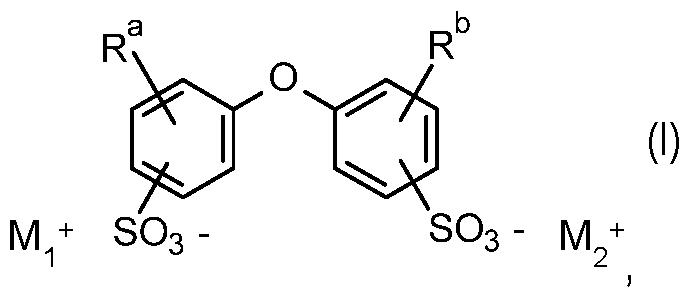


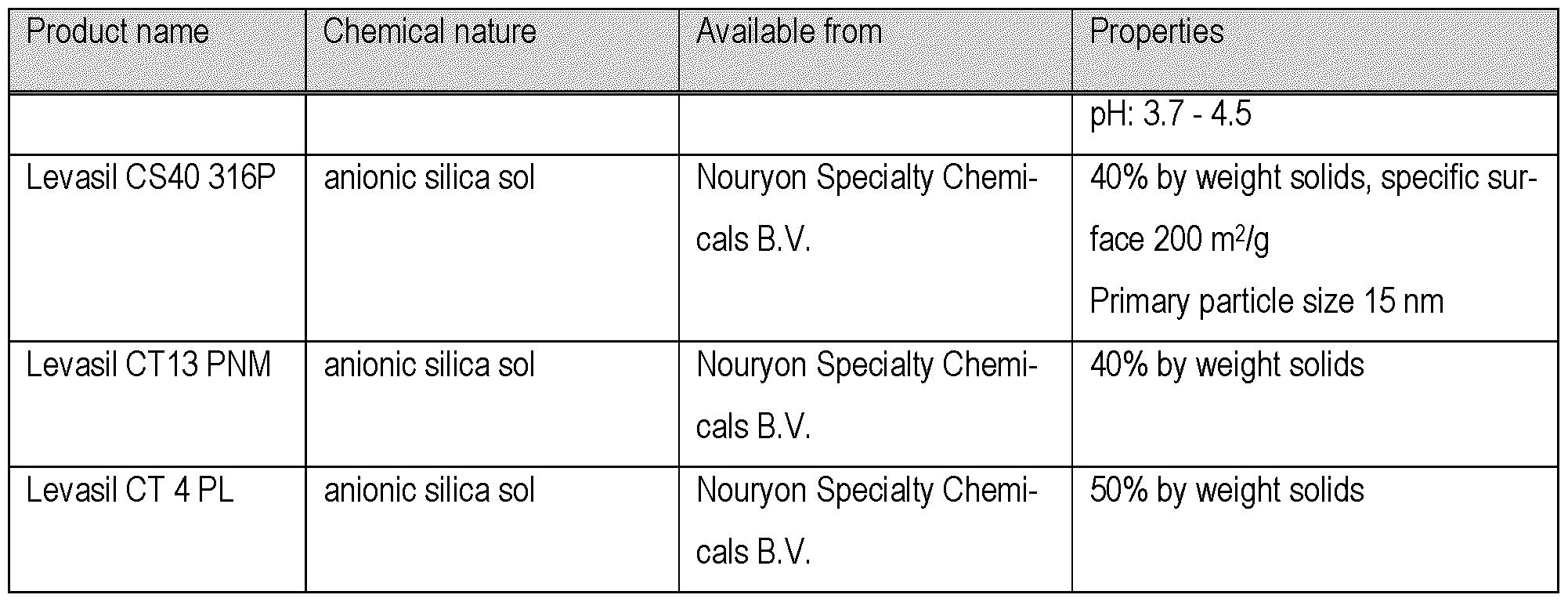


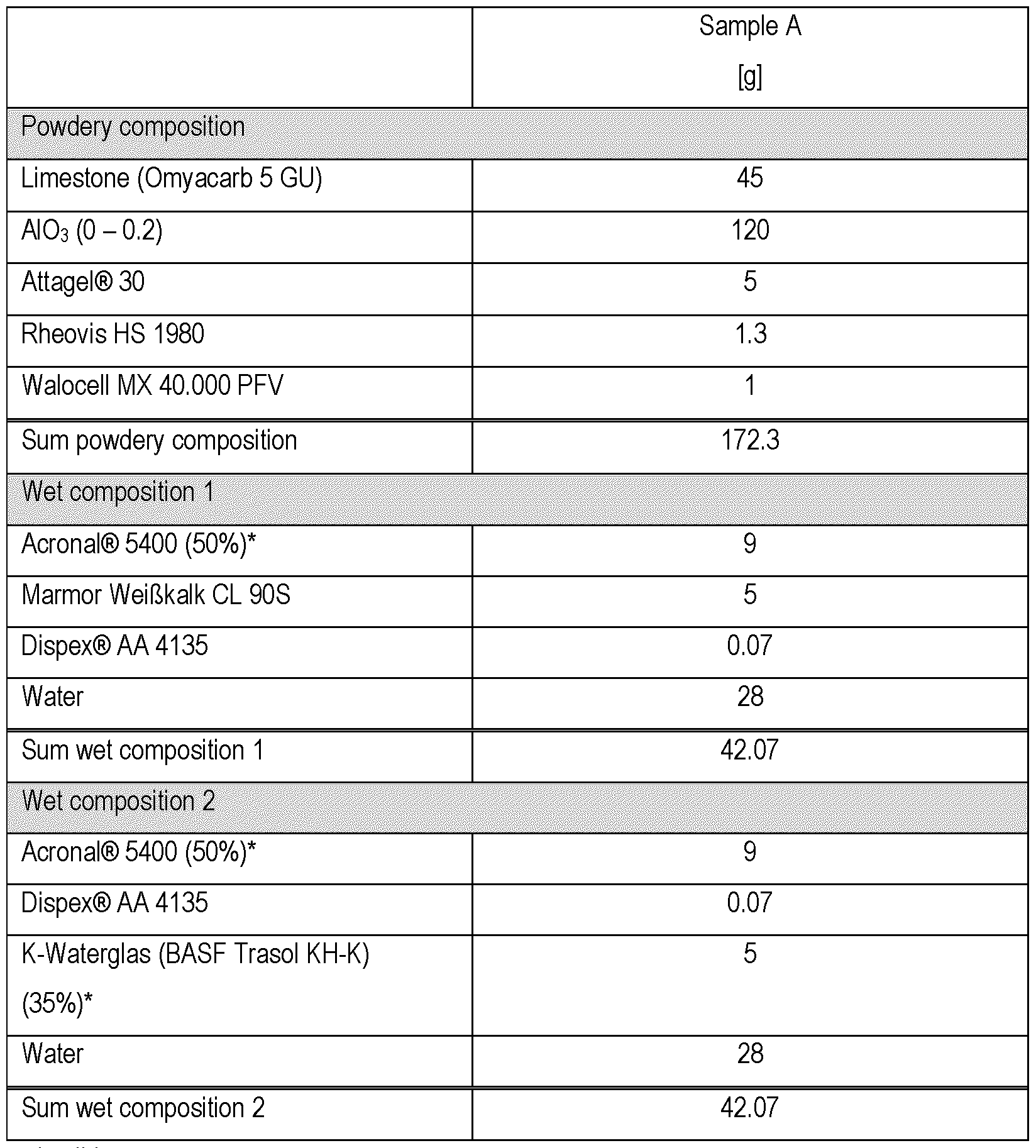


Claims
Priority Applications (1)
| Application Number | Priority Date | Filing Date | Title |
|---|---|---|---|
| EP24727766.8A EP4727905A1 (en) | 2023-06-14 | 2024-05-28 | Compositions for construction purposes |
Applications Claiming Priority (2)
| Application Number | Priority Date | Filing Date | Title |
|---|---|---|---|
| EP23179239 | 2023-06-14 | ||
| EP23179239.1 | 2023-06-14 |
Publications (1)
| Publication Number | Publication Date |
|---|---|
| WO2024256160A1 true WO2024256160A1 (en) | 2024-12-19 |
Family
ID=86776407
Family Applications (1)
| Application Number | Title | Priority Date | Filing Date |
|---|---|---|---|
| PCT/EP2024/064564 Ceased WO2024256160A1 (en) | 2023-06-14 | 2024-05-28 | Compositions for construction purposes |
Country Status (2)
| Country | Link |
|---|---|
| EP (1) | EP4727905A1 (en) |
| WO (1) | WO2024256160A1 (en) |
Citations (23)
| Publication number | Priority date | Publication date | Assignee | Title |
|---|---|---|---|---|
| US4269749A (en) | 1979-04-30 | 1981-05-26 | The Dow Chemical Company | Method of imparting salt and/or mechanical stability to aqueous polymer microsuspensions |
| DE4003422A1 (en) | 1990-02-06 | 1991-08-08 | Basf Ag | WAITER POLYURETHANE PREPARATIONS |
| DE19624299A1 (en) | 1995-06-30 | 1997-01-02 | Basf Ag | Removal of malodorous organic cpds. from dispersion |
| EP0771328A1 (en) | 1994-06-03 | 1997-05-07 | Basf Aktiengesellschaft | Method of producing an aqueous polymer dispersion |
| DE19621027A1 (en) | 1996-05-24 | 1997-11-27 | Basf Ag | Continuous removal of monomer from aqueous suspension or dispersion |
| DE19741187A1 (en) | 1997-09-18 | 1999-03-25 | Basf Ag | Reducing residual monomer content in aqueous polymer dispersion |
| DE19741184A1 (en) | 1997-09-18 | 1999-03-25 | Basf Ag | Reducing residual monomer content of e.g. acrylic polymers |
| DE19805122A1 (en) | 1998-02-09 | 1999-04-22 | Basf Ag | Aqueous polymer dispersion useful as binder agent for pigments for interior and exterior paints |
| DE19828183A1 (en) | 1998-06-24 | 1999-12-30 | Basf Ag | Process for removing residual volatile components from polymer dispersions |
| DE19839199A1 (en) | 1998-08-28 | 2000-03-02 | Basf Ag | Process for reducing the amount of residual monomers in aqueous polymer dispersions |
| DE19840586A1 (en) | 1998-09-05 | 2000-03-09 | Basf Ag | Process for reducing the amount of residual monomers in aqueous polymer dispersions |
| DE19847115C1 (en) | 1998-10-13 | 2000-05-04 | Basf Ag | Counterflow stripping tube |
| US20100216942A1 (en) * | 2007-10-24 | 2010-08-26 | Basf Se | Process for preparing an aqueous composite-particle dispersion |
| WO2013050388A1 (en) * | 2011-10-05 | 2013-04-11 | Wacker Chemie Ag | Dry building material formulations containing polymer powders |
| US20130203926A1 (en) * | 2012-02-08 | 2013-08-08 | Bogdan Moraru | Aqueous dispersion |
| EP2774901A1 (en) | 2013-03-06 | 2014-09-10 | Nordkalk OY AB | Method for producing coated particles, suspension of coated particles and its use |
| WO2016142339A1 (en) | 2015-03-09 | 2016-09-15 | Basf Se | Flexible cementitious waterproofing slurry |
| DE102015108202A1 (en) | 2015-05-22 | 2016-11-24 | Pilkington Group Limited | Precursor product for the production of a fire protection material |
| WO2017178422A1 (en) * | 2016-04-14 | 2017-10-19 | Basf Se | A process for modifying polymer particles of an aqueous polymer dispersion, an aqueous polymer dispersion obtainable by said process, a redispersible polymer powder, and a composition comprising the redispersible polymer powder |
| US20180179108A1 (en) | 2014-07-01 | 2018-06-28 | Basf Se | Dispersion of (meth)acrylate copolymer containing a hydroxyalkyl (meth)acrylate functional monomer unit for flexible cementitious waterproofing materials |
| US20180327310A1 (en) | 2015-11-10 | 2018-11-15 | Dow Global Technologies Llc | Emulsion Polymer Two-Component Compositions For Fast Curing, Flexible Cementitious Waterproofing Membranes |
| CN109609106A (en) | 2018-12-29 | 2019-04-12 | 上海三瑞高分子材料股份有限公司 | A kind of low temperature mining area oil well cementing early strength agent and preparation method thereof |
| CN109650398A (en) | 2019-02-19 | 2019-04-19 | 科之杰新材料集团有限公司 | A kind of hydrated calcium silicate early strength agent and preparation method thereof |
-
2024
- 2024-05-28 WO PCT/EP2024/064564 patent/WO2024256160A1/en not_active Ceased
- 2024-05-28 EP EP24727766.8A patent/EP4727905A1/en active Pending
Patent Citations (23)
| Publication number | Priority date | Publication date | Assignee | Title |
|---|---|---|---|---|
| US4269749A (en) | 1979-04-30 | 1981-05-26 | The Dow Chemical Company | Method of imparting salt and/or mechanical stability to aqueous polymer microsuspensions |
| DE4003422A1 (en) | 1990-02-06 | 1991-08-08 | Basf Ag | WAITER POLYURETHANE PREPARATIONS |
| EP0771328A1 (en) | 1994-06-03 | 1997-05-07 | Basf Aktiengesellschaft | Method of producing an aqueous polymer dispersion |
| DE19624299A1 (en) | 1995-06-30 | 1997-01-02 | Basf Ag | Removal of malodorous organic cpds. from dispersion |
| DE19621027A1 (en) | 1996-05-24 | 1997-11-27 | Basf Ag | Continuous removal of monomer from aqueous suspension or dispersion |
| DE19741187A1 (en) | 1997-09-18 | 1999-03-25 | Basf Ag | Reducing residual monomer content in aqueous polymer dispersion |
| DE19741184A1 (en) | 1997-09-18 | 1999-03-25 | Basf Ag | Reducing residual monomer content of e.g. acrylic polymers |
| DE19805122A1 (en) | 1998-02-09 | 1999-04-22 | Basf Ag | Aqueous polymer dispersion useful as binder agent for pigments for interior and exterior paints |
| DE19828183A1 (en) | 1998-06-24 | 1999-12-30 | Basf Ag | Process for removing residual volatile components from polymer dispersions |
| DE19839199A1 (en) | 1998-08-28 | 2000-03-02 | Basf Ag | Process for reducing the amount of residual monomers in aqueous polymer dispersions |
| DE19840586A1 (en) | 1998-09-05 | 2000-03-09 | Basf Ag | Process for reducing the amount of residual monomers in aqueous polymer dispersions |
| DE19847115C1 (en) | 1998-10-13 | 2000-05-04 | Basf Ag | Counterflow stripping tube |
| US20100216942A1 (en) * | 2007-10-24 | 2010-08-26 | Basf Se | Process for preparing an aqueous composite-particle dispersion |
| WO2013050388A1 (en) * | 2011-10-05 | 2013-04-11 | Wacker Chemie Ag | Dry building material formulations containing polymer powders |
| US20130203926A1 (en) * | 2012-02-08 | 2013-08-08 | Bogdan Moraru | Aqueous dispersion |
| EP2774901A1 (en) | 2013-03-06 | 2014-09-10 | Nordkalk OY AB | Method for producing coated particles, suspension of coated particles and its use |
| US20180179108A1 (en) | 2014-07-01 | 2018-06-28 | Basf Se | Dispersion of (meth)acrylate copolymer containing a hydroxyalkyl (meth)acrylate functional monomer unit for flexible cementitious waterproofing materials |
| WO2016142339A1 (en) | 2015-03-09 | 2016-09-15 | Basf Se | Flexible cementitious waterproofing slurry |
| DE102015108202A1 (en) | 2015-05-22 | 2016-11-24 | Pilkington Group Limited | Precursor product for the production of a fire protection material |
| US20180327310A1 (en) | 2015-11-10 | 2018-11-15 | Dow Global Technologies Llc | Emulsion Polymer Two-Component Compositions For Fast Curing, Flexible Cementitious Waterproofing Membranes |
| WO2017178422A1 (en) * | 2016-04-14 | 2017-10-19 | Basf Se | A process for modifying polymer particles of an aqueous polymer dispersion, an aqueous polymer dispersion obtainable by said process, a redispersible polymer powder, and a composition comprising the redispersible polymer powder |
| CN109609106A (en) | 2018-12-29 | 2019-04-12 | 上海三瑞高分子材料股份有限公司 | A kind of low temperature mining area oil well cementing early strength agent and preparation method thereof |
| CN109650398A (en) | 2019-02-19 | 2019-04-19 | 科之杰新材料集团有限公司 | A kind of hydrated calcium silicate early strength agent and preparation method thereof |
Non-Patent Citations (9)
| Title |
|---|
| "Encyclopedia of Polymer Science and Engineering", vol. 8, 1987, JOHN WILEY & SONS, INC., pages: 659 - 677 |
| D. C. BLACKLEY: "Emulsion Polymerisation", 1982, APPLIED SCIENCE PUBLISHERS, LTD., pages: 155 - 287 |
| D. C. BLACKLEY: "Polymer Latices", vol. 1, 1997, CHAPMAN & HALL, pages: 33 - 415 |
| F. HÖLSCHER: "Dispersionen synthetischer Hochpolymerer", 1969, SPRINGER-VERLAG, pages: 1 - 160 |
| G. WILL: "Powder Diffraction-The Rietveld method and the two-stage method", 2006, SPRINGER VERLAG |
| H. WARSON: "The Applications of Synthetic Resin Emulsions", 1972, ERNEST BENN, LTD., pages: 49 - 244 |
| HOUBEN-WEYL: "Methoden der organischen Chemie", vol. 14, 1961, GEORG-THIEME-VERLAG, pages: 411 - 420 |
| I. MADSENN. SCARLETTA. KERN: "Description and survey of methodologies for the determination of amorphous content via X-ray powder diffraction", ZEITSCHRIFT FÜR KRISTALLOGRAPHIE CRYSTALLINE MATERIALS, vol. 226, no. 12, 2011, pages 944 - 955, XP055443152 |
| R. YOUNG: "The Rietveld method, IUCr Monographs on Crystallography", vol. 5, 1995, OXFORD UNIVERSITY PRESS |
Also Published As
| Publication number | Publication date |
|---|---|
| EP4727905A1 (en) | 2026-04-22 |
Similar Documents
| Publication | Publication Date | Title |
|---|---|---|
| US10584061B2 (en) | Self-desiccating, dimensionally-stable hydraulic cement compositions with enhanced workability | |
| US9216927B2 (en) | Gypsum-containing construction material compounds | |
| JP6283659B2 (en) | Dimensionally stable geopolymer compositions and methods | |
| JP2022517629A (en) | Self-consolidating geopolymer composition and methods for making it | |
| JP2021533063A (en) | Geopolymer compositions and methods for making them | |
| AU2016341017A1 (en) | Freeze-thaw durable geopolymer compositions and methods for making same | |
| WO2016142339A1 (en) | Flexible cementitious waterproofing slurry | |
| US11512026B2 (en) | Use of zinc salts in combination with alkyl amines in cement-based dry mortar mixtures | |
| US7671115B2 (en) | Method for enhancing water-repellency treatment of mineral hydraulic binder compositions and compositions obtainable by said method and their uses | |
| US20190218149A1 (en) | Porous molded body in the form of an insulating plaster layer or an insulating panel | |
| WO2012038302A1 (en) | Coating agents for producing waterproof infrastructure coatings | |
| CN107311580A (en) | A kind of common self-leveling material of bottom | |
| WO2024256160A1 (en) | Compositions for construction purposes | |
| CN111606646B (en) | Phosphogypsum-based plastering gypsum and preparation method thereof | |
| EP4255865A1 (en) | Composition for watertight coverings | |
| WO2023232832A1 (en) | Composition for waterproofing membranes | |
| WO2023209082A1 (en) | Combinations of an organic polymer and calcium silicate hydrate for producing mineral water-proofing membranes | |
| CA3223954A1 (en) | Dry mortar composition | |
| CN111592312A (en) | Solid waste plastering gypsum and preparation method thereof | |
| WO2022248630A1 (en) | Dispersion composition comprising a cement-based sealing slurry and an additive mixture |
Legal Events
| Date | Code | Title | Description |
|---|---|---|---|
| 121 | Ep: the epo has been informed by wipo that ep was designated in this application |
Ref document number: 24727766 Country of ref document: EP Kind code of ref document: A1 |
|
| WWE | Wipo information: entry into national phase |
Ref document number: 2024727766 Country of ref document: EP |
|
| NENP | Non-entry into the national phase |
Ref country code: DE |
|
| ENP | Entry into the national phase |
Ref document number: 2024727766 Country of ref document: EP Effective date: 20260114 |
|
| ENP | Entry into the national phase |
Ref document number: 2024727766 Country of ref document: EP Effective date: 20260114 |
|
| ENP | Entry into the national phase |
Ref document number: 2024727766 Country of ref document: EP Effective date: 20260114 |
|
| ENP | Entry into the national phase |
Ref document number: 2024727766 Country of ref document: EP Effective date: 20260114 |