Verfahren zur Positionserfassung, Verfahren zur Ventilsteuerung und Fluidventil Beschreibungseinleitung Die Erfindung betrifft ein Verfahren zur Positionserfassung nach dem Oberbegriff von Anspruch 1. Weiterhin betrifft die Erfindung ein Verfahren zur Ventilsteuerung und ein Fluidventil. In CN112146555A ist ein Verfahren zur Positionserfassung eines Elektromagnetventils beschrieben. Die Position wird erfasst, indem ein eine Ventilspannung und ein durch diese bewirkter Spulenstrom einer Spule des Elektromagneten gemessen und eine Stromänderung des Spulenstroms erfasst wird. Aus der Stromänderung und der gemessenen Ventilspannung wird eine Spuleninduktivität berechnet, mit der die Position berechnet wird. Die Aufgabe der vorliegenden Erfindung liegt darin, die Linearposition eines Fluidventils genauer und kostengünstiger zu erfassen. Das Fluidventil soll genauer und kostengünstiger betrieben werden. Wenigstens eine dieser Aufgaben wird durch ein Verfahren zur Positionserfassung mit den Merkmalen nach Anspruch 1 gelöst. Dadurch kann die Linearposition des Fluidventils genauer und kostengünstiger erfasst werden. Ein Positionssensor zur Positionserfassung kann entfallen. Das Verfahren zur Positionserfassung kann in einem Fahrzeug angewendet werden. Das Fahrzeug kann ein Kraftfahrzeug sein. Das Verfahren zur Positionserfassung kann bei einem Fahrbetrieb des Fahrzeugs durchgeführt werden. Das Fluidventil kann ein Proportionalventil sein, das die Linearpositionen stetig ändert. Die Spule kann mehrere Spulenwindungen aufweisen. Der Magnetkern kann auch als Anker bezeichnet werden.
Das Federelement kann eine Schraubenfeder sein. Die Federkraft kann parallel zu der Bewegungsrichtung des Magnetkerns ausgerichtet sein. Die Wechselspannung ist eine harmonische Schwingung mit einer vorgegebenen Frequenz. Der Wechselstrom ist eine harmonische Schwingung der gleichen Frequenz, gegebenenfalls mit einem Phasenunterschied zu der Wechselspannung. Die Betätigungsspannung kann einen Konstantspannungsanteil und einen Wechselspannungsanteil und der Spulenstrom einen Konstantstromanteil und einen Wechselstromanteil aufweisen. Der Wechselspannungsanteil ^^ ^^ als sogenannte Ditherspannung hat den Vorteil, die Haftreibung des Magnetkerns zu verringern. Der Wechselstromanteil ^^ ^^ kann eine Wechselstromamplitude von wenigen mA aufweisen. Die Wechselstromamplitude ist bevorzugt kleiner als der Konstantstromanteil ^^ ^^. Bei einer speziellen Ausführung der Erfindung ist es von Vorteil, wenn als Spannungsparameter ein Konstantspannungsanteil und/oder ein Wechselspannungsanteil der Betätigungsspannung erfasst werden. Die Spannungsparameter können zur Berechnung des komplexen Wechselstromwiderstands weiterverarbeitet oder unmittelbar verwendet werden. Eine bevorzugte Ausgestaltung der Erfindung ist vorteilhaft, bei der als Stromparameter ein Konstantstromanteil und/oder ein Wechselstromanteil des Spulenstroms erfasst werden. Die Stromparameter können zur Berechnung des komplexen Wechselstromwiderstands weiterverarbeitet oder unmittelbar verwendet werden. In einer bevorzugten Ausführung der Erfindung ist vorgesehen, dass der Magnetkern bei ausbleibendem Spulenstrom eine erste Linearposition einnimmt und bei anliegendem Spulenstrom entgegen der Federkraft eine zweite Linearposition einnimmt und die zu erfassende Linearposition eine zwischen der ersten und zweiten Linearposition liegende Zwischenlinearposition ist, bei der der Magnetkern durch die Federkraft beaufschlagt wird. Die erste Linearposition kann eine erste Maximallinearposition sein. Die zweite Linearposition kann eine entgegengesetzte zweite Maximallinearposition sein. Bei
der ersten Linearposition kann der Magnetkern durch die Federkraft beaufschlagt sein. Der Magnetkern kann bei sämtlichen Linearpositionen von der Federkraft beaufschlagt sein. Einige der Linearpositionen können innerhalb eines annähernd linearen Verlaufs einer Federkennlinie des Federelements liegen. Damit könnte der Spulenstrom als Maß für die Linearposition verwendet werden. Allerdings wurde erkannt, dass dieser Zusammenhang nur bei sehr großen Federsteifigkeiten gültig ist, in der Praxis hingegen häufig nicht anwendbar ist. Bei einer vorzugsweisen Ausführung der Erfindung ist vorgesehen, dass sich der komplexe Wechselstromwiderstand aus ^^ = ^^ ^^ + ^^ ^^ ^^ zusammensetzt und daraus ein Wirkwiderstand ^^ als der reelle Wechselstromwiderstand ^^ ^^ und eine Induktivität ^^ aus dem imaginären Wechselstromwiderstand ^^ ^^ mit ^^ =
berechnet werden und die Linearposition abhängig von dem Wirkwiderstand ^^ und der Induktivität ^^ berechnet wird. Sind der Wirkwiderstand ^^ und die Induktivität ^^ hinreichend bekannt, kann die Linearposition eindeutig berechnet werden. Bei einer bevorzugten Ausführung der Erfindung ist es vorteilhaft, wenn die Linearposition abhängig von dem Wirkwiderstand ^^ und der Induktivität ^^ über eine Lookup-Tabelle berechnet wird. Die Lookup-Tabelle kann für verschiedene Werte für den Wirkwiderstand und für verschiedene Werte der Induktivität in Kombinaion miteinander die Linearposition abbilden. Bei einer bevorzugten Ausführung der Erfindung ist es vorteilhaft, wenn die gemessene Betätigungsspannung als komplexe Spannung ^^ ^^ und der gemessene Spulenstrom als komplexer Strom ^^ ^^ umgeformt und der komplexe Wechselstromwiderstand mit ^^ =
berechnet wird. Aus dem komplexen Wechselstromwiderstand ^^ kann der Wirkwiderstand ^^ und der imaginäre Wechselstromwiderstand ^^ ^^ und daraus die Induktivität ^^ berechnet werden. Daraus kann die Linearposition mit einer Lookup-Tabelle berechnet werden. Die komplexe Spannung ^^ ^^ und der komplexe Strom ^^ ^^ können wie folgt berechnet werden: Zunächst wird aus der gemessenen Betätigungsspannung und dem gemessenen Spulenstrom folgende Spannungsparameter und Stromparameter berechnet:
max( ^^ )+min( ^^ ) Eine Offsetspannung ^^ ^^ ^^ ^^ = 2 max( ^^ ^^)−min( ^^ ^^) Eine Spannungsamplitude ^^ ^^ =
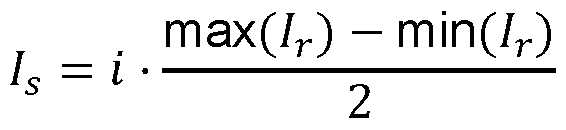
Ein Offsetstrom
Eine Stromamplitude
Daraus wird eine normierte Spannung
und ein normierter Strom
berechnet. Mit der normierten Spannung und dem normierten Strom wird eine transformierte Spannung ^^ ^^ = ^^ ^^ − ^^ ^^ und ein transformierter Strom ^^ ^^ = ^^ ^^ + ^^ ^^ berechnet. Die Spannungsamplitude der transformierten Spannung und die Stromamplitude des transformierten Stroms werden zusammen als komplexe Darstellung betrachtet, mit der Spannungsamplitude der transformierten Spannung max( ^^ ^^) −min( ^^ ) ^^ = ^^ ^^ 2 als reeller Teil und der Stromamplitude des transformierten Stroms
als imaginärer Teil. Damit wird die komplexe Spannung zu ^^ ^^ = (− ^^ ^^ + ^^ ^^) · ^^ ^^
und der komplexe Strom zu ^^ ^^ = ( ^^ ^^ + ^^ ^^) · ^^ ^^ Eine bevorzugte Ausgestaltung der Erfindung ist vorteilhaft, bei der die Spannungsparameter und Stromparameter durch eine Singulärwertzerlegung oder Hauptkomponentenanalyse einer Korrelationsmatrix ^^, die aus einer normierten Spannung ^^ ^^ der gemessenen Betätigungsspannung und einem normierten Strom ^^ ^^ des gemessenen Spulenstroms berechnete Komponenten aufweist, berechnet max( ^^ )+min n. Ausgehend von der Offsetspannung ^^ ^^ ( ^^ ) werde ^^ ^^ = 2 und dem Offsetstrom
eine normierte Spannung ^^ ^^, ^^ = ^^ ^^ − ^^ ^^ und ein normierter Strom ^^ ^^, ^^ = ^^ ^^ − ^^ ^^ berechnet werden. Daraus kann eine symmetrische Korrelationsmatrix ^^ wie folgt berechnet werden
Mit einer Singulärwertzerlegung bzw. Hauptkomponentenanalyse werden die Eigenvektormatrix ^^ und Eigenwertmatrix ^^ von ^^ berechnet. Damit wird unter der Voraussetzung | ^^| > 1 die komplexe Spannung zu
und der komplexe Strom zu
und bei | ^^| ≤ 1 zu
berechnet. Aus diesen umgeformten Spannungsparametern und Stromparametern kann der komplexe Wechselstromwiderstand mit
berechnet werden. Aus dem komplexen Wechselstromwiderstand ^^ kann der Wirkwiderstand ^^ und der imaginäre Wechselstromwiderstand ^^ ^^ und daraus die Induktivität ^^ berechnet werden. Daraus kann die Linearposition mit einer Lookup- Tabelle berechnet werden. Weiterhin wird im Rahmen der Erfindung zur Lösung wenigstens einer der zuvor angegebenen Aufgaben ein Verfahren zur Ventilsteuerung mit den Merkmalen nach Anspruch 9 vorgeschlagen. Dadurch kann der Fluiddruck und/oder Fluidvolumenstrom genauer eingestellt werden. Weiterhin wird im Rahmen der Erfindung zur Lösung wenigstens einer der zuvor angegebenen Aufgaben ein Fluidventil mit den Merkmalen nach Anspruch 10 vorgeschlagen. Der Ventilkolben kann mehrere Steuerkanten aufweisen, die den Fluiddruck und/oder Fluidvolumenstrom abhängig von der Linearposition und damit der Position der Steuerkanten in Bezug auf die Fluidkanäle des Fluidventils beeinflussen. Das Fluidventil kann ein Hydraulikventil sein. Der Fluidvolumenstrom kann ein Hydraulikfluidstrom sein. Der Fluiddruck kann eine Betätigung einer Fahrzeugkomponente des Fahrzeugs bewirken. Der Fluidvolumenstrom kann eine Kühlung einer Fahrzeugkomponente des Fahrzeugs bewirken. Die Fahrzeugkomponente kann eine Kupplung, Parksperrvorrichtung oder ein Antriebsmotor sein. Das Federelement kann an einer dem Elektromagneten abgewandten Seite des Fluidventils angeordnet sein. Weitere Vorteile und vorteilhafte Ausgestaltungen der Erfindung ergeben sich aus der Figurenbeschreibung und den Abbildungen.
Figurenbeschreibung Die Erfindung wird im Folgenden unter Bezugnahme auf die Abbildungen ausführlich beschrieben. Es zeigen im Einzelnen: Figur 1: Ein Funktionsschaltbild eines Fluidventils in einer speziellen Ausführungsform der Erfindung. Figur 2: Einen Querschnitt eines Fluidventils in einer weiteren speziellen Ausführungsform der Erfindung. Figur 3: Eine Abhängigkeit eines komplexen Wechselstromwiderstands von einer Linearposition. Figur 4: Eine gemessene Betätigungsspannung und ein gemessener Spulenstrom. Figur 5: Ein Verfahren zur Positionserfassung und ein Verfahren zur Ventilsteuerung jeweils in einer speziellen Ausführungsform der Erfindung. Figur 6: Ein Verfahren zur Positionserfassung in einer weiteren speziellen Ausführungsform der Erfindung. Figur 7: Ein Verfahren zur Positionserfassung in einer weiteren speziellen Ausführungsform der Erfindung. Figur 8: Eine Ungenauigkeit im Vergleich der verschiedenen Möglichkeiten der Positionserfassung. Figur 1 zeigt ein Funktionsschaltbild eines Fluidventils in einer speziellen Ausführungsform der Erfindung. Das Fluidventil 10 ist als 4/3-Wegeventil ausgeführt und umfasst einen Betätigungsteil 12 und einen mechanisch damit verbundenen Hydraulikteil 14. An den Hydraulikteil 14 ist ein erster Fluidkanal 16, der mit einer Fluidpumpe verbunden ist und ein zweiter Fluidkanal 18, der mit einem Fluidspeicher als Rücklauf verbunden ist, angeschlossen. Ein gegenüberliegender dritter Fluidkanal 20 ist an eine Fahrzeugkomponente, beispielsweise eine Parksperrvorrichtung, zur Übertragung eines Fluiddrucks und damit zur Betätigung
und ein vierter Fluidkanal 22 ist an eine weitere Fahrzeugkomponente, beispielsweise eine Kupplung, zur Übertragung eines Fluiddrucks und damit zur Betätigung angeschlossen. Das Fluidventil 10 kann einen ersten Ventilzustand 24, bei dem der dritte Fluidkanal 20 zum Druckabbau mit dem zweiten Fluidkanal 18 verbunden ist und der erste Fluidkanal 16 zur Übertragung eines Fluiddrucks an die Kupplung mit dem vierten Fluidkanal 22 verbunden ist, einnehmen. Ein zweiter Ventilzustand 26 sperrt die Verbindungen zwischen dem ersten und dritten Fluidkanal 16, 20 und dem zweiten und vierten Fluidkanal 18, 22. Ein dritter Ventilzustand 28 verbindet den ersten Fluidkanal 16 mit dem dritten Fluidkanal 20 zur Übertragung eines Fluiddrucks zur Betätigung der Parksperrvorrichtung und zum Druckabbau den zweiten Fluidkanal 18 mit dem vierten Fluidkanal 22. Figur 2 zeigt einen Querschnitt eines Fluidventils in einer weiteren speziellen Ausführungsform der Erfindung. Das Fluidventil 10 umfasst den Betätigungsteil 12 und den damit mechanisch verbundenen Hydraulikteil 14. Der Hydraulikteil 14 umfasst einen Ventilkolben 30 zur Einstellung eines Fluidvolumenstroms durch das Fluidventil 10. Der Ventilkolben 30 weist mehrere Steuerkanten 31 zur Einstellung des Fluiddrucks oder Fluidvolumenstroms in den angeschlossenen Fluidkanälen 32 auf. Der Betätigungsteil 12 umfasst einen Elektromagneten 33 mit einer elektrisch mit einer Betätigungsspannung betreibbaren Spule 34 und einem translatorisch bewegbar gegenüber der Spule 34 aufgenommenen und unter Änderung einer Linearposition P abhängig von einem durch die Betätigungsspannung aufgebauten Spulenstrom der Spule 34 bewegbaren Magnetkern 36, der mit dem Ventilkolben 30 verschiebbar gekoppelt ist. Der Magnetkern 36 kann eine erste Linearposition P1, insbesondere eine erste Maximallinearposition und eine entgegengesetzt liegende zweite Linearposition P2, insbesondere eine zweite Maximallinearposition, sowie dazwischen liegende Zwischenlinearpositionen Pn einnehmen. Der Magnetkern 36 ist entgegen einer Federkraft 42 eines Federelements 44 in eine erste Bewegungsrichtung 46 und unterstützt durch die Federkraft 42 in eine entgegengesetzte zweite Bewegungsrichtung 48 bewegbar. Bei ausbleibendem
Spulenstrom nimmt der Magnetkern 36 unterstützt durch die Federkraft 42 die erste Linearposition P1 ein. Figur 3 zeigt eine Abhängigkeit des Wechselstromwiderstands von der Linearposition. Der komplexe Wechselstromwiderstand weist mit zunehmender Linearposition P einen zunehmenden reellen Wechselstromwiderstand, entsprechend einem zunehmenden Wirkwiderstand ^^ und einen zunehmenden imaginären Wechselstromwiderstand, entsprechend einer zunehmenden Induktivität ^^ auf. Ist der komplexe Wechselstromwiderstand bekannt, also können der Wirkwiderstand ^^ und die Induktivität ^^ berechnet werden, kann somit die Linearposition P berechnet werden. Figur 4 zeigt eine gemessene Betätigungsspannung und einen gemessenen Spulenstrom. Die in Figur 4 a) gezeigte gemessene Betätigungsspannung ^^ ^^ weist einen Konstantspannungsanteil ^^ ^^ und einen Wechselspannungsanteil ^^ ^^ auf. Auch der in Figur 4 b) gezeigte gemessene Spulenstrom ^^ ^^ weist einen Konstantstromanteil ^^ ^^ und einen Wechselstromanteil ^^ ^^ auf. Der Wechselspannungsanteil ^^ ^^ und der Wechselstromanteil ^^ ^^ ändern sich harmonisch mit der Frequenz ^^ von 100 Hz. Der Konstantstromanteil ^^ ^^ beträgt hier 1 A und der Wechselstromanteil ^^ ^^ wenige mA, ist also viel kleiner. Figur 5 zeigt ein Verfahren zur Positionserfassung und ein Verfahren zur Ventilsteuerung jeweils in einer speziellen Ausführungsform der Erfindung. Das Verfahren zur Positionserfassung 50 ermöglicht die Messung verschiedener Linearpositionen P des durch die Federkraft beaufschlagten Magnetkerns, während an der Spule die Betätigungsspannung als Wechselspannung anliegt, die den Spulenstrom als Wechselstrom bewirkt. Zunächst erfolgt eine Messung der Betätigungsspannung und des Spulenstroms. Aus der gemessenen Betätigungsspannung ^^ ^^ und dem gemessenen Spulenstrom ^^ ^^ wird wenigstens ein Spannungsparameter ^^ ^^ und ein Stromparameter ^^ ^^ erfasst. Insbesondere wird der Konstantspannungsanteil ^^ ^^ und der Wechselspannungsanteil ^^ ^^ der gemessenen Betätigungsspannung ^^ ^^ sowie der Konstantstromanteil ^^ ^^ und der Wechselstromanteil ^^ ^^ des gemessenen Spulenstroms ^^ ^^ erfasst. Daraus wird der komplexe Wechselstromwiderstand
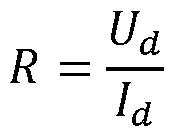
berechnet. Der reelle Wechselstromwiderstand ist ein Wirkwiderstand ^^, der berechnet wird mit
Der imaginäre Wechselstromwiderstand ^^ ^^ ist √ ^^ ^ 2 − ( ^^ · ^^ )2 ^^ ^ ^^ ^^ = ^^ ^^ mit der Frequenz ^^ der Wechselspannung. Anschließend wird die Linearposition P abhängig von dem Wirkwiderstand ^^ und der wie folgt aus dem imaginären Wechselstromwiderstand ^^ ^^ berechneten Induktivität
über eine Lookup-Tabelle 52 berechnet. Dieses Vorgehen zur Ermittlung der Linearposition P wird bevorzugt durchgeführt, wenn der imaginäre Wechselstromwiderstand ^^ ^^ viel kleiner als der Wirkwiderstand ^^ ist. Weiterhin ist ein Verfahren zur Ventilsteuerung 54 des Fluidventils dargestellt, das den Magnetkern zur Einstellung eines Fluiddrucks 55 und/oder Fluidvolumenstroms 56 abhängig von einer durch das zuvor beschriebene Verfahren zur Positionserfassung 50 erfassten Linearposition P des Elektromagneten bewegt. Figur 6 zeigt ein Verfahren zur Positionserfassung in einer weiteren speziellen Ausführungsform der Erfindung. Bei einer vorhandenen Linearposition P des Magnetkerns, der durch die Federkraft beaufschlagt wird, wird die Ermittlung der Linearposition P beginnend mit der Messung der Betätigungsspannung und des Spulenstroms durchgeführt. Aus der gemessenen Betätigungsspannung ^^ ^^ und dem gemessenen Spulenstrom ^^ ^^ werden folgende Spannungsparameter ^^ ^^ und Stromparameter
erfasst: Eine Offsetspannung
max( ^^ ) nungsamplitude ^^ ^^ −min( ^^ ) Eine Span ^^ ^^ = 2
Ein Offsetstrom
Eine Stromamplitude
Daraus wird eine normierte Spannung
und ein normierter Strom
berechnet. Mit der normierten Spannung ^^ ^^ und dem normierten Strom ^^ ^^ werden eine transformierte Spannung ^^ ^^ = ^^ ^^ − ^^ ^^ und ein transformierter Strom ^^ ^^ = ^^ ^^ + ^^ ^^ berechnet. Die Spannungsamplitude der transformierten Spannung ^^ ^^ und die Stromamplitude des transformierten Stroms ^^ ^^ werden zusammen als komplexe Darstellung betrachtet, mit der Spannungsamplitude der transformierten Spannung max( ^^ ^) −min( ^^ ) ^^ ^ ^^ ^^ = 2 als reeller Teil und der Stromamplitude des transformierten Stroms
als imaginärer Teil. Damit wird die komplexe Spannung zu ^^ ^^ = (− ^^ ^^ + ^^ ^^) · ^^ ^^ und der komplexe Strom zu ^^ ^^ = ( ^^ ^^ + ^^ ^^) · ^^ ^^
Aus diesen umgeformten Spannungsparametern ^^ ^^ und Stromparametern ^^ ^^ kann der komplexe Wechselstromwiderstand ^^ mit
berechnet werden. Aus dem komplexen Wechselstromwiderstand ^^ wird der Wirkwiderstand ^^ und der imaginäre Wechselstromwiderstand ^^ ^^ und daraus die Induktivität
berechnet, womit die Linearposition P mit einer Lookup-Tabelle 52 berechnet wird. Figur 7 zeigt ein Verfahren zur Positionserfassung in einer weiteren speziellen Ausführungsform der Erfindung. Bei einer vorhandenen Linearposition P des Magnetkerns, der durch die Federkraft beaufschlagt wird, wird die Ermittlung der Linearposition P beginnend mit der Messung der Betätigungsspannung und des Spulenstroms durchgeführt. Aus der gemessenen Betätigungsspannung ^^ ^^ und dem gemessenen Spulenstrom ^^ ^^ werden folgende Spannungsparameter ^^ ^^ und Stromparameter
erfasst: max( ^^ fsetspannung ^^ ^^)+min( ^^ ) Eine Of ^^ ^^ = 2 und ein Offsetstrom
Daraus wird eine normierte Spannung ^^ ^^, ^^ = ^^ ^^ − ^^ ^^ und ein normierter Strom
berechnet. Daraus wird eine symmetrische Korrelationsmatrix ^^ wie folgt berechnet
Mit einer Singulärwertzerlegung bzw. Hauptkomponentenanalyse werden die Eigenvektormatrix ^^ und Eigenwertmatrix ^^ von ^^ berechnet. Damit wird unter der Voraussetzung | ^^| > 1 die komplexe Spannung ^^ ^^ zu
und der komplexe Strom ^^ ^^ zu
und bei | ^^| ≤ 1 zu
berechnet. Aus diesen umgeformten Spannungsparametern ^^ ^^ und Stromparametern ^^ ^^ kann der komplexe Wechselstromwiderstand ^^ mit
berechnet werden. Aus dem komplexen Wechselstromwiderstand ^^ wird der Wirkwiderstand ^^ und der imaginäre Wechselstromwiderstand ^^ ^^ und daraus die Induktivität
berechnet, womit die Linearposition P mit einer Lookup-Tabelle 52 berechnet wird. Figur 8 zeigt eine Ungenauigkeit im Vergleich der verschiedenen Möglichkeiten der Positionserfassung. In Figur 8 a) ist die Ungenauigkeit ^^ ^^ des berechneten Wirkwiderstands ^^ und in Figur 8 b) die Ungenauigkeit ^^ ^^ des berechneten imaginären Wechselstromwiderstands ^^ ^^ jeweils über das Verhältnis aus dem imaginären Wechselstromwiderstand ^^ ^^ und dem Wirkwiderstand ^^ im Vergleich der Berechnung 58 aus Figur 5, der Berechnung 60 aus Figur 6 und der Berechnung 62 aus Figur 7 dargestellt. Der imaginäre Wechselstromwiderstand kann mit der
Berechnung 62 am genauesten. Auch die Berechnung des Wirkwiderstands ^^ kann damit eine ausreichende Genauigkeit aufweisen.
Method for position detection, method for valve control and fluid valve Description introduction The invention relates to a method for position detection according to the preamble of claim 1. The invention also relates to a method for valve control and a fluid valve. CN112146555A describes a method for position detection of an electromagnetic valve. The position is detected by measuring a valve voltage and a coil current of a coil of the electromagnet caused by this and detecting a current change in the coil current. A coil inductance is calculated from the current change and the measured valve voltage, which is used to calculate the position. The object of the present invention is to detect the linear position of a fluid valve more accurately and more cost-effectively. The fluid valve should be operated more accurately and more cost-effectively. At least one of these objects is achieved by a method for position detection with the features of claim 1. This allows the linear position of the fluid valve to be detected more accurately and more cost-effectively. A position sensor for position detection can be omitted. The method for position detection can be used in a vehicle. The vehicle may be a motor vehicle. The method for position detection may be carried out while the vehicle is being driven. The fluid valve may be a proportional valve that continuously changes the linear positions. The coil may have several coil turns. The magnetic core may also be referred to as an armature. The spring element can be a helical spring. The spring force can be aligned parallel to the direction of movement of the magnetic core. The alternating voltage is a harmonic oscillation with a predetermined frequency. The alternating current is a harmonic oscillation of the same frequency, possibly with a phase difference to the alternating voltage. The actuating voltage can have a constant voltage component and an alternating voltage component and the coil current can have a constant current component and an alternating current component. The alternating voltage component ^^ ^^ as a so-called dither voltage has the advantage of reducing the static friction of the magnetic core. The alternating current component ^^ ^^ can have an alternating current amplitude of a few mA. The alternating current amplitude is preferably smaller than the constant current component ^^ ^^ . In a special embodiment of the invention, it is advantageous if a constant voltage component and/or an alternating voltage component of the actuating voltage are recorded as voltage parameters. The voltage parameters can be further processed to calculate the complex alternating current resistance or used directly. A preferred embodiment of the invention is advantageous in which a constant current component and/or an alternating current component of the coil current are recorded as current parameters. The current parameters can be further processed to calculate the complex alternating current resistance or used directly. In a preferred embodiment of the invention, the magnetic core assumes a first linear position when there is no coil current and assumes a second linear position against the spring force when coil current is present and the linear position to be recorded is an intermediate linear position between the first and second linear positions, in which the magnetic core is acted upon by the spring force. The first linear position can be a first maximum linear position. The second linear position can be an opposite second maximum linear position. the first linear position, the magnetic core can be acted upon by the spring force. The magnetic core can be acted upon by the spring force in all linear positions. Some of the linear positions can lie within an approximately linear course of a spring characteristic curve of the spring element. The coil current could therefore be used as a measure of the linear position. However, it was recognized that this relationship is only valid for very high spring stiffnesses, and is often not applicable in practice. In a preferred embodiment of the invention, it is provided that the complex alternating current resistance is composed of ^^ = ^^ ^^ + ^^ ^^ ^^ and from this an effective resistance ^^ as the real alternating current resistance ^^ ^^ and an inductance ^^ from the imaginary alternating current resistance ^^ ^^ with ^^ = and the linear position is calculated as a function of the effective resistance ^^ and the inductance ^^. If the effective resistance ^^ and the inductance ^^ are sufficiently known, the linear position can be calculated unambiguously. In a preferred embodiment of the invention, it is advantageous if the linear position is calculated as a function of the effective resistance ^^ and the inductance ^^ using a lookup table. The lookup table can map the linear position for different values for the effective resistance and for different values of the inductance in combination with one another. In a preferred embodiment of the invention, it is advantageous if the measured actuation voltage is converted as a complex voltage ^^ ^^ and the measured coil current as a complex current ^^ ^^ and the complex AC resistance is converted with ^^ = is calculated. From the complex AC resistance ^^ the effective resistance ^^ and the imaginary AC resistance ^^ ^^ and from this the inductance ^^ can be calculated. From this the linear position can be calculated using a lookup table. The complex voltage ^^ ^^ and the complex current ^^ ^^ can be calculated as follows: First the following voltage parameters and current parameters are calculated from the measured actuation voltage and the measured coil current: max( ^^ )+min( ^^ ) An offset voltage ^^ ^^ ^^ ^^ = 2 max( ^^ ^^ )−min( ^^ ^^ ) A voltage amplitude ^^ ^^ = An offset current A current amplitude This results in a standardized voltage and a standardized current calculated. With the normalized voltage and the normalized current, a transformed voltage ^^ ^^ = ^^ ^^ − ^^ ^^ and a transformed current ^^ ^^ = ^^ ^^ + ^^ ^^ are calculated. The voltage amplitude of the transformed voltage and the current amplitude of the transformed current are considered together as a complex representation, with the voltage amplitude of the transformed voltage max( ^^ ^^ ) −min( ^^ ) ^^ = ^^ ^^ 2 as the real part and the current amplitude of the transformed current as an imaginary part. The complex voltage thus becomes ^^ ^^ = (− ^^ ^^ + ^^ ^^ ) · ^^ ^^ and the complex current to ^^ ^^ = ( ^^ ^^ + ^^ ^^ ) · ^^ ^^ A preferred embodiment of the invention is advantageous in which the voltage parameters and current parameters are calculated by a singular value decomposition or principal component analysis of a correlation matrix ^^, which has components calculated from a normalized voltage ^^ ^^ of the measured actuation voltage and a normalized current ^^ ^^ of the measured coil current, max( ^^ )+min n. Starting from the offset voltage ^^ ^^ ( ^^ ) ^^ ^^ = 2 and the offset current a normalized voltage ^^ ^^, ^^ = ^^ ^^ − ^^ ^^ and a normalized current ^^ ^^, ^^ = ^^ ^^ − ^^ ^^ can be calculated. From this, a symmetric correlation matrix ^^ can be calculated as follows Using a singular value decomposition or principal component analysis, the eigenvector matrix ^^ and eigenvalue matrix ^^ of ^^ are calculated. This gives the complex stress under the assumption | ^^| > 1 as and the complex current to and at | ^^| ≤ 1 to From these transformed voltage parameters and current parameters, the complex alternating current resistance can be calculated with can be calculated. The effective resistance ^^ and the imaginary alternating current resistance ^^ ^^ and from this the inductance ^^ can be calculated. From this the linear position can be calculated using a lookup table. Furthermore, within the scope of the invention, a method for valve control with the features according to claim 9 is proposed to solve at least one of the previously stated problems. This allows the fluid pressure and/or fluid volume flow to be set more precisely. Furthermore, within the scope of the invention, a fluid valve with the features according to claim 10 is proposed to solve at least one of the previously stated problems. The valve piston can have several control edges that influence the fluid pressure and/or fluid volume flow depending on the linear position and thus the position of the control edges in relation to the fluid channels of the fluid valve. The fluid valve can be a hydraulic valve. The fluid volume flow can be a hydraulic fluid flow. The fluid pressure can cause an actuation of a vehicle component of the vehicle. The fluid volume flow can cause a cooling of a vehicle component of the vehicle. The vehicle component can be a clutch, parking lock device or a drive motor. The spring element can be arranged on a side of the fluid valve facing away from the electromagnet. Further advantages and advantageous embodiments of the invention emerge from the description of the figures and the illustrations. Description of the figures The invention is described in detail below with reference to the figures. They show in detail: Figure 1: A functional circuit diagram of a fluid valve in a special embodiment of the invention. Figure 2: A cross section of a fluid valve in a further special embodiment of the invention. Figure 3: A dependency of a complex alternating current resistance on a linear position. Figure 4: A measured actuating voltage and a measured coil current. Figure 5: A method for position detection and a method for valve control, each in a special embodiment of the invention. Figure 6: A method for position detection in a further special embodiment of the invention. Figure 7: A method for position detection in a further special embodiment of the invention. Figure 8: An inaccuracy in the comparison of the various options for position detection. Figure 1 shows a functional circuit diagram of a fluid valve in a special embodiment of the invention. The fluid valve 10 is designed as a 4/3-way valve and comprises an actuating part 12 and a hydraulic part 14 mechanically connected thereto. A first fluid channel 16, which is connected to a fluid pump, and a second fluid channel 18, which is connected to a fluid reservoir as a return line, are connected to the hydraulic part 14. An opposite third fluid channel 20 is connected to a vehicle component, for example a parking lock device, for transmitting a fluid pressure and thus for actuating and a fourth fluid channel 22 is connected to a further vehicle component, for example a clutch, for transmitting a fluid pressure and thus for actuation. The fluid valve 10 can assume a first valve state 24 in which the third fluid channel 20 is connected to the second fluid channel 18 for pressure reduction and the first fluid channel 16 is connected to the fourth fluid channel 22 for transmitting a fluid pressure to the clutch. A second valve state 26 blocks the connections between the first and third fluid channels 16, 20 and the second and fourth fluid channels 18, 22. A third valve state 28 connects the first fluid channel 16 to the third fluid channel 20 for transmitting a fluid pressure for actuating the parking lock device and the second fluid channel 18 to the fourth fluid channel 22 for pressure reduction. Figure 2 shows a cross section of a fluid valve in a further special embodiment of the invention. The fluid valve 10 comprises the actuating part 12 and the hydraulic part 14 mechanically connected thereto. The hydraulic part 14 comprises a valve piston 30 for adjusting a fluid volume flow through the fluid valve 10. The valve piston 30 has several control edges 31 for adjusting the fluid pressure or fluid volume flow in the connected fluid channels 32. The actuating part 12 comprises an electromagnet 33 with a coil 34 that can be operated electrically with an actuating voltage and a magnetic core 36 that is accommodated so that it can be moved in translation relative to the coil 34 and can be moved by changing a linear position P depending on a coil current of the coil 34 built up by the actuating voltage, which is movably coupled to the valve piston 30. The magnetic core 36 can assume a first linear position P1, in particular a first maximum linear position, and an opposite second linear position P2, in particular a second maximum linear position, as well as intermediate linear positions Pn in between. The magnetic core 36 is movable against a spring force 42 of a spring element 44 in a first direction of movement 46 and supported by the spring force 42 in an opposite second direction of movement 48. In the absence of Coil current, the magnetic core 36 assumes the first linear position P1, supported by the spring force 42. Figure 3 shows a dependence of the alternating current resistance on the linear position. With increasing linear position P, the complex alternating current resistance has an increasing real alternating current resistance, corresponding to an increasing effective resistance ^^, and an increasing imaginary alternating current resistance, corresponding to an increasing inductance ^^. If the complex alternating current resistance is known, i.e. if the effective resistance ^^ and the inductance ^^ can be calculated, the linear position P can be calculated. Figure 4 shows a measured actuating voltage and a measured coil current. The measured actuating voltage ^^ ^^ shown in Figure 4 a) has a constant voltage component ^^ ^^ and an alternating voltage component ^^ ^^ . The measured coil current ^^ ^^ shown in Figure 4 b) also has a constant current component ^^ ^^ and an alternating current component ^^ ^^ . The alternating voltage component ^^ ^^ and the alternating current component ^^ ^^ change harmoniously with the frequency ^^ of 100 Hz. The constant current component ^^ ^^ is 1 A here and the alternating current component ^^ ^^ a few mA, i.e. is much smaller. Figure 5 shows a method for position detection and a method for valve control, each in a special embodiment of the invention. The position detection method 50 enables the measurement of various linear positions P of the magnetic core acted upon by the spring force, while the actuating voltage is applied to the coil as an alternating voltage, which causes the coil current as an alternating current. First, the actuating voltage and the coil current are measured. At least one voltage parameter ^^ ^^ and one current parameter ^^ ^^ are recorded from the measured actuating voltage ^^ ^^ and the measured coil current ^^ ^^ . In particular, the constant voltage component ^^ ^^ and the alternating voltage component ^^ ^^ of the measured actuation voltage ^^ ^^ as well as the constant current component ^^ ^^ and the alternating current component ^^ ^^ of the measured coil current ^^ ^^ are recorded. From this, the complex alternating current resistance The real alternating current resistance is an effective resistance ^^, which is calculated with The imaginary alternating current resistance ^^ ^^ is √ ^^ ^ 2 − ( ^^ · ^^ ) 2 ^^ ^ ^^ ^^ = ^^ ^^ with the frequency ^^ of the alternating voltage. Then the linear position P is determined depending on the effective resistance ^^ and the inductance calculated from the imaginary alternating current resistance ^^ ^^ as follows calculated via a lookup table 52. This procedure for determining the linear position P is preferably carried out when the imaginary alternating current resistance ^^ ^^ is much smaller than the effective resistance ^^. Furthermore, a method for valve control 54 of the fluid valve is shown, which moves the magnetic core to set a fluid pressure 55 and/or fluid volume flow 56 depending on a linear position P of the electromagnet detected by the previously described method for position detection 50. Figure 6 shows a method for position detection in a further special embodiment of the invention. If there is a linear position P of the magnetic core, which is acted upon by the spring force, the determination of the linear position P is carried out starting with the measurement of the actuation voltage and the coil current. The following voltage parameters ^^ ^^ and current parameters are determined from the measured actuation voltage ^^ ^^ and the measured coil current ^^ ^^ detected: An offset voltage max( ^^ ) voltage amplitude ^^ ^^ −min( ^^ ) A voltage ^^ ^^ = 2 An offset current A current amplitude This results in a standardized voltage and a standardized current calculated. With the normalized voltage ^^ ^^ and the normalized current ^^ ^^, a transformed voltage ^^ ^^ = ^^ ^^ − ^^ ^^ and a transformed current ^^ ^^ = ^^ ^^ + ^^ ^^ are calculated. The voltage amplitude of the transformed voltage ^^ ^^ and the current amplitude of the transformed current ^^ ^^ are considered together as a complex representation, with the voltage amplitude of the transformed voltage max( ^^ ^ ) −min( ^^ ) ^^ ^ ^^ ^^ = 2 as the real part and the current amplitude of the transformed current as an imaginary part. The complex voltage becomes ^^ ^^ = (− ^^ ^^ + ^^ ^^ ) · ^^ ^^ and the complex current becomes ^^ ^^ = ( ^^ ^^ + ^^ ^^ ) · ^^ ^^ From these transformed voltage parameters ^^ ^^ and current parameters ^^ ^^ the complex alternating current resistance ^^ can be calculated with The complex alternating current resistance ^^ becomes the effective resistance ^^ and the imaginary alternating current resistance ^^ ^^ and from this the inductance calculated, whereby the linear position P is calculated using a lookup table 52. Figure 7 shows a method for position detection in a further special embodiment of the invention. If there is a linear position P of the magnetic core, which is acted upon by the spring force, the determination of the linear position P is carried out starting with the measurement of the actuating voltage and the coil current. From the measured actuating voltage ^^ ^^ and the measured coil current ^^ ^^ the following voltage parameters ^^ ^^ and current parameters are calculated. recorded: max( ^^ fset voltage ^^ ^^ )+min( ^^ ) An Of ^^ ^^ = 2 and an offset current This results in a normalized voltage ^^ ^^, ^^ = ^^ ^^ − ^^ ^^ and a normalized current calculated. From this, a symmetric correlation matrix ^^ is calculated as follows Using a singular value decomposition or principal component analysis, the eigenvector matrix ^^ and eigenvalue matrix ^^ of ^^ are calculated. This gives the complex stress ^^ ^^ under the assumption | ^^| > 1 as and the complex current ^^ ^^ to and at | ^^| ≤ 1 to From these transformed voltage parameters ^^ ^^ and current parameters ^^ ^^ the complex alternating current resistance ^^ can be calculated with The complex alternating current resistance ^^ becomes the effective resistance ^^ and the imaginary alternating current resistance ^^ ^^ and from this the inductance calculated, whereby the linear position P is calculated using a lookup table 52. Figure 8 shows an inaccuracy in the comparison of the different possibilities of position detection. In Figure 8 a) the inaccuracy ^^ ^^ of the calculated effective resistance ^^ and in Figure 8 b) the inaccuracy ^^ ^^ of the calculated imaginary alternating current resistance ^^ ^^ are each shown via the ratio of the imaginary alternating current resistance ^^ ^^ and the effective resistance ^^ in comparison of the calculation 58 from Figure 5, the calculation 60 from Figure 6 and the calculation 62 from Figure 7. The imaginary alternating current resistance can be calculated using the Calculation 62 is the most accurate. The calculation of the effective resistance ^^ can also have sufficient accuracy.
Bezugszeichenliste 10 Fluidventil 12 Betätigungsteil 14 Hydraulikteil 16 erster Fluidkanal 18 zweiter Fluidkanal 20 dritter Fluidkanal 22 vierter Fluidkanal 24 erster Ventilzustand 26 zweiter Ventilzustand 28 dritter Ventilzustand 30 Ventilkolben 31 Steuerkante 32 Fluidkanal 33 Elektromagnet 34 Spule 36 Magnetkern 42 Federkraft 44 Federelement 46 erste Bewegungsrichtung 48 zweite Bewegungsrichtung 50 Verfahren zur Positionserfassung 52 Lookup-Tabelle 54 Verfahren zur Ventilsteuerung 55 Fluiddruck 56 Fluidvolumenstrom 58 Berechnung 60 Berechnung 62 Berechnung
^^ ^^ Wechselstromanteil ^^ ^^ Konstantstromanteil ^^ ^^ komplexer Strom ^^ ^^ gemessener Spulenstrom ^^ ^^ normierter Strom ^^ ^^, ^^ normierter Strom ^^ Frequenz P Linearposition P1 erste Linearposition P2 zweite Linearposition Pn Zwischenlinearposition ^^ ^^ Stromparameter ^^ ^^ Spannungsparameter ^^ reeller Wechselstromwiderstand ^^ ^^ Wechselspannungsanteil ^^ ^^ Konstantspannungsanteil ^^ ^^ komplexe Spannung ^^ ^^ gemessene Betätigungsspannung ^^ ^^ normierte Spannung ^^ ^^, ^^ normierte Spannung ^^ ^^ imaginärer Wechselstromwiderstand ^^ Wechselstromwiderstand
List of reference symbols 10 Fluid valve 12 Actuating part 14 Hydraulic part 16 First fluid channel 18 Second fluid channel 20 Third fluid channel 22 Fourth fluid channel 24 First valve state 26 Second valve state 28 Third valve state 30 Valve piston 31 Control edge 32 Fluid channel 33 Electromagnet 34 Coil 36 Magnetic core 42 Spring force 44 Spring element 46 First direction of movement 48 Second direction of movement 50 Method for position detection 52 Lookup table 54 Method for valve control 55 Fluid pressure 56 Fluid volume flow 58 Calculation 60 Calculation 62 Calculation ^^ ^^ alternating current component ^^ ^^ constant current component ^^ ^^ complex current ^^ ^^ measured coil current ^^ ^^ standardized current ^^ ^^, ^^ standardized current ^^ frequency P linear position P1 first linear position P2 second linear position Pn intermediate linear position ^^ ^^ current parameter ^^ ^^ voltage parameter ^^ real alternating current resistance ^^ ^^ alternating voltage component ^^ ^^ constant voltage component ^^ ^^ complex voltage ^^ ^^ measured actuating voltage ^^ ^^ standardized voltage ^^ ^^, ^^ standardized voltage ^^ ^^ imaginary alternating current resistance ^^ alternating current resistance