WO2024206634A1 - Fuel additive compositions and methods for controlling carbon deposits in an internal combustion engines - Google Patents
Fuel additive compositions and methods for controlling carbon deposits in an internal combustion engines Download PDFInfo
- Publication number
- WO2024206634A1 WO2024206634A1 PCT/US2024/021974 US2024021974W WO2024206634A1 WO 2024206634 A1 WO2024206634 A1 WO 2024206634A1 US 2024021974 W US2024021974 W US 2024021974W WO 2024206634 A1 WO2024206634 A1 WO 2024206634A1
- Authority
- WO
- WIPO (PCT)
- Prior art keywords
- group
- fuel
- formula
- groups
- amine
- Prior art date
- Legal status (The legal status is an assumption and is not a legal conclusion. Google has not performed a legal analysis and makes no representation as to the accuracy of the status listed.)
- Ceased
Links
Classifications
-
- C—CHEMISTRY; METALLURGY
- C10—PETROLEUM, GAS OR COKE INDUSTRIES; TECHNICAL GASES CONTAINING CARBON MONOXIDE; FUELS; LUBRICANTS; PEAT
- C10L—FUELS NOT OTHERWISE PROVIDED FOR; NATURAL GAS; SYNTHETIC NATURAL GAS OBTAINED BY PROCESSES NOT COVERED BY SUBCLASSES C10G OR C10K; LIQUIFIED PETROLEUM GAS; USE OF ADDITIVES TO FUELS OR FIRES; FIRE-LIGHTERS
- C10L1/00—Liquid carbonaceous fuels
- C10L1/10—Liquid carbonaceous fuels containing additives
- C10L1/14—Organic compounds
- C10L1/143—Organic compounds mixtures of organic macromolecular compounds with organic non-macromolecular compounds
-
- C—CHEMISTRY; METALLURGY
- C10—PETROLEUM, GAS OR COKE INDUSTRIES; TECHNICAL GASES CONTAINING CARBON MONOXIDE; FUELS; LUBRICANTS; PEAT
- C10L—FUELS NOT OTHERWISE PROVIDED FOR; NATURAL GAS; SYNTHETIC NATURAL GAS OBTAINED BY PROCESSES NOT COVERED BY SUBCLASSES C10G OR C10K; LIQUIFIED PETROLEUM GAS; USE OF ADDITIVES TO FUELS OR FIRES; FIRE-LIGHTERS
- C10L1/00—Liquid carbonaceous fuels
- C10L1/10—Liquid carbonaceous fuels containing additives
- C10L1/14—Organic compounds
- C10L1/22—Organic compounds containing nitrogen
- C10L1/228—Organic compounds containing nitrogen containing at least one carbon-to-nitrogen double bond, e.g. guanidines, hydrazones, semicarbazones, imines; containing at least one carbon-to-nitrogen triple bond, e.g. nitriles
- C10L1/2283—Organic compounds containing nitrogen containing at least one carbon-to-nitrogen double bond, e.g. guanidines, hydrazones, semicarbazones, imines; containing at least one carbon-to-nitrogen triple bond, e.g. nitriles containing one or more carbon to nitrogen double bonds, e.g. guanidine, hydrazone, semi-carbazone, azomethine
-
- C—CHEMISTRY; METALLURGY
- C10—PETROLEUM, GAS OR COKE INDUSTRIES; TECHNICAL GASES CONTAINING CARBON MONOXIDE; FUELS; LUBRICANTS; PEAT
- C10L—FUELS NOT OTHERWISE PROVIDED FOR; NATURAL GAS; SYNTHETIC NATURAL GAS OBTAINED BY PROCESSES NOT COVERED BY SUBCLASSES C10G OR C10K; LIQUIFIED PETROLEUM GAS; USE OF ADDITIVES TO FUELS OR FIRES; FIRE-LIGHTERS
- C10L1/00—Liquid carbonaceous fuels
- C10L1/10—Liquid carbonaceous fuels containing additives
- C10L1/14—Organic compounds
- C10L1/18—Organic compounds containing oxygen
- C10L1/182—Organic compounds containing oxygen containing hydroxy groups; Salts thereof
- C10L1/1822—Organic compounds containing oxygen containing hydroxy groups; Salts thereof hydroxy group directly attached to (cyclo)aliphatic carbon atoms
- C10L1/1824—Organic compounds containing oxygen containing hydroxy groups; Salts thereof hydroxy group directly attached to (cyclo)aliphatic carbon atoms mono-hydroxy
-
- C—CHEMISTRY; METALLURGY
- C10—PETROLEUM, GAS OR COKE INDUSTRIES; TECHNICAL GASES CONTAINING CARBON MONOXIDE; FUELS; LUBRICANTS; PEAT
- C10L—FUELS NOT OTHERWISE PROVIDED FOR; NATURAL GAS; SYNTHETIC NATURAL GAS OBTAINED BY PROCESSES NOT COVERED BY SUBCLASSES C10G OR C10K; LIQUIFIED PETROLEUM GAS; USE OF ADDITIVES TO FUELS OR FIRES; FIRE-LIGHTERS
- C10L1/00—Liquid carbonaceous fuels
- C10L1/10—Liquid carbonaceous fuels containing additives
- C10L1/14—Organic compounds
- C10L1/18—Organic compounds containing oxygen
- C10L1/192—Macromolecular compounds
- C10L1/198—Macromolecular compounds obtained otherwise than by reactions involving only carbon-to-carbon unsaturated bonds homo- or copolymers of compounds having one or more unsaturated aliphatic radicals, each having only one carbon to carbon double bond, and at least one being terminated by an acyloxy radical of a saturated carboxylic acid, of carbonic acid
- C10L1/1985—Macromolecular compounds obtained otherwise than by reactions involving only carbon-to-carbon unsaturated bonds homo- or copolymers of compounds having one or more unsaturated aliphatic radicals, each having only one carbon to carbon double bond, and at least one being terminated by an acyloxy radical of a saturated carboxylic acid, of carbonic acid polyethers, e.g. di- polygylcols and derivatives; ethers - esters
-
- C—CHEMISTRY; METALLURGY
- C10—PETROLEUM, GAS OR COKE INDUSTRIES; TECHNICAL GASES CONTAINING CARBON MONOXIDE; FUELS; LUBRICANTS; PEAT
- C10L—FUELS NOT OTHERWISE PROVIDED FOR; NATURAL GAS; SYNTHETIC NATURAL GAS OBTAINED BY PROCESSES NOT COVERED BY SUBCLASSES C10G OR C10K; LIQUIFIED PETROLEUM GAS; USE OF ADDITIVES TO FUELS OR FIRES; FIRE-LIGHTERS
- C10L1/00—Liquid carbonaceous fuels
- C10L1/10—Liquid carbonaceous fuels containing additives
- C10L1/14—Organic compounds
- C10L1/22—Organic compounds containing nitrogen
- C10L1/234—Macromolecular compounds
- C10L1/238—Macromolecular compounds obtained otherwise than by reactions involving only carbon-to-carbon unsaturated bonds
- C10L1/2383—Polyamines or polyimines, or derivatives thereof (poly)amines and imines; derivatives thereof (substituted by a macromolecular group containing 30C)
- C10L1/2387—Polyoxyalkyleneamines (poly)oxyalkylene amines and derivatives thereof (substituted by a macromolecular group containing 30C)
-
- C—CHEMISTRY; METALLURGY
- C10—PETROLEUM, GAS OR COKE INDUSTRIES; TECHNICAL GASES CONTAINING CARBON MONOXIDE; FUELS; LUBRICANTS; PEAT
- C10L—FUELS NOT OTHERWISE PROVIDED FOR; NATURAL GAS; SYNTHETIC NATURAL GAS OBTAINED BY PROCESSES NOT COVERED BY SUBCLASSES C10G OR C10K; LIQUIFIED PETROLEUM GAS; USE OF ADDITIVES TO FUELS OR FIRES; FIRE-LIGHTERS
- C10L10/00—Use of additives to fuels or fires for particular purposes
- C10L10/06—Use of additives to fuels or fires for particular purposes for facilitating soot removal
-
- C—CHEMISTRY; METALLURGY
- C10—PETROLEUM, GAS OR COKE INDUSTRIES; TECHNICAL GASES CONTAINING CARBON MONOXIDE; FUELS; LUBRICANTS; PEAT
- C10L—FUELS NOT OTHERWISE PROVIDED FOR; NATURAL GAS; SYNTHETIC NATURAL GAS OBTAINED BY PROCESSES NOT COVERED BY SUBCLASSES C10G OR C10K; LIQUIFIED PETROLEUM GAS; USE OF ADDITIVES TO FUELS OR FIRES; FIRE-LIGHTERS
- C10L2200/00—Components of fuel compositions
- C10L2200/04—Organic compounds
- C10L2200/0407—Specifically defined hydrocarbon fractions as obtained from, e.g. a distillation column
- C10L2200/0415—Light distillates, e.g. LPG, naphtha
- C10L2200/0423—Gasoline
-
- C—CHEMISTRY; METALLURGY
- C10—PETROLEUM, GAS OR COKE INDUSTRIES; TECHNICAL GASES CONTAINING CARBON MONOXIDE; FUELS; LUBRICANTS; PEAT
- C10L—FUELS NOT OTHERWISE PROVIDED FOR; NATURAL GAS; SYNTHETIC NATURAL GAS OBTAINED BY PROCESSES NOT COVERED BY SUBCLASSES C10G OR C10K; LIQUIFIED PETROLEUM GAS; USE OF ADDITIVES TO FUELS OR FIRES; FIRE-LIGHTERS
- C10L2270/00—Specifically adapted fuels
- C10L2270/02—Specifically adapted fuels for internal combustion engines
- C10L2270/023—Specifically adapted fuels for internal combustion engines for gasoline engines
-
- C—CHEMISTRY; METALLURGY
- C10—PETROLEUM, GAS OR COKE INDUSTRIES; TECHNICAL GASES CONTAINING CARBON MONOXIDE; FUELS; LUBRICANTS; PEAT
- C10L—FUELS NOT OTHERWISE PROVIDED FOR; NATURAL GAS; SYNTHETIC NATURAL GAS OBTAINED BY PROCESSES NOT COVERED BY SUBCLASSES C10G OR C10K; LIQUIFIED PETROLEUM GAS; USE OF ADDITIVES TO FUELS OR FIRES; FIRE-LIGHTERS
- C10L2270/00—Specifically adapted fuels
- C10L2270/02—Specifically adapted fuels for internal combustion engines
- C10L2270/026—Specifically adapted fuels for internal combustion engines for diesel engines, e.g. automobiles, stationary, marine
Definitions
- This disclosure relates to fuel additives. More specifically, this disclosure describes compositions and methods that promote deposit cleaning performance.
- Modern engines can be susceptible to various types of deposit build-up. For example, carbon build-up occurring in intake valves can lead to reduced airflow to the cylinders. This can lead to reduction in performance such as decreased power and torque, lower fuel economy, higher emissions, and the like. Thus, there is a need to effectively clean intake valve surfaces in a way that is cost and time effective.
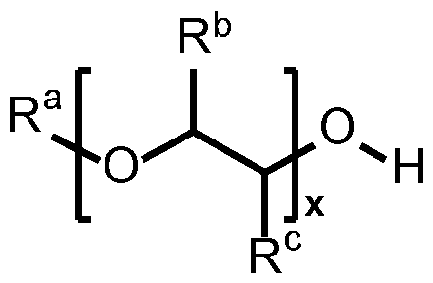
- a fuel composition comprising: i) a hydrocarbon-based fuel comprising gasoline, diesel; ii) one or more carrier fluids comprising an alkyl polyethoxylate of Formula 1 :
- each R b and R c is independently hydrogen, C1-C4 hydrocarbyl group, or C1-C3 alcohol, wherein R a is C4-C100 hydrocarbyl group, carboxyl group, ether group, thioether group, or aromatic group, wherein x is from 1 to 20; and iii) one or more nitrogen-containing detergent of Formula 2:
- Formula 2 or an acceptable salt thereof wherein X 1 and X 2 are independently H, C, N, O, or S and wherein X 1 or X 2 independently includes one or more C2 - C20 alkyl group or one or more aromatic ring; wherein each A, B and D is independently hydrogen, monovalent organic groups, and monovalent heterorganic groups in the form of groups or moieties that are bonded through a carbon atom; wherein any two or more of A, B and D optionally can be bonded together to form a cyclic structure; and wherein X 1 and X 2 optionally can be bonded together to form a cyclic structure; .
- the fuel composition further comprises an aliphatic hydrocarbyl-substituted amine or a hydrocarbyl-substituted poly(oxyalkylene)amine.
- the fuel composition further comprises: iv) one or more amine-based detergents of Formula 8:
- R 21 is a hydrocarbyl group having 8 to 20 carbons
- R 22 is hydrogen or (CH2) Z NH2 moiety
- y, z are independently integers having a value of 2 or greater.
- a method for controlling carbon deposits in an internal combustion engine comprising: providing a fuel in the internal combustion engine, wherein the fuel comprises: i) a hydrocarbon-based fuel comprising gasoline or diesel; and iii) one or more nitrogen-containing detergent of
- Formula 2 or an acceptable salt thereof; wherein X 1 and X 2 are independently H, C, N, O, or S or wherein X 1 or X 2 independently includes one or more C2 - C20 alkyl group or one or more aromatic ring; wherein each A, B and D is hydrogen, monovalent organic group, or monovalent heterorganic group in the form of groups or moieties that are bonded through a carbon atom and wherein any two or more of A, B and D optionally can be bonded together to form a cyclic structure; and wherein X 1 and X 2 optionally can be bonded together to form a cyclic structure.
- the fuel used in the method further comprises: ii) one or more carrier fluids comprising an alkyl polyethoxylate of Formula 1 :
- a fuel used in the method further comprises: an aliphatic hydrocarbyl-substituted amine or a hydrocarbyl-substituted poly(oxyalkylene)amine.
- a fuel used in the method further comprises: iv) one or more amine-based detergents of Formula 8:
- R 21 is a hydrocarbyl group having 8 to 20 carbons
- R 22 is hydrogen or (CH 2 )zNH 2 moiety
- y, z are independently integers having a value of 2 or greater.
- a concentrate composition comprising: about 30 to 90 wt % of an organic solvent boiling in a range of from 65°C to 205°C; and about 10 to 70 wt % of a detergent mixture comprising: ii) one or more carrier fluids as described herein, iii) one or more nitrogen-containing detergents as described herein.
- the concentrate compositions may further comprise iv) one or more amine-based detergents, as described herein.
- compositions and methods for improving engine performance, specifically improving deposit cleaning performance and/or lowering particulate emissions may be effective at controlling carbon deposits in an internal combustion engine.
- the significant improvements in deposit control may be achieved through the use of compositions comprising at least the (iii) one or more nitrogen-containing detergents disclosed herein.
- the fuel composition of the present invention comprises (i) a hydrocarbon-based fuel, (ii) carrier fluid and (iii) one or more nitrogen-containing detergents.
- the fuel composition may further comprise (iv) an amine-based detergent.
- the hydrocarbon-based fuel includes gasoline, or diesel.
- the hydrocarbon-based fuel may include ethanol.
- the ethanol is present in about 50% by volume (vol %) or less, such as 45% or less, 40% or less, 35% or less, 30% or less, 25% or less, 20% or less, 15% or less, 10% or less, 5% or less.
- the hydrocarbon-based fuel comprises gasoline and ethanol.
- Blends of gasoline and ethanol suitable for use in the compositions and methods comprise between about 5 and about 35 vol% ethanol such as about 10 to 20 vol% ethanol, or about 15 to about 25 vol% ethanol.
- the hydrocarbon-based fuel is an E20 base fuel or a gasoline fuel comprising 20 vol% ethanol.
- the hydrocarbon-based fuel is an E10 base fuel or a gasoline fuel comprising 10 vol% ethanol.
- Gasoline fuel refers to a composition containing at least predominantly C4-C12 hydrocarbons.
- gasoline or gasoline boiling range components is further defined to refer to a composition containing at least predominantly C4-C12 hydrocarbons and further having a boiling range of from about 37.8°C (100°F) to about 204°C (400°F).
- gasoline is defined to refer to a composition containing at least predominantly C4-C12 hydrocarbons, having a boiling range of from about 37.8°C (100°F) to about 204°C (400°F), and further defined to meet ASTM D4814.
- Diesel fuel refers to middle distillate fuels containing at least predominantly C10-C25 hydrocarbons.
- diesel is further defined to refer to a composition containing at least predominantly C10-C25 hydrocarbons, and further having a boiling range of from about 165.6°C (330°F) to about 371.1°C (700°F).
- diesel is as defined above to refer to a composition containing at least predominantly C10-C25 hydrocarbons, having a boiling range of from about 165.6°C (330°F) to about 371.1°C (700°F), and further defined to meet
- the hydrocarbon-based fuel is present in a major amount by weight % of the total fuel composition.
- the hydrocarbon-based fuel is present in about 50 wt% or greater, 55 wt% or greater, 60 wt% or greater, 65 wt% or greater, 70 wt% or greater, 75 wt% or greater, 80 wt% or greater, 85 wt% or greater, 90 wt% or greater, 95 wt% or greater or between any range from about 50 wt% to up to below 100 wt%.
- the gasoline employed in the present invention may be clean burning gasoline (CBG).
- CBG refers to gasoline formulations that contain reduced levels of sulfur, aromatics and olefins. The exact formulation may vary depending on local regulatory definitions.
- composition of the present invention comprises one or more carrier fluids. Without being limited by theory, it is believed that the carrier fluid can enhance the compatibility of the nitrogen-containing detergent in the hydrocarbon-based fuel.
- the carrier fluid is a chemically inert hydrocarbon-soluble liquid vehicle which substantially increases the non-volatile residue (NVR), or solvent-free liquid fraction of the fuel additive composition while not overwhelmingly contributing to octane requirement increase.
- NVR non-volatile residue
- a fuel-soluble, non-volatile carrier fluid or oil may also be used with compounds of this disclosure.
- the carrier fluid is a surfactant.
- the carrier fluid of the present invention comprises, or consists essentially, of an alkyl polyethoxylate compound given by the following Formula 1:
- each R b and R c is independently hydrogen, C1-C4 hydrocarbyl group, or C1-C3 alcohol, wherein R a is C4-C100 hydrocarbyl group, carboxyl group, ether group, thioether group, or aromatic group, wherein x is from 1 to 20.
- hydrocarbyl refers to a chemical group or moiety derived from hydrocarbons including saturated and unsaturated hydrocarbons.
- hydrocarbyl groups include alkenyl, alkyl, polyalkenyl, polyalkyl, phenyl, and the like.
- Specific examples of hydrocarbyl groups include butyl, isopropyl, and polyisobutenyl groups.
- the alkyl polyethoxylated compound is nonylphenol ethoxylate. In certain embodiments, the alkyl polyethoxylated compound is ethoxylated (C12-C14) secondary alcohol.
- x is in the range of 1 to 15, such as 2 to 11, 1 to 6, or 7 to 12.
- R a is a C4-C100 aromatic group, such as an alkylsubstituted phenyl group.
- R a is a C4-C14 hydrocarbyl group, such as C5-C13, C6-C12, or C7-C11 hydrocarbyl group.
- the carrier fluid may be employed in an amount ranging from about 35 to about 5000 ppm by weight (i.e., ppmw) of the hydrocarbon fuel (e.g., about 50 ppmw to about 4000 ppmw, about 100 ppmw to about 3000 ppmw, or about 1000 ppmw to about 3000 ppmw).
- carrier fluids may be present in amounts ranging from 20 to 60 wt % (e.g., 30 to 50 wt %).
- the fuel composition comprises about 35 ppmw to about 5000 ppmw of the carrier fluid.
- composition of the present invention comprises one or more nitrogen-containing detergents.
- the nitrogen-containing detergent is a compound given by the following Formula 2:
- Formula 2 or an acceptable salt thereof wherein X 1 and X 2 are independently H, C, N, O, or S and wherein X 1 or X 2 independently includes one or more C2-C20 alkyl group (e. g., Ci- Ce alkyl) or one or more aromatic ring; wherein each A, B and D is selected from hydrogen, monovalent organic groups (e.g., aromatic or aliphatic groups), and monovalent heterorganic groups ((e.g., aromatic or aliphatic groups which comprise one or more N, O, S or P) in the form of groups or moieties that are bonded through a carbon atom; and wherein any two or more of A, B and D optionally can be bonded together to form a cyclic structure (e.g., a five- , six- , or seven-membered ring); and wherein X 1 and X 2 optionally can be bonded together to form a cyclic structure (e.g., a five-, six-, or seven
- Cyclic structures may be aromatic or non-aromatic, as well as vary from being fully saturated to fully unsaturated, including partially saturated or partially unsaturated.
- the cyclic structure formed from the bonding of two or more of A, B and D is aromatic. In certain embodiments, the cyclic structure formed from the bonding of two or more of A, B and D is non-aromatic.
- the cyclic structure formed from the bonding of two or more of A, B and D may vary from being fully saturated to fully unsaturated. In certain embodiments, the cyclic structure formed from the bonding of two or more of A, B and D is fully saturated. In certain embodiments, the cyclic structure formed from the bonding of two or more of A, B and D is partially unsaturated. In certain embodiments, the cyclic structure formed from the bonding of two or more of A, B and D is fully saturated. [034] In certain embodiments, the cyclic structure formed from the bonding of X 1 and X 2 is aromatic. In certain embodiments, the cyclic structure formed from the bonding of X 1 and X 2 is non-aromatic.
- one of X 1 and X 2 is not H. In certain embodiments, both of X 1 and X 2 are not H.
- one of X 1 and X 2 is N. In certain embodiments, both of X 1 and X 2 are N. In certain embodiments, X 1 is N bonded to one C2 - C20 alkyl group (e. g., Ci- Ce alkyl) and bonded to [B], In certain embodiments, X 1 is N bonded to one aromatic ring and bonded to [B], In certain embodiments, X 1 is N bonded to H and bonded to [B], In certain embodiments, X 2 is N bonded to one C2-C20 alkyl group (e. g., Ci- Ce alkyl) and bonded to [D], In certain embodiments, X 2 is N bonded to one aromatic ring and bonded to [D], In certain embodiments, X 2 is N bonded to H and bonded to [D],
- X 1 is N bonded to one aromatic ring and bonded to [B] and X 2 is N bonded to one aromatic ring and bonded to [D],
- one of X 1 and X 2 is C. In certain embodiments, both of X 1 and X 2 are C. In certain embodiments, X 1 is C bonded to one C2-C20 alkyl group (e. g., Ci- Ce alkyl), bonded to H, and bonded to [B], In certain embodiments, X 1 is C bonded to one aromatic ring, bonded to H, and bonded to [B], In certain embodiments, X 1 is CH2 and bonded to [B], In certain embodiments, X 2 is C bonded to one C2-C2oalkyl group (e.
- C2-C20 alkyl group e. g., Ci- Ce alkyl
- X 1 is C bonded to one aromatic ring, bonded to H, and bonded to [B]
- X 1 is CH2 and bonded to [B]
- X 2 is C bonded to one C2-C2oalkyl group (e.
- X 2 is C bonded to one aromatic ring, bonded to H, and bonded to [D], In certain embodiments, X 2 is CH2 and bonded to [D],
- X 1 is O bonded to [B]
- X 2 is O bonded to [D]
- X 1 is S bonded to [B]
- X 2 is S bonded to [D]
- the organic and heterorganic groups of A, C, and D may have from 1 to 10 carbon atoms (e.g., 1 to 6 carbon atoms).
- Suitable examples of compounds of Formula 2 include, but are not limited to: guanidines, aminoguanidines, amidines, benzamidines, imidazoles, benzimidazoles, aminobenzimidazoles, and trizazoles.
- the nitrogen-containing detergent is a guanidine, a substituted guanidine, a derivative thereof, or an acceptable salt thereof.
- Useful guanidine compounds include those that can be represented by the following Formula 3,
- R 1 , R 2 , R 3 , R 4 and R 5 are each independently hydrogen, monovalent organic groups (e.g., aromatic or aliphatic groups), or monovalent heterorganic groups (e.g., aromatic or aliphatic groups which comprise one or more N, O, S or P) in the form of groups or moieties that are bonded through a carbon atom; and wherein any two or more of R 1 , R 2 , R 3 , R 4 and R 5 optionally can be bonded together to form a cyclic structure (e.g., a five-, six, or seven-membered ring).
- the cyclic structures may be aromatic or non-aromatic, as well as vary from being fully saturated to fully unsaturated.
- the organic and heterorganic groups may have from 1 to 10 carbon atoms (e.g., 1 to 6 carbon atoms). In some embodiments, A, B, and D do not contain acid functionality such as carboxylic or sulfonic moiety.
- one or more of R 1 , R 2 , R 3 , R 4 and R 5 is an aromatic group, for example phenyl or substituted phenyl. In certain embodiments, two or more of R 1 , R 2 , R 3 , R 4 and R 5 is an aromatic group. In certain embodiments, three or more of R 1 , R 2 , R 3 , R 4 and R 5 is an aromatic group. In certain embodiments, the compound is a diphenyl guanidine.
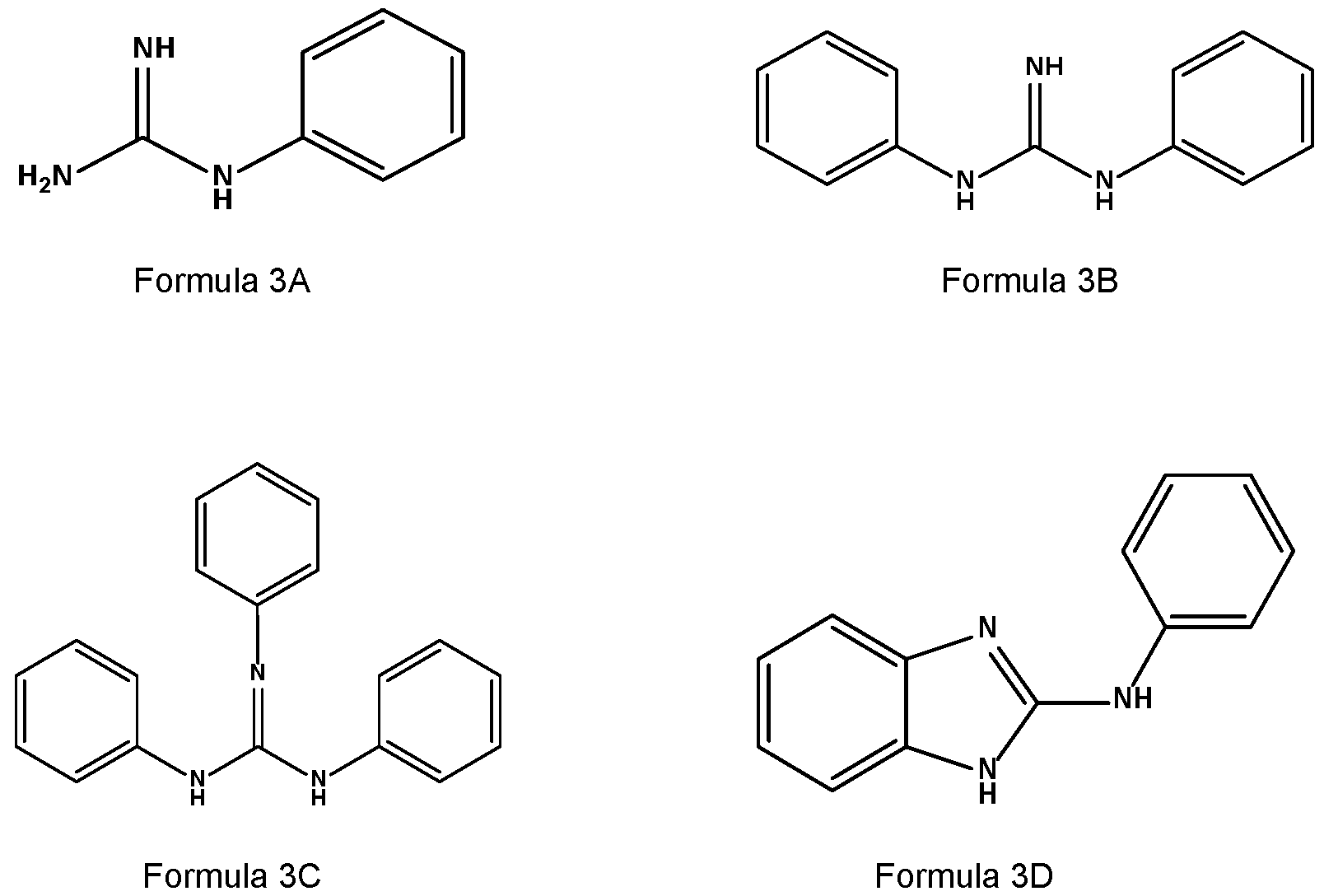
- Representative examples of compounds of Formula 3 include 1 - phenylguanidine (Formula 3A), 1,3-diphenylguanidine (Formula 3B), 1,2,3- triphenylguanidine (Formula 3C), N-phenyl-1 H-benzo[d]imidazol-2-amine (Formula 3D), N-phenyl-1 H-imidazol-2-amine (Formula 3E), 2-aminoimidazole (Formula 3F), 2- aminobenzimidazole (Formula 3G), 1 -phenylbiguanide (Formula 3H), 2- guanidinobenzimidazole (Formula 3I), 2-phenyl-2-imidazoline (Formula 3J), 1, 1,3,3- tetramethylguanidine (TMG; Formula 3K), 2-tert-butyl-1,1,3,3-tetramethylguanidine (BTMG; Formula 3L), 1,5,7-triazabicyclo[4.4.0]de
- the nitrogen-containing detergent is an aminoguanidine, a substituted aminoguanidine, a derivative thereof, or an acceptable salt thereof.
- Useful aminoguanidine compounds include those that can be represented by the following Formula 4,
- R 1 , R 2 , R 3 , R 5 , R 6 and R 7 are each independently selected from hydrogen, monovalent organic groups (e.g., aromatic or aliphatic groups), and monovalent heterorganic groups ((e.g., aromatic or aliphatic groups which comprise one or more N, O, S or P) in the form of groups or moieties that are bonded through a carbon atom; and wherein any two or more of R 1 , R 2 , R 3 , R 5 , R 6 and R 7 optionally can be bonded together to form a cyclic structure (e.g., a five-, six, or seven-membered ring).
- a cyclic structure e.g., a five-, six, or seven-membered ring
- the cyclic structures may be aromatic or non-aromatic, as well as vary from being fully saturated to fully unsaturated.
- the organic and heterorganic groups may have from 1 to 10 carbon atoms (e.g., 1 to 6 carbon atoms).
- A, B, and D do not contain acid functionality such as carboxylic or sulfonic moiety.
- one or more of R 1 , R 2 , R 3 , R 5 , R 6 and R 7 is an aromatic group, for example phenyl or substituted phenyl. In certain embodiments, two or more of R 1 , R 2 , R 3 , R 5 , R 6 and R 7 is an aromatic group. In certain embodiments, three or more of R 1 , R 2 , R 3 , R 5 , R 6 and R 7 is an aromatic group.
- Representative examples of compounds of Formula 4 include 2- benzylhydrazine-1 -carboximidamide (Formula 4A), N',2-dibenzylhydrazine-1 - carboximidhydrazide (Formula 4B), and N',N",2-tribenzylhydrazine-1 - carbohydrazonhydrazide (Formula 4C). Representative structures shown below.
- the nitrogen-containing detergent is an amidine, a substituted amidine, a benzamidine, a substituted benzamidine, or an acceptable salt thereof.
- Useful amidines include those that can be represented by the following Formula 5:
- R 8 , R 9 , R 10 and R 11 are each independently selected from hydrogen, monovalent organic groups, monovalent heterorganic groups (e.g., comprising nitrogen, oxygen, sulfur or phosphorus, in the form of groups or moieties that are bonded through a carbon atom, and combinations thereof; and wherein any two or more of R 8 , R 9 , R 10 and R 11 optionally can be bonded together to form a cyclic structure (e.g., a five-, six, or seven-membered ring).
- the cyclic structures may be aromatic or non-aromatic, as well as vary from being fully saturated to fully unsaturated.
- the organic and heterorganic groups may have from 1 to 10 carbon atoms (e.g., 1 to 6 carbon atoms).
- R 8 , R 9 , R 10 , and R 11 do not contain acid functionality such as carboxylic or sulfonic moiety.
- R 8 , R 9 , R 10 and R 11 is an aromatic group, for example phenyl or substituted phenyl. In certain embodiments, two or more of wherein R 8 , R 9 , R 10 and R 11 is an aromatic group. In certain embodiments, three or more of wherein R 8 , R 9 , R 10 and R 11 is an aromatic group.
- Representative examples of compounds of Formula 5 include benzimidamide (or benzamidine; Formula 5A), N-phenylbenzimidamide (Formula 5B), benzimidazole (Formula 5C), 2-phenyl-1H-benzo[c/]imidazole (Formula 5D), 2- phenylimidazole (Formula 5E), and A/-phenylpyridin-2-amine (Formula 5F), 1,4, 5, 6- tetrahydropyrimidine (Formula 5G), 1,2-dimethyl-1,4,5,6-tetrahydropyrimidine (Formula 5H), 1,2-diethyl-1,4,5,6-tetrahydropyrimidine (Formula 5I), 1,5- diazabicyclo[4.3.0]non-5-ene (DBN; Formula 5J), 1,8-diazabicyclo[5.4.0]-undeca-7-ene (DBU; Formula 5K), benzimidazole (Formula
- the nitrogen-containing detergent is an imidazole, a substituted imidazole, a benzamidazole, a substituted benzamidazole, an aminobenzimidazole, a substituted aminobenzimidazole, or an acceptable salt thereof.
- Useful imidazoles, substituted imidazoles, benzamidazoles, substituted benzamidazoles, aminobenzimidazoles, and substituted aminobenzimidazoles include those that can be represented by the following Formula 6: wherein Y is R 15 or NR 16 R 17 ; wherein R 12 , R 13 , R 14 , R 15 , R 16 and R 17 are each independently selected from hydrogen, monovalent organic groups, monovalent heterorganic groups (e.g., comprising nitrogen, oxygen, sulfur or phosphorus, in the form of groups or moieties that are bonded through a carbon atom, and combinations thereof; and wherein any two or more of R 12 , R 13 , R 14 , R 15 , R 16 and R 17 optionally can be bonded together to form a cyclic structure (e.g., a five-, six, or seven-membered ring).
- Formula 6 wherein Y is R 15 or NR 16 R 17 ; wherein R 12 , R 13 , R
- the cyclic structures may be aromatic or non-aromatic, as well as vary from being fully saturated to fully unsaturated.
- the organic and heterorganic groups may have from 1 to 10 carbon atoms (e.g., 1 to 6 carbon atoms).
- A, B, and D do not contain acid functionality such as carboxylic or sulfonic moiety.
- R 12 , R 13 , R 14 , R 15 , R 16 and R 17 is an aromatic group, for example phenyl or substituted phenyl. In certain embodiments, two or more of wherein R 12 , R 13 , R 14 , R 15 , R 16 and R 17 is an aromatic group. In certain embodiments, three or more of wherein R 12 , R 13 , R 14 , R 15 , R 16 and R 17 is an aromatic group.
- Representative examples of compounds of Formula 6 include imidazole (Formula 6A), 1 -methylimidazole (Formula 6B), 1 -decylimidazole (Formula 6C), 1 - ethylimidazole (Formula 6D), 1 -propylimidazole (Formula 6E), 1 -n-butylimidazole (Formula 6F), 2-methylimidazole (Formula 6G), 2-isopropylimidazole (Formula 6H), 4- methylimidazole (Formula 6I), 1,2-dimethylimidazole (Formula 6J), 2-ethyl-4(5)- methylimidazole (Formula 6K), 1 -vinylimidazole (Formula 6L), 2-ethylimidazole (Formula 6M), and 1 -dodecylimidazole (Formula 6N). Representative structures are shown below.
- the nitrogen-containing detergent is a triazole, a substituted triazole, or an acceptable salt thereof.
- Useful triazoles and substituted triazoles include those that can be represented by the following Formula 7:
- R 18 , R 19 and R 20 are each independently selected from hydrogen, monovalent organic groups, monovalent heterorganic groups (e.g., comprising nitrogen, oxygen, sulfur or phosphorus, in the form of groups or moieties that are bonded through a carbon atom, and combinations thereof; and wherein any two or more of R 18 , R 19 and R 20 optionally can be bonded together to form a cyclic structure (e.g., a five-, six, or seven-membered ring).
- the cyclic structures may be aromatic or non-aromatic, as well as vary from being fully saturated to fully unsaturated.
- the organic and heterorganic groups may have from 1 to 10 carbon atoms (e.g., 1 to 6 carbon atoms).
- R 18 , R 19 and R 20 do not contain acid functionality such as carboxylic or sulfonic moiety.
- R 18 , R 19 and R 20 is an aromatic group, for example phenyl or substituted phenyl. In certain embodiments, two or more of wherein R 18 , R 19 and R 20 is an aromatic group.
- a representative example of a compound of Formula 7 is 1, 2, 4-triazole (Formula 7A), shown below.
- composition of the present invention may comprise one or more amine-based detergents.
- Each amine-based detergent can be present in the exemplary compositions in an amount of about 10 ppm to about 3000 ppm, such as about 1000 to about 2500, about 1250 to about 2250, 1500 to about 2000, 10 ppm to about 750 ppm (such as 20 to 700, 30 to 650, 50 to 600, 100 to 500, 200 to 400, 250 to 350, and so forth) based on the total fuel composition.
- the amine-based detergent is an aliphatic hydrocarbyl-substituted amine compound or a hydrocarbyl-substituted poly(oxyalkylene)amine.
- the aliphatic hydrocarbyl-substituted amines employed in the present invention may be straight or branched chain hydrocarbyl-substituted amines having at least one basic nitrogen and wherein the hydrocarbyl group has a number average molecular weight of about 700 to 3,000.
- Specific examples of aliphatic hydrocarbyl-substituted amines include polyisobutenyl amines and polyisobutyl amines. These amines can be derived as monoamines or polyamines. Preparation of aliphatic amines are generally known and described in detail in U.S. Pat. Nos. 3,438,757; 3,565,804; 3,574,576; 3,848,056; 3,960,515; 4,832,702; and 6,203,584, all of which are hereby incorporated by reference.,
- the amine-based detergent is a hydrocarbyl- substituted poly(oxyalkylene)amine compound (also referred to as a "polyether amine").
- the hydrocarbyl-substituted poly(oxyalkylene)amines employed in the present invention may include hydrocarbyl poly(oxyalkylene)amines (monoamines or polyamines) wherein the hydrocarbyl group contains from about 1 to about 30 carbon atoms.
- the number of oxyalkylene units can range from about 5 to about 100.
- the amine moiety is derived from ammonia, primary alkyl or secondary dialkyl monoamine, or polyamine having a terminal amino nitrogen atom.
- the oxyalkylene moiety may be oxypropylene or oxybutylene or a mixture thereof.
- Hydrocarbyl-substituted poly(oxyalkylene)amines are described in U.S. Pat. No. 6,217,624, and U.S. Pat. No. 5,112,364, which are hereby incorporated herein by reference.
- Specific examples of hydrocarbyl-substituted poly(oxyalkylene)monoamine include alkylphenyl poly(oxyalkylene)monoamine wherein the poly(oxyalkylene) moiety contains oxypropylene units or oxybutylene units or mixtures of oxypropylene and oxybutylene units.
- the alkyl group on the alkylphenyl moiety is a straight or branched-chain alkyl of about 1 to about 24 carbon atoms.
- a preferred alkylphenyl moiety is tetrapropenylphenyl where the alkyl group is a branched-chain alkyl of 12 carbon atoms derived from a propylene tetramer.
- additional hydrocarbyl-substituted poly(oxyalkylene)amines include hydrocarbyl-substituted poly(oxyalkylene)aminocarbamates disclosed in U.S. Pat. Nos. 4,288,612; 4,236,020; 4,160,648; 4,191,537; 4,270,930; 4,233,168; 4,197,409; 4,243,798 and 4,881,945, which are hereby incorporated by reference.
- These hydrocarbyl poly(oxyalkylene)aminocarbamates contain at least one basic nitrogen atom and have an average molecular weight of about 500 to 10,000, preferably about 500 to 5,000, and more preferably about 1,000 to 3,000.
- a preferred aminocarbamate is alkylphenyl poly(oxybutylene)aminocarbamate wherein the amine moiety is derived from ethylene diamine or diethylene triamine.
- the amine-based detergent (more specifically, a linear/branched aliphatic ether amine) of the present invention is represented by the following formula: R 21 -O-(CH 2 ) y -NHR 22
- R 21 is a hydrocarbyl group having 8 to 20 carbons
- R 22 is hydrogen or (CH 2 ) Z NH 2 moiety
- y, z are independently integers having a value of 2 or greater.
- the hydrocarbyl group may be saturated or unsaturated. In some embodiments, the hydrocarbyl group may contain more than one unsaturated bond.
- the amine-based detergents of the present invention can deliver more basic nitrogen at the same treat rate compared to conventional amine-based fuel detergents (such as polyisobutylamine, polyether amine, etc.). This feature is important in determining detergency.
- conventional amine-based fuel detergents such as polyisobutylamine, polyether amine, etc.
- the low molecular weight of the amine-based detergents of the present invention along with their low decomposition temperature and high volatility prevents the amine-based detergents from generating harmful deposits.
- Particularly illustrative aliphatic ether amines compatible with the present invention include isotridecyloxypropylamine and 2-ethylhexyloxypropyl amine.
- the amine-based detergent comprises or consists essentially of isotridecyloxypropylamine.
- the fuel composition may comprise other generally known fuel additives. Suitable examples include, but are not limited to, antioxidants, metal deactivators, demulsifiers, oxygenates, antiknock agents, dispersants and other detergents. In diesel fuel, other well-known additives can be employed such as pour point depressants, flow improvers, and the like.
- each of the foregoing additives when used, is used at a functionally effective amount to impart the desired properties to the fuel composition.
- concentration of each of these additives, when used may range, unless otherwise specified, from about 0.001 to about 20 wt. %, such as about 0.01 to about 10 wt. %.
- a concentrate composition comprises: about 30 to 90 wt % of an organic solvent boiling in a range of from 65°C to 205°C and; about 10 to 70 wt % of a detergent mixture comprising: one or more carrier fluids as disclosed herein, one or more nitrogen-containing compounds as disclosed herein.
- the concentrate composition further comprises: iv) one or more amine-based detergents selected from compounds of Formula 8: R 21 -O-(CH 2 ) y -NHR 22
- R 21 is a hydrocarbyl group having 8 to 20 carbons
- R 22 is hydrogen or (CH 2 )zNH 2 moiety
- y, z are independently integers having a value of 2 or greater.
- the nitrogen-containing detergents can be used advantageously in compositions and methods for improving engine performance, specifically improving deposit cleaning performance and/or lowering particulate emissions.
- the exemplary nitrogen-containing detergents alone or in the form of fuel compositions or concentrate compositions, can be applied by any suitable means to an internal combustion engine for the purpose of controlling, preventing or reducing carbon deposits.
- the significant improvements in deposit control e.g., intake valve deposit control
- the method is for controlling carbon deposits in an internal combustion engine.
- the method comprises: providing a fuel in the internal combustion engine, wherein the fuel comprises: i) a hydrocarbon-based fuel comprising gasoline, diesel or a blend of gasoline and ethanol; and ii) one or more nitrogen-containing detergents as disclosed herein, for example nitrogen-containing compounds selected from compounds of Formula 2:
- Formula 2 or an acceptable salt thereof wherein X 1 and X 2 are independently H, C, N, O, or S and wherein X 1 or X 2 independently includes one or more C 2 - C 2 o alkyl group or one or more aromatic ring; wherein each A, B and D is selected from hydrogen, monovalent organic groups, and monovalent heterorganic groups in the form of groups or moieties that are bonded through a carbon atom; and wherein any two or more of A, B and D optionally can be bonded together to form a cyclic structure; and wherein X 1 and X 2 optionally can be bonded together to form a cyclic structure; or one or more nitrogen-containing detergents selected from an aliphatic hydrocarbyl-substituted amine or a hydrocarbyl-substituted poly(oxyalkylene)amine.
- A, B, and D do not contain acid functionality such as carboxylic or sulfonic moiety.
- the fuel used in the method further comprises: ii) one or more carrier fluids comprising an alkyl polyethoxylate selected from compounds of Formula 1 :
- each R b and R c is independently hydrogen, C1-C4 hydrocarbyl group, or C1-C3 alcohol, wherein R a is C4-C100 hydrocarbyl group, carboxyl group, ether group, thioether group, or aromatic group, wherein x is from 1 to 20.
- a fuel used in the method further comprises: iv) one or more amine-based detergents selected from compounds of Formula 8:
- R 21 is a hydrocarbyl group having 8 to 20 carbons
- R 22 is hydrogen or (CH 2 )zNH 2 moiety
- y, z are independently integers having a value of 2 or greater.
- the nitrogen-containing detergents and carrier fluids can be applied to an internal combustion engine in the form of a concentrate composition as described herein.
- the tested compositions contained the E20 base fuel and one or more of the following additives: 1,3-diphenylguanidine (DPG, an exemplary nitrogencontaining detergent), nonylphenol ethoxylate (Carrier Fluid A), an ethoxylated (C12- C14) secondary alcohol (Carrier Fluid B), and isotridecyloxypropyl amine (an exemplary amine-based detergent).
- DPG 1,3-diphenylguanidine
- Carrier Fluid A nonylphenol ethoxylate
- Carrier Fluid B ethoxylated secondary alcohol
- isotridecyloxypropyl amine an exemplary amine-based detergent
- Table 1 shows the intake valve deposit (IVD) removal resulting from CU treatment with each test composition.
- ranges from any lower limit may be combined with any upper limit to recite a range not explicitly recited, as well as, ranges from any lower limit may be combined with any other lower limit to recite a range not explicitly recited, in the same way, ranges from any upper limit may be combined with any other upper limit to recite a range not explicitly recited.
- ranges from any upper limit may be combined with any other upper limit to recite a range not explicitly recited.
- within a range includes every point or individual value between its end points even though not explicitly recited. Thus, every point or individual value may serve as its own lower or upper limit combined with any other point or individual value or any other lower or upper limit, to recite a range not explicitly recited.
- compositions, an element or a group of elements are preceded with the transitional phrase “comprising,” it is understood that we also contemplate the same composition or group of elements with transitional phrases “consisting essentially of,” “consisting of,” “selected from the group of consisting of,” or “is” preceding the recitation of the composition, element, or elements and vice versa.
Landscapes
- Chemical & Material Sciences (AREA)
- Oil, Petroleum & Natural Gas (AREA)
- Engineering & Computer Science (AREA)
- Organic Chemistry (AREA)
- Chemical Kinetics & Catalysis (AREA)
- General Chemical & Material Sciences (AREA)
- Solid Fuels And Fuel-Associated Substances (AREA)
- Liquid Carbonaceous Fuels (AREA)
- Health & Medical Sciences (AREA)
- Emergency Medicine (AREA)
- Combustion & Propulsion (AREA)
Abstract
Description




Claims




Priority Applications (7)
| Application Number | Priority Date | Filing Date | Title |
|---|---|---|---|
| AU2024244699A AU2024244699A1 (en) | 2023-03-29 | 2024-03-28 | Fuel additive compositions and methods for controlling carbon deposits in an internal combustion engines |
| EP24721813.4A EP4689018A1 (en) | 2023-03-29 | 2024-03-28 | Fuel additive compositions and methods for controlling carbon deposits in an internal combustion engines |
| KR1020257036172A KR20250164307A (en) | 2023-03-29 | 2024-03-28 | Fuel additive composition and method for controlling carbon deposits in internal combustion engines |
| JP2025556736A JP2026511712A (en) | 2023-03-29 | 2024-03-28 | Fuel additive composition and method for controlling carbon deposits in internal combustion engines |
| CN202480027918.7A CN121039257A (en) | 2023-03-29 | 2024-03-28 | Fuel additive compositions and methods for controlling carbon deposits in internal combustion engines |
| MX2025011290A MX2025011290A (en) | 2023-03-29 | 2025-09-24 | Fuel additive compositions and methods for controlling carbon deposits in an internal combustion engines |
| CONC2025/0015019A CO2025015019A2 (en) | 2023-03-29 | 2025-10-28 | Fuel additive compositions and methods for controlling carbon deposits in internal combustion engines |
Applications Claiming Priority (2)
| Application Number | Priority Date | Filing Date | Title |
|---|---|---|---|
| US202363455285P | 2023-03-29 | 2023-03-29 | |
| US63/455,285 | 2023-03-29 |
Publications (1)
| Publication Number | Publication Date |
|---|---|
| WO2024206634A1 true WO2024206634A1 (en) | 2024-10-03 |
Family
ID=90880616
Family Applications (1)
| Application Number | Title | Priority Date | Filing Date |
|---|---|---|---|
| PCT/US2024/021974 Ceased WO2024206634A1 (en) | 2023-03-29 | 2024-03-28 | Fuel additive compositions and methods for controlling carbon deposits in an internal combustion engines |
Country Status (8)
| Country | Link |
|---|---|
| EP (1) | EP4689018A1 (en) |
| JP (1) | JP2026511712A (en) |
| KR (1) | KR20250164307A (en) |
| CN (1) | CN121039257A (en) |
| AU (1) | AU2024244699A1 (en) |
| CO (1) | CO2025015019A2 (en) |
| MX (1) | MX2025011290A (en) |
| WO (1) | WO2024206634A1 (en) |
Citations (22)
| Publication number | Priority date | Publication date | Assignee | Title |
|---|---|---|---|---|
| US3062630A (en) * | 1960-03-23 | 1962-11-06 | Exxon Research Engineering Co | Antistatic additives |
| US3438757A (en) | 1965-08-23 | 1969-04-15 | Chevron Res | Hydrocarbyl amines for fuel detergents |
| US3848056A (en) | 1972-09-05 | 1974-11-12 | Continental Oil Co | Molten alkaline alkanoic mixtures for absorption of sulfur oxides |
| US3960515A (en) | 1973-10-11 | 1976-06-01 | Chevron Research Company | Hydrocarbyl amine additives for distillate fuels |
| US4160648A (en) | 1976-06-21 | 1979-07-10 | Chevron Research Company | Fuel compositions containing deposit control additives |
| US4191537A (en) | 1976-06-21 | 1980-03-04 | Chevron Research Company | Fuel compositions of poly(oxyalkylene) aminocarbamate |
| US4197409A (en) | 1978-08-08 | 1980-04-08 | Chevron Research Company | Poly(oxyalkylene)aminocarbomates of alkylene polyamine |
| US4233168A (en) | 1978-06-19 | 1980-11-11 | Chevron Research Company | Lubricant compositions containing dispersant additives |
| US4236020A (en) | 1976-06-21 | 1980-11-25 | Chevron Research Company | Carbamate deposit control additives |
| US4243798A (en) | 1979-08-09 | 1981-01-06 | Chevron Research Company | Process for the production of a polymeric carbamate |
| US4270930A (en) | 1979-12-21 | 1981-06-02 | Chevron Research Company | Clean combustion chamber fuel composition |
| US4288612A (en) | 1976-06-21 | 1981-09-08 | Chevron Research Company | Deposit control additives |
| US4832702A (en) | 1986-04-04 | 1989-05-23 | Basf Aktiengesellschaft | Polybutyl-and polyisobutylamines, their preparation, and fuel compositions containing these |
| US4881945A (en) | 1987-10-23 | 1989-11-21 | Chevron Research Company | Fuel compositions containing very long chain alkylphenyl poly(oxyalkylene) aminocarbonates |
| US5112364A (en) | 1988-08-05 | 1992-05-12 | Basf Aktiengesellschaft | Gasoline-engine fuels containing polyetheramines or polyetheramine derivatives |
| US6203584B1 (en) | 1998-03-31 | 2001-03-20 | Chevron Chemical Company Llc | Fuel composition containing an amine compound and an ester |
| US6217624B1 (en) | 1999-02-18 | 2001-04-17 | Chevron Chemical Company Llc | Fuel compositions containing hydrocarbyl-substituted polyoxyalkylene amines |
| WO2002048212A1 (en) * | 2000-12-12 | 2002-06-20 | Totalfinaelf France | Guanidinoalkylated compounds, preparation thereof and use as fuel and lubricant additives |
| US20180258361A1 (en) * | 2017-03-13 | 2018-09-13 | Afton Chemical Corporation | Polyol carrier fluids and fuel compositions including polyol carrier fluids |
| US20190292473A1 (en) * | 2018-03-23 | 2019-09-26 | Chevron Oronite Company Llc | Composition and method for preventing or reducing low speed pre-ignition in spark-ignited internal combustion engines |
| DE102022132342A1 (en) * | 2022-12-06 | 2023-01-26 | Basf Se | Guanidinium salts as fuel additives |
| DE102022131890A1 (en) * | 2022-12-01 | 2023-01-26 | Basf Se | Guanidine derivatives as fuel additives |
-
2024
- 2024-03-28 JP JP2025556736A patent/JP2026511712A/en active Pending
- 2024-03-28 CN CN202480027918.7A patent/CN121039257A/en active Pending
- 2024-03-28 AU AU2024244699A patent/AU2024244699A1/en active Pending
- 2024-03-28 EP EP24721813.4A patent/EP4689018A1/en active Pending
- 2024-03-28 KR KR1020257036172A patent/KR20250164307A/en active Pending
- 2024-03-28 WO PCT/US2024/021974 patent/WO2024206634A1/en not_active Ceased
-
2025
- 2025-09-24 MX MX2025011290A patent/MX2025011290A/en unknown
- 2025-10-28 CO CONC2025/0015019A patent/CO2025015019A2/en unknown
Patent Citations (24)
| Publication number | Priority date | Publication date | Assignee | Title |
|---|---|---|---|---|
| US3062630A (en) * | 1960-03-23 | 1962-11-06 | Exxon Research Engineering Co | Antistatic additives |
| US3438757A (en) | 1965-08-23 | 1969-04-15 | Chevron Res | Hydrocarbyl amines for fuel detergents |
| US3565804A (en) | 1965-08-23 | 1971-02-23 | Chevron Res | Lubricating oil additives |
| US3574576A (en) | 1965-08-23 | 1971-04-13 | Chevron Res | Distillate fuel compositions having a hydrocarbon substituted alkylene polyamine |
| US3848056A (en) | 1972-09-05 | 1974-11-12 | Continental Oil Co | Molten alkaline alkanoic mixtures for absorption of sulfur oxides |
| US3960515A (en) | 1973-10-11 | 1976-06-01 | Chevron Research Company | Hydrocarbyl amine additives for distillate fuels |
| US4160648A (en) | 1976-06-21 | 1979-07-10 | Chevron Research Company | Fuel compositions containing deposit control additives |
| US4191537A (en) | 1976-06-21 | 1980-03-04 | Chevron Research Company | Fuel compositions of poly(oxyalkylene) aminocarbamate |
| US4236020A (en) | 1976-06-21 | 1980-11-25 | Chevron Research Company | Carbamate deposit control additives |
| US4288612A (en) | 1976-06-21 | 1981-09-08 | Chevron Research Company | Deposit control additives |
| US4233168A (en) | 1978-06-19 | 1980-11-11 | Chevron Research Company | Lubricant compositions containing dispersant additives |
| US4197409A (en) | 1978-08-08 | 1980-04-08 | Chevron Research Company | Poly(oxyalkylene)aminocarbomates of alkylene polyamine |
| US4243798A (en) | 1979-08-09 | 1981-01-06 | Chevron Research Company | Process for the production of a polymeric carbamate |
| US4270930A (en) | 1979-12-21 | 1981-06-02 | Chevron Research Company | Clean combustion chamber fuel composition |
| US4832702A (en) | 1986-04-04 | 1989-05-23 | Basf Aktiengesellschaft | Polybutyl-and polyisobutylamines, their preparation, and fuel compositions containing these |
| US4881945A (en) | 1987-10-23 | 1989-11-21 | Chevron Research Company | Fuel compositions containing very long chain alkylphenyl poly(oxyalkylene) aminocarbonates |
| US5112364A (en) | 1988-08-05 | 1992-05-12 | Basf Aktiengesellschaft | Gasoline-engine fuels containing polyetheramines or polyetheramine derivatives |
| US6203584B1 (en) | 1998-03-31 | 2001-03-20 | Chevron Chemical Company Llc | Fuel composition containing an amine compound and an ester |
| US6217624B1 (en) | 1999-02-18 | 2001-04-17 | Chevron Chemical Company Llc | Fuel compositions containing hydrocarbyl-substituted polyoxyalkylene amines |
| WO2002048212A1 (en) * | 2000-12-12 | 2002-06-20 | Totalfinaelf France | Guanidinoalkylated compounds, preparation thereof and use as fuel and lubricant additives |
| US20180258361A1 (en) * | 2017-03-13 | 2018-09-13 | Afton Chemical Corporation | Polyol carrier fluids and fuel compositions including polyol carrier fluids |
| US20190292473A1 (en) * | 2018-03-23 | 2019-09-26 | Chevron Oronite Company Llc | Composition and method for preventing or reducing low speed pre-ignition in spark-ignited internal combustion engines |
| DE102022131890A1 (en) * | 2022-12-01 | 2023-01-26 | Basf Se | Guanidine derivatives as fuel additives |
| DE102022132342A1 (en) * | 2022-12-06 | 2023-01-26 | Basf Se | Guanidinium salts as fuel additives |
Also Published As
| Publication number | Publication date |
|---|---|
| JP2026511712A (en) | 2026-04-14 |
| CO2025015019A2 (en) | 2025-11-07 |
| EP4689018A1 (en) | 2026-02-11 |
| AU2024244699A1 (en) | 2025-10-23 |
| KR20250164307A (en) | 2025-11-24 |
| MX2025011290A (en) | 2026-01-07 |
| CN121039257A (en) | 2025-11-28 |
Similar Documents
| Publication | Publication Date | Title |
|---|---|---|
| EP1268715B1 (en) | Fuel additive compositions and fuel compositions containing detergents and fluidizers | |
| EP0902079B1 (en) | Fuel compositions containing N-substituted perhydro-s-triazines | |
| WO2007053787A1 (en) | Fuel additive concentrate composition and fuel composition and method thereof | |
| AU2001239902A1 (en) | Fuel additive compositions and fuel compositions containing detergents and fluidizers | |
| RU2010119960A (en) | FUNCTIONAL VIBRATIONS FOR INTERNAL COMBUSTION ENGINES | |
| CA2751226A1 (en) | Gasoline deposit control additive compositions | |
| SE532079C2 (en) | Process and compositions for reducing coatings in engines which burn ethanol-containing fuels and a corrosion inhibitor | |
| KR102111623B1 (en) | Fuel additive composition for vehicle | |
| WO2002102942A2 (en) | Fuel additive composition and fuel composition and method thereof | |
| US20060218854A1 (en) | Fuel Additive Composition and Fuel Composition and Method Thereof | |
| WO2024206634A1 (en) | Fuel additive compositions and methods for controlling carbon deposits in an internal combustion engines | |
| EP4413100B1 (en) | Fuel additives for lowering deposit and particulate emission | |
| JP2854973B2 (en) | Fuel additive composition | |
| CN110382670A (en) | Fuel additive | |
| KR20250165430A (en) | Fuel additive composition and method for controlling deposits | |
| EP1812534B1 (en) | Additive and fuel compositions containing detergent and fluidizer and method thereof | |
| CN1823153A (en) | Gasoline compositions | |
| AU2002324421A1 (en) | Fuel additive composition and fuel composition and method thereof |
Legal Events
| Date | Code | Title | Description |
|---|---|---|---|
| 121 | Ep: the epo has been informed by wipo that ep was designated in this application |
Ref document number: 24721813 Country of ref document: EP Kind code of ref document: A1 |
|
| WWE | Wipo information: entry into national phase |
Ref document number: MX/A/2025/011290 Country of ref document: MX |
|
| ENP | Entry into the national phase |
Ref document number: 2025556736 Country of ref document: JP Kind code of ref document: A |
|
| WWE | Wipo information: entry into national phase |
Ref document number: 2025556736 Country of ref document: JP |
|
| WWE | Wipo information: entry into national phase |
Ref document number: 2501006598 Country of ref document: TH Ref document number: 825594 Country of ref document: NZ |
|
| WWE | Wipo information: entry into national phase |
Ref document number: AU2024244699 Country of ref document: AU |
|
| ENP | Entry into the national phase |
Ref document number: 2024244699 Country of ref document: AU Date of ref document: 20240328 Kind code of ref document: A |
|
| ENP | Entry into the national phase |
Ref document number: 1020257036172 Country of ref document: KR Free format text: ST27 STATUS EVENT CODE: A-0-1-A10-A15-NAP-PA0105 (AS PROVIDED BY THE NATIONAL OFFICE) |
|
| WWE | Wipo information: entry into national phase |
Ref document number: KR1020257036172 Country of ref document: KR Ref document number: 1020257036172 Country of ref document: KR |
|
| WWE | Wipo information: entry into national phase |
Ref document number: 2024721813 Country of ref document: EP |
|
| NENP | Non-entry into the national phase |
Ref country code: DE |
|
| WWE | Wipo information: entry into national phase |
Ref document number: 11202506486Y Country of ref document: SG |
|
| WWP | Wipo information: published in national office |
Ref document number: 825594 Country of ref document: NZ Ref document number: 11202506486Y Country of ref document: SG |
|
| ENP | Entry into the national phase |
Ref document number: 2024721813 Country of ref document: EP Effective date: 20251029 |
|
| ENP | Entry into the national phase |
Ref document number: 2024721813 Country of ref document: EP Effective date: 20251029 |
|
| ENP | Entry into the national phase |
Ref document number: 2024721813 Country of ref document: EP Effective date: 20251029 |
|
| ENP | Entry into the national phase |
Ref document number: 2024721813 Country of ref document: EP Effective date: 20251029 |
|
| ENP | Entry into the national phase |
Ref document number: 2024721813 Country of ref document: EP Effective date: 20251029 |
|
| ENP | Entry into the national phase |
Ref document number: 2024721813 Country of ref document: EP Effective date: 20251029 |
|
| ENP | Entry into the national phase |
Ref document number: 2024721813 Country of ref document: EP Effective date: 20251029 |
|
| ENP | Entry into the national phase |
Ref document number: 2024721813 Country of ref document: EP Effective date: 20251029 |
|
| WWP | Wipo information: published in national office |
Ref document number: MX/A/2025/011290 Country of ref document: MX |
|
| WWP | Wipo information: published in national office |
Ref document number: 2024721813 Country of ref document: EP |