WO2024203920A1 - Compound, surface treatment agent, article, and method for producing article - Google Patents
Compound, surface treatment agent, article, and method for producing article Download PDFInfo
- Publication number
- WO2024203920A1 WO2024203920A1 PCT/JP2024/011431 JP2024011431W WO2024203920A1 WO 2024203920 A1 WO2024203920 A1 WO 2024203920A1 JP 2024011431 W JP2024011431 W JP 2024011431W WO 2024203920 A1 WO2024203920 A1 WO 2024203920A1
- Authority
- WO
- WIPO (PCT)
- Prior art keywords
- group
- compound
- integer
- carbon atoms
- article
- Prior art date
- Legal status (The legal status is an assumption and is not a legal conclusion. Google has not performed a legal analysis and makes no representation as to the accuracy of the status listed.)
- Ceased
Links
Images

Classifications
-
- C—CHEMISTRY; METALLURGY
- C07—ORGANIC CHEMISTRY
- C07F—ACYCLIC, CARBOCYCLIC OR HETEROCYCLIC COMPOUNDS CONTAINING ELEMENTS OTHER THAN CARBON, HYDROGEN, HALOGEN, OXYGEN, NITROGEN, SULFUR, SELENIUM OR TELLURIUM
- C07F7/00—Compounds containing elements of Groups 4 or 14 of the Periodic Table
- C07F7/02—Silicon compounds
- C07F7/08—Compounds having one or more C—Si linkages
- C07F7/18—Compounds having one or more C—Si linkages as well as one or more C—O—Si linkages
- C07F7/1804—Compounds having Si-O-C linkages
-
- C—CHEMISTRY; METALLURGY
- C07—ORGANIC CHEMISTRY
- C07B—GENERAL METHODS OF ORGANIC CHEMISTRY; APPARATUS THEREFOR
- C07B61/00—Other general methods
-
- C—CHEMISTRY; METALLURGY
- C07—ORGANIC CHEMISTRY
- C07F—ACYCLIC, CARBOCYCLIC OR HETEROCYCLIC COMPOUNDS CONTAINING ELEMENTS OTHER THAN CARBON, HYDROGEN, HALOGEN, OXYGEN, NITROGEN, SULFUR, SELENIUM OR TELLURIUM
- C07F7/00—Compounds containing elements of Groups 4 or 14 of the Periodic Table
- C07F7/02—Silicon compounds
- C07F7/08—Compounds having one or more C—Si linkages
- C07F7/12—Organo silicon halides
-
- C—CHEMISTRY; METALLURGY
- C07—ORGANIC CHEMISTRY
- C07F—ACYCLIC, CARBOCYCLIC OR HETEROCYCLIC COMPOUNDS CONTAINING ELEMENTS OTHER THAN CARBON, HYDROGEN, HALOGEN, OXYGEN, NITROGEN, SULFUR, SELENIUM OR TELLURIUM
- C07F7/00—Compounds containing elements of Groups 4 or 14 of the Periodic Table
- C07F7/02—Silicon compounds
- C07F7/08—Compounds having one or more C—Si linkages
- C07F7/18—Compounds having one or more C—Si linkages as well as one or more C—O—Si linkages
-
- C—CHEMISTRY; METALLURGY
- C08—ORGANIC MACROMOLECULAR COMPOUNDS; THEIR PREPARATION OR CHEMICAL WORKING-UP; COMPOSITIONS BASED THEREON
- C08G—MACROMOLECULAR COMPOUNDS OBTAINED OTHERWISE THAN BY REACTIONS ONLY INVOLVING UNSATURATED CARBON-TO-CARBON BONDS
- C08G77/00—Macromolecular compounds obtained by reactions forming a linkage containing silicon with or without sulfur, nitrogen, oxygen or carbon in the main chain of the macromolecule
- C08G77/04—Polysiloxanes
- C08G77/22—Polysiloxanes containing silicon bound to organic groups containing atoms other than carbon, hydrogen and oxygen
- C08G77/24—Polysiloxanes containing silicon bound to organic groups containing atoms other than carbon, hydrogen and oxygen halogen-containing groups
-
- C—CHEMISTRY; METALLURGY
- C09—DYES; PAINTS; POLISHES; NATURAL RESINS; ADHESIVES; COMPOSITIONS NOT OTHERWISE PROVIDED FOR; APPLICATIONS OF MATERIALS NOT OTHERWISE PROVIDED FOR
- C09D—COATING COMPOSITIONS, e.g. PAINTS, VARNISHES OR LACQUERS; FILLING PASTES; CHEMICAL PAINT OR INK REMOVERS; INKS; CORRECTING FLUIDS; WOODSTAINS; PASTES OR SOLIDS FOR COLOURING OR PRINTING; USE OF MATERIALS THEREFOR
- C09D183/00—Coating compositions based on macromolecular compounds obtained by reactions forming in the main chain of the macromolecule a linkage containing silicon, with or without sulfur, nitrogen, oxygen, or carbon only; Coating compositions based on derivatives of such polymers
- C09D183/14—Coating compositions based on macromolecular compounds obtained by reactions forming in the main chain of the macromolecule a linkage containing silicon, with or without sulfur, nitrogen, oxygen, or carbon only; Coating compositions based on derivatives of such polymers in which at least two but not all the silicon atoms are connected by linkages other than oxygen atoms
-
- C—CHEMISTRY; METALLURGY
- C09—DYES; PAINTS; POLISHES; NATURAL RESINS; ADHESIVES; COMPOSITIONS NOT OTHERWISE PROVIDED FOR; APPLICATIONS OF MATERIALS NOT OTHERWISE PROVIDED FOR
- C09D—COATING COMPOSITIONS, e.g. PAINTS, VARNISHES OR LACQUERS; FILLING PASTES; CHEMICAL PAINT OR INK REMOVERS; INKS; CORRECTING FLUIDS; WOODSTAINS; PASTES OR SOLIDS FOR COLOURING OR PRINTING; USE OF MATERIALS THEREFOR
- C09D201/00—Coating compositions based on unspecified macromolecular compounds
-
- C—CHEMISTRY; METALLURGY
- C09—DYES; PAINTS; POLISHES; NATURAL RESINS; ADHESIVES; COMPOSITIONS NOT OTHERWISE PROVIDED FOR; APPLICATIONS OF MATERIALS NOT OTHERWISE PROVIDED FOR
- C09D—COATING COMPOSITIONS, e.g. PAINTS, VARNISHES OR LACQUERS; FILLING PASTES; CHEMICAL PAINT OR INK REMOVERS; INKS; CORRECTING FLUIDS; WOODSTAINS; PASTES OR SOLIDS FOR COLOURING OR PRINTING; USE OF MATERIALS THEREFOR
- C09D5/00—Coating compositions, e.g. paints, varnishes or lacquers, characterised by their physical nature or the effects produced; Filling pastes
- C09D5/16—Antifouling paints; Underwater paints
-
- C—CHEMISTRY; METALLURGY
- C09—DYES; PAINTS; POLISHES; NATURAL RESINS; ADHESIVES; COMPOSITIONS NOT OTHERWISE PROVIDED FOR; APPLICATIONS OF MATERIALS NOT OTHERWISE PROVIDED FOR
- C09D—COATING COMPOSITIONS, e.g. PAINTS, VARNISHES OR LACQUERS; FILLING PASTES; CHEMICAL PAINT OR INK REMOVERS; INKS; CORRECTING FLUIDS; WOODSTAINS; PASTES OR SOLIDS FOR COLOURING OR PRINTING; USE OF MATERIALS THEREFOR
- C09D5/00—Coating compositions, e.g. paints, varnishes or lacquers, characterised by their physical nature or the effects produced; Filling pastes
- C09D5/16—Antifouling paints; Underwater paints
- C09D5/1656—Antifouling paints; Underwater paints characterised by the film-forming substance
- C09D5/1662—Synthetic film-forming substance
- C09D5/1675—Polyorganosiloxane-containing compositions
-
- C—CHEMISTRY; METALLURGY
- C09—DYES; PAINTS; POLISHES; NATURAL RESINS; ADHESIVES; COMPOSITIONS NOT OTHERWISE PROVIDED FOR; APPLICATIONS OF MATERIALS NOT OTHERWISE PROVIDED FOR
- C09D—COATING COMPOSITIONS, e.g. PAINTS, VARNISHES OR LACQUERS; FILLING PASTES; CHEMICAL PAINT OR INK REMOVERS; INKS; CORRECTING FLUIDS; WOODSTAINS; PASTES OR SOLIDS FOR COLOURING OR PRINTING; USE OF MATERIALS THEREFOR
- C09D7/00—Features of coating compositions, not provided for in group C09D5/00; Processes for incorporating ingredients in coating compositions
- C09D7/40—Additives
- C09D7/60—Additives non-macromolecular
- C09D7/63—Additives non-macromolecular organic
-
- C—CHEMISTRY; METALLURGY
- C09—DYES; PAINTS; POLISHES; NATURAL RESINS; ADHESIVES; COMPOSITIONS NOT OTHERWISE PROVIDED FOR; APPLICATIONS OF MATERIALS NOT OTHERWISE PROVIDED FOR
- C09K—MATERIALS FOR MISCELLANEOUS APPLICATIONS, NOT PROVIDED FOR ELSEWHERE
- C09K3/00—Materials not provided for elsewhere
- C09K3/18—Materials not provided for elsewhere for application to surfaces to minimize adherence of ice, mist or water thereto; Thawing or antifreeze materials for application to surfaces
-
- C—CHEMISTRY; METALLURGY
- C08—ORGANIC MACROMOLECULAR COMPOUNDS; THEIR PREPARATION OR CHEMICAL WORKING-UP; COMPOSITIONS BASED THEREON
- C08G—MACROMOLECULAR COMPOUNDS OBTAINED OTHERWISE THAN BY REACTIONS ONLY INVOLVING UNSATURATED CARBON-TO-CARBON BONDS
- C08G65/00—Macromolecular compounds obtained by reactions forming an ether link in the main chain of the macromolecule
- C08G65/002—Macromolecular compounds obtained by reactions forming an ether link in the main chain of the macromolecule from unsaturated compounds
- C08G65/005—Macromolecular compounds obtained by reactions forming an ether link in the main chain of the macromolecule from unsaturated compounds containing halogens
- C08G65/007—Macromolecular compounds obtained by reactions forming an ether link in the main chain of the macromolecule from unsaturated compounds containing halogens containing fluorine
-
- C—CHEMISTRY; METALLURGY
- C08—ORGANIC MACROMOLECULAR COMPOUNDS; THEIR PREPARATION OR CHEMICAL WORKING-UP; COMPOSITIONS BASED THEREON
- C08G—MACROMOLECULAR COMPOUNDS OBTAINED OTHERWISE THAN BY REACTIONS ONLY INVOLVING UNSATURATED CARBON-TO-CARBON BONDS
- C08G65/00—Macromolecular compounds obtained by reactions forming an ether link in the main chain of the macromolecule
- C08G65/02—Macromolecular compounds obtained by reactions forming an ether link in the main chain of the macromolecule from cyclic ethers by opening of the heterocyclic ring
- C08G65/32—Polymers modified by chemical after-treatment
- C08G65/329—Polymers modified by chemical after-treatment with organic compounds
- C08G65/336—Polymers modified by chemical after-treatment with organic compounds containing silicon
-
- C—CHEMISTRY; METALLURGY
- C08—ORGANIC MACROMOLECULAR COMPOUNDS; THEIR PREPARATION OR CHEMICAL WORKING-UP; COMPOSITIONS BASED THEREON
- C08G—MACROMOLECULAR COMPOUNDS OBTAINED OTHERWISE THAN BY REACTIONS ONLY INVOLVING UNSATURATED CARBON-TO-CARBON BONDS
- C08G77/00—Macromolecular compounds obtained by reactions forming a linkage containing silicon with or without sulfur, nitrogen, oxygen or carbon in the main chain of the macromolecule
- C08G77/48—Macromolecular compounds obtained by reactions forming a linkage containing silicon with or without sulfur, nitrogen, oxygen or carbon in the main chain of the macromolecule in which at least two but not all the silicon atoms are connected by linkages other than oxygen atoms
- C08G77/50—Macromolecular compounds obtained by reactions forming a linkage containing silicon with or without sulfur, nitrogen, oxygen or carbon in the main chain of the macromolecule in which at least two but not all the silicon atoms are connected by linkages other than oxygen atoms by carbon linkages
-
- C—CHEMISTRY; METALLURGY
- C09—DYES; PAINTS; POLISHES; NATURAL RESINS; ADHESIVES; COMPOSITIONS NOT OTHERWISE PROVIDED FOR; APPLICATIONS OF MATERIALS NOT OTHERWISE PROVIDED FOR
- C09D—COATING COMPOSITIONS, e.g. PAINTS, VARNISHES OR LACQUERS; FILLING PASTES; CHEMICAL PAINT OR INK REMOVERS; INKS; CORRECTING FLUIDS; WOODSTAINS; PASTES OR SOLIDS FOR COLOURING OR PRINTING; USE OF MATERIALS THEREFOR
- C09D183/00—Coating compositions based on macromolecular compounds obtained by reactions forming in the main chain of the macromolecule a linkage containing silicon, with or without sulfur, nitrogen, oxygen, or carbon only; Coating compositions based on derivatives of such polymers
- C09D183/04—Polysiloxanes
- C09D183/08—Polysiloxanes containing silicon bound to organic groups containing atoms other than carbon, hydrogen, and oxygen
Definitions
- the present invention relates to a compound, a surface treatment agent, an article, and a method for manufacturing an article.
- Patent Document 1 discloses a method for forming a coating on the surface of a substrate using a composition containing an organosilicon compound having at least one trialkylsilyl group and two or more hydrolyzable silicon groups, and a metal compound having at least one hydrolyzable group bonded to a metal atom.
- Patent Document 2 discloses a method for forming a coating containing a polydialkylsiloxane skeleton on the surface of a substrate.
- the present invention was made in consideration of the above problems, and aims to provide a compound capable of forming a surface layer with excellent friction resistance, a surface treatment agent, an article having a surface layer formed from the compound, and a method for manufacturing the article.
- R f1 is a fluorine-containing group selected from the group consisting of a perfluoroalkyl group, -C(X 10 )F 2 , -C(X 10 ) 2 F, -SF 5 , -OCF 3 , -SCF 3 , a fluorovinyl group, a fluoroethynyl group, -NX 11 X 12 , a monovalent cyclic hydrocarbon group containing a fluorine atom, and a monovalent heterocyclic group containing a fluorine atom, X 10 is H, Cl, Br, or I, X 11 is a fluoroalkyl group, and X 12 is an al
- the monovalent substituents in R y1 and R y2 are each independently a halogen atom other than a fluorine atom, an alkyl group which may have an etheric oxygen atom between the carbon atoms, an alkenyl group, an alkoxy group, a perfluoroalkyl group, -C(X 20 )F 2 , -C(X 20 ) 2 F, -SF 5 , -OCF 3 , -SCF 3 , a fluorovinyl group, a fluoroethynyl group, or -NX 21 X 22 ;
- X 20 is H, Cl, Br, or I, and when there are a plurality of X 20 , the plurality of X 20 may be the same or different from each other, X 21 is a fluoroalkyl group, and X 22 is an alkyl group or a fluoroalkyl group.
- a surface treatment agent comprising the compound according to any one of [1] to [5] above.
- the surface treatment agent according to [6] further comprising a liquid medium.
- the surface treatment agent according to the above [6] or [7] which is an antifouling coating agent or a waterproof coating agent.
- the article according to [9] having the above-mentioned surface layer on a surface of a member constituting a surface of a touch panel that is touched by a finger.
- a method for producing an article comprising forming a surface layer by a dry coating method using the surface treatment agent according to any one of [6] to [8] above.
- a method for producing an article comprising forming a surface layer by a wet coating method using the surface treatment agent according to any one of [6] to [8] above.
- the present invention provides a compound capable of forming a surface layer with excellent friction resistance, a surface treatment agent, an article having a surface layer formed from the compound, and a method for manufacturing the article.
- FIG. 1 is a schematic cross-sectional view showing an example of an article of the present invention.
- fluoroalkyl group refers to a general term that includes perfluoroalkyl groups and partial fluoroalkyl groups.
- perfluoroalkyl group refers to a group in which all hydrogen atoms of an alkyl group are replaced with fluorine atoms.
- partial fluoroalkyl group refers to an alkyl group in which one or more hydrogen atoms are replaced with fluorine atoms and which has one or more hydrogen atoms.
- a fluoroalkyl group is an alkyl group that has one or more fluorine atoms.
- fluoroalkylene groups are an alkyl group that has one or more fluorine atoms.
- reactive silyl group is a general term for a hydrolyzable silyl group and a silanol group (Si-OH), and the term “hydrolyzable silyl group” refers to a group that can form a silanol group by hydrolysis.
- organic group refers to a hydrocarbon group which may have a substituent and which may have a heteroatom or other bond in the carbon chain.
- hydrocarbon group refers to an aliphatic hydrocarbon group (such as a straight-chain alkylene group, a branched alkylene group, or a cycloalkylene group), an aromatic hydrocarbon group (such as a phenylene group), or a group consisting of a combination thereof.
- surface layer refers to a layer formed on the surface of a substrate.
- number average molecular weight (Mn) is a value measured by size exclusion chromatography (gel permeation chromatography) using polystyrene as a standard substance.
- the numerical range indicated by “to” means that the numerical range includes the numerical range before and after it as the lower limit and upper limit.
- bonds in each divalent group is not limited unless otherwise specified.
- L 1 described later is a group represented by -C(O)N(R 26 )-
- the left bond may be bonded to the R 1 side of formula (1)
- the right bond may be bonded to the R 1 side of formula (1).
- a compound or group is represented by a specific formula (X)
- the compound or group represented by the formula (X) may be referred to as compound (X) or compound X
- group (X) or group X respectively.
- “Me” may refer to a methyl group.
- the same symbols may represent the same structure as each other, or may represent different structures as long as they are within a specified range.
- R f1 is a fluorine-containing group selected from the group consisting of a perfluoroalkyl group, -C(X 10 )F 2 , -C(X 10 ) 2 F, -SF 5 , -OCF 3 , -SCF 3 , a fluorovinyl group, a fluoroethynyl group, -NX 11 X 12 , a monovalent cyclic hydrocarbon group containing a fluorine atom, and a monovalent heterocyclic group containing a fluorine atom;
- X 10 is H, Cl, Br or I
- X 11 is a fluoroalkyl group
- X 12 is an alkyl group or a fluoroalkyl group.
- R 1 is an alkylene group in which —CH 2 — may be replaced by an ether oxygen atom or an arylene group and which may have a polyoxyalkylene chain or R f1 -L 11 - as a substituent, L 11 is an alkylene group, L1 is a single bond or a 1+x1 valent group; R2 is a single bond, an alkylene group, or an alkylene group having an etheric oxygen atom; T1 is a reactive group; y1 is an integer of 1 or more, x1 is an integer from 1 to 10, When there are a plurality of R f1 , R 2 , X 10 or T 1 , the plurality of R f1 , R 2 , X 10 or T 1 may be the same or different. However, when x1 is 1 and L1 is a single bond, R2 is a single bond. When Rf1 is -SF5 , R1 does not have an arylene group at a position directly
- R f1 which is a fluorine-containing group containing a fluorine atom
- T 1 which is a reactive group
- R f1 is a fluorine-containing group containing a fluorine atom
- T 1 which is a reactive group
- the reactive group of compound 1 is likely to be arranged on the substrate side
- the fluorine-containing group R f1 is likely to be arranged on the surface of the surface layer opposite to the substrate.
- a surface layer having excellent friction durability (the ability to resist deterioration in water repellency even when rubbed repeatedly) was obtained by compound 1 having a fluorine-containing group R f1 at one end, although the details of the reason are unclear.
- R f1 is a fluorine-containing group selected from the group consisting of a perfluoroalkyl group, -C(X 10 )F 2 , -C(X 10 ) 2 F, -SF 5 , -OCF 3 , -SCF 3 , a fluorovinyl group, a fluoroethynyl group, -NX 11 X 12 , a monovalent cyclic hydrocarbon group containing a fluorine atom, and a monovalent heterocyclic group containing a fluorine atom.
- the number of carbon atoms in the perfluoroalkyl group in R f1 is preferably 1 to 6, more preferably 1 to 4, and still more preferably 1 to 3.
- the perfluoroalkyl group having 3 or more carbon atoms may be linear or may have a branched or cyclic structure.
- X 10 in —C(X 10 )F 2 and —C(X 10 ) 2 F is H, Cl, Br, or I.
- —C(X 10 ) 2 F the two X 10 may be the same or different.
- fluorovinyl group for R f1 examples include CF 2 ⁇ CF-, CF 2 ⁇ CH-, CFH ⁇ CF-, CFH ⁇ CH-, and CH 2 ⁇ CF-.
- X 11 is a fluoroalkyl group
- X 12 is an alkyl group or a fluoroalkyl group.
- the number of carbon atoms in the fluoroalkyl group in X 11 and X 12 is preferably 1 to 6, more preferably 1 to 4, and even more preferably 1 to 3.
- the fluoroalkyl group having 3 or more carbon atoms may be linear, or may have a branched or cyclic structure.
- the number of carbon atoms in the alkyl group in X 12 is preferably 1 to 6, more preferably 1 to 4, and even more preferably 1 to 3.
- the alkyl group having 3 or more carbon atoms may be linear, or may have a branched or cyclic structure.
- the monovalent cyclic hydrocarbon group containing a fluorine atom means a group in which at least one hydrogen atom contained in the cyclic hydrocarbon group is substituted with a fluorine atom or a substituent containing a fluorine atom. All hydrogen atoms contained in the cyclic hydrocarbon group may be substituted with a fluorine atom or a substituent containing a fluorine atom.
- the cyclic hydrocarbon group may be an alicyclic hydrocarbon group or an aromatic hydrocarbon group.
- the cyclic hydrocarbon constituting the monovalent cyclic hydrocarbon group containing a fluorine atom may be a single ring, a condensed ring, or a bridged ring.
- the cyclic hydrocarbon constituting the monovalent cyclic hydrocarbon group containing a fluorine atom may be a ring having a polyhedral structure such as tetrahedran, cubane, dodecahedran, or fullerene.
- Preferred embodiments of the monovalent cyclic hydrocarbon group containing a fluorine atom include groups g-1 to g-4.
- R y1 is a monovalent substituent, when R y1 contains a fluorine atom, p3 and p4 are both integers of 0 or more, and p3+p4 is an integer of 1 or more, when R y1 does not contain a fluorine atom, p3 is an integer of 1 or more, and p4 is an integer of 0 or more,
- R y2 is a monovalent substituent, when R y2 contains a fluorine atom, p5 and p6 are both integers of 0 or more, and p5+p6 is an integer of 1 or more, when R y2 does not contain a fluorine atom, p5 is an integer of 1 or more, and p6 is an integer of 0 or more,
- * indicates the
- the group g-1 is a monovalent group having a fullerene C60 derivative in which hydrogen atoms are substituted with p1 fluorine atoms.
- p1 is an integer of 1 or more, preferably an integer of 1 to 59, and more preferably an integer of 8 to 59.
- Group g-2 is a monovalent group having a cubane ring in which hydrogen atoms are substituted with p2 fluorine atoms.
- p2 is an integer of 1 or more, preferably an integer of 1 to 7, and more preferably an integer of 4 to 7.
- the group g-3 is a monovalent group having a benzene ring in which a hydrogen atom is substituted with p3 fluorine atoms and p4 R y1 .
- the monovalent substituent for R y1 include a halogen atom other than a fluorine atom (e.g., Cl, Br, I), an alkyl group which may have an etheric oxygen atom between carbon atoms, an alkenyl group, an alkoxy group, a perfluoroalkyl group, -C(X 20 )F 2 , -C(X 20 ) 2 F, -SF 5 , -OCF 3 , -SCF 3 , a fluorovinyl group, a fluoroethynyl group, or -NX 21 X 22 .
- the number of carbon atoms in the alkyl group, alkenyl group, alkoxy group, and perfluoroalkyl group in the monovalent substituent is preferably 1 to 5, more preferably 1 to 4, and even more preferably 1 to 3. When the number of carbon atoms in these groups is 3 or more, these groups may be linear or may have a branched or cyclic structure.
- Specific examples of the fluorovinyl group in the monovalent substituent are the same as the specific examples of the fluorovinyl group in R f1 . In -C(X 20 )F 2 and -C(X 20 ) 2 F, X 20 is H, Cl, Br, or I.
- X 21 is a fluoroalkyl group
- X 22 is an alkyl group or a fluoroalkyl group.
- the number of carbon atoms in the fluoroalkyl groups in X 21 and X 22 is preferably 1 to 6, more preferably 1 to 4, and even more preferably 1 to 3.
- the fluoroalkyl group having 3 or more carbon atoms may be linear, or may have a branched or cyclic structure.
- the number of carbon atoms in the alkyl group in X 22 is preferably 1 to 6, more preferably 1 to 4, and even more preferably 1 to 3.
- the alkyl group having 3 or more carbon atoms may be linear, or may have a branched or cyclic structure.
- R y1 contains a fluorine atom
- p3 and p4 are both integers of 0 or more
- p3+p4 is an integer of 1 or more.
- p3 is preferably an integer of 0 to 5, and more preferably an integer of 2 to 5.
- p4 is preferably an integer of 0 to 5, and more preferably an integer of 0 to 3.
- p3+p4 is preferably an integer of 1 to 5, and more preferably 1 to 5.
- R y1 does not contain a fluorine atom
- p3 is an integer of 1 or more
- p4 is an integer of 0 or more.
- p3 is preferably an integer of 1 to 5, more preferably an integer of 1 to 3
- p4 is preferably an integer of 0 to 5, more preferably an integer of 0 to 2, with the proviso that p3+p4 is 5 or less.
- Group g-4 is a monovalent group having an adamantane ring in which a hydrogen atom is substituted with p5 fluorine atoms and p6 R y2 .
- Specific examples and preferred embodiments of the monovalent substituent in R y2 are the same as those of the monovalent substituent in R y1 .
- R y2 contains a fluorine atom
- p5 and p6 are both integers of 0 or more
- p5+p6 is an integer of 1 or more.
- p5 is preferably an integer of 0 to 15, and more preferably an integer of 1 to 3.
- p6 is preferably an integer of 0 to 14, and more preferably an integer of 3 to 12.
- p5+p6 is preferably an integer of 1 to 15, and more preferably an integer of 1 to 10.
- R y2 does not contain a fluorine atom
- p5 is an integer of 1 or more
- p6 is an integer of 0 or more.
- p5 is preferably an integer of 1 to 15, more preferably an integer of 1 to 3
- p6 is preferably an integer of 0 to 14, more preferably an integer of 3 to 12, with the proviso that p5+p6 is 15 or less.
- the monovalent heterocyclic group containing a fluorine atom means a group in which at least one hydrogen atom contained in a heterocyclic group is substituted with a fluorine atom or a substituent containing a fluorine atom.
- the heterocyclic group may be aromatic or non-aromatic.
- Specific examples of the heteroatom contained in the monovalent heterocyclic group containing a fluorine atom include N, O and S.
- heterocycle constituting the monovalent heterocyclic group containing a fluorine atom include non-aromatic heterocycles such as pyrrolidine, piperidine, tetrahydrofuran, tetrahydropyran, dioxane, and quinuclidine, and aromatic heterocycles such as furan, pyrrole, thiophene, pyridine, triazine, triazole, pyrazole, thiazole, and benzothiazole.
- non-aromatic heterocycles such as pyrrolidine, piperidine, tetrahydrofuran, tetrahydropyran, dioxane, and quinuclidine
- aromatic heterocycles such as furan, pyrrole, thiophene, pyridine, triazine, triazole, pyrazole, thiazole, and benzothiazole.
- R 1 is an alkylene group in which —CH 2 — may be replaced by an ether oxygen atom or an arylene group, and which may have a polyoxyalkylene chain or R f1 -L 11 — as a substituent.
- L 11 is an alkylene group.
- R f1 is --SF 5
- R 1 does not have an arylene group at a position directly bonding to R f1 .
- the number of carbon atoms in the alkylene group for R1 is preferably 1 to 30, more preferably 1 to 20, and still more preferably 1 to 15.
- the number of carbon atoms in the alkylene group does not include the number of carbon atoms in the arylene group and the substituent.
- the alkylene group for R 1 has 3 or more carbon atoms, the alkylene group may be linear or may have a branched or cyclic structure.
- the ethereal oxygen atom may be located at the terminal of the alkylene group or between carbon atoms.
- R 1 has an arylene group
- the arylene group may be located at the end of the alkylene group or between carbon atoms.
- Specific examples of the arylene group include a phenylene group and a naphthylene group, with the phenylene group being preferred.
- R 1 may have a polyoxyalkylene chain (hereinafter also referred to as "chain A”) as a substituent.
- chain A polyoxyalkylene chain
- the number of chains A is preferably 1 to 3, more preferably 1 to 2, and even more preferably 1.
- the number of constituent atoms of the main chain in chain A is preferably 10 or more, more preferably 12 or more, even more preferably 16 or more, and particularly preferably 18 or more, from the viewpoint of obtaining a surface layer having excellent water repellency. Moreover, the number of constituent atoms of the main chain in chain A is preferably 500 or less, more preferably 250 or less, even more preferably 100 or less, and particularly preferably 50 or less, from the viewpoint of obtaining a surface layer having excellent friction durability. The number of constituent atoms of the main chain in chain A is preferably 10 to 500, more preferably 12 to 250, even more preferably 16 to 100, and particularly preferably 18 to 50.
- the numbers of atoms constituting the main chains of the two or more chains A may be the same as or different from each other.
- the number of atoms constituting the main chain of Chain A means the total number of carbon atoms and oxygen atoms constituting the main chain of the polyoxyalkylene chain.
- the polyoxyalkylene chain is preferably represented by the following formula (A). (OX h ) X30 ...(A)
- each Xh is independently an alkylene group, and X30 is an integer of 2 or more.
- the alkylene group preferably has 1 to 6 carbon atoms, more preferably 2 to 4 carbon atoms, and even more preferably 2 carbon atoms, from the viewpoint of improving the oil repellency of the surface layer.
- the alkylene group may be any one of linear, branched, and cyclic. Among these, from the viewpoint of improving the oil repellency of the surface layer, linear or branched chains are preferred, and linear chains are more preferred.
- (OX h ) include -OCH 2 -, -OC 2 H 4 -, -OC 3 H 6 -, -OC 4 H 8 -, -OC 5 H 10 -, -OC 6 H 12 -, -OCH(CH 3 )CH 2 -, -OCH(CH 3 )CH 2 CH 2 -, -O-cycloC 4 H 6 -, -O-cycloC 5 H 8 -, and -O-cycloC 6 H 10 -.
- -cycloC 4 H 6 - means a cyclobutanediyl group.
- Examples of the cyclobutanediyl group include a cyclobutane-1,2-diyl group and a cyclobutane-1,3-diyl group.
- -cycloC 5 H 8 - means a cyclopentanediyl group.
- Examples of the cyclopentanediyl group include a cyclopentane-1,2-diyl group and a cyclopentane-1,3-diyl group.
- -cycloC 6 H 10 - means a cyclohexanediyl group.
- Examples of the cyclohexanediyl group include a cyclohexane-1,2-diyl group, a cyclohexane-1,3-diyl group, and a cyclohexane-1,4-diyl group.
- the repeat number X30 of (OX h ) is an integer of 2 or more, preferably an integer of 3 or more, more preferably an integer of 3 to 200, even more preferably an integer of 5 to 150, particularly preferably an integer of 5 to 100, and most preferably an integer of 5 to 50.
- Xh 's of X30 contained in formula (A) may be the same as or different from each other, that is, ( OXh ) X30 may contain two or more kinds of ( OXh ).
- the bonding order of two or more kinds of (OX h ) is not limited, and they may be arranged randomly, alternately, or in blocks.
- Containing two or more types of (OX h ) means that there are two or more types of (OX h ) with different numbers of carbon atoms in the compound, and that there are two or more types of (OX h ) with the same number of carbon atoms but different in the presence or absence of side chains or the type of side chain (e.g., the number of side chains, the number of carbon atoms in the side chain, etc.).
- a structure represented by ⁇ (OCH 2 ) m21 (OC 2 H 4 ) m22 ⁇ represents that m21 (OCH 2 )s and m22 (OC 2 H 4 )s are randomly arranged
- a structure represented by (OC 2 H 4 -OC 3 H 6 ) m25 represents that m25 (OC 2 H 4 )s and m25 (OC 3 H 6 )s are alternately arranged.
- ( OXh ) X30 is [( OCH2 ) m11 ( OC2H4 ) m12 ( OC3H6 ) m13 (OC 4 H 8 ) m14 (OC 5 H 10 ) m15 .
- (OC 6 H 12 ) m16 (O-cycloC 4 H 6 ) m17 (O-cycloC 5 H 8 ) m18 (O-cycloC 6 H 10 ) m19 ] are preferred.
- m11, m12, m13, m14, m15, m16, m17, m18, and m19 each independently represent an integer of 0 or more and preferably 100 or less.
- m11+m12+m13+m14+m15+m16+m17+m18+m19 is an integer of 2 or more, more preferably an integer of 2 to 200, more preferably an integer of 5 to 150, even more preferably an integer of 5 to 100, and particularly preferably an integer of 10 to 50.
- m12 is preferably an integer of 2 or more, and particularly preferably an integer of 2 to 200.
- C 3 H 6 , C 4 H 8 , C 5 H 10 and C 6 H 12 may be linear or branched, but are preferably linear from the viewpoint of improving the oil repellency of the surface layer.
- the above formula represents the type and number of units, but does not represent the arrangement of the units. That is, m11 to m19 represent the number of units, and for example, (OCH 2 ) m11 does not represent a block of m11 consecutive (OCH 2 ) units. Similarly, the order of (OCH 2 ) to (O-cycloC 6 H 10 ) does not represent that they are arranged in that order.
- the arrangement of the different units may be any of a random arrangement, an alternating arrangement, a block arrangement, and a combination of these arrangements.
- (OX h ) X30 preferably has the following structure: (OC 2 H 4 ) m21 , (OC 3 H 6 ) m22 , (OC 2 H 4 ) m23 (OC 3 H 6 ) m24 , (OC 2 H 4 -OC 3 H 6 ) m25 .
- m21 is an integer of 2 or more
- m22 is an integer of 2 or more
- m23 and m24 are each independently an integer of 1 or more
- m25 is an integer of 1 or more
- m26 and m27 are each independently an integer of 1 or more.
- the polyoxyalkylene chain preferably contains an oxyethylene unit represented by OC 2 H 4 , more preferably contains two or more oxyethylene units, and further preferably contains oxyethylene units in the range of 2 to 200.
- the polyoxyalkylene chain preferably contains a polyoxyethylene chain, and is more preferably a polyoxyethylene chain.
- the multiple R f1s in compound 1 may be the same or different.
- the number of R f1 -L 11 - is preferably 1 to 10, more preferably 1 to 6, and even more preferably 1 to 3.
- the definition and preferred embodiments of R f1 in R f1 -L 11 - are the same as those of R f1 in formula (1).
- L 11 in R f1 -L 11 - is an alkylene group.
- the number of carbon atoms in the alkylene group is preferably 1 to 20, more preferably 1 to 10, and still more preferably 1 to 8.
- the alkylene group having 3 or more carbon atoms may be linear or may have a branched or cyclic structure.
- R 1 When R 1 has a substituent, it may have at least one of a polyoxyalkylene chain and R f1 -L 11 -, or may have both.
- R 1 is preferably an alkylene group or an alkylene group having an etheric oxygen atom, since the effects of the present invention are more excellent.
- L 1 is a single bond or a 1+x1 valent group.
- the 1+x1 valent group may have a heteroatom such as N, O, S, or Si, and may have a branch point.
- L1 is a single bond
- R1 and R2 in formula (1) are directly bonded.
- x1 is 1 and L1 is a single bond
- R2 is a single bond and R1 and T1 in formula (1) are directly bonded.
- L 1 When L 1 is a trivalent or higher group, L 1 has at least one branch point (hereinafter referred to as “branch point P 1 ”) selected from the group consisting of C, N, Si, a ring structure, and a (1+x1)-valent organopolysiloxane residue.
- branch point P 1 branch point selected from the group consisting of C, N, Si, a ring structure, and a (1+x1)-valent organopolysiloxane residue.
- the branch point P1 When N is the branch point P1 , the branch point P1 is expressed, for example, as *-N(-**) 2 , where * is a bond on the R1 side, and ** is a bond on the R2 side.
- the branch point P1 When C is the branch point P1 , the branch point P1 is represented, for example, by *-C(-**) 3 or * -CR29 (-**) 2 , where * and ** are the same as when N is the branch point P1 , and R29 is a monovalent group such as a hydrogen atom, a hydroxyl group, an alkyl group, or an alkoxy group.
- the branch point P1 is expressed, for example, as *-Si(-**) 3 or *-SiR 29 (-**) 2.
- * and ** are the same as when N is the branch point P1
- R 29 is the same as when C is the branch point P1 .
- the ring structure constituting the branch point P1 from the viewpoint of ease of synthesis and of providing a surface layer with better friction durability, light resistance and chemical resistance, it is preferable to use one selected from the group consisting of a 3- to 8-membered aliphatic ring, a 3- to 8-membered aromatic ring, a 3- to 8-membered heterocycle and a condensed ring consisting of two or more of these rings, and a ring structure shown in the following formula is more preferable.
- the ring structure may have a substituent such as a halogen atom, an alkyl group (which may contain an ethereal oxygen atom between carbon atoms), a cycloalkyl group, an alkenyl group, an allyl group, an alkoxy group, or an oxo group ( ⁇ O).
- a substituent such as a halogen atom, an alkyl group (which may contain an ethereal oxygen atom between carbon atoms), a cycloalkyl group, an alkenyl group, an allyl group, an alkoxy group, or an oxo group ( ⁇ O).
- organopolysiloxane residues constituting branch point P1 include the following groups.
- R25 is a hydrogen atom, an alkyl group, an alkoxy group, or a phenyl group.
- the number of carbon atoms in the alkyl group and alkoxy group of R25 is preferably 1 to 10, and more preferably 1.
- the divalent or higher L 1 may have at least one bond (hereinafter referred to as "bond B 1 ") selected from the group consisting of -C(O)N(R 26 )-, -C(O)O-, -C(O)-, -C(OH)-, -O-, -N(R 26 )-, -S-, -OC(O)O-, -NHC(O)O-, -NHC(O)N(R 26 )-, -SO 2 N(R 26 )-, -N(R 26 )SO 2 -, -Si(R 26 ) 2 - , -OSi(R 26 ) 2 -, -Si(CH 3 ) 2 -Ph-Si(CH 3 ) 2 -, and a divalent organopolysiloxane residue.
- bond B 1 selected from the group consisting of -C(O)N(R 26 )-, -C(O)-
- R 26 is a hydrogen atom, an alkyl group having 1 to 6 carbon atoms, or a phenyl group, and Ph is a phenylene group. From the viewpoint of ease of production of compound 1, the number of carbon atoms in the alkyl group of R 26 is preferably 1 to 6, more preferably 1 to 3, and even more preferably 1 or 2.
- R 27 is a hydrogen atom, an alkyl group, an alkoxy group, or a phenyl group.
- the alkyl group and alkoxy group of R 27 preferably have 1 to 10 carbon atoms, and more preferably have 1 carbon atom.
- the bond B1 from the viewpoint of ease of synthesis, at least one bond selected from the group consisting of -C(O) NR -, -C(O)-, and -NR - is preferable, and from the viewpoint of further improving the light resistance and chemical resistance of the surface layer, -C(O) NR - or -C(O)- is more preferable.
- the atoms adjacent to R 1 and R 2 are each a constituent element of the bond B 1.
- L 1 having a valence of two or more include one or more bonds B 1 (for example, *-B 1 -**, *-B 1 -R 28 -B 1 -**).
- R 28 is a single bond or a divalent organic group
- * is a bond on the R 1 side
- ** is a bond on the R 2 side.
- the atoms adjacent to R 1 and R 2 are each a constituent element of the bond B 1 or the branch point P 1.
- trivalent or higher L 1 include one or more branch points P 1 (for example, ⁇ *-P 1 (-**) x1 ⁇ ), a combination of one or more branch points P 1 and one or more bonds B 1 (for example, ⁇ *-B 1 -R 28 -P 1 (-**) x1 ⁇ , ⁇ *-B 1 -R 28 -P 1 (-R 28 -B 1 -**) x1 ⁇ ).
- R28 is a single bond or a divalent organic group
- * is a bond on the R1 side
- ** is a bond on the R2 side.
- Examples of the divalent organic group in R 28 include divalent aliphatic hydrocarbon groups (alkylene groups, cycloalkylene groups, etc.) and divalent aromatic hydrocarbon groups (phenylene groups, etc.), which may have a bond B1 between carbon atoms of the hydrocarbon group having 2 or more carbon atoms.
- the number of carbon atoms in the divalent organic group is preferably 1 to 10, more preferably 1 to 6, and even more preferably 1 to 4.
- E6 -E 1 -CH(-E 22 -)-Si(R E3 ) 3-e5 (-E 25 -) e5 ...Formula (E7)
- E 1 , E 2 or E 3 is connected to R 1 in the formula (1)
- E 22 , E 23 , E 24 , E 25 or E 26 is connected to R Connect to 2 .
- E 1 is a single bond, -B 5 -, -B 6 -R 40 -, or -B 6 -R 40 -B 5 -
- R 40 is an alkylene group or a cyclic group having 2 or more carbon atoms.
- B 5 is a group having —C(O)NR E6 —, —C(O)—, —NR E6 — or —O— between carbon atoms of an alkylene group; E6 -, -C(O)-, -NR E6 - or -O-, B 6 is -C(O)NR E6 -, -C(O)- or -NR E6 -; E 2 is a single bond or -B 6 -R 40 -; E3 is E1 when the atom in Z1 to which E3 is bonded is a carbon atom, and is E2 when the atom in Z1 to which E3 is bonded is a nitrogen atom; E 11 is a single bond, —O—, an alkylene group, or —C(O)NR E6 —, —C(O)—, or —NR E6 — between carbon atoms of an alkylene group having 2 or more carbon atoms.
- E 22 is a single bond, -B 5 -, -R 40 -B 6 - or -B 5 -R 40 -B 6 -, and when there are two or more E 22 , the two or more E 22 are the same. may be different, E 23 is a single bond or -R 40 -B 6 -, and two E 23 's may be the same or different; E 24 is E 22 when the atom in Z 1 to which E 24 is bonded is a carbon atom, and is E 23 when the atom in Z 1 to which E 24 is bonded is a nitrogen atom; E 24 has 2 or more.
- E 24 may be the same or different
- E 25 is a single bond or -R 40 -B 6 -, and when two or more E 25's are present, the two or more E 25 's may be the same or different
- E 26 is a single bond or -R 40 -B 6 -
- Z1 is a group having a (e4+1)-valent ring structure having a carbon atom or nitrogen atom to which E3 is directly bonded and a carbon atom or nitrogen atom to which E24 is directly bonded
- R E1 is a hydrogen atom or an alkyl group, and when there are two or more R E1s , the two or more R E1s may be the same or different
- R E2 is a hydrogen atom, a hydroxyl group, an alkyl group or an acyloxy group
- R E3 is an alkyl group
- R E6 is a hydrogen atom, an alkyl group having 1 to 6 carbon atoms, or a phenyl group
- the number of carbon atoms in the alkylene group of R 40 is preferably 1 to 10, more preferably 1 to 6, and still more preferably 1 to 4, from the viewpoints of ease of production of compound 1 and of further improving the friction durability, light resistance, and chemical resistance of the surface layer.
- the lower limit of the number of carbon atoms in the alkylene group is 2.
- Examples of the ring structure in Z 1 include the ring structures described above, and the preferred embodiments are also the same. Since E 24 is directly bonded to the ring structure in Z 1 , for example, an alkylene group is not bonded to the ring structure and E 24 is not bonded to the alkylene group.
- the number of carbon atoms in the alkyl group of R E1 , R E2 or R E3 is preferably 1 to 6, more preferably 1 to 3, and even more preferably 1 or 2, in terms of ease of production of compound 1.
- the number of carbon atoms in the alkyl group portion of the acyloxy group of R E2 is preferably 1 to 6, more preferably 1 to 3, and even more preferably 1 or 2, from the viewpoint of ease of production of compound 1.
- e4 is preferably 2 to 6, more preferably 2 to 4, and even more preferably 2 or 3, in terms of ease of production of compound 1 and further superior abrasion durability and fingerprint stain removability of the surface layer.
- L 1 include groups represented by any of the following formulae (E11) to (E17).
- E 1 , E 2 or E 3 is connected to R 1 in formula (1), and E 22 , E 23 , E 24 , E 25 or E 26 is connected to R 2.
- E G is the following formula (E G ), and two or more E Gs in L 1 may be the same or different. The symbols other than G are the same as those in formulas (E1) to (E7).
- the Si side is connected to E 22 , E 23 , E 24 , E 25 or E 26 , and the E 3 side is connected to R 2.
- R 23 is an alkyl group.
- E 3 is a single bond or -R 45 -B 6 -
- R 45 is an alkylene group, or a group having -C(O)NR 46 -, -C(O)-, -NR 46 - or -O- between carbon atoms of an alkylene group having 2 or more carbon atoms, or -(OSi(R 24 ) 2 ) p -O-, and two or more E 3s may be the same or different.
- k is 2 or 3.
- R 46 is a hydrogen atom, an alkyl group having 1 to 6 carbon atoms or a phenyl group.
- R 24 is an alkyl group, a phenyl group or an alkoxy group, and two R 24s may be the same or different.
- p is an integer of 0 to 5, and when p is 2 or greater, the two or more (OSi(R 24 ) 2 ) may be the same or different.
- the number of carbon atoms in the alkylene group of E3 is preferably 1 to 10, more preferably 1 to 6, and still more preferably 1 to 4, from the viewpoints of ease of production of compound 1 and of further improving the friction durability, light resistance, and chemical resistance of the surface layer.
- the lower limit of the number of carbon atoms in the alkylene group is 2.
- the number of carbon atoms in the alkyl group of R 23 is preferably 1 to 6, more preferably 1 to 3, and even more preferably 1 or 2.
- the number of carbon atoms in the alkyl group of R 24 is preferably 1 to 6, more preferably 1 to 3, and even more preferably 1 or 2.
- the number of carbon atoms in the alkoxy group of R 24 is preferably 1 to 6, more preferably 1 to 3, and even more preferably 1 or 2, in terms of excellent storage stability of compound 1.
- p is preferably 0 or 1.
- R2 is a single bond, an alkylene group, or an alkylene group having an ethereal oxygen atom.
- the plurality of R2 's may be the same or different.
- the number of carbon atoms in the alkylene group and the alkylene group having an etheric oxygen atom in R2 is preferably 1 to 20, more preferably 1 to 15, and still more preferably 1 to 11.
- the alkylene group having 3 or more carbon atoms or the alkylene group having an etheric oxygen atom may be linear, or may have a branched or cyclic structure.
- the atom bonded to L 1 may be an ethereal oxygen atom, or an ethereal oxygen atom may be present between carbon atoms.
- R2 is preferably a group represented by the following formula (H1). *-(O) a4 -(R g11 O) a5 -R g12 -** ...(H1) however, R g11 is an alkylene group having 1 to 12 carbon atoms, and when there are multiple R g11 , the multiple R g11 may be the same or different from each other, R g12 is an alkylene group having 1 to 12 carbon atoms; a4 is 0 or 1; a5 is an integer of 0 or more, * is a bond bonded to L1 , ** is a bond binding to T1 .
- a4 When a4 is 0, the atom having the bond * is a carbon atom, and when a4 is 1, the atom having the bond * is an oxygen atom.
- a4 may be either 0 or 1, and may be appropriately selected from the viewpoint of ease of synthesis, etc.
- a5 is the number of repetitions of R g11 O, and is preferably 0 to 6, more preferably 0 to 3, and even more preferably 0 to 1, from the standpoint of durability as a surface layer, etc.
- the alkylene group of R g11 may be a linear or branched alkylene group having 1 to 12 carbon atoms, preferably an alkylene group having 1 to 6 carbon atoms, and more preferably an alkylene group having 1 to 3 carbon atoms.
- the alkylene group is preferably a linear alkylene group.
- the alkylene group of R g12 may be a linear or branched alkylene group having 1 to 12 carbon atoms, preferably an alkylene group having 2 to 6 carbon atoms, and more preferably an alkylene group having 2 to 3 carbon atoms.
- the alkylene group is preferably a linear alkylene group.
- R 43 is a single bond or an alkylene group having 1 to 6 carbon atoms
- R 44 is an alkylene group having 1 to 6 carbon atoms
- y4 is an integer of 0 or more
- R 43 is a single bond
- y4 is an integer of 1 or more.
- compound 1 When R 43 is a single bond, compound 1 has a structure in which the terminal O of (OR 44 ) y4 is directly bonded to R f1 of formula (1). When y4 is 0, compound 1 has a structure in which R43 is directly bonded to T1 .
- T 1 is a reactive group, and due to the reactivity of T 1 , compound 1 exhibits various functions.
- the functions include a function of improving adhesion to a substrate surface, a function of imparting photocurability or thermosetting property to compound 1, a function of imparting acidity/alkalinity to compound 1, a function of adjusting the solubility of compound 1 in a specific solvent, and a function as a precursor when synthesizing other compounds.
- R 10 is a hydrogen atom, an optionally substituted alkyl group having 1 to 6 carbon atoms, an optionally substituted fluoroalkyl group having 1 to 6 carbon atoms, or an optionally substituted aryl group;
- Ar is an optionally substituted aryl group,
- X2 is an alkali metal ion or an ammonium ion;
- X3 is a halide ion;
- X4 is a halogen atom;
- R a1 is a hydrolyzable group or a hydroxyl group;
- R a11 is a hydrocarbon group;
- z1 is an integer from 1 to 3,
- the plurality of R 10 , R a1 or R a11 may be the same or different.
- the fluoroalkyl group in R 10 has 1 to 6 carbon atoms, preferably 1 to 3 carbon atoms.
- the fluoroalkyl group may have other substituents.
- Compound 1 having a fluoroalkyl group as T 1 is a compound with a high fluorine content, and is excellent in various properties such as low refractive index, low dielectric constant, water and oil repellency, heat resistance, chemical resistance, chemical stability, and transparency.
- the substituent that the fluoroalkyl group may have include halogen atoms such as chlorine atoms, and the same as those exemplified as the functionality-imparting group T described below.
- the aryl group in Ar and R 10 includes a phenyl group, a naphthyl group, etc., which may further have a substituent.
- substituents that the aryl group may have include a halogen atom such as a fluorine atom or a chlorine atom, an alkyl group having 1 to 6 carbon atoms, and the same as those exemplified as the functionality-imparting group T.
- the alkyl group in R 10 has 1 to 6 carbon atoms, and preferably 1 to 3 carbon atoms.
- the alkyl group may have another substituent. Examples of the substituent that the alkyl group may have include a halogen atom such as a chlorine atom, and the same as those exemplified as the functionality-imparting group T described later.
- Examples of counter ions of the quaternary ammonium group include halide ions.
- Examples of counter ions of the carboxylate, sulfonate, and phosphate include alkali metal ions and ammonium ions.
- a compound 1 having a group having a carbon-carbon double bond as the reactive group T1 can be combined with a photoinitiator or the like to prepare a photocurable composition, and a cured coating film obtained from the composition has both water and oil repellency and hard coat properties.
- Examples of the group having a carbon-carbon double bond include an acryloyl group, a methacryloyl group, a vinyl group, an allyl group, an acryloyloxy group, a methacryloyloxy group, an olefin, and the like.
- compound 1 having an isocyanate group, an epoxy group, a glycidyl group, an oxetanyl group, or a mercapto group as the reactive group T1 can be combined with an epoxy curing agent to prepare a thermosetting or photocurable composition, and the cured coating film obtained from the composition has both water and oil repellency and hard coat properties.
- the amide bond, ester bond, ether bond, thioether bond, siloxane bond, and urea bond in the reactive group T1 are bonds that connect the alkyl group, fluoroalkyl group, aryl group, heteroaryl group, and the like contained in T1 .
- Other functionality-imparting groups may be further provided via these bonds.
- a hydroxy group, an amino group, or a group having a carbon-carbon double bond is preferred from the viewpoints of synthesis, chemical stability, adhesion to a substrate, etc.
- the groups having a carbon-carbon double bond an acryloyl group, a methacryloyl group, a vinyl group, an allyl group, or an olefin is preferred.
- T1 is preferably a group having a reactive silyl group.
- a group represented by the following formula (2) is preferable.
- R a1 is a hydrolyzable group or a hydroxyl group
- R a11 is a hydrocarbon group
- z1 is an integer from 1 to 3
- the plurality of R a1 or R a11 may be the same or different.
- R a1 When R a1 is a hydroxyl group, it constitutes a silanol (Si-OH) group together with the Si atom.
- the hydrolyzable group is a group that becomes a hydroxyl group by hydrolysis.
- the silanol group further reacts with other molecules to form a Si-O-Si bond.
- the silanol group also undergoes a dehydration condensation reaction with a hydroxyl group (substrate-OH) on the surface of the substrate to form a chemical bond (substrate-O-Si).
- T 1 By having one or more T 1 , compound 1 has excellent friction durability after the formation of the surface layer.
- Examples of the hydrolyzable group for R a1 include an alkoxy group, an aryloxy group, a halogen atom, an acyl group, an acyloxy group, and an isocyanate group (-NCO).
- the alkoxy group is preferably an alkoxy group having 1 to 4 carbon atoms.
- the acyl group is preferably an acyl group having 1 to 6 carbon atoms.
- the acyloxy group is preferably an acyloxy group having 1 to 6 carbon atoms.
- R a1 is preferably an alkoxy group having 1 to 4 carbon atoms or a halogen atom.
- the alkoxy group in R a1 is preferably an alkoxy group having 1 to 4 carbon atoms from the viewpoints of excellent storage stability of compound 1 and suppression of outgassing during the reaction, more preferably an ethoxy group from the viewpoint of long-term storage stability, and more preferably a methoxy group from the viewpoint of shortening the hydrolysis reaction time.
- the halogen atom is particularly preferably a chlorine atom.
- R a11 is a hydrocarbon group.
- the hydrocarbon group include an alkyl group, a cycloalkyl group, an alkenyl group, and an allyl group. From the viewpoint of ease of synthesis, an alkyl group is preferable. From the viewpoint of ease of synthesis, the number of carbon atoms in the hydrocarbon group is preferably 1 to 6, more preferably 1 to 3, and even more preferably 1 to 2.
- the number z1 of R a1 may be from 1 to 3, and from the viewpoint of adhesion to a substrate, it is preferably 2 or 3, and more preferably 3.
- Specific examples of the group represented by formula (2) include -Si( OCH3 ) 3 , -SiCH3 ( OCH3 ) 2 , -Si( OCH2CH3 ) 3 , -SiCl3 , -Si( OCOCH3 ) 3 , and -Si(NCO) 3 . From the viewpoint of ease of handling in production, -Si( OCH3 ) 3 is preferred.
- the number x1 of T1 in one molecule of compound 1 may be 1 to 10, and from the viewpoints of ease of synthesis and ease of handling of compound 1, x1 is preferably 1 to 6, and more preferably 1 to 3. When there are two or more T1s in one molecule of compound 1, the T1s may have the same structure or different structures.
- T1 does not have a reactive silyl group
- R a represents an alkyl group, a fluoroalkyl group, or an aryl group which may have a substituent
- R b represents a fluoroalkyl group or an aryl group which may have a substituent
- R represents an alkyl group having 1 to 6 carbon atoms which may have a substituent or a fluoroalkyl group having 1 to 6 carbon atoms which may have a substituent
- L represents an aryl group which may have a substituent or a fluoroaryl group which may have a substituent
- c represents an integer of 0 to 3
- * represents a bond.
- L 1 -(R 2 -T 1 ) x1 include groups represented by the following formulae.
- -R 1 -L 1 -(R 2 -T 1 ) x1 in formula (1) does not contain a fluorine atom.
- compound 1 examples include the compounds shown in the table below.
- the number average molecular weight (Mn) of compound 1 is preferably from 500 to 20,000, more preferably from 600 to 18,000, and even more preferably from 700 to 15,000.
- Mn is 500 or more
- the friction durability of the surface layer is superior.
- Mn is 20,000 or less
- the viscosity can be easily adjusted within an appropriate range, and the solubility is improved, resulting in superior handling properties during film formation.
- the surface treatment agent of the present invention contains Compound 1.
- the present surface treatment agent is preferably used as a surface treatment agent for applications requiring a surface layer that is resistant to deterioration in water repellency and oil repellency even when repeatedly rubbed with fingers, and a surface layer that is easily removable from fingerprints by wiping (fingerprint stain removability) that must be maintained for a long period of time, such as for members that constitute the surfaces of touch panels that are touched by fingers, eyeglass lenses, and displays of wearable devices.
- the present surface treatment agent since the present surface treatment agent has excellent slip resistance, it can be suitably used for glass-coated housings of mobile devices such as smartphones and tablet terminals.
- the present surface treatment agent is also suitable for use as an antifouling coating agent or a waterproof coating agent.
- the present surface treatment agent may further contain a liquid medium.
- the present surface treatment agent containing a liquid medium may be referred to as a coating liquid.
- the coating liquid may be in a liquid state, and may be a solution or a dispersion.
- the coating liquid may contain the compound 1, and may contain impurities such as by-products generated in the manufacturing process of the compound 1.
- the concentration of Compound 1 in the coating liquid is preferably from 0.001 to 40% by mass, more preferably from 0.01 to 20% by mass, and even more preferably from 0.1 to 10% by mass.
- the liquid medium is preferably an organic solvent.
- the organic solvent may be a fluorine-containing organic solvent, a non-fluorine-containing organic solvent, or may contain both.
- Specific examples of the fluorine-containing organic solvent include fluorinated alkanes, fluorinated aromatic compounds, fluoroalkyl ethers, fluorinated alkylamines, fluoroalcohols, and hydrofluoroolefins (HFOs).
- the fluorinated alkane is preferably a compound having a carbon number of 4 to 8.
- fluorinated aromatic compounds include hexafluorobenzene, trifluoromethylbenzene, perfluorotoluene, and bis(trifluoromethyl)benzene.
- the fluoroalkyl ether is preferably a compound having 4 to 12 carbon atoms.
- fluorinated alkylamines include perfluorotripropylamine and perfluorotributylamine.
- fluoroalcohols include 2,2,3,3-tetrafluoropropanol, 2,2,2-trifluoroethanol, and hexafluoroisopropanol.
- a specific example of HFO is 1-chloro-2,3,3-trifluoro-1-propene (HCFO-1233yd) (manufactured by AGC, Amorea (registered trademark) AS-300).
- non-fluorinated organic solvent a compound consisting only of hydrogen atoms and carbon atoms, and a compound consisting only of hydrogen atoms, carbon atoms, and oxygen atoms are preferable, and examples thereof include hydrocarbon organic solvents, alcohol organic solvents, ketone organic solvents, ether organic solvents, ester organic solvents, and glycol organic solvents.
- hydrocarbon organic solvents include pentane, hexane, heptane, octane, hexadecane, isohexane, isooctane, isononane, cycloheptane, cyclohexane, bicyclohexyl, benzene, toluene, ethylbenzene, o-xylene, m-xylene, p-xylene, o-diethylbenzene, m-diethylbenzene, p-diethylbenzene, n-butylbenzene, sec-butylbenzene, and tert-butylbenzene.
- alcohol-based organic solvents include methanol, ethanol, 1-propanol, isopropyl alcohol, n-butanol, diacetone alcohol, isobutanol, sec-butanol, tert-butanol, pentanol, 3-methyl-1,3-butanediol, 1,3-butanediol, 1,3-butylene glycol, octanediol, 2,4-diethylpentanediol, butylethylpropanediol, 2-methyl-1,3-propanediol, 4-hydroxy-4-methyl-2-pentanone, 2-ethyl-1-hexanol, 3,5,5-trimethyl-1-hexanol, isodecanol, isotridecanol, 3-methoxy-3-methyl-1-butanol, 2-methoxybutanol, 3-methoxybutanol, cyclohexanol,
- ketone organic solvents include acetone, methyl ethyl ketone, methyl isobutyl ketone, diisobutyl ketone, cyclohexanone, 2-heptanone, 4-heptanone, 3,5,5-trimethyl-2-cyclohexen-1-one, and 3,3,5-trimethylcyclohexanone, and isophorone.
- ether-based organic solvents include diethyl ether, cyclopentyl methyl ether, tetrahydrofuran, and 1,4-dioxane.
- ester-based organic solvents include methyl acetate, ethyl acetate, propyl acetate, isopropyl acetate, butyl acetate, isobutyl acetate, tert-butyl acetate, amyl acetate, isoamyl acetate, ethyl 3-ethoxypropionate, ethyl lactate, ethylene glycol monobutyl ether acetate, diethylene glycol monobutyl ether acetate, propylene glycol monomethyl ether acetate, dipropylene glycol methyl ether acetate, 3-methoxy-3-methylbutyl acetate, 3-methoxybutyl acetate, propylene glycol monomethyl acetate, propylene glycol dimethyl acetate, ethylene glycol monoethyl ether acetate, ethylene glycol monomethyl ether acetate, diethylene glycol monoethyl Ether acetate, cyclohex
- glycol-based organic solvents include ethylene glycol, ethylene glycol monobutyl ether, diethylene glycol monobutyl ether, triethylene glycol monobutyl ether, tetraethylene glycol monobutyl ether, ethylene glycol monohexyl ether, diethylene glycol monohexyl ether, ethylene glycol mono-2-ethylhexyl ether, diethylene glycol mono-2-ethylhexyl ether, propylene glycol monomethyl ether, propylene glycol monoethyl ether, propylene glycol monobutyl ether, propylene glycol monopropyl ether, ethylene glycol monoisopropyl ether, ethylene glycol monoethyl ether, ethylene glycol mono-tert-butyl ether, ethylene glycol monopropyl ether, ethylene glycol monomethyl ether, diethylene glycol monoisopropyl ether, diethylene glycol monomethyl ether, dipropyl
- organic solvents include chlorine-based organic solvents, nitrogen-containing compounds, sulfur-containing compounds, and siloxane compounds.
- chlorine-based organic solvents include dichloromethane, chloroform, carbon tetrachloride, dichloroethane, chlorobenzene, o-chlorotoluene, m-chlorotoluene, p-chlorotoluene, m-dichlorobenzene, and 1,2,3-trichloropropane.
- nitrogen-containing compounds include nitrobenzene, acetonitrile, benzonitrile, N,N-dimethylformamide, N,N-dimethylacetamide, N-methylpyrrolidone, and 1,3-dimethyl-2-imidazolidinone.
- sulfur-containing compounds include carbon disulfide and dimethyl sulfoxide.
- siloxane compounds include hexamethyldisiloxane, octamethyltrisiloxane, and decamethyltetrasiloxane.
- the coating liquid preferably contains 75 to 99.999% by mass of the liquid medium, more preferably 85 to 99.99% by mass, and even more preferably 90 to 99.9% by mass.
- the present surface treatment agent may contain other components in addition to Compound 1 and the liquid medium, as long as the effects of the present disclosure are not impaired.
- other components include known additives such as acid catalysts and base catalysts that promote the hydrolysis and condensation reaction of hydrolyzable silyl groups.
- the content of other components in the present surface treatment agent is preferably 10% by mass or less, and more preferably 1% by mass or less.
- the other components include a compound represented by the following formula (3).
- Y 1 is Si, Sn, or Ge;
- Y 1 is a hydrocarbon group or a trialkylsilyloxy group;
- s1 is 0 or 1;
- Y3 is an alkylene chain or a polyalkylene oxide chain, or a combination of an alkylene chain and a divalent polysiloxane residue;
- Y4 is a single bond or a linking group having a valence of (s2+s4);
- Y5 is a hydrocarbon group;
- Y6 is a hydrolyzable group or a hydroxyl group;
- Each s3 independently represents an integer of 0 to 2, s2 and s4 each independently represent an integer of 1 or more.
- a compound in which Y3 is an alkylene chain or a polyalkylene oxide chain is preferable.
- Specific examples of the compound (3) include the following compounds (3-1) to (3-3).
- ⁇ is preferably 9 to 50, more preferably 11 to 30, and particularly preferably 11 to 25.
- the content of compound (3) is preferably 50 mass% or less, and more preferably 40 mass% or less.
- the total concentration of compound 1 and other components in the coating liquid (hereinafter also referred to as "solid content concentration”) is preferably 0.001 to 40 mass%, more preferably 0.01 to 20 mass%, further preferably 0.01 to 10 mass%, and particularly preferably 0.01 to 1 mass%.
- the solid content concentration of the coating liquid is a value calculated from the mass of the coating liquid before heating and the mass after heating in a convection dryer at 120° C. for 4 hours.
- the article of the present invention (hereinafter also referred to as “the present article”) has a surface layer formed from Compound 1 or the present surface treatment agent on the surface of a substrate.
- Fig. 1 is a schematic cross-sectional view showing a first article, which is an example of the present article.
- the first article is an article 20 having a substrate 12, an underlayer 14, and a surface layer 22 in this order, in which the underlayer 14 contains an oxide containing silicon, and the surface layer 22 contains a condensate of compound 1.
- the material and shape of the substrate 12 may be appropriately selected depending on the application of the article 20.
- Examples of the material of the substrate 12 include glass, resin, sapphire, metal, ceramic, stone, and composite materials thereof.
- the glass may be chemically strengthened.
- examples of the substrate 12 that is required to be water- and oil-repellent include substrates for touch panels, substrates for displays, and substrates that constitute the housings of electronic devices.
- the touch panel substrate and the display substrate have light-transmitting properties.
- the term "light-transmitting properties" means that the normal incidence visible light transmittance in accordance with JIS R3106:1998 (ISO 9050:1990) is 25% or more.
- the material of the touch panel substrate is preferably glass or a transparent resin.
- the substrate 12 may be subjected to a surface treatment such as corona discharge treatment, plasma treatment, plasma graft polymerization treatment, etc. on the surface on which the undercoat layer 14 is provided.
- a surface treatment such as corona discharge treatment, plasma treatment, plasma graft polymerization treatment, etc.
- the surface that has been subjected to the surface treatment has better adhesion between the substrate 12 and the undercoat layer 14, and as a result, the friction durability of the surface layer 22 is further improved.
- a corona discharge treatment or a plasma treatment is preferable since the friction durability of the surface layer 22 is further improved.
- the underlayer 14 is a layer containing at least an oxide containing silicon, and may further contain other elements.
- T1 of the compound 1 undergoes dehydration condensation, forming a Si-O-Si bond between the underlayer 14 and the underlayer 14, forming a surface layer 22 with superior friction durability.
- the content of silicon oxide in the underlayer 14 is preferably 65 mass % or more, more preferably 80 mass % or more, even more preferably 85 mass % or more, and particularly preferably 90 mass % or more.
- the content of silicon oxide is the remainder obtained by subtracting the total content of other elements (in the case of oxides, the amount converted into oxide) from the mass of underlayer 14 .
- the oxide in the underlayer 14 further contains one or more elements selected from alkali metal elements, alkaline earth metal elements, platinum group elements, boron, aluminum, phosphorus, titanium, zirconium, iron, nickel, chromium, molybdenum, and tungsten. By containing these elements, the bond between the underlayer 14 and the compound 1 is strengthened, improving the friction durability.
- the total content of these elements relative to silicon oxide is preferably 10 to 1,100 ppm by mass, more preferably 50 to 1,100 ppm by mass, even more preferably 50 to 500 ppm by mass, and particularly preferably 50 to 250 ppm by mass.
- the total content thereof is preferably 10 to 2,500 ppm by mass, more preferably 15 to 2,000 ppm by mass, and even more preferably 20 to 1,000 ppm by mass.
- the total content of the alkali metal elements is preferably 0.05 to 15 mass %, more preferably 0.1 to 13 mass %, and even more preferably 1.0 to 10 mass %.
- the alkali metal element include lithium, sodium, potassium, rubidium, and cesium.
- the underlayer 14 contains a platinum group element the total content of the platinum group elements is preferably 0.02 to 800 ppm by mass, more preferably 0.04 to 600 ppm by mass, and further preferably 0.7 to 200 ppm by mass.
- the platinum group elements include platinum, rhodium, ruthenium, palladium, osmium, and iridium.
- the total content of these elements is, in terms of the ratio of the molar concentration of the sum of boron and phosphorus to the molar concentration of silicon, preferably 0.003 to 9, more preferably 0.003 to 2, and even more preferably 0.003 to 0.5, from the viewpoint of the friction durability of the surface layer 22.
- the total content of these elements expressed as the ratio of the molar concentration of the total alkaline earth metal elements to the molar concentration of silicon, is preferably 0.005 to 5, more preferably 0.005 to 2, and even more preferably 0.007 to 2, from the viewpoint of the friction durability of the surface layer 22.
- alkaline earth metal elements include lithium, sodium, potassium, rubidium, and cesium.
- the underlayer 14 is preferably a silicon oxide layer containing alkali metal atoms. It is particularly preferable that the average concentration of alkali metal atoms in the silicon oxide layer in a region 0.1 to 0.3 nm deep from the surface in contact with the surface layer 22 is 2.0 ⁇ 10 19 atoms/cm 3 or more. On the other hand, from the viewpoint of sufficiently ensuring the mechanical properties of the silicon oxide layer, it is preferable that the average concentration of alkali metal atoms is 4.0 ⁇ 10 22 atoms/cm 3 or less.
- the thickness of the underlayer 14 is preferably 1 to 200 nm, and particularly preferably 2 to 20 nm. If the thickness of the underlayer 14 is equal to or greater than the lower limit of the above range, the effect of improving the adhesiveness of the underlayer 14 is easily obtained. If the thickness of the underlayer 14 is equal to or less than the upper limit of the above range, the friction durability of the underlayer 14 itself is increased.
- Methods for measuring the thickness of the underlayer 14 include a method of observing a cross section of the underlayer 14 with an electron microscope (SEM, TEM, etc.), and a method using an optical interference film thickness gauge, a spectroscopic ellipsometer, a step gauge, or the like.
- a specific example of a method for forming the underlayer 14 is a method in which a deposition material having a desired composition for the underlayer 14 is deposited on the surface of the substrate 12 .
- An example of the deposition method is a vacuum deposition method in which a deposition material is evaporated in a vacuum chamber and attached to the surface of the base material 12.
- the temperature during deposition (for example, the temperature of a boat in which a deposition material is placed when a vacuum deposition apparatus is used) is preferably from 100 to 3,000°C, particularly preferably from 500 to 3,000°C.
- the pressure during deposition (for example, when using a vacuum deposition apparatus, the absolute pressure in a tank in which the deposition material is placed is preferably 1 Pa or less, particularly preferably 0.1 Pa or less.
- the underlayer 14 is formed using a deposition material
- one deposition material may be used, or two or more deposition materials containing different elements may be used.
- the evaporation method of the deposition material include the resistance heating method in which the deposition material is melted and evaporated on a resistance heating boat made of a high melting point metal, and the electron gun method in which the deposition material is irradiated with an electron beam to directly heat the deposition material to melt and evaporate the surface.
- the electron gun method is preferred as the evaporation method of the deposition material because it can evaporate high melting point substances because it can be heated locally, and because the area not hit by the electron beam is at a low temperature, there is no risk of reaction with the container or contamination with impurities.
- the deposition material used in the electron gun method is preferably a molten granular body or a sintered body because it is less likely to scatter even when an air current is generated.
- the surface layer 22 on the underlayer 14 contains a condensate of compound 1.
- the condensate of compound 1 includes those in which hydrolyzable silyl groups in compound 1 undergo a hydrolysis reaction to form silanol groups (Si-OH), which undergo a condensation reaction between molecules to form Si-O-Si bonds, and those in which silanol groups in compound 1 undergo a condensation reaction with silanol groups or Si-OM groups (where M is an alkali metal element) on the surface of the underlayer 14 to form Si-O-Si bonds.
- the surface layer 22 may also contain a condensate of a compound other than compound 1 contained in the surface treatment agent.
- the surface layer 22 may contain a compound having a reactive silyl group in a state in which some or all of the reactive silyl groups of the compound have undergone a condensation reaction.
- the thickness of the surface layer 22 is preferably 1 to 100 nm, and particularly preferably 1 to 50 nm. When the thickness of the surface layer 22 is equal to or greater than the lower limit of the above range, the effect of the surface layer 22 can be sufficiently obtained. When the thickness of the surface layer 22 is equal to or less than the upper limit of the above range, the utilization efficiency is high.
- the thickness of the surface layer 22 is a thickness obtained by an X-ray diffractometer for thin film analysis. The thickness of the surface layer 22 can be calculated from the vibration period of an interference pattern obtained by an X-ray reflectance method using an X-ray diffractometer for thin film analysis.
- the second article is an article 20 having a substrate 10 with an underlayer and a surface layer 22 in this order, in which the substrate 10 with an underlayer contains an oxide containing silicon, and the surface layer 22 contains a condensate of Compound 1.
- the substrate 10 with underlayer has the same composition as the substrate 14 in the first article, and therefore the surface layer 22 has excellent friction durability even when the surface layer 22 is formed directly on the substrate 10 with underlayer.
- the material of the substrate 10 with underlayer in the second article may be any material having the composition of the substrate 14, and may be, for example, a glass substrate.
- the details of the material of the substrate 10 with underlayer are the same as those of the substrate 12 and the substrate 14, and therefore a description thereof will be omitted here.
- the configuration of the surface layer 22 is also the same as that of the first article, and therefore a description thereof will be omitted here.
- the article of the present invention include optical members, touch panels, anti-reflective films, anti-reflective glass, SiO 2 -treated glass, tempered glass, sapphire glass, quartz substrates, and mold metals that are used as part of the components of the following products.
- Products car navigation systems, mobile phones, digital cameras, digital video cameras, personal digital assistants (PDAs), portable audio players, car audio, game devices, eyeglass lenses, camera lenses, lens filters, sunglasses, medical equipment (gastroscopes, etc.), copiers, personal computers (PCs), liquid crystal displays, organic electroluminescence displays, plasma displays, touch panel displays, protective films, anti-reflective films, anti-reflective glass, nanoimprint templates, molds, etc.
- the method for producing an article of the present invention is a method for forming a surface layer by a dry coating method or a wet coating method using compound 1 or the present surface treatment agent.
- Compound 1 and the present surface treatment agent can be used as is in a dry coating method, and are suitable for forming a surface layer with excellent adhesion by the dry coating method.
- the dry coating method include vacuum deposition, CVD, sputtering, etc.
- the vacuum deposition method is suitable for use in terms of suppressing decomposition of the present surface treatment agent and the simplicity of the apparatus.
- a pellet-like material may be used in which a metal porous body made of a metal material such as iron or steel supports compound 1, etc.
- the pellet-like material supporting compound 1, etc. can be produced by impregnating a metal porous body with a solution containing compound 1, and drying the material to remove the liquid medium.
- the present surface treatment agent (coating liquid) containing a liquid medium can be suitably used in wet coating methods.
- Wet coating methods include spin coating, wipe coating, spray coating, squeegee coating, dip coating, die coating, inkjet coating, flow coating, roll coating, casting, Langmuir-Blodgett coating, and gravure coating.
- an operation for promoting the reaction between the compound 1 and the substrate may be carried out as necessary.
- Examples of such an operation include heating, humidification, and light irradiation.
- the substrate on which the surface layer is formed can be heated in a humid atmosphere to promote reactions such as hydrolysis reaction of hydrolyzable groups, reaction between hydroxyl groups and silanol groups on the surface of the substrate, and formation of siloxane bonds by condensation reaction of silanol groups.
- compounds in the surface layer that are not chemically bonded to other compounds or the substrate may be removed as necessary. Specific methods include, for example, pouring a solvent onto the surface layer and wiping it off with a cloth soaked in the solvent.
- Example 1 to 14 are working examples
- Example 15 is a comparative example.
- the present invention is not limited to these examples.
- the substrate with the silicon oxide layer was placed on the sample stage of a spray coater (API-90RS, manufactured by Apiros Co., Ltd.) so that the silicon oxide layer was on the surface, and then 13 g of a heptane solution containing 0.2 mass % of the compound obtained in each example was placed in a syringe in the spray coater and spray-coated at an atomization pressure of 130 kPa, a nozzle-to-sample surface distance of 50 mm, and a scanning speed of 300 mm/sec (wet coating method).Then, the substrate with the silicon oxide layer on whose surface the compound was applied was heat-treated at 140°C for 30 minutes, and an evaluation sample (article) was obtained in which the substrate, silicon oxide layer, and surface layer were laminated in this order.
- API-90RS manufactured by Apiros Co., Ltd.
- ⁇ Initial water contact angle> Approximately 2 ⁇ L of distilled water was dropped onto the surface layer of the article, and the initial water contact angle was measured using a contact angle measuring device (product name "DM-500", manufactured by Kyowa Interface Science Co., Ltd.). Measurements were taken at five different points on the surface layer, and the average value was calculated. The 2 ⁇ method was used to calculate the water contact angle.
- AA Example of the decrease in water contact angle after 1,000 reciprocating strokes is 2 degrees or less.
- a (good) The decrease in the water contact angle after 1,000 reciprocating strokes is more than 2 degrees and not more than 5 degrees.
- B (Acceptable) The decrease in water contact angle after 1,000 reciprocating strokes is more than 5 degrees and less than 10 degrees.
- An article having a surface layer containing Compound 1 is useful, for example, as an optical article used as a part of a component of the following products, a touch panel, an anti-reflective film, an anti-reflective glass, a SiO 2 -treated glass, a reinforced glass, a sapphire glass, a quartz substrate, a mold metal, and the like.
- Products car navigation systems, mobile phones, digital cameras, digital video cameras, personal digital assistants (PDAs), portable audio players, car audio, game devices, eyeglass lenses, camera lenses, lens filters, sunglasses, medical equipment (gastroscopes, etc.), copiers, personal computers (PCs), liquid crystal displays, organic electroluminescence displays, plasma displays, touch panel displays, protective films, anti-reflective films, anti-reflective glass, nanoimprint templates, molds, etc.
- PDAs personal digital assistants
- portable audio players car audio, game devices
- eyeglass lenses camera lenses, lens filters, sunglasses, medical equipment (gastroscopes, etc.)
- copiers personal computers (PCs), liquid crystal displays, organic electroluminescence displays, plasma displays, touch panel displays, protective films, anti-reflective films, anti-reflective glass, nanoimprint templates, molds, etc.
Landscapes
- Chemical & Material Sciences (AREA)
- Organic Chemistry (AREA)
- Engineering & Computer Science (AREA)
- Materials Engineering (AREA)
- Life Sciences & Earth Sciences (AREA)
- Wood Science & Technology (AREA)
- Chemical Kinetics & Catalysis (AREA)
- Health & Medical Sciences (AREA)
- Medicinal Chemistry (AREA)
- Polymers & Plastics (AREA)
- Combustion & Propulsion (AREA)
- Paints Or Removers (AREA)
Abstract
Description
本発明は、化合物、表面処理剤、物品、及び、物品の製造方法に関する。 The present invention relates to a compound, a surface treatment agent, an article, and a method for manufacturing an article.
電気電子材料、半導体材料、光学材料、建築材料、自動車部品等の多種多様な分野において、使用する部材に対する汚れの付着の抑制等を目的として、部材(基材)の表面に表面層を形成する方法が知られている。
例えば、特許文献1には、トリアルキルシリル基を少なくとも1つと、加水分解性ケイ素基を2つ以上有する有機ケイ素化合物、及び、金属原子に加水分解性基が少なくとも1つ結合している金属化合物を含む組成物を用いて、基材の表面に皮膜を形成する方法が示されている。また、特許文献2には、ポリジアルキルシロキサン骨格を含む皮膜を基材の表面に形成する方法が示されている。
2. Description of the Related Art In a wide variety of fields, such as electrical and electronic materials, semiconductor materials, optical materials, building materials, and automotive parts, methods for forming a surface layer on the surface of a component (substrate) are known for the purpose of, for example, preventing adhesion of dirt to the component being used.
For example, Patent Document 1 discloses a method for forming a coating on the surface of a substrate using a composition containing an organosilicon compound having at least one trialkylsilyl group and two or more hydrolyzable silicon groups, and a metal compound having at least one hydrolyzable group bonded to a metal atom. Patent Document 2 discloses a method for forming a coating containing a polydialkylsiloxane skeleton on the surface of a substrate.
近年、表面層に対する要求性能が高くなっている。例えば、繰り返し摩擦されても撥水性が低下しにくい性能(摩擦耐久性)に優れる表面層が求められる。
本発明者らが、特許文献1に記載されているような有機ケイ素化合物を用いて形成された表面層を評価したところ、表面層の摩擦耐久性に改良の余地があることを見出した。
In recent years, the performance required for the surface layer has been increasing. For example, a surface layer having excellent performance (friction durability) that does not easily lose water repellency even when rubbed repeatedly is required.
The present inventors have evaluated a surface layer formed using an organosilicon compound as described in Patent Document 1 and have found that there is room for improvement in the friction durability of the surface layer.
本発明は、上記課題に鑑みてなされ、摩擦耐久性に優れた表面層を形成可能な化合物、表面処理剤、当該化合物から形成された表面層を有する物品、及び、当該物品の製造方法の提供を課題とする。 The present invention was made in consideration of the above problems, and aims to provide a compound capable of forming a surface layer with excellent friction resistance, a surface treatment agent, an article having a surface layer formed from the compound, and a method for manufacturing the article.
本発明者らは、上記課題について鋭意検討した結果、以下の構成により上記課題が解決できることを見出した。
[1] 下記式(1)で表される、化合物。
Rf1-R1-L1-(R2-T1)x1 ・・・(1)
式(1)中、
Rf1は、ペルフルオロアルキル基、-C(X10)F2、-C(X10)2F、-SF5、-OCF3、-SCF3、フルオロビニル基、フルオロエチニル基、-NX11X12、フッ素原子を含む1価の環状炭化水素基、及び、フッ素原子を含む1価の複素環基からなる群から選択されるフッ素含有基であり、X10は、H、Cl、Br、又は、Iであり、X11はフルオロアルキル基であり、X12は、アルキル基、又は、フルオロアルキル基であり、
R1は、-CH2-がエーテル性酸素原子又はアリーレン基によって置換されていてもよく、ポリオキシアルキレン鎖又はRf1-L11-を置換基として有していてもよいアルキレン基であり、L11は、アルキレン基であり、
L1は、単結合、又は、1+x1価の基であり、
R2は、単結合、アルキレン基、又は、エーテル性酸素原子を有するアルキレン基であり、
T1は、反応性基であり、
x1は、1~10の整数であり、
Rf1、R2、X10又は、T1が複数ある場合において、当該複数あるRf1、R2、X10又は、T1は互いに同一であっても異なっていてもよい。
ただし、x1が1であり、L1が単結合である場合、R2は単結合である。また、Rf1が-SF5である場合、R1はRf1と直接結合する位置にアリーレン基を有しない。
[2] 上記T1が、-Ar、-SR10、-NOR10、-C(=O)R10、-N(R10)2、-N+(R10)3X3、-C≡N、-C(=NR10)-R10、-N+≡N、-N=NR10、-C(=O)OR10、-C(=O)OX2、-C(=O)X4、-C(=O)OC(=O)R10、-SO2R10、-SO3H、-SO3X2、-O-P(=O)(-OR10)2、-O-P(=O)(-OR10)(-OX2)、-N=C=O、-SiRa1
z1Ra11
3-z1、-C(R10)=C(R10)2、-C≡C(R10)、-C(=O)N(R10)2、-N(R10)C(=O)R10、-Si(R10)2-O-Si(R10)3、-NH-C(=O)R10、-C(=O)NHR10、-I、

ただし、
R10は、水素原子、置換基を有していてもよい炭素数1~6のアルキル基、置換基を有していてもよい炭素数1~6のフルオロアルキル基、又は、置換基を有していてもよいアリール基であり、
Arは、置換基を有していてもよいアリール基であり、
X2は、アルカリ金属イオン又はアンモニウムイオンであり、
X3は、ハロゲン化物イオンであり、
X4は、ハロゲン原子であり、
Ra1は、加水分解性基又は水酸基であり、
Ra11は、炭化水素基であり、
z1は、1~3の整数であり、
R10、Ra1、又は、Ra11が複数ある場合において、当該複数あるR10、Ra1、又は、Ra11は、互いに同一であっても異なっていてもよい。
[3] 上記T1が、-SiRa1
z1Ra11
3-z1である、前記[1]又は[2]に記載の化合物。
[4] 上記フッ素原子を含む1価の環状炭化水素基が、下記式(g-1)、下記式(g-2)、下記式(g-3)、又は、下記式(g-4)で表される基である、前記[1]~[3]のいずれかに記載の化合物。

p1は1以上の整数であり、
p2は1以上の整数であり、
Ry1は1価の置換基であり、Ry1がフッ素原子を含む場合にはp3及びp4はいずれも0以上の整数であり、かつ、p3+p4は1以上の整数であり、Ry1がフッ素原子を含まない場合には、p3が1以上の整数であり、かつ、p4が0以上の整数であり、
Ry2は1価の置換基であり、Ry2がフッ素原子を含む場合にはp5及びp6はいずれも0以上の整数であり、かつ、p5+p6は1以上の整数であり、Ry2がフッ素原子を含まない場合には、p5が1以上の整数であり、かつ、p6が0以上の整数であり、
*はR1との結合位置である。
[5] 上記Ry1及び上記Ry2における上記1価の置換基がそれぞれ独立に、フッ素原子を除くハロゲン原子、炭素原子-炭素原子間にエーテル性酸素原子を有していてもよいアルキル基、アルケニル基、アルコキシ基、ペルフルオロアルキル基、-C(X20)F2、-C(X20)2F、-SF5、-OCF3、-SCF3、フルオロビニル基、フルオロエチニル基、又は、-NX21X22であり、
X20は、H、Cl、Br、又は、Iであり、X20が複数ある場合において、当該複数あるX20は互いに同一であっても異なっていてもよく、X21はフルオロアルキル基であり、X22は、アルキル基、又は、フルオロアルキル基である、前記[4]に記載の化合物。
[6] 前記[1]~[5]のいずれかに記載の化合物を含む、表面処理剤。
[7] 更に液状媒体を含む、前記[6]に記載の表面処理剤。
[8] 防汚性コーティング剤又は防水性コーティング剤である、前記[6]又は[7]に記載の表面処理剤。
[9] 前記[1]~[5]のいずれかに記載の化合物を用いて形成された表面層を基材の表面に有する、物品。
[10] タッチパネルの指で触れる面を構成する部材の表面に上記表面層を有する、[9]に記載の物品。
[11] 光学部材である、前記[9]に記載の物品。
[12] 前記[6]~[8]のいずれかに記載の表面処理剤を用いて、ドライコーティング法により表面層を形成する、物品の製造方法。
[13] 前記[6]~[8]のいずれかに記載の表面処理剤を用いて、ウェットコーティング法により表面層を形成する、物品の製造方法。
As a result of extensive investigation into the above problems, the present inventors have found that the above problems can be solved by the following configuration.
[1] A compound represented by the following formula (1):
R f1 -R 1 -L 1 -(R 2 -T 1 ) x1 ...(1)
In formula (1),
R f1 is a fluorine-containing group selected from the group consisting of a perfluoroalkyl group, -C(X 10 )F 2 , -C(X 10 ) 2 F, -SF 5 , -OCF 3 , -SCF 3 , a fluorovinyl group, a fluoroethynyl group, -NX 11 X 12 , a monovalent cyclic hydrocarbon group containing a fluorine atom, and a monovalent heterocyclic group containing a fluorine atom, X 10 is H, Cl, Br, or I, X 11 is a fluoroalkyl group, and X 12 is an alkyl group or a fluoroalkyl group;
R 1 is an alkylene group in which —CH 2 — may be replaced by an ether oxygen atom or an arylene group and which may have a polyoxyalkylene chain or R f1 -L 11 - as a substituent, L 11 is an alkylene group,
L1 is a single bond or a 1+x1 valent group;
R2 is a single bond, an alkylene group, or an alkylene group having an etheric oxygen atom;
T1 is a reactive group;
x1 is an integer from 1 to 10,
When there are a plurality of R f1 , R 2 , X 10 or T 1 , the plurality of R f1 , R 2 , X 10 or T 1 may be the same or different.
However, when x1 is 1 and L1 is a single bond, R2 is a single bond. When Rf1 is -SF5 , R1 does not have an arylene group at a position directly bonded to Rf1 .
[2] The above T 1 is -Ar, -SR 10 , -NOR 10 , -C( = O)R 10 , -N(R 10 ) 2 , -N + (R 10 ) 3 = O ) OR10 , -C( =O)OX2, -C(=O)X4 , -C ( = O )OC(=O) R10 , -SO2R10, -SO3H, -SO3X2 , -O - P(= O )(- OR10 ) 2 , -O-P(=O)(- OR10 )(-OX 2 ), -N=C=O, -SiR a1 z1 R a11 3-z1 , -C(R 10 )=C(R 10 ) 2 , -C≡C(R 10 ), -C(=O)N(R 10 ) 2 , -N(R 10 )C(=O)R 10 , -Si(R 10 ) 2 -O-Si(R 10 ) 3 , -NH-C(=O)R 10 , -C(=O)NHR 10 , -I,
however,
R 10 is a hydrogen atom, an optionally substituted alkyl group having 1 to 6 carbon atoms, an optionally substituted fluoroalkyl group having 1 to 6 carbon atoms, or an optionally substituted aryl group;
Ar is an optionally substituted aryl group,
X2 is an alkali metal ion or an ammonium ion;
X3 is a halide ion;
X4 is a halogen atom;
R a1 is a hydrolyzable group or a hydroxyl group;
R a11 is a hydrocarbon group;
z1 is an integer from 1 to 3,
When there are a plurality of R 10 , R a1 or R a11 , the plurality of R 10 , R a1 or R a11 may be the same or different.
[3] The compound according to the above [1] or [2], wherein T 1 is -SiR a1 z1 R a11 3-z1 .
[4] The compound according to any one of the above [1] to [3], wherein the monovalent cyclic hydrocarbon group containing a fluorine atom is a group represented by the following formula (g-1), (g-2), (g-3), or (g-4):
p1 is an integer of 1 or more,
p2 is an integer of 1 or more,
R y1 is a monovalent substituent, when R y1 contains a fluorine atom, p3 and p4 are both integers of 0 or more, and p3+p4 is an integer of 1 or more, when R y1 does not contain a fluorine atom, p3 is an integer of 1 or more, and p4 is an integer of 0 or more,
R y2 is a monovalent substituent, when R y2 contains a fluorine atom, p5 and p6 are both integers of 0 or more, and p5+p6 is an integer of 1 or more, when R y2 does not contain a fluorine atom, p5 is an integer of 1 or more, and p6 is an integer of 0 or more,
* indicates the bonding position with R1 .
[5] The monovalent substituents in R y1 and R y2 are each independently a halogen atom other than a fluorine atom, an alkyl group which may have an etheric oxygen atom between the carbon atoms, an alkenyl group, an alkoxy group, a perfluoroalkyl group, -C(X 20 )F 2 , -C(X 20 ) 2 F, -SF 5 , -OCF 3 , -SCF 3 , a fluorovinyl group, a fluoroethynyl group, or -NX 21 X 22 ;
X 20 is H, Cl, Br, or I, and when there are a plurality of X 20 , the plurality of X 20 may be the same or different from each other, X 21 is a fluoroalkyl group, and X 22 is an alkyl group or a fluoroalkyl group. The compound according to the above [4].
[6] A surface treatment agent comprising the compound according to any one of [1] to [5] above.
[7] The surface treatment agent according to [6], further comprising a liquid medium.
[8] The surface treatment agent according to the above [6] or [7], which is an antifouling coating agent or a waterproof coating agent.
[9] An article having a surface layer formed on the surface of a substrate using the compound according to any one of [1] to [5] above.
[10] The article according to [9], having the above-mentioned surface layer on a surface of a member constituting a surface of a touch panel that is touched by a finger.
[11] The article according to [9] above, which is an optical member.
[12] A method for producing an article, comprising forming a surface layer by a dry coating method using the surface treatment agent according to any one of [6] to [8] above.
[13] A method for producing an article, comprising forming a surface layer by a wet coating method using the surface treatment agent according to any one of [6] to [8] above.
本発明によれば、摩擦耐久性に優れた表面層を形成可能な化合物、表面処理剤、当該化合物から形成された表面層を有する物品、及び、当該物品の製造方法を提供できる。 The present invention provides a compound capable of forming a surface layer with excellent friction resistance, a surface treatment agent, an article having a surface layer formed from the compound, and a method for manufacturing the article.
本発明における用語の意味は以下の通りである。
本明細書において、式(1)で表される化合物を化合物1と記す。他の式で表される化合物等もこれに準ずる。
「フルオロアルキル基」とは、ペルフルオロアルキル基とパーシャルフルオロアルキル基とを合わせた総称である。「ペルフルオロアルキル基」とは、アルキル基の水素原子が全てフッ素原子で置換された基を意味する。また「パーシャルフルオロアルキル基」とは、水素原子の1個以上がフッ素原子で置換され、かつ、水素原子を1個以上有するアルキル基である。すなわちフルオロアルキル基は1個以上のフッ素原子を有するアルキル基である。なお、フルオロアルキレン基もこれに準ずる。
「反応性シリル基」とは、加水分解性シリル基及びシラノール基(Si-OH)の総称であり、「加水分解性シリル基」とは、加水分解反応してシラノール基を形成し得る基を意味する。
「有機基」とは、置換基を有していてもよく、炭素鎖中にヘテロ原子又は他の結合を有してもよい炭化水素基を意味する。「炭化水素基」とは、脂肪族炭化水素基(直鎖アルキレン基、分岐を有するアルキレン基、シクロアルキレン基等)、芳香族炭化水素基(フェニレン基等)及びこれらの組み合わせからなる基である。
「表面層」とは、基材の表面に形成される層を意味する。
「数平均分子量」(Mn)は、ポリスチレンを標準物質としてサイズ排除クロマトグラフィー(ゲルパーミエーションクロマトグラフィー)で測定される値である。
数値範囲を示す「~」は、その前後に記載された数値を下限値及び上限値として含むことを意味する。
2価の各基における結合順序は、特に断りの無い限り限定されない。例えば、後述するL1が-C(O)N(R26)-で表される基である場合、左側の結合手が式(1)のR1側に結合してもよいし、右側の結合手が式(1)のR1側に結合してもよい。
本明細書において、化合物又は基が特定の式(X)で表される場合、当該式(X)で表される化合物又は基をそれぞれ化合物(X)もしくは化合物X、及び基(X)もしくは基Xと記すことがある。
本明細書において、「Me」はメチル基を示すことがある。
なお一つの化学式中に同一の符号が存在する場合、当該同一の符号は、互いに同一の構造であってもよく、規定される範囲内で互いに異なる構造であってもよい。
The terms used in the present invention have the following meanings.
In this specification, the compound represented by formula (1) will be referred to as compound 1. The same applies to compounds represented by other formulas.
The term "fluoroalkyl group" refers to a general term that includes perfluoroalkyl groups and partial fluoroalkyl groups. The term "perfluoroalkyl group" refers to a group in which all hydrogen atoms of an alkyl group are replaced with fluorine atoms. The term "partial fluoroalkyl group" refers to an alkyl group in which one or more hydrogen atoms are replaced with fluorine atoms and which has one or more hydrogen atoms. In other words, a fluoroalkyl group is an alkyl group that has one or more fluorine atoms. The same applies to fluoroalkylene groups.
The term "reactive silyl group" is a general term for a hydrolyzable silyl group and a silanol group (Si-OH), and the term "hydrolyzable silyl group" refers to a group that can form a silanol group by hydrolysis.
The term "organic group" refers to a hydrocarbon group which may have a substituent and which may have a heteroatom or other bond in the carbon chain. The term "hydrocarbon group" refers to an aliphatic hydrocarbon group (such as a straight-chain alkylene group, a branched alkylene group, or a cycloalkylene group), an aromatic hydrocarbon group (such as a phenylene group), or a group consisting of a combination thereof.
The term "surface layer" refers to a layer formed on the surface of a substrate.
The "number average molecular weight" (Mn) is a value measured by size exclusion chromatography (gel permeation chromatography) using polystyrene as a standard substance.
The numerical range indicated by "to" means that the numerical range includes the numerical range before and after it as the lower limit and upper limit.
The order of bonds in each divalent group is not limited unless otherwise specified. For example, when L 1 described later is a group represented by -C(O)N(R 26 )-, the left bond may be bonded to the R 1 side of formula (1), or the right bond may be bonded to the R 1 side of formula (1).
In this specification, when a compound or group is represented by a specific formula (X), the compound or group represented by the formula (X) may be referred to as compound (X) or compound X, and group (X) or group X, respectively.
In this specification, "Me" may refer to a methyl group.
When the same symbol is present in one chemical formula, the same symbols may represent the same structure as each other, or may represent different structures as long as they are within a specified range.
[化合物1]
本発明の化合物は、下記式(1)で表される。
[Compound 1]
The compound of the present invention is represented by the following formula (1).
Rf1-R1-L1-(R2-T1)x1 ・・・(1) R f1 -R 1 -L 1 -(R 2 -T 1 ) x1 ...(1)
式(1)中、
Rf1は、ペルフルオロアルキル基、-C(X10)F2、-C(X10)2F、-SF5、-OCF3、-SCF3、フルオロビニル基、フルオロエチニル基、-NX11X12、フッ素原子を含む1価の環状炭化水素基、及び、フッ素原子を含む1価の複素環基からなる群から選択されるフッ素含有基であり、
X10は、H、Cl、Br、又は、Iであり、X11はフルオロアルキル基であり、X12は、アルキル基、又は、フルオロアルキル基である。
In formula (1),
R f1 is a fluorine-containing group selected from the group consisting of a perfluoroalkyl group, -C(X 10 )F 2 , -C(X 10 ) 2 F, -SF 5 , -OCF 3 , -SCF 3 , a fluorovinyl group, a fluoroethynyl group, -NX 11 X 12 , a monovalent cyclic hydrocarbon group containing a fluorine atom, and a monovalent heterocyclic group containing a fluorine atom;
X 10 is H, Cl, Br or I, X 11 is a fluoroalkyl group, and X 12 is an alkyl group or a fluoroalkyl group.
式(1)中、
R1は、-CH2-がエーテル性酸素原子又はアリーレン基によって置換されていてもよく、ポリオキシアルキレン鎖又はRf1-L11-を置換基として有していてもよいアルキレン基であり、L11は、アルキレン基であり、
L1は、単結合、又は、1+x1価の基であり、
R2は、単結合、アルキレン基、又は、エーテル性酸素原子を有するアルキレン基であり、
T1は、反応性基であり、
y1は、1以上の整数であり、
x1は、1~10の整数であり、
Rf1、R2、X10又は、T1が複数ある場合において、当該複数あるRf1、R2、X10又は、T1は互いに同一であっても異なっていてもよい。
ただし、x1が1であり、L1が単結合である場合、R2は単結合である。また、Rf1が-SF5である場合、R1はRf1と直接結合する位置にアリーレン基を有しない。
In formula (1),
R 1 is an alkylene group in which —CH 2 — may be replaced by an ether oxygen atom or an arylene group and which may have a polyoxyalkylene chain or R f1 -L 11 - as a substituent, L 11 is an alkylene group,
L1 is a single bond or a 1+x1 valent group;
R2 is a single bond, an alkylene group, or an alkylene group having an etheric oxygen atom;
T1 is a reactive group;
y1 is an integer of 1 or more,
x1 is an integer from 1 to 10,
When there are a plurality of R f1 , R 2 , X 10 or T 1 , the plurality of R f1 , R 2 , X 10 or T 1 may be the same or different.
However, when x1 is 1 and L1 is a single bond, R2 is a single bond. When Rf1 is -SF5 , R1 does not have an arylene group at a position directly bonded to Rf1 .
化合物1において、一方の末端にはフッ素原子を含むフッ素含有基であるRf1が配置されており、他方の末端には反応性基であるT1が配置されている。
化合物1を用いて表面層を形成する際に、化合物1の反応性基が基材側に配置されやすく、表面層における基材とは反対側の面には、フッ素含有基であるRf1が配置されやすくなる。
化合物1が一方の末端にフッ素含有基であるRf1を有することによって、その理由の詳細は不明であるが、驚くべきことに、摩擦耐久性(繰り返し摩擦されても撥水性が低下しにくい性能)に優れた表面層が得られた。
In compound 1, R f1 , which is a fluorine-containing group containing a fluorine atom, is disposed at one end, and T 1 , which is a reactive group, is disposed at the other end.
When a surface layer is formed using compound 1, the reactive group of compound 1 is likely to be arranged on the substrate side, and the fluorine-containing group R f1 is likely to be arranged on the surface of the surface layer opposite to the substrate.
Surprisingly, a surface layer having excellent friction durability (the ability to resist deterioration in water repellency even when rubbed repeatedly) was obtained by compound 1 having a fluorine-containing group R f1 at one end, although the details of the reason are unclear.
Rf1は、ペルフルオロアルキル基、-C(X10)F2、-C(X10)2F、-SF5、-OCF3、-SCF3、フルオロビニル基、フルオロエチニル基、-NX11X12、フッ素原子を含む1価の環状炭化水素基、及び、フッ素原子を含む1価の複素環基からなる群から選択されるフッ素含有基である。 R f1 is a fluorine-containing group selected from the group consisting of a perfluoroalkyl group, -C(X 10 )F 2 , -C(X 10 ) 2 F, -SF 5 , -OCF 3 , -SCF 3 , a fluorovinyl group, a fluoroethynyl group, -NX 11 X 12 , a monovalent cyclic hydrocarbon group containing a fluorine atom, and a monovalent heterocyclic group containing a fluorine atom.
Rf1におけるペルフルオロアルキル基の炭素数は、1~6が好ましく、1~4がより好ましく、1~3が更に好ましい。当該ペルフルオロアルキル基の炭素数が3以上である場合、炭素数3以上のペルフルオロアルキル基は、直鎖であってもよく、分岐又は環構造を有していてもよい。
Rf1において、-C(X10)F2及び-C(X10)2FのX10は、H、Cl、Br、又は、Iである。なお、-C(X10)2Fにおいて、2個のX10は同一であっても異なっていてもよい。
Rf1におけるフルオロビニル基の具体例としては、CF2=CF-、CF2=CH-、CFH=CF-、CFH=CH-、CH2=CF-が挙げられる。
Rf1における-NX11X12において、X11はフルオロアルキル基であり、X12はアルキル基又はフルオロアルキル基である。X11及びX12におけるフルオロアルキル基の炭素数は、1~6が好ましく、1~4がより好ましく、1~3が更に好ましい。フルオロアルキル基の炭素数が3以上である場合、炭素数3以上のフルオロアルキル基は、直鎖であってもよく、分岐又は環構造を有していてもよい。X12におけるアルキル基の炭素数は、1~6が好ましく、1~4がより好ましく、1~3が更に好ましい。アルキル基の炭素数が3以上である場合、炭素数3以上のアルキル基は、直鎖であってもよく、分岐又は環構造を有していてもよい。
The number of carbon atoms in the perfluoroalkyl group in R f1 is preferably 1 to 6, more preferably 1 to 4, and still more preferably 1 to 3. When the number of carbon atoms in the perfluoroalkyl group is 3 or more, the perfluoroalkyl group having 3 or more carbon atoms may be linear or may have a branched or cyclic structure.
In R f1 , X 10 in —C(X 10 )F 2 and —C(X 10 ) 2 F is H, Cl, Br, or I. In —C(X 10 ) 2 F, the two X 10 may be the same or different.
Specific examples of the fluorovinyl group for R f1 include CF 2 ═CF-, CF 2 ═CH-, CFH═CF-, CFH═CH-, and CH 2 ═CF-.
In -NX 11 X 12 in R f1 , X 11 is a fluoroalkyl group, and X 12 is an alkyl group or a fluoroalkyl group. The number of carbon atoms in the fluoroalkyl group in X 11 and X 12 is preferably 1 to 6, more preferably 1 to 4, and even more preferably 1 to 3. When the number of carbon atoms in the fluoroalkyl group is 3 or more, the fluoroalkyl group having 3 or more carbon atoms may be linear, or may have a branched or cyclic structure. The number of carbon atoms in the alkyl group in X 12 is preferably 1 to 6, more preferably 1 to 4, and even more preferably 1 to 3. When the number of carbon atoms in the alkyl group is 3 or more, the alkyl group having 3 or more carbon atoms may be linear, or may have a branched or cyclic structure.
フッ素原子を含む1価の環状炭化水素基とは、環状炭化水素基に含まれる少なくとも1個の水素原子がフッ素原子又はフッ素原子を含む置換基によって置換された基を意味する。なお、環状炭化水素基に含まれる全ての水素原子がフッ素原子又はフッ素原子を含む置換基によって置換されていてもよい。
フッ素原子を含む1価の環状炭化水素基において、環状炭化水素基は、脂環式炭化水素基であってもよく、芳香族炭化水素基であってもよい。
フッ素原子を含む1価の環状炭化水素基を構成する環状炭化水素は、単環であってもよく、縮合環であってもよい。また、橋かけ環であってもよい。
フッ素原子を含む1価の環状炭化水素基を構成する環状炭化水素は、テトラヘドラン、キュバン、ドデカヘドラン、フラーレン等の多面体構造を有する環であってもよい。
The monovalent cyclic hydrocarbon group containing a fluorine atom means a group in which at least one hydrogen atom contained in the cyclic hydrocarbon group is substituted with a fluorine atom or a substituent containing a fluorine atom. All hydrogen atoms contained in the cyclic hydrocarbon group may be substituted with a fluorine atom or a substituent containing a fluorine atom.
In the monovalent cyclic hydrocarbon group containing a fluorine atom, the cyclic hydrocarbon group may be an alicyclic hydrocarbon group or an aromatic hydrocarbon group.
The cyclic hydrocarbon constituting the monovalent cyclic hydrocarbon group containing a fluorine atom may be a single ring, a condensed ring, or a bridged ring.
The cyclic hydrocarbon constituting the monovalent cyclic hydrocarbon group containing a fluorine atom may be a ring having a polyhedral structure such as tetrahedran, cubane, dodecahedran, or fullerene.
フッ素原子を含む1価の環状炭化水素基の好適態様としては、基g-1~基g-4が挙げられる。 Preferred embodiments of the monovalent cyclic hydrocarbon group containing a fluorine atom include groups g-1 to g-4.

基g-1において、p1は1以上の整数であり、
基g-2において、p2は1以上の整数であり、
基g-3において、Ry1は1価の置換基であり、Ry1がフッ素原子を含む場合にはp3及びp4はいずれも0以上の整数であり、かつ、p3+p4は1以上の整数であり、Ry1がフッ素原子を含まない場合には、p3が1以上の整数であり、かつ、p4が0以上の整数であり、
基g-4において、Ry2は1価の置換基であり、Ry2がフッ素原子を含む場合にはp5及びp6はいずれも0以上の整数であり、かつ、p5+p6は1以上の整数であり、Ry2がフッ素原子を含まない場合には、p5が1以上の整数であり、かつ、p6が0以上の整数であり、
基g-1~基g-4において、*はR1との結合位置である。
In group g-1, p1 is an integer of 1 or more,
In group g-2, p2 is an integer of 1 or more,
In group g-3, R y1 is a monovalent substituent, when R y1 contains a fluorine atom, p3 and p4 are both integers of 0 or more, and p3+p4 is an integer of 1 or more, when R y1 does not contain a fluorine atom, p3 is an integer of 1 or more, and p4 is an integer of 0 or more,
In group g-4, R y2 is a monovalent substituent, when R y2 contains a fluorine atom, p5 and p6 are both integers of 0 or more, and p5+p6 is an integer of 1 or more, when R y2 does not contain a fluorine atom, p5 is an integer of 1 or more, and p6 is an integer of 0 or more,
In groups g-1 to g-4, * indicates the bonding position with R1 .
基g-1は、水素原子がp1個のフッ素原子で置換されたフラーレンC60誘導体を有する1価の基である。
p1は、1以上の整数であり、1~59の整数が好ましく、8~59の整数がより好ましい。
The group g-1 is a monovalent group having a fullerene C60 derivative in which hydrogen atoms are substituted with p1 fluorine atoms.
p1 is an integer of 1 or more, preferably an integer of 1 to 59, and more preferably an integer of 8 to 59.
基g-2は、水素原子がp2個のフッ素原子で置換されたキュバン環を有する1価の基である。
p2は、1以上の整数であり、1~7の整数が好ましく、4~7の整数がより好ましい。
Group g-2 is a monovalent group having a cubane ring in which hydrogen atoms are substituted with p2 fluorine atoms.
p2 is an integer of 1 or more, preferably an integer of 1 to 7, and more preferably an integer of 4 to 7.
基g-3は、水素原子がp3個のフッ素原子及びp4個のRy1で置換されたベンゼン環を有する1価の基である。
Ry1における1価の置換基の具体例としては、フッ素原子を除くハロゲン原子(例えば、Cl、Br、I)、炭素原子-炭素原子間にエーテル性酸素原子を有していてもよいアルキル基、アルケニル基、アルコキシ基、ペルフルオロアルキル基、-C(X20)F2、-C(X20)2F、-SF5、-OCF3、-SCF3、フルオロビニル基、フルオロエチニル基、又は、-NX21X22である。
1価の置換基におけるアルキル基、アルケニル基、アルコキシ基、及び、ペルフルオロアルキル基の炭素数は、1~5が好ましく、1~4がより好ましく、1~3が更に好ましい。これらの基の炭素数が3以上である場合、これらの基は、直鎖であってもよく、分岐又は環構造を有していてもよい。
1価の置換基におけるフルオロビニル基の具体例は、Rf1におけるフルオロビニル基の具体例と同様である。
-C(X20)F2及び-C(X20)2Fにおいて、X20は、H、Cl、Br、又は、Iである。なお、-C(X20)2Fにおいて、2個のX20は同一であっても異なっていてもよい。
-NX21X22において、X21はフルオロアルキル基であり、X22はアルキル基又はフルオロアルキル基である。X21及びX22におけるフルオロアルキル基の炭素数は、1~6が好ましく、1~4がより好ましく、1~3が更に好ましい。フルオロアルキル基の炭素数が3以上である場合、炭素数3以上のフルオロアルキル基は、直鎖であってもよく、分岐又は環構造を有していてもよい。X22におけるアルキル基の炭素数は、1~6が好ましく、1~4がより好ましく、1~3が更に好ましい。アルキル基の炭素数が3以上である場合、炭素数3以上のアルキル基は、直鎖であってもよく、分岐又は環構造を有していてもよい。
Ry1がフッ素原子を含む場合には、p3及びp4はいずれも0以上の整数であり、かつ、p3+p4は、1以上の整数である。この場合、p3は、0~5の整数が好ましく、2~5の整数がより好ましい。また、p4は、0~5の整数が好ましく、0~3の整数がより好ましい。また、p3+p4は、1~5が好ましく、1~5がより好ましい。
Ry1がフッ素原子を含まない場合には、p3が1以上の整数であり、かつ、p4が0以上の整数である。この場合、p3は、1~5の整数が好ましく、1~3の整数がより好ましく、また、p4は、0~5の整数が好ましく、0~2の整数がより好ましい。ただし、p3+p4は、5以下である。
The group g-3 is a monovalent group having a benzene ring in which a hydrogen atom is substituted with p3 fluorine atoms and p4 R y1 .
Specific examples of the monovalent substituent for R y1 include a halogen atom other than a fluorine atom (e.g., Cl, Br, I), an alkyl group which may have an etheric oxygen atom between carbon atoms, an alkenyl group, an alkoxy group, a perfluoroalkyl group, -C(X 20 )F 2 , -C(X 20 ) 2 F, -SF 5 , -OCF 3 , -SCF 3 , a fluorovinyl group, a fluoroethynyl group, or -NX 21 X 22 .
The number of carbon atoms in the alkyl group, alkenyl group, alkoxy group, and perfluoroalkyl group in the monovalent substituent is preferably 1 to 5, more preferably 1 to 4, and even more preferably 1 to 3. When the number of carbon atoms in these groups is 3 or more, these groups may be linear or may have a branched or cyclic structure.
Specific examples of the fluorovinyl group in the monovalent substituent are the same as the specific examples of the fluorovinyl group in R f1 .
In -C(X 20 )F 2 and -C(X 20 ) 2 F, X 20 is H, Cl, Br, or I. In -C(X 20 ) 2 F, the two X 20 may be the same or different.
In -NX 21 X 22 , X 21 is a fluoroalkyl group, and X 22 is an alkyl group or a fluoroalkyl group. The number of carbon atoms in the fluoroalkyl groups in X 21 and X 22 is preferably 1 to 6, more preferably 1 to 4, and even more preferably 1 to 3. When the number of carbon atoms in the fluoroalkyl group is 3 or more, the fluoroalkyl group having 3 or more carbon atoms may be linear, or may have a branched or cyclic structure. The number of carbon atoms in the alkyl group in X 22 is preferably 1 to 6, more preferably 1 to 4, and even more preferably 1 to 3. When the number of carbon atoms in the alkyl group is 3 or more, the alkyl group having 3 or more carbon atoms may be linear, or may have a branched or cyclic structure.
When R y1 contains a fluorine atom, p3 and p4 are both integers of 0 or more, and p3+p4 is an integer of 1 or more. In this case, p3 is preferably an integer of 0 to 5, and more preferably an integer of 2 to 5. Furthermore, p4 is preferably an integer of 0 to 5, and more preferably an integer of 0 to 3. Furthermore, p3+p4 is preferably an integer of 1 to 5, and more preferably 1 to 5.
When R y1 does not contain a fluorine atom, p3 is an integer of 1 or more, and p4 is an integer of 0 or more. In this case, p3 is preferably an integer of 1 to 5, more preferably an integer of 1 to 3, and p4 is preferably an integer of 0 to 5, more preferably an integer of 0 to 2, with the proviso that p3+p4 is 5 or less.
基g-4は、水素原子がp5個のフッ素原子及びp6個のRy2で置換されたアダマンタン環を有する1価の基である。
Ry2における1価の置換基の具体例及び好適態様は、Ry1における1価の置換基と同様である。
Ry2がフッ素原子を含む場合には、p5及びp6はいずれも0以上の整数であり、かつ、p5+p6は、1以上の整数である。この場合、p5は、0~15の整数が好ましく、1~3の整数がより好ましい。また、p6は、0~14の整数が好ましく、3~12の整数がより好ましい。また、p5+p6は、1~15が好ましく、1~10がより好ましい。
Ry2がフッ素原子を含まない場合には、p5が1以上の整数であり、かつ、p6が0以上の整数である。この場合、p5は、1~15の整数が好ましく、1~3の整数がより好ましく、また、p6は、0~14の整数が好ましく、3~12の整数がより好ましい。ただし、p5+p6は、15以下である。
Group g-4 is a monovalent group having an adamantane ring in which a hydrogen atom is substituted with p5 fluorine atoms and p6 R y2 .
Specific examples and preferred embodiments of the monovalent substituent in R y2 are the same as those of the monovalent substituent in R y1 .
When R y2 contains a fluorine atom, p5 and p6 are both integers of 0 or more, and p5+p6 is an integer of 1 or more. In this case, p5 is preferably an integer of 0 to 15, and more preferably an integer of 1 to 3. Furthermore, p6 is preferably an integer of 0 to 14, and more preferably an integer of 3 to 12. Furthermore, p5+p6 is preferably an integer of 1 to 15, and more preferably an integer of 1 to 10.
When R y2 does not contain a fluorine atom, p5 is an integer of 1 or more, and p6 is an integer of 0 or more. In this case, p5 is preferably an integer of 1 to 15, more preferably an integer of 1 to 3, and p6 is preferably an integer of 0 to 14, more preferably an integer of 3 to 12, with the proviso that p5+p6 is 15 or less.
フッ素原子を含む1価の複素環基とは、複素環基に含まれる少なくとも1個の水素原子がフッ素原子又はフッ素原子を含む置換基によって置換された基を意味する。
フッ素原子を含む1価の複素環基において、複素環基は、芳香族であってもよく、非芳香族であってもよい。
フッ素原子を含む1価の複素環基に含まれるヘテロ原子の具体例としては、N、O、Sが挙げられる。
フッ素原子を含む1価の複素環基を構成する複素環の具体例としては、ピロリジン、ピぺリジン、テトラヒドロフラン、テトラヒドロピラン、ジオキサン、キヌクリジン等の非芳香族複素環、フラン、ピロール、チオフェン、ピリジン、トリアジン、トリアゾール、ピラゾール、チアゾール、ベンゾチアゾール等の芳香族複素環が挙げられる。
The monovalent heterocyclic group containing a fluorine atom means a group in which at least one hydrogen atom contained in a heterocyclic group is substituted with a fluorine atom or a substituent containing a fluorine atom.
In the monovalent heterocyclic group containing a fluorine atom, the heterocyclic group may be aromatic or non-aromatic.
Specific examples of the heteroatom contained in the monovalent heterocyclic group containing a fluorine atom include N, O and S.
Specific examples of the heterocycle constituting the monovalent heterocyclic group containing a fluorine atom include non-aromatic heterocycles such as pyrrolidine, piperidine, tetrahydrofuran, tetrahydropyran, dioxane, and quinuclidine, and aromatic heterocycles such as furan, pyrrole, thiophene, pyridine, triazine, triazole, pyrazole, thiazole, and benzothiazole.
R1は、-CH2-がエーテル性酸素原子又はアリーレン基によって置換されていてもよく、ポリオキシアルキレン鎖又はRf1-L11-を置換基として有していてもよいアルキレン基である。L11は、アルキレン基である。
ただし、Rf1が-SF5である場合、R1はRf1と直接結合する位置にアリーレン基を有しない。
R 1 is an alkylene group in which —CH 2 — may be replaced by an ether oxygen atom or an arylene group, and which may have a polyoxyalkylene chain or R f1 -L 11 — as a substituent. L 11 is an alkylene group.
However, when R f1 is --SF 5 , R 1 does not have an arylene group at a position directly bonding to R f1 .
R1におけるアルキレン基の炭素数は、1~30が好ましく、1~20がより好ましく、1~15が更に好ましい。なお、アルキレン基の炭素数には、上記アリーレン基及び置換基の炭素数を含めない。
R1におけるアルキレン基の炭素数が3以上である場合は、当該アルキレン基は、直鎖であってもよく、分岐又は環構造を有してもよい。
The number of carbon atoms in the alkylene group for R1 is preferably 1 to 30, more preferably 1 to 20, and still more preferably 1 to 15. The number of carbon atoms in the alkylene group does not include the number of carbon atoms in the arylene group and the substituent.
When the alkylene group for R 1 has 3 or more carbon atoms, the alkylene group may be linear or may have a branched or cyclic structure.
R1がエーテル性酸素原子を有する場合、エーテル性酸素原子は、アルキレン基の末端に配置されていてもよく、炭素原子-炭素原子間に配置されていてもよい。 When R 1 has an ethereal oxygen atom, the ethereal oxygen atom may be located at the terminal of the alkylene group or between carbon atoms.
R1がアリーレン基を有する場合、アリーレン基は、アルキレン基の末端に配置されていてもよく、炭素原子-炭素原子間に配置されていてもよい。
アリーレン基の具体例としては、フェニレン基、ナフチレン基が挙げられ、フェニレン基が好ましい。
When R 1 has an arylene group, the arylene group may be located at the end of the alkylene group or between carbon atoms.
Specific examples of the arylene group include a phenylene group and a naphthylene group, with the phenylene group being preferred.
R1は、置換基としてポリオキシアルキレン鎖(以下、「鎖A」ともいう。)を有していてもよい。
R1が鎖Aを有する場合、鎖Aの数は、1~3が好ましく、1~2がより好ましく、1がさらに好ましい。
R 1 may have a polyoxyalkylene chain (hereinafter also referred to as "chain A") as a substituent.
When R 1 has a chain A, the number of chains A is preferably 1 to 3, more preferably 1 to 2, and even more preferably 1.
鎖Aにおける主鎖の構成原子数は、撥水性に優れる表面層を得る点から、10以上が好ましく、12以上がより好ましく、16以上がさらに好ましく、18以上が特に好ましい。また、鎖Aにおける主鎖の構成原子数は、摩擦耐久性により優れる表面層を得る点から、500以下が好ましく、250以下がより好ましく、100以下がさらに好ましく、50以下が特に好ましい。鎖Aにおける主鎖の構成原子数は、10~500が好ましく、12~250がより好ましく、16~100がさらに好ましく、18~50が特に好ましい。
化合物1が鎖Aを2以上有する場合、2以上の鎖Aにおける主鎖の構成原子数は、互いに同じであってもよく、異なっていてもよい。
なお、鎖Aにおける主鎖の構成原子数は、ポリオキシアルキレン鎖の主鎖を構成する炭素原子及び酸素原子の総数を意味する。
The number of constituent atoms of the main chain in chain A is preferably 10 or more, more preferably 12 or more, even more preferably 16 or more, and particularly preferably 18 or more, from the viewpoint of obtaining a surface layer having excellent water repellency. Moreover, the number of constituent atoms of the main chain in chain A is preferably 500 or less, more preferably 250 or less, even more preferably 100 or less, and particularly preferably 50 or less, from the viewpoint of obtaining a surface layer having excellent friction durability. The number of constituent atoms of the main chain in chain A is preferably 10 to 500, more preferably 12 to 250, even more preferably 16 to 100, and particularly preferably 18 to 50.
When compound 1 has two or more chains A, the numbers of atoms constituting the main chains of the two or more chains A may be the same as or different from each other.
The number of atoms constituting the main chain of Chain A means the total number of carbon atoms and oxygen atoms constituting the main chain of the polyoxyalkylene chain.
ポリオキシアルキレン鎖は、下記式(A)で表されることが好ましい。
(OXh)X30 ・・・(A)
式(A)中、Xhは、それぞれ独立に、アルキレン基であり、X30は2以上の整数である。
The polyoxyalkylene chain is preferably represented by the following formula (A).
(OX h ) X30 ...(A)
In formula (A), each Xh is independently an alkylene group, and X30 is an integer of 2 or more.
アルキレン基の炭素数は、表面層の撥油性を向上させる観点から、1~6が好ましく、2~4がより好ましく、2がさらに好ましい。
アルキレン基は、直鎖状、分岐鎖状、及び環状のいずれであってもよく、その中でも、表面層の撥油性を向上させる観点から、直鎖状又は分岐鎖状が好ましく、直鎖状がより好ましい。
The alkylene group preferably has 1 to 6 carbon atoms, more preferably 2 to 4 carbon atoms, and even more preferably 2 carbon atoms, from the viewpoint of improving the oil repellency of the surface layer.
The alkylene group may be any one of linear, branched, and cyclic. Among these, from the viewpoint of improving the oil repellency of the surface layer, linear or branched chains are preferred, and linear chains are more preferred.
(OXh)の具体例としては、-OCH2-、-OC2H4-、-OC3H6-、-OC4H8-、-OC5H10-、-OC6H12-、-OCH(CH3)CH2-、-OCH(CH3)CH2CH2-、-O-cycloC4H6-、-O-cycloC5H8-、及び-O-cycloC6H10-が挙げられる。
ここで、-cycloC4H6-は、シクロブタンジイル基を意味する。シクロブタンジイル基としては、シクロブタン-1,2-ジイル基、及びシクロブタン-1,3-ジイル基が挙げられる。-cycloC5H8-は、シクロペンタンジイル基を意味する。シクロペンタンジイル基としては、シクロペンタン-1,2-ジイル基、及びシクロペンタン-1,3-ジイル基が挙げられる。-cycloC6H10-は、シクロヘキサンジイル基を意味する。シクロヘキサンジイル基としては、シクロヘキサン-1,2-ジイル基、シクロヘキサン-1,3-ジイル基、及びシクロヘキサン-1,4-ジイル基が挙げられる。
Specific examples of (OX h ) include -OCH 2 -, -OC 2 H 4 -, -OC 3 H 6 -, -OC 4 H 8 -, -OC 5 H 10 -, -OC 6 H 12 -, -OCH(CH 3 )CH 2 -, -OCH(CH 3 )CH 2 CH 2 -, -O-cycloC 4 H 6 -, -O-cycloC 5 H 8 -, and -O-cycloC 6 H 10 -.
Here, -cycloC 4 H 6 - means a cyclobutanediyl group. Examples of the cyclobutanediyl group include a cyclobutane-1,2-diyl group and a cyclobutane-1,3-diyl group. -cycloC 5 H 8 - means a cyclopentanediyl group. Examples of the cyclopentanediyl group include a cyclopentane-1,2-diyl group and a cyclopentane-1,3-diyl group. -cycloC 6 H 10 - means a cyclohexanediyl group. Examples of the cyclohexanediyl group include a cyclohexane-1,2-diyl group, a cyclohexane-1,3-diyl group, and a cyclohexane-1,4-diyl group.
(OXh)の繰り返し数X30は、2以上の整数であり、3以上の整数であることが好ましく、3~200の整数がより好ましく、5~150の整数がさらに好ましく、5~100の整数が特に好ましく、5~50の整数が最も好ましい。 The repeat number X30 of (OX h ) is an integer of 2 or more, preferably an integer of 3 or more, more preferably an integer of 3 to 200, even more preferably an integer of 5 to 150, particularly preferably an integer of 5 to 100, and most preferably an integer of 5 to 50.
式(A)中に含まれるX30個のXhは、互いに同じであってもよく、異なっていてもよい。つまり、(OXh)X30は、2種以上の(OXh)を含んでいてもよい。
2種以上の(OXh)の結合順序は限定されず、ランダム、交互、及びブロックのいずれに配置されていてもよい。
2種以上の(OXh)を含むとは、化合物中において、炭素数の異なる2種以上の(OXh)が存在すること、及び、炭素数が同一であっても側鎖の有無や側鎖の種類(例えば、側鎖の数、側鎖の炭素数等)が異なる2種以上の(OXh)が存在することをいう。
2種以上の(OXh)の配置については、例えば、{(OCH2)m21(OC2H4)m22}で表される構造は、m21個の(OCH2)とm22個の(OC2H4)とがランダムに配置されていることを表す。また、(OC2H4-OC3H6)m25で表される構造は、m25個の(OC2H4)とm25個の(OC3H6)とが交互に配置されていることを表す。
Xh 's of X30 contained in formula (A) may be the same as or different from each other, that is, ( OXh ) X30 may contain two or more kinds of ( OXh ).
The bonding order of two or more kinds of (OX h ) is not limited, and they may be arranged randomly, alternately, or in blocks.
Containing two or more types of (OX h ) means that there are two or more types of (OX h ) with different numbers of carbon atoms in the compound, and that there are two or more types of (OX h ) with the same number of carbon atoms but different in the presence or absence of side chains or the type of side chain (e.g., the number of side chains, the number of carbon atoms in the side chain, etc.).
For example, in the case of the arrangement of two or more kinds of (OX h ), a structure represented by {(OCH 2 ) m21 (OC 2 H 4 ) m22 } represents that m21 (OCH 2 )s and m22 (OC 2 H 4 )s are randomly arranged, and a structure represented by (OC 2 H 4 -OC 3 H 6 ) m25 represents that m25 (OC 2 H 4 )s and m25 (OC 3 H 6 )s are alternately arranged.
中でも、(OXh)X30は、[(OCH2)m11(OC2H4)m12(OC3H6
)m13(OC4H8)m14(OC5H10)m15・(OC6H12)m16(O-cycloC4H6)m17(O-cycloC5H8)m18(O-cycloC6H10)m19]が好ましい。
m11、m12、m13、m14、m15、m16、m17、m18、及びm19は、それぞれ独立に、0以上の整数であり、100以下が好ましい。
m11+m12+m13+m14+m15+m16+m17+m18+m19は2以上の整数であり、2~200の整数がより好ましく、5~150の整数がより好ましく、5~100の整数がさらに好ましく、10~50の整数が特に好ましい。
Among them, ( OXh ) X30 is [( OCH2 ) m11 ( OC2H4 ) m12 ( OC3H6
) m13 (OC 4 H 8 ) m14 (OC 5 H 10 ) m15 .(OC 6 H 12 ) m16 (O-cycloC 4 H 6 ) m17 (O-cycloC 5 H 8 ) m18 (O-cycloC 6 H 10 ) m19 ] are preferred.
m11, m12, m13, m14, m15, m16, m17, m18, and m19 each independently represent an integer of 0 or more and preferably 100 or less.
m11+m12+m13+m14+m15+m16+m17+m18+m19 is an integer of 2 or more, more preferably an integer of 2 to 200, more preferably an integer of 5 to 150, even more preferably an integer of 5 to 100, and particularly preferably an integer of 10 to 50.
中でも、m12は2以上の整数が好ましく、2~200の整数が特に好ましい。
また、C3H6、C4H8、C5H10、及びC6H12は、直鎖状であってもよく、分岐鎖状であってもよいが、表面層の撥油性を向上させる観点から、直鎖状が好ましい。
Among them, m12 is preferably an integer of 2 or more, and particularly preferably an integer of 2 to 200.
Furthermore, C 3 H 6 , C 4 H 8 , C 5 H 10 and C 6 H 12 may be linear or branched, but are preferably linear from the viewpoint of improving the oil repellency of the surface layer.
なお、上記式は単位の種類とその数を表すものであり、単位の配列を表すものではない。すなわち、m11~m19は単位の数を表すものであり、例えば、(OCH2)m11は、(OCH2)単位がm11個連続したブロックを表すものではない。同様に、(OCH2)~(O-cycloC6H10)の記載順は、その記載順にそれらが配列していることを表すものではない。
上記式において、m11~m19の2以上が0でない場合(すなわち、(OXh)X30が2種以上の単位から構成されている場合)、異なる単位の配列は、ランダム配列、交互配列、ブロック配列及びそれら配列の組合せのいずれであってもよい。
Note that the above formula represents the type and number of units, but does not represent the arrangement of the units. That is, m11 to m19 represent the number of units, and for example, (OCH 2 ) m11 does not represent a block of m11 consecutive (OCH 2 ) units. Similarly, the order of (OCH 2 ) to (O-cycloC 6 H 10 ) does not represent that they are arranged in that order.
In the above formula, when two or more of m11 to m19 are not 0 (that is, when (OX h ) X30 is composed of two or more types of units), the arrangement of the different units may be any of a random arrangement, an alternating arrangement, a block arrangement, and a combination of these arrangements.
(OXh)X30は、下記の構造を有することが好ましい。
(OC2H4)m21、
(OC3H6)m22、
(OC2H4)m23(OC3H6)m24、
(OC2H4-OC3H6)m25。
ただし、m21は2以上の整数であり、m22は2以上の整数であり、m23及びm24はそれぞれ独立に、1以上の整数であり、m25は、1以上の整数であり、m26及びm27はそれぞれ独立に、1以上の整数である。
(OX h ) X30 preferably has the following structure:
(OC 2 H 4 ) m21 ,
(OC 3 H 6 ) m22 ,
(OC 2 H 4 ) m23 (OC 3 H 6 ) m24 ,
(OC 2 H 4 -OC 3 H 6 ) m25 .
Here, m21 is an integer of 2 or more, m22 is an integer of 2 or more, m23 and m24 are each independently an integer of 1 or more, m25 is an integer of 1 or more, and m26 and m27 are each independently an integer of 1 or more.
ポリオキシアルキレン鎖は、表面層の撥油性を向上させる点から、OC2H4で表されるオキシエチレン単位を含むことが好ましく、オキシエチレン単位を2以上含むことがより好ましく、オキシエチレン単位を2~200の範囲で含むことが更に好ましい。ポリオキシアルキレン鎖は、表面層の撥油性を向上させる点から、ポリオキシエチレン鎖を含むことが好ましく、ポリオキシエチレン鎖であることがより好ましい。 From the viewpoint of improving the oil repellency of the surface layer, the polyoxyalkylene chain preferably contains an oxyethylene unit represented by OC 2 H 4 , more preferably contains two or more oxyethylene units, and further preferably contains oxyethylene units in the range of 2 to 200. From the viewpoint of improving the oil repellency of the surface layer, the polyoxyalkylene chain preferably contains a polyoxyethylene chain, and is more preferably a polyoxyethylene chain.
R1におけるアルキレン基が置換基としてRf1-L11-を有する場合、化合物1が有する複数のRf1は同一であってもよく異なっていてもよい。
R1におけるアルキレン基が置換基としてRf1-L11-を有する場合、Rf1-L11-の数は、1~10が好ましく、1~6がより好ましく、1~3が更に好ましい。
Rf1-L11-におけるRf1の定義及び好適態様は、式(1)で示されたRf1の定義と同様である。
Rf1-L11-におけるL11は、アルキレン基である。当該アルキレン基の炭素数は、1~20が好ましく、1~10がより好ましく、1~8が更に好ましい。アルキレン基の炭素数が3以上である場合、炭素数3以上のアルキレン基の炭素数は、直鎖であってもよく、分岐又は環構造を有していてもよい。
When the alkylene group in R 1 has R f1 -L 11 - as a substituent, the multiple R f1s in compound 1 may be the same or different.
When the alkylene group in R 1 has R f1 -L 11 - as a substituent, the number of R f1 -L 11 - is preferably 1 to 10, more preferably 1 to 6, and even more preferably 1 to 3.
The definition and preferred embodiments of R f1 in R f1 -L 11 - are the same as those of R f1 in formula (1).
L 11 in R f1 -L 11 - is an alkylene group. The number of carbon atoms in the alkylene group is preferably 1 to 20, more preferably 1 to 10, and still more preferably 1 to 8. When the alkylene group has 3 or more carbon atoms, the alkylene group having 3 or more carbon atoms may be linear or may have a branched or cyclic structure.
R1が置換基を有する場合、ポリオキシアルキレン鎖及びRf1-L11-の少なくとも一方を有していてもよく、両方を有していてもよい。 When R 1 has a substituent, it may have at least one of a polyoxyalkylene chain and R f1 -L 11 -, or may have both.
R1は、本発明の効果がより優れる点から、アルキレン基、又は、エーテル性酸素原子を有するアルキレン基であるのが好ましい。 R 1 is preferably an alkylene group or an alkylene group having an etheric oxygen atom, since the effects of the present invention are more excellent.
L1は、単結合、又は、1+x1価の基である。1+x1価の基は、N、O、S、Si等のヘテロ原子を有してもよく、分岐点を有していてもよい。L1中のR1及びR2に結合する原子は、各々独立に、N、O、S、Si、分岐点を構成する炭素原子、水酸基又はオキソ基(=O)を有する炭素原子であることが好ましい。
L1が単結合の場合、式(1)のR1とR2は直接結合する。また、x1が1であり、L1が単結合である場合、R2が単結合であり、式(1)R1とT1は直接結合する。
L 1 is a single bond or a 1+x1 valent group. The 1+x1 valent group may have a heteroatom such as N, O, S, or Si, and may have a branch point. The atoms bonded to R 1 and R 2 in L 1 are each preferably independently N, O, S, Si, a carbon atom constituting a branch point, or a carbon atom having a hydroxyl group or an oxo group (=O).
When L1 is a single bond, R1 and R2 in formula (1) are directly bonded. When x1 is 1 and L1 is a single bond, R2 is a single bond and R1 and T1 in formula (1) are directly bonded.
L1が3価以上の基である場合、L1は、C、N、Si、環構造、及び、(1+x1)価のオルガノポリシロキサン残基からなる群から選ばれる少なくとも1種の分岐点(以下、「分岐点P1」と記す。)を有する。 When L 1 is a trivalent or higher group, L 1 has at least one branch point (hereinafter referred to as “branch point P 1 ”) selected from the group consisting of C, N, Si, a ring structure, and a (1+x1)-valent organopolysiloxane residue.
Nが分岐点P1となる場合において、分岐点P1は、例えば*-N(-**)2で表される。ただし、*はR1側の結合手であり、**はR2側の結合手である。
Cが分岐点P1となる場合において、分岐点P1は、例えば*-C(-**)3又は*-CR29(-**)2で表される。ただし、*及び**は、Nが分岐点P1となる場合と同様であり、R29は、1価の基であり、水素原子、水酸基、アルキル基、アルコキシ基等が挙げられる。
Siが分岐点P1となる場合において、分岐点P1は、例えば*-Si(-**)3又は*-SiR29(-**)2で表される。ただし、*及び**は、Nが分岐点P1となる場合と同様であり、R29は、Cが分岐点P1となる場合と同様である。
When N is the branch point P1 , the branch point P1 is expressed, for example, as *-N(-**) 2 , where * is a bond on the R1 side, and ** is a bond on the R2 side.
When C is the branch point P1 , the branch point P1 is represented, for example, by *-C(-**) 3 or * -CR29 (-**) 2 , where * and ** are the same as when N is the branch point P1 , and R29 is a monovalent group such as a hydrogen atom, a hydroxyl group, an alkyl group, or an alkoxy group.
When Si is the branch point P1 , the branch point P1 is expressed, for example, as *-Si(-**) 3 or *-SiR 29 (-**) 2. Here, * and ** are the same as when N is the branch point P1 , and R 29 is the same as when C is the branch point P1 .
分岐点P1を構成する環構造としては、合成の容易性の点、並びに、表面層の摩擦耐久性、耐光性及び耐薬品性がより優れる点から、3~8員環の脂肪族環、3~8員環の芳香族環、3~8員環のヘテロ環、及び、これらの環のうちの2つ以上からなる縮合環からなる群から選ばれる1種が好ましく、下式に挙げられる環構造がより好ましい。
環構造は、ハロゲン原子、アルキル基(炭素原子-炭素原子間にエーテル性酸素原子を含んでいてもよい。)、シクロアルキル基、アルケニル基、アリル基、アルコキシ基、オキソ基(=O)等の置換基を有してもよい。
As the ring structure constituting the branch point P1 , from the viewpoint of ease of synthesis and of providing a surface layer with better friction durability, light resistance and chemical resistance, it is preferable to use one selected from the group consisting of a 3- to 8-membered aliphatic ring, a 3- to 8-membered aromatic ring, a 3- to 8-membered heterocycle and a condensed ring consisting of two or more of these rings, and a ring structure shown in the following formula is more preferable.
The ring structure may have a substituent such as a halogen atom, an alkyl group (which may contain an ethereal oxygen atom between carbon atoms), a cycloalkyl group, an alkenyl group, an allyl group, an alkoxy group, or an oxo group (═O).
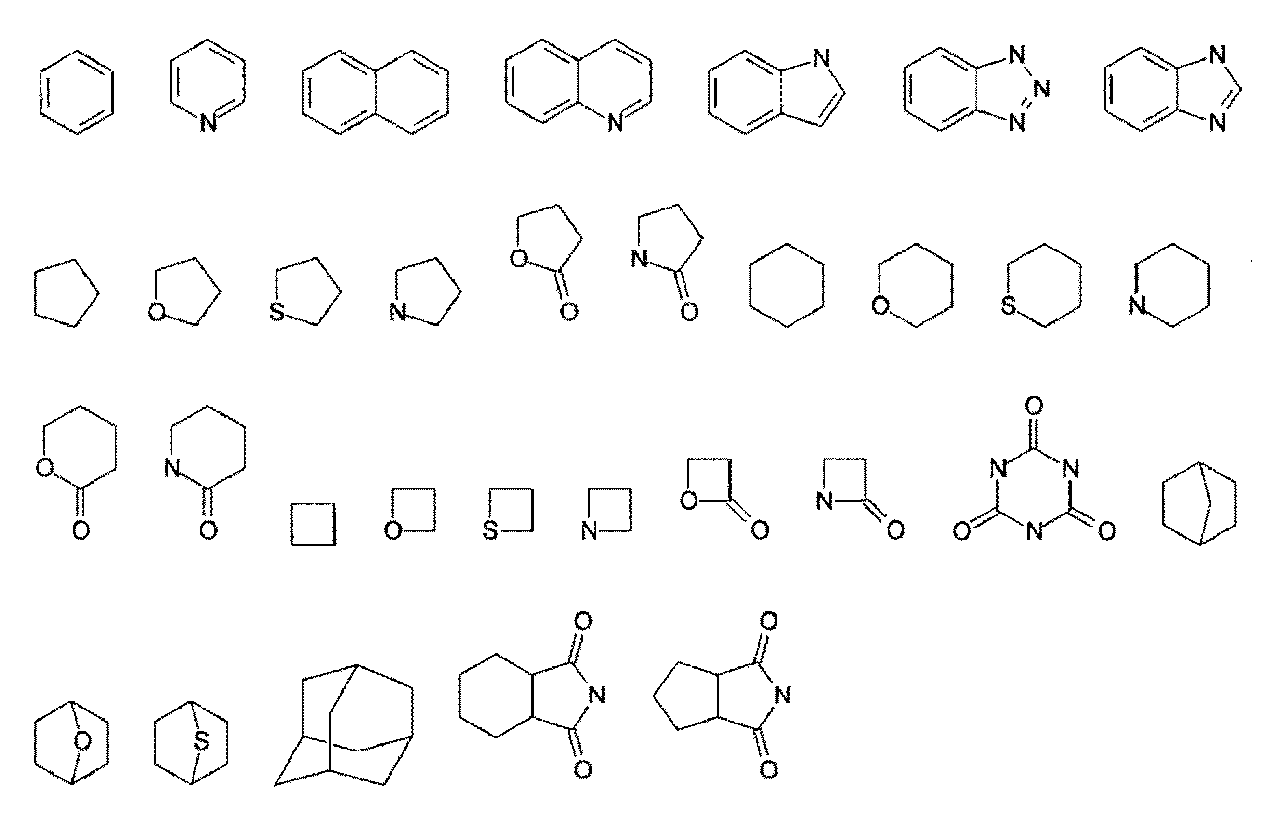
分岐点P1を構成するオルガノポリシロキサン残基としては、例えば、下記の基が挙げられる。ただし、下式におけるR25は、水素原子、アルキル基、アルコキシ基、又は、フェニル基である。R25のアルキル基及びアルコキシ基の炭素数は、1~10が好ましく、1がより好ましい。 Examples of organopolysiloxane residues constituting branch point P1 include the following groups. In the following formula, R25 is a hydrogen atom, an alkyl group, an alkoxy group, or a phenyl group. The number of carbon atoms in the alkyl group and alkoxy group of R25 is preferably 1 to 10, and more preferably 1.

2価以上のL1は、-C(O)N(R26)-、-C(O)O-、-C(O)-、-C(OH)-、-O-、-N(R26)-、-S-、-OC(O)O-、-NHC(O)O-、-NHC(O)N(R26)-、-SO2N(R26)-、-N(R26)SO2-、-Si(R26)2-、-OSi(R26)2-、-Si(CH3)2-Ph-Si(CH3)2-及び2価のオルガノポリシロキサン残基からなる群から選ばれる少なくとも1種の結合(以下、「結合B1」と記す。)を有していてもよい。
ただし、R26は、水素原子、炭素数1~6のアルキル基又はフェニル基であり、Phは、フェニレン基である。R26のアルキル基の炭素数は、化合物1を製造しやすい点から、1~6が好ましく、1~3がより好ましく、1~2が更に好ましい。
The divalent or higher L 1 may have at least one bond (hereinafter referred to as "bond B 1 ") selected from the group consisting of -C(O)N(R 26 )-, -C(O)O-, -C(O)-, -C(OH)-, -O-, -N(R 26 )-, -S-, -OC(O)O-, -NHC(O)O-, -NHC(O)N(R 26 )-, -SO 2 N(R 26 )-, -N(R 26 )SO 2 -, -Si(R 26 ) 2 - , -OSi(R 26 ) 2 -, -Si(CH 3 ) 2 -Ph-Si(CH 3 ) 2 -, and a divalent organopolysiloxane residue.
In the above formula, R 26 is a hydrogen atom, an alkyl group having 1 to 6 carbon atoms, or a phenyl group, and Ph is a phenylene group. From the viewpoint of ease of production of compound 1, the number of carbon atoms in the alkyl group of R 26 is preferably 1 to 6, more preferably 1 to 3, and even more preferably 1 or 2.
2価のオルガノポリシロキサン残基としては、例えば、下式の基が挙げられる。
ただし、下式におけるR27は、水素原子、アルキル基、アルコキシ基、又はフェニル基である。R27のアルキル基及びアルコキシ基の炭素数は、1~10が好ましく、1がより好ましい。
Examples of the divalent organopolysiloxane residue include groups represented by the following formulas.
In the formula below, R 27 is a hydrogen atom, an alkyl group, an alkoxy group, or a phenyl group. The alkyl group and alkoxy group of R 27 preferably have 1 to 10 carbon atoms, and more preferably have 1 carbon atom.

結合B1としては、合成の容易性の点から、-C(O)NR26-、-C(O)-、及び-NR26-からなる群から選ばれる少なくとも1種の結合が好ましく、表面層の耐光性及び耐薬品性が更に優れる点から、-C(O)NR26-又は-C(O)-がより好ましい。 As the bond B1 , from the viewpoint of ease of synthesis, at least one bond selected from the group consisting of -C(O) NR -, -C(O)-, and -NR - is preferable, and from the viewpoint of further improving the light resistance and chemical resistance of the surface layer, -C(O) NR - or -C(O)- is more preferable.
2価のL1としては、R1及びR2に結合する原子が、各々独立に、N、O、S、Si原子、又は、水酸基もしくはオキソ基(=O)を有する炭素原子であることが好ましい。すなわち、R1及びR2に隣接する原子が各々結合B1の構成元素であることが好ましい。2価以上のL1の具体例としては、1個以上の結合B1(例えば、*-B1-**、*-B1-R28-B1-**)が挙げられる。ただし、R28は単結合又は2価の有機基であり、*はR1側の結合手であり、**はR2側の結合手である。 In the divalent L 1 , the atoms bonded to R 1 and R 2 are preferably each independently an N, O, S, or Si atom, or a carbon atom having a hydroxyl group or an oxo group (=O). In other words, it is preferable that the atoms adjacent to R 1 and R 2 are each a constituent element of the bond B 1. Specific examples of L 1 having a valence of two or more include one or more bonds B 1 (for example, *-B 1 -**, *-B 1 -R 28 -B 1 -**). However, R 28 is a single bond or a divalent organic group, * is a bond on the R 1 side, and ** is a bond on the R 2 side.
3価以上のL1は、R1及びR2に結合する原子が、各々独立に、N、O、S、Si、分岐点を構成する炭素原子、又は、水酸基もしくはオキソ基(=O)を有する炭素原子であることが好ましい。すなわち、R1及びR2に隣接する原子が各々結合B1又は分岐点P1の構成元素であることが好ましい。3価以上のL1の具体例としては、1個以上の分岐点P1(例えば{*-P1(-**)x1})、1個以上の分岐点P1と1個以上の結合B1との組み合わせ(例えば、{*-B1-R28-P1(-**)x1}、{*-B1-R28-P1(-R28-B1-**)x1})が挙げられる。ただし、R28は単結合又は2価の有機基であり、*はR1側の結合手であり、**はR2側の結合手である。 In the trivalent or higher L 1 , the atoms bonded to R 1 and R 2 are preferably each independently N, O, S, Si, a carbon atom constituting a branch point, or a carbon atom having a hydroxyl group or an oxo group (=O). In other words, it is preferable that the atoms adjacent to R 1 and R 2 are each a constituent element of the bond B 1 or the branch point P 1. Specific examples of trivalent or higher L 1 include one or more branch points P 1 (for example, {*-P 1 (-**) x1 }), a combination of one or more branch points P 1 and one or more bonds B 1 (for example, {*-B 1 -R 28 -P 1 (-**) x1 }, {*-B 1 -R 28 -P 1 (-R 28 -B 1 -**) x1 }). Here, R28 is a single bond or a divalent organic group, * is a bond on the R1 side, and ** is a bond on the R2 side.
上記R28における2価の有機基としては、例えば、2価の脂肪族炭化水素基(アルキレン基、シクロアルキレン基等)、2価の芳香族炭化水素基(フェニレン基等)が挙げられ、炭素数2以上の炭化水素基の炭素原子-炭素原子間に結合B1を有していてもよい。2価の有機基の炭素数は、1~10が好ましく、1~6がより好ましく、1~4が更に好ましい。 Examples of the divalent organic group in R 28 include divalent aliphatic hydrocarbon groups (alkylene groups, cycloalkylene groups, etc.) and divalent aromatic hydrocarbon groups (phenylene groups, etc.), which may have a bond B1 between carbon atoms of the hydrocarbon group having 2 or more carbon atoms. The number of carbon atoms in the divalent organic group is preferably 1 to 10, more preferably 1 to 6, and even more preferably 1 to 4.
上記L1としては、化合物1を製造しやすい点から、下式(E1)~(E7)のいずれかで表される基が好ましい。 As the above L1 , a group represented by any one of the following formulae (E1) to (E7) is preferable from the viewpoint of ease of production of compound 1.

-E2-N(-E23-)2 ・・・式(E3)
-E3-Z1(-E24-)e4 ・・・式(E4)
-E2-Si(RE3)3-e3(-E25-)e3 ・・・式(E5)
-E1-E26- ・・・式(E6)
-E1-CH(-E22-)-Si(RE3)3-e5(-E25-)e5 ・・・式(E7)
ただし、式(E1)~式(E7)においては、E1、E2又はE3側が式(1)のR1と接続し、E22、E23、E24、E25又はE26側がR2に接続する。
ここで、E1は、単結合、-B5-、-B6-R40-、又は-B6-R40-B5-であって、R40はアルキレン基、又は炭素数2以上のアルキレン基の炭素原子-炭素原子間に-C(O)NRE6-、-C(O)-、-NRE6-又は-O-を有する基であり、B5は、-C(O)NRE6-、-C(O)-、-NRE6-又は-O-であり、B6は-C(O)NRE6-、-C(O)-、又は-NRE6-であり、
E2は、単結合又は-B6-R40-であり、
E3は、E3が結合するZ1における原子が炭素原子の場合、E1であり、E3が結合するZ1における原子が窒素原子の場合、E2であり、
E11は、単結合、-O-、アルキレン基、又は炭素数2以上のアルキレン基の炭素原子-炭素原子間に-C(O)NRE6-、-C(O)-、-NRE6-又は-O-を有する基であり、
E22は、単結合、-B5-、-R40-B6-又は-B5-R40-B6-であり、E22を2以上有する場合、2以上のE22は同一であっても異なっていてもよく、
E23は、単結合又は-R40-B6-であり、2個のE23は同一であっても異なっていてもよく、
E24は、E24が結合するZ1における原子が炭素原子の場合、E22であり、E24が結合するZ1における原子が窒素原子の場合、E23であり、E24を2以上有する場合、2以上のE24は同一であっても異なっていてもよく、
E25は、単結合、又は-R40-B6-であり、E25を2以上有する場合、2以上のE25は同一であっても異なっていてもよく、
E26は、単結合又は-R40-B6-であり、
Z1は、E3が直接結合する炭素原子又は窒素原子を有しかつE24が直接結合する炭素原子又は窒素原子を有する(e4+1)価の環構造を有する基であり、
RE1は、水素原子又はアルキル基であり、RE1を2以上有する場合、2以上のRE1は同一であっても異なっていてもよく、
RE2は、水素原子、水酸基、アルキル基又はアシルオキシ基であり、
RE3は、アルキル基であり、
RE6は、水素原子、炭素数1~6のアルキル基又はフェニル基であり、
e1は0~2の整数であり、e2は0~3の整数であって、e1+e2は1~5の整数であり、
e3は、1~3の整数であり、
e4は、1以上の整数であり、
e5は、1~3の整数である。
なお、e1+e2=x1、e3=x1、e4=x1、e5+1=x1である。
-E 2 -N (-E 23 -) 2 ...Formula (E3)
-E 3 -Z 1 (-E 24 -) e4 ...Formula (E4)
-E 2 -Si(R E3 ) 3-e3 (-E 25 -) e3 ...Formula (E5)
-E 1 -E 26 - ... formula (E6)
-E 1 -CH(-E 22 -)-Si(R E3 ) 3-e5 (-E 25 -) e5 ...Formula (E7)
In the formulae (E1) to (E7), E 1 , E 2 or E 3 is connected to R 1 in the formula (1), and E 22 , E 23 , E 24 , E 25 or E 26 is connected to R Connect to 2 .
Here, E 1 is a single bond, -B 5 -, -B 6 -R 40 -, or -B 6 -R 40 -B 5 -, and R 40 is an alkylene group or a cyclic group having 2 or more carbon atoms. B 5 is a group having —C(O)NR E6 —, —C(O)—, —NR E6 — or —O— between carbon atoms of an alkylene group; E6 -, -C(O)-, -NR E6 - or -O-, B 6 is -C(O)NR E6 -, -C(O)- or -NR E6 -;
E 2 is a single bond or -B 6 -R 40 -;
E3 is E1 when the atom in Z1 to which E3 is bonded is a carbon atom, and is E2 when the atom in Z1 to which E3 is bonded is a nitrogen atom;
E 11 is a single bond, —O—, an alkylene group, or —C(O)NR E6 —, —C(O)—, or —NR E6 — between carbon atoms of an alkylene group having 2 or more carbon atoms. or a group having —O—,
E 22 is a single bond, -B 5 -, -R 40 -B 6 - or -B 5 -R 40 -B 6 -, and when there are two or more E 22 , the two or more E 22 are the same. may be different,
E 23 is a single bond or -R 40 -B 6 -, and two E 23 's may be the same or different;
E 24 is E 22 when the atom in Z 1 to which E 24 is bonded is a carbon atom, and is E 23 when the atom in Z 1 to which E 24 is bonded is a nitrogen atom; E 24 has 2 or more. In the case, two or more E 24 may be the same or different,
E 25 is a single bond or -R 40 -B 6 -, and when two or more E 25's are present, the two or more E 25 's may be the same or different;
E 26 is a single bond or -R 40 -B 6 -;
Z1 is a group having a (e4+1)-valent ring structure having a carbon atom or nitrogen atom to which E3 is directly bonded and a carbon atom or nitrogen atom to which E24 is directly bonded;
R E1 is a hydrogen atom or an alkyl group, and when there are two or more R E1s , the two or more R E1s may be the same or different,
R E2 is a hydrogen atom, a hydroxyl group, an alkyl group or an acyloxy group;
R E3 is an alkyl group;
R E6 is a hydrogen atom, an alkyl group having 1 to 6 carbon atoms, or a phenyl group;
e1 is an integer from 0 to 2, e2 is an integer from 0 to 3, and e1+e2 is an integer from 1 to 5;
e3 is an integer from 1 to 3,
e4 is an integer of 1 or more,
e5 is an integer from 1 to 3.
Note that e1+e2=x1, e3=x1, e4=x1, and e5+1=x1.
R40のアルキレン基の炭素数は、化合物1を製造しやすい点、表面層の摩擦耐久性、耐光性及び耐薬品性が更に優れる点から、1~10が好ましく、1~6がより好ましく、1~4が更に好ましい。ただし、炭素原子-炭素原子間に特定の結合を有する場合のアルキレン基の炭素数の下限値は2である。 The number of carbon atoms in the alkylene group of R 40 is preferably 1 to 10, more preferably 1 to 6, and still more preferably 1 to 4, from the viewpoints of ease of production of compound 1 and of further improving the friction durability, light resistance, and chemical resistance of the surface layer. However, in the case where a specific bond is present between carbon atoms, the lower limit of the number of carbon atoms in the alkylene group is 2.
Z1における環構造としては、上述した環構造が挙げられ、好ましい形態も同様である。なお、Z1における環構造にはE24が直接結合するため、環構造に例えばアルキレン基が連結して、そのアルキレン基にE24が連結することはない。 Examples of the ring structure in Z 1 include the ring structures described above, and the preferred embodiments are also the same. Since E 24 is directly bonded to the ring structure in Z 1 , for example, an alkylene group is not bonded to the ring structure and E 24 is not bonded to the alkylene group.
RE1、RE2又はRE3のアルキル基の炭素数は、化合物1を製造しやすい点から、1~6が好ましく、1~3がより好ましく、1~2が更に好ましい。
RE2のアシルオキシ基のアルキル基部分の炭素数は、化合物1を製造しやすい点から、1~6が好ましく、1~3がより好ましく、1~2が更に好ましい。
e4は、化合物1を製造しやすい点、表面層の摩擦耐久性及び指紋汚れ除去性が更に優れる点から、2~6が好ましく、2~4がより好ましく、2又は3が更に好ましい。
The number of carbon atoms in the alkyl group of R E1 , R E2 or R E3 is preferably 1 to 6, more preferably 1 to 3, and even more preferably 1 or 2, in terms of ease of production of compound 1.
The number of carbon atoms in the alkyl group portion of the acyloxy group of R E2 is preferably 1 to 6, more preferably 1 to 3, and even more preferably 1 or 2, from the viewpoint of ease of production of compound 1.
e4 is preferably 2 to 6, more preferably 2 to 4, and even more preferably 2 or 3, in terms of ease of production of compound 1 and further superior abrasion durability and fingerprint stain removability of the surface layer.
L1の他の形態としては、下式(E11)~(E17)のいずれかで表される基が挙げられる。 Other embodiments of L 1 include groups represented by any of the following formulae (E11) to (E17).

-E2-N(-E23-EG)2 ・・・式(E13)
-E3-Z1(-E24-EG)e4 ・・・式(E14)
-E2-Si(RE3)3-e3(-E25-EG)e3 ・・・式(E15)
-E1-E26-EG ・・・式(E16)
-E1-CH(-E22-)-Si(RE3)3-e5(-E25-EG)e5 ・・・式(E17)
-E 2 -N (-E 23 -E G ) 2 ...Formula (E13)
-E 3 -Z 1 (-E 24 -E G ) e4 ...Formula (E14)
-E 2 -Si(R E3 ) 3-e3 (-E 25 -E G ) e3 ...Formula (E15)
-E 1 -E 26 -E G ...Formula (E16)
-E 1 -CH(-E 22 -)-Si(R E3 ) 3-e5 (-E 25 -E G ) e5 ...Formula (E17)
ただし、式(E11)~式(E17)においては、E1、E2又はE3側が式(1)のR1と接続し、E22、E23、E24、E25又はE26側がR2に接続する。EGは、下記式(EG)であり、L1が有する2以上のEGは同一であっても異なっていてもよい。G以外の符号は、式(E1)~式(E7)における符号と同じである。
-Si(R23)3-k(-E3-)k ・・・式(EG)
ただし、式(EG)において、Si側がE22、E23、E24、E25又はE26に接続し、E3側がR2に接続する。R23は、アルキル基である。E3は、単結合、又は-R45-B6-であって、R45は、アルキレン基、又は炭素数2以上のアルキレン基の炭素原子-炭素原子間に-C(O)NR46-、-C(O)-、-NR46-又は-O-を有する基、又は-(OSi(R24)2)p-O-であり、2以上のE3は同一であっても異なっていてもよい。kは、2又は3である。R46は、水素原子、炭素数1~6のアルキル基又はフェニル基である。R24は、アルキル基、フェニル基又はアルコキシ基であり、2個のR24は同一であっても異なっていてもよい。pは、0~5の整数であり、pが2以上の場合、2以上の(OSi(R24)2)は同一であっても異なっていてもよい。
In formulas (E11) to (E17), E 1 , E 2 or E 3 is connected to R 1 in formula (1), and E 22 , E 23 , E 24 , E 25 or E 26 is connected to R 2. E G is the following formula (E G ), and two or more E Gs in L 1 may be the same or different. The symbols other than G are the same as those in formulas (E1) to (E7).
-Si(R 23 ) 3-k (-E 3 -) k ...Formula ( EG )
In the formula (E G ), the Si side is connected to E 22 , E 23 , E 24 , E 25 or E 26 , and the E 3 side is connected to R 2. R 23 is an alkyl group. E 3 is a single bond or -R 45 -B 6 -, R 45 is an alkylene group, or a group having -C(O)NR 46 -, -C(O)-, -NR 46 - or -O- between carbon atoms of an alkylene group having 2 or more carbon atoms, or -(OSi(R 24 ) 2 ) p -O-, and two or more E 3s may be the same or different. k is 2 or 3. R 46 is a hydrogen atom, an alkyl group having 1 to 6 carbon atoms or a phenyl group. R 24 is an alkyl group, a phenyl group or an alkoxy group, and two R 24s may be the same or different. p is an integer of 0 to 5, and when p is 2 or greater, the two or more (OSi(R 24 ) 2 ) may be the same or different.
E3のアルキレン基の炭素数は、化合物1を製造しやすい点、及び表面層の摩擦耐久性、耐光性及び耐薬品性が更に優れる点から、1~10が好ましく、1~6がより好ましく、1~4が更に好ましい。ただし、炭素原子-炭素原子間に特定の結合を有する場合のアルキレン基の炭素数の下限値は2である。
R23のアルキル基の炭素数は、化合物1を製造しやすい点から、1~6が好ましく、1~3がより好ましく、1~2が更に好ましい。
R24のアルキル基の炭素数は、化合物1を製造しやすい点から、1~6が好ましく、1~3がより好ましく、1~2が更に好ましい。
R24のアルコキシ基の炭素数は、化合物1の保存安定性に優れる点から、1~6が好ましく、1~3がより好ましく、1~2が更に好ましい。
pは、0又は1が好ましい。
The number of carbon atoms in the alkylene group of E3 is preferably 1 to 10, more preferably 1 to 6, and still more preferably 1 to 4, from the viewpoints of ease of production of compound 1 and of further improving the friction durability, light resistance, and chemical resistance of the surface layer. However, in the case where a specific bond is present between carbon atoms, the lower limit of the number of carbon atoms in the alkylene group is 2.
From the viewpoint of ease of production of compound 1, the number of carbon atoms in the alkyl group of R 23 is preferably 1 to 6, more preferably 1 to 3, and even more preferably 1 or 2.
From the viewpoint of ease of production of compound 1, the number of carbon atoms in the alkyl group of R 24 is preferably 1 to 6, more preferably 1 to 3, and even more preferably 1 or 2.
The number of carbon atoms in the alkoxy group of R 24 is preferably 1 to 6, more preferably 1 to 3, and even more preferably 1 or 2, in terms of excellent storage stability of compound 1.
p is preferably 0 or 1.
R2は、単結合、アルキレン基、又は、エーテル性酸素原子を有するアルキレン基である。
R2が複数ある場合において、複数あるR2は互いに同一であっても異なっていてもよい。
R2におけるアルキレン基及びエーテル性酸素原子を有するアルキレン基の炭素数は、1~20が好ましく、1~15がより好ましく、1~11が更に好ましい。アルキレン基又はエーテル性酸素原子を有するアルキレン基の炭素数が3以上である場合、炭素数3以上のアルキレン基又はエーテル性酸素原子を有するアルキレン基の炭素数は、直鎖であってもよく、分岐又は環構造を有していてもよい。
エーテル性酸素原子を有するアルキレン基において、L1に結合する原子がエーテル性酸素原子でもよく、炭素原子-炭素原子間にエーテル性酸素原子を有してもよい。
R2 is a single bond, an alkylene group, or an alkylene group having an ethereal oxygen atom.
When there are a plurality of R2's , the plurality of R2 's may be the same or different.
The number of carbon atoms in the alkylene group and the alkylene group having an etheric oxygen atom in R2 is preferably 1 to 20, more preferably 1 to 15, and still more preferably 1 to 11. When the number of carbon atoms in the alkylene group or the alkylene group having an etheric oxygen atom is 3 or more, the alkylene group having 3 or more carbon atoms or the alkylene group having an etheric oxygen atom may be linear, or may have a branched or cyclic structure.
In the alkylene group having an ethereal oxygen atom, the atom bonded to L 1 may be an ethereal oxygen atom, or an ethereal oxygen atom may be present between carbon atoms.
R2は、下式(H1)で表す基であることが好ましい。
*-(O)a4-(Rg11O)a5-Rg12-** ・・・(H1)
ただし、
Rg11は、炭素数1~12のアルキレン基であり、Rg11が複数ある場合、複数あるRg11は互いに同一であっても異なっていてもよく、
Rg12は、炭素数1~12のアルキレン基であり、
a4は0又は1であり、
a5は0以上の整数であり、
*はL1に結合する結合手であり、
**はT1に結合する結合手である。
R2 is preferably a group represented by the following formula (H1).
*-(O) a4 -(R g11 O) a5 -R g12 -** ...(H1)
however,
R g11 is an alkylene group having 1 to 12 carbon atoms, and when there are multiple R g11 , the multiple R g11 may be the same or different from each other,
R g12 is an alkylene group having 1 to 12 carbon atoms;
a4 is 0 or 1;
a5 is an integer of 0 or more,
* is a bond bonded to L1 ,
** is a bond binding to T1 .
a4が0の場合において、結合手*を有する原子は、炭素原子であり、a4が1の場合において、結合手*を有する原子は、酸素原子である。化合物1において、a4は、0又は1のいずれでもよく、合成の容易性等の点から適宜選択すればよい。
a5はRg11Oの繰り返し数であり、表面層としての耐久性等の点から、0~6が好ましく、0~3がより好ましく、0~1が更に好ましい。
Rg11のアルキレン基は、炭素数1~12の直鎖又は分岐を有するアルキレン基であればよく、炭素数1~6のアルキレン基が好ましく、炭素数1~3のアルキレン基がより好ましい。また、当該アルキレン基は直鎖アルキレン基が好ましい。
Rg12のアルキレン基は、炭素数1~12の直鎖又は分岐を有するアルキレン基であればよく、炭素数2~6のアルキレン基が好ましく、炭素数2~3のアルキレン基がより好ましい。また、当該アルキレン基は直鎖アルキレン基が好ましい。
When a4 is 0, the atom having the bond * is a carbon atom, and when a4 is 1, the atom having the bond * is an oxygen atom. In Compound 1, a4 may be either 0 or 1, and may be appropriately selected from the viewpoint of ease of synthesis, etc.
a5 is the number of repetitions of R g11 O, and is preferably 0 to 6, more preferably 0 to 3, and even more preferably 0 to 1, from the standpoint of durability as a surface layer, etc.
The alkylene group of R g11 may be a linear or branched alkylene group having 1 to 12 carbon atoms, preferably an alkylene group having 1 to 6 carbon atoms, and more preferably an alkylene group having 1 to 3 carbon atoms. The alkylene group is preferably a linear alkylene group.
The alkylene group of R g12 may be a linear or branched alkylene group having 1 to 12 carbon atoms, preferably an alkylene group having 2 to 6 carbon atoms, and more preferably an alkylene group having 2 to 3 carbon atoms. The alkylene group is preferably a linear alkylene group.
L1が、単結合である場合、-R1-L1-(R2-T1)x1は、下記式(RL-1)で表すことができる。
*-R43-(OR44)y4-T1 ・・・式(RL-1)
ただし、
R43は、単結合又は炭素数1~6のアルキレン基であり、
R44は、炭素数1~6のアルキレン基であり、R44が複数ある場合、複数あるR44は、互いに同一であっても異なっていてもよく、
y4は、0以上の整数であり、
*は、式(1)のRf1と結合する結合手である。
ただし、R43が単結合である場合、y4は1以上の整数である。
なお、R43が単結合である場合、化合物1は、(OR44)y4の末端のOが、式(1)のRf1に直接結合する構造を有する。
また、y4が0である場合、化合物1は、R43がT1に直接結合する構造を有する。
When L 1 is a single bond, -R 1 -L 1 -(R 2 -T 1 ) x1 can be represented by the following formula (RL-1).
*-R 43 -(OR 44 ) y4 -T 1 ...Formula (RL-1)
however,
R 43 is a single bond or an alkylene group having 1 to 6 carbon atoms;
R 44 is an alkylene group having 1 to 6 carbon atoms, and when there are a plurality of R 44s , the plurality of R 44s may be the same or different from each other,
y4 is an integer of 0 or more,
* represents a bond bonded to R f1 in formula (1).
However, when R 43 is a single bond, y4 is an integer of 1 or more.
When R 43 is a single bond, compound 1 has a structure in which the terminal O of (OR 44 ) y4 is directly bonded to R f1 of formula (1).
When y4 is 0, compound 1 has a structure in which R43 is directly bonded to T1 .
T1は反応性基であり、T1が有する反応性に起因して、化合物1は種々の機能を発現する。当該機能としては、例えば、基材表面との密着性を向上する機能、化合物1に光硬化性や熱硬化性を付与する機能、化合物1に酸性アルカリ性等を付与する機能、化合物1の特定の溶媒に対する溶解性を調整する機能、更に、他の化合物を合成する際の前駆体しての機能等が挙げられる。 T 1 is a reactive group, and due to the reactivity of T 1 , compound 1 exhibits various functions. Examples of the functions include a function of improving adhesion to a substrate surface, a function of imparting photocurability or thermosetting property to compound 1, a function of imparting acidity/alkalinity to compound 1, a function of adjusting the solubility of compound 1 in a specific solvent, and a function as a precursor when synthesizing other compounds.
T1の具体例としては、-Ar、-SR10、-NOR10、-C(=O)R10、-N(R10)2、-N+(R10)3X3、-C≡N、-C(=NR10)-R10、-N+≡N、-N=NR10、-C(=O)OR10、-C(=O)OX2、-C(=O)X4、-C(=O)OC(=O)R10、-SO2R10、-SO3H、-SO3X2、-O-P(=O)(-OR10)2、-O-P(=O)(-OR10)(-OX2)、-N=C=O、-SiRa1 z1Ra11 3-z1、-C(R10)=C(R10)2、-C≡C(R10)、-C(=O)N(R10)2、-N(R10)C(=O)R10、-Si(R10)2-O-Si(R10)3、-NH-C(=O)R10、-C(=O)NHR10、-I、下記で表される基が挙げられる。 Specific examples of T 1 include -Ar, -SR 10 , -NOR 10 , -C(=O)R 10 , -N(R 10 ) 2 , -N + (R 10 ) 3 X 3 , -C≡ N, -C(=NR 10 )-R 10 , -N + ≡N, -N=NR 10 , -C(=O)OR 10 , -C(=O)OX 2 , -C(=O)X 4 , -C(=O)OC(=O)R 10 , -SO 2 R 10 , -SO 3 H, -SO 3 X 2 , -O-P(=O) (-OR 10 ) 2 , -O -P(=O)(-OR 10 )(-OX 2 ), -N=C=O, -SiR a1 z1 R a11 3-z1 , -C(R 10 )=C(R 10 ) 2 , -C≡C(R 10 ), -C(=O)N( R 10 ) 2 , -N(R 10 )C(═O)R 10 , -Si(R 10 ) 2 -O-Si(R 10 ) 3 , -NH-C(═O)R 10 , -C( ═O) NHR 10 , —I, and groups represented by the following formulae.

ただし、
R10は、水素原子、置換基を有していてもよい炭素数1~6のアルキル基又は置換基を有していてもよい炭素数1~6のフルオロアルキル基、置換基を有していてもよいアリール基であり、
Arは、置換基を有していてもよいアリール基であり、
X2は、アルカリ金属イオン又はアンモニウムイオンであり、
X3は、ハロゲン化物イオンであり、
X4は、ハロゲン原子であり、
Ra1は、加水分解性基又は水酸基であり、
Ra11は、炭化水素基であり、
z1は、1~3の整数であり、
R10、Ra1又はRa11が複数ある場合において、当該複数あるR10、Ra1又はRa11は、互いに同一であっても異なっていてもよい。
however,
R 10 is a hydrogen atom, an optionally substituted alkyl group having 1 to 6 carbon atoms, an optionally substituted fluoroalkyl group having 1 to 6 carbon atoms, or an optionally substituted aryl group;
Ar is an optionally substituted aryl group,
X2 is an alkali metal ion or an ammonium ion;
X3 is a halide ion;
X4 is a halogen atom;
R a1 is a hydrolyzable group or a hydroxyl group;
R a11 is a hydrocarbon group;
z1 is an integer from 1 to 3,
When there are a plurality of R 10 , R a1 or R a11 , the plurality of R 10 , R a1 or R a11 may be the same or different.
R10におけるフルオロアルキル基は、炭素数1~6であり、炭素数1~3が好ましい。当該フルオロアルキル基は他の置換基を有していてもよい。T1としてフルオロアルキル基を有する化合物1は、フッ素含有割合の高い化合物となり、低屈折率、低誘電率、撥水・撥油性、耐熱性、耐薬品性、化学的安定性、透明性等の諸特性に優れている。フルオロアルキル基が有していてもよい置換基としては、塩素原子等のハロゲン原子、及び、後述の機能性付与基Tとして例示されているものと同様のものが挙げられる。
Ar及びR10におけるアリール基は、フェニル基、ナフチル基等が挙げられ、更に置換基を有していてもよい。アリール基が有していてもよい置換基としては、フッ素原子、塩素原子等のハロゲン原子、炭素数1~6のアルキル基、及び、機能性付与基Tとして例示されているものと同様のものが挙げられる。
R10におけるアルキル基は、炭素数1~6であり、炭素数1~3が好ましい。当該アルキル基は他の置換基を有していてもよい。アルキル基が有していてもよい置換基としては、塩素原子等のハロゲン原子、及び、後述の機能性付与基Tとして例示されているものと同様のものが挙げられる。
The fluoroalkyl group in R 10 has 1 to 6 carbon atoms, preferably 1 to 3 carbon atoms. The fluoroalkyl group may have other substituents. Compound 1 having a fluoroalkyl group as T 1 is a compound with a high fluorine content, and is excellent in various properties such as low refractive index, low dielectric constant, water and oil repellency, heat resistance, chemical resistance, chemical stability, and transparency. Examples of the substituent that the fluoroalkyl group may have include halogen atoms such as chlorine atoms, and the same as those exemplified as the functionality-imparting group T described below.
The aryl group in Ar and R 10 includes a phenyl group, a naphthyl group, etc., which may further have a substituent. Examples of the substituent that the aryl group may have include a halogen atom such as a fluorine atom or a chlorine atom, an alkyl group having 1 to 6 carbon atoms, and the same as those exemplified as the functionality-imparting group T.
The alkyl group in R 10 has 1 to 6 carbon atoms, and preferably 1 to 3 carbon atoms. The alkyl group may have another substituent. Examples of the substituent that the alkyl group may have include a halogen atom such as a chlorine atom, and the same as those exemplified as the functionality-imparting group T described later.
反応性基T1としてヒドロキシ基、N-ヒドロキシ基、アルデヒド基、ケトン基、アミノ基、4級アンモニウム基、ニトリル基、イミノ基、ジアゾ基、カルボキシ基、カルボン酸塩、酸無水物基、スルホ基、スルホン酸塩、リン酸基、リン酸塩(以下、これらの基を「機能性付与基T」ともいう。)を有する化合物1は、当該機能性付与基Tにより、酸性、アルカリ性、親水性等の各種特性が付与されており、例えば、特定の溶媒に対する溶解性の向上や、特定の基材に対する密着性の向上等の機能を付与する。4級アンモニウム基の対イオンとしては、ハロゲン化物イオン等が挙げられる。カルボン酸塩、スルホン酸塩、リン酸塩の対イオンとしては、アルカリ金属イオン、アンモニウムイオン等が挙げられる。
反応性基T1として炭素-炭素二重結合を有する基を有する化合物1は、光開始剤等と組み合わせることにより、光硬化性組成物を調製でき、当該組成物により得られる硬化塗膜は、撥水撥油性とハードコート性とを兼ね備える。炭素-炭素二重結合を有する基としては、アクリロイル基、メタクリロイル基、ビニル基、アリル基、アクリロイルオキシ基、メタクリロイルオキシ基、オレフィン等が挙げられる。
また、反応性基T1としてイソシアネート基、エポキシ基、グリシジル基、オキセタニル基、メルカプト基を有する化合物1は、エポキシ硬化剤と組み合わせることにより熱硬化性又は光硬化性組成物を調製でき、当該組成物により得られる硬化塗膜は、撥水撥油性とハードコート性とを兼ね備える。
反応性基T1におけるアミド結合、エステル結合、エーテル結合、チオエーテル結合、シロキサン結合、ウレア結合は、T1に含まれる、アルキル基、フルオロアルキル基、アリール基、ヘテロアリール基等を連結する結合である。これらの結合を介して更に他の機能性付与基を有していてもよい。
Compound 1 having a hydroxy group, N-hydroxy group, aldehyde group, ketone group, amino group, quaternary ammonium group, nitrile group, imino group, diazo group, carboxy group, carboxylate, acid anhydride group, sulfo group, sulfonate, phosphoric acid group, phosphate as reactive group T 1 (hereinafter, these groups are also referred to as "functionality-imparting group T") is imparted with various properties such as acidity, alkalinity, hydrophilicity, etc. by the functionality-imparting group T, and imparts functions such as improved solubility in a specific solvent and improved adhesion to a specific substrate. Examples of counter ions of the quaternary ammonium group include halide ions. Examples of counter ions of the carboxylate, sulfonate, and phosphate include alkali metal ions and ammonium ions.
A compound 1 having a group having a carbon-carbon double bond as the reactive group T1 can be combined with a photoinitiator or the like to prepare a photocurable composition, and a cured coating film obtained from the composition has both water and oil repellency and hard coat properties. Examples of the group having a carbon-carbon double bond include an acryloyl group, a methacryloyl group, a vinyl group, an allyl group, an acryloyloxy group, a methacryloyloxy group, an olefin, and the like.
Furthermore, compound 1 having an isocyanate group, an epoxy group, a glycidyl group, an oxetanyl group, or a mercapto group as the reactive group T1 can be combined with an epoxy curing agent to prepare a thermosetting or photocurable composition, and the cured coating film obtained from the composition has both water and oil repellency and hard coat properties.
The amide bond, ester bond, ether bond, thioether bond, siloxane bond, and urea bond in the reactive group T1 are bonds that connect the alkyl group, fluoroalkyl group, aryl group, heteroaryl group, and the like contained in T1 . Other functionality-imparting groups may be further provided via these bonds.
化合物1の反応性基T1としては、合成や化学的安定性、基材との密着性等の点から、ヒドロキシ基、アミノ基、又は、炭素-炭素二重結合を有する基が好ましい。また、炭素-炭素二重結合を有する基の中でも、アクリロイル基、メタクリロイル基、ビニル基、アリル基、又は、オレフィンが好ましい。 As the reactive group T1 of the compound 1, a hydroxy group, an amino group, or a group having a carbon-carbon double bond is preferred from the viewpoints of synthesis, chemical stability, adhesion to a substrate, etc. Among the groups having a carbon-carbon double bond, an acryloyl group, a methacryloyl group, a vinyl group, an allyl group, or an olefin is preferred.
また、化合物1を摩擦耐久性等の耐久性に優れた表面層を形成するための表面処理剤として用いる場合、T1は反応性シリル基を有する基であることが好ましい。反応性シリル基を有する基としては、下記式(2)で表される基が好ましい。 In addition, when compound 1 is used as a surface treatment agent for forming a surface layer having excellent durability such as friction resistance, T1 is preferably a group having a reactive silyl group. As the group having a reactive silyl group, a group represented by the following formula (2) is preferable.
-SiRa1 z1Ra11 3-z1 ・・・式(2) -SiR a1 z1 R a11 3-z1 ...Formula (2)
式(2)中、
Ra1は、加水分解性基又は水酸基であり、
Ra11は、炭化水素基であり、
z1は、1~3の整数であり、
Ra1、又は、Ra11が複数ある場合、当該複数あるRa1、又は、Ra11は各々同一であっても異なっていてもよい。
In formula (2),
R a1 is a hydrolyzable group or a hydroxyl group;
R a11 is a hydrocarbon group;
z1 is an integer from 1 to 3,
When there are a plurality of R a1 or R a11 , the plurality of R a1 or R a11 may be the same or different.
Ra1が水酸基の場合は、Si原子と共にシラノール(Si-OH)基を構成する。また、加水分解性基は加水分解反応によって水酸基となる基である。シラノール基は、更に分子間で反応してSi-O-Si結合を形成する。また、シラノール基は、基材の表面の水酸基(基材-OH)と脱水縮合反応して、化学結合(基材-O-Si)を形成する。化合物1は、T1を1以上有することにより、表面層形成後の摩擦耐久性に優れる。 When R a1 is a hydroxyl group, it constitutes a silanol (Si-OH) group together with the Si atom. The hydrolyzable group is a group that becomes a hydroxyl group by hydrolysis. The silanol group further reacts with other molecules to form a Si-O-Si bond. The silanol group also undergoes a dehydration condensation reaction with a hydroxyl group (substrate-OH) on the surface of the substrate to form a chemical bond (substrate-O-Si). By having one or more T 1 , compound 1 has excellent friction durability after the formation of the surface layer.
Ra1の加水分解性基としては、アルコキシ基、アリールオキシ基、ハロゲン原子、アシル基、アシルオキシ基、イソシアナート基(-NCO)等が挙げられる。アルコキシ基としては、炭素数1~4のアルコキシ基が好ましい。アシル基としては、炭素数1~6のアシル基が好ましい。アシルオキシ基としては、炭素数1~6のアシルオキシ基が好ましい。 Examples of the hydrolyzable group for R a1 include an alkoxy group, an aryloxy group, a halogen atom, an acyl group, an acyloxy group, and an isocyanate group (-NCO). The alkoxy group is preferably an alkoxy group having 1 to 4 carbon atoms. The acyl group is preferably an acyl group having 1 to 6 carbon atoms. The acyloxy group is preferably an acyloxy group having 1 to 6 carbon atoms.
Ra1は、合成の容易性の点から、炭素数1~4のアルコキシ基又はハロゲン原子が好ましい。Ra1におけるアルコキシ基は、化合物1の保存安定性に優れ、反応時のアウトガスが抑制される点から、炭素数1~4のアルコキシ基が好ましく、長期の保存安定性の点からはエトキシ基がより好ましく、加水分解反応時間を短時間にする点からはメトキシ基がより好ましい。又はロゲン原子としては、塩素原子が特に好ましい。 From the viewpoint of ease of synthesis, R a1 is preferably an alkoxy group having 1 to 4 carbon atoms or a halogen atom. The alkoxy group in R a1 is preferably an alkoxy group having 1 to 4 carbon atoms from the viewpoints of excellent storage stability of compound 1 and suppression of outgassing during the reaction, more preferably an ethoxy group from the viewpoint of long-term storage stability, and more preferably a methoxy group from the viewpoint of shortening the hydrolysis reaction time. Alternatively, the halogen atom is particularly preferably a chlorine atom.
Ra11は、炭化水素基である。炭化水素基としては、アルキル基、シクロアルキル基、アルケニル基、アリル基等が挙げられ、合成の容易性等の点から、アルキル基が好ましい。また、合成の容易性等の点から、炭化水素基の炭素数は、1~6が好ましく、1~3がより好ましく、1~2が更に好ましい。 R a11 is a hydrocarbon group. Examples of the hydrocarbon group include an alkyl group, a cycloalkyl group, an alkenyl group, and an allyl group. From the viewpoint of ease of synthesis, an alkyl group is preferable. From the viewpoint of ease of synthesis, the number of carbon atoms in the hydrocarbon group is preferably 1 to 6, more preferably 1 to 3, and even more preferably 1 to 2.
式(2)で表される基における、Ra1の数z1は、1~3であればよく、基材との密着性の点からは、2又は3が好ましく、3がより好ましい。
式(2)で表される基の具体例としては、-Si(OCH3)3、-SiCH3(OCH3)2、-Si(OCH2CH3)3、-SiCl3、-Si(OCOCH3)3、-Si(NCO)3が挙げられる。製造における取扱いやすさの点から、-Si(OCH3)3が好ましい。
In the group represented by formula (2), the number z1 of R a1 may be from 1 to 3, and from the viewpoint of adhesion to a substrate, it is preferably 2 or 3, and more preferably 3.
Specific examples of the group represented by formula (2) include -Si( OCH3 ) 3 , -SiCH3 ( OCH3 ) 2 , -Si( OCH2CH3 ) 3 , -SiCl3 , -Si( OCOCH3 ) 3 , and -Si(NCO) 3 . From the viewpoint of ease of handling in production, -Si( OCH3 ) 3 is preferred.
化合物1の1分子中のT1の数x1は、1~10であればよく、合成の容易性や、化合物1の取り扱いの容易性等の点から、x1は1~6が好ましく、1~3がより好ましい。化合物1の1分子中に2個以上のT1がある場合において、当該T1は、互いに同一の構造であってもよく、異なる構造であってもよい。 The number x1 of T1 in one molecule of compound 1 may be 1 to 10, and from the viewpoints of ease of synthesis and ease of handling of compound 1, x1 is preferably 1 to 6, and more preferably 1 to 3. When there are two or more T1s in one molecule of compound 1, the T1s may have the same structure or different structures.
T1が反応性シリル基を有さない場合の具体例としては、以下の構造が挙げられる。ただし、式中のRaは、置換基を有していてもよいアルキル基、フルオロアルキル基、又はアリール基を示し、Rbは置換基を有していてもよいフルオロアルキル基、又はアリール基を示し、Rは、置換基を有していてもよい炭素数1~6のアルキル基又は置換基を有していてもよい炭素数1~6のフルオロアルキル基を示し、Lは、置換基を有していてもよいアリール基又は置換基を有していてもよいフルオロアリール基を示し、cは0~3の整数を示し、*は結合手を示す。 Specific examples of when T1 does not have a reactive silyl group include the following structures, in which R a represents an alkyl group, a fluoroalkyl group, or an aryl group which may have a substituent, R b represents a fluoroalkyl group or an aryl group which may have a substituent, R represents an alkyl group having 1 to 6 carbon atoms which may have a substituent or a fluoroalkyl group having 1 to 6 carbon atoms which may have a substituent, L represents an aryl group which may have a substituent or a fluoroaryl group which may have a substituent, c represents an integer of 0 to 3, and * represents a bond.

またL1-(R2-T1)x1の具体例としては、下記式で挙げられる基等が挙げられる。 Specific examples of L 1 -(R 2 -T 1 ) x1 include groups represented by the following formulae.

式(1)における-R1-L1-(R2-T1)x1は、本発明の効果がより優れる点から、フッ素原子を含まないことが好ましい。 In terms of obtaining superior effects of the present invention, it is preferred that -R 1 -L 1 -(R 2 -T 1 ) x1 in formula (1) does not contain a fluorine atom.
化合物1の具体例としては、例えば下記表で表される化合物が挙げられる。なお、下記表中、例えば「No.1」の化合物は、上記式(1)のRf1がCF3、R1が(CH2)a、L1がC(=O)NH、R2が(CH2)C、T1がSi(OMe)3、x1が1であり、R1における(CH2)aのaが0~20であり、R2における(CH2)CのCが1~20の化合物を意味する。 Specific examples of compound 1 include the compounds shown in the table below. In the table, for example, compound "No. 1" refers to a compound in which Rf1 in formula (1) is CF3 , R1 is ( CH2 ) a , L1 is C(=O)NH, R2 is ( CH2 ) C , T1 is Si(OMe) 3 , x1 is 1, a in ( CH2 ) a in R1 is 0 to 20, and C in ( CH2 ) C in R2 is 1 to 20.


<化合物1の物性等>
化合物1の数平均分子量(Mn)は、500~20,000が好ましく、600~18,000がより好ましく、700~15,000が更に好ましい。
Mnが500以上であれば、表面層の摩擦耐久性がより優れる。Mnが20,000以下であれば、粘性を適切な範囲内に調節しやすく、また溶解性が向上するので、成膜時のハンドリング性が優れる。
<Physical Properties of Compound 1>
The number average molecular weight (Mn) of compound 1 is preferably from 500 to 20,000, more preferably from 600 to 18,000, and even more preferably from 700 to 15,000.
When Mn is 500 or more, the friction durability of the surface layer is superior. When Mn is 20,000 or less, the viscosity can be easily adjusted within an appropriate range, and the solubility is improved, resulting in superior handling properties during film formation.
[表面処理剤]
本発明の表面処理剤(以下、「本表面処理剤」ともいう。)は、化合物1を含む。
本表面処理剤は、表面層が指で繰り返し摩擦されても撥水性及び撥油性が低下しにくい性能、並びに、拭き取りによって表面層に付着した指紋を容易に除去できる性能(指紋汚れ除去性)が長期間維持されることが求められる用途、例えば、タッチパネルの指で触れる面を構成する部材、メガネレンズ、ウェアラブル端末のディスプレイの表面処理剤として好適に用いられる。
また、本表面処理剤に、耐滑り性に優れるので、スマートフォン、タブレット端末等の携帯デバイスにおける、ガラスコーティングされ筐体にも好適に用いられる。
本表面処理剤は、防汚性コーティング剤又は防水性コーティング剤にも好適に用いられる。
[Surface treatment agent]
The surface treatment agent of the present invention (hereinafter also referred to as “the present surface treatment agent”) contains Compound 1.
The present surface treatment agent is preferably used as a surface treatment agent for applications requiring a surface layer that is resistant to deterioration in water repellency and oil repellency even when repeatedly rubbed with fingers, and a surface layer that is easily removable from fingerprints by wiping (fingerprint stain removability) that must be maintained for a long period of time, such as for members that constitute the surfaces of touch panels that are touched by fingers, eyeglass lenses, and displays of wearable devices.
In addition, since the present surface treatment agent has excellent slip resistance, it can be suitably used for glass-coated housings of mobile devices such as smartphones and tablet terminals.
The present surface treatment agent is also suitable for use as an antifouling coating agent or a waterproof coating agent.
本表面処理剤は、更に液状媒体を含んでいてもよい。以下の説明において、液状媒体を含む本表面処理剤をコーティング液という場合がある。
コーティング液は、液状であればよく、溶液であってもよく、分散液であってもよい。コーティング液は、化合物1を含んでいればよく、化合物1の製造工程で生成した副生物等の不純物を含んでもよい。
化合物1の濃度は、コーティング液中、0.001~40質量%が好ましく、0.01~20質量%がより好ましく、0.1~10質量%が更に好ましい。
The present surface treatment agent may further contain a liquid medium. In the following description, the present surface treatment agent containing a liquid medium may be referred to as a coating liquid.
The coating liquid may be in a liquid state, and may be a solution or a dispersion. The coating liquid may contain the compound 1, and may contain impurities such as by-products generated in the manufacturing process of the compound 1.
The concentration of Compound 1 in the coating liquid is preferably from 0.001 to 40% by mass, more preferably from 0.01 to 20% by mass, and even more preferably from 0.1 to 10% by mass.
液状媒体としては、有機溶媒が好ましい。有機溶媒は、含フッ素系有機溶媒であってもよく、非フッ素系有機溶媒であってもよく、両溶媒を含んでもよい。
含フッ素系有機溶媒の具体例としては、フッ素化アルカン、フッ素化芳香族化合物、フルオロアルキルエーテル、フッ素化アルキルアミン、フルオロアルコール、ハイドロフルオロオレフィン(HFO)が挙げられる。
フッ素化アルカンとしては、炭素数4~8の化合物が好ましい。市販品の具体例としては、C6F13H(AGC社製、アサヒクリン(登録商標)AC-2000)、C6F13C2H5(AGC社製、アサヒクリン(登録商標)AC-6000)、C2F5CHFCHFCF3(ケマーズ社製、バートレル(登録商標)XF)が挙げられる。
フッ素化芳香族化合物の具体例としては、ヘキサフルオロベンゼン、トリフルオロメチルベンゼン、ペルフルオロトルエン、ビス(トリフルオロメチル)ベンゼンが挙げられる。
フルオロアルキルエーテルとしては、炭素数4~12の化合物が好ましい。市販品の具体例としては、CF3CH2OCF2CF2H(AGC社製、アサヒクリン(登録商標)AE-3000)、C4F9OCH3(3M社製、ノベック(登録商標)7100)、C4F9OC2H5(3M社製、ノベック(登録商標)7200)、C2F5CF(OCH3)C3F7(3M社製、ノベック(登録商標)7300)が挙げられる。
フッ素化アルキルアミンの具体例としては、ペルフルオロトリプロピルアミン、ペルフルオロトリブチルアミンが挙げられる。
フルオロアルコールの具体例としては、2,2,3,3-テトラフルオロプロパノール、2,2,2-トリフルオロエタノール、ヘキサフルオロイソプロパノールが挙げられる。
HFOの具体例としては、1-クロロ-2,3,3-トリフルオロ-1-プロペン(HCFO-1233yd)(AGC社製、アモレア(登録商標)AS-300))が挙げられる。
非フッ素系有機溶媒としては、水素原子及び炭素原子のみからなる化合物と、水素原子、炭素原子及び酸素原子のみからなる化合物が好ましく、炭化水素系有機溶媒、アルコール系有機溶媒、ケトン系有機溶媒、エーテル系有機溶媒、エステル系有機溶媒、グリコール系有機溶媒が挙げられる。
The liquid medium is preferably an organic solvent. The organic solvent may be a fluorine-containing organic solvent, a non-fluorine-containing organic solvent, or may contain both.
Specific examples of the fluorine-containing organic solvent include fluorinated alkanes, fluorinated aromatic compounds, fluoroalkyl ethers, fluorinated alkylamines, fluoroalcohols, and hydrofluoroolefins (HFOs).
The fluorinated alkane is preferably a compound having a carbon number of 4 to 8. Specific examples of commercially available products include C 6 F 13 H (manufactured by AGC, Asahiklin (registered trademark) AC-2000), C 6 F 13 C 2 H 5 (manufactured by AGC, Asahiklin (registered trademark) AC-6000), and C 2 F 5 CHFCHFCF 3 (manufactured by Chemours, Vertrel (registered trademark) XF).
Specific examples of fluorinated aromatic compounds include hexafluorobenzene, trifluoromethylbenzene, perfluorotoluene, and bis(trifluoromethyl)benzene.
The fluoroalkyl ether is preferably a compound having 4 to 12 carbon atoms. Specific examples of commercially available products include CF 3 CH 2 OCF 2 CF 2 H (manufactured by AGC, Asahiklin (registered trademark) AE-3000), C 4 F 9 OCH 3 (manufactured by 3M, Novec (registered trademark) 7100), C 4 F 9 OC 2 H 5 (manufactured by 3M, Novec (registered trademark) 7200), and C 2 F 5 CF(OCH 3 )C 3 F 7 (manufactured by 3M, Novec (registered trademark) 7300).
Specific examples of fluorinated alkylamines include perfluorotripropylamine and perfluorotributylamine.
Specific examples of fluoroalcohols include 2,2,3,3-tetrafluoropropanol, 2,2,2-trifluoroethanol, and hexafluoroisopropanol.
A specific example of HFO is 1-chloro-2,3,3-trifluoro-1-propene (HCFO-1233yd) (manufactured by AGC, Amorea (registered trademark) AS-300).
As the non-fluorinated organic solvent, a compound consisting only of hydrogen atoms and carbon atoms, and a compound consisting only of hydrogen atoms, carbon atoms, and oxygen atoms are preferable, and examples thereof include hydrocarbon organic solvents, alcohol organic solvents, ketone organic solvents, ether organic solvents, ester organic solvents, and glycol organic solvents.
炭化水素系有機溶媒の具体例としては、ペンタン、ヘキサン、へプタン、オクタン、ヘキサデカン、イソヘキサン、イソオクタン、イソノナン、シクロヘプタン、シクロヘキサン、ビシクロヘキシル、ベンゼン、トルエン、エチルベンゼン、o-キシレン、m-キシレン、p-キシレン、o-ジエチルベンゼン、m-ジエチルベンゼン、p-ジエチルベンゼン、n-ブチルベンゼン、sec-ブチルベンゼン、tert-ブチルベンゼンが挙げられる。 Specific examples of hydrocarbon organic solvents include pentane, hexane, heptane, octane, hexadecane, isohexane, isooctane, isononane, cycloheptane, cyclohexane, bicyclohexyl, benzene, toluene, ethylbenzene, o-xylene, m-xylene, p-xylene, o-diethylbenzene, m-diethylbenzene, p-diethylbenzene, n-butylbenzene, sec-butylbenzene, and tert-butylbenzene.
アルコール系有機溶媒の具体例としては、メタノール、エタノール、1-プロパノール、イソプロピルアルコール、n-ブタノール、ジアセトンアルコール、イソブタノール、sec-ブタノール、tert-ブタノール、ペンタノール、3-メチル-1,3-ブタンジオール、1,3-ブタンジオール、1,3-ブチレングリコール、オクタンジオール、2,4-ジエチルペンタンジオール、ブチルエチルプロパンジオール、2-メチル-1,3-プロパンジオール、4-ヒドロキシ-4-メチル-2-ペンタノン、2-エチル-1-ヘキサノール、3,5,5-トリメチル-1-ヘキサノール、イソデカノール、イソトリデカノール、3-メトキシ-3-メチル-1-ブタノール、2-メトキシブタノール、3-メトキシブタノール、シクロヘキサノール、フルフリルアルコール、テトラヒドロフルフリルアルコール、ベンジルアルコール、及びメチルシクロヘキサノールが挙げられる。 Specific examples of alcohol-based organic solvents include methanol, ethanol, 1-propanol, isopropyl alcohol, n-butanol, diacetone alcohol, isobutanol, sec-butanol, tert-butanol, pentanol, 3-methyl-1,3-butanediol, 1,3-butanediol, 1,3-butylene glycol, octanediol, 2,4-diethylpentanediol, butylethylpropanediol, 2-methyl-1,3-propanediol, 4-hydroxy-4-methyl-2-pentanone, 2-ethyl-1-hexanol, 3,5,5-trimethyl-1-hexanol, isodecanol, isotridecanol, 3-methoxy-3-methyl-1-butanol, 2-methoxybutanol, 3-methoxybutanol, cyclohexanol, furfuryl alcohol, tetrahydrofurfuryl alcohol, benzyl alcohol, and methylcyclohexanol.
ケトン系有機溶媒の具体例としては、アセトン、メチルエチルケトン、メチルイソブチルケトン、ジイソブチルケトン、シクロヘキサノン、2-ヘプタノン、4-ヘプタノン、3,5,5-トリメチル-2-シクロヘキセン-1-オン、及び3,3,5-トリメチルシクロヘキサノン、イソホロンが挙げられる。 Specific examples of ketone organic solvents include acetone, methyl ethyl ketone, methyl isobutyl ketone, diisobutyl ketone, cyclohexanone, 2-heptanone, 4-heptanone, 3,5,5-trimethyl-2-cyclohexen-1-one, and 3,3,5-trimethylcyclohexanone, and isophorone.
エーテル系有機溶媒の具体例としては、ジエチルエーテル、シクロペンチルメチルエーテル、テトラヒドロフラン、1,4-ジオキサンが挙げられる。 Specific examples of ether-based organic solvents include diethyl ether, cyclopentyl methyl ether, tetrahydrofuran, and 1,4-dioxane.
エステル系有機溶媒の具体例としては、酢酸メチル、酢酸エチル、酢酸プロピル、酢酸イソプロピル、酢酸ブチル、酢酸イソブチル、酢酸tert‐ブチル、酢酸アミル、酢酸イソアミル、3-エトキシプロピオン酸エチル、乳酸エチルエチレングリコールモノブチルエーテルアセテート、ジエチレングリコールモノブチルエーテルアセテート、プロピレングリコールモノメチルエーテルアセテート、ジプロピレングリコールメチルエーテルアセテート、3-メトキシ-3-メチルブチルアセテート、3-メトキシブチルアセテート、プロピレングリコールモノメチルアセテート、プロピレングリコールジメチルアセテート、エチレングリコールモノエチルエーテルアセテート、エチレングリコールモノメチルエーテルアセテート、ジエチレングリコールモノエチルエーテルアセテート、シクロヘキサノールアセテート、プロピレングリコールジアセテート、プロピレングリコールモノメチルエーテルアセテート、プロピレングリコールモノメチルエーテルプロピオネート、プロピレングリコールモノエチルエーテルアセテート、プロピレングリコールモノブチルエーテルアセテート、プロピレングリコールモノプロピルエーテルアセテート、プロピレングリコールジアセテート、ジプロピレングリコ-ルメチルエ-テルアセテ-ト、1,3-ブチレングリコールジアセテート、1,4-ブタンジオールジアセテート、1,3-ブチレングリコールジアセテート、1,6-ヘキサンジオールジアセテート、γ-ブチロラクトン、トリアセチン、2,2,4-トリメチル-1,3-ペンタンジオールモノイソブチレートが挙げられる。 Specific examples of ester-based organic solvents include methyl acetate, ethyl acetate, propyl acetate, isopropyl acetate, butyl acetate, isobutyl acetate, tert-butyl acetate, amyl acetate, isoamyl acetate, ethyl 3-ethoxypropionate, ethyl lactate, ethylene glycol monobutyl ether acetate, diethylene glycol monobutyl ether acetate, propylene glycol monomethyl ether acetate, dipropylene glycol methyl ether acetate, 3-methoxy-3-methylbutyl acetate, 3-methoxybutyl acetate, propylene glycol monomethyl acetate, propylene glycol dimethyl acetate, ethylene glycol monoethyl ether acetate, ethylene glycol monomethyl ether acetate, diethylene glycol monoethyl Ether acetate, cyclohexanol acetate, propylene glycol diacetate, propylene glycol monomethyl ether acetate, propylene glycol monomethyl ether propionate, propylene glycol monoethyl ether acetate, propylene glycol monobutyl ether acetate, propylene glycol monopropyl ether acetate, propylene glycol diacetate, dipropylene glycol methyl ether acetate, 1,3-butylene glycol diacetate, 1,4-butanediol diacetate, 1,3-butylene glycol diacetate, 1,6-hexanediol diacetate, γ-butyrolactone, triacetin, 2,2,4-trimethyl-1,3-pentanediol monoisobutyrate.
グリコール系有機溶媒の具体例としては、エチレングリコール、エチレングリコールモノブチルエーテル、ジエチレングリコールモノブチルエーテル、トリエチレングリコールモノブチルエーテル、テトラエチレングリコールモノブチルエーテル、エチレングリコールモノヘキシルエーテル、ジエチレングリコールモノヘキシルエーテル、エチレングリコールモノ-2-エチルヘキシルエーテル、ジエチレングリコールモノ-2-エチルヘキシルエーテル、プロピレングリコールモノメチルエーテル、プロピレングリコールモノエチルエーテル、プロピレングリコールモノブチルエーテル、プロピレングリコールモノプロピルエーテル、エチレングリコールモノイソプロピルエーテル、エチレングリコールモノエチルエーテル、エチレングリコールモノtert-ブチルエーテル、エチレングリコールモノプロピルエーテル、エチレングリコールモノメチルエーテル、ジエチレングリコールモノイソプロピルエーテル、ジエチレングリコールモノメチルエーテル、ジプロピレングリコールモノエチルエーテル、ジプロピレングリコールモノブチルエーテル、ジプロピレングリコールモノプロピルエーテル、ジプロピレングリコールモノメチルエーテル、トリプロピレングリコールモノブチルエーテルトリプロピレングリコールモノメチルエーテル、プロピレングリコールモノフェニルエーテル、1,3-ブチレングリコール、プロピレングリコールn-プロピルエーテル、プロピレングリコールn-ブチルエーテル、ジエチレングリコールモノエチルエーテル、ジプロピレングリコールn-プロピルエーテル、ジプロピレングリコールn-ブチルエーテル、トリプロピレングリコールメチルエーテル、トリプロピレングリコールn-ブチルエ-テル、エチレングリコールジメチルエーテル、エチレングリコールジエチルエーテル、エチレングリコールジブチルエーテル、ジエチレングリコールジエチルエーテル、ジエチレングリコールジメチルエーテル、ジプロピレングリコールジメチルエーテル、ジエチレングリコールジブチルエーテル、テトラエチレングリコールジメチルエーテル、ジプロピレングリコールジメチルエーテルペンタン、トリエチレングリコールジメチルエーテル、ポリエチレングリコールジメチルエーテルが挙げられる。 Specific examples of glycol-based organic solvents include ethylene glycol, ethylene glycol monobutyl ether, diethylene glycol monobutyl ether, triethylene glycol monobutyl ether, tetraethylene glycol monobutyl ether, ethylene glycol monohexyl ether, diethylene glycol monohexyl ether, ethylene glycol mono-2-ethylhexyl ether, diethylene glycol mono-2-ethylhexyl ether, propylene glycol monomethyl ether, propylene glycol monoethyl ether, propylene glycol monobutyl ether, propylene glycol monopropyl ether, ethylene glycol monoisopropyl ether, ethylene glycol monoethyl ether, ethylene glycol mono-tert-butyl ether, ethylene glycol monopropyl ether, ethylene glycol monomethyl ether, diethylene glycol monoisopropyl ether, diethylene glycol monomethyl ether, dipropylene glycol monoethyl ether, dipropylene glycol monobutyl ether, and dipropylene glycol. glycol monopropyl ether, dipropylene glycol monomethyl ether, tripropylene glycol monobutyl ether, tripropylene glycol monomethyl ether, propylene glycol monophenyl ether, 1,3-butylene glycol, propylene glycol n-propyl ether, propylene glycol n-butyl ether, diethylene glycol monoethyl ether, dipropylene glycol n-propyl ether, dipropylene glycol n-butyl ether, tripropylene glycol methyl ether, tripropylene glycol n-butyl ether, ethylene glycol dimethyl ether, ethylene glycol diethyl ether, ethylene glycol dibutyl ether, diethylene glycol diethyl ether, diethylene glycol dimethyl ether, dipropylene glycol dimethyl ether, diethylene glycol dibutyl ether, tetraethylene glycol dimethyl ether, dipropylene glycol dimethyl ether pentane, triethylene glycol dimethyl ether, and polyethylene glycol dimethyl ether.
また、他の有機溶媒としては、塩素系有機溶媒、含窒素化合物、含硫黄化合物、シロキサン化合物が挙げられる。 Other organic solvents include chlorine-based organic solvents, nitrogen-containing compounds, sulfur-containing compounds, and siloxane compounds.
塩素系有機溶媒の具体例としては、ジクロロメタン、クロロホルム、四塩化炭素、ジクロロエタン、クロロベンゼン、o-クロロトルエン、m-クロロトルエン、p-クロロトルエン、m-ジクロロベンゼン、1,2,3-トリクロロプロパンが挙げられる。 Specific examples of chlorine-based organic solvents include dichloromethane, chloroform, carbon tetrachloride, dichloroethane, chlorobenzene, o-chlorotoluene, m-chlorotoluene, p-chlorotoluene, m-dichlorobenzene, and 1,2,3-trichloropropane.
含窒素化合物の具体例としては、ニトロベンゼン、アセトニトリル、ベンゾニトリル、N,N-ジメチルホルムアミド、N,N-ジメチルアセトアミド、N-メチルピロリドン、1,3-ジメチル-2-イミダゾリジノンが挙げられる。 Specific examples of nitrogen-containing compounds include nitrobenzene, acetonitrile, benzonitrile, N,N-dimethylformamide, N,N-dimethylacetamide, N-methylpyrrolidone, and 1,3-dimethyl-2-imidazolidinone.
含硫黄化合物の具体例としては、二硫化炭素、ジメチルスルホキシドが挙げられる。 Specific examples of sulfur-containing compounds include carbon disulfide and dimethyl sulfoxide.
シロキサン化合物の具体例としては、ヘキサメチルジシロキサン、オクタメチルトリシロキサン、デカメチルテトラシロキサンが挙げられる。 Specific examples of siloxane compounds include hexamethyldisiloxane, octamethyltrisiloxane, and decamethyltetrasiloxane.
コーティング液は、液状媒体を75~99.999質量%含むことが好ましく、85~99.99質量%含むことがより好ましく、90~99.9質量%含むことが更に好ましい。 The coating liquid preferably contains 75 to 99.999% by mass of the liquid medium, more preferably 85 to 99.99% by mass, and even more preferably 90 to 99.9% by mass.
本表面処理剤は、本開示の効果を損なわない範囲で、化合物1と液状媒体以外の他の成分を含んでいてもよい。他の成分としては、たとえば、加水分解性シリル基の加水分解と縮合反応を促進する酸触媒や塩基性触媒等の公知の添加剤が挙げられる。
本表面処理剤における、他の成分の含有量は、10質量%以下が好ましく、1質量%以下がより好ましい。
The present surface treatment agent may contain other components in addition to Compound 1 and the liquid medium, as long as the effects of the present disclosure are not impaired. Examples of other components include known additives such as acid catalysts and base catalysts that promote the hydrolysis and condensation reaction of hydrolyzable silyl groups.
The content of other components in the present surface treatment agent is preferably 10% by mass or less, and more preferably 1% by mass or less.
他の成分としては、下式(3)で表される化合物も挙げられる。
[Y1
3Y2-(O)s1-Y3]s2Y4(Si(Y5)s3(Y6)3-s3)s4 …(3)
式(3)中、Y2は、Si、Sn、又はGeであり、
Y1は、炭化水素基又はトリアルキルシリルオキシ基であり、
s1は、0又は1であり、
Y3は、アルキレン鎖若しくはポリアルキレンオキシド鎖であるか、又は、アルキレン鎖と2価のポリシロキサン残基との組み合わせであり、
Y4は、単結合又は(s2+s4)価の連結基であり、
Y5は、炭化水素基であり、
Y6は、加水分解性基又は水酸基であり、
s3は、それぞれ独立に、0~2の整数であり、
s2及びs4は、それぞれ独立に、1以上の整数である。
Y1、Y2、Y3、Y5およびY6が複数存在する場合には、それぞれ独立して上記の定義を有する。
The other components include a compound represented by the following formula (3).
[Y 1 3 Y 2 -(O) s1 -Y 3 ] s2 Y 4 (Si(Y 5 ) s3 (Y 6 ) 3-s3 ) s4 ...(3)
In formula (3), Y2 is Si, Sn, or Ge;
Y 1 is a hydrocarbon group or a trialkylsilyloxy group;
s1 is 0 or 1;
Y3 is an alkylene chain or a polyalkylene oxide chain, or a combination of an alkylene chain and a divalent polysiloxane residue;
Y4 is a single bond or a linking group having a valence of (s2+s4);
Y5 is a hydrocarbon group;
Y6 is a hydrolyzable group or a hydroxyl group;
Each s3 independently represents an integer of 0 to 2,
s2 and s4 each independently represent an integer of 1 or more.
When multiple Y 1 , Y 2 , Y 3 , Y 5 and Y 6 are present, each independently has the above definition.
化合物(3)としては、Y3がアルキレン鎖若しくはポリアルキレンオキシド鎖である化合物が好ましい。
化合物(3)の具体例としては、下記化合物(3-1)~(3-3)が挙げられる。式(3-3)中のαは9~50が好ましく、11~30がより好ましく、11~25が特に好ましい。

Specific examples of the compound (3) include the following compounds (3-1) to (3-3). In the formula (3-3), α is preferably 9 to 50, more preferably 11 to 30, and particularly preferably 11 to 25.
本表面処理剤における、他の成分が化合物(3)の場合の場合、化合物(3)の含有量は、50質量%以下が好ましく、40質量%以下がより好ましい。 When the other component in this surface treatment agent is compound (3), the content of compound (3) is preferably 50 mass% or less, and more preferably 40 mass% or less.
コーティング液の化合物1と他の成分の合計の濃度(以下、「固形分濃度」ともいう。)は、0.001~40質量%が好ましく、0.01~20質量%がより好ましく、0.01~10質量%が更に好ましく、0.01~1質量%が特に好ましい。
コーティング液の固形分濃度は、加熱前のコーティング液の質量と、120℃の対流式乾燥機にて4時間加熱した後の質量とから算出する値である。
The total concentration of compound 1 and other components in the coating liquid (hereinafter also referred to as "solid content concentration") is preferably 0.001 to 40 mass%, more preferably 0.01 to 20 mass%, further preferably 0.01 to 10 mass%, and particularly preferably 0.01 to 1 mass%.
The solid content concentration of the coating liquid is a value calculated from the mass of the coating liquid before heating and the mass after heating in a convection dryer at 120° C. for 4 hours.
[物品]
本発明の物品(以下、「本物品」ともいう。)は、化合物1又は本表面処理剤から形成された表面層を基材の表面に有する。
本物品の一例について、図面を参照しながら説明する。図1は、本物品の一例である第1の物品を示す模式断面図である。第1の物品は、基材12と、下地層14と、表面層22とをこの順で有する物品20であって、下地層14がケイ素を含む酸化物を含有し、表面層22が、化合物1の縮合体を含む。
[Items]
The article of the present invention (hereinafter also referred to as "the present article") has a surface layer formed from Compound 1 or the present surface treatment agent on the surface of a substrate.
An example of the present article will be described with reference to the drawings. Fig. 1 is a schematic cross-sectional view showing a first article, which is an example of the present article. The first article is an
基材12の材質及び形状は、本物品20の用途等に応じて適宜選択すればよい。基材12の材質としては、ガラス、樹脂、サファイア、金属、セラミック、石、これらの複合材料が挙げられる。ガラスは化学強化されていてもよい。
特に、撥水撥油性が求められる基材12として、タッチパネル用基材、ディスプレイ用基材、電子機器の筐体を構成する基材等が挙げられる。
タッチパネル用基材、ディスプレイ用基材は、透光性を有する。「透光性を有する」とは、JIS R3106:1998(ISO 9050:1990)に準じた垂直入射型可視光透過率が25%以上であることを意味する。
タッチパネル用基材の材料としては、ガラス又は透明樹脂が好ましい。
The material and shape of the substrate 12 may be appropriately selected depending on the application of the
In particular, examples of the substrate 12 that is required to be water- and oil-repellent include substrates for touch panels, substrates for displays, and substrates that constitute the housings of electronic devices.
The touch panel substrate and the display substrate have light-transmitting properties. The term "light-transmitting properties" means that the normal incidence visible light transmittance in accordance with JIS R3106:1998 (ISO 9050:1990) is 25% or more.
The material of the touch panel substrate is preferably glass or a transparent resin.
基材12は、下地層14が設けられる面に、コロナ放電処理、プラズマ処理、プラズマグラフト重合処理等の表面処理を施したものであってもよい。表面処理を施した表面は、基材12と下地層14の接着性が更に優れ、その結果、表面層22の摩擦耐久性が更に向上する。
表面処理としては、表面層22の摩擦耐久性が更に優れる点から、コロナ放電処理又はプラズマ処理が好ましい。
The substrate 12 may be subjected to a surface treatment such as corona discharge treatment, plasma treatment, plasma graft polymerization treatment, etc. on the surface on which the undercoat layer 14 is provided. The surface that has been subjected to the surface treatment has better adhesion between the substrate 12 and the undercoat layer 14, and as a result, the friction durability of the
As the surface treatment, a corona discharge treatment or a plasma treatment is preferable since the friction durability of the
下地層14は少なくともケイ素を含む酸化物を含有する層であり、更に他の元素を有していてもよい。下地層14が酸化ケイ素を含有することで、化合物1のT1が脱水縮合し、下地層14との間でSi-O-Si結合が形成され摩擦耐久性により優れた表面層22が形成される。
The underlayer 14 is a layer containing at least an oxide containing silicon, and may further contain other elements. When the underlayer 14 contains silicon oxide, T1 of the compound 1 undergoes dehydration condensation, forming a Si-O-Si bond between the underlayer 14 and the underlayer 14, forming a
下地層14中の酸化ケイ素の含有量は、65質量%以上が好ましく、80質量%以上がより好ましく、85質量%以上が更に好ましく、90質量%以上が特に好ましい。酸化ケイ素の含有量が上記範囲の下限値以上であれば、下地層14においてSi-O-Si結合が充分に形成され、下地層14の機械特性が充分に確保される。
酸化ケイ素の含有量は、他の元素の合計の含有量(酸化物の場合は酸化物換算した量)の合計を下地層14の質量から除いた残部である。
The content of silicon oxide in the underlayer 14 is preferably 65 mass % or more, more preferably 80 mass % or more, even more preferably 85 mass % or more, and particularly preferably 90 mass % or more. When the content of silicon oxide is equal to or more than the lower limit of the above range, Si-O-Si bonds are sufficiently formed in the underlayer 14, and the mechanical properties of the underlayer 14 are sufficiently ensured.
The content of silicon oxide is the remainder obtained by subtracting the total content of other elements (in the case of oxides, the amount converted into oxide) from the mass of underlayer 14 .
表面層22の耐久性の点から、下地層14中の酸化物は、更にアルカリ金属元素、アルカリ土類金属元素、白金族元素、ホウ素、アルミニウム、リン、チタン、ジルコニウム、鉄、ニッケル、クロム、モリブデン、及びタングステンより選択される1種以上の元素を含有することが好ましい。これらの元素を含有することで、下地層14と化合物1との結合が強くなり摩擦耐久性が向上する。
In terms of durability of the
下地層14が、鉄、ニッケル及びクロムより選択される1種以上を含む場合において、これらの合計の含有量は、酸化ケイ素に対する割合で10~1,100質量ppmが好ましく、50~1,100質量ppmがより好ましく、50~500質量ppmが更に好ましく、50~250質量ppmが特に好ましい。
下地層14が、アルミニウム及びジルコニウムより選択される1種以上を含む場合において、これらの合計の含有量は、10~2,500質量ppmが好ましく、15~2,000質量ppmがより好ましく、20~1,000質量ppmが更に好ましい。
下地層14が、アルカリ金属元素を含む場合において、これらの合計の含有量は、0.05~15質量%が好ましく、0.1~13質量%がより好ましく、1.0~10質量%が更に好ましい。なお、アルカリ金属元素としては、リチウム、ナトリウム、カリウム、ルビジウム及びセシウムが挙げられる。
下地層14が、白金族元素を含む場合において、これらの合計の含有量は、0.02~800質量ppmが好ましく、0.04~600質量ppmがより好ましく、0.7~200質量ppmが更に好ましい。なお白金族元素としては、白金、ロジウム、ルテニウム、パラジウム、オスミウム、イリジウムが挙げられる。
下地層14が、ホウ素及びリンより選択される1種以上を含む場合において、これらの合計の含有量は、表面層22の摩擦耐久性の点から、ケイ素のモル濃度に対する、ホウ素及びリンの合計のモル濃度の比として0.003~9が好ましく、0.003~2がより好ましく、0.003~0.5が更に好ましい。
下地層14が、アルカリ土類金属元素を含む場合において、これらの合計の含有量は、表面層22の摩擦耐久性の点から、ケイ素のモル濃度に対する、アルカリ土類金属元素の合計のモル濃度の比として0.005~5が好ましく、0.005~2がより好ましく、0.007~2が更に好ましい。なお、アルカリ土類金属元素としては、リチウム、ナトリウム、カリウム、ルビジウム及びセシウムが挙げられる。
When the underlayer 14 contains one or more elements selected from iron, nickel, and chromium, the total content of these elements relative to silicon oxide is preferably 10 to 1,100 ppm by mass, more preferably 50 to 1,100 ppm by mass, even more preferably 50 to 500 ppm by mass, and particularly preferably 50 to 250 ppm by mass.
When the underlayer 14 contains one or more elements selected from aluminum and zirconium, the total content thereof is preferably 10 to 2,500 ppm by mass, more preferably 15 to 2,000 ppm by mass, and even more preferably 20 to 1,000 ppm by mass.
When the underlayer 14 contains an alkali metal element, the total content of the alkali metal elements is preferably 0.05 to 15 mass %, more preferably 0.1 to 13 mass %, and even more preferably 1.0 to 10 mass %. Examples of the alkali metal element include lithium, sodium, potassium, rubidium, and cesium.
When the underlayer 14 contains a platinum group element, the total content of the platinum group elements is preferably 0.02 to 800 ppm by mass, more preferably 0.04 to 600 ppm by mass, and further preferably 0.7 to 200 ppm by mass. Examples of the platinum group elements include platinum, rhodium, ruthenium, palladium, osmium, and iridium.
When the undercoat layer 14 contains one or more elements selected from boron and phosphorus, the total content of these elements is, in terms of the ratio of the molar concentration of the sum of boron and phosphorus to the molar concentration of silicon, preferably 0.003 to 9, more preferably 0.003 to 2, and even more preferably 0.003 to 0.5, from the viewpoint of the friction durability of the
When the underlayer 14 contains alkaline earth metal elements, the total content of these elements, expressed as the ratio of the molar concentration of the total alkaline earth metal elements to the molar concentration of silicon, is preferably 0.005 to 5, more preferably 0.005 to 2, and even more preferably 0.007 to 2, from the viewpoint of the friction durability of the
本表面処理剤の接着性を向上し、物品20の撥水撥油性及び摩擦耐久性の向上の点から、下地層14は、アルカリ金属原子を含む酸化ケイ素層であることが好ましい。当該酸化ケイ素層において、表面層22と接する面からの深さが0.1~0.3nmの領域におけるアルカリ金属原子の濃度の平均値が、2.0×10¹⁹atoms/cm3以上であることが特に好ましい。一方、酸化ケイ素層の機械特性を充分に確保する点から、アルカリ金属原子の濃度の平均値は、4.0×1022atoms/cm3以下であることが好ましい。
From the viewpoint of improving the adhesiveness of the present surface treatment agent and improving the water/oil repellency and friction durability of the
下地層14の厚さは、1~200nmが好ましく、2~20nmが特に好ましい。下地層14の厚さが上記範囲の下限値以上であれば、下地層14による接着性の向上効果が充分に得られやすい。下地層14の厚さが上記範囲の上限値以下であれば、下地層14自体の摩擦耐久性が高くなる。
下地層14の厚さを測定する方法としては、電子顕微鏡(SEM、TEM等)による下地層14の断面観察による方法や、光干渉膜厚計、分光エリプソメータ、段差計等を用いる方法が挙げられる。
The thickness of the underlayer 14 is preferably 1 to 200 nm, and particularly preferably 2 to 20 nm. If the thickness of the underlayer 14 is equal to or greater than the lower limit of the above range, the effect of improving the adhesiveness of the underlayer 14 is easily obtained. If the thickness of the underlayer 14 is equal to or less than the upper limit of the above range, the friction durability of the underlayer 14 itself is increased.
Methods for measuring the thickness of the underlayer 14 include a method of observing a cross section of the underlayer 14 with an electron microscope (SEM, TEM, etc.), and a method using an optical interference film thickness gauge, a spectroscopic ellipsometer, a step gauge, or the like.
下地層14の形成方法の具体例としては、基材12の表面に、所望の下地層14の組成を有する蒸着材料を蒸着する方法が挙げられる。
蒸着法の一例として、真空蒸着法が挙げられる。真空蒸着法は、蒸着材料を真空槽内で蒸発させ、基材12の表面に付着させる方法である。
蒸着時の温度(例えば、真空蒸着装置を用いる際には、蒸着材料を設置するボートの温度)は、100~3,000℃が好ましく、500~3,000℃が特に好ましい。
蒸着時の圧力(例えば、真空蒸着装置を用いる際には、蒸着材料を設置する槽内の絶対圧は、1Pa以下が好ましく、0.1Pa以下が特に好ましい。
蒸着材料を用いて下地層14を形成する場合において、1つの蒸着材料を用いてもよいし、異なる元素を含む2つ以上の蒸着材料を用いてもよい。
蒸着材料の蒸発方法としては、高融点金属製の抵抗加熱用ボート上で蒸着材料を溶融し、蒸発させる抵抗加熱法、電子ビームを蒸着材料に照射し、蒸着材料を直接加熱して表面を溶融し、蒸発させる電子銃法等が挙げられる。蒸着材料の蒸発方法としては、局所的に加熱できるため高融点物質も蒸発できる点、電子ビームが当たっていないところは低温であるため容器との反応や不純物の混入のおそれがない点から、電子銃法が好ましい。電子銃法に用いる蒸着材料としては、気流が生じても飛散しにくい点から、溶融粒状体又は焼結体が好ましい。
A specific example of a method for forming the underlayer 14 is a method in which a deposition material having a desired composition for the underlayer 14 is deposited on the surface of the substrate 12 .
An example of the deposition method is a vacuum deposition method in which a deposition material is evaporated in a vacuum chamber and attached to the surface of the base material 12.
The temperature during deposition (for example, the temperature of a boat in which a deposition material is placed when a vacuum deposition apparatus is used) is preferably from 100 to 3,000°C, particularly preferably from 500 to 3,000°C.
The pressure during deposition (for example, when using a vacuum deposition apparatus, the absolute pressure in a tank in which the deposition material is placed is preferably 1 Pa or less, particularly preferably 0.1 Pa or less.
When the underlayer 14 is formed using a deposition material, one deposition material may be used, or two or more deposition materials containing different elements may be used.
Examples of the evaporation method of the deposition material include the resistance heating method in which the deposition material is melted and evaporated on a resistance heating boat made of a high melting point metal, and the electron gun method in which the deposition material is irradiated with an electron beam to directly heat the deposition material to melt and evaporate the surface. The electron gun method is preferred as the evaporation method of the deposition material because it can evaporate high melting point substances because it can be heated locally, and because the area not hit by the electron beam is at a low temperature, there is no risk of reaction with the container or contamination with impurities. The deposition material used in the electron gun method is preferably a molten granular body or a sintered body because it is less likely to scatter even when an air current is generated.
下地層14上の表面層22は、化合物1の縮合体を含む。化合物1の縮合体は、化合物1中の加水分解性シリル基等が加水分解反応することによってシラノール基(Si-OH)が形成され、シラノール基が分子間で縮合反応してSi-O-Si結合が形成されたもの、及び、化合物1中のシラノール基が下地層14の表面のシラノール基又はSi-OM基(ただし、Mはアルカリ金属元素である。)と縮合反応してSi-O-Si結合が形成されたものを含む。また、表面層22は本表面処理剤に含まれる化合物1以外の化合物の縮合体を含んでいてもよい。表面層22は、反応性シリル基を有する化合物を、化合物の反応性シリル基の一部又は全部が縮合反応した状態で含んでいてもよい。
The
表面層22の厚さは、1~100nmが好ましく、1~50nmが特に好ましい。表面層22の厚さが上記範囲の下限値以上であれば、表面層22による効果が充分に得られる。表面層22の厚さが上記範囲の上限値以下であれば、利用効率が高い。
表面層22の厚さは、薄膜解析用X線回折計で得られた厚さである。表面層22の厚さは、薄膜解析用X線回折計を用いて、X線反射率法によって反射X線の干渉パターンを得て、干渉パターンの振動周期から算出できる。
The thickness of the
The thickness of the
本発明の物品の他の例として、第2の物品が挙げられる。
第2の物品は、下地層付き基材10と、表面層22とをこの順で有する物品20であって、下地層付き基材10がケイ素を含む酸化物を含有し、表面層22が、化合物1の縮合体を含む。
Another example of an article of the present invention is a second article.
The second article is an
第2の物品は、下地層付き基材10が上記第1の物品における下地層14の組成を有するため、下地層付き基材10に表面層22を直接形成しても、表面層22の摩擦耐久性に優れている。第2の物品における下地層付き基材10の材質は、下地層14の組成を有するものであればよく、例えば、ガラス基材等であってもよい。下地層付き基材10の材質の詳細は、基材12及び下地層14の材質と同様であるため、ここでの説明は省略する。また、表面層22の構成も上記第1の物品と同様であるため、ここでの説明は省略する。
In the second article, the substrate 10 with underlayer has the same composition as the substrate 14 in the first article, and therefore the
本発明の物品の具体例としては、下記の製品の部品の一部として使用される光学部材、タッチパネル、反射防止フィルム、反射防止ガラス、SiO2処理ガラス、強化ガラス、サファイアガラス、石英基板、金型金属が挙げられる。
製品:カーナビゲーション、携帯電話、デジタルカメラ、デジタルビデオカメラ、携帯情報端末(PDA)、ポータブルオーディオプレーヤー、カーオーディオ、ゲーム機器、眼鏡レンズ、カメラレンズ、レンズフィルター、サングラス、医療用器機(胃カメラ等)、複写機、パーソナルコンピュータ(PC)、液晶ディスプレイ、有機ELディスプレイ、プラズマディスプレイ、タッチパネルディスプレイ、保護フィルム、反射防止フィルム、反射防止ガラス、ナノインプリントのテンプレート、金型等。
Specific examples of the article of the present invention include optical members, touch panels, anti-reflective films, anti-reflective glass, SiO 2 -treated glass, tempered glass, sapphire glass, quartz substrates, and mold metals that are used as part of the components of the following products.
Products: car navigation systems, mobile phones, digital cameras, digital video cameras, personal digital assistants (PDAs), portable audio players, car audio, game devices, eyeglass lenses, camera lenses, lens filters, sunglasses, medical equipment (gastroscopes, etc.), copiers, personal computers (PCs), liquid crystal displays, organic electroluminescence displays, plasma displays, touch panel displays, protective films, anti-reflective films, anti-reflective glass, nanoimprint templates, molds, etc.
[物品の製造方法]
本発明の物品の製造方法は、化合物1、又は、本表面処理剤を用いて、ドライコーティング法又はウェットコーティング法により、表面層を形成する方法である。
[Production method of the article]
The method for producing an article of the present invention is a method for forming a surface layer by a dry coating method or a wet coating method using compound 1 or the present surface treatment agent.
化合物1、及び、本表面処理剤は、ドライコーティング法にそのまま用いることができ、ドライコーティング法によって密着性に優れた表面層を形成するのに好適である。ドライコーティング法としては、真空蒸着、CVD、スパッタリング等の手法が挙げられる。本表面処理剤の分解を抑える点、及び装置の簡便さの点から、真空蒸着法が好適に利用できる。
真空蒸着には、鉄や鋼等の金属材料からなる金属多孔体に化合物1等を担持させたペレット状物質を使用してもよい。化合物1等を担持させたペレット状物質は、金属多孔体に化合物1を含む溶液を含浸し、乾燥して液状媒体を除去することにより製造できる。
Compound 1 and the present surface treatment agent can be used as is in a dry coating method, and are suitable for forming a surface layer with excellent adhesion by the dry coating method. Examples of the dry coating method include vacuum deposition, CVD, sputtering, etc. The vacuum deposition method is suitable for use in terms of suppressing decomposition of the present surface treatment agent and the simplicity of the apparatus.
For the vacuum deposition, a pellet-like material may be used in which a metal porous body made of a metal material such as iron or steel supports compound 1, etc. The pellet-like material supporting compound 1, etc. can be produced by impregnating a metal porous body with a solution containing compound 1, and drying the material to remove the liquid medium.
液状媒体を含む本表面処理剤(コーティング液)は、ウェットコーティング法に好適に用いることができる。ウェットコーティング法としては、スピンコート法、ワイプコート法、スプレーコート法、スキージーコート法、ディップコート法、ダイコート法、インクジェット法、フローコート法、ロールコート法、キャスト法、ラングミュア・ブロジェット法、グラビアコート法等が挙げられる。 The present surface treatment agent (coating liquid) containing a liquid medium can be suitably used in wet coating methods. Wet coating methods include spin coating, wipe coating, spray coating, squeegee coating, dip coating, die coating, inkjet coating, flow coating, roll coating, casting, Langmuir-Blodgett coating, and gravure coating.
表面層の摩擦耐久性を向上させるために、必要に応じて、化合物1と基材との反応を促進するための操作を行ってもよい。当該操作としては、加熱、加湿、光照射等が挙げられる。例えば、水分を有する大気中で表面層が形成された基材を加熱して、加水分解性基の加水分解反応、基材の表面の水酸基等とシラノール基との反応、シラノール基の縮合反応によるシロキサン結合の生成等の反応を促進できる。
表面処理後、表面層中の化合物であって他の化合物や基材と化学結合していない化合物は、必要に応じて除去してもよい。具体的な方法としては、例えば、表面層に溶媒をかけ流す方法、溶媒をしみ込ませた布でふき取る方法等が挙げられる。
In order to improve the friction durability of the surface layer, an operation for promoting the reaction between the compound 1 and the substrate may be carried out as necessary. Examples of such an operation include heating, humidification, and light irradiation. For example, the substrate on which the surface layer is formed can be heated in a humid atmosphere to promote reactions such as hydrolysis reaction of hydrolyzable groups, reaction between hydroxyl groups and silanol groups on the surface of the substrate, and formation of siloxane bonds by condensation reaction of silanol groups.
After the surface treatment, compounds in the surface layer that are not chemically bonded to other compounds or the substrate may be removed as necessary. Specific methods include, for example, pouring a solvent onto the surface layer and wiping it off with a cloth soaked in the solvent.
以下、例を挙げて本発明を詳細に説明する。例1~14は実施例であり、例15は比較例である。ただし本発明はこれらの例に限定されない。 The present invention will be described in detail below with reference to examples. Examples 1 to 14 are working examples, and Example 15 is a comparative example. However, the present invention is not limited to these examples.
[例1]
<化合物X1の合成>
10-ウンデセナール(0.80g)をジクロロメタン(5.0g)に溶解させ、三フッ化(ジエチルアミノ)硫黄(2.2g)を加え、室温(25℃)で16時間攪拌した後、水を加え、ジクロロメタンで抽出した。
シリカゲルを用いたフラッシュカラムクロマトグラフィー(展開溶媒:酢酸エチル/ヘキサン)で精製することで、化合物X1を0.74g得た。
[Example 1]
<Synthesis of Compound X1>
10-Undecenal (0.80 g) was dissolved in dichloromethane (5.0 g), and (diethylamino)sulfur trifluoride (2.2 g) was added thereto. The mixture was stirred at room temperature (25° C.) for 16 hours, after which water was added thereto and the mixture was extracted with dichloromethane.
The residue was purified by flash column chromatography using silica gel (developing solvent: ethyl acetate/hexane) to obtain 0.74 g of compound X1.

(化合物X1のNMRスペクトル)
1H-NMR(400MHz, CDCl3) δ:6.07-5.54 (m,
2H), 5.25 - 4.69 (m, 2H), 2.18 - 1.93 (m, 2H), 1.94 - 1.61 (m, 2H), 1.52 - 1.05 (m, 12H).
(NMR spectrum of compound X1)
1 H-NMR (400 MHz, CDCl 3 ) δ: 6.07-5.54 (m,
2H), 5.25 - 4.69 (m, 2H), 2.18 - 1.93 (m, 2H), 1.94 - 1.61 (m, 2H), 1.52 - 1.05 (m, 12H).
<化合物1-1の合成>
ジクロロメタン(10g)、化合物X1(0.50g)、白金/1,3-ジビニル-1,1,3,3-テトラメチルジシロキサン錯体のトルエン溶液(白金含有量:3質量%,8.3mg)、アニリン(2.6mg)、トリメトキシシラン(0.50g)を加え、40℃で2時間攪拌した後、溶媒を減圧留去することで、化合物1-1を0.55g得た。
<Synthesis of Compound 1-1>
Dichloromethane (10 g), compound X1 (0.50 g), a toluene solution of platinum/1,3-divinyl-1,1,3,3-tetramethyldisiloxane complex (platinum content: 3 mass%, 8.3 mg), aniline (2.6 mg), and trimethoxysilane (0.50 g) were added and stirred at 40° C. for 2 hours, and then the solvent was distilled off under reduced pressure, thereby obtaining 0.55 g of compound 1-1.

(化合物1-1のNMRスペクトル)
1H-NMR(400MHz,CDCl3) δ:5.79 (tt, J = 57.0, 4.6Hz, 1H), 3.79-3.30 (m, 9H), 1.98 - 1.67 (m, 2H), 1.48 - 0.93 (m, 16H), 0.74 - 0.48 (m, 2H).
(NMR spectrum of compound 1-1)
1 H-NMR (400 MHz, CDCl 3 ) δ: 5.79 (tt, J = 57.0, 4.6 Hz, 1H), 3.79-3.30 (m, 9H), 1.98 - 1.67 (m, 2H), 1.48 - 0.93 (m, 16H), 0. 74 - 0.48 (m, 2H).
[例2]
<化合物X2の合成>
国際公開第2021/054413号に記載の方法で、化合物X2のTHF(テトラヒドロフラン)溶液(0.8M)を得た。
[Example 2]
<Synthesis of Compound X2>
A solution (0.8 M) of compound X2 in tetrahydrofuran (THF) was obtained by the method described in WO 2021/054413.

<化合物X3の合成>
11-ブロモ-1-ウンデカノール(2.5g)をTHF(10g)に溶解させ、塩化銅(II)(0.13g)、化合物X2のTHF溶液(0.8M)(20mL)を加え、室温(25℃)で2時間攪拌した。塩酸を加え、ヘキサンで抽出した。
溶媒を留去し、シリカゲルを用いたフラッシュカラムクロマトグラフィー(展開溶媒:酢酸エチル/ヘキサン)で精製することで、化合物X3を2.9g得た。
<Synthesis of Compound X3>
11-Bromo-1-undecanol (2.5 g) was dissolved in THF (10 g), and copper(II) chloride (0.13 g) and a THF solution (0.8 M) (20 mL) of compound X2 were added, followed by stirring at room temperature (25° C.) for 2 hours. Hydrochloric acid was added, and the mixture was extracted with hexane.
The solvent was distilled off, and the residue was purified by flash column chromatography using silica gel (developing solvent: ethyl acetate/hexane) to obtain 2.9 g of compound X3.

(化合物X3のNMRスペクトル)
1H-NMR(400MHz,CDCl3) δ:5.95 - 5.68 (m, 3H), 5.18 - 4.90 (m, 6H), 3.64 (t, J = 6.6Hz, 2H), 1.98 (dt, J = 7.3, 1.3Hz, 6H), 1.62 - 1.50 (m, 2H), 1.40 - 1.05 (m, 20H).
(NMR spectrum of compound X3)
1H -NMR (400MHz, CDCl 3 ) δ: 5.95 - 5.68 (m, 3H), 5.18 - 4.90 (m, 6H), 3.64 (t, J = 6.6Hz, 2H), 1.98 (dt, J = 7.3, 1.3Hz, 6 H), 1.62 - 1.50 (m, 2H), 1.40 - 1.05 (m, 20H).
<化合物X4の合成>
化合物X3(1.5g)をジクロロメタン(10g)に溶解させ、デス-マーチンペルヨージナン(2.9g)を加え、室温(25℃)で2時間攪拌した。ろ過後、溶媒を留去し、シリカゲルを用いたフラッシュカラムクロマトグラフィー(展開溶媒:酢酸エチル/ヘキサン)で精製することで、化合物X4を0.49g得た。
<Synthesis of Compound X4>
Compound X3 (1.5 g) was dissolved in dichloromethane (10 g), Dess-Martin periodinane (2.9 g) was added, and the mixture was stirred for 2 hours at room temperature (25° C.). After filtration, the solvent was distilled off, and the mixture was purified by flash column chromatography using silica gel (developing solvent: ethyl acetate/hexane) to obtain 0.49 g of compound X4.

(化合物X4のNMRスペクトル)
1H-NMR(400MHz,CDCl3) δ:9.76 (t, J = 1.9Hz, 1H), 5.80 (ddt, J = 16.6, 10.5, 7.4Hz, 3H), 5.21 - 4.86 (m, 6H), 2.42 (td, J = 7.3, 1.9Hz, 2H), 1.98 (dt, J = 7.4, 1.3Hz, 6H), 1.75 - 1.49 (m, 2H), 1.46 - 1.03 (m, 18H).
(NMR spectrum of compound X4)
1H -NMR (400MHz, CDCl3 ) δ: 9.76 (t, J = 1.9Hz, 1H), 5.80 (ddt, J = 16.6, 10.5, 7.4Hz, 3H), 5.21 - 4.86 (m, 6H), 2.42 (td, J = 7.3, 1.9Hz, 2H), 1.98 (dt, J = 7.4, 1.3Hz, 6H), 1.75 - 1.49 (m, 2H), 1.46 - 1.03 (m, 18H).
<化合物X5の合成>
化合物X4(0.49g)をジクロロメタン(10g)に溶解させ、三フッ化(ジエチルアミノ)硫黄(0.88g)を加え、室温(25℃)で2時間攪拌した。溶媒を留去し、シリカゲルを用いたフラッシュカラムクロマトグラフィー(展開溶媒:酢酸エチル/ヘキサン)で精製することで、化合物X5を0.39g得た。
<Synthesis of Compound X5>
Compound X4 (0.49 g) was dissolved in dichloromethane (10 g), trifluoro(diethylamino)sulfur (0.88 g) was added, and the mixture was stirred for 2 hours at room temperature (25° C.). The solvent was removed by distillation, and the residue was purified by flash column chromatography using silica gel (developing solvent: ethyl acetate/hexane) to obtain 0.39 g of compound X5.

(化合物X5のNMRスペクトル)
1H-NMR(400MHz,CDCl3) δ:6.06 - 5.50 (m, 4H),5.21 - 4.84 (m, 6H), 1.98 (dt, J = 7.4, 1.3 Hz, 6H), 1.89 - 1.66 (m, 2H), 1.51 - 1.00 (m, 20H).
(NMR spectrum of compound X5)
1 H-NMR (400 MHz, CDCl 3 ) δ: 6.06 - 5.50 (m, 4H), 5.21 - 4.84 (m, 6H), 1.98 (dt, J = 7.4, 1.3 Hz, 6H), 1.89 - 1.66 (m, 2H), 1. 51 - 1.00 (m, 20H).
<化合物1-2の合成>
化合物X1(0.50g)の代わりに化合物X5(0.36g)を用いた以外は、化合物1-1の合成と同様にして、化合物1-2を0.51g得た。
<Synthesis of Compound 1-2>
0.51 g of compound 1-2 was obtained in the same manner as in the synthesis of compound 1-1, except that compound X5 (0.36 g) was used instead of compound X1 (0.50 g).

(化合物1-2のNMRスペクトル)
1H-NMR(400MHz,CDCl3) δ:5.79 (t, J = 4.6 Hz, 1H), 3.57 (s, 27H), 1.53 - 0.98 (m, 34H), 0.74 - 0.44 (m, 6H).
(NMR spectrum of compound 1-2)
1 H-NMR (400 MHz, CDCl 3 ) δ: 5.79 (t, J = 4.6 Hz, 1H), 3.57 (s, 27H), 1.53 - 0.98 (m, 34H), 0.74 - 0.44 (m, 6H).
[例3]
<化合物X6の合成>
化合物X3(0.50g)をジクロロメタン(10g)に溶解させ、三フッ化(ジエチルアミノ)硫黄(0.92g)を加え、室温(25℃)で2時間攪拌した。溶媒を留去し、シリカゲルを用いたフラッシュカラムクロマトグラフィー(展開溶媒:酢酸エチル/ヘキサン)で精製することで、化合物X6を0.39g得た。
[Example 3]
<Synthesis of Compound X6>
Compound X3 (0.50 g) was dissolved in dichloromethane (10 g), trifluoro(diethylamino)sulfur (0.92 g) was added, and the mixture was stirred for 2 hours at room temperature (25° C.). The solvent was removed by distillation, and the residue was purified by flash column chromatography using silica gel (developing solvent: ethyl acetate/hexane) to obtain 0.39 g of compound X6.

(化合物X6のNMRスペクトル)
1H-NMR(400MHz,CDCl3) δ:5.81 (ddt, J = 16.6, 10.5, 7.4Hz, 3H), 5.14 - 4.93 (m, 6H), 4.44 (dt, J = 47.4, 6.2Hz, 2H), 1.98 (dt, J = 7.5, 1.2Hz, 6H), 1.68(ddt, J = 24.9, 8.2, 6.3Hz, 2H), 1.49 - 0.97(m, 20H).
(NMR spectrum of compound X6)
1 H-NMR (400MHz, CDCl 3 ) δ: 5.81 (ddt, J = 16.6, 10.5, 7.4Hz, 3H), 5.14 - 4.93 (m, 6H), 4.44 (dt, J = 47.4, 6.2Hz, 2H), 1 98 (dt, J = 7.5, 1.2Hz, 6H), 1.68 (ddt, J = 24.9, 8.2, 6.3Hz, 2H), 1.49 - 0.97 (m, 20H).
<化合物1-3の合成>
化合物X1(0.50g)の代わりに化合物X6(0.36g)を用いた以外は、化合物1-1の合成と同様にして、化合物1-3を0.54g得た。
<Synthesis of Compound 1-3>
Compound 1-3 (0.54 g) was obtained in the same manner as in the synthesis of compound 1-1, except that compound X6 (0.36 g) was used instead of compound X1 (0.50 g).

(化合物1-3のNMRスペクトル)
1H-NMR(400MHz,CDCl3) δ:4.44 (dt, J =47.4, 6.2Hz, 2H), 3.57 (s, 27H), 1.77 - 1.50 (m, 2H), 1.50 - 1.00 (m, 32H), 0.69-0.48 (m, 6H).
(NMR spectrum of compound 1-3)
1 H-NMR (400 MHz, CDCl 3 ) δ: 4.44 (dt, J = 47.4, 6.2 Hz, 2H), 3.57 (s, 27H), 1.77 - 1.50 (m, 2H), 1.50 - 1.00 (m, 32H), 0.69-0. 48 (m, 6H).
[例4]
<化合物X7の合成>
国際公開第2021/054413号に記載の方法にしたがって、化合物X7を得た。
[Example 4]
<Synthesis of compound X7>
Compound X7 was obtained according to the method described in WO 2021/054413.

<化合物X8の合成>
化合物X7(0.32g)をジクロロメタン(10g)に溶解させ、(2-(ペンタフルオロスルファニル)エタン-1-オール(0.11g)、トリエチルアミン(0.50g)を加え、室温(25℃)で2時間攪拌した。溶媒を留去し、シリカゲルを用いたフラッシュカラムクロマトグラフィー(展開溶媒:酢酸エチル/ヘキサン)で精製することで、化合物X8を0.27g得た。
<Synthesis of Compound X8>
Compound X7 (0.32 g) was dissolved in dichloromethane (10 g), (2-(pentafluorosulfanyl)ethan-1-ol (0.11 g) and triethylamine (0.50 g) were added, and the mixture was stirred at room temperature (25° C.) for 2 hours. The solvent was removed by distillation, and the residue was purified by flash column chromatography using silica gel (developing solvent: ethyl acetate/hexane), to obtain 0.27 g of compound X8.

(化合物X8のNMRスペクトル)
1H-NMR(400MHz,CDCl3) δ:5.95 - 5.67 (m, 2H), 5.05 - 4.84 (m, 4H), 4.48 (ddt, J = 6.3, 5.0, 1.3Hz, 2H), 3.90 (pt, J = 8.0, 5.8Hz, 2H), 2.46 - 2.27 (m, 1H), 2.12 - 1.92 (m, 4H), 1.70 - 0.66 (m, 32H).
(NMR spectrum of compound X8)
1 H-NMR (400MHz, CDCl 3 ) δ: 5.95 - 5.67 (m, 2H), 5.05 - 4.84 (m, 4H), 4.48 (ddt, J = 6.3, 5.0, 1.3Hz, 2H), 3.90 (pt, J = 8.0 , 5.8Hz, 2H), 2.46 - 2.27 (m, 1H), 2.12 - 1.92 (m, 4H), 1.70 - 0.66 (m, 32H).
<化合物1-4の合成>
化合物X1(0.50g)の代わりに化合物X8(0.25g)を用いた以外は、化合物1-1の合成と同様にして、化合物1-4を0.36g得た。
<Synthesis of Compound 1-4>
0.36 g of compound 1-4 was obtained in the same manner as in the synthesis of compound 1-1, except that compound X8 (0.25 g) was used instead of compound X1 (0.50 g).

(化合物1-4のNMRスペクトル)
1H-NMR(400MHz,CDCl3) δ:4.44 (ddt, J = 6.4, 5.2, 1.3Hz, 2H), 3.85 (tt, J = 8.1, 5.9Hz, 2H), 3.66 - 3.33 (m, 18H), 2.41 - 2.22 (m, 1H), 1.76 - 1.00 (m, 40H), 0.68 - 0.54 (m, 4H).
(NMR spectrum of compound 1-4)
1H -NMR (400MHz, CDCl 3 ) δ: 4.44 (ddt, J = 6.4, 5.2, 1.3Hz, 2H), 3.85 (tt, J = 8.1, 5.9Hz, 2H), 3.66 - 3.33 (m, 18H), 1 - 2.22 (m, 1H), 1.76 - 1.00 (m, 40H), 0.68 - 0.54 (m, 4H).
[例5]
<化合物X9の合成>
化合物X7をジクロロメタン(10g)に溶解させ、3,3,3-トリフルオロ-1-プロパノール(0.30g)、トリエチルアミン(0.50g)を加え、室温(25℃)で2時間攪拌した。溶媒を留去し、シリカゲルを用いたフラッシュカラムクロマトグラフィー(展開溶媒:酢酸エチル/ヘキサン)で精製することで、化合物X9を0.48g得た。
[Example 5]
<Synthesis of Compound X9>
Compound X7 was dissolved in dichloromethane (10 g), and 3,3,3-trifluoro-1-propanol (0.30 g) and triethylamine (0.50 g) were added thereto, followed by stirring for 2 hours at room temperature (25° C.). The solvent was removed by distillation, and the residue was purified by flash column chromatography using silica gel (developing solvent: ethyl acetate/hexane), yielding 0.48 g of compound X9.

(化合物X9のNMRスペクトル)
1H-NMR(400MHz,CDCl3) δ:5.74 (ddt, J = 16.9, 10.2, 6.7 Hz, 2H), 5.03 - 4.75 (m, 4H), 4.22 (t, J = 6.3Hz, 2H), 2.39 (qt, J = 10.5, 6.4Hz, 2H), 2.30 - 2.16 (m, 1H), 2.05 - 1.86 (m, 4H), 1.62 - 0.96(m, 32H).
(NMR spectrum of compound X9)
1 H-NMR (400 MHz, CDCl 3 ) δ: 5.74 (ddt, J = 16.9, 10.2, 6.7 Hz, 2H), 5.03 - 4.75 (m, 4H), 4.22 (t, J = 6.3Hz, 2H), 2.39 ( qt, J = 10.5, 6.4Hz, 2H), 2.30 - 2.16 (m, 1H), 2.05 - 1.86 (m, 4H), 1.62 - 0.96 (m, 32H).
<化合物1-5の合成>
化合物X1(0.50g)の代わりに化合物X9(0.40g)を用いた以外は、化合物1-1の合成と同様にして、化合物1-5を0.52g得た。
<Synthesis of Compound 1-5>
Compound 1-5 (0.52 g) was obtained in the same manner as in the synthesis of compound 1-1, except that compound X9 (0.40 g) was used instead of compound X1 (0.50 g).

(化合物1-5のNMRスペクトル)
1H-NMR(400MHz,CDCl3) δ:4.25 (t, J = 6.3Hz, 2H), 3.75 - 3.23 (m, 18H), 2.41(qt, J = 10.5, 6.3Hz, 2H), 2.35 - 2.23 (m, 1H), 1.68 - 0.89 (m, 40H), 0.68 - 0.50 (m, 4H).
(NMR spectrum of compound 1-5)
1H -NMR (400MHz, CDCl 3 ) δ: 4.25 (t, J = 6.3Hz, 2H), 3.75 - 3.23 (m, 18H), 2.41 (qt, J = 10.5, 6.3Hz, 2H), 2.35 - 2.23 ( m, 1H), 1.68 - 0.89 (m, 40H), 0.68 - 0.50 (m, 4H).
[例6]
<化合物X10の合成>
化合物X3(3.0g)とN,N-ジメチルホルムアミド(10mL)の混合物を氷浴で冷却し、三臭化リン(1.1mL)を加えて2時間攪拌した後、反応液にヘキサン、イオン交換水を順次加え、ヘキサンで抽出し、有機層を水と飽和食潜食塩水で洗浄し、硫酸マグネシウムで乾燥した。固体をろ過し、溶媒を減圧留去することで、化合物X10を3.4g得た。
[Example 6]
<Synthesis of Compound X10>
A mixture of compound X3 (3.0 g) and N,N-dimethylformamide (10 mL) was cooled in an ice bath, phosphorus tribromide (1.1 mL) was added, and the mixture was stirred for 2 hours. To the reaction solution, hexane and ion-exchanged water were added in that order, and the mixture was extracted with hexane. The organic layer was washed with water and saturated aqueous sodium chloride solution, and dried over magnesium sulfate. The solid was filtered, and the solvent was distilled off under reduced pressure to obtain 3.4 g of compound X10.

(化合物X10のNMRスペクトル)
1H-NMR(400MHz,CDCl3) δ: 5.77 - 5.60 (m, 3H), 5.24 - 4.90 (m, 6H), 3.42 (t, J = 4.7Hz, 2H), 1.91 - 1.81 (m, 6H), 1.80 - 1.70 (m, 2H), 1.52 - 1.21 (m, 20H).
(NMR spectrum of compound X10)
1H -NMR (400MHz, CDCl 3 ) δ: 5.77 - 5.60 (m, 3H), 5.24 - 4.90 (m, 6H), 3.42 (t, J = 4.7Hz, 2H), 1.91 - 1.81 (m, 6H), 1.80 - 1.70 (m, 2H), 1.52 - 1.21 (m, 20H).
<化合物X11の合成>
窒素雰囲気下、フッ化銀(I)(1.3g)とアセトニトリル(20mL)の混合物にトリフルオロメタンスルホン酸トリフルオロメチル(3.0mL)を-30℃で加え、-30℃で2時間攪拌した。-30℃の反応混合物に化合物X10(3.4g)を加え、室温(25℃)で16時間攪拌した。反応液にヘキサン、イオン交換水を順次加え、分液し、有機層を取り分けた。溶媒と低沸点成分を減圧留去したのち、シリカゲルを用いたフラッシュカラムクロマトグラフィー(展開溶媒:ヘキサン/酢酸エチル)で精製することで、化合物X11を1.2g得た。
<Synthesis of Compound X11>
Under a nitrogen atmosphere, trifluoromethyl trifluoromethanesulfonate (3.0 mL) was added to a mixture of silver fluoride (I) (1.3 g) and acetonitrile (20 mL) at −30° C., and the mixture was stirred at −30° C. for 2 hours. Compound X10 (3.4 g) was added to the reaction mixture at −30° C., and the mixture was stirred at room temperature (25° C.) for 16 hours. Hexane and ion-exchanged water were added to the reaction solution in this order, and the mixture was separated to separate the organic layer. The solvent and low boiling point components were distilled off under reduced pressure, and the mixture was purified by flash column chromatography using silica gel (developing solvent: hexane/ethyl acetate), to obtain 1.2 g of compound X11.

(化合物X11のNMRスペクトル)
1H-NMR(400MHz,CDCl3) δ: 5.70 (ddt, J = 16.8, 11.3, 7.4Hz, 3H), 5.20 - 4.92 (m, 6H), 3.66 - 3.47 (m, 2H), 1.92 - 1.81 (m, 6H), 1.67 (tt, J = 8.9, 6.7Hz, 2H), 1.42 - 1.19 (m, 20H).
(NMR spectrum of compound X11)
1H -NMR (400MHz, CDCl 3 ) δ: 5.70 (ddt, J = 16.8, 11.3, 7.4Hz, 3H), 5.20 - 4.92 (m, 6H), 3.66 - 3.47 (m, 2H), 1.92 - 1.81 (m , 6H), 1.67 (tt, J = 8.9, 6.7Hz, 2H), 1.42 - 1.19 (m, 20H).
<化合物1-6の合成>
化合物X1の代わりに化合物X11(1.4g)を用いた以外は、化合物1-1の合成と同様にして、化合物1-6を2.6g得た。
<Synthesis of Compound 1-6>
Compound 1-6 (2.6 g) was obtained in the same manner as in the synthesis of compound 1-1, except that compound X11 (1.4 g) was used instead of compound X1.

(化合物1-6のNMRスペクトル)
1H-NMR(400MHz,CDCl3) δ: 3.66 - 3.51 (m, 29H), 1.67 (tt, J = 8.9, 6.7Hz, 2H), 1.48 - 1.20 (m, 32H), 0.73 - 0.64 (m, 6H).
(NMR spectrum of compound 1-6)
1 H-NMR(400MHz,CDCl 3 ) δ: 3.66 - 3.51 (m, 29H), 1.67 (tt, J = 8.9, 6.7Hz, 2H), 1.48 - 1.20 (m, 32H), 0.73 - 0.64 (m, 6H).
[例7]
<化合物X12の合成>
窒素雰囲気下、トリフルオロメタンチオール銀(I)(2.3g)、テトラブチルアンモニウムヨージド(12g)とトルエン(30mL)の混合物に化合物X3(1.5g)を室温(25℃)で加え、80℃で16時間攪拌した。反応混合物をセライトでろ過して溶媒と低沸点成分を減圧留去したのち、シリカゲルを用いたフラッシュカラムクロマトグラフィー(展開溶媒:ヘキサン/酢酸エチル)で精製することで、化合物X12を0.85g得た。
[Example 7]
<Synthesis of Compound X12>
Compound X3 (1.5 g) was added to a mixture of trifluoromethanethiol silver (I) (2.3 g), tetrabutylammonium iodide (12 g) and toluene (30 mL) under a nitrogen atmosphere at room temperature (25° C.), and the mixture was stirred for 16 hours at 80° C. The reaction mixture was filtered through Celite, and the solvent and low boiling point components were distilled off under reduced pressure, and then purified by flash column chromatography using silica gel (developing solvent: hexane/ethyl acetate) to obtain 0.85 g of compound X12.

(化合物X12のNMRスペクトル)
1H-NMR(400MHz,CDCl3) δ: 5.70 (ddt, J = 16.8, 11.3, 7.4 Hz, 3H), 5.23 - 4.87 (m, 6H), 2.86 - 2.69 (m, 2H), 1.85 (dt, J = 7.3, 1.5Hz, 6H), 1.73 - 1.56 (m, 2H), 1.44 - 1.18 (m, 20H).
(NMR spectrum of compound X12)
1 H-NMR (400 MHz, CDCl 3 ) δ: 5.70 (ddt, J = 16.8, 11.3, 7.4 Hz, 3H), 5.23 - 4.87 (m, 6H), 2.86 - 2.69 (m, 2H), 1.85 (dt, J = 7.3, 1.5Hz, 6H), 1.73 - 1.56 (m, 2H), 1.44 - 1.18 (m, 20H).
<化合物1-7の合成>
化合物X1の代わりに化合物X12を用いた以外は、化合物1-1の合成と同様にして、化合物1-7を1.5g得た。
<Synthesis of Compound 1-7>
Compound 1-7 (1.5 g) was obtained in the same manner as in the synthesis of compound 1-1, except that compound X12 was used instead of compound X1.

(化合物1-7のNMRスペクトル)
1H-NMR(400MHz,CDCl3) δ: 3.58 (s, 27H), 2.83 - 2.74 (m, 2H), 1.70 - 1.58 (m, 2H), 1.53 - 1.14 (m, 32H), 0.73 - 0.63 (m, 6H).
(NMR spectrum of compound 1-7)
1H -NMR (400MHz, CDCl 3 ) δ: 3.58 (s, 27H), 2.83 - 2.74 (m, 2H), 1.70 - 1.58 (m, 2H), 1.53 - 1.14 (m, 32H), 0.73 - 0.63 (m, 6H) ..
[例8]
<化合物X13の合成>
化合物X3(3.0g)とピリジン(20mL)の混合物を氷浴で冷却し、無水トリフルオロメタンスルホン酸(1.9mL)を加えて1時間攪拌した後、反応液にヘキサン、イオン交換水を順次加え、ヘキサンで抽出し、有機層を水と飽和食潜食塩水で洗浄し、硫酸マグネシウムで乾燥した。固体をろ過し、溶媒を減圧留去することで、化合物X13の粗生成物を3.9g得た。X13は精製せずにこのまま次の反応に用いた。
[Example 8]
<Synthesis of compound X13>
A mixture of compound X3 (3.0 g) and pyridine (20 mL) was cooled in an ice bath, anhydrous trifluoromethanesulfonic acid (1.9 mL) was added, and the mixture was stirred for 1 hour. After that, hexane and ion-exchanged water were added to the reaction solution in that order, and the mixture was extracted with hexane. The organic layer was washed with water and saturated aqueous sodium chloride solution, and dried over magnesium sulfate. The solid was filtered, and the solvent was distilled off under reduced pressure to obtain 3.9 g of a crude product of compound X13. X13 was used in the next reaction as it was without purification.

<化合物X14の合成>
窒素雰囲気下、フッ化ルビジウム(1.0g)をアセトニトリル(10mL)に懸濁させ、N,N-ビス(トリフルオロメチル)トリフルオロメタンスルホンアミド(3.2g)をゆっくり滴下し、1時間攪拌した。反応混合物に化合物X13の粗生成物(3.9g)を室温(25℃)でゆっくり加え、室温(25℃)で2時間攪拌した。反応混合物を氷水に注ぎ、ヘキサンで抽出し、有機層を水と飽和食潜食塩水で洗浄し、硫酸マグネシウムで乾燥した。固体をろ過し、溶媒を減圧留去し、シリカゲルを用いたフラッシュカラムクロマトグラフィー(展開溶媒:ヘキサン/酢酸エチル)で精製することで、化合物X14を3.5g得た。
<Synthesis of compound X14>
Rubidium fluoride (1.0 g) was suspended in acetonitrile (10 mL) under a nitrogen atmosphere, and N,N-bis(trifluoromethyl)trifluoromethanesulfonamide (3.2 g) was slowly added dropwise and stirred for 1 hour. The crude product of compound X13 (3.9 g) was slowly added to the reaction mixture at room temperature (25° C.), and stirred at room temperature (25° C.) for 2 hours. The reaction mixture was poured into ice water, extracted with hexane, and the organic layer was washed with water and saturated aqueous sodium chloride solution and dried over magnesium sulfate. The solid was filtered, the solvent was distilled off under reduced pressure, and the mixture was purified by flash column chromatography using silica gel (developing solvent: hexane/ethyl acetate), to obtain 3.5 g of compound X14.

(化合物X14のNMRスペクトル)
1H-NMR(400MHz,CDCl3) δ: 5.70 (ddt, J = 16.8, 11.3, 7.4Hz, 3H), 5.20 - 4.92 (m, 6H), 2.87 - 2.74 (m, 2H), 1.93 - 1.80 (m, 6H), 1.68 - 1.53 (m, 2H), 1.39 - 1.20 (m, 20H).
(NMR spectrum of compound X14)
1H -NMR (400MHz, CDCl 3 ) δ: 5.70 (ddt, J = 16.8, 11.3, 7.4Hz, 3H), 5.20 - 4.92 (m, 6H), 2.87 - 2.74 (m, 2H), 1.93 - 1.80 (m , 6H), 1.68 - 1.53 (m, 2H), 1.39 - 1.20 (m, 20H).
<化合物1-8の合成>
化合物X1の代わりに化合物X14(1.0g)を用いた以外は、化合物1-1の合成と同様にして、化合物1-8を1.8g得た。
<Synthesis of Compound 1-8>
Compound 1-8 (1.8 g) was obtained in the same manner as in the synthesis of compound 1-1, except that compound X14 (1.0 g) was used instead of compound X1.

(化合物1-8のNMRスペクトル)
1H-NMR(400MHz,CDCl3) δ: 3.58 (s, 27H), 2.86 - 2.69 (m, 2H), 1.67 - 1.52 (m, 2H), 1.49 - 1.11 (m, 32H), 0.74 - 0.63 (m, 6H).
(NMR spectrum of compound 1-8)
1H -NMR (400MHz, CDCl 3 ) δ: 3.58 (s, 27H), 2.86 - 2.69 (m, 2H), 1.67 - 1.52 (m, 2H), 1.49 - 1.11 (m, 32H), 0.74 - 0.63 (m, 6H) ..
[例9]
<4-メチルベンゼンスルホン酸 2-(ペンタフルオロ-λ6-スルファネイル)エチルの合成>
2-(ペンタフルオロ-λ6-スルファネイル)エタン-1-オール(2.6g)、ジクロロメタン(15mL)、ピリジン(2.7mL)の攪拌溶液に0℃で塩化パラトルエンスルホン酸(4.1g)を5分かけて少しずつ加えて室温(25℃)に戻しながら15時間攪拌した。反応後、ジエチルエーテル(45mL)とH2O(10mL)を加え、有機層を塩酸(10%;2.0mL)、飽和NaHCO3水溶液(2.0mL)、イオン交換水(2.0mL)で洗浄した。溶媒と低沸点成分を減圧留去したのち、シリカゲルを用いたフラッシュカラムクロマトグラフィー(展開溶媒:ヘキサン/酢酸エチル)で精製することで、4-メチルベンゼンスルホン酸 2-(ペンタフルオロ-λ6-スルファネイル)エチル(下記式参照)を3.9g得た。
[Example 9]
<Synthesis of 2-(pentafluoro-λ 6 -sulfanyl)ethyl 4-methylbenzenesulfonate>
To a stirred solution of 2-(pentafluoro-λ 6 -sulfanail)ethan-1-ol (2.6 g), dichloromethane (15 mL), and pyridine (2.7 mL), paratoluenesulfonic acid chloride (4.1 g) was added little by little over 5 minutes at 0° C., and the mixture was stirred for 15 hours while returning to room temperature (25° C.). After the reaction, diethyl ether (45 mL) and H 2 O (10 mL) were added, and the organic layer was washed with hydrochloric acid (10%; 2.0 mL), saturated NaHCO 3 aqueous solution (2.0 mL), and ion-exchanged water (2.0 mL). After the solvent and low boiling point components were distilled off under reduced pressure, the mixture was purified by flash column chromatography using silica gel (developing solvent: hexane/ethyl acetate) to obtain 3.9 g of 4-methylbenzenesulfonic acid 2-(pentafluoro-λ 6 -sulfanail)ethyl (see formula below).

(4-メチルベンゼンスルホン酸 2-(ペンタフルオロ-λ6-スルファネイル)エチルのNMRスペクトル)
1H NMR (400MHz, CDCl3) δ 7.65 - 7.59 (m, 2H), 7.49 - 7.43 (m, 2H), 4.25 (ddq, J = 12.1, 10.4, 1.7Hz, 2H), 3.50 (qt, J = 20.3, 12.2Hz, 2H), 2.39 (s,3H).
(NMR spectrum of 2-(pentafluoro-λ 6 -sulfanyl)ethyl 4-methylbenzenesulfonate)
1H NMR (400MHz, CDCl3 ) δ 7.65 - 7.59 (m, 2H), 7.49 - 7.43 (m, 2H), 4.25 (ddq, J = 12.1, 10.4, 1.7Hz, 2H), 3.50 (qt, J = 20.3, 12.2Hz, 2H), 2.39 (s, 3H).
<化合物X15の合成>
窒素雰囲気下、THF中、化合物X10と同様にして合成した4,4-ジアリル-14-ブロモテトラデカ-1-エン (36g)とマグネシウム (4.8g)を15時間加熱還流し、キャニュラートランスファーを行うことでGrignard反応剤のTHF溶液(1.0M)を100 mL得た。
4-メチルベンゼンスルホン酸 2-(ペンタフルオロ-λ6-スルファネイル)エチル(2.5g)をTHF(10g)に溶解させ、塩化銅(II)(0.13g)、上記Grignard反応剤のTHF溶液(1.0M)(20mL)を加え、室温(25℃)で2時間攪拌した。塩酸を加え、ヘキサンで抽出した。溶媒を留去し、シリカゲルを用いたフラッシュカラムクロマトグラフィー(展開溶媒:酢酸エチル/ヘキサン)で精製することで、化合物X15を2.6g得た。
<Synthesis of Compound X15>
Under a nitrogen atmosphere, 4,4-diallyl-14-bromotetradec-1-ene (36 g) synthesized in the same manner as for compound X10 and magnesium (4.8 g) were heated under reflux for 15 hours in THF, and then cannular transfer was performed to obtain 100 mL of a THF solution (1.0 M) of the Grignard reactant.
2-(pentafluoro-λ 6 -sulfanyl)ethyl 4-methylbenzenesulfonate (2.5 g) was dissolved in THF (10 g), and copper(II) chloride (0.13 g) and a THF solution (1.0 M) (20 mL) of the Grignard reactant were added, followed by stirring at room temperature (25° C.) for 2 hours. Hydrochloric acid was added, and the mixture was extracted with hexane. The solvent was removed, and the mixture was purified by flash column chromatography using silica gel (developing solvent: ethyl acetate/hexane), to obtain 2.6 g of compound X15.

(化合物X15のNMRスペクトル)
1H NMR (400MHz, CDCl3) δ 5.95 - 5.68 (m, 3H), 5.18 - 4.90 (m, 6H), 4.99 (dq, J = 11.3, 1.4Hz, 2H), 3.23 (m, 2H), 1.98 (dt, J = 7.3, 1.3Hz, 6H), 1.62 - 1.50 (m, 2H), 1.25 (h, J = 13.1, 11.1Hz, 20H).
(NMR spectrum of compound X15)
1H NMR (400MHz, CDCl3 ) δ 5.95 - 5.68 (m, 3H), 5.18 - 4.90 (m, 6H), 4.99 (dq, J = 11.3, 1.4Hz, 2H), 3.23 (m, 2H), 1.98 ( dt, J = 7.3, 1.3Hz, 6H), 1.62 - 1.50 (m, 2H), 1.25 (h, J = 13.1, 11.1Hz, 20H).
<化合物1-9の合成>
ジクロロメタン(10g)、化合物X15(0.50g)、白金/1,3-ジビニル-1,1,3,3-テトラメチルジシロキサン錯体のキシレン溶液(白金含有量3%、8.3mg)、アニリン(2.6mg)、トリメトキシシラン(1.0g)を加え、40℃で2時間攪拌した後、溶媒を減圧留去することで、化合物1-9を0.6g得た。
<Synthesis of Compound 1-9>
Dichloromethane (10 g), compound X15 (0.50 g), a xylene solution of platinum/1,3-divinyl-1,1,3,3-tetramethyldisiloxane complex (platinum content 3%, 8.3 mg), aniline (2.6 mg), and trimethoxysilane (1.0 g) were added and stirred at 40° C. for 2 hours, and then the solvent was distilled off under reduced pressure, thereby obtaining 0.6 g of compound 1-9.

(化合物1-9のNMRスペクトル)
1H NMR (400MHz, CDCl3) δ 4.99 (dq, J = 11.3, 1.4Hz, 2H), 3.57 (s, 27H), 1.53 - 0.98 (m, 34H), 0.74 - 0.44 (m, 6H).
(NMR spectrum of compound 1-9)
1H NMR (400MHz, CDCl3 ) δ 4.99 (dq, J = 11.3, 1.4Hz, 2H), 3.57 (s, 27H), 1.53 - 0.98 (m, 34H), 0.74 - 0.44 (m, 6H).
[例10]
<2-((2s,3R,4s,5S)-ペルフルオロキュバン-1-イル)エタン-1-オールの合成>
THF(32mL)、(2R,3s,4S,5s)-1,2,3,4,5,6,7-ヘプタフルオロ-8-ビニルキュバン(1.6g、3.22mmol)を0°Cに冷却し、9-ボラビシクロ[3.3.1]ノナン(25mL、THF中0.5M)を加え、室温(25℃)に戻しながら14時間攪拌した。反応後、別途調製したNaBO3水溶液[ホウ酸(10g)、3N NaOH(150mL)、30%過酸化水素(16mL)]を加えて10分間攪拌した後、2N HCl (160mL)を加え1時間攪拌した後、反応物をジクロロメタンで抽出し、溶媒を留去し、シリカゲルを用いたフラッシュカラムクロマトグラフィー(展開溶媒:酢酸エチル/ヘキサン)で精製することで、2-((2s,3R,4s,5S)-ペルフルオロキュバン-1-イル)エタン-1-オール(下記式参照)を1.5g得た。
[Example 10]
<Synthesis of 2-((2s,3R,4s,5S)-perfluorocuban-1-yl)ethan-1-ol>
THF (32 mL) and (2R,3s,4S,5s)-1,2,3,4,5,6,7-heptafluoro-8-vinylcubane (1.6 g, 3.22 mmol) were cooled to 0° C., and 9-borabicyclo[3.3.1]nonane (25 mL, 0.5 M in THF) was added thereto, followed by stirring for 14 hours while returning the mixture to room temperature (25° C.). After the reaction, a separately prepared aqueous solution of NaBO3 [boric acid (10 g), 3N NaOH (150 mL), 30% hydrogen peroxide (16 mL)] was added and stirred for 10 minutes, then 2N HCl (160 mL) was added and stirred for 1 hour, after which the reaction product was extracted with dichloromethane, the solvent was distilled off, and the product was purified by flash column chromatography using silica gel (developing solvent: ethyl acetate/hexane) to obtain 1.5 g of 2-((2s,3R,4s,5S)-perfluorocubane-1-yl)ethan-1-ol (see formula below).

(2-((2s,3R,4s,5S)-ペルフルオロキュバン-1-イル)エタン-1-オールのNMRスペクトル)
1H NMR (400MHz, CDCl3) δ 3.77 (dt, J = 4.6, 1.6Hz, 2H), 3.27 (t, J = 4.6Hz, 1H), 2.25 (qt, J = 3.1, 1.6Hz, 2H).
(NMR spectrum of 2-((2s,3R,4s,5S)-perfluorocuban-1-yl)ethan-1-ol)
1H NMR (400MHz, CDCl3 ) δ 3.77 (dt, J = 4.6, 1.6Hz, 2H), 3.27 (t, J = 4.6Hz, 1H), 2.25 (qt, J = 3.1, 1.6Hz, 2H).
<4-メチルベンゼンスルホン酸 2-((2s,3R,4s,5S)-ペルフルオロキュバン-1-イル)エチルの合成>
2-(ペンタフルオロ-λ6-スルファネイル)エタン-1-オールの代わりに2-((2s,3R,4s,5S)-ペルフルオロキュバン-1-イル)エタン-1-オールを1.5g用いた以外は、4-メチルベンゼンスルホン酸 2-(ペンタフルオロ-λ6-スルファネイル)エチルの合成と同様にして、4-メチルベンゼンスルホン酸 2-((2s,3R,4s,5S)-ペルフルオロキュバン-1-イル)エチル(下記式参照)を2.0g得た。
<Synthesis of 2-((2s,3R,4s,5S)-perfluorocuban-1-yl)ethyl 4-methylbenzenesulfonate>
2.0 g of 2-((2s,3R,4s,5S)-perfluorocuban-1-yl)ethyl 4-methylbenzenesulfonate (see the formula below) was obtained in the same manner as in the synthesis of 2-(pentafluoro-λ 6 -sulfanyl)ethyl 4-methylbenzenesulfonate, except that 1.5 g of 2-((2s,3R,4s,5S)-perfluorocuban-1-yl)ethan-1-ol was used instead of 2-(pentafluoro-λ 6 -sulfanyl)ethan-1-ol.

(4-メチルベンゼンスルホン酸 2-((2s,3R,4s,5S)-ペルフルオロキュバン-1-イル)エチルのNMRスペクトル)
1H NMR (400MHz, CDCl3) δ 7.65 - 7.59 (m, 2H), 7.49 - 7.43 (m, 2H), 4.34 (t, J = 2.5 Hz, 2H), 2.45 (dtd, J = 5.5, 3.1, 2.4 Hz, 2H), 2.39 (s, 3H).
(NMR spectrum of 2-((2s,3R,4s,5S)-perfluorocuban-1-yl)ethyl 4-methylbenzenesulfonate)
1H NMR (400MHz, CDCl3 ) δ 7.65 - 7.59 (m, 2H), 7.49 - 7.43 (m, 2H), 4.34 (t, J = 2.5 Hz, 2H), 2.45 (dtd, J = 5.5, 3.1, 2. 4 Hz, 2H), 2.39 (s, 3H).
<化合物X16>
4-メチルベンゼンスルホン酸 2-(ペンタフルオロ-λ6-スルファネイル)エチルの代わりに4-メチルベンゼンスルホン酸 2-((2s,3R,4s,5S)-ペルフルオロキュバン-1-イル)エチルを2.0g用いた以外は、化合物X15の合成と同様にして、化合物X16を2.2g得た。
<Compound X16>
2.2 g of compound X16 was obtained in the same manner as in the synthesis of compound X15, except that 2.0 g of 2-((2s,3R,4s,5S)-perfluorocuban-1-yl)ethyl 4-methylbenzenesulfonate was used instead of 2-(pentafluoro-λ 6 -sulfanyl)ethyl 4-methylbenzenesulfonate.

(化合物X16のNMRスペクトル)
1H NMR (400MHz, CDCl3) δ 6.06 - 5.50 (m, 3H), 5.21 - 4.84 (m, 6H), 2.45 (dtd, J = 5.5, 3.1, 2.4Hz, 2H), 1.98 (dt, J = 7.4, 1.3Hz, 6H), 1.34 - 1.21 (m, 22H).
(NMR spectrum of compound X16)
1H NMR (400MHz, CDCl3 ) δ 6.06 - 5.50 (m, 3H), 5.21 - 4.84 (m, 6H), 2.45 (dtd, J = 5.5, 3.1, 2.4Hz, 2H), 1.98 (dt, J = 7. 4, 1.3Hz, 6H), 1.34 - 1.21 (m, 22H).
<化合物1-10の合成>
ジクロロメタン(10g)、化合物X16(0.60g)、白金/1,3-ジビニル-1,1,3,3-テトラメチルジシロキサン錯体のキシレン溶液(白金含有量3%、8.3mg)、アニリン(2.6mg)、トリメトキシシラン(1.0g)を加え、40℃で2時間攪拌した後、溶媒を減圧留去することで、化合物1-10を0.60g得た。
<Synthesis of Compound 1-10>
Dichloromethane (10 g), compound X16 (0.60 g), a xylene solution of platinum/1,3-divinyl-1,1,3,3-tetramethyldisiloxane complex (platinum content 3%, 8.3 mg), aniline (2.6 mg), and trimethoxysilane (1.0 g) were added and stirred at 40° C. for 2 hours, and then the solvent was distilled off under reduced pressure, thereby obtaining 0.60 g of compound 1-10.

(化合物1-10のNMRスペクトル)
1H NMR (400MHz, CDCl3) δ 3.58 (s, 27H), 2.45 (tq, J = 6.5, 3.3Hz, 2H), 1.53 - 0.98 (m, 34H), 0.74 - 0.44 (m, 6H).
(NMR spectrum of compound 1-10)
1H NMR (400MHz, CDCl3 ) δ 3.58 (s, 27H), 2.45 (tq, J = 6.5, 3.3Hz, 2H), 1.53 - 0.98 (m, 34H), 0.74 - 0.44 (m, 6H).
[例11]
<化合物X17の合成>
化合物X10の代わりに18-ブロモ-1-オクタデセン(20g)を用いた以外は、化合物X11の合成と同様にして、化合物X17を11g得た。
[Example 11]
<Synthesis of compound X17>
Compound X17 (11 g) was obtained in the same manner as in the synthesis of compound X11, except that 18-bromo-1-octadecene (20 g) was used instead of compound X10.

(化合物X17のNMRスペクトル)
1H-NMR(400MHz, CDCl3) δ:5.79 (m, 1H), 4.95 (m, 2H), 3.96 (t, 2H), 2.06 (m, 2H), 1.68 (m, 2H), 1.42 - 1.17 (m, 26H).
(NMR spectrum of compound X17)
1H -NMR (400MHz, CDCl3 ) δ: 5.79 (m, 1H), 4.95 (m, 2H), 3.96 (t, 2H), 2.06 (m, 2H), 1.68 (m, 2H), 1.42 - 1.17 (m, 26H).
<化合物1-11の合成>
化合物X1の代わりに化合物X17(1.5g)を用いた以外は、化合物1-1の合成と同様にして、化合物1-11を2.0g得た。
<Synthesis of Compound 1-11>
Compound 1-11 (2.0 g) was obtained in the same manner as in the synthesis of compound 1-1, except that compound X17 (1.5 g) was used instead of compound X1.

(化合物1-11のNMRスペクトル)
1H-NMR(400MHz,CDCl3) δ:3.95 (t, 2H), 3.7 (s, 9H), 1.68 (m, 2H), 1.51 - 1.19 (m, 30H), 0.66 (m, 2H).
(NMR spectrum of compound 1-11)
1 H-NMR (400 MHz, CDCl 3 ) δ: 3.95 (t, 2H), 3.7 (s, 9H), 1.68 (m, 2H), 1.51 - 1.19 (m, 30H), 0.66 (m, 2H).
[例12]
<化合物X18の合成>
化合物X17(8g)をジクロロメタン(100mL)に溶解させて得られた溶液(100mL)に、ビス(シクロペンタジエニル)ジルコニウム(IV)クロリドヒドリド(6.5g)を加え、室温(25℃)で4時間攪拌した。得られた懸濁液にヨウ素(6.7g)を加え、室温(25℃)で1時間攪拌した。得られた反応液にチオ硫酸ナトリウム水溶液を室温(25℃)で加え、ヘキサンで抽出し、有機層を水と飽和食潜食塩水で洗浄し、硫酸マグネシウムで乾燥した。固体をろ過し、溶媒を減圧留去し、化合物X18を淡黄色固体として10g得た。
[Example 12]
<Synthesis of compound X18>
Compound X17 (8 g) was dissolved in dichloromethane (100 mL) to obtain a solution (100 mL), to which bis(cyclopentadienyl)zirconium (IV) chloride hydride (6.5 g) was added and stirred at room temperature (25 ° C) for 4 hours. Iodine (6.7 g) was added to the obtained suspension, and the mixture was stirred at room temperature (25 ° C) for 1 hour. Aqueous sodium thiosulfate solution was added to the obtained reaction solution at room temperature (25 ° C), and the mixture was extracted with hexane. The organic layer was washed with water and saturated aqueous sodium chloride solution and dried over magnesium sulfate. The solid was filtered, and the solvent was distilled off under reduced pressure to obtain 10 g of compound X18 as a pale yellow solid.

(化合物X18のNMRスペクトル)
1H-NMR(400MHz, CDCl3) δ:3.95 (t, 2H), 3.19 (t, J = 5.6Hz, 2H), 1.91 - 1.62 (m, 4H), 1.42 - 1.20 (m, 28H).
(NMR spectrum of compound X18)
1 H-NMR (400 MHz, CDCl 3 ) δ: 3.95 (t, 2H), 3.19 (t, J = 5.6Hz, 2H), 1.91 - 1.62 (m, 4H), 1.42 - 1.20 (m, 28H).
<化合物X19の合成>
化合物X18(2.5g)をTHF(30g)に溶解させ、塩化銅(II)(0.53g)、11-ブロモ-1-ウンデセニルマグネシウムブロミドのTHF溶液(0.5M、32mL)を加え、室温(25℃)で2時間攪拌した。塩酸を加え、ヘキサンで抽出した。
溶媒を留去し、シリカゲルを用いたフラッシュカラムクロマトグラフィー(展開溶媒:酢酸エチル/ヘキサン)で精製し、化合物X19を1.4g得た。
<Synthesis of compound X19>
Compound X18 (2.5 g) was dissolved in THF (30 g), and copper(II) chloride (0.53 g) and a THF solution of 11-bromo-1-undecenylmagnesium bromide (0.5 M, 32 mL) were added, followed by stirring at room temperature (25° C.) for 2 hours. Hydrochloric acid was added, and the mixture was extracted with hexane.
The solvent was distilled off, and the residue was purified by flash column chromatography using silica gel (developing solvent: ethyl acetate/hexane) to obtain 1.4 g of compound X19.

(化合物X19のNMRスペクトル)
1H-NMR(400MHz,CDCl3) δ:5.79 (m, 1H), 4.95 (m, 2H), 3.96 (t, 2H), 2.06 (m, 2H), 1.68 (m, 2H), 1.41 - 1.14 (m, 48H).
(NMR spectrum of compound X19)
1 H-NMR (400 MHz, CDCl 3 ) δ: 5.79 (m, 1H), 4.95 (m, 2H), 3.96 (t, 2H), 2.06 (m, 2H), 1.68 (m, 2H), 1.41 - 1.14 (m, 48H).
<化合物1-12の合成>
化合物X1の代わりに化合物X19(1.4g)を用いた以外は、化合物1-1の合成と同様にして、化合物1-12を1.6g得た。
<Synthesis of Compound 1-12>
Compound 1-12 (1.6 g) was obtained in the same manner as in the synthesis of compound 1-1, except that compound X19 (1.4 g) was used instead of compound X1.

(化合物1-12のNMRスペクトル)
1H-NMR(400MHz,CDCl3) δ:3.95 (t, 2H), 3.7 (s, 9H), 1.68 (m, 2H), 1.51 - 1.18 (m, 52H), 0.66 (m, 2H).
(NMR spectrum of compound 1-12)
1 H-NMR (400 MHz, CDCl 3 ) δ: 3.95 (t, 2H), 3.7 (s, 9H), 1.68 (m, 2H), 1.51 - 1.18 (m, 52H), 0.66 (m, 2H).
[例13]
<化合物X20の合成>
11-ブロモ-1-ウンデセニルマグネシウムブロミドのTHF溶液(0.5M)の代わりに18-ブロモ-1-オクタデセニルマグネシウムブロミドのTHF溶液(0.3M、54mL)を用いた以外は、化合物X19の合成と同様にして、化合物X20を1.2g得た。
[Example 13]
<Synthesis of compound X20>
Compound X20 (1.2 g) was obtained in the same manner as in the synthesis of compound X19, except that a THF solution (0.3 M, 54 mL) of 18-bromo-1-octadecenylmagnesium bromide was used instead of a THF solution (0.5 M) of 11-bromo-1-undecenylmagnesium bromide.

(化合物X20のNMRスペクトル)
1H-NMR(400MHz,CDCl3) δ:5.79 (m, 1H), 4.95 (m, 2H), 3.96 (t, 2H), 2.06 (m, 2H), 1.68 (m, 2H), 1.43 - 1.16 (m, 62H).
(NMR spectrum of compound X20)
1H -NMR (400MHz, CDCl 3 ) δ: 5.79 (m, 1H), 4.95 (m, 2H), 3.96 (t, 2H), 2.06 (m, 2H), 1.68 (m, 2H), 1.43 - 1.16 (m, 62H).
<化合物1-13の合成>
化合物X1の代わりに化合物X20(1.2g)を用いた以外は、化合物1-1の合成と同様にして、化合物1-13を1.4g得た。
<Synthesis of Compound 1-13>
Compound 1-13 (1.4 g) was obtained in the same manner as in the synthesis of compound 1-1, except that compound X20 (1.2 g) was used instead of compound X1.

(化合物1-13のNMRスペクトル)
1H-NMR(400MHz,CDCl3) δ:3.95 (t, 2H), 3.7 (s, 9H), 1.68 (m, 2H), 1.52 - 1.17 (m, 66H), 0.66 (m, 2H).
(NMR spectrum of compound 1-13)
1 H-NMR (400 MHz, CDCl 3 ) δ: 3.95 (t, 2H), 3.7 (s, 9H), 1.68 (m, 2H), 1.52 - 1.17 (m, 66H), 0.66 (m, 2H).
[例14]
<化合物X21の合成>
11-ブロモ-1-ウンデカノールの代わりに化合物X18(2.5g)を用いた以外は、化合物X3の合成と同様にして、化合物X21を1.1g得た。
[Example 14]
<Synthesis of Compound X21>
Compound X21 (1.1 g) was obtained in the same manner as in the synthesis of compound X3, except that compound X18 (2.5 g) was used instead of 11-bromo-1-undecanol.

(化合物X21のNMRスペクトル)
1H-NMR(400MHz,CDCl3) δ:5.80 - 5.56 (m, 3H), 5.25 - 4.89 (m, 6H), 3.95 (t, 2H), 1.85 (d, J = 7.3Hz, 6H), 1.73 - 1.57 (m, 2H), 1.46 - 1.12 (m, 34H).
(NMR spectrum of compound X21)
1H -NMR (400MHz, CDCl 3 ) δ: 5.80 - 5.56 (m, 3H), 5.25 - 4.89 (m, 6H), 3.95 (t, 2H), 1.85 (d, J = 7.3Hz, 6H), 1.73 - 1.57 (m, 2H) , 1.46 - 1.12 (m, 34H).
<化合物1-14の合成>
化合物X1の代わりに化合物X21(1.1g)を用いた以外は、化合物1-1の合成と同様にして、化合物1-14を1.8g得た。
<Synthesis of Compound 1-14>
Compound 1-14 (1.8 g) was obtained in the same manner as in the synthesis of compound 1-1, except that compound X21 (1.1 g) was used instead of compound X1.

(化合物1-14のNMRスペクトル)
1H-NMR(400MHz,CDCl3) δ:3.95 (t, 2H), 3.62 - 3.51 (m, 27H), 1.72 - 1.59 (m, 2H), 1.49 - 1.16 (m, 46H), 0.73 - 0.64 (m, 6H).
(NMR spectrum of compound 1-14)
1 H-NMR (400 MHz, CDCl 3 ) δ: 3.95 (t, 2H), 3.62 - 3.51 (m, 27H), 1.72 - 1.59 (m, 2H), 1.49 - 1.16 (m, 46H), 0.73 - 0.64 (m, 6H).
[例15]
特開2017-119849号公報の合成例1に記載の方法にしたがって、化合物C1-1を得た。
[Example 15]
Compound C1-1 was obtained according to the method described in Synthesis Example 1 of JP 2017-119849 A.

[物品の製造]
真空蒸着装置(アルバック機工社製VTR-350M)内の銅製ハースに蒸着源として酸化ケイ素の30gを配置した。真空蒸着装置内にガラス基材を配置し、真空蒸着装置内を5×10⁻³Pa以下の圧力になるまで排気した。上記ハースを約2,000℃になるまで加熱し、基材の表面に酸化ケイ素を真空蒸着させ、厚さ約20nmの酸化ケイ素層を有する酸化ケイ素層付き基材を調製した。
酸化ケイ素層付き基材を酸化ケイ素層が表面になるように、スプレーコーター(株式会社アピロス製API―90RS)のサンプルステージ上に設置する、次に、各例で得られた化合物を0.2質量%含むヘプタン溶液13gをスプレーコーター内のシリンジに投入し、霧化圧130kPa、ノズル―サンプル表面間の距離50mm、走査速度300mm/秒でスプレー塗布した(ウェットコーティング法)。その後、表面に化合物が塗布された酸化ケイ素層付き基材を140℃で30分間加熱処理し、基材、酸化ケイ素層及び表面層がこの順に積層された評価サンプル(物品)を得た。
[Production of goods]
30 g of silicon oxide was placed as a deposition source in a copper hearth in a vacuum deposition apparatus (VTR-350M manufactured by ULVAC KIKOU CO., LTD.). A glass substrate was placed in the vacuum deposition apparatus, and the inside of the vacuum deposition apparatus was evacuated to a pressure of 5×10 −3 Pa or less. The hearth was heated to about 2,000° C., and silicon oxide was vacuum-deposited on the surface of the substrate, to prepare a substrate with a silicon oxide layer having a thickness of about 20 nm.
The substrate with the silicon oxide layer was placed on the sample stage of a spray coater (API-90RS, manufactured by Apiros Co., Ltd.) so that the silicon oxide layer was on the surface, and then 13 g of a heptane solution containing 0.2 mass % of the compound obtained in each example was placed in a syringe in the spray coater and spray-coated at an atomization pressure of 130 kPa, a nozzle-to-sample surface distance of 50 mm, and a scanning speed of 300 mm/sec (wet coating method).Then, the substrate with the silicon oxide layer on whose surface the compound was applied was heat-treated at 140°C for 30 minutes, and an evaluation sample (article) was obtained in which the substrate, silicon oxide layer, and surface layer were laminated in this order.
[評価]
得られた物品を用いて以下の評価を実施した。評価試験の結果を表78に示す。
[evaluation]
The following evaluations were carried out using the obtained articles. The results of the evaluation tests are shown in Table 78.
<初期水接触角>
物品の表面層上に、約2μLの蒸留水を垂らし、接触角測定装置(製品名「DM-500」、協和界面科学社製)を用いて、初期水接触角を測定した。表面層上の異なる5箇所で測定を行い、その平均値を算出した。なお、水接触角の算出には2θ法を用いた。
<Initial water contact angle>
Approximately 2 μL of distilled water was dropped onto the surface layer of the article, and the initial water contact angle was measured using a contact angle measuring device (product name "DM-500", manufactured by Kyowa Interface Science Co., Ltd.). Measurements were taken at five different points on the surface layer, and the average value was calculated. The 2θ method was used to calculate the water contact angle.
<摩擦耐久性>
3連式平面摩耗試験機(製品名「PA-300A」、大栄科学精器製作所製)を用い、24℃、40%RH雰囲気下、荷重1,000g、回転数40rpm、ストローク長40mmの摩擦条件で,minoan社製6mmφの消しゴムを用いた摩擦耐久性試験を行った。1,000回往復の摩擦後に、水接触角を測定した。摩擦後の水接触角の測定方法は、初期水接触角の測定方法と同じとした。
摩擦後の撥水性(水接触角)の低下が小さいほど摩擦による性能の低下が小さく、摩擦耐久性に優れる。評価基準は下記のとおりである。
AA(優) :1,000回往復後の水接触角の低下が2度以下。
A(良) :1,000回往復後の水接触角の低下が2度超5度以下。
B(可) :1,000回往復後の水接触角の低下が5度超10度以下。
C(不可):1,000回往復後の水接触角の低下が10度超。
<Friction durability>
A triple flat surface abrasion tester (product name "PA-300A", manufactured by Daiei Scientific Instruments) was used to carry out a friction durability test using a 6 mmφ eraser manufactured by Minoan Corporation under friction conditions of 24°C, 40% RH atmosphere, load of 1,000 g, rotation speed of 40 rpm, and stroke length of 40 mm. After 1,000 reciprocating frictions, the water contact angle was measured. The method for measuring the water contact angle after friction was the same as the method for measuring the initial water contact angle.
The smaller the decrease in water repellency (water contact angle) after rubbing, the smaller the decrease in performance due to friction and the more excellent the friction durability. The evaluation criteria are as follows.
AA (Excellent): The decrease in water contact angle after 1,000 reciprocating strokes is 2 degrees or less.
A (good): The decrease in the water contact angle after 1,000 reciprocating strokes is more than 2 degrees and not more than 5 degrees.
B (Acceptable): The decrease in water contact angle after 1,000 reciprocating strokes is more than 5 degrees and less than 10 degrees.
C (unacceptable): The water contact angle decreased by more than 10 degrees after 1,000 reciprocations.

表78に示す通り、例1~14の化合物は、摩擦耐久性に優れた表面層を形成できることが確認された。 As shown in Table 78, it was confirmed that the compounds of Examples 1 to 14 were capable of forming a surface layer with excellent friction durability.
化合物1を含む表面層を備えた物品は、一例として、下記の製品の部品の一部として使用される光学物品、タッチパネル、反射防止フィルム、反射防止ガラス、SiO2処理ガラス、強化ガラス、サファイアガラス、石英基板、金型金属等として有用である。
製品:カーナビゲーション、携帯電話、デジタルカメラ、デジタルビデオカメラ、携帯情報端末(PDA)、ポータブルオーディオプレーヤー、カーオーディオ、ゲーム機器、眼鏡レンズ、カメラレンズ、レンズフィルター、サングラス、医療用器機(胃カメラ等)、複写機、パーソナルコンピュータ(PC)、液晶ディスプレイ、有機ELディスプレイ、プラズマディスプレイ、タッチパネルディスプレイ、保護フィルム、反射防止フィルム、反射防止ガラス、ナノインプリントのテンプレート、金型等。
An article having a surface layer containing Compound 1 is useful, for example, as an optical article used as a part of a component of the following products, a touch panel, an anti-reflective film, an anti-reflective glass, a SiO 2 -treated glass, a reinforced glass, a sapphire glass, a quartz substrate, a mold metal, and the like.
Products: car navigation systems, mobile phones, digital cameras, digital video cameras, personal digital assistants (PDAs), portable audio players, car audio, game devices, eyeglass lenses, camera lenses, lens filters, sunglasses, medical equipment (gastroscopes, etc.), copiers, personal computers (PCs), liquid crystal displays, organic electroluminescence displays, plasma displays, touch panel displays, protective films, anti-reflective films, anti-reflective glass, nanoimprint templates, molds, etc.
なお、2023年3月27日に出願された日本特許出願第2023-050340号の明細書、特許請求の範囲、図面及び要約書の全内容をここに引用し、本発明の明細書の開示として、取り入れるものである。 The entire contents of the specification, claims, drawings and abstract of Japanese Patent Application No. 2023-050340, filed on March 27, 2023, are hereby incorporated by reference as the disclosure of the specification of the present invention.
10 下地層付き基材
12 基材
14 下地層
20 物品
22 表面層
REFERENCE SIGNS LIST 10 Substrate with undercoat layer 12 Substrate 14
Claims (13)
Rf1-R1-L1-(R2-T1)x1 ・・・(1)
式(1)中、
Rf1は、ペルフルオロアルキル基、-C(X10)F2、-C(X10)2F、-SF5、-OCF3、-SCF3、フルオロビニル基、フルオロエチニル基、-NX11X12、フッ素原子を含む1価の環状炭化水素基、及び、フッ素原子を含む1価の複素環基からなる群から選択されるフッ素含有基であり、X10は、H、Cl、Br、又は、Iであり、X11はフルオロアルキル基であり、X12は、アルキル基、又は、フルオロアルキル基であり、
R1は、-CH2-がエーテル性酸素原子又はアリーレン基によって置換されていてもよく、ポリオキシアルキレン鎖又はRf1-L11-を置換基として有していてもよいアルキレン基であり、L11は、アルキレン基であり、
L1は、単結合、又は、1+x1価の基であり、
R2は、単結合、アルキレン基、又は、エーテル性酸素原子を有するアルキレン基であり、
T1は、反応性基であり、
x1は、1~10の整数であり、
Rf1、R2、X10又は、T1が複数ある場合において、当該複数あるRf1、R2、X10又は、T1は互いに同一であっても異なっていてもよい。
ただし、x1が1であり、L1が単結合である場合、R2は単結合である。また、Rf1が-SF5である場合、R1はRf1と直接結合する位置にアリーレン基を有しない。 A compound represented by the following formula (1):
R f1 -R 1 -L 1 -(R 2 -T 1 ) x1 ...(1)
In formula (1),
R f1 is a fluorine-containing group selected from the group consisting of a perfluoroalkyl group, -C(X 10 )F 2 , -C(X 10 ) 2 F, -SF 5 , -OCF 3 , -SCF 3 , a fluorovinyl group, a fluoroethynyl group, -NX 11 X 12 , a monovalent cyclic hydrocarbon group containing a fluorine atom, and a monovalent heterocyclic group containing a fluorine atom, X 10 is H, Cl, Br, or I, X 11 is a fluoroalkyl group, and X 12 is an alkyl group or a fluoroalkyl group;
R 1 is an alkylene group in which —CH 2 — may be replaced by an ether oxygen atom or an arylene group and which may have a polyoxyalkylene chain or R f1 -L 11 - as a substituent, L 11 is an alkylene group,
L1 is a single bond or a 1+x1 valent group;
R2 is a single bond, an alkylene group, or an alkylene group having an etheric oxygen atom;
T1 is a reactive group;
x1 is an integer from 1 to 10,
When there are a plurality of R f1 , R 2 , X 10 or T 1 , the plurality of R f1 , R 2 , X 10 or T 1 may be the same or different.
However, when x1 is 1 and L1 is a single bond, R2 is a single bond. When Rf1 is -SF5 , R1 does not have an arylene group at a position directly bonded to Rf1 .

ただし、
R10は、水素原子、置換基を有していてもよい炭素数1~6のアルキル基、置換基を有していてもよい炭素数1~6のフルオロアルキル基、又は、置換基を有していてもよいアリール基であり、
Arは、置換基を有していてもよいアリール基であり、
X2は、アルカリ金属イオン又はアンモニウムイオンであり、
X3は、ハロゲン化物イオンであり、
X4は、ハロゲン原子であり、
Ra1は、加水分解性基又は水酸基であり、
Ra11は、炭化水素基であり、
z1は、1~3の整数であり、
R10、Ra1、又は、Ra11が複数ある場合において、当該複数あるR10、Ra1、又は、Ra11は、互いに同一であっても異なっていてもよい。 The T 1 is -Ar, -SR 10 , -NOR 10 , -C(=O)R 10 , -N(R 10 ) 2 , -N + (R 10 ) 3 X 3 , -C≡N, - C(=NR 10 )-R 10 , -N + ≡N, -N=NR 10 , -C(=O)OR 10 , -C(=O)OX 2 , -C(=O)X 4 , - C(=O)OC(=O)R 10 , -SO 2 R 10 , -SO 3 H, -SO 3 X 2 , -O-P(=O)(-OR 10 ) 2 , -O-P( =O)(- OR10 )(- OX2 ), -N=C=O, -SiR a1 z1 R a11 3-z1 , -C(R 10 )=C(R 10 ) 2 , -C≡C(R 10 ), -C(=O)N( R 10 ) 2 , -N(R 10 )C(=O)R 10 , -Si(R 10 ) 2 -O-Si(R 10 ) 3 , -NH-C(=O)R 10 , -C( =O) NHR 10 , -I,
however,
R 10 is a hydrogen atom, an alkyl group having 1 to 6 carbon atoms which may have a substituent, a fluoroalkyl group having 1 to 6 carbon atoms which may have a substituent, or is an optionally substituted aryl group,
Ar is an optionally substituted aryl group,
X2 is an alkali metal ion or an ammonium ion;
X3 is a halide ion;
X4 is a halogen atom;
R a1 is a hydrolyzable group or a hydroxyl group;
R a11 is a hydrocarbon group;
z1 is an integer from 1 to 3,
When there are a plurality of R 10 , R a1 or R a11 , the plurality of R 10 , R a1 or R a11 may be the same or different.

p1は1以上の整数であり、
p2は1以上の整数であり、
Ry1は1価の置換基であり、Ry1がフッ素原子を含む場合にはp3及びp4はいずれも0以上の整数であり、かつ、p3+p4は1以上の整数であり、Ry1がフッ素原子を含まない場合には、p3が1以上の整数であり、かつ、p4が0以上の整数であり、
Ry2は1価の置換基であり、Ry2がフッ素原子を含む場合にはp5及びp6はいずれも0以上の整数であり、かつ、p5+p6は1以上の整数であり、Ry2がフッ素原子を含まない場合には、p5が1以上の整数であり、かつ、p6が0以上の整数であり、
*はR1との結合位置である。 The compound according to claim 1, wherein the monovalent cyclic hydrocarbon group containing a fluorine atom is a group represented by the following formula (g-1), (g-2), (g-3), or (g-4):
p1 is an integer of 1 or more,
p2 is an integer of 1 or more,
R y1 is a monovalent substituent, when R y1 contains a fluorine atom, p3 and p4 are both integers of 0 or more, and p3+p4 is an integer of 1 or more, when R y1 does not contain a fluorine atom, p3 is an integer of 1 or more, and p4 is an integer of 0 or more,
R y2 is a monovalent substituent, when R y2 contains a fluorine atom, p5 and p6 are both integers of 0 or more, and p5+p6 is an integer of 1 or more, when R y2 does not contain a fluorine atom, p5 is an integer of 1 or more, and p6 is an integer of 0 or more,
* indicates the bonding position with R1 .
X20は、H、Cl、Br、又は、Iであり、X20が複数ある場合において、当該複数あるX20は互いに同一であっても異なっていてもよく、X21はフルオロアルキル基であり、X22は、アルキル基、又は、フルオロアルキル基である、請求項4に記載の化合物。 the monovalent substituents in the R y1 and the R y2 each independently represent a halogen atom other than a fluorine atom, an alkyl group which may have an etheric oxygen atom between carbon atoms, an alkenyl group, an alkoxy group, a perfluoroalkyl group, -C(X 20 )F 2 , -C(X 20 ) 2 F, -SF 5 , -OCF 3 , -SCF 3 , a fluorovinyl group, a fluoroethynyl group, or -NX 21 X 22 ;
X 20 is H, Cl, Br, or I, and when there are a plurality of X 20 , the plurality of X 20 may be the same or different from each other, X 21 is a fluoroalkyl group, and X 22 is an alkyl group or a fluoroalkyl group. The compound according to claim 4.
Priority Applications (3)
| Application Number | Priority Date | Filing Date | Title |
|---|---|---|---|
| JP2025510759A JPWO2024203920A1 (en) | 2023-03-27 | 2024-03-22 | |
| CN202480021802.2A CN121002038A (en) | 2023-03-27 | 2024-03-22 | Compounds, surface treatment agents, articles, and methods of manufacturing articles |
| US19/339,692 US20260022257A1 (en) | 2023-03-27 | 2025-09-25 | Compound, surface treatment agent, article, and method for manufacturing article |
Applications Claiming Priority (2)
| Application Number | Priority Date | Filing Date | Title |
|---|---|---|---|
| JP2023-050340 | 2023-03-27 | ||
| JP2023050340 | 2023-03-27 |
Related Child Applications (1)
| Application Number | Title | Priority Date | Filing Date |
|---|---|---|---|
| US19/339,692 Continuation US20260022257A1 (en) | 2023-03-27 | 2025-09-25 | Compound, surface treatment agent, article, and method for manufacturing article |
Publications (1)
| Publication Number | Publication Date |
|---|---|
| WO2024203920A1 true WO2024203920A1 (en) | 2024-10-03 |
Family
ID=92905121
Family Applications (1)
| Application Number | Title | Priority Date | Filing Date |
|---|---|---|---|
| PCT/JP2024/011431 Ceased WO2024203920A1 (en) | 2023-03-27 | 2024-03-22 | Compound, surface treatment agent, article, and method for producing article |
Country Status (4)
| Country | Link |
|---|---|
| US (1) | US20260022257A1 (en) |
| JP (1) | JPWO2024203920A1 (en) |
| CN (1) | CN121002038A (en) |
| WO (1) | WO2024203920A1 (en) |
Cited By (1)
| Publication number | Priority date | Publication date | Assignee | Title |
|---|---|---|---|---|
| WO2026083862A1 (en) * | 2024-10-18 | 2026-04-23 | Agc株式会社 | Polymer, surface treatment agent, article, and method for producing article |
Citations (10)
| Publication number | Priority date | Publication date | Assignee | Title |
|---|---|---|---|---|
| JPH02138286A (en) * | 1988-02-09 | 1990-05-28 | Matsushita Electric Ind Co Ltd | Terminal perfluoroalkylsilane compound, its production method, and coating agent using the compound |
| JPH09326240A (en) * | 1996-06-05 | 1997-12-16 | Sony Corp | Anti-reflection filter for display element |
| JP2004051810A (en) * | 2002-07-22 | 2004-02-19 | Three Bond Co Ltd | Surface treating agent |
| WO2007116812A1 (en) * | 2006-03-29 | 2007-10-18 | Hoya Corporation | Magnetic disc and method for manufacturing same |
| JP2010019837A (en) * | 2008-07-08 | 2010-01-28 | Yamatake Corp | Method for manufacturing glyco-chain chip |
| WO2018030249A1 (en) * | 2016-08-10 | 2018-02-15 | シャープ株式会社 | Liquid crystal display device and method for manufacturing same |
| KR20180022247A (en) * | 2016-08-24 | 2018-03-06 | 솔브레인 주식회사 | Nonaqueous electrolytic solution comprising coating agent and lithium secondary battery |
| JP2019066532A (en) * | 2017-09-28 | 2019-04-25 | シャープ株式会社 | Optical shutter for camera module and method for manufacturing the same |
| WO2021059849A1 (en) * | 2019-09-27 | 2021-04-01 | 富士フイルム株式会社 | Dispersion, composition, cured film, color filter, solid-state imaging element, and image display device |
| WO2022264458A1 (en) * | 2021-06-18 | 2022-12-22 | キヤノンオプトロン株式会社 | Surface layer, optical member, eyeglasses and material for forming surface layer |
-
2024
- 2024-03-22 CN CN202480021802.2A patent/CN121002038A/en active Pending
- 2024-03-22 JP JP2025510759A patent/JPWO2024203920A1/ja active Pending
- 2024-03-22 WO PCT/JP2024/011431 patent/WO2024203920A1/en not_active Ceased
-
2025
- 2025-09-25 US US19/339,692 patent/US20260022257A1/en active Pending
Patent Citations (10)
| Publication number | Priority date | Publication date | Assignee | Title |
|---|---|---|---|---|
| JPH02138286A (en) * | 1988-02-09 | 1990-05-28 | Matsushita Electric Ind Co Ltd | Terminal perfluoroalkylsilane compound, its production method, and coating agent using the compound |
| JPH09326240A (en) * | 1996-06-05 | 1997-12-16 | Sony Corp | Anti-reflection filter for display element |
| JP2004051810A (en) * | 2002-07-22 | 2004-02-19 | Three Bond Co Ltd | Surface treating agent |
| WO2007116812A1 (en) * | 2006-03-29 | 2007-10-18 | Hoya Corporation | Magnetic disc and method for manufacturing same |
| JP2010019837A (en) * | 2008-07-08 | 2010-01-28 | Yamatake Corp | Method for manufacturing glyco-chain chip |
| WO2018030249A1 (en) * | 2016-08-10 | 2018-02-15 | シャープ株式会社 | Liquid crystal display device and method for manufacturing same |
| KR20180022247A (en) * | 2016-08-24 | 2018-03-06 | 솔브레인 주식회사 | Nonaqueous electrolytic solution comprising coating agent and lithium secondary battery |
| JP2019066532A (en) * | 2017-09-28 | 2019-04-25 | シャープ株式会社 | Optical shutter for camera module and method for manufacturing the same |
| WO2021059849A1 (en) * | 2019-09-27 | 2021-04-01 | 富士フイルム株式会社 | Dispersion, composition, cured film, color filter, solid-state imaging element, and image display device |
| WO2022264458A1 (en) * | 2021-06-18 | 2022-12-22 | キヤノンオプトロン株式会社 | Surface layer, optical member, eyeglasses and material for forming surface layer |
Non-Patent Citations (1)
| Title |
|---|
| BARHO FRANZISKA B., GONZALEZ-POSADA FERNANDO, BOMERS MARIO, MEZY AUDE, CERUTTI LAURENT, TALIERCIO THIERRY: "Surface-Enhanced Thermal Emission Spectroscopy with Perfect Absorber Metasurfaces", ACS PHOTONICS, AMERICAN CHEMICAL SOCIETY, vol. 6, no. 6, 19 June 2019 (2019-06-19), pages 1506 - 1514, XP093219210, ISSN: 2330-4022, DOI: 10.1021/acsphotonics.9b00254 * |
Cited By (1)
| Publication number | Priority date | Publication date | Assignee | Title |
|---|---|---|---|---|
| WO2026083862A1 (en) * | 2024-10-18 | 2026-04-23 | Agc株式会社 | Polymer, surface treatment agent, article, and method for producing article |
Also Published As
| Publication number | Publication date |
|---|---|
| JPWO2024203920A1 (en) | 2024-10-03 |
| CN121002038A (en) | 2025-11-21 |
| US20260022257A1 (en) | 2026-01-22 |
Similar Documents
| Publication | Publication Date | Title |
|---|---|---|
| JP7633329B2 (en) | Silane Compounds | |
| WO2021131960A1 (en) | Fluorine-containing ether compound, surface treatment agent, fluorine-containing ether composition, coating liquid, article, and manufacturing method for article | |
| US20260022257A1 (en) | Compound, surface treatment agent, article, and method for manufacturing article | |
| WO2023074874A1 (en) | Compound, composition, surface treatment agent, coating liquid, article, and method for manufacturing article | |
| JP2025156619A (en) | Fluorinated ether compound and method for producing the same, compound and method for producing the same, fluorinated ether composition, coating liquid, and article and method for producing the same | |
| WO2023095806A1 (en) | Compound, composition, surface treatment agent, coating liquid, article, and method for producing article | |
| US20250215025A1 (en) | Fluorine atom containing silane compound | |
| WO2021060537A1 (en) | Fluorine-containing compound, fluorine-containing compound-containing composition, coating solution, article, and method for producing article | |
| WO2024242181A1 (en) | Silane compound | |
| JP7768139B2 (en) | Substrate with water- and oil-repellent layer and method for manufacturing substrate with water- and oil-repellent layer | |
| WO2023210378A1 (en) | Compound, composition, surface treatment agent, article manufacturing method, and article | |
| WO2024203919A1 (en) | Compound, surface treatment agent, article, and method for producing article | |
| WO2026048771A1 (en) | Compound, surface treatment agent, article, and method for producing article | |
| WO2024203923A1 (en) | Compound, composition, surface treatment agent, article, and method for producing article | |
| JP7768134B2 (en) | Fluorinated ether compound, fluorinated ether composition, coating liquid, article, and method for producing article | |
| CN121620517A (en) | Compounds, compositions, surface treatment agents, articles, and methods of manufacturing articles | |
| WO2026083862A1 (en) | Polymer, surface treatment agent, article, and method for producing article | |
| WO2024038866A1 (en) | Compound, composition, surface treatment agent, coating liquid, article, and method for producing article | |
| WO2024038873A1 (en) | Compound, composition, surface treatment agent, coating liquid, article, and method for producing article | |
| WO2025009612A1 (en) | Compound, composition, surface treatment agent, article, and method for producing article | |
| WO2025013912A1 (en) | Compound, composition, surface treatment agent, article, and method for producing article | |
| WO2025009614A1 (en) | Compound, composition, surface treatment agent, article and method for producing article | |
| WO2024080312A1 (en) | Surface treatment agent, article, and production method for article | |
| WO2025070360A1 (en) | Compound, composition, surface treatment agent, article, method for producing article, and intermediate | |
| WO2024038870A1 (en) | Compound, composition, surface treatment agent, coating liquid, article, and method for producing article |
Legal Events
| Date | Code | Title | Description |
|---|---|---|---|
| 121 | Ep: the epo has been informed by wipo that ep was designated in this application |
Ref document number: 24780038 Country of ref document: EP Kind code of ref document: A1 |
|
| ENP | Entry into the national phase |
Ref document number: 2025510759 Country of ref document: JP Kind code of ref document: A |
|
| WWE | Wipo information: entry into national phase |
Ref document number: 2025510759 Country of ref document: JP |
|
| WWE | Wipo information: entry into national phase |
Ref document number: 202517092696 Country of ref document: IN |
|
| NENP | Non-entry into the national phase |
Ref country code: DE |
|
| WWP | Wipo information: published in national office |
Ref document number: 202517092696 Country of ref document: IN |
|
| 122 | Ep: pct application non-entry in european phase |
Ref document number: 24780038 Country of ref document: EP Kind code of ref document: A1 |