WO2024083330A1 - Regenerator - Google Patents
Regenerator Download PDFInfo
- Publication number
- WO2024083330A1 WO2024083330A1 PCT/EP2022/079168 EP2022079168W WO2024083330A1 WO 2024083330 A1 WO2024083330 A1 WO 2024083330A1 EP 2022079168 W EP2022079168 W EP 2022079168W WO 2024083330 A1 WO2024083330 A1 WO 2024083330A1
- Authority
- WO
- WIPO (PCT)
- Prior art keywords
- regenerator
- segments
- flow
- permeable section
- segment
- Prior art date
- Legal status (The legal status is an assumption and is not a legal conclusion. Google has not performed a legal analysis and makes no representation as to the accuracy of the status listed.)
- Ceased
Links
Classifications
-
- F—MECHANICAL ENGINEERING; LIGHTING; HEATING; WEAPONS; BLASTING
- F28—HEAT EXCHANGE IN GENERAL
- F28D—HEAT-EXCHANGE APPARATUS, NOT PROVIDED FOR IN ANOTHER SUBCLASS, IN WHICH THE HEAT-EXCHANGE MEDIA DO NOT COME INTO DIRECT CONTACT
- F28D17/00—Regenerative heat-exchange apparatus in which a stationary intermediate heat-transfer medium or body is contacted successively by each heat-exchange medium, e.g. using granular particles
- F28D17/02—Regenerative heat-exchange apparatus in which a stationary intermediate heat-transfer medium or body is contacted successively by each heat-exchange medium, e.g. using granular particles using rigid bodies, e.g. of porous material
-
- F—MECHANICAL ENGINEERING; LIGHTING; HEATING; WEAPONS; BLASTING
- F02—COMBUSTION ENGINES; HOT-GAS OR COMBUSTION-PRODUCT ENGINE PLANTS
- F02G—HOT GAS OR COMBUSTION-PRODUCT POSITIVE-DISPLACEMENT ENGINE PLANTS; USE OF WASTE HEAT OF COMBUSTION ENGINES; NOT OTHERWISE PROVIDED FOR
- F02G1/00—Hot gas positive-displacement engine plants
- F02G1/04—Hot gas positive-displacement engine plants of closed-cycle type
- F02G1/043—Hot gas positive-displacement engine plants of closed-cycle type the engine being operated by expansion and contraction of a mass of working gas which is heated and cooled in one of a plurality of constantly communicating expansible chambers, e.g. Stirling cycle type engines
- F02G1/053—Component parts or details
- F02G1/057—Regenerators
-
- F—MECHANICAL ENGINEERING; LIGHTING; HEATING; WEAPONS; BLASTING
- F25—REFRIGERATION OR COOLING; COMBINED HEATING AND REFRIGERATION SYSTEMS; HEAT PUMP SYSTEMS; MANUFACTURE OR STORAGE OF ICE; LIQUEFACTION SOLIDIFICATION OF GASES
- F25B—REFRIGERATION MACHINES, PLANTS OR SYSTEMS; COMBINED HEATING AND REFRIGERATION SYSTEMS; HEAT PUMP SYSTEMS
- F25B2309/00—Gas cycle refrigeration machines
- F25B2309/003—Gas cycle refrigeration machines characterised by construction or composition of the regenerator
-
- F—MECHANICAL ENGINEERING; LIGHTING; HEATING; WEAPONS; BLASTING
- F25—REFRIGERATION OR COOLING; COMBINED HEATING AND REFRIGERATION SYSTEMS; HEAT PUMP SYSTEMS; MANUFACTURE OR STORAGE OF ICE; LIQUEFACTION SOLIDIFICATION OF GASES
- F25B—REFRIGERATION MACHINES, PLANTS OR SYSTEMS; COMBINED HEATING AND REFRIGERATION SYSTEMS; HEAT PUMP SYSTEMS
- F25B2309/00—Gas cycle refrigeration machines
- F25B2309/14—Compression machines, plants or systems characterised by the cycle used
- F25B2309/1415—Pulse-tube cycles characterised by regenerator details
Definitions
- the present invention concerns a regenerator, in particular to be applied in thermal engines.
- regenerators Thermal engines with regenerators are known from the prior art.
- the regenerator heats up and cools down the working fluid of the thermal engine each time the working fluid passes through the regenerator.
- Known regenerators are thereby designed as porous structures which allow the fluid to flow through the regenerator and contain walls which perform the heat transfer between the regenerator material and the working fluid.
- the known regenerator designs are limited to relatively low temperature gradients, in particular because their length and the porousness are limited by the flow resistance that is acceptable for regenerators in thermal engines.
- Object to the present invention is to provide a regenerator, which improves the temperature gradient achievable in the working fluid and thereby remains compact and has a low flow resistance of the regenerator.
- a regenerator comprising at least two segments, wherein each segment comprises a permeable section with a circular and/or polygonal ring shape which extends around a flow axis, wherein two of said segments are spaced apart from each other by a spacer, wherein the spacers are made of other material than the permeable sections of said segments.
- the core feature of the regenerator according to the present invention is, that it is made of several, at least two, segments, which are insulated from each other by spacers. This feature allows for different material temperatures in the respective segments. Since the spacers prevent the temperatures of the segments to be conformed by inner conductive heat transfer between the segments, these different temperatures in the segments remain, while the thermal engine continues to another working cycle.
- a hot working fluid flows through the regenerator according to the present invention, it transfers heat to the first segment it flows through, thereby lowers its own temperature and heats up the first segment.
- the temperature gradient between the working fluid temperature and the material temperature of the second segment is lower than at the first segment. Consequently, the second segment is heated up about a lower temperature difference than the first segment. Due to the spacers, this temperature difference between the first and the second segment remains until the working fluid returns to the regenerator in the opposite direction with lower working fluid temperature for being heated up by the regenerator.
- the second segment now the first segment with respect to the flow direction
- the cold working fluid is heated up about a first temperature difference.
- the partly heated working fluid afterwards enters the first segment (now second segment with respect to the flow direction), which still has the higher material temperature from the previous contact with the working fluid. Accordingly, the temperature gradient between the partly heated working fluid and the first segment is still high and accordingly, a high amount of heat energy can be transferred from the first segment to the working fluid, which increases the working fluid temperature about a second temperature difference.
- the sum of the first and second temperature difference achieved by the first and the second segment of the regenerator is higher than the temperature gradient achievable by a one-piece regenerator of the same length as the two-segment regenerator according to the present invention.
- the regenerator according to the present invention combines a compact design with a higher working fluid temperature gradient, which increases the thermal efficiency of a thermal engine equipped with regenerator according to the present invention.
- At least one of said segments comprises a permeable section with a plurality of circular or polygonal flow channels that are separated from each other by walls, wherein the flow channels extend with substantially constant cross-sectional geometry parallel to the flow axis.
- the permeable section of the respective segment comprises circular or polygonal flow channels that are separated from each other by walls.
- the permeable section is made of a cellular tailor-made structure, e.g. a cross-sectional shape with constantly repeating patterns of for instance polygonal shapes.
- the cross-sectional shape of the flow channels may preferably be circular, e.g. the permeable section comprises cylindrical flow channels. It is to be understood that a low wall thickness between the flow channels will reduce the flow resistance while at the same time the total heat capacity of the permeable section is reduced. Conversely, an increased wall thickness will allow the permeable section to retain and save more heat energy while the flow resistance also increases.
- the average wall thickness of the permeable section is about 0.1 mm to 0.5 mm, in particular preferred about 0.1 mm to 0.2 mm.
- the flow channels have a hexagonal shape which is easy to manufacture and allows for a high mechanical stability. Furthermore, the hexagonal shape allows for relatively constant wall thicknesses of the walls between the flow channels.
- At least one of said segments comprises a permeable section formed by a helically extending guide element, wherein at least one flow channel is formed between two sections of the guide element, wherein the at least one flow channel extends with substantially constant geometry parallel to the flow axis.
- the helically extending guide element extends around the flow axis while the sections positioned at the same annular position form a flow channel there in between.
- the helically extending guide element forms one helically extending flow channel.
- the embodiment of one guide element which is helically formed around the flow axis is very easy to produce and allows for low-flow resistance, since there are less wall sections compared to the circular, polygonal, or hexagonal flow channel geometry, which would cause flow resistance. Furthermore, since the guide element can be formed as one thin sheet metal which is then turned around the flow axis and held at one end, the distance between the sections of the guide element can be decreased or increased only by rotating one end of the guide element more or less. This allows for an easy optimization of the ratio between flow resistance and total heat capacity of the permeable section.
- the sections of the guide element are supported by a support element and positioned at a distance from each other in order to form the flow channels).
- a support element holds the guide element in its helically deformed state.
- the support element is made of the same material as the guide element and thereby contributes to the heat saving capacity of the segment.
- the support element and the spacer are formed as one piece.
- the support element and the spacer can be one and the same element, which eases the production and assembling of the regenerator.
- the length of the support element parallel to the flow axis is larger than the guide element's extension parallel to the flow axis.
- the support element is made of another material than the guide element, in particular material which is able to insulate the guide element of a first segment from the guide element of a neighbouring segment of the regenerator.
- At least one of the segments comprises an outer ring and/or an inner ring, wherein the permeable section is supported by at least one of the outer ring and the inner ring.
- the outer ring and the inner ring of the respective segment increase the stability of the segment and may furthermore improve the insulation of the segment's material at the radial inner and outer site of the regenerator.
- the outer ring and/or the inner ring comprise insulating material with low thermal conductivity.
- the outer ring and/or the inner ring are adapted to be fixed to insulating material and prevent the heat energy retained in the material of the segments from being transferred and thereby lost to the environment.
- the permeable section is formed as one piece with at least one of the outer ring and the inner ring. This allows two ease the manufacturing process of the segment, since the rings and the permeable section can be formed at one and the same working step. Furthermore, the stability of the segment is increased when the outer ring and/or the inner ring are formed as one piece with the permeable section.
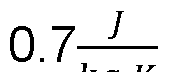
- the permeable sections are made of a material with a specific heat capacity of less than 1 ⁇ - ⁇ , preferably less than 0,7 ⁇ ;, and in particular preferred less than
- the low specific heat capacity of the permeable section al lows for high temperature increases and or decreases of the material temperature of the permeable section. Consequently, the fluid streaming through the permeable section is confronted with high temperature gradients between the working fluid and the permeable section.
- the inventors found, that a specific heat capacity of less than 1 ⁇ — is sufficient for providing an efficient regenerator, while the material costs can kc]'K be held low.
- the material costs are not the main restricting factor of manufacturing the regenerator according to the invention, it was found that a specific heat capacity of less than can achieve very good results in terms of thermal effi- kc]'K ciency.
- the heat capacity is lower than 0.5— ⁇ —, which allows kg "K for heat resisting materials to be used in the regenerator, that withstand fluid temperatures above 800°C.
- the at least two segments are held in position relative to each other by the at least one spacer.
- the spacer not only spaces the segments from each other and provides thermal insulation between the segments, but it also holds and positions the segments relative to each other.
- at least four or five segments are arranged along the flow axis and spaced and held relative to each other by a plurality of spacers.
- the spacers can be formed as ring-shaped elements which contact the inner and/or the outer ring of the sections of the segments.
- the spacers can be formed as rectangular-shaped elements which extend substantially in radial direction from the flow axis.
- the spacers are preferably adhesively fit to the segments.
- At least four segments are arranged substantially coaxially along the flow axis, wherein the flow channels are preferably arranged coaxially to each other along the flow axis.
- the inventors found that arranging at least four and in particular preferred five to six segments coaxially to each other along the flow axis, achieved high temperature gradients in the working fluid and still kept the regenerator design compact.
- Each of the segments is separated from the neighbouring segments by at least one spacer.
- the permeable section of at least one of the segments is made of stainless steel.
- Stainless steel has specific heat capacity between 0.5 to 0.7 kg-K . Furthermore, the material costs of stainless steel are rather low in view of the very good achievable thermal efficiency of the regenerator. Finally, stainless steel is resistant against corrosion and has a high structural stability.
- At least one of the spacers is made after zirconium oxide.
- the spacers can be made of ceramic material, which also has very good insulation stats and can be designed to have a high mechanical strength.
- Figure 1 shows a first preferred embodiment of a regenerator 1 which preferably comprises five segments 2.
- the segments 2 are separated from each other by spacers (not shown).
- the segments 2 comprises a permeable section 22 with a cellular tailor-made structure, preferably a honeycomb shaped structure.
- the segments 2 comprise an outer ring 24 and an inner ring 26, wherein the permeable section 22 is held between the outer ring 24 and the inner ring 26.
- the regenerator 1 shown in figure 1 is adapted to be mounted on a Stirling engine with a circular outer contact surface.
- Figure 2 shows a side view on the embodiment of figure 1 .
- the spacers 4 are adapted to create a space between the segments 2.
- the spacers 4 are formed as one piece with the inner ring 26 of the segments 2.
- the spacers 4 are arranged between the segments 2 and particular preferred contact the inner rings 26 of two adjacent segments 2.
- FIG 3 shows a more detailed view on the permeable section 22 of the segment 2 according to the embodiment of figures 1 and 2.
- the permeable section 22 comprises a structure with flow channels 22A which are separated from each other by walls 22B.
- the walls 22B preferably for a honeycomb structure such, that the flow channels 22A comprise hexagonal shape. It is preferred, not only for the honeycomb structure of the permeable section 22, but also for other cellular tailor-made structures, that the flow channels 22A have a constant inner geometry parallel to the flow axis A (figure 1 ). This allows for constant flow of the working fluid through the permeable section 22 with low flow resistance.
- Figure 4 shows another preferred embodiment of a segment 2 which comprises a helically extending guide element 22C extending around the flow axis A.
- this preferred embodiment there are 4 support elements 23 arranged at the 0°, 90°, 180° and 270° position of the segment 2 to hold the guide element 22C in position and stabilise the flow channels 22A formed between the respective sections of the guide element 22C.
- only two support elements 23 according to fig. 4 would be sufficient to hold the guide element 22C in position. This could save weight and material costs wherein a reduced stability of the segment 2 would be the disadvantage.
- the support elements 23 may also serve as spacers 4 and may be formed as one piece with the respective spacers described before.
- Figure 5 shows another preferred embodiment of the regenerator 1 with four segments 2, which comprise guide elements 22C according to the above described embodiment of figure 4.
- the guide element 22C is positioned only by the spacer 4 which may also be defined as inner ring 26.
- support elements 23 according to figure 4 may be used in the embodiment of figure 5, which would increase the flow resistance of the regenerator 1 and increase the stability.
Landscapes
- Engineering & Computer Science (AREA)
- Chemical & Material Sciences (AREA)
- Dispersion Chemistry (AREA)
- Physics & Mathematics (AREA)
- Thermal Sciences (AREA)
- Mechanical Engineering (AREA)
- General Engineering & Computer Science (AREA)
- Heat-Exchange Devices With Radiators And Conduit Assemblies (AREA)
Abstract
Description

Claims


Priority Applications (2)
| Application Number | Priority Date | Filing Date | Title |
|---|---|---|---|
| PCT/EP2022/079168 WO2024083330A1 (en) | 2022-10-20 | 2022-10-20 | Regenerator |
| EP22790554.4A EP4605699A1 (en) | 2022-10-20 | 2022-10-20 | Regenerator |
Applications Claiming Priority (1)
| Application Number | Priority Date | Filing Date | Title |
|---|---|---|---|
| PCT/EP2022/079168 WO2024083330A1 (en) | 2022-10-20 | 2022-10-20 | Regenerator |
Publications (1)
| Publication Number | Publication Date |
|---|---|
| WO2024083330A1 true WO2024083330A1 (en) | 2024-04-25 |
Family
ID=83898373
Family Applications (1)
| Application Number | Title | Priority Date | Filing Date |
|---|---|---|---|
| PCT/EP2022/079168 Ceased WO2024083330A1 (en) | 2022-10-20 | 2022-10-20 | Regenerator |
Country Status (2)
| Country | Link |
|---|---|
| EP (1) | EP4605699A1 (en) |
| WO (1) | WO2024083330A1 (en) |
Citations (3)
| Publication number | Priority date | Publication date | Assignee | Title |
|---|---|---|---|---|
| JPS62118048A (en) * | 1985-11-18 | 1987-05-29 | Sanyo Electric Co Ltd | Reproduction heat exchanger for stirling engine |
| US5419388A (en) * | 1994-05-31 | 1995-05-30 | Fluidyne Engineering Corporation | Regenerative heat exchanger system and an operating method for the same |
| US6131644A (en) * | 1998-03-31 | 2000-10-17 | Advanced Mobile Telecommunication Technology Inc. | Heat exchanger and method of producing the same |
-
2022
- 2022-10-20 EP EP22790554.4A patent/EP4605699A1/en active Pending
- 2022-10-20 WO PCT/EP2022/079168 patent/WO2024083330A1/en not_active Ceased
Patent Citations (3)
| Publication number | Priority date | Publication date | Assignee | Title |
|---|---|---|---|---|
| JPS62118048A (en) * | 1985-11-18 | 1987-05-29 | Sanyo Electric Co Ltd | Reproduction heat exchanger for stirling engine |
| US5419388A (en) * | 1994-05-31 | 1995-05-30 | Fluidyne Engineering Corporation | Regenerative heat exchanger system and an operating method for the same |
| US6131644A (en) * | 1998-03-31 | 2000-10-17 | Advanced Mobile Telecommunication Technology Inc. | Heat exchanger and method of producing the same |
Also Published As
| Publication number | Publication date |
|---|---|
| EP4605699A1 (en) | 2025-08-27 |
Similar Documents
| Publication | Publication Date | Title |
|---|---|---|
| CA1065145A (en) | Concentric crossflow recuperator for stirling engine | |
| EP2929268B1 (en) | Helical counterflow heat exchanger | |
| JP7169923B2 (en) | Heat exchanger | |
| GB2031571A (en) | Rotary regenerator type ceramic heat exchanger | |
| US7137251B2 (en) | Channelized stratified regenerator with integrated heat exchangers system and method | |
| CN113357054B (en) | High-temperature gas channel design method | |
| WO2024083330A1 (en) | Regenerator | |
| US4183213A (en) | Heat exchanger for Stirling engine | |
| CN110118436B (en) | A kind of built-in heater for thermoacoustic system and composite heater containing the heater | |
| US7089735B1 (en) | Channelized stratified regenerator system and method | |
| US6526750B2 (en) | Regenerator for a heat engine | |
| CN216620751U (en) | Tubular heat exchanger structure | |
| JP2015152190A (en) | Gas turbine heat exchanger | |
| US20060179834A1 (en) | Channelized stratified heat exchangers system and method | |
| US4230651A (en) | Method of fabricating a heat exchanger for Stirling engine | |
| CN114087895A (en) | Tube heat exchanger structure | |
| JP2025141615A (en) | heat exchanger | |
| CN117957401A (en) | A body constructed for use in a radiant tube | |
| CN105466266A (en) | Cold-hot diffluent multi-pipe-pass energy-saving heat accumulator | |
| CN223500213U (en) | A heat exchange tube based on porous silicon carbide | |
| CN219656615U (en) | Sintering boat for ceramic pipe | |
| JP4929470B2 (en) | Stirling engine heat exchanger | |
| JP2025184610A (en) | Heat conduction member, manufacturing method thereof, and heat exchanger | |
| JP2002228144A (en) | Regenerator for burner and high temperature regenerative tube burner | |
| US20240426517A1 (en) | Solar receiver systems and methods of use |
Legal Events
| Date | Code | Title | Description |
|---|---|---|---|
| 121 | Ep: the epo has been informed by wipo that ep was designated in this application |
Ref document number: 22790554 Country of ref document: EP Kind code of ref document: A1 |
|
| DPE1 | Request for preliminary examination filed after expiration of 19th month from priority date (pct application filed from 20040101) | ||
| WWE | Wipo information: entry into national phase |
Ref document number: 2022790554 Country of ref document: EP |
|
| NENP | Non-entry into the national phase |
Ref country code: DE |
|
| ENP | Entry into the national phase |
Ref document number: 2022790554 Country of ref document: EP Effective date: 20250520 |
|
| WWP | Wipo information: published in national office |
Ref document number: 2022790554 Country of ref document: EP |